PREFACE
ix
This account of the part taken by the Grenadier
Guards in the European War is, substantially, the
work of the officers of the Regiment themselves.
Letters and diaries full of interesting detail have
been sent to me, and a vast amount of information
collected by Colonel Sir H. Streatfeild at the
Regimental Orderly Room has been placed at
my disposal.
The military historian who writes of past
centuries has in some ways an easier task than one
who attempts to put contemporary events into
their historical perspective. In the first place,
with every desire to be accurate, the latter finds
that the accounts of eye-witnesses differ so much
that he is forced to form his own conclusions,
and to adopt what, according to his judgment,
is the most probable version. In the second
place, after reading a private letter giving a
graphic account of a particular part of a battle,
he may easily derive a totally false impression of
the whole. Moreover, he writes in the constant
presence of the criticism of eye-witnesses.
A special difficulty also arises from the unequal
quality of the material placed at his disposal.
There is sometimes a wealth of information on
unimportant incidents and no material for the
xhistory of important or dramatic events, in which
the principal actors were almost invariably killed.
Even the Battalion diaries, which were kept with
meticulous accuracy during the early days of the
war, contain less and less material as the fighting
became more and more serious.
With a war of such astounding magnitude,
when millions of men are fighting on a front of
hundreds of miles, any attempt to give an intelligible
picture of what is going on in a modern
battle becomes practically impossible. Even if
such a course were desirable in a regimental
history, the material supplied, which consists
for the most part of letters and diaries of regimental
officers, would be totally inadequate,
since regimental officers know little of what is
going on except in their immediate neighbourhood.
A tactical study was out of the question,
since a battalion plays such a small part in modern
battles, and to describe the movements of corps
and armies appeared to be beyond the scope of
a regimental history.
I therefore decided to depart from tradition,
and to write a narrative giving, as far as I was
able, details about companies, and even platoons.
It seemed to me that this was what the officers
themselves would prefer.
The absence of information concerning the
German Army necessarily takes some of the life
and colour out of such a record as this. In all
military histories the account of the enemy's
movements adds enormously to the interest of the
narrative; but at present, beyond a few accounts
from neutral journalists inspired by the Germans,
xithere is no authentic information as to the movements
of the German Army, and the motives
which actuated the German General Staff can
only be inferred.
Time will of course rectify this, and after the
war detailed accounts of the German Army will
be available, though it will inevitably be some
years before anything worth reading about the
enemy can be published. It has therefore been
suggested that it might be best to defer the
publication of this history for some years. But
it is doubtful whether with the lapse of time any
valuable additions could be made to a regimental
history, though for a national history some
knowledge of the enemy's plans will be essential.
The long periods of monotonous trench life,
in which practically the same incidents recur
daily, have been particularly difficult to deal
with; and, although the greatest care has been
taken to chronicle every event of importance, I
am conscious that many acts of bravery and
devotion to duty which have been omitted in
the letters and diaries must go unrecorded.
The terrible list of casualties has made it
impossible to do more than simply record the
deaths of the officers of the Regiment who fell
during the war. Had more space been available,
fuller accounts of the circumstances under which
they met their deaths and some personal appreciation
of each officer would have been possible,
but in a history which has necessarily to be
restricted to three volumes, all this was out of
the question.
The Regiment is indebted to Colonel Sir H.
xiiStreatfeild, not only for the scrupulous care with
which he gathered together information from
every possible source, but also for his foresight
in realising in the early stages of the war the
importance of all documents connected with
the movements of the different battalions.
The maps are the work of Mr. Emery Walker,
who has succeeded in producing not only artistic
pictures in the style that was prevalent among
cartographers of the seventeenth century, but
also perfectly clear and accurate maps. To
Sergeant West I am indebted for the military
detail.
To many officers I am indebted for suggestions,
especially to Lieut.-General the Earl of Cavan
and Major-General Jeffreys, who found time,
during their few days' leave, to make many
interesting additions to this history; and to
Major H. L. Aubrey-Fletcher, whose knowledge
and experience both as a staff and regimental
officer have been invaluable.
In conclusion, I wish to take this opportunity of
thanking Captain G. R. Westmacott, Lieutenant
M. H. Macmillan, Lieutenant B. Samuelson,
Lieutenant L. R. Abel-Smith, and Lieutenant A. C.
Knollys for the excellent work they did in preparing
accurate diaries for each battalion, with
extracts from the officers' letters. Without their
aid I should never have had the time or the
energy to complete this book.
F. E. G. PONSONBY.
CHAPTER I THE SITUATION BEFORE THE WAR
1
When the Archduke Francis Ferdinand of
Austria was assassinated at Sarajevo in Serbia
on June 28, 1914, it never for a moment occurred
to any one in this country that the crime could
in any way affect the destinies of the First or
Grenadier Regiment of Footguards. No one
dreamed that, before another year had passed,
not only would the three Battalions be fighting
in a European war, but there would even be
a 4th Battalion at the front, in addition to a
5th Reserve Battalion of almost unwieldy proportions.
Even when Austria began to show her teeth,
it still seemed an "incident" quite beyond
our horizon. If Austria and Serbia did come
to blows, Great Britain was not even indirectly
involved, and the British Army, therefore, remained
unmoved. The Balkan peoples were
constantly in a state of warlike commotion, but
their troubles hardly affected the great British
Empire. The war clouds, that from time to
time darkened the European sky, had hitherto
always been dispersed. More than once of late
years the German Emperor had rattled his sword
2in the scabbard, and talked or telegraphed to
the very limits of indiscretion, but nothing had
ever come of it, nor did it seem at all probable
that the assassination of an Austrian Archduke
could be made the pretext for a European conflagration.
There were, however, certain elements of
danger in the European situation at this particular
juncture. The creation of the Triple Alliance—Germany,
Austria-Hungary, and Italy—had made
necessary some counter-move by the other European
Powers. And the entente between England
and France, initiated by King Edward, and
originally intended merely for the settlement
of outstanding differences between the two
countries, became eventually the basis of a
second grouping of nations. This entente was
followed by one between England and Russia;
and although in neither was there anything in
the nature of a defensive alliance, it was well
known that there was in existence—though the
exact terms of it had never been made public—a
far stronger agreement between France and
Russia.
Meanwhile it was generally known that, all
the time these several ententes were being formed,
Germany had been steadily preparing for war.
For forty years, with characteristic thoroughness
of method, the Germans had been diligently
organising their forces to this end. Not only
had the Army been perfected into a first-class
fighting machine, but the civil population had
all been assigned the parts they were to play in
the coming campaign. Trade problems had been
3handled, not so much with a view to commercial
prosperity pure and simple, as to ensure to
Germany a sufficient supply of the commodities
which would be needed in a great war. Gigantic
preparations had been made for a limitless output
of shells and ammunition, and plans carefully
elaborated for the conversion of factories of all
kinds into workshops for war material. The
whole State Railway system was controlled in
such a way that, on the declaration of war,
troops could be instantly concentrated at any
selected spot with the utmost speed.
While many civilians saw and deprecated the
arrogance and madness of such a policy, the
military element, supported by the Emperor,
was anxiously pressing for an opportunity of
proving to the world the efficiency of the organisation
it had created. It was only to be expected
that the generals, who knew how vastly superior
the German Army was to any other continental
army, should hanker for an opportunity of
showing off their perfect war-machine.
The attitude of the bankers and merchants
towards the war was not clear. Originally, without
doubt, they had favoured the insinuating
methods of peaceful penetration, which had been
so successful in the past, and by which they
intended to dominate Europe, but just before
the war they appear to have been allured by
the prospect of large indemnities from France
and Russia and to have withdrawn their opposition.
They were persuaded by the military
party that by war, and by war alone, could
the domination of the world by Germany be
4achieved, and that now was the time to realise
their dream. Young officers of both services
made no secret of their wish for war, and
constantly drank "to the Day" when they met
at mess. The more intelligent portion of the
German population quieted what conscience they
had with the comfortable reflection that all
military and naval preparations were merely
ordinary precautions for defence. Indeed this
theory, cunningly instilled into the German people
by the military party, was so generally accepted
that even after the war was declared the majority
was under the delusion that it was fighting only
for the defence of the Fatherland.
Although the attitude of Germany towards
England did not play any prominent part in the
events which led up to the war, there undoubtedly
existed in Germany a deep hatred of this country.
Commercial rivalry and the desire of the Germans
to found a Colonial Empire on the same lines as
ours would hardly account for this feeling, which
permeated every class, and it is to the Flotte
Verein or Navy League that we must look if
we wish to find the reason. Originally instituted
to instil into the youth of Germany a desire for
sea power, this organisation, by means of propaganda,
speeches, and pamphlets, succeeded in
convincing the rising generation that we were
their natural enemies. The arguments were
invariably pointed by reference to the British
Fleet, which, it was said, could dominate Germany's
world policy, and so young Germans
grew up with a feeling of terror for the British
Fleet and hatred for the British nation.
5In spite of everything, England slumbered
on, hypnotised by politicians who had convinced
themselves by a process of mental gymnastics
that war was an impossibility. The contingency
of a British Army being sent to France was
never even discussed by the House of Commons,
and the logical outcome of our European policy
appears never to have occurred to either House
of Parliament.
While Germany was studiously preparing for
war, we were engaged in academic discussions
on disarmament, and although members of the
Imperial Defence Committee and a limited number
of Cabinet Ministers may have known of the
possibility of our having to send an expeditionary
force to France, the man in the street, and even
the majority of members of Parliament, were
completely in the dark as to the true significance
of the position of affairs in Europe.
The whole situation was singularly favourable
to the Germans. Never before had they been
so strong, and probably never again would they
have such a powerful Fleet and Army. For some
years it had been growing clear to them that
if ever they were to strike, they must strike
soon. The Socialists were becoming stronger
every day, and there were constant grumblings,
which ever-increasing prosperity failed to stifle,
at the enormous expenditure on armaments.
The nation might weaken as the years went on,
and there was every probability that the Government
would find it impossible to maintain indefinitely
a huge Army and a huge Fleet. If
they failed to take advantage of this opportunity
6they might never again be in a position to
dominate Europe.
Though Austria had long been tied to the
wheels of the German chariot, there was always
the danger of the Hungarians and Bohemians
refusing to support Germany, should the quarrel
be purely German. It was therefore necessary
to make the casus belli essentially Austrian.
What better opportunity could ever offer itself
than the assassination of the heir to the Austrian
throne? Moreover, the new heir, perhaps soon
to be the new Emperor, might not be willing to
endorse all his predecessor's pledges, and Austria
might conceivably drift apart from her ally.
Clearly, therefore, if Germany, with Austria's
help, was to strike a blow at Russia and France,
she must do so forthwith.
The war party held that together Germany
and Austria were more than a match for France
and Russia. Italy was a member of the Triple
Alliance, and would either come in on their side
or remain neutral. Great Britain, it imagined,
would be unable to take any part owing to her
internal troubles. It appears to have taken
it for granted that the Dominions and Colonies
would in any case seize the occasion for declaring
their independence, and that there would certainly
be a second mutiny in India. There was therefore
no need to consider the British Empire in calculating
the chances of success. A parade march
to Paris would settle France in a short time, and
then the whole forces of the two Empires would
be turned on Russia. A glorious and victorious
peace would be signed before the end of the year.
7With such calculations as these, it is hardly
to be wondered at that the rulers of Germany
decided on war at once. To their dismay, however,
Serbia submitted to the terms dictated
by Austria, and it seemed at one moment that
the whole incident would be closed. Acting on
Russia's advice, Serbia agreed to all the points
in the Austrian memorandum but two. These
practically threatened her independence, but
there was nothing that could not be satisfactorily
settled by an impartial tribunal. But, as despatches
and telegrams were exchanged between
the European Powers, it gradually became clear
that the original dispute between Austria and
Serbia had now nothing to do with the matter.
Sir Edward Grey made a final attempt to avert
war by proposing a conference, but this proposal
came to naught, and the determination on the
part of Germany to force a war appeared to be
stronger than ever. However sincere the Emperor's
wish for peace may have been, he was
powerless in the hands of a military autocracy
which he himself had created. Ever since he had
ascended the throne, he had set the military over
the civilian element, and now, finding himself
powerless to resist the demands of the war party,
he determined to place himself at their head.
On July 31 Germany despatched an ultimatum
to Russia demanding immediate demobilisation.
This was tantamount to a declaration of war,
but war was not actually declared till the next
day. The declaration of war with France
followed as a natural sequence.
Such was the situation at the beginning of
8August. With disinterested detachment the
British Empire watched the preliminary negotiations,
and even when war was declared between
the two groups of Powers, public opinion was
divided as to which course we should adopt.
When, however, Germany violated the neutrality
of Belgium, all doubt was removed, and we
declared war on August 4. The whole Empire
was stirred to the depths, and in London huge
crowds paraded the streets and assembled outside
Buckingham Palace to cheer the King and the
Queen. The wildest rumours were circulated and
believed. Fantastic tales were told to every one
in confidence by well-informed men in the street,
and eagerly swallowed by excited dupes.
Then the curtain was pulled down, and the
British public was allowed to know nothing.
What troops were going, where they were going,
when they were going, all became matters of
conjecture.
Meanwhile, silently and surely, the British
Expeditionary Force found its way over to France.
CHAPTER II ARRIVAL OF THE 2ND BATTALION IN FRANCE
9
To any neutral not completely blinded by German
sympathies it must have been only too palpable
that the last thing we were prepared for was a
European war, for not only had we no men to
speak of, but there appeared to be no competent
organisation for dealing with a levée en masse.
Relying on the warlike instinct of our race, we
had clung tenaciously to the voluntary system,
under the impression that it was best suited
to our needs. Even if conscription had been
politically possible, it was out of the question,
since we had neither rifles, clothing, nor barrack
accommodation. The Territorial Associations,
which were expected to cope with the masses
of men who at once began to flock to the
colours, were found so inadequate that Lord
Kitchener decided to improvise an entirely new
organisation.
In the inevitable confusion which occurred
after the declaration of war, there were, however,
two factors which stood the test successfully,
and which may be said to have saved the country
from disaster in the initial stages of the war.
The first was the equipment and despatch of
10the Expeditionary Force, which was perfect in
every detail, and the second was the assembly
of the Territorial Forces, originally designed to
repel invasion, but now utilised to garrison
India and the Colonies.
When war was declared, the 2nd Battalion
Grenadier Guards was at Wellington Barracks,
the rest of the Expeditionary Force being mostly
at Aldershot. The speed with which the Battalion
was mobilised reflected the greatest credit on
all concerned. Its equipment was all ready;
reservists arrived from all parts of the country
with a promptitude that was truly remarkable.
It was on August 4 that mobilisation orders
were received, and the Battalion was soon ready
to start on active service.
Meantime, while the preparations were still
in progress, there occurred an unrehearsed little
incident, typical in its way of the unspectacular,
practical side of modern war. As the 2nd
Battalion was returning to Wellington Barracks
from a route march, the King and Queen came
down to the gates of Buckingham Palace, quite
informally, to see the troops pass by. There
was neither pageantry nor gorgeous uniforms,
but those who were privileged to be present on
the occasion will not easily forget the business-like
body of men of splendid physique, clad in
dull khaki, who marched past in fours, and saluted
the King, their Colonel-in-Chief, as they returned
to barracks.
The start for France was made on August 12.
The First Army Corps, under the command of
General Sir Douglas Haig, consisted of:
11FIRST DIVISION. Major-General LOMAX
1st Brigade. Brigadier-General
Maxse.
The
1st Batt. Coldstream Guards.
The
1st Batt. Scots Guards.
The
1st Batt. Black Watch.
The
2nd Batt. Munster Fusiliers.
2nd Brigade. Brigadier-General
Bulfin.
The
2nd Batt. Royal Sussex Regiment.
The
1st Batt. North Lancashire Regiment.
The
1st Batt. Northamptonshire Regiment.
The
2nd Batt. King's Royal Rifles.
3rd Brigade. Brigadier-General
Landon.
The
1st Batt. West Surrey Regiment.
The
1st Batt. South Wales Borderers.
The
1st Batt. Gloucestershire Regiment.
The
2nd Batt. Welsh Regiment.
SECOND DIVISION. Major-General MONRO
4th Brigade. Brigadier-General
Scott-Kerr.
The
2nd Batt. Grenadier Guards.
The
2nd Batt. Coldstream Guards.
The
3rd Batt. Coldstream Guards.
The
1st Batt. Irish Guards.
5th Brigade. Brigadier-General
Haking.
The
2nd Batt. Worcestershire Regiment.
The
2nd Batt. Oxfordshire Light Infantry.
The
2nd Batt. Highland Light Infantry.
The
2nd Batt. Connaught Rangers.
6th Brigade. Brigadier-General Davies.
The
1st Batt. Liverpool Regiment.
The
2nd Batt. South Staffordshire Regiment.
The
1st Batt. Berkshire Regiment.
The
1st Batt. King's Royal Rifles.
The Second Army Corps, under General Sir
Horace Smith-Dorrien, consisted of the Third
12Division, under Major-General Hamilton, and the
Fifth Division under Major-General Sir Charles
Fergusson, Bart. (an old Grenadier).
The Roll of Officers, 2nd Battalion Grenadier Guards,
embarked for active service on the 12th of August
Lieut.-Colonel
N. A. L. Corry,
D.S.O., Commanding.
Brevet-
Lieut.-Colonel Lord Loch,
M.V.O.,
D.S.O., Senior Major.
Lieut. and Adjutant
I. McDougall (Adjutant).
Lieut. Hon. W. A. Cecil (Machine-Gun Officer).
Hon. Lieut. and Quartermaster
J. H. Skidmore (Quartermaster).
No. 2 Company. Major Lord
B. C. Gordon-Lennox.
No. 1 Company. Major
G. C. Hamilton.
No. 4 Company. Captain the
Hon. E. M. Colston,
M.V.O.
No. 3 Company. Captain
D. C. L. Stephen.
No. 2 Company. Captain
E. G. H. Powell.
No. 4 Company. Captain
E. J. L. Pike.
No. 3 Company. Captain
A. B. R. R. Gosselin.
No. 1 Company. Captain
C. Symes-Thompson.
Lieut. Hon. F. E. Needham.
Lieut. R. Wolrige Gordon.
Lieut. H.H. Prince Alexander of Battenberg,
G.C.V.O.
Lieut. Hon. J. N. Manners.
2nd Lieut. F. W. J. M. Miller.
2nd Lieut. G. C. Fitz
H. Harcourt Vernon.
132nd Lieut. G. G. B. Nugent.
2nd Lieut. J. R. Pickersgill Cunliffe.
2nd Lieut. R. H. M. Vereker.
2nd Lieut. A. K. S. Cunninghame.
Lord Loch was appointed to the Staff after the
Battalion landed in France, and Major Jeffreys
took his place as senior Major on August 18.
Queen Alexandra came to see the Battalion
off and wish it God-speed when it paraded at
Chelsea Barracks that afternoon. With Her
Majesty, to whom all the officers were presented,
were Princess Victoria and Princess Beatrice.
Headed by the band of the regiment, the
Battalion then marched to Nine Elms and
entrained for Southampton Docks, where it
embarked on the Cawdor Castle, and finally sailed
at 8 o'clock for France.
Strictest secrecy had been observed about
its destination, and the captain of the ship
himself did not know where he was bound for
until she was actually under way. It was
lucky that it was a lovely night and the sea
quite calm, for the vessel was crowded to its
utmost capacity. The following message from
Lord Kitchener had been handed to each man
when the Battalion embarked:
You are ordered abroad as a soldier of the King to
help our French comrades against the invasion of a
common enemy. You have to perform a task which
will need your courage, your energy, your patience.
Remember that the conduct of the British Army
depends on your individual conduct. It will be your
duty, not only to set an example of discipline and
14perfect steadiness under fire, but also to maintain the
most friendly relations with those whom you are helping
in the struggle. The operations in which you are
engaged will, for the most part, take place in a friendly
country, and you can do your own country no better
service than in showing yourself in France and Belgium
in the true character of a British soldier.
Be invariably courteous, considerate, and kind. Never
do anything likely to injure or destroy property, and
always look upon looting as a disgraceful act. You are
sure to meet with a welcome and to be trusted; your
conduct must justify that welcome and that trust.
Your duty cannot be done unless your health is sound.
So keep constantly on your guard against any excesses.
In this new experience you may find temptations in
wine and women. You must entirely resist both
temptations, and while treating women with perfect
courtesy you should avoid any intimacy.
Do your duty bravely.
Fear God.
Honour the King.
Kitchener, Field-Marshal.
Next morning the ship was found to be
nearing Havre, and the men were full of curiosity
to see what manner of land France was. Meanwhile,
from French fishing-boats and trawlers
came loud cheers at the welcome sight of the
arrival of the forces of Great Britain. A still
more enthusiastic greeting awaited the Battalion
when it landed, and marched through the
numerous docks on the outskirts of the town to
a camp about five miles away. The inhabitants
crowded round the men, and threw flowers at
them as they marched by, while from all sides
came welcoming shouts of "Vive les Anglais,"
"Vive l'Angleterre," and "Eep-eep-ooray."
15When the 2nd Battalion arrived in France,
the German Army had already overrun Belgium.
For nearly ten days the Belgian Army had held
up the Germans, but Liége had fallen, and there
was nothing now to prevent the enemy from
pouring into France. The French Army, as
soon as it was mobilised, had begun a general
offensive towards Alsace and Lorraine, but after
some small successes had been checked at
Morhange. A complete alteration in the French
plan of campaign was rendered necessary by the
advance of the German Army through Belgium,
and troops were now being hurried up towards
the North from every part of France.
The original disposition of the British Expeditionary
Force was as follows: The Headquarters
of the First Corps (the First and Second Divisions)
under Sir Douglas Haig, at Wassigny; the
Headquarters of the Second Corps (the Third
and Fifth Divisions), under Sir Horace Smith-Dorrien,
at Nouvion; while the Cavalry Division,
under General Allenby, was sent to Maubeuge.
It was a scorching, airless day, and the march
to camp was a very trying one. But after a
good sleep and a bathe in the sea the men were
thoroughly refreshed and fit. Then, after the
usual inspections, they were formed up on parade,
and the King's message was read out to them:
Message from the King to the Troops of the
Expeditionary Force
You are leaving home to fight for the safety and
honour of my empire.
Belgium, whose Country we are pledged to defend,
16has been attacked and France is about to be invaded
by the same powerful foe.
I have implicit confidence in you, my soldiers. Duty
is your watchword, and I know your duty will be nobly
done.
I shall follow your every movement with deepest
interest and mark with eager satisfaction your daily
progress, indeed your welfare will never be absent from
my thoughts.
I pray God to bless you and guard you and bring you
back victorious.
George R.I.
The whole population of Havre seemed to
have come out to see the Battalion when it
marched the same evening to the entraining point.
The crowd cheered and shouted, and the men
responded with "The Marseillaise." When they
reached the siding the disappointing news met
them that the train would not start for another
four hours. It began to rain heavily, but fortunately
there were large hangars available, into
which the men crowded for shelter.
Eventually when the train arrived at 2 A.M.,
the men were packed into it, and very crowded
they were. Sleep was difficult, as the horse-wagons
attached to the train were loosely coupled,
and there was a succession of bumps whenever the
train stopped or slowed down. The first real stop
was at Rouen, where provisions were obtained
for the men, and then the train bumped on
to Amiens.
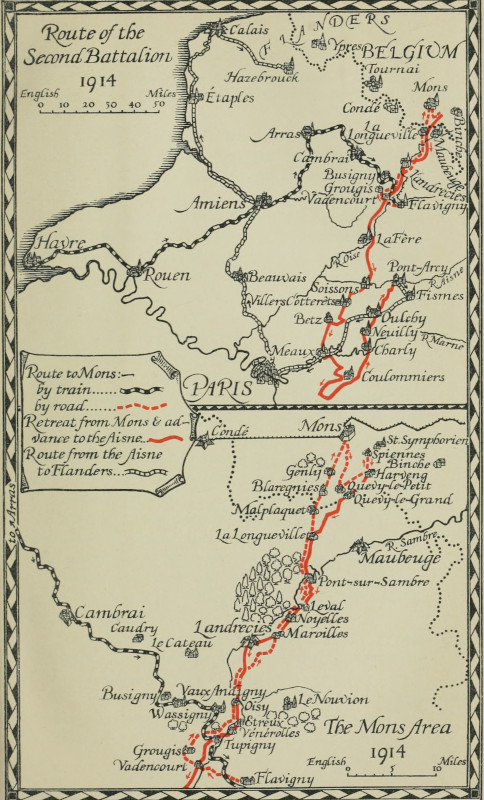
Route of the Second Battalion, 1914
Fervent scenes of welcome went on all along
the line. Each little wayside station, every
bridge and level-crossing held a cheering throng.
At Arras the Mayor turned out in state with a
17number of local magnates, and presented three
large bouquets, for which Colonel Corry returned
thanks on behalf of the officers, in his best
French.
A touch of humour was not wanting at the
little ceremony—if any one had been in the mood
to seize hold of it. For, caught unawares, Colonel
Corry, Lord Loch, and Lord Bernard Gordon-Lennox
were anything but arrayed for a function,
in fact, in a state of decided deshabille. But
such was the enthusiasm of the inhabitants that
a trifle like this passed unnoticed or unconsidered.
The stationmaster here said he was passing
trains through at the rate of one every ten or
fifteen minutes, which gives some idea of the
great concentration of troops that was going on.
Slowly the train went on through Cambrai,
Busigny, and Vaux Andigny to Flavigny, where,
in pouring rain, the Battalion detrained and
went into billets—surprisingly well arranged;
but then Flavigny had plenty of experience in
that way, and only a few days before had lodged
the French troops.
Next morning parade was at 7 o'clock for the
march to Grougis, about seven and a half miles
off, where four days were spent in billets, and
Colonel Corry took advantage of the breathing
space to have his officers and men inoculated
against typhoid.
The concentration of the British Force in the
Busigny area was now completed, and the advance
towards Mons was to begin the next day.
Off again on the 20th, the Battalion marched
to Oisy (where it was again billeted), and on
18the following days to Maroilles and La Longueville.
Here for the first time it heard the
guns, and realised that very soon it would be
getting to work.
On the 21st, following the plan concerted with
General Joffre, Sir John French took up a defensive
position from Condé on the west to Binche
to the east—a front of about twenty-five miles.
The British Army was thus on the extreme left
of the French lines. To the First Corps was
assigned the easterly position from Mons to
Binche, while the Second Corps lined the canal
from Mons to Condé, the whole front being
covered by the 5th Cavalry Brigade.
Originally the scheme appears to have been to
await the enemy's onslaught on the Charleroi—Mons
line, and then to assume the offensive and
advance into Belgium.
How far-reaching the German preparations
had been was at that time hardly recognised,
and neither the French nor the British Commander-in-Chief
seems to have had any conception
of the overwhelming force which the Germans
had been able to concentrate against them.
From La Longueville the 2nd Battalion Grenadiers
marched on August 23, during the last stages
of its journey, across the field of Malplaquet,
where more than 200 years before the regiment
had fought with distinction, through Blaregnies
and Genly to the outskirts of Mons, where it
bivouacked. There it received orders to advance,
which were countermanded before they
could be carried out, and the Battalion was told
to remain where it was. There was nothing to
19do but have breakfast and an hour's sleep by the
roadside, with showers falling at intervals. All
the time heavy firing could be heard from the
direction of Mons, and shells bursting could be
observed in the distance.
Orders then came for the Battalion to march
back to Quevy le Petit, about five miles off,
where the men fondly imagined they would
again be comfortably billeted. But hardly had
they arrived there when they were sent forward
again. As they were marching down a dusty
track General Scott-Kerr rode up, and directed
the 2nd Battalion Grenadiers and the Irish
Guards to move up close behind the ridge east
of Spiennes in support of the Irish Rifles. At
the same time the two Coldstream battalions
were ordered to entrench themselves just east
of Harveng, presumably as a precaution in case
the Brigade should have to retire. Heavy firing
was now going on all round, and the ridge which
overlooked St. Symphorien to the north was
being vigorously shelled by the Germans, who
had got the range to a nicety, and were bursting
their shells over it with accuracy. It was about
6 P.M. when the Battalion, advancing through
Harveng, proceeded in artillery formation for
about one and a half miles to the hill near
Spiennes. The men huddled close together under
the banks on the reverse slope of the hill just
over the railway line, while bullets and shells
whistled over their heads. As they were lying
there they were amused to see the signalman
walk slowly down the line as if nothing in particular
was happening. He had to light the lamps,
20and saw no reason why the ordinary routine
which he had carried out probably for many years
should be interfered with. One of the officers
called out to him in French, and explained that
the Germans were advancing, but he merely
murmured "ça m'est égal," and continued his
work, apparently unconscious of the bullets
that were striking the line.
Meanwhile, Colonel Corry and Major Jeffreys
went up to the position occupied by the Irish
Rifles, who were holding their own well under a
heavy rifle fire.
When they returned to their men it was getting
dark, and at 10.30 a message came from the
O.C. Irish Rifles, that his battalion was retiring.
It appeared therefore to Colonel Corry that the
position was becoming untenable, since the Irish
Rifles on his left had already retired, and both
flanks of the Battalion were exposed. He consulted
Colonel Morris of the Irish Guards, and
they both came to the conclusion that the best
course would be to retire to Harveng.
The difficulty was to communicate with the
Brigadier. The telephone to Brigade Headquarters
had been cut by shell-fire, and so Colonel
Corry rode back to find General Scott-Kerr. He
could not be discovered, and was reported to
have gone to Divisional Headquarters. There
seemed no prospect whatever of finding him, and
it was now past midnight. Thereupon Colonel
Corry determined to take upon himself the
responsibility of ordering the retirement of the
two battalions. His impression was that in a
case like this, when local conditions could not be
21known to the Divisional Staff, it was for the man
on the spot to make his own decision.
Superior authority, however, afterwards held
that while under exceptional circumstances such
powers might well be delegated to the man in
mediis rebus, in a case like this it could not be
admitted that an officer in actual touch with the
enemy was the best judge of how long a position
should be held. It was felt that there were many
considerations in a decision of this sort, of which
the officer in the front line could know very little.
Colonel Corry was therefore severely blamed for
his action, and was a fortnight later relieved of
his command.
At 1 o'clock in the morning the 2nd Battalion
Grenadiers and the Irish Guards retired, but
they had only gone a couple of miles towards
Harveng when they were ordered to go back
and occupy the ridge they had just left. Back
they went, and got as far as the foot of the hill,
only to receive another order to retire to Harveng.
By this time the men were absolutely tired out.
They had started at 3.30 the previous morning,
and had been on the move for twenty-four hours,
with only occasional halts by the roadside.
It was just at this point in the engagement
that Sir John French received what he described
in his despatch as a most unexpected message.
It came from General Joffre, who informed him
that the French Forces had been compelled, by
superior numbers, to retire, and that consequently
the Fifth French Army, which was immediately
on our right, had vacated its line. Two German
corps were advancing on the British position,
22while a third corps was engaged in a turning
movement in the direction of Tournai. Divisions
of French Territorials had been promised in support
of the left flank, but, except for a Brigade
at Tournai, no French troops arrived from the
west. There was therefore no alternative for
Sir John French but to retire.
CHAPTER III THE RETREAT FROM MONS ( 2ND BATTALION)
23
Thus began that historic, terrible, splendid retreat
from Mons. Long weary marches were to
be the lot of the British Army for many a day,
but fortunately no one realised what lay ahead,
or the stoutest hearts might well have quailed.
Long before it was over, the men's boots—not
Crimean ones of brown paper, but good,
sound English leather—had been worn into
shreds by those interminable, pitiless paving-stones,
that had withstood centuries of traffic.
Even the men with the toughest skins suffered
badly from their feet. Clouds of dust and the
heavy atmosphere arising from men in close
formation added to the trials of marching.
Constant cries of "Feel your right" (to let
cavalry or wagons pass by), the wearisome
burden of the pack on the shoulders, which drove
many men to throw away their most prized possessions,
the frequent futile digging of trenches,
abandoned as soon as they were dug, the orders
and counter-orders—all made the days that
followed a positive nightmare to the Army.
Such continuous retirement had never been
practised. It was against all tradition, and the
24men grumbled constantly at the seemingly never-ending
retreat. But what other course could the
"contemptible little army" have followed in the
face of the enemy's overwhelming force?
On the 24th Sir H. Smith-Dorrien started
off with the Second Corps, while a demonstration
was made by the First Corps in the direction of
Binche, and dug a line four miles south of Mons
to enable the First Corps to retire. It was
evident that the Germans were straining every
effort to surround the British Army, and therefore
to hold on too long to any line was extremely
dangerous. The Fifth French Army was still
in full retirement, and the First French Cavalry
Corps was so exhausted that General Sordet
could promise no assistance. The greater part
of the British Cavalry Division, with the exception
of the regiments covering the retreat of the two
British Corps, was guarding the left flank. The
arrival of the Fourth Division at Le Cateau had
been a welcome addition, but as it was only too
probable that the Germans would make every
effort to envelop the left of the whole line of the
Allies, it was important to have strong reinforcements
on that flank.
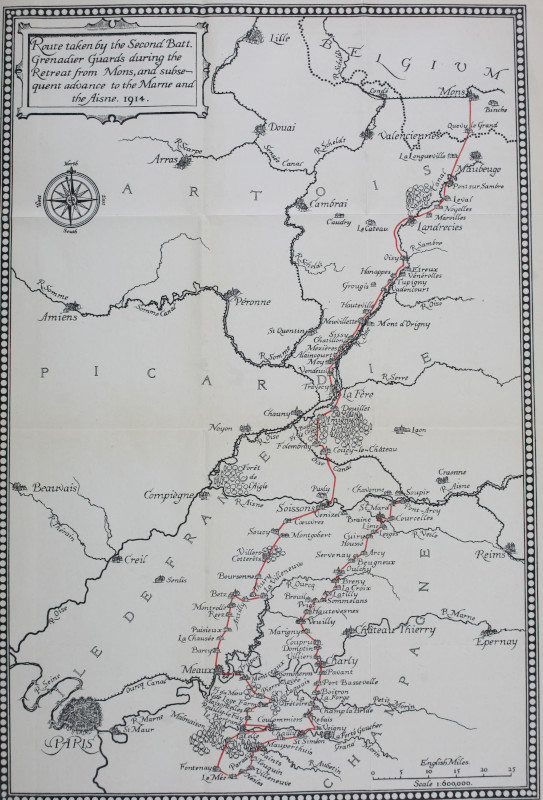
Route taken by the Second Batt. Grenadier Guards during the Retreat from Mons, and subsequent advance to the Marne and the Aisne. 1914.
Two hours' sleep was all the 2nd Battalion
Grenadiers was allowed on that fateful 24th of
August, weary as it was after its twenty-four
hours on end of marching and fighting. At daybreak
it marched to Quevy le Grand, where the
men were ordered to dig themselves in. They
were quite in the dark about what was going on
round them. What force was opposed to them
or why they were retiring, no one knew. The
25greatest secrecy prevailed. Although it was
cold and foggy early, it soon became scorching
hot and the men were tired, but when the word
went round that this was not a rearguard action,
but a determined stand, the digging became a
serious matter, and they set to with a will. The
Germans advanced very slowly and cautiously,
gradually pushing back our Cavalry Patrols,
who could be seen retiring. They shelled the
Mons—Maubeuge Road and also Quevy le Grand,
but as the line of the road was not held, our
position being some hundreds of yards in rear
of it, little damage was done, although a few men
were hit in the village.
But at 2 P.M. another order came to evacuate
the trenches and concentrate on the left. "Concentration"
proved to be a euphemism for
further retirement, and after a long and dusty
march the Battalion bivouacked south of La
Longueville.
Next morning at 5 o'clock it started on
another hot and lengthy march through Pont
sur Sambre, Leval, and Noyelles to Landrecies,
which was reached at 4 P.M. It went into
billets and settled down to rest. But soon afterwards
a trooper from the cavalry patrols rode
into the town with the news that the Germans
were coming; the alarm was given, and the
men stood to arms. Nothing further happened,
however, and they returned to their billets.
The 3rd Battalion Coldstream provided the
outposts, and the rest of the brigade were
just settling down once more in the hope
of a restful night when a second alarm
26sounded. This time it was a real one. The
Germans were advancing in force on Maroilles
and Landrecies.
Though the night was very dark there was
no confusion, as the men poured hurriedly out
from their billets to fall in. Some were at once
detailed to build emergency barricades in the
streets, and as the tool limbers were taken for
this purpose the Battalion never had any heavy
tools for the rest of the retreat. The houses
on the front of the town were rapidly put in a
state of defence; loopholes were made, and the
furniture, or anything handy, was pushed up
to make the walls bullet-proof.
As it turned out, the enterprise of a small
patrol of Uhlans, who rode unopposed into the
town during the afternoon, had proved a very
fortunate thing for the defenders. For it seems
to have been assumed at first that the town was
covered by troops from other brigades, and when
the 3rd Battalion Coldstream was ordered to
furnish outposts it had been considered a quite
unnecessary precaution. After the Uhlan incursion,
even the most optimistic could hardly
have needed convincing.
When all the dispositions had been made
the 2nd Battalion Grenadiers was distributed as
follows: Nos. 2 and 3 Companies, under the
command of Major Lord Bernard Lennox and
Captain Stephen, held the level-crossing over
the railway, and watched the right and left
flanks of the road leading over the Sambre. No.
1 Company, under Major Hamilton, held the
two sides on the left, while No. 4 Company,
27under Captain Colston, in reserve, was posted
on the bridge over the Sambre.
The first warning that the enemy was at hand
was given at 8 P.M. by the firing of the picquets.
When the alarm went there was still sufficient
light for the men to get into their positions, but
soon after it became pitch dark, and the rain
began to fall. Suddenly shadowy forms were
observed by the outposts moving in the darkness.
Evidently they realised that they had been
seen, for a voice was heard calling out, "Don't
shoot. We are the French." The trick at that
time was new to us. Our men naturally hesitated
at first to fire, and this gave the Germans their
opportunity for a forward rush.
Very critical moments followed. The two
forces were only a short distance apart, and
in the darkness a retreat would have been fatal,
but the splendid discipline of the Guards saved
the situation. Everywhere the attacking Germans
found themselves beating up against a
wall of stubborn resistance. They brought up
a couple of guns and poured shells into the
town at almost point-blank range; they even
fired case-shot down the road. Again and again
they charged, only to be met and mowed down
by a withering fire. The machine-guns of the
Grenadiers were moved up to help the Coldstream,
and came into action at a very critical moment.
They were largely instrumental in repelling the
enemy's attack, and were well handled by
Lieutenant the Hon. W. Cecil, who was slightly
wounded. Private Rule particularly distinguished
himself by sticking to his gun and
28continuing to fight it, although he had been
blown off his feet by the blast of a H.E. shell.
The brunt of the attack was borne at the start
by the 3rd Battalion Coldstream, which lost
heavily in this fight; but in the Grenadiers the
casualties were not great.
Soon burning houses were lighting up the
battlefield, and it began to be possible to distinguish
friend from foe. During one of the
bursts of firing Lieutenant Vereker was hit,
and fell shot through the head. After the first
heavy attacks had been repulsed, the enemy
tried to get round the left of the Coldstream
in the direction of the railway-station, but there
was met by a steady fire from No. 2 Company,
under Major Lord Bernard Lennox, and
could make no headway. Splendid work was
done by a field howitzer, which had been manhandled
up to the level-crossing, and which
succeeded in silencing the enemy's guns.
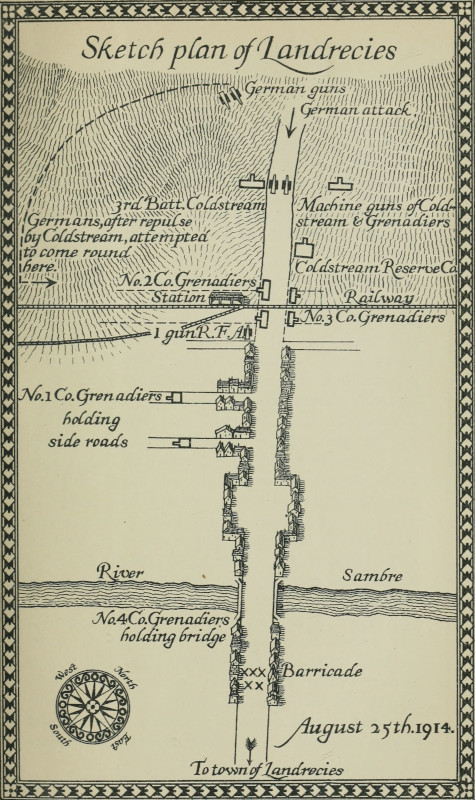
Sketch plan of Landrecies.
Finally, about midnight, the enemy evidently
realised the futility of going on with the attack,
and retreated once more into the darkness.
But spasmodic firing continued for some time,
and it was not until nearly 2 A.M. that the night
became still, and the men were able to strengthen
their position. It was afterwards learnt that
the Germans who took part in the attack had
been pushed up to Landrecies in two hundred
motor lorries. How severely they had been
handled may be surmised from the fact that they
allowed the Grenadiers and 3rd Battalion Coldstream
to retire unmolested over a single bridge
across the Sambre. Writing of this engagement
29in his despatch of September 7, Sir John French
said:
The 4th Guards Brigade in Landrecies was heavily
attacked by troops of the Ninth German Army Corps,
who were coming through the forest on the north of the
town. This brigade fought most gallantly and caused
the enemy to suffer tremendous loss in issuing from the
forest into the narrow streets of the town. This loss
has been estimated from reliable sources at from 700
to 1000.
In the meantime the Second Corps was
between Le Cateau and Caudry with the 19th
Brigade, which had been brought up from the
lines of communication on the left and the
Fourth Division south of Cambrai. The German
First Army launched a serious attack along the
whole of this line, and Sir H. Smith-Dorrien,
finding himself outnumbered and out-gunned,
had the greatest difficulty in breaking off the
engagement and continuing the retirement.
At daybreak the 4th Brigade again got orders
to retire, and marched unmolested to Etreux.
Unfortunately many of the men had no time to
retrieve their kits, which they had left at their
billets, and all these were left behind. The
troops were dead beat, having again had practically
no sleep after a long day's marching and
fighting. Every time a halt was made the
whole Battalion fell fast asleep, and when the
march had to be resumed it was very hard to
rouse the men. It might seem hardly worth
while to sleep during a brief halt of only a
few minutes, with the prospect of a painful reawakening
to the realities of the situation as the
30inevitable sequel. But most of the men were so
thoroughly worn out that they eagerly welcomed
even the doubtful blessing of such a respite.
In the distance heavy firing could be heard in
the direction of Le Cateau, and at one time it
seemed probable the 4th Brigade might be sent
off to support the hard-pressed Second Corps.
Etreux was reached at last, and the Battalion
proceeded to dig itself in. During the afternoon
a German aeroplane flew very low over the
bivouac, and dropped a bomb, which, however,
did no damage. Every one who had a rifle
handy had a shot at the unwelcome visitor;
eventually it was forced down a mile away,
where it was picked up by the cavalry. In it
were found three officers, two dead and one
wounded.
Another long dusty march lay before the
Brigade on the following day. Continuing
the retirement, it passed through Vénérolles,
Tupigny, Vadencourt, and Hauteville to Mont
d'Origny. A report was brought in that a large
force of the enemy had been seen near St. Quentin,
but this proved to be inaccurate. That night
the First Corps was in a most critical position.
The Germans had nearly surrounded them, and
urgent orders to entrench the high ground north
and east of Mont d'Origny were received; but
although the weary troops dug on till midnight,
nothing occurred, and at 3.30 A.M. the Battalion
started off again.
It reached Deuillet near La Fère, where
it had the only day's halt during the retreat.
On the way the Scots Greys and 12th Lancers
31charged a large force of German cavalry and
utterly routed them, making many prisoners,
but otherwise nothing was seen of the enemy.
On arrival at Deuillet, the usual procedure
was gone through, and a position in defence
was entrenched, the men working at it all
day.
In the evening an electrifying report, which
cheered every one up, went round that there was
to be a general advance. But when the order
came it was the usual one to retire, and another
hot march of twenty-eight miles followed. The
weary, wearing ordeal of long day marches and
but little sleep had commenced again. As soon
as it was decided to continue the retreat, and the
whole British Force had crossed over the Oise,
the bridges were blown up. The heat was
intense. There was practically no wind, and the
dust was stifling; a very large number of men
were suffering from sore feet, and there was a
good deal of grumbling in the ranks at the endless
marching in the wrong direction. But there was
no prospect of a long rest, and those battalions
which were unlucky enough to leave men behind
never saw them again. Not a man from the
2nd Grenadiers, however, fell out.
The two corps which had been dangerously
separated were now once more united, but the
pursuing Germans were very near, and the situation
still gave rise to much anxiety. Information
was received to the effect that five or six German
corps were pursuing the Fifth French Army,
while at least two corps were advancing on the
British Army. The situation on the left of the
32British Army was obscure, but it was reported
that the enemy had three or four more corps
endeavouring to creep round that flank. In
response to Sir John French's representations,
General Joffre ordered the Fifth French Army
to attack the enemy on the Somme with the
object of relieving the pressure on the British
Army.
The Battalion reached Soissons about midday
on the 30th, and was ordered to occupy the
ridge near Pasly, about two miles north of the
town. Next day it tramped on to Soucy, a
very hard march in great heat, finishing up with
a steep climb. Here it bivouacked as usual,
and snatched what rest it could. But a full
night's sleep was always out of the question,
and soon after midnight the whole Brigade was
directed to form a rearguard, to cover the retirement
of the Second Division.
Sept. 1. Villers-Cotterêts.
Accordingly trenches were dug in the high
ground above Soucy, No. 4 Company Grenadiers
being detached to guard the right flank in a
position leading across a deep ravine to the high
ground above Montgobert. It was to rejoin
the Battalion when it retired to the forest of
Villers-Cotterêts. Soon after the Germans came
in sight, and retirement from the first position
was successfully effected. The 2nd Battalion
Grenadiers and 3rd Battalion Coldstream made
their way into the wood, the edges of which
were held by the Irish Guards and 2nd Battalion
Coldstream, and took up a fresh position along
the line of the main road running east and west
through Rond de la Reine.
33Thick mist hung over the country, and the
dense undergrowth made the passage of the
wood difficult. The Germans, it was assumed,
would not attempt to penetrate the wood, but
would be content to use the roads and drives.
The assumption proved to be wrong—fortunately
for us. As it happened, they came through the
very thickest part, and in so doing lost cohesion
and direction. Probably, in fact, it was their
doing this, and the confusion into which they
were consequently thrown, that enabled the
4th Brigade to break off the action later in the
evening and retire unmolested.
The 2nd Battalion Grenadiers held the right
of the line. From a strategic point of view, the
position it occupied could not well have been
worse. But in a rearguard action there is often
no choice. It was absolutely necessary to retard
the advance of the enemy through the wood, so
that the rest of the Division should get away.
During the time of waiting for the oncoming
Germans, the Scots Greys and 12th Lancers
suddenly appeared, coming down the ride on
the right. They had been attracted by the
firing, and came to see what was going on. They
dismounted, and, finding many friends among
the Grenadiers, started "coffee-housing" for a
while. But the firing in the outskirts of the
wood began to sound serious, and they rode off
along the road to the left, with the idea of
operating against the enemy's right.
A few minutes later the Germans appeared,
and a fight at close quarters began. The firing
became very hot, as in some places the opposing
34forces were hardly seventy yards apart. Good
work was done by the machine-guns of the
Grenadiers and Irish Guards, which accounted
for a large number of Germans, while the men
charged repeatedly with the bayonet and drove
the enemy back. Gallantly, stolidly, the 4th
Brigade held on until the order came to retire.
Even with highly-disciplined troops, a rear-guard
action in a wood is one of the most difficult
manoeuvres to carry out well. It is quite impossible
for the commanding officer to keep a
firm grip of his battalion when it is scattered
about in different rides; orders passed along
often do not reach all the platoons, and men of
different companies, and even regiments, are
wont to get hopelessly mixed. Fortunately in
the Brigade of Guards the men are all trained
on the same system, and, except for some small
characteristic differences, a man belonging to one
regiment will be quite at home in any of the
others.
At Villers-Cotterêts the men of the 4th
Brigade became very much mixed, and officers
took command of the men who happened to be
near them. The wood, too, was so thick that
at fifty yards' distance parties were practically
out of sight of each other. One result of this
difficulty of keeping in touch was that two
platoons of No. 4 Company never got the order
to retire.
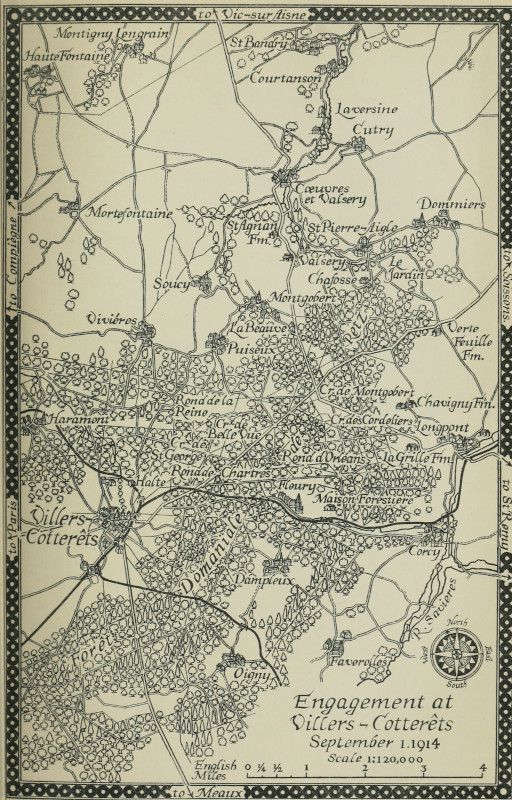
Engagement at Villers-Cotterêts. September 1. 1914.
These two platoons, under the command of
Lieutenant the Hon. F. E. Needham and Lieutenant
the Hon. J. N. Manners, were at the Cross
Roads at Rond de la Reine. As the Germans
35came on, Brigadier-General Scott-Kerr, finding
that they were creeping round his left flank,
ordered these two platoons down a ride to the
left, to enfilade them. Making the best dispositions
they could, these two officers continued to
fight, when they suddenly realised that they
were cut off and the Germans were on all sides
of them. True to the traditions of the Regiment,
they stuck to their posts, and fought on till all
were killed or wounded.
Lieutenant the Hon. J. N. Manners was
killed while directing the fire of his platoon, and
Lieutenant the Hon. F. Needham, badly wounded,
was taken prisoner. Lieutenant G. E. Cecil,
another officer belonging to these platoons, seeing
the Germans streaming across a ride to his left,
dashed off with some men to stop them. He
had not gone far before he was shot through
the hand; stumbling forward, he recovered his
feet, and, drawing his sword, he called on the
men to charge when a bullet struck him in the
head. And there were other casualties among
the officers. Earlier in the day the Adjutant of
the Battalion, Lieutenant I. MacDougall, was
shot dead while carrying orders to the firing-line.
His place was taken by Captain E. J. L. Pike.
The Brigadier-General, Scott-Kerr, who rode up
to give some orders, was badly wounded in the
thigh, and the command of the Brigade passed
to Colonel Corry, while Major Jeffreys took over
the 2nd Battalion Grenadiers. Field-Marshal
Sir John French, on hearing of this, sent the
following telegram to Brigadier-General Scott-Kerr,
care of Communications:
36My warm congratulations on gallantry of your Brigade
A A A am deeply grieved to hear you are wounded A A A
I shall miss your valuable help very much A A A my best
wishes for your recovery.
French.
Captain W. T. Payne-Gallwey, M.V.O., who
was in charge of the machine-guns in the First
Brigade, was reported missing.
Orders were given to retire, and the Battalion
quietly withdrew in single file of half-platoons,
covered by a rear party from No. 2 Company.
The enemy, as already stated, had been thrown
into hopeless confusion in the wood, and, in
spite of a prodigious amount of shouting and
blowing of horns, could not get forward. Some
three hours later a second engagement was fought
on the other side of Villers-Cotterêts. The 4th
Brigade retired through the 6th Brigade, which
with the field artillery had taken up a position
at the edge of another wood. The enemy's
first shells came over as the 4th Brigade moved
into the wood. The British guns succeeded in
keeping the Germans at bay, but were only got
away with the utmost difficulty and some loss.
Having borne the brunt of the fighting, the 4th
Brigade had necessarily suffered heavy casualties.
The 2nd Battalion Grenadiers lost 4 officers
and 160 men, while the Irish Guards lost 4
officers and the Coldstream 7, as well as a large
number of men. Two exceptionally good officers
in the Irish Guards were killed—Colonel the
Hon. G. Morris and Major H. F. Crichton. The
latter served in the Grenadiers for some years
before exchanging into the Irish Guards.[1]
37On emerging once more into open country,
the 2nd Battalion Grenadiers was sent off to
march to Boursonne, which it reached about
4 P.M. Two companies of the 2nd Battalion
Coldstream were ordered back to support the
6th Brigade, which was now protecting the
retreat of the guns; but they were not wanted
after all, and were sent back to Boursonne after
a fruitless journey. Then General Monro rode
up, and ordered the 2nd Battalion Grenadiers to
take up a rear-guard position about Boursonne,
to cover the retirement of the 6th Brigade.
Meanwhile, the Brigade Headquarters, the Irish
Guards, and the 3rd Battalion Coldstream went
on to Betz.
When the 6th Brigade had passed through,
the 2nd Battalion Grenadiers and 2nd Battalion
Coldstream retired to Thury. Unfortunately no
orders had been given them to go to Betz, and
through following the 6th Brigade these two
battalions missed the guide whom Battalion
Headquarters had sent to meet them. Once
more the men were absolutely dead beat. They
had had nothing to eat since tea the day before,
but when the matter of food was inquired into
38it was found that all the supplies had gone on
to Betz. This was at 11 o'clock at night, and it
looked as if the men would have to bivouac
foodless by the roadside.
Heroic measures were called for, and Major
Jeffreys decided to brush aside the ordinary
procedure and shortcircuit the usual channels
of communication by going straight to the
Divisional Commander, General Monro. He was
instantly successful. On learning of the sad
plight of the Battalion, General Monro undertook
to supply it with food. He ordered his
D.A.Q.M.G. to take the Battalion to his supply
depot, and Major Jeffreys went back and fell
in his weary men.
With the promise of a meal ahead they
responded gamely, and marched off to La Villeneuve,
the place indicated by the General, where
rations of bully-beef, bread, and cheese were
soon distributed.
Then the men were allowed two hours' sleep
by way of a night's rest after one of the longest
and most strenuous days they had ever had.
They were more fortunate, though, than the men
of the 2nd Battalion Coldstream Guards, who
did not even manage to get any food that night,
and who had to snatch what sleep they could
lying down in the streets of Thury.
At 2 A.M. the Battalion marched off again—still
retiring—through Antilly to Betz, where
it was joined by No. 1 Company and 45 men
of No. 4 under Lieutenant Stocks. Thence
by Montrolle to Reez, where a halt was made
for water, and on to Puisieux. Here the men
39had a late breakfast, and then, in stifling heat,
continued their march, with constant halts,
through La Chaussée and Barcy to Meaux. They
reached this village at 4 P.M., and, their long
day's journey ended, they were refreshed by a
bathe in the Ourcq Canal. This march was
almost the hardest of the whole retreat, but, in
spite of everything, the Battalion marched on,
with scarcely a man out of the ranks, although
the number of men who fell out in other
regiments was by no means small.
Undoubtedly the men were by now beginning
to feel the strain of this interminable retirement.
However footsore and weary they may be,
British troops will always respond when called
upon to advance. But to ask them to make a
special effort when retreating is quite another
thing, even with the most highly disciplined.
Besides, they were quite unable to see the necessity
of it all. There had been no pitched battle, no
defeat—in fact, whenever they had had a chance
they had inflicted enormous losses on the enemy
and driven him back. Of course they had seen no
newspapers, and had no way of picking up any
real idea of what was going on in France.
Next morning at 7 o'clock the march was
resumed eastwards, and the Division crossed
the Marne at Trilport, blowing the bridges up
after them. This new direction was the result
of the Germans moving along the north bank of
the Marne, which they crossed near Sammeron.
Then the Battalion moved southward again,
through Montceaux and Forêt du Mans to Pierre
Levée, where it bivouacked.
40The men had expected a rest on September 4,
but the order soon arrived for the Brigade to
continue the retirement. No. 3 Company of
the 2nd Battalion Grenadiers under Captain
Gosselin, and No. 4 Company under Captain
Symes-Thompson, were sent out on outpost
duty.
In the morning the Brigade marched to Les
Laquais, where trenches were dug, joining up with
the 5th and 6th Brigades on the right. At 5 P.M.
the enemy shelled the right of the line, and at
dusk the Brigade withdrew. It picked up No. 3
Company at Grande Loge Farm, and marched
through Maisoncelles and Rouilly le Fay to Le
Bertrand, where it bivouacked for the night.
Meanwhile Major Lord Bernard Lennox was
despatched to Coulommiers to find the first
draft that had been sent out from home—90 men
under Captain Ridley. They arrived about midday
after a train journey of thirty-six hours—they
had been all round the country, constantly
receiving fresh orders to go to different places.
Lord Bernard Lennox had been instructed to
remain at Coulommiers, but when he found the
First Division retiring through the town all the
afternoon, he decided to strike off westward with
the new draft in search of the Battalion. This
plan succeeded, and he found it about midnight.
It was a sadly tattered, unshaven, footsore
body of men that marched at 3 o'clock next
morning through La Celle and Malmaison Farm
to Fontenay, where they went into billets. No
Londoner seeing them would have guessed that
these were the same smart Grenadiers whom he
41had often admired on the King's Guard. But
if their looks were gone, their spirit was indomitable
as ever.
The Germans seem to have been genuinely
under the delusion that by this time the long
retreat had reduced the British Army, always
"contemptible," to a mere spiritless mob, which
it was no longer necessary to take into calculation
in developing their plan of campaign. They
little knew the British soldier. So far the 2nd
Battalion Grenadiers had had no chance of showing
its quality; it had just been marched off
its feet from the start—in the wrong direction.
But, in spite of all the men had gone through,
they were ready at any moment to turn and
fight like lions when they were allowed to.
And now at last the moment was close at
hand. To their joyful surprise the officers of the
Battalion found, on the morning of September 6,
that the direction had been changed, and that
an advance was to be made eastward against
the German flank. At first it was thought that
this meant the beginning of an offensive-defensive,
the German attack having failed; but in reality,
of course, the change was a much bigger one
even than this. The French reserves were now
available, and the Germans' greatest asset,
superior numbers, was lost to them. And so a
new phase of the campaign began to develop.
On the 6th Lieut.-Colonel Corry resumed the
command of the Battalion, and Lieut.-Colonel G.
Feilding took command of the Brigade.
CHAPTER IV THE BATTLE OF THE MARNE ( 2ND BATTALION)
42
The German General Staff at this juncture
realised that a retreating army is not necessarily
a beaten one. For the last ten days, with their
maps spread before them, they had had the
satisfaction of moving the pins and flags representing
their forces continually and rapidly nearer
and nearer Paris. But if the French Army—the
British Army, they thought, could be safely
ignored—were to succeed in escaping south, it
would remain a constant menace. It might
even interfere with the Emperor's spectacular
entry into Paris, every detail of which had been
sketched out beforehand by the officials, whose
business it was to stage-manage all the theatrical
pageantry of their Imperial master's movements.
So a big coup was wanted—a smashing blow
at the French. If the centre of the French line
could be pierced by the combined efforts of
Von Hausen's, the Duke of Würtemberg's, and
the Crown Prince's armies, and if simultaneously
Von Kluck's army, which had reached Senlis,
and was only twenty-five miles from Paris, could
execute a swift movement to the south-east, the
Fifth French Army would be caught in a vice.
43This strategic plan really menaced the whole
of the interior of France, and had it succeeded
might have resulted in her downfall. In all these
calculations of the German Staff it appears to
have been assumed that the British Army was
practically out of action, and that whatever
remained of it had in all probability been sent
to reinforce the weak spot at Bar-le-Duc.
To accomplish his decisive stroke, Von Kluck
had to execute that most dangerous of all manoeuvres,
a flank march with the object of rolling
up the left of the French line. The German
General Staff assumed that the left of the Fifth
French Army was the left of the whole French
line, and that nothing beyond a few cavalry
patrols had to be reckoned with. Von Kluck
was accordingly given orders to march his army
to the left and attack the Fifth French Army
under General Franchet d'Esperey. They knew
nothing of the Sixth Army under General
Maunoury, which had arrived with such dramatic
suddenness in taxi-cabs from Paris.
The unknown and the despised elements
proved Von Kluck's undoing. Before he had
gone very far he found the completely ignored
British Army on top of him, and the totally
unexpected Sixth French Army on his right
flank. Quickly realising his peril, he decided
to retire. In the meantime, on the French side,
General Foch, who was about in the centre of
the French line, saw an opportunity, which he
promptly seized, of driving a wedge between the
armies of Von Hausen and Von Bülow. The
situation was now entirely changed. The lately
44triumphant German forces were no longer even
moderately secure, and decided on a general
retirement all along the line.
It was on September 5 that Sir John French
and General Joffre conferred together and decided
to take the offensive. To the British Army was
assigned the space between the Fifth and Sixth
French Armies. This meant a change of front,
and hence that welcome order to the 2nd Battalion
Grenadiers to move due east instead of
south.
That evening Field-Marshal Sir John French
issued the following orders:
(1) The enemy has apparently abandoned the idea of
advancing on Paris and is contracting his front and
moving south-east.
(2) The Army will advance eastward with a view to
attacking. Its left will be covered by the French Sixth
Army also marching east, and its right will be linked to
the French Fifth Army marching north.
(3) In pursuance of the above the following moves
will take place, the Army facing east on completion of
the movement.
First Corps: right on La-Chapelle-Iger, left on
Lumigny, move to be completed 9 A.M.
Second Corps: right on La Houssaye, left in neighbourhood
of Villeneuve, move to be completed 10 A.M.
Third Corps: facing east in the neighbourhood of
Bailly, move to be completed 10 A.M.
Cavalry Division (less 3rd and 5th Brigades): to
guard front and flanks of First Corps on the line Jouy-le-Chatel
(connecting the French Fifth Army)—Coulommiers
(connecting the 3rd and 5th Brigades). The
3rd and 5th Cavalry Brigades will cease to be under the
orders of the First Corps and will act in concert under
instructions issued by Brigadier-General Gough. They
45will cover the Second Corps connecting with the Cavalry
Division on the right and with the Sixth French Army
on the left.
Sunday, the 6th, was the joyful day when there
came this turn of the tide, and that morning
Sir John French issued an order to his Army
in which he said:
After a most trying series of operations, mostly in
retirement, which have been rendered necessary by the
general strategic plan of the Allied Armies, the British
Forces stand to-day formed in line with their French
comrades, ready to attack the enemy. Foiled in their
attempt to invest Paris, the Germans have been driven
to move in an easterly and south-easterly direction,
with the apparent intention of falling in strength on
Fifth French Army. In this operation they are exposing
their right flank and their line of communication to an
attack by the Sixth French Army and the British Forces.
I call upon the British Army in France to show now
to the enemy its power and to push on vigorously to
the attack beside the Sixth French Army. I am sure I
shall not call on them in vain, but that on the contrary
by another manifestation of the magnificent spirit which
they have shown in the past fortnight they will fall on
the enemy's flank with all their strength, and in unison
with their Allies drive them back.
At 5.30 the same morning the 2nd Battalion
Grenadiers marched to Le Mée, where trenches
were dug. The men, for once, had had a good
night's rest, and were in great spirits at the
prospect of an advance. A sharp artillery attack
was being carried on against Villeneuve, and the
1st Brigade was moved out to attack the place,
while the 4th Brigade prolonged the line on
the left. Being in reserve, the 2nd Battalion
46Grenadiers saw little of the day's fighting. In
the event the artillery proved sufficient to shift
the enemy, and the Battalion marched without
further incident to Touquin, where it bivouacked
for the night. That night the British
Army occupied a line from Dagny on the right
to Villeneuve-le-Comte on the left.
Severe fighting went on all along the line
next morning. Maunoury's taxi-cab army had
been able to press Von Kluck as he retired, and
the British Army had taken Coulommiers and
La Ferté-Gaucher. As the German battalions
retreated shells were poured on them by our
artillery, who were kept well posted with information
by the aircraft observers. Marching
through Paradis, Mauperthuis, St. Simeon, and
Voigny, the 2nd Battalion Grenadiers finally
bivouacked at Rebais. Everywhere in the villages
were staring evidences of the German occupation
and hurried retreat. Shops had been looted,
houses despoiled, and the contents—such as
could not be carried away—had been wantonly
destroyed, evidently under orders, and the fragments
scattered to the winds. The advance-guard
of the 4th Brigade (the 2nd Battalion
Coldstream) was engaged with the German rearguard
during this march, and the Grenadiers
who were in support came in for a certain amount
of firing. The Germans could be plainly seen
retiring by Rebais with masses of transport in
great confusion.
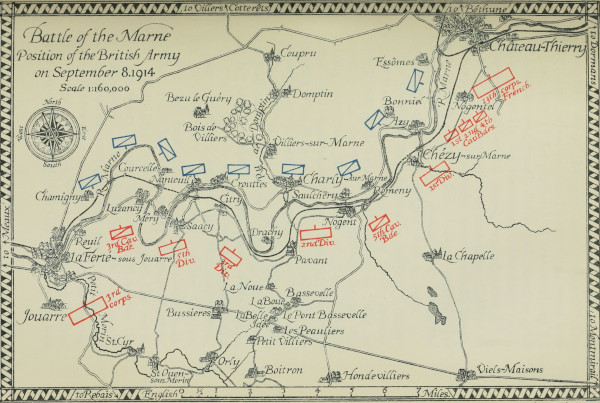
Battle of the Marne. Position of the British Army on September 8, 1914.
It became clear next day that Von Kluck's
Army was in retreat, and Sir John French determined
to press him and give him no rest—thus
47completely were the positions reversed. The
First Corps advanced, and everything went well
at first, but at La Trétoire it was held up by
the German rear-guard, which had found a good
position, and the 3rd Battalion Coldstream, which
formed the advanced guard, was checked for a
time by the German machine-guns hidden in
the houses round the bridge over the Petit Morin.
Meanwhile, a German field battery posted near
Boitron shelled the high ground over which the
main body of the 4th Brigade had to pass.
The Germans were evidently fighting a delaying
action, and were employing their cavalry
with great skill to hold the river as long as
possible. In front of the British Army, the
cavalry covering the retreat of Von Kluck's
Army was commanded by General von der
Marwitz, who showed no intention of abandoning
his position without a struggle.
Thick woods run down to the river for the
last half-mile here, but right through them goes
one big clearing about eighty yards wide. This
was swept by the German machine-guns, and
it was a problem how to get the men across.
No. 3 Company Grenadiers under Captain
Stephen was sent on to support the Coldstream,
followed later by No. 4 under Captain Colston.
Both companies reached the edge of the wood,
but were there stopped by a hail of fire from the
machine-guns. Our field-guns could not reach
the houses where these had been placed, and
the howitzers were unaccountably slow in coming
up. It was while he was endeavouring to find
some way of advance that Captain Stephen was
48shot through both legs; he was taken to hospital,
and died of his wounds four days later.
Urgent messages to push on kept arriving
meanwhile from Sir Douglas Haig. Lieut.-Colonel
Feilding, who was temporarily in command
of the Brigade, sent the 2nd Battalion
Coldstream by a circuitous route to try and
effect a crossing at La Forge, farther to the
right. No. 1 and No. 2 Companies Grenadiers
were then ordered to go round by a covered
route to avoid the clearing in the wood, and had
actually started when Lieut.-Colonel Feilding gave
the order for them to turn about. Major Lord
Bernard Gordon Lennox, who had raced off at
their head, was so far in front that the order did
not reach him. He rushed across the clearing,
and just managed to get into a ditch on the other
side, the shower of machine-gun bullets churning
up the ground almost at his heels.
So deafening was the noise of the firing that
it was impossible to pass orders simultaneously
to the men scattered about in the woods, who
at the same time were all on edge to advance.
And soon it became very difficult to keep the
troops together.
Lieut.-Colonel Corry had already gone off
with these two companies, Nos. 1 and 2, to
follow the 2nd Battalion Coldstream, when Lieut.-Colonel
Feilding thought he saw the Germans
retiring, and shouted to Major Jeffreys to turn
the Grenadiers about and take them across the
clearing straight down to the river, but No. 2
Company had got a good way ahead through
the woods, and Major Jeffreys was only able
49to get hold of half of No. 1 Company, which
followed him across the clearing. Unfortunately,
however, the German guns were still there, and
opened a heavy fire on them. By this time
the 2nd Battalion Grenadiers was hopelessly
split up, different parts of the Battalion having
gone in three different directions, and the 3rd
Battalion Coldstream was also scattered all over
the woods. In the meantime the howitzers
came up, and soon drove the Germans out of
their position. No. 3 Company had done well
in the fighting, having succeeded in capturing
one of the enemy's machine-guns and many
prisoners.
The various parties then made their way
through the wood to the edge of the stream, but
as there was no bridge to be seen they worked
along the banks to La Trétoire. Without further
opposition, a party of the Irish Guards under
Major Herbert Stepney, together with half of No. 1
Company under Major Jeffreys and Lieutenant
Mackenzie, crossed the bridge, and advanced up
the opposite side towards Boitron. In every
direction the ground was strewn with dead and
wounded Germans, and after advancing 1000
yards the party of Grenadiers reached the
position which had been occupied by the German
Battery; the guns had all been got away, but
dead horses, overturned limbers, and dead gunners
showed how this Battery had suffered at the
hands of the 41st Brigade R.F.A.
As the enemy retired our guns and howitzers
kept up a heavy fire, and inflicted severe losses.
The whole Brigade had by now debouched
50from the woods, and gradually collected behind
Boitron, while the Divisional Cavalry went on
ahead so as to keep in touch with the retreating
enemy. The 2nd Battalion Grenadiers was
then ordered to advance in artillery formation
over the open country north of Boitron, and met
with no resistance.
But there was one incident that might have
proved disastrous. In its eagerness to get at
the enemy, No. 2 Company got rather ahead of
its time, with the result that our own guns
planted some shrapnel into it, luckily without
doing much damage. On the left the Irish
Guards and the 2nd Battalion Coldstream found
in a wood a number of Germans with machine-guns,
who had apparently got separated from
the main body. Our men charged, and immediately
up went the white flag; seven machine-guns
and a large number of prisoners were taken,
mostly men belonging to the Guard Jäger Corps.
Rain had been falling for some time in a
steady downpour, and as the light was failing
the Battalion assembled to bivouac near Les
Peauliers. An extremely wet sainfoin field was
chosen for the purpose, and there, in a misty
September evening, the men lay down to sleep.
Altogether the Grenadiers had lost forty men in
the day's fighting, besides Captain Stephen.
Dismally the raindrops trickled through the
trees as the men roused themselves in the early
morning. It was very cold, too, and the greatcoats
that had been so lightly flung away during
the sweltering days of retreat were now bitterly
regretted. And it was a particularly chilly
51task that lay before the Battalion, for it was in
reserve, which meant constant standing about—often
even more tiring than a march. However,
about midday it cleared, and a very hot sun soon
got every one dry again.
On this day the passage of the Marne was
forced; the Third Corps, under General Pulteney,
bore the brunt of the fighting, whilst the First
Corps on its right drove the Germans before
it with some ease and took numerous prisoners.
The 2nd Battalion Grenadiers, starting off at
7.30, eventually crossed the Marne at Charly,
after innumerable halts and checks. Before it
got over it had to wait some hours at Pavant,
where it could watch various divisions crossing
the river. This bridge at Charly was the only
one in the neighbourhood left standing; it had
been carefully prepared for demolition, and no
one knew why, fortunately for us, it had escaped.
Rumour said that the German engineers entrusted
with the task got so drunk that, when
the appointed moment arrived, they were quite
incapable of carrying out their orders.
During the day Lieut.-Colonel Corry received
orders to return home. He had been relieved
of his command on account of the decision,
already recorded, which he took at Mons.
The Battalion bivouacked that evening—rain
was again falling—on the side of a wet hill near
Villiers-sur-Marne, and woke up to more rainy,
cold weather. The battle of the Marne had
been won, and the Germans were retreating in
perfectly orderly fashion, though we captured
13 guns, 7 machine-guns, and 2000 men. The
52prisoners said they had been officially informed
that a large German army was investing Paris,
and that their division was engaged in "drawing
off" the French Army eastwards. The 2nd
Battalion Grenadiers was again in reserve, and
was constantly marched backwards and forwards
throughout the day. It passed through Domptin,
Coupru, Marigny, and Veuilly to Hautevesnes,
where it bivouacked.
The pursuit continued during the two following
days. Through heavy showers, which gave them
a thorough soaking, the Grenadiers marched on
the 11th by the way of Priez, Sommelans, Latilly,
La Croix, and Breny to Oulchy, where they got
into billets, and fires were lit to dry their clothes.
Such inhabitants as were left eagerly helped to
supply all the men's wants, and placed all they
possessed at their disposal. The usual signs of
recent German occupation were to be seen in
every house. Drawers had been turned out, cupboards
ransacked, and tables overturned, and
the floors were thickly strewn with such things
as the Germans had been unable to take away
with them—clothes, smashed gramophone records,
broken glasses, and other debris. But, in spite
of the pitiable surroundings and their own
soaked condition, the officers and men were soon
put in the best of spirits by the cheerful fires and
the appetising smell of bacon and eggs, put on
to cook for them.
Next morning's parade was at 5 o'clock, but
the town was so crowded with supply wagons
that it was 9 before a move could be made. It
rained at intervals during the day, and in the
53evening another steady downpour set in, which
once more soaked the men to the skin before they
got to their billets at Courcelles, having marched
through Beugneux, Arcy, Cuiry-Housse, Lesges,
Limé, and Braine.
CHAPTER V THE PASSAGE OF THE AISNE ( 2ND BATTALION)
54
For a week now the Germans had been steadily
retiring, and there was no apparent reason why
they should stop doing so. Each time they held
a position the question naturally arose whether
they were really making a determined stand, or
whether this was just a case of a rear-guard
doing its best to hold up the advance. The only
way to find out was to attack them and make
them show their dispositions.
At the Marne, where it might well have been
supposed that the Germans had a good enough
position to make a stand, their resistance had
proved to be merely in the nature of a rear-guard
action. It did not at first dawn on our Army
that at the Aisne, on the contrary, the enemy
had occupied a carefully chosen and sedulously
prepared position which suited their purpose
in every way.
An ideal position it was, indeed. Sir John
French, in his despatch of October 8, 1914, thus
describes it:
The Aisne valley runs generally east and west, and
consists of a flat-bottomed depression of width varying
from half a mile to two miles, down which the river
55flows a winding course to the west at some points near
the southern slopes of the valley and at others near the
northern. The high ground both on the north and
south of the river is approximately 400 feet above the
bottom of the valley and is very similar in character,
as are both slopes of the valley itself, which are broken
into numerous rounded spurs and re-entrants. The
most prominent of the former are the Chivres Spur on
the right bank and the Sermoise spur on the left. Near
the latter place the general plateau on the south is
divided by a subsidiary valley of much the same character,
down which the small river Vesle flows to the
main stream near Sermoise. The slopes of the plateau
overlooking the Aisne on the north and south are of
varying steepness and are covered with numerous
patches of wood, which also stretch upwards and backwards
over the edge on to the top of the high ground.
There are several villages and small towns dotted about
in the valley itself and along its sides, the chief of which
is the town of Soissons.
The Aisne is a sluggish stream of some 170 feet in
breadth, but, being 15 feet deep in the centre, it is
unfordable. Between Soissons on the west and Villers
on the east (the part of the river attacked and secured
by the British Forces) there are eleven road-bridges
across it. On the north bank a narrow-gauge railway
runs from Soissons to Vailly, where it crosses the river
and continues eastward along the south bank. From
Soissons to Sermoise a double line of railway runs along
the south bank, turning at the latter place up the Vesle
valley towards Bazoches.
The position held by the enemy is a very strong one,
either for a delaying action or for a defensive battle.
One of its chief military characteristics is that from
the high ground on neither side can the top of the
plateau on the other side be seen, except for small
stretches. This is chiefly due to the woods on the
edges of the slopes. Another important point is that
56all the bridges are under either direct or high-angle
artillery fire.
Until the afternoon of the 12th September it was
still uncertain whether the enemy meant business
this time or not, and then Sir John French came
to the conclusion that, for the moment at any
rate, they had stopped their retreat and were
preparing to dispute vigorously the passage of
the river. The presence of Germans had been
reported by our cavalry south of Soissons and
in the neighbourhood of Braine, but these were
merely patrols.
The opposing forces were posted as follows:
The German Army occupied the high ground
north of the river, with Von Kluck still on the
right flank. From the reports that came in, it
appeared that the right of Von Kluck's army
was resting on the forest of L'Aigle, and the left
on the plateau of Craonne, while Von Bülow
prolonged the line to the left. The French
Army was now extended in an immense line
from Compiègne to the Argonne, the British
Army holding a portion of the front—about
twenty miles—between Maunoury's Sixth Army
and Franchet d'Esperey's Fifth Army.
On the left of our part of the line were the
Third Corps, which was allotted the section from
Soissons to Venizel, the Second Corps, which was
between Venizel and Chavonne, and the First
Corps between Chavonne and Bourg. In this
last section there was a canal as well as a river
to cross.
Rain was pouring down when the Battalion
paraded at 5.30 A.M. on the 13th, but it cleared
57up later, with sunshine and a strong cold wind,
which soon dried the men again. The 4th Brigade
marched towards Chavonne, and stopped under
the brow of a high hill overlooking the river
Aisne. Here there was a halt of several hours
in the middle of the day, during which the
commanding officers went on ahead with Lieut.-Colonel
Feilding, the acting Brigadier, to reconnoitre
the opposite heights from the high ground
above St. Mard, whence the movements of the
Germans could be clearly seen. Meanwhile, the
2nd Battalion Coldstream went forward under
the cover of our guns to make good the passages
over the canal and the river, the bridges naturally
having all been blown up by the Germans.
After about two hours it succeeded in driving
off the enemy, who were seen running up the
hill and disappearing over the sky-line.
In support of it, the 2nd Battalion Grenadiers
advanced towards the river, but was then
sent off to try and make the crossing about a
mile to the east of Chavonne. The only means
of getting over, apparently, was by three or four
small boats of doubtful buoyancy, and it was
clear that for the whole Battalion to cross in
this way would be a lengthy business. Pushing
ahead, however, to reconnoitre, Lord Bernard
Lennox and Major Hamilton found a bridge
which they thought at first the Battalion could
use, but the moment they were seen on the
bridge they were greeted with shrapnel, so well
aimed that it was obvious the enemy had got
the exact range. So they retired to report the
result of their observations.
58As it was now getting dark, and no foothold
on the opposite bank could be obtained, Colonel
Feilding decided to withdraw the 4th Brigade.
The 2nd Battalion Grenadiers and 2nd Battalion
Coldstream were therefore recalled, and sent into
billets at St. Mard. Rain was again falling
heavily, and the men were glad to be under cover,
while the inhabitants cooked their rations and
supplemented them with omelettes and vegetable
soup.
Thus began the battle of the Aisne, and had
the men only known that it was to go on, not
for months but years, and that the same ground
would be occupied by the Allies during all that
time, they would hardly, I imagine, have shown
quite the same dash as they did during the days
that followed.
The morning of the 14th broke cold and
wet. A thick mist hung over the valley of the
river—fortunately for us, since this made artillery
observation by the enemy impossible, and enabled
the men to cross the river without coming under
shell-fire. During the night the R.E. had managed
to build a pontoon bridge over the river at
Pont-Arcy, and at 5.30 A.M. the brigade moved
off to this point. As this bridge was the sole
means of crossing for all arms, there was naturally
some little delay, and during the period of waiting
Colonel Feilding sent for all the commanding
officers; he explained the dispositions he had
made, and instructed them to make Ostel their
objective.
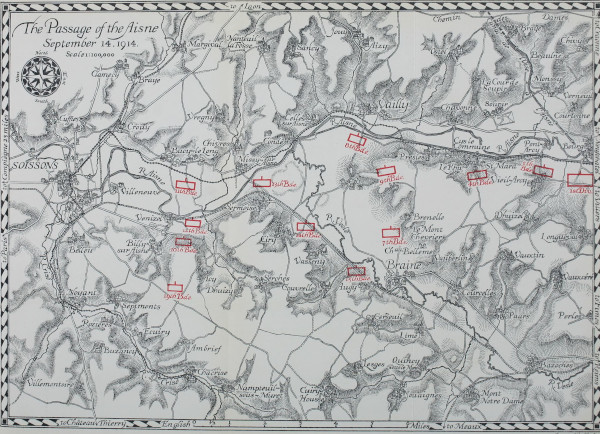
The Passage of the Aisne. September 14, 1914.
The 2nd Battalion Grenadiers was to form
the advanced guard to the Brigade, and Major
59Jeffreys received orders to secure the heights about
La Cour de Soupir, and then to push on and
make good the cross-roads at Ostel, about a mile
farther on. Accordingly the Battalion moved off,
crossed the river, and marched to Soupir—without
opposition. Had some German officer blundered,
or did the enemy not intend to dispute the
passage of the river? It seemed inconceivable
that, if they intended to hold the position, the
enemy should allow a whole battalion to cross
unmolested.
At Soupir the road ran uphill through a dense
wood, and it was impossible to see very far ahead.
Progress was necessarily very slow, and the
advanced guard had orders to move with the
utmost caution. No. 1 Company, under Major
Hamilton, formed the vanguard, and half of
No. 2 Company, under Captain Symes-Thompson,
was sent as a flank guard to the left, where the
ground rose steeply above the road, and the
trees were very thick. About half-way the vanguard
came into touch with the German outposts.
At the same time they were joined by some
men of our 5th Brigade, who had gone too far
to their left, and in consequence had narrowly
escaped being captured by the enemy.
Word was sent back by Major Hamilton that
he was not at all happy about his left flank,
which was on the high ground towards Chavonne,
and Major Jeffreys despatched the rest of No. 2
Company to support Captain Symes-Thompson
and strengthen that flank. Two platoons of
No. 1 and one platoon of No. 2 were sent off
to the left, and, having got into touch with the
60cavalry on that flank, took up a position in the
woods above Chavonne, where they remained
for the rest of the day. Meanwhile, the leading
men of the advanced guard, under Lieutenant
Cunliffe, pushed on, and near La Cour de Soupir
ran right into the enemy, who were in superior
numbers. All the men were taken prisoners,
and Lieutenant Cunliffe was wounded.
But the rest of the advanced guard were also
pressing forward, and soon the positions were
reversed. Faced with the alternative of capture
or retiring before a stronger force, the German
officer in command decided on the second course.
This meant perforce abandoning the prisoners;
but there was one thing at any rate that a German
officer still could do. Remembering the teachings
of his Fatherland, that the usages of war
were a mere formula, and the most dastardly
crime excusable if any advantage could be got
from it, he deliberately walked up to Lieutenant
Cunliffe, who was lying wounded on the
ground, pulled out his revolver, and shot him
dead.
As to what eventually happened to the
German officer there is some conflict of evidence.
Some of the men of the Battalion swore that they
recognised him among the prisoners who were
led away that evening. Another story, which
was generally believed at the time, is that
Captain Bentinck, with a company of Coldstream,
happened to come up just in time to see this
cold-blooded murder, and that the men were so
infuriated that they bayoneted the German on
the spot. But this version can hardly be true,
61for the Coldstream did not arrive till a good
deal later.
Shells were now screaming through the trees
with monotonous regularity, and the hail of
bullets grew ever thicker as the advanced guard
came up to La Cour de Soupir. It became evident
that the Germans were not only in strength at
the top of the hill, but were advancing across
the open against our left flank, and at the same
time trying to surround the advanced guard by
working through the woods on the right flank.
No. 3 Company, under Captain Gosselin, was
sent off to the right with instructions to clear
the enemy off some rising ground and protect
the right flank. This it succeeded in doing,
but found vastly superior numbers opposed to
it, and could not make any farther progress. It
was here that Lieutenant des Voeux was killed,
being hit through both lungs by a chance shot
in the wood.
Urgent appeals from the firing line induced
Major Jeffreys to send two platoons of No. 4
to help No. 1 Company, and one to the right
for No. 3, while the remaining platoon, with the
machine-guns, under Lieutenant the Hon. W.
Cecil, was posted on the edge of a clearing in case
those in front were driven back.
The advanced guard had now done its part.
It had ascertained where the enemy was posted,
but if an advance was to be made, it was clear
that it would have to be strengthened considerably.
Colonel Feilding therefore sent the 3rd
Coldstream up to the left of the road and the
Irish Guards to the right. Pushing through
62the woods and picking up platoons of No. 1 and
No. 2 Companies Grenadiers, these troops came
up to the hard-pressed No. 1 Company on the
open ground near La Cour de Soupir.
Here the Germans' attempt to cross the open
was effectively stopped by our rifle-fire, and the
whole of their firing line was wiped out. But
even with these reinforcements we were still
outnumbered, and an advance remained impossible.
On the right the Irish Guards had come up to
No. 3 Company, and, carrying it on with them,
managed gradually to clear the wood. As they
did so they disposed of the German snipers, who
had shot many of our officers. Lord Guernsey
and Lord Arthur Hay of the Irish Guards were
killed, and several other officers wounded. In
the Grenadiers Lieutenant F. W. des Voeux was
killed, while Captain Gosselin was wounded in the
hand and Lieutenant Welby in the shoulder, but
they refused to retire, and gallantly stuck to
their posts.
During this wood-fighting a young soldier
of the Grenadiers, Private Parsons, collected
twelve men belonging to a battalion in another
brigade, who were lost and had no officer or
N.C.O. He got them together and commanded
them for the rest of the fight, giving his orders
clearly and coolly, and never making a mistake.
He was promoted to Corporal on the field, and
was mentioned in despatches of October 18, 1914.
To the general regret of the Battalion, he died of
wounds some ten days later.
By now the firing line was fairly well established
63behind the banks of some slightly sunken
roads north and east of La Cour de Soupir; it
was composed of Grenadiers, Coldstream, and
Irish Guards, all mixed up together, as they had
come through the woods by companies or platoons,
just as the situation demanded. Though the
German shells were still crashing into the trees
and searching the woods, our own guns were
answering back, in spite of having hardly a tenth
of the ammunition.
During this time Lieutenant Walker, Lieutenant
Harcourt Vernon, and Lieutenant MacKenzie
were all badly wounded.
But while a satisfactory foothold had been
obtained here, Sir Douglas Haig found that
there was a gap between the First and Second
Corps. Being very hard pressed, with no reserves
available, he sent back for help to the
Commander-in-Chief, who at once placed the
Cavalry Division at his disposal. On foot, the
cavalry was despatched to the left to prolong
the line occupied by the 4th Brigade, and succeeded
in repelling the German attacks.
A steady fire was being kept up by the 4th
Brigade at the German front line, which was
lying down close in front of it in a mangel
and beet field, and therefore very hard to see.
The German fire suddenly began to slacken, and
the moment seemed to have arrived for a charge,
when, without any warning, the men in the
German leading line ran forward with their hands
over their heads in token of surrender, and at
the same time white flags appeared in various
parts of the line. At once a large number of
64our men leaped up and ran to meet them. Major
Jeffreys and Major Matheson, fully alive to the
possibilities of danger, shouted and yelled to
them to stop, but the men ran on, eager to
capture so many prisoners, and soon British and
Germans were mingled together in a confused
mass.
At this point the German supports opened
fire on them all, mowing down friend and foe
alike, and killing a large number of both sides.
Most of those who were unhit dropped down at
once where they were in the root field, and when
it got dark many of the Germans walked into
our lines and surrendered. It must be added
that there is no evidence that this treachery was
deliberately planned. It would seem that the
leading line had had enough, and genuinely
meant to surrender; the supports had no such
intention, and there is thus perhaps some justification
for their action. But it was a lesson to
the 4th Brigade which it never forgot. Thenceforth
the white flag was looked on with suspicion,
and whenever it was used, not a man moved
from his place.
After a hurried consultation between Major
Matheson, Major Jeffreys, and Major Lord
Bernard Lennox, it was agreed that, while Major
Jeffreys held the enemy in check in front, the
other two should take some men with them,
and try to work round the German flank. This
operation took some time, but evidently it surprised
the Germans, who were holding a ridge
about 500 yards in front of our firing line. Many
of them could be seen running from right to left
65across the front, and offered a fine target for our
men posted at the edge of the wood—the shooting
was good and hardly a man escaped. Lieutenant
Stewart was ordered to advance with a platoon
of No. 4 Company, and managed to get on another
300 yards when he was wounded.
The difficulties of the situation were now
borne in on Major Jeffreys and Major Matheson.
It was getting dark, and they could get no orders
from Brigade Headquarters, as the telephone
wires had all been cut by bursting shells. Signalling
was out of the question owing to the density
of the woods. Meanwhile, the Germans were
still shelling the road, and it seemed only too
probable that the orderly who had been bringing
instructions from the Brigade had been killed
on his way. The men were dead-tired, having
had nothing to eat all day, and Major Matheson,
who had found it a very hard matter to get
through the wood to the right, came to the
conclusion that no advance could be made in
this direction without reinforcements.
Therefore it was decided that the only thing
to do was to re-sort the battalions and to dig
in where they were. A point of junction was
arranged, and the much mixed battalions were
reorganised; digging started, and the men, tired
out as they were, set to work with a will, and
soon produced a trench. Thus was the beginning
made of that long line of trenches which was
eventually to stretch from the Argonne to the
Belgian coast, and which formed the battleground
of the two armies for years to come.
Converted into a dressing-station, the farm
66of La Cour de Soupir was filled with wounded,
British and German. The ground in front of
our trench was covered with dead and wounded
Germans, but though as many stretcher-bearers
as possible were sent out and worked all night
long, it was not easy to find them in the darkness.
It was a striking point of difference that while
our wounded hardly made a sound, the Germans
never stopped groaning and crying out: there
was a continuous chorus all through the night of
"Kamerad, Kamerad," and "Wasser, Wasser."
A regular pile of Germans was discovered round
two haystacks, while in a stubble-field close by
was an almost complete firing line, laid out in
a row, and all dead. Shelling began again at
dawn before all the German wounded could be
brought in.
Soon the farm was crowded, and the men for
whom there was no room were put in the out-buildings.
The removal of the wounded from
the farm to the rear proved a great difficulty.
The pontoon bridge at Pont-Arcy had been
smashed, and on that side of the river, unfortunately,
there were only four horse ambulance-wagons;
these, with their fagged-out horses, had
to plod throughout the night up and down the
steep hill which led to the farm, taking only a
few wounded at a time.
Behind the farm was a deep quarry with
several caves in it; here the men not actually
required for the firing line were stationed—comparatively
safe except for an occasional
shell from a German howitzer. The three or
four hundred prisoners the Battalion had taken
67were herded together in the quarry under a guard
and sent downhill next day. They made no
attempt to hide their pleasure at escaping from
the battle.
While Major Jeffreys was superintending the
digging, a man of the Irish Guards arrived and
said that as he was searching for the wounded, a
German officer had come up to him and expressed
a wish to surrender, but added that he would
only give himself up to an officer. Thereupon
Major Jeffreys told the man to find the German,
if possible, and bring him in. When the man
came back he reported that the original officer
had refused to come so far, but that he had
met another, who as willingly accompanied him.
Out of the darkness stepped a tall, smart-looking
Ober-Leutnant, who clicked his heels, saluted,
and said in perfect English, "I wish to surrender."
Major Jeffreys was at no pains to
conceal his contempt for this poor specimen of
an officer, and handed him over to one of the
junior officers of the Grenadiers to take to the
quarries.
That night the position of the 4th Brigade
was as follows. On the left, in touch with the
Cavalry Division, was the 2nd Battalion Coldstream,
then the 3rd Battalion Coldstream and
the 2nd Battalion Grenadiers, with the Irish
Guards on the right. The 2nd Battalion Coldstream
had been in reserve, but when there
seemed a danger of the enemy getting between
the First and Second Corps, the two companies
of this battalion were sent off to strengthen the
left flank.
68The First Corps had managed to establish
itself across the Aisne on a line running from
Chemin des Dames on the right, through Chivy
and Soupir to the Chavonne—Soissons road, the
latter portion being held by the 1st Cavalry
Brigade. But the Fourth and Fifth Divisions
had not been so successful, and had been unable
to do more than maintain their ground. On
the extreme left the Sixth French Army had
got some distance over the Aisne, but the Fifth
French Army had made no headway.
In his account of the day's achievements Sir
John French wrote:
The action of the First Corps on this day under the
direction and command of Sir Douglas Haig was of so
skilful, bold and decisive a character that he gained
positions which alone have enabled me to maintain my
position for more than three weeks of very severe fighting
on the north bank of the river.
On the 15th Sir John French made an endeavour
to strengthen the line, and consequently
there was no need for the 4th Brigade to advance.
All day it was shelled, and had to meet vigorous
counter-attacks. It was holding a line which
was really too long for it with its scanty reserves,
and it is inexplicable why the enemy did not
take advantage of this and drive it back to
the river.
The morning was spent by the 2nd Battalion
Grenadiers in improving the trenches. About
noon it was heavily shelled, and as the enemy
seemed to have the range of the trench, the men
were withdrawn into the wood, a certain number
being left to keep watch. They proceeded to
69watch, not without some quiet satisfaction, the
empty trench being plastered with shrapnel that
did no harm to any one.
More parties were sent out at dawn next day
to collect the wounded, some of whom must
have been lying out between the lines for nearly
two days. A good many were brought in, but
the work had to be stopped as soon as it was
light, as the Germans deliberately shelled our
stretcher parties. About 11 A.M. a shell set fire
to a large stack, on the right of the farm,
occupied by Captain Ridley and two men—they
had been posted on top of it to snipe the
German fire observation post, more than 1100
yards away. Captain Ridley had taken no notice
of the shells that had been bursting all round
him, but coolly stuck to his work, but now he
was forced to abandon it, dazed by the explosion,
and unhurt, though both the men with him were
wounded.
Helped by the blazing rick to locate the farm,
the German artillery now began to plaster it
with common shell, shrapnel, and H.E. It is
possible that if they had known it was full of
their own wounded they would not have gone
for it quite so furiously. However that may be,
they finally got it alight, and then followed a
scene of hopelessly illogical chivalry, our men
risking their lives to save the German wounded
from their own shells. The wounded were eventually
carried out of the burning building and put
in a safer place. At the same time, the Battalion
Headquarters and the horses were moved down
into the quarry.
70As this violent shelling seemed to portend
an attack, the trenches were fully manned, with
the result that there were many casualties. One
shell landed right in the trench and killed Lieutenant
Welby and the men near him. He had
been slightly wounded in the shoulder a couple
of days before, but had refused to go to hospital.
Although our gunners replied gamely, they could
not compete with the lavish German expenditure
of ammunition.
A report having come in that the enemy
were advancing, Major Jeffreys ordered No. 2
Company to come up from the quarry, and line its
northern edge, so as to be available as a support.
It had hardly been there a quarter of an hour when
an 8-inch high explosive just missed the farm,
and, grazing the roof, pitched right on the edge of
the quarry. A terrific explosion followed, and out
of the 103 men who had been brought up, only
44 were left, all the rest being killed or wounded.
This same shell also killed three officers and
a large number of men of the Oxfordshire Light
Infantry, and Lieutenant Huggan of the R.A.M.C.,
but Major Jeffreys, Major Lord Bernard Lennox,
Captain Powell, and Captain Pike escaped untouched,
for some unaccountable reason, though
they were sitting within a few yards of where it
exploded, and men were killed and wounded on
every side of them, some of them under cover.
The trees on the bank fell down with a crash,
and the whole quarry itself was filled with a
dense yellow-black smoke.
It was a most disastrous shot, and, to make
matters worse, the only medical officer on the
71spot had been killed, and there was no qualified
person to attend to the wounded, with whom
the caves in the quarry—seemingly the only
safe spot—were now packed. The scene there
was terrible. There was no light of any sort
until a single candle was procured from somewhere.
By its faint and uncertain glimmer
ghastly glimpses could be caught of men writhing
in pain, with their limbs smashed to pieces. Into
one corner were crowded the German prisoners,
glad of any shelter from the German shells, and
there were also a large number of German
wounded, who moaned and cried through the
night. The officers and N.C.O.'s of the Grenadiers,
who had just left the trenches to get a
rest, had to give up all idea of that: they set to
work and bound up with such skill as they
possessed the wounds of friend and foe.
In the front trenches, meanwhile, shelling went
on incessantly, and there were many counter-attacks,
directed against the part of the line
held by the Coldstream. During the evening two
companies of the Oxfordshire Light Infantry were
sent up to take over the trenches next morning.
After dark the supports were brought from
the quarry to the garden at the back of the
farm, so as to be near at hand in the event of
an attack.
One of the Battalion's much-regretted losses
this day was Captain the Hon. W. A. Cecil. He
had been in the thick of every engagement since
the start, and had gained a great reputation in
the past three weeks for the effective way in which
he handled the machine-guns. On more than one
72occasion his keenness had led him into very
dangerous corners, and it was while he was
reconnoitring for a good position for his machine-guns
that he was killed. Lieutenant Stewart
was wounded, and Captain Gosselin, who had
pluckily stayed with his company, though he
was in great pain from the wound he received
two days before, was now obliged to go into
hospital.
The Battalion was relieved just before dawn,
and went into billets at Soupir. Officers and
men alike were dead-beat, and slept through most
of the day. The cold, wet nights had begun to
tell on many of them, and some went sick. Among
these was Prince Alexander of Battenberg, who
got a bad chill, and had to be sent down to the
base.
On the 18th the Battalion went back to the
trenches to relieve the Coldstream, to the left
of the position it had held before. No. 1 and
No. 2 Companies were in the firing line, and
No. 3 and No. 4 in reserve. The moment they
arrived they started digging and deepening the
trenches, knowing that they would be under
constant shell-fire during the day, and in places
they could see the Germans doing the same,
some 700 yards away. But before they could
get through very much, the shelling began, and
shrapnel came bursting all over them.
All through the day the roar of shells and
rifle-fire went on, varied now and then by high-explosive
shells from the howitzers, which made
holes big enough to bury three or four horses in.
Major Jeffreys, with Captain Howell, R.A.M.C.,
73came to inspect the trenches, but at that moment
the shelling became particularly vigorous and
accurate, and they were obliged to accept the
hospitality of Lord Bernard Lennox, who placed
at their disposal the hole he had dug for himself.
But as it had only been made for one, the owner
was not altogether sorry when a lull in the firing
made it possible for the visitors to continue their
tour.
It should be mentioned here that the trenches
during the first few months of the war consisted
not of continuous lines of trench, but of a series
of deep holes holding three to four men apiece,
and separated from the next by some 10 feet
of undug earth, which formed a natural traverse.
There was hardly any parapet, and the earth was
scattered to the front. The advantage of this
type of trench was that it was difficult to locate
and destroy by artillery, but if the enemy was near
at hand vigilant communication either laterally
or to the rear was practically impossible.
The supports and reserves were all hidden
in caves very like those they had occupied in
the quarry behind their first position. They
were well rationed, with plenty of fresh meat,
vegetables, and jam. They were, indeed, very
much better off than the men in the trenches, for
it turned very cold again at night, and rain fell
heavily.
It was not hard to guess the reason for the severe
bombardment and continual counter-attacks.
This was one of the few positions where the
Allies had succeeded in obtaining a foothold
across the river, though why the Second Division
74was allowed to get over at Pont-Arcy unmolested
has never been explained. The Germans were
not only far superior in numbers, but had a
supply of shells and ammunition out of all
proportion to that of the Allies; moreover, they
had chosen an exceptionally good position and
possessed heavy guns, such as were unknown
in the British and French Armies. Though
General Maunoury's Sixth French Army had
at first advanced some distance on the extreme
left, it had afterwards been held up, and was
now only just holding back the enemy counter-attacks,
which threatened to drive it back
on the river. The British Army's task was
the hardest of all, and the Second and Third
Corps had been unable to establish themselves
securely on the other side.
After the first few days of the battle, the
German General Staff determined to direct its
energies against the Sixth French Army and the
right of the British Army, and to force back over
the river the troops which had crossed. So the
line occupied by the 4th Brigade came in for more
than its share of artillery fire. This hurricane of
shells was no doubt intended to prepare the way
for the infantry counter-attacks, but wherever
the Germans attempted an attack they found
our men coolly waiting for them, and absolutely
unshaken by the bombardment.
Our artillery's work in this battle aroused
the greatest admiration among the Guards
Brigade. Vastly outnumbered, with none of
the heavy guns the enemy had, and in obviously
inferior positions, it fought on gallantly
75in spite of great losses, and often succeeded in
silencing the batteries which were shelling our
trenches.
Brigadier-General the Earl of Cavan (an old
Grenadier) arrived on the 19th, and took over
the command of the Brigade, while Lieut.-Colonel
Wilfred Smith assumed command of the
2nd Battalion Grenadiers. The Battalion remained
in the trenches till the 21st and repulsed
several attacks. Though the German infantry
never seemed anxious to come to close quarters,
their artillery made up for this hesitation by
a prodigal expenditure of shells. Lieut.-Colonel
Smith described in a letter a calculation he made
during a bombardment which went on continuously
for six hours; he timed the rate of the
falling shells, and found that it came to an
average of fifty shells a minute.
The nights were constantly disturbed by false
alarms. It was the German practice to send
out specially selected snipers to keep the whole
line from having any rest. There is nothing
more contagious than night firing; the snipers
would start the men in front of them firing, and
soon it would spread till there was a dull roar all
down the line. Supports and reserves would
stand to arms until it had died down, and then
the Germans would start all over again in another
part of the line, with the same result. By this
time, too, the trenches were beginning to fill
with water in places, which added to our men's
hardships.
Every day there were some casualties, but
considering the amount of ammunition expended
76they were really very slight. Lord Congleton
had a lucky escape. He was sent for to Battalion
Headquarters to make a report, and on his return
found that his shelter had been blown to atoms.
On the same day Lord Bernard Lennox had an
even narrower shave. Taking off his greatcoat,
he laid it on the back of the trench, but
had hardly gone two or three paces when there
was a terrific explosion. When he looked round,
he saw that the right arm of his coat was gone
altogether and the left cut to ribbons.
At 4 A.M. on the 21st the Battalion was
relieved by the Irish Guards under Lieut.-Colonel
Lord Ardee, who, with Captain Lord Francis
Scott, had been attached from the Grenadiers,
and retired to Soupir. Captain Ridley was sent
to inspect the trenches occupied by the 3rd
Battalion Coldstream with a view to taking them
over next morning, but this order was afterwards
cancelled, and Lieut.-Colonel Smith, Captain
Symes-Thompson, and Captain Colston went
with the same object to the trenches west of
Chavonne.
Next day the Battalion marched at dawn to
Chavonne, and took over the trenches held by
the 1st Cavalry Brigade, which was very glad
to relinquish its position. Cavalry at that time
had no bayonets, and so were at a serious disadvantage
in a night attack. A company being
so much stronger than a squadron, only two
platoons of each company were needed for the
front trenches, the other two being kept in reserve.
No. 3 and No. 4 Companies went into the
trenches, No. 1 and No. 2 into billets. Though
77there was continual shelling here too, it was
nothing compared with what the Battalion had
got accustomed to; in fact, the universal opinion
was that it was quite a quiet spot.
For nearly three weeks the 2nd Battalion
Grenadiers remained in the trenches, two companies
at a time. The general impression in
the firing line seemed to be that the centre was
waiting till the flanks could push on. There were
also constant stories about the Russians. What
really happened was that, with inferior numbers,
General Joffre was unable to turn the enemy
out of their positions. On the other hand, the
Germans had given the Allies time to entrench
themselves, and found it equally impossible to
advance. Trench warfare had begun, and had
come to stay. Months of comparative inaction
were to follow, while the artillery pounded away
at the infantry in the trenches.
"No man's land" between the trenches was
covered with unburied bodies, but for either
side to venture out merely meant adding to their
number. The trenches were gradually improved
and deepened, and communication trenches were
dug in every direction. Rabbit netting was
procured from the neighbouring woods and converted
into wire entanglements, but at that time,
with the exception of the Minenwerfer, there
were none of the specially constructed infernal
machines which later were to play such a large
part in trench warfare. The infantry crouched
in the trenches, while the artillery tried to reach
it with every kind of shell; and though the
casualties were sometimes considerable, on the
78whole the infantry succeeded in keeping itself
protected.
Occasionally an extra heavy dose of shelling
warned the firing line that a counter-attack
was in view, but when it came to the point of
cold steel the German troops showed no inclination
to close with our men. Another indication
of a coming attack was the playing of the band
of some German regiment, which was heard on
one or two occasions—evidently as a stimulant
for the men who were to take part. Raids were
periodically made to catch the enemy's snipers,
hidden in trees and hay-ricks. Some N.C.O.'s
showed themselves particularly clever and resourceful
in carrying out these excursions, but
rashness cost a good many lives.
A welcome end was at last put to the continual
night firing in which the German snipers had
succeeded in involving us. Lieutenant Donald
Miller, who was in command on the left, which
was their favourite approach, gave orders that
no one was to fire without his leave. He took
upon himself the responsibility of distinguishing
between sniping and a regular attack, and with
entire success. Isolated shots were ignored, and
the supports and reserves had a quiet night;
the other companies soon learnt the trick, and
before long there were no more false alarms.
On September 27 Captain Colston was seized
with appendicitis, and had to be sent home for
an operation. Captain Ridley took his place,
but on the same day was hit on the head and
between the shoulders by fragments of a shell
which exploded near him. Fortunately his
79wounds were not serious, and after having them
dressed he went back to the firing line.
In the first week of the battle of the Aisne
the losses had been exceptionally heavy, but
during the latter part of the time in which the
British occupied the position, they were comparatively
light. Sir John French estimated
that from the start of the battle to the day the
British Army left we lost altogether—in killed,
wounded, and missing—561 officers and 12,980
men. On October 5 Captain Robin Grey, an
officer of the Grenadiers attached to the Royal
Flying Corps, was brought down while flying
over the enemy's lines and made a prisoner.
Now the situation again changed. All along
the French line there had been very heavy
fighting, but while the Germans had been unable
to pierce the line our Allies had equally failed
to advance, though Maunoury had managed to
extend his flank up to the Oise, while the new
armies of Castelnau and Maud'huy were gradually
lengthening the line in a northerly direction.
Simultaneously the Germans had grasped that
as nothing could be done on the Aisne the only
possible chance of success was to turn to the
French left.
So they at once began to stretch out their
forces to the right, sending out huge masses of
cavalry, and in their endeavour to find the French
left pushed farther and farther north. They
were not content with merely parrying French
moves; they determined to outstrip them. They
had shorter lines of communication and many
more men than the Allies, and it is therefore
80all the more to the credit of the French and
British Armies that they should have won this
race for the coast by a short head.
Having come to the conclusion that an advance
on the Aisne was impossible, General Joffre
decided that the first-line troops should be
gradually replaced by Territorials and sent up to
prolong the line on the left. Curiously enough,
precisely the same instructions were at the
same time issued to the German Army, and
Landwehr troops were gradually brought into
the trenches.
This decision was to alter the fortunes also
of our own troops. When the French Army
began its various moves, Sir John French went
to General Joffre, and pointed out the difficulties
in which the British Army was placed by being
in the centre of the line. All the supplies in
coming from England had to go through Paris
and cross those intended for the left of the
French line, with the risk of probable confusion.
The right place for the British Army, therefore,
was clearly on the left, where supplies could
reach it with the least possible delay. He also
put forward the purely sentimental advantage
to be gained by our army operating as a separate
unit and expanding on its own front.
General Joffre saw the force of these contentions,
and agreed to the British Army being
moved up to Belgium, French Territorials taking
up its former position. It should be explained
that Territorials in France are in no way the
equivalent of our own; they are all men who
have served in the Army, but are over the age
81for active fighting. In fact, they correspond to
the German Landwehr.
The necessary arrangements for withdrawal
and relief were made. The operation began on
October 3, and the Second Cavalry Division under
General Gough marched from Compiègne en route
for the new front. The Army Corps followed in
succession at intervals of a few days, and the
move was completed by October 19, when the
First Corps detrained at St. Omer. This transfer
of hundreds of thousands of men from one point
of the country to another without a hitch was a
striking testimony to the qualities of the French
General Staff.
On the night of the 12th the French Territorials
arrived, and took over the trenches of the 2nd
Battalion Grenadiers. Though a sturdy lot of
men, they had not exactly the inches of a Guardsman,
and so found great difficulty in reaching
the loopholes, with the result that alterations had
to be made all along the line.
Next morning at about 1 A.M. the Battalion
marched by way of St. Mard and Vauxcéré to
Perles, where it went into billets at a big farm,
and had its first real rest out of the range of
shell-fire for a very long while. It was generally
thought that when the Germans discovered the
change which was being made they would send
a few high-explosive shells well to the rear of the
trenches to catch the retiring troops. But as
it happened, the enemy were far too busy with
their own movements to pay any attention to
what was going on in front, and the Battalion
marched away unmolested.
82It started off again at 4 o'clock on the 14th
and marched to Fismes, where it was to entrain
for the north. After the usual long wait
for the transport it got off at 7.30. The men
were very closely packed, thirty-five or forty
having to be put into each small covered truck,
so that there was hardly room even to sit down.
Through Paris, Beauvais, Amiens, Étaples, and
Calais the train slowly wandered on, and finally
the Battalion reached Hazebrouck at 7 o'clock
next morning.
CHAPTER VI THE FIRST BATTLE OF YPRES ( 1ST BATTALION)
83
Meanwhile the 1st Battalion Grenadiers remained
at Warley until September 1914. In
the middle of the month the Seventh Division
was formed, and the 1st Battalion Grenadiers was
sent to Lyndhurst, near Southampton, where the
Division was assembling, and placed in the
20th Brigade.
Major-General T. Capper, C.B., D.S.O., commanded
the Division, which was composed as
follows:
20th Infantry Brigade. Brigadier-General
H. G. Ruggles-Brise,
1st Batt. Grenadier Guards.
2nd Batt. Border Regiment.
2nd Batt. Gordon Highlanders.
21st Infantry Brigade. Brigadier-General
H. Watts,
C.B.
2nd Batt. Bedford Regiment.
2nd Batt. Yorkshire Regiment.
2nd Batt. Royal Scots Fusiliers.
2nd Batt. Wiltshire Regiment.
22nd Infantry Brigade. Brigadier-General
S. Lawford.
2nd Batt. Royal Warwickshire Regiment.
1st Batt. Royal Welsh Fusiliers.
1st Batt. South Staffordshire Regiment.
84Brigadier-General H. G. Ruggles-Brise, who
commanded the Brigade in which the 1st Battalion
served, was himself an old Grenadier.
It was generally considered that the Seventh
Division was one of the finest sent out. Most
of the men in it, except the two Guards battalions,
had served for several years in India and
the Colonies, and were bronzed, seasoned men,
thorough professional soldiers.
For artillery the Division had one brigade
of horse and two of field artillery, Brigadier-General
H. K. Jackson, D.S.O., being in command.
The brigade of horse artillery consisted of two
batteries only. No howitzer brigade had been
provided, but a heavy battery of old 4·7's was
added at the last moment. The transport had
to be supplemented by farm-carts, afterwards
painted grey. The Divisional Cavalry consisted
of the Northumberland Hussars, originally commanded
by Lord Ridley; unfortunately he
became too ill to go to the front, and Lieut.-Colonel
Cookson took his place.
The centre of interest was now shifting from
France to Belgium. Confused by the conflicting
accounts which filtered through, the people at
home only grasped that the German advance
on Paris had failed, and that there was consequently
a stalemate. But Sir John French knew
that, even though the Allies had won the race
to the sea, there was every danger of the German
Army concentrating somewhere in the north and
breaking through the line, necessarily weak, of
the Allied armies.
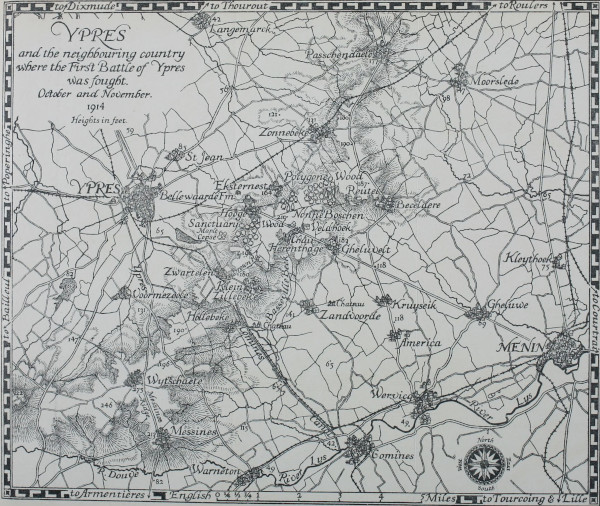
Ypres and the neighbouring country where the First Battle of Ypres was fought. October and November. 1914.
Although the Germans were in possession of
85the greater part of Belgium, in their hurry to get
to Paris they had been unable to dispose entirely
of the Belgian Army, which had been so troublesome
in the first stages of the war, and which
had now retired into Antwerp. Consequently
the German General Staff determined to make
good the lines of communication by taking
Antwerp and reducing all Belgium to ruins.
As soon as this had been done all the available
troops were to force their way through the Allied
line and seize the northern part of France.
The capture of one of the largest towns in
Belgium would be hailed with the greatest enthusiasm
in Germany, and would also nip in
the bud any scheme for sending British troops
and guns to help the besieged Belgian Army.
Germany knew that at present we had no guns
capable of competing with hers, but if she delayed
there was no reason why we should not manufacture
them up to any calibre.
But, undeterred by our lack both of men and
guns, the British Government had made up its
mind to do something, at any rate, and the
Naval Division, which had been intended as
a Reserve for the Fleet, were accordingly despatched
to Antwerp. This expedition was a
glaring instance of our lack of preparation in
the early stages of the war. Totally untrained,
the men, many of them, knew nothing of the
mechanism of the rifles they were armed with;
they had no transport, and were given for their
conveyance London motor omnibuses, with the
familiar advertisements still on them.
This force was greeted with wild enthusiasm
86when it arrived in Antwerp on October 4. Major
J. A. C. Quilter, Captain A. E. Maxwell, and
Lieutenant W. R. C. Murray, all officers of the
Grenadiers, were lent to the Naval Division.
Captain Maxwell was severely wounded in the
subsequent fighting, and afterwards died, but the
other two returned safely to England. Major
Quilter, who remained attached to the Naval
Division, was killed later in the Dardanelles while
in command of the Hood Battalion.
With the monster German guns brought up
against the town, the fall of Antwerp was a foregone
conclusion. The Belgian artillery was quite
outranged, and could make no sort of a reply,
and the Naval Division had no heavy guns at
all. So one-sided was the contest that for the
defenders it was merely a matter of looking
on while the huge shells fell and gradually
devastated the town. On October 8 Antwerp
capitulated, and there was a wild, confused
rush by the inhabitants to get away. The
Belgian Army and the greater part of the
Naval Division managed to escape from the
town, but about 18,000 Belgian troops and
15,000 British were forced up into Holland and
interned.
Suddenly, when it had settled down to a
sort of peace-manoeuvre life at Lyndhurst, the
Seventh Division received its marching orders.
The Government had decided to send it to help
the Belgian Army. It was practically the only
available unit, except the Third Cavalry Division,
which was sent off a few days later.
It was a quiet, peaceful Sunday when the
87summons came. There had been so many
rumours and alarms that no one took much
notice of them, and the idea of departure had
faded to a remote possibility. Passes had been
given to the men to remain out till 9.30, and
a field-day was arranged for the next day. Then
came the order to embark at once from Southampton.
In an instant there was feverish bustle
and energy throughout the camps. The 1st
Battalion Grenadiers marched off to Southampton,
and was joined there by many men who were out
on pass, but by the time the ship sailed all the
Battalion was reported present.
Embarking on October 4, the Seventh Division
succeeded in avoiding the enemy's mines and
submarines on its voyage to Zeebrugge, but the
Cavalry Division was unable to follow, and was
diverted to Ostend instead.
The following is a list of the officers of the
1st Battalion Grenadier Guards, who went out
with the Battalion—all but a few of them were
killed or wounded:
Lieut.-Colonel
M. Earle,
D.S.O., Commanding Officer.
Major
H. St. L. Stucley, Second in Command.
Lieut. Lord Claud
N. Hamilton, Machine-gun Officer.
Capt. G. E. C. Rasch, Adjutant.
Lieut. J. Teece, Quartermaster.
Major the
Hon. A. O. W. C. Weld-Forester,
M.V.O., King's Company.
Captain the
Hon. L. P. Cary (Master of Falkland), King's Company.
Lieut. W. S. Pilcher, King's Company.
Lieut. H. L. Aubrey-Fletcher,
M.V.O., King's Company.
Lieut. J. H. Powell, King's Company.
2nd Lieut. R. O. R. Kenyon-Slaney, King's Company.
88Captain the
Hon. C. M. B. Ponsonby,
M.V.O.,
No. 2 Company.
Capt. G. C. G. Moss,
No. 2 Company.
Lieut. G. E. Hope, Signalling Officer.
Lieut. T. E. R. Symons,
No. 2 Company.
2nd Lieut. R. S. Lambert,
No. 2 Company.
2nd Lieut. M. A. A. Darby,
No. 2 Company.
Capt. Lord Richard Wellesley,
No. 3 Company.
Capt. G. Rennie,
No. 3 Company.
Lieutenant the
Hon. A. G. S. Douglas-Pennant,
No. 3 Company.
Lieut. P. Van Neck,
No. 3 Company.
Lieut. L. G. Ames,
No. 3 Company.
2nd Lieut. W. R. Mackenzie, Transport Officer.
Major
L. R. V. Colby,
No. 4 Company.
Capt. R. E. K. Leatham,
No. 4 Company.
Lieut. E. Antrobus,
No. 4 Company.
2nd Lieut. S. Walter,
No. 4 Company.
2nd Lieut. N. A. H. Somerset,
No. 4 Company.
2nd Lieut. Sir
G. Duckworth-King,
Bart.,
No. 4 Company.
Attached—
Lieut. J. G. Butt,
R.A.M.C.
The crossing was made in the S.S. Armenian,
which was fairly comfortable, and the Turcoman,
just a cattle-boat, with no accommodation at all.
The transports did not move out into the Solent
till after dark on the 5th, and reached Zeebrugge
at six o'clock on the morning of the 7th. Disembarking
was none too easy a task, for the jetty
was much too small for ships of that size, and
there were no cranes or other appliances for
unshipping the horses, which just had to be
pushed down gangways.
Entreaties were made to General Capper by a
Belgian colonel and two Staff officers, who had
come as a deputation from Antwerp, that he
89would bring the whole of the Seventh Division
into that city. But Sir Henry Rawlinson had
already sent orders for the Division to go to
Bruges at once. The 1st Battalion Grenadiers
made the journey in two trains, and was billeted
in the suburb of St. André. Crowds lined the
streets, and cheered each battalion lustily as it
arrived. All the billeting was arranged without
any difficulty, as the Belgian authorities knew
to a man how many troops each village would
hold.
That evening there was a "procession of
humiliation" through the streets of Bruges, a
long train of old men and women following in
the wake of the priests, who were headed by
acolytes swinging their censers. As they walked
slowly through the streets, chanting a litany,
they made an odd contrast with the masses of
fighting men in khaki, and their array of wagons
and guns.
Next day the whole Division was ordered to
march to Ostend, to cover the landing of the
Cavalry Division—a hot, tiring journey it was
of fifteen miles, over the usual paving-stones.
At Leffinghe, on the outskirts of Ostend, a
defensive position was taken up and an attempt
made to dig trenches, but the men could not go
very deep, as at three feet below the surface
they reached water.
Fortunately the Battalion was not called upon
to hold them. Just before daybreak it left the
trenches and marched into Ostend, where it
entrained for Ghent. Sir Henry Rawlinson's
plan was to operate on the Germans' left flank
90and divert their attention from the Belgian Army,
which might thus, he hoped, be able to escape
from Antwerp.
Indescribable confusion reigned in Ostend.
The whole country-side had swarmed in to see
what was going on; the Cavalry Division was
landing while the Seventh Division passed
through to get to the railway station, and their
movements were naturally hampered by the
throngs of people which surged over the streets
and quays. General Capper took with him the
20th and 22nd Brigades under Brigadier-Generals
Ruggles-Brise and Lawford, leaving the 21st,
under Brigadier-General Watts, to march back
to Beernem, where it was to remain in reserve.
Meanwhile, the Cavalry Division was to operate
in the direction of Thourout.
When the two brigades arrived at Ghent, they
found that a small force of French Marines and
Belgian cyclists were already holding an outpost
line in front of the town. The Germans, it was
reported, had just crossed the Scheldt about
ten miles to the east, and were moving north-west,
with the object of cutting off the Belgian
Army and the British and French Naval Divisions,
which were evacuating Antwerp.
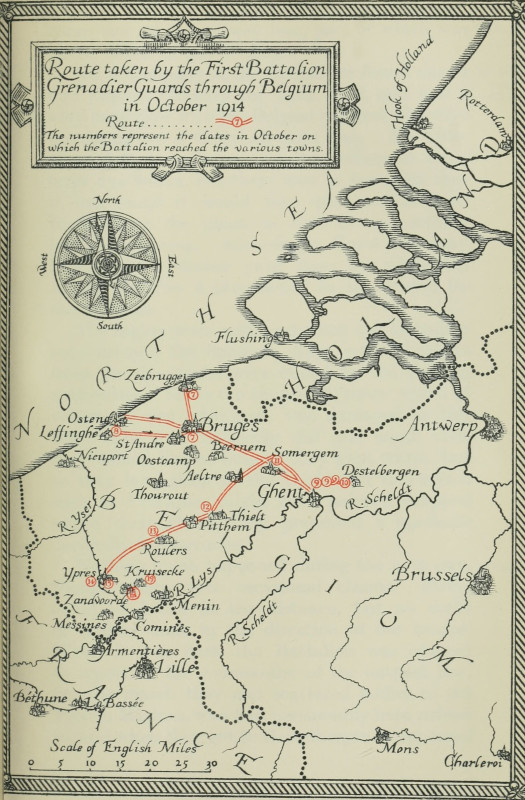
Route taken by the First Battalion Grenadier Guards through Belgium in October 1914.
A second outpost line was taken up by the
two brigades in rear of the French Marines, the
1st Battalion Grenadiers being in reserve. There
were no machine-guns, and the only ammunition
was the 200 rounds carried by each man. Though
the artillery had been sent on the night before,
it did not arrive at Ghent till twenty-four
hours after the infantry, owing to the confusion
91there was on the railway line, part of which was
in the hands of the Germans.
No. 2 Company of the Grenadiers found one or
two piquets blocking the main road, and had a
very busy time with the Belgian refugees who were
streaming out of Ghent all night long. The other
three companies were sent into billets in some
large dye-works, but there were so few exits that
it was found it would take quite half-an-hour
to evacuate the place, so that it was nothing
but a death-trap. Accordingly No. 4 Company
billeted in a timber yard close by, while the
King's and No. 3 bivouacked in an orchard by
the roadside.
The nights were cold, and when the Battalion
requisitioned for blankets, huge rolls of velvet
from the dye-works were issued by the Belgian
authorities. Some ten thousand francs' worth of
velvet, it was estimated, was damaged in this
way. The men naturally did not mind what
they looked like as long as they kept warm, but
as they lay asleep in the yard, with rich velvet
such as Velasquez might have painted wrapped
round their khaki, they presented a spectacle
decidedly incongruous.
Nothing much happened during the next day,
though there were occasional alarms. Firing
could be heard in the distance, but no shells
or bullets came in the direction of our troops.
When it was dark the Battalion was ordered
to report to the commander of the outpost line.
On the march they met scattered bodies of the
French Marines, who had presumably been driven
in, and when they got to Destelbergen it appeared
92that the Marines had been withdrawn from this
section, which was now only thinly held by such
men as could be spared by the Border Regiment
on the left.
The King's Company was told to take over
this section—by no means an easy task in the
dark. The frontage was nearly a mile, with the
platoons about six hundred yards apart, and the
trenches were useless, being merely shallow rain-shelters,
hastily covered over. By working all
night the men succeeded in making some sort of
a trench by dawn. Orders were received that
there could be no retirement in case of attack, and
that no support could be looked for.
It was a remarkable situation into which this
quixotic operation had forced us. Here was an
isolated British Division, with practically no base
and with no available reinforcements, operating
entirely by itself, while large bodies of the enemy
were reported in every direction. But for the
information, which was regularly supplied by
the aircraft, such a position would have become
impossible. The aeroplanes were most active,
constantly spying out the enemy's movements,
and the armed motor-cars also did very useful
work.
Spades and shovels were obtained from neighbouring
cottages at daybreak on the 11th, and
the men managed to make really good trenches.
But in the afternoon the Battalion was withdrawn,
and marched through Ghent. The whole
force was retiring, and No. 2 and No. 3 Companies
formed the rearguard to the two brigades. It
was hardly expected that the Germans would
93allow the force to get away without a severe fight,
but nothing happened, though the enemy was
close at hand, and entered Ghent soon after the
mixed force of British, French, and Belgians had
left the town. Passing through Ghent at dead
of night after the cordial reception they had had
from the inhabitants two days before, and with
the knowledge that the Belgians were being left
to the tender mercies of the Germans, was anything
but a pleasant experience for the British
Force.
Antwerp having fallen, the Seventh Division
now got orders to make its way back as fast as it
could to Ypres, and there join up with the rest of
the British Army. This meant long marches and
few intervals of rest, but with the German force
that had been freed by the capture of Antwerp
close behind, any delay was dangerous.
By dawn on the 12th, Ruggles-Brise's and
Lawford's Brigades reached Somergem, and in the
afternoon they marched to Thielt by way of
Aeltre. At Oostcamp Watts's Brigade joined
in and followed the others to Thielt. As the
Division drew near that place the halts became
more and more frequent—there were constant
checks of as much as ten minutes, followed by
moves of less than a hundred yards. This was a
very trying climax after being up all night and
marching all day. The last mile took two hours,
and it was not till 1 A.M. that the men reached
their billets.
A burst of very heavy rifle-fire at 6 o'clock
next morning in the very centre of the town
brought every one scrambling out of their billets,
94with visions of outposts rushed and Germans in
their midst. But it turned out to be only a
Taube, at which every one who had a rifle was
taking a shot. Eventually it was brought down
about a mile off, the Grenadiers, Scots Fusiliers,
and Pom-Pom Detachment all claiming the hit.
The whole Division started off for Roulers, followed
by the Germans. On its arrival at Pitthem,
a force of the enemy was reported to be advancing
from the north and north-east. The baggage was
therefore sent on, and the 20th and 22nd Brigades
were ordered to take up a position in order to
cover this change in the order of march. The
Germans, however, did not come on, and the
march was continued. The Division reached
Roulers after dark—with the usual irritating and
fatiguing halts. At each village, as the Battalion
marched through, the whole population turned
out and gave the men apples, cigarettes, and
any other offerings they could, but the lion's
share naturally fell to the advance guard and
the leading battalion, and by the time the
tail was reached the supplies had generally
given out.
By now the Germans had grasped that this
was an isolated Division, and were straining
every nerve to catch it, so that the position
at Roulers was very precarious. The reports
from the aeroplane scouts were disquieting, and
General Capper realised that every moment was
precious.
Early next morning the Division marched out
of Roulers, and not long afterwards the Germans
arrived; in fact, it was said that the rear-guard
95was hardly clear of the town before the Uhlans
were in it. No. 3 and No. 4 Companies, under
Captain Lord Richard Wellesley and Major Colby,
formed the advance-guard.
Rain fell heavily all the way, and the roads
were in a terrible state, but the men's spirits
were raised by the news that they were nearly in
touch with the Expeditionary Force. These forced
marches had told on the troops, and though in
the Grenadiers not a man fell out, in some of the
battalions men were left behind—never to be
seen again. Others, determined not to fall into
the enemy's hands, limped doggedly on in a pitiable
plight, some having even taken off their
boots and tied their puttees round their feet.
They reached Ypres at 2 P.M. on the 14th, and the
King's, No. 3, and No. 4 Companies were detailed
to find the outposts on the Menin and Messines
roads. As the companies moved out to take up
their positions they encountered several parties
of Uhlans, which caused a good deal of excitement
among the men, as they were the first of the
enemy's troops actually seen. Some ammunition
was expended without much result. But No. 4
Company at any rate accounted for four of these
advanced cavalry.
In the evening a report was received that a
German force of all arms, estimated to be an
Army Corps, was advancing on Ypres from the
direction of Comines. Their road was blocked
by a platoon of the King's Company, and most
of the men were delighted at the prospect of a
fight, although those who knew the composition
of a German Army Corps were not quite so
96enthusiastic. Two platoons of No. 2 Company
under Lieutenant T. E. R. Symons were despatched
to Voormezeele, about a mile in front
of the outpost line, to block the road and report
at once any movements by the enemy.
These were the first trenches dug on the Ypres
battle-ground. The men at that time imagined
that they had only to scrape out temporary
shelters which would be sufficient protection for
a night or two. They little thought that they
were laying the foundation of an intricate network
of trenches which would be constantly used
for the next four years.
The first battle of Ypres which was now about
to begin may be said to fall into four clearly
marked stages:
A. Up to October 19: the operations of the
Second and Third Corps from the La Bassée Canal
in the south to Armentières and Ploegsteert
Wood, in which they forced their way forward
in the face of always increasing opposition;
the Second Corps establishing itself on the high
ground south-west of Lille ("the Aubers Ridge"),
although it was being held up on its right by the
strong German position of La Bassée; the Third
Corps continuing the line northward astride of the
Lys. On their left the enemy's cavalry threatened
the passages of the Lys from Warneton
downward, but could not cross the river. Its
operations connected up those of the Second and
Third Corps with those of the Seventh Division
and Third Cavalry Division, with which General
Rawlinson, after advancing eastward to assist in
the retirement of the Belgian Army from Antwerp,
97had fallen back to a position a few miles east of
Ypres.
By the evening of October 19 the line of the
Second Corps ran approximately from east of
Givenchy—Violaines—Lorgies—west of Illies—Herlies
to Le Pilly, while between it and the
Third Corps was General Conneau's French
Cavalry Corps, somewhat to the left rear of the
Second Corps. The Third Corps had reached the
line Radinghem—Ennetières—Prémesques—Frélinghien—Le
Gheer. The British cavalry continued
the line down the Lys to the Ypres—Comines
Canal, and was in touch with the right
of General Rawlinson's command, which, after
attempting to advance on Menin on the morning
of October 19, had been forced to fall back to
the position Zandvoorde—Kruiseik—Zonnebeke
by the appearance on its left of large forces
of Germans, before which the French cavalry
(connecting General Rawlinson's force with the
Belgians) was falling back.
The situation, as it then stood, seems to have
offered Sir John French two alternatives for the
employment of Sir Douglas Haig's Corps, which
had then completed its concentration in the area
St. Omer—Hazebrouck: he might utilise it to
reinforce Generals Smith-Dorrien and Pulteney,
who were holding a long front, and whose troops
had had over a week of difficult, if on the whole
successful, fighting, and lacked the numbers
needed for any further advance. Reinforcements
thrown in on this quarter might have saved Lille,
and enabled the French, in co-operation with
whom the British were acting, to outflank the
98Germans opposed to them in the neighbourhood
of Loos and Arras. Ever since the battle on the
Aisne had reached a deadlock in the middle of
September, it had been the object of the Allied
forces to outflank the German right, while the
Germans had by continually reinforcing and prolonging
their threatened flank succeeded in thwarting
this effort. It is this double prolongation of
the opposing lines, first by one combatant, then
by the other, which is called "the Race to the
Sea," and of which the first battle of Ypres was
the culminating point.
The other alternative was to send in this force
farther to the left to carry out a wider turning
movement than the mere move round what
seemed then the German right south of Lille, and
by pushing forward east of Ypres in the direction
of Bruges to outflank the German line far more
effectively. It is a little difficult to ascertain
from the evidence at present available what
exactly was known as to the opposition to be
expected in such a movement. It would seem
that the full strength of the German force available,
consisting of several of the newly formed
Reserve Corps (raised since the beginning of the
war), was hardly appreciated. The idea, prevailing
at the British Headquarters, was that if
used on the extreme left flank in this way Sir
Douglas Haig's part would be essentially offensive;
but as things turned out, he was speedily thrown
on the defensive, and forced to fight a most
desperate battle to prevent greatly superior
forces of Germans forcing their way through
Ypres to the Channel ports. Badly as the Second
99and Third Corps needed help, it was most fortunate
that, when the German attack began, it found
the First Corps, advancing past Ypres, in its path.
B. From October 20 to October 28: the operations
in this phase have a two-fold character.
On the left Sir Douglas Haig endeavoured to
advance first of all north of, and then through,
General Rawlinson's troops; and, though to some
extent successful, he encountered ever-increasing
opposition, so that by October 28 the British in
this quarter (east of Ypres, north of the Ypres—Comines
Canal) had been definitely thrown on
the defensive, and were hard put to it to hold their
own against the repeated attacks of considerably
superior forces. Meanwhile, on October 20, the
Germans had developed a powerful counter-attack
against the long and attenuated line held
by the Second and Third Corps. The left of
the Second Corps at Le Pilly was driven in,
and simultaneously General Pulteney's troops
were ousted from Ennetières and Prémesques, and
these losses, coupled with the great superiority of
the German forces opposed to them, compelled
the Second and Third Corps to retire. Thus the
valuable tactical position of the Aubers Ridge
was lost, and the Second and Third Corps compelled
to retire to the line Givenchy—Richebourg
l'Avoué—Neuve Chapelle—Bois Grenier—Houplines—Le
Gheer. At the same time the cavalry
north of the Lys was gradually pressed back to
the line St. Yvon—east of Messines—Hollebeke—Zandvoorde.
Fortunately at this critical time
the arrival of the Lahore Division of the Indian
Corps provided a much-needed assistance, but,
100despite this, the village of Neuve Chapelle was
lost on October 27, and a counter-attack on
October 28 failed to regain possession of it.
C. From October 29 to November 10: in this
period the operations north of the Lys, where the
German attacks reached their maximum in force,
were of the greatest importance, fresh troops
being constantly put in. South of that river the
fighting gradually diminished in intensity, the
German attacks being held up by the Second
Corps, part of which was relieved by the Indian
Corps (the Meerut Division, which arrived in the
line on October 31), and the Sixth Division of the
Third Corps. A little ground was lost, but nothing
of real importance. North of the river the intensity
of the fighting increased greatly, and on
October 29 the Germans attacked in great
strength, but were only able to gain a little
ground. Two days later, on October 31, they
renewed the attack with the utmost vigour, and
made a determined effort to reach the Channel
ports. The line of the First Division about
Gheluvelt was broken, and the Division fell back.
General Lomax and the greater portion of his
staff were killed, while the casualties in the rank
and file were enormous. The day was saved by
Brigadier-General Charles FitzClarence, V.C., who,
quickly realising the peril of the situation, ordered
the 2nd Battalion Worcestershire Regiment to
retake Gheluvelt, although they were not under
his command. The First Division gallantly rallied,
and regained some of the ground that had been
lost, but not without desperate fighting and very
heavy losses. At the same time the Fourth
101Division of the Third Corps was very hard pressed
at Le Gheer, but managed to retain its ground
after hard fighting and a successful counter-attack.
On November 1 the cavalry, after a most
magnificent resistance at Messines and Wytschaete,
was finally dislodged from the Messines Ridge. By
this time French reinforcements were arriving in
large numbers, and they took over the line between
the left of the cavalry and the right of Sir Douglas
Haig's command (into which the Seventh Division
had now been absorbed), but their repeated
counter-attacks on the Messines Ridge, and between
Wytschaete and the Ypres—Comines Canal
were unsuccessful. After October 31 the fighting
north of the Ypres—Comines Canal did not
reach the same intensity till November 11, but
the Germans made repeated attacks, and forced
the line back a little at several points. It became
necessary to relieve the Seventh Division, whose
infantry had been reduced to about a quarter
of its original strength, and this was done by
putting in about a dozen of the scarcely less
exhausted battalions of the Second Corps, which
had just been taken out of the line north of La
Bassée for a well-earned rest. By November 5
the right of Sir Douglas Haig's line, south of the
Ypres—Menin road, was held by the equivalent
of a division from the Second Corps, the First
Division being in his centre, and the Second on
his left, though all three divisions were much
intermingled.
By November 10 the cavalry, supported by a
few battalions of the Second Corps, had taken
over a line west of the Messines Ridge, and on the
102left of the Third Corps. From the Douve southward
to La Bassée the line was approximately
established as it remained through the winter of
1914-15, the Third Corps being astride the Lys,
while the Fourth Corps (the Eighth Division, which
had by this time arrived) continued the line from
about Bois Grenier to beyond Neuve Chapelle,
the Indian Corps being on the right.
D. November 11 to 20: November 11 was the
next most critical moment of the battle after
October 31; on this day took place the great
attack of the Prussian Guard, which broke
through the line of the First Division near Veldhoek
and penetrated into the Nonne-Bosschen,
but was checked there, and then dislodged by a
counter-attack by the 52nd Oxfordshire Light
Infantry, perhaps the most dramatic of all the
individual episodes of the battle. On this day
the line of the Third Division south of the Ypres—Menin
road was also violently assailed, and some
ground was lost; but the net result of the day was
the failure of the great German effort to break
through, and from that moment the fighting
north as well as south of the Lys tended to
diminish in intensity. The Germans made a
few more attacks, but none in such strength
or determination as those of October 31 and
November 11, and about November 15 the French
began to take over the positions in "the Ypres
salient," so obstinately defended by Sir Douglas
Haig for nearly four weeks. It may be gathered
from the accounts of the fighting of the subsequent
months that the Germans were for the
moment exhausted, that their supplies of ammunition
103were running low, and that the attack
of November 11 represented their last bolt—until
more could be forged. Thus if the Allied effort
to outflank the German right and roll up their
line had been unsuccessful, defensively the first
battle of Ypres was a great success, the German
effort to break through being definitely and decisively
defeated. November 20 may be taken
as the end of the battle, as it was on that day
that the last unit of Sir Douglas Haig's command
was relieved by the French, the British line then
extending approximately from Givenchy in the
south to Keniwel in the north. During this fourth
phase the operations on the line from the Douve
to the La Bassée Canal had been of the character
of "normal trench warfare," neither side attempting
any major operation.
Ypres was to be held at all costs till the First
Corps arrived—those were Sir Henry Rawlinson's
orders. There were no other British troops in
the neighbourhood when the Seventh Division
arrived there, except the Third Cavalry Division,
which had been sent on in the direction of
Menin to reconnoitre. The Eighty-seventh French
Territorial Division was at Ypres, and the
Eighty-ninth at Poperinghe (both under General
Bidon), while the Belgian Army had reached the
Forest of Houthulst.
At first General Capper decided to post the
Seventh Division from Zonnebeke to Langemarck,
asking the Eighty-seventh French Territorials
to hold, for the moment, the line from
Zonnebeke to Hollebeke; there they would get
into touch with Allenby's Cavalry Division,
104which was on the left of the Third Corps. Operating
on the left of the Seventh Division, Byng's
Cavalry Division would keep touch with the
Belgians and French Marines.
But these orders were afterwards cancelled
when it was clear that Menin would be the probable
line of advance. General Capper made the
Seventh Division change places with the Eighty-seventh
French Division, so that it now took
up the line from Zonnebeke to Hollebeke, with
Ruggles-Brise's Brigade on the right, Watts's
in the centre, and Lawford's on the left. Four
German Army Corps were now rumoured to
be operating somewhere in Belgium, but where
exactly no one knew.
A piteous sight confronted the 1st Battalion
Grenadiers as it marched eastward towards
Zandvoorde on October 16, after a quiet day in
billets on the outskirts of Ypres. On the roads
it met the whole civilian population of the
neighbouring towns and villages, which was in
flight before the advancing enemy. Old men
and women ran breathless; children trotted
by their mothers' sides; some had all their
worldly possessions in carts drawn by ponies
or dogs; others were pushing wheelbarrows
loaded with all the goods they could carry away.
All had a look of terror in their eyes, and all
hurried madly to safety, spurred on by the
thought of the blazing villages that lay behind
them.
The advance-guard of the Brigade was formed
by the King's and No. 4 Companies under Major
Weld-Forester and Major Colby. Progress was
105very slow, even after daybreak, as there was a
fog, and every wood by the roadside had to be
thoroughly cleared. A few shots were exchanged
with Uhlans, but there was no serious resistance,
and the Brigade entered Zandvoorde at 11 A.M.
Two miles from Zandvoorde, meanwhile, No. 3
Company under Lord Richard Wellesley had been
ordered to Hollebeke to protect the right flank
of the Brigade; this Company rejoined the
Battalion later on.
At Zandvoorde a strong defensive position
was taken up, facing east; it had a good field
of fire, and there was a fairly wide stream two
hundred yards from the trenches. The King's
and No. 4 Companies were in the front trench,
and No. 2 and No. 3 in reserve. That night the
enemy played his old tricks, and kept every one
awake, with a few snipers firing at intervals into
different parts of the line. The men were then
new to such devices, but it was not long before
they learned to distinguish between sniping and
an organised attack.
The following day the whole Brigade was
ordered to advance and occupy the ridge Kruiseik—America,
with its right bending back to
Zandvoorde, the Scots Guards having occupied
Kruiseik the night before. At night villages
could be seen burning in every direction, set on
fire by the Germans, and this was taken as an
indication that the enemy was preparing to
attack.
On the 19th orders were received for an
advance by the Seventh Division on Menin and
Wervicq; it was reported that the enemy was
106in no great strength, and that his forces consisted
principally of Landsturm, with no artillery. The
attack was to take place in three phases:
First phase: by the 22nd Brigade on the
left against an advance position at Kleythoek.
Second phase: by the 20th and 21st Brigades
against Gheluwe.
Third phase: by the whole Division against
Menin and Wervicq.
Sir John French, in his despatch of that date,
said:
I considered, however, that the possession of Menin
constituted a very important point of passage, and
would much facilitate the advance of the rest of the
Army, so I directed the General Officer commanding the
Fourth Corps to advance the Seventh Division upon
Menin and endeavour to seize that crossing on the
morning of the 18th.
It was no easy task that was allotted to Sir
Henry Rawlinson, for he had nothing to fall back
upon. The cavalry under Byng was hardly
strong enough to do more than feel for the
enemy, and there was therefore only the French
Territorial Division at Ypres as a reserve. There
was nearly twenty miles of front for the Seventh
Division to operate on, and no one knew when
the First Corps would arrive.
The advance of the Seventh Division began in
the morning. The 1st Battalion Grenadiers deployed
for an attack on Gheluwe and Kruiseik,
with No. 2 and No. 3 Companies in the firing-line,
and the King's and No. 4 in support. The men
were extended to eight paces, and each company
had a frontage of half a platoon; the Battalion
107was thus in sixteen lines, with 200 yards between
each line, during the preliminary advance under
artillery fire.
When about half the Battalion was on the
move, the order to advance was countermanded,
for news had arrived that a large force of all
arms was advancing from the direction of Courtrai.
Lawford's Brigade, which had reached
Kleythoek, was strongly attacked on its left
flank and compelled to fall back with heavy
losses. The advance on Menin had been found
impracticable; Sir Henry Rawlinson suddenly
realised that with a single infantry division it
was sheer madness to attack an enemy force
which, according to our airmen's reports, was far
stronger than Sir John French had anticipated.
Being the pivot on which the whole Division had
to turn, Ruggles-Brise's Brigade had not gone far
when the countermanding order came, but the
left of the Division had to retire some distance
before it was in line facing the right way.
Ruggles-Brise's Brigade retired to its former
position, which consisted of a semicircular line
running from Zandvoorde through Kruiseik to the
cross-roads on the Ypres—Menin road. To the
1st Battalion Grenadiers was allotted a frontage of
nearly a mile, from and including the village of
Kruiseik to the cross-roads, on the left being the
Yorkshire Regiment from Watts's Brigade and
on the right the Border Regiment. No. 2 and
No. 3 Companies were in the firing line, and
No. 4 and the King's Company in support.
A circular salient is not easy to hold, and after
the greater part of the day had been spent in
108improving the trenches and putting out barbed
wire under intermittent and ineffective shell-fire,
orders were received to withdraw the line. This
withdrawal was necessitated by the Divisional
order to send back two battalions as Divisional
Reserve. This left only the Grenadiers and
Border Regiment to occupy the whole line. After
consulting General Ruggles-Brise, Lieut.-Colonel
Earle decided to withdraw Nos. 2 and 3 Companies
and convert the support trenches into the firing
line. This meant altering the trenches a good
deal, as those used for the supports were too
wide and shallow. The whole situation had,
however, changed, and the Division was now on
the defensive.
Improvements in the line generally were made
next day. Besides being deepened, the trenches
were made narrower by driving wash-poles into
the bottom about three feet apart, closing up the
intervals with doors, shutters, straw hurdles, etc.,
and then filling up the space behind with earth.
This work was practically finished, when it had
to be stopped because a reconnaissance was
sent out in front with a battery of R.H.A. (13-pounders)
to support it, and no sooner had the
battery opened fire than it was itself attacked
by much heavier artillery from the direction of
Wervicq.
For an hour a constant stream of shrapnel and
high explosive poured over our trenches. There
was one short lull, when our R.H.A. Battery
ran short of ammunition, and the Germans,
thinking they had knocked the battery out,
also ceased fire. On realising their mistake,
109they began again with renewed energy. High-explosive
shells were bursting all down the
trenches, back and front, but luckily none
landed actually in them; and though a cottage
by the side of the road caught fire, the removal of
the wood and straw lying near the trench averted
all danger. Very grateful the Grenadiers were
for the close touch which F Battery under Major
Head managed to keep with them during these
anxious days' fighting. It was a perfect example
of how artillery and infantry should co-operate.
In the afternoon the enemy launched his
infantry attack, preceded by scouts and snipers,
and covered by artillery and machine-gun fire.
Almost for the first time the Germans were now
distinctly seen, and there was something almost
reassuring in the fact that they looked like
ordinary beings. Hitherto they had seemed a
sort of mysterious bogey, something far away
on the black horizon, an evil force associated
with burning houses and fleeing inhabitants.
Though their attack was all according to the
book, they never succeeded in reaching our
trenches. In many places they managed to
advance under cover to within 200 yards of
our position, but the attack was half-hearted
and therefore failed.
The machine-guns under Lord Claud Hamilton
were posted on the right of the Battalion, and
remained there for seven days, day and night,
without relief, under continual fire from the
enemy's artillery and machine-guns. During
this strenuous time they fired 56,000 rounds, and
inflicted considerable loss on the enemy.
110By dusk the Germans had established a considerable
force within striking distance, and the
whole British line stood to arms till about 9 P.M.,
expecting an assault any moment. Why with
such enormous advantages the enemy did not
make a more determined attack it is difficult
to understand. They outnumbered our troops
by four to one, and had an overwhelming
superiority in artillery. But while the Seventh
Division were all seasoned professional soldiers,
the German Corps consisted mostly of Landwehr,
that is, second-line troops or men retired from
the active army.
Nothing happened till midnight, when the
enemy suddenly opened a heavy fire, and in
places began half-hearted assaults, which were
easily repulsed. He kept up a continuous
and comparatively useless fire for an hour, but
with our men the control of fire was excellent.
During these spasmodic attacks the R.H.A.
Battery, which was just behind the village of
Kruiseik, did most effective work, bursting
groups of shrapnel with great accuracy and
rapidity over the German lines, at a range of
only eight hundred yards. The Seventh Division
was occupying more ground than it could
properly hold, but with so few troops General
Capper had no alternative. Two platoons of
No. 2 Company were furnished during the night
to support the King's Company in the fire trenches,
but even with their help it found the greatest
difficulty in filling its part of the line.
There was some shelling in the early morning
of the 21st, but nothing serious happened till the
111afternoon, when the enemy at last attacked,
apparently, all along the line. So long was the
line General Capper was now holding that he found
it impossible to keep any reserves. At first the
2nd Battalion Scots Guards was in Divisional
Reserve, but it was soon wanted, and was sent
up into the firing line in the morning. When
appeals for help came afterwards from various
quarters, General Capper had only the cavalry
to send. The Northumberland Hussars were
despatched to fill the gap between the 20th
Brigade and the Third Cavalry Division, and
when the right flank of the Division needed
strengthening the Divisional Cyclist Company
was sent thither.
By this time the First Corps had arrived, and
had been sent up to the north of Ypres. As it
turned out, that spirit of dash which won Sir John
French his reputation in South Africa proved the
saving of the situation. Had he been of a more
cautious disposition, he would undoubtedly have
sent the First Corps to reinforce General Smith-Dorrien,
who was in great difficulties farther
south. Its despatch north of Ypres, originally
with the idea of a general advance, saved the
Seventh Division from utter destruction.
The position of the line was now as follows:
the First Corps from Bixschoote to Zonnebeke;
the Seventh Division from Zonnebeke to Zandvoorde;
then Byng's Cavalry and Allenby's
Cavalry up to the left of the Third Corps.
About mid-day the 21st Brigade was heavily
attacked, and Brigadier-General Watts sent
back for reinforcements. There were none. Some
112companies had to be sent in support, and General
Ruggles-Brise ordered No. 2 and No. 3 Companies
of the Grenadiers to go to its help. Two companies
of Scots Guards had already been sent
to Zandvoorde to fill up a gap on the right,
occasioned by the withdrawal of the 5th Cavalry
Brigade, while the remaining two companies were
with the Divisional Reserve at Gheluvelt. These
continual demands for reinforcements naturally
weakened the 20th Brigade considerably. Under
heavy shell-fire the Scots Guards started off, but
the attack on the 21st Brigade died away, and
after they had gone about a mile they were
ordered to return, as they might be wanted any
moment to support their own Brigade.
Meanwhile the line held by the Grenadiers
was heavily shelled, not only by the Germans
but by our own guns, which were firing short.
The men naturally were infuriated by this, but
fortunately the mistake did not last long, as
the artillery was soon able to correct its own
distance. During the night the German machine-guns
had been brought up close, one at least
being placed in a house 150 yards from our
trenches, and the covering fire from these was
most disconcerting. It was generally oblique,
and enabled the German infantry to approach
with far fewer losses than on the previous day.
An infantry attack was made, but was not
pressed home, and except for spasmodic bursts
of rifle-fire the night was again fairly quiet.
Having been in the trenches for four days and
nights, the King's and No. 4 Companies were
relieved by No. 2 and No. 3 Companies. Aircraft
113reports that the enemy was massing troops
near America seemed to presage an attack,
but except for the inevitable sniping nothing
happened in that part of the line, the attack
that day being directed against the 22nd Brigade
and also against the First and Second Divisions
farther north. The relieved companies had not
been long in their dug-outs, however, before two
platoons of No. 4 Company under 2nd Lieutenant
Walter and 2nd Lieutenant Somerset
were ordered to occupy some trenches vacated
by the 21st Brigade on the left, while the King's
Company was sent up to Kruiseik to reinforce
No. 2 Company.
The position of the Seventh Division was
now becoming most precarious, holding doggedly
on as it was to a line seven miles long, with
every man in the trenches. General Lawford's
22nd Brigade had been attacked by a large force
and obliged to give ground; this made an ugly
dent in the line, and placed the 21st Brigade in
an acute and perilous salient. To help the hard-pressed
Seventh Division Sir Douglas Haig now
sent along the Second Division, which had been
relieved by the French Ninth Corps.
Owing to the heavy mist on the 23rd neither
side could use artillery till 9 A.M., when the enemy
began to bombard the Kruiseik salient. The
day's attack was directed against the 21st
Brigade, and the Wiltshire Regiment had some
desperate fighting. The two platoons of the
Grenadiers which had been sent up the night
before were attacked by two battalions of
Germans, but they held their ground and never
114gave an inch. They suffered severely, however,
and 2nd Lieutenant Walter and 2nd Lieutenant
Somerset were both killed before these platoons
were withdrawn. The whole line of trenches
was bombarded incessantly, and all day the
German guns swept the rear of the line so as
to catch the supports as they came up.
A message was sent to the Grenadiers about
2.30 from the Border Regiment on the right to
say that their trenches had been blown in, and
they might want help. Accordingly the King's
and No. 4 Companies were ordered to move across
to a position in rear of the Border Regiment, so
as to support them if necessary. No sooner had
they left their dug-outs and fallen in than they
were heavily shelled, though they were well out
of sight of the German gunners.
Incidents like this gave rise to stories of spies
behind the British lines, who could telephone to
the enemy's gunners the exact position of bodies
of our troops. But had the Germans had any
means whatever of obtaining information they
could hardly have failed to know that, instead of
the large forces they imagined to be opposed to
them, there was nothing to bar their way to
Calais but a single unsupported British Division.
When the leading platoons of the two companies
of the Grenadiers reached the position
indicated, which was the ridge in rear of the
Borderers' trenches, they came under the concentrated
fire of batteries from three different directions,
and suffered some loss. So heavy was the
fire that they found it impossible to remain on
the ridge, and as the Border Regiment had not
115definitely asked for support the King's Company
was ordered to retire. It retired in good order and
in slow time, though under heavy fire all the way.
Lieutenant H. L. Aubrey Fletcher and several
men were wounded, but the casualties were not
so heavy as might have been expected. Fortunately
the enemy burst their shrapnel too high, and
the ground was so soft that the high-explosive
shells did little damage except when they got a
direct hit.
A violent attack was made next day on the
salient formed by the British line, which at last
began to show signs of giving way. After some
desperate fighting the Wiltshire Regiment was
driven in, and the Germans got possession of
Polygon Wood. Ruggles-Brise's Brigade was
heavily engaged, as the enemy's attack was
being pressed home with great vigour, especially
on the left of the Battalion, where the Germans
were trying to break through between the
Grenadiers and the Yorkshire Regiment. No. 4
Company, under Major Colby, was therefore
ordered to counter-attack. Great difficulties were
added to its task by the tobacco-drying grounds—ready-made
wire entanglements on which the
men's packs and accoutrements caught while the
German machine-guns were practically enfilading
them. But, in spite of everything, Major Colby
succeeded in driving back a much larger body of
the enemy, and thus making that part of the line
secure.
It was a brilliant bit of work, and was specially
mentioned by General Capper in his report. But
it was very costly: Major Colby, Lieutenant
116Antrobus, and a hundred men were killed, and
Captain Leatham was wounded. The only officer
of this company who escaped unhurt was Lieutenant
Sir G. Duckworth-King.
In the evening news arrived that the First
Corps was attacking the enemy on the left, and
this somewhat relieved the situation. The reserve
trenches came in for severe shelling during
the night, but, as it happened, there was only
a platoon of No. 2 in reserve at the time. It
had a curious experience, which might have had
serious results. Two companies of the Queen's
had been sent up to the reserve dug-outs. Somehow
the report was spread that the Germans
had got into Kruiseik, and an alarm was raised.
The platoon from the Grenadiers stood to arms,
and as it waited saw in the moonlight a line
of men with fixed bayonets advancing on their
flank. They were preparing to meet them with
the bayonet when they suddenly realised that
they were friends. Major Stucley leaped from
the trench, and went himself to explain matters
to the two companies, which returned to their
original position.
The Germans were reported next day to be entrenching
all along our southern front and opposite
Zandvoorde. About sunset the Grenadiers were
attacked, and one platoon from No. 2 Company
under Lieutenant Lambert became isolated, the
enemy having taken the trench on its right and also
the houses behind it. Three messengers were sent
back to Battalion Headquarters for help, but only
one got through, and he was wounded. Lieut.-Colonel
Earle sent up a platoon of No. 3, and
117the houses in the rear of the line were partially
cleared.
A determined attack developed later that
night, and a mass of men was seen advancing on
the left. A voice called out, "Don't shoot!
We are the South Staffords." But the German
helmets could be distinctly seen against the glow
from a burning farm; a heavy fire was opened on
them, and slowly they disappeared. As a matter
of fact two companies of the South Staffords had
come up to the Battalion as a reserve that night,
and the Germans must have known it. In the
morning forty or fifty dead Germans were counted
in front of the platoon under Lieutenant Lambert,
and 200 prisoners were captured by the Scots
Guards in a house in rear of the line. Viscount
Dalrymple and Captain Fox, with two companies
of the Scots Guards, cleared all the Germans out
of the village, and restored the line.
During the night Lord Claud Hamilton, whose
guns were in action all night, saw a body of men
moving in fours down the road behind him, and
naturally thought they were men of the Brigade.
But as they passed a burning house he saw the
German helmets, and turned one of his guns on
them, while the other gun continued to engage the
enemy in front. He was relieved before dawn by
Lieutenant Gladwin of the Scots Guards with a
fresh team of men, who took over the Grenadier
machine-guns. Soon after he took charge Lieutenant
Gladwin was killed.
The First Division had now taken over the line
from Reutel to the Menin road, so that the
Seventh Division held only the section from the
118Menin road through Kruiseik to Zandvoorde.
But this salient had become more and more acute
and dangerous, and General Capper decided to
readjust the line and reduce the salient as far as
he could. To withdraw from a position when at
close grips with the enemy was a task requiring
careful staff work, but it was successfully carried
out that night.
Before dawn the King's Company took over
the fire trenches with a platoon of No. 3 under
Lieutenant Van Neck, while a platoon from No. 2
under Sergeant Boyles occupied a trench about
200 yards to the left. One platoon of the King's
Company was 300 yards to the right of the rest
of the company, and another 300 yards farther
to the right were the Scots Guards.
A terrific shelling of our trenches began early
in the morning, and reached such a pitch that the
men counted as many as sixty shells a minute on
each small trench. The whole of the enemy's
artillery fire was concentrated on Kruiseik.
Gallantly our men held on, in spite of the fact
that again and again the shells blew in the
trenches and buried half-a-dozen men at a time,
all of whom had to be dug out with shovels.
Some of them had as much as three feet of earth
on top of them, and many were suffocated before
they could be rescued.
So violent were these attacks that by mid-day
the Germans had broken through the line held by
two companies of the South Staffords, which had
been sent to relieve the Border Regiment. By
2.30 P.M. the enemy had gone through the gap,
and had managed to get in rear of two companies
119of the Scots Guards, which suddenly found themselves
surrounded and fired at from all directions.
Although the Scots Guards still fought on, they
were captured by degrees in small parties, and
the survivors were finally made prisoners, including
Lieut.-Colonel Bolton, Major Viscount Dalrymple,
and Captain Fox. Finding his flank exposed,
Lieut.-Colonel Earle at once gave orders to
the Grenadiers to retire, but this order did not
reach the fire trenches for a long time, and was
never received by the King's Company at all.
Meanwhile, General Ruggles-Brise ordered the
guns back to their old position on the Zandvoorde
Ridge, and having collected the remainder of the
Scots Guards, the Gordons, and the Borderers, he
returned to the hollow west of Zandvoorde.
The position now seemed hopeless for the
King's Company and the other two platoons, for
the Germans had got round both flanks, and the
rest of the Battalion was retiring. Lieutenant
Pilcher, one of the officers of the King's Company,
managed to get back to Battalion Headquarters,
only to find that the Battalion had retired. He
started to return at once, but the Germans were
closing in on the company, and as there were no
communication trenches, he had to advance in the
open with the enemy on each side of him. However,
he got through to Major Weld-Forester, and
told him of the retirement. Meanwhile, Lieutenant
Hope, the signalling officer, who had been
ordered to retire with the rest of the Battalion,
turned back on his own initiative to warn the
King's Company, and even got some of the
First Division to come to its assistance.
120At first Major Weld-Forester had determined
to hold on grimly to his bit of the line, but it
now seemed clear to him that he ought to join in
retirement. To do this meant going clean
through the Germans, who were now firmly
established in the village and outhouses—but on
the other hand to remain meant being surrounded
and captured. So he quickly decided to retire
and join the rest of the Battalion. He knew he
could rely on his men to do anything or go anywhere,
and trusted to their discipline to carry
through even such a desperate plan as this of
forcing a way through the Germans.
Having explained the whole situation to his
officers and N.C.O.'s, he sent an orderly to Lieutenant
Van Neck, and told him to retire at the
same time. But the message never reached this
officer, nor did the platoon of the King's Company
which was 800 yards away receive the order.
The result was that these two isolated platoons
continued to fight on until they were overwhelmed
by the advancing German masses.
Meanwhile, through the village came the
King's Company, with Major Weld-Forester at
their head, bayonets fixed and in perfect order.
On they came, straight through the Germans,
who were at first dumbfounded by the reckless
daring of the enterprise. Soon the enemy collected
themselves, and the machine-guns began
rattling from the windows; but friend and foe
were so intermingled that it was difficult for them
to fire, and it would have taken better men than
the Germans to stop the men of the King's
Company, when they had made up their minds
121to get through. Many casualties there were, of
course, but Major Weld-Forester succeeded in
joining the Black Watch that night, and linked
up with the rest of the Battalion next morning.
The same night the retirement of the whole
Division was carried out successfully, and it took
up a second position running through the crossroads
near Gheluvelt. The remainder of the
Grenadiers, under Lieut.-Colonel Earle, retired in
good order through the First Division and went
into billets on the outskirts of Ypres, where they
were joined next morning by what was left of the
King's Company. After five days and nights in
the trenches without relief the men were utterly
worn out, but in spite of their hard fighting and
heavy losses their spirits were not depressed nor
their discipline in any way relaxed.
On the 27th the 1st Battalion Grenadiers
moved from billets outside Ypres to a bivouac in
Sanctuary Wood, just south of the Menin road.
Ruggles-Brise's Brigade was withdrawn from the
Basseville River, and the battalions were reorganised.
When the roll was called, it was found
that the losses in every battalion had been considerable.
The 1st Battalion Grenadiers had lost
9 officers and 301 men, the 2nd Battalion Scots
Guards 17 officers and 511 men, the 2nd Gordon
Highlanders 3 officers and 159 men, and the 2nd
Border Regiment 17 officers and 431 men. What
remained of the Seventh Division was now transferred
to the First Corps under Sir Douglas Haig.
A report was received that the Twenty-seventh
German Reserve Division had been ordered to
take the cross-roads south-east of Gheluvelt, and
122the 20th Brigade was ordered to relieve the 22nd
Brigade just south of the Menin road. General
Ruggles-Brise placed the Grenadiers in the front
line next to the road, with the Gordons on their
right, while the remnants of the Borderers and
Scots Guards were left in support. Guides were
furnished by the 22nd Brigade, and General
Ruggles-Brise, who knew the ground well, since
it was next to his old Headquarters, met them
at the cross-roads. As the trenches were very
inadequate, most of them mere scratches, and
some even facing the wrong way, the Grenadiers
were ordered to withdraw at daybreak, if there
was no attack, so as to evade shell-fire. As the
day dawned, General Ruggles-Brise returned
to his Headquarters, where he was met by the
Brigade-Major, who told him that an attack
was expected at dawn, and that he had received
instructions to bring up the two supporting
battalions.
On the way up the Scots Guards were so
unlucky as to have a shell burst right into one of
their companies, causing some twenty casualties.
2nd Lieutenant Gibbs was killed, and Captain
Kemble and Lieutenant Lord Dalhousie severely
wounded.
It was a melancholy scene through which the
Grenadiers marched off. Some ten days before,
when they passed through Gheluvelt, they had
been greeted by the inhabitants; now it was a
deserted ruin. Most of the houses and the church
had been demolished, and such buildings as remained
looked like dolls' houses, when the fronts
have been removed. The roadway was full of
123great shell-holes, and some carcasses of horses
added to the dreariness of the picture. Arrived
at their destination, Nos. 2, 3, and 4 Companies
were put in the firing line, and the King's Company
in support. It was practically dark, and as the
trenches were very bad they had to dig themselves
in as well as they could.
The German General Staff was now getting
impatient. In spite of their immense superiority
in numbers and in guns, the Germans had
succeeded only in making dents in the line, and
had not yet broken through. So they determined
to mass their guns and infantry at certain parts
of the line, and drive a wedge through—one of the
points selected being the left of the line held by
the 1st Battalion Grenadiers near the cross-roads.
Every one on the British side knew of the projected
attack, from General Headquarters down
to the latest-joined drummer boy, but foreknowledge
was of little use, as there were no
reserves available.
At 5.15 A.M. on the 29th—a densely foggy
morning—the Battalion was heavily shelled by
our own guns; presumably the fire was intended
for the German infantry, which was known to be
somewhere near. Although every possible precaution
had been taken against an attack at
dawn, there was no sign of any movement on the
part of the enemy, and after the Battalion had
waited for an hour and a half, the report of an
intended attack was dismissed as untrue. The
question then arose as to what should be done
to obtain food for the supporting battalions.
They had been hurried up in the dark, and no
124provision had been made for their rations, nor
was it possible to bring food up in wagons to positions
in such close proximity to the enemy. The
Brigadier decided that, as the expected attack
had not been made, it would be best to send
these two battalions back to get their food, so
that on their return they would be prepared to
remain in the front trench, and meet any attack
that might come later in the day.
They had been gone hardly half-an-hour when
the Germans opened a very heavy fire, and in the
mist which was still clinging to the ground rifle-fire
was poured upon the Grenadiers from the
left rear. It was at once realised that the enemy
had managed to penetrate the line between the
two Divisions. To meet this enfilade fire the left
flank of the line turned back, and before long
the whole Battalion was forced to leave the fire
trenches and occupy the support trenches, which
were far too deep for the men to fire from.
Major Stucley, the second in command, dashed
off at once with Captain Rasch, the Adjutant, to
bring up the King's Company, the only support
available. In place of the shell-fire, which had
practically ceased, there now arose a steady
rifle and machine-gun fire from the houses to
the left and even the left rear of the Battalion.
Swinging round to the left, the King's Company,
headed by Major Stucley, steadily advanced for
about two hundred yards, when it came to the
support trench occupied by No. 2 and No. 3
Company. Major Stucley at once grasped the
gravity of the situation. The King's Company
had already suffered many casualties, as it came
125up across the open, and the enemy's machine-guns
were pouring a murderous fire into the other
two companies—No. 4 Company under Captain
Rennie still remained in the fire trenches on the
right. The problem was how, with three companies
and no reserve, to stop a force ten times
as numerous. The Germans had taken all the
houses near the Menin road, and the thin line
of Grenadiers, with their left turned back to face
the road, was all there was to stop the rush
of the enemy.
And indeed it was a formidable rush. They
came on in such numbers that an officer afterwards
said the attacking force reminded him
of a crowd coming on the ground after a football
match. Shoulder to shoulder they advanced,
much in the same way as their ancestors fought
under Frederick the Great, and though for
spectacular purposes at Grand Manoeuvres their
mass formations were very effective, in actual
warfare against modern weapons they proved to
be a costly failure.
The German General Staff had studied the
question of the attack with the usual German
thoroughness. It had carefully considered whether
it should adopt the formation evolved by the
British Army from the South African war or not,
and had come to the conclusion that the personal
equation played too large a part in an advance in
extended order, and that for a conscript army the
only possible formation was close order, in which
the small percentage of cowards would be carried
forward by the great majority of brave men.
Nevertheless, in spite of their solid phalanxes,
126it was said that the German officers advanced
with revolvers in their hands, to shoot men who
lagged behind.
For our men the difficulty was to shoot the
Germans quick enough. Ever since the South
African war the men had been taught to fire at
a little brown smudge on a green background
painted on the target, an artistic triumph of
the musketry authorities, supposed to represent
all that a man would be able to see of his
enemy in a modern battle. But here were full-length
Germans not a hundred yards off, alarmingly
visible, and in such numbers that even for
the worst shot there was not the slightest difficulty
in hitting them, especially as they were often
three or four deep. In spite of this, however,
the apparently hopeless impossibility of stopping
so many, and the futility of killing a few out of
such a crowd, made some of our men sometimes
shoot very wildly.
Major Stucley disdained all cover and dashed
forward at the head of the King's Company,
determined to save the situation. In the hail
of bullets he fell shot through the head, and
soon afterwards Captain Lord Richard Wellesley
was killed in the same way. Major Weld-Forester,
Captain Ponsonby, and Lieutenant
the Hon. A. G. S. Douglas-Pennant, who had
necessarily to expose themselves, were wounded.
Captain Ponsonby recovered, but Major Weld-Forester
and Lieutenant Douglas-Pennant died
two days later.
Finding it impossible to stay in the front
trench any longer, No. 4 Company retired to the
127brickyard. Captain Rennie, who commanded
them, was never heard of again. Still the
Grenadiers held doggedly on to their support
trench for another hour, until it was found that
the Germans had got round their left and were
enfilading the whole trench. Bullets seemed to
be coming out of the mist from all directions, and
the enemy to be on every side. Captain Rasch,
who was now the only officer left above the rank
of lieutenant, decided to get out of the trench and
retire to the small wood near the brickyard. The
order was given, and the Grenadiers—what was
left of them—retired to the wood and formed up
on the other side.
In the meantime the First Division on the
left, almost annihilated by superior numbers,
had been forced back. This made the position of
the Grenadiers still more untenable, but General
Capper was gathering together what reinforcements
he could to save the line.
Seeing what straits the Grenadiers were in,
the Gordon Highlanders on the right sent what
reserves they had to help, and a company arrived
under Captain Burnett. The Grenadiers and
Gordons formed one line, and advanced gallantly,
but when they got near the wood they came under
the fire of a German machine-gun, which enfiladed
them. Undaunted by this bad start, and determined
to regain their former trenches, Captain
Rasch and Captain Burnett led their men on
through the wood. There was something particularly
gallant in the way this remnant of a battalion,
with one reinforcing company, was not content
to hold its own, but actually undertook a counter-attack
128when it knew the enemy was in vastly
superior numbers. It was the men themselves,
inspired by the few remaining officers, that were
carrying out this counter-attack.
Back through the wood they went, and gained
the north side of the brickfields, but the Germans,
at first taken by surprise at this bold stroke,
rallied and drove them out. A second time our
men counter-attacked, and this time they forced
their way past the brickfields to a hedge running
parallel with the road. They got into the ditch
on the south side of the Menin road, and were
joined there by two platoons of the Gloucester
Regiment, which came up as a reinforcement. In
that ditch they remained till the order came to
retire. Captain Rasch and Lieutenant Pilcher
took their handful of men—all that remained out
of the splendid Battalion nearly 1000 strong,
which had marched out from Ypres less than a
fortnight before—and got into a trench some
three hundred yards east of the windmill.
The Scots Guards meanwhile, supported by
the Queen's, were sent through the south of
Gheluvelt, and succeeded in driving the enemy
back and almost regaining the ground originally
held by the Grenadiers and Gordons. When
night fell, the 20th Brigade was holding precisely
the same ground that it had occupied in the
morning.
There can be no doubt that the Germans were
completely deceived as to our strength, and that
what misled them was the more than gallant
manner in which the Grenadiers held on to the
trenches in the morning, and the almost reckless
129audacity with which the Grenadiers and Gordons
attacked later. The enemy was apparently
quite unaware how threadbare this part of the
line was. These continual counter-attacks gave
the impression that there must be large reserves
in rear, which made the Germans think it unwise
to push on. Had they only known that there
were no reserves at all, and that all that lay
between them and Ypres were just the remains
of a battalion, with hardly an officer or non-commissioned
officer left alive, the result of
the battle, and all that depended on it, would
undoubtedly have been very different.
The losses among the officers of the Grenadiers
were very heavy. Lieutenant-Colonel Earle was
severely wounded during the engagement, and,
while dressing his wounds, Lieutenant Butt,
R.A.M.C., was shot through the head. Colonel
Earle was afterwards reported to be lying in a
house some two hundred yards in rear of the
Battalion Headquarters dug-out. Several men
volunteered to carry him back, but as the enemy
were within a couple of hundred yards of the
house this would have meant certain death, not
only for the stretcher-bearers but for Colonel
Earle himself. So it was decided to leave him
where he was. The total list of casualties among
the officers of the Battalion was:
Lieut.-Colonel
M. Earle, (Commanding Officer), wounded and prisoner.
Major
H. St. L. Stucley, (Second in Command), killed.
Lieut. J. G. Butt, (Medical Officer), killed.
Major the
Hon. A. O. W. C. Weld-Forester, (King's Company), killed.
130Lieut. H. L. Aubrey-Fletcher, (King's Company), wounded.
Lieut. J. H. Powell, (King's Company), wounded.
2nd Lieut. R. O. R. Kenyon Slaney, (King's Company), wounded.
Captain the
Hon. C. M. B. Ponsonby. (
No. 2 Company), wounded.
Lieut. G. E. Hope, (Signalling Officer), wounded.
2nd Lieut. R. S. Lambert, (
No. 2 Company), wounded.
Captain Lord Richard Wellesley, (
No. 3 Company), killed.
Captain
G. Rennie, (
No. 3 Company), missing, reported killed.
Lieutenant the
Hon. A. G. S. Douglas-Pennant, (
No. 3 Company), killed.
Lieut. P. Van Neck, (
No. 3 Company), killed.
Lieut. L. G. Ames,(
No. 3 Company), wounded.
Major
L. R. V. Colby, (
No. 4 Company), killed.
Capt. R. E. K. Leatham, (
No. 4 Company), wounded.
Lieut. E. Antrobus, (
No. 4 Company), killed.
2nd Lieut. S. Walter, (
No. 4 Company), killed.
2nd Lieut. N. A. H. Somerset, (
No. 4 Company), killed.
That night the Battalion went into billets at
Hooge, half-way to Ypres, with only four officers
and a hundred men left, exclusive of transport.
The officers were Captain Rasch, Lieutenant
Pilcher, Second Lieutenant Darby, and Second
Lieutenant Sir G. Duckworth-King.
Men who had been left in the trenches, not
knowing of the order to retire, kept arriving in
driblets during the night, and the strength of the
Battalion had risen by next morning to 250 men.
But, with most of the officers and N.C.O.'s
killed or wounded, the whole machinery of the
Battalion had disappeared, and Captain Rasch
had to do what he could to reorganise the remnant
131into a fighting unit. Ruggles-Brise's Brigade—with
the exception of the Gordon Highlanders,
who had been ordered to report themselves to
General Bulfin—were placed in reserve to the
other two brigades of the Seventh Division.
Repeated attempts to penetrate the line were
made by the Germans throughout the day.
For each attack preparation was made by very
heavy shell-fire, and the ground in rear of our
forward line was thoroughly searched, apparently
with a view to harassing any reinforcements that
might be sent up to the firing line.
The Grenadiers had just settled down for the
night when the Battalion was ordered to fall
in and move off with the rest of the Brigade
to occupy a new defensive position. Later in
the war, when a battalion had been knocked to
pieces as the Grenadiers had been the day before,
it was picked out and given a rest, but in those
early days this was impossible, as every man was
continually wanted to check the renewed attacks
of fresh enemy troops. The Germans were constantly
throwing into the attack fresh battalions
at full strength, whereas in the British Army the
term "Battalion" meant two or three hundred
worn-out men who had been fighting daily for
the last ten days or so.
Eventually, after a long, circuitous march,
the Battalion was put into dug-outs in Brigade
Reserve at 3 A.M. Orders were received that
the First and Second Divisions, with the Cavalry
Brigade, were attacking the following day, and
that the 20th Brigade was to remain in its position
until 6.30 A.M., when it was to leave one battalion
132in support of the left portion of the line, and
move the rest to a central position where it could
rapidly support any part of the line held by the
Seventh Division.
On the 31st, the day that Sir John French
described as the most critical in the whole battle
of Ypres, the remnant of the Seventh Division
was holding a line from the Ypres—Menin road,
in front of the cross-roads at Veldhoek, to a
point 500 yards north of Zandvoorde. At 1 A.M.
it was decided to push the Scots Guards and
Borderers up, and entrench them close behind the
left of the 21st Brigade.
Directly day broke the Germans began a
terrific shell-fire all along the front, and by 8
o'clock shells were bursting ceaselessly on and
over the line. Towards noon word came that
the 21st and 22nd Brigades had been shelled out
of their position and forced to retire. In rear of
the 21st Brigade the Scots Guards and Borderers
still held their line, and General Ruggles-Brise
himself led up the Grenadiers in prolongation of
this line, with the hope of stemming the German
advance.
This movement had to be carried out very
hurriedly, with no opportunity of reconnaissance,
and the Battalion lost rather heavily in
crossing the reverse slope of a hill in front of
gun position. When it had gained the ridge
through the woods, it was found that to be of any
use the Grenadiers would have to push forward,
and occupy the trenches vacated by the 21st
Brigade. This they managed to do, in spite of
very heavy shell-fire, and three or four of the
133most forward trenches on the right of the 21st
and the left of the 22nd Brigades were occupied
just in time to meet a portion of the German
attack, now being delivered on the Gheluvelt—Zandvoorde
frontage.
By the time it had reached and occupied
the trenches, the strength of the Battalion was
scarcely fifty of all ranks, and this handful of
men had to confront thousands of Germans,
with the additional handicap of having its
right flank exposed, as the enemy had gained
the 22nd Brigade's trenches. It was fortunate
for us that the attack, wonderfully brave as the
Germans were, was apparently quite disjointed
and unorganised. No officers could be seen
leading the men, who advanced in dense masses
to within three hundred yards of the trenches,
and were simply mown down by the fire of the
Grenadiers.
Things now seemed to be going better for us,
when suddenly the right-hand trench reported
that the Germans were streaming through a
wood, and, crossing the Veldhoek—Zandvoorde
road, were working their way immediately to our
rear. All our reserves had been used up by this
time, and the only thing to do was to hang on
somehow till nightfall, sending word at once to
the Division of what had happened. As no
communication had been established since the
re-occupation of the trenches, Captain Brooke,
the Staff Captain on the 20th Brigade Staff, who
had come up to see how things were, got out of
the trench and, finding a loose horse, galloped
off, and told General Capper. General Capper
134went off to ask General Bulfin for help, but
already the 4th Guards Brigade—which included
the 2nd Battalion Grenadiers—was advancing to
make a counter-attack through the wood.
When he got back to the Grenadiers in their
trenches, Captain Brooke was surprised to find
them still holding their own and quite happy.
They were successfully beating off repeated
German attacks to their front. The 4th Guards
Brigade evicted the enemy from the wood, and
it was then decided to withdraw the Grenadiers,
the 21st Brigade being ordered to take over their
trenches.
Thus ended one of the most desperate days of
fighting in the whole war. As has been already
said, it seems incredible that the Germans, with
their vast numbers of men and their great superiority
in guns, should not have broken through
the line. They were very near doing it; indeed,
so critical did the situation become at one time,
that General Capper issued a provisional order
that, if the line became untenable, the Brigade
was to fall back on a new line extending from one
mile east of Zillebeke to the fifth kilo on the
Ypres—Menin road.
As the Battalion marched back with the
Scots Guards, two guns were seen in the rear
of the trenches, standing all by themselves. It
looked at first as if they had been abandoned.
But closer inspection showed that every single
man and horse of the team was there—dead.
The gunners had remained gallantly at their
posts to the last. Men from the Grenadiers,
the Scots Guards, and the Bedford Regiment
135were sent to rescue the guns, and bring them to
a place of safety.
The Grenadiers returned to the shelters at the
Château Herenthage, which they had occupied
during the morning. There the officers found
that their shelter had during their absence been
blown to pieces by a high-explosive shell, and it
was plain that, had they remained in reserve that
day, there would have been no officers left at
all in the Battalion.
The action of the 1st Battalion Grenadiers on
this day was afterwards described by the G.O.C.
Seventh Division in his report as mainly instrumental
in restoring the battle south of the Ypres—Menin
road.
The total strength of the 20th Brigade was now
reduced to 18 officers and 920 men, constituted as
follows: the 1st Battalion Grenadiers, 5 officers
(the four previously mentioned and the transport
officer, Lieutenant Mackenzie) and 200 men,
commanded by Captain Rasch; the 2nd Battalion
Scots Guards, 5 officers and 250 men, commanded
by Captain Paynter; the 2nd Border
Regiment, 5 officers and 270 men, commanded
by Captain Warren; and the 2nd Gordon Highlanders,
3 officers and 200 men, commanded
by Lieutenant Hamilton.
Nov. 1.
Very heavy shell-fire opened the morning of
November 1. One high-explosive shell stripped
off the whole back of the house occupied by the
Brigade Headquarters, which was thereupon
moved to shelters in the Château Herenthage
wood. An infantry attack followed, but it was
only feeble, and the Grenadiers remained in a
136wood south of Herenthage in Brigade Reserve.
There they prepared a second line of fire-trenches,
and improved the existing dug-outs, while the
wood was shelled at intervals with high explosives.
The brunt of the attack at that part of the
line was borne next day by the Border Regiment,
which held on to its trenches so gallantly and unflinchingly,
in spite of a murderous enfilade fire,
that it received a special message from General
Capper. In the evening it was relieved by the
Grenadiers. During the heavy shell-fire, with
which the enemy searched the ground in rear of
our trenches, General Ruggles-Brise was severely
wounded, and Major A. Cator, the Brigade-Major,
took over command of the Brigade.
The men had now managed to put out a little
wire in front, and it seemed unlikely that the
Germans would be able to make much impression
on the line. The trenches, which were good and
continuous, were held by the Grenadiers on the
right and the Scots Guards on the left. There
was a weak spot on the right of the Grenadiers
near the wood, but this was well covered by the
Gordon Highlanders in rear.
In the afternoon of the 3rd, the Scots Guards
reported the enemy to be massing in the woods
in front of them, while parties were observed
moving towards our right, and our guns turned
a heavy fire on to them. Though no attack
developed, a few parties of the enemy advanced
in a half-hearted way, more as if they were
carrying out a reconnaissance. The Brigade
suffered some casualties during the day from shells
and snipers, and Lieutenant Sir G. Duckworth-King,
137who had almost miraculously come unhurt
through the last ten days' fighting, was at last
wounded.
A draft of 100 men under Lieutenant C. Mitchell
arrived next day, and considerably added to the
strength of the Battalion. There was a great
deal of indiscriminate shelling and sniping, and
Lieutenant G. E. Hope was wounded in the head
by a sniper.
On the 5th there was heavy shell-fire as usual,
and some trenches were blown in. The 20th
Brigade was relieved on that day by the 7th
Brigade, and marched through Ypres, which was
being shelled as far as Locre. The men found
the march very fatiguing, for they had had little
sleep for many days, and had been digging or
fighting all the previous night. Owing to the
incessant shell-fire, it had been found impossible
to organise the Battalion into any recognised
formation during the period from October 29
to November 5. If fifty men were wanted for
the trenches, some one had to go round the dug-outs
and collect them. There was no company,
platoon, or even sectional organisation. In spite
of this everything went well, a result due to
the splendid spirit shown by the men themselves.
At daybreak the Brigade reached Locre, weary
with the long march, but very glad to get away
from the constant roar of shells and rifle-fire.
As every available house and shed was already
occupied by the French, the church was opened
and the Grenadiers and part of the Scots Guards
billeted there. The march was resumed in the
138afternoon through Bailleul to Meteren, where the
Brigade went into billets.
The Grenadiers were now reorganised into a
single Company as follows:
Officer Commanding and Adjutant, Captain Rasch.
Quartermaster,
Lieut. J. Teece.
The King's Company,
Lieut. Lord
Claud Hamilton.
No. 1 Platoon,
Lieut. Mitchell.
No. 2 Platoon,
2nd Lieut. M. A. A. Darby.
No. 3 Platoon,
Lieut. W. R. Mackenzie, (Transport Officer).
No. 4 Platoon, Sergeant
C. Jones.
Company Sergeant-Major, Drill-Sergeant
J. L. Capper.
Company
Q.-M. Sergeant, Colour-Sergeant
T. W. Brown.
On November 7 the Battalion did an hour's
steady drill. There was something very fine
and at the same time pathetic in the remnants
of this decimated Battalion going through
their drill with the determination to maintain
the high standard of discipline no matter how
small their numbers might be. Next day the
whole Brigade attended divine service for the first
time since they had left England, and as there was
no chaplain, the Brigadier, Major Cator, read the
service. In the afternoon the Brigade was drawn
up in square facing inwards, and General Capper
addressed it. He expressed his admiration of
the way in which it had fought round Ypres,
and told the men that they had upheld the
splendid traditions of their regiments.
139The fact that the flower of the German Army
was defeated by the British Expeditionary
Force, that is to say, the original army that
existed before the war, will always make the
first battle of Ypres particularly interesting to
students of military history. Although it can
hardly be claimed as a decisive victory, there
is small doubt that the result influenced the
whole course of the war, for had the Germans,
when they turned their whole strength on Ypres,
been able to force their way to the coast, the
subsequent operations of the British Army would
have been considerably affected.
Two battalions of the Grenadiers fought at
Ypres, and each covered itself with imperishable
glory. Never before in the long history of the
regiment had so many casualties befallen them in
a single action; never before had so large a force
of the Grenadiers been almost annihilated.
Each battalion had gone into battle with a
great reputation to maintain—a reputation won
in centuries of fighting, carried forward in almost
every campaign in which the British Army has
taken part, and all the officers and men were fully
conscious of their responsibility. Old Grenadiers
well knew that every nerve would be strained
to uphold the traditions of the regiment; but
no one dared to hope that the illustrious past
could be enhanced, and that these two battalions
of the regiment would increase their fame in
divisions in which every battalion distinguished
itself.
The part taken by the 1st Battalion in the
defence of Ypres, when with the Seventh Division
140they repelled attacks from forces eight times their
number, will ever remain a precious memory to
be handed down to future generations.
Major-General Sir Henry Rawlinson, in an
order which he issued to the Seventh Division,
said:
After the deprivations and tension of being pursued
day and night by an infinitely stronger force, the Division
had to pass through the worst ordeal of all. It was left
to a little force of 30,000 to keep the German Army at
bay while the other British Corps were being brought
up from the Aisne. Here they clung on like grim death
with almost every man in the trenches, holding a line
which of necessity was a great deal too long—a thin
exhausted line—against which the prime of the German
first-line troops were hurling themselves with fury. The
odds against them were eight to one, and when once the
enemy found the range of a trench, the shells dropped
into it from one end to the other with terrible effect.
Yet the men stood firm and defended Ypres in such a
manner that a German officer afterwards described their
action as a brilliant feat of arms, and said that they
were under the impression that there had been four
British Army Corps against them at this point. When
the Division was afterwards withdrawn from the firing
line to refit, it was found that out of 400 officers who set
out from England there were only 44 left, and out of
12,000 men only 2336.
Major-General Capper, in a report on the
1st Battalion Grenadiers, which he sent later to
Lieut.-General Pulteney, commanding the Fourth
Corps, wrote as follows:
This Battalion fought with the utmost tenacity and
determination in a most exposed position at Kruiseik
in front of Ypres, being subjected to an almost ceaseless
heavy artillery fire and repeated attacks by the enemy
141for a week. Owing to the length of front to be held, no
relief could be found for troops in the trenches. During
this fighting Major Colby's Company of this Battalion
counter-attacked the enemy, who had almost successfully
attacked the line. In the counter-attack this Company
lost four officers killed and wounded, only one officer
and forty-five men returning unhurt, but this Company
succeeded in driving back a very much larger hostile
force. This Battalion lost very heavily in the three
weeks' fighting before Ypres. I consider that the
resolution and gallantry of this Battalion, obliged
to take its share in holding a height which was the
pivot of all the operations in this part of the field,
was most noble and devoted and worthy of its highest
traditions.
Later on, in the same operations, though weakened
in numbers, and with few officers, the Battalion exhibited
gallantry in a counter-attack near Gheluvelt, where it
was mainly instrumental in restoring the battle south of
the main Ypres—Menin road; and subsequently the
same tenacity as it had shown at Kruiseik in holding a
very difficult and exposed part of the Brigade line in
the final position in front of Ypres.
The Battalion remained at Meteren until the
14th, and spent most of its time in reorganising
and re-equipping. On the 10th a draft of 401
men arrived with the following officers: Major
G. W. Duberly, Captain the Hon. R. Lygon,
Lieutenant E. S. Ward, and Lieutenant C. A. V.
Sykes; and on the 11th, 133 men originally intended
for the 2nd Battalion arrived from the
Base Camp under Lieutenant C. L. Blundell-Hollinshead-Blundell
and Lieutenant C. V. Fisher-Rowe.
These additions brought the strength of
the Battalion almost to its usual proportions.
Meanwhile Field-Marshal Sir John French had
142visited the Brigade, and saw the remnants of
the battalions which had formed the original
Seventh Division. He congratulated both officers
and men on the fine work they had done round
Ypres.
CHAPTER VII THE FIRST BATTLE OF YPRES ( 2ND BATTALION)
143
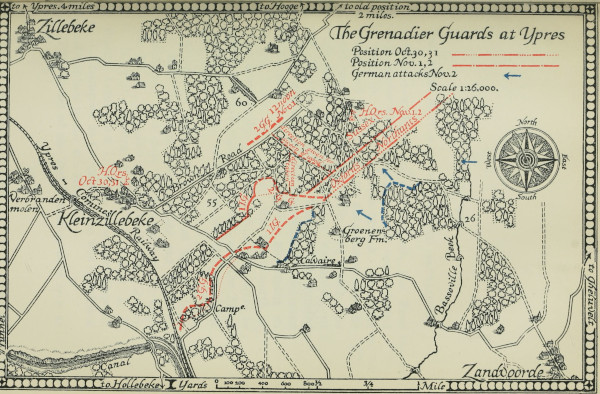
The Grenadier Guards at Ypres.
Having completed its detrainment, the First
Corps, under Sir Douglas Haig, was concentrated
between St. Omer and Hazebrouck. Sir John
French had now to make up his mind whether he
would use it to strengthen his line, which was
much longer than his numbers warranted, or
send it to the north of Ypres. He decided
that the greatest danger was that the Germans
might carry out a wide turning movement on
his left flank, and he sent the Corps north of
Ypres accordingly. The French cavalry were to
operate on Sir Douglas Haig's left, and the Third
Cavalry Division, under General Byng, on his
right.
After two nights in billets at Hazebrouck,
the 2nd Battalion marched on the 17th to
Boeschepe. Two days afterwards arrived Captain
M. E. Makgill-Crichton-Maitland, Captain
R. H. V. Cavendish, M.V.O., Lieutenant J. S.
Hughes, Lieutenant I. St. C. Rose, and Captain
C. R. Champion de Crespigny, who was appointed
Staff Captain to the 4th Brigade.
The officers of the 2nd Battalion were now as
follows:
144Lieut.-Colonel
W. R. A. Smith, Commanding Officer.
Major
G. D. Jeffreys, Second in Command.
Capt. E. J. L. Pike, Adjutant.
Lieut. C. W. Tufnell, Machine-gun Officer.
2nd Lieut. A. K. S. Cunninghame, Transport Officer.
Lieut. J. H. Skidmore, Quartermaster.
Major
G. C. Hamilton,
No. 1 Company.
Capt. C. Symes-Thompson,
No. 1 Company.
Lieut. J. S. Hughes,
No. 1 Company.
Lieut. the
Hon. W. R. Bailey,
No. 1 Company.
Major Lord Bernard Gordon-Lennox,
No. 2 Company.
Lieut. I. St. C. Rose,
No. 2 Company.
Lieut. C. M. C. Dowling,
No. 2 Company.
2nd Lieut. F. W. J. M. Miller,
No. 2 Company.
Capt. E. G. H. Powell,
No. 3 Company.
Capt. R. H. V. Cavendish,
M.V.O.,
No. 3 Company.
Lieut. Lord Congleton,
No. 3 Company.
Lieut. F. G. Marshall,
No. 3 Company.
2nd Lieut. C. R. Gerard,
No. 3 Company.
Capt. M. E. Makgill-Crichton-Maitland,
No. 4 Company.
Capt. E. D. Ridley,
No. 4 Company.
Lieut. F. G. Beaumont-Nesbitt,
No. 4 Company.
Lieut. M. G. Stocks,
No. 4 Company.
It was a cold raw morning on the 20th, when
the Battalion marched at 5 A.M. to St. Jean, a
small village to the north of Ypres, where it
was ordered to take up an entrenched position,
with the Coldstream on the right, and the 5th
Brigade on the left. Matters were complicated
by the fact that the French looked upon this
part of the line as theirs. However, eventually
matters were arranged, and British and French
troops settled down together to a pouring wet
night.
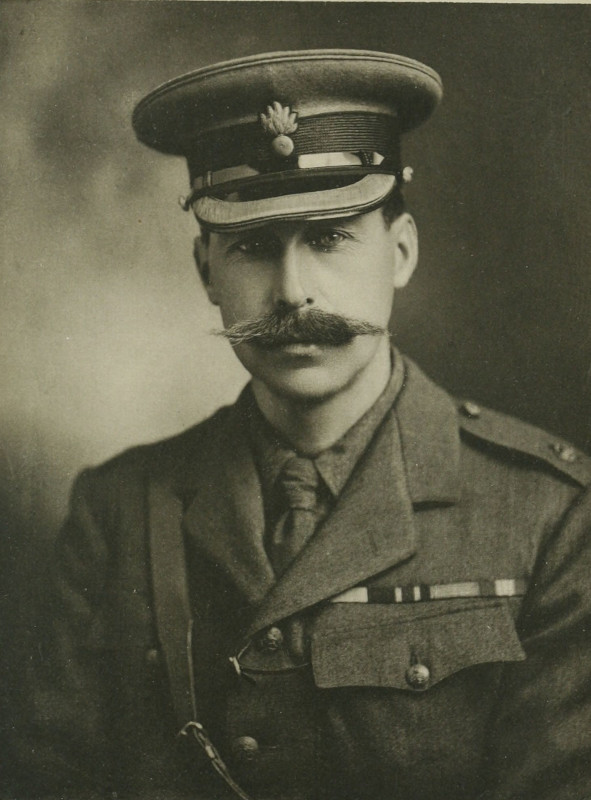
Lieutenant-Colonel W.R.A. Smith C.M.G. Commanding 2nd Battalion. Died of wounds received at Festubert 19 May 1915.
There was another move next morning. The
Battalion assembled at 5.30, and marched to a
position near Hanebeek Brook, about two miles
145west of Zonnebeke, where the 4th Brigade concentrated.
Then the whole Brigade advanced
about half a mile towards Passchendaele with the
3rd Battalion Coldstream on the left, and the
2nd Battalion Coldstream on the right—each
battalion having two companies in the firing line,
and the rest in support, while the 2nd Battalion
Grenadiers was in reserve.
About 2.30 Lord Cavan, finding that the two
Coldstream battalions had drifted somewhat
apart, ordered up the 2nd Battalion Grenadiers
into the centre of the line. As they made their way
across ploughed fields, they came in for a great deal
of unaimed rifle-fire, but suffered very little loss.
About 400 to 500 yards east of Zonnebeke—Langemarck
road the three battalions dug themselves
in for the night, since news had been
received that large German forces were advancing
through Houthulst Forest. Before long the sky
was lit up in all directions by the farms which
the enemy was burning. By this illumination
the Germans attempted a counter-attack, and
came on shouting, "Don't fire, we are the Coldstream."
It was characteristic of the German
thoroughness of method to master this regimental
idiosyncrasy, and say Coldstream and not Coldstreams.
But the Battalion had not fought for
two months without learning the enemy's tricks,
and as spiked helmets could be distinctly seen
against the glow of the burning farms, they fired
right into the middle of the Germans, who hastily
retired.
Before daylight next morning the companies
in the firing line were relieved by those in support.
146The whole Brigade then set itself to improving
the trenches and consolidating the position. It
turned out that on the left the First Division had
been held up, while on the right the 22nd Brigade
was in a tight place. Consequently the situation
was distinctly uncomfortable. The trenches,
composed of isolated holes which held two or
three men apiece, were exposed from the left
to enfilade fire, but there the Battalion had
to remain for two days, shelled intermittently.
They suffered many casualties. While making
his way down the firing line, Captain Maitland
was forced to walk a great deal in the open,
and was wounded in the head by a sniper, who
succeeded in hitting several other men. In
the evening Lieutenant Donald Miller, who had
come out originally with the Battalion, and had
fought all through the retreat, was killed by a
high-explosive shell.
On the 24th the Second Division got orders
to take up the ground occupied by the Seventh
Division, from Poezelhoek to the Becelaere—Passchendaele
road, and the First Division was
relieved by French Territorial troops, and concentrated
about Zillebeke.
At the same time the 4th Brigade was relieved
by a Brigade from the Sixth French Army under
General Moussy, and the men of the Grenadiers
watched the French attack Passchendaele with
much interest. Though the attack was met with
a heavy artillery and rifle fire, and made but
little progress, the personal gallantry of General
Moussy himself and his staff, who exposed themselves
freely while close up to the front trenches,
147made a great impression on all the officers
and men of the 2nd Battalion. After dark this
French Brigade took over the trenches, and the
2nd Battalion Grenadiers moved back about two
miles to a farm, where the men managed to snatch
a couple of hours' sleep. At 5.30 A.M. it started
off again, and after a circuitous march of about
six miles reached Eksternest, where it formed
the reserve of the 6th Brigade. Here, at last, it
had a thorough rest in barns, outhouses, and elsewhere,
with plenty of straw to lie on, while a fowl-house
constituted No. 3 Company Headquarters.
The Battalion paraded, much refreshed, at
6.30 next morning, but did not move off till 9.
It advanced towards the Six Cross Roads, and
halted behind Polygon Wood. In the afternoon
it was ordered to attack the enemy's position
near Reutel, passing over the trenches held by
the 5th Brigade, while the Irish Guards were to
advance on the same position from the north-west.
The Orders were:
The attack will begin at 3 P.M. 4th Guards Brigade
will have for its objective the Reutel Spur. The 1st
Battalion Irish Guards will commence its advance at
once as far as the line of trenches now held by the
5th Brigade. At 3 P.M. its scouts will pass that line, and
the battalion will endeavour to establish itself in such
a position that it can by its fire materially assist the
main attack which will be delivered from the south and
south-west.
The 2nd Batt. Grenadiers will work round the stream
at once as verbally ordered until their right reaches a
point one company's length beyond the forks of the
two streams. At 3 P.M. it will be prepared to attack
the R. of Reutel from S.W. During this operation
148the 2nd Battalion Grenadiers will specially detail a
half company to protect its right. The 2nd Battalion
Coldstream will follow the Grenadiers and act in close
support of them. They must also give special orders
about their right flank. The 3rd Battalion Coldstream
will be in reserve in a covered position at Six Cross
Roads. It is quite understood that the time is short,
but this operation must be carefully carried out without
hurry. Brigade Headquarters will be at Six Cross Roads
at 2.45 P.M.
Advancing in artillery formation, the Battalion
came in for a great deal of rifle-fire, but fortunately
no shells. Major Lord Bernard Lennox had
taken advantage of the halt in the morning to
reconnoitre the line of advance thoroughly, and
was able to lead the companies to their destinations.
There was no great difficulty in reaching
the trenches, but when the Battalion advanced
another 150 yards it came under a very heavy
cross-fire; only one platoon of No. 2 Company
actually crossed the 5th Brigade trenches. The
other companies were held up before they reached
the firing line. The Bedfords on the right, unable
to carry on the advance, retired again to the
trenches, and the Irish Guards on the left were
also held up.
Darkness was now coming on, and it seemed
madness to attempt to take a strong position in
a thick wood where no one knew precisely the
position of the trenches, or how strongly they
were held. So Lieut.-Colonel Smith directed
No. 2 Company to fall back and take over a
trench from the Oxfordshire Light Infantry,
with the Highland Light Infantry on the left
and the Royal Scots Fusiliers on the right. A
149platoon of No. 1 Company was added to the
right of No. 2. Its position was along the front
edge of the private grounds of a fine château,
which was then intact.
Three times during the night, which was very
dark and windy and rainy, the Germans attacked—at
9 P.M., at midnight, and at 3 A.M. But the
position was fairly secure, and each time they
retired. It is doubtful whether they ever intended
to press the attack home, and possibly they were
only trying to locate the exact position of our
trenches—not a very difficult task, as they were
but 300 yards off.
That evening the following message was received
from Sir John French:
The Field-Marshal Commanding-in-Chief wishes once
more to make it known to the troops under his command
how deeply he appreciates the bravery and endurance
which they have again displayed since their arrival in
the northern theatre of war. In circulating the official
information which records the splendid victory of our
Russian Allies, he would remind the troops that the
enemy must before long withdraw troops to the East
and relieve the tension on our front. He feels it is quite
unnecessary to urge officers, N.C.O.'s, and men to make
a determined effort and drive the enemy over the
frontier.
Digging started with a will in the trenches
early next morning. It had come to be a regular
habit with the battalions which had been through
those first months of the war, at once to dig themselves
in deep in any new position, no matter
how soon they might have to move on. They
had learned by experience that the labour was
well worth while. On this occasion the trouble
150was that the deeper the men dug the wetter the
ground became, and soon they were up to their
ankles in mud. But the sun came out about
mid-day, and helped to dry up the ground.
No regular attack was made that day, though
there was constant shelling, and the Battalion
therefore had comparatively few casualties.
German snipers were very busy, but did little
damage; our men took every opportunity of
retaliating; and Lieutenant I. Rose was reported
to have been particularly successful in
accounting for the enemy marksmen. The
howitzers paid less attention to the trenches than
to the Château. On this unfortunate building
the high-explosive shells dropped with monotonous
regularity, but the little tower still remained
standing. The Battalion Headquarters, which
were behind the Château, had a decidedly warm
time, getting the benefit not only of the shells
from the howitzers, but of all the stray bullets
that went wide of the trenches.
Most of the next day was spent in mending
the line and consolidating the position, for there
were weak spots, which the Divisional Staff
discovered, usually between Brigades. Barbed
wire was now to be had, and orders were issued
for entanglements to be put up in front of each
trench. In the afternoon the companies of the
2nd Battalion Grenadiers in reserve were sent
to take over the trenches of the 3rd Battalion
Coldstream, and to stay there until they were
relieved by the Black Watch at midnight. Both
these reliefs were carried out successfully and
without any casualties, though the task was by
151no means easy, owing to the thickness of the
wood and consequent bad communications.
Sir John French had now placed what remained
of the Seventh Division and the Third Cavalry
Division under the orders of Sir Douglas Haig,
who redistributed the line thus:
(A) The Seventh Division from the Château
east of Zandvoorde to the Menin road.
(B) The First Division from the Menin road
to a point immediately west of Reutel village.
(C) The Second Division to near the Moorslede—Zonnebeke
road.
The 2nd Battalion Grenadiers now moved back
about a mile to Nonne-Bosschen Wood, and
having slept there returned the next morning
under howitzer fire across two fields to the
northern edge of Polygon Wood, where it
remained until the 6th Brigade passed through
it to attack Reutel Ridge. Then it moved
forward in support, and dug in round a farm.
Before it had gone far the 6th Brigade was
fiercely attacked, and succeeded in driving the
enemy off with some loss, though unable to advance
farther itself. The 4th Brigade was not
wanted, and spent a quiet afternoon near the
Farm—"quiet" in this case being a comparative
term, denoting that they were not directly under
fire, for our own howitzers were only twenty
yards off, and kept firing ear-splitting salvos all
day.
Having received orders the night before to
be ready at a moment's notice, the Battalion was
under arms soon after dawn next day. But it
was not until much later that it got instructions
152to move to the other side of the Racecourse
Wood, and entrench a position almost at right
angles to the line of trenches in front. It turned
out that the Seventh Division on the right had
been driven back, and though most of the ground
had been regained there was still a risk of the
Germans pushing through. Meanwhile, Captain
Ridley was ordered to take No. 4 Company,
and support the Cameron Highlanders near the
Château. He sent up two platoons into the
trenches on their right, and kept the rest in
support. They came in for a good deal of shell-fire,
but were not seriously attacked.
Except for No. 4 Company the Battalion was
in Corps Reserve next day with the Irish Guards,
while the 2nd and 3rd Battalions Coldstream
were in the trenches. But about 3 P.M. the
Brigadier, Lord Cavan, got news that there had
been a serious break in the line about two miles
to the right, i.e. the south, and was instructed to
send up the battalions, which he had in reserve,
to report to General Bulfin, commanding the
2nd Brigade.
Lord Cavan went himself to see General
Bulfin at his Headquarters, and was directed to
despatch these battalions southwards to protect
the right flank of the 2nd Brigade. Accordingly
the 2nd Battalion Grenadiers, Irish Guards, and
Oxfordshire Light Infantry marched off from
Polygon Wood towards Klein Zillebeke, and
Captain Ridley was ordered to withdraw No. 4
Company and join the remainder of the Battalion
as it moved off. The orders given to Lieut.-Colonel
Smith were to reinforce the cavalry,
153which was holding a line very lightly north of the
Château de Hollebeke.
By dusk these battalions were astride of
the Klein Zillebeke—Zandvoorde road, the
Grenadiers on the right and the Irish Guards on
the left, with their left thrown forward a little, to
keep touch with the right of the 2nd Brigade.
Lord Cavan went on ahead with his Staff, to see
that the whole line was made continuous. On
going forward to inspect the position which the
cavalry was holding, Lieut.-Colonel Smith found
that it was on a forward slope, which seemed
to him untenable, and he thought this a good
opportunity for making a fresh disposition.
So he arranged with the cavalry that it should
continue to hold its line, while the Battalion dug
in, in its rear. A new line, which consisted as
usual of a series of deep narrow holes with no
parapet, was accordingly made, with the right on
the railway, and the left on the Klein Zillebeke
road.
Major Lord Bernard Lennox with No. 2
Company was on the right, Major Hamilton
with No. 1 in the centre, and Captain Powell
with No. 3 on the left; one platoon from No. 4
under Sergeant Hutchings was posted on the Klein
Zillebeke road; and the rest of the company went
to Battalion Headquarters, north-west of the
wood between the railway and Klein Zillebeke.
Supplies and ammunition were brought up, and
by 1 A.M. the Battalion was well dug in. The
cavalry then withdrew from the trenches in
front and retired. Meanwhile the Irish Guards
had dug trenches, prolonging the line to the left.
154Sir John French in his despatch describes the
afternoon of October 31 as the most critical
moment in the whole battle. By sheer weight
of numbers the Germans endeavoured to break
through the line, and their immense superiority
in guns encouraged them to hope that they would
be able to beat down any opposition. The
greater part of the Second Division was still on
the Moorslede—Zonnebeke road, on the left of the
First Division, while the three battalions detached
under Lord Cavan remained on their new line.
After a long wet night in the trenches, the
2nd Grenadiers were to have a still longer day's
fighting—a day, too, in which they were most
of the time "holding on by their eyelids." As
soon as day dawned, they were deluged by a
rain of shells, to which our artillery could make
no sort of reply. Some troops of the French Ninth
Corps tried to advance through the 2nd Battalion
Grenadiers and Irish Guards, and attack the
enemy's position, but the shell-fire was so intense
that they never succeeded in getting beyond the
line of trenches. Most of them took refuge in
the trenches, while some dug new ones.
The shells came crashing through the trees
continuously, and Lieut.-Colonel Smith decided
to move the Battalion Headquarters back about
one hundred yards. Particularly violent was the
bombardment of No. 2 Company, of which the
trenches, being near the railway, were no doubt
easily located by the enemy's artillery, directed
with deadly effect by a captive balloon. Two
high-explosive shells landed in one trench, and
killed and buried a number of men. Lieutenant
155Rose had a marvellous escape. He was actually
buried, but was dug out just in time. Major
Lord Bernard Lennox wisely withdrew part of his
company into the support trenches for a time,
and no doubt thus saved many lives.
About 11 A.M. Lord Cavan sent the following
message:
Keep on repairing your trenches. If any quiet
intervals, begin communication trenches zigzag to your
rear, so that to-morrow infantry can keep out of main
trench during heavy shelling hours and easily man it
when required. Can you possibly push an Observation
Post forward to any point from which it could see and
report?
It looked as if the Germans were going to
attack this part of the position about mid-day,
but eventually they moved northward. Early
in the afternoon Lieut.-Colonel Smith received
a message from Lord Cavan that the enemy
had broken through the line to the left of the
Irish Guards. Soon afterwards came this further
message:
The situation is extremely critical. You are to hold
your ground at all costs. Sir Douglas Haig relies on the
Grenadiers to save the First Corps and possibly the
Army.
After such a call as that, Lieut.-Colonel Smith
at once determined to put every available rifle
in the trenches. The few men that still remained
in reserve were accordingly sent up to the front
trenches. No. 3 Company was very much extended,
although a platoon from No. 4 had already
been sent to support it. Captain Powell sent a
156message to say that he might not be able to stay
without more support, and Colonel Smith replied
that he must hold on at all cost. Lieut.-Colonel
Smith then reported the measures he had taken
to Lord Cavan, who replied:
Splendid. Hang on like grim death. You may yet
save the Army.
It was undoubtedly a case of hanging on, while
this terrific bombardment continued, but the
Grenadiers had not wasted their time the night
before, and had dug themselves in deep. It was
to their good digging that Lieut.-Colonel Smith
afterwards ascribed the fact that they never gave
an inch, although it was certainly an advantage
to them that the position was partly concealed
owing to the nature of the ground. The enemy
plastered the whole locality with shells, but only
in a few cases were they able to locate the actual
position of the trenches. The Germans were
reported meanwhile to have driven back the
First Division from Gheluvelt, thus exposing the
left flank of the Seventh Division. The Headquarters
of the First and Second Divisions had
been shelled, General Lomax had been mortally
wounded, and several Staff Officers killed. Such
heavy casualties among the Staff, in the middle
of a battle, naturally dislocated the machinery of
the Higher Commands. However, about 2 P.M.
Lord Cavan sent word that the situation was
easier, and that he was sending up the Oxfordshire
Light Infantry on the left of the Irish
Guards.
Constant anxiety had been felt about the
157right of the position occupied by the 2nd Battalion
Grenadiers. A high railway embankment, beyond
which was a small wood, made it very difficult
to keep up communication, especially when the
shelling was so severe, and Lieut.-Colonel Smith
sent a message to Lord Bernard Lennox: "Is
your right still in touch with 4th Hussars?
Brigadier pressing for a reply." To which Lord
Bernard answered, "Yes."
At 2.40 Lieut.-Colonel Smith sent the following
request to the Headquarters of the 4th
Brigade:
Wood just short of D E near Canal is full of Germans,
also Château de Hollebeke. Can you turn on guns,
please? My advance posts have been driven in.
The Canal was dry, and formed no obstacle;
and though there were a few British cavalry this
side of the embankment, they were not enough
to stop an attack. The French were said to be
coming up to strengthen this part of the line, but
they did not arrive. Of all this fortunately the
Germans knew nothing, and instead of attacking
this weak spot, they directed their energies to
the centre of the section of the line held by the
Grenadiers.
About 3 o'clock the enemy advanced in force
through the wood near the railway, but was
met with such a withering fire from No. 1
Company that he did not succeed in getting
very far. An hour later Lord Cavan sent this
message:
Well done. If absolutely forced back, retire as on
parade with your proper right, that is your left retiring,
158on line of railway. Put up the best fight you can on
edge of wood.
There was no need to retire, however, although
there was one moment at which the situation
seemed critical, for the Germans brought up
some field-guns, and plastered the trenches with
every conceivable kind of shell.
The shelling stopped shortly after dark, and
the men were able at last to look out over their
trenches, and survey the scene by the lights of a
farm which was blazing in the centre of the line.
They saw a spectacle, which later on grew more
and more familiar. What had once been a field
was now a mass of trenches; the whole place had
been ploughed up by shells, and the hedges were
all torn up and burnt and blown to bits.
During the night the 2nd Battalion Grenadiers
was relieved by a regiment from the French
Sixteenth Corps, and retired at 4 A.M. to the rear
of Zwarteleen, where the men thought they were
going to get some rest, but before very long they
were on the move again. Sir Douglas Haig had
sent a message which Lord Cavan circulated as
follows:
The German Emperor will arrive in the field to-day
to conduct operations against the British Army. The
G.O.C. First Corps calls upon all ranks once more to
repeat their magnificent efforts and to show him what
British soldiers really are.
All the enemy's efforts were now concentrated
on smashing the left of the Irish Guards' trenches
with high-explosive shells, and firing with wonderful
accuracy they gradually blew the trench
in bit by bit, and knocked out their machine-guns.
159At 3 P.M. Lord Cavan heard a report
that the Irish Guards were retiring, and that they
had only about 200 men left. He sent orders at
once that they were at all costs to hold on to the
wood 200 yards in rear of their old line. The
French were told to stay where they were, as in
the event of a withdrawal the whole British line
was to pivot on them on the elbow of the Canal.
The highest praise was afterwards given by the
British Generals to the French for the way in
which they held their trenches all day, in spite of
the fact that their left was in the air.
An urgent appeal for help now reached Lord
Cavan from one of the Corps Staff, stating that
the Northamptonshire Regiment was being driven
back and needed support. The 2nd Battalion
Grenadiers was immediately sent off with orders
to report itself to General Bulfin, who was to be
found in a wood three-quarters of a mile south-west
of Herenthage. But by the time the
Battalion arrived there General Bulfin had been
wounded, and Lieut.-Colonel Smith could not
find out what it was he was expected to do.
In the meantime Lord Cavan received orders
to assume command of the whole section from
the east edge of the wood to the French left. In
these strenuous days it was no uncommon thing
for an officer to be told in the middle of a battle
to take over command of a force during a difficult
operation—a war ordeal, for which peace training
had supplied no practice. To take over the command
of a Division is no easy matter at any time,
but to do it at a critical moment, with heavy fighting
going on, demands a man of more than ordinary
160capacity. Lord Cavan galloped up with his Brigade-Major,
Major the Hon. W. P. Hore-Ruthven;
on arrival at General Bulfin's Headquarters he
found that everything had been momentarily
disorganised by the sudden departure of the
wounded General. Officers of all sorts were asking
for orders. The Germans were breaking through.
Perplexing problems of every description were
submitted for instant solution. Shells were falling
in the immediate neighbourhood of the Divisional
Headquarters. Very slowly Lord Cavan drew
out his cigar-case, and having carefully selected
a cigar, proceeded to light it, turning it round
to see that it was evenly lighted. This had a
wonderful effect on all present, for it not only
enabled Lord Cavan himself to concentrate his
thoughts on the problem, and to see clearly the
most pressing needs of the moment, but it also
inspired all the officers with confidence. As a
Staff Officer, who was present, said afterwards,
that cigar saved the situation.
On the left the Sussex Regiment was in touch
with the Seventh Division, and stood firm. The
Northamptonshire Regiment, Gordon Highlanders,
and Oxfordshire Light Infantry had all been
pressed back from their advanced trenches,
though the enemy had not got beyond them.
Lord Cavan at once ordered the Grenadiers to
leave their packs at the farm in the rear of the
Brown Road, and to clear the wood south-east of
that road at the point of the bayonet.
Thereupon Lieut.-Colonel Smith launched the
Battalion with fixed bayonets into the wood. It
was very thick in places, and there was always a
161risk of some company getting lost. The Germans,
it was found, had left the wood, but only recently,
as was evident from the number of dead. That
the difficult manoeuvre, entrusted to the Battalion,
was carried out most successfully was due to the
excellent manner in which the four Captains led
their men. One platoon of Major Hamilton's
company, which went beyond the wood and was
enfiladed by machine-guns, had to remain under
cover of a bank till dark, when it retired and
joined the main line. With this exception the
companies—No. 1 under Major Hamilton, No. 2
under Lord Bernard Lennox, and No. 3 under
Captain Powell—all managed to reach the edge
of the wood in perfect order. No. 4 under
Captain Ridley was in support.
This advance had the excellent effect of
establishing confidence. Lord Cavan was able
to reorganise the line of defence for the night,
and, by blunting the salients of the wood facing
south-east, to reduce the garrison. The result was
that he withdrew two battalions—one, the Sussex
Regiment, was placed in reserve; the other, the
Gordon Highlanders, was sent back to the 20th
Brigade, to which it belonged.
As soon as it was dark, the Germans tried to
set the wood on fire, but fortunately did not
succeed, though there were isolated fires in various
parts of it. It was an awkward position and
very difficult to hold, as the Germans were so
close, but orders were received for the battalions
to dig in where they were. To officers, who had
been taught from their early youth that one of
the essentials of a trench line was a good field of
162fire, this digging in a thick wood, where the field
of fire was never more than from fifteen to twenty
yards, seemed an absurdity. But ideas on this
subject had been considerably revised by the
war—besides, in a long line of trenches running
several miles, battalions of course must join up
with each other, and cannot choose a position
for themselves.
At 10 o'clock that night, No. 4 Company,
under Captain Ridley, was directed to take over
the position held by a company of the Gordons
on the left, but finding that the trench had
almost vanished after a day's work by the
German artillery, it dug a new one slightly in
rear, which was not finished until 3 A.M.
This was the situation on the Monday morning:
the Northamptonshire Regiment was in touch
with the Seventh Division on the left; the
Oxfordshire Light Infantry and Grenadiers,
slightly intermingled, were in the centre, and the
Irish Guards on the right—all holding the south-east
edges of the wood. Four vigorous attacks
on the line—at 8.45, 11, 2, and 5.45—were
delivered by the Germans, preceded by heavy
shelling, especially on the left. The attack at 11
looked dangerous at one time, when the Germans
got within twenty-five yards of our trenches, but
our fire was very steady, and they could make no
farther headway. The 2 o'clock assault partially
developed, but the one at 5.45, just after it got
dark, was the most serious.
It was directed against Captain Ridley's Company
and against the Oxfordshire Light Infantry,
and the enemy advanced with a beating of drums
163and blowing of horns. The night was cold,
with some light from the moon. As the enemy
came on, an incident that was never explained
took place. The firing almost died down, and this
message, sent from no one knew where, was passed
along the line: "Don't fire. The Northamptons
are going to charge." It so happened that Lieut.-Colonel
Smith and Major Jeffreys were in that
part of the trench at the time, and directly they
heard the mysterious message they realised it
was a German ruse. They yelled at the men to
go on firing. The fire was at once taken up and
continued, while the attack died away. Next
day Lieut.-Colonel Smith tried to discover where
the fictitious order started, but in vain.
All night the enemy could be heard digging
away, in some places near to our trenches. At
1 A.M., No. 4 Company was sent back in reserve,
being relieved by a company of the Oxfordshire
Light Infantry, which next morning reported that
300 dead had been found in front of the trench.
Some were found within a few yards of our line.
On Monday evening, the night of the attack,
this special order from the Commander-in-Chief
was circulated:
The Field-Marshal Commanding in Chief has watched
with the deepest admiration and solicitude the splendid
stand made by the soldiers of His Majesty the King in
their successful effort to maintain the forward position
which they have won by their gallantry and steadfastness.
He believes that no other Army in the world would
show such tenacity, especially under the tremendous
artillery fire directed against it. Its courage and endurance
are beyond all praise. It is an honour to belong
to such an Army.
164The Field-Marshal has to make one more call upon
the troops. It is certainly only a question of a few days,
and it may be of only a few hours, before, if they only
stand firm, strong support will come, the enemy will be
driven back, and in the retirement will suffer losses even
greater than those which have befallen him under the
terrific blows by which, especially during the last few
days, he has been repulsed.
The Commander-in-Chief feels sure that he does not
make his call in vain.
J. D. P. French, Field-Marshal,
Commander-in-Chief to the British Army
in the Field.
A comparatively quiet interval followed.
There was intermittent shelling next day, though
nothing very serious, and the snipers on both
sides kept up a lively fusillade. The trenches
meanwhile were deepened and improved. Some
new orders with regard to the coming fighting
were also issued. Each battalion had two companies
in the firing line and two in support,
and the captains were told that they must rely
on their own supports if they wanted any help.
There was a Cavalry Brigade in reserve, but
Lord Cavan did not wish to call on it unless it
became absolutely necessary. Another warning
against the enemy's tricks was sent to the men in
this message from G.O.C. First Corps:
First Cavalry Division reports that in the attacks
on them the Germans wore British uniforms, especially
kilts, and when approaching our trenches shouted,
"Don't fire; we are short of ammunition," and similar
expressions. All troops in the trenches are to be
warned of this practice by the enemy.
An instruction was issued also for the making
165of circular redoubts, about twenty-five yards in
rear of the existing line of trenches, with the
object of stopping a rush if the line should be
pierced.
An artillery duel—rather one-sided—occupied
the next two days. A German aeroplane having
located the trenches, the enemy's guns became
very busy, though mostly against the support
trenches, chiefly with the object of "searching
the ground." Early in the afternoon the
First Division reported that the enemy was
attacking from the direction of the woods south
of Gheluvelt. The artillery had been turned on
them, and preparations were being made to meet
the attack, but nothing came of it. The shelling
stopped at nightfall, and the Battalion settled
down to a pitch-dark, pouring wet night in the
trenches, which were all in wet clay and marshy
ground, and the men's sole consolation was
that the Germans must be having just as bad
a time.
By the 5th it began to be thought in the firing
line that the enemy had abandoned all attempt
to break through the line, but in reality he was
waiting only for reinforcements. He had succeeded
in making a dent in the line near Messines,
and was now determined to throw the whole
weight of his superior numbers on Ypres.
He chose for his point of attack Klein Zillebeke,
the junction between De Moussy's French
Division and the 4th Brigade, or rather the four
battalions under Lord Cavan.
Shelling began with renewed vigour as soon
as the sun had cleared away the next morning's
166mist, and just before mid-day significant instructions
were received from Lord Cavan:
"Your position must be retained at all costs," he
said in a message sent out at 11.50. "Redoubts must
be occupied, every spare man and tool employed to
make secondary trench. I trust you after splendid
defence of last few days to maintain it to the end."
And in a second message a few minutes later:
"Have asked Seventh Division to do everything
possible to help you with artillery fire."
Evidently the Brigadier expected a determined
attack on that part of the line, and Lieut.-Colonel
Smith made his dispositions accordingly. Early
in the afternoon he got a report from the Irish
Guards that the French Division on their right
had been driven in. Immediately afterwards
came a message from Major Hamilton that the
Irish Guards themselves had been driven in,
and that his right was consequently in the air.
Major Hamilton's Company was now bearing
the brunt of the attack, and was in a very critical
position. Lieut.-Colonel Smith sent word to
ask him whether he needed any help. He replied:
"Hughes only wants a few men, and I
have sent him up one section. Bailey is lining
road 200 yards to my front. O.C. Oxfords
promised support if necessary."
Shortly afterwards it was reported that the
Germans had reached Brown Road, and were
advancing round the right rear of the Battalion.
Lieut.-Colonel Smith at once posted Lieutenant
Tufnell with one machine-gun on the Brown
Road, to guard the ride through the wood across
167which the enemy would have to pass, to get
behind our line of trenches, telling him to use
his own discretion as to the position he should
take up. Lieutenant Lord Congleton was also
sent with one platoon to stop the Germans from
getting through a gap which was reported to
the right rear of the Battalion. Lieutenant
Tufnell apparently decided that he would be able
to get a better target for his machine-gun, and
at the same time guard the ride, if he accompanied
Lord Congleton. He accordingly took up
a position from which he could command the
advancing enemy, but had not been there long
before he was mortally wounded.
At this point Lieut.-Colonel Smith reported to
Lord Cavan that it was urgently necessary that
a farm to his front should be destroyed, as there
were machine-guns firing from it. He received
the reply that if it were humanly possible the
howitzers would do as he asked.
Two companies of the Sussex Regiment were
now sent up to support the right of the line, and
helped to hold things together, but the situation
was most critical. The enemy had driven back
De Moussy's French infantry, and consequently
there was a bad dent in the line. Lord Cavan's
troops were still holding on with their right in
the air when the Household Cavalry was called
in to retrieve the situation. Lord Cavan sent off
Captain R. C. de Crespigny, his Staff Captain, at
full gallop to Sanctuary Wood with orders to the
Household Cavalry to come up at once. Colonel
Wilson immediately ordered his men to mount,
and galloped round by Maple Copse to within 500
168yards of Brigade Headquarters, where they dismounted
and fixed bayonets. Into the midst of
the Germans they dashed, headed by Colonel
Gordon Wilson.
Throwing in the cavalry at the critical moment
to save the situation has from time immemorial
been a recognised tactical manoeuvre, but in this
case the Household Cavalry fought as infantry,
and very splendid infantry they made. They
swept forward to the attack with all the precision
of an infantry battalion, and soon Klein Zillebeke
was filled with British, French, and German troops
fighting at close quarters. When it came to hand-to-hand
fighting, the Germans could not stand
up against the splendid men of the Household
Cavalry, and they were gradually driven back till
the line was restored. This gallant charge of the
Household Cavalry on foot, Lord Cavan afterwards
said, not only prevented the 4th Guards
Brigade from being cut to pieces, but also saved
Ypres. Colonel Gordon Wilson and Colonel Hugh
Dawnay were killed, and the Household Cavalry
lost a large number of men, but the situation was
retrieved.
While this was going on, No. 1 Company
Grenadiers, which was on the right, had been
practically wiped out. Since the withdrawal of the
Irish Guards, almost every man had been killed
or wounded by shell-fire. Sergeant Thomas, who
commanded the right platoon of No. 1, remained
at his post after the Irish Guards had gone, until
he had only three men left, when he withdrew to
Brown Road. During that time he was twice
buried by shells, and had three rifles broken in his
169hand. Sergeant Digby was mortally wounded,
and was never seen again.
Lord Cavan telephoned: "Hang on tight to
Brown Road. Try and get touch with half
battalion Sussex Regiment sent to farm at Irish
Guards H.Q." Lieut.-Colonel Smith passed this
on to Captain Powell, adding: "Are you in touch
with the Sussex?" to which Captain Powell
replied: "Yes, I am in touch with Sussex, who
prolong my line to the right, bent back to right
rear."
In the meantime, Lieutenant Lord Congleton,
finding how weak the right of the line was, had
moved his platoon to the right of the Sussex. He
had lost a number of men, but at the same time
had managed to collect several Irish Guardsmen.
They had no rifles or ammunition, but he
placed them at intervals among the men of his
platoon, and went and collected rifles for them
himself from the casualties. Then he went round
a second time with an orderly and collected
ammunition. By this means he was able to hold
the gap all through that night, and next day was
specially mentioned by Lieut.-Colonel Smith, who
wrote that the intelligent way in which he handled
his platoon on his own initiative was beyond all
praise.
Much help towards keeping the right of the
line intact was also given by Colonel Davies,
commanding the Oxfordshire Light Infantry, who
throughout the afternoon kept sending up any
men he happened to have in reserve.
When darkness fell Lord Cavan gave Lieut.-Colonel
Smith these directions:
170Can you establish a line between the Brown Road
and your original line so as to keep touch for certain
with battalions on your left? I want to make sure
that my line for the night is in touch all along. I have
ordered two battalions to establish the line of the Brown
Road up to south-west edge, where I hope to establish
touch with the French. I have told General Kavanagh
he can withdraw his Cavalry Brigade directly the whole
of the Brown Road is established.
The new line was arranged about midnight,
and at 1 A.M. the men began to dig, although they
were dead tired. The trenches were completed
by 4 A.M.—a fine performance on a pitch-dark
night, with the additional handicap of the trees.
For three days the battalions remained in
their trenches at Klein Zillebeke without any
direct attack being made. Shelling went on all
day with monotonous regularity, but on the
whole little damage was done, though the German
howitzers made spasmodic efforts to demolish the
trenches, and occasionally managed to blow in a
bit of trench and bury some men. The nights
were comparatively quiet except for some sniping,
and though the mornings were generally foggy,
anything in the way of dirty weather was welcomed
by the men, as it made artillery observation
impossible.
The shelling increased enormously on the 10th,
and owing to the right having been thrown back,
that part of the trenches was open to enfilade
fire from the German guns. By this time their
artillery had the range of our trenches pretty
accurately, and obtained a large number of direct
hits. Further, the wood, always a trouble, became
171more and more difficult to hold: trees cut down
by the shells fell crashing to the ground, and
made communication impossible. About mid-day
the bombardment became terrific, and it seemed
as if it would be impossible for any one to live
under the storm of shells.
A heavy loss this day was the death of Major
Lord Bernard Lennox, who was killed by a high-explosive
shell. For three months he had been
in the thick of every engagement, always cheerful,
and making the best of every hardship. He was
one of the most popular officers in the Brigade of
Guards, and his death was very keenly felt by
every one.
Lieutenant M. G. Stocks was also killed by a
shell, and Lieutenant Lord Congleton, who had so
distinguished himself only a few days before, was
shot through the heart. Lieutenant H. R. C.
Tudway was hit in the head by a shell, and died
a few days later. Captain Powell was buried by
another shell, and was only just saved in time and
brought in. Captain Ridley was wounded in the
back, but after being attended to in the dressing-station
was able to return to his company.
There was considerable delay in collecting the
wounded. It was impossible to attempt to work
by day, and the difficulties of carrying stretchers
by night were increased by the fallen trees.
That night the Battalion went into Corps
Reserve, and bivouacked in dug-outs. Lord Cavan,
in writing an account of the day's fighting, said:
The 2nd Battalion Grenadiers made a wonderful
stand to-day against enfilade fire of the worst description.
They stuck it out simply magnificently.
172The King subsequently telegraphed to the
Commander-in-Chief:
The splendid pluck, spirit, and endurance shown by
my troops in the desperate fighting which has continued
for so many days against vastly superior forces fills me
with admiration. I am confident in the final results of
their noble efforts under your able command.
George R.I.
Sir John French replied:
Your Majesty's most gracious message has been
received by the officers and men of Your Majesty's
Army in France with feelings of the greatest gratitude
and pride. We beg to be allowed to express to Your
Majesty our most faithful devotion and our unalterable
determination to uphold the highest tradition of
Your Majesty's Army, and to carry the campaign to a
victorious end.
Lord Kitchener telegraphed:
The splendid courage and endurance of our troops
in the battle in which you have been engaged during
the last few days, and the boldness and capacity with
which they have been led, have undoubtedly given the
enemy a severe blow, successfully frustrating their
efforts. Let the troops know how much we all appreciate
their services, which worthily maintain the best
traditions of our Army.
Having been placed in Corps Reserve for four
days, officers and men of the Battalion were under
the impression that they were going to have a
quiet time for that period, sleeping in peace at
night and resting during the day. But they were
mistaken. In reality, they spent three of the
nights marching about the whole time, and each
day they were moved up in support of this or that
173part of the line, to the invariable accompaniment
of considerable shelling. To begin with,
the relief took most of the first night, and it
was not till 5 A.M. that the Welsh Regiment and
Munster Fusiliers finished taking over the trenches.
Then at last the Battalion was able to march
over to the dug-outs at Bellewaardes Farm, north
of Hooge.
The worst of it was that those placed in
reserve were at the beck and call of any General
who wanted reinforcements. At one time the
Battalion was placed under four Generals, and
received different orders from each, which came
about because the units in front got hopelessly
mixed, and the battalions were constantly changed
from one brigade to another. For instance,
when the 2nd Battalion Grenadiers arrived at
Bellewaardes, Lieut.-Colonel Smith rode over to
see General Monro, who congratulated him on the
good work his men had done, and said he would
come round later and say a few words to them.
By the time Lieut.-Colonel Smith returned, he
found that the Battalion had been ordered to
move to a wood north-east of Hooge Château,
in order to be in a position of readiness to reinforce
the line near Polygon Wood, where the Prussian
Guard was reported to have broken through. He
sent one company up into the wood, and scattered
the rest about the grounds of the Château. It
was chiefly shrapnel-shelling that they were exposed
to during this operation, and there were
few casualties.
In the afternoon orders were received to support
an attack which was to be carried out by the
174Sussex Regiment, Oxfordshire Light Infantry, and
Gloucester Regiment. They were to retake the
trenches which had been captured by the Prussian
Guard in the morning, south-west of Polygon
Wood. The Battalion was severely shelled, as it
crossed the open ground towards the wood east
of Hooge in artillery formation, and had thirty to
forty casualties in a few minutes. Then Lieut.-Colonel
Smith sent Major Jeffreys forward to find
General FitzClarence, under whose orders the
Battalion had been placed.
The enemy now began to shell this spot with
shrapnel, and with every one underground it was
no easy matter to find the General or his Staff.
Major Jeffreys was joined by Lieut.-Colonel Smith;
they searched and searched in vain, and came
across Major Corkran, Brigade-Major of the 1st
Brigade, who had been engaged on the same
fruitless errand. Deciding to wait, Lieut.-Colonel
Smith sent Major Jeffreys back to the Battalion,
where he found Captain Pike, who was almost
immediately afterwards wounded by a shell.
Meanwhile the Battalion had been waiting for
hours under shell-fire, and had suffered about
thirty further casualties. It was now night, pitch-dark,
and pouring with rain; and to assemble the
men, who were spread out in artillery formation,
was by no means easy, but Major Jeffreys managed
to get them together near Nonne-Bosschen Wood.
Eventually Lieut.-Colonel Smith found General
FitzClarence, and got permission to give the men
a meal before taking them up to the front.
Having returned to the Battalion, he marched it
back to the Château grounds, where after some
175delay the cookers arrived, and the men settled
down to a meal in the pouring rain. Lieutenant
the Hon. W. R. Bailey was appointed Adjutant in
Captain Pike's place, and at once took over his
duties.
After an hour's sleep the Battalion started
off again at midnight, and marched ankle-deep
in mud and slush to the Headquarters of the
1st Brigade, where it received its orders for the
attack in which it was to operate with the 1st
Battalion Irish Guards, Royal Munster Fusiliers,
and Gloucester Regiment.
These orders were:
The following move at 2.15 A.M., to position of readiness
at S.W. corner of Polygon Wood—2nd Battalion
Grenadiers, 1st Battalion Irish Guards, Royal Munster
Fusiliers. Left of Grenadier Guards and right of Irish
Guards at S.W. corner of Polygon Wood, both in column
of route heading south. Royal Munster Fusiliers on
edge of wood just in rear of centre. When ordered to
move from position of readiness to attack, Grenadiers
will lead in file, passing along western side of trench
and shooting any enemy met with either in or out of it.
Irish Guards to follow Grenadiers in same formation,
Royal Munster Fusiliers to follow Irish Guards. When
trench has been cleared, Battalions will occupy and
hold it till further orders. Attack will be ready to
start any hour after 4 A.M. All movements to be made
quickly and silently. Reports to H.Q. 1st Guards
Brigade. Captain Fortune, Black Watch, will act as
guide to Grenadiers. Battalions in rear will keep touch
with Battalions in front of them. Gloucesters will fill
gap as at present.
At 3 A.M. these battalions started. It had
been arranged that the Irish Guards should lead
176as far as Polygon Wood, and General FitzClarence
and his Staff walked at their head. In
spite of the darkness the battalions kept well
together. They were marching down a muddy
lane when suddenly some shots were heard in
front, and General FitzClarence halted his force
and went to see what was going on. The advance
began again slowly, they reached the west edge
of the wood, and the Grenadiers got into the
ditch at the edge. Then came the news that
General FitzClarence had been mortally wounded.
Colonel Davies arrived next with the Oxfordshire
Light Infantry, having reconnoitred the positions;
he had found that the Germans were in
great strength, with wire entanglements in front
and several machine-guns.
The question now arose: What should be
done? Was it wise to carry on the attack with
no General in command? Eventually the matter
was referred to Brigadier-General Westmacott,
commanding the 5th Brigade. He decided that
it would be best to abandon the attack, as after
this delay there would not be enough time for
it to develop before daybreak. He therefore
ordered the battalions back behind the wood, west
of Nonne-Bosschen Wood, and determined to hold
a new line. Colonel M'Ewen of the Camerons was
sent for, to take command of the Brigade.
The work of digging the new line was entrusted
to the Gloucesters, but as they were not strong
enough to hold it, No. 4 Company Grenadiers
under Captain Ridley was sent up to reinforce
them. Tired as the men were, they dug for their
lives, and by 6 A.M. had managed to dig themselves
177well in. The rest of the Battalion returned
to the Château, where it was found that in the
darkness one platoon of No. 1 Company and the
Battalion Headquarters had gone astray. However,
they arrived next morning.
After having been placed under several
different Brigadiers, the Battalion was finally
ordered by Colonel Cunliffe Owen to move with
the Irish Guards to the wood on the Menin
road, and there dig itself in. Off it went,
and began digging again till the dawn broke,
when the shelling started again as usual. This
was the only day on which the Battalion had no
rations, the constant moves having disorganised
the transport, but enough bully beef was procured
to give the men something to eat.
During the day the Battalion remained in
its trenches. There was the inevitable shelling
and sniping, but little damage was done. In the
evening it moved back to within a mile of the
Château, and was just settling down when it
received orders to move on to Sanctuary Wood—so
called because it had never been shelled.
After some delay, it got to the wood in the
middle of the night, finding there some howitzers
which had been attracted by the name. The
officer in command explained that they had been
shelled out of every place they had visited hitherto
by the bigger guns of the enemy. Before long, however,
the German artillery located the howitzers,
and at once began to shell the wood. While
Major Hamilton was in his dug-out, a high-explosive
shell brought the whole structure down
on him, and he was dug out, unconscious, only
178just in time. Not long afterwards Lieutenant
Dowling was wounded.
In the middle of the next night the Battalion
was ordered to return to the trenches and join
the 4th Brigade. Its four days' "rest" was
over, and all ranks welcomed with enthusiasm
the prospect of getting back to the trenches!
Next day the Battalion marched back through
Zillebeke to Lord Cavan's Headquarters, and was
at once sent back into the trenches, part of which
it had held the week before. The companies were
sent up on each side of the Cavalry Brigade, which
was holding a line across Brown Road, and the
Battalion was therefore split up into two portions.
Nos. 4 and 2 Platoons of No. 3 Company were on
the left of the cavalry, and Nos. 1 and 2 Companies
on the right; the only reserve there was
consisted of two platoons of No. 3 Company, and
so they "carried on" for two days without any
happenings of great importance. The weather
meanwhile became very cold, and there were
continual snow blizzards.
On November 17 the Germans made their last
serious attack on Ypres. The day opened with
a terrific bombardment, evidently heralding a determined
attack. The shelling went on steadily
all the morning, and about 1 P.M. the attack
started, the brunt of it falling on No. 1 and No. 2
Companies. No. 2 in particular was very hard
pressed. Captain Symes-Thompson was killed,
and Lieutenant Lee-Steere, who took over the
command, sent back word that they were running
short of ammunition. There were but two
platoons in reserve, and they numbered only
179thirty men, but Lieut.-Colonel Smith sent them
up under Captain Cavendish with some ammunition.
By the time they arrived Lieutenant Lee-Steere
had been killed. Captain Cavendish sent
back a message that the enemy was apparently
entrenching in a spinney about four hundred yards
to our front, and that his numbers were estimated
at 500. About this time the enemy
attacked in great force, but was quite unable to
make any headway against our rifle-fire. The
spirits of the men were wonderful, and they
fought on, quite unaffected by the terrible casualties
caused by the shell-fire amongst their ranks.
Captain Cavendish was surprised at suddenly
hearing a burst of firing intermingled with shouts
of laughter. It turned out that some Germans,
who had lain down in a slight fold in the ground
when their attack failed, were trying to crawl
back, and the men of Nos. 2 and 3 Companies were
firing at them as they went. The enemy was
now becoming very numerous in front, and the
situation was reported to Lord Cavan by Lieut.-Colonel
Smith, who received this reply:
Call on 1st Battalion Coldstream for help if required
at once. Brigade Headquarters knocked to bits, so
have shifted to farm north-west of wood, on Figure 17
of K 17, in dug-out.
A little while afterwards the situation was
easier, and on hearing that the line was still
intact, Lord Cavan sent the message:
Well done. Hope you got my memo, re calling on
1st Battalion Coldstream at once if necessary, now in
the wood alongside of you. You must use them to
180help both yourself and the Irish Guards. When called
on let me know. Am turning all the artillery on the
wood to your front. I have no means of communication
left except orderlies.
The 1st Battalion Coldstream at that time
consisted of a draft of 300 men under Captain
G. Edwards, which had just arrived from England,
the Battalion having been practically wiped
out in the Prussian Guard attack of November 4.
No. 1 Company was now in a bad way, and
Captain Hughes sent back an urgent request for
more ammunition. But, as most of the pack
animals had been killed in the morning's bombardment,
it was a problem how to send it.
Major Jeffreys collected as many orderlies as he
could find, loaded them up with all the ammunition
they could carry, and himself led them along to the
trenches. This was no easy matter, as not only
was the ground they had to cross under shell-fire,
but the whole place was knee-deep in mud. The
last fifty yards to the trenches they had to crawl.
The firing had been kept up practically all
the afternoon, and some idea of the amount of
ammunition expended may be gathered from
the fact that No. 1 Company alone fired 24,000
rounds. This was the first time our men saw the
hand grenades which were to play such a large
part in trench warfare. Little puffs of smoke
had been occasionally seen bursting on the
bodies of the Germans, and these proved to be
caused by hand grenades of a primitive type,
which exploded when hit by our bullets.
By the evening the German attack had died
down. The enemy had lost very heavily, and
181realised, apparently, that the line was too strongly
held for any frontal attack to succeed:
The casualties amongst the officers of the 2nd
Battalion were unfortunately heavy:
Captain
E. J. L. Pike (Adjutant), wounded.
Lieut. C. W. Tufnell (Machine-gun Officer), killed.
Capt. C. Symes-Thompson (
No. 1 Company), killed.
Major Lord Bernard Gordon-Lennox (
No. 2 Company), killed.
Lieut. I. St. C. Rose (
No. 2 Company), wounded.
Lieut. C. M. C. Dowling (
No. 2 Company), wounded.
2nd Lieut. F. W. J. M. Miller (
No. 2 Company), killed.
2nd Lieut. J. H. G. Lee-Steere (
No. 2 Company), killed.
Capt. E. G. H. Powell (
No. 3 Company), wounded.
Lieut. H. R. C. Tudway (
No. 3 Company), killed.
Lieut. Lord Congleton (
No. 3 Company), killed.
Captain
M. E. Makgill-Crichton Maitland (
No. 4 Company), wounded.
Captain
E. D. Ridley (
No. 4 Company), wounded.
Lieut. M. G. Stocks (
No. 4 Company), killed.
The 2nd Battalion had been fighting incessantly
from October 21 to November 16. Day
and night it had been attacked by an enemy
greatly superior in numbers. As it had never for
a moment been able to leave the front line, its sleep
had been broken and scanty. Yet well aware that
no reinforcements were available, the Battalion
had throughout realised that it must continue
to hold the line, and had faced its task with the
utmost determination. Even when it was in
reserve, it had taken part in serious engagements,
but this to a certain extent was an experience
which it shared with the other battalions of the
4th Brigade.
182The 2nd Battalion Grenadiers had been most
fortunate in its neighbours during these strenuous
days, and the men soon found that the
other battalions in the Second Division were as
stout fighters as themselves. The 2nd Battalion
Oxfordshire and Buckinghamshire Light Infantry
in particular was known throughout the Division
as one of the best battalions in the Expeditionary
Force, and the Grenadiers knew from experience
that it could be relied upon to hold a trench to
the last man.
But perhaps the branch of the service which
won the men's admiration most of all was the
artillery. Outnumbered and outranged, the
Second Division artillery fought on, and time after
time saved the situation. Its supply of shells,
compared to that of the German artillery, was
ridiculously small, and yet never for a moment
did it fail to respond when called upon to
support the infantry attacks. According to all
preconceived theories it should have been wiped
out altogether, and in fact many batteries were
annihilated. But the Grenadiers knew that as
long as there were any men left alive the guns
would be served.
The first battle of Ypres may be said to have
ended on the 19th, although naturally the enemy
continued his shelling. Some of No. 1 Company's
trenches were blown in, but there were no infantry
attacks. In the evening the 2nd Battalion
Grenadiers was relieved by the 3rd Battalion
Coldstream and marched to St. Jean, where one
company went into billets, and the other three
lay in the open and made themselves as comfortable
183as they could with straw, which they took
from the ricks at the farm close by. Curiously
enough, the farmer some twelve months later sent
in a claim for compensation for the straw that had
been taken. The few remaining officers managed
to get into one room at the farmhouse.
It was bitterly cold, and there were several
degrees of frost and two or three inches of snow
on the ground. Before leaving, Lieut.-Colonel
Smith sent the following message to Captain
Cavendish:
If it is possible, will you try and identify some of
the units which attacked you yesterday? Perhaps you
could get a few shoulder-straps after dark, but you are
not to risk life to get them. I do not want to support
you unless it is necessary, but I can send a platoon of
the Coldstream to a place near Irish Guards' support if
you would like it. You will be relieved by Coldstream
to-night about 8 P.M. after your teas, and will come to
Brigade Headquarters where you will get instructions.
The men of the Coldstream now with you should come
back at the same time.
The shoulder-straps referred to in this message
were duly secured and forwarded to the Intelligence
officer of the Division. The Germans
who had attacked the day before were from the
Fifteenth Corps.
Lord Cavan, in a private letter to Colonel H.
Streatfeild, commanding the Regiment, wrote:
No words can ever describe what the devotion of the
men and officers has been under the trials of dirt, squalor,
cold, sleeplessness, and perpetual strain of the last
three weeks. Their state of efficiency still can, I think,
be gauged by the fact that twelve attacks have been
repulsed and two companies of Grenadiers fired twenty-four
184boxes of ammunition on the 17th, so persistent
were the enemy's assaults. We are told we are to be
relieved very soon and sent right back for a good fortnight
to refit and reclothe and reorganise. We came
into this theatre 3700 strong, and we shall go back
about 2000, but nothing finer to my mind has ever
been done by human men. I really should cry if the
Germans got into Ypres before we go. On the 17th
before the attack they threw over 200 big shells in and
around my Headquarters and for one and a half hours
it was pretty horrible, but the dug-outs saved us, though
my signal officer and 13 men were wounded and 2
killed at the door of my dug-out. The smell of the
explosion was horrible. One shell pitched in our signal
cart and blew the limber 55 yards away from the
body.
The 2nd Battalion remained at St. Jean the next
day, and in the evening received orders to move
back and refit on the following night:
The Brigadier is directed by Sir Douglas Haig to
inform the 4th Guards Brigade that their relief will
definitely take place to-morrow night 20th/21st for
certain. He also wishes it to be explained that by
sticking to their positions for an extra day, the whole
British Expeditionary Force has benefited to the extent
that their front is now narrowed to the line La Bassée—Wytschaete,
whereas if the relief had taken place
yesterday it would have had to extend from La Bassée
to the Canal.
The following orders for concentration of
troops when relieved from the trenches were
issued:
(1) Battalions not in the trenches, viz. 2nd Battalion
Grenadiers, Irish Guards, Herts Battalion, will march
in the above order under Lieut.-Colonel W. R. A. Smith,
Grenadier Guards, on Ypres level crossing J 13 A,
185thence by road passing J 12, the south edge of J 11,
southern portion of I 15.14, thence through I 13 A,
thence to Ouderdomm. Starting-point road junction at
Y of Ypres. Time, 4 P.M.
(2) All first-line transport, except pack animals, which
will accompany Battalions, will march under Brigade
Transport Officer Captain Gough to Ouderdomm, in
time to arrive there by 2 P.M. It will be met by Captain
R. de Crespigny, who will point out bivouacking areas
to units.
(3) Units will arrange to have a meal waiting for them
on arrival at Ouderdomm; after eating this they will
march independently to Meteren, where they will go
into billets. The three battalions under Lieut.-Colonel
Smith will march together under his orders. The route
from Ouderdomm to Meteren via Westoutre—Montnoir—La
Manche.
(4) Officers commanding all units will be responsible
that the route that they have to follow is reconnoitred
by daylight.
Orders were first sent for these battalions to
start at 4 P.M., and later the time was altered to
10.45 P.M. The 2nd Battalion Grenadiers arrived
at the rendezvous in plenty of time, and as the
Hertfordshire Territorials did not turn up, Lieut.-Colonel
Smith waited for it till past midnight,
and then marched off. It was bitterly cold, and
owing to the frozen state of the road extremely
slippery. On account of the accumulation of guns
and transports, the battalions were forced to
march in single file down the side of the road,
and to pass miles of wagons before they were
able to march in fours. At 3 A.M. they had some
tea, and arrived at their destination at 8.30, when
they went into billets.
186Letter from Brigadier-General the Earl of
Cavan to the Officer Commanding the
Grenadier Guards
The 2nd Battalion moves back to-night about 15
miles with the rest of the Brigade to refit, reorganise,
and rest. It leaves the line intact, and, in spite of
great loss and untold sufferings and hardships, it
fought the battle of Nov. 17 with as good a nerve
as the battle of the Aisne. It has perhaps had the
hardest time of any of the four battalions, as its rest
days in Corps Reserve were entirely taken up with
marching and making counter-strokes at various parts
of the line.
I can never express what I think of the great courage
and endurance shown by officers and men during the
defence before Ypres, and I should like to put on the
regimental records not only my sense of pride at being
their Brigadier, but my debt to the Battalion for their
great devotion to their duty. The men have all kept up
a respectable appearance, which has been an example,
considering that it has been absolutely impossible to
change an article of clothing for four weeks. It is hoped
that some officers and men may be able to get home for
a few days' complete rest and change.
(Signed) Cavan, Brigadier,
Commanding 4th Guards Bgde.
CHAPTER VIII NOVEMBER 1914 TO MARCH 1915 — Diary of the War — The 1st Battalion
187
In November 1914 the war of stagnation had
already begun. The power of modern weapons in
defence had made open warfare an impossibility,
and the struggle in France had now assumed the
character of siege warfare. Lines of trench some
five hundred miles in length stretched from the
Belgian coast to the Swiss frontier, and high
explosive in every form and shape was fired
from monster guns or thrown by hand. Miles
of barbed wire covered the ground between the
opposing lines of trenches, and sappers and
miners continued to mine and to counter-mine.
At the time it was thought that this state of
things was merely the prelude to a gigantic battle
which would decide the issue of the war.
The British Army at the beginning of
November was holding a longer line than it well
could hold, and in December Sir John French
was able to shorten the line to thirty miles in
length. In co-operation with the Eighth French
Army, under General D'Urbal, the British Army
attempted to advance in the direction of Wytschaete,
188but after several unsuccessful attacks
these operations ceased. In January there
were three weeks' comparative quiet, and then
the enemy commenced an organised attack on
Givenchy, but was effectually stopped by the First
Division. The Germans made a more successful
effort near Guinchy, and some ground was temporarily
gained by them, but a determined counterattack
by the 4th (Guards) Brigade restored the
line. South of La Bassée Canal the 3rd Battalion
Coldstream and 1st Battalion Irish Guards
captured a place known as the Brickstacks; on
February 14 the 82nd Brigade was driven out
of their trenches east of St. Eloi; and two days
later the Twenty-eighth Division was forced to
retire. In both cases the lost ground was recovered
by counter-attacks. On March 10 the
battle of Neuve Chapelle was fought, and lasted
three days.
In addition to the fighting in the north in co-operation
with the British and Belgian armies,
the French were engaged practically all along their
line. For purely sentimental reasons they continued
their attacks on Alsace: although there
were local successes, no actual gain of territory
was made, and their losses were enormous.
The movements of the Russian Army were
at first partly successful. Under the Grand
Duke Nicholas it invaded East Prussia, invested
the fortress of Königsberg, and reached the
Masurian Lake region. The Southern Russian
Army entered the north of Austria, cleared
Galicia as far as the River San, and invested
Przemysl. Its advance was, however, checked
189by the severe defeat which it suffered at Tannenberg,
and it was forced to retire from East
Prussia, which it again invaded in October. In
the meantime, the Germans assembled a large
army in Silesia, and advancing from Posen,
forced the Russians to retire into Poland. Soon
afterwards the Germans invaded Russia itself,
and gained a victory at Grodno. In Austria the
Russians were more successful, and after defeating
the Austrian Army at Rawazuska, succeeded
in capturing the stronghold of Przemysl which
had been considered impregnable.
On March 18 an unsuccessful attempt was
made by the combined British and French Fleets
to force the Dardanelles. This was the beginning
of the Gallipoli campaign.
In German South-West Africa General Botha
landed at Swakopmund, near Walfish Bay, in
February, and advanced to Jackalswater and
Riet. A British Expeditionary Force also began
operations in the Cameroons, and there was some
fighting in German East Africa.
Naval warfare was practically at an end by
the beginning of 1915, as all the German ships
had been cleared off the high seas. The German
Fleet itself had taken refuge in Kiel Harbour, and
there was nothing for the British Fleet to do but
to wait patiently, in the hope that it would one
day emerge and give battle. During March the
blockade of Germany began, but the problem of
how to deal with neutrals had not been solved,
and the Germans were able to get all they wanted
through Holland and the three Scandinavian
countries.
190
On the 14th the 20th Brigade marched through
Bailleul, Steenwerck, Sailly, Bac-St.-Maur to the
trenches in the neighbourhood of Fleurbaix,
where it relieved the 19th Brigade. The
Grenadiers were on the right, the Scots Guards
in the centre, and the Border Regiment on the
left. Brigadier-General F. J. Heyworth, D.S.O.,
arrived from England, to take over the command
of the Brigade.
Throughout November the Brigade remained in
the same line of trenches. At first there was a
great deal of rain, but towards the end of the month
it changed to snow and was bitterly cold. The
men suffered very much from trench feet, as
the ground was in a shocking condition. Goats'
skins were issued, and also some white smocks
for patrol duty at night, as the dark uniforms
showed up so clearly in the snow.
Major C. E. Corkran came from the Staff, to
take over the command of the Battalion from the
17th till the 29th, when Lieut.-Colonel L. R. Fisher-Rowe
arrived from England to assume command.
On the 20th a draft of 100 men arrived with
the following officers: Captain J. A. Morrison,
Captain the Earl Stanhope, Second Lieutenant
Lord Brabourne, Second Lieutenant Lord William
Percy, Second Lieutenant Rhys Williams.
The Eighth Division under Major-General
Davies arrived from England, and completed
the Fourth Corps.
The enemy was constantly busy digging sap-heads,
and the shelling was continuous. Lieutenant
191E. S. Ward was wounded on the 15th, but
although there were a number of casualties in
the Brigade the Battalion did not suffer much.
On the 29th Captain Rose commanding the 55th
Company R.E. was killed. His loss was keenly
felt by the whole Brigade, and especially by the
Grenadiers, as he had never spared himself, and
had been of the greatest assistance to all the
officers. On the 24th Major G. F. Trotter, M.V.O.,
D.S.O., joined the Battalion.
Dec.
On December 1 His Majesty the King paid a
visit to the Division, accompanied by Lieutenant
H.R.H. the Prince of Wales, the President of the
French Republic, General Joffre, and Major-General
Sir Pertab Singh.
Special Order of the Day by His Majesty
the King
General Headquarters, Dec. 5, 1914.
Officers, Non-Commissioned Officers and Men,
I am very glad to have been able to see my Army
in the Field.
I much wished to do so, in order to gain a slight
experience of the life you are leading.
I wish I could have spoken to you all, to express my
admiration of the splendid manner in which you have
fought and are still fighting against a powerful and
relentless enemy.
By your discipline, pluck, and endurance, inspired
by the indomitable regimental spirit, you have not
only upheld the traditions of the British Army, but
added fresh lustre to its history.
I was particularly impressed by your soldierly,
healthy, cheerful appearance.
192I cannot share in your trials, dangers, and successes,
but I can assure you of the proud confidence and
gratitude of myself and of your fellow-countrymen.
We follow you in our daily thoughts on your certain
road to victory.
George R.I.
The weather all the month of December was very
bad, and it was with difficulty that the trenches
were kept from falling in. A draft of 66 men under
Captain E. O. Stewart arrived on the 3rd, and one
of 45 men under Captain the Hon. G. H. Douglas-Pennant
on the 12th. On the 15th Second Lieutenant
E. H. J. Duberly and Second Lieutenant
T. Parker-Jervis joined the Battalion, and on the
17th a draft of 60 men with Lieutenant C. H.
Greville and Second Lieutenant C. R. Rowley
arrived. On the 21st Second Lieutenant F. O. S.
Sitwell, Second Lieutenant C. F. Burnand, and
Second Lieutenant C. T. R. S. Guthrie joined the
Battalion, and on the 23rd a draft of 41 men
under Second Lieutenant G. R. Westmacott
arrived. On the 28th Second Lieutenant C. G.
Goschen arrived.
There were numerous cases of frostbite, and a
certain amount of sickness owing to the cold wet
weather, but considering the constant soaking
the men received, and the amount of water in the
trenches, the health of the Battalion was on the
whole good.
The Battalion was constantly engaged in digging
and improving the trenches as far as possible,
but the water-logged condition of the
ground, combined with the vigilance of the German
snipers, made the work difficult. The bombing
and sniping continued daily, and were accompanied
193occasionally by high-explosive shells. The latter
were, however, generally directed by the Germans
against any place that would be likely to harbour
generals or staff. On one of the visits which
the Prince of Wales paid to the 1st Battalion,
he narrowly escaped one of these shells, which
exploded outside the house he was in. On the
19th Lieutenant J. Teece, the Quartermaster, was
wounded, and Lieutenant Mitchell took over his
duties.
On the 18th an organised attack on the German
trenches was made by the 22nd Brigade. The
20th Brigade was ordered to assist with two half
battalions by attacking the edge of the Sailly—Fromelles
road. It was decided to double-man
the trenches opposite the point of attack, and the
Scots Guards were therefore withdrawn from the
right, being relieved by the Grenadiers. The
attack was to be undertaken by half a battalion
of the Scots Guards and half a battalion of the
Border Regiment. Brigade Headquarters were
transferred to La Carbonière Farm, so as to be
in close touch with the trenches. The guns being
short of ammunition, the artillery decided not to
open fire till just before the attack was launched.
The Grenadiers had to go down, and relieve
the Scots Guards in broad daylight, and this
unusual activity in our lines, which was far
too apparent, gave the enemy ample warning
of our intended attack. The Scots Guards
launched their attack at the pre-arranged time,
but the signal was not understood down the
line, with the result that the attacks were by
no means simultaneous. The men of the Border
194Regiment found great difficulty in getting through
their own wire entanglements, which considerably
delayed them. The Scots Guards, however, succeeded
in rushing the German trenches and
bayoneting the occupants, but a machine-gun
which they were unable to knock out caused a
large number of casualties. The other attacks
having failed, the Scots Guards were ordered to
return, as the Germans had been able to bring up
large reinforcements.
Although little had been accomplished, the
enemy had been obliged to keep all their men in
the trenches to resist this attack, and had therefore
been unable to send reinforcements farther
south. This was practically the sole object of
our attack.
Christmas came with the whole country deep
in mud and slush. Parcels of shirts, socks, etc.
were received from Colonel Streatfeild, who succeeded
in supplying the wants of the Battalion
with the utmost regularity, while luxuries were
sent by Major-General Sir Reginald Thynne, an
old Grenadier Commanding Officer, who had
undertaken to send one surprise packet to
every man in each battalion, in addition to
the parcels which he sent regularly from the
officers' wives to any Grenadier prisoners in
Germany.
On the 24th Captain Morrison, on behalf of
the King's Company, addressed the following
telegram to the King:
The Officers, N.C.O.'s, and men of the King's
Company, Grenadier Guards, respectfully offer Your
Majesty best wishes for Christmas and the New Year.
195His Majesty's answer was as follows:
I heartily thank Officers, N.C.O.'s, and men for their
message of Christmas and New Year greetings, which
I warmly reciprocate. You are all more than ever in
my thoughts at this moment.
George R.I., Colonel-in-Chief.
Christmas Day passed off without a shot being
fired by either side in that part of the line. This
does not appear to have been the result of any
definite agreement, but simply a tacit understanding
on the part of both forces to refrain
from firing during that day.
Many experiments were made with mortars
and bombs at Bac-St.-Maur. Officers who were
present afterwards asserted that they infinitely
preferred the enemy's shot and shell to the uncertain
and erratic explosions during these experiments.
The new trench mortar had a way of
moving round and facing the wrong way after
one or two shots had been fired, which was disconcerting.
Though the art of bomb-throwing was still in
its infancy, the importance of this form of trench
warfare had already impressed itself on every
one in France. The Ordnance at home was confused
by the many recommendations that were
made, and issued bombs of every pattern, in order
to ascertain by practical means which was the
best; but as every brigade favoured a different
bomb, the selection became a matter of great
difficulty. In every brigade a company of 150
bomb-throwers was formed, and the men were
thoroughly trained. Second Lieutenant Rhys
196Williams was selected to command the company
of bomb-throwers in the 20th Brigade.
Towards the end of December the constant
heavy rain had played havoc with the trenches.
The whole country had become completely water-logged,
and as soon as water was pumped out of
one portion of a trench it broke through in another.
The Germans were in the same plight, and could
be observed at pumping operations daily. It was
impossible to dig any trench below a depth of
two feet, and in some places it became necessary
to build breastworks over the ground.
One of the great difficulties the men in the
trenches had to contend with was that the rifles
during an attack were rendered useless by the
mud. Whenever an attack was made the rifles
became so clogged with mud that the men had
nothing but the bayonet to fight with. To carry
200 or more rounds of small-arms ammunition
all through the day, and then find they are
merely ornamental when the fighting begins,
is rather disheartening, and the Divisional
Authorities therefore devised a rough canvas
cover to slip over the muzzle of the rifle. This
cover could be pulled off instantly when required,
but even if the rifle was fired with the cover on
no harm was done. A letter found on a German
colonel some months later revealed the fact that
the enemy had been much struck with the idea of
a cover of this sort, and had taken steps to have
one made on the British pattern.
The following letter from His Royal Highness
the Duke of Connaught, Colonel of the Grenadiers,
and at the time Governor-General of Canada,
197was forwarded for the officers of the Battalion
to read:
Government House, Ottawa,
January 12, 1915.
My dear Streatfeild—Most grateful thanks for
three letters of the 23rd, 29th, and 30th of December.
I have been deeply interested with all the regimental
news you have so kindly sent me, especially with the
letters of Colonel Wilfred Smith and Captain Morrison,
and the very gratifying order of General Capper. It is
really splendid to hear how well both battalions have
done under most serious and trying circumstances,
which must have tried the nerves and endurance of all
ranks to the very utmost.
As I expected, our Officers have set a splendid example
of capacity and bravery. It is hard to think what
terrible losses all this splendid work has entailed on the
Regiment, and how many Officers we have to mourn.
May they not have given their precious lives for nothing,
but may their names and example be ever preserved
in the Regiment in whose honour they have fallen.
I hope that never again will companies have to
occupy so large a front as ours have done; with less
good troops the risk would appear to me to have been
too great to run.
I am glad to hear such good accounts of our 4th Reserve
Battalion. I thank you for so kindly sending on my
message to the 1st and 2nd Battalions. I was anxious
that they should know that although so far away they
were in my thoughts.—Believe me, yours very sincerely,
(Signed) Arthur.
List of Officers of the 1st Battalion Grenadier
Guards on January 1, 1915
Lieut.-Colonel
L. R. Fisher-Rowe, Commanding Officer.
Major
G. F. Trotter,
M.V.O.,
D.S.O., Second in Command.
Lieut. C. V. Fisher-Rowe, Adjutant.
2nd Lieut. E. H. J. Duberly, Machine-gun Officer.
198Lieut. C. Mitchell, Acting Quartermaster.
Capt. J. A. Morrison, King's Company.
2nd Lieut. C. T. R. S. Guthrie, King's Company.
2nd Lieut. C. G. Goschen, King's Company.
Captain the
Hon. G. H. Douglas-Pennant,
No. 2 Company.
2nd Lieut. Lord Brabourne,
No. 2 Company.
2nd Lieut. C. F. Burnand,
No. 2 Company.
Captain the Earl Stanhope,
No. 3 Company.
2nd Lieut. Lord William Percy,
No. 3 Company.
2nd Lieut. G. R. Westmacott,
No. 3 Company.
Captain the
Hon. R. Lygon,
No. 4 Company.
Lieut. M. A. A. Darby,
No. 4 Company.
2nd Lieut. F. O. S. Sitwell,
No. 4 Company.
2nd Lieut. J. Parker-Jervis,
No. 4 Company.
The following officers from the Artists' Rifles were
attached to the Battalion: Second Lieutenant Crisp to the
King's Company, and Second Lieutenant A. Moller to
No. 2 Company.
The Battalion occupied the same trench line all
January, and every four days was relieved by the
Scots Guards, when it went into Divisional Reserve.
On the 11th a draft of 65 men under Captain
W. E. Nicol arrived, and on the 26th one of 60
men under Lieutenant H. W. Ethelston. On the
27th Lieutenant A. S. L. St. J. Mildmay joined.
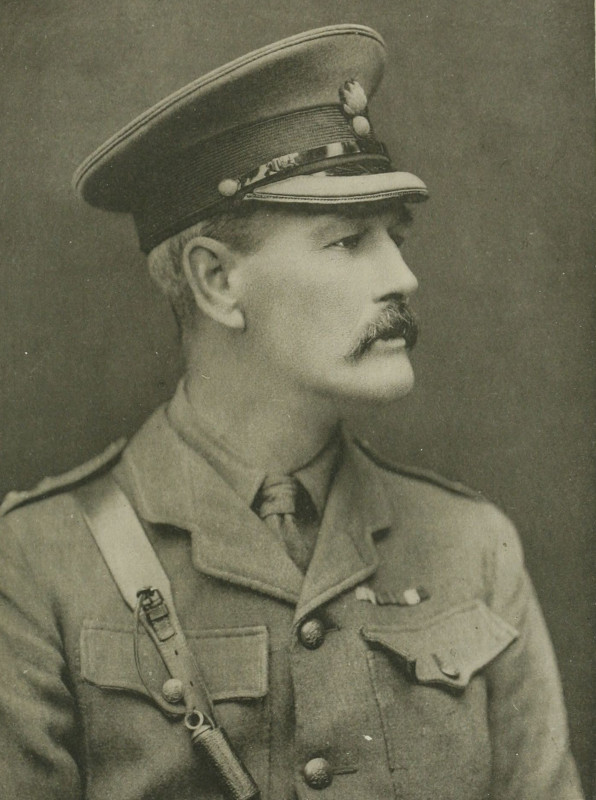
Lieutenant-Colonel L. R. Fisher Rowe. Commanding 1st Battalion. Died of wounds received at Neuve Chapelle 10 March 1915.
Some officers of the Grenadiers were lent to
the Scots Guards, who were very short of officers,
and remained away for some time. On the 5th
Second Lieutenant Crisp, who had been attached
to the Battalion from the Artists' Corps, was
coming across an open place, where the trenches
had fallen in and had become impassable, when
he was shot through the body and died shortly
afterwards. Lieut.-Colonel Fisher-Rowe, who
was only fifty yards away at the time, came up
199to give him morphia, but found him quite unconscious.
He had done so well, and made himself
so popular, that his death was much regretted by
the Battalion.
With this exception there were no casualties
among the officers and very few among the men,
although the Germans expended a large amount of
ammunition on that part of the line.
The redoubts were finished, and proved a great
success. It was curious to note that the Germans
were struck with the same idea, and began constructing
forts in rear of their inundated trenches.
A certain amount of leave was granted to the
officers and N.C.O.'s, and those who had been out
some time were all given a week at home.
February found the Battalion still in the same
trenches, which had by now been very greatly
improved. The problem of the water had been
partially solved by the efforts of the R.E., and
the men were able to take some pride in their
trench line. There was a certain amount of sickness,
with occasional cases of influenza. A motor
ambulance, presented by Captain J. A. Morrison
to the Battalion, arrived, and while the officers
and men much appreciated the gift, the Medical
Authorities were much concerned at the irregularity
of the proceeding.
On the 13th Lieutenant R. F. C. Gelderd-Somervell
joined the Battalion, and Captain the
Earl Stanhope left to take up his duties as A.D.C.
to the General Commanding the Fifth Army Corps.
He had proved himself such a good officer that
the Commanding Officer was sorry to lose him.
On the 23rd Captain E. F. F. Sartorius joined
200the Battalion, and took over command of No. 3
Company.
There had been a certain number of casualties
among the men from sniping and shell-fire, but
the greater part of the losses were from sickness.
March.
On March 3 the Battalion was relieved by the
Canadians, and billeted in the Rue du Bois. It
marched the next morning to Neuf Berquin, and
on the following day to Estaires. On the 10th
it joined the rest of the 20th Brigade, which
was on the main Estaires—La Bassée road.
Before taking over the trenches, Lieutenant
Darby was sent up to go over the ground, so
that he might be able to guide the companies
when they went up. At luncheon-time he
returned with the intelligence that the shelling
in the front trench was terrific, and that even as
far back as the reserve trenches the noise was
deafening, all of which seemed to point to a
lively time for the Battalion.
As the Battalion marched up, the men were
much impressed by the sight of the Chestnut
Battery going into action. This crack battery of
the Royal Artillery, manned by splendid men and
drawn by picked horses, came thundering down
the road, and as it passed the men of the
Grenadiers broke into a cheer.
Although the enemy's shells were bursting over
the Battalion, only one actually pitched near the
men, doing no damage, and in the evening the
Battalion went into billets, the King's Company
in the Rue du Bacquerot, and Nos. 2, 3, and 4 in
Cameren Lane.
CHAPTER IX NOVEMBER 1914 TO MAY 1915 ( 2ND BATTALION)
201
The Battalion remained in billets at Meteren
from November 22 till December 22. The
casualties among the officers had been severe,
and there only remained Lieut.-Colonel Smith,
Major Jeffreys, Captain Ridley, Captain Cavendish,
Lieutenant Hughes, Lieutenant and Adjutant
the Hon. W. Bailey, Lieutenant Beaumont-Nesbitt,
Lieutenant Marshall, Second Lieutenant
Cunninghame (Transport Officer), Second Lieutenant
Gerard, Lieutenant and Quartermaster Skidmore,
and Captain Howell, R.A.M.C. (attached).
The King inspected the 4th Guards Brigade
at Meteren, and afterwards presented Distinguished
Conduct Medals to a certain number
of N.C.O.'s and men.
In the evening the following special order was
issued:
The Brigadier is commanded by His Majesty the
King, the Colonel-in-Chief, to convey to the four
battalions of the Brigade of Guards the following
gracious words which His Majesty addressed to the
four Commanding Officers: "I am very proud of my
Guards, and I am full of admiration for their bravery,
endurance, and fine spirit. I wish I could have addressed
202them all, but that was impossible. So you
must tell them what I say to you. You are fighting a
brave and determined enemy, but if you go on as you
have been doing and show the same spirit, as I am sure
you will, there can only be one end, please God, and
that is Victory. I wish you all good luck."
On December 21 the news arrived that the
Indian Corps had been heavily attacked, and
driven out of its trenches between La Bassée
Canal and Richebourg. The First Corps was at
once to be moved down to this part of the line,
and that evening orders were received by the
Second Division to be ready to march at two
hours' notice. When a line of trenches stretches
some hundreds of miles, the rough must be taken
with the smooth, and the 2nd Battalion Grenadiers
was soon to find that the site of its trenches was
anything but an ideal one. To dig a trench in
a water-logged valley outraged all preconceived
principles; yet it was in such a locality that the
men of the Grenadiers were to find themselves
for the following months.
Minor operations, as they were called, consisted
in nibbling away a few hundred yards.
The casualties which occurred daily from bombing
and sniping were hardly taken into account.
Yet those who took part in this monotonous
underground warfare did as much to win the
war as those who were fortunate enough to fight
in one of the big battles.
The 4th Brigade marched off early by Merville
to Bethune, about nineteen miles, and there
billeted fairly comfortably. The next day it
marched on, and halted in a field at Essarts, near
203Le Touret, in readiness to support the 2nd
Brigade. In the evening it moved on again,
and took over the line at Rue de Cailloux from
the Royal Sussex Regiment after dark. These
trenches were very bad, and had been hastily improvised
from dykes, when the Germans succeeded
in capturing our front-line trenches a few days
before. The water was always knee-deep, in
some places waist-deep, in mud and water, and as
the enemy's trench was within twenty-five yards,
his snipers, who were always enterprising, had
plenty of opportunities of shooting. The taking
over of these trenches was complicated by men
getting stuck, and having to be dug out, so that it
was nearly six hours before the relief was completed.
In some cases it took four hours to dig
the men out, during which time many of them
fainted several times. No. 1 Company under
Captain Sir M. Cholmeley, No. 2 under Captain
P. A. Clive, and half No. 3 under Captain Cavendish,
were in the firing line, while the other half
of No. 3, and No. 4 Company under Captain
Ridley were in reserve.
The early morning began with considerable
sniping and bombardment with trench
mortars. It was bitterly cold, and the water in
the trenches made communication almost impossible.
It seemed madness to attempt to hold such a
line of trenches, and yet there was no alternative.
Notes of warning arrived from General Headquarters:
It is thought possible that the enemy may be contemplating
an attack during Christmas or New Year.
Special vigilance will be maintained during these periods.
204And again later:
Please note that when the enemy is active with
Minenwerfer, it is generally the prelude to an attack.
The enemy had the advantage of the ground,
for not only did his trenches drain into ours,
but he was able to overlook our whole line.
In addition to this he was amply supplied with
trench mortars and hand grenades, so that we
were fighting under very great difficulties. He
mined within ten yards of our trench, and blew
in the end of No. 2's trench, after which he
attacked in great force, but was unable to do
more than just reach our line. Captain Sir M.
Cholmeley, Bart., and Second Lieutenant J. H.
Neville were killed. Sergeant G. H. Thomas, who
had just been awarded the D.C.M., was also killed,
while Second Lieutenant G. G. Goschen was
wounded and taken prisoner. He had a narrow
escape of being drowned in the trench, and was
propped up by one of the men just in time.
Lieutenant Eyre and Second Lieutenant Mervyn
Williams were wounded.
In the evening Lieut.-Colonel Smith came to
the conclusion that fighting under such conditions
was only courting disaster, and that it would be
clearly better to dig a new line of trenches during
the night, but it was absolutely necessary to
finish the new line before daylight—otherwise
it would be useless. Accordingly he gave orders
for a new line to be dug, and the men, soaked
and stiff with cold as they were, set to work at
once. Rockets and fireballs gave the enemy's
snipers their opportunity, and the freezing water
205and hard ground made the work difficult. There
was, however, no artillery fire, though the Minenwerfer
were nearly as bad, and threw large
shells into our trenches. The new line was
just completed as dawn broke on Christmas
morning.
The sniping continued steadily the next day
with great accuracy, and the slightest movement
drew a shot at once. Captain E. G. Spencer
Churchill was wounded in the head in this way,
the bullet making a groove in his skull. The new
trenches, however, threatened to become as wet
as the old ones, although in the worst places they
were built with a high parapet and a shallow
trench. No. 3 Company, under Captain Cavendish,
in particular succeeded in erecting an
elevated trench of this nature, in spite of the
incessant sniping which was carried on during
the night.
Lord Cavan sent a message:
Hearty congratulations on good night's work. Thank
Captain Cavendish and his Company. Am absolutely
satisfied with arrangements. Report when and how you
manoeuvre the little stream.
It being Christmas Day, plum puddings
and other luxuries were distributed, and Princess
Mary's present of a box, containing a
pipe, tobacco, and cigarettes, was much appreciated.
In the evening the Battalion was relieved by
the 3rd Battalion Coldstream, and marched back
to Le Touret, where it billeted, and remained for
forty-eight hours.
206The Battalion was now composed as follows:
Lieut.-Colonel
W. R. A. Smith, Headquarters.
Major
G. D. Jeffreys, Headquarters
Lieutenant and Adjutant the
Hon. W. R. Bailey, Headquarters
2nd Lieut. M. Williams (Machine-gun Officer), Headquarters
Lieutenant and Quartermaster
J. H. Skidmore, Headquarters
Capt. J. S. Hughes,
No. 1 Company.
Lieut. A. K. S. Cunninghame (Transport Officer),
No. 1 Company.
2nd Lieut. J. N. Buchanan,
No. 1 Company.
2nd Lieut. G. W. V. Hopley,
No. 1 Company.
Capt. P. A. Clive,
M.P.,
No. 2 Company.
Lieut. F. G. Marshall,
No. 2 Company.
2nd Lieut. J. C. Craigie,
No. 2 Company.
2nd Lieut. H. C. L. Rumbold,
No. 2 Company.
Capt. A. B. R. R. Gosselin,
No. 3 Company.
Capt. R. H. V. Cavendish,
M.V.O.,
No. 3 Company.
Lieut. C. R. Gerard,
No. 3 Company.
2nd Lieut. H. S. E. Bury,
No. 3 Company.
Capt. E. D. Ridley,
No. 3 Company.
Lieut. F. G. Beaumont-Nesbitt,
No. 4 Company.
Lieut. C. R. Britten,
No. 4 Company.
2nd Lieut. E. G. Williams,
No. 4 Company.
Attached—Captain
F. D. G. Howell,
R.A.M.C.
The Battalion returned to the same line of
trenches, and found them as unpleasant as before.
The cover had been improved, and the communication
trenches were better, but the water
stood in them as deep as ever. On the night of
the 28th it blew a gale, and the cold was intense.
The rain that came down all night not only
filled the trenches with more water, but broke
down the parapet and loopholes in many places.
The men passed a miserable night, soaked to
207the skin, with no means of keeping warm, and
although the constant repairs to the parapet
kept them employed, the sniping made all work
difficult and dangerous.
A few of the enemy's 6-inch shells fell on
the trenches, but not with sufficient accuracy to
cause any damage. The trenches were still in a
terrible state, communication was impossible, and
there were numerous cases of frostbite. In the
evening of the 29th the Battalion was again
relieved by the 3rd Battalion Coldstream, and
went back to Le Touret, where it remained two
days.
On the 31st it returned to the flooded trenches
again, and was subjected to the usual sniping
and bombing. The Germans were using a trench
mortar which fired large bombs from some distance
into our line, while at that time we had
nothing more than hand grenades, which were
somewhat primitive and dangerous to the thrower.
The water, however, was the greatest difficulty
our men had to contend with: it made the communication
trenches impassable, and accounted
for more men than the enemy's bullets. It ate
away the parapet, rotted the men's clothing,
rusted and jammed the rifles, retarded the food
supply, and generally made the life of the men
in the trenches hideous; but in spite of all this
discomfort the men remained cheerful and in
good spirits.
Lord Cavan, who was much exercised by the
water problem, gave orders that all impossible
places were to be vacated and watched by
pivots, and the R.E. received instructions from
208him to give their attention to this portion of the
line. Our artillery proceeded systematically to
flatten out any house on the enemy's side, as it
was found that the smallest building usually
harboured snipers, while the enemy's artillery
kept up a desultory fire; but after what the
Battalion had been accustomed to at Ypres, it
seemed mere child's play.
Second Lieutenant H. C. Rumbold happened
to be engaged in drawing at one of the gunners'
observation posts, when a shell struck it; in
addition to being wounded, he was struck by the
falling masonry, and was consequently sent home.
Though the casualties in the 4th Brigade had
lately been very heavy, drafts were sent from
home with great efficiency, and the 2nd Battalion
Grenadiers had a fair supply of officers. The
Coldstream was, however, very short, and the
Brigadier found it necessary to transfer the
following officers from the Grenadiers to the
Coldstream: Lieutenants Kingsmill, Abel-Smith,
Lang, and Creed.
On January 2 the Battalion was relieved by
the South Staffords, and went into reserve at
Locon, where it billeted and remained till the
7th of January.
The Prince of Wales, on one of his many visits
to the Battalion, brought the men a gramophone,
which was much appreciated by every one, and
helped to enliven the evenings.
A few days' rest worked wonders with the
Battalion, and converted ill-shaved men, in clothes
sodden and coated with mud, once more into
smart, well-turned-out Guardsmen. The line now
209taken over was near Rue du Bois, and the
Battalion Headquarters were at Rue des Berceaux.
Two companies were in the firing line, with two
platoons in the front trench and the other two
in support; the remainder of the Battalion
formed the reserve.
The rain continued in torrents, and the trench
line became a sort of lake. The companies, not
in the front trench, were engaged in digging
second-line trenches, and a trench that was dug
by Nos. 2 and 4 Companies was known for two
years after as the Guards' trench. It was considered
a model of what a good trench should be.
The usual routine was to relieve the men in
the trenches every twelve hours, and bring them
back to be dried, rubbed, and cleaned; and there
was not much sickness, although several men
were crippled with rheumatism, and would have
found great difficulty in marching any distance.
The gruesome task of removing the dead was
effected by floating the bodies down the communication
trenches.
On the 12th the following order was circulated
from Brigade Headquarters:
The Brigadier has much pleasure in forwarding a
copy of a letter received from General Monro, and
desires that it should be read to every man.
"I have this moment heard from an officer of the
Indian Corps an account of what he saw at the fight
for Givenchy, in which the 1st Brigade was engaged.
His position enabled him to see the attack of the Coldstream,
and the following are his words: 'They marched
forward without the least hesitation under the most
terrific fire, just as though they were on parade. The
Indian Brigade watched the progress of the Guards
210with the profoundest admiration. I thought perhaps
the officers and privates of the Brigade of Guards might
like to know the admiration which their conduct inspires
in outsiders. We who have been through much with
them know right well that the description I have given
merely represents their normal behaviour in action, yet
possibly it may please the men to hear what I have
written.'"
Lieut.-Colonel Smith in a private letter to
Colonel Streatfeild wrote:
I cannot thank you enough for the excellent officers
you have sent me out. I have had the sorrow of seeing
nearly a whole battalion of first-rate officers go one by
one, and yet you have been able to send me a second lot
who promise to be almost as good.
The Battalion was relieved by an Indian
regiment, and went into billets at Le Touret to
rest for two days, after which it returned to the
trenches in Rue des Bois near Rue des Berceaux.
The water was as bad as ever, and even rose
after a snowstorm. The whole country was water-logged,
and there was constant difficulty in keeping
up the parapets, which crumbled and fell
in great blocks, in spite of the ceaseless labour
expended on them. The enemy's snipers took
every advantage of the crumbling parapets, and
accounted for many of our men. Sergeant Croft
was killed by a sniper, and Corporal Parkinson,
who, as Lord Bernard Gordon-Lennox's orderly,
must have evaded thousands of bullets and shells,
was shot dead by a stray bullet.
After another four days in reserve at Les
Choqueaux, the 4th Brigade marched to Gorre
in support of the First Division, which endeavoured
211to retake the trenches which had been
lost at Givenchy. Having waited about all day,
the Brigade returned to its billets at Les Choqueaux
in the evening. The same procedure was
gone through the following day, but on neither
occasion was the Brigade wanted.
Four officers of the Grenadiers had been
temporarily attached to the Scots Guards:
Second Lieutenant H. S. E. Bury, Second Lieutenant
G. Hamilton Fletcher, Second Lieutenant
A. H. Lang, Second Lieutenant J. A. Denny.
On the 25th they were all four hit by a shell
that exploded in the trench. Second Lieutenants
Bury, Hamilton Fletcher, and Lang were killed,
and Second Lieutenant Denny was severely
wounded.
About this time a case of cerebral meningitis,
or spotted fever, was discovered at the Guards'
Depot at Caterham, Surrey, and orders were given
for all drafts from England to be isolated. This
caused a certain amount of inconvenience, as it
was by no means easy to isolate a draft of 200
men. There were at the time only eight subalterns
with the Battalion, which made the duty
very heavy for the officers, but some of the other
battalions had not even so many.
From the 28th to the 30th the Battalion
remained in billets at Les Choqueaux, and on
the 30th marched to Bethune. It was only
during marches of this length that the whole
Battalion assembled together, and saw itself
as a Battalion, instead of in isolated companies.
It presented an extraordinary appearance. Hung
round like a Christmas tree, wearing fur waist-coats,
212gum-boots, and carrying long French
loaves, braziers, charcoal, spades, and sandbags,
it looked more like a body of irregular troops
from the Balkans than a battalion of Guards.
On February 1 the Battalion marched to
Annequin, and No. 1 Company under Lord Henry
Seymour went into the trenches at Guinchy, to
reinforce the Coldstream Guards who had been
heavily engaged. On the 2nd the whole Battalion
took over from the Irish Guards the trenches
from La Bassée road to the Keep, where it remained
till the 5th. Although there was heavy
shelling, the casualties were not large, but Second
Lieutenant G. W. V. Hopley was badly wounded,
and Sergeant Buttle killed.
On February 1 the Germans broke the line
in the Guinchy neighbourhood, and Cavan's
4th Brigade was brought up. A company of
the 2nd Battalion Coldstream, supported by one
company of Irish Guards, was ordered to counter-attack,
but failed to retake the lost trench.
Lord Cavan, having left orders that the ground
was to be held at all costs, went off, and arranged
a heavy bombardment from the howitzers and
siege guns. As soon as this ceased 50 men from
the 2nd Battalion Coldstream, followed by 30
men from the Irish Guards, with a company of
the 2nd Battalion Grenadiers in support, dashed
forward, and succeeded in taking all the lost
ground. The attack was so successful that the
Grenadiers never came into action.
During the whole of February the 2nd Battalion
Grenadiers occupied the trenches at
Guinchy. The usual routine was forty-eight
213hours in the trenches, and forty-eight hours' rest
in billets at Beuvry. The weather, which at
home is only noticed by people with weak conversational
powers, becomes a matter of enormous
importance when you have to stand in a ditch
for two days and two nights. The wet and cold
made the life in the trenches at first very trying,
but later, when the spring began, the nights in the
trenches became bearable.
Sniping and bombing with intermittent shelling
were of constant occurrence. The sad news
that some officer, sergeant, or private had been
killed was passed down the trenches with wonderful
rapidity, and was known at once by the whole
Battalion. The line of trenches now occupied by
the Battalion was much drier than those it had
been accustomed to, and far more intricate. When
the trenches were known the relief became easy,
although it was always carried out in the dark,
but at first, when the officers and N.C.O.'s took
over the trenches for the first time, it was long
before every one settled down.
The forty-eight hours' rest was spent in comparative
comfort in billets at Beuvry, where the
inhabitants still lived in spite of the proximity
to the trenches. When the moment came to
leave the billets and return to the trenches, the
Battalion moved up in small parties at a time, in
case the road should be shelled. Through endless
transport of all kinds the men slowly wound their
way. They usually met food going up, empties
coming back, ammunition and supplies of all
sorts, and as it became darker the road was
more difficult. They often passed French troops
214on the way, with the secondary French transport,
a motley collection of every conceivable sort of
vehicle. Yet with all these different streams of
men and wagons there was never any confusion
or accident. As the platoons neared the trenches,
stray bullets usually began to fly, and occasionally
shells. Then each company, on reaching its
allotted communication trench, disappeared, and
so reached the firing line.
The Battalion Headquarters were in the cellar
of the ruins of a house, and here the business part
of the work was carried on by clerks and orderlies.
Sometimes shells fell on the remains of the house,
but the cellar was never reached. A motor
canteen presented by Lord Derby to his old
Battalion now arrived, and proved a great boon.
It could provide hot drinks for 300 men at a
time.
On the 7th Second Lieutenant H. A. R. Graham
was badly wounded, and subsequently had to
have his arm amputated. Captain A. B. R. R.
Gosselin was bending down trying to dress his
wound, when a piece of shell struck him in the
neck and killed him instantaneously. On the 8th
Second Lieutenant P. L. M. Battye was wounded
in the leg, and Lieutenant Britten was sent to
hospital with enteric fever.
On the 18th the Germans succeeded in taking
a small portion of the French trenches on our
right, and that evening the French sent a party
to retake it. No report came, however, as to
whether they had been successful or not, and considerable
doubt existed as to whether this particular
trench was in German or in French hands.
215In order to decide this point, the French sent
a reconnoitring party down our communication
trench on the right, and asked Captain P. A.
Clive's permission to move down our trench.
Captain Clive not only offered to help, but decided
to go himself. Accompanied by Major
Foulkes, R.E., he led the French reconnoitring
party into the trench of doubtful ownership, and
there found a dug-out full of German kit, with a
lighted candle burning. This evidence of German
occupation satisfied the French party, but Captain
Clive insisted on making further investigation,
and crept on in pitch darkness, followed by Major
Foulkes. Suddenly he was challenged in deep
guttural German by a sentry, not two yards off.
"Français, Français," he replied in a voice to
which he was uncertain whether he should give
a French or German accent. "Halt, oder Ich
schiesse," was the reply, and the nationality of
the occupants of the trench was settled beyond
dispute. Even Captain Clive was convinced, and
as the bullets whistled past him when he retired,
the nationality of their makers was forcibly impressed
on his mind.
The shelling varied: on some days it was mild,
and on others for no apparent reason it became
very violent. The difference, however, between
the shelling here and that which the Battalion had
been accustomed to near Ypres was, that while the
German gunners at first had it all their own way,
they were now not only answered but received
back as many shells as they sent over. A great
deal of work was done by the Battalion during
the month, and the digging was constant night
216and day. The Keep was strengthened, many new
communication trenches were dug, all very deep,
eight to nine feet, and the right of the line, near
the French, was made very strong. Supporting
trenches were dug, and eventually the whole line
was straightened out and wired. The majority of
the men thoroughly understood how to dig, and
the newcomers very quickly learnt from the old
hands. On February 20 Lieutenant R. D. Lawford
and a draft of sixty men joined the Battalion,
and on the 23rd Second Lieutenants A. H.
Penn, O. Lyttelton, and Viscount Cranborne
arrived.
March.
For the first ten days in March the Battalion
rested, and remained in billets at Bethune, where
it had concerts and boxing competitions. On the
10th it marched to a position of readiness east of
Gorre, with the remainder of the 4th Brigade, to
form the reserve to the 6th Brigade, which was
the pivot on which the whole move at Neuve
Chapelle hung, though it did not come into
action. The attack made by the 6th Brigade
proved a most gallant but disastrous business,
and the casualties were very heavy. At 3 P.M.
the 4th Brigade was ordered up to support
another attempt, which, however, never came off,
and it therefore returned to its billets at Bethune.
On the 11th the 4th Brigade was again moved up
to the same place, but again was not wanted.
Captain Ridley, who held the almost unique
record in the 4th Brigade of having taken part in
every engagement from the commencement of the
war, and who had been constantly fighting for
five months, having twice been slightly wounded,
217went home sick, as the Commanding Officer and
the doctor insisted on his taking this opportunity
of having a rest.
On the 12th the 2nd Battalion Grenadiers
relieved the Irish Guards at Givenchy, where the
trenches, which were comparatively new, were
shallow and the parapet not bullet proof. The
village was a complete ruin, the farms were burnt,
and remains of wagons and farm implements were
scattered on each side of the road. This part of
the country had been taken and re-taken several
times, and many hundreds of British, Indian,
French, and German troops were buried here.
The roads were full of shell-holes, bricks, tiles,
cart-wheels, and debris of every description. The
shelling and sniping went on intermittently, but
the habits of the enemy were known, and when
the shelling began it was generally easy to estimate
how long it would last, and when it would begin
again.
On the 16th Major Lord Henry Seymour and
Captain J. S. Hughes were transferred to the 1st
Battalion in the Seventh Division, and Captain
C. de Crespigny joined the Battalion from Brigade
Headquarters.
On the 22nd Lieutenant F. G. Marshall, who
had been having tea with the doctor at the
dressing-station, was returning to the trenches,
when a stray bullet killed him. The casualties
in the trenches were at that time not great, but
occasionally at night a violent shelling would
begin, directed towards the rear of the trenches,
in the hopes of catching the troops coming up to
relieve those in the front line.
218The terrible tragedies that went on daily
between the two firing lines gave some idea of
the barbarous cruelty of the Germans. Men who
were wounded in any attack or raid were forced
to lie out between the lines, often in great agony,
but whenever any of our stretcher-bearers attempted
to reach them they were promptly fired
at by the Germans. To show the vitality possessed
by some human beings, cases occurred of
men being left out wounded and without food or
drink four or five days, conscious all the time that
if they moved the Germans would shoot or throw
bombs at them. At night German raiding parties
would be sent out to bayonet any of the wounded
still living, and would feel these unfortunate men's
hands to see if they were stiff and cold. If any
doubt existed, the bayonet settled the question.
In spite of this, men often managed to crawl back
just alive, and were quickly resuscitated by their
comrades.
April.
On April 1 Major B. H. Barrington-Kennett,
and on April 2 Second Lieutenant Hon. G. S.
Bailey and Second Lieutenant P. K. Stephenson,
joined the Battalion.
While digging a communication trench, in
what had once been the Curé's garden, some men
of the Battalion unearthed some silver, and also
some presumably valuable papers. It seemed to
the men that this was treasure-trove, but Lieut.-Colonel
Smith, on hearing of the find, insisted
that it should all be carefully packed up, papers,
silver, and all, and sent to the French authorities
for safe keeping. The owner, some weeks later,
wrote a letter of profound gratitude, and enclosed
219a plan showing where some more of his treasures
were buried. Another search was made, and these
were all recovered, with the exception of one box
which had been blown to bits by a shell.
All throughout April the Battalion remained
in the same trenches, and was relieved every
forty-eight hours by the Irish Guards, when it
went into billets at Preol. A new trench howitzer
was produced by the artillery with a range of
520 yards, which put us more on an equality
with the enemy, and gave the men confidence.
The mining had now become a regular practice,
and every one was always listening for any
sound that might denote mining operations.
The shelling continued regularly, and at times
a battalion coming up to take its turn in the
trenches would be subjected to an unpleasant
shelling.
The Commanding Officer, Lieut.-Colonel W.
Smith, was accustomed to what he called "stumble
round the trenches" every day, and many visits
were paid by Lord Cavan and his staff, who
became quite proficient in evading the various
missiles which the enemy daily aimed at the
trenches. On one of these occasions the Prince
of Wales, who was a constant visitor, tried his
hand at sniping, and as there was an immediate
retaliation, his bullets very probably found their
mark. The men were delighted to see His Royal
Highness shooting away at the enemy, and when,
as sometimes happened, the evening shelling of the
Germans—"the evening hate," as it was termed
by the men—began while the Prince was in the
trenches, the men were always anxious to hear
220that His Royal Highness had finished his tour in
safety.
On April 21 Captain G. L. Derriman and
Second Lieutenant C. O. Creed joined the Battalion,
with a draft of thirty men. On the 12th
Major Lord Henry Seymour returned to the
Battalion. On the 13th Second Lieutenant P. K.
Stephenson left to join the 1st Battalion, and
on the 26th Captain R. H. V. Cavendish was
appointed Town Commandant at Bethune.
The weather gradually changed, and instead of
the general gloom, the appalling mud, snow, and
rain, the days began to be bright and hot, although
the nights were still cold.
On the 23rd the Battalion relieved the Post
Office Rifles (Territorials), and continued to remain
in the trenches, with two companies in the firing
line and two in reserve, relieving each other every
two hours.
May.
List of Officers of the Battalion on May 1, 1915
Lieut.-Colonel
W. R. A. Smith, Headquarters.
Major
G. D. Jeffreys, Headquarters.
Lieutenant and Acting Adjutant
Hon. W. R. Bailey, Headquarters.
2nd Lieut. D. Abel-Smith (Machine-gun), Headquarters.
Lieut. and Quartermaster
W. E. Acraman, Headquarters.
Major Lord Henry Seymour,
No. 1 Company.
Lieut. A. K. S. Cunninghame (Brigade Transport),
No. 1 Company.
2nd Lieut. J. N. Buchanan,
No. 1 Company.
2nd Lieut. A. H. Penn,
No. 1 Company.
Capt. P. A. Clive,
No. 2 Company.
Capt. G. L. Derriman,
No. 2 Company.
2nd Lieut. J. C. Craigie,
No. 2 Company.
2212nd Lieut. Viscount Cranborne,
No. 2 Company.
2nd Lieut. Hon. P. P. Cary,
No. 2 Company.
Major
B. Barrington-Kennett,
No. 3 Company.
Lieut. A. F. R. Wiggins,
No. 3 Company.
Lieut. A. V. L. Corry,
No. 3 Company.
2nd Lieut. R. D. Lawford,
No. 3 Company.
Major
C. R. C. de Crespigny,
No. 4 Company.
Capt. I. St. C. Rose,
No. 4 Company.
2nd Lieut. E. G. Williams,
No. 4 Company.
2nd Lieut. O. Lyttelton,
No. 4 Company.
2nd Lieut. Hon. G. S. Bailey,
No. 4 Company.
2nd Lieut. C. O. Creed,
No. 4 Company.
Attached—Captain
F. D. G. Howell,
R.A.M.C.
The Battalion remained in the trenches at
Givenchy until May 12, when it was relieved by
the London Scottish, and went into billets at Le
Casan. During the time it had occupied these
trenches, it had done a great deal of work, and
altered the appearance of the line.
On the 9th the offensive on the Richebourg—Festubert
line began. To the 4th Brigade was
assigned the task of holding the Givenchy—Cuinchy
line, while the First, Eighth, and Indian
Divisions were to carry out the attack. A terrific
bombardment on both sides opened early in the
morning, but no attack developed against that
part of the line. The attack by our First Division
proved a costly failure, although the French made
some progress near Notre Dame de Lorette.
News was received of the German gas attack
at Ypres, and precautions had consequently to be
taken. The question of respirators became very
important, and masks of all sorts and kinds were
tried. Here were thousands of men absolutely
unprepared, who at any moment might be
222suffocated, but the idea of taking precautions
against gas had never occurred to us, any more
than precautions against wells being poisoned.
Such things had been ruled out of civilised warfare
by the Hague Convention. It is hardly to
be wondered at that this perfidious treachery
on the part of the enemy took the whole
Army at first completely by surprise, but an
antidote was quickly provided in the shape of
gas helmets.
On the night of the 11th Lieutenant A. V. L.
Corry, accompanied by Sergeant Skerry, Lance-Corporal
Hodgson, and Private Gillet, went out,
and commenced cutting the barbed wire in front
of the German trenches. While engaged in this
they came in contact with a German patrol, one
of which was shot by Lieutenant Corry, a second
was killed by a bomb thrown by Private Gillet,
while a third was killed by Sergeant Skerry.
The German officer in command of the patrol
drew his revolver and shot Sergeant Skerry and
Corporal Hodgson dead, and wounded Private
Gillet, who afterwards succumbed to his wounds.
Lieutenant Corry, finding the remainder too
numerous to tackle single-handed, had perforce
to retire to the trenches.
On the 14th we began a systematic bombardment
of the German lines opposite Richebourg—L'Avoué—Festubert.
This continued for
two days, and prepared the line for the second
attack, which was to be carried out by the Second
and Seventh Divisions and the Indian Corps.
There was a distinct salient at this part of the
German line, and it was for this reason that it
223was chosen for attack. The country was flat,
although intersected with water-courses, and
owing to the barrage of fire from the enemy
constant difficulty was experienced in bringing
up any supports.
CHAPTER X THE BATTLE OF NEUVE CHAPELLE ( 1ST BATTALION)
224
For a long time the question had been discussed
whether it was humanly possible to break through
a line of trenches. Owing to the great defensive
power of modern weapons, the thickness of
the barbed-wire obstacles, and the dangers the
attacking force would have to run in leaving their
trenches and crossing the open, it was generally
believed that no attack could possibly succeed.
Further, in spite of repeated attempts, the
Germans had failed time after time to break
through our line.
But there was another consideration which
we had to take into account. The French had
recently suffered enormous losses, with comparatively
small gains to set against them, and
they were beginning to think that since Ypres
we had not taken our proper share of the fighting.
Sir John French determined, therefore, to prepare
a regularly organised attack on the enemy's line
near Neuve Chapelle. He selected this portion
in the hope that, if the enterprise succeeded
and the ridge overlooking Lille was reached,
the La Bassée—Lille line would be threatened.
225and possibly the enemy might have to abandon
Lille. He communicated his plans to Sir Douglas
Haig in a secret memorandum, and put him in
command of the whole attack.
It was arranged that the assault should be
undertaken by the 4th and Indian Corps in the
First Army. The guns were to be massed west
of Neuve Chapelle, and were to smash the wire
entanglements, and break down the enemy's
trenches before the infantry attempted to advance.
Later they were to concentrate their
fire on the enemy's supports and reserves, and
prevent any more men from being sent up to the
firing line. This was the first time that we used
what afterwards became a regular feature of the
attack—the barrage of fire.
The sorely tried Seventh Division was again
given a very difficult task, and the 1st Battalion
Grenadiers was once more to bear the brunt of
the attack.
The officers of the Battalion at the time were
as follows:
Lieut.-Colonel
L. R. Fisher-Rowe, Commanding Officer.
Major
G. F. Trotter,
M.V.O.,
D.S.O., Second in Command.
Lieut. C. V. Fisher-Rowe, Adjutant.
Lieut. J. Teece, Quartermaster.
2nd Lieut. E. H. J. Duberly, Machine-gun Officer.
Capt. W. E. Nicol, Bombing Officer.
Captain the
Hon. G. H. Douglas-Pennant, King's Company.
Lieut. H. W. Ethelston, King's Company.
2nd Lieut. C. T. R. S. Guthrie, King's Company.
2nd Lieut. C. G. Goschen, King's Company.
Major
G. W. Duberly,
No. 2 Company.
Lieut. Lord Brabourne,
No. 2 Company.
2nd Lieut. C. F. Burnand,
No. 2 Company.
2262nd Lieut. A. Foster,
No. 2 Company.
Capt. E. F. F. Sartorius,
No. 3 Company.
2nd Lieut. Lord William Percy,
No. 3 Company.
2nd Lieut. G. R. Westmacott,
No. 3 Company.
2nd Lieut. R. G. Gelderd-Somervell,
No. 3 Company.
Captain the
Hon. R. Lygon,
M.V.O.,
No. 4 Company.
Lieut. M. A. A. Darby,
No. 4 Company.
Lieut. A. S. L. St. J. Mildmay,
No. 4 Company.
Attached—Captain
G. Petit,
R.A.M.C.
It was on the 10th of March that the attack
began. At 7.30 A.M. all the troops were in position,
and a powerful bombardment from our massed
batteries was opened on the trenches protecting
Neuve Chapelle, but the enemy made no reply.
After thirty-five minutes' bombardment the infantry
advanced; the Eighth Division and the
Garhwal Brigade from the Anglo-Indian Corps
attacked, and captured the village and entrenchments.
But the success thus gained was more
or less thrown away, owing to the delay that
occurred in bringing up the Reserve Brigades.
All day our men waited for reinforcements to
continue the advance, but by the time they arrived
it was dark. So there was nothing to do but
wait until next morning, and meanwhile the
Germans had had time to bring up more troops.
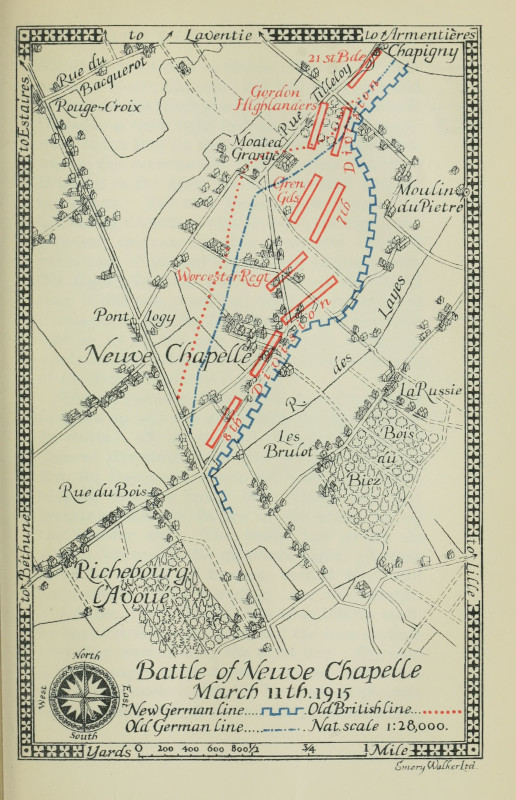
Battle of Neuve Chapelle. March 11th, 1915.
Being in the Reserve Brigade, the 1st Battalion
Grenadiers did not reach the firing line till the
following morning, when the weather was thick
and misty. This made artillery observation
impossible, and as many of the telephone wires
had been cut by the enemy's shells on the previous
day, communication between the different
Brigades became a matter of great difficulty.
The position of affairs now stood thus: the
227Eighth Division had carried the German trenches
north of Neuve Chapelle, but had not succeeded
in crossing the River des Layes, and the Garhwal
Brigade on their right had also been held up in
front of the Bois du Biez. The Seventh Division
was on the extreme left, with the 21st and 22nd
Brigades in the firing line and the 20th Brigade
in support. The 21st Brigade was reported to
be holding a position with its right resting on the
captured German trenches some two hundred
yards east of Moated Grange, and in touch with
the Eighth Division, but it was soon discovered
that it did not extend so much to its right as
it imagined, and the 20th Brigade was therefore
sent up to fill the gap. The attack along the
whole line was delayed until the leading battalions
of the 20th Brigade were ready.
The 1st Battalion Grenadiers was now ordered
to move up into the old British line of trenches.
It started off at 4 A.M., led by Brigadier-General
Heyworth, and after passing down the
Rue du Bacquerot struck off across the fields,
keeping along a trolly line. Dawn was just
breaking, and the flashes of the shells lit up
the sinister sky. The trolly line ended on
a road where, in the uncertain light, glimpses
could be caught of trestles, barbed wire, and
ammunition boxes, standing near the remains
of a house. Now for the first time bullets could
be heard striking the trees, and the men realised
that they were nearing the front line. The men
in front eager to go forward moved rather too
fast, which made it difficult for those in the rear
to keep touch with them, and the platoon leaders,
228afraid of losing touch with the rest of the Battalion,
had even to urge the men to double. On reaching
the Rue Tilleloy, the Battalion followed it for
a few hundred yards south, keeping behind a
breastwork until it came to a road which led to
the left, and apparently ended in a ruined farm.
There it received orders to go into some support
trenches, and at 7 A.M. Lieut.-Colonel Fisher-Rowe
sent for the Company Commanders, and
explained their orders to them. The Battalion
was to advance in columns of platoons at fifty
yards interval in the following order:
| No. 2 Company |
The King's Company |
| |
| Platoon 5, 2nd Lieut. Foster |
Platoon 1, Lieut. Ethelston |
| Platoon 6, 2nd Lieut. Burnand |
Platoon 2, 2nd Lieut. Guthrie |
| Platoon 7, Lieut. Lord Brabourne |
Platoon 3, 2nd Lieut. Goschen |
| Platoon 8, Major Duberly |
Platoon 4, Capt. Douglas-Pennant |
Leaving the old British line it advanced
across the open, over trenches which had been
captured from the Germans the day before.
Almost immediately after the advance began,
Captain Douglas-Pennant was struck by a shell,
and mortally wounded just as he had emerged
from a trench, and was looking round to see
whether his company was going in the right
direction.
When the accounts written by the Divisional
and Brigade Staffs are compared with those
written by the Commanding Officer and individual
officers, there can be no doubt that the information,
which trickled back during the day's fighting,
was often so incorrect, that it led not only General
229Capper, but also General Heyworth, to form
entirely wrong conclusions as to what was happening
in front, and the orders issued were in
many instances unintelligible. Communication
between the Battalion and the Brigade was
maintained by orderlies, and on several occasions
when the orderlies were killed the orders never
reached the front line, or reached it so long
after they had been despatched that the situation
in front had completely changed. It
hardly seems to have been realised at Divisional
Headquarters, how much the artillery bombardments
on both sides had obliterated all landmarks.
Roads were mentioned of which no trace
could be seen, and the four lines of trenches, the
old and the new German lines, and the old and
the new British lines, no doubt added considerably
to the lack of clearness in the orders.
The whole position was most complicated, as
the Germans had been only partially driven back
on the 10th, and consequently their line in places
faced in different directions. Though Neuve
Chapelle itself was in our hands, the enemy still
occupied part of their old line farther north. In
order to attack this position, it was necessary
to come down the old British trench, and then
advance due west for a quarter of a mile, after
which the attacking force had to wheel round, and
go in a northerly direction.
Whether such intricate manoeuvres could
ever have been successfully accomplished in the
face of machine-gun fire is very doubtful, but
there seems to have been no other way of
attacking this part of the enemy's line, which
230jutted out at right angles, and made any advance
by the Eighth Division an impossibility.
To accomplish its difficult task, the 1st
Battalion Grenadiers started with the Gordons
on their left. It had hardly reached the road
when it came in for a murderous enfilade fire from
the German machine-guns on its left front, which
very much puzzled the men, who imagined the
enemy to be straight in front of them. Two
platoons under Lieutenant Ethelston and Second
Lieutenant A. Foster had pushed on, and were
quite one hundred yards ahead of the rest of the
line, but No. 2 Company on the left, being nearest
to the German machine-guns, lost very heavily.
Lieutenant Lord Brabourne and Second Lieutenant
C. F. Burnand were killed, in addition
to a large number of N.C.O.'s and men. Soon
afterwards Second Lieutenant A. Foster was
mortally wounded, being hit in five places.
Meanwhile the Gordon Highlanders in the
orchard were held up by the enemy, and could
make no headway against the machine-guns in
front of them. Lieut.-Colonel Fisher-Rowe, after
having gone round the front line, saw clearly that
unless steps were taken to silence this machine-gun
fire on the left his Battalion would soon be
annihilated. He accordingly sent back a message
to Brigade Headquarters explaining his position.
Apparently he was under the impression that
the Battalion had reached the River des Layes,
but as a matter of fact it was astride a small
stream much farther back. General Heyworth
ordered him to hold on where he was, in the hope
that when the Gordons cleared the orchard the
231Grenadiers would be able to press home their
attack.
The platoons had naturally telescoped up
during this advance, as those in rear were always
pushing on to get into the front trenches. Sergeant-Major
Hughes, in command of the last
platoon of the King's Company, was joined by
Lieutenant Westmacott with his platoon, and
soon afterwards by Lieutenant Somervell. Lieutenant
Goschen also managed to get his platoon
up to the front trench, where Lieutenant Duberly
with his machine-gun arrived a little later. No.
4 Company under Captain Lygon, having passed
through two lines of trenches occupied mostly
by the Devonshire Regiment, had come up on
the left of No. 2. Lieutenant Darby with No. 13
Platoon managed to cross a ditch full of water
by means of a plank bridge, and get touch with
the Gordon Highlanders; but when Lieutenant
Mildmay attempted to follow with his platoon,
he found the enemy had a machine-gun trained
on it, and had to wade through the water farther
to the left. Captain Sartorius was seriously
wounded as he came along at the head of No. 3
Company; his two orderlies attempted to carry
him back, but were both shot. Second Lieutenant
Lord William Percy, who was close behind, was
wounded in the thigh; Lieutenant A. Darby
was shot through the heart as he was lighting
a cigarette, and Second Lieutenant Mildmay,
who was close to him, was badly wounded. The
casualties among the other ranks were very
heavy.
The 1st Battalion Grenadiers found itself from
232the start in a hopeless situation, and was enfiladed
the moment it crossed the road.
But it continued to go forward in spite of the
German machine-guns, and stubbornly held on
to the position it had gained. Men who had
been wounded early in the day had to be left
lying where they fell, and many of them were
subsequently killed by shrapnel. The King's
Company was unfortunate enough to lose two of
its best sergeants: Sergeant Russell was killed,
as he followed Lieutenant Ethelston into the
front trench, and Sergeant Annis fell somewhat
later.
Just before dark the Battalion received orders
to dig in where it was, and the advanced position
to which Lieutenant Ethelston and his platoons
clung had to be reached by a communication
trench. The darkness made all communication
very difficult, and the piteous cries of the wounded
and dying, who asked not to be trodden on, added
to the troubles of the officers, who were trying to
collect their platoons. When orders were subsequently
received for the Battalion to retire and
get into some reserve trenches, it was found that
the casualties had been very heavy. It was disappointing
to learn that the British line on the
right had been 200 yards ahead of the Battalion,
and that all the losses had been incurred in passing
over ground captured by the Eighth Division.
The Battalion assembled by degrees, and retired
to the place appointed to it, which was not
far from the junction of the three roads. During
its retirement Second Lieutenant R. G. Somervell
was mortally wounded, and was picked up by a
233stretcher-bearer of another battalion. Rations
were brought up and issued, and the men afterwards
got what sleep they could, but they were
wet through, and spent a most uncomfortable
night.
Lieutenant Ethelston was now in command
of the King's Company, and Second Lieutenant
Westmacott of No. 3, while Major Duberly and
Captain Lygon retained command of their
companies.
Having grasped the gravity of the situation,
the Germans were now hurrying up guns and
men to the threatened portion of the line as fast
as they could. At an early hour they opened a
savage bombardment on the trenches, and almost
continuously throughout the morning shells were
falling round the men in rapid succession. Only
two actually dropped amongst the Grenadiers,
but these caused many casualties.
In the afternoon the Battalion was ordered
to support the Scots Guards, who were to undertake
the attack with the Border Regiment. The
orders were to advance with the right on the
Moulin du Piètre, but although this looked on
paper a perfectly clear landmark, it was not so
easy to locate from the trenches. In the orders
the abbreviation Mn. was used for Moulin, which
was new to the majority of platoon commanders,
but even those who knew its meaning were quite
unable to discover the mill. They could not see
much through their periscopes, and nothing at all
resembling a mill was to be observed. Presumably,
as the Grenadiers were to support the Scots
Guards, they should have followed them, and
234made a considerable détour; but the Staff Officer
who directed the initial stages of the advance
appears to have told them to go straight for the
Moulin du Piètre.
From information obtained from a German
prisoner it appeared that the enemy intended to
retake Neuve Chapelle that day at all costs, and
that reinforcements had been sent up to enable
them to do so. Major Trotter with the left half
Battalion started off down the road leading past
Brigade Headquarters, where he was joined
by Captain Palmer, the Brigade Staff Captain.
No. 4 Company under Captain Lygon was here
ordered to advance in two lines with two platoons
of No. 3 under Sergeant Powell and Sergeant
Langley in support. After having gone forward
for about half a mile it came under enfilade
fire from the right, which seemed to indicate
that it was not going in the right direction.
Captain Lygon decided to bear to the right, and
sent word to Lieutenant Westmacott, who was
farther back with the remainder of No. 3, to
swing round in that direction, as they were all
going too far to the left. He himself hit off a
communication trench which led to the front line,
but after the leading half company had passed
through, the Germans trained a machine-gun
down this trench, which made it impossible for
the remainder to follow. Half of No. 4 Company
and the two platoons of No. 3 therefore took
refuge in a ruined house. Captain Lygon endeavoured
to move down the front trench to the
right, but found all farther progress stopped by a
deep stream which cut the trench in two. After
235several ineffectual attempts to cross this stream,
he turned back, but the German machine-gun
made all attempts to return by the communication
trench an impossibility. His half company
was practically caught in a trap, from which it
would be impossible to escape in daylight. There
was therefore nothing to do but to wait until it
was dark. Eventually, Lieutenant Fisher-Rowe,
the Adjutant, who had been sent in search of
this lost company, swam the stream, and told
Captain Lygon what was happening on the
right.
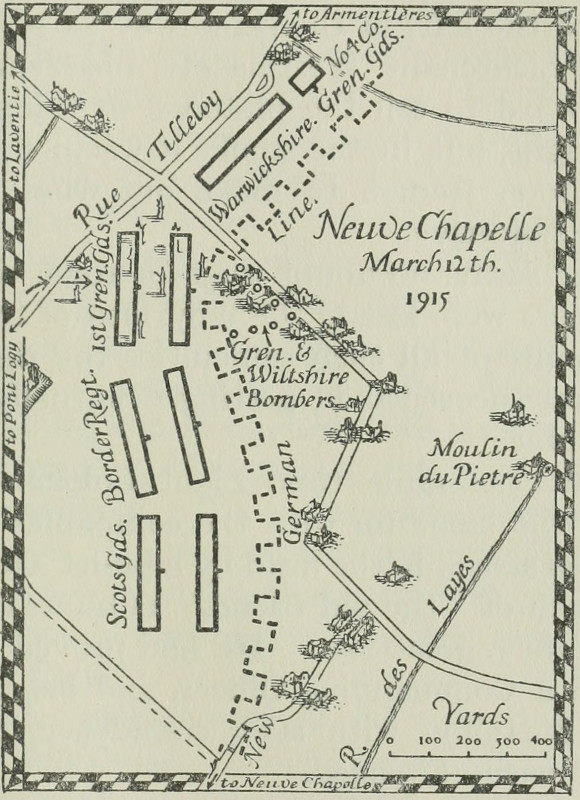
Battle of Neuve Chapelle. March 12th, 1915.
Major G. Trotter had been hit in the head by a
236shrapnel bullet, and although the wound was not
serious it placed him hors de combat for the rest of
the day.
Meanwhile, the remainder of the Battalion,
after waiting two hours, received orders to
advance, but after passing the old British line,
instead of keeping straight on, it began to
swing to the left, in the same way as No. 4 had
done. Lieutenant Westmacott, observing this,
ran forward to tell the platoons to swing round
to the right, but in the smoke it was not easy for
the platoon leaders to make out what exactly
was the objective.
There seems no doubt that for some time the
Grenadiers were lost in the labyrinth of trenches,
but in spite of all their difficulties the right half
Battalion succeeded in getting eventually to its
proper place.
About the same time Lieut.-Colonel Fisher-Rowe,
who came up with the companies in support,
was struck in the head by a bullet and killed.
The death of "the old friend," as he was always
called, was a great loss. He had proved himself
so good a Commanding Officer, and inspired the
whole Battalion with such confidence, that he
was not easily replaced.
The Scots Guards and Border Regiment having
made a most gallant assault without any bombardment
to aid them, managed to capture some
of the German front trenches, and the 1st Battalion
Grenadiers which, with the exception of
No. 4 Company, had got up to its right place,
was now ready to support them. Seeing an
opportunity of taking another bit of trench,
237Lieutenant Westmacott advanced with some men
of his company, who were able to throw their
grenades at the retiring Germans. Men of the
Wiltshire and Border Regiments joined in, and
soon bombs were flying about in every direction.
But the event which overshadowed all other
trench fighting was the advance of Captain Nicol
with his bombers. This was watched with admiration
by the whole line, and the Germans could
be seen pursued everywhere by the Grenadier
bombers, and surrendering in large numbers.
Meanwhile Private Barber advanced by himself
down one of the enemy's communication trenches
with a bag of bombs: when a bullet from one of
the enemy's snipers struck the bombs he was
carrying, he threw them away, and they exploded.
Gathering up a fresh supply from a dead man, he
rushed along, throwing them with such effect that
a large number of Germans put up their hands
and surrendered. He continued his advance until
he was shot by a sniper, and was responsible for
taking over one hundred prisoners. For this
conspicuous act of bravery he was awarded the
Victoria Cross.
Another gallant exploit was also rewarded by
the Victoria Cross. Lance-Corporal W. D. Fuller,
seeing a party of the enemy trying to escape
along a communication trench, ran towards it,
and killed the leading man with a bomb. The
remainder, finding no means of evading his bombs,
surrendered to him, although he was quite alone.
Major Nicol himself was later awarded the
D.S.O., and many thought that he should have
received the V.C.
238The enemy could be seen streaming away,
and the rifle-fire consequently dwindled to
nothing. The ground was torn up by shellfire,
so that all landmarks were obliterated, and
the dead and dying were lying about in large
numbers everywhere. Major-General Capper sent
an order to the Battalion to support the Scots
Guards by attacking a point in the German line
to their right. The order was received by Lieutenant
Westmacott, who found that the situation
had so altered since the order was written that
it would mean having his right flank in the air,
and exposed to enfilade fire. He therefore consulted
Colonel Wood, commanding the Border
Regiment, who also thought the time had passed
for an attack of this nature, and advised him to
remain where he was in support of the Scots
Guards.
Not entirely convinced, Lieutenant Westmacott
ran back to consult Major Duberly, and met
him as he was coming up with the Adjutant,
Lieutenant Fisher-Rowe. All three officers returned
to the firing trench to discuss the point
again with Colonel Wood, and although Major
Duberly was at first strongly in favour of carrying
out the order, it was eventually agreed that to
take on the attack ordered some hours ago, under
entirely different conditions, would mean practical
annihilation.
Soon afterwards orders were received for the
Battalion to withdraw to the original line fifty
yards in rear, where they remained for the night.
The only officers left with the Battalion were
Major Duberly, in command; Lieutenant Fisher-Rowe,
239Adjutant; Lieutenant Ethelston, King's
Company; Second Lieutenant C. G. Goschen,
No. 2; Lieutenant Westmacott, No. 3; Captain
Lygon, No. 4; and Second Lieutenant Duberly
with the machine-guns.
During the night Major Duberly and Captain
Lygon went up to reconnoitre the Royal Scots
Fusiliers' trenches, from which the Battalion was
expected to attack the next morning. On their
return Major Duberly went to Brigade Headquarters
to discuss the situation with General
Heyworth, who decided to go round the trenches
himself. He accordingly started off, accompanied
by Captain Lygon, and having visited the front
trench gave orders for the Grenadiers to relieve
the Royal Scots Fusiliers on the right of the line,
with a view to attacking Moulin du Piètre.
Unfortunately the rations had only just
arrived, and were being distributed when the
orders were received. As it was essential that
this move should be accomplished before daylight
it was impossible to see that each man
received his rations before the Battalion moved
off. They started at 3.30, led by Captain Lygon.
Owing to the darkness and the lines of trenches
to be crossed, progress was necessarily slow.
Though the distance was only 1000 yards, the
constant climbing in and out of trenches in the
dark, the shell-holes, and the remains of barbed-wire
obstacles, made it seem interminable.
On the way Lieutenant Westmacott, who was
standing on the parapet directing his men where
to cross over a trench, was blown up by a bomb
thrown by a wounded German who was lying close
240by. He had a wonderful escape, and although
completely stunned, he recovered sufficiently to
join his company again later in the day. The
Battalion was sadly in need of officers, and he
insisted on returning that evening in spite of his
dazed condition.
Captain Lygon led the Battalion over a maze
of wet trenches and ditches to where the Royal
Scots Fusiliers were in front of the Moulin du
Piètre, and the companies as they came up were
ordered to get into the trenches. But as the day
dawned slowly it was found that there was no
room in the trenches for the men, as the Royal
Scots Fusiliers were still there, and there was not
time for them to get away. There were but some
mere scratches in the earth, which would hardly
hold a quarter of the men. The lighter it got
the more obvious became the peril of the Battalion's
position. Major Duberly did all he could.
Absolutely regardless of danger, he went about
shouting to the men to dig themselves in where
they were, and endeavouring to establish communication
between the groups of men who were
making themselves some sort of shelter.
Soon after daybreak the firing became
intense, and the whole ground was ploughed up
with shells and furrowed with machine-gun
bullets. Major Duberly was killed early in the
day, and Lieutenant Fisher-Rowe, who came
down a communication trench filled with water,
was wounded in the leg and unable to move, just
as he had nearly reached the trench. His satchel,
containing the orders, was passed up by the men
to Captain Lygon in the front trench. The
241orders were to the effect that the Grenadiers
were to attack Moulin du Piètre in co-operation
with the Eighth Division on the right after a
bombardment, which would last from 9 to
9.30 A.M. The Gordons were to attack on the
left.
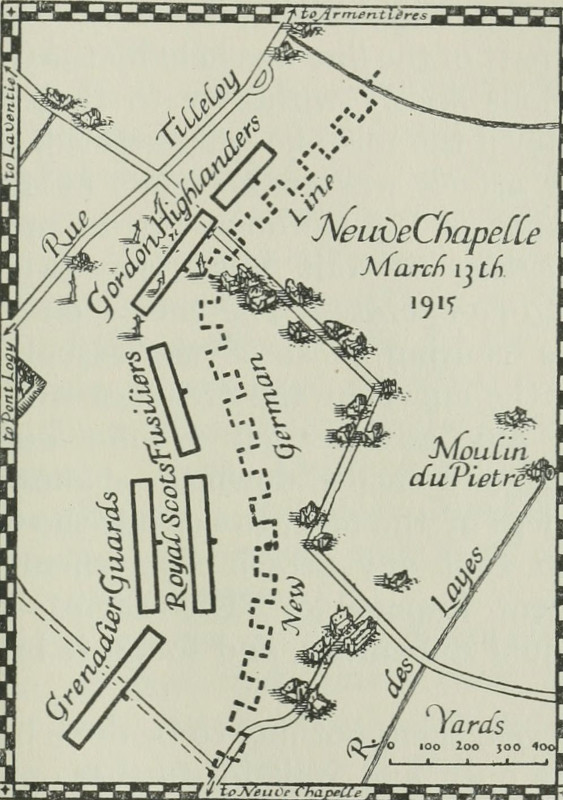
Neuve Chapelle. March 13th 1915.
Captain Lygon, on whom the command of
the Battalion now devolved, found himself in
a position of extreme difficulty. Owing to the
distances between the groups he had no means of
sending messages to the men on the right and left,
and the roar of musketry and bursting shells made
all communication by word of mouth out of the
242question, though it was evident that before an
attack could be carried out with any prospect of
success, the men would have to be formed up and
got into some sort of order, in spite of the withering
fire.
To make matters worse, some of our own heavy
guns were dropping shells on the trenches occupied
by the Gordon Highlanders, under the impression
that that part of the line was held by the Germans.
The Gordons wisely withdrew to their support
trenches until the mistake was rectified.
As our attack was to be made at the same
time as that of the Gordons, it was more than
ever necessary to wait until they were in a
position to co-operate. The enemy on the right
front was causing most of the casualties, and
owing to the curve in the trenches would have
enfiladed any advance on Moulin du Piètre.
Captain Lygon wriggled down the shallow trench,
over the legs of the men, to consult the Gordons,
but found that any attack from them was for
the moment impossible. The Eighth Division
was in equal difficulties, and found it impossible
to attack.
There was, then, nothing to be done but to lie
out in the open and wait for further orders, and
in the infernal din of shell-fire the Battalion went
through a terrible ordeal. The shallow scratches
they had managed to dig gave little protection,
and the casualties were consequently very heavy.
One incident may be quoted to give some idea of
the way in which the men's nerves were strained.
Two men were observed to get up and walk about,
and were shouted at, and told to lie down. All
243they did was to smile inanely, and very soon, of
course, they were shot by the enemy. They had
gone clean off their heads.
Twice orderlies were sent back with a report
of the position occupied, and when it was dark
Captain Lygon sent Lieutenant Westmacott to
report the situation to Brigade Headquarters,
while the Gordon Highlanders sent a subaltern
on the same errand.
Captain Petit with the stretcher-bearers behaved
in the most gallant manner, and succoured
the wounded oblivious of shells and bullets.
Orders were at last sent to the Grenadiers and
Gordon Highlanders to withdraw, and to march
to Laventie, but owing partly to a mistake on
the part of the guides, partly to the darkness,
the Battalion did not reach its billets until 2 A.M.
The only three officers left with the Battalion now
were Captain Lygon, Lieutenant Goschen, and
Lieutenant Duberly; but Major Trotter, who had
recovered from his wound, met them on arrival,
and took over command.
It was a source of deep disappointment to
the men to feel that many lives had been
lost, and little accomplished. On each day the
Battalion had been given a very difficult and
intricate task, and it was entirely owing to the
indomitable pluck of the men that, in spite of all
their difficulties, they had invariably succeeded
in reaching their destination.
The casualties in the Battalion at Neuve
Chapelle were 16 officers and 325 N.C.O.'s and
men. Lieut.-Colonel L. R. Fisher-Rowe, Major
G. W. Duberly, Captain the Hon. G. H. Douglas-Pennant,
244Captain E. F. F. Sartorius, Lieutenant H.
W. Ethelston, Lieutenant Lord Brabourne, Lieutenant
M. A. A. Darby, Second Lieutenant C. F.
Burnand, Second Lieutenant A. C. Foster, Second
Lieutenant R. Gelderd-Somervell were killed, and
Major G. F. Trotter, D.S.O., Lieutenant C. V. Fisher-Rowe,
Second Lieutenant C. T. R. S. Guthrie,
Second Lieutenant Lord William Percy, Second
Lieutenant G. R. Westmacott, and Second Lieutenant
A. L. St. J. Mildmay were wounded.
The total British losses during three days'
fighting were: 190 officers and 2337 other ranks
killed, 359 officers and 8174 other ranks wounded,
and 23 officers and 1728 other ranks missing.
Ten days later Major-General Capper sent the
following message to the Battalion:
The Divisional General has now received the report
on the action of Neuve Chapelle on March 10-14. He
desires to express his appreciation of the steady conduct
of the 1st Battalion Grenadier Guards, which maintained
a difficult position in the open under very adverse circumstances.
The conduct of Lance-Corporal W. Fuller and
Private T. Barber and the grenade-throwers of this
Battalion commands the admiration of every one who
heard of their exploits, and testifies in the highest degree
to the gallant spirit which animates this Battalion.
At the end of the month the Commanding
Officer conveyed to the Battalion stretcher-bearers
a message received from the G.O.C.
Seventh Division, expressing his appreciation
of the courage and devotion to duty displayed by
them during the recent action.
Moreover, when Sir John French, the Commander-in-Chief,
inspected the Battalion with the
245rest of the 20th Brigade in April, he made them
a short but most impressive speech, in which
he praised their conduct at Neuve Chapelle, and
referred to the heavy losses they had suffered.
He made a special reference to the gallant death
of Lieut.-Colonel Fisher-Rowe.
In a private letter written by command of
the King to Colonel Streatfeild, Lieut.-Colonel
C. Wigram said:
The King has read your letter of the 17th inst., and
is much distressed to hear how terribly the 1st Battalion
suffered. It is indeed heart-breaking to see a good
Battalion like this decimated in a few hours. His
Majesty has heard from the Prince of Wales, who has
seen the remnants of the Battalion, and he told His
Majesty how splendidly they had taken their losses.
Major G. Trotter, in spite of his wound in the
head, insisted on returning, and took command
of the Battalion, and Lieutenant Charles Greville,
who had rejoined the Battalion on the last day
of the battle of Neuve Chapelle, was appointed
Adjutant. Captain Nicol and Lieutenant C.
Mitchell, who had been employed at Brigade
Headquarters, returned to the Battalion.
On the 15th Major Lord Henry Seymour and
Captain J. Hughes came from the 2nd Battalion.
On the 20th a draft of 350 men arrived with the
following officers: Captain M. Maitland, Captain
G. C. G. Moss, Lieutenant the Earl of Dalkeith,
Lieutenant Lord Stanley, Second Lieutenant the
Hon. C. Hope Morley, and Second Lieutenant A.
B. Lawford.
On the 21st Lieut.-Colonel C. Corkran arrived
and took command of the Battalion, and on
246the 24th Lieutenant C. Mitchell was appointed
Adjutant in the place of Lieutenant C. Greville,
who proceeded to Brigade Headquarters for
duty with the Grenade Company.
The greater part of the rest of the month was
spent in billets, when the Battalion was reorganised,
but the usual routine was followed, and
the Battalion took its turn in the trenches.
April.
Nothing worth recording happened in April.
The days that were spent in the trenches were
uneventful, and when in reserve the Battalion
went into billets at Estaires. On the 2nd, Lieutenant
Corry and Lieutenant St. Aubyn, on the
21st a draft of thirty men under Second Lieutenant
C. Dudley Smith, and on the 27th Captain
F. L. V. Swaine, Second Lieutenant E. O. R.
Wakeman, and Lieutenant L. E. Parker joined
the Battalion.
May.
The first few days in May were spent in the
trenches, which the enemy's artillery at times
shelled very heavily. It was thought at first
that this denoted an attack, but although the
Battalion stood to arms nothing serious in the
way of an attack developed. On the 3rd Captain
J. Morrison was wounded, and there was a certain
number of casualties. On the 2nd Captain T.
Dickinson, 16th Cavalry, Indian Army, was
attached to the Battalion, and on the 12th
Captain W. S. Pilcher arrived.
On the 9th the 1st Battalion Grenadiers with
the remainder of the 20th Brigade moved up
to the support trenches in rear of the Eighth
Division, but was not called upon to go into
action.
CHAPTER XI THE BATTLE OF FESTUBERT — The 1st Battalion — The 2nd Battalion.
247
May 1915.
In May the French resolved to make a determined
attack on the German line in Artois, and in order
to prevent the enemy moving up any reinforcements
to support that part of the line, Sir
John French agreed to attack simultaneously at
Festubert, where the German Seventh Corps was
posted.
May 9.
Sir Douglas Haig, who was entrusted with
the task, began operations on May 9, when the
Eighth Division captured some of the enemy's
first-line trenches at Rougebanc, while the First
and Indian Divisions attacked south of Neuve
Chapelle. But the enemy's positions proved
much stronger than had been expected, and little
progress was made in either place. During this
attack the 1st Battalion Grenadiers was never
engaged, but remained in close support. Lieut.-Colonel
Corkran himself accompanied the Eighth
Division, and remained with it in case the services
of the Battalion should be required.
May 10-11.
A second attack was made by the Eighth
Division east of Festubert on the 10th, preceded
248by a long artillery bombardment, the Seventh
Division remaining in reserve. During the interval
between the attacks of the 9th and 15th,
the Seventh Division was brought up on the right
of the First Corps, the Canadian Division being
in support, while the Indian Corps still remained
on the left.
On the night of the 10th the 1st Battalion
marched to Bethune, where it was billeted in a
tobacco factory, and on the 11th moved to Hinges.
The roll of officers of the Battalion was as follows:
Lieut.-Colonel
C. E. Corkran,
C.M.G., Commanding Officer.
Major
G. F. Trotter,
M.V.O.,
D.S.O., Second in Command.
Lieut. C. Mitchell, Adjutant.
2nd Lieut. E. H. J. Duberly, Machine-gun Officer.
Lieut. J. Teece, Quartermaster.
Capt. M. E. Makgill-Crichton-Maitland, King's Company.
Capt. W. S. Pilcher, King's Company.
Lieut. F. C. St. Aubyn, King's Company.
Lieut. Lord Dalkeith, King's Company.
2nd Lieut. C. G. Goschen, King's Company.
Capt. F. L. V. Swaine,
No. 2 Company.
Lieut. Lord Stanley,
No. 2 Company.
Lieut. R. P. de
P. Trench,
No. 2 Company.
2nd Lieut. C. Dudley Smith,
No. 2 Company.
Capt. J. S. Hughes (attached from
2nd Batt.),
No. 3 Company.
Lieut. O. Wakeman,
No. 3 Company.
2nd Lieut. P. K. Stephenson,
No. 3 Company.
2nd Lieut. L. E. Parker,
No. 3 Company.
Capt. G. C. G. Moss,
No. 4 Company.
2nd Lieut, the
Hon. C. Hope Morley,
No. 4 Company.
2nd Lieut. A. B. Lawford,
No. 4 Company.
2nd Lieut. E. O. R. Wakeman,
No. 4 Company.
Capt. W. E. Nicol, Grenade Company.
Capt. C. H. Greville, Grenade Company.
Attached—
Lieut. F. M. Dickinson.
249
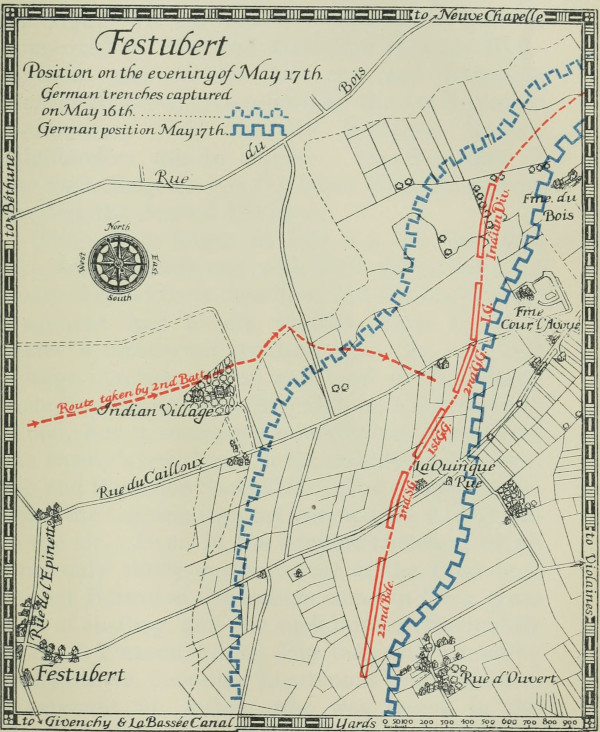
Festubert. Position on the evening of May 17th.
May 15.
On the 15th the Seventh Division moved up
to the trenches north of Festubert, and the 1st
Battalion Grenadiers marched to the assembly
trenches in and around Dead Cow Farm. The
attack was opened by the 20th Brigade. On
the right was the 2nd Battalion Scots Guards,
supported by the 2nd Battalion Gordon Highlanders,
and on the left the 2nd Battalion
Border Regiment, supported by the 1st Battalion
Grenadiers, while the 6th Battalion Gordon
Highlanders was in reserve. On the right of
the 20th Brigade was the 22nd Brigade, and on
the left the Second Division.
May 16.
The attack began at 3.15 A.M. on the 16th.
The Scots Guards met with little opposition, and
easily secured their objective, but the 2nd Border
Regiment had hardly started when it came
under a murderous machine-gun fire. It lost
a large number of men and most of its officers,
including the Commanding Officer, Lieut.-Colonel
Wood, but it succeeded nevertheless in reaching
the enemy's trenches. In the meantime, however,
the 2nd Battalion Scots Guards had pushed on beyond
the German support line, so that its left was
in the air. Even in the support trenches, which
were only thirty yards in rear of the front line,
the 1st Battalion Grenadiers came in for a great
deal of shelling, and one shell burst in the middle
of No. 8 Platoon, killing four men and wounding
many others, including Lieutenant Dickinson and
Lieutenant St. Aubyn, who was struck in the
face by a piece of shrapnel. All the time a stream
of wounded from the front trenches was passing
by, some walking and some on stretchers.
250The machine-guns under Lieutenant Duberly
were sent up to support the Scots Guards, and
helped them greatly. With a view to protecting
their left flank, the 1st Battalion Grenadiers
was now ordered forward. It was about 10 A.M.
Lieut.-Colonel Corkran, who saw clearly that
his Battalion would share the same fate as
the Border Regiment, if they advanced against
the machine-guns, which had inflicted such loss,
decided to move his Battalion farther to the
south, and advance from the original forming-up
trench of the 2nd Battalion Scots Guards,
where a communication trench was being constructed
by the Gordon Highlanders. Down
this trench the 1st Battalion rushed, jumping
over a mass of wounded men as it went,
and when it reached the German front-line
trench, the King's Company under Captain
Maitland, and No. 3 under Captain Hughes,
remained to consolidate it, while No. 4 under
Captain Moss, followed by No. 2 under Captain
Swaine, pushed on to prolong the left of the
Scots Guards.
Lieut.-Colonel Corkran met Lieut.-Colonel
Cator, commanding the 2nd Battalion Scots
Guards, and discussed the situation, which was
very obscure. One and a half companies of the
Scots Guards had most gallantly pushed on right
through the German lines, and had completely
lost touch with the rest of the Battalion. It
was afterwards discovered that they had been
surrounded, and cut off by the enemy. The
left of that Battalion was consequently in the
air. It was determined that the Scots Guards
251and No. 2 Company Grenadiers under Captain
Swaine should consolidate the line they had
reached, namely, the German third line; No. 4
Company under Captain Moss was to advance
over the open on the left, and attack a small
house still held by the enemy about six hundred
yards off; No. 3 Company under Captain Hughes,
from the original German front trench, was to
make a bombing attack down a German communication
trench leading apparently to the
small house; and the King's Company under
Captain Maitland was to remain where it was in
the German front trench in reserve.
Captain Hughes with No. 3 Company made a
most successful advance down the German trench,
clearing about three hundred yards of it, and
killing a number of Germans, while the bombers
under Captain Nicol were equally successful down
another German communication trench in which
they captured a large number of prisoners. But
the advance of No. 4 Company was held up almost
immediately by machine-gun fire from the small
house. The leading platoon under Lieutenant
E. O. R. Wakeman was practically annihilated,
and its gallant commander, as he pluckily led his
men on to this death-trap, was killed. Second
Lieutenant C. Hope Morley was struck by a
bullet in the eyes and blinded. Finding any
farther advance impossible, No. 4 Company
received orders to prolong the left of No. 2
Company, and keep in touch with No. 3 Company,
which was in the German communication
trench.
At 1 P.M. Lieut.-Colonel Corkran went back to
252the 22nd Brigade Headquarters, and got into
communication by telephone with General
Heyworth, who ordered him to push his Battalion
as far forward as he could and assist
any advance made by the 22nd Brigade on the
right.
Rain began to fall at 6 P.M., and grew into
a steady downpour. The two companies, which
had been moved up on the left of the Scots Guards,
found themselves in some old German trenches,
which had to be reconstructed, as they faced the
wrong way, and would have been lamentably
weak if they had been left as they were. In
these ill-covered trenches the men were soaked
to the skin, and spent a miserable night, which
was not improved by the fact that all the
time the officers were busy in getting them
into their right order, so that they might be
ready to attack at daybreak. Everywhere the
wounded, both British and Germans, lay about
groaning.
Lieut.-Colonel Corkran, having returned to
his Battalion, sent Major G. Trotter to the 22nd
Brigade Headquarters as liaison officer, so that
close touch might be kept with it.
As soon as it was dark, No. 2 Company was
ordered to establish itself as close to the small
house as possible and to dig itself in, at the
same time gaining touch with No. 3 Company in
the German communication trench. The King's
Company was to fill up the gap in the line created
by the advance of No. 2. It was hoped that the
small house might be rushed, but when No. 2
pushed forward it came under such a heavy
253machine-gun fire that it had to abandon all
idea of seizing the house. It had accordingly
to leave one platoon to hold the line, which it
had gained, and to return to the main line.
May 17.
Early next morning the 1st Battalion advanced
another 400 yards, and the men began to dig
themselves in, but as the rain continued in
torrents the trenches were knee-deep in mud,
and it was difficult to provide adequate shelter
from the enemy's artillery.
It was while the 1st Battalion was lying in
this position that the 4th Guards Brigade was
observed coming up in artillery formation, under
a hail of shells and bullets; and—a memorable
incident—the 1st and 2nd Battalions Grenadiers
suddenly found themselves fighting side by
side.
Although the Seventh Division had carried
several lines of trenches, the part of the German
line opposite the extreme left of the 20th Brigade
was still in the hands of the enemy. In certain
sections of the line the attack had been most
successful, while in others the enemy had offered
a stubborn resistance. Thus the advance had
not been uniform, and there were consequently
several places where the German machine-guns
were able to enfilade our men. But, in spite of
the constant counter-attacks, the enemy had not
been able to retake any considerable portion of
the ground they had lost on a front of over two
miles.
On the evening of the 17th the 21st Brigade
received orders to relieve the 20th Brigade, and
the 1st Battalion Grenadiers consequently withdrew
254to the second line, where it remained
throughout the 18th.
May 19.
The attack continued next day with varying
results. As the weather was heavy, artillery
observation was difficult, and the guns were
unable to support the infantry attacks. The
1st Battalion Grenadiers was ordered back to
Brigade Headquarters in the Rue du Bois, where
it bivouacked in a field, and presently moved
back to Hinges.
Thus ended the first phase of the battle of
Festubert. The Second and Seventh Divisions
had succeeded in cutting two gaps in the German
line, but unfortunately between the two gaps
there lay an untouched and strongly held line,
stretching for nearly three-quarters of a mile,
which made any farther advance a matter of
great difficulty.
On the 20th of May the attack was renewed by
the Canadian Division, and on the 24th the Forty-seventh
London Territorial Division joined in, but
although considerable progress was made, and a
large number of Germans accounted for, our defective
ammunition supply did not at that time
allow us to compete with the Germans on even
terms. The net result of the battle was that we
pierced the enemy's lines on a total front of four
miles. The whole first-line system of trenches
was captured on a front of 3200 yards. The
total number of prisoners taken was 8 officers
and 777 of other ranks, and a number of machine-guns
were captured and destroyed.
255
The following is the list of officers of the 2nd
Battalion at the battle of Festubert:
Lieut.-Colonel
W. R. A. Smith,
C.M.G., Commanding Officer.
Major
G. D. Jeffreys, Second in Command.
Lieutenant the
Hon. W. R. Bailey, Adjutant.
2nd Lieut. D. Abel-Smith, Machine-gun Officer.
Lieut. W. E. Acraman, Quartermaster.
Major Lord Henry Seymour,
No. 1 Company. (Brigade Transport Officer)
2nd Lieut. J. N. Buchanan,
No. 1 Company.
2nd Lieut. A. H. Penn,
No. 1 Company.
Capt. P. A. Clive,
No. 2 Company.
Capt. G. L. Derriman,
No. 2 Company.
2nd Lieut. J. C. Craigie,
No. 2 Company.
2nd Lieut. Viscount Cranborne,
No. 2 Company.
2nd Lieut. the
Hon. P. P. Cary,
No. 2 Company.
Major
B. H. Barrington Kennett,
No. 3 Company.
Lieut. A. V. L. Corry,
No. 3 Company.
2nd Lieut. C. O. Creed,
No. 3 Company.
2nd Lieut. R. S. Corkran,
No. 3 Company.
Major
C. R. C. de Crespigny,
No. 4 Company.
Capt. I. St. C. Rose (Divisional Observation Officer),
No. 4 Company.
2nd Lieut. E. G. Williams,
No. 4 Company.
2nd Lieut. O. Lyttelton,
No. 4 Company.
2nd Lieut. the
Hon. G. S. Bailey,
No. 4 Company.
Attached—Captain
F. G. Howell,
R.A.M.C.
May 16.
The 4th Brigade did not take part in the first
phase of the battle, and on the 16th it was moved
up to the old line of breastworks at Rue du
Bois, to support the 6th Brigade. The 2nd
Battalion Grenadiers and Irish Guards were
placed immediately behind the 6th Brigade,
256while the two battalions of Coldstream remained
still farther back. The attack of the 5th and 6th
Brigades was successful, and the first German line
of trenches was taken, but the Indian Division
was held up, and could not advance as the barbed
wire had not been destroyed.
The 2nd Battalion Grenadiers was not called
on to do anything that day, and remained
behind the breastworks, where it was subjected
to a heavy shelling. Although there were few
casualties, the noise was terrific, for not only were
the enemy's shells dropping all round, but our
own artillery was firing just over the men's heads.
It stood by all day, and withdrew in the evening
to Lacouture.
May 17.
Next day the 4th Brigade was sent up into
the front line. The men had breakfast at
3.30 A.M., an unusually early hour even for those
about to take part in the fighting, and after
standing by all the morning marched at 1 P.M.
to Le Touret, where they received orders to make
good the line of La Quinque Rue. This involved
not only getting up to the front line, but also
attacking La Quinque Rue, which ran about
five hundred yards east of it. The Germans
were systematically shelling all the roads leading
to the trenches, and it was therefore some time
before the 2nd Battalion Grenadiers could be
moved up in artillery formation across the open
via Cense du Raux Farm, Rue de l'Epinette,
and the hamlet known as "Indian Village."
When it reached the supports of the front
line, it was by no means easy to ascertain
precisely what line the Battalion was expected
257to occupy. Units had become mixed as the
inevitable result of the previous attack, and it
was impossible to say for certain what battalion
occupied a trench, or to locate the exact front.
An artillery observation officer helped, however,
by pointing out the positions on the map.
It was not till late in the afternoon that the
2nd Battalion began to move up into the front
line. Progress was necessarily slow, as after
the heavy rain the ground was deep in mud, and
the shell-holes were full of water. It advanced
gradually through a maze of old British and
German trenches, much knocked about and
obstructed with troops' material and a great
many wounded, and passed through the Scots
Fusiliers, the Border Regiment, and the Yorkshire
Regiment. Its orders were to pass over
what had originally been the German front line,
and to establish itself about five hundred yards
from the German trench at La Quinque Rue.
The 5th and 6th Brigades had in the meantime
been sent back in reserve, while the Canadian
Division had been ordered to come up on the right
and take the place of the 20th and 22nd Brigades.
It was dark before the 2nd Battalion Grenadiers
reached the line it was ordered to occupy. The
men had stumbled over obstacles of every sort,
wrecked trenches and shell-holes, and had finally
wriggled themselves into the front line. The
enemy's trenches over which they passed were
a mass of dead men, both German and British,
with heads, legs, and other gruesome objects
lying about amid bits of wire obstacles and
remains of accoutrements. Lieut.-Colonel Smith
258had originally intended to launch the attack on
La Quinque Rue at once, but decided to wait
until dawn. Brought up in the dark to an
entirely strange bit of country, without any landmarks
to guide him, or any means of reconnaissance,
and not even certain as to what troops
were on each flank, the Commanding Officer was
faced with many anxious problems.
The 4th Brigade, however, was no novice at
this type of fighting, and it was astonishing to
see how quickly the men settled down. The
2nd Battalion Grenadiers was on the right, the
Irish Guards on the left, while the 1st and 2nd
Battalions Coldstream were in reserve some way
back. Lieut.-Colonel Smith ordered Major
Jeffreys to take charge of the front line, while
he remained in the proper place assigned to the
Commanding Officer, which was with the supports.
No. 2 Company under Captain P. Clive
on the right, and No. 3 under Major Barrington
Kennett on the left were in the firing line, and
No. 1 under Lord Henry Seymour, and No. 4 under
Major C. de Crespigny were in reserve, in some old
German breastworks. As No. 1 Company moved
up, Second Lieutenant A. H. Penn was shot by a
sniper through both legs.
By a curious coincidence the 1st Battalion
Grenadiers in the Seventh Division was immediately
on the right, so that for the first time in
the war the 1st and 2nd Battalions were side by
side in the line. Second Lieutenant C. J. Dudley-Smith
came over from the 1st Battalion to get
touch, and to his surprise found himself amongst
brother officers.
259The men had only their little entrenching tools,
and with these they dug frantically, and managed
to scrape up some sort of protection before the
morning. The Germans fired a good deal at first,
but finding it difficult to locate exactly the position
of the line they determined later to save
their shells, and as the morning went on did not
molest the Battalion much. The Battalion Headquarters
and Reserve Companies came in for a
lot of shelling, but owing to the soft ground many
shells failed to explode. Sleep in such an advanced
position was out of the question, more
especially as every moment was precious.
May 18.
The 4th Brigade was ordered to attack a point
marked P 14 and Cour l'Avoué at 9.30 A.M., but
owing to the mist and bad weather the attack
was indefinitely postponed, and the 2nd Battalion
had to remain all day in its hastily made trench,
which really offered very little resistance to
artillery fire. The weather cleared about 10 A.M.
and the enemy began a terrific bombardment,
which made things very unpleasant, although it
did very little actual damage. It was not till
3.45 P.M. that the 2nd Battalion received orders
to attack at 4.30 P.M., which gave no time for
adequate preparation. Soon afterwards a second
message arrived to the effect that, if the Canadians
were late in relieving the 20th Brigade on the
right, the attack was not to be delayed, although
there would necessarily be a gap on that flank.
The front of the Canadian attack was to
extend to the left, so that it overlapped No. 2
Company. The attack was therefore to be made
by No. 3 Company alone, although a platoon from
260No. 2 was to be pushed forward as far as the
barricade.
Our guns began their preparation about forty
minutes before the attack was ordered, and
although they undoubtedly did a good deal of
damage, they never succeeded in knocking out
the enemy's machine-guns, which remained hidden
during the bombardment. The advance was
made by No. 3 Company in short quick rushes by
platoons, but as the ground was very flat, with
no possible cover from the machine-guns, the men
never had any real chance of reaching the German
trenches. The distance was about 600 yards, and
the ground was intersected with ditches full of
water. The first platoon was mown down before
it had covered a hundred yards, the second melted
away before it reached even as far, and the third
shared the same fate. The Irish Guards on the
right attacked on a much wider front, but were
also held up by the machine-guns which swept
the whole ground. It was magnificent to see the
gallant manner in which they brought up reinforcements
on reinforcements, unfortunately with
no success.
In the first rush of the Grenadiers Major
Barrington Kennett was killed, and Second Lieutenant
the Hon. P. Cary was hit soon afterwards.
Second Lieutenant Creed was mortally wounded
as he rushed on to the attack, and died of his
wounds some days later. The only officer left in
the Company was Lieutenant Corry, who behaved
with great gallantry when the enemy's machine-guns
opened fire with a storm of bullets.
Lieutenant Lord Cranborne who commanded
261the platoon from No. 2 Company, which had been
pushed up as far as the barricade, was completely
deafened by the shells which burst incessantly
round his platoon during the attack. Lieut.-Colonel
Smith was struck in the head by a
bullet as he watched the attack from behind a
mound of earth, and though he was carried by
Major Jeffreys and Major Lord Henry Seymour
into a place of safety, and eventually taken to
the dressing-station, he never recovered consciousness,
and died the following day. He was
buried in the British Soldiers' Cemetery near Le
Touret, and his funeral was attended by Lord
Cavan and many officers and non-commissioned
officers of his battalion. Never was a Commanding
Officer more mourned by his men; he had
endeared himself to them by his soldier-like
qualities and constant care for their welfare. He
was a gallant and distinguished soldier, imperturbable
in action, never flurried or disconcerted in
perilous situations, a strict disciplinarian, but the
kindest and best of friends, and his loss was
keenly felt by all ranks of the regiment.
Major Jeffreys, now in command of the Battalion,
ordered No. 2 Company to reinforce No. 3
and continue the attack, but Captain Clive represented
that it would be practically impossible
for his Company to cross over the exposed ground
under so heavy a fire. The enemy's machine-guns
were absolutely undamaged, and commanded
the ground over which it would be necessary to
pass, and Major Jeffreys was forced to the
conclusion that it would be merely throwing
men's lives away to ask them to advance.
262At this moment Captain Lord Gort (Brigade-Major)
came up to investigate the situation,
and Major Jeffreys told him that he did not
propose to renew the attack until darkness
gave the Battalion some chance of reaching the
objective.
Lord Cavan, on hearing from Lord Gort how
matters stood, sent orders to the 2nd Battalion to
dig in where it was. It had gained 300 yards,
and before it could possibly advance any farther
it would be necessary to wait until the Canadians
came up on the right. Soon after dark the
Canadians arrived, and, true to their reputation,
carried out their attack in a very dashing manner.
They met with very little opposition at first, and
got on very well until they were stopped by
machine-gun fire. In all probability, if the two
attacks had taken place simultaneously, there
would have been a far greater prospect of success,
but, as things happened, first the 4th Brigade and
then in turn the Canadians drew on themselves
the attention of all the German troops in that
part of the line.
Major Jeffreys contemplated a combined attack
all down the line by night, but the Corps Commander
sent instructions that the 4th Brigade
was to remain where it was, and join up with
the Canadians. So another gruesome night had
to be spent amongst the dead and dying, and the
men had to work hard to make the trench fit to
remain in.
May 19.
All the next day the 2nd Battalion held this
line, and came in for a great deal of shell-fire, but
the trenches that had been dug during the night
263proved sufficient protection, and there were not
many casualties. That night the 2nd Battalion
Grenadiers was relieved by the 3rd Battalion
Coldstream, and went into reserve with the rest
of the Second Division.
CHAPTER XII MAY TO SEPTEMBER 1915 — Diary of the War — The 1st Battalion
264
1915. April, May, June.
At the end of April, Hill 60 near Ypres was taken
by the Second Corps under Lieut.-General Sir
Charles Fergusson, and was lost again early in May
when the enemy used gas. The second battle
of Ypres began on May 10, and will always be
notorious for the treacherous use of poisonous gas
by the Germans. The British Army was totally
unprepared for this treachery, and had no gas
helmets of any kind, yet such was the tenacious
courage displayed by it that the Germans were
unable to do more than drive the line back a
certain distance. It was in this battle that the
Canadians greatly distinguished themselves. The
battle of Festubert was the principal offensive
at the end of May, although there was continual
fighting in other parts of the line.
On May 22 Italy joined the Allies, and declared
war on the Central Powers. This was a great
blow to the Germans, who had fondly hoped that
Italy would remain at least neutral, and it completely
altered the situation in Central Europe.
The Gallipoli Campaign commenced, and the
British and French troops effected a landing at the
265extremity of the Peninsula near Krithia in April.
In Mesopotamia operations against the Turks were
carried forward under great difficulties, while a
Turkish Army under the command of German
officers made an unsuccessful attempt to cross the
desert and attack Egypt. In German South-West
Africa General Botha succeeded in pushing his
way into the enemy's country, and in capturing a
large number of prisoners.
The Zeppelin raids on London and the East
Coast began, and as there were practically no
defences at the time the Germans were able to
carry them out with impunity.
In April the Russian Army continued its advance
in Austria, but was gradually driven back
by General von Mackensen's German Army. In
the extreme north the Germans, supported by
their Baltic Squadron, captured the Russian port
of Libau. The Austrian Army was now being reorganised
by the German General Staff, and by the
end of June the combined Austrian and German
Armies had recaptured Przemysl and Lemberg,
and driven the Russians back over the frontier.
With the exception of continual fighting round
Ypres no serious operation was undertaken by
the British Army until September, when the
battle of Loos was fought.
The Russians were slowly driven out of Poland
by the Germans, but had some successes in Galicia.
A second landing on the Gallipoli Peninsula
was effected at Suvla Bay, and some farther
advance was made later.
The conquest of German South-West Africa
was completed by General Botha.
266
For the remainder of May the Battalion
remained in billets at Robecq. On the 22nd a
draft of sixty men arrived, and on the 29th Second
Lieutenant Viscount Lascelles, and on the 30th
Second Lieutenant F. E. H. Paget joined the
Battalion.
On the 23rd, after Divine Service, Major-General
Gough, commanding the Seventh Division,
after going round the billets made a short
speech to each Company, and afterwards talked
to a large number of men, which greatly pleased
them.
On the 27th the Division was inspected by
General Joffre, the French Commander-in-Chief.
The three brigades were drawn up in one field in
mass, the artillery being in an adjoining field.
General Joffre was received with the general
salute, and walked down the front of the line.
After giving three cheers the whole of the infantry
marched past in fours, being played past by the
massed pipers of the Division.
On the 31st the sad news of the death of
Brigadier-General G. C. Nugent was received.
He had served for many years in the Grenadiers
before he was transferred to the Irish Guards,
and his unrivalled wit and literary talents had
long delighted the readers of the Guards Magazine.
He was a man of exceptional ability, and there is
small doubt that had he lived he would have
risen to high distinction.
June.
The Battalion went into a new line of trenches
in front of Festubert and Givenchy, which it took
267over from the 6th and 18th Battalions of the
London Regiment. On June 3 these trenches
were very heavily shelled, as the 6th Battalion
Gordon Highlanders was making an attack
farther to the right, and there were 3 men killed
and 45 wounded. On the 5th the Battalion went
into billets at Hingette, and on the 8th moved to
Robecq, thence to Essars, where it remained until
it relieved the Border Regiment in the trenches
on the 14th.
On the 15th an attack was made by the Seventh
Division over some flat ground between two rises
at Givenchy. The portion allotted to the Battalion
was on the flat ground, where an advance
was not a matter of great difficulty, but until the
rises on each side had been made good it was
useless to attempt to press the attack home in
the centre. After going a short distance, the
Battalion was forced to wait until the situation
on each flank developed. Owing to the nature of
the ground the artillery was unable to dispose of
the wire entanglements behind these rises, and
therefore the Battalions on each side were held
up. During this engagement Second Lieutenant
Dudley-Smith was killed, Lieut.-Colonel Corkran
slightly wounded, and Second Lieutenant Viscount
Lascelles wounded in the head. There were
sixty-three casualties among the N.C.O.'s and
men. The Battalion hung on all day under
heavy shell-fire to the line it had gained, but
it was found impossible to advance farther on
the flanks, and the whole force withdrew to its
original line.
Lord Cavan wrote in a private letter: "I am
268proud to say that the old 1st Battalion stuck it
out last night and to-day in glorious isolation.
Pray God they are fed, watered, and replenished
to-night. I wrote to Heyworth to pass them a
word of encouragement from me if he could."
On the 19th the Battalion was relieved by the
Royal Welsh Fusiliers, and went into the reserve
trenches in front of Gorre, and on the 21st into
billets at Les Choqueaux. On the 24th it returned
to the trenches between Givenchy and La
Bassée Canal, and on the 27th was relieved by
the Border Regiment, and went into billets at
Le Preol.
On the 20th Lieutenant Sir A. Napier joined,
and on the 23rd a draft of sixty-seven men
arrived under Lieutenant R. Wolrige-Gordon and
Second Lieutenant G. J. T. H. Villiers.
Lieut.-Colonel Corkran wrote to Colonel
Streatfeild, and asked that some drums and
fifes might be sent out, and Lord Derby, who
paid a visit to the Battalion, promised to procure
them and send them out. In the meantime
eight men with some musical skill came forward,
and offered to form a drum and fife band. The
instruments arrived at the end of the month, and
were a great success. The band now consisted
of six drums and twelve fifes, and marched at
the head of the Battalion for the first time on
the 30th, when it moved to billets at Busnes.
July.
The Battalion had a good rest, and remained in
billets till the 17th of July, when it relieved the
Yorkshire Regiment in the trenches at Quinque
Rue.
July 1915.
On the 13th Lieut.-Colonel Corkran was promoted
269to the rank of Brigadier-General, and
given command of the 5th Infantry Brigade.
His departure was much regretted by the whole
Battalion, which had the greatest confidence in
him. Major G. Trotter then assumed command,
and his appointment as Commanding Officer
was confirmed about a week later, and gave universal
satisfaction.
The Battalion remained in the trenches from
the 17th till the 26th, when it withdrew into
billets at Calonne. During the time it was in
the trenches there were but few casualties, among
them Lieutenant C. G. Goschen, who was wounded
in the thigh.
While the Brigade was in billets the officers
of the 1st Battalion entertained the officers of
the 2nd Battalion at dinner. The Prince of
Wales and Captain Lord Claud Hamilton also
attended. A few days later the coming of age
of Lord Stanley gave another opportunity for a
gastronomic triumph composed mainly of bully
beef and Maconochie rations. The flies in these
hot days became unbearable, and fly-traps and
fly-papers were sent out in some measure to
mitigate this plague.
On August 3 the Battalion received orders
to join the newly formed Guards Division. It
was not without regret that it left the Gordon
Highlanders and Border Regiment, alongside of
whom it had fought for nearly a year, and with
whom it had shared the glorious reputation
which had been earned by the Division. All
the battalions of the Division prepared entertainments
to bid them farewell, but the notice
270was so short that these invitations could not be
accepted.
On the 4th the Battalion was inspected by
General Gough, the Corps Commander, who
wished it God-speed in a short speech, after
which it marched to Molinghem. The remainder
of the 20th Brigade turned out, and
lined the streets of Robecq, through which it
passed, while the band of the Seventh Division
and the pipers of the 2nd Gordon Highlanders
played it out of the divisional area. On the
5th the Battalion marched to Nizernes, and was
met by the drums and fifes of the 3rd Battalion
Grenadiers.
Lieutenant Lord Stanley, who was suffering
from sciatica, refused to go sick, and in order to
keep him Colonel Trotter appointed him temporarily
Transport Officer.
On the 6th Major-General Capper, commanding
the Seventh Division, inspected the Battalion,
and took leave of it in the following words:
Colonel Trotter and all the ranks of the 1st Battalion
Grenadier Guards—This is a very sad moment for me
to have to say good-bye to you. You have been with
us nearly a year, and I feel that with you leaving the
heart of the Division is being taken away.
You have seen some very hard fighting, notably at
Kruiseik and again at Ypres, when you covered the
retirement.
I must congratulate you on the way you have upheld
the traditions of your famous regiment. You have
always done what has been asked of you. It did not
matter whether it was fighting a battle, holding a line,
or digging a trench; you have done well, as a Grenadier
always does.
271Although you are leaving the Division, yet on some
future occasion we hope to have you fighting side by
side with us. I can only say again that it is indeed a
very sad moment for me, and it only remains for me to
say Good-bye.
CHAPTER XIII MAY TO SEPTEMBER 1915 ( 2ND BATTALION)
272
During the remainder of May the Battalion
remained in billets at La Pugnoy and later at
Vendin. On the 24th it was inspected by General
Horne, and turned out looking very smart. At
the conclusion of the inspection the General
addressed it, and said that he wished to convey
to it the hearty thanks of the Corps Commander,
Lieut.-General Sir C. Monro, as well as his own,
for all the good work done by the Battalion
during the past five months. Whether it was
in billets, where its discipline, good behaviour,
and smartness had been an example to the Army,
or in the trenches, where it had endured hardships
such as few troops had been called upon to
bear, or in action against the enemy, the conduct
of the Battalion had been all that could be
desired. More than that he could not say.
They had to deplore the death of their gallant
Commanding Officer, whose loss was mourned
by all who knew him, but no losses must deter
them, and it was their duty to prosecute the
war with the utmost energy, until the German
Empire lay at the feet of England and her
Allies.
273On the 31st the Battalion marched with the
Irish Guards and the 11th Field Company, R.E.,
under Major Jeffreys to Noeux les Mines via
Bethune. The Prince of Wales and Lord Claud
Hamilton marched with it most of the way.
Some shelling took place en route, and it turned
out that the enemy's fire, which seemed unaccountably
accurate, was being directed by an
observation balloon which could be seen behind
his lines. As the Battalion moved into its billets
the enemy commenced to shell the town, and succeeded
in destroying some houses and wounding
a few civilians.
On the 25th a draft of 120 men under Second
Lieutenant H. A. Clive arrived, and on the 31st
Second Lieutenant E. R. M. Fryer joined the
Battalion.
June.
During June the Battalion spent alternately
two days in the trenches and two days in billets.
The billets were at Sailly-la-Bourse, and the
trenches at first near Auchy and afterwards at
Vermelles.
Every precaution against gas attacks was
taken, and an order was issued to the effect that
a G on the bugle was to be the signal to prepare
for gas. As the Battalion at that time had only
two buglers owing to the casualties and the boys
who had been sent home sick, the order was
difficult to carry out, but men were found who,
without being musicians, were at least able to
produce the desired note on the bugle.
The trenches at Auchy were indifferent, and
required a great deal of attention, but those
at Vermelles were much better. The great
274difficulty the men had to contend with at both
places was the high crops and long grass which
had grown up quite close to the line, and which
not only impeded the view, but also provided
cover which might be used by the enemy.
During the day it was an absolute impossibility
for the men to go out and cope with this difficulty,
but at night parties were sent out to cut down
the crops. The men after working for an hour
or so at this work seemed to lose all sense of
direction, and when an alarm was given they had
no idea in which direction their own trenches
lay. It often happened that men would wander
off towards the German lines under the impression
they were going home. On several occasions
when the enemy became aware of any large
numbers of men working out in front they would
open a heavy rifle-fire on them. All the men
in the working party would then at once lie
down and wait until the fire subsided; but on
one occasion the Germans showed no inclination
to cease firing, and the party had to be withdrawn.
They crawled back slowly, being guided
by Captain Cavendish, who held up his luminous
watch to show them the right direction. Every
night there were a few casualties, and on the 7th
Lieutenant R. S. Corkran who had just gone out
with one of these parties was severely wounded
by a rifle bullet in the thigh, and died a few days
later.
On the 29th Brigadier-General the Earl of
Cavan was promoted, and left to take over command
of the Fiftieth Division. He was succeeded
by Brigadier-General G. P. T. Feilding, who had
275commanded the 2nd Battalion Coldstream Guards
since the commencement of the war, and who
had gained a great reputation during the last
twelve months' fighting.
July.
On the 28th the Battalion changed its billets
from Sailly-la-Bourse to Oblingham, and on July 1
to Annezin. On the 5th it went into the trenches
at Annequin in precisely the same part of the line
it had occupied in January and February, when
hundreds of men had been killed. The trenches
were in a hollow, which was generally known as
the Valley of Death, and were in a very bad condition.
Little seemed to have been done to them
since the Battalion was last there, and in many
places the parapet was too high and not bullet-proof.
The Battalion therefore set to work to
improve them, and a company of the Queen's
Regiment from the Corps troops was sent up to
help. This seemed the height of luxury to the
men, who were unaccustomed to having other
people digging their trenches.
On July 2 Second Lieutenant H. F. C. Crookshank
arrived, and on the 5th Second Lieutenant
E. H. Noble, Second Lieutenant M. A. Knatchbull-Hugessen,
and Second Lieutenant E. W. M.
Grigg joined the Battalion.
On the 15th the Battalion took over the
trenches at Guinchy, spending alternately two
days in the trenches and two days in billets at
Bethune. On the 21st it went into Brigade
Reserve, and remained for a week at Bethune,
and on the 28th moved into billets at Le Preol,
and acted as reserve Battalion to the troops in
the trenches at Givenchy.
276At Cuinchy, in addition to the regular shelling,
the Germans employed their new type of
Minenwerfer, from which they fired large bombs,
but their effect was local, and as the men were
able to see them coming, they did little damage.
Once a large wooden bomb landed in a trench
without exploding, and was carried off as a
souvenir by two stretcher-bearers, who happened
to be passing. On the 18th the enemy began
shelling Bethune, and continued for nearly a
week, which made the men's two days' rest in
billets a farce. The shells came screaming and
roaring into the town, and terrific explosions
followed. The enemy of course had no difficulty
in hitting the town and shelling the houses, but
it was merely a matter of chance how many
men were hit. The shells were at first directed
on the railway station, but beyond causing a
complete suspension of traffic they did little
harm, and there were few casualties. On the
22nd the bombardments became more searching,
and many men were killed. The Inniskilling
Fusiliers alone lost seventy men that day. The
Grenadiers were more lucky, and at first escaped
with little loss, but on the 24th some men were
wounded and nineteen horses were killed.
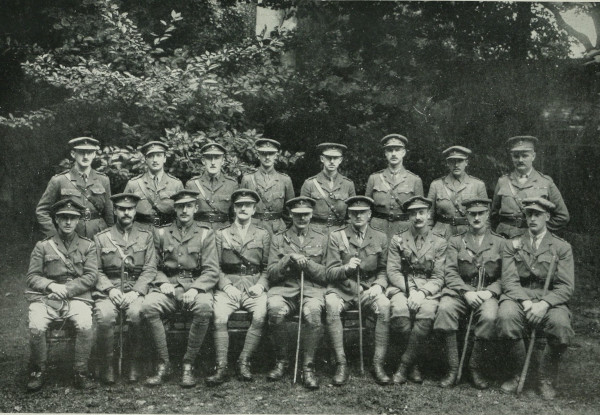
Officers of the Second Battalion Grenadier Guards.
On the 20th Captain Derriman who had been
appointed Staff Captain to the 4th Brigade was
very seriously wounded, and although he was
moved down to the base, he never recovered, and
died some time afterwards. The pluck he had
shown in coming out in spite of a stiff knee which
made him lame, and the dogged manner in which
he had persisted in serving with the Battalion
277in the trenches until he was placed on the Staff
aroused the admiration of every one.
On the 18th Lieut.-General Gough, the new
Commander of the First Corps, Major-General
Horne commanding the Second Division, and
Brigadier-General G. Feilding commanding the
4th Brigade paid a visit to the Battalion, and
went round the trenches at Cuinchy.
During the first fortnight in August the
Battalion followed the same routine, spending
two days in the trenches at Givenchy followed
by two days in billets at Le Preol. Mining
operations were begun on a large scale by both
sides. It was assumed that as an advance
above ground in the face of machine-gun fire
was too costly, the only other alternative was
to advance under ground and blow up the
enemy's parapet. In the craters made by the
explosion of the mines men were then pushed, and
the position was consolidated. The advantage
of this subterranean method of warfare was that
the men were safe from rifle- and shell-fire while
they were working, but there was always the
danger of a counter-mine which meant being
buried alive.
On the 2nd the Battalion exploded three
mines successfully near Sunken Road, and in
doing this blew in some of the enemy's galleries,
and that night the Irish Guards exploded three
more mines. In each case the positions were
consolidated after much bomb-throwing, but
the occupation of the craters was always difficult,
on account of the bombs from the enemy's
Minenwerfer.
278On the 5th Brigadier-General Feilding and
the Prince of Wales came round the trenches,
and inspected the sap-heads and craters.
On the 6th in the early morning the enemy
exploded two mines in the orchard near the
shrine. At the time Captain Clive and Second
Lieutenant Crookshank were taking out a working
party, and had they gone a little farther, all
the men must inevitably have been killed, but
fortunately they were just short of where the
mine exploded. The whole ground moved up in
one great convulsion, and when it settled down
several men were completely buried. Captain
Clive himself was severely cut and bruised by
the mass of debris that was blown past him,
and after being shot up in the air he came down
so doubled up that his teeth were nearly knocked
out by his knees. Second Lieutenant Crookshank
was completely buried in about four feet
of earth, and would inevitably have died had not
Captain Clive remembered where he stood before
the explosion, and directed the men to search
for him. When he was finally dug out it was
found that beyond a few bruises and the inevitable
shock from the explosion he was not
hurt. He was sent back to the dressing-station,
but pluckily insisted on returning to his Company
in the evening. One N.C.O. was killed by the
explosion, and eighteen men who had been
buried were sent back suffering from shock and
contusions. The work of digging out these men
was much retarded by the constant rifle-fire from
the enemy's trenches, and the enemy's guns also
commenced shelling the neighbourhood of the
279craters, but were not accurate enough to prevent
our consolidating the position.
These two mines wrecked the trench connecting
our sap-heads and filled in parts of the saps
with debris. The Battalion received orders at
once to reoccupy the sap-heads and dig out the
saps again. On the 5th Lieutenant D. Abel-Smith
was slightly wounded.
On the 7th a draft of drummers arrived, and
proved a great acquisition. When the Battalion
was in billets at Le Preol, they played "Retreat"
in the village street, much to the delight of the
remaining inhabitants. On the 10th the enemy
again exploded two mines near the Sunken Road,
destroying some of their own wire, and the
explosion formed a new crater on the northern
side of a crater known as "Bluff." Second
Lieutenant Hon. G. S. Bailey was killed by a
bomb, and Lieutenant A. V. L. Corry was badly
wounded. The casualties from mining and
bombing in addition to those from rifle-fire and
shells were very heavy while the Battalion was
at Givenchy, and the digging was most unpleasant
on account of the bodies thrown up
by mine explosions. On the 12th Lieutenant
E. G. Williams was accidentally killed in the
Trench Mortar School at St. Venant, where he
was undergoing a course of instruction.
Some ten days later the following order was
published:
The Commander-in-Chief has intimated that he has
read with great interest and satisfaction the report of
the mining operations and crater fighting which have
taken place in the Second Division area during the last
280two months. He desires that his high appreciation of
the good work performed be conveyed to the troops,
especially to the 170th and 176th Tunnelling Companies,
R.E., the 2nd Battalion Grenadier Guards, the 1st
Battalion Irish Guards, the 1st Battalion King's Royal
Rifles, 2nd Battalion South Staffordshire Regiment.
The 4th Brigade now received orders to join
the newly formed Guards Division.
On the 18th, before their departure, the
officers of the 2nd Battalion Grenadiers entertained
General Horne, Brigadier-General Feilding,
the Commanding Officers of the other regiments
in the 4th Brigade, and the principal Staff Officers
of the Second Division at dinner in the house of
Madame Richepin, who placed all her plate, china,
and glass at the disposal of the officers' mess.
The following order was published by Major-General
H. S. Horne, C.B., commanding the
Second Division:
The 4th Guards Brigade leaves the Second Division
to-morrow. The G.O.C. speaks not only for himself
but for every officer, non-commissioned officer, and man
of the Division when he expresses sorrow that certain
changes in organisation have rendered necessary the
severance of ties of comradeship commenced in peace
and cemented in war.
For the past year by gallantry, devotion to duty, and
sacrifice in battle and in the trenches, the Brigade has
maintained the high tradition of His Majesty's Guards,
and equally by thorough performance of duties, strict
discipline, and the exhibition of many soldier-like
qualities has set an example for smartness which has
tended to raise the standard and elevate the moral of
all with whom it has been associated.
Major-General Horne parts from Brigadier-General
281Feilding, the officers, non-commissioned officers, and
men of the 4th Guards Brigade with lively regret. He
thanks them for their loyal support, and he wishes them
good fortune in the future.
On the 19th the 4th Brigade, including the 2nd
Battalion Grenadiers, left the Second Division
to join the newly formed Guards Division, and
marched about ten miles to Ham-en-Artois. It
was a sort of triumphal progress, and Major-General
Horne and the other two Brigadiers
came to see them off while detachments from
every unit in the Division lined the road. The
Divisional Band played them as far as Lillers,
and on the way they were joined by Major-General
Lord Cavan accompanied by Major
Darrell and Lieutenant Oliver Lyttelton.
On the 20th the Brigade proceeded to Renescure,
and as it passed by the south of Aire it
marched past General Sir Douglas Haig commanding
the First Army. In the evening the
following order was published by Sir Douglas
Haig:
The 4th Guards Brigade leaves my command to-day
after over a year of active service in the field. During
that time the Brigade has taken part in military operations
of the most diverse kinds and under very varied
conditions of country and weather, and throughout
have displayed the greatest fortitude, tenacity, and
resolution. I desire to place on record my high appreciation
of the services rendered by the Brigade and
my grateful thanks for the devoted assistance which
one and all have given me during a year of strenuous
work.
(Signed) D. Haig,
Commanding First Army.
282On the 21st the Brigade marched past Field-Marshal
Sir John French in the big square at
St. Omer, and presented a very fine appearance.
So smart did it look that many of the onlookers
were under the impression that it had just come
out from England, and one man in the crowd
was heard to say as the Grenadiers went past:
"Wait till you've been in the trenches a bit,
then you won't look so clean and smart, my
boys."
In the evening the 4th Brigade received the
following message:
The Commander-in-Chief wishes to thank all ranks
for the splendid services they have rendered. He is
much impressed by their soldier-like bearing, and very
much regrets that owing to pressure of work he is
unable himself to come and visit all units and speak
to them himself.
After marching for several days the Battalion
arrived at Campagne les Boulonnais, where it
joined the rest of the Guards Division, and
remained until September 22.
On August 21 Second Lieutenant the Hon.
W. A. D. Parnell, and on the 24th Second Lieutenant
H. G. W. Sandeman joined the Battalion.
CHAPTER XIV FORMATION OF THE GUARDS DIVISION — Arrival of the 3rd Battalion Grenadier Guards — Arrival of the 4th Battalion.
283
The Guards Division.
Sept. 1915.
The creation of a Guards Division was not
regarded without misapprehension by some of the
older officers of the Guards. The reputation that
had been so dearly won by the original officers,
non-commissioned officers, and men of the regiments
of Guards, at the expense of thousands of
lives, might possibly be thrown away by their
successors. The flooding of the army with new
recruits might produce an entirely new stamp of
man. Was the system alone good enough, were
the traditions alone strong enough, to produce the
fighting man who had hitherto, rightly or wrongly,
been associated with the regiments of Guards?
At the time there was no thought of conscription,
and therefore it might be necessary to take
any men who were willing to join. Would there be
a sufficient nucleus of old Guardsmen to ensure
that the traditions carefully preserved through
many generations were strictly maintained?
The mill through which men of the Guards
have to pass, however, is so severe, and the
discipline so stern, that no one need have doubted
that the new recruits would prove equal to their
predecessors.
284The Guards Division was formed in September
1915, and Major-General the Earl of Cavan,
who had commanded the 4th Guards Brigade
in every engagement almost since the commencement
of the war, was naturally given the
command.
He had proved himself a great soldier, and
his exceptional ability as a commander of men
had rendered him eminently fitted for this
command. Thoroughly acquainted with the
methods of the enemy, he had shown himself to
be resourceful in strategy and bold of decision
in action. Upon several occasions he had extricated
his Brigade from situations of the utmost
peril, and had turned a half-anticipated failure
into hard-won victory. In the darkest hour at
Ypres he never lost heart: the more hopeless
the situation, the greater the opportunity for a
gallant fight and great achievement. His perfect
confidence in his men was equalled only by their
whole-hearted trust in him. His appointment,
therefore, was hailed with enthusiasm by all
ranks of the Brigade of Guards.
The Guards Division was composed as follows:
The 1st Guards Brigade. Brigadier-General
G. P. T. Feilding.
The
2nd Batt. Grenadier Guards.
The
2nd Batt. Coldstream Guards.
The
3rd Batt. Coldstream Guards.
The
1st Batt. Irish Guards.
The 2nd Guards Brigade. Brigadier-General
J. Ponsonby.
The
3rd Batt. Grenadier Guards.
The
1st Batt. Coldstream Guards.
The
1st Batt. Scots Guards.
The
2nd Batt. Irish Guards.
285The 3rd Guards Brigade. Brigadier-General
F. J. Heyworth.
The
1st Batt. Grenadier Guards.
The
4th Batt. Grenadier Guards.
The
2nd Batt. Scots Guards.
The
1st Batt. Welsh Guards.
Thus there were four battalions of Grenadier
Guards, three battalions of Coldstream Guards,
two battalions of Scots Guards, two battalions of
Irish Guards, and one battalion of Welsh Guards.
The 4th Battalion Coldstream Guards formed
the Divisional Pioneer Battalion.
The Guards Division formed part of the
Eleventh Corps under General Haking, and were
placed in the First Army.
The 3rd Battalion Grenadiers was the only
regular battalion at home. For months it had
fretted at being left behind when all the other
battalions had left, for they had a history second
to none in the British Army, and had taken part
in all the great campaigns during the last two
hundred years.
Whether it was part of that mysterious thing
called the British Constitution, or whether
the idea of keeping one regular battalion in
London emanated from the brain of some timid
member of the Cabinet, is not clear, but the
3rd Battalion remained at home after all the
rest of the regular army had gone. At first it
was said that two regular battalions would have
to remain behind in London, one for the King,
286the other for the Houses of Parliament, but His
Majesty, having at once disposed of the idea that
he needed the services of any regular battalion,
Lord Kitchener decided to retain only one
battalion, and that happened to be the 3rd
Battalion Grenadiers.
The only exceptional event during the time it
remained at home that deserves to be chronicled
is the fact that for the first time in history this
Battalion found the duties in London in service
dress. On the 27th of August 1914 the King's
Guard, under Captain de Crespigny, mounted
for the first time in khaki.
Although the 3rd Battalion was unable to go
as a unit, the terrible casualties the 1st and 2nd
Battalions had suffered during the first months
of the war made it very difficult to find the large
draft required, and so it happened that most of
the officers and non-commissioned officers made
their way to the front in the other battalions.
When the Guards Division was formed it was
decided to send out not only the 3rd Battalion
but also the 4th Battalion, and to form another
reserve battalion. On July 26 the Battalion
paraded at Chelsea Barracks, and Colonel Streatfeild
read to them a message from Field-Marshal
His Royal Highness the Duke of Connaught, who
was still Governor-General of Canada:
On hearing our 3rd Battalion has been placed under
Orders to leave for the front, I ask you to give them a
personal message from myself, wishing them God-speed
and success, and assuring them of the great confidence
I repose in them nobly to continue their splendid record
of the past, and to assist our brave battalions at the
287front, who have so gloriously maintained the traditions
of the First Regiment of Guards. May every blessing
rest upon the Regiment, of which I am so proud to be
the Colonel.
Arthur,
Colonel, Grenadier Guards.
The Battalion crossed over via Southampton
to Havre in the steamboat Queen Alexandra,
accompanied by a destroyer, and curiously
enough was disembarked by one old Grenadier,
Captain Sir F. E. W. Harvey-Bathurst, Bt., and
entrained by another, Major G. C. W. Heneage.
It proceeded by train to Wizernes, where it
detrained, and marched into billets at Esquerdes.
On July 31 the Battalion was inspected by General
Stopford, who said it was the finest Battalion
he had seen. On August 18 it took part in a
review held on the aviation ground at St. Omer,
when M. Millerand, the French War Minister,
Lord Kitchener, and Sir John French inspected
those battalions of the Guards Division which
had arrived.
The 2nd Guards Brigade was complete on
August 23, and was placed under the command
of Brigadier-General J. Ponsonby, as Brigadier-General
Lowther had been appointed Military
Secretary to the Commander-in-Chief. On
August 26 the officers of the four battalions of
Grenadier Guards dined together at Wisques.
During the two months spent at Esquerdes
the Battalion was busily engaged in training.
Officers and non-commissioned officers went
through several courses, and were initiated into
the mysteries of bombing and the mechanism
of the new Lewis gun.
288On August 30 Lieutenant A. T. A. Ritchie
arrived, and on September 22 Lieutenant Sir
Robert Filmer, Bt., was appointed Brigade Transport
Officer.
It was in July that the King on the advice of
the military authorities decided to form another
Battalion of Grenadier Guards, since the Reserve
Battalion had swollen to enormous proportions,
in spite of the standard of height being raised.
Colonel H. Streatfeild received instructions to
this effect, and at once summoned a conference
of the commanding officers and adjutants of the
two Battalions of the Regiment in London (the 3rd
and Reserve Battalions). The part of Chelsea
Barracks occupied by the School of Instruction
was vacated to make room for the new Battalion,
which was to become the 4th Battalion, while the
Reserve Battalion was in future to be known
as the 5th (Reserve) Battalion.
Major G. C. Hamilton, D.S.O., was appointed
Commanding Officer, and Sergeant-Major E.
Ludlow, Quartermaster. By July 16 the 4th
Battalion completed its establishment, and on
the 20th proceeded to Bovingdon Camp. Captain
T. F. J. N. Thorne was appointed Adjutant, and
the 3rd Battalion lent their Sergeant-Major and
Orderly-Room Sergeant to assist the Staff of
the 4th Battalion.
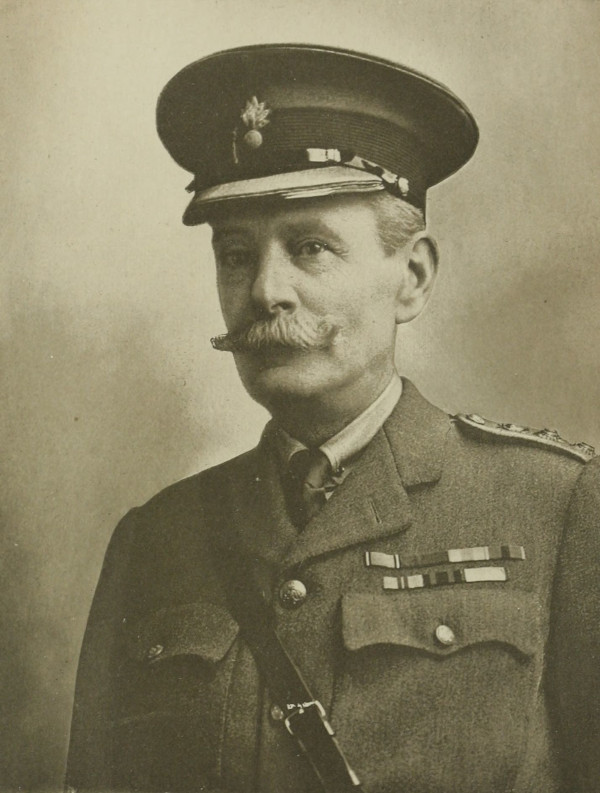
Colonel Sir Henry Streatfeild, K.C.V.O., C.B., C.M.G. The Lieutenant-Colonel commanding the Regiment.
On August 15 the 4th Battalion left Bovingdon
Camp, and embarked at Southampton for Havre.
The King, through Lieut.-Colonel Wigram, sent
the following message to Colonel Streatfeild:
289His Majesty heartily congratulates the Regiment on
being able to place four Battalions in the field, thereby
creating a record which will always be cherished in the
annals of the Regiment. His Majesty desires you to
tell all ranks of the 4th Battalion that they will constantly
be in the thoughts of their Colonel-in-Chief,
who wishes them every success.
Field-Marshal His Royal Highness the Duke
of Connaught sent the following message from
Canada:
My best wishes accompany the 4th Battalion on their
first tour of active service. I am confident they will
do their duty and emulate their comrades of the older
battalions.
Arthur,
Colonel, Grenadier Guards.
The Battalion crossed over in the Empress
Queen, accompanied by a destroyer, and on arrival
at Havre proceeded by train to St. Omer, where
it detrained and marched to Blendecques. There
it remained until the Guards Division was formed
in September. On August 21 it was inspected
by Brigadier-General Heyworth, who expressed
himself pleased with its smart appearance. On
September 17, during the inspection of the 3rd
Guards Brigade, Major-General the Earl of Cavan
complimented Major Hamilton on the way his
Battalion had turned out.
CHAPTER XV BATTLE OF LOOS, 1915 — The Guards Division — The 2nd Battalion — The 3rd Battalion — The 4th Battalion. — The 1st Battalion
290
In September General Joffre and Sir John French
agreed that a determined attempt should be made
to break the strong German line. Thousands of
guns were to be massed, and after an action by
which, it was hoped, the German trenches would
be destroyed, twelve infantry divisions were to
be launched upon the enemy. Then Sir Douglas
Haig, with the First British Army, would attack
between La Bassée Canal and Lens, while the
French were to force their way through the
lines south of Lens.
Sir John French in his despatch thus described
the character of the front to be attacked by the
British Army:
Opposite the front of the main line of attack the
distance between the enemy's trenches and our own
varied from about 100 to 500 yards.
The country over which the advance took place is
open and overgrown with long grass and self-sown crops.
From the canal southward our trenches and those
of the enemy ran, roughly, parallel up an almost imperceptible
rise to the south-west.
From the Vermelles—Hulluch road southward the
advantage of height is on the enemy's side as far as the
Bethune—Lens road. There the two lines of trenches
291cross a spur in which the rise culminates, and thence the
command lies on the side of the British trenches.
Due east of the intersection of spur and trenches,
and a short mile away, stands Loos. Less than a mile
farther south-east is Hill 70, which is the summit of
the gentle rise in the ground.
Other notable tactical points in our front were:
"Fosse 8" (a thousand yards south of Auchy), which
is a coal-mine with a high and strongly defended slag
heap.
"The Hohenzollern Redoubt."—A strong work thrust
out nearly 500 yards in front of the German lines and
close to our own. It is connected with their front line
by three communication trenches abutting into the
defences of Fosse 8.
Cité St. Elie.—A strongly defended mining village
lying 1500 yards south of Haisnes.
"The Quarries."—Lying half-way to the German
trenches west of Cité St. Elie.
Hulluch.—A village strung out along a small stream,
lying less than half a mile south-east of Cité St. Elie and
3000 yards north-east of Loos.
Half a mile north of Hill 70 is "Puits 14 bis," another
coal-mine, possessing great possibilities for defence when
taken in conjunction with a strong redoubt situated on
the north-east side of Hill 70.
It was arranged that the First Corps, consisting
of the Second, Seventh, and Ninth Divisions,
under Lieut.-General Hubert Gough, should
attack the line between La Bassée Canal and
Vermelles, while the Fourth Corps (First,
Fifteenth, and Forty-seventh Divisions), under
Lieut.-General Sir H. Rawlinson, attacked from
Vermelles to Grenay, the Hulluch—Vermelles
road forming the boundary between the two
Corps.
292The attack began at 6.30 A.M. on September
25, after four days' continuous bombardment
by our massed guns. Gas was employed, but
unfortunately the wind was unfavourable, and
it moved so slowly that it retarded the advance.
Further, the wire in some places had hardly been
touched, and consequently the Second Division
was held up from the start. Meanwhile the Ninth
Division started well, and even managed to reach
the northern end of "Little Willie," but was
unable to maintain its advanced position on
account of the check to the Second Division.
The Seventh Division captured the first line of
the trenches and cleared the quarries half-way
between the front line and Cité St. Elie, while
the leading troops even penetrated as far as Cité
St. Elie itself.
By mid-day the First Corps had secured the
whole of the German front from the Hohenzollern
Redoubt southwards and had pushed forward
to the second line at three points. But in this
achievement it suffered heavy casualties, and
was left too weak to do more than hold on to
the position it had gained.
In the Fourth Corps the First Division swept
forward, carried the first two lines of German
trenches, and reached the outskirts of Hulluch,
where it waited for reinforcements, but as these
did not arrive it had to fall back on the Lens—La
Bassée road. As for the Fifteenth Division,
whose objective was Cité St. Augusté, it pushed
through not only to Loos, but even over Hill 70,
and the 44th Brigade in this division actually
reached the outskirts of Cité St. Laurent.
293On the afternoon of the 26th the Eleventh
Corps was placed at the disposal of Sir Douglas
Haig; it consisted of the Guards Division
and the Twenty-first and Twenty-fourth Divisions.
The two latter were at once hurried up
into the firing line, the Twenty-first Division
sending two brigades to Loos while the Twenty-fourth
went to the Lens—La Bassée road.
Throughout that Sunday the fighting was
very severe, and it was only with the greatest
difficulty that we held on to Loos. The First
Corps was also being strongly counter-attacked,
and the quarries changed hands several times.
All day the Crown Prince of Bavaria, who was
in command of the army facing the British divisions,
was engaged in bringing up reserves from
other parts, and by next day he had strengthened
his whole line. The German line ran from
Auchy—La Bassée over comparatively flat
country to the Vermelles—Hulluch road, where
the ground became undulating and culminated
in Hill 70.
Early on Monday the advance was renewed,
but the Germans had started counter-attacking,
and a confused struggle went on, with varying
success. Several times our line gave way, only
to be rallied and go forward again. We managed
to maintain our ground on the right and centre
of Hill 70, but on the extreme left the enemy
pressed the line back towards Loos. In the
meantime the 64th Brigade of the Twenty-fourth
Division was being driven back and subjected
to withering enfilade fire. The line from the
Chalk Pit to the northern end of Hill 70 had to
294be abandoned, and Loos was thus left exposed
to an attack from the north-east. A brigade
of the Third Cavalry Division was then brought
up to reinforce the hard-pressed troops who were
holding Loos.
The Guards Division arrived early on Sunday
morning at Haillicourt, more than ten miles off,
and marched through Noeux-les-Mines and Sailly-la-Bourse
to Vermelles. For the first time since
its creation the Guards Division was to go into
action, and naturally, after the fame individual
battalions had won in the earlier part of the
war, a great deal was expected of it. All
the troops were cheered by the news that the
Division had arrived and was going in, but the
situation had altered a good deal since the attack
was first launched. All element of surprise had
disappeared, and the Germans had had time to
recover from the effects of the first blow and to
collect reinforcements. It is doubtful whether
the Guards Division ever had any real chance of
succeeding in its attack. It had to start from
old German trenches, the range of which the
German artillery knew to an inch, while the
effect of our own original artillery bombardment
had died away.
However, there was no alternative but to put
in the Guards Division and try and regain as
much of the lost ground as possible. Major-General
Lord Cavan sent round on the 25th a
stirring message to the men, reminding them that
great things were expected of the Division, and
295they were full of confidence as they went into
action.
The easiest task fell to the lot of the 1st
Guards Brigade, under Brigadier-General Feilding,
on the left. It was to advance in the
direction of the Bois Hugo and straighten the
line, so that it would run parallel to the Lens—La
Bassée road. The 2nd Brigade, under
Brigadier-General Ponsonby, was to take and
hold the Chalk Pit and Puits 14 bis, and the
3rd Brigade, under Brigadier-General Heyworth,
to advance against Hill 70. But to a large extent
the movements of the 1st and 3rd Brigades
depended on the success of the attack of the
2nd Brigade.
Accomplishing their work at once, Feilding's
Brigade secured a good position on the ground
over which the Twenty-fourth Division had
retired. General Feilding, who understood that
he was to assist the other brigades by fire as far
as possible, at once collected as many smoke-bombs
and smoke-candles as he could, and at
zero hour formed a most effective smoke-screen,
which drew off the fire of a great many German
guns from the other attackers.
Success at first also attended the attack of
Ponsonby's Brigade. It took the Chalk Pit and
Puits 14 bis, but then a tremendous fire from
machine-guns in Bois Hugo swept it down, and
it was unable to keep its hold on these positions.
This made it very difficult for the other brigades
to move forward. But on learning that Ponsonby's
Brigade was fighting furiously for the
possession of the Chalk Pit, Lord Cavan decided
296that the only way to relieve the strain on them
was to order Heyworth's Brigade to advance.
It did so, and this course proved successful in
enabling Ponsonby's Brigade to retain possession
of the Chalk Pit. Going forward, Heyworth's
Brigade took Hill 70, but it too found it impossible
to keep what it had won. The enemy's
trenches were marked on the map as being on
the crest of the hill, but in reality they were on
the reverse slope, and had never been touched
by shell-fire.
The net result of the attack of the Guards
Division was the establishment of the British
front along a line running, roughly, northward
from the south-eastern end of Loos and parallel
to the Lens—La Bassée road. Another attempt
to gain Puits 14 was made by the 1st Battalion
Coldstream on the 28th, but was no more successful
than the first. As before, a small party
reached the Puits, but was driven out again by
enfilade fire.
Measured by the length of the advance made
during the battle and the extent of ground taken
from the enemy, the results of the battle of
Loos would seem distinctly disappointing, more
especially when the casualty list of 45,000 men
is considered. But to estimate these operations
in terms of geography is a mistake. The smallness
of the theatre of operations and the comparatively
narrow depth of our advance give a
totally misleading impression of the success of
the battle. It is obviously more valuable to put
out of action 50,000 Germans and gain half a
mile than to gain five miles and only inflict a loss
297of 10,000. When it is realised that we drove
the enemy from positions which they considered
impregnable to the assaults of modern weapons,
that their casualties must have been as heavy as,
if not heavier than, our own, and that we took
3000 prisoners (including 50 officers), 26 field-guns,
and 40 machine-guns,—it will be seen that
Lord Kitchener's description of the battle as a
substantial success was not very far wide of the
mark.
The following were the officers of the 2nd
Battalion Grenadier Guards who took part in
the battle:
Lieut.-Colonel
G. D. Jeffreys, Commanding Officer.
Major Lord Henry Seymour, Second in Command.
Capt. the
Hon. W. R. Bailey, Adjutant.
Lieut. W. E. Acraman, Quartermaster.
Lieut. D. Abel-Smith, Machine-gun Officer.
2nd Lieut. the
Hon. A. V. Agar-Robartes, Machine-gun Officer.
Lieut. A. K. S. Cunninghame (Transport Officer),
No. 1 Company.
Lieut. J. N. Buchanan,
No. 1 Company.
Lieut. E. W. M. Grigg,
No. 1 Company.
2nd Lieut. L. St. L. Hermon Hodge,
No. 1 Company.
2nd Lieut. H. G. W. Sandeman,
No. 1 Company.
Capt. A. F. R. Wiggins,
No. 2 Company.
Lieut. F. O. S. Sitwell,
No. 2 Company.
Lieut. E. H. Noble,
No. 2 Company.
Lieut. H. A. Clive,
No. 2 Company.
2nd Lieut. H. F. C. Crookshank,
No. 2 Company.
Capt. R. H. V. Cavendish,
M.V.O.,
No. 3 Company.
2nd Lieut. W. H. Beaumont-Nesbitt,
No. 3 Company.
2nd Lieut. I. H. Ingleby,
No. 3 Company.
2982nd Lieutenant the
Hon. B. B. Ponsonby,
No. 3 Company.
2nd Lieut. E. R. M. Fryer,
No. 3 Company.
Capt. A. de
P. Kingsmill,
No. 4 Company.
2nd Lieutenant the
Hon. W. A. D. Parnell,
No. 4 Company.
2nd Lieut. M. A. Knatchbull-Hugessen,
No. 4 Company.
2nd Lieut. C. Crosland,
No. 4 Company.
Capt. E. A. Aldridge,
R.A.M.C., Medical Officer.
The 1st Guards Brigade, under Brigadier-General
Feilding, reached Vermelles early on the
Sunday morning, and at 1 P.M. on the same day
it was ordered forward to the old British trenches
near Le Rutoire, where the two Coldstream
battalions were placed in the firing line, and
the 2nd Battalion Grenadiers and 1st Battalion
Irish Guards in support. The orders General
Feilding received from Major-General Lord Cavan
were to advance and hold a line running parallel to
the Lens—La Bassée road. The two Coldstream
battalions found no difficulty in doing this, and
having straightened the line, they occupied what
had formerly been the German first-line trench.
The 2nd Battalion Grenadiers was not brought
into action, as the 1st Guards Brigade could not
advance until the Germans had been driven from
the Chalk Pit Wood and Puits 14. The enemy,
however, shelled the reserve trenches intermittently,
and caused a few casualties. Second
Lieutenant C. Crosland and five N.C.O.'s and
men were wounded.
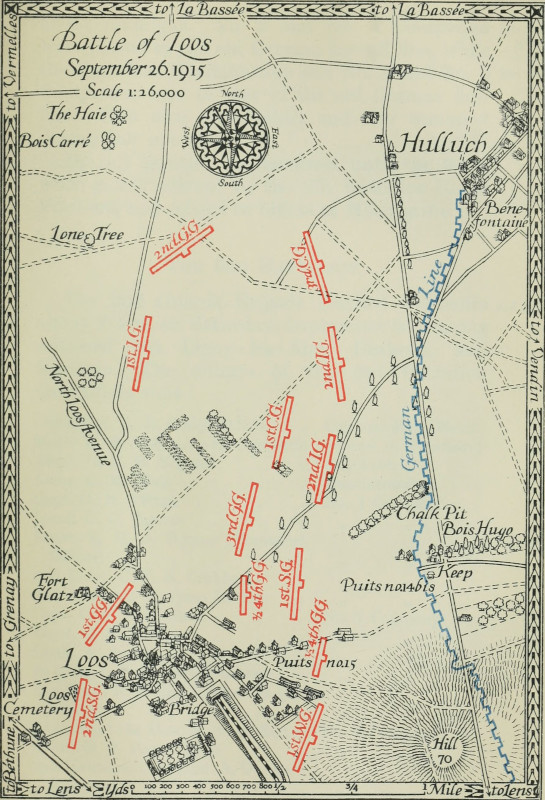
Battle of Loos. September 26, 1915.
On the 27th the 2nd Battalion Grenadiers
was ordered to move up to the old German
first-line trenches, which it did about 9 P.M.,
eventually settling down in the new position
299about midnight. No. 3 and No. 4 Companies
were placed in the old German second line, while
the Battalion Headquarters and No. 1 and No. 2
Companies were in rear of the old German first
line. Two men were killed and five wounded
during this operation.
In this position it remained until the 30th,
when it was relieved by the 9th Battalion Royal
Fusiliers, and retired to billets at Mazingarbe.
The 2nd Guards Brigade reached Vermelles
about 7 P.M. on Saturday, September 25, having
marched via Ligny-les-Aire, Burbure, and
Houchin. The officers of the 3rd Battalion
Grenadiers were:
Colonel
N. A. L. Corry,
D.S.O., Commanding Officer.
Major
G. F. Molyneux-Montgomerie, Second in Command.
Lieut. G. G. B. Nugent, Adjutant.
Lieut. G. H. Wall, Quartermaster.
Capt. G. N. Vivian,
No. 1 Company.
Lieut. G. G. Gunnis,
No. 1 Company.
Lieut. E. H. J. Wynne (Transport Officer),
No. 1 Company.
2nd Lieut. C. T. E. Crabbe,
No. 1 Company.
2nd Lieut. A. T. Ayres Ritchie,
No. 1 Company.
Capt. C. F. A. Walker,
No. 2 Company.
Lieut. C. S. Rowley,
No. 2 Company.
Lieut. A. Anson,
No. 2 Company.
2nd Lieut. F. D. Lycett-Green,
No. 2 Company.
2nd Lieut. R. Williams (Machine-gun Officer),
No. 2 Company.
Lieutenant the
Hon. F. O. H. Eaton,
No. 3 Company.
Lieut. G. P. Bowes Lyon,
No. 3 Company.
2nd Lieutenant the
Hon. A. G. Agar-Robartes,
No. 3 Company.
3002nd Lieut. H. D. Vernon,
No. 3 Company.
Capt. E. G. H. Powell,
No. 4 Company.
Capt. W. R. C. Murray (Bombing Officer),
No. 4 Company.
Lieut. C. M. C. Dowling,
No. 4 Company.
Lieut. G. F. R. Hirst,
No. 4 Company.
Lieut. F. Anson,
No. 4 Company.
2nd Lieut. T. C. Higginson,
No. 4 Company.
Attached—
Lieut. A. T. Logan,
R.A.M.C.
It was bitterly cold on the night of the 25th,
which was spent by the 3rd Battalion Grenadiers
in the old British front trench north-west of Loos.
Some of the platoons got into an old remnant of
a trench, and some had to lie down outside. So
chilly was it that sleep was difficult, and the men
had constantly to get up and run about to warm
themselves, and then try to snatch a little more
rest.
At 3.30 next morning the 3rd Battalion
started off in the direction of Loos. At first
it marched in fours, but on coming into the
shell area assumed artillery formation, and went
across the open. While ascending the slope it
was not fired upon, but when it came down
the hill towards Loos shrapnel burst all round
it. When the Battalion arrived at the bottom
of the hill, which it lost no time in doing, it
relieved the Scots Guards, and got into what had
formerly been the German third-line trenches.
Both officers and men were filled with admiration
at the intricate dug-outs they found, twenty to
thirty feet down in the chalk; evidently great
trouble had been expended on this part of the line,
and the German officers had been accustomed to
live almost in luxury.
301As soon as the 3rd Battalion reached the
trench, it was ordered to dig communication
trenches and repair the parapet. Soon the
men were soaked to the skin by pouring rain,
and an icy cold wind added to their discomfort,
as they had no prospect that night of getting
either dry or warm.
Colonel Corry, being the senior Commanding
Officer of the Brigade, was sent to serve temporarily
on the Divisional Staff, so that he might be
able to assume command of the Brigade in the
event of the Brigadier being killed. The command
of the 3rd Battalion Grenadiers therefore
devolved on Major Molyneux-Montgomerie.
Next day this was the position. The 3rd
Battalion Grenadiers was still in the line of
trenches in front of Le Rutoire farm, with its
right on the Loos Redoubt. In front of it was
the 1st Battalion Scots Guards, with its right
on the village of Loos. The 2nd Battalion Irish
Guards was on the left of the Scots Guards,
with the 1st Battalion Coldstream in support.
At 2 P.M. Brigadier-General J. Ponsonby collected
the commanding officers near the Loos Redoubt,
and informed them that an attack was to be made
that evening on Chalk Pit Wood by the 2nd
Battalion Irish Guards, supported by the 1st
Battalion Coldstream, and on Puits 14 (a large
colliery) by the 1st Battalion Scots Guards,
supported by the 3rd Battalion Grenadiers. A
heavy bombardment was to start at 3 P.M. The
Irish Guards were to advance at 4 P.M., but the
Scots Guards were to wait until the wood was
captured before they began their assault on the
302Puits. The enemy was known to be strongly
entrenched along Hill 70 to Puits 14.
Instructions were given for the 3rd Battalion
Grenadiers to follow the 1st Battalion Scots
Guards and occupy its trench as soon as it was
quitted. Major Montgomerie, now in command
of the Battalion, immediately went forward
with Captain Powell to find a way down the old
German communication trenches between the
Scots Guards' and Grenadiers' lines. On his
return he sent orders to all company commanders
to come to the right of the Battalion line near
the Loos Redoubt, and there explained the
situation. He ordered them to go back and
bring their companies one after another to the
communication trench he had found.
This operation necessarily took a long time,
and the whole Battalion began to file down
through a maze of communication trenches
towards the line held by the Scots Guards. The
intervening ground was being searchingly shelled,
but at 4 P.M. the Grenadiers reached the trench
from which the Scots Guards were to advance.
This trench had become much broken down
during the last days' fighting, and there were
many wounded lying about, some of whom had
been there for two days. When he arrived
Major Montgomerie found that the attack had
already begun, and that the Scots Guards were
well away over the open, making for Puits 14.
He therefore ordered No. 1 and No. 2 Companies,
as they emerged from the communication
trenches, to follow on at once in support of the
Scots Guards. No. 3 and No. 4 Companies,
303under Lieutenant Eaton and Captain Powell,
were kept in reserve under the immediate orders
of the Brigadier, who had now established his
headquarters in that trench.
The Irish Guards, supported by the Coldstream,
succeeded in gaining Chalk Pit Wood, but the
Scots Guards had a more difficult task with
Puits 14. After they had passed the Hulluch—Loos
road they were not only shelled, but came
in for heavy machine-gun fire from Hill 70 and
Bois Hugo. The fire came almost entirely from
the right flank. The two Grenadier companies
under Captain Vivian and Captain Walker pushed
on under terrific shell-fire, and came up with the
Scots Guards just outside Puits 14, stubbornly
defended by the Germans. Regardless of the
machine-guns which were mowing down our men,
the Scots Guards and two companies of Grenadiers
pressed on, and endeavoured to reach Puits 14,
but very few of the Scots Guards and not more
than a dozen Grenadiers, under Lieutenant
Ritchie, actually got into the Puits, where they
threw bombs into a house occupied by the enemy.
But the enemy had not occupied this position
for a year without thinking out every possible
event, and machine-guns were soon turned on
the attackers from every direction. Finding
it impossible to retain possession of the Puits,
the Scots Guards retired with the two companies
of Grenadiers to just in front of Chalk
Pit Wood, making it equally impossible for the
enemy to hold his position. Lieutenant Ritchie
and Second Lieutenant Crabbe, not knowing of
this retirement, remained with six men among
304the buildings in the Puits, until they found themselves
almost surrounded by Germans who had
come from the Bois Hugo. At first they tried
to drive the enemy back, but, finding themselves
outnumbered and in danger of being captured,
they decided to retire. The majority of the party
got back to Chalk Pit Wood, but Second Lieutenant
Crabbe was last seen standing on a wall throwing
bombs at the enemy when he was killed. Captain
Vivian, Lieutenant Ritchie, Lieutenant Dowling,
and Lieutenant Lycett-Green were wounded.
The last afterwards had his leg amputated.
Lieutenant Rowley, also wounded, was too badly
hurt to be moved, and so was left behind and
taken prisoner. Lieutenant Ritchie, finding himself
alone and wounded, walked slowly back to
Chalk Pit Wood, where he collected all the men
he could, and told them to dig themselves in for
the night. He then came back and reported
to General Ponsonby the result of the attack.
Captain Walker was left behind in the retirement,
but was able to get back after dark.
Lieutenant Ritchie, who commanded No. 1
Company after Captain Vivian was wounded,
was specially recommended for "exceptional
courage and ability." In spite of his injuries
he continued to fight on with his company for
six hours, and even when the retirement was
ordered he made a valuable reconnaissance.
Captain Walker was also specially mentioned
for the splendid way he led his company into
action.
Meanwhile the Irish and Coldstream Guards
on the left had established themselves in the
305Chalk Pit and adjoining wood, where they dug
themselves in.
When darkness fell, Brigadier-General Ponsonby
ordered another company from the
Grenadiers to support the Scots Guards. Major
Molyneux-Montgomerie, on receiving the order,
went out with Lieutenant Ritchie to find the
exact position of the two companies, and having
done this he sent back a guide to bring up another
company. No. 4, under Lieutenant Hirst, started
off, but was held up by machine-gun fire, and
it was two hours before it was able to reach
the other two companies, who had suffered very
much during the attack. The 3rd Battalion
Grenadiers was now prolonging the line of the
Scots Guards to the right, and holding from the
south-west corner of Chalk Pit Wood to the
corner of Loos, facing Puits 14.
The positions remained unchanged during the
night and following morning, with shelling at
intervals by the enemy, who knew the range of
the trench precisely. In the afternoon the 1st
Battalion Coldstream made a very gallant attempt
to take Puits 14 from the Chalk Pit, but the attack
failed. During the night two platoons of No. 3,
under Lieutenant Eaton, were sent to make a
line across the Loos—Hulluch road facing north,
and to establish communication with the 1st
Battalion Coldstream towards the Chalk Pit.
Lieutenant F. Anson in No. 4 was wounded early
that morning, and Captain Murray, in charge
of the 3rd Battalion bombers, was very severely
wounded while making a plucky raid on the Puits
buildings.
306Until the night of the 30th the Battalion
remained in the same trenches. It was very wet
and cold, and the constant shelling greatly
interfered with the work of bringing up supplies.
The remnant of No. 2 Company, under
Captain Walker, was moved to the left, and
was used, together with No. 3 Company, to
continue the line facing north, thus completing
the junction between the 2nd and 1st Guards
Brigades.
When the Brigade was relieved on the night
of the 30th, the Berkshire Regiment came up
to take the place of the Grenadiers. The relief
did not finish till past 2 A.M., when the Battalion,
much exhausted after its three days' fighting,
marched slowly back through Noyelles and Sailly-la-Bourse
to Verquigneul, which was reached
about 6 A.M.
Among the officers the casualties were:
Second Lieutenant Crabbe, killed; Captain
Vivian, Captain Murray, Lieutenant Ritchie,
Lieutenant Lycett-Green, Lieutenant F. Anson,
and Lieutenant Dowling, wounded; Lieutenant
Rowley, missing. The total casualties—killed,
wounded, and missing-amounted to 229.
The following message was sent from the
Brigadier to Colonel Corry:
To the Commanding Officer 3rd Battalion Grenadier
Guards.
I wish to express to the 3rd Battalion Grenadier
Guards my appreciation and admiration at their steady
advance under very deadly fire to the attack on
September 27. Lord Cavan, commanding the Guards
Division, a former Grenadier Guardsman, has expressed
307to me the sincere pride with which he watched his old
regiment advance to the assault.
J. Ponsonby, Brigadier-General,
Commanding the 2nd Guards Brigade.
The 3rd Guards Brigade, under Brigadier-General
Heyworth, marched via Lambres, Lières,
and Marles-les-Mines to Haillicourt, where it
arrived on Sunday morning the 26th. At Marles-les-Mines
it had to halt for six hours to allow a
cavalry corps to pass, and as the men never knew
when their turn would come to advance, they
had to sit down on a muddy road and wait. The
battalions were crowded into billets for a short
time at Haillicourt, where the violent bombardment
of the French attack at Souchez could be
distinctly heard. In the afternoon the Brigade
moved off, and marched to Vermelles, where it
remained for the night.
The officers of the 4th Battalion Grenadier
Guards were:
Lieut.-Colonel
G. C. Hamilton,
D.S.O., Commanding Officer.
Major the
Hon. C. M. B. Ponsonby,
M.V.O., Second in Command.
Capt. T. F. J. N. Thorne, Adjutant.
Lieut. M. G. Williams, Machine-gun Officer.
Lieut. C. E. M. Ellison, Machine-gun Officer.
2nd Lieut. E. Ludlow, Quartermaster.
Capt. J. A. Morrison,
No. 1 Company.
Lieut. G. E. Shelley,
No. 1 Company.
2nd Lieut. G. A. Ponsonby,
No. 1 Company.
Captain Sir
G. Houstoun-Boswall,
Bart.,
No. 2 Company.
308Lieut. E. F. Penn,
No. 2 Company.
Lieut. P. Malcolm,
No. 2 Company.
Capt. E. D. Ridley,
No. 3 Company.
2nd Lieut. M. A. T. Ridley,
No. 3 Company.
2nd Lieut. A. H. Tompson,
No. 3 Company.
Capt. H. L. Aubrey Fletcher,
M.V.O.,
No. 4 Company.
Lieut. E. R. D. Hoare,
No. 4 Company.
2nd Lieut. B. C. Layton,
No. 4 Company.
2nd Lieut. M. H. Macmillan,
No. 4 Company.
Lieut. E. Brunton,
R.A.M.C., Medical Officer.
Lieutenant Blundell, Lieutenant Britten, Lieutenant
R. Leigh Pemberton, and Lieutenant
Tennant were left at Vermelles with the transport.
On the 27th Brigadier-General Heyworth received
orders to attack Hill 70. The movements
of the 3rd Guards Brigade more or less depended
on the success of the 2nd Brigade. Originally
it had been decided not to go through Loos, but
to leave it on the right and to rendezvous close
in rear of the Loos—Hulluch road, but these
orders were afterwards cancelled.
Lieutenant-Colonel Hamilton explained to the
company officers the general plan of attack, with
some more detailed particulars about the part the
4th Battalion was to play, but on being ordered
at once to accompany General Heyworth, who
was going into Loos, he handed the command
of the Battalion to Major Ponsonby, and told
him to bring it to a position of deployment in
Loos, where he himself would meet them. At
the same time Captain Aubrey Fletcher was sent
forward to reconnoitre the best route into Loos,
and Lieutenant Blundell was ordered to bring
up the Brigade S.A.A. and tool limbers to Fort
Galatz.
309At 2.30 the 4th Battalion moved off in fours
down the Vermelles—Douai road, with No. 1
Company, under Captain Morrison, leading, and
on reaching the top of the ridge assumed artillery
formation. The order of march was: 4th Battalion
Grenadiers, Welsh Guards, 2nd Battalion
Scots Guards, and 1st Battalion Grenadiers. For
one and a half miles, under heavy artillery fire—not
shrapnel, but percussion H.E.—and in full view
of the Germans, the 3rd Guards Brigade advanced
in artillery formation. Perfect order was maintained
in spite of the shells, which burst all round,
and there was not a man out of his place. Nothing
more splendid has ever been recorded in the
annals of the Guards than the manner in which
every battalion in the Brigade faced this trying
ordeal. The 4th Battalion Grenadiers was all
the time under machine-gun fire from the right,
and during this stage of the attack Lieutenant
Hoare was wounded.
On nearing Loos the 4th Battalion Grenadiers
was ordered to double down the slope and get
into a trench which ran through some ruined
houses. The German artillery was now directing
its attention to Loos, and using a great many
gas shells. Major Ponsonby, guided by Captain
Aubrey Fletcher, led the Battalion down an old
German communication trench immediately north
of Fort Galatz. It had already gone some distance
along the trench when General Heyworth
arrived at full gallop down the road, and ordered
Captain Ridley and the men in rear of him
who had not yet entered the communication
trench to follow him at once. It would seem that
310the Battalion had either advanced too far or
was going in the wrong direction. In any case
from that moment it was divided into two parts.
Captain E. Ridley took with him Nos. 6, 7, and
8 platoons from No. 2 Company under Captain
Sir George Houstoun-Boswall, No. 10 platoon from
No. 3 Company under Lieutenant M. Ridley, with
a few men from No. 4 Company, and worked down
a trench towards the outskirts of Loos. Here
they were again met by General Heyworth, who
told them to go through the town and await
Lieut.-Colonel Hamilton. Passing through the
ruins at a rapid pace, Captain Ridley and his
party reached the corner of the church which
was being heavily shelled. The noise was deafening;
shells were bursting in every direction and
houses were falling in. The enemy's snipers
were shooting at every place which might shelter
a man. Through this hideous pandemonium the
platoons came, not yet taking any part in the
battle, but simply on their way to the place from
which the attack was to start.
It was then found that Lieut.-Colonel Hamilton
had been gassed and so placed hors de combat.
Captain E. Ridley was told to take his platoons
to the south-east corner of the town, but at
that moment Major Ponsonby, accompanied by
the Adjutant, Captain Thorne, and also Captain
Fletcher, arrived and guided them to their
destination. Major Ponsonby had been hastily
sent for and told by the Brigadier to take command
of the Battalion in Colonel Hamilton's
place. Finding the Battalion split in two, he
at once sent back for what really was the main
311portion, but the orderly who took the message
was killed, and the order never reached Captain
Morrison. Meanwhile the men were placed in
a shallow trench just outside the town and
facing Hill 70.
Here they were joined by Lieutenant M.
Williams and Second Lieutenant Ellison with
the machine-guns, who had made their way
across country while the limbers went by road.
Corporal C. Gould, who brought up the limbers
under continual shell-fire, met on the way a runaway
horse racing down the road at full gallop
with a bomber's wagon behind him, fully loaded
with bombs. The driver had been killed, and
the horse, terrified by the shells, was making for
home. Corporal Gould succeeded in stopping
the horse, and put one of his men on the wagon.
On arrival at Loos the machine-guns were
carried on by hand.
The Welsh Guards now came up under Lieut.-Colonel
Murray Threipland, who said that General
Heyworth wished the attack to begin at once.
Major Ponsonby, however, realised that to attempt
an attack with the small force at his
disposal was merely to court failure, and sent
back word to General Heyworth stating what
had happened to his battalion, and adding that
he hardly considered the few platoons under his
command sufficient to carry out the attack with
any prospect of success. Messages, however, take
some time to deliver, and every moment might
be precious. He therefore consulted Colonel
Murray Threipland, who undertook the attack,
giving him instructions to join in on the left.
312The firing line was composed of the Prince of
Wales's Company of the Welsh Guards on the right,
and Nos. 6 and 7 platoons of the 4th Battalion
Grenadiers, under Sir George Houstoun-Boswall,
on the left. Nos. 2 and 3 Companies of the Welsh
Guards and Nos. 8 and 10 platoons of the Grenadiers
were in support, while Colonel Murray
Threipland kept his 4th Company as a reserve,
and to it were added the remaining Grenadiers,
including the men of the Battalion Headquarters.
As soon as the men were formed up Major
Ponsonby decided to take command himself, and
sent Captain Ridley back to find the remainder
of the Battalion.
Colonel Murray Threipland sent a message to
General Heyworth to warn him that the attack
had been launched, but the news had just arrived
that the 2nd Guards Brigade had been unable
to retain their hold on Puits 14. At this General
Heyworth appears at first to have contemplated
cancelling the attack, but on receiving orders
from Lord Cavan to relieve the pressure on the
2nd Brigade by launching the attack on Hill 70,
he destroyed the cancelling order.
So the attack started. Steadily the 4th
Battalion Grenadiers and 1st Battalion Welsh
Guards advanced towards Hill 70. At first
they met nothing but rifle-fire, but on reaching
the crest of the hill they were greeted by a
murderous machine-gun fire, which caused great
havoc among the front line. Staggered for a
moment, the men hesitated, but Major Ponsonby
urged them on, and they got to within twenty-five
yards of the German trenches. There had
313been no attempt at any surprise in this attack,
which was not supported by artillery, although
the cavalry machine-guns rendered all assistance
they could. The enemy's machine-guns were
cleverly placed and were most effective, especially
in the neighbourhood of Puits 14 bis, which was
now again in the hands of the Germans.
Explicit orders had been given by General
Heyworth to the commanding officers on no
account to advance over the crest of the hill;
when a line on the reverse slope of the hill had
been occupied it was to be consolidated. Owing
to Lieut.-Colonel Hamilton having been gassed,
the Grenadiers knew nothing of this order, and
pushed on, while the Welsh Guards remained just
under the crest of the hill. But the Grenadiers'
position was quite untenable on account of the
machine-guns which were enfilading them, and
they withdrew to behind the crest.
Darkness now came down, and the exact
position of the front line was not clear to those
in rear. It was known that Hill 70 had been
taken, and that somewhere on this hill were the
Welsh Guards and a portion of the Grenadiers,
with isolated parties in front of them. The 2nd
Battalion Scots Guards, under Colonel Cator,
was being sent up to relieve the front line, while
the 1st Battalion Grenadiers remained in reserve
in Loos.
During the last part of the advance Major
Myles Ponsonby was hit while advancing with his
men. Captain Thorne, the Adjutant, remained
with him, although they were only twenty-five
yards from the Germans, tied up his wounds, and,
314seeing how badly he was wounded, gave him
morphia tablets. Early next morning Major
Ponsonby died. No more glorious end could have
been than his. He died, as Lord Cavan afterwards
put it in a private letter, a great and lion-hearted
Grenadier fighting to the last, within a
few yards of the Germans.
Captain Thorne was himself wounded in the
head, and after leaving Major Ponsonby he
tried to get back when it was dark. On the way
he came upon two drummers who had been acting
as orderlies; one had been killed and the other
wounded through the leg. Knowing that if he
left the boy where he was, he would probably
be killed, he determined to carry him back.
He put him on his shoulders and started off, but
must have made some noise, for the Germans
at once put up a flare and fired at him with
machine-guns. He fell forward at once with the
drummer—both killed.
Captain Sir George Houstoun-Boswall, who
was in command of the first line of Grenadiers
during this attack, behaved with great gallantry,
and was killed as they were nearing the German
trenches. Captain Fletcher was badly wounded
earlier in the attack, as was Lieutenant M.
Ridley: thus all the officers who took part in
the attack were either killed or wounded.
When the attack started Lieutenant Mervyn
Williams was ordered by Major Ponsonby to
follow with his machine-guns in case of a counter-attack,
and to leave Lieutenant Ellison behind
in Loos with the reserve guns. The machine-gun
party therefore followed on till it got to the
315top of Hill 70, where a large number of Grenadiers
who had been killed were found. Crawling on,
the men suddenly realised that they had gone too
far and that there were Germans firing behind
them, so they wheeled round, and came across
Captain W. Berkley with some Welsh Guards
and a small number of Grenadiers under Lieutenant
M. Ridley, who was badly wounded.
The fire was very heavy and there seemed no
prospect of being able to advance. Uncertain
where the remainder of the force was, the party
hesitated to fire for fear of killing its own men.
It was pouring with rain, and as darkness came
on Lieutenant Williams decided to dig in where
he was on Hill 70.
It is necessary now to return and follow the
movements of the other half of the Battalion.
It was moving down the German communication
trench quite unconscious that General
Heyworth had diverted the two last companies
to Loos. When Captain Morrison arrived at the
spot appointed as a rendezvous, he waited.
The attack had clearly begun, as the shelling
was very violent, but no orders of any sort came
to him, nor did he know what had become of
Major Ponsonby, Captain Fletcher, and Captain
Thorne, any one of whom might have been able
to explain to him the situation. He accordingly
sent off an orderly to the Brigade Headquarters
asking for instructions. But it was far from easy
to find the Brigadier in the middle of a battle,
and as the first orderly did not return he sent
a second, and repeated this process until four
orderlies had gone. He had with him No. 1
316Company (his own), one platoon of No. 2 Company
under Lieutenant Penn, two platoons of
No. 3 Company under Lieutenant Tompson, and
the greater part of No. 4 Company under Second
Lieutenant Layton and Second Lieutenant Macmillan.
As no orders came, he formed up the men
and determined to take part in the fighting.
He had been told that the 3rd Guards Brigade
were to attack Hill 70, and that the 4th Battalion
Grenadiers were to form part of the attacking
force. It was clearly wrong, therefore, for these
companies to be doing nothing. But he could
see no sign of the rest of his battalion, and efforts
to obtain instructions had proved fruitless. At
this moment he observed the 2nd Brigade attacking
Puits 14, and thereupon decided to take on
himself the responsibility of joining in, feeling
sure that if he was wanted by the 3rd Brigade
to attack Hill 70 he would be in the best position
to assist them; rather than remain inactive
he thought it best to throw his forces in anywhere.
Captain Morrison's men now extended for
attack, and came up on the right of the 1st Battalion
Scots Guards just as they were attacking
Puits 14. The ground in this part of the line
was being fiercely contested, and they found
themselves under very severe machine-gun fire.
When the Scots Guards retired from Puits 14,
this portion of the 4th Battalion Grenadiers
found themselves completely isolated. They lay
down where they were under heavy fire, and
when it was realised that the 2nd Guards Brigade
317could make no farther advance, Captain Morrison
gave his men orders to crawl back and dig themselves
in on the Hulluch—Loos road. During
this movement Second Lieutenant Macmillan was
wounded in the head. Captain Morrison then
went back and reported his position to General
Heyworth, who told him to go up with the 2nd
Battalion Scots Guards, under Colonel Cator,
and dig in a line on Hill 70.
That evening the 2nd Battalion Scots Guards
was sent up to relieve the 4th Battalion
Grenadiers, but fifty men of No. 3 Company,
who had originally formed part of the attacking
force and were now without an officer, finding
how thinly this line was held, insisted on staying
where they were in order to strengthen the
line.
Early in the morning the 4th Battalion went
to the Loos—Hulluch road, and remained there
till the night of the 29th, but it was found that
there were still the fifty men of the Battalion
already mentioned on Hill 70, in addition to
some thirty who had joined the 3rd Battalion
in the 2nd Brigade. The machine-gun section,
under Lieutenant Williams, also remained out
on Hill 70, hoping that the attack would be
renewed, when it could join in. Some Engineers
had got out to them and erected barbed-wire
entanglements partially across their front.
Wounded men were continually crawling back
to this little oasis in the desert of shell-holes.
Painfully and slowly, inch by inch, these maimed
men would arrive, often being sniped by the
enemy. It was such an exposed spot that,
318beyond helping them into the shallow trench,
the men in this party could do little.
About 8.30 that night Lieutenant Williams+
saw a party of Germans crawl out and advance
toward some of our wounded who were unable
to move. They appeared to be quite unaware
of the handful of men in this trench. Feeling
sure they intended to take the wounded prisoners,
when their injuries would, no doubt, be dressed,
he gave orders that no one was to fire. The
Germans crept on slowly, but on reaching the
wounded, to Lieutenant Williams' horror, they
proceeded to bayonet them. It was hardly
necessary for Lieutenant Williams to give the
order to fire, as the men with the machine-guns
had seen this dastardly act, and the two machine-guns
soon wiped out the whole party of Germans.
Our wounded men were finally rescued by the
Scots Guards when they came up, and Lieutenant
Williams retired with the machine-guns to Loos.
Meanwhile, Captain Morrison had succeeded
in collecting the men who had been scattered in
various parts of the line. They had all joined
in the attack somewhere, although they received
no instructions to do so. That night the Battalion
marched back to Vermelles, and went into
billets.
The casualties among the officers were: Lieut.-Colonel
G. Hamilton and Lieutenant Shelley,
gassed; Major the Hon. M. Ponsonby, Captain
Thorne, Captain Sir George Houstoun-Boswall,
Second Lieutenant A. Tompson, killed; Captain
Aubrey Fletcher, Lieutenant P. Malcolm, Second
Lieutenant M. Ridley, Lieutenant E. R. D.
319Hoare, Second Lieutenant Macmillan, wounded.
The total casualties in other ranks amounted
to 342.
The officers of the 1st Battalion Grenadier
Guards at this time were:
Lieut.-Colonel
G. F. Trotter,
M.V.O.,
D.S.O., Commanding Officer.
Major
C. R. C. de Crespigny, Second in Command.
Lieut. E. H. Duberly, Adjutant.
2nd Lieut. P. K. Stephenson, Machine-gun Officer.
Capt. M. E. Makgill-Crichton-Maitland, King's Company.
Lieutenant Sir
A. L. M. Napier,
Bt., King's Company.
Lieutenant Lord Stanley, King's Company.
2nd Lieut. G. J. T. H. Villiers, King's Company.
2nd Lieut. A. G. Bonham-Carter, King's Company.
Capt. F. L. V. Swaine,
No. 2 Company.
Lieut. R. P. le
P. Trench,
No. 2 Company.
2nd Lieut. F. E. H. Paget,
No. 2 Company.
2nd Lieut. C. Leeke,
No. 2 Company.
2nd Lieutenant the
Hon. I. A. Charteris,
No. 2 Company.
Major
W. E. Nicol,
D.S.O.,
No. 3 Company.
Lieut. O. Wakeman,
No. 3 Company.
2nd Lieut. E. Heneage,
No. 3 Company.
Capt. W. S. Pilcher,
No. 4 Company.
Lieutenant Viscount Lascelles,
No. 4 Company.
Lieutenant the Earl of Dalkeith,
No. 4 Company.
Lieut. A. A. Moller,
No. 4 Company.
Capt. G. Petit,
R.A.M.C., Medical Officer.
The 1st Battalion reached Vermelles on the
Sunday with the rest of the 3rd Guards Brigade.
On Monday it advanced towards Loos, and was
placed in reserve, which meant being heavily
shelled, without taking any active part in the
fighting. It received orders to occupy the old
320German second-line trench on the outskirts of
Loos, and Lieut.-Colonel G. Trotter left it there
under Major de Crespigny while he went forward
to Brigade Headquarters. The advance of the
3rd Guards Brigade into Loos under heavy shell-fire
already referred to was described afterwards
by a General as one of the most splendid and
inspiring sights he had ever seen.
Major de Crespigny led the 1st Battalion to an
old German trench just outside Loos, and ordered
the men to put on gas helmets. Lieut.-Colonel
Trotter, having been told to keep his battalion
well under cover and to wait for further orders,
returned to find that they had already carried
out these instructions. The attack by the 4th
Battalion Grenadiers and Welsh Guards started,
but when General Heyworth found they could
not capture and hold Hill 70 he decided to take
up a line a little short of the crest of the hill and
not to throw in the reserves. The 1st Battalion
Grenadiers therefore remained just outside Loos,
and in the evening sent up digging parties to
assist the Royal Engineers.
All next day the 1st Battalion Grenadiers
remained in this trench, where it was heavily
shelled. The Germans of course knew the exact
range of this trench, and were able to hit it with
monotonous regularity, but the dug-outs were so
craftily constructed that little damage was done.
The danger lay in entering and coming out of
these caves, and a certain number of men were
killed in this way. All night digging parties
were sent out to work on the lines in front.
Marching in the dark through Loos was a hazardous
321proceeding, as the roads were a mass of shell-holes
into which men frequently fell, and since
the parties had to work in the open with the
German trenches not very far off, their task was
a perilous one. Flares were sent up, and if a
man moved the Germans started firing at once.
Nevertheless the Battalion got through a great
deal of work, and barbed wire and sand-bags
were taken up to the Scots Guards, who were
now holding the line on Hill 70.
The 1st Battalion stayed in the same trenches
next day, but the front line was by no means
straight. This enabled the Germans to bring up a
field-gun, with which they enfiladed the whole
trench. When the shells first arrived down the
trench from no one knew where, there were a great
many men outside the dug-outs, and consequently
many casualties. Major W. E. Nicol was hit
in the head by a fragment of a shell, and died
soon afterwards; Second Lieutenant Villiers
had his jaw broken in two places, and Lieutenant
Sir A. Napier was wounded in the thigh. The
total casualties among other ranks were 45.
On the 30th the Battalion was relieved by a
battalion of the 37th Brigade, and retired into
billets at Sailly-la-Bourse.
CHAPTER XVI OCTOBER, NOVEMBER, DECEMBER 1915 — Diary of the War — The 1st Battalion. Roll of Officers. — The 2nd Battalion. — The 3rd Battalion. — The 4th Battalion
322
The marshy condition of the ground and the
bad weather made operations on any large scale
impossible, and, with the exception of raids in
various parts of the line, no serious offensive
movement was attempted. In December Field-Marshal
Sir John French resigned command of
the British Army in France, and took over
command of the Forces in the United Kingdom.
He was succeeded by General Sir Douglas Haig.
In October the Bulgarians, under the impression
that the Central Powers were winning the
war, decided to join them, and declared war on
the Allies.
In Mesopotamia the British Forces reached
Kut-el-Amara with a view to the capture of
Bagdad.
The campaign in Gallipoli having reached a
deadlock, it was decided to withdraw the British
Forces and abandon the attempt to reach Constantinople
by that route. The whole of the
Forces were successfully withdrawn with only
three casualties.
323
Lieut.-Colonel
G. F. Trotter,
M.V.O.,
D.S.O., Commanding Officer.
Major
C. R. C. de Crespigny, Second in Command.
Lieut. E. H. J. Duberly, Adjutant.
Lieut. P. K. Stephenson, Machine Gun Section.
Lieut. the Earl of Dalkeith, Bombing Officer.
Lieut. Lord Stanley, Transport Officer.
Lieut. J. Teece, Quartermaster.
Capt. M. E. Makgill-Crichton-Maitland, King's Company.
2nd Lieut. F. G. Bonham-Carter, King's Company.
Capt. F. L. V. Swaine,
No. 2 Company.
Lieut. R. P. le
P. Trench,
No. 2 Company.
2nd Lieut. F. E. H. Paget,
No. 2 Company.
2nd Lieut. C. Leeke,
No. 2 Company.
2nd Lieut. the
Hon. I. A. Charteris,
No. 2 Company.
Capt. C. H. Greville,
No. 3 Company.
Lieut. O. Wakeman,
No. 3 Company.
2nd Lieut. E. Heneage,
No. 3 Company.
Capt. W. S. Pilcher,
No. 4 Company.
Lieut. Viscount Lascelles,
No. 4 Company.
2nd Lieut. A. A. Moller,
No. 4 Company.
Capt. G. Petit,
R.A.M.C., Medical Officer.
During October the 1st Battalion remained
either in or just behind the trenches until the
26th. The casualties in the other battalions
necessitated a certain redistribution of the
officers, and Captain R. Wolrige-Gordon, who
had returned from sick leave, was transferred
to the 3rd Battalion, while Captain Greville
and Second Lieutenant F. G. Bonham-Carter went
to the 4th Battalion. On October 3 the 1st
Battalion relieved the Oxfordshire and Buckinghamshire
Light Infantry in the trenches, and
came in for a good deal of shelling, during which
324it had twenty-six casualties. On the 6th it
was relieved by the 6th Buffs, and went into
billets at Vermelles, where it lived in cellars.
From Vermelles to the trenches was a march of
one and a half hours through communication
trenches practically the whole way, and fatigue
parties sometimes amounting to over 150 men were
constantly sent up to the front line. Lieutenant
O. Wakeman and Lieutenant Lord Lascelles were
recommended for the rank of temporary Captain
on account of their gallant conduct, and the
efficient manner in which they handled their
platoons under fire.
On the 7th Second Lieutenant R. W. Phillipps
and a draft of 50 men arrived, and on the 9th
Second Lieutenant F. C. St. Aubyn and Second
Lieutenant H. Alexander joined the Battalion.
On the 14th the Battalion moved up into
the trenches near the Hohenzollern Redoubt and
occupied the front line south-east of "Big
Willie," the name given by the men to the largest
of the two German trenches connecting the
Hohenzollern Redoubt with the main line of the
German trenches.
On the 17th Lieut.-Colonel G. Trotter received
orders to direct a bombing attack against the
German line towards Slag Alley. The attack
was to be undertaken by No. 3 Company under
Lieutenant O. Wakeman, and the men went out
over the top with the expert bombers leading,
but on arrival they found two German machine-guns
enfilading the front of the German block.
Second Lieutenant the Hon. I. Charteris and
Second Lieutenant H. Alexander, two very
325promising officers, were killed at once, and a
large number of men were killed and wounded.
Lieutenant O. Wakeman behaved with great
gallantry, and went forward to see whether
anything could be done. He found that to
attempt an advance was impossible, and was
just sending back for more reinforcements when
he was shot through the top of the skull and
was completely paralysed in both legs. Colonel
Trotter now sent up Lieutenant Lord Lascelles
to take command of the Company, telling him, if
possible, to keep all that had been gained, but to
use his discretion as to what should be done in
the circumstances. Lord Lascelles, on coming
up, quickly grasped the whole situation. He saw
that while the two German machine-guns were
in position, it was a practical impossibility to
take the trench, and he very wisely withdrew
what remained of that Company to our trenches.
It was well that he did so, for soon afterwards
the Germans commenced a heavy bombardment,
which lasted till noon. The casualties were
2 officers killed and 3 wounded, with 125 of other
ranks killed and wounded.
Lieutenant Trench had asked the Commanding
Officer the night before whether he might lead
the bombers, but his request was refused, as his
business was to remain in our trenches and see
that every bomb was properly fused before it
was passed along to the front. When Lieutenant
Charteris, however, was killed, his men, not knowing
what was expected of them, started to come
back. Lieutenant Trench rallied them, and took
them up again, when he was knocked down with
326a bit of a bomb through his right arm. On the
previous day only he had had a nasty blow from
a piece of shell on the shoulder, but had refused to
take any notice of it. Lieutenant St. Aubyn was
also wounded during this bombing attack, but not
seriously. In the evening the body of Lieutenant
Charteris was recovered, and buried at Sailly-la-Bourse,
Lord Stanley superintending the funeral.
On the 10th the Battalion was relieved by
the 3rd Battalion Coldstream, and went into
billets at Sailly-la-Bourse, but returned to the
trenches on the 26th, when Second Lieutenant
R. Phillipps, who had only joined the Battalion
a fortnight before, was killed. On the 20th
Lieutenant G. Inglis and a draft of sixty-eight
men arrived. On the 26th the Battalion marched
about fifteen miles to Allouagne, where it remained
in billets for a fortnight. The King,
who was in France, had expressed his intention
of inspecting the Guards Division on the 28th,
and all the battalions were actually marching to
the ground when the news arrived that, owing
to an accident to His Majesty, the inspection
would not take place. It was known afterwards
that while the King was inspecting some troops
his horse, frightened by the cheering, had reared
up, falling back on His Majesty, and crushing
him severely. Before he left France, the following
was published in orders:
Special Order of the Day by His Majesty
the King
I am happy to have found myself once more with
my armies.
327It is especially gratifying to me to have been able
to see some of those that have been newly created. For
I have watched with interest the growth of these troops
from the first days of recruit drill and through the
different stages of training until their final inspection
on the eve of departure for the Front as organised
divisions. Already they have justified the general conviction
then formed of their splendid fighting worth.
Since I was last among you, you have fought many
strenuous battles. In all you have reaped renown and
proved yourselves at least equal to the highest traditions
of the British Army.
In company with our noble Allies you have baffled
the infamous conspiracy against the law and liberty of
Europe, so long and insidiously prepared.
These achievements have involved vast sacrifices.
But your countrymen who watch your campaign with
sympathetic admiration will, I am well assured, spare
no effort to fill your ranks and afford you all supplies.
I have decorated many of you. But had I decorated
all who deserve recognition for conspicuous valour, there
would have been no limit, for the whole Army is
illustrious.
It is a matter of sincere regret to me that my accident
should have prevented my seeing all the troops I had
intended, but during my stay amongst you I have seen
enough to fill my heart with admiration of your patient
cheerful endurance of life in the trenches; a life either
of weary monotony or of terrible tumult. It is the
dogged determination evinced by all ranks which will
at last bring you to victory. Keep the goal in sight,
and remember it is the final lap that wins.
George, R.I.
November 1, 1915.
On October 31 Major M. Maitland was transferred
to the 3rd Battalion.
On November 1 the 1st Battalion went into
328Brigade Reserve, and moved into billets on the
La Bassée road. On the 10th Lieutenant G.
Wilson joined from the Yorkshire Light Infantry,
and on the 18th Lieutenant the Hon. P.
P. Cary and Second Lieutenant H. V. Cholmeley
arrived. On the 16th it went into the trenches at
Chapigny with two Companies in the front line,
one in support and one in reserve in Rue Bacquerot,
where the Germans were very quiet, but
the inevitable sniping made it dangerous to any
one who exposed himself. A great deal of work
had to be done improving and draining the
trenches, but the men were wonderfully well
equipped during the cold weather, for they had
high waders, leather waistcoats, mackintosh caps,
and good gloves.
On the 26th the Battalion retired into billets
at La Gorgue, and went up into the trenches,
relieving the 4th Battalion every two days,
until December 20, when it went into Brigade
Reserve at Laventie. On the 21st the 1st and
4th Battalions Grenadiers dined together, the
dinner being arranged by Captain Morrison.
On the 23rd Second Lieutenant C. Wilkinson
joined the Battalion. On the 22nd the Battalion
returned to the front line, again taking turns
with the 4th Battalion, and as the trenches were
ill suited for Christmas festivities, it was unanimously
agreed to postpone the Christmas dinners
until January. Captain G. Petit, R.A.M.C.,
who had been attached to the 1st Battalion
for over a year, left to take up another appointment.
He had followed the fortunes of the
Battalion, and had fought with it in all the
329battles in which it had taken part during the
last twelve months. His departure was therefore
much regretted by the officers and men, with
whom he was very popular.
Lieut.-Colonel
G. D. Jeffreys, Commanding Officer.
Major Lord Henry Seymour, Second in Command.
Capt. the
Hon. W. R. Bailey, Adjutant.
Lieut. D. Abel-Smith, Machine-Gun Officer.
2nd Lieut. the
Hon. A. V. Agar-Robartes, Machine-Gun Officer.
Lieut. W. E. Acraman, Quartermaster.
Lieut. J. N. Buchanan,
No. 1 Company.
Lieut. E. W. M. Grigg,
No. 1 Company.
2nd Lieut. L. St. L. Hermon-Hodge,
No. 1 Company.
2nd Lieut. H. G. W. Sandeman,
No. 1 Company.
Capt. A. F. R. Wiggins,
No. 2 Company.
Lieut. F. O. S. Sitwell,
No. 2 Company.
Lieut. E. H. Noble,
No. 2 Company.
Lieut. H. A. Clive,
No. 2 Company.
2nd Lieut. H. F. C. Crookshank,
No. 2 Company.
Capt. R. H. V. Cavendish,
M.V.O.,
No. 3 Company.
2nd Lieut. W. H. Beaumont-Nesbitt,
No. 3 Company.
2nd Lieut. I. H. Ingleby,
No. 3 Company.
2nd Lieut. the
Hon. B. B. Ponsonby,
No. 3 Company.
2nd Lieut. E. R. M. Fryer,
No. 3 Company.
Capt. A. de
P. Kingsmill,
No. 4 Company.
Lieut. J. C. Craigie,
No. 4 Company.
2nd Lieut. the
Hon. W. A. D. Parnell,
No. 4 Company.
2nd Lieut. M. A. Knatchbull-Hugessen,
No. 4 Company.
Capt. E. A. Aldridge,
R.A.M.C., Medical Officer.
In the redistribution of officers after the
battle of Loos, Lieutenant F. O. S. Sitwell and
Second Lieutenant I. H. Ingleby were transferred
to the 4th Battalion, and Second Lieutenant
330E. R. M. Fryer and Lieutenant L. St. L. Hermon-Hodge
to the 3rd Battalion.
On the 3rd the 2nd Battalion returned to the
trenches, and took over the section of old British
trenches east of Vermelles, where it remained
in support of the 2nd and 3rd Battalions Coldstream,
who were in the old German trenches
south of the Hohenzollern Redoubt. It was
hardly in position when the Germans shelled the
whole line heavily, and caused some casualties.
Two high-explosive shells landed in the trench
occupied by No. 1 Company, killing two and
wounding five men. Second Lieutenant Sandeman
was knocked down, but not seriously
hurt, and Lieutenant Craigie was wounded.
This activity on the part of the German
artillery was the prelude to a counter-attack,
by which the enemy retook the Hohenzollern
Redoubt. On the 4th the East Yorkshire Regiment
tried to retake this Redoubt, but failed.
The 2nd Battalion Grenadiers, still in support,
was engaged in digging communication trenches
towards the old German trenches which were
now our front line. It was an intricate piece
of trench line, with the Germans not thirty yards
off, and required a great deal of work to make
it tenable. On the 5th the 2nd Battalion Grenadiers
moved up in the front line, and there was
a certain amount of bombing on both sides. For
two days the Battalion remained in its trenches,
and sniping was reduced to a fine art, as hyposcopic
rifles had been provided. On the 7th the
Battalion was relieved by the 3rd Battalion Coldstream,
and retired to billets at Vermelles, but
331even here the shells followed it, and fell in and
about the village.
On the 8th the Battalion returned to the
trenches, and that night the enemy attacked,
but were easily driven off. On the 10th Lieut.-Colonel
Jeffreys determined to take the enemy's
bombing post by surprise, and to bomb up his
trench as far as possible. No. 1 Company under
Lieutenant H. A. Clive was selected for the task,
and the whole scheme of attack was carefully
planned and explained to every officer, N.C.O.,
and man who took part in it. Second Lieutenant
Sandeman was ordered to command the party,
but Lieutenant J. C. Craigie, the bombing officer,
went first. It was a pitch-dark night and very
quiet, so that every man had to be careful not
to make any noise, more especially as every few
minutes a light went up silently. Slowly thirty
crawling figures went out, and made their way
through the grass. A quarter of an hour went
by in silence, and Colonel Jeffreys, fearing that
there was some mistake, telephoned to Lieutenant
Clive to ask why the attack had not begun, but
at that moment the first bombs exploded. Lieutenant
Craigie reached the German bombing post
in safety, and as soon as the bomb-throwing began
in earnest, whistled back, which was the signal for
Lieutenant Grigg to come out with a chain of men
carrying bombs.
The Germans, surprised by this shower of bombs,
hastily retired, and were followed by Lieutenant
Craigie and Lieutenant Sandeman up the trench.
Having got 150 yards up the German trench,
Lieutenant Craigie sent back for reinforcements,
332and Lieutenant Clive came up himself with
another platoon carrying picks and shovels to
consolidate the position. Meanwhile in front
the Germans were making a stand, and soon a
message came back for stretcher-bearers, but the
narrowness of the trench made stretchers dangerous,
as they might possibly block the trench, so
the wounded were carried back over the top.
A message had just been received that barbed
wire was wanted in front, when the telephone
wire was cut by a shell. With a narrow trench
full of men filling sand-bags and making fire
positions, barbed wire is an awkward thing to
carry up, and Lieutenant Clive therefore gave
orders that it was to come up over the top. Now
carrying the wounded back over the top has a
certain sentimental attraction, for anything connected
with the wounded is associated in men's
minds with the V.C., but carrying barbed wire up,
although every bit as dangerous, is mere coolie
work. Nevertheless the barbed wire arrived at
its destination, and the farthest point taken was
consolidated. One thousand five hundred bombs
had been thrown, and there were no more available;
so when Major Lord Henry Seymour came
along, and ordered a second attack to begin at
1 A.M., he found there were no more bombs, and
there was nothing else to do but to build up
the trench. It was hardly to be expected that
Lieutenant Craigie, who had been in front all
the way, should escape unscathed, but he got off
very cheaply with a piece of a bomb in his leg.
Lieutenant Sandeman was untouched. No. 3
Company under Captain Cavendish had remained
333in support, feeding No. 1 Company with reinforcements
as the situation developed. Almost
immediately after the attack started, Captain
Cavendish sent Lieutenant B. Ponsonby up with
one and a half platoons to help No. 1, and soon
after Lieutenant Beaumont-Nesbitt was ordered off
to look after the Lewis gun. The remaining three
platoons were therefore without officers, and were
gradually sent up in small parties for various
duties. Captain Cavendish himself was ordered
not to go up, as he would have been senior to
Lieutenant Clive, and would therefore have had
to take command in the middle of these operations.
Moreover, owing to the telephone wire to
No. 1 Company being cut, he became the connecting
link between the Commanding Officer
and the bombing party. When, therefore, he
was ordered at 4.30 to relieve No. 1, he had some
difficulty in finding where all his Company had
got to, but eventually collected it, and carried
out the relief.
The Germans made a further counter-attack
early next morning, but failed to regain any of
their lost trench. They contented themselves
with a heavy bombardment of our line.
The next day the Battalion received orders
to cut the wire near the front line, to prepare
the way for our attack, which was to take place
two days later, but the men had not started
when the Germans suddenly began to shell that
particular portion of wire with shrapnel. There
was something almost uncanny in their accuracy
as regards time and place, and it conclusively
proved that they must have tapped our telephone
334wires. After waiting until the Germans
had finished, a party went forth, and carried out
the orders.
On the 12th the 2nd Battalion remained in
the same trench, and although in the morning
there was only intermittent shelling the bombardment
increased in intensity during the afternoon.
The Germans made a severe bombing attack
on the trench which had been taken from them,
but were easily beaten off. Although at one
time there was some anxiety on our part as to
whether the supply of bombs would hold out,
the enemy was not only driven off but our
bombers succeeded in throwing bombs into his
bomb stores, causing two violent explosions.
During the whole attack our line was heavily
bombed by aerial torpedoes, a particularly
accurate and powerful form of trench mortar,
but when it got dark the enemy's attack died
gradually away. The new Mills grenades proved
a great success, as they could be thrown farther
than those of the enemy. The Battalion was to
have been relieved at 6.45 P.M., but owing to this
attack the relieving Battalions did not arrive until
nearly midnight, and the relief was not completed
until 3 A.M.
On the 13th Major Lord Henry Seymour left
to take command of the 4th Battalion, and
the same day Lieutenant T. A. Combe arrived.
The casualties during the two days in the trenches
were 150 killed and wounded.
In a private letter dated October 13, Major-General
Lord Cavan wrote to Lieut.-Colonel
Jeffreys:
335I should like to come and thank all your Battalion
for its splendid and glorious work of the past week, but
I cannot leave Headquarters till the fight is ended, and
I do not want to bother you and your officers and men,
but simply wish them rest. In case I cannot manage
to come, and we are wanted again quickly, I hope you
will accept this letter of my profound gratitude for, and
intense admiration of your splendid services. To the
men who have repulsed attack after attack on the
trench they took so gallantly, I simply could not say
enough, and I hope you have already put in names for
due reward of those who actually win our battles for us.
My heartiest congratulations and undying thanks.
The Battalion went back into billets at
Verquin on the 13th, and then to Sailly-la-Bourse.
On the 19th it returned to the trenches
opposite Big Willie, and owing to some mistake
Nos. 1 and 2 Companies were crowded into a
trench capable only of holding one Company,
with the result that quite an unnecessarily large
number of men were hit. On the 19th Second
Lieutenant F. A. M. Browning arrived, and on
the 21st Major A. St. L. Glyn joined the Battalion
as second in command.
On the 22nd the shelling became so violent
that a message was sent down the whole British
line to the effect that at any moment an attack
might be expected. On the 23rd the German
artillery turned its attention to a communication
trench called "King's Head," which it blew in
in several places. Second Lieutenant H. Crookshank
was wounded, and there was a certain
number of casualties among other ranks.
On the 26th Lieut.-Colonel Jeffreys was sent
for to take command of the 35th Brigade, much
336to the regret of the whole Battalion. The Battalion
was formed up in mass near Fosse 8, and
Lieut.-Colonel Jeffreys thanked it for the splendid
manner in which they had supported him during
the time he had been in command. He made
touching references to his predecessor Lieut.-Colonel
W. Smith, and ended by congratulating
it on all it had done since the beginning of
the war.
Thus the command of the Battalion devolved
on Major A. Glyn, who had only just arrived,
and who wrote diffidently to General Feilding,
pointing out the difficulty in which he was placed
by being in command of a Battalion so soon after
his arrival. On the 23rd Lieutenant Irvine and
on the 31st Second Lieutenant F. J. V. Hopley
joined.
The Battalion remained in billets at Lapugnoy
until November 10, when it marched to Chocques,
where it stayed till the 14th, and then marched
to La Gorgue. On the 18th Lieut.-Colonel Jeffreys
returned to the Battalion, as his appointment to
the 35th Brigade had only been temporary, and
it was not till some two months later that he was
given command of the 58th Brigade. On the
20th Major the Right Hon. Winston Churchill
was attached to the 2nd Battalion Grenadiers
for instruction. The 1st Guards Brigade took
over the line of trenches opposite Pietre, all in
a very bad condition—communication trenches
flooded, and front-line breastworks crumbling and
not bullet-proof. There was consequently a great
deal of work to be done, which the incessant shelling
retarded, while the weather, being cold and
337raw, with snow at intervals, made things generally
unpleasant. For the rest of the month the Battalion
remained in this part of the line, retiring
occasionally as far as Merville in reserve.
The suspected presence of a German mine had
for some time caused anxiety, and it was therefore
decided to send out a party to find and
destroy the shaft in the German trenches. Lieutenant
the Hon. W. A. D. Parnell, Sergeant Lyon,
and eleven men volunteered for the expedition.
As soon as the moon had gone down the party
started off over the parapet, and advanced
cautiously through the long grass which covered
the ground between the two lines. They had
to cross a stream which was composed of water
pumped from the enemy's trenches, but fortunately
found a shallow place through which they
were able to wade. On arrival at the German
trenches they cut the wire, and silently one by
one dropped down in the trench, but not a soul
was to be seen. They moved slowly forward
until they reached the communication trench,
where they left two men to look out, and then
went down the communication trench, but after
going on for about forty yards they heard voices.
Their mission was not to alarm the enemy, but
to find out if there was an entrance in the
German trench to a shaft of any description;
so having satisfied themselves that none existed,
they returned by the same route they had come,
and reported all they had seen to Lieut.-Colonel
Jeffreys.
On the night of the 17th two patrols were
sent out to explore the enemy's front trench.
338Lieutenant the Hon. W. Parnell, accompanied
by Sergeant Lyon, again started off with eight
men. No rifles were carried, but each man was
armed with a bludgeon about eighteen inches long,
with an iron ring round the head. Two men
carried six bombs each. A second party was
sent off by the 2nd Battalion Coldstream, and
left at the same time. On arrival in the German
trench, which they again reached without opposition,
the Grenadiers went to the left and the
Coldstream to the right.
The party of Grenadiers advanced slowly
down the German trench. They had not gone
far before they observed a faint ray of light from
a dug-out. Lieutenant Parnell halted the party,
and directed Sergeant Lyon to go on ahead
and see whether there was any sign of a sentry.
Sergeant Lyon crept on, and saw that not only
was there a sentry, but that on each side of the
trench there was a small place hollowed out large
enough to hold a man, and, what was more, there
was a man in each hollow. Having located the
exact position of these Germans, Sergeant Lyon
returned, and reported what he had seen.
The whole party then advanced, and Sergeant
Lyon flung himself on the sentry, who made no
attempt to alarm the others, and did not offer
any resistance. The man was accordingly bound
and gagged. One of the other Germans in the
hollow managed to get out and fire off his rifle
before he was bludgeoned. The other made a
similar attempt, but was killed before he could
manage to fire.
This one shot, however, was sufficient to alarm
339the whole German line, and soon the whole trench
was in an uproar. Parties were seen to be advancing
from all directions. Lieutenant Parnell
therefore decided that no farther reconnaissance
was possible, and that the only thing to do was
to take his party back. So they returned the way
they had come as quickly as they could, with
the loss of one man, who was killed when the
alarm was given.
Lieutenant Parnell was awarded the Military
Cross, and Sergeant Lyon the D.C.M. The Coldstream
patrol reported it had gone some way down
the German trench, but had seen nothing.
For the remainder of the month the Battalion
remained in billets at Merville, and afterwards
at Riez Bailleul. The Christmas dinner took
place at Merville. On the 30th Second Lieutenant
T. W. Minchin, Second Lieutenant H. G.
Carter, and Second Lieutenant N. McK. Jesper
joined the Battalion.
Colonel
N. A. L. Corry,
D.S.O., Commanding Officer.
Major
G. F. Molyneux-Montgomerie, Second in Command.
Lieut. G. G. B. Nugent, Adjutant.
Lieut. E. H. J. Wynne, Transport Officer.
Lieut. G. H. Wall, Quartermaster.
Lieut. G. G. Gunnis,
No. 1 Company.
Capt. C. F. A. Walker,
No. 2 Company.
Lieut. A. Anson,
No. 2 Company.
Lieut. the
Hon. F. O. H. Eaton,
No. 3 Company.
Lieut. G. P. Bowes-Lyon,
No. 3 Company.
2nd Lieut. the
Hon. A. G. Agar-Robartes,
No. 3 Company.
340Capt. E. G. H. Powell,
No. 4 Company.
Lieut. C. M. C. Dowling,
No. 4 Company.
Lieut. G. F. R. Hirst,
No. 4 Company.
Lieut. A. T. Logan,
R.A.M.C., Medical Officer.
After the battle of Loos Colonel Corry returned,
and resumed command of the 3rd Battalion.
Captain Wolrige-Gordon was transferred from
the 1st Battalion, and Second Lieutenant L. St. L.
Hermon-Hodge and Second Lieutenant E. R. M.
Fryer from the 2nd Battalion to the 3rd Battalion,
while Captain Sir R. Filmer, Bt., went from the
3rd Battalion to the 4th Battalion.
The 3rd Battalion remained in billets till the
4th, when it took over from the 5th Liverpool
Regiment a line of trenches resting on the Hohenzollern
Redoubt, and there it remained until
the 10th. The Germans were now in possession
of the Hohenzollern Redoubt, and the position
thus perilously close to them was anything but
pleasant. On the 8th the enemy made a determined
attack on this line, and surprised our
bombers, killing most of them. Lieutenant A.
Anson, who was with the bombers, stoutly refused
to give way, and was killed with all his
party. The bombs with which our men were
armed proved useless, as they got very damp
and refused to detonate. It therefore became a
very one-sided contest, but a machine-gun under
Lieutenant R. Williams barred the way to the
Germans, and this had to be disposed of before
they could advance. Bombs and shells rained
down on this machine-gun, and Lieutenant R.
Williams was killed. He was replaced by three
sergeants in succession, who fought on as gamely
341as he had done, and who met with the same fate.
The gun was soon afterwards put out of action.
The situation now looked ugly. The enemy
was bombing down the trench, and Nos. 2 and
3 Companies had retired somewhat precipitately
before the advancing Germans. The 3rd Battalion
Coldstream on the right grasped how
serious this attack might become, and sent off
some bombers who managed to stop the rush.
Later on Lieutenant Eaton and Lieutenant
Gunnis reorganised the men, and went forward
to support the 3rd Battalion Coldstream after
they had succeeded in regaining the trench. The
Germans fought well, but were forced to retire,
when they lost many men. The total casualties
in the 3rd Battalion were 137 all ranks, including
Lieutenant A. Anson and Lieutenant R. Williams
killed, and Captain C. Walker and Lieutenant
the Hon. A. G. Agar-Robartes wounded.
On the 10th the Battalion retired into billets
at Vermelles, and on the 12th to Vaudricourt,
where it remained in reserve until the 14th. On
the 9th Captain E. O. Stewart, Lieutenant the
Hon. R. P. Stanhope, and Lieutenant P. M.
Walker; on the 10th, Second Lieutenant R. W.
Parker; and on the 15th Captain Lord F. Blackwood
and Lieutenant O. Lyttelton joined the
Battalion. The last was appointed Adjutant.
The Battalion returned to the line opposite
Big Willie on the 15th, and at once set to work
to improve the trenches, but the continual
bombing and shelling rather hampered its
movements. On the 17th the enemy's shelling
became unpleasantly accurate, and the Battalion
342had 11 men killed and 32 wounded. Lord F.
Blackwood was blown up by a shell, and was
badly wounded. Captain Dowling and Lieutenant
Hirst were buried in their dug-out by
a high-explosive shell, and were extricated just
in time. That night Major Montgomerie went
out with a rifle and fixed bayonet, and tried
to ascertain exactly where the sap joined the
Coldstream trench. Having gained this information
he took out a party and finished the sap.
During the time in the trenches the casualties
had been constant and often very heavy: the
Battalion lost all four Company Sergeant-Majors.
Company Sergeant-Major Tyson was killed, and
Company Sergeant-Majors Eason, Aston, and Day
wounded. On the 21st the Battalion suffered a
very severe loss in the death of Major Molyneux-Montgomerie,
who was shot through the head
whilst superintending work on Kaiserin Trench
under heavy fire.
The constant sniping and bombing caused
many casualties, and the total number of killed
and wounded since the Battalion came to Loos
was 19 officers and 500 non-commissioned officers
and men, which proved how dangerous the
trenches in the neighbourhood of the Hohenzollern
Redoubt were.
On the 25th the Battalion left the front line
and marched to Bethune, where it entrained for
Lillers, and on arrival went into billets at Norrent
Fontes. On the 28th the whole Guards Division
was to have been inspected by the King, but this
had to be cancelled owing to an unfortunate
accident to His Majesty.
343On the 25th Captain E. N. E. M. Vaughan and
Lieutenant Raymond Asquith; on the 29th Lieutenant
the Hon. H. E. Eaton, Second Lieutenant
B. E. Yorke, and Second Lieutenant E. G.
Worsley; and on the 31st Major M. Maitland
joined the Battalion.
On November 8 the Battalion marched to La
Gorgue, a very long and tiring march of twenty-six
kilometres, and went into billets. There it
remained until the 14th, and then marched to the
trenches just north of Neuve Chapelle. The line
here seemed very quiet after the perilous trenches
opposite the Hohenzollern; but if the shells were
less, the water difficulty was greater than ever.
Men had again to stand knee-deep in water, and
in the cold weather many felt that the constant
bombing and shelling was preferable. Two days
in the trenches and two days out was the routine
until the 20th, when the whole Brigade moved
back again into billets at La Gorgue, and remained
there until the end of the month.
In December the Battalion occupied the
trenches from Sion Post Lane to Moated Grange
North, and continued alternately two days in the
trenches and two days out. This portion of the
line was in itself comparatively quiet, but the
relief was not altogether pleasant, since it was
necessary for the relieving companies to go over
the top of the ground to get into the front
trench. The enemy was, however, singularly
inactive in the neighbourhood, and very few
casualties occurred. The patrols sent out by the
Battalion encountered no opposition, although
they boldly went close to the German trenches
344and explored the craters. The men of the
Battalion were mostly employed in extensive draining
operations, carried out under the supervision
of Colonel Corry himself, and many improvements
were thus effected.
On the 24th a new artillery commander seems
to have taken over the German guns, for the front
trenches were subjected to a sound and perfectly
accurate fire, which contrasted strangely with the
previous desultory and usually ill-directed fire.
The Battalion spent Christmas Day in the
trenches, and a plum-pudding and a pint of
beer were given to each man. On the 26th it
left the trenches and marched to Merville.
Capt. J. A. Morrison, Commanding Officer.
Lieut. R. S. Lambert, Acting Adjutant.
Lieut. M. G. Williams, Machine-Gun Officer.
Lieut. C. E. M. Ellison, Machine-Gun Officer.
2nd Lieut. E. Ludlow, Quartermaster.
Capt. C. L. Blundell-Hollinshead-Blundell,
No. 1 Company.
2nd Lieut. G. A. Ponsonby,
No. 1 Company.
Lieut. C. R. Britten,
No. 2 Company.
Lieut. E. F. Penn,
No. 2 Company.
Capt. E. D. Ridley,
No. 3 Company.
Lieut. B. C. Layton,
No. 3 Company.
Lieut. the
Hon. E. W. Tennant,
No. 4 Company.
Lieut. R. D. Leigh-Pemberton,
No. 4 Company.
Lieut. E. R. Brunton,
R.A.M.C., Medical Officer.
After the heavy casualties it had suffered at
Loos, the 4th Battalion had to be reorganised;
and Captain Morrison, now in command, redistributed
345the officers and non-commissioned officers,
and as far as possible made up the deficiencies.
The Battalion remained in billets at La Bourse
until the 3rd, when it was ordered to occupy
the trenches on the left of the Hulluch—Vermelles
road. Here there was a certain
amount of shelling. The system of trenches was
highly complicated, and extensive works were
being undertaken. The Battalion was ordered to
prepare communicating trenches running parallel
to Hulluch—Vermelles road, and this work kept
the men fully employed for two days.
On the 5th the 2nd Battalion Scots Guards
was in trouble, and sent for assistance, as it
had had a portion of its trench blown in, and
was harassed by the enemy's bombs. Captain
E. Penn was sent off at once by Captain Morrison,
with 100 men of No. 2 Company and 20
bombers, and told to report himself to Lieut.-Colonel
Cator. Lieutenant Sitwell, with No. 4
Company, was ordered to be ready to follow, but
no real attack on the 2nd Battalion Scots Guards
developed, and neither company, therefore, was
wanted. That evening the Battalion retired
into billets at Vermelles, but were not free from
the shells there, and three high-explosive shells
pitched quite close to its billets. Lieutenant E.
R. Brunton, R.A.M.C., who had come out with
the Battalion, and been with them through the
battle of Loos, was killed by a shell on the 8th
as he was going round the billets.
On the 9th the Battalion returned to the
trenches, and relieved the 1st and 2nd Battalions
Scots Guards. Second Lieutenant M. Chapman,
346Second Lieutenant G. C. Sloane-Stanley, Second
Lieutenant E. W. Nairne, and Second Lieutenant
H. H. Sloane-Stanley joined the Battalion that day,
and on the 10th Captain Parry, R.A.M.C., arrived.
On the 12th Major Lord Henry Seymour came to
take over temporary command of the Battalion.
On the 17th bombing attacks by the 1st
Battalion Grenadiers and 2nd Battalion Scots
Guards began, and the 4th Battalion Grenadiers
was ordered to form a continuous chain of men
to pass up bombs, sand-bags, ammunition, and
tools, and to hold all positions vacated by the
Scots Guards as they advanced. Lieut.-Colonel
Cator sent back for assistance as his bombers
had been knocked out. The 4th Battalion Grenadiers
bombers accordingly went up, followed later
by 100 volunteers, many of whom had never
seen a bomb before. Lieutenant C. Britten on
his own initiative took charge of a party of
Grenadiers and Scots Guards, after the two
Scots Guards officers had been shot, and with
great gallantry and coolness successfully drove
off the enemy.
The next day Lieut.-Colonel Cator expressed
his indebtedness to the 4th Battalion Grenadiers
for its timely assistance; and the manner in
which the bombers of the Battalion had behaved
on this occasion was specially referred to by the
Brigadier.
On the 18th the 4th Battalion mourned the loss
of a brave and popular officer. Captain Eric Penn
was in his dug-out when a shell struck it. He was
completely buried, and although still alive when
he was extricated, he died a few minutes later.
347The continual casualties and the strenuous
digging were beginning to tell on the Battalion,
and although every two alternate days were spent
resting in billets, the high-explosive shells which
reached it prevented the forty-eight hours in
billets from being a complete rest. The Battalion
went on the 21st for two days to Annequin,
but on the 23rd returned to the trenches opposite
the Hohenzollern Redoubt, where again there
was a great deal of work to be done. The zeal
which the 4th Battalion showed in its digging
operations elicited praise from Brigadier-General
Heyworth when he came round on a tour of
inspection.
On the 25th the Battalion retired to Allouagne,
where it remained until November 14, and then
marched via Estaires, La Bassée road, Pont
du Hem, to the trenches from Chapigny to
Winchester road. Every alternate forty-eight
hours it went into billets, but during the days in
the trenches nothing of interest occurred.
The same routine continued until December
12, when a most successful raid on the enemy's
trenches was carried out. At 8.15 P.M. Captain Sir
Robert Filmer, accompanied by Sergeant Higgins
and three men in No. 3 Company, went out to
make a preliminary reconnaissance. By crawling
right up to the enemy's trenches he succeeded
in locating the exact position of the German
machine-guns, and was able to confirm the
report as to the gap in the enemy's wire entanglements.
Captain Sir R. Filmer, who had
already earned a name for bravery, crept quite
alone down the entire length of the German
348trench, and carefully noted all he saw. On his
return to our line the final orders were issued to
the raiding party, consisting of thirty-three men
from No. 3 Company, and the Battalion bombers
under Lieutenant G. Ponsonby. The night was
very dark, and it was difficult to see any landmarks.
Sergeant Higgins led the party over the
parapet at 11 P.M., and was followed by Captain
Sir R. Filmer and a covering party. Silently they
advanced, but lost direction slightly to the left,
with the result that they missed the gap and found
themselves held up by low wire entanglement.
Sir R. Filmer came up to ascertain the cause of
the delay, and after considering the situation
decided to cut the wire and rush the trench. The
wire-cutting was successfully done, although only
a few yards from the German line, and the party,
headed by Sergeant Higgins, dashed into the
trench. At the same time our artillery, in accordance
with a previously conceived arrangement,
opened a most effective barrage of fire, which
continued until the party returned.
Then bombing and bayoneting began in
earnest, and the Germans were completely cleared
out of the trench. The machine-guns, which
were found to be too securely fixed to take away,
were destroyed by bombs. It was during this
trench fighting that the bombing officer, Lieutenant
G. Ponsonby, was badly wounded in the
leg. Private W. Sweetman, finding him unable
to move, carried him on his back under heavy
fire to our lines. The other casualties were one
man missing and three wounded. This small
number of casualties proved how well arranged
349the raid had been, and how brilliantly it had been
carried out.
General Sir Douglas Haig commanding the
First Army specially mentioned this raid in his
report, and wrote: "A well-planned and well-executed
operation, reflecting the highest credit
on all concerned, from Colonel Lord H. Seymour
commanding the 4th Battalion Grenadier Guards
downwards. The immediate rewards asked for
have been well earned, and I shall have very
great pleasure in recommending the names put
forward."
The following day at Riez Bailleul, Major-General
Lord Cavan sent for and congratulated
Captain Sir R. Filmer, Sergeant Higgins, and
Private Sweetman on the success of the raid.
He also congratulated the Battalion on having
gained such a good reputation for digging and
trench work.
The rest of December was spent either in
billets at Laventie or in the trenches in the
neighbourhood. The monotony of trench life
was relieved by various schemes to catch
the enemy's patrols, who were constantly reported
to come out at night. Occasionally
parties were sent to lie out and capture any
Germans who might venture in front of their
line. Whether any of their efforts were successful
or not it is impossible to say, but reports
of any movement on the part of the enemy
ceased.
At the end of the month Major-General Lord
Cavan was promoted, and consequently gave up
the command of the Guards Division.
350The post of Divisional Commander is perhaps
the one that presents more difficulties and
demands a more remarkable combination of
qualities than any other in the Army of to-day.
It is essential that a general commanding a
division should combine the characteristics of
the fighting man with those of the strategist.
In the higher commands personal bravery so
essential in a brigadier or commanding officer
is a secondary consideration. Of a brigadier, on
the other hand, whose programme is mapped
out for him in the minutest of instructions, there
is not expected nowadays anything of the precise
chess-playing skill of the professional strategist.
Hence it often happens that a brigadier promoted
to command a division is found to lack the
necessary qualities of strategy, while the born
strategist, though not deficient in courage, may
be totally unable to think clearly and act decisively
when under fire.
Brigadier-General Feilding, who was now
appointed to command the Guards Division,
possessed in a marked degree the two necessary
qualifications. A man of strong and resourceful
character, fearless and independent in judgment,
he was gifted with that indefinable quality
which enables men to form prompt and wise
decisions in moments of great emergency. His
practical experience of war under modern conditions
was great and extensive. He went all
through the retreat from Mons, as well as the
subsequent advance, when he commanded first
the 2nd Battalion Coldstream and later the
4th (Guards) Brigade, and he had played an
351important part in every battle in which the
battalions of the Guards had fought. When
the Guards Division was first formed, he was
placed in command of the 1st Guards Brigade,
and carried out his duties with such distinction
that he was clearly marked out as the prospective
successor of Lord Cavan.
CHAPTER XVII JANUARY TO SEPTEMBER 1916 — Diary of the War — The 1st Battalion — The 2nd Battalion
352
Although no large operations took place at the
beginning of 1916, there was continual fighting
in various parts of the line. The Germans made
several attacks on the Yser Canal and at Neuville
on the French front, and also attempted minor
operations at Givenchy and on the Ypres—Comines
Canal. In February the great battle
of Verdun commenced, and in spite of heavy
losses the Germans made some progress, capturing
Haumont Wood and Village. Large masses
of men were employed, and there was severe
fighting at Bethincourt and Le Mort Homme.
The Germans persisted in their attacks and
captured Avocourt Wood, but the French stubbornly
held their ground. At the end of March
the British Army made a successful attack at
St. Eloi, and penetrated the first and second
German line of trenches, but lost the Vimy
Ridge, a position of some tactical importance.
The Russians won a great victory in the
Caucasus and drove the Turks in disorder towards
Erzeroum, which they captured soon afterwards.
The position of the British Force on the Tigris
353was giving great anxiety, and the Turks claimed
to have completely surrounded it.
In March Portugal joined the Allies, and
declared war on Germany and Austria.
In Africa the Cameroons campaign was completed
with the surrender of the German garrison
at Mora Hill.
General Smuts advanced against the Germans
in the Kilimanjaro area, and a week later gained
further successes west of Taveta.
The United Kingdom resorted to conscription,
and the Military Service Act was passed in the
House of Commons.
April, May, June.
On the British front the Germans launched
determined but unsuccessful attacks at Ploegsteert,
and there was fighting on the Vimy Ridge
and between Loos and La Bassée. The struggle
at Verdun continued with unabated fierceness,
and Mort Homme and Fort Douaumont changed
hands several times.
The battle of Jutland was fought, and the
British Grand Fleet had an opportunity of
meeting the German High Seas Fleet. The
British Cruiser Squadron had most of the fighting,
as the battleships did not come into action till
late in the evening. The losses were heavy on
both sides, and the German Fleet fled back to
harbour claiming the victory.
Serious disturbances broke out in Ireland, and
martial law was proclaimed in Dublin. The
headquarters of the rebel Sinn Feiners was
occupied after much street fighting, and the
ringleaders were caught, tried by court-martial,
and shot.
354In Mesopotamia the troops sent up to relieve
the British Force at Kut-el-Amara failed in their
attack on the intervening Turks, and on April 29
General Townshend and a force of native and
Indian troops surrendered.
President Wilson warned the Germans that if
they persisted in their indiscriminate sinking of
neutral vessels, he would have no alternative
but to break off diplomatic relations.
On June 5 H.M.S. Hampshire, conveying
Field-Marshal Earl Kitchener on a special mission
to Russia, was sunk off the Orkney Islands
by a mine, and all but twelve men were
drowned.
On June 12 General Smuts captured Wilhelmstal,
the capital of German East Africa.
The battle of the Somme commenced at the
beginning of July and lasted until November.
Both the British and French Armies were engaged
during these months in systematically capturing
the German positions on the north and south of
the River Somme. This was the first battle in
which Tanks were used.
Salonika had now become an important place
in the war, and a mixed force under General
Sarrail attempted an offensive movement, which,
however, came to nothing.
The Russians continued their successful operations
against Austria, and captured vast numbers
of prisoners. On August 27 Roumania declared
war on Austria, and advanced into Transylvania,
in spite of warnings from the Allies that they
had better hold their frontier and join hands with
the Russians.
355At the end of August Field-Marshal von
Hindenburg was appointed Chief of the German
General Staff.
The beginning of 1916 found the 1st Battalion
in Brigade Reserve at La Gorgue, where it had
retired after a strenuous time in the trenches,
and where it settled down to steady drill and
instruction in bombing.
The list of officers was as follows:
Lieut.-Colonel
G. F. Trotter,
M.V.O.,
D.S.O., Commanding Officer.
Major
C. R. C. de Crespigny, Second in Command.
Lieut. E. H. J. Duberly, Adjutant.
Lieut. F. E. H. Paget, Lewis Gun Officer.
Lieut. the Earl of Dalkeith, Bombing Officer.
Capt. Lord Stanley, Transport Officer.
Lieut. J. Teece, Quartermaster.
Capt. W. S. Pilcher, King's Company.
Lieut. L. G. Fisher-Rowe, King's Company.
2nd Lieut. R. F. W. Echlin, King's Company.
Capt. F. L. V. Swaine,
No. 2 Company.
Lieut. C. D. Baker,
No. 2 Company.
2nd Lieut. C. Wilkinson,
No. 2 Company.
Capt. Viscount Lascelles,
No. 3 Company.
Lieut. G. Inglis,
No. 3 Company.
Lieut. A. A. Moller,
No. 3 Company.
2nd Lieut. H. V. Cholmeley,
No. 3 Company.
Capt. G. B. Wilson,
No. 4 Company.
Lieut. the
Hon. P. P. Cary,
No. 4 Company.
Lieut. R. D. Lawford,
No. 4 Company.
2nd Lieut. C. R. Turner,
No. 4 Company.
Capt. J. C. B. Grant,
R.A.M.C., Medical Officer.
On the 12th it moved to Laventie, and from
there went into the trenches at Picantin every
356alternate forty-eight hours, taking turns with
the 4th Battalion and the 2nd Battalion Irish
Guards. On January 14 Second Lieutenant C. T.
Swift joined, and on the 29th Major de Crespigny
left to take command of the 2nd Battalion.
,sn Feb.
The same routine was followed until February
16, when the whole Guards Division was sent to
the coast for some sea air, although February
can hardly be said to be an ideal month for the
seaside. Captain Lord Claud Hamilton and
Lieutenant H.R.H. the Prince of Wales left the
Headquarters Staff, and joined the Battalion.
On arrival at Calais the Battalion marched to
Beaumaris, where they went under canvas. High
winds and heavy snow followed by a thick fog
made life in a canvas tent a doubtful pleasure,
but, in spite of the intense cold, the change
undoubtedly did the men a great deal of good.
After ten days by the sea the Battalion entrained
at Calais and proceeded to Kiekenput near Wormhoudt,
in Belgium. Captain Lord Claud Hamilton
and Lieutenant H.R.H. the Prince of Wales
went on leave to England.
March.
The weather continued to be very bad, and
prevented the men from training, although a
certain amount of route-marching was done.
On March 5 the Battalion marched to Poperinghe,
where it was again put under canvas. On the
8th Second Lieutenant L. de J. Havard joined
the Battalion, and on the 10th Captain Viscount
Lascelles was accidentally wounded by a bomb
whilst instructing his company, but the wound
proved not to be serious, and he was able to rejoin
the Battalion a few days later.
357On the 17th Lieut.-Colonel G. Trotter, having
been promoted to the rank of Brigadier-General,
left to take up command of the 27th Brigade, and
Major A. St. L. Glyn arrived to take his place.
The Guards Division now went into the
Ypres salient, and there it remained for several
months, either in the trenches or in billets in the
neighbourhood. There can be no doubt that
this was by far the worst part of the line, and the
constant casualties with no corresponding gain
were somewhat disheartening. On the 16th the
1st Battalion Grenadiers arrived at Ypres, and
on the 20th went into the trenches I.12.a to I.12.c,
with the Canadians on the right and the Welsh
Guards on the left. Two companies were placed
in the front line, with one in support and one in
reserve. They immediately came in for a very
heavy shelling, and had 6 killed and 14 wounded,
mostly in the King's Company.
April.
Back to Ypres on the 24th and then to
Poperinghe for two days' rest, after which the
Battalion returned to the trench line east of
Potidje, going part of the way by train. The
enemy shelled the railway station, which was
unpleasant for those who were starting on their
journey, and also delayed the train. The King's
Company and No. 4 occupied the front line, with
No. 2 in support and No. 3 in reserve. On
the 4th the enemy's artillery knocked out one
of our machine-guns with a direct hit, killing
one man. On the same day an unfortunate
accident caused by the premature explosion of
a Pippin rifle grenade resulted in the death of
one sergeant, while another sergeant was wounded.
358The usual procedure was to hold the support
line, and to place as few men as possible in the
front trench. The enemy seemed to be perfectly
aware of this, and confined themselves to bombarding
the second line, but our artillery was
more than a match for them, and retaliated with
some effect. Whenever the men saw an observation
balloon emerging from the German lines
they knew that a violent bombardment was
imminent, and took precautions accordingly.
All dug-outs were at once cleared, and the men
were scattered along the bottom of the trench.
On the 7th Lieutenant C. Leeke, 1st Battalion
Grenadiers, attached to the 3rd Guards Brigade,
Machine-gun Company, was standing in front of
his dug-out, having completed his rounds, when
he was hit in the thigh by a stray bullet, and
although his wound was at once dressed by a
surgeon, he died a few days later in hospital.
Second Lieutenant H. V. Cholmeley, attached
to the same Machine-gun Company, was killed
outright, being struck in the chest by a large piece
of shrapnel, and Second Lieutenant C. Wilkinson
was wounded in the shoulder by a shrapnel
bullet. Amongst the other ranks the casualties
were 1 man killed and 60 wounded.
After these strenuous days in the trenches
the Battalion went to Poperinghe for four days'
rest, and on the 12th returned by train to the
trenches at Potidje, with the 3rd Battalion Coldstream
on the right and the 1st Battalion Welsh
Guards on the left. It was luckier this time,
and, except for the inevitable shelling, saw very
little of the enemy. An attack was made by
359the Germans on the Twentieth Division, but
although the 1st Battalion stood to arms, its
services were not required, as the attacks were
easily repulsed.
On the 15th the Battalion returned to Poperinghe,
where it remained in billets till the
27th. Although at first the weather was abominable,
the last few days were fine and hot. A
short time before the men had been shivering
over braziers, and now they were lying about in
their shirt-sleeves. On the 27th the Battalion
went into the trenches at Rifleman Farm, with
the Third Canadian Division on the right and
the 1st Battalion Welsh Guards on the left, and
the enemy blew in a mine gallery, killing some
men of the Royal Engineers. The enemy's
musketry was active during these three days,
and the German aeroplanes were very busy.
The following officers joined the Battalion
during the month: Major A. F. A. N. Thorne,
as Second in Command, Lieutenant H. G. W.
Bradley, Captain A. C. Graham, Second Lieutenant
R. H. P. J. Stourton, Second Lieutenant
E. Hoare, Second Lieutenant J. W. Graham,
Second Lieutenant E. G. L. King. On the 27th
Captain Wilson left to take up his duties on the
Divisional Staff, to which he had been appointed.
May.
The Corps Commander, Major-General Lord
Cavan, came round the trenches on May 1, and
expressed himself pleased with all he saw. That
evening the Battalion retired to Ypres, where it
remained for four days. The weather now was
quite hot, with occasional thunderstorms; but,
as the enemy continued to shell the remains of
360Ypres, the men were unable to enjoy fully the
change, since they spent most of the time under
the ramparts.
Back to Rifleman Farm on the 6th, and on
the way up to the trenches, the Battalion came
in for a heavy shelling, which rather delayed
matters. Second Lieutenant J. Graham was
wounded, and had his leg broken just above
the ankle as he was going up to the trenches for
the first time. The Engineers feared the enemy
would explode a mine in the neighbourhood of
our new crater, but every precaution was taken,
and no explosion occurred at that spot. On
the 9th the enemy apparently contemplated an
attack, for at 4 A.M. a mine at the end of Muddy
Lane was fired, and then a heavy bombardment
commenced, but when the infantry attack which
usually followed was expected the Germans did
not appear anxious to leave their trenches.
Second Lieutenant E. Hoare, who had recently
arrived, was killed, and Lieutenant Bradley
wounded. Amongst the other ranks there were
2 killed and 16 wounded, but Major Thorne
was able to report to Major Glyn that the line
remained intact, although in places it was considerably
damaged.
Later in the morning Brigadier-General Heyworth
came to see what had happened, and
although Major Glyn warned him that, owing to
the parapet having been blown away in several
places, it was a perilous proceeding to attempt
to walk down the line, he insisted on going.
Accompanied by Major Glyn and Captain Warner,
the Brigade-Major, he set off and reached the
361front trench. As they were going down Muddy
Lane, about fifty yards from the front trench,
they came across an obstruction caused by the
parapet having been blown into the trench. It
was while crossing this that Brigadier-General
Heyworth was shot through the head by one of
the enemy's snipers. He had always scorned to
take even the most ordinary precautions, and
was accustomed to ignore the enemy's snipers.
His loss was mourned not only by his friends in
the Guards Division, and he had many, but also
by the whole British Army, who knew him to be
a fearless and capable commander.
On the 10th the men were busily engaged
in repairing the gaps in the trenches, and were
in consequence subjected to a certain amount
of sniping and bombing, during which Lord
Stanley was wounded by a bomb, and had five
wounds, three in his leg and two in his arm, fortunately
none of them serious. That evening the
Battalion was relieved and retired to Poperinghe,
and on the 20th it marched to Kiekenput, where
it remained in billets till the end of the month.
June.
On June 1 the officers of the Battalion were
as follows:
Major
A. St. L. Glyn, Commanding Officer.
Major
A. F. A. N. Thorne,
D.S.O., Second in Command.
Capt. E. H. J. Duberly, Adjutant.
Lieut. the
Hon. P. P. Cary, Lewis Gun Officer.
Lieut. the Earl of Dalkeith, Bombing Officer.
2nd Lieut. D. H. S. Riddiford, Transport Officer.
Lieut. J. Teece, Quartermaster.
Capt. W. S. Pilcher, King's Company.
Lieut. P. M. Spence, King's Company.
2nd Lieut. R. F. W. Echlin, King's Company.
362Capt. A. C. Graham,
No. 2 Company.
Lieut. R. D. Lawford,
No. 2 Company.
2nd Lieut. E. G. L. King,
No. 2 Company.
Capt. Viscount Lascelles,
No. 3 Company.
2nd Lieut. C. T. Swift,
No. 3 Company.
2nd Lieut. L. de
J. Harvard,
No. 3 Company.
2nd Lieut. R. H. P. J. Stourton,
No. 3 Company.
Capt. L. G. Fisher-Rowe,
No. 4 Company.
2nd Lieut. P. S. Hope,
No. 4 Company.
Attached—
Capt. J. C. B. Grant.
The Battalion remained in billets at Poperinghe
or Kiekenput until the 18th, when it
moved up into the trench line. On the 7th
a gloom was cast over the whole of the British
Army by the death of Lord Kitchener, who
went down in the Hampshire, mined on its way
to Russia. This passing away of a great soldier
came as a profound shock to every one in France.
At first no one could realise that he was dead.
The men felt that the mainspring of the whole
mechanism of the British Army was gone.
The Battalion remained for ten days in reserve,
and although there were constant alarms, during
which the men stood to arms, and news of gas
attacks, its services in the front line were not
required. On the 18th it took over the trench
line near Irish Farm, and Nos. 2, 3, and 4
Companies were placed in the firing line, with
the King's Company in reserve. Although the
enemy's patrols were very active, nothing worth
recording appears to have happened, but on
the 25th a successful raid was carried out into
the German lines, and a new trench north of
Forward Cottage was made. On the 27th the
Battalion retired into dug-outs in Canal Bank
363and Yperlee, where it remained until the end of
the month.
July 1916.
On July 1 it returned to the trenches, and
on the 3rd the King's Company was so heavily
bombarded that the parapet of the trench and
the signal dug-out were blown in. The Company
Sergeant-Major, two sergeants, three signallers,
and four men were completely buried under the
debris, but the remainder of the Company at
once set to work to rescue as many as possible
under a heavy shell and machine-gun fire. Owing
to the energetic manner in which the rescue
party worked, one sergeant and three men were
brought out alive, but the others were all
dead.
On the 9th Major M. E. M. C. Maitland
arrived from the 3rd Battalion, and took over
command of the 1st Battalion from Major Glyn,
who proceeded to take up an appointment at
the base. On the 10th the following were
selected from the 1st Battalion to attend the
National Fête in Paris on July 14: Sergeant-Major
Young, Lance-Corporal Ewell, Private
Upcott, Private Ayres, Private Andrews, and
Private Call. On the 12th Captain Viscount
Lascelles was appointed second in command of
the 2nd Battalion, and on the 13th Lieutenant
E. B. Shelley and Second Lieutenant C. C. T.
Sharpe joined from the Entrenching Battalion.
On the 15th the 1st Battalion returned to
the trenches, where it remained until the 24th,
with the usual routine of two days in and
two days out of the trenches. On the 27th
it left the Ypres salient without regret, and
364entrained at Poperinghe for Bollezeele, whence
it marched to Watten. There it remained until
the 29th, when it proceeded to Bavingchove
and went by train to Fervent. On the 30th it
marched to Halloy. On the 28th Lieutenant
R. P. de P. Trench and Lieutenant M. D.
Thomas joined from the Entrenching Battalion,
and on the 30th Captain W. D. Drury Lowe,
D.S.O., arrived. He had been in command of
a Territorial Battery for a year and a half, and
had so distinguished himself as a gunner that he
had been awarded the D.S.O. But, being a true
Grenadier at heart, he had decided to sink his
rank and return to his old regiment.
During August the 1st Battalion only had
two days in the trenches at Beaumont-Hamel,
when the King's Company had rather an unpleasant
time with the enemy's trench mortars,
and had nine casualties. On the 9th His Majesty
the King, who was making an informal tour
round the Front, visited the Grenadier Camp,
but there was no inspection of any sort.
Before leaving France His Majesty sent the
following message to Sir Douglas Haig:
August 15, 1916.
Officers, N.C.O.'s, and Men—It has been a great
pleasure and satisfaction to me to be with my Armies
during the past week. I have been able to judge for
myself of their splendid condition for war, and of the
spirit of cheerful confidence which animates all ranks,
united in loyal co-operation to their chiefs and to one
another.
Since my last visit to the Front there has been almost
uninterrupted fighting on parts of our line. The
365offensive recently begun has since been resolutely
maintained by day and by night. I have had opportunities
of visiting some of the scenes of the later
desperate struggles, and of appreciating to a slight
extent the demands made upon your courage and
physical endurance in order to assail and capture
positions prepared during the past two years and stoutly
defended to the last.
I have realised not only the splendid work which has
been done in immediate touch with the enemy—in the
air, under the ground, as well as on the ground—but
also the vast organisations behind the fighting line,
honourable alike to the genius of the initiators and to
the heart and hand of the workers. Everywhere there
is proof that all, men and women, are playing their
part, and I rejoice to think that their noble efforts are
being heartily seconded by all classes at home.
The happy relations maintained by my Armies and
those of our French Allies were equally noticeable
between my troops and the inhabitants of the districts
in which they are quartered, and from whom they have
received a cordial welcome ever since their first arrival
in France.
Do not think that I and your fellow-countrymen
forget the heavy sacrifices which the Armies have made,
and the bravery and endurance they have displayed
during the past two years of bitter conflict. These
sacrifices have not been in vain: the arms of the Allies
will never be laid down until our cause has triumphed.
I return home more than ever proud of you.
May God guide you to victory.
On the 6th Second Lieutenant L. G. E. Sim
arrived, and on the 15th Second Lieutenant B. G.
Samuelson and Second Lieutenant W. H. Lovell
joined the Battalion. On the 25th the Battalion
proceeded by train to Mericourt, and went into
billets in Ville-sous-Corbie.
366
At the beginning of the New Year the 2nd
Battalion Grenadiers was in billets at Riez
Bailleul, and went up every two days to occupy
the trench line at Ebenezer Farm.
List of Officers of the 2nd Battalion
Lieut.-Colonel
G. D. Jeffreys, Commanding Officer.
Major
A. St. L. Glyn, Second in Command.
Capt. the
Hon. W. R. Bailey, Adjutant.
Lieut. W. E. Acraman, Quartermaster.
Capt. R. H. V. Cavendish,
M.V.O.
Capt. A. de
P. Kingsmill.
Lieut. A. K. S. Cunninghame.
Lieut. D. A. Smith (Brigade Machine-gun Company).
Lieut. F. A. M. Browning.
Lieut. M. A. Knatchbull-Hugessen.
Lieut. the
Hon. W. A. D. Parnell.
Lieut. W. H. Beaumont-Nesbitt.
Lieut. H. G. W. Sandeman.
Lieut. the
Hon. B. B. Ponsonby.
2nd Lieut. the
Hon. A. V. Agar-Robartes (Brigade Machine-gun Company).
2nd Lieut. T. W. Minchin.
2nd Lieut. N. McK. Jesper.
2nd Lieut. G. G. M. Vereker.
Capt. J. A. Andrews,
R.A.M.C., Medical Officer.
On the 8th it marched to Calonne, and on
the 12th to Arrewage, where it remained until
367the 25th. On the 14th Lieut.-Colonel G. D.
Jeffreys left to take over temporary command
of the 3rd Battalion, but after three days he
was promoted to the rank of Brigadier-General,
and was appointed to the 58th Infantry Brigade.
On the 21st Second Lieutenant J. Arbuthnott,
and on the 23rd Second Lieutenant D. Harvey
joined the Battalion.
January 27 being the German Emperor's
birthday, an attack was expected, and special
precautions were taken, but the German Army
were tired of these Roman holidays. Previous
attempts to snatch a victory of some sort on
the birthday of the All-Highest had proved
costly and lamentable failures. This time the
Army determined to allow this festival to
pass unnoticed, and consequently no German
showed the slightest inclination to leave his
trench.
During the days spent in the trenches there
were constant losses: on some days men were
killed, and almost invariably there were a certain
number wounded.
On February 1 Major de Crespigny took over
the command of the 2nd Battalion from Major
Glyn, who had been in temporary command since
Lieut.-Colonel Jeffreys' departure.
The same routine was continued until February
7, when the 2nd Battalion marched to La Gorgue,
where it remained for a week. On the 11th it
was inspected by Field-Marshal Lord Kitchener
in a field at Merville, and on the 14th marched
to Godwaersvelde via Merville. On the 16th it
reached Poperinghe after a long march in the
368teeth of a strong wind and heavy rain, and was
put into huts in a camp, mostly under water.
The following letter from Lieut.-General
Haking commanding the Eleventh Corps was addressed
to the Guards Division on its departure:
The Military situation did not permit of my seeing
your Division on its departure from the Corps in order
to say Good-bye to you all, and thank all ranks for
the services they have performed during the time the
Division has been in the Corps. I am compelled therefore
to write what I should have liked to speak.
Ever since the Division was formed and posted to this
Corps, it has proved itself to possess the finest military
spirit. Lord Cavan, and since his departure General
Feilding, ably assisted by Lieut.-Colonel the Hon.
W. P. Hore Ruthven, G.S.O.I., Lieut.-Colonel Darrell,
A.A.Q.M.G., and a most efficient staff, have carried out
several offensive operations with distinguished success,
including the attacks during the fighting round Loos,
the consolidation of a difficult and unmade line about
the Hohenzollern Redoubt, and the raid into the hostile
trenches along the Rue Tilleloy front. The careful
planning of these operations by the Divisional Commander
and his general and administrative staff, the
accurate reconnaissance and detailed organisation of
each by the Brigade Commanders, Brigadier-Generals
Heyworth, Ponsonby, and Pereira, and also General
Feilding until he succeeded Lord Cavan in command
of the Division, together with their staffs, has been a
model of good fighting.
The infantry operations have been ably seconded by
the artillery of the Division under Brigadier-General
Wardrop and his Brigade Commanders, who have spared
no pains, both in the construction of forward observing
posts and the training and organisation of good observing
officers, to secure the success of the infantry.
The Royal Engineers also under Lieut.-Colonel
369Brough and his field company commanders have been
indefatigable in their work on the defences, the water
drainage in rear of our line, and in assisting the artillery
in the construction of some of the best observing posts
in any part of the British line. The Battalion commanders,
officers, non-commissioned officers and men
who have been called upon to bear the brunt of all this
fighting have shown throughout an offensive spirit
which in my opinion surpassed any standard reached
by the Guards or any infantry in past campaigns, and
which will be the admiration of future generations of
soldiers. The fine discipline and soldierly bearing of
all ranks is also a matter for all of you to be proud of.
You have been an example to other Divisions with whom
you have been associated, and that example has produced
the best results, and has raised the fighting value
and efficiency of the whole Corps. I am very sorry to
say Good-bye to you, but I am glad you are going to a
corps which is commanded by your old Divisional
General Lord Cavan, who has the proud distinction of
being the first General Officer to command a British
Guards Division, and who has so greatly distinguished
himself on every occasion.
I can only hope that the Eleventh Corps will find
itself before long by the side of the Fourteenth Corps
with the Guards Division ready, as it always will be, to
lead the way to Victory.
While the 2nd Battalion remained at Poperinghe,
it was honoured by the visit of some
German aeroplanes which dropped bombs, but
fortunately not anywhere near the men's billets.
On the 22nd a demonstration of German liquid
fire was held, and it was clearly shown that, provided
the men kept their heads low down in the
trench, no harm would come to them, since liquid
fire rises in the air about six or eight yards from
the muzzle of the apparatus.
370On the 24th the 2nd Battalion proceeded to
Cassel, and as the roads were frozen the transport
had several adventures. Down one steep hill
several wagons and cookers skidded into the
ditch, from which they had to be rescued, and
there were many accidents. On the 28th the
Battalion entrained, and went by rail to Calais
Coulogne station, where it marched to No. 6
Rest Camp, about four kilometres from the
town on the Dunkirk road. Here it found the
1st Battalion Grenadiers, the 2nd Battalion
Scots Guards, and the 1st Battalion Welsh
Guards.
March.
In this breezy but healthy locality the 2nd
Battalion remained for ten days, and the health
of the men improved immensely in spite of
the extreme cold. On March 5 it returned by
train to Cassel, and marched about nine miles to
Herzeele, where it went into billets. On the
16th it moved to Poperinghe, and on the 18th
took over the line east of Potidje village, with
Nos. 3 and 4 Companies in the front trench,
No. 1 Company in support, and No. 2 in reserve.
Major Glyn left the 2nd Battalion to take command
of the 1st Battalion vice Lieut.-Colonel
Trotter.
The trenches that had been taken over turned
out to be in very bad order, with parapets only
waist high, and nowhere bullet-proof. There
were no communication trenches, and little or no
attention appeared to have been given to the
difficult problem of drainage and sanitary arrangements,
but the men set to work at once, and before
long there was a marked improvement. During
371the days spent in the trenches by companies, there
were a certain number of casualties—among whom
was Sergeant-Major H. Wood, who was slightly
wounded—and the parapet in the line held by
No. 1 Company was blown in by shells from a
field-gun not five hundred yards away. On the
24th the 2nd Battalion went to A Camp at
Vlamertinghe, where they remained for four
days, and on the 28th they returned to the
trenches east of Potidje village. Although at
first there was a comparatively quiet time, the
shelling increased later, and a certain number were
wounded, including Second Lieutenant H. G.
Carter. On the 30th the shelling increased in
intensity, and the trenches of No. 4 Company
were completely levelled for about 120 yards.
Work was almost impossible at this spot as the
enemy's artillery continued to shell it, and it was
not until the following day that the men were
able to erect another parapet.
April.
After ten days' rest at Poperinghe, the 2nd
Battalion returned to Ypres, and went into cellars
and dug-outs in the ramparts. On the 11th
it took over the line between Railway Wood
and the Menin road, where it found a large
gap in the line on the left between it and the
Coldstream. For the next sixteen days it remained
either in this line or in Ypres. Second
Lieutenant J. S. Burton joined the Battalion on
the 10th, Lieutenant T. Parker Jarvis on the 20th,
and Second Lieutenant J. C. Cornforth on the
21st. On the 27th the 2nd Battalion went into
billets at Poperinghe, and was inspected by
General Sir Herbert Plumer, K.C.B., commanding
372the Second Army. It remained for a week
in billets, and then returned to Ypres on 4th
May. One of the enemy's aeroplanes flew over
one day, and dropped bombs on Poperinghe,
of which one fell about twenty-five yards
from Battalion Headquarters, and wounded two
men.
May.
On May 5 the 2nd Battalion went into the
trenches near Wieltje, and although it succeeded
in relieving the 2nd Battalion Coldstream Guards
without sustaining any casualties, it came in for a
very heavy shelling the next day. Lieutenant the
Hon. B. Ponsonby was wounded, and there were
three N.C.O.'s killed and seven wounded. This
shelling continued every day, and there was in
consequence a daily list of men wounded. On
the 9th the 2nd Battalion returned to billets near
the Prison at Ypres, and remained there till the
13th, when it went into the trenches again. On
the 10th Second Lieutenant G. A. Arbuthnot
arrived. A considerable amount of work had to
be done in deepening the trenches, heightening
the parapets, and wiring the entanglements, for
which eighty-four coils of barbed wire were used.
A systematic shelling by the enemy, not only
of the front line, but also of all roads and communication
trenches, was daily carried out, and
on the 16th Second Lieutenant J. S. Burton was
killed, whilst the casualties amongst other ranks
were very heavy. On the 19th the 2nd Battalion
went by train to St. Omer, and marched to billets
at Tatinghem, where it remained resting until
June 7.
373List of Officers of the 2nd Battalion
Lieut.-Colonel
C. R. C. de Crespigny,
D.S.O., Commanding Officer.
Major
E. N. E. M. Vaughan, Second in Command.
Capt. the
Hon. W. R. Bailey, Adjutant.
Lieut. W. E. Acraman, Quartermaster.
Capt. R. H. V. Cavendish,
M.V.O.
Capt. A. K. S. Cunninghame.
Lieut. the
Hon. W. A. D. Parnell.
Lieut. W. H. Beaumont-Nesbitt.
Lieut. H. G. W. Sandeman.
2nd Lieut. T. W. Minchin.
2nd Lieut. N. McK. Jesper.
2nd Lieut. G. G. M. Vereker.
2nd Lieut. J. Arbuthnott.
2nd Lieut. G. A. Arbuthnot.
Attached—
Capt. J. A. Andrews,
R.A.M.C., Medical Officer.
June.
On June 7 the 2nd Battalion left Tatinghem
at 8 A.M. and arrived at St. Sylvestre via Fort
Rouge and Staple after a long and hot march.
After ten days spent in Camp M near Poperinghe,
during which time parties of men were employed
in cable laying, it proceeded to Elverdinghe and
remained there till the 20th, when it took over
the Lancashire Farm line. Captain G. C. FitzH.
Harcourt-Vernon, Lieut. H. F. C. Crookshank,
Lieutenant the Hon. M. H. E. C. Townley-Bertie,
and Lieutenant R. E. H. Oliver joined the
Battalion on the 15th, and Lieutenant P. M.
Walker on the 19th.
374The four days spent in the trenches were
marked by heavy machine-gun fire and sniping,
but the line was fairly good, and there were in
consequence few casualties. On the 24th an
artillery duel took place, and although our guns
did some good work in cutting the enemy's wire,
the German guns retaliated on the front line and
support trenches. On retiring into billets again
at Elverdinghe, the men were given permission to
bathe in the lake in the grounds of the château,
but this peaceful pursuit was not without danger,
for the German artillery, while searching about
for some target, dropped six shells over the lake,
and later shelled the château itself.
July.
After a week's rest the 2nd Battalion returned
to Ypres on July 6, and the next day relieved
the 4th Battalion in the Irish Farm line, one of
the worst positions it had been in. The 1300
yards of trenches consisted for the most part of
unconnected and shallow shell-holes, which were
full of water, and there were no communication
trenches of any kind. It took four and a half
hours to get round the line by night, and in
places it was necessary to walk above ground,
which made the Commanding Officer's tour very
dangerous. Naturally in such a line the daily
casualty list was fairly heavy, but the men
worked at the trenches with so much energy
that they soon transformed them. Once Captain
Wiggins, Lieutenant Irvine, and Lieutenant
Combe were having luncheon in a hole in the
first line, when a shell from a German trench
mortar pitched quite close to them. With the
exception of Captain Wiggins, who was hit
375through the knee by a piece of the shell, no one
was any the worse. The Germans, finding that
the large shells from the trench mortars could be
seen coming, hit upon the idea of firing salvos
of shrapnel at the same time, which confused
our men.
Lieutenant-General Lord Cavan paid a surprise
visit to the 2nd Battalion while it was in
the trenches, and made a searching inspection of
the kits, greatcoats, respirators, and rifles. In
spite of the men being in the trenches, everything
was complete and clean, but much to the Sergeant-Major's
annoyance two mess-tins and three spoons
were found to be deficient in the whole Battalion.
The takings of the regimental canteen had been
greatly augmented by the presence of two Navvy
battalions, and Lieut.-Colonel de Crespigny was
therefore able to give the men certain luxuries,
such as French bread and tinned milk, which
were much appreciated.
During the next fortnight the 2nd Battalion
remained either in billets in the Canal bank or in
the line in front, and worked unceasingly on the
trenches. The monotony of trench life was
relieved by the exciting but dangerous ventures
of patrols. During the night of the 17th Lieutenant
A. Irvine and Lieutenant Parker Jervis
took out patrols, and although they were unsuccessful
in securing any prisoners, they managed to
pick up a great deal of useful information. On
the 19th Lieutenant M. H. Macmillan went out
with two men and managed to get quite near
to the German line, but a German sentry whom
they came across threw a bomb at them, wounding
376Lieutenant Macmillan and one of the men
slightly. He, however, obtained the information
he wanted, and was later complimented by
General Pereira, who sent the following message:
The Brigadier wishes Lieutenant Macmillan and his
patrol on the 19th inst. to be congratulated on their
excellent report and the most useful information which
they brought in.
Lieutenant Irvine also went out with a strong
patrol, and on his return narrowly escaped being
bombed by his own company. Captain Wiggins
and ten men lay out on Admirals Road in the
hopes of catching some of the enemy's patrols,
but were unsuccessful. On the 22nd Captain
M. K. A. Lloyd joined the Battalion.
The improvement in the trench line did not
escape the notice of Brigadier-General Pereira,
who sent the following message to Lieut.-Colonel
de Crespigny:
After visiting your Battalion section of the trenches
to-day, I wish to say how very much I was impressed
by the wonderful progress that has been made in improving
and strengthening the line, and I realise the
amount of thought and labour that has been expended
on this work.
(Signed) C. Pereira, Brig.-Gen.
Commanding 1st Brigade.
The enemy's artillery now turned its attention
to Poperinghe, with the result that all the
civilians had to be cleared out and sent away.
In its search for suitable objectives, it succeeded
in landing a big shell on the 2nd Battalion
Headquarters. Two men were buried, one of
whom survived, but the other was dead when
377dug out. On the 24th Second Lieutenant G. A.
Arbuthnot went out with five snipers, and although
they remained out all night, they saw nothing of
the enemy's patrols. Sergeant Lyon of No. 1
Company went out by himself into No Man's
Land, and returned the next morning with useful
information, and also a German flag which had
been taken from a tree near Wieltje.
On the 27th the Guards Division left the Ypres
salient, and was relieved by the Fourth Division
of the Eighth Corps.
The 2nd Battalion left Ypres on the 26th, and
went by train to Poperinghe. On the 27th it
marched via St. Jan der Bietzen Watou and Houtkerque
to Herzeele, and on the 30th to Proven,
where it entrained for St. Pol. From St. Pol it
went in motor lorries to Bouque Maison, and then
marched on to billets at Neuvillette. After two
days' rest it marched on to Sarton, where it
remained from August 1st to the 10th, and then
proceeded to Bertrancourt.
The Guards Division was now approaching the
Somme area, and the 2nd Battalion Grenadiers
marched from Bertrancourt through Beaussart,
Mailly, Vitermont, to the right sub-sector of the
Beaumont-Hamel line. The trenches were considerably
better than any others the 2nd Battalion
had occupied since Loos, and there were
several deep dug-outs in the line. The enemy's
artillery sent over some heavy shells at once, and
the casualties were one N.C.O. killed and six men
wounded. After three days in the trenches, when
a certain number of men were wounded, the Battalion
was relieved by the 1st Battalion Leicestershire
378Regiment, and retired to Bertrancourt.
Two days later it marched to Courcelles, where it
remained for a week in billets, and on the 23rd
proceeded to Beauval. On the following days
it marched to Flesselles, to Canadles, and to
Méaulte, where it remained till the end of the
month. Second Lieutenant C. C. Cubitt and
Second Lieutenant A. Hasler joined the Battalion
on the 15th, Second Lieutenant D. W.
Cassy, who had been employed as signal officer
at Brigade Headquarters, on the 21st, and Lieutenant
A. T. A. Ritchie on the 25th. Second
Lieutenant D. Harvey and ten men were attached
to the 180th Tunnelling Company, R.E.
END OF VOL. I
Printed by R. & R. Clark, Limited, Edinburgh.
A SELECTION OF NEW BOOKS
379
3 Vols. With Portraits and Plans. 8vo. £2:12:6 net.
THE LIFE OF
LORD KITCHENER
BY
Sir GEORGE ARTHUR, BT., M.V.O.
Private Secretary to Lord Kitchener, 1914-16
WITH PREFACES BY
THE MARQUIS OF SALISBURY and EARL HAIG
LETTERS OF TRAVEL. By Rudyard Kipling.
Edition de Luxe. 8vo. 10s. 6d. net.
Uniform Edition. Crown 8vo. 7s. 6d. net.
Pocket Edition. Fcap. 8vo. Cloth, 6s. net; Leather, 7s. 6d. net.
DEMOCRACY. By the Right Hon. Viscount Bryce,
O.M., P.C., D.C.L., LL.D., F.R.S. 8vo.
THE ECONOMIC CONSEQUENCES OF THE
PEACE. By John Maynard Keynes, C.B., Fellow
of King's College, Cambridge. Nineteenth Thousand.
8vo. 8s. 6d. net.
INDUSTRY AND TRADE: A Study of Industrial
Technique and Business Organisation; and of their
Influences on the Conditions of various Classes and
Nations. By Alfred Marshall, Emeritus Professor of
Political Economy in the University of Cambridge. Second
edition. 8vo. 18s. net.
A PRIVATE IN THE GUARDS. By Stephen
Graham, Author of "With the Russian Pilgrims to
Jerusalem," etc. 8vo. 10s. net.
FROM LIBERTY TO BREST-LITOVSK: The First
Year of the Russian Revolution. By Ariadna Tyrkóva-Williams
(Mrs. Harold Williams). 8vo. 16s. net.
EUROPE IN THE MELTING-POT. By R. W.
Seton-Watson, D.Litt. With maps. Crown 8vo.
4s. 6d. net.
LONDON: MACMILLAN & CO., Ltd.