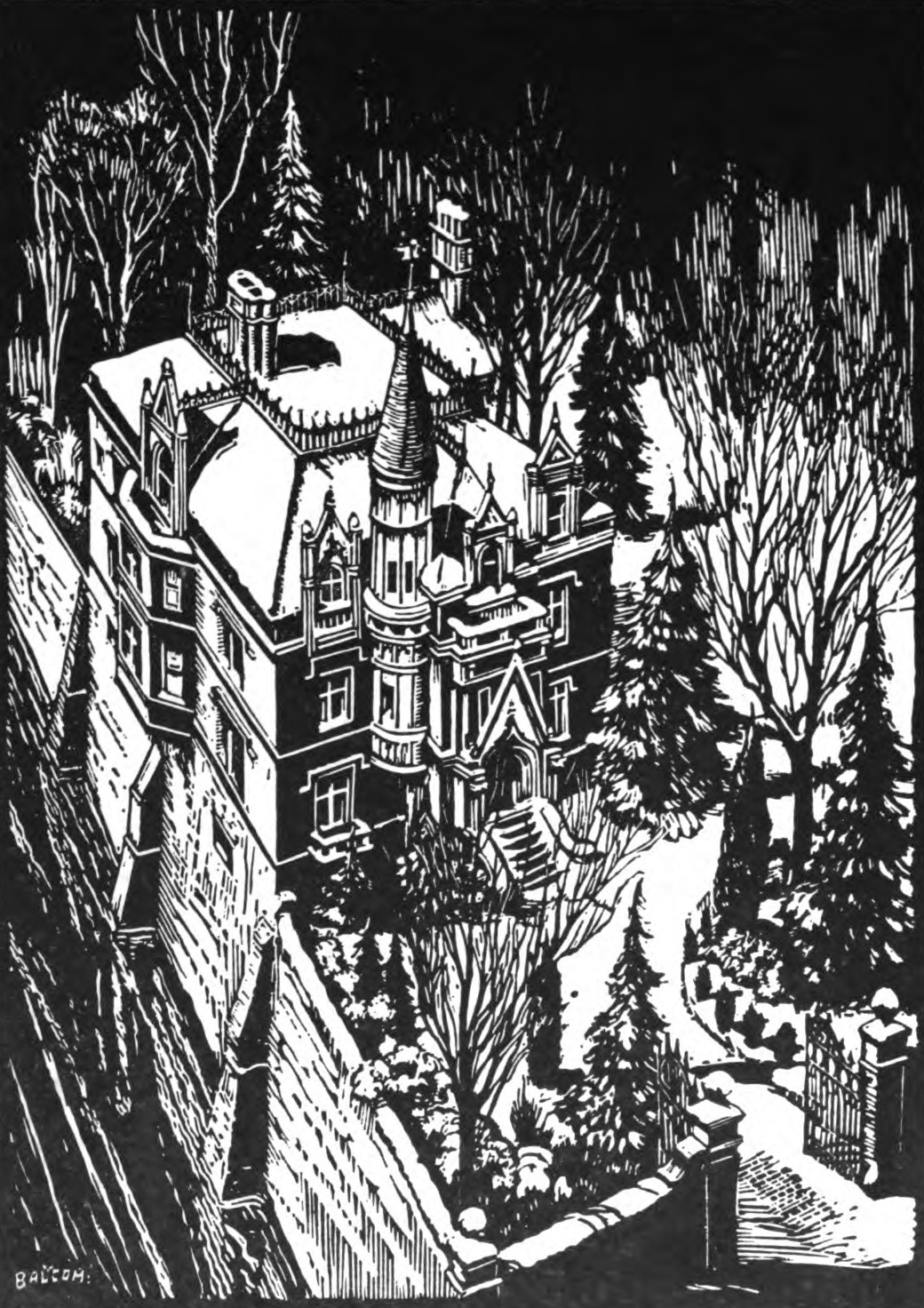
The Greene mansion, New York, as it appeared at the time of the
notorious Greene murder case.
From an old woodcut by Lowell L. Balcom.
Murder most foul, as in the best it is;
But this most foul, strange and unnatural.
—Hamlet.
Philo Vance
John F.-X. Markham
District Attorney of New York County.
Mrs. Tobias Greene
The mistress of the Greene mansion.
Julia Greene
The eldest daughter.
Sibella Greene
Another daughter.
Ada Greene
The youngest daughter.
Chester Greene
The elder son.
Rex Greene
The younger son.
Dr. Arthur Von Blon
The Greene family physician.
Sproot
The Greene butler.
Gertrude Mannheim
The cook.
Hemming
The senior maid.
Barton
The junior maid.
Miss Craven
Mrs. Greene’s nurse.
Chief Inspector O’Brien
Of the Police Department of New York City.
William M. Moran
Commanding officer of the Detective Bureau.
Ernest Heath
Sergeant of the Homicide Bureau.
Snitkin
Detective of the Homicide Bureau.
Burke
Detective of the Homicide Bureau.
Captain Anthony P. Jerym
Bertillon expert.
Captain Dubois
Finger-print expert.
Dr. Emanuel Doremus
Medical Examiner.
Dr. Drumm
An official police surgeon.
Marie O’Brien
A Police nurse.
Swacker
Secretary to the District Attorney.
Currie
Vance’s valet.
CHAPTER I. A Double Tragedy
(Tuesday, November 9; 10 a. m.)
It has long been a source of wonder to me why
the leading criminological writers—men like
Edmund Lester Pearson, H. B. Irving, Filson Young,
Canon Brookes, William Bolitho, and Harold
Eaton—have not devoted more space to the Greene
tragedy; for here, surely, is one of the outstanding
murder mysteries of modern times—a case practically
unique in the annals of latter-day crime. And yet I
realize, as I read over my own voluminous notes on
the case, and inspect the various documents relating
to it, how little of its inner history ever came to
light, and how impossible it would be for even the
most imaginative chronicler to fill in the hiatuses.
The world, of course, knows the external facts.
For over a month the press of two continents was
filled with accounts of this appalling tragedy; and
even the bare outline was sufficient to gratify the
public’s craving for the abnormal and the
spectacular. But the inside story of the catastrophe
surpassed even the wildest flights of public fancy; and,
as I now sit down to divulge those facts for the first
time, I am oppressed with a feeling akin to unreality,
although I was a witness to most of them and hold
in my possession the incontestable records of their
actuality.
Of the fiendish ingenuity which lay behind this
terrible crime, of the warped psychological motives
that inspired it, and of the strange hidden sources
of its technic, the world is completely ignorant.
Moreover, no explanation has ever been given of the
analytic steps that led to its solution. Nor have the
events attending the mechanism of that solution—events
in themselves highly dramatic and unusual—ever
been recounted. The public believes that the
termination of the case was a result of the usual
police methods of investigation; but this is because the
public is unaware of many of the vital factors of the
crime itself, and because both the Police Department
and the District Attorney’s office have, as if by tacit
agreement, refused to make known the entire
truth—whether for fear of being disbelieved or merely
because there are certain things so terrible that no
man wishes to talk of them, I do not know.
The record, therefore, which I am about to set
down is the first complete and unedited history of
the Greene holocaust.1 I feel that now the truth
should be known, for it is history, and one should
not shrink from historical facts. Also, I believe that
the credit for the solution of this case should go
where it belongs.
The man who elucidated the mystery and brought
to a close that palimpsest of horror was, curiously
enough, in no way officially connected with the
police; and in all the published accounts of the
murder his name was not once mentioned. And yet, had
it not been for him and his novel methods of criminal
deduction, the heinous plot against the Greene
family would have been conclusively successful. The
police in their researches were dealing dogmatically
with the evidential appearances of the crime, whereas
the operations of the criminal were being conducted
on a plane quite beyond the comprehension of the
ordinary investigator.
This man who, after weeks of sedulous and
disheartening analysis, eventually ferreted out the
source of the horror, was a young social aristocrat,
an intimate friend of John F.-X. Markham, the
District Attorney. His name I am not at liberty to
divulge, but for the purposes of these chronicles I
have chosen to call him Philo Vance. He is no longer
in this country, having transferred his residence
several years ago to a villa outside of Florence; and,
since he has no intention of returning to America,
he has acceded to my request to publish the history
of the criminal cases in which he participated as a
sort of amicus curiæ. Markham also has retired to
private life; and Sergeant Ernest Heath, that
doughty and honest officer of the Homicide Bureau
who officially handled the Greene case for the Police
Department, has, through an unexpected legacy,
been able to gratify his life’s ambition to breed fancy
wyandottes on a model farm in the Mohawk Valley.
Thus circumstances have made it possible for me to
publish my intimate records of the Greene tragedy.
A few words are necessary to explain my own
participation in the case. (I say “participation,”
though, in reality, my rôle was that of passive
spectator.) For several years I had been Vance’s
personal attorney. I had resigned from my father’s
law firm—Van Dine, Davis & Van Dine—in order
to devote myself exclusively to Vance’s legal and
financial needs, which, by the way, were not many.
Vance and I had been friends from our undergraduate
days at Harvard, and I found in my new duties
as his legal agent and monetary steward a sinecure
combined with many social and cultural
compensations.
Vance at that time was thirty-four years old. He
was just under six feet, slender, sinewy, and
graceful. His chiselled regular features gave his face the
attraction of strength and uniform modelling, but
a sardonic coldness of expression precluded the
designation of handsome. He had aloof gray eyes, a
straight, slender nose, and a mouth suggesting both
cruelty and asceticism. But, despite the severity of
his lineaments—which acted like an impenetrable
glass wall between him and his fellows—, he was
highly sensitive and mobile; and, though his manner
was somewhat detached and supercilious, he exerted
an undeniable fascination over those who knew him
at all well.
Much of his education had been acquired in
Europe, and he still retained a slight Oxonian accent
and intonation, though I happen to be aware that
this was no affectation: he cared too little for the
opinions of others to trouble about maintaining any
pose. He was an indefatigable student. His mind
was ever eager for knowledge, and he devoted much
of his time to the study of ethnology and psychology.
His greatest intellectual enthusiasm was art, and he
fortunately had an income sufficient to indulge his
passion for collecting. It was, however, his interest
in psychology and his application of it to individual
behaviorism that first turned his attention to the
criminal problems which came under Markham’s
jurisdiction.
The first case in which he participated was, as I
have recorded elsewhere, the murder of Alvin
Benson.2
The second was the seemingly insoluble
strangling of the famous Broadway beauty,
Margaret Odell.3
And in the late fall of the same year
came the Greene tragedy. As in the two former
cases, I kept a complete record of this new
investigation. I possessed myself of every available
document, making verbatim copies of those claimed for
the police archives, and even jotted down the
numerous conversations that took place in and out of
conference between Vance and the official
investigators. And, in addition, I kept a diary which, for
elaborateness and completeness, would have been the
despair of Samuel Pepys.
The Greene murder case occurred toward the end
of Markham’s first year in office. As you may
remember, the winter came very early that season.
There were two severe blizzards in November, and
the amount of snowfall for that month broke all local
records for eighteen years. I mention this fact of
the early snows because it played a sinister part in
the Greene affair: it was, indeed, one of the vital
factors of the murderer’s scheme. No one has yet
understood, or even sensed, the connection between
the unseasonable weather of that late fall and the
fatal tragedy that fell upon the Greene household;
but that is because all of the dark secrets of the
case were not made known.
Vance was projected into the Benson murder as
the result of a direct challenge from Markham; and
his activities in the Canary case were due to his own
expressed desire to lend a hand. But pure
coincidence was responsible for his participation in the
Greene investigation. During the two months that
had elapsed since his solution of the Canary’s death
Markham had called upon him several times
regarding moot points of criminal detection in connection
with the routine work of the District Attorney’s
office; and it was during an informal discussion of one
of these problems that the Greene case was first
mentioned.
Markham and Vance had long been friends.
Though dissimilar in tastes and even in ethical
outlook, they nevertheless respected each other
profoundly. I have often marvelled at the friendship
of these two antipodal men; but as the years went
by I came more and more to understand it. It was
as if they were drawn together by those very
qualities which each realized—perhaps with a certain
repressed regret—were lacking in his own nature.
Markham was forthright, brusque, and, on occasion,
domineering, taking life with grim and serious
concern, and following the dictates of his legal
conscience in the face of every obstacle: honest,
incorruptible, and untiring. Vance, on the other hand,
was volatile, debonair, and possessed of a perpetual
Juvenalian cynicism, smiling ironically at the
bitterest realities, and consistently fulfilling the rôle
of a whimsically disinterested spectator of life. But,
withal, he understood people as profoundly as he
understood art, and his dissection of motives and his
shrewd readings of character were—as I had many
occasions to witness—uncannily accurate.
Markham apprehended these qualities in Vance, and
sensed their true value.
It was not yet ten o’clock of the morning of
November the 9th when Vance and I, after motoring
to the old Criminal Courts Building on the corner
of Franklin and Centre Streets, went directly to the
District Attorney’s office on the fourth floor. On
that momentous forenoon two gangsters, each
accusing the other of firing the fatal shot in a recent
pay-roll hold-up, were to be cross-examined by
Markham; and this interview was to decide the
question as to which of the men would be charged with
murder and which held as a State’s witness.
Markham and Vance had discussed the situation the night
before in the lounge-room of the Stuyvesant Club,
and Vance had expressed a desire to be present at
the examination. Markham had readily assented,
and so we had risen early and driven down-town.
The interview with the two men lasted for an hour,
and Vance’s disconcerting opinion was that neither
was guilty of the actual shooting.
“Y’ know, Markham,” he drawled, when the
sheriff had returned the prisoners to the Tombs, “those
two Jack Sheppards are quite sincere: each one
thinks he’s telling the truth. Ergo, neither of ’em
fired the shot. A distressin’ predicament. They’re
obvious gallows-birds—born for the gibbet; and it’s
a beastly shame not to be able to round out their
destinies in proper fashion. . . . I say, wasn’t there
another participant in the hold-up?”
Markham nodded. “A third got away. According
to these two, it was a well-known gangster named
Eddie Maleppo.”
Markham did not reply, and Vance rose lazily
and reached for his ulster.
“By the by,” he said, slipping into his coat, “I
note that our upliftin’ press bedecked its front pages
this morning with head-lines about a pogrom at the
old Greene mansion last night. Wherefore?”
Markham glanced quickly at the clock on the wall,
and frowned.
“That reminds me. Chester Greene called up the
first thing this morning and insisted on seeing me.
I told him eleven o’clock.”
“Where do you fit in?” Vance had taken his hand
from the door-knob, and drew out his cigarette-case.
“I don’t!” snapped Markham. “But people think
the District Attorney’s office is a kind of
clearing-house for all their troubles. It happens, however,
that I’ve known Chester Greene a long time—we’re
both members of the Marylebone Golf Club—and so
I must listen to his plaint about what was obviously
an attempt to annex the famous Greene plate.”
“Burglary—eh, what?” Vance took a few puffs
on his cigarette. “With two women shot?”
“Oh, it was a miserable business! An amateur,
no doubt. Got in a panic, shot up the place, and
bolted.”
“Seems a dashed curious proceeding.” Vance
abstractedly reseated himself in a large armchair near
the door. “Did the antique cutlery actually
disappear?”
“Nothing was taken. The thief was evidently
frightened off before he made his haul.”
“Sounds a bit thick, don’t y’ know.—An
amateur thief breaks into a prominent home, casts a
predat’ry eye on the dining-room silver, takes alarm,
goes up-stairs and shoots two women in their
respective boudoirs, and then flees. . . . Very touchin’ and
all that, but unconvincin’. Whence came this
caressin’ theory?”
Markham was glowering, but when he spoke it was
with an effort at restraint.
“Feathergill was on duty last night when the call
was relayed from Headquarters, and accompanied
the police to the house. He agrees with their
conclusions.”5
“Nevertheless, I could bear to know why Chester
Greene is desirous of having polite converse with
you.”
Markham compressed his lips. He was not in
cordial mood that morning, and Vance’s flippant
curiosity irked him. After a moment, however, he
said grudgingly:
“Since the attempted robbery interests you so
keenly, you may, if you insist, wait and hear what
Greene has to say.”
“I’ll stay,” smiled Vance, removing his coat. “I’m
weak; just can’t resist a passionate entreaty. . . .
Which one of the Greenes is Chester? And how is
he related to the two deceased?”
“There was only one murder,” Markham corrected
him in a tone of forbearance. “The oldest
daughter—an unmarried woman in her early forties—was
killed instantly. A younger daughter, who was also
shot, has, I believe, a chance of recovery.”
“And Chester?”
“Chester is the elder son, a man of forty or
thereabouts. He was the first person on the scene after
the shots had been fired.”
“What other members of the family are there? I
know old Tobias Greene has gone to his Maker.”
“Yes, old Tobias died about twelve years ago.
But his wife is still living, though she’s a helpless
paralytic. Then there are—or rather were—five
children: the oldest, Julia; next, Chester; then
another daughter, Sibella, a few years under thirty, I
should say; then Rex, a sickly, bookish boy a year or
so younger than Sibella; and Ada, the youngest—an
adopted daughter twenty-two or three, perhaps.”
“And it was Julia who was killed, eh? Which of
the other two girls was shot?”
“The younger—Ada. Her room, it seems, is
across the hall from Julia’s, and the thief
apparently got in it by mistake while making his escape.
As I understand it, he entered Ada’s room
immediately after firing on Julia, saw his error, fired again,
and then fled, eventually going down the stairs and
out the main entrance.”
Vance smoked a while in silence.
“Your hypothetical intruder must have been
deuced confused to have mistaken Ada’s bedroom
door for the staircase, what? And then there’s the
query: what was this anonymous gentleman, who had
called to collect the plate, doing above-stairs?”
“Probably looking for jewellery.” Markham was
rapidly losing patience. “I am not omniscient.”
There was irony in his inflection.
“Now, now, Markham!” pleaded Vance cajolingly.
“Don’t be vindictive. Your Greene burglary
promises several nice points in academic speculation.
Permit me to indulge my idle whims.”
At that moment Swacker, Markham’s youthful
and alert secretary, appeared at the swinging door
which communicated with a narrow chamber between
the main waiting-room and the District Attorney’s
private office.
“Mr. Chester Greene is here,” he announced.
CHAPTER II. The Investigation Opens
(Tuesday, November 9; 11 a. m.)
When Chester Greene entered it was obvious he
was under a nervous strain; but his nervousness
evoked no sympathy in me. From the very first I
disliked the man. He was of medium height and was
bordering on corpulence. There was something soft
and flabby in his contours; and, though he was
dressed with studied care, there were certain signs of
overemphasis about his clothes. His cuffs were too
tight; his collar was too snug; and the colored silk
handkerchief hung too far out of his breast pocket.
He was slightly bald, and the lids of his close-set eyes
projected like those of a man with Bright’s disease.
His mouth, surmounted by a close-cropped blond
moustache, was loose; and his chin receded slightly
and was deeply creased below the under lip. He
typified the pampered idler.
When he had shaken hands with Markham, and
Vance and I had been introduced, he seated himself
and meticulously inserted a brown Russian cigarette
in a long amber-and-gold holder.
“I’d be tremendously obliged, Markham,” he said,
lighting his cigarette from an ivory pocket-lighter,
“if you’d make a personal investigation of the row
that occurred at our diggin’s last night. The police
will never get anywhere the way they’re going about
it. Good fellows, you understand—the police. But . . .
well, there’s something about this affair—don’t
know just how to put it. Anyway, I don’t like it.”
Markham studied him closely for several moments.
“Just what’s on your mind, Greene?”
The other crushed out his cigarette, though he had
taken no more than half a dozen puffs, and drummed
indecisively on the arm of his chair.
“Wish I knew. It’s a rum affair—damned rum.
There’s something back of it, too—something that’s
going to raise the very devil if we don’t stop it.
Can’t explain it. It’s a feeling I’ve got.”
“Perhaps Mr. Greene is psychic,” commented
Vance, with a look of bland innocence.
The man swung about and scrutinized Vance with
aggressive condescension. “Tosh!” He brought out
another Russian cigarette, and turned again to
Markham: “I do wish you’d take a peep at the
situation.”
Markham hesitated. “Surely you’ve some reason
for disagreeing with the police and appealing to me.”
“Funny thing, but I haven’t.” (It seemed to me
Greene’s hand shook slightly as he lit his second
cigarette.) “I simply know that my mind rejects the
burglar story automatically.”
It was difficult to tell if he were being frank or
deliberately hiding something. I did feel, however,
that some sort of fear lurked beneath his uneasiness;
and I also got the impression that he was far from
being heart-broken over the tragedy.
“It seems to me,” declared Markham, “that the
theory of the burglar is entirely consistent with the
facts. There have been many other cases of a
housebreaker suddenly taking alarm, losing his head, and
needlessly shooting people.”
Greene rose abruptly and began pacing up and
down.
“I can’t argue the case,” he muttered. “It’s
beyond all that, if you understand me.” He looked
quickly at the District Attorney with staring eyes.
“Gad! It’s got me in a cold sweat.”
“It’s all too vague and intangible,” Markham
observed kindly. “I’m inclined to think the tragedy
has upset you. Perhaps after a day or two——”
Greene lifted a protesting hand.
“It’s no go. I’m telling you, Markham, the police
will never find their burglar. I feel it—here.” He
mincingly laid a manicured hand on his breast.
Vance had been watching him with a faint
suggestion of amusement. Now he stretched his legs
before him and gazed up at the ceiling.
“I say, Mr. Greene—pardon the intrusion on your
esoteric gropings—but do you know of any one with
a reason for wanting your two sisters out of the
way?”
The man looked blank for a moment.
“No,” he answered finally; “can’t say that I do.
Who, in Heaven’s name, would want to kill two
harmless women?”
“I haven’t the groggiest notion. But, since you
repudiate the burglar theory, and since the two
ladies were undoubtedly shot, it’s inferable that some
one sought their demise; and it occurred to me that
you, being their brother and domiciled en famille,
might know of some one who harbored homicidal
sentiments toward them.”
Greene bristled, and thrust his head forward. “I
know of no one,” he blurted. Then, turning to
Markham, he continued wheedlingly: “If I had the
slightest suspicion, don’t you think I’d come out with
it? This thing has got on my nerves. I’ve been
mulling over it all night, and it’s—it’s bothersome,
frightfully bothersome.”
Markham nodded non-committally, and rising,
walked to the window, where he stood, his hands
behind him, gazing down on the gray stone masonry of
the Tombs.
Vance, despite his apparent apathy, had been
studying Greene closely; and, as Markham turned to
the window, he straightened up slightly in his chair.
“Tell me,” he began, an ingratiating note in his
voice; “just what happened last night? I
understand you were the first to reach the prostrate
women.”
“I was the first to reach my sister Julia,” retorted
Greene, with a hint of resentment. “It was Sproot,
the butler, who found Ada unconscious, bleeding
from a nasty wound in her back.”
“Her back, eh?” Vance leaned forward, and lifted
his eyebrows. “She was shot from behind, then?”
“Yes.” Greene frowned and inspected his
fingernails, as if he too sensed something disturbing in the
fact.
“And Miss Julia Greene: was she too shot from
behind?”
“No—from the front.”
“Extr’ordin’ry!” Vance blew a ring of smoke
toward the dusty chandelier. “And had both
women retired for the night?”
“An hour before. . . . But what has all that got
to do with it?”
“One never knows, does one? However, it’s
always well to be in possession of these little details
when trying to run down the elusive source of a
psychic seizure.”
“Psychic seizure be damned!” growled Greene
truculently. “Can’t a man have a feeling about
something without——?”
“Quite—quite. But you’ve asked for the District
Attorney’s assistance, and I’m sure he would like a
few data before making a decision.”
Markham came forward and sat down on the edge
of the table. His curiosity had been aroused, and he
indicated to Greene his sympathy with Vance’s
interrogation.
Greene pursed his lips, and returned his
cigarette-holder to his pocket.
“Oh, very well. What else do you want to know?”
“You might relate for us,” dulcetly resumed
Vance, “the exact order of events after you heard the
first shot. I presume you did hear the shot.”
“Certainly I heard it—couldn’t have helped hearing
it. Julia’s room is next to mine, and I was still
awake. I jumped into my slippers and pulled on
my dressing-gown; then I went out into the hall. It
was dark, and I felt my way along the wall until I
reached Julia’s door. I opened it and looked
in—didn’t know who might be there waiting to pop
me—and I saw her lying in bed, the front of her
nightgown covered with blood. There was no one else in
the room, and I went to her immediately. Just then
I heard another shot which sounded as if it came
from Ada’s room. I was a bit muzzy by this
time—didn’t know what I’d better do; and as I stood by
Julia’s bed in something of a funk—oh, I was in a
funk all right . . .”
“Can’t say that I blame you,” Vance encouraged
him.
Greene nodded. “A damned ticklish position to
be in. Well, anyway, as I stood there, I heard some
one coming down the stairs from the servants’
quarters on the third floor, and recognized old Sproot’s
tread. He fumbled along in the dark, and I heard
him enter Ada’s door. Then he called to me, and I
hurried over. Ada was lying in front of the
dressing-table; and Sproot and I lifted her on the bed.
I’d gone a bit weak in the knees; was expecting any
minute to hear another shot—don’t know why.
Anyway, it didn’t come; and then I heard Sproot’s voice
at the hall telephone calling up Doctor Von Blon.”
“I see nothing in your account, Greene,
inconsistent with the theory of a burglar,” observed
Markham. “And furthermore, Feathergill, my assistant,
says there were two sets of confused footprints in the
snow outside the front door.”
Greene shrugged his shoulders, but did not
answer.
“By the by, Mr. Greene,”—Vance had slipped
down in his chair and was staring into space—“you
said that when you looked into Miss Julia’s room you
saw her in bed. How was that? Did you turn on
the light?”
“Why, no!” The man appeared puzzled by the
question. “The light was on.”
There was a flutter of interest in Vance’s eyes.
“And how about Miss Ada’s room? Was the light
on there also?”
“Yes.”
Vance reached into his pocket, and, drawing out
his cigarette-case, carefully and deliberately selected
a cigarette. I recognized in the action an evidence
of repressed inner excitement.
“So the lights were on in both rooms. Most
interestin’.”
Markham, too, recognized the eagerness beneath
his apparent indifference, and regarded him
expectantly.
“And,” pursued Vance, after lighting his cigarette
leisurely, “how long a time would you say elapsed
between the two shots?”
Greene was obviously annoyed by this
cross-examination, but he answered readily.
“Two or three minutes—certainly no longer.”
“Still,” ruminated Vance, “after you heard the
first shot you rose from your bed, donned slippers
and robe, went into the hall, felt along the wall to the
next room, opened the door cautiously, peered inside,
and then crossed the room to the bed—all this, I
gather, before the second shot was fired. Is that
correct?”
“Certainly it’s correct.”
“Well, well! As you say, two or three minutes.
Yes, at least that. Astonishin’!” Vance turned to
Markham. “Really, y’ know, old man, I don’t wish
to influence your judgment, but I rather think you
ought to accede to Mr. Greene’s request to take a
hand in this investigation. I too have a psychic
feeling about the case. Something tells me that your
eccentric burglar will prove an ignis fatuus.”
Markham eyed him with meditative curiosity. Not
only had Vance’s questioning of Greene interested
him keenly, but he knew, as a result of long
experience, that Vance would not have made the suggestion
had he not had a good reason for doing so. I was in
no wise surprised, therefore, when he turned to his
restive visitor and said:
“Very well, Greene, I’ll see what I can do in the
matter. I’ll probably be at your house early this
afternoon. Please see that every one is present, as
I’ll want to question them.”
Greene held out a trembling hand. “The
domestic roster—family and servants—will be complete
when you arrive.”
He strode pompously from the room.
Vance sighed. “Not a nice creature, Markham—not
at all a nice creature. I shall never be a
politician if it involves an acquaintance with such
gentlemen.”
Markham seated himself at his desk with a
disgruntled air.
“Greene is highly regarded as a social—not a
political—decoration,” he said maliciously. “He
belongs to your totem, not mine.”
“Fancy that!” Vance stretched himself
luxuriously. “Still, it’s you who fascinate him. Intuition
tells me he is not overfond of me.”
“You did treat him a bit cavalierly. Sarcasm is
not exactly a means of endearment.”
“But, Markham old thing, I wasn’t pining for
Chester’s affection.”
“You think he knows, or suspects, something?”
Vance gazed through the long window into the
bleak sky beyond.
“I wonder,” he murmured. Then: “Is Chester,
by any chance, a typical representative of the Greene
family? Of recent years I’ve done so little mingling
with the élite that I’m woefully ignorant of the East
Side nabobs.”
Markham nodded reflectively.
“I’m afraid he is. The original Greene stock was
sturdy, but the present generation seems to have
gone somewhat to pot. Old Tobias the Third—Chester’s
father—was a rugged and, in many ways,
admirable character. He appears, however, to have
been the last heir of the ancient Greene qualities.
What’s left of the family has suffered some sort of
disintegration. They’re not exactly soft, but
tainted with patches of incipient decay, like fruit that’s
lain on the ground too long. Too much money and
leisure, I imagine, and too little restraint. On the
other hand, there’s a certain intellectuality lurking
in the new Greenes. They all seem to have good
minds, even if futile and misdirected. In fact, I
think you underestimate Chester. For all his
banalities and effeminate mannerisms, he’s far from
being as stupid as you regard him.”
“I regard Chester as stupid! My dear Markham!
You wrong me abominably. No, no. There’s
nothing of the anointed ass about our Chester. He’s
shrewder even than you think him. Those
œdematous eyelids veil a pair of particularly crafty eyes.
Indeed, it was largely his studied pose of fatuousness
that led me to suggest that you aid and abet in the
investigation.”
Markham leaned back and narrowed his eyes.
“What’s in your mind, Vance?”
“I told you. A psychic seizure—same like
Chester’s subliminal visitation.”
Markham knew, by this elusive answer, that for
the moment Vance had no intention of being more
definite; and after a moment of scowling silence he
turned to the telephone.
“If I’m to take on this case, I’d better find out who
has charge of it and get what preliminary
information I can.”
He called up Inspector Moran, the commanding
officer of the Detective Bureau. After a brief
conversation he turned to Vance with a smile.
“Your friend, Sergeant Heath, has the case in
hand. He happened to be in the office just now, and
is coming here immediately.”6
In less than fifteen minutes Heath arrived.
Despite the fact that he had been up most of the night,
he appeared unusually alert and energetic. His
broad, pugnacious features were as imperturbable as
ever, and his pale-blue eyes held their habitual
penetrating intentness. He greeted Markham with an
elaborate, though perfunctory, handshake; and then,
seeing Vance, relaxed his features into a
good-natured smile.
“Well, if it isn’t Mr. Vance! What have you been
up to, sir?”
Vance rose and shook hands with him.
“Alas, Sergeant, I’ve been immersed in the
terra-cotta ornamentation of Renaissance façades, and
other such trivialities, since I saw you last.7 But
I’m happy to note that crime is picking up again.
It’s a deuced drab world without a nice murky
murder now and then, don’t y’ know.”
Heath cocked an eye, and turned inquiringly to
the District Attorney. He had long since learned
how to read between the lines of Vance’s badinage.
“It’s this Greene case, Sergeant,” said Markham.
“I thought so.” Heath sat down heavily, and
inserted a black cigar between his lips. “But
nothing’s broken yet. We’re rounding up all the
regulars, and looking into their alibis for last night.
But it’ll take several days before the check-up’s
complete. If the bird who did the job hadn’t got scared
before he grabbed the swag, we might be able to trace
him through the pawnshops and fences. But
something rattled him, or he wouldn’t have shot up the
works the way he did. And that’s what makes me
think he may be a new one at the racket. If he is,
it’ll make our job harder.” He held a match in
cupped hands to his cigar, and puffed furiously.
“What did you want to know about the prowl, sir?”
Markham hesitated. The Sergeant’s matter-of-fact
assumption that a common burglar was the
culprit disconcerted him.
“Chester Greene was here,” he explained
presently; “and he seems convinced that the shooting
was not the work of a thief. He asked me, as a
special favor, to look into the matter.”
Heath gave a derisive grunt.
“Who but a burglar in a panic would shoot down
two women?”
“Quite so, Sergeant.” It was Vance who
answered. “Still, the lights were turned on in both
rooms, though the women had gone to bed an hour
before; and there was an interval of several minutes
between the two shots.”
“I know all that.” Heath spoke impatiently.
“But if an amachoor did the job, we can’t tell exactly
what did happen up-stairs there last night. When
a bird loses his head——”
“Ah! There’s the rub. When a thief loses his
head, d’ ye see, he isn’t apt to go from room to room
turning on the lights, even assuming he knows where
and how to turn them on. And he certainly isn’t
going to dally around for several minutes in a black
hall between such fantastic operations, especially
after he has shot some one and alarmed the house,
what? It doesn’t look like panic to me; it looks
strangely like design. Moreover, why should this
precious amateur of yours be cavorting about the
boudoirs up-stairs when the loot was in the
dining-room below?”
“We’ll learn all about that when we’ve got our
man,” countered Heath doggedly.
“The point is, Sergeant,” put in Markham, “I’ve
given Mr. Greene my promise to look into the matter,
and I wanted to get what details I could from you.
You understand, of course,” he added mollifyingly,
“that I shall not interfere with your activities in any
way. Whatever the outcome of the case, your
department will receive entire credit.”
“Oh, that’s all right, sir.” Experience had taught
Heath that he had nothing to fear in the way of
lost kudos when working with Markham. “But I don’t
think, in spite of Mr. Vance’s ideas, that you’ll find
much in the Greene case to warrant attention.”
“Perhaps not,” Markham admitted. “However,
I’ve committed myself, and I think I’ll run out this
afternoon and look over the situation, if you’ll give
me the lie of the land.”
“There isn’t much to tell.” Heath chewed on his
cigar cogitatingly. “A Doctor Von Blon—the
Greene family physician—phoned Headquarters
about midnight. I’d just got in from an up-town
stick-up call, and I hopped out to the house with a
couple of the boys from the Bureau. I found the
two women, like you know, one dead and the other
unconscious—both shot. I phoned Doc Doremus,8
and then looked the place over. Mr. Feathergill
came along and lent a hand; but we didn’t find much
of anything. The fellow that did the job musta got
in by the front door some way, for there was a set of
footprints in the snow coming and going, besides
Doctor Von Blon’s. But the snow was too flaky to
get any good impressions. It stopped snowing along
about eleven o’clock last night; and there’s no doubt
that the prints belonged to the burglar, for no one
else, except the doctor, had come or gone after the
storm.”
“An amateur housebreaker with a front-door key
to the Greene mansion,” murmured Vance.
“Extr’ordin’ry!”
“I’m not saying he had a key, sir,” protested
Heath. “I’m simply telling you what we found.
The door mighta been unlatched by mistake; or some
one mighta opened it for him.”
“Go on with the story, Sergeant,” urged
Markham, giving Vance a reproving look.
“Well, after Doc Doremus got there and made an
examination of the older woman’s body and inspected
the younger one’s wound, I questioned all the family
and the servants—a butler, two maids, and a cook.
Chester Greene and the butler were the only ones
who had heard the first shot, which was fired about
half past eleven. But the second shot roused old
Mrs. Greene—her room adjoins the younger
daughter’s. The rest of the household had slept through
all the excitement; but this Chester fellow had woke
’em all up by the time I got there. I talked to all
of ’em, but nobody knew anything. After a coupla
hours I left a man inside and another outside, and
came away. Then I set the usual machinery going;
and this morning Captain Dubois went over the place
the best he could for finger-prints. Doc Doremus
has got the body for an autopsy, and we’ll get a
report to-night. But there’ll be nothing helpful from
that quarter. She was fired on from in front at
close range—almost a contact shot. And the other
woman—the young one—was all powder-marked,
and her nightgown was burnt. She was shot from
behind.—That’s about all the dope.”
“Have you been able to get any sort of a statement
from the younger one?”
“Not yet. She was unconscious last night, and
this morning she was too weak to talk. But the
doctor—Von Blon—said we could probably question her
this afternoon. We may get something out of her,
in case she got a look at the bird before he shot her.”
“That suggests something to me, Sergeant.”
Vance had been listening passively to the recital, but
now he drew in his legs, and lifted himself a little.
“Did any member of the Greene household possess
a gun?”
Heath gave him a sharp look.
“This Chester Greene said he had an old .32
revolver he used to keep in a desk drawer in his
bedroom.”
“Oh, did he, now? And did you see the gun?”
“I asked him for it, but he couldn’t find it. Said
he hadn’t seen it for years, but that probably it was
around somewheres. Promised to dig it up for me
to-day.”
“Don’t hang any fond hopes on his finding it,
Sergeant.” Vance looked at Markham musingly. “I
begin to comprehend the basis of Chester’s psychic
perturbation. I fear he’s a crass materialist after
all. . . . Sad, sad.”
“You think he missed the gun, and took fright?”
“Well—something like that . . . perhaps. One
can’t tell. It’s deuced confusin’.” He turned an
indolent eye on the Sergeant. “By the by, what sort
of gun did your burglar use?”
Heath gave a gruff, uneasy laugh.
“You score there, Mr. Vance. I’ve got both
bullets—thirty-twos, fired from a revolver, not an
automatic. But you’re not trying to intimate——”
“Tut, tut, Sergeant. Like Goethe, I’m merely
seeking for more illumination, if one may
translate Licht——”
Markham interrupted this garrulous evasion.
“I’m going to the Greene house after lunch,
Sergeant. Can you come along?”
“Sure I can, sir. I was going out anyway.”
“Good.” Markham brought forth a box of
cigars. “Meet me here at two. . . . And take a couple
of these Perfectos before you go.”
Heath selected the cigars, and put them carefully
into his breast pocket. At the door he turned with
a bantering grin.
“You coming along with us, Mr. Vance—to guide
our erring footsteps, as they say?”
“Nothing could keep me away,” declared Vance.
CHAPTER III. At the Greene Mansion
(Tuesday, November 9; 2.30 p. m.)
The Greene mansion—as it was commonly
referred to by New Yorkers—was a relic of the city’s ancien
régime. It had stood for three generations
at the eastern extremity of 53d Street, two of its
oriel windows actually overhanging the murky
waters of the East River. The lot upon which the
house was built extended through the entire block—a
distance of two hundred feet—and had an equal
frontage on the cross-streets. The character of the
neighborhood had changed radically since the early
days; but the spirit of commercial advancement had
left the domicile of the Greenes untouched. It was
an oasis of idealism and calm in the midst of moiling
commercial enterprise; and one of the stipulations
in old Tobias Greene’s last will and testament had
been that the mansion should stand intact for at least
a quarter of a century after his death, as a
monument to him and his ancestors. One of his last acts
on earth was to erect a high stone wall about the
entire property, with a great double iron gateway
opening on 53d Street and a postern-gate for
tradesmen giving on 52d Street.
The mansion itself was two and a half stories high,
surmounted by gabled spires and chimney clusters.
It was what architects call, with a certain intonation
of contempt, a “château flamboyant”; but no
derogatory appellation could detract from the quiet
dignity and the air of feudal traditionalism that
emanated from its great rectangular blocks of gray
limestone. The house was sixteenth-century Gothic
in style, with more than a suspicion of the new
Italian ornament in its parts; and the pinnacles and
shelves suggested the Byzantine. But, for all its
diversity of detail, it was not flowery, and would have
held no deep attraction for the Freemason architects
of the Middle Ages. It was not “bookish” in effect;
it exuded the very essence of the old.
In the front yard were maples and clipped
evergreens, interspersed with hydrangea and
lilac-bushes; and at the rear was a row of weeping willows
overhanging the river. Along the herring-bone-bond
brick walks were high quickset hedges of
hawthorn; and the inner sides of the encircling wall
were covered with compact espaliers. To the west
of the house an asphalt driveway led to a double
garage at the rear—an addition built by the newer
generation of Greenes. But here too were boxwood
hedgerows which cloaked the driveway’s modernity.
As we entered the grounds that gray November
afternoon an atmosphere of foreboding bleakness
seemed to have settled over the estate. The trees
and shrubs were all bare, except the evergreens,
which were laden with patches of snow. The trellises
stood stripped along the walls, like clinging black
skeletons; and, save for the front walk, which had
been hastily and imperfectly swept, the grounds were
piled high with irregular snow-drifts. The gray of
the mansion’s masonry was almost the color of the
brooding overcast sky; and I felt a premonitory chill
of eeriness pass over me as we mounted the shallow
steps that led to the high front door, with its pointed
pediment above the deeply arched entrance.
Sproot, the butler—a little old man with white
hair and a heavily seamed capriform face—admitted
us with silent, funereal dignity (he had evidently
been apprised of our coming); and we were ushered
at once into the great gloomy drawing-room whose
heavily curtained windows overlooked the river. A
few moments later Chester Greene came in and
greeted Markham fulsomely. Heath and Vance and
me he included in a single supercilious nod.
“Awfully good of you to come, Markham,” he
said, with nervous eagerness, seating himself on the
edge of a chair and taking out his cigarette-holder.
“I suppose you’ll want to hold an inquisition first.
Whom’ll I summon as a starter?”
“We can let that go for the moment,” said
Markham. “First, I’d like to know something concerning
the servants. Tell me what you can about them.”
Greene moved restlessly in his chair, and seemed
to have difficulty lighting his cigarette.
“There’s only four. Big house and all that, but
we don’t need much help. Julia always acted as
housekeeper, and Ada looked after the Mater.—To
begin with, there’s old Sproot. He’s been butler,
seneschal, and majordomo for us for thirty years.
Regular family retainer—kind you read about in
English novels—devoted, loyal, humble, dictatorial,
and snooping. And a damned nuisance, I may add.
Then there are two maids—one to look after the
rooms and the other for general service, though the
women monopolize her, mostly for useless
fiddle-faddle. Hemming, the older maid, has been with us
ten years. Still wears corsets and fit-easy shoes.
Deep-water Baptist, I believe—excruciatingly
devout. Barton, the other maid, is young and flighty:
thinks she’s irresistible, knows a little table-d’hôte
French, and is the kind that’s constantly expecting
the males of the family to kiss her behind the door.
Sibella picked her out—she’s just the kind Sibella
would pick out. Been adorning our house and
shirking the hard work for about two years. The cook’s
a stodgy German woman, a typical Hausfrau—voluminous
bosoms and number-ten feet. Puts in all her
spare time writing to distant nieces and nephews in
the upper reaches of the Rhine basin somewhere;
and boasts that the most fastidious person could eat
off her kitchen floor, it’s that clean; though I’ve
never tried it. The old man engaged her a year
before he died; gave orders she was to remain as long
as she liked.—There you have the personnel of the
backstairs. Of course, there is a gardener who loafs
about the lawn in summer. He hibernates in a
speak-easy up Harlem way.”
“No chauffeur?”
“A nuisance we dispense with. Julia hated
motor-cars, and Rex is afraid to travel in
them—squeamish lad, Rex. I drive my own racer, and
Sibella’s a regular Barney Oldfield. Ada drives,
too, when the Mater isn’t using her and Sibella’s car
is idle.—So endeth.”
Markham had been making notes as Greene
rambled along with his information. At length he put
out the cigar he had been smoking.
“Now, if you don’t mind, I want to look over the
house.”
Greene rose with alacrity and led the way into the
main lower hall—a vaulted, oak-panelled entrance
containing two large carved Flemish tables of the
Sambin school, against opposite walls, and several
Anglo-Dutch crown-back chairs. A great Daghestan
rug stretched along the parqueted floor, its faded
colors repeated in the heavy draperies of the
archways.
“We have, of course, just come from the
drawing-room,” explained Greene, with a pompous air.
“Back of it, down the hall”—he pointed past the
wide marble stairway—“was the governor’s library
and den—what he called his sanctum sanctorum.
Nobody’s been in it for twelve years. The Mater
has kept it locked up ever since the old man died.
Sentiment of some kind; though I’ve often told her
she ought to clean the place out and make a
billiard-room of it. But you can’t move the Mater, once
she’s got an idea in her head. Try it some time
when you’re looking for heavy exercise.”
He walked across the hall and pulled aside the
draperies of the archway opposite to the
drawing-room.
“Here’s the reception-room, though we don’t use
it much nowadays. Stuffy, stiff place, and the flue
doesn’t draw worth a damn. Every time we’ve built
a fire here, we’ve had to have the cleaners in to
remove the soot from the tapestries.” He waved his
cigarette-holder toward two beautiful Gobelins.
“Back there, through those sliding doors, is the
dining-room; and farther on are the butler’s pantry and
the kitchen where one may eat off the floor. Care
to inspect the culinary department?”
“No, I think not,” said Markham. “And I’ll take
the kitchen floor for granted.—Now, can we look at
the second floor?”
We ascended the main stairs, which led round a
piece of marble statuary—a Falguière figure, I
think—, and emerged into the upper hall facing the
front of the house where three large close-set
windows looked out over the bare trees.
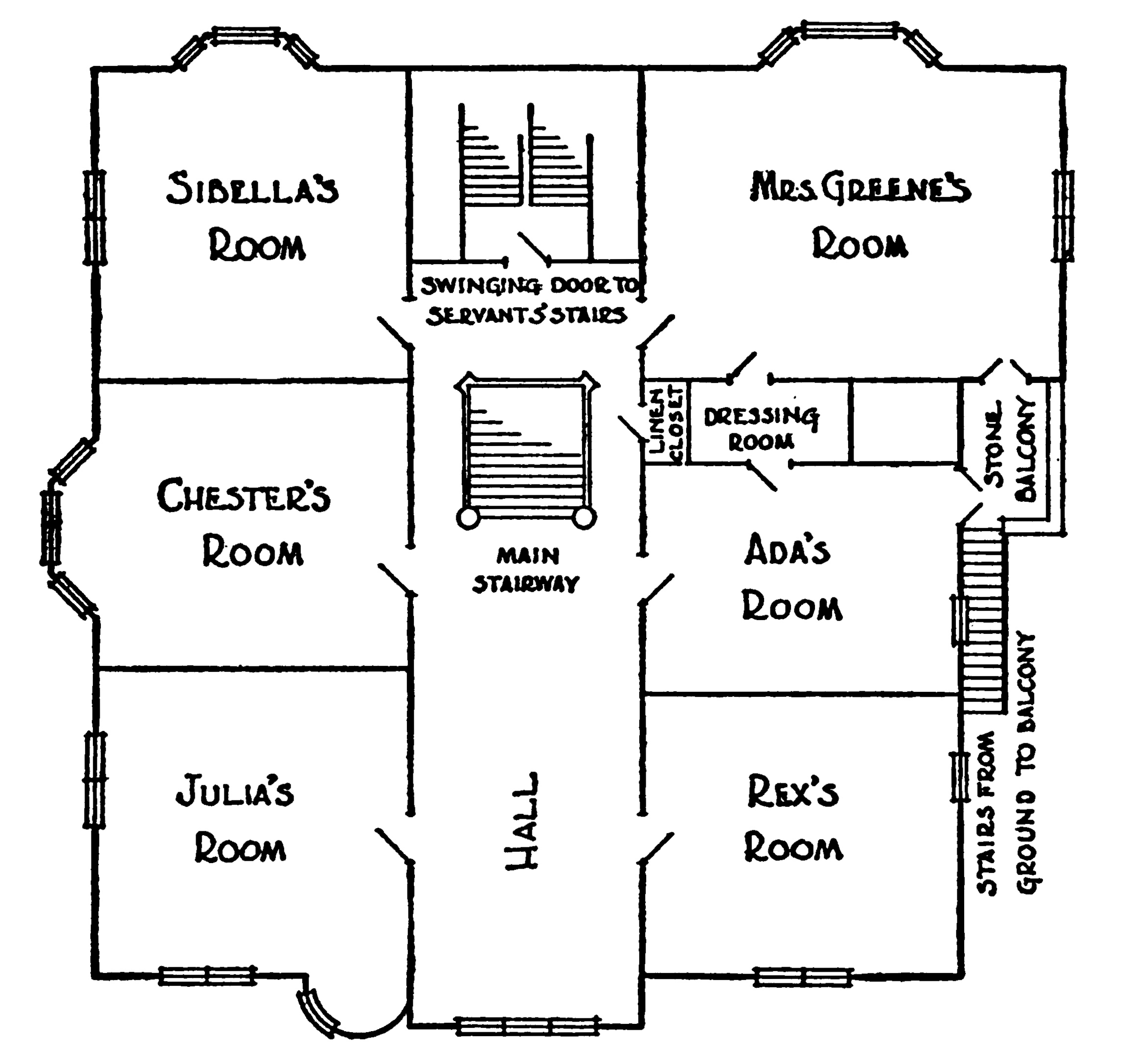
The arrangement of the rooms on the second floor
was simple and in keeping with the broad four-square
architecture of the house; but for the sake of
clarification I am embodying in this record a rough
diagram of it; for it was the disposition of these
rooms that made possible the carrying out of the
murderer’s hideous and unnatural plot.
There were six bedrooms on the floor—three on
either side of the hall, each occupied by a member
of the family. At the front of the house, on our left,
was the bedroom of Rex Greene, the younger brother.
Next to it was the room occupied by Ada Greene;
and at the rear were Mrs. Greene’s quarters,
separated from Ada’s by a fair-sized dressing-room
through which the two apartments communicated.
It will be seen from the diagram that Mrs. Greene’s
room projected beyond the main western elevation
of the house, and that in the L thus formed was a
small balustraded stone porch with a narrow flight
of stairs, set against the house, leading to the lawn
below. French doors opened upon this porch from
both Ada’s and Mrs. Greene’s rooms.
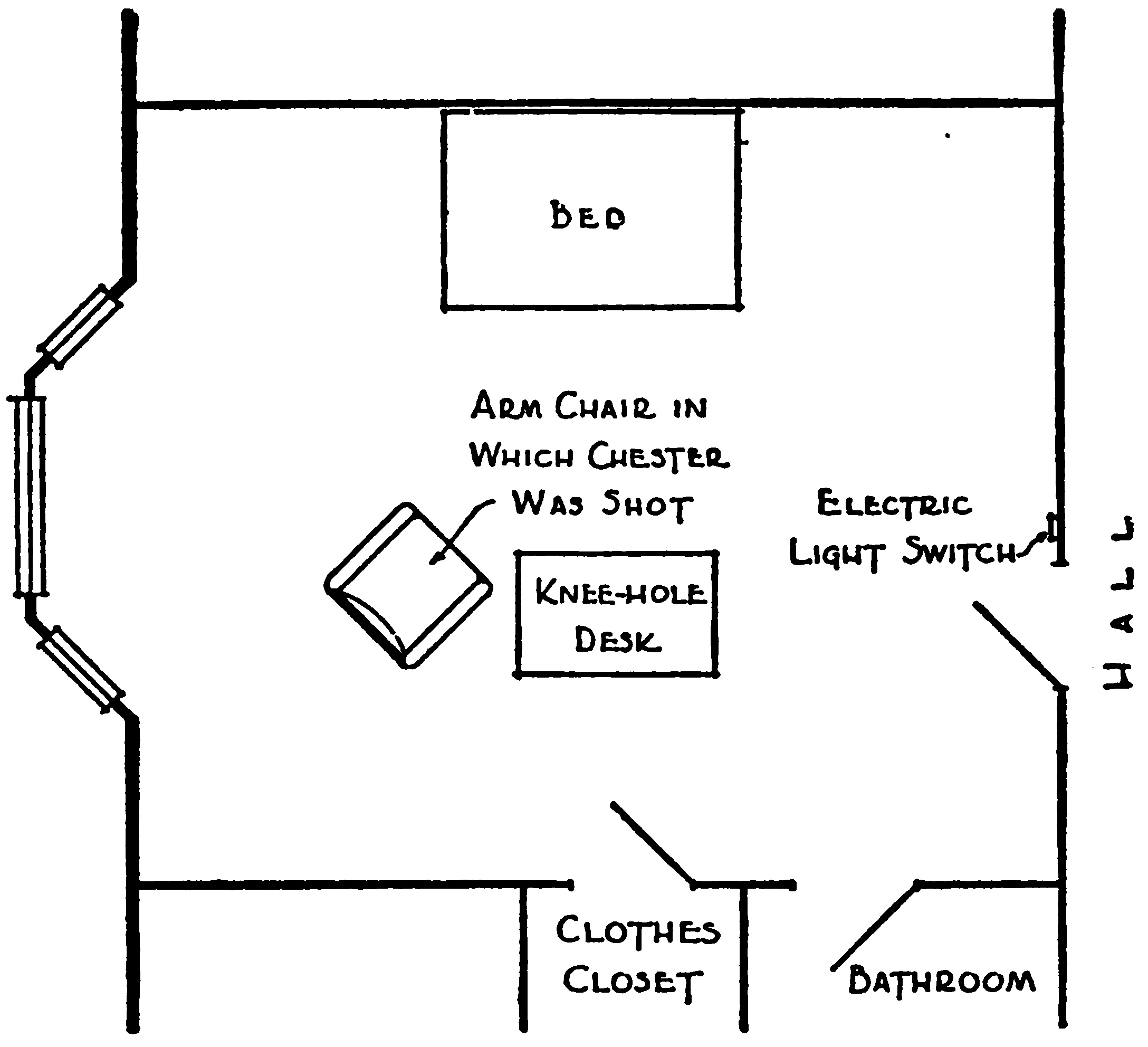
Plan of second floor. (For the sake of simplification all
bathrooms, clothes-closets, fireplaces, etc., have been omitted.)
On the opposite side of the hall were the three
rooms occupied by Julia, Chester, and Sibella,
Julia’s room being at the front of the house, Sibella’s
at the rear, and Chester’s in the centre. None of
these rooms communicated with the other. It might
also be noted that the doors to Sibella’s and Mrs.
Greene’s rooms were just behind the main staircase,
whereas Chester’s and Ada’s were directly at the
head of the stairs, and Julia’s and Rex’s farther
toward the front of the house. There was a small
linen closet between Ada’s room and Mrs. Greene’s;
and at the rear of the hall were the servants’ stairs.
Chester Greene explained this arrangement to us
briefly, and then walked up the hall to Julia’s room.
“You’ll want to look in here first, I imagine,” he
said, throwing open the door. “Nothing’s been
touched—police orders. But I can’t see what good
all that stained bed-linen is to any one. It’s a
frightful mess.”
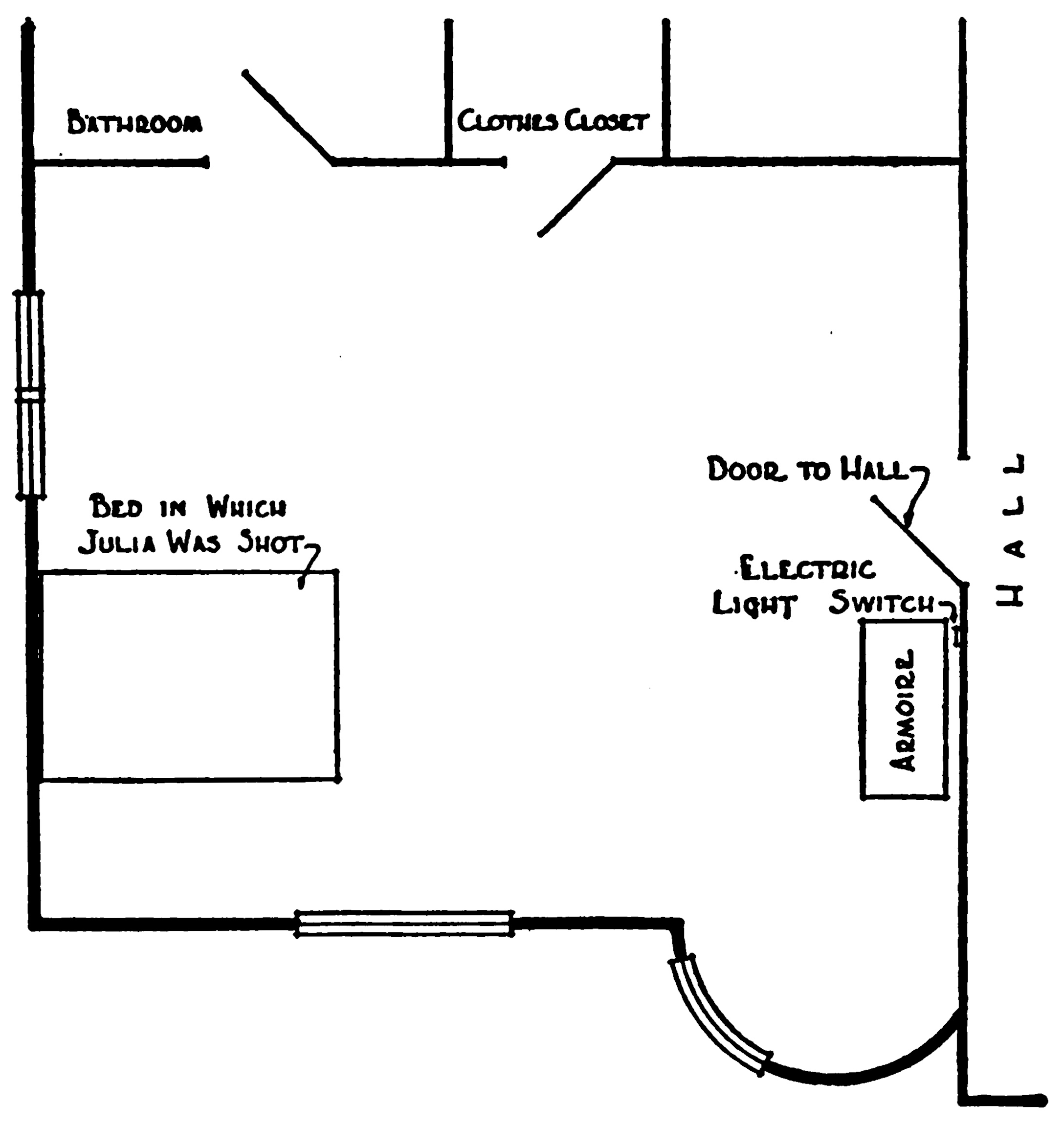
The room was large and richly furnished with
sage-green satin-upholstered furniture of the Marie
Antoinette period. Opposite to the door was a
canopied bedstead on a dais; and several dark blotches
on the embroidered linen gave mute evidence of the
tragedy that had been enacted there the night before.
Vance, after noting the disposition of the
furniture, turned his gaze upon the old-fashioned crystal
chandelier.
“Were those the lights that were on when you
found your sister last night, Mr. Greene?” he asked
casually.
The other nodded with surly annoyance.
“And where, may I ask, is the switch?”
“Behind the end of that cabinet.” Greene indifferently
indicated a highly elaborated armoire near
the door.
“Invisible—eh, what?” Vance strolled to
the armoire and looked behind it. “An amazin’
burglar!” Then he went up to Markham and spoke to
him in a low voice.
After a moment Markham nodded.
“Greene,” he said, “I wish you’d go to your room
and lie down on the bed just as you were last night
when you heard the shot. Then, when I tap on the
wall, get up and do everything you did last night—in
just the way you did it. I want to time you.”
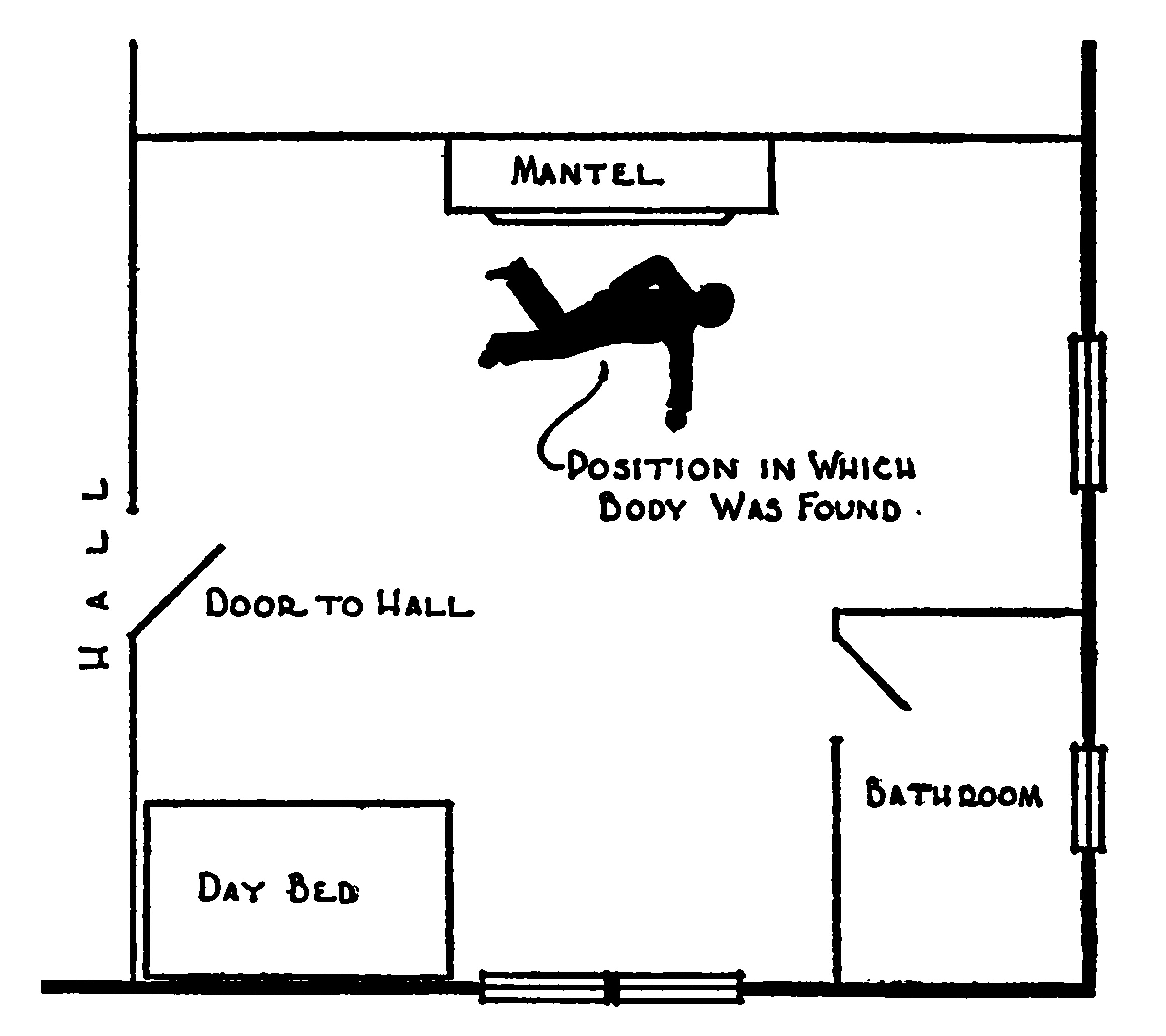
Plan of Julia’s bedroom.
The man stiffened, and gave Markham a look of
resentful protestation.
“Oh, I say——!” he began. But almost at once
he shrugged compliance and swaggered from the
room, closing the door behind him.
Vance took out his watch, and Markham, giving
Greene time to reach his room, rapped on the wall.
For what seemed an interminable time we waited.
Then the door opened slightly, and Greene peered
round the casing. Slowly his eyes swept the room;
he swung the door further ajar, stepped inside
hesitantly, and moved to the bed.
“Three minutes and twenty seconds,” announced
Vance. “Most disquietin’. . . . What do you
imagine, Sergeant, the intruder was doing in the interim
of the two shots?”
“How do I know?” retorted Heath. “Probably
groping round the hall outside looking for the
stairs.”
“If he’d groped that length of time he’d have
fallen down ’em.”
Markham interrupted this discussion with a
suggestion that we take a look at the servants’ stairway
down which the butler had come after hearing the
first shot.
“We needn’t inspect the other bedrooms just yet,”
he added, “though we’ll want to see Miss Ada’s room
as soon as the doctor thinks it’s advisable. When,
by the way, will you know his decision, Greene?”
“He said he’d be here at three. And he’s a
punctual beggar—a regular fiend for efficiency. He sent
a nurse over early this morning, and she’s looking
after Ada and the Mater now.”
“I say, Mr. Greene,” interposed Vance, “was your
sister Julia in the habit of leaving her door unlocked
at night?”
Greene’s jaw dropped a little, and his eyes opened
wider.
“By Jove—no! Now that you mention it . . . she
always locked herself in.”
Vance nodded absently, and we passed out into the
hall. A thin, swinging baize door hid the servants’
stair-well at the rear, and Markham pushed it open.
“Nothing much here to deaden the sound,” he
observed.
“No,” agreed Greene. “And old Sproot’s room is
right at the head of the steps. He’s got good ears,
too—too damned good sometimes.”
We were about to turn back, when a high-pitched
querulous voice issued from the partly open door on
our right.
“Is that you, Chester? What’s all this
disturbance? Haven’t I had enough distraction and
worry——?”
Greene had gone to his mother’s door and put his
head inside.
“It’s all right, Mater,” he said irritably. “It’s
only the police nosing around.”
“The police?” Her voice was contemptuous.
“What do they want? Didn’t they upset me enough
last night? Why don’t they go and look for the
villain instead of congregating outside my door and
annoying me?—So, it’s the police.” Her tone
became vindictive. “Bring them in here at once, and
let me talk to them. The police, indeed!”
Greene looked helplessly at Markham, who merely
nodded; and we entered the invalid’s room. It was
a spacious chamber, with windows on three sides,
furnished elaborately with all manner of conflicting
objects. My first glance took in an East Indian
rug, a buhl cabinet, an enormous gilded Buddha,
several massive Chinese chairs of carved teak-wood,
a faded Persian tapestry, two wrought-iron standard
lamps, and a red-and-gold lacquered high-boy. I
looked quickly at Vance, and surprised an expression
of puzzled interest in his eyes.
In an enormous bed, with neither head-piece
nor foot-posts, reclined the mistress of the house,
propped up in a semi-recumbent attitude on a
sprawling pile of varicolored silken pillows. She
must have been between sixty-five and seventy, but
her hair was almost black. Her long, chevaline face,
though yellowed and wrinkled like ancient
parchment, still radiated an amazing vigor: it reminded
me of the portraits I had seen of George Eliot.
About her shoulders was drawn an embroidered
Oriental shawl; and the picture she presented in the
setting of that unusual and diversified room was
exotic in the extreme. At her side sat a rosy-cheeked
imperturbable nurse in a stiff white uniform,
making a singular contrast to the woman on the bed.
Chester Greene presented Markham, and let his
mother take the rest of us for granted. At first she
did not acknowledge the introduction, but, after
appraising Markham for a moment, she gave him a
nod of resentful forbearance and held out to him a
long bony hand.
“I suppose there’s no way to avoid having my
home overrun in this fashion,” she said wearily,
assuming an air of great toleration. “I was just
endeavoring to get a little rest. My back pains me so
much to-day, after all the excitement last night. But
what do I matter—an old paralyzed woman like me?
No one considers me anyway, Mr. Markham. But
they’re perfectly right. We invalids are of no use
in the world, are we?”
Markham muttered some polite protestation, to
which Mrs. Greene paid not the slightest attention.
She had turned, with seemingly great difficulty, to
the nurse.
“Fix my pillows, Miss Craven,” she ordered
impatiently, and then added, in a whining tone: “Even
you don’t give a thought to my comfort.” The nurse
complied without a word. “Now, you can go in and
sit with Ada until Doctor Von Blon comes.—How is
the dear child?” Suddenly her voice had assumed
a note of simulated solicitude.
“She’s much better, Mrs. Greene.” The nurse
spoke in a colorless, matter-of-fact tone, and passed
quietly into the dressing-room.
The woman on the bed turned complaining eyes
upon Markham.
“It’s a terrible thing to be a cripple, unable to
walk or even stand alone. Both my legs have been
hopelessly paralyzed for ten years. Think of it,
Mr. Markham: I’ve spent ten years in this bed and
that chair”—she pointed to an invalid’s chair in the
alcove—“and I can’t even move from one to the
other unless I’m lifted bodily. But I console
myself with the thought that I’m not long for this
world; and I try to be patient. It wouldn’t be so
bad, though, if my children were only more
considerate. But I suppose I expect too much. Youth
and health give little thought to the old and
feeble—it’s the way of the world. And so I make the
best of it. It’s my fate to be a burden to every
one.”
She sighed and drew the shawl more closely about
her.
“You want to ask me some questions perhaps? I
don’t see what I can tell you that will be of any help,
but I’m only too glad to do whatever I can. I
haven’t slept a wink, and my back has been paining
me terribly as a result of all this commotion. But
I’m not complaining.”
Markham had stood looking at the old lady
sympathetically. Indeed, she was a pitiful figure. Her
long invalidism and solitude had warped what had
probably been a brilliant and generous mind; and
she had now become a kind of introspective martyr,
with an exaggerated sensitiveness to her affliction. I
could see that Markham’s instinct was to leave her
immediately with a few consoling words; but his
sense of duty directed him to remain and learn what
he could.
“I don’t wish to annoy you more than is
absolutely necessary, madam,” he said in a kindly voice.
“But it might help considerably if you permitted me
to put one or two questions.”
“What’s a little annoyance, more or less?” she
asked. “I’ve long since become used to it. Ask me
anything you choose.”
Markham bowed with Old World courtesy. “You
are very kind, madam.” Then, after a moment’s
pause: “Mr. Greene tells me you did not hear the
shot that was fired in your oldest daughter’s room,
but that the shot in Miss Ada’s room wakened you.”
“That is so.” She nodded slowly. “Julia’s room
is a considerable distance away—across the hall.
But Ada always leaves the doors open between her
room and mine in case I should need anything in the
night. Naturally the shot in her room wakened me. . . .
Let me see. I must have just fallen to sleep.
My back was giving me a great deal of trouble last
night; I had suffered all day with it, though I of
course didn’t tell any of the children about it.
Little they care how their paralyzed old mother suffers. . . .
And then, just as I had managed to doze off,
there came the report, and I was wide-awake again—lying
here helpless, unable to move, and wondering
what awful thing might be going to happen to
me. And no one came to see if I was all right; no
one thought of me, alone and defenseless. But then,
no one ever thinks of me.”
“I’m sure it wasn’t any lack of consideration, Mrs.
Greene,” Markham assured her earnestly. “The
situation probably drove everything momentarily from
their minds except the two victims of the shooting.—Tell
me this: did you hear any other sounds in
Miss Ada’s room after the shot awakened you?”
“I heard the poor girl fall—at least, it sounded
like that.”
“But no other noises of any kind? No footsteps,
for instance?”
“Footsteps?” She seemed to make an effort to
recall her impressions. “No; no footsteps.”
“Did you hear the door into the hall open or
close, madam?” It was Vance who put the question.
The woman turned her eyes sharply and glared at
him.
“No, I heard no door open or close.”
“That’s rather queer, too, don’t you think?”
pursued Vance. “The intruder must have left the
room.”
“I suppose he must have, if he’s not there now,”
she replied acidly, turning again to the District
Attorney. “Is there anything else you’d care to
know?”
Markham evidently had perceived the impossibility
of eliciting any vital information from her.
“I think not,” he answered; then added: “You of
course heard the butler and your son here enter Miss
Ada’s room?”
“Oh, yes. They made enough noise doing it—they
didn’t consider my feelings in the least. That
fuss-budget, Sproot, actually cried out for Chester
like a hysterical woman; and, from the way he raised
his voice over the telephone, one would have thought
Doctor Von Blon was deaf. Then Chester had to
rouse the whole house for some unknown reason.
Oh, there was no peace or rest for me last night, I
can tell you! And the police tramped around the
house for hours like a drove of wild cattle. It was
positively disgraceful. And here was I—a helpless
old woman—entirely neglected and forgotten,
suffering agonies with my spine.”
After a few commiserating banalities Markham
thanked her for her assistance, and withdrew. As we
passed out and walked toward the stairs I could hear
her calling out angrily: “Nurse! Nurse! Can’t you
hear me? Come at once and arrange my pillows.
What do you mean by neglecting me this way . . .?”
The voice trailed off mercifully as we descended to
the main hall.
CHAPTER IV. The Missing Revolver
(Tuesday, November 9; 3 p. m.)
“The Mater’s a crabbed old soul,” Greene
apologized offhandedly when we were again in the
drawing-room. “Always grousing about her doting
offspring.—Well, where do we go from here?”
Markham seemed lost in thought, and it was Vance
who answered.
“Let us take a peep at the servants and hearken
to their tale: Sproot for a starter.”
Markham roused himself and nodded, and Greene
rose and pulled a silken bell-cord near the archway.
A minute later the butler appeared and stood at
obsequious attention just inside the room. Markham
had appeared somewhat at sea and even uninterested
during the investigation, and Vance assumed
command.
“Sit down, Sproot, and tell us as briefly as
possible just what occurred last night.”
Sproot came forward slowly, his eyes on the floor,
but remained standing before the centre-table.
“I was reading Martial, sir, in my room,” he
began, lifting his gaze submissively, “when I thought
I heard a muffled shot. I wasn’t quite sure, for the
automobiles in the street back-fire quite loud at
times; but at last I said to myself I’d better
investigate. I was in negligé, if you understand what I
mean, sir; so I slipped on my bath-robe and came
down. I didn’t know just where the noise had come
from; but when I was half-way down the steps, I
heard another shot, and this time it sounded like it
came from Miss Ada’s room. So I went there at
once, and tried the door. It was unlocked, and when
I looked in I saw Miss Ada lying on the floor—a
very distressing sight, sir. I called to Mr. Chester,
and we lifted the poor young lady to the bed. Then
I telephoned to Doctor Von Blon.”
Vance scrutinized him.
“You were very courageous, Sproot, to brave a
dark hall looking for the source of a shot in the
middle of the night.”
“Thank you, sir,” the man answered, with great
humility. “I always try to do my duty by the
Greene family. I’ve been with them——”
“We know all that, Sproot.” Vance cut him
short. “The light was on in Miss Ada’s room, I
understand, when you opened the door.”
“Yes, sir.”
“And you saw no one, or heard no noise? No
door closing, for instance?”
“No, sir.”
“And yet the person who fired the shot must have
been somewhere in the hall at the same time you
were there.”
“I suppose so, sir.”
“And he might well have taken a shot at you,
too.”
“Quite so, sir.” Sproot seemed wholly indifferent
to the danger he had escaped. “But what will be,
will be, sir—if you’ll pardon my saying so. And
I’m an old man——”
“Tut, tut! You’ll probably live a considerable
time yet—just how long I can’t, of course, say.”
“No, sir.” Sproot’s eyes gazed blankly ahead.
“No one understands the mysteries of life and
death.”
“You’re somewhat philosophic, I see,” drily
commented Vance. Then: “When you phoned to
Doctor Von Blon, was he in?”
“No, sir; but the night nurse told me he’d be
back any minute, and that she’d send him over. He
arrived in less than half an hour.”
Vance nodded. “That will be all, thank you,
Sproot.—And now please send me die gnädige Frau
Köchin.”
“Yes, sir.” And the old butler shuffled from the
room.
Vance’s eyes followed him thoughtfully.
“An inveiglin’ character,” he murmured.
Greene snorted. “You don’t have to live with
him. He’d have said ‘Yes, sir,’ if you’d spoken to
him in Walloon or Volapük. A sweet little
playmate to have snooping round the house twenty-four
hours a day!”
The cook, a portly, phlegmatic German woman
of about forty-five, named Gertrude Mannheim,
came in and seated herself on the edge of a chair
near the entrance. Vance, after a moment’s keen
inspection of her, asked:
“Were you born in this country, Frau
Mannheim?”
“I was born in Baden,” she answered, in flat,
rather guttural tones. “I came to America when I
was twelve.”
“You have not always been a cook, I take it.”
Vance’s voice had a slightly different intonation from
that which he had used with Sproot.
At first the woman did not answer.
“No, sir,” she said finally. “Only since the death
of my husband.”
“How did you happen to come to the Greenes?”
Again she hesitated. “I had met Mr. Tobias
Greene: he knew my husband. When my husband
died there wasn’t any money. And I remembered
Mr. Greene, and I thought——”
“I understand.” Vance paused, his eyes in space.
“You heard nothing of what happened here last
night?”
“No, sir. Not until Mr. Chester called up the
stairs and said for us to get dressed and come down.”
Vance rose and turned to the window overlooking
the East River.
“That’s all, Frau Mannheim. Be so good as to
tell the senior maid—Hemming, isn’t she?—to come
here.”
Without a word the cook left us, and her place
was presently taken by a tall, slatternly woman,
with a sharp, prudish face and severely combed hair.
She wore a black, one-piece dress, and heelless
vici-kid shoes; and her severity of mien was emphasized
by a pair of thick-lensed spectacles.
“I understand, Hemming,” began Vance,
reseating himself before the fireplace, “that you heard
neither shot last night, and learned of the tragedy
only when called by Mr. Greene.”
The woman nodded with a jerky, emphatic
movement.
“I was spared,” she said, in a rasping voice. “But
the tragedy, as you call it, had to come sooner or
later. It was an act of God, if you ask me.”
“Well, we’re not asking you, Hemming; but we’re
delighted to have your opinion.—So God had a hand
in the shooting, eh?”
“He did that!” The woman spoke with religious
fervor. “The Greenes are an ungodly, wicked
family.” She leered defiantly at Chester Greene, who
laughed uneasily. “ ‘For I shall rise up against
them, saith the Lord of hosts—the name, the
remnant, and son, and daughter, and nephew’—only
there ain’t no nephew—‘and I will sweep them with
the besom of destruction, saith the Lord.’ ”
Vance regarded her musingly.
“I see you have misread Isaiah. And have you
any celestial information as to who was chosen by
the Lord to personify the besom?”
The woman compressed her lips. “Who knows?”
“Ah! Who, indeed? . . . But to descend to
temporal things: I assume you weren’t surprised at what
happened last night?”
“I’m never surprised at the mysterious workin’s
of the Almighty.”
Vance sighed. “You may return to your
Scriptural perusings, Hemming. Only, I wish you’d
pause en route and tell Barton we crave her presence
here.”
The woman rose stiffly and passed from the room
like an animated ramrod.
Barton came in, obviously frightened. But her
fear was insufficient to banish completely her
instinctive coquetry. A certain coyness showed through
the alarmed glance she gave us, and one hand
automatically smoothed back the chestnut hair over her
ear. Vance adjusted his monocle.
“You really should wear Alice blue, Barton,” he
advised her seriously. “Much more becoming than
cerise to your olive complexion.”
The girl’s apprehensiveness relaxed, and she gave
Vance a puzzled, kittenish look.
“But what I particularly wanted you to come
here for,” he went on, “was to ask you if Mr. Greene
has ever kissed you.”
“Which—Mr. Greene?” she stammered,
completely disconcerted.
Chester had, at Vance’s question, jerked himself
erect in his chair and started to splutter an irate
objection. But articulation failed him, and he turned
to Markham with speechless indignation.
The corners of Vance’s mouth twitched. “It really
doesn’t matter, Barton,” he said quickly.
“Aren’t you going to ask me any questions about—what
happened last night?” the girl asked, with
obvious disappointment.
“Oh! Do you know anything about what
happened?”
“Why, no,” she admitted. “I was asleep——”
“Exactly. Therefore, I sha’n’t bother you with
questions.” He dismissed her good-naturedly.
“Damn it, Markham, I protest!” cried Greene,
when Barton had left us. “I call this—this
gentleman’s levity rotten-bad taste—damme if I don’t!”
Markham, too, was annoyed at the frivolous line
of interrogation Vance had taken.
“I can’t see what’s to be gained by such futile
inquiries,” he said, striving to control his irritation.
“That’s because you’re still holding to the burglar
theory,” Vance replied. “But if, as Mr. Greene
thinks, there is another explanation of last night’s
crime, then it’s essential to acquaint ourselves with
the conditions existing here. And it’s equally
essential not to rouse the suspicions of the servants.
Hence, my apparent irrelevancies. I’m trying to
size up the various human factors we have to deal
with; and I think I’ve done uncommonly well.
Several rather interesting possibilities have developed.”
Before Markham could reply Sproot passed the
archway and opened the front door to some one
whom he greeted respectfully. Greene immediately
went into the hall.
“Hallo, doc,” we heard him say. “Thought you’d
be along pretty soon. The District Attorney and
his entourage are here, and they’d like to talk to
Ada. I told ’em you said it might be all right this
afternoon.”
“I’ll know better when I’ve seen Ada,” the
doctor replied. He passed on hurriedly, and we heard
him ascending the stairs.
“It’s Von Blon,” announced Greene, returning to
the drawing-room. “He’ll let us know anon how
Ada’s coming along.” There was a callous note in
his voice, which, at the time, puzzled me.
“How long have you known Doctor Von Blon?”
asked Vance.
“How long?” Greene looked surprised. “Why,
all my life. Went to the old Beekman Public
School with him. His father—old Doctor Veranus
Von Blon—brought all the later Greenes into the
world; family physician, spiritual adviser, and all
that sort of thing, from time immemorial. When Von
Blon, senior, died we embraced the son as a matter of
course. And young Arthur’s a shrewd lad, too.
Knows his pharmacopœia. Trained by the old man,
and topped off his medical education in Germany.”
Vance nodded negligently.
“While we’re waiting for Doctor Von Blon,
suppose we have a chat with Miss Sibella and Mr. Rex.
Your brother first, let us say.”
Greene looked to Markham for confirmation; then
rang for Sproot.
Rex Greene came immediately upon being
summoned.
“Well, what do you want now?” he asked,
scanning our faces with nervous intensity. His voice
was peevish, almost whining, and there were certain
overtones in it which recalled the fretful
complaining voice of Mrs. Greene.
“We merely want to question you about last
night,” answered Vance soothingly. “We thought
it possible you could help us.”
“What help can I give you?” Rex asked sullenly,
slumping into a chair. He gave his brother a
sneering look. “Chester’s the only one round here who
seems to have been awake.”
Rex Greene was a short, sallow youth with
narrow, stooping shoulders and an abnormally large
head set on a neck which appeared almost emaciated.
A shock of straight hair hung down over his bulging
forehead, and he had a habit of tossing it back with
a jerky movement of the head. His small, shifty
eyes, shielded by enormous tortoise-rimmed glasses,
seemed never to be at rest; and his thin lips were
constantly twitching as with a tic douloureux. His
chin was small and pointed, and he held it drawn in,
emphasizing its lack of prominence. He was not a
pleasant spectacle, and yet there was something in
the man—an overdeveloped studiousness, perhaps—that
gave the impression of unusual potentialities.
I once saw a juvenile chess wizard who had the same
cranial formations and general facial cast.
Vance appeared introspective, but I knew he was
absorbing every detail of the man’s appearance. At
length he laid down his cigarette, and focussed his
eyes languidly on the desk-lamp.
“You say you slept throughout the tragedy last
night. How do you account for that remarkable
fact, inasmuch as one of the shots was fired in the
room next to yours?”
Rex hitched himself forward to the edge of his
chair, and turned his head from side to side,
carefully avoiding our eyes.
“I haven’t tried to account for it,” he returned,
with angry resentment; but withal he seemed
unstrung and on the defensive. Then he hurried on:
“The walls in this house are pretty thick anyway,
and there are always noises in the street. . . . Maybe
my head was buried under the covers.”
“You’d certainly have buried your head under the
covers if you’d heard the shot,” commented Chester,
with no attempt to disguise his contempt for his
brother.
Rex swung round, and would have retorted to
the accusation had not Vance put his next question
immediately.
“What’s your theory of the crime, Mr. Greene?
You’ve heard all the details and you know the
situation.”
“I thought the police had settled on a burglar.”
The youth’s eyes rested shrewdly on Heath. “Wasn’t
that your conclusion?”
“It was, and it is,” declared the Sergeant, who,
until now, had preserved a bored silence. “But your
brother here seems to think otherwise.”
“So Chester thinks otherwise.” Rex turned to
his brother with an expression of feline dislike.
“Maybe Chester knows all about it.” There was no
mistaking the implication in his words.
Vance once more stepped into the breach.
“Your brother has told us all he knows. Just at
present we’re concerned with how much you know.”
The severity of his manner caused Rex to shrink
back in his chair. His lips twitched more violently,
and he began fidgeting with the braided frog of his
smoking-jacket. I noticed then for the first time
that he had short rachitic hands with bowed and
thickened phalanges.
“You are sure you heard no shot?” continued
Vance ominously.
“I’ve told you a dozen times I didn’t!” His voice
rose to a falsetto, and he gripped the arms of his
chair with both hands.
“Keep calm, Rex,” admonished Chester. “You’ll
be having another of your spells.”
“To hell with you!” the youth shouted. “How
many times have I got to tell them I don’t know
anything about it?”
“We merely want to make doubly sure on all
points,” Vance told him pacifyingly. “And you
certainly wouldn’t want your sister’s death to go
unavenged through any lack of perseverance on our
part.”
Rex relaxed slightly, and took a deep inspiration.
“Oh, I’d tell you anything I knew,” he said,
running his tongue over his dry lips. “But I always
get blamed for everything that happens in this
house—that is, Ada and I do. And as for avenging
Julia’s death: that doesn’t appeal to me nearly so
much as punishing the dog that shot Ada. She has
a hard enough time of it here under normal
conditions. Mother keeps her in the house waiting on
her as if she were a servant.”
Vance nodded understandingly. Then he rose
and placed his hand sympathetically on Rex’s
shoulder. This gesture was so unlike him I was
completely astonished; for, despite his deep-seated
humanism, Vance seemed always ashamed of any
outward show of feeling, and sought constantly to
repress his emotions.
“Don’t let this tragedy upset you too much, Mr.
Greene,” he said reassuringly. “And you may be
certain that we’ll do everything in our power to find
and punish the person who shot Miss Ada.—We
won’t bother you any more now.”
Rex got up almost eagerly and drew himself
together.
“Oh, that’s all right.” And with a covertly
triumphant glance at his brother, he left the room.
“Rex is a queer bird,” Chester remarked, after a
short silence. “He spends most of his time
reading and working out abstruse problems in
mathematics and astronomy. Wanted to stick a telescope
through the attic roof, but the Mater drew the line.
He’s an unhealthy beggar, too. I tell him he doesn’t
get enough fresh air, but you see his attitude toward
me. Thinks I’m weak-minded because I play golf.”
“What were the spells you spoke about?” asked
Vance. “Your brother looks as if he might be
epileptic.”
“Oh, no; nothing like that; though I’ve seen him
have convulsive seizures when he got in a specially
violent tantrum. He gets excited easily and flies
off the handle. Von Blon says it’s
hyperneurasthenia—whatever that is. He goes ghastly pale
when he’s worked up, and has a kind of trembling
fit. Says things he’s sorry for afterward.
Nothing serious, though. What he needs is exercise—a
year on a ranch roughing it, without his infernal
books and compasses and T-squares.”
“I suppose he’s more or less a favorite with your
mother.” (Vance’s remark recalled a curious
similarity of temperament between the two I had felt
vaguely as Rex talked.)
“More or less.” Chester nodded ponderously.
“He’s the pet in so far as the Mater’s capable of
petting any one but herself. Anyway, she’s never
ragged Rex as much as the rest of us.”
Again Vance went to the great window above the
East River, and stood looking out. Suddenly he
turned.
“By the by, Mr. Greene, did you find your
revolver?” His tone had changed; his ruminative mood
had gone.
Chester gave a start, and cast a swift glance at
Heath, who had now become attentive.
“No, by Gad, I haven’t,” he admitted, fumbling
in his pocket for his cigarette-holder. “Funny thing
about that gun, too. Always kept it in my desk
drawer—though, as I told this gentleman when he
mentioned it”—he pointed his holder at Heath as
if the other had been an inanimate object—“I don’t
remember actually having seen it for years. But,
even so, where the devil could it have gone? Damme,
it’s mysterious. Nobody round here would touch it.
The maids don’t go in the drawers when they’re
cleaning the room—I’m lucky if they make the bed
and dust the top of the furniture. Damned funny
what became of it.”
“Did you take a good look for it to-day, like you
said?” asked Heath, thrusting his head forward
belligerently. Why, since he held to the burglar
theory, he should assume a bulldozing manner, I
couldn’t imagine. But whenever Heath was troubled,
he was aggressive; and any loose end in an
investigation troubled him deeply.
“Certainly, I looked for it,” Chester replied,
haughtily indignant. “I went through every room
and closet and drawer in the house. But it’s
completely disappeared. . . . Probably got thrown out
by mistake in one of the annual house-cleanings.”
“That’s possible,” agreed Vance. “What sort of
a revolver was it?”
“An old Smith & Wesson .32.” Chester appeared
to be trying to refresh his memory. “Mother-of-pearl
handle: some scroll-engraving on the barrel—I
don’t recall exactly. I bought it fifteen years
ago—maybe longer—when I went camping one summer
in the Adirondacks. Used it for target practice.
Then I got tired of it, and stuck it away in a drawer
behind a lot of old cancelled checks.”
“Was it in good working order then?”
“As far as I know. Fact is, it worked stiff when
I got it, and I had the sear filed down, so it was
practically a hair-trigger affair. The slightest touch
sent it off. Better for shooting targets that way.”
“Do you recall if it was loaded when you put it
away?”
“Couldn’t say. Might have been. It’s been so
long——”
“Were there any cartridges for it in your desk?”
“Now, that I can answer you positively. There
wasn’t a loose cartridge in the place.”
Vance reseated himself.
“Well, Mr. Greene, if you happen to run across
the revolver you will, of course, let Mr. Markham or
Sergeant Heath know.”
“Oh, certainly. With pleasure.” Chester’s
assurance was expressed with an air of magnanimity.
Vance glanced at his watch.
“And now, seeing that Doctor Von Blon is still
with his patient, I wonder if we could see Miss Sibella
for a moment.”
Chester got up, obviously relieved that the subject
of the revolver had been disposed of, and went to the
bell-cord beside the archway. But he arrested his
hand in the act of reaching for it.
“I’ll fetch her myself,” he said, and hurried from
the room.
Markham turned to Vance with a smile.
“Your prophecy about the non-reappearance of
the gun has, I note, been temporarily verified.”
“And I’m afraid that fancy weapon with the hair-trigger
never will appear—at least, not until this
miserable business is cleaned up.” Vance was
unwontedly sober; his customary levity had for the
moment deserted him. But before long he lifted
his eyebrows mockingly, and gave Heath a chaffing
look.
“Perchance the Sergeant’s predacious neophyte
made off with the revolver—became fascinated with
the scrollwork, or entranced with the pearl handle.”
“It’s quite possible the revolver disappeared in the
way Greene said it did,” Markham submitted. “In
any event, I think you unduly emphasized the
matter.”
“Sure he did, Mr. Markham,” growled Heath.
“And, what’s more, I can’t see that all this repartee
with the family is getting us anywheres. I had ’em
all on the carpet last night when the shooting was
hot; and I’m telling you they don’t know nothing
about it. This Ada Greene is the only person round
here I want to talk to. There’s a chance she can
give us a tip. If her lights were on when the
burglar got in her room, she maybe got a good look at
him.”
“Sergeant,” said Vance, shaking his head sadly,
“you’re getting positively morbid on the subject of
that mythical burglar.”
Markham inspected the end of his cigar
thoughtfully.
“No, Vance. I’m inclined to agree with the
Sergeant. It appears to me that you’re the one with
the morbid imagination. I let you inveigle me into
this inquiry too easily. That’s why I’ve kept in the
background and left the floor to you. Ada Greene’s
our only hope of help here.”
“Oh, for your trusting, forthright mind!” Vance
sighed and shifted his position restlessly. “I say,
our psychic Chester is taking a dashed long time to
fetch Sibella.”
At that moment there came a sound of footsteps
on the marble stairs, and a few seconds later Sibella
Greene, accompanied by Chester, appeared in the
archway.
CHAPTER V. Homicidal Possibilities
(Tuesday, November 9; 3.30 p. m.)
Sibella entered with a firm, swinging gait, her
head held high, her eyes sweeping the assemblage
with bold interrogation. She was tall and of
slender, athletic build, and, though she was not pretty,
there was a cold, chiselled attractiveness in her
lineaments that held one’s attention. Her face was at
once vivid and intense; and there was a hauteur in
her expression amounting almost to arrogance. Her
dark, crisp hair was bobbed but not waved, and the
severity of its lines accentuated the overdecisive cast
of her features. Her hazel eyes were wide-spaced
beneath heavy, almost horizontal eyebrows; her nose
was straight and slightly prominent, and her mouth
was large and firm, with a suggestion of cruelty in
its thin lips. She was dressed simply, in a dark
sport suit cut extremely short, silk-wool stockings of
a heather mixture, and low-heeled mannish Oxfords.
Chester presented the District Attorney to her as
an old acquaintance, and permitted Markham to
make the other introductions.
“I suppose you know, Mr. Markham, why Chet
likes you,” she said, in a peculiarly plangent voice.
“You’re one of the few persons at the Marylebone
Club that he can beat at golf.”
She seated herself before the centre-table, and
crossed her knees comfortably.
“I wish you’d get me a cigarette, Chet.” Her
tone made the request an imperative.
Vance rose at once and held out his case.
“Do try one of these Régies, Miss Greene,” he
urged in his best drawing-room manner. “If you
say you don’t like them, I shall immediately change
my brand.”
“Rash man!” Sibella took a cigarette and
permitted Vance to light it for her. Then she settled
back in her chair and gave Markham a quizzical
look. “Quite a wild party we pulled here last night,
wasn’t it? We’ve never had so much commotion in
the old mansion. And it was just my luck to sleep
soundly through it all.” She made an aggrieved moue.
“Chet didn’t call me till it was all over.
Just like him—he has a nasty disposition.”
Somehow her flippancy did not shock me as it
might have done in a different type of person. But
Sibella struck me as a girl who, though she might
feel things keenly, would not permit any misfortune
to get the better of her; and I put her apparent
callousness down to a dogged, if perverted,
courageousness.
Markham, however, resented her attitude.
“One cannot blame Mr. Greene for not taking the
matter lightly,” he reproved her. “The brutal
murder of a defenseless woman and the attempted
murder of a young girl hardly come under the head of
diversion.”
Sibella looked at him reproachfully. “You know,
Mr. Markham, you sound exactly like the Mother
Superior of the stuffy convent I was confined in for
two years.” She became suddenly grave. “Why
draw a long face over something that’s happened
and can’t be helped? Anyway, Julia never sought
to brighten her little corner. She was always crabbed
and faultfinding, and her good deeds wouldn’t fill a
book. It may be unsisterly to say it, but she’s not
going to be missed so dreadfully. Chet and I are
certainly not going to pine away.”
“And what about the brutal shooting of your
other sister?” Markham was with difficulty
controlling his indignation.
Sibella’s eyelids narrowed perceptibly, and the
lines of her face became set. But she erased the
expression almost at once.
“Well, Ada’s going to recover, isn’t she?”
Despite her effort, she was unable to keep a certain
hardness out of her voice. “She’ll have a nice long
rest, and a nurse to wait on her. Am I expected to
weep copiously because of baby sister’s escape?”
Vance, who had been closely watching this clash
between Sibella and Markham, now took a hand in
the conversation.
“My dear Markham, I can’t see what Miss
Greene’s sentiments have to do with the matter. Her
attitude may not be strictly in accord with the
prescribed conduct for young ladies on such occasions,
but I feel sure she has excellent reasons for her point
of view. Let us give over moralizing, and seek Miss
Greene’s assistance instead.”
The girl darted him an amused, appreciative
glance; and Markham made a gesture of indifferent
acquiescence. It was plain that he regarded the
present inquiry as of little importance.
Vance gave the girl an engaging smile.
“It’s really my fault, Miss Greene, that we are
intruding here,” he apologized. “It was I, d’ ye see,
that urged Mr. Markham to look into the case after
your brother had expressed his disbelief in the
burglar theory.”
She nodded understandingly. “Oh, Chet sometimes
has excellent hunches. It’s one of his very few
merits.”
“You, too, I gather, are sceptical in regard to the
burglar?”
“Sceptical?” She gave a short laugh. “I’m
downright suspicious. I don’t know any burglars,
though I’d dearly love to meet one; but I simply
can’t bring my flighty brain to picture them going
about their fascinating occupation the way our little
entertainer did last night.”
“Did Chet give you any intelligible explanation
for his opinion?” she asked.
“I’m afraid not. He was inclined to lay his
feelings to metaphysical causes. His conviction was
due, I took it, to some kind of psychic visitation.
He knew, but could not explain: he was sure, but had
no proof. It was most indefinite—a bit esoteric, in
fact.”
“I’d never suspect Chet of spiritualistic leanings.”
She shot her brother a tantalizing look. “He’s
really deadly commonplace, when you get to know
him.”
“Oh, cut it, Sib,” objected Chester irritably.
“You yourself had a spasm this morning when I told
you the police were hot-footing it after a burglar.”
Sibella made no answer. With a slight toss of the
head she leaned over and threw her cigarette into the
grate.
“By the by, Miss Greene”—Vance spoke casually—“there
has been considerable mystery about the
disappearance of your brother’s revolver. It has
completely vanished from his desk drawer. I
wonder if you have seen it about the house anywhere.”
At his mention of the gun Sibella stiffened
slightly. Her eyes took on an expression of
intentness, and the corners of her mouth lifted into a
faintly ironical smile.
“Chet’s revolver has gone, has it?” She put the
question colorlessly, as if her thoughts were
elsewhere. “No . . . I haven’t seen it.” Then, after
a momentary pause: “But it was in Chet’s desk last
week.”
Chester heaved himself forward angrily.
“What were you doing in my desk last week?” he
demanded.
“Don’t wax apoplectic,” the girl said carelessly.
“I wasn’t looking for love missives. I simply
couldn’t imagine you in love, Chet. . . .” The idea
seemed to amuse her. “I was only looking for that
old emerald stick-pin you borrowed and never
returned.”
“It’s at the club,” he explained sulkily.
“Is it, really! Well, I didn’t find it anyway; but
I did see the revolver.—Are you quite sure it’s
gone?”
“Don’t be absurd,” the man growled. “I’ve
searched everywhere for it. . . . Including your
room,” he added vengefully.
“Oh, you would! But why did you admit having
it in the first place?” Her tone was scornful.
“Why involve yourself unnecessarily?”
Chester shifted uneasily.
“This gentleman”—he again pointed impersonally
to Heath—“asked me if I owned a revolver, and
I told him ‘yes.’ If I hadn’t, some of the servants
or one of my loving family would have told him.
And I thought the truth was best.”
Sibella smiled satirically.
“My older brother, you observe, is a model of all
the old-fashioned virtues,” she remarked to Vance.
But she was obviously distraite. The revolver
episode had somewhat shaken her self-assurance.
“You say, Miss Greene, that the burglar idea does
not appeal to you.” Vance was smoking languidly
with half-closed eyes. “Can you think of any other
explanation for the tragedy?”
The girl raised her head and regarded him
calculatingly.
“Because I don’t happen to believe in burglars
that shoot women and sneak away without taking
anything, it doesn’t mean that I can suggest
alternatives. I’m not a policewoman—though I’ve often
thought it would be jolly good sport—and I had a
vague idea it was the business of the police to run
down criminals.—You don’t believe in the burglar
either, Mr. Vance, or you wouldn’t have followed up
Chet’s hunch. Who do you think ran amuck here
last night?”
“My dear girl!” Vance raised a protesting hand.
“If I had the foggiest idea I wouldn’t be annoying
you with impertinent questions. I’m plodding with
leaden feet in a veritable bog of ignorance.”
He spoke negligently, but Sibella’s eyes were
clouded with suspicion. Presently, however, she
laughed gaily and held out her hand.
“Another Régie, monsieur. I was on the verge of
becoming serious; and I simply mustn’t become
serious. It’s so frightfully boring. Besides, it gives
one wrinkles. And I’m much too young for
wrinkles.”
“Like Ninon de L’Enclos, you’ll always be too
young for wrinkles,” rejoined Vance, holding a
match to her cigarette. “But perhaps you can
suggest, without becoming too serious, some one who
might have had a reason for wanting to kill your
two sisters.”
“Oh, as for that, I’d say we’d all come under
suspicion. We’re not an ideal home circle, by any
means. In fact, the Greenes are a queer collection.
We don’t love one another the way a perfectly nice
and proper family should. We’re always at each
other’s throats, bickering and fighting about
something or other. It’s rather a mess—this ménage.
It’s a wonder to me murder hasn’t been done long
before. And we’ve all got to live here until 1932,
or go it on our own; and, of course, none of us could
make a decent living. A sweet paternal heritage!”9
She smoked moodily for a few moments.
“Yes, any one of us had ample reason to be
murderously inclined toward all the others. Chet there
would strangle me now if he didn’t think the nervous
aftermath of the act would spoil his golf—wouldn’t
you, Chet dear? Rex regards us all as inferiors,
and probably considers himself highly indulgent and
altruistic not to have murdered us all long ago. And
the only reason mother hasn’t killed us is that she’s
paralyzed and can’t manage it. Julia, too, for that
matter, could have seen us all boiled in oil without
turning a hair. And as for Ada”—her brows
contracted and an extraordinary ferocity crept into her
eyes—“she’d dearly love to see us all exterminated.
She’s not really one of us, and she hates us. Nor
would I myself have any scruples about doing away
with the rest of my fond family. I’ve thought of
it often, but I could never decide on a nice thorough
method.” She flicked her cigarette ash on the floor.
“So there you are. If you’re looking for
possibilities you have them galore. There’s no one under
this ancestral roof who couldn’t qualify.”
Though her words were meant to be satirical, I
could not help feeling that a sombre, terrible truth
underlay them. Vance, though apparently listening
with amusement, had, I knew, been absorbing every
inflection of her voice and play of expression, in an
effort to relate the details of her sweeping indictment
to the problem in hand.
“At any rate,” he remarked offhandedly, “you are
an amazingly frank young woman. However, I
sha’n’t recommend your arrest just yet. I haven’t
a particle of evidence against you, don’t y’ know.
Annoyin’, ain’t it?”
“Oh, well,” sighed the girl, in mock
disappointment, “you may pick up a clew later on. There’ll
probably be another death or two around here before
long. I’d hate to think the murderer would give up
the job with so little really accomplished.”
At this point Doctor Von Blon entered the
drawing-room. Chester rose to greet him, and the
formalities of introduction were quickly over. Von
Blon bowed with reserved cordiality; but I noted
that his manner to Sibella, while pleasant, was casual
in the extreme. I wondered a little about this, but
I recalled that he was an old friend of the family and
probably took many of the social amenities for
granted.
“What have you to report, doctor?” asked
Markham. “Will we be able to question the young lady
this afternoon?”
“I hardly think there’d be any harm in it,” Von
Blon returned, seating himself beside Chester. “Ada
has only a little reaction fever now, though she’s
suffering from shock, and is pretty weak from loss
of blood.”
Doctor Von Blon was a suave, smooth-faced man
of forty, with small, almost feminine features and an
air of unwavering amiability. His urbanity struck
me as too artificial—“professional” is perhaps the
word—and there was something of the ambitious
egoist about him. But I was far more attracted
than repelled by him.
Vance watched him attentively as he spoke. He
was more anxious even than Heath, I think, to
question the girl.
“It was not a particularly serious wound, then?”
Markham asked.
“No, not serious,” the doctor assured him;
“though it barely missed being fatal. Had the shot
gone an inch deeper it would have torn across the
lung. It was a very narrow escape.”
“As I understand it,” interposed Vance, “the
bullet travelled transversely over the left scapular
region.”
Von Blon inclined his head in agreement.
“The shot was obviously aimed at the heart from
the rear,” he explained, in his soft, modulated voice.
“But Ada must have turned slightly to the right just
as the revolver exploded; and the bullet, instead of
going directly into her body, ploughed along the
shoulder-blade at the level of the third dorsal
vertebra, tore the capsular ligament, and lodged in the
deltoid.” He indicated the location of the deltoid
on his own left arm.
“She had,” suggested Vance, “apparently turned
her back on her assailant and attempted to run
away; and he had followed her and placed the
revolver almost against her back.—Is that your
interpretation of it, doctor?”
“Yes, that would seem to be the situation. And,
as I said, at the crucial moment she veered a little,
and thus saved her life.”
“Would she have fallen immediately to the floor,
despite the actual superficiality of the wound?”
“It’s not unlikely. Not only would the pain have
been considerable, but the shock must be taken into
account. Ada—or, for that matter, any woman—might
have fainted at once.”
“And it’s a reasonable presumption,” pursued
Vance, “that her assailant would have taken it for
granted that the shot had been fatal.”
“We may readily assume that to be the case.”
Vance smoked a moment, his eyes averted.
“Yes,” he agreed, “I think we may assume that.—And
another point suggests itself. Since Miss
Ada was in front of the dressing-table, a considerable
distance from the bed, and since the weapon was held
practically against her, the encounter would seem to
take on the nature of a deliberate attack, rather than
a haphazard shot fired by some one in a panic.”
Von Blon looked shrewdly at Vance, and then
turned a questioning gaze upon Heath. For a
moment he was silent, as if weighing his reply, and when
he spoke it was with guarded reserve.
“Of course, one might interpret the situation that
way. Indeed, the facts would seem to indicate such
a conclusion. But, on the other hand, the intruder
might have been very close to Ada; and the fact that
the bullet entered her left shoulder at a particularly
vital point may have been the purest accident.”
“Quite true,” conceded Vance. “However, if the
idea of premeditation is to be abrogated, we must
account for the fact that the lights were on in the
room when the butler entered immediately after the
shooting.”
Von Blon showed the keenest astonishment at this
statement.
“The lights were on? That’s most remarkable!”
His brow crinkled into a perplexed frown, and he
appeared to be assimilating Vance’s information.
“Still,” he argued, “that very fact may account for
the shooting. If the intruder had entered a lighted
room he may have fired at the occupant lest his
description be given to the police later.”
“Oh, quite!” murmured Vance. “Anyway, let us
hope we’ll learn the explanation when we’ve seen and
spoken to Miss Ada.”
“Well, why don’t we get to it?” grumbled Heath,
whose ordinarily inexhaustible store of patience had
begun to run low.
“You’re so hasty, Sergeant,” Vance chided him.
“Doctor Von Blon has just told us that Miss Ada is
very weak; and anything we can learn beforehand
will spare her just so many questions.”
“All I want to find out,” expostulated Heath, “is
if she got a look at the bird that shot her and can
give me a description of him.”
“That being the case, Sergeant, I fear you are
doomed to have your ardent hopes dashed to the
ground.”
Heath chewed viciously on his cigar; and Vance
turned again to Von Blon.
“There’s one other question I’d like to ask, doctor.
How long was it after Miss Ada had been wounded
before you examined her?”
“The butler’s already told us, Mr. Vance,”
interposed Heath impatiently. “The doctor got here in
half an hour.”
“Yes, that’s about right.” Von Blon’s tone was
smooth and matter-of-fact. “I was unfortunately
out on a call when Sproot phoned, but I returned
about fifteen minutes later, and hurried right over.
Luckily I live near here—in East 48th Street.”
“And was Miss Ada still unconscious when you
arrived?”
“Yes. She had lost considerable blood. The
cook, however, had put a towel-compress on the
wound, which of course helped.”
Vance thanked him and rose.
“And now, if you’ll be good enough to take us to
your patient, we’ll be very grateful.”
“As little excitement as possible, you understand,”
admonished Von Blon, as he got up and led the way
up-stairs.
Sibella and Chester seemed undecided about
accompanying us; but as I turned into the hall I saw
a look of interrogation flash between them, and a
moment later they too joined us in the upper hall.
CHAPTER VI. An Accusation
(Tuesday, November 9; 4 p. m.)
Ada Greene’s room was simply, almost severely,
furnished; but there was a neatness about it,
combined with little touches of feminine decoration, that
reflected the care its occupant had bestowed upon it.
To the left, near the door that led into the
dressing-room communicating with Mrs. Greene’s chamber,
was a single mahogany bed of simple design; and
beyond it was the door that opened upon the stone
balcony. To the right, beside the window, stood the
dressing-table; and on the amber-colored Chinese
rug before it there showed a large irregular brown
stain where the wounded girl had lain. In the centre
of the right wall was an old Tudor fireplace with a
high oak-panelled mantel.
As we entered, the girl in the bed looked at us
inquisitively, and a slight flush colored her pale cheeks.
She lay on her right side, facing the door, her
bandaged shoulder supported by pillows, and her left
hand, slim and white, resting upon the blue-figured
coverlet. A remnant of her fear of the night before
seemed still to linger in her blue eyes.
Doctor Von Blon went to her and, sitting down
on the edge of the bed, placed his hand on hers. His
manner was at once protective and impersonal.
“These gentlemen want to ask you a few questions,
Ada,” he explained, with a reassuring smile; “and
as you were so much stronger this afternoon I
brought them up. Do you feel equal to it?”
She nodded her head wearily, her eyes on the
doctor.
Plan of Ada’s bedroom.
Vance, who had paused by the mantel to inspect
the hand-carving of the quadræ, now turned and
approached the bed.
“Sergeant,” he said, “if you don’t mind, let me
talk to Miss Greene first.”
Heath realized, I think, that the situation called
for tact and delicacy; and it was typical of the man’s
fundamental bigness that he at once stepped aside.
“Miss Greene,” said Vance, in a quiet, genial voice,
drawing up a small chair beside the bed, “we’re very
anxious to clear up the mystery about last night’s
tragedy; and, as you are the only person who is in
a position to help us, we want you to recall for us, as
nearly as you can, just what happened.”
The girl took a deep breath.
“It—it was awful,” she said weakly, looking
straight ahead. “After I had gone to sleep—I don’t
know just what time—something woke me up. I
can’t tell you what it was; but all of a sudden I was
wide awake, and the strangest feeling came over
me. . . .” She closed her eyes, and an involuntary
shudder swept her body. “It was as though some
one were in the room, threatening me. . . .” Her
voice faded away into an awed silence.
“Was the room dark?” Vance asked gently.
“Pitch-dark.” Slowly she turned her eyes to him.
“That’s why I was so frightened. I couldn’t see
anything, and I imagined there was a ghost—or evil
spirit—near me. I tried to call out, but I couldn’t
make a sound. My throat felt dry and—and stiff.”
“Typical constriction due to fright, Ada,”
explained Von Blon. “Many people can’t speak when
they’re frightened.—Then what happened?”
“I lay trembling for a few minutes, but not a
sound came from anywhere in the room. Yet I
knew—I knew—somebody, or something, that meant to
harm me was here. . . . At last I forced myself to
get up—very quietly. I wanted to turn on the
lights—the darkness frightened me so. And after
a while I was standing up beside the bed here. Then,
for the first time, I could see the dim light of the
windows; and it made things seem more real
somehow. So I began to grope my way toward the
electric switch there by the door. I had only gone a
little way when . . . a hand . . . touched me. . . .”
Her lips were trembling, and a look of horror
came into her wide-open eyes.
“I—I was so stunned,” she struggled on, “I
hardly know what I did. Again I tried to scream,
but I couldn’t even open my lips. And then I turned
and ran away from the—the thing—toward the
window. I had almost reached it when I heard some
one coming after me—a queer, shuffling sound—and
I knew it was the end. . . . There was an awful
noise, and something hot struck the back of my
shoulder. I was suddenly nauseated; the light of the
window disappeared, and I felt myself sinking
down—deep. . . .”
When she ceased speaking a tense silence fell on
the room. Her account, for all its simplicity, had
been tremendously graphic. Like a great actress
she had managed to convey to her listeners the very
emotional essence of her story.
Vance waited several moments before speaking.
“It was a frightful experience!” he murmured
sympathetically. “I wish it wasn’t necess’ry to
worry you about details, but there are several points
I’d like to go over with you.”
She smiled faintly in appreciation of his
considerateness, and waited.
“If you tried hard, do you think you could recall
what wakened you?” he asked.
“No—there wasn’t any sound that I can
remember.”
“Did you leave your door unlocked last night?”
“I think so. I don’t generally lock it.”
“And you heard no door open or
close—anywhere?”
“No; none. Everything in the house was
perfectly still.”
“And yet you knew that some one was in the room.
How was that?” Vance’s voice, though gentle, was
persistent.
“I—don’t know . . . and yet there must have
been something that told me.”
“Exactly! Now try to think.” Vance bent a
little nearer to the troubled girl. “A soft breathing,
perhaps—a slight gust of air as the person moved
by your bed—a faint odor of perfume. . . ?”
She frowned painfully, as if trying to recall the
elusive cause of her dread.
“I can’t think—I can’t remember.” Her voice
was scarcely audible. “I was so terribly
frightened.”
“If only we could trace the source!” Vance
glanced at the doctor, who nodded understandingly,
and said:
“Obviously some association whose stimulus went
unrecognized.”
“Did you feel, Miss Greene, that you knew the
person who was here?” continued Vance. “That is
to say, was it a familiar presence?”
“I don’t know exactly. I only know I was afraid
of it.”
“But you heard it move toward you after you had
risen and fled toward the window. Was there any
familiarity in the sound?”
“No!” For the first time she spoke with
emphasis. “It was just footsteps—soft, sliding
footsteps.”
“Of course, any one might have walked that way
in the dark, or a person in bedroom slippers. . . .”
“It was only a few steps—and then came the awful
noise and burning.”
Vance waited a moment.
“Try very hard to recall those steps—or rather
your impression of them. Would you say they were
the steps of a man or a woman?”
An added pallor overspread the girl’s face; and
her frightened eyes ran over all the occupants of the
room. Her breathing, I noticed, had quickened;
and twice she parted her lips as if to speak, but
checked herself each time. At last she said in a low
tremulous voice:
“I don’t know—I haven’t the slightest idea.”
A short, high-strung laugh, bitter and sneering,
burst from Sibella; and all eyes were turned in
amazed attention in her direction. She stood rigidly
at the foot of the bed, her face flushed, her hands
tightly clinched at her side.
“Why don’t you tell them you recognized my
footsteps?” she demanded of her sister in biting tones.
“You had every intention of doing so. Haven’t you
got courage enough left to lie—you sobbing little
cat?”
Ada caught her breath and seemed to draw herself
nearer to the doctor, who gave Sibella a stern,
admonitory look.
“Oh, I say, Sib! Hold your tongue.” It was
Chester who broke the startled silence that followed
the outbreak.
Sibella shrugged her shoulders and walked to the
window; and Vance again turned his attention to the
girl on the bed, continuing his questioning as if
nothing had happened.
“There’s one more point, Miss Greene.” His tone
was even gentler than before. “When you groped
your way across the room toward the switch, at what
point did you come in contact with the unseen
person?”
“About half-way to the door—just beyond that
centre-table.”
“You say a hand touched you. But how did it
touch you? Did it shove you, or try to take hold of
you?”
She shook her head vaguely.
“Not exactly. I don’t know how to explain it, but
I seemed to walk into the hand, as though it were
outstretched—reaching for me.”
“Would you say it was a large hand or a small
one? Did you, for instance, get the impression of
strength?”
There was another silence. Again the girl’s
respiration quickened, and she cast a frightened glance
at Sibella, who stood staring out into the black,
swinging branches of the trees in the side yard.
“I don’t know—oh, I don’t know!” Her words
were like a stifled cry of anguish. “I didn’t notice.
It was all so sudden—so horrible.”
“But try to think,” urged Vance’s low, insistent
voice. “Surely you got some impression. Was it
a man’s hand, or a woman’s?”
Sibella now came swiftly to the bed, her cheeks
very pale, her eyes blazing. For a moment she
glared at the stricken girl; then she turned resolutely
to Vance.
“You asked me down-stairs if I had any idea as to
who might have done the shooting. I didn’t answer
you then, but I’ll answer you now. I’ll tell you
who’s guilty!” She jerked her head toward the bed,
and pointed a quivering finger at the still figure
lying there. “There’s the guilty one—that snivelling
little outsider, that sweet angelic little snake in
the grass!”
So incredible, so unexpected, was this accusation
that for a time no one in the room spoke. A groan
burst from Ada’s lips, and she clutched at the
doctor’s hand with a spasmodic movement of despair.
“Oh, Sibella—how could you!” she breathed.
Von Blon had stiffened, and an angry light came
into his eyes. But before he could speak Sibella
was rushing on with her illogical, astounding
indictment.
“Oh, she’s the one who did it! And she’s
deceiving you just as she’s always tried to deceive the rest
of us. She hates us—she’s hated us ever since father
brought her into this house. She resents us—the
things we have, the very blood in our veins. Heaven
knows what blood’s in hers. She hates us because
she isn’t our equal. She’d gladly see us all
murdered. She killed Julia first, because Julia ran the
house and saw to it that she did something to earn
her livelihood. She despises us; and she planned to
get rid of us.”
The girl on the bed looked piteously from one to
the other of us. There was no resentment in her
eyes; she appeared stunned and unbelieving, as if
she doubted the reality of what she had heard.
“Most interestin’,” drawled Vance. It was his
ironic tone, more than the words themselves, that
focussed all eyes on him. He had been watching
Sibella during her tirade, and his gaze was still on
her.
“You seriously accuse your sister of doing the
shooting?” He spoke now in a pleasant, almost
friendly, voice.
“I do!” she declared brazenly. “She hates us all.”
“As far as that goes,” smiled Vance, “I haven’t
noticed a superabundance of love and affection in
any of the Greene family.” His tone was without
offense. “And do you base your accusation on
anything specific, Miss Greene?”
“Isn’t it specific enough that she wants us all out
of the way, that she thinks she would have
everything—ease, luxury, freedom—if there wasn’t any
one else to inherit the Greene money?”
“Hardly specific enough to warrant a direct
accusation of so heinous a character.—And by the by,
Miss Greene, just how would you explain the method
of the crime if called as a witness in a court of law?
You couldn’t altogether ignore the fact that Miss
Ada herself was shot in the back, don’t y’ know?”
For the first time the sheer impossibility of the
accusation seemed to strike Sibella. She became
sullen; and her mouth settled into a contour of angry
bafflement.
“As I told you once before, I’m not a
policewoman,” she retorted. “Crime isn’t my specialty.”
“Nor logic either apparently.” A whimsical note
crept into Vance’s voice. “But perhaps I
misinterpret your accusation. Did you mean to imply that
Miss Ada shot your sister Julia, and that some one
else—party or parties unknown, I believe the phrase
is—shot Miss Ada immediately afterward—in a
spirit of vengeance, perhaps? A crime à quatre
mains, so to speak?”
Sibella’s confusion was obvious, but her stubborn
wrath had in no wise abated.
“Well, if that was the way it happened,” she
countered malevolently, “it’s a rotten shame they didn’t
do the job better.”
“The blunder may at least prove unfortunate for
somebody,” suggested Vance pointedly. “Still, I
hardly think we can seriously entertain the double-culprit
theory. Both of your sisters, d’ ye see, were
shot with the same gun—a .32 revolver—within a
few minutes of each other. I’m afraid that we’ll
have to be content with one guilty person.”
Sibella’s manner suddenly became sly and
calculating.
“What kind of a gun was yours, Chet?” she asked
her brother.
“Oh, it was a .32, all right—an old Smith &
Wesson revolver.” Chester was painfully ill at ease.
“Was it, indeed? Well, that’s that.” She turned
her back on us and went again to the window.
The tension in the room slackened, and Von Blon
leaned solicitously over the wounded girl and
rearranged the pillows.
“Every one’s upset, Ada,” he said soothingly.
“You mustn’t worry about what’s happened.
Sibella’ll be sorry to-morrow and make amends. This
affair has got on everybody’s nerves.”
The girl gave him a grateful glance, and seemed
to relax under his ministrations.
After a moment he straightened up and looked at
Markham.
“I hope you gentlemen are through—for to-day,
at least.”
Both Vance and Markham had risen, and Heath
and I had followed suit; but at that moment Sibella
strode toward us again.
“Wait!” she commanded imperiously. “I’ve just
thought of something. Chet’s revolver! I know
where it went.—She took it.” Again she pointed
accusingly at Ada. “I saw her in Chet’s room the
other day, and I wondered then why she was
snooping about there.” She gave Vance a triumphant
leer. “That’s specific, isn’t it?”
“What day was this, Miss Greene?” As before,
his calmness seemed to counteract the effect of her
venom.
“What day? I don’t remember exactly. Last
week some time.”
“The day you were looking for your emerald pin,
perhaps?”
Sibella hesitated; then said angrily: “I don’t
recall. Why should I remember the exact time? All
I know is that, as I was passing down the hall, I
glanced into Chet’s room—the door was half
open—and I saw her in there . . . by the desk.”
“And was it so unusual to see Miss Ada in your
brother’s room?” Vance spoke without any
particular interest.
“She never goes into any of our rooms,” declared
Sibella. “Except Rex’s, sometimes. Julia told her
long ago to keep out of them.”
Ada gave her sister a look of infinite entreaty.
“Oh, Sibella,” she moaned; “what have I ever done
to make you dislike me so?”
“What have you done!” The other’s voice was
harsh and strident, and a look almost demoniacal
smouldered in her levelled eyes. “Everything!
Nothing! Oh, you’re clever—with your quiet, sneaky
ways, and your patient, hangdog look, and your
goody-goody manner. But you don’t pull the wool
over my eyes. You’ve been hating all of us ever
since you came here. And you’ve been waiting for
the chance to kill us, planning and scheming—you
vile little——”
“Sibella!” It was Von Blon’s voice that, like the
lash of a whip, cut in on this unreasoned tirade.
“That will be enough!” He moved forward, and
glanced menacingly into the girl’s eyes. I was
almost as astonished at his attitude as I had been at
her wild words. There was a curious intimacy in his
manner—an implication of familiarity which struck
me as unusual even for a family physician of his long
and friendly standing. Vance noticed it too, for his
eyebrows went up slightly and he watched the scene
with intense interest.
“You’ve become hysterical,” Von Blon said,
without lowering his minatory gaze. “You don’t realize
what you’ve been saying.”
I felt he would have expressed himself far more
forcibly if strangers had not been present. But his
words had their effect. Sibella dropped her eyes,
and a sudden change came over her. She covered
her face with her hands, and her whole body shook
with sobs.
“I’m—sorry. I was mad—and silly—to say such
things.”
“You’d better take Sibella to her room, Chester.”
Von Blon had resumed his professional tone. “This
business has been too much for her.”
The girl turned without another word and went
out, followed by Chester.
“These modern women—all nerves,” Von Blon
commented laconically. Then he placed his hand on
Ada’s forehead. “Now, young lady, I’m going to
give you something to make you sleep after all this
excitement.”
He had scarcely opened his medicine-case to
prepare the draught when a shrill, complaining voice
drifted clearly to us from the next room; and for the
first time I noticed that the door of the little
dressing-room which communicated with Mrs. Greene’s
quarters was slightly ajar.
“What’s all the trouble now? Hasn’t there been
enough disturbance already without these noisy
scenes in my very ear? But it doesn’t matter, of
course, how much I suffer. . . . Nurse! Shut those
doors into Ada’s room. You had no business to
leave them open when you knew I was trying to get
a little rest. You did it on purpose to annoy
me. . . . And nurse! Tell the doctor I must see
him before he goes. I have those stabbing pains in
my spine again. But who thinks about me, lying
here paralyzed——?”
The doors were closed softly, and the fretful voice
was cut off from us.
“She could have had the doors closed a long time
ago if she’d really wanted them closed,” said Ada
wearily, a look of distress on her drawn white face.
“Why, Doctor Von, does she always pretend that
every one deliberately makes her suffer?”
Von Blon sighed. “I’ve told you, Ada, that you
mustn’t take your mother’s tantrums too seriously.
Her irritability and complaining are part of her
disease.”
We bade the girl good-by, and the doctor walked
with us into the hall.
“I’m afraid you didn’t learn much,” he remarked,
almost apologetically. “It’s most unfortunate Ada
didn’t get a look at her assailant.” He addressed
himself to Heath. “Did you, by the way, look in
the dining-room wall-safe to make sure nothing was
missing? You know, there’s one there behind the
big niello over the mantel.”
“One of the first places we inspected.” The
Sergeant’s voice was a bit disdainful. “And that
reminds me, doc: I want to send a man up in the
morning to look for finger-prints in Miss Ada’s room.”
Von Blon agreed amiably, and held out his hand
to Markham.
“And if there’s any way I can be of service to you
or the police,” he added pleasantly, “please call on
me. I’ll be only too glad to help. I don’t see just
what I can do, but one never knows.”
Markham thanked him, and we descended to the
lower hall. Sproot was waiting to help us with our
coats, and a moment later we were in the District
Attorney’s car ploughing our way through the
snow-drifts.
CHAPTER VII. Vance Argues the Case
(Tuesday, November 9; 5 p. m.)
It was nearly five o’clock when we reached the
Criminal Courts Building. Swacker had lit the old
bronze-and-china chandelier of Markham’s private
office, and an atmosphere of eerie gloom pervaded the
room.
“Not a nice family, Markham old dear,” sighed
Vance, lying back in one of the deep leather-upholstered
chairs. “Decidedly not a nice family. A
family run to seed, its old vigor vitiated. If the
heredit’ry sires of the contempor’ry Greenes could
rise from their sepulchres and look in upon their
present progeny, my word! what a jolly good shock
they’d have! . . . Funny thing how these old
families degenerate under the environment of ease and
idleness. There are the Wittelsbachs, and the
Romanoffs, and the Julian-Claudian house, and the
Abbassid dynasty—all examples of phyletic
disintegration. . . . And it’s the same with nations, don’t
y’ know. Luxury and unrestrained indulgence are
corruptin’ influences. Look at Rome under the
soldier emperors, and Assyria under Sardanapalus, and
Egypt under the later Ramessids, and the Vandal
African empire under Gelimer. It’s very distressin’.”
“Your erudite observations might be highly
absorbing to the social historian,” grumbled Markham,
with an undisguised show of irritability; “but I can’t
say they’re particularly edifying, or even relevant,
in the present circumstances.”
“I wouldn’t be too positive on that point,” Vance
returned easily. “In fact, I submit, for your
earnest and profound consideration, the temperaments
and internal relationships of the Greene clan, as
pointers upon the dark road of the present
investigation. . . . Really, y’ know”—he assumed a
humorsome tone—“it’s most unfortunate that you and the
Sergeant are so obsessed with the idea of social
justice and that sort of thing; for society would be
much better off if such families as the Greenes were
exterminated. Still, it’s a fascinatin’ problem—most
fascinatin’.”
“I regret I can’t share your enthusiasm for it.”
Markham spoke with asperity. “The crime strikes
me as sordid and commonplace. And if it hadn’t
been for your interference I’d have sent Chester
Greene on his way this morning with some tactful
platitudes. But you had to intercede, with your
cryptic innuendoes and mysterious head-waggings;
and I foolishly let myself be drawn into it. Well,
I trust you had an enjoyable afternoon. As for
myself, I have three hours’ accumulated work
before me.”
His complaint was an obvious suggestion that we
take ourselves off; but Vance showed no intention of
going.
“Oh, I sha’n’t depart just yet,” he announced,
with a bantering smile. “I couldn’t bring myself
to leave you in your present state of grievous error.
You need guidance, Markham; and I’ve quite made
up my mind to pour out my flutterin’ heart to you
and the Sergeant.”
Markham frowned. He understood Vance so
well that he knew the other’s levity was only
superficial—that, indeed, it cloaked some particularly
serious purpose. And the experience of a long,
intimate friendship had taught him that Vance’s
actions—however unreasonable they might appear—were
never the result of an idle whim.
“Very well,” he acquiesced. “But I’d be
grateful for an economy of words.”
Vance sighed mournfully.
“Your attitude is so typical of the spirit of
breathless speed existing in this restless day.” He fixed
an inquisitive gaze on Heath. “Tell me, Sergeant:
you saw the body of Julia Greene, didn’t you?”
“Sure, I saw it.”
“Was her position in the bed a natural one?”
“How do I know how she generally laid in bed?”
Heath was restive and in bad humor. “She was
half sitting up, with a coupla pillows under her
shoulders, and the covers pulled up.”
“Nothing unusual about her attitude?”
“Not that I could see. There hadn’t been a
struggle, if that’s what you mean.”
“And her hands: were they outside or under the
covers?”
Heath looked up, mildly astonished.
“They were outside. And, now that you
mention it, they had a tight hold on the spread.”
“Clutching it, in fact?”
“Well, yes.”
Vance leaned forward quickly.
“And her face, Sergeant? Had she been shot in
her sleep?”
“It didn’t look that way. Her eyes were wide
open, staring straight ahead.”
“Her eyes were open and staring,” repeated
Vance, a note of eagerness coming into his voice.
“What would you say her expression indicated?
Fear? Horror? Surprise?”
Heath regarded Vance shrewdly. “Well, it mighta
been any one of ’em. Her mouth was open, like as
if she was surprised at something.”
“And she was clutching the spread with both
hands.” Vance’s look drifted into space. Then
slowly he rose and walked the length of the office
and back, his head down. He halted in front of the
District Attorney’s desk, and leaned over, resting
both hands on the back of a chair.
“Listen, Markham. There’s something terrible
and unthinkable going on in that house. No
haphazard unknown assassin came in by the front door
last night and shot down those two women. The
crime was planned—thought out. Some one lay in
wait—some one who knew his way about, knew
where the light-switches were, knew when every one
was asleep, knew when the servants had retired—knew
just when and how to strike the blow. Some
deep, awful motive lies behind that crime. There
are depths beneath depths in what happened last
night—obscure fetid chambers of the human soul.
Black hatreds, unnatural desires, hideous impulses,
obscene ambitions are at the bottom of it; and you
are only playing into the murderer’s hands when you
sit back and refuse to see its significance.”
His voice had a curious hushed quality, and it was
difficult to believe that this was the habitually
debonair and cynical Vance.
“That house is polluted, Markham. It’s
crumbling in decay—not material decay, perhaps, but a
putrefaction far more terrible. The very heart and
essence of that old house is rotting away. And all
the inmates are rotting with it, disintegrating in
spirit and mind and character. They’ve been
polluted by the very atmosphere they’ve created. This
crime, which you take so lightly, was inevitable in
such a setting. I only wonder it was not more
terrible, more vile. It marked one of the tertiary
stages of the general dissolution of that abnormal
establishment.”
He paused, and extended his hand in a hopeless
gesture.
“Think of the situation. That old, lonely,
spacious house, exuding the musty atmosphere of dead
generations, faded inside and out, run down, dingy,
filled with ghosts of another day, standing there in
its ill-kept grounds, lapped by the dirty waters of
the river. . . . And then think of those six
ill-sorted, restless, unhealthy beings compelled to live
there in daily contact for a quarter of a century—such
was old Tobias Greene’s perverted idealism.
And they’ve lived there, day in and day out, in that
mouldy miasma of antiquity—unfit to meet the
conditions of any alternative, too weak or too cowardly
to strike out alone; held by an undermining security
and a corrupting ease; growing to hate the very
sight of one another, becoming bitter, spiteful,
jealous, vicious; wearing down each other’s nerves to the
raw; consumed with resentment, aflame with hate,
thinking evil—complaining, fighting, snarling. . . .
Then, at last, the breaking-point—the logical,
ineluctable figuration of all this self-feeding,
ingrowing hatred.”
“All of that is easy to understand,” agreed
Markham. “But, after all, your conclusion is wholly
theoretic, not to say literary.—By what tangible
links do you connect last night’s shooting with the
admittedly abnormal situation at the Greene
mansion?”
“There are no tangible links—that’s the horror
of it. But the joinders are there, however shadowy.
I began to sense them the minute I entered the house;
and all this afternoon I was reaching for them
blindly. But they eluded me at every turn. It was
like a house of mazes and false passages and
trapdoors and reeking oubliettes: nothing normal,
nothing sane—a house in a nightmare, peopled by
strange, abnormal creatures, each reflecting the
subtle, monstrous horror that broke forth last night and
went prowling about the old hallways. Didn’t you
sense it? Didn’t you see the vague shape of this
abomination continually flash out and disappear as
we talked to these people and watched them battling
against their own hideous thoughts and suspicions?”
Markham moved uneasily and straightened a pile
of papers before him. Vance’s unwonted gravity
had affected him.
“I understand perfectly what you mean,” he said.
“But I don’t see that your impressions bring us any
nearer to a new theory of the crime. The Greene
mansion is unhealthy—that’s granted—and so, no
doubt, are the people in it. But I’m afraid you’ve
been oversusceptible to its atmosphere. You talk as
if last night’s crime were comparable to the
poisoning orgies of the Borgias, or the Marquise de
Brinvilliers affair, or the murder of Drusus and
Germanicus, or the suffocation of the York princes in the
Tower. I’ll admit the setting is consonant with
that sort of stealthy, romantic crime; but, after all,
housebreakers and bandits are shooting people
senselessly every week throughout the country, in very
much the same way the two Greene women were
shot.”
“You’re shutting your eyes to the facts,
Markham,” Vance declared earnestly. “You’re
overlooking several strange features of last night’s
crime—the horrified, astounded attitude of Julia at the
moment of death; the illogical interval between the two
shots; the fact that the lights were on in both rooms;
Ada’s story of that hand reaching for her; the
absence of any signs of a forced entry——”
“What about those footprints in the snow?”
interrupted Heath’s matter-of-fact voice.
“What about them, indeed?” Vance wheeled
about. “They’re as incomprehensible as the rest of
this hideous business. Some one walked to and from
the house within a half-hour of the crime; but it was
some one who knew he could get in quietly and
without disturbing any one.”
“There’s nothing mysterious about that,” asserted
the practical Sergeant. “There are four servants
in the house, and any one of ’em could’ve been in on
the job.”
Vance smiled ironically.
“And this accomplice in the house, who so
generously opened the front door at a specified hour,
failed to inform the intruder where the loot was, and
omitted to acquaint him with the arrangement of the
house; with the result that, once he was inside, he
went astray, overlooked the dining-room, wandered
up-stairs, went groping about the hall, got lost in
the various bedrooms, had a seizure of panic, shot
two women, turned on the lights by switches hidden
behind the furniture, made his way down-stairs
without a sound when Sproot was within a few feet of
him, and walked out the front door to freedom! . . .
A strange burglar, Sergeant. And an even stranger
inside accomplice.—No; your explanation won’t
do—decidedly it won’t do.” He turned back to
Markham. “And the only way you’ll ever find the true
explanation for those shootings is by understanding
the unnatural situation that exists in the house
itself.”
“But we know the situation, Vance,” Markham
argued patiently. “I’ll admit it’s an unusual one.
But it’s not necessarily criminal. Antagonistic
human elements are often thrown together; and a
mutual hate is generated as a result. But mere hate is
rarely a motive for murder; and it certainly does not
constitute evidence of criminal activity.”
“Perhaps not. But hatred and enforced
propinquity may breed all manner of abnormalities—outrageous
passions, abominable evils, devilish intrigues.
And in the present case there are any number of
curious and sinister facts that need explaining——”
“Ah! Now you’re becoming more tangible. Just
what are these facts that call for explanation?”
Vance lit a cigarette and sat down on the edge of
the table.
“For instance, why did Chester Greene come here
in the first place and solicit your help? Because of
the disappearance of the gun? Maybe; but I doubt
if it is the whole explanation. And what about the
gun itself? Did it disappear? Or did Chester
secrete it? Deuced queer about that gun. And
Sibella said she saw it last week. But did she see
it? We’ll know a lot more about the case when we
can trace the peregrinations of that revolver.—And
why did Chester hear the first shot so readily, when
Rex, in the next room to Ada’s, says he failed to hear
the second shot?—And that long interval between
the two reports will need some explaining.—And
there’s Sproot—the multilingual butler who
happened to be reading Martial—Martial, by all that’s
holy!—when the grim business took place, and came
directly to the scene without meeting or hearing any
one.—And just what significance attaches to the
pious Hemming’s oracular pronouncements about
the Lord of hosts smiting the Greenes as he did the
children of Babylon? She has some obscure
religious notion in her head—which, after all, may not
be so obscure.—And the German cook: there’s a
woman with, as we euphemistically say, a past.
Despite her phlegmatic appearance, she’s not of the
servant class; yet she’s been feeding the Greenes
dutifully for over a dozen years. You recall her
explanation of how she came to the Greenes? Her
husband was a friend of old Tobias’s; and Tobias
gave orders she was to remain as cook as long as she
desired. She needs explaining, Markham—and a
dashed lot of it.—And Rex, with his projecting
parietals and his wambly body and his periodic fits.
Why did he get so excited when we questioned him?
He certainly didn’t act like an innocent and
uncomprehending spectator of an attempted burglary.—And
again I mention the lights. Who turned them
on, and why? And in both rooms! In Julia’s
room before the shot was fired, for she evidently saw
the assassin and understood his purpose; and in
Ada’s room, after the shooting! Those are facts
which fairly shriek for explanation; for without an
explanation they’re mad, irrational, utterly
incredible.—And why wasn’t Von Blon at home in the
middle of the night when Sproot phoned him? And how
did it happen he nevertheless arrived so promptly?
Coincidence? . . . And, by the by, Sergeant: was
that double set of footprints like the single spoor of
the doctor’s?”
“There wasn’t any way of telling. The snow was
too flaky.”
“It probably doesn’t matter particularly,
anyhow.” Vance again faced Markham and resumed
his recapitulation. “And then there are the points
of difference in these two attacks. Julia was shot
from the front when she was in bed, whereas Ada
was shot in the back after she had risen from bed,
although the murderer had ample time to go to her
and take aim while she was still lying down. Why
did he wait silently until the girl got up and
approached him? How did he dare wait at all after
he had killed Julia and alarmed the house? Does
that strike you as panic? Or as cool-headedness?—And
how did Julia’s door come to be unlocked at
that particular time? That’s something I especially
want clarified.—And perhaps you noticed,
Markham, that Chester himself went to summon Sibella
to the interview in the drawing-room, and that he
remained with her a considerable time. Why, now,
did he send Sproot for Rex, and fetch Sibella
personally? And why the delay? I yearn for an
explanation of what passed between them before they
eventually appeared.—And why was Sibella so
definite that there wasn’t a burglar, and yet so evasive
when we asked her to suggest a counter-theory?
What underlay her satirical frankness when she held
up each member of the Greene household, including
herself, as a possible suspect?—And then there are
the details of Ada’s story. Some of them are
amazing, incomprehensible, almost fabulous. There was
no apparent sound in the room; yet she was
conscious of a menacing presence. And that
outstretched hand and the shuffling footsteps—we
simply must have an explanation of those things. And
her hesitancy about saying whether she thought it
was a man or a woman; and Sibella’s evident belief
that the girl thought it was she. That wants
explaining, Markham.—And Sibella’s hysterical
accusation against Ada. What lay behind that?—And
don’t forget that curious scene between Sibella and
Von Blon when he reproached her for her outburst.
That was devilish odd. There’s some intimacy
there—ça saute aux yeux. You noticed how she obeyed
him. And you doubtless observed, too, that Ada is
rather fond of the doctor: snuggled up to him
figuratively during the performance, opened her eyes
on him wistfully, looked to him for protection. Oh,
our little Ada has flutterings in his direction. And
yet he adopts the hovering professional-bedside
manner of a high-priced medico toward her, whereas he
treats Sibella very much as Chester might if he had
the courage.”
Vance inhaled deeply on his cigarette.
“Yes, Markham, there are many things that must
be satisfactorily accounted for before I can believe
in your hypothetical burglar.”
Markham sat for a while, engrossed in his
thoughts.
“I’ve listened to your Homeric catalogue, Vance,”
he said at length, “but I can’t say that it inflames
me. You’ve suggested a number of interesting
possibilities, and raised several points that might bear
looking into. However, the only potential weight of
your argument lies in an accumulation of items
which, taken separately, are not particularly
impressive. A plausible answer might be found for
each one of them. The trouble is, the integers of
your summary are without a connecting thread, and
consequently must be regarded as separate units.”
“That legal mind of yours!” Vance rose and
paced up and down. “An accumulation of queer
and unexplained facts centring about a crime is no
more impressive than each separate item in the total!
Well, well! I give up. I renounce all reason. I
fold up my tent like the Arabs and as silently steal
away.” He took up his coat. “I leave you to your
fantastic, delirious burglar, who walks without keys
into a house and steals nothing, who knows where
electric switches are hidden but can’t find a
staircase, who shoots women and then turns up the lights.
When you find him, my dear Lycurgus, you should,
in all humaneness, send him to the psychopathic
ward. He’s quite unaccountable, I assure you.”
Markham, despite his opposition, had not been
unimpressed. Vance unquestionably had undermined
to some extent his belief in a housebreaker. But I
could readily understand why he was reluctant to
abandon this theory until it had been thoroughly
tested. His next words, in fact, explained his
attitude.
“I’m not denying the remote possibility that this
affair may go deeper than appears. But there’s too
little to go on at present to warrant an investigation
along other than routine lines. We can’t very well
stir up an ungodly scandal by raking the members
of a prominent family over the coals, when there’s
not a scintilla of evidence against any one of them.
It’s too unjust and dangerous a proceeding. We
must at least wait until the police have finished their
investigation. Then, if nothing develops, we can
again take inventory and decide how to proceed. . . .
How long, Sergeant, do you figure on being
busy?”
Heath took his cigar from his mouth and regarded
it thoughtfully.
“That’s hard to say, sir. Dubois’ll finish up his
finger-printing to-morrow, and we’re checking up
on the regulars as fast as we can. Also, I’ve got
two men digging up the records of the Greene
servants. It may take a lot of time, and it may go
quick. Depends on the breaks we get.”
Vance sighed.
“And it was such a neat, fascinatin’ crime! I’ve
rather been looking forward to it, don’t y’ know, and
now you talk of prying into the early amours of
serving-maids and that sort of thing. It’s most
disheartenin’.”
He buttoned his ulster about him and walked to
the door.
“Ah, well, there’s nothing for me to do while you
Jasons are launched on your quaint quest. I think
I’ll retire and resume my translation of Delacroix’s
‘Journal.’”
But Vance was not destined then to finish this task
he had had in mind so long. Three days later the
front pages of the country’s press carried glaring
head-lines telling of a second grim and
unaccountable tragedy at the old Greene mansion, which
altered the entire character of the case and
immediately lifted it into the realm of the foremost causes
célèbres of modern times. After this second blow
had fallen all ideas of a casual burglar were
banished. There could no longer be any doubt that a
hidden death-dealing horror stalked through the
dim corridors of that fated house.
CHAPTER VIII. The Second Tragedy
(Friday, November 12; 8 a. m.)
The day after we had taken leave of Markham at
his office the rigor of the weather suddenly relaxed.
The sun came out, and the thermometer rose nearly
thirty degrees. Toward night of the second day,
however, a fine, damp snow began to fall, spreading
a thin white blanket over the city; but around eleven
the skies were again clear.
I mention these facts because they had a curious
bearing on the second crime at the Greene mansion.
Footprints again appeared on the front walk; and,
as a result of the clinging softness of the snow, the
police also found tracks in the lower hall and on the
marble stairs.
Vance had spent Wednesday and Thursday in his
library reading desultorily and checking Vollard’s
catalogue of Cézanne’s water-colors. The three-volume
edition of the “Journal de Eugène Delacroix”10
lay on his writing-table; but I noticed that he did
not so much as open it. He was restless and
distracted, and his long silences at dinner (which we ate
together in the living-room before the great log fire)
told me only too clearly that something was perturbing
him. Moreover, he had sent notes cancelling
several social engagements, and had given orders to
Currie, his valet and domestic factotum, that he was
“out” to callers.
As he sat sipping his cognac at the end of dinner
on Thursday night, his eyes idly tracing the forms
in the Renoir Beigneuse above the mantel, he gave
voice to his thoughts.
“ ’Pon my word, Van, I can’t shake the
atmosphere of that damnable house. Markham is
probably right in refusing to take the matter seriously—one
can’t very well chivy a bereaved family simply
because I’m oversensitive. And yet”—he shook
himself slightly—“it’s most annoyin’. Maybe I’m
becoming weak and emotional. What if I should
suddenly go in for Whistlers and Böcklins! Could
you endure it? Miserere nostri! . . . No, it won’t
come to that. But—dash it all!—that Greene
murder is haunting my slumbers like a lamia. And the
business isn’t over yet. There’s a horrible
incompleteness about what’s already occurred. . . .”
It was scarcely eight o’clock on the following
morning when Markham brought us the news of the
second Greene tragedy. I had risen early, and was
having my coffee in the library when Markham came
in, brushing past the astonished Currie with only a
curt nod.
“Get Vance out right away—will you, Van Dine?”
he began, without even a word of greeting.
“Something serious has happened.”
I hastened to fetch Vance, who grumblingly
slipped into a camel’s-hair dressing-gown and came
leisurely into the library.
“My dear Markham!” he reproached the District
Attorney. “Why pay your social calls in the
middle of the night?”
“This isn’t a social call,” Markham told him
tartly. “Chester Greene has been murdered.”
“Ah!” Vance rang for Currie, and lighted a
cigarette. “Coffee for two and clothes for one,” he
ordered, when the man appeared. Then he sank
into a chair before the fire and gave Markham a
waggish look. “That same unique burglar, I
suppose. A perseverin’ lad. Did the family plate
disappear this time?”
Markham gave a mirthless laugh.
“No, the plate’s intact; and I think we can now
eliminate the burglar theory. I’m afraid your
premonitions were correct—damn your uncanny
faculty!”
“Pour out your heart-breakin’ story.” Vance, for
all his levity, was extraordinarily interested. His
moodiness of the past two days had given way to an
almost eager alertness.
“It was Sproot who phoned the news to Headquarters
a little before midnight. The operator in the
Homicide Bureau caught Heath at home, and the
Sergeant was at the Greene house inside of half an
hour. He’s there now—phoned me at seven this
morning. I told him I’d hurry out, so I didn’t get
many details over the wire. All I know is that
Chester Greene was fatally shot last night at almost the
exact hour that the former shootings occurred—a
little after half past eleven.”
“Was he in his own room at the time?” Vance
was pouring the coffee which Currie had brought in.
“I believe Heath did mention he was found in his
bedroom.”
“Shot from the front?”
“Yes, through the heart, at very close range.”
“Very interestin’. A duplication of Julia’s death,
as it were.” Vance became reflective. “So the old
house has claimed another victim. But why
Chester? . . . Who found him, incidentally?”
“Sibella, I think Heath said. Her room, you
remember, is next to Chester’s, and the shot probably
roused her. But we’d better be going.”
“Am I invited?”
“I wish you would come.” Markham made no
effort to hide his desire to have the other accompany
him.
“Oh, I had every intention of doing so, don’t y’
know.” And Vance left the room abruptly to get
dressed.
It took the District Attorney’s car but a few
minutes to reach the Greene mansion from Vance’s house
in East 38th Street. A patrolman stood guard
outside the great iron gates, and a plain-clothes man
lounged on the front steps beneath the arched
doorway.
Heath was in the drawing-room talking earnestly
to Inspector Moran, who had just arrived; and two
men from the Homicide Bureau stood by the window
awaiting orders. The house was peculiarly silent:
no member of the family was to be seen.
The Sergeant came forward at once. His usual
ruddiness of complexion was gone and his eyes were
troubled. He shook hands with Markham, and then
gave Vance a look of friendly welcome.
“You had the right dope, Mr. Vance. Somebody’s
ripping things wide open here; and it isn’t
swag they’re after.”
Inspector Moran joined us, and again the
hand-shaking ceremony took place.
“This case is going to stir things up considerably,”
he said. “And we’re in for an unholy scandal
if we don’t clean it up quickly.”
The worried look in Markham’s eyes deepened.
“The sooner we get to work, then, the better.
Are you going to lend a hand, Inspector?”
“There’s no need, I think,” Moran answered
quietly. “I’ll leave the police end entirely with
Sergeant Heath; and now that you—and Mr. Vance—are
here, I’d be of no use.” He gave Vance a
pleasant smile, and made his adieus. “Keep in touch with
me, Sergeant, and use all the men you want.”11
When he had gone Heath gave us the details of
the crime.
At about half past eleven, after the family and the
servants had retired, the shot was fired. Sibella was
reading in bed at the time and heard it distinctly.
She rose immediately and, after listening for several
moments, stole up the servants’ stairs—the entrance
to which was but a few feet from her door. She
wakened the butler, and the two of them then went
to Chester’s room. The door was unlocked, and the
lights in the room were burning. Chester Greene
was sitting, slightly huddled, in a chair near the desk.
Sproot went to him, but saw that he was dead, and
immediately left the room, locking the door. He
then telephoned to the police and to Doctor Von
Blon.
“I got here before Von Blon did,” Heath
explained. “The doctor was out again when the butler
phoned, and didn’t get the message till nearly one
o’clock. I was damn glad of it, because it gave me
a chance to check up on the footprints outside. The
minute I turned in at the gate I could see that
somebody had come and gone, the same as last time; and
I whistled for the man on the beat to guard the
entrance until Snitkin arrived. Then I came on in,
keeping along the edge of the walk; and the first
thing I noticed when the butler opened the door was
a little puddle of water on the rug in the hall.
Somebody had recently tracked the soft snow in. I
found a coupla other puddles in the hall, and there
were some wet imprints on the steps leading
up-stairs. Five minutes later Snitkin gave me the
signal from the street, and I put him to work on the
footprints outside. The tracks were plain, and
Snitkin was able to get some pretty accurate
measurements.”
After Snitkin had been put to work on the
footprints, the Sergeant, it seemed, went up-stairs to
Chester’s room and made an examination. But he
found nothing unusual, aside from the murdered
man in the chair, and after half an hour descended
again to the dining-room, where Sibella and Sproot
were waiting. He had just begun his questioning
of them when Doctor Von Blon arrived.
“I took him up-stairs,” said Heath, “and he
looked at the body. He seemed to want to stick
around, but I told him he’d be in the way. So he
talked to Miss Greene out in the hall for five or ten
minutes, and then left.”
Shortly after Doctor Von Blon’s departure two
other men from the Homicide Bureau arrived, and
the next two hours were spent in interrogating the
members of the household. But nobody, except
Sibella, admitted even hearing the shot. Mrs. Greene
was not questioned. When Miss Craven, the nurse,
who slept on the third floor, was sent in to her, she
reported that the old lady was sleeping soundly; and
the Sergeant decided not to disturb her. Nor was
Ada awakened: according to the nurse, the girl had
been asleep since nine o’clock.
Rex Greene, however, when interviewed, contributed
one vague and, as it seemed, contradictory bit
of evidence. He had been lying awake, he said, at
the time the snowfall ceased, which was a little after
eleven. Then, about ten minutes later, he had
imagined he heard a faint shuffling noise in the hall and
the sound of a door closing softly. He had thought
nothing of it, and only recalled it when pressed by
Heath. A quarter of an hour afterward he had
looked at his watch. It was then twenty-five minutes
past eleven; and very soon after that he had fallen
asleep.
“The only queer thing about his story,”
commented Heath, “is the time. If he’s telling the tale
straight, he heard this noise and the door shutting
twenty minutes or so before the shot was fired. And
nobody in the house was up at that time. I tried
to shake him on the question of the exact hour, but he
stuck to it like a leech. I compared his watch with
mine, and it was O. K. Anyhow, there’s nothing
much to the story. The wind mighta blown a door
shut, or he mighta heard a noise out in the street and
thought it was in the hall.”
“Nevertheless, Sergeant,” put in Vance, “if I were
you I’d file Rex’s story away for future meditation.
Somehow it appeals to me.”
Heath looked up sharply and was about to ask a
question; but he changed his mind and said merely:
“It’s filed.” Then he finished his report to
Markham.
After interrogating the occupants of the house he
had gone back to the Bureau, leaving his men on
guard, and set the machinery of his office in
operation. He had returned to the Greene mansion early
that morning, and was now waiting for the Medical
Examiner, the finger-print experts, and the official
photographer. He had given orders for the
servants to remain in their quarters, and had instructed
Sproot to serve breakfast to all the members of the
family in their own rooms.
“This thing’s going to take work, sir,” he
concluded. “And it’s going to be touchy going, too.”
Markham nodded gravely, and glanced toward
Vance, whose eyes were resting moodily on an old
oil-painting of Tobias Greene.
“Does this new development help co-ordinate any
of your former impressions?” he asked.
“It at least substantiates the feeling I had that
this old house reeks with a deadly poison,” Vance
replied. “This thing is like a witches’ sabbath.” He
gave Markham a humorous smile. “I’m beginning
to think your task is going to take on the nature of
exorcising devils.”
Markham grunted.
“I’ll leave the magic potions to you. . . . Sergeant,
suppose we take a look at the body before the
Medical Examiner gets here.”
Heath led the way without a word. When we
reached the head of the stairs he took a key from his
pocket and unlocked the door of Chester’s room.
The electric lights were still burning—sickly yellow
disks in the gray daylight which filtered in from the
windows above the river.
The room, long and narrow, contained an anachronistic
assortment of furniture. It was a typical
man’s apartment, with an air of comfortable
untidiness. Newspapers and sports magazines cluttered
the table and desk; ash-trays were everywhere; an
open cellaret stood in one corner; and a collection of
golf-clubs lay on the tapestried Chesterfield. The
bed, I noticed, had not been slept in.
In the centre of the room, beneath an old-fashioned
cut-glass chandelier, was a Chippendale “knee-hole”
desk, beside which stood a sleepy-hollow chair.
It was in this chair that the body of Chester Greene,
clad in dressing-gown and slippers, reclined. He
was slumped a little forward, the head turned slightly
back and resting against the tufted upholstery. The
light from the chandelier cast a spectral illumination
on his face; and the sight of it laid a spell of horror
on me. The eyes, normally prominent, now seemed
to be protruding from their sockets in a stare of
unutterable amazement; and the sagging chin and
flabby parted lips intensified this look of terrified
wonder.
Vance was studying the dead man’s features
intently.
“Would you say, Sergeant,” he asked, without
looking up, “that Chester and Julia saw the same
thing as they passed from this world?”
Heath coughed uneasily.
Chester’s bedroom.
“Well,” he admitted, “something surprised them,
and that’s a fact.”
“Surprised them! Sergeant, you should thank
your Maker that you are not cursed with an
imagination. The whole truth of this fiendish business
lies in those bulbous eyes and that gaping mouth.
Unlike Ada, both Julia and Chester saw the thing
that menaced them; and it left them stunned and
aghast.”
“Well, we can’t get any information outa them.”
Heath’s practicality as usual was uppermost.
“Not oral information, certainly. But, as
Hamlet put it, murder, though it have no tongue, will
speak with most miraculous organ.”
“Come, come, Vance. Be tangible.” Markham
spoke with acerbity. “What’s in your mind?”
“ ’Pon my word, I don’t know. It’s too vague.”
He leaned over and picked up a small book from the
floor just beneath where the dead man’s hand hung
over the arm of the chair. “Chester apparently was
immersed in literature at the time of his taking off.”
He opened the book casually. “ ‘Hydrotherapy and
Constipation.’ Yes, Chester was just the kind to
worry about his colon. Some one probably told him
that intestinal stasis interfered with the proper
stance. He’s no doubt clearing the asphodel from
the Elysian fields at the present moment preparat’ry
to laying out a golf-course.”
He became suddenly serious.
“You see what this book means, Markham?
Chester was sitting here reading when the murderer came
in. Yet he did not so much as rise or call out.
Furthermore, he let the intruder stand directly in front
of him. He did not even lay down his book, but sat
back in his chair relaxed. Why? Because the
murderer was some one Chester knew—and trusted!
And when the gun was suddenly brought forth and
pointed at his heart, he was too astounded to move.
And in that second of bewilderment and unbelief the
trigger was pulled and the bullet entered his heart.”
Markham nodded slowly, in deep perplexity, and
Heath studied the attitude of the dead man more
closely.
“That’s a good theory,” the Sergeant conceded
finally. “Yes, he musta let the bird get right on top
of him without suspecting anything. Same like
Julia did.”
“Exactly, Sergeant. The two murders constitute
a most suggestive parallel.”
“Still and all, there’s one point you’re overlooking.”
Heath’s brow was roughened in a troubled
frown. “Chester’s door mighta been unlocked last
night, seeing as he hadn’t gone to bed, and so this
person coulda walked in without any trouble. But
Julia, now, was already undressed and in bed; and
she always locked her door at night. Now, how
would you say this person with the gun got into
Julia’s room, Mr. Vance?”
“There’s no difficulty about that. Let us say, as
a tentative hypothesis, that Julia had disrobed,
switched off the lights, and climbed into her queenly
bed. Then came a tap on the door—perhaps a tap
she recognized. She rose, put on the lights, opened
the door, and again repaired to her bed for warmth
while she held parley with her visitor. Maybe—who
knows?—the visitor sat on the edge of the bed
during the call. Then suddenly the visitor produced
the revolver and fired, and made a hurried exit,
forgetting to switch the lights off. Such a
theory—though I don’t insist on the details—would square
neatly with my idea regarding Chester’s caller.”
“It may’ve been like you say,” admitted Heath
dubiously. “But why all the hocus-pocus when it
came to shooting Ada? That job was done in the
dark.”
“The rationalistic philosophers tell us,
Sergeant”—Vance became puckishly pedantic—“that there’s
a reason for everything, but that the finite mind is
woefully restricted. The altered technic of our
elusive culprit when dealing with Ada is one of the
things that is obscure. But you’ve touched a vital
point. If we could discover the reason for this
reversal of our inconnu’s homicidal tactics, I believe
we’d be a lot forrader in our investigation.”
Heath made no reply. He stood in the centre of
the room running his eye over the various objects
and pieces of furniture. Presently he stepped to
the clothes-closet, pulled open the door, and turned
on a pendant electric light just inside. As he stood
gloomily peering at the closet’s contents there was
a sound of heavy footsteps in the hall and Snitkin
appeared in the open door. Heath turned and,
without giving his assistant time to speak, asked
gruffly:
“How did you make out with those footprints?”
“Got all the dope here.” Snitkin crossed to the
Sergeant, and held out a long Manila envelope.
“There wasn’t no trouble in checking the measurements
and cutting the patterns. But they’re not
going to be a hell of a lot of good, I’m thinking.
There’s ten million guys more or less in this country
who coulda made ’em.”
Heath had opened the envelope and drawn forth
a thin white cardboard pattern which looked like an
inner sole of a shoe.
“It wasn’t no pigmy who made this print,” he
remarked.
“That’s the catch in it,” explained Snitkin. “The
size don’t mean nothing much, for it ain’t a
shoe-track. Those footprints were made by galoshes, and
there’s no telling how much bigger they were than
the guy’s foot. They mighta been worn over a shoe
anywheres from a size eight to a size ten, and with
a width anywheres from an A to a D.”
Heath nodded with obvious disappointment.
“You’re sure about ’em being galoshes?” He was
reluctant to let what promised to be a valuable clew
slip away.
“You can’t get around it. The rubber tread was
distinct in several places, and the shallow, scooped
heel stood out plain as day. Anyhow, I got Jerym12
to check up on my findings.”
Snitkin’s gaze wandered idly to the floor of the
clothes-closet.
“Those are the kind of things that made the
tracks.” He pointed to a pair of high arctics which
had been thrown carelessly under a boot-shelf. Then
he leaned over and picked up one of them. As his
eye rested on it he gave a grunt. “This looks like
the size, too.” He took the pattern from the
Sergeant’s hand and laid it on the sole of the overshoe.
It fitted as perfectly as if the two had been cut
simultaneously.
Heath was startled out of his depression.
“Now, what in hell does that mean!”
Markham had drawn near.
“It might indicate, of course, that Chester went
out somewhere last night late.”
“But that don’t make sense, sir,” objected Heath.
“If he’d wanted anything at that hour of the night
he’d have sent the butler. And, anyway, the shops
in this neighborhood were all closed by that time,
for the tracks weren’t made till after it had stopped
snowing at eleven.”
“And,” supplemented Snitkin, “you can’t tell by
the tracks whether the guy that made ’em left the
house and came back, or came to the house and went
away, for there wasn’t a single print on top of the
other.”
Vance was standing at the window looking out.
“That, now, is a most interestin’ point, Sergeant,”
he commented. “I’d file it away along with Rex’s
story for prayerful consideration.” He sauntered
back to the desk and looked at the dead man
thoughtfully. “No, Sergeant,” he continued; “I can’t
picture Chester donning gum-shoes and sneaking out
into the night on a mysterious errand. I’m afraid
we’ll have to find another explanation for those
footprints.”
“It’s damn funny, just the same, that they should
be the exact size of these galoshes.”
“If,” submitted Markham, “the footprints were
not Chester’s, then we’re driven to the assumption
that the murderer made them.”
Vance slowly took out his cigarette-case.
“Yes,” he agreed, “I think we may safely assume
that.”
CHAPTER IX. The Three Bullets
(Friday, November 12; 9 a. m.)
At this moment Doctor Doremus, the Medical
Examiner, a brisk, nervous man with a jaunty air, was
ushered in by one of the detectives I had seen in the
drawing-room. He blinked at the company, threw
his hat and coat on a chair, and shook hands with
every one.
“What are your friends trying to do, Sergeant?”
he asked, eying the inert body in the chair. “Wipe
out the whole family?” Without waiting for an
answer to his grim pleasantry he went to the windows
and threw up the shades with a clatter. “You
gentlemen all through viewing the remains? If so, I’ll
get to work.”
“Go to it,” said Heath. Chester Greene’s body
was lifted to the bed and straightened out. “And
how about the bullet, doc? Any chance of getting
it before the autopsy?”
“How’m I going to get it without a probe and
forceps? I ask you!” Doctor Doremus drew back
the matted dressing-gown and inspected the wound.
“But I’ll see what I can do.” Then he straightened
up and cocked his eye facetiously at the Sergeant.
“Well, I’m waiting for your usual query about the
time of death.”
“We know it.”
“Hah! Wish you always did. This fixing the
exact time by looking over a body is all poppycock
anyway. The best we fellows can do is to approximate
it. Rigor mortis works differently in different
people. Don’t ever take me too seriously, Sergeant,
when I set an exact hour for you.—However, let’s
see. . . .”
He ran his hands over the body on the bed,
unflexed the fingers, moved the head, and put his eye
close to the coagulated blood about the wound.
Then he teetered on his toes, and squinted at the
ceiling.
“How about ten hours? Say, between
eleven-thirty and midnight. How’s that?”
Heath laughed good-naturedly.
“You hit it, doc—right on the head.”
“Well, well! Always was a good guesser.”
Doctor Doremus seemed wholly indifferent.
Vance had followed Markham into the hall.
“An honest fellow, that archiater of yours. And
to think he’s a public servant of our beneficent
government!”
“There are many honest men in public office,”
Markham reproved him.
“I know,” sighed Vance. “Our democracy is still
young. Give it time.”
Heath joined us, and at the same moment the
nurse appeared at Mrs. Greene’s door. A querulous
dictatorial voice issued from the depths of the room
behind her.
“. . . And you tell whoever’s in charge that I
want to see him—right away, do you understand!
It’s an outrage, all this commotion and excitement,
with me lying here in pain trying to get a little rest.
Nobody shows me any consideration.”
Heath made a grimace and looked toward the
stairs; but Vance took Markham’s arm.
“Come, let’s cheer up the old lady.”
As we entered the room, Mrs. Greene, propped up
as usual in bed with a prismatic assortment of
pillows, drew her shawl primly about her.
“Oh, it’s you, is it?” she greeted us, her expression
moderating. “I thought it was those abominable
policemen making free with my house again. . . .
What’s the meaning of all this disturbance, Mr.
Markham? Nurse tells me that Chester has been
shot. Dear, dear! If people must do such things,
why do they have to come to my house and annoy a
poor helpless old woman like me? There are plenty
of other places they could do their shooting in.”
She appeared deeply resentful at the fact that the
murderer should have been so inconsiderate as to
choose the Greene mansion for his depredations.
“But I’ve come to expect this sort of thing.
Nobody thinks of my feelings. And if my own children
see fit to do everything they can to annoy me, why
should I expect total strangers to show me any
consideration?”
“When one is bent on murder, Mrs. Greene,”
rejoined Markham, stung by her callousness, “one
doesn’t stop to think of the mere inconvenience his
crime may cause others.”
“I suppose not,” she murmured self-pityingly.
“But it’s all the fault of my children. If they were
what children ought to be, people wouldn’t be
breaking in here trying to murder them.”
“Well, that can’t be helped.” She suddenly
became bitter. “It’s their punishment for the way
they’ve treated their poor old mother, lying here for
ten long years, hopelessly paralyzed. And do you
think they try to make it easy for me? No! Here
I must stay, day after day, suffering agonies with
my spine; and they never give me a thought.” A
sly look came into her fierce old eyes. “But they
think about me sometimes. Oh, yes! They think
how nice it would be if I were out of the way. Then
they’d get all my money. . . .”
“I understand, madam,” Markham put in
abruptly, “that you were asleep last night at the time
your son met his death.”
“Was I? Well, maybe I was. It’s a wonder,
though, that some one didn’t leave my door open just
so I’d be disturbed.”
“And you know no one who would have any
reason to kill your son?”
“How should I know? Nobody tells me anything.
I’m a poor neglected, lonely old cripple. . . .”
“Well, we won’t bother you any further, Mrs.
Greene.” Markham’s tone held something both of
sympathy and consternation.
As we descended the stairs the nurse reopened the
door we had just closed after us, and left it ajar, no
doubt in response to an order from her patient.
“Not at all a nice old lady,” chuckled Vance, as
we entered the drawing-room. “For a moment,
Markham, I thought you were going to box her
ears.”
“I admit I felt like it. And yet I couldn’t help
pitying her. However, such utter self-concentration
as hers saves one a lot of mental anguish. She
seems to regard this whole damnable business as a
plot to upset her.”
Sproot appeared obsequiously at the door.
“May I bring you gentlemen some coffee?” No
emotion of any kind showed on his graven wrinkled
face. The events of the past few days seemed not
to have affected him in any degree.
“No, we don’t want coffee, Sproot,” Markham
told him brusquely. “But please be good enough
to ask Miss Sibella if she will come here.”
“Very good, sir.”
The old man shuffled away, and a few minutes
later Sibella strolled in, smoking a cigarette, one
hand in the pocket of her vivid-green sweater-jacket.
Despite her air of nonchalance her face was pale, its
whiteness contrasting strongly with the deep
crimson rouge on her lips. Her eyes, too, were slightly
haggard; and when she spoke her voice sounded
forced, as if she were playing a rôle against which
her spirit was at odds. She greeted us blithely
enough, however.
“Good morning, one and all. Beastly auspices
for a social call.” She sat down on the arm of a
chair and swung one leg restlessly. “Some one
certainly has a grudge against us Greenes. Poor old
Chet! He didn’t even die with his boots on. Felt
bedroom slippers! What an end for an outdoor
enthusiast!—Well, I suppose I’m invited here to tell
my story. Where do I begin?” She rose, and
throwing her half-burned cigarette into the grate,
seated herself in a straight-backed chair facing
Markham, folding her sinewy, tapering hands on the
table before her.
Markham studied her for several moments.
“You were awake last night, reading in bed, I
understand, when the shot was fired in your brother’s
room.”
“Zola’s ‘Nana,’ to be explicit. Mother told me I
shouldn’t read it; so I got it at once. It was
frightfully disappointing, though.”
“And just what did you do after you heard the
report?” continued Markham, striving to control his
annoyance at the girl’s flippancy.
“I put my book down, got up, donned a kimono,
and listened for several minutes at the door. Not
hearing anything further, I peeked out. The hall
was dark, and the silence felt a bit spooky. I knew
I ought to go to Chet’s room and inquire, in a sisterly
fashion, about the explosion; but, to tell you the
truth, Mr. Markham, I was rather cowardly. So
I went—oh, well, let the truth prevail: I ran up the
servants’ stairs and routed out our Admirable
Crichton; and together we investigated. Chet’s
door was unlocked, and the fearless Sproot opened
it. There sat Chet, looking as if he’d seen a ghost;
and somehow I knew he was dead. Sproot went in
and touched him, while I waited; and then we went
down to the dining-room. Sproot did some
phoning, and afterward made me some atrocious coffee.
A half-hour or so later this gentleman”—she
inclined her head toward Heath—“arrived, looking
distressingly glum, and very sensibly refused a cup
of Sproot’s coffee.”
“And you heard no sound of any kind before the
shot?”
“Not a thing. Everybody had gone to bed early.
The last sound I heard in this house was mother’s
gentle and affectionate voice telling the nurse she
was as neglectful as the rest of us, and to bring her
morning tea at nine sharp, and not to slam the door
the way she always did. Then peace and quiet
reigned until half past eleven, when I heard the shot
in Chet’s room.”
“How long was this interregnum of quietude?”
asked Vance.
“Well, mother generally ends her daily criticism
of the family around ten-thirty; so I’d say the
quietude lasted about an hour.”
“And during that time you do not recall hearing
a slight shuffling sound in the hall? Or a door
closing softly?”
The girl shook her head indifferently, and took
another cigarette from a small amber case she
carried in her sweater-pocket.
“Sorry, but I didn’t. That doesn’t mean, though,
that people couldn’t have been shuffling and shutting
doors all over the place. My room’s at the rear, and
the noises on the river and in 52d Street drown out
almost anything that’s going on in the front of the
house.”
Vance had gone to her and held a match to her
cigarette.
“I say, you don’t seem in the least worried.”
“Oh, why worry?” She made a gesture of
resignation. “If anything is to happen to me, it’ll
happen, whatever I do. But I don’t anticipate an
immediate demise. No one has the slightest reason for
killing me—unless, of course, it’s some of my
former bridge partners. But they’re all harmless
persons who wouldn’t be apt to take extreme measures.”
“Still”—Vance kept his tone inconsequential—“no
one apparently had any reason for harming your
two sisters or your brother.”
“On that point I couldn’t be altogether lucid.
We Greenes don’t confide in one another. There’s a
beastly spirit of distrust in this ancestral domain.
We all lie to each other on general principles. And
as for secrets! Each member of the family is a
kind of Masonic Order in himself. Surely there’s
some reason for all these shootings. I simply can’t
imagine any one indulging himself in this fashion
for the mere purpose of pistol practice.”
She smoked a moment pensively, and went on:
“Yes, there must be a motive back of it all—though
for the life of me I can’t suggest one. Of
course Julia was a vinegary, unpleasant person, but
she went out very little, and worked off her various
complexes on the family. And yet, she may have
been leading a double life for all I know. When
these sour old maids break loose from their
inhibitions I understand they do the most utterly utter
things. But I just can’t bring my mind to picture
Julia with a bevy of jealous Romeos.” She made
a comical grimace at the thought. “Ada, on the
other hand, is what we used to call in algebra an
unknown quantity. No one but dad knew where she
came from, and he would never tell. To be sure,
she doesn’t get much time to run around—mother
keeps her too busy. But she’s young and good-looking
in a common sort of way”—there was a tinge
of venom in this remark—“and you can’t tell what
connections she may have formed outside the sacred
portals of the Greene mansion.—As for Chet, no one
seemed to love him passionately. I never heard
anybody say a good word for him but the golf pro at
the club, and that was only because Chet tipped him
like a parvenu. He had a genius for antagonizing
people. Several motives for the shooting might be
found in his past.”
“I note that you’ve changed your ideas considerably
in regard to the culpability of Miss Ada.”
Vance spoke incuriously.
Sibella looked a little shamefaced.
“I did get a bit excited, didn’t I?” Then a
defiance came into her voice. “But just the same,
she doesn’t belong here. And she’s a sneaky little
cat. She’d dearly love to see us all nicely
murdered. The only person that seems to like her is
cook; but then, Gertrude’s a sentimental German
who likes everybody. She feeds half the stray cats
and dogs in the neighborhood. Our rear yard is a
regular pound in summer.”
Vance was silent for a while. Suddenly he looked
up.
“I gather from your remarks, Miss Greene, that
you now regard the shootings as the acts of some
one from the outside.”
“Does any one think anything else?” she asked,
with startled anxiety. “I understand there were
footprints in the snow both times we were visited.
Surely they would indicate an outsider.”
“Quite true,” Vance assured her, a bit
overemphatically, obviously striving to allay whatever
fears his queries may have aroused in her. “Those
footprints undeniably indicate that the intruder
entered each time by the front door.”
“And you are not to have any uneasiness about
the future, Miss Greene,” added Markham. “I shall
give orders to-day to have a strict guard placed over
the house, front and rear, until there is no longer
the slightest danger of a recurrence of what has
taken place here.”
Heath nodded his unqualified approbation.
“I’ll arrange for that, sir. There’ll be two men
guarding this place day and night from now on.”
“How positively thrilling!” exclaimed Sibella; but
I noticed a strange reservation of apprehension in
her eyes.
“We won’t detain you any longer, Miss Greene,”
said Markham, rising. “But I’d greatly appreciate
it if you would remain in your room until our
inquiries here are over. You may, of course, visit
your mother.”
“Thanks awf’ly, but I think I’ll indulge in a little
lost beauty sleep.” And she left us with a friendly
wave of the hand.
“Who do you want to see next, Mr. Markham?”
Heath was on his feet, vigorously relighting his
cigar.
But before Markham could answer Vance lifted
his hand for silence, and leaned forward in a
listening attitude.
“Oh, Sproot!” he called. “Step in here a
moment.”
The old butler appeared at once, calm and
subservient, and waited with a vacuously expectant
expression.
“Really, y’ know,” said Vance, “there’s not the
slightest need for you to hover solicitously amid the
draperies of the hallway while we’re busy in here.
Most considerate and loyal of you; but if we want
you for anything we’ll ring.”
“As you desire, sir.”
Sproot started to go, but Vance halted him.
“Now that you’re here you might answer one or
two questions.”
“Very good, sir.”
“First, I want you to think back very carefully,
and tell me if you observed anything unusual when
you locked up the house last night.”
“Nothing, sir,” the man answered promptly. “If
I had, I would have mentioned it to the police this
morning.”
“And did you hear any noise or movement of any
kind after you had gone to your room? A door
closing, for instance?”
“No, sir. Everything was very quiet.”
“And what time did you actually go to sleep?”
“I couldn’t say exactly, sir. Perhaps about
twenty minutes past eleven, if I may venture to make
a guess.”
“And were you greatly surprised when Miss
Sibella woke you up and told you a shot had been fired
in Mr. Chester’s room?”
“Well, sir,” Sproot admitted, “I was somewhat
astonished, though I endeavored to conceal my
emotions.”
“And doubtless succeeded admirably,” said Vance
dryly. “But what I meant was this: did you not
anticipate something of the kind happening again
in this house, after the other shootings?”
He watched the old butler sharply, but the man’s
lineaments were as arid as a desert and as
indecipherable as an expanse of sea.
“If you will pardon me, sir, for saying so, I don’t
know precisely what you mean,” came the colorless
answer. “Had I anticipated that Mr. Chester was
to be done in, so to speak, I most certainly would
have warned him. It would have been my duty,
sir.”
“Don’t evade my question, Sproot.” Vance spoke
sternly. “I asked you if you had any idea that a
second tragedy might follow the first.”
“Tragedies very seldom come singly, sir, if I may
be permitted to say so. One never knows what will
happen next. I try not to anticipate the workings
of fate, but I strive to hold myself in readiness——”
“Oh, go away, Sproot—go quite away,” said
Vance. “When I crave vague rhetoric I’ll read
Thomas Aquinas.”
“Yes, sir.” The man bowed with wooden
courtesy, and left us.
His footsteps had scarcely died away when Doctor
Doremus strode in jauntily.
“There’s your bullet, Sergeant.” He tossed a
tiny cylinder of discolored lead on the drawing-room
table. “Nothing but dumb luck. It entered the
fifth intercostal space and travelled diagonally across
the heart, coming out in the post-axillary fold at the
anterior border of the trapezius muscle, where I
could feel it under the skin; and I picked it out with
my pen-knife.”
“All that fancy language don’t worry me,”
grinned Heath, “so long’s I got the bullet.”
He picked it up and held it in the palm of his
hand, his eyes narrowed, his mouth drawn into a
straight line. Then, reaching into his waistcoat
pocket, he took out two other bullets, and laid them
beside the first. Slowly he nodded, and extended the
sinister exhibits to Markham.
“There’s the three shots that were fired in this
house,” he said. “They’re all .32-revolver bullets—just
alike. You can’t get away from it, sir: all three
people here were shot with the same gun.”
CHAPTER X. The Closing of a Door
(Friday, November 12; 9.30 a. m.)
As Heath spoke Sproot passed down the hall and
opened the front door, admitting Doctor Von Blon.
“Good morning, Sproot,” we heard him say in his
habitually pleasant voice. “Anything new?”
“No, sir, I think not.” The reply was
expressionless. “The District Attorney and the police are
here.—Let me take your coat, sir.”
Von Blon glanced into the drawing-room, and, on
seeing us, halted and bowed. Then he caught sight
of Doctor Doremus, whom he had met on the night
of the first tragedy.
“Ah, good morning, doctor,” he said, coming
forward. “I’m afraid I didn’t thank you for the
assistance you gave me with the young lady the other
night. Permit me to make amends.”
“The wound’s filling in nicely. No sepsis. I’m
going up now to have a look at her.” He turned
inquiringly to the District Attorney. “No objection,
I suppose.”
“None whatever, doctor,” said Markham. Then
he rose quickly. “We’ll come along, if you don’t
mind. There are a few questions I’d like to ask Miss
Ada, and it might be as well to do it while you’re
present.”
Von Blon gave his consent without hesitation.
“Well, I’ll be on my way—work to do,” announced
Doremus breezily. He lingered long enough,
however, to shake hands with all of us; and then the front
door closed on him.
“We’d better ascertain if Miss Ada has been told
of her brother’s death,” suggested Vance, as we went
up the stairs. “If not, I think that task logically
devolves on you, doctor.”
The nurse, whom Sproot had no doubt apprised
of Von Blon’s arrival, met us in the upper hall and
informed us that, as far as she knew, Ada was still
ignorant of Chester’s murder.
We found the girl sitting up in bed, a magazine
lying across her knees. Her face was still pale, but
a youthful vitality shone from her eyes, which
attested to the fact that she was much stronger. She
seemed alarmed at our sudden appearance, but the
sight of the doctor tended to reassure her.
“How do you feel this morning, Ada?” he asked
with professional geniality. “You remember these
gentlemen, don’t you?”
She gave us an apprehensive look; then smiled
faintly and bowed.
“Yes, I remember them. . . . Have they—found
out anything about—Julia’s death?”
“I’m afraid not.” Von Blon sat down beside her
and took her hand. “Something else has happened
that you will have to know, Ada.” His voice was
studiously sympathetic. “Last night Chester met
with an accident——”
“An accident—oh!” Her eyes opened wide, and
a slight tremor passed over her. “You mean. . . .”
Her voice quavered and broke. “I know what you
mean! . . . Chester’s dead!”
Von Blon cleared his throat and looked away.
“Yes, Ada. You must be brave and not let
it—ah—upset you too much. You see——”
“He was shot!” The words burst from her lips,
and a look of terror overspread her face. “Just like
Julia and me.” Her eyes stared straight ahead, as
if fascinated by some horror which she alone could
see.
Von Blon was silent, and Vance stepped to the bed.
“We’re not going to lie to you, Miss Greene,” he
said softly. “You have guessed the truth.”
“And what about Rex—and Sibella?”
“They’re all right,” Vance assured her. “But
why did you think your brother had met the same
fate as Miss Julia and yourself?”
She turned her gaze slowly to him.
“I don’t know—I just felt it. Ever since I was
a little girl I’ve imagined horrible things happening
in this house. And the other night I felt that the
time had come—oh, I don’t know how to explain it;
but it was like having something happen that you’d
been expecting.”
Vance nodded understandingly.
“It’s an unhealthy old house; it puts all sorts of
weird notions in one’s head. But, of course,” he
added lightly, “there’s nothing supernatural about
it. It’s only a coincidence that you should have felt
that way and that these disasters should actually
have occurred. The police, y’ know, think it was a
burglar.”
The girl did not answer, and Markham leaned
forward with a reassuring smile.
“And we are going to have two men guarding the
house all the time from now on,” he said, “so that no
one can get in who hasn’t a perfect right to be here.”
“So you see, Ada,” put in Von Blon, “you have
nothing to worry about any more. All you have to
do now is to get well.”
But her eyes did not leave Markham’s face.
“How do you know,” she asked, in a tense anxious
voice, “that the—the person came in from the
outside?”
“We found his footprints both times on the front
walk.”
“Footprints—are you sure?” She put the
question eagerly.
“No doubt about them. They were perfectly
plain, and they belonged to the person who came here
and tried to shoot you.—Here, Sergeant”—he
beckoned to Heath—“show the young lady that pattern.”
Heath took the Manila envelope from his pocket
and extracted the cardboard impression Snitkin had
made. Ada took it in her hand and studied it, and
a little sigh of relief parted her lips.
“And you notice,” smiled Vance, “he didn’t have
very dainty feet.”
The girl returned the pattern to the Sergeant.
Her fear had left her, and her eyes cleared of the
vision that had been haunting them.
“And now, Miss Greene,” went on Vance, in a
matter-of-fact voice, “we want to ask a few questions.
First of all: the nurse said you went to sleep at nine
o’clock last night. Is that correct?”
“I pretended to, because nurse was tired and
mother was complaining a lot. But I really didn’t
go to sleep until hours later.”
“But you didn’t hear the shot in your brother’s
room?”
“No. I must have been asleep by then.”
“Did you hear anything before that?”
“Not after the family had gone to bed and Sproot
had locked up.”
“Were you awake very long after Sproot retired?”
The girl pondered a moment, frowning.
“Maybe an hour,” she ventured finally. “But I
don’t know.”
“It couldn’t have been much over an hour,” Vance
pointed out; “for the shot was fired shortly after half
past eleven.—And you heard nothing—no sound of
any kind in the hall?”
“Why, no.” The look of fright was creeping
back into her face. “Why do you ask?”
“Your brother Rex,” explained Vance, “said he
heard a faint shuffling sound and a door closing a
little after eleven.”
Her eyelids drooped, and her free hand tightened
over the edge of the magazine she was holding.
“A door closing. . . .” She repeated the words
in a voice scarcely audible. “Oh! And Rex heard
it?” Suddenly she opened her eyes and her lips fell
apart. A startled memory had taken possession of
her—a memory which quickened her breathing and
filled her with alarm. “I heard that door close, too!
I remember it now. . . .”
“What door was it?” asked Vance, with subdued
animation. “Could you tell where the sound came
from?”
The girl shook her head.
“No—it was so soft. I’d even forgotten it until
now. But I heard it! . . . Oh, what did it mean?”
“Nothing probably.” Vance assumed an air of
inconsequentiality calculated to alleviate her fears.
“The wind doubtless.”
But when we left her, after a few more questions,
I noticed that her face still held an expression of
deep anxiety.
Vance was unusually thoughtful as we returned to
the drawing-room.
“I’d give a good deal to know what that child
knows or suspects,” he murmured.
“She’s been through a trying experience,”
returned Markham. “She’s frightened, and she sees
new dangers in everything. But she couldn’t
suspect anything, or she’d be only too eager to tell us.”
“I wish I were sure of that.”
The next hour or so was occupied with
interrogating the two maids and the cook. Markham
cross-examined them thoroughly not only concerning the
immediate events touching upon the two tragedies,
but in regard to the general conditions in the Greene
household. Numerous family episodes in the past
were gone over; and when his inquiries were finished
he had obtained a fairly good idea of the domestic
atmosphere. But nothing that could be even
remotely connected with the murders came to light.
There had always been, it transpired, an abundance
of hatred and ill-feeling and vicious irritability in
the Greene mansion. The story that was unfolded
by the servants was not a pleasant one; it was a
record—scrappy and desultory, but none the less
appalling—of daily clashes, complainings, bitter words,
sullen silences, jealousies and threats.
Most of the details of this unnatural situation were
supplied by Hemming, the older maid. She was less
ecstatic than during the first interview, although she
interspersed her remarks with Biblical quotations
and references to the dire fate which the Lord had
seen fit to visit upon her sinful employers.
Nevertheless, she painted an arresting, if overcolored and
prejudiced, picture of the life that had gone on about
her during the past ten years. But when it came to
explaining the methods employed by the Almighty in
visiting his vengeance upon the unholy Greenes, she
became indefinite and obscure. At length Markham
let her go after she had assured him that she intended
to remain at her post of duty—to be, as she expressed
it, “a witness for the Lord” when his work of
righteous devastation was complete.
Barton, the younger maid, on the other hand,
announced, in no uncertain terms, that she was through
with the Greenes forever. The girl was genuinely
frightened, and, after Sibella and Sproot had been
consulted, she was paid her wages and told she could
pack her things. In less than half an hour she had
turned in her key and departed with her luggage.
Such information as she left behind her was largely
a substantiation of Hemming’s outpourings. She,
though, did not regard the two murders as the acts
of an outraged God. Hers was a more practical and
mundane view.
“There’s something awful funny going on here,”
she had said, forgetting for the moment the urge of
her coquettish spirits. “The Greenes are queer
people. And the servants are queer, too—what with
Mr. Sproot reading books in foreign languages, and
Hemming preaching about fire and brimstone, and
cook going around in a sort of trance muttering to
herself and never answering a civil question.—And
such a family!” She rolled her eyes. “Mrs. Greene
hasn’t got any heart. She’s a regular old witch, and
she looks at you sometimes as though she’d like to
strangle you. If I was Miss Ada I’d have gone
crazy long ago. But then, Miss Ada’s no better
than the rest. She acts nice and gentle-like, but
I’ve seen her stamping up and down in her room
looking like a very devil; and once she used language to
me what was that bad I put my fingers in my ears.
And Miss Sibella’s a regular icicle—except when she
gets mad, and then she’d kill you if she dared, and
laugh about it. And there’s been something funny
about her and Mr. Chester. Ever since Miss Julia
and Miss Ada were shot they’ve been talking to each
other in the sneakiest way when they thought no one
was looking. And this Doctor Von Blon what comes
here so much: he’s a deep one. He’s been in Miss
Sibella’s room with the door shut lots of times when
she wasn’t any more sick than you are. And Mr.
Rex, now. He’s a queer man, too. I get the creeps
every time he comes near me.” She shuddered by
way of demonstration. “Miss Julia wasn’t as queer
as the rest. She just hated everybody and was
mean.”
Barton had rambled on loquaciously with all the
thoughtless exaggeration of a gossip who felt herself
outraged; and Markham had not interrupted her.
He was trying to dredge up some nugget from the
mass of her verbal silt; but when at last he sifted it
all down there remained nothing but a few shining
grains of scandal.
The cook was even less enlightening. Taciturn
by nature, she became almost inarticulate when
approached on the subject of the crime. Her stolid
exterior seemed to cloak a sullen resentment at the
fact that she should be questioned at all. In fact,
as Markham patiently pressed his examination, the
impression grew on me that her lack of responsiveness
was deliberately defensive, as if she had steeled
herself to reticency. Vance, too, sensed this attitude
in her, for, during a pause in the interview, he moved
his chair about until he faced her directly.
“Frau Mannheim,” he said, “the last time we were
here you mentioned the fact that Mr. Tobias Greene
knew your husband, and that, because of their
acquaintance, you applied for a position here when
your husband died.”
“And why shouldn’t I?” she asked stubbornly.
“I was poor, and I didn’t have any other friends.”
“Ah, friends!” Vance caught up the word.
“And since you were once on friendly terms with Mr.
Greene, you doubtless know certain things about his
past, which may have some bearing on the present
situation; for it is not at all impossible, d’ ye see,
that the crimes committed here during the past few
days are connected with matters that took place
years ago. We don’t know this, of course, but we’d
be very much gratified if you would try to help us in
this regard.”
As he was speaking the woman had drawn herself
up. Her hands had tightened as they lay folded in
her lap, and the muscles about her mouth had
stiffened.
“I don’t know anything,” was her only answer.
“How,” asked Vance evenly, “do you account for
the rather remarkable fact that Mr. Greene gave
orders that you were to remain here as long as you
cared to?”
“Mr. Greene was a very kind and generous man,”
she asserted, in a flat, combative voice. “Some there
were that thought him hard, and accused him of
being unjust; but he was always good to me and mine.”
“How well did he know Mr. Mannheim?”
There was a pause, and the woman’s eyes looked
blankly ahead.
“He helped my husband once, when he was in
trouble.”
“How did he happen to do this?”
There was another pause, and then:
“They were in some deal together—in the old
country.” She frowned and appeared uneasy.
“When was this?”
“I don’t remember. It was before I was married.”
“And where did you first meet Mr. Greene?”
“At my home in New Orleans. He was there on
business—with my husband.”
“And, I take it, he befriended you also.”
The woman maintained a stubborn silence.
“A moment ago,” pursued Vance, “you used the
phrase ‘me and mine.’—Have you any children, Mrs.
Mannheim?”
For the first time during the interview her face
radically changed expression. An angry gleam
shone in her eyes.
“No!” The denial was like an ejaculation.
Vance smoked lethargically for several moments.
“You lived in New Orleans until the time of your
employment in this house?” he finally asked.
“Yes.”
“And your husband died there?”
“Yes.”
“That was thirteen years ago, I understand.—How
long before that had it been since you had
seen Mr. Greene?”
“About a year.”
“So that would be fourteen years ago.”
An apprehension, bordering on fear, showed
through the woman’s morose calmness.
“And you came all the way to New York to seek
Mr. Greene’s help,” mused Vance. “Why were you
so confident that he would give you employment after
your husband’s death?”
“Mr. Greene was a very good man,” was all she
would say.
“He had perhaps,” suggested Vance, “done some
other favor for you which made you think you could
count on his generosity—eh, what?”
“That’s neither here nor there.” Her mouth
closed tightly.
Vance changed the subject.
“What do you think about the crimes that have
been committed in this house?”
“I don’t think about them,” she mumbled; but the
anxiety in her voice belied the assertion.
“You surely must hold some opinion, Mrs.
Mannheim, having been here so long.” Vance’s intent
gaze did not leave the woman. “Who, do you think,
would have had any reason for wanting to harm these
people?”
Suddenly her self-control gave way.
“Du lieber Herr Jesus! I don’t know—I don’t
know!” It was like a cry of anguish. “Miss Julia
and Mr. Chester maybe—gewiss, one could
understand. They hated everybody; they were hard,
unloving. But little Ada—der süsse Engel! Why
should they want to harm her!” She set her face
grimly, and slowly her expression of stolidity
returned.
“Why, indeed?” A note of sympathy was evident
in Vance’s voice. After a pause he rose and went to
the window. “You may return to your room now,
Frau Mannheim,” he said, without turning. “We
sha’n’t let anything further happen to little Ada.”
The woman got up heavily and, with an uneasy
glance in Vance’s direction, left the room.
As soon as she was out of hearing Markham swung
about.
“What’s the use of raking up all this ancient
history?” he demanded irritably. “We’re dealing with
things that have taken place within the past few
days; and you waste valuable time trying to find out
why Tobias Greene hired a cook thirteen years ago.”
“There’s such a thing as cause and effect,” offered
Vance mildly. “And frequently there’s a dashed
long interval between the two.”
“Granted. But what possible connection can this
German cook have with the present murders?”
“Perhaps none.” Vance strode back across the
room, his eyes on the floor. “But, Markham old
dear, nothing appears to have any connection with
this débâcle. And, on the other hand, everything
seems to have a possible relationship. The whole
house is steeped in vague meanings. A hundred
shadowy hands are pointing to the culprit, and the
moment you try to determine the direction the hands
disappear. It’s a nightmare. Nothing means
anything; therefore, anything may have a meaning.”
“My dear Vance! You’re not yourself.”
Markham’s tone was one of annoyance and reproach.
“Your remarks are worse than the obscure ramblings
of the sibyls. What if Tobias Greene did have
dealings with one Mannheim in the past? Old Tobias
indulged in numerous shady transactions, if the
gossip of twenty-five or thirty years ago can be
credited.13
He was forever scurrying to the ends of the
earth on some mysterious mission, and coming home
with his pockets lined. And it’s common knowledge
that he spent considerable time in Germany. If you
try to dig up his past for possible explanations for
the present business, you’ll have your hands full.”
“You misconstrue my vagaries,” returned Vance,
pausing before the old oil-painting of Tobias Greene
over the fireplace. “I repudiate all ambition to
become the family historian of the Greenes. . . . Not
a bad head on Tobias,” he commented, adjusting his
monocle and inspecting the portrait. “An
interestin’ character. Dynamic forehead, with more than
a suggestion of the scholar. A rugged, prying nose.
Yes, Tobias no doubt fared forth on many an
adventurous quest. A cruel mouth, though—rather
sinister, in fact. I wish the whiskers permitted one a
view of the chin. It was round, with a deep cleft,
I’d say—the substance of which Chester’s chin was
but the simulacrum.”
“Very edifying,” sneered Markham. “But
phrenology leaves me cold this morning.—Tell me,
Vance: are you laboring under some melodramatic
notion that old Mannheim may have been resurrected
and returned to wreak vengeance on the Greene
progeny for wrongs done him by Tobias in the dim
past? I can’t see any other reason for the questions
you put to Mrs. Mannheim. Don’t overlook the
fact, however, that Mannheim’s dead.”
“I didn’t attend the funeral.” Vance sank lazily
again in his chair.
“Don’t be so unutterably futile,” snapped
Markham. “What’s going through your head?”
“An excellent figure of speech! It expresses my
mental state perfectly. Numberless things are
‘going through my head.’ But nothing remains there.
My brain’s a veritable sieve.”
Heath projected himself into the discussion.
“My opinion is, sir, that the Mannheim angle of
this affair is a washout. We’re dealing with the
present, and the bird that did this shooting is
somewheres around here right now.”
“You’re probably right, Sergeant,” conceded
Vance. “But—my word!—it strikes me that every
angle of the case—and, for that matter, every cusp,
arc, tangent, parabola, sine, radius, and hyperbole—is
hopelessly inundated.”
CHAPTER XI. A Painful Interview
(Friday, November 12; 11 a. m.)
Markham glanced impatiently at his watch.
“It’s getting late,” he complained, “and I have
an important appointment at noon. I think I’ll
have a go at Rex Greene, and then leave matters in
your hands for the time being, Sergeant. There’s
nothing much to be done here now, and your routine
work must be gone through with.”
Heath got up gloomily.
“Yes; and one of the first things to be done is to
go over this house with a fine-tooth comb for that
revolver. If we could find that gun we’d be on our
way.”
“I don’t want to damp your ardor, Sergeant,”
drawled Vance, “but something whispers in my ear
that the weapon you yearn for is going to prove
dashed elusive.”
Heath looked depressed; he was obviously of
Vance’s opinion.
“A hell of a case this is! Not a lead—nothing to
get your teeth in.”
He went to the archway and yanked the bell-cord
viciously. When Sproot appeared he almost barked
his demand that Mr. Rex Greene be produced at
once; and he stood looking truculently after the
retreating butler as if longing for an excuse to follow
up his order with violence.
Rex came in nervously, a half-smoked cigarette
hanging from his lips. His eyes were sunken; his
cheeks sagged, and his short splay fingers fidgeted
with the hem of his smoking-jacket, like those of a
man under the influence of hyoscine. He gave us a
resentful, half-frightened gaze, and planted himself
aggressively before us, refusing to take the seat
Markham indicated. Suddenly he demanded fiercely:
“Have you found out yet who killed Julia and
Chester?”
“No,” Markham admitted; “but we’ve taken every
precaution against any recurrence. . . .”
“Precaution? What have you done?”
“We’ve stationed a man both front and rear——”
A cackling laugh cut him short.
“A lot of good that’ll do! The person who’s after
us Greenes has a key. He has a key, I tell you!
And he can get in whenever he wants to, and nobody
can stop him.”
“I think you exaggerate a little,” returned
Markham mildly. “In any case, we hope to put our hands
on him very soon. And that’s why I’ve asked you
here again—it’s quite possible that you can help us.”
“What do I know?” The man’s words were
defiant, and he took several long inhalations on his
cigarette, the ashes of which fell upon his jacket
unnoticed.
“You were asleep, I understand, when the shot was
fired last night,” went on Markham’s quiet voice;
“but Sergeant Heath tells me you were awake until
after eleven and heard noises in the hall. Suppose
you tell us just what happened.”
“Nothing happened!” Rex blurted. “I went to
bed at half past ten, but I was too nervous to sleep.
Then, some time later, the moon came out and fell
across the foot of the bed; and I got up and pulled
down the shade. About ten minutes later I heard a
scraping sound in the hall, and directly afterward a
door closed softly——”
“Just a moment, Mr. Greene,” interrupted Vance.
“Can you be a little more definite about that noise?
What did it sound like?”
“I didn’t pay any attention to it,” was the whining
reply. “It might have been almost anything. It
was like some one laying down a bundle, or dragging
something across the floor; or it might have been old
Sproot in his bedroom slippers, though it didn’t
sound like him—that is, I didn’t associate him with
the sound when I heard it.”
“And after that?”
“After that? I lay awake in bed ten or fifteen
minutes longer. I was restless and—and expectant;
so I turned on the lights to see what time it was, and
smoked half a cigarette——”
“It was twenty-five minutes past eleven, I
understand.”
“That’s right. Then a few minutes later I put
out the light, and must have gone right to sleep.”
There was a pause, and Heath drew himself up
aggressively.
“Say, Greene: know anything about fire-arms?”
He shot the question out brutally.
Rex stiffened. His lips sagged open, and his
cigarette fell to the floor. The muscles of his thin
jowls twitched, and he glared menacingly at the
Sergeant.
“What do you mean?” The words were like a
snarl; and I noticed that his whole body was
quivering.
“Know what became of your brother’s revolver?”
pursued Heath relentlessly, thrusting out his jaw.
Rex’s mouth was working in a paroxysm of fury
and fear, but he seemed unable to articulate.
“Where have you got it hidden?” Again Heath’s
voice sounded harshly.
“Revolver? . . . Hidden? . . .” At last Rex had
succeeded in formulating his words. “You—filthy
rotter! If you’ve got any idea that I have the
revolver, go up and tear my room apart and look for
it—and be damned to you!” His eyes flashed, and
his upper lip lifted over his teeth. But there was
fright in his attitude as well as rage.
Heath had leaned forward and was about to say
something further, when Vance quickly rose and laid
a restraining hand on the Sergeant’s arm. He was
too late, however, to avoid the thing he evidently
hoped to forestall. What Heath had already said
had proved sufficient stimulus to bring about a
terrible reaction in his victim.
“What do I care what that unspeakable swine
says?” he shouted, pointing a palsied finger at the
Sergeant. Oaths and vituperation welled shrilly
from his twitching lips. His insensate wrath seemed
to pass all ordinary bounds. His enormous head
was thrust forward like a python’s; and his face was
cyanosed and contorted.
Vance stood poised, watching him alertly; and
Markham had instinctively moved back his chair.
Even Heath was startled by Rex’s inordinate
malignity.
What might have happened I don’t know, had not
Von Blon at that moment stepped swiftly into the
room and placed a restraining hand on the youth’s
shoulder.
“Rex!” he said, in a calm, authoritative voice.
“Get a grip on yourself. You’re disturbing Ada.”
The other ceased speaking abruptly; but his
ferocity of manner did not wholly abate. He shook off
the doctor’s hand angrily and swung round, facing
Von Blon.
“What are you interfering for?” he cried.
“You’re always meddling in this house, coming here
when you’re not sent for, and nosing into our affairs.
Mother’s paralysis is only an excuse. You’ve said
yourself she’ll never get well, and yet you keep
coming, bringing her medicine and sending bills.” He
gave the doctor a crafty leer. “Oh, you don’t
deceive me. I know why you come here! It’s
Sibella!” Again he thrust out his head and grinned
shrewdly. “She’d be a good catch for a doctor,
too—wouldn’t she? Plenty of money——”
Suddenly he halted. His eyes did not leave Von
Blon, but he shrank back and the twitching of his
face began once more. A quivering finger went up;
and as he spoke his voice rose excitedly.
“But Sibella’s money isn’t enough. You want
ours along with hers. So you’re arranging for her
to inherit all of it. That’s it—that’s it! You’re
the one who’s been doing all this. . . . Oh, my God!
You’ve got Chester’s gun—you took it! And you’ve
got a key to the house—easy enough for you to have
one made. That’s how you got in.”
Von Blon shook his head sadly and smiled with
rueful tolerance. It was an embarrassing moment,
but he carried it off well.
“Come, Rex,” he said quietly, like a person
speaking to a refractory child. “You’ve said enough——”
“Have I!” cried the youth, his eyes gleaming
unnaturally. “You knew Chester had the revolver.
You went camping with him the summer he got it—he
told me so the other day, after Julia was killed.”
His beady little eyes seemed to stare from his head;
a spasm shook his emaciated body; and his fingers
again began worrying the hem of his jacket.
Von Blon stepped swiftly forward and, putting a
hand on each of his shoulders, shook him.
“That’ll do, Rex!” The words were a sharp
command. “If you carry on this way, we’ll have to lock
you up in an institution.”
The threat was uttered in what I considered an
unnecessarily brutal tone; but it had the desired
effect. A haunting fear showed in Rex’s eyes. He
seemed suddenly to go limp, and he docilely
permitted Von Blon to lead him from the room.
“A sweet specimen, that Rex,” commented Vance.
“Not a person one would choose for a boon
companion. Aggravated macrocephalia—cortical
irritation. But I say, Sergeant; really, y’ know, you
shouldn’t have prodded the lad so.”
Heath grunted.
“You can’t tell me that guy don’t know something.
And you can bet your sweet life I’m going to search
his room damn good for that gun.”
“It appears to me,” rejoined Vance, “he’s too
flighty to have planned the massacre in this house.
He might blow up under pressure and hit somebody
with a handy missile; but I doubt if he’d lay any
deep schemes and bide his time.”
“He’s good and scared about something,”
persisted Heath morosely.
“Hasn’t he cause to be? Maybe he thinks the
elusive gunman hereabouts will chose him as the next
target.”
“If there is another gunman, he showed damn bad
taste not picking Rex out first.” It was evident the
Sergeant was still smarting under the epithets that
had so recently been directed at him.
Von Blon returned to the drawing-room at this
moment, looking troubled.
“I’ve got Rex quieted,” he said. “Gave him five
grains of luminal. He’ll sleep for a few hours and
wake up penitent. I’ve rarely seen him quite as
violent as he was to-day. He’s supersensitive—cerebral
neurasthenia; and he’s apt to fly off the handle.
But he’s never dangerous.” He scanned our faces
swiftly. “One of you gentlemen must have said
something pretty severe.”
Heath looked sheepish. “I asked him where he’d
hid the gun.”
“Ah!” The doctor gave the Sergeant a look of
questioning reproach. “Too bad! We have to be
careful with Rex. He’s all right so long as he isn’t
opposed too strongly. But I don’t just see, sir,
what your object could have been in questioning him
about the revolver. You surely don’t suspect him of
having had a hand in these terrible shootings.”
“You tell me who did the shootings, doc,” retorted
Heath pugnaciously, “and then I’ll tell you who
I don’t suspect.”
“I regret that I am unable to enlighten you.”
Von Blon’s tone exuded its habitual pleasantness.
“But I can assure you Rex had no part in them.
They’re quite out of keeping with his pathologic
state.”
“That’s the defense of half the high-class killers
we get the goods on,” countered Heath.
“I see I can’t argue with you.” Von Blon sighed
regretfully, and turned an engaging countenance in
Markham’s direction. “Rex’s absurd accusations
puzzled me deeply, but, since this officer admits he
practically accused the boy of having the revolver,
the situation becomes perfectly clear. A common
form of instinctive self-protection, this attempting to
shift blame on others. You can see, of course, that
Rex was merely trying to turn suspicion upon me
so as to free himself. It’s unfortunate, for he and
I were always good friends. Poor Rex!”
“By the by, doctor,” came Vance’s indolent voice;
“that point about your being with Mr. Chester
Greene on the camping-trip when he first secured the
gun: was that correct? Or was it merely a fancy
engendered by Rex’s self-protective instinct?”
Von Blon smiled with faultless urbanity and,
putting his head a little on one side, appeared to recall
the past.
“It may be correct,” he admitted. “I was once
with Chester on a camping-trip. Yes, it’s quite
likely—though I shouldn’t like to state it definitely.
It was so long ago.”
“Fifteen years, I think, Mr. Greene said. Ah,
yes—a long time ago. Eheu! fugaces, Postume,
Postume, labuntur anni. It’s very depressin’. And
do you recall, doctor, if Mr. Greene had a revolver
along on that particular outing?”
“Since you mention it, I believe I do recall his
having one, though again I should choose not to be
definite on the subject.”
“Perhaps you may recollect if he used it for target
practice.” Vance’s tone was dulcet and uneager.
“Popping away at tree-boles and tin cans and what
not, don’t y’ know.”
Von Blon nodded reminiscently.
“Ye‑es. It’s quite possible. . . .”
“And you yourself may have done a bit of
desult’ry popping, what?”
“To be sure, I may have.” Von Blon spoke
musingly, like one recalling childish pranks. “Yes, it’s
wholly possible.”
Vance lapsed into a disinterested silence, and the
doctor, after a moment’s hesitation, rose.
“I must be going, I’m afraid.” And with a
gracious bow he started toward the door. “Oh, by the
way,” he said, pausing, “I almost forgot that Mrs.
Greene told me she desired to see you gentlemen
before you went. Forgive me if I suggest that it
might be wise to humor her. She’s something of a
dowager, you know, and her invalidism has made her
rather irritable and exacting.”
“I’m glad you mentioned Mrs. Greene, doctor.”
It was Vance who spoke. “I’ve been intending to
ask you about her. What is the nature of her
paralysis?”
Von Blon appeared surprised.
“Why, a sort of paraplegia dolorosa—that is, a
paralysis of the legs and lower part of the body,
accompanied by severe pains due to pressure of the
indurations on the spinal cord and nerves. No
spasticity of the limbs has supervened, however.
Came on very suddenly without any premonitory
symptoms about ten years ago—probably the result
of transverse myelitis. There’s nothing really to be
done but to keep her as comfortable as possible with
symptomatic treatment, and to tone up the heart
action. A sixtieth of strychnine three times a day
takes care of the circulation.”
“Couldn’t by any chance be a hysterical akinesia?”
“Good Lord, no! There’s no hysteria.” Then
his eyes widened in amazement. “Oh, I see! No;
there’s no possibility of recovery, even partial. It’s
organic paralysis.”
“And atrophy?”
“Oh, yes. Muscular atrophy is now pronounced.”
“Thank you very much.” Vance lay back with
half-closed eyes.
“Oh, not at all.—And remember, Mr. Markham,
that I always stand ready to help in any way I can.
Please don’t hesitate to call on me.” He bowed
again, and went out.
Markham got up and stretched his legs.
“Come; we’ve been summoned to appear.” His
facetiousness was a patent effort to shake off the
depressing gloom of the case.
Mrs. Greene received us with almost unctuous
cordiality.
“I knew you’d grant the request of a poor old
useless cripple,” she said, with an appealing smile;
“though I’m used to being ignored. No one pays
any attention to my wishes.”
The nurse stood at the head of the bed arranging
the pillows beneath the old lady’s shoulders.
“Is that comfortable now?” she asked.
Mrs. Greene made a gesture of annoyance.
“A lot you care whether I’m comfortable or not!
Why can’t you let me alone, nurse? You’re always
disturbing me. There was nothing wrong with the
pillows. And I don’t want you in here now anyway.
Go and sit with Ada.”
The nurse drew a long, patient breath, and went
silently from the room, closing the door behind her.
Mrs. Greene reverted to her former ingratiating
manner.
“No one understands my needs the way Ada does,
Mr. Markham. What a relief it will be when the
dear child gets well enough to care for me again!
But I mustn’t complain. The nurse does the best
she knows how, I suppose.—Please sit down,
gentlemen . . . yet what wouldn’t I give if I could only
stand up the way you can. No one realizes what it
means to be a helpless paralytic.”
Markham did not avail himself of the invitation,
but waited until she had finished speaking and then
said:
“Please believe that you have my deepest
sympathy, madam. . . . You sent for me, Doctor Von
Blon said.”
“Yes!” She looked at him calculatingly. “I
wanted to ask you a favor.”
She paused, and Markham bowed but did not
answer.
“I wanted to request you to drop this investigation.
I’ve had enough worry and disturbance as it
is. But I don’t count. It’s the family I’m thinking
of—the good name of the Greenes.” A note of pride
came into her voice. “What need is there to drag
us through the mire and make us an object of
scandalous gossip for the canaille? I want peace and
quiet, Mr. Markham. I won’t be here much longer;
and why should my house be overrun with policemen
just because Julia and Chester have suffered their
just deserts for neglecting me and letting me suffer
here alone? I’m an old woman and a cripple, and
I’m deserving of a little consideration.”
Her face clouded, and her voice became harsh.
“You haven’t any right to come here and upset my
house and annoy me in this outrageous fashion! I
haven’t had a minute’s rest since all this excitement
began, and my spine is paining me so I can hardly
breathe.” She took several stertorous breaths, and
her eyes flashed indignantly. “I don’t expect any
better treatment from my children—they’re hard
and thoughtless. But you, Mr. Markham—an
outsider, a stranger: why should you want to torture
me with all this commotion? It’s
outrageous—inhuman!”
“I am sorry if the presence of the officers of the
law in your house disturbs you,” Markham told her
gravely; “but I have no alternative. When a crime
has been committed it is my duty to investigate, and
to use every means at my disposal to bring the guilty
person to justice.”
“Justice!” The old lady repeated the word
scornfully. “Justice has already been done. I’ve
been avenged for the treatment I’ve received these
many years, lying here helpless.”
There was something almost terrifying in the
woman’s cruel and unrelenting hatred of her children,
and in the cold-blooded satisfaction she seemed to
take in the fact that two of them had been punished
by death. Markham, naturally sympathetic,
revolted against her attitude.
“However much gratification you may feel at the
murder of your son and daughter, madam,” he said
coldly, “it does not release me from my duty to find
the murderer.—Was there anything else you wished
to speak to me about?”
For a while she sat silent, her face working with
impotent passion. The gaze she bent on Markham
was almost ferocious. But presently the vindictive
vigilance of her eyes relaxed, and she drew a deep
sigh.
“No; you may go now. I have nothing more to
say. And, anyway, who cares about an old helpless
woman like me? I should have learned by this time
that nobody thinks of my comfort, lying here all
alone, unable to help myself—a nuisance to every
one. . . .”
Her whining, self-pitying voice followed us as we
made our escape.
“Y’ know, Markham,” said Vance, as we came into
the lower hall, “the Empress Dowager is not entirely
devoid of reason. Her suggestion is deserving of
consideration. The clarion voice of duty may
summon you to this quest, but—my word!—whither
shall one quest? There’s nothing sane in this
house—nothing that lends itself to ordin’ry normal
reason. Why not take her advice and chuck it? Even
if you learn the truth, it’s likely to prove a sort of
Pyrrhic vict’ry. I’m afraid it’ll be more terrible
than the crimes themselves.”
Markham did not deign to answer; he was familiar
with Vance’s heresies, and he also knew that Vance
himself would be the last person to throw over an
unsolved problem.
“We’ve got something to go on, Mr. Vance,”
submitted Heath solemnly, but without enthusiasm.
“There’s those foot-tracks, for instance; and we’ve
got the missing gun to find. Dubois is up-stairs
now taking finger-prints. And the reports on the
servants’ll be coming along soon. There’s no telling
what’ll turn up in a few days. I’ll have a dozen men
working on this case before night.”
“Such zeal, Sergeant! But it’s in the atmosphere
of this old house—not in tangible clews—that the
truth lies hidden. It’s somewhere in these old
jumbled rooms; it’s peering out from dark corners and
from behind doors. It’s here—in this very hall,
perhaps.”
His tone was fraught with troubled concern, and
Markham looked at him sharply.
“I think you’re right, Vance,” he muttered. “But
how is one to get at it?”
“ ’Pon my soul, I don’t know. How does one get
at spectres, anyway? I’ve never had much intimate
intercourse with ghosts, don’t y’ know.”
“You’re talking rubbish!” Markham jerked on
his overcoat, and turned to Heath. “You go ahead,
Sergeant; and keep in touch with me. If nothing
develops from your inquiries, we’ll discuss the next
step.”
And he and Vance and I went out to the waiting
car.
CHAPTER XII. A Motor Ride
(November 12–November 25)
The inquiry was pushed according to the best
traditions of the Police Department. Captain Carl
Hagedorn, the firearms expert,14 made a minute
scientific examination of the bullets. The same
revolver, he found, had fired all three shots: the peculiar
rifling told him this; and he was able to state that
the revolver was an old Smith & Wesson of a style
whose manufacture had been discontinued. But,
while these findings offered substantiation to the
theory that Chester Greene’s missing gun was the one
used by the murderer, they added nothing to the
facts already established or suspected. Deputy
Inspector Conrad Brenner, the burglar-tools expert,15
had conducted an exhaustive examination of the
scene for evidential signs of a forced entrance, but
had found no traces whatever of a housebreaker.
Dubois and his assistant Bellamy—the two leading
finger-print authorities of the New York Police
Department—went so far as to take finger-prints of
every member of the Greene household, including
Doctor Von Blon; and these were compared with
the impressions found in the hallways and in the
rooms where the shootings had occurred. But when
this tedious process was over not an unidentified
print remained; and all those that had been found
and photographed were logically accounted for.
Chester Greene’s galoshes were taken to
Headquarters and turned over to Captain Jerym, who
carefully compared them with the measurements and
the patterns made by Snitkin. No new fact
concerning them, however, was discovered. The tracks
in the snow, Captain Jerym reported, had been made
either by the galoshes given him or by another pair
of the exact size and last. Beyond this statement
he could not, he said, conscientiously go.
It was established that no one in the Greene
mansion, with the exception of Chester and Rex, owned
galoshes; and Rex’s were number seven—three sizes
smaller than those found in Chester’s clothes-closet.
Sproot used only storm-rubbers, size eight; and
Doctor Von Blon, who affected gaiters in winter, always
wore rubber sandals during stormy weather.
The search for the missing revolver occupied
several days. Heath turned the task over to men
trained especially in this branch of work, and
supplied them with a search-warrant in case they should
meet with any opposition. But no obstacle was put
in their way. The house was systematically
ransacked from basement to attic. Even Mrs. Greene’s
quarters were subjected to a search. The old lady
had at first objected, but finally gave her consent,
and even seemed a bit disappointed when the men
had finished. The only room that was not gone over
was Tobias Greene’s library. Owing to the fact
that Mrs. Greene had never let the key go out of her
possession, and had permitted no one to enter the
room since her husband’s death, Heath decided not
to force the issue when she refused pointblank to
deliver the key. Every other nook and corner of the
house, however, was combed by the Sergeant’s men.
But no sign of the revolver rewarded their efforts.
The autopsies revealed nothing at variance with
Doctor Doremus’s preliminary findings. Julia and
Chester had each died instantaneously from the
effects of a bullet entering the heart, shot from a
revolver held at close range. No other possible cause
of death was present in either body; and there were
no indications of a struggle.
No unknown or suspicious person had been seen
near the Greene mansion on the night of either
murder, although several people were found who had
been in the neighborhood at the time; and a
bootmaker, who lived on the second floor of the Narcoss
Flats in 53d Street, opposite to the house, stated
that he had been sitting at his window, smoking his
bedtime pipe, during the time of both shootings, and
could swear that no one had passed down that end
of the street.
However, the guard which had been placed over
the Greene mansion was not relaxed. Men were on
duty day and night at both entrances to the estate,
and every one entering or leaving the premises was
closely scrutinized. So close a watch was kept that
strange tradesmen found it inconvenient and at times
difficult to make ordinary deliveries.
The reports that were turned in concerning the
servants were unsatisfactory from the standpoint of
detail; but all the facts unearthed tended to
eliminate each subject from any possible connection with
the crimes. Barton, the younger maid, who had
quitted the Greene establishment the morning after
the second tragedy, proved to be the daughter of
respectable working people living in Jersey City. Her
record was good, and her companions all appeared
to be harmless members of her own class.
Hemming, it turned out, was a widow who, up to
the time of her employment with the Greenes, had
kept house for her husband, an iron-worker, in
Altoona, Pa. She was remembered even there among
her former neighbors as a religious fanatic who had
led her husband sternly and exultantly in the narrow
path of enforced rectitude. When he was killed by
a furnace explosion she declared it was the hand of
God striking him down for some secret sin. Her
associates were few: they were in the main members of
a small congregation of East Side Anabaptists.
The summer gardener of the Greenes—a middle-aged
Pole named Krimski—was discovered in a
private saloon in Harlem, well under the benumbing
influence of synthetic whiskey—a state of beatific
lassitude he had maintained, with greater or lesser
steadfastness, since the end of summer. He was at
once eliminated from police consideration.
The investigation into the habits and associates of
Mrs. Mannheim and Sproot brought nothing
whatever to light. Indeed, the habits of these two were
exemplary, and their contacts with the outside world
so meagre as to be regarded almost as non-existent.
Sproot had no visible friends, and his acquaintances
were limited to an English valet in Park Avenue and
the tradespeople of the neighborhood. He was
solitary by nature, and what few recreations he
permitted himself were indulged in unaccompanied. Mrs.
Mannheim had rarely left the premises of the Greene
house since she had taken up her duties there at the
time of her husband’s death, and apparently knew
no one in New York outside of the household.
These reports dashed whatever hopes Sergeant
Heath may have harbored of finding a solution to
the Greene mystery by way of a possible accomplice
in the house itself.
“I guess we’ll have to give up the idea of an inside
job,” he lamented one morning in Markham’s office
a few days after the shooting of Chester Greene.
Vance, who was present, eyed him lazily.
“I shouldn’t say that, don’t y’ know, Sergeant.
On the contr’ry, it was indubitably an inside job,
though not just the variety you have in mind.”
“You mean you think some member of the family
did it?”
“Well—perhaps: something rather along that
line.” Vance drew on his cigarette thoughtfully.
“But that’s not exactly what I meant. It’s a
situation, a set of conditions—an atmosphere, let us
say—that’s guilty. A subtle and deadly poison is
responsible for the crimes. And that poison is
generated in the Greene mansion.”
“A swell time I’d have trying to arrest an
atmosphere—or a poison either, for the matter of that,”
snorted Heath.
“Oh, there’s a flesh-and-blood victim awaiting your
manacles somewhere, Sergeant—the agent, so to
speak, of the atmosphere.”
Markham, who had been conning the various
reports of the case, sighed heavily, and settled back in
his chair.
“Well, I wish to Heaven,” he interposed bitterly,
“that he’d give us some hint as to his identity. The
papers are at it hammer and tongs. There’s been
another delegation of reporters here this morning.”
The fact was that rarely had there been in New
York’s journalistic history a case which had so
tenaciously seized upon the public imagination. The
shooting of Julia and Ada Greene had been treated
sensationally but perfunctorily; but after Chester
Greene’s murder an entirely different spirit
animated the newspaper stories. Here was something
romantically sinister—something which brought
back forgotten pages of criminal history.16
Columns were devoted to accounts of the Greene family
history. Genealogical archives were delved into for
remote titbits. Old Tobias Greene’s record was raked
over, and stories of his early life became the
common property of the man in the street. Pictures of
all the members of the Greene family accompanied
these spectacular tales; and the Greene mansion
itself, photographed from every possible angle, was
used regularly to illustrate the flamboyant accounts
of the crimes so recently perpetrated there.
The story of the Greene murders spread over the
entire country, and even the press of Europe found
space for it. The tragedy, taken in connection with
the social prominence of the family and the
romantic history of its progenitors, appealed irresistibly
to the morbidity and the snobbery of the public.
It was natural that the police and the District
Attorney’s office should be hounded by the representatives
of the press; and it was also natural that both
Heath and Markham should be sorely troubled by
the fact that all their efforts to lay hands on the
criminal had come to naught. Several conferences
had been called in Markham’s office, at each of which
the ground had been carefully reploughed; but not
one helpful suggestion had been turned up. Two
weeks after the murder of Chester Greene the case
began to take on the aspect of a stalemate.
During that fortnight, however, Vance had not
been idle. The situation had caught and held his
interest, and not once had he dismissed it from his
mind since that first morning when Chester Greene
had applied to Markham for help. He said little
about the case, but he had attended each of the
conferences; and from his casual comments I knew he
was both fascinated and perplexed by the problem it
presented.
So convinced was he that the Greene mansion itself
held the secret to the crimes enacted there that he
had made it a point to call at the house several times
without Markham. Markham, in fact, had been
there but once since the second crime. It was not
that he was shirking his task. There was, in reality,
little for him to do; and the routine duties of his
office were particularly heavy at that time.17
Sibella had insisted that the funerals of Julia and
Chester be combined in one service, which was held
in the private chapel of Malcomb’s Undertaking
Parlors. Only a few intimate acquaintances were
notified (though a curious crowd gathered outside the
building, attracted by the sensational associations of
the obsequies); and the interment at Woodlawn
Cemetery was strictly private. Doctor Von Blon
accompanied Sibella and Rex to the chapel, and sat
with them during the services. Ada, though improving
rapidly, was still confined to the house; and Mrs.
Greene’s paralysis of course made her attendance
impossible, although I doubt if she would have gone in
any case, for when the suggestion was made that the
services be held at home she had vetoed it
emphatically.
It was on the day after the funeral that Vance
paid his first unofficial visit to the Greene mansion.
Sibella received him without any show of surprise.
“I’m so glad you’ve come,” she greeted him,
almost gaily. “I knew you weren’t a policeman the
first time I saw you. Imagine a policeman smoking Régie
cigarettes! And I’m dying for some one to
talk to. Of course, all the people I know avoid me
now as they would a pestilence. I haven’t had an
invitation since Julia passed from this silly life.
Respect for the dead, I believe they call it. And just
when I most need diversion!”
She rang for the butler and ordered tea.
“Sproot makes much better tea than he does
coffee, thank Heaven!” she ran on, with a kind of
nervous detachment. “What a sweet day we had
yesterday! Funerals are hideous farces. I could hardly
keep a straight face when the officiating reverend
doctor began extolling the glories of the departed.
And all the time—poor man—he was eaten up with
morbid curiosity. I’m sure he enjoyed it so much
that he wouldn’t complain if I entirely forgot to send
him a check for his kind words. . . .”
The tea was served, but before Sproot had
withdrawn Sibella turned to him pettishly.
“I simply can’t stand any more tea. I want a
Scotch high-ball.” She lifted her eyes to Vance
inquiringly, but he insisted that he preferred tea; and
the girl drank her high-ball alone.
“I crave stimulation these days,” she explained
airily. “This moated grange, so to speak, is getting
on my young and fretful nerves. And the burden of
being a celebrity is quite overwhelming. I really
have become a celebrity, you know. In fact, all the
Greenes are quite famous now. I never imagined a
mere murder or two could give a family such
positively irrational prominence. I’ll probably be in
Hollywood yet.”
She gave a laugh which struck me as a trifle
strained.
“It’s just too jolly! Even mother is enjoying it.
She gets all the papers and reads every word that’s
written about us—which is a blessing, let me tell you.
She’s almost forgotten to find fault; and I haven’t
heard a word about her spine for days. The Lord
tempers the wind—or is it something about an ill
wind I’m trying to quote? I always get my
classical references confused. . . .”
She ran on in this flippant vein for half an hour
or so. But whether her callousness was genuine or
merely a brave attempt to counteract the pall of
tragedy that hung over her I couldn’t make out.
Vance listened, interested and amused. He seemed to
sense a certain emotional necessity in the girl to
relieve her mind; but long before we went away he had
led the conversation round to commonplace matters.
When we rose to go Sibella insisted that we come
again.
“You’re so comforting, Mr. Vance,” she said.
“I’m sure you’re not a moralist; and you haven’t
once condoled with me over my bereavements. Thank
Heaven, we Greenes have no relatives to swoop down
on us and bathe us in tears. I’m sure I’d commit
suicide if we had.”
Vance and I called twice more within the week,
and were received cordially. Sibella’s high spirits
were always the same. If she felt the horror that had
descended so suddenly and unexpectedly upon her
home, she managed to hide it well. Only in her
eagerness to talk freely and in her exaggerated efforts to
avoid all sign of mourning did I sense any effects on
her of the terrible experience she had been through.
Vance on none of his visits referred directly to
the crimes; and I became deeply puzzled by his
attitude. He was trying to learn something—of that I
was positive. But I failed to see what possible
progress he could make by the casual methods he was
pursuing. Had I not known him better I might have
suspected him of being personally interested in
Sibella; but such a notion I dismissed simultaneously
with its formulation. I noticed, however, that after
each call he became unaccountably pensive; and one
evening, after we had had tea with Sibella, he sat for
an hour before the fire in his living-room without
turning a page of the volume of da Vinci’s “Trattato
della Pittura” which lay open before him.
On one of his visits to the Greene mansion he had
met and talked with Rex. At first the youth had
been surly and resentful of our presence; but before
we went away he and Vance were discussing such
subjects as Einstein’s general-relativity theory, the
Moulton-Chamberlin planetesimal hypothesis, and
Poincaré’s science of numbers, on a plane quite
beyond the grasp of a mere layman like myself. Rex
had warmed up to the discussion in an almost
friendly manner, and at parting had even offered his
hand for Vance to shake.
On another occasion Vance had asked Sibella to
be permitted to pay his respects to Mrs. Greene.
His apologies to her—which he gave a semiofficial
flavor—for all the annoyance caused by the police
immediately ingratiated him in the old lady’s good
graces. He was most solicitous about her health, and
asked her numerous questions regarding her
paralysis—the nature of her spinal pains and the
symptoms of her restlessness. His air of sympathetic
concern drew from her an elaborate and detailed
jeremiad.
Twice Vance talked to Ada, who was now up and
about, but with her arm still in a sling. For some
reason, however, the girl appeared almost farouche
when approached by him. One day when we were at
the house Von Blon called, and Vance seemed to go
out of his way to hold him in conversation.
As I have said, I could not fathom his motive in
all this apparently desultory social give-and-take.
He never broached the subject of the tragedies
except in the most indirect way; he appeared, rather,
to avoid the topic deliberately. But I did notice
that, however casual his manner, he was closely
studying every one in the house. No nuance of tone,
no subtlety of reaction, escaped him. He was, I
knew, storing away impressions, analyzing minute
phases of conduct, and probing delicately into the
psychological mainsprings of each person he talked
to.
We had called perhaps four or five times at the
Greene mansion when an episode occurred which
must be recounted here in order to clarify a later
development of the case. I thought little of it at the
time, but, though seemingly trivial, it was to prove
of the most sinister significance before many days
had passed. In fact, had it not been for this
episode there is no telling to what awful lengths the
gruesome tragedy of the Greenes might have gone;
for Vance—in one of those strange mental flashes of
his which always seemed wholly intuitive but were,
in reality, the result of long, subtle
reasoning—remembered the incident at a crucial moment, and
related it swiftly to other incidents which in themselves
appeared trifling, but which, when co-ordinated,
took on a tremendous and terrible importance.
During the second week following Chester Greene’s
death the weather moderated markedly. We had
several beautiful clear days, crisp, sunshiny, and
invigorating. The snow had almost entirely disappeared,
and the ground was firm, without any of the slush
that usually follows a winter thaw. On Thursday
Vance and I called at the Greene mansion earlier
than on any previous visit, and we saw Doctor Von
Blon’s car parked before the gate.
“Ah!” Vance observed. “I do hope the family
Paracelsus is not departing immediately. The man
lures me; and his exact relationship to the Greene
family irks my curiosity.”
Von Blon, as a matter of fact, was preparing to go
as we entered the hallway. Sibella and Ada,
bundled in their furs, stood just behind him; and it was
evident that they were accompanying him.
“It was such a pleasant day,” explained Von Blon,
somewhat disconcertedly, “I thought I’d take the
girls for a drive.”
“And you and Mr. Van Dine must come with us,”
chimed in Sibella, smiling hospitably at Vance. “If
the doctor’s temperamental driving affects your
heart action, I promise to take the wheel myself.
I’m really an expert chauffeur.”
I surprised a look of displeasure on Von Blon’s
face; but Vance accepted the invitation without
demur; and in a few moments we were riding across
town, comfortably installed in the doctor’s big
Daimler, with Sibella in front, next to the driver’s seat,
and Ada between Vance and me in the tonneau.
We went north on Fifth Avenue, entered Central
Park, and, emerging at the 72d Street entrance,
headed for Riverside Drive. The Hudson River lay
like a sheet of blue-grass below us, and the Jersey
palisades in the still clear air of early afternoon
were as plainly etched as a Degas drawing. At
Dyckman Street we went up Broadway, and turned
west on the Spuyten Duyvil Road to Palisade
Avenue overlooking the old wooded estates along the
water. We passed through a private roadway lined
with hedges, turned inland again to Sycamore
Avenue, and came out on the Riverdale Road. We
drove through Yonkers, up North Broadway into
Hastings, and then skirted the Longue Vue Hill.
Beyond Dobbs Ferry we entered the Hudson Road,
and at Ardsley again turned west beside the
Country Club golf-links, and came out on the river level.
Beyond the Ardsley Station a narrow dirt road ran
up the hill along the water; and, instead of
following the main highway to the east, we continued up
this little-used road, emerging on a kind of plateau
of wild pasture-land.
A mile or so farther on—about midway between
Ardsley and Tarrytown—a small dun hill, like a
boulder, loomed directly in our path. When we came
to the foot of it, the road swung sharply to the west
along a curved promontory. The turn was narrow
and dangerous, with the steep upward slope of the
hill on one side and the precipitous, rocky descent
into the river on the other. A flimsy wooden fence
had been built along the edge of the drop, though
what possible protection it could be to a reckless or
even careless driver I could not see.
As we came to the outermost arc of the little
detour Von Blon brought the car to a stop, the front
wheels pointing directly toward the precipice. A
magnificent vista stretched before us. We could look
up and down the Hudson for miles. And there was
a sense of isolation about the spot, for the hill
behind us completely shut off the country inland.
We sat for several moments taking in the unusual
view. Then Sibella spoke. Her voice was
whimsical, but a curious note of defiance informed it.
“What a perfectly ripping spot for a murder!”
she exclaimed, leaning over and looking down the
steep slope of the bluff. “Why run the risk of
shooting people when all you have to do is to take them
for a ride to this snug little shelf, jump from the
car, and let them topple—machine and all—over the
precipice? Just another unfortunate auto accident—and
no one the wiser! . . . Really, I think I’ll
take up crime in a serious way.”
I felt a shudder pass over Ada’s body, and I
noticed that her face paled. Sibella’s comments struck
me as particularly heartless and unthinking in view
of the terrible experience through which her sister
had so recently passed. The cruelty of her words
evidently struck the doctor also, for he turned
toward her with a look of consternation.
Vance glanced quickly at Ada, and then attempted
to banish the embarrassment of the tense silence by
remarking lightly:
“We refuse to take alarm, however, Miss Greene;
for no one, d’ ye see, could seriously consider a
criminal career on a day as perfect as this. Taine’s
theory of climatic influences is most comfortin’ in
moments like this.”
Von Blon said nothing, but his reproachful eyes
did not leave Sibella’s face.
“Oh, let us go back!” cried Ada pitifully, nestling
closer under the lap-robe, as if the air had suddenly
become chill.
Without a word Von Blon reversed the machine;
and a moment later we were on our way back to the
city.
CHAPTER XIII. The Third Tragedy
(November 28 and November 30)
The following Sunday evening, November 28,
Markham invited Inspector Moran and Heath to
the Stuyvesant Club for an informal conference.
Vance and I had dined with him and were present
when the two police officials arrived. We retired to
Markham’s favorite corner of the club’s lounge-room;
and soon a general discussion of the Greene
murders was under way.
“I’m rather amazed,” said the Inspector, his voice
even quieter than usual, “that nothing has turned up
to focus the inquiry. In the average murder case
there are numerous lines to be explored, even if the
right one is not hit upon immediately. But in this
affair there appears to be nothing whatever on which
to concentrate.”
“That fact in itself, I should say,” rejoined Vance,
“constitutes a distinguishing characteristic of the
case which shouldn’t be overlooked, don’t y’ know.
It’s a clew of vital importance, and if only we could
probe its significance I think we’d be on our way
toward a solution.”
“A fine clew that is!” grumbled Heath. “ ‘What
clew have you got, Sergeant?’ asks the Inspector.
‘Oh, a bully clew,’ says I. ‘And what is it?’ asks the
Inspector. ‘The fact that there ain’t nothing to go
on!’ says I.”
Vance smiled.
“You’re so literal, Sergeant! What I was
endeavoring to express, in my purely laic capacity, was
this: when there are no clews in a case—no points de
départ, no tell-tale indications—one is justified in
regarding everything as a clew—or, rather, as a
factor in the puzzle. To be sure, the great difficulty lies
in fitting together these apparently inconsequential
pieces. I rather think we’ve at least a hundred clews
in our possession; but none of them has any meaning
so long as it’s unrelated to the others. This affair
is like one of those silly word-puzzles where all the
letters are redistributed into a meaningless jumble.
The task for the solver is to rearrange them into an
intelligible word or sentence.”
“Could you name just eight or ten of those
hundred clews for me?” Heath requested ironically. “I
sure would like to get busy on something definite.”
“You know ’em all, Sergeant.” Vance refused to
fall in with the other’s bantering manner. “I’d say
that practically everything that has happened since
the first alarm reached you might be regarded as a
clew.”
“Sure!” The Sergeant had lapsed again into
sullen gloom. “The footprints, the disappearance of
the revolver, that noise Rex heard in the hall. But
we’ve run all those leads up against a blank wall.”
“Oh, those things!” Vance sent a ribbon of blue
smoke upward. “Yes, they’re clews of a kind. But
I was referring more specifically to the conditions
existing at the Greene mansion—the organisms of
the environment there—the psychological elements
of the situation.”
“Don’t get off again on your metaphysical
theories and esoteric hypotheses,” Markham interjected
tartly. “We’ve either got to find a practical modus
operandi, or admit ourselves beaten.”
“But, Markham old man, you’re beaten on the
face of it unless you can put your chaotic facts into
some kind of order. And the only way you’ll be able
to do that is by a process of prayerful analysis.”
“You give me some facts that’ve got some sense to
’em,” challenged Heath, “and I’ll put ’em together
soon enough.”
“The Sergeant’s right,” was Markham’s comment.
“You’ll admit that as yet we haven’t any significant
facts to work with.”
“Oh, there’ll be more.”
Inspector Moran sat up, and his eyes narrowed.
“What do you mean by that, Mr. Vance?” It was
obvious that the remark had struck some chord of
agreement in him.
“The thing isn’t over yet.” Vance spoke with
unwonted sombreness. “The picture’s unfinished.
There’s more tragedy to come before the monstrous
canvas is rounded out. And the hideous thing about
it is that there’s no way of stopping it. Nothing
now can halt the horror that’s at work. It’s got to
go on.”
“You feel that, too!” The Inspector’s voice was
off its normal pitch. “By God! This is the first case
I’ve ever had that frightened me.”
“Don’t forget, sir,” argued Heath, but without
conviction, “that we got men watching the house
day and night.”
“There’s no security in that, Sergeant,” asserted
Vance. “The killer is already in the house. He’s
part of the deadly atmosphere of the place. He’s
been there for years, nourished by the toxins that
seep from the very stones of the walls.”
Heath looked up.
“A member of the family? You said that once
before.”
“Not necessarily. But some one who has been
tainted by the perverted situation that grew out of
old Tobias’s patriarchal ideas.”
“We might manage to put some one in the house
to keep an eye on things,” suggested the Inspector.
“Or, there’s a possibility of prevailing upon the
members of the family to separate and move to other
quarters.”
Vance shook his head slowly.
“A spy in the house would be useless. Isn’t every
one there a spy now, watching all the others, and
watching them with fear and suspicion? And as for
dispersing the family: not only would you find old
Mrs. Greene, who holds the purse-strings, an
adamantine obstacle, but you’d meet all manner of legal
complications as a result of Tobias’s will. No one
gets a dollar, I understand, who doesn’t remain in
the mansion until the worms have ravaged his carcass
for a full quarter of a century. And even if you
succeeded in scattering the remnants of the Greene line,
and locked up the house, you wouldn’t have stamped
out the killer. And there’ll be no end of this thing
until a purifying stake has been driven through his
heart.”
“Are you going in now for vampirism, Vance?”
The case had exacerbated Markham’s nerves. “Shall
we draw an enchanted ring around the house and
hang garlic on the door?”
Markham’s extravagant comment of harassed
discouragement seemed to express the hopeless state of
mind of all of us, and there was a long silence. It
was Heath who first came back to a practical
consideration of the matter in hand.
“You spoke, Mr. Vance, about old man Greene’s
will. And I’ve been thinking that, if we knew all the
terms of that will, we might find something to help
us. There’s millions in the estate, all of it left, I
hear, to the old lady. What I’d like to know is, has
she a full right to dispose of it any way she likes?
And I’d also like to know what kind of a will the old
lady herself has made. With all that money at stake,
we might get on to a motive of some kind.”
“Quite—quite!” Vance looked at Heath with
undisguised admiration. “That’s the most sensible
suggestion that’s been made thus far. I salute you,
Sergeant. Yes, old Tobias’s money may have some
bearing on the case. Not a direct bearing, perhaps;
but the influence of that money—the subterranean
power it exerts—is undoubtedly tangled up in these
crimes.—How about it, Markham? How does one go
about finding out about other people’s wills?”
Markham pondered the point.
“I don’t believe there’d be any great difficulty in
the present instance. Tobias Greene’s will is a
matter of record, of course, though it might take some
little time to look it up in the Surrogate’s files; and
I happen to know old Buckway, the senior partner
of Buckway & Aldine, the Greene solicitors. I see
him here at the club occasionally, and I’ve done one
or two small favors for him. I think I could induce
him to tell me confidentially the terms of Mrs.
Greene’s will. I’ll see what can be done to-morrow.”
Half an hour later the conference broke up and
we went home.
“I fear those wills are not going to help much,”
Vance remarked, as he sipped his high-ball before the
fire late that night. “Like everything else in this
harrowin’ case, they’ll possess some significance that
can’t be grasped until they’re fitted into the final
picture.”
He rose and, going to the book-shelves, took down
a small volume.
“And now I think I’ll erase the Greenes from my
mind pro tempore, and dip into the ‘Satyricon.’ The
fusty historians pother frightfully about the reasons
for the fall of Rome, whereas the eternal answer is
contained in Petronius’s imperishable classic of that
city’s decadence.”
He settled himself and turned the pages of his
book. But there was no concentration in his
attitude, and his eyes wandered constantly from the text.
Two days later—on Tuesday, November 30—Markham
telephoned Vance shortly after ten o’clock
in the morning, and asked him to come at once to the
office. Vance was preparing to attend an exhibition
of negro sculpture at the Modern Gallery,18 but this
indulgence was postponed in view of the District
Attorney’s urgent call; and in less than half an hour
we were at the Criminal Courts Building.
“Ada Greene called up this morning, and asked to
see me without delay,” explained Markham. “I
offered to send Heath out and, if necessary, to come
myself later on. But she seemed particularly
anxious that I shouldn’t do that, and insisted on coming
here: said it was a matter she could speak of more
freely away from the house. She seemed somewhat
upset, so I told her to come ahead. Then I phoned
you and notified Heath.”
Vance settled himself and lit a cigarette.
“I don’t wonder she’d grasp at any chance to shake
the atmosphere of her surroundings. And,
Markham, I’ve come to the conclusion that girl knows
something that would be highly valuable to our
inquiry. It’s quite possible, don’t y’ know, that she’s
now reached a point where she’ll tell us what’s on her
mind.”
As he spoke the Sergeant was announced, and
Markham briefly explained the situation to him.
“It looks to me,” said Heath gloomily, but with
interest, “like it was our only chance of getting a lead.
We haven’t learned anything ourselves that’s worth
a damn, and unless somebody spills a few suggestions
we’re up against it.”
Ten minutes later Ada Greene was ushered into
the office. Though her pallor had gone and her arm
was no longer in a sling, she still gave one the
impression of weakness. But there was none of the
tremulousness or shrinking in her bearing that had
heretofore characterized her.
She sat down before Markham’s desk, and for a
while frowned up at the sunlight, as if debating how
to begin.
“It’s about Rex, Mr. Markham,” she said finally.
“I really don’t know whether I should have come here
or not—it may be very disloyal of me. . . .” She
gave him a look of appealing indecision. “Oh, tell
me: if a person knows something—something bad
and dangerous—about some one very close and very
dear, should that person tell, when it might make
terrible trouble?”
“That all depends,” Markham answered gravely.
“In the present circumstances, if you know anything
that might be helpful to a solution of the murder of
your brother and sister, it’s your duty to speak.”
“Even if the thing were told me in confidence?” she
persisted. “And the person were a member of my
family?”
“Even under those conditions, I think.”
Markham spoke paternally. “Two terrible crimes have
been committed, and nothing should be held back
that might bring the murderer to justice—whoever
he may be.”
The girl averted her troubled face for a moment.
Then she lifted her head with sudden resolution.
“I’ll tell you. . . . You know you asked Rex
about the shot in my room, and he told you he didn’t
hear it. Well, he confided in me, Mr. Markham; and
he did hear the shot. But he was afraid to admit it
lest you might think it funny he didn’t get up and
give the alarm.”
“Why do you think he remained in bed silent, and
pretended to every one he was asleep?” Markham
attempted to suppress the keen interest the girl’s
information had roused in him.
“That’s what I don’t understand. He wouldn’t
tell me. But he had some reason—I know he did!—some
reason that terrified him. I begged him to
tell me, but the only explanation he gave was that the
shot was not all he heard. . . .”
“Not all!” Markham spoke with ill-concealed
excitement. “He heard something else that, you say,
terrified him? But why shouldn’t he have told us
about it?”
“That’s the strange part of it. He got angry
when I asked him. But there’s something he knows—some
awful secret; I feel sure of it. . . . Oh,
maybe I shouldn’t have told you. Maybe it will get Rex
into trouble. But I felt that you ought to know
because of the frightful things that have happened. I
thought perhaps you could talk to Rex and make him
tell you what’s on his mind.”
Again she looked beseechingly at Markham, and
there was the anxiety of a vague fear in her eyes.
“Oh, I do wish you’d ask him—and try to find
out,” she went on, in a pleading tone. “I’d
feel—safer if—if . . .”
Markham nodded and patted her hand.
“We’ll try to make him talk.”
“But don’t try at the house,” she said quickly.
“There are people—things—around; and Rex would
be too frightened. Ask him to come here, Mr.
Markham. Get him away from that awful place, where he
can talk without being afraid that some one’s
listening. Rex is home now. Ask him to come here. Tell
him I’m here, too. Maybe I can help you reason with
him. . . . Oh, do this for me, Mr. Markham!”
Markham glanced at the clock and ran his eye over
his appointment-pad. He was, I knew, as anxious
as Ada to have Rex on the carpet for a questioning;
and, after a momentary hesitation, he picked up the
telephone-receiver and had Swacker put him through
to the Greene mansion. From what I heard of the
conversation that ensued, it was plain that he
experienced considerable difficulty in urging Rex to come
to the office, for he had to resort to a veiled threat of
summary legal action before he finally succeeded.
“He evidently fears some trap,” commented
Markham thoughtfully, replacing the receiver. “But he
has promised to get dressed immediately and come.”
A look of relief passed over the girl’s face.
“There’s one other thing I ought to tell you,” she
said hurriedly; “though it may not mean anything.
The other night, in the rear of the lower hall by the
stairs, I picked up a piece of paper—like a leaf torn
from a note-book. And there was a drawing on it of
all our bedrooms up-stairs with four little crosses
marked in ink—one at Julia’s room, one at Chester’s,
one at Rex’s, and one at mine. And down in the
corner were several of the queerest signs, or pictures.
One was a heart with three nails in it; and one looked
like a parrot. Then there was a picture of what
seemed to be three little stones with a line under
them. . . .”
Heath suddenly jerked himself forward, his cigar
half-way to his lips.
“A parrot, and three stones! . . . And say, Miss
Greene, was there an arrow with numbers on it?”
“Yes!” she answered eagerly. “That was there,
too.”
Heath put his cigar in his mouth and chewed on it
with vicious satisfaction.
“That means something, Mr. Markham,” he
proclaimed, trying to keep the agitation out of his voice.
“Those are all symbols—graphic signs, they’re called—of
Continental crooks, German or Austrian
mostly.”
“The stones, I happen to know,” put in Vance,
“represent the idea of the martyrdom of Saint
Stephen, who was stoned to death. They’re the
emblem of Saint Stephen, according to the calendar of
the Styrian peasantry.”
“I don’t know anything about that, sir,” answered
Heath. “But I know that European crooks use those
signs.”
“Oh, doubtless. I ran across a number of ’em
when I was looking up the emblematic language of
the gypsies. A fascinatin’ study.” Vance seemed
uninterested in Ada’s discovery.
“Have you this paper with you, Miss Greene?”
asked Markham.
The girl was embarrassed and shook her head.
“I’m so sorry,” she apologized. “I didn’t think it
was important. Should I have brought it?”
“Did you destroy it?” Heath put the question
excitedly.
“Oh, I have it safely. I put it away. . . .”
“We gotta have that paper, Mr. Markham.” The
Sergeant had risen and come toward the District
Attorney’s desk. “It may be just the lead we’re looking
for.”
“If you really want it so badly,” said Ada, “I can
phone Rex to bring it with him. He’ll know where
to find it if I explain.”
“Right! That’ll save me a trip.” Heath nodded
to Markham. “Try to catch him before he leaves,
sir.”
Taking up the telephone, Markham again directed
Swacker to get Rex on the wire. After a brief delay
the connection was made and he handed the
instrument to Ada.
“Hello, Rex dear,” she said. “Don’t scold me, for
there’s nothing to worry about. . . . What I wanted
of you is this:—in our private mail-box you’ll find
a sealed envelope of my personal blue stationery.
Please get it and bring it with you to Mr. Markham’s
office. And don’t let any one see you take it. . . .
That’s all, Rex. Now, hurry, and we’ll have lunch
together down-town.”
“It will be at least half an hour before Mr. Greene
can get here,” said Markham, turning to Vance;
“and as I’ve a waiting-room full of people, why don’t
you and Van Dine take the young lady to the Stock
Exchange and show her how the mad brokers
disport themselves.—How would you like that, Miss
Greene?”
“I’d love it!” exclaimed the girl.
“Why not go along too, Sergeant?”
“Me!” Heath snorted. “I got excitement enough.
I’ll run over and talk to the Colonel19 for a while.”
Vance and Ada and I motored the few blocks to
18 Broad Street, and, taking the elevator, passed
through the reception-room (where uniformed
attendants peremptorily relieved us of our wraps), and
came out upon the visitors’ gallery overlooking the
floor of the Exchange. There was an unusually
active market that day. The pandemonium was almost
deafening, and the feverish activity about the
trading-posts resembled the riots of an excited mob. I
was too familiar with the sight to be particularly
impressed; and Vance, who detested noise and
disorder, looked on with an air of bored annoyance.
But Ada’s face lighted up at once. Her eyes
sparkled and the blood rushed to her cheeks. She gazed
over the railing in a thrall of fascination.
“And now you see, Miss Greene, how foolish men
can be,” said Vance.
“Oh, but it’s wonderful!” she answered. “They’re
alive. They feel things. They have something to
fight for.”
“You think you’d like it?” smiled Vance.
“I’d adore it. I’ve always longed to do something
exciting—something . . . like that. . . .” She
extended her hand toward the milling crowds below.
It was easy to understand her reaction after her
years of monotonous service to an invalid in the
dreary Greene mansion.
At that moment I happened to look up, and, to my
surprise, Heath was standing in the doorway
scanning the groups of visitors. He appeared troubled
and unusually grim, and there was a nervous
intentness in the way he moved his head. I raised my hand
to attract his attention, and he immediately came to
where we stood.
“The Chief wants you at the office right away, Mr.
Vance.” There was an ominousness in his tone. “He
sent me over to get you.”
Ada looked at him steadily, and a pallor of fear
overspread her face.
“Well, well!” Vance shrugged in mock resignation.
“Just when we were getting interested in the
sights. But we must obey the Chief—eh, what, Miss
Greene?”
But, despite his attempt to make light of
Markham’s unexpected summons, Ada was strangely
silent; and as we rode back to the office she did not
speak but sat tensely, her unseeing eyes staring
straight ahead.
It seemed an interminable time before we reached
the Criminal Courts Building. The traffic was
congested; and there was even a long delay at the
elevator. Vance appeared to take the situation calmly;
but Heath’s lips were compressed, and he breathed
heavily through his nose, like a man laboring under
tense excitement.
As we entered the District Attorney’s office
Markham rose and looked at the girl with a great
tenderness.
“You must be brave, Miss Greene,” he said, in a
quiet, sympathetic voice. “Something tragic and
unforeseen has happened. And as you will have to
be told of it sooner or later——”
“It’s Rex!” She sank limply into a chair facing
Markham’s desk.
“Yes,” he said softly; “it’s Rex. Sproot called up
a few minutes after you had gone. . . .”
“And he’s been shot—like Julia and Chester!”
Her words were scarcely audible, but they brought
a sense of horror into the dingy old office.
Markham inclined his head.
“Not five minutes after you telephoned to him
some one entered his room and shot him.”
A dry sob shook the girl, and she buried her face
in her arms.
Markham stepped round the desk and placed his
hand gently on her shoulder.
“We’ve got to face it, my child,” he said. “We’re
going to the house at once to see what can be done
and you’d better come in the car with us.”
“Oh, I don’t want to go back,” she moaned. “I’m
afraid—I’m afraid! . . .”
CHAPTER XIV. Footprints on the Carpet
(Tuesday, November 30; noon)
Markham had considerable difficulty in persuading
Ada to accompany us. The girl seemed almost
in a panic of fright. Moreover, she held herself
indirectly responsible for Rex’s death. But at last she
permitted us to lead her down to the car.
Heath had already telephoned to the Homicide
Bureau, and his arrangements for the investigation
were complete when we started up Centre Street.
At Police Headquarters Snitkin and another Central
Office man named Burke were waiting for us, and
crowded into the tonneau of Markham’s car. We
made excellent time to the Greene mansion, arriving
there in less than twenty minutes.
A plain-clothes man lounged against the iron
railing at the end of the street a few yards beyond the
gate of the Greene grounds, and at a sign from
Heath came forward at once.
“What about it, Santos?” the Sergeant demanded
gruffly. “Who’s been in and out of here this
morning?”
“What’s the big idea?” the man retorted
indignantly. “That old bimbo of a butler came out about
nine and returned in less than half an hour with a
package. Said he’d been to Third Avenue to get
some dog-biscuits. The family sawbones drove up at
quarter past ten—that’s his car across the street.”
He pointed to Von Blon’s Daimler, which was parked
diagonally opposite. “He’s still inside.—Then,
about ten minutes after the doc arrived, this young
lady”—he indicated Ada—“came out and walked
toward Avenue A, where she hopped a taxi. And
that’s every man, woman, or child that’s passed in or
out of these gates since I relieved Cameron at eight
o’clock this morning.”
“And Cameron’s report?”
“Nobody all night.”
“Well, some one got in some way,” growled Heath.
“Run along the west wall there and tell Donnelly to
come here pronto.”
Santos disappeared through the gate, and a
moment later we could see him hurrying through the
side yard toward the garage. In a few minutes
Donnelly—the man set to watch the postern gate—came
hurrying up.
“Who got in the back way this morning?” barked
Heath.
“Nobody, Sergeant. The cook went marketing
about ten o’clock, and two regular deliverymen left
packages. That’s every one who’s been through the
rear gate since yesterday.”
“Is that so!” Heath was viciously sarcastic.
“I’m telling you——”
“Oh, all right, all right.” The Sergeant turned
to Burke. “You get up on this wall and make the
rounds. See if you can find where any one has
climbed over.—And you, Snitkin, look over the yard
for footprints. When you guys finish, report to me.
I’m going inside.”
We went up the front walk, which had been swept
clean, and Sproot admitted us to the house. His face
was as blank as ever, and he took our coats with his
usual obsequious formality.
“You’d better go to your room now, Miss Greene,”
said Markham, placing his hand kindly on Ada’s
arm. “Lie down, and try to get a little rest. You
look tired. I’ll be in to see you before I go.”
The girl obeyed submissively without a word.
“And you, Sproot,” he ordered; “come in the
living-room.”
The old butler followed us and stood humbly
before the centre-table, where Markham seated himself.
“Now, let’s hear your story.”
Sproot cleared his throat and stared out of the
window.
“There’s very little to tell, sir. I was in the
butler’s pantry, polishing the glassware, when I heard
the shot——”
“Go back a little further,” interrupted Markham.
“I understand you made a trip to Third Avenue at
nine this morning.”
“Yes, sir. Miss Sibella bought a Pomeranian
yesterday, and she asked me to get some dog-biscuits
after breakfast.”
“Who called at the house this morning?”
“No one, sir—that is, no one but Doctor Von
Blon.”
“All right. Now tell us everything that
happened.”
“Nothing happened, sir—nothing unusual, that
is—until poor Mr. Rex was shot. Miss Ada went out
a few minutes after Doctor Von Blon arrived; and a
little past eleven o’clock you telephoned to Mr. Rex.
Then shortly afterward you telephoned a second time
to Mr. Rex; and I returned to the pantry. I had
only been there a few minutes when I heard the
shot——”
“What time would you say that was?”
“About twenty minutes after eleven, sir.”
“Then what?”
“I dried my hands on my apron and stepped into
the dining-room to listen. I was not quite sure that
the shot had been fired inside the house, but I
thought I’d better investigate. So I went up-stairs
and, as Mr. Rex’s door was open, I looked in his room
first. There I saw the poor young man lying on the
floor with the blood running from a small wound in
his forehead. I called Doctor Von Blon——”
“Where was the doctor?” Vance put the question.
Sproot hesitated, and appeared to think.
“He was up-stairs, sir; and he came at once——”
“Oh—up-stairs! Roaming about vaguely, I
presume—a little here, a little there, what?” Vance’s
eyes bored into the butler. “Come, come, Sproot.
Where was the doctor?”
“I think, sir, he was in Miss Sibella’s room.”
“Cogito, cogito. . . . Well, drum your encephalon
a bit and try to reach a conclusion. From what
sector of space did the corporeal body of Doctor Von
Blon emerge after you had called him?”
“The fact is, sir, he came out of Miss Sibella’s
door.”
“Well, well. Fancy that! And, such being the
case, one might conclude—without too great a
curfuffling of one’s brains—that, preceding his issuing
from that particular door, he was actually in Miss
Sibella’s room?”
“I suppose so, sir.”
“Dash it all, Sproot! You know deuced well he
was there.”
“Well—yes, sir.”
“And now suppose you continue with your
odyssey.”
“It was more like the Iliad, if I may say so. More
tragic-like, if you understand what I mean; although
Mr. Rex was not exactly a Hector. However that
may be, sir, Doctor Von Blon came immediately——”
“He had not heard the shot, then?”
“Apparently not, for he seemed very much startled
when he saw Mr. Rex. And Miss Sibella, who
followed him into Mr. Rex’s room, was startled, too.”
“Did they make any comment?”
“As to that I couldn’t say. I came down-stairs at
once and telephoned to Mr. Markham.”
As he spoke Ada appeared at the archway, her
eyes wide.
“Some one’s been in my room,” she announced, in
a frightened voice. “The French doors to the
balcony were partly open when I went up-stairs just
now, and there were dirty snow-tracks across the
floor. . . . Oh, what does it mean? Do you
think——?”
Markham had jerked himself forward.
“You left the French doors shut when you went
out?”
“Yes—of course,” she answered. “I rarely open
them in winter.”
“And were they locked?”
“I’m not sure, but I think so. They must have
been locked—though how could any one have got in
unless I’d forgotten to turn the key?”
Heath had risen and stood listening to the girl’s
story with grim bewilderment.
“Probably the bird with those galoshes again,” he
mumbled. “I’ll get Jerym himself up here this time.”
Markham nodded and turned back to Ada.
“Thank you for telling us, Miss Greene. Suppose
you go to some other room and wait for us. We want
your room left just as you found it until we’ve had
time to examine it.”
“I’ll go to the kitchen and stay with cook. I—I
don’t want to be alone.” And with a catch of her
breath she left us.
“Where’s Doctor Von Blon now?” Markham asked
Sproot.
“With Mrs. Greene, sir.”
“Tell him we’re here and would like to see him at
once.”
The butler bowed and went out.
Vance was pacing up and down, his eyes almost
closed.
“It grows madder every minute,” he said. “It was
insane enough without those foot-tracks and that
open door. There’s something devilish going on
here, Markham. There’s demonology and witchcraft
afoot, or something strangely close to it. I say, is
there anything in the Pandects or the Justinian Code
relating to the proper legal procedure against
diabolic possession or spiritism?”
Before Markham could rebuke him Von Blon
entered. His usual suavity had disappeared. He
bowed jerkily without speaking, and smoothed his
moustache nervously with an unsteady hand.
“Sproot tells me, doctor,” said Markham, “that
you did not hear the shot fired in Rex’s room.”
“No!” The fact seemed both to puzzle and
disturb him. “I can’t make it out either, for Rex’s
door into the hall was open.”
“You were in Miss Sibella’s room, were you not?”
Vance had halted, and stood studying the doctor.
Von Blon lifted his eyebrows.
“I was. Sibella had been complaining about——”
“A sore throat or something of the kind, no
doubt,” finished Vance. “But that’s immaterial.
The fact is that neither you nor Miss Sibella heard
the shot. Is that correct?”
The doctor inclined his head. “I knew nothing of
it till Sproot knocked on the door and beckoned me
across the hall.”
“And Miss Sibella accompanied you into Rex’s
room?”
“She came in just behind me, I believe. But I told
her not to touch anything, and sent her immediately
back to her room. When I came out into the hall
again I heard Sproot phoning the District
Attorney’s office, and thought I’d better wait till the police
arrived. After talking over the situation with
Sibella I informed Mrs. Greene of the tragedy, and
remained with her until Sproot told me of your
arrival.”
“You saw no one else up-stairs, or heard no
suspicious noise?”
“No one—nothing. The house, in fact, was
unusually quiet.”
“Do you recall if Miss Ada’s door was open?”
The doctor pondered a moment. “I don’t recall—which
means it was probably closed. Otherwise I
would have noticed it.”
“And how is Mrs. Greene this morning?” Vance’s
question, put negligently, sounded curiously
irrelevant.
Von Blon gave a start.
“She seemed somewhat more comfortable when I
first saw her, but the news of Rex’s death disturbed
her considerably. When I left her just now she was
complaining about the shooting pains in her spine.”
Markham had got up and now moved restlessly
toward the archway.
“The Medical Examiner will be here any minute,”
he said; “and I want to look over Rex’s room before
he arrives. You might come with us, doctor.—And
you, Sproot, had better remain at the front door.”
We went up-stairs quietly: I think it was in all our
minds that we should not advertise our presence to
Mrs. Greene. Rex’s room, like all those in the Greene
mansion, was spacious. It had a large window at
the front and another at the side. There were no
draperies to shut out the light, and the slanting
midday sun of winter poured in. The walls, as Chester
had once told us, were lined with books; and
pamphlets and papers were piled in every available nook.
The chamber resembled a student’s workshop more
than a bedroom.
In front of the Tudor fireplace in the centre of the
left wall—a duplication of the fireplace in Ada’s
room—sprawled the body of Rex Greene. His left
arm was extended, but his right arm was crooked,
and the fingers were tightened, as if holding some
object. His domelike head was turned a little to one
side; and a thin stream of blood ran down his temple
to the floor from a tiny aperture over the right eye.
Rex’s bedroom.
Heath studied the body for several minutes.
“He was shot standing still, Mr. Markham. He
collapsed in a heap and then straightened out a little
after he’d hit the floor.”
Vance was bending over the dead man with a
puzzled expression.
“Markham, there’s something curious and
inconsistent here,” he said. “It was broad daylight when
this thing happened, and the lad was shot from the
front—there are even powder marks on the face.
But his expression is perfectly natural. No sign of
fear or astonishment—rather peaceful and
unconcerned, in fact. . . . It’s incredible. The murderer
and the pistol certainly weren’t invisible.”
Heath nodded slowly.
“I noticed that too, sir. It’s damn peculiar.” He
bent more closely over the body. “That wound looks
to me like a thirty-two,” he commented, turning to
the doctor for confirmation.
“Yes,” said Von Blon. “It appears to have been
made with the same weapon that was used against
the others.”
“It was the same weapon,” Vance pronounced
sombrely, taking out his cigarette-case with
thoughtful deliberation. “And it was the same killer who
used it.” He smoked a moment, his troubled gaze
resting on Rex’s face. “But why was it done at just
this time—in the daylight, with the door open, and
when there were people close at hand? Why didn’t
the murderer wait until night? Why did he run such
a needless risk?”
“Don’t forget,” Markham reminded him, “that
Rex was on the point of coming to my office to tell
me something.”
“But who knew he was about to indulge in
revelations? He was shot within ten minutes of your
call——” He broke off and turned quickly to the
doctor. “What telephone extensions are there in
the house?”
“There are three, I believe.” Von Blon spoke
easily. “There’s one in Mrs. Greene’s room, one in
Sibella’s room, and, I think, one in the kitchen. The
main phone is, of course, in the lower front hall.”
“A regular central office,” growled Heath.
“Almost anybody coulda listened in.” Suddenly he fell
on his knees beside the body and unflexed the fingers
of the right hand.
“I’m afraid you won’t find that cryptic drawing,
Sergeant,” murmured Vance. “If the murderer
shot Rex in order to seal his mouth the paper will
surely be gone. Any one overhearing the phone
calls, d’ ye see, would have learned of the envelope he
was to fetch along.”
“I guess you’re right, sir. But I’m going to have
a look.”
He felt under the body and then systematically
went through the dead man’s pockets. But he found
nothing even resembling the blue envelope mentioned
by Ada. At last he rose to his feet.
“It’s gone, all right.”
Then another idea occurred to him. Going
hurriedly into the hall, he called down the stairs to
Sproot. When the butler appeared Heath swung on
him savagely.
“Where’s the private mail-box?”
“I don’t know that I exactly understand you.”
Sproot’s answer was placid and unruffled. “There
is a mail-box just outside the front door. Do you
refer to that, sir?”
“No! You know damn well I don’t. I want to
know where the private—get me?—private mail-box
is, in the house.”
“Perhaps you are referring to the little silver pyx
for outgoing mail on the table in the lower hall.”
“ ‘Pyx,’ is it!” The Sergeant’s sarcasm was
stupendous. “Well, go down and bring me everything
that’s in this here pyx.—No! Wait a minute—I’ll
keep you company. . . . Pyx!” He took Sproot by
the arm and fairly dragged him from the room.
A few moments later he returned, crestfallen.
“Empty!” was his laconic announcement.
“But don’t give up hope entirely just because your
cabalistic diagram has disappeared,” Vance exhorted
him. “I doubt if it would have helped you much.
This case isn’t a rebus. It’s a complex mathematical
formula, filled with moduli, infinitesimals, quantics,
faciends, derivatives, and coefficients. Rex himself
might have solved it if he hadn’t been shoved off the
earth so soon.” His eyes wandered over the room.
“And I’m not at all sure he hadn’t solved it.”
Markham was growing impatient.
“We’d better go down to the drawing-room and
wait for Doctor Doremus and the men from
Headquarters,” he suggested. “We can’t learn anything
here.”
We went out into the hall, and as we passed Ada’s
door Heath threw it open and stood on the threshold
surveying the room. The French doors leading to
the balcony were slightly ajar, and the wind from the
west was flapping their green chintz curtains. On
the light beige rug were several damp discolored
tracks leading round the foot of the bed to the
hall-door where we stood. Heath studied the marks for
a moment, and then drew the door shut again.
“They’re footprints, all right,” he remarked.
“Some one tracked in the dirty snow from the
balcony and forgot to shut the glass doors.”
We were scarcely seated in the drawing-room when
there came a knocking on the front door; and Sproot
admitted Snitkin and Burke.
“You first, Burke,” ordered the Sergeant, as the
two officers appeared. “Any signs of an entry over
the wall?”
“Not a one.” The man’s overcoat and trousers
were smudged from top to bottom. “I crawled all
round the top of the wall, and I’m here to tell you
that nobody left any traces anywheres. If any guy
got over that wall, he vaulted.”
“Fair enough.—And now you, Snitkin.”
“I got news for you.” The detective spoke with
overt triumph. “Somebody’s walked up those outside
steps to the stone balcony on the west side of the
house. And he walked up ’em this morning after the
snowfall at nine o’clock, for the tracks are fresh.
Furthermore, they’re the same size as the ones we
found last time on the front walk.”
“Where do these new tracks come from?” Heath
leaned forward eagerly.
“That’s the hell of it, Sergeant. They come from
the front walk right below the steps to the front
door; and there’s no tracing ’em farther back because
the front walk’s been swept clean.”
“I mighta known it,” grumbled Heath. “And the
tracks are only going one way?”
“That’s all. They leave the walk a few feet below
the front door, swing round the corner of the house,
and go up the steps to the balcony. The guy who
made ’em didn’t come down that way.”
The Sergeant puffed disappointedly on his cigar.
“So he went up the balcony steps, entered the
French doors, crossed Ada’s room to the hall, did his
dirty work, and then—disappeared! A sweet case
this is!” He clicked his tongue with disgust.
“The man may have gone out by the front door,”
suggested Markham.
The Sergeant made a wry face and bellowed for
Sproot, who entered immediately.
“Say, which way did you go up-stairs when you
heard the shot?”
“I went up the servants’ stairs, sir.”
“Then some one mighta gone down the front stairs
at the same time without your seeing him?”
“Yes, sir; it’s quite possible.”
“That’s all.”
Sproot bowed and again took up his post at the
front door.
“Well, it looks like that’s what happened, sir,”
Heath commented to Markham. “Only how did he
get in and out of the grounds without being seen?
That’s what I want to know.”
Vance was standing by the window gazing out
upon the river.
“There’s something dashed unconvincing about
those recurrent spoors in the snow. Our eccentric
culprit is altogether too careless with his feet and
too careful with his hands. He doesn’t leave a
finger-print or any other sign of his presence except those
foot-tracks—all nice and tidy and staring us in the
face. But they don’t square with the rest of this
fantastic business.”
Heath stared hopelessly at the floor. He was
patently of Vance’s opinion; but the dogged thoroughness
of his nature asserted itself, and presently he
looked up with a forced show of energy.
“Go and phone Captain Jerym, Snitkin, and tell
him I wish he’d hustle out here to look at some
carpet-tracks. Then make measurements of those
footprints on the balcony steps.—And you, Burke, take
up a post in the upper hall, and don’t let any one go
into the two front west rooms.”
CHAPTER XV. The Murderer in the House
(Tuesday, November 30; 12.30 p. m.)
When Snitkin and Burke had gone Vance turned
from the window and strolled to where the doctor
was sitting.
“I think it might be well,” he said quietly, “if the
exact whereabouts of every one in the house
preceding and during the shooting was determined.—We
know, doctor, that you arrived here at about a
quarter past ten. How long were you with Mrs. Greene?”
Von Blon drew himself up and gave Vance a
resentful stare. But quickly his manner changed and
he answered courteously:
“I sat with her for perhaps half an hour; then I
went to Sibella’s room—a little before eleven, I
should say—and remained there until Sproot called
me.”
“And was Miss Sibella with you in the room all
the time?”
“Yes—the entire time.”
“Thank you.”
Vance returned to the window, and Heath, who
had been watching the doctor belligerently, took his
cigar from his mouth and cocked his head at
Markham.
“You know, sir, I was just thinking over the
Inspector’s suggestion about planting some one in the
house to keep an eye on things. How would it be if
we got rid of this nurse that’s here now, and put in
one of our own women from Headquarters?”
Von Blon looked up with eager approval.
“An excellent plan!” he exclaimed.
“Very well, Sergeant,” agreed Markham. “You
attend to it.”
“Your woman can begin to-night,” Von Blon told
Heath. “I’ll meet you here whenever you say, and
give her instructions. There’s nothing very
technical for her to do.”
Heath made a notation in a battered note-book.
“I’ll meet you here, say, at six o’clock. How’s
that?”
“That will suit me perfectly.” Von Blon rose.
“And now, if I can be of no more service . . .”
“That’s quite all right, doctor,” said Markham.
“Go right ahead.”
But instead of immediately leaving the house Von
Blon went up-stairs, and we heard him knock on
Sibella’s door. A few minutes later he came down again
and passed on to the front door without a glance in
our direction.
In the meantime Snitkin had come in and informed
the Sergeant that Captain Jerym was leaving
Police Headquarters at once and would arrive within
half an hour. He had then gone outside to make his
measurements of the footprints on the balcony steps.
“And now,” suggested Markham, “I think we
might see Mrs. Greene. It’s possible she heard
something. . . .”
Vance roused himself from apparent lethargy.
“By all means. But first let us get a few facts
in hand. I long to hear where the nurse was
during the half-hour preceding Rex’s demise. And I
could bear to know if the old lady was alone
immediately following the firing of the revolver.—Why
not have our Miss Nightingale on the tapis before
we brave the invalid’s imprecations?”
Markham concurred, and Heath sent Sproot to
summon her.
The nurse came in with an air of professional
detachment; but her roseate cheeks had paled
perceptibly since we last saw her.
“Miss Craven”—Vance’s manner was easy and
businesslike—“will you please tell us exactly what
you were doing between half past ten and half past
eleven this morning?”
“I was in my room on the third floor,” she
answered. “I went there when the doctor arrived a
little after ten, and remained until he called me to
bring Mrs. Greene’s bouillon. Then I returned to
my room and stayed until the doctor again
summoned me to sit with Mrs. Greene while he was with
you gentlemen.”
“When you were in your room, was the door
open?”
“Oh, yes. I always leave it open in the daytime
in case Mrs. Greene calls.”
“And her door was open, too, I take it.”
“Yes.”
“Did you hear the shot?”
“No, I didn’t.”
“That will be all, Miss Craven.” Vance
accompanied her to the hall. “You’d better return to
your room now, for we’re going to pay a visit to your
patient.”
Mrs. Greene eyed us vindictively when we entered
after having knocked and been imperiously ordered
to come in.
“More trouble,” she complained. “Am I never to
have any peace in my own house? The first day in
weeks I’ve felt even moderately comfortable—and
then all this had to happen to upset me!”
“We regret, madam—more than you do apparently—that
your son is dead,” said Markham. “And
we are sorry for the annoyance the tragedy is
causing you. But that does not relieve me from the
necessity of investigating the affair. As you were
awake at the time the shot was fired, it is essential
that we seek what information you may be able to
give us.”
“What information can I give you—a helpless
paralytic, lying here alone?” A smouldering anger
flickered in her eyes. “It strikes me that you are
the one to give me information.”
Markham ignored her barbed retort.
“The nurse tells me your door was open this
morning. . . .”
“And why shouldn’t it have been? Am I expected
to be entirely excommunicated from the rest of the
household?”
“Certainly not. I was merely trying to find out
if, by any chance, you were in a position to hear
anything that went on in the hall.”
“Well, I heard nothing—if that’s all you want to
know.”
Markham persisted patiently.
“You heard no one, for instance, cross Miss Ada’s
room, or open Miss Ada’s door?”
“I’ve already told you I heard nothing.” The old
lady’s denial was viciously emphatic.
“Nor any one walking in the hall, or descending
the stairs?”
“No one but that incompetent doctor and the
impossible Sproot. Were we supposed to have had
visitors this morning?”
“Some one shot your son,” Markham reminded
her coolly.
“It was probably his own fault,” she snapped.
Then she seemed to relent a bit. “Still, Rex was not
as hard and thoughtless as the rest of the children.
But even he neglected me shamefully.” She
appeared to weigh the matter. “Yes,” she decided,
“he received just punishment for the way he treated
me.”
Markham struggled with a hot resentment. At
last he managed to ask, with apparent calmness:
“Did you hear the shot with which your son was
punished?”
“I did not.” Her tone was again irate. “I knew
nothing of the disturbance until the doctor saw fit
to tell me.”
“And yet Mr. Rex’s door, as well as yours, was
open,” said Markham. “I can hardly understand
your not having heard the shot.”
The old lady gave him a look of scathing irony.
“Am I to sympathize with your lack of
understanding?”
“Lest you be tempted to, madam, I shall leave
you.” Markham bowed stiffly and turned on his
heel.
As we reached the lower hall Doctor Doremus
arrived.
“Your friends are still at it, I hear, Sergeant,” he
greeted Heath, with his usual breezy manner.
Handing his coat and hat to Sproot, he came forward and
shook hands with all of us. “When you fellows don’t
spoil my breakfast you interfere with my lunch,”
he repined. “Where’s the body?”
Heath led him up-stairs, and after a few minutes
returned to the drawing-room. Taking out another
cigar he bit the end of it savagely. “Well, sir, I
guess you’ll want to see this Miss Sibella next, won’t
you?”
“We might as well,” sighed Markham. “Then
I’ll tackle the servants and leave things to you. The
reporters will be along pretty soon.”
“Don’t I know it! And what they’re going to do
to us in the papers’ll be a-plenty!”
“And you can’t even tell them ‘it is confidently
expected that an arrest will be made in the
immediate future,’ don’t y’ know,” grinned Vance. “It’s
most distressin’.”
Heath made an inarticulate noise of exasperation
and, calling Sproot, sent him for Sibella.
A moment later she came in carrying a small
Pomeranian. She was paler than I had ever seen
her, and there was unmistakable fright in her eyes.
When she greeted us it was without her habitual
gaiety.
“This thing is getting rather ghastly, isn’t it?”
she remarked when she had taken a seat.
“It is indeed dreadful,” returned Markham
soberly. “You have our very deepest sympathy. . . .”
“Oh, thanks awf’ly.” She accepted the cigarette
Vance offered her. “But I’m beginning to wonder
how long I’ll be here to receive condolences.” She
spoke with forced lightness, but a strained quality
in her voice told of her suppressed emotion.
Markham regarded her sympathetically.
“I do not think it would be a bad idea if you went
away for a while—to some friend’s house, let us
say—preferably out of the city.”
“Oh, no.” She tossed her head with defiance. “I
sha’n’t run away. If there’s any one really bent on
killing me, he’ll manage it somehow, wherever I am.
Anyway, I’d have to come back sooner or later. I
couldn’t board with out-of-town friends
indefinitely—could I?” She looked at Markham with a kind
of anxious despair. “You haven’t any idea, I
suppose, who it is that’s obsessed with the idea of
exterminating us Greenes?”
Markham was reluctant to admit to her the utter
hopelessness of the official outlook; and she turned
appealingly to Vance.
“You needn’t treat me like a child,” she said
spiritedly. “You, at least, Mr. Vance, can tell me if
there is any one under suspicion.”
“No, dash it all, Miss Greene!—there isn’t,” he
answered promptly. “It’s an amazin’ confession to
have to make; but it’s true. That’s why, I think,
Mr. Markham suggested that you go away for a
while.”
“It’s very thoughtful of him and all that,” she
returned. “But I think I’ll stay and see it through.”
“You’re a very brave girl,” said Markham, with
troubled admiration. “And I assure you everything
humanly possible will be done to safeguard you.”
“Well, so much for that.” She tossed her
cigarette into a receiver, and began abstractedly to pet
the dog in her lap. “And now, I suppose, you want
to know if I heard the shot. Well, I didn’t. So you
may continue the inquisition from that point.”
“You were in your room, though, at the time of
your brother’s death?”
“I was in my room all morning,” she said. “My
first appearance beyond the threshold was when
Sproot brought the sad tidings of Rex’s passing.
But Doctor Von shooed me back again; and there
I’ve remained until now. Model behavior, don’t you
think, for a member of this new and wicked
generation?”
“What time did Doctor Von Blon come to your
room?” asked Vance.
Sibella gave him a faint whimsical smile.
“I’m so glad it was you who asked that question.
I’m sure Mr. Markham would have used a disapproving
tone—though it’s quite au fait to receive
one’s doctor in one’s boudoir.—Let me see. I’m sure
you asked Doctor Von the same question, so I must
be careful. . . . A little before eleven, I should say.”
“The doc’s exact words,” chimed in Heath
suspiciously.
Sibella turned a look of amused surprise upon
him.
“Isn’t that wonderful! But then, I’ve always been
told that honesty is the best policy.”
“And did Doctor Von Blon remain in your room
until called by Sproot?” pursued Vance.
“Oh, yes. He was smoking his pipe. Mother
detests pipes, and he often sneaks into my room to
enjoy a quiet smoke.”
“And what were you doing during the doctor’s
visit?”
“I was bathing this ferocious animal.” She held
up the Pomeranian for Vance’s inspection. “Doesn’t
he look nice?”
“In the bathroom?”
“Naturally. I’d hardly bathe him in
the poudrière.”
“And was the bathroom door closed?”
“As to that I couldn’t say. But it’s quite likely.
Doctor Von is like a member of the family, and I’m
terribly rude to him sometimes.”
Vance got up.
“Thank you very much, Miss Greene. We’re
sorry we had to trouble you. Do you mind
remaining in your room for a while?”
“Mind? On the contrary. It’s about the only
place I feel safe.” She walked to the archway. “If
you do find out anything you’ll let me know—won’t
you? There’s no use pretending any longer. I’m
dreadfully scared.” Then, as if ashamed of her
admission, she went quickly down the hall.
Just then Sproot admitted the two finger-print
experts—Dubois and Bellamy—and the official
photographer. Heath joined them in the hall and took
them up-stairs, returning immediately.
“And now what, sir?”
Markham seemed lost in gloomy speculation, and
it was Vance who answered the Sergeant’s query.
“I rather think,” he said, “that another verbal
bout with the pious Hemming and the taciturn Frau
Mannheim might dispose of a loose end or two.”
Hemming was sent for. She came in laboring
under intense excitement. Her eyes fairly glittered
with the triumph of the prophetess whose auguries
have come to pass. But she had no information
whatever to impart. She had spent most of the
forenoon in the laundry, and had been unaware of the
tragedy until Sproot had mentioned it to her shortly
before our arrival. She was voluble, however, on
the subject of divine punishment, and it was with
difficulty that Vance stemmed her oracular stream
of words.
Nor could the cook throw any light on Rex’s
murder. She had been in the kitchen, she said, the
entire morning except for the hour she had gone
marketing. She had not heard the shot and, like
Hemming, knew of the tragedy only through Sproot. A
marked change, however, had come over the woman.
When she had entered the drawing-room fright and
resentment animated her usually stolid features, and
as she sat before us her fingers worked nervously in
her lap.
Vance watched her critically during the interview.
At the end he asked suddenly:
“Miss Ada has been with you in the kitchen this
past half-hour?”
At the mention of Ada’s name her fear was
perceptibly intensified. She drew a deep breath.
“Yes, little Ada has been with me. And thank
the good God she was away this morning when Mr.
Rex was killed, or it might have been her and not
Mr. Rex. They tried once to shoot her, and maybe
they’ll try again. She oughtn’t to be allowed to stay
in this house.”
“I think it only fair to tell you, Frau Mannheim,”
said Vance, “that some one will be watching closely
over Miss Ada from now on.”
The woman looked at him gratefully.
“Why should any one want to harm little Ada?”
she asked, in an anguished tone. “I also shall watch
over her.”
When she had left us Vance said:
“Something tells me, Markham, that Ada could
have no better protector in this house than that
motherly German.—And yet,” he added, “there’ll be
no end of this grim carnage until we have the
murderer safely gyved.” His face darkened: his mouth
was as cruel as Pietro de’ Medici’s. “This hellish
business isn’t ended. The final picture is only just
emerging. And it’s damnable—worse than any of
the horrors of Rops or Doré.”
Markham nodded with dismal depression.
“Yes, there appears to be an inevitability about
these tragedies that’s beyond mere human power to
combat.” He got up wearily and addressed himself
to Heath. “There’s nothing more I can do here at
present, Sergeant. Carry on, and phone me at the
office before five.”
We were about to take our departure when
Captain Jerym arrived. He was a quiet, heavy-set man,
with a gray, scraggly moustache and small, deep-set
eyes. One might easily have mistaken him for a
shrewd, efficient merchant. After a brief
hand-shaking ceremony Heath piloted him up-stairs.
Vance had already donned his ulster, but now he
removed it.
“I think I’ll tarry a bit and hear what the
Captain has to say regarding those footprints. Y’ know,
Markham, I’ve been evolving a rather fantastic
theory about ’em; and I want to test it.”
Markham looked at him a moment with questioning
curiosity. Then he glanced at his watch.
“I’ll wait with you,” he said.
Ten minutes later Doctor Doremus came down,
and paused long enough on his way out to tell us that
Rex had been shot with a .32 revolver held at a
distance of about a foot from the forehead, the bullet
having entered directly from the front and
embedded itself, in all probability, in the midbrain.
A quarter of an hour after Doremus had gone
Heath re-entered the drawing-room. He expressed
uneasy surprise at seeing us still there.
“Mr. Vance wanted to hear Jerym’s report,”
Markham explained.
“The Captain’ll be through any minute now.”
The Sergeant sank into a chair. “He’s checking
Snitkin’s measurements. He couldn’t make much of
the tracks on the carpet, though.”
“And finger-prints?” asked Markham.
“Nothing yet.”
“And there won’t be,” added Vance. “There
wouldn’t be footprints if they weren’t deliberately
intended for us.”
Heath shot him a sharp look, but before he could
speak Captain Jerym and Snitkin came down-stairs.
“What’s the verdict, Cap?” asked the Sergeant.
“Those footprints on the balcony steps,” said
Jerym, “were made with galoshes of the same size
and markings as the pattern turned over to me by
Snitkin a fortnight or so ago. As for the prints in
the room, I’m not so sure. They appear to be the
same, however; and the dirt on them is sooty, like
the dirt on the snow outside the French doors. I’ve
several photographs of them; and I’ll know definitely
when I get my enlargements under the microscope.”
Vance rose and sauntered to the archway.
“May I have your permission to go up-stairs a
moment, Sergeant?”
Heath looked mystified. His instinct was to ask
a reason for this unexpected request, but all he said
was: “Sure. Go ahead.”
Something in Vance’s manner—an air of satisfaction
combined with a suppressed eagerness—told
me that he had verified his theory.
He was gone less than five minutes. When he
returned he carried a pair of galoshes similar to those
that had been found in Chester’s closet. He handed
them to Captain Jerym.
“You’ll probably find that these made the tracks.”
Both Jerym and Snitkin examined them carefully,
comparing the measurements and fitting the
rough patterns to the soles. Finally, the Captain
took one of them to the window, and affixing a
jeweller’s glass to his eye, studied the riser of the heel.
“I think you’re right,” he agreed. “There’s a
worn place here which corresponds to an
indentation on the cast I made.”
Heath had sprung to his feet and stood eyeing
Vance.
“Where did you find ’em?” he demanded.
“Tucked away in the rear of the little linen-closet
at the head of the stairs.”
The Sergeant’s excitement got the better of him.
He swung about to Markham, fairly spluttering
with consternation.
“Those two guys from the Bureau that went over
this house looking for the gun told me there wasn’t
a pair of galoshes in the place; and I specially told
’em to keep their eyes pealed for galoshes. And now
Mr. Vance finds ’em in the linen-closet off the main
hall up-stairs!”
“But, Sergeant,” said Vance mildly, “the galoshes
weren’t there when your sleuths were looking for the
revolver. On both former occasions the johnny who
wore ’em had plenty of time to put ’em away safely.
But to-day, d’ ye see, he had no chance to sequester
them; so he left ’em in the linen-closet for the time
being.”
“Oh, that’s it, is it?” Heath growled vaguely.
“Well, what’s the rest of the story, Mr. Vance?”
“That’s all there is to date. If I knew the rest
I’d know who fired the shots. But I might remind
you that neither of your sergents-de-ville saw any
suspicious person leave here.”
“Good God, Vance!” Markham was on his feet.
“That means that the murderer is in the house this
minute.”
“At any rate,” returned Vance lazily, “I think
we are justified in assuming that the murderer was
here when we arrived.”
“But nobody’s left the place but Von Blon,”
blurted Heath.
Vance nodded. “Oh, it’s wholly possible the
murderer is still in the house, Sergeant.”
CHAPTER XVI. The Lost Poisons
(Tuesday, November 30; 2 p. m.)
Markham and Vance and I had a late lunch at the
Stuyvesant Club. During the meal the subject of
the murder was avoided as if by tacit agreement;
but when we sat smoking over our coffee Markham
settled back in his chair and surveyed Vance sternly.
“Now,” he said, “I want to hear how you came to
find those galoshes in the linen-closet. And, damn
it! I don’t want any garrulous evasions or
quotations out of Bartlett.”
“I’m quite willing to unburden my soul,” smiled
Vance. “It was all so dashed simple. I never put
any stock in the burglar theory, and so was able to
approach the problem with a virgin mind, as it were.”
He lit a fresh cigarette and poured himself
another cup of coffee.
“Perpend, Markham. On the night that Julia
and Ada were shot a double set of footprints was
found. It had stopped snowing at about eleven
o’clock, and the tracks had been made between that
hour and midnight, when the Sergeant arrived on
the scene. On the night of Chester’s murder there
was another set of footprints similar to the others;
and they too had been made shortly after the weather
had cleared. Here, then, were tracks in the snow,
approaching and retreating from the front door,
preceding each crime; and both sets had been made
after the snow had stopped falling when they would
be distinctly visible and determinable. This was not
a particularly striking coincidence, but it was
sufficiently arresting to create a slight strain on
my cortex cerebri. And the strain increased perceptibly
this morning when Snitkin reported his discovery of
fresh footprints on the balcony steps; for once again
the same meteorological conditions had accompanied
our culprit’s passion for leaving spoors. I was
therefore driven to the irresistible inference, as you
learned Solons put it, that the murderer, so careful
and calculating about everything else, had
deliberately made all these footprints for our special
edification. In each instance, d’ ye see, he had chosen
the only hour of the day when his tracks would not
be obliterated by falling snow or confused with other
tracks. . . . Are you there?”
“Go ahead,” said Markham. “I’m listening.”
“To proceed, then. Another coincidence attached
to these three sets of footprints. It was impossible,
because of the dry, flaky nature of the snow, to
determine whether the first set had originated in the
house and returned there, or had first approached
the house from the street and then retreated. Again,
on the night of Chester’s demise, when the snow was
damp and susceptible to clear impressions, the same
doubt arose. The tracks to and from the house were
on opposite sides of the front walk: not a single
footstep overlapped! Accidental? Perhaps. But
not wholly reasonable. A person walking to and
from a door along a comparatively narrow pathway
would almost certainly have doubled on some of his
tracks. And even if he had failed to superimpose
any of his footprints, the parallel spoors would have
been close together. But these two lines of prints
were far apart: each clung to the extreme edge of
the walk, as if the person who made them was
positively afraid of overlapping. Now, consider the
footprints made this morning. There was a single
line of them entering the house, but none coming
out. We concluded that the murderer had made his
escape via the front door and down the neatly swept
walk; but this, after all, was only an assumption.”
Vance sipped his coffee and inhaled a moment on
his cigarette.
“The point I’m trying to bring out is this: there
is no proof whatever that all these footprints were
not made by some one in the house who first went
out and then returned for the express purpose of
leading the police to believe that an outsider was
guilty. And, on the other hand, there is evidence
that the footprints actually did originate in the
house; because if an outsider had made them he
would have been at no pains to confuse the issue of
their origin, since, in any event, they could not have
been traced back farther than the street. Therefore,
as a tentative starting-point, I assumed that
the tracks had, in reality, been made by some one in
the house.—I can’t say, of course, whether or not
my layman’s logic adds lustre to the gladsome light
of jurisprudence——”
“Your reasoning is consistent as far as it goes,”
cut in Markham tartly. “But it is hardly complete
enough to have led you directly to the linen-closet
this morning.”
“True. But there were various contribut’ry factors.
For instance, the galoshes which Snitkin found
in Chester’s clothes-closet were the exact size of the
prints. At first I toyed with the idea that they were
the actual instruments of our unknown’s vestigial
deception. But when, after they had been taken to
Headquarters, another set of similar tracks appeared—to
wit, the ones found this morning—I amended
my theory slightly, and concluded that Chester had
owned two pairs of galoshes—one that had perhaps
been discarded but not thrown away. That was why
I wanted to wait for Captain Jerym’s report: I was
anxious to learn if the new tracks were exactly like
the old ones.”
“But even so,” interrupted Markham, “your
theory that the footprints emanated from the house
strikes me as being erected on pretty weak
scaffolding. Were there any other indicants?”
“I was coming to them,” replied Vance reproachfully.
“But you will rush me so. Pretend that I’m
a lawyer, and my summation will sound positively
breathless.”
“I’m more likely to pretend that I’m a presiding
judge, and give you sus. per coll.”
“Ah, well.” Vance sighed and continued. “Let
us consider the hypothetical intruder’s means of
escape after the shooting of Julia and Ada. Sproot
came into the upper hall immediately after the shot
had been fired in Ada’s room; yet he heard nothing—neither
footsteps in the hall nor the front door
closing. And, Markham old thing, a person in
galoshes going down marble steps in the dark is no
midsummer zephyr for silence. In the circumstances
Sproot would have been certain to hear him making
his escape. Therefore, the explanation that
suggested itself to me was that he did not make his
escape.”
“And the footprints outside?”
“Were made beforehand by some one walking to
the front gate and back.—And that brings me to
the night of Chester’s murder. You remember Rex’s
tale of hearing a dragging noise in the hall and a
door closing about fifteen minutes before the shot
was fired, and Ada’s corroboration of the door-shutting
part of the story? The noise, please note, was
heard after it had stopped snowing—in fact, after
the moon had come out. Could the noise not easily
have been a person walking in galoshes, or even
taking them off, after having returned from making
those separated tracks to and from the gate? And
might not that closing door have been the door of
the linen-closet where the galoshes were being
temporarily cached?”
Markham nodded. “Yes, the sounds Rex and Ada
heard might be explained that way.”
“And this morning’s business was even plainer.
There were footprints on the balcony steps, made
between nine o’clock and noon. But neither of the
guards saw any one enter the grounds. Moreover,
Sproot waited a few moments in the dining-room
after the shot had been fired in Rex’s room; and if
any one had come down the stairs and gone out the
front door Sproot would certainly have heard him.
It’s true that the murderer might have descended the
front stairs as Sproot went up the servants’ stairs.
But is that likely? Would he have waited in the
upper hall after killing Rex, knowing that some one
was likely to step out and discover him? I think not.
And anyway, the guards saw no one leave the estate. Ergo,
I concluded that no one came down the front
stairs after Rex’s death. I assumed again that the
footprints had been made at some earlier hour. This
time, however, the murderer did not go to the gate
and return, for a guard was there who would have
seen him; and, furthermore, the front steps and the
walk had been swept. So our track-maker, after
having donned the galoshes, stepped out of the front
door, walked round the corner of the house, mounted
the balcony steps, and re-entered the upper hall by
way of Ada’s room.”
“I see.” Markham leaned over and knocked the
ashes from his cigar. “Therefore, you inferred that
the galoshes were still in the house.”
“Exactly. But I’ll admit I didn’t think of the
linen-closet at once. First I tried Chester’s room.
Then I took a look round Julia’s chamber; and I was
about to go up to the servants’ quarters when I
recalled Rex’s story of the closing door. I ran my eye
over all the second-story doors, and straightway tried
the linen-closet—which was, after all, the most likely
place for a transient occultation. And lo! there were
the galoshes tucked under an old drugget. The
murderer had probably hidden them there both times
before, pending an opportunity of secreting them
more thoroughly.”
“But where could they have been concealed so that
our searchers didn’t run across them?”
“As to that, now, I couldn’t say. They may have
been taken out of the house altogether.”
There was a silence for several minutes. Then
Markham spoke.
“The finding of the galoshes pretty well proves
your theory, Vance. But do you realize what
confronts us now? If your reasoning is correct, the
guilty person is some one with whom we’ve been
talking this morning. It’s an appalling thought. I’ve
gone over in my mind every member of that household;
and I simply can’t regard any one of them as
a potential mass-murderer.”
“Sheer moral prejudice, old dear.” Vance’s voice
assumed a note of raillery. “I’m a bit cynical
myself, and the only person at the Greene mansion I’d
eliminate as a possibility would be Frau Mannheim.
She’s not sufficiently imaginative to have planned
this accumulative massacre. But as regards the
others, I could picture any one of ’em as being at the
bottom of this diabolical slaughter. It’s a mistaken
idea, don’t y’ know, to imagine that a murderer looks
like a murderer. No murderer ever does. The only
people who really look like murderers are quite
harmless. Do you recall the mild and handsome features
of the Reverend Richeson of Cambridge? Yet he
gave his inamorata cyanide of potassium. The fact
that Major Armstrong was a meek and gentlemanly
looking chap did not deter him from feeding arsenic
to his wife. Professor Webster of Harvard was not
a criminal type; but the dismembered spirit of
Doctor Parkman doubtless regards him as a brutal
slayer. Doctor Lamson, with his philanthropic eyes
and his benevolent beard, was highly regarded as a
humanitarian; but he administered aconitine rather
cold-bloodedly to his crippled brother-in-law. Then
there was Doctor Neil Cream, who might easily have
been mistaken for the deacon of a fashionable
church; and the soft-spoken and amiable Doctor
Waite. . . . And the women! Edith Thompson
admitted putting powdered glass in her husband’s
gruel, though she looked like a pious Sunday-school
teacher. Madeleine Smith certainly had a most
respectable countenance. And Constance Kent was
rather a beauty—a nice girl with an engaging air;
yet she cut her little brother’s throat in a thoroughly
brutal manner. Gabrielle Bompard and Marie
Boyer were anything but typical of the donna
delinquente; but the one strangled her lover with the cord
of her dressing-gown, and the other killed her mother
with a cheese-knife. And what of Madame
Fenayrou——?”
“Enough!” protested Markham. “Your lecture
on criminal physiognomy can go over a while. Just
now I’m trying to adjust my mind to the staggering
inferences to be drawn from your finding of those
galoshes.” A sense of horror seemed to weigh him
down. “Good God, Vance! There must be some way
out of this nightmare you’ve propounded. What
member of that household could possibly have walked
in on Rex Greene and shot him down in broad
daylight?”
“ ’Pon my soul, I don’t know.” Vance himself was
deeply affected by the sinister aspects of the case.
“But some one in that house did it—some one the
others don’t suspect.”
“That look on Julia’s face, and Chester’s amazed
expression—that’s what you mean, isn’t it? They
didn’t suspect either. And they were horrified at
the revelation—when it was too late. Yes, all those
things fit in with your theory.”
“But there’s one thing that doesn’t fit, old man.”
Vance gazed at the table perplexedly. “Rex died
peacefully, apparently unaware of his murderer.
Why wasn’t there also a look of horror on his face?
His eyes couldn’t have been shut when the revolver
was levelled at him, for he was standing, facing the
intruder. It’s inexplicable—mad!”
He beat a nervous tattoo on the table, his brows
contracted.
“And there’s another thing, Markham, that’s
incomprehensible about Rex’s death. His door into
the hall was open; but nobody up-stairs heard the
shot—nobody up-stairs. And yet Sproot—who was
down-stairs, in the butler’s pantry behind the
dining-room—heard it distinctly.”
“It probably just happened that way,” Markham
argued, almost automatically. “Sound acts
fantastically sometimes.”
Vance shook his head.
“Nothing has ‘just happened’ in this case. There’s
a terrible logic about everything—a carefully
planned reason behind each detail. Nothing has
been left to chance. Still, this very systematization
of the crime will eventually prove the murderer’s
downfall. When we can find a key to any one of the
anterooms, we’ll know our way into the main
chamber of horrors.”
At that moment Markham was summoned to the
telephone. When he returned his expression was
puzzled and uneasy.
“It was Swacker. Von Blon is at my office
now—he has something to tell me.”
“Ah! Very interestin’,” commented Vance.
We drove to the District Attorney’s office, and Von
Blon was shown in at once.
“I may be stirring up a mare’s nest,” he began
apologetically, after he had seated himself on the
edge of a chair. “But I felt I ought to inform you
of a curious thing that happened to me this
morning. At first I thought I would tell the police, but
it occurred to me they might misunderstand; and I
decided to place the matter before you to act upon
as you saw fit.”
Plainly he was uncertain as to how the subject
should be broached, and Markham waited patiently
with an air of polite indulgence.
“I phoned the Greene house as soon as I made
the—ah—discovery,” Von Blon went on hesitantly.
“But I was informed you had left for the office; so,
as soon as I had lunched, I came directly here.”
“Very good of you, doctor,” murmured Markham.
Again Von Blon hesitated, and his manner became
exaggeratedly ingratiating.
“The fact is, Mr. Markham, I am in the habit of
carrying a rather full supply of emergency drugs
in my medicine-case. . . .”
“Emergency drugs?”
“Strychnine, morphine, caffeine, and a variety of
hypnotics and stimulants. I find it often
convenient——”
“And it was in connection with these drugs you
wished to see me?”
“Indirectly—yes.” Von Blon paused momentarily
to arrange his words. “To-day it happened that I
had in my case a fresh tube of soluble quarter-grain
morphine tablets, and a Parke-Davis carton of four
tubes of strychnine—thirtieths. . . .”
“And what about this supply of drugs, doctor?”
“The fact is, the morphine and the strychnine
have disappeared.”
Markham bent forward, his eyes curiously
animated.
“They were in my case this morning when I left
my office,” Von Blon explained; “and I made only
two brief calls before I went to the Greenes’. I
missed the tubes when I returned to my office.”
Markham studied the doctor a moment.
“And you think it improbable that the drugs were
taken from your case during either of your other
calls?”
“That’s just it. At neither place was the case out
of my sight for a moment.”
“And at the Greenes’?” Markham’s agitation was
growing rapidly.
“I went directly to Mrs. Greene’s room, taking the
case with me. I remained there for perhaps half an
hour. When I came out——”
“You did not leave the room during that
half-hour?”
“No. . . .”
“Pardon me, doctor,” came Vance’s indolent voice;
“but the nurse mentioned that you called to her to
bring Mrs. Greene’s bouillon. From where did you
call?”
Von Blon nodded. “Ah, yes. I did speak to Miss
Craven. I stepped to the door and called up the
servants’ stairs.”
“Quite so. And then?”
“I waited with Mrs. Greene until the nurse came.
Then I went across the hall to Sibella’s room.”
“And your case?” interjected Markham.
“I set it down in the hall, against the rear railing
of the main stairway.”
“And you remained in Miss Sibella’s room until
Sproot called you?”
“That is right.”
“Then the case was unguarded in the rear of the
upper hall from about eleven until you left the
house?”
“Yes. After I had taken leave of you gentlemen
in the drawing-room I went up-stairs and got it.”
“And also made your adieus to Miss Sibella,”
added Vance.
Von Blon raised his eyebrows with an air of gentle
surprise.
“Naturally.”
“What amount of these drugs disappeared?”
asked Markham.
“The four tubes of strychnine contained in all
approximately three grains—three and one-third, to be
exact. And there are twenty-five tablets of morphine
in a Parke-Davis tube, making six and one-quarter
grains.”
“Are those fatal doses, doctor?”
“That’s a difficult question to answer, sir.” Von
Blon adopted a professorial manner. “One may have
a tolerance for morphine and be capable of assimilating
astonishingly large doses. But, ceteris paribus,
six grains would certainly prove fatal. Regarding
strychnine, toxicology gives us a very wide range as
to lethal dosage, depending on the condition and age
of the patient. The average fatal dose for an adult
is, I should say, two grains, though death has
resulted from administrations of one grain, or even
less. And, on the other hand, recovery has taken
place after as much as ten grains have been
swallowed. Generally speaking, however, three and
one-third grains would be sufficient to produce fatal
results.”
When Von Blon had gone Markham gazed at
Vance anxiously.
“What do you make of it?” he asked.
“I don’t like it—I don’t at all like it.” Vance
shook his head despairingly. “It’s dashed queer—the
whole thing. And the doctor is worried, too.
There’s a panic raging beneath his elegant façade.
He’s in a blue funk—and it’s not because of the loss
of his pills. He fears something, Markham. There
was a strained, hunted look in his eyes.”
“Doesn’t it strike you as strange that he should be
carrying such quantities of drugs about with him?”
“Not necessarily. Some doctors do it. The
Continental M.D.s especially are addicted to the
practice. And don’t forget Von Blon is German-trained. . . .”
Vance glanced up suddenly. “By the by,
what about those two wills?”
There was a look of astonished interrogation in
Markham’s incisive stare, but he said merely:
“I’ll have them later this afternoon. Buckway has
been laid up with a cold, but he promised to send me
copies to-day.”
Vance got to his feet.
“I’m no Chaldean,” he drawled; “but I have an
idea those two wills may help us to understand the
disappearance of the doctor’s pellets.” He drew on
his coat and took up his hat and stick. “And now
I’m going to banish this beastly affair from my
thoughts.—Come, Van. There’s some good chamber-music
at Æolian Hall this afternoon, and if we hurry
we’ll be in time for the Mozart ‘C-major.’ ”
CHAPTER XVII. Two Wills
(Tuesday, November 30; 8 p. m.)
Eight o’clock that night found Inspector Moran,
Sergeant Heath, Markham, Vance, and me seated
about a small conference-table in one of the
Stuyvesant Club’s private rooms. The evening papers
had created a furore in the city with their
melodramatic accounts of Rex Greene’s murder; and these
early stories were, as we all knew, but the mild
forerunners of what the morning journals would publish.
The situation itself, without the inevitable impending
strictures of the press, was sufficient to harry and
depress those in charge of the official investigation;
and, as I looked round the little circle of worried
faces that night, I realized the tremendous importance
that attached to the outcome of our conference.
Markham was the first to speak.
“I have brought copies of the wills; but before we
discuss them I’d like to know if there have been any
new developments.”
“Developments!” Heath snorted contemptuously.
“We’ve been going round in a circle all afternoon,
and the faster we went the quicker we got to where
we started. Mr. Markham, not one damn thing
turned up to give us a line of inquiry. If it wasn’t
for the fact that no gun was found in the room, I’d
turn in a report of suicide and then resign from the
force.”
“Fie on you, Sergeant!” Vance made a half-hearted
attempt at levity. “It’s a bit too early to
give way to such gloomy pessimism.—I take it that
Captain Dubois found no finger-prints.”
“Oh, he found finger-prints, all right—Ada’s, and
Rex’s, and Sproot’s, and a couple of the doctor’s.
But that don’t get us anywheres.”
“Where were the prints?”
“Everywhere—on the door-knobs, the centre-table,
the window-panes; some were even found on the
woodwork above the mantel.”
“That last fact may prove interestin’ some day,
though it doesn’t seem to mean much just
now.—Anything more about the footprints?”
“Nope. I got Jerym’s report late this afternoon;
but it don’t say anything new. The galoshes you
found made the tracks.”
“That reminds me, Sergeant. What did you do
with the galoshes?”
Heath gave him a sly, exultant grin.
“Just exactly what you’d have done with ’em, Mr.
Vance. Only—I thought of it first.”
Vance smiled back.
“Salve! Yes, the idea entirely slipped my mind
this morning. In fact, it only just occurred to me.”
“May I know what was done with the galoshes?”
interjected Markham impatiently.
“Why, the Sergeant returned them surreptitiously
to the linen-closet, and placed them under the
drugget whence they came.”
“Right!” Heath nodded with satisfaction. “And
I’ve got our new nurse keeping an eye on ’em. The
minute they disappear she’s to phone the Bureau.”
“You had no trouble installing your woman?”
asked Markham.
“A cinch. Everything went like clockwork. At a
quarter to six the doc shows up; then at six comes the
woman from the Central Office. After the doc has
put her wise to her new duties, she gets into her
uniform and goes in to Mrs. Greene. The old lady tells
the doc she didn’t like this Miss Craven anyway, and
hopes the new nurse will show her more consideration.
Things couldn’t have gone smoother. I hung around
until I got a chance to tip our woman off about the
galoshes; then I came away.”
“Which of our women did you give the case to,
Sergeant?” Moran asked.
“O’Brien—the one who handled the Sitwell affair.
Nothing in that house will get by O’Brien; and she’s
as strong as a man.”
“There’s another thing you’d better speak to her
about as soon as possible.” And Markham related
in detail the facts of Von Blon’s visit to the office
after lunch. “If those drugs were stolen in the
Greene mansion, your woman may be able to find
some trace of them.”
Markham’s account of the missing poisons had
produced a profound effect on both Heath and the
Inspector.
“Good heavens!” exclaimed the latter. “Is this
affair going to develop into a poisoning case? It
would be the finishing touch.” His apprehension
went much deeper than his tone implied.
Heath sat staring at the polished table-top with
futile consternation.
“Morphine and strychnine! There’s no use looking
for the stuff. There’s a hundred places in the
house where it could be hid; and we might search a
month and not find it. Anyway, I’ll go out there
to-night and tell O’Brien to watch for it. If she’s on
the lookout she maybe can spot any attempt to use
it.”
“What astounds me,” remarked the Inspector, “is
the security felt by the thief. Within an hour of the
time Rex Greene is shot the poison disappears from
the upper hall. Good Gad! That’s cold-bloodedness
for you! And nerve, too!”
“There’s plenty of cold-bloodedness and nerve in
this case,” answered Vance. “A relentless determination
is back of these murders—and calculation no
end. I wouldn’t be surprised if the doctor’s satchel
had been searched a score of times before. Perhaps
there’s been a patient accumulation of the drugs.
This morning’s theft may have been the final raid.
I see in this whole affair a carefully worked-out plot
that’s been in preparation perhaps for years. We’re
dealing with the persistency of an idée fixe, and with
the demoniacal logic of insanity. And—what is even
more hideous—we’re confronted with the perverted
imagination of a fantastically romantic mind. We’re
pitted against a fiery, egocentric, hallucinated
optimism. And this type of optimism has tremendous
stamina and power. The history of nations has been
convulsed by it. Mohammed, Bruno, and Jeanne
d’Arc—as well as Torquemada, Agrippina, and
Robespierre—all had it. It operates in different
degrees, and to different ends; but the spirit of
individual revolution is at the bottom of it.”
“Hell, Mr. Vance!” Heath was uneasy. “You’re
trying to make this case something that ain’t—well,
natural.”
“Can you make it anything else, Sergeant?
Already there have been three murders and an
attempted murder. And now comes the theft of the
poisons from Von Blon.”
Inspector Moran drew himself up and rested his
elbows on the table.
“Well, what’s to be done? That, I believe, is the
business of to-night’s conclave.” He forced himself
to speak with matter-of-factness. “We can’t break
up the establishment; and we can’t assign a separate
bodyguard for each remaining member of the
household.”
“No; and we can’t give ’em the works at the police
station, either,” grumbled Heath.
“It wouldn’t help you if you could, Sergeant,”
said Vance. “There’s no third degree known that
could unseal the lips of the person who is executing
this particular opus. There’s too much fanaticism
and martyrdom in it.”
“Suppose we hear those wills, Mr. Markham,”
suggested Moran. “We may then be able to figure
out a motive.—You’ll admit, won’t you, Mr. Vance,
that there’s a pretty strong motive back of these
killings?”
“There can be no doubt as to that. But I don’t
believe it’s money. Money may enter into it—and
probably does—but only as a contribut’ry factor.
I’d say the motive was more fundamental—that it
had its matrix in some powerful but suppressed
human passion. However, the financial conditions may
lead us to those depths.”
Markham had taken from his pocket several
legal-sized sheets of closely typed paper, and smoothed
them on the table before him.
“There’s no necessity to read these verbatim,” he
said. “I’ve gone over them thoroughly and can tell
you briefly what they contain.” He took up the top
sheet and held it nearer to the light. “Tobias
Greene’s last will, drawn up less than a year before
his death, makes the entire family, as you know, the
residuary devisees, with the stipulation that they live
on the estate and maintain it intact for twenty-five
years. At the end of that time the property may be
sold or otherwise disposed of. I might mention that
the domiciliary stipulation was particularly strict:
the legatees must live in the Greene mansion in esse—no
technicality will suffice. They are permitted to
travel and make visits; but such absences may not
exceed three months in each respective year. . . .”
“What provision was made in case one of them
should marry?” asked the Inspector.
“None. Even marriage on the part of any of the
legatees did not vitiate the restrictions of the will.
If a Greene married, he or she had to live out the
twenty-five years on the estate just the same. The
husband or wife could share the residence, of course.
In event of children the will provided for the erection
of two other small dwellings on the 52d Street side
of the lot. Only one exception was made to these
stipulations. If Ada should marry, she could live
elsewhere without losing her inheritance, as she
apparently was not Tobias’s own child and could not,
therefore, carry on the blood line of the Greenes.”
“What penalties attached to a breaking of the
domiciliary terms of the will?” Again the Inspector
put the question.
“Only one penalty—disinheritance, complete and
absolute.”
“A rigid old bird,” murmured Vance. “But the
important thing about the will is, I should say, the
manner in which he left the money. How was this
distributed?”
“It wasn’t distributed. With the exception of a
few minor bequests, it was left in its entirety to the
widow. She was to have the use of it during her
lifetime, and could, at her death, dispose of it to the
children—and grandchildren, if any—as she saw fit.
It was imperative, however, that it all remain in the
family.”
“Where do the present generation of Greenes get
their living expenses? Are they dependent on the old
lady’s bounty?”
“Not exactly. A provision was made for them in
this way: each of the five children was to receive
from the executors a stipulated amount from Mrs.
Greene’s income, sufficient for personal needs.”
Markham folded up the paper. “And that about
covers Tobias’s will.”
“You spoke of a few minor bequests,” said Vance.
“What were they?”
“Sproot was left a competency, for instance—enough
to take care of him comfortably whenever he
wished to retire from service. Mrs. Mannheim, also,
was to receive an income for life beginning at the end
of the twenty-five years.”
“Ah! Now, that’s most interestin’. And in the
meantime she could, if she chose, remain as cook at
a liberal salary.”
“Yes, that was the arrangement.”
“The status of Frau Mannheim fascinates me. I
have a feeling that some day ere long she and I will
have a heart-to-heart talk.—Any other minor
bequests?”
“A hospital, where Tobias recovered from typhus
fever contracted in the tropics; and a donation to the
chair of criminology at the University of Prague. I
might mention too, as a curious item, that Tobias left
his library to the New York Police Department, to
be turned over to them at the expiration of the
twenty-five years.”
Vance drew himself up with puzzled interest.
“Amazin’!”
Heath had turned to the Inspector.
“Did you know anything about this, sir?”
“It seems to me I’ve heard of it. But a gift of
books a quarter of a century in the future isn’t apt
to excite the officials of the force.”
Vance, to all appearances, was smoking with
indolent unconcern; but the precise way he held his
cigarette told me that some unusual speculation was
absorbing his mind.
“The will of Mrs. Greene,” Markham went on,
“touches more definitely on present conditions,
though personally I see nothing helpful in it. She
has been mathematically impartial in doling out the
estate. The five children—Julia, Chester, Sibella,
Rex, and Ada—receive equal amounts under its
terms—that is, each gets a fifth of the entire estate.”
“That part of it don’t interest me,” put in the
Sergeant. “What I want to know is, who gets all this
money in case the others pass outa the picture?”
“The provision covering that point is quite
simple,” explained Markham. “Should any of the
children die before a new will is drawn, their share of the
inheritance is distributed equally among the
remaining beneficiaries.”
“Then when any one of ’em passes out, all the
others benefit. And if all of ’em, except one, should
die, that one would get everything—huh?”
“Yes.”
“So, as it stands now, Sibella and Ada would get
everything—fifty-fifty—provided the old lady
croaked.”
“That’s correct, Sergeant.”
“But suppose both Sibella and Ada, as well as the
old lady, should die: what would become of the
money?”
“If either of the girls had a husband, the estate
would pass to him. But, in event of Sibella and Ada
dying single, everything would go to the State. That
is to say, the State would get it provided there were
no relatives alive—which I believe is the case.”
Heath pondered these possibilities for several
minutes.
“I can’t see anything in the situation to give us a
lead,” he lamented. “Everybody benefits equally by
what’s already happened. And there’s three of the
family still left—the old lady and the two girls.”
“Two from three leaves one, Sergeant,” suggested
Vance quietly.
“What do you mean by that, sir?”
“The morphine and the strychnine.”
Heath gave a start and made an ugly face.
“By God!” He struck the table with his fist. “It
ain’t coming to that if I can stop it!” Then a sense
of helplessness tempered his outraged resolution, and
he became sullen.
“I know how you feel.” Vance spoke with troubled
discouragement. “But I’m afraid we’ll all have to
wait. If the Greene millions are an actuating force
in this affair, there’s no way on earth to avert at
least one more tragedy.”
“We might put the matter up to the two girls and
perhaps induce them to separate and go away,”
ventured the Inspector.
“That would only postpone the inevitable,” Vance
returned. “And besides, it would rob them of their
patrimony.”
“A court ruling might be obtained upsetting the
provisions of the will,” submitted Markham
dubiously.
Vance gave him an ironical smile.
“By the time you could get one of your beloved
courts to act the murderer would have had time to
wipe out the entire local judiciary.”
For nearly two hours ways and means of dealing
with the case were discussed; but obstacles confronted
nearly every line of activity advocated. Finally it
was agreed that the only practicable tactics to be
pursued were those of the routine police procedure.
However, before the conference broke up, certain
specific decisions had been taken. The guard about
the Greene estate was to be increased, and a man was
to be placed on the upper floor of the Narcoss Flats
to keep a close watch on the front door and windows.
On some pretext or other a detective was to be kept
inside of the house as many hours as possible during
the day; and the telephone-line of the Greenes was to
be tapped.
Vance insisted, somewhat against Markham’s
inclination, that every one in the house and every
person who called there—however seemingly remote his
connection with the case—should be regarded as a
suspect and watched vigilantly; and Heath was
ordered by the Inspector to convey this decision to
O’Brien, lest her instinctive partiality should result
in the relaxation of her scrutiny of certain persons.
The Sergeant, it seemed, had already instituted a
thorough investigation into the private affairs of
Julia, Chester, and Rex; and a dozen men were at
work on their associates and activities outside of the
Greene mansion, with special instructions to gather
reports of conversations which might have contained
some hint or reference indicating a foreknowledge or
suspicion of the crimes.
Just as Markham rose to terminate the discussion
Vance again leaned forward and spoke.
“In case there is to be a poisoning we should, I
think, be prepared. Where overdoses of either
morphine or strychnine are administered immediate
action will sometimes save the victim. I would suggest
that an official physician be placed in the Narcoss
Flats with the man set to watch the Greene windows;
and he should have at hand all the necess’ry
apparatus and antidotes used in combating morphine and
strychnine poisoning. Furthermore, I would suggest
that we arrange some sort of signal with Sproot and
the new nurse, so that, should anything happen, our
doctor can be summoned without a moment’s delay.
If the victim of the attempted poisoning were saved,
we might be able to ascertain who administered the
drug.”
The plan was readily agreed to. The Inspector
took it upon himself to arrange the matter that night
with one of the official police surgeons; and Heath
went at once to the Narcoss Flats to secure a room
facing the Greene mansion.
CHAPTER XVIII. In the Locked Library
(Wednesday, December 1; 1 p. m.)
Vance, contrary to his custom, rose early the next
morning. He was rather waspish, and I left him
severely alone. He made several desultory attempts
at reading, and once, when he put his book down, I
glanced at the title,—he had chosen a life of Genghis
Khan! Later in the forenoon he attempted to busy
himself with cataloguing his Chinese prints.
We were to have lunch with Markham at the
Lawyers Club at one o’clock, and at a little after twelve
Vance ordered his powerful Hispano-Suiza. He
always drove himself when engaged on a problem: the
activity seemed to steady his nerves and clarify his
brain.
Markham was waiting for us, and it was only too
plain from his expression that something of a
disturbing nature had occurred.
“Unburden, old dear,” invited Vance, when we
were seated at our table in a corner of the main
dining-room. “You look as serious as Saint John of
Patmos. I’m sure something wholly to be expected
has happened. Have the galoshes disappeared?”
Markham looked at him with some wonder.
“Yes! The O’Brien woman called the Bureau at
nine o’clock this morning and reported that they had
been removed from the linen-closet during the night.
They were there, however, when she went to bed.”
“And, of course, they have not been found.”
“No. She made a pretty careful search before
phoning.”
“Fancy that. But she might have saved herself
the trouble.—What does the doughty Sergeant
opine?”
“Heath reached the house before ten o’clock, and
made an investigation. But he learned nothing. No
one admitted hearing any sound in the hall during
the night. He re-searched the house himself, but
without result.”
“Have you heard from Von Blon this morning?”
“No; but Heath saw him. He came to the house
about ten and stayed nearly an hour. He appeared
very much upset over the stolen drugs, and
immediately asked if any trace of them had been found. He
spent most of the hour with Sibella.”
“Ah, welladay! Let us enjoy our truffes
gastronome without the intrusion of unpleasant
speculations. This Madeira sauce, by the by, is very good.”
Thus Vance dismissed the subject.
However, that luncheon was to prove a memorable
one; for toward the end of the meal Vance made a
suggestion—or, rather, insisted upon an action—that
was eventually to solve and explain the terrible
tragedies at the Greene mansion. We had reached
our dessert when, after a long silence, he looked up at
Markham and said:
“The Pandora complex has seized and mastered
me. I simply must get into Tobias’s locked library.
That sacred adytum has begun to infest my
slumbers; and ever since you mentioned the legacy of
those books I’ve had no rest. I yearn to become
acquainted with Tobias’s literary taste, and to learn
why he should have selected the police for his
beneficiaries.”
“But, my dear Vance, what possible
connection——?”
“Desist! You can’t think of a question I have not
already put to myself; and I’m unable to answer any
of them. But the fact remains, I must inspect that
library even if you have to get a judicial order to
batter down the door. There are sinister undercurrents
in that old house, Markham; and a hint or two
may be found in that secret room.”
“It will be a difficult proceeding if Mrs. Greene
stands firm on her refusal to deliver the key to us.”
Markham, I could see, had already acquiesced. He
was in a mood to accede to any suggestion that even
remotely promised a clarification of the problem
posed by the Greene murders.
It was nearly three o’clock when we reached the
house. Heath had already arrived, in answer to a
telephone call from Markham; and we at once
presented ourselves to Mrs. Greene. Following an ocular
sign from the Sergeant the new nurse left the room;
and Markham went directly to the point. The old
lady had eyed us suspiciously as we came in, and now
sat rigidly against her pile of pillows, her gaze fixed
on Markham with defensive animosity.
“Madam,” he began, somewhat severely, “we
regret the necessity of this call. But certain things
have arisen which make it imperative that we visit
Mr. Greene’s library. . . .”
“You sha’n’t!” she broke in, her voice rising in an
infuriated crescendo. “You sha’n’t put your foot in
that room! Not for twelve years has any one passed
the threshold, and no policeman now shall desecrate
the place where my husband spent the last years of his
life.”
“I appreciate the sentiment that actuates your
refusal,” replied Markham; “but graver considerations
have intervened. The room will have to be searched.”
“Not if you kill me!” she cried. “How dare you
force your way into my house——?”
Markham held up his hand authoritatively.
“I am not here to argue the matter. I came to you
merely to ask for the key. Of course, if you prefer
to have us break down the door. . . .” He drew a
sheaf of papers from his pocket. “I have secured a
search-warrant for that room; and it would cause me
deep regret to have to serve it on you.” (I was
amazed at his aggressive daring, for I knew he had
no warrant.)
Mrs. Greene broke forth with imprecations. Her
anger became almost insensate, and she was changed
into a creature at once repulsive and pitiful.
Markham waited calmly for her paroxysm of fury to pass;
and when, her vituperation spent, she beheld his
quiet, inexorable bearing, she knew that she had lost.
She sank back, white and exhausted.
“Take the key,” she capitulated bitterly, “and
save me the final infamy of having my house torn
down by ruffians. . . . It’s in the ivory jewel-case in
the top drawer of that cabinet.” She pointed weakly
to the lacquered high-boy.
Vance crossed the room and secured the key—a
long, old-fashioned instrument with a double bit and
a filigreed bow.
“Have you always kept the key in this jewel-case,
Mrs. Greene?” he asked, as he closed the drawer.
“For twelve years,” she whined. “And now, after
all that time, it is to be taken from me by force—and
by the police, the very people who should be
protecting an old, helpless paralytic like me. It’s
infamy! But what can I expect? Every one takes
delight in torturing me.”
Markham, his object gained, became contrite, and
endeavored to pacify her by explaining the seriousness
of the situation. But in this he failed; and a
few moments later he joined us in the hall.
“I don’t like this sort of thing, Vance,” he said.
“You did remarkably well, however. If I hadn’t
been with you since lunch I’d have believed you really
had a search-warrant. You are a veritable
Machiavelli. Te saluto!”
“Get on with your business, now that you have
the key,” ordered Markham irritably. And we
descended to the main hall.
Vance looked about him cautiously to make sure
we were not observed, and led the way to the library.
“The lock works rather easily, considering its
twelve years of desuetude,” he remarked, as he
turned the key and gently pushed open the massive
oak door. “And the hinges don’t even creak.
Astonishin’.”
Blackness confronted us, and Vance struck a
match.
“Please don’t touch anything,” he admonished,
and, holding the match high before him, he crossed
to the heavy velour draperies of the east window.
As he drew them apart a cloud of dust filled the
air.
“These curtains, at least, have not been touched
for years,” he said.
The gray light of mid-afternoon suffused the
room, revealing an astonishing retreat. The walls
were lined with open book-shelves which reached
from the floor nearly to the ceiling, leaving only
space enough for a row of marble busts and squat
bronze vases. At the southern end of the room was
a massive flat-topped desk, and in the centre stood
a long carved table laden with curious and
outlandish ornaments. Beneath the windows and in the
corners were piles of pamphlets and portfolios; and
along the moulding of the bookcases hung gargoyles
and old prints yellow with age. Two enormous
Persian lamps of perforated brass depended from the
ceiling, and beside the centre-table stood a Chinese
sconce eight feet high. The floor was covered with
overlapping Oriental rugs laid at all angles; and
at each end of the fireplace was a hideous, painted
totem-pole reaching to the beams. A thick coating
of dust overlay everything.
Vance returned to the door and, striking another
match, closely examined the inner knob.
“Some one,” he announced, “has been here
recently. There’s no sign of dust on this knob.”
“We might get the finger-prints,” suggested
Heath.
Vance shook his head.
“Not even worth trying. The person we’re
dealing with knows better than to leave sign manuals.”
He closed the door softly and threw the bolt. Then
he looked about him. Presently he pointed beneath
a huge geographical globe beside the desk.
“There are your galoshes, Sergeant. I thought
they’d be here.”
Heath almost threw himself upon them, and
carried them to the window.
“They’re the ones, all right,” he declared.
Markham gave Vance one of his annoyed,
calculating stares.
“You’ve got some theory,” he asserted, in an
accusing tone.
“Nothing more than I’ve already told you. The
finding of the galoshes was wholly incidental. I’m
interested in other things—just what, I don’t know.”
He stood near the centre-table and let his eyes
roam over the objects of the room. Presently his
gaze came to rest on a low wicker reading-chair the
right arm of which was shaped into a book-rest. It
stood within a few feet of the wall opposite to the
fireplace, facing a narrow section of book-shelves
that was surmounted by a replica of the Capitoline
Museum bust of Vespasian.
“Most untidy,” he murmured. “I’m sure that
chair wasn’t left in that position twelve years ago.”
He moved forward, and stood looking down at it
musingly. Instinctively Markham and Heath
followed him; and then they saw the thing that he had
been contemplating. On the table-arm of the chair
was a deep saucer in which stood the thick stub of
a candle. The saucer was almost filled with smoky
wax drippings.
“It took many candles to fill that dish,”
commented Vance; “and I doubt if the departed Tobias
did his reading by candle-light.” He touched the
seat and the back of the chair, and then examined his
hand. “There’s dust, but nowhere near a decade’s
accumulation. Some one has been browsing in this
library rather recently; and he was dashed secretive
about it. He didn’t dare draw the shades or turn
on the lights. He sat here with a single candle,
sampling Tobias’s brand of literature. And it
apparently appealed to him, for this one saucer contains
evidence of many bookish nights. How many other
saucers of paraffin there were we don’t know.”
“The old lady could tell us who had a chance to
put the key back this morning after hiding the
galoshes,” offered Heath.
“No one put the key back this morning, Sergeant.
The person who was in the habit of visiting here
wouldn’t have stolen it and returned it on each
occasion when he could have had a duplicate made in
fifteen minutes.”
“I guess you’re right.” The Sergeant was sorely
perplexed. “But as long as we don’t know who’s
got the key, we’re no better off than we were.”
“We’re not quite through yet with our scrutiny
of the library,” rejoined Vance. “As I told Mr.
Markham at lunch, my main object in coming here
was to ascertain Tobias’s taste in literature.”
“A lot of good that’ll do you!”
“One never can tell. Tobias, remember,
bequeathed his library to the Police Department. . . .
Let’s see with what tomes the old boy whiled away
his inactive hours.”
Vance took out his monocle and, polishing it
carefully, fitted it to his eye. Then he turned to the
nearest book-shelves. I stepped forward and looked
over his shoulder; and, as my glance ran over the
dusty titles, I could scarcely suppress an
exclamation of amazement. Here was one of the most
complete and unusual private libraries of criminology in
America—and I was familiar with many of the
country’s famous collections. Crime in all its phases
and ramifications was represented. Rare old
treatises, long out of print and now the delight of
bibliophiles, shouldered one another in compact tiers on
Tobias Greene’s shelves.
Nor were the subjects of these books limited to a
narrow interpretation of criminology. All the
various allied branches of the subject were represented.
There were entire sections devoted to insanity and
cretinism, social and criminal pathology, suicide,
pauperism and philanthropy, prison-reform,
prostitution and morphinism, capital punishment,
abnormal psychology, legal codes, the argot of the
underworld and code-writing, toxicology, and police
methods. The volumes were in many languages—English,
French, German, Italian, Spanish, Swedish,
Russian, Dutch, and Latin.20
Vance’s eyes sparkled as he moved along the
crowded shelves. Markham also was deeply interested;
and Heath, bending here and there toward a
volume, registered an expression of bewildered
curiosity.
“My word!” murmured Vance. “No wonder your
department, Sergeant, was chosen as the future
custodian of these tomes. What a collection!
Extr’ordin’ry!—Aren’t you glad, Markham, you wangled
the old lady into relinquishing the key——?”
Suddenly he stiffened and jerked his head toward
the door, at the same time lifting his hand for
silence. I, too, had heard a slight noise in the hall,
like some one brushing against the woodwork of the
door, but had thought nothing of it. For a few
moments we waited tensely. But no further sound came
to us, and Vance stepped quickly to the door and
drew it open. The hall was empty. He stood on the
threshold for a while listening. Then he closed the
door, and turned again to the room.
“I could have sworn some one was listening in the
hall.”
“I heard a rustle of some kind,” Markham corroborated
him. “I took it for granted it was Sproot or
the maid passing by.”
“Why should anybody’s hanging round the hall
worry us, Mr. Vance?” Heath asked.
“I really couldn’t say, don’t y’ know. But it
bothers me, nevertheless. If some one was at the door
listening, it shows that our presence here has
produced a state of anxiety in the person privy to the
fact. It’s possible, d’ ye see, that some one is
desirous of ascertaining what we have found out.”
“Well, I can’t see that we’ve found out enough to
make anybody lose any sleep,” mumbled Heath.
“You’re so discouraging, Sergeant.” Vance
sighed and went to the book-shelves in front of the
wicker reading-chair. “There may be something in
this section to cheer us. Let us see if there’s a glad
tiding or two written in the dust.”
He struck match after match as he carefully
inspected the tops of the books, beginning at the
highest shelf and systematically scrutinizing the volumes
of each row. He had reached the second shelf from
the floor when he bent over curiously and gave a
second long look at two thick gray volumes. Then,
putting out the match, he took the volumes to the
window.
“The thing is quite mad,” he remarked, after a
brief examination. “These are the only books within
arm’s reach of the chair that have been handled
recently. And what do you think they are? An old
two-volume edition of Professor Hans Gross’s
‘Handbuch für Untersuchungsrichter als System der
Kriminalistik,’ or—to claw the title loosely into the
vulgate—‘A Handbook on the Criminal Sciences for
Examining Magistrates.’ ” He gave Markham a
look of facetious reproach. “I say, you haven’t, by
any chance, been spending your nights in this library
learning how to ballyrag suspects?”
Markham ignored his levity. He recognized the
outward sign of Vance’s inner uneasiness.
“The apparently irrelevant theme of the book,” he
returned, “might indicate a mere coincidence between
the visits of some person to this room and the crimes
committed in the house.”
Vance made no answer. He thoughtfully returned
the books to their place and ran his eye over the
remaining volumes of the bottom shelf. Suddenly
he knelt down and struck another match.
“Here are several books out of place.” I detected
a subdued note of eagerness in his voice. “They
belong in other sections; and they’ve been crowded in
here a little out of alignment. Moreover, they’re
innocent of dust. . . . ’Pon my soul, Markham,
here’s a coincidence for your sceptical legal mind!
Lend an ear to these titles: ‘Poisons: Their Effects
and Detection,’ by Alexander Wynter Blyth,21
and ‘Textbook of Medical Jurisprudence, Toxicology,
and Public Health,’ by John Glaister, professor
of Forensic Medicine at the University of
Glasgow. And here we have Friedrich Brügelmann’s
‘Über hysterische Dämmerzustände,’ and Schwarzwald’s
‘Über Hystero-Paralyse und Somnambulismus.’—I
say! That’s deuced queer. . . .”
He rose and walked up and down agitatedly.
“No—no; absolutely not,” he muttered. “It
simply can’t be. . . . Why should Von Blon lie to us
about her?”
We all knew what was in his mind. Even Heath
sensed it at once, for, though he did not speak
German, the titles of the two German books—especially
the latter—needed no translation to be understood.
Hysteria and twilight sleep! Hysterical paralysis
and somnambulism! The gruesome and terrible
implication in these two titles, and their possible
relation to the sinister tragedies of the Greene mansion,
sent a chill of horror over me.
Vance stopped his restless pacing and fixed a grave
gaze on Markham.
“This thing gets deeper and deeper. Something
unthinkable is going on here.—Come, let us get out
of this polluted room. It has told us its gibbering,
nightmarish story. And now we will have to
interpret it—find some glimmer of sanity in its black
suggestions.—Sergeant, will you draw the curtains while
I straighten these books? We’d best leave no
evidence of our visit.”
CHAPTER XIX. Sherry and Paralysis
(Wednesday, December 1; 4.30 p. m.)
When we returned to Mrs. Greene’s room the old
lady was apparently sleeping peacefully and we did
not disturb her. Heath gave the key to Nurse
O’Brien with instructions to replace it in the
jewel-case, and we went down-stairs.
Although it was but a little past four o’clock, the
early winter twilight had already descended. Sproot
had not yet lighted the lamps, and the lower hall was
in semidarkness. A ghostly atmosphere pervaded
the house. Even the silence was oppressive, and
seemed fraught with the spirit of commination. We
went straight to the hall table where we had thrown
our coats, eager to get out into the open air.
But we were not to shake the depressing influence
of the old mansion so quickly. We had scarcely
reached the table when there came a slight stirring
of the portières of the archway opposite to the
drawing-room, and a tense, whispered voice said:
“Mr. Vance—please!”
We turned, startled. There, just inside of the
reception-room, hiding behind the heavy draperies,
stood Ada, her face a patch of ghastly white in the
gathering gloom. With one finger placed on her lips
for silence, she beckoned to us; and we stepped softly
into the chill, unused room.
“There’s something I must tell you,” she said, in a
half-whisper, “—something terrible! I was going
to telephone you to-day, but I was afraid. . . .”
A fit of trembling seized her.
“Don’t be frightened, Ada,” Vance encouraged
her soothingly. “In a few days all these awful
things will be over.—What have you to tell us?”
She made an effort to draw herself together, and
when the tremor had passed she went on hesitantly.
“Last night—it was long after midnight—I woke,
and felt hungry. So I got up, slipped on a wrap,
and stole down-stairs. Cook always leaves something
in the pantry for me. . . .” Again she stopped,
and her haunted eyes searched our faces. “But
when I reached the lower landing of the stairs I
heard a soft, shuffling sound in the hall—far back,
near the library door. My heart was in my mouth,
but I made myself look over the banister. And just
then—some one struck a match. . . .”
Her trembling began afresh, and she clutched
Vance’s arm with both hands. I was afraid the girl
was going to faint, and I moved closer to her; but
Vance’s voice seemed to steady her.
“Who was it, Ada?”
She caught her breath and looked about her, her
face the picture of deadly fear. Then she leaned
forward.
“It was mother! . . . And she was walking!”
The dread significance of this revelation chilled
us all into silence. After a moment a choked whistle
escaped Heath; and Markham threw back his head
like a man shaking himself out of an encroaching
spell of hypnosis. It was Vance who first recovered
himself sufficiently to speak.
“Your mother was near the library door?”
“Yes; and it seemed as though she held a key in
her hand.”
“Was she carrying anything else?” Vance’s
effort at calmness was only half successful.
“I didn’t notice—I was too terrified.”
“Could she, for instance, have been carrying a
pair of galoshes?” he persisted.
“She might have been. I don’t know. She had on
her long Oriental shawl, and it fell down about her
in folds. Maybe under the shawl. . . . Or she might
have put them down when she struck the match. I
only know I saw her—moving slowly . . . there in
the darkness.”
The memory of that unbelievable vision completely
took possession of the girl. Her eyes stared,
trance-like, into the deepening shadows.
Markham cleared his throat nervously.
“You say yourself it was dark in the hall last
night, Miss Greene. Perhaps your fears got the
better of you. Are you sure it might not have been
Hemming or the cook?”
She brought her eyes back to Markham with
sudden resentment.
“No!” Then her voice took on its former note of
terror. “It was mother. The match was burning
close to her face, and there was a terrible look in her
eyes. I was only a few feet from her—looking
straight down on her.”
Her hold on Vance’s arm tightened, and once more
her agonized gaze turned to him.
“Oh, what does it mean? I thought—I thought
mother could never walk again.”
Vance ignored her anguished appeal.
“Tell me this, for it’s very important: did your
mother see you?”
“I—don’t know.” Her words were scarcely
audible. “I drew back and ran softly up the stairs. Then
I locked myself in my room.”
Vance did not speak at once. He regarded the
girl for a moment, and then gave her a slow,
comforting smile.
“And I think your room is the best place for you
now,” he said. “Don’t worry over what you saw;
and keep what you have told us to yourself. There’s
nothing to be afraid of. Certain types of paralytics
have been known to walk in their sleep under the
stress of shock or excitement. Anyway, we’ll arrange
for the new nurse to sleep in your room to-night.”
And with a friendly pat on her arm he sent her
up-stairs.
After Heath had given Miss O’Brien the
necessary instructions we left the house and walked
toward First Avenue.
“Good God, Vance!” said Markham huskily.
“We’ve got to move quickly. That child’s story
opens up new and frightful possibilities.”
“Couldn’t you get a commitment for the old
woman to some sanitarium to-morrow, sir?” asked
Heath.
“On what grounds? It’s a pathological case,
pure and simple. We haven’t a scrap of evidence.”
“I shouldn’t attempt it, in any event,” interposed
Vance. “We mustn’t be hasty. There are several
conclusions to be drawn from Ada’s story; and if the
thing that all of us is thinking should be wrong,
we’d only make matters worse by a false move. We
might delay the slaughter for the time being; but
we’d learn nothing. And our only hope is to find
out—some way—what’s at the bottom of this atrocious
business.”
“Yeh? And how are we going to do that, Mr.
Vance?” Heath spoke with despair.
“I don’t know now. But the Greene household is
safe for to-night anyway; and that gives us a little
time. I think I’ll have another talk with Von Blon.
Doctors—especially the younger ones—are apt to
give snap diagnoses.”
Heath had hailed a taxicab, and we were headed
down-town along Third Avenue.
“It can certainly do no harm,” agreed Markham.
“And it might bring forth something suggestive.
When will you tackle him?”
Vance was gazing out of the window.
“Why not at once?” Suddenly his mood had
changed. “Here we are in the Forties. And
tea-time! What could be more opportune?”
He leaned over and gave the chauffeur an order.
In a few minutes the taxicab drew up to the curb
before Von Blon’s brownstone residence.
The doctor received us apprehensively.
“Nothing wrong, I hope?” he asked, trying to
read our faces.
“Oh, no,” Vance answered easily. “We were
passing and thought we’d drop in for a dish of tea and
a medical chat.”
Von Blon studied him with a slight suspicion.
“Very well. You gentlemen shall have both.” He
rang for his man. “But I can do even better. I’ve
some old Amontillado sherry——”
“My word!” Vance bowed ceremoniously and
turned to Markham. “You see how fortune favors
her punctual children?”
The wine was brought and carefully decanted.
Vance took up his glass and sipped it. One would
have thought, from his manner, that nothing in the
world at that moment was as important as the
quality of the wine.
“Ah, my dear doctor,” he remarked, with some
ostentation, “the blender on the sunny Andalusian
slopes unquestionably had many rare and valuable
butts with which to glorify this vintage. There was
little need for the addition of vino dulce that year;
but then, the Spaniards always sweeten their wine,
probably because the English object to the slightest
dryness. And it’s the English, you know, who buy
all the best sherries. They have always loved their
‘sherris-sack’; and many a British bard has
immortalized it in song. Ben Jonson sang its praises, and
so did Tom Moore and Byron. But it was
Shakespeare—an ardent lover of sherry himself—who
penned the greatest and most passionate panegyric
to it. You remember Falstaff’s apostrophe?—‘It
ascends me into the brain; dries me there all the
foolish and dull and crudy vapors which environ
it; makes it apprehensive, quick, forgetive, full of
nimble, fiery and delectable shapes. . . .’ Sherry,
you probably know, doctor, was once regarded as a
cure for gout and other malaises of faulty
metabolism.”
He paused and put down his glass.
“I wonder that you haven’t prescribed this
delicious sherry for Mrs. Greene long ago. I’m sure
she would serve you with a writ of confiscation if she
knew you had it.”
“The fact is,” Von Blon returned, “I once took
her a bottle, and she gave it to Chester. She doesn’t
care for wine. I remember my father’s telling me
she objected violently to her husband’s well-stocked
cellar.”
“Your father died, did he not, before Mrs. Greene
became paralyzed?” Vance asked incuriously.
“Yes—about a year.”
“And was yours the only diagnosis made of her
case?”
Von Blon looked at him with an air of gentle
surprise.
“Yes. I saw no necessity of calling in any of the
bigwigs. The symptoms were clear-cut and
conformed with the anamnesis. Furthermore,
everything since then has confirmed my diagnosis.”
“And yet, doctor”—Vance spoke with great
deference—“something has occurred which, from the
layman’s point of view, tends to cast doubt on the
accuracy of that diagnosis. Therefore, I feel sure
you will forgive me when I ask you quite frankly
if it would not be possible to place another, and
perhaps less serious, interpretation on Mrs. Greene’s
invalidism.”
Von Blon appeared greatly puzzled.
“There is,” he said, “not the slightest possibility
that Mrs. Greene is suffering from any disease other
than an organic paralysis of both legs—a paraplegia,
in fact, of the entire lower part of the body.”
“If you were to see Mrs. Greene move her legs,
what would be your mental reaction?”
Von Blon stared at him incredulously. Then he
forced a laugh.
“My mental reaction? I’d know my liver was out
of order, and that I was having hallucinations.”
“And if you knew your liver was functioning
perfectly—then what?”
“I’d immediately become a devout believer in
miracles.”
Vance smiled pleasantly.
“I sincerely hope it won’t come to that. And yet
so-called therapeutic miracles have happened.”
“I’ll admit that medical history is filled with what
the uninitiated call miraculous cures. But there is
sound pathology beneath all of them. In Mrs.
Greene’s case, however, I can see no loophole for
error. If she should move her legs, it would
contravert all the known laws of physiology.”
“By the by, doctor”—Vance put the question
abruptly—“are you familiar with Brügelmann’s
‘Über hysterische Dämmerzustände’?”
“No—I can’t say that I am.”
“Or with Schwarzwald’s ‘Über Hystero-Paralyse
und Somnambulismus’?”
Von Blon hesitated, and his eyes were focussed
intently like those of a man who is thinking rapidly.
“I know Schwarzwald, of course,” he answered.
“But I’m ignorant of the particular work you
mention. . . .” Slowly a look of amazement dawned on
his face. “Good heavens! You’re not trying to
connect the subjects of these books with Mrs. Greene’s
condition, are you?”
“If I were to tell you that both of these books are
in the Greene mansion, what would you say?”
“I’d say their presence is no more relevant to the
situation there than would be a copy of ‘Die Leiden
des jungen Werther’ or Heine’s ‘Romanzero.’ ”
“I’m sorry I can’t agree with you,” returned
Vance politely. “They are certainly relevant to our
investigation, and I had hoped you might be able to
explain the connection.”
Von Blon appeared to ponder the matter, his face
the picture of perplexity.
“I wish I could help you,” he said, after several
moments. Then he glanced up quickly: a new light
had come into his eyes. “Permit me to suggest, sir,
that you are laboring under a misapprehension as to
the correct scientific connotation of the words in the
titles of these two books. I have had occasion to do
considerable reading along psychoanalytic lines; and
both Freud and Jung use the terms ‘Somnambulismus’
and ‘Dämmerzustände’ in an entirely different
sense from our common use of the terms ‘somnambulism’
and ‘twilight sleep.’ ‘Somnambulismus,’ in the
terminology of psychopathology and abnormal
psychology, is employed in connection with ambivalence
and dual personality: it designates the actions of the
submerged, or subconscious, self in cases of aphasia,
amnesia, and the like. It does not refer to one’s
walking in one’s sleep. For instance, in psychic
hysteria where one loses one’s memory and adopts a new
personality, the subject is called a ‘Somnambule.’ It
is the same as what the newspapers commonly refer
to as an ‘amnesia victim.’ ”
He rose and went to a bookcase. After a few
moments’ search he took down several volumes.
“Here we have, for example, an old monograph
by Freud and Breuer, written in 1893 and entitled
‘Über den psychischen Mechanismus der hysterischen
Phenomene.’ If you care to take the trouble to
read it, you will see that it is an exposition of the
application of the term ‘Somnambulismus’ to certain
temporary neurotic derangements.—And here also
is Freud’s ‘Traumdeutung,’ published in 1894, in
which this terminology is explained and amplified.—In
addition to these, I have here ‘Nervöse
Angstzustände,’ by Stekel, who, though he leads one of the
most important schisms in the Freudian school, uses
the same nomenclature in referring to split
personality.” He laid the three books on the table before
Vance. “You may take them along if you like.
They may throw some light on the quandary you
are in.”
“You are inclined to believe, then, that both
Schwarzwald and Brügelmann refer to waking
psychic states rather than the more common type of
somnambulism?”
“Yes, I am inclined to that belief. I know
Schwarzwald was a former lecturer at the
Psychopatisches Institut, in constant contact with Freud
and his teachings. But, as I told you, I am not
familiar with either of the books.”
“How would you account for the term ‘hysteria’
in both titles?”
“Its presence there is in no way contradictory.
Aphasia, amnesia, aphonia—and often anosmia and
apnœa—are symptoms of hysteria. And hysterical
paralysis is quite common. There are many cases
of paralytics who have been unable to move a muscle
for years, as a result of sheer hysteria.”
“Ah, exactly!” Vance picked up his glass and
drained it. “That brings me to a rather unusual
request I desire to make.—As you know, the papers
are waxing severe in their criticism of the police and
the District Attorney’s office, and are accusing of
negligence every one connected with the investigation
of the Greene case. Therefore Mr. Markham has
decided that it might be advisable for him to possess
a report of Mrs. Greene’s physical condition that
would carry the very highest expert authority. And
I was going to suggest that, merely as a matter of
formal routine, we get such a report from, let us say,
Doctor Felix Oppenheimer.”22
Von Blon did not speak for several minutes. He
sat toying nervously with his glass, his eyes fixed
with intent calculation on Vance.
“It might be well for you to have the report,” he
acceded at last, “if only to dispel your own doubts
on the subject.—No, I have no objection to the plan.
I will be very glad to make the arrangements.”
Vance rose.
“That’s very generous of you, doctor. But I must
urge you to attend to it without delay.”
“I understand perfectly. I will get in touch with
Doctor Oppenheimer in the morning and explain to
him the official character of the situation. I’m sure
he will expedite matters.”
When we were again in the taxicab Markham gave
voice to his perplexity.
“Von Blon strikes me as a particularly able and
trustworthy man. And yet he has obviously gone
woefully astray in regard to Mrs. Greene’s illness. I
fear he’s in for a shock when he hears what
Oppenheimer has to say after the examination.”
“Y’ know, Markham,” said Vance sombrely, “I’ll
feel infinitely bucked if we succeed in getting that
report from Oppenheimer.”
“Succeed! What do you mean?”
“ ’Pon my word, I don’t know what I mean. I only
know that there’s a black terrible intrigue of some
kind going on at the Greene house. And we don’t
yet know who’s back of it. But it’s some one who’s
watching us, who knows every move we make, and is
thwarting us at every turn.”
CHAPTER XX. The Fourth Tragedy
(Thursday, December 2; forenoon)
The following day was one that will ever remain
in my memory. Despite the fact that what happened
had been foreseen by all of us, nevertheless when it
actually came it left us as completely stunned as if
it had been wholly unexpected. Indeed, the very
horror that informed our anticipation tended to
intensify the enormity of the event.
The day broke dark and threatening. A damp
chill was in the air; and the leaden skies clung close
to the earth with suffocating menace. The weather
was like a symbol of our gloomy spirits.
Vance rose early, and, though he said little, I
knew the case was preying on his mind. After
breakfast he sat before the fire for over an hour sipping
his coffee and smoking. Then he made an attempt
to interest himself in an old French edition of “Till
Ulenspiegel,” but, failing, took down Volume VII
of Osler’s “Modern Medicine” and turned to
Buzzard’s article on myelitis. For an hour he read with
despairing concentration. At last he returned the
book to the shelf.
At half past eleven Markham telephoned to
inform us that he was leaving the office immediately
for the Greene mansion and would stop en route to
pick us up. He refused to say more, and hung up
the receiver abruptly.
It wanted ten minutes of being noon when he
arrived; and his expression of grim discouragement
told us more plainly than words that another
tragedy had occurred. We had on our coats in readiness
and accompanied him at once to the car.
“And who is it this time?” asked Vance, as we
swung into Park Avenue.
“Ada.” Markham spoke bitterly through his
teeth.
“I was afraid of that, after what she told us
yesterday.—With poison, I suppose.”
“Yes—the morphine.”
“Still, it’s an easier death than
strychnine-poisoning.”
“She’s not dead, thank God!” said Markham.
“That is, she was still alive when Heath phoned.”
“Heath? Was he at the house?”
“No. The nurse notified him at the Homicide
Bureau, and he phoned me from there. He’ll probably
be at the Greenes’ when we arrive.”
“You say she isn’t dead?”
“Drumm—he’s the official police surgeon Moran
stationed in the Narcoss Flats—got there
immediately, and had managed to keep her alive up to the
time the nurse phoned.”
“Sproot’s signal worked all right, then?”
“Apparently. And I want to say, Vance, that I’m
damned grateful to you for that suggestion to have
a doctor on hand.”
When we arrived at the Greene mansion Heath,
who had been watching for us, opened the door.
“She ain’t dead,” he greeted us in a stage whisper;
and then drew us into the reception-room to explain
his secretive manner. “Nobody in the house except
Sproot and O’Brien knows about this poisoning yet.
Sproot found her, and then pulled down all the front
curtains in this room—which was the signal agreed
on. When Doc Drumm hopped across Sproot was
waiting with the door open, and took him up-stairs
without anybody seeing him. The doc sent for
O’Brien, and after they’d worked on the girl for a
while he told her to notify the Bureau. They’re both
up in the room now with the doors locked.”
“You did right in keeping the thing quiet,”
Markham told him. “If Ada recovers we can hush it up
and perhaps learn something from her.”
“That’s what I was thinking, sir. I told Sproot
I’d wring his scrawny neck if he spilled anything to
anybody.”
“And,” added Vance, “he bowed politely and said
‘Yes, sir.’ ”
“You bet your life he did!”
“Where is the rest of the household at present?”
Markham asked.
“Miss Sibella’s in her room. She had breakfast
in bed at half past ten and told the maid she was
going back to sleep. The old lady’s also asleep.
The maid and the cook are in the back of the house
somewhere.”
“Has Von Blon been here this morning?” put in
Vance.
“Sure he’s been here—he comes regular. O’Brien
said he called at ten, sat with the old lady about an
hour, and then went away.”
“And he hasn’t been notified about the morphine?”
“What’s the use? Drumm’s a good doctor, and
Von Blon might blab about it to Sibella or
somebody.”
“Quite right.” Vance nodded his approval.
We re-entered the hall and divested ourselves of
our wraps.
“While we’re waiting for Doctor Drumm,” said
Markham, “we might as well find out what Sproot
knows.”
We went into the drawing-room, and Heath
yanked the bell-cord. The old butler came directly
and stood before us without the slightest trace of
emotion. His imperturbability struck me as
inhuman.
Markham beckoned him to come nearer.
“Now, Sproot, tell us exactly what took place.”
“I was in the kitchen resting, sir”—the man’s
voice was as wooden as usual—“and I was just
looking at the clock and thinking I would resume my
duties, when the bell of Miss Ada’s room rang. Each
bell, you understand, sir——”
“Never mind that! What time was it?”
“It was exactly eleven o’clock. And, as I said,
Miss Ada’s bell rang. I went right up-stairs and
knocked on her door; but, as there was no answer,
I took the liberty of opening it and looking into the
room. Miss Ada was lying on the bed; but it was
not a natural attitude—if you understand what I
mean. And then I noticed a very peculiar thing,
sir. Miss Sibella’s little dog was on the bed——”
“Was there a chair or stool by the bed?”
interrupted Vance.
“Yes, sir, I believe there was. An ottoman.”
“So the dog could have climbed on the bed
unassisted?”
“Oh, yes, sir.”
“Very good. Continue.”
“Well, the dog was on the bed, and he looked like
he was standing on his hind legs playing with the
bell-cord. But the peculiar thing was that his hind
legs were on Miss Ada’s face, and she didn’t seem to
even notice it. Inwardly I was a bit startled; and I
went to the bed and picked up the dog. Then I
discovered that several threads of the silk tassel on the
end of the cord had got caught between his teeth;
and—would you believe it, sir?—it was him who
had really rung Miss Ada’s bell. . . .”
“Amazin’,” murmured Vance. “What then,
Sproot?”
“I shook the young lady, although I had little
hope of waking her after Miss Sibella’s dog had been
trampling over her face without her knowing it.
Then I came down-stairs and drew the curtains in
the reception-room as I had been instructed to do
in case of an emergency. When the doctor arrived
I showed him to Miss Ada’s room.”
“And that’s all you know?”
“Everything, sir.”
“Thank you, Sproot.” Markham rose
impatiently. “And now you might let Doctor Drumm
know that we are here.”
It was the nurse, however, who came to the
drawing-room a few minutes later. She was a medium-sized
well-built woman of thirty-five, with shrewd
brown eyes, a thin mouth and a firm chin, and a
general air of competency. She greeted Heath with
a companionable wave of the hand and bowed to the
rest of us with aloof formality.
“Doc Drumm can’t leave his patient just now,”
she informed us, seating herself. “So he sent me
along. He’ll be down presently.”
“And what’s the report?” Markham was still
standing.
“She’ll live, I guess. We’ve been giving her
passive exercise and artificial breathing for half an
hour, and the doc hopes to have her walking before
long.”
Markham, his nervousness somewhat abated, sat
down again.
“Tell us all you can, Miss O’Brien. Was there
any evidence as to how the poison was administered?”
“Nothing but an empty bouillon cup.” The
woman was ill at ease. “I guess you’ll find remains
of morphine in it, all right.”
“Why do you think the drug was given by means
of the bouillon?”
She hesitated and shot Heath an uneasy look.
“It’s this way. I always bring a cup of bouillon
to Mrs. Greene a little before eleven in the morning;
and if Miss Ada’s around I bring two cups—that’s
the old lady’s orders. This morning the girl was in
the room when I went down to the kitchen, so I
brought up two cups. But Mrs. Greene was alone
when I returned, so I gave the old lady hers and put
the other cup in Miss Ada’s room on the table by the
bed. Then I went into the hall to call her. She was
down-stairs—in the living-room, I guess. Anyhow,
she came up right away, and, as I had some
mending to do for Mrs. Greene, I went to my room on
the third floor. . . .”
“Therefore,” interpolated Markham, “the bouillon
was on Miss Ada’s table unprotected for a minute
or so after you had left the room and before Miss
Ada came up from the lower hall.”
“It wasn’t over twenty seconds. And I was right
outside the door all the time. Furthermore, the door
was open, and I’d have heard any one in the room.”
The woman was obviously defending herself
desperately against the imputation of negligence in
Markham’s remark.
Vance put the next question.
“Did you see any one else in the hall besides Miss
Ada?”
“No one except Doctor Von Blon. He was in the
lower hall getting into his coat when I called down.”
“Did he leave the house at once?”
“Why—yes.”
“You actually saw him pass through the door?”
“No‑o. But he was putting on his coat, and he
had said good-by to Mrs. Greene and me. . . .”
“When?”
“Not two minutes before. I’d met him coming out
of Mrs. Greene’s door just as I brought in the
bouillon.”
“And Miss Sibella’s dog—did you notice it in the
hall anywhere?”
“No; it wasn’t around when I was there.”
Vance lay back drowsily in his chair, and
Markham again took up the interrogation.
“How long did you remain in your room, Miss
O’Brien, after you had called Miss Ada?”
“Until the butler came and told me that Doctor
Drumm wanted me.”
“And how much later would you say that was?”
“About twenty minutes—maybe a little longer.”
Markham smoked pensively a while.
“Yes,” he commented at length; “it plainly
appears that the morphine was somehow added to the
bouillon.—You’d better return to Doctor Drumm
now, Miss O’Brien. We’ll wait here for him.”
“Hell!” growled Heath, after the nurse had gone
up-stairs. “She’s the best woman for this sort of a
job that we’ve got. And now she goes and falls
down on it.”
“I wouldn’t say she’d fallen down exactly,
Sergeant,” dissented Vance, his eyes fixed dreamily on
the ceiling. “After all, she only stepped into the
hall for a few seconds to summon the young lady
to her matutinal broth. And if the morphine hadn’t
found its way into the bouillon this morning it would
have done so to-morrow, or the day after, or some
time in the future. In fact, the propitious gods
may actually have favored us this morning as they
did the Grecian host before the walls of Troy.”
“They will have favored us,” observed Markham,
“if Ada recovers and can tell us who visited her room
before she drank the bouillon.”
The silence that ensued was terminated by the
entrance of Doctor Drumm, a youthful, earnest man
with an aggressive bearing. He sank heavily into
a chair and wiped his face with a large silk
handkerchief.
“She’s pulled through,” he announced. “I
happened to be standing by the window looking
out—sheer chance—when I saw the curtains go
down—saw ’em before Hennessey23 did. I grabbed up my
bag and the pulmotor, and was over here in a jiffy.
The butler was waiting at the door, and took me
up-stairs. Queer crab, that butler. The girl was lying
across the bed, and it didn’t take but one look to
see that I wasn’t dealing with strychnine. No
spasms or sweating or risus sardonicus, you
understand. Quiet and peaceful; shallow breathing;
cyanosis. Morphine evidently. Then I looked at
her pupils. Pin-points. No doubt now. So I sent
for the nurse and got busy.”
“A close call?” asked Markham.
“Close enough.” The doctor nodded importantly.
“You can’t tell what would have happened if
somebody hadn’t got to her in a hurry. I figured she’d
got all six grains that were lost, and gave her a good
stiff hypo of atropine—a fiftieth. It reacted like a
shot. Then I washed her stomach out with
potassium permanganate. After that I gave her artificial
respiration—she didn’t seem to need it, but I wasn’t
taking any chances. Then the nurse and I got busy
exercising her arms and legs, trying to keep her
awake. Tough work, that. Hope I don’t get
pneumonia sweating there with the windows all open. . . .
Well, so it went. Her breathing kept getting better,
and I gave her another hundredth of atropine for
good measure. At last I managed to get her on her
feet. The nurse is walking her up and down now.”
He mopped his face again with a triumphant
flourish of the handkerchief.
“We’re greatly indebted to you, doctor,” said
Markham. “It’s quite possible you have been the
means of solving this case.—When will we be able to
question your patient?”
“She’ll be loggy and nauseated all day—kind of
general collapse, you understand, with painful
breathing, drowsiness, headache, and that sort of
thing—no fit condition to answer questions. But
to-morrow morning you’ll be able to talk to her as
much as you like.”
“That will be satisfactory. And what of the
bouillon cup the nurse mentioned?”
“It tasted bitter—morphine, all right.”
As Drumm finished speaking Sproot passed down
the hall to the front door. A moment later Von Blon
paused at the archway and looked into the
drawing-room. The strained silence which followed the
exchange of greetings caused him to study us with
growing alarm.
“Has anything happened?” he finally asked.
It was Vance who rose and, with quick decision,
assumed the rôle of spokesman.
“Yes, doctor. Ada has been poisoned with
morphine. Doctor Drumm here happened to be in the
Narcoss Flats opposite and was called in.”
“And Sibella—is she all right?” Von Blon spoke
excitedly.
“Oh, quite.”
A relieved sigh escaped him, and he sank into a
chair.
“Tell me about it. When was the—the murder
discovered?”
Drumm was about to correct him when Vance said
quickly:
“Immediately after you left the house this
morning. The poison was administered in the bouillon
the nurse brought from the kitchen.”
“But . . . how could that be?” Von Blon
appeared unbelieving. “I was just going when she
brought the bouillon. I saw her enter with it. How
could the poison——?”
“That reminds me, doctor.” Vance’s tone was
almost dulcet. “Did you, by any hap, go up-stairs
again after you had donned your coat?”
Von Blon looked at him with outraged
astonishment.
“Certainly not! I left the house immediately.”
“That would have been just after the nurse called
down to Ada.”
“Why—yes. I believe the nurse did call down;
and Ada went up-stairs at once—if I recall
correctly.”
Vance smoked a moment, his gaze resting curiously
on the doctor’s troubled face.
“I would suggest, without any intention of being
impertinent, that your present visit follows rather
closely upon your former one.”
Von Blon’s face clouded over, but I failed to detect
any resentment in his expression.
“Quite true,” he rejoined, and shifted his eyes.
“The fact is, sir, that ever since those drugs
disappeared from my case I’ve felt that something tragic
was impending, and that I was in some way to
blame. Whenever I’m in this neighborhood I can’t
resist the impulse to call here and—and see how
things are going.”
“Your anxiety is wholly understandable.” Vance’s
tone was non-committal. Then he added
negligently: “I suppose you will have no objection to
Doctor Drumm continuing with Ada’s case.”
“Continuing?” Von Blon brought himself up
straight in his chair. “I don’t understand. You
said a moment ago——”
“That Ada had been poisoned,” finished Vance.
“Quite. But d’ ye see, she didn’t die.”
The other looked dumbfounded.
“Thank God for that!” he exclaimed, rising
nervously.
“And,” added Markham, “we are making no
mention whatever of the episode. You will, therefore,
be guided by our decision.”
“Of course.—And is it permitted that I see Ada?”
Markham hesitated, and Vance answered.
“If you care to—certainly.” He turned to
Drumm. “Will you be so good as to accompany
Doctor Von Blon?”
Drumm and Von Blon left the room together.
“I don’t wonder he’s on edge,” commented
Markham. “It’s not pleasant to learn of people being
poisoned with drugs lost through one’s own
carelessness.”
“He wasn’t worrying as much over Ada as he was
over Sibella,” remarked Heath.
“Observin’ fella!” smiled Vance. “No, Sergeant;
Ada’s demise apparently bothered him far less than
Sibella’s possible state of health. . . . Now, I
wonder what that means. It’s an inveiglin’ point.
But—dash it all!—it everts my pet theory.”
“So you have a theory.” Markham spoke
rebukingly.
“Oh, any number of ’em. And, I might add,
they’re all pets.” Vance’s lightness of tone meant
merely that he was not ready to outline his
suspicions; and Markham did not push the matter.
“We won’t need any theories,” declared Heath,
“after we’ve heard what Ada’s got to tell us. As
soon as she talks to us to-morrow we’ll be able to
figure out who poisoned her.”
“Perhaps,” murmured Vance.
Drumm returned alone a few minutes later.
“Doctor Von Blon has stepped into the other girl’s
room. Said he’d be down right away.”
“What did he have to say about your patient?”
asked Vance.
“Nothing much. She put new energy into her
walking the minute she saw him, though. Smiled
at him, too, by Jove! A good sign, that. She’ll
come through fast. Lot of resistance in her.”
Drumm had hardly ceased speaking when we heard
Sibella’s door close and the sound of descending
footsteps on the stairs.
“By the by, doctor,” said Vance to Von Blon as
the latter re-entered the drawing-room, “have you
seen Oppenheimer yet?”
“I saw him at eleven. The fact is, I went direct
to him after leaving here this morning. He has
agreed to make an examination to-morrow at ten
o’clock.”
“And was Mrs. Greene agreeable?”
“Oh, yes. I spoke to her about it this morning;
and she made no objection whatever.”
A short while later we took our departure. Von
Blon accompanied us to the gate, and we saw him
drive off in his car.
“We’ll know more by this time to-morrow, I
hope,” said Markham on the way down-town. He
was unwontedly depressed, and his eyes were greatly
troubled. “You know, Vance, I’m almost appalled
by the thought of what Oppenheimer’s report may
be.”
No report was ever made by Doctor Oppenheimer,
however. At some time between one and two the
next morning Mrs. Greene died in convulsions as a
result of strychnine-poisoning.
CHAPTER XXI. A Depleted Household
(Friday, December 3; forenoon)
Markham brought us the news of Mrs. Greene’s
death before ten o’clock the next morning. The
tragedy had not been discovered until nine, when the
nurse brought up her patient’s morning tea. Heath
had notified Markham, and Markham had stopped
on his way to the Greene mansion to apprise Vance of
the new development. Vance and I had already
breakfasted, and we accompanied him to the house.
“This knocks out our only prop,” Markham said
despondently, as we sped up Madison Avenue. “The
possibility that the old lady was guilty was frightful
to contemplate; though all along I’ve been trying to
console myself with the thought that she was insane.
Now, however, I almost wish our suspicions had
proved true, for the possibilities that are left seem
even more terrible. We’re dealing now with a
cold-blooded calculating rationality.”
Vance nodded.
“Yes, we’re confronted with something far worse
than mania. I can’t say, though, that I’m deeply
shocked by Mrs. Greene’s death. She was a
detestable woman, Markham—a most detestable woman.
The world will not bemoan her loss.”
Vance’s comment expressed exactly the sentiment
I had felt when Markham informed us of Mrs.
Greene’s death. The news had of course shaken me,
but I had no pity for the victim. She had been
vicious and unnatural; she had thriven on hatred, and
had made life a hell for every one about her. It was
better that her existence was over.
Both Heath and Drumm were waiting for us in the
drawing-room. Excitement and depression were
mingled in the Sergeant’s countenance, and the
desperation of despair shone in his china-blue eyes.
Drumm revealed only a look of professional
disappointment: his chief concern apparently was that he
had been deprived of an opportunity to display his
medical skill.
Heath, after shaking hands absently, briefly
explained the situation.
“O’Brien found the old dame dead at nine this
morning, and told Sproot to wigwag to Doc Drumm.
Then she phoned the Bureau, and I notified you and
Doc Doremus. I got here fifteen or twenty minutes
ago, and locked up the room.”
“Did you inform Von Blon?” Markham asked.
“I phoned him to call off the examination he’d
arranged for ten o’clock. Said I’d communicate with
him later, and hung up before he had time to ask any
questions.”
Markham indicated his approval and turned
toward Drumm.
“Give us your story, doctor.”
Drumm drew himself up, cleared his throat, and
assumed an attitude calculated to be impressive.
“I was down-stairs in the Narcoss dining-room
eating breakfast when Hennessey came in and told me
the curtains had gone down in the reception-room
here. So I snatched my outfit and came over on the
run. The butler took me to the old lady’s room,
where the nurse was waiting. But right away I saw
I was too late to be of any good. She was
dead—contorted, blue, and cold—and rigor mortis had set
in. Died of a big dose of strychnine. Probably
didn’t suffer much—exhaustion and coma came
inside of half an hour, I’d say. Too old, you
understand, to throw it off. Old people succumb to
strychnine pretty swiftly. . . .”
“What about her ability to cry out and give the
alarm?”
“You can’t tell. The spasm may have rendered
her mute. Anyway, no one heard her. Probably
passed into unconsciousness after the first seizure.
My experience with such cases has taught me——”
“What time would you say the strychnine was
taken?”
“Well, now, you can’t tell exactly.” Drumm
became oracular. “The convulsions may have been
prolonged before death supervened, or death may
have supervened very shortly after the poison was
swallowed.”
“At what hour, then, would you fix the time of
death?”
“There again you can’t say definitely. Confusion
between rigor mortis and the phenomenon of cadaveric
spasm is a pitfall into which many doctors fall.
There are, however, distinct points of
dissimilarity——”
“No doubt.” Markham was growing impatient
with Drumm’s sophomoric pedantries. “But leaving
all explanation to one side, what time do you think
Mrs. Greene died?”
Drumm pondered the point.
“Roughly, let us say, at two this morning.”
“And the strychnine might have been taken as
early as eleven or twelve?”
“It’s possible.”
“Anyhow, we’ll know about it when Doc Doremus
gets here,” asserted Heath with brutal frankness.
He was in vicious mood that morning.
“Did you find any glass or cup by which the drug
might have been administered, doctor?” Markham
hastened to ask, by way of covering up Heath’s
remark.
“There was a glass near the bed with what
appeared to be sulphate crystals adhering to the sides
of it.”
“But wouldn’t a fatal dose of strychnine make an
ordin’ry drink noticeably bitter?” Vance had
suddenly become alert.
“Undoubtedly. But there was a bottle of
citrocarbonate—a well-known antacid—on the
night-table; and if the drug had been taken with this, the
taste would not have been detected. Citrocarbonate
is slightly saline and highly effervescing.”
“Could Mrs. Greene have taken the citrocarbonate
alone?”
“It’s not likely. It has to be carefully mixed with
water, and the operation would be highly awkward
for any one in bed.”
“Now, that’s most interestin’.” Vance listlessly
lighted a cigarette. “We may presume, therefore,
that the person who gave Mrs. Greene the
citrocarbonate also administered the strychnine.” He
turned to Markham. “I think Miss O’Brien might
be able to help us.”
Heath went at once and summoned the nurse.
But her evidence was unilluminating. She had
left Mrs. Greene reading about eleven o’clock, had
gone to her own room to make her toilet for the night,
and had returned to Ada’s room half an hour later,
where she had slept all night, according to Heath’s
instructions. She had risen at eight, dressed, and
gone to the kitchen to fetch Mrs. Greene’s tea. As
far as she knew, Mrs. Greene had drunk nothing
before retiring—certainly she had taken no
citrocarbonate up to eleven o’clock. Furthermore, Mrs.
Greene never attempted to take it alone.
“You think, then,” asked Vance, “that it was
given to her by some one else?”
“You can bank on it,” the nurse assured him
bluntly. “If she’d wanted it, she’d have raised the
house before mixing it herself.”
“It’s quite obvious,” Vance observed to Markham,
“that some one entered her room after eleven o’clock
and prepared the citrocarbonate.”
Markham got up and walked anxiously about the
room.
“Our immediate problem boils down to finding out
who had the opportunity to do it,” he said. “You,
Miss O’Brien, may return to your room. . . .” Then
he went to the bell-cord and rang for Sproot.
During a brief interrogation of the butler the
following facts were brought out:
The house had been locked up, and Sproot had retired,
at about half past ten.
Sibella had gone to her room immediately after dinner,
and had remained there.
Hemming and the cook had lingered in the kitchen until
shortly after eleven, at which time Sproot had heard them
ascend to their rooms.
The first intimation Sproot had of Mrs. Greene’s death
was when the nurse sent him to draw the reception-room
shades at nine that morning.
Markham dismissed him and sent for the cook.
She was, it appeared, unaware of Mrs. Greene’s
death and of Ada’s poisoning as well; and what
evidence she had to give was of no importance. She
had, she said, been in the kitchen or in her own
room practically all of the preceding day.
Hemming was interviewed next. From the nature
of the questions put to her she became suspicious
almost at once. Her piercing eyes narrowed, and she
gave us a look of shrewd triumph.
“You can’t hoodwink me,” she burst out. “The
Lord’s been busy with his besom again. And a
good thing, too! ‘The Lord preserveth all them
that love him: but all the wicked shall he destroy.’ ”
“ ‘Will,’ ” corrected Vance. “And seeing that
you have been so tenderly preserved, perhaps we had
better inform you that both Miss Ada and Mrs.
Greene have been poisoned.”
He was watching the woman closely, but it took
no scrutiny to see her cheeks go pale and her jaw
sag. The Lord had evidently been too precipitously
devastating even for this devout disciple; and her
faith was insufficient to counteract her fear.
“I’m going to leave this house,” she declared
faintly. “I’ve seen enough to bear witness for the
Lord.”
“An excellent idea,” nodded Vance. “And the
sooner you go the more time you’ll have to give
apocryphal testimony.”
Hemming rose, a bit dazed, and started for the
archway. Then she quickly turned back and glared
at Markham maliciously.
“But let me tell you something before I pass from
this den of iniquity. That Miss Sibella is the worst
of the lot, and the Lord is going to strike her down
next—mark my words! There’s no use to try and
save her. She’s—doomed!”
Vance lifted his eyebrows languidly.
“I say, Hemming, what unrighteousness has Miss
Sibella been up to now?”
“The usual thing.” The woman spoke with relish.
“She’s nothing but a hussy, if you ask me. Her
carryings-on with this Doctor Von Blon have been
scandalous. They’re together, as thick as thieves,
at all hours.” She nodded her head significantly.
“He came here again last night and went to her
room. There’s no telling what time he left.”
“Fancy that, now. And how do you happen to
know about it?”
“Didn’t I let him in?”
“Oh, you did?—What time was this? And where
was Sproot?”
“Mr. Sproot was eating his dinner, and I’d gone
to the front door to take a look at the weather when
the doctor walks up. ‘Howdy-do, Hemming?’ he
says with his oily smile. And he brushes past me,
nervous-like, and goes straight to Miss Sibella’s
room.”
“Perhaps Miss Sibella was indisposed, and sent
for him,” suggested Vance indifferently.
“Huh!” Hemming tossed her head
contemptuously, and strode from the room.
Vance rose at once and rang again for Sproot.
“Did you know Doctor Von Blon was here last
night?” he asked when the butler appeared.
The man shook his head.
“No, sir. I was quite unaware of the fact.”
“That’s all, Sproot. And now please tell Miss
Sibella we’d like to see her.”
“Yes, sir.”
It was fifteen minutes before Sibella put in an
appearance.
“I’m beastly lazy these days,” she explained,
settling herself in a large chair. “What’s the party
for this morning?”
Vance offered her a cigarette with an air half
quizzical and half deferential.
“Before we explain our presence,” he said, “please
be good enough to tell us what time Doctor Von Blon
left here last night?”
“At a quarter of eleven,” she answered, a hostile
challenge coming into her eyes.
“Thank you. And now I may tell you that both
your mother and Ada have been poisoned.”
“Mother and Ada poisoned?” She echoed the
words vaguely, as if they were only half intelligible
to her; and for several moments she sat motionless,
staring stonily out of flintlike eyes. Slowly her gaze
became fixed on Markham.
“I think I’ll take your advice,” she said. “I have
a girl chum in Atlantic City. . . . This place is
really becoming too, too creepy.” She forced a
faint smile. “I’m off for the seashore this
afternoon.” For the first time the girl’s nerve seemed to
have deserted her.
“Your decision is very wise,” observed Vance.
“Go, by all means; and arrange to stay until we have
settled this affair.”
She looked at him in a spirit of indulgent irony.
“I’m afraid I can’t stay so long,” she said; then
added: “I suppose mother and Ada are both dead.”
“Only your mother,” Vance told her. “Ada
recovered.”
“She would!” Every curve of her features
expressed a fine arrogant contempt. “Common clay
has great resistance, I’ve heard. You know, I’m
the only one standing between her and the Greene
millions now.”
“Your sister had a very close call,” Markham
reprimanded her. “If we had not had a doctor on
guard, you might now be the sole remaining heir
to those millions.”
“And that would look frightfully suspicious,
wouldn’t it?” Her question was disconcertingly
frank. “But you may rest assured that if I had
planned this affair, little Ada would not have
recovered.”
Before Markham could answer she switched
herself out of the chair.
“Now, I’m going to pack. Enough is enough.”
When she had left the room, Heath looked with
doubtful inquisitiveness at Markham.
“What about it, sir? Are you going to let her
leave the city? She’s the only one of the Greenes
who hasn’t been touched.”
We knew what he meant; and this spoken suggestion
of the thought that had been passing through
all our minds left us silent for a moment.
“We can’t take the chance of forcing her to stay
here,” Markham returned finally. “If anything
should happen . . .”
“I get you, sir.” Heath was on his feet. “But
I’m going to see that she’s tailed—believe me! I’ll
get two good men up here who’ll stick to her from
the time she goes out that front door till we know
where we stand.” He went into the hall, and we
heard him giving orders to Snitkin over the
telephone.
Five minutes later Doctor Doremus arrived. He
was no longer jaunty, and his greeting was almost
sombre. Accompanied by Drumm and Heath he
went at once to Mrs. Greene’s room, while Markham
and Vance and I waited down-stairs. When he
returned at the end of fifteen minutes he was markedly
subdued, and I noticed he did not put on his hat at
its usual rakish angle.
“What’s the report?” Markham asked him.
“Same as Drumm’s. The old girl passed out, I’d
say, between one and two.”
“And the strychnine was taken when?”
“Midnight, or thereabouts. But that’s only a
guess. Anyway, she got it along with the
citrocarbonate. I tasted it on the glass.”24
“By the by, doctor,” said Vance, “when you do
the autopsy can you let us have a report on the state
of atrophy of the leg muscles?”
“Sure thing.” Doremus was somewhat surprised
by the request.
When he had gone, Markham addressed himself
to Drumm.
“We’d like to talk to Ada now. How is she this
morning?”
“Oh, fine!” Drumm spoke with pride. “I saw
her right after I’d looked at the old lady. She’s
weak and a bit dried up with all the atropine I
gave her, but otherwise practically normal.”
“And she has not been told of her mother’s
death?”
“Not a word.”
“She will have to know,” interposed Vance; “and
there’s no point in keeping the fact from her any
longer. It’s just as well that the shock should come
when we’re all present.”
Ada was sitting by the window when we came in,
her elbows on the sill, chin in hands, gazing out into
the snow-covered yard. She was startled by our
entry, and the pupils of her eyes dilated, as if with
sudden fright. It was plain that the experiences
she had been through had created in her a state of
nervous fear.
After a brief exchange of amenities, during which
both Vance and Markham strove to allay her
nervousness, Markham broached the subject of the
bouillon.
“We’d give a great deal,” he said, “not to have
to recall so painful an episode, but much depends on
what you can tell us regarding yesterday morning.—You
were in the drawing-room, weren’t you, when
the nurse called down to you?”
The girl’s lips and tongue were dry, and she spoke
with some difficulty.
“Yes. Mother had asked me to bring her a copy
of a magazine, and I had just gone down-stairs to
look for it when the nurse called.”
“You saw the nurse when you came up-stairs?”
“Yes; she was just going toward the servants’
stairway.”
“There was no one in your room here when you
entered?”
She shook her head. “Who could have been
here?”
“That’s what we’re trying to find out, Miss
Greene,” replied Markham gravely. “Some one
certainly put the drug in your bouillon.”
She shuddered, but made no reply.
“Did any one come in to see you later?” Markham
continued.
“Not a soul.”
Heath impatiently projected himself into the
interrogation.
“And say; did you drink your soup right away?”
“No—not right away. I felt a little chilly, and
I went across the hall to Julia’s room to get an old
Spanish shawl to put round me.”
Heath made a disgusted face, and sighed noisily.
“Every time we get going on this case,” he
complained, “something comes along and sinks us.—If
Miss Ada left the soup in here, Mr. Markham, while
she went to get a shawl, then almost anybody coulda
sneaked in and poisoned the stuff.”
“I’m so sorry,” Ada apologized, almost as though
she had taken Heath’s words as a criticism of her
actions.
“It’s not your fault, Ada,” Vance assured her.
“The Sergeant is unduly depressed.—But tell me
this: when you went into the hall did you see Miss
Sibella’s dog anywhere around?”
She shook her head wonderingly.
“Why, no. What has Sibella’s dog to do with
it?”
“He probably saved your life.” And Vance
explained to her how Sproot had happened to find her.
She gave a half-breathless murmur of amazement
and incredulity, and fell into abstracted revery.
“When you returned from your sister’s room,
did you drink your bouillon at once?” Vance asked
her next.
With difficulty she brought her mind back to the
question.
“Yes.”
“And didn’t you notice a peculiar taste?”
“Not particularly. Mother always likes a lot of
salt in her bouillon.”
“And then what happened?”
“Nothing happened. Only, I began to feel funny.
The back of my neck tightened up, and I got very
warm and drowsy. My skin tingled all over, and
my arms and legs seemed to get numb. I was
terribly sleepy, and I lay back on the bed.—That’s all
I remember.”
“Another washout,” grumbled Heath.
There was a short silence, and Vance drew his
chair nearer.
“Now, Ada,” he said, “you must brace yourself
for more bad news. . . . Your mother died during
the night.”
The girl sat motionless for a moment, and then
turned to him eyes of a despairing clearness.
“Died?” she repeated. “How did she die?”
“She was poisoned—she took an overdose of
strychnine.”
“You mean . . . she committed suicide?”
This query startled us all. It expressed a
possibility that had not occurred to us. After a
momentary hesitation, however, Vance slowly shook his
head.
“No, I hardly think so. I’m afraid the person
who poisoned you also poisoned your mother.”
Vance’s reply seemed to stun her. Her face grew
pale, and her eyes were set in a glassy stare of
terror. Then presently she sighed deeply, as if from a
kind of mental depletion.
“Oh, what’s going to happen next? . . . I’m—afraid!”
“Nothing more is going to happen,” said Vance
with emphasis. “Nothing more can happen. You
are going to be guarded every minute. And Sibella
is going this afternoon to Atlantic City for a long
visit.”
“I wish I could go away,” she breathed
pathetically.
“There will be no need of that,” put in
Markham. “You’ll be safer in New York. We are going
to keep the nurse here to look after you, and also
put a man in the house day and night until
everything is straightened out. Hemming is leaving
to-day, but Sproot and the cook will take care of you.”
He rose and patted her shoulder comfortingly.
“There’s no possible way any one can harm you
now.”
As we descended into the lower hall Sproot was
just admitting Doctor Von Blon.
“Good God!” he exclaimed, hastening toward us.
“Sibella just phoned me about Mrs. Greene.” He
looked truculently at Markham, his suavity for the
moment forgotten. “Why wasn’t I informed, sir?”
“I saw no necessity of bothering you, doctor,”
Markham returned equably. “Mrs. Greene had
been dead several hours when she was found. And
we had our own doctor at hand.”
A quick flame leaped in Von Blon’s eyes.
“And am I to be forcibly kept from seeing
Sibella?” he asked coldly. “She tells me she is
leaving the city to-day, and has asked me to assist with
her arrangements.”
Markham stepped aside.
“You are free, doctor, to do whatever you desire,”
he said, a perceptible chill in his voice.
Shortly after noon that day Hemming departed
forever from the Greene mansion; and Sibella took
the three-fifteen o’clock train for Atlantic City.
Of the original household, only Ada and Sproot and
Mrs. Mannheim were left. However, Heath gave
orders for Miss O’Brien to remain on duty
indefinitely and keep an eye on everything that happened;
and, in addition to this protection, a detective was
stationed in the house to augment the nurse’s watch.
CHAPTER XXII. The Shadowy Figure
(Friday, December 3; 6 p. m.)
At six o’clock that evening Markham called
another informal conference at the Stuyvesant Club.
Not only were Inspector Moran and Heath present,
but Chief Inspector O’Brien25 dropped in on his
way home from the office.
The afternoon papers had been merciless in their
criticism of the police for its unsuccessful handling
of the investigation. Markham, after consulting
with Heath and Doremus, had explained the death
of Mrs. Greene to the reporters as “the result of an
overdose of strychnine—a stimulant she had been
taking regularly under her physician’s orders.”
Swacker had typed copies of the item so there would
be no mistake as to its exact wording; and the
announcement ended by saying: “There is no evidence
to show that the drug was not self-administered as
the result of error.” But although the reporters
composed their news stories in strict accord with
Markham’s report, they interpolated subtle
intimations of deliberate murder, so that the reader was
left with little doubt as to the true state of affairs.
The unsuccessful attempt to poison Ada had been
kept a strict official secret. But this suppressed
item had not been needed to inflame the public’s
morbid imagination to an almost unprecedented degree.
Both Markham and Heath had begun to show the
strain of their futile efforts to solve the affair; and
one glance at Inspector Moran, as he sank heavily
into a chair beside the District Attorney, was enough
to make one realize that a corroding worry had
undermined his habitual equanimity. Even Vance
revealed signs of tensity and uneasiness; but with
him it was an eager alertness, rather than worry,
that marked any deviation from normality in his
attitude.
As soon as we were assembled that evening Heath
briefly epitomized the case. He went over the
various lines of investigation, and enumerated the
precautions that had been taken. When he had finished,
and before any one could make a comment, he
turned to Chief Inspector O’Brien and said:
“There’s plenty of things, sir, we might’ve done
in any ordinary case. We could’ve searched the
house for the gun and the poison like the narcotic
squad goes through a single room or small
apartment—punching the mattresses, tearing up the
carpets, and sounding the woodwork—but in the Greene
house it would’ve taken a coupla months. And even
if we’d found the stuff, what good would it have done
us? The guy that’s tearing things wide open in
that dump isn’t going to stop just because we take
his dinky thirty-two away from him, or grab his
poison.—After Chester or Rex was shot we could’ve
arrested all the rest of the family and put ’em
through a third degree. But there’s too much noise
in the papers now every time we give anybody the
works; and it ain’t exactly healthy for us to grill
a family like the Greenes. They’ve got too much
money and pull; they’d have had a whole battalion
of high-class lawyers smearing us with suits and
injunctions and God knows what. And if we’d just
held ’em as material witnesses, they’d have got out in
forty-eight hours on habeas-corpus actions.—Then,
again, we might’ve planted a bunch of huskies in
the house. But we couldn’t keep a garrison there
indefinitely, and the minute they’d have been called
off, the dirty work would’ve begun.—Believe me,
Inspector, we’ve been up against it good and plenty.”
O’Brien grunted and tugged at his white cropped
moustache.
“What the Sergeant says is perfectly true,”
Moran remarked. “Most of the ordinary methods
of action and investigation have been denied us.
We’re obviously dealing with an inside family
affair.”
“Moreover,” added Vance, “we’re dealing with an
extr’ordin’rily clever plot—something that has been
thought out and planned down to the minutest
detail, and elaborately covered up at every point.
Everything has been staked—even life itself—on the
outcome. Only a supreme hatred and an exalted
hope could have inspired the crimes. And against
such attributes, d’ ye see, the ordin’ry means of
prevention are utterly useless.”
“A family affair!” repeated O’Brien heavily, who
apparently was still pondering over Inspector
Moran’s statement. “It don’t look to me as though
there’s much of the family left. I’d say, on the
evidence, that some outsider was trying to wipe the
family out.” He gave Heath a glowering look.
“What have you done about the servants? You’re
not scared to monkey with them, are you? You
could have arrested one of ’em a long time ago and
stopped the yapping of the newspapers for a time,
anyway.”
Markham came immediately to Heath’s defense.
“I’m wholly responsible for any seeming
negligence on the Sergeant’s part in that regard,” he
said with a noticeable accent of cold reproach. “As
long as I have anything to say about this case no
arrests are going to be made for the mere purpose
of quieting unpleasant criticism.” Then his
manner relaxed slightly. “There isn’t the remotest
indication of guilt in connection with any of the
servants. The maid Hemming is a harmless fanatic,
and is quite incapable mentally of having planned
the murders. I permitted her to leave the Greenes’
to-day. . . .”
“We know where to find her, Inspector,” Heath
hastened to add by way of forestalling the other’s
inevitable question.
“As to the cook,” Markham went on; “she, too,
is wholly outside of any serious consideration. She’s
temperamentally unfitted to be cast in the rôle of
murderer.”
“And what about the butler?” asked O’Brien
acrimoniously.
“He’s been with the family thirty years, and was
even remembered liberally in Tobias Greene’s will.
He’s a bit queer, but I think if he had had any
reason for destroying the Greenes he wouldn’t have
waited till old age came on him.” Markham looked
troubled for a moment. “I must admit, however,
that there’s an atmosphere of mysterious reserve
about the old fellow. He always gives me the
impression of knowing far more than he admits.”
“What you say, Markham, is true enough,”
remarked Vance. “But Sproot certainly doesn’t fit
this particular saturnalia of crime. He reasons too
carefully; there’s an immense cautiousness about the
man, and his mental outlook is highly conservative.
He might stab an enemy if there was no remote
chance of detection. But he lacks the courage and
the imaginative resiliency that have made possible
this present gory debauch. He’s too old—much too
old. . . . By Jove!”
Vance leaned over and tapped the table with an
incisive gesture.
“That’s the thing that’s been evading me!
Vitality! That’s what is at the bottom of this
business—a tremendous, elastic, self-confident vitality:
a supreme ruthlessness mingled with audacity and
impudence—an intrepid and reckless egoism—an
undaunted belief in one’s own ability. And they’re
not the components of age. There’s youth in all
this—youth with its ambition and venturesomeness—that
doesn’t count the cost, that takes no thought of
risk. . . . No. Sproot could never qualify.”
Moran shifted his chair uneasily, and turned to
Heath.
“Whom did you send to Atlantic City to watch
Sibella?”
“Guilfoyle and Mallory—the two best men we’ve
got.”26
The Sergeant smiled with a kind of cruel
satisfaction. “She won’t get away. And she won’t
pull anything, either.”
“And have you extended your attention to Doctor
Von Blon, by any chance?” negligently asked Vance.
Again Heath’s canny smile appeared.
“He’s been tailed ever since Rex was shot.”
Vance regarded him admiringly.
“I’m becoming positively fond of you, Sergeant,”
he said; and beneath his chaffing note was the ring
of sincerity.
O’Brien leaned ponderously over the table and,
brushing the ashes from his cigar, fixed a sullen look
on the District Attorney.
“What was this story you gave out to the papers,
Mr. Markham? You seemed to want to imply that
the old woman took the strychnine herself. Was that
hogwash, or was there something in it?”
“I’m afraid there was nothing in it, Inspector.”
Markham spoke with a sense of genuine regret.
“Such a theory doesn’t square with the poisoning of
Ada—or with any of the rest of it, for that matter.”
“I’m not so sure,” retorted O’Brien. “Moran
here has told me that you fellows had an idea the
old woman was faking her paralysis.” He
rearranged his arms on the table and pointed a short
thick finger at Markham. “Supposing she shot
three of the children, using up all the cartridges in
the revolver, and then stole the two doses of
poison—one for each of the two girls left; and then
supposing she gave the morphine to the younger one,
and had only one dose left. . . .” He paused and
squinted significantly.
“I see what you mean,” said Markham. “Your
theory is that she didn’t count on our having a
doctor handy to save Ada’s life, and that, having failed
to put Ada out of the way, she figured the game was
up, and took the strychnine.”
“That’s it!” O’Brien struck the table with his
fist. “And it makes sense. Furthermore, it means
we’ve cleared up the case—see?”
“Yes, it unquestionably makes sense.” It was
Vance’s quiet, drawling voice that answered. “But
forgive me if I suggest that it fits the facts much
too tidily. It’s a perfect theory, don’t y’ know; it
leaps to the brain, almost as though some one
had planned it for our benefit. I rather fancy that
we’re intended to adopt that very logical and
sensible point of view. But really now, Inspector, Mrs.
Greene was not the suicidal type, however
murderous she may have been.”
While Vance had been speaking, Heath had left
the room. A few minutes later he returned and
interrupted O’Brien in a long, ill-natured defense of
his suicide theory.
“We haven’t got to argue any more along that
line,” he announced. “I’ve just had Doc Doremus
on the phone. He’s finished the autopsy; and he
says that the old lady’s leg muscles had wasted
away—gone plumb flabby—and that there wasn’t a
chance in the world of her moving her legs, let alone
walking on ’em.”
“Good God!” Moran was the first to recover
from the amazement this news had caused us. “Who
was it, then, that Ada saw in the hall?”
“That’s just it!” Vance spoke hurriedly, trying
to stem his rising sense of excitation. “If only we
knew! That’s the answer to the whole problem. It
may not have been the murderer; but the person who
sat in that library night after night and read
strange books by candlelight is the key to
everything. . . .”
“But Ada was so positive in her identification,”
objected Markham, in a bewildered tone.
“She’s hardly to be blamed in the circumstances,”
Vance returned. “The child had been through a
frightful experience and was scarcely normal. And
it is not at all unlikely that she, too, suspected her
mother. If she did, what would have been more
natural than for her to imagine that this shadowy
figure she saw in the hall long after midnight was
the actual object of her dread? It is not unusual for
a person under the stress of fright to distort an
object by the projection of a dominating mental
image.”
“You mean,” said Heath, “that she saw somebody
else, and imagined it was her mother because
she was thinking so hard of the old woman?”
“It’s by no means improbable.”
“Still, there was that detail of the Oriental shawl,”
objected Markham. “Ada might easily have
mistaken the person’s features, but her insistence on
having seen that particular shawl was fairly
definite.”
Vance gave a perplexed nod.
“The point is well taken. And it may prove the
Ariadne’s clew that will lead us out of this Cretan
labyrinth. We must find out more about that
shawl.”
Heath had taken out his note-book and was
turning the pages with scowling concentration.
“And don’t forget, Mr. Vance,” he said, without
looking up, “about that diagram Ada found in the
rear of the hall near the library door. Maybe this
person in the shawl was the one who’d dropped it,
and was going to the library to look for it, but got
scared off when she saw Ada.”
“But whoever shot Rex,” said Markham,
“evidently stole the paper from him, and therefore
wouldn’t be worrying about it.”
“Such speculation is futile,” commented Vance.
“This affair is too complicated to be untangled by
the unravelling of details. We must determine, if
possible, who it was that Ada saw that night. Then
we’ll have opened a main artery of inquiry.”
“How are we going to find that out,” demanded
O’Brien, “when Ada was the only person who saw
this woman in Mrs. Greene’s shawl?”
“Your question contains the answer, Inspector.
We must see Ada again and try to counteract the
suggestion of her own fears. When we explain that
it couldn’t have been her mother, she may recall
some other point that will put us on the right track.”
And this was the course taken. When the
conference ended, O’Brien departed, and the rest of us
dined at the club. At half past eight we were on
our way to the Greene mansion.
We found Ada and the cook alone in the drawing-room.
The girl sat before the fire, a copy of
Grimm’s “Fairy-Tales” turned face down on her
knees; and Mrs. Mannheim, busy with a lapful of
mending, occupied a straight chair near the door.
It was a curious sight, in view of the formal
correctness of the house, and it brought forcibly to my
mind how fear and adversity inevitably level all
social standards.
When we entered the room Mrs. Mannheim rose
and, gathering up her mending, started to go. But
Vance indicated that she was to remain, and without
a word she resumed her seat.
“We’re here to annoy you again, Ada,” said
Vance, assuming the rôle of interrogator. “But
you’re about the only person we can come to for
help.” His smile put the girl at ease, and he
continued gently: “We want to talk to you about what
you told us the other afternoon. . . .”
Her eyes opened wide, and she waited in a kind
of awed silence.
“You told us you thought you had seen your
mother——”
“I did see her—I did!”
Vance shook his head. “No; it was not your
mother. She was unable to walk, Ada. She was
truly and helplessly paralyzed. It was impossible
for her even to make the slightest movement with
either leg.”
“But—I don’t understand.” There was more
than bewilderment in her voice: there was terror and
alarm such as one might experience at the thought
of supernatural malignancy. “I heard Doctor Von
tell mother he was bringing a specialist to see her
this morning. But she died last night—so how
could you know? Oh, you must be mistaken. I saw
her—I know I saw her.”
She seemed to be battling desperately for the
preservation of her sanity. But Vance again shook
his head.
“Doctor Oppenheimer did not examine your
mother,” he said. “But Doctor Doremus did—to-day.
And he found that she had been unable to
move for many years.”
“Oh!” The exclamation was only breathed. The
girl seemed incapable of speech.
“And what we’ve come for,” continued Vance, “is
to ask you to recall that night, and see if you
cannot remember something—some little thing—that
will help us. You saw this person only by the
flickering light of a match. You might easily have
made a mistake.”
“But how could I? I was so close to her.”
“Before you woke up that night and felt hungry,
had you been dreaming of your mother?”
She hesitated, and shuddered slightly.
“I don’t know, but I’ve dreamed of mother
constantly—awful, scary dreams—ever since that first
night when somebody came into my room. . . .”
“That may account for the mistake you made.”
Vance paused a moment and then asked: “Do you
distinctly remember seeing your mother’s Oriental
shawl on the person in the hall that night?”
“Oh, yes,” she said, after a slight hesitation. “It
was the first thing I noticed. Then I saw her
face. . . .”
A trivial but startling thing happened at this
moment. We had our back to Mrs. Mannheim and,
for the time being, had forgotten her presence in the
room. Suddenly what sounded like a dry sob broke
from her, and the sewing-basket on her knees fell
to the floor. Instinctively we turned. The woman
was staring at us glassily.
“What difference does it make who she saw?”
she asked in a dead, monotonous voice. “She
maybe saw me.”
“Nonsense, Gertrude,” Ada said quickly. “It
wasn’t you.”
Vance was watching the woman with a puzzled
expression.
“Do you ever wear Mrs. Greene’s shawl, Frau
Mannheim?”
“Of course she doesn’t,” Ada cut in.
“And do you ever steal into the library and read
after the household is asleep?” pursued Vance.
The woman picked up her sewing morosely, and
again lapsed into sullen silence. Vance studied her
a moment and then turned back to Ada.
“Do you know of any one who might have been
wearing your mother’s shawl that night?”
“I—don’t know,” the girl stammered, her lips
trembling.
“Come; that won’t do.” Vance spoke with some
asperity. “This isn’t the time to shield any one.
Who was in the habit of using the shawl?”
“No one was in the habit. . . .” She stopped
and gave Vance a pleading look; but he was
obdurate.
“Who, then, besides your mother ever wore it?”
“But I would have known if it had been Sibella
I saw——”
“Sibella? She sometimes borrowed the shawl?”
Ada nodded reluctantly. “Once in a great while.
She—she admired the shawl. . . . Oh, why do you
make me tell you this!”
“And you have never seen any one else with it
on?”
“No; no one ever wore it except mother and
Sibella.”
Vance attempted to banish her obvious distress
with a whimsical reassuring smile.
“Just see how foolish all your fears have been,”
he said lightly. “You probably saw your sister in
the hall that night, and, because you’d been having
bad dreams about your mother, you thought it was
she. As a result, you became frightened, and locked
yourself up and worried. It was rather silly, what?”
A little later we took our leave.
“It has always been my contention,” remarked
Inspector Moran, as we rode down-town, “that any
identification under strain or excitement is
worthless. And here we have a glaring instance of it.”
“I’d like a nice quiet little chat with Sibella,”
mumbled Heath, busy with his own thoughts.
“It wouldn’t comfort you, Sergeant,” Vance told
him. “At the end of your tête-à-tête you’d know
only what the young lady wanted you to know.”
“Where do we stand now?” asked Markham, after
a silence.
“Exactly where we stood before,” answered Vance
dejectedly, “—in the midst of an impenetrable
fog.—And I’m not in the least convinced,” he added,
“that it was Sibella whom Ada saw in the hall.”
Markham looked amazed.
“Then who, in Heaven’s name, was it?”
Vance sighed gloomily. “Give me the answer to
that one question, and I’ll complete the saga.”
That night Vance sat up until nearly two o’clock
writing at his desk in the library.
CHAPTER XXIII. The Missing Fact
(Saturday, December 4; 1 p. m.)
Saturday was the District Attorney’s “half-day”
at the office, and Markham had invited Vance and
me to lunch at the Bankers Club. But when we
reached the Criminal Courts Building he was
swamped with an accumulation of work, and we had
a tray-service meal in his private conference room.
Before leaving the house that noon Vance had put
several sheets of closely written paper in his pocket,
and I surmised—correctly, as it turned out—that
they were what he had been working on the night
before.
When lunch was over Vance lay back in his chair
languidly and lit a cigarette.
“Markham old dear,” he said, “I accepted your
invitation to-day for the sole purpose of discussing
art. I trust you are in a receptive mood.”
Markham looked at him with frank annoyance.
“Damn it, Vance, I’m too confounded busy to be
bothered with your irrelevancies. If you feel
artistically inclined, take Van here to the
Metropolitan Museum. But leave me alone.”
Vance sighed, and wagged his head reproachfully.
“There speaks the voice of America! ‘Run along
and play with your æsthetic toys if such silly things
amuse you; but let me attend to my serious affairs.’
It’s very sad. In the present instance, however, I
refuse to run along; and most certainly I shall not
browse about that mausoleum of Europe’s rejected
corpses, known as the Metropolitan Museum. I
say, it’s a wonder you didn’t suggest that I make
the rounds of our municipal statuary.”
“I’d have suggested the Aquarium——”
“I know. Anything to get rid of me.” Vance
adopted an injured tone. “And yet, don’t y’ know,
I’m going to sit right here and deliver an edifying
lecture on æsthetic composition.”
“Then don’t talk too loud,” said Markham,
rising; “for I’ll be in the next room working.”
“But my lecture has to do with the Greene case.
And really you shouldn’t miss it.”
Markham paused and turned.
“Merely one of your wordy prologues, eh?” He
sat down again. “Well, if you have any helpful
suggestions to make, I’ll listen.”
Vance smoked a moment.
“Y’ know, Markham,” he began, assuming a lazy,
unemotional air, “there’s a fundamental difference
between a good painting and a photograph. I’ll
admit many painters appear unaware of this fact;
and when color photography is perfected—my word!
what a horde of academicians will be thrown out of
employment! But none the less there’s a vast chasm
between the two; and it’s this technical distinction
that’s to be the burden of my lay. How, for instance,
does Michelangelo’s ‘Moses’ differ from a camera
study of a patriarchal old man with whiskers and a
stone tablet? Wherein lie the points of divergence
between Rubens’s ‘Landscape with Château de Stein’
and a tourist’s snap-shot of a Rhine castle? Why
is a Cézanne still-life an improvement on a
photograph of a dish of apples? Why have the
Renaissance paintings of Madonnas endured for hundreds
of years whereas a mere photograph of a mother and
child passes into artistic oblivion at the very click of
the lens shutter? . . .”
He held up a silencing hand as Markham was
about to speak.
“I’m not being futile. Bear with me a moment.—The
difference between a good painting and a
photograph is this: the one is arranged, composed,
organized; the other is merely the haphazard
impression of a scene, or a segment of realism, just as it
exists in nature. In short, the one has form; the
other is chaotic. When a true artist paints a
picture, d’ ye see, he arranges all the masses and lines
to accord with his preconceived idea of composition—that
is, he bends everything in the picture to a
basic design; and he also eliminates any objects or
details that go contr’ry to, or detract from, that
design. Thus he achieves a homogeneity of form, so
to speak. Every object in the picture is put there
for a definite purpose, and is set in a certain position
to accord with the underlying structural pattern.
There are no irrelevancies, no unrelated details, no
detached objects, no arbitr’ry arrangement of values.
All the forms and lines are interdependent; every
object—indeed, every brush stroke—takes its exact
place in the pattern and fulfils a given function.
The picture, in fine, is a unity.”
“Very instructive,” commented Markham, glancing
ostentatiously at his watch. “And the Greene
case?”
“Now, a photograph, on the other hand,” pursued
Vance, ignoring the interruption, “is devoid of
design or even of arrangement in the æsthetic sense.
To be sure, a photographer may pose and drape a
figure—he may even saw off the limb of a tree that
he intends to record on his negative; but it’s quite
impossible for him to compose the subject-matter of
his picture to accord with a preconceived design, the
way a painter does. In a photograph there are
always details that have no meaning, variations of
light and shade that are harmonically false, textures
that create false notes, lines that are discords, masses
that are out of place. The camera, d’ ye see, is
deucedly forthright—it records whatever is before
it, irrespective of art values. The inevitable result
is that a photograph lacks organization and unity;
its composition is, at best, primitive and obvious.
And it is full of irrelevant factors—of objects which
have neither meaning nor purpose. There is no
uniformity of conception in it. It is haphazard,
heterogeneous, aimless, and amorphous—just as is nature.”
“You needn’t belabor the point.” Markham
spoke impatiently. “I have a rudimentary
intelligence.—Where is this elaborate truism leading
you?”
Vance gave him an engaging smile.
“To East 53d Street. But before we reach our
destination permit me another brief
amplification.—Quite often a painting of intricate and subtle
design does not at once reveal its composition to the
spectator. In fact, only the designs of the simpler
and more obvious paintings are immediately grasped.
Generally the spectator has to study a painting
carefully—trace its rhythms, compare its forms, weigh
its details, and fit together all its salients—before
its underlying design becomes apparent. Many
well-organized and perfectly balanced paintings—such
as Renoir’s figure-pieces, Matisse’s interiors,
Cézanne’s water-colors, Picasso’s still-lives, and
Leonardo’s anatomical drawings—may at first
appear meaningless from the standpoint of
composition; their forms may seem to lack unity and
cohesion; their masses and linear values may give the
impression of having been arbitrarily put down.
And it is only after the spectator has related all their
integers and traced all their contrapuntal activities
that they take on significance and reveal their
creator’s motivating conception. . . .”
“Yes, yes,” interrupted Markham. “Paintings
and photographs differ; the objects in a painting
possess design; the objects in a photograph are
without design; one must often study a painting in
order to determine the design.—That, I believe,
covers the ground you have been wandering over
desultorily for the past fifteen minutes.”
“I was merely trying to imitate the vast deluge of
repetitive verbiage found in legal documents,”
explained Vance. “I hoped thereby to convey my
meaning to your lawyer’s mind.”
“You succeeded with a vengeance,” snapped
Markham. “What follows?”
Vance became serious again.
“Markham, we’ve been looking at the various
occurrences in the Greene case as though they were the
unrelated objects of a photograph. We’ve inspected
each fact as it came up; but we have failed to analyze
sufficiently its connection with all the other known
facts. We’ve regarded this whole affair as though
it were a series, or collection, of isolated integers.
And we’ve missed the significance of everything
because we haven’t yet determined the shape of the
basic pattern of which each of these incidents is but
a part.—Do you follow me?”
“My dear fellow!”
“Very well.—Now, it goes without saying that
there is a design at the bottom of this whole
amazin’ business. Nothing has happened
haphazardly. There has been premeditation behind each
act—a subtly and carefully concocted composition,
as it were. And everything has emanated from that
central shape. Everything has been fashioned by a
fundamental structural idea. Therefore, nothing
important that has occurred since the first double
shooting has been unrelated to the predetermined
pattern of the crime. All the aspects and events of
the case, taken together, form a unity—a
co-ordinated, interactive whole. In short, the Greene case
is a painting, not a photograph. And when we have
studied it in that light—when we have determined
the interrelationship of all the external factors, and
have traced the visual forms to their generating
lines—then, Markham, we will know the composition
of the picture; we will see the design on which the
perverted painter has erected his document’ry
material. And once we have discovered the underlying
shape of this hideous picture’s pattern, we’ll know its
creator.”
“I see your point,” said Markham slowly. “But
how does it help us? We know all the external facts;
and they certainly don’t fit into any intelligible
conception of a unified whole.”
“Not yet, perhaps,” agreed Vance. “But that’s
because we haven’t gone about it systematically.
We’ve done too much investigating and too little
thinking. We’ve been sidetracked by what the
modern painters call documentation—that is, by the
objective appeal of the picture’s recognizable parts.
We haven’t sought for the abstract content. We’ve
overlooked the ‘significant form’—a loose phrase;
but blame Clive Bell for it.”27
“And how would you suggest that we set about
determining the compositional design of this bloody
canvas? We might dub the picture, by the way,
‘Nepotism Gone Wrong.’” By this facetious
remark, he was, I knew, attempting to counteract the
serious impression the other’s disquisition had made
on him; for, though he realized Vance would not
have drawn his voluminous parallel without a
definite hope of applying it successfully to the problem
in hand, he was chary of indulging any expectations
lest they result in further disappointments.
In answer to Markham’s question Vance drew out
the sheaf of papers he had brought with him.
“Last night,” he explained, “I set down briefly
and chronologically all the outstanding facts of the
Greene case—that is, I noted each important
external factor of the ghastly picture we’ve been
contemplating for the past few weeks. The principal
forms are all here, though I may have left out many
details. But I think I have tabulated a sufficient
number of items to serve as a working basis.”
He held out the papers to Markham.
“The truth lies somewhere in that list. If we
could put the facts together—relate them to one
another with their correct values—we’d know who was
at the bottom of this orgy of crime; for, once we
determined the pattern, each of the items would take
on a vital significance, and we could read clearly the
message they had to tell us.”
Markham took the summary and, moving his chair
nearer to the light, read through it without a word.
I preserved the original copy of the document;
and, of all the records I possess, it was the most
important and far-reaching in its effects. Indeed, it
was the instrument by means of which the Greene
case was solved. Had it not been for this recapitulation,
prepared by Vance and later analyzed by him,
the famous mass murder at the Greene mansion
would doubtless have been relegated to the category
of unsolved crimes.
Herewith is a verbatim reproduction of it:
General Facts
1. An atmosphere of mutual hatred pervades the Greene
mansion.
2. Mrs. Greene is a nagging, complaining paralytic,
making life miserable for the whole household.
3. There are five children—two daughters, two sons, and
one adopted daughter—who have nothing in common, and
live in a state of constant antagonism and bitterness toward
one another.
4. Though Mrs. Mannheim, the cook, was acquainted
with Tobias Greene years ago and was remembered in his
will, she refuses to reveal any of the facts in her past.
5. The will of Tobias Greene stipulated that the family
must live in the Greene mansion for twenty-five years on
pain of disinheritance, with the one exception that, if Ada
should marry, she could establish a residence elsewhere, as
she was not of the Greene blood. By the will Mrs. Greene
has the handling and disposition of the money.
6. Mrs. Greene’s will makes the five children equal
beneficiaries. In event of death of any of them the survivors
share alike; and if all should die the estate goes to their
families, if any.
7. The sleeping-rooms of the Greenes are arranged thus:
Julia’s and Rex’s face each other at the front of the house;
Chester’s and Ada’s face each other in the centre of the
house; and Sibella’s and Mrs. Greene’s face each other at
the rear. No two rooms intercommunicate, with the
exception of Ada’s and Mrs. Greene’s; and these two rooms also
give on the same balcony.
8. The library of Tobias Greene, which Mrs. Greene
believes she had kept locked for twelve years, contains a
remarkably complete collection of books on criminology and
allied subjects.
9. Tobias Greene’s past was somewhat mysterious, and
there were many rumors concerning shady transactions
carried on by him in foreign lands.
First Crime
10. Julia is killed by a contact shot, fired from the front,
at 11.30 P. M.
11. Ada is shot from behind, also by a contact shot. She
recovers.
12. Julia is found in bed, with a look of horror and
amazement on her face.
13. Ada is found on the floor before the dressing-table.
14. The lights have been turned on in both rooms.
15. Over three minutes elapse between the two shots.
16. Von Blon, summoned immediately, arrives within
half an hour.
17. A set of footprints, other than Von Blon’s, leaving
and approaching the house, is found; but the character of
the snow renders them indecipherable.
18. The tracks have been made during the half-hour
preceding the crime.
19. Both shootings are done with a .32 revolver.
20. Chester reports that an old .32 revolver of his is
missing.
21. Chester is not satisfied with the police theory of a
burglar, and insists that the District Attorney’s office
investigate the case.
22. Mrs. Greene is aroused by the shot fired in Ada’s
room, and hears Ada fall. But she hears no footsteps or
sound of a door closing.
23. Sproot is half-way down the servants’ stairs when
the second shot is fired, yet he encounters no one in the
hall. Nor does he hear any noise.
24. Rex, in the room next to Ada’s, says he heard no
shot.
25. Rex intimates that Chester knows more about the
tragedy than he admits.
26. There is some secret between Chester and Sibella.
27. Sibella, like Chester, repudiates the burglar theory,
but refuses to suggest an alternative, and says frankly
that any member of the Greene family may be guilty.
28. Ada says she was awakened by a menacing presence
in her room, which was in darkness; that she attempted to
run from the intruder, but was pursued by shuffling
footsteps.
29. Ada says a hand touched her when she first arose
from bed, but refuses to make any attempt to identify the
hand.
30. Sibella challenges Ada to say that it was she
(Sibella) who was in the room, and then deliberately accuses
Ada of having shot Julia. She also accuses Ada of having
stolen the revolver from Chester’s room.
31. Von Blon, by his attitude and manner, reveals a
curious intimacy between Sibella and himself.
32. Ada is frankly fond of Von Blon.
Second Crime
33. Four days after Julia and Ada are shot, at 11.30
p. m., Chester is murdered by a contact shot fired from a
.32 revolver.
34. There is a look of amazement and horror on his face.
35. Sibella hears the shot and summons Sproot.
36. Sibella says she listened at her door immediately
after the shot was fired, but heard no other sound.
37. The lights are on in Chester’s room. He was
apparently reading when the murderer entered.
38. A clear double set of footprints is found on the
front walk. The tracks have been made within a half-hour
of the crime.
39. A pair of galoshes, exactly corresponding to the
footprints, is found in Chester’s clothes-closet.
40. Ada had a premonition of Chester’s death, and, when
informed of it, guesses he has been shot in the same
manner as Julia. But she is greatly relieved when shown the
footprint patterns indicating that the murderer is an
outsider.
41. Rex says he heard a noise in the hall and the sound
of a door closing twenty minutes before the shot was fired.
42. Ada, when told of Rex’s story, recalls also having
heard a door close at some time after eleven.
43. It is obvious that Ada knows or suspects something.
44. The cook becomes emotional at the thought of any
one wanting to harm Ada, but says she can understand a
person having a reason to shoot Julia and Chester.
45. Rex, when interviewed, shows clearly that he thinks
some one in the house is guilty.
46. Rex accuses Von Blon of being the murderer.
47. Mrs. Greene makes a request that the investigation
be dropped.
Third Crime
48. Rex is shot in the forehead with a .32 revolver,
at 11.20
a. m., twenty days after Chester has been killed and
within five minutes of the time Ada phones him from the
District Attorney’s office.
49. There is no look of horror or surprise on Rex’s face,
as was the case with Julia and Chester.
50. His body is found on the floor before the mantel.
51. A diagram which Ada asked him to bring with him
to the District Attorney’s office has disappeared.
52. No one up-stairs hears the shot, though the doors are
open; but Sproot, down-stairs in the butler’s pantry, hears
it distinctly.
53. Von Blon is visiting Sibella that morning; but she
says she was in the bathroom bathing her dog at the time
Rex was shot.
54. Footprints are found in Ada’s room coming from the
balcony door, which is ajar.
55. A single set of footprints is found leading from the
front walk to the balcony.
56. The tracks could have been made at any time after
nine o’clock that morning.
57. Sibella refuses to go away on a visit.
58. The galoshes that made all three sets of footprints
are found in the linen-closet, although they were not there
when the house was searched for the revolver.
59. The galoshes are returned to the linen-closet, but
disappear that night.
Fourth Crime
60. Two days after Rex’s death Ada and Mrs. Greene
are poisoned within twelve hours of each other—Ada with
morphine, Mrs. Greene with strychnine.
61. Ada is treated at once, and recovers.
62. Von Blon is seen leaving the house just before Ada
swallows the poison.
63. Ada is discovered by Sproot as a result of Sibella’s
dog catching his teeth in the bell-cord.
64. The morphine was taken in the bouillon which Ada
habitually drank in the mornings.
65. Ada states that no one visited her in her room after
the nurse had called her to come and drink the bouillon;
but that she went to Julia’s room to get a shawl, leaving
the bouillon unguarded for several moments.
66. Neither Ada nor the nurse remembers having seen
Sibella’s dog in the hall before the poisoned bouillon was
taken.
67. Mrs. Greene is found dead of strychnine-poisoning
the morning after Ada swallowed the morphine.
68. The strychnine could have been administered only
after 11 p. m. the previous night.
69. The nurse was in her room on the third floor
between 11 and 11.30 p. m.
70. Von Blon was calling on Sibella that night, but
Sibella says he left her at 10.45.
71. The strychnine was administered in a dose of
citrocarbonate, which, presumably, Mrs. Greene would not have
taken without assistance.
72. Sibella decides to visit a girl chum in Atlantic City,
and leaves New York on the afternoon train.
Distributable Facts
73. The same revolver is used on Julia, Ada, Chester,
and Rex.
74. All three sets of footprints have obviously been
made by some one in the house for the purpose of casting
suspicion on an outsider.
75. The murderer is some one whom both Julia and
Chester would receive in their rooms, in negligé, late at
night.
76. The murderer does not make himself known to Ada,
but enters her room surreptitiously.
77. Nearly three weeks after Chester’s death Ada comes
to the District Attorney’s office, stating she has important
news to impart.
78. Ada says that Rex has confessed to her that he
heard the shot in her room and also heard other things,
but was afraid to admit them; and she asks that Rex be
questioned.
79. Ada tells of having found a cryptic diagram, marked
with symbols, in the lower hall near the library door.
80. On the day of Rex’s murder Von Blon reports that
his medicine-case has been rifled of three grains of
strychnine and six grains of morphine—presumably at the Greene
mansion.
81. The library reveals the fact that some one has been
in the habit of going there and reading by candle-light.
The books that show signs of having been read are: a
handbook of the criminal sciences, two works on toxicology, and
two treatises on hysterical paralysis and sleep-walking.
82. The visitor to the library is some one who
understands German well, for three of the books that have been
read are in German.
83. The galoshes that disappeared from the linen-closet
on the night of Rex’s murder are found in the library.
84. Some one listens at the door while the library is
being inspected.
85. Ada reports that she saw Mrs. Greene walking in the
lower hall the night before.
86. Von Blon asserts that Mrs. Greene’s paralysis is of
a nature that makes movement a physical impossibility.
87. Arrangements are made with Von Blon to have
Doctor Oppenheimer examine Mrs. Greene.
88. Von Blon informs Mrs. Greene of the proposed
examination, which he has scheduled for the following day.
89. Mrs. Greene is poisoned before Doctor
Oppenheimer’s examination can be made.
90. The post mortem reveals conclusively that Mrs.
Greene’s leg muscles were so atrophied that she could not
have walked.
91. Ada, when told of the autopsy, insists that she saw
her mother’s shawl about the figure in the hall, and, on
being pressed, admits that Sibella sometimes wore it.
92. During the questioning of Ada regarding the shawl
Mrs. Mannheim suggests that it was she herself whom Ada
saw in the hall.
93. When Julia and Ada were shot there were, or
could have been, present in the house: Chester, Sibella,
Rex, Mrs. Greene, Von Blon, Barton, Hemming, Sproot,
and Mrs. Mannheim.
94. When Chester was shot there were, or could have
been, present in the house: Sibella, Rex, Mrs. Greene, Ada,
Von Blon, Barton, Hemming, Sproot, and Mrs. Mannheim.
95. When Rex was shot there were, or could have been,
present in the house: Sibella, Mrs. Greene, Von Blon,
Hemming, Sproot, and Mrs. Mannheim.
96. When Ada was poisoned there were, or could have
been, present in the house: Sibella, Mrs. Greene, Von
Blon, Hemming, Sproot, and Mrs. Mannheim.
97. When Mrs. Greene was poisoned there were, or could
have been, present in the house: Sibella, Von Blon, Ada,
Hemming, Sproot, and Mrs. Mannheim.
When Markham had finished reading the
summary, he went through it a second time. Then he
laid it on the table.
“Yes, Vance,” he said, “you’ve covered the main
points pretty thoroughly. But I can’t see any
coherence in them. In fact, they seem only to
emphasize the confusion of the case.”
“And yet, Markham, I’m convinced that they
only need rearrangement and interpretation to be
perfectly clear. Properly analyzed, they’ll tell us
everything we want to know.”
Markham glanced again through the pages.
“If it wasn’t for certain items, we could make out
a case against several people. But no matter what
person in the list we may assume to be guilty, we are
at once confronted by a group of contradictory and
insurmountable facts. This précis could be used
effectively to prove that every one concerned is
innocent.”
“Superficially it appears that way,” agreed Vance.
“But we first must find the generating line of the
design, and then relate the subsidi’ry forms of the
pattern to it.”
Markham made a hopeless gesture.
“If only life were as simple as your æsthetic
theories!”
“It’s dashed simpler,” Vance asserted. “The mere
mechanism of a camera can record life; but only a
highly developed creative intelligence, with a
profound philosophic insight, can produce a work of
art.”
“Can you make any sense—æsthetic or otherwise—out
of this?” Markham petulantly tapped the
sheets of paper.
“I can see certain traceries, so to speak—certain
suggestions of a pattern; but I’ll admit the main
design has thus far eluded me. The fact is,
Markham, I have a feeling that some important factor in
this case—some balancing line of the pattern,
perhaps—is still hidden from us. I don’t say that my
résumé is insusceptible of interpretation in its
present state; but our task would be greatly simplified
if we were in possession of the missing integer.”
Fifteen minutes later, when we had returned to
Markham’s main office, Swacker came in and laid
a letter on the desk.
“There’s a funny one, Chief,” he said.
Markham took up the letter and read it with a
deepening frown. When he had finished, he handed
it to Vance. The letter-head read, “Rectory, Third
Presbyterian Church, Stamford, Connecticut”; the
date was the preceding day; and the signature was
that of the Reverend Anthony Seymour. The
contents of the letter, written in a small, precise hand,
were as follows:
The Honorable John F.-X. Markham,
Dear Sir: As far as I am aware, I have never betrayed
a confidence. But there can arise, I believe, unforeseen
circumstances to modify the strictness of one’s adherence
to a given promise, and indeed impose upon one a greater
duty than that of keeping silent.
I have read in the papers of the wicked and abominable
things that have happened at the Greene residence in New
York; and I have therefore come to the conclusion, after
much heart-searching and prayer, that it is my bounden duty
to put you in possession of a fact which, as the result of a
promise, I have kept to myself for over a year. I would
not now betray this trust did I not believe that some good
might possibly come of it, and that you, my dear sir, would
also treat the matter in the most sacred confidence. It may
not help you—indeed, I do not see how it can possibly lead
to a solution of the terrible curse that has fallen upon the
Greene family—but since the fact is connected intimately
with one of the members of that family, I will feel better
when I have communicated it to you.
On the night of August 29, of last year, a machine drove
up to my door, and a man and a woman asked that I
secretly marry them. I may say that I am frequently
receiving such requests from runaway couples. This
particular couple appeared to be well-bred dependable people,
and I concurred with their wishes, giving them my
assurances that the ceremony would, as they desired, be kept
confidential.
The names that appeared on the license—which had been
secured in New Haven late that afternoon—were Sibella
Greene, of New York City, and Arthur Von Blon, also of
New York City.
Vance read the letter and handed it back.
“Really, y’ know, I can’t say that I’m
astonished——”
Suddenly he broke off, his eyes fixed thoughtfully
before him. Then he rose nervously and paced up
and down.
“That tears it!” he exclaimed.
Markham threw him a look of puzzled
interrogation.
“What’s the point?”
“Don’t you see?” Vance came quickly to the
District Attorney’s desk. “My word! That’s the one
fact that’s missing from my tabulation.” He then
unfolded the last sheet and wrote:
98. Sibella and Von Blon were secretly married a year
ago.
“But I don’t see how that helps,” protested
Markham.
“Neither do I at this moment,” Vance replied.
“But I’m going to spend this evening in erudite
meditation.”
CHAPTER XXIV. A Mysterious Trip
(Sunday, December 5)
The Boston Symphony Orchestra was scheduled
that afternoon to play a Bach Concerto and
Beethoven’s C-Minor Symphony; and Vance, on leaving
the District Attorney’s office, rode direct to Carnegie
Hall. He sat through the concert in a state of
relaxed receptivity, and afterward insisted on
walking the two miles back to his quarters—an almost
unheard-of thing for him.
Shortly after dinner Vance bade me good night
and, donning his slippers and house-robe, went into
the library. I had considerable work to do that
night, and it was long past midnight when I
finished. On the way to my room I passed the library
door, which had been left slightly ajar, and I saw
Vance sitting at his desk—his head in his hands,
the summary lying before him—in an attitude of
oblivious concentration. He was smoking, as was
habitual with him during any sort of mental
activity; and the ash-receiver at his elbow was filled with
cigarette-stubs. I moved on quietly, marvelling at
the way this new problem had taken hold of him.
It was half past three in the morning when I
suddenly awoke, conscious of footsteps somewhere in
the house. Rising quietly, I went into the hall,
drawn by a vague curiosity mingled with uneasiness.
At the end of the corridor a panel of light fell on
the wall, and as I moved forward in the semidarkness
I saw that the light issued from the partly open
library door. At the same time I became aware that
the footsteps, too, came from that room. I could
not resist looking inside; and there I saw Vance
walking up and down, his chin sunk on his breast, his
hands crammed into the deep pockets of his
dressing-gown. The room was dense with cigarette-smoke,
and his figure appeared misty in the blue haze. I
went back to bed and lay awake for an hour. When
finally I dozed off it was to the accompaniment of
those rhythmic footfalls in the library.
I rose at eight o’clock. It was a dark, dismal
Sunday, and I had my coffee in the living-room by
electric light. When I glanced into the library at
nine Vance was still there, sitting at his desk. The
reading-lamp was burning, but the fire on the hearth
had died out. Returning to the living-room, I tried
to interest myself in the Sunday newspapers; but
after scanning the accounts of the Greene case I lit
my pipe and drew up my chair before the grate.
It was nearly ten o’clock when Vance appeared at
the door. All night he had been up, wrestling with
his self-imposed problem; and the devitalizing
effects of this long, sleepless concentration showed
on him only too plainly. There were shadowed
circles round his eyes; his mouth was drawn; and even
his shoulders sagged wearily. But, despite the shock
his appearance gave me, my dominant emotion was
one of avid curiosity. I wanted to know the outcome
of his all-night vigil; and as he came into the room
I gave him a look of questioning expectancy.
When his eyes met mine he nodded slowly.
“I’ve traced the design,” he said, holding out his
hands to the warmth of the fire. “And it’s more
horrible than I even imagined.” He was silent for
some minutes. “Telephone Markham for me, will
you, Van? Tell him I must see him at once. Ask
him to come to breakfast. Explain that I’m a bit
fagged.”
He went out, and I heard him calling to Currie
to prepare his bath.
I had no difficulty in inducing Markham to
breakfast with us after I had explained the situation;
and in less than an hour he arrived. Vance was
dressed and shaved, and looked considerably fresher
than when I had first seen him that morning; but he
was still pale, and his eyes were fatigued.
No mention was made of the Greene case during
breakfast, but when we had sought easy chairs in
the library, Markham could withhold his impatience
no longer.
“Van intimated over the phone that you had made
something out of the summary.”
“Yes.” Vance spoke dispiritedly. “I’ve fitted
all the items together. And it’s damnable! No
wonder the truth escaped us.”
Markham leaned forward, his face tense,
unbelieving.
“You know the truth?”
“Yes, I know,” came the quiet answer. “That is,
my brain has told me conclusively who’s at the
bottom of this fiendish affair; but even now—in the
daylight—I can’t credit it. Everything in me
revolts against the acceptance of the truth. The fact
is, I’m almost afraid to accept it. . . . Dash it all,
I’m getting mellow. Middle-age has crept upon
me.” He attempted to smile, but failed.
Markham waited in silence.
“No, old man,” continued Vance; “I’m not going
to tell you now. I can’t tell you until I’ve looked
into one or two matters. You see, the pattern is
plain enough, but the recognizable objects, set in
their new relationships, are grotesque—like the
shapes in an awful dream. I must first touch them
and measure them to make sure that they’re not,
after all, mere abortive vagaries.”
“And how long will this verification take?”
Markham knew there was no use to try to force the issue.
He realized that Vance was fully conscious of the
seriousness of the situation, and respected his
decision to investigate certain points before revealing
his conclusions.
“Not long, I hope.” Vance went to his desk and
wrote something on a piece of paper, which he
handed to Markham. “Here’s a list of the five books
in Tobias’s library that showed signs of having been
read by the nocturnal visitor. I want those books,
Markham—immediately. But I don’t want any one
to know about their being taken away. Therefore,
I’m going to ask you to phone Nurse O’Brien to get
Mrs. Greene’s key and secure them when no one is
looking. Tell her to wrap them up and give them
to the detective on guard in the house with
instructions to bring them here. You can explain to her
what section of the book-shelves they’re in.”
Markham took the paper and rose without a word.
At the door of the den, however, he paused.
“Do you think it wise for the man to leave the
house?”
“It won’t matter,” Vance told him. “Nothing
more can happen there at present.”
Markham went on into the den. In a few minutes
he returned.
“The books will be here in half an hour.”
When the detective arrived with the package
Vance unwrapped it and laid the volumes beside his
chair.
“Now, Markham, I’m going to do some reading.
You won’t mind, what?” Despite his casual tone,
it was evident that an urgent seriousness underlay
his words.
Markham got up immediately; and again I
marvelled at the complete understanding that existed
between these two disparate men.
“I have a number of personal letters to write,”
he said, “so I’ll run along. Currie’s omelet was
excellent.—When shall I see you again? I could
drop round at tea-time.”
Vance held out his hand with a look bordering on
affection.
“Make it five o’clock. I’ll be through with my
perusings by then. And thanks for your tolerance.”
Then he added gravely: “You’ll understand, after
I’ve told you everything, why I wanted to wait a
bit.”
When Markham returned that afternoon a little
before five Vance was still reading in the library;
but shortly afterward he joined us in the
living-room.
“The picture clarifies,” he said. “The fantastic
images are gradually taking on the aspect of hideous
realities. I’ve substantiated several points, but a
few facts still need corroboration.”
“To vindicate your hypothesis?”
“No, not that. The hypothesis is self-proving.
There’s no doubt as to the truth. But—dash it all,
Markham!—I refuse to accept it until every scrap
of evidence has been incontestably sustained.”
“Is the evidence of such a nature that I can use
it in a court of law?”
“That is something I refuse even to consider.
Criminal proceedings seem utterly irrelevant in the
present case. But I suppose society must have its
pound of flesh, and you—the duly elected Shylock
of God’s great common people—will no doubt wield
the knife. However, I assure you I shall not be
present at the butchery.”
Markham studied him curiously.
“Your words sound rather ominous. But if, as
you say, you have discovered the perpetrator of
these crimes, why shouldn’t society exact
punishment?”
“If society were omniscient, Markham, it would
have a right to sit in judgment. But society is
ignorant and venomous, devoid of any trace of
insight or understanding. It exalts knavery, and
worships stupidity. It crucifies the intelligent, and
puts the diseased in dungeons. And, withal, it
arrogates to itself the right and ability to analyze the
subtle sources of what it calls ‘crime,’ and to
condemn to death all persons whose inborn and
irresistible impulses it does not like. That’s your sweet
society, Markham—a pack of wolves watering at
the mouth for victims on whom to vent its organized
lust to kill and flay.”
Markham regarded him with some astonishment
and considerable concern.
“Perhaps you are preparing to let the criminal
escape in the present case,” he said, with the irony
of resentment.
“Oh, no,” Vance assured him. “I shall turn your
victim over to you. The Greene murderer is of a
particularly vicious type, and should be rendered
impotent. I was merely trying to suggest that the
electric chair—that touchin’ device of your beloved
society—is not quite the correct method of dealing
with this culprit.”
“You admit, however, that he is a menace to
society.”
“Undoubtedly. And the hideous thing about it
is that this tournament of crime at the Greene
mansion will continue unless we can put a stop to it.
That’s why I am being so careful. As the case now
stands, I doubt if you could even make an arrest.”
When tea was over Vance got up and stretched
himself.
“By the by, Markham,” he said offhandedly,
“have you received any report on Sibella’s
activities?”
“Nothing important. She’s still in Atlantic City,
and evidently intends to stay there for some time.
She phoned Sproot yesterday to send down another
trunkful of her clothes.”
“Did she, now? That’s very gratifyin’.” Vance
walked to the door with sudden resolution. “I think
I’ll run out to the Greenes’ for a little while. I
sha’n’t be gone over an hour. Wait for me here,
Markham—there’s a good fellow; I don’t want my
visit to have an official flavor. There’s a
new Simplicissimus on the table to amuse you till I return.
Con it and thank your own special gods that you
have no Thöny or Gulbranssen in this country to
caricature your Gladstonian features.”
As he spoke he beckoned to me, and, before
Markham could question him, we passed out into the hall
and down the stairs. Fifteen minutes later a taxicab
set us down before the Greene mansion.
Sproot opened the door for us, and Vance, with
only a curt greeting, led him into the drawing-room.
“I understand,” he said, “that Miss Sibella phoned
you yesterday from Atlantic City and asked to have
a trunk shipped to her.”
Sproot bowed. “Yes, sir. I sent the trunk off
last night.”
“What did Miss Sibella say to you over the
phone?”
“Very little, sir—the connection was not good.
She said merely that she had no intention of
returning to New York for a considerable time and needed
more clothes than she had taken with her.”
“Did she ask how things were going at the house
here?”
“Only in the most casual way, sir.”
“Then she didn’t seem apprehensive about what
might happen here while she was away?”
“No, sir. In fact—if I may say so without
disloyalty—her tone of voice was quite indifferent,
sir.”
“Judging from her remarks about the trunk, how
long would you say she intends to be away?”
Sproot considered the matter.
“That’s difficult to say, sir. But I would go so
far as to venture the opinion that Miss Sibella
intends to remain in Atlantic City for a month or
more.”
Vance nodded with satisfaction.
“And now, Sproot,” he said, “I have a particularly
important question to ask you. When you first
went into Miss Ada’s room on the night she was
shot and found her on the floor before the
dressing-table, was the window open? Think! I want a
positive answer. You know the window is just beside the
dressing-table and overlooks the steps leading to the
stone balcony. Was it open or shut?”
Sproot contracted his brows and appeared to be
recalling the scene. Finally he spoke, and there was
no doubt in his voice.
“The window was open, sir. I recall it now quite
distinctly. After Mr. Chester and I had lifted Miss
Ada to the bed, I closed it at once for fear she would
catch cold.”
“How far open was the window?” asked Vance
with eager impatience.
“Eight or nine inches, sir, I should say. Perhaps
a foot.”
“Thank you, Sproot. That will be all. Now
please tell the cook I want to see her.”
Mrs. Mannheim came in a few minutes later, and
Vance indicated a chair near the desk-light. When
the woman had seated herself he stood before her
and fixed her with a stern, implacable gaze.
“Frau Mannheim, the time for truth-telling has
come. I am here to ask you a few questions, and
unless I receive a straight answer to them I shall report
you to the police. You will, I assure you, receive no
consideration at their hands.”
The woman tightened her lips stubbornly and
shifted her eyes, unable to meet Vance’s penetrating
stare.
“You told me once that your husband died in New
Orleans thirteen years ago. Is that correct?”
Vance’s question seemed to relieve her mind, and
she answered readily.
“Yes, yes. Thirteen years ago.”
“What month?”
“In October.”
“Had he been ill long?”
“About a year.”
“What was the nature of his illness?”
Now a look of fright came into her eyes.
“I—don’t know—exactly,” she stammered. “The
doctors didn’t let me see him.”
“He was in a hospital?”
She nodded several times rapidly. “Yes—a
hospital.”
“And I believe you told me, Frau Mannheim, that
you saw Mr. Tobias Greene a year before your
husband’s death. That would have been about the time
your husband entered the hospital—fourteen years
ago.”
She looked vaguely at Vance, but made no reply.
“And it was exactly fourteen years ago that Mr.
Greene adopted Ada.”
The woman caught her breath sharply. A look
of panic contorted her face.
“So when your husband died,” continued Vance,
“you came to Mr. Greene, knowing he would give
you a position.”
He went up to her and touched her filially on the
shoulder.
“I have suspected for some time, Frau Mannheim,”
he said kindly, “that Ada is your daughter.
It’s true, isn’t it?”
With a convulsive sob the woman hid her face in
her apron.
“I gave Mr. Greene my word,” she confessed
brokenly, “that I wouldn’t tell any one—not even
Ada—if he let me stay here—to be near her.”
“You haven’t told any one,” Vance consoled her.
“It was not your fault that I guessed it. But why
didn’t Ada recognize you?”
“She had been away—to school—since she was
five.”
When Mrs. Mannheim left us a little later Vance
had succeeded in allaying her apprehension and
distress. He then sent for Ada.
As she entered the drawing-room the troubled look
in her eyes and the pallor of her cheeks told clearly
of the strain she was under. Her first question
voiced the fear uppermost in her mind.
“Have you found out anything, Mr. Vance?” She
spoke with an air of pitiful discouragement. “It’s
terrible alone here in this big house—especially at
night. Every sound I hear . . .”
“You mustn’t let your imagination get the better
of you, Ada,” Vance counselled her. Then he added:
“We know a lot more now than we did, and before
long, I hope, all your fears will be done away with.
In fact, it’s in regard to what we’ve found out that
I’ve come here to-day. I thought perhaps you could
help me again.”
“If only I could! But I’ve thought and
thought. . . .”
Vance smiled.
“Let us do the thinking, Ada.—What I wanted to
ask you is this: do you know if Sibella speaks
German well?”
The girl appeared surprised.
“Why, yes. And so did Julia and Chester and
Rex. Father insisted on their learning it. And he
spoke it too—almost as well as he spoke English.
As for Sibella, I’ve often heard her and Doctor Von
talking in German.”
“But she spoke with an accent, I suppose.”
“A slight accent—she’d never been long in
Germany. But she spoke very well German.”
“That’s what I wanted to be sure of.”
“Then you do know something!” Her voice
quavered with eagerness. “Oh, how long before this
awful suspense will be over? Every night for weeks
I’ve been afraid to turn out my lights and go to
sleep.”
“You needn’t be afraid to turn out your lights
now,” Vance assured her. “There won’t be any more
attempts on your life, Ada.”
She looked at him for a moment searchingly, and
something in his manner seemed to hearten her.
When we took our leave the color had come back to
her cheeks.
Markham was pacing the library restlessly when
we arrived home.
“I’ve checked several more points,” Vance
announced. “But I’ve missed the important one—the
one that would explain the unbelievable hideousness
of the thing I’ve unearthed.”
He went directly into the den, and we could hear
him telephoning. Returning a few minutes later,
he looked anxiously at his watch. Then he rang for
Currie and ordered his bag packed for a week’s trip.
“I’m going away, Markham,” he said. “I’m
going to travel—they say it broadens the mind. My
train departs in less than an hour; and I’ll be away
a week. Can you bear to be without me for so long?
However, nothing will happen in connection with
the Greene case during my absence. In fact, I’d
advise you to shelve it temporarily.”
He would say no more, and in half an hour he was
ready to go.
“There’s one thing you can do for me while I’m
away,” he told Markham, as he slipped into his
overcoat. “Please have drawn up for me a complete and
detailed weather report from the day preceding
Julia’s death to the day following Rex’s murder.”
He would not let either Markham or me
accompany him to the station, and we were left in
ignorance of even the direction in which his mysterious
trip was to take him.
CHAPTER XXV. The Capture
(Monday, December 13; 4 p. m.)
It was eight days before Vance returned to New
York. He arrived on the afternoon of Monday,
December 13, and, after he had had his tub and
changed his clothes, he telephoned Markham to
expect him in half an hour. He then ordered his
Hispano-Suiza from the garage; and by this sign I
knew he was under a nervous strain. In fact, he
had spoken scarcely a dozen words to me since his
return, and as he picked his way down-town through
the late afternoon traffic he was gloomy and
preoccupied. Once I ventured to ask him if his trip had
been successful, and he had merely nodded. But
when we turned into Centre Street he relented a
little, and said:
“There was never any doubt as to the success of
my trip, Van. I knew what I’d find. But I didn’t
dare trust my reason; I had to see the records with
my own eyes before I’d capitulate unreservedly to
the conclusion I’d formed.”
Both Markham and Heath were waiting for us in
the District Attorney’s office. It was just four
o’clock, and the sun had already dropped below the
New York Life Building which towered above the
old Criminal Courts structure a block to the
southwest.
“I took it for granted you had something
important to tell me,” said Markham; “so I asked the
Sergeant to come here.”
“Yes, I’ve much to tell.” Vance had thrown
himself into a chair, and was lighting a cigarette. “But
first I want to know if anything has happened in
my absence.”
“Nothing. Your prognostication was quite
accurate. Things have been quiet and apparently
normal at the Greene mansion.”
“Anyhow,” interposed Heath, “we may have a
little better chance this week of getting hold of
something to work on. Sibella returned from Atlantic
City yesterday, and Von Blon’s been hanging round
the house ever since.”
“Sibella back?” Vance sat up, and his eyes
became intent.
“At six o’clock yesterday evening,” said
Markham. “The newspaper men at the beach ferreted
her out and ran a sensational story about her. After
that the poor girl didn’t have an hour’s peace; so
yesterday she packed up and came back. We got
word of the move through the men the Sergeant had
set to watch her. I ran out to see her this morning,
and advised her to go away again. But she was
pretty thoroughly disgusted, and stubbornly refused
to quit the Greene house—said death was preferable
to being hounded by reporters and scandal-mongers.”
Vance had risen and moved to the window, where
he stood scanning the gray sky-line.
“Sibella’s back, eh?” he murmured. Then he
turned round. “Let me see that weather report I
asked you to prepare for me.”
Markham reached into a drawer and handed him
a typewritten sheet of paper.
After perusing it he tossed it back on the desk.
“Keep that, Markham. You’ll need it when you
face your twelve good men and true.”
“What is it you have to tell us, Mr. Vance?” The
Sergeant’s voice was impatient despite his effort to
control it. “Mr. Markham said you had a line on
the case.—For God’s sake, sir, if you’ve got any
evidence against any one, slip it to me and let me make
an arrest. I’m getting thin worrying over this damn
business.”
Vance drew himself together.
“Yes, I know who the murderer is, Sergeant; and
I have the evidence—though it wasn’t my plan to tell
you just yet. However”—he went to the door with
grim resolution—“we can’t delay matters any
longer now. Our hand has been forced.—Get into
your coat, Sergeant—and you, too, Markham. We’d
better get out to the Greene house before dark.”
“But, damn it all, Vance!” Markham expostulated.
“Why don’t you tell us what’s in your mind?”
“If you know so much, Mr. Vance,” broke in
Heath, “what’s keeping us from making an arrest?”
“You’re going to make your arrest, Sergeant—inside
of an hour.” Though he gave the promise
without enthusiasm, it acted electrically on both
Heath and Markham.
Five minutes later the four of us were driving up
West Broadway in Vance’s car.
Sproot as usual admitted us without the faintest
show of interest, and stood aside respectfully for us
to enter.
“We wish to see Miss Sibella,” said Vance. “Please
tell her to come to the drawing-room—alone.”
“I’m sorry, sir, but Miss Sibella is out.”
“Then tell Miss Ada we want to see her.”
“Miss Ada is out also, sir.” The butler’s
unemotional tone sounded strangely incongruous in the
tense atmosphere we had brought with us.
“When do you expect them back?”
“I couldn’t say, sir. They went out motoring
together. They probably won’t be gone long. Would
you gentlemen care to wait?”
Vance hesitated.
“Yes, we’ll wait,” he decided, and walked toward
the drawing-room.
But he had barely reached the archway when he
turned suddenly and called to Sproot, who was
retreating slowly toward the rear of the hall.
“You say Miss Sibella and Miss Ada went
motoring together? How long ago?”
“About fifteen minutes—maybe twenty, sir.” A
barely perceptible lift of the man’s eyebrows
indicated that he was greatly astonished by Vance’s
sudden change of manner.
“Whose car did they go in?”
“In Doctor Von Blon’s. He was here to tea——”
“And who suggested the ride, Sproot?”
“I really couldn’t say, sir. They were sort of
debating about it when I came in to clear away the tea
things.”
“Repeat everything you heard!” Vance spoke
rapidly and with more than a trace of excitement.
“When I entered the room the doctor was saying
as how he thought it would be a good thing for
the young ladies to get some fresh air; and Miss
Sibella said she’d had enough fresh air.”
“And Miss Ada?”
“I don’t remember her saying anything, sir.”
“And they went out to the car while you were
here?”
“Yes, sir. I opened the door for them.”
“And did Doctor Von Blon go in the car with
them?”
“Yes. But I believe they were to drop him at
Mrs. Riglander’s, where he had a professional call
to make. From what he said as he went out I
gathered that the young ladies were then to take a drive,
and that he was to call here for the car after dinner.”
“What!” Vance stiffened, and his eyes burned
upon the old butler. “Quick, Sproot! Do you
know where Mrs. Riglander lives?”
“On Madison Avenue in the Sixties, I believe.”
“Get her on the phone—find out if the doctor has
arrived.”
I could not help marvelling at the impassive way
in which the man went to the telephone to comply
with this astonishing and seemingly incomprehensible
request. When he returned his face was
expressionless.
“The doctor has not arrived at Mrs. Riglander’s,
sir,” he reported.
“He’s certainly had time,” Vance commented, half
to himself. Then: “Who drove the car when it left
here, Sproot?”
“I couldn’t say for certain, sir. I didn’t notice
particularly. But it’s my impression that Miss
Sibella entered the car first as though she intended to
drive——”
“Come, Markham!” Vance started for the door.
“I don’t like this at all. There’s a mad idea in my
head. . . . Hurry, man! If something devilish
should happen . . .”
We had reached the car, and Vance sprang to the
wheel. Heath and Markham, in a daze of
incomprehension but swept along by the other’s ominous
insistence, took their places in the tonneau; and I
sat beside the driver’s seat.
“We’re going to break all the traffic and speed
regulations, Sergeant,” Vance announced, as he
manœuvred the car in the narrow street; “so have
your badge and credentials handy. I may be taking
you chaps on a wild-goose chase, but we’ve got to
risk it.”
We darted toward First Avenue, cut the corner
short, and turned up-town. At 59th Street we
swung west and went toward Columbus Circle. A
surface car held us up at Lexington Avenue; and
at Fifth Avenue we were stopped by a traffic officer.
But Heath showed his card and spoke a few words,
and we struck across Central Park. Swinging
perilously round the curves of the driveways, we came out
into 81st Street and headed for Riverside Drive.
There was less congestion here, and we made between
forty and fifty miles an hour all the way to Dyckman
Street.
It was a nerve-racking ordeal, for not only had
the shadows of evening fallen, but the streets were
slippery in places where the melted snow had frozen
in large sheets along the sloping sides of the Drive.
Vance, however, was an excellent driver. For two
years he had driven the same car, and he understood
thoroughly how to handle it. Once we skidded
drunkenly, but he managed to right the traction
before the rear wheels came in contact with the high
curbing. He kept the siren horn screeching
constantly, and other cars drew away from us, giving us
a fairly clear road.
At several street intersections we had to slow
down; and twice we were halted by traffic officers,
but were permitted to proceed the moment the
occupants of the tonneau were recognized. On North
Broadway we were forced to the curb by a
motorcycle policeman, who showered us with a stream of
picturesque abuse. But when Heath had cut him
short with still more colorful vituperation, and he
had made out Markham’s features in the shadows,
he became ludicrously humble, and acted as an
advance-guard for us all the way to Yonkers, clearing
the road and holding up traffic at every cross-street.
At the railroad tracks near Yonkers Ferry we
were obliged to wait several minutes for the shunting
of some freight-cars, and Markham took this
opportunity of venting his emotions.
“I presume you have a good reason for this insane
ride, Vance,” he said angrily. “But since I’m
taking my life in my hands by accompanying you, I’d
like to know what your objective is.”
“There’s no time now for explanations,” Vance
replied brusquely. “Either I’m on a fool’s errand,
or there’s an abominable tragedy ahead of us.” His
face was set and white, and he looked anxiously at
his watch. “We’re twenty minutes ahead of the
usual running time from the Plaza to Yonkers.
Furthermore, we’re taking the direct route to our
destination—another ten minutes’ saving. If the
thing I fear is scheduled for to-night, the other car
will go by the Spuyten Duyvil Road and through
the back lanes along the river——”
At this moment the crossing-bars were lifted, and
our car jerked forward, picking up speed with
breathless rapidity.
Vance’s words had set a train of thought going
in my mind. The Spuyten Duyvil Road—the back
lanes along the river. . . . Suddenly there flashed
on my brain a memory of that other ride we had
taken weeks before with Sibella and Ada and Von
Blon; and a sense of something inimical and
indescribably horrifying took possession of me. I tried
to recall the details of that ride—how we had turned
off the main road at Dyckman Street, skirted the
palisades through old wooded estates, traversed
private hedge-lined roadways, entered Yonkers from
the Riverdale Road, turned again from the main
highway past the Ardsley Country Club, taken the
little-used road along the river toward Tarrytown,
and stopped on the high cliff to get a panoramic
view of the Hudson. . . . That cliff overlooking
the waters of the river!—Ah, now I remembered
Sibella’s cruel jest—her supposedly satirical
suggestion of how a perfect murder might be
committed there. And on the instant of that recollection
I knew where Vance was heading—I understood the
thing he feared! He believed that another car was
also heading for that lonely precipice beyond
Ardsley—a car that had nearly half an hour start. . . .
We were now below the Longue Vue hill, and a
few moments later we swung into the Hudson Road.
At Dobbs Ferry another officer stepped in our path
and waved frantically; but Heath, leaning over the
running-board, shouted some unintelligible words,
and Vance, without slackening speed, skirted the
officer and plunged ahead toward Ardsley.
Ever since we had passed Yonkers, Vance had
been inspecting every large car along the way. He
was, I knew, looking for Von Blon’s low-hung yellow
Daimler. But there had been no sign of it, and, as
he threw on the brakes preparatory to turning into
the narrow road by the Country Club golf-links, I
heard him mutter half aloud:
We made the turn at the Ardsley station at such
a rate of speed that I held my breath for fear we
would upset; and I had to grip the seat with both
hands to keep my balance as we jolted over the rough
road along the river level. We took the hill before
us in high gear, and climbed swiftly to the dirt
roadway along the edge of the bluff beyond.
Scarcely had we rounded the hill’s crest when an
exclamation broke from Vance, and simultaneously
I noticed a flickering red light bobbing in the
distance. A new spurt of speed brought us perceptibly
nearer to the car before us, and it was but a few
moments before we could make out its lines and color.
There was no mistaking Von Blon’s great Daimler.
“Hide your faces,” Vance shouted over his
shoulder to Markham and Heath. “Don’t let any one see
you as we pass the car ahead.”
I leaned over below the panel of the front door,
and a few seconds later a sudden swerve told me that
we were circling about the Daimler. The next
moment we were back in the road, rushing forward in
the lead.
Half a mile further on the road narrowed. There
was a deep ditch on one side and dense shrubbery on
the other. Vance quickly threw on the brakes, and
our rear wheels skidded on the hard frozen earth,
bringing us to a halt with our car turned almost
at right angles with the road, completely blocking
the way.
“Out, you chaps!” called Vance.
We had no more than alighted when the other car
drove up and, with a grinding of brakes, came to a
lurching halt within a few feet of our machine.
Vance had run back, and as the car reached a
standstill he threw open the front door. The rest of us
had instinctively crowded after him, urged forward
by some undefined sense of excitement and dread
foreboding. The Daimler was of the sedan type with
small high windows, and even with the lingering
radiance of the western sky and the dashboard
illumination I could barely make out the figures inside.
But at that moment Heath’s pocket flash-light
blazed in the semidarkness.
The sight that met my straining eyes was
paralyzing. During the drive I had speculated on the
outcome of our tragic adventure, and I had pictured
several hateful possibilities. But I was wholly
unprepared for the revelation that confronted me.
The tonneau of the car was empty; and, contrary
to my suspicions, there was no sign of Von Blon. In
the front seat were the two girls. Sibella was on the
further side, slumped down in the corner, her head
hanging forward. On her temple was an ugly cut,
and a stream of blood ran down her cheek. At the
wheel sat Ada, glowering at us with cold ferocity.
Heath’s flash-light fell directly on her face, and at
first she did not recognize us. But as her pupils
became adjusted to the glare her gaze concentrated on
Vance, and a foul epithet burst from her.
Simultaneously her right hand dropped from the
wheel to the seat beside her, and when she raised it
again it held a small glittering revolver. There was
a flash of flame and a sharp report, followed by a
shattering of glass where the bullet had struck the
wind-shield. Vance had been standing with one foot
on the running-board leaning into the car, and, as
Ada’s arm came up with the revolver, he had
snatched her wrist and held it.
“No, my dear,” came his drawling voice, strangely
calm and without animosity; “you sha’n’t add me to
your list. I was rather expecting that move, don’t
y’ know.”
Ada, frustrated in her attempt to shoot him,
hurled herself upon him with savage fury. Vile
abuse and unbelievable blasphemies poured from her
snarling lips. Her wrath, feral and rampant,
utterly possessed her. She was like a wild animal,
cornered and conscious of defeat, yet fighting with a
last instinct of hopeless desperation. Vance,
however, had secured both her wrists, and could have
broken her arms with a single twist of his hands;
but he treated her almost tenderly, like a father
subduing an infuriated child. Stepping back
quickly he drew her into the roadway, where she
continued her struggles with renewed violence.
“Come, Sergeant!” Vance spoke with weary
exasperation. “You’d better put handcuffs on her.
I don’t want to hurt her.”
Heath had stood watching the amazing drama in
a state of bewilderment, apparently too nonplussed
to move. But Vance’s voice awakened him to sharp
activity. There were two metallic clicks, and Ada
suddenly relaxed into a listless attitude of sullen
tractability. She leaned panting against the side
of the car as if too weak to stand alone.
Vance bent over and picked up the revolver which
had fallen to the road. With a cursory glance at it
he handed it to Markham.
“There’s Chester’s gun,” he said. Then he
indicated Ada with a pitying movement of the head.
“Take her to your office, Markham—Van will drive
the car. I’ll join you there as soon as I can. I
must get Sibella to a hospital.”
He stepped briskly into the Daimler. There was
a shifting of gears, and with a few deft
manipulations he reversed the car in the narrow road.
“And watch her, Sergeant!” he flung back, as the
car darted away toward Ardsley.
I drove Vance’s car back to the city. Markham
and Heath sat in the rear seat with the girl between
them. Hardly a word was spoken during the entire
hour-and-a-half’s ride. Several times I glanced
behind me at the silent trio. Markham and the
Sergeant appeared completely stunned by the
surprising truth that had just been revealed to them. Ada,
huddled between them, sat apathetically with closed
eyes, her head forward. Once I noticed that she
pressed a handkerchief to her face with her
manacled hands; and I thought I heard the sound of
smothered sobbing. But I was too nervous to pay
any attention. It took every effort of my will to
keep my mind on my driving.
As I drew up before the Franklin Street entrance
of the Criminal Courts Building and was about to
shut off the engine, a startled exclamation from
Heath caused me to release the switch.
“Holy Mother o’ God!” I heard him say in a
hoarse voice. Then he thumped me on the back.
“Get to the Beekman Street Hospital—as quick as
hell, Mr. Van Dine. Damn the traffic lights! Step
on it!”
Without looking round I knew what had
happened. I swung the car into Centre Street again,
and fairly raced for the hospital. We carried Ada
into the emergency ward, Heath bawling loudly for
the doctor as we passed through the door.
It was more than an hour later when Vance
entered the District Attorney’s office, where Markham
and Heath and I were waiting. He glanced quickly
round the room and then looked at our faces.
“I told you to watch her, Sergeant,” he said,
sinking into a chair; but there was neither reproach
nor regret in his voice.
None of us spoke. Despite the effect Ada’s
suicide had had on us, we were waiting, with a kind of
conscience-stricken anxiety, for news of the other
girl whom all of us, I think, had vaguely suspected.
Vance understood our silence, and nodded
reassuringly.
“Sibella’s all right. I took her to the Trinity
Hospital in Yonkers. A slight concussion—Ada had
struck her with a box-wrench which was always kept
under the front seat. She’ll be out in a few days.
I registered her at the hospital as Mrs. Von Blon,
and then phoned her husband. I caught him at
home, and he hurried out. He’s with her now.
Incidentally, the reason we didn’t reach him at Mrs.
Riglander’s is because he stopped at the office for
his medicine-case. That delay saved Sibella’s life.
Otherwise, I doubt if we’d have reached her before
Ada had run her over the precipice in the machine.”
He drew deeply on his cigarette for a moment.
Then he lifted his eyebrows to Markham.
“Cyanide of potassium?”
Markham gave a slight start.
“Yes—or so the doctor thinks. There was a
bitter-almond odor on her lips.” He shot his head
forward angrily. “But if you knew——”
“Oh, I wouldn’t have stopped it in any case,”
interrupted Vance. “I discharged my wholly
mythical duty to the State when I warned the Sergeant.
However, I didn’t know at the time. Von Blon just
gave me the information. When I told him what had
happened I asked him if he had ever lost any other
poisons—you see, I couldn’t imagine any one
planning so devilish and hazardous an exploit as the
Greene murders without preparing for the
eventuality of failure. He told me he’d missed a tablet
of cyanide from his dark-room about three months
ago. And when I jogged his memory he recalled
that Ada had been poking round there and asking
questions a few days before. The one cyanide
tablet was probably all she dared take at the time; so
she kept it for herself in case of an emergency.”29
“What I want to know, Mr. Vance,” said Heath,
“is how she worked this scheme. Was there any one
else in on the deal?”
“No, Sergeant. Ada planned and executed every
part of it.”
“But how, in God’s name——?”
Vance held up his hand.
“It’s all very simple, Sergeant—once you have the
key. What misled us was the fiendish cleverness and
audacity of the plot. But there’s no longer any need
to speculate about it. I have a printed and bound
explanation of everything that happened. And it’s
not a fictional or speculative explanation. It’s
actual criminal history, garnered and recorded by the
greatest expert on the subject the world has yet
known—Doctor Hans Gross, of Vienna.”
He rose and took up his coat.
“I phoned Currie from the hospital, and he has
a belated dinner waiting for all of us. When we
have eaten, I’ll present you with a reconstruction
and exposition of the entire case.”
CHAPTER XXVI. The Astounding Truth — Endnotes — Transcriber Notes
(Monday, December 13; 11 p. m.)
“As you know, Markham,” Vance began, when we
were seated about the library fire late that night,
“I finally succeeded in putting together the items
of my summary in such a way that I could see
plainly who the murderer was.30 Once I had found
the basic pattern, every detail fitted perfectly into
a plastic whole. The technic of the crimes,
however, remained obscure; so I asked you to send for
the books in Tobias’s library—I was sure they
would tell me what I wanted to know. First, I went
through Gross’s ‘Handbuch für Untersuchungsrichter,’
which I regarded as the most likely source
of information. It is an amazing treatise,
Markham. It covers the entire field of the history and
science of crime; and, in addition, is a compendium
of criminal technic, citing specific cases and
containing detailed explanations and diagrams. Small
wonder it is the world’s standard cyclopædia on its
subject. As I read it, I found what I was looking
for. Ada had copied every act of hers, every
method, every device, every detail, from its
pages—from actual criminal history! We are hardly to be
blamed for our inability to combat her schemes; for
it was not she alone who was deceiving us; it was
the accumulated experience of hundreds of shrewd
criminals before her, plus the analytic science of the
world’s greatest criminologist—Doctor Hans Gross.”
He paused to light another cigarette.
“But even when I had found the explanation of her
crimes,” he continued, “I felt that there was
something lacking, some fundamental penchant—the
thing that made this orgy of horror possible and
gave viability, so to speak, to her operations. We
knew nothing of Ada’s early life or of her
progenitors and inherited instincts; and without that
knowledge the crimes, despite their clear logic, were
incredible. Consequently, my next step was to verify
Ada’s psychological and environmental sources. I
had had a suspicion from the first that she was Frau
Mannheim’s daughter. But even when I verified this
fact I couldn’t see its bearing on the case. It was
obvious, from our interview with Frau Mannheim,
that Tobias and her husband had been in shady
deals together in the old days; and she later
admitted to me that her husband had died thirteen
years ago, in October, at New Orleans after a year’s
illness in a hospital. She also said, as you may
recall, that she had seen Tobias a year prior to her
husband’s death. This would have been fourteen
years ago—just the time Ada was adopted by
Tobias.31
I thought there might be some connection
between Mannheim and the crimes, and I even toyed
with the idea that Sproot was Mannheim, and that
a dirty thread of blackmail ran through the
situation. So I decided to investigate. My mysterious
trip last week was to New Orleans; and there I had
no difficulty in learning the truth. By looking up
the death records for October thirteen years ago, I
discovered that Mannheim had been in an asylum
for the criminally insane for a year preceding his
death. And from the police I ascertained something
of his record. Adolph Mannheim—Ada’s father—was,
it seems, a famous German criminal and
murderer, who had been sentenced to death, but had
escaped from the penitentiary at Stuttgart and come
to America. I have a suspicion that the departed
Tobias was, in some way, mixed up in that escape.
But whether or not I wrong him, the fact remains
that Ada’s father was homicidal and a professional
criminal. And therein lies the explanat’ry
background of her actions. . . .”
“You mean she was crazy like her old man?”
asked Heath.
“No, Sergeant. I merely mean that the
potentialities of criminality had been handed down to her
in her blood. When the motive for the crimes
became powerful, her inherited instincts asserted
themselves.”
“But mere money,” put in Markham, “seems
hardly a strong enough motive to inspire such
atrocities as hers.”
“It wasn’t money alone that inspired her. The
real motive went much deeper. Indeed, it was
perhaps the most powerful of all human motives—a
strange, terrible combination of hate and love and
jealousy and a desire for freedom. To begin with,
she was the Cinderella in that abnormal Greene
family, looked down upon, treated like a servant,
made to spend her time caring for a nagging invalid,
and forced—as Sibella put it—to earn her
livelihood. Can you not see her for fourteen years
brooding over this treatment, nourishing her
resentment, absorbing the poison about her, and coming
at length to despise every one in that household?
That alone would have been enough to awaken her
congenital instincts. One almost wonders that she
did not break forth long before. But another equally
potent element entered the situation. She fell in
love with Von Blon—a natural thing for a girl in
her position to do—and then learned that Sibella
had won his affections. She either knew or strongly
suspected that they were married; and her normal
hatred of her sister was augmented by a vicious and
eroding jealousy. . . .
“Now, Ada was the only member of the family
who, according to the terms of old Tobias’s will, was
not compelled to live on the estate in event of
marriage; and in this fact she saw a chance to snatch all
the things she craved and at the same time to rid
herself of the persons against whom her whole passionate
nature cried out in deadly hatred. She calculated
to get rid of the family, inherit the Greene millions,
and set her cap for Von Blon. There was
vengeance, too, as a motivating factor in all this; but
I’m inclined to think the amatory phase of the
affair was the prim’ry actuating force in the series
of horrors she later perpetrated. It gave her
strength and courage; it lifted her into that
ecstatic realm where anything seemed possible, and
where she was willing to pay any price for the desired
end. And there is one point I might recall
parenthetically—you remember that Barton, the younger
maid, told us how Ada sometimes acted like a devil
and used vile language. That fact should have given
me a hint; but who could have taken Barton seriously
at that stage of the game? . . .
“To trace the origin of her diabolical scheme we
must first consider the locked library. Alone in the
house, bored, resentful, tied down—it was inevitable
that this pervertedly romantic child should play
Pandora. She had every opportunity of securing
the key and having a duplicate made; and so the
library became her retreat, her escape from the
gruelling, monotonous routine of her existence.
There she ran across those books on criminology.
They appealed to her, not only as a vicious outlet
for her smouldering, repressed hatred, but because
they struck a responsive chord in her tainted nature.
Eventually she came upon Gross’s great manual, and
thus found the entire technic of crime laid out before
her, with diagrams and examples—not a handbook
for examining magistrates, but a guide for a
potential murderer! Slowly the idea of her gory orgy
took shape. At first perhaps she only imagined, as
a means of self-gratification, the application of this
technic of murder to those she hated. But after a
time, no doubt, the conception became real. She
saw its practical possibilities; and the terrible plot
was formulated. She created this horror, and then,
with her diseased imagination, she came to believe
in it. Her plausible stories to us, her superb acting,
her clever deceptions—all were part of this horrible
fantasy she had engendered. That book of Grimm’s
‘Fairy-Tales’!—I should have understood. Y’ see,
it wasn’t histrionism altogether on her part; it was a
kind of demoniac possession. She lived her dream.
Many young girls are like that under the stress of
ambition and hatred. Constance Kent completely
deceived the whole of Scotland Yard into believing
in her innocence.”
Vance smoked a moment thoughtfully.
“It’s curious how we instinctively close our eyes
to the truth when history is filled with substantiating
examples of the very thing we are contemplating.
The annals of crime contain numerous instances of
girls in Ada’s position who have been guilty of
atrocious crimes. Besides the famous case of Constance
Kent, there were, for example, Marie Boyer, and
Madeleine Smith, and Grete Beyer.32 I wonder if
we’d have suspected them——”
“Keep to the present, Vance,” interposed
Markham impatiently. “You say Ada took all her ideas
from Gross. But Gross’s handbook is written in
German. How did you know she spoke German well
enough——?”
“That Sunday when I went to the house with Van
I inquired of Ada if Sibella spoke German. I put
my questions in such a way that she could not
answer without telling me whether or not she, too,
knew German well; and she even used a typical
German locution—‘Sibella speaks very well
German’—showing that that language was almost instinctive
with her. Incidentally, I wanted her to think that I
suspected Sibella, so that she would not hasten
matters until I returned from New Orleans. I knew that
as long as Sibella was in Atlantic City she was safe
from Ada.”
“But what I want to know,” put in Heath, “is
how she killed Rex when she was sitting in Mr.
Markham’s office.”
“Let us take things in order, Sergeant,” answered
Vance. “Julia was killed first because she was the
manager of the establishment. With her out of the
way, Ada would have a free hand. And, another
thing, the death of Julia at the start fitted best into
the scheme she had outlined; it gave her the most
plausible setting for staging the attempted murder
on herself. Ada had undoubtedly heard some
mention of Chester’s revolver, and after she had secured
it she waited for the opportunity to strike the first
blow. The propitious circumstances fell on the
night of November 8; and at half past eleven, when
the house was asleep, she knocked on Julia’s door.
She was admitted, and doubtless sat on the edge of
Julia’s bed telling some story to explain her late
visit. Then she drew the gun from under her
dressing-gown and shot Julia through the heart. Back
in her own bedroom, with the lights on, she stood
before the large mirror of the dressing-table, and,
holding the gun in her right hand, placed it against
her left shoulder-blade at an oblique angle. The
mirror and the lights were essential, for she could
thus see exactly where to point the muzzle of the
revolver. All this occupied the three-minute
interval between the shots. Then she pulled the
trigger——”
“But a girl shooting herself as a fake!” objected
Heath. “It ain’t natural.”
“But Ada wasn’t natural, Sergeant. None of the
plot was natural. That was why I was so anxious
to look up her family history. But as to shooting
herself; that was quite logical when one considers
her true character. And, as a matter of fact, there
was little or no danger attaching to it. The gun
was on a hair-trigger, and little pressure was needed
to discharge it. A slight flesh wound was the worst
she had to fear. Moreover, history is full of cases of
self-mutilation where the object to be gained was far
smaller than what Ada was after. Gross is full of
them. . . .”
He took up Volume I of the “Handbuch für
Untersuchungsrichter,” which lay on the table beside
him, and opened it at a marked page.
“Listen to this, Sergeant. I’ll translate the
passage roughly as I read: ‘It is not uncommon to find
people who inflict wounds on themselves; such are,
besides persons pretending to be the victims of
assaults with deadly weapons, those who try to extort
damages or blackmail. Thus it often happens that,
after an insignificant scuffle, one of the combatants
shows wounds which he pretends to have received.
It is characteristic of these voluntary mutilations
that most frequently those who perform them do not
quite complete the operation, and that they are for
the most part people who manifest excessive piety,
or lead a solitary life.’33 . . . And surely, Sergeant,
you are familiar with the self-mutilation of soldiers
to escape service. The most common method used by
them is to place their hand over the muzzle of the gun
and blow their fingers off.”
Vance closed the book.
“And don’t forget that the girl was hopeless,
desperate, and unhappy, with everything to win and
nothing to lose. She would probably have
committed suicide if she had not worked out the plan of
the murders. A superficial wound in the shoulder
meant little to her in view of what she was to gain
by it. And women have an almost infinite capacity
for self-immolation. With Ada, it was part of her
abnormal condition.—No, Sergeant; the
self-shooting was perfectly consistent in the
circumstances. . . .”
“But in the back!” Heath looked dumbfounded.
“That’s what gets me. Whoever heard——?”
“Just a moment.” Vance took up Volume II of
the “Handbuch” and opened it to a marked page.
“Gross, for instance, has heard of many such
cases—in fact, they’re quite common on the Continent.
And his record of them indubitably gave Ada the
idea for shooting herself in the back. Here’s a single
paragraph culled from many pages of similar cases:
‘That you should not be deceived by the seat of the
wound is proved by the following two cases. In the
Vienna Prater a man killed himself in the presence
of several people by shooting himself in the back of
the head with a revolver. Without the testimony of
several witnesses nobody would have accepted the
theory of suicide. A soldier killed himself by a
shot with his military rifle through the back, by
fixing the rifle in a certain position and then lying down
over it. Here again the position of the wound seemed
to exclude the theory of suicide.’ ”34
“Wait a minute!” Heath heaved himself forward
and shook his cigar at Vance. “What about the
gun? Sproot entered Ada’s room right after the
shot was fired, and there wasn’t no sign of a gun!”
Vance, without answering, merely turned the
pages of Gross’s “Handbuch” to where another
marker protruded, and began translating:
“ ‘Early one morning the authorities were
informed that the corpse of a murdered man had been
found. At the spot indicated the body was
discovered of a grain merchant, A. M., supposed to be a
well-to-do man, face downward with a gunshot wound
behind the ear. The bullet, after passing through
the brain, had lodged in the frontal bone above the
left eye. The place where the corpse was found was
in the middle of a bridge over a deep stream. Just
when the inquiry was concluding and the corpse was
about to be removed for the post mortem, the
investigating officer observed quite by chance that on the
decayed wooden parapet of the bridge, almost
opposite to the spot where the corpse lay, there was a
small but perfectly fresh dent which appeared to
have been caused by a violent blow on the upper edge
of the parapet of a hard and angular object. He
immediately suspected that the dent had some
connection with the murder. Accordingly he determined
to drag the bed of the stream below the bridge, when
almost immediately there was picked up a strong cord
about fourteen feet long with a large stone at one end
and at the other a discharged pistol, the barrel of
which fitted exactly the bullet extracted from the
head of A. M. The case was thus evidently one of
suicide. A. M. had hung the stone over the parapet
of the bridge and discharged the pistol behind his
ear. The moment he fired he let go the pistol, which
the weight of the stone dragged over the parapet into
the water.’35 . . .
Does that answer your question,
Sergeant?”
Heath stared at him with gaping eyes.
“You mean her gun went outa the window the
same like that guy’s gun went over the bridge?”
“There can be no doubt about it. There was no
other place for the gun to go. The window, I learned
from Sproot, was open a foot, and Ada stood before
the window when she shot herself. Returning from
Julia’s room she attached a cord to the revolver with
a weight of some kind on the other end, and hung
the weight out of the window. When her hand
released the weapon it was simply drawn over the sill
and disappeared in the drift of soft snow on the
balcony steps. And there is where the importance
of the weather came in. Ada’s plan needed an
unusual amount of snow; and the night of November
8 was ideal for her grisly purpose.”
“My God, Vance!” Markham’s tone was strained
and unnatural. “This thing begins to sound more
like a fantastic nightmare than a reality.”
“Not only was it a reality, Markham,” said Vance
gravely, “but it was an actual duplication of reality.
It had all been done before and duly recorded in
Gross’s treatise, with names, dates, and details.”
“Hell! No wonder we couldn’t find the gun.”
Heath spoke with awed disgust. “And what about
the footprints, Mr. Vance? I suppose she faked ’em
all.”
“Yes, Sergeant—with Gross’s minute instructions
and the footprint forgeries of many famous
criminals to guide her, she faked them. As soon as it had
stopped snowing that night, she slipped down-stairs,
put on a pair of Chester’s discarded galoshes, and
walked to the front gate and back. Then she hid
the galoshes in the library.”
Vance turned once more to Gross’s manual.
“There’s everything here that one could possibly
want to know about the making and detection of
footprints, and—what is more to the point—about
the manufacturing of footprints in shoes too large
for one’s feet.—Let me translate a short passage:
‘The criminal may intend to cast suspicion upon
another person, especially if he foresees that suspicion
may fall upon himself. In this case he produces
clear footprints which, so to speak, leap to the eyes,
by wearing shoes which differ essentially from his
own. One may often in this way, as has been proved
by numerous experiments, produce footprints which
deceive perfectly.’36 . . .
And here at the end of the
paragraph Gross refers specifically to galoshes37—a
fact which very likely gave Ada her inspiration to
use Chester’s overshoes. She was shrewd enough to
profit by the suggestions in this passage.”
“And she was shrewd enough to hoodwink all of
us when we questioned her,” commented Markham
bitterly.
“True. But that was because she had a folie de
grandeur, and lived the story. Moreover, it was all
based on fact; its details were grounded in reality.
Even the shuffling sound she said she heard in her
room was an imaginative projection of the actual
shuffling sound she made when she walked in
Chester’s huge galoshes. Also, her own shuffling, no
doubt, suggested to her how Mrs. Greene’s footsteps
would have sounded had the old lady regained the
use of her legs. And I imagine it was Ada’s
original purpose to cast a certain amount of suspicion
on Mrs. Greene from the very beginning. But
Sibella’s attitude during that first interview caused her
to change her tactics. As I see it, Sibella was
suspicious of little sister, and talked the situation over
with Chester, who may also have had vague
misgivings about Ada. You remember his sub-rosa chat
with Sibella when he went to summon her to the
drawing-room. He was probably informing her that he
hadn’t yet made up his mind about Ada, and was
advising her to go easy until there was some
specific proof. Sibella evidently agreed, and refrained
from any direct charge until Ada, in telling her
grotesque fairy-tale about the intruder, rather
implied it was a woman’s hand that had touched her
in the dark. That was too much for Sibella, who
thought Ada was referring to her; and she burst
forth with her accusation, despite its seeming
absurdity. The amazing thing about it was that it
happened to be the truth. She named the murderer
and stated a large part of the motive before any of
us remotely guessed the truth, even though she did
back down and change her mind when the inconsistency
of it was pointed out to her. And she really
did see Ada in Chester’s room looking for the
revolver.”
Markham nodded.
“It’s astonishing. But after the accusation, when
Ada knew that Sibella suspected her, why didn’t
she kill Sibella next?”
“She was too canny. It would have tended to
give weight to Sibella’s accusation. Oh, Ada played
her hand perfectly.”
“Go on with the story, sir,” urged Heath,
intolerant of these side issues.
“Very well, Sergeant.” Vance shifted more
comfortably into his chair. “But first we must revert to
the weather; for the weather ran like a sinister motif
through all that followed. The second night after
Julia’s death it was quite warm, and the snow had
melted considerably. That was the night chosen
by Ada to retrieve the gun. A wound like hers
rarely keeps one in bed over forty-eight hours; and
Ada was well enough on Wednesday night to slip
into a coat, step out on the balcony, and walk down
the few steps to where the gun lay hidden. She
merely brought it back and took it to bed with
her—the last place any one would have thought to
look for it. Then she waited patiently for the snow
to fall again—which it did the next night, stopping,
as you may remember, about eleven o’clock. The
stage was set. The second act of the tragedy was
about to begin. . . .
“Ada rose quietly, put on her coat, and went down
to the library. Getting into the galoshes, she again
walked to the front gate and back. Then she went
directly up-stairs so that her tracks would show on
the marble steps, and hid the galoshes temporarily
in the linen-closet. That was the shuffling sound
and the closing door that Rex heard a few minutes
before Chester was shot. Ada, you recall, told us
afterward she had heard nothing; but when we
repeated Rex’s story to her she became frightened
and conveniently remembered having heard a door
close. My word! That was a ticklish moment for
her. But she certainly carried it off well. And
I can now understand her obvious relief when we
showed her the pattern of the footprints and let her
think we believed the murderer came from outside. . . .
Well, after she had removed the galoshes and
put them in the linen-closet, she took off her coat,
donned a dressing-gown, and went to Chester’s
room—probably opened the door without knocking,
and went in with a friendly greeting. I picture her
as sitting on the arm of Chester’s chair, or the edge
of the desk, and then, in the midst of some trivial
remark, drawing the revolver, placing it against his
breast, and pulling the trigger before he had time
to recover from his horrified astonishment. He
moved instinctively, though, just as the weapon
exploded—which would account for the diagonal
course of the bullet. Then Ada returned quickly to
her own room and got into bed. Thus was another
chapter written in the Greene tragedy.”
“Did it strike you as strange,” asked Markham,
“that Von Blon was not at his office during the
commission of either of the crimes?”
“At first—yes. But, after all, there was nothing
unusual in the fact that a doctor should have been
out at that time of night.”
“It’s easy enough to see how Ada got rid of Julia
and Chester,” grumbled Heath. “But what stops
me is how she murdered Rex.”
“Really, y’ know, Sergeant,” returned Vance,
“that trick of hers shouldn’t cause you any perplexity.
I’ll never forgive myself for not having guessed
it long ago,—Ada certainly gave us enough clews
to work on. But, before I describe it to you, let
me recall a certain architectural detail of the Greene
mansion. There is a Tudor fireplace, with carved
wooden panels, in Ada’s room, and another fireplace—a
duplicate of Ada’s—in Rex’s room; and these
two fireplaces are back to back on the same wall.
The Greene house, as you know, is very old, and at
some time in the past—perhaps when the fireplaces
were built—an aperture was made between the two
rooms, running from one of the panels in Ada’s
mantel to the corresponding panel in Rex’s mantel.
This miniature tunnel is about six inches square—the
exact size of the panels—and a little over two
feet long, or the depth of the two mantels and the
wall. It was originally used, I imagine, for private
communication between the two rooms. But that
point is immaterial. The fact remains that such a
shaft exists—I verified it to-night on my way
down-town from the hospital. I might also add that the
panel at either end of the shaft is on a spring hinge,
so that when it is opened and released it closes
automatically, snapping back into place without giving
any indication that it is anything more than a solid
part of the woodwork——”
“I get you!” exclaimed Heath, with the excitement
of satisfaction. “Rex was shot by the old
man-killing safe idea: the burglar opens the safe door
and gets a bullet in his head from a stationary gun.”
“Exactly. And the same device has been used in
scores of murders. In the early days out West an
enemy would go to a rancher’s cabin during the
tenant’s absence, hang a shotgun from the ceiling
over the door, and tie one end of a string to the
trigger and the other end to the latch. When the
rancher returned—perhaps days later—his brains
would be blown out as he entered his cabin; and
the murderer would, at the time, be in another part
of the country.”
“Sure!” The Sergeant’s eyes sparkled. “There
was a shooting like that in Atlanta two years
ago—Boscomb was the name of the murdered man. And
in Richmond, Virginia——”
“There have been many instances of it, Sergeant.
Gross quotes two famous Austrian cases, and also
has something to say about this method in general.”
Again he opened the “Handbuch.”
“On page 943 Gross remarks: ‘The latest
American safety devices have nothing to do with the safe
itself, and can in fact be used with any receptacle.
They act through chemicals or automatic firing
devices, and their object is to make the presence of a
human being who illegally opens the safe impossible
on physical grounds. The judicial question would
have to be decided whether one is legally entitled to
kill a burglar without further ado or damage his
health. However, a burglar in Berlin in 1902 was
shot through the forehead by a self-shooter attached
to a safe in an exporting house. This style of
self-shooter has also been used by murderers. A
mechanic, G. Z., attached a pistol in a china-closet,
fastening the trigger to the catch, and thus shot his
wife when he himself was in another city. R. C., a
merchant of Budapest, fastened a revolver in a
humidor belonging to his brother, which, when the lid
was opened, fired and sent a bullet into his brother’s
abdomen. The explosion jerked the box from the
table, and thus exposed the mechanism before the
merchant had a chance to remove it.’38 . . . In both
these latter cases Gross gives a detailed description
of the mechanisms employed. And it will interest
you, Sergeant—in view of what I am about to tell
you—to know that the revolver in the china-closet
was held in place by a Stiefelknecht, or bootjack.”
He closed the volume but held it on his lap.
“There, unquestionably, is where Ada got the
suggestion for Rex’s murder. She and Rex had
probably discovered the hidden passageway between
their rooms years ago. I imagine that as children—they
were about the same age, don’t y’ know—they
used it as a secret means of correspondence. This
would account for the name by which they both knew
it—‘our private mail-box.’ And, given this
knowledge between Ada and Rex, the method of the
murder becomes perfectly clear. To-night I found an
old-fashioned bootjack in Ada’s clothes-closet—probably
taken from Tobias’s library. Its width,
overall, was just six inches, and it was a little less
than two feet long—it fitted perfectly into the
communicating cupboard. Ada, following Gross’s
diagram, pressed the handle of the gun tightly between
the tapering claws of the bootjack, which would have
held it like a vise; then tied a string to the trigger,
and attached the other end to the inside of Rex’s
panel, so that when the panel was opened wide the
revolver, being on a hair-trigger, would discharge
straight along the shaft and inevitably kill any one
looking into the opening. When Rex fell with a
bullet in his forehead the panel flapped back into
place on its spring hinge; and a second later there
was no visible evidence whatever pointing to the
origin of the shot. And here we also have the
explanation for Rex’s calm expression of unawareness.
When Ada returned with us from the District
Attorney’s office, she went directly to her room,
removed the gun and the bootjack, hid them in her
closet, and came down to the drawing-room to
report the foot-tracks on her carpet—foot-tracks she
herself had made before leaving the house. It was
just before she came down-stairs, by the way, that
she stole the morphine and strychnine from Von
Blon’s case.”
“But, my God, Vance!” said Markham.
“Suppose her mechanism had failed to work. She would
have been in for it then.”
“I hardly think so. If, by any remote chance,
the trap had not operated or Rex had recovered,
she could easily have put the blame on some one else.
She had merely to say she had secreted the diagram
in the chute and that this other person had prepared
the trap later on. There would have been no proof
of her having set the gun.”
“What about that diagram, sir?” asked Heath.
For answer Vance again took up the second
volume of Gross and, opening it, extended it toward
us. On the right-hand page were a number of
curious line-drawings, which I reproduce here.
“There are the three stones, and the parrot, and
the heart, and even your arrow, Sergeant. They’re
all criminal graphic symbols; and Ada simply
utilized them in her description. The story of her
finding the paper in the hall was a pure fabrication,
but she knew it would pique our curiosity. The
truth is, I suspected the paper of being faked by
some one, for it evidently contained the signs of
several types of criminal, and the symbols were
meaninglessly jumbled. I rather imagined it was a
false clew deliberately placed in the hall for us to
find—like the footprints; but I certainly didn’t
suspect Ada of having made up the tale. Now,
however, as I look back at the episode it strikes me as
deuced queer that she shouldn’t have brought so
apparently significant a paper to the office. Her
failure to do so was neither logical nor reasonable; and
I ought to have been suspicious. But—my word!—what
was one illogical item more or less in such
a mélange of inconsistencies? As it happened, her
decoy worked beautifully, and gave her the
opportunity to telephone Rex to look into the chute. But
it didn’t really matter. If the scheme had fallen
through that morning, it would have been successful
later on. Ada was highly persevering.”
“You think then,” put in Markham, “that Rex
really heard the shot in Ada’s room that first night,
and confided in her?”
“Undoubtedly. That part of her story was true
enough. I’m inclined to think that Rex heard the
shot and had a vague idea Mrs. Greene had fired it.
Being rather close to his mother temperamentally,
he said nothing. Later he voiced his suspicions to
Ada; and that confession gave her the idea for
killing him—or, rather, for perfecting the technic she
had already decided on; for Rex would have been
shot through the secret cupboard in any event. But
Ada now saw a way of establishing a perfect alibi
for the occasion; although even her idea of being
actually with the police when the shot was fired was
not original. In Gross’s chapter on alibis there is
much suggestive material along that line.”
Heath sucked his teeth wonderingly.
“I’m glad I don’t run across many of her kind,”
he remarked.
“She was her father’s daughter,” said Vance.
“But too much credit should not be given her,
Sergeant. She had a printed and diagrammed guide
for everything. There was little for her to do but
follow instructions and keep her head. And as for
Rex’s murder, don’t forget that, although she was
actually in Mr. Markham’s office at the time of the
shooting, she personally engineered the entire coup.
Think back. She refused to let either you or Mr.
Markham come to the house, and insisted upon
visiting the office. Once there, she told her story
and suggested that Rex be summoned immediately.
She even went so far as to plead with us to call him
by phone. Then, when we had complied, she quickly
informed us of the mysterious diagram, and offered
to tell Rex exactly where she had hidden it, so he
could bring it with him. And we sat there calmly,
listening to her send Rex to his death! Her actions
at the Stock Exchange should have given me a hint;
but I confess I was particularly blind that morning.
She was in a state of high nervous excitement; and
when she broke down and sobbed on Mr. Markham’s
desk after he had told her of Rex’s death, her tears
were quite real—only, they were not for Rex; they
were the reaction from that hour of terrific tension.”
“I begin to understand why no one up-stairs
heard the shot,” said Markham. “The revolver
detonating in the wall, as it were, would have been
almost completely muffled. But why should Sproot
have heard it so distinctly down-stairs?”
“You remember there was a fireplace in the living-room
directly beneath Ada’s—Chester once told us
it was rarely lighted because it wouldn’t draw
properly—and Sproot was in the butler’s pantry just
beyond. The sound of the report went downward
through the flue and, as a result, was heard plainly
on the lower floor.”
“You said a minute ago, Mr. Vance,” argued
Heath, “that Rex maybe suspected the old lady.
Then why should he have accused Von Blon the way
he did that day he had a fit?”
“The accusation primarily, I think, was a sort of
instinctive effort to drive the idea of Mrs. Greene’s
guilt from his own mind. Then again, as Von Blon
explained, Rex was frightened after you had
questioned him about the revolver, and wanted to divert
suspicion from himself.”
“Get on with the story of Ada’s plot, Vance.”
This time it was Markham who was impatient.
“The rest seems pretty obvious, don’t y’ know. It
was unquestionably Ada who was listening at the
library door the afternoon we were there. She
realized we had found the books and galoshes; and she
had to think fast. So, when we came out, she told us
the dramatic yarn of having seen her mother
walking, which was sheer moonshine. She had run across
those books on paralysis, d’ ye see, and they had
suggested to her the possibility of focussing suspicion
on Mrs. Greene—the chief object of her hate. It is
probably true, as Von Blon said, that the two books
do not deal with actual hysterical paralysis and
somnambulism, but they no doubt contain references
to these types of paralysis. I rather think Ada had
intended all along to kill the old lady last and have
it appear as the suicide of the murderer. But the
proposed examination by Oppenheimer changed all
that. She learned of the examination when she
heard Von Blon apprise Mrs. Greene of it on his
morning visit; and, having told us of that mythical
midnight promenade, she couldn’t delay matters any
longer. The old lady had to die—before Oppenheimer
arrived. And half an hour later Ada took
the morphine. She feared to give Mrs. Greene the
strychnine at once lest it appear suspicious. . . .”
“That’s where those books on poisons come in,
isn’t it, Mr. Vance?” interjected Heath. “When
Ada had decided to use poison on some of the family,
she got all the dope she needed on the subject outa
the library.”
“Precisely. She herself took just enough
morphine to render her unconscious—probably about
two grains. And to make sure she would get
immediate assistance she devised the simple trick of
having Sibella’s dog appear to give the alarm.
Incidentally, this trick cast suspicion on Sibella. After
Ada had swallowed the morphine, she merely waited
until she began to feel drowsy, pulled the bell-cord,
caught the tassel in the dog’s teeth, and lay back.
She counterfeited a good deal of her illness; but
Drumm couldn’t have detected her malingering even
if he had been as great a doctor as he wanted us to
believe; for the symptoms for all doses of morphine
taken by mouth are practically the same during the
first half-hour. And, once she was on her feet, she
had only to watch for an opportunity of giving the
strychnine to Mrs. Greene. . . .”
“It all seems too cold-blooded to be real,”
murmured Markham.
“And yet there has been any number of precedents
for Ada’s actions. Do you recall the mass murders
of those three nurses, Madame Jegado, Frau
Zwanzigger, and Vrouw Van der Linden? And there was
Mrs. Belle Gunness, the female Bluebeard; and
Amelia Elizabeth Dyer, the Reading baby-farmer; and
Mrs. Pearcey. Cold-blooded? Yes! But in Ada’s
case there was passion too. I’m inclined to believe
that it takes a particularly hot flame—a fire at white
heat, in fact—to carry the human heart through
such a Gethsemane. However that may be, Ada
watched for her chance to poison Mrs. Greene, and
found it that night. The nurse went to the third
floor to prepare for bed between eleven and
eleven-thirty; and during that half-hour Ada visited her
mother’s room. Whether she suggested the
citrocarbonate or Mrs. Greene herself asked for it, we’ll
never know. Probably the former, for Ada had
always given it to her at night. When the nurse came
down-stairs again Ada was already back in bed,
apparently asleep, and Mrs. Greene was on the verge
of her first—and, let us hope, her only—convulsion.”
“Doremus’s post-mortem report must have given
her a terrific shock,” commented Markham.
“It did. It upset all her calculations. Imagine
her feelings when we informed her that Mrs. Greene
couldn’t have walked! She backed out of the danger
nicely, though. The detail of the Oriental shawl,
however, nearly entangled her. But even that point
she turned to her own advantage by using it as a
clew against Sibella.”
“How do you account for Mrs. Mannheim’s
actions during that interview?” asked Markham.
“You remember her saying it might have been she
whom Ada saw in the hall.”
A cloud came over Vance’s face.
“I think,” he said sadly, “that Frau Mannheim
began to suspect her little Ada at that point. She
knew the terrible history of the girl’s father, and
perhaps had lived in fear of some criminal
outcropping in the child.”
There was a silence for several moments. Each
of us was busy with his own thoughts. Then Vance
continued:
“After Mrs. Greene’s death, only Sibella stood
between Ada and her blazing goal; and it was Sibella
herself who gave her the idea for a supposedly safe
way to commit the final murder. Weeks ago, on a
ride Van and I took with the two girls and Von Blon,
Sibella’s venomous pique led her to make a foolish
remark about running one’s victim over a precipice
in a machine; and it no doubt appealed to Ada’s
sense of the fitness of things that Sibella should thus
suggest the means of her own demise. I wouldn’t be
at all surprised if Ada intended, after having killed
her sister, to say that Sibella had tried to murder her,
but that she had suspected the other’s purpose and
jumped from the car in time to save herself; and
that Sibella had miscalculated the car’s speed and
been carried over the precipice. The fact that Von
Blon and Van and I had heard Sibella speculate
on just such a method of murder would have given
weight to Ada’s story. And what a neat ending it
would have made—Sibella, the murderer, dead; the
case closed; Ada, the inheritor of the Greene millions,
free to do as she chose! And—’pon my soul,
Markham!—it came very near succeeding.”
Vance sighed, and reached for the decanter. After
refilling our glasses he settled back and smoked
moodily.
“I wonder how long this terrible plot had been
in preparation. We’ll never know. Maybe years.
There was no haste in Ada’s preparations.
Everything was worked out carefully; and she let
circumstances—or, rather, opportunity—guide her. Once
she had secured the revolver, it was only a question
of waiting for a chance when she could make the
footprints and be sure the gun would sink out of
sight in the snow-drift on the balcony steps. Yes,
the most essential condition of her scheme was the
snow. . . . Amazin’!”
There is little more to add to this record. The
truth was not given out, and the case was “shelved.”
The following year Tobias’s will was upset by the
Supreme Court in Equity—that is, the twenty-five-year
domiciliary clause was abrogated in view of all
that had happened at the house; and Sibella came
into the entire Greene fortune. How much
Markham had to do with the decision, through his influence
with the Administration judge who rendered it, I
don’t know; and naturally I have never asked. But
the old Greene mansion was, as you remember, torn
down shortly afterward, and the estate sold to a
realty corporation.
Mrs. Mannheim, broken-hearted over Ada’s death,
claimed her inheritance—which Sibella generously
doubled—and returned to Germany to seek what
comfort she might among the nieces and nephews
with whom, according to Chester, she was
constantly corresponding. Sproot went back to
England. He told Vance before departing that he had
long planned a cottage retreat in Surrey where he
could loaf and invite his soul. I picture him now,
sitting on an ivied porch overlooking the Downs,
reading his beloved Martial.
Doctor and Mrs. Von Blon, immediately after the
court’s decision relating to the will, sailed for the
Riviera and spent a belated honeymoon there. They
are now settled in Vienna, where the doctor has
become a Privatdocent at the University—his father’s
Alma Mater. He is, I understand, making quite a
name for himself in the field of neurology.
1
It is, I hope, unnecessary for me to state that I have received
official permission for my task.
↩︎
3
“The ‘Canary’ Murder Case” (Scribners, 1927).
↩︎
4
This was subsequently proved correct. Nearly a year later
Maleppo was arrested in Detroit, extradited to New York, and
convicted of the murder. His two companions had already been
successfully prosecuted for robbery. They are now serving long
terms in Sing Sing.
↩︎
5
Amos Feathergill was then an Assistant District Attorney.
He later ran on the Tammany ticket for assemblyman, and was
elected.
↩︎
6
It was Sergeant Ernest Heath, of the Homicide Bureau, who
had been in charge of both the Benson and the Canary cases;
and, although he had been openly antagonistic to Vance during
the first of these investigations, a curious good-fellowship had
later grown up between them. Vance admired the Sergeant’s
dogged and straightforward qualities; and Heath had developed
a keen respect—with certain reservations, however—for Vance’s
abilities.
↩︎
7
Vance, after reading proof of this sentence, requested me to
make mention here of that beautiful volume, “Terra Cotta of the
Italian Renaissance,” recently published by the National Terra
Cotta Society, New York.
↩︎
8
Doctor Emanuel Doremus, the Chief Medical Examiner.
↩︎
9
Sibella was here referring to Tobias Greene’s will, which
stipulated not only that the Greene mansion should be maintained
intact for twenty-five years, but that the legatees should live on
the estate during that time or become disinherited.
↩︎
11
Inspector William M. Moran, who died last summer, had
been the commanding officer of the Detective Bureau for eight
years. He was a man of rare and unusual qualities, and with
his death the New York Police Department lost one of its most
efficient and trustworthy officials. He had formerly been a
well-known up-State banker who had been forced to close his doors
during the 1907 panic.
↩︎
12
Captain Anthony P. Jerym was one of the shrewdest and
most painstaking criminologists of the New York Police
Department. Though he had begun his career as an expert in the
Bertillon system of measurements, he had later specialized in
footprints—a subject which he had helped to elevate to an elaborate
and complicated science. He had spent several years in Vienna
studying Austrian methods, and had developed a means of
scientific photography for footprints which gave him rank with such
men as Londe, Burais, and Reiss.
↩︎
13
I remember, back in the nineties, when I was a schoolboy,
hearing my father allude to certain picturesque tales of Tobias
Greene’s escapades.
↩︎
14
Captain Hagedorn was the expert who supplied Vance with
the technical data in the Benson murder case, which made it
possible for him to establish the height of the murderer.
↩︎
15
It was Inspector Brenner who examined and reported on the
chiselled jewel-box in the “Canary” murder case.
↩︎
16
Among the famous cases mentioned as being in some manner
comparable to the Greene shootings were the mass murders of
Landru, Jean-Baptiste Troppmann, Fritz Haarmann, and Mrs.
Belle Gunness; the tavern murders of the Benders; the Van der
Linden poisonings in Holland; the Bela Kiss tin-cask stranglings;
the Rugeley murders of Doctor William Palmer; and the beating
to death of Benjamin Nathan.
↩︎
17
The famous impure-milk scandal was then to the fore, and
the cases were just appearing on the court calendar. Also, at
that time, there was an anti-gambling campaign in progress in
New York; and the District Attorney’s office had charge of all
the prosecutions.
↩︎
18
The Modern Gallery was then under the direction of Marius
de Zayas, whose collection of African statuette-fetiches was
perhaps the finest in America.
↩︎
19
Colonel Benjamin Hanlon, one of the Department’s greatest
authorities on extradition, was then the commanding officer of the
Detective Division attached to the District Attorney’s office, with
quarters in the Criminal Courts Building.
↩︎
20
Among the volumes of Tobias Greene’s library I may mention
the following as typical of the entire collection: Heinroth’s “De
morborum animi et pathematum animi differentia,” Hoh’s “De
maniæ pathologia,” P. S. Knight’s “Observations on the Causes,
Symptoms, and Treatment of Derangement of the Mind,” Krafft-Ebing’s
“Grundzüge der Kriminal-Psychologie,” Bailey’s “Diary
of a Resurrectionist,” Lange’s “Om Arvelighedens Inflydelse i
Sindssygedommene,” Leuret’s “Fragments psychologiques sur la
folie,” D’Aguanno’s “Recensioni di antropologia giuridica,”
Amos’s “Crime and Civilization,” Andronico’s “Studi clinici sul
delitto,” Lombroso’s “Uomo Delinquente,” de Aramburu’s “La
nueva ciencia penal,” Bleakley’s “Some Distinguished Victims of
the Scaffold,” Arenal’s “Psychologie comparée du criminel,”
Aubry’s “De l’homicide commis par la femme,” Beccaria’s “Crimes
and Punishments,” Benedikt’s “Anatomical Studies upon the
Brains of Criminals,” Bittinger’s “Crimes of Passion and of
Reflection,” Bosselli’s “Nuovi studi sul tatuaggio nei criminali,”
Favalli’s “La delinquenza in rapporto alla civiltà,” de Feyfer’s
“Verhandeling over den Kindermoord,” Fuld’s “Der Realismus
und das Strafrecht,” Hamilton’s “Scientific Detection of Crime,”
von Holtzendorff’s “Das Irische Gefängnissystem insbesondere die
Zwischenanstalten vor der Entlassung der Sträflinge,” Jardine’s
“Criminal Trials,” Lacassagne’s “L’homme criminel comparé à
l’homme primitif,” Llanos y Torriglia’s “Ferri y su escuela,”
Owen Luke’s “History of Crime in England,” MacFarlane’s “Lives
and Exploits of Banditti,” M’Levy’s “Curiosities of Crime in
Edinburgh,” the “Complete Newgate Calendar,” Pomeroy’s
“German and French Criminal Procedure,” Rizzone’s “Delinquenza e
punibilità,” Rosenblatt’s “Skizzen aus der Verbrecherwelt,”
Soury’s “Le crime et les criminels,” Wey’s “Criminal
Anthropology,” Amadei’s “Crani d’assassini,” Benedikt’s “Der
Raubthiertypus am menschlichen Gehirne,” Fasini’s “Studi su
delinquenti femmine,” Mills’s “Arrested and Aberrant Development
and Gyres in the Brain of Paranoiacs and Criminals,” de Paoli’s
“Quattro crani di delinquenti,” Zuckerkandl’s “Morphologie des
Gesichtsschädels,” Bergonzoli’s “Sui pazzi criminali in Italia,”
Brierre de Boismont’s “Rapports de la folie suicide avec la folie
homicide,” Buchnet’s “The Relation of Madness to Crime,”
Calucci’s “Il jure penale e la freniatria,” Davey’s “Insanity and
Crime,” Morel’s “Le procès Chorinski,” Parrot’s “Sur la
monomanie homicide,” Savage’s “Moral Insanity,” Teed’s “On Mind,
Insanity, and Criminality,” Worckmann’s “On Crime and Insanity,”
Vaucher’s “Système préventif des délits et des crimes,”
Thacker’s “Psychology of Vice and Crime,” Tarde’s “La
Criminalité Comparée,” Tamassia’s “Gli ultimi studi sulla criminalità,”
Sikes’s “Studies of Assassination,” Senior’s “Remarkable Crimes
and Trials in Germany,” Savarini’s “Vexata Quæstio,” Sampson’s
“Rationale of Crime,” Noellner’s “Kriminal-psychologische
Denkwürdigkeiten,” Sighele’s “La foule criminelle,” and Korsakoff’s
“Kurs psichiatrii.”
↩︎
21
Doctor Blyth was one of the defense witnesses in the
Crippen trial.
↩︎
22
Doctor Felix Oppenheimer was then the leading authority on
paralysis in America. He has since returned to Germany, where
he now holds the chair of neurology at the University of
Freiburg.
↩︎
23
Hennessey was the detective stationed in the Narcoss Flats to
watch the Greene mansion.
↩︎
24
It will be remembered that in the famous Molineux poisoning
case the cyanide of mercury was administered by way of a
similar drug—to wit: Bromo-Seltzer.
↩︎
25
Chief Inspector O’Brien, who was in command of the entire
Police Department, was, I learned later, an uncle of the Miss
O’Brien who was acting officially as nurse at the Greene mansion.
↩︎
26
I recalled that Guilfoyle and Mallory were the two men who
had been set to watch Tony Skeel in the Canary murder case.
↩︎
27
Vance was here referring to the chapter called “The Æsthetic
Hypothesis” in Clive Bell’s “Art.” But, despite the somewhat
slighting character of his remark, Vance was an admirer of Bell’s
criticisms, and had spoken to me with considerable enthusiasm
of his “Since Cézanne.”
↩︎
28
This was the first and only time during my entire friendship
with Vance that I ever heard him use a Scriptural expletive.
↩︎
29
As I learned later, Doctor Von Blon, who was an ardent
amateur photographer, often used half-gramme tablets of cyanide
of potassium; and there had been three of them in his dark-room
when Ada had called. Several days later, when preparing
to redevelop a plate, he could find only two, but had thought
little of the loss until questioned by Vance.
↩︎
30
I later asked Vance to rearrange the items for me in the
order of his final sequence. The distribution, which told him the
truth, was as follows: 3, 4, 44, 92, 9, 6, 2, 47, 1, 5, 32, 31, 98, 8, 81,
84, 82, 7, 10, 11, 61, 15, 16, 93, 33, 94, 76, 75, 48, 17, 38, 55, 54, 18,
39, 56, 41, 42, 28, 43, 58, 59, 83, 74, 40, 12, 34, 13, 14, 37, 22, 23,
35, 36, 19, 73, 26, 20, 21, 45, 25, 46, 27, 29, 30, 57, 77, 24, 78, 79,
51, 50, 52, 53, 49, 95, 80, 85, 86, 87, 88, 60, 62, 64, 63, 66, 65, 96,
89, 67, 71, 69, 68, 70, 97, 90, 91, 72.
↩︎
31
We later learned from Mrs. Mannheim that Mannheim had
once saved Tobias from criminal prosecution by taking upon
himself the entire blame of one of Tobias’s shadiest extra-legal
transactions, and had exacted from Tobias the promise that, in
event of his own death or incarceration, he would adopt and care
for Ada, whom Mrs. Mannheim had placed in a private institution
at the age of five, to protect her from Mannheim’s influence.
↩︎
32
An account of the cases of Madeleine Smith and Constance
Kent may be found in Edmund Lester Pearson’s “Murder at
Smutty Nose”; and a record of Marie Boyer’s case is included
in H. B. Irving’s “A Book of Remarkable Criminals.” Grete
Beyer was the last woman to be publicly executed in Germany.
↩︎
33
“Selbstverletzungen kommen nicht selten vor; abgesehen von
solchen bei fingierten Raubanfällen, stösst man auf sie dann,
wenn Entschädigungen erpresst werden sollen; so geschieht es,
dass nach einer harmlosen Balgerei einer der Kämpfenden mit
Verletzungen auftritt, die er damals erlitten haben will. Kenntlich
sind solche Selbstverstümmelungen daran, dass die Betreffenden
meistens die Operation wegen der grossen Schmerzen nicht ganz
zu Ende führen, und dass es meistens Leute mit übertrieben
pietistischer Färbung und mehr einsamen Lebenswandels sind.”—H.
Gross, “Handbuch für Untersuchungsrichter als System der
Kriminalistik,” I, pp. 32–34.
↩︎
34
“Dass man sich durch den Sitz der Wunde niemals täuschen
lassen darf, beweisen zwei Fälle. Im Wiener Prater hatte sich
ein Mann in Gegenwart mehrerer Personen getötet, indem er
sich mit einem Revolver in den Hinterkopf schoss. Wären nicht
die Aussagen der Zeugen vorgelegen, hätte wohl kaum jemand
an einen Selbstmord geglaubt. Ein Soldat tötete sich durch einen
in den Rücken gehenden Schuss aus einem Militärgewehr, über
das er nach entsprechender Fixierung sich gelegt hatte; auch hier
wäre aus dem Sitz der Wunde wohl kaum auf Selbstmord
geschlossen worden.”—Ibid., II, p. 843.
↩︎
35
“Es wurde zeitlich morgens dem UR. die Meldung von der
Auffindung eines ‘Ermordeten’ überbracht. An Ort und Stelle
fand sich der Leichnam eines für wohlhabend geltenden
Getreidehändlers M., auf dem Gesichte liegend, mit einer Schusswunde
hinter dem rechten Ohre. Die Kugel war über dem linken Auge
im Stirnknochen stecken geblieben, nachdem sie das Gehirn
durchdrungen hatte. Die Fundstelle der Leiche befand sich etwa
in der Mitte einer über einen ziemlich tiefen Fluss führenden
Brücke. Am Schlusse der Lokalerhebungen und als die Leiche
eben zur Obduktion fortgebracht werden sollte, fiel es dem UR.
zufällig auf, dass das (hölzerne und wettergraue) Brückengeländer
an der Stelle, wo auf dem Boden der Leichnam lag, eine
kleine und sichtlich ganz frische Beschädigung aufwies, so als
ob man dort (am oberen Rande) mit einem harten, kantigen
Körper heftig angestossen wäre. Der Gedanke, dass dieser
Umstand mit dem Morde in Zusammenhang stehe, war nicht gut von
der Hand zu weisen. Ein Kahn war bald zur Stelle und am
Brückenjoche befestigt; nun wurde vom Kahne aus (unter der
fraglichen Stelle) der Flussgrund mit Rechen an langen Stielen
sorgfältig abgesucht. Nach kurzer Arbeit kam wirklich etwas
Seltsames zutage: eine etwa 4 m lange starke Schnur, an deren
einem Ende ein grosser Feldstein, an deren anderem Ende eine
abgeschossene Pistole befestigt war, in deren Lauf die später aus
dem Kopfe des M. genommene Kugel genau passte. Nun war die
Sache klarer Selbstmord; der Mann hatte sich mit der
aufgefundenen Vorrichtung auf die Brücke begeben, den Stein über
das Brückengeländer gehängt und sich die Kugel hinter dem
rechten Ohre ins Hirn gejagt. Als er getroffen war, liess er die
Pistole infolge des durch den Stein bewirkten Zuges aus und
diese wurde von dem schweren Steine an der Schnur über das
Geländer und in das Wasser gezogen. Hierbei hatte die Pistole,
als sie das Geländer passierte, heftig an dieses angeschlagen und
die betreffende Verletzung erzeugt.”—Ibid., II, pp. 834–836.
↩︎
36
“Die Absicht kann dahin gehen, den Verdacht von sich auf
jemand anderen zu wälzen, was namentlich dann Sinn hat, wenn
der Täter schon im voraus annehmen durfte, dass sich der
Verdacht auf ihn lenken werde. In diesem Falle erzeugt er recht
auffallende, deutliche Spuren und zwar mit angezogenen
Schuhen, die von den seinigen sich wesentlich unterscheiden. Man
kann, wie angestellte Versuche beweisen, in dieser Weise recht
gute Spuren erzeugen.”—Ibid., II, p. 667.
↩︎
37
“Über Gummiüberschuhe und Galoschen s. Loock; Chem. u.
Phot. bei Krim. Forschungen: Düsseldorf, II, p. 56.”—Ibid.,
II, p. 668.
↩︎
38
“Die neuesten amerikanischen Schutzvorrichtungen haben
direkt mit der Kasse selbst nichts zu tun und können eigentlich
an jedem Behältnisse angebracht werden. Sie bestehen aus
chemisehen Schutzmitteln oder Selbstschüssen, und wollen die
Anwesenheit eines Menschen, der den Schrank unbefugt geöffnet
hat, aus sanitären oder sonst physischen Gründen unmöglich
machen. Auch die juristische Seite der Frage ist zu erwägen,
da man den Einbrecher doch nicht ohne weiteres töten oder an
der Gesundheit schädigen darf. Nichtsdestoweniger wurde im
Jahre 1902 ein Einbrecher in Berlin durch einen solchen
Selbstschuss in die Stirne getötet, der an die Panzertüre einer Kasse
befestigt war. Derartige Selbstschüsse wurden auch zu Morden
verwendet; der Mechaniker G. Z. stellte einen Revolver in einer
Kredenz auf, verband den Drücker mit der Türe durch eine
Schnur und erschoss auf diese Art seine Frau, während er
tatsächlich von seinem Wohnorte abwesend war. R. C., ein
Budapester Kaufmann, befestigte in einem, seinem Bruder
gehörigen Zigarrenkasten, eine Pistole, die beim Öffnen des
Deckels seinen Bruder durch einen Unterleibsschuss tötlich
verletzte. Der Rückschlag warf die Kiste von ihrem Standort,
sodass der Mördermechanismus zu Tage trat, ehe R. C. denselben
bei Seite schaffen konnte.”—Ibid., II, p. 943.
↩︎
This transcription follows the text of the first edition published
by Charles Scribner’s Sons in 1928. However, the following alterations
have been made to correct what are believed to be unambiguous errors
in the text:
Two occurrences of missing quotation marks have been restored;
“betwen” has been corrected to “between” (Chapter IV);
“aways be” has been corrected to “always be” (Chapter V);
“Departmen” has been corrected to “Department” (Chapter VIII);
“te panels” has been corrected to “the panels” (Chapter XXVI).