“How admirable and beautiful are eating and
drinking, and what a great invention the human
digestive system is! How much better to be a
man than an alligator! The alligator can fast for
a year and a half, whereas five hours’ abstinence
will set an edge on the most pampered human
appetite. Nature has advanced a little since
Mesozoic times. I feel certain that there are
whole South Seas of discovery yet to be made in
the art and science of eating and drinking.”
John Davidson
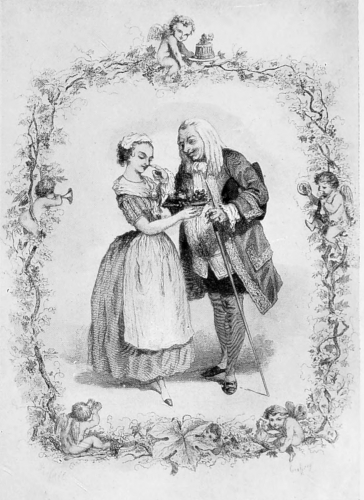
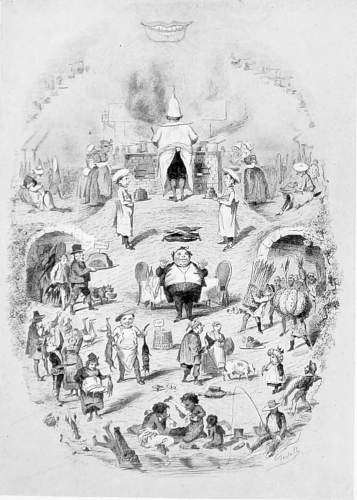
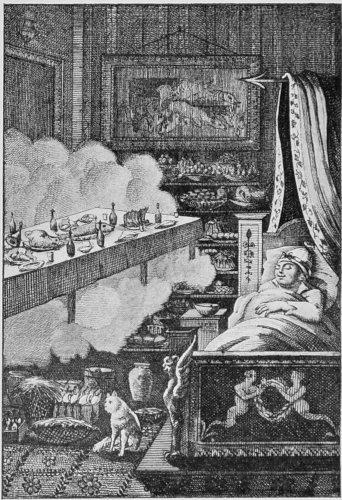
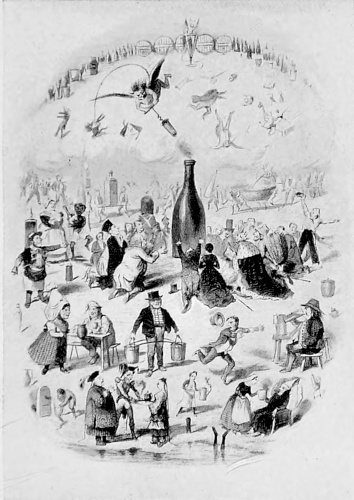
LES SENS: par Bertall
[Frontispiece
THE
GREEDY BOOK
A GASTRONOMICAL ANTHOLOGY
BY
FRANK SCHLOESSER
AUTHOR OF
“THE CULT OF THE CHAFING DISH”
LONDON GAY AND BIRD 12 & 13 HENRIETTA STREET, STRAND
1906 All rights reserved
My thanks are due to the Editors of the
St. James’s Gazette, the Evening Standard, the
Academy, the Daily Mail, the Daily Express,
the Globe, the Tribune, and Vanity Fair for
permission to reproduce certain portions of
these papers.
CHAPTER I — COOKS AND COOKERY
“In short the world is but a Ragou, or a large
dish of Varieties, prepared by inevitable Fate
to treat and regale Death with.”
‘Miscellanies: or a Variety of Notion and Thought.’
By H. W. (Gent.) [Henry Waring] 1708.
The only thing that can be said against
eating is that it takes away one’s appetite.
True, there is a French proverb to the
contrary, but that really only applies to the
hors d’œuvre and the soup. We all eat
three meals a day, some four, and a few
even five, if one may reckon afternoon tea
as a meal. Yet the art of eating—that is
to say, how to eat, what to eat, and when
to eat it—is studiously neglected by those
who deem they have souls superior to the
daily stoking of the human engine.
Whosoever simply wants to eat certainly
does not require to know how to cook. But
whosoever desires to criticize a dinner and
the dishes that compose it—and enjoyment
without judgment is unsatisfactory—need
not be a cook, but must understand what
cooking implies; he must have grasped the
spirit of the art of cookery.
Cooks themselves almost always judge a
dinner too partially, and from the wrong
point of view; they are, almost without
exception, obstinately of the opinion that
everything they cook must taste equally
good to everybody. This is obviously
absurd (but so like a cook), for allowance
must be made for the personal equation.
Nothing tastes so good as what one eats
oneself, so it is not to be expected that one
and the same dish will please even the most
fastidious octette. Still there have been
occasional instances.
The late Sir Henry Thompson once had
a new cook, and, in an interview with her
after the first dinner-party, she expressed
herself as being delighted that everything
had been so satisfactory. “But how do
you know it was?” asked Sir Henry.
“I’ve not given you my opinion yet.”
“No, Sir Henry,” said the cook, “but I
know it was all right, because none of the
salt-cellars were touched.”
It is a mistaken idea that a man-cook can
be a cordon-bleu. That title of high distinction
is reserved for the feminine sex. According
to Lady Morgan (Sidney Owenson,
1841), in her “Book without a Name,” a
cordon-bleu is defined as an honorary distinction
conferred on the first class of female
cooks in Paris, either in allusion to their
blue aprons, or to the order whose blue
ribbon was so long considered as the
adequate recompense of all the highest
merit in the highest classes.
The Fermier Général who built the
palace of the Elysée became not more
celebrated for his exquisite dinners than for
the moral courage with which he attributed
their excellence to his female cook, Marie,
when such a chef was hardly known in
a French kitchen; for when Marie served
up un petit diner délirant she was called for
like other prime donne, and her health drunk
by the style of Le Cordon Bleu.
One of the most famous of the bearers
of the title was undoubtedly that wonderful
Sophie who is so charmingly described in
La Salle-à-manger du Docteur Véron. She
was cook and politician too, and even
Alexandre Dumas père did not disdain to
dine with her at a dinner of her own
cooking; and moreover eminent statesmen
of the period consulted her about politics,
her clear-headed simplicity and wide experience
of popular sentiment rendering
her opinions of considerable value. The
editor adds that her name was not Sophie,
but that her many friends will nevertheless
easily recognize her.
The value of a good chef in a well-ordered
household cannot be over-estimated.
His tact, his experience, and his art go far
to make life pleasant and easy. Moreover,
a good cook is a direct aid to good health,
for he uses none but the best materials,
and, if he be of the highest rank of his
order, knows just how to assimilate those
suave and subtle suggestions and flavourings
which go so far to make cookery such as
the great Careme (1828) called le genre mâle
et élégant. Cooks were held in the highest
estimation in Venice in the sixteenth
century. Here is the beginning of a letter
from one Allessandro Vacchi, a Venetian
citizen, to an acquaintance of his, a cook
and carver by profession: “Al magnifico
Signor Padron mio osservandissimo il Signor
Matteo Barbini, Cuóco e Scalco celeberrimo
della città di Venetia.” In our own time
honour to the profession is not lacking,
for a little while ago the King decorated
M. Ménager, his maître-chef, with the
Royal Victorian Medal.
At the same time the competition of
many rich folk for the services of some of
the best-known chefs has made these artists,
in some cases at least, place an extortionate
value upon their ministrations. A very
clever chef, reliable in everything except
his sauces, in which he is slightly heterodox,
was recently engaged by a nouveau riche at a
salary far exceeding that which he paid to
his private secretary.
In one of Matthew Bramble’s letters from
Bath (“Humphry Clinker”) he refers to such
a one as “a mushroom of opulence, who
pays a cook seventy guineas a week for
furnishing him with one meal a day.”
Mushroom of opulence is good. That
species of fungus is always with us. Dr.
Kitchiner in his “Housekeeper’s Oracle”
(1829) quotes from “The Plebeian Polished,
or Rules for Persons who have unaccountably
plunged themselves into Wealth.” A
work of this nature, if published nowadays,
should surely command a large sale, for the
number of people who have “unaccountably
plunged themselves into Wealth”
seems to be multiplying rapidly. Most of
them know how to feed. Few of them
seem to have mastered the mystery of how
to dine. “Man ist was man isst” says the
German proverb, and there is no valid
reason for spending fabulous sums on a
dinner of out-of-the-season delicacies, when
the good reasonable and seasonable things
of this earth are ready and ripe for consumption.
At the same time, meanness has nothing
to recommend it. There is no credit in
starving yourself or your guests. The
difference between mere parsimony and
economy has never been more deftly illustrated
than in those pregnant sentences
from Edmund Burke: “Mere parsimony
is not economy. Expense, and great expense,
may be an essential article in home
economy. Economy is a distributive virtue,
and consists, not in saving, but selection.
Parsimony requires no providence, no sagacity,
no powers of combination, no comparison,
no judgment. Mere instinct, and
that not an instinct of the noblest kind,
may produce this false economy in perfection.”
This is very solid wisdom, because it
bears in mind the great element of perspective
in expense, which is so often forgotten
or overlooked.
To revert to the preciousness and rarity
of the really good female cook, to the artist
in pots and pans. It was in 1833 that the
Prince de Ligne, who had just lost his
second wife, came to Paris to seek consolation.
He lived temporarily in the Rue
Richelieu. One evening in passing the
lodge he became aware of a peculiarly alluring
odour of cooking. He saw the
concierge, an old woman of sixty, bending
eagerly over a battered stewpan on a small
charcoal fire, stirring some mess which evidently
was exhaling this delicious odour.
The Prince was one of the affable kind.
He asked the poor old lady for a taste of
her dish, which he liked so much that he
gave her a double louis, and asked her how
it happened that with such eminent culinary
genius she was reduced to the porter’s lodge.
She told him that she had once been head
cook to a cardinal-archbishop. She had
married a bad man who had spent all her
savings. Although very poor, she added
with conscious pride, and no longer disposing
of the full batterie of an archiepiscopal
kitchen, she flattered herself she could
manage with a few bits of charcoal and a
méchante casserole to cook with the best of
them. Next day the lodge was vacant, the
old concierge being on her way to Belœil,
the Prince de Ligne’s residence, near Mons,
in Belgium, where she presided for fifteen
years over one of the best-appointed
kitchens in the world.
Less fortunate than the Prince de Ligne
was a middle-aged bachelor in Paris, a few
years ago, who gave away an odd lottery
ticket to his cook, a worthy and unprepossessing
spinster. Shortly afterwards, to
his amazement, he saw that this particular
ticket had drawn the gros lot. He could
not afford to part with such a valuable and
valued servant, so he proposed marriage,
was accepted, and duly became one with his
cook before the maire with as little delay
as possible. Directly after the marriage he
asked his wife for the lottery ticket. “Oh,
I gave that away,” she said, “to Jean, the
coachman, to compensate him for our
broken engagement.”
It has been the ambition of many highly
placed men to become cooks. According
to Miss Hill’s interesting book on Juniper
Hall, and its colony of refugees, M. de
Jaucourt is recorded to have said: “It
seems to me that I have something of a
vocation for cookery. I will take up that
business. Do you know what our cook
said to me this morning? He had been
consulting me respecting his risking the
danger of a return to France. ‘But you
know, monsieur,’ he said, ‘an exception is
made in favour of all artists.’ ‘Very well
then,’ concluded M. de Jaucourt, ‘I will
be an artist-cook also.’”
A notable instance of the chef who took
a pride in his art and could not understand
any one referring to him as “a mere cook”
is the delightful hero of Mr. H. G. Wells’s
story of “A Misunderstood Artist” in his
“Select Conversations with an Uncle.”
“They are always trying to pull me to
earth. ‘Is it wholesome?’ they say;—‘Nutritious?’
I say to them: ‘I do
not know. I am an artist. I do not care.
It is beautiful.’—‘You rhyme?’ said the
Poet. ‘No. My work is—more plastic.
I cook.’”
There was a famous cook too, Laurens
by name, who was chef for a long time to
George III, and who combined with his
culinary skill a wonderful flair for objects of
art, so that the King bought a large number
of the beautiful things which are even now
at Buckingham Palace and Windsor Castle
on the advice of this same Laurens. It
has been said of him that he rarely made
a mistake in buying, and that he attended
the principal picture and art sales on the
Continent on behalf of his royal master.
Some cheerful noodles have had much to
say anent the want of imagination of the
modern chef. This is the most arrant
blatherumskite. The chef, who is only,
after all, a superior servant, paid (and well,
too) to carry out the gastronomic ideas of
his master, or, if he lack such ideas, to
pander to his ignorance, too frequently
arrogates to himself a culinary wisdom
which is not justified by results. The chef
need only be a thoroughly good cook. The
ideas, the suggestions, the genius behind
the pots and pans, come from the gastronomic
student. Neither Brillat-Savarin
nor Grimod de la Reynière was a cook—nor
was Thomas Walker, G. A. Sala, or
E. S. Dallas, but they were all notable
authorities. And they inspired the culinary
art of their times by their knowledge,
invention, and discrimination.
As a matter of fact, our chefs are unimaginative—and
a good job too; because
when a chef, be he never so clever, begins
to launch out on novelties of his own invention,
he almost invariably comes to
grief. A really good maître d’hôtel may
occasionally suggest a new dish, but in
ninety-nine cases out of a hundred it is
merely a slight variation of something
perfectly well known and appreciated.
There may be a new garnishing, a trifling
alteration in the manner of serving, and
there is invariably a brand-new (and usually
inappropriate) name, but the dish remains
practically the same, despite its new christening-robe.
A fine joint of Southdown mutton has
been recently renamed Béhague, but it
remains sheep, and nothing is gained by the
alteration save a further insight into the
ignorance of the average chef. This is
only a simple example, but it might be
multiplied indefinitely. I have been served
at a well-known restaurant with cutlets à la
Trianon, which turned out to be our old
and tried friend cutlets à la Réforme under
a new title. In a like manner, but at
another restaurant, an ordinary and excellent
mousse de jambon paraded as jambon à la
Véfour; Heavens and the chef only know
why; and the one won’t tell, and the other
doesn’t know.
Béhague, by the way, is, so to say, chefs’
French, which has much in common with
dog Latin, if one may be allowed the
comparison. Béhague will not be found in
a French dictionary, but it is the new nom
de cuisine for fine-quality mutton (such as
Southdown); it has only lately come into
use, and there seems no particular reason
for it. Probably it was invented in “a
moment of enthusiasm,” as the barber-artist
remarked when he made a wig that
just fitted a hazel-nut.
There are several different kinds of bad
language. That used by chefs and maîtres
d’hôtel on their menus is one of the worst.
They are incorrigibly ignorant—and glory in
it. It is an undeniable fact that the average
menu, whether at a club or restaurant,
contains usually at least a brace of orthographic
howlers, while at the private house,
an it boast a chef who writes the dinner
programmes, the average is distinctly higher.
I have encountered on an otherwise quite
reputable card the extraordinary item
Soufflet de fromage. The kind hostess had
no intention of inflicting a box on the ears
to the cheese, but had mistaken soufflet for
soufflé. By such obvious errors are social
friendships imperilled.
But I should like to go much further than
this comparatively harmless example. No
less an authority than Æneas Dallas in
Kettner’s “Book of the Table” says: “It
is a simple fact, of which I undertake to
produce overwhelming evidence, that the
language of the kitchen is a language ‘not
understanded of the people.’ There are
scores upon scores of its terms in daily use
which are little understood and not at all
fixed, and there is not upon the face of this
earth an occupation which is carried on
with so much of unintelligible jargon and
chattering of apes as that of preparing food.
Not only cooks, but also the most learned
men in France have given up a great part
of the language of the kitchen as beyond
all comprehension. We sorely want Cadmus
amongst the cooks. All the world remembers
that he taught the Greeks their
alphabet. It is well-nigh forgotten that he
was cook to the King of Sidon. I cannot
help thinking that cooks would do well to
combine with their cookery, like Cadmus, a
little attention to the alphabet.”
It is easy, of course, to ridicule such
obvious ineptitudes as a dish of “breeches
in the Royal fashion with velvet sauce”
(Culotte à la Royale sauce velouté) or “capons’
wings in the sun” (ailes de poularde au soleil),
but these are but trifling offences compared
to the egregious lapses of grammar, history,
and good taste which disfigure our menus.
There is no culinary merit in describing an
otherwise harmless dish of salmon as saumon
Liberté au Triomphe d’Amour. It is simply
gross and vulgar affectation. Let the cooks
do their cooking properly and all will be
well. Their weirdly esoteric naming of
edible food is an insult of supererogation to
the intelligence of the diner.
At the same time, due credit must be
given to the chef for the part he has played
in the general improvement of gastronomics
and the art of feeding during the past
two decades. The mere multiplication of
restaurants is nothing; but the general
improvement of the average menu is everything.
Here, for instance, is the menu of
a dinner of the year 1876, recommended by
no less an authority than the late Fin Bec,
Blanchard Jerrold, whose Epicure’s Year
Books, Cupboard Papers, and Book of
Menus are by way of being classics.
MENU.
Crécy aux Croûtons.
Printannier.
Saumon bouilli, sauce homard.
Filets de soles à la Joinville.
Whitebait.
Suprême de Volaille à l’écarlate.
Côtelettes d’Agneau aux concombres.
Cailles en aspic.
Selle de Mouton.
Bacon and beans.
Caneton.
Baba au Rhum.
Pouding glacé.
This was the dinner given by the late
Edmund Yates on the occasion of the publication
of the World newspaper. Observe
its heaviness, clumsiness, and want of
delicacy. Three fish dishes are ostentatious
and redundant; three entrées simply
kill one another; the quails are misplaced
before the saddle; the bacon and beans is,
of course, a joke. Altogether it is what we
should call to-day a somewhat barbarian
meal. Contrast therewith the following
artistically fashioned programme of a dinner
given by the Réunion des Gastronomes; it
is practically le dernier mot of the culinary
art.
MENU.
Huîtres Royales Natives.
Tortue Claire.
Filets de Soles des Gastronomes.
Suprême de Poularde Trianon.
Noisettes d’Agneau à la Carême.
Pommes Nouvelles Suzette.
Sorbets à la Palermitaine.
Bécassines à la Broche.
Salade.
Haricots Verts Nouveaux à la Crème.
Biscuit Glacé Mireille.
Corbeille de Friandises.
Dessert.
Nothing could be lighter or more graceful.
There is naught that is over-elaborate or
indigestible; on the contrary, the various
flavours are carefully preserved, and there
is a subtle completeness about the whole
dinner which is very pleasing.
It was the late lamented Joseph, of the
Tour d’Argent, the Savoy, and elsewhere,
who once said: “Make the good things as
plain as possible. God gave a special
flavour to everything. Respect it. Do not
destroy it by messing.”
Joseph, who, by the way, was born in
Birmingham, was a mâitre d’hôtel of genius,
though even he had his little weaknesses,
and merely to watch the play of his wrists
whilst he was “fatiguing” a salad for an
especially favoured guest was a lesson in
inspired enthusiasm. His rebuke to a rich
American in Paris is historic. The man of
dollars had ordered an elaborate déjeuner,
and whilst toying with the hors-d’œuvre
carefully tucked his serviette into his collar
and spread it over his waistcoat, as is the
way with some careless feeders. Joseph,
rightly enough, resented this want of
manners, and, approaching the guest, said
to him politely, “Monsieur, I understand,
wished to have déjeuner, not to be shaved.”
The restaurant lost that American’s custom,
but gained that of a host of nice and
delicate feeders.
CHAPTER II — BYWAYS OF GASTRONOMY
“La Cuisine n’est pas un métier, c’est un art, et
c’est toujours une bonne fortune que la conversation
d’un cuisinier: mieux vaut causer avec un
cuisinier qu’avec un pharmacien. S’il n’y avait
que de bons cuisiniers, les pharmaciens auraient
peu de choses à faire, les médecins disparaîtraient;
on ne garderait que les chirugiens pour
les fractures.”—Nestor Roqueplan.
I am going to be very rude. Not one
woman in a hundred can order a dinner at
a restaurant. I’ve tried them, and I know.
Not only can she not order a dinner with
taste, discretion, and due appreciation of
season, surroundings, and occasion; but she
inevitably shows her character, or want of
it, if she be allowed to choose the menu.
The eternal feminine peeps out in the soup,
lurks designedly in the entrées, and comes
into the full glare of the electric light in the
sweets and liqueurs.
Let me explain. As a bachelor who is
lucky enough to be asked out to many
dinner parties, I have cultivated a slight
reciprocative hospitality in the shape of asking
my hostesses (and their daughters, if
they have any) to dine with me at sundry
restaurants. It is my habit to beg my guests
to order the dinner, “because a woman
knows so much more about these things
than a mere man”; and all unwittingly
the dear ladies invariably fall into the innocent
little trap, wrinkle up their foreheads
and study the carte, while I sit tight and
study character.
Luckily my digestion is excellent. I have
survived several seasons of this sort of
thing, but I feel that the time is coming
when I must really give it up and order
the dinners myself.
The wife of a very important lawyer was
good enough to dine with me at the Savoy
recently. She is, I believe, a thoroughly
good wife and mother, and, moreover, she
has a happy knack of humorous small talk.
She graciously agreed to order our dinner—after
the usual formula. The crême santé
was all right—homely and healthy, if a
trifle dull and uninteresting; but when
we went on to boiled sole, mutton cutlets,
and a rice pudding, I felt that the sweet
simplicity of the Jane Austen cuisine was
too much with us, and I recognized sadly
that she was not imbued with the spirit
of place; she mistook the Savoy for the
schoolroom. Her forte was evidently decorous
domesticity. Nevertheless, I had a
good dinner.
Less fortunate was I in my experience
with the eldest daughter of a celebrated
painter. She was all for colour. “There
is not enough colour in our drab London
life,” she said; so, at the Carlton, she
ordered Bortsch, because it was so pretty
and pink; fish à la Cardinal, because
of the tomatoes; cutlets à la Réforme,
because she liked the many-coloured “baby-ribbons”
of garnishing; spinach and poached
eggs—“the contrast of colour is so daring,
you know”; beetroot salad; a peach à la
Melba—“so artistic and musical”; and, of
course, crême de menthe to accompany the
coffee. It was a feast—of colour—and the
food was thoroughly well cooked; but I
was reminded of Thackeray’s chef, M.
Mirabolant, who conceived a white dinner
for Blanche Amory to typify her virginal
soul.
Then there was an amiable and affected
widow, whose mitigated woe and black
voile frock were most becoming. She presumed,
however, on her widowhood to order
everything en demi-deuil, which meant that
every dish from fish to bird was decorated
with mourning bands of truffles. The
thoughtful chef sent up the ice in the form
of a headstone, and we refrained from
Turkish coffee because French café noir was
so much blacker.
The great Brillat-Savarin, speaking of
female gourmets, said, “They are plump
and pretty rather than handsome, with a
tendency to embonpoint.” I confess that
my experience leads me to disagree; the
real female gourmet (alas, that she should
be so rare!), broad-minded, unprejudiced,
and knowledgeable, is handsome rather than
pretty, thin rather than stout, and silent
rather than talkative. This, however, by
the way.
Two schoolgirls did me the honour of
dining with me at Prince’s not long ago,
before going to the play. I gave them
carte blanche to order what they liked, and
this was the extraordinary result:—
Langouste en aspic.
Meringues Chantilly.
Consommé à la neige de Florence.
Selle de Chevreuil.
Gelée Macédoine.
Faisan en plumage.
Bombe en surprise.
Nid de Pommes Dauphine.
I ventured to suggest that there was a
certain amount of fine confused feeding
about this programme, that it was so heavy
that even two hungry schoolgirls and a
middle-aged bachelor might find it difficult
to tackle, also that the sequence of dishes
was not quite conventional. Eventually
they blushingly explained that they had
ordered all these things because they did
not know what any of them meant, and
they wanted to find out—“besides, they’ve
got such pretty names, and it will help us
so much in our French lessons.” I reduced
the formidable dimensions of the dinner,
and there were no disastrous results.
I once had the temerity to invite a real
lady journalist to dine with me at the
Berkeley. I think that she writes as Aunt
Sophonisba, or something of the sort, and
her speciality is the soothing of fluttering
hearts and the explaining of the niceties of
suburban etiquette. Anyhow, she knows
nothing about cookery, although I understand
she conducts a weekly column entitled
“Dainty Dishes for Delicate Digestions.”
It was in July, and she said we might begin
with oysters and then have a partridge.
When I explained that owing to official
carelessness these cates happened to be out
of season, she waxed indignant and said
that she thought “they were what the
French call primeurs.” Nevertheless, she
made a remarkably good hot-weather dinner,
eating right through the menu, from the
melon réfraichie to the petits fours. Women
who golf, lady journalists, and widows, I
observe, have usually remarkably good
appetites.
I recollect also an American actress who
sang coon songs—and yearned for culture.
We lunched at the Cecil, and when she
espied on the card eggs à la Meyerbeer, she
instantly demanded them because “he was
a composer way back about the year dot,
and I just love his music to ‘Carmen.’”
She hunted through the menu for celebrated
names, preferably historical, and
ordered successively Sole à la Colbert, Poulet
Henri Quatre, and Nesselrode pudding,
because they reminded her of the time
when she was studying French history.
With the keenest desire not to be thought
disrespectful or ungallant, I really believe
that, however well a woman may manage
her household, her cook, her husband, and
her kitchen expenses, she cannot order a
dinner at a restaurant. Whether it be the
plethora of choice, or the excitement of the
lights and music, or awe of the maître
d’hôtel and the sommelier, I do not know,
but I am sure that the good hostess who
gives you a very eatable little dinner at
her own house will make hash of the best
restaurant carte du jour in her endeavours
to order what she thinks is nice and appropriate.
In referring just now to the excellent
Miss Jane Austen, I am reminded that
eating and drinking play no small part in
her delightful novels. Who does not remember
Mrs. Bennet, who dared not invite
Bingley to an important dinner, “for although
she always kept a good table, she
did not think anything less than two courses
could be good enough for a man on whom
she had such anxious designs, or satisfy the
appetite and pride of one who had ten
thousand a year.” The dinner eventually
served consisted of soup, venison, partridges,
and an unnamed pudding. And a very
good meal too!
An American critic is of opinion that
there is a surfeit of mutton in English
literature. “It is boiled mutton usually,
too.” Now boiled mutton is, to the critic,
a poor sort of dish, unsuggestive, boldly
and flagrantly nourishing, a most British
thing, which “will never gain a foothold on
the American stomach.” This last is a vile
phrase, even for an American critic, and
suggests a wrestling match. The critic goes
on: “The Austenite must e’en eat it. Roast
mutton is a different thing. You might
know Emma Woodhouse would have roast
mutton rather than boiled; it is to roast
mutton and rice pudding that the little
Kneightleys go scampering home through
the wintry weather.”
From Miss Austen to Mrs. Gaskell is no
such very far cry. “We had pudding
before meat in my day,” says Mr. Holbrook,
the old-fashioned bachelor-yeoman in “Cranford.”
“When I was a young man we used
to keep strictly to my father’s rule: ‘No
broth, no ball; no ball, no beef.’ We
always began dinner with both, then came
the suet puddings boiled in the broth with
the beef; and then the meat itself. If we
did not sup our broth, we had no ball,
which we liked a deal better, and the beef
came last of all. Now folks begin with
sweet things, and turn their dinners topsy-turvy.”
What would such a one have said to our
modern dinners, at home, or at a restaurant;
a place which he probably would not comprehend
at all, for, at any rate with us, the
fashion of dining in public, especially with
our women-folk, is a very recent innovation.
The hearty individual of Mr. Holbrook’s
time and type would have more sympathy
with the frugalities of the La Manchan
gentleman Cervantes drew, with his lean
horse and running greyhound, courageous
ferret, and meals of “duelos y quebrantes,”
that strange dish, which Mr. Cunninghame
Graham tells us “perplexed every translator
of the immortal work.”
The modern restaurant is, I suppose, part
and parcel of the evolutionary trend of the
times. It has its advantages and its drawbacks.
Its influence on public manners or
manners in public (which are not altogether
the same thing), are not entirely salutary.
He was a wise person who once said,
“Vulgarity, after all, is only the behaviour
of others.” Go into any frequented restaurant
at dinner-time, watch the men and
women (especially the latter), how they eat,
talk, and observe their neighbours—et vous
m’en direz des nouvelles! Our forbears,
although, or perhaps because, they dined
out less, or not at all, had a certain reticence
of table manner which has been lost in
succeeding generations. Be good enough
to note the reception of a party of guests
entering a full restaurant and making their
way to their reserved table. Notice how
every feminine eye criticizes the new-comers.
Not a bow, nor a frill, nor a sleeve, nor a
jewel, nor a twist of chiffon is unobserved.
Talk almost ceases whilst the progress
through the already filled tables takes place.
The men of the party ask polite questions,
and endeavour to continue the even tenor
of the conversation, but the feminine replies
are vague and malapropos. No woman
seems able to concentrate her attention on
talk whilst other women are passing. She
must act the critic; note, observe, copy, or
deride. These are our table manners of to-day.
Not entirely pretty, perhaps; but
typical and noteworthy.
LES ALIMENTS: par Bertall
[To face page 30
The multiplication of restaurants continues,
and yet, come to think of it, the
actual places where one lunches, dines, or
sups, the “legitimate” houses, so to say,
can be numbered on the fingers of both
hands—including the thumbs. All the
others are more or less esoteric. One can,
possibly, dine as well in Soho as in the
Strand, but there is no cachet about the
dinner, and one never meets any one one
knows, or if one does, one wishes one
hadn’t.
Still, compared with our grandfathers’
times, things have vastly altered. In the
“Epicure’s Almanack or Calendar of Good
Living for 1815,” there is a list of over one
hundred eating-houses of sorts, but the only
ones that survive to this day are Birch’s of
Cornhill; the “Blue Posts” in Cork Street;
the “Cheshire Cheese,” Fleet Street; the
“Golden Cross,” Charing Cross; Gunter’s of
Berkeley Square; Hatchett’s in Piccadilly;
the “Hummums” in Covent Garden; Long’s
in Bond Street (better known as “Jubber’s”);
the “Ship,” Charing Cross; the London
Tavern; and “Sweeting’s Rents.”
Speaking of the music at a very well-known
restaurant in town, a morning paper
said recently: “It is noticeable that many of
the visitors occasionally stop talking and
listen to the music.” This set me thinking.
It is worth while listening to good music.
Bad music we are better without. Good
cooking and good conversation are natural
concomitants, and mutually assist one
another. Ergo, it seems obvious that good
music and a good dinner are incompatible.
It is rude to talk whilst musical artists are
giving of their best for your delectation,
and, at the same time, a dinner partaking of
Wordsworth’s Peter Bell’s party in a parlour
“all silent and all damned” is contrary to the
best gastronomic traditions. Thus I think
I have the musical diner in an impasse.
Speaking from memory, among the best
dozen restaurants in London there is music
in every one save three; I am therefore
bound to conclude that it is merely a
question of supply and demand, and that I
am in a minority. I overheard a quaint
protest the other night at a restaurant where
the music is particularly loud, blatant, and
objectionable. A man and, presumably,
his wife were dining together, and were
evidently anxious to keep up their conversation
on some mutually interesting
topic. During a lull in the clatter and noise
I heard the woman’s voice say, “I do wish
they would play more quietly, one really
cannot hear what one is eating.”
Oh! the Roast Beef of Old England,
And oh! the old English Roast Beef!
How many casual diners at the Carlton
could hum or whistle that fine old air?
Probably not one—not even M. Jacques.
And yet it is about the only really appropriate
and legitimate tune to which
Britons ought to feed. What do we get
instead? Musical-comedy selections, languorous
waltzes, cornet solos, coon songs,
and an occasional czardas. Is music really
an aid to digestion, or is it designed, like
the frills on the cutlets, to induce us to
ignore the imported mutton in favour of
the trimmings?
It is tolerably certain that music with
dinner (at a restaurant, for the ordinary
diner) was unknown in England before
1875. In the previous year the late George
Augustus Sala, who knew most things worth
knowing—gastronomically—wrote an article
in a monthly magazine on dinner music, and
refers to it as existing only in royal palaces.
Very soon afterwards, however, it was
offered to anybody who could afford to pay
a few shillings for a set dinner amid clean
and appetizing surroundings. Subject to
correction, it is fairly certain that the first
place in London where they provided music
at dinner was the Holborn Restaurant,
which had been a swimming-bath, a dancing-casino,
and other things. The example was
speedily followed, and very soon bands
sprang up like mushrooms right and left, at
every restaurant which made any pretence
of attracting the multitude.
The Criterion started glee-singers, although
this was perhaps more directly an
outcome of Herr Jongmanns’ boys’ choir
at Evans’ in Covent Garden.
[
Nearly every restaurant in London nowadays
has a band, and go where you will,
such spectacles are offered you as a man
with music in his soul trying to take his
hot soup in jig time, because the band is
playing prestissimo forsooth, and getting very
red in the face whilst so doing. Then will
follow the whitebait, and the band, just out
of pure cussedness, plays a languishing slow
movement, whereupon the musical diner is
obliged to eat his whitebait andante, and the
dear little fish get quite cold in the process.
[
Over in Paris, Berlin, and on the Riviera
it is even worse. The restaurateurs there
encourage a wild, fierce race of hirsute
ruffians called Tsiganes, who are supposed
to be Hungarian gipsies: “A nation of
geniuses, you know; they can’t read a note
of music, and play only by ear!” That’s
just the trouble of it—because their ears
are often all wrong. There is absolutely
nothing less conducive to a good appetite
than to watch these short-jacketed, befrogged,
Simian fiddlers playing away for
dear life the Rakoczy March or a maltreated
Strauss waltz, and ogling à la Rigo
any foolish female who seems attracted by
them. It is on record that an Englishman
once approached the leader of such a band
in a Paris restaurant and asked him the
name of the dance he had just been playing.
“Sure, an’ I don’t know, yer honour,” was
the reply, “but I’m thinking it’s a jig.”
All the Hungarians do not come from
Hungary.
Curiously enough, there is an old-time connexion
between music and dinner, although
not precisely as we understand either. In
the great houses of the seventeenth century
dinner was announced by a concert of trumpets
and drums, or with blasts from a single
horn, blown by the head huntsman. The
music of huntsmen running in upon their
quarry was the music which declared the
venison and wild boar ready for the trenchers.
Blown to announce the coming of dinner
and supper, the horn was also wound to
celebrate the virtue of particular dishes.
The nobler creatures of the chase were
seldom brought to table without notes from
the trumpet. Musical honours were accorded
to the peacock, the swan, the sturgeon, and
the turbot. The French used to say,
“Cornez le diner,” i.e. “Cornet the dinner”—hence
we derive our corned beef.
But to return to our own times; things
have come to such a pass, musically speaking,
that the suburbanest of suburban ladies
shopping of an afternoon in Oxford Street
cannot drink her cup of tea without a band
in the basement. It is quite humorous to
listen to a selection from “La Bohême”
punctuated by “Ten three-farthings, my
dear, and cheap at that,” or “You must
really tell Ethel to have a silk foundation”;
but women are such thoroughly musical
beings that they seem to accommodate themselves
to all sorts of incongruities.
The old gourmets, who knew how to
dine, loved music in its right place and at
the right time, but that was not at dinner.
Rossini, the great composer, was one of
them. He loved good cheer and he wrote
wonderful music—but he never mixed the
two. It is passing strange that various ways
of cooking eggs have been called after
various composers. Thus we have œufs à la
Meyerbeer, à la Rossini, à la Wagner, even
à la Sullivan. Why music and eggs should
be thus intimately connected is somewhat of
a puzzle.
The late Sir Henry Thompson, who
married a musician, and the late Joseph of
the Savoy, who was an artist at heart,
both despised music at dinner. The former
said that it retarded rather than assisted
digestion; and the latter remarked that he
could never get his cutlets in tune with the
band. Either the band was flat and his
cutlets were sharp, or vice versâ.
There are a few restaurants in London,
some half-dozen at most, where one can dine
in peace, undisturbed by potage à la Leoncavallo,
poisson à la Rubinstein, rôti à la
Tschaikowski, and entremet à la Chaminade.
But it would be unwise to say where
they are, because it might attract crowds and
induce the proprietors to start a band. And,
after all, a dinner-table is not a concert
platform.
In the “Greville Memoirs” (1831) you
may read that dinners of all fools have as
good a chance of being agreeable as dinners
of all clever people: at least the former are
often gay, and the latter are frequently
heavy. Nonsense and folly gilded over with
good breeding and les usages du monde produce
often more agreeable results than a
collection of rude, awkward, intellectual
powers. This must be our consolation for
enjoying “gay” dinners.
In a translation from Dionysius, through
Athenæus, occur these lines:—
To roast some beef, to carve a joint with neatness,
To boil up sauces, and to blow the fire,
Is anybody’s task; he who does this
Is but a seasoner and broth-maker;
A cook is quite another thing. His mind
Must comprehend all facts and circumstances:
Where is the place, and what the time of supper;
Who are the guests, and who the entertainer;
What fish he ought to buy, and where to buy it.
This shows a nice appreciation of the
duties of the all-round cook, supervised by
a knowledgeable master, and is preferable to
the fastidiousness of Sir Epicure Mammon
in “The Alchemist,” who leaves the best fare,
such as pheasants, calvered salmon, knots,
godwits, and lampreys, to his footboy;
confining himself to dainties such as cockles
boiled in silver shells, shrimps swimming
in butter of dolphin’s milk, carp tongues,
camels’ heels, barbels’ beards, boiled dormice,
oiled mushrooms, and the like. One must
go back to Roman cookery, via Nero and
others, for such gustatory eccentricities, a
number of which, one may shrewdly believe,
were not precisely what they are described
to be in modern English. Do we not know,
for instance, that a famous Roman cook
(who was probably a Greek), having received
an order for anchovies when those
fish were out of season, dexterously imitated
them out of turnips, colouring, condiments,
and the inevitable garum; as to the exact
and unpleasant constituents of which,
authorities, including the great Soyer, differ
considerably.
The result cannot have been of the nature
described by Miss Lydia Melford in “Humphry
Clinker,” who called the Bristol waters
“so clear, so pure, so mild, so charmingly
mawkish.”
CHAPTER III — THE POET IN THE KITCHEN
“Drinking has indeed been sung, but why, I
have heard it asked, have we no ‘Eating
Songs’?—for eating is, surely, a fine pleasure.
Many practise it already, and it is becoming
more general every day. I speak not of the
finicking joy of the gourmet, but the joy of
an honest appetite in ecstasy, the elemental joy
of absorbing quantities of fresh, simple food—mere
roast lamb, new potatoes, and peas of
living green. It is, indeed, an absorbing
pleasure.”
R. le Gallienne.
The quotation with which I have headed
this chapter, though appropriate enough in
a sense, disproves itself in the assertion.
We have “Eating Songs” in plenty, both
in our own language and in foreign tongues,
but they have been neglected and spurned,
and for that reason they well repay a little
enterprising research. Here and there,
throughout our literature, are gems of gastronomical
versification, and it is, in fact,
impossible to do more than indicate a tithe
of the treasures that may be unearthed with
a very little trouble and patience.
Among the anthologies of the future,
the near future maybe, is undoubtedly the
Anthology of the Kitchen. It is ready
written, and only remains to be gathered.
There is barely a poet of note who could
not be laid under contribution. Shakespeare,
Byron, Béranger, Browning, Burns,
Coleridge, Crabbe, Dryden, Goethe, Heine,
Landor, Prior, Moore, Rogers, and Villon
are the first chance names to occur, but there
are many more who might be cited with
equal justice.
Thackeray wrote verses on Bouillabaisse;
which it would be absurd to quote, so well
are they known. Méry, Alexandre Dumas,
Th. de Banville, Th. Gautier, and Aurélien
Scholl collaborated, under the editorship of
Charles Monselet (himself a gastronomic
poet of no mean order), in a little book published
in 1859 under the title “La Cuisinière
Poétique.” Five years later there appeared
in Philadelphia “A Poetical Cook Book,”
by J. M. M., with charming rhymed recipes
for such things as stewed duck and peas:—
When duck and bacon in a mass
You in a stew-pan lay,
A spoon around the vessel pass,
And gently stir away!
The poetical author dilates too upon
buckwheat cakes and oatmeal pudding, and
quotes Dodsley on butter and Barlow on
hasty pudding. Sydney Smith’s recipe for
a salad is only too well known, and it may
be hoped that it is not often tried, because
from a gastronomic point of view it is a dire
decoction. Arthur Hugh Clough in “Le
Diner” (Dipsychus) has this entirely charming
verse:—
A clear soup with eggs: voilà tout; of the fish
The filets de sole are a moderate dish
A la Orly, but you’re for red mullet you say.
By the gods of good fare, who can question to-day?
How pleasant it is to have money, heigh ho!
How pleasant it is to have money!
Nearly two hundred years ago (in 1708,
to be precise) Dr. William King wrote “The
Art of Cookery,” in imitation of Horace’s
“Art of Poetry”; in the original edition it
was advertised as being by the author of
“A Tale of a Tub,” but although King was
a friend of Swift, there seems to have been
no authority to make use of his name. In
the second edition, in the following year,
some letters to Dr. Lister are added, and
the title page ascribes the poem to “the
Author of the Journey to London,” who
dedicates it—or, rather, “humbly inscribes”
it—to “The Honourable Beefsteak Club.”
This edition has an exquisitely engraved
frontispiece by M. Van der Gucht.
In the fifth volume of Grimod de la
Reynière’s entrancing “Almanach des Gourmands”
(1807) there is a poetical epistle
d’un vrai Gourmand à son ami, l’Abbé
d’Herville, homme extrêmement sobre, et qui ne
cessoit de lui prêcher l’abstinence. These are a
few of his lines:—
Harpagon dit: Il faut manger pour vivre;
Et je dis, moi, que je vis pour manger.
Que l’on m’appelle un cochon d’epicure:
C’est un éloge, et non pas une injure.
Subsequent volumes contain many poetical
references. There is even a hymn to Epicurianism,
a fable gourmande et plus morale
encore, entitled “Les Œufs; a logogriphe;
several chansons; and a boutade.” Mortimer
Collins, in “The British Birds,” has an
exquisitely humorous tourney of three poets
who respectively sing the praises of salad;
and the late Dr. Kenealy wrote a book (in
1845) called “Brallaghan, or the Deipnosophists,”
in which he tunes his lyre in praise
of good food—and Irish whisky. Although
Sydney Smith’s salad mixture is useless, his
verses entitled “A Receipt to Roast Mutton”
are excellent, particularly this verse:—
Gently stir and blow the fire,
Lay the mutton down to roast,
Dress it quickly, I desire,
In the dripping put a toast,
That I hunger may remove—
Mutton is the meat I love.
An anonymous author has given us the
immortal lines:—
Turkey boiled
Is turkey spoiled,
And turkey roast
Is turkey lost;
But for turkey braised
The Lord be praised!
That they are absolutely true every Feinschmecker,
as the Germans say, is bound to
admit. The famous Cheshire Cheese
pudding has not been without its laureate,
one J. H. Wadsworth, who opens his pæan
thus:—
We sought “The Cheese” with thirst and hunger prest,
And own we love the Pudding Day the best,
But no one quarrels with the chops cooked here,
Or steaks, when wash’d down with old English beer!
The leg of mutton has not lacked its
devotees from Thackeray’s—
A plain leg of mutton, my Lucy,
I prithee get ready at three,
to Berchoux’ praise of the gigot—
J’aime mieux un tendre gigot
Qui, sans pomp et sans étalage,
Se montre avec un entourage
De laitue ou de haricot.
Sir John Suckling contributes to the
poetic garland in his lines:—
The business of the Kitchen’s great
And it is fit that men should eat,
Nor was it e’er denied.
And an anonymous Scotch poet indites
the following ode to luncheons:—
There are the sausages, there are the eggs,
And there are the chickens with close-fitted legs,
And there is a bottle of brandy,
And here some of the best sugar candy,
Which is better than sugar for coffee.
There are slices from good ham cut off; he
Who cut them was but an indifferent carver,
He wanted the delicate hand of a barber.
And there is a dish,
Buttered over! And fish.
Trout and char
Sleeping are,
The smooth-like surface over.
There’s a pie made of veal, one of widgeons,
And there’s one of ham mixed with pigeons.
A well-known French critic, Achille (not
Octave) Uzanne, has compiled a little collection
of menus and receipts in verses, with
a notable preface by Chatillon-Plessis, which
includes poems on such thrilling subjects
as jugged hare, lobster in the American
fashion, Charlotte of apples, truffles in
champagne, epigrams of lamb, mousse of
strawberries, and green peas. A more recent
American poetaster has published during the
last few years “Poems of Good Cheer,”
which are in the manner of fables, such as
that of the man who “Wanted Pearls with
his Oysters,” and the busy broker “Who
had no time to eat,” and consequently
acquired dyspepsia.
Lord Byron too may be allowed to have
his say:—
... Man is a carnivorous production,
And must have meals—at least one a day.
He cannot live, like woodcocks, upon suction;
Although his anatomical construction
Bears vegetables in a grumbling way,
Your labouring people think, beyond all question,
Beef, veal, and mutton, better for digestion.
One of the most ambitious efforts in the
culinary-poetic line is, undoubtedly, “La
Gastronome, ou l’homme des Champs à
Table; poème didactique en quatre chants,
par J. Berchoux, 1804,” wherein is set
forth, at some length—firstly, the history
of cooking; then the order of the services;
and lastly, some fugitive pieces which
allude to the gay science in choice and
poetic terms. The book is enriched with
some exquisite copper-plate engravings by
Gravelot, Cochin, and Monsiau. The lines
addressed by the author to his contemporaries
warning them against the “repas
monstreux des Grecs et des Romains” are
full of repressed dignity and good sound
common sense. One puts down the book
with a sense of poetical-gastronomical repletion.
The poetic afflatus has possessed most
great cooks, but none with more practical
application than the immortal Alexis Soyer,
the hero of the Crimea and the Reform
Club, who, on the death of his wife, a clever
amateur artist, wrote this simple and witty
epitaph, “Soyez tranquille.” Gay’s poem
on a knuckle of veal is also worthy of
record, and an anonymous American poet has
immortalized the duck in four pregnant
verses.
A very modern poet who writes over the
initials of M. T. P. has four charming verses
on the propriety of ladies wearing their hats
whilst dining. The second and third stanzas
read as follows:—
Anchovies from Norwegian shores!
Sardines from sunny southern seas!
There’s naught my simple soul adores
One half so ardently as these.
And while I munch the well-fumed sprat,
Sit thou and watch and wear thy hat.
I need no entrée, want no bird,
Nor care for joints, or boiled or roast,
But my imagination’s stirred
By titillating things on toast.
Soft roes the commissariat
Shall serve me opposite thy hat.
Some folks who are not yet very old
may remember a quaint part-song or quartette
for male voices, entitled “Life is but
a Melancholy Flower,” which was sung
alternately somewhat in this fashion:—
Life is butter!
Melon!!
Cauliflower!!!
Life is but a melancholy flower!
It had much deserved success in its
day.
An old recipe for the roasting of a
swan is very fairly summed up in these
lines:—
TO ROAST A SWAN
Take three pounds of beef, beat fine in a mortar,
Put it into the swan—that is, when you’ve caught her.
Some pepper, salt, mace, some nutmeg, an onion,
Will heighten the flavour in Gourmand’s opinion.
Then tie it up tight with a small piece of tape,
That the gravy and other things may not escape.
A meal paste (rather stiff) should be laid on the breast,
And some “whitey brown” paper should cover the rest.
Fifteen minutes at least ere the swan you take down,
Pull the paste off the bird that the breast may get brown.
THE GRAVY
To the gravy of beef (good and strong) I opine
You’ll be right if you add half a pint of port wine;
Pour this through the swan—yes, quite through the belly,
Then serve the whole up with some hot currant jelly.
N.B.—The swan must not be skinned.
This poem has been attributed to Mr.
George Keech, chef of the Gloucester
Hotel at Weymouth—of course a famous
breeding place for swans.
The following recipe for making a “soft”
cheese is said to be by Dr. Jenner:—
Would you make a soft cheese? Then I’ll tell you how.
Take a gallon of milk quite fresh from the cow;
Ere the rennet is added, the dairyman’s daughter
Must throw in a quart of the clearest spring water.
When perfectly curdled, so white and so nice,
You must take it all out of the dish with a slice,
And put it ’thout breaking with care in the vat,
With a cheese-cloth at bottom—be sure to mind that.
This delicate matter take care not to squeeze,
But fill as the whey passes off by degrees.
Next day you may turn it, and do not be loth
To wipe it quite dry with a clean linen cloth.
This must be done you cannot well doubt,
As long as you see the whey oozing out.
The cheese is now finished, and nice it will be,
If enveloped in leaves of the green ashen tree.
Or what will do better, at least full as well,
In nettles just plucked from the bank of the dell.
In praise of the best food in the world—plain
British roast and boiled—Mr. G. R.
Sims has dilated in his weekly columns; a
verse from his perfectly correct and strict
“Ballade of New-Time Simpson’s” is well
worth quoting:—
They do not call the saddle “selle”
That you with currant jelly eat;
Boiled fowl’s not à la Béchamel.
Your eyes no foreign phrases meet
That English waiters can’t repeat,
And so to Simpson’s I repair.
The English kitchen’s bad to beat,
Plain roast and boiled are British fare.
The “Envoi,” which commences most
cleverly according to traditional rule, runs as
follows:—
Prince’s and Carlton, you I greet,
Savoy, I own your chef is rare;
But you with Simpson’s shall compete.
Plain roast and boiled are British fare.
To come back to recipes, here is one for
the famous Homard à l’Amèricaine written
by the chef of the Grand International
Hotel at Chicago, who is quite annoyed with
M. Rostand for his obvious plagiarism in
“Cyrano de Bergerac.”
COMMENT ON FAIT LE HOMARD À L’AMÉRICAINE
Prenez un homard qu’on vend
Bien vivant;
Avant qu’il se carapate
Sans vous laisser attendrir,
Sans souffrir,
Détachez-lui chaque patte.
Faites alors revenir
Et blondir
Du beurre en la casserole;
Fourrez-y votre homard
Sans retard,
Mais avant qu’il ne rissole
Ajoutez un court-bouillon
De bouillon
A vous brûler la bedaine!
Faites cuire. Servez-le
Et c’est le
Homard à l’américaine!
Many curious old poems may be found by
careful delving in the books our great-grandfathers
used to read, and which we ought
to read, but don’t. For instance, the Roxborough
Ballads contain a delightful poem
briefly entitled “The Cook-Maid’s Garland:
or the out-of-the-way Devil: shewing how
four highwaymen were bit by an ingenious
cook-maid” (1720). There is a still older
ballad in the same collection called “The
Coy Cook-Maid, who was courted simultaneously
by Irish, Welch, Spanish, French
and Dutch, but at last was conquered by
a poor English Taylor”; this is in blackletter,
and is dated 1685.
A French lady with a happy knack of
verse has written the following rhymed
recipe for
SAUCE MAYONNAISE
Dans un grand bol en porcelaine
Un jaune d’œuf étant placé,
Sel et poivre, vinaigre à peine,
Et le travail est commencé.
On verse l’huile goutte à goutte;
La mayonnaise prend du corps,
Epaississant, sans qu’on s’en doute,
En flot luisant, jusqu’aux bords.
Quand vous jugez que l’abondance
Peut suffire à votre repas,
Au frais mettez-la par prudence....
Tout est fini; n’y touchez pas!
Under the title of “Women I have never
married,” O. S. of “Punch” writes delightfully
on the lady who knew too much about
eating. This is one of his verses:—
She came. She passed a final word
Upon the bisque, the Mornay sole,
The poulet (said she thought the bird
Shewed at its best en casserole);
She found the parfait “quite first-rate,”
Summed up the chef as “rather handy,”
Knew the Lafitte for ’88,
And twice encored a fine old brandy.
The following couplets are by—I think—an
American author.
Always have lobster sauce with salmon,
And put mint sauce your roasted lamb on.
In dressing salad mind this law,
With two hard yolks use one that’s raw.
Roast veal with rich stock gravy serve,
And pickled mushrooms, too, observe.
Roast pork, sans apple sauce, past doubt,
Is “Hamlet” with the Prince left out.
Your mutton chops with paper cover
And make them amber-brown all over.
Broil lightly your beefsteak. To fry it
Argues contempt of Christian diet.
To roast spring chickens is to spoil ’em;
Just split ’em down the back and broil ’em.
It gives true epicures the vapours
To see boiled mutton minus capers.
The cook deserves a hearty cuffing
Who serves roast fowl with tasteless stuffing.
Nice oyster sauce gives zest to cod—
A fish, when fresh, to feast a god.
The Old Beef Steak Society, otherwise
known as the Sublime Society of Beef Steaks,
and of which the full history has too often
appeared in print, entertained the Prince of
Wales, afterwards George IV, on his election
as a member; the following is a verse
of a song written in honour of the occasion
by the poet-laureate to the Society, Captain
Charles Morris of “Pall Mall” fame:—
While thus we boast a general creed,
In honour of our shrine, sir,
You find the world long since agreed
That beef was food divine, sir;
And British fame still tells afar
This truth, where’er she wanders,
For wine, for women, and for war,
Beefsteaks make Alexanders.
I venture to think that this little excerpt
from Lafcadio Hearn’s “Kokoro” is worthy
of record here as a piece of real poetry in
prose. It is from a story called “The Nun
of the Temple of Amida.” “Once daily,
at a fixed hour, she would set for the absent
husband, in his favourite room, little repasts
faultlessly served on dainty lacquered trays—miniature
meals such as are offered to the
ghosts of the ancestors and to the gods.
(Such a repast offered to the spirit of the
absent one loved is called a kagé-sen, lit.
‘shadow-tray.’) These repasts were served
at the east side of the room, and his kneeling-cushion
placed before them. The reason
they were served at the east side was because
he had gone east. Before removing the
food, she always lifted the cover of the little
soup-bowl to see if there was vapour upon
its lacquered inside surface. For it is said that
if there be vapour on the inside of the lid
covering food so offered, the absent beloved
is well. But if there be none, he is dead,
because that is a sign that his soul has returned
by itself to seek nourishment.
O-Toyo found the lacquer thickly beaded
with vapour day by day.”
It would be unfair to omit mention of
Molière, who so often and wisely devotes
attention to the culinary craft, for which,
indeed, he had a high appreciation. Did he
not read his plays to his cook? A typical
passage is that from his “Femmes Savantes,”
when Chrysale expatiates to Philaminte and
Bélise.
Que ma servante manque aux lois de Vaugelas,
Pourvu qu’a la cuisine elle ne manque pas.
J’aime bien mieux pour moi qu’en épluchant ses herbes,
Elle accommode mal les noms avec les verbes,
Et rédise cent fois un has et méchant mot,
Que de brûler ma viande ou saler trop mon pot.
Je vis de bonne soupe, et non de beau langage,
Vaugelas n’apprend point à bien faire un potage;
Et Malherbe et Balzac, si savans en beaux mots,
En cuisine peutêtre auraient été des sots.
Very few people, I am afraid, read the
entirely delightful verse of Mortimer
Collins, poet, journalist, novelist, epicure
(in the best sense), and country-lover—all in
one. He was among the nowadays less-known
masters of gastronomics, a man who,
although no cook himself, knew by intuition
and experience just what was right, and if it
were wrong, just why it was wrong. His
novels and poems, although very unequal, do
not deserve to be forgotten, for they contain
many fine, thoughtful, and beautiful passages.
His burlesque of Aristophanes, “The British
Birds,” is, in its way, a masterpiece. He
wrote much and well on cookery and dining,
both in prose and verse. Here follows one
of his sonnets from a sequence addressed
to the months—from a gastronomic point
of view.
JUNE
O perfect period of the sweet birds’ tune,
Of Philomel and Procne, known to fable;
Of wayward morns, and never utterable
Joys of the evenglome, beneath the moon!
Cool be thy food, O gourmand, runs the Rune:
Pigeon and quail are suited to the table;
Anchovy and sardine are noticeable;
Red mullet, first of fish, is prime in June.
Richmond and Greenwich tempt the Londoner
To dine where Thames is cool, and whitebait crisp,
And soft the manners are and lax the morals.
But I (when twilight’s breezes softly stir,
Rob the rich roses, though the woodbine lisp)
Dine on my lawn hedged in by limes and laurels.
The “Minora Carmina” of the late
C. C. R., whose verse has much of the charm
of J. K. S. and C. S. Calverley, contains a
few verses anent the pleasure of dining out,
which are headed
NUNC EST COENANDUM
Although the season sadly
May open, in contrast grim
With those when pleasure madly
Whirled on the wings of Whim—
Though sporting members sigh for
The huntsman, hound, and horn,
And invalids loud cry for
Health-spots from which they’re torn;
Yet e’en to town detested
Comes comfort in the line—
“Your presence is requested”—·
You’re going out to dine.
It would be easy to extend this list indefinitely,
but enough is as good as a feast.
CHAPTER IV — THE SALAD IN LITERATURE
“I could digest a salad gathered in a churchyard
as well as in a garden. I wonder not at
the French with their dishes of frogs, snails,
and toadstools; nor at the Jews for locusts and
grasshoppers; but being amongst them make
them my common viands, and I find they agree
with my stomach as well as theirs.”
Sir Thomas Browne, “Religio Medici.”
We have it on the authority of Chaucer
that salad is cooling food, for he says:—
... And after that they yede about gadering
Pleasaunt Salades which they made hem eat,
For to refresh their great unkindly heat.
That the eating of green meat is and
always has been closely bound up with
healthy human life is a fact which needs no
demonstration; but the constantly recurring
references to it in the literature of all ages
would seem to point the moral in so far as
salads must always have appealed peculiarly
to those leading a more or less sedentary life.
In a serious Biblical commentary of the
eighteenth century, Baron von Vaerst, a
German savant, refers to Nebuchadnezzar’s
diet of grass as a punishment which did not
in any way consist in the eating of salad,
but in the enforced absence of vinegar, oil,
and salt. That salad adds a zest to life is
proved by St. Anthony, who said that the
pious old man, St. Hieronymus, lived to
the green old age of 105, and during the
last ninety years of his life existed wholly
upon bread and water, but “not without a
certain lusting after salad.” This is confirmed
by St. Athanasius.
In Shakespeare’s “Henry VI,” Jack Cade
remarks that a salad “is not amiss to cool
a man’s stomach in the hot weather.” Cleopatra
too refers to her “salad days, when
she was green in judgment, cool in blood.”
In “Le Quadragesimal Spiritual,” a work
on theology published in Paris in 1521,
these lines occur:—
La Salade moult proffitable
Signe la parolle de Dieu
Qu’il faut ouyr en chascun lieu.
Pêcheurs, entendez ce notable!
All writers agree as to the cooling properties
of salads, and particularly lettuce, on
the blood. In his “Acetaria: a Discourse
of Sallets” (1699), John Evelyn says that
lettuce, “though by Metaphor call’d Mortuorum
Cibi (to say nothing of Adonis and
his sad Mistress) by reason of its soporiferous
quality, ever was and still continues
the principal Foundation of the universal
Tribe of Sallets, which is to Cool and Refresh.
And therefore in such high esteem
with the Ancients, that divers of the Valerian
family dignify’d and enobled their name
with that of Lactucinii.” He goes on to
say that “the more frugal Italians and
French, to this Day, Accept and gather Ogni
Verdura, any thing almost that’s Green and
Tender, to the very Tops of Nettles; so
as every Hedge affords a Sallet (not unagreeable)
season’d with its proper Oxybaphon
of Vinegar, Salt, Oyl, &c., which
doubtless gives it both the Relish and Name
of Salad, Ensalade, as with us of Sallet,
from the Sapidity, which renders not Plants
and Herbs alone, but Men themselves, and
their Conversations, pleasant and agreeable.”
In praise of Lettuce he has much to say,
and waxes almost dithyrambic as to its
virtues. “It is indeed of Nature more cold
and moist than any of the rest; yet less
astringent, and so harmless that it may
safely be eaten raw in Fevers; for it allays
Heat, bridles Choler, extinguishes Thirst,
excites Appetite, kindly Nourishes, and above
all represses Vapours, conciliates Sleep, mitigates
Pain; besides the effect it has upon
the Morals. Galen (whose beloved Sallet it
was) from its pinguid, subdulcid and agreeable
Nature, says it breeds the most laudable
blood.”
And again: “We see how necessary it is
that in the composure of a Sallet every plant
should come in to bear its part without
being overpowered by some herb of a
stronger taste, but should fall into their
place like the notes in music.”
Here is a salad recipe, temp. Richard II.
Take parsel, sawge, garlyc, chibolles, oynons,
lettes, borage, mynte, poirettes, fenel, and cressis;
lave and waithe hem clene, pike hem, plucke hem
smalle wyth thyne honde, and myng hem wel
wyth rawe oyl, lay on vynegar and salt and serve
ytt forth.
This must have been a strong salad, and
full-flavoured rather than delicate. “Honde”
is of course “hand,” and to “myng” is to
mix. The etymology of the recipe is interesting.
Old Gervase Markham, in his “English
Housewife,” has this quaint account of how
to make a “Strange Sallet.”
First, if you would set forth any Red flower,
that you know or have seen, you shall take your
pots of preserved Gilly-flowers, and suting the
colours answerable to the flower, you shall proportion
it forth, and lay the shape of the Flower in
a Fruit dish, then with your Purslane leaves make
the Green Coffin of the Flower, and with the Purslane
stalks make the stalk of the Flower, and the
divisions of the leaves and branches; then with the
thin slices of Cucumers, make their leaves in true
proportions, jagged or otherwise; and thus you
may set forth some full blown, some half blown
and some in the bud, which will be pretty and
curious. And if you will set forth yellow flowers,
take the pots of Primroses and Cowslips, if blew
flowers, then the pots of Violets or Buglosse
flowers, and these Sallets are both for shew and
use, for they are more excellent for taste, than for
to look on.
Another variety of old “Sallet” is referred
to in “The Gentlewoman’s Delight” (1654),
which instructs one
How to make a Sallet of all manner of Hearbs.
Take your hearbs, and pick them clean, and the
floures; wash them clean, and swing them in a
strainer; then put them into a dish, and mingle
them with Cowcumbers, and Lemons, sliced very
thin; then scrape on Sugar, and put in Vinegar
and Oil; then spread the floures on the top;
garnish your dish with hard Eggs, and all sorts of
your floures; scrape on Sugar and serve it.
An even earlier work, Cogan’s “Haven
of Health” (1589), has the following
reference: “Lettuse is much used in salets
in the sommer tyme with vinegar, oyle, and
sugar and salt, and is formed to procure
appetite for meate, and to temper the heate
of the stomach and liver.”
Montaigne recounts a conversation he
had with an Italian chef who had served in
the kitchen of Cardinal Caraffa up to the
death of his gastronomic eminence. “I made
him,” he says, “tell me something about his
post. He gave me a lecture on the science
of eating, with a gravity and magisterial
countenance as if he had been determining
some vexed question in theology....
The difference of salads, according to the
seasons, he next discoursed upon. He explained
what sorts ought to be prepared
warm, and those which should always be
served cold; the way of adorning and embellishing
them in order to render them
seductive to the eye. After this he entered
on the order of table-service, a subject full
of fine and important considerations.”
An excerpt from “a late exquisite
comedy” called The Lawyer’s Fortune, or
Love in a Hollow Tree, is quoted by Dr.
King (1709):—
Mrs. Favourite. Mistress, shall I put any Mushrooms,
Mangoes, or Bamboons into the Sallad?
Lady Bonona. Yes, I prithee, the best thou
hast.
Mrs. Favourite. Shall I use Ketchop or Anchovies
in the Gravy?
Lady Bonona. What you will!
A quaint old book on Salads is entitled
“On the Use and Abuse of Salads in
general and Salad Plants in Particular,” by
Johann Friedrich Schütze, Doctor of Medicine,
and Grand-Ducal Saxe-Coburg-Meiningen,
Physician at Sonnenburg and Neuhaus:
Leipzig, 1758. The learned doctor adopts
the classical division of humanity into the
Temperamentum Sanguineum, or warm and
damp, the Cholericum, or warm and dry,
the Phlegmaticum, or cold and damp, and
the Melancholicum, or cold and dry. To
each of these classes a particular form of
Salad applies, and none other.
When Pope Sixtus the Fifth was an
obscure monk he had a great friend in a
certain lawyer who sank steadily into poverty
what time the monk rose to the Papacy.
The poor lawyer journeyed to Rome to seek
aid from his old friend the Pope, but he fell
sick by the wayside and told his doctor to
let the Pope know of his sad state. “I will
send him a salad,” said Sixtus, and duly
dispatched a basket of lettuces to the invalid.
When the lettuces were opened money was
found in their hearts. Hence the Italian
proverb of a man in need of money: “He
wants one of Sixtus the Fifth’s salads.”
Fourcroy and Chaptal, notable chemists
of the end of the eighteenth century, unite
in praise of salads, and have written disquisitions
on the dressing thereof; and
Rabelais opines that the best salad-dressing
is Good Humour, which is just the sort of
thing that one might expect from him. His
references to salad are numerous, and in the
one oft-quoted case humorously apposite.
In the olden time salads were mixed by
pretty women, and they did it with their
hands. This was so well understood that
down at least to the time of Rousseau
(Littré gives a quotation from the “Nouvelle
Heloise,” VI. 2) the phrase Elle peut retourner
la salade avec les doigts was used to describe
a woman as being still young and beautiful.
“Dans le siècle dernier,” says Littré, “les
jeunes femmes rétournaient la salade avec
les doigts: cette locution a disparu avec
l’usage lui-même.”
Among the gastrological Italian authors
of the seventeenth century I must refer to
Salvatore Massonio, who wrote a great work
on the manner of dressing salads, entitled
“Archidipno, overo dell’ Insalata e dell’ uso
di essa, Trattato nuovo Curioso e non mai
più dato in luce. Da Salvatore Massonio,
Venice, 1627.” The British Museum copy,
by the way, belonged to Sir Joseph Banks.
As was usual in those leisurely and spacious
times, there is a most glowing dedication
beginning thus: “A Molto Illustri Signori
miei sempre osservandissimi i Signori fratelli
Ludovico Antonio e Fabritio Coll’ Antonii.”
There is also a compendious bibliography
of 114 authors consulted and mentioned in
this work, which, indeed, is of considerable
importance and of great interest.
Every one knows the oft-told tale of the
French emigré who went about to noblemen’s
houses mixing delicate salads at a
high fee. Most authorities refer to him
as d’Albignac, although Dr. Doran, in his
“Table Traits,” calls him le Chevalier
d’Aubigné; but Grenville Murray, who
generally knew what he was writing about,
says that his name was Gaudet. However,
that matters little. He, whoever he was,
appears to have been an enterprising hustler
of the period, and it is recorded that he
made a decent little fortune on which he
eventually retired to his native land to enjoy
peace and plenty for the remainder of his
days.
In Mortimer Collins’s “The British Birds,
by the Ghost of Aristophanes” (1872), there
is a poetic tourney between three poets for
the laureateship of Cloud-Cuckooland; the
subject is “Salad.” The poet with the
“redundant brow” sings:—
O cool in the summer is salad,
And warm in the winter is love;
And a poet shall sing you a ballad
Delicious thereon and thereof.
A singer am I, if no sinner,
My muse has a marvellous wing,
And I willingly worship at dinner
The Sirens of Spring.
Take endive ... like love it is bitter;
Take beet ... for like love it is red:
Crisp leaf of the lettuce shall glitter,
And cress from the rivulet’s bed:
Anchovies foam-born, like the Lady
Whose beauty has maddened this bard;
And olives from groves that are shady;
And eggs ... boil ’em hard.
The poet with the “redundant beard”
chants next.
Waitress, with eyes so marvellous black,
And the blackest possible lustrous gay tress,
This is the mouth of the Zodiac
When I want a pretty deft-handed waitress.
Bring a china bowl, you merry young soul;
Bring anything green, from worsted to celery;
Bring pure olive oil, from Italy’s soil ...
Then your china bowl we’ll well array.
When the time arrives chip choicest chives,
And administer quietly chili and capsicum ...
(Young girls do not quite know what’s what
Till as a poet into their laps I come).
Then a lobster fresh as fresh can be
(When it screams in the pot I feel a murderer):
After which I fancy we
Shall want a few bottles of Heidseck or Roederer.
The poet of “the redundant hair” then
sings his lay in Tennysonian-Arthurian lines,
and is ultimately awarded the laureateship
of Cloud-Cuckoo-Town.
The verses do not show poor Collins at
his best, and are only interesting as relating
to the subject of salad. Other songs of his
have never been excelled in a certain delicate
charm of fancy and quaint turns of versification.
Many salads have been mixed on the
stage; the most famous perhaps is the
Japanese salad which occurs in Alexandre
Dumas fils’ “Francillon” (produced at the
Théâtre Français, 17 January, 1887). It is
not orthodox, and, even when deftly mixed,
not particularly nice, the flavours being
coarsely blended. Annette de Riverolles,
inimitably played by Reichemberg of the
smiling teeth, dictates the recipe to Henri de
Symeux, originally acted by Laroche. Here
is the passage:—
Annette. You must boil your potatoes in broth,
then cut them into slices, just as you would for an
ordinary salad, and whilst they are still lukewarm,
add salt, pepper, very good olive oil, with the
flavour of the fruit, vinegar....
Henri. Tarragon?
Annette. Orleans is better, but it is not important.
But what is important is half a glass of white wine,
Château-Yquem, if possible. Plenty of finely-chopped
herbs. Now boil some very large mussels
in a small broth (court-bouillon), with a head of
celery, drain them well and add them to the dressed
potatoes. Mix it all up delicately.
Thérèse. Fewer mussels than potatoes?
Annette. One-third less. The flavour of the
mussels must be gradually felt; it must not be
anticipated, and it must not assert itself.
Stanislas. Very well put.
Annette. Thank you. When the salad is finished,
mixed....
Henri. Lightly....
Annette. Then you cover it with slices of truffles,
like professors’ skull-caps.
Henri. Boiled in champagne.
Annette. Of course. All this must be done a
couple of hours before dinner, so that the salad
may get thoroughly cold before serving it.
Henri. You could put the salad-bowl on ice.
Annette. No, no. It must not be assaulted with
ice. It is very delicate, and the different flavours
must combine peacefully. Did you like the salad
you had to-day?
Henri. Delicious!
Annette. Well, follow my recipe and you will
make it equally well.
A few years ago Mr. Charles Brookfield
mixed an admirable salad on the stage of
the Haymarket in the course of his clever
monologue “Nearly Seven.” On 31 January,
1831, “La salade d’oranges, ou les étrennes
dans la mansarde,” by M. M. Varin and
Desvergers, was played at the Palais Royal.
The first-named author was a sort of gastronomic
playwright, for he wrote plays called
“Le cuisinier politique,” “J’ai mangé mon
ami,” and others.
In the Bohemian quarter of Paris, not so
very many years ago, the students of the
plein air school, the Paysagistes, used to sing
this song at their convivial meetings:—
Ah! que j’aime avec de la salade,
Un gros morçeau de jambon!
Y a pas danger qu’on soit jamais malade
Quand on mange avec de la salade
Un bon morçeau de jambon.
Amis, cassons les pots, les plats, les verres,
Cassons les verres, les plats, les pots;
Puisqu’il n’y a plus dans l’plat qu’des pommes de terre,
Cassons les verres, les pots, les plats!
“When summer is icumen in,” one
naturally turns to the cooling salad, the
refreshing salmon mayonnaise, and the concomitant
delights of mid-season entertaining.
Regularly at that time of the year learned
pundits in the daily papers tell us with portentous
gravity what we ought to eat and
what we ought to let alone. All this is the
direst nonsense. A man or a woman of
sense will eat that for which he or she feels
inclined, and will have the requisite gastronomic
gumption to avoid heating dishes
which are unseasonable and unpalatable.
With all changes of the weather sensible
people accommodate their diet to the meteorological
conditions; fish is preferable to
meat, and fruit plays its strong suit, because
its cooling juices are just what we yearn to
dally with when our appetites are a little
under the weather. All this is axiomatic.
Of salads in particular. I should like to
give here and now the recipe of a salad
which I have found most soothing and comforting
in hot weather. I may, perhaps,
be permitted to act as godfather and christen
it “Vanity Fair Salad.” It is quite simple
and wholesome and toothsome. Here followeth
the recipe.
Vanity Fair Salad.—Take eight to ten cold
cooked artichoke bottoms (fonds d’artichauts), fresh,
not preserved, and the yellow hearts of two young
healthy lettuces (cœurs de laitue). Break them into
pieces with a silver fork or your fingers (on no
account let them be touched by steel); add a not
too thinly sliced cucumber, peeled; toss these
together. Let them stand for half an hour; then
drain off all the water. Now add two or three
tablespoonfuls of pickled red cabbage, minus all
vinegar, and a dozen sliced-up radishes. Add the
dressing. As to this I prefer not to dogmatize.
My own mixture is three and a half tablespoonfuls
of the very best Nice olive oil to one of wine
vinegar and one-half of tarragon, with salt, pepper,
French mustard, and three drops of Tabasco
sauce. But this is a matter of opinion, and I insist
on nothing except the total avoidance of that
horrible furniture-polish mixture sold in quaint
convoluted bottles, and humorously dubbed “salad
sauce.” Just before serving sprinkle the salad
with chopped chervil and a suspicion of chives.
Our great-grandmothers had various and
curious recipes for the assuagement of
summer fevers and megrims of that nature.
From an old volume of “The Lady’s Companion,
or an infallible Guide to the Fair
Sex,” published anonymously in 1743, I cull
the following recipe for “Gascoign Powder.”
Take prepar’d Crabs’ Eyes, Red Coral, White
Amber, very finely powdered, of each half an
Ounce; burnt Hartshorn, half an Ounce; Pearls
very finely powdered, and Oriental Bezoar, an
Ounce of each; of the black Tops of Crabs’
Claws, finely powdered, four Ounces. Grind all
these on a Marble Stone, till they cast a greenish
Colour; then make it into Balls with Jelly made
of English Vipers Skins, which may be made,
and will jelly like Hartshorn.
Of course, this was never meant to be
taken seriously, but the old cookery-book
compilers always thought that a few of these
pseudo-medieval recipes, assumed to have
been compounded by the wise men of old,
added a certain dignity to their otherwise
quite harmless volumes.
The late Sir Henry Thompson recommends
that the host or hostess should mix
the salad, because not many servants can be
trusted to execute the simple details.
Mixing one saltspoon of salt and half that
quantity of pepper in a tablespoon which is to be
filled three times consecutively with the best fresh
olive oil, stirring each briskly until the condiments
have been thoroughly mixed and at the same time
distributed over the salad, this is next to be tossed
thoroughly but lightly, until every portion glistens,
scattering meantime a little finely chopped fresh
tarragon and chervil, with a few atoms of chives
over the whole, so that sparkling green particles
spot, as with a pattern, every portion of the leafy
surface. Lastly, but only immediately before
serving, one small tablespoonful of mild French,
or better still, Italian red-wine vinegar, is to be
sprinkled over all, followed by another tossing of
the salad.
“La Salade de la Grande Jeanne” is a
pretty child’s story by the prolific writer,
P. J. Stahl (really P. J. Hetzel), telling of
the friendship of a tiny tot named Marie
and a cow named Jeanne. They were born
on the same day, but the calf grew to a big
cow long before Marie became a big girl, but
they remained firm friends, and Marie always
took Jeanne to the pasture and Jeanne
in return took care of Marie.
One day Marie’s little brother Jacques
had a brilliant idea. He pitied poor Jeanne
having always to eat her grass just plain
without any dressing. How much better
she would enjoy her food if it were properly
mixed into a salad. So Jacques borrowed
a big salad-bowl from his mother, and mixed
a bundle of grass with oil and vinegar and
pepper and salt. He put the bowl before
Jeanne, who, being a polite cow, tasted the
strange dish. Hardly had her great tongue
plunged into the grass than she withdrew it
with a melancholy moo, and swinging her tail
in an expostulatory manner, she trotted off to
the brook to take a long drink of water.
The moral is very trite. “The simple
cuisine of nature suits cows better than that
of man.”
CHAPTER V — MRS. GLASSE AND HER HARE
“Every individual, who is not perfectly imbecile
and void of understanding, is an epicure in his
way; the epicures in boiling potatoes are innumerable.
The perfection of all enjoyments
depends on the perfection of the faculties of the
mind and body; the temperate man is the
greatest epicure, and the only true voluptuary.”
Dr. Kitchiner.
Old myths die hard. Nevertheless, as we
grow older and wiser and saner and duller,
we drop the illusions of our youth, and one
by one our cherished beliefs fall from us,
argued away by force of circumstance, lack
of substantiation, or sheer proof to the
contrary.
In this last category we must perforce
reckon the excellent Mrs. Hannah Glasse
and her immortal saying, “First catch your
hare, then cook it.” Alas and alack, Mrs.
Glasse never existed—“there never was no
sich person”—and, moreover, the cookery
book bearing her name, in none of its many
editions, contains the oft-quoted words.
The actual facts, although, indeed, these
are open to a certain amount of dubiety,
appear to be as follows. In Boswell’s
“Johnson” there are several references to
one Edward Dilly, who with his brother
Charles carried on a flourishing book-shop
in the Poultry. Dr. Johnson often dined
with these estimable men, and at their table
met most of the wits and scholars of the
day. The great lexicographer referred to
the brothers as his “worthy friends.” It is
on record that Edward Dilly, in the presence
of Boswell, Mayo, Miss Seward, and the
Duke of Bedford’s tutor, the Rev. Mr.
Beresford, said to Dr. Johnson, “Mrs.
Glasse’s ‘Cookery,’ which is the best, was
written by Dr. Hill. Half the trade knows
this.”
Now this Dr. John Hill (not Aaron Hill,
as assumed by Mr. Waller) was a rather
interesting personality. He was a brilliant
man in many directions, who misused his
talents, and devoted his energies to so many
various professions that it is not surprising
to learn that he succeeded permanently in
none. It is known of him that he was at
different times apothecary, actor, pamphleteer,
journalist, novelist, dramatist, herbalist,
naturalist, and quack-doctor. He took a
degree at St. Andrews, and his nickname
was “Dr. Atall.” He married the sister of
the then Lord Ranelagh, and by some
manner of means got himself decorated
with the Swedish order of the Polar Star,
on the strength of which he paraded himself
as Sir John Hill. No one, however, appears
to have taken him at his own appraisement,
for he was the general butt of wits, epigrammatists,
and lampoonists. His death was
attributed to the use of his own gout remedy,
and these lines to him still survive:—
For physic and farces
His equal there scarce is;
His farces are physic,
His physic a farce is.
Well, this same John Hill, in his earlier
and more obscure days, was doing hack-work
for the booksellers, and also following the
business of an apothecary in St. Martin’s
Lane. This must have been in the year
1744 or 1745. He was struck (as who
might not have been) by the ease with which
a new cookery book might be compiled by
extracting the best recipes from scores of old
ones, and rehashing them with original
remarks and new settings. He had plenty
of material to work upon. The best-known
cookery books prior to that date were,
according to Dr. Kitchiner (who wrongly
dates Mrs. Glasse 1757), Sarah Jackson’s
“Cook’s Director,” La Chapelle’s “Modern
Cook,” Kidder’s “Receipts,” Harrison’s
“Family Cook,” “Adam’s Luxury and
Eve’s Cookery,” “The Accomplish’d
Housewife,” “Lemery on Food,” Arnaud’s
“Alarm to all Persons touching their
Health and Lives,” Smith’s “Cookery,”
Hall’s “Royal Cookery,” Dr. Salmon’s
“Cookery,” “The Compleat Cook,” and
many more.
Hill accordingly made up his book, and
his introduction was certainly ingenuous and
modest; one phrase will prove this: “If I
had not wrote in the high polite style, I
hope I shall be forgiven; for my intention
is to instruct the lower sort.” The sly dog
knew his public, and this is further proved
by his not putting his book to the world
through a bookseller, but publishing it himself,
and evolving an entirely new method
of distribution. Among his friends he
numbered the ingenious Mrs. Ashburn, or
Ashburner, as it is spelt in some of the later
editions. This good lady kept a glass and
china shop in Fleet Street, hard by Temple
Bar, and her customers came from the
fashionable squares of Bloomsbury and St.
James. Hill made an arrangement with
Mrs. Ashburn, whereby she sold his book
over her counter and recommended it warmly
to all the ladies who called at her shop.
In order to make the illusion of authorship
more complete, a female name was
wanted for the title page. What could be
more simple than “Mrs. Glasse,” seeing
that Mrs. Ashburn kept a glass shop? The
exact title of the magnum opus ran, “The
Art of Cookery made Plain and Easy, which
far exceeds anything yet published. By a
Lady. Printed for the author and sold at
Mrs. Ashburn’s, a china shop, the corner of
Fleet Ditch, 1745.” The actual name of
Mrs. Glasse did not, however, appear on the
title page until the issue of the third edition,
for the book was a great success from the
first; every one came to Mrs. Ashburn’s to
buy it, and its popularity vastly helped the
glass and china trade.
About fourteen years ago a lively discussion
as to the authentic authorship of
Mrs. Glasse filled several columns in the
newspapers, the principal correspondents
being Mr. W. F. Waller and Mr. G. A. Sala.
It was suggested that “first catch your hare”
was a misprint for “first case your hare.”
Mr. Waller proved that neither of these
passages occurred in any known edition of
the book, although case, meaning “to skin,”
would have been entirely legitimate and in
place.
Shakespeare says in “All’s Well That
Ends Well”:—
We’ll make you some sport with the fox ere we case him
And a reference to Beaumont and Fletcher’s
“Love’s Pilgrimage” gives the lines—
Some of them knew me,
Else had they cased me like a coney.
The actual phrase used is “First cast your
hare,” or, in another edition, “Take your
hare, and when it is cast.” This simply
means flayed or skinned, and was commonly
used at the time. The verb “to scotch” or
“to scatch” is East Anglian, and has the
same meaning. So much for the authenticity
of the quotation.
Curiously enough, in the newspaper controversy
above referred to, George Augustus
Sala strongly supported the claims of Mrs.
Glasse herself as the real author, and there
certainly appears to be some circumstantial
evidence as to a lady of that name who was
“habit-maker to the Royal family” about
that period, although her connexion with
the culinary art is not to be traced. Incidentally
Sala mentions a receipt from a
cookery book written by “An ingenious
Gaul” towards the middle of the seventeenth
century, which begins with what he
terms “A Culinary Truism,” since changed
into “A proverbial platitude”—namely, the
words “pour faire un civet, prenez un lièvre.”
This is, however, of course merely a commonplace
of the kitchen, and, according to
the learned authority of Dr. Thudichum,
the imperative of prendre has not the catching
meaning apparently attached to it by Sala.
Abraham Hayward, Q.C., whose “Art of
Dining,” a reprint of certain “Quarterly
Review” articles, must always remain one
of the greatest classics of English gastronomical
literature, says that Mrs. Glasse’s
cookery book was written by Dr. Hunter, of
York. This is, of course, an egregious
error. Dr. Hunter was the author of
“Culina Famulatrix Medicinæ; or, Receipts
in Modern Cookery” (1804, fourth edition),
with the delightful dedication, “To those
gentlemen who freely give two guineas for a
Turtle Dinner at the Tavern, when they
might have a more wholesome one at Home
for Ten Shillings, this work is humbly dedicated”;
and an exquisite frontispiece of a
pig, by Carr, headed “Transmigration”;
but he was in no way responsible for Mrs.
Glasse.
LES AUDIENCES D’UN GOURMAND
(A. B. L. Grimod de la Reynière inv. 1804)
[To face page 89
The case is very fairly summed up by
Mrs. Joseph Pennell in “My Cookery
Books.” She says, speaking of Mrs.
Glasse: “Her fame is due, not to her
genius, for she really had none, but to the
fact that her own generation believed there
was no such person, and after generations
believed in her as the author of a phrase she
never wrote.” There really seems no more
to be said on the matter.
It matters little, after all, whether Mrs.
Glasse really existed or not; anyhow, some
of her precepts are excellent and endure to
this day. She preached thorough mastication
as a primary rule for good digestion. This
is thoroughly sound and praiseworthy.
“Most men dig their graves with their
teeth,” so says an old Chinese proverb,
meaning, no doubt, that we all eat too much,
and too fast, and too often, and too promiscuously.
The propriety of eating slowly
ought always to be remembered. Mr.
Gladstone’s thirty-two bites are historical.
Napoleon was a terribly fast eater, and this
habit is supposed to have paralysed him on
two of the most critical occasions of his life,
the battles of Leipzig and Borodino, which
he might have converted into decisive and
influential victories by pushing his advantages
as he was wont. On each of these
occasions he was known to have been suffering
from indigestion. On the third day at
Dresden, too, the German novelist Hoffmann,
who was present in the town, asserts
that the Emperor would have done much
more than he did but for the effects of a
shoulder of mutton stuffed with onions.
It is a certain fact, although difficult to
prove by statistics, that a large proportion
of the drink consumed by the working-classes
is directly due to the bad cooking
which they have to endure in their homes.
Improve the workman’s cuisine, and you will
automatically lessen the drink bill. This is
a point of view which philanthropists and
temperance folk might adopt with immense
advantage, and with practically immediate
results.
Dr. Max Einhorn has recently written on
the subject of correct eating, which he divides
into three distinct headings: Tachyphagia,
Bradyphagia, and Euphagia. The first of
these is the common evil of hasty eating, in
which the food is not sufficiently masticated,
and hence enters the stomach without being
properly insalivated and comminuted. Besides
the deleterious mechanical effect, tachyphagia
also encourages the taking of large quantities
of food in too short a time, as well as its
consumption too hot or too cold.
The rising generation is going to fight
tachyphagia tooth and nail—especially tooth.
It is being taught wisely and well by the
disciples of the Cookery and Food Association
how to improve the family digestion,
and there is an old saying to the effect that
digestion is the business of the cook, indigestion
that of the doctor. It cannot be too
often or too forcibly impressed upon the so-called
working-classes, and upon a good
many other classes of society also, that good
cooking does not mean waste and extravagance,
but, on the contrary, that it connotes
economy and frugality. A daughter who
can cook well is tantamount to possessing
a Savings-Bank account.
Are you a Euphagist? Perhaps, like the
immortal M. Jourdain, of Molière, you may
have been one all your life—and never knew
it. Anyhow, it is a question which is being
bandied about at dinners just now a good
deal, and as very few people know what a
Euphagist really is, it may be as well to
explain. Briefly then, Euphagists are the
modern exponents of the old adage, “Laugh
and grow fat.” As a sect, or a race, or a
cult, or whatever they may please to call
themselves, they refuse to take anything
seriously at meal-times, which is an entirely
sound and philosophical theory.
The learned German professor above referred
to is the inventor, or discoverer, or
resuscitator of the idea, and his doctrine
is summed up in the brief instruction:
Bite everything twenty times, don’t worry
whilst eating, laugh at everything—and
acquire sound health. After all, it is a tried
truism that there is no digestive as efficacious
as hearty laughter. A solemn diner, especially
if he dine often alone, is almost
invariably dyspeptic; whereas a bright, cheery
man or woman, who has a keen sense of
humour, and sees the comic side of most
things, is rarely a sufferer from indigestion.
“Even our digestion is governed by angels,”
said William Blake, the artist-poet, and (if
you will but resist the trivial inclination to
substitute “bad angels”) is there really any
greater mystery than the process by which
beef is turned into brains, and jam into
beauty?
Of course we do not laugh enough—at
the utmost we giggle unmusically. Listen
to the conversation in general at any restaurant,
or even any dinner party; you will
rarely hear a really hearty laugh. It is as
extinct as silver épergnes or peacock-pie.
It is told of an American dining at the
Carlton one night that, struck by the comparative
silence of all the diners, he asked
one of the waiters: “Say, does nobody
ever laugh here?” The reply came pat
enough: “Yes, sir, I believe there have
been one or two complaints about it lately.”
Are we too solemn, or too dull, or too
afraid of shocking our neighbours?
It was not always so. According to
that delightful work, “The Household of
Sir Thomas More”: “What rare sport we
had with a mummery we called ‘The Triall
of Feasting.’ Dinner and Supper were
brought up before my Lord Chief Justice,
charg’d with Murder. Their accomplices
were Plum-pudding, Mince-Pye, Drunkenness,
and such-like. Being condemned to
hang by ye neck, I, who was Supper, stuft
out with I cannot tell you how manie pillows,
began to call lustilie for a confessor, and on
his stepping forthe, commenct a list of all
ye fitts, convulsions, spasms, payns in ye
head, and so forthe, I had inflicted on this
one and t’other.”
In those days, no doubt, they did not
require to adopt the tenets of Euphagism,
they were well enough without it. To-day,
however, as a change, and a delightful one
too, from the hundred and one food-fads
which abound, a general adoption of Euphagism
would seem to promise brighter meals,
more fun, and better health.
Among other aids to digestion which are
flagrantly neglected is the taking of one’s
food in the open air whenever the thermometrical
conditions of our somewhat erratic
climate render it possible.
Just exactly why we take every opportunity
of dining in the open air when we
are abroad, and carefully fight shy of it,
under more or less similar circumstances,
when we are at home, is one of those questions
which are unsolved, and apparently
unsolvable. Our distaste for British coal
may be one answer to the conundrum, and
another may be not unconnected with our
national shyness at being seen eating our
meals in public by our fellow-countrymen.
Foreigners, of course, don’t count. Opportunity
is not lacking, in London at any rate,
for open-air dining. It can be done at several
of the hotels, and in the summer there is
Earl’s Court, where, despite certain obvious
drawbacks of access and other things, it can
be enjoyed without much discomfort.
But these are, after all, only town delights,
and not comparable to a dinner on a July
evening in the open air in the country. One
such lingers most pleasantly in my memory.
It was at a charming house in Hampshire.
We dined on a marble terrace, on which
soft rugs had been placed. The night was
still enough for the candles on the table to
burn without guttering. Below the terrace
was a rose-garden, full of bloom, and in
a shrubbery, not too close to the house, a
Hungarian band played discreetly. The
dinner, according to my recollection, was
not extraordinarily good, but whatever it
may have been, the surroundings, the mise
en scène, were such that almost anything
would have been appetizing and delightful.
Why cannot more of this sort of thing be
done? We cannot all possess marble
terraces, rose-gardens, and Hungarian bands;
but the permutations of the idea are innumerable,
and I beg to present it to summer
hostesses for development and improvement.
Exigencies of climate will probably never
permit us to realize the al fresco meals suggested
by a Watteau, a Boucher, or a
Fragonard, and it is, indeed, more than
questionable whether the French cuisine,
which was flourishing round and about that
period, was ever designed for the dîner sur
l’herbe, which is, and was, an essentially
bourgeois meal.
At any rate, a curious old book in four
volumes, “Les Soupers de la Cour; ou
L’Art de Travailler toutes sortes d’Alimens,”
by Menon, which was published in Paris
au Lys d’Or in 1755, contains many appallingly
long menus, some comprising five
services and forty or more dishes, expressly
designed to be eaten out of doors. No less
an authority than Carême, however, says
that these menus (and they are certainly
extraordinarily elaborate) were the result of
pure imagination on the part of feu M.
Menon, and were never actually carried out.
In our days even our shooting lunches
tend to greater extent than can usefully be
accommodated on the grass; and we are
accordingly bidden to a farm-house, a tent,
or sometimes a garnished barn. The lunch
under a hedge, unloaded from the pony
and spread temptingly on the grass, is almost
a thing of the past, which, according to some
old-fashioned fogies, is a pity.
Be that as it may, there is one open-air
lunch which can never be altogether improved
away. That is the river lunch, either
in a punt or a skiff, with a table deftly made
of the sculls and the stretchers. Moreover,
it has this inestimable advantage: it is
practically impossible for more than two to
partake of a boat lunch with comfort. It
can, of course, be done, but at a sacrifice of
leg room—and other things. Of course the
more dignified motor-launch lunches, served
at a real table, do not count, for are they
not the same as those eaten on dry land?
It was, I think, the late Sir William Vernon
Harcourt who once remarked that “we are
all Socialists now.” By the same token we
may say to-day, “We are all motorists now,”
and really, taking it by and large, the luncheon
part of a motor trip is by no means the least
interesting.
That British hotels, with very few exceptions,
leave much to be desired is the tritest
of truisms. Bad cookery, shocking attendance,
and old-fashioned appointments, combined
with disproportionate expense, are
almost universal, and a big fortune awaits
any Boniface who, with a good house on
a much-frequented road, instals a really good
cook, preferably a Frenchman and his wife,
not necessarily a high-priced individual, and
makes a speciality of well-cooked, daintily
served, appetizing lunches and dinners.
We have all met, only too frequently, the
miserable sham lamb, which is mere mutton
saucily disguised with mint; the nearly raw
cold beef; the maltreated chop; the apologetic
steak; the absurd parody of a salad;
the sad and heavy apple tart; and the anything
but real Cheddar cheese. All these
things are absurd and quite unnecessary.
It is really just as easy to cook a good
dinner as a bad one. Experto crede.
The usual alternative for the foregoing bill
of fare is a cheap and nasty imitation of a
French menu, where nothing is true to name,
and only the frills on the cutlets are what
they pretend to be. It really should not be
difficult to give a well-cooked fillet of sole, a
tender chicken, an omelet aux fines herbes, and
a dish of vegetables in season, sautés au beurre;
but if you asked for a lunch of this sort at
a wayside British inn you would be put down
at once as a lunatic. Why?
The question of packing a motor lunch
is one of some difficulty and niceness.
Personally, I do not for one moment believe
in those elaborate ready-fitted baskets, of
which the makers are so inordinately proud.
Such a basket seldom fits the lunch, and I
find by experience that a good-sized empty
basket of convenient shape is far more
practical.
The cutlery, glass, and china may be fixed,
as a matter of convenience, although I do
not consider even that to be necessary, for in
packing up one is always trying to fit a table-knife
into the place made for a teaspoon.
My ideal basket or hamper is quite bare
inside (to begin with), and the cates, bottles,
knives, forks, and spoons are packed therein,
tightly and carefully, so as to prevent shaking
and rattling.
A good method of keeping a salad fresh
and crisp, by the way, is to hollow out a loaf
of bread, cut off a slice at the top in the
form of a lid, and pack the salad inside.
Japanese paper serviettes are useful; little
and big cardboard plates and dishes are to
be bought for a trifle; fruit travels best if
surrounded with green leaves; Devonshire
cream in pots is an appreciable luxury; coffee
can be made in the cafetière gourmet, if boiling
water be handy. And, lastly, don’t forget
the corkscrew!
According to the calendar, spring begins
officially on 21 March. But the restaurateurs
can beat Dame Nature, who, presumably,
edits the calendar (another lady’s paper!), by
at least six weeks. For the season of
primeurs commences six weeks earlier, and
coming before their time, they are appreciated
all the more for their vernal suggestion
of the flavour of the real thing, arriving in
due season when all the world and his wife
may eat thereof.
Early green peas, for instance, which have
hitherto been imported from Algiers, come
from Nice, also the famous Lauris giant
asparagus, white and succulent. This earliest
open-air asparagus, of indubitable excellence,
is to be had at about thirty-eight to forty-five
shillings per bundle of fifty heads. It is
worth the price.
Now too is the time to eat the real
Pauillac lamb, reared on the salt marshes of
Pauillac, young, fat, white, and so luscious
that it melts in the mouth. The whole
young lamb barely weighs fourteen pounds,
and a cut of this veritable pré salé, so often
badly imitated and misnamed, is worth a
king’s ransom.
But perpend when you order the dish at
a restaurant. The maître d’hôtel will recommend
a leg, because it has the better appearance;
the knowledgeable diner, however,
will inevitably prefer the shoulder, which is
the quintessence of delicacy.
According to M. Roche, of Duke Street,
Adelphi, the greatest authority on primeurs
in London, early spring is the time beyond
all others to indulge in the toothsome crêtes
de coq, or cockscombs, without which no self-respecting
dish à la financière is complete.
The haricots verts gris, from Spain, are also
in excellent condition. They are not much
to look at, but the flavour is just exquisite.
They cost about three shillings a pound.
The far-famed poulet du Mans and equally
attractive poularde de Bresse are on the
market at about twelve and sixpence each,
but there is, I regret to say, a deal of fiction
attending the appearance of these plump and
pleasing birds on the usual London restaurant
bill of fare. Either of them forms
an imposing line on the menu, but see that
you get the real French bird, and not the
ordinary Surrey barn-door fowl, which,
however good in its way—and I should be
the last to underrate the product of my own
county—is of distinctly inferior flavour
compared with its better-bred Gallic cousin.
The timely primeurs in the way of salads
are numerous: the mâche is in excellent condition,
and so is the barbe de capucin, duly
blanched in cellars; the Chicorée de Bruxelles
is a welcome change; and although the
romaine at one and sixpence each are expensive,
they are large-hearted and good of
their kind.
The craze, however, for early vegetables
may easily be overdone. A rather well-known
gourmet, who has a place in the
country, grows all his “early-out-of-the-season”
stuff under glass. He was entertaining
some friends in the month of May,
and gave them very excellent new potatoes,
boasting the while of their rarity. “My
good man,” said a guest, “there is really
nothing at all extraordinary in getting new
potatoes in May, one can eat them anywhere.”
But he had reckoned without his
host. “Of course you can,” was the reply,
“if you want ordinary new potatoes. These
of mine are early potatoes of next season
but one!”
“If I drink any more,” said Lady Coventry
at Lord Hertford’s table, “if I drink any
more, I shall be muckibus.”
“Lord!” said Lady Mary Coke, “what
is that?”
“Oh,” was the reply, “it is Irish for
sentimental.”
This was dinner-table conversation one
hundred and fifty years ago, teste Horace
Walpole. They were franker in those days.
“This wine,” said a notable host to one
Mr. Pocock of Bristol, “costs me six
shillings a bottle.”
“Does it,” asked the guest, with a quaint
look of gay reproof; “then pass it round,
and let me have another six penn’orth!”
In the eighteenth century, Sir Walter
Besant tells us, people habitually ate and
drank too much; citizens and aldermen
grew portentously fat; well-bred people
would gnaw bones with their fingers at
public banquets; an imperial quart of ale
was a day’s ordinary allowance, and a man
would drink his six bottles of port at a
sitting. Another illustration of a lusty appetite
may be quoted from the Memoirs of
Sir Walter Scott. He and his friend,
Mr. Shortreed, on one of those Liddesdale
raids when he was so brisk-hearted and
jovial, rode over one morning from Clenchhead
to breakfast with Thomas Elliott of
Tuzzliehope. Before starting at six o’clock,
just to lay their stomachs, they had a couple
of ducks and some London porter, and were,
nevertheless, well disposed on their arrival
at Tuzzliehope for a substantial breakfast,
with copious libations of whisky punch,
which did not in any degree incapacitate
them, for they were able to pursue their
journey, picking up fragments of border
minstrelsy as they went along. And it was
not only on country excursions that meat
and drink were consumed ad libitum; the
ordinary diet of the men of the period was
what we would call redundant, and their
feasts were Gargantuan. A dinner given
by James Ballantyne on the birth-eve of a
novel is thus described:—
The feast was gorgeous, an aldermanic
display of turtles and venison with the
suitable accompaniments of iced punch,
potent ale, and generous Madeira. When
the cloth had been drawn and many toasts
had been honoured and songs sung, the
claret and olives made way for broiled bones
and a mighty bowl of punch, and when a
few glasses of the hot beverage had restored
their powers, the guests were ready to listen
to the new romance, read aloud by Ballantyne
ore rotundo. A novel, under these circumstances,
especially if of the somewhat lengthy
and descriptive nature current at that period,
must have been at once stimulating, satisfying,
and soporific.
There is authority and to spare as to the
comparative plethora of food which was
piled on the table to incite, provoke and
assuage the decidedly healthy appetites of
our forbears. In No. 148 of “The Tatler,”
Addison writes:—
“At last I discovered, with some joy, a
pig at the lower end of the table, and begged
a gentleman that was near to cut me a piece
of it. Upon which the gentleman of the house
said with real civility: ‘I am sure you will
like the pig, for it was whipt to death.’”
In those days a sucking-pig was supposed
to acquire greater succulence through flagellation.
What with burning down a house
(although only a Chinese one) to make roast
pork, and flogging a baby, the pigs must
have had rather a hard time. An eighteenth-century
pig underwent various vicissitudes
from which a twentieth-century pig is
exempt.
Goethe has a story in his “Campaign in
France” that, after a long and tiring fight,
some of Prince Louis Ferdinand’s soldiers
looted a heavy locked-up kitchen-dresser, in
which they heard something heavy rolling
about. They concluded it was food, and as
they were well-nigh famished they took it
out to the camp and broke it open. To
their horror and disgust, all it contained was
a weighty cookery book. However, they
made the best of a bad job, and as they had
no supper, they sat round the camp fire and
one man after the other read out a succulent
receipt from the book, and thus they tried
to pretend that they were enjoying a gorgeous
supper. This is, indeed, the true spirit of
appreciative gastronomy, and the table-manners
of these hungry but easily appeased
warriors must have been the quintessence
of simplicity and good taste. For, after all,
a dinner in its diurnal regularity is the most
perennial of delights. Bulwer Lytton, in
“Pelham,” says:—
“A buried friend may be replaced, a lost
mistress renewed, a slandered character be
recovered, even a broken constitution restored;
but a dinner once lost is irremediable;
that day is for ever departed; an appetite
once thrown away can never, till the cruel
prolixity of the gastric agent is over, be regained.
Il y a tant de maîtresses (says the
admirable Corneille), il n’y a qu’un diner.”
Speaking of the close of the Tudor period,
William Harrison, a contemporary historian,
writes:—
“I might here talke somewhat of the
great silence that is used at the tables of the
honourable and wiser sorte generallie over
all the realme (albeit that too much deserveth
no commendation, for it belongeth to guests
to be neither muti nor loquaces) likewise the
moderate eating and drinking that is dailie
seene, and finallie of the regard that each
hath to keepe himselfe from note of surfetting
and drunkenesse (for which cause salt meat,
except beefe, bacon, and porke, are not anie
whit esteemed, and yet these three may be
much powdered); but as in the rehearsal
thereof I should commend the nobleman,
merchant, and frugall artificer, so I could not
cleare the meaner sort of husbandman of
verie much bobbling (except it be here and
there some odd yeoman) with whom he is
thought to be merriest that talketh of most
ribaldrie....”
Very similar were the precepts taught to
our remoter forefathers. In the “Accomplish’d
Lady Rich’s Closet of Rareties, or
Ingenious Gentlewoman’s Delightful Companion”
(1653) ladies are told when carving
at their own table to “distribute the best
pieces first, and it will appear very comely
and decent to use a fork.” The lady is also
requested to sit at table “with a straight
body,” and “even though she were an aunt,” to
refrain from resting her elbows upon the
table. She must not “by ravenous gesture
display a voracious appetite,” and if “she
talked with her mouth full, or smacked her
lips like a pig, or swallowed spoon meat so
hot that tears came to her eyes, she would be
taken for an underbred person, even if she
were really an Earl’s daughter.” But folk
were almost exaggeratedly delicate in those
days. It is related by the worthy Dr.
Walker in his “Sufferings of the Clergy”
that a pious parish priest was ejected from
his cure by the Commonwealth Puritans
because he was formally accused of “eating
custard scandalously.” But the etiquette of
the table dates back to the very earliest ages.
Of the five hundred and sixty-five Chinese
books on Behaviour, catalogued by a learned
mandarin, no fewer than three hundred and
sixty-one refer directly to the ceremonial
of the Chinese dinner-table. It is remarkable
too that among the Sybarites it was
customary to invite ladies to dinner a year
beforehand, ostensibly to give them time to
beautify themselves.
In the year 1557 one Seager published his
“Schoole of Vertue, a booke of good Nourture
for Children,” wherein the following
instructions are set forth in rhyme.
When thy parentes downe to the table shall syt,
In place be ready for the purpose most fyt;
With sober countenance, lookynge them in the face,
Thy hands holding up, thus begin Grace;
“Geve thankes to God with one accorde
For that shall be set on this borde,”
And be not careful what to eate,
To eche thynge lyvynge the Lord sends meate;
For foode he wyll not se you peryshe,
But wyll you fede, foster and cheryshe;
Take well in worth what he hath sent
At thys time be therwith content
Praysinge God!
So treatablie speakynge as possibly thou can,
That the hearers thereof may thee understan,
Grace beynge said, low cursie make thou,
Sayinge “much good may it do you.”
Finally, the following epitaph on a gourmand,
written by an unknown poet, seems
to sum up the true inwardness of the gastronomic
ideal:—
Ci-gît un gourmand insigne
Dont l’exercice le plus digne
Fût de manger à tout propos.
Se voyant réduit à l’extrême,
Il aurait mangé la mort même;
Mais il n’y trouva que des os.
CHAPTER VI — MENUS
“I hope you’ll have all you’re thinkin’ you’re
havin’ an’ more too,—but less if you’d like it.”
The Lunatic Lady in Frank Stockton’s “Rudder Grange.”
According to the old Greek authorities, the
original Seven Sages of the kitchen were:
Agris of Rhodes, who first taught the bone
method of dressing fish; Nereus of Corinth,
who made the conger a dish for the gods;
Orion, who invented white sauce; Chariades,
who achieved yellow sauce; Lampriadas,
who discovered brown sauce; Atlantus, who
made the most perfect restorative; and
Euthynus, who cooked vegetables so exquisitely
that he was named Lentillus.
These several gentlemen, combined into
one, would not be all too learned in the
niceties of gastronomy to be able to put
together a modern dinner menu. Nowadays
we want something more than mere quantity.
The Gargantuan repasts of our forefathers
are not for us. In those days, maybe (or
perhaps not), unlimited exercise, hunting,
and the like made these gross meals comparatively
digestible; but we live in more
delicate times, and want our viands fewer in
number and more carefully cooked, with less
added flavour and more of their own natural
juices.
It is very true that one-half of the world
does not know how the other half dines.
We follow one another in sheep-like fashion
round the few better-known restaurants,
eating the same dinners, drinking the
same wines, and seeing the same people
week after week, in a dull monotony of
sameness.
And yet there are a few quite nice, respectable,
meetable sort of folk, who, with
the cosmopolitan habit strong upon them,
know their London well enough to be able
to dine every night in a different country,
and remain all the time within a shilling
cab-fare of Piccadilly.
How is it done, you will ask? It is
really very simple.
Say you want a French dinner, light,
delicate, and appetizing, go to Kettner, in
Church Street, Soho, or to Dieudonné, in
Ryder Street, and you will find un petit diner
très-fin, as good as you will obtain anywhere
in Paris. If you patronize the former very
old and very quaint establishment, ask to
look over the kitchens; they are as neat and
clean as those in a painting by an old Dutch
master. As to the menu, you cannot do
better than leave yourself in the hands of
the maître d’hôtel.
If you are inclined to dine à l’Italienne,
go to Pagani’s, in Great Portland Street,
and order Minestrone; Sôle à la Pagani; Pollio
alla Contrabandista, and macaroni; take plenty
of Parmesan cheese with everything, and
imagine yourself in Florence. Do not forget
to drink the special Lacrima Christi,
and inspect the “autograph-room” on the
second floor.
Again, suppose you desire to spend a
Teutonic evening and regale yourself on
German delicacies. Hie then to the old
Gambrinus, in Regent Street, run by the
excellent Oddenino of the Imperial. Call
the Ober Kellner and bestell yourself Fleisch
Brühe, Karpfe in Bier, Kalbskotlette mit Celeri
salat, and Dampfnudeln. As the American
critic remarked: “If you like that sort of
thing that’s just the sort of thing you’ll
like.”
I have lunched Turkishly in the City off
Kabobs, kid stuffed with pistachio, and most
excellent rice-milk and cinnamon. There
used to be a Spanish restaurant in Soho,
where they gave you Escudella, Estofado, and
the world-renowned Gaspacho; but I rather
think that this place came to an untimely
end, owing to lack of patronage. Many
Russian dishes, such as Bortsch, Blinis, Koulbiac,
and Shtshi, are to be met with on the
ordinary menus of the best restaurants;
and the Swedish Smorgasbord, or exaggerated
Zakouska of the Russians, is occasionally put
before one as hors d’œuvre à la Suédoise, which
is, of course, quite wrong, because the real
thing ought to be eaten standing up at a
side-table, and not sitting down at the dinner-table.
However, these are the necessary
tributes to convention.
“Œufs à la coque! Of course not! I
want hens’ eggs, ordinary barn-door
fowls’. What silly people these foreigners
are!”
The average Englishman travelling abroad
has really not got much beyond that stage
of insular and ignorant prejudice. But
why should he go abroad at all, when here
in his native London he can, if he so desires,
get a dinner cooked after (sometimes very
much after) the fashion of almost any
country in the world?
A dining tour in London, covering the
cuisines of a score of different nationalities,
is not difficult, and, moreover, it is vastly
instructing. Properly approached, the cooks
will be found to be only too glad to show
what they can do in serving dishes of their
own homeland. They appreciate the compliment
of being asked to illustrate their
national bill of fare, and, as practically everything
can be procured in London, it is an
interesting experiment to spend ten days in
dining in foreign countries—and going
home to one’s own bed every night.
Do you wish to cross that ridiculously
disappointing ocean called the Atlantic and
try an American dinner? Come with me
to the Criterion and instruct the American
chef to prepare the dinner on the lines
shown below:—
Chicken Okra. Clam Broth.
Salt Cod and Hash. Oyster Fritters.
Mixed Turkey and Corn.
Stuffed Red Peppers.
Terrapin Maryland. Chipped Beef.
Scalloped Sweet Potatoes. Cold Slaw.
Graham Pudding.
New England Indian Pudding.
Temperance Punch.
This programme calls for little explanation.
The okra cooked with the chicken
gives it a peculiar and quite delicious
flavour. The clam is a dulcet combination
of the oyster, the mussel, and the
scallop.
One of the most valuable products of the
United States (gastronomically speaking),
the terrapin must be eaten to be believed.
It must also be specially imported. It is a
species of turtle—but even more so—and
quite exquisite in its subtlety. New England
Indian pudding, according to the recipe of
Mrs. Henry W. Blair, wife of the now or
former Senator for New Hampshire, is compounded
as follows:—
Two quarts of milk, one cup of meal, one cup
of molasses, half a cup of sugar, one teaspoonful
of salt, one teaspoon of cinnamon or ginger, two
eggs. Heat one quart of milk, milk-warm, then
slowly stir in the meal, and keep stirring gently
until it thickens, but does not quite boil. Remove
from the stove and add the molasses, sugar, salt,
and spice. Then beat the eggs well and stir them
in. Pour into the pudding-dish, remove the mixing-spoon,
and turn the second quart of milk in. Send
immediately to the oven without mixing, and cook
steadily for five hours.
There are a dozen Chinese restaurants in
London, but they are in the East—the very
far East—and you must make paradoxically
for the West India Dock Road and then
inquire of a policeman—who probably will
not know. This Chinese menu given is a
typical one.
MENU
Bow Ha Mai. (Boiled Prawns in Oil.)
Chow Chop Suey. (Bits of Pork Chops.)
Ham ob Dan.
(Preserved Eggs with Ducks’ Gizzards.)
Ob Gan Bow Vo Toway.
(Ducks’ Livers and Boiled Ham.)
Chow Ju Aw. (Boiled Pork.)
Bow Ny Gwei. (Cuttle Fish.)
Yen Wo Gong.
(Pigeon Eggs and Birds’ Nest Soup.)
Bow Hai. (Boiled Crabs.)
Yuen Tsyai. (Rice Cakes.)
Bow Ob. (Duck Tongues and Mushrooms.)
Ju Tow Ny Gow.
(Fried Roofs of the Mouths of Pigs.)
Chow ob Jun. (Ducks’ Feet.)
Lein Chi Gong. (Lily-seed Soup.)
Hong Yin Gong. (Almond Soup.)
Dein Som. (Sweetmeats.)
Yueh Biung. (Mincemeat.)
Gwoy Zoo. (Fruits.)
Kwoh Zuh. (Seeds.)
Cha Sam Soo. (Tea and Rice Whisky.)
From China to Japan is not a far cry, but
I fear you cannot dine Japanesily in the
East; you must come West, and even then
engage a special cook from the Legation or
the Japanese Club. Still it is to be done,
and this menu gives a series of titbits which
are in themselves most appetizing. You
may feel inclined afterwards to go elsewhere
and eat a chop, but that is not the fault of
the Japanese cuisine, but of your own large
appetite.
In Scandinavian restaurants, which are
to be found in the neighbourhood of the
docks, where Danes, Swedes, and Norwegian
sailors mostly congregate, the food is quite
excellent. Simple, well cooked, and very
toothsome. The Swedish menu which I
have given is not, of course, the sort of
dinner that a Dalarne peasant would get,
but the sort of thing that, if you give
proper notice, can be prepared for you by a
knowledgeable Scandinavian cook.
For those who do not object to oil and
garlic there is much that is attractive in the
Spanish cuisine. There is only one place—as
yet—in London where a real Spanish
dinner is to be had, and then it must be
specially ordered; but there are several
Spanish chefs who, on persuasion, can be
bribed to cook a dinner on the lines indicated.
MENU
Entremeses variados. (Hors d’œuvre.) Sopa. (Soup.) Ostras a la Espanola. (Oysters.) Pescado Chambord. (Fish.) Pichones a la Provenzal. Jamon y Pavo con Jalea de Grosellas.
(Ham and Gooseberry Jelly.) Salomillo de ternera con trufas. Ensalada. (Salad.) Esparragos. (Asparagus.) Quesos Variados. (Sweets.)
The Italian style of cookery must not be
judged by the examples of it in the thousands
of cheap restaurants scattered throughout
London. As a matter of fact they are
mostly run by Swiss, either French-Swiss,
German-Swiss, Italian-Swiss, or Swiss-Swiss.
The real Italian style of feeding is quite
excellent, and at most of the best West
End restaurants they have at least one
Italian cook, who, if the dinner be intelligently
ordered, will be only too delighted
to show his skill.
MENU
Antipasto.
Vermicelli al Brodo.
Minestrone alla Milanaise.
Rombo, salsa Olandese.
Gnocchi alla Piemontese.
Medaglione di Manso all’ Italiana.
Patate Novelle.
Anitra arrosto.
Insalata.
Pere al Nebiolo.
Gelato alla Vaniglia.
There is an Indian restaurant in Stafford
Street which appeals to all Anglo-Indians—and
to many others who appreciate a real
curry, either dry or wet, Madras, Ceylon,
Bombay, or any other style. The menu as
follows can be cooked to perfection, and it is
quite quaint to be greeted by white-robed,
blue-turbaned attendants with a polite
“Salaam, sahib!” They make good waiters,
too; silent, quick, and deft.
Where so many are good it would be invidious
to say which is the best German
restaurant in London, and it would also be
a gross mistake to imagine that a German
dinner is all sauerkraut and sausage. On
the contrary, good German cookery (whether
north or south) is as good as in any other
part of Europe, and in some respects better.
It can be sampled in several German restaurants
in London. I would advise all visitors
at a German restaurant to try the Prinz
Pückler, an ice-pudding, which may be
singled out as being especially worthy of
imitation.
About French cookery there is nothing new
to be said, because every one knows—or
ought to know—that when it is good it is
very good indeed, and when it is bad—it is
horrid. In London it is not difficult to
obtain examples both of the good and the
horrid French styles. The horrid will not
be needed twice! The real cuisine bourgeoise,
which does not attempt to disguise
the true flavour of the meats with
unholy sauces, is nearly the very best in
the world.
Last, but not least, of all, in all probability
best of all, is a real English menu, and it is
really difficult to say where it may best be
ordered, for the maître d’hôtel of a big
restaurant looks askance at a bill of fare
without one single French word in it, not
even an à la.
A dear lady whose wit was better than
her French pronunciation once said at a
little dinner, “It is not so much the menu
that matters, as the men you sit next
to.” And really the programme is not by
any means as important as the cooking
thereof.
Old-fashioned Christmas cookery was, no
doubt, of a heavier and more serious nature
than ours of to-day, although the compounding
of the historic plum-pudding seems to
have been much the same. Here is the
recipe of Mr. Richard Briggs, “many years
cook at the Globe Tavern, the White Hart,
and now at the Temple Coffee House.” It
appears in his “English Art of Cookery,”
published in 1788:—
Take a pound of flour, and mix it into batter
with half a pint of milk; beat up the yolks of
eight and the whites of four eggs, a pound of beef
suet shred fine, a pound of raisins picked, a pound
of currants, washed and picked, half a nutmeg
grated, a teaspoonful of beaten ginger, a little
moist sugar, a glass of brandy, and a little lemon-peel
shred fine. Mix it well together, tie it up in
a cloth, and boil it four hours. When it is done,
turn it out into a dish, and garnish with powder
sugar, with melted butter, sweet wine and sugar,
mixed in a boat.
This is a curious recipe, which, I think,
might work out very well. My copy of this
old book bears the following quaint inscription
on the fly-leaf: “The gift of Andrew
Newton, Esquire, to the Dean and Chapter
of Lichfield for the use of the Library of that
Cathedral.” What can the Dean and Chapter
have wanted with a cookery book?
“You can’t please everybody,” as the old
fisherman remarked to the grumbling angler
who brought up a red-herring at the end of
his line, and there are doubtless some—many,
maybe—who prefer a less seasonable
dinner than the stereotyped Christmas meal.
For such this dainty and simple menu is
humbly suggested:—
Potage poule au pot Henri IV.
Merlans à la Bretonne.
Filet de Bœuf à la Provençale.
Chapons du Mans rôtis.
Ragout de truffes.
Fonds d’Artichauts demi-glace.
Bombe Chantilly.
As a matter of fact, this was the dinner
given a short while ago in Paris by the
Société des Amis des Livres, who know as much
about cookery as they do about bookery. It
is worthy of record for its simplicity and
completeness.
For those who like to be thoroughly conventional,
and yet at the same time to let
sweet reasonableness attend their feasts, let
me recommend a Christmas dinner fashioned
on somewhat the following lines:—
Consommé with Italian paste.
Oyster soup.
Turbot, Hollandaise sauce with capers.
Brill and Tartare sauce.
Turkey stuffed with chestnuts or fresh truffles.
Fillet of beef, horse-radish sauce.
Soufflé of fowl.
Westphalian goose breast with winter spinach.
Stewed celery.
Plum pudding, brandy sauce.
Mince pies.
Chartreuse of oranges.
Welsh rabbit.
Devilled biscuit.
This is a special Christmas dinner prepared
by the late Sir Henry Thompson,
whose views on food and feeding are well
known. It is most certainly a very happy
combination of the necessities and the delicacies
of the season, and as such needs no
further recommendation. It is perhaps especially
applicable to country-house parties,
where both sexes are wont to have a pretty
appetite.
“Science can analyse a pork chop, and
say how much of it is phosphorus and how
much is protein, but science cannot analyse
any man’s wish for a pork chop, and say
how much of it is hunger, how much
nervous fancy, how much a haunting love
of the beautiful. The man’s desire for the
pork chop remains literally as mystical and
ethereal as his desire for heaven.” Now,
who wrote that ingenuous passage? Je
vous le donne en trois. Charles Lamb? No.
G. A. Sala? No. Mr. Lecky? Certainly
not! It is by that inimitable humorist,
G. K. Chesterton. And it’s quite true.
There is a most delectable little part of
the turkey which the French euphoniously
call le sot l’y laisse. Grimod de la Reynière,
the celebrated gourmet, was wont to say that
it was the most exquisite morsel of flesh in
the world.
Travelling one day some miles from his
country-seat, he pulled up at a roadside inn
for dinner. The host regretted that he had
nothing to offer the stranger. “But,” said
the latter, “I see five turkeys hanging up
there. Why not give me one of them?”
The innkeeper was sorry, but they were all
ordered by a gentleman staying in the house.
“Surely he cannot want them all himself.
Ask him to permit me to share his meal.”
Again the innkeeper had to refuse. The
gentleman in question was very particular.
He only ate one tiny little piece from each
bird—le sot l’y laisse, in fact. More anxious
than ever to know who this rival gourmet
was who had the same tastes as himself,
de la Reynière insisted on making his
acquaintance. He found it was his own
son.
This is the menu of the Queen’s Guard
Dinner, St. James’s Palace, for Friday,
23 March, 1855. Considering that it is
only fifty years old, and therefore well
within the memory of many living men, it
makes curiously quaint reading.
MENU
Les Huîtres.
Potage à la Crécy aux croûtons.
Potage de Macaroni au consommé.
La Merluche sauce aux œufs.
Les truites grillées à la Tartare.
Saddle of Mutton.
Les Poulets garnis d’une langue.
Les Côtelettes de mouton à la Soubise.
Le vol au vent aux écrévisses.
Les Kromeskys de ris de veau.
Les filets de bœuf piqués sauce poivrade.
Les pigeons and la pintade piquée.
Les Pommes au riz.
Les fondus en caisses.
La gelée au noyeau.
Les meringues à la Chantilly.
Les Epinards au jus.
La moëlle aux croûtons.
Such a deal of fine, confused feeding
would be deemed vulgar and ostentatious
to-day. The dinner could not have been
served and eaten in less than a couple of
hours, and there is an appalling ponderosity
of substantials which must have
tried the mid-Victorian digestion to the
uttermost.
In pleasing contrast to the foregoing,
I will quote a charming little dinner given
in Paris by a hostess who understands the
art of menu-fashioning in the highest
degree.
MENU
Huîtres de Marennes.
Potage Bonne Femme.
Filets de Soles Joinville.
Selle d’agneau bouquetière.
Salmis de bécasses aux truffes.
Foie gras à la Souwaroff.
Poulardes à la Parisienne.
Cœurs de laitues à la Russe.
Pointes d’asperges à la crème.
Glace Lavallière.
Gauffrettes.
Few people know why an extra thick fillet
of beef is called a Chateaubriand, and fewer
still know how it ought to be cooked. You
may ask all the chefs in town, and it is
about thirty-three to one against your getting
any historically precise information on the
subject.
The story of the matter is briefly this.
The dish was first cooked in the year 1802
at Champeaux Restaurant, in the Place de
la Bourse. It was just at the period when
Chateaubriand published his most brilliant
work, “Le Génie du Christianisme.” “The
profane wits of the kitchen” thought that
a good steak sent to the fire between two
malefactor steaks was a fair parody of the
title of the book. The fillet or steak was
cut so thick that by the ordinary method
of cooking it might be burned on the
surface whilst quite raw inside, and therefore—although
the original and authentic
method is ignored nowadays—it was put
upon the fire between two other slices of
beef, which, if burned, could be thrown
away. Thus only is the Chateaubriand
properly cooked.
The title has really nothing to do with
the garnishing or the sauce, although the
average maître d’hôtel will insist otherwise.
Nevertheless the true story is as above.
Chateaubriand was French Ambassador at
the Court of St. James in 1822.
It may be of interest to put on record
here His Majesty the King’s Derby Day
dinner at Buckingham Palace to the members
of the Jockey Club. Here it is:—
MENU
Tortue Claire.
Crême de Pois Comtesse.
Whitebait au Naturel et à la Diable.
Suprêmes de Truites à la Valenciennes.
Zéphires de Cailles à la Montagne.
Hanches de Venaison, Sauce Aigredoux.
Selle d’Agneau froide à la Niçoise.
Pommes de Terre à la Jaucourt.
Ortolans Rôtis.
Poussins sur Canapés.
Salade de Cœurs de Romaines.
Asperges d’Argenteuil, Sauce Mousseline.
Pêches à la Reine Alexandra.
Patisseries à la Parisienne.
Cassolettes à la Jockey Club.
Petites Glaces Printanières.
Friandises.
Dessert.
From trustworthy accounts I am constrained
to believe that royal banquets are
like many other mundane things. They
look well, they read well, possibly they taste
well, but there is inevitably the sub-acid
flavour of Dead Sea apples, and the thoughtful
observer may echo Talleyrand’s remark
that whenever he perused a royal menu
his thoughts involuntarily turned to pot-au-feu.
LES RÊVES D’UN GOURMAND
(A. B. L. Grimod de la Reynière inv. 1808)
[To face page 135
Although some kings (and queens too)
were undoubtedly valiant trenchermen (and
women), yet it is an ascertained fact that the
more luxury appears on the bill of fare, the
more frugal is the repast of majesty. The
third Napoleon, towards the end of his
reign, was forced to be so abstemious that,
when the most tempting plats jostled one
another on his table, he found himself
obliged to dine off a cutlet and a cup
of rice.
Nowadays it is said that guests at a royal
banquet refuse the most artistic creations,
and ask boldly for a cut of mutton.
However this may be, it can be taken for
granted that royal banquets are much like
other meals in so far as anticipation, appetite,
realization, and digestion are concerned.
The great Carême resigned his position as
Maître de Bouche to George IV, after only
a few weeks’ service, and at an honorarium
of one thousand guineas a year (guineas,
mark you, there speaks the artist!), because
His Majesty showed no appreciation of his
finest efforts, but was continually asking for
boiled beef.
Nevertheless, the royal cooks always rise
to the occasion, as the following interesting
document will show. The chef at Windsor
in 1858 was M. Pierre Mouret. This
is the menu of the wedding dinner of the
(then) Crown Prince of Prussia, father of
the present Kaiser, to our own Princess
Royal, given by Queen Victoria at Windsor
Castle on 18 January, 1858.
MENU
Her Majesty’s Dinner
Potages.
A la Tortue. A la Jardinière.
Crème de riz à la Reine.
Poissons.
Saumons bouillis. Turbots bouillis.
Filets de sole frits.
Relevés.
Pièces de Bœuf braisées, garnies de légumes.
Chapons truffés à la Périgueux.
Entrées.
Kromeskis de Crevettes.
Ris de Veau piqués à la Macédoine.
Timbales de Macaroni à la Milanaise.
Côtelettes de Mouton à la purée de haricots.
Petites Croustades à la purée de volaille.
Côtelettes de Poulets à la Tartare.
Perdreaux à la financière.
Quenelles de Lièvre garnies d’escalopes.
Contre-flancs.
Poulets à la royale.
Rôts.
Bécasses. Poulardes.
Relevés.
Gâteaux de Compiègne. Poires au riz.
Puddings de gingembre.
Entremets.
Epinards au velouté. Œufs brouillés aux truffes.
Salade de Volaille. Aspic de Galantine.
Biscuits et plombière.
Dauphines à la fleur d’orange.
Gelée de Vanille. Blanc-manger rubané.
Buffet.
Sirloins of Beef. Saddles of Mutton.
Haunches of Venison.
Among the cleverest and most spirituel of
menus d’occasion is that of a French-Italian
déjeuner at the Carlton Hotel, composed,
arranged, and designed by M. Escoffier.
MENU
L’Italie et la France à Table
F
ritot d’œufs à la Verd
I
R
ouget de roche à la Loube
T
A
mourettes a’agneau à la Tosc
A
N
onnettes de poulet Agnès Sore
L
C
èpes à la Rossin
I
E
ugénie crême Italienn
E
The double acrostic is most skilfully introduced,
and the lunch, as such, is quite a
little work of art.
In the columns of the “Academy,” some
little while ago, an ingenious contributor
elaborated a menu without the use of a
single French word. It is doubtful, however,
whether it will ever come into the
realms of practical gastronomic usage. It
ran thus:—
MENU
BILL OF FARE
(Old style, obsolete)
(New style)
Hors d’œuvres.
Raw Bits.
Pot au Feu.
Pot on the Fire.
Purée de petits pois.
Mash of Little Peas.
Bouchées aux Huîtres.
Mouthfuls of Oysters.
Chaud-froid de Saumon.
Hot-cold of Salmon.
Vol-au-vent de Volaille.
Fowl Fly-to-Wind.
Petits Filets mignons à la Maître d’Hotel.
“Ducksy” little Fillets to the Butler.
Noix de Veau à la Jardinière.
Nut of Veal in the way of the Gardener’s wife.
Pommes de terre sautées.
Jumped Potatoes.
Asperges en branches:
Asparagus in branches;
Sauce Mousseline.
Muslin Sauce.
Timbales de Fruits.
Mugs of Fruit.
Crème renversée.
Turned-up Cream.
Petits Soufflés de Foie gras.
Little Blow-outs of fat Liver.
Such a meal as this, to be thoroughly
appreciated, would no doubt have to be prepared
by a Chief or a Blue Cord.
A purely English dinner, however, is not
so difficult to describe in plain straight-forward
language. Such a one, for instance,
as the Festival Dinner of the Royal Society
of St. George, which ran thuswise:—
Appetizers.
Imperial “Clear” Soup.
Boiled Hampshire Salmon and Cucumber.
Thames Whitebait devilled.
Norfolk Sweetbreads
and Truffles. The Roast Beef of Old England (Devon Baron).
Yorkshire Pudding.
English New Potatoes and Beans.
Royal Navy Iced Punch.
Roast Buckinghamshire Duckling and
Apple Sauce.
Peas. Lettuce Salad.
Colchester Asparagus.
Braised Berkshire Ham.
Trafalgar Pudding.
Colonial Ice Pudding.
Dessert.
Coffee.
The menu of a Japanese luncheon given
by the Mikado at Tokio makes curious
reading, although I am assured that its
purely local features are assuaged by a
leaven of European delicacies.
MENU
Suimono (Soup).
Night Heron and Shimeji (a species of Champignon).
Kuchitori (Hors d’Œuvres).
Wild Duck.
Awabi (Haliotis, etc.).
Iashami (uncooked Fish).
Tai, Kawatsukuri and Arai (two modes of preparing uncooked Fish).
Sunomono (Mixed Salad).
Iced Whale and Mustard Sauce.
Yakimono (Entrées).
Baked Ai Fish (chawaninushi Eel Soup).
Fried Chicken and String Beans.
Anago and Imo (a species of Eel and Potato).
Rice Soup and Quail.
Pickles. Cake.
Fruit.
A friend has sent me a curiosity from
Havana in the shape of a menu, into the
composition of every dish of which the
banana entered in some shape or form. As
a triumph of skill and ingenuity I respect
the menu, but am thankful that I was not
invited to partake of the repast. Here
it is.
MENU
Soupe à la Banane avec Croûtons de Banane.
Crèpes de Banane avec Gelée de Banane.
Poulets à l’Etuvée avec Bananes Ciselées.
Poulets Rôtis avec Bananes Dressées.
Rôti de Bœuf avec Gelée de Banane.
Gâteau à la Gelée de Banane.
Galettes de Bananes.
Gâteau de Banane aux Fruits.
Café de Banane.
The subjoined menu is a quaint attempt
to please adult lovers of “Alice in Wonderland,”
and deserves notice in that it really
does contain a number of references, more
or less apt, to that perennially delightful
work.
MENU
Hors d’œuvres.
Huîtres, Larmes Amères.
Snickersnacks.
Potages.
Manxommé.
Jabberwock’s-tail.
Poisson.
Walrus à la Charpentier.
Snark, sauce Boojumoise.
Entrées.
Momerath de lait.
Tweedledum aux Tum-tumatoes
Roti.
Aloyau de Jabberwock.
Selle de Gryphon.
Volaille.
Bandersnatch, sauce évitée.
Jubjub sauté.
Salade: Feuilles de Tumtum tulgeuses.
Entremets.
Crême au Jour Frabjoise.
Omelette Whifflée.
Glace à la Duchesse.
Savory.
Œufs de Borogove Gimblées.
The following menu is that of a dinner
given in Paris by Prince Léon Galitzine, and
deserves to be placed on record as an
example of a real diner fin, elaborate, but
not too elaborate, cleverly designed, and
thoroughly well executed.
MENU
Bisque d’écrevisse et Exly frais à la Russe.
Melon glacé. Crevettes de Dieppe.
Hareng frais de Hollande.
Soles à la Maréchale.
Noisettes d’agneau avec crème d’Argenteuil.
Foie gras à la Rossini.
Quenelles d’esturgeon à la Joinville.
Sorbets au Porto blanc.
Granite grande fine Champagne.
Canetons de Rouen flanqués d’ortolans en brochettes.
Chaudfroid de Paons en Bellevue.
Flageolets nouveaux au beurre.
Pois à la Française.
Ecrevisses de la Meuse au vin de Saumur.
Bombe Galitzine.
Poires Cressanes.
Dessert.
This is really a rather noble dinner.
Observe the dignity of the sturgeon and the
peacock. There is very good precedent for
the serving of the hors d’œuvre after the
soup. It is done at many of the best
French tables.
There are two or three interesting points
about the following Savoy Hotel menu
which are worth consideration.
MENU DU DINER
Hors d’Œuvres.
Melon Cantaloup Rafraîchi.
Poule-au-Pot Henri IV.
Crême Santé.
Truite d’Ecosse à la Nantua.
Filets de sole en Goujon.
Cailles en Terrines aux petits pois.
Selle de Pré-Salé à la Favorite.
Haricots verts au Beurre.
Mousse de Volaille en Bellevue.
Caneton de Rouen à la Rouennaise.
Salade Victoria. Aubergines Parisiennes.
Bombe Pralinée. Pêches Cardinal.
Canapés Pompadour.
The poule-au-pot Henri IV recalls, of
course, one of the most charming kings in
history, who wished that every one of his
subjects might have a fowl in his pot every
Sunday all the year round. The fillets of
sole en goujon are a clever variation of the
same thing en blanchailles to which one is
somewhat accustomed. They are rather
larger, but equally crisp and succulent.
The cailles en terrines are very seasonable,
and contrast remarkably well with the
following saddle of mutton.
There has been much discussion lately in
France as to the healthiness or otherwise of
the hitherto justly esteemed and much-eaten
Canard à la Rouennaise. Certain it is that
some little while ago a few people became
very ill after eating it; but, on the other
hand, the preparation of the bird is so simple
that there hardly seems room for anything
deleterious.
Anyhow, the matter has been set at rest
once and for all by the appointment under
the auspices of La Société Scientifique
d’Hygiène Alimentaire et de l’Alimentation
Rationnelle de l’Homme (heavens, what a
name!) of a committee which thoroughly
tested and examined the question of the
delinquent duck. This committee consisted
of M. A. Dastre, membre de l’Institut;
M. Lapicque, maître de Conférences à la
Sorbonne, M. S. de Raczkowski, chémiste
principal au Laboratoire Municipal, and M. E.
Kohn-Abrest, du Laboratoire de Toxicologie.
These eminent authorities were well able to
give a definite and reassuring reply.
Those who are interested in the duck
question may remember a delightful little
sketch by the brilliant Alfred Capus, entitled
“Emile,” in which a Canard à la Rouennaise
and a solemn maître d’hôtel played prominent
parts.
The following menu of a ball supper
which was served quite recently at a London
dance is all that a self-respecting ball supper
need be. It seems to me to be excellently
designed and thought out, for it provides
for all tastes and palates, and appeals to the
débutante as well as the sapient middle-aged
supper eater.
MENU DU SOUPER
Consommé de Volaille.
Suprême Truite Alexandra.
Médaillons de Homard Moscovite.
Côtelettes d’Agneau Princesse.
Chaudfroid de Mauviettes Carême.
Aspic de Foie Gras Lucullus.
Cailles à la Jeannette.
Galantine Volaille Périgourdine.
Bœuf Braisé à la Moderne.
Poularde du Mans à l’Andalouse.
Jambon d’York.
Langue à l’Ecarlate.
Salade Impériale.
Gelée Orientale. Charlotte Souveraine.
Crême Victoria.
Macédoine de Fruits aux Liqueurs.
Gâteau Fédora. Pâtisserie Parisienne.
Glaces Bouquetières. Friandises.
Dessert.
We all know, in a vague sort of way,
that the best, in fact the only real pâté de
foie gras comes from Strasburg. This succulent
if somewhat dyspeptic dish claimed
as inventor for a long time a certain Mathieu,
chef in the Prince Bishop of Strasburg’s
household (Cardinal Rohan). But this is
an error. The real originator was one Close,
chef to the Maréchal Saxe, who came to
Strasburg in the train of his famous master
and took up his permanent abode there,
marrying Mathieu’s widow. It was he and
none other who started the goose-liver
tureen business in a small shop in the
Meisengasse, where, according to comparatively
recent reports, it is still carried
on. His imitators, of course, are numberless,
and some of them very good.
This menu from the Carlton Hotel practically
explains itself. If it err at all, which
is doubtful, it is on the right side, namely,
that of lightness and digestibility:—
Royal Natives, Caviar, Blinis.
Stchi Germiny.
Mousseline de Merlans aux Ecrevisses.
Cailles au Nid.
Selle de Chevreuil à l’Allemande.
Haricots Verts.
Volaille Truffée.
Salade.
Asperges Vertes Sauce Hollandaise.
Biscuit Glaçé aux Perles des Alpes.
Dessert.
The Blinis served with the Caviar is annexed
from the Russian cuisine, and is a
kind of light sponge or yeast mixture,
technically known as a “savarin” without
sugar, baked in small pans, and sent to table
hot with a sauce of sour cream. Stchi, or
Tschi, is also Russian. It is primarily an
army soup, or broth, made of beef, slightly
thickened with a brown roux and flavoured
with sour cream. It is usually served with
small, fried choux paste-balls.
It is not usual to write the menu of a
banquet in the language of ancient Rome,
but it appears the practice survives in
Bavaria. Witness the following in “Latin
de Cuisine”:—
Epulum
paratum die Consecrationis
A.R.D. Baronis de Ow
Episcopi auxil. Ratisbonnensis in aula
Episcopali.
Sorbitio cum globulis jecoralibus et lucanicis,
Jes ex linguis bovinis factum cum panificio.
Caro bovina cum brassica capitata.
Assum vitulinum cum lactuca.
Coffea.
Potabimus cerevisiam ex hordeo bavarico coctam
in officina cerevisiae Episcopali.
Sit saluti!
This formidable-looking legend, on being
translated, reads:—
Banquet prepared on the day of the consecration
of the Right Reverend Baron von Ow,
Suffragan Bishop of Regensburg in the
episcopal palace.
Soup with liver and sausage.
Ox-tongue broth with bread.
Beef and cabbage.
Roast veal and lettuce.
Coffee.
We shall drink Bavarian barley beer
brewed in the episcopal brewery.
May it do us good!
It is not on record, I think, who the
original inventor of picnics was; nor does
it much matter. There may be mention
of them in Shakespeare, and certainly
Nebuchadnezzar would seem to be one of
the earliest picnickers in history; but whosoever
may first have suggested the unpacking
of a heterogeneous collection of
cold cates on a greensward, under a summer
sun, must have had a good digestion, a
pair of knees that bent both ways, and (it
is to be hoped) a positive passion for washing
up.
Anyhow, it behoves me to make one or
two diffident suggestions as to how the
usual monotony of the convivial basket
may be varied. Take the conventional
pigeon pie, for instance—a truly good thing
in its way, but capable of improvement.
Angel Pie, according to Mr. Gubbins, is an
agreeable change, and his recipe in “Cakes
and Ale” may very well be followed. Eliza
Acton’s pigeon pie is very good too; and
it is quite worth the trouble to note the
directions carefully.
But picnics need not be all pigeon pie.
Let me recommend a toothsome Chaudfroid
de Foie-gras en caisses, which is just round or
oval-shaped slices of foie gras masked with
white or fawn chaudfroid sauce, set in soufflé
cases, and decorated with slices of truffle.
After the First, a Ballotine de Perdreau
Souvaroff is a pleasant change. The dainty
bird is stuffed with goose-liver farce and
truffles, done up like galantine, and braised,
pressed, and glazed.
Although personally I am of those who
prefer the unadulterated partridge, there are
many quite worthy folk who do not, and
for such I quote the above. Other suitable
picnic dishes, rather out of the usual run,
are Cuisses de Volaille Belle Alliance (or
Waterloo, if you will have it so); Filets de
Bœuf en Chaudfroid; Pain de Volaille aux
Truffes; and Ris d’Agneau à l’Amiral, which
is lamb’s sweetbread in oval slices, masked
with white sauce, decorated with slices of
truffles, and dressed on a vegetable aspic
border, with salad in the centre.
A new salad always adds lustre to the
dullest picnic. Try this: Potatoes, cold, in
slices, plentifully besprinkled with peas and
a few broad beans. Or, again, red cabbage
with cucumber. In either case the mixture
must be carried separately in a bottle, and
only poured out at the last moment; then
“fatigue” the salad thoroughly, and see that
all the liquid is absorbed from the bottom
of the bowl. The following picnic menu is
put up by Fortnum and Mason in convenient
baskets, and when unpacked may be
guaranteed to assuage the cravings of the
hungriest.
MENU
Saumon, Salade de Concombres.
Homard à la Parisienne.
Chaudfroid de Mauviettes à la Chasseur.
Poularde à l’Ivoire.
Pigeon Pie.
Jambon d’York.
Pressed Beef. Tongues.
Salade Panachée de Haricots Verts et Tomates.
Gâteaux Parisiennes.
Dessert.
Café.
Glaces Variées.
In addition to all these nice things, the
baskets contain the necessary materials for
tea, such as bread, butter, petits fours, cakes,
and such-like.
The following menu is one of a dinner at
Prince’s Restaurant, and calls for no special
remark, save perhaps to emphasize the deft
juxtaposition of the entrée, roast, and bird,
which lead up to one another, so to say, in a
subtle succession of delicately contrasted
flavours.
MENU
Hors d’œuvre à la Parisienne.
Potage Bortsch à la Czarine.
Suprême de Saumon Crême d’anchois.
Aiguillette de Volaille des Bacchantes.
Noisette d’Agneau Edouard VII.
Pommes Nouvelles à la Menthe.
Bécasse rôtie à la Broche.
Salad Mimosa.
Salsifis à la Poulette.
Bombe glacée. Diable Rose.
Corbeille de Friandises.
Canapé Princesse.
Dessert.
Café.
One of our French friends who came over
here to enjoy l’entente cordiale—and British
hospitality—was returning to France with
an English acquaintance. On landing at
Dieppe, after rather a rough crossing, John
Bull asked Jacques Bonhomme, “Well, did
you lunch on board?” “Non, mon ami,” was
the reply, “tout au contraire!”
One may always trust the cuisine at the
Savoy. There is a thoroughness of conception
about every specially ordered dinner
which bespeaks the eye, the hand, the brain
of the master. Take the following menu,
for example, which, charmingly printed on
a graceful little silk Japanese fan, formed an
exquisite meal of some originality.
MENU
Melon Cantaloup. Petite Marmite.
Crême Portugaise. Truite à la Saatz.
Whitebait Diablé.
Caille Bridget. Medaillon de Béhague à l’Estragon.
Petits Pois à la Française. Pommes Savoyarde.
Soufflé de Jambon à la Hongroise. Neige au Kirsch.
Caneton au Sang.
Haricots verts et tomates en salade.
Fonds d’artichauts à l’Italienne.
Framboises glacées à la Vanille. Friandises.
Pailles de Parmesan. Corbeille de Fruits.
Note the graceful juxtaposition of the
Hungarian ham and the Kirsch, followed by
duck and French beans. It is touches such
as these which in their poetic elegance and
subtlety force one to recognize what the
high art of cookery really means.
To whom hath it not fallen to take the
female faddist in to dinner?—I speak, of
course, from the masculine point of view.
The plethoric dame, for instance, who says,
“Thank you, I only eat toast, and I prefer
it very crisp”; or the earnest spinster who
talks for miles about proteids and other
abominable scientific non-gastronomics; or
the materfamilias who laments the absence
of Benger from the dinner-party menu?
Like the poor, such as these are always
with us.
There are fashions in these things, as in
everything else. Now and again one comes
across a real Fletcherite, who chews his or
her food eighty-seven times and allows it to
disappear by a slow process of gradual deglutition.
Mr. Horace Fletcher himself is,
I am given to understand, a man of irreproachable
morality, and the possessor, moreover,
of a beautiful Palazzo on the Grand
Canal at Venice; but, whether for good
or ill, he has introduced a deal of dullness
into the modern dinner party. It is obviously
impossible to keep up a ready flow
of brilliant conversation when every mouthful
has to be masticated unto seventy times
seven times. Such a salutary procedure
puts a damper on prandial discourse, and
makes a dinner only one degree less lively
than a funeral. It would seem preferable to
suffer tortures of indigestion rather than act
as a dinner-party wet-blanket.
A former generation suffered from the
Andrew Clark regime, and I can even remember
a dinner menu divided into halves,
one of which was headed “Clarkists,” and
was confined to the dishes prescribed by that
eminent medico, and the other half labelled
“Just ordinary folk”—and it was much the
better programme of the two. A little later
one met the weird folk who produced from
hidden recesses mysterious little silver boxes,
from which they extracted little white pilules
“to be taken between each course”—but
I have noticed that these people usually ate
a remarkably hearty dinner, despite, or
perhaps because, of these same pilules.
One comes across, too, the Stokerites,
with their peculiar antipathies, the “Natural
Feeders,” the “Little Grangers,” and the
maigre tous les jours sort of folk. As for the
vegetarians, there is little to be said for
or against them. They are, of course, fully
justified in their opinions, but they do give
a lot of bother at an ordinary dinner party.
I may be unfortunate in my vegetarian
friends, but it always appears to me that
after a time they seem to assimilate certain
characteristics of the food they eat, and
eventually become very like their favourite
vegetables; so much so that they might
almost be accused of cannibalism. Certain
it is that I can spot a carrot-eating man by
his hair, an onion-lover by his breath, and a
Brussels-sprout devotee by his whiskers.
Take it, however, by and large, the food
faddist, be it a he or a she, is rarely a
pleasant table-companion, and in these times
of strenuous dining he, she, or it, is usually
a poor conversationalist and a poorer critic;
which is a pity.
It is quite a mistake to imagine that a
good dinner can afford to despise the adjuncts
of a well-decorated table. Nothing
could be more fallacious. One’s sense of
taste should not alone be titillated. One’s
palate-gusto is distinctly enhanced by something
pleasant to look upon, by something
artistic to accompany the mere mechanism
of mastication, by a general sense of beauty
and non-flamboyant restfulness.
We have gone far in this direction during
the past two or three decades. There are
many happily still surviving among us who
remember vividly, and not without a certain
amount of awe, the vast erections which
appeared on the dinner-tables of our forbears.
The silver branch candelabra, the
epergnes, the great piles of fruit, the towering
“set-pieces,” the bushy and umbrageous
plants and flowers, the plates of mixed
biscuits, and the various impossible dishes
of confectionery which nobody was expected
to eat.
But all this has disappeared, and one is
no longer obliged to talk to one’s opposite
neighbour through a jungle of horticulture.
Flowers are best shown in low bowls, either
china or silver, there are no useless impedimenta,
the tiresome trails of smilax
have long since been relegated to Peckham
dinner-tables, and we have at last arrived at
an era of plenty of elbow-room, discreet
floral decoration, and a clean sweep of
ridiculous encumbrances.
Some hostesses, indeed, cultivate the
Japanese grammar of the arrangement of
flowers, which gives a particular and especial
value to each leaf, branch, and stalk. Others
again will have merely half a dozen blooms,
all told, on the table, but each bloom perfect
of its kind, and displayed to the best advantage.
High vases are as obsolete as the
dodo, and people are gradually becoming
alive to the fact that four or five exquisite
roses in a big flat Hawthorn dish are more
decorative than all the miserable little white
china cupids in Regent Street.
The choice of odours, too, is an important
consideration. No hostess with any
consideration for the olfactory nerves of
her guests would put strongly perfumed
flowers on the dinner-table. They would
only destroy the flavour of the cates, and
cause annoyance rather than pleasure. Even
the lovely syringa, which a good lady once
described as “a respectable gardenia,” is too
strong, and at the most a purely neutral
scent is permissible.
In the height of summer I have met a
single water-lily floating in a copper dish
in the middle of the table; the lily was so
perfect in itself that any other decoration
would have seemed superfluous and impertinent.
The stalks of flowers seen
through clear glass are as beautiful as the
blooms, and an arrangement of green leaves
only, with no flower at all, is, if rightly understood
and designed, very difficult to beat.
Only recently, dining in an artist’s studio,
I was delighted with a few sprays of medlar
blossom on the table, and a mass of hydrangea
on the sideboard, immediately below a
shelf of old pewter. The harmony was
wonderfully beautiful. Such touches of
taste entirely alter the character of a dinner,
and from a mere feeding party it becomes
an artistic pleasure. For, after all, the mere
act of eating is not in itself beautiful.
Reverting to the food-faddist, there are
some who, quite apart from doctors’ reasons,
have the most peculiar likes and dislikes.
Some never touch soup; others positively
like boiled veal; and it is on record that
Dr. Johnson poured lobster sauce over his
plum-pudding. It is not easy to understand
this extraordinary combination of the
great lexicographer, but the story has good
authority.
Some folk, quite worthy folk too, like
cold meat and pickles, even when abroad;
others make a point of drinking the wine
of the country. It is told of the great
Duke of Wellington that when journeying
through France with Alava, in 1814,
on being asked at what time they should
start next day, he invariably replied “At
daybreak.” And to the question what they
should have for dinner, he always answered,
“Cold meat.” “Je les ai eu en
horreur, à la fin,” Alava declared, “ces deux
mots-là—‘daybreak’ et ‘cold meat.’”
The menu of a good summer dinner is
always interesting. Here is one which
should amply satisfy the most fastidious.
It was cooked by one of the best chefs in
London, and seems to me to contain some
particularly interesting features.
MENU DU DINER
Zakuska.
Potage à la Dauphine.
Purée d’asperges à la St. Georges.
Filets de Sole Bagration.
Saumon froid à la Doria.
Ris de Veau en Caisses à la Périgueux.
Petites Croustades Glacés à la Montglas.
Selle de Mouton froid.
Courges farcies.
Cannetons Sautés. Sauce Bigarade.
Salade de Choux Rouges.
Maïs à l’Américaine.
Macédoine de Fruits.
Bombe de Juillet.
Glace de Crème aux Truffes.
Another hot-weather menu is a comparatively
simple luncheon, and is principally
remarkable for the fact that it is entirely
cold, from the prawns to the coffee. We
have all of us, of course, had many cold
lunches, racing, motoring, at Henley, or
elsewhere, but as a rule these casual meals
lack character and homogeneity; they are
of a “chucked-together” sort of nature,
and whilst serving a useful purpose of their
own, can hardly be called perfect pictures of
their kind. No such objection can, I think,
be made to the subjoined.
MENU DU DÉJEUNER
Crevettes Roses.
Consommé en Gelée.
Salade de Poisson.
Truite froide. Sauce Rémoulade.
Filet de Bœuf aux Légumes Glacés.
Poulet Provençale.
Salade Miladi.
Pêches Daisy Miller.
Coupe Jacques.
Café Glacé.
The following little story from Mr.
G. W. E. Russell’s “Londoner’s Logbook”
has a delightful gastronomical moral, which
might be adopted, with advantage, by many
hosts of to-day: “‘Come and dine at eight—pot-luck,
you know. Don’t dress.’ That
hospitable formula recalls a genial knight who
dwelt in Berkeley Square, and, applying his
whole mind to the subject of dinners, attained
to high perfection in the art of giving
them. Two benevolent practices of his invention
linger pleasantly in the memory.
He caused each course to begin at a different
point at the table, so that every guest in
turn got the first chance at a dish. He
dealt out the asparagus like cards, an equal
number of pieces to each guest; and if on
completion of the deal he saw that any one
had got smaller pieces than his neighbours,
he used the residue to redress the inequality.
Surely such are those actions of the just
which smell sweet and blossom in the dust.”
CHAPTER VII — OYSTERS
“Tom, whom to-day no noise stirs,
Lies buried in these cloisters;
If at the last trump
He does not quickly jump;
Only cry ‘Oysters!’”
Epitaph on a Colchester Man’s Grave
If you have eaten an oyster at Colchester or
Faversham, in August, fresh from the sea;
or a melting native at Milton, the best
oyster in the world, in October; a Helford
native in Cornwall; Whispered Pandores
and Aberdours at Edinburgh, on the “Feast
of Shells,” one hundred for a shilling, dripping
in Prestonpans sea-water; Carlingfords
and Powldoodies, of Burran, at Dublin; or
even a Jersey oyster at St. Heliers, you
know what an oyster should be.
These are the words of wisdom, written
some thirty years ago by Herbert Byng
Hall, a gastronomic writer of some eminence,
who had made a special study of the Oyster,
and wrote thereon learnedly and con amore.
Somehow or other there is something
persuasively and personally intimate in one’s
relations with an oyster, or with a couple
of dozen oysters, for that matter. One
does not feel the same sentimental regard
for the pig that provides one with one’s
morning rasher of bacon that one does for
the merest preprandial oyster. And this
feeling of friendship, almost intimacy, is
always to be found in the writings of those
who dilate upon “the breedy creatures,” as
Christopher North called our illustrious
bivalves in the “Noctes Ambrosianæ.”
Dr. Kitchiner, for instance, says: “Those
who wish to enjoy this delicious restorative
in its utmost perfection must eat it at the
moment it is opened, with its own gravy in
the undershell; if not eaten absolutely alive,
its flavour and spirit are lost. The true
lover of an oyster will have some regard
for the feelings of his little favourite, and
contrive to detach the fish from the shell so
dexterously that the oyster is hardly conscious
he has been ejected from his lodging
till he feels the teeth of the piscivorous
gourmet tickling him to death.”
There are other instances innumerable of
a certain dainty touch in dealing with
oysters. Contact with them seems to engender
humour, good nature, and a tricksey
spirit. Huxley called oysters “a delicious
flash of gustatory lightning”; and there is
a story told of the great master, G. F. Watts,
who was challenged by Millais and Leighton
to produce a humorous picture, whereupon
he painted a primitive man and woman on
the seashore. The woman is looking with
awestruck admiration at the man who has
just swallowed an oyster. The man himself
appears very doubtful as to the result. The
picture was called “B.C. The First Oyster.”
It was originally said in a very old number
of the “North British Review,” that
“he must have been a very bold man who
first swallowed an oyster.” An old legend
assigns the first act of oyster-eating to a
very natural cause. It is related that a man
walking by the sea one day picked up an
oyster, just as it was in the act of gaping.
Observing the extreme smoothness of the
interior of the shell, he insinuated his finger
between them that he might feel their
shining surface, when suddenly they closed
upon the exploring digit, with a sensation
less pleasurable than he anticipated. The
prompt withdrawal of his finger was scarcely
a more natural movement than its transfer
to his mouth. It is not very clear why
people (including babies) when they hurt
their fingers put them into their mouths;
but it is very certain that they do, and in
this case the result was most fortunate. The
owner of the finger tasted oyster juice for
the first time, as Elia’s Chinaman, having
burned his finger, first tasted crackling. The
savour was delicious; he had made a great
discovery; so he picked up the oysters,
forced open the shells, banqueted upon the
contents, and soon brought oyster-eating
into fashion.
That tender personal regard for the innocent
oyster, which I have just referred to, is
very manifest in one of the most widely
known poems in the English language. I
mean Lewis Carroll’s “Walrus and the
Carpenter.”
“O Oysters, come and walk with us!”
The Walrus did beseech.
“A pleasant walk, a pleasant talk,
Along the briny beach;
We cannot do with more than four,
To give a hand to each.”
* * * * *
“O Oysters,” said the Carpenter,
“You’ve had a pleasant run!
Shall we be trotting home again?”
But answer came there none.
And this was scarcely odd, because
They’d eaten every one.
The kindly regard for the susceptibilities
of the oysters is kept up even until the
dire dénoûment of the drama. Again we
are touched by a fragment by the same
author, of which, alas, we shall never know
the full purport. It runs thus:—
I passed by his garden and marked, with one eye,
How the owl and the oyster were sharing a pie.
(Cætera desunt.)
Mr. Thomas Hardy did not, I am sure,
in the title of his novel, “The Return of
the Native,” intend to celebrate the coming
of oysters into the dinner menu, but it
seems to sum up in a brief and pithy phrase
one of the great events of the autumn. The
old convention that oysters are only eatable
in those months which are spelled with an
“r” has, of course, much to be said for it;
at any rate, so far as British oysters are
concerned.
Abroad it is different, and the parcs aux
huîtres at French watering-places give quite
excellent oysters in August, and even in
July. The huîtres de Marennes, huîtres
d’Ostende, and the tiny little green ones are
by no means to be despised, although they
do not, perhaps, quite come up in lusciousness
of flavour to the real Whitstable
native.
We are somewhat oyster-spoiled in this
country, and particularly in London. We
go to Scott’s, Sweeting’s, Driver’s, Hampton’s,
Rule’s, or any first-class oyster shops,
and we get, as we know we shall get, the
very best brand of the very best oyster
in the world; fresh, clean, untainted, and
uncontaminated, which, after all is said and
done, cannot be vouched for in the case of
second-rate hotels and caterers.
Whether to drink champagne, Chablis,
stout, or nothing with oysters is a nice point
which has not as yet been authoritatively
decided. Of course, champagne and Chablis
go far to assimilate the oyster, but at the
same time there are those (and—dare I confess
it?—I am amongst the number) who
are venturesome enough to assert that the
oyster, pure and simple, requires no alcoholic
addition. Drink Chablis, or a light hock,
after the oyster feast, by all means; but
when eating your two or three dozen on the
deep shell (always order them on the deep
shell) imbibe their own liquor only, and be
thankful.
“Un voyageur anglais, transi de froid,
arrive dans une hôtellerie de village où il n’y
avait d’autre feu que celui de la cuisine,
dont la cheminée était gardée par un grand
nombre de voyageurs arrivées avant lui.
Pour se faire faire place, il usa d’un stratagème
assez original. Il avait aperçu en
entrant quelques cloyères d’huîtres. Il dit
au maître de la maison, ‘Monsieur, avez-vous
des huîtres?’ ‘Oui, Monsieur, et de
très-fraîches.’ ‘Faites-en porter une cloyère
à mon cheval.’ ‘Comment, Monsieur, est-ce
que votre cheval mange des huîtres?’ ‘Oui,
Monsieur; au surplus, faites ce que je dis;
s’il ne les mange pas, d’autres les mangeront.’
“Le maître obéit, et les voyageurs allaient
voir un cheval manger des huîtres—qu’il ne
mangea pas. Pendant ce temps, le nouvel
arrivé prend place au feu. Le maître de
retour lui dit, ‘Monsieur, je savais bien que
votre cheval ne mangeait pas d’huîtres.’
‘Eh bien, non,’ dit l’Anglais, ‘je les mangerai;
ces messieurs ont quitté leur place,
je la garderai; ainsi à tout cela, il n’y aura
rien de perdu.’ Et, en effet, il vida la
cloyère sans quitter le coin du feu.”
This is a quotation, apt enough, I think,
from “La Gastronomie pour Rire, ou Anecdotes,
Réflexions, Maximes, et Folies Gourmandes,”
par César Gardeton, auteur du
“Directeur des Estomacs,” Paris, 1827.
As a useful recipe for oysters, I should
like to refer to an extract from a letter from
Swift to Stella; it runs thuswise:—
Lord Masham made me go home with him to eat
boiled oysters. Take oysters, wash them clean;
that is, wash their shells clean; then put your
oysters in an earthen pot, with their hollow side
down; then put this pot, covered, into a great
kettle with water, and so let them boil. Your
oysters are boiled in their own liquor, and do not
mix water.
If oysters have to be cooked at all, which
is a doctrine I do not support, then the
above seems as good a way as any other.
Really good oysters are, anyhow, too precious
to be cooked, but should be degustated in
puris naturalibus.
A story which I venture to think apocryphal
is quoted by W. R. Hare in a curious
little book, “On the Search for a Dinner,”
published in London in 1857. Speaking
of dining in Paris, he refers to the celebrated
restaurant the Rocher du Cancale, and relates
how an English “Milord” drove up to the
establishment and ordered (and ate) a hearty
meal of twenty-nine dozen oysters; after
which Milord died suddenly—and no
wonder! They carried him down with
great difficulty to the carriage. The groom,
on seeing his master’s body arrive, exclaimed,
with great coolness, “It is the third
time that Milord gives himself the pleasure
of dying of indigestion.” “He will not die
a fourth time,” answered the patron, with
sorrow. Milord was buried at Père-la-Chaise.
His facetious friends deposit every
year by the remains of the defunct an enormous
quantity of oyster-shells. The tomb
is about five-and-twenty yards from that of
Héloise and Abélard. On a slab of black
marble the following epitaph is inscribed:
“Here lies ——, dead for the third time in
a duel with the oysters of the Rocher du
Cancale.”
I confess that I have not had the curiosity
to verify the tombstone.
Brillat-Savarin has an oyster anecdote to
the effect that he was at Versailles in the
year 1798 as Commissary of the Directory,
and had frequently to meet the Registrar of
the Tribunal, M. Laperte. The latter was
so fond of oysters that he used to grumble
about never having had enough to satisfy
him. Being determined to procure him
that satisfaction, Brillat-Savarin asked
Laperte to dinner, and the latter accepted.
“I kept up with him,” says the host, “to
the third dozen, letting him then go on by
himself. He went on steadily to the thirty-second
dozen—that is to say, for more than
an hour, as they were opened but slowly—and
as in the meantime I had nothing else to
do—a state quite unbearable at table—I
stopped him just as he was beginning to
show more appetite than ever. My dear
friend,” I said, “it must be some other day
that you have enough to satisfy you; let us
now have some dinner.” We took dinner,
and he showed all the vigour and hunger of
a man who had been fasting.
These oyster-gorges are, however, mere
epitomes of vulgar gluttony. There is no
more gastronomic satisfaction to be got out
of thirty-three dozen than out of the conventional
two dozen. In fact, doctors rarely
prescribe more than one dozen at a time.
Horace, Martial, and Juvenal, Cicero and
Seneca, Pliny, Ætius, and the old Greek
doctor Oribasius, whom Julian the Apostate
delighted to honour, have all enlarged upon
the virtues of the oyster. It would be easy
to add to the list and to quote corroborative
passages, but the thing has been done so
often and so copiously, that it would
certainly be supererogatory and tedious.
The Tabella Cibaria has been referred to by
every culinary scribe, and we really know
more about the oyster habits of the Romans
than we do about those of the inhabitants
of the Hebrides; which is absurd.
G. A. Sala says that the Pontiffs of Pagan
Rome caused oysters to be served at every
repast; but the delicacy must have been very
expensive, since a basket of oysters cost the
equivalent of nine pounds sterling. They
were served raw and were dexterously opened
by a slave at a side-table at the beginning of
the dinner.
There is a story told of an astute Roman
epicure named Fulvius Hirpinus who constructed
on his estate, close to the seashore,
a fish-pond where he stored or “parked”
oysters, which he fattened with paste and
cooked wine, worked to the consistency of
honey. He was certainly astute because
besides regaling himself and his friends
on these artificially fattened oysters, he
drove a roaring trade in selling them wholesale
and retail to the nobility and gentry of
Rome.
The same authority goes on to say that,
oddly enough, in a comparatively modern
cookery book, that of Will Rabisha, there is
a direction, a rather ferocious one, that while
oysters are undergoing the process of broiling
they should be fed with white wine and
grated bread. Of course many ways were
adopted in those days for the feeding of
oysters; but a paste of oatmeal and water
seems to have been the staple of the sustenance
given to the creatures before they
were considered to be fit for the table.
The Greeks, according to Athenæus, boiled
and fried their oysters, finding them, however,
best of all when roasted in the coals
till the shells opened.
As early as the seventeenth century the
French prepared them en etuvée and en fricasée.
Both recipes appear in the “Délices de la
Campagne” (1654), a book of extreme interest
and full of quaint information; but
not, it would seem, strictly reliable as a
record of the cookery of the time.
Frontispiece to “Des Magens Vertheidigung der edlen Austern”
Prague, 1731
[To face page 178
We are so accustomed nowadays to pay
half a crown, three and sixpence, and even
more for our dozen oysters, that it seems
almost incredible that our fathers regaled
themselves thereon at the common or general
price of sixpence a dozen. An old poem
on the subject says:—
Happy the man, who, void of care and strife,
In silken or in leathern purse retains
A splendid shilling: he nor hears with pain
New oysters cried, nor sighs for cheerful ale.
This is from “The Splendid Shilling,” by
John Philip, which, according to Steele in
the “Tatler,” was “the finest burlesque
poem in the English language.”
Just exactly why the price of oysters
should have increased so enormously in
recent years has never been satisfactorily
explained. Many ridiculous reasons have
been given, but they seem either impertinent,
or inadequate, or both. We need only
refer to the pages of the “Pickwick Papers”
for confirmation.
“Before proceeding to the Legacy Duty
Office about proving the will of his late wife,
Mr. Weller, senior, and his fellow-coachmen,
as witnesses, bethought themselves of having
a drop of beer, and a little cold beef, or an
oyster. These viands were promptly produced,
and the luncheon was done ample
justice to. If one individual evinced greater
powers than another it was the coachman
with the hoarse voice, who took an imperial
pint of vinegar with his oysters, and did not
betray the least emotion.”
Another and more striking illustration.
“It’s a very remarkable circumstance,
sir,” said Sam Weller, “that poverty and
oysters always seem to go together; the
poorer a place is the greater call there seems
to be for oysters. Look here, sir! blest if
I don’t think that ven a man’s wery poor he
rushes out of his lodgings, and eats oysters
for regular desperation.”
The Colchester Oyster Feast is an annual
function which is usually graced by the
presence and assistance of political and other
notabilities. The Mayor and Corporation
open the proceedings by “sizing” the
oysters, eating a large number at luncheon,
and following the luncheon with prescribed
draughts of gin and slices of gingerbread.
This historic repast seems, on the face of it,
to be of a somewhat incongruous nature;
but it is said by those who have survived it,
and their number is very large, that the
cates and beverage go well together, and
never quarrel among themselves.
Until comparatively recent times, another
annual Oyster Feast took place at Edinburgh,
with a kind of civic ceremonial, known as
the Feast of Shells. A voyage was made
by Provosts and Bailiffs to the oyster beds
in the Firth of Forth, and “though the
solemnity of wedding the Frith formed no
part of the Chief Magistrate’s office, as
wedding the Adriatic with a gold ring did
that of the Doge of Venice,” three cheers
were given by all present as the first
“dredge” was hoisted on to the deck of the
civic barge.
There is an old fisherman’s song, now
almost forgotten, one verse of which runs:—
The Herring loves the merry moonlight,
The Mackerel loves the wind,
But the Oyster loves the dredger’s song,
For he comes of a gentle kind.
Many years ago a sort of popular belief
was current to the absurd effect that Oysters
could be trained to sing. It is impossible
to says whence the superstition arose, but it
was helped by a noted exhibition, in London,
of a “Whistling Oyster” which was supposed
to emit certain sibilant sounds. Thousands
flocked to hear it, but it was more or
less conclusively proved, however, that it
was a trick of ventriloquism on the part of
the showman.
In Tom Hood’s “Miss Kilmansegg and
her Golden Leg,” there is an apt reference
to a Colchester Oyster, when they were very
much cheaper than they are to-day, and,
as before mentioned, were practically poor
men’s food.
What different fates our stars accord!
One babe is welcomed, and wooed as a lord,
Another is shunned like a leper;
One to the world’s wine, and honey, and corn,
Another, like Colchester native, is born
To its vinegar only, and pepper.
The Americans always seem to do things
on a larger scale than we, in our effete little
island, are able to do. They excel even in
the fecundity of their oysters. The British
mollusc Ostrea edulis produces about a
million young in a season. One of the
American variety, Ostrea Virginiana, about
ten times as many.
There is a great Oyster cult in the United
States, and the different manners of cooking,
preparing, and serving the oyster are manifold.
A book might be written on the pros
and cons of cooking an oyster at all, and
opinions as to its legitimacy differ, even
among the erudite on the subject. Be that
as it may, the Americans certainly owe much
of their nerve-strength, hustlesomeness,
and vigour to their enormous oyster consumption.
It is the ideal food to replace
and restore nerve power. It is hardly too
much to say that the oyster is the foundation
of America’s commercial success.
Oliver Wendell Holmes says somewhere
that two immense oysters should be carved
in marble and placed on top of the Washington
monument in Baltimore, instead of the
statue of the immortal George. “I am not
in favour of removing the Father of his
Country from off his imposing pedestal, but
should like to compromise matters by making
him sit on a pile of oyster-shells in lieu of
a curule chair.”
When Thackeray went to Boston in 1852
he had some trouble with the very large
American oyster. “He first selected the
smallest one of the half-dozen (rejecting
a larger one because, as he said, it resembled
the High Priest’s servant’s ear that Peter
cut off), and then bowed his head as though
he were saying Grace. Opening his mouth
very wide, he struggled for a moment,
after which all was over. I shall never
forget the comic look of despair he cast
upon the other five over-occupied shells.
I asked him how he felt. ‘Profoundly
grateful,’ he said, ‘as if I had swallowed a
small baby.’”
But Thackeray was not an authority, for
he ranked “the dear little juicy green oysters
of France” above the “great white flaccid
natives in England that look as if they had
been fed on pork.” This is ungenerous.
The poet Gay wrote in praise of Oysters
when Fleet Ditch, now turned into the
Farringdon Street sewer, was still a London
eyesore. It appears to have been a centre
of London Oyster hucksters.
If where Fleet Ditch with muddy current flows
You chance to roam, where oyster tubs in rows
Are ranged beside the posts, there stay thy haste,
And with the savoury fish indulge thy taste.
Oysters are not unconnected with Pearls,
although a real Oyster-lover must necessarily
regret that a large number of his darling
food is sacrificed for the trivial purpose of
feminine adornment. It seems such waste!
It were well to cast pearls before swine, if
the molluscs were reserved for the pig-keepers.
The pearls, by the by, which are
used in heraldry to denote the gradations of
rank in the coronets of peers, are the
produce of the Pinna marina, the large
pearl-oyster of the East Indies.
A curious pearl case came before the law
courts in Hamburg recently. A merchant
and his wife, dining at a local restaurant,
began their dinner, as right-minded folk
always should, with oysters. In one of the
shells they found quite a considerable-sized
and admirably formed pearl. They were
about to carry it off in triumph, when the
restaurant-keeper interfered and claimed it
as his property. This was disputed, and the
matter taken to law, the pearl in question
being valued by experts at one hundred and
fifty pounds. Eventually the decision was
given against the restaurant proprietor, the
judge holding that by purchasing the oysters
the guest was entitled to anything found in
them. A just and upright judge!
Between 1775 and 1818 there lived and
flourished (more or less) in Malta, Naples,
Paris, and elsewhere, a notable composer,
Nicolo Isouard, more generally known as
Nicolo. He wrote many operas, all of which
are now forgotten. Having lived in Naples
he was a great macaroni eater, and prepared
the dish himself in a somewhat original
manner. He stuffed each tube of macaroni
with a mixture of marrow, pâté de foie gras,
chopped truffles, and cut-up oysters. He
then heated up the preparation, and ate it
with his left hand covering up his eyes, for
he asserted that he could not afford to allow
the beautiful thoughts engendered by such
exquisite food to be disturbed by any extraneous
mundane sights. No wonder he
died young.
There is a Russian story, averagely true
I opine, of the emancipation of a serf
through the agency of oysters. One of the
ancestors of the banking firm of Sjalouschine
was originally a serf of Prince Cheremeteff.
The serf, by dealing in corn and cattle, had
become very well-to-do, and he asked the
Prince again and again to set him free, even
offering him large sums of money as the
price of his emancipation. But the Prince
always refused, as he was rather tickled by
the idea of owning a serf who was comparatively
a rich man.
In the beginning of one September the
serf went to St. Petersburg on business, and
brought back with him a barrel of oysters,
the first of the season. When he returned
he asked to see the Prince, but was told that
His Highness was in a terribly bad temper
because his chef had forgotten to order any
oysters. Whereupon the serf went straight
to the Prince and offered him his barrel of
oysters in exchange for his freedom. The
Prince being, as aforesaid, of a humorous
disposition, and besides, wanting the oysters
badly, was taken by the notion. He agreed
to the bargain, and clenched it by saying,
“We will now lunch together on the
oysters.”
The family of Sjalouschine is said to bear
oysters on their coat-of-arms in memory of
the emancipation.
At a dinner-party where there were twelve
covers, one of the courses consisted of
scalloped oysters in silver shells. The set
of shells was broken—there were only
eleven. The mistress, therefore, told the
butler that she would not eat any oysters.
When the oyster course came, he placed
before his mistress one of the shells. To
his horror she did not decline it. She took
up her fork and was about to plunge into it,
when the man flew to her side. “Pardon
me, madam,” he murmured, “but you said
I was to remind you that the doctor forbade
your eating oysters on any account.”
CHAPTER VIII — WAITERS AND SNAILS
“Will you walk a little faster?” said the Whiting to the Snail;
“There’s a lobster close behind me and he’s treading on my tail.”
Lewis Carroll
The collocation of Waiters and Snails under
one chapter-heading is not entirely fortuitous.
The remote connexion which may fairly be
said to exist between the two is not perhaps
as marked to-day as it was some time ago,
for waiters are improving rapidly, and snails—well,
snails are remaining very much
where they used to be. The advent of the
well-trained foreign waiter has done much
to improve our restaurant dinner-table, and,
incidentally, the temper of the average diner.
Of the expert, deft, and sober British waiter
there is also nothing but good to be said.
The snail has no family relationship with
either of these classes.
Unfortunately, however, there are others,
many others, who are slow, dirty, ignorant,
and only occasionally sober. It is such as
these who degrade waiterdom, and to whom
the snail is a fit comparison—save that the
waiter is not edible. Nothing could be
smarter than a good English waiter with a
knowledge of foreign dishes, or a good
foreign waiter with a knowledge of English;
and thanks to the interest now taken in
everything appertaining to dining in public
places, neither is now as uncommon as he
used to be.
One P. Z. Didsbury, an American deipnosophist,
once said in his wisdom: “In a
restaurant when a waiter offers you turbot,
ask for salmon, and when he offers you a
sole, order a mackerel; as language to men,
so fish has been given to the waiter to disguise
his thoughts.”
This maligns the individual waiter, of
course; the man who is used to attending
on you, who knows your likes and dislikes,
and takes a personal interest in your contentment,
but it is fairly typical of the
average restaurant waiter who sees you for
the first time and thinks you just one of the
ordinary mob. For the casual customer is
the facile dupe of the waiter. He comes,
he orders his dinner, or preferably, permits
it to be ordered for him, pays his bill, and
goes away. Eating with him partakes of the
stoking process, and he recks little of the
particular à la offered to him, if it be toothsome,
and saucily disguised.
In the best restaurants, as well in England
as on the Continent, deception, fraud,
and trickery are comparatively rare. They
would not pay. But in nearly every restaurant
below the class of the best some
one or other or all of the traditional time-honoured
wiles of the waiter are practised
on the more or less unsuspecting customer.
There is, for instance, the well-known
trick of “Putting the change to bed.” It is
preferably employed when a man is dining
with a lady who, to the cynical and experienced
eye of the waiter, is obviously not
his wife. This is the very simple modus
operandi. Your bill, we will say, as presented
to you, discreetly folded in half on a plate,
comes to one pound fifteen shillings. You
place a couple of sovereigns under the
upper fold of the bill. The waiter returns
with the change. If you are careless you
do not count it. You see half a crown on
the bill, and say nonchalantly “All right.”
Whereupon the waiter is exceeding glad,
for you have given him five shillings. If,
on the other hand, you are observant, accurate,
and careful, you will say, “The change
is not right.” The waiter, who has carefully
concealed the second half-crown between the
bill and the plate, will semi-indignantly say,
“I beg your pardon, sir!” and drawing
away the bill, the two half-crowns will be
exposed to view. After having doubted his
word, you cannot do less than give the poor
man the two coins. So the waiter scores
either way. “Putting the change to bed”
rarely fails.
Mr. Pinero illustrated this trick very
neatly in his delightful farce, “The Magistrate,”
some years ago at the Old Court
Theatre.
It is said that some of the most famous
conjurers of to-day began life as restaurant
waiters, and certainly the knack of palming
the cork of the wine you ordered, and
serving you with an inferior quality thereof,
meanwhile gravely depositing the palmed
cork next to the bottle, in its cradle, is a
very old and usually successful trick. It is
as well, too, to see that the label on the
wine bottle is dry and stuck fast, because,
unless you have ordered the man “just to
take the chill off,” he may have helped himself
from the common stock of red or white
wine, and affixed the label of your particular
vintage as he came upstairs.
It is quite extraordinary how many men
who pride themselves on knowing a good
bottle of wine are deceived in this way.
There is an old story of three men dining
together at a cheap restaurant. One ordered
a pint of Pontet Canet, another a pint
of Medoc, and the third a pint of Beaune.
The waiter went to a speaking-tube, and
shouted down it, “Three small reds!”
The question of the substitution of corks
has many and quaint developments. An
enormous trade is done at third- and fourth-rate
restaurants with “faked” champagne,
which it were mere flattery to call even
“sparkling petrol.” The restaurateurs, foreigners
it is to be hoped to a man, import
a thoroughly innocuous thin white wine, and
then bottle and aerate it, just as they would
soda-water. The corks are replaced (after
being drawn) by genuine corks of well-known
brands, and there is a large market for good,
sound, used champagne corks. This market
is supplied by the waiters at good-class
restaurants, where wines correct to designation
are served. If the diner does not
happen to collect champagne corks (and few
of us have this weakness), the waiter carefully
gathers them when clearing the table for
dessert.
This is a genuine letter addressed by such
a waiter to a reputable firm of champagne
importers: “I beg to send you a hundred
corks of the well-known brands of —— and
——. They may be useful to you. I am
waiter at ——, and am often asked by
customers to recommend a wine. Awaiting
your favourable reply, I am, etc.”
LES BOISSONS: par Bertall
[To face page 194
Another kind of waiter, neither as sharp
nor as business-like as the foregoing, on being
asked what liqueur brandies they had, replied,
“Two, sir; one’s 1854 and the other’s a
shilling.” That kind of waiter, however, is
more fool than thief.
A very pretty dodge, and one, moreover,
which the continental waiter finds very
remunerative, is to add the date of the
month to the amount of the bill. If you
are dining on 24 June, and the addition
comes to thirty-five francs, it is very easy to
combine the two sums, particularly if the
date be somewhat carelessly inscribed at the
head of the account. The foreign waiter
is a rare judge of character, and can usually
(though not always) tell beforehand whether
or no it be safe to try any of his little
games.
A favourite truc in foreign cafés, and one
for which one should always be on the look
out, is the giving of bad silver in the way
of change, as many foreign coinages are now
obsolete, and one cannot be too careful in
this respect. It is usually a matter of date.
The coin is not a bad coin, but simply not
current. The Swiss two-franc piece, for
instance, is all right if Madame Helvetia is
depicted sitting down, but all wrong if she
be standing up. Then the Greek, Roumanian,
and Turkish coins are non-admissible,
and certain Italian cart-wheels or five-lire
pieces no longer acceptable. It requires
some experience to recognize at a glance in
a handful of silver how many coins are right
and how many wrong.
A fraud of this kind was defeated, and
met with its own just reward, only last
summer at a French casino, a notorious
haunt of the “slim” waiter. An Englishman
having had consommations to the amount of
two francs, paid with a louis, and received
eighteen francs change. Of this change he
subsequently found that seven francs, a five-franc
and a two-franc piece, were useless. He
returned the next night with some friends,
found out the same waiter, ordered sundry
refreshment, and when paying-time came,
settled the bill with the useless coins he had
received the night before. The waiter refused
to accept them, the guest refused on
his part to pay in any other coin. The
matter was referred to an official of the
casino, the matter explained, and the English
guest was supported. For once, therefore,
the waiter was hoist with his own petard.
It is common knowledge that the waiters
among themselves have a regular trade in
these coins; they change hands at about one-third
of their face value, and the dupe is,
nine times out of ten, the British tourist.
It would be unfair to suggest that all
waiters are guilty of these or similar wiles.
There are hundreds of good, trustworthy
waiters who would disdain them, and who
know by experience, precept, or intuition
that honesty is the best policy in the dining
as in other worlds.
At a first-class waiters’ training school or
college, such as the well-known Radunski’s,
at Frankfort-on-the-Main, or one or other
of the Swiss establishments, all such tricks
are sternly discouraged, and the budding
maître d’hôtel is strongly impressed with
the golden rule that it does not pay, in the
long run, to cheat clients in any shape or
form.
This is especially true of the highest class
of restaurant, for waiters travel about
Europe a great deal, and the man who waits
on you at the Carlton to-night may turn up
at the Ritz in Paris next week, at Monte
Carlo next month, and at Homburg next
year. If he has cheated you badly, you will
remember him (though not in the time-honoured
waiter’s sense), and his good name
will be gone once and for all.
I referred just now to the foreign schools
for waiters where they are systematically,
and one might almost say scientifically,
trained for their profession, which is neither
an easy nor, in the end, an unremunerative
one. Many sons of well-to-do German,
Swiss, and Italian hotel and restaurant proprietors,
lads who have been to good schools
and received a first-class education, are
content to begin at the very bottom of the
ladder, even as piccolo or boy attendant, and
gradually to work their way through all the
ranks even to that of maître d’hôtel.
A German lad who wishes to become a
waiter goes, first to Radunski, at Frankfort,
or to some other regular training school for
waiters. At the end of two years’ hard
work, if he has gained his certificate, he
goes to an hotel or restaurant as an improver,
without salary, for two years or more.
Then he comes to London, and, for the
sake of learning English, enters an English
family at a very small wage. Having
mastered English, he is off to France to learn
French on similar terms.
Finally, he returns to London as an “aid”
waiter, and by attending to business he can
rise to be a superintendent or a manager.
But the Englishman wants to undertake
skilled labour and earn full money without
a proper training. Look, on the other hand,
at the case of the English butler. He is
renowned throughout the world, but then he
was content to begin as a page and pass
through the second stage of footman.
A well-known restaurant manager once
said to me: “Though we are patriotic, we
cannot allow patriotism to stand in the way
of efficiency. We must, for our customers’
sakes, employ the best men we can get,
irrespective of nationality, although we
should prefer Englishmen, of course.”
Some attempt has been made, is being
made in fact, to establish a training school
for British waiters, but its success is, I fear,
problematical. And this for various reasons.
Few, if any, professional men would dream
of their boys being trained to be waiters; it
would be beneath their shoddy suburban
dignity. Also, the class from which the
average British waiter is drawn seems to be
constitutionally incapable of acquiring even
the merest smattering of a foreign language.
He despises any tongue but his own.
The British Waiters’ Association has done
excellent work on the right lines, but very
much remains still to be accomplished.
The average British waiter at the ordinary
railway refreshment-room is usually a terribly
slow and untidy individual. True, one has
learned not to expect too much at a railway
station. A la gare, comme à la gare!
Mr. Jerome K. Jerome has an amusing
tirade on the subject. He says: “The
slowest waiter I know is the British railway
refreshment-room waiter. His very breathing,
regular, harmonious, penetrating, instinct
as it is with all the better attributes of a well-preserved
grandfather’s clock, conveys suggestion
of dignity and peace. He is a huge,
impressive person. There emanates from
him an atmosphere of Lotusland. The
otherwise unattractive room becomes an
oasis of repose amid the turmoil of a fretful
world.”
Of course the waiter’s life is a trying and
arduous one. There is much worry by
thoughtless clients. There are disappointments,
and swindlers, and rogues. Then
the actual pedestrian exercise is not little. A
waiter in a restaurant in Christiania one day
provided himself with a pedometer before
starting his work. According to his calculations
he took rather under 100,000 steps,
covering some thirty-seven miles, between
8 a.m. and 12.30 a.m. Working and
walking four days a week, he calculated
that he covered more than 7000 miles in a
year.
Another danger is threatened by the
waiter’s serviette. In the Deutsche Medizinische
Wochenschrift Professor Kron inaugurated
a crusade against the napkin which the
waiter flourishes as a sign of his profession,
but which, in the Professor’s opinion, is a
deplorably unhygienic piece of linen and
should be summarily abolished in all civilized
countries.
Dr. Kron notices how waiters carry this
thing, now in their hands, now in their
trousers pockets, and sometimes under their
arm. They wipe table-tops with it, wipe
glasses, knives, forks with it, wipe the
manly perspiration from their brows and the
beer froth from their lips. No civilized man
should tolerate its presence, and the Professor
closes his article with the war-cry,
“Away with the waiter’s napkin!” The
Professor, it will be noticed, refers to the
“rough” waiter only, and not to the civilized
kind. He also fails to suggest a substitute
for the serviette.
In a book entitled “Trouble in the
Balkans” Mr. J. L. C. Booth says of
Athenian waiters: “Robbery among the
Greeks is not a cultivated art; it is a gift.
They are all born with it. There is only one
known method of getting square with an
Athenian waiter, and that is to dine twice at
the same place, near the door. You pay the
first night.”
Enough of Waiters, however; let us to a
more congenial, if allied topic, the edible
Snail.
It is surely quite superfluous to enter
upon any defence of Snails as an article of
food. If you like them, well, you like
them. If you do not, then you probably
detest them. No one ever just tolerated
snails. There is good historical precedent,
as shall be shown hereafter, for their systematic
cultivation. They are most nutritious,
containing, it is alleged, twice the amount of
proteid possessed by the oyster. Be that as
it may, they have been a desirable article of
food for many centuries past.
Paris, according to the “Figaro,” consumes
eight hundred thousand kilogrammes
of snails annually. High though this figure
is, it will probably be exceeded, for, after
having been in disgrace for some time, the
escargot has reconquered the favour of the
gourmets.
Burgundy and the two departments of
Savoy are the great sources of supply.
There they are bought for 8 fr. or 9 fr. the
thousand. The interesting molluscs are
first sent to Auxerre, whence they are resold
to Paris as coming from the vines of Macon
and Dijon.
A number of intelligent speculators also
practise the breeding of snails, which they
place in parks enclosed in fences made of
smoothly planed planks covered with tar to
prevent their climbing out and escaping.
Snails, too, play a very important part in
our ordinary daily food, although the snail-hater
would scoff at the idea. But it is even
so. What think you imparts to South
Down and Dartmoor mutton its fine flavour
and highly nutritive properties? Snails!
The grass upon which they feed teems with
small snails of the Helix caperata species, and
these, with or without the will of the sheep,
form part of the diet of the latter, taken with
the grass.
The Burgundy snail, however, has become
more and more scarce during the past
few seasons. The Council General of the
Department of the Côte d’Or seriously took
up the question, and asked the Prefect of
the department to authorize a close time for
snails between 15 April and 15 June.
The Prefect replied that he had no power
to make such an order, as the snail was
not game. The Council thereupon voted
a protest, and expressed the hope that the
snail might rank in the category of game,
and be accorded a close time.
The French sportsman’s category of game
is tolerably wide, and includes birds which
we do not rightly understand under that
generic title. Still, to include snails as
game seems a trifle—well, far-fetched. It
would be difficult to shoot snails, save
with a pop-gun at perhaps six feet. It
might be easier to stalk them. After all,
we have a close time for oysters, which are
not much more game-like than snails. The
point for France surely is not whether
snails should rank as reptiles or insects,
vermin or cattle, but whether they are worth
preserving. And the Burgundy snail is.
In the time of Pliny, we are told, a concoction
of snails beaten up in warm water
was recommended for coughs. The Romans
were very fond of snails, which they fattened
in special “cochlearia,” feeding them
with bran soaked in wine until they attained
quite large dimensions. Charles the Fifth
of Spain died of indigestion brought on by
eating immoderately of snails.
Mrs. Delaney, writing in 1758, says:
“Two or three Snails should be boiled in
the barley-water which Mary takes, who
coughs at night. She must know nothing
of it. They give no manner of taste.”
The first importation of Snails into England
has been attributed to Sir Kenelm
Digby (1645) for his wife. Also the apple
snail was brought to the South Downs of
Surrey and Sussex, as well as to Box Hill in
the sixteenth century, by one of the Earls
of Arundel for his Countess, who dressed
and ate them to promote the cure of consumption,
from which she suffered.
Snails did not really come into French
vogue until the return of Louis XVIII, in
1814, on which occasion the Bishop of
Autun entertained the Emperor Alexander
of Russia. The popular host, who was a
famous gastronome, had in his service a
most accomplished cook, the best in Paris
at that time; they put their heads together
and hit upon Snails as the most suitable
novelty for presenting to the imperial guest.
Together with this dish, which was handed
round, there appeared on the card under the
heading Escargots à la Bourgignonne a description
of the delicious seasoning with
which each shell was filled up.
In 1854, M. de la Marr, of Paris, set
forth the virtues of Helicin as a glutinous
extract obtained from snails, and which had
long been given in broth as a successful
domestic remedy for pulmonary phthisis.
Gipsies are great snail eaters, but they
first starve these gasteropods, which are
given to devour poisonous plants, and must
be rendered free from the same, for it is
certain that Snails retain for a time the
flavour and odour of the vegetables on
which they feed.
The above most interesting particulars
may be read, at greater length, in a compendious
and reliable work, entitled “Meals
Medicinal,” by Dr. W. T. Fernie.
There is an increasing export of Snails
from England to America. As many as ten
thousand are packed in a cask, of which
hundreds are shipped annually. But there
is and always has been a large home consumption,
particularly in certain counties.
In some Gloucestershire towns they quite
outclass whelks and winkles as a snack to
accompany a glass of beer, and they are
commonly hawked by the basket, cooked
ready for eating, round the public-houses.
Snail broth or stewed snails is a well-known
and thoroughly approved rural remedy for
consumption, and indeed all chest complaints.
In Hampshire, to help weak eyes, snails are
made into a poultice with soaked breadcrusts.
The glass men at Newcastle have
a Snail Feast once a year. They collect the
snails in the fields and hedgerows on the
Sunday before the anniversary, and their
wives wash, clean, and stuff them according
to established tradition. According to the
authority of Mr. F. H. Elsey, librarian of
the Surrey Archæological Society, the edible
snail, Helix pomatia, was most probably introduced
into this country by the Romans from
Gaul. It is not peculiar to Surrey, for it is
found in Kent; and Sowerby, in his “Illustrated
Index of British Shells,” gives the
southern chalky districts. It is no doubt
confined to these by the large size of its
shell, requiring the secretion of lime for
its formation. This snail hibernates from
October to April in a subterranean burrow.
It has been said this snail was brought to
this country from Italy by Thomas, Earl of
Arundel (Earl Marshal). “His lady,” says
Salmon, “delighting in such food.” Evelyn
remarks that “this huge and fleshy snail
was had in delicus by the Earl himself.”
Mr. Elsey entirely agrees with Lieut.-Col.
Godwin-Austen, the well-known authority
upon mollusca, that the snail was here long
before the Earl of Arundel’s time.
Two very fine shells of this snail, one
measuring 1¾ in. long, 1⅛ in. broad, and
1⅛ in. high, can be seen in the Surrey
Archæological Museum, Castle Arch, Guildford.
These two specimens were found by
Mr. Elsey a few years ago just below where
Mr. W. P. Trench’s house is built adjoining
the Echo Pits, Guildford, in a hedge now
grubbed up.
There is a suggestion in Spenser that the
edible snail is the poor man’s oyster, and
Dr. Yeo confirms this. Some little while
ago Canon Horsley strongly recommended
the more general adoption of snails as an
article of food, although he naively admitted
that he had never eaten one himself. Thereupon
the “Lancet” said: “There is nothing
to be said against the proposal from a dietetic
point of view; the snail is both nutritious and
tasty.” The professional journal goes on
to say:—
“The snail has been called ‘the poor man’s
oyster,’ though we do not remember to have
seen it eaten raw. We know, however, that
it makes an excellent fish sauce, and may be
used for the same purpose as oyster sauce.
Possibly also a few snails in a steak-and-kidney
pudding would increase the tastiness
of this popular food.
“Care must be exercised in the choice of
the snail for food purposes, as it is well
known that snails feed on poisonous plants,
and it is the custom in France to allow a
few days to elapse after they have been
taken from their feeding ground, in order
that any poisonous matters may be eliminated.
“According to analysis, very nearly 90 per
cent of the solid matter of the snail is proteid
matter, available directly for repairing
the tissues of the body.
“Besides this, there is about 6 per cent of
fat and 4 per cent of mineral matter, including
phosphates.”
According to an excellent gastronomic
authority, the best snails in Paris are to be
found at Prunier’s, in the Rue Duphot, near
the Madeleine. He boils his snails in a
liquid which is partly composed of good white
wine, with a little garlic and bay leaves,
thyme, onions, and carrots in it. The snails
are served in small silver bowls, and the
weapon of offence is a two-pronged silver
fork. The first time that one holds a long
black steaming thing on a fork, and hesitates
whether to put it into one’s mouth or
not, is rather a strange moment.
Most people who try the experiment of
snail-eating take the snail out of their
mouths quicker than they put it in. Burgundy
is the correct wine to drink with your
snails.
The Hungarian manner of cooking snails
is, after the boiling and cleaning, to cut
them small, mix them with chopped-up
anchovies, and to serve them hot on hot
toast, a squeeze of lemon and a dash of
red pepper giving the dish its final touches.
The curiosity of the Hungarian method of
cooking and serving the snails is that no
man, unless he was told, would know what
he was eating.
Francatelli, in his “Modern Cook,” strongly
recommends snails, and gives a method of
cooking them, nearly akin to the usual
French way. In fact, nearly all foreign
cookery books give one or more recipes,
either as broth, stew, or à la Bourgignon.
The “London Gazette” of 23 March, 1739,
tells us that “Mrs. Joanna Stephens received
from the Government five thousand pounds
for revealing the secret of her famous cure
for stone in the bladder. This consisted
chiefly of egg shells and Snails, mixed with
Soap, Honey, and Herbs.” Rather earlier
than this date “Lady Honeywood’s Snail
Water” was much used for complaints of
the chest.
Defoe, writing in 1722, described a cookshop
“where you may bespeak a dinner for
four or five shillings a head up to a guinea
or what sum you will”; one of the items
being “a ragout of fatted snails.”
Has any literary critic ever noticed the
curious similarity between a verse of Sir
John Suckling and Robert Herrick, who
were, of course, contemporaries? I am reminded
of it because Snails are used by the
latter where Mice are referred to by the
former.
In Sir John Suckling’s “Ballad upon a
Wedding,” everybody knows the lines:—
Her feet beneath her petticoat
Like little mice stole in and out.
In Robert Herrick’s poem, “On Her
Feet,” occurs this verse:—
Her pretty feet like snails, did creep
A little out, and then
As if they played at bo-peep,
Did soon draw in again.
The comparison is interesting.
Quite recently a case brought under the
Workmen’s Compensation Act in Paris revealed
the existence of a hitherto unknown
industry. This was none other than the
manufacture of artificial snails.
The evidence showed that a workman
had had a finger broken by a machine whose
object was to cut boiled calves’ lights into
portions shaped like a small corkscrew for
insertion into the empty shells of snails
which had been thrown into dustbins after
their contents had been consumed, and
thence gathered by the chiffonniers, or ragpickers,
and sold to the proprietor of the
factory. The revelation caused a sensation
of horror among the Parisian population,
for whom the succulent snail is a
delicious delicacy partaken of on all occasions
of festivity, and purchased at prices
ranging from 6d. to 8d. per dozen. It was
stated by the injured workman that by the
substitution of calves’ lights the fabricated
“snails” could be sold at the factory at 2d.
a dozen.
The small horticultural speculator in
Germany has of late years been taking a
leaf from the book of his neighbours, and
become an ardent cultivator of the luscious
edible snail, a delicacy Hans is now as assiduous
in tending for ultimate sale in the
market as ever was Jacques Bonhomme.
July is considered the best month for collecting
this gasteropodous mollusc prior to
fattening him for his final appearance in the
shape of a dainty parsley-and-butter-bespattered
bonne bouche for some “good liver”
in Berlin or elsewhere.
These large white snails come from the
vineyards principally about the Rhine and
the Moselle; the breeder for gastronomic
purposes, however, confines his little flock,
when once secured from amid the umbrageous
vines, to a special little “run” of their
own, where henceforth their whole duty
consists in “doing themselves well.” The
“run” is fixed up on a sunny stretch of
lawn, hemmed in with boards upon which is
smeared clay mixed with vinegar and salt
and water—so as to prevent any crawling
out of bounds.
In the United States edible snails are
frequently to be seen exposed for sale; but
they are not raised in that country, and
those on sale have been shipped to America
alive from Europe.
In Vienna, again, during Lent there is a
snail market, the snails coming in barrels
from Swabia. The great centre for the consumption
of snails, however, is Paris and
some of the French provinces. There is,
indeed, a very large trade in this commodity
in France, the large white snail being in
special demand in Paris, while the garden
and wood snails are in common use among
poorer consumers in all parts of France.
The collecting of snails is carried on in
the French provinces all day long by men,
women, and children, who with iron hooks
search for them at the foot of thorn hedges
and under ivy, and in winter in old walls.
If lucky, a good searcher will collect from
one thousand to fifteen hundred snails.
These are paid for according to their weight,
about a thousand snails averaging ten kilogrammes,
and the payment varies with the
prices current in the Paris market, but it
usually ranges from twenty to forty centimes
per kilo. The work, therefore, cannot be
said to be well paid.
A curious superstition existed for many
years with regard to the Snail in Southern
Germany. Practically all snail shells have
their volutes or spirals (Helix—a snail—a
screw—a spiral) twisting from right to left.
Once in about twenty thousand snails the
twist is found to be from left to right. This
snail was then dubbed “The Snail King,”
and was sold at a fancy price as an amulet
or luck-bringer. It would be curious to
know whether this custom has been noticed
elsewhere.
In a biography of Adam Smith, by Francis
W. Hirst, a nice snail story is told of
Professors Black and Hutton, the fathers of
the modern sciences of modern chemistry
and modern geology.
It so chanced that Black and Hutton had
held some discourse together upon the folly
of abstaining from feeding on the crustaceous
creatures of the land, when those of the sea
were considered as delicacies. Snails were
known to be nutritious and wholesome,
even “sanative” in some cases. The
epicures of ancient Rome enumerated the
snails of Lucca among the richest and rarest
delicacies, and the modern Italians still held
them in esteem. So a gastronomic experiment
was resolved on. The snails were
procured, dieted for a time, then stewed.
“A huge dish of snails was placed before
them; but philosophers are but men after
all; and the stomachs of both doctors began
to revolt against the proposed experiment.
Nevertheless, if they looked with disgust on
the snails, they retained their awe for each
other; so that each, conceiving the symptoms
of internal revolt peculiar to himself,
began with infinite exertion to swallow in
very small quantities the mess which he
loathed. Dr. Black at length ‘showed the
white feather,’ but in a very delicate manner,
as if to sound the opinion of his messmate.
‘Doctor,’ he said, in his precise and quiet
style, ‘Doctor, do you not think that they
taste a little—a very little green?’ ‘D——d
green, d——d green indeed! Tak’ them
awa’—tak’ them awa!’ vociferated Dr.
Hutton, starting up from the table and
giving full vent to his feelings.”
As a final tribute to the usefulness of the
Snail, it may not be generally known that
they are matchless as window cleaners.
An old coloured woman selling snails
occasionally makes her appearance in certain
streets in Philadelphia. She carries an old
basket in which the snails repose on freshly
sprinkled leaves. These are not sold as
food, but for cleaning the outside of windowpanes.
The snail is damped and placed
upon the glass, where it at once moves
around and devours all insects and foreign
matter, leaving the pane as bright and clear
as crystal. There are old-established
business places in Philadelphia where the
upper windows, when cleaned at all, are
always cleaned by snails. There is also
a fine market for snails among the owners
of aquariums, as they keep the glass clean
and bright.
CHAPTER IX — DISHES OF HISTORY
“Only a pomegranate is he who, when he gapes
his mouth, displays the contents of his heart.”
Japanese Proverb.
History and cookery are linked together
so closely that a study of the one science
implies, or should imply, a study of the
other. For the best part of a century and
a half the notable names of contemporary
history are allied to dishes which perpetuated
their glory and have come down to us as
ornaments alike of the monarchy and the
menu.
The period is of course that of the
fourteenth and fifteenth Louis of France,
and for several (mainly esoteric) reasons
that brilliant and fascinating age produced
most of the classic dishes of high cookery,
dishes which have become, so to say,
standardized, and which every chef who
respects the traditions of his art serves, or
ought to serve, in precisely the same manner
in which they were designed by their
original inventors.
The average diner, when he sees on the
menu of his Masonic banquet, his annual
Mansion House dinner, or his City Company
feast, the name of some historic celebrity
tacked on to the roast, the entrée or the
sweet, recks little of its origin and inner
meaning. To him it is just something to
be eaten, nothing more or less. And yet,
if the chef be competent, properly trained,
and alive to his educational responsibilities,
these dishes have each their own story, their
own interest, and their own special and
peculiar virtue.
Take as an instance Côtelettes de Mouton à la
Maintenon. These succulent dainties perpetuate
for all time the memory of a lady,
who, whatsoever her faults, was at least
charming, interesting, and something more
than passing fair. When the Grand Monarque
became queasy and past his prime, Madame
invented, out of her own powdered head,
these cutlets, which in their envelopes of
paper (en papillotes) guarded the royal digestion
against the evils of too much grease.
Again, Cailles à la Mirepoix owe their origin
to the Marshal of that name; Poulardes
à la Montmorency were actually first cooked
by the Duke de Montmorency; Petites
Bouchées à la Reine are called after Maria
Leczinska, wife of Louis Quinze; and
filets de Volaille à la Bellevue were evolved for
the King by the Pompadour, who excelled
in the dainty manipulation of her silver
batterie de cuisine.
The Regent Orleans is responsible for
pain à la d’Orléans, a very light and digestible
form of bread; and his daughter, the
Duchesse de Berri, first conceived and
executed those delightful morsels filets de
lapereau à la Berri. The Duchess de Villeroy,
afterwards Maréchale de Luxembourg, a
brilliant light of the Court of the fifteenth
Louis, thought out, cooked, and christened
the poulets à la Villeroy, which remain, and
deservedly so, a toothsome and delightful
dish, even unto this day. The Chartreuse
à la Mauconseil is called after the Marquise
of that name; and the Vol-au-Vent à la
Nesle, which is still often met with, though
not always classically cooked, derives its
name from the Marquis de Nesle (not he of
the Tower), who refused a peerage “to
remain premier marquis of France.”
In rather earlier days the Marquis de
Béchamel invented a cream sauce for turbot
and cod which still, if somewhat perverted,
perpetuates his name. Gigot à la Mailly
was the result of profound study on the
part of the first mistress of Louis XV, who
by her culinary art attempted, and succeeded,
in alienating the royal affection from her
own sister, who was an undesirable rival.
Soupe à la Condé was, in later years, called
after the famous cousin of Louis XVIII; and
the Prince de Soubise, notorious under
Louis XV for giving great dinners, and
paying nobody but his cooks and the young
ladies of the opera, lent his name, through
his cook, Bertrand, to the onion sauce
which we still hold dear.
French cooks of the seventeenth and
eighteenth centuries who did honour to their
employers by christening magnificent creations
after them only copied previous Apician
artists, who, according to the “De Opsoniis,”
named their inventions after Varro, Julius
Matius, Julius Fronto, Celsinius, Vitellius,
Commodus, and Didius Julianus. But the
chefs of the golden age of cookery also
delighted to honour men of comparatively
humble station who took a keen and semi-professional
interest in the art of la gueule, as
Montaigne calls it.
There was, for instance, a certain petit abbé,
le père Douillet, to whom much honour is done
in those four delightful volumes of cook-lore
entitled “Les Soupers de la Cour.” They
were published in 1755, and were written or
compiled by one Manon, a literary cook of
the period to whom reference has already
been made. The abbé appears to have been
much appreciated by the author, for his
books contain delectable recipes for Poulets,
Brochet, Merlans, Cailles, and Champignons,
all au Père Douillet, not, it will be noticed,
à la (manière de) Père Douillet, but just au
Père Douillet, a rare and great distinction.
The best-known official cooks of Louis XV
were Moustier and Vincent de la Chapelle.
The latter is responsible for a very serious
and noteworthy cookery book which has
never lacked honour in its own and other
countries. De la Gorse mentions a dinner
given by the King, at St. Hubert, where all
the dishes were prepared by the distinguished
guests, such as the Prince de Beaufremont,
the Marquis de Polignac, the Duke de
Goutant, the Duke d’Ayen, the Duke de
Coigny, and the Duke de la Vallière; the
King himself contributed a Poularde au
Basilic.
Such a famous gourmet as Richelieu
naturally has left his mark in culinary literature.
We have the Chartreuse à la Cardinal,
Boudin de poulet à la Richelieu, Gigot à la
Richelieu, and many more. The rather
famous potage à la Camerani, a most excellent
concoction, is called after a notability of that
name, to whom Grimod de la Reynière
dedicated volume one of his immortal
“Almanach des Gourmands,” as “one of
the most erudite epicures of France.”
King Stanislas Leszcnyski of Poland invented
the Baba to make amends for the
harshness of his own name, which the
French tongue found hard to pronounce.
Its original ingredients were German yeast,
flour, butter, eggs, cream, sugar, saffron,
candied peel, raisins, currants, and Madeira,
Malaga, or rum. According to Brillat-Savarin,
the Baba is especially beloved by women;
“it renders her more plastic, and man more
expansive—only to look at it the eyes laugh
and the heart sings.”
Who thinks nowadays of the battle when
he degustates Poulet à la Marengo? And yet
nothing is more authentic than its inception
on that memorable occasion. The battle
occurred, it may be remembered, on 14 June,
1800. Napoleon had, naturally, a somewhat
hurried meal. There was no butter in
camp, but plenty of sound olive oil. So the
casserole was bottomed with oil, to which was
added the garlic and the mignonette. The
fowl was then moistened with white wine
and garnished with sippets of toast, mushrooms,
and morels, in default of truffles.
The result was pronounced to be exquisite.
Nowadays we omit the mignonette and substitute
a bay leaf, thyme, and parsley;
garlic is thought to be too strong, so we use
shalot; the mushrooms are still permitted,
but we ignore the morels. And so we have
the Poulet à la Marengo.
Literature has been honoured by Carême
in his Soupe à la Lamartine, history in Potage
à la Dumesnil, philosophy in Purée Buffon, and
just before the death of the great artist
he invented a vegetable soup which he
christened Soupe à la Victor Hugo. This
same cook paid the doctor who cured him of
indigestion by dedicating to him his Perche à
la Gaubert. In rather later years we find a
Poularde à la George Sand invented by
Azèma, formerly chef at Prince’s. It is
stewed in white wine, flavoured with crayfish,
butter and tails, truffles and olives, with a
garnishing of feuilletage.
The stage is ever prominent in gastronomic
annals; it must suffice to mention
Filets de Sole à la Belle Otèro, Pêche Melba,
Croustades à la Coquelin, Salade Rachel, and
Consommé Sarah Bernhardt, all of which are
nowadays fairly standard dishes.
Although no man was ever more susceptible
to flattery and adulation than
Alexandre Dumas (père), yet there were
marked degrees in the way in which he
accepted such complimentary tribute and
homage, varying from the mere merci, mon
cher, in reply to congratulations on a recently
published book, to a cordial embrace and the
swearing of an everlasting friendship to the
man who praised his cooking.
Dumas’s partiality for travelling and
hunting developed his culinary instincts, and
he has related in his “Journey through
Spain” how dire necessity suggested to him
the excellence of salad mixed without oil or
vinegar. References to cookery are scattered
here and there all through his works, particularly
in his “Impressions de Voyage,”
and again in his “Propos d’Art et de
Cuisine,” wherein occurs the famous
“Causerie Culinaire,” embodying the recipe
for “macaroncello” and the delightful
address to his readers, “Je prie Dieu qu’il
vous tienne en bon appétit, vous conserve
en bon estomac, et vous garde de faire de
la littérature.”
The author of “An Englishman in Paris”
describes how he watched Dumas cook a
whole dinner, consisting of “soupe aux
choux,” a wonderful carp, “ragout de
mouton à la hongroise,” “rôti de faisans,”
and a “salade japonaise.” He adds: “I
never dined like that before or after—not
even a week later, when Dr. Véron and
Sophie made the amende honorable in the
Rue Taitbout.”
In the kitchen, as in the theatre, the great
novelist was master of all difficulties. He
delighted to make a triumph of an opportunity
of which others would only have
made a failure. For himself he would have
been content with a couple of eggs; but if,
as he wrote, he heard the cook complaining,
“What shall I do? There are twenty to
dinner this evening, and I have only three
tomatoes left for my sauce! It is impossible!”
then the master would lift his
head and cry, “Let me see what I can do!”
So saying, he would rush headlong into
the kitchen just as he was in his usual working
dress, with his shirt-sleeves rolled up
above his elbows, and calling everybody in
the place round him to watch his prowess,
he would labour among the stewpans for a
good hour, ordering all those who had
followed him to the kitchen to different
menial tasks—one to slice the carrots, one
to peel potatoes, one to chop up herbs—turning
them all into scullions in fact.
The blustering, boisterous genius as easily
dominated the kitchen as he did the literary
world of the time. His cooking was energy
and bustle personified. Meat and butter
were mingled with fine wines in the saucepans,
half a dozen sauces were being watched
in the bain-marie, and all the while he was
cracking jokes and laughing at them most
loudly himself.
It was a wonderful and inspiring sight,
and, as may be imagined, Dumas seasoned
the conversation as well as the dishes with
the spice of his wit and humour. No matter
how serious his thoughts had been a few
moments before, it seemed as if the atmosphere
of the kitchen had the power to dissipate
them. He forgot all his ever-present
cares, and was radiant with grease and
hilarity.
Then suddenly, without the slightest
warning, he would utter a melodramatic
scream and rush out of the kitchen to his
study. He had remembered the final dénoûment
of a scene he had left unfinished. He
would reinstate himself at his writing-table
and take up the thread of the story as if no
interruption whatever had occurred. Many
a dish that delighted his guests was cooked
in this extraordinary fashion, between two
thrilling chapters, and the wonderful part
about his culinary work was that the very
dishes and ingredients seemed in some unaccountable
way to accommodate themselves
to his casual and erratic manner. What
would have been utterly ruined under any
other chef seemed to succeed even extra
well under his neglect.
Lacroix (le bibliophile Jacob) said of him:
“Assuredly it is a great attainment to be a
romancist, but it is by no means a mediocre
glory to be a cook. Romancist or cook,
Dumas is a chef, and the two vocations
appear in him to go hand in hand, or, rather,
to be joined in one.”
Dumas often said, “When I have time I
shall write a cookery book.” This was to
be the crowning work of his literary career.
He was constantly enumerating the vast
sums which he alleged had been offered to
him by various publishing houses for the
right to produce this magnum opus.
It is not generally known that in the
agreement which he made with the brothers
Michael Lévy, in connexion with the rights
of reproduction of his works already written
and those that he had contracted to write in
the future, he made the single exception of
the famous forthcoming cookery book.
The great work “La Grande Dictionnaire
de la Cuisine,” of 1152 pages, was eventually
written in 1869; the manuscript was delivered
to the publisher, Alphonse Lemerre,
in 1870, and whilst the book was in the
press the author died and the Franco-Prussian
War broke out.
Its publication was therefore delayed
until 1873, when it appeared with a dedication
to D. J. Vuillemot, a noted hôtelier, who
had managed the Café de la France, and
had then opened on his own account, in
1862, a restaurant near the Madeleine,
which proved a most disastrous failure. He
had been previously the proprietor of the
Hôtel de la Cloche et de la Bouteille at
Compiègne. Dumas had made his acquaintance
when hunting in the vicinity, and was
afterwards in the habit of taking refuge
with him when he wanted to be undisturbed
in his literary work.
The arrest of some of the personages in
“Monte Cristo” takes place at Vuillemot’s
hotel, and Dumas christened after him the
famous Lapin à la Vuillemot, which, he says,
“You must absolutely have killed yourself.”
The great dictionary is perhaps something
of a disappointment. It is laboured, unspontaneous,
and, save in the characteristic
preface, hardly worthy of its illustrious
author. Nevertheless it is vast in its comprehensiveness,
for, besides every imaginable
dish, old and new, of the so-called legitimate
cuisine, it includes receipts for lambs’ tails
glacées à la chicorée, elephants’ feet, fillets of
kangaroo flesh, snails à la Provençale, and
directions as to the right treatment of the
babiroussa, or wild Asian pig.
Contrary to his usual custom elsewhere,
Dumas gives full credit to the other culinary
authors whom he quotes, and he includes
recipes from such acknowledged authorities
as Brébant, Grimod de la Reynière, Magny,
Grignon, Carême, Véfour, and others.
He gives thirty-one methods of cooking
carp, and sixteen for treating artichokes.
There is to be found also the Javanese formula
for cooking halcyons’ nests, and an
elaborate essay on the hocco.
The appendix consists of the celebrated
“Etude sur la Moutarde,” which is a most
flagrant réclame of la maison Bornibus, but is
amusing for its sheer effrontery and impudence.
There was always something colossal
about the man, even when he wrote about
mustard.
In Molière’s “Le Bourgeois Gentilhomme”
(Act iv. sc. 1), in the scene between
Dorante and Dorimène, we find this delightful
passage:—
“Si Damis s’en était mêlé, tout serait dans
les règles; il y aurait partout de l’élégance
et de l’érudition, et il ne manquerait pas de
vous exagérer lui-même toutes les pièces du
repas qu’il vous donnerait, et de vous faire
tomber d’accord de sa haute capacité dans la
science des bons morceaux; de vous parler
d’un pain de rive à biseau doré, relevé de
croûte partout, croquant tendrement sous la
dent; d’un vin à séve veloutée, armé d’un
verre qui n’est point trop commandant;
d’un carré de mouton gourmandé de persil;
d’une longe de veau de rivière, longue
comme cela, blanche, délicate, et qui, sous
les dents, est une vraie pâte d’amande;
de perdrix relevées d’un fumet surprenant;
et pour son opéra, d’une soupe à bouillon
perlé, soutenue d’un jeune gros dindon,
cantonnée de pigeonneaux et couronée
d’oignons mariés avec de la chicorée.”
From this dinner-programme the taste of
the day may fairly be gauged, and it will not
be forgotten that it is in this immortal play
that the famous line occurs:—
Je vis de bonne soupe, et non de beau langage;
which is so often quoted and misquoted.
But cooks are a trying and troublesome
race, with extraordinarily perverse traditions
of their own, a frequent antipathy to learn
anything new, and an absolutely ridiculous
partiality to “improve” old-fashioned dishes
according to their own ideas. There ought
to be condign punishment meted out to any
cook who makes any so-called alteration or
improvement to any well-known standardized
dish, of which the composition, flavour,
and artistic completeness have been settled
once and for all, and to touch which is something
akin to sacrilege.
Really good, intelligent, careful cooks get
on in their profession, and often end up by
opening establishments of their own. Many
a restaurant proprietor has qualified as a
first-class chef.
Does any one, by the way, know the
origin of the word “restaurant”? You
may search your encyclopædia in vain; but
the matter is really as simple as shelling peas.
The first public eating-house, as distinct
from the rôtisseur, who cooked food “to be
eaten off the premises,” was opened in Paris
by a cook called Boulanger in 1750. Over
his shop he displayed a sign bearing this inscription
in kitchen Latin: “Venite omnes
qui stomacho laboretis, et ego restaurabo
vos.” This was taken up, gallicized, and
passed into common parlance. Hence our
modern use of the term, which, after all, is
only a hundred and fifty years old.
In rereading an old book by the never-to-be-forgotten
Guy de Maupassant I came
across a delightful passage which so aptly
describes the feelings of a true gourmet that
I am tempted to transcribe it here for the
benefit of all who belong to that noble fraternity.
“To be wanting in the sense of
taste is to have a stupid mouth, just as one
may have a stupid mind. A man who cannot
distinguish between a langouste and a lobster,
between a herring—that admirable fish that
carries within it all the savours and aromas
of the sea—and a mackerel or a whiting, is
comparable only to a man who could confound
Balzac with Eugène Sue, and a symphony
by Beethoven with a military march
composed by some regimental bandmaster.”
This delicacy of taste was obviously denied
to Mr. G. Bernard Shaw’s Uncle James
in “Man and Superman,” of whom it is
written:—
“Uncle James had a first-rate cook; he
couldn’t digest anything except what she
cooked. Well, the poor man was shy and
hated society. But his cook was proud of
her skill, and wanted to serve up dinners to
princes and ambassadors. To prevent her
from leaving him, that poor old man had to
give a big dinner twice a month, and suffer
agonies of awkwardness.”
Another writer of to-day, of quite peculiar
charm and knowledge, Mr. E. H. Cooper,
in his novel “A Fool’s Year,” has a delightful
description of a modern London dinner-party,
of the sort too often met with in the
houses of those who ought to know so much
better.
“Mr. Hopper’s dinner was a thing to be
remembered rather than eaten. ‘The things
ought to be put into a museum of curiosities,’
said St. Ives, looking round him
wearily; ‘not on a decent English dinner-table.
I’ve had some turtle-soup and a bit
of tongue smothered in jam, and now I’m
hungry. Would there be a row if I sent
for some bread and cheese? Strawberries as
big as peaches, and peaches as big as young
footballs, may be very remarkable to look
at, but I’m not going to eat them. That
waiter looks kind; I’m going to ask him to
bring me a piece of Stilton hidden between
two biscuits. Don’t give me away, Lady
Merton. I’ll do you a good turn when I
find you starving at a banquet of this kind.
But you know better than to come to one
without eating a couple of muffins and half
a pound of plum-cake first.’”
The clamour as to the inefficiency of the
typical “plain cook” is incessant and fully
justified. The remedies suggested are usually
futile or inexpedient. Nothing is more
difficult than to get a simple meal well
cooked. Nothing is more easy, in London
at any rate, than to get a misdescribed semi-French
dinner evilly cooked. Is there no
way out of this quandary? Yes. It consists
in the training and apprenticing of British-born
boys to the profession of cookery.
For many years past all the leading men-cooks
in clubs, restaurants, and large private
establishments have been, practically without
exception, foreigners, whether French, Swiss,
or Italian.
In Braithwaite’s “Rules and Orders for
the Government of the House of an Earl,”
published in the seventeenth century, the
author writes: “In ancient times noblemen
contented themselves to be served with such
as had been bred in their own houses,
but of late times none could please some but
Italians and Frenchmen.”
It is much the same in our own day. The
profession of cookery among Britons has
died out, and, as a result, we are fed, outside
our own homes, by scores of intelligent,
well-educated, practised foreign cooks, who
do their work, for the most part, excellently,
but who could be replaced in time by the
genuine home-trained article.
Although France, and particularly the
Midi, has produced the greatest cooks, there
is no reason why England should lag behind.
It is certain that many purely insular dishes,
such as Irish stew, roast beef and Yorkshire
pudding, tripe and onions, and such-like,
can never be properly cooked by foreigners.
They have not the tradition, and are too
anxious to impart their own personal touch
to the dish.
It is quite true that a really great chef
is as rare as a really great poet or a really
great general. But there is a lesser grade
of thoroughly competent chef who may
most certainly be evolved from the well-educated
middle-class boy of to-day. The
efforts of the Food and Cookery Association
of London towards this end should be
actively supported by all those who are
interested in the nationalization of the
kitchen and the reform of our digestion.
CHAPTER X — LENTEN FARE
Festina lente
The most strenuous Lenten faster on record
was, I venture to think, St. Macarius, who
was annually in the habit of passing forty
days and forty nights in a standing position
with no more substantial support than a
few raw cabbage-leaves on each recurring
Sunday.
Simeon Stylites was even more abstemious,
for he ate nothing from the beginning to the
end of Lent, passing his time in praying
and bowing from his columnar elevation.
An admiring monk has placed it upon
record that, possibly by way of assuaging
the pangs of hunger, Simeon made on one
day twelve hundred and forty-four separate
and distinct bows.
It is doubtless an excellent thing to have
the strength of mind and body to be able
to act up to one’s convictions. We should
find it difficult to realize the idea of a Bishop
of London never breaking his fast till the
evening, and then being satisfied with a
solitary egg, an inch of bread, and a cup of
milk and water; such, however, was the
daily Lenten fare of St. Cedd, a predecessor
of Dr. Winnington Ingram in the Metropolitan
diocese.
It is told of St. Francis of Assisi that he
ate nothing dressed by fire, unless he were
very ill, and even then he caused it to be
covered with ashes, or dipped into cold
water. His common daily food was dry
bread strewn with ashes, but—the historian
adds—he did not condemn his followers to
the rigorous diet which he himself observed.
“Brother Ass,” as he familiarly called that
self, was, in his own opinion, worthy of
no better fare.
But there is another and lighter side to
the picture. The Roman Catholic Church,
especially the upper classes thereof, in long
bygone times, did not always submit
patiently to the stricter ethics of fasting.
Kings and princes used to send medical
and theological certificates to the Pope,
begging humbly to be allowed to eat meat.
The Holy Father was even begged to adjudicate
on individual dishes. Pope Zacharias
forbade roast hare. Under Pope John XXII
the Franciscans were much vexed as to
whether they really owned the soup that they
ate, or whether they only had the bare usufruct
thereof. As only three or four of them
were burned as martyrs, and no thrones
were overset nor provinces ravaged, Voltaire
termed these debates about niceties of diet
des sottises paisibles.
In the reign of Henry VIII the minutes
of the Lenten dinner included such fish
as: a whole ling, great jowls of salt salmon,
great salt eels, great jowls of salt sturgeon,
fresh ling, fresh turbot, great pike, great
jowls of fresh salmon, great rudds, baked
turbots, salmon chines, roasted lampreys
and roasted lamprons, great burbutts, and—when
the fishing season was favourable—porpoise,
sea-wolf, grampus, and
whale.
A fairly compendious epitome of fish-food,
but information is lacking as to the
modes of preparation.
The most sensible remark on the fasting
question was probably made by Erasmus,
who said, when he was asked why he did
not fast: “My mind is Catholic, but my
stomach is Lutheran.” But then Erasmus
was a very broad-minded sort of person. It
is only necessary to read the finest novel in
the English language, Charles Reade’s
“Cloister and the Hearth,” to realize that
fact.
For the dozenth time I was rereading
“Eothen” the other day, and came upon
a curious passage. Speaking of Smyrna,
Kinglake says: “The number of murders
committed during Lent is greater, I am told,
than at any other time of the year. A man
under the influence of a bean dietary (for
this is the principal food of the Greeks
during their fasts) will be in an apt humour
for enriching the shrine of his saint, and
passing a knife through his next-door neighbour.”
Que Messieurs les végéteriens commencent!
What do they say to this? Do they
feel especially bloodthirsty during Lent, or—being
all-the-year-round vegetarians—do
they lust after gore with any peculiar
avidity?
It is curious to note that our favourite
Lenten fare, salted cod and egg-sauce, to
wit, is, strictly speaking, quite wrong. Eggs
are not permissible food, and the orthodox
eschew them altogether during their jejunium.
In Spain, during the crusades and the war
with the Moors, a practice arose of permitting,
in certain cases, the substitution of a
contribution to the holy war for the observance
of the Lenten abstinence, and although
the object has long since ceased, the composition
is still permitted under the same
title of Cruzada.
In the seventh century a Council sitting
at Toledo declared those who ate meat
during Lent to be sinners unworthy to take
part in the Resurrection. From that time
until the eleventh century, when a gradual
reaction set in, the laws of fasting and the
punishments inflicted upon the transgressors
became more and more strict; interdict
and excommunication were among the
penalties.
By degrees these became so numerous
and different in kind that they were divided
into
Jejunium generale—a fast binding for all.
Consuetudinarium—local fast.
Penitentiale—atonement for all transgressions.
Votivum—consequent upon a vow.
Voluntare—for the better carrying out of an undertaking.
These again were kept as
Jejunium naturale—an entire abstinence from food or drink.
Abstinentia—certain food only, but several times a day.
Jejunium cum abstinentia—the same food, but only once a day.
Jejunium sine abstinentia—all kinds of food, but only once a day.
The prohibited food on partial fast days
included, during certain periods, not only
the flesh of quadrupeds, fowl, and fish, but
also the lacticinia, which means all that
comes from quadrupeds and birds, such as
eggs, milk, butter, and the like.
There are many allusions in old plays to
those folk who do not fast through Lent.
For instance, in Skelton’s “Colin Clout”
(1500) is the following passage:—
Men call you thereforr prophanes,
Ye pieke no shrimps nor pranes;
Salt fish, stockfish, nor herring,
It is not for your wearing.
Nor in holy Lenten season,
Ye will neither Beanes nor Peasen,
But ye look to be let loose,
To a pigge or to a goose.
There is comparatively little strictness
now as to Lenten food, but it is always an
excuse for excellent maigre dining, and the
cook who cannot prepare a thoroughly good
appetising and satisfying maigre menu is
unworthy of his calling.
One Good Friday I was dining at a very
excellent French provincial hotel, the Hôtel
du Chapeau-Rouge at Dunkirk, and the
following most cleverly fashioned menu
confronted me at dinner:—
MENU
Huîtres.
Potage Longchamps.
Bouchées Dunkerquoises.
Barbue, Sauce d’Isigny.
Pommes Nouvelles.
Petit Pois à la Française.
Salade Primeur.
Saumon à la Russe.
Ecrevisses de la Meuse.
Gâteau Pitheviers.
Fruits.
Here is another Lenten dinner, quite
different in conception, but equally good in
execution. It is a very artistic little production.
MENU
Caviar d’Astrackan.
Bisque d’Ecrevisses.
Truite braisée au Clicquot.
Sarcelle Rôtie.
Salade.
Petits Pois nouveaux à la Française.
Coupe Petit Duc.
Corbeille de Friandises.
Dessert.
A few years ago a noted French gourmet
was taunted with the alleged fact that it was
quite impossible to order a really expensive
maigre dinner; he retorted, as any sane
gourmet naturally would, that it was the
easiest thing in the world. He was given
carte blanche, and the following was the
result:—
Caviar frais.
Huîtres (Natives).
Œufs Grand-Duc.
Bouchées Joinville.
Truite saumonée au Chambertin.
Sarcelles rôties.
Salade Espérance.
Aspic de homard en Bellevue.
Asperges sauce Mousseline.
Soufflé au kirsch.
Corbeilles de fruits.
Café.
The dinner for four was exquisite, and
the wines extraordinary. The total cost
was just over twenty-five pounds.
In that delightful book, “Mrs. Brookfield
and Her Circle,” by Charles and Frances
Brookfield, there is this postscript to a letter
written by the husband to his wife: “On
the carte of the Carlton Club the day before
yesterday (the General Fast) was to be seen
these words: ‘The Committee, taking into
consideration that the observance of a General
Fast has been ordained, have directed that
the coffee-room dinner shall be confined
strictly to—Two Soups. Fish. Plain Joints.
Spring Tarts. Omelettes. Cheese.’”
Another story from the same book, which
although it has nothing whatever to do with
Lent, has, perhaps, with food and feeding,
runs as follows: “The new bishop of
New Zealand, in a farewell and pathetic
interview with his mother, after his appointment,
was thus addressed by her in such
sequence as sobs and tears would permit:
‘I suppose they will eat you, my dear—I
try to think otherwise, but I suppose they
will. Well!—We must leave it in the hands
of Providence. But if they do—mind, my
dear, and disagree with them.’”
That some at least of the less abstinent
monks made very hearty meals and were
quite valiant trenchermen, whether it were
fast day or no, is a matter of history. At
a splendid dinner given by the Legate
of Avignon to the Prior of Chartreux, a
superb fish, cooked to perfection and likely
to have tempted the Pope himself had he
been present, was handed to the Prior. He
helped himself and was on the eve of eating,
when one of the brothers said to him: “My
father, do not touch that, it is not maigre.
I went into the kitchen, and I saw things
that would make you shudder; the sauce
that you fancy is made from carrots and
onions is made from ham and rabbits.”
“My brother, you talk too much and are
too curious,” replied the father; “the kitchen
is not your place, and curiosity is a grievous
sin.”
Beckford of “Vathek” fame gives a glowing
account of the monastery of Alcobaça,
and particularly of the kitchen thereof:
“Through the centre of the immense and
groined hall, not less than sixty feet in
diameter, ran a brisk rivulet of the clearest
water, flowing through pierced wooden
reservoirs, containing every sort and size of
the finest river fish. On one side loads of
game and venison were heaped up; on the
other vegetables and fruit in endless variety.
Beyond a long line of stores, extended a
row of ovens, and close to them hillocks of
wheaten flour, whiter than snow, rocks of
sugar, jars of the purest oil, and pastry in
vast abundance, which a numerous tribe of
lay-brothers and their attendants were rolling
out and puffing up into a hundred
different shapes, singing all the while as
blithely as larks in a cornfield.” After
describing the elaborate composition of the
daily banquet of the monks, the author
describes “a certain truffle cream which
was so exquisite that the Lord Abbot piously
gave thanks for it.”
A famous London character in the time of
“Frazer’s Magazine” was Serjeant Murphy,
M.P. for Cork. An acquaintance of Murphy’s
was constantly addicted to boasting
of his aristocratic friends. At a dinner-party
where there were several Roman
Catholics present, conversation centred
round the subject of fasting, when the
serjeant’s friend struck in: “It is very
strange how little the highest ranks regard
fast days. I was dining at the Duke of
Norfolk’s on a fast day three weeks ago,
and there was not a bit of fish at dinner.”
“I suppose,” said Murphy, in the midst of
the deep silence that followed, “that they
had eaten it all in the dining-room.”
Chaucer writes of a man who
Full many a patrich had he in mewe,
And many a breme and many a luce in stew.
The stew was, of course, the monkish
fish-pond, which has almost disappeared
since the Reformation. The luce is the
jack or pike of the fishermen, and is often
found as a pun upon the family name of
Lucy, which bears the pike as a charge.
Richard de Lucie, who defended the castle
of Falaise against Geoffry of Anjou, was
Lord Diss in Norfolk; he was also Sheriff
of Essex in the reign of Henry II, and
built the castle of Ongar. Sir Richard
Lucy, Lord Chief Justice of England,
founded Lesnes Priory, near Erith, and
dying in 1179, was buried within its walls.
An antiquary named Weever, who had seen
his tomb in 1630, states that upon the belt
of the figure of the knight the fleur-de-lis,
or fleur-de-luce, the rebus or name device
of the Lucys, was sculptured in many
places. The fleur-de-lis was here used in
a doubly figurative sense for a pike or
spear, to the head of which it bears some
resemblance.
This is more particularly shown in the
Cantelupe arms, gules, a fess vaire between
three leopards’ heads jessant fleur-de-lis.
The arms of Lucy are also among the
quarterings borne by the family of Lowther,
the head of which is, of course, Lord
Lonsdale.
Certain fish, evidently intended for pike
or luces, in the pavement of the Chapter
House at Westminster may possibly allude
to the early tradition that St. Peter’s Church
was first built by King Lucius.
The ged and the pike are synonymous in
North Britain, whence the Scots family of
Ged bear for arms, azure, three geds, or
pike, hauriant argent; Sir Walter Scott
alludes to this play upon the name in Red
Gauntlet. “The heralds,” he says, “who
make graven images of fish, fowls, and beasts,
assigned the ged for their device and escutcheon,
and hewed it over their chimneys,
and placed above their tombs the fish called
a jack, pike, or luce, and in our tongue, a
ged.”
Of this family was William Ged, an
Edinburgh printer, who employed a stereotyping
process as early as 1725. The Geddes,
a very ancient family of Tweeddale, bear for
arms, gules, an escutcheon between three
luces’ heads couped argent.
Much of the good purpose of a close adherence
to strict Lenten fare has no doubt
been lost by our continued neglect of the
manifold uses of herbs.
Amid all the talking and writing about
vegetarianism very little attention seems to
have been paid to the undoubted importance
of the herb garden.
Our forefathers believed implicitly in the
virtues of herbs, and extolled them in
prose and verse. According to one of the
old Roxburghe Ballads:—
Here’s pennyroyal and marygolds,
Come, buy my nettle-tops.
Here’s water-cresses and scurvy-grass,
Come, buy my sage of virtue, ho!
Come, buy my wormwood and mugworts.
Here’s all fine herbs of every sort;
Here’s southernwood that’s very good,
Dandelion and horseleek.
Here’s dragon’s-tongue and wood-sorrel,
With bear’s-foot and horehound.
Let none despise the merry, merry cries
Of famous London Town!
Most of these formerly well-known herbs,
each having its own peculiar curative quality,
are nowadays practically unknown, but a
reference to old John Parkinson, or the
herbals of Gerard or Turner, or the
“Acetaria” of John Evelyn, would readily
show that they were good for the various ills
to which flesh is heir. The very earliest
medicaments were largely composed of
herbs, and even to-day the learned prescription
of a Harley Street two-guinea specialist
usually contains at least one ingredient
which, under a more formal Latin name,
is neither more nor less than a “garden
simple” or herb.
The common marigold, for instance, which
Gerard calls “the Jackanapes-on-Horseback,”
was at one time much used for soups
or “pottages.” In Miss Edgeworth’s story
of “Simple Susan” she explains how the
petals of marigolds were added, as the last
touch, to the broth made for an invalid
mother. Evelyn compares the common
bugloss to the nepenthe of Homer, but
adds that what we now call bugloss was not
that of the ancients, but rather borage, “for
the like virtue named corrago.”
Smallage was, of course, simply wild
celery, which Parkinson says is “somewhat
like parsley, but greater, greener, and more
bitter.” Sweet cicely, or sweet chervil, is a
kind of myrrh—“it adds a marvellous good
relish to a sallet,” and the roots may be
preserved or candied. The genial Culpepper,
in his “English Physician Enlarged”
(1565), has much to say as to
the astrological virtues of the different
herbs, and although his ascription of plants
to their respective planets must be taken
cum grano salis, yet he is wonderfully
near the mark in many instances which he
quotes as to the effect of the herb if taken
as a medicine. This, for instance, is what
he has to say about balm: “It is a herb of
Jupiter and under Cancer, and strengthens
nature much in all its actions. It causeth
the mind and heart to become merry and
reviveth the heart, especially of such who
are overtaken in sleep, and driveth away all
troublesome cares and thoughts out of the
mind arising from melancholy or black
choler.”
Nowadays we certainly neglect herbs,
although here and there an old-fashioned
gardener plants his herbs from year to year.
There are still quaint old herb shops in
Covent Garden, where the “simples” of
our grandmothers may be bought; and
there are curious customs at the Guildhall
and the Old Bailey of the presentation of
bunches of herbs to the presiding justices
as a reminiscence of the time when their
perfume was supposed to counteract the
germs of plague.
It is easy to cultivate a herb garden, and
amid modern “improvements” of flowers
of all sorts it imparts a delightful old-world
fragrance to the completeness of the
pleasaunce. Moreover, herbs make the
most exquisite addition to nearly every
form of cookery.
Reverting to Lent and its customs, it is
notable, according to old John Selden’s
“Table Talk” (1689), that “our meats and
our sports, much of them, have relation to
Church works. The coffin of our Christmas
pies in shape long, is in imitation of the
cratch; our choosing kings and queens on
Twelfth-night hath reference to the three
kings. So, likewise, our eating of fritters,
whipping of tops, roasting of herrings, Jack
of Lents, etc.—they are all in imitation of
Church works, emblems of martyrdom. Our
tansies at Easter have reference to the bitter
herbs; though at the same time, it was
always the fashion for a man to have a
gammon of bacon to show himself to be no
Jew.”
We have it (on perhaps somewhat doubtful
authority) that the most ingenious method
of fasting is that recorded in the “Mappemonde
Papistique,” wherein it appears that
a Venetian saint had certain boxes made like
mass books, and these book-boxes were filled,
some with Malmsey wine, and some with
the fleshiest parts of capons and partridges.
These were supposed to be books of devotion,
and the saint is said to have lived long
and grown fat on them.
A peculiarly villainous form of torture
was invented by Galeazzo Visconti (1355),
which was known as Galeazzo’s Lent, because
it was guaranteed to prolong the life of the
unfortunate victim for forty days. This
seems to have been one of the few traits
of inherited family cruelty in a man who
otherwise was a sort of Mæcenas of his
time. He was a friend and patron of
Petrarch, founded, under his direction, the
University of Pavia, and brought together
a considerable library.
According to Walsh, it is not generally
known that the use of flesh, meat, eggs, and
milk during Lent was forbidden in England,
not only by ecclesiastical but also by statute
law, even into the time of William III. Any
violation of the law was followed by dire
penalties. There is the case of the landlady
of the Rose Tavern, St. Catherine’s Tower,
London, in whose house during the Lent
of 1563 was found a quantity of raw and
cooked meat. She and four other women
who were proved to have partaken of the
forbidden viands were put in the stocks all
night. In 1570 was passed a statute making
the penalties for violating the Lenten laws
sixty shillings and three months imprisonment.
Finally, as an apposite curiosity, I will
quote a curious dispensation granted two
hundred and seventy-six years ago and
formally recorded in the parish register of
Wakefield.
“To all people to whom these presents
shall come, James Lister, Vicar of Wakefield,
and preacher of God’s word, sendeth
greeting: Whereas Alice Lister wife of
Richard Lister Clerke who now soiourneth
with her sonne Willm Paulden of Wakefield,
by reason of her old age & many
years & state, and long-contynued sickness
is become so weake, and her stomack so
colde, not able to digest colde meates and
fish, who by the counsell of Physicions is
advised to absteine from and to forbeare
the eateng of all manner of fruits, fish and
milk meates: Know yee therefoor for the
causes aforesaide and for the better strengthening
& recovery of her health, I the saide
James Lister do hereby give & grant libertie
and licence to her the saide Alice Lister att
her will and pleasure att all tymes, as well
during the tyme of Lent, as upon other
fasting daies and fish daies (exhibiting by
the laws to eate flesh) to dresse and eate
such kind of fleshe as shal be best agreing
to her stomach & weake appetite. In
witnes hereof I the saide James Lister have
hereunto sett my hand the eight day of
ffebuary in the sixt year of the Reine of
our Soveraigne Lord Charles by the Grace
of God King of England Scotland ffrance
and Ireland Defender of the Faith &c and
in the yeare of our Lord god 1630 James
Lister.”
Words may have multiple spelling
variations or inconsistent hyphenation. Obsolete and alternative
spellings were not unchanged. Eight misspelled words were corrected.
Final stops missing at the end of sentences and abbreviations were
added. Diacritics were adjusted, as appropriate.
Links to audio files were added for music. The music files are the
music transcriber's interpretation of the printed notation and are
placed in the public domain. At the time of this writing, music file
links will not work in mobile e-book formats like epub or Kindle/mobi.
Users who are reading the e-book in one of these formats can listen to
the music or download music files in the HTML version.