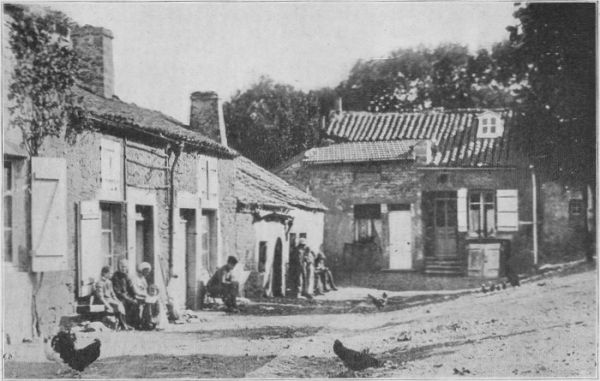
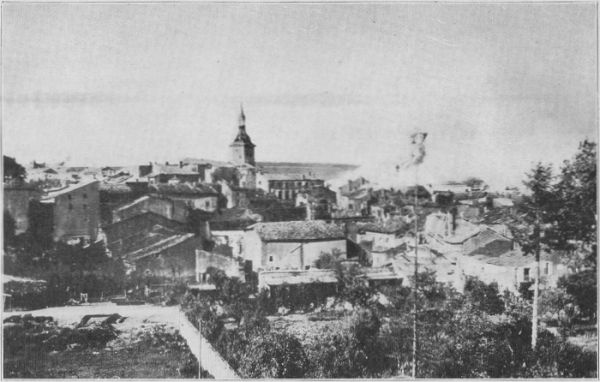
Stepping from the train into the streets of Ancey-le-Franc was verily
performing a miracle—with a single stride we were out of the twentieth
century and into the eighteenth! We were among our contemporary
ancestors, far on the road to yester century. Not a building under at
least one hundred years of age—not a street but trodden by the
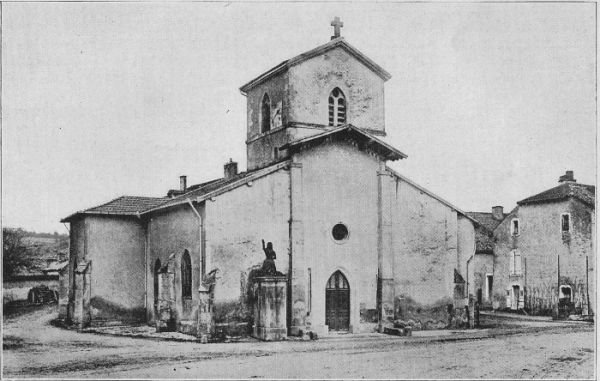
Crusaders of St. Louis—the church of St. Sebastian dated 1673; and the
Chateau, founded in 1275, by that hardy old Knight of Malta, Duke de
Clermont Tonnere.
With characteristic good humor, ingenuity and tact, officers and men
adjusted themselves to their unusual surroundings, merging into the
various billets allotted to them, along lines of least resistance. By
nightfall Buddie owned the town! Meriting it by sheer force of good
nature, gentlemanly deportment, and a willingness to follow the adage of
the ancient poet: "Si fueris Romae Romano vivite more."
Mine was the rare good fortune of being assigned to No. 10 Rue de
Belgrade. Here, through many generations, had stood the house of
Barnicault. Michel Barnicault, present head of the family, welcomed me
most cordially. He felt it indeed an honor to have as his guest Monsieur
le Chaplain, Americaine Soldat! In the evening he would sit in front of
his venerable home, smoking his pipe and looking with pride at my
Chaplain flag of blue and white that hung above the door.
Petit garcon Andree, aged six years, had always considered his
Grandfather Michel the greatest man in the world; then I came into his
life; and whether it was I, or the American bon bons I lavished on him,
or the overseas chapeau I let him strut about in now and then, I
completely won his little heart. Darling little Andree in far off
Ancey-le-Franc, now eight going on nine, I salute you!
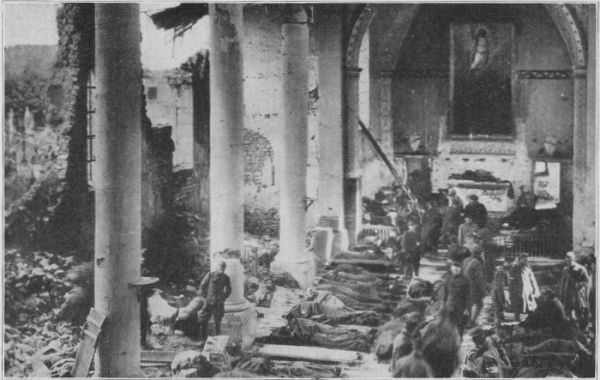
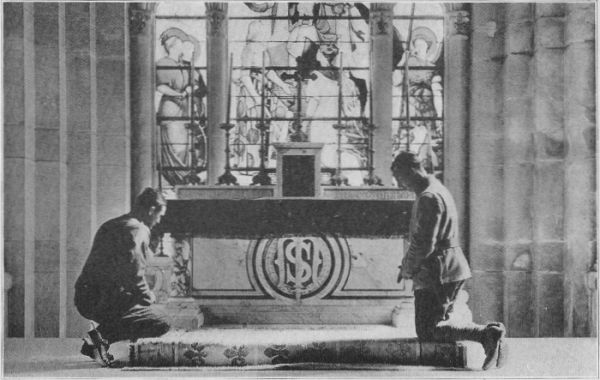
Monseigneur le Cure of the village church welcomed me cordially. Daily I
said Mass on the altar of St. Anne.
As we might go into the front trenches now any day, the Chaplains'
ministerial work grew apace. "Be ye always ready you know not the day
nor the hour." Father Martin was with the 56th Infantry at Molsme;
Father Trainor with the Machine Gunners at Ceneboy-le-Bas; and I, with
all other Divisional Units, with Headquarters at Ancey-le-Franc. Three
priests among 32,000 men, 48 per cent of whom were Catholic. The other
Chaplains were distributed: Chaplain Cohee, Christian, with the 34th
Infantry. (Mr. Cohee won the Distinguished Service Medal for gallantry
under fire at Vieville-en-Haye.) Chaplain Hockman, Lutheran, 55th
Infantry. Chaplain Webster, Episcopalian, 7th Engineers. Chaplain Rixey,
Methodist, 64th Infantry. Chaplain Evans, Baptist, Sanitary Trains.
At this time we gave an old-fashioned Mission in the village church. A
choir was organized from the Headquarters Troop, and each evening we
would have Rosary, Sermon and Benediction. A special memorandum, signed
by Colonel Degan, setting forth the purpose and advantages of the
Mission, was posted throughout the District. The villagers likewise
attended and the church was always filled. At this time, casting all
fear aside, I boldly plunged into my first public speaking in French! I
felt that grand-pere Barnicault and petit Andree would at least be on my
side in case of a riot. Much to my delight the populace greeted my
attempt approvingly and showered me with compliments.
On Sundays I would say Masses at six and eight for the troops, preaching
in English. Assisting at the ten o'clock Missa, Cantata Parochialis was
always a source of devotion and unusual interest. Promptly at 9:30 the
tower bells, in triple chime, would ring out, echoing near and far, o'er
meadow and hill. By path and trail and through the cobbled streets would
come the people—old men and women, white with the snows of many
winters; middle-aged women invariably clothed in the black of
widowhood—France had then been bleeding and dying three
years—fair-cheeked, dark-eyed modest maidens—type of Evangeline of
Grand-Pre—handsome little boys and girls, the kind with which Raphael
frames his Madonnas. Kneeling for a little prayer at the grave sides in
the church yard—pleasantly exchanging with neighbors the "bon jour" and
the "bonheur"—they make their way into the church, up the aisles
chiseled by Time itself, to the pew generations of their name have
worshiped in.
Mass is beginning. At the head of the procession, emerging from the
Sacristy, marches the Master of Ceremonies, a venerable man of
patriarchal mien, clothed in quaint cassock of black velvet, richly
trimmed with silver braid, resonantly striking the stone pavement with
official staff and responding in aged, yet pleasing voice to the
Gregorian Chant of Celebrant and Congregation. Handsome little boys—all
garcons are handsome—in acolytical splendor of purple and cardinal,
with the daintiest of "calottes," come singing their way into your heart
in a way to delight our own Father Finn of the Paulist choristers. The
village cure—Monsignor of the Diocese of Sens—in those rich full tones
that centuries of congregational singing have given to France, gives
voice to the Ceremonial Beauty "ever ancient yet ever new." Very little
need, there, for books; most young and old sing Introit, Credo, Preface
and Agnus Dei from memory, artistically exact in pronunciation,
expression and tempo.
If there was distraction for our troops at all, it was perhaps at the
collection. Not that the giving of their centimes or francs was
distracting, rather was it the manner of Collection à la Francais. It is
taken up by the most handsome young ladies of the congregation—our
American Tag Days were perhaps suggested by it. Marching before the
Mademoiselles and striking sharply on the pavement with his staff,
solemnly comes the aged Master of Ceremonies. No prayers so absorbing
nor slumber so profound, but the anvil clang of his staff will arouse. A
hand embroidered silken bag is handed to you in the most charming
manner. What Buddie could resist such appeal?
It was during our days in this area I was appointed Division Burial
Officer—undertaker for the entire Division. The order, duly bulletined,
at first shocked me—what qualifications had I for a work so unusual?
However, I promptly accepted it for reasons two-fold: First, it is not
the part of a soldier to question the wisdom of orders, and, second,
anything and everything done for Old Glory is an honor. Jealously I
raided the archives of the Personnel Department at Headquarters, my
"towney" Captain Brown of Grand Haven, Michigan, helping me, and studied
all Orders and Bulletins bearing on the subject, "how to identify,
register and bury the dead." The responsibility was indeed weighty and
the work vast—to organize, equip and drill burial details; to bury our
own dead, all enemy dead and horses; to assemble personal effects and
identification tags found on the persons of the deceased; to bathe,
clothe and prepare bodies for burial; to furnish coffins, gravediggers,
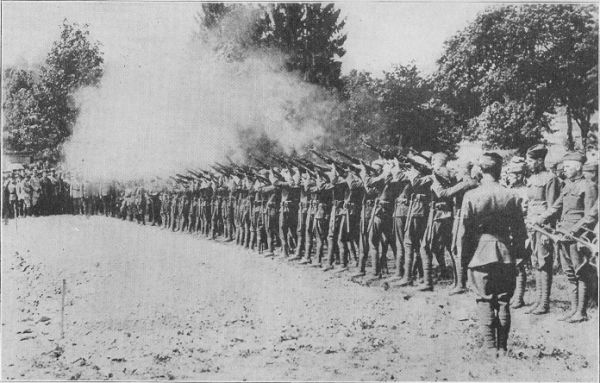
firing squads and buglers. Daily report of all burials was to be made to
the Graves' Registration Service at Chaumont. It can easily be realized
how important this work became as we grew nearer the fighting front. On
battlefields, drenched with deadly gas, under fire and amid conditions
and scenes most revolting and appalling, the burial parties worked,
usually in gas masks for protection against odors and fumes.
Physical exhaustion, occasioned by exposure at Brest, the fatiguing
journey across France, and the forced march of many kilometers, under
full pack, from rail heads to billets, accounted for the numerous
pneumonia cases that now appeared. In the unsettled, formative condition
of things, we were not prepared to fully cope with the situation. Our
nearest United States Base Hospital was at Dijon, sixty kilometers
distant; and to this point it became necessary to send such of the
seriously ill as could be safely transported. Many, however, were too
weak to undertake such a journey; and, as no suitable buildings were
available, the situation became truly distressing. There was not a
single Army corps nurse or welfare worker of any sort within miles of
us, and the critical nature of it all can be more readily imagined than
described. Our doctors and corpsmen of the Sanitary Regiment did
everything possible and rendered admirable service; but what could even
the best intentioned do without equipment? On September 5th, I took mess
with two of our best physicians, Captain O'Malley of Mercy Hospital,
Chicago, and Lieutenant Poole of South Carolina. One week later I buried
the Lieutenant at Longre, a victim of pneumonia, following an illness of
but four days.
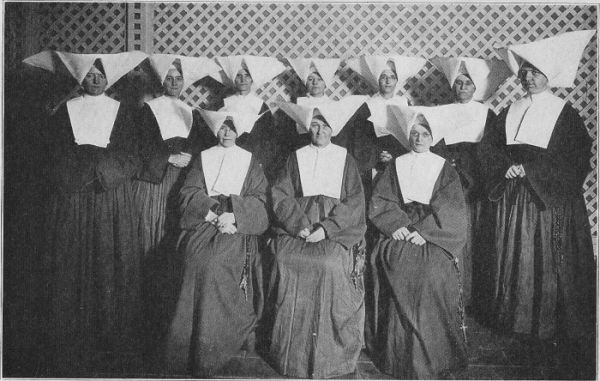
Four French Sisters of Charity now came most providentially to our
assistance. The unjust and stupid Association Laws of France had,
shortly before the war, forbidden them the right of teaching. Later they
had returned and converted the old building, their former school, into a
hospital. With its four spacious classrooms and pretty garden in the
rear, it easily lent itself to the purpose. Under the able direction of
Doctor Thiery, who was at that time mayor of the village, and whose
soldier son had been killed at St. Quentin, emergency medical and
surgical cases received there a care that, no doubt, saved many lives.
Our own Army doctors were at once incorporated in this improvised
hospital's staff, with corpsmen assigned to duty in its wards.
How wonderfully inventive and skillful Love becomes under the
inspiration of Religion! The humble Sisters who, in days of peace, had
dedicated their virgin lives to Education, a spiritual Work of Mercy,
now, under the stress of war, directed those same self-sacrificing
energies to Nursing, a corporal Work of Mercy, sanctioned by Him who is
the world's first Good Samaritan. Though not able to utter a single
English word, their kindness spoke eloquently for them in those
numerous little ways a gentle woman has of assuaging pain and soothing
even "the dull cold ear of Death." The Mother Superior, by simply
removing two or three pieces of furniture, converted her office into the
hospital morgue; and here, assisted by the corpsmen, I prepared the
bodies of my dear boys for burial. How my heart ached to see them die!
In the loneliness and seclusion of those whitewashed classrooms, far
removed from any sight or association that spoke of Home; to see the
light of their lives burn out, and the flowers of Spring displaced by
the snows of Winter!
To me their deaths, amid the uninspiring surroundings of that wayside
hospital, took on a grandeur and sublimity all surpassing.
Far easier, indeed, would it have been for them to die on field of
battle, with cheer of comrades following their flight of soul. That ward
was a braver field! For there they died bereft of all that inspires, and
with no pomp or thrill of war to make glad their chivalrous souls.
The village carpenter was never so busy. Reinforcing his working staff,
he set speedily to work building coffins. These he made of plain pine
boards, staining them to a dull brown, and furnishing with each a cross
and marking stake. Thirty-two of these it was my sad duty to provide and
distribute during our stay in Burgundy.
We soon outgrew the old churchyard at Ancey-le-Franc; and the good Cure
and Monsieur le Docteur Thiery of the local hospital, set aside for us
ground for another cemetery just outside the village. We enclosed this
with a white picket fence and felt confident, when we marched away, that
the graves of our brave boys there resting, would always be tenderly
cared for by the devoted people.
"On Fame's eternal camping ground
Their silent tents are spread,
And Glory guards with solemn round
The bivouac of the Dead."
At the place of honor, just inside that "God's Acre," I buried Sergeant
Omer Talbot of Kansas City, Kansas, one of the bravest and most beloved
of Headquarters Troop, who received the last Sacraments, and died in my
arms.
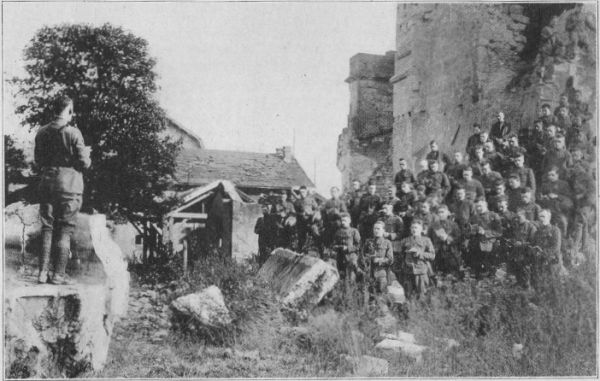
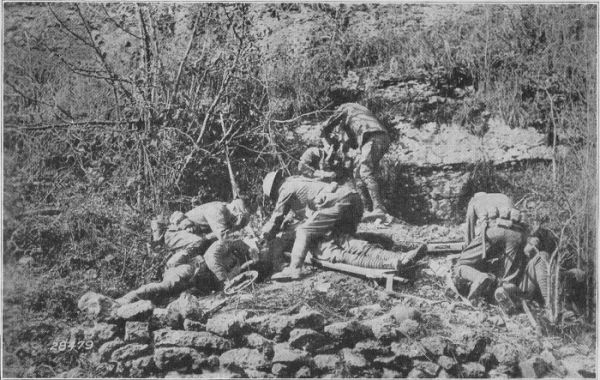
The Battle Swept Roadside was Sanctuary and Choir.
Our burials were always religiously attended by the villagers. A French
veteran would go through the streets sounding his drum and giving early
notice of the burial of an American soldier. The people would gather at
the church, the farmer from the field, the artisan from the shop, all
dressed as for Sunday. The cure, the mayor, the councilmen, the town
major, all would be present. On foot, bearing flowers, they would follow
the military cortège to the cemetery. There, following the Benedictus,
the mayor would give an impassioned address, expressing the profound
appreciation of France for the service and sacrifice of the gallant
American soldiers. His closing words, repeated and echoed through the
cemetery by the multitude, would be, "Vive l'Amerique! Vive Pershing!
Vive Wilson!"
Among the most devoted attendants at our funerals were Monsieur and
Madame Moidrey and their beautiful daughter Annette, a girl of sixteen
years. In rain and shine they came, always with flowers most beautiful
to place upon coffin and grave.
Returning one day from the cemetery, Monsieur respectfully addressed
me—"If it would please Monsieur le Chaplain to ever visit our home
(they lived just inside the village in a quaint old manor house I had
often admired), we would consider it an honor indeed to entertain
Monsieur le Chaplain and his friends," then naively adding, as if by way
of further inducement, "we have the only piano in the village."
Now Sergeant Eddie Quinlan, 55th Infantry, who came from South Carpenter
Street, Chicago, was one of my best pals. He was then attending the
Field Signal Battalion School at Shacereyelles, two kilometers away. I
sent word to him, directing him to report at my billet the following
evening accompanied by the ten handsomest doughboys, besides himself, in
his platoon. At the appointed hour and place, the Buddies were
faithfully on hand; and need I add, all were from Chicago? How proud I
was of them, stalwart huskies, well groomed, brown as berries, and with
muscles of iron.
"Fellows, if you have no other engagement for this evening, would you
care to accompany me to the Moidrey residence, honored guests of the
family? They have a piano; and I might add, a most charming daughter of
sixteen summers." Here they nearly mobbed me! "Would they go?" "Other
engagements!" "Say, Father, you are not kidding us, are you?" etc., etc!
By way of information permit me to here observe that these boys had been
sleeping in fields then for two weeks. They had not seen the inside of
an honest-to-goodness home, nor sat at a dining-table with real
tablecloth, napkins or plates, since they landed in France. Neither had
they heard a piano, nor been the guest of any lady, young or
old—well—since they left Camp Merritt. Their over-flowing cup of joy,
at this alluring prospect, can therefore easily be imagined.
As we no doubt would be invited to sing, we first rehearsed several
popular songs, holding forth with a gusto that raised the roof, even of
the ancient and sturdy house of Barnicault. To the air of "Old Kentucky
Home," Quinlan tried out our latest, A Song of Home:
You may sing of Erin's Shannon flowing softly to the sea,
The Thames where it passes London town;
You may boast the bonnie Clyde where it mingles with the tide,
And the Seine with its romance of renown.
You may paint in blue the Danube or the far Italian Po,
But of all the streams enshrined in memory,
Is the good old Mississippi, that wherever I may go,
Is the dearest one in all the world to me.
Then sing the song, my comrades,
O we'll sing this song today,
That wherever we may roam, we'll sing a song of home
For the dear old Mississippi far away.
You may boast of Irish Nora, or sweet Bessey of Dundee,
The charm of England's Geraldines so fair;
You may choose the maids of Belgium or Ma'm'selles of Picardy
All famed for grace and beauty everywhere.
But if you will but listen, and leave the choice to me
I'll point with pride to dear old U. S. A.
Where there's maidens fair to see, sweet and dear as Liberty
And never cloud o'ershadows beauty's day.
Then sing this song, my comrades,
O we'll sing this song today,
That wherever we may roam, we'll sing a song of home
For the maidens fair back home in U. S. A.
A trench mirror four inches by six hung on the wall of my billet. There
was a mad scramble for a last facial and tonsorial inspection; for each
fellow boldly made his boast, "Just watch me, Bo, make the hit of the
evening with Ma chere Miss Frenchy."
Down the village street in column of twos we made our way.
"All gentle in peace and all valiant in war,
There never was Knight like the young Lochinvar."
As we went singing carefree, secretly my heart was sad. As a Staff
Officer I knew, although the boys did not, that this was to be their
last evening party; that on the morrow they were to leave for the front
line trenches; that many weary days, weeks and months of stern, bitter,
deadly realities lay just before them; and I wanted them to at least
enjoy this one last evening of home-spun, joyful valedictory.
The Moidrey residence stood back a little from the road, protected by a
tall iron fence of artistic design. As we drew near, my Minstrel Boys
prudently "soft pedaled" their singing, so as not to over-alarm our kind
host. Responsive to our sounding the huge brass, lion-headed knocker on
the massive gate, the house door opened. Monsieur, Madame and
Mademoiselle Annette came down the winding garden path to admit and
welcome us.
Introductions followed, formal, gracious and charming. Quite true it was
that our kindly hosts could not speak a word of English, nor the
Buddies of French, at least of French fit to grace the occasion. There
is a language, however, that is not of the tongue, but of the heart. It
is expressed in the flash of a love-lit eye; it is felt in the pressure
of a kindly hand. It is spoken and understood the world over and needs
no interpreter. This language my boys spoke very fluently; and our
charming hosts did them the honor to understand.
In the parlor was the wonderful piano, brought all the way from Paris.
Obligingly, charmingly, Mademoiselle Annette responded to our profuse,
overwhelming invitations to play first. Sweet and innocent she looked
sitting there; her cheeks fair as the roses in her garden, her eyes
modestly aglow with star light, her raven hair in a single braid of
ample length, neatly adorned with a red ribbon and bewitchingly tossed
over her shoulder. Never was a young lady better guarded at a piano;
five stalwart doughboys on either side, jealously turning the pages of a
sheet of music that was upside down. Artistically she played and the
loud applause that greeted her would have made envious our own Fanny
Bloomfield Zeisler.
Our turn came next. The polite piano from Paris fairly groaned beneath
the burden of our song. It was not used to such boisterous treatment.
Bravely it struggled on "The Long, Long Trail A-winding." It galloped
"Over There." It wailed bitterly "I'm Sorry, Dear," and it did its
bravest to "Keep the Home Fires Burning."
When, finally, the barrage of music lifted, we made our way to the line
of attack at the spacious dining-table our hosts had meanwhile spread.
How good it seemed to sit at a regular table, with tablecloth, napkins
and silverware! How delicious too the sweetbreads, the salad, the
fromage; and crowning all, the exquisite service of sparkling wine,
vintaged in the long ago in these famed Burgundian valleys.
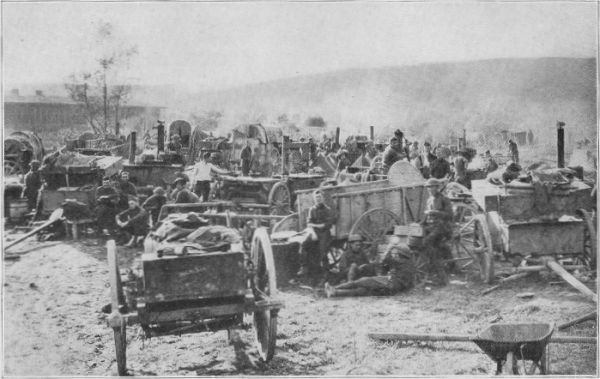
The Men Behind Our Mess at Bouillonville.
Call to Quarters sounded at 8:45 and "Tattoo" at 9:00. It was now time
to go. Cordially each boy thanked our gracious hosts. "And should I live
a thousand years I'll ne'er forget." Reverently, gallantly, devotedly,
each said bon jour to darling Annette. To each she represented
womanhood—beautiful, modest, lovable. Each saw visualized in her, as it
were, his own mother, sister, sweetheart, back home. Would he ever see
his own loved ones again? God only knew. And when the last good-bye
was said, and the door slowly closed and we walked away into the night,
the bugle call of "Taps" plaintively sounding through the quiet streets
found sad and mystic echo in our souls.
Our last day in Ancey-le-Franc dawned chill and rainy. I breakfasted in
the old Chateau with Senior Chaplain of the A. E. F., Bishop Brent,
Episcopal Bishop of Eastern New York Diocese, who had journeyed over
from Chaumont to visit us. A thorough gentleman and efficient officer
was the good Bishop; and naught but the best and most cordial good will
has ever characterized our relations.
It was but a few days subsequent to his visit that I received from
General Pershing the special orders making me Senior Chaplain of the
Seventh Division and brevet of Captaincy. For this honor I have ever
been grateful to Bishop Brent and our gallant Division Commander General
Baarth.
Although our sojourn with the Burgundians had been brief, the conduct of
officers and men had won universal respect. Genuinely sad the villagers
were to see us fall in, that rainy afternoon, under marching orders. We
had just been equipped with gas masks; and for the first time wore our
prized chapeaus, the steel helmets.
Sad was the house of Barnicault! Petit Andree followed me about, weeping
constantly. Madame prepared her best omelet and cafe-au-lait and
Monsieur opened his most prized bottle of Burgundy. I left with them
many odds and ends the zealous merchants back home in the States had
thoughtfully recommended, but which stern Army regulations decried for
front line use. Trunks were left behind; and all we needed we carried in
our ever-faithful packs. With a last blessing to the dear old couple,
kneeling sobbing at my feet, a last hug from Andree, whose fond little
arms I had to forcibly release from my neck, I put on my helmet,
shouldered my pack and was gone!
The rain fell in torrents; and quickly I took position in the long,
waiting line. We marched at once, taking the road to Neuite-sur-Yonne;
and far on our way the old church bells called sadly after us in their
benison of last farewell. We never returned to Ancey-le-Franc; but to
its beloved inhabitants we still live, for,
"To live in hearts we leave behind is not to die."
We reached our Rail Head, the main line to the regions of
Meurthe-et-Moselle, at nine o'clock; and struck camp in the yards and
fields for the night. As the night was chill and our camp sufficiently
secure from observation, fires were kindled by the various companies.
Gathered in their cheering circles of warmth and glow, the boys beguiled
the hours preceding Taps, with jest and song. They sang of love and war
and God; and through all their melody, as a golden thread, could be
traced the thought of home and of a Great Tomorrow! Gradually, as glow
of sunset paling in the west, the fires burned low; and out of dying
embers rose shadowy forms that beckoned weary eyes to the land of
dreams.
To each sleeping soldier boy
Magi dreams bring gifts of joy;
Sweet and pure as mother love
Brought by angels from above.
Dreams of home across the sea
And of scenes loved tenderly,
As he left them yesterday
When he turned and marched away.
Dreams of mother at the door
Standing as in days of yore,
Calling him to come from play
At the closing of the day.
Dreams of maiden, boyhood friend,
Down the road beyond the bend,
Where the trees made welcome shade
Trysting place for boy and maid.
Where he told her of his love
Pure and true as stars above,
And she answered with her eyes
Beautiful as Paradise.
*****
Dream on, soldier boy of mine,
May sweet memory entwine
Love that thrills with hope that cheers,
Wakening day with yester years!
May sweet morrow's dawning beam
Hallow and make real thy dream.
At midnight as I lay wrapped in my blanket beside the fire's expiring
embers, Colonel Degan came to me and said, "I am leaving you, Chaplain.
Good-bye and the best of luck." He was on his way to another sector; and
although I have never seen him since, I still recall him as a splendid
soldier and a devoted friend.
At Units the following morning, I said Mass and gave the Sacraments to
quite a number of the boys. Among these I recall Machine Gunner Brady of
the 34th Infantry, brother of my friend, Father Brady, of St. Agnes
Church, Chicago.
Meanwhile the waiting trains had been boarded and promptly at noon we
rolled away into the mysterious Northeast. How good it seemed to be once
more on the move! The utmost caution was now to be observed—no lights
on the train at night, not even a headlight on the engine. Softly the
boys sang,
"We don't know where we're going,
But we're on our way."
In monotone the steel rails seemed to plaintively reply,
"Art is long and Time is fleeting,
And your hearts though stout and brave,
Still, like muffled drums, are beating
Funeral marches to the grave."
Our afternoon hours were given something of a thrill in watching the
evolutions of a half dozen planes, skirmish escort men of the air,
flying high and wide covering our movements. We were now on the division
of road operated by our own gallant 13th Engineers, of which my friend,
Sergeant McDowell of Blue Island, was Locomotive Inspector.
Night fell; and the long troop trains like monstrous serpents creeping
on their prey crawled steadily, silently forward into the abysmally
black unknown. Slower and more uncertain they moved, feeling their way;
and at midnight came to a final stop at the near approaches to No Man's
Land. Quickly we detrained and took cover in a near-by forest; the empty
cars trailed off rapidly to the south; and dawn found neither a car nor
a soldier in sight. All that day we remained hidden in the shadowy
solitudes of Bois l'Evque on the banks of the Moselle.
Beautiful was this softly flowing river, mirroring azure skies and
radiant in the colorful glow of early autumn. How hard to realize that
death lurked in the quietude of its borders; that Man had chosen this
bosom of shade, tuneful with the voice of sweetly calling birds, as a
fitting shambles to slay his fellow men!
If day for the soldier was for rest, night was for the march; and a new
dawn found us in the sheltering woods of Gonderville on the Toul-Nancy
highway.
Turquoise, palest violet, tender green and gold, the country lay before
us. Then, even as we watched from covert, our ears made acquaintance
with a new and ominous sound. From an infinite distance the morning
breeze from the north carried with it a deadened thumping sound, now
regular as the muffled rolling of drums, now softly irregular with
intervals of stillness. It was the dominating monotone of cannonading.
No need to tell the boys what it meant!
"Guess we're in time for the big show all right," Buddie quietly
remarked; and from that moment an expression overspread his countenance
and a note crept into his voice I had not noticed there before. It was
not one of nervousness, but of seriousness; a clearer vision and
apprehension of big manly things henceforth to be done.
"When I was a boy I lived as a boy; but when I became a man I put away
the things of boyhood and acted the part of a man."
Boys went into the trenches, but men came out of them!
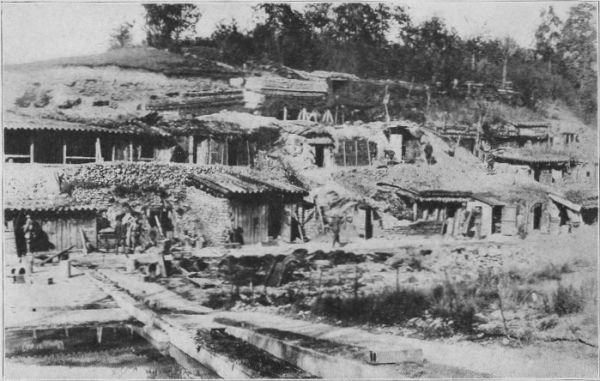
Our Dugouts Afforded Shelter and Habitation.