The Great White Way A Record of an Unusual Voyage of Discovery, and some Romantic Love Affairs amid Strange Surroundings. The Whole Recounted by one Nicholas Chase, Promoter of the Expedition, whose Reports have been Arranged for Publication by
Transcriber’s Note:
The cover image was created by the transcriber and is placed in the public domain.
To
My Parents.
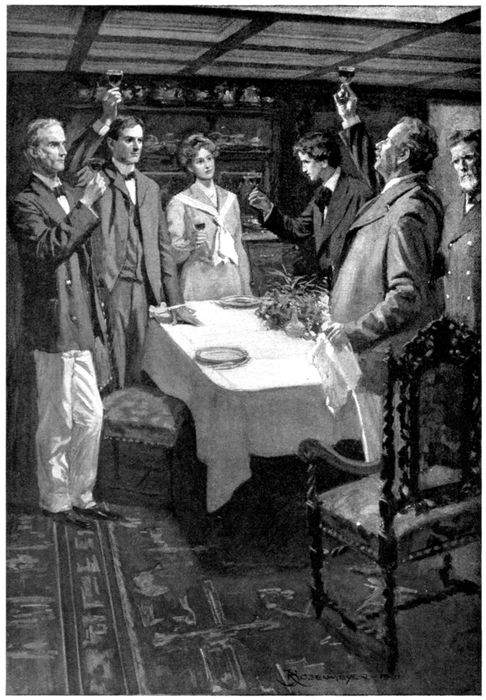
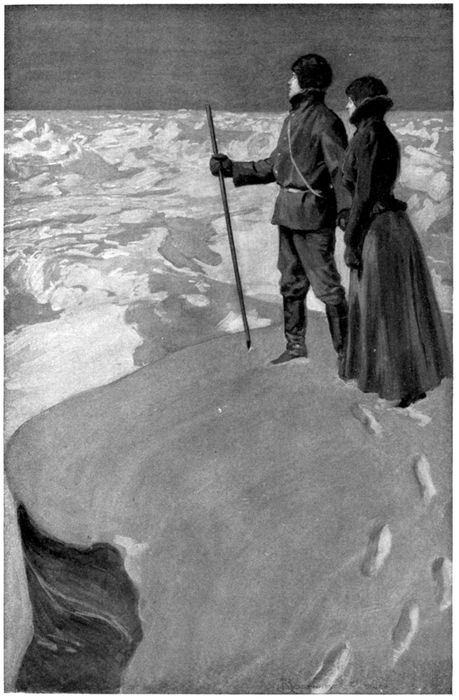
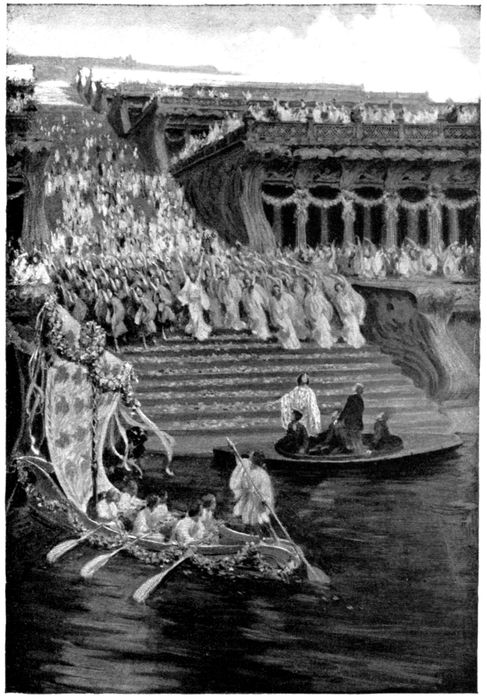
“The South Pole for us all!”—Frontispiece, Page 58.
ALBERT BIGELOW PAINE
Author of “The Van Dwellers,” “The Bread Line,” etc.
Nicholas Chase, a young man with a dream of discovery,
and an inherited love of the sea.
Chauncey Gale, a merry millionaire, with a willingness
to back his judgment.
Edith Gale, his daughter, a girl with accomplishments
and ideas.
Zar, colored maid and former nurse of Edith Gale. A
woman with no “fool notions” about the South Pole.
Ferratoni, an Italian electrician with wireless communication,
and subtle psychic theories.
Captain Joseph Biffer, Master of the Billowcrest. An
old salt, with little respect for wild expeditions.
Terence Larkins, First Officer of the Billowcrest, with
a disregard of facts.
Mr. Emory, Second Officer of the Billowcrest.
William Sturritt, Steward of the Billowcrest, and inventor
of condensed food tablets.
Frenchy, a bosun who stirs up trouble.
Prince of the Purple Fields, a gentle despot of the
Port of Dreams.
Princess of the Lilied Hills, His Serene Sister, whose
domain is the deepest South.
Three maidens of the Land of Dreams and Lotus.
A shipwrecked sailor, whose rescue is important to all
concerned.
Cabin boy, stewardess, and crew of the Billowcrest.
Courtiers, populace, etc., of the Land of the Sloping Sun.
5
THE GREAT WHITE WAY.
I. ANSWER TO AN OLD SUMMONS.
For more than ten generations my maternal ancestors
have been farers of the sea, and I was born
within call of high tide. At the distance of a thousand
miles inland it still called me, and often in
childhood I woke at night from dreams of a blue
harbor with white sails.
It is not strange, therefore, that I should return
to the coast. When, at the age of thirty, I found
myself happily rid of a commercial venture—conducted
for ten years half-heartedly and with insignificant
results—it was only natural that I should
set my face seaward. My custom, of which there
was never any great amount, and my goodwill, of
which there was ever an abundance, I had disposed
of to one who was likely to reverse these conditions—his
methods in the matter of trade being
rather less eccentric than my own. He had been
able to pay me in cash the modest sum agreed upon,
6and this amount I now hoped to increase through
some marine investment or adventure—something
that would bring me at once into active sea life—though
I do not now see what this could have been,
and I confess that my ideas at the time were somewhat
vague.
II. I RENEW AN OLD DREAM.
7
Perhaps first of all I wished to visit the South
Pole—not an unreasonable ambition it would seem
for one backed by ten generations of sea captains
and ocean faring—but one that I found not altogether
easy to gratify. For one thing, there was
no Antarctic expedition forming at the time; and
then, my notions in the matter were not popular.
From boyhood it had been my dream that about
the earth’s southern axis, shut in by a precipitous
wall of ice, there lay a great undiscovered world.
Not a bleak desolation of storm-swept peaks and
glaciers, but a fair, fruitful land, warmed and nourished
from beneath by the great central heat
brought nearer to the surface there through terrestrial
oblation, or, as my geography had put it, the
“flattening of the poles.”
I had held to this fancy for a long time on the
basis of theory only, and, perhaps, the added premise
that nature would not allow so vast a tract as
the Antarctic Continent to lie desolate. But, curiously
8enough, about the time I arrived in New
York I met with what seemed to me undoubted bits
of evidence in the reports of some recent polar observations.
Borchgrevink, a Norwegian explorer, returning
with a poorly fitted Antarctic expedition, reported,
among other things, a warm current off Victoria
Land, at a point below the 71st parallel, and flowing
approximately from the direction of the pole![1]
1. “It seems to me,” he says, in an article printed in the
Century Magazine (January, 1896), “that an investigation of
the origin and consequences of the warm current running
northeast, which we experienced in Victoria Bay, is of the
greatest importance.”
True, Borchgrevink believed the Antarctic Continent to be
an exceptionally cold one, but for this he was not to blame.
No man can help what he does or does not believe in these matters
regardless of sound logic and able reasoning to the contrary.—N. C.
Nansen, another Norwegian, in the Arctic Polar
Sea, had been astonished to find that the water at
a great depth, instead of being colder than at the
surface as he had expected, was warmer! He had
also found that as he progressed northward from
80° the thermometer had been inclined to rise rather
than to fall. To be sure, when he arrived at a
point within a little more than two hundred miles of
the earth’s axis, he had found only a continuance of
ice—a frozen sea which undoubtedly extended to
9the pole itself; but this frigidity I attributed to the
fact that it was a sea into which, from the zone of
fierce cold below, were constantly forced huge ice-floes.
These, as I conceived, would maintain the
condition of cold in the Arctics by shutting out the
under warmth, through which, however, they
would be gradually melted—to be discharged in
those great Arctic currents which Nansen and other
explorers had observed. The lack of thickness in
the ice forming about the pole had also been noted
with some surprise. This too, I claimed, was due to
the warm earth beneath it which, while it could not
much affect the general climate, when some three
miles of very chilly water and several feet of substantial
ice lay between, did serve as a provision of
nature to prevent the northern sea from becoming
one mighty solidified mass.
Now, ice-floes could not be forced inland, as
would have to be the case in the Antarctics where
there was admittedly a continent instead of a sea.
Around this continent, it was said, there lay a precipitous
frozen wall which no man had ever scaled.
What lay beyond, no man of our world had ever
seen. But in my fancy I saw those ramparts of
eternal ice receding inward to a pleasant land, as
the snow-capped Sierras slope to the verdant plains
of California. A pleasant land—a fair circular
world—temperate in its outer zone, becoming even
10tropic at the center, and extending no less than a
thousand miles from rim to rim. There, I believed,
unknown to the world without, a great and perhaps
enlightened race lived and toiled—loved and died.
III. EVEN SEEKING TO REALIZE IT.
11
But scientists, I was grieved to find, took very
little stock in these views. Even such as were willing
to listen declared that the earth’s oblation
counted for nothing. Most of them questioned the
existence of a great central heat—some disputed
it altogether. The currents and temperatures
reported by Nansen, Borchgrevink and
others, they ascribed, as nearly as I can remember,
to centrifugal deflections, to gravitatory adjustments—to
anything, in fact, rather than what
seemed to me the simple and obvious causes.
As a rule, they ridiculed the idea of a habitable
world, or even the possibility of penetrating
the continent at all. When I timidly referred to a
plan I had partially conceived—something with balloons
in it—they despised me so openly that I was
grateful not to be dismissed with violence. I cannot
forego one brief example.
He was a stout, shiny-coated man, with the
round eyes and human expression of a seal. He
took me quite seriously, however, which some of
them had not. Also himself, and the world in general.
12When I had briefly stated my convictions he
put his fingers together in front of his comfortable
roundness and regarded me solemnly. Then he
said:
“My dear young man, you are pursuing what
science terms an ignis fatuus, commonly and vulgarly
known as a will-o’-the-wisp. You are wasting
your time, and I assure you that neither I nor
my associates in science could, or would, indorse
your sophistries, or even stand idly by and see you
induce the unthinking man of means to invest in
an undertaking which we, as men of profound research
and calm understanding, could not, and
therefore would not approve.” He cleared his
throat with a phocine bark at the end of this period
and settled himself for the next. “Men in all
ages,” he proceeded, “have undertaken, in the
cause of science, difficult tasks, and at vast expenditure,
when there was a proper scientific basis for
the effort.”
He paused again. My case was hopeless so far
as he was concerned—that was clear. I would
close the interview with a bit of pleasantry.
“Ah, yes,” I suggested, “such as the ‘hunting
of the snark,’ for instance. Well, perhaps I shall
find the snark at the South Pole, when I get there,
who knows?”
The human seal lifted one flipper and scratched
13his head for a moment gravely. Then he said with
great severity:
“Young man, I do not recall the genus snark.
I do not believe that science recognizes the existence
of such a creature. Yet, even so, it is most
unlikely that its habitat should be the South Pole.”
I retired then, strong in the conclusion that the
imagination of the average scientist is a fixed equation,
and his humor an unknown quantity. Also
that his chief sphere of usefulness lies in being able
to establish mathematically a fact already discovered
by accident. The accident had not yet occurred,
hence the time for the scientist and his
arithmetic was not at hand.
I now sought capital without science, but the results
though interesting were not gratifying.
A millionaire editor, a very Crœsus of journalism,
was my final experience in this field. He didn’t
have any time to throw away, but I seemed reasonably
well-fed, and he saw I was in earnest, so he
was willing to listen. He put his feet upon a table
near me while he did it. When I got the bald facts
out and was getting ready to amplify a little he
broke in:
“How long would it take you to go there and get
back?” he asked.
“I hardly know—five years, perhaps—possibly
longer.”
14The millionaire editor took his feet down.
“Humph! Hundred thousand dollars for a Sunday
beat and five years to get it! No, I don’t think
we want any South Poles in this paper——”
“But in the cause of human knowledge and
science,” I argued.
“My friend,” he said, “the only human knowledge
and science that I am interested in is the
knowledge and science of getting out, next Sunday
and the Sunday after, a better paper than that lantern-faced
pirate down the street yonder. When
you’ve found your South Pole and brought back a
piece of it, come in, and I’ll pay you more for the
first slice than anybody else, no matter what they
offer. But you’re too long range for us just at
present. Good day!”
IV. TURNING TO THE SEA, AT LAST, FOR SOLACE.
15
Having thus met only with rebuff and disaster
in the places where it seemed to me I had most reason
to expect welcome and encouragement, I turned
for comfort to those who, like my forbears, went
down to the sea in ships. Along South Street,
where the sky shows through a tangle of rigging,
and long bowsprits threaten to poke out windows
across the way, I forgot my defeats and even, for a
time, my purpose, as I revelled in my long-delayed
heritage of the sea.
It was the ships from distant ports that fascinated
me most. My Uncle Nicholas—a sailor who
was more than half a poet—had been in the
foreign trade. I remembered him dimly as a big
brown-faced man who had told me of far lands and
shipwrecks, and rocked me to sleep to the words and
tune of an old hymn, of which I could still repeat
the stanza beginning,
“The storm that wrecks the winter sky.”
His vessel with all on board had disappeared
somewhere in the dark waters below Cape
16Horn more than twenty years before. I had
inherited half of his name and a number of precious
trinkets brought home during his early days of
seafaring—also, it was supposed, something of his
tastes and disposition. In a manner I was his heir,
and the tall-masted, black-hulled barks that came
in from the Orient—to be pushed as quietly into
place at the dock as if they had but just been towed
across the East River from Brooklyn—these, it
seemed to me, were his ships, hence, my ships that
were coming in, at last.
I found in them treasures of joy unspeakable.
Those from around the Horn seemed to bring me
direct messages from the lost sailor. I felt that had
he lived he would have believed in my dreams and
helped me to make them reality. At times I even
went so far as to imagine that his ship had not gone
down at all, but had sailed away to some fair harbor
of the South, whence he had not cared to return.
It thrilled me even to touch one of those weather-beaten
hulls. The humblest and most unwashed
seaman wrought a spell upon me as he made a pretense
of polishing a bit of brass or of mopping up
the afterdeck. He had braved fierce storms. He
had spent long nights spinning yarns in the forecastle.
Perhaps he had been wrecked and had
drifted for weeks in an open boat. It might be that
he had been driven by storms into those gloomy seas
17of the South—even to the very edge of my Antarctic
world!
When they would let me I went on board, to
fall over things and ask questions. My knowledge
of shipping was about what could be expected
of one whose life had been spent on the prairies of
the West, with now and then a fleeting glimpse of
a Mississippi River steamer. I suppose they wondered
how I could be so interested in a subject, concerning
which I displayed such a distressing lack
of knowledge. They were willing to enlighten me,
however, for considerations of tobacco or money,
and daily I made new bosom friends—some of them,
I suspect, as unholy a lot of sea-rovers as ever found
reward at the end of a yard-arm.
I did not seek technical instruction. What I
yearned for was their personal experiences, and
these they painted for me in colorings of the sea
and sky, and in such measure as the supplies were
forthcoming. Almost to a man they readily remembered
my Uncle Nicholas, but as they differed
widely concerning his stature, complexion and general
attributes, I was prone to believe at last that
they would have recalled him quite as willingly under
any other name; and indeed I found this to be
true when I made the experiment, finally, of giving
his name as Hopkins, or Pierce, or Samelson,
instead of the real one, which had been Lovejoy.
18I gathered courage presently to interview the officers,
but these I found rather less entertaining,
perhaps because they were more truthful. Only
one of them recalled my Uncle Nicholas, a kindly
first mate, and I suspect that even this effort resulted
from a desire to please rather than from any
real mental process or strict regard for verities.
I suppose I annoyed them, too, for I threw out a
hint now and then which suggested my becoming a
part of their ship’s company, though in what capacity
or for what purpose neither I nor they could
possibly imagine. As for my Antarctic scheme, I
presently avoided mentioning it, or, at most, referred
to it but timidly. Indeed, I demeaned myself
so far at times as to recall it in jest as the wild
fancy of some mythical third party whose reasoning
and mentality were properly matters of ridicule and
contempt.
For I had discovered early in the game that the
conception of a warm country at the South Pole appealed
as little to the seaman as to the scientist.
The sailors whom I had subsidized most liberally
regarded me with suspicion and unconsciously
touched their foreheads at the suggestion, while
the kindly first officer, who had been willing to remember
my uncle, promptly forgot him again and
walked away.
I passed my days at length in wandering rather
19silently about the docks and shipping offices, seeking
to invest my slender means in some venture or
adventure of the sea that would take me into many
ports and perhaps yield me a modest income besides.
I consulted a clairvoyant among other things, a
greasy person on Twenty-third Street, who took me
into a dim, dingy room and told me that I was contemplating
something-or-other and that somebody-or-other
would have something-or-other to do with
it. This was good as far as it went. I was, in
fact, contemplating most of the time. I was ready
for anything—to explore, to filibuster, to seek
for hidden treasure—to go anywhere and to do
anything that would make me fairly and legitimately
a part and parcel with the sea. I read one morning
of a daring voyager who in a small boat had set
out to sail around the world alone. I would have
given all that I possessed to have gone with him,
and for a few moments I think I even contemplated
a similar undertaking. But as I did not then know
a gaff from a flying-jib, and realizing that my voyage
would probably be completed with suddenness
and violence somewhere in the neighborhood of
Sandy Hook, I resisted the impulse. As for my
Antarctic dream, its realization seemed even farther
away than when as a boy I had first conceived
it, some fifteen years before.
V. I OVERHAUL THE STEAM YACHT, BILLOWCREST.
20
It was early spring when I had arrived in New
York, and the summer heat had begun to wane
when I first set eyes on the Billowcrest, and its owner,
Chauncey Gale.
On one of those cool mornings that usually come
during the first days of August I was taking a stroll
up Riverside Drive. Below me lay the blue Hudson,
and at a little dock just beyond Grant’s Tomb
a vessel was anchored. Looking down on her from
above it was evident, even to my unprofessional eye,
that she was an unusual craft. Her hull was
painted white like that of a pleasure yacht and its
model appeared to have been constructed on some
such lines. Also, an awning sheltered her decks,
suggesting the sumptuous pleasures of the truly
rich. But she was much larger than any yacht I
had ever seen, and fully bark-rigged—carrying
both steam and sail. She was wider, too, in proportion
to her length, and her cabins seemed rather
curiously disposed. A man laboring up the slope
21took occasion to enlighten me. He had just investigated
on his own account.
“Great boat, that,” he panted. “Cost a million,
and belongs to a man named Gale. Made his
money in real estate and built her himself, after his
own ideas. He wasn’t a sailor at all, but he’d
planned lots of houses and knew what he wanted,
and had the money to pay for it. No other boat
like her in the world and not apt to be; but she suits
him and she goes all right, and that’s all that’s necessary,
ain’t it?”
I said that it was, and I presently went down to
look at her. I do not now remember that I was
prompted by any other motive than to see, if possible,
what a man looked like who could afford to
disregard the laws and traditions of ship architecture,
and build and own a million dollar steamer
after his own model, and for his own pleasure.
Also, I had a natural curiosity to learn something
of what sort of vessel would result from these conditions.
As I drew nearer I was still further impressed
with her remarkable breadth of beam, suggesting
comfort rather than speed, and by the unusual flare
and flatness of her hull, reminding me of the model
of Western steamers built for log jams and shallow
water. Connecting with the dock was a small
gangway, at the top of which stood a foreign-looking
22sailor in uniform. Across his cap, in white letters,
was the word, “Billowcrest.” He
regarded me distrustfully as I walked up and down,
and one or two suggestions I made, with a view of
conveying to him my good opinion of his boat, as
well as the impression that I knew a lot about
yachts in general, he acknowledged grudgingly and
in mixed tongues. I disapproved of him from the
start, and as later events showed, with sufficient reason.
Having looked over the vessel casually I
halted at last in front of the gangway.
“I should like to come on board,” I said.
The polyglot dissented.
“No admit. Mis’r Gale command.”
“Is Mr. Gale himself on board?”
I assumed a manner of severity with a view of
convincing him that I was of some importance, and
at the same instant ascended the gang-plank, extending
my card before me. Of course the card
meant nothing to him except that I was able to have
a card, but I could see that he hesitated and was
lost. Evidently he had little knowledge of the
great American game when I could intimidate him
with one card.
He returned presently, and scowlingly led me
into a little saloon forward. Then he disappeared
again and I was left to look at my surroundings.
A desk, a fireplace with a gas-log, some chairs suggestive
23of comfort, a stairway, probably leading to
the bridge above. The evidences of the real estate
man’s genius were becoming apparent. I might
have been in the reception hall of any one of a
thousand country cottages in the better class suburbs
of New York. I had barely made these observations
when a door to the right of the stairway
opened. In a cottage it would have led to the dining-room,
and did so, as I discovered later, on the
Billowcrest. A tall, solemn-looking man entered,
and I rose, half extending my hand, after the manner
of the West.
“Mr. Gale,” I said.
The solemn man waved me aside—somewhat nervously
it seemed.
“No—I’m—that is, I’m not Mr. Gale. I’m only
the—his steward,” he explained. “Mr. Gale is—er—somewhat
busy just now and would like to know
if your errand is im—that is, I should say, a personal
matter. Perhaps I—I might answer, you
know.”
My heart warmed instantly toward this sober-faced
man with thin whitening hair and nervous
hesitation of manner. I was about to tell him that
I only wanted to go over the yacht, and that he
would do admirably when I thrilled with a sudden
impulse, or it may have been an inspiration.
“Please tell Mr. Gale,” I said, “that I am sorry
24to disturb him, but that I would really like to see
him personally. I will not detain him.”
The solemn man retired hastily, leaving the door
slightly ajar behind him. I heard him murmur
something within, which was followed by a rather
quick, hearty response.
“All right, Bill. Newspaper man, I guess,—tell
him I’m coming!”
The tall man whose name, it seemed, and inappropriately
enough, was Bill, returned with this announcement.
Close behind him followed a stout,
clear-eyed man of perhaps fifty. A man evidently
overflowing with nerve force and energy, appreciative
of humor, prompt and keen in his estimate of
human nature, and willing to back his judgments
with his money. Undismayed and merry in misfortune,
joyous and magnanimous in prosperity,
scrupulously careful of his credit, and picturesquely
careless of his speech—in a word, Chauncey Gale,
real estate speculator, self-made capitalist and
American Citizen.
I did not, of course, realize all of these things on
the instant of our meeting, yet I cannot refrain
from setting them down now, lest in the reader’s
mind there should exist for a moment a misconception
of this man to whom I owe all the best that I
can ever give.
He came forward and took my hand heartily.
25“Set down,” he commanded, “and tell us all
about it.”
“Mr. Gale,” I began, “I have been admiring
your yacht from the outside, and I came on board to
learn more about her purpose—how you came to
build her, what you intend to do with her, her
dimensions, and so on.”
I was sparring for an opening, you see, and
then he had taken me for a reporter.
“What paper you on?”
I was unprepared for this and it came near being
a knockout. I rallied, however, to the truth.
“I’m on no paper, Mr. Gale; I’m a man with a
scheme.”
“Good enough! What is it?”
“To go to the South Pole.”
We both laughed. There had been no suggestion
of annoyance or even brusqueness in Mr.
Gale’s manner, which was as encouraging as possible,
and as buoyant. But half unconsciously I had
adopted its directness, and perhaps this pleased
him.
“Say, but that’s a cool proposition,” he commented.
“We might get snowed up on that
speculation, don’t you think so?”
“Well, of course it might be a cold day before we
got there, but when we did——”
Mr. Gale interrupted.
26“Look here,” he broke in, “I’m glad you ain’t
on a paper, anyway. I’ve not much use for them,
to tell the truth. I’ve paid ’em more’n a million
dollars for advertising, and when I built this yacht
they all turned in and abused me. They got what
they thought was a tip from some sea-captain, who
said she wouldn’t steer, or float, or anything else,
and that I’d never get out of the harbor. Well,
she floats all right, doesn’t she?”
I looked properly indignant and said that she did.
“I’ve been around the world twice in her,” he
continued, “me and my daughter. She isn’t fast,
that’s a fact, but she’s fast enough for us, and she
suits us first-rate. I don’t know whether she’d do
to go to the South Pole in or not. I’ll tell you how
she’s built, and what I built her for, and you can
see for yourself.”
I did not allow myself to consider Mr. Gale’s
manner or remarks as in the slightest degree encouraging
to my plans. The fact that he had cut
short my attempted explanation rather indicated, I
thought, that this part of our interview was closed.
“I built her myself,” he proceeded, “after my
own ideas. She’s a good deal on the plan of a
house we used to live in and liked, at Hillcrest.
My daughter grew up in it. Hillcrest was my first
addition, and the Billowcrest is my last. I’m a
real-estate man, and all the money I ever made, or
27lost, came and went in laying out additions. I’ve
laid out and sold fifty-three, altogether. Hillcrest,
Stonycrest, Mudcrest, Dingleside, Tangleside, Jungleside,
Edgewater, Bilgewater, Jerkwater and all
the other Crests and Sides and Hursts and Waters
and Manors you’ve heard of for the past twenty
years. I was the first man that ever used the line,
‘Quit Paying Rent and Buy a Home,’ and more
people have quit paying rent and bought homes
from me than from any man that ever took space
in a Sunday paper. My daughter is a sort of missionary.
She makes people good and I sell ’em
homes and firesides. Or maybe I sell ’em homes
first and she makes ’em good afterwards, so they’ll
keep up their payments. Whichever way it is, we’ve
been pretty good partners for about twenty-five
years, and when the land and spiritual improvement
business got overdone around here I built this boat
so we could take comfort in her together, and
maybe find some place in the world where people
still needed homes and firesides, and missionary
work. She’s two hundred and sixty feet long and
fifty feet in the beam, twin screw and carries sixteen
thousand square feet of calico besides. She’s wide,
so she’ll be safe and comfortable, and I built her
flat so’s we could take her into shallow water if we
wanted to. She’s as stout as a battle-ship and she’s
took us around the world twice, as I said. We’ve
28had a bully time in her, too, but so far we’ve found
no place in this old world where they’re suffering
for homes and firesides or where they ain’t missionaried
to death. Now, what’s your scheme?”
It seemed the opportune moment. My pulse
quickened and stopped as I leaned forward and said:
“It’s to find a new world!”
“At the South Pole?”
“At the South Pole.”
“What’s the matter with the North?”
“The North Pole is a frozen sea—a desolation of
ice. At the South Pole there is a continent—I believe
a warm one.”
“What warmed it?”
“The oblation of the earth, which brings the surface
there sufficiently near the great central heat to
counteract the otherwise low temperature resulting
from the oblique angle of the direct solar rays.”
I had gone over this so often that in my eagerness
I suppose I parroted it off like a phonograph. Gale
was regarding me keenly—mystified but interested.
“Look here,” he said. “I believe you’re in earnest.
Just say that again, please; slow, and without
any frills, this time.”
I was ready enough to simplify.
“Mr. Gale,” I began, “you are aware, perhaps,
that when we dig down into the earth we find that it
becomes rapidly warmer as we descend, so that a
29heat is presently reached at which life could not
exist, and from this it has been argued that the inner
earth is a mass of fire surrounded only by an outer
crust of some fifty miles in thickness. We also
know by observation and experiment that the diameter
of the earth between the poles is some
twenty-six miles less than it is at any point on the
equator. This is known as the earth’s oblation, or,
as the school-books have it, the flattening of the
poles.”
I paused and Gale nodded; apparently these
things were not entirely unfamiliar to him. I proceeded
with my discourse.
“You will see, therefore, that at each polar axis
the earth’s surface is some thirteen miles nearer to
this great central heat than at the equator, and this
I believe to be sufficient to produce a warmth which
prevents the great ice-floes of the Arctic Sea from
solidifying about the North Pole; while at the
South, where there is a continent into which ice-floes
cannot be forced, I am convinced that there
will some day be found a warm habitable country
about the earth’s axis. Whoever finds it will gain
immortality, and perhaps wealth beyond his wildest
dreams.”
I had warmed to this explanation with something
of the old-time enthusiasm, and I could see that
Gale was listening closely. It may have appealed
30to his sense of humor, or perhaps the very wildness
of the speculation attracted him.
“Say,” he laughed, as I finished, “the world
turning on its axle would help to keep it warm there,
too, wouldn’t it?”
I joined in his merriment. The humors of the
enterprise were not the least of its attractions.
“But that would be a bully place for a real-estate
man,” he reflected. “First on the ground could
have it all his own way, couldn’t he? Build and
own railroads and trolley lines, and lay out the
whole country in additions. Sunnybank, Snowbank,
Axis Hill—look here, why ain’t anybody ever been
there before?”
“Because nobody has ever been prepared to surmount
the almost perpendicular wall that surrounds
it, or to cross the frozen zone beyond. The ice-wall
is anywhere from one to two thousand feet
high. I have a plan for scaling it and for drifting
over the frozen belt in a balloon to which, instead
of a car, there will be attached a sort of large light
boat with runners on it, so that it may also be sailed
or drawn on the surface, if necessary. The balloon
idea is not, of course, altogether new, except——”
But Gale had gone off into another roar of merriment.
“Well, if this ain’t the coldest, windiest bluff I
ever got up against,” he howled. “Think of going
31up in a balloon and falling off of an ice-wall two
thousand feet high! Oh, Lord! What is home
without a door-knob!”
“There does appear to be an element of humor
in some phases of my proposition,” I admitted,
“but I have faith in it, nevertheless, and am quite
sincere in my belief of a warm Antarctic world.”
“Of course you are. If you hadn’t been I
wouldn’t ‘a’ let you talk to me for a minute. Let’s
hear some more about it. Do you think this ship
would do? When do you want to start?”
“As for the ship,” I hastened to say, “it would
almost seem that she had been built for the purpose.
With her splendid sailing rig, her coal could be
economized, and used only when absolutely necessary.
Her light draught makes it possible to take
her into almost any waters. The shape of her hull
and her strength are calculated to withstand an ice-squeeze,
and her capacity is such that enough provisions
in condensed forms could be stored away in
her hold to last for an almost indefinite length of
time. As for starting——”
A cloud had passed over Gale’s face at the mention
of an ice-squeeze, but now he was laughing
again.
“Condensed food! Oh, by the great Diamond
Back, but that will hit Bill! That’s his hobby.
He’s invented tablets condensed from every kind of
32food under the sun. You saw Bill awhile ago.
Used to be my right-hand man in real estate, and
is now my steward, from choice. Never had a
profitable idea of his own, but honest and faithful
as a town clock. What he calls dietetics is his long
suit. He don’t try many of his experiments on us,
but he does on himself; that’s why he looks like a
funeral. Oh, but we must have Bill along—it’ll
suit him to the ground!”
He touched a button at his elbow.
“Food tablets might prove a great advantage,”
I admitted, “especially if we made an extended trip
in the balloon.”
“Bill can make ’em for us all right. Soup tablets,
meat tablets, bread tablets—why, you can put
a meat tablet between two bread tablets and have
a sandwich, and carry a whole table d’hôte dinner
in a pill-box. Here, boy, tell Mr. Sturritt to step
up here, if he’s not busy. Tell him I’ve got important
news for him.”
Clearly it was but a huge joke to Mr. Gale. I
was willing to enter into the spirit of it, however.
He turned to me as the boy disappeared.
“Of course, we can’t expect to find anybody
living there.”
“Why not? Nature never yet left a habitable
country unoccupied. We shall undoubtedly find a
race of people there—perhaps a very fine one.”
33He regarded me incredulously a moment, and
then thumped the desk at his side vigorously.
“That settles it! Johnnie’s missionary work’s
cut out for her. It’s a great combination, and we
can’t lose! Balloons, tablets, missionary work, and
homes and firesides! A regular four-time winner!”
He was about to touch the bell again when there
came a light tap at the door near me, and a woman’s
voice said:
“Mayn’t I have some of the fun, too, Daddy?”
My spirits sank the least bit. The mental image
I had formed of Miss Gale, the missionary, was not
altogether pleasing, while her advent was likely to
put a speedy end to any thread of hope I may have
picked up during my rather hilarious interview
with her father. Gale, meanwhile, had risen hastily
to admit her, and I had involuntarily turned. It
is true the voice had been not unmusical, but certainly
I was wholly unprepared for the picture in
the doorway. Tall, lithe and splendid she stood
there—the perfect type of America’s ideal womanhood.
Gale greeted her eagerly.
“Of course you can hear it—I was just going
to send for you. Johnnie, here’s a young man that’s
going to take us to the South Pole to convert the
heathen there, and provide ’em with homes and firesides.
Mr. ——,” he glanced at my card, which
34he had kept in his hand all this time—“Mr.
Nicholas Chase, my daughter, Miss Edith Gale,
sometimes, by her daddy, called Johnnie, for
short.”
Miss Gale held out her hand cordially. I took it
with no feeling of hesitation that I can now recall.
And it seemed to me that I would be willing to go
right on holding a hand like that and let the South
Pole discover itself, or remain lost through all
eternity.
“I have been telling Mr. Chase,” Chauncey Gale
began, when we were seated, “of our missionary-real-estate
combine; how I provide outcast humanity
with homes and firesides in this world, and how
you look out for a home without too much fireside
in it in the next; and how all the territory in this
world seems to be pretty well covered in our line.
Now he’s found for us, or is going to find, he says,
a new world where we can do business on a big
scale. Is that correct, Mr. Chase?”
I looked at Miss Gale, upon whose face there was
an expression, half-aggrieved, half-mystified. For
one thing, it was evident that, like myself, she could
not be quite certain whether her father was altogether,
or only partly, in jest. She beamed graciously
on me, however, which was enough.
“Why, how fine that is,” she assented. “We
have been wishing for some new thing to do, and
35some new where to go, but we never dreamed of a
new world. If you can take us to one we will reward
you—even to the half of our kingdom.”
“Poor trade,” said Gale. “Whole world for
half a kingdom. Try again.”
“Oh, well, he shall have”—she hesitated, seeking
a way out, then in frank confusion—“he shall
name his reward, as they do in the story-books.”
I joined in the laugh. But my heart had grown
strangely warm, and my pulses were set to a new
measure. I had never fully believed in love at first
sight till that moment.
“Tell us your scheme again, Chase,” commanded
Gale.
The familiar form of his address stimulated me.
I felt that I had known this robust man since the
beginning of all things.
“Wait,” he interrupted, “here comes Bill—he
must hear it, too. Mr. Chase, I present you to His
Royal Tablets, Mr. William Sturritt, caterer extraordinary
to the Great Billowcrest Expedition for
the discovery and development of the warm Antarctic
World. Bill, old man, your tablets are going to
have their innings at last. Mr. Chase is just going
to tell us how to climb a two thousand foot ice-wall
in a balloon.”
I shook hands heartily with the thin, solemn man,
who made an anxious attempt to smile and seated
36himself rather insecurely on the edge of a chair.
Then I began as gravely as possible, and reviewed
once more my theories and purpose, adding now the
brief but important bits of evidence concerning temperatures
and currents, supplied by recent explorers.
The warm northerly current reported by Borchgrevink
I dwelt upon, and suggested that by following
it a vessel might meet with less formidable
obstructions in the way of field ice, and perhaps
reach the ice barrier at no great distance from the
habitable circle beyond. It even might be possible,
I said, to follow this current directly to the interior
continent, though this I considered doubtful, believing
rather that it would flow out from amid fierce
and shifting obstructions that would make navigation
impracticable.
I then reviewed my plan for scaling the ice barrier
and crossing the frozen strip by the aid of a
balloon, to which would be attached the light boat-shaped
car before mentioned. This car, I said,
might be constructed to hold four, possibly six, men.
In it could be stored light instruments for photography,
observation, etc. Also such furs and clothing
as would be needed, and a considerable supply
of food in condensed forms.
During this recital I had been interrupted by
scarcely a word. Once, when I mentioned the ice-wall,
Gale had put his hands together and murmured
37to himself, “Oh, Lord, two thousand feet
high—now I lay me!” But for the rest of the time
he was quite silent and attentive, as were both of
the others. Miss Gale (and it was to her that I
talked), Edith Gale listened without speaking, moveless,
her eyes looking straight into mine, but far beyond
me, to the land of which I spoke—a land of
fancy—the country of my dreams, now becoming
hers. Gale turned to Mr. Sturritt as I finished.
The meager face of the latter was flushed and animated.
Credulous, visionary and eager, the dream
had become his, too. It seemed to me that there
was a quality of tenderness in Gale’s voice as he
addressed him.
“Well, Bill,” he said, “what do you think of it?
Chance of your life, ain’t it? Think of provisioning
a voyage to the South Pole. Why, you can
fairly wallow in tablets!”
Mr. Sturritt shifted a bit in his chair.
“I think it the most wond—the most marvelous
undertaking of the century,” he said eagerly, “and
the most plaus—er—that is, the most logical. For
my own part in it, I may say to Mr. Race—that
is, Chase, that I have perfected a sort of system of
food tab—I should say lozenges, that might, I believe,
be found advantageous in supplying the balloon
with food—that is—er—I mean the people in
the balloon, where space and lightness would be
38considerations. They are, I think I may say without
claiming—taking credit, that is, for the entire
originality of the idea—more nutritious and—er—more
wholesome than any other food lozenge I have
seen, besides being less bulk—er—I should say—more
compact in form, and not so hard to—to—I
mean, in fact quite easy——”
“Not so hard to take,” put in Gale. “That’s
right, Bill, they’re not bad at all—I’ve tried ’em.
I threw a fit afterwards, but that wasn’t your fault—I
didn’t take ’em right.”
“Papa insisted on eating all the dessert tablets,
because they were pink and flavored with wintergreen,
and they made him ill,” commented Miss
Gale, who seemed to waken from her reverie.
“They should be taken—er—used, I mean, according
to direc—that is—in proper sequence,”
explained Mr. Sturritt. “White, followed by blue
and red, in order to work well—to secure hygienic
results, I should say. The white contains the gently
stimulating nutriment of meat and bivalve juices,
and is—er—the soup course, so to speak. The blue
contains the solids required to supply strength, while
the pink or rose wafer combines the essence of
creams, fruits and nuts—the delicacies, as it were,
of food diet. White, blue and red is the proper
combi—er—that is—sequence, and I shall soon have
other varieties.”
39“I thought they ought to go red, white and blue,”
said Gale, “like the colors in the flag. But, see
here, Johnnie, what do you think of Mr. Chase’s
scheme, anyway? Ain’t it a bully chance for opening
our business on a big scale?”
“Please don’t, Daddy,” protested Miss Gale.
“Mr. Chase must have a very unfair opinion of us
from what you have told him. He must stay to
luncheon, and learn to know us better.”
At this point Mr. Sturritt rose and excused himself.
“I am not really a missionary, you know,” Edith
Gale continued. “In fact not at all. I have just a
little hobby—a very little one—of helping people to
better ideals through a truer appreciation of the
beautiful in nature.” She said this quite unaffectedly—much
as a child would explain a little game of
its own. I nodded eagerly and she proceeded.
“It has always seemed to me that the people who
see only firewood in trees, weather-signs in skies,
and water-supply in rivers, miss a good deal of what
is best in this world, and are perhaps not so well
prepared for what they find in the next. And sometimes
even those who care in a way for the beauties
of the earth and sky miss a good deal of them, or
care not in the best way. Sometimes they cut their
trees into queer shapes, or chop away all the pretty
tangle of foliage from a river bank, or lay out their
40gardens with a square and compass. I sketch and
paint a little, and now and then I try to make people
realize the beauty as well as the usefulness of nature,
and that it’s a waste of time to do all those artificial
things to it. It is quite simple to explain with pictures,
you know, like an object lesson, and I show
them that star-shaped flower-beds, and bare river
banks, and ornamentally trimmed trees do not make
as pretty pictures as they would the other way, and
then sometimes I go further and say that maybe
children, and grown folks, too, would be better and
less artificial themselves if they were taught to care
less for nature in its unnatural forms, and more as
God made it. Your dream of an Antarctic world
and an undiscovered race is very fascinating to me.
I, also, have long had a dream of finding such a
people, though it is far more likely that I should
go to them to learn than to teach.”
Chauncey Gale had been watching her admiringly
while she spoke. As for myself, if there had been
one thing needed to complete my conversion, it was
this revelation of her gentle doctrines. Gale, however,
could not be long repressed.
“You’ve no idea how that sort of thing takes
with commuters,” he said reverentially. “It’s sold
more additions for me than all my advertising put
together.”
“Oh, Daddy, how can you!”
41“Look at that air of innocence,” said Gale, “it
would deceive the oldest man living. You know
very well, Johnnie, that the Bilgewater lots would
never have moved in the world if you hadn’t gone
out there and got those people all crazy on art values.
Why, the art value of every lot in Bilgewater
doubled in ten days, and they went off like chromos
at a picture auction.”
“Papa!” said Miss Gale severely, “I went to
Bridgewater, or Bilgewater, as you persist in
calling it, and showed the people my pictures out
there, because I was invited to do so, and because I
saw by their lawns and gardens that they needed
me. I had no thought of the material value and sale
of your old lots, I can assure you, and I don’t believe
my going made a particle of difference. If I had
thought it possible, I shouldn’t have gone.”
It was evident that Gale’s fond pride in his daughter
grew with every sentence.
“She’d deceive anybody in the world, except her
old Daddy,” he persisted. “Get your pictures,
Johnnie, and let Mr. Chase see them.”
I hastened to assure Miss Gale that I should consider
it a privilege to look at her work, and she rose,
leaving me with her father, whose eyes followed her
proudly. For myself, I was in a decidedly miscellaneous
condition, mentally. I could not permit
myself even to hope that Gale really intended to undertake
42the expedition I had proposed. Yet there
had been something about it all that suggested a sincere
interest in my plans, in spite of the fact of his
rather boisterous and perhaps undue tendency to
levity. It seemed to me that his daughter, and his
old-time associate, Sturritt, had taken him seriously,
and they must know his moods better than I. At
most I would not allow myself to do more than
hope. I had waited so long—I could restrain the
frenzy of joy in me a little longer. One thing was
assured. I was to sit at luncheon with Edith Gale,
and even should there be no voyage to the South, I
might hope to see her again, when from time to
time I could make the excuse of coming to her father
with new sources of amusement. I reflected that I
would invent the most absurd propositions that human
ingenuity could devise, for Chauncey Gale to
play with, if he only would let his daughter take
part in the merry pastime.
Gale, meantime, had turned to me, and was about
to speak when Miss Gale entered. She was accompanied
by a stout, resolute-looking colored woman,
bearing a large portfolio.
“Put it right down on the rug, Zar, against the
chair, so.”
Miss Gale herself adjusted the heavy book, then
seated herself comfortably on the floor beside it.
The servant withdrew. Gale slid over to a low
43stool, and, half unconsciously, I slipped from my
chair to a position on the floor between them. We
were like a group of children around a toy book.
The cover of the portfolio was turned back and
the first picture, a bit of landscape in water color,
was shown. I had no great technical knowledge of
art, but I could see at a glance that Miss Gale’s work
was of unusual quality. The admiration, at first
expressed in words, soon became the silence of unquestioned
tribute. Yet I was not surprised that
Edith Gale should do this masterly work. What
did surprise me was the genuine appreciation of her
father, as shown by his occasional comment. Evidently
the daughter’s ability had not been wholly
due to the dead mother. At the end of the portfolio
there was a series of illustrations for an old
Yorkshire ballad.
“Daddy and I always sing this when folks will
let us,” announced Miss Gale, with an affected diffidence
that made her all the more beautiful, I
thought.
“You can’t get away now till after lunch, Chase,”
said Gale; “you’ve got to stand it.”
Edith Gale had set the first of the series up before
us, and sang the opening lines of the ballad in a
voice that might have come from the middle strings
of a harp. Then, at the refrain, there joined in a
deep, rich resonance that I could hardly realize proceeded
44from her father. I came in at the end of
the second stanza—feebly at first, but gaining in
courage until I sang with volume enough to have
spoiled everything had I not been more fortunate
than usual and kept to the right key.
“Well,” said Gale, “what do you think? Do
you think those pictures and that singing of hers
will convert the heathen?”
I looked at the wonderful girl, who was laughing
and closing the portfolio.
“They would convert me,” I said fervently, “to
anything.”
Gale seemed to enjoy this enthusiasm.
“People mostly like us when they know us, eh,
Johnnie?”
But Miss Gale was retiring with the portfolio.
He turned to me.
“That’s a great girl,” he said. “The only piece
of property but one that I never wanted to part with.
The other one was her mother. Johnnie came just
in time to take her place, and I don’t know what
I’d’ a’ done if she hadn’t. Being a mother to her
kept me busy, and she’s been mother and father
and whole family to me. She’s kept me going
straight for about twenty-five years now, and is
about the finest south-slope blue-grass addition that
the Lord ever helped lay out. And she cares more
for her old daddy than for anybody else in the world.
45Her old daddy and her pictures. She never saw a
young man that she cared to look at twice, unless he
could do something, and then it was for his talents,
and not for him. When they fall in love with her
she generally gets tired of their paintings, or their
music, or whatever it is, and they go away. They
all seem to do it, though. You’d be in love with her
yourself in a week, if you lingered about this ship.
It’s in the air, and everybody gets it. I wouldn’t
say much about it, though, if it was me. If we
should go to the South Pole, you’d want to stay
with the expedition, and after we got out to sea
you’d have some trouble getting ashore again in case
you didn’t find the ship comfortable. There’s another
young man that comes here. He’s got a
scheme for——”
But Miss Gale re-entered at that moment. She
had made some slight changes in her toilet, and was
more entrancing than ever. Her father had been
right, I thought, only he had named too long a
period. He had said “in a week.” His prophecy
was already fulfilled.
“I say, Johnnie,” greeted Gale, “why wouldn’t
our wireless telegraphy scheme go well with this
expedition, especially with the balloon part? How
about that, Chase? Would it fit in?”
“Perfectly, but Marconi seems to have it all in
his own hands, as yet.”
46“Not by a jug-full! Johnnie’s got a young man,
I was just going to mention him when she came in,
a sort of portigee——”
“Protégé Papa! Though he’s not that, either.
He’s——”
“Oh, well, protyshay, then. Anyway, he’s got
a system that beats Macarony’s to death. I call this
chap Macarony, too, because he’s Italian, and his
name is a good deal the same.”
“His name is Ferratoni, Papa, and the other
isn’t Macaroni, either, but Marconi. Papa never
calls anything by its right name, if he can help it,”
she apologized. “He gets into dreadful trouble
sometimes, too, and I’m glad of it. He should be
more particular.”
“All right, then, it’s Ferry—Ferry what? How
is it again, Johnnie?”
“Fer-ra-toni.”
“Now we’ve got it. Oh, well, let’s compromise
and call him Tony, for short. Well, Tony’s got a
system that does all that Macarony’s does, and goes
it one better. Obstructions in the way don’t seem
to make much difference, and you can use it with a
telephone attachment instead of a—a what do you
call it—a knocker?”
“A sounder, Daddy.”
“A sounder, that’s it, instead of a sounder. We
tried it here the other day, and could talk to him
47over in the Tract building as well as if we’d been
connected with the central office. He’s perfecting
it now for long distance, and we might take him
right along with us, and let him experiment between
the balloon and the ship. How’s that?”
“It would complete our plans perfectly,” I agreed,
“if his system of communication prove successful.
But do you think he would care to go on such a voyage?”
Gale looked at his daughter.
“Do you think he would go, Johnnie?” he asked,
and I thought there was a suggestion of teasing in
his voice. Also, it seemed to me that there was a
little wave of confusion in Miss Gale’s face, though
the slight added color there may have been due to
other causes.
“I—why, I think he might——” she began hesitatingly.
“I think he would consider it an opportunity.
He is deeply interested in what he calls
chorded vibrations. Wireless telegraphy, or telephoning,
is like that, you know, but Mr. Ferratoni
goes much farther. He attributes everything to
vibrations. He analyzes my poor little hobby until
there’s nothing left of it. He may be here to luncheon
to-day, and you can talk with him,” she added,
and I thought the blush deepened.
Assuredly he would come to luncheon, and of a
certainty he would go to the South Pole, or anywhere
48that Edith Gale went, and would let him
go. It was too late now, however, for me to raise
objections. My only comfort lay in the memory of
her father’s assurance that it was in their talents,
and not in her protégés themselves, that his daughter
was interested.
Still, I argued miserably, there must some day
come a time—I was sure she had blushed——
A cabin boy entered bearing a tray on which there
was a card. He presented it to Miss Gale.
“Mr. Ferratoni,” she said, glancing at it, and an
instant later I saw in the doorway a slender figure,
surmounted by a beautiful beardless face—the face
of southern Italy—of a poet.
My heart sank, but I greeted him cordially, for I
could not withstand the beauty of his face and the
magnetism of his glance. It seemed to me that it
was a foregone conclusion, so far as Miss Gale was
concerned, and then I suddenly realized that the
South Pole without Edith Gale would not be worth
looking for. Even a whole warm Antarctic continent
would be a desolation more bleak than people
had ever believed it. Yet I would find it for her if
I could—and then my reward—she had said I
should name it—it had been but a jest, of course——
I realized that Miss Gale was speaking.
“We were just talking of you, Mr. Ferratoni.
We have a plan which we think will interest you.
Mr. Chase will talk to us about it during luncheon.”
VI. WHERE ALL THINGS BECOME POSSIBLE.
49
We passed out into the dining saloon—a counterpart,
I learned later, of the dining-room in Mr.
Gale’s former cottage at Hillcrest. We were presently
joined by a stout and grizzled man of perhaps
sixty, with a slight sinister obliquity in one eye.
He was arrayed in a handsome blue uniform, and
was presented to me as Mr. Joseph Biffer, captain of
the Billowcrest. I was pleasantly surprised to see
that Mr. Sturritt was also to be with us. The customs
on the Billowcrest, as I presently learned, were
quite democratic, and William Sturritt, though
nominally steward, remained the trusted friend and
companion of Chauncey Gale, as he had been for
many years. It is true there was an officers’ mess, at
which both Mr. Sturritt and Captain Biffer usually
preferred to dine, but at the Admiral’s table (they
had conferred the title of Admiral on Gale) there
was always a welcome for his officers, while on
occasions such as this they were often present by
request. Gale and his daughter were seated at opposite
50ends of the table, Ferratoni and myself next
Miss Gale, while Captain Biffer and Mr. Sturritt
occupied the same relative position to the Admiral.
The Admiral wasted no time in coming to the
fun.
“Captain Biffer,” he said, “we want you to take
us to the South Pole.”
Mr. Biffer continued the grim process of seasoning
his soup for several seconds without replying.
Perhaps some rumor of the expedition had already
come to him. Then he fixed his sound eye severely
on Gale, while he withered the rest of us, and particularly
myself, with the other.
“When do you want to start?” he asked.
There was that about Mr. Biffer’s tone and attitude
which indicated, so far as he was concerned, an
entire lack of humor in the proposition. Even Gale,
I thought, seemed a trifle subdued as he answered:
“Oh, I don’t know; we’ll consider that after Mr.
Chase has told us what we are going to need to be
ready. In three or four months, perhaps.”
Once more the deflected vision of Captain Biffer
laid its scorn heavily upon us.
“And get down there and stuck in the ice below
Cape Horn about the middle of March, just when
their winter and six months’ night begins.”
It was a clean hit for the Captain, and I gave him
credit. Gale was clearly out of it for the time being,
51and looked at me helplessly. His very dismay,
however, encouraged me. A man must be in earnest,
I thought, to look like that. I hastened to his
rescue.
“I have naturally considered the Antarctic solar
conditions,” I said, with some dignity, though I
confess that with the Captain’s piercing searchlight
upon me, the latter was not easy to maintain.
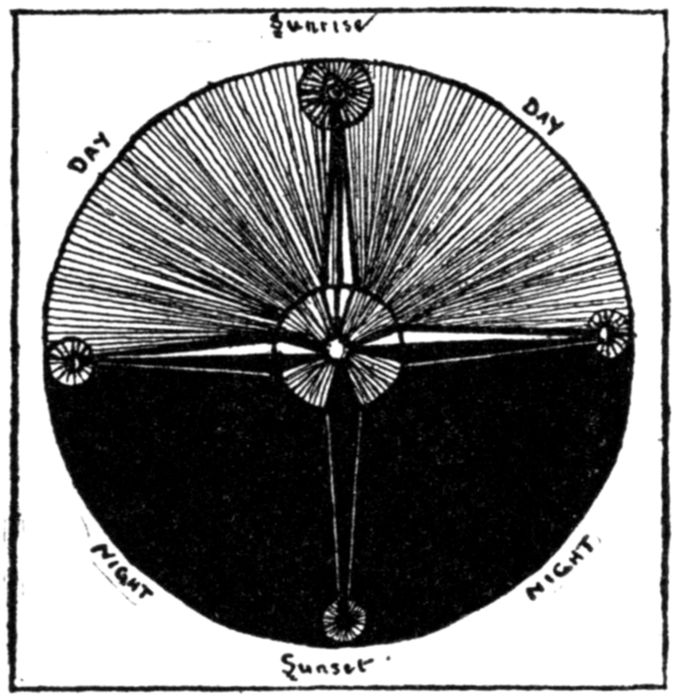
“I am aware that their seasons are opposed to ours,
and that the year at the poles is divided into a day
and a night of six months each.”
Gale, who had been regarding me anxiously, at
this point relieved himself in an undertone.
“Six months,” he murmured. “Think of going
out to make a night of it in a country like that! Oh,
Lord, what is life without a latch-key?”
“I have considered these facts,” I repeated,
“and while a period of several months of semi-darkness
and cold is not a cheering anticipation to
those accustomed to the more frequent recurrence
of sunlight, I am convinced that, under favorable
conditions, it is not altogether a hardship; also,
that in the pleasant climate which I believe exists
about the earth’s axis, the extended interval of
darkness and semi-twilight would be still less disturbing,
and may have been overcome in a measure,
or altogether, by the inhabitants there, through
artificial means.”
52I could see that Chauncey Gale was reviving
somewhat as I proceeded, and this gave me courage
to continue, in spite of the fact that the Captain’s
contempt was only too manifest. As for Mr. Sturritt,
he was non-committal, while Ferratoni appeared
to have drifted off into a dream of his own. But
Edith Gale sustained me with the unshaken confidence
in her eyes, and my strength became as the
strength of ten.
“As for the time of starting,” I continued——
“Wait,” interrupted Gale, “go over the whole
scheme again for the benefit of those who didn’t
hear it before. Then we can consider ways and
means afterwards.”
Accordingly, and for the third time that day,
I carefully reviewed my theories and plans for the
expedition. As I proceeded I observed that Captain
Biffer’s contempt softened into something akin to
pity, while, on the other hand, Chauncey Gale rapidly
regained his buoyant confidence.
“That’s where you come in, Bill,” he laughed,
as I spoke of the balloon car and its condensed
stores.
Mr. Sturritt nodded eagerly.
“And you, Johnnie,” as I referred again to the
possible inhabitants in the undiscovered world.
“And Mr. Ferratoni is not to be left out,” answered
Miss Gale. “Mr. Chase says that a wireless
53telephone is the one thing needed to make his
plan perfect.”
“To keep the balloon in communication with the
ship, in event of our making the voyage overland
would be of the greatest advantage,” I admitted,
“if it can be done.”
Ferratoni’s face flushed.
“Yes, oh, yes,” he said anxiously, “it can be
done. It is the chance.”
“And would you be willing to go on a voyage
like that, and leave behind your opportunities of
recognition and fortune?” I asked.
Ferratoni’s face grew even more beautiful.
“Fortune? Recognition?” He spoke musically,
and his English was almost perfect. “It is not
those that I would care for. It is the pursuing of
the truth, the great Truth! Electricity—it is but
one vibration. There are yet many others—thought,
life, soul! Wireless communication—the
answering of electric chords—it’s but a step toward
the fact, the proving of the Whole Fact. To-day
we speak without wires across the city. Later, we
shall speak across the world. Still later, between
the worlds—perhaps even—yes, yes, I will go! I
have but shown the little step. I would have the
time and place to continue. And then the new
world too—yes, oh, yes, I will go, of a certainty!”
A respectful silence had fallen upon the table.
54Chauncey Gale’s face showed thoughtful interest.
Mr. Biffer was evidently impressed. Me he had regarded
as a crazy land-lubber with fool notions of
navigation. In Ferratoni he acknowledged a man
of science—a science he did not understand and
therefore regarded with reverence and awe. Edith
Gale’s face wore the exalted expression which
always gave it its greatest beauty. For myself, I
had been far from unmoved by Ferratoni’s words.
I felt that it would be hard to feel jealousy for a
man like that, and still harder not to do so. Gale
recovered first, and turned to me.
“What about the superintending of the balloon?”
he asked. “Who have you got for
that?”
I knew as little of practical ballooning as of navigation,
but as a boy I had experimented in chemistry,
and the manufacture of gases. More lately
I had done some reading, and I had ideas on the
subject. I said therefore, with becoming modesty,
that I had made some study of aeronautics and that,
as the science had not yet progressed much beyond
the first principles of filling a bag with gas and waiting
until the wind was in the right quarter, I believed
I might safely undertake to oversee this feature
of the enterprise, including the construction of
the boat-sledge-car combination.
“And I can take a hand in that, too,” said Gale.
55“I’ve got a pretty good mechanical head myself;
I’ve planned and built about a million houses, first
and last. Commuters say I can get more closets and
cubbyholes into a six-room cottage than anybody
else could set on the bare lot. I’ll take care of that
boat. Now, how about the time, Chase? When do
we start?”
“I had thought,” I answered, “that it might require
a year for preparation. If we started a year
from now, or a little later, we would reach the Antarctics
easily by the beginning of the day or summer
season, and might, I believe, hope to reach a
desirable position at or near the ice-barrier by the
beginning of the winter night. During this we
would make every added preparation for the inland
excursion to be undertaken on the following summer——”
“Say, we’d be apt to get some frost on our pumpkins
laying up against an ice-wall through a six
months’ night, wouldn’t we?” interrupted Gale.
I called attention to the comfort with which Nansen
and his associates had passed through an Arctic
night with far fewer resources than we should have
on a vessel like the Billowcrest.
“Look here,” said Gale, “what’s the use of waiting
a year? Why not go this year?”
“Why,” I suggested, “we could hardly get
ready. There will be food supplies to get together,
56instruments, implements, the balloon, and then the
engaging of such scientists as you might wish to
take along——”
“Scientists,” interrupted Gale, “what kind?”
“Well, perhaps a meteorologist, a geologist, an
ornithologist——”
“See here, what are all those things? What are
they for?”
“To observe and record conditions,” I said.
“An ornithologist, for instance, would classify and
name any new birds that we might find in the
Southern Hemisphere, and an——”
“Hold on,” interrupted Gale, “we don’t want
any of that yet. We’ll discover the country first.
We’ve got science enough right here to do that, I
guess, if anybody has. Besides I’m a pretty good
hand at naming things myself, and if we find any
strange animals or birds wandering about down
there without titles, I’ll just give ’em some.”
“Oh, Papa,” laughed Miss Gale.
“Why, yes, of course; and now as to those other
things. Mr. Sturritt here can give an order in five
minutes for enough provision to last ten years, and
have it on board in twenty-four hours. Whatever
instruments and material you need for your balloon
and telephone machine can be had about as quick,
I’m thinking, and if we need any mechanics of any
kind I can put my finger on a hundred of them to-morrow.
57If we’ve got to lay up six months against
an ice-wall we’ll want something to do, and will
have time enough to build things to fit the case in
hand. What I want to know is, if we can be ready
to start from here in a week, so’s we’ll miss this
winter up here and get safe in the arms of that ice-wall
before winter sets in down there! I’m simply
pining to get up against that two thousand foot ice-bluff,
and I don’t want to wait a year to do it.
What do you say, Bill, can we be ready to start from
here in a week?”
My heart sank. It was but a huge joke then,
after all, and this was his way out of it. But Sturritt,
who knew him, was taking it seriously.
“Yes—that is—why certainly, in—er—three
days!” he said with nervous haste.
“I can be ready to-morrow,” said Ferratoni,
quietly.
“I am ready to start to-night,” said Edith Gale.
I hastened to add that the materials needed for
the balloon could doubtless be procured without
delay.
“And you, Biffer?” Gale turned to the Captain
who had been a silent unprotesting martyr during
this proceeding. “Are you ready to start in a week
for the South Pole?”
“Admiral,” said the Captain solemnly, and making
a sincere effort to fix him with both eyes at once,
58“you own this boat and I’m hired to sail it. I
don’t believe in no South Pole, but if there is one,
I don’t know of a better place for a crowd like this.
And if you give the order to go to the South Pole,
I’ll take you to the South Pole, and sail off into
space when we get there, if you say so!”
Mr. Biffer’s remarks were greeted with applause
and a round of merriment in which the Captain paid
himself the tribute of joining.
“We’ll have the balloon for navigating space,
Captain Biffer,” said Edith Gale.
“And my opinion is that we’ll need it, ma’am, if
we ever get back.”
But amid the now general enthusiasm Chauncey
Gale had sprung to his feet. There was a flush of
excitement on his full handsome face, and when he
spoke there was a ring of decision in his voice.
“Everybody in favor of starting a week from
to-day, for the South Pole, stand up!” he said.
There was a universal scramble. Captain Biffer
was first on his feet. Gale seized a glass of wine
and holding it high above his head, continued:
“To the Great Billowcrest Expedition! Missionary
work for Johnnie; electricity for Ferratoni;
balloons for Chase; tablets for Bill; the ship for the
Captain; homes and firesides for me, and the South
Pole for us all!”
VII. I LEARN THE WAY OF THE SEA, AND ENTER MORE FULLY INTO MY HERITAGE.
59
The sun lifting higher above Long Island
touched the spray under the bow and turned it into
a little rainbow that traveled on ahead. I leaned
far out to watch this pleasant omen of fortune, endeavoring
meanwhile to realize something of the
situation, now that we were finally under way and
the years of youth and waiting, of empty dreams
and disappointments, lay all behind.
It had been a week to be remembered. A whirl
of racing from ship to shop, and from shop to factory—of
urging and beseeching on my part, of excuses
and protestations on the part of tradesmen and
manufacturers. I had been almost despairing at
last in the matter of material for the balloon bag,
when one morning—it was the fourth day—I heard
of a very large completed balloon, made to order
for an aeronaut whose old one had missed connection
with it by one day. When they had come to deliver
60it, the undertaker was just driving off, and the
aeronaut had made his farewell ascension.
I found it to be of really enormous proportions—one
of the largest ever manufactured, I was told—so
large, in fact, that the maker was as glad to part
with it as I was to secure it.
My associates also had been somewhat occupied.
Mr. Sturritt’s delivery teams had been lined up on
the Billowcrest dock from morning till night, unloading
provisions in various forms, enough it
would seem for an army. Ferratoni had laid in his
cells, coils, transmitters, detectors and heaven only
knows what besides, while Miss Gale had undertaken
to supply, in addition to her own requirements,
the warm clothing and bedding likely to be
needed for an Antarctic winter.
As for Chauncey Gale, he had sat all day at a
little table on the afterdeck and signed checks;
checks, many of them, that would have wrecked
my former commercial venture at any time during
the ten years of its existence; and he whistled as he
did it, and called out words of comfort to Captain
Biffer, who, with a fierce eye on each end of the vessel,
strode up and down where boxes, barrels, rolls,
rope, chains, etc., were piled or still coming over
the side—rending the Second Commandment into
orders and admonitions that would have turned a
clergyman gray in a night.
61Now it was all over. The weird maelstrom of
whirling days and nights that had added unreality
to what was already dreamlike and impossible, had
subsided. We were going down the harbor under
full sail. Leaving the others still at breakfast, I
had come out here alone to find myself.
I could not grasp it at all. The little farm boy
who in the night had wakened and cried for the sea,
going back to it, at last. The youth who had carried
into manhood the fancy of a fair unknown
land, and of one day sailing away to the South to
find it, entering suddenly into an Aladdin-like realization
of his dreams. It seemed to me that every
vessel in the harbor ought to be decorated and firing
salutes—that every soul of the vast city ought to
be waving us adieu.
To be sure, we hadn’t told anybody. Gale was
rather down on the papers, and we had left so suddenly
that they had little chance to find out what
we were doing. One of them—that of the millionaire
editor—got an inkling of it in some way, and
in its Sunday Magazine of two days before had
filled a page with strange vagaries purporting to be
our plans, and disturbing pictures of the lands and
people we expected to discover. But as no one
ever believes anything printed in a Sunday newspaper,
even when backed up by sworn statements,
these things appeared to have passed unnoticed.
62There had been one exception, however; my scientist
of the snark and flipper, who had appeared on
Monday morning to enter his promised protest.
He came at a busy time. About a hundred
teams were backing into each other on the dock,
whence arose a medley of unjoyous execration, and
a line of men were waiting at Gale’s little table for
checks. It was this auspicious moment that my
scientist selected for his mission. Captain Biffer,
to whom he first appealed, acknowledged him with
an observation which no magazine would print, and
waved him toward Gale.
“There’s the man you want,” he snorted, “that
man over there giving his money away.”
Chauncey Gale was at that moment engaged in
constructing a check that ran well into four figures.
He paused, however, with his hand on the
way to the ink-bottle and listened for a moment
with proper respect. Then he said, quite serenely:
“I wonder if you couldn’t conveniently go to hell
for about three years. Perhaps by then I’ll have
time to listen to you. You notice we’re pretty busy,
this morning.”
I smiled now, recalling how the human seal had
flopped backwards over a box of cod-fish and narrowly
missed pitching overboard in his anxiety to
get ashore. There had been no further interference,
and no offered encouragement. We were
63leaving it all behind, now; the narrow, busy, indifferent
world. There were no salutes, and if there
were any flags, or waving, I did not see them. Nobody
had been down to see us off, and impudent
tugs steamed by and splashed water at us, just as if
we were going out for a day’s sail, and would be
back in time for the roof gardens.
Somewhat later I was joined by Edith Gale.
It is customary to say “as fresh as the morning,”
when referring to a fair woman at such a time, but,
rare as the morning was, I could not have paid it a
finer tribute than to have compared it to Edith Gale.
She came forward and leaned over at the other
side of the bow-sprit.
“How pretty the little rainbow is this morning,”
she said, looking down.
“Yes, I have been accepting it as an omen of
success.”
Edith Gale laughed.
“I hope it doesn’t mean that we are pursuing a
rainbow. We never quite capture it, you see.”
“I have been called a rainbow chaser all my
life,” I answered, a little sadly.
“I suppose there is always some rainbow just
ahead of us all,” she mused. “Even if we find the
South Pole, and all the things we expect there, then
something else will come to wish for and look forward
to.”
64“I am sure of it,” I answered fervently, “I——”
Her father’s warning recurred to me opportunely.
We were not yet out of the harbor, and I
did not wish to be set ashore at Sandy Hook.
“There is the ocean,” she said presently, “the
Atlantic Ocean. How I love it!”
We had already caught the slight swell from the
sea. The added exhilaration of it filled me with
exultant joy. I stood up and drew in a deep breath
of the salt ambrosia.
“Oh,” I said, “it is wine—nectar! It is my
birthright—I have always known that I should
come back to it, some day!”
Instinctively we turned for a last look at the harbor
we were leaving. Farther down the deck Ferratoni
was pointing out some landmark to Chauncey
Gale, while from the bridge Captain Biffer was taking
a silent and solemn farewell of the sky-scrapers
of Manhattan. Mr. Sturritt presently came out of
the cabin, beaming, and looked out to sea. The
land had no further attraction for him. Our provision
and the materials for his tablets were safely
on board.
We faced seaward again. We were through the
Narrows now, and the swell was much stronger,
a long steady swing. I heard the Captain give a
word of command to the helmsman and noticed that
we were turning to the southward. A shoreless
expanse of ocean lay ahead.
65“I should think all this would appear like a
dream to you,” said Edith Gale. “Aren’t you
afraid you’ll wake up?”
“I have been trying to find something to convince
me that I am awake,” I said.
“How splendid it was that Papa took up with
your plans. You know he has all sorts of things
brought to him. A man came to him not long ago
with some scheme for buying stocks that he said
would pay a hundred per cent. a week on the investment.
Papa gave him a dollar, and told him
that if his theory was correct he didn’t need any
partner, for the dollar would make him rich in six
months.”
The pitch of the vessel became stronger. Then,
too, it was not always regular. Sometimes it
swung off a bit to one side, and just when I felt
that it ought to lift us buoyantly and sustainingly
it would disappoint me by sinking away beneath us—falling
down-hill, as it were—or it would change
its mind at the last minute and conclude to fall
down some other hill, or perhaps give up the notion
altogether. I grew discontented and wished it
wouldn’t do these things. There was a bit of
tarred lashing on the bow-sprit near us. In the
harbor the smell of it had been fine and inspiring,
but it did not attract me any more. It had become
rather obnoxious, in fact, and I moved a little to
66one side to avoid it. Neither did I feel inclined to
laugh at Edith Gale’s story. Somehow it did not
seem altogether in good taste. Perhaps she was
disappointed, for she referred to my own plans.
“And to think that Papa should believe in you
from the start. He said he had never seen any one
so much in earnest about anything as you were in
your determination to find the South Pole.”
“Yes—oh, yes,” I admitted weakly, “I was in
earnest, of course—but——”
The ship gave a peculiar roll and the salt spray
came flying up from below. Some of it got into
my mouth. It took away any remaining interest
I may have had in Miss Gale’s conversation. I did
not care for the South Pole, either, and the rainbow
of promise had become a mockery. I remembered
a particularly steady bit of rock in one of my
father’s meadows. As a child this rock had been
the ship on which I had voyaged through billowing
seas of grass. I would have been willing now to
give all my interest in both poles, the ship, and
even in Miss Gale herself, to cruise once more for
five minutes on that rock.
Edith Gale wiped the water from her own face,
laughing merrily.
“I love the sea spray,” she said gaily, “can you
taste the gold in it?”
I shook my head miserably.
67“A man came to Papa, once, with a scheme to
extract the gold from it,” she ran on. “Papa told
him that there was so much water that he guessed
he’d wait till the patent on the process became public,
or ran out. Do you suppose there really is gold
in it?”
I could not answer immediately.
“Do you suppose there is?” she repeated, and I
thought there was a note of injury in her voice.
“Oh, I don’t know,” I groaned wretchedly, “but
I know what will be there, pretty soon, if this ship
doesn’t stand still!”
She turned a startled face toward me. She said
afterwards that all the colors of the ocean were reflected
in mine. She had been ready to laugh at
first, but her expression became one of compassion.
“Oh,” she said, “I never thought, I am such a
good sailor—and the bow is the very worst place
for that. You must go back amid-ships. You are
seasick—I am sure of it!”
“So am I,” I gasped, “and I am also sure, now,
that I am not dreaming!”
I stumbled feebly back to a steamer-chair and
looked out on the horizon that one instant sank far
below the rail, and the next, lifted as far above
it. Between lay the tossing sea—my heritage.
That which my ancestors had lived and died for.
I did not blame them for dying—I was willing to
68do that, myself. Chauncey Gale came along just
then.
“I’ve got a great scheme for the balloon boat,”
he began, “a combination wind and water propeller.
Ferratoni can supply the power, and——”
He caught my expression just then and the
words died in his throat.
“Hello,” he laughed, “you’ve got ’em, haven’t
you? Storm last week left it a little rough. Do
you always get sick this way at sea?”
“I—yes—I don’t know. It—it’s my first experience.”
Gale regarded me with an amazement that was
akin to respect.
“Oh, Lord!” he gasped. “Never been to sea before
and planned a trip to the South Pole! What’s
a bluff without a show-down!”
“Do you think I’ll be like this all the way?” I
asked.
“Oh, pshaw! No! I’ll have Bill give you some
of his tablets. You’ll be all right enough by lunch
time.”
The suggestion of a food tablet at this particular
time was the last thing needed. I went hastily below.
Gale’s prediction was not quite realized. I was
absent from luncheon, but before evening the spirit
of my ancestors rose within me—perhaps because
69there was nothing else left for that purpose—and
I ascended to the dinner table.
“Well, you’ve concluded that this voyage is no
dream, have you?” greeted Gale.
“A good many more will come to that conclusion
before it’s over,” growled Captain Biffer, who was
present.
Across the table, the place of Ferratoni was vacant.
Edith Gale, radiant, beamed upon me. I
could afford to laugh, now, and did so.
And thus it was I came fully into my heritage.
VIII. THE HALCYON WAY TO THE SOUTH.
70
A cold plunge next morning in water combed up
from the very bottom of the sea was my final baptismal
ceremony. Fully restored I hastened on
deck. Chauncey and Edith Gale were already
there, walking briskly up and down, and I joined
in the joyous march. A faint violet bank showed
on the western horizon. Looking through a glass
I could see that it was solid and unchanging in outline.
It was land, they explained; we were off
Cape Charles, and would pass Hatteras during the
afternoon. I remembered an account in my old
Fifth Reader of “The Last Cruise of the Monitor.”
It had been always my favorite selection in the
reading class. It gave me a curious feeling now
to know that we were soon to pass over the waters
where the sturdy little fighter had gone down.
However, I had no longer a sense of unreality in
my surroundings. I had been too thoroughly
waked up the day before.
We were presently joined by Ferratoni—spiritually
pale, but triumphant. I was not sorry, for I
71could not help caring for the man, and it seemed to
me that after all his devotion to Edith Gale might
be rather a tribute to an ideal than a genuine passion
of the heart. We ascended to the bridge
where we found the First Officer on watch. His
name was Larkins—Terence Larkins—a sturdy
Newfoundlander of forty, whose life ashore had
been limited to childhood only—a period now lost
in the cloudland of myth and fable. He had no
prejudices concerning our destination. He was
ready at any moment to go anywhere that the sea
touched, and to maintain a pleasant discourse at any
stage of the journey. He was big and blond, with
a touch of ancestry in his speech and a proper disregard
of facts—a merry Munchausen of the sea.
He saluted as we approached, and pointed shoreward.
“Farrmers’ day ashore,” he said, with a serious
air. “All the farrmers come to the beach to-day
for their annual shwim.”
“Is this the day?” I asked, looking where he
pointed. “I’ve heard of it, but I had forgotten the
date.”
“Sure it is, man; an’ can’t ye see thim over
there, dhriving down to the beach with their teams?
An’ thim fellies puttin’ up the limonade shtands, an’
merry-go-rounds fer the farrmer lads an’ their
shweetheartses?”
72I reached for the glass and took a long look.
The solid purple wall was as solid and purple as it
had been before.
“No, really, Mr. Larkins,” I admitted, “I do
not.”
“Let me look, Larkins,” said Gale.
He leveled the glass and began to testify.
“Why, of course! And there’s a new addition
laid out just below, and a little sign stuck up with—let
me see—M-A-R-S-H-S-I-D-E on it. Well,
that’s a funny name for an addition, ‘Marshside!’”
Edith Gale seized the glass. After a hasty
glance she declared:
“Of course Mr. Chase couldn’t see anything!
And you and Mr. Larkins didn’t, either.”
Ferratoni who had been gazing through another
glass also shook his head. Chauncey Gale and Mr.
Larkins joined in a hearty laugh at our expense.
“Oh, now,” consoled the latter, “it’s because
yer eyes are not thrained to lookin’ over the sea.
By the time ye get back from the South Pole they’ll
be opened to a great many things.”
There came the summons to breakfast and we
went below—certainly with no reluctance on my
part, this time.
And now passed beautiful days; glorious shipboard
days to which the slight uncertainty of a
rival’s relative position gave only added zest. Ferratoni,
73it is true, may have had somewhat different
views in this matter. He was obliged to spend the
greater part of his time with Gale in the modeling
of the new electrical propelling apparatus, which the
latter was perfecting for the balloon. In the matter
of constructive detail my assistance was not
highly regarded by Gale who had really a mechanical
turn of mind, as the Billowcrest itself proved;
for whatever may have been the vessel’s faults from
the seaman’s standpoint it was certainly all that a
landsman could desire. Below stairs there was a
splendidly appointed workshop, and the engineers
on the Billowcrest were also skilled workers in
wood and metals. The boat-car for the Cloudcrest,
as we had decided to name the balloon, was a matter
of daily discussion among us all, but at the point
of technical intricacy I was promptly relieved for
the good of all concerned.
It was but natural, therefore, that I should be a
good deal in Edith Gale’s company. Also that I
should feel a gentle solicitude for Ferratoni—a
sweet soul whom all presently grew to love; it
seemed too bad that he should not come in for his
full share of paradise. My own fancies had been
called poetic, but I realized daily that Ferratoni
lived in a world which to me could be never more
than borderland. And this I hoped consoled him
somewhat for what he was missing by tinkering
74away his days with Gale on a dynamo for my balloon
car, while I was revelling in the seventh delight
of the daughter’s company, above stairs.
We cared for pretty much the same things. We
liked to walk up and down the decks, discussing the
books we had read, the pictures we had seen, and
the purpose and possibilities of art.
“Beauty, the secret of the universe,
The thought that gives the soul eternal peace.”
was the quotation most frequently on her lips.
She had seen so much more of the world and its
glories than I, and her understanding of nature was
a marvel to me. She taught me to see colors that
I had been blind to before. Sometimes she brought
up her materials and sketched, while I looked on
and loved her. When she would let me I photographed
her. One day I ventured to show her
some verses that I had written, and the fact that
she really seemed to care for them gave me a higher
opinion of us both.
And the sea racing past made a fine accompaniment
to these pleasant things. She liked to watch
the surge along the side and listen to its music. So
did I, and often together we leaned over the rail to
watch and hear it rush by.
We discussed metaphysics, and talked of life, and
love, and death. Remembering Chauncey Gale’s
75advice, I was careful to avoid the personal note at
such times. Ferratoni had touched now and then
upon his theories in these matters, and these suggested
speculations of our own. I was not displeased
to find that Edith Gale did not quite accord
with, or perhaps altogether grasp, his filmy philosophies.
I preferred that she should be less ethereal—what
she was, in fact—a splendid reality of flesh
and blood and soul, with a love of all the joys of
earth and sky. The clouds scudding across the
blue, the white joy of the sunlit sails, the smash of
the spray over the bow, a merry game of shuffle-board,
and even hop-scotch—these things gave her
life and sustenance—and then, at the end of the day,
came the good dinner, and the untroubled sleep of
a healthy child.
IX. ADMONITION AND COUNSEL.
76
Our progress southward was hurried. We
had touched at Charleston for a full supply of coal,
but we were sailing under canvas only. It was
still bleak winter below Cape Horn, and we did not
wish to enter those somber seas before November,
the beginning of the Antarctic spring.
Sometimes Edith Gale and I drew steamer chairs
to the extreme bow of the boat, and looking away to
the horizon, imagined the land of our quest lying
just beyond. At night, from this point, we
watched the new constellations of the tropics rising
from the sea, and those of the North falling back,
behind us.
Chauncey Gale and Ferratoni frequently joined
us, and at times I was constrained through courtesy
to leave Ferratoni and Edith Gale together. Perhaps
it was not quite wise—the stars and sea form
a dangerous combination to a man like Ferratoni.
After one such evening I was taking a morning
constitutional on the deck forward when I saw a
77female figure emerge from the cabin. Edith Gale
had often joined me in these walks, but it was not
she. Neither was it our stewardess—a brawny,
non-committal Scotch woman, of whom Mr. Sturritt,
though her superior in rank, stood in wholesome
awe. It proved to be Miss Gale’s maid and
former nurse, the stout colored woman, Zarelda,
or Zar, as she was commonly called. Miss Gale
had long since told me of some of the peculiar sayings
and eccentricities of this privileged person, but
thus far my interest in her had been rather casual.
Now, however, she planted herself at one end of
my promenade and sternly faced my approach. I
bade her a respectful and even engaging “good
morning” as I came on, but the severity of her
features did not relax. She nodded ominously, and
proceeded to open fire.
“Look heah,” she demanded, “I wan’ know
wheah you gwine wid dis ship?”
“Why, down to the Antarctics,” I said winningly.
“I thought everybody knew that.”
I felt a sense of relief in being able to answer so
readily. It seemed I was not quite through, however.
“Yes, down to Aunt Ar’tics!” she snorted, “I
should say down to Aunt Ar’tics! I like to know
whose kinfolks dat Aunt Ar’tics is, anyway! I
ain’ nevah heard o’ none o’ Mistah Gale’s people
78by dat name, an’ if she some o’ yo’ po’ relation, I
don’ see what foh we-all mus’ go trailin’ off down
to de mos’ Godforlonesomest spot on dis earth, to
visit in de dead o’ wintah. An’ what my Miss
Edith goin’ foh, anyway? What my Miss Edith
got to do wid yo’ old Aunt Ar’tics, dat’s what I
wan’ to know? Humph! moah antics dan Ar’tics—dat’s
what I think!”
My emotions during this assault had been rather
conflicting, but I managed to maintain a proper degree
of calmness.
“Why,” I said gravely, “this ‘Antarctics’ bears
a relationship to us all—to the whole world, in
fact.”
I rather prided myself on the cleverness of this
rejoinder, but it appeared after all to have been
rather poorly thought out.
“Dat’s enough! Dat settles it,” she exploded.
“Now I know mighty well dey ain’ no sech pussun.
Kinfolks to de whole worl’. Look heah, me an’ my
Miss Edith has jes’ been deceptified long enough!
I know wheah you gwine wid dis boat! You gwine
to de Souf Pole—dat’s wheah you gwine! I done
heah de Cap’n say so las’ night, an’ dat when he
got dar he gwine to sail her off into space wid de
whole kit an’ possum of us! I know mighty well
somp’n gone wrong when I put Miss Edith to baid.
She ain’ said two words, an’ befoah dat she been
79mighty chipper de whole trip. I didn’t know what
it was, an’ I set an’ hol’ her han’ an’ sing to her, an’
it seem like she ain’ nevah goin’ to sleep. But
bimeby when I slip up on deck a li’l’, to look at de
sky, I heah de Cap’n an’ Mistah Lahkins argifyin’
up on de bridge, an’ I heah de Cap’n say dat we
goin’ to de Souf Pole an’, ’scusin’ de libe’ty, sah,
dat you gone plum crazy on de subjec’, and dat
you got de Admiral an’ Mistah Macarony an’
Mistah Sturritt all crazy, laikewise; an’ dat he
gwine to sail you-all to de Souf Pole, case dat
wheah you-all b’long, an’ dat you-all nevah get
home, case when he get dere he gwine straight off
into space wid de ship, an’ de whole caboodle in it.
An’ den right away, I knowed what’s de mattah
wid my Miss Edith. I knowed she been up dar
a-hearin’ somp’n, too. An’ I make up my min’,
right den an’ dar, dat me an’ my Miss Edith ain’
gwine. I like to see me an’ my Miss Edith flyin’ off
into space, an’ us wid no wings yit, an’ fallin’
down to de bottomless pit an’ lake o’ fiah!
Humph! We’s gwine de other way, we is!”
She hesitated a moment for breath, and I took
advantage of the recess.
“What did Mr. Larkins say about it?” I asked.
“Mistah Lahkins! Humph, Mistah Lahkins!
What he always say? He jes’ laugh an’ say dat de
Souf Pole ’bout de onliest stick o’ timbah he ain’
80tie up to yit, but he reckon dat it strong enough to
hol’ us f’m gwine off into space. Anyway, he
willin’ to take chances wid de res’. ‘An’ de Cap’n
say, ‘Dat’s all right, same here,’ but dat de bosen,
Frenchy, been talkin’ ’roun’ ’mong de sailors, an’
dat some get mighty oneasy an’ wan’ to be put
ashoah. An’ dat’s what I want. I wan’ me an’
my Miss Edith put ashoah. Den if you-all mus’
go on aftah de Souf Pole, why jes’ go, and leave
me an’ my Miss Edith to go back home; an’ nex’
time tell folks wheah you gwine, an’ not make out
like you takin’ all dis perwision down to some po’
kinfolks dat everybody related to, an’ nobody don’t
know about.”
There was another brief intermission. The incident
was entertaining enough, but there was a
grave note in it as well. In the bosen, Frenchy, I
recognized the sailor who on the first day had
barred my entrance to the Billowcrest. I recalled
my unfavorable impression of the man. He would
be altogether the one, I thought, to stir up discontent
among the sailors—an unpleasant prospect.
“Please, sah, won’t you put me an’ my Miss
Edith ashoah, sah?” In my more serious consideration
I had temporarily forgotten Zar’s presence.
She had believed me hesitating, perhaps, and had
adopted a persuasive tone in consequence. “Miss
81Edith mighty sad las’ night,” she added, “an’ I
know you don’ want dat po’ gal to go spillin’ off
into space like a lil’ robin when he nes’ break!”
“Not for the South Pole, Antarctics, and the
whole world, Zar!” I said with a fervency that
made the woman suddenly regard me with a new
interest. There was a rustle behind her, and Edith
Gale stepped out on deck. “Here is Miss Gale to
speak for herself,” I added, with some confusion.
“What’s the matter, Zar? What do you want
of Mr. Chase?”
“I want him to put we ’uns ashoah,” began the
old woman. “I tol’ him we done foun’ out about
gwine to de Souf Pole, an’ dat you an’ me wan’ to
get off right heah, an’ go ashoah.”
“But I don’t want to get off, Zar. I’ve known
all along where we are going. I want to go to the
South Pole with—with Papa, and we’re going to
bring it back with us.”
Zar regarded her mistress a moment in silence.
Then she said in a voice of grave wonderment:
“I wish you tell me what dat Paw of yours
gwine to do wid dat Souf Pole when he gits it?
Ain’ he got money ’nuff already? Anyhow, who
gwine to buy dat pole? An’ how dey gwine know
hit’s de sho nuff Souf Pole when dey sees hit?
What’s to hender us gwine ’shoah right heah, an’
hackin’ down any ole pole, an’ gwine home again
82widout any moah foolishness? Ain’ none dem
folks up in New York gwine know de diff’ence!”
“Why, Zar,” laughed Miss Gale, “and you such
a good church member!”
“Well, den, if yo’ Paw boun’ to go aftah de sho’
nuff pole, let him go, but don’ you go. You cain’t
he’p him any!”
“But, Zar, you know I wouldn’t leave Papa. I
never could.”
The old woman tossed her head.
“Humph! Bettah not be too suah!” She regarded
me with a fierceness that somehow warmed
me to the soul. “Dey ain’ no man livin’ I’d go to
de Souf Pole foh,” she concluded, and with this
final shot she disappeared, and went rumbling down
the companion-way, “no, sah, not even if I could
be wid him all de way an’ back again.”
“See, there’s a vessel,” said Edith Gale. “Bring
the glass, please, and let’s try to make her out.”
I hastened to obey, though with no great interest
in the result. The tropics and distant vessels had
been wonderfully fascinating to me, but just at this
moment I was dwelling fondly on Zar’s parting
salute.
A little later she sought me again.
“Look heah,” she counselled solemnly, “you
turn dis ship right ’round, now, an’ go back home.
You go off down dar wid my Miss Edith, an’ bofe
83die an’ get all froze stiff, an’ den what good is you
to each other, I like to know? What good is you?”
Zar had meant this for remonstrance and admonition,
but I was her sworn friend and champion
from that moment.
Chauncey Gale found me staring off at the horizon
and building a fair castle in which the South
Pole had no part.
“Chase,” he said, “don’t you make a mistake,
too, and forget what I told you about Johnnie.”
The abruptness of it startled me a bit, but there
was a quality in his voice that called for confidence
and sincerity.
“Thank you, Mr. Gale, and—and I believe you
spoke just in time.”
“I had my suspicions of it,” he admitted.
“Tony got his medicine last night, I guess.”
“Oh!” I had started a bit, and Zar’s report of
Miss Gale’s depression took on a new meaning.
“Yes, he’s no good this morning. He got all
tangled up on his dynamo and we had an explosion
that nearly set the ship afire. Then he went off
half crying and I haven’t seen him since. I guess
he wishes himself ashore, now, but wishin’ won’t
do any good. He might get a message there all
right, but he’s got to have something more than
vibrations to get himself there. You see this ain’t
any matrimonial excursion. We ain’t got any
84preacher along, and Biff’s license don’t cover that
sort of a splice. Emory’s got a doctor’s diploma,
but that wouldn’t fit the case, either.”
Mr. Emory was the Second Officer of the Billowcrest—a
quiet, unobtrusive man whose love for the
sea had led him back to it through devious ways.
A runaway cabin boy, he had returned home in
early manhood to become a country doctor, a naval
hospital surgeon, a ship’s doctor and officer by turns,
and was now serving us in the double capacity of
the last two.
“Anyway,” concluded Gale, “we’ve got the
South Pole on hand, and I’m in favor of taking
things in their turn. You can’t afford to get in
Macarony’s fix just now. We’ll need you when
we get down there below the Horn. Besides we’re
a long ways from shore, and the water here’s full
of sharks.”
The last was certainly true. A black knife-like
fin at that instant cut the water below us, and the
swish of a steel-like tail as it disappeared made me
shudder.
“That chap seems to be following us,” commented
Gale, “they say it means a death aboard,
but I think it’s more likely he’s after the garbage.
’Twouldn’t be a good time to swim, would it?”
He walked away and left me leaning over the
rail. I thought his advice kindly, on the whole encouraging,
85and made up my mind to remember it.
I wondered if Ferratoni had really spoken to Edith
Gale. “Poor fellow,” I thought, “it must have
been the glamour of the tropic night that made his
ideal seem real to him for the moment.” And this
I still believe to have been the case; but what it was
he said that night to Edith Gale, or just what she
replied, I shall never know.
X. CAPTAIN BIFFER IS ASSISTED BY THE PAMPEIRO.
86
Southward, and still southward.
We crossed the equator under light steam, for
there was no wind and it was too warm to lie becalmed,
even in that mystical, lotus-breathing sea.
Our world was turned around, now. We were
going back to the year’s beginning, and springtime
lay at the end of our bow-sprit. The Big Dipper
and the North Star were ours no longer; the Southern
Cross had become our beacon and our hope.
The sun and moon were still with us, but even these
had fallen behind and it was to the northward now
that we turned for noonday.
Gradually the glorious sunsets of the lower
tropics faded into a semblance of those we had
known in our own land. It was no longer quite
comfortable on deck without wraps. An April
quality had come into the air, and we grew
presently to realize that we were entering rapidly
into what was, to us, the curious anomaly of an
October spring.
87To me it was all pure enjoyment. It seemed
that I could never look at the sea enough, and often
I got Edith Gale to help me. And Ferratoni too,
sometimes, for with the cooler weather and more
temperate skies he had become quite himself again.
The first frost in the air seemed a glacial feeling
to us, and set us to talking with renewed interest of
the Far South and the lands and peoples we had
undertaken to discover. I felt sure we were extravagant
in some of our expectations. The tales
we had read led us to hope for marvels in the way
of mechanical progress, and we treated ourselves
to flying machines and heaven only knows what
other luxuries. In the end, I discouraged flying
machines. I said that if these were a fact with the
Antarcticans, they would have come to us long
since. I said also that we must not build our anticipations
too big, but base everything on calm reason
and sound logic. It was more than possible, I
admitted, that the Antarcticans had made some advancements
in mechanism that were unknown to
us, but on the whole I thought we would hold our
own at the next world’s exhibition.
It had been Chauncey Gale’s intention to touch at
one of the large South American ports for a little
holiday, and to procure a few articles needed in the
construction department below stairs. This idea,
however, was now discouraged by the officers, who
88believed that a number if not all of the crew would
desert the ship at the first opportunity.
“Why not let them go?” I had asked, when we
were talking the matter over, “and ship a new
crew?”
Into the Captain’s off eye there came the twist of
indifferent scorn usually accorded to my suggestions.
“Yes,” he growled, “and get a gang from some
crimp who would load ’em onto us dead drunk, to
cut our throats as soon as they got sober. I know
South American crews—I’ve helped kill some of
’em—I don’t want any more.”
I was silent. I didn’t know what a crimp was,
and I wouldn’t have asked for considerable. I have
since learned that he is an unreliable person; a bad
man, who sells worse whisky over a disreputable
bar, from which he unloads on sea-captains anything
human, and drunk enough to stand the operation.
His place is a sort of clearing house, and the
crimp has a syndicate or trust, as it were, with the
captain at his mercy.
We altered our plans, therefore, and turned our
course more directly southward, toward the Falkland
Islands. We were off the River de la Plata at
the time, sailing leisurely along under a blue sky,
with the fair weather that had followed us most
of the way from New York. The sailors had expected
89we would put into Rio Janeiro or one of the
ports farther down, but now that we had passed
below Montevideo and were standing out to sea,
they knew we were not to touch land again.
I was leaning over the rail after the interview in
the cabin, puzzling about crimps, and looking at the
shark—or one just like him—who still followed us,
when I heard Mr. Emory, who was on watch, order
the men up into the shrouds to shorten sail. I did
not see why this should be done, for the sky was
blue, dotted here and there with small woolly
clouds that showed only a tendency to skurry about
a little, like frisking lambs. Perhaps the men didn’t
understand, either, for the bosen, Frenchy, blew his
whistle presently and they left their work about
half finished, and came down. Then they gathered
in a group at the bow and I saw Mr. Emory go
forward and talk earnestly to Frenchy, who seemed
excited and gesticulated at the men, the cabin, himself
and the world in general. Mr. Emory left him
after a few moments and disappeared into the cabin,
where I knew the Captain and Edith Gale were
matched in a rubber of whist against the Admiral
and Ferratoni, who had been coerced into learning
the game.
I left my place at the ship’s side. I did not believe
in the old shark superstition, and I had little
respect for a creature that would follow a ship
90thirty-five hundred miles for table-scraps when he
could get a fish dinner any time for the trouble of
catching it. I did want to know about the men,
though—why they had been taking in sail, and why
they had quit and gathered in a group over the
forecastle. Mr. Emory was talking to Captain
Biffer when I came in.
“They refuse to obey orders,” he was saying,
“unless we turn around and put into Montevideo.
They claim they need more clothing for the cold
weather south. The sky looks rather queer, and I
set them to reefing down so’s to be ready for one
of those Pampeiros that Mr. Larkins says come up
in a minute down here. When they got about half
through, Frenchy stopped them. They’re out forward,
now.”
“Did you tell them we had plenty of warm
clothing aboard?” asked Gale.
“I told them. It isn’t the clothing. They
simply want to desert the ship.”
“Is Mr. Larkins on the bridge?” asked Captain
Biffer.
“He comes on at eight bells—in about five minutes,
now.”
“Very well; go back to the bridge, Mr. Emory,
I’ll deal with this situation.” Then to Edith Gale
“Don’t be alarmed, ma’am.”
I risked a remark.
91“Is this your first strike, Captain?” I ventured.
His eye fixed me grimly.
“We don’t call it that at sea,” he said, “we call
it mutiny!”
The word rather startled me, but I followed him
out on deck, as did the others. No one could
remain in the cabin with a thing like that going on
outside. The men were about as we had left them—the
bosen, Frenchy, somewhat in front of the
others. He was a villain and a traitor, but he was
not without bravado.
“We haf not been well treat!” he began, “we
haf been deceive. We——”
He paused. The Captain had drawn a bead on
him with the eye he most frequently used on me.
With the other he took aim at the group behind,
and every man of them felt himself singled out, and
quailed. I could see them beginning to shrink and
wither even before he said a word. He began by
gently reminding them of the usual lightness of
their employment and the continued excellence of
their bill-of-fare; then in good sooth he opened up.
It was like the breaking loose at Manila. I had
known that Biffer had a way with his English, but
I never realized until that moment what he could
do when he tried. They didn’t need any warm
clothes, now. Everything he called them was red-hot
and fitted as if they had grown to it. Why,
92they fairly shrivelled, and whenever anything he
said hit the deck it smoked.
A cloud of what appeared to be genuine smoke
came drifting across our bows just then, and the air
had grown strangely hot, but nobody seemed to
notice it. I think we unconsciously attributed
these things to the Captain’s artillery. The men
were huddled and Frenchy alone was still defiant.
His case was desperate and he was a desperate man.
He made a step forward—perhaps he thought the
men would follow him—a movement that a second
later would have been a spring at the Captain’s
throat. One hand he held close to his side and in it
something gleamed.
There was an instant of dead silence, then—just
above our heads—
“All hands aloft to shorten sail! The Pampeiro!”
Everybody looked up. Officer Larkins had come
on the bridge and his rich voice rang out like a
clarion peal. Frenchy stopped. The men sprang
into life. They were ready enough to obey, now,
but it was too late!
I had seen cyclones in the West, but the Pampeiro
is different. From the smoke across our bow there
came a lurid flash, and thunder that seemed to hit
every part of the vessel at once. I heard the smashing
of wood and ripping of canvas overhead, and
93just in front of me I saw a great wave come pouring
over the ship’s side. Somebody seized my
hand and there was a startled cry of my name.
Then somebody was clinging to me—somebody
that I was holding close and helping into the cabin.
In the half blackness I saw that Chauncey Gale and
Ferratoni were just behind. The cabin was dark
and the ship pitching violently.
It was all over in ten minutes. The vessel still
rolled, but the storm had passed. Zar, who had
been napping when the Pampeiro struck, came running
in to her mistress.
“You po’ li’l’ lam’, how wet you is!” she said,
“an’ how yo’ heart beat—so frightened!”
She bore off her charge, and the rest of us took
account of stock.
We found we had lost some sail—a top-mast—several
steamer chairs, and one man—Frenchy—who
had been directly in the path of the wave.
“That’s what that shark meant,” said Chauncey
Gale solemnly, “he won’t follow us any more.
And say, Biff, it was worth the price of admission
to hear you comb those fellows down. By the
great corner-stone, but you did it beautiful!”
On the whole there were compensations. We
had seen a Pampeiro, for one thing, and we had
got rid of a mutiny; a disturbing element had been
removed and an old superstition had been confirmed.
94Altogether, everybody was satisfied, including
the shark.
But to me had come an added joy. In the moment
of danger it was to me that Edith Gale had
turned.
That night we walked the deck together. The
sky was clear and black again, though the sea was
still billowy, and there was a chill head-wind which,
with our damaged rigging, necessitated the use of
steam.
We walked back to the stern, and leaning over
looked down at the surge boiling up from the screw
beneath. Like a huge serpent it twisted away into
the night, showing a white coil here and there
as it vanished in the shoreless dark behind. A
mighty awe came upon us. Face to face with the
vastness of the universe, we were overpowered by
that dread loneliness which lies between the stars.
By and by I told her of the man sailing around
the world in a little boat, alone. She would not let
me dwell upon it. Then I said I had thought of
doing it myself.
“You must never do it,” she shuddered, “promise
me that you never will.”
There had never been the slightest danger of my
doing it, and never would be, but it did not seem
strange that I should promise.
XI. IN GLOOMY SEAS.
95
In entering the waters below Cape Horn it had
been my plan to continue southward not farther
than the northern extremity of the South Shetland
Islands, thence to bear off in a southwesterly course
until the outer edge of the field—or pack-ice—had
been reached. This ice fringe would, I believed,
begin somewhat north of the Antarctic Circle, not
lower than the sixty-fifth parallel—possibly much
higher. It would recede before the warm sun of
December—the month answering to our northern
June. My continued purpose was to creep westward
along the edge of the ice-pack, examining every
foot of the way, in the hope of finding a warm
northerly flowing current, of the sort that Borchgrevink
had reported. Such a current would afford a
possible entrance to the frozen expanses surrounding
the Antarctic Continent—perhaps guide us to the
very gateway of the continent itself. Failing to
find a passage sooner, we would continue westward
96to the coast of Victoria Land, and endeavor to
reach our destination by following the warm current
already reported by Borchgrevink.
I was rather surprised at Captain Biffer’s hearty
approval of this outline. I believe now he was of
the opinion that a few weeks along the edge of the
pack, with perhaps a little squeeze here and there,
would satisfy Chauncey Gale’s ambition for Antarctic
conquest, and that the Billowcrest would be
ordered north for a cruise in the Pacific, in the direction
of more friendly latitudes.
For the present, therefore, we continued directly
southward—very slowly, for we were still full early—keeping
well off the stormy coast of Patagonia,
and to the eastward of the Falkland Islands.
These we sighted one morning, and ran close in to
get a glimpse of inhabited land once more before
plunging into the vastness of unknown and unpeopled
seas. It was a bleak shore, and perhaps reminded
Mr. Larkins of his native Newfoundland,
where the conditions were somewhat similar. He
gazed solemnly at the forbidding coast along
which there showed but meager signs of foliage.
“Thim’s nootmig threes,” he said, at last, waving
at the stunted vegetation which we were inspecting
through the glasses, and upon which we
had been commenting.
Edith Gale protested.
97“Oh, Mr. Larkins! Nutmeg trees don’t grow in
this cold latitude!”
“Yis, ma’am,—wooden nootmigs. The people
ship ’em to the shtates.”
“And that long, smooth rock running down;
what’s that, Mr. Larkins?”
“That’s a seals’ shlidy-down. The seals,
ma’am, get out there and shoot the shoots. Many’s
the time I’ve watched them in Newfoundland. I
shouldn’t wonder if the bake-apple grows over
there, too,” he added, reflectively.
“Baked apple! Do apples grow already baked
in Newfoundland, Mr. Larkins?”
“Not baked apple, but bake-apple, ma’am. A
bit of a foine yellow berry that grows on the top
of a shlip of a shtalk, so high”—(holding his hand
down to within a foot of the deck)—“one berry to
the shtalk, ma’am, and delishuous, my worrd!
And the bake-apple jam!” Mr. Larkins closed his
eyes and wagged his head in a manner to indicate
that life without bake-apple jam was but a poor
shift, at best. “The bake-apple, is it!” he continued.
“Oh, but, Miss, you must never die without
tasting the bake-apple!”
There was something about Mr. Larkins’s manner
that compelled faith in this unknown fruit,
which ordinarily we would have regarded as a
pleasant myth of his own. We caught a measure
98of his enthusiasm. We wanted to see the mysterious
golden berry that grew one on a stalk, and had
we not been on our way to find the South Pole, I
believe we might have gone in pursuit of the bake-apple.
And now we were indeed getting well to the
southward. The sun though on its upward incline
had fallen far behind. Our days became long spectral
cycles broken only by brief periods of luminous
twilight, and the glacial feeling in the air was no
longer a quality of our imagination. Against the
chill wind that came over our bow we tacked but
leisurely. Gradually, as we should, we were acquiring
the taste for Antarctic cold, and daily the
fascination of it, and of the lonely seas around and
about, grew upon us.
XII. WHERE CAPTAIN BIFFER REVISES SOME OPINIONS.
99
I went up on the bridge one morning to find
Captain Biffer gazing intently through the glass at
some distant object.
“There’s your South Shetlands,” he announced,
as I approached, “Elephant Island, I should say.
Looks pretty cold to me.”
I did not reply for a moment, but stood looking
out over the black tossing waters that lie below
Cape Horn. Somewhere it was, in this cold
expanse, that my uncle’s vessel was believed to have
gone down. Here, amid the crash of storm and
surge, she had been last seen, more than twenty
years before, and here must have perished: I swept
the sea in every direction, as if seeking to locate the
very spot.
“They used to come to the Shetlands after
seal,” continued the Captain, “and they say there’s
gold and precious stones on some of ’em. I never
saw anybody that got any, though. Too cold, I
guess, to look and dig for ’em.”
100“Colder than the Klondike?”
“Klondike! Well, I should say so. There’s a
warm current runs up that way. I never heard of
any warm currents down here except the one you’re
going to find. Just take a glance at that for a cold-looking
country.”
I leveled the glass and scrutinized the blue outline
ahead. It was a flat-topped, square formation,
and there was a peculiar prismatic glow about it
that suggested ice. I hesitated for some moments,
however, before risking a reply. At last I was
convinced.
“Yes, Captain Biffer,” I said, lowering the glass,
“it is pretty cold—it’s an iceberg!”
Edith and Chauncey Gale, followed by Ferratoni,
came up the stairs just in time to hear the Captain’s
reply.
“An iceberg!” he jeered. “Well, I’ve seen a
good many icebergs up north, but I never saw one
like that. You mean an ice-box.”
I was quite calm. I could afford to be, for I felt
that a moment of triumph was at hand.
“Yes, Captain,” I admitted, “you might liken
it to that, I suppose, but it is an iceberg, nevertheless.
The Arctic bergs which you have seen were
split from glaciers and topped by tall pinnacles and
turrets. They were more like castles or cathedrals.
The Antarctic berg is usually a section of that great
101ice wall or barrier which we hope some day to
reach. It is nearly always of this general character,
and is frequently crossed by blue horizontal
lines, showing its stratified formation from year to
year.”
Before I had finished speaking the Captain was
again studying the object ahead. A light mist had
drifted across our bows, but it lifted now, and the
square fortress-like walls in the distance shone
clearly in the morning sun. Captain Biffer waited
a moment longer. Then he came down handsomely.
“You’re right!” he said heartily, “I can see
those lines from here. I know the Arctics,” he
added, “but I guess I’m all at sea in these God-forsaken
waters!”
It was a slight incident—an opportune display of
a bit of knowledge which any boy familiar with
Antarctic literature might have possessed—but my
command of the expedition may be said to have
dated from that moment. The next day fairly
completed my triumph. Some large fragments of
surface ice had come drifting to the ship and we
were looking at them, over the side.
“Pancake ice,” commented the Captain.
“We’ll get all we want of that, pretty soon.”
“Not exactly pancake ice, Captain,” I observed
respectfully. “A combination of salt-water pancake
102with splinters of fresh-water, barrier ice. Those
clear spots are the fresh-water formation.”
Captain Biffer regarded me a moment doubtfully.
Then he gave an order to some sailors.
“Get up a piece of that ice!” he growled, “I
want to look at it.”
A man was lowered over the side, and hacked
off a fragment which was hauled on board. The
Captain chipped out pieces of the white and the
clear ice and tasted of them. Then he flung them
overboard.
“You win!” he laughed, “I’m out of it, down
here.”
“What’s that brown color on it?” asked Edith
Gale.
“Dirt,” said the Captain. “Comes from the
shore.”
“Captain,” I objected, “I’m sorry, but I’ve got
to differ with you again.”
“What is it, then, if it ain’t dirt?” he grumbled.
“A growth,” I replied, “a plant—at least, I
think it is. I can’t be sure, for I have never seen
it before, but former explorers have reported an
algæ as giving such an appearance to old ice, and
I think I can show that this is what they found.”
I ran down to my stateroom, and presently returned
with a powerful microscope—a treasure
from boyhood. I placed it upon a small table and
103putting a bit of the brown color on a slide adjusted
the lenses. Then I beckoned to the Captain. He
came and squinted into the glass steadily for a moment.
“Humph! seaweed!” he commented. “Well,
I’ll be —— Say, look here, this is your ocean, and
your expedition—you can have ’em!”
You see, it was my innings. Theoretically I
knew more of this part of the world than any one
on board, and theory was about all we had now to
go on. I could see that Chauncey Gale was
pleased. I suppose it had not always been easy to
stand for me against the Captain’s poor opinion,
and he felt that in some measure now he had been
justified. Edith Gale, too, was not made less
happy by these incidents, and the sailors, taking
their cue from their chief officer, paid me an added
and daily increasing respect. True, the Captain
continued to navigate the ship, but in a general
way I directed our course and experiments, and was
regarded more and more as authority in matters of
discussion and dispute.
High up on the mainmast I had constructed for
me a crow’s nest, or lookout, from which to make
observations. Chauncey Gale attended to this, and
did it well, as he did everything he undertook.
It was a stout, comfortable barrel arrangement,
capable of holding three persons if necessary.
104When it was done I viewed it from below with interest
and misgivings. I had never been aloft, and
I felt that an error in reaching my perch might
conclude the expedition. The eyes of the ship were
upon me, however, and it would not do to hesitate.
With a faint but resolute heart, I began the ascent.
I did not dare to look back, and when at last
I found myself safely inside the snug box, I was a
bit weak and trembly, but swelling with triumph.
“Let me in, too, please!”
I looked down at my feet. It was Edith Gale,
who had run lightly up behind me. I concealed
any pride I may have had in my own accomplishment
and drew her up.
“How pale you are,” she said, “are you ill?”
“No, oh no, it’s the—the excitement, I think.”
We leaned over and waved to those below.
They waved back at us and cheered.
“How’s the weather up there?” called Gale.
“Cold,” I said. “Feels like the North Pole!”
(It was, in fact, about zero at the time, but we did
not mind it in the least.)
“What’s the matter with the South Pole?”
This from Captain Biffer.
“Hot, there!” I yelled.
The Captain laughed.
“Well,” he shouted, “you’re right about some
105things, but you’ll find that barrel a parlor stove
compared with the South Pole.”
Edith Gale leveled a glass toward the southern
horizon. We were well down in the sixties, now.
Icebergs and floating pack-ice had become common.
To the southward lay mystery that in some weird
form might at any moment rise above the somber
waters. Presently she handed me the glass.
“See if you make out anything,” she said.
I looked steadily, and at first saw nothing.
Then, low down, and stretching from rim to rim
across our watery world, far-off and faint, rising,
falling, lifting and disappearing. I saw a thin, uncertain,
glittering edge—the ice-pack!
It was our turn, now, to cheer. Captain Biffer
ran up to see and verify. By nightfall (the radiant
dusk fell late now, for it was November, and
the sun shone till ten o’clock) we were in the
midst of loose, grinding ice—the edge of the pack.
The second stage of the Great Billowcrest Expedition
had begun.
XIII. IN THE “FIGHTING-TOP.”
106
Our crow’s nest became at once the nucleus of
the expedition. Edith Gale named it our “fighting-top”
because of the fierce discussions that took
place there.
This warfare concerning the new objects that appeared
daily on our horizon was almost continual,
and when not actively engaged in the combats, I
was supposed to adjust them. They occurred most
frequently between Edith Gale and her father, both
of whom delighted in our lookout, and remained
with me there a greater part of the time, in spite of
bitter cold, and even the wet freezing discomfort
that often swept in about us.
A paragraph of Borchgrevink’s came back to me
now—the fulness of which I had not before realized.
“Only from the crow’s nest,” he says, “can
one fully appreciate the supernatural charm of Antarctic
scenery. Up there you seem lifted above the
pettiness and troubles of everyday life. Your horizon
is wide, and from your high position you rule
the little world below you. Onward, onward
stretch the ice-fields, the narrow channels about the
107ship are opened and closed again by the current and
wind, and as you strain your sight to the utmost to
find the best places for the vessel to penetrate, your
eyes wander from the ship’s bow out toward the horizon,
where floes and channels seem to form one
dense vast ice-field. Ice and snow cover spars and
ropes, and everywhere are perfect peace and silence.”
I have quoted this because we felt it all, and he
has given it to us so much better than I could say it.
No ordinary attempt of the elements could dismay
us, or chill the exalted joy of our high, swinging
perch. From our fighting-top we looked away to
the south, across leagues of lifting, shifting, grinding
ice—split here and there by long, black waterways—studded
by iridescent island bergs—garish
with every splendor of the spectrum, and blending
at last into that overwhelming fathomless hue of
the South, Antarctic Violet.
New wonders were constantly appearing before
and below us. From our lofty vantage we discussed
them fully, and photographed them when
they came within range. With the luminous icy
mist about us, there was still a gratification and a
rapture, and when it passed and the sun returned, a
new blazing enchantment lay all below us, even to
the northward, where, beyond the dazzle of drifting
ice-pans, rolled the black, uplifting sea.
108We observed and studied the haze or “blink” in
the sky that always indicates the presence of ice,
and the black, or “water” sky that tells of an open
way—keeping well in among the floes, that we
might not miss any lead or northward drift that
would reveal our current from the South.
I did not expect it for a long distance yet, but
it was our plan to leave no step of the way unexamined,
and certainly there was plenty beside to repay
us. Edith Gale seemed fairly lost in the color glories
of this supernatural, elemental world. Chauncey
Gale declared it was like the Chicago Fair,
where one could have spent a lifetime and still not
have seen it all. He made his initial attempt at
naming birds one morning when a penguin, the
first we had seen, came by on a small pan of ice.
The bird regarded us solemnly, and in return we
laughed at him. Edith Gale was overjoyed at his
arrival.
“Now, Daddy, what’s that? You were going
to name things, you know.”
“That,” replied Gale gravely, “is a ‘Billy
Watson.’ He looks exactly like a fellow I used
to know by that name, when he had his dress suit
on.”
We didn’t consider it much of a name, but it had
a sticking quality, and all penguins became “Billy
Watsons” to us thereafter. There were “Big Billy
109Watsons” and “Little Billy Watsons.” Also,
some that had feathers in their hats, and these we
called “Dandy Billy Watsons.” When we came to
some sea-leopards and crab-eating seals he tried his
hand again as a naturalist.
Two Impressions of Billy Watson. First, by Chauncey Gale. Second, by Nicholas Chase.
“Those,” he said, “are ‘Moon-faced Mollies.’”
But this was regarded as a failure. Anyhow, it
was my turn. The Captain had referred to them
indiscriminately as seals, whereupon I produced
their true names and my authority for conferring
them, thus adding another instalment to Mr. Biffer’s
respect for my scientific attainments, which,
though slight enough, were sufficient to impress
him considerably.
During these days Ferratoni had almost nothing
to say. He walked the deck for hours as we pushed
through the drifting ice, listening to its crushing
110under the iron sheathing below and looking always
to the south, as if something lay there from which,
across that wireless, frozen waste, to him alone
came tidings. Now and then he ascended to our
fighting-top to peer still farther into those polar
depths. We all felt very close to creation’s secrets
here in this primeval world, but we realized that
Ferratoni was nearer to the invisible than the
others.
“I feel sometimes that he can read our very souls
and all the mystery of the air,” Edith Gale said to
me, after one of these visits. “When he looks at
me I know that I may as well have put my thoughts
into words. He believes, too, you know, that we
shall be able to converse mentally, by and by, and at
any distance. It would be simply the chording of
the thought vibration, he says, and that there is
really no need of words—that they are but a poor
medium at best, and, as somebody has said, invented
more to conceal thought than to convey it.”
“We shall have wordless telepathy, then, instead
of wireless telegraphy,” I assented, “and I believe
Ferratoni is nearer right than most people would
admit. Why, when we are up here alone together,
sometimes, it seems to me that we——” I hesitated,
and she interrupted me rather hastily.
“Yes, when we are looking out at all this, we are
so often silent because there are no words to convey
111it; but I know what you are thinking better than if
you tried to tell it.”
I do not think this was quite what I had started
to say, but I was grateful for the interruption. I
should doubtless have got into deep water and difficulties.
Each day the sun rose earlier, shone warmer, and
set later. What we referred to as night no longer
bore even the semblance of a night, and its darkest
hour was but a brief period of lambent twilight.
The weather continued unusually good for the latitude,
and Thanksgiving Day, on the edge of the
Antarctic Zone, was a complete golden cycle. After
a bounteous dinner planned by Mr. Sturritt, and
joined in by all the officers of the Billowcrest, we
ascended by turns to the fighting-top to look for the
first time on the midnight sun. Captain Biffer
came back to the deck rather solemnly.
“It’s more than likely we won’t see it again,
right away,” he announced. “If I’m not mistaken,
there’s a blow coming off there to the northeast.”
The Captain was not mistaken, this time. Within
an hour after midnight we were pitching in the
midst of real darkness, fearsome and impenetrable.
Icy waves were breaking over the decks of the Billowcrest,
and the crash of ice under her hull was
terrifying in its deafening fury.
112There was no sail to take in, for we were running
under steam only, now, but the sailors had enough
to do at first to keep everything movable from
washing overboard, and then, a little later, themselves.
At each end of the vessel the officers were
roaring out commands, and the men striving to
obey.
There was no thought of sleep, of course, and
everybody was on deck or in the cabins. Zar was
praying swiftly and inclusively so as to have everybody
in readiness at a moment’s notice, and nobody
discouraged this undertaking. From stray bits
that came to me now and then above the uproar
I gathered that she believed our Thanksgiving services,
as well as the expedition generally, had been of
a character to provoke Divine wrath.
“Oh, Lawd,” she howled, “what can dese po’
sinful people expect, a-goin’ a hop-scotchin’ aroun’
on Thanksgivin’ Day, an’ a-huntin’ foh a fool pole
in a lan’ wheah dey ain’ nuffin but ice, an’ wheah de
sun shine at midnight? What can dey spect,
Lawd? What can dey spect?”
As a matter of fact we were expecting almost
anything at that moment, and we were not surprised,
or more frightened than we had been, when
Captain Biffer came in and roared at us that we
were being driven into the pack!
“Let her go in!” yelled Gale.
113“Be smashed, if we do. Go to hell in five minutes!”
“Don’t care! hell can’t be worse than this!”
In the electric blaze of the cabin I looked more
closely at Gale. There was a green pallor over his
features that was not due to fright. Even in that
awful hour there came upon me a proper and malicious
joy. He was seasick! I did not blame him.
We were rolling fearfully and I felt some discomfort,
myself. But the spirit of my ancestors had
waxed strong now, and prevailed. The others,
too, were getting pale, all except Zar, who turned a
peculiar blue, and discontinued her prayer service.
The brawny stewardess and myself assisted both
her and her mistress to their staterooms, where I
spoke a reassuring word to Edith Gale, and hastened
back to the others. But Gale and Ferratoni
had both disappeared, and I saw them no more during
that fearful night.
Plunging and battering we jammed our way into
that mass of thundering ice. Our search-lights, of
which we had two, were kept going constantly, but
even so, we were likely at any moment to collide
with a berg in that surging blackness. The sight
from the deck—the shouting sea, with the ice tossing
and flashing as it was borne into the angle of
our electric rays—was as the view of a riotous inferno
114that was making ready to crush us into its
sombre depths.
But by morning we had penetrated the pack to a
point where the violence beneath produced on the
surface only a heaving, groaning protest at our
presence. With the return of light, I went out to
view our condition, and when I realized that our invincible
Billowcrest had battled unhurt through it
all, that noble vessel—whatever may have been her
faults, and in spite of all disparagement—took a
place in my affections that was only outranked by
those of her builder and her mistress. The wind
slackened in the afternoon, and with the calm there
came clear, intense cold. By morning the great
ice-floes about us were cemented together. We
were frozen solidly in the pack.
XIV. AN EXCURSION AND AN EXPERIMENT.
115
“Well, here we are,” announced Captain Biffer,
as we grouped together on the deck to survey the
scene. “And here we’re likely to stay for one
while, I’m thinking. This is your warm world—how
do you like it?”
“Better than a cold sea,” I said, “when there’s
a northeast gale blowing.”
“How long do we lay up here, Chase?” asked
Chauncey Gale. “You’re running this excursion.”
I was secretly uneasy, but I made light of the
situation.
“Oh, this is the usual thing. We’ll be here a
day or two, perhaps, then the ice will separate
again, or a lead form that will let us back to open
water. We could hardly be shut in long at this
season.”
“I’d invent something to beat this game if I was
going to play it regular,” said Gale, then added,
“Great place this to lay out an addition. ‘Frozenhurst,’
how’s that for a name?”
116“Can we go out on the ice?” asked Edith Gale.
“Of course, if we are careful, and do not go far
from the ship,” I said. “We can try our new snow-shoes.”
“I shall make the first Antarctic experiment in
wireless communication,” observed Ferratoni.
“Good time to look for the bake-apple,” suggested
Mr. Larkins.
But just here came a sharp protest from Zar.
“Yas, I sh’d say baked apples! Well, I reckon
we jes’ ’bout as apt to fin’ baked apples as anything
else in dis refrigidous country! Not much, my Miss
Edith ain’ gwine out on dat ol’ humpety, bow-back
ice-pon’! No, sah!”
Zar’s characterization of the sea’s aspect referred
to the huge hummocks and heaved appearance of
the ice in places. There were also many bergs, apparently
at no great distance, and in spite of the old
woman’s strenuous objections, Edith Gale and I
planned to visit the nearest of these.
We did so in the afternoon. Numberless penguins,
sea-leopards and other species of Antarctic life
had gathered curiously about the Billowcrest during
the day, and some of these waddled and floundered
after us when we set out. We could not make very
rapid progress with our new foot-gear, and for a
little distance made an interesting spectacle, with
our procession of followers trailing out behind.
“All hands and the cook” gathered on the deck to
enjoy it.
“From our high vantage we could command a vast circle of sunless, melancholy cold.”—Page 117.
117We carried one of Ferratoni’s telephones—a neat,
compact little affair, with handles for convenience,
and from nearly a mile distant communicated with
the inventor, who had ascended to the crow’s-nest
for the experiment. It was a successful trial, and
we believed it would have been equally so had the
distance been much greater.
Then we pushed in among the silent bergs, and
ascending by a circuitous path to the battlements of
a great ice fortress, tried it again.
“Hello,” I called, “can you hear a message from
the South Pole?”
The answer that came back was as prompt as it
was unexpected.
“There is a message in the air,” said the voice
of Ferratoni. “It is very close—around and about
us. Some day—perhaps soon—I shall hear it.”
I repeated this to Edith Gale, wonderingly.
“What do you suppose he means?” I whispered.
“You remember what I told you in the fighting-top,”
she said. “I am sure of it now.”
I did not answer, but together our eyes followed
the white way to the south.
A light snow had fallen during the forenoon,
and dull clouds were banked heavily against the
sky. From our high vantage we could command
118a vast circle of sunless, melancholy cold. Beyond
this there lay another horizon, and beyond that still
another, and yet another. In this deep solitude the
distant black outline of the Billowcrest marked our
only human tie.
A silence and an awe fell upon us—a mysterious
fear of this pale land that was not a land, but a chill
spectral semblance, with amazing forces and surprising
shapes. We descended hastily and set out
for the ship without speaking. From among the
bergs the creeping gloom gathered and shut us in.
Uncanny sea-leopards and mournful penguins regarded
us as we hurried past.
We were clumsy on our snow-shoes, but we consumed
no unnecessary time in reaching the vessel,
and not until we were warmed and cheered by a
good dinner were we altogether restored. But then
came weariness, and with the Billowcrest now
moveless and silent, we realized that night more
fully than ever before the perfect blessing of dreamless,
Antarctic sleep.
And now passed some days in which I grew ever
more uneasy, but maintained as far as possible a
cheerful outward calm. The cold lingered, and the
way seaward did not open. Huge cracks split the
pack here and there, but they did not reach the Billowcrest.
Then came that terror of all polar expeditions—the
ice pressure—the meeting and closing in
119of enormous ice-fields moving irresistibly in opposite
directions.
We were awakened rather rudely by a sudden
harsh grinding below, and felt the vessel heave,
first to one side, then to the other. Then there was
an ominous rumble, which became a deafening roar.
I hurried on deck, to find that a strong pressure was
taking place, and that we were directly in its midst.
Our peril was great and imminent. I was turning
hastily toward the cabin, when Captain Biffer ran
down the deck yelling:
“Take to the ice! Take to the ice! She’s going
down!”
At the same instant Chauncey Gale hurried out
of the cabin, followed by Edith Gale and the others.
The sailors were skurrying about helplessly.
“To the ice!” roared the Captain. “To the
ice! She’s going down!”
Most of us scrambled for the rail. If I did not
do so it was perhaps because there were others in
my way. But Chauncey Gale, his hand on his
daughter’s arm, stood firm.
“Stop!” he shouted. “Going down, nothing!
She’s going up!”
And this was true. Everybody saw it, now it
was pointed out to them. Thanks to the shape and
strength of her hull, the sturdy Billowcrest was
being squeezed and lifted bodily into the air, instead
120of being crushed like a peanut, as would have
been the case with an ordinary vessel.
For ten minutes or more the heaving and grinding
continued. Huge pressure ridges formed on
every side, and the ice world about us was a living,
groaning agony. Then it seemed that there came
relief. The pack split and thundered apart in every
direction. The Billowcrest settled back into place,
and before us lay a long way of open water, stretching
northward as far as the eye could reach. Our
steam was ready, and in a very brief time we were
on our way back to the sea.
“That was about the tightest squeeze I ever got
caught in,” observed Gale, “and, say, I didn’t build
her for a nip like that, but didn’t the old Billowcrest
do noble?”
“Chauncey Gale,” I said, “you’re the best ship
builder, and the bravest man God ever made!”
“How much do you want to borrow?” asked
Gale, but he said it without bitterness.
XV. AS REPORTED BY MY NOTE-BOOK.
121
If we were more fearless now, we
were also more careful. Our
faith in the Billowcrest was complete,
but we profited by experience.
At the next indication of
bad weather, we headed northward
in time, and rode out the
storm at sea.
I think Captain Biffer had hoped that we would
abandon our project after the ice squeeze, but
Christmas Day found us far to the westward, and
still creeping slowly along the edge of the ice-fields.
Our days were a never-ending glory now, for it
was midsummer, and of good weather we were having
far more than we had been led to expect. We
did not need to go to the crow’s-nest to see the midnight
sun on Christmas Eve, and Christmas Day
we celebrated by crossing the one hundred and fortieth
meridian, and by telling, after dinner, where
we had been and what had happened to us the year
before.
122The Gales, with the yacht and its present officers,
had been in Naples, where they had met Ferratoni,
who was then perfecting his experiments. I
had been in the interior of the “States,” making
ready to drift, I knew not where. Now all were
here together, in the luminous, and fantastic midsummer
of the farther South, seeking at my direction
a half mythical highway to what might be a
wholly mythical destination. Edith Gale had referred
to me once, in jest, as a new Lochinvar. I said
that I would strive to be that, but there were nights
when I woke and remembered what all those men
of science had said, and just how they had said it;
and on those nights I trembled and weakened a
little at the thought of the responsibility of life and
expenditure I had assumed, and might have faltered
still more, perhaps, had I not been strong in my
determination to prove those sages of the test-tube
and microscope at fault.
Thus far we had found no indication of a warm
current, nor, in fact, anything else suggestive of
warmth in the latitudes below the Antarctic Circle,
but, as the books say, there had been plenty to amuse
and instruct. Our days were a good deal alike, but
they were never monotonous. As we approached
the point where Borchgrevink had penetrated the
ice-pack, our expectations increased and our painstaking
scrutiny of each step of the way was redoubled.
123Perhaps the brief daily record of my notebook
will best continue the narrative at this point.
Jan. 1. Still pushing westward, slightly south.
The New Year finds us at latitude 68° 12´, longitude
163° 44´. We are going very slowly now,
barely thirty miles a day. The weather is excellent,
and seems very warm. I spend fifteen hours out of
the twenty-four in the fighting-top. When I am
not there we lie to, or drift. There appears to be a
slight westward movement in the ice, and we go
with it during the night, or rather while I am asleep,
for, of course, there is no night yet. Plenty of life
here. Several sorts of whales appear in the open
water, and penguins visit the ship daily. Edith
Gale declares that some of them are the same ones
that we first saw, and that they have taken a fancy
to us.
From Mr. Chase’s Note-book.
124Jan. 2. We cannot be far now from Victoria
Land, but still no sign of the warm current.
True, Borchgrevink pushed thirty-eight days
through the pack-ice before he came to this current,
but these things vary in different years, and it is
more than likely that we are already nearing the
point where he emerged from the pack. The slight
drift we have noticed continues and appears to bend
to the south as we approach the coast.
Jan. 3. Edith and Chauncey Gale were with me
almost constantly to-day in the crow’s-nest. The
sailors to-night claim they can “smell” land. As
we approach it, life becomes much more frequent,
though not more cheerful. It is either white or
black, and unmusical. The chant of the seals is
depressing, and the chorus of the penguins a thing
to be avoided. However, they always amuse us,
and we appear to furnish entertainment for them.
Also, they are fond of good music, perhaps because
they cannot make it themselves. Edith Gale played
the piano last night, and a whole flock of “Billy
Watsons” in dress suits crowded on deck to listen
to it. Probably they thought it a musicale given
for their benefit. The sea-leopards and crab-eaters
gathered about the ship, too, and would have come
on board if they had been able. Mr. Sturritt is
experimenting with all of these from a food standpoint,
125and the sailors are collecting many skins and
feathers.
An Impression by Chauncey Gale.
Jan. 5. Borchgrevink must have found very different
conditions, indeed, from the westward, for
we are at latitude 70°, or very near it, and we have
not yet found it necessary to penetrate the ice. This
current that now appears to drift us to the southwest
may have something to do with it, or it may be
126that this is a warmer summer, hence the different
conditions.
Jan. 6. This current, if it is a current, puzzles us
all. It is not noticeable on the surface, where the
ice moves with the wind (I have even fancied to-day
when there was no wind that the floes drifted
northward), but seems to grip us from beneath and
push us slowly, very slowly, but surely, to the southwest.
Gale said to-day it was like the illness,
“grip.” We were sure we had it, but we didn’t
know just where.
Jan. 8. Whatever this current is, it is carrying
us in the right direction. It has brought us safely
through the waters explored by Sir James Ross
fifty years ago, and where pack-ice delayed Borchgrevink
thirty-eight days. The Captain thinks
it a slight undercurrent that curves in around Possession
Island, which we shall see to-morrow, if all
goes well. We are all eager for the first sight of
Antarctic land. Again to-day there was no wind,
and both Edith Gale and I held that the surface
ice was drifting to the north, but the others thought
it only seemed so because of our movement to the
southward. We did not change our opinion, however.
It is curious, but we almost invariably agree.
It is as if we were two parts of one mind. How
beautiful she was to-day in her new seal hood, with
the funny little point at the top. I....
127
“Procession Island” by Chauncey Gale.
Jan. 9. We have seen the coast to-day, but did
not think it wise to attempt a landing. From the
deck we could view with our glasses Possession
Island, with its millions of penguin inhabitants.
Their lookouts screamed and yelled at us to keep
off, and their bleak shore is well defended by jagged
rocks and long glacier points that push out into the
water. We observed the perfect system of order
and highways maintained by these solemn creatures
as they moved procession-like to and from the shore—the
fat ones on one side all proceeding to their
128nests in the cliffs, and the thin ones coming to the
sea for food. They did not quarrel, or get in
each other’s way. It seemed that we could never
get through laughing at them. Gale says the
place should be named Procession Island, and
that the first addition he lays out down here he’s
going to get “Billy Watsons” to build the streets
for him. There are many icebergs about, nearly
all with the blue lines and the tabular top. They
are from the great barrier to the south, whence
they have doubtless been blown by the gales of last
winter, and now seem to be drifting homeward
to be there in time for next.
Jan. 12. Our current has not deserted us, but
we are more mystified with it than ever. The surface
ice is certainly drifting slowly northward, for
we can now gauge its movement by the shore, while
we and the bergs are drifting to the south. The
Captain says that it is not uncommon for currents
to flow in opposite directions, one above the other,
for a short distance, and that they are called “witch
tides,” for the reason that ships are sometimes unable
to move in them, even with a fair wind, but
that he has never seen anything just like this. Can
it be that this upper drift from the south is our
warm current, and that we have been in it for days
without knowing it? Certainly it is but a feeble
current as yet, and there is no warmth in it that we
129can discover. There is no pack here, and we shall
keep on going. Borchgrevink found open water
as low as 74°.
Jan. 13. It is our warm current from the south!
There is no doubt of this to-day, and there is more
to be told! When I went on deck this morning,
Officer Larkins, who was on watch, reported that
the ice seemed to run north a bit stronger, and that
our drift southward was proportionately less rapid.
I immediately had a pail of water drawn up, and
tested it. It was 32°. Yesterday it had tested
30°! There was something about the look of the
water that made me taste it. Larkins said he
thought it had thrown me into a fit, and I suppose
I did make some sort of a demonstration, for it
was fresh! At least it was only brackish, from the
melting in it of the salt-water ice. I don’t remember
just what I did at first, but I know that when
I turned around and saw Edith Gale coming out of
the cabin, I found it not easy to keep from behaving
in a manner which I feel quite certain she would
have disapproved. As it was, I rushed up to her
with the glass. “Taste it!” I urged. “Taste it!
It’s fresh water from a warm river flowing straight
from the South Pole!” She tasted and rejoiced
with me. That it came from inland warmth we
could not doubt. And now the mystery of these
currents becomes clearer. Above the heavily-moving
130ocean current below us there is the lighter, shallower
current of fresh warm water, carried by its
force in the opposite direction, and finally spreading
and losing itself in the sea. It was doubtless this
strange combination that helped to open our way
through the pack, and that we believe now will show
us the way to our destination. In celebration of the
event we have just had a great feasting, at which I
was the guest of honor. I cannot sleep, so I must
go back to the deck to watch and rejoice.
Later—Edith Gale was there, and we walked up
and down for an hour, constructing wild theories.
We still drift southward against our new warm
river. The drift of the great salt current a few feet
below the surface is strong, and we let it carry us—whither?
Jan. 15. We are in the midst of a fierce, northeasterly
storm that has brought a world of grinding
pack-ice about us. All trace of our warm current
is lost, of course, and we are fighting now with
steam and sail to keep from being driven upon the
ragged shores of Victoria Land. We cannot see the
coast, for a thick mist has shut us in, but we know
by the screaming flocks of birds whirling about
us that it is not far distant. At any moment we
may strike a hidden reef or rock, or be crushed by
a toppling berg. No one slept last night, and one
of the officers has been in the crow’s-nest constantly.
131Two days ago all seemed joy. To-night I am heartsick,
and only for the abiding courage and faith of
Chauncey and Edith Gale would be despairing.
Gale is a king among men, and Edith——
Jan. 20. Five days in the clutch of this fearful
storm. I seem to have lived as many years since
we found the warm current. If I have slept I do
not know it. I am thin and haggard with watching
and anxiety. But now the wind has gone down,
and there is hope, though we are still beset with this
pounding, maddening ice, and the Captain has taken
no observation since the 14th. I shall try to sleep.
Jan. 21. The sun came out this morning, and
Biffer got our position. There has been little
change in the past week. We have just about held
our own in keeping off shore. Now we are hemmed
in by ice and our currents are lost beneath it. We
shall try to push southward, however, in the hope
of reaching clear water. The wind is behind us,
but the drift ice ahead packs fearfully, perhaps because
of the opposite flowing current.
Jan. 26. This morning I was called before I was
awake, and hurried on deck to find Captain Biffer
looking through a glass at a grim outline ahead.
“There’s your ice-wall,” he said, as I approached.
“What’s our latitude?” I asked.
“72° 33´.”
132“Then it can’t be the wall,” I said. “It lies
somewhere below 74°.”
The Captain looked again through his glass.
Then we ascended to the crow’s-nest for a better
view.
“Well,” he declared, at last, “if that ain’t the
ice-wall, it’s the father of all the icebergs we’ve seen
yet.”
And an iceberg it proved to be. We pushed and
worked our way toward it all the forenoon, and
about two o’clock came near enough to make out
an area of open water adjacent to it, by which we
knew it was being carried southward against the
surface current thus leaving a clear space behind.
Into this we pushed a little later, and steaming in
close, found that in the back of our ice giant there
was a hollow of considerable size. It was, in fact,
a sort of harbor for us, though not without its drawbacks.
For to the right and left and behind lay
pack-ice, so solid that escape in any direction seemed
impossible, and ready to close in upon us should the
great berg halt or hesitate in its progress poleward.
“We are going now, whether we want to or
not,” said Chauncey Gale.
“Yes,” laughed Captain Biffer, “we’ve got a
pacemaker.”
And this is so. Borne on by the vast salt current
far beneath, our giant berg, regardless of drift ice
133and feeble fresh-water resistance, is pushing slowly
steadily to the southward, whence it came. I believe
now that this salt undercurrent describes a
huge circle in the Antarctic Ocean; that it bends
to the eastward when it reaches the great southern
barrier, thence northward, detaching and carrying
with it into the upper seas these giant sections of
the wall, drifting them across westward and bringing
them back southward, at last, as this one is
being brought, to the point of its titanic birth. The
bergs we met over by the Shetlands were drifting
northward. Those along the way came as we came.
Some of them looked worn and travel-stained, as if
they had been swinging around the circle for a long
time; bruised and battered for perhaps centuries.
The one we are following must be on its first trip,
for it is a giant of giants, going home mighty and
magnificent after its first trip abroad.
And we are going with it. We shall not attempt
to force our way out, and why should we? We
set out for the South. We believe now—all of us, I
think—that there is a land there from whence can
flow a warm river. We are going to find it!
XVI. FOLLOWING THE PACEMAKER.
134
For a full month we drifted slowly with our monster
berg. So slowly that at times, when the wind
shifted, we were almost at a standstill, and the drift-ice
was ready to shut us in. But within our big
giant’s lap we were well protected, and lying idly
were borne steadily to the south. We grew presently
to love our big protector, and had the Captain’s
name of Pacemaker not clung to him we
should have christened him something very grand,
indeed. For as a pacemaker he was not a success.
An average of twenty miles a day was about
the best we could do, and at times we did even
worse. Still, we gave him great credit, for without
him we might, as Gale said, “have gone to the
wall” before we were ready to.
As the days passed I found that I must change
my calculations somewhat concerning the position
of the barrier. I had located it not lower than 75°,
135but by the 25th we were below 76°, and no barrier
as yet. Could it be that this undercurrent flowed
through the Antarctic Continent? But this, I decided,
would be impossible.
We were not idle during this period of drifting,
and the month as a whole was one of enjoyment.
When we no longer had the sun at midnight, we
began preparing for winter. From the skins obtained
by the sailors we rigged ourselves out in
new suits, according to the best polar authorities.
It was not seriously cold as yet, but with the advent
of the Antarctic night who could say what cold
might come? Gale was fondly referred to as
Jumbo when he got properly put together. One
day, however, he got down on his back and could
not get up again. Then he was christened the
“Turtle.”
“I’ve heard of people being as big as a barrel,”
he said, “but in this outfit I’m as big as a whole
cooper-shop.”
We were frequently tempted to try scaling our
big Pacemaker to make observations ahead. Edith
Gale would have gone promptly had her father
consented. Ferratoni, too, was eager to make some
further experiments, testing his apparatus with the
berg as an elevation. With our little steam launch
we believed we might be able to find a place where
the ascent would not be difficult, and as days passed
136and brought still deeper latitudes, the temptation
grew even stronger.
We yielded to it, at last, on the second of March,
a momentous day in our calendar. Immediately
after breakfast that morning we discovered that our
pacemaker was moving considerably faster than at
any previous time, and that its great right wing
was swinging ahead of the left. I argued at once
that we had reached a bend in the current, where
the outer edge would have the greater speed.
It seemed to me that we must be near the
barrier by these indications, and that it was
now more important than ever that we should know
how the land, or rather the water, lay ahead,
that we might decide whether to continue with the
berg, or to strike out now on our own account and
endeavor to find a way around to the south. Gale
was for sending up the balloon, but this would have
required two days’ preparation, and seemed unnecessary.
I was greatly in favor of trying to scale
the berg ahead, which plan was finally adopted.
I had thought of going with two sailors only, one
to remain with the launch, and one to assist me in
the ascent, but when the launch was ready Edith
Gale suddenly appeared, panoplied for the undertaking,
and finally coaxed and intimidated her
father into yielding. It was against his judgment
and mine, but she had been confined to the ship so
137long, and our old friend ahead had been so steady
and faithful, that it seemed there could be no more
danger than in scaling a mountain, provided we
found an accessible and easy path. This we did
without much difficulty, and just outside of the
little hollow where the Billowcrest lay. Here the
berg appeared to have been washed or gullied out
by snow melting from above, which had formed
a sort of natural snow-carpeted stairway, similar to
that made by a mountain brook in winter. There
was also a good landing below, and here we left
the sailors with the launch, which we thought was
more likely to need them than we. Then we ran
and stumbled up the snowy stair like two children.
It was not quite so easy and safe as it looked. At
one place I slipped into a narrow crevice and came
near breaking my ankle, as well as Ferratoni’s telephone
apparatus, which I carried. After this we
went more carefully. The berg was even higher
than it appeared, but we soon reached the top, which
we were glad to find comparatively level and firmly
crusted over. Here we tried the telephone with
great success. Chauncey Gale asked if we could see
the South Pole from where we were, and cautioned
“Johnnie” to be careful. By going near the brink
we could have looked down on the vessel, but this
we would not risk.
We now hastened across to the opposite side of
138the berg, not more than a third of a mile distant,
for the Pacemaker was a long, narrow section of
the barrier, and the hollow in which the Billowcrest
was lying made it still narrower at this point.
There was a light mist rising from the ice that obstructed
our vision somewhat, and there was a dazzle,
too, that we thought must be the sun shining
on the ice-pack ahead. It was not until we were
quite near the edge that we realized our mistake.
Then, suddenly we stopped dead still. Out of
the mist, the dazzle had crystallized into definite
form. It was ice, truly, but not the far-lying level
of the pack. Steadily, surely, inevitably, we were
being borne forward to a towering, gleaming wall!
It loomed far above us, and extended to the east and
west as far as our eyes could follow. No need to
guess what it was—we knew! We were face to
face with the great barrier—the huge, impregnable
fortress of the Antarctic world.
For a moment we stood stupefied, spellbound.
Then came a realization of doom. The Pacemaker
would strike presently, with its irresistible, crushing
momentum. The right wing seemed to us even
now touching. Rending destruction, perhaps annihilation,
must follow.
There was no necessity of discussion. As usual
we were of one mind, and were on our way back to
the ship quicker than anything Ferratoni could produce.
139We even forgot we had the telephone and
could warn the others. What we desired most was
to get off from that berg before the earthquake.
“This is the way,” panted Edith Gale, presently.
“No, this!” I panted back, bending a little to the
east.
In our haste and excitement we had grown a bit
confused.
“Try both,” I breathed.
But at that instant there came a vast trembling
under our feet, and the next I was lying upon the
snow, while the air about me was being rent by a
sound so awful as to batter into my brain the
thought that we had struck the Antarctic Continent
and split it in two! I was nearly right, only that,
when a second later I opened my eyes, I saw that
the split was the Pacemaker’s, and that I was lying
within six inches of its edge. Just across, perhaps
ten yards away, lay Edith Gale. More than two
hundred feet below was the sea, and at that instant
I saw the Billowcrest being lifted up and up
by the mightiest, slowest wave that ever sea was
heir to. It seemed to me that she would never
stop, and I remember thinking dimly that if she
kept on coming I could get aboard. Then at last
she fell back and the sea swallowed her. Again I
could count time, and I was sure she was on her
140way to the bottom when she reappeared, swinging
and rolling, but apparently undamaged. I saw
black figures on her begin to move; then I looked
across once more to Edith Gale, who was slowly
drifting farther from me. She was sitting upright,
half dazed as it seemed. I called across to her.
She assured me that she was not in the least injured—only
a bit shaken up and confused. Then I saw
she had been correct in the position of the launch.
Sketch from Mr. Chase’s Note-book.
“Go to the boat,” I said. “If they are not lost,
they can take you to the ship, and then try to get
me. I can see the ship from here. It seems safe.”
“Keep away from that edge!” she called back.
“And why don’t you use the telephone?”
141I had forgotten it entirely. Even as she spoke
it began ringing, and holding it to my ear I distinguished
the eager “hello” of Chauncey Gale.
“Hello!” I called, “all right up here! How’s
the ship?”
“Wet, but safe. How’s Johnnie?”
“Safe. We were separated when the shake-up
came and the berg broke between us. She’s on the
side where the launch is.”
Gale would always be Gale.
“No danger of your fighting then about whose
fault it was.”
I heard him now give an order to put off two
boats for us, at once, in case the launch had been
destroyed. I called this across to Edith Gale, who
immediately set out for the landing place, after bidding
me not to be uneasy, and to be careful about
taking cold. She added that I was sure to be
taken off, soon, though by what special means she
had acquired this information I have yet to learn.
She disappeared down the snow stairway, and I was
alone.
I could still talk to Gale, however, and I told him
just what we had seen before we struck. I said I
would go back over there now and take another
look. But this he counselled against, as we were
still grinding away at the wall, and there would
be great danger from crumbling fragments. I realized,
142now, why the older bergs were battered and
so much smaller. Pounding along that wall for a
thousand miles or so is not calculated to encourage
the growth or improve the appearance of even the
best constructed iceberg.
Then Gale told me what had happened on the
ship. Officer Larkins and one sailor had been on
deck when the upheaval came. They had seized
ropes on the upward lift, and though very wet and
breathless after the plunge, had come up safely.
The water had not been fierce, but very deep.
Larkins had interviewed, and named, a few fish
while he was down. The Billowcrest had fully
earned her title.
“But where were you?” I called.
“Playing euchre with Biffer, in the cabin. It
was my deal. I shuffled as we went up and dealt
as we came down. I had plenty of time to get
through and turn trump while we were under.
Then Biff said, ‘I order you up!’ and up we come.
‘Guess our Pacemaker’s hit the South Pole,’ says
Biff, ‘an’ knocked it over!’ Then I remembered
right away about you an’ Johnnie.”
A little later he called to me that “Johnnie” had
got back safely. When the upheaval came, the
launch had been swamped but did not sink because
of her air-tight compartments. The men had
scrambled to the berg and had the water about
143pumped out by the time Miss Gale reached them. I
might expect rescue any time, and I’d better walk
about to keep warm.
I could do this and talk, too. Edith Gale took
the telephone then, and told me in detail all that had
happened, and encouraged me in my long waiting.
Incidentally I looked about for a way down, but
without success. By and by I heard her speaking
to some one, but so low that I could not distinguish
the words. Then to me, and it seemed that there
was a note of anxiety in her voice:
“How wide is the chasm, now?”
I walked over nearer and answered.
“About as it was—perhaps narrower. It seems
to be drawing together again.”
“Oh, I’m so glad!”
“Why, has anything——?”
“Oh, no, don’t be frightened! But the men have
returned and can’t find any place to scale the berg
on that side. They are going now with ropes and
ladders to get you across the chasm.”
I tried to reply, but the first effort was unsuccessful.
I could never, even as a boy, walk a beam
that was more than ten feet from the ground. The
thought of crossing that chasm on anything to
which I was not securely tied made me colder than
any Antarctic climate.
“Oh,” I managed to say at last, “tell them to
144bring ropes, plenty of them, and a—a derrick, if
they happen to have such a thing.”
Through another cold, wretched hour—warmed
and encouraged only by messages from the ship.
At last I heard voices, and then there were men
with ropes and ladders on the other side of the
chasm, which by this time was no more than fifteen
feet across. Their ladders they had expected to
splice end to end, but as each was long enough to
reach, I insisted that they be spliced side by side.
They threw me a rope, and one end of this bridge
I dragged over and jammed securely into the snow.
Then, untying the rope, I fastened it under my
arms and threw them the other end; after which I
lay down, for I could never have walked, and was
hauled ignominiously across.
“Got a pretty cold shake, didn’t you?” said Gale
as he welcomed me back to the ship.
And so it was that we reached the great Antarctic
barrier, at last. We came around to the westward
of old Pacemaker, who in two parts was still
grinding along to the eastward. We found open
water and a northerly current, which, on examination,
we accepted as our warm surface river, and
this we followed directly to an anchorage in a small
ice-bound bay or bottle, for it seemed more like a
tall glass tube with a strip out of the side than anything
I can think of, while its height gave it the
145appearance of drawing together at the top. We
half hoped to find a way into the continent when we
entered this ice-locked harbor, but the warm fresh
current flowed, as I had rather expected it would
from beneath the barrier, and apparently in
great volume. The water in the harbor was only
slightly brackish, and its temperature on our arrival
about 36° Fahrenheit. How far it had come
through the ice we could only surmise, or to what
extent it would affect our winter climate. It would
freeze solidly, no doubt, during the long winter, but
even then we believed it would be only an added
protection against the floes outside, and the squeeze
of the pack. Altogether, we were mightily pleased
with our winter quarters, and warmed and fed, and
safe again on the old Billowcrest with those I loved,
I was happier than I can say.
XVII. INVESTIGATION AND DISCOVERY.
146
Our days grew shorter rapidly. In the fading
light we made haste to examine our surroundings
with care, and to make sure that we could not find
a still better location for the long winter ahead.
When the water outside was clear of ice we cruised
in the launch along the barrier to make what
Chauncey Gale called “scientific developments.”
We became convinced, soon, that our warm river
formed at its mouth the only available retreat for
the Billowcrest, and further, that this river, following
up the coast of Victoria Land, was without
doubt the current noted by Borchgrevink, who
seems not to have thought of tasting as well as testing
its waters. Just outside the harbor this river is
met by the slow-moving, southward flowing salt
current, and forced aside. The ice-wall to the
left, or westward, angles somewhat to the north,
and the deflected current naturally follows this
coast, diffusing itself gradually over the opposite-flowing,
sluggish ocean current.
147Examining our river at the point where it
emerged from the ice, we found that at low tide
there was a space of several feet between its normal
surface and the massy barrier above, and in this we
recognized a possible entrance to the inland continent,
had there been any assurance that we should
reach the other side, or, at least, a point above highwater
mark before the tide’s return. Chauncey
Gale peered into the blackness, and shook his head.
“I don’t like to go into a hole and pull the hole
in after me,” he said, “and it seems to me that’s
about what we’d do in this case.”
We decided therefore not to attempt this, at most
not until the return of summer, and after we had
tested the efficiency of our balloon.
The river, we concluded, had been one day open
to the sky throughout, but at some far-off period
the ice and snows of winter had formed so deeply
upon it that the summer warmth could not entirely
dissolve them. Each year and century had added
thickness and strength to this crystal bridge, until
were it not for the widening harbor at the mouth,
above which the ice appears never to have remained
throughout the year, there would be little to mark
the point of entrance.
Concerning the barrier itself, I became convinced
that it was not, as reported by others, from points
farther north, a mass formed about, or abreast of
148a mountain range; but that where we were at least, it
was the accumulation on a comparatively flat shore
of the solidified snows of centuries. There is, of
course, a heavy Antarctic snowfall each year, and
this is partly melted and frozen again during almost
every day of the long polar summer. The stratified
lines in the barrier showed us clearly the formation
of the upper layers, while the lower layers, formed
countless ages ago, had settled and congealed into
a concrete crystal mass. We decided that it was
the formation of this mass out over the sea, and the
final breaking off by its own weight, that produced
the Antarctic berg, always recognized by its tabular,
or flat, top and blue strata lines, the latter often
showing throughout the full height of the berg’s
exposed surface—an elevation of two hundred feet
or more.
But these lines above the water reveal merely
what have been the topmost layers of the towering
wall from whence the berg came. Below the
water-line the ice extends downward for perhaps
eighteen hundred feet, and this added to the height
above gives approximately the elevation of the great
Antarctic Barrier! For full two thousand feet
above the Billowcrest rose this almost perpendicular
blue precipice. Our harbor formed a little
more than half a circle, and was something less than
half a mile across. It will be seen, therefore, that
149our name of Bottle Bay, conferred by Chauncey
Gale on the moment of our arrival, was not inaptly
chosen.
For a time we could not get rid of the feeling
that the surrounding wall would presently topple
and destroy us. But as days passed we grew
strong in our security, while our opening to the
north, whence, in this latitude, the sun sends its
warmest comfort, became at midday a wonderful
gate of gold. We named it the “Portal of the
Sun,” and through it, less than two months later,
we were to see that life-giving luminary disappear.
Would we be there to watch for its return when
the long winter night had passed? Who should
say?
XVIII. A “BORNING” AND A MYSTERY.
150
One morning, a week after our arrival, as we
sat at breakfast, we felt the Billowcrest suddenly
rock beneath us, and a moment later there came a
roar so mighty that it seemed the whole world must
shudder with it. We looked at each other, our
minds reverting to the moment of our arrival with
the Pacemaker. But there was a difference in the
sound. That had been a splitting, crashing terror.
This also seemed the cry of a great rending
asunder, but followed by a splendid, universal
groan of peace. At first no one spoke, and we half
rose to hasten on deck. But then, to Ferratoni,
came the truth.
“Have no fright,” he said, “it was but the borning
of a giant.”
We felt the vessel now slowly rising beneath us.
Going out we found the water pouring into our
harbor, displaced by the new-born berg. Had we
been outside, the Billowcrest might have repeated
her diving experiment.
151When the water receded we went out in the
launch to investigate. Following the wall for more
than a mile we came to a wonderful gleaming
monster, an infant Titan, setting out clumsily on its
first voyage. Already there was a space between
it and the mother barrier, and the great life current
of the ocean was tugging it to the east.
“It’s got a long trip before it,” said Gale. “It’ll
be in many a tight place and get lots of hard rubs
before it sees home again. How long do you suppose
it will be?”
I shook my head.
“Depends a good deal on what luck it has, I
suppose; same as with the rest of us.”
We went a little way in behind the berg to inspect
the new surface there. It was smooth and transparent.
“Look!” cried Edith Gale, pointing up.
Our eyes followed in the direction indicated, and
we saw in the clear ice just above our heads something
frozen. The light dazzled at first and we
moved to the other side. Then we saw a huge animal
form enclosed in the crystal. It was perfectly
preserved. The body was smooth and dark, with
long flippers, and extending in front for many feet
was a slender neck or throat, ending in a head something
like that of a great bird. We looked at it
in silence for some moments; Gale said:
152“Are we going to find such things as that when
we get inside? If we are you can refund my
money, now.”
“That,” I said, “is a plesiosaurus, or an ichthyosaurus.
I can never quite remember which is
which. But it’s some kind of a ‘saurus,’ and it was
washed up, or crept up there to die, probably more
than a million years ago. If this were a scientific
expedition we would rejoice, and dig it out. We
might, anyway.”
“No,” dissented Gale, “I don’t want to bring
down another iceberg just yet, and besides, we’ve
got other fish to fry.”
“One might say other sauruses of amusement,”
added Edith Gale, with becoming solemnity.
“I think we’d better go home after that,” said
her father.
Entering the harbor, Ferratoni pointed to the surface
of the water, a little way ahead, where something
appeared to be floating. As we drew nearer
our wonder increased, for it proved to be a part of
a small boat, or canoe. It did not appear to have
been in the water for any great length of time, and
did not much resemble any craft we could recall.
Captain Biffer decided that it was from some island
of the South Pacific, and had been brought to us by
the salt undercurrent. It had been forced into the
harbor, he said, by the recent in-tide caused by the
153new berg. To me, however, his argument did not
seem tenable. I believed the craft had been
brought by our warm river from the inner continent,
battered to pieces on the way by rocks or
crushed against the ice overhead. Edith Gale quite
agreed with me in this, as did Ferratoni. Her
father also seemed to favor the idea. We took the
fragment—it was a piece of a sharp bow—to the
forward cabin of the Billowcrest. Here we placed
it on a little table, and gathering about it, Edith
Gale, Ferratoni, and I constructed some curious
fancies of those whose hands had fashioned it. To
Ferratoni more than to us it seemed to speak; but,
on the other hand, he revealed less of what it told
him.
XIX. A LONG FAREWELL.
154
And now indeed the shadows gathered and closed
in about us. Already our day was but a brief period
of mournful twilight. Soon there would be only
a chill redness in the northern sky at midday. Then
this too would leave us, and the electric glow of the
Billowcrest would be our only cheer.
With the coming of the dark, the friendly sea life—the
penguins and the seals—vanished. They had
visited us numerously during the early days of our
arrival in Bottle Bay, and we did not realize what a
comfort they had been until they were gone.
Neither did we quite understand why they should
go, when the water of the bay was still open. Yet
we knew that they must be wiser in the matter than
we, and we could not help being a bit depressed as
we watched them becoming fewer each day, until
the last one had regarded us solemnly and with a
harsh note of farewell had deserted us for the open
waters of the north.
155Instinctively we drew nearer together and our
interdependence became daily more evident. What
gave trifling pleasure to one was a signal for a general
rejoicing, while the slightest individual ailment
became a matter of heavy concern to all.
There were so few of us, and the darkening
waste about was so wide and desolate. Personal
consideration and even tenderness crept into our
daily round, and any dim shadows of discontent
that may have lingered among us were gathered up
by the approaching gloom.
The Captain informed us that on the Saturday
before Easter we should see the sun for the last
time. Gale said he was glad Easter fell late that
year, and that we ought to do something special in
the way of farewell ceremonies.
So on Saturday immediately after breakfast we
began our programme. We were to have many other
such diversions during the long night that followed,
and as our first was fairly representative of the
others I will give it somewhat in detail. There
were a number of musical instruments on board and
most of us could play, or at least strum a little.
Edith Gale, who was a skilled musician, had composed
something for the occasion, and led on the
harp. Ferratoni played well on the violin, Gale
had some mastery of the flute, and I could follow
with chords on the piano. Then we had singing,
156in which all joined, and the great barrier behind us
echoed for the first time in all its million years to a
grand old English ballad with a rousing chorus.
Now followed a literary series in which we were
to give things of our own composition. Edith Gale
was first on this programme. She did not need to
read her effort. It was very brief.
“Beauty,” she said, “and a love of the truly
beautiful, are nature’s best gifts to men and women.
We have only to look and to listen, and we learn
something of the joy of the Universe and the soothing
spirit of peace. Even in this loneliness, and
through the long night that lies now at our Gateway
of the Sun, we may find, if we will understand
it, something beside desolation and unillumined
dark. Within, we shall keep the semblance and
memories of summertime. Without, will fall a
night, mighty and solemn, and terrifying, but always
majestic, always beautiful. And in our hearts we
shall not grow faint, or despair.”
After the acknowledgments Gale said:
“That’s the sort of thing that Johnnie used to
carry to the homes and hearthstones of Tangleside,
and it’s wonderful the way they seemed to take to
it. What do you think about it, Bill? Do you
think a love of the beautiful will be our greatest
comfort during a hundred-day night? Let’s hear
from you.”
157Mr. Sturritt rose nervously.
“I—I am quite sure,” he began, “that Miss Gale
understands her bus—er—subject, I should say,
but I would suggest, that, without proper nourishment—that
is—food we would find it not easy to
appreciate the less filling—er, I mean less material
comforts of beauty.”
Here Mr. Sturritt glanced at a little paper in his
hand and continued more steadily.
“Without proper food man becomes ill in body
and morals. With it, he becomes hopeful, and inspired
to high achievements. Different foods result
in varied trains of thought. Acting upon this
I hope to produce a condensed lozenge or wafer that
shall assist each according to his needs. The inventor,
the artist and the poet will then be gently
stimulated in imagination, command of words or
rhythmic forces, as may be required.”
Mr. Sturritt lowered his paper.
“For those lacking in their love of the truly
beautiful I may also get up a dose—er, I should say—prepare
a lozenge. For our long winter, however,
I have laid in a line of—er—uncondensed supplies
which I hope will make our memories of summer
fonder, and the strangeness of the night less—less
discouraging.”
“Good for you, Bill,” laughed Gale as he sat
down. “Johnnie’s all right too, but in a case of
158this kind it’s the food question that I’m thinking of.
Who’s next? Let’s hear from you, Biffer.”
The Captain rose with some embarrassment, and
rather ponderously.
“I’m with Miss Gale, mostly,” he began. “I’ve
seen the sea in a storm so beautiful that I wasn’t
afraid, but the story I’m going to tell may seem to
side some with Mr. Sturritt, too.
“Twenty-five years ago last January I was captain
of a three-masted schooner in the colony trade,
bound from Liverpool to Halifax. Five days out
we struck one of the hardest no’theast storms I
ever met. In less than an hour after she hit us
we’d lost our mainmast, and our cook’s galley was
a wreck. Our deck was open at the seams in forty
places and everything, including our provision, was
wet with salt water. I ought to have run back but
I didn’t, and we hadn’t more’n got out of that storm
till another hit us, and then another, until we’d had
eleven hurricanes in less than that many days, and
were in the worst condition a vessel could get into
and keep afloat. We had none too much provision
to start with, and most of what we’d had was lost.
There was no way to cook what we did have, so it
was half a loaf of bread and a pint of water a day,
and drifting along under a little dinky sail, with
a signal of distress flying. Well, the wind kept up
159and blew us across the ocean, somehow. We got
in sight of Halifax light one evening, and right
there we struck a nor’wester that laid us out proper.
We rolled and pitched and waterlogged, and went
back to sea again—God knows where.
“Then hard times did begin. It was four
ounces of bread and half a gill of water a day for
fifty days, and cold and freezing, trying to keep
afloat.”
“And then you were rescued! Then you were
taken off!”
It was Edith Gale. She was leaning forward,
and her eyes glistening.
“No, Miss Gale, then we ran out of bread and
water.”
“Oh, Captain Biffer!”
“For seven days there wa’n’t any of either.
Everybody laid down to die except me. I kep’ up
on responsibility, and stood at the wheel day and
night. I didn’t know where we was, and I didn’t
care, but somehow I couldn’t let go of the wheel.
Mebbe, if I’d appreciated nature a little more it
would have helped, too, and I know a little food
would have gone a long ways. But nature didn’t
seem to need us, and we didn’t need nature. And
all the food and water were gone, though pretty
soon I didn’t care for that, either. I didn’t even
160care much when I saw a big steamer coming right
toward us. I was glad, of course, but I didn’t care
enough to make any hurrah over it, and neither did
the men. But after we’d been carried on board,
and I’d got through with a plate of soup, down in
the Captain’s room, I says; ‘What day is it, Captain?’
‘Why,’ he says, ‘didn’t you know? It’s
Easter Sunday.’ ‘No,’ I says, ‘but the Lord be
praised.’”
The glisten in Edith Gale’s eyes had become
tears. Captain Biffer and I had had our differences.
Perhaps in a general way he still believed
me an ass. But I had walked over and taken his
hand before I remembered it.
“I want to shake a brave man’s hand,” I said.
“Mr. Larkins,” said Gale, “suppose you give us
your experience. What’s the best thing to keep up
on through a long dark night?”
“Well, Admiral,” began Mr. Larkins, “I’ve
never been shipwrecked, but I remember something
about a dark night, and a man as got out into the
wet of it. It was tin year ago, and I was comin’
out of Manchester on the bark Mary Collins,
bound fer Bombay. She was a shlow old towboat,
an’ the sailors were makin’ fun of her from
the shtarrt. But there was one felly, named
Doolan, who kep’ at it continual, an’ repeatin’ all
day that he could shwim to Bombay sooner than we
161could get there on the Mary Collins. ‘An,’
Doolan,’ I says, ‘you may get a chance to thry it,
if we hit one o’ thim shqualls that I run into here
two year ago.’ An’ it was the next night that we
did that same, an’ Doolan was up on the top-s’l
yarrd. An’ whin the thwist of the shquall hit
Doolan, he wint off wid a whoop an’ a currvin’
ploonge, an’ one of the men below yells out ‘Man
overboard!’ an’ heaves a life-buoy into the blackness
of it. But by the time we could put her about
in that shquall, an’ get back, there was no Doolan.
We hadn’t expected there would be. For whin a
man dhrifts ashtern in a shquall on a darrk night
his name may shtay Doolan, but it’s more than
likely to be Dinnis. So afther callin’ an’ showin’
lights a bit, we wint on to Bombay in the direction
that Doolan might be shwimmin’, if he had a mind,
now, to thry. An’ whin we got to Bombay an’ I
wint to the Cushtom House an’ walked in, I see a
felly sthandin’ by the rail, an’ a-grinnin’, an’ by the
Ghost of me Great Gran’mother if it wasn’t
Doolan! ‘Don’t be frightened, sur,’ he says, ‘it’s
me.’ ‘An’ Doolan!’ I says, ‘an’ how did you get
here? ‘Shwimmin’,’ says Doolan, ‘an’ I told you
I could beat the Mary Collins.’
“But it wasn’t shwimmin’ that saved Doolan,
ner food, ner reshponsibility, ner even the beauties
of nature, though he had a chance durin’ the night
he fell over to view thim at close range. It was
162the life-buoy that saved Doolan, an’ kep’ him floatin’
till he was picked up next mornin’ by a shmarter
boat that beat the Mary Collins to Bombay by one
tide. I’m not sayin’ but that the others air sushtainin’
too, but it was the life-buoy that saved
Doolan.”
“There are many kinds of life-buoys, Mr.
Larkins,” laughed Edith Gale, “and I confess that
Mr. Doolan seems to have found the one best suited
to his needs. What is your experience, Mr.
Emory?”
The quiet Second Officer was silent for a moment,
and his face saddened.
“I was shipwrecked once,” he said. “We lost
our vessel and drifted for a long time in a leaky
boat. A good many died. I was kept up by the
memory of a girl, waiting for me at home. When
I got there——”
Mr. Emory paused as if to gather himself. It
had grown very still in the saloon.
“She was dead,” he concluded, “so you see my
shipwreck and dark night are not over yet.”
Our narrow round had indeed brought us close
together. I doubt if Emory had ever spoken of
this before to any one. Edith Gale laid her hand
on his arm.
“And she is still waiting,” she said, “you must
not forget that.”
163“Suppose we hear from you, Chase,” said Gale,
after a pause.
Matters had taken rather an unexpected turn. I
felt that I could not discuss what would best sustain
me through the dark night ahead without putting
myself and one other person in a trying position.
I made an effort to gain time.
“I think we should hear from the Admiral, now,”
I said.
“Oh, well,” said Gale, “I’m not bashful if I
have got new clothes on. Here’s a few observations
that I’ve jotted down from time to time, not
especially for a dark night, but for any old night,
or day either, when you happen to think about ’em.”
Gale straightened back and pulled down his vest
comfortably. “Seventeen Observations,” he began,
“by Chauncey Gale. Homes and Firesides a
Specialty.”
I. “This is a good world if we just think so.
The toothache is about the worst thing in it, and
we can have the tooth pulled.
II. “There ain’t so many mistakes in this world
as people think. A man’s pretty apt to get where
he belongs by the time he’s forty.
III. “It’s easy to get rich if people only know it.
Most folks want to make too hard work of it.
IV. “There may be men who could get rich
playing poker, but I’ve only happened to meet the
ones that had tried it.
164V. “It isn’t hard work to judge human nature if
you let the other man do the talking.
VI. “A man’s word may be as good as his bond,
but if it is he won’t mind giving his bond, too.
VII. “The commuter who keeps his lawn mowed
is a gentleman. If he mows the vacant lot next to
him, he’s fit for a better world.
VIII. “Many a man is a blamed fool with the
best intentions in the world.
IX. “A free show may be a good show, but if
it is, the crowd will pay for it.
X. “A mosquito has no fear of death, and a
pound of them will ruin the best addition ever laid
out.
XI. “Luck is a good thing, but it’s the men that
don’t count on it that mostly have it.
XII. “It isn’t the biggest creature that can stand
the most punishment. A lick that will only amuse
a fly will kill a baby.
XIII. “Distance depends a good deal on how
fast a man can walk. No addition should be more
than five minutes from the station.
XIV. “A man can enjoy leisure just as well
while he’s waiting for a train as any other time if
he’ll only think so.
XV. “I never saw a failure yet that wasn’t
worth more than it cost, if the fellow that failed
made use of it.
165XVI. “The best way to make yourself liked is
to make yourself worth liking.
XVII. “Never laugh at a lunatic’s plans. The
biggest fool scheme to-day may be a sound business
proposition to-morrow.”
Gale sat down amid enthusiasm. Most of his
observations were not new in substance, and some
of them I did not altogether agree with, but in them
all I recognized the characteristic philosophy that
had made Chauncey Gale the man I had learned to
admire, and even to love. His last “observation,”
though uncomplimentary in form, explained to me
our presence in Bottle Bay at this moment. I
would endeavor to make it hold good.
“Come, Chase, it’s your turn, now!”
“This,” I said, rising, “is something I did while
wandering about the docks of New York City.
The editors that saw it didn’t care for it, and I
don’t care very much for it now, myself. I have
altered my opinion about some things since then—not
about the sea, I mean, but about the—the most
sustaining—that is, through a dark night—I
mean, that is—now——”
“Never mind what you mean now,” said Gale.
“Suppose you read it and let us see if we can tell
what you meant then.”
I was glad enough for this interruption, and proceeded,
forthwith:
166SEA HERITAGE.
I was born with the sea in my blood—
The sea with its surge and its flow—
The voice of the tide at its flood
Keeps calling and calling to me,
And sooner or later I know
I must go back to the sea.
I hear it pound in the dark:
The salt mist creeps to my brain
As I lean from my window and hark
To the voice that keeps shouting for me
In vain—and yet, not in vain,
For I shall go back to the sea.
I long for the leap of the spray—
I lust for the swirl of the brine—
Though lingering day after day
(Land fetters still cumbering me)
Some morn I shall claim what is mine—
I will rise—I will go to the sea.
It may be a year, or a day—
It may be to-morrow—God knows!
When, to answer, I’ll up and away,
But when and wherever it be,
This birthright is bound to foreclose—
I must go back to the sea!
“Well, yes,” commented Gale, as I sat down.
“I seem to gather what you were driving at then,
but it didn’t seem to me you meant quite the same
thing the day we sailed.”
Edith Gale came out of a reverie to join in the
167laugh. I wondered if she knew what I had meant
by my floundering about before beginning the
verses—if she realized that a word, or perhaps three
words, from her would mean more to me now than
all the seas and lands of earth.
But Ferratoni, at a signal from Gale, had arisen.
For days he had been as one in a dream. We had
thought him depressed by the oncoming night. It
seems doubtful, now, that he even realized that
there was a night.
“Force!” he began. “In that word lies the
secret of all the worlds and skies.
“Force, and its visible symbol, vibration!
“Sound—it is vibration—all know it.
“Heat, light, color, Electricity—they are vibrations:—many
recognize it.
“Life, thought, soul—these, too, are vibrations,
yet more subtle:—I have proved it.
“And from vibrations—harmony.
“Music—the fitting together or chording of
sounds—the union of vibrations—it is the form all
know, it has soothed and charmed so many.”
He paused and looked toward Edith Gale.
“Beauty,” he continued, “that which you so well
offer to men as spirit sustenance, what is it but the
combining of life and color vibrations into chords
which bring joy to those whose souls awake to answer?
168“Harmony—it is Nature’s law. Only the
hand of man may work discord. Left undisturbed
for even a brief period, the wood and the stream,
the meadow and the hill, fall into rhyme and melody,
while from the sun and moon falls a quivering
glory of light, and voices of the air come whispering
or shouting past to blend more perfectly the
elemental chord.”
His eyes wandered about to the others in the
room.
“Lives vibrating to lives—the chord is friendship.”
His gaze came back to Edith Gale, then to
me. “Soul vibrates to soul—the chord is love.”
During the brief silence which followed this
there was no question as to vibrations on my part.
They were distinct waves, in fact, and I did not
dare to look otherwise than straight ahead.
“For myself,” he continued, and I breathed
again, “I have found the way of mental unity
which means the voiceless speaking.”
He motioned to Miss Gale, who struck a chord
on the harp near her. From the strings of the
piano across the room came a faint yet perfect answer.
“That,” he said—“it contains it all. Thus the
electric chords answer to each other and we speak
without wires across the spaces. So the vibrations
of the thought awaken in the mind of another
169their echo, and men are made to know, and
may answer, without words.”
Once more he paused, and we had somehow a
feeling that he was drifting away from us. When
he spoke again there was in his voice the quality of
one who, listening to faint far-off words, tries to
repeat them.
“Somewhere,” he said, “from out of the land
we are about to enter—there is seeking us now
such a message. It comes far through the spaces—the
strings of my thought are not perfectly adjusted
to its tuning. Here, in the close union of our daily
round the difficulty is not. We have become in
mental adjustment—our minds have formed in a
chord to which it is not strange that I, who have
given my life to such research, should have found
the key—should have become able to know without
words, as in another way I have been able to hear
without wires.”
He roused, as it were, and once more came back
to us—to me, in fact.
“You,” he continued, “are at this instant wondering
if what I said of the answering soul be true.
It is, and you shall presently know it. You,” turning
to Gale, “are thinking of the hour. You
wished to consult your watch and hesitated out of
consideration for me. You have no need. The
Captain who sits behind you has just done so, and
170it lacks still a half-hour of midday.” He turned
to Zar, who thus far had been a silent observer of
the ceremonies. “You,” he said, “are remembering
a little sunny cabin in the North, where thirty
years ago you lived with your little ones about you.
One of them is grown, now; the others are dead.”
Zar had comprehended little or nothing of what
had gone before of Ferratoni’s words. She had
been in a reverie, but at this point she sprang to
her feet excitedly.
“Good Lawd!” she cried, “what kin’ o’ man is
dat? Stan’ here an’ tell me jes’ puzzacly what I
thinkin’ dat berry minute! I gwine out o’ here! I
not gwine stay in no sech place!”
She set out hastily for the door. Her outbreak
had brought the needed relaxation, and we all
laughed.
“Come back,” called Gale. “You haven’t made
your speech yet. We want to hear what you have
to say.”
The old woman turned suddenly.
“All right, den I tell you what I got to say! I’s
mighty good an’ tired dis heah country! Dat’s
what I got to say! Heah we come off f’m a good
civilianized lan’ wheah de sun git up an’ go to bed
same as people do, an’ come off heah wheah de sun
git up ha’f way, an’ cain’t git up no furdah, and
cain’t git back nohow, but jes’ stay dar week in an’
171week out, an’ keep hones’ folks awake, an’ den when
it do git down cain’t git up ag’in, an’ de whole worl’
freeze up a-waitin’ foh hit. An’ what we come
foh? Why, to fin’ a’ old pole what can be pick’ up
in anybody’s wood-pile, free foh ca’yin’ off! Come
down heah aftah a pole! What kin’ o’ pole you
reck’n’ gwine grow in such place, anyhow? I sh’d
say pole! Why, you couldn’t grow a bean pole!
You couldn’t grow a willer squich like I use to
keep foh a little girl what need hit now—bringin’
her ole mammy off down heah to freeze up in dis
ice-jug! Come aftah a pole an’ fine a hole, dat’s
what we done! No won’er Mistah Macaroni know
what I thinkin’ ’bout, when hit all freeze up
an’ stay heah, ’stid o’ gwine wheah hit b’long!”
The old woman paused an instant for breath, then
in a deep voice of warning concluded her arraignment.
“An’ what kin’ o’ great black beas’ gwine
come an’ get dis ship befo’ we all see mo’nin’?
What great black monstah comin’ outen dis long
black night what you-all mention? I know—hit
Deff! Dat what comin’—Deff! Gwine out to say
good-by to de sun, is you? Well, you bettah,
caise when dat sun git roun’ dis way ag’in, if hit
evah do, hit’s my ’pinion dat hit wait a long time
befo’ we-all come out to say ‘Howdy!’”
The old woman flung herself out of the saloon.
We laughed, but her final words had not been entirely
172without effect. It was by no means impossible
that during the long night the “black beast”
would come, and that the returning sun would find
fewer to bid it welcome.
“I think she speaks not with the spirit of
prophecy,” said Ferratoni, but nevertheless we
grew rather silent as we passed into the gloom
without. Edith Gale and I ascended to the bridge.
The others did not follow, but huddled forward to
the bow. It lacked still ten minutes of midday.
We now saw that the sky overhead was thick, but
clear-streaked in the north. Where the sun would
appear there was a sorrowful semblance of dawn.
Far across the black, frozen wastes, chill bands of
red and orange glowed feebly amid heavier bands
of dusk violet. Profound, overpowering, the infinite
dark and cold were upon us. Before it,
philosophies dwindled and the need of warm human
touch and sympathy came powerfully upon us all.
Edith Gale did not speak, and instinctively we drew
closer together. Somewhere beneath the fur wrappings
my hand found hers. She did not withdraw
it. The caution of Chauncey Gale seemed as far
off as the place where he had spoken it. I leaned
nearer to her. The word formed itself on my lips—I
could not be blamed.
“Sweetheart!” I whispered.
She did not answer—the sun was coming.
173Above the far rim it showed a thin rayless edge.
Between, there seemed to lie a million miles of
frozen sea. We watched it creep slowly westward.
It was not a real sun, but a wraith—a vision
such as Dante might have dreamed.
Again, leaning near, I whispered to her; and
again, just at first, she did not answer. Then, very
softly:
“But it was not until you found the new world
that you were to claim your reward.”
My heart bounded. She had remembered, then.
“Yes—I wish only to name it, now.”
The sun that had grown to a narrow distorted
segment became once more a wavering line.
“Wait,” she said—“not now—to-morrow, perhaps—in
the morning——”
“Morning? It is months till then. It is the
long night I am thinking of——”
“Yes, I know. I didn’t mean—I meant——” and
then somehow my arm had found its way about her,
and she was close, close, and did not draw away.
The sun went out. The black wall—the black
sea—the great black Antarctic Night and cold
closed in, but within and about us lay the ineffable
glory that has lighted the world and warmed it
since man first looked on woman and found her
fair.
XX. THE LONG DARK.
174
I cannot attempt to picture the vast Antarctic
Night. The words I have learned were never intended
to convey the supreme mightiness of the Polar
Dark. Chauncey Gale has referred to it as
“Creation’s Cold Storage.” I am willing to let it
go at that.
In the electric blaze of the Billowcrest we made
merry, and occupied ourselves usefully. When the
cold without was not too severe we went snow-shoeing
over Bottle Bay, where a crust of ice had eventually
formed, and where snow grew ever deeper
until we half expected to be overwhelmed. Sometimes
we heard the roaring of the pack outside, but
in our snug harbor we felt little of its grinding discontent.
How much we were warmed by our current
beneath the ice we could not know, but the
thermometer at no time showed more than 30° below
zero. I have seen it as cold in northern Nebraska.
Neither was it wholly dark in clear weather.
175We had the stars, and at regular intervals, through
our harbor gateway, the moon looked in. Often
it was a weird, distorted moon—flattened and
wrinkled by radiations of cold from the far-lying
ice—but always welcome. More than once it was
doubly and even trebly welcome, for the atmosphere
was responsible for some curious effects. Once
Gale came down hastily to where Edith and I were
deep in a game of cribbage.
“I want you and Johnnie to come on deck a minute,”
he said with some urgency, “I want you to
look at the moon.”
We arrayed ourselves and obeyed. Gale led the
way and pointed to the harbor entrance.
“Nick,” he commanded, “I want you and Johnnie
to tell me how many moons you see there.”
My hand lay on Edith’s arm and I gave it a significant
pressure.
“Why,” I said, “I see one moon, of course.
How many do you want me to see?”
“I hope, papa,” said his daughter gravely, “that
you haven’t been taking too much wine. You know
that it doesn’t agree with you. It makes you too
stout, and now that it affects your eyes this way,
I should think you would at least moderate your appetite
for strong waters.”
“Johnnie,” said Gale severely, “you’re a goose,
as usual. But on the dead, now, I want you and
176Nick to tell me how many moons you see there. I
see three. If you only see one, then this cold storage,
or something else, has got into my eyes, and
it’s time I was doing something for it.”
We assured him, then, that we saw what he did,
one real moon and two false ones, the result of some
strange condition of the air. When we descended
to the cabin, Gale followed singing,
“Three moons rose over the city where there shouldn’t have been but one.”
Besides these things we had the Aurora Australis,
though from our position under the ice-wall
we seldom got a direct view of this phenomenon,
and we sometimes made excursions into the
desolation of the pack to view it. On one of these
we were separated from the ship by a wide waterway
that opened just outside the harbor. It
seemed a serious predicament for a time, but the little
telephone, which we always carried, promptly
“vibrated” a message to the ship, and our balloon-boat-and-sled
combination was first put into actual
service as a ferry to bring us safely over. From
without, our harbor entrance had seemed a portal to
the lower regions. Crossing to it in the boat was
like being ferried over the river Styx.
To me the days did not drag, though to others of
the party they may have passed less swiftly. Love
did not speed the hours for them, unless in the
177sense that all the ship loved the lovers, and in making
our lives interesting for us they found sufficient
entertainment for themselves. Gale’s acceptance
of the new understanding between Edith and myself
had been characteristic and hearty.
“Well,” he said, “’tain’t my fault. Don’t come
around now, you and Johnnie, tryin’ to blame it
onto me. I told you how it would be. Oh Lord,
what’s a circus without monkeys!” He took our
hands then, and squeezed them together in one big,
splendid palm. “Nicholas Chase,” he went on,
“you’ve got the boat, and me, and now a mortgage
on Johnnie. If there’s any other outlying and unattached
property you’d like to have, just name it.
And if you don’t see what you want ask for it.
Johnnie’s the only undivided interest I had left that
I cared anything about, and if you’re going to get
that you might as well have all the rest.” But at
this point Edith had thrown her arms about his
neck, laughing and crying at once. Happy as I
was, there was a moment or two just then in which
I did not feel entirely comfortable.
One day, perhaps a week later, when we came in
from an hour’s snow-shoeing, he suddenly greeted
us with:
“Look here, Johnnie, how did it come you didn’t
turn Nick down like the others?”
My sweetheart’s cheeks were already aglow, and
178her eyes sparkling. But I thought there came an
added glow and sparkle at the unexpected question.
Her eyes sent a quick look into mine that warmed
my soul.
“Why, you see, Daddy, we—we were away off
down here, and—and we couldn’t afford to have
any unpleasantness on the ship, and——”
“Oh, yes, I see—I see! And you’re going to
bounce him when we get back to New York.
Great girl! Takes after her Daddy.”
From the hand that rested on my arm she had
been withdrawing the little fur mitten. Now a
small palm and some cold fingers came creeping up
into mine for warmth, and to bestow a reassuring
pressure.
“But—but don’t you see, Daddy,—I—I—we
can’t afford to have any unpleasantness there,
either,” she said.
We had a long series of whist rubbers in the cabin,
and entertainments in which the forecastle was frequently
invited to join. In turn, we sometimes
looked in on the forecastle, or, for exercise, took a
hand with the sailors in clearing snow and ice from
the vessel. Altogether we were a well-fed, contented
little world—a warm, bright spot in a wide
waste of dark and cold—and even Zar grew stout
and comfortable, and more considerate of my feelings.
179“I can stay heah jes’ as long as de boat stays and
de perwision hold out,” was her frequent assertion.
“Mistah Sturritt certney is a mighty good perwider.”
And Mr. Sturritt deserved this compliment,
for whatever may have been his eccentricities in the
matter of tablets, as our regular commissary, he appeared
to be a complete and continuous success.
As spring approached and the return of the sun
drew near, preparations for scaling the ice-wall and
for the journey inland were perfected. Our balloon,
the Cloudcrest, was carefully overhauled, and
our boat-car furnished with all the requirements of
an extended voyage, should we find, after making
observations, such an undertaking to be advisable.
The boat was very light and had air-tight aluminum
compartments, as well as many water-tight compartments
for our stores. Mr. Sturritt’s condensed
food lozenges, which we had all tested and voted a
success, were variously distributed.
“We don’t want to carry all our pills in one
box,” explained Gale, “and say, Bill, don’t you
think we’d better leave one place for a few old-fashioned
sandwiches? Just to start on, you know;
then we can kind o’ taper off onto tablets, as it were.
You’ve fed us too well through the winter to jump
right into pills at the drop of the hat.”
So a place for sandwiches was left; also places
for field-glasses and other instruments, as well as
180for furs and sleeping-bags, which were likely to be
needed, we thought, in the early stages of the journey.
For ballast, instead of sand, we filled bags
with zinc filings, these to be used later in making
hydrogen for replenishing the balloon. It is true
we thought it more than likely that we should return
in some new fashion, to be provided by the
Antarcticans, but we believed it well to be prepared
for emergencies. Our propeller for both wind and
water was now thoroughly tested, the retorts for
making the gas were complete and ready, and all
grew impatient at last for the day when we were to
make our trial ascension.
Ferratoni, I think, was more eager than the
others. He seemed convinced now that not only
were there human beings beyond the barrier, but
that they knew of us, and waited for our coming.
In just what form this had “vibrated” to him he
could not quite explain, and in fact rarely attempted
to do so. He was quite willing, however, to experiment
with us in telepathy, or, as he termed it, in the
chording of mental vibrations, through which
he could often follow a train of thought in another
with a success that was certainly interesting, and
even startling.
It appeared in no sense to be a gift with Ferratoni,
but a scientific attainment, acquired by patient
and gradual steps. He claimed that the principle
181of it was quite as simple as that of the answering
musical or electric vibrations—in fact, the same.
We grew to accept this theory in time, though we
made little progress in its application. Perhaps our
minds were too full of other things.
To Ferratoni all the problems of the ages resolved
themselves into Chorded Vibrations.
“There is no change in the individual at death,”
he said to me one day. “It is simply a moving out
of the old house. The life vibration—the intelligence—remains
the same. I shall be able by and
by to chord and communicate with those no longer
in the Physical House.”
Later, when I saw Edith, I said:
“The long night is telling on Ferratoni. He is
becoming a spiritualist.”
Edith Gale looked thoughtful.
“If he does, he will be a scientific one,” she said,
“and able to demonstrate reasonably the how and
why of his inter-spheric communications. If all he
says of his chorded vibrations be true, who shall say
how far, and through what dim spaces they may
not answer?”
You see, we had had time to speculate on a good
many things during the long Antarctic Night.
Even in an ordinary night, between the hours of
three and five in the morning, strange problems
come drifting in and the boundary lines between
182substance and shadow waver. Keep this up for a
period of months, without a break of sunlight, and
one’s skepticism on almost any point begins to totter.
At the end of the third month, if Ferratoni
had announced that he could render himself invisible
and transport himself to any point of the compass
at will, we would have been less surprised than
eager to learn the process; and had Mr. Sturritt suddenly
declared that he had perfected a lozenge which
would confer eternal youth, I feel certain that any
of us would have been willing to accept a trial package.
XXI. AN ARRIVAL AND A DEPARTURE.
183
Curiously enough the sun made its first chill,
brief reappearance on the anniversary of our sailing.
Chill and brief it was, but that thin edge of
light skirting the far northern horizon meant to all
who saw it new hope, and a new hold on the realities
of life.
The sky there had for some time been growing
redder each day, and more than once we believed
that the Captain’s calculation would be proved at
fault, and that the sun itself must appear. But the
Captain’s mathematics were sound, and the sun was
on schedule time. In spite of Zar’s prophecy we
were all there to bid it “howdy,” and there was not
a soul on board, from the Admiral to the cook, that
sent “regrets” to that reception. Captain Biffer
had “bent on” a stiff new shirt for the occasion,
and was smiling and triumphant.
“Wheah you reckon dat sun shinin’ warm,
now?” Zar asked in an awed voice.
“In New York City,” answered her mistress,
“just as it was the day we sailed.”
184“Shall we be back there a year from now?” I
asked.
She held my arm close. Chauncey Gale answered.
“I will. Too far away from the Bowery down
here.”
But Ferratoni, who stood next me, said—speaking
to himself, and so low that only I heard it—
“Not all of us will return.”
I did not seem to hear, either, and I doubt if he
knew that he had spoken; but a thing said like that
creates an impression, and it set me to wondering.
Then the brief exhibition was over, and we descended
hastily to the warmth and feast waiting for
us below.
There would be still nearly two months before we
were willing to attempt our journey inland. We
did not much care to face darkness in unknown
wastes, and our continuous day would not begin
until late in October. We were determined, however,
to make much sooner the trial ascension for
the purposes of observation, and to test the carrying
power of the Cloudcrest. By the middle of September
our days were of good length, and on the
twentieth the divisions of light and darkness would
be equal. We decided to make our preliminary ascension
on that day.
It was only by chance that Edith Gale missed taking
185part in this momentous event. She had begged
to be allowed to do so, and while neither Gale nor I
approved of her going, we had more than half consented
when Ferratoni came to our rescue by suggesting
that we ought by all means to make the carrying
test with just those who expected to undertake
the voyage later.
This, both Gale and I declared, was a weighty argument,
and my fiancée at length yielded, though I
must confess with but a poor show of either filial or
spousal obedience. She had been quite prepared to
undertake a voyage, too, and even this wild notion
had not been surrendered without severe reasoning.
“One of this firm’s got to stay with the ship,”
Gale had said, finally. “Now, if you’re going with
the balloon, Johnnie, who’s going to stay? Nick
or me?”
She gave it up, then, and perhaps she had never
been really serious in the matter. Only she
couldn’t bear the thought of our going away into
the undiscovered lands without her. No one but
Ferratoni and Mr. Sturritt were to accompany Gale
and myself on the voyage inland, and Mr. Sturritt
only on condition that the balloon in its trial ascension
proved amply buoyant. He had counted on it
from the first, having been with Gale in every undertaking
for many years. Then, too, he wished to
attend personally to our experiments with the food
lozenge.
186We were astir early on the morning of the twentieth,
and had the gas going and the balloon inflated
by ten o’clock. It was a clear winter morning, but
still, and to us it seemed warm. Our entire population
was gathered for the occasion.
“So you gwine to sail off into space, now, is
yeh?” observed Zar, as we prepared to start.
“Yes, and your Miss Edith is going along,” I
answered, jestingly.
Zar whirled about.
“Look heah, honey! You don’t mean to say you
gwine up in dat skiff to pernavigate de skies, does
yeh?”
“Of course, Zar. Why not?”
Miss Gale made a move as if to take her place in
the boat, but the old woman, with a nimbleness and
strength not consistent with her years, suddenly
stepped forward and bore her off bodily, as she had
so often done in childhood.
“Put me down, Zar!” pleaded Miss Gale, “put
me down! I won’t go—I promise!”
The old woman set her mistress upright and regarded
her sternly.
“Well, I dess reckon you won’t, honey,” she announced,
“lessen you walk ovah my old dead body!
You wouldn’t come on dis trip ef I’d knowed
wheah we-all comin’ to. I mighty tiahd sech foolishness,
187an’ dey ain’ gwine be no moah of it! Airskiff!
Humph! I guess not!”
We were all ready now. By a short, stout rope,
running from a stanchion through a ring in the
deck to another ring in the bottom of our boat-car
and thus back to the stanchion again, our balloon
was held close captive. Coiled on the deck beside
us lay twenty-five hundred feet of smaller rope, one
end of it attached to the ring beneath the car, and
the other lashed firmly about an iron “bit”—thus
constituting our anchorage while aloft. The
Cloudcrest was very large, certainly, and pulled
desperately in the clear, cold air, but it did not seem
possible that she would be able to lift all that great
length of line. A little more than a hundred yards
away was the perpendicular blue barrier of ice, beyond
whose lofty summit we hoped soon to look.
Our shorter anchorage was all that detained us, and
a man stood ready with a keen knife, to sever at the
word. When ready to descend we had only to
open the valve above and let out the gas. We expected
to be back in an hour.
Chauncey Gale took his seat last. He kissed his
daughter as if he were starting on a journey. This
inclination had seized me also, but not the resolution
so I had merely pressed her hand. All except the
man with the knife drew back.
“Ready! One, two, three, cut!”
188There was a sharp hissing sound, a sudden upward
jerk, and a white world fell away beneath us.
The cold air rushed by and took our breath. Then
presently it passed less swiftly. The weight of our
anchor rope was beginning to tell. Like Alice falling
into Wonderland we were going slowly enough
at length to take in things as we went along. There
were no empty jam-pots, but the swift panorama of
the stratified wall was interesting. Ferratoni
handed me the telephone.
“All right, below?” I called.
“All right!” came the voice of Edith Gale, “but
how small you are getting!”
“We feel bigger than we look!”
“Is Daddy all right?”
“Yes, he’s getting out a sleeping-bag, so if he
feels cold he can get into it.”
Gale seized the transmitter.
“Slander,” he called. “We’ve already found
two hot bricks in Nick’s pocket, and he’s been begging
like a stray kitten to be taken home!”
Up, and up, and up! The Billowcrest below
grew small, then smaller, and became at last a toy
boat tossed into a snowdrift. Nearer and nearer
came the verge of the barrier.
“Can’t you see over it yet?” called the voice in
the phone. “It looks as if you could.”
“Not yet! Soon, though. We’re half crazy
with excitement!”
189“Tell me the instant you can see over, and just
what you can see!”
“Yes, of course! In another second now—we——”
There was a sudden movement of the car.
Looking up I saw that the balloon bag, now lifting
above the barrier, had been caught in an upper current
of air from the north, and was being carried inward,
to the wall. In another instant it struck the
jagged edge of the precipice, rebounded, was
caught again by the air current and lifted, and with
a wild sweep went plunging over the barrier, dragging
us almost horizontally behind!
There came some startled cries through the telephone.
Then, from behind, a sudden jerk that
nearly flung us from the car. We had reached the
end of our rope, so to speak, and had been pulled up,
short. Too short, for the taut line, drawn across
the sharp edge of ice, could not stand the strain.
Well for us that it did not. We were already clawing
tooth and nail at everything in sight, and our
angle was becoming momentarily more precipitous.
The car swung suddenly downward into an easier
position, and then once more a white world dropped
away beneath. We did not need to guess what had
happened. We knew. The line had parted, and
on the wings of a thirty mile wind we were bound
for the South Pole.
XXII. ON THE AIR-LINE, SOUTH.
190
It is needless to say that in the few brief seconds
required for these things to happen I did not continue
the conversation with my fiancée. The reader
will understand that I was busy—too busy even to
listen to the advice that was coming through the
telephone. At least I suppose it was advice—Miss
Gale would naturally give advice on an occasion
like that, and besides there was nothing else that
she could have given, anyway. But as the instrument
was at that moment swinging over the side of
the car, and would have been lost to us utterly, had
not Ferratoni, with great foresight, nailed it securely
at the other end, and as we were engaged in holding
on to a half-overturned air-boat with everything
made by nature for that purpose, the connection
was poor, and the advice, or sympathy, or whatever
it was, wasted on the snow-clad fields.
For that is what lay below us as far as we could
191see. The snow, the endless snow, and still the
snow. From our far, cold height it seemed a level
floor, though we know by what we found later that
it must have been heaved and drifted.
We were very high. The dropping away of the
greater part of our anchor rope had sent us up like
a rocket. We were a bit confused, at first, but
presently we faced each other, and the situation.
We were bound southward—that much was certain—and
at a rapid rate of speed. Gale was first to express
himself.
“I’ve boarded a train going twenty-five mile an
hour,” he panted, “but I never had to hold on with
my teeth before. I haven’t had so much fun since
I had the measles.”
“It was rather interesting for a second or two,”
I assented.
Mr. Sturritt was examining the compartments
where his tablets were stored.
“I feared we might have spilled—that is—been
unfortunate with our supplies,” he explained.
“They are all right, I see.”
“Oh, they’re all right, Bill. The tablets we have
always with us. But how about the sandwiches?
You didn’t put any in for this trip, of course!”
Mr. Sturritt looked mildly injured.
“Why, yes, I obeyed—that is—I followed instructions,
and prepared for the trial ascension precisely
192as if we were to make the intended voyage.
In order that the weight might—er——”
“Do you mean,” interrupted Gale, “that there
are sandwiches in there?” tapping on the compartment
reserved for that purpose.
“Yes, sir—or were, when we started.”
“Bill,” declared Gale, fervently, “if we ever get
out of this snap, I’ll set you up in a business big
enough to supply tablets to the whole civilized
world and part of Long Island.”
“I should be quite satisfied to stay—that is, to
remain—that is, if we ever get back to it, on the
Billowcrest,” said Mr. Sturritt simply.
Gale turned to me.
“How long will it take to get to that warm country
of yours, Nick?”
“If we keep on as we’re going, we ought to be
in a much warmer climate by night,” I said,
“and night won’t come so quickly, either, going in
this direction. The continuous day is just beginning
at the Pole, you know.”
Gale leaned back.
“All right,” he said, “I’d rather go to the end
of the line than to try to get back over that ice-wall.
Give us a through ticket and throw her wide open.”
Ferratoni meantime was fishing up the telephone,
and after a brief examination passed it with gentle
courtesy over to me.
193“I do not need it, you know,” he said.
I took it eagerly, though I did not quite gather
his meaning. The little bell was already ringing
violently. I called hastily into the transmitter:
“Hello! hello! down there! All well up here.
All safe and bound for the South Pole.”
Edith Gale’s voice came back joyously.
“Oh, Nicholas! Oh, I was so frightened!”
“Don’t worry a bit. We’re a little ahead of
schedule time, but we’re off all right, and have got
a clear track.”
There was a brief pause, during which I imagined
Miss Gale might be collecting herself after her
excitement, and perhaps communicating the news
to the others. Then her voice came again, somewhat
more calmly.
“Oh, are you sure you’re all right, and how’s
Daddy?”
“Supplied with sandwiches, and at peace with all
mankind.”
My tone reassured her.
“What can you see up there?” she asked eagerly.
“Nothing, so far, but snow, but there seem to
be light fleecy clouds to the south, or maybe they’re
snow hills. If clouds, it would mean a warmer
country, I think.”
“How high up are you?”
“Well, perhaps a mile or so.”
194“Very cold up there?”
“It’s getting cold. We were pretty warm at first,
from exercise.”
“Oh, weren’t you frightened?”
“N—no, I don’t think we had time.”
She then asked me about Mr. Sturritt and Ferratoni,
but before I could answer Ferratoni said:
“You may tell her that I gain happiness with
every mile that passes.”
“Could you hear her question?” I asked, surprised.
“Mentally, yes,” he answered. “Even at this
distance there is a perfect chording of the thought,
as well as the electrical vibration.”
I knew then what he had meant by not needing
the telephone.
I peered over the side of the boat. Certainly the
swift-flying waste below seemed to be coming
nearer. We were no longer miles above the drifts.
I doubted if we were even one mile, and they seemed
to be rapidly coming nearer. I looked at Gale.
What could it mean?
“I’ll tell you,” he said, “just what’s the matter.
We got a puncture when we struck the edge of that
ice-wall. We’re leaking gas, and we’re going to be
195dumped out, pretty soon, right here in the middle
of nowhere.”
There seemed no argument against this conclusion.
I did not attempt any. The thing to do was
to act.
“We’ll have to throw out some of our ballast,
quick,” I said, “before we get down where our
drag-rope can touch. That would pull on us still
more. We must keep going as long as we can, unless
you want to try to get back to the ship.”
“And fall off that two thousand foot wall—not
much!” said Gale. “We’re going on.”
Our bags of zinc filings were stored in a compartment
at the bottom of the boat, under our furs
and sleeping arrangements. I lifted the latter
quickly and drew out some of the ballast. I passed
the bags to Gale, who threw them over, one at a
time. There was a slight upward pull as each went
over, but still the white surface below remained
distressingly near. The five hundred feet that still
remained of our anchor rope seemed to cover more
than half the distance, though this was, of course,
deceptive. We continued to throw out our bags of
filings until all were gone, and followed them with
our supply of acid, which, without the zinc, would
be of no value. Minus the means of making gas,
our chances of return were, of course, much lessened,
but the needs of the moment seemed all important
196and imperative. As we drew near the flying
surface our speed appeared to increase, though
in reality it probably slackened.
Our descent now became less rapid. Perhaps
because the pressure of the gas was not so great,
and also because the lower air was more buoyant.
Still, it was not to be denied that we were drawing
slowly, surely, nearer to the white plain below.
We had not mentioned our predicament to those
on the ship, and we said no word now of the impending
disaster. We simply huddled down into
our fur wrappings and waited, often looking over
the side to note our progress, both southward and
downward.
Finally, just after noon, it became evident that
our anchor-rope would soon touch, and this would
presently drag us down.
“How much does that rope weigh?” Gale
asked, looking at me.
“About two hundred pounds, perhaps.”
We remained looking at each other, and though
not skilled like Ferratoni in such matters, I could
read the thought in his mind. The rope, as I have
said, was attached to the iron ring below. I would
as soon have jumped over at once, as to have attempted
to climb over and cut it. As for Gale, he
was much too heavy, and not constructed for such
work. But we knew we must get rid of that rope.
197“Perhaps I can shoot it off,” suggested Gale.
He drew a revolver from one of the compartments,
and leaning over, fired repeatedly at the
slender mark. But the end below was touching
now, and this made it unsteady. He gave up at
last, his hands numb with cold.
“Either I am a poor shot, or the bullets won’t
cut it,” he said.
“There is no help for it,” I thought. “I must
make the attempt and die.”
“No,” said Ferratoni, “I will go over. You
can put a rope around me.”
But at this point Mr. Sturritt ventured to interfere.
“As a boy,” he said, “I was something of a
circus—that is—I was somewhat given to gymnastics,
and I think I might properly undertake this
matter.”
“Bill,” said Gale, fervently, “you’re laying up
treasures.”
He was the lightest of the party. We put a small
rope securely about him, and made loops to hold
to from above. The elderly man laid off his outer
furs, and in the icy air stepped nimbly to the edge.
Then, knife in hand, he cautiously descended. He
first tried holding to the side of the boat with one
hand and reaching for the rope with the other. But
this would not work, so, at his bidding, we lowered
198him a few feet further. He gave himself a push
outward as he descended. As he swung back under
the boat he seized the rope below, and with a few
deft cuts, severed it.
There was a sudden upward flight that prevented
our hauling in immediately. Then we pulled
straight up, and Mr. Sturritt’s hands, and presently
his head, appeared over the side. He tumbled
in among us and we covered him with furs. We
offered him brandy, for he was stiff and blue.
“N—no,” he shivered, “in c—compartment
four you will find a brown lozenge especially
adapted to such occas—that is—to emergencies of
this sort.”
I hastily procured the tablets, and he swallowed
two of them.
“Take a little whisky to wash ’em down, Bill.”
But Mr. Sturritt shook his head, and presently
seemed to grow quite warm among the furs. Then,
closing his eyes, he slept. Gale regarded him
fondly.
“Bully old Bill!” he said. “I never knew him
to be afraid in my life, or to fail when it came to
the pinch!”
XXIII. THE CLOUDCREST MAKES A LANDING.
199
We were fully half a mile above the white world
now, and greatly encouraged. If we could keep
this up for several hours I believed we might get
beyond the snow barrier, or at least to a point where
the cold was less intense. Already it seemed to me
that the air was less keen. We felt little or
no wind as we were traveling with it, and while
we had started our propeller and kept it going steadily
it did not add enough to our speed to cause any
perceptible current of air from ahead. By two
o’clock we agreed that it was considerably warmer
than when we had started. The thermometer, too,
showed a difference of several degrees, though this
might be due to a variety of causes. At the ship,
however, Edith reported no perceptible change,
all of which added to our encouragement. Gale,
meantime, had investigated the sandwiches, and
found them not only safe, but packed to prevent
freezing. We each took two, in addition to an allowance
200of lozenges—all except Mr. Sturritt, who
stood by his guns, or rather his tablets, and fared
on this food only.
But by three o’clock it became evident that we
must soon reach the end of the balloon stage of our
journey. The Cloudcrest had done nobly in her
crippled condition, but she was settling steadily
now, and there was nothing else that we could afford
to throw away. It was better, we said, to
face the disaster of landing at once with our supplies
than to throw them away and land finally with
nothing. We believed that we had covered no less
than a hundred and fifty miles, a distance which I
had hoped would mark the limit of the snow-line,
but in this, evidently, I had been mistaken. It was
still a white level ahead, over which, if we escaped
destruction in making our landing (and this seemed
extremely doubtful at the rate of speed we were
going), we would now be obliged to proceed, and
much more slowly, on foot. I determined, therefore,
to stick to the balloon as long as possible, even
at the cost of some risk and discomfort.
But as we drew near the surface we saw that what
had appeared to us a smooth level was billowed and
drifted like the sea. We braced ourselves for the
moment when we should strike. The chances were
that we would be flung out with violence or dragged
to death miserably.
201Nearer and nearer we came, rushing down on
the marble whiteness beneath.
“Do you know,” said Gale suddenly, “it seems
to me we are going down-hill.”
“If we are,” I replied, “it shows that the crust
is getting thinner, and proves my theory of a warm
country. I have thought it for some time, but I
would not mention it until some one else—hi!—Look
out!”
There was a sudden shock, and a blinding smash
of snow that choked and stunned us. I gasped and
coughed to get my breath. When I opened my
eyes I saw that we had cut through the peak of the
high drift I had seen coming just ahead, and
bounded several feet into the air. But presently
we settled again, and there was another jerk and
smash, and another bound.
“We’re hitting only the high places,” gasped
Gale.
“We won’t hit many more,” I gasped back.
We did hit another at that instant, and plowed
through still another immediately afterward. Then
we appeared to strike a comparatively smooth place,
for we felt the rush and bump of the snow beneath
almost constantly, though the spray of it became
a blinding volume that meant suffocation and death.
“Cut the ropes!” shouted Gale, “and let her
go!”
202He was seated in the stern, and must have suited
the action to the word, for I felt the bow, where I
was, rise, and looking back saw Gale holding on for
dear life to keep from spilling out behind. He did
not look contented, and evidently had changed his
mind about a through ticket. Like Uncle Laxart,
he was willing to wait for the next balloon, or to
walk, or to go in any way that was quieter. Ferratoni
and Sturritt were also sawing at the side
ropes, and I quickly got my knife ready to sever the
single rope at the bow last. Mr. Sturritt succeeded
in getting the ropes on his side cut off first, and for
some moments our boat, or rather our sled, for it
was that now, was pitching or rolling through the
drifts on side or bottom, just as it happened. Then
we seemed to right, and I guessed, though I could
not see, that Ferratoni had in some manner got his
ropes cut away. Our sled was being pulled now by
its single cord up hill and down dale, helter-skelter,
lickety-split, bounding, leaping, plunging, and
courting destruction. From out of the madness of
it all came Gale’s voice.
“Here we come! Head us, somebody! Dern
our fool souls, we’re runnin’ away!” And a second
later, “Cut her, Nick, cut her! I can’t stick on any
longer!”
“Cut her, Nick, cut her! I can’t stick on any longer!”—Page 202.
I had been holding the edge of my knife to the
rope, hesitating to cut, for the reason that we appeared
203to have slowed down somewhat, and were
yet making such excellent time. Now, with a slash,
we were free.
There was a sudden halting, a plunge, a wild
medley of legs and arms and ropes and Antarctic
snow, and over all a tightly fitting cover, and blackness.
The cover was the overturned boat. The blackness,
the inside of it, where I was. I was half
stunned at first, however, and did not realize just
what had occurred. Then I heard Gale’s voice
outside.
“Ring up the curtain, and let’s see what’s left.”
I braced my back against whatever was above me
and it rose. Then the light came under, and I saw
Gale. Together we pushed and pulled up the boat
and righted it. Under the boat with me had fallen
both Mr. Sturritt and Ferratoni. The latter was
gasping and getting his wind. The former was
white and senseless, but opened his eyes almost
immediately, and sat up. Gale, who had rolled out
behind into a comfortable drift, was quite merry.
“Look yonder,” he laughed.
I looked to the south and upward, as he pointed,
and saw a dark spot against the sky. It was the bag
of the Cloudcrest.
“If you get there before we do,” sang Gale.
“Chauncey Gale,” I said, “if every exploring
204party had a man like you along there would be no
such thing as failure.”
“I think we’d better talk a little to Johnnie if the
telephone’s working,” he said. “She may think
we’ve gone to sleep.”
We found the apparatus buried in the snow, but
apparently uninjured. The little bell on it rang as
soon as the snow was poked away.
“Hello,” called Gale, “that you, Johnnie? Matter?
With us? Why, nothing. We’ve been busy,
that’s all.—No, not quite so loud as it was.—Yes.
Bell didn’t ring, maybe.—Noise you heard? Oh,
slacking down the propeller I guess. Or maybe
Nick singing. We’ve camped for the night.—No.
Nick thought it best now we’ve got where it’s warm.
Didn’t know what we might get into, you know.—Yes,
bully!—Yes, had to let out some gas. We’ll
have to throw out ballast of course in the morning.—Good
place? Oh, yes,—nice and clean.—No, not
too warm.—No, no trees yet.—Oh, why—we—we
hitched it to—that is—we tied it to—to”—Gale
slipped his hand over the transmitter and turned to
me helplessly. “Nick, what under heavens did we
hitch the balloon to, for the night? Tell me quick!”
“A—a peculiar petrified formation,” I said
hastily. “Might have been a tree, at one time, you
know.”
“Nick says it’s a petrified tree.—Yes, only a few
205of ’em left.—No. Tell Biff to hold the fort.—Yes,
we must camp, now. Good-by!” He turned to
me again. “Nick,” he said, “that was a good petrified
lie of yours, and it worked in bully. No use
to worry the little girl,” he added, “she’ll think
about us enough, anyway.”
We prepared for the night. There was still a
feeble sun in the west, and we made haste to get into
comfortable quarters before it left us. I had learned
something of navigation on the vessel, and securing
an angle I calculated that we had made somewhat
more than one hundred and sixty miles during the
five hours of aerial travel. We were convinced
now that the snow surface sloped to the southward.
Our horizon showed this when we ascended to the
top of the highest drifts, and the temperature also
indicated our approach to a warmer zone. That
the frozen crust was getting thinner we had no
doubt, but the end of it seemed yet far distant, and
the temperature about us was by no means of a sort
to suggest a summer wardrobe.
The mechanical skill of Chauncey Gale now became
manifest. Inverting our boat once more,
there appeared folded legs which when pulled down
formed short uprights. Also, there was a canvas
that dropped around these, and made a continuous
wall, with a flap door in front. On the snow floor
inside we spread our furs, and at the opening there
206was presently a little electric stove going, on which
Mr. Sturritt was busily melting snow and preparing
tea. This with some sandwiches and a generous
round of lozenges formed our evening meal.
We ate it, reclining on our furs, and were really
quite cozy and comfortable. I had a presentiment
that I could not adopt Mr. Sturritt’s condensed
food as a continuous diet. It would have been
treason, however, to say so at this stage. Gale
was very delicate in the matter.
“What’s a picnic without peanuts!” he said, as
he lit a cigar, and lay back in the darkness. “And,
by the way, Bill, how many of those sandwiches
have we got?”
“Why, I think plenty for—er—to-morrow—that
is—at the present rate of consumption.”
“Um—well, maybe we’d better begin tapering
to-morrow then. One a meal, instead of two. We
don’t want to break in on tablets too suddenly, you
know.”
We crept into our sleeping bags—Gale and I
together. We heard the clatter of fine drifting
snow on our roof and canvas wall. We were not
cold, and drowsiness presently came stealing over
me—the reaction after all the excitement of the day.
Then out of the darkness came the face of Edith
Gale. We were far apart for the first time in a
year. Long, desolate, frozen miles lay between us.
207To-morrow night the distance would be still
greater. She did not know our plight—of that I
was glad. Yet, in the end, it might be no worse
than hers. The Billowcrest might never escape
from her ice-locked harbor. And it was I who had
brought all of this to pass. We were both isolated
in this great frozen world, and all through a mad
dream of my boyhood. I had an inclination to toss
on my pillow, but the limits of the sleeping-bag did
not permit this luxury. From out of the darkness
at the other end of the boat came the voice of Ferratoni.
“It will avail nothing to disturb yourself,” he
said gently, “and a good-night word would be
comforting.”
I had forgotten the telephone. I reached out an
arm for it now, and touched the call button.
Almost immediately it answered, and then came
Edith’s voice.
“Hello! Who is it?”
“It’s me—we’re just going to sleep and want to
say good night.”
“Are you really warm and nice? And is Daddy
comfortable?”
“Yes, he’s asleep, I think.”
“No, he isn’t,” said Gale. “Give me that phone
a minute.”
“Hi, Johnnie, that you?—Yes. You better go,
208too.—Can’t sleep? Why?—Oh, pshaw! we’re snug
as a bug. Go on, now. Say your prayers over
twice, and get Zar to sing ‘Brown Cows’ to you!
Good night!”
He handed me the transmitter.
“Good night,” I said.
“Good night, dear,” she called, “and God bless
you!”
A sweet peace and comfort came upon me.
“Ferratoni,” I said, “you deserve a crown!”
But he did not answer.
Drowsiness once more came down like a soft curtain.
Then the sleepy voice of Gale:
“Bill!”
“Yes, sir.”
“How did it happen, when you cut the rope to-day
and the balloon shot up, that your weight didn’t
jerk us all out? I didn’t feel any jerk.”
“No, sir—I—I—had grabbed—that is—seized
hold quite firmly of the bit of rope above, sir.”
There was another silence, and then I half-heard,
mingled with a dream that was just beginning, the
far-off sleepy voice of Gale, whispering,
“Bully old Bill!”
XXIV. THE GREAT WHITE WAY.
209
Sept. 21. All day we have been pushing our boat-sleigh,
and to-night we are between fifteen and
twenty miles farther south than last. We made
fairly good progress in spite of the drifts, because
of the general down-slope, which in some places
was such that we got into our boat and the wind
carried us along. Gale and Ferratoni are fixing up
a sail to use to-morrow. It will be rigged between
two of the uprights, forward. The wings of our
propeller were smashed in the fall. We are all very
tired to-night, and very hungry, for our light ration
of sandwiches does not go far, and the food
lozenges become unpleasant when eaten in any
quantity. Mr. Sturritt explains that we do not
quite follow instructions, but I noticed this evening
a very sad look on his face, so perhaps he is experiencing
some difficulty with them himself, as a
steady diet, for he still persistently declines the
sandwiches. I hope we shall reach somewhere or
something to-morrow. Otherwise we shall be in
very bad straits in the matter of food. Fortunately
210we have plenty of tea and coffee. The air has
grown warmer, and a soft snow is falling. It is
what we would call good winter weather in northern
Nebraska.
Sept. 22. Another day of pushing and sailing
our boat-sledge. The sail is a success, and a great
help. We have made good time, but there is no
sign of dry land yet, and our last sandwiches are
gone. To-morrow it will be tablets or nothing.
We have not confessed it to each other, but I think
it will be nothing. Even Mr. Sturritt looks
wretched when it comes mealtime. He steadily refuses
the sandwiches, however.
It is clear and cold to-night, but it was much
warmer through the day than yesterday. We are
almost too warm, in fact, when we are pushing the
boat. Gale never loses heart. He keeps up the
deception with Edith, though this is not so easy
as it would seem. He told her to-day that we were
“laying up,” because of adverse winds. Her voice
in the telephone seems weaker than it was, perhaps
because of our reaching a lower level, and the increasing
distance. Like the Marconi system, this
may require that one end of the circuit should be
much higher than the other in order to get the best
results. Ferratoni thinks the jar of our fall may
have affected the instrument, too. I hope and pray
that it will not fail us altogether, for the voices from
211the ship are our greatest comfort. Last night, just
as I was dozing off I heard my name called gently.
“Nicholas!”
It was Edith’s voice, and close to my ear. I answered
softly, for the others were already sleeping.
Then she said:
“Nicholas, Zar is going to sing to me, don’t you
want to hear, too?”
“Oh, yes, I should love to.”
There came a mumble of protest in the receiver.
Evidently Zar did not altogether approve of singing
us both to sleep at once, even though so many
frozen miles lay between. Then this ceased, and a
moment later, vibrating across the wastes in a rich,
crooning chant, came her song of the “Old Brown
Cows.”[2]
Sept. 23. The wind keeps with us, and whenever
we find a decently smooth place we can sail.
Otherwise, we should make little progress, for we
are too weak from weariness and lack of food to
do much at pushing the boat. We kept up to-day
on coffee and tea. We can’t eat any more tablets,
and Mr. Sturritt, who forced down a number of
them, had something like nervous spasms afterwards.
To-night, when he stopped for camp, he
sat down and cried. Gale comforted him.
213“Poor Bill,” he said “poor old Bill. Don’t
break down. We’ll get out of this mess some way.
We always have, you know.”
Sept. 24. Strange what will come out of this
white desolation. Last night, after the others were
asleep, Ferratoni and I talked softly of evolution
and immortality. He believes in transmigration,
and that the horse is the next step before man. I
was barely awake at last, and closed my eyes to a
vision of four jaded horses that were dragging a
heavy boat across the sun-bright snow.
Sept. 25. This morning a white bird—the first
life we have seen—lighted near our camp, and Gale
shot it with his revolver. It was a fine shot, for the
bird was not large—barely a good bite apiece. It revived
us more than would seem possible, and encouraged
us in the belief that we are nearing bare
ground. We pushed on to the south, though very
slowly. We have made no more than twenty miles
in the past three days. Other birds passed, but
neither Gale nor the rest of us could hit them. We
were soon wretchedly hungry again, and desperate.
About noon Gale was taken quite unexpectedly
with a religious turn, and offered a prayer. It
214seemed fervent enough, but on the whole I did not
think much of it. He said:
“Oh, Lord, we seem to have run the lines of this
addition wrong. We’ve made a poor survey and
we can’t find any corner-stones. There’s no use
trying to get back to the ship, and we don’t seem to
be able to get anywhere else. We’re hungry, Lord,
too, and we can’t eat any more of Bill’s tablets. He
can’t eat ’em himself. I’ve tried to shoot birds, but
I only hit one, and I think that was an accident.
I’ve shot and shot and used up about all my ammunition.
I can’t hit a thing, Lord, and the other
boys shoot worse than I do. It’s your turn now,
Lord. Amen.”
It may be that this prayer did some good, for in
the afternoon a whole flock of birds lit near us, and
Gale threw his revolver among them, killing two.
We feel sure these birds indicate bare earth not far
away. But we must reach it soon. Gale is, as
ever, full of cheer. Ferratoni does not seem to
flag, while I am buoyed up by hope, and still have,
though it comes each day more faintly, the voice of
the woman I love, to give me strength and courage.
But poor old Sturritt, who is heart-broken over the
failure of his food lozenge, won’t last long as things
are. I gave him my part of the last birds to-day.
I divided them, so he didn’t know the difference.
XXV. WHERE THE WAY ENDS.
215
But now came a great day.
It began with a discovery. My pockets had been
full of lozenges which I could not eat, and I had
emptied them out on the snow. It seems, however,
that I had left two in my coat pocket—a white
one and a brown one. I had such a gnawing
hunger after we started that when I felt these there,
I put them both in my mouth together, thinking to
hold them a moment and then take them out before
they sickened me.
But, strangely enough, they did not do so. As
they dissolved I swallowed them, and when they
were gone I felt strengthened. Then I asked Mr.
Sturritt if he had ever tried this particular combination.
He shook his head sadly and said no, but
that it was no use. I then told him what I had
done, and he made the experiment. Presently we
were all consuming brown and white lozenges, and
satisfying what the advertisements refer to as a
216“long-felt want.” Mr. Sturritt was almost mad
with delight. He grew ten years younger in as
many minutes, and capered about in the snow until
he caught his foot in one of the runners
and fell head-first into a drift. Then we all
laughed, and got hold of the boat and sent it ahead
faster than it had gone since we landed. The brown
was the medicated lozenge, intended for extreme
cold and exhaustion. Combined with the white
soup lozenge, it formed an acceptable nourishment,
and we had an ample store of both colors.
The next event of the day came about eleven
o’clock. Gale, who was looking ahead, stopped
suddenly.
“Hey! Black snow on the port bow!” he called.
We all looked where he pointed. Then I gave a
whoop.
“Not snow!” I cried, “but land!”
We ran forward like boys. No, it was not land,
after all, but the next thing to it—a great black expanse
of bare, wind-swept rock! We could not tell,
of course, how high it rose above the normal surface,
but we did not believe it could be many feet.
Looking ahead with the glass we saw many other
black patches, stretching away and blending together,
as it seemed, on the horizon. We made all
haste forward, and when we stopped for our noon
rest I made a calculation of our position. We were
217not quite to the eighty-third parallel, and a little
more than two hundred miles from the Billowcrest.
I had calculated that the habitable zone would begin
here, but it appeared that I had been in error.
The cold from the sea reached farther inland than I
had supposed. Still, I reflected, this place might be
altogether clear of snow a month later, and only uninhabitable
because of barrenness.
Immediately after our coffee we pushed on again.
All at once I made out what seemed to be the opening,
or chasm, among the bare patches to the right.
Leaving the others, I ran over to investigate and
came back shouting and breathless.
“A river! a river!” I called, “and smooth ice.
We can sail on it!”
We steered our boat-sled over there as rapidly as
possible. It was difficult getting down to the surface,
some forty feet below, but we managed it at
last. Then we stopped for breath and observation.
“I’ll bet this is our river,” said Gale, “and that
we haven’t been more than a mile from it since we
started.”
“No doubt of it,” I said, “and we even may have
been on top of it part of the time. Of course it’s
filled level full of snow somewhere below here, and
we shouldn’t have known the difference. It is a
channel that cuts through and carries the melting
218snow to the sea. If it didn’t the center of the Antarctic
Continent would be a big circular pond.
There may be many of these rivers.”
“Well, one is enough for us, just now,” said
Gale. Then he promptly confessed to Edith that
we had “abandoned” our balloon bag, owing to
“adverse winds,” but that we didn’t care, for we
had reached a river and “good sailing.” She
didn’t appear to notice any discrepancy in this statement,
and we decided that it would be unsafe to attempt
to mend it. The “good sailing,” at least,
was true, for the wind continued favorable, and we
were presently going up-stream at a fair rate of
speed. Gale leaned back and lit a cigar.
“This beats pushing,” he said. “Good boat,
good crowd, good cigar. What is joy without a
jews-harp!”
By nightfall—it fell much later now—the snowbanks
on either side were no more than ten feet high
on a level, and when we stopped for camp we found
the country above almost more black than white—the
bare rocks showing in masses in all directions.
We rejoiced greatly, and fondly hoped to be out
of the snow altogether by the following evening,
though I was a bit uneasy about the rock. If the
Antarctic Continent proved to be nothing but barren
granite it would be of as little value as if it were
a waste of snow. Still, a circle of nearly a thousand
219miles in diameter could hardly be the same
throughout.
Our failing telephone, however, was a real sorrow.
Though still distinct, the voices were very
faint, now. Unless Ferratoni could do something, it
would fail us altogether, soon. He believed its condition
due mainly to our lower altitude, and the vast
obstruction that was now lying between us and the
Billowcrest. But it had been a great comfort to us
all through our hardest hours, and I would be content.
The mental vibrations from the vessel, Ferratoni
said, were similarly affected, and much confused.
Another day of discovery followed. The wind
and weather being too good to waste, by five
o’clock we were on our way up the river. The
snow crust thinned out rapidly, until, by ten o’clock,
there was no more than a foot on the banks above,
and we were sailing between shores of genuine
stone and clay, the first soil we had seen for a year.
Flocks of birds became plentiful, and at one place
we saw some strange, brown animals, about the size
and shape of rabbits, but with very long hind legs
and with a method of locomotion similar to that of
a frog. Gale named them “Skipteroons” because
of their lightsome mode of travel, and shot at them,
without success.
The temperature was barely freezing, now, and
220we were altogether happy. So much so that we
confessed to Edith all the affair of the balloon, and
our subsequent difficulties. She was less surprised
than we had expected. She had suspected, it
seems, that all was not so well as we had pretended,
and of course our statements had been a
trifle contradictory at times. But she rejoiced now
in the reality of good fortune that had come to us,
the genuineness of which could not be mistaken,
even through our fast failing telephone.
Several times we halted and climbed up on the
shore to look at the country for possible inhabitants,
but there was as yet no human sign, though much
bird life, and some more of the funny half-rabbit
creatures, one of which Gale succeeded in killing at
last, a welcome addition to our bill-of-fare.
All at once, about four o’clock, Ferratoni held out
his hand. “Listen!” he said.
We listened very hard, and thought we heard a
roaring sound ahead, but as the wind was blowing
in that direction, we could not be sure. It grew
stronger, however, as we ascended, and was steady
and continuous. We decided that it was a fall, and
not far away. Hardly had we made this conclusion
when there was a cracking sound beneath us, followed
by a crash of ice and a splash of water, and
our boat-sleigh was no longer a sleigh at all, but a
genuine boat, battling with a strong current and
221broken ice. Our momentum had sent us ahead a
few feet, but our sail was too small to stem the current
and we were drifting back to the jagged ice.
This time it was Ferratoni who saved the situation.
He had foreseen just such an emergency and had
at hand the little propeller wheel for water. With
a quick movement, now, he plunged it beneath the
surface at the stern, and deftly slipping and locking
it into place, pressed the button of the dynamo.
We were off, like a trolley car. The thin ice ahead
parted before our sharp bow, and in a few moments
we were in open water, heading up-stream under
both electricity and sail.
“Like gettin’ money from home,” said Gale.
“Look here, Nick, where would your boat scheme
have been, anyway, without Tony and me to help
you out?”
Certainly the propeller was a success, and I approved
it heartily.
We rounded a bend a little later, and the fall
came in sight. It was perhaps a mile away and was
a long rapid, rather than a fall. There was no
thought of ascending it with the boat. Already
the current was very swift, and the shores narrowing
together. We headed in for the bank. Landing
proved a hard job, for the bank here was rather
high, and very steep. We had to unload most of
our things and carry them up in our arms. By
222the time we got everything up we were too tired
to attempt to climb the long hill which we now saw
rose ahead of us. It was this rise that formed the
rapid, and against it the snow had blown and
drifted, though this was all the better for us, as it
made the ascent easier for the boat, which would
have been hard to push up over rough, bare rocks.
To-morrow morning we would know what lay beyond
that hill. To-night we were resting, and getting
strength from the “skipteroon” for a long tug.
Zar had promised to sing “Brown Cows” to me,
and perhaps for the last time, for Edith Gale’s voice
when I had called to her just now was barely audible,
even though she must have spoken very loudly.
I was obliged to shout to make her hear, which
made any expression of tenderness between us
somewhat difficult. Zar’s voice, however, would
probably carry.
XXVI. THE WELCOME TO THE UNKNOWN.
223
And now came the day of days! Early in the
morning we reloaded our boat, and set out eagerly.
The wind helped us somewhat in our upward
pull but it was a hard tug. Often we propped our
load, and halted for breath. The hill seemed to
grow longer as we ascended.
“Nick,” said Gale, “I believe this is the South
Pole, and that we’re climbing it.”
“It isn’t quite that,” I said, “but it may be the
end of the bare rocks and snow. I shouldn’t wonder
if all this bare rock has had the dirt washed off
by the million years or so of melting drifts. We’ve
already seen dirt along the river bank, and there
should be more of it where the snow ends. If this
is the place, it explains this rise.”
We tugged on and up. When at last we were
within a stone’s throw of the summit, our eagerness
made us silent. We halted once more before the
final effort.
“Nick,” panted Gale, “it’s the Promised Land.
You’re entitled to the first look. Go on ahead, and
come back and tell us.”
224“No,” I said, “we’ll leave the boat here, and go
up four abreast, to look over.”
“Anyhow, you’ll see it first, that way,” said Gale,
“and Bill next.”
Side by side we hurried forward. Just at the
brow, the hill was a bit steeper, and there was a
surface of bare rock, over which we scrambled, and
a moment later stood on the summit. Then——
Before us—level upland with here and there a
patch of white, where snow still lingered. But between
and beyond the white, beginning at our feet,
and stretching away to the farthest horizon limits,
a thick, yielding carpet of wonderful Purple Violets!
Mr. Sturritt was first to speak.
“The Lord be praised for all His mercies!” he
said.
Ferratoni was down with his face among the
leaves and blossoms.
Gale said: “I’ve been to violet receptions before,
but this rather lays it over anything, so far.”
As for me, I was silent. I hardly knew what I
had expected to see. Perhaps trees—perhaps a distant
city—perhaps a waste of barren downs. But
certainly not this. I knew, of course, that flowers
bloomed at the very edge of Alaskan glaciers, but
perhaps I had forgotten. Like Ferratoni, I got
down to feel and smell them. They had a sweet,
225delicate odor, that had been borne from us by the
wind. The blossom itself was somewhat different
in form from our northern violets, and was of a
darker hue. The leaf was smaller.
Through a sea of bloom we pushed our boat
toward the river above the rapids. The banks were
lower, here, and there was no more ice. We were
presently sailing between violet-scented shores, and
the silence and balm that was in the air brought
forgetfulness of our difficulties. To the ship we attempted
to convey the great news, but now our
telephone failed us almost entirely, and in spite of
all that Ferratoni could do to it, it was with the
greatest difficulty that we finally conveyed the
bare facts, sacrificing altogether the poetic details
of the scene about us.
My first attempt to explain to Edith that we were
met with violets was understood by her to be “violence,”
and this was not easy to get rid of. However,
she comprehended at last, and had she been
standing on top of the ice-barrier, I think she could
have heard me, without the telephone. As for her
voice, it was lost utterly in the wide space between,
and only the searching quality of Captain Biffer’s
tones could convey to us her replies. Even these
were lost when we tried again, a little later. Being
thus cut off from the ship saddened us, in spite of
our pleasant surroundings.
226“We’ll have to go it alone,” commented Gale.
“Mebbe we’ll hit another set of vibrations up here,
somewhere, and be all right again. We’re likely
to strike most anything now. Anyway Johnnie
knows we were doing well at last accounts. Do
you know,” he added, some minutes later, “this
would be a great place to lay out an addition. Violet
Mead—how’s that for a name? Acre property,
no grading, and if there was any way of getting
over that ice-wall, it would be the easiest thing in
the world to run a gravity railroad down the snowbank
from Bottle Bay right to this meadow.
There’s a steady incline and the drifts would be easy
to cut through.”
“How about the melting underneath in the summer,
and the drifting overhead in the winter?” I
asked. “I think a line of balloons would be more
practical.”
Gale shook his head.
“No more balloons in mine. The going is well
enough, but it’s the free and easy way you have of
starting and stopping that I object to.”
Gradually the sun slipped down behind the violet
fields. The wind died, and a scented, luminous
twilight fell. The atmosphere was like an evening
in late April. We were preparing to land for
the night, when a dark speck appeared on the river
ahead. The surface of the water was a dull red
227gold, reflecting the western sky. Into this there
had drifted a sharp, black outline—a boat, we saw
presently—a sort of canoe. It was the first indication
of human life, and we held our breath, wondering.
As it approached, it appeared empty.
We turned our craft toward it, and it drifted just
under our side. We leaned over and looked down.
A face looked up into ours—the white, dead face of
a beautiful young girl, and above and about her
there were masses and festoons of flowers.
We held the boat a little, and regarded the sleeper
without speaking. She was so beautiful, and
had come to us so silently out of the unknown land.
Twilight deepened.
Then presently we loosed the little funeral boat,
and saw it pass down into the dimness of evening
to the land of eternal cold.
“It was a part of just such a boat that we found
in Bottle Bay,” Gale said, as we drew near the
shore. “This accounts for its being there.”
I assented, but we did not discuss the matter
further, and we spoke but little as we prepared for
the night. Communication with those behind had
ceased. Before us was mystery, and about us silence.
Cut off from every tie we knew, we had
entered an enchanted land, and the spell of its potent
magic came down with the perfumed dark.
XXVII. THE PRINCE OF THE PURPLE FIELDS.
228
I woke next morning to an odor even more inspiring
than the smell of violets. There was that
about it which at first made me distrust my senses.
It seemed too good to be true—that searching,
pervading, heavenly odor. I closed my eyes and
opened them to make sure I was awake. Then it
came again—more persistent than before—and with
it a sputter and a crackle. It was! It was! I
could not be deceived—it was frying fish!
Gale, it seems, had risen early, upturned some insects
and worms from under the violet sod, and
found splendid fishing but a step away. Mr. Sturritt
had promptly joined him, and now there was
ready a breakfast that made up for many days of
fasting and tablets.
“I don’t know what kind of fish they are,” explained
Gale, “but they seemed as hungry as we
were, so we formed a sort of mutual benefit association.
Sort of a first aid to the famished.”
The morning was still and beautiful. We had
rested on violet beds, and after our bounteous
229breakfast we set out southward again, in the joyous
expectation of further discovery. We were in
excellent spirits; the air was balm and the dangers
of cold and hunger were behind us. It is true that
the Billowcrest was also there, and between, a wide
desolation which we could hardly hope to surmount
with our present resources. But this fact we kept
in the background. It was not an immediate concern,
and we were willing to believe that to-morrow,
and the day after, and the month following
would in some manner provide ways and develop
means.
Chauncey Gale became particularly jubilant as we
ascended.
“If all the people are like that girl we saw last
night,” he said at last,—“I don’t mean of course if
they are all dead, but if they all look like that,—it
seems to me that this is about the best addition the
Lord has yet laid out. Maybe this is His own little
pet corner down here, and He didn’t think anybody
else would find it. You know I felt a good deal
that way when I laid out Tangleside. It was a little
shut-in neck of woods, and some of Johnnie’s
friends liked it, so we just bought it and let ’em
have it. I didn’t suppose anybody else would ever
think of wanting to live there, but they did. People
found out that we didn’t want them, and you
couldn’t keep them away with clubs. They overrun
230the place and ruined it. Johnnie couldn’t
do a thing with them. They cut out the trees and
bushes that grew there, and set out a lot of nursery
stuff that broke Johnnie’s heart in six months. If
this place should turn out to be a sort of Tangleside
of the Lord’s, I suppose He’d like it just as well
if we kept out. But if the people are all like that
girl——”
“You shall know presently,” interrupted Ferratoni.
“They are just ahead.”
He had scarcely spoken before during the morning,
and there was now a quality in his voice that
made us all look first at him, and then in the direction
his eyes followed. We thought he might have
received some mental impression, but saw now that
just beyond a little knoll on the shore, and coming
down to the marge to meet us, were the figures of
men. It did not surprise us; we had expected them
even sooner. During our approach they regarded
us, as we them, in silence.
They were very fair—almost pallid of countenance—graceful
rather than robust. Their dress
was quite simple in form. Something akin to both
the early Syrian and Japanese it seemed, and appeared
to have grown for them, rather than to have
been constructed by artificial devices. Their faces
were smooth, and their hair long—parted on top
and gathered loosely at the back with a sort of circlet
231or band. To me they seemed as a part with
the fields and sky behind them—some new flowering
of our enchanted land.
All were young, but one younger and handsomer
than the others advanced as our boat grounded.
His wide-sleeved coat, or tunic, of soft glistening
white was embroidered over with the flower of the
plains above us. That he was of rank seemed evident.
Gale, who was in the bow, stepped ashore
and held out his hand to this fair youth, who laid
his own in it, unhesitatingly.
“How are you?” greeted Gale, heartily. “Glad
to see you. We’ve had all kinds of a time getting
here, and it’s good to find somebody at home. My
name is Gale, Chauncey Gale, and these are my
friends. We’re from New York City, United
States of America—best town and biggest country
on earth. We’ve come down here to discover you,
and take a look at your country to see whether we
want to annex it or not. Up till yesterday we
didn’t think we did, but the farther we get into your
proposition the better we like it. Now, tell us
who you are.”
During this rather characteristic greeting the
youth had been regarding Gale with puzzled inquiry.
He answered now with a gentle flow of aspirate
syllables—a little address it seemed. The
sounds were pleasant to the ear, but often barely
232audible. As he spoke, he pointed now and then to
the half-dozen others about him.
We followed Gale ashore, and something like a
general hand-shaking took place. The youth’s followers,
however, showed no disposition to do more
than lay their palms to ours for a brief instant, and
then retire. But when the youth himself came to
Ferratoni, their hands lingered together, and the
puzzled look that had been on the face of each
melted away. Then the youth spoke again, still
holding Ferratoni’s hand. When he had finished,
the latter, turning to us, said:
“He is the Prince of the Purple Fields. We
are in the borders of his domain. With his followers
he escorted until yesterday a young lady of his
court for a distance on her journey to the Land of
the Silent Cold. It was she we passed. Two
days ago something which must have been our balloon
bag was blown to them, and it was thought we
were not far distant. They have dimly known of
our coming, somewhat as I had received an impression
of their existence.”
We regarded our companion with increasing
wonder and amazement.
“But, Ferratoni,” I said, “you do not mean to
say that you understand their language.”
“Not the words. The language of thought is
the same to all men. The vibration between us is
233by no means perfect, but when timed to the slow
measure of speech, the mental echo is sufficiently
good to follow his meaning.”
“Look here,” asked Gale, “can’t you twist up
my strings a little? I’d like to get in key and know
what’s going on, too.”
“And does he also follow your thought?” I put
in.
But the youth was speaking again and Ferratoni
gave him close attention. Then he interpreted.
“The conscious exchange of thought without
words, he tells me, marks their advancement in communication—perhaps
somewhat as the wireless interchange
of words marks ours. Their progress
has been along different lines it seems. The Prince
and his sister, the Princess of the Lilied Hills, whose
domain lies beyond this, bid us welcome. Your
thought, however, he does not reach as yet, except
through me, and this requires a double or repeated
process, somewhat like translation.”
“Well,” muttered Gale, “I’m rather glad of that.
I want to have a few thinks all to myself when I’m
in a new place and seeing things.”
The Prince now said something further to Ferratoni,
and then with his suite set off up the bank.
“Their boats are just above,” the latter explained.
“We are to overtake them, and all proceed
up the river together.”
234Around a little bend we found them waiting for
us. They had two barges, long, graceful and beautiful,
similar to the canoe of the American Indian
in shape, but propelled by slender oars in the hands
of tall, youthful oarsmen of bare arms and heads,
and fair, smooth faces. Near the center of each
craft there was a sail of the simplest banner form,
white but embroidered with the blue flower of the
Prince’s domain. Truly they seemed to us as an integral
part of the world about them.
Mr. Sturritt, who had hitherto remained silent,
leaned over to me and murmured:
“Look—er—at them, and—and then at us.
We’re not very—that is—attractive, while they—why
it’s just as if they were condensed—I should
say—er—materialized, as it were, from the elements.”
And Chauncey Gale:
“Better food than tablets, just to look at them,
eh, Bill?”
“Sustenance for the soul,” said Ferratoni.
XXVIII. A HARBOR OF FORGOTTEN DREAMS.
235
Oct. 5. For seven days we have ascended this
silent, flowing river, and to-night we rest in the
palace of the Prince. At least we call him the
Prince, though Ferratoni has explained to us that
the word hardly carries the thought as conveyed to
him. One whom the others follow and emulate, he
thinks would be more exact, but this would mean
prince, too, in our acceptation of the word, and so
“Prince” he has become to us, and we would not
wish for a better title for this fair serene youth,
whose unvexed spirit and gentle sway of those about
him have wrought a spell upon us all.
We have enjoyed his bounteous hospitality,
and often he has traveled in our boat, conversing
with Ferratoni, who has translated to us. I
have made no previous record, as I desired first to
get some definite impression of this new-found
country and its people. What their impression of
us has been it would not be easy to say.
I am not surprised that we have awakened in
them a vague wonder and uneasiness rather than admiration.
236At least Ferratoni says that this is the
case. Our boat with its propeller has been examined
with what seemed to me a mingling of mild
curiosity and respect, and I think with very little
idea of adopting its plans or processes. Its unbeautiful
lines and the jar of its propeller would not accord
with their placid and graceful lives. Our various
instruments and our watches they regard with
something akin to fear. Perhaps like our ancestors
they consider them the result of witchery. When
our balloon bag which preceded us was explained to
them, as well as our adventures since leaving the
Billowcrest, they showed little interest, and certainly
found no pleasure in any episode of this somewhat
turbulent period. The picture of Chauncey
Gale being jerked and battered through a snowdrift
did not, as to us, give joy, now that it was all over,
and Gale’s neck and limbs still properly adjusted.
To them it was a distressing, because unbeautiful,
incident. Something to be deplored quietly and
forgotten quickly.
For the people of this secluded land, if we may
judge by those we have seen, are all grace, all repose,
all serenity of demeanor. Ambition and
achievement—of such kind at least as we know and
prize—seem foreign to their lives. They do not
venture—or very rarely—beyond the violet boundaries,
even during the long summer day. The region
237without—the Land of the Silent Cold—is to
them the country of the dead.
Any lingering doubt I may have cherished that
my lost uncle had found harbor here has been destroyed
by the fact that they have no knowledge of
the world without. Something of its existence
seems to have been dimly known to them by tradition,
and perhaps through vague mental impressions,
but heretofore no word from those beyond
the great outer barrier has ever come to them.
They have speculated very dreamily upon the matter—even
more so than we have upon the inhabitants
of other planets—and have made as little attempt
to reach them. When we came nearer to
their zone of vibration the Prince and his sister,
who it seems are the high priests of this peculiar
development, were able to establish some sort of
communication with Ferratoni, whose mental adjustment
is less foreign to them than ours. But it
was an imperfect chord—a poor connection as we
would say—and not until the Prince and Ferratoni
were face to face and palm to palm was the result
definite and tangible.
Their progress, such as it is, has been along lines
totally different from those of our people. They
resemble the Orientals in some respects—or at least
the idea we have of the Orientals of a long ago time.
From what I have seen I judge that their mechanical
238appliances are as those of a far antiquity.
Beautiful, indeed, but to a people like us valuable
only as curios. To this, however, there appears to
be one exception. The Prince has to-day explained
to Ferratoni a new process, invented by himself and
his serene sister, the Princess of the Lilied Hills,
for dispelling darkness. It seems to be a large
plate of metal (probably a sort of yellow aluminum,
which we at first took for gold and is the only metal
we have seen thus far), and this is arranged to receive,
by induction, electric waves from the Aurora
Australis, radiating them again in the form of a
continuous glow. At least, it is expected to do so—we
do not understand that it has been perfected
as yet, and as we are to see it later it is more than
likely that Ferratoni and Gale will be able to improve
it greatly. It appears to be the one real mechanical
attempt of this languid race—the child of
their one great necessity—and the Prince believes
that when perfected it will strengthen their people
and give them longer life.
As it is, they are enervated by the long summer
day, and depleted still further by the long night that
follows. When the first vigor of youth wanes, and
often before, they pass quickly out of life, and usually,
the Prince tells us, without pain. They regard
Gale as old—and Mr. Sturritt as a veritable patriarch.
The contrast between them and us is very great.
239Between Chauncey Gale and the Prince it is worth
going far to see. The one, all languorous grace
and spiritual repose; the other, all nerve force and
vigor, all action and muscle and overflowing energy.
At least, the latter applied to Gale a few days
ago. The spell of quiet content that lies upon this
land has possessed him now, somewhat, as it has the
others. Like us, he is willing to rest after our hard
battle with the snowdrifts—to sail without question,
almost without comment along these peaceful
shores.
“They don’t seem to need homes and firesides,
nor Johnnie’s missionary work in this country,” he
remarked to-day, after a long silence. Then we
both grew sad, remembering that we had received
no word from the vessel for so long. The bell of
the telephone rang a little yesterday, and we thought
there was a sound of mingled words in the receiver,
but nothing intelligible. The Prince, when the nature
and use of the invention was explained to him,
regarded us with what seemed a mild added wonder,
as well as pity, that we should need such an affair
when we already have, each within his head, a far
better means of communication if we would but develop
it.
There are trees along the banks now—curious
semi-tropical trees, most of them—and the violets
have been replaced here by a multitude of more gorgeous
240blossoms. Dwellings and people we saw to-day
for the first time. The people congregate it
would seem—the result of the long night—and
there are no dwellers of the fields, save in midsummer.
Then they inhabit tents until the harvests,
which the warm, untilled earth bountifully provides
for them, are gathered. Such as we have seen were
collected along the shore to see us pass. There
was no eager curiosity or excitement. Some, indeed,
slowly waved their arms or banners as we approached,
but this I take it was more as a tribute to
the Prince than a greeting to the strangers.
Their houses, like everything else of this unvexed
land, appear to have grown, rather than to have
been built, and are essentially a part of the landscape.
Whatever the contour of the location the
house conforms to it. Many are against hillsides,
and are built in terrace form, with flowers at the
top of each story, forming, as it were, a garden for
the next. They are for the most part laid up of unhewn
stone, logs, limbs, and even interwoven brush.
Frequently some surface of the living rock, or a
huge bowlder, or a growing tree may become a part
of, and blend into, the habitation. It is not always
easy to tell where nature ends and artifice begins, or
even to distinguish some of the humbler dwellings
at first glance.
The terrace form prevails more than any other it
241seems; so much so that Gale has conferred on this
race the name of “Terrace Dwellers,” which effort
we regard as more of a success than some of his
former attempts at nomenclature. Even when the
home is built upon a level spot the lower story usually
extends and forms a floral garden for the one
above.
Flowers there are, everywhere—many that we
seem to recognize, but many more that we have not
seen. From what the Prince tells Ferratoni, I
gather that while they last, every ceremonial of
whatever sort, is a great feast of flowers.
The fact that my camera was not on board when
we took our premature flight into the unknown is a
matter of deep regret to me, for I would fain preserve
some more permanent impressions of these
placid and beautiful shores.
But we have reached the Prince’s palace. It is a
succession of wonderful terraces, beginning at the
river front, and extending back to the hills behind it.
Each terrace is supported by a row of slender columns,
and on the outer edge of each a carved railing
leads to a graceful outside stairway that ascends
from one step of flowers to the next. At the summit,
on a level with the hills, the last step forms a
round colonnaded eyrie, on the top of which the sun
still lingers. Along the terraces are groups of waiting
people who, as we approach, wave tranquilly
242their white arms to the Prince. Their dress and attitudes
suggest some dim, forgotten land of the
East. Us they regard with placid curiosity, yet
with a gentle friendliness evident in their faces.
Now, from the wide portal of the lower story,
come many down the broad, white steps to greet
us. Young are they all, and beautiful—creatures
of an unknown world, while from either side troop
bare-armed boys and girls, chanting a low, rhythmic
melody of welcome.
So are we come at last to the land of my fancy.
And a land of fancy indeed it seems to us. A harbor
for vanished argosies and forgotten dreams. A
port for lost rhymes and strayed melodies—for discarded
magic and alchemies long dead. And it is
in this enchanted vale that we find once more the
shelter of human habitation.
We shall rest to-night with the Prince of the
Purple Fields.
The Palace of the Prince.
“A harbor for vanished argosies and forgotten dreams.”—Page 242.
XXIX. A LAND OF THE HEART’S DESIRE.
243
Oct. 12. This is the land of harmony. Here,
shut in from the outer world by the crystal walls of
the ages, rhythmic vibrations of the universe
have blossomed in a fair, frail, almost supernatural
life. Here the ideals of Ferratoni are the realities
of the daily round, while the dreams of Edith Gale
are but as the play language of little children.
Here, shut away from the greed and struggle of
the life we know—few in numbers and simple in
their material needs, fragile and brief in their span
of physical existence and plunged for half the year
into a sunless period of contemplation—the lives of
the people have linked themselves with the sun and
stars, with the woods and fields, with the winds and
waters, and with each other, in one rare, universal
chord.
It is the natural result of the long periods of sun
and darkness. The polar night binds them in closer
sympathy, even as it did those of the Billowcrest,
while during the long sunny day they have
only to bask in the sun and dream, and let the fecund
244soil provide amply for their wants. There is no
need of struggle—no effort, save to retain life, if I
may apply that term to this languorous melody of
existence wherein greed, jealousy, vanity and the
other elements of discord find no place.
There is no old age here—our most frequent excuse
for greed. No necessity for a life of heavy
toil to provide for a ghastly period when all save
physical want has perished.
Indeed, there is little effort here of any sort.
They are not even obliged to talk, for their minds
are as open books, and there is not, as with us, the
need of many words to cloud and diffuse a few poor
thoughts, that in the beginning were hardly worth
while.
Truth here is not a luxury—a thing produced
with difficulty and therefore conserved for special
occasions—but an abounding necessity, like air and
water. Concealment, ever the first step toward sorrow,
is impossible.
Love flowers naturally and where all may see.
Marriage is union, and separation unknown. Joy
to one is answered in the bosom of many, and grief
is the minor chord that stirs mournfully the heart
of a multitude. Verily is it a “Land of the
Heart’s Desire,”
“Where nobody ever grows old, and crafty and wise—
Where nobody ever grows false and bitter of tongue.”
245If I seem to have waxed poetic in speaking of
these people, it is because poetry is the language and
breath of their race. Even Chauncey Gale has
imbibed something of the pervading spirit, and
adapted his phraseology to the conditions.
“The chant of the trolley and the song of the
lawn-mower are heard not nor needed,” he said to
me this morning, as we looked from our high terrace
down on the dream world below.
I speak of it as morning, but there is no morning
now. It is always afternoon—the afternoon of a
June day, before the gray dust and the withering
heat of summer have begun their blight. We have
been here a week and we would roam no farther.
The world, the vessel, the crew—even Edith Gale—all
seem as a page of some half-forgotten tale—something
of another and long-ago existence in
which we have no further part. The spell of the
lotus is upon us. The lives of the lotus-eaters have
become our lives.
We have laid off our travel-stained dress, shaved
our beards, and become in appearance even as those
about us. Ferratoni is as one to the manor born.
Mr. Sturritt might have been a seer and a high
priest from childhood. His (to them) extreme age
has commanded their wonder and reverence, and his
pink dessert lozenges are highly regarded as a new
and most delightful confection. Altogether he is
246in high favor, ranking next, it would seem, to Ferratoni,
who, as the favorite of the Prince, and interpreter
for the rest of us, is exalted somewhat unduly.
As for Gale, whose physical and facial lines
are perhaps most at variance with those about us, he
has put himself on low diet in order to train down
to a poetic basis, and goes about reciting verses,
remembered from childhood, to slender youths and
fair, reclining women, who listen drowsily as they
bathe in the life-giving rays of the returning sun.
Yesterday I heard him repeating “Mary’s Little
Lamb” to a group of languid listeners. It did not
matter—they do not understand his words, and his
thought vibrations are, I suspect, altogether too
highly tensioned for this deliberate race.
Now that there is no more night the people live
out of doors. There are no regular hours for sleep
or food. Soft-footed, bare-limbed boys bring
viands at call, while æolian harps, yielding pillows,
and the perfume of flowers everywhere woo to
somnolence and repose. Our food consists mainly
of preserved fruits, also the meat of a curious, silken-haired
goat which these people possess, and
sometimes that of the strange, leaping rabbit creature—these
being their only animals. The flesh of
birds and fishes, however, is plentiful, and to these
things are added many preparations of their chief
cereal, a sort of rice, which yields abundantly each
247year, without planting. Our sweets are from the
sap of a tree, even finer and more delicate of flavor
than our northern maple. Wine we have from the
wild grapes that ripen later in great abundance.
Within the palace I find many curious little lamps
and torches,—their provision against the long night.
The walls and floors are draped with yielding fabrics,
woven from the silken fleece of the goat, and
from the long hair of the “skipteroon.” Of feather
work, too, I have seen some delicate examples.
Their looms for weaving, their implements for
harvesting, their utensils for preparing food, are all
of the simplest and most primitive form, such as our
earliest ancestors might have employed, and as may
be in use to-day in lands where mechanism has made
little or no progress. Their one attempt in this
direction is their invention for dispelling darkness,
and this has not yet been shown to us, for the complaisant
Prince has been quiescent since our arrival,
and we have fallen into the way of it all, and are
willing to procrastinate, and to keep on procrastinating
while the circling sun dispenses the anodyne of
eternal afternoon.
It is not strange that like the nations of the Incas
these people should be worshippers of the sun.
To them comes the fullest realization of its life-giving
glory, and the joyless stagnation of the
death-breathing dark. We who sleep through
248much of the sun’s absence come naturally to regard
it somewhat as a useful and not always agreeable
adjunct to our lives. Yet even we, after days of
dull weather—black nights and murky mornings—welcome
joyously the return of the life-giver, while
to these people it would be strange indeed if the
great luminary had not become at least the shining
symbol of Infinity. The terrace form of their
dwelling is, I think, suggested by the sun’s gradual
circling ascent and descent of the sky, and from the
topmost step or story they assemble to bid it joyous
welcome and reverential farewell. The world
itself here appears to be a sort of terrace, the first
step of which we ascended when we reached the
Violet Fields. The next is the approach to the land
ruled over by the Prince’s serene sister, whom we
are soon to see, for though we are loth to depart
from this pleasant vale, we are daily required by a
mental message from her to proceed farther on our
journey.
To-morrow, therefore, or the next day, or the day
after, we must ascend still higher this enchanted
river and “pause not unduly, nor idly linger”—so
her august message runs—until we shall arrive at
the palace of the Lady of the Lilied Hills.
XXX. THE LADY OF THE LILIES.
249
And now, indeed, we are in the land of anodyne
and oblivion. Once more we dream and forget, and
the palace of the Prince dims out and fades, even as
the barges that brought us drift back down the tide
and disappear in the distant blue. Here is the
world’s enchanted and perfumed casket, and here
within it lies the world’s rarest jewel of sorcery—the
Princess of the Lilied Hills.
We have been here but a brief time—I no longer
keep a record of the days—and we are bound hand
and foot, as it were, by the spell of this Circe of the
South. In the first moment that we were ushered
into her presence, and beheld her in her white robe
of state, embroidered with the pale yellow flower
of her kingdom, whatever remained to us of the
past slipped away like water through the fingers.
Chauncey Gale forgot that he had a yacht, and both
of us that he had a daughter. Mr. Sturritt forgot
everything but his packages of pink lozenges, which
he reverentially laid at her feet, thereby earning her
cordial acknowledgments and our bitter jealousy.
250Ferratoni, however, was not long at a loss. He
could converse with her, and it became evident almost
from the start that he did not care to translate
either fully or literally. He cut out, and revised,
and stumbled. She detected his difficulty, of
course, and seemed to reprove him. Then he gave
up translating altogether, and the rest of us sat
there, simply staring at her, until Gale got himself
together and recited the “Burning Deck,” while I
suffered in spirit because reciting did not seem to be
quite what I wanted to do, and I could remember
no other tricks to perform.
I finally prevailed upon Ferratoni to tell her that
it was I who had conceived the expedition, whereupon
Gale hastily claimed credit for having made it
possible, while Mr. Sturritt—Sturritt the timid and
unassuming—boldly stated that without him and his
tablets we should have perished by the wayside. It
was altogether distressing to hear them.
When we were through, she looked fondly at
Ferratoni, and then, still tenderly regarding him, expressed
thanks to all of us with a fervency that was
gratifying to him no doubt, but that to the rest of
us seemed a poor reward.
She added, presently, that as I was interested
in the central point of the kingdom—the South
Pole, of course—and that as Gale was interested
in the people’s homes and firesides, and Mr.
251Sturritt in the matter of their food, she would have
us escorted about with a view to our observation of
these things, but that Ferratoni, whose life and aims
were not so widely different from her own, would
remain with her to discuss the problems in which
they were mutually interested.
Perhaps she did not put it just in this way, but
Ferratoni did in his translation; then they both
turned away and forgot our existence. We were
conducted outside, ere long, and there was a barge
at the door into which it was indicated that we
should enter.
We did not do so, however. The boatmen were
in no haste and neither were we. There is no haste
in this land. We lay down by the shore and looked
serenely to the south where rose a lofty terraced
temple, the top of which we had observed from a
great distance. We had been told it was their
chief temple of worship, and located exactly in the
center of the sun’s daily circuit. Resting thus on
the earth’s axis, it became for us the outward and
material symbol of our objective point—of my life’s
ambition. It was the South Pole!
And now that we are here and it rises before us,
the eagerness to set foot upon that magic point—to
scale and stand triumphant on the apex of the pole
itself, as it were, has passed.
“So that is the South Pole,” murmurs Gale.
252“Well, I never would have recognized it if I’d seen
it any place else. Let’s don’t be in too big a hurry
to get to it, Nick.”
“No,” I answer, “suppose we wait awhile. Perhaps
if we wait long enough the South Pole will
come to us.”
For there can be no eagerness in this land. It
would be wholly out of place. Neither are we
acutely jealous of Ferratoni. Acuteness would be
out of place also.
And so we drowse in the fragrance of the lilies,
and soft-eyed, soft-voiced people come and sing to
us, while the barge waits and becomes a picture on
the tide.
And then there falls silence, and it is as if the
world and the palace slept, and so would sleep
until the wakening kiss.
XXXI. THE POLE AT LAST.
253
November ( ). At the top of the Temple of
the Sun.
I do not know the precise date, or the hour. Our
watches have long since stopped, and there has been
neither the desire nor the need to wind them. In a
land where the sun slips round the sky, and for half
a year no night cometh, the proper measure of time
is of little matter.
Neither have I continued the record of these notes,
for I thought each day to visit this spot, and so
waited. In the light of the Lily Princess we have
lingered and drowsed. From the peace of her
pleasant palace we have not cared to stray. And
she has smiled kindly upon us all, though from the
first it has been evident that her joy lies in Ferratoni,
and that, in the princess, he too has found at last
the ideal—the perfect spirit vibration that completes
the chord of souls.
We have become glad of this and rejoice in his
happiness. That is, we have rejoiced as much as
254anybody ever rejoices in this halcyon land. We
have been peacefully and limpidly content, and
their serene bliss has been our compensation.
Yet there have been other rewards. We have
mingled with the fair people of the court and found
something of the bliss of their untroubled lives.
Also, we have learned somewhat of their converse—that
is, we have learned to imagine that
we know what they are thinking and saying, while
they have learned, or imagine they have learned,
about us, too; and in this land to imagine that you
have learned these things is much the same as
if you had really done so, for in a place where life is
reduced to a few simple principles, and there is
neither the reason nor the wish to plan, or discuss,
or quarrel about anything, what you say and think,
or what they say and think in reply, cannot be wide
of the mark in any case. As with time, exactness,
or the lack of it, does not matter. Indeed, nothing
matters much in this balmy vale. Lingering on a
lilied bank in the sun—with—with any one of these
gentle people, life becomes a soothing impression
which minuteness and detail would only mar.
We have learned, too, though rather vaguely,
something of the customs of the race, and the life
of those who dwell beyond the palace gates. They
are not a numerous people and their ways are primitive.
Nature provides their food, and their garments
255are few and simple. Only the construction
of their dwellings calls for any serious outlay of
toil, and in this they unite as in a festival until the
labor is complete. Their harvests are conducted
in the same manner, and in these things they are not
widely different from our pioneer ancestors, who exchanged
labors of the field, and merrily joined in
their house-raisings.
Like the people of the Incas, the Antarcticans have
no money and no need of it. The lands are held in
common, and the harvests yield more than enough
for all. Great storehouses hold the surplus, from
which any one may be provided in time of need.
Famine, war, and the complications of law are unknown.
Indeed, the necessity of law here seems
slight. For in a land where there can be no concealment,
crime must languish and only such laws
result as find natural and willing observance.
Although what we regarded as life is very brief
here, there is no dread of that which we know as
death. Death in fact appears to have no real empire
in this land, for Ferratoni assures us that the
disembodied intelligence still vibrates to many of
those clothed in the physical life, until it passes altogether
out of range in its progress toward that
great central force, which they believe to be the sun.
To Ferratoni this is no surprise. To the rest of us
it is a matter of vague wonder, which we have accepted
256as we have accepted everything else of this
mystic land and race.
There are no schools. Education appears to be
absorbed through their peculiar faculty of mental
communication or “silent speech,” which develops
in childhood, and is now almost universal. A few
appear to be unable to master it, though their number
is much less in proportion to the race than is the
number of those who with us are lacking in the
musical sense. In fact there seems to be a close
analogy, or possibly a relation between mental
speech and the musical vibration—those lacking the
ear for tune and melody, they tell us, being deficient
in the mental perception as well. The number of
these is decreasing, however, with each generation,
and in a land where the whole atmosphere breathes
harmony the false notes must blend out in time, and
the chord at last become universal and complete.
There is a written language—a sort of symbolic
ideograph—but with the perfection of their mental
attainments, it has fallen gradually into disuse,
and is now mainly employed in ornamental decoration,
and for preserving the songs and records of
the people.[3]
3. In no place does Mr. Chase give an example of the Antarctic
speech or writing. Even the native word for their deity or their
country is avoided, whether by intention or oversight cannot
now be ascertained.
257Of the latter we know but little. They are in
the keeping of the Princess, who, since our arrival,
has been altogether too happy in the present to go
delving back into the myths of her ancestors. We
are told that the first Princess came from the sun,
and in this, too, the Antarcticans somewhat resemble
the people of the Incas. In fact, they have so much
in common with the ancient Peruvians that we might
suspect a common origin, were it not for their difference
of color, and even this becomes less marked
with each round of their ascending deity.
We are told further that when the first Princess
came to the earth she brought so much of the sunlight
with her that the great luminary was dark for
three days, and that all the light there was came
from the heaven-sent being. It is said she found the
people a benighted and unsceptred race, even then
ready to destroy the life of a gentle youth who had
risen up among them as a teacher and a prophet.
Overawed by her glory, they had dragged him before
her for final judgment. But when the Princess
had looked upon the fair youth, and searched with
her great radiance his innermost heart, she had laid
her arms about his shoulders and declared him her
spouse, beloved of heaven, and to be honored only
next to herself. And when she had wedded him
there before all the people, the sun had suddenly
burst forth and laid its golden blessing upon them,
258and they had lived and reigned and enlightened the
race for many years. And their land she had called
the Land of the Sloping Sun, and divided it into the
Lilied Hills and the Purple Fields, and over the one
the eldest daughter, and over the other the eldest
son of each generation had ruled.
Two thousand long nights have elapsed, they tell
us, since the coming of the first Sun Princess, and
though the race has never grown numerous or hardy,
it has become gentle and content, and human life has
not been destroyed for many generations.
They are deeply opposed to what we know as
progress,[4] believing it conducive only to discontent
and evils innumerable. They regard with sorrowful
distrust our various mechanical contrivances.
They are not surprised to learn that men are still
259condemned to death in our country, for the last man
so condemned here was convicted of contriving a
means to propel a craft without oars—in fact, a
sail. It was a poor sail at that, and of little value
save as an ornament. I said we might punish a
man in our country, too, for inventing such a sail,
though I thought we would hardly kill him. And
then we learned that this man wasn’t killed either,
for the Princess of that time, being still very young
and unmarried, had, in accordance with divine precedent,
looked upon the inventor and loved him,
and granted him her hand in marriage—for this,
it appears, was their one method of royal pardon,
and certainly a pleasant one for the inventor. The
sail, she told them, had been sent from the sun, so
that the winds of the fields might aid them, which
was all very beautiful, though it seems that the sun
might have sent a better sail.
4. In comparing Mr. Chase’s record of the customs and characteristics
of the Antarctic race with those of the ancient Peruvians,
we find in Prescott (The Conquest) a paragraph which
reveals still further the striking similarity between the two
races. Prescott says:
“Ambition, avarice, the love of change, the morbid spirit of
discontent, those passions which most agitate the minds of
men, found no place in the bosom of the Peruvian. The very
condition of his being seemed to be at war with change. He
moved on in the same unbroken circle in which his fathers
had moved before him, and in which his children were to
follow. It was the object of the Incas to infuse into their subjects
a spirit of tranquillity, a perfect acquiescence in the
established order of things.”
It was the same Princess and her consort who began
this great central temple in honor of their happiness,
and who established as universal throughout
the nation the “Pardon of Love”—that forever
after no one who truly loved, and was so beloved in
return, could perish by violence, and no one has so
perished for more than five hundred of their long
nights. The invention of the present Princess and
her brother—the dark-dispeller—has been explained
to them as also a gift of the sun, to aid it in vanquishing
260the long night, though, as it has thus far
never been made to work and is regarded by Gale
as hopeless, it would seem that in this case, as in
the other, the sun might have sent a better one.
This temple, however, is flawless. It stands on
an island in the midst of a lake, or rather a widening
of the river, and is, as before noted, located exactly
at the point where the sun, during its daily
circuit, appears always equidistant, above the horizon.[5]
It is therefore on the earth’s southern axis,
and represents, to us, the South Pole.
5. It is noticeable that Mr. Chase furnishes us with no clue as
to the astronomical knowledge of the Antarctic people. We are
left to surmise that they believe the earth to be a flat circle about
which the sun travels, instead of a revolving orb such as we
know it to be. Many other things which seem of importance
are also overlooked. We would be glad to know more of the
yellow metal once referred to, and something of their minerals
and precious stones, which are nowhere mentioned.
Each day we have come to the borders of the
lake and viewed this wonderful edifice from afar.
When I say “each day,” I mean about as often as
that, if time were divided in the old way, and when
I say “we” I refer to Chauncey Gale, Mr. Sturritt
and myself, also to the Princess and Ferratoni when
they chose to honor us, and to such others of the
court as cared to follow.
We have meant to cross over to this island, but
we could come any time, and when we did come
261we would have to ascend the long Ladder of the
Sun—the steps leading to the top—so it was not
well to hurry. To-day, however, is a sort of ceremonial—the
end, or somewhere near it, of the first
period of their long day, which they divide into four
parts, as we do our lunar periods. The Princess
and Ferratoni and a train of followers are coming,
so we have set out ahead, and are resting here on
the upper or topmost terrace, awaiting them.
There are four of these terraces, and they are very
high. They represent the four divisions of the day
period—the Flowers, the Fruitage, the Harvest,
and the Farewell. They are connected by long
stairs—two series, on opposite sides of the temple—one
for the sun to climb, and one by which it is supposed
to descend after the midsummer solstice.
As I suspected, the people build their habitations
to conform, not only to the earth’s surface, but also
to the solar phases, and this temple is their great
architectural culmination and model.
In the center of the upper terrace there is carved
a huge dial, or calendar, somewhat resembling
that used by the Aztecs. It is divided into four
equal parts, and two of these into smaller divisions
by rays from a central sun, each ray signifying a
solar circuit—one hundred and eighty-two and one-half
such divisions representing their entire summer
day. The other half of the dial is left unilluminated,
262so to speak, thus to signify the long night.
In this dial the point of beginning indicates the
direction opposite to that from which we came.
Here, also, ends the stairway by which the sun
is supposed to climb, and from this direction, out
of the unknown and uninhabited lands beyond, a
fair river flows into the central lake. Between two
hills in the far distance its waters touch the sky,
thus forming a narrow gateway on the horizon.
And through this come the earliest rays of morning
after the period of darkness. The first returning
gleams are caught and borne to the waiting
people by the ripple of the inward flowing stream.
And for this they have named it the “River of Living
Dawn.”
The Antarctic Calendar. Rude Sketch from Mr. Chase’s Note-book.
263Directly across from this is the sun’s descending
stairway, and there also, and flowing out of
the lake, is the river by which we came. It, too,
has a horizon gate, and through it, when its last
half-circle is complete, linger the feeble rays of the
parting sun. So they have named this the “River
of Coming Dark,” and down its still current are
sent those to whom night and cold no longer matter.
XXXII. AN OFFERING TO THE SUN.
264
“Which way is north?” asked Gale, as we
looked down at the huge compass-like carving.
“All ways,” I said. “We are at the end of
South, here. The center of that diagram is the
spot we set out to reach. It is the South Pole.”
Gale reflected on this a moment, and then with
something of the old spirit said:
“I’d like to know how anybody is ever going to
lay out an addition here! Latitudes and longitudes,
and directions, and hemispheres, all mixed up, and
no difference in east and west fronts, or afternoon
sun.” He paused a moment, and seemed reflecting;
then he grew even more like the Gale of
earlier days. “Say,” he added suddenly, “but
wouldn’t this temple make a great hotel, though!
Center of everything, and sun in every window
once in twenty-four hours. Do you know, if it
wasn’t for Ferratoni, I’d try to make some sort of
a—a matrimonial alliance with the Princess, and get
her interested in developing this country and stirring
things up. I’d pitch that jim-crow electric
265apparatus, that don’t work, into this lake, and I’d
put a light on top of this pyramid that would show
from here to the snow-line. Then I’d run an elevator
up here, and have trolley cars connecting all
over, and steam launches going up and down these
rivers.” He paused for breath, and then his face
saddened. “But what’s the use, Nick?” he said
mournfully. “How is anybody going to do business
here? Nobody wants any homes and firesides,
or trolleys, or steamboats, and if they did, they
haven’t got any money to pay for anything with.
Think of it! Not a dollar in the whole country!
Not a nickel! Not a red penny!”
It was as the flare of the expiring candle. He
ceased. The spell of the country once more lay
upon him. The ways of progress such as he had
known seemed as far off and forgotten as the cold
northern pole beneath us.
Mr. Sturritt looked sad, too, and shook his head
silently. There seemed no need of his food preparations
in a land where people never journeyed afar,
and had ample time to consume the ample stores
so lavishly provided by nature, and in such uncondensed
forms. Like the rest of us, he would forget,
and let the world go by.
We loitered back to the edge of the terrace and
looked down. Far below, the Princess and her court
were just arriving. We watched them alight from
266their barges and ascend the stairway that led to the
first terrace. They were a fair throng, and the sight
from above was beautiful in the extreme. In front
there came a troop of singing children with garlands
of flowers. Just behind these walked the
Princess in her robe of state, and by her side, our
companion, Ferratoni, her guest of honor. After
them followed the people of the court, young men
and maids—all laden with great floral bonds, festooned
from one couple to the next in a mighty
double chain. There was no solemnity. All were
chanting gaily. As they reached the top of each
stairway, they paused to face the sun and unite in
a jubilant chorus. Truly, I thought, theirs is a religion
of joy and goodwill.
“I’m sorry, now, we didn’t wait and come up
with the crowd,” said Gale. “Still, we get a better
view by not being in it. But will you just look at
Tony! Talk about catching on! Why, if I didn’t
know better, I’d say this was a wedding performance
and that Tony had the star part.”
They were near enough now for us to see that
Ferratoni’s face was lighted with smiles, and that
the Princess, too, looked very happy.
“It is hardly that, yet,” I said, “but I think we
need not be surprised at anything. Though such
an alliance, I suppose, would require some special
dispensation or sanction of the sun.”
267“Yes,” assented Gale, “and, by the way, Nick,
who is that little yellow-haired girl that is setting
up to you—the one that sings a good deal and plays
on that little bandolin arrangement—and that other
one, Bill, that dark-eyed one who walks about with
you so much, holding hands, and wondering how
old you could live to be, if you really tried?”
I made no immediate reply, and Mr. Sturritt
showed languid confusion.
“I—that is——” he began, “she—she is——”
“I think,” I interposed, “she is a cousin to that
very delightful little auburn-haired creature, who
sits all day at the feet of our Admiral, listening to
“How Doth the Little Busy Bee” and “Twinkle,
Twinkle, Little Star.”
“Nick,” said Gale, “if anything should happen
that we ever did get out of this snap, and back to—to
people—the yacht, and Biff, and Johnnie, I
mean—I suppose it would be just as well not to
mention some of the things that happen down here.
They wouldn’t quite understand the conditions, you
see—the—the atmosphere, as the artists say—the
poetry of it, you know. You wouldn’t want to say
anything, yourself——”
He was interrupted at this point by the arrival
on our terrace of the singing children. I had no
opportunity to reply, but I did not at once join very
heartily in the ceremonies.
268The latter were very simple, and consisted of
little more than a continuance of the marching and
singing, with a pause at short intervals to shout
a great pæan to their divinity. Then there ensued
a wonderfully graceful dance, and after this a marvellous
floral decoration of the entire temple, within
and without. In this the Princess took but a brief
initiatory part, and presently, when the upper terrace
was finished, most of her followers descended
to the work below, leaving with her only her ladies-in-waiting,
a few gentlemen of the court, and ourselves.
We reclined among the flowers, and for a time
there was a silence, broken only by the distant singing
voices of those still busy below. It seemed a
sort of benediction after the offering, and then for
some reason there came upon me a feeling like that
when at the opera the curtain descends and the
chorus dies into the distance; the feeling that something
is over and completed—that something new
and different is about to begin.
XXXIII. THE TOUCH OF LIFE.
269
The music below grew fainter and died. Those
with us upon the terrace remained silent, awaiting
the pleasure of the Princess. When she spoke at
last it was to Ferratoni, and then I noticed for the
first time that he had brought, or caused to be
brought, a little case which I recognized as one of
his telephones. We had known that for the entertainment
of the Princess he had been experimenting
with his materials, and we realized that he was about
to demonstrate from the elevation of the temple
the practicability of his invention. Remembering
what we had been told of the national prejudice
against mechanical progress, I momentarily doubted
the wisdom of such an exhibition, but reflected that
with the approval of the Princess the result could
hardly be otherwise than pleasant. Those who remained
with us seemed also to encourage the experiment,
and showed some interest as to the outcome.
They were those of the inner household. Among
270them were the three to whom Chauncey Gale, Mr.
Sturritt and myself had paid some slight social attention
(the merest courtesies, indeed, as courtesies
go in that land) since our arrival in the Lilied Hills.
Ferratoni now arranged the telephone apparatus
and adjusted it carefully, explaining to us, meantime,
that he had constructed another which he had
left at the palace below, whence a little party of
those returning would presently communicate with
us. When all was ready, he touched the annunciator
bell, but there came no response. Evidently
those who were to answer had not yet reached the
palace. We waited a little in expectant silence—then
once more he touched the bell. Still no response—our
friends at court were proceeding but
leisurely, as was their wont. Indeed a mental communication
just then established the fact that they
had paused for refreshments in the palace gardens.
I thought Ferratoni looked a little annoyed. He
was anxious, I suppose, to please the Princess,
though the latter showed no impatience. Refreshments
and pausing were the peaceful characteristics
of her gentle race.
While we waited I found myself recalling some of
the former times when the little telephone had
brought messages from the unseen. I recalled the
first trial, when we were frozen in the pack, and
Edith Gale and I had carried it to the top of the
271lonely berg, and so listened to Ferratoni’s mysterious
message from the ship—the message all now
could understand. I remembered, too, the chill
waiting on the top of the Pacemaker when voices
from the Billowcrest heartened me and gave me
comfort and hope. And then there came the recollection
of the weary days when, toiling down the
great white way, we had been cheered and encouraged
by the voices of those behind, and of the desolate
nights when I had found peace and repose in
the soothing influence of “Old Brown Cows.”
Recalling these things dreamily, I was almost as
much startled as the listless ones about us, when suddenly
on the little telephone in our midst there came
a sharp returning ring. Not a timid and hesitating
signal, as from one unused and half afraid, but emphatic,
eager and prolonged. There was something
about it that thrilled me, and I saw Chauncey Gale
suddenly sit upright. Ferratoni, however, quickly
handed the transmitter to the Princess, and held
the receiver to her ear. But as she listened there
came into her face only a strange, puzzled expression,
and she did not answer. Instead, she returned
the transmitter to Ferratoni, who now held the receiver
to his own ear. For a moment only, then
hastily turning, and with eager, outstretched hands
he held the telephone complete toward Chauncey
Gale and me!
272We grabbed for it as children scramble for a toy.
It was an unseemly display to those serene ones
about us, and in a brief instant must have damaged
their good opinion of us, and their regard. We did
not think of that, and we did not care. We knew
that in that telephone were voices for us only—voices
long silent to us—at times almost forgotten,—but
that now, from far across the snowy wastes
and scented fields, were calling us to awake, and
remember, and reply.
I seized the receiver. Gale, who had managed
to get hold of the transmitter, commenced shouting
in it.
“Hello! Hello, Johnnie! Hello! Hello! Why
don’t you answer?” Then, suddenly realizing that I
held the receiver, he snatched it to his own ear, but
not before I had caught a few brief joyous words in
the voice of Edith Gale.
“Yes, it’s us!” he called frantically. “All right,
yes!—Yes, as well and happy as—that is, of
course we’re awful homesick!—I mean not suffering
any.—Yes, warm, and fine country!—Oh, yes, nice
people!—Girls? Oh, yes.—N—no, I don’t think
you’d think so—some people might, but we don’t.
Matter of taste, you know.—How’s the ship?—That’s
good.—Biff, too?—What? Oh, ice out of
the bay. Bully!—No—it didn’t work till just now.
Too low down.—Why, on top of the South Pole.—Ha,
273ha, yes.—No. Temple of worship.—Yes, high!
High as Washington monument!—Why didn’t we
try it before?—Why, we—that is—we’ve been busy—very
busy!—Doing? Us? Oh, why, we’ve been—that
is—we—we’ve been studying habits—and
customs—customs of the people.—Yes, interesting.—Yes.”
I had been so absorbed in Gale’s one-sided dialogue
that I had forgotten the presence of those
about us. He ceased speaking now, for a moment,
evidently listening to a lengthier communication.
Recalling myself, I glanced about at the others,
wondering how much or how little of it they had
comprehended. Probably very little, yet the effect
upon them had been startling. They had witnessed
our sudden transformation from people not greatly
different to themselves into what must have appeared
to them unholy barbarians—wild untamed savages,
awakened to a fierce and to them brutal frenzy by
the unseen electric summons. In their faces was a
horror and condemnation never before written there.
An awakening, indeed, had followed the galvanic
touch. Gale, all unconscious of this, now broke
loose again.
“No, we haven’t done anything yet in that line.
They don’t need any missionary work here, or
homes, but they need everything else. I was just
telling Nick a scheme a while ago. We felt a little
274discouraged, then, because we couldn’t get word
from the ship, but I’m waked up now, and we’ll
make things hum. We’ll get franchises from the
government for electric lights and trolley lines, and
steamboat traffic, and we’ll build some factories, and
I’ll put a head-light on this temple, and an elevator
inside, and we’ll lay out additions in all directions.
Vacant property here as far as you can see, and just
going to waste. Of course we’ll have to fix up
some easy way to get people over the ice-wall, and
run sledge trains over the snow between here and
Bottle Bay, like they do in the Klondike. It may
take a year or two to get the place opened up, but
we can do it, and when we do, it’ll be the greatest
spot on earth. We didn’t know just how we were
going to get out of here before, though we haven’t
worried any, but now you and Biff can take the
yacht back to New York and make up a big expedition.
You’ll have to bring a lot of stuff we didn’t
have this time, and a lot of money—small money—silver
change, and nickels. These jays haven’t got
any, and don’t know what it is, but it won’t take ’em
long to find out when they find they can get it for
some of their stuff and give it back for trolley rides.
Nick and I’ll just camp right up here on this temple,
and we’ll plan the whole thing, so——”
But Ferratoni, who had risen, at this point laid
his hand on Gale’s arm. I did not hear what he
275whispered, but Gale suddenly handed me the apparatus,
and they drew apart. I was anxious to
talk with Edith, but I had been taking note of those
about us, and I had rather more anxiety just then
concerning developments close at hand. Gale and
Ferratoni stood before the Princess and the others
assembled near. The Princess began speaking and
Ferratoni translated to Gale, whose knowledge of
the Antarctic converse was an uncertain quantity.
Mr. Sturritt and I drew into the circle to listen.
Perhaps not for a thousand years had there been
such a turbulence of spirit in the Land of the Sloping
Sun.
The Princess and the others, Ferratoni said, had
been able to understand, through him, something of
Mr. Gale’s plans, as briefly outlined to his daughter.
As a people they were opposed to such innovations,
and they earnestly deprecated the state of mind and
sudden change of attitude occasioned in us by the
renewal of the telephone connection with our vessel
and friends.
They reasoned, he said, that if a very small
thing like the telephone had produced upon us
results so manifest, and so unpleasant to behold,
they were sure that still larger mechanisms—of the
size of a trolley car, for instance—would be a national
calamity, and result only in demoralization
and ruin. They therefore protested most vigorously
276against a further pursuit of these schemes, and
suggested that even the telephone itself be instantly
demolished.
The Princess, personally, was not opposed to
any appliance that would benefit her people
without destroying their lives or repose of spirit,
but the radical changes contemplated in the mind
of our Admiral were abhorrent to her, and she would
not be responsible for our welfare or even our personal
safety unless these plans were immediately
abandoned. The matter of some new means of dispelling
the long dark she would be glad to consider.
Even some easier method of ascending the temple
might——
But this gave Gale an opportunity to present his
case, which he did with considerable force. He
made an address in favor of mechanical progress,
well worthy of recording here if I could remember
it. Ferratoni translated rapidly, and I could see
that the Princess and her companion were somewhat
impressed. As had been shown by her attempted invention
for lighting, she was really more inclined to
such advancement than most of her race, while those
about her were the staunchest of her followers. She
made little reply, however, to Gale’s speech, though
her general attitude suggested that the matter in it
might be taken under advisement. The telephone
was not immediately destroyed, and I was now permitted
277to have a brief and quiet conversation with
Edith Gale—a conversation which the reader’s imagination
will best supply.
At the end I had spoken of the rare beauty and
qualities of the Princess and how we were trying to
convert her to our way of thinking.
“Is she really so beautiful? And are the others
too? Daddy thought I wouldn’t care for them——”
“Um—did he? Oh, but you’d love the Princess.
She is so beautiful and so—so gentle——”
A pause, then—
“Nicholas!—Hello! Nicholas!”
“Yes.”
“I wouldn’t try to convert the Princess, if I were
you!”
As we prepared to descend to the waiting barges,
Gale was inclined to be in good spirits over the
prospect ahead. But I noticed that the Princess
seemed more disquieted than I had ever seen her,
and that Ferratoni, and the others, looked somber
and unhappy.
And now, too, for the first time since our arrival,
we saw that a storm-cloud had gathered upon the
horizon—a blackness that rose swiftly and extinguished
the sun.
Quick lightning parted it here and there and the
roll of distant thunder came ominously. A portentous
dark settled on the lands below us, and the
278waters of the lake became spectral. A few drops of
rain fell.
A canopy was brought from the temple and lifted
above the Princess. Silence came upon us. The
smile faded from Gale’s features, and Mr. Sturritt’s
face grew pale and anxious.
For myself, I had the feeling of being a part of
some weird half-waking dream, in which fact and
fantastic imagery mingled with a sense of heavy
foreboding. Only the recent words of Edith Gale
lingered as a ray from some far-off beacon.
XXXIV. THE PARDON OF LOVE.
279
In the Antarctic land, news is the one thing that
travels fast. Thought still moves with comparative
quickness there, and whatever lies in the mind of
one is as though put on a bulletin board, to become
the property of all.
Through the darkness of the approaching storm
we saw before we reached the foot of the stairway
the gathering of many torches on the shore beyond.
Evidently there was some unusual movement abroad
which could not be wholly due to the coming
tempest. In the gathering dusk I saw now that the
faces of those about us were filled with deep and
increasing concern. At the water’s edge Ferratoni
turned to us and said hurriedly:
“The people are much aroused at the plans we
have discussed on the temple. They believe the innovations
proposed would destroy their present mode
of life and result in their downfall as a race. They
believe, too, that the Sun has darkened in anger,
and they have joined it yonder in a great protest
against us. The Princess considers it unsafe that
280we should cross over until she has pacified them
with her presence. She asks that we keep here the
smaller barge, and remain for the present in the
sanctity of the temple, where harm may not befall
us. She will communicate with me mentally, and
inform us as to further advisabilities.”
We gazed across at the torches that were now
crowding to the water’s edge. Gale had said that
we would make things hum, but he had not counted
on the humming beginning with such promptness.
A medley of mingled voices and angry shouts was
borne to us by the cool air that preceded the coming
storm. We could see faces distorted by the torch-flare
and strange rage until they had lost all semblance
to those of the gentle people we had known.
The old savagery of the benighted and unsceptred
race that two thousand years before had been eager
to destroy the gentle prophet risen among them, and
that again long afterwards had sought the life of
him who would harness the winds to serve them,
was once more abroad, and its cry was for blood.
“But see here, Tony,” protested Gale. “We’re
not going to let the Princess and these friends of
ours go over into that mob. I stirred up this racket,
and I’ll see it through. Any one of us can handle
a dozen of those sissies. They might make a set
at their own people, but four fellows like us can
wade through them like a cyclone.”
281“Not as they are now,” said Ferratoni. “They
are not the people we have known. As for the
Princess, she is holy—they will not harm her—and
these others have in no way offended. It is wiser
to accept the advice of the Princess and remain here.
We should only make her task harder by going.”
I had been ready to join with Gale in facing the
people beyond the lake, but I realized the wisdom
of Ferratoni’s words and said nothing. Mr. Sturritt
too was silent, though I could see that, as usual,
he was “with the Admiral,” in whatever the latter
might undertake or agree upon.
The Princess and the others now embarked without
further delay. The storm overhead was almost
upon us. Lightning was more frequent, and the
thunder rolling nearer. Large drops of rain were
already falling.
The Princess was first to enter her barge. As
she did so, she turned and took both of Ferratoni’s
hands. Whereupon the three maidens to whom we
others had paid some slight attention, likewise
turned, and each followed her royal example.
Through the mirk a gentle face for a brief instant
looked up into mine. Then there came a flash of
lightning that turned into an aureola her silken yellow
hair. Our attentions had been the merest
courtesies, as I have said, but in the instant of blackness
that followed I leaned hastily down, and——
282What the others did I do not know; I could not
see well in the darkness.
We watched them until they reached the other
side. The torches crowded thickly to the landing as
the barge approached, and a wave of turbulent
voices was borne across to us. We saw the torches
go swaying to the palace, and a flash of lightning
showed them crowding through the gates—the
canopy of the Princess borne ahead. Then we retired
within the temple, for the storm broke heavily.
It was dark in there, and the air was heavy with
the odor of mingled flowers. We groped about
until we found something that had steps and cushions
on it, where we sat down. We believed it to
be the great altar of the sun, which we had been
told was so placed in the center of the temple that
from every point the sun’s rays touched it, and so
lingered throughout the long day. It was probably
about the safest spot we could find for the present.
Then we waited, while the thunder roared and
crashed and the rain outside came down.
“Say,” whispered Gale, “but haven’t I set them
swarming! Oh, Lord—what’s a bull without
a bee-hive!”
Ferratoni left us presently and went to the doorway,
perhaps for a better mental current. We followed
him, but all was dark beyond the lake. We
presently left him there and returned to our comfort
283within. The thunder gradually died and the rain
slackened, though the darkness did not pass. Suddenly
Ferratoni hurried back to us.
They were coming, he said. They had refused
to respect the desires of the Princess, or even the
sanctity of the temple. They considered that we
had violated their hospitality, and they demanded
our lives. They had not put anybody to death in
that country for five hundred years, but they were
ready to do so now, and to begin with us. They
had condemned all new mechanisms, and even the
invention of the Princess and her brother—the dark-dispeller—they
were at this moment preparing to
throw into the lake. The telephones they had destroyed,
utterly.
“Don’t blame ’em much for pitching that lighting
machine into the lake,” muttered Gale, “I wanted
to do that, myself. But how about us? Are we
going to let ’em pitch us in?”
“There are two chances,” replied Ferratoni.
“One is immediate flight to the court of the Prince,
who will endeavor to give protection and assistance.
The other is safety, here. It is pardon—the Pardon
of Love.”
“The what?” asked Gale. “Oh, yes, I remember,
now. The old law that—um—yes—who are
they?”
“The three,” said Ferratoni, “the three whose
284hands were pressed in parting. They are willing
to grant life—and love. They are coming even
now, with the others. You must decide—and
quickly!”
It had grown very still in the temple. So still
that Gale said afterwards he could hear his hair
falling out. It was probably but a few seconds before
he spoke, though it seemed much longer.
“Nick,” he said, “we’re up against it, hard. It’s
marry or move; which will you do?”
My mind was a tumult and a confusion, but the
memory of Edith Gale’s words became a path of
light.
“Move!” I said, “and with no waste of time!”
“What about you, Tony? Are you in on the
deal, too?”
“I know not. I am at the will and service of
the Princess. She has not yet spoken.”
“And you, Bill, what do you vote for?”
“I—I—that is—I’m with the Admiral, as
always.”
“And the Admiral is for getting out of here.
I’ve no fault to find with the young ladies, but I’ve
got business in Bottle Bay. Come!”
We hastened outside. It was still dark and a
second shower had gathered, though we did not notice
this fact. What we did see was that more
than half-way across the strip of water that separated
285us from the shore there was a crowd of torchlit
barges, and that they were coming rapidly. For
once in their lives these people had forgotten, and
were hurrying. In front of the others came a smaller
barge, driven by the sturdiest of their rowers.
In it sat the Lady of the Lilies, and the three who
had pressed our hands at parting. Clearly, there
was no time to lose.
We made a hasty attempt to loosen our boat,
but fumbled the knot and lost time.
“Haste, or you will be too late,” urged Ferratoni.
“Oh, Lord,” groaned Gale, “if we just hadn’t
left our propeller boat down yonder!”
But at that instant the knot untied, and we
tumbled in. We had no light and we did not believe
they could see us, though they were now very
near. Ferratoni still lingered on the step, looking
at the approaching barges.
“Come on, Tony,” urged Gale, “don’t take any
chances!”
But bending over he caught our boat, and with
a push sent us down the tide.
“Go,” he said, “I am not coming. I wait the
will and service of the Princess!”
Yet we hesitated to leave him. A heavy projection,
or coping, extended from the lower terrace out
over the water, and in the blackness beneath we
286drifted and waited. We could not see Ferratoni
from where we lay, but we could watch the oncoming
barges and were near enough to get quickly into
the midst of things in case of violence. In the end
it would almost certainly mean death to us all, but
we felt that with the serviceable oars as weapons,
we could give some previous account of ourselves.
On came the barges. The first with the Princess
was presently at the steps, and almost immediately
the others. We saw the Lady of the Lilies and
her three companions ascend hastily to where we
had left Ferratoni. From the other barges poured
a horde of wild-faced creatures, curiously armed
with quaint weapons of a forgotten age. We
waited until with a fierce clamor they were rushing
up the stairs, then with a push against the abutment
to which we were clinging, we sent our boat up
nearer, and out where we could see.
And now we realized that Ferratoni was no
longer where we had left him, but had retired within
the temple that we might have a better opportunity
to escape unseen. The mob was pushing through
the entrance noisily.
“We’ll get round to the north door quick!” whispered
Gale. “Mebbe we can see there what’s going
on inside, and it’ll be handier to leave suddenly if
we decide to.”
By north, Gale meant the direction from which
287we had entered the country, and by which we now
hoped to get out of it. The current ran strongly
in that direction, and a stroke of the oars sent us
swiftly along the wall. A vivid flash of lightning
as we turned the corner, followed by quick thunder,
told that the second shower was upon us.
Just below the temple we were caught in a fierce
swirl. For a moment it well-nigh swamped our
light craft. Then with scornful violence it flung
us to the landing steps on that side. We leaped
out, each with an oar, and seizing the barge drew
it up a little on the lower step, so that it would hold,
without fastening. Then we hurried up the stair,
and crept cautiously to the entrance.
From the great depths within, there came a general
babel that seemed to increase as we approached.
By the tone of it they had not yet found Ferratoni.
I believe now that in the turbulence of an anger
heretofore unknown to them, their perceptions must
have been disordered, that they had become mentally
blind. But suddenly, just as we slipped into
the dark tunnel-like entrance, and parted the heavy
curtains beyond, there came a wild uproar as of
discovery, then—silence.
We had been about to rush in and do what we
could to aid our companion, but Gale, who was
ahead and got the first glimpse beyond the curtain,
288stopped us. Then he drew the curtain still farther
aside, and we all looked in.
About the center of the vast depths, the crowded
torches were swaying. They made a lurid circle,
beyond which the symboled and draped walls melted
into shadows and blackness. But in the midst of
the torches rose the great central altar, still bestrewn
with the flowers of their recent ceremonial.
About its base the angry ones had gathered, while
above them, before the very shrine of the Sun itself,
there stood two of the fairest creatures under heaven—our
own beautiful Ferratoni, and at his side, her
arms laid about his shoulders, the Princess of the
Lilied Hills.
Chauncey Gale insists that grouped on a lower
step of the altar, bowed like the children of Niobe,
were those who would have granted also to us the
sacred Pardon of Love. But I did not see them,
nor did Mr. Sturritt, and I do not believe Gale did,
either. Indeed, we had eyes only for those other
two. Like the populace, spellbound and speechless,
forgetting our own existence, we stood and gaped
at them. Gale was first to recall himself.
“Tableau!” he said, “show’s over! Let’s ring
down the curtain, now, and get out of here, quick!”
The Pardon of Love.
“There fell upon them a long golden bar of the returning sunlight.”—Page 288.
Yet we lingered for one final look. And lo, all
at once, from some high oriel window, there fell
upon them a long golden bar of the returning sunlight.
289And the silence about them awakened to a
wondering murmur that grew to a low chant, then
quickly increased in volume, bursting at last into a
mighty anthem which we recognized as their marriage
chorus.
“Come! Come!” insisted Gale. “That isn’t
for us. The orchestra is playing us out. Let’s
take the hint and go before they change their minds.
’Tisn’t our wedding, and we don’t want it to be
our funeral, either.”
Reluctantly we dropped the curtains then, and
hastened down the steps. It was still raining
wispily, but the sun was rifting through, and a wonderful
rainbow arched the black sky opposite. We
pushed off our boat, and bent to the oars with all
our strength, sending the light barge swiftly down
the tide that between the Lilied Hills, through the
Purple Fields, and under the Plains of White found
its way at last to the far-off Billowcrest—and home.
XXXV. DOWN THE RIVER OF COMING DARK.
290
We were not pursued, or, if we were, we saw
nothing of our pursuers. When the storm had all
cleared away, we saw here and there people along
the shore, but they did not offer to interfere with
our flight. On the contrary, they seemed rather interested,
and even pleased at our rate of speed. We
believed that with the wedding ceremony of the
Princess and Ferratoni the better nature of the race
once more got the upper hand, and that they were
satisfied to know that we were getting out of the
country as rapidly as our skill and muscular development
would permit.
Some mental communication to this effect must
have passed between the court of the Lily Princess
and that of her brother, the Prince of the Purple
Fields, for when some twenty hours later (we had
wound our watches now) we reached his palace,
we found the Prince and his court assembled at the
outer entrance, and our own beautiful propeller boat
291waiting in readiness for the immediate continuance
of our journey.
Noticing the assembly as we came on we had
some doubts as to their intentions, but we did not
hesitate, and we found the Prince and those about
him gentle and kindly as before. Their willingness
that we should continue our journey, however, was
quite apparent, and as our boat contained all our
belongings and had been fully provisioned by the
Prince’s household, there was no excuse for delay.
Indeed, we were as eager to get out of their halcyon
vale as they were to have us, and we did not
remain longer in it than it took for us to climb from
one boat into the other and touch the button that
started the propeller. The battery had not failed,
and aided by the tide we were off with a speed that
seemed to us like that of a torpedo boat. We turned
then and waved our hands and called good-byes to
the gentle Prince and those of his pleasant palace.
And so adieu to the land of my fancy—my isle
of lost argosies and forgotten songs. One among
us had found there the ideal he sought—life’s perfect
chord. For the others—the lives we had lived
and the lives of those who had lived before us, had
not fitted us for that Port of Dreams.
We would return to our own. When or by
what means we did not know—the way ahead
seemed long and weary—but come what might, we
292had resolved to reach once more those who waited
beyond the cold desolation between, and with them
to go back to the only life we knew, in a world of
growth and change.
XXXVI. THE “PASSAGE OF THE DEAD.”
293
We made time, now. We were not creeping up-stream,
delayed by slow-moving barges. We were
going with the tide and all handicaps had been removed.
In less than thirty hours, including all
stops, we had covered the distance that it had taken
us days to ascend, and camped once more in the
violet fields above the rapids. I had taken an observation
at this point, and by taking another now I
was able from the position of the sun and a reference
to my charts to establish the date and, approximately,
the hour. My calculation showed that it
was November the Ninth. Seven weeks had
elapsed since our departure from the Billowcrest.
It seemed as many ages.
The purple flowers that had welcomed us to the
enchanted land were withered, but their leaves remained,
and in every direction showed as a level
carpet of green. Reaching the rapids we once more
removed our boat from the water. The snow on
the hillside was gone, but we trundled our craft
down over the bare rock and shale without serious
294difficulty, and launched it again in the swift current
below. Neither was there any snow on the barren
lands ahead as far as we could see, and it was not
until some hours later that it began to show along
the banks.
The ice, too, seemed entirely gone from the river,
but as the snow deepened along the shores we knew
we must ere long reach the point where the current
plunged beneath the eternal barrier into that darksome
passage by which so many of the Antarctic
dead had found their way to the Land of the Silent
Cold.
The walls of ice and snow on either side of us
deepened rapidly. Soon we were sweeping through
a chill canyon down whose glittering sides dashed
crystal streams from the melting snow above. Here
and there appeared places by which it seemed possible
to ascend to the snow level, but no one as yet
spoke of halting. It would mean the deserting of
our boat, which three of us could hardly attempt to
push up the homeward incline, and the bundling
upon our backs of such supplies and comforts as we
could carry, to toil with them across the drifted
wastes that lay between us and the Billowcrest.
And at the end of that journey—if we ever reached
the end—lay the huge perpendicular wall down
which we must still find our way. In fact, neither
our prospect nor our surroundings were conducive
295to conversation, and with the increasing cold, and
the black, semi-transparent walls becoming rapidly
loftier, we said not many words, and these in low
voices, as if we were indeed among the dead.
“Do you suppose any of their funeral boats ever
get down those rapids without being upset?” whispered
Gale, at last.
“It is possible,” I said, “it is only a question of
avoiding the rocks. No doubt many of them do.
They are of course sunken in the tunnel afterwards.
The tide must fill it for a good way up, you know.”
“Nick,” said Gale suddenly, “what would you
think of us trying to go through that tunnel?”
I gave a great spasmodic shudder.
“Don’t! I have already thought of it,” I managed
to say. “It makes me ill!”
“But I mean it, Nick,” persisted Gale. “There
can’t be more than a hundred and fifty miles of it,
and it’s not so much colder inside than it is here.
We’ve got our electric lamp ahead, and we could
make it in seven or eight hours, the way we are
going. If we can hit the tide right we might do it
as easy as nothing. If we did, we’d be home for
dinner. If we didn’t—well, Nick, to talk right out
in meeting, I don’t believe we’d have a bit more
chance of getting home the other way, and a good
deal longer misery before—before we quit trying.
Ain’t that so, now? What do you think, Bill?”
296Neither of us could reply immediately. The
thought had lurked in the minds of all, but when
put into words it was a bit staggering. Yet the
prospect of being, within a few hours, on the Billowcrest
with Edith—for dinner, as her father put it—started
the warm blood once more in my veins.
Perhaps the latter appealed to Mr. Sturritt also.
“I—I—that is—I’m with—er—the Admiral,” he
managed to say at last, “as usual.”
“And so am I,” I agreed. “We can only die once
wherever we are, and it is better to take the chances
where we will go all together, in a minute, and be
carried somewhere near our friends, than to perish
lingeringly one after another, away off up yonder
in the snow.”
“That’s my ticket!” assented Gale. “And anyway,
our boat, some of it, will get through, with all
these air-tight compartments, and we can put some
messages in each one, so if any pieces are picked up
the folks will know what became of us.”
We began doing this at once, for we felt that
the entrance to the dark tunnel could not be far distant.
The walls on either side were becoming very
high, and in places drew inward alarmingly. The
river was narrowing too, and was much swifter.
“We couldn’t get up, now, if we wanted to,” commented
Gale, presently, “and say, Nick, there’s a
bend just ahead.”
297But it was not a bend. The walls bent, truly, but
they bent inward, and far above they joined. Below
was a depth of blackness into which our eyes
could pierce but a little way.
It was the “Passage of the Dead!”
We hastily slackened our speed to consider a little.
Gale was making a calculation.
“It’s now ten o’clock,” he said, at last, “and as
nearly as I can figure, the tide ought to be about
half down in Bottle Bay. It’ll be low tide at—say
one o’clock, and high tide again about seven, unless
the wind’s blowing in there. That would bring
the tide up earlier. What we want to do, Nick, is
not to waste a minute, so’s to get there if we can
before the tide closes the entrance again.”
“Why run that risk?” I shivered. “Why not
figure to get there at low tide?”
“Because,” explained Gale, “that tide don’t stop
at the opening. It comes on up—perhaps a good
ways. When it’s low tide there, there’s a high tide
somewhere this side, and coming this way. I don’t
know how fast, or how far it would come,
or how far up it would close this passage. But
somewhere we’ve probably got to meet that tide,
and the farther up this way it is, the less likely it’ll
be to rise higher than the ceiling.”
I had another spasmodic seizure at this suggestion.
It amounted to almost a chill, in fact, and
298Gale considerately waited until I was better. Then
he said:
“If we pass that tide all right, we’ll have a clear
run for the entrance, and if I’ve counted the time
right we ought to make it before it closes. Of
course if there’s a head wind, or our propeller gives
out—why——”
“I know,” I said hastily, though with some attempt
at calmness, “we wouldn’t get through.”
“Oh, yes we would,” said Gale cheerfully, “we’d
get through all right, but we wouldn’t be worth
picking up, afterwards.”
We were now at the entrance of the great tunnel.
The ceiling above was a vast black arch, hollowed
out by the warmer waters of the river, during its
great freshets. At the opening it was very high,
and the span above thin and crumbling, and hung
with huge icicles. Streams of water were pouring
from it, and we had barely passed beneath when
just behind there came the crash of falling fragments.
We were nearly upset by the upheaval of water,
but were presently beyond the reach of this danger.
We had turned on our light, and it threw a long
white radiance ahead that dazzled back and forth,
and up and down, between ice and water in a wonderful
iridescence. The wide ceiling lowered rapidly
until it was perhaps fifteen feet above our heads and
299seemed much closer. We remembered that at
Bottle Bay it was less than ten, and the tides there
rose very high.
We were running at full speed and the current
was swift. Our log showed that we were making
twenty miles an hour. At this rate we believed that
a little more than seven hours would bring us
through. Perhaps even less than that. In spite of
the vault-like cold and stillness about us, we grew
mildly cheerful.
“Nick,” said Gale, “we’re going home in style.
What do you suppose Johnnie and Biff will say, if
they happen to see us pop out into Bottle Bay, as if
we’d been shot out of a gun?”
The prospect seemed almost too joyful to consider.
Gale, meantime, had opened one of the compartments,
and brought forth a small flask containing
what was left of our supply of brandy. He held it
up to the light.
“Just about one apiece,” he commented cheerfully.
“If we get through all right, we’ll have
plenty more. If we don’t we won’t need it. What is
hope without a high-ball? Age before beauty, Bill,
you first.”
Mr. Sturritt shook his head. I think he seldom
tasted liquors.
“I—er—I have a few of the brown lozenges,”
300he explained. “They are very stim—that is—sustaining
during cold, as you remember.”
“What’s that ahead, Nick?” Gale asked suddenly.
There was an outline in the light over our bow
that stopped all tendency to mirth. It was that of
a canoe, and presently when we swept by it, we got
a glimpse of a white, dead face within.
Silently Gale once more extended toward Mr.
Sturritt the depleted flask. This time he did not
refuse.
XXXVII. THE RISING TIDE.
301
It was about three o’clock in the afternoon when
we noticed that the ceiling seemed to be drawing
nearer to our heads. The change was very gradual
and at first we could not be sure. Then Gale said:
“It’s getting closer, boys—there’s no doubt of
it. We’re probably down to tide-water, and I believe
we’re hitting it just about right—it can’t fill
up along here.”
We steered the boat toward the side of the passage
and examined the ice closely as we passed.
Then he indicated a faint line about three feet above
us.
“There’s where it gets to, here,” he said; “of
course it gets higher farther down. If it gets too
high, well——”
He did not finish, and we went on at full speed.
Lower and lower descended the wall above. At
half-past four it was within two feet of our heads,
when we sat upright, and stretching away into the
blackness on either side it seemed an irresistible
302mountain mass that was to crush us beneath the
flood. We felt that we were going slower, too, for
the tide had opposed and checked the current.
At quarter of five I was obliged to stoop.
“Low bridge,” said Gale, but less than an hour
later the situation lost its last vestige of humor, even
for him.
From the bottom of the boat where we were lying,
he called:
“Nick, I forgot one thing. The ebb tide and the
incoming tide probably meet about here. I think
we’re goners.”
I lay in the bow, which still lacked a few inches
of touching the ice above. I had my eyes lifted as
high as possible, looking ahead. The world weight
of ice was coming down—down—the world of
water rising, and steadily rising from below.
Between, the space was narrowing from feet
to inches, and the line of meeting seemed just ahead.
Once I thought I saw there a tiny spark that was
not of our own light. Then it disappeared, came
again, disappeared—I could not look. I felt already
that I was being crushed, smothered, drowned.
The ice above brushed against my hair. I lowered
my head quickly until like the others I lay full
length in the bottom of the boat.
“Gale—Sturritt,” I groaned, “forgive me! I
got you into all this.”
303Chauncey Gale’s smothered voice was first to answer.
“Not a word, Nick! We went into the game
with our eyes open. Besides, this deal is mine.”
And from Mr. Sturritt:
“It’s—it’s all right. I—I’m with the Admiral!”
And now the bow was touching and sliding on
the ice above. It was several inches higher than the
stern, but presently that touched also. We were
being pressed slowly, surely downward. I don’t
know what the others were doing, but I was praying,
hard.
Lower, and still lower. Water splashed cold
against my face, and choked the good-by I was
about to utter. Then came another splash, and another—then
a great cold stream, and then——
A sharp grating above—a roaring of waters all
about—a lifting—a tossing—and a burst of something
that brought me suddenly upright to God’s
daylight, and the fresh salt air of Bottle Bay!
Behind us, the rising tide was roaring into the
opening of the tunnel, that was now open and now
closed by the billows. Our boat was more than half
filled with water and we were choking and gasping,
but above us was blue sky, and before us, not
two hundred yards away, our stanch, our noble,
our beautiful Billowcrest. Somebody was on deck.
Somebody with a peaked fur hood—somebody who
304gave a great shout that brought others from everywhere.
And a moment later we were on board—welcomed
by those who loved us!
“Biff,” said Gale, as he greeted him, “have you
got up steam?”
“A little, and I can get up a good deal more in
five minutes.”
“Well, get her up, and let’s pull out of here,
quick!”
Then turning to me:
“Come, Nick, break away there, and let’s get
these wet clothes off while Johnnie’s looking after
something extra for dinner. I told you we’d get
here in time.”
XXXVIII. STORM AND STRESS.
305
Upon our voyage to the north I shall not dwell.
I have neither the time nor the willingness to do so.
The memory of those days is weird and depressing.
I would cover with all speed the place they occupy in
this history.
From Bottle Bay we followed the great salt current
eastward, as we did not believe it possible to
work northward against it. For two days all went
well, and we found happiness in our reunion and
homeward progress. Then all the joyless misery of
Antarctic lands and seas seemed to gather and shut
us in.
For five weeks through this blinding fog, crashing
ice, and imminent, sleep-destroying peril we
crept, and toiled, and struggled, and battled our
way toward open water. For days we did not remove
our clothing to rest, but lay down ready for
instant action, whether to save or desert the ship.
Depression seized upon us all. Edith Gale was
ill much of the time and lost her appreciation of
the beauties of nature. Even Gale himself found it
306hard to create cheer through this grim period.
During moments of comparative calm he wandered
about with his hands in his pockets, trying to whistle,
but it was a dismal tune.
As for myself, I despaired utterly. More than
ever I realized what I had done in bringing those
who had trusted me into so dire a plight. And for
what? To prove a theory that was worth nothing
to them or to me, after all was told. To seek out
a practically inaccessible land, and what now seemed
to me a paltry, indolent race that added nothing to
the world’s store of wealth or progress—to pay for
it with our lives. I had promised a new world, perhaps
wealth beyond our wildest dreams. I had
found, instead, a land of dreams only, and of shadows.
I had brought us all, at last, face to face with
privation, suffering—death. Even should we eventually
reach home, it seemed to me that I, still a penniless
adventurer, could not presume to claim the
hand of Edith Gale. Truly I was in the depths.
Whether we kept with the current, or what part
it played in our struggles, we could not tell, but we
reached at last the easier seas below Cape Horn, and
here we were met by what seemed to us the King of
All Storms, determined at last to destroy us for
having penetrated the depths of his domain.
We were off the South Shetlands again, somewhere
near the spot where, twenty years before, my
307uncle’s vessel had been last seen battling with a
mighty tempest, and was supposed to have gone
down. I reflected vaguely that it must have been
another just such as this, and that it was a curious
fate that had brought me with those I loved to find a
grave in the same unfriendly waters.
There were nights, now, and the black sea and
sky made this one a memory that divides as with a
sable curtain all that went before it from all that
followed after.
Once there came a heavy jar as our keel struck
and grated over some hidden reef. We had no
means of knowing where we were, and even had we
known, the knowledge would have availed us little
in these uncharted seas.
Suddenly, in the electric glow of our searchlight,
there rose straight before us a black wall that was
not the penetrable night. A great wave just then
lifted us and bore us forward. An instant later
there came a jar that threw us from our feet, and
then the stanch old Billowcrest no longer tossed
and pitched and battled, but lay rocking helplessly,
as though wounded to the life.
There came first a quick order to lower the boats.
Then another to hold them in readiness, but not to
launch until the vessel gave signs of breaking up.
It was better to remain where we were, as long as
we could—to wait for daylight, if possible. Examined
308below, the Billowcrest showed as yet no
opening, and seemed to be lying easily.
Morning dawned at last on a gray, desolate shore,
with a sea as gray and desolate, between. But the
King of Storms, satisfied, perhaps, that he had
stranded us on a desert island, had gone his way.
Chauncey Gale came on deck presently with
Edith, still pale and ill, but more animated than she
had been for days. With Captain Biffer I had come
out early to view the shore.
“Well, Biff,” greeted Gale, “you seem to have
got us anchored some place at last. Don’t look
much like the last place we stopped, but I s’pose it’s
all in a day’s work. What do you call it?”
“One of the South Shetlands, I should say. I
don’t know which.”
“How’s the ship? Any holes in her yet?”
“No, and she ain’t grinding any that I can hear.
But she’s aground good and hard. She seems to be
on a flat surface—mebbe sand. The sea’s running
down, too, and I shouldn’t wonder if we were left
high and dry before long.”
“Oh, can’t we go ashore?” asked Edith Gale,
eagerly.
Poor girl, it was the first real land she had seen
for more than a year, and even this cheerless coast
seemed inviting.
Captain Biffer nodded grimly.
309“We’ll have plenty of time to do that, ma’am,”
he said, “before we get out of here, I’m thinking.”
“Oh, Nicholas, will you take me right away? I
do so want to set foot on solid ground again.”
“We will go as soon as the Captain will let us,”
I said, “and give us somebody to take us over.”
The sea continued to run down, and during the
forenoon the Billowcrest listed, though far less than
if she had been a deeper vessel. The weather cleared
just before luncheon, and soon afterwards Chauncey
and Edith Gale, with Officer Larkins and myself,
and a small crew, made ready to set out in the
launch for investigation. At the last moment, we
heard somebody come puffing up the companion-way,
and Zar, fully arrayed for the trip, stood before
us.
“Look heah, I wan’ you take me in dat boat! I
jes’ wan’ to set dis old foot on solidificated groun’
once more befo’ I die. I mighty tiahd dis ole ship
dat toss, an’ tip, an’ spread-eagle, and doubleshuffle,
an’ keep hit up foh six weeks at a stretch, an’
now tip ovah like a side-hill, so a’ old, fat ’ooman
like me cain’t fin’ her balance, nohow. I wan’ go
long, I tell you.”
So Zar accompanied us, and we landed presently
at a shelving beach, where we were greeted by some
noisy birds, and a few small hair-seals, who slipped
into the water as we approached. Leaving the crew
310we made our way between barren hills to the country
beyond.
The sun had come out, now, and being midsummer
it seemed warm and genial, especially to those
who had seen no other land for so long.
“Not much like our violet reception in the Antarctics,
eh, Nick?” said Gale.
“Oh, but it’s land! land!” breathed Edith
“Warm, solid land! Aren’t we glad to see it,
Zar?” and it seemed to me that she grew well as I
watched her.
“Yes, ma’am! We is dat! Hit’s a mighty po’
country, I spec’, but hit seem to me right now as
fine an’ proliferous as ole Vaginny!”
Even Mr. Larkins seemed to joy in the land feeling,
and said that it reminded him of places in Newfoundland,
where as a boy he had found the bake-apple.
He believed we could find it here, if we
looked about a little.
We pushed our way inland, and farther down the
coast. There was a sparse moss vegetation here
and there, and on one sunny bank we found a considerable
bed of this growth. Edith Gale dropped
down upon it luxuriously, and the rest of us followed
her example.
“Oh, how beautiful!” she cried, “and how I
loathe the ship! It seems to me that I could stay
here forever!”
311Zar grunted approvingly, but Gale said:
“I’d be glad enough to hurry back to the old Billowcrest
if she was only afloat. We’ll get tired
enough of this, I’m thinking, before that happens.”
I made no comment on this, but called attention
to a ledge of rocks just beyond.
“Looks as if somebody had been hammering on
it,” I said. “I suppose nobody lives on these islands.”
“Not a soul crreature,” declared Mr. Larkins.
“Forthy year ago they used to come here for the
furr-seals, but they got the last of ’em in a shmall
bit of a time. No pay in comin’ for the little hair
fellies. ’Tis said they’s gold here, too, but I’ve
never met the man that saw the color of it.”
We rose and walked on. We had grown a bit
chilly, sitting, and would presently return to the
vessel. All at once, Edith Gale stopped and held up
her hand.
“Wait—listen!” she commanded.
Borne to us on a light breeze from the south,
came the sound of a voice singing.
We looked at each other startled. There was
something about it, most uncanny.
“My good lawd!” groaned Zar. “Dat’s a sho
sperritt! Lemme get outen heah an’ back to dat
boat.”
Mr. Larkins detained her.
312“Wait,” he said. “There’s a bit of an echo
hereabout. The singin’ ’ll be comin’ from the ship,
I think.”
There was a wave of relief. Then Gale dissented.
“That’s not from the ship. The wind isn’t right.
It’s from the land——”
We hurried to the top of a little rise, just ahead;
here we halted and listened again. We could hear
much more plainly now. Even the words came
quite distinctly.
“I’m out of humanity’s reach—
I must finish my journey alone.
Afar from the music of speech—
I start at the sound of my own.”
“Selkirk’s hymn,” I whispered. “I know it perfectly.
My grandmother sang it to her children,
and my mother to me.”
“I am monarch of all I survey—
My right there is none to dispute—
From the center all round to the sea,
I am lord of the fowl and the brute.”
“Yes! yes! and that, too!” I added, excitedly.
“Some one is cast away in this place. Come, we
must find him!”
“Oh, and quickly!” urged Edith; but the singing
had begun again and we hesitated, to listen.
313“There is a calm for those who weep,
A rest for weary pilgrims found.
They softly lie and sweetly sleep,
Low in the ground.”
“The storm that wrecks the winter’s sky
No more disturbs their sweet repose
Than summer evening’s latest sigh
That shuts the rose.
“I know that, too,” said Edith. “It is by
James Montgomery. It is also a hymn.”
“And another of those I heard in childhood,” I
answered eagerly. “The favorite of—of one who
perished—Come on! everybody, I must see what
this means!”
The singing had ceased now, but we hastily
scrambled over the rocks in the direction from
which it had come. Pushing out from behind a
great bowlder we looked down a little slope upon
what at first seemed to be a heap of bowlders.
Then we saw that it was the construction of human
hands—a habitation. We descended quickly,
though almost in silence, only whispering caution
to each other. A rolling stone, however, slipped
from beneath my foot and went plunging to the
side of the hut. A moment later there stepped out
into view a curious fur-clad figure—tall, bearded,
and with masses of grizzled hair upon his shoulders.
An aged man he seemed, but bronzed, erect, and
with the movement of strength.
314A moment he looked at us as if doubting his vision.
Then, flinging both arms in the air, he gave
a great cry of welcome.
We rushed down and surrounded him. He
seized our hands wildly.
“Who are you?” he cried. “Who are you?
And why are you here?”
But I besought him with fierce eagerness.
“Tell us, first, who you are!” I commanded,
“and why you are here!”
“Oh, it does not matter,” he answered, “I have
been dead twenty years! But when I was in the
world of men I was called Nicholas Lovejoy.”
“Then,” I shouted, “you are my uncle—for I
am Nicholas Chase!”
XXXIX. WHERE DREAMS BECOME REAL.
315
In the little hut which he had built, and where all
the years he had lived alone, he told us his story. It
was hardly more than a word. When the vessel
went down, he had drifted with one other, on a spar,
to this island. The other had died next day from
exposure, and was buried not far away. And winter
and summer for twenty-one years the survivor
had waited for those who never came.
At first he had hoisted the spar with a signal, but
long since he had lost hope, and when at last a wind
blew it down he had not replaced it. His speech he
had preserved by singing and reciting such things
as he knew, and so comforted himself. Less than
seventy years old, he was still a man of strength and
vigor.
In return I informed him of our plight and briefly
outlined our previous expedition. When I had finished
my Uncle Nicholas regarded me for a moment
in silence. Then, smiling:
“So, Nick, you found the warm South Pole. My
boy, I have believed in it for fifty years.”
316“I always thought of you in that way,” I said.
“I knew you would have helped me. I even
thought you might have gone there.”
“And so I might if my ship had come into port,”
he sighed. Then, to Gale, “As for your ship, I
think she is safe enough. She is probably on the
sand only. It makes in and out of that place as
the winds change. You may have twenty feet of
water there in a week.”
He set out with us for the vessel. At first sight
of the Billowcrest, he paused and regarded her rapturously.
“Oh, that beautiful ship,” he cried. “How I
have longed for this moment.”
It was with him as with Edith when she had welcomed
his desert island. The Billowcrest was not
really beautiful after her long battle with the elements,
and perhaps later he might not altogether approve
of her model, but now she seemed as a winged
messenger from Paradise.
When we reached the launch the sailors regarded
our companion with wonder, and as we drew near
the Billowcrest a curious group gathered on the deck
forward.
Foremost of these was Captain Biffer. I had
never spoken to him of my sailor uncle. My former
experiences in that line may have resulted in
this delicacy, or it may have been out of consideration
317for my relative, whose skill as a navigator
might have been judged by that of his nephew.
Now, however, I ascended proudly to the deck.
“Captain Biffer,” I said, “I want to present to
you my uncle, Captain Nicholas Lovejoy.”
With his deflected orb Captain Biffer pierced my
innermost being, while with his good eye he
searched deeply the soul of the man before him. He
tried to speak, but at first his voice failed him.
Then he said huskily:
“Captain Nick Lovejoy, don’t you know your
old shipmate, Joe Biffer?”
My uncle, too, started and gasped.
“My God, yes!” he said, “it’s Joe—Joe Biffer
of Boston!”
A moment later Captain Biffer turned and seized
my hand.
“Why didn’t you tell me?” he demanded; “and
say, Chase, I’ve learned to like a good many things
about you since we’ve been together, but this is the
best yet.”
At which Zar, who was standing by, added:
“An’ to think dat ole Aunt Artics o’ his turned
out to be a’ uncle, aftah all!”
That night in my stateroom my Uncle Nicholas
and I talked until near morning. I told him of
events that had come and gone, and of family
changes. Then more fully of our expedition, my
318love for Edith Gale, and how, as matters had
turned out, I did not feel justified in claiming the
promise she had made me.
He listened quietly and when I had finished, he
said:
“It’s the money difference you feel most, isn’t
it?”
I nodded.
“I have only a few thousand dollars,” I said, “a
mere drop with a man like Gale.”
He took my hand.
“Never mind, my boy. Money isn’t everything.
You are about to give to the world a knowledge it
has long hungered for, and true love is of more
value than either. Besides you are—or would have
been—my heir, if my ship had come into port. As
it is, perhaps I can help a little. I have had a good
deal of time to prospect, over yonder, during the
past twenty years, and I have found indications that
may develop something in the way of mining.
We’ll go over to-morrow, and take a look. Good
night, now—I mean good morning—you must try
and rest some.”
I retired, but sleep seemed far from me. The
events of the day had been too momentous. And
then my uncle’s words had left in me a spark of
comfort—of hope. Yet, from somewhere out of
the spaces sleep did come, and the sun was pouring
319into the uptilted port-hole of my stateroom when
I awoke.
We were off for the island again, immediately
after breakfast. My uncle, trimmed, and arrayed
in one of Captain Biffer’s uniforms, made now a
most imposing figure, and this time Captain Biffer
himself, with Chauncey and Edith Gale, completed
the party.
As we passed the point of rock where I had noticed
what had seemed to me signs of hammering,
my uncle paused.
“Here is one place where I prospected,” he said.
He pointed to a thread-like vein of yellow. “I believe
that is gold. But I have never had tools to follow
a ledge vein, and have done rather more at
looking for placers, such as I saw in California, in
the fifties.”
My hopes withered. The tiny yellow streak
seemed to me so small and uncertain. As for “placers,”
I only knew dimly that they were connected in
some way with “pockets,” and “washing.”
We pushed on to his hut of stones. A very comfortable
hut we had found it to be, and more roomy
than it had appeared from without. My uncle entered
first, and presently called to us. Within, he
indicated seats on the stone benches ranged around
the walls. He first exhibited a few curiosities he
320had gathered during his long exile, then also seating
himself, he said:
“My nephew Nicholas confided to me last night
a matter I take to be well understood by all present.
It concerns chiefly himself and a certain
young lady, who is not far away.” He looked toward
Edith Gale, who blushed and smiled, but said
nothing. “Nicholas told me further,” my uncle
continued, “of his lack of fortune, and his unwillingness
to hold her to a promise made with different
prospects ahead.”
At this point Chauncey Gale started to speak, but
my Uncle Nicholas checked him. I did not look at
Edith, but she told me afterwards how she felt, and
I sympathized with her. My uncle proceeded.
“I told my nephew that money was not all of life.
That he would give to the world a treasure of information,
and that love was still greater than either
knowledge or riches.”
I began to grow uncomfortable. Also, less glad
than I had been that we had discovered my uncle.
True, he had not talked to anybody for so long that
he was doubtless anxious to make up for lost time,
but I wished he had selected some other subject.
We waited the end in silence.
“He would have been my heir,” he went on,
“had my ship come into port. He is my heir to-day
of whatever of property or prospect I may leave
321behind. Of prospect I believe there is considerable
on this island. Of property—well, as I told Nick,
I have had a good deal of time on my hands during
the past twenty-one years, and the result”—turning,
he laid his hand on a great flat stone in the
wall near him, and swung it aside—“it is in
there—you can see it for yourselves.”
We leaned forward and looked into the opening
made. Beyond, there was a sort of storehouse or
small room, the floor smoothly covered with skins.
In the center arose a heap or pyramid of what appeared
to be irregular yellow lumps of earth, or pebbles,
of varying sizes—some very small—others
quite large. No one spoke, but we looked at him
questioningly.
“Those are nuggets,” he said. “That pile contains,
I believe, about two tons of solid gold!”
XL. CLAIMING THE REWARD.
322
For three weeks the Billowcrest lay a prisoner off
the South Shetlands—just which of these islands, I
do not consider it proper at this time to say. Assisted
by Chauncey and Edith Gale, my uncle and I
put the treasure into bags and had it conveyed to the
vessel as “mineral specimens,” for we felt that we
could not wholly trust our crew. Then at length a
wind from the northwest set the currents a new pace
and altered the sand drift. We found ourselves
afloat one morning, and crowding on sail and steam
made all speed northward, arriving safely in New
York harbor on the evening of February second,
after an absence of nearly eighteen months.
As we came in through the dusk, the splendid
cities and the bridge between to us seemed gloriously
illuminated; but if so, it was not in our honor.
Nobody knew that we had returned, or even that we
had gone.
We steamed up North River to our old dock, and
Chauncey Gale set forth at once to catch a Broadway
323car for a certain down-town theater, which he
greatly feared had been discontinued during our absence.
Next morning I went with my uncle to establish
some desirable banking connections, through
which his treasure might be properly transferred,
and converted into funds.
As to when and in what manner we should make
our adventures, and the results of the expedition,
public property, we were at first undecided. Newspaper
notoriety was not a pleasant prospect, particularly
as we were already contemplating a second
voyage to the South. We therefore concluded to
say nothing immediately, and meanwhile to have the
old Billowcrest thoroughly overhauled and outfitted
for the voyage to be undertaken in the late summer—not
to the South Pole this time, but to the
South Shetlands, to develop in the spot of his exile
the mines which my uncle believes to be almost inexhaustible.
And so—to use the so-called Irish form—we have
“continued to say nothing” through the spring and
summer, during which period I have prepared the
matter already in the proper hands for publication.
We are about to sail again now, and by the time
my report is given to the reader I shall be beyond
the reach of either approval or condemnation—far
on my way to our new “Treasure Island” of the
South, where the rarest treasure will be one who
324joins in this, our unique honeymoon—she who was
Edith Gale.
For I claimed my reward this morning—two
years from the day when she jestingly agreed that
I should name my price for a new world—and in
the little forward cabin of the Billowcrest where the
agreement was made.
“It was hardly fair,” she whispered, just before
the ceremony. “I am paying to the full, while you,
though you found the world, could not deliver it
into my hands.”
325“It is the old story,” I said. “The man always
gets more than he bargained for, and the woman
less.”
And Chauncey Gale, when he took our hands in
congratulation, repeated the first comment that was
made when my uncle showed us his store of gold.
“Well, Nick,” he said, “as I remarked once before,
I’m something of a speculator, myself, but I
give you credit for making the smallest investments
and raking off the biggest returns on record.”
He accompanies us on our expedition. He hesitated
somewhat at first, but a few months of New
York and a warm northern summer have brought
back the memory and nameless fascination of the
glacial atmosphere and trackless seas of the far
south.
“Besides,” he said, “I’m not going to become a
vagrant in my old age. Think of me being homeless
in the streets of New York, with no place to
hang up in, except the police station of the Waldoria.
Oh, Lord, what’s a hat without a hall-tree!”
Mr. Sturritt, too, remains “with the Admiral, as
usual.” He has prepared lozenges in new and improved
combinations, and especially adapted to the
exertions of a miner’s life. Even Zar is not going
to desert us. Our former voyage, with Mr. Sturritt
in charge of the commissary, was not without its
attractions for her, and she now declares that “if
326we jus’ give up huntin’ foh poles, an’ stick to lookin’
up our los’ relation, she has no rejections to he’pin’
us all she can. Besides,” she says, “my Miss Edith
ain’ gwine off down dere widout her ole mammy to
sing ‘Brown Cows’ when that po’ li’l’ gal cain’t
sleep.”
My Uncle Nicholas, who has spent much of the
summer with relatives, will naturally be in charge
of the expedition, though Captain Biffer will continue
in command of the Billowcrest, with Officers
Larkins and Emory as heretofore.
“Thim’s the bake-apple,” said the former, when
I first showed him a handful of the nuggets. “The
little yellow berries that grow one on a shtalk—I
felt in me bones that they grew there. I’ll be helpin’
ye hunt fer thim.”
And so it is, that of those who sailed with us before,
only Ferratoni is missing. He has become to
us as a sweet memory, but far to the south, where
lies my long-ago fancy, he has found that of which
he also, dreamed. The long, polar night now lingers
there, but I recall that enchanted land only as
bathed in the light of an eternal afternoon, wherein,
after our weary struggle, we found for a time
the anodyne of forgetfulness and rest. Perhaps ere
this he has learned a way to lighten the burden of
their long dark, and however this may be, we are
happy in knowing that he, too, walks in the light of
327love, and that his gentle soul is chorded at last with
the perfect ideal.
But I am writing—writing. Already both
Chauncey Gale and my Uncle Nicholas have looked
in to say that Captain Biffer is ready to cast off,
while Edith, who sits by to read as I finish these last
lines, whispers that the messenger boy is eagerly
afraid we are going to carry him away with us.
There came to me last night, once more, the old
childhood dream of blue water and white sails.
And the tide still calls, and the wind is fair, and I
am going back to the sea.
THE END.
TRANSCRIBER’S NOTES
Silently corrected typographical errors.
Retained anachronistic and non-standard spellings as printed.