THE MACMILLAN COMPANY
NEW YORK · BOSTON · CHICAGO
ATLANTA · SAN FRANCISCO
MACMILLAN & CO., Limited
LONDON · BOMBAY · CALCUTTA
MELBOURNE
THE MACMILLAN CO. OF CANADA, Ltd.
TORONTO
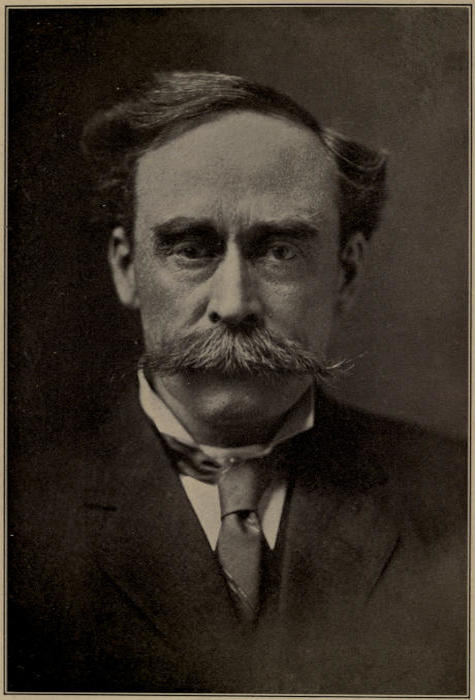
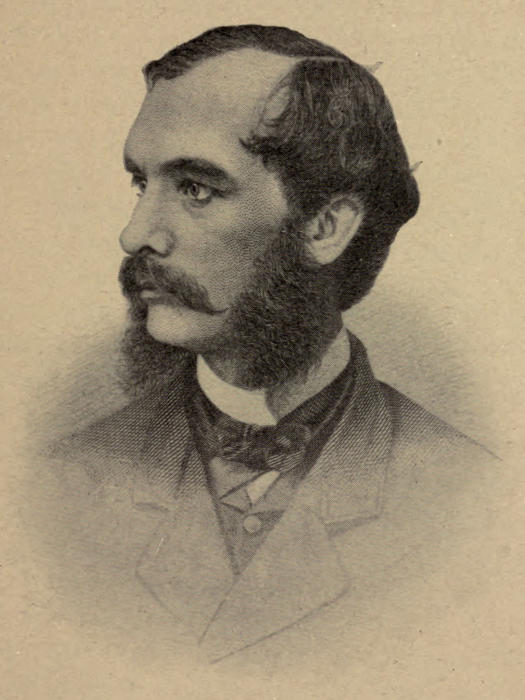
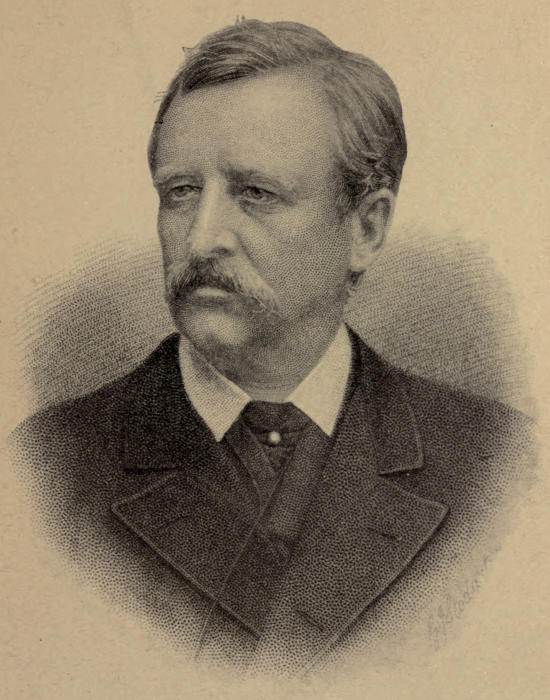
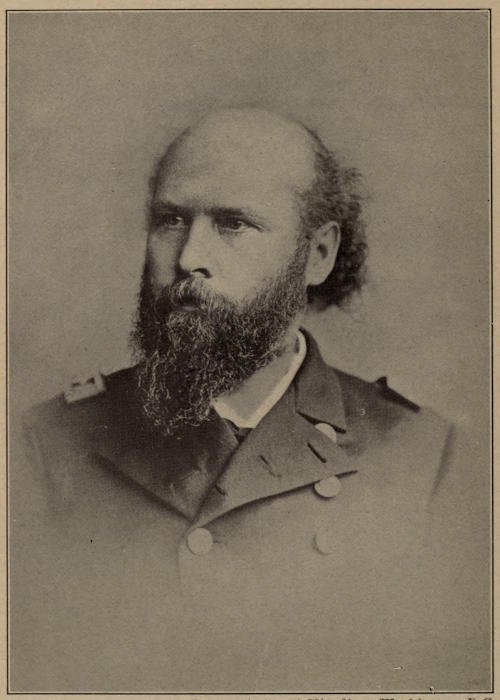
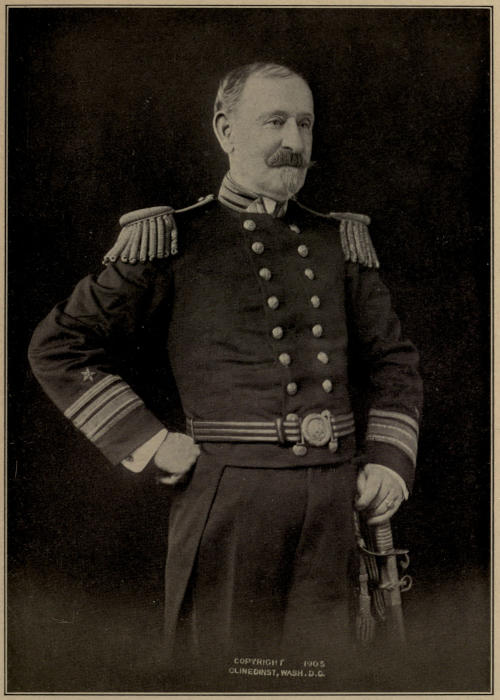
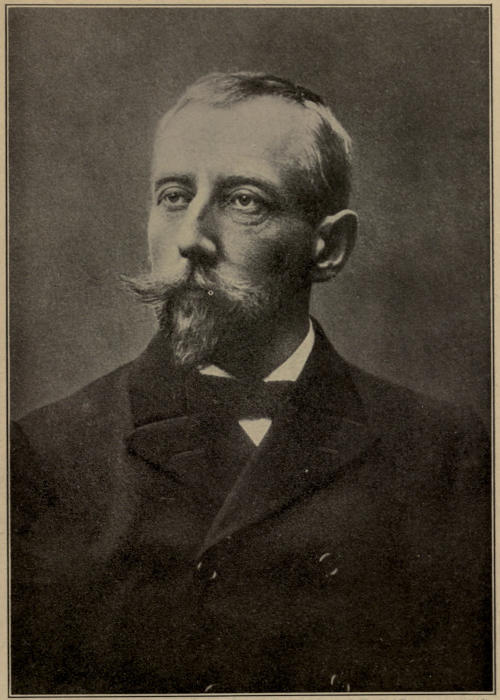
Commander Robert Edwin Peary, U.S.N.
Who reached the Pole April 6, 1909
Copyright by Clinedinst, Washington, D.C.
THE GREAT WHITE NORTH
THE STORY OF
POLAR EXPLORATION
FROM THE EARLIEST TIMES TO THE
DISCOVERY OF THE POLE
BY
HELEN S. WRIGHT
New York
THE MACMILLAN COMPANY
1910
All rights reserved
Copyright, 1910,
By THE MACMILLAN COMPANY.
Set up and electrotyped. Published October, 1910.
Norwood Press
J. S. Cushing Co.—Berwick & Smith Co.
Norwood, Mass., U.S.A.
PREFACE
The material for this book has been gathered from the
rich storehouse of Arctic Literature. The chief labour
of its composition lay in elimination rather than construction.
The great field I have endeavoured to present can
hardly be brought with justice to the narrow bounds of
a single cover, but I have conscientiously endeavoured
to bring to the reader’s mind an accurate record of brilliant
deeds that go to make the history of the far North,
and have let the explorers themselves tell the story of how
these deeds have been accomplished.
Between the lines of their simple language describing
stern facts or desperate realities, one reads the character
and temperament of the adventurer; one gathers lessons
of patience, self-sacrifice, and endurance unsurpassed in
the history of mankind, and perhaps appreciates, for the
first time, the splendid fibre of which he is made. Stripped
of the conventions and luxuries of civilized life, he plunges
into the great unknown to fight a relentless war against
the greatest foes to his existence,—Cold, Starvation, and
Death. Though he may fall by the wayside a victim to
the Cause, or crawl home on hands and knees over the
rough fastnesses of the frozen wilderness, famishing,—perhaps
dying,—the record of his work lives on; the fundamental
principles of great character do not perish, but
stand through the centuries, a star of hope to the weary
traveller on his pilgrimage along the well-trodden pathway
of everyday life, and stirs the layman to a better
endurance of the burdens and perplexities of the common
lot.
It is with pleasure I make grateful acknowledgment
to the gentlemen who have accorded me their gracious
permission to quote from their works, to Commander
Robert E. Peary, to Major-General A. W. Greely, and
Sir Allen Young, and to the following publishers and
others who, by furnishing material or giving consent to
use selected matter, or by kind assistance in other ways,
have made my work possible: The American Publishing
Company, Hartford, Conn., for selections from “Our
Lost Explorers”; D. Appleton & Company for selections
from Charles Lanman’s “Farthest North” and Payer’s
“New Lands within the Arctic Circle”; The Century
Company for selections from General Greely’s article
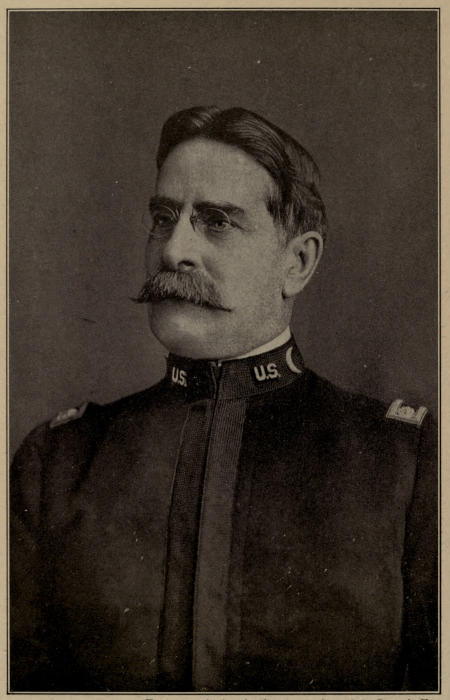
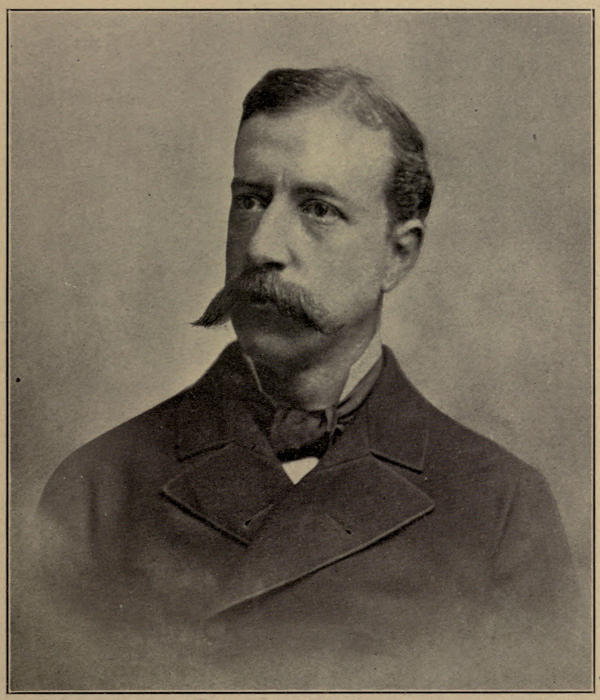
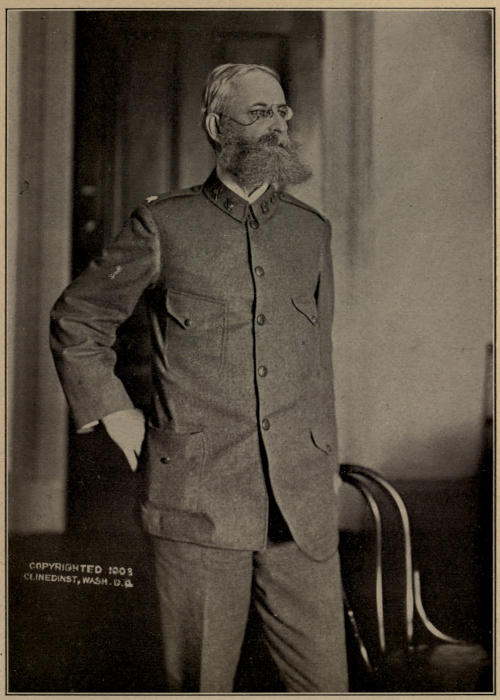
on “The Northwest Passage”; to Clinedinst, Washington,
D.C., for permission to reproduce the copyright
portraits of Admirals Schley and Melville, General Greely,
and Commander Peary; Constable & Company, and E. P.
Dutton & Company, Ltd., London, for permission to
reproduce the portrait of Amundsen in the latter’s work,
“The Northwest Passage”; Doubleday, Page & Company
for selections from Commander Peary’s “Nearest the
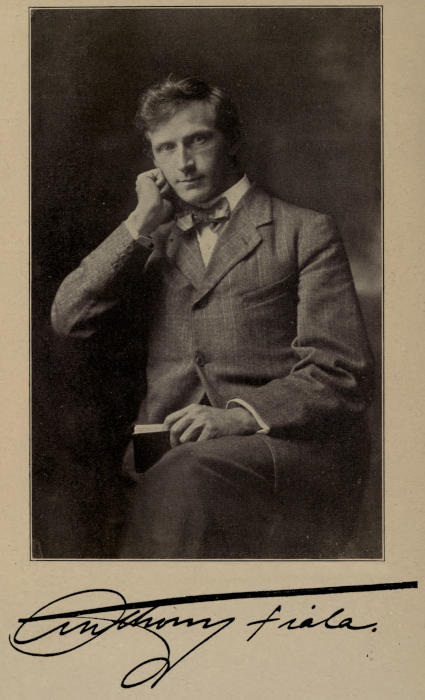
Pole,” and for the portrait of Anthony Fiala and other
illustrations from the latter’s work, “Fighting the Polar
Ice”; The Encyclopædia Britannica Company for a selection
from an article by Markham on “Polar Regions”;
to J. Scott Keltie, Esq., editor of the Geographical Journal,
for selections from that journal; Houghton; Mifflin
Company for selections from “The Voyage of the Jeannette”
and Melville’s “In the Lena Delta”; Dodd, Mead
& Company for selections from the Duke of Abruzzi’s
“On the Polar Star”; Benjamin B. Hampton, Esq., for
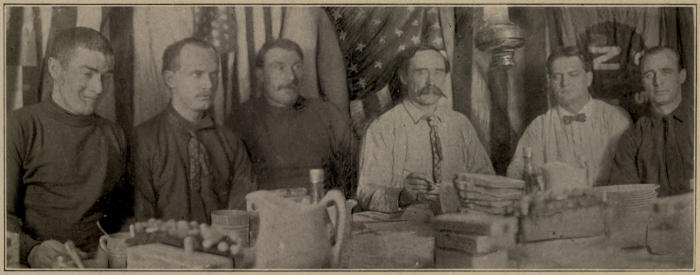
permission to reproduce photographs of the Peary expedition
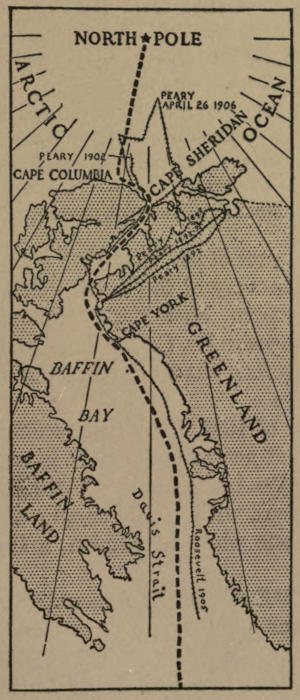
of 1908 and Commander Peary’s map, and Mr.
Hampton and the New York Times for permission to quote
Commander Peary’s telegram announcing his discovery
of the Pole; the editor of the Illustrated London News
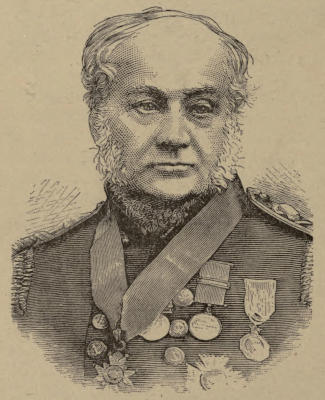
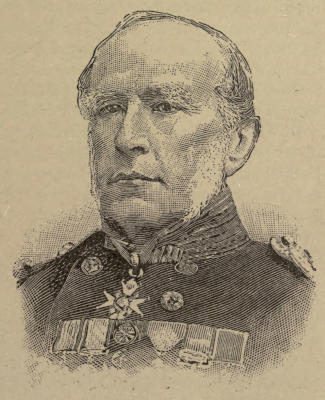
for permission to reproduce the portraits of Sir Edward
Belcher, Captain Nares, and Commander Markham;
Little, Brown & Company for selections from General
Greely’s “Handbook of Polar Discoveries”; The London
Agency for Ordnance Maps for selections from Sir Allen
Young’s “Pandora Voyages”; Longmans, Green & Company
for selections from Nansen’s “First Crossing of
Greenland” and Sverdrup’s “New Land”; the editor of
McClure’s Magazine for a selection from Mr. Baldwin’s
article on “The Baldwin-Ziegler Arctic Expedition,”
which appeared in that magazine in 1901-1902; Albert
Operti, Esq., for permission to reproduce the portraits
of W. H. Gilder, Lieutenant Schwatka, Colonel Brainard,
Captain De Long, and Lieutenant Lockwood; C. Kegan
Paul & Company for a selection from Markham’s “Great
Frozen Sea”; G. P. Putnam’s Sons for a selection from
Mr. Alger’s article on “Roald Amundsen,” which appeared
in Putnam’s Monthly; the editor of the American
Review of Reviews for a selection from Mr. McGrath’s
article on “Polar Exploration,” which appeared in that
magazine; Sampson, Low, Marston & Company, London,
for a selection from “German Arctic Expeditions”;
Charles Scribner’s Sons for a selection from Schwatka’s
“Search,” Greely’s “Three Years’ Arctic Service,” and
Schley’s “Rescue of Greely”; F. A. Stokes Company for
permission to reproduce illustrations from Commander
Peary’s work, “The North Pole,” and for the loan of
photographs; and to the same company for selections
from Andrée’s “Balloon Expedition” and Peary’s “Northward
over the Great Ice.”
CONTENTS
PAGE
CHAPTER I
Early adventurers. Pytheas.—Dicuil.—Other.—Wulfstan.—The
Norsemen.—Iva Bardsen.—The Cabots.—The Cortereals.—Willoughby
and Chancellor.—Stephen Burrough.—Niccolò
Zeno.—Frobisher.—Pet and Jackman.—Sir Humphrey Gilbert.—Davis.—Barentz
Early nineteenth century. Ross and Parry, May 3, 1818. Object
of voyage, search for Northwest Passage through Davis Strait
and explore bays and channels described by Baffin.—Met natives
near Melville Bay.—The discovery by Ross of the famous Crimson
Cliffs.—Enters Lancaster Sound.—Advance barred by imaginary
Crocker Mountains.—Return of expedition to England.—Buchan
and Franklin North Polar expedition via Greenland
and Spitzbergen.—Dorothea and Trent in Magdalena Bay, June
3, 1818.—Reached high latitude of 80° 37´ N.—Course directed
to east coast of Greenland.—Disastrous battle with the ice.—Dorothea
disabled.—Hasty return to England
1819-1827. Parry’s first voyage.—Object, to survey Lancaster
Sound and prove the non-existence of Crocker Mountains.—Discovery
of new lands.—Parry Islands.—Attains longitude
110° W., thereby winning the bounty of five thousand pounds
offered by Parliament.—Winters near Melville Island. Second
voyage.—Ships Hecla and Fury.—Examines Duke of York Bay
and Frozen Strait of Middleton.—Winters off Lyon Inlet.—Sledge
journeys.—Object, to make Northwest Passage via Prince
Regent Inlet.—Reached Port Bowen.—Ten months’ imprisonment.—Destruction
of the Fury.—Hasty return to England.
Fourth voyage.—Purpose to reach the Pole via Spitzbergen
with sledge boats over ice.—Hecla as transport.—Parry’s
farthest 82° 45´ N. reached, June 23, 1827
Nineteenth century continued. Scoresby and Clavering.—Former
visited Jan Mayen Island in 1817.—Later he visited east coast
of Greenland.—Discovered Scoresby Sound. In 1824, Captain
Lyon surveyed Melville Peninsula.—Adjoining straits
and shores of Arctic America.—In 1825, Captain Beechey in
the Blossom sailed through Behring Strait and passed beyond
Icy Cape.—Surveyed the coast as far as Point Barrow, adding
126 miles of new shore.—Second voyage of Captain John Ross.—Undertaken
in 1829.—Discovers Boothia.—Wintered in
Felix Harbor.—Discovery of North Magnetic Pole by nephew
of Captain John Ross.—Commander James Clark Ross.—Valuable
observations.—Sledge journeys to mainland.—Four
years spent in the Arctic.—Perilous retreat.—Safe return.—Land
journey by Captain Back.—The Great Fish-Back River.—Point
Ogle.—Point Richardson.—Back’s farthest point was
68° 13´ 57″ north latitude, 94° 58´ 1″ west longitude. Land journeys
of Simpson and Dease, 1836.—Descend the Mackenzie
River to the sea.—Surveyed west shore between Return Reef
and Cape Barrow.—In 1839, they explored shores of Victoria
Land as far as Cape Parry.—Crossed Coronation Gulf.—Descended
the Coppermine.—Reached the Polar Sea. Overland
journey in 1846 by Dr. John Rae confirmed Captain John Ross’s
statement that Boothia was a peninsula
Sir John Franklin.—Early life.—First land expedition of 1819-1821.—Journey
from York Factory to Cumberland House.—Reach
Fort Providence.—Winter at Fort Enterprise.—Explorations.—5550
miles.—Hardship.—Starvation.—Return.—Second
land journey.—1825.—Winter quarters at Great Bear Lake.—Descent
of the Mackenzie River to the Polar Sea.—1200
miles of coast added to map.—The last journey of Sir John
Franklin, 1845.—The Erebus and Terror.—Last seen in Melville
Bay
Search for Sir John Franklin.—Captain Kellett.—Captain Moore.—Dr.
Richardson.—Dr. Rae.—Sir J. C. Ross.—Mr. Parker.—Dr.
Goodsir.—Collinson, M’Clure.—The Felix.—Prince
Albert.—Commanded by Charles C. Forsyth.—Captain Austin’s
squadron.—Captain Ommaney.—Lieutenant Sherard
Osborn.—Commander Cator.—Grinnell expedition under De
Haven
Search for Sir John Franklin continued.—Sir Edward Belcher’s
squadron.—Inglefield.—Rae’s journey.—Discovery of Northwest
Passage by Captain M’Clure.—Death of Bellot
Sledging parties of Sir Edward Belcher’s squadron.—Desertion
of the ships.—Return to England.—Story of the Resolute.—Traces
of Sir John Franklin discovered by Dr. Rae.—Anderson’s
journey.—The voyage of the Fox under Commander
M’Clintock.—Sledge journeys.—Record and relics of Franklin’s
expedition.—Fox returns to England
The second Grinnell expedition.—Commanded by Dr. Elisha K.
Kane.—Winter quarters in Rensseläer Harbor.—Sledging
trips.—To the rescue.—Effects of exhaustion and cold.—Dr.
Kane’s journey.—Great Glacier of Humboldt.—Return and
illness of Dr. Kane. Second winter in the ice.—Privations
and suffering.—Abandonment of the Advance.—Retreat and
rescue
Dr. Hayes’s expedition. Winter quarters at Port Foulke, Greenland
coast.—Death of Sonntag.—Dr. Hayes’s journey.—Attempt
to cross Smith Sound.—Hayes’s farthest.—“Open Polar Sea.”—Homeward
bound
Charles Francis Hall.—Early life.—Interest in fate of Sir John
Franklin.—First journey to Greenland.—Discovery of Frobisher
relics.—Experiences and study of the Eskimos. Second
journey.—Delays and disappointments.—Sledging trips.—King
William Land at last.—Franklin relics.—Return of
Hall to United States. Polaris expedition.—Reaches high
northing.—Hall’s sledge journey.—Return and death.—Polaris
winters.—No escape.—Polaris is wrecked.—Part of
crew adrift on the ice-floe.—Remainder build winter hut.—Final
rescue and return to United States
Captain Thomas Long.—Discovery of Wrangell Land.—Captain
Carlsen and Captain Palliser sail across the Sea of Kara.—Captain
Johannesen circumnavigates Nova Zembla.—First German
expedition.—Second German expedition.—Germania, Captain
Koldewey commanding.—Hansa, Captain Hegemann.—Departure
from Bremen.—Crossing the Arctic Circle.—Island of Jan
Mayen.—The ice line.—Separation from the Hansa.—Adrift
on the ice-floe.—Winter.—Final rescue.—Germania beset.—Winter.—Sledging
parties.—Lieutenant Payer’s remarkable
journey—77° 1´ north latitude.—Return of the Germania
Norwegian expedition, 1871. Payer and Weyprecht.—The Tegetthoff
adrift in the Polar pack.—Discovery of Franz Josef Land.—Payer’s
sledge journeys.—Payer’s farthest 82° 5´ north latitude.—Cape
Fligely.—Abandonment of the Tegetthoff.—Retreat of
officers and crew.—Picked up by Russian fishermen.—Home
Baron A. E. von Nordenskjöld.—First voyage, 1858.—Accompanies
succeeding Swedish expeditions.—Spitzbergen.—Voyage
of Sofia.—1868.—Nordenskjöld’s journey to Greenland.—Voyage
of the Polhem.—Attempt to reach the Pole by reindeer
sledge.—Unexpected discouragements and disasters.—Voyage
of the Proven.—1875.—The Kara Sea.—Journey repeated
the following year.—In the Ymer.—Voyage of the Vega
British expedition of 1875.—The Alert and Discovery.—Captain
George S. Nares, F. R. S., Albert H. Markham, F. R. G. S.—Two
voyages of the Pandora, 1875-1876.—Schwatka’s search
for the Franklin records, 1878-1879
The Jeannette expedition, 1879-1881.—In command of Captain George
W. De Long.—Leaves San Francisco.—Touches at Ounalaska,
August 2.—Reaches Lawrence Bay, East Siberia, August 15.—Last
seen by whale bark Sea Breeze near Herald Island, September
2.—The Jeannette beset in ice-pack September 6, never
again released.—Daily routine of officers and crew.—Ship
springs a leak.—A frozen summer.—Sight of new land.—A
second winter in the pack.—The Jeannette crushed.—Abandonment.—The
retreat.—The fate of the three boats.—Death
of De Long’s party.—Melville’s search
International circumpolar stations.—Failure of Dutch expedition.—Greely
expedition reaches Lady Franklin Bay.—Life at Fort
Conger.—Sledge journey of Brainard and Lockwood.—Farthest
north.—Greely’s journey to interior of Grinnell Land.—Lake
Hazen.—Failure of relief ship Neptune to reach Conger in 1882.—Official
plans for Greely’s relief in 1883.—Proteus crushed
in ice.—Garlington’s retreat.—Greely’s abandonment of Fort
Conger.—Greely reaches Cape Sabine.—The beginning of a
hard winter.—Death of members of the party from starvation
and cold.—Schley’s brilliant rescue of the remnant of the Lady
Franklin Bay expedition in 1884
Nansen.—The man.—First Arctic experience.—Plans the crossing
of Greenland.—Carries out his great undertaking.—Voyage on
the Fram.—Drifting with the current.—Life aboard.—Nansen
and Johannesen start for the Pole.—Difficulties of travel.—The
“Farthest North!”—The retreat.—A winter on the
Franz Josef Land.—Attempt to reach Spitzbergen by kayak.—The
meeting at Cape Flora with Frederick Jackson.—Home
in the Windward
Journeys of Dr. A. Bunge and Baron E. von Toll.—Exploration in
Spitzbergen.—Sir Martin Conway.—Dr. A. G. Nathorst.—Professor
J. H. Gore.—Andrée’s balloon expedition to the North
Pole.—Search for Andrée by Theodor Lerner.—J. Stadling.—Dr.
A. G. Nathorst.—Captain Bade.—Walter Wellman’s
plan to reach the Pole from Spitzbergen.—Italian expedition
under Duke of Abruzzi.—Loss of the Stella Polare.—Captain
Umberto Cagni’s journey.—Breaks the record.—Retreat.—Home.—Baldwin-Ziegler
expedition of 1900.—Complete equipment.—Return
of expedition in autumn.—Ziegler expedition
under Anthony Fiala.—The America reaches high northing.—Winters
in Triplitz Bay.—Is destroyed.—Failure of sledge
journeys.—Relief ship does not come.—Second winter.—Return
of party by Terra Nova in 1903
Otto Sverdrup.—Four years’ voyage of the Fram.—Journeys in
Ellesmere Land.—Important exploration of Jones Sound.—Discovery
of new lands.—Release of the Fram.—Captain Roald
Amundsen.—The voyage of the Gjoa.—Reaches head of Petersen
Bay (King William Land).—Two years’ stay.—Valuable
scientific observations.—Visits from Eskimos.—Sledge journeys.—Release
from the ice.—August 14, 1906.—Completion
of the Northwest Passage.—Another Arctic winter.—Sledge
journey of Amundsen to Eagle City.—Release of the Gjoa.—Reaches
San Francisco, 1907
Robert E. Peary.—The man.—First visit to the Arctic, 1886.—Other
journeys, 1891.—Independence Bay, Greenland.—Discovers
Melville Land and Heilprin Land.—Subsequent journeys,
1893-1895.—Discovery of famous “Iron Mountain.”—Summer
voyages, 1896-1897.—North Pole journey of 1898.—Peary
seriously disabled by frost-bites.—Polar expedition in
S.S. Roosevelt, 1905-1906.—Final dash for the Pole, 1908
Dr. Frederick A. Cook.—Claims discovery of the Pole.—His return
from the Arctic.—Reception by the Danes.—Announcement
of conquest of the Pole by Peary.—Denounces Dr. Cook.—Acceptance
of Peary’s claims by the American Geographical
Society.—Dr. Cook sends manuscript to Copenhagen.—Verdict.—Prior
claim to the discovery of the North Pole.—Not
proven
Transcriber’s Note: image is clickable for a larger version
HONDIUS HIS MAP OF THE ARCTIKE POLE, OR NORTHERNE WORLD
CHAPTER I
Early adventurers: Pytheas.—Dicuil.—Other.—Wulfstan.—The
Norsemen.—Iva Bardsen.—The Cabots.—The Cortereals.—Willoughby
and Chancellor.—Stephen Burrough.—Niccolò
Zeno.—Frobisher.—Pet and Jackman.—Sir Humphrey Gilbert.—Davis.—Barentz.
A grave old world, majestically swinging upon its axis,
the mystery of its northern extremity locked closely within
its breast, is suddenly electrified by the news that at last
man, for centuries baffled in his heroic efforts, has revealed
its hidden secret, and that Old Glory, symbol of the daring
of the moderns, floats from the Pole itself.
What a thrill of interest passes over the nations of the
earth; universal excitement; universal rejoicings. Cablegram,
Marconigram, carry the wonderful tidings under the
seas or around the world in space.
The Pole at last! For ages the northern lights have
beckoned the adventurous spirits to fathom the phenomena
of the great unknown, have lured man into harbours fantastic
with the frozen ice of centuries, have inspired him to cross
the Greenland ice cap—or make his lonely trail through the
“barrens” of North America or the desolate “tundra” of
Siberia, his dauntless courage unquenched by previous records
of privation, starvation, and death itself. One after another
of intrepid explorers have left their stories of thrilling adventure,
and record of their names or those of their benefactors
to mark their personal discoveries.
What a history, what suffering, what sacrifice, compensated
by great achievement, by heroism, by glory—by the additions
to the world’s record of scientific knowledge!
Who were the early mariners that aspired to penetrate the
unknown seas of ice? Far back in the centuries, Pytheas,
bold adventurer, brought back rumours of an island in the
Arctic Circle called Thule, at first welcomed by the ancients
as a wonderful discovery, but afterwards discredited. In the
ninth century some Irish monks, carried away by religious
enthusiasm and an adventurous spirit, seem to have visited
Iceland, and one, Dicuil by name, left written evidence, about
825, confirming the story of the island Thule, which some of
the brethren visited, and reported there was no darkness at
the summer solstice. Other and Wulfstan, athirst for discovery
and knowledge, set sail in the reign of King Alfred,
and in all probability the former rounded the North Cape
and visited the shores of Lapland, though his exact discoveries
cannot now be identified.
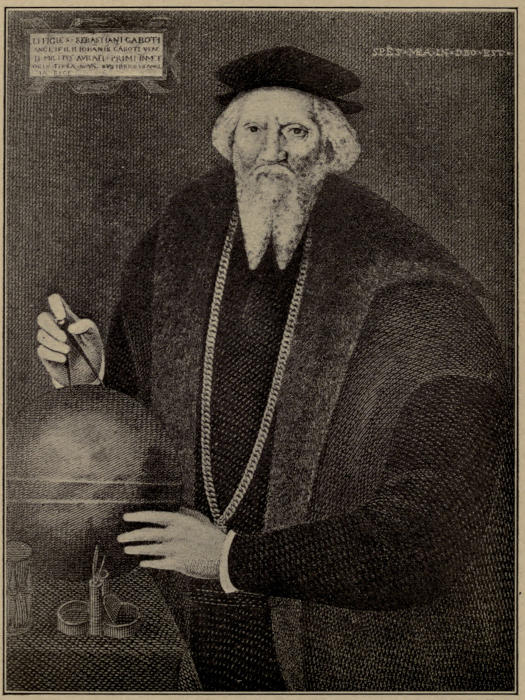
Sebastian Cabot
From the “Harford” portrait attributed to Holbein
The hardy Norsemen, realizing the advantage of hunting
and barter among the natives of Greenland, made permanent
settlements at Brattelid and Einarsfjord. As far as 73°
north latitude a cairn was found, and upon a runic stone was
a date 1235, and there is evidence that other settlers reached
as far as latitude 75° 46´ N. and Barrow Strait in 1266 or
thereabouts. Toward the middle of the fourteenth century
Norway was cursed with the Black Death, and the colonists
in far-off Greenland were forgotten. Forsaken by their own
countrymen, they received little assistance from the native
Eskimos, for we read they were overrun and attacked by
them about 1349. A rare old document, the oldest work on
Arctic geography, consisting of sailing directions for reaching
the colony from Ireland, was written by one Iva Bardsen,
the steward of the Bishopric of Gardar, in the East Bygd.
Bardsen was a native of Greenland and went forth for the
purpose of helping the sister colony. All of this early history
is vague and unsatisfying, but it shows the adventurous
spirit of those early mariners. Within the next hundred
years, that is to say between 1348 and 1448, at rare intervals
there was some communication with the Greenland settlements,
but finally it ceased altogether. Later the desire to
find a short route to India inspired merchantman and mariner
to cross the Arctic Circle, and in the sixteenth and seventeenth
centuries expeditions of note, led by men of dauntless spirit,
find their record upon the pages of history.
THE CABOTS
Born in Bristol, England, about 1476, Sebastian Cabot,
ambitious son of an adventurous father, John Cabot, became
zealous at an early age, through the successes of Columbus,
to attempt a like achievement. Father and son proposed
to Henry VII to sail west, and reach India by a shorter route.
The king, pleased with the idea of entering a new field of
maritime discovery, confided to the Cabots the execution of
this plan. A patent was granted March 5, 1496. “It empowered
them to seek out, subdue, and occupy, at their own
charges, any regions which before had been unknown to all
Christians.” They were empowered to take possession of
such lands and set up the royal banner. They were authorized
to return to the port of Bristol and no other, and
a fifth of the gains of the voyage were to be turned over to
the crown. The following year, 1497, John and Sebastian
sailed from Bristol in the good ship Mathew.
By the records of an old map of this period the land first
seen by the Cabots was the coast of Nova Scotia or Island
of Cape Breton. The Cabots designated the mainland as
“Prima Terra Vesta,” and is outlined between 45° and 50°,
showing land called St. Juan, no doubt Prince Edward Island
and mouth of the St. Lawrence. In the Privy Purse expenses
of Henry VII there is the following interesting expenditure,
“10th of August, 1497. To him that found the new Isle,
£10.” No doubt, this modest sum was paid for Newfoundland.
With the enthusiasm of the first voyagers stimulating them
to fresh effort, the Cabots secured a second “patent” to John
Cabot, dated February 3, 1498, giving him the command of
six vessels, of not more than two hundred tons each, and to
quote the exact words of this document, “them convey and
lede to the lande and isles of late found by the said John in
oure name and by oure commandment.”
But before the small fleet was in readiness, the father died,
and to his son fell the enterprise. With five vessels, Sebastian
set sail from Bristol in May, 1498, and reaching the
American coast ascended as high as 67° north latitude, probably
passing into Hudson Bay. He determined to press on
in a desire to find an open channel to India. His men became
appalled at the dangers that beset navigation in those higher
latitudes and mutinied, compelling him to retrace his course.
There is a vague rumour that he had with him upon this
voyage over a hundred emigrants, whom he landed in these
high latitudes, and who all perished from cold, although the
season was midsummer. However, he brought back to England
three natives of the countries he had visited, and for
his successful discoveries of more than eighteen hundred miles
of our North American coast, the king rewarded him by conferring
upon him the office of Grand Pilot of England.
The interest and exertions of Sebastian Cabot did not
abate, for this hero, extolled by contemporary writers for his
character and courage, by his unflagging perseverance and
indomitable will promoted the successful expeditions of 1553,
for which he was appointed governor for life of the Muscovy
Company. This company was established by the merchants
of London for the purpose of extending commerce and trade
in India and Cathay, and to find a northeast route that
would expedite their enterprise.
WILLOUGHBY AND CHANCELLOR
Three ships were fitted out, and Cabot drew up instructions
which are curious reading at this day. The expedition
was under Sir Hugh Willoughby and Richard Chancellor, and
sailed May 20, 1553, “for the search and discovery of northern
parts of the world, to open a way and passage to our
men, for travel to new and unknown kingdoms.” Cabot
instructs these men to treat all natives “with gentleness and
courtesy, without any disdain, laughing, or contempt.” If
they should be invited to dine with any lord or ruler, they
should go armed and in a posture of defence. He tells them
to beware of “persons armed with bows, who swim naked
in various seas and harbours, desirous of the bodies of men
which they covet for meat.”
Of Sir Hugh Willoughby, first in command of the Bona
Speranza, it is recorded that he was tall and handsome and
had proved a valiant soldier; of Richard Chancellor, that
he was beloved and genial and especially noted for “many
good parts of wit.”
Thus on that bright morning in early May, these two commanders
with their loyal crew sailed down the Thames amid
the firing of guns and cheers of the crowds assembled upon
the river banks to wish them God-speed. It was understood
between the commanders that should their vessels become
separated, they should try to meet at Wardhuys, “a good
port in Finmark.”
They proceeded northward and passed the northernmost
cape of Europe in July. At night during a dense fog and
storm, the two ships separated, the third and smallest kept
with Willoughby, and the two brave commanders and their
crews never met again. Proceeding northward some two
hundred miles, reaching Nova Zembla, Willoughby was
forced by the ice to return to a lower latitude. In September,
1553, he harboured in the mouth of the river Arzina, in Lapland.
He wrote in his journal at this time: “Thus remaining
in this haven the space of a weeke, seing the year farre spent,
and also very evill wether,—as frost, snowe, and haile, as
though it had been the deepe of winter, wee thought it best to
winter there.”
In January, according to the record of Willoughby’s journal,
all were living. In the spring Russian sailors, venturing
in these high latitudes, were surprised to see two ships frozen
in the ice. The relentless grip of the Arctic winter still held
them fast; the hand of death in its most gruesome shape had
reaped its harvest. Not a man survived. How brief the
details, yet the imagination shudders at the agonies of their
last days,—the cold, intense, congealing; the impenetrable,
melancholy dark, and death, laying its icy fingers upon the
despairing heart of each in turn and the “last Man,” surrounded
by the stark forms of his companions, wrestling
alone with inexorable fate.
Chancellor’s vessel, the Bona Ventura, reached the Bay of
St. Nicholas, and landed near Archangel, which was then but
an isolated castle. He undertook a journey to Moscow,
which resulted in successful arrangements for commercial
enterprise, Russia at that time being almost as little known
as the far east. Returning safely to England, he was warmly
welcomed as having proved the practical utility of Arctic
voyages.
One of the companions of Chancellor on this voyage,
Stephen Burrough, materially aided by Sebastian Cabot,
then in his eighty-fourth year, set sail in 1556 from Gravesend,
in a small pinnace named the Search-thrift. Before the
departure, the ship and crew were visited by Cabot, and it
is recorded of this farewell visit that “Master Cabot gave the
poor most liberal almes, wishing them to pray for the good
fortune and prosperous success of the Search-thrift; and for
very joy that he had to see towardness of our intended discovery,
he entered into the dance among the rest of the young
and lusty company; which being ended he and his friends
departed most gently, commending us to the governance of
Almighty God.”
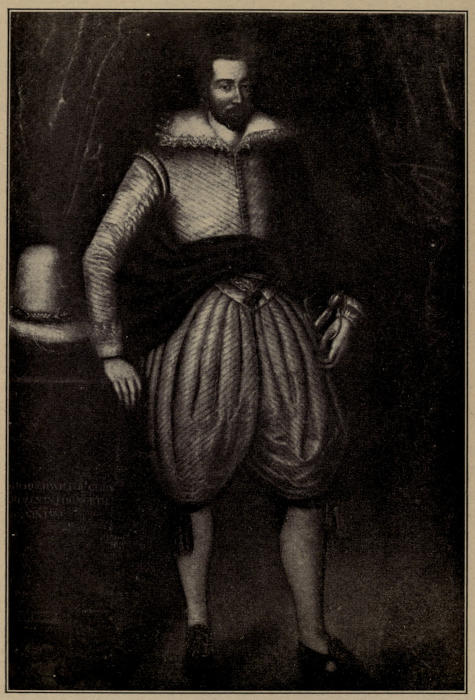
Sir Hugh Willoughby
Burrough skirted the northern coast of Lapland to the
eastward, discovering the strait leading to the Kara Sea,
between Nova Zembla and Waigat. As a result of “the
great and terrible abundance of ice that we saw with our
eyes,” Burrough explored no farther, but sailing into the
White Sea wintered at Colomogro, returning home the following
spring.
THE CORTEREALS
As early as 1500 a Portuguese, Caspar Cortereal by name,
endeavoured to reach Cathay by the Northwest Passage and
reached between 50° and 60° north latitude. After making
captive some fifty-seven natives, for the purpose of making
them slaves, he returned to Lisbon, October 18, 1501.
The following year he set sail again with two ships and is
supposed to have reached Hudson Strait, where the vessels
became separated. Caspar Cortereal and his crew were
never heard of again.
The other ship returned to Lisbon with the unfortunate
tidings, and a brother, Miguel, set sail from Lisbon, in the
spring of 1502, on a searching expedition. Upon reaching
Hudson Strait the ships separated to explore the various inlets
and islands of the locality. Two of the ships reached the
point of rendezvous, but the third, with Miguel Cortereal on
board, never appeared. Thus the two brothers shared a like
fate.
A third brother, Vasco, petitioned the king to equip another
expedition to send in search of the missing men, but this the
king refused to do on the ground that the loss of two was
greater than he could afford to sustain. No tidings were
ever received that could throw any light upon the sad fate
of the bold mariners.
One of the most curious productions by geographers was
a map published in 1558 by one Niccolò Zeno, a Venetian
noble, whose ancestor of the same name had left with notes
and journals a record of certain northern journeys made by
him toward the end of the fourteenth century. He had entered
as pilot the service of a mariner named Zichnmi, remained
many years in his service, and, joined later by a brother
called Antonio, spent some time in a country he named Frislanda.
Later both brothers found their way back to Venice.
The young Niccolò, discovering the mutilated letters and maps
of these brothers, proceeded to prepare a narrative and
elaborate map which was considered a most valuable addition
to knowledge and continued to be an authority for
more than a century.
The names are very curious and confusing, but are supposed
to be identified as follows:—
Engronelant, Greenland; Islanda, Iceland; Estland,
Shetland Islands; Frisland, Faroe Isles; Mackland, Nova
Scotia; Estotiland, Newfoundland; Drogeo, coast of North
America; Icaria, coast of Kerry or Ireland.
FROBISHER
The three voyages of Frobisher undertaken between the
years 1576-1578 were in a great measure financed by a rich
and influential merchant named Michael Lok, whose passion
for geographical research led him to encourage the young explorer,
who set out in the spring of 1576 in two small vessels,
the Gabriel and Michael. The latter parted company in the
Atlantic, and the Gabriel continued her voyage alone. Frobisher
sighted land about July 20 and called it Queen Elizabeth’s
Foreland.
Continuing on his course, he entered the following day the
strait that bears his name, calling the land “Meta Incognita.”
He made a landing and explored the land to some extent,
returning to England with some bright yellow ore which
aroused the enthusiasm of gold seekers and greatly assisted
him in expediting his other voyages. His primary aim of
seeking for the Northwest Passage was all but forgotten in
the excitement caused by the possible discovery of untold
wealth.
Queen Elizabeth issued instructions for his guidance upon
future voyages: “Yf yt be possible,” so states the official
document, “you shall have some persons to winter in the
straight, giving them instructions how they may observe
the nature of the ayre and state of the countrie, and what
time of the yeare the straight is most free from yce; with who
you shall leave a sufficient preparation of victualls and weapons,
and also a pynnas, with a carpenter, and thyngs necessarie,
so well as may be.”
The second journey, much better equipped than the first,
brought home, beside specimens of plants and stones, large
quantities of the supposed gold ore. But though the dream
of an El Dorado was never realized, and the ore was eventually
proved worthless, Frobisher’s greatest victory to science
was establishing the fact that there were two or more wide
openings leading to the westward between latitude 60° and
63° on the American coast. Of his personal character we
note with interest that he was a brave, skilful leader of men,
rough in bearing, but a strict disciplinarian, and carried
through his designs with the enthusiasm of a true explorer.
PET AND JACKMAN
Arthur Pet and Charles Jackman, commanding two vessels,
set out in 1580 with instructions to sail through the
strait leading between Nova Zembla and Waigat, and from
thence eastward beyond the Obi River. They reached
Wardhuys on the 23d of June. About two weeks later they
approached Nova Zembla, but ice retarded their advance.
They sighted Waigat on the 19th of July. While trying to
push their way along its southern coast, they were embarrassed
by shallows and obliged to go round by the north.
They forced their way between the shore and a low island
only to be closed in by the ice, which stopped further progress.
The ships were widely separated, and could only communicate
with each other by the beating of drums or firing
of muskets. Warping their ships as opportunity offered, they
finally got in closer communication. Of the weather, they
write at this time, “Winds we have had at will, but ice and
fogs too much against our wills, if it had pleased the Lord
otherwise.” Surrounded by fields of ice, enveloped in fog,
they were obliged to make fast to icebergs, where, “abiding
the Lord’s pleasure, they continued with patience.” By
the 13th of August the season was considered too far advanced
to penetrate farther. Pet had discovered a strait
between the mainland and Waigat leading into the Kara
Sea, and with this news he returned to England. Jackman
wintered in a Norwegian port; sailing home in the spring,
his ship with all on board was lost at sea.
SIR HUMPHREY GILBERT
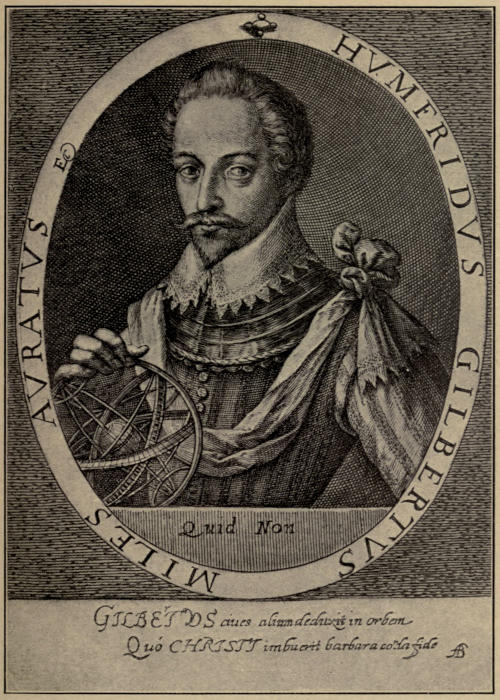
The distinguished British naval commander, Sir Humphrey
Gilbert, near relative of Sir Walter Raleigh and favourite of
Queen Elizabeth, being ambitious to colonize Newfoundland,
obtained in 1578 full power from the queen to undertake
a voyage of discovery and settle such parts of North
America “as no Christian prince or his subjects could claim
from previous possession.” His second voyage was undertaken
in 1583, and with five ships under his command, he
sailed out of Plymouth Sound, June 11.
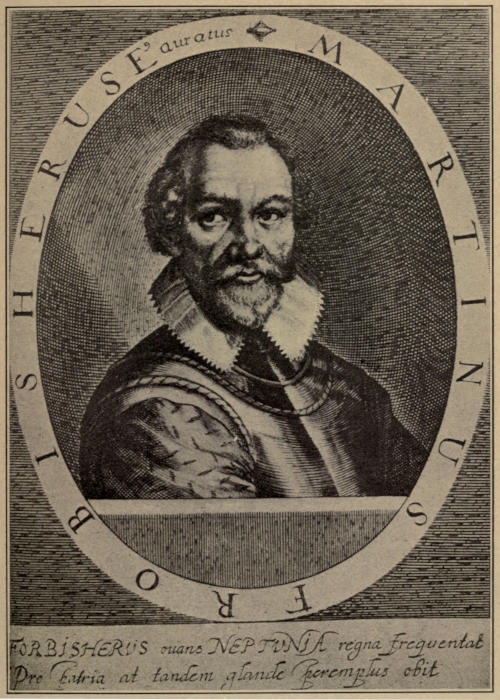
Martin Frobisher
A contagious disease breaking out on one of the vessels, the
property of Sir Walter Raleigh, and commanded by Captain
Butler, it returned to England; the four remaining, the
Delight, the Golden Hinde, the Swallow, and the Squirrel,
sighted Newfoundland about June 30. Here they landed
August 3, taking possession of the harbour of St. John’s in
the name of Queen Elizabeth. A miner, brought for the purpose
of finding precious metals, should such exist in the
newly discovered territory, claimed to locate a silver mine,
which news was greeted with much enthusiasm by the entire
fleet. So many of the crew having become ill, Sir Humphrey
found it advisable to send home the Swallow with the
sick on board. He then embarked on the Squirrel, of only
ten tons, the smallest ship of the fleet.
Sailing out of the harbour of St. John’s on August 20, he
reached by the 27th latitude 44° with fair weather. Two
days later a gale arose preceded by a dense fog. The Golden
Hinde and Delight were beaten in among the rocks and
shoals. The Golden Hinde signalled to stand out to sea, but
the Delight did not heed this, and was shortly afterward
wrecked upon a shoal, where her stern was quickly beaten to
pieces. A few of the crew escaped in a boat, but the captain
and a hundred men went down with the ship. The
heroic Captain Browne, only recently transferred from the
Swallow to the Golden Hinde, when urged to save himself,
spurned the idea and stood bravely at his post rather than
bear the reproach of having deserted his ship, though that
ship, himself, and all hands left aboard were doomed to destruction.
The small boat into which a few had crowded,
drifted about in the midst of the gale, which threatened every
instant to swamp them. They were without food and suffered
greatly from thirst. Fearing the overcrowded boat would
founder unless materially lightened, a man named Headley
suggested that lots be drawn; those drawing the four shortest
should be thrown overboard. But one of their number,
Richard Clarke, who had been master of the Delight, rose in
the bow and answered sternly, “No, we will all live or die
in company.”
Two more days passed with increased sufferings. They
tried to appease the pangs of hunger with seaweed that
floated on the surface of the waves, and they drank sea-water.
On the fifth day the man Headley died and one other. All
but Clarke were praying to God for death, rather than such
continued agony. Clarke tried to encourage them by telling
them they would surely reach land by the morrow, and if
they did not make it by the seventh day, they might throw
him overboard. The seventh day came at last, and by noon
they sighted land, as Clarke had prophesied; in the afternoon
they landed. They gave thanks to God, and after slaking
their unbearable thirst with fresh water, the strong ones
found some berries growing wild with which to feed the party.
In several days they slowly regained their strength.
Later they rowed along the coast, hoping to reach the
bay of Newfoundland and met some Spanish whalers
who frequented these waters. They satisfied their hunger
by eating berries and peas, landing at intervals for the purpose.
Before long they fell in with a Spanish ship; the
captain took them to St. Jean de Luz in the Bay of Biscay.
Landing near the French frontier, they travelled through
France and reached England about the end of the year 1583.
The loss of the Delight was a serious blow to Sir Humphrey
Gilbert; of the five ships with which he had started only the
Golden Hinde and the Squirrel survived. The impenetrable
fogs which at this juncture enveloped these ships were most
disheartening to the crew, and already the provisions on
board the Squirrel were running low. Officers and men
besought Sir Humphrey to return, but reluctantly, with no
abatement in his enthusiasm for adventure, he only consented
to alter his course, upon their promise to embark with
him again the following spring. On August 31 they turned
their bows toward home.
On the 2d of September, having hurt his foot and wishing it
dressed by the surgeon, Sir Humphrey Gilbert boarded the
Golden Hinde, and later repeated the visit to take part in an
entertainment with the captain and crew. He mentioned the
sorrow at the loss of the Delight, and of certain papers and ore
that the Saxon miner had procured in Newfoundland. He
was advised to remain aboard the Golden Hinde, the Squirrel
being so encumbered with heavy artillery and other freight
that she was not considered safe to face the storms so likely
to occur in mid-ocean at that season of the year. After consideration,
Sir Humphrey replied,—
“I will not now desert my little vessel and crew, after we
have encountered so many perils and storms together.”
Being supplied from the Hinde with some necessary provisions,
Sir Humphrey returned to the Squirrel.
On the 9th of September, in the latitude of England, the
overburdened little craft of ten tons showed signs of foundering.
Sir Humphrey was seen by the Hinde sitting in the
stern of his vessel with a book in his hand and was heard to
call out,—
“Courage, my lads! we are as near heaven on sea as on
land!”
At midnight she sank with all on board. Thus terminated
the first attempt to colonize the inhospitable shores
of Newfoundland.
DAVIS
Following closely upon the disastrous voyage of Sir Humphrey
Gilbert came the three voyages of Davis between the
years 1585 and 1588. He discovered the strait that bears
his name, opened a way to Baffin Bay and the Polar Sea,
and surveyed a considerable extent of the coast of Greenland.
BARENTZ
Between the years 1594 and 1596, William Barentz made
three journeys to the Arctic, losing his life in the disasters
and privations of the last voyage. In this third voyage, he
made his way to the sea between Spitzbergen and Nova
Zembla, where he writes, “We came to so great a heape of
ice that we could not sayle through it.” In August, 1596,
they were surrounded by drifting ice which crushed around
them with such alarming force as to make “all the haire of
our heads to rise upright with feare.” They made every
effort to extricate themselves from their perilous position,
but on the 11th of September “we saw that we could not
get out of the ice, but rather became faster, and could not
loose our ship, as at other times we had done, as also that
it began to be winter, so took counsell together what we were
best to doe, according to the time, that we might winter, and
attend such adventures as God would send us; and after
we had debated upon the matter (to keepe and defend ourselves
both from the colde and wild beasts), we determined
to build a house upon the land, to keepe us there in as well as
wee could, and to commit ourselves unto the tuition of God.”
While searching for material wherewith to build their
winter-quarters, they discovered a quantity of driftwood for
which they thanked God for a special act of Providence, and
“were much comforted, being in good hope that God would
show us some further favour; for that wood served us not
only to build our house, but also to burne, and serve us all
the winter long; otherwise, without all doubt, we had died
there miserably with extreme cold.”
In spite of the intense cold which made the building of
their hut most laborious, there was open water an “arrow
shot” beyond their ship. They dragged their stores on
hand sleds, and by October their dwelling, closely thatched
with sea rack to keep out as much cold as possible, was completed,
and “we setup our dyall and made the clock stride.”
On the 4th of November, “wee saw the sunne no more, for it
was no longer above the horizon; then our chirurgion made
a bath (to bathe us in) of a wine-pipe, wherein wee entered
one after another, and it did us much good, and was a great
meanes of our health.”
Sir Humphrey Gilbert
Regulations were established, food was apportioned, and
extra clothing distributed. Traps were set for foxes and
other game, but soon the weather became so rigorous that for
days they were snowed in and could not open their door.
They were in darkness except for their fire, the smoke of
which became almost unendurable. Ice formed two inches
thick in their berths, and their misery may be imagined
better than described.
On the 7th of December, they managed to secure some
coal from their ship, and with it made a good fire which
warmed them somewhat, though it nearly asphyxiated them.
The cold becoming ever more intense and their supply of
wood diminishing, their sufferings are noted repeatedly in
their journal.
“It was foule weather again, with an easterly wind and
extreame cold, almost not to bee endured, where upon wee
lookt pittifully one upon the other, being in great feare, that
if the extreamitie of the cold grew to bee more and more, wee
should all dye there with cold; for that what fire soever wee
made it would not warme us; yea, and our sake, which is so
hot, was frozen very hard, so that when we were every man
to have his part, we were forced to melt it in the fire, which
wee shared every second day about halfe a pint for a man,
where with we were forced to sustayne ourselves; and at
other times we dranke water, which agreed not well with the
cold, and we needed not to coole it with snow or ice; but
we were forced to melt it out of the snow.”
They were often awed by the great volumes of sound,
“like the bursting asunder of mountains and the dashing
them to atoms.” About the middle of January, they were
forced, under great difficulties, to secure more wood, and,
making another trip to the vessel, they found much ice accumulated
within, and returned to their hut with a fox caught
in the ship’s cabin, which provided them with fresh meat.
On Twelfth Night they made a heroic effort to make merry.
They drew lots for the honour of being king of Nova Zembla,
and the gunner was royally installed. Imagining themselves
back in Holland, they drank to the three kings of Cologne,
soaking biscuit in the wine that for days they had set aside
out of their scant store to celebrate this “great feast.” But
the intense cold and storms that soon followed excluded every
other idea, and for days they were shut in, trying to bring
warmth to their frozen bodies with hot stones, but while
sitting before the fire, their backs would be white with frost,
while their stockings would be burned before they could feel
heat to their feet.
Their stock of provisions was becoming exhausted, and
although they had seen traces of bears and heard the foxes
running over their heads, they could not secure any.
On January 24, Gerard de Veer, Jacob Keemsdirk, and a
third companion, upon making their way to the seaside
toward the north, saw the sun above the horizon for the first
time. Not having expected this event for fourteen days
later, Barentz was doubtful of their accuracy. On the 26th,
one of their number who had long been ill died, and they dug
a grave seven feet in the snow, “after that we had read certaine
chapters and sung some psalmes, we all went out and
buried the man.”
As daylight increased, they left their hut for short periods
of exercise.
By May their impatience to leave this desolate spot
prompted them to make preparations for departure, and
without waiting to see if their ship would be navigable when
once released from the ice, they repaired their two boats
and awaited the first opportunity “to get out of that wilde,
desart, irkesome, fearfull, and cold countrey.”
On the 13th of June, the twelve survivors left the miserable
shelter that had been their home for ten months, and took
to the open boats. Their sufferings and privations cannot
be described; three of their number succumbed, and Barentz
himself became too ill for service.
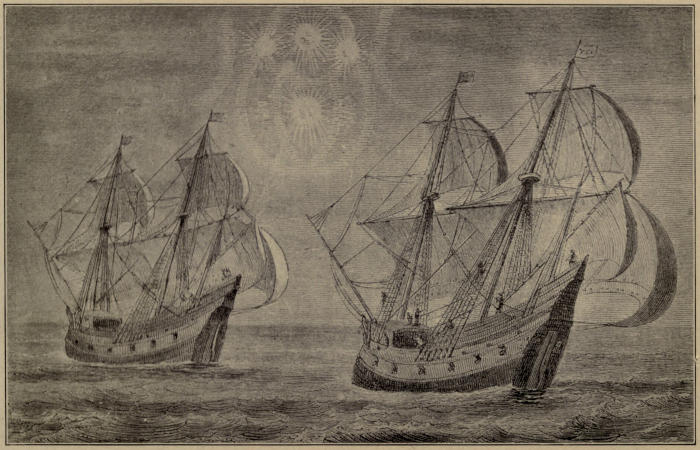
Davis’s Ships, the “Sunshine” and the “Moonshine”
As they passed Icy Cape, a headland of Alaska, latitude
70° 20´ N., longitude 161° 46´ W., Barentz asked to be lifted
up to see it once more, and the dying man’s eyes rested with
pleasure upon its cheerless coast.
On the twentieth day of June, Barentz was told that a man
in the other boat named Claes Andriz was near death. He
remarked he would not long survive his comrade. He was
examining at the moment a chart of the countries and objects
they had seen on their voyage. He turned to Gerard
de Veer, who had made this chart, and asked him for something
to drink. Hardly had he swallowed the liquid when
he suddenly expired. Saddened and disheartened, the remnant
of this unfortunate expedition struggled on until September,
when they reached the coast of Lapland.
After a voyage of eleven hundred and forty-three miles,
these heroes of the north left their boats in the “Merchant’s
house” at Coola as “a sign and token of their deliverance.”
A Dutch ship carried them to Holland, where they appeared
before the curious crowds of Amsterdam in the costume they
had worn in Nova Zembla. They were honoured by their
countrymen and made to repeat their wonderful adventures
before the ministers of the Hague.
To the early maps of the period at the close of the sixteenth
century, Newfoundland and adjacent coast line had been
added by the Cabots, who had reached as far as 67° north
latitude, Frobisher Strait, an outline of the lands that he
had visited, Davis Strait, and a portion of Greenland’s east
coast. But, more important than the discovery of new territory
was the stimulus to Arctic enterprise, which through
Richard Chancellor had established valuable trading activities
between England and far-distant Russia. The journeys
of the Cotereals had opened a way to Spanish and Portuguese
fisheries off the banks of Newfoundland, and Frobisher’s
supposed discovery of gold in distant lands had given zest
to discovery in the New World by the English, exemplified by
Sir Humphrey Gilbert’s daring but unsuccessful attempt to
colonize Newfoundland.
CHAPTER II
Seventeenth and eighteenth centuries: Hudson.—Baffin.—Deshneff.—Behring.—Schalaroff.—Tchitschagof.—Anjou
and Von
Wrangell.—Phipps.
HUDSON
No century has produced a more daring or renowned
mariner than Henry Hudson, or one whose melancholy fate
has provoked more pity. Down through the decades the
story of his adventures has been told and retold at the fireside
of the old to the eager ears and quickening imagination of the
young.
Talented, indefatigable, fearless, his achievements, in the
infancy of Arctic exploration, handicapped by the lack of all
that invention and science has secured to modern explorers,
place him in the first rank, with the greatest navigators the
world has known. As early as 1607 he had distinguished
himself by pushing as far north as latitude 81½°, in his effort
to follow the instructions of the Muscovy Company to penetrate
to the Pole. Attempting the Northeast Passage in 1608,
he saw North Cape on the 3d of June; pushing to the eastward
on parallels 74° and 75°, he skirted Nova Zembla, but
found it impossible to penetrate higher than 72° 25´.
The next year the Dutch sent him to try this passage
again, though the previous voyage had convinced him that
the Northeast Passage was impractical.
He passed Warhuys, returning past North Cape, pushing
his way to the American coast, where he searched for a passage,
and, sailing into New York harbour, discovered the magnificent
river which bears his name. This splendid achievement
only stirred his ambitions further, and under the patronage
of Sir John Wolstenholme, Sir Dudley Digges, and other
distinguished men, a vessel of fifty-five tons was fitted out
and provisioned for six months.
Under the command of Hudson, the Discovery set sail
April 17, 1610. Touching at Orkney and Faro islands, they
sighted the southeastern part of Iceland, May 11. Later
they reached the Vestmanna Isles, and saw Mount Hecla in
eruption. On June 4, Hudson writes, “This day, we saw
Greenland perfectly over the ice; and this night the sun went
down due north, and rose north-north-east, so plying the fifth
day we were in 65°.”
Taking their course northwest, they passed Cape Desolation.
A school of whales was sighted at this juncture, and
later icebergs were encountered. In June they saw Resolution
Island; going to the south of this island, they were
carried by the current northwest, until they struck shore ice,
from which it was most difficult to extricate themselves.
At this time a growing discontent among the men first
appeared on board; some were for returning before the perils
of the journey should become greater, others were for continuing.
Hudson showed them a chart showing that they
had sailed two hundred leagues farther than any Englishmen
had sailed before. The situation of the ship, at times embedded
in ice, at others pushing her way through leads of
open water, was critical and discouraging, but Henry Hudson
continued his intricate navigation, finally being rewarded by
finding himself in a clear, open sea. Sighting three headlands,
he called them Prince Henry Cape, King James,
and Queen Anne, and, continuing, he saw a hill which he
called Mount Charles, and later sighted Cape Salisbury.
While exploring the south shore, he discovered an island,
one point of which he named Deepe Cape, the other,
Wolstenholme. He entered a bay, which, from the date,
he called Michaelmas Bay.
The season was advancing; already the days were very
short and the nights long and cold. Realizing it was time to
find shelter for the winter, he cast about to discover a suitable
location. By the first of November he had the vessel hauled
aground, and ten days later it was frozen in. The stock of
provisions was very low, but the men supplemented it by
killing or trapping anything that was serviceable for food,
and after game left them in the spring, they lived on such
birds as they could secure; when these, too, migrated, they
ate moss, frogs, and buds.
With the breaking up of the ice in the spring, preparations
were made for returning home.
In Hudson’s own bay, in the cold embrace of the shores he
had explored, Henry Hudson divided the last remnants of
food equally among his men. They were a famished, despairing
crew, maddened with suffering. The cry for bread
was in their vitals, and there was no bread. Hunger and
misery made their brains reel, robbed them of their godliness,
and reduced them to wild animals at bay. It took but
the encouragement of one of their number, Green by name, to
incite them to mutiny.
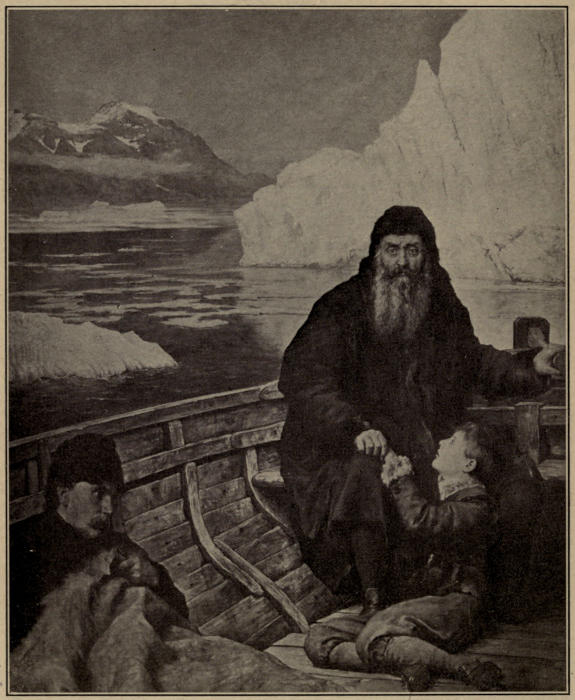
The Death of Henry Hudson
From the painting by Collier
On June 21, “The ship’s company, both sick and well,
were in berths, dispersed generally two and two about the
ship. King, one of the crew who was supposed to be friendly
to Hudson, was up, and in the morning they secured him in the
hold by fastening down the hatches. Green then went and
held the carpenter in conversation to amuse him, while two
of the crew, keeping just before Hudson, and one, named
Wilson, behind him, bound his hands. He asked what they
were about, and they told him he should know when he was in
the shallop. Another mutineer, Juet, went down to King
in the hold, who kept him at bay, being armed with his sword.
He came upon deck to Hudson, whom he found with his
hands tied. Hudson was heard to call to the carpenter, and
tell him he was bound. Two of the devoted party, who were
sick, told the mutineers their knavery would be punished.
They paid no attention; the shallop was hauled up to the
side of the vessel, and the sick and lame were made to get into
it. The carpenter, whom they had agreed to retain in the
vessel, asked them if they would not be hanged when they
reached England, and boldly refused to remain with them,
preferring to share the fate of Hudson and the sick men.”
The crew then set sail, and the boat in which were Hudson
and his companions was never seen again. After many hardships
and vicissitudes and much loss of life through the
onslaught of the natives, where they landed to secure food, a
remnant of the unfortunate crew found their way past the
Cape of God’s Mercies and thence to Cape Desolation in
Greenland. Pursuing their homeward course, they were reduced
to the last extremities by hunger, one-half a fowl fried
in tallow per man being their only sustenance each twenty-four
hours.
Just before their last bird was devoured, they sighted the
north of Ireland, where they landed, and later made their
way to Plymouth.
BAFFIN
Following the example of Hudson, and with the purpose of
further discovery, Baffin set sail in 1616 and explored the
vast bay eight hundred miles long and three hundred miles
wide that bears his name. He saw Lancaster Sound and
brought home observations and reports of latitude and
longitude, the accuracy of which was doubted for many
years, but has since been verified and accredited to him.
Equally tragic with the fate of Henry Hudson was the
last voyage of that great Russian commander, Behring,
whose life was one long record of heroic achievement. He
had seen many parts of the world while serving under Peter
the Great, by whom he was given the commission of lieutenant
in 1707, and captain-lieutenant in 1710. In a previous
voyage he had explored the straits which bear his
name. These straits had been navigated nearly a century
before by Deshneff, one of the early Russian explorers who
made several voyages between 1646 and 1648. His great
object was to round to the mouth of the Anadry River,
and there form a traders’ settlement. Deshneff and his
companions were the first navigators to sail from the Arctic
Sea to the Pacific, and proved, at a much earlier period than
is generally supposed, that the continents of America and
Asia are not united.
Behring set sail June 4, 1741, with two vessels from Kamtschatka
in the harbour of St. Peter and St. Paul. Steering
eastward toward the American continent, he sighted land the
18th of July, in latitude 58° 28´ and 50° longitude, from
Anatsda. Captain Tschirikov, who commanded this second
boat, had seen the land a few days previously and, having
determined to send some men ashore for investigation, the
shallop and long-boat were manned with seventeen of the
crew for this purpose. They never returned to the ship.
Such a grave disaster determined Behring to send this
vessel back to Kamtschatka.
He proceeded on his voyage alone, hoping to reach as
high latitude as 60°, but progress was slow, owing to the varied
coast-line and the labyrinth of islands which border this
vicinity. They fell in with a few natives, who had been on
a fishing expedition, with whom they held some friendly
intercourse. Progress continued to be retarded by calms
and currents, and finally dirty weather set in early in September
and raged in a violent storm for seventeen days.
BEHRING
The scurvy now attacked the crew, and numerous deaths
occurred. Behring determined to return to Kamtschatka.
Through an unfortunate blunder, they erred in their course,
and land remained invisible. The approach of winter
became alarming, the cold increased, and rain turned to ice
and snow. The unfortunate crew were in a pitiable condition
from the miserable disease that laid hold of them. The
steersman had to be supported at the wheel by two other sick
men that he might continue at his post of duty. Finally
he was disabled, and men hardly more fit took his place
one by one. Almost daily some one died, and the ship, no
longer with enough hands to man her, was at the mercy of
the elements. The nights became long and dark, the water
supply was running low, and certain destruction and death
awaited the remnant of human beings left on board, unless
a harbour of refuge could be found.
At last one morning land was sighted. The approach was
difficult, the ship so crippled as to be almost unmanageable,
and the rocks threatened instant destruction. Darkness
came on before they could make a landing. In their attempt
to anchor, two cables parted, and the anchors were lost;
they had no third anchor in readiness.
At this juncture it seemed as if the hand of Providence
intervened, for a huge wave lifted them across a sand bar,
between a narrow opening of high rocks, and they found
themselves in calm water, where the next day they made
a successful landing. The land proved a barren and treeless
island, fortunately well supplied with game, but there was
no hut or shelter of any kind, showing it to be uninhabited.
Such of the crew as were able made shelters under projecting
sand-banks, using sail-cloth to keep out the wind and cold,
and there they brought their sick and dying comrades. But
the shock to some of the sickest proved fatal, and, before
their dead bodies could be interred, foxes attacked and
devoured portions of the hands and feet.
A special shelter was made for the brave old captain, now
reduced to the last extremities of disease, his body emaciated,
his mind enfeebled. He was moved November 9, and there
he lay dying, passing the weary hours in the vagaries of
delirium, by covering his shrunken form with sand, making
his own grave, as it were, until, on December 8, 1741, he passed
away. There he rests, Behring Island his sepulchre, and his
name is upon every map of the world, showing the straits
dividing North America and Asia, through which he sailed
in the glory of his prime.
The command was now under Waxall, who rallied his men
to superhuman effort, that they might pass the weary winter
and attempt making their escape in the spring. A frightful
blow to their hopes was the wrecking of their vessel and a loss
of valuable food supplies, which took place the 29th of December.
By March, 1742, the forty-five survivors (thirty of their
number having perished) were confronted by the problem of
how to make their escape when the ice should permit. Their
boat was a total wreck, and their only hope lay in constructing
from the débris a craft that would be sufficiently
trustworthy to carry them to civilization. At Waxall’s suggestion,
they took the old vessel to pieces, and one Sawa
Slaradoubzov, a native of Siberia, who had worked in the
shipyard at Okhotsk, offered to construct the new craft.
Early in May the ship was started. It was forty feet
long and thirteen broad, one masted, a small cabin in the poop
and a galley in the fore part of the vessel. A second small
boat was also made.
On the 10th of August it was launched and christened the
St. Peter. During a few days’ calm that followed, the rudder,
sails, and ballast were adjusted. Provisions and such furs
as they had collected were put aboard, and they set sail on the
16th. Although Slaradoubzov had never been a carpenter,
his craft proved seaworthy and breasted a gale in fine shape.
They sighted Kamtschatka, August 25, entered the Bay of
Awatska the next day, and made port at Petropalovski,
August 27. It is pleasant to note that the Russian government
conferred the lowest rank of nobility upon Sawa Slaradoubzov,
that of Sinboiarskoy.
The Russians have been untiring in their endeavour to discover
a passage eastward to the north of Cape Tainmer and
Cape Chelagskoi. In 1760, Schalaroff attempted to force the
passage that had proved so disastrous to Behring; in spite of
mutiny and hardship, he renewed his attempt three times,
but was finally wrecked about seventy miles east of Cape
Chelagskoi, where he and his crew perished miserably from
starvation.
Admiral Tchitschagof endeavoured to force a passage round
Spitzbergen in the year 1764, but in spite of courage and
perseverance, his expedition was unsuccessful. Later Captain
Billings in 1787 made two attempts, both of which were
unsuccessful.
ANJOU AND VON WRANGELL
Many years later, 1820 to 1823, Lieutenant Anjou and
Admiral Von Wrangell made a series of remarkable sledge
journeys starting from the mouth of the Kolyma River. On
the fourth journey, March, 1823, Von Wrangell reached
latitude 70° 51´, longitude 175° 27´ W., one hundred and five
versts in a direct line from the mainland over a frozen sea.
Several times the party came near losing their lives by
breaking through the ice. After reaching this high latitude
and recognizing signs of open water to the north, Von
Wrangell writes:—
“Notwithstanding this sure token of the impossibility of
proceeding much further, we continued to go due north for
about nine versts, when we arrived at the edge of an immense
break in the ice, extending east and west further than the
eye could reach, and which at the narrowest part was more
than a hundred fathoms across.... We climbed one of the
loftiest ice hills, where we obtained an extensive view towards
the north, and whence we beheld the wide, immeasurable
ocean spread before our gaze. It was a fearful and magnificent,
but to us a melancholy, spectacle. Fragments of ice of
enormous size floated on the surface of the agitated ocean,
and were thrown by the waves with awful violence against
the edge of the ice-field on the further side of the channel
before us. The collisions were so tremendous, that large
masses were every instant broken away, and it was evident
that the portion of ice which still divided the channel from
the open ocean would soon be completely destroyed. Had
we attempted to have ferried ourselves across upon one of
the floating pieces of ice, we should not have found firm
footing upon our arrival. Even on our side, fresh lanes of
water were continually forming, and extending in every
direction in the field of ice behind us. With a painful feeling
of the impossibility of overcoming the obstacles which
Nature opposed to us, our last hope vanished of discovering
the land which we yet believed to exist.”
Of the difficulties that confronted them upon their return,
Admiral Von Wrangell writes:—
“We had hardly proceeded one verst when we found ourselves
in a fresh labyrinth of lanes of water, which hemmed
us in on every side. As all the floating pieces around us were
smaller than the one on which we stood, which was seventy-five
fathoms across, and as we saw many certain indications
of an approaching storm, I thought it better to remain on
the larger mass, which offered us somewhat more security,
and thus we waited quietly whatever Providence should
decree. Dark clouds now rose from the west, and the whole
atmosphere became filled with a damp vapor. A strong
breeze suddenly sprang up from the west, and increased in
less than half an hour to a storm. Every moment huge
masses of ice around us were dashed against each other, and
broken into a thousand fragments. Our little party remained
fast on our ice island, which was tossed to and fro by the
waves. We gazed in most painful inactivity on the wild
conflict of the elements, expecting every moment to be swallowed
up. We had been three long hours in this position,
and still the mass of ice beneath us held together, when suddenly
it was caught by the storm, and hurled against a large
field of ice. The crash was terrific, and the mass beneath us
was shattered into fragments. At that dreadful moment,
when escape seemed impossible, the impulse of self-preservation
implanted in every living being saved us. Instinctively
we all sprang at once on the sledges, and urged the dogs to
their full speed. They flew across the yielding fragments
to the field on which we had been stranded, and safely
reached a part of it of firmer character, on which were several
hummocks, and where the dogs immediately ceased running,
conscious, apparently, that the danger was past. We were
saved: we joyfully embraced each other, and united in
thanks to God for our preservation from such imminent peril.”
PHIPPS
The primary object of the Phipps expedition sent out by
the Royal Society of England, under the solicitation of the
government and all scientific men of the time, was to reach
the Magnetic Pole and solve, if possible, the causes of the
variation of the compass and other scientific problems.
With two vessels, the Racehorse and the Carcase, Captain
Phipps set out in 1773 and skirted the eastern shore of Spitzbergen
to 80° 48´ north latitude. Here he was beset with ice
and could proceed no farther. Accompanying this expedition
was young Nelson, later the hero of Trafalgar. An anecdote
of Nelson showing his courage and daring on this
trip is told as follows:—
“While out in small boats one of the officers had wounded
a walrus.... The wounded animal dived immediately,
and brought up a number of its companions; and they
joined in an attack on the boat. They wrested an oar from
one of the men, and it was with the utmost difficulty that
the crew could prevent them from staving or upsetting her,
till Nelson came up; and the walruses, finding their enemies
thus reënforced, dispersed. Young Nelson exposed himself
in a most daring manner.”
The unfortunate situation of his vessels forced Phipps to
retrace his course and return to England.
Under instructions to attempt the passage of Ice Sea, from
Behring Strait to Baffin Bay, the ill-fated Cook sailed in
1776, but failed to sail beyond Icy Cape, where he found
impenetrable ice; however, he reached as far as North Cape
on the coast of Asia.
Mackenzie, the last of the eighteenth-century explorers, left
Fort Chipewyan, and descended the Mackenzie River, a much
larger stream than the Coppermine previously discovered by
Hearne. He followed the course of the river until he reached
an island “where the tide rose and fell,” but there is no certainty
that he reached the ocean. The land expeditions
were for geographical discovery and not for the discovery
of the Northwest Passage, that had occupied mariners for
so many years.
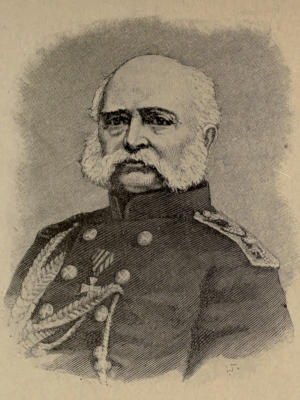
Peter Feodorovitsch Anjou
Ferdinand von Wrangell
From “The Voyage of the Vega,” Macmillan & Co., Ltd., London
CHAPTER III
Early nineteenth century: Ross and Parry, May 3, 1818.—Object
of voyage, search for Northwest Passage through Davis Strait
and explore bays and channels described by Baffin.—Met natives
near Melville Bay.—The discovery by Ross of the famous Crimson
Cliffs.—Enters Lancaster Sound.—Advance barred by imaginary
Crocker Mountains.—Return of expedition to England.—Buchan
and Franklin North Polar expedition via Greenland and
Spitzbergen.—Dorothea and Trent in Magdalena Bay, June 3,
1818.—Reached high latitude of 80° 37´ N.—Course directed
to east coast of Greenland.—Disastrous battle with the ice.—Dorothea
disabled.—Hasty return to England.
As a result of the many disastrous voyages to the Arctic,
there was a long period of inactivity in polar research, which
continued for the first sixteen years of the nineteenth century.
Interest was revived, however, by the astounding report
that ice which had cut off the Danish colonies from communication
with their native country for centuries, had suddenly
become free, and that certain Greenland whalers had sailed
to the seventieth and eightieth parallel.
ROSS AND PARRY
The British Admiralty in conjunction with the Council of
the Royal Society decided to fit out two expeditions: One
under Captain John Ross and Lieutenant Edward Parry,
whose object was to force a northwest passage through Davis
Strait and to explore the bays and channels described by
Baffin at the head of the immense bay that bears his name.
The second expedition under Buchan and Franklin was to
direct its course by way of Greenland and Spitzbergen
in search of the Pole, and make its way through Behring
Strait out to the Pacific.
The four ships were the best equipped for Arctic research
that had ever been sent out from England, and the commanders
were instructed to collect all possible information that
would promote scientific knowledge in natural history, geology,
meteorology, and astronomy as to the special phenomena
existing in high northern latitudes.
On the 3d of May, 1818, the two expeditions parted
company in Brassa Sound, Shetland, and sailed for their
respective destinations. The Isabella and Alexander, under
the command of Ross and Parry, reached Wygat Sound on
the 17th of June, where they were detained by the ice in
company with forty-five whalers, until the 20th. They made
observations from the shore of Wygat Island, which they
found to be misplaced on the maps by no less than five degrees.
By warping and towing they made slow progress, narrowly
missing destruction by the pressure of huge ice-floes, but
finally making the open water. High mountains were descried
on the north side of this bay called by Ross, Melville
Bay, the precipices varying in height from one thousand
to two thousand feet.
An Eskimo, John Sacheuse, who acted as interpreter to
the expedition, went ashore and brought back with him a
dozen or more natives, who were much entertained by the
hospitality provided for them by the ship’s company. After
partaking of tea and biscuits, a dance was held on the deck,
and of this Captain Ross gives an amusing description:—
“Sacheuse’s mirth and joy exceeded all bounds: and with
a good-humored officiousness, justified by the important
distinction which his superior knowledge now gave him, he
performed the office of master of ceremonies. An Eskimo
M.C. to a ball on the deck of one of H. M. Ships in the icy
seas of Greenland, was an office somewhat new, but Nash
himself could not have performed his functions in a manner
more appropriate. It did not belong even to Nash to combine
in his own person, like Jack, the discordant qualifications
of seaman, interpreter, draughtsman, and master of ceremonies
to a ball, with those of an active fisher of seals and a
hunter of white bears. A daughter of the Danish resident,
(by an Eskimo woman,) about eighteen years of age, and
by far the best looking of the half-caste group, was the object
of Jack’s particular attentions; which being observed
by one of our officers, he gave him a lady’s shawl, ornamented
with spangles, as an offering for her acceptance. He presented
it in a most respectful and not ungraceful manner to
the damsel, who bashfully took a pewter ring from her finger
and gave it to him in return, rewarding him, at the same time,
with an eloquent smile, which could leave no doubt on our
Eskimo’s mind that he had made an impression on her
heart.”
Near Cape Dudley Digges a curious condition of the ice
was noted by Captain Ross as follows:—
“We have discovered that the snow on the face of the
cliffs presents an appearance both novel and interesting,
being apparently stained or covered by some substance which
gave it a deep crimson color. This snow was penetrated in
many places to a depth of ten or twelve feet by the coloring
matter.”
Passing Smith and Jones Sound, Ross reached the entrance
of Lancaster Sound by the last of August. “On the
31st,” he writes, “we discovered, for the first time, that the
land extended from the south two-thirds across this apparent
Strait, obscured its real figure. During the day much interest
was excited on board by the appearance of the Strait. The
general opinion, however, was that it was only an inlet. The
land was partially seen extending across; the yellow sky
was perceptible. At a little before four o’clock A.M., the land
was seen at the bottom of the inlet by the officers of the watch,
but before I got on deck a space of about seven degrees of the
compass was obscured by the fog. The land which I then saw
was a high ridge of mountains extending directly across the
bottom of the inlet. This chain appeared extremely high in
the centre. Although a passage in this direction appeared
hopeless, I determined to explore it completely. I therefore
continued all sail. Mr. Beverly, the surgeon, who was the
most sanguine, went up to the crow’s nest, and at twelve
reported to me that before it became thick he had seen the
land across the bay, except for a very short space. At three, I
went on deck; it completely cleared for ten minutes, when
I distinctly saw land around the bottom of the bay, forming
a chain of mountains connected with those which extended
along the north and south side. This land appeared to be
at the distance of eight leagues, and Mr. Lewis, the master,
and James Haig, leading man, being sent for, they took its
bearings, which were inserted in the log. At this moment
I also saw a continuity of ice at the distance of seven miles,
extending from one side of the bay to the other, between the
nearest cape to the north, which I named after Sir George
Warrenden, and that to the south, which was named after Viscount
Castlereagh. The mountains, which occupied the
centre, in a north and south direction, were named Crocker’s
Mountains, after the Secretary to the Admiralty.”
The much-disputed “Crocker Mountains” brought the
navigator ridicule and discredit upon his return to England.
The return was decided upon on October 1, that date being
the limit to which his instructions permitted Captain Ross
to remain in northern latitudes.
Captain John Ross, R.N.
Although the extraordinary blunder cost Captain Ross
reputation and the confidence of his friends, he had nevertheless
rendered valuable addition to Arctic knowledge; his
scientific observations had been unremitting and accurate.
He had mapped the west coast of Davis Strait, had advanced
through Baffin Bay, thereby proving the claims of that famous
old mariner, and had been the first to meet the Eskimos
of the far north, who were to render such valuable assistance
to future explorers.
The progress of the Dorothea and the Trent under the respective
commands of Captain David Buchan and Lieutenant-Commander
John Franklin (later Sir John Franklin)
was delayed by fog and storm until they sighted Cherie Island,
latitude 74° 33´ N., and longitude 17° 40´ E., famous for its
herds of walruses from which the Muscovy Company had
derived much profit by sending ships to the island for oil, the
crew capturing as many as a thousand animals in the course
of six or seven hours.
The ships now encountered small floes and huge masses of
ice, which augmented the difficulties of progress, and this
Lieutenant Beechey, the clever artist and interesting narrator
of the voyage, describes as follows:—
“There was, besides, on the occasion an additional motive
for remaining up; very few of us had ever seen the sun at
midnight, and this night happening to be particularly distorted
by refraction, and sweeping majestically along the
northern horizon, it was the object of imposing grandeur,
which riveted to the deck some of our crew, who would perhaps
have beheld with indifference the less imposing effect of
the icebergs; or it might have been a combination of both
these phenomena; for it cannot be denied that the novelty occasioned
by the floating masses was materially heightened by
the singular effect produced by the very low altitude at which
the sun cast his fiery beams over the icy surface of the sea.
“The rays were too oblique to illuminate more than the
inequalities of the floes, and falling thus partially on the
grotesque shapes, either really assumed by the ice or distorted
by the unequal refraction of the atmosphere, so betrayed
the imagination that it required no great exertion of
fancy to trace in various directions architectural edifices,
grottos, and caves here and there glittering as if with precious
metals. So generally, indeed, was the deception admitted,
that, in directing the route of the vessel from aloft,
we for a while deviated from our nautical phraseology, and
shaped our course for a church, a tower, a bridge, or some
similar structure, instead of for humps of ice, which were
usually designated by less elegant appellations.
“After sighting the southern promontory of Spitzbergen,
the two ships were parted in a severe gale. The snow fell
in heavy showers, and several tons’ weight of ice accumulated
about the sides of the brig (the Trent) and formed a
complete casing to the planks, which secured an additional
layer at each plunge of the vessel. So great, indeed, was the
accumulation about the bows, that we were obliged to cut
it away repeatedly with axes to relieve the bow-sprit from
the enormous weight that was attached to it, and the ropes
were so thickly covered with ice, that it was necessary to beat
them with large sticks to keep them in a state of readiness
for any evolution that might be rendered necessary, either
by the appearance of ice, to leeward or by a change of wind.”
By the 3d of June the ships were reunited in Magdalena
Bay. Surrounding this harbour of refuge are high mountains
rising precipitously about three thousand feet high,
the deep valleys filled with immense beds of snow. The
temperature is particularly mild on the western coast of
Spitzbergen, and in consequence there is a luxury of Alpine
plants, grasses, and lichens, also of animal life, reindeer,
and flocks of birds, such as the auk, willock, gulls, cormorants,
also walruses and seals.
There are numerous glaciers from which huge pieces would
occasionally break away. Mr. Beechey describes in a most
interesting way the fall of one of these extraordinary masses
of ice:—
BUCHAN AND FRANKLIN
“The first was occasioned by the discharge of a musket at
about half a mile’s distance from the glacier. Immediately
after the report of the gun, a noise resembling thunder was
heard in the direction of the iceberg (glacier) and in a few
seconds more an immense piece broke away, and fell headlong
into the sea. The crew of the launch, supposing themselves
beyond the reach of its influence, quietly looked upon
the scene, when presently a sea arose and rolled toward the
shore with such rapidity, that the crew had not time to take
any precautions, and the boat was in consequence washed
upon the beach, and completely filled by the succeeding wave.
As soon as their astonishment had subsided, they examined
the boat, and found her so badly stove that it became necessary
to repair her in order to return to the ship. They had
also the curiosity to measure the distance the boat had been
carried by the wave, and found it to be ninety-six feet.”
Describing a second avalanche he writes:—
“This occurred on a remarkably fine day, when the quietness
of the bay was first interrupted by the noise of the falling
body. Lieutenant Franklin and myself had approached
one of these stupendous walls of ice, and were endeavoring
to search into the innermost recess of a deep cavern that was
near the foot of the glacier, when we heard a report as if of
a cannon, and, turning to the quarter whence it proceeded,
we perceived an immense piece of the front of the berg sliding
down from the height of two hundred feet at least into
the sea, and dispersing the water in every direction, accompanied
by a loud, grinding noise, and followed by a quantity
of water which being previously lodged in the fissures now
made its escape in numberless small cataracts over the front
of the glacier.”
So great was the disturbance of the waters by this great
falling mass that the Dorothea was seen to be careening at
a distance of four miles. After it became somewhat settled,
they approached it and found it to be nearly a quarter of a
mile in circumference. “Knowing its specific gravity and
making fair allowance for its inequalities, its weight was computed
at 421,660 tons.”
The ships left Magdalena Bay, June 7, and made their slow
way through brash ice which became thicker and more impenetrable
until a fortunate breeze dispersed it. Sailing in a
westerly direction, they encountered several whale-ships, which
reported others beset by the ice in that direction. Captain
Buchan changed his course and stood to the northward, passing
Cloven Cliff, an isolated rock, marking the northwestern
boundary of Spitzbergen. Near Red Bay they were stopped
by the ice, and the channel by which the vessels had entered
became entirely closed. The ships were here hemmed in, in
almost the same position where Baffin, Hudson, Poole, Captain
Phipps, and all the early voyagers to this quarter
had been stopped. Of their perilous situation, Lieutenant
Beechey writes:—
“The ice soon began to press heavily upon us, and, to add
to our difficulties, we found the water so shallow that the
rocks were plainly discovered under the bottoms of the ships.
It was impossible, however, by any exertion on our part, to
improve the situation of the vessels. They were as firmly
fixed in the ice as if they had formed part of the pack, and
we could only hope that the current would not drift them into
still shallower water, and damage them against the ground.”
It was now found necessary to attach the ships to floes by
ice-anchors, which was done with considerable exertion.
Taking advantage of a break in the ice, they reached Vogel
Sang about June 28, where the crew were fortunate enough
to secure forty reindeer and plenty of eider-ducks.
On the 6th of July, Captain Buchan, finding the ice conditions
favourable, determined to make as far an advance to
the north as possible. By most arduous labours in warping
and tracking, etc., he attained a latitude of 80° 34´ N., but,
though attached to floes, he found himself being carried to
the southward by the current. On the 15th and 16th of July,
both ships suffered considerable ice pressure. The nine days
following, the crew worked night and day to free the ships
and get into open water.
Having given the ice a fair trial and proved it unnavigable,
Buchan turned his attention toward the eastern coast of
Greenland, intending, if it proved impenetrable there, to
round the south cape of Spitzbergen and attempt to make an
advance between that island and Nova Zembla. A terrific
gale struck them the 30th of July, which brought down the
ice upon them and threatened their immediate destruction.
Of this encounter Lieutenant Beechey gives a most vivid
description:—
“In order to avert the effects of this as much as possible,
a cable was cut up into thirty feet lengths, and these, with
plates of iron four feet square, which had been supplied to
us as fenders, together with some walrus hides, were hung
round the vessels, especially about the bows. The masts,
at the same time, were secured with additional ropes, and
the hatches were battened and nailed down. By the time
these precautions had been taken, our approach to the
breakers only left us the alternative of either permitting the
ships to be drifted broadside against the ice, and so to take
their chance, or of endeavoring to force fairly into it by
putting before the wind. At length, the hopeless state of a
vessel placed broadside against so formidable a body became
apparent to all, and we resolved to attempt the latter expedient.”
Beechey, in describing the appalling scene, continues:—
“No language, I am convinced, can convey an adequate
idea of the terrific grandeur of the effect now produced by
the collision of the ice and the tempestuous ocean. The sea,
violently agitated and rolling its mountainous waves against
an opposing body, is at all times a sublime and awful sight;
but when, in addition, it encounters immense masses, which
it has set in motion with a violence equal to its own, its
effect is prodigiously increased. At one moment it bursts
upon these icy fragments and buries them many feet beneath
its wave, and the next, as the buoyancy of the depressed
body struggles for reascendancy, the water rushes in
foaming cataracts over the edges, while every individual mass,
rocking and laboring in its bed, grinds against and contends
with its opponent, until one is either split with the shock or
upheaved upon the surface of the other. Nor is this collision
confined to any particular spot; it is going on as far as the
sight can reach; and when from this convulsive scene below,
the eye is turned to the extraordinary appearance of the
blink in the sky above, where the unnatural clearness of a
calm and silvery atmosphere presents itself, bounded by a dark,
hard line of stormy clouds, such as this moment lowered over
our masts, as if to mark the confines within which the efforts
of man would be of no avail, the reader may imagine the sensation
of awe which must accompany that of grandeur in the
mind of the beholder.” And he continues: “If ever that
fortitude of seamen was fairly tried, it was assuredly not
less so on this occasion; and I will not conceal the pride I felt
in witnessing the bold and decisive tone in which the orders
were issued by the commander (the present Captain Sir John
Franklin) of our little vessel, and the promptitude and
steadiness with which they were executed by the crew.”
As the vessel rapidly approached the dangerous wall of
ice, each person instinctively secured his own hold, and, with
his eyes fixed upon the masts, awaited in breathless anxiety
the moment of concussion. “It soon arrived; the brig
(Trent), cutting her way through the light ice, came in violent
contact with the main body. In an instant we all lost our
footing; the masts bent with the impetus, and the cracking
timbers from below bespoke a pressure which was calculated
to awaken our serious apprehensions. The vessel staggered
under the shock, and for a moment seemed to recoil; but
the next wave, curling up under her counter, drove her
about her own length within the margin of the ice, where
she gave one roll, and was immediately thrown broadside
to the wind by the succeeding wave, which beat furiously
against her stern, and brought her lee side in contact with
the main body, leaving her weather side exposed at the same
time to a piece of ice about twice her own dimensions. This
unfortunate occurrence prevented the vessel penetrating sufficiently
far into the ice to escape the effect of the gale, and
placed her in a situation where she was assailed on all sides
by battering-rams, if I may use the expression, every one of
which contested the small space which she occupied, and
dealt such unrelenting blows, that there appeared to be
scarcely any possibility of saving her from foundering.
Literally tossed from piece to piece, we had nothing left but
patiently abide the issue; for we could scarcely keep our
feet, much less render any assistance to the vessel. The
motion, indeed, was so great, that the ship’s bell, which, in
the heaviest gale of wind, had never struck of itself, now
tolled so continually, that it was ordered to be muffled, for
the purpose of escaping the unpleasant association it was
calculated to produce.
“In anticipation of the worst, we determined to attempt
placing the launch upon the ice under the lee, and hurried
into her such provisions and stores as could at the moment
be got at. Serious doubts were reasonably entertained
of the boat being able to live among the confused mass by
which we were encompassed; yet as this appeared to be our
only refuge, we clung to it with all the eagerness of a last
resource.”
It was only too evident that she could not long survive the
critical position in which she was placed and that the only
salvation lay in penetrating still farther into the ice. To
this end, more sail was spread, and, with the added power,
she righted herself, split a small field of ice, fourteen feet in
thickness, and effected a passage for herself between the
pieces. On the gale abating, both ships reached the open sea,
but were greatly disabled, the Dorothea in a foundering condition.
In this useless state they made for Fair Haven,
in Spitzbergen, where they underwent necessary repairs.
Lieutenant Franklin urgently requested to be allowed to
return to the interesting quest which they had been obliged
to abandon, but this being impossible, owing to the shattered
condition of the ships, the expedition put to sea the end of
August and reached England about the middle of October,
1818.
CHAPTER IV
1819-1827: Parry’s first voyage.—Object, to survey Lancaster
Sound and prove the non-existence of Crocker Mountains.—Discovery
of new lands.—Parry Islands.—Attains longitude
110° W., thereby winning the bounty of five thousand pounds
offered by Parliament.—Winters near Melville Island.—Second
voyage.—Ships Hecla and Fury.—Examines Duke of York Bay
and Frozen Strait of Middleton.—Winters off Lyon Inlet.—Sledge
journeys.—Object, to make Northwest Passage via Prince
Regent Inlet.—Reached Port Bowen.—Ten months’ imprisonment.—Destruction
of the Fury.—Hasty return to England.
Fourth voyage.—Purpose to reach the Pole via Spitzbergen
with sledge boats over ice.—Hecla as transport.—Parry’s
farthest, 82° 45´ N., reached June 23, 1827.
PARRY’S FIRST VOYAGE
The principal object of Lieutenant W. E. Parry’s first
voyage under the direction of the British Admiralty was
to pursue the survey of Lancaster Sound, so abruptly discontinued
by Captain Ross the previous year, and decide
the probability of a northwest passage in that direction, thus
settling the much-disputed question of the existence of the
“Crocker Mountains,” which Parry, who had accompanied
Ross, declared from the first to have been an ocular illusion.
Should Lancaster Sound not prove navigable, Smith and
Jones sounds were to be explored.
The Hecla, 375 tons, and the Griper, 180 tons, were strengthened
and provisioned for two years. Sailing from the
Thames May 11, 1819, they reached Davis Strait the last
week in June, and here experienced a good deal of annoyance
from ice, through which they made a slow and difficult
passage by heaving and warping, reaching Possession Bay
a month later. Upon landing the men were not a little surprised
to see their own footprints of the previous year; a fox,
a raven, some ring flowers, and snow-buntings were seen,
also a bee. Tufts and ground plants grew in considerable
abundance wherever there was moisture.
Proceeding on their voyage, they reached, by August 4,
longitude 86° 56´ W., three degrees to the westward of
where land had been laid down by Captain Ross. Passing
through Barrow Strait, they found ice to such an extent
north of Leopold Island that Parry determined to shape his
course to the southward and explore the beautiful sheet of
water to which he gave the name of Regent Inlet.
The compass now became useless, owing to the local attraction,
and the binnacles were discarded. Having penetrated
one hundred and twenty miles and having given the
farthest point of land the name of Cape Kater, it was found
necessary to return to the southward or be caught in the ice.
Skirting the north shore of Barrow Strait, they later passed
two large openings, to the first of which Parry gave the
name of Wellington Channel, also naming various capes
and inlets, as he passed them, Batham, Barlow, Cornwallis,
Bowen, Byam Martin, Griffith, Lowther, Bathurst, and others.
Navigation now became extremely difficult, owing to
thick fogs, but notwithstanding many obstacles they reached
the coast of an island larger than any yet discovered, which
they called Melville Island, and by the 4th of September
Lieutenant Parry was able to make the joyful announcement
to his crew that, having passed longitude 110° W., they
were entitled to the reward of five thousand pounds promised
by Parliament to the first ship’s company which should reach
that meridian.
To celebrate their success, they gave the name of Cape
Bounty to the farthest neck of land sighted in the distance.
Every effort was now made to push forward in the hope of
reaching longitude 130° W., thereby securing the second reward
held out by the government. They had progressed
but a short distance when, to their great disappointment,
farther advance became impossible by reason of an impenetrable
barrier of ice.
The approach of winter decided Lieutenant Parry to seek
the shelter near Melville Island and there prepare for the
long winter months.
To the group of islands in the vicinity of which he had taken
refuge, he gave the name of Georgian Islands, in honour of
His Majesty, King George III, but later the name was
changed to Parry Islands.
Knowing well that good spirits meant good health in the
tedious winter months, Lieutenant Parry established a school
for his men, as well as the diversion of a newspaper, and the
ship’s crew acted several plays, which were most enthusiastically
received. In spite of enforced exercise and other methods
for keeping in good physical condition, scurvy showed
itself among the crew, and such antiscorbutics as lemon juice,
pickles, mustard, cress, and spruce-beer were put into requisition.
Later, snow-blindness afflicted some of the men, but
was relieved by washes and the wearing of black crape before
the eyes.
As the spring approached, the ships were made ready for
the first opportunity to escape from the ice, which, however,
remained impenetrable.
On the 1st of June an excursion was made across Melville
Island by Lieutenant Parry and others, carrying provisions
for three weeks. They found such parts of the ground as
were free from snow covered with dwarf willow, sorrel, and
poppy, also moss and saxifrage. A few ducks and ptarmigan
were killed. Upon his return to the ship the middle of
June, Captain Parry ordered his men to make daily excursions
after sorrel, which they procured in large quantities and
greatly enjoyed. On the western side of the island at Bushman’s
Cove, in Liddon’s Gulf, they found “one of the pleasantest
and most habitable spots we had yet seen in the Arctic
regions, the vegetation being more abundant and forward
than in any other place, and the situation sheltered and favorable
for game.”
Though channels and pools were everywhere forming, it
was not until the second of August that the great mass of ice
broke up and floated out. The ship now made for the open
water, but after a short advance, in spite of every effort, they
found themselves once more prevented by the impenetrable
barrier of ice from making their way westward. There seemed
no alternative but a return homeward, and after taking
certain additional observations of the two coasts extending
along Barrow Strait, they set sail for England.
A warm welcome awaited the daring navigators, who had
reached a longitude greater by more than 30° than any other
explorer; who had discovered many new lands, islands, and
bays; had established the fact of a polar sea north of America;
and had wintered successfully in the Arctic, bringing back his
crew in good condition.
PARRY’S SECOND VOYAGE
Parry’s unprecedented success and the enthusiasm for
Arctic exploration throughout England decided the British
Admiralty to send out a second expedition to attempt a
passage in a lower latitude than that of Melville Island.
The Hecla and the Fury were manned and provisioned and
put under the command of Captain Parry and Lieutenant
Lyon, whose travels in Tripoli, Mourzouk, and other parts of
northern Africa had already brought him consideration and
some degree of renown. The transport Nautilus was to
accompany the ships as far as the ice, and transship extra
provisions and stock as soon as room could be found for them.
The ships sailed from the Nore on the 8th of May, 1821,
and by the 2d of July were at the mouth of Hudson
Strait, having parted with the Nautilus the previous day.
Icebergs in formidable numbers had already been encountered,
and the desolate condition of the shores, the naked rocks, the
snow-covered valleys, and the thick fogs encountered were
anything but encouraging.
Progress was now made through very heavy floes, and between
strong currents, eddies, and icebergs they were menaced
by serious danger for more than ten days. While embayed
in the ice, they sighted near Resolution Island three strange
ships also fast in the ice. These they later managed to join,
and found them to be Hudson Bay Company’s traders, the
Prince of Wales, the Eddystone, and the Lord Wellington, chartered
to convey one hundred and sixty emigrants, who intended
settling on Lord Selkirk’s estate at the Red River. Of these
people Lieutenant Lyon writes an interesting account:—
“While nearing these vessels, we observed the settlers
waltzing on deck for above two hours, the men in old-fashioned
gray jackets, and the women wearing long-eared mob
caps, like those used by Swiss peasants. As we were surrounded
by ice, and the thermometer was at the freezing
point, it may be supposed that this ball al vero fresco afforded
us much amusement.”
Some days later they fell in with some Eskimos, who came
out to the ships, the men in their kayaks, the women in
their special “oomiaks.” The natives boarded the ships
and, says Captain Lyon:—
“It is quite out of my power to describe the shouts,
yells, and laughter of the savages, or the confusion which
existed for two or three hours. The females were at first very
shy, and unwilling to come on the ice, but bartered everything
from their boats. This timidity, however, soon wore
off, and they, in the end, became as noisy and boisterous as
the men.”
“The strangers were so well pleased in our society,” continues
Captain Lyon, “that they showed no wish to leave us,
and when the market had quite ceased, they began dancing
and playing with our people, on the ice alongside.
“In order to amuse our new acquaintances as much as
possible, the fiddler was sent on the ice, where he instantly
found a most delightful set of dancers, of whom some of the
women kept pretty good time. Their only figure consisted
in stamping and jumping with all their might. Our musician,
who was a lively fellow, soon caught the infection, and
began cutting capers also. In a short time every one on the
floe, officers, men, and savages, were dancing together, and
exhibited one of the most extraordinary sights I ever witnessed.
One of our seamen, of a fresh, ruddy complexion,
excited the admiration of all the young females, who patted
his face and danced round him wherever he went. The exertion
of dancing so exhilarated the Eskimos, that they had
the appearance of being boisterously drunk, and played many
extraordinary pranks. Among others, it was a favorite joke
to run slyly behind the seamen, and shouting loudly in one
ear, to give them at the same time a very smart slap on the
other. While looking on, I was sharply saluted in this
manner, and, of course, was quite startled, to the great amusement
of the bystanders. Our cook, who was a most active
and unwearied jumper, became so great a favorite, that every
one boxed his ears so soundly as to oblige the poor man to
retire from such boisterous marks of approbation. Among
other sports, some of the Eskimos, rather roughly but with
great good humor, challenged our people to wrestle. One
man in particular, who had thrown several of his countrymen,
attacked an officer of a very strong make, but the poor savage
was instantly thrown, with no very easy fall; yet, although
every one was laughing at him, he bore it with exemplary
good humor. The same officer afforded us much diversion
by teaching a large party of women to bow, courtesy, shake
hands, turn their toes out, and perform other polite accomplishments;
the whole party, master and pupils, presenting
the strictest gravity.
“Toward midnight all our men, except the watch on deck,
turned into their beds, and the fatigued and hungry Eskimos
returned to their boats to take their supper, which consisted
of lumps of raw flesh, and blubber of seals, birds, entrails,
etc.; licking their fingers with great zest, and with knives
or fingers scraping the blood and grease which ran down their
chins into their mouths.”
FROZEN STRAIT OF MIDDLETON
Parry made an examination of Duke of York Bay, and the
20th of August reached the Frozen Strait of Middleton. Two
days later the Hecla and Fury got well into Repulse Bay, and
a careful examination of the shores was made by parties of
officers and men in boats. By the 31st of August they reached
Gore Bay, which was packed with ice. Encountering thick
fogs, northerly winds, and heavy ice-floes, they found that in
spite of every exertion they were being carried back to the
spot in Fox Channel from which they had started some days
before. However, they later made some advance and
anchored near Lyon Inlet.
Early in October the sludge, or young ice, began to form, a
warning of approaching winter, to be followed shortly by the
pancake ice and bay ice, which necessitated finding at once
winter quarters for the ships. The southeast extremity of an
island off Lyon Inlet was selected, and called Winter Island,
and the monotonous winter closed in upon them shortly after.
TEN MONTHS’ IMPRISONMENT
The usual theatrical diversions were provided for the
entertainment of the crew, and the “Rivals” was presented as
well as another successful play. The crew took kindly to
a school established by the officers and to other forms of
mental and physical activity designed to keep the expedition
in good health and spirits. Christmas was celebrated with
especial good cheer, and English roast beef, which had been
kept by being frozen, was served, as well as cranberry pies
and plum puddings. The effect of the intense cold upon certain
of their stores is interesting:—
“Wine froze in the bottles. Port was congealed into thin
pink laminæ, which lay loosely, and occupied the whole
length of the bottle. White wine, on the contrary, froze into
a solid and perfectly transparent mass, resembling amber.”
On the 15th of March, a party under Captain Lyon started
out to explore the land near the ships; they were provisioned
for three or four days, but their experience was most unfortunate.
The cold was intense, their tents at night affording
little protection against the frightfully low temperature.
They spent some time digging out a snow hut, which they
hoped would prove warmer, but this was hardly more satisfactory.
The following morning they found themselves
almost buried with snow which had drifted at night during
a fierce gale which now raged. All paraphernalia, sledges,
etc., were completely buried. To remain where they were
was as impracticable as to move on. Carrying with them a
few pounds of bread, some rum, and a spade, the party set
out in the hope of reaching the ships. Captain Lyon records
their sufferings as follows:—
“Not knowing where to go, we wandered among heavy
hummocks of ice, and suffering from cold, fatigue, and anxiety,
were soon completely bewildered. Several of our party
now began to exhibit symptoms of that horrid kind of insensibility
which is the prelude of sleep. They all professed
extreme willingness to do what they were told in order to keep
in exercise, but none obeyed; on the contrary, they reeled
about like drunken men. The faces of several were severely
frost bitten, and some had for a considerable time lost sensation
in their fingers and toes; yet they made not the slightest
exertion to rub the parts affected, and even discontinued
their general custom of warning each other on observing a
discoloration of the skin. Mr. Palmer employed the people
in building a snow wall, ostensibly as a shelter from the wind,
but in fact to give them exercise when standing still must
have proved fatal to men in our circumstances. My attention
was exclusively directed to Sergeant Speckman, who,
having been repeatedly warned that his nose was frozen, had
paid no attention to it, owing to the state of stupefaction into
which he had fallen. The frost bite now extended over one
side of his face, which was frozen as hard as a mask; the eyelids
were stiff and one corner of the upper lip so drawn up as
to expose the teeth and gums. My hands being still warm, I
had happiness in restoring circulation, after which I used all
my endeavors to keep the poor fellow in motion; but he complained
sadly of giddiness and dimness of sight, and was so
weak as to be unable to walk without assistance. His case
was so alarming that I expected every moment he would lie
down never to rise again.
“Our prospect now became every moment more gloomy, and
it was but too probable that four of our party would be unable
to survive another hour. Mr. Palmer, however, endeavored,
as well as myself, to cheer the people up, but it was a faint
attempt, as we had not a single hope to give them. Every
piece of ice, or even of small rock or stone, was now supposed
to be the ships, and we had great difficulty in preventing the
men from running to the different objects which attracted
them, and consequently losing themselves in the drift. In
this state, while Mr. Palmer was running round us to warm
himself, he suddenly pitched on a new beaten track, and as
exercise was indispensable, we determined on following it,
wherever it might lead us. Having taken the Sergeant under
my coat, he recovered a little, and we moved onward, when
to our infinite joy we found that the path led to the ships.”
It was not until the 2d of July that the ships, free from
ice for the first time in 267 days, put to sea, but not without
danger of squeezes from the moving ice-floes which frequently
threatened the destruction of the ship. Pushing to the northward,
they entertained high hopes of making the looked-for
passage to the Polar Sea, but unfortunately a formidable line
of impenetrable ice barred the way and determined Parry to
make an expedition along the frozen surface of the strait in
which they found themselves.
For four days Parry, accompanied by a party of six, made a
laborious and fatiguing advance over the uneven hummocks
of ice that confronted them. At times open water made the
journey still more perilous. Their exertions were at last
repaid when they came in view of a bold cape, where they
found the strait at its narrowest part about two miles across.
To the westward the land receded until it became invisible,
and Captain Parry beheld the great Polar Sea, into which he
had long hoped to force his way. Naming this the Fury and
Hecla Strait, he made ready for the return to the ships.
Taking advantage of every favourable condition, Captain
Parry now made as rapid progress toward his goal as the ice
would permit. Under full sail they pushed into the rotten
ice that formed the barrier to the open water, but suddenly
they became fixed,—not another yard could be gained. It
was now found necessary to extricate the vessels and seek
shelter for another long winter. On the 30th of October, by
the usual operation of sawing, the ships were drawn into the
harbour of Igloolik, and made ready for the winter, which was
now rapidly closing.
Excursions were occasionally made with dogs and sledges
bought of the Eskimos, but the season settled down with
unusual severity and the second long winter’s night proved
much more trying than the first. Death and scurvy made
their lamentable appearance, and although Captain Parry
desired to make another effort the following year by transferring
to the Fury all provisions that could be spared, and sending
the Hecla home with the sick, this project was abandoned,
and on the 9th of August they turned their faces homeward.
They touched at Winter Island and found radishes, mustard,
cress, and onions that they had planted the previous
year still alive. The ships were drifted about in a stormy sea
at the mercy of ice-floes and adverse currents. Not until
September 23 did they get free into the Atlantic; and, the
10th of October, 1823, reached Lerwick, Scotland.
DESTRUCTION OF THE FURY
This expedition having proved the impracticability of
a passage through the western extremity of Melville Island or
by way of Fury and Hecla Strait, it was hoped that a passage
might be accomplished through Prince Regent Inlet. For
this purpose, Captain Parry was again fitted out in the Hecla
and in the accidental absence of Captain Lyon, Lieutenant
Hoppner was put in command of the Fury. The expedition
sailed from Northfleet on the 19th of May, 1824, and entered
Davis Strait about the middle of June. Lancaster Sound
was not reached until September 10, and Port Bowen was
made their winter quarters. After ten months’ imprisonment,
the ships were once more free, but, later overtaken by
gales, both ships sustained serious damage. Drift ice caught
them and threatened immediate destruction. The Fury was
thrown on shore and seriously damaged. Later it was found
necessary to abandon her. The Hecla, now overcrowded by
the provisions and crew of the Fury, could no longer pursue
her course and was forced to return to England. Bitter as was
his disappointment, Parry clung to the idea that a northwest
passage would some day be accomplished, and to this end he
wrote:—
“I feel confident that the undertaking, if it be deemed advisable
at any future time to pursue it, will one day or other
be accomplished; for setting aside the accidents to which,
from their very nature, such attempts must be liable, as well
as other unfavorable circumstances which human foresight
can never guard against, or human power control, I cannot
but believe it to be an enterprise of practicability. It may
be tried often and fail, for several favorable and fortunate
circumstances must be combined for its accomplishment: but
I believe, nevertheless, that it will ultimately be accomplished.”
“I am much mistaken, indeed,” he continues, “if the Northwest
Passage ever becomes the business of a single summer;
nay, I believe that nothing but a concurrence of very favorable
circumstances is likely ever to make a single winter in
the ice sufficient for its accomplishment. But there is no
argument against the possibility of final success; for we
know that a winter in the ice may be passed not only in safety,
but in health and comfort.”
PARRY’S FOURTH VOYAGE
“I in April, 1826,” writes Captain Parry, “proposed to the
Right Honorable Viscount Melville, the first lord commissioner
of the Admiralty, to attempt to reach the North Pole
by means of travelling with sledge-boats over the ice, or
through any spaces of open water that might occur. My
proposal was soon afterward referred to the president and
council of the Royal Society, who strongly recommended
its adoption; and an expedition being accordingly directed
to be equipped for this purpose, I had the honour of being
appointed to the command of it; and my commission for his
majesty’s ship the Hecla, which was to carry us to Spitzbergen,
was dated the 11th of November, 1826.
Entering Lancaster Sound
“Two boats were constructed at Woolwich, under my superintendence,
after an excellent model suggested by Mr.
Peake, and nearly resembling what are called ‘troop-boats,’
having great flatness of floor, with the extreme breadth carried
well forward and aft, and possessing the utmost buoyancy, as
well as capacity for storage. Their length was twenty feet,
and their extreme breadth seven feet. The timbers were
made of tough ash and hickory, one inch by half an inch
square, and a foot apart, with a ‘half timber’ of smaller size
between each two. On the outside of the frame thus formed
was laid a covering of Mackintosh’s water proof canvas,
the outer part being covered with tar. Over this was placed
a plank for fir, only three-sixteenths of an inch thick; then
a sheet of stout felt; and over all, an oak plank of the same
thickness as the fir; the whole of these being firmly and closely
secured to the timbers by iron screws applied from without.”
“On each side of the keel,” continues Captain Parry, “and
projecting considerably below it, was attached a strong
‘runner’ shod with smooth steel, in the manner of a sledge,
upon which the boat entirely rested while upon the ice.”
Two wheels were also attached, but soon discarded as useless,
owing to the unevenness of the ice.
Two officers and twelve men were selected for each boat’s
crew. The Hecla, acting as transport for the adventure,
sailed March 27, 1827, and made Hakluyt’s Headland by the
13th of May, where she was shortly beset by an ice-floe which
carried her off to the eastward, causing both delay and vexation.
For the safety of the Hecla it was found necessary to
return to Spitzbergen and secure anchorage in a safe harbour.
This Parry accomplished and, finding a convenient recess,
which he named Hecla’s Cove, made ready for the main object
of the expedition.
Having with him seventy-one days’ provisions, consisting
of pemmican, biscuit, cocoa, and rum, with spirit of wine to
be used as fuel, changes of warm clothing, thick fur dresses
for sleeping in, and stout Eskimo boots, he got away June
22, and proceeded in open water some eighty miles, when the
boats came to a trying condition of mixed surface ice and
water, through which it was found necessary alternately to
haul and float them. Owing to the better condition of the
ice, it was deemed best to reverse the usual course of life.
“Travelling by night and sleeping by day,” writes Captain
Parry “so completely inverted the natural order of things
that it was difficult to persuade ourselves of the reality.
Even the officers and myself, who were all furnished with
pocket chronometers, could not always bear in mind at which
part of the twenty-four hours we had arrived; and there were
several of the men who declared, and I believe truly, that they
never knew night from day during the whole excursion.
When we rose in the evening, we commenced our day by
prayers; after which we took off our fur sleeping dresses and
put on clothes for travelling, the former being made of camlet
lined with raccoon skin, and the latter of strong blue cloth.
We made a point always of putting on the same stockings and
boots for travelling in, whether they had been dried during
the day or not, and I believe it was only in five or six instances
at the most that they were not either still wet or hard frozen.
This indeed was of no consequence, beyond the discomfort of
first putting them on in this state, as they were sure to be
thoroughly wet in a quarter of an hour after commencing our
journey; while, on the other hand, it was of vital importance
to keep dry things for sleeping in. Being ‘rigged’ for travelling,
we breakfasted upon warm cocoa and biscuit, and
after stowing the things in boats, and on the sledges, so as to
secure them as much as possible from the wet, we set off on
our day’s journey and usually travelled four, five, or seven
hours, according to circumstances.”
They made very slow progress in spite of their strenuous
exertions, owing to the floes being small, exceedingly rough,
and intersected by lanes of water which could not be crossed
without unloading the boats. Rain added to their discomfort,
causing the ice to form into numberless irregular needle-like
crystals, which proved very trying to the feet. Elevated
hummocks presented themselves, over which it was almost
impossible to draw the boats.
Even by the utmost efforts they could not make an advance
of more than a mile and a half or two miles in five or
six hours. Realizing the unfavourable conditions for reaching
the pole, owing to the advanced season of the year, Parry soon
relinquished that hope and bent his energies to reaching at
best the 83° parallel, if possible. But now to his utter discouragement
it was found that the drifting of the snow fields
was gradually carrying them backward, and that, in spite of
every attempt to advance, they were daily losing ground.
On July 23, they reached their farthest north, 82° 45´.
“At the extreme point of our journey,” says Parry, “our distance
from the Hecla was only one hundred and seventy-two
miles in a S. W. direction. To accomplish this distance, we
had traversed, by our reckoning, two hundred and ninety-two
miles, of which about one hundred were performed by water
previously to our entering the ice. As we travelled by far the
greater part of our distance on the ice three, and not unfrequently
five, times over, we may safely multiply the length of
the road by two and a half; so that our whole distance, on a
very moderate calculation, amounted to five hundred and
eighty geographical, or six hundred and sixty-eight statute
miles, being nearly sufficient to have reached the pole in a
direct line. Up to this period, we had been particularly fortunate
in the preservation of our health.”
Owing to the increased softness of the ice, the return trip
was even more difficult than the advance, the men sinking
to their thighs in the ice slush. By the 11th of August the
joyful sound of the surf breaking against the margin of the
ice was heard, and later the boats were launched into open
water, and in another ten days they rejoined the Hecla, and
soon afterward sailed for England.
Parry’s remarkable voyages, besides reaping a rich harvest
of scientific data, had proved the navigability of Lancaster
Sound, the non-existence of the Crocker Mountains, and that
Prince Regent Inlet opened into Barrow Strait, which in
turn widened into Melville Sound, and thence opened into the
polar ocean. He had added to the map the important
archipelago or Parry Islands, many of which he named and
explored; had outlined the sounds, bays, and inlets through
which he had sailed; discovered Hecla and Fury Strait; and
demonstrated the impracticability of making the northwest
passage by way of Frozen Strait.
CHAPTER V
Nineteenth century, continued: Scoresby and Clavering.—Former
visited Jan Mayen Island in 1817, later visited east coast
of Greenland, discovered Scoresby Sound.—In 1824, Captain
Lyon surveyed Melville Peninsula.—Adjoining straits and shores
of Arctic America.—In 1825, Captain Beechey in the Blossom
sailed through Behring Strait and passed beyond Icy Cape.—Surveyed
the coast as far as Point Barrow, adding 126 miles of
new shore.—Second voyage of Captain John Ross.—Undertaken
in 1829.—Discovers Boothia.—Wintered in Felix Harbor.—Discovery
of North Magnetic Pole by nephew of Captain John
Ross.—Commander James Clark Ross.—Valuable observations.—Sledge
journeys to mainland.—Four years spent in the Arctic.—Perilous
retreat.—Safe return.—Land journey by Captain
Back.—The Great Fish-Back River.—Point Ogle.—Point
Richardson.—Back’s farthest point was 68° 13´ 57´´ north latitude,
94° 58´ 1´´ west longitude. Land journeys of Simpson and
Dease, 1836.—Descend the Mackenzie River to the sea.—Surveyed
west shore between Return Reef and Cape Barrow.—In
1839, they explored shores of Victoria Land as far as Cape Parry.—Crossed
Coronation Gulf.—Descended the Coppermine.—Reached
the Polar Sea.—Overland journey in 1846 by Dr. John
Rae confirmed Captain John Ross’s statement that Boothia was
a peninsula.
The names of Scoresby and Clavering hold their own
special interest in the long list of heroes of the north. A
practical whaleman, of an intelligent and scientific frame of
mind, Scoresby, as early as 1806, had penetrated to within five
hundred geographical miles of the Pole. In 1817 he had made
an excursion to Jan Mayen Island, and later ascended Mitre
Cape, whose summit is estimated at three thousand feet
above the level of the sea. But not until 1822 did his discoveries
reach the greatest importance. In this year, while
searching for better fishing grounds, he fell in with the eastern
coast of Greenland, a shore almost entirely unknown, except
where the Dutch colonies of Old Greenland were supposed
to have been situated. Skirting this bleak and barren
coast, Scoresby named inlets, bays, and capes as he discovered
them, passing Jameson Land and finally reaching
Scoresby Sound.
The coast of Jameson Land seemed especially fertile, and
evidences of rude habitations were seen, but no human beings
discovered. Proceeding northward, still following the
coast-line, he was soon beset with ice, and though he named
other points of land and inlets, he was obliged to return, not
having run across the whales which it was his business to
secure.
Good fortune, however, favoured him, for on the 15th of
August numerous whales appeared round the ship; three
were secured, and the ship now “full-fished” could make a
happy return to England after a most successful year.
The following season, Captain Clavering, commander of
H. M. S. Griper, conveyed a Captain Sabine to Hammerfest
in Norway, where Sabine desired to make certain scientific
observations on the comparative length of the pendulum
as affected by the principle of attraction. Other northern
points were to be touched for similar purposes, and Spitzbergen
and the east coast of Greenland were designated,
the latter point being reached early in August. “He landed
his passenger and the scientific apparatus on two islands
detached from the eastern shore of the continent, which he
called the Pendulum Islands, and of which the outermost
point is marked by a bold headland rising to the height of
three thousand feet.” (“Arctic Adventures,” Sargent.)
While waiting for Captain Sabine, Clavering reconnoitred
the coast, and was more fortunate than Scoresby in running
across some of the natives, who closely resembled those
described by Parry. By the beginning of September, Sabine
having completed his observations, the Griper made her way,
not without difficulty and delays, by way of Drontheim,
back to England.
MELVILLE PENINSULA
In 1824, Captain Lyon, commanding the Griper, was given
the task of the survey of Melville Peninsula, adjoining straits,
and the shore of Arctic America. Overladen and unseaworthy,
the Griper was totally unfit for such an expedition,
and upon reaching Roe Welcome, she was struck by a gale
which threatened the destruction of both the ship and crew.
After being battered around at the mercy of the storm for
three days and nights, in which commander and crew had
taken no rest or sleep, she was finally brought to anchor in a
shallow bay, later designated as God’s Mercy. Here she was
still in imminent danger of being grounded, and there seemed
little hope of her surviving the high seas then running. The
crew were ordered to prepare for the worst, and to this end
each man was commanded to put on his warmer clothing.
Of this scene, Captain Lyon writes:—
“Each, therefore, brought his bag on deck and dressed
himself, and in the fine athletic forms which stood exposed
before me, I did not see one muscle quiver, nor the slightest
sign of alarm. Prayers were read, and they then all sat
down in groups, sheltered from the wash of the sea by whatever
they could find, and some endeavored to obtain a little
sleep. Never, perhaps, was witnessed a finer scene than
on the deck of my little ship, when all hope of life had left
us. Noble as the character of the British sailor is always
allowed to be in cases of danger, yet I did not believe it to be
possible that among forty-one persons, not one repining
word should have been uttered. Each was at peace with
his neighbor and all the world; and I am firmly persuaded
that the resignation which was then shown to the will of the
Almighty, was the means of obtaining His mercy. God was
merciful to us, and the tide, almost miraculously, fell no
lower.”
As soon as the weather conditions permitted, they attempted
to proceed up Melville Channel, but another storm
overtook them, and, after consulting with his officers, it was
decided to turn the crippled ship for home.
Another expedition that set out about this time (1825)
was commanded by Captain Beechey. The Blossom was
directed to round Cape Horn and enter the Arctic by way of
Behring Strait. In describing this great gateway to the
north, Captain Beechey writes:—
“We approached the strait which separates the two great
continents of Asia and America, on one of those beautiful
still nights well known to all who have visited the Arctic
regions, when the sky is without a cloud, and when the midnight
sun, scarcely his own diameter below the horizon,
tinges with a bright hue all the northern circle.
“Our ship, propelled by an increasing breeze, glided
rapidly along a smooth sea, starting from her path flocks of
aquatic birds, whose flight, in the deep silence of the scene,
could be traced by the ear to a great distance.”
To the north of Cape Prince of Wales, they were visited by
Eskimos with whom they bartered and had friendly intercourse.
By the 22d of July, the ship reached Kotzebue
Sound, and after exploring a deep inlet on its northern shore,
which they named Hotham Inlet, they continued their
course to Chamisso Island, where they hoped to fall in with
Sir John Franklin’s expedition, then in the field. Skirting the
coast by Cape Thomson, Point Hope, Cape Lisburn, Cape
Beaufort, and Icy Cape, they began to see evidences of the
approach of winter, and rather than risk being frozen in, they
returned to Kotzebue Sound.
From here Captain Beechey despatched the barge in
charge of his lieutenants to survey the coast. This they successfully
accomplished as far as Point Barrow, a distance
of one hundred and twenty-six miles of new shore.
The last of August, 1827, found the Blossom again at
Chamisso Island, where intercourse was renewed with the
Eskimos. By October, no news having been received of
Franklin, Captain Beechey reluctantly shaped his homeward
course. Not until the following year, October 12, 1828, did
he arrive in England, after an absence of three years and a
half.
ROSS’ SECOND VOYAGE
We now return to Captain John Ross, whose professional
reputation had suffered for ten years, under the cloud of his
early failure. Ever anxious to retrieve his unfortunate mistakes,
he had in vain implored the British Admiralty to send
him once more to the Arctic. Undaunted by their refusal
and indifference, he persevered in his determination, and at
last found a liberal supporter in Felix Booth, a rich distiller,
who contributed seventeen thousand pounds toward the proposed
expedition, Captain Ross adding his own entire fortune,
which was about three thousand pounds more.
A small Liverpool steamer called the Victory, one hundred
and fifty tons, was purchased and provisioned for three years.
Accompanying Captain Ross, as second in command, was
his nephew, James Ross, who had sailed with him on the first
voyage to the Arctic, and had also accompanied Parry on all
his voyages. Setting sail in May, 1829, with the avowed
object of making, if possible, the Northwest Passage by some
opening leading out of Regent Inlet, they neared the Danish
settlement of Holsteinborg, in Greenland, toward the last
of July, where they received a most hospitable welcome from
the governor. Their stores were replenished and certain
other additions made, including six Eskimo dogs, a present
from the governor. Sailing northward, they sighted the imposing
mountains of Disco Island, partially covered with
snow, and later, Hare Island, which they found clear, approaching
latitude 74°, where the Hecla and Fury had been
ice-bound in 1824. No ice whatever was encountered. Not
without emotion, Captain Ross entered Lancaster Sound,
the scene of his early blunder. Now he found scarcely any
trace of ice, and he sailed through the middle of it, passing, on
the 10th of August, Cape York, after which the land turns
southward and, with the opposite coast of North Somerset
(Boothia), forms the broad opening of Prince Regent Inlet.
Some days later they passed the scene of the Fury’s wreck.
They examined the spot, and found that though the hull had
entirely disappeared, the tents and poles were still standing.
The canisters of preserved provisions were in perfect condition,
also the wine, sugar, bread, flour, and, cocoa, and, after replenishing
their own stores, they left a large quantity behind.
By the middle of August they had crossed the mouth of
Cresswell Bay and reached Cape Parry, the farthest point
seen by Parry on his previous voyage, but here they found
difficulty in navigating, owing to the compass being useless by
proximity to the Magnetic Pole. Ice conditions also became
alarming and obliged them to make fast to the drifting floes,
which sometimes carried them forward, but more often backward,
so that considerable time and distance was lost in this
manner. In the few weeks remaining, before the winter
cold held them ice-bound, Captain Ross explored some three
hundred miles of coast land, going as far as Brentwell Bay,
thirty miles beyond Cape Parry. Here Captain Ross went
ashore and formally took possession in the king’s name, calling
this land Boothia.
Wintering in Felix Harbor, the party had several occasions
for intercourse with the Eskimos, from whom they
gathered remarkable information regarding the geography
of the country. This led Captain Ross to send out several
expeditions, hoping to establish the possibility of a passage
through to the west, when the summer should again free
their ships, but after careful inspection it was concluded that
their only hope was to the north. Though the observations
were made from several distant points, and much valuable
information collected, the months rolled by in hopeless succession,
with no apparent prospect of leaving this desolate
spot.
JAMES CLARK ROSS
Not until the 17th of September were the ships free, and
even then they advanced only three miles to find themselves
blocked once more, and a few days later hopelessly frozen in
for another dreary winter. Not until April, 1830, were any
excursions attempted, and in one of these Commander
James Clark Ross had the good fortune to discover the
North Magnetic Pole in latitude 70° 5´ 17´´, longitude 96°
46´ 45´´ W.
“The place of the observatory,” he writes, “was as near
to the Magnetic Pole as the limited means which I possessed
enabled me to determine. The amount of the dip, as indicated
by my dipping-needle, was 89° 59´, being thus within
one minute of the vertical; while the proximity at least of
this pole, if not its actual existence where we stood, was further
confirmed by the action, or rather by the total inaction,
of the several horizontal needles then in my possession.”
“As soon,” continues Commander Ross, “as I had satisfied
my own mind on the subject, I made known to the party
this gratifying result of all our joint labors; and it was then that,
amidst mutual congratulations, we fixed the British flag on the
spot, and took possession of the North Magnetic Pole and its
adjoining territory in the name of Great Britain and King
William IV. We had abundance of materials for building
in the fragments of limestone that covered the beach, and we
therefore erected a cairn of some magnitude, under which we
buried a canister containing a record of the interesting fact,
only regretting that we had not the means of constructing a
pyramid of more importance, and of strength sufficient to
withstand the assaults of time and the Eskimos. Had it
been a pyramid as large as that of Cheops, I am not quite
sure that it would have done more than satisfy our ambition
under the feelings of that exciting day.”
The succeeding summer was hardly more encouraging
than the previous one. Not until the last week in August
were they successful in reaching open water by the laborious
effort of warping and towing, and, after encountering
gales and ice-floes, they were again fast in the ice by the 27th
of September, after a discouraging navigation of only four
miles.
The thought of a third winter in the dreary Arctic had
a most disheartening effect upon the crew. Their only hope
of ultimately extricating themselves from their forlorn situation
was in abandoning the Victory, taking to their boats,
and making their laborious way to the wreck of the Fury,
where, supplying themselves with a fresh stock of provisions,
they could push on to Davis Strait, in the hope of being
picked up by a passing whale-ship. The general health of
the men was showing a decline; scurvy showed itself as early
as November of this trying year.
By April 23, 1832, the first part of the expedition started
on the wearisome journey of some three hundred miles to
Fury Beach. Owing to the weight of the loads, combined
with snow-drifts and ice barriers, it was necessary to go back
and forward and cover the same ground several times; thus
after a month they had travelled three hundred and twenty-nine
miles in this trying and circuitous manner to gain thirty
in a direct line.
THE RETREAT
On the 29th of May, final leave was taken of the Victory,
her colours nailed to the mast, a parting glass drunk in her
honour, and the brave old ship left to her Arctic loneliness.
Not until the first of July did the whole crew reach Fury
Beach, after incredible obstacles had been encountered and
overcome, the slow and laborious advance made more arduous
by the heavy loads they carried.
Immediately, however, they set to work and reared a
canvas shelter, which they called Somerset House. The
following month was spent in fitting out their boats. An
open sea now gave them hope of reaching, through Barrow
Strait, to Baffin Bay. Icebergs and gales proved most disastrous
to their hopes and, after making a heroic attempt,
they found it necessary to return to Fury Beach and spend
their fourth winter in the Arctic.
The winter proved exceedingly severe, and their canvas
shelter quite inadequate to keeping out the cold. However,
matters were improved by a thick snow wall. Sickness, in
the dreaded form of scurvy, caused much uneasiness, and in
February, 1833, one of their number succumbed to the disease.
Their situation had now become alarming, for if they were
not liberated the following summer, there was little chance
of any of their number surviving another year.
As early in the season as it was possible to travel, they set
forth on their life-and-death struggle for safety. Reduced in
strength, many of the men being sick, the laborious process
of advancing their loads was even slower than the preceding
year. However, by the 12th of July, they all reached
their boat station in Batty Bay. Not until August 14 was
a lane of water leading northward discovered, and, embarking
at an early hour the following morning, they pursued their
course with rising spirits. On the evening of the 16th, they
were at the northeastern point of America with the open
sea ahead of them. Icebergs were numerous, but their
courage was gaining every moment, and they took small
note of such obstacles. Passing through Barrow Strait,
they made that day seventy-two miles. Delayed by contrary
winds, they did not reach Navy Board Inlet until the
25th, where they harboured for the night.
Early the following morning, they were aroused from
sleep by the lookout man calling “a sail,” but though they
made every effort to reach this ship, it passed them by unobserved.
At ten o’clock they sighted another vessel which
was becalmed. By hard rowing they reached her and found
her to be the Isabella of Hull, a ship in which Ross had made
his first voyage to those seas. The captain and mate could
hardly believe their eyes when Ross announced that he and
his party were the survivors of the Victory, which had been
given up for lost more than two years previously. Ross describes
the scene on board that followed:—
“The ludicrous soon took the place of all other feelings;
in such a crowd, and such confusion, all serious thought was
impossible, while the new buoyancy of our spirits made us
abundantly willing to be amused by the scene which now
opened. Every man was hungry, and was to be fed; all
were ragged, and were to be clothed; there was not one to
whom washing was not indispensable; nor one whom his
beard did not deprive of all human semblance. All, everything,
too, was to be done at once; it was washing, shaving,
dressing, eating, all intermingled; it was all the materials of
each jumbled together, while in the midst of all there were
interminable questions to be asked and answered on both
sides; the adventures of the Victory, our own escapes, the politics
of England, and the news which was now four years old.
“Night at length brought quiet and serious thoughts, and
I trust there was not a man among us who did not then express,
where it was due, his gratitude for that interposition
which had raised us all from a despair which none could now
forget, and had brought us from the very borders of a most
distant grave, to life and friends and civilization. Long accustomed,
however, to a cold bed on the hard snow or the
bare rocks, few could sleep amid the comfort of our new
accommodations. I was myself compelled to leave the bed
which had been kindly assigned me, and take my abode in
a chair for the night, nor did it fare much better with the
rest. It was for time to reconcile us to this sudden and
violent change, to break through what had become habit, and
inure us once more to the usages of our former days.”
After five years in the Arctic, Captain Ross and his crew
were homeward bound, carrying with them a record unprecedented
in Arctic history. Boothia Felix had been
discovered; the connecting isthmus had been crossed to the
mainland of America and explorations made in the direction
of Franklin Passage, Victoria Strait, and King William
Sound; the Magnetic Pole had been located; and a series of
most valuable observations kept during the entire period.
Previous to his arrival in England, the prolonged absence
of Captain Ross had caused great anxiety to his countrymen,
and, although his expedition had been a private affair in no
way connected with the Admiralty, the government nevertheless
felt it to be a national concern that his fate and that
of the crew should be ascertained if possible.
LAND JOURNEY OF CAPTAIN BACK
Subscriptions were raised to promote a relief expedition,
liberally added to from the public treasury, and an expedition
fitted out in charge of Captain Back, who had volunteered his
services, accompanied by the surgeon and naturalist, Dr.
Richard King. With three men, they left Liverpool, February
17, 1833, on a packet-ship bound for New York, where
they landed after a rough voyage of thirty-five days. From
New York they went to Montreal, where they secured four
more volunteers from the Royal Artillery Corps and some
other assistants, and embarked on the St. Lawrence in two
canoes. Making a brief stop at Sault Ste. Marie, for the
purpose of purchasing a third canoe, they directed their
course to the northern shores of Lake Superior.
On May 20, they arrived at Fort William. By the first
week in June, the canoes reached Fort Alexander at the
southern extremity of Lake Winnipeg. Coasting this lake,
Captain Back made for Norway House, where he secured his
full complement of men, eighteen in all, and they started in
high spirits for Fort Resolution, the eastern shore of the
Great Slave Lake. The chief annoyance experienced on
this long canoe trip was the torment from myriads of sand-flies
and mosquitoes, of which Captain Back writes:—
“How can I possibly give an idea of the torment we endured
from the sand-flies? As we dived into the confined
and suffocating chasms, they rose in clouds, actually darkening
the air; to see or to speak was equally difficult, for
they rushed at every undefended part, and fixed their poisonous
fangs in an instant. Our faces streamed with blood, as
if leeches had been applied, and there was a burning and
irritating pain, followed by immediate inflammation, and
producing giddiness, which almost drove us mad, and caused
us to moan with pain and agony.”
After securing all possible information from the Indians
and others, relative to the course of the northern rivers of
which he was in search, Captain Back divided his party.
Leaving several under the escort of Mr. McLeod, an employee
of the Hudson Bay Company, he proceeded with four men
in search of the Great Fish River, later named after Back
himself.
On August 19, Captain Back began the ascent of the Hoar
Frost River, and made his laborious way through woods,
swamps, cascades, and rapids. From the summit of a high
hill, Back discovered a beautiful lake, studded with islands,
to which he gave the name of Aylmer Lake, after the governor-general
of Canada at that time. Some of his men were despatched
to investigate this lake, and in their absence Back
accidentally discovered the source of the river which they
had ascended, in Sand Hill Lake.
“For this occasion,” he writes, “I had reserved a little
grog, and need hardly say with what cheerfulness it was
shared among the crew, whose welcome tidings had verified
the notion of Dr. Richardson and myself, and thus placed
beyond doubt the existence of the Thleu-ee-choh, or Great
Fish River.”
Moving on, they found it was impossible to navigate Musk-Ox
Lake in their frail canoes, owing to the force of the rapids.
Reaching Clinton Golden Lake, they met with some friendly
Indians. At Cat or Artillery Lake the canoes were abandoned,
and the rest of their return journey was made on foot
over gorges, ravines, and precipitous rocks, where a false
step would have proved fatal.
Upon reaching Fort Reliance, they found Mr. McLeod
had erected the framework of their winter quarters. All
hands immediately turned to, and by the 5th of November
they exchanged their cold tents for the more hospitable abode.
The winter now set in with unusual severity. The unfortunate
Indians of this locality came daily to the camp and
implored food for themselves and their starving families.
“Famine with her gaunt and bony arm,” writes Back, “pursued
them at every turn, withered their energies, and strewed
them lifeless on the cold bosom of the snow.
“It was impossible to afford relief to all, and the poor
creatures would stand round while the men were taking their
meals, watching every mouthful with the most pitiful, imploring
look, but never uttering a word of complaint. Seated
round the fire, they would take bits of their reindeer garments,
roasting these and eagerly devouring them. A few handfuls
of mouldy pemmican intended for the dogs, was received
with gratitude.
“Often,” adds Back, “did I share my own plate with the
children whose helpless state and piteous cries were peculiarly
distressing; compassion for the full-grown may, or
may not, be felt, but that heart must be cased in steel which is
insensible to the cry of a child for food.”
On January 17 the thermometer stood at 70° below zero.
Of this extreme cold Captain Back writes:—
“Such indeed was the abstraction of heat, that with eight
large logs of dry wood on the fire, I could not get the thermometer
higher than 12° below zero. Ink and paint froze,
the sextant cases and boxes of seasoned wood, principally
fir, all split. The skin of the hands became dry, cracked, and
opened into unsightly, smarting gashes, which we were
obliged to anoint with grease. On one occasion after washing
my face within three feet of the fire, my hair was actually
clotted with ice before I had time to dry it.”
Had it not been for the timely assistance of Akaitcho, a
friendly Indian chief who had arrived with a supply of men
and who brought them game, their sufferings might have
had a disastrous ending, but this old brave expressed his sentiments
in the noble words:—
“The great chief trusts us, and it is better that ten Indians
perish than one white man should perish through our negligence
and breach of faith.”
With the approach of spring, Captain Back began preparations
for his intended journey to the sea-coast, but on April 25
a messenger arrived with the welcome news that Captain
Ross and the survivors of the Victory were alive and had
arrived safely in England. Extracts from the Times and
Herald were shown Captain Back to confirm the news.
“In the fulness of our hearts, we assembled and humbly
offered up our thanks to that merciful Providence, which, in
the beautiful language of the Scripture, hath said, ‘Mine
own will I bring again, as I did some time from the deeps of
the sea.’ The thoughts of so wonderful a preservation overpowered
for a time the common occurrences of life. We had
just sat down to breakfast: but our appetite was gone, and the
day was passed in a feverish state of excitement. Seldom,
indeed, did my friend Mr. King or I indulge in a libation, but
on this joyful occasion, economy was forgotten, a treat was
given to the men, and for ourselves the social sympathies
were quenched by a generous bowl of punch.”
The four months spent in the remarkable journey of Captain
Back and his men to the Polar Sea are one continual
recital of hairbreadth escapes in the falls, rapids, and cataracts
of the Thleu-ee-choh, and of the incredible suffering
and hardship bravely endured by all hands. In describing
one of their narrow escapes, where the boat was obliged to be
lightened to shoot the rapids, Captain Back writes:—
“I stood on a high rock, with an anxious heart, to see her
run it. Away they went with the speed of an arrow, and in a
moment, the foam and rocks hid them from view. I heard
what sounded in my ear like a wild shriek; I followed with an
agitation which may be conceived, and to my inexpressible
joy, found that the shriek was the triumphant whoop of the
crew, who had landed safely in a small bay below.”
VICTORIA LAND
On the 29th, while threading their course down the great
river, they saw headlands to the north which gave them the
assurance that the coast was not far distant. To this majestic
promontory, Back gave the name Victoria.
“This then,” he writes, “may be considered as the mouth
of the Thleu-ee-choh, which after a violent and tortuous course
of five hundred and thirty geographical miles, running through
an iron ribbed country, without a single tree on the whole line
of its banks, expanding into five large lakes, with clear horizon
most embarrassing to the navigator, and broken into falls,
cascades, and rapids, to the number of eighty-three in the
whole, pours its water into the Polar Sea, in latitude 67° 11´ N.,
and longitude 94° 30´ W., that is to say, about thirty-seven
miles more south than the mouth of the Coppermine River,
and nineteen miles more south than that of Back’s River, at
the lower extremity of Bathhurst’s Inlet.”
The following days were a succession of incredible hardships,
the result of the damp weather, the barrenness of the coast,
and the soft snow and slush into which the men plunged knee-deep
at every step. No fire could be lighted, and in consequence
they had no means of securing warmth or cooked food;
the men became low-spirited and discouraged. The country
was flat and desolate, an “irregular plain of sand and stones;
and had it not been for a rill of water, the meandering of
which relieved the monotony of the sterile scene, one might
have fancied one’s self in one of the parched plains of the East,
rather than on the shore of the Arctic Sea.”
Making a heroic advance, Back discovered and named
Point Ogle and Point Richardson, caught a sight of Boothia
Felix, and then having reached latitude 68° 13´ 57´´ N., longitude
94° 58´ 1´´ W., he unfurled the British flag and took
formal possession in the name of His Majesty, William IV,
amid the enthusiastic cheers of his comrades. They left the
cold Arctic shores the middle of August, and not until the 17th
of September did they meet Mr. McLeod at Sandy Hill Bay,
according to appointment, and with him reached Fort Reliance
on the 27th.
A second winter was passed in the wilderness of the inhospitable
north, devoted by Back and Dr. King to writing their
journals, mapping their discoveries, and arranging their
scientific data, the crew occupying themselves in hunting and
fishing expeditions.
The last of March, Captain Back, having left instructions
for Dr. King to proceed as soon as the weather would permit
to the company’s factory at Hudson Bay, there to embark
for England in their spring ships, proceeded through Canada,
and by way of New York to England, where he arrived at
Liverpool the 8th of September. Dr. King reached England
a month later.
For this remarkable discovery and voyage down the Great
Fish River, Captain Back received from the Royal Geographical
Society their Royal premium (a gold medal). In
1835 he was knighted, having already had the congratulations
and approbation of His Majesty, the King.
The following year Captain Back made another Arctic
voyage, in command of the ship Terror, up Hudson Strait.
Unfortunately the ship got fast in the ice off Cape Comfort,
and there remained at the mercy of the destructive ice-pack
through a dreary winter until the following July. She had
become so disabled that she was barely equal to crossing the
Atlantic, but the return voyage was fortunately accomplished
in safety.
SIMPSON AND DEASE
In 1836 the Hudson Bay Company, desiring to complete
the survey of their northern territories, especially the coastline
of Arctic America, sent out two of their employees,
Dease and Simpson, with a party of twelve men.
Descending the Mackenzie River to the sea, they surveyed
the westward shore-line between Return Reef and Cape
Barrow. Two large rivers were discovered, the Garry and
Coleville. Though the season was midsummer, the ground
was frozen, and northeasterly winds made progress very
trying.
By the 1st of August, further navigation proved impracticable
and, dividing the party, Simpson, with some of the
men, continued the journey on foot, and Dease remained with
the rest of the crew in charge of the boats. Simpson fell in
with Eskimos, of whom he hired an oomiak, a large canoe, to
aid him as occasion demanded. A few days later he writes:—
“I saw with indescribable emotions Point Barrow stretching
out to the northward and enclosing Elson Bay, near the
bottom of which we were now,” Lieutenant Elson having
been in charge of the Blossom’s barge which reached this
“farthest” in 1826. Upon the return of Simpson the party
took up winter quarters at Great Bear Lake.
The following June they descended the Coppermine, where,
in shooting the rapids, they “had to pull for their lives, to
keep out of the suction of the precipices, along whose base the
breakers raged and foamed, with overwhelming fury. Shortly
before noon, we came in sight of Escape Rapid, of Franklin;
and a glance at the overhanging cliffs told us that there was
no alternative but to run down with full cargo.” “In an
instant,” continues Simpson, “we were in the vortex; and,
before we were aware, my boat was borne toward an isolated
rock, which the boiling surge almost concealed. To clear
it on the outside was no longer possible; our only chance of
safety was to run between it and the lofty eastern cliff. The
word was passed and every breath was hushed. A stream
which dashed down upon us over the brow of the precipice,
more than one hundred feet in height, mingled with the spray
that whirled upwards from the rapid, forming a terrific shower-bath.
The pass was about eight feet wide, and the error of
a single foot on either side would have been instant destruction.
As, guided by Sinclair’s consummate skill, the boat
shot safely through those jaws of death, an involuntary cheer
arose.
“Our next impulse was to turn round to view the fate of
our comrades behind. They had profited by the peril we
incurred, and kept without the treacherous rock in time.”
Hardly had they reached the coast before they were stopped
by the ice, and hopelessly delayed many days. The season
was rapidly advancing, and yet no real work had been accomplished.
On the 20th of August, Simpson and seven men
started on a ten days’ walk to the eastward of Boathaven.
Progress was both difficult and discouraging. On the 23d
they reached an elevated cape, beyond which further progress
was impossible. Of this scene Simpson writes:—
“I ascended the height, from whence a vast and splendid
project burst suddenly upon me. The sea, as if transformed
by enchantment, rolled its free waves at my feet, and beyond
the reach of vision to the eastward. Islands of various shapes
and sizes overspread its surface, and the northern land terminated
to the eye in a bold and lofty cape, bearing east-northeast,
thirty or forty miles distant, while the continental
coast trended away southeast. I stood, in fact, on a remarkable
headland, at the eastern outlet of an ice-obstructed
strait. On the extensive land to the northward, I bestowed
the name of our most gracious sovereign, Queen Victoria.
Its eastern visible extremity I called Cape Pelly, in complement
of the governor of the Hudson Bay Company.”
In 1839, Simpson and Dease made a more successful journey.
The ice conditions being better, they sailed through
the strait that separates Victoria Land from the mainland.
They pushed on to Simpson Strait, which divides Boothia
from the mainland, and later doubled Point Ogle. Upon
reaching Montreal Island in Back’s Estuary, they found
certain provisions left there by Captain Back five years
before. On the 25th of August, 1839, they erected a cairn at
their farthest point near Cape Herschel.
Exploring 150 miles of the shores of Victoria Land as far as
Cape Parry and the Bays of Wellington, Cambridge, and
Byron, they crossed Coronation Gulf and finally reentered the
Coppermine River, after a voyage of more than 1600 miles in
the Polar Sea. For his remarkable achievements, Simpson
was awarded the Founder’s Gold Medal of the Royal Geographical
Society of London.
RAE’S OVERLAND JOURNEY
In 1846, the Hudson Bay Company fitted out another
expedition to be sent into the field for the purpose of surveying
the northeast corner of the American mainland; the
mouth of the Castor and Pollux to the Gulf of Akkolee, so as
to link the discoveries of Dease and Simpson and those of the
second voyages of Ross and Parry.
An employee of the company, Dr. John Rae, was chosen for
this purpose and put in command of twelve men. Dr. Rae
is described as a man of unusual attainments, a surgeon,
astronomer, an able steersman; combining with his abilities
for leadership the accomplishments of a first-rate snow-shoe
walker and dead shot.
After a canoe trip of two months’ duration, the party
arrived at York Factory early in October. Here they passed
the winter, and, as soon as the weather would permit, set sail
in two boats, and skirted the shores of Hudson Bay.
At Fort Churchill they found natives engaged in capturing
white whales, which make their way to these waters. They
secured the services of two Eskimos, father and son, Oolig-buck
by name, who accompanied the expedition as interpreters.
In passing Chesterfield Inlet, they heard the grunting and
bellowing of walruses, “making a noise,” says Rae, “which I
fancy would much resemble a concert of old boars and buffaloes.”
At Republic Bay they bought sealskin boots from the
Eskimos, and of the incident Rae says, “One of our female
visitors took them out of my hands, and began chewing them
with her strong teeth, for the purpose of softening up the
leather.”
Proceeding on their toilsome journey, they traced the coast
from Lord Mayor Bay to within ten miles of Fury and Hecla
Straits, confirming Captain Ross in his statement that Boothia
was a peninsula; and not returning to York Factory until
September, 1847.
Their long winter was spent at Repulse Bay, where they
built a stone house and procured provisions by hunting and
fishing. Dr. Rae, being an excellent shot, secured in one day
as many as seven deer within two miles of their shelter.
In the month of September, sixty-three deer, five hares, one
seal, one hundred and seventy-two partridge, and one hundred
and sixteen salmon and trout were secured. By the middle of
October the deer became scarce, but two hundred partridges
were secured, also a few salmon, so that by the time all game
had migrated, they had a fairly well-stocked larder. However,
the question of fuel was a vexing one, as there was no
wood to speak of, but the capture of two seals supplied them
with oil for their lamps.
Toward February it was found necessary to limit the men
to one meal a day.
As the spring advanced, they made a series of journeys.
Of these Dr. Rae describes making camp after a fatiguing
day’s travel:—
“Our usual mode of preparing lodgings for the night was
as follows: As soon as we had selected a spot for our snow-house,
our Eskimos, assisted by one or more of the men, commenced
cutting out blocks of snow. When a sufficient number
of these had been raised, the builder commenced his work,
his assistants supplying him with material. A good roomy
dwelling was thus raised in an hour, if the snow was in a good
state for building. Whilst our principal mason was thus
occupied, another of the party was busy erecting a kitchen,
which, although our cooking was none of the most delicate
or extensive, was still a necessary addition to our establishment,
had it been only to thaw snow. As soon as the snow-hut
was completed, our sledges were unloaded, and every
eatable (including parchment-skin and moose-skin shoes,
which had become now favorite articles with the dogs) taken
inside. Our bed was next made, and, by the time the snow
was thawed or the water boiled, as the case might be, we were
all ready for supper. When we used alcohol for fuel (which
we usually did in stormy weather) no kitchen was required.”
After days of exposure and hardship, Dr. Rae writes:—
“We were again on the march, and arrived at our home at
half past eight P.M., all well, but so black and scarred on the
face, from the combined effects of oil, smoke, and frost-bites,
that our friends would not believe but that some serious accident
from the explosion of gunpowder had happened to us.
Thus successfully terminated a journey little short of six
hundred English miles, the longest, I believe, ever made on
foot along the Arctic coast.”
Of another trip made in May, Dr. Rae writes:—
“Our journey hitherto had been the most fatiguing I had
ever experienced; the severe exercise, with a limited allowance
of food, had reduced the whole party very much. However,
we marched merrily on, tightening our belts,—mine came in
six inches,—the men vowing that when they got on full allowance
they would make up for lost time.”
By the last of August, 1847, the party returned to civilization,
where Dr. Rae was awarded four hundred pounds by
the Hudson Bay Company for his important services.
CHAPTER VI
Sir John Franklin.—Early life.—First land expedition of 1819-1821.—Journey
from York Factory to Cumberland House.—Reach
Fort Providence.—Winter at Fort Enterprise.—Explorations.—5550
miles.—Hardship.—Starvation.—Return.—Second
land journey.—1825.—Winter quarters at Great Bear Lake.—Descent
of the Mackenzie River to the Polar Sea.—1200 miles of
coast added to map.—The last journey of Sir John Franklin,
1845.—The Erebus and Terror.—Last seen in Melville Bay.
No name holds more romantic association with Arctic
history than that of Sir John Franklin. What a career, what
love of adventure, what hardships endured with heroic fortitude,
what leadership that could inspire others to passionate
loyalty, and superhuman endurance under unspeakable trials,
and what a fate!
Let us review briefly a life that stands in the foremost
rank of naval history, not so much by great achievement, as
by that particular charm of character, indefinable and subtle,
that is based on those great qualities of tolerance, justice,
loyalty, simplicity, and warm affections.
John Franklin, the youngest son of twelve children, was
born in the small market town of Spilsby, Lincolnshire, April
16, 1786. He was early destined for the church and educated
at St. Ives, and later at Louth Grammar School. A holiday
jaunt with a young companion, twelve miles to the shores of
the North Sea, with its overwhelming grandeur, changed his
career and decided him for the life of a sailor.
The shrewd old father, with that acute knowledge of the
short-lived enthusiasms of youth, put him to test, and at fourteen
years of age young John served on a merchantman
bound for Lisbon. Undaunted by the hard berth of a sailor
lad, we find him in 1801 on the quarter-deck of the Polephemus,
under Captain Lanford, leading in line at the battle
of Copenhagen, Lord Nelson’s hardest fought battle.
His iron will, ever more firm in its determination for a life
of adventure, secured him later a berth in the discovery ship
Investigator, exploring the coast of Australia, where Franklin
acquired valuable astronomical and surveying skill under his
able relative, Captain Flinders.
Transferred to the Porpoise, which, in company with the
Cato, was wrecked on a coral reef off the coast of Australia,
August 18, 1803, the lad, with one hundred and fifty others,
spent fifty days on a strip of sand only four feet above water.
Captain Flinders, after making his way 250 leagues to Port
Jackson in an open boat, rescued his companions. Franklin
finally reached Canton, where he secured passage to England
in the Earl Camden, East-Indiaman, under Sir Nathaniel
Dance, commodore of the China fleet.
An engagement with the French squadron occurred in
February, 1804, at which young Franklin rendered valuable
service as signal midshipman. On his return to England he
was assigned to the Bellerophon. At the battle of Trafalgar,
he gallantly stood on the poop, with the dead and dying falling
beside him, attending to the signals, with a coolness and accuracy
that won him the unstinted admiration of his comrades.
For the next two years he served under Admirals Cornwallis,
St. Vincent, and Stratham; then for six years in
the Bedford.
In the disastrous attack upon New Orleans, Franklin commanded
the boats in a fight with the enemy’s gunboats; he
captured one of them and suffered a slight wound in the
shoulder in a hand-to-hand encounter.
John Franklin
He was promoted to first lieutenant for gallant service and
assigned to the Forth, which, after the abdication of Napoleon
and the restoration of the Bourbons, conveyed the Duchess
d’Angouleme back to France.
SIR JOHN FRANKLIN
It is not surprising that after such a varied and distinguished
career, Franklin should be one of the first to enter with whole-souled
enthusiasm into the renewed interest shown by England
in Arctic discovery and exploration.
Of the Buchan expedition in which Franklin was second in
command, we already know the history. The succeeding expeditions,
though spoken of as failures in their main object,
won for him a renown quite unique in Arctic honours, and the
last, so tragically fatal in its results, did more, through the
numberless searching parties sent out to discover news of the
missing ships, to extend the world’s scientific knowledge and
geographical accuracy of Arctic America, than could possibly
have been accomplished had the expedition been a success.
Before taking up in detail the journeys of Sir John Franklin,
it might be well to make note of a side-light in his remarkable
character. To this man a career meant the paramount ambition
of life, a passion stronger than the love of woman, of
family, of home or physical comforts. After the return of
the Buchan and Franklin expedition, the gentle poetess,
Anne Porden, who had written “Viels, or Triumph of Constancy,”
the “Cœur de Lion,” and a short poem on the Arctic
expedition just returned, visited the Trent and met the gallant
John Franklin in the full blush of his youthful manhood. He
fell in love, and upon his return from his first land expedition,
in 1823, they were married, but with the distinct understanding
that sweet Anne should “never, under any circumstances,
seek to turn her husband aside from the duty he owed his
country and his career.” And she kept her word, but at
what sacrifice!
In June of the following year a daughter was born to them,
but the mother never regained her health; a few months
later, putting in John Franklin’s hand a silken flag to be carried
north to victory, the work of her dying fingers, she courageously
bade him God-speed, and he started, amid the applause
of an enthusiastic nation, upon that second journey—little
guessing she, too, was about to embark upon the great unknown.
“My instructions, in substance,” writes Franklin of the
first land expedition of 1819-1821, “informed me that the
main object of the expedition was that of determining the
latitude and longitude of the northern coast of North America,
and the trending of that coast from the mouth of the Coppermine
River to the eastern extremity of that continent.”
He was authorized to take counsel with the Hudson Bay
officials, and plan his course accordingly. In fact, much was
left to his own discretion, and before leaving England he was
fortunate enough to go over the details of the proposed journey
with Sir Alexander Mackenzie, the only living English
explorer who had visited that coast.
Accompanied by Dr. Richardson, surgeon and naturalist
(later Sir John Richardson), Admiralty Midshipman George
Back (later Sir George Back), Robert Hood, and another
Englishman, John Hepburn, Franklin sailed from Gravesend
in the Prince of Wales, May 23, 1819.
On reaching York Factory, the principal depot of the Hudson
Bay Company, he found an unfortunate state of affairs
existing between them and the Northwest Company. A
bitter rivalry had resulted in the detention at York Factory
of certain partners of the other company, and the result of
this unfortunate quarrel had serious results upon his own
future.
JOURNEY TO CUMBERLAND HOUSE
He was advised to make for Cumberland House, and later
through a chain of posts to the shores of Great Slave Lake.
With only one steersman and a boat so small that many of
the provisions were in consequence left behind, Franklin made
his start up the Hayes River, September 9. Sailing was frequently
varied by the arduous labour of tracking, and not unfrequently
a portage was found necessary, which added to the
fatigues and discouragements of the day.
At one of the outposts of the Hudson Bay Company, they
were again obliged to leave some of their stores under promise
that these would be forwarded in the spring, and later, at
Swampy Lake, the tenants of the depot gave them a supply of
mouldy pemmican, which of course had to be thrown away
later. Thus from the outset the expedition laboured under the
fatal handicap of insufficient stores.
At Oxford House, Holy Lake, they secured some good
pemmican and also fish, and, as the season was advancing,
they pushed onward. They finally reached the mouth of the
Saskatchewan, and, following the river, they first arrived at
Little River, then Pine Island Lake, and at last, on October 23,
Cumberland House. Already ice had impeded their journey,
and here they determined to winter, at the invitation of Governor
Williams.
Impatient to be on his way, and desirous of securing
guides, hunters, interpreters, and stores for the journey to the
sea, Franklin, accompanied by Back and Hepburn, started,
January 19, 1820, for Fort Chipewyan, with provisions for
fifteen days. After a winter’s journey of eight hundred and
fifty-seven miles, they reached their destination.
The various posts at which they stopped supplied them with
only a limited amount of provisions, and the prospect of securing
more was most discouraging. Sickness of the Indians
in the hunting season foretold a scarcity for the following
spring; moreover, the rivalry of the fur companies and the
lavish expenditure of their stores in opposition tactics had
resulted in greatly depleted food supply, so that provisions
expressly intended for Franklin were later consumed before
reaching him.
The travellers had suffered greatly from the unaccustomed
use of snow-shoes, the weight of several pounds of snow
clinging to the shoes having galled and lamed their feet.
Yet the journey had not been considered as wearing as that
from York Factory to Cumberland House.
The return of geese, ducks, and swans, together with the
melting of the snow and ice, now gave indications of approaching
spring. Mr. Hood writes of this time:—
“The noise made by the frogs, which this inundation produced,
is almost incredible. There is strong reason to believe
that they outlive the severity of winter. They have
often been found frozen, and revived by warmth; nor is it
possible that the multitude which incessantly filled our
ears with their discordant notes could have been matured in
two or three days.”
Speaking of the resuscitation of fish, Franklin writes:—
“If in this completely frozen state, they were thawed before
the fire, they recovered their animation. This was particularly
the case with the carp, and we had occasion to observe
it repeatedly, as Dr. Richardson occupied himself in
examining the structure of the different species of fish, and was
always in the winter under the necessity of thawing them
before he could cut them. We have seen a carp recover so
far as to leap about with much vigor after it had been
frozen thirty-six hours.”
Richardson and Hood now joined Franklin, and the party
increased by sixteen Canadian voyageurs, a Chipewyan
woman, and two interpreters, made their way northward.
It was now the middle of July, and their whole stock of provisions
consisted of hardly more than one day’s supply.
Fortunately they soon added a buffalo, and at Moose Deer
Island they got some supplies from the Hudson Bay and
Northwest Company officers.
About the last of July they reached Fort Providence.
From the Indian chief Akaitcho they secured guides, the
party having been increased to twenty-nine, exclusive of
three children. A journey of five hundred and fifty-two
miles was accomplished, with no little hardship. Lack of
food and other privation caused the Canadian voyageurs to
break out in open mutiny. At Fort Enterprise winter quarters
were established.
WINTER AT FORT ENTERPRISE
Early in October, Back and a party returned to Fort
Providence to arrange for the transportation of stores expected
from Cumberland House. The stores were anxiously
awaited, and it was hoped they would arrive by New
Year’s Day, 1821. In the meantime the party were subsisting
for the most part on reindeer meat, fish twice a
week, and a little flour. The middle of January seven of
Back’s party returned, bringing with them as many stores
as they could haul.
A little later Back returned, having performed on foot
the remarkable journey of more than eleven hundred miles
on snow-shoes, sleeping in the open, with only the protection
of a blanket and a deerskin, the thermometer frequently at
40° and once at 57° below zero,—and passing several days
without food.
The failure of the great fur companies to keep their contracts
had resulted in almost no provisions being secured. At
Fort Enterprise it was now found necessary to curtail rations
to the most meagre amount, and many of the Indian
families camped about the house were obliged to satisfy the
cravings of hunger with bones, deer’s feet, and bits of other
offal.
“When,” says Franklin, “we beheld them gnawing the
pieces of hide, and pounding the bones for the purpose of
extracting some nourishment from them by boiling, we
regretted our inability to relieve them, but little thought
that we ourselves should be afterwards driven to the necessity
of eagerly collecting these same bones, a second time,
from the dung-hill.”
In July, 1821, the expedition having dragged canoes
and baggage with fifteen days’ provisions to the bank of
the Coppermine, embarked upon the main object of the
enterprise. By the 25th they had doubled Cape Barrow,
and its eastern side they named Inman Harbor. The
dangers and discouragements that beset Arctic travellers
soon fell to their lot. Their stock of food, replenished with a
few deer, soon became exhausted, and the ration issued to
each man was a meagre handful of pemmican and a small
portion of soup.
By the 5th of August, they had reached the Back River
and then explored Melville Sound and Bathurst Inlet.
Having reached Point Turnagain, and meeting with no Eskimos
who could replenish their provisions, Franklin was
obliged to turn back, having sailed nearly six hundred geographical
miles in tracing the irregular shore of Coronation
Gulf from the Coppermine River.
STARVATION
Reduced to the last extremity for want of food, the last
bit of pemmican and arrowroot having formed a scanty supper,
and without means of making a fire, the forlorn party
spent the fifth day of September in bed while a snowstorm
raged above them and drifted into their tent, covering their
thin blankets several inches. Of this day writes Franklin:—
“Our suffering from cold, in a comfortless canvas tent in
such weather with the temperature at 20°, and without fire,
will easily be imagined; it was, however, less than that
which we felt from hunger.”
For two days they lived on a lichen known as tripe de
roche, and on the 10th “they got a good meal by killing a
musk-ox. To skin and cut up the animal was the work of
a few minutes. The contents of its stomach were devoured
upon the spot; raw intestines, which were next attacked,
were pronounced by the most delicate amongst us to be excellent.”
The effects of suffering and famine began to show themselves
in the improvidence and indifference of the men.
Three fishing-nets were left behind, and one of the canoes
broken and abandoned. Mosses, an occasional partridge,
tripe de roche, bits of singed hide, and such marrow as could
be extracted from finds of bones of animals formed their only
diet.
Though weak and lame, Back pushed forward in search of
relief. One by one the starving men fell by the wayside.
Hood, suffering from the effects of tripe de roche, which never
agreed with him, became too exhausted to proceed, and Dr.
Richardson volunteered to remain with him. As one by one
the various members dropped down with fatigue, only five
besides Franklin were left in the advance party. These continued
their weary pilgrimage, cheered with the hope that at
Fort Enterprise would be found shelter and the much-needed
supplies which had been promised them. Alas! their grief
and disappointment may be imagined upon entering this
wretched depot to find it desolate and without a vestige
of provisions.
“It would be impossible,” says Franklin, “to describe our
sensations after entering this miserable abode, and discovering
how we had been neglected; the whole party shed
tears, not so much for our own fate as for that of our friends
in the rear whose lives depended entirely on our sending immediate
relief from this place.”
To their surprise they found a note from Back stating
that he had reached the shelter two days before by another
route and had immediately pressed on in hope of finding the
Indians, and if not, he would direct his steps to Fort Providence,
though he doubted if he and his party could reach
there in their present unfortunate condition.
Franklin and his men gathered together what could be
used as food and found several deerskins that had been
thrown away the previous year and a few bones gathered
from the refuse heap. These, with tripe de roche, they made
into a soup and endeavoured to support life on the putrid
mass. Later on one more member of the party came in, and
a day or two after a man named Balanger of Back’s party
reached camp in all but a dying condition. He had fallen
into a rapid, had come near drowning, and was then speechless
from exhaustion and exposure. When warmed, dry
clothing put on, and given a little soup, he was sufficiently
restored to answer questions.
Back had not found the Indians and was making for Fort
Providence. Thither Franklin determined to follow him
with two of his men, the others volunteering to remain
until succour should be sent to them. Owing to an unfortunate
accident to his snow-shoes, Franklin was obliged
to return to camp the next day, sending on his companions
alone.
The poor wretches that had been left at Fort Enterprise
were in such a weakened state that it was with difficulty that
Franklin could rouse them to any exertion.
“We saw,” writes Franklin, “a herd of reindeer sporting
on the river, about half a mile from the house; they remained
there a long time, but none of the party felt themselves
strong enough to go after them, nor was there one of
us who could have fired a gun without resting it.”
Eighteen long days passed slowly by, during which they
endured frightful privations, when Dr. Richardson and
Hepburn reached them, greatly enfeebled and emaciated.
“The doctor particularly remarked the sepulchral tones of
our voices, which he requested of us to make more cheerful,
if possible, unconscious that his own partook of the same key.”
Hepburn divided a partridge he had shot and, says Franklin,
“I and my three companions ravenously devoured our
shares, as it was the first morsel of flesh any of us had tasted
for thirty-one days, unless, indeed, the small, gristly particles
which we found occasionally adhering to the pounded bones
may be called flesh.”
Dr. Richardson then told of the tragic death of Hood, who
had been murdered by the Iroquois, Michel, whose threatening
demeanour they had noted for some days, and whom they
afterwards suspected of having put an end to two other
members of the party. Under the circumstances, as a matter
of self-preservation, it was deemed necessary to end the
Indian’s life, and this Dr. Richardson did with a pistol-shot.
The day after the arrival of Richardson and Hepburn, two
of the party died. Finally, early in November, Indian
messengers sent by Back brought the longed-for relief, the
Indians “evincing humanity that would have done honor
to the most civilized people.” When the party were sufficiently
restored to health with food and kind nursing, they
started for Fort Chipewyan, where they remained until June
of the following year. In July they reached York Factory,
whence three years before they had started out.
In this remarkable journey of over five thousand five
hundred and fifty miles, human endurance and patience had
been put to the uttermost test; the wonderful courage and
fortitude with which these heroes braved a fate that threatened
them at every step, make this one of the most remarkable
feats in Arctic history.
FRANKLIN’S SECOND JOURNEY
A more cheerful picture presents itself in Franklin’s second
voyage, and, though fortunately not so tragic as the first, it
nevertheless demonstrates his remarkable leadership.
In conjunction with the Beechey expedition in the Blossom
and Parry’s expedition with the Hecla and Fury, a third expedition
was promoted and, upon request of Franklin, put
under his charge. The outline of operations was for this
party to descend the Mackenzie River to the sea, and there
to divide the force, one section to explore the coast east to
the Coppermine, while the other should take a westerly
course and round Ice Cape and, if possible, Behring Strait.
Profiting by past experience, the party were amply provisioned
from the outset; in fact, a delay of some months
was required to secure the necessary amount of pemmican.
Undaunted by the hardships endured on the previous
voyage, Back and Richardson volunteered again to accompany
Franklin; Mr. Kendall, a mate in the navy, and Mr.
T. Drummond, a naturalist, were also of the party. Four
carefully constructed boats were sent ahead in one of the
Hudson Bay Company’s ships, and in July, 1825, the
Franklin party reached Fort Chipewyan.
They reached Great Bear Lake without incident, and there
erected winter quarters under the direction of Back and
Dease, the latter being detailed by the Hudson Bay Company
to assist the expedition. Although the season was well
advanced, Franklin set out, with a small party, to make a
six-day journey down the Mackenzie for the purpose of
examining the state of the Polar Sea. They reached an
island to which he gave the name of Garry Island, and ascended
the summit, from which “the sea appeared in all its
majesty, entirely free from ice, and without any visible
obstructions to its navigation, and never was a prospect
more gratifying than that which lay open to us.” Here
the silken Union Jack made by the hands of Anne Porden
was unfurled, the news of whose death had but lately reached
her husband.
“I will not,” writes Franklin, “attempt to describe my
emotions as it expanded to the breeze.”
By the 7th of September the party had returned to Fort
Franklin, and the long winter was passed in comparative
comfort. Every effort was made to amuse and interest the
men, the entire number consisting of nearly fifty, including
guides, interpreters, Canadian voyageurs, and Indians.
DESCENT OF THE MACKENZIE RIVER
The following June, 1826, preparations were made for the
important work of the expedition. Descending the Mackenzie
in four boats to the Polar Sea, the party here divided,
Captain Franklin and Lieutenant Back with fourteen men
pushing to the westward, Dr. Richardson with Mr. Kendall
assisted by ten men in two boats going in an easterly direction
toward the Coppermine River.
Soon after parting, Franklin’s party had an unfortunate
encounter with Eskimos, who pillaged their stores and
caused them considerable annoyance. Making his way
westward, he encountered dirty weather and penetrating
fogs, which kept the poor shivering men perpetually enveloped
in moisture. However, he reached latitude 70° 24´
N., longitude 149° 37´ W., which point of land he named
after Lieutenant Back. He had surveyed three hundred and
seventy-four miles of coast.
It was now deemed advisable to return, and by September
31 the party reached Fort Franklin, where Richardson and
his party had returned some days earlier after a successful
voyage of five hundred miles, or nine hundred and two by the
coast-line.
The party under Richardson had been favoured with good
weather, and, though detained by an occasional storm, were
on the whole most fortunate. One of these shelters, Refuge
Cove, Dr. Richardson describes:—
“Myriads of mosquitoes, which reposed among the grass,
rose in clouds when disturbed, and gave us much annoyance.
Many snow birds were hatching on the point; and we saw
swans, Canada geese, eider, king, Arctic, and surf ducks;
several glaucous, silvery, black-headed, and ivory gulls,
together with terns and northern divers. Some laughing
geese passed to the northward in the evening, which may be
considered as a sure indication of land in that direction.”
During the second winter passed at Fort Franklin, the
thermometer fell as low as 58° below zero. The Englishmen
spent their time in making scientific observations and completing
their data and records. Food and warmth, combined
with good health, made it pass comparatively quickly,
and in the spring the party made their way back to England.
Honours of the most distinguished character awaited Franklin
upon his return. To the map of North America he had
added no less than twelve hundred miles, for which the nation
rendered him enthusiastic applause. In 1829 he was knighted,
Oxford conferred on him the degree of D.C.L., and the
Geographical Society of Paris awarded him a gold medal.
LAST JOURNEY OF SIR JOHN FRANKLIN
In his second marriage Franklin was most fortunate in
winning a cultured, travelled woman of wealth, Jane Griffin,
whose sympathies were entirely in harmony with his own,
and whose devotion to his memory kept alive for twelve
years the interest of the world in ceaseless efforts to ascertain
his fate. The succeeding years until the last ill-fated voyage
were most happily divided between a cruise on the Mediterranean,
in which Franklin commanded the Rainbow with
such pleasure to the crew and officers that the ship won the
cheerful sobriquet of Celestial Rainbow and the Paradise of
Franklin, and the governorship of the colony of Van Diemen’s
Land, or Tasmania, a post he held for seven years
with admirable success. Franklin had only been a few months
in England when the Admiralty, through Sir John Barrow,
for many years an enthusiastic promoter of Arctic enterprise,
decided upon another expedition to effect the discovery
of the Northwest Passage. It is recorded that the First Lord
of the Admiralty, Lord Haddington, in conversing with Sir
Edward Parry upon the advisability of offering Franklin the
post of commanding officer, remarked:—
“I see Franklin is sixty years old. Ought we to let him
go?” to which Parry answered,—
“My lord, he is the best man for the post I know, and if
you don’t let him go, he will, I am certain, die of disappointment.”
In an interview with Franklin, Lord Haddington spoke
again of his age being sixty, and added,—
“You might be content with your laurels, after having
done so much for your country,” to which Franklin replied
with all the eagerness of youth,—
“No, no! my lord, only fifty-nine!”
Lord Brougham, when told that the command had been
accepted by Franklin, remarked,—
“Arctic work gets into the blood of these men. They
can’t help going again if they get a chance.”
The Erebus and Terror were both ships that had seen
many years’ service in Arctic and Antarctic seas. They were
provisioned for three years and supplied with every facility
for scientific and geographical observations. The combined
crews and officers number one hundred and thirty-eight
souls. In company with the transport, Barreto Junior,
the expedition sailed from Greenhithe on the 19th of May,
1845.
The 4th of July, they reached Whale Fish Island, near
Disco, in Greenland, and here the Barreto Junior transferred
to the Erebus and Terror her extra stores, returning to England
with the last message from Franklin ever received by
the Admiralty.
“The ships are now complete with supplies of every kind
for three years; they are therefore very deep, but happily
we have no reason to expect much sea as we proceed further.”
With confidence and enthusiasm, John Franklin turned
to the north, “much better in health,” Lieutenant Fairholme
had written, “than when we left home, and really looks ten
years younger. He takes an active part in everything that
goes on, and his long experience in such service makes him a
most valuable adviser.”
On the 26th of July, the Prince of Wales, a whaling vessel,
saw the two ships in Melville Bay, waiting a favourable
opportunity for pushing through the “middle ice.” Signals
were exchanged and an invitation extended to Franklin to
dine with the captain of the whaling ship. A breeze springing
up, the Erebus and Terror parted company with the
Prince of Wales.
As if alluringly beckoned by that fatal enchantress, the
“Lady of the Mists,” Sir John Franklin and his gallant crew
silently glided into the unknown, and from that hour were
lost to the world forever.
CHAPTER VII
Search for Sir John Franklin.—Captain Kellett.—Captain Moore.—Dr.
Richardson.—Dr. Rae.—Sir J. C. Ross.—Mr. Parker.—Dr.
Goodsir.—Collinson and M’Clure.—The Felix.—Prince
Albert.—Commanded by Charles C. Forsyth.—Captain Austin’s
squadron.—Captain Ommaney.—Lieutenant Sherard Osborn.—Commander
Cator.—Grinnell expedition under De Haven.
No tidings of the Erebus and Terror having reached England
by the close of 1847, great anxiety was felt as to the whereabouts
and fate of the missing ships. The government immediately
took measures to outfit three searching parties.
The first was to go westward to Behring Strait, and there
meet the ships with assistance, should they have been successful
in making the object of their voyage, and for this
purpose Captain Henry Kellett commanding the Herald and
Captain Moore in the ship Plover left England in January,
1848.
The second was to be an overland and boat expedition
with its object to explore the coast of the Arctic Sea between
the Mackenzie and Coppermine rivers, under the leadership
of that faithful companion and friend of Sir John Franklin,
Dr. Sir John Richardson, accompanied by Rae, who had but
lately returned from his memorable journey of 1846-1847.
The third expedition was under Sir James Clark Ross
in the ships Enterprise and Investigator, with instructions to
make for Lancaster Sound and Barrow Strait, examine all
tracks of the missing ships westward and render relief if the
ships should be discovered imprisoned in the ice.
Owing to the poor sailing qualities of the Plover and
Herald, the ships were unable to reach high latitudes in time
to penetrate to the northward that season, and not until
the following July, in company with the Nancy Dawson, a
pleasure yacht belonging to Robert Sheldon, Esq., did they
pursue the main object of their expedition. July 18, 1849,
they left Chamisso, and on the 20th they were off Cape Lisburn;
five days later they passed Icy Point. Here they
despatched the Herald’s pinnace and three other boats, with
a party of twenty-five men with three months’ provisions,
under command of Lieutenant Pullen, whose instructions
were to connect with the Richardson party, one division
in two whale-boats to extend the search to the Mackenzie
River, ascend that river, and return homeward by Fort Hope
and York Factory; the remaining division to return to the
rendezvous of the ships at Chamisso Island.
The Herald and Plover cruised northward as far as the
ice would permit, then explored the coast-line in detail. On
the 7th of August, the Herald sighted new territory. Running
close to the island, they found it barren, and for the most
part of inaccessible granite cliffs.
The Nancy Dawson and the return boats under Lieutenant
Pullen rejoined the Herald by the 24th of August. They had
parted company with the two whale-boats at Dease Inlet.
They had found no traces of the Franklin expedition, but had
left deposits of provisions at intervals along the route.
The following months were spent in winter quarters, and,
as soon as the weather permitted, in careful examination of
the inlets and coast from Icy Cape to Point Barrow in the
hope of finding traces of the missing party. Disappointed
at a fruitless voyage, the ships returned to England in October,
1850.
RICHARDSON’S REPORT
In his official report to the Secretary of the Admiralty, Sir
John Richardson gives an excellent summary of the results
of the second expedition. He says in part:—
“In the voyage between the Mackenzie and Coppermine, I
carefully executed their lordships’ instructions with respect to
the examination of the coast-line, and became fully convinced
that no ships had passed within view of the mainland.
It is, indeed, nearly impossible that they could have done
so unobserved by some of the numerous parties of Eskimos
on the look-out for whales. We were, moreover, informed
by the Eskimos of Back’s Inlet, that the ice had been pressing
on their shore nearly the whole summer; and its closely
packed condition when we left it on the 4th of September
made it highly improbable that it would open for ship navigation
later in the season. I regretted extremely that the
state of the ice prevented me from crossing to Wollaston
Land, and thus completing, in one season, the whole scheme
of their lordships’ instructions. The opening between
Wollaston and Victoria Lands has always appeared to me
to possess great interest, for through it the flood-tide evidently
sets into Coronation Gulf, diverging to the westward
by the Dolphin and Union Strait, and to the eastward round
Cape Alexander. By the fifth clause of Sir John Franklin’s
instructions, he is directed to steer southwestward from
Cape Walker, which would lead him nearly in the direction
of the strait in question. If Sir John found Barrow Strait
as open as when Sir Edward Parry passed it on four previous
occasions, I am convinced that (complying as exactly
as he could with his instructions and without looking into
Wellington Sound, or other openings either to the south or
north of Barrow Strait) he pushed directly west to Cape
Walker, and from thence southwestwards. If so, the ships
were probably shut up on some of the passages between Victoria,
Banks, and Wollaston Lands.
“Being apprehensive that the boats I left on the coast
would be broken up by the Eskimos, and being, moreover,
of opinion that the examination of the opening in question
might be safely and efficiently performed in the only remaining
boat I had fit for the transport from Bear Lake to the
Coppermine, I determined to entrust this important service
to Mr. Rae, who volunteered, and whose ability and zeal
in the cause I cannot too highly commend. He selected an
excellent crew, all of them experienced voyageurs and capable
of finding their way back to Bear Lake without guides,
should any unforeseen accident deprive them of their leader.
“In the month of March (1849) a sufficient supply of pemmican,
and other necessary stores, with the equipments of
the boat, were transported over the snow on dog-sledges
to a navigable part of the Kendall River, and left there under
the charge of two men. As soon as the Dease broke up in
June, Mr. Rae would follow, with the boat, the rest of the
crew, and a party of Indian hunters, and would descend
the Coppermine River about the middle of July, at which
time the sea generally begins to break up. He would then,
as soon as possible, cross from Cape Krusenstern to Wollaston
Land, and endeavor to penetrate to the northward, erecting
signal-columns, and making deposits on conspicuous headlands,
and especially on the north shore of Banks’ Land,
should he be fortunate enough to attain that coast. He was
further instructed not to hazard the safety of his party by
remaining too long on the north side of Dolphin and Union
Strait, and to be guided in his movements by the season, the
state of the ice, and such intelligence as he might obtain
from the Eskimos. He was also requested to engage one or
more families of Indian hunters to pass the summer of 1805
on the banks of the Coppermine River, to be ready to assist
any party that may direct their course that way.”
Upernavik
SIR JAMES CLARK ROSS
The 6th of July, 1848, found the Enterprise and Investigator
of the third expedition, at the Danish settlement of Upernavik;
from this port Sir James Clark Ross wrote a letter to
the British Admiralty stating that after passing a second
winter near Port Leopold, should no traces of Sir John
Franklin’s party be discovered, he would send the Investigator
under Captain Bird back to England and proceed with the
search alone.
This caused great uneasiness at the Admiralty, and the
North Star was at once despatched with a supply of extra
stores and instruction to Ross to remain in company with
the Investigator and not follow out the design expressed in
his letter. The North Star was further instructed that
should she fail to reach the ships, stores were to be left at the
farthest point she could reach in safety, and then she should
return to England. Though explicitly warned against
getting beset in the ice, the season of 1849 passed, and the
North Star did not return, thus causing great anxiety in
England as to her safety.
To return to the Enterprise and Investigator, these two
ships, after leaving Upernavik, had found very unfavourable
conditions in the ice, which necessitated towing the ships
or proceeding slowly under light winds and calms. By the
23d of August, the ships had reached Pond Bay, having
sustained severe shocks through ice pressure and other discouraging
conditions. They kept close to the shore, firing
guns and sending up signals at frequent intervals, but no
sign of Eskimos or other human beings were discovered.
Upon reaching Possession Bay, a party was sent on shore
to search for traces of the expedition, but nothing was found
except a paper left there by Sir Edward Parry on the same
day (August 30) in 1819. Again at Cape York another
party went ashore, and, though no traces were found, a conspicuous
mark was erected for the benefit of any other party
that might reach there. The ships then proceeded.
“We stood over,” writes Sir James Ross, “toward Northeast
Cape until we came in with the edge of a pack, too
dense for us to penetrate, lying between us and Leopold
Island, about fourteen miles broad; we therefore coasted the
north shore of Barrow Strait, to seek a harbour further to
the westward, and to examine the numerous inlets of that
shore. Maxwell Bay, and several smaller indentations, were
thoroughly explored, and, although we got near the entrance
of Wellington Channel, the firm barrier of ice which stretched
across it, and which had not broken away this season, convinced
us all was impracticable in that direction. We now
stood to the southwest to seek for a harbour near Cape Rennell,
but found a heavy body of ice extending from the west
of Cornwallis Island. Coasting along the pack during
stormy and foggy weather, we had difficulty in keeping the
ships free during the nights, for I believe so great a quantity
of ice was never before seen in Barrow Strait at this
period of the season.”
By the 11th of September, the ships found winter quarters
in the harbour of Port Leopold, and almost immediately the
ice pack closed in and formed a complete barrier for the remainder
of the winter. Various exploring and surveying
journeys were undertaken during this winter and the coast
carefully examined in all directions, but no trace of Franklin
or his ships was discovered.
The crew caught in traps a number of white foxes, and
knowing how far these animals will roam in search of food,
the men clasped round the animals’ necks copper collars, on
which were written the position of the ships and depots of
provisions, and the creatures were set at liberty in the hope
they would be caught by some of the ill-fated party.
During April and May, Captain Ross, accompanied by Lieutenant
M’Clintock and a party of twelve men, carefully explored
the coast-line of the northern and western coast of
Boothia Peninsula.
“The examination of the coast,” writes Captain Ross,
“was pursued until the fifth of June, when, having consumed
more than half our provisions, and the strength of the party
being much reduced, I was reluctantly compelled to abandon
further operations, as it was, moreover, necessary to give
the men a day of rest. But that the time might not be
wholly lost, I proceeded with two hands to the extreme
south point in sight from our encampment, distant about
eight or nine miles.”
During the absence of Captain Ross, other parties had
explored the vicinity of Cape Hind, and another along the
western shore. This last party under Lieutenant Robinson
reached as far as Cresswell Bay, a few miles to the southward
of Fury Beach. He found the house in which Sir
John Ross had wintered in 1832-1833, with a quantity of
stores and provisions of the Fury, that had been there since
1827, and were in excellent state of preservation.
Preparations were now made for leaving Port Leopold,
Captain Ross’s object being to examine Wellington Channel
and, if feasible, to penetrate as far as Melville Island. To
this end it was necessary to set to work with ice-saws and
cut a channel of over two miles that the ships might be freed.
This tedious work was accomplished by the last of August,
but before leaving, a shelter was built on land, twelve months’
provisions, a steam-launch, belonging to the Investigator, and
such other stores being left behind as would be found welcome
to Sir John Franklin’s party should they reach that
spot. Hardly had the ships got under way when a strong
wind brought the ice down on them, and they were soon beset.
For some days it seemed as if the ships were hard fast for
a dreary winter, but the wind shifted to the westward, the
whole body of ice being driven to the eastward, and in the
centre of a field of ice more than fifty miles in circumference,
the ships were carried along the southern shore of Lancaster
Sound. After passing its entrance, they drifted along the
western shore of Baffin Bay until abreast of Pond Bay, when,
with a suddenness that was all but miraculous, the field broke
into innumerable fragments, and the ships were freed.
“At once all sail was set, warps were run out from all
quarters, to assist the ship through the heavy floes, and at
last the Investigator and Enterprise found themselves in open
water.”
“It is impossible,” writes Ross, “to convey any idea of
the sensation we experienced when we found ourselves once
more at liberty; many a heart poured forth its praises and
thanksgivings to Almighty God for this unlooked-for deliverance.
“The advance of winter had now closed all the harbours
against us; and as it was impossible to penetrate to the
westward through the pack from which we had just been
liberated, I made the signal to the Investigator of my intention
to return to England.”
Thus the three expeditions so far sent out had not met
with success, and the anxiety in England over the fate of
the Erebus and Terror was increasing. In March, 1848, the
Admiralty offered the sum of one hundred guineas or more
to the crews of any whaling ships that should bring accurate
tidings of the missing ships and of Franklin.
In March, 1849, the British government offered another
reward of twenty thousand pounds “to such private ship,
or by distribution among such private ships, or to any exploring
party or parties, of any country, as might, in the
judgment of the Board of Admiralty, have rendered efficient
assistance to Sir John Franklin, his ships, or their crews, and
might have contributed directly to extricate them from the ice.”
THE LADY FRANKLIN EXPEDITION
Lady Franklin, whose devotion and courage had won the
admiration of the world, offered two thousand pounds and
three thousand pounds to officers and crew of any ship that
should render assistance to her husband and, if necessary,
bring Sir John Franklin and the party back to England.
In the spring of 1849, she sent out provisions and coal for
the use of the missing ships, and these were carried in the
whaling ship Truelove, in charge of Mr. Parker, and were
landed at Cape Hay on the south side of Lancaster Sound.
In 1849, Dr. Goodsir, whose brother had sailed in the
Erebus as assistant surgeon, went north on the whaling ship
Advice, under Captain Penny, and penetrated to Lancaster
Sound, but was debarred from entering Prince Regent
Inlet by the ice. The Advice closely skirted the shores, and
deposited provisions, but found no traces of the missing ships,
and returned to England. In the meantime, the Enterprise
and Investigator, the gallant ships of the third government
expedition previously described, were being refitted and
provisioned for the purpose of going by way of South America
to Behring Strait. Sailing from Plymouth Sound January 20,
1850, the Enterprise under the command of Captain Richard
Collinson, and the Investigator under Commander M’Clure,
made a comparatively fast run to the Pacific. By the middle
of August the Enterprise fell in with the ice. At Grantly
Harbor, communication with the Plover and Herald determined
Captain Collinson to proceed to Hongkong, there
to replenish his stores and not attempt to penetrate the ice
until the following April.
In the meantime the North Star with her provisions and
despatches had spent the winter in North Star Bay, in Wolstenholme
Sound, 76° 33´ north latitude and 68° 56´ west
longitude. Not until August, 1850, did she get free of her
retreat, and some days later in Lancaster Sound she spoke
the Lady Franklin and Sophia under the command of Mr.
Penny. These ships had been equipped mainly at the expense
of Lady Franklin; had sailed early in the spring and,
though independent of the government expeditions, were
to coöperate with them as circumstances demanded. Later
the North Star fell in with the Felix, a schooner-rigged vessel
of one hundred and twenty tons, provisioned for eighteen
months and under that veteran sea captain and explorer,
Sir John Ross. The Felix had been equipped by public
subscription and sent out for the purpose of searching the
west side of the entrance of Wellington Channel from Cape
Hotham to Banks Land.
The North Star deposited a quantity of provisions at a
point the commander named Navy Board Inlet, on the
mainland behind Wollaston Island, and erected a cairn and
flagstaff, having first made an unsuccessful attempt to reach
Port Bowen and Port Neale. In Possession Bay she spoke
the Prince Albert, that gallant little craft, equipped in greater
part by the devoted Lady Franklin, who had raised the necessary
funds by selling out all personal securities which she
could legally touch. Commander Charles C. Forsyth and
Mr. W. P. Snow had volunteered their services without
compensation, and the object of this expedition was to examine
the shores of Prince Regent Inlet and the Gulf of Boothia
and send out travelling parties to examine the west side of
Boothia down to Dease and Simpson straits.
Shortly after this, the North Star turned homeward, reaching
Spithead, England, September 28, 1850.
The British government had by now outfitted two strong
teak-built ships, the Resolute and the Assistance, and two
steam vessels, the Pioneer and Intrepid. The object of this
expedition was to renew the search by way of Baffin Bay and
Lancaster Sound. Captain H. T. Austin commanded the
Resolute, Captain Ommaney the Assistance, Lieutenant
Sherard Osborn the Pioneer, and Lieutenant Commander
Cator the Intrepid. Of what they accomplished, we shall
speak later.
As early as April 4, 1849, Lady Franklin had made a heartrending
appeal to the President of the United States, in which
she called on the American nation, as a “kindred people,
to join heart and hand in the enterprise of snatching the lost
navigators from a dreary grave.” Such an eloquent appeal
could not help but rouse the country to the strongest feeling
of sympathy and interest. But the prolonged delays incident
to our national legislation threatened to defeat her request,
until a generous philanthropist, Mr. Henry Grinnell, a New
York merchant of great wealth, stepped forward with the
munificent offer of two well-equipped vessels, the Advance
of one hundred and forty tons, and the Rescue of ninety tons,
which he placed at the disposition of the government. Congress
accepted this generous gift, and the ships were placed
under the direction of the Navy Board. The command was
given to Lieutenant E. De Haven, a most zealous and able
naval officer; Mr. Murdock was sailing master, with Dr.
E. K. Kane, that remarkable man “weak in body but great
in mind,” whose succeeding journeys contributed so much
to solving the mystery surrounding the fate of the lost ships.
FIRST GRINNELL EXPEDITION
The Grinnell expedition left New York on May 23, 1850,
and was absent about sixteen months.
It will thus be seen that the Arctic seas had never been so
replete with expeditions, whose heroic object was the search
for missing comrades; and the year 1850-1851 was one of
unparalleled adventure, exploration, and discovery, but
alas! only the most meagre traces of the brave mariners
were found, whose deplorable fate stirred the sympathy of the
civilized world.
The unfavourable conditions of the “middle ice” in Baffin
Bay and the Melville Bay barrier caused the searching expeditions
great difficulties and discouraging delays. So strenuous
were the conditions at times that the officers and crews
of the smaller vessels made every preparation to leave the
ships at a moment’s notice, should these vessels be crushed in
the ice. By boring, tracking, and cutting, and by one ship
towing the other through loose ice as the occasion demanded,
slow but steady advance was made to the desired latitudes.
Most interesting are the experiences of the little Prince
Albert, Lady Franklin’s ship.
In describing a daring attack of this little craft upon ice-floes,
Mr. Snow writes most graphically:—
“It was determined by Captain Forsyth boldly to try and
break through the impediment, by forcing the ship under a
press of canvas. Accordingly, all sail was set and the ship
was steering direct for the narrowest and most broken part
of the neck. As this was the first and only time the Prince
Albert was made to come direct upon the ice to break it with
the force she would derive from a press of sail, we were all
anxious to see how she would stand it; and right well did she
bear the test. The two mates were aloft in the ‘crow’s
nest’ to con the vessel; I was standing on the extreme point
of her bow and holding on by the fore-stay to direct her
movement when immediately upon the ice; and Captain
Forsyth was by the side of the helmsman. Every man was
at some particular station, and ready to perform anything
that was instantly required of him. Cook and steward were
also on deck; and throughout the ship an almost breathless
anxiety prevailed; for, it must be remembered, it was not a
large and powerful ship, but a small, and comparatively
fragile one, that was now about to try of her own accord,
and with her own strength, to break a piece of ice some feet
thick, though not very broad. On either side of her were
heavy floes and sconce pieces; and it required the greatest
nicety in guiding her, that she might, in her strongest part,
the bow, hit the precise spot where the neck was weakest,
and not come upon any other part where she could do nothing
but severely injure herself.
“On she came, at a rate of full five miles per hour; gaining,
as she proceeded, increased impetus, until she rushed towards
it with a speed of at least eight miles in the hour. The distance
from the neck was about a mile, and the breeze blew
steadily upon it. The weakest and narrowest part was that
close to the starboard floe, and to that our eyes were all
directed.
“‘Port! starboard! So—O—steady!’ was every now
and then bawled out with stentorian lungs from aloft, and as
energetically and promptly repeated, by the captain below,
to the man at the wheel. Presently she came close to—she
was almost upon it—a mistaken hail from aloft would have
put her helm a-port, and sent her crushing upon the heavy
floe. I heard the order ‘a-port,’ and, before it had been repeated,
shouted loudly, with the men around me, who also
saw the mistake, ‘starboard! starboard! hard a-starboard!’
and in the next instant, with a tremendous blow, that for the
moment made her rebound and tremble, she struck the ice
in the exact point, and caused it to rend apart in several
fragments. Ice poles and boat hooks were immediately
in request; and myself and half a dozen men sprang instantly
over the bows, working with hands and feet and with all our
might in removing the broken pieces by pushing them ahead
of the vessel; in which labour, she, herself, materially aided
us by her own power pressing upon them. In a moment or
two it was effected, and throwing ourselves aboard again
like so many wild cats, we prepared for the next encounter.
“This, however, proved nothing like the other. The first
blow sent the whole of it flying in all directions, and the little
Prince, as if in haughty disdain, passed through without once
stopping, pushing aside the pieces, as they came against her.
In another moment or two we were in a larger sheet of water,
though to our disappointment blocked up at the extreme end
by small bergs and huge hummocks, which latter had, apparently,
been thus thrown up in consequence of some late
severe squeeze there. We were, therefore, again obliged to
make fast.”
Thursday, August 15, Mr. Snow makes the entry, “We
were, now, fairly in what is called by Arctic seamen, the
‘North Water,’ and all seemed clear before us.”
By the 21st the little Prince Albert found herself off Port
Leopold. Here a party made a difficult landing in a gutta-percha
boat and found the house constructed by Sir James
C. Ross, somewhat rent by the winter storms, but the provisions
were in excellent condition and the little steam-launch
ready to carry any shipwrecked crew to safety.
The Prince Albert now made for Prince Regent Inlet,
and soon after stood off Fury Beach. From this point the
outlook was discouraging, as an expanse of hummocky ice
without the slightest sign of an opening extended as far as
the eye could reach.
It was now found necessary to abandon the main object
of the expedition; that is, the examination of the shores of
Boothia, and the ship turned with the purpose of closely
scanning the shores and headlands at the throat of Barrow
Strait and a short distance up Wellington Channel. In Barrow
Strait, they spoke the American brig Advance; by the
24th they neared Cape Hind. On this day they saw the
Lady Franklin and Sophia, and later observed three more
ships in Wellington Channel.
The next day, while off Cape Spencer, the officers of the
Prince Albert saw that to push further into the ice-pack
through the few lanes still open might mean, in case of a
sudden nip, being shut up for the winter, so it was reluctantly
decided to make for home.
CAPTAIN OMMANEY
Leaving behind them that noble fleet of searching vessels,
including the Assistance, the Lady Franklin, the Sophia, the
Rescue, and, though not visible, the Advance and Intrepid,
the Prince Albert turned her bow homeward. At Cape Riley
the officers noticed a signal-post and immediately sent a boat
ashore to discover what it meant.
“As the boat touched the shelving rocks,” writes Mr.
Snow, “I hastily sprang out into the water, leaving the men
to secure her; and ran to the signal-post about fifty yards off.
I was there in a moment, with Grate close at my heels. A
few paces off I observed another and a rougher post erected,
but this one had a small flag flying, and was evidently the
principal. I really cannot tell whether the cylinder handed
to me in the course of a second or two had been buried or
merely tied to the post, so intent was I upon conjecturing
what news I should receive. My hands trembled with eagerness,
and I could hardly read the paper. It was as follows:—
“‘Her Majesty’s Arctic Searching Expedition.
“‘This is to certify that Captain Ommaney, with the
officers of her Majesty’s ships Assistance and Intrepid, landed
at Cape Riley on the 23d of August, 1850, where he found
traces of an encampment, and collected the remains of materials
which evidently prove that some party belonging to her
Majesty’s ships have been detained on this spot. Beechey
Island was also examined, where traces were found of the
same party.
“‘This is also to give notice that a supply of provisions and
fuel is at Port Leopold. Her Majesty’s ships, Assistance
and Intrepid, were detached from the squadron under Captain
Austin, off Wolstenholme, on the 15th inst., since when they
have examined the north shores of Lancaster Sound and
Barrow Strait, without meeting any other traces. Captain
Ommaney proceeds to Cape Hotham and Cape Walker in
search for further traces of Sir John Franklin’s expedition.
“‘Dated on board her Majesty’s ship Assistance, off Cape
Riley, August 23, 1850.
“‘Erasmus Ommaney.’”
“After the other signal-post had been examined,” continues
Mr. Snow, “I made a careful observation of everything around
me, and commenced as close an investigation as the hurried
nature of my visit, according to my orders, permitted me.
The men had also, previously to my telling them and with
an alacrity that did them credit, commenced a most prying
search. One in a short time brought me about an inch and a
half square piece of canvas well bleached; another, the
second mate, more fortunate, discovered a piece of rope, as
I supposed a ratlin, and which was found to contain the
Chatham Dock-yard Navy mark;[2] a third found a piece of
bone, with two holes bored in it. Beef bones, and other
unmistakable marks of the place having been used within
some very few years by a party of Europeans, for some purpose
or other, were discovered. The ground presented very
much the appearance of having been turned into an encampment,
for certain stones were so placed as to lead to the inference
that tents had been erected within some of their
enclosures, and in others a fire might have been made, but no
marks of fire were visible.
“Four of these circular parcels of stones I counted, and observed
another which might or might not have been a fifth.”
Henry Grinnell
Continuing her homeward voyage with her precious relics,
the Prince Albert reached Aberdeen, October 1. The Admiralty
identified the bit of rope as being navy-yard manufacture
of not later than 1841. The canvas was also believed to be
of British manufacture. The meat bones seemed to bear
exactly the marks of the ship’s provisions used about five
years back, and the relics were identified as belonging to the
ill-fated Erebus and Terror.
As soon as it was known among the other searching parties
that Captain Ommaney had found traces of the missing
expedition, Ross, Austin, Penny, and De Haven began a
minute investigation of the surrounding locality and proved
that Cape Spencer and Beechey Island at the entrance of
Wellington Channel had been without doubt the site of
Franklin’s first winter quarters. At Cape Spencer, some
ten miles above Cape Riley, a ground place for a tent was
found, the floor paved with small stones. About the tent
birds’ bones and meat canisters were found. Numerous
sledge tracks along the shore were also noticed.
LIEUTENANT OSBORN
Of the examination of Beechey Island, Lieutenant Osborn
writes:—
“A long point of land slopes gradually from the southern
bluffs of this now deeply interesting island, until it almost
connects itself with the land of North Devon, forming on
either side of it two good and commodious bays. On this
slope a multitude of preserved-meat tins were strewed about;
and near them, and on the ridge of the slope, a carefully
constructed cairn was discovered; it consisted of layers of
fitted tins, filled with gravel, and placed to form a firm and
solid foundation. Beyond this, and along the northern shore
of Beechey Island, the following traces were then quickly
discovered: the embankment of a house, with carpenters’
and armorers’ working places, washing tubs, coal-bags,
pieces of old clothing, rope, and, lastly, the graves of three of
the crew of the Erebus and Terror, bearing date of the winter
of 1845-1846. We, therefore, now had ascertained the first
winter-quarters of Sir John Franklin.
“On the eastern slope of the ridge of Beechey Island, a remnant
of a garden (for remnant it now only was, having been
dug up in the search) told an interesting tale; its neatly-shaped,
oval outline, the border carefully formed of moss
lichen, poppies, and anemones, transplanted from some more
genial part of this dreary region,—contrived still to show
symptoms of vitality; but the seeds which, doubtless, they
had sowed in the garden had decayed away.
“Nearer to the beach, a heap of cinders and scraps of iron
showed the armorer’s working-place; and, along an old water-course,
now chained up by frost, several tubs, constructed of
the ends of salt-meat casks, left no doubt as to the washing-places
of the men of Franklin’s squadron. Happening to
cross a level piece of ground, which as yet no one had lighted
upon, I was pleased to see a pair of cashmere gloves laid out
to dry, with two small stones on the palms to prevent their
blowing away; they had been there since 1846. I took
them up carefully, as melancholy mementoes of my missing
friends. In another spot a flannel was discovered; and this,
together with some things lying about, would, in my ignorance
of wintering in the Arctic regions, have led me to suppose that
there was considerable haste displayed in the departure of
the Erebus and Terror from the spot, had not Captain Austin
assured me that there was nothing to ground such a belief
upon, and that, from experience, he could vouch for these
being nothing more than the ordinary traces of a winter station;
and this opinion was fully borne out by those officers
who had, in the previous year, wintered in Port Leopold, one
of them asserting that people left winter quarters too well
pleased to escape to care much for a handful of shavings,
an old coal-bag, or a washing tub.”
The Graves on Beechey Island
On the headstones of the three graves resting in that bleak
and desolate shore were the following inscriptions:—
Sacred
to the
Memory
of
W. Braine, R. M.
H. M. S. Erebus,
Died April 3rd, 1846,
Aged 32 years.
“Choose ye this day whom ye will serve.”
Joshua, ch. XXIV. 15.
Sacred to the Memory of
John Hartwell, A. B. of H. M. S.
Erebus,
Aged 23 years.
“Thus saith the Lord, consider your ways.”
Haggai, I. 7.
Sacred
to
The Memory
of
John Torrington,
Who departed this life,
January 1st, A.D., 1846,
On board of
H. M.’s Ship Terror,
Aged 20 years.
No other written record was found. The lost expedition
had seemingly folded its tents, in the mysterious gloom of the
Arctic night, and silently crept away.
Now, just as the searchers had struck the trail, and were
hot upon the scent, the icy clutch of the long winter arrested
their endeavours, imperiously demanded of them patience,
courage, endurance, and enforced upon them the weariness
of months of waiting. Thus the squadron took up winter
quarters at the southern extremity of Cornwallis Land;
the Grinnell expedition, following its instruction, made an
attempt to return home; but was soon shut up in Wellington
Channel, where the Advance and Rescue drifted backward
and forward at the mercy of the ice. Of their attempts to
escape being ice-bound for the winter, Dr. Kane draws a
lively picture.
“September 13.
“The navigation is certainly exciting. I have never seen
a description in my Arctic readings of anything like this.
We are literally running for our lives, surrounded by the imminent
hazards of sudden consolidation in an open sea. All
minor perils, nips, bumps, and sunken bergs are discarded;
we are staggering along under all sail, forcing our way while
we can. One thump, received since I commenced writing,
jerked the time-keeper from our binnacle down the cabin
hatch, and, but for our strong bows, seven and a half solid
feet, would have stove us in. Another time, we cleared a
tongue of the main jack by riding it down at eight knots.”
“We were obliged,” he continues, “several times the next
day to bore through the young ice; for the low temperature
continued, and our wind lulled under Cape Hotham. The
night gave us now three hours of complete darkness. It was
danger to run on, yet equally danger to pause. Grim water
was following close upon our heels; and even the Captain,
sanguine and fearless in emergency as he always proved himself,
as he saw the tenacious fields of sludge and pancake
thickening around us, began to feel anxious. Mine was a
jumble of sensations. I had been desirous to the last degree
that we might remain on the field of search, and could hardly
be satisfied at what promised to realize my wish. Yet I
had hoped that our wintering would be near our English
friends, that in case of trouble or disease we might mutually
sustain each other. But the interval of fifty miles between us,
in these inhospitable deserts, was as complete a separation
as an entire continent; and I confess that I looked at the dark
shadows closing around Barlow Inlet, the prison from which
we cut ourselves on the seventh, just six days before, with
feelings as sombre as the landscape itself. The sound of our
vessel crunching her way through the new ice is not easy to
describe. It was not like the grinding of the old formed ice,
nor was it the slushy scraping of sludge. We may all of us
remember in the skating frolics of early days, the peculiar
reverberating outcry of a pebble, as we tossed it from us along
the edges of an old mill-dam, and heard it dying away in echoes
almost musical. Imagine such a tone as this, combined with
the whir of rapid motion, and the rasping noise of close-grained
sugar. I was listening to the sound in my little den, after a
sorrowful day, close upon zero, trying to warm up my stiffened
limbs. Presently it grew less, then increased, then
stopped, then went on again, but jerking and irregular, and
then it waned, and waned, and waned away to silence.
“Down came the captain: ‘Doctor, the ice has caught us;
we are frozen up.’”
In describing the discovery of new territory, Dr. Kane
says:—
“On the 22d (September, 1850), our latitude was 75°
24´ 21´´. I now saw land to the north and west; its horizon
that of rolling ground, without bluffs, terminating at its
northern end. Still further on to the north came a strip
without visible land, and then land again with mountain tops
distant and ‘rising above the clouds.’ This last was the
land which received from Captain De Haven the name of
Mr. Grinnell.”
ALBERT LAND
The following year (1851) this same land was seen by
Captain Penny, and named by him Albert Land. The
Americans naturally supposed that when it was made known
that this land had been discovered by De Haven about eight
months before it was reached by Captain Penny, the name
“Albert” would be dropped, and that of “Grinnell” substituted.
This, however, was not done. A strange, and certainly
not very honourable, feeling of jealousy seems to have
induced the Admiralty and Geographical Society to shut their
eyes to the fact that the discovery of the land was due to the
Americans. This famous controversy resulted in bitter condemnation
of the English authorities for injustice and partiality.
DE HAVEN EXPEDITION
But to return to Dr. Kane’s journal. On September 23,
he pictures a fatal break-up of the ice:—
“How shall I describe to you this pressure, its fearfulness
and sublimity! Nothing I have seen or read of approaches
it. The voices of the ice and the heavy swash of the overturned
hummock-tables are at this moment dinning in my
ears. ‘All hands’ are on deck fighting our grim enemy.
“Fourteen inches of solid ice thickness, with some half dozen
of snow, are, with the slow uniform advance of a mighty propelling
power, driving in upon our vessel. As they strike her,
the semi-plastic mass is impressed with a mould of her side,
and then, urged on by the force behind, slides upward, and
rises in great vertical tables. When these attain their utmost
height, still pressed on by others, they topple over, and form
a great embankment of fallen tables. At the same time,
others take a downward direction, and when pushed on, as
in the other case, form a similar pile underneath. The side
on which one or the other of these actions takes place for the
time varies with the direction of the force, and the strength
of the opposite or resisting side, the inclination of the vessel,
and the weight of the superincumbent mounds; and as these
conditions follow each other in varying succession, the vessel
becomes perfectly imbedded after a little while in crumbling
and fractured ice.”
“We are lifted bodily eighteen inches out of water,” continues
Dr. Kane. “The hummocks are reared up around the
ship, so as to rise in some cases a couple of feet above our bulwarks—five
feet above our deck. They are very often ten
and twelve feet high. All hands are out, laboring with picks
and crowbars to overturn the fragments that threaten to
overwhelm us. Add to this darkness, snow, cold, and the
absolute destitution of surrounding shores.”
“October 6, Sunday. 12 Midnight. They report us
adrift. Wind, a gale from the northward and westward.
An odd cruise this! The American expedition fast in a lump
of ice about as big as Washington Square, and driving, like
a shanty on a raft, before a howling gale.
“November 25.
“Our daylight to-day was a mere name, three and a half
hours of meagre twilight. I was struck for the first time with
the bleached faces of my mess-mates.
“Seventy-seven days more without a sunrise! twenty-six
before we reach the solstitial point of greatest darkness!
“December 22, Sunday. The solstice!—the midnight
of the year!
“December 23, Monday. Perfect darkness! Drift unknown.
Winds nearly at rest with the exception of a little
gasp from the westward.
“December 25. ‘Ye Christmas of ye Arctic cruisers!’
“Our Christmas passed without a lack of the good things
of this life. ‘Goodies’ we had galore; but that best of earthly
blessings, the communion of loved sympathies, these Arctic
cruisers had not. It was curious to observe the depressing
influences of each man’s home thoughts, and absolutely saddening
the effort of each man to impose upon his neighbor
and be very boon and jolly. We joked incessantly, but badly,
too; ate of good things, and drank up a moiety of our Heidsieck;
and then we sang negro songs, wanting only time,
measure, and harmony, but abounding in noise; and after a
closing bumper to Mr. Grinnell, adjourned with creditable
jollity from table to the theatre.”
“Never,” writes Dr. Kane, “had I enjoyed the tawdry
quackery of the stage half so much.
“The ‘Blue Devils’: God bless us! but it was very, very
funny. None knew their parts, and the prompter could not
read glibly enough to do his office. Everything, whether
jocose, or indignant, or commonplace, or pathetic, was delivered
in a high-tragedy monotone of despair; five words at a
time, or more or less, according to the facilities of the prompting.
Megrim, with a pair of seal-skin boots, bestowed his
gold upon the gentle Annette; and Annette, nearly six feet
high, received it with mastodonic grace. Annette was an
Irishman named Daly, and I might defy human being to hear
her, while balanced on the heel of her boot, exclaim, in rich
masculine brogue, ‘Och, feather,’ without roaring.
“After this followed The Star Spangled Banner; then a
complicated Marseillaise by our French cook, Henri; then a
sailor’s hornpipe by the diversely talented Bruce; the orchestra—Stewart
playing out the intervals on the Jew’s-harp
from the top of a lard-cask. In fact, we were very happy
fellows. We had had a foot race in the morning over the
midnight ice for three purses of a flannel shirt each, and a
splicing of the main brace. The day was night, the stars
shining feebly through the mist.
“December 28, Saturday.
“From my very soul do I rejoice at the coming sun. Evidences
not to be mistaken convince me that the health of our
crew, never resting upon a very sound basis, must sink under
the continued influences of darkness and cold. The temperature
and foulness of air in the between-deck Tartarus, cannot
be amended, otherwise it would be my duty to urge a change.
Between the smoke of lamps, the dry heat of stoves, and the
fumes of the galley, all of them unintermitting, what wonder
that we grow feeble. The short race of Christmas Day
knocked up all our officers except Griffen. It pained me to
see my friend Lovell, our strongest man, fainting with the
exertion. The symptoms of scurvy among the crew are still
increasing, and more general. Faces are growing pale; and
an indolence akin to apathy seems to be creeping over us.
I long for the light. Dear, dear sun, no wonder you are
worshipped!”
It may be imagined with what rejoicings they welcomed
the glowing disk when on February 18 they first beheld it.
Three cheers went up, and Kane himself fired a salute.
Though the dawn increased, the cold twilight still continued,
and the perils of their situation were ever present. Many
times the conditions of the ice threatened their destruction,
but not until June 5 did its appalling disruption free them.
In twenty minutes the ice, as far as the eye could reach, was
a vast field of moving floes. Five days later they emerged
into the open water and made for Godhaven on the coast of
Greenland.
Here they underwent repairs, and, undaunted by the recent
perils, again turned their prows to the north. Skirting the
coast of Greenland as far as the 73d degree, they sailed to the
westward and spoke an English whaling ship near the Dutch
Island about the 7th and 8th of July. By the 11th they were
pushing their way through the accumulations of ice in Baffin
Bay, and here the gallant little Prince Albert, on her way back
to join the searching squadron, continued in their company
until the 3d of August, when she hove off to the westward
to try a more southern passage.
Pushing bravely against the odds of impenetrable ice
barriers; blocked at every manœuvre to force a passage;
nine more months of winter threatening the enfeebled crew;
the brave De Haven determined to give up the unequal battle,
and Dr. Kane makes this entry:—
“August 19, Tuesday:
“Rescue is close astern of us; she got through about noon
yesterday. Our commodore has resolved on an immediate
return to the United States.”
CHAPTER VIII
Search for Sir John Franklin continued.—Sledge journey of Captain
Austin’s squadron.—Return of Prince Albert under command of
Captain Kennedy.—Bellot.
SEARCH FOR SIR JOHN FRANKLIN
The British searching squadron, including the Resolute,
the Assistance, the Pioneer, and the Intrepid, while wintering
in the vicinity of Cornwallis Island and Griffith Island, had
held frequent communication and planned for exploration
journeys on sledges to be undertaken as early as possible the
following spring. Before the winter became too severe,
depots of provisions were established to be used by the sledging
parties, and the men trained in sledge dragging and walking
exercises that they might be in good physical condition
when the time for a test of endurance should arrive. Under
the direction of Captain Austin, detailed plans were formed
for careful exploration of islands and lands along Parry
Strait. To Captain Penny was entrusted the thorough
search of Wellington Channel.
As early as the 12th of April, 1851, the parties intended for
the westward explorations, numbering one hundred and four
men, proceeded under the command of Captain Ommaney
to the northwest end of Griffith Island, and there the entire
encampment was closely inspected by Captain Austin.
E. K. Kane
The extraordinary records of the six “extended” parties,
those with instructions to go the farthest possible distance,
were as follows: First, the sledge Reliance, under Captain
Ommaney, travelled on south shore, was absent sixty days,
and covered four hundred and eighty miles, two hundred and
five of which was previously unknown coast. Second, the
sledge True Blue, under Lieutenant Osborn, travelled on the
south shore, was absent fifty-eight days, covered five hundred
and six miles, and discovered seventy miles of coast. The
third sledge, Enterprise, under Lieutenant Brown, travelled on
south shore, was absent forty-four days, and covered three
hundred and seventy-five miles, including one hundred and
fifty of previously unknown coast. The True Blue, making
the most western point reached 103° 25´ west longitude, a
point about halfway between Leopold Island and Point
Turnagain on the American continent.
Of the three parties designed for the search of the north
shore, the first sledge, Lady Franklin, under command of
Lieutenant Aldrich, was absent sixty-two days, covered five
hundred and fifty miles, and discovered seventy miles of
coast. The second sledge, Perseverance, under Lieutenant
M’Clintock, was absent eighty days, and covered seven
hundred and sixty miles, forty miles of which was previously
undiscovered coast. The third sledge, Resolute, under Surgeon
Bradford, was absent eighty days, and covered six
hundred and sixty-nine miles, and discovered one hundred
and thirty-five miles of coast.
To Lieutenant M’Clintock was due the honour of reaching
the farthest west, 74° 38´ north latitude, and 114° 20´ west
longitude. On this journey M’Clintock reached Bushman
Cove, Melville Island, where Parry had encamped June
11, 1820. Traces of his stay were found by M’Clintock and
later, upon crossing to Winter Harbor, on a large stone
boulder he found the following inscription:—
His Britannic Majesty’s
Ships Hecla and Griper,
Commanded by
W. C. Parry and Mr. Liddon,
Wintered in the adjacent
Harbor 1819-20.
A. Tisher. Sculpt.
It was evident that no man had visited the spot since that
early date, and a hare was found near the rock so tame that
she would almost allow the men to touch her. M’Clintock
added the figures 1851 to the inscription and prepared to
return to the ships, which he reached July 4.
The parties organized for the purpose of depositing provisions,
setting up marks, and making observations, were
absent from the ships during periods of from twelve to
thirty-four days. Strange as it may seem, they underwent
greater hardship and suffered more than the “extended
parties,” which returned in excellent condition, whereas
no less than twenty-eight men were frost-bitten, and one
died from exhaustion, of those sharing the shorter excursions.
The six parties designated for the exploration of Wellington
Channel were under the command of Captain Stuart,
Messrs. Marshall, J. Stewart, and Reid, and Surgeons Sutherland
and Goodsir.
From the outset, April 17, they encountered disagreeable
weather, which considerably delayed their progress. However,
Captain Penny, who had general supervision, was fortunate
enough to discover “a wide westward strait of open
water, lying along the further side of the lands which flank
Barrow’s Strait and Parry’s Strait.” Entering the ice lanes
with a boat, he penetrated up Queen’s Channel as far as
Baring Island and Cape Beecher. Being able to proceed no
further, he returned to the ships. At this point “a fine open
sea stretched invitingly away to the north, but his fragile
boat was ill-equipped for a voyage of discovery. Fully persuaded
that Franklin must have followed this route, he failed,
however, in convincing Captain Austin of the truth of his
theory, and as, without that officer’s coöperation, nothing
could be effected, he was compelled to follow the course
pointed out by the Admiralty squadron, which, after two
ineffectual attempts to enter Smith and Jones sounds, returned
to England.”
An unlikely tale told to old Sir John Ross by the Eskimos
near Cape York, to the effect that in the winter of 1846 two
ships were wrecked in the ice off Cape Dudley Digges and
afterwards ransacked and burned by the natives, and the crew
massacred, determined Sir John to investigate the story as
closely as possible and then return in the Felix to England.
Even after his return home, he seems to have been firm in the
belief that Sir John Franklin and the crew of the Erebus and
Terror perished in Baffin Bay.
Having made a close inspection of this bay before his return,
he describes the results of his search as follows: “Many
important corrections and valuable additions were made to
the charts of the much frequented eastern side of Baffin Bay,
which has been more closely observed and navigated by this
than any former expedition; and, much to my satisfaction,
confirming the latitude and longitude of every headland I
had the opportunity of laying down in the year 1818.”
We turn now to continue the story of another expedition.
The little Prince Albert, which spoke the Advance and
Rescue in Baffin Bay, July 12, 1851, on her return trip to
northern waters, had been most carefully overhauled and
refitted for her arduous enterprise. Her commander was
Captain Kennedy, and second in command was Lieutenant J.
Bellot, a young French officer noted for his adventurous
spirit and charming personality, who had volunteered his
services. Among the crew, all of whom were picked men,
was John Hepburn, who had accompanied Sir John Franklin
on that first land expedition which came near proving fatal
to the entire party. Another of the men had accompanied
Dr. Rae on his first journey to Repulse Bay, and a third had
accompanied Sir John Richardson in his boat journey through
the interior of America.
Discouraging conditions of ice and weather met the gallant
crew in Prince Regent Inlet. Ploughing a way through
a tortuous course, the Prince Albert succeeding in reaching
Elwin Bay only to find it ice-bound and impassable. Batty
Bay and Fury Beach were also impossible of access, and now
the condition of the ice becoming so alarming, they gave up
an attempt at the west side of the inlet and made a hasty
retreat to Port Bowen,—where traces of Sir Edward Parry’s
party, which wintered there in 1825, were still discernible.
To avoid wintering at so great a distance from the scene
of the explorations planned for the following spring, they recrossed
the strait and approached the shore for the purpose
of making a landing. Captain Kennedy, accompanied by
four of the crew, cast off in a gutta-percha boat and made for
the beach. Upon landing, Captain Kennedy ascended the
cliffs of Cape Seppings, and decried Port Leopold free from
ice. Hoping to put the Prince Albert in this safe harbour, he
at once made an attempt to rejoin his ship, but, upon reaching
the shore, found to his consternation that, owing to the
sudden moving of the ice-pack, he could not rejoin her and
that she was being merrily carried down-stream in spite of
every effort of the men on board to stop her progress. The
shadows of night came upon them rapidly, and the tempestuous
roaring, grinding, and tossing of the ice was all that
could be seen or heard.
A most uncomfortable night followed their unlucky adventure.
Their boat was the only available shelter, and this
served for a covering under which one man at a time took an
hour’s uncomfortable rest, while the others exercised to keep
their bodies from freezing. The next morning at dawn, upon
mounting the cliffs once more, their alarm was increased
by the melancholy fact that the ship had completely disappeared
from view.
No more forlorn castaways can be imagined. The only
mitigating circumstance in their sorry condition was the
knowledge that on the other side of the harbour at Whaler
Point, Sir James Ross had left a deposit of provisions about
two years before. To this point their steps were now directed,
and upon reaching the depot their hopes revived somewhat
when they found the condition of the provisions excellent.
The house left by Sir James Ross was in fair condition, the
flag and record were easily found, and, resigned to their fate,
Kennedy and his companions determined to face the possibility
of passing the long Arctic winter with the best possible
grace.
“It was now,” says Kennedy, “the 10th of September.
Winter was evidently fast setting in, and, from the distance
the ship had been carried during that disastrous night, whether
out to sea or down the inlet we could not conjecture—there
was no hope of our being able to rejoin her, at least
during the present season. There remained, therefore, no
alternative but to make up our minds to pass the winter, if
necessary, where we were. The first object to be attended to
was the erecting of some sort of shelter against the daily increasing
inclemency of the weather; and for this purpose,
the launch, left by Sir James Ross, was selected. Her main
mast was laid on supports at the bow and stern, about nine
feet in height, and by spreading two of her sails over this a
very tolerable roof was obtained. A stove was set up in the
body of the boat, with the pipes running through the roof;
and we were soon sitting by a comfortable fire, which, after
our long exposure to the wet and cold, we stood very much in
need of.”
RETURN OF THE PRINCE ALBERT
It was the intention of Captain Kennedy to make sledge
journeys to distant points in the hope of sighting the Prince
Albert or discovering traces of the Erebus and Terror,—but
before the necessary preparations were completed, some five
weeks after their separation from the ship, a shot echoed
through the stillness, and Lieutenant Bellot and seven of
the crew of the Prince Albert came to their rescue. After
two previous attempts to find their long-lost comrades,
they had succeeded in dragging the jolly-boat all the way
from Batty Bay, where the Prince Albert was securely moored.
Of this happy reunion, Captain Kennedy writes:—
“It can hardly be a matter of surprise that the reaction in
the state of our feelings, consequent upon this unexpected
meeting with our long-lost friends, should have been striking
and immediate, and in direct proportion to our former solicitude
and dejection.
“It was but five weeks ‘by the chime’ since our disastrous
separation from the Prince Albert; but they were five
years of dreary anxiety and despondency fast merging into
something like despair. We had a jovial evening, let the
reader be well assured, in our little launch that 17th of October,
and a jovial housewarming, out of Her Majesty’s
stores at Port Leopold, enjoyed none the less from the absence
of any grim vision of a long reckoning to discharge with
‘mine host’ on the morrow. And we kept it up, too, let
me tell you, with long yarns of our adventures, and rough old
sea songs; and in brimming cups of famous chocolate, ‘cheering
but not inebriating,’ drank most loyally (at Her Majesty’s
expense) a happy meeting with H. M. S. Erebus and
Terror, and their gallant crews.
“It was some days after this before our preparations for
returning to the ship were completed. At last, on Wednesday,
the 22d, exactly six weeks after our first detention at
Whaler Point, we set out; after depositing a paper in the cylinder,
containing information of our proceedings up to this
date, and placing all the loose stores in proper order and
security for the use of any party that should come after
us.
“Our provisions and ‘traps’ of all kinds were stowed on a
strong sleigh. A mast was then set, and a sail hoisted in the
jolly-boat, and away we went before a spanking fair wind
over the smooth ice of Leopold Harbor at a rate which ‘all
the King’s horses’ could hardly have been equal to. We had
not gone half across the bay, however, before our sleigh,
wholly unused to this style of locomotion, broke down, and
it cost us the best part of the day, before we could repair our
damage and start afresh.”
“In our endeavor to reach Mr. Bellot’s encampment of
the 16th,” continues Mr. Kennedy, “we continued on foot
longer than we should have done, and the consequence was,
that being overtaken by night before looking for camping
ground, we found ourselves, before we were aware or had
time to reflect on the predicament we had got into, groping
about, in the darkness, and with a heavy shower of snow
falling, for some bit of terra firma, (for we had been all day
upon the ice), where we could pitch the tent. We stumbled
at last, after making our shins more freely acquainted than
was altogether agreeable with the sharp edges of the broken
ice, into a fine square of clear beach, between some heavy
masses of stranded ice. Choosing out the softest part of a
shelving rock of limestone of which the beach was composed,
we pitched the tent, spread the oilcloth, and with some coals,
which we had brought with us from Whaler Point, boiled a
good kettle of tea for all hands.
“All these preparations were, however, but introductory
to another, which we found a most difficult problem indeed—namely,
to contrive how we were all to pass the night in the
single little tent we had brought with us. We all got in,
certainly, and got the kettle in the middle; but as for lying
down to sleep it was utterly out of the question. A London
omnibus on a racing day after five o’clock, was the only parallel
I could think of to our attempt to stow thirteen men,
including our colossal carpenter, into a tent intended for six.
At last, after some deliberation, it was arranged that we
should sit down six in a row, on each side, which would leave
us about three feet clear to stretch our legs. Mr. Bellot,
who formed the thirteenth, being the most compact and stowable
of the party, agreed to squeeze in underneath them,
stipulating only for a clear foot square for his head alongside
the tea-kettle. Being unprovided with a candlestick, even if
there had been room to place one anywhere, it was arranged
that each of us should hold the candle in his hand for a quarter
of an hour, and then pass it to his neighbor, and thus by the
aid of our flickering taper, through the thick steam of the
boiling kettle, we had just enough light to prevent us putting
our tea into our neighbor’s mouth, instead of our own.
“‘Well, boys,’ suggests our ever jovial first mate, Henry
Anderson, ‘now we are fairly seated, I’m thinking, as we
can do nothing else, we had best make a night of it again.
What say you to a song, Dick?’ Whereupon, nothing loath,
Mr. Richard Webb strikes up, in the first style of forecastle
execution, ‘Susannah, don’t you cry for me,’ which is, of
course, received by the company with the utmost enthusiasm,
‘Mr. Webb, your health and song,’ and general applause,
and emptying of tea-cans, which Mr. John Smith, pleading
inability to sing, undertakes to replenish for the night.
“‘Irvine, my lad, pass the candle, and give us the “Tailor.”’
Mr. Irvine, you must understand, gentle reader, has distinguished
himself by some extraordinary performances on
the blanket-bags, during our late detention at Whaler Point,
in virtue of which he has been formally installed ‘Tailor of
the Expedition.’
“‘The Tailor’ is accordingly given, con amore, and is a remarkable
history of knight of the thimble, who, burying his
goose, like Prospero his books, ‘beyond the reach of plummet,’
becomes a ‘Sailor bold,’ and in that capacity enslaves
the heart of a lovely lady of incalculable wealth, who, etc., etc.
We all know the rest. ‘Kenneth, you monster, take that
clumsy foot of yours off my stomach, will you?’ cried out
poor Mr. Bellot, smothered beneath the weight of four-and-twenty
legs, upon which the carpenter, in his eagerness to
comply, probably drives his foot into Mr. Bellot’s eye. And
so, passing the song and the joke around, Mr. Bellot, occasionally
making a sudden desperate effort to get up, and sitting
down again in despair,—with a long ‘blow’ like a
grampus, we make what Anderson calls ‘a night of it.’
No management, however, can make our solitary candle
last beyond twelve o’clock, or thereabouts. Notwithstanding
this extinguisher to the entertainments of the evening,
Mr. Anderson, while some are dozing and hob-a-nobbing in
their dreams, may still be heard keeping it up with unabated
spirit in the dark, wakening every sleeper now and
then with some tremendous chorus he has contrived to get
up among his friends, for the ‘Bay of Biscay,’ or some favourite
Greenland melody, with its inspiriting burthen of ‘Cheeri-lie,
ah! cheeri-lie!’”
The “Rescue” in Melville Bay
A warm welcome awaited the lost ones, when a few days
later they reached the ship.
“With our return to the vessel,” writes Mr. Kennedy,
“may be said to have closed all our operations, as far as the
ship was concerned, in the Arctic seas for the year 1851.
There remained now only to make our arrangements for the
vessel passing the next six or eight months where we were,
and for preparing for our own winter journeys.”
Preparations were completed by January 5, 1852, and the
morning of that day the men on snow-shoes, with dogs dragging
the sledges, started off amid the cheers of their comrades
and the yelping and barking of the dogs.
“The first object of the journey,” continues Mr. Kennedy,
“was, of course, to ascertain whether Fury Beach had been
a retreating point to any of Sir John Franklin’s party since
it was visited by Lieutenant Robinson, of the Enterprise, in
1849. A secondary object, should our expectations in this
respect not be realized, was to form a first depot of provisions
here, with the view of carrying out a more extended
search as soon as circumstances would permit. It was desirable
at the same time to ascertain the state of the roads,
by which, of course, I mean the yet untrodden surface of the
snow or ice, in the direction in which we meant to go, before
commencing any transport, on a large scale, between the
ship and Fury Beach; and it was thought advisable, therefore,
to go comparatively light. A small supply of pemmican
was all we took with us in addition to our travelling requirements,
consisting of a tent and poles, blanketing and
provisions for a week, some guns and ammunition, fuel, and
a cooking apparatus, in all weighing from two hundred to
two hundred and fifty pounds.”
From the outset the travelling was difficult and arduous.
“... not infrequently after toiling to the top of an incline,
a lurch of the sleigh would send us careening in a very lively
and unexpected manner to the bottom. Here follows an incident
in our first day’s journey, which caused us some amusement
at the time, and carried a lesson with it, whenever
we had to encounter any of these obstacles afterward.
“We had got about halfway up one of those villainous
steeps, when our entire cortège gave unmistakable signs of
a tendency to seek a sudden descent. There was just time
for us to cast off the traces, all but poor Mr. Bellot, who was
not sufficiently alert in disengaging his, when away went
the sleigh and dogs, and Mr. Bellot after them into an abyss
at the bottom, where the only indication of the catastrophe
that could be seen was some six inches of Mr. Bellot’s heels
above the surface of the snow. We dug him out ‘a wiser
and a better man’ for the rest of the journey, whenever any
of these pestilent slopes had to be encountered thereafter.”
CAPTAIN KENNEDY—BELLOT
On the 8th, the distance to Fury Beach being very short,
Mr. Kennedy decided to leave the sledge and two of the
men, and press on with Mr. Bellot, and one man unencumbered.
“It may be imagined with what feelings,” says Kennedy,
“when we really had come upon it, we approached a spot
round which so many hopes and anxieties had so long centred.
Every object, distinguished by the moonlight in the distance,
became animated to our imaginations, into the forms of our
long-absent countrymen; for had they been imprisoned
anywhere in the Arctic Seas, within a reasonable distance
of Fury Beach, here we felt assured some of them at least
would have been now. But alas! for these fond hopes!
How deeply, though perhaps unconsciously cherished, none
of us probably suspected, till standing under the tattered
covering of Somerset House, and gazing silently upon the
solitude around us, we felt as we turned to look mournfully
on each other’s faces, that the last ray of hope as to this
cherished imagination had fled from our hearts. It is perhaps
necessary for the vigorous prosecution of any difficult object
that for the moment, some particular circumstance in the
chain of operations by which it is to be effected, should seem
to us so vitally important that the eye is blinded to all beyond.
The spot on which we now stood had so long been associated
in our minds with some clue to the discovery of the solution
of the painful mystery which hung over the fate of Franklin,
and had so long unconsciously perhaps coloured all our
thought, that it was not without a pang, and a feeling as if
the main purpose of our expedition had been defeated, that
we found all our long-cherished anticipations shattered at a
blow by the scene which met our eyes. Thus my friend and
I stood paralyzed at the death-like solitude around us. No
vestige of the visit of a human being was here since Lieutenant
Robinson had examined the depot in 1849. The
stores, still in the most perfect preservation, were precisely
in the well-arranged condition, described in the clear report
of that energetic officer.”
“His own notice of his visit,” continues Mr. Kennedy,
“was deeply buried in the snow, and the index staff he had
placed over it was thrown down and gnawed by the foxes.
Wearied with a long and fruitless examination we took up
our quarters for a repose of a few hours in Somerset House,
the frame of which was still standing entire, but the covering
blown to rags by the wind, and one end of the house nearly
filled with snow. We lighted a fire on the stove which had
heated the end occupied by Sir John Ross’s crew during the
dreary winter of 1832-33.
“After refreshing ourselves with a warm supper, and nodding
for a few hours over the fire, we set out about 11 P.M.
on our return to our encampment, which we reached by 2 A.M.
of the following morning. Our return from this point to the
ship, which we reached about 5 P.M. of Saturday the 10th,
was not marked by any incident worthy of notice.
“We had deposited at our encampment a 90-pound
case of pemmican, a bag of coals, two muskets, and some
ammunition, which, while it served as a reserve for future
explorations in this direction, materially lightened the labour
of the dogs, and allowed us time for a more minute examination
of the coast than we had been able to make during the
outward journey. The result, however, was not in any
respect more successful. No traces of any kind were discovered
which could throw light on the objects of our search.
“Thus ended our first journey to Fury Beach, and its results
satisfied us that, in the present state of the ice in Prince
Regent’s Inlet, the more extended explorations of the coastline,
which we had calculated on being able to commence
on our return to the ship, could not now be safely undertaken,
and must for the present be postponed. We were most
reluctantly compelled, therefore, to pass the next month in
the ship, occupied in the same general routine duties as
those on which we had been during the earlier part of the
winter.”
Captain Kennedy gives a vivid description of Arctic gales
and the dangers of travel during a tempest. “About eight
A.M. in the morning of the 13th February,” he writes, “Mr.
Bellot, the carpenter, Andrew Irvine, Henry Anderson (the
first mate), and myself left the ship, taking with us two cases
of pemmican, and three tin jars, each containing two gallons
of spirits of wine, on a sledge, drawn by five Eskimo dogs,
for the purpose of depositing them a short distance on the
way to Fury Beach, and returning in the evening. After
proceeding for a few hours, and making very fair progress
along a tolerably good path, a strong wind arose, which by one
P.M. had increased to a perfect hurricane, so thickly charged
with snow that, in attempting to cross a bay on our return,
we lost sight of the land by which our course homeward
had been guided. In short, after wandering about for some
time, scarcely able to distinguish each other at the distance
of a few paces, we found that we had fairly lost our way. In
this dilemma, we set two of the five dogs loose from the
sledge, in the hope that they would act as guides better than
when drawing; but this proved to be a mistake, as they
would not leave the others. At last, however, they all set
off together, taking the sledge with them and leaving us to
our fate. As we afterwards found, they reached the ship
without any difficulty, and, as may readily be supposed, put
every one on board in a perfect fever of terror and anxiety as
to what had become of us. In the meantime, we had gone
on floundering over broken ice, until we had once more
stumbled on the land, but where or what the land was we
had fallen upon, nobody knew. It was something certainly
to know we were not marching over the Inlet or out to sea, in
which case we would have marched on, and in all probability
never returned; but in other respects we had rather lost
than gained by getting on terra firma. With an atmosphere
as thick as pea-soup, and no sun, moon, or stars to be seen,
there was no keeping the shore (and to go on one side or the
other was to incur the certainty of losing ourselves again,
either on the Inlet or on the land) without hugging close up
and into a break-neck line of stranded fragments of ice,
which indicated the direction of the beach.
“Along this formidable path we floundered on—now
coming bump up against some huge fragment of ice, or pitching
over the top of it into a hole, excavated in the snow at the
bottom, by the whirling eddies of the wind; now walking,
now crawling, occasionally tumbling into the snow, until
we were all brought up by a cry of pain from one of the men
who had met a ‘bouleversement’ over the edge of a bank of
ice. It was a sad accident, but the worst of it was, that
after setting him on his legs, nothing could induce him to
move a step farther. Here he was, and here he maintained he
must remain ‘coute qui coute.’ There was no reasoning with
the poor fellow, who certainly had sustained a very severe
injury, but not anything like so bad as he had imagined it,
and it would never do to leave him lying here. So feigning
to take him at his word, we proposed to bundle him up in a
buffalo-robe and bury him in the snow for the night—comforting
him with the assurance that we would certainly
come back for him in the morning. This Arctic prescription
had a magical effect upon our patient—the back and the
broken bones were speedily forgotten, and in a short time
he was on his legs again, and we all trudging on once more in
the old rough and tumble style of progression, till about
midnight, we found ourselves standing under the lee of something
which looked like a bank of snow, but which, to our
great gratification, proved to be the powder house we had
erected on shore in the beginning of the winter. A consultation
was now held whether we should cut our way into
it and pass the night here, ‘accoutred as we were,’ or make
for the ship, which we now knew could not be far off. Our
decision was for the latter, and the only question now was,
how to steer for the vessel. This, too, was decided upon at
last, by each of the party pointing in turn, in the direction in
which he thought the vessel lay, and then taking the mean
of the bearings. To prevent our separating in the drift
(for some of the party had by this time got so benumbed with
cold, as to be unable to use their hands to clear their eyelids,
and had thus become literally blind with the accumulation
of the snow on their eyes), it was agreed that at certain
intervals we should call and answer each other’s names, and
that those whose eyes had suffered least should take the
others in tow. In this order, we proceeded for the vessel, and
fortunately by the guidance of a solitary star, that could be
faintly distinguished through the drift, got near enough to the
ship to hear the wind whistling through the shrouds and were
thus guided, rather by the ear than by the eye, to her position,
and soon afterwards found ourselves on board, where we were
received once more as those from the dead.
“These short journeys, however arduous, in which caches
were established for future use, were only preliminary skirmishes
to the ‘grand journey’ planned by Captain Kennedy
with much forethought and in preparation for which days
had been occupied in making suitable apparel, trappings, and
sledges. It was expected that the journey would take at
least three months. The particular direction our route
ought to assume, was, of course, a matter to be regulated
very much by the nature of the circumstances that might
arise in the course of it. On one point only we were decided,
viz. that it should embrace Cape Walker to which, as the
point of departure of Sir John Franklin for the unknown
regions to the W. and S.W., had he decided upon this course,
and not gone up Wellington Channel, much interest naturally
attached.
“There were fourteen of the crew disposable in the ship,”
continues Captain Kennedy, “of whom four picked men were
to go with Mr. Bellot and myself to Cape Walker, while the
rest were to accompany us, as a fatigue party, as far as Fury
Beach, which was to form the starting-point of the journey.
Parties sent out on different occasions during the last two
months, had taken in advance six cases of pemmican, six
muskets, and a bag of coals. One case of pemmican, as
already mentioned, had been deposited in January a few miles
north of Fury Point. Our provisions, clothing, and bedding,
drawn upon two Indian sleighs by our five dogs, had, of course,
been reduced to whatever was strictly indispensable. Five
gallons of spirits of wine were taken as a substitute for fuel.
With proper management and economy, we hoped to make
this last us till the spring, when, by the plan we proposed
adopting, of travelling during the night instead of the day,
we trusted, should a necessity arise for so doing, to be able
to dispense with the use of fuel altogether.
“On the morning of the 20th of February, a scene of general
bustle and excitement showed that all our arrangements had
been completed, and that the long-deferred start for the grand
journey was about to take place. A detachment of five men,
Mr. Bellot, and myself, were all that could leave the ship at
this time; the others appointed to join us being still under
the doctor’s attendance for slight and temporary inconvenience,
frost-bites, etc. The whole crew, however, had
mustered to see us as far as the south point of Batty Bay, all
but our dear Hepburn, who, unable to control his manly
emotion at parting with so many old friends, and above all
at being unable to accompany us, took a touching farewell
of us at the vessel: ‘God bless you,’ said he, grasping my
hand with affectionate warmth, ‘I cannot accompany you,
and I cannot let all these men witness my emotion: let me
part with you here, and may God grant that we meet in life
and health, after the long and hazardous journey you are
about to undertake.’ Though this veteran hero saw much
hardship and hazard in store before us, he would have seen
none whatever had he been allowed to accompany us, but
I could not for a moment entertain the idea of employing
him on a journey, when there were so many younger men all
emulous to be engaged on it, and more particularly when
his services on board ship were so indispensable; and, by
his kindly consenting to remain, I was relieved of all anxiety
as respected the Prince Albert.
“Reaching the south point of Batty Bay, with our friendly
escort, our two parties once more separated with many kindly
and touching farewells and then, with three hearty cheers,
diverging in our different routes, we were soon lost to each
other in the mist and snow.”
The fury of the equinoctial gales greatly impeded the advance
of the party, frequently detaining them for several
days at a time.
Sledges, moccasins, and snow-shoes were greatly damaged
under the hard conditions of travel, and it was found
necessary when the whole party had assembled at Fury Beach
to send back to the ship for additional supplies. They also
made use of the excellent stores found at the Fury Beach
which had been left there thirty years before. It was decided,
after careful calculation, that six men could carry
provisions for the proposed journey of three months’ duration;
that fourteen men should travel as far as Brentford
Bay, at which point eight would return to the ship, the remaining
six to proceed, carrying with them all provisions
and necessaries for the remainder of the trip.
The total dead weight of this equipment, including sledges
and tackling, might be estimated at about two thousand pounds.
“The whole was lashed down,” writes Kennedy, “to the
smallest possible compass on four flat-bottomed Indian sleighs,
of which our five Eskimo dogs, assisted by two men to each
sleigh, took two, while the rest of the men took the other two.”
The day of their start proved mild and pleasant, and at
first the travelling was good, the ice being sufficiently smooth
to make easy and rapid progress. But such good fortune
did not remain with them long, and the inevitable gales made
travelling most difficult and painful. The usual snow huts
were erected at night, under which they took such comfort as
their short hours of rest afforded them. Frost-bites caused
them much suffering, and to protect their faces they resorted
to curious expedients.
“For the eyes,” writes Kennedy, “we had goggles of
glass, of wire-gauze, of crape, or of plain wood with a slit
in the centre, in the manner of Eskimos. For the face,
some had cloth-masks, with neat little crevices for the mouth,
nose, and eyes; others were muffled up in the ordinary
chin-cloth, and, for that most troublesome of the facial
members, the nose, a strong party, with our always original
carpenter at their head, had gutta-percha noses, lined with
delicate soft flannel.” Though admirable in theory, these
contrivances proved failures in practice, and were all discarded
except the chin-cloths and goggles.
On the 6th of April they reached Brentford Bay, and the
fatigue party began their retrograde journey to the ship. At
this point Kennedy discovered a strait running westward,
separating North Somerset from Boothia Felix. This he
named Bellot Strait, in honour of the brave young officer
who had secured the affectionate regard of commander and
crew. From here the party crossed Victoria Strait to Prince
of Wales Land, naming many of the prominent headlands,
bays, and islands.
On April 17 the thermometer stood at plus 22, “a temperature,”
writes Kennedy, “which, to our sensations, was
absolutely oppressive. One of our dogs, through over-exertion,
fainted in his traces, and lay gasping for breath for a
quarter of an hour; but after recovering, went on as merrily
as ever. These faithful creatures were perfect treasures to
us throughout the journey. They were all suffering, like
ourselves, from snow-blindness, but did not in the least
relax their exertions on this account. The Eskimo’s dog is,
in fact, the camel of these northern deserts; the faithful
attendant of man, and the sharer of his labors and privations.”
The flat country over which they were travelling, and the
close proximity of the Magnetic Pole, which rendered their
compass of little use, made it particularly difficult to keep a
westerly course. It was hoped that this direction would lead
to a sea which would conduct them northward to Cape
Walker. From this point they hoped to ascertain if there
was any westward channel or strait through which Sir John
Franklin might have penetrated. After marching for thirteen
days, and reaching the hundredth degree of west longitude,
without coming to a sea, Kennedy decided to turn northward
to Cape Walker.
“Being now satisfied,” he writes, “that Sir James Ross
had, in his land journey along the western shore of North
Somerset, in 1849, mistaken the very low level land over
which we had been travelling for a western sea, I felt no
longer justified in continuing a western course. Whatever
passage might exist to the south-west of Cape Walker, I felt
assured must now be on our north. I determined therefore,
from this time forward, to direct our course northward, until
we should fall upon some channel which we knew must exist
not far from us, in this direction, by which Franklin might
have passed to the southwest.”
The channel for which they were in search could not be
found. Boisterous gales still pursued them, and the men
began to show the effects of exhaustion and exposure in the
form of the dreaded scurvy. They, therefore, turned eastward
again and, reaching Cape Burney, they made next for
Cape Walker, which first loomed in the distance the 4th of
May. Their disappointment was great at finding no trace of
Franklin’s expedition.
“Wearied and dispirited beyond description,” writes
Captain Kennedy, “at the fruitless result of our long and
anxious labours, we returned to our encampment, guided
through a heavy snow-storm by the report of guns, which I
had directed to be fired every fifteen minutes, to make preparation
for our return homeward. This could be effected
either by pushing directly for Batty Bay, across North Somerset,
a distance in a straight line of not more than six days’
journey, or by following the coast round to Whaler Point,
and thence to the ship.” The latter route was chosen, though
the distance was nearly double that of the other, and after
an absence of ninety-seven days and covering about eleven
hundred miles, they at last reached the ship May 30. A
remarkable journey “for six men and five dogs, dragging for
most of the way two thousand pounds’ weight, and sleeping
in snowhouses, encamping on frozen seas, and rarely having
a fire when they halted to recruit.”
Preparations for the return to England were now commenced.
June and July passed without the vessel becoming
free from the ice, but by the 6th of August, after sawing and
blasting, the little craft was liberated. At Beechey Island,
which Captain Kennedy reached the 19th, he found the depot
ship North Star, now attached to Sir E. Belcher’s expedition,
engaged in sawing into winter quarters. Proceeding in her
course, the Prince Albert reached England, after an uneventful
voyage, October 7, 1853.
CHAPTER IX
Search for Sir John Franklin continued: Sir Edward Belcher’s
squadron.—Inglefield.—Rae’s journey.—Discovery of Northwest
Passage by Captain M’Clure.—Death of Bellot.
Interest in the mysterious fate of Sir John Franklin was
in no wise lessened by the unexpected return to England of
the searching squadron in 1851. Dr. Rae’s land journey of
over-eight hundred miles, including a thorough examination
of the east and north coast of Victoria Land, had thrown
no new light on the tragic situation. The American coast
had now been diligently examined from the entrance of Behring
Strait to the head of Hudson Bay, and it was generally
believed that Franklin had never reached so low a latitude.
On April 28, 1852, a thoroughly equipped squadron of
five vessels—the Assistance, the Resolute, and the North Star,
and two steamers, the Pioneer and Intrepid—sailed from
England under the command of Sir Edward Belcher. The
Assistance and Pioneer were to sail up Wellington Channel.
The Resolute and Intrepid, under command of Captain Kellett,
were to proceed to Melville Island, there to deposit provisions
for the use of Captain Collinson and Commander M’Clure,
should they succeed in making the passage from Behring
Strait, for which, as we have seen, they had set sail in January,
1850. The North Star was to remain at Beechey Island
as a depot store ship.
By the 6th of July the squadron was in Baffin Bay,
accompanied by a fleet of whalers. The ice conditions proved
exasperating; the Assistance, Pioneer, and Resolute were beset
and detained for a time, while the rest of the fleet, accompanied
by the whalers, stretched in a long train of some three
quarters of a mile in length and slowly pushed their way
through a narrow lane of water.
The American whaler, McLellan, had the lead; the North
Star of the English squadron followed the McLellan. The
weather conditions
were most favourable;
no anxiety
was felt for the
safety of the vessels,
in spite of the fact
that the lane of
water gradually
closed and prevented
the ships
from advancing or
retreating until July
7, when the report
was made that the
McLellan was
nipped in the ice
and her crew making
ready to abandon
her. Carpenters,
under orders
of Sir Edward Belcher,
put a few charges of powder in the ice, to relieve the
pressure.
Admiral Sir Edward Belcher.
By permission of The Illustrated London News.
SIR EDWARD BELCHER’S SQUADRON
The next day, however, the McLellan was nipped harder
than ever with the water pouring into her in a steady stream.
While drifting unmanageable, first into one ship and then
into another, she was boarded by English whalemen who
proceeded to ransack and plunder her, until, at the Captain’s
request, Sir Edward Belcher placed sentries on board to
prevent further loot, and working parties proceeded to take
inventory of her stores, and remove them to a safe distance.
In a day or two the McLellan had sunk to the water’s edge,
and for the safety of the rest of the fleet, a charge or two of
powder put her out of the way.
The squadron reached its headquarters at Beechey Island,
August 10. Wellington Channel and Barrow Strait were
found free from ice, and on the 14th, Sir Edward Belcher, with
the Pioneer and Assistance, proceeded up the Channel. The
next day Captain Kellett, with the Resolute and Intrepid, sailed
in open water for Melville Island.
INGLEFIELD
While Sir Edward Belcher’s squadron was making its arduous
passage to Beechey Island, Lady Franklin had refitted
the screw-steamer Isabel and placed it under Commander Inglefield,
R. N., with instructions to investigate the rumour
brought home by Sir John Ross to the effect that Franklin
and his crew had been murdered by natives at Wolstenholme
Sound.
Setting sail from England, July 6, 1852, the little Isabel
made for the northern shores of Baffin Bay, reached a higher
latitude up Whale Sound than any previous vessel, and later
pushed through Smith Sound as far as latitude 78° 28´ 21´´
N., without discovering any opposing land. Captain
Inglefield discovered that Smith Sound, generally supposed to
be narrow, was at least thirty-six miles across, expanding considerably
to the northward. The shore seemed comparatively
free from snow, and the rocks appeared of their natural colour.
Ice was met in considerable quantities, and though Captain
Inglefield was ambitious to steam through, a fortunate gale
arose which blew with such violence that the Isabel was forced
back, thus saving her in all probability from a dreary winter
in the ice.
By the 7th of September, the Isabel sighted the North Star
at Beechey Island.
“When we were near enough to see from our crow’s-nest
the mast heads of the North Star, I had ordered one of the
twelve pounders to be fired, and the people who were working
on shore were greatly puzzled at hearing such a sound, as
they believed that nothing human but their own party could
be within hundreds of miles of them.”
Captain Inglefield soon “waited upon” Captain Pullen,
and the letters for Sir Edward Belcher’s squadron brought
out by the Isabel were placed upon the North Star. A few
hours later the Isabel put off to sea, carrying letters from
officers and crew of the North Star to relatives and friends in
England.
By the 12th the Isabel stood off Mount Possession, by the
14th Cape Bowen, and here Captain Inglefield landed to
look for traces and erect a cairn; nothing was discovered but
the bold footprint of a huge bear and the tiny tracks of an
Arctic fox. The 23d found them in Davis Strait. Here a
terrific gale was encountered, which lasted four days and
“accompanied,” writes Captain Inglefield, “with the heaviest
sea I had ever seen, even off Cape Horn....”
As soon as the storm abated, they put for the nearest port
to undergo necessary repairs, and by October 2 they made a
settlement off Hunde Islands, a little south of Whalefish
Islands. The governor came on board to see what was
wanted, and, the next day being Sunday, the crew were given
shore leave, and a general day of rest was enjoyed.
On the 5th, he writes, “I received a message from the governor,
that it was the King of Denmark’s birthday, the Eskimos
would assemble at his house, and have a dance, and
the pleasure of my company was solicited for the occasion;
accordingly at six o’clock I repaired to the wooden palace of
his Excellency, and there found, crammed into a smallish
chamber, as many Eskimos as could conveniently stand.
“I had prepared myself with certain bottles by which
punch could be quickly made; and several officers and crew
joining the party, by their assistance, each of the Eskimo
ladies was first supplied with a glass full of the beverage,
and afterward the gentlemen, when I made them understand
that they were to give three cheers for the King of Denmark,
which was done with a vigour and goodheartedness, that
made the wooden walls echo again.
“I had prepared another treat for them, which I am quite
sure was to many the most agreeable of the two. My coxswain
came in to tell me when all was ready, and then I begged
the governor would tell the party to go outside where I had
something to show them.
“When all were assembled, the booming of one of our guns,
which by signal was fired from the vessel, not a little alarmed
some of the most timid, and their fear was not much allayed,
when, from under their very noses, a shower of rockets flew
into mid-air, with a whirl that startled some of the more
ancient sages amongst them, though when no damage was
found to accrue to any of the party, the shouts of joy overpowered
the noise of the rockets. The blue lights and white
lights, which were burnt to enliven the performance, were
objects of great curiosity, and I could see some enquiring faces,
eagerly watching our movements, as the port-fires were
placed to ignite them.”
“Dancing was afterwards commenced,” continues Captain
Inglefield, “and feeling that it was my duty to lead off with
the governor’s wife, who was an Eskimo, I begged the honour
of her hand, for a dance, in the best Eskimo of which I
was master, and to the scraping of a disabled fiddle bound
round with twine and splints, I launched into the mysteries
of an Eskimo quadrille, which, but for the strenuous exertions
of my partner, to keep me right, I should certainly have
set into utter confusion.
“It was composed of a chaine des dames and a reel, complex
to a wonderful degree, and exhausting to a frightful extent;
and yet it appeared to be the determination of the whole
party to continue at this one figure till tired nature sunk.
“Unaccustomed to this kind of violent exercise, I was soon
knocked up, and tried, though unsuccessfully, to make my
escape; but at last I had the gratification of observing an
elderly lady opposite beginning to falter, and out of compliment
to her I presume this dance was terminated.
“The Eskimos seem to think it is impossible to be too
warm, so the doors and windows were tightly closed, and
certain lamps and tallow candles (with which I had supplied
his Excellency) soon brought the temperature up to blood heat.
“After resting from my labour, I determined to try their
waltz, which I found was not very unlike ours, being performed
somewhat in the same manner, and the fair ladies
with whom I now alternately figured instructing me in the
mysteries of the measure. Some of my sailors having obtained
permission to attend the ball, they were now solicited
to give a specimen of their skill, and accordingly a sailor’s
hornpipe and reel, with the usual heel and toe accompaniment,
met with great applause. I had had sufficient fun by nine
o’clock, but the party did not break up till after twelve;
before I went away, however, at my special request, some
Eskimo melodies were sung by the party, and afterwards a
Danish national hymn by the governor. When the officers
and men were returning in their boat to the ship they were
serenaded by the ladies of the party, who joining hand-in-hand
walked along the rocks towards the ship, singing a
plaintive air, which might well have been taken for their
evening hymn. And such it may have been, for these poor
people, semi-civilized and instructed as they have been by
the Danes, are full of fervour and zeal for their religion,
the Lutheran, and show more real moral principle than any
nation I ever visited.”
By the 7th of October the Isabel was ready for sea, but
encountered terrific gales. Upon the advice of the ice-masters,
Captain Inglefield determined to return to England
in spite of a strong desire to winter and complete the search
of the west coast of Baffin Bay by sledge journeys in the
spring and the survey of Davis Strait from Cape Walsingham
south, as far as Newfoundland. However, a continuance of
bad weather made such a course impracticable, and by
November 4 the Isabel anchored at Stromness; by the 10th
of November she made Peterhead by way of Pentland Firth.
Admiral Sir Edward Inglefield, R. N.
By permission of The Illustrated London News.
“Besides penetrating
one hundred
and forty
miles further
than previous
navigators, and
finding an open
sea stretching
northwards,
from Baffin’s
Bay, to at least
the latitude of
80°, Captain
Inglefield discovered
a strait in
about 77½°,
which he named
Murchison
Strait, and which
he supposed to
form the northern
boundary to Greenland.” His careful survey of the eastern
side of Baffin Bay, from Carey Islands to Cape Alexander, and
his approach to Jones Sound, all contributed interesting
data to geographical knowledge, but though the natives
with whom he met were carefully interrogated, no light was
thrown on the fate of Sir John Franklin or his men, and
the utter falsity of the story told by Sir John Ross’s interpreter
was satisfactorily established.
Early in the year 1853, three expeditions were fitted out,
to assist Sir Edward Belcher’s squadron already in the field,
and to continue the search for Sir John Franklin.
The Rattlesnake, under Commander Trollope, and the
Isabel—again refitted by Lady Franklin, and put in command
of Mr. Kennedy—set out with instructions to sail for
Behring Strait and carry supplies to Captains Collinson and
M’Clure. Dr. Rae set out again for the further examination
of the coast of Boothia, and Captain Inglefield was sent to
Barrow Strait in command of the Phœnix and Lady Franklin,
for the purpose of reënforcing Sir Edward Belcher.
In America the second Grinnell expedition was fitted out
about the same time for the purpose of exploring the passages
leading out of Baffin Bay into the unknown oceans around
the Pole, and was placed under the command of Dr. E. K.
Kane, U. S. N., who had sailed under Lieutenant De Haven
in the first Grinnell expedition.
CAPTAIN M’CLURE
In the autumn of 1853, the deep interest of the British
nation was aroused by the return of Captain Inglefield of the
Phœnix with despatches from the Arctic regions, containing
the news that the Northwest Passage had at length been
successfully accomplished by Captain M’Clure of the Investigator,
who had passed through Behring Strait and sailed
within a few miles of the most westerly discoveries made from
the eastern side of America, at which point he had been frozen
up for more than two years.
Parties from the Investigator had walked over the frozen
ocean; and Lieutenant Cresswell, the bearer of the despatches
from Captain M’Clure, had sailed to England, by the Atlantic
Ocean, having thus passed through the far-famed, much-sought-after,
and, at length, discovered Northwest Passage.
It will be remembered that Captains Collinson and M’Clure
sailed for Behring Strait in 1850, through which, in company
with the Plover and Herald, they endeavoured to pass.
The Investigator, Captain M’Clure, was last seen on August
4, 1850, bearing gallantly into the heart of the “Polar Pack.”
Captain Collinson, in the Enterprise, had concluded to winter
at Hongkong, and not until May, 1851, did he return to
Behring Strait, which he succeeded in entering. In the
meantime, the Herald had returned to England, while the
Plover remained some time at Port Clarence as a reserve for
the vessels to fall back upon.
On parting company with the Herald in Behring Strait in
July, 1850, Captain M’Clure stood north-northwest with a
fresh breeze. For several days the Investigator struggled
with the ice pack, now boring through the masses, or winding
among the lanes of open water. By the 7th of August they
had rounded Point Barrow, at which point clear water was seen
from the “crow’s nest.”
“The wind,” writes M’Clure, “almost immediately failing,
the boats were all manned, and towing commenced amid songs
and cheers, which continued with unabated good humour
for six hours, when this laborious work was brought to a successful
termination. Being in perfectly clear water in Smith’s
Bay, a light air springing up, we worked to the eastward.
At two A.M. of the 8th, being off Point Drew, sent Mr. Court
(second mate) on shore to erect a cairn, and bury a notice of
our having passed. Upon landing, we were met by three
natives, who at first were very timid; but upon exchanging
signs of friendship, which consisted of raising the arms three
times over the head, they approached the boat, and after the
pleasant salutation of rubbing noses, became very communicative,
when, by the assistance of our valuable interpreter,
Mr. Miertsching, we found the tribe consisted of ten tents
(this being the only approach to their numbers he could obtain),
that they had arrived only three days previously, and
that they hold communication with a party inland, who trade
with the Russian Fur Company. The evening before, they
had observed us, but could not imagine what large trees were
moving about (our masts) and all the tribe had assembled on
the beach to look at them, when they agreed that it was something
very extraordinary, and left the three men who met the
boat, to watch! They also gave the pleasing intelligence
that we should find open water along the coast from about
three to five miles distant during the summer, that the heavy
ice very seldom came in, or never left the land farther than
at present, that they did not know if there were any islands
as they found it impossible to go in their kayaks, when in
pursuit of seals, farther than one day’s journey to the main
ice, and then the lanes of water allowed of their proceeding
three quarters of a day farther, which brought them to very
large and high ice, with not space enough in any part of
it to allow their kayaks to enter. The probable distance, Mr.
Miertsching therefore estimates, from his knowledge of the
Eskimo habits, to be about forty miles off shore, and,
from what I have seen of the pack, I am inclined to think
this is perfectly correct, for a more unbroken mass I never
witnessed.”
These natives, whose entire lives had been spent between
the Coppermine River and Point Barrow, knew nothing of
Franklin’s party, and it was therefore concluded by Captain
M’Clure that the Erebus and Terror had not been lost on these
shores.
For the next four or five hundred miles they skirted slowly
the coast, part of the time in such shallow water that they
ran aground, but fortunately without damage to the ship.
The narrow lanes opening in the ice made it often necessary
to retrace their course, but by the 21st of August they had
passed the mouth of the Mackenzie River, and made the
Pelly Islands.
Upon reaching Warren Point, natives were seen on shore,
and Captain M’Clure, desiring, if possible, to send despatches
by them to the Hudson Bay Company’s posts on the
Mackenzie, the boats were ordered out.
It was found that these Eskimos had no communication
with the Mackenzie, being at war with the neighbouring tribes,
and having had several skirmishes with the Indians of that
quarter. A chief of the tribe had a flat brass button suspended
from his ear, and in explanation of where he got it,
he replied: “It had been taken from a white man, who had
been killed by one of his tribe. The white man belonged to a
party which had landed at Point Warren, and there built a
house; nobody knew how they came, as they had no boat,
but they went inland. The man killed had strayed from the
party, and he (the chief) and his son had buried him upon a
hill at a little distance.” It could not be ascertained just
when this event occurred, and though Captain M’Clure
tried to investigate the matter, only two very old wooden huts
were found, and no grave of the white man was discovered.
Natives were constantly encountered as the Investigator
proceeded, and though they seemed at first hostile and
disinclined to open communication, they invariably became
friendly and gratefully accepted the various presents bestowed
upon them.
On September 5, Captain M’Clure writes:—
“The weather, which had been squally, accompanied by
a thick fog during the early part of the day, cleared towards
noon, when a large volume of smoke was observed about
twelve miles south-west.... As divers opinions were in
circulation respecting its probable cause, and the ice-mate
having positively reported that from the crow’s nest he could
distinguish several persons moving about, dressed in white
shirts, and observed some white tents in the hollow of the
cliff, I certainly had every reason to imagine they were a party
of Europeans in distress, convinced that no travellers would
remain for so long a period as we had remarked the smoke. For
their pleasure, therefore, to satisfy myself, equally as others,
I determined to send a boat on shore, as it was now calm.
The first whale-boat, under Lieutenant Cresswell, with Dr.
Armstrong, and Mr. Miertsching, was despatched to examine
into the cause, who, on their return, reported the smoke to
emanate from fifteen small mounds of volcanic appearance,
occupying a space of about fifty yards, the place strongly
impregnated with sulphur, the lower mounds being about
thirty feet above the sea-level, the highest about fifty feet.
The land in its vicinity was blue clay, much intersected with
ravines and deep water-courses, varying in elevation from
three hundred to five hundred feet. The mark of a reindeer
was traced to a small pond of water immediately above the
mounds. Notice of our having landed was left, which would
not long remain, as the cliff is evidently crumbling away.
Thus the mystery of the white shirts and tents was most
satisfactorily explained.”
Early in the morning of the 6th of September they were
off the small islands near Cape Parry; on the same day high
land was observed on the port bow. Up to this time they
had been sailing along a shore which had been surveyed by
Franklin, Back, Dease, Simpson, and others, although theirs
was the first ship that had sailed in these waters.
The discovery of new territory was therefore joyfully received,
and, landing in the whale-boat and cutter, formal
possession was taken in the name of “Her Most Gracious
Majesty” and the name “Baring’s Island” bestowed upon it
in honour of the first lord of the Admiralty. After depositing
a record, they returned to the ship and sailed along the eastern
coast, as it was more free of ice than that on the west. Later
it was found that the island was one whose extreme northeastern
shore had been faintly seen by Parry in 1820 and given
by him the name of “Banks’ Land.”
“We observed,” writes Captain M’Clure, “numerous
traces of reindeer, hare, and wild-fowl; moss and divers
species of wild-flowers were also in great abundance; many
specimens of them, equally as of the object of interest to the
naturalist, were selected with much care by Dr. Armstrong.
From an elevation obtained of about five hundred feet, we
had a fine view towards the interior, which was well clothed
with moss, giving a verdant appearance to the ranges of hills
that rose gradually to between two thousand and three thousand
feet, intersected with ravines, which must convey a copious
supply of water to a large lake situated in the centre
of a wide plain, about fifteen miles distant; the sight to seaward
was favourable in the extreme: open water, with a very
small quantity of ice, for the distance of full forty miles
towards the east, insured good progress in that direction.
The weather becoming foggy, our lead was the only guide until
ten A.M. of the 9th; it then cleared for a short time, when
land was observed to the eastward, about fifteen miles distant,
extending to the northward as far as the eye could reach.
“The mountains in the interior are lofty and snow-covered,
while the low ground is quite free. Several very remarkable
peaks were discernible, apparently of volcanic origin.
This discovery was named Prince Albert’s Land. The wind
becoming fair, and the weather clearing, all the studding sails
were set, with the hope of reaching Barrow’s Strait, from
which we were now distant about seventy miles. The water
was tolerably clear in that direction, although much ice was
lying against the western land; ... much loose ice was also
in motion, and while endeavoring to run between two floes,
at the rate of four knots, they closed so rapidly, one upon
either beam, that our way was instantly stopped, and the vessel
lifted considerably; in this position we were retained a
quarter of an hour, when the pressure eased, and we proceeded.
Our advance was of short duration, as at two P.M. the wind
suddenly shifted to the northeast, and began to freshen; the
water, which a few hours previous had excited sanguine hopes
of a good run, became soon so thickly studded with floes,
that about four P.M. there was scarcely sufficient to keep the
ship freed; this by much exertion was however effected until
two A.M. of the 14th, when we were beset.”
From now on, baffling winds and impenetrable floes made
progress almost impossible. The total destruction of the
Investigator was daily threatened by the rushes of ice that
assailed them in the narrow strait along which they were
endeavouring to proceed.
On the 17th of September, “There were several heavy floes
in the vicinity; one, full six miles in length, passed at the
rate of two knots, crushing everything that impeded its progress,
and grazed our starboard bow. Fortunately, there
was but young ice upon the opposite side, which yielded to
the pressure; had it otherwise occurred, the vessel must
inevitably have been cut asunder. In the afternoon, we secured
to a moderately sized piece, drawing eight fathoms,
which appeared to offer a fair refuge, and from which we never
afterwards parted.”
The smallest pools now became covered with ice; the last
Arctic bird to take flight was the eider-duck, which turned
south by the 23d. By the 27th of September the thermometer
stood at zero, and every preparation was being made
to house the ship for the winter. The ice was in constant
and violent motion. “The crushing, creaking, and straining,”
writes Captain M’Clure, “is beyond description; the officer
of the watch, when speaking to me, is obliged to put his mouth
close to my ear, on account of the deafening noise.”
DISCOVERY OF THE NORTHWEST PASSAGE
Clinging with the “tenacity of a bosom-friend” to the ice-floe
to which they were secured, “it conveyed us,” continues
M’Clure, “to our farthest northeast position, latitude 73°
7´ north, longitude 117° 10´ west, back round the Princess
Royal Islands, passed the largest within five hundred yards
to latitude 72° 42´ north, longitude 118° 42´ west, returning
along the coast of Prince Albert’s Land, and finally freezing
in at latitude 72° 50´ north, longitude 117° 55´ west, upon the
30th of September, during which circumnavigation we
received many severe nips, and were frequently driven close
to the shore, from which our deep friend kept us off. To
avoid separation, we had secured with two stream-cables,
one chain, two six, and two five hawsers. As our exposed
position rendered every precaution necessary, we got upon
deck twelve months’ provisions, with tents, warm clothing,
etc., and issued to each person a pair of carpet-boots and a
blanket-bag, so that in the event of any emergency rendering
it imperative to quit the vessel, we might not be destitute.
On the 8th of October, our perplexities terminated with a nip
that lifted the vessel a foot, and heeled her 4° to port, in consequence
of a large tongue getting beneath her, in which position
we quietly remained.” Here the Investigator passed the
winter of 1850-1851, during which season a journey was made
over the ice to the shores of Barrow Strait, which they found
connected with the strait in which they wintered, thus establishing
the fact of a northwest passage.
The journey undertaken on the morning of October 21,
1850, came near proving fatal to Captain M’Clure. On the
return trip a week later about 2 P.M. one afternoon, having
seen the Princess Royal Isles and knowing the position of the
ship, he decided to leave his sledge and push ahead, that a
warm meal might be made ready for the rest of the party
upon their arrival at the ship. Night overtook him when
still at least six miles from the vessel, and a dense mist, accompanied
by heavy snow, obscured every object.
“I now,” writes M’Clure, “climbed on a mass of squeezed-up
ice, in the hope of seeing my party, should they pass near,
or of attracting the attention of some one on board the vessel
by firing my fowling-piece. Unfortunately, I had no other
ammunition than what it was loaded with; for I had fancied,
when I left the sledge, that two charges in the gun would be
all I should be likely to require. After waiting for an hour
patiently, I was rejoiced to see through the mist the glaring of
a blue light, evidently burnt in the direction in which I had
left the sledge. I immediately fired to denote my position;
but my fire was unobserved, and, both barrels being discharged,
I was unable to repeat the signal. My only hope
now rested upon the ship’s answering, but nothing was to be
seen; and, although I once more saw, at a greater distance,
the glare of another blue light from the sledge, there seemed
no probability of my having any other shelter for the night
than what the floe afforded. Two hours elapsed; I endeavored
to see the face of my pocket compass by the light of a
solitary lucifer match, which happened to be in my pocket;
but in this hope I was cruelly disappointed, for it fizzed and
went out, leaving me in total darkness. It was now half-past
eight; there were eleven hours of night before me, a temperature
of 15° below zero, bears prowling about, and I with an
unloaded gun in my hands. The sledge-party might, however,
reach the ship, and, finding I had not arrived, search
would be made, and help be sent; so I walked to and fro upon
my hummock until, I suppose, it must have been eleven
o’clock, when that hope fled likewise. Descending from the
top of the slab of ice upon which I had clambered, I found under
its lee a famous bed of soft, dry snow; and thoroughly
tired out, I threw myself upon it and slept for perhaps three
hours, when, upon opening my eyes, I fancied I saw the flash
of a rocket. Jumping upon my feet, I found that the mist
had cleared off, and that the stars and aurora borealis were
shining in all the splendor of an Arctic night. Although unable
to see the islands or the ship, I wandered about the ice in
different directions until daylight, when, to my great mortification,
I found I had passed the ship fully the distance of
four miles.”
Sledge journeys along the shores of Baring Island and Prince
Albert Land were undertaken, but no trace of Franklin or
his party was discovered. Traces of Eskimos were found,
but only one party met with; however, deer, musk-oxen, and
bears were encountered. A bear was killed, and, when opened,
its stomach was found to contain raisins, tobacco, pork, and
adhesive plaster! This extraordinary medley led Captain
M’Clure to the conclusion that the Enterprise was in the vicinity,
and a diligent search was instituted, but the only result
was the discovery of a preserved meat canister, which contained
similar articles, probably the same from which the
bear had obtained his unusual meal. By the 13th of June,
1851, all the sledge parties having returned in safety to the
ship, everything was made ready to set sail the moment the
huge barriers of ice should permit.
“The first indication of open water,” writes Captain
M’Clure, “occurred to-day (July 7th) extending some distance
along the shore of Prince Albert’s Land, about a mile
in width; the ice in every direction is so rapidly decaying,
being much accelerated by sleet and rain, with the thermometer
standing at 45°, that, by the 14th, that which for the
last few days had been slightly in motion, with large spaces
of water intervening, suddenly and noiselessly opened around
the vessel, leaving her in a pond of forty yards; but seeing
no possibility of getting without its limits, we were compelled
to secure to the floe which had for ten months befriended us,
and, with the whole of the pack, gradually drifted to the
southward, toward the Princess Royal Islands, which we
passed on the eastern side within half a mile.
“Upon the 17th, at 10 A.M., being among loose ice, we cast
off from the floe and made sail, with the hope of getting upon
the western shore where the water appeared to be making,
but without shipping the rudder, in consequence of being
in the vicinity of several large floes, and at 2 P.M. again
secured to a floe between the Princess Royal and Baring
islands (we passed over a shoal having nineteen fathoms).
On the 20th, at half-past eleven A.M., a light air sprang up
from the southwest, which, slacking the ice, gave hopes of
making progress to the northeast, in which direction I was
anxious to get for the purpose of entering Barrow Strait,
that, according to circumstances, I might be enabled to
carry out my original intentions of proceeding to the northward
of Melville Island, as detailed in my letter to the secretary
of the Admiralty, of July 20, 1850; or, should such
not be practicable, return to England through the strait.
After most persevering efforts to penetrate into Barrow
Strait, Captain M’Clure was obliged to abandon the attempt.
On the 16th of August he determined to coast round the
western shores of the island and make the passage, if possible,
to the northward of Banks Land.
“At 4 P.M. on the 18th,” he writes, “being off a very low
spit of sand (Point Kellet) which extended to the westward
for about twelve miles, in the form of a horseshoe, having
a seaside thickly studded with grounded ice, while the
interior was exempt from any, I sent Mr. Court (second
master) to examine it, who reported an excellent and commodious
harbour, well sheltered from north-west to south, carrying
five fathoms within ten yards of the beach, which was
shingle, and covered with driftwood. A set of sights was
obtained, and a cask, containing a notice, was left there.
Upon the morning of the 19th, we left this low coast, and
passed between two small islands lying at the entrance of
what appeared a deep inlet, running east-south-east, and
then turning sharp to north-east. It had a barrier of ice
extending across, which prevented any communication.
Wishing to keep between the northernmost of these islands and
the mainland, to avoid the pack, which was very near it, we
narrowly escaped getting on shore, as a reef extended from
the latter to within half a mile of the island. Fortunately,
the wind being light, we rounded to with all the studding-sails
set, and let go the anchor in two and a half fathoms,
having about four inches to spare under the keel, and warped
into four, while Mr. Court was sent to find a channel in which
he succeeded, carrying three fathoms, through which we ran
for one mile, and then continued our course in eight, having
from three to five miles between the ice and land. At 8
P.M., we neared two other islands, the ice resting upon the
westernmost, upon which the pressure must have been excessive,
as large masses were forced nearly over its summit,
which was upwards of forty feet. Between these and the
main we ran through a channel in from nine to fifteen fathoms,
when an immediate and marked change took place in the
general appearance and formation of the land: it became
high, precipitous, sterile, and rugged; intersected with deep
ravines and water courses, having six-five fathoms at a quarter
of a mile, and fifteen fathoms one hundred yards from the
cliffs, which proved exceedingly fortunate as the whole pack,
which had apparently only just broken from the shore, was
within half a mile, and, in many places, so close to it, that to
avoid getting beset, we had nearly to touch the land; indeed,
upon several occasions, the boats were compelled to be topped-up,
and poles used to keep the vessel off the grounded ice;
which extends all along this coast; nor could we round to,
fearful of carrying the jib-boom away against the cliffs,
which here run nearly east and west. The cape forming its
western extreme I have called Prince Alfred, in honour of
his Royal Highness. On the morning of the 20th, our further
progress was impeded by finding the ice resting upon
a point, which formed a slight indentation of shore, and was
the only place where water could be seen. To prevent being
carried away with the pack, which was filling up its space,
we secured to the inshore side of a small but heavy piece of
ice, grounded in twelve fathoms seventy-four yards from
the beach—the only protection against the tremendous
Polar ice (setting a knot per hour to the eastward before a
fresh westerly wind), which at 9 P.M. placed us in a very
critical position, by a large floe striking the piece we were
fast to, and causing it to oscillate so considerably, that a
tongue which happened to be under our bottom, lifted the
vessel six feet; but, by great attention to the anchors and
warps, we succeeded in holding on during the conflict, which
was continued several minutes, terminating by the floe
being rent in pieces, and our being driven nearer the beach.
From this until the 29th, we lay perfectly secure, but at
8 A.M. of that day, the ice began suddenly to move, when a
large floe, that must have caught the piece to which we were
attached under one of its overhanging ledges, raised it perpendicular
by thirty feet, presenting to all on board a most
frightful aspect. As it ascended above the foreyard, much
apprehension was felt, that it might be thrown completely
over, when the ship must have been crushed beneath it.
This suspense was but for a few minutes, as the floe rent, carrying
away with it a large piece from the foundation of our
asylum, when it gave several fearful rolls, and resumed its
former position; but, no longer capable of resisting the
pressure, it was hurried onward with the drifting mass. Our
proximity to the shore compelled, as our only hopes of safety,
the absolute necessity of holding to it; we consequently
secured with a chain, stream and hemp cable, three, six,
and two five-inch hawsers, three of which were passed round
it. In this state we were forced along, sinking large pieces
beneath the bottom, and sustaining a heavy strain against
the stern and rudder; the latter was much damaged, but
to unship it at present was impossible. At 1 P.M., the
pressure eased, from the ice becoming stationary, when it
was unhung and laid upon a large floe piece, where, by 8 P.M.,
owing to the activity of Mr. Ford, the carpenter, who is
always ready to meet any emergency, it was repaired, just as
the ice began again to be in motion; but as the tackles
were hooked, it was run up to the davits without further
damage.” Continuing his exciting narrative, Captain M’Clure
writes:—
“We were now setting fast upon another large piece of a
broken floe, grounded in nine fathoms upon the débris
formed at the mouth of a large river. Feeling confident
that, should we be caught between this and what we were
fast to, the ship must inevitably go to pieces, and yet being
aware that to cast off would certainly send us on the beach
(from which we were never distant eighty yards), upon which
the smaller ice was hurled as it came in contact with these
grounded masses, I sent John Kerr (gunner’s mate) under
very difficult circumstances, to endeavor to reach it and effect
its destruction by blasting; he could not, however, find a
sufficient space of water to sink the charge, but remarking
a large cavity upon the sea face of the floe, he fixed it there,
which so far succeeded, that it slightly fractured it in three
places, which, at the moment was scarcely observable, from
the heavy pressure it was sustaining. By this time, the
vessel was within a few feet of it, and every one was on deck
in anxious suspense, awaiting what was apparently the crisis
of our fate; most fortunately, the stern post took it so fairly,
that the pressure was fore and aft, bringing the whole strength
of the ship to bear, a heavy grind, which shook every mast,
and caused beams and decks to complain, as she trembled to
the violence of the shock, plainly indicated that the struggle
would be but of short duration. At this moment, the stream-cable
was carried away, and several anchors drew; thinking
that we had now sufficiently risked the vessel, orders were
given to let go the warps, and with that order I had made
up my mind that in a few minutes she would be on the
beach; but, as it was sloping, conceived she might still
prove an asylum for the winter, and possibly be again got
afloat; while, should she be crushed between these large
grounded pieces, she must inevitably go down in ten fathoms,
which would be certain destruction to all; but before the
orders could be obeyed, a merciful Providence interposed,
causing the ice, which had previously weakened, to separate
into three pieces, and it floated onward with the mass, our
stern still tightly jammed against, but now protected by it.
The vessel, which had been thrown over fifteen degrees, and
risen bodily one foot eight inches, now righted and settled in
the water; the only damage sustained was several sheets of
copper ripped off and rolled up like a sheet of paper, but not
a fastening had given way, nor does any leakage indicate the
slightest defect. By midnight, the ice was stationary, and
everything quiet, which continued until the 10th of September;
indeed, from the temperature having fallen to sixteen
degrees, with all appearance of the setting in of the winter,
I considered our farther progress stopped until next year.”
Until the end of September, their course was one unvarying
scene of battling against difficulties similar to those
just described. Having reached the western extremity of
Banks Land, “I determined,” writes Captain M’Clure,
“to make this our winter quarters, and, having remarked
upon the south side of the bank on which we had grounded,
a well-protected bay, Mr. Court was despatched to sound
it; and, shortly making the signal there was sufficient water,
we bore up, and at forty-five minutes past 7 A.M. we
anchored in four and a half fathoms, and that night were
firmly frozen in, in what has since proved a most safe and
excellent harbor, which, in grateful remembrance of the
many perils that we had escaped during the passage of that
terrible Polar Sea, we have named the ‘Bay of Mercy’; thus
finally terminating this short season’s operations, having
been actually only five entire days under way.” From now
on every preparation was made to spend the winter as comfortably
as conditions would admit.
“As there appeared much game in the vicinity,” writes
Captain M’Clure, “and the weather continued mild, shooting
parties were established in different directions between
the 9th and 23d of October; so that, with what was killed
from the ship, our supply of fresh provisions at the commencement
of the winter consisted of nine deer, fifty-three hares,
and forty-four ptarmigan, all in fine condition, the former
having from two to three inches of fat.”
“In consequence of our favored position,” he continues,
“the crew were enabled to ramble over the hills almost daily
in quest of game, and their exertions happily supplied a
fresh meal of venison three times a fortnight, with the exception
of about three weeks in January, when it was too dark
for shooting. The small game, such as ptarmigan and hares,
being scarce, were allowed to be retained by the sportsmen
as private property. This healthy and exhilarating exercise
kept us all well and in excellent spirits during another tedious
winter, so that on the 1st of April we had upwards of
a thousand pounds of venison hanging at the yard-arms.”
The exciting experience of Sergeant Woon, a marine,
while out hunting, is interesting. While pursuing a wounded
deer, he suddenly and unexpectedly met a couple of musk-bulls,
which he succeeded in wounding. Infuriated with
pain, one of the musk-oxen rushed towards him. Having
expended his shot, the sergeant fired his “worm” at the
animal, but, this having little or no effect, the bull, though
weakened from the loss of blood, when within six feet, put
his head to the ground as if for a final rush. With quick
action the sergeant fired his iron ramrod, which, entering
behind the animal’s left shoulder, passed through the heart
and out at the right flank, dropping him lifeless.
On another occasion, the presence of mind of Sergeant
Woon saved the life of a companion, a coloured man and
member of the crew. It was in January and bitterly cold;
the coloured man had been out hunting and lost his way.
He began to fancy himself frozen to death, and from sheer
terror lost his wits. The sergeant met him, but could not
induce the poor fellow to follow him. The coloured man
stood dazed and shivering, and finally fell in a fit. Waiting
until he was somewhat revived, the sergeant either carried
or rolled him down hills or hummocks for ten long hours,
until he got him within a mile of the ship. The sergeant
was by this time thoroughly exhausted and tried to persuade
the negro to walk, but the poor demented creature only
begged to be “let alone to die.” Being unable to persuade
him, the only thing left was to place him in a bed of deep
snow, and then, with all his remaining strength, the sergeant
hastened to the ship for assistance. Returning as soon as
possible to the spot where the poor negro had been left, they
found him with his arms stiff and raised above his head, his
eyes open, and his mouth so firmly frozen that it required
considerable force to open it and pour down restoratives.
He still lived, however, and eventually recovered, with no
more serious results than frost-bites to his hands, feet, and
face.
The second Christmas was passed cheerfully and with a
bounteous supply of good things. “As it was to be our last,”
writes Captain M’Clure, “the crew determined to make it
memorable, and their exertions were completely successful;
each mess was gayly illuminated and decorated with original
paintings by our lower-deck artists, exhibiting the ship in
her perilous positions during the transit of the polar sea,
and divers other subjects; but the grand features of the
day were the enormous plum puddings (some weighing
twenty-six pounds), haunches of venison, hares roasted, and
soup made of the same, with ptarmigan and sea pies. Such
dainties in such profusion I should imagine never before
graced a ship’s lower deck; any stranger, to have witnessed
the scene, could but faintly imagine that he saw a crew which
had passed upwards of two years, in these dreary regions,
and three entirely upon their own resources, enjoying such
excellent health—so joyful, so happy; indeed, such a
mirthful assemblage, under any circumstances, would be
most gratifying to any officer; but in this lonely situation,
I could not but feel deeply impressed as I contemplated the
gay and plenteous sight, with the many and great mercies,
which a kind and beneficent Providence had extended
towards us, to whom alone is due the heart-felt praises as
thanksgivings of all for the great blessings which we have
hitherto experienced in positions the most desolate which
can be conceived.”
In the autumn of 1852, Captain M’Clure had made known
his intentions of sending to England, the following spring,
half of the officers and crew via Baffin Bay (taking the boat
from Cape Spencer) and the Mackenzie. The remainder of
the crew were to stand by the ship in the hope of releasing
her in the summer of 1853, should they fail in this they would
proceed with sledges in 1854 by Port Leopold, “our provisions
admitting of no other arrangement.” In the despatch
prepared by Captain M’Clure which he sent home by
the land party in 1853, occurs the following passage:—
“Should any of her Majesty’s ships be sent for our relief, and
we have quitted Port Leopold, a notice containing information
of our route will be left on the door of the house at
Whaler’s Point, or on some conspicuous position. If, however,
no intimation should be found of our having been there,
it may at once be surmised that some fatal catastrophe has
happened, either from our being carried into the Polar Sea,
or smashed in Barrow’s Strait, and no survivors left. If such
be the case,—which, however, I will not anticipate,—it
will then be quite unnecessary to penetrate further to the
westward for our relief, as, by the period that any vessel
could reach that port, we must, from want of provisions, all
have perished. In such a case, I would submit that the
officers may be directed to return, and by no means incur the
danger of losing other lives in quest of those who will then
be no more.”
The thrilling adventures in the American wilderness told
by Franklin, Richardson, Back, and others, foretold that this
sledge journey proposed by M’Clure would be long and
hazardous in the extreme. The weaker ones were to undertake
it, thirty of the healthiest men being retained to stand
by the ships with the captain.
The curse of scurvy had long since stricken many of the
crew; these could not hope to brave another Arctic winter,
and their only chance was to penetrate the wilderness to
civilization, however difficult and dangerous the undertaking.
But while M’Clure and his gallant comrades were making
every preparation for this last attempt to communicate
with England, relief came unexpectedly to hand.
CAPTAIN KELLET
It will be remembered that Captain Kellett of Sir Edward
Belcher’s squadron had sailed the previous August to Melville
Island with relief supplies for the Investigator and Enterprise,
in case these vessels or members of their crews should
have succeeded in making their way from Behring Strait
to that place. Upon reaching Winter Harbour, they at once
discovered a notice deposited there the beginning of the
year by Captain M’Clure, conveying the assurance of the
safety of the Investigator and its crew in Mercy Bay. It may
be imagined with what enthusiasm such news was received
by Captain Kellett and his crew, and immediately preparations
were made for an expedition to let them know that aid
was at hand.
The unique meeting of Captain M’Clure from the west,
and Lieutenant Pim from the east, with a party from the
Resolute, is graphically described in a private letter from
Captain Kellett.
“This is really a red-letter day in our voyage, and shall
be kept as a holiday by our heirs and successors forever.
At nine o’clock of this day, our lookout man made the signal
for a party coming in from the westward; all went out to
meet them, and assist them in. A second party was then
seen. Dr. Domville was the first person I met. I cannot
describe my feelings when he told me that Captain M’Clure
was among the next party. I was not long in reaching him,
and giving him many hearty shakes—no purer were ever
given by two men in this world. M’Clure looks well, but
is very hungry. His description of Pim’s making the Harbour
of Mercy would have been a fine subject for the pen of
Captain Marryat, were he alive.
“M’Clure and his first lieutenant were walking on the
floe. Seeing a person coming very fast towards them, they
supposed he was chased by a bear, or had seen a bear. Walking
towards him, on getting onwards a hundred yards, they
could see from his proportions that he was not one of them.
Pim began to screech and throw up his hands (his face as black
as my hat); this brought the captain and lieutenant to a
stand, as they could not hear sufficiently to make out his
language.
“At length Pim reached the party, quite beside himself,
and stammered out, on M’Clure asking him,—
“‘Who are you, and where are you come from?’
“‘Lieutenant Pim, Herald, Captain Kellett.’
“This was the more inexplicable to M’Clure, as I was the
last person he shook hands with in Behring’s Strait. He at
length found that this solitary stranger was a true
Englishman—an angel of light. He says: ‘He soon was seen from
the ship; they had only one hatchway open, and the crew
were fairly jammed there, in their endeavor to get up. The
sick jumped out of their hammocks, and the crew forgot
their despondency; in fact, all was changed on board the
Investigator.’
“M’Clure had thirty men and three officers fully prepared
to leave for the depot at Point Spencer. What a disappointment
it would have been to go there and find the
miserable Mary yacht, with four or five casks of provisions,
instead of a fine large depot!
“Another party of seven men were to have gone by the
Mackenzie, with a request to the Admiralty to send out a ship
to meet them at Point Leopold, in 1854. The thirty men
are on their way over to me now. I shall, if possible, send
them on to Beechey Island, and about ten men of my own
crew, to be taken home the first opportunity.”
Captain Kellett was at first inclined to favour M’Clure’s
efforts to save the Investigator, but, on the 2d of May, Lieutenant
Cresswell reported to Captain Kellett that two more
deaths had occurred. It was then deemed advisable that
Dr. Domville should go back with Captain M’Clure and
inspect the crew. Those unfitted to pass another winter
in the Arctic were to be ordered home, and the healthy should
be given their option of going or remaining. Only four of
the crew were willing to remain, although all of the officers
volunteered to stand by the vessel.
Preparations were therefore made to abandon the ship. A
depot of provisions and stores was landed for the use of
Collinson, Franklin, or any other person that might find them,
and on June 3, 1853, the colours were hoisted to the masthead,
and officers and crew bade farewell to the Investigator. Upon
arriving at Dealy Island, they were accommodated on board
the Resolute and Intrepid.
DEATH OF BELLOT
In connection with the glorious report of the discovery
of the Northwest Passage and the safety of M’Clure, Captain
Inglefield brought home news of a sad and tragic character;
the death of that gallant Frenchman, Lieutenant Bellot. He
had returned to the north in the Phœnix drawn by the fatal
lure of the Arctic which to his adventurous soul was irresistible.
In August, 1853, he had volunteered to lead a party
to Sir Edward Belcher’s squadron near Cape Beecher in
Wellington Channel. They started on a Friday, the 12th,
from Beechey Island,—Harvey, Johnson, Madden, and Hook,
with Lieutenant Bellot in the lead,—carrying despatches from
Captain Pullen of the North Star.
The rottenness of the ice at this season makes travel particularly
dangerous, and Bellot was cautioned to keep close to
the eastern shore of Wellington Channel. They were provided
with a light India-rubber boat, which was easily
dragged upon the sledge. The evening of the 12th, they
encamped about three miles from Cape Innes. The following
day they made considerable progress, and that night
encamped upon the broken ice, over which they had been plodding
all day, near Cape Bowden. On Sunday they noticed
a crack about four feet wide running across the channel. No
special concern was felt at this discovery, and Lieutenant
Bellot cheered and encouraged the men to make for a cape in
the distance which he called Grinnell Cape. Upon reaching
this cape, a broad belt of water was found between the ice and
the shore. An unfortunate wind raised a rough sea, but
Lieutenant Bellot made an attempt to reach the shore alone
in the boat, intending to convey a line by which the remainder
of the party and provisions might be brought across.
The violence of the gale drove him back, and Harvey and
Madden were ordered into the boat, and successfully made
the crossing. After this the boat was passed and repassed
by means of lines, and three loads from the sledge were landed
in safety. The party on shore were hauling off for a fourth
when Madden, who had hold of the shore-line and stood up to
his middle in water, called out that the ice was on the move,
and driving offshore.
Bellot saw that if Madden held on to the line much longer
he would be dragged into deep water, so he called to him to let
go, which he did. Lieutenant Bellot and his two men then
hauled the boat on to the sledge and ran it up to the windward
side of the ice, intending to launch it at once and make
for the shore. Before this could be accomplished, the ice
had rapidly increased its motion and drifted so far from the
shore as to make it impossible for them to reach it. Madden
and Harvey, with indescribable feelings of alarm, hastened
to an eminence, and for two long hours watched their comrades
drifting out to sea in the teeth of a bitter breeze—amid
the turbulent icebergs. As the mists and driving snow
finally closed upon their view, the two men were seen standing
by the sledge, Lieutenant Bellot on the top of a hummock.
Madden and Harvey descended to the shore and at once
began their return journey to the ship. With very little provisions,
they walked round Criffen Bay and hence to Cape
Bowden, where they remained to rest. While there, great
was their joy to recognize Johnson and Hook hastening
toward them. The party now made for the ship, which
they reached with considerable difficulty and privation. The
fate of poor Lieutenant Bellot is described by William Johnson,
who was with him on the ice at the time of his death.
Landing near Grinnell Cape
“We got the provisions on shore on Wednesday, the 17th.
After we had done that, there remained on the ice David
Hook, Lieutenant Bellot, and myself, having with us the
sledge, mackintosh awning, and little boat. Commenced
trying to draw the boat and sledge to the southward, but
found the ice driving so fast, that we left the sledge and took
the boat only; but the wind was so strong at the time that it
blew the boat over and over. We then took the boat with
us, under shelter of a piece of ice, and Mr. Bellot and ourselves
commenced cutting an ice-house with our knives for shelter.
Mr. Bellot sat for half an hour in conversation with us, talking
on the danger of our position. I told him I was not
afraid and that the American Expedition was driven up and
down this channel by the ice. He replied, ‘I know they
were; and when the Lord protects us, not a hair of our
heads shall be touched.’ I then asked Mr. Bellot what time
it was. He said, ‘About a quarter past 8 A.M.’ (Thursday,
the 18th), and then lashed his hooks, and said he would go
and see how the ice was driving. He had only been gone
about four minutes, when I went round the same hummock,
under which we were sheltered to look for him, but could not
see him; and on returning to our shelter, saw his stick on the
opposite side of a crack, about five fathoms wide, and the
ice all breaking up. I then called out, ‘Mr. Bellot,’ but no
answer (at this time blowing very heavy). After this I again
searched round, but could see nothing of him. I believe
when he got from the shelter, the wind blew him into the
crack, and his south-wester being tied down, he could not
rise. Finding there was no hope of again seeing Lieutenant
Bellot, I said to Hook, ‘I’m not afraid: I know the Lord
will always sustain us.’ We commenced travelling, to try
to get to Cape de Haven, or Port Phillips; and, when we
got within two miles of Cape de Haven, could not get on
shore, and returned for this side, endeavoring to get to the
southward, as the ice was driving to the northward. We
were that night and the following day in coming across, and
came into the land on the eastern shore, a long way to the
northward of the place where we were driven off. We got into
the land at what Lieutenant Bellot told us was Point Hogarth.
“In drifting up the Straits towards the Polar Sea we
saw an iceberg lying close to the shore, and found it on the
ground. We succeeded in getting on it and remained for
six hours. I said to David Hook, ‘Don’t be afraid, we must
make a boat of a piece of ice.’ Accordingly, we got on to a
piece passing, and I had a paddle belonging to the India-rubber
boat. By this piece of drift ice we managed to
reach the shore, and then proceeded to where the accident
happened. Reached it on Friday. Could not find our shipmates,
or any provisions. Went on for Cape Bowden,
and reached it on Friday night.”
Poor Bellot—too brave—too young to die—beloved
by comrades, mourned by the simple Eskimos he had
befriended—cherished in tender memory by the nation that
gave him birth and by Great Britain for whom he gave his
life,—his honoured name is linked in immortality with those
brave heroes of the Arctic, whose sepulchre is the frozen
deep, whose monuments are the eternal snows of the Great
White North.
Transcriber’s Note: image is clickable for a larger version
CHAPTER X
Sledging parties of Sir Edward Belcher’s squadron.—Desertion
of the ships.—Return to England.—Story of the Resolute.—Traces
of Sir John Franklin discovered by Dr. Rae.—Anderson’s
journey.—The voyage of the Fox under Commander M’Clintock.—Sledge
journeys.—Record and relics of Franklin’s expedition.—Fox
returns to England.
CAPTAIN COLLINSON
The sledge parties sent out by Sir Edward Belcher’s
squadron, though numerous and extended, had succeeded in
finding no trace of Franklin or his crews; thus the winter
of 1853-1854 passed. The following April, Lieutenant Mecham
found in Prince of Wales Strait and, later on, Ramsay
Island, records bearing the date of August 27, 1852, giving
full intelligence of Captain Collinson, since his separation
from the Investigator. All that Collinson knew of the position
of M’Clure after parting with him in 1850 in the Pacific
Ocean, was a report from the Plover that the Investigator
had been seen, steering northward, off Wainwright Inlet.
To verify certain rumours connected with this report, Captain
Collinson ordered a young officer, Lieutenant Barnard,
and certain members of the crew to land at a Russian settlement
in northwest America. The result was a sad tragedy;
Barnard was brutally murdered by Indians in February,
1851, at a post called Darabin, near Norton Sound.
By the last of July, 1851, Collinson had rounded Point
Barrow, and had steered up Prince of Wales Strait. On
Princess Royal Island, he discovered a depot deposited by
M’Clure and a cairn containing information of the Investigator’s
movements up until June 15, 1851. Collinson proceeded in
exactly the course taken by the Investigator, and to his surprise
found at Cape Kellett, on September 3, another record
of M’Clure placed there on August 18.
Collinson now found it necessary to seek winter quarters.
These he secured toward the eastern side of the entrance to
Prince of Wales Strait.
As conditions would allow, he pursued his explorations in
the vicinity of Banks Land, Albert Land, Wollaston Land,
and Victoria Land, gaining much valuable geographical information,
but no trace of Franklin, except for the finding in
the possession of the Eskimos a piece of an iron doorway or
hatch frame which might have belonged to the Erebus or
Terror. This was found at Cambridge Bay, in Wollaston
Land, where Collinson wintered in 1852-1853.
Collinson’s sledge parties explored the west side of Victoria
Strait, but, owing to lack of coal, Captain Collinson
decided not to try to force a passage through the channel,
but to return the way he had come. He did not get round
Barrow Point, however, without passing a third winter in
the northern coast of America.
The best part of the summer of 1853 was passed by the
Resolute and Intrepid with their crews and that of the Investigator
shut up in the ice at Dealy Island. Every preparation
was made to advance at a moment’s notice should the ice
favour the opportunity, and at last, on the 18th of August,
they got under way, a strong gale from offshore having disruptured
the ice.
Hardly were officers and men congratulating themselves
that at last they were homeward bound, when they
were arrested by the pack off Byam Martin Channel, where
they lay, unable to make Bathurst Island and thence to
Beechey Island. Winter was advancing; the situation was
disheartening; day after day passed without the prospect of
escape. The men occupied themselves with securing game,
against the possible detention of the ships for another gloomy
winter. Ten thousand pounds of meat, principally musk-ox,
was obtained and frozen. By the 9th of September,
newly formed ice surrounded them in such quantities that
they were fairly beset and drifted at the mercy of the pack
until the 12th of November, when, to the joy of all, the ships
were at rest at a point due east of Winter Harbor, Melville
Island, in longitude 101° W. Here the long winter months
passed slowly by, with no greater casualty than the death of
one officer, and the spring of 1854 found Captain Kellett
planning to continue the search, while M’Clure and his crew
departed April 14, with sledges, for Beechey Island.
While engaged in preparations for his proposed sledge
journeys, Captain Kellett received a communication from
Sir Edward Belcher, admiral of the squadron, suggesting
that rather than run the risk of passing another winter in the
Arctic, he should abandon his ships and meet Sir Edward
at Beechey on or before August 26. To this Captain Kellett
remonstrated, stating that his ships were in a favourable
situation for escape, that the health of the crew was excellent,
and they had provisions in plenty, and that those concerned
in deserting ships under such circumstances “would
deserve to have the jackets taken off their backs.” To this
strong appeal came positive orders for the abandonment of
the ships.
Acting under these orders, Captain Kellett reluctantly
prepared to desert the Resolute and Intrepid. Both ships
were stored with provisions, the engines of the Intrepid put
in such good order that she could be got under steam in two
hours, the hatches calked down, and notices placed at proper
points for the guidance of two sledging parties that were
away from the ships at this time. On the 15th of May,
1854, the captain and crew said farewell to their trusty crafts
and started, with sledges, for Beechey Island, where M’Clure
and his men were greatly surprised by their arrival.
CAPTAIN BELCHER
Since Sir Edward Belcher had parted with Captain Kellett
August 14, 1852, parties from the Assistance and Pioneer
had been diligently exploring Wellington Channel. Having
anchored near Cape Beecher, in latitude 76° 52´ and longitude
37° W., boat and sledge expeditions were sent northward
as early as the 23d of August. On the 25th remains of
several well-built Eskimo houses were discovered, of which,
says Captain Belcher:—
“They were not simply circles of small stones, but two
lines of well-laid wall in excavated grounds, filled in between
by about two feet of fine gravel, well paved, and, withal,
presenting the appearance of great care—more, indeed,
than I am willing to attribute to the rude inhabitants of migratory
Eskimos. Bones of deer, wolves, seals, etc., were
numerous, and coal was found.”
New lands discovered were given the names of North
Cornwall, Victoria Archipelago, and to an island of this
group forming a channel to the Polar Sea was given the name
of North Kent.
Other sledging parties intended for the search of the northeast
section left the ship May 2, 1853, and soon reached the
limit of their discoveries the previous year.
Belcher reached Cape Disraeli, an elevation of six hundred
and eighty feet above the sea, and later made his way to the
entrance of Jones Channel, where he had an extended view
of successive beetling headlands on either side of the channel.
The roughness of the frozen pack compelled the party to take
to the land, but progress was again impeded by an abrupt
glacier. Other attempts to continue the land journey proved
futile, and by the 20th of May the party could advance no
farther.
Of the return journey Belcher writes:—
“Our progress was tantalizing and attended with deep
interest and excitement. In the first place, I discovered, on
the brow of a mountain about eight hundred feet above the
sea, what appeared to be a recent and a very workmanlike
structure. This was a dome,—or rather, a double cone,
or ice-house,—built of very heavy and tubular slabs, which
no single person could carry. It consisted of about forty
courses, eight feet in diameter, and eight feet in depth, when
cleared, but only five in height from the base of the upper cone
as we opened it.
“Most carefully was every stone removed, every atom of
moss or earth scrutinized; the stones at the bottom also taken
up; but without finding a trace of any record, or of the structure
having been used by any human being. It was filled
by drift snow, but did not in any respect bear the appearance
of having been built more than a season. This was named
‘Mount Discovery.’”
A little later he writes:—
“Leaving our crew, pretty well fatigued, to pitch the tent
and prepare the customary pemmican meal, I ascended the
mountain above us, and discovered that we really were not
far from our old position of last year, on Cape Hogarth, and
had Cape Majendie and Hamilton Island to the west, about
twenty miles.
“My surprise, however, was checked suddenly by two
structures rather in European form, and apparently graves;
each was similarly constructed; and, like the dome, of large
selected slabs, having at each end three separate stones, laid
as we should place head and foot stones. So thoroughly
satisfied was I that there was no delusion, I desisted from disturbing
a stone until it should be formally done by the party
assembled.
“The evening following—for where the sun is so oppressive
to the eyes by day we travel by night—we ascended the
hill, and removed the stones. Not a trace of human beings!”
DESERTION OF THE SHIPS
After a second winter (1853-1854) spent at the southern
horn of Baring Bay, Sir Edward Belcher turned his entire
exertions to getting his crews safely back to England.
The Assistance and Pioneer were released from their winter
quarters August 6, 1854, and proceeded slowly down the
channel. The ice had broken up in Barrow Strait, and by
August 22 the floe in Wellington Channel was open for
fifteen miles north of the strait. There was only a belt some
twenty miles in extent, and this much cracked, remaining
between the ships and the water communicating with the
Atlantic Ocean. In spite of these favourable conditions, Sir
Edward Belcher and his crews deserted the Assistance and
Pioneer on August 26, 1854, and made their way to the place
of rendezvous at Beechey Island.
The North Star accordingly set sail with all the officers and
men of the Assistance, Pioneer, Resolute, Intrepid, and Investigator,
but meeting the Phœnix and Talbot, under Captain
Inglefield (who had again returned to the search), a distribution
of the crews was made among the three vessels, and
on the 28th of September, 1854, all were safely landed in
England.
The report of five ships deserted in the Arctic regions, and
no tidings of the Erebus and Terror, gave rise to the court-martial
of Sir Edward Belcher and his officers, all of whom,
with the exception of Sir Edward, were honourably acquitted,
as a matter of course, in consequence of their having acted
under orders, and their swords were returned to them with
very flattering expressions of approbation. Sir Edward
Belcher was also acquitted, but was reproved for not having
consulted sufficiently with his officers, and his sword was
returned to him in significant silence.
The British government now decided to abandon the search
for Sir John Franklin, and his name was erased from the books
of the Admiralty,—a sad token that all hope of his return was
gone forever.
A strange and romantic chapter in the history of Sir Edward
Belcher’s squadron was added in the month of September,
1855. The whaler, George Henry, Captain Buddington, hailing
from New London, Connecticut, was beset by ice in Baffin
Bay. On looking through his glass one morning, Captain
Buddington saw a large ship fifteen or twenty miles away,
working her way slowly toward him. For several days he
watched her gradually approach, and on the seventh day, the
mate, Mr. Quail, and three men were sent out to find out what
she was.
STORY OF THE RESOLUTE
“After a hard day’s journey over the ice,—jumping from
piece to piece, and pushing themselves along on isolated
cakes, they were near enough to see that she was lying on her
larboard side, firmly imbedded in the ice. They shouted
lustily as soon as they got within hailing distance; but there
was no answer. Not a soul was to be seen. For one moment,
as they came alongside, the men faltered, with a superstitious
feeling, and hesitated to go on board. A moment
after, they had climbed over the broken ice, and stood on
deck. Everything was stowed away in order—spars hauled
up and lashed to one side, boats piled together, hatches
calked down. Over the helm, in letters of brass, was inscribed
the motto, ‘England expects every man to do his
duty.’ But there was no man to heed the warning.”
Nipped in the Ice
The whalemen broke open the companionway, and descended
into the cabin. All was silence and darkness. Groping
their way to the table, they found matches and candles,
and struck a light. There were decanters and glasses on the
table, chairs and lounges standing around, books scattered
about—everything just as it had been last used. Looking
curiously from one thing to another, wondering what this
deserted ship might be, at last they came upon the log-book.
It was indorsed, “Bark Resolute, 1st September, 1853, to April,
1854.” One entry was as follows: “H. M. S. Resolute,
17th January, 1854, nine A.M. Mustered by divisions. People
taking exercise on deck. Five P.M. Mercury frozen.”
At last the Resolute had broken her icy bonds and was free.
While the Yankee whalemen were examining her, a gale
started up and night came on; for two days these four men
remained aboard her. By the 19th of September they had
returned to their own ship and told their story.
For ten days these two ships had gradually neared one
another, and on the 19th Captain Buddington was able to
board the Resolute himself and carefully note her condition.
Her hold was pretty well filled with ice, and her tanks had
burst from the extreme cold, filling her full of water almost to
the lower deck.
“Everything that could move from its place had moved.
Everything between decks was wet; everything that would
mould was mouldy. ‘A sort of perspiration’ had settled on
the beams and ceilings. The whalemen made a fire in Kellett’s
stove, and soon started a sort of shower from the vapor
with which it filled the air. The Resolute had, however,
four force pumps. For three days the Captain and six men
worked fourteen hours a day on one of these, and had the
pleasure of finding that they freed her of water,—that she
was tight still. They cut away upon the masses of ice;
and on the 23d of September, in the evening, she freed herself
from her encumbrances, and took an even keel. This was
off the west shore of Baffin’s Bay, in latitude 67°. On the
shortest tack, she was twelve hundred miles from where
Kellett left her.
“There was work enough still to be done. The rudder was
to be shipped, and rigging to be made taut, sail to be set.”
In another week she was ready to make sail—and though
both the whaler and Resolute still drifted in the ice-pack,
Captain Buddington resolved to bring her home; however,
by October 21, after a gale, the Resolute was free. Ten men
were selected from the George Henry, and with rough tracings
of the American coast, his lever watch and quadrant for his
instruments, Captain Buddington undertook a perilous and
remarkable journey. The ship’s ballast was gone, she was
top-heavy and undermanned. Heavy gales and head winds
drove them as far as the Bermudas. The water left in the
ship’s tanks was brackish—and the men suffered from thirst.
“For sixty hours at a time,” says Captain Buddington,
“I frequently had no sleep.”
In the meantime, he had communicated with an English
whaling bark, and by her sent to Captain Kellett his epaulets
and word to his owners that he was coming.
On Sunday morning, December 24, with the British ensign
flying from her shorn masts, the Resolute anchored opposite
New London. It will be remembered that Great Britain
generously released all claims in favour of the sailors, and that
Congress resolved to purchase the vessel and restore it as a
gift to England. The Resolute was taken to a dry dock in
Brooklyn, and there put in complete repair. Everything on
board, even the smallest article, was placed in its original
position, and at last when this work was completed, she was
manned and officered by the United States Navy, and with
sails all set and streamers all flying started for England. On
December 12, 1856, after a tempestuous voyage, she anchored
at Spithead, flying the British and United States ensigns.
After an enthusiastic welcome, the Resolute, with an escort
of two other steamers, was taken to Cowes, near Queen Victoria’s
private palace. December 16, the Queen, accompanied
by Prince Albert, the Prince of Wales, and a distinguished
suite, paid an official visit to the American officers on board
ship.
The next morning she was towed up to the harbour of Portsmouth,
escorted by the steam frigate Retribution, and, on
arriving at her anchorage, was received with a royal salute,
and such an outburst of popular applause as was never known
before.
On the 30th of December, 1856, the American flag was
hauled down on board the Resolute, amid a salute from the
Victory of twenty-one guns. The Union Jack was hoisted
up, and the formal transfer of the Resolute to the British authorities
was completed. The following day the American
officers and crew left England for the United States.
TRACES OF SIR JOHN FRANKLIN
Though the fate of Sir John Franklin was still a mystery,
news of a melancholy character had reached England through
the Montreal Herald of October 21, 1854, in which a letter was
published written by Dr. Rae of York Factory, August 4
of the same year, and addressed to the governor of the Hudson
Bay Company. August 15, 1853, Rae had reached his
old quarters at Repulse Bay, where he wintered; the end of
the following March he undertook his spring journey. At
Pelly Bay he fell in with Eskimos from whom he secured
several articles that he recognized as belonging to various
members of Sir John Franklin’s expedition. “On the morning
of the 20th” (April), he writes in his journal, “we were
met by a very intelligent Eskimo driving a dog-sledge laden
with musk-ox beef. This man at once consented to accompany
us two days’ journey, and in a few minutes had deposited
his load on the snow, and was ready to join us. Having
explained to him my object, he said that the road by which
he had come was the best for us; and, having lightened the
men’s sledges, we travelled with more facility. We were now
joined by another of the natives, who had been absent seal-hunting
yesterday; but, being anxious to see us, had visited
our snow-house early this morning, and then followed up our
track. This man was very communicative and, on putting
to him the usual questions as to his having seen ‘white man’
before, or any ships or boats, he replied in the negative; but
said that a party of ‘Kabloomans’ had died of starvation
a long distance to the west of where we then were, and beyond
a large river. He stated that he did not know the exact place,
that he never had been there, and that he could not accompany
us so far. The substance of the information then and
subsequently obtained from various sources was to the following
effect:—
“In the spring, four winters past (1850), while some Eskimo
families were killing seals near the north shore of a large island,
named in Arrowsmith’s charts King William’s Land, about
forty white men were seen travelling in company southward
over the ice, and dragging a boat and sledges with them.
They were passing along the west shore of the above-named
island. None of the party could speak the Eskimo language
so well as to be understood, but by signs the natives were led
to believe that the ship or ships had been crushed by ice,
and they were now going to where they expected to find deer
to shoot. From the appearance of the men—all of whom,
with the exception of an officer, were hauling on the drag-ropes
of the sledge, and looked thin—they were then supposed
to be getting short of provisions; and they purchased
a small seal, or piece of seal, from the natives. The officer
was described as being a tall, stout, middle-aged man. When
their day’s journey terminated, they pitched tents to rest in.
“At a later date, the same season, but previous to the disruption
of the ice, the corpses of some thirty persons and some
graves were discovered on the continent, and five dead bodies
on an island near it, about a long day’s journey to the northwest
of the mouth of a large stream, which can be no other
than Back’s Great Fish River (named by the Eskimos Oot-doo-hi-ca-lik),
as its description and that of the low shore in
the neighborhood of Point Ogle and Montreal Island agree
exactly with that of Sir George Back. Some of the bodies
were in a tent, or tents; others were under the boat, which
had been turned over to form a shelter; and some lay scattered
about in different directions. Of those seen on the
island, it was supposed that one was that of an officer (chief),
as he had a telescope strapped over his shoulders, and a
double-barrelled gun lay underneath him.
“From the mutilated state of many of the bodies and the
contents of the kettles, it is evident that our wretched countrymen
had been driven to the dread alternative of cannibalism
as a means of sustaining life. A few of the unfortunate
men must have survived until the arrival of the wild-fowl (say
until the end of May), as shots were heard, and fresh bones and
feathers of geese were noticed near the scene of the sad event.
“There appears to have been an abundant store of ammunition,
as the gunpowder was emptied by the natives in a
heap on the ground out of the kegs or cases containing it,
and a quantity of shot and ball was found below high-water
mark, having probably been left on the ice close to the beach
before the spring commenced. There must have been a
number of telescopes, guns (several of them double-barrelled),
watches, compasses, etc., all of which seem to have been
broken up, as I saw pieces of these different articles with the
natives, and I purchased as many as possible, together with
some silver spoons and forks, an Order of Merit in the form
of a star, and a small silver plate engraved ‘Sir John Franklin,
K.C.B.’”
Following closely upon the return of Dr. Rae to England,
a land journey was undertaken by Mr. James Anderson of
the Hudson Bay Company to follow up the trail. He
descended the Great Fish River in June, 1855, and at the
rapids below Lake Franklin, three Eskimo huts were seen
and various articles were found which the Eskimos claimed
were obtained from a boat owned by white men who had died
of starvation. These articles consisted of tent-poles, paddles,
copper and sheet-iron boilers, tin soup tureens, and tools of
various kinds.
Anderson pushed on to Point Beaufort, and finally reached
Montreal Island. There other articles were found, such as
chain, hooks, tools, rope, bunting; the name “Mr. Stanley”
(surgeon of the Erebus) was rudely carved on a stick, and a
piece of board had on it Terror. No signs of human remains
were found, however. After a search at Point Ogle, where
similar articles were found, Anderson’s party returned home.
Though the British government no longer desired to pursue
the search, Lady Franklin, whose remarkable tenacity of
purpose and loyal devotion had awakened so much admiration
and respect, decided to expend the last remnant of her
fortune to outfit the small screw steamer Fox under the able
direction of the gallant M’Clintock, aided by Lieutenant
Hobson, and send it to solve the mystery that still clung about
the fate of her beloved husband.
At first it seemed as if all the elements had conspired to
make this expedition a failure, for in the summer of 1857
the Fox found herself drifting at the mercy of the ice off
Melville Bay, and after a dreary winter the pack had carried
her nearly twelve hundred geographical miles in the Atlantic.
Not until April 25, 1858, did the Fox get free, and then, securing
such stores and provisions as could be procured at the small
Danish settlement of Holstenburg, she sailed into Barrow
Strait.
Early the following spring parties under M’Clintock and
Lieutenant Hobson undertook two sledge journeys. At
Cape Victoria on the southwest coast of Boothia, they fell
in with Eskimos, who informed them that some years back
a large ship had been crushed in the ice out in the sea west of
King William Land.
On April 20, they again met these same Eskimos, who
informed them with great reluctance that a second ship had
been forced on shore, where they supposed she still remained,
but much broken. They added that it was in the fall of the
year, that is, August or September, when the ships were destroyed;
that all the white people landed safely and went
away to the Great Fish River, taking a boat or boats with
them. The following year their bones were found upon the
trail. M’Clintock and Hobson separated upon reaching Cape
Victoria, and the former took up the search of the east coast
in a southerly direction, while Hobson made a diligent examination
of the western coast.
THE FOX’S VOYAGE UNDER M’CLINTOCK
On May 7, 1859, M’Clintock writes:—
“To avoid snow-blindness, we commenced night marching.
Crossing over from Malty Island towards the King William
Land shore, we continued our march southward until midnight,
when we had the good fortune to arrive at an inhabited
snow-village. We found here ten or twelve huts and thirty
or forty natives of King William Island; I do not think
any of them had ever seen white people alive before, but they
evidently knew us to be friends. We halted at a little distance,
and pitched our tent, the better to secure small articles
from being stolen whilst we bartered with them.
“I purchased from them six pieces of silver plate, bearing
the crests or initials of Franklin, Crozier, Fairholme, and
McDonald; they also sold us bows and arrows of English
woods, uniform and other buttons, and offered us a heavy
sledge made of two short stout pieces of curved wood, which
no mere boat could have furnished them with, but this, of
course, we could not take away; the silver spoons and forks
were readily sold for four needles each.
“Having obtained all the relics they possessed,” continues
M’Clintock, “I purchased some seal’s flesh, blubber, frozen
venison, dried and frozen salmon, and sold some of my
puppies. They told us it was five days’ journey to the wreck,
one day up the inlet still in sight, and four days overland;
this would carry them to the western coast of King William
Land; they added that but little now remained of the wreck
which was accessible, their countrymen having carried almost
everything away. In answer to an inquiry, they said she
was without masts; the question gave rise to some laughter
amongst them, and they spoke to each other about fire,
from which Peterson thought they had burnt the masts
through close to the deck in order to get them down.
“There had been many books, they said, but all have long
ago been destroyed by the weather; the ship was forced on
shore in the fall of the year by the ice. She had not been
visited during the past winter, and an old woman and a boy
were shown to us who were the last to visit the wreck; they
said they had been at it during the winter of 1857-1858.
Peterson questioned the woman closely, and she seemed
anxious to give all the information in her power. She said
many of the white men dropped by the way as they went to
the Great River; that some were buried and some were not;
they did not themselves witness this; but discovered their
bodies during the winter following.
“We could not arrive at any approximation of the numbers
of the white men nor of the years elapsed since they were
lost. This was all the information we could obtain.”
Visiting the shore along which the retreating crews must
have marched, he came shortly after midnight May 24, when
slowly walking along a gravel ridge near the beach which the
winds kept partially bare of snow, upon a human skeleton,
partly exposed, with here and there a few fragments of clothing
appearing through the snow. “The skeleton—now
perfectly bleached—was lying upon its face, the limbs and
smaller bones either dissevered or gnawed away by small
animals.”
“A most careful examination of the spot,” writes M’Clintock,
“was, of course, made, the snow removed, and every
scrap of clothing gathered up. A pocket-book afforded
strong grounds of hope that some information might be subsequently
obtained respecting the unfortunate owner and the
calamitous march of the lost crews, but at the time it was
frozen hard. The substance of that which we gleaned upon
the spot may thus be summed up:—
“This victim was a young man slightly built, and perhaps
above the common height; the dress appeared to be that of
a steward or officer’s servant, the loose bow-knot in which
his neck-handkerchief was tied not being used by seamen or
officers. In every particular the dress confirmed our conjectures
as to his rank or office in the late expedition,—the blue
jacket with slashed sleeves and braided edging, and the pilot-cloth
great-coat with plain covered buttons. We found, also,
a clothes-brush near, and a horn pocket-comb. This poor
man seems to have selected the bare ridge top, as affording
the least tiresome walking, and to have fallen upon his face
in the position in which we found him. It was a melancholy
truth that the old woman spoke when she said ‘they fell
down and died as they walked along.’”
At Cape Herschel a cairn was found all but demolished by
the natives, and greatly to the disappointment of M’Clintock
no record of any kind was discovered.
“I noticed with great care,” he writes, “the appearance
of the stones, and came to the conclusion that the cairn itself
was of old date, and had been erected many years ago, and
that it was reduced to the state in which we found it by people
having broken down one side of it; the displaced stones, from
being turned over, looking far more fresh than those in that
portion of the cairn which had been left standing. It was with
a feeling of deep regret and much disappointment that I left
this spot without finding some certain record of those martyrs
to their country’s fame. Perhaps in all the wide world there
will be few spots more hallowed in the recollection of English
seamen than this cairn on Cape Herschel.
“A few miles beyond Cape Herschel the land becomes very
low; many islets and shingle-ridges lie far off the coast; and
as we advanced we met with hummocks of unusually heavy
ice, showing plainly that we were now travelling upon a far
more exposed part of the coast-line. We were approaching
a spot where a revelation of intense interest was awaiting
me.
“About twelve miles from Cape Herschel I found a small
cairn built by Hobson’s party, containing a note for me.
He had reached this his extreme point, six days previously,
without having seen anything of the wreck, or of natives,
but he had found a record—the record so ardently sought for—of
the Franklin expedition—at Point Victory, on the
northwest coast of King William Land. That record is
indeed a sad and touching relic of our lost friends, and, to
simplify its contents, I will point out separately the double
story it so briefly tells.
“In the first place, the record paper was one of the printed
forms usually supplied to discovery ships for the purpose of
being enclosed in bottles and thrown overboard at sea, in
order to ascertain the set of the currents, blanks being left
for the date and position; any person finding one of these
records is requested to forward it to the Secretary of the
Admiralty, with a note of time and place; and this request
is printed upon it in six different languages. Upon it was
written, apparently by Lieutenant Gore, as follows:—
“‘28 of May, 1847
“‘H. M. ships Erebus and Terror
wintered in the ice in lat. 70° 05´ N.; long. 98° 23´ W.
“‘Having wintered in 1846-7, at Beechey Island, in lat.
74° 43´ 28´´ N., long. 91° 39´ 15´´ W., after having ascended
Wellington Channel to lat. 77° and returned by the west side
of Cornwallis Island.
“‘Sir John Franklin commanding the expedition.
“‘All well.
“‘Party consisting of 2 officers and 6 men left the ships on
Monday, 24th May, 1847.
“‘Gm. Gore, Lieut.
”‘Chas. F. Des Vœux, Mate.’
“There is an error in the above document, namely, that the
Erebus and Terror wintered at Beechey Island in 1846-7, the
correct dates should have been 1845-6; a glance at the
date at the top and bottom of the record proves this, but in
all other respects the tale is told in as few words as possible,
of their wonderful success up to that date, May, 1847.
“We find that after the last intelligence of Sir John Franklin
was received by us (bearing date of July, 1845), from the
whalers in Melville Bay, that his expedition passed on to
Lancaster Sound, and entered Wellington Channel, of which
the southern entrance had been discovered by Sir Edward
Parry in 1819. The Erebus and Terror sailed up that strait
for one hundred and fifty miles, and reached in the autumn
of 1845 the same latitude as was attained eight years subsequently
by H. M. S. Assistance and Pioneer. Whether Franklin
intended to pursue this northern course, and was only
stopped by ice in that latitude of 77° north, or purposely
relinquished a route which seemed to lead away from the
known seas off the coast of America, must be a matter of
opinion; but this document assures us that Sir John Franklin’s
expedition, having accomplished this examination,
returned southward from latitude 77° north, which is at the
head of Wellington Channel, and re-entered Barrow’s Strait
by a new channel between Bathhurst and Cornwallis Islands.
“Seldom has such success been accorded to an Arctic
navigator in a single season, and when the Erebus and Terror
were secured at Beechey Island for the coming winter of
1845-6, the results of their first year’s labor must have been
most cheering. These results were the exploration of Wellington
and Queen’s Channel, and the addition to our charts
of the extensive lands on either hand. In 1846, they proceeded
to the southwest, and eventually reached within twelve
miles of the north extreme of King William Land, when their
progress was arrested by the approaching winter of 1846-7.
That winter appears to have passed without any serious loss
of life, and when in the spring, Lieutenant Gore leaves with a
party for some especial purpose, and very probably to connect
the unknown coast-line of King William Land between Point
Victory and Cape Herschel, those on board the Erebus and
Terror were ‘all well,’ and the gallant Franklin still commanded.
Transcriber’s Note: image is clickable for a larger version
Sir John Franklin’s Record
RECORD OF FRANKLIN’S EXPEDITION
“But, alas! round the margin of the paper upon which
Lieutenant Gore in 1847 wrote those words of hope and promise,
another hand had subsequently written the following
words:—
“‘April 25, 1848.—H. M. ships Terror and Erebus were
deserted on the 22d April, 5 leagues N.N.W. of this, having
been beset since 12th September, 1846. The officers and
crews, consisting of 105 souls, under the command of Captain
F. R. M. Crozier, landed here in lat. 69° 37´ 42´´ N., long. 98°
41´ W. Sir John Franklin died on the 11th June, 1847; and
the total loss by deaths in the expedition has been to this date
9 officers and 15 men.
“‘(Signed)
“‘F. R. M. Crozier, Captain and Senior Officer,
“‘James Fitzjames, Captain H. M. S. Erebus,
“‘and start (on) tomorrow, 26th for Back’s Fish River.’
“This marginal information was evidently written by
Captain Fitzjames, excepting only the note stating when
and where they were going, which was added by Captain
Crozier.
“There is some additional marginal information relative
to the transfer of the document to its present position
(viz. the site of Sir James Ross’s pillar) from a spot four miles
to the northward near Point Victory, where it had been originally
deposited by the late Commander Gore. This little
word late shows that he, too, within the twelvemonth had
passed away.
“In the short space of twelve months, how mournful had
become the history of Franklin’s expedition; how changed
from the cheerful ‘All well’ of Graham Gore! The spring of
1847 found them within 90 miles of the known sea off the
coast of America; and to men who had already in two seasons
sailed over 500 miles of previously unexplored waters, how
confident must they have felt that that forthcoming navigable
season of 1847 would see their ships pass over so short an intervening
space! It was ruled otherwise. Within a month
after Lieutenant Gore placed the record on Point Victory,
the much-loved leader of the expedition, Sir John Franklin,
was dead; and the following spring found Captain Crozier,
upon whom the command had devolved at King William
Land, endeavoring to save his starving men, 105 souls in all,
from a terrible death by retreating to Hudson Bay territories
up the Back or Great Fish River.
“A sadder tale was never told in fewer words. There is
something deeply touching in their extreme simplicity, and
they show in the strongest manner that both the leaders in
this retreating party were actuated by the loftiest sense of
duty and met with calmness and decision the fearful alternative
of a last bold struggle for life, rather than perish without
effort on board their ships; for we well know that the
Erebus and Terror were only provisioned up to July, 1848.”
M’Clintock’s party were now running short of provisions,
but the finding of such important relics determined the leader
to pursue the search to the uttermost limits of his powers.
On May 30 he writes: “We encamped alongside a large
boat—another melancholy relic which Hobson had found
and examined a few days before, as his note left here informed
me; but he had failed to discover record, journal, pocket-book,
or memorandum of any description. A vast quantity
of tattered clothing was lying in her, and this we first examined.
Not a single article bore the name of its former owner.
The boat was cleared out and carefully swept that nothing
might escape us. The snow was then removed from about
her, but nothing whatever was found.”
SLEDGE JOURNEYS
After a detailed description of this boat, its weight, construction,
and marks, etc., M’Clintock continues:—
“But all these were after observations; there was that in
the boat which transfixed us with awe. It was portions of two
human skeletons. One was that of a slight young person;
the other of a large, strongly made, middle-aged man. The
former was found in the bow of the boat, but in too much disturbed
a state to enable Hobson to judge whether the sufferer
had died there; large and powerful animals, probably wolves,
had destroyed much of this skeleton, which may have been
that of an officer. Near it we found the fragments of a pair
of worked slippers, of which I give the pattern, as they may
possibly be identified. The lines were white, with a black
margin; the spaces white, red, and yellow. They had originally
been 11 inches long, lined with calf-skin with the hair
left on, and the edges bound with red silk ribbon. Besides
these slippers there were a pair of small strong shooting
half-boots.
“The other skeleton was in somewhat more perfect state,
and was enveloped with clothes and furs; it lay across the
boat, under the after-thwart. Close beside it were found
five watches; and there were two double-barrelled guns—one
barrel in each loaded and cocked—standing muzzle
upwards against the boat’s side. It may be imagined with
what deep interest these sad relics were scrutinized, and how
anxiously every fragment of clothing was turned over in
search of pockets and pocket-books, journals, or even names.
Five or six small books were found, all of them scriptural or
devotional works, except the ‘Vicar of Wakefield.’ One
little book, ‘Christian Melodies,’ bore an inscription upon
the title page from the donor to G. G. (Graham Gore?). A
small Bible contained numerous marginal notes, and whole
passages underlined. Besides these books, the covers of a
New Testament and Prayerbook were found.
“Quantities of clothing and other articles were of one description
and another truly astonishing in variety and such
as, for the most part, modern sledge-travellers in these regions
would consider a mere accumulation of dead weight.”
The only provisions that were discovered were a little tea
and nearly forty pounds of chocolate; a small portion of
tobacco was also found.
The position of the abandoned boat was about fifty miles
as a sledge would travel from Point Victory, and therefore
sixty-five miles from the position of the ships, also seventy
miles from the skeleton of the steward, and one hundred and
fifty miles from Montreal Island. “A little reflection,”
writes M’Clintock, “led me to satisfy my own mind at
least, that the boat was returning to the ships; and in no
other way can I account for two men having been left in her,
than by supposing the party were unable to drag the boat
further, and that these two men, not being able to keep pace
with their shipmates, were therefore left by them supplied
with such provisions as could be spared to last until the
return of the others from the ship with a fresh stock.
“Whether it was the intention of the retroceding party
to await the result of another season in the ships, or to follow
the track of the main body to the Great Fish River, is now a
matter of conjecture. It seems highly probable that they
had purposed revisiting the boat, not only on account of the
two men left in charge of it, but also to obtain the chocolate,
the five watches, and many other articles which would otherwise
scarcely have been left in her.
“The same reasons which may be assigned for the return
of this detachment from the main body, will also serve to
account for their not having come back to their boat. In
both instances they appear to have greatly overrated their
strength, and the distance they could travel in a given time.
“Taking this view of the case, we can understand why
their provisions would not last them for anything like the
distance they required to travel, and why they would be
obliged to send back to the ships for more, first taking from
the detached party all provisions they could possibly spare.
Whether all or any of the remainder of this detached party
ever reached their ships is uncertain; all we know is, that
they did not revisit the boat, which accounts for the absence
of more skeletons in its neighborhood; and the Esquimos
report that there was no one alive in the ship when she
drifted on shore, and that but one human body was found
by them on board of her.
“After leaving the boat we followed an irregular coast-line
to the N. and N.W., up to a very prominent cape, which is
probably the extreme of land seen from Point Victory by Sir
James Ross, and named by him Point Franklin, which name,
as a cape, it still retains.”
“I need hardly say,” concludes M’Clintock, “that throughout
the whole of my journey along the shores of King William
Land I caused a most vigilant lookout to be kept to
seaward for any appearance of the stranded ship spoken of by
the natives; our search was, however, fruitless in that respect.”
Of Lieutenant Hobson’s most careful and thorough search,
M’Clintock writes: “He exercised his discretionary power
with sound judgment, and completed his search so well, that
in coming over the same ground after him, I could not discover
any trace that had escaped him.”
On the 19th of June, M’Clintock once more reached the
Fox, where he found Hobson, who had preceded him by five
days, sick and unable to walk, having been dragged upon
the sledge for the best part of his return journey.
A third sledging party under Captain Young, which had
left the 7th of April, was still in the field, and M’Clintock
began to feel so great anxiety for their safety that by the
25th of June he set out with four men to search for them.
“On the 27th,” he writes, “I sent three of the men back to
the ship, and with Thompson and the dogs went on to Pemmican
Rock, where, to our great joy, we happily met Young
and his party, who had but just returned there, after a long
and successful journey.”
It may be briefly stated that Young was in the field seventy-eight
days under most trying circumstances. Crossing
Franklin Strait to Prince of Wales Land, he traced its shores
to its southern termination at Cape Swinburne. He failed in
an attempt to cross M’Clintock Channel, owing to the rough
ice, but he completed the explorations of this coast beyond
Osborn’s farthest to nearly 73° N., also exploring both shores
of Franklin Strait between the Fox and Ross’s farthest in 1849
and Brown’s in 1851.
The return of the Fox to England was not accomplished
without difficulty, owing to the death of the engineer, which
obliged M’Clintock to stand by the engine no less than
twenty-four consecutive hours, on one occasion. However,
they reached Portsmouth, September 24, 1859.
“The relics we have brought home,” writes Captain
M’Clintock, in conclusion, “have been deposited by the Admiralty
in the United Service Institution, and now form a
national memento—the most simple and most touching—of
those heroic men who perished in the path of duty, but not
until they had achieved the grand object of their voyage,—the
Discovery of the North-West Passage.”
CHAPTER XI
The second Grinnell expedition. Commanded by Dr. Elisha K.
Kane.—Winter quarters in Rensseläer Harbour.—Sledging
trips.—To the rescue.—Effects of exhaustion and cold.—Dr.
Kane’s journey.—Great Glacier of Humboldt.—Return and
illness of Dr. Kane.—Second winter in the ice.—Privations and
suffering.—Abandonment of the Advance.—Retreat and rescue.
Mention has already been made of the second Grinnell
expedition, commanded by Dr. Kane and financed by Mr.
Grinnell and Mr. Peabody of London. Dr. Kane’s instructions
from the Navy Department at Washington, dated
November 27, 1852, read as follows:—
“Sir:—Lady Franklin having urged you to undertake a
search for her husband, Sir John Franklin, and his companions,
and a vessel, the Advance, having been placed at your
disposition by Mr. Grinnell, you are hereby assigned to
special duty for the purpose of conducting an overland journey
from the upper waters of Baffin’s Bay to the shores of the
Polar Seas.
“Relying upon your zeal and discretion, the Department
sends you forth upon an undertaking which will be attended
with great peril and exposure. Trusting that you will be
sustained by the laudable object in view, and wishing you
success and a safe return to your friends, I am,
“Respectfully, your obedient servant,
“John P. Kennedy.
“Passed Assistant Surgeon E. K. Kane,
“United States Navy, Philadelphia.”
The small brig Advance, one hundred and forty-tons’ burden,
with seventeen picked men besides the commander,
sailed from New York on the 30th of May, 1853, “escorted
by several noble steamers; and, passing slowly on to the
Narrows amid salutes and cheers of farewell.”
At the end of eighteen days the Advance had reached St.
John’s, Newfoundland, where Governor Hamilton, a brother
to the secretary of the British Admiralty, and other officials,
combined with the inhabitants to welcome the expedition.
Upon sailing once more, Dr. Kane was presented with a
noble team of Newfoundland dogs, the gift of the governor.
The Advance reached Baffin Bay without incident, and a
few days later found her off the coast of Greenland, making
her way to Fisdernaes, which was reached the 1st of July,—“amid
the clamor of its entire population, assembled on
the rock to greet us.”
Here a native Eskimo, Hans Christiansen, was engaged as
interpreter for the expedition. The Advance then proceeded
across Melville Bay in the wake of vast icebergs, dodging to
the rear of these huge floating masses, holding on to them
when adverse winds became annoying, and pressing forward
as opportunity offered. The promontory of Swartehuk was
passed by the 16th. The following day the Advance anchored
at Proven, where Dr. Kane was warmly welcomed
by his old friend Christiansen, the superintendent. Here
he made necessary purchases of furs, and these were speedily
made into suitable garments by the superintendent’s wife and
her assistants. While the brig sailed leisurely up the coast,
Kane set out in the whale-boat to make purchases of dogs
among the natives of the different settlements. After a two
days’ stay at Upernavik, the Advance proceeded on her
course and passed in succession the Eskimo settlement of
Kingatok, the Kettle,—a mountain top so named from the
resemblance of its profile, and finally Zottik, the farthest
point of colonization.
THE SECOND GRINNELL EXPEDITION
Inclining more directly to the north, she sighted the landmark
known as the Horse’s Head, and later Ducks Islands,
and made for Wilcox Point, which was passed on the 27th
of July. The 2d of August found them well in the ice and
harassed by fogs, but the floes opened at intervals, allowing
the ship to make her slow progress through them. The north
water was comparatively free from obstructions, and by the
5th they had passed the “Crimson Cliffs” described by Sir
John Ross; two days later they doubled Cape Alexander,
and passed in to Smith Sound. At Littleton Island they
stopped to deposit a boat and supply of stores. On August 8
the ship closed with the ice and bored her way through the
loose stream ice some forty miles beyond Life Boat Cove, when
it became impossible to force her way any farther, and, says
Kane: “A dense fog gathering round us, we were carried
helplessly to the eastward. We should have been forced
upon the Greenland coast, but an eddy close in shore released
us for a few moments from direct pressure, and we
were fortunate enough to get out a whale-line to the rocks
and warp into a protecting niche.”
The following day he writes: “It may be noted among
our little miseries that we have more than fifty dogs on
board, the majority of whom might rather be characterized
as ‘ravening wolves.’ To feed this family upon whose
strength our progress and success depend, is really a difficult
matter. The absence of shore or land ice to the south in
Baffin Bay has prevented our rifles from contributing any
material aid to our commissariat. Our two bears lasted the
cormorants but eight days; and to feed them upon the
meagre allowance of two pounds of raw flesh every other day
is an almost impossible necessity. Only yesterday they
were ready to eat the caboose up, for I would not give them
pemmican. Corn meal or beans, which Penney’s dogs fed
on, they disdain to touch; and salt junk would kill them.
“Accordingly, I started out this morning to hunt walrus,
with which the Sound is teeming. We saw at least fifty of
these dusky monsters, and approached many groups within
twenty paces. But our rifle balls reverberated from their
hides like cork pellets from a pop-gun target, and we could
not get within harpoon distance of one. Later in the day,
however, Ohlsen, climbing a neighboring hill to scan the
horizon and see if the ice had slackened, found the dead
carcass of a narwhale or sea-unicorn; a happy discovery,
which has secured for us at least six hundred pounds of good,
fetid, wholesome flesh. The length of the narwhale was
fourteen feet, and his process, or ‘horn,’ from the tip to its
bony encasement, four feet.... We built a fire on the
rocks, and melted down his blubber: he will yield readily
two barrels of oil.”
DR. ELISHA K. KANE
The condition of the ice, furious gales, and the fast approaching
winter all combined to dishearten the crew, who with
one exception desired to return south and find winter quarters.
Dr. Kane, however, determined to push northward,
and finally located in Rensseläer Harbour 78° 37´ N., 71° W.
By the 10th of September, the long “night in which no man
can work” was close at hand; the thermometer stood at 14°;
every preparation was made for wintering; a storehouse was
erected at Butler Island; an astronomical observatory
arranged at a short distance from the ship.
“Besides preparing our winter quarters,” writes Dr.
Kane, “I am engaged in the preliminary arrangements for
my provision depots along the Greenland coast. Mr. Kennedy
is, I believe, the only one of my predecessors who has
used October and November for Arctic field work; but I
deem it important to our movements during the winter and
spring, that depots in advance should be made before the
darkness sets in. I purpose arranging three of them at intervals,—pushing
them as far forward as I can,—to contain
in all some twelve hundred pounds of provision, of which
eight hundred will be pemmican.”
To this end one hundred and twenty-five miles of the
Greenland coast was traced to the north and east; the largest
of the three depots was located on an island in latitude
70° 12´ 6´´, and longitude 65° 25´.
By the 20th of November, the darkness made field work
impossible, and for one hundred and twenty days the little
band of Arctic explorers endured the weariness and bitter
cold of the long night.
“On the 17th of January,” writes Dr. Kane, “our thermometers
stood at forty-nine degrees below zero; and on
the 20th the range of those at the observatory was at -64°
to -67°. The temperature on the floes was always somewhat
higher than at the island; the difference being due,
as I suppose, to the heat conducted from the sea-water,
which was at a temperature of +29°; the suspended instruments
being affected by radiation.
“On the 5th of February, our thermometers began to show
unexampled temperature. They ranged from 60° to 75°
below zero, and one very reliable instrument stood upon
the taffrail of our brig at -65°. The reduced mean of our
best spirit-standards gave -67°, or 99° below the freezing-point
of water.
“At these temperatures chloric ether became solid, and
carefully prepared chloroform exhibited a granular pellicle on
its surface. Spirit of naphtha froze at -54°, and oil of wintergreen
was in a flocculent state at -56°, and solid at -63°
and -65°.
“The exhalations from the surface of the body invested
the exposed or partially clad parts with a wreath of vapor.
The air had a perceptible pungency upon inspiration, but I
could not perceive the painful sensation which has been
spoken of by some Siberian travellers. When breathed for
any length of time, it imparted a sensation of dryness to the
air-passages. I noticed that, as it were involuntarily, we all
breathed guardedly, with compressed lips.”
The depressing influence of such low temperatures affected
both man and beast. The poor dogs suffered keenly, and
many of them died of affections of the brain, which began
with the same symptoms of fits, lunacy, and lockjaw. The
loss of fifty-seven of these brave animals seriously affected
Dr. Kane’s plans. The crew were greatly depleted by
scurvy and almost unfit for the arduous work planned for
the early spring.
“An Arctic night and an Arctic day,” remarks Dr. Kane,
“age a man more rapidly and harshly than a year anywhere
else in the world.”
Early in March a sledging party was organized to ascertain
whether it were practicable to force a way over the
crowded bergs and mountainous ice to the north. An advance
corps was sent out to place a depot of provisions at a
suitable distance from the brig.
WINTER QUARTERS IN RENSSELÄER HARBOUR
March 20, Dr. Kane writes as follows:—
“I saw the depot party off yesterday. They gave the
usual three cheers, with three for myself. I gave them the
whole of my brother’s great wedding-cake and my last two
bottles of Port, and they pulled the sledge they were harnessed
to famously. But I was not satisfied. I could see it
was hard work; and, besides, they were without the boat,
or enough extra pemmican to make their deposit of importance.
I followed them, therefore, and found that they
encamped at 8 P.M. only five miles from the brig.
“When I overtook them, I said nothing to discourage
them, and gave no new orders for the morning; but after
laughing at good Ohlsen’s rueful face, and listening to all
Petersen’s assurances that the cold and nothing but the cold
retarded his Greenland sledge, and that no sledge of any
other construction could have been moved at all through
-40° snow, I quietly bade them good-night, leaving all hands
under their buffaloes.
“Once returned to the brig, all my tired remainder men
were summoned; a large sledge with board runners which I
had built somewhat after the neat Admiralty model sent
me by Sir Francis Beaufort, was taken down, scraped,
polished, lashed, and fitted with track ropes and rue-raddies;
the lines arranged to draw as near as possible in a line with
the centre of gravity.
“We made an entire cover of canvas, with snugly adjusted
fastenings; and by one in the morning we had our
discarded excess of pemmican and the boat once more in
stowage. Off we went for the camp of the sleepers. It was
very cold, but a thoroughly Arctic night; the snow just
tinged with the crimson stratus above the sun, which, equinoctial
as it was, glared beneath the northern horizon like a
smelting-furnace. We found the tent of the party by the
bearings of the stranded bergs. Quietly and stealthily we
hauled away their Eskimo sledge, and placed her cargo
upon the Faith.
“Five men were then rue-raddied to the track-lines, and
with the whispered word, ‘Now, boys, when Mr. Brooks
gives his third snore, off with you!’ off they went, and the
Faith after them, as free and nimble as a volunteer. The
trial was a triumph. We awakened the sleepers with three
cheers; and, giving them a second good-by, returned to the
brig, carrying the dishonored vehicle along with us. And
now, bating mishaps past anticipation, I shall have a depot
for my long trip.
“The party were seen by McGary from aloft, at noon to-day,
moving easily, and about twelve miles from the brig.”
Eleven days later, March 31, Dr. Kane writes:—
“We were at work cheerfully, sewing away at the skins of
some moccasins by the blaze of our lamps, when, toward midnight,
we heard the noise of steps above, and the next minute
Sonntag, Ohlsen, and Petersen came down into the cabin.
Their manner startled me even more than their unexpected
appearance on board. They were swollen and haggard,
and hardly able to speak.
“Their story was a fearful one. They had left their companions
in the ice, risking their own lives to bring us the
news: Brooke, Baker, Wilson, and Pierre were all lying
frozen and disabled. Where? They could not tell: somewhere
in among the hummocks to the north and east; it
was drifting heavily round them when they parted. Irish
Tom had stayed by to feed and care for the others; but the
chances were sorely against them. It was in vain to question
them further. They had evidently travelled a great
distance, for they were sinking with fatigue and hunger,
and could hardly be rallied enough to tell us the direction
in which they had come.”
“My first impulse,” continues Dr. Kane, “was to move on
the instant with an unencumbered party; a rescue to be
effective or even hopeful, could not be too prompt. What
pressed on my mind most was, where the sufferers were to
be looked for among the drifts. Ohlsen seemed to have his
faculties rather more at command than his associates, and
I thought that he might assist us as a guide; but he was
sinking with exhaustion, and if he went we must carry
him.
SLEDGING TRIPS
“There was not a moment to be lost. While some were
still busy with the newcomers and getting ready a hasty
meal, others were rigging out the Little Willie with a buffalo
cover, a small tent, and a package of pemmican; and, as soon
as we could hurry through our arrangements, Ohlsen was
strapped on in a fur bag, his legs wrapped in dog-skins and
eider-down, and we were off upon the ice. Our party consisted
of nine men and myself. We carried only the clothes
on our backs. The thermometer stood at -46°, 78° below
the freezing-point.
“A well-known peculiar tower of ice, called by the men the
‘Pinnacly Berg,’ served as our first land-mark; other icebergs
of colossal size, which stretched in long beaded lines
across the bay, helped to guide us afterward; and it was
not until we had travelled for sixteen hours that we began to
lose our way.
“We knew that our lost companions must be somewhere
in the area before us, within a radius of forty miles. Mr.
Ohlsen, who had been for fifty hours without rest, fell asleep
as soon as we began to move, and awoke now with unequivocal
signs of mental disturbance. It became evident that
he had lost the bearing of the icebergs, which in form and
color endlessly repeated themselves; and the uniformity
of the vast field of snow utterly forbade the hope of local landmarks.
“Pushing ahead of the party, and clambering over some
rugged ice piles, I came to a long level floe, which I thought
might probably have attracted the eyes of weary men in
circumstances like our own. It was a light conjecture; but
it was enough to turn the scale, for there was no other to
balance it. I gave orders to abandon the sledge, and disperse
in search of footmarks.
“We raised our tent, placed our pemmican in cache, except
a small allowance for each man to carry on his person;
and poor Ohlsen, now just able to keep his legs, was liberated
from his bag. The thermometer had fallen by this time to
-49° 3´, and the wind was setting in sharply from the northwest.
“It was out of the question to halt; it required brisk exercise
to keep us from freezing. I could not even melt ice for
water; and, at these temperatures, any resort to snow for
the purpose of allaying thirst was followed by bloody lips
and tongue; it burnt like caustic.
“It was indispensable then that we should move on, looking
out for traces as we went. Yet when the men were ordered to
spread themselves, so as to multiply the chances, though they
all obeyed heartily, some painful impress of solitary danger,
or perhaps it may have been the varying configuration of the
ice-field, kept them closing up continually into a single group.
The strange manner in which some of us were affected I now
attribute as much to shattered nerves as to the direct influence
of the cold. Men like McGary and Bonsall, who had
stood out our severest marches, were seized with trembling-fits
and short breath; and, in spite of all my efforts to keep
up an example of sound bearing, I fainted twice on the snow.
TO THE RESCUE
“We had been nearly eighteen hours out without water
or food, when a new hope cheered us. I think it was Hans,
our Eskimo hunter, who thought he saw a broad sledge
track. The drift had nearly effaced it, and we were some
of us doubtful at first whether it was not one of those accidental
rifts which the gales make in the surface-snow. But,
as we traced it on to the deep snow among the hummocks, we
were led to footsteps; and, following these with religious
care, we at last came in sight of a small American flag fluttering
from a hummock, and lower down a little Masonic
banner hanging from a tent-pole hardly above the drift.
It was the camp of our disabled comrades; we reached it
after an unbroken march of twenty-one hours.
A Gale in the Arctic Sea
“The little tent was nearly covered. I was not among the
first to come up; but, when I reached the tent-curtain, the
men were standing in silent file on each side of it. With
more kindness and delicacy of feeling than is often supposed
to belong to sailors, but which is almost characteristic, they
intimated their wish that I should go in alone. As I crawled
in, and, coming upon the darkness, heard before me the
burst of welcome gladness that came from the four poor
fellows stretched on their backs, and then for the first time
the cheer outside, my weakness and my gratitude together
almost overcame me. ‘They had expected me: they were
sure I would come!’
“We were now fifteen souls; the thermometer seventy-five
degrees below the freezing-point; and our sole accommodation
a tent barely able to contain eight persons; more than
half our party were obliged to keep from freezing by walking
outside while the others slept. We could not halt long.
Each of us took a turn of two hours’ sleep; and we prepared
for our homeward march.”
Continuing his spirited narrative, Dr. Kane describes
the retreat:—
“It was fortunate indeed that we were not inexperienced in
sledging over the ice. A great part of our track lay among
a succession of hummocks; some of them extending in long
lines, fifteen and twenty feet high, and so uniformly steep that
we had to turn them by a considerable deviation from our
direct course; others that we forced our way through far
above our heads in height, lying in parallel ridges, with the
space between too narrow for the sledge to be lowered into
it safely, and yet not wide enough for the runners to cross
without the aid of ropes to stay them. These spaces, too,
were generally chocked with light snow, hiding the openings
between the ice-fragments. They were fearful traps to disengage
a limb from, for every man knew that a fracture or
a sprain even would cost him his life. Besides all this, the
sledge was top heavy with its load; the maimed men could
not bear to be lashed down tight enough to secure them
against falling off.
“Notwithstanding our caution in rejecting every superfluous
burden, the weight, including bags and tent, was eleven
hundred pounds.
“And yet our march for the first six hours was very cheering.
We made by vigorous pulls and lifts nearly a mile
an hour, and reached the new floes before we were absolutely
weary. Our sledge sustained the trial admirably. Ohlsen,
restored by hope, walked steadily at the leading belt of the
sledge lines; and I began to feel certain of reaching our halfway
station of the day before, where we had left our tent. But
we were still nine miles from it, when, almost without premonition,
we all became aware of an alarming failure of our energies.
EFFECTS OF EXHAUSTION AND COLD
“I was, of course, familiar with the benumbed and almost
lethargic sensation of extreme cold; and once, when exposed
for some hours in the midwinter of Baffin’s Bay, I had
experienced symptoms which I compared to the diffused
paralysis of the electro-galvanic shock. But I had treated
the sleepy comfort of freezing as something like the embellishment
of romance. I had evidence now to the contrary.
“Bonsall and Morton, two of our stoutest men, came to
me, begging permission to sleep: ‘They were not cold;
the wind did not enter them now; a little sleep was all they
wanted.’ Presently Hans was found nearly stiff under a
drift; and Thomas, bolt upright, had his eyes closed, and
could hardly articulate. At last, John Blake threw himself
on the snow, and refused to rise. They did not complain of
feeling cold; but it was in vain that I wrestled, boxed,
ran, argued, jeered, or reprimanded; an immediate halt
could not be avoided.
“We pitched our tent with much difficulty. Our hands
were too powerless to strike a fire; we were obliged to do
without water or food. Even the spirits (whiskey) had
frozen at the men’s feet, under all the coverings. We put
Bonsall, Ohlsen, Thomas, and Hans, with the other sick men,
well inside the tent, and crowded in as many others as we
could. Then, leaving the party in charge of Mr. McGary,
with orders to come on after four hours’ rest, I pushed ahead
with William Godfrey, who volunteered to be my companion.
My aim was to reach the halfway tent, and thaw some
ice and pemmican before the others arrived. The floe was
of level ice, and the walking excellent. I cannot tell how
long it took us to make the nine miles; for we were in a
strange sort of stupor, and had little apprehension of time.
It was probably about four hours. We kept ourselves
awake by imposing on each other a continual articulation of
words; they must have been incoherent enough. I recall
these hours as among the most wretched I have ever gone
through; we were neither of us in our right senses, and retained
a very confused recollection of what preceded our
arrival at the tent. We both of us, however, remember a
bear, who walked leisurely before us and tore up as he went
a jumper that Mr. McGary had improvidently thrown off the
day before. He tore it into shreds and rolled it into a ball,
but never offered to interfere with our progress. I remember
this, and with it a confused sentiment that our tent and
buffalo robes might probably share the same fate. Godfrey,
with whom the memory of this day’s work may atone
for many faults of a later time, had a better eye than myself;
and, looking some miles ahead, he could see that our tent
was undergoing the same unceremonious treatment. I
thought I saw it, too, but we were so drunken with cold
that we strode on steadily, and, for aught I know, without
quickening our pace. Probably our approach saved the
contents of the tent; for when we reached it the tent was
uninjured, though the bear had overturned it, tossing the
buffalo robes and pemmican into the snow; we missed only
a couple of blanket-bags. What we recollect, however, and
perhaps all we recollect, is, that we had great difficulty
in raising it. We crawled into our reindeer sleeping-bags,
without speaking, and for the next three hours slept on in a
dreamy and intense slumber. When I awoke, my long
beard was a mass of ice frozen fast to the buffalo-skin;
Godfrey had to cut me out with his jackknife. Four days
after our escape, I found my woollen comfortable with a
goodly share of my beard still adhering to it.
“We were able to melt water and get some soup cooked
before the rest of our party arrived: it took them but five
hours to walk the nine miles. They were doing well, and,
considering the circumstances, in wonderful spirits. The
day was most providentially windless, with a clear sun. All
enjoyed the refreshment we had got ready. The crippled
were repacked in their robes; and we sped briskly toward the
hummock-ridges which lay between us and the Pinnacly
Berg.
“The hummocks we had now to meet came properly under
the designation of squeezed ice. A great chain of bergs
stretching from northwest to southeast, moving with the
tides, had compressed the surface-floes; and, rearing them
up on their edges, produced an area more like the volcanic
pedregal of the basin of Mexico than anything else I can
compare it to.
“It required desperate efforts to work our way over it,—literally
desperate, for our strength failed us anew, and we
began to lose our self-control. We could not abstain any
longer from eating snow; our mouths swelled, and some of
us became speechless. Happily the day was warmed by a
clear sunshine, and the thermometer rose to -4° in the
shade: otherwise we must have frozen.
“Our halts multiplied, and we fell half-sleeping on the
snow. I could not prevent it. Strange to say, it refreshed
us. I ventured upon the experiment myself, making Riley
wake me at the end of three minutes; and I felt so much
benefited by it that I timed the men in the same way. They
sat on the runners of the sledge, fell asleep instantly, and
were forced to wakefulness when their three minutes were
out. By eight in the evening we emerged from the floes.
The sight of the Pinnacly Berg revived us. Brandy, an invaluable
resource in emergency, had already been served
out in tablespoonful doses. We now took a longer rest, and
a last but stouter dram, and reached the brig at 1 P.M., we
believe without a halt. I say we believe: and here perhaps
is the most decided proof of our sufferings: we were quite
delirious, and had ceased to entertain a sane apprehension of
the circumstances about us. We moved on like men in a
dream. Our footmarks seen afterwards showed that we
had steered a bee-line for the brig. It must have been by
a sort of instinct, for it left no impress on the memory. Bonsall
was sent staggering ahead, and reached the brig, God
knows how, for he had fallen repeatedly at the track-lines;
but he delivered with punctilious accuracy the messages I
had sent by him to Dr. Hayes. I thought myself the soundest
of all, for I went through all the formula of sanity, and can
recall the muttering delirium of my comrades when we got
back into the cabin of our brig. Yet I have been told since
of some speeches and some orders, too, of mine, which I should
have remembered for their absurdity if my mind had retained
its balance.
“Petersen and Whipple came out to meet us about two
miles from the brig. They brought my dog-team, with the
restoratives I had sent for by Bonsall. I do not remember
their coming. Dr. Hayes entered with judicious energy upon
the treatment our condition called for, administering morphine
freely, after the usual frictions. He reported none of
our brain-symptoms as serious, referring them properly to the
class of those indications of exhausted power which yield to
generous diet and rest. Mr. Ohlsen suffered some time from
strabismus and blindness: two others underwent amputation
of parts of the foot, without unpleasant consequences;
and two died in spite of all our efforts. This rescue party
had been out for seventy-two hours. We had halted in all
eight hours, half of our number sleeping at a time. We travelled
between eighty and ninety miles, most of the way dragging
a heavy sledge. The mean temperature of the whole
time, including the warmest hours of three days, was at
-41° 2´. We had no water except at our two halts, and were
at no time able to intermit vigorous exercise without freezing.”
Dr. Kane writes, April 4, Tuesday:—
“Four days have passed, and I am again at my record of
failures, sound, but aching still in every joint. The rescued
men are not out of danger, but their gratitude is very touching.
Pray God that they may live!”
The Outlook from Cape George Russell
Shortly after these events, the ship was visited by Eskimos,
a good-natured, childlike company, who disdained such
dainties offered by the crew as wheat bread, corned pork,
and lumps of white sugar, but gorged themselves on beef and
blubber, and took opportunity to steal whatever they could
lay their hands on. Dr. Kane purchased all the walrus meat
they had to spare and some of their dogs, enriching them in
return with needles and beads, and a treasure of old cask
staves. Following his experience with the Eskimos, Dr. Kane
gives an amusing anecdote of a seal hunt.
“On one occasion,” he writes, “while working my way
toward the Eskimo huts, I saw a large Usuk basking asleep
upon the ice. Taking off my shoes, I commenced a somewhat
refrigerating process of stalking, lying upon my belly and
crawling along, step by step, behind the little knobs of floe.
At last, when I was within long rifle-shot, the animal gave
a sluggish roll to one side, and suddenly lifted his head.
The movement was evidently independent of me, for he
strained his neck in nearly the opposite direction. Then, for
the first time, I found that I had a rival seal-hunter in a large
bear, who was on his belly like myself, waiting with commendable
patience and cold feet for a chance of nearer approach.
‘What should I do?—the bear was doubtless worth more to
me than the seal; but the seal was now within shot, and the
bear a bird in the bush! Besides, my bullet once invested
in the seal would leave me defenceless. I might be giving
a dinner to a bear, and saving myself for his dessert.’ These
meditations were soon brought to a close; for a second movement
of the seal so aroused my hunter’s instincts that I pulled
the trigger. My cap alone exploded. Instantly with a
floundering splash, the seal descended into the deep, and the
bear, with three or four rapid leaps, stood disconsolately by
the place of his descent. For a single moment we stared
each other in the face, and then, with that discretion which is
the better part of valor, the bear ran off in one direction, and
I followed his example in the other.”
DR. KANE’S JOURNEY
Toward the end of April, Dr. Kane had completed his preparations
for his grand sledge journey to the north.
“It was,” he writes, “to be the crowning expedition of the
campaign to attain the ultima thule of the Greenland shore,
measure the waste that lay between it and the unknown west,
and seek round the furthest circle of the ice for an outlet to
the mysterious channels beyond.”
“The worst thought I have now in setting out,” writes Dr.
Kane, April 26, “is that of the entire crew I can leave but two
behind in able condition, and the doctor and Bonsall are the
only two officers who can help Ohlsen. This is our force,
four able-bodied and six disabled to keep the brig; the commander
and seven men, scarcely better upon the average,
out upon the ice. Eighteen souls, thank God! certainly not
eighteen bodies!
“I am going this time to follow the ice-belt (Eis-fod) to the
Great Glacier of Humboldt, and there load up with pemmican
from our cache of last October. From this point I expect to
stretch along the face of the glacier inclining to the west of
north, and make an attempt to cross the ice of the American
side. Once on smooth ice, near this shore, I may pass to the
west, and enter the large indentation whose existence I can
infer with nearly positive certainty. In this I may find an
outlet, and determine the state of things beyond the ice-clogged
area of this bay.
“I take with me pemmican and bread and tea, a canvas tent,
five by six, and two sleeping-bags of reindeer skin. The sledge
has been built on board by Mr. Ohlsen. It is very light, of
hickory, and but nine feet long. Our kitchen is a soup kettle
for melting snow and making tea, arranged so as to boil with
either lard or spirits.
“For instruments I have a fine Gambey sextant, in addition
to my ordinary pocket-instrument, an artificial horizon,
and a Barrow’s dip-circle. These occupy little room upon the
sledge. My telescope and chronometer I carry on my person.”
Ill equipped, enfeebled in health, discouraged by the failure
of their caches which had been broken into by bears, the little
party struggled on as long as strength and provisions lasted.
“The most picturesque portion of the North Greenland
coast,” writes Dr. Kane, “is to be found after leaving Cape
George Russell and approaching Dallas Bay. The red sandstones
contrast most favorably with the blank whiteness,
associating the cold tints of the dreary Arctic landscape with
the warm coloring of more southern lands. The seasons have
acted on the different layers of the cliff so as to give them the
appearance of jointed masonry, and the narrow line of greenstone
at the top caps them with well-simulated battlements.
One of these interesting freaks of nature became known to
us as the ‘Three Brother Turrets.’
“The sloping rubbish at the foot of the coast-wall led up,
like an artificial causeway, to a gorge that was streaming at
noonday with the southern sun; while everywhere else the
rock stood out in the blackest shadow. Just at the edge of
the bright opening rose the dreamy semblance of a castle,
flanked with triple towers, completely isolated and defined.
These were the ‘Three Brother Turrets.’
“I was still more struck with another of the same sort,
in the immediate neighborhood of my halting ground beyond
Sunny Gorge, to the north of latitude 79°. A single cliff of
green stone, marked by the slaty limestone that once encased
it, rears itself from a crumbled base of sandstones, like the
boldly chiselled rampart of an ancient city. At its northern
extremity, on the brink of a deep ravine which has worn its
way among the ruins, there stands a solitary column or minaret-tower,
as sharply finished as if it had been cast for the
Place Vendome. Yet the length of the shaft alone is four
hundred and eighty feet; and it rises on a plinth or pedestal
itself two hundred and eighty feet high.”
GREAT GLACIER OF HUMBOLDT
But by far the most remarkable feature of the Great White
North visited by Dr. Kane was the “Great Glacier of Humboldt.”
“I will not attempt to do better by florid description,”
he writes. “Men only rhapsodize about Niagara and
the ocean. My notes speak simply of the ‘long evershining
line of cliff diminished to a well-pointed wedge in the perspective’;
and again, of ‘the face of glistening ice, sweeping
in a long curve from the low interior, the facets in front
intensely illuminated by the sun.’ But this line of cliff rose
in solid glassy wall three hundred feet above the water-level,
with an unknown, unfathomable depth below it; and its
curved face, sixty miles in length from Cape Agassiz to Cape
Forbes, vanished into unknown space at not more than a single
day’s railroad travel from the Pole. The interior with which
it communicated, and from which it issued, was an unsurveyed
mer de glace, an ice-ocean, to the eye of boundless
dimensions.
“It was in full sight—the mighty crystal bridge which
connects the two continents of America and Greenland. I
say continents, for Greenland, however insulated it may ultimately
prove to be, is in mass strictly continental. Its last
possible axis, measured from Cape Farewell to the line of
this glacier, in the neighborhood of the eightieth parallel,
gives a length of more than twelve hundred miles,—not
materially less than that of Australia from its northern to its
southern cape. Imagine now the centre of such a continent,
occupied through nearly its whole extent by a deep unbroken
sea of ice, that gathers perennial increase from the water-shed
of vast snow-covered mountains, and all the precipitation of
the atmosphere upon its own surface. Imagine this moving
onward like a great glacial river, seeking outlets at every
fiord and valley, rolling icy cataracts and having at last
reached the northern limit of the land that has borne it up,
pouring out a mighty frozen torrent into unknown Arctic
space.
“It is thus, and only thus, that we must form a just conception
of a phenomenon like this Great Glacier. I had
looked in my own mind for such an appearance, should I ever
be fortunate enough to reach the northern coast of Greenland.
But, now that it was before me, I could hardly realize it. I
had recognized in my quiet library at home, the beautiful
analogies which Forbes and Studen have developed between
the glacier and the river. But I could not comprehend at first
this complete substitution of ice for water.
Humboldt Glacier
“It was slowly that the conviction dawned on me that I
was looking upon the counterpart of the great river system of
Arctic Asia and America. Yet here were no water-feeders
from the south. Every particle of moisture had its origin
within the polar circle, and had been converted into ice.
There were no vast alluvions, no forest or animal traces borne
down by liquid torrents. Here was a plastic, moving, semi-solid
mass, obliterating life, swallowing rocks and islands, and
ploughing its way with irresistible march through the crust
of an investing sea.”
RETURN AND ILLNESS OF DR. KANE
By May 5, Dr. Kane became delirious and fainted every
time he was taken from the tent. “My comrades would
kindly persuade me that, even had I continued sound, we
could not have proceeded on our journey. The snows were
very heavy, and increasing as we went; some of the drifts
perfectly impassable, and the level floes often four feet deep
in yielding snow. The scurvy had already broken out among
the men, with symptoms like my own; and Morton, our
strongest man, was beginning to give way.
“It is the reverse of comfort to me that they shared my
weakness. All that I could remember with pleasurable feeling
is, that to five brave men, Morton, Riley, Hickey, Stephenson,
and Hans, themselves scarcely able to travel, I owe
my preservation. They carried me back by forced marches,
after caching our stores and India-rubber boat near Dallas
Bay, in lat. 79° 5´, long. 66°.”
Such was the “failure” of the Grand Expedition!
The gentle hand of summer now extended much-needed
relief to the stricken crew. Seals began to appear and in
such large numbers that there was no want of fresh meat,
which worked wonders in the health of those suffering with
scurvy. Snow-buntings and gulls and eider-ducks came winging
their way to their northern breeding places—and the warm
sun brought out the welcome verdure with marvellous rapidity.
Dr. Kane’s health improved, but he was obliged to give
up further sledge journeys. To Dr. Hayes was intrusted a
journey in which he reached the opposite coast of Grinnell
Land, which he surveyed as far as Cape Frazer. On June 1,
Morton left the brig with Hans, the Eskimo, for the purpose
of surveying the Greenland coast beyond the Humboldt
Glacier. The lateness of the season rendered much of the
ice extremely unsafe.
On June 26, 1854, Morton reached the bold headland of
Cape Constitution, where the surf dashed so furiously against
the high, overhanging cliffs, that further progress was impossible.
Climbing from rock to rock, in the hope of finding a
pass, he stood at last at a height of three hundred feet and
looked out upon a great waste of waters, stretching as far as
the eye could reach into the unknown north. About him the
flocks of sea-swallows, kittiwakes, and brent-geese blended
their discordant notes with the thunderous roll of the sea.
From Cape Constitution the coast of Washington Land
trended to the east, but far to the northwest, beyond the open
waters of the channel, a peak terminating a range of mountains
was seen towering at a height of from twenty-five hundred
to three thousand feet, and this remote landmark
received the name of Mount Parry. On the 25th of June,
Morton commenced his return and reached the brig on the
10th of July, “staggering by the side of the limping dogs,
one of which was riding as a passenger upon the sledge.”
Meanwhile, the brief summer was rapidly waning; there
seemed no promise of the ice breaking up, and the alarming
prospect of passing a second winter in the ice forced itself
upon the gallant commander and his brave and suffering crew.
“We have no coal for a second winter here,” he writes;
“our stock of fresh provisions is utterly exhausted; and our
sick need change, as essential to their recovery.”
An unsuccessful attempt was made to reach Sir Edward
Belcher’s squadron at Beechey Island.
“The season travels on,” writes Dr. Kane on August 15;
“the young ice grows thicker, and my messmates’ faces grow
longer every day. I have again to play buffoon to keep up
the spirits of the party. A raven! The snowbirds begin to
fly to the south in groups; coming at night to our brig to hover
on the rigging. Winter is hurrying upon us. The poppies
are quite wilted.”
Two days later we find the entry:—
“In five days the spring tides come back: should we fail
in passing with them, I think our fortunes are fixed. The
young ice bore a man this morning: it had a bad look, this
man-supporting August ice! The temperature never falls
below 28°; but it is cold o’ nights with no fire.”
“August 18, Friday,” he writes, “reduced our allowance
of wood to six pounds a meal. This, among eighteen mouths,
is one-third of a pound of fuel each. It allows us coffee twice
a day, and soup once. Our fare besides this is cold pork
boiled in quantity and eaten as required. This sort of thing
works badly; but I must save coal for other emergencies.
I see ‘darkness ahead’!
“I inspected the ice again to-day. Bad! Bad!—I must
look another winter in the face. I do not shrink from the
thought, but, while we have a chance ahead, it is my first duty
to have all things in readiness to meet it. It is horrible—yes,
that is the word—to look forward to another year of
disease and darkness to be met without fresh food and without
fuel. I should meet it with a more tempered sadness if I
had no comrades to think for and protect.”
“August 20, Sunday.—Rest for all hands. The daily
prayer is no longer ‘Lord, accept our gratitude and bless our
undertaking,’ but, ‘Lord, accept our gratitude and restore
us to our homes.’ The ice shows no change; after a boat and
foot journey around the entire southeastern curve of the bay,
no signs!”
The future looked so gloomy, and Dr. Kane’s apprehension
for the ultimate safety of his party was so grave, that he determined
to erect a cairn in a conspicuous spot upon a cliff looking
out upon the icy desert, and on a broad face of rock the
words—
“Advance
“A.D. 1853-54”
were painted in letters which could be read at a distance. A
pyramid of heavy stones perched above it, was marked with
the Christian symbol of the cross. “It was not without a
holier sentiment than that of mere utility that I placed under
this the coffins of our two poor comrades. It was our beacon
and their gravestone. Near this a hole was worked into the
rock, and a paper, enclosed in glass, sealed in with melted
lead. This paper contained a careful record of the expedition
up to date.
“The memory of the first winter quarters of Sir John Franklin,
and the painful feelings with which, while standing by
the graves of his dead, I had five years before sought for
written signs pointing to the fate of the living, made me
careful to avoid a similar neglect.”
On August 24, the last hope of liberating the vessel vanished,
and, calling his officers and crew together, Dr. Kane
explained to them the full gravity of the situation, and though
he was fully determined to stand by the brig and felt that an
attempted retreat to the settlement of Upernavik so late in
the season would certainly fail, he nevertheless gave his full
permission to those desiring to leave, and the promise of
a brother’s welcome, should they be driven back. The
roll was then called, and eight of the men out of the seventeen
survivors of the party volunteered to remain in the ship.
The rest made ready to abandon her, and with a generous
division of stores and appliances left the ship on the 28th,
“The party moved off with the elastic step of men confident
in their purpose, and were out of sight in a few hours.”
Reduced in numbers, many of them helpless, the waning
efficiency of all, combined with the impending winter darkness
and the scant supply of fuel and stores, tended sadly to depress
the isolated group of despairing men. But their intrepid
commander, realizing the necessity of immediate action, put
all hands, sick and well, to work according to their strength,
in preparation for the approaching of winter.
SECOND WINTER IN THE ICE
Dr. Kane had made a careful study of the Eskimos, and had
come to the wise conclusion that their form of habitations
and their peculiar diet, minus their unthrift and filth, was the
safest and best method of existence under the unusual circumstances
of an Arctic winter. He therefore determined
to borrow a lesson from the natives and, as far as possible,
turn the brig into an igloë. The quarter-deck was padded
down with moss and turf, so as to form a nearly cold-proof
covering. Below a space some eighteen feet square was
packed from floor to ceiling with inner walls of the same material.
The floor was carefully calked with plaster-of-Paris
and common paste, covered a couple of inches deep with
Manila oakum, and carpeted with canvas. A low moss-lined
tunnel was arranged to connect with the hold, and
divided with as many doors and curtains as possible to keep
out the cold draughts.
Large banks of snow were also thrown up along the brig’s
sides to keep off the cold wind. These arduous labours in the
open air greatly improved the health and spirits of the men.
Intercourse with the Eskimos at the winter settlements
of Etah and Anoatok, distant some thirty and seventy miles,
led to a treaty by which the Eskimos, for such presents as
needles, pins, and knives, engaged to furnish walrus and fresh
seal meat, to the ship. Common hunting parties were organized,
and the white men were directed by the natives where
to find the game. To these supplies of fresh meat, Kane and
his companions owed their salvation, and the Eskimos on
their part learned to regard the white men as their benefactors,
and sincerely mourned their departure.
PRIVATIONS AND SUFFERINGS
Before the darkness came on, Dr. Kane again nearly lost
his life in an attempt to secure a seal—while out in the ice,
Hans had just cried out, “Pusey! pusey mut! seal! seal!”
“At the same instant,” writes Dr. Kane, “the dogs bounded
forward, and, as I looked up, I saw crowds of gray netsik,
the rough or hispid seal of the whalers disporting in an open
sea of water.”
“I had hardly welcomed the spectacle when I saw that we
had passed upon a new belt of ice that was obviously unsafe.
To the right and left and front was one great expanse of snow-flowered
ice. The nearest solid floe was a mere lump, which
stood like an island in the white level. To turn was impossible;
we had to keep up our gait. We urged on the dogs
with whip and voice, the ice rolling like leather beneath the
sledge-runners; it was more than a mile to the lump of solid
ice. Fear gave to the poor beasts their utmost speed, and
our voices were soon hushed to silence.
“This suspense, unrelieved by action or efforts, was intolerable;
we knew that there was no remedy but to reach the
floe, and that everything depended upon our dogs, and our
dogs alone. A moment’s check would plunge the whole
concern into the rapid tideway; no presence of mind or
resource, bodily or mental, could avail us. The seals—for
we were now near enough to see their expressive faces—were
looking at us with that strange curiosity which seems to be
their characteristic expression; we must have passed some
fifty of them, breast-high out of water, mocking us by their
self-complacency.
“This desperate race against fate could not last: the rolling
of the tough salt-water ice terrified our dogs; and when
within fifty paces from the floe, they paused. The left-hand
runner went through: our leader ‘Toodlamick’ followed,
and in one second the entire left of the sledge was submerged.
My first thought was to liberate the dogs. I leaned forward
to cut poor ‘Tood’s’ traces, and the next minute was swimming
in a little circle of pasty ice and water alongside him.
Hans, dear good fellow, drew near to help me, uttering piteous
expressions in broken English; but I ordered him to throw
himself on his belly with his hands and legs extended, and to
make for the island by cogging himself forward with his jack-knife.
In the meantime—a mere instant—I was floundering
about with sledge, dogs, and lines, in a confused puddle
around me.
I. I. Hayes
“I succeeded in cutting poor Tood’s lines and letting him
scramble to the ice, for the poor fellow was drowning me with
his piteous caresses, and made my way for the sledge; but I
found that it would not buoy me, and that I had no resource
but to try the circumference of the hole. Around this I
paddled faithfully, the miserable ice always yielding when my
hopes of a lodgment were greatest. During this process, I
enlarged my circle of operations to a very uncomfortable
diameter, and was beginning to feel weaker after every effort.
Hans, meanwhile, had reached the firm ice, and was on his
knees, like a good Moravian, praying incoherently in English
and Eskimo; at every fresh crushing-in of the ice he would
ejaculate ‘God!’ and when I recommenced my paddling
he recommenced his prayers.
“I was nearly gone. My knife had been lost in cutting
out the dogs; and a spare one which I carried in my trousers-pocket
was so enveloped in the wet skins that I could not
reach it. I owed my extrication at last to a newly broken
team-dog, who was still fast to the sledge and in struggling
carried one of the runners chock against the edge of the circle.
All my previous attempts to use the sledge as a bridge had
failed, for it broke through, to the much greater injury of the
ice. I felt it was a last chance. I threw myself on my back,
so as to lessen as much as possible my weight, and placed the
nape of my neck against the run or edge of the ice; then with
caution slowly bent my leg, and, placing the ball of my
moccasined foot against the sledge, I pressed steadily against
the runner, listening to the half-yielding crunch of the ice
beneath.
“Presently I felt that my head was pillowed by the ice,
and that my wet fur jumper was sliding up the surface.
Next came my shoulders; they were fairly on. One more
decided push and I was launched up on the ice and safe. I
reached the ice-floe, and was frictioned by Hans with frightful
zeal. We saved all the dogs, but the sledge, kayack, tents,
guns, snow-shoes, and everything besides, were left behind.
The thermometer at 8° will keep them frozen fast in the sledge
till we can come and cut them out.
“On reaching the ship, after a twelve-mile trot, I found so
much of comfort and warm welcome that I forgot my failure.
The fire was lit up, and one of our few birds slaughtered forthwith.
It is with real gratitude that I look back upon my
escape, and bless the great presiding Goodness for the very
many resources which remain to us.”
On December 12, the party which had deserted the ship
returned; they had had a bitter experience struggling for
more than four months among the hummocks and snow-drifts,
and were in a pitiable condition.
“The thermometer was at -50°”, writes Dr. Kane;
“they were covered with rime and snow, and were fainting
with hunger. It was necessary to use caution in taking them
below; for after an exposure of such fearful intensity and
duration as they had gone through, the warmth of the cabin
would have prostrated them completely. They had journeyed
three hundred and fifty miles; and their last run from
the bay near Etah, some seventy miles in a right line, was
through the hummocks at this appalling temperature. Poor
fellows! as they threw open their Eskimo garments by the
stove, how they relished the scanty luxuries which we had to
offer them. The coffee, and the meat-biscuit soup, and the
molasses, and the wheat bread, even the salt pork, which our
scurvy forbade the rest of us to touch—how they relished it
all! For more than two months they had lived on frozen
seal and walrus-meat.”
To Dr. Kane’s determination to stand by the brig was
due the preservation of the entire party, for had he been less
firm in his resolution, the entire expedition would undoubtedly
have perished on the ice.
“February closes,” writes the heroic leader; “thank God
the lapse of its twenty-eight days! Should the thirty-one
of the coming March not drag us further downward, we may
hope for a successful close to this dreary drama. By April 10
we should have seals; and when they come, if we remain to
welcome them, we can call ourselves saved. But a fair review
of our prospects tells me that I must look the lion in the face.
The scurvy is steadily gaining on us. I do my best to sustain
the more desperate cases, but as fast as I partially build
up one, another is stricken down. Of the six workers of our
party, as I counted them a month ago, two are unable to do
out-door work, and the remaining four divide the duty of
the ship among them. Hans musters his remaining energies
to conduct the hunt. Petersen is his disheartened, moping
assistant. The other two, Bonsall and myself, have all the
daily offices of household and hospital.
“We chop five large sacks of ice, cut six fathoms of eight-inch
hawser into junks of a foot each, serve out the meat
when we have it, hack at the molasses, and hew out with
crow-bar and axe the pork and dried apples; pass up the
foul slop and cleansings of our dormitory, and in a word, cook,
scullionize, and attend the sick.
“Added to this, for five nights running, I have kept watch
from 8 P.M. to 4 A.M., catching such naps as I could in the day
without changing my clothes, but carefully waking every
hour to note thermometers.”
The sufferings endured during the month of March are
painfully interesting. Had Dr. Kane’s strength given way
at this juncture, the whole party, deprived of their leading
spirit, must have perished. He attributes his comparative
immunity from scurvy to “rat-soup.” These rodents, surviving
the bleak winter, had overrun the ship; but he was the
only man who would eat them. Having no fuel, the only
method of heating was the Eskimo method of lamps; the
soot and fatty carbon blacking everything on which it rested.
Heroic methods were made to keep in touch with the
friendly natives, and Hans, on more than one occasion, saved
the life of the party by securing fresh meat from them.
To add to their troubles, two men attempted to desert
at this critical juncture; only one succeeded—Godfrey—who
joined the Eskimos. But strange as it may seem, this
man returned with a supply of meat for his desperate comrades,
while refusing to return on board ship. Fearing Godfrey
might have done bodily harm to Hans, who was absent,
Dr. Kane determined to follow the man and bring him back.
To this end he made a journey along with a dog sledge of
over eighty miles to the Eskimo settlement, and returned with
his man.
ABANDONMENT OF THE “ADVANCE”
There was no other alternative but to prepare for abandoning
the Advance, as early in the spring as the weather
would permit, and hope to reach the Danish settlements at
Upernavik. Before the boats could be transferred to the
open water, much labour in preparation must be expended, and
the most of the party were bedridden and unable to move.
Not until May 20, 1855, were they able to bid farewell
to the brig, and the retreat was started under the most trying
experiences of sickness and famine. By June 17, they stood
beside open sea, but not for fifty-six more days did they reach
Upernavik.
Before the open water was reached, a sad and tragic
accident had befallen one of the ablest men. “I had
left the party on the floe,” writes Dr. Kane, “with many
apprehensions for their safety, and the result proved they
were not without cause. While crossing a ‘tide-hole’ one
of the runners of the Hope’s sledge broke through, and, but
for the strength and presence of mind of Ohlsen, the boat
would have gone under. He saw the ice give way, and, by a
violent exercise of strength, passed a capstan-bar under the
sledge, and thus bore the load till it was hauled on to safer ice.
He was a very powerful man, and might have done this without
injuring himself, but it would seem his footing gave way
under him, forcing him to make a still more desperate effort
to extricate himself. It cost him his life; he died three days
afterwards.
“I was bringing down George Stephenson from the sick-station,
and, my sledge being heavily laden, I had just
crossed, with some anxiety, near the spot at which the accident
occurred. A little way beyond we met Mr. Ohlsen, seated
upon a lump of ice and very pale. He pointed to the camp
about three miles farther on, and told us in a faint voice, that
he had not detained the party: he ‘had a little cramp in the
small of his back,’ but would soon be better.
“I put him at once in Stephenson’s place, and drove him
on to the Faith. There he was placed in the stern sheets of
the boat, and well muffled up in our best buffalo robes.
During all that night he was assiduously attended by Dr.
Hayes; but he sank rapidly. His symptoms had from the
first a certain obscure but fatal resemblance to our winter’s
tetanus and filled us with forebodings.”
The strength of the stricken band was gradually reaching
its minimum. The exertion of bailing the unseaworthy boats
required all the strength left to the enfeebled party. They
breathed heavily, their limbs swelled, and they suffered from
insomnia, so that each day rendered their weakened efforts
less promising. At this crisis of their fortunes, they saw a
large seal floating on a small patch of ice, and seemingly
asleep.
“Trembling with anxiety,” writes Dr. Kane, “we prepared
to crawl down upon him. Petersen, with a large English
rifle, was stationed in the bow, and stockings were drawn
over the oars as mufflers. As we neared the animal, our excitement
became so intense that the men could hardly keep stroke.
He was not asleep; for he reared his head when we were
almost within rifle-shot; and to this day I can remember the
hard, careworn, almost despairing expression of the men’s
thin faces as they saw him move; their thin lives depended
on his capture. I depressed my hand nervously, as a signal
for Petersen to fire. McGary hung upon his oar, and the
boat seemed to me within certain range. Looking at Petersen,
I saw that the poor fellow was paralysed by his anxiety,
trying vainly to obtain a rest for his gun against the cut-water
of the boat. The seal rose on his fore flipper, gazed
at us for a moment with frightened curiosity, and coiled himself
for a plunge. At that instant, simultaneously with the
crack of our rifle, he relaxed his long length on the ice, and,
at the very brink of the water, his head fell helpless to one side.
I would have ordered another shot, but no discipline could
have controlled the men. With a wild yell, each vociferating
according to his own impulse, they urged their boats upon the
floes. A crowd of hands seized the seal, and bore him up to
safer ice. The men seemed half crazy. I had not realized
how much we were reduced by absolute famine. They ran
over the floe, crying and laughing, and brandishing their
knives. It was not five minutes before every man was sucking
his bloody fingers, or mouthing long strips of raw blubber.
Not an ounce of this seal was lost.”
A few days later the familiar cadence of a “halloo” fell
upon the ears.
“Listen, Petersen! oars, men!” “What is it?”—and
he listened quietly at first and then, trembling said, in a half
whisper, “Danne markers!”
“I remember this,” writes Kane, “the first tone of Christian
voice which had greeted our return to the world. How
we all stood up and peered into the distant nooks; and how
the cry came to us again, just as, having seen nothing, we
were doubting whether the whole was not a dream; and
then how, with long sweeps, the white ash cracking under the
spring of the rowers, we stood for the cape that the sound
proceeded from, and how nervously we scanned the green
spots which our experience, grown now into instinct, told us
would be the likely camping ground of wayfarer. By-and-by—for
we must have been pulling a good half hour—the
single mast of a small shallop showed itself; and Petersen,
who had been very quiet and grave, burst out into an incoherent
fit of crying, only relieved by broken exclamations of
mingled Danish and English. ‘’Tis the Upernavik oil-boat!
the Fräulein Flaischer! Carlie Mossyn, the assistant cooper,
must be on his road to Kingatok for blubber. The Mariane
(the one animal ship) has come, and Carlie Mossyn—’ and
here he did it all over again, gulping down his words and
wringing his hands.”
Another halt, a night’s rest, and the settlement was reached,
where a generous welcome awaited the weary explorers.
Five Members of the Grinnell Expedition
BonsallBrooksDr. KaneDr. HayesOhlsen
“For eighty-four days,” says Kane, “we had lived in the
open air. Our habits were hard and weather-worn. We
could not remain within the four walls of a house without a
distressing sense of suffocation. But we drank coffee that
night before many a hospitable threshold, and listened again
and again to the hymn of welcome, which, sung by many
voices, greeted our deliverance.”
The Danish vessel was not ready for her homeward journey
till the 4th of September. On the 6th, Dr. Kane and his party
left Upernavik, in the Mariane, whose captain had promised
to convey them to the Shetland Islands; on the 11th they
touched at Godhaven, the inspectorate of North Greenland,
and later at Disco, where the Mariane remained a few days.
As early as February 3, 1855, a resolution had passed
Congress authorizing the Secretary of the Navy to despatch
a suitable steamer and tender for the relief of Dr. Kane. The
Release and Arctic were accordingly equipped and put in
command of Lieutenant Hartstein, accompanied by a brother
of Dr. Kane. By July 5, the relief expedition had reached
Lievely, Isle of Disco, Greenland, and from this point Lieutenant
Hartstein says in a letter to the Secretary of the Navy:
“To avoid further risk of human life, in a search so extremely
hazardous, I would suggest the impropriety of making any
efforts to relieve us if we should not return; feeling confident
that we shall be able to accomplish all necessary for our own
release, under the most extraordinary circumstances.”
Having forced a passage through the closely packed ice into
the north water, they proceeded to examine the coast from
Cape York to Wolstenholme Island, also Cape Alexander
and Sutherland Island.
A few stones heaped together near Point Pellam gave
assurance of Kane’s having been there, but no other clew
was secured. Taking a retrograde course, they examined
Cape Hatherton and Littleton Island, finally reaching a
point some fifteen miles northwest of Cape Alexander. Here
they were surprised to fall in with some Eskimos, in whose
possession were found certain articles known to have belonged
to Dr. Kane. After diligent inquiries, they learned
of the abandonment of the ship and the retreat to the south
of Dr. Kane’s party.
RETREAT AND RESCUE
After some further reconnoitring in the hope of finding the
party should they be in the vicinity, Lieutenant Hartstein
decided to make for Upernavik. A furious gale drove them
out of their course adrift in the ice pack.
“After this gale,” writes Dr. Kane’s brother, “we had little
or no more troubles with the ice; one or two trifling detentions
of a few days brought us to open water. We had
drifted so far to the south that Lievely was nearer than
Upernavik, and Captain Hartstein determined to put in
there. We had a heavy gale the night after we left the ice;
but so glad were we all to get clear of it, that I heard no
complaints about rough weather. It cleared away beautifully
towards morning, and we were all on the deck, admiring
the clear water, and the fantastic shapes of the water-washed
icebergs. All hands were in high spirits; the gale
had blown in the right direction, and in a few hours we should
be in Lievely. The rocks of its land-locked harbor were
already in sight. We were discussing our news by anticipation,
when the man in the crow’s nest cried out: ‘A brig
in the harbor!’ and the next minute, before we had time to
congratulate each other on the chance of sending letters
home, that she had hoisted American colors—a delicate
compliment, we thought, on the part of our friends, the Danes.
I believe our captain was about to return it, when to our
surprise, she hoisted another flag, the veritable one which
had gone out with the Advance, bearing the name of Mr.
Henry Grinnell. At the same moment, two boats were seen
rounding the point, and pulling towards us. Did they
contain our lost friends? Yes, the sailors had settled that.
‘Those are Yankees, sir; no Danes ever feathered their oars
that way.’
“For those who had friends among the missing party, the
few minutes that followed were of bitter anxiety; for the men
in the boats were long-bearded and weather-beaten; they
had strange wild costumes; there was no possibility of
recognition.”
In Dr. Kane’s own words, let us conclude the chapter:—
“Presently we were alongside. An officer whom I shall
ever remember as a cherished friend, Captain Hartstein,
hailed a little man in a ragged flannel shirt. ‘Is this Dr.
Kane?’ and with the ‘Yes!’ that followed, the rigging was
manned by our countrymen, and cheers welcomed us back
to the social world of love which they represented.”
Dr. Kane and his party reached New York, October 11,
1855, and received an enthusiastic welcome, after an absence
of thirty months. Honours of the most flattering kind
awaited him on both sides of the Atlantic, but his health
was completely broken by the trials of his wonderful journey.
On February 16, 1857, he died at Havana, in the thirty-seventh
year of his age.
“Tennyson Monument”
The tall shaft, of pale green granite, was discovered by Dr. Kane
CHAPTER XII
Dr. Hayes’s expedition. Winter quarters at Port Foulke.—Greenland
coast.—Death of Sonntag.—Dr. Hayes’s journey.—Attempt
to cross Smith Sound.—Hayes’s farthest.—“Open Polar Sea.”—Homeward
bound.
DR. HAYES’S EXPEDITION
In 1860, Dr. Hayes, who had accompanied the second
Grinnell expedition and rendered much valuable service to
Dr. Kane and his party, once more sailed from America for
the purpose of completing the survey of the north coasts of
Greenland and Grinnell Land and to make such explorations as
he might find practicable in the direction of the North Pole.
“My proposed base of operations,” writes Dr. Hayes,
“was Grinnell Land, which I had discovered on my former
voyage, and had personally traced beyond latitude 80°, far
enough to satisfy that it was available for my design.”
On the morning of July 8, 1860, the United States was fairly
on her way, and, by July 30, Dr. Hayes had the satisfaction
of being once more within the Arctic Circle.
“We had some rough handling in Davis’ Strait,” he writes.
“Once I thought we had surely come ingloriously to grief.
We were running before the wind and fighting a wretched
cross-sea under reefed fore and mainsail and jib, when the
fore-rail was carried away;—down came everything to the
deck; and there was left not a stitch of canvas on the schooner
but the lumbering mainsail. It was a miracle that we did
not broach to and go to the bottom. Nothing saved us but
a steady hand at the helm.”
After several narrow escapes in the ice field, the United
States was at length compelled to take up her winter quarters
at Port Foulke, on the Greenland coast, about twenty miles
to the south of Rensseläer harbour. An abundant commissariat,
amply supplied by fresh meat, kept up the general
health of the party during the long night, and they escaped
scurvy, which had proved so fatal to Dr. Kane’s crew.
A great catastrophe was the death by freezing of Sonntag,
the astronomer, who had been a valuable member of Dr.
Kane’s expedition, and a much-beloved friend of Dr. Hayes.
Accompanied by Hans Hendrik, he had started on a sledge
journey to the Etah Eskimo. On February 1, Dr. Hayes
writes:—
“Hans has given me the story of his journey, and I sit
down to record it with very painful emotions. The travellers
rounded Cape Alexander without difficulty, finding the ice
solid; they did not halt until they had reached Sutherland
Island, where they built a snow hut and rested for a few hours.
Continuing thence down the coast, they sought the Esquimaux
at Sorfalik without success. The native hut at that place
being in ruins, they made for their shelter another house of
snow; and, after being well rested, they set out directly for
Northumberland Island, having concluded that it was useless
to seek longer for natives on the north side of the Sound.
They had proceeded on their course about four or five miles
as nearly as I can judge from Hans’ description, when Sonntag,
growing a little chilled, sprang off the sledge and ran ahead
of the dogs to warm himself with the exercise. The tangling
of a trace obliging Hans to halt the team for a few minutes,
he fell some distance behind, and was hurrying to catch
up, when he suddenly observed Sonntag sinking. He had
come upon the thin ice, covering a recently open tide-crack,
and, probably not observing his footing, he stepped upon it
unawares. Hans hastened to his rescue, and aided him out
of the water, and then turned back for the shelter which they
had recently abandoned. A light wind was blowing at the
time from the northeast, and this, according to Hans, caused
Sonntag to seek the hut without stopping to change his wet
clothing. At first he ran beside the sledge, and thus guarded
against danger; but after a while he rode, and when they
halted at Sorfalik, Hans discovered that his companion was
stiff and speechless. Assisting him into the hut with all
possible despatch, Hans states that he removed the wet and
frozen clothing, and placed Sonntag in the sleeping-bag. He
next gave him some brandy which he found in a flask on the
sledge; and, having tightly closed the hut, he lighted the
alcohol lamp, for the double purpose of elevating the temperature
and making some coffee; but all of his efforts were
unavailing, and, after remaining for nearly a day unconscious,
Sonntag died. He did not speak after reaching the hut, and
left no message of any kind. After closing up the mouth of
the hut, so that the body might not be disturbed by bears
or foxes, Hans again set out southward, and reached Northumberland
Island without inconvenience.”
Early in April, 1861, Dr. Hayes left the ship “to plunge
into the wilderness.” Having previously ascertained that an
advance along the Greenland shore was utterly impossible,
he resolved to cross the sound, and to try his fortunes along
the coast of Grinnell Land.
“By winding to the right and left,” he writes, “and by
occasionally retracing our steps, we managed to get over the
first few miles without much embarrassment, but further on
the track was rough, past description. I can compare it to
nothing but a promiscuous accumulation of rocks piled up
over a vast plain in great heaps and endless ridges. The
interstices between these closely accumulated ice-masses are
filled up to some extent with drifted snow.”
It is not surprising that after such difficult travel, at the end
of twenty-five days they had not yet reached halfway across
the sound.
“My party are in a very sorry condition,” writes Dr.
Hayes. “One of the men has sprained his back from lifting;
another has sprained his ankle; another has gastritis; another
a frosted toe; and all are thoroughly overwhelmed
with fatigue. The men do not stand it as well as the dogs.”
And the next day, April 26, he writes:—
“I feel to-night that I am getting rapidly to the end of my
rope. Each day strengthens the conviction, not only that
we can never reach Grinnell Land, with provisions for a
journey up the coast to the Polar Sea, but that it cannot be
done at all. I have talked to the officers, and they are all of
this opinion. They say the thing is hopeless. Dodge put it
thus: ‘You might as well try to cross the city of New York
over the house-tops.’”
Though disheartened, their bold leader was not discouraged,
and, sending the main party back to the schooner, he continued
to plunge into the hummocks. After fourteen days of almost
superhuman exertion, he reached the coast, May 11, when he
writes:—
“In camp at last, close under the land; and as happy
as men can be who have achieved success and await supper.
As we rounded to in a convenient place for our camp,
McDonald looked up at the tall Cape, which rose above our
heads; and, as he turned away to get our furnace to prepare
a much-needed meal, he was heard to grumble in a serio-comic
tone: ‘Well, I wonder if that is land, or only “Cape
Fly-away” after all?’”
But though land was reached, the trials of the journey
along the coast were none the less harassing. With untiring
energy, Dr. Hayes pushed on until the 18th of May, when
further progress became impossible, owing to a deep bay,
mottled with a white sheet and dark patches, these latter
being either soft decaying ice or places where the ice had
wholly disappeared.
“And now,” writes Dr. Hayes, “my journey was ended, and
I had nothing to do but make my way back to Port Foulke.
The advancing season, the rapidity with which the thaw
was taking place, the certainty that the open water was eating
into Smith Sound as well as through Baffin Bay from the
south, as through Kennedy Channel from the north, thus
endangering my return across to the Greenland shore, warned
me that I had lingered long enough.
“It now only remained for us to plant our flag in token of
our discovery, and to deposit a record proof of our presence.
The flags were tied to the whip-lash, and suspended between
two tall rocks, and while we were building a cairn, they were
allowed to flutter in the breeze; then, tearing a leaf from my
note-book, I wrote on it as follows:—
“‘This point, the most northern land that has ever been
reached, was visited by the undersigned, May 18th, 19th, 1861,
accompanied by George T. Knorr, travelling dog-sledge.
We arrived here after a toilsome march of forty-six days from
my winter harbor near Cape Alexander, at the mouth of
Smith Sound. My observations place us in latitude 81° 35´,
longitude 70° 30´ W. Our further progress was stopped by
rotten ice and cracks. Kennedy Channel appears to expand
into the Polar Basin; and, satisfied that it is navigable at
least during the months of July, August, and September, I go
hence to my winter harbor, to make another trial to get
through Smith Sound with my vessel, after the ice breaks up
this summer.
“‘I. I. Hayes.
“‘May 19, 1861.’”
“I quit the place with reluctance,” he writes. “It possessed
a fascination for me, and it was with no ordinary sensations
that I contemplated my situation, with one solitary
companion, in that hitherto untrodden desert; while my
nearness to the earth’s axis, the consciousness of standing
upon land beyond the limits of previous observations, the
reflections which crossed my mind respecting the vast ocean
which lay spread out before me, the thought that these ice-girdled
waters where dwell human beings of an unknown race,
were circumstances calculated to invest the very air with
mystery, to deepen the curiosity, and to strengthen the resolution
to persevere in my determination to sail upon this sea
and to explore its furthest limits; and as I recalled the
struggles which had been made to reach this sea,—through
the ice and across the ice,—by generations of brave men, it
seemed as if the spirits of these Old Worthies came to encourage
me, as their experience had already guided me; and I felt
that I had within my grasp ‘the great and notable thing’
which had inspired the zeal of sturdy Frobisher, and that I
had achieved the hope of matchless Parry.” The much-discussed
“open polar sea,” in which Dr. Hayes had implicit
faith, has since been found to be only the south half of Kennedy
Channel, which freezes late and opens early, owing to the
very high tides, that sometimes rise thirty feet. Dr. Hayes
reached the schooner, June 3, after an absence of two months,
in which he travelled not less than 1300 miles. After careful
examination of his ship, Dr. Hayes found she had greatly
suffered from her experience in the ice, and that, for the safety
of his party, great care had to be exercised in her navigation.
“By dint of much earnest exertion,” he writes, “and the
use of bolts and spikes,—by replacing the torn cut-water,
careful calking, and renewal of the iron plates,—it seemed
probable that the schooner would be sea-worthy; but I was
forced to agree with my sailing master, that to strike the ice
again was sure to sink her.”
Dr. Hayes awaited with some anxiety the breaking up of
the ice, and the liberation of the schooner. Not until July
14, 1861, did the United States glide out to sea under full sail,
and by August 10 she was in latitude 74° 19´, longitude 66°.
By the 12th they made land which proved to be Horse’s
Head, and three days later found the schooner at anchor in
Upernavik harbour.
“While the chain was yet clinking in the hawse-hole,”
writes Dr. Hayes, “an old Dane, dressed in seal-skins, and
possessing a small stock of English and a large stock of articles
to trade, pulled off to us with an Eskimo crew, and with
little ceremony, clambered over the gangway. Knorr met
him, and, without any ceremony at all, demanded the news.
“‘Oh! dere’s plenty news!’
“‘Out with it, man! What is it?’
“‘Oh! de Sout States dey go agin de Nort’ States, and
dere’s plenty fight!’
“I heard the answer, and wondering what strange complication
of European politics had kindled another Continental
war, called this Polar Emmæus to the quarter deck. Had
he any news from America?
“‘Oh! ’tis ’merica me speak! De Sout’ States, you see?
and dere’s plenty fight!’
“Yes, I did see! but I did not believe that he told the
truth, and awaited letters which I knew must have come out
with the Danish vessel, and which were immediately sent for
to the Government House.”
The condition of the schooner necessitated putting in at
Halifax for repairs, and, four days after leaving, they made
the Boston Lights. “We picked up a pilot,” writes Dr.
Hayes, “out of the thickest fog that I have ever seen south
of the Arctic Circle, and with a light wind stood into harbor.
As the night wore on the wind fell away almost to calm;
the fog thickened more and more, if that were possible, as we
sagged along over the dead waters toward the anchorage.
The night was filled with an oppressive gloom. The lights
hanging at the mast-heads of the vessels which we passed had
the ghastly glimmer of tapers burning in a charnel-house.
We saw no vessel moving but our own, and even those which
lay at anchor seemed like phantom ships floating in the murky
air. I never saw the ship’s company so lifeless, or so depressed,
even in times of real danger.”
“I landed on Long Wharf,” he continues, “and found my
way into State Street. Two or three figures were moving
through the thick vapors, and their solemn foot-fall broke
the worse than Arctic stillness. I reached Washington Street,
and walked anxiously westward. A newsboy passed me. I
seized a paper, and the first thing which caught my eye was
the account of the Ball’s Bluff battle, in which had fallen many
of the noblest sons of Boston; and it seemed as if the very air
had shrouded itself in mourning for them, and that the heavens
wept tears for the city’s slain. I was wending my way to
the house of a friend, but I thought it likely that he was not
there. I felt like a stranger in a strange land, and yet every
object which I passed was familiar. Friends, country,
everything seemed swallowed up in some vast calamity, and,
doubtful and irresolute, I turned back sad and dejected, and
found my way on board again through the dull, dull fog.”
Dr. Hayes made another journey beyond the Arctic Circle
in 1869, in the Panther, as the guest of the artist Bradford.
Over a thousand miles of the Greenland coast was visited,
terminating a good way beyond the last outpost of civilization
on the globe, in the midst of the much-dreaded “ice-pack”
of Melville Bay.
Transcriber’s Note: image is clickable for a larger version
Frobisher’s Map of Meta Incognita
CHAPTER XIII
Charles Francis Hall.—Early life.—Interest in fate of Sir John
Franklin.—First journey to Greenland.—Discovery of Frobisher
relics.—Experiences and study of the Eskimos.—Second
journey.—Delays and disappointments.—Sledging trips.—King
William’s Land at last.—Franklin relics.—Return of Hall to
United States.—Polaris expedition.—Reaches high northing.—Hall’s
sledge journey.—Return and death.—Polaris winters.
No escape.—Polaris is wrecked.—Part of crew adrift on the
ice-floe.—Remainder build winter hut.—Final rescue and return
to United States.
CHARLES FRANCIS HALL
The personality of Charles Francis Hall is singularly
interesting. Born in Rochester, New Hampshire, in 1821,
he received a common school education and pursued the vocation
of blacksmith, journalist, stationer, and engraver.
In 1850, while living in Cincinnati, Ohio, he became deeply
interested in the fate of Sir John Franklin, and for over nine
years made a thorough study of Arctic history and, especially,
of the Franklin search expeditions. Unconvinced by the
admirable report of Captain M’Clintock in 1859 of the death
of Franklin and the fate of his companions, Hall maintained
the opinion that survivors of the unfortunate expedition must
still be living among the Eskimos, and could be found.
By the aid of public subscriptions and the liberal patronage
of Mr. Henry Grinnell, Hall undertook a journey, May 29,
1860, sailing from New London, on the whaler, George Henry,
commanded by Captain S. O. Buddington.
Forty days later (7th of July, 1860), the George Henry
dropped anchor at Holsteinborg, Greenland. Hall was unsuccessful
in the main object of his undertaking (his proposed
journey to King William Land) and spent the best part of
two years near Frobisher Bay, where he acquired much knowledge
of the speech, habits, and life of the Eskimos, and discovered
a quantity of relics left by Frobisher’s expedition of
1577-1578.
Of the first traditionary history gained from the Eskimos
relative to Frobisher’s expedition, Hall says in notes under
date of April 9, 1861:—
“Among the traditions handed down from one generation
to another, there is this: that many—very many years ago,
some white men built a ship on one of the islands of Frobisher
Bay and went away.
“I think I can see through this in this way: Frobisher,
in 1578, assembled a large part of his fleet in what he called
‘Countess of Warwick Sound’ (said to be in that bay below
us), when a council was held on the 1st of August, at which
it was determined to send all persons and things on shore upon
‘Countess of Warwick Island’; and on August 2d orders were
proclaimed, by sound of trumpet, for the guidance of the
company during their abode thereon. For reasons stated
in the history, the company did not tarry here long, but departed
for ‘Meta Incognita,’ and thence to England, how
may not the fact of timbers, chips, etc., etc., having been found
on one of the islands (within a day’s journey of here) many
years ago, prove that the said materials were of this Frobisher’s
company, and that hence the Innuit tradition? In a
few days I hope to be exploring Frobisher Bay.”
Describing the circumstances of his interesting discovery on
Countess of Warwick Island, Hall writes:—
“We continued on around the island, finding, every few
fathoms in our progress, numerous Innuit relics. At length
we arrived at a plain that extended back a considerable
distance from the coast. Here we recognized, at our right,
about sixty rods distant, the point to which we first directed
our steps on reaching the high land after leaving the boat.
“I was several fathoms in advance of Koo-ou-le-arng,
hastening on, being desirous to make as extended a search as
the brief remaining daylight would allow, when, lifting my
eyes from the ground near me, I discovered, a considerable
distance ahead, an object of an unusual appearance. But a
second look satisfied me that what I saw were simply stones
scattered about and covered with black moss. I continued
my course, keeping as near the coast as possible. I was now
nearing the spot where I had first descried the black object.
It again met my view; and my original thought on first
seeing it resumed at once the ascendency in my mind. I
hastened to the spot. ‘Great God! Thou hast rewarded
me in my search!’ was the sentiment that came overwhelmingly
into my thankful soul. On casting my eyes all around,
seeing and feeling the character (moss-aged, for some of the
pieces I saw had pellicles of black moss on them) of the relics
before and under me, I felt as—I cannot tell what my feelings
were—what I saw before me was sea-coal of Frobisher’s
expedition of 1578, left here near three centuries ago!”
A more thorough search in the vicinity undertaken at a
later period resulted in the finding of flint-stone; fragments
of tile, glass, pottery, an excavation which Hall called an
abandoned mine, the ruins of three stone houses, one of which
was twelve feet in diameter, with palpable evidence of its
having been erected on a foundation of stone cemented together
with lime and sand; large pieces of iron time-eaten and
weather-worn, which “the rust of three centuries had firmly
cemented to the sand and stones in which it had lain.”
It will be remembered that of the one hundred men sent
out from England with Frobisher in 1578, the majority were
miners sent for the express purpose of digging for the rich
ore of which Frobisher had carried specimens home on his
return from his second voyage, and which was supposed to be
very valuable. The miners made “proofs,” as they are called,
in various parts of the regions discovered by him. Some of
these “proofs” are doubtless what Captain Hall found, and,
in connection with other circumstances, evidenced the exact
location of Frobisher’s “Countess of Warwick Mine.” Captain
Hall presented many of the relics he brought home to
the British government through the Royal Geographical
Society of London.
HALL’S SECOND JOURNEY
Upon his return to New London (September 13, 1862), Hall
immediately endeavoured, through lectures and personal
appeals, to equip another expedition to the Arctic. The
unsettled state of the nation, plunged into the horrors of a
great civil war, made his efforts practically futile; undaunted
by the discouraging response, he nevertheless sailed July 1,
1864, and in August was landed, with his meagre equipment,
boat and provisions, on Depot Island, Hudson Bay, 64° N.,
90° W. Adopting the habits and life of the Eskimos, Hall
spent five years in pursuing his researches, receiving occasionally
supplies from whalers.
The first year was spent in unsuccessful efforts to secure
Eskimo aid. The winter of 1865-1866, Hall had his headquarters
at Fort Hope, Repulse Bay, and in the spring
reached Cape Weyton, 68° N., 89° W. The Eskimos refused
to accompany him farther, but he had the good fortune to
meet with natives who had visited the deserted ships, and
had seen Franklin. Hall secured from these Eskimos considerable
silver bearing the crest of Franklin and other
officers.
Captain Hall and Eskimos
In February, 1867, Hall visited Igloolik, the winter quarters
of Parry in 1822. He improved the next year by following
up the west side of Melville Peninsula, completing and surveying
the short gap between Rae’s farthest, 1846, and Parry’s
farthest in Fury Strait, 1825. The winter of 1868-1869
was spent at Fort Hope, where he at last succeeded in securing
Eskimo aid for the final attempt to reach King William
Land. He started in March, 1869, in company with ten
Eskimos and dog sledges.
Crossing Rae Peninsula to Committee Bay and via Boothia
Isthmus, the party reached James Ross Strait, distant some
sixty miles from King William Land. Here he had difficulty
in persuading the natives to continue, but at Simpson Island
the success of a musk-ox hunt restored their good humour,
and they consented to proceed. On the 12th of May, 1869,
Hall reached the mainland; his stay was necessarily very
brief, as his native companions could not be persuaded to
linger in such a desolate country.
RELICS OF SIR JOHN FRANKLIN
Upon his return to Repulse Bay, Captain Hall, in a letter to
Mr. Henry Grinnell, dated June 20, 1869, writes in part:—
“The result of my sledge journey to King William’s Land
may be summed up thus: None of Sir John Franklin’s companions
ever reached or died on Montreal Island. It was late
in July, 1848, that Crozier and his party of about forty or
forty-five passed down the west coast of King William’s
Land in the vicinity of Cape Herschel. The party was dragging
two sledges on the sea-ice, which was nearly in its last
stage of dissolution; one a large sledge laden with an awning-covered
boat, and the other a small one laden with provisions
and camp material. Just before Crozier and party arrived
at Cape Herschel, they were met by four families of natives,
and both parties went into camp near each other. Two
Eskimo men, who were of the native party, gave me much
sad, but deeply interesting, information. Some of it stirred
my heart with sadness, intermingled with rage, for it was a
confession that they, with their companions, did secretly and
hastily abandon Crozier and his party to suffer and die for
need of fresh provisions, when in truth it was in the power
of the natives to save every man alive. The next trace of
Crozier and his party is to be found in the skeleton which
M’Clintock discovered a little below, to the southward and
eastward of Cape Herschel. This was never found by the
natives. The next trace is a camping place on the sea-shore
of King William’s Land, about three miles eastward of
Pfeffer River, where two men died and received Christian (?)
burial. At this place fish-bones were found by the natives,
which showed them that Crozier and his party had caught
while there a species of fish excellent for food, with which the
sea there abounds. The next trace of this party occurs about
five or six miles eastward, on a long point of King William’s
Land, where one man died and was buried. Then about
south-southeast two and a half miles further, the next trace
occurs on Todd’s Islet, where the remains of five men lie.
The next certain trace of this party is on the west side of the
islet, west of Point Richardson, on some low land that is an
island or part of the mainland, as the tide may be. Here
the awning-covered boat and the remains of about thirty
or thirty-five of Crozier’s party were found by the native
Poo-yet-ta, of whom Sir John Ross has given a description
in the account of his voyage in the Victory in 1829-’34. In
the spring of 1849, a large tent was found by the natives whom
I saw, the floor of which was completely covered with the
remains of white men.
“Close by were two graves. This tent was a little way
inland from the head of Terror Bay. In the spring of 1861,
when the snow was nearly all gone, an Eskimo party, conducted
by a native well known throughout the northern regions,
found two boats, with many skeletons in and about
them. One of these boats had been previously found by
M’Clintock; the other was found lying from a quarter to a
half mile distant, and must have been completely entombed
in snow at the time M’Clintock’s parties were there, or they
most assuredly would have seen it. In and about this boat,
beside the skeletons alluded to, were found many relics, most
of them similar in character to those M’Clintock has enumerated
as having been found in the boat he discovered. I
tried hard to accomplish far more than I did, but not one of
the company would on any account whatever consent to
remain with me in that country and make a summer search
over that island, which, from information I had gained from
the natives, I had reason to suppose would be rewarded by
the discovery of the whole of the manuscript records that
had been accumulated in that great expedition, and had been
deposited in a vault, a little way inland or eastward of Cape
Victory. Knowing as I now do the character of the Eskimos
in that part of the country in which King William’s Land is
situated, I cannot wonder at nor blame the Repulse Bay
natives for their refusal to remain there as I desired. It is
quite probable that, had we remained there as I wished, no
one of us would ever have got out of the country alive.
How could we expect, if we got into straitened circumstances,
that we would receive better treatment from the Eskimos of
that country than the 105 souls who were under the command
of the heroic Crozier some time after landing on King
William’s Land? Could I and my party with reasonable
safety have remained to make a summer search on King
William’s Land, it is not only probable that we should have
recovered the logs and journals of Sir John Franklin’s Expedition,
but have gathered up and entombed the remains of
nearly 100 of his companions; for they lie about the places
where the three boats have even been found and at the large
camping-place at the head of Terror Bay and the three other
places that I have already mentioned. In the cove, west
side of Point Richardson, however, nature herself has opened
her bosom and given sepulture to the bones of the immortal
heroes who died there. Wherever the Eskimos have found
the graves of Franklin’s companions, they have dug them
open and robbed the dead, leaving them exposed to the ravages
of wild beasts. On Todd’s Island, the remains of five
men were not buried; but, after the savages had robbed them
of every article that could be turned to account for their use,
their dogs were allowed to finish the disgusting work. The
native who conducted my native party in its search over
King William’s Land is the same individual who gave Dr. Rae
the first information about white men having died to the
westward of where he (Dr. Rae) then was (Pelly Bay) in the
spring of 1854. His name is In-nook-poo-zhe-jook, and he is
a native of Neitchille, a very great traveller and very intelligent.
He is, in fact, a walking history of the fate of Sir
John Franklin’s Expedition. This native I met when within
one day’s sledge journey of King William’s Land—off Point
Dryden; and after stopping a few days among his people,
he accompanied me to the places I visited on and about
King William’s Land.
“I could have readily gathered quantities—a very great
variety of relics of Sir John Franklin’s expedition, for they
are now possessed by natives all over the Arctic Regions that
I visited or heard of—from Pond’s Bay to Mackenzie River.
As it was, I had to be satisfied with taking upon our sledges
about 125 pounds total weight of relics from natives about
King William’s Land. Some of these I will enumerate:
1. A portion of one side (several planks and ribs fast together)
of a boat, clinker-built and copper-fastened. This part of a
boat is of the one found near the boat found by M’Clintock’s
party. 2. A small oak sledge-runner, reduced from the
sledge on which the boat rested. 3. Part of the mast of the
Northwest Passage ship. 4. Chronometer-box, with its number,
name of the maker, and the Queen’s broad arrow engraved
upon it. 5. Two long heavy sheets of copper, three and four
inches wide, with countersunk holes for screw-nails. On
these sheets, as well as on most everything else that came
from the Northwest Passage ship, are numerous stamps of the
Queen’s broad arrow. 6. Mahogany writing-desk, elaborately
finished and bound in brass. 7. Many pieces of silver-plate,
forks, and spoons, bearing crests and initial of the
owners. 8. Parts of watches. 9. Knives and very many
other things which you, Mr. Grinnell, and others interested
in the fate of the Franklin Expedition, will take a sad interest
in inspecting on their arrival in the States. One entire skeleton
I have brought to the United States.”
Hall, some time after his return, placed the carefully
preserved remains in charge of Mr. Brevoort, of Brooklyn,
who transferred them to Admiral Inglefield, R. N., to be
forwarded to England. Subsequently (by the plug of a tooth)
the skeleton was identified as the remains of Lieutenant
Veconte, of the Erebus.
The same year that the Erebus and Terror were abandoned,
one of them consummated the Great Northwest Passage, having
five men aboard. The evidence of the exact number is
circumstantial. Everything about this Northwest Passage
ship was in complete order. It was found by the Ood-joo-lik
natives near O’Reilly Island, latitude 68° 30´ N., longitude
99° W., early in the spring of 1849, frozen in the midst of
a floe of only one winter’s formation.
HALL’S RETURN TO THE UNITED STATES
With the unwilling consciousness that he could accomplish
nothing further of research in the Frozen Regions, Captain
Hall had now to think of a return to the United States;
purposing there to collate and publish the result of his protracted
Arctic experience, then to make his long meditated
voyage to the Pole, and, if possible, afterward revisit King
William’s Land.
In regard to his plans he writes:—
“I hope to start next spring with a vessel for Jones’ Sound,
and thence toward the North Pole as far as navigation will
permit. The following spring, by sledge journey, I will make
for the goal of my ambition, the North Pole. I do hope to
be able to resume snow-hut and tent encampment very near
the Pole by the latter part of 1870, and much nearer, indeed
at the very Pole, in the spring following, to wit, in 1871.
There is no use in man’s saying, it cannot be done—that the
North Pole is beyond our reach. By judicious plans, and by
having a carefully selected company, I trust with a Heaven-protecting
care to reach it in less time, and with far less
mental anxieties, than I have experienced to get to King
William’s Land. I have always held to the opinion that
whoever would lead the way there should first have years of
experience among the wild natives of the North: and this is
one of my reasons for submitting to searching so long for the
lost ones of Franklin’s Expedition.”
The expression of such purposes, including that of a subsequent
return to King William’s Land, is certainly remarkable,
as coming from one whose sledge journeys only, during the
five years which now closed upon him, exceeded the aggregate
of four thousand miles. A willingness “to resume snow-hut
and tent” would seem explicable only by supposing that
next to the lofty ideas with which his mind enthusiastically
invested everything Arctic, was the extreme of a strange
fascination with the uncouth life he had been leading. He
says himself, at about this same date, that there was nothing
in the way of food in which the natives delighted that he did
not delight in, and that this may appear strange to some,
but was true. He had that day “a grand good feast on the
kind of meat he had been longing for—the deer killed last
fall; rotten, strong, and stinking, and for these qualities,
excellent for Innuits and for the writer.”
Hall, accompanied by his faithful Eskimo friends, Joe,
Hannah, and her adopted child Pun-na, returned to New
Bedford, Massachusetts, September 26, 1869. When off the
lighthouse of Nantucket, Massachusetts, Hannah and her
child dropped their native dresses and put on those of a
civilized land.
Immediately upon his return to the States, Captain Hall
endeavoured to arouse public interest in his long-cherished
plan for an expedition to the Pole. By untiring personal
efforts and the support of enthusiastic friends, he succeeded
in engaging the attention of Congress, which authorized “An
Expedition to the North Pole, the only one in the history of
the nation.” Fifty thousand dollars was appropriated for
expenses and a vessel selected from the navy, which was thoroughly
fitted out at an expense of ninety thousand more.
“Never was an Arctic expedition more completely fitted
out,” wrote Hall, at Godhaven, in a letter home August 22.
The Polaris, in command of Captain Hall, with S. O.
Buddington as sailing-master, Dr. Emil Bessels in charge of
the scientific work, and twenty-four others, sailed from New
London, Connecticut, July 3, 1871. At Proven, Hans, the
dog driver, who had served with Kane and Hayes, accompanied
by his wife and three children, was taken aboard.
The Polaris encountered a great deal of ice at the entrance
of Wolstenholme Sound, so that the passage through
it was effected with much difficulty. Steaming through the
leads, she was compelled to stop for the first time off the
western shore of Hakluyt Island on August 27.
By August 29, she stood in latitude 82° 11´ N., having
successfully navigated Kane Basin, Kennedy Channel, Hall
Basin, and Robeson Channel, and into the Polar Sea. Unable
to retain her position by the force of the current, she returned
southward and went into winter quarters in 81° 38´ north
latitude at Thank God Harbor, Greenland.
Captain Hall was very desirous of making a sledge journey
before the winter set in, for the purpose of reconnoitring
and selecting the best route for his great journey in the spring
toward the Pole.
Funeral of Captain Hall
By the 28th of September, the final preparations for this
journey were complete. The dogs were selected and carefully
fed. The Eskimos had put the sledge in order, and those
selected to accompany Captain Hall were busy making their
personal preparations. Not until the 10th of October was
the start finally made, Hall being accompanied by Mr.
Chester and the Eskimos, Joe and Hans.
DEATH OF HALL
On the 24th of October, the sledge party returned, having
reached as far north as Cape Brevoort, 82° N. They had all
been well, during their two weeks’ absence, with the exception
of Captain Hall, who had complained that he did not feel his
wonted vigour and endurance; and for the last three days had
not felt at all well.
He had frequently expressed his surprise during the journey
that he was not able to run before the sleds and encourage the
dogs, as on former expeditions, but had been compelled to
keep on the sled. Captain Hall had not been aboard half
an hour before he was taken violently ill, and by 8 P.M.
his entire left side was paralyzed as the result of an apoplectic
attack. By the evening of the 25th, he was delirious;
on November 7, he sank into a comatose state, breathing
heavily; he remained in this condition until 3:25 A.M. of
the 8th, when he died.
The sad news was broken to the ship’s company, and none
felt his loss more than the Eskimos, Joe and Hannah, who had
been his constant companions for nearly ten years. These
faithful friends had looked upon him as a father, and were
now heart-broken.
On November 11, Captain George Tyson, assistant navigator
of the expedition, wrote in his diary:—
“As we went to the grave this morning, the coffin hauled
on a sledge, over which was spread, instead of a pall, the American
flag, we walked in procession. I walked on with my
lantern a little in advance; then came the captain and
officers, the engineer, Dr. Bessel, and Meyers; and then the
crew, hauling the body by a rope attached to the sledge,
one of the men on the right holding another lantern. Nearly
all are dressed in skins, and, were there other eyes to see us,
we should look like anything but a funeral cortège. The
Eskimos followed the crew. There is a weird sort of light
in the air, partly boreal or electric, through which the stars
shone brightly at 11 A.M., while on our way to the grave.
“Thus end poor Hall’s ambitious projects; thus is stilled
the effervescing enthusiasm of as ardent a nature as I ever
knew. Wise he might not always have been, but his soul
was in this work, and had he lived till spring, I think he would
have gone as far as mortal man could go to accomplish his
mission. But with his death I fear that all hopes of further
progress will have to be abandoned.”
The death of Captain Hall proved to be fatal to the main
object of the expedition—the attainment of the Pole; if
possible—or the absolute proof of its inaccessibility. The
command of the expedition now devolved upon Captain
Buddington.
Several unsuccessful boat journeys to the north were followed
by a sledge journey under Dr. Bessels, to Petermann
Fiord. Another boat journey by Mr. Chester reached Newman
Bay, but it was left to Sergeant F. Meyer, Signal Corps,
U. S. Army, to reach on foot the most northerly land at that
time ever reached by civilized man, near Repulse Harbor,
82° 09´ N.
“POLARIS” ADRIFT AMONG THE ICEBERGS
On the 11th of August, 1872, the ice of the straits was observed
to be in motion, drifting to the south. With the hope
of releasing the ship and returning home, Captain Buddington,
after an examination of the ice, decided it would be safe
to force the vessel through. At 4:30 P.M. the engines were
started, and the Polaris left Thank God Harbor; with great
care the vessel was piloted between the heavy floes, changing
her course frequently, but always gaining ground. By the
18th, she stood 79° 44´ 30´´ N.
On the 27th, every preparation was made for a possible
abandonment of the vessel. A house was built on the floe,
as a retreat in case the ship should be destroyed. For
nearly two months the Polaris drifted southward at the mercy
of the ice-pack, and was nipped near Little Island by October
13.
“At 5 A.M. of the 15th (October),” writes Admiral Davis
in his “Narrative of the North Polar Expedition,” “a very
heavy snow began to fall, and continued until 8 A.M., when
the wind blew so hard that it was impossible to distinguish
between the falling and drifting snow. The gale increased all
day, driving the vessel with its surrounding ice with great
rapidity. It commenced to blow from the S. E., but shifted
to the S., and finally to the S. W. During its prevalence, the
air was so completely filled with the flying snow that one
could not see more than 20 or 30 feet. The ship had remained
fast to the floe so long, and drifted with it so far, that no particular
anxiety was felt as to the result.
“The captain had, however, always said that if the vessel
passed through Smith Strait, he would not feel easy until
the ice in which she lay, had joined the regular Baffin’s Bay
pack.
“The ‘north-water,’ as it is called by whalemen, is always
found in the northern part of Baffin Bay, and he knew that,
were this safely crossed, the ship would float quietly down
with the pack all winter, and be released in the spring far to
the south.
“The direction in which the vessel was moving was a matter
of speculation; the fact of her moving was admitted. The
daily work being done, after dinner the men settled themselves
down as usual for the enjoyments of the evening. At 6 P.M.,
it was reported that the starboard side of the vessel was free
from ice. The captain turned out the crew, and secured the
ship by an additional hawser to the floe. This extra hawser
was over the stern and led from a large ice-anchor, sunk in
the floe to the main-mast. Two hawsers had served during
the whole of the drift to hold the Polaris to the floe, one over
the bows and one over the stern. Final preparations were
made to abandon the vessel, nearly everything had been got
ready on deck; the seamen still had their clothes and personal
effects to look after.
“The Polaris was driven along at a very rapid rate. Many
eager faces looked over the rail and peered into the darkness
and the gloom, wondering what would happen next. The
sky was threatening. The moon struggled in vain to break
through the clouds. Two icebergs were passed in close
proximity. Some judgment could be formed by means of
them as to the rapidity with which the vessel was moving.
One could scarcely help shuddering as he thought of the consequences
of running into one of those gigantic ice-mountains.
One or two persons thought the land was visible, but it was
very uncertain.
THE WRECK OF THE “POLARIS”
“At 7:30 the vessel ran among some icebergs, which
brought up the floe to which she was attached; at the same
time, the pack closed up, jamming her heavily; it was then
the vessel secured her severest nip. It is hard to describe
the effect of that pressure. She shook and trembled. She
was raised up bodily and thrown over on her port side. Her
timbers cracked with loud report, especially about the stern.
The sides seemed to be breaking in. The cleat to which one
of the after hawsers was attached snapped off, and the hawser
was secured to the mast. One of the firemen, hurrying on
deck, reported that a piece of ice had been driven through the
sides. Escape from destruction seemed to be impossible.
The pressure and the noise increased together. The violence
of the night, and the grinding of the ice, added to the horror
of the situation. Feeling it was extremely doubtful whether
the ship would stand, Captain Buddington ordered provisions
and stores to be thrown upon the ice. Then followed a busy
scene. Each one was deeply impressed with the exigency
of the moment, and exerted himself to the utmost. Boxes,
barrels, cans, etc., were thrown over the side with extraordinary
rapidity. Men performed gigantic feats of strength,
tossing with apparent ease, in the excitement of the moment,
boxes which at other times they would not have essayed to
lift. Forward, coal and more substantial provisions and
bags of clothing were thrown overboard; abaft, the lighter
boxes of canned meats and tobacco, with all the musk-ox
skins and fresh seal-meat, were transported to and fro. The
cabin was entirely emptied, beds and bedding, clothes and
even ornaments, were carried out. Messrs. Bryan and Meyer
placed upon the floe the boxes containing all their note-books,
observations, etc. This was done deliberately and after
mutual consultation. The boxes were too large to be carried
about, and, in the actual condition of things, the floe appeared
to be decidedly the best place.
“The Eskimo women and children took refuge on the
ice, and two boats were lowered and with a scow placed on
the floe.
“The pressure had now become so great that the great floe
itself had cracked in several places, and the vessel was gradually
breaking its edge and bearing down the pieces. Many
articles had been thrown in a heap near the ship, and it was
found that some of the lower things in the pile were dropping
through between the vessel and the ice. It was also seen that
should the ship be cut through and sink, many, if not all these
articles, would sink with her. A call was therefore made for
these men to carry these articles to a safer place on the floe.
There was no special designation for that duty; but Captain
Tyson, taking several persons with him, at once entered on it.
After laboring about one hour and a half, the decks were
cleared and the men on board ship had finished their work.
At 9:30 P.M., by some change in the ice, the starboard side
was again clear; the vessel was free from pressure, and the
cracks in the floe began to open.
THE SEPARATION OF THE CREW
“Unfortunately, two of these cracks ran through the places
where the stern anchors had been planted, breaking their
hold. The wind, still strong, now drove the vessel from the
floe, and, the anchors dragging under the strain, she swung
round to the forward hawser. The latter slipped, and the
vessel was carried rapidly away from the ice. The night was
black and stormy, and in a few moments the floe and its precious
freight could no longer be seen through the drifting snow.
Before the separation, it had been noticed that the floe was
much broken on its edge; that the provisions and stores were
separated from each other by rapidly widening cracks; that
the men also were on different pieces of ice; that active
efforts were being made to launch boats in order to bring the
scattered people together. Several men were seen rushing
toward the ship as she was leaving, but they failed to reach
her. The voice of the steward, John Herron, was heard calling
out, ‘Good-by, Polaris!’
“Nineteen persons were thus separated from the ship, including
eight Eskimos and the baby of Hans and Hannah—fourteen
men remained on board—‘This remnant of a
crew, so suddenly reduced, gazed on each other for a few moments
in silence—when the order was given to station the
lookouts; the duties of the ship were resumed.’
“A few moments after the separation, a fireman who was
below getting up steam reported that the vessel was leaking
badly. Upon examination it was found that the water was
pouring in so rapidly that it was feared that the fires would
be put out before steam could be raised to work the pumps.
“All hands were immediately ordered to the large deck
pumps, and a few pails of hot water started the four pumps.
The captain called out, ‘Work for your lives, boys,’ and the
crew set to work with a will. In spite of their utmost efforts,
the leak still gained upon them. The engineers and firemen
were urged to their utmost. Everything of a combustible
character, including seal blubber, was thrown upon the fire,
and at the end of an hour and ten minutes of the severest
labor, the steam pumps were at last in working order. Nor was
this a moment too soon, for at the moment the pumps began
to work, the water was lapping over the floor of the fire-room.”
Captain Buddington awaited a favourable opportunity to
beach the Polaris, and this was accomplished a few days later
near Life-Boat Cove, where a comfortable house was built
of the vessel for the winter.
Some Eskimos rendered them considerable assistance, and
received suitable gifts in return.
“We have taken stock of our ammunition,” writes Captain
Buddington in his journal, “and find that we can avail
ourselves of about eight pounds of powder, which some of the
men had stored away in their chests and powder-flasks.
This is all we have on board, the powder-can having been also
put off on the ice during the fearful night of the 15th; also all
our Sharp’s cartridges, except some open (loose) ones which
were found amongst the men’s things. One box of musket-cartridges
we have, and plenty of shot and lead; also several
shot guns. In fact, we are not altogether as bad off as we first
supposed, and the only thing that we are short of is clothing.
This, if we cannot get any game, we may feel considerably
before spring comes on.”
The Eskimos from Etah made frequent visits, but could give
them no information of the lost members of the party. The
general opinion with Captain Buddington and his men was
that Tyson had been able to effect a landing with his men,
somewhere to the south, and that he would probably use his
dogs, sleds, and boats to travel up the coast and rejoin the
main party.
In the spring of 1873 two boats were carefully constructed
from the material of the Polaris, and the party made preparations
to reach Upernavik. On June 3, the boats, having
been freighted and manned, got under way, and after an exciting
journey of two hundred miles were picked up near Cape
York by the Scotch whaler Ravenscraig.
One of the boats used on this retreat was brought back to
civilization and presented to the Smithsonian Institution at
Washington. It was exhibited at the International Exhibition,
Philadelphia, May 10, 1876, by the side of Kane’s boat
Faith, and formed part of the Arctic Collection furnished for
the Centennial by the United States Naval Observatory.
THE HARDSHIP OF THE CREW
To return to the nineteen souls adrift on the ice-floe; of
the moment of parting from the Polaris, Captain Tyson
writes:—
“The ice exploded and broke in many places, and the ship
broke away in the darkness, and we lost sight of her in a
moment.
“Gone!
But an ice-bound horror
Seemed to cling to air.
“It was snowing at the time also; it was a terrible night.
On the 15th of, October it may be said that the Arctic night
commences; but in addition to this the wind was blowing
strong from the south-east; it was snowing and drifting, and
was fearfully dark; and the wind was exceedingly heavy,
and so bad was the snow and sleet that one could not even look
to the windward. We did not know who was on the ice or
who was on the ship; but I knew some of the children were
on the ice, because almost the last thing I had pulled away
from the crushing heel of the ship were some musk-ox skins;
they were lying across a wide crack in the ice, and as I pulled
them toward me to save them, I saw that there were two or
three of Hans’ children rolled up in one of the skins; a slight
motion of the ice, and in a moment more they would either
have been in the water and drowned in the darkness, or
crushed between the ice.
“It was nearly ten o’clock when the ship broke away, and
we had been at work since six; the time seemed long, for
we were working all the time. Hannah was working, but I
did not see Joe or Hans. We worked till we could scarcely
stand. They were throwing things constantly over to us
till the vessel parted.
“Some of the men were on small pieces of ice. I took the
‘little donkey’—a small scow—and went for them; but
the scow was almost instantly swamped; then I shoved off
one of the whale-boats, and took off what men I could see,
and some of the men took the other boat and helped their
companions, so that we were all on firm ice at last.
“We did not dare to move about much after that, for we
could not see the size of the ice we were on, on account of the
storm and darkness. All the rest but myself, the men, women
and children, sought what shelter they could from the storm
by wrapping themselves in the musk-ox skins, and so laid down
to rest. I alone walked the floe all night.”
The following morning an inventory was taken of the
stores on the floe, and they were found to be: fourteen cans of
pemmican, eleven and a half bags of bread, one can of dried
apples, and fourteen hams. “If the ship did not come for us,”
writes Tyson, “we might have to support ourselves all winter,
or die of starvation. Fortunately, we had the boats.”
Captain Tyson made an effort to reach Little Island, in
order to secure the assistance of the Eskimos living in the
neighbourhood in procuring food and shelter for his party
during the winter. This he was unable to accomplish, and
soon after the Polaris was seen rounding a point. Signals
were made by hoisting the colours and showing an India-rubber
cloth, but neither the signals nor the men were seen by the
Polaris.
Another futile attempt was made to attract the attention
of those on the ship, and Captain Tyson endeavoured to launch
the boats and reach her, but without success. Gales now
forced the floe out of sight of the ship, and the forlorn men set
to work to make the best of a desperate situation.
By late November, the effects of exposure and want of
food began to show themselves; some of the men trembled
when they tried to walk; the children often cried with hunger,
although all was given to them that could possibly be spared.
The seals brought in were received with gratitude; the invaluable
success of Joe and Hans was fully appreciated;
without them, the chances of life would have been very much
diminished. So keen had the appetites of the party become
that the seal-meat was eaten uncooked with the skin and
hair on.
December 25, Captain Tyson records:—
“Our Christmas dinner was gorgeous. We had each a
small piece of frozen ham, two whole biscuits of hard bread,
a few mouthfuls of dried apples, and also a few swallows of
seal’s blood! The last of the ham, the last of the apples,
and the last of our present supply of seal’s blood! So ends
our Christmas feast!”
“New Year’s dinner. I have dined to-day on about two
feet of frozen entrails and a little blubber; and I only wish
we had plenty even of that, but we have not.”
On January 23, 1873, Captain Tyson makes the following
observation:—
“I was thinking the other evening how strange it would
sound to hear a good hearty laugh; but I think there never was
a party so destitute of every element of merriment as this. I
cannot remember ever having seen a smile on the countenance
of any one on this floe, except when Herron came out of his
hut and saw the sun shining for the first time.”
The months of February and March passed dismally enough,
with varying fortune with the hunters. Toward the end of
March, the condition of the party was growing rapidly worse.
On March 3, Joe shot a monster oogjook—a large kind of
seal.
It was, indeed, a great deliverance to those who had
been reduced to one meal of a few ounces a day.
“Hannah had but two small pieces of blubber left,” continues
Captain Tyson, “enough for the lamp for two days;
the men had but little, and Hans had only enough for one day—and
now, just on the verge of absolute destitution, comes
along this monstrous oogjook, the only one of the seal species
seen to-day; and the fellow, I have no doubt, weighs six or
seven hundred pounds, and will furnish, I should think, thirty
gallons of oil. Truly we are rich indeed!”
“April 1st. We have been the ‘fools of fortune’ now for
five months and a half.”
On this day it was found necessary to abandon the floe,
which had now become wasted to such an extent that it was
no longer safe; at 8 A.M., therefore, the party took to
their boat. This boat, intended to carry six or eight men, was
crowded with twelve men, two women, and five children, with
the tent and skins and some provisions. There was so little
room that it was difficult to handle the oars and yoke-ropes.
After making fifteen or twenty miles to the south and west in
the pack, a landing was effected, the tent pitched with the intention
of remaining all night. For the next twenty-eight
days the party advanced to the south by boat, camping upon
the ice at night, undergoing the most perilous hardships from
the upheavals of the ice, through gales and storms.
THE RESCUE AND RETURN TO UNITED STATES
At 4:30 P.M. of April 28, a steamer hove in sight, right
ahead, and at one time appeared to be bearing down upon the
boat. The American colours were hoisted, and the boat pulled
for her. She was recognized as a sealer returning southwest,
and apparently working through the ice. For a few moments
the hearts of the shipwrecked party were thrilled with joy,
but the steamer failed to see them, and night coming on, she
soon disappeared. That night the boat was again hauled
upon the ice and fires lighted to attract the attention of passing
vessels.
At daylight, a steamer was seen eight miles off. The
boat was launched and headed for the ship,—but after two
hours’ pulling, she was so beset by ice that she could make
no headway. The party landed on a small piece of ice,
hoisted their colours, mounted the highest point of the floe, collected
all the rifles and pistols, and fired them together to attract
attention. After three rounds, the steamer fired three
shots, and, changing her course, headed toward the floe.
The party gave a shout of delight, but soon after the steamer
again changed her course, and steamed away.
“Again in the morning of the 30th, when the fog opened,
a steamer was seen close to the floe; the guns were fired, the
colors were set on the boat’s mast, and loud shouts were
uttered. Hans shoved off in his kayak, of his own accord,
to intercept her, if possible; the morning was foggy, but the
steamer’s head soon turned towards them and in a few
moments, she was alongside of the floe.”
The three cheers given by the shipwrecked people were
returned by a hundred men on deck and aloft. The vessel
proved to be the barkentine Tigress, sealer, Captain
Bartlett, of Conception Bay, Newfoundland. Her small seal
boats were very soon in the water; but the shipwrecked
party did not wait for them. They threw everything out of
their own boat, launched her, and in a few moments were on
board the Tigress, where they became objects of extreme
curiosity, as well as of the most devoted attention. When the
time during which they had been on the ice was mentioned,
they were regarded with astonishment, and warmly congratulated
upon their miraculous escape. They were picked up
in latitude 53° 35´ N., off Grady Harbor, Labrador.
Thus ended one of the most remarkable escapes on record.
For five months the little band of shipwrecked men and women
had drifted at the mercy of the Arctic ice-pack, a distance of
1300 miles.
CHAPTER XIV
Captain Thomas Long.—Discovery of Wrangell Land.—Captain
Carlsen and Captain Palliser sail across the Sea of Kara.—Captain
Johannsen circumnavigates Nova Zembla.—First German
expedition.—Second German expedition.—Germania, Captain
Koldewey commanding.—Hansa, Captain Hegemann.—Departure
from Bremen.—Crossing the Arctic Circle.—Island of
Jan Mayen.—The ice line.—Separation from the Hansa.—Adrift
on the ice-floe.—Winter.—Final rescue.—Germania
beset.—Winter.—Sledging parties.—Lieutenant Payer’s remarkable
journey.—77° 1´ north latitude.—Return of the Germania.
CAPTAIN THOMAS LONG
Other important discoveries followed the journeys of
Dr. Hayes and Captain Hall, including that of Captain
Thomas Long, an American whaler, who in 1867 discovered
“a mountainous country of considerable extent in the Polar
Ocean, beyond Behring Strait,” supposed at that time to
be the western prolongation of Plover Island.
The same year Captain Carlsen and Captain Palliser
sailed across the generally inaccessible Sea of Kara to the
mouths of the Obi,—and Captain Johannsen succeeded
in circumnavigating the whole archipelago of Nova Zembla.
In 1868 the first German north polar expedition was fitted
out through the exertions of the scientist Dr. A. Peterman
of Gotha. The yacht Greenland, commanded by Captain
Koldewey, sailed to Spitzbergen, reaching 84° 05´ N. off the
north coast, and, passing down Henlopen Strait, sighted Wiche
Land, returning home the fall of the same year.
SECOND GERMAN EXPEDITION
In 1869 and 1870, the Germans made a more successful
attempt to enter the lists of Arctic discovery by exploring a
considerable part of the previously unvisited coast of East
Greenland. The ship Germania was chosen for this purpose,
being expressly adapted for ice navigation; the Hansa of
nearly the same size was to accompany her. Captain Karl
Koldewey and Captain Fr. Hegemann were first and second in
command respectively.
“The departure of the expedition from Bremerhaven,”
writes Captain Koldewey, “took place on the 15th of June,
1869, in the presence of his Majesty, the King of Prussia,
whose warm interest in this great national undertaking showed
itself in this solemn hour in a manner never to be forgotten.
Amongst the numerous gentlemen in attendance on his Majesty
were his Royal Highness, the Grand Duke of Mecklenburg
Schwerin, Count Bismarck, the Minister of War and Marine,
von Roon, General von Moltke, and Vice-Admiral Jackman.
The ships lay at the entrance of the new harbour just outside the
sluice. The king, having been introduced to the scientific gentlemen
and the commander of the expedition, and having greeted
them with a hearty shake of the hand, the President of the
Bremen Committee, Herr A. G. Mosle, requested his Majesty’s
permission to speak a few parting words; and in an earnest
and impressive manner the speaker referred to the greatness
and importance of the object, the self-denial, difficulties, and
dangers which lay before them, but which they all willingly
braved for the honour of their native land, for the honour of
the German navy, and of German science.”
July 1 found the expedition in 61° north latitude,
passing the entrance between Norway and the Shetland
Isles. “With that the German Ocean was left behind and the
open sea reached, which already made itself felt by the peculiar
‘Atlantic swell.’”
On the 5th of July, at fifty minutes past eleven, the Germania
passed the Arctic Circle, nearly under the meridian of
Greenwich.
“A violent wind was blowing,” writes Captain Koldewey,
“and with a speed of nine knots we entered the Arctic Ocean,
which was to be our quarters for a whole year. The Hansa
was some miles in advance of us, and was the first to unfurl
the North German flag; at the same time firing one gun. We
followed. Conformably to the custom, as on crossing the
equator, Neptune came on board to welcome us, and wish us
success on our voyage; of course not without all those who
had not yet crossed the Arctic Circle having to undergo the
rather rough shaving and christening customary on such
occasions. The ceremony closed (as is usual on such occasions)
with a good glass of wine, to wash away the evil effects of the
cold water.”
On board the Hansa the proceeding was carried out much
more scrupulously. Describing the frolic, Dr. Laube writes
thus:—
“We entered into the spirit of the fun willingly, knowing
that our sailors were decent fellows, and would not carry things
too far, even had we not entered on the ship’s books with
them in Breman, and become seamen. Our carpenter went
about the whole day with a sly, laughing face, and towards
evening had quite lost his usual chattiness. We ourselves
kept in the cabin, so as not to witness the preparations. At
midnight we were called on deck. A gun was fired, and as its
thunder died away, we heard the well-known cry, ‘Ship ahoy!’
Three wonderful figures climbed over the bowsprit; Neptune
first, in an Eskimo’s dress, with a great white cotton beard,
a seven-pronged dolphin harpoon for a trident in one hand,
and a speaking-trumpet in the other. A tarpaulin was spread
on the quarter-deck, and a stool placed upon it. It looked
like a judge’s bench. Here each of us was seated with eyes
bound, while the masked followers of the northern Ruler
went through the customary proceedings. I was soaped and
shaved; god Neptune was most favorable to me; he knows
what good cigars are, and has great respect for those to whom
they belong. Then came the christening, which in this case
was not applied to the head (as is usual) but to the throat and
stomach. Neptune put some questions to me through his
speaking-trumpet, desiring me to answer. I saw his object,
answered with a short ‘Yes’ and then closed my lips. The
mischievous waterfall rattled over me, causing universal
merriment. They then took the bandage from my eyes,
that I might see my handsome face in the glass; but instead of
a looking glass, it was the combing of the wooden hatchway,
which with great gravity was held before my face by the barber’s
assistant. I was now absolved, and could laugh with
the others, whilst seeing my comrades obliged to go through
the same course one after the other.”
By the 9th of July, the expedition came in sight of the
island of Jan Mayen. The midnight hours had now become
perceptibly lighter; even in the cabin a lamp was no longer
needed, and at twelve o’clock at night it was possible to read
and write without difficulty. Fog and snow had already
begun their rule of terror, and Captain Koldewey records three
hundred and sixty-eight hours of fog from the 10th of July
to the 1st of August.
The island of Jan Mayen lies in the middle of the wide,
deep sea between Norway and Greenland, Iceland and Spitzbergen;
and is distant about sixty geographical miles from
the coast of Greenland. It was discovered and named after
a Dutchman who visited it in the year 1611. It is nine miles
in length and one mile in breadth, rocky and mountainous,
with only two spots of flat beach suitable for landing-places.
The northeast part rises to a height of six thousand eight
hundred sixty-three feet, in the lofty Beerenberg, which has a
large crater. In the year 1732, Burgomaster Anderson, of
Hamburg, reported a decided eruption from a small side
crater, and in 1818, Scoresby and another captain saw great
pillars of smoke rising from the same place. Of this wonderful
isolated, snow-covered peak, Lord Dufferin, in “Letters from
High Latitudes,” wrote,—
“My delight was of an anchorite catching a glimpse of the
seventh heaven.”
Jan Mayen lies so near the edge of the ice-fields, that
from 1612 to 1640 it afforded the English and Dutch whale-fishers
a comfortable station for their train-oil preparation.
One ship is reported to have brought home one hundred and
ninety-six thousand gallons of oil in a single year.
The ice line was reached July 15. “After a foggy day, a
light southerly breeze got up, the sails filled, the ship answered
the helm once more, and we moved in a north-westerly course
between small floes and brashes. A practised ear might now
notice a peculiar distant roar, which seemed to come nearer
by degrees. It was the sea singing against the still hidden
ice.
“Nearer and nearer comes the rushing noise. Every man
is on deck; when, as with the touch of a magic wand, the mist
divides, and a few hundred yards before us lies the ice, in long
lines like a deep indented rocky coast, with walls glittering
blue in the sun, and the foaming of the waves mounting high,
with the top covered with blinding white snow. The eyes of
all rested with amazement on this grand panorama; it was a
glorious but serious moment, stirred as we were by new
thoughts and feelings, by hopes and doubts, by bold and far-reaching
expectations.”
ADRIFT ON THE ICE FLOE
Up to this time the Germania and Hansa had stood well
together with occasional separation in the fogs, and on the
18th of July the officers of the two ships exchanged hospitalities.
The next day, through a fatal misunderstanding of
signals, the Hansa separated from the Germania, and they
never met again.
Jan Mayen Island
On the 28th of July, the Hansa stood in 72° 56´ north latitude
and 16° 54´ west latitude. The dark rock coast of East
Greenland was visible for the first time from Cape Broer Ruys
to Cape James.
By sailing, towing, and warping, the Hansa made slow
progress through the ice. The captain and two officers and
two sailors made an attempt to land on August 24, but were
obliged to return to the ship without having accomplished
their mission. On the 25th of August the Hansa reached
within thirty-five nautical miles of Sabine Island. The ship
was continually subjected to dangerous ice pressure, and often
forced southward by the drifting ice-fields. By the 6th of
September, she lay between two promontories of a large ice-field,
which eventually proved a raft of deliverance. By the
14th of September, she was completely frozen up in 73° 25.7´
north latitude and 18° 39.5´ west latitude. At the mercy of
the drifting currents, the Hansa stood in imminent peril of
total destruction. Between October 5 and 14 the drift had
carried the ship seventy-two nautical miles to the south-southwest.
The nights were cold, sometimes 4° F. below
zero. The only sign of animal life to be seen were ravens,
which were doubtless wintering on the coast; once a gull and
a falcon made the ship a visit. A severe storm from the
north-northwest on the 19th brought disastrous pressure upon,
the Hansa.
“Shortly before one o’clock, the deck seams sprang, but
still she seemed tight. Mighty blocks of ice pushed themselves
under the bow, and, although they were crushed by it,
they forced the ship up no less than seventeen feet. The
rising of the ship was an extraordinary and awful, yet splendid
spectacle, of which the whole crew were witnesses from the
ice.”
Realizing the gravity of the situation, Captain Hegemann
at once ordered clothing, nautical instruments, and stores
to be removed from the ship to a safe distance. The pumps
were put in action to free her from water, but to the horror
of all, it was discovered before many hours that the Hansa
was doomed.
“Calmly, though much moved, we faced this hard fact.”
There was not a minute’s time to lose; while one-half
of the men stayed by the pumps, the others were busily engaged
bringing the most necessary articles from the vessel
to the floe. Gradually the ship filled with water, and by eight
in the morning the men who were busy in the fore-peak getting
out firewood came with anxious faces to say that the
wood was already floating below. At three o’clock the water
in the cabin had reached the table, and all movable articles
were floating.
“Round about the ship lay a chaotic mass of heterogeneous
articles, and groups of feeble rats struggling with death, and
trembling with cold.”
On the morning of the 21st, a last trip was made to the
Hansa for fuel and her masts sacrificed to the stress of need.
She was then cut away from the ice that she might not endanger
the lives of those on the floe when she sank.
WINTER
The shipwrecked crew, in the miserable shelter of the coal
house, settled themselves to meet the exigencies of their
frightful position. In the far distance Halloway Bay and
Glasgow Island were distinctly visible, but nowhere a way
through the icy labyrinth. Slowly, steadily, the ice-field
drifted to the south. By November 3 the Liverpool coast had
been passed, and the picturesque formation of the coast
surrounding Scoresby Sound was distinctly visible.
The health of the party remained good; a monotonous
routine of daily duties occupied officers and men. The capture
of a walrus and bear gave a welcome supply of fresh meat.
Christmas was cheerfully celebrated by these shipwrecked
mariners in the coal-hut on their Greenland floe. A tree
artistically manufactured of pine wood and birch broom
was gayly decorated with paper rings and candles,—nor were
gifts wanting, and finally, wrote Dr. Laube in his day-book:—
“In quiet devotion the festival passed by; the thoughts
which passed through our minds (they were much alike with
all) I will not put down. If this should be the last Christmas
we were to see, it was at least bright enough. If, however,
we were destined for a happy return home, the next will be
a brighter one; may God grant it!”
The months of January and February were fraught with
many anxious hours, owing to the numerous and severe storms
which threatened destruction to the floe. The horrors of
such an experience are vividly described as follows:—
On the 11th of January, “At six in the morning, Hildebrandt,
who happened to have the watch, burst in with the
alarm, ‘All hands turn out.’ An indescribable tumult was
heard without. With furs and knapsacks all rushed out.
But the outer entrance was snowed up; so to gain the outside
quickly, we broke through the snow-roof of the front hall.
The tumult of the elements which met us there was beyond
anything we had already experienced. Scarcely able to leave
the spot, we stood huddled together for protection from the
bad weather. Suddenly we heard, ‘Water on the floe close
by.’ The floe surrounding us split up; a heavy sea arose.
Our field began to break on all sides. On the spot between
our house and the piled-up store of wood which was about
twenty-five paces distant, there suddenly opened a huge gap.
Washed by the powerful waves, it seemed as if the piece
just broken off was about to fall upon us; and at the same
time we felt the rising and falling of our now greatly reduced
floe. All seemed lost. From our split-up ice-field all the
firewood was drifting into the raging sea. And in like manner
we had nearly lost our boat Bismarck; even the whale-boat
was obliged to be brought for safety into the middle of
the floe. The large boat, being too heavy to handle, we were
obliged to give up entirely. All this in a temperature of
-9½°, and a heavy storm, was an arduous piece of work.
The community were divided into two parts. We bade each
other good-by with a farewell shake of the hands, for the
next moment we might go down. Deep despondency had
taken hold of our scientific friends; the crew were still and
quiet. Thus we stood or cowered by our boats the whole
day, the fine pricking snow penetrating through the clothes
to the skin. It was a miracle that just that part of the floe
on which we stood should from its soundness keep together.
Our floe, now only 150 feet in diameter, was the 35 to 40 feet
nucleus of the formerly extensive field to which we had entrusted
our preservation. Towards evening the masses of
ice became closely packed again. At the same time the heavy
sea had subsided and immediate danger seemed past. Relieved,
we partook of something in the house and lay down,
after setting a good watch. It was past midnight, when we
were roused from our sleep by the cry of terror; the voice of
the sailor on watch, exclaiming, ‘Turn out, we are drifting
on to a high iceberg!’ All rushed to the entrance; dressed
as we always were; we had no time to run through the long
snow passage, but burst open the roof, climbed on to the door
and so out. What a sight! Close upon us, as if hanging
over our heads, towered a huge mass of ice, of giant proportions.
‘It is past,’ said the captain. Was it really an iceberg,
or the mirage of one, or the high coast? We could not
decide the question. Owing to the swiftness of the drift,
the ghastly object had disappeared the next moment.”
Again on the evening of the 14th a frightful storm raged,
which set the ice once more in motion.
“In the immediate neighbourhood of the house, our floe
burst; and the broken ice flew high around us. It was high
time to bring the boat Bismarck and the whale-boat more into
the middle. This we did; but they were far too heavily
laden to bring further. On this account, furs, sacks of bread,
and clothing were taken out and packed on two sledges, which
were, however, soon completely snowed up. All our labour
was rendered heavier by the storm, which made it almost
impossible to breathe. About eleven, we experienced a
sudden fissure which threatened to tear our house asunder;
with a thundering noise an event took place, the consequences
of which, in the first moments, deranged all calculations.
God only knows how it happened that, in our flight into the
open, none came to harm. But there in the most fearful
weather we all stood roofless on the ice, waiting for daylight,
which was still ten hours off. The boat King William
lay on the edge of the floe, and might have floated away at
any moment. Fortunately the fissure did not get larger.
As it was somewhat quieter at midnight, most of the men
crept into the Captain’s boat, when the thickest sail we had
was drawn over them; some took refuge in the house. But
there, as the door had fallen in, they entered by the skylight,
and in the hurry broke the panes of glass, so that it was soon
full of snow. This night was the most dreadful one of our
adventurous voyage on the floe.”
For five nights the men slept in the boats; the days were
employed in raising their settlement from its ruins. A
wooden kitchen was built and a dwelling house, exactly like
the one destroyed, but half as large (14 feet long by 10 broad
and 1½ high in the middle).
In spite of such frightful experiences, the men kept cheerful,
undaunted, and exalted; in fact, the cook kept a right seaman-like
humour, having exclaimed while repairing the coffee
kettle, during the frightful pressure of the ice which destroyed
the floe, “if the floe would only hold together until he had
finished his kettle! he wished so to make the evening tea in
it, so that, before our departure, we might have something
warm.”
February and March found them helplessly drifting to the
southward, and by Easter (17th of April) they lay floating
backwards and forwards in the Bay of Unbarbik. Linnets
and snow-buntings soon made their appearance, so fearless
and confiding that, “Some of them,” so says Bade’s day-book,
“will almost perch upon our noses, and in five minutes allowed
themselves to be caught three times.”
On the 7th of May the agreeable sight of open water in
the direction of land cheered both officers and men. The
captain now decided that an attempt would be made to leave
the floe and reach the coast. The little community, divided
amid three boats, bade farewell to the ice-floe which had been
their home for two hundred days.
During several days of bad weather, small progress was
made. The men suffered considerably from exhaustion,
snow-blindness, and want of proper shelter and food—the
latter problem was occasioning considerable concern, and
already the men were “almost looking their eyes out after a
seal.” There was but six weeks’ short provisions on hand
and a long distance to travel over a barren and uninhabited
coast before the settlement could be reached.
The ice remaining unnavigable, it was decided to make the
island of Illuidlek, dragging the heavy boat-loads over the
all but impassable ice hummocks.
By the 24th of May, Mr. Hildebrandt and the sailors
Philipp and Paul, set foot on firm ground. Their encouraging
report cheered the others to similar exertions, but the
progress was slow and exhausting. Not until the 4th of June
were the entire party landed at Illuidlek. The island proved
of rocky formation, naked, and bare of vegetation.
“Everywhere we find nothing,” writes one of the party,
“but bare barren cliffs, the higher the wilder, sparingly clothed
with moss and stunted willows. But no trace of human inhabitants.”
Two days later (June 6) they started once more; their
object was to make for Friedricksthal, the nearest colony on
the southwest coast of Greenland. On June 13, 1870, after
passing through the Straits of Torsudatik, and skirting the
coast, the longed-for bay was reached. “A few hundred
steps from the shore on the green ground, stood a rather
spacious red house, topped by a small tower. It was the mission
house. Groups of natives from the shore speedily
welcomed the wanderers and the cheerful greeting of the
Moravian missionaries: ‘That is the German flag! They
are our people! Welcome, welcome to Greenland!’ fell like
music in their ears. After partaking of the generous hospitality
extended by the missionaries, and taking a much-needed
rest, they pushed on in the hopes of reaching the settlement
of Julianeshaab, distant some eighty miles, where the Danish
Constance was expected at any moment, and would be their
only means of reaching Europe that year.”
By the 25th of July, the officers and crew of the Hansa
weighed anchor for the homeward voyage. By the 31st of
July they were on the high sea in Davis Strait. “No more
ice! Set southwards, and—O heavenly music of the word—homewards!”
“GERMANIA” BESET
It will be remembered that on July 20, 1869, the two ships
had parted company, the Germania proceeding on her course
with officers and crew, under the impression that the Hansa
would rejoin her within a short time. When this did not
take place, much concern was felt for her fate. By the 27th
of July, the Germania stood 73° 7´ north latitude, and 16° 4´
west longitude. Two days later an interesting note is made
of the peculiar condition of the atmosphere.
“The weather was clear and still, and we had a good opportunity
of observing the refraction of light and the mirage.
The whole atmosphere was quivering with a kind of wavy
motion, so that the exact outline of the object was often so
distorted as to be unrecognizable. It may be imagined that
pictures of things far beyond our range of sight could thus be
seen. Scoresby relates, and it afterwards proved true, that
he once saw and recognized his father’s ship perfectly in the
mirage when it was thirty miles distant. The effects of this
phenomenon on the distant ice was wonderful; sometimes
it appeared like a mighty wall, and sometimes like a town
rich in towers and castles.”
Carefully pushing a way between the floes, the Germania
stood within thirty miles of Sabine Island by August 4. Sailing
straight for Griper Roads, she at last anchored in a small
bay which was afterward her winter harbour.
On the 5th of August, anchor was dropped, and the German
flag hoisted on Greenland soil, amid loud cheers. Sabine
Island forms a part of the group known as Pendulum Islands,
discovered by Clavering in 1823. Sabine’s observatory
was carefully searched for, but no indications of its remains
were found. Traces of Eskimo summer huts were discovered,
however, giving evidence of long habitation.
On the 15th of August, the Germania sailed as far as 75°
31´ north latitude, some distance beyond Shannon Island,
the extreme point discovered by Clavering and Sabine. At
Shannon Island, First Lieutenant Payer, accompanied by
seven companions, and provisioned for six days, made a try
of investigation. Lieutenant Payer’s description of the plateau
to the southwest of Shannon is interesting. Tell-platte,
as it is called, is six hundred and seventy feet above the sea.
“Here on the broad mountain top were masses of rubbish of
gneiss formation resembling those on Pendulum Island. We
were also astonished by the sight of a large flat promontory
(south of Haystack) which is not distinctly marked on Clavering’s
charts. The view of the front coast of Greenland was
full of majestic beauty.”
Having taken up winter quarters at Sabine Island, September
13, Captain Koldewey and Lieutenant Payer undertook
a sledge journey to Flegely Fiord. They returned to the ship
September 21, after an absence of seven days, having travelled
133½ miles. The long winter passed in the usual monotonous
fashion, and in preparation for the spring sledge journeys. A
thrilling incident, however, occurred early in March, which is
almost unprecedented in Arctic adventure.
“We were sitting,” writes Lieutenant Payer, “fortunately
silent in the cabin, when Koldewey suddenly heard a faint cry
for help. We all hurriedly tumbled up the companion-ladder
to the deck, when an exclamation from Borgen, ‘A bear is
carrying me off!’ struck painfully on our ears. It was dark;
we could scarcely see anything, but we made directly for the
quarter whence the cry proceeded, armed with poles, weapons,
etc., over hummocks and drifts, when an alarm-shot, which
we fired in the air, seemed to make some little impression, as
the bear dropped his prey, and ran forward a few paces. He
turned again, however, dragging his victim over the broken
shore-ice, close to a field which stretched in a southerly direction.
All depended upon our coming up with him before he
should reach this field, as he would carry his prey over the
open plain with the speed of a horse, and thus escape. We
succeeded. The bear turned upon us for a moment, and then,
scared by our continuous fire, let fall his prey. We lifted
our poor comrade up on to the ice, to bear him to his cabin,—a
task which was rendered somewhat difficult by the slippery
and uneven surface of the ice. But after we had gone a little
way, Borgen implored us to make as much haste as possible.
On procuring a light, the coldest nature would have been
shocked at the spectacle which poor Borgen presented. The
bear had torn his scalp in several places, and he had received
injuries in other parts of his body. His clothes and hair were
saturated with blood. We improvised a couch for him in the
rear of our cabin, as his own was not large enough. The first
operation was performed upon him on the cabin table. And
here we may briefly notice the singular fact that, although he
had been carried more than 100 paces with his skull almost
laid bare, at a temperature of -13° Fahrenheit, his scalp healed
so perfectly that not a single portion was missing.”
Borgen describes the sudden attack of the bear as follows:
“About a quarter before nine P.M. I had gone out to observe
the occultation of a star, which was to take place about that
time, and also to take the meteorological readings. As I
was in the act of getting on shore, Captain Koldewey came
on to the ice. We spoke for a few moments, when I went on
shore, while he returned to the cabin. On my return from
the observatory, about fifty steps from the vessel, I heard
a rustling noise to the left, and became aware of the proximity
of a bear. There was no time to think, or use my gun. The
grip was so sudden and rapid, that I am unable to say how it
was done; whether the bear rose and struck me down with
his fore-paws, or whether he ran me down. But from the
character of the injuries I have received (contusions and a
deep cut on the left ear), I conclude that the former must
have been the case. The next thing I felt was the tearing of
my scalp, which was only protected by a skull cap. This is
their mode of attacking seals, but, owing to the slipperiness of
their skulls, the teeth glide off. The cry for help which I
uttered frightened the animal for a moment; but he turned
again and bit me several times on the head. The alarm had
meanwhile been heard by the Captain, who had not yet
reached the cabin. He hurried on deck, convinced himself
that it was really an alarm, roused up the crew and hastened
on to the ice, bringing assistance to his struggling comrade.
The noise evidently frightened the bear, and he trotted off
with his prey, which he dragged by the head. A shot fired
to frighten the creature effected its purpose, inasmuch as he
dropped me, and sprang a few steps aside; but he immediately
seized me by the arm, and, his hold proving insufficient,
he seized me by the right hand, on which was a fur glove,
and this gave the pursuers time to come up with the brute,
which had by its great speed left them far behind. He was
now making for the shore, and would certainly have escaped
with his prey, had he succeeded in climbing the bank. However,
as he came to the edge of the ice, he turned along the
coast side, continuing on the rough and broken ice, which
greatly retarded his speed, and thus allowed his pursuers
upon the ice to gain rapidly upon him. After being dragged
in this way for about 300 paces, almost strangled by my
shawl, which the bear had seized at the same time, he dropped
me, and immediately afterwards Koldewey was bending over
me, with the words ‘Thank God! he is still alive.’ The bear
stood a few paces on one side evidently undecided what course
to pursue, until a bullet gave him a hint that it was high time
to take himself off.”
LIEUT. PAYER’S REMARKABLE JOURNEY
Preparations having been completed for an extended sledge
journey to examine the bays and inlets of the mainland, the
party started March 8, 1870, and were absent until April 27
after twenty-three days of most arduous labours. Lieutenant
Payer had the satisfaction of reaching 77° 1´ north latitude,
at that time the most northerly point ever reached on the east
coast of Greenland. From an elevated sight the sea appeared
covered with an unbroken field of hummocks, and land was
seen to stretch out in a northerly direction as far as the eye
could reach.
Other journeys which followed at close intervals greatly
added to the geographical knowledge of the coast. On the
return from one of these, they discovered (9th of August) the
entrance to a magnificent fiord to the south of Cape Franklin
(73° 10´ north latitude), into which they penetrated to a distance
of seventy-two nautical miles. As they advanced
into the interior, a decided change in the temperature was
noticed, the atmosphere and water became warmer, and herds
of reindeer and musk-oxen were seen; butterflies, bees, and
other insects fluttered over the green earth. Nothing could
exceed the grandeur of the scenery.
“Numerous glaciers and cascades descended from the mountains,
which rose higher and higher as they advanced towards
the west. Lieutenant Payer and Doctor Copeland having
climbed a peak 7000 feet high saw the fiord still branching out
in the distance, and towards the west a remote chain of
mountains, situated about 32° W. long., rising to an altitude
of at least 14,000 feet, terminated the magnificent prospect.
The interior of Greenland thus proved itself to be not a mere
naked plateau covered with perpetual ice-fields, but in some
parts at least a country of Alpine grandeur.”
RETURN OF THE “GERMANIA”
On the 24th of August, the Germania steered her course
for home; as the ship cleared the last of the Greenland ice,
Captain Koldewey quoted the words of old Scoresby under
similar conditions. “My watch is over!” he used to say—and
turning to Mr. Sengstache, Captain Koldewey exclaimed,
“My watch is over!” and retired to his cabin with a feeling
of security that he had not enjoyed for many a day.
Pursuing a course past Iceland between the Faroe and
Shetland isles, they stood off Heligoland, September 10.
“At daybreak, though we had seen no pilot, we recognized
Wangerooge, and steered along the South wall to the mouth
of the Weser. No sign of a ship! The Weser seemed to have
died out. Where are the pilots hidden? Are they lying
perdu on account of yesterday’s storm? Well, then, we must
run into the Weser without them, the wind is favorable, the
weather clear, the outer buoy will be easy to find; there is the
church-tower of Wangerooge. Suspecting nothing, we steered
on; the tower bears south-southwest, southwest by south,
southwest, but no buoy in sight. The Captain and steersman
look at each other in astonishment. Can we have been so
mistaken and out of our reckoning? But, no! That is
certainly Wangerooge; the depth of water agrees, our compass
is correct. No doubt about it, we are in the Weser;
something unusual must have happened! Still no sail in
sight! But what is that? Yonder are the roads. There are
several large vessels under steam; they at least can give us
some information. So we make for them. We saluted the
German flag, and soon the cry was heard, ‘War, war with
France; Napoleon a prisoner! France has declared a Republic;
our armies are before Paris!’ And then, ‘Hansa
destroyed in the ice, crew saved.’ We thought we were
dreaming, and stood stiff with astonishment at such grand
and heart-stirring news. Not until a loud hurrah for King
William sounded from a hundred German throats did we regain
our speech, and answer with another ‘Hurrah!’”
CHAPTER XV
Austrian expedition, 1871.—Payer and Weyprecht.—The Tegetthoff
adrift in the Polar pack.—Discovery of Franz Josef
Land.—Payer’s sledge journeys.—Payer’s farthest 82° 5´
north latitude.—Cape Fligely.—Abandonment of the Tegetthoff.—Retreat
of officers and crew.—Picked up by Russian
fishermen.—“Home.”
AUSTRIAN ARCTIC VOYAGES
Having gained much distinction for his valuable services
in the second German expedition, Lieutenant Payer was resolved
to continue in the path of polar discovery. The following
year, in company with his colleague and friend, Lieutenant
Weyprecht of the Austrian-Hungarian Navy, he
equipped the Norwegian schooner Isbjorn and examined the
edge of the ice between Spitzbergen and Nova Zembla,
reaching 78° 43´ north latitude, and 42° 30´ east longitude, on
the 1st of September, 1871.
The zealous endeavours of Payer and Weyprecht succeeded
in calling into existence a still larger Austrian expedition in
1872. Their plan was to select a route by the north end of
Nova Zembla with a view to making the Northeast Passage.
“Weyprecht was to command the ship, Tegetthoff, while
Lieutenant Payer was to conduct the sledge parties. The
Tegetthoff sailed from Bremerhaven June 13, 1872, bearing
in her course to Tromsoe. Her equipment was liberal and
carefully selected, the total expense of the expedition amounting
to £18,333. The officers and crew numbered twenty-four
souls.
“Delayed by storms among the Loffoden Isles, they did not
reach Tromsoe until July 3. Ten days later the Tegetthoff
turned her prow to the north; the Norwegian coast with its
many glaciers was in full view on July 16, North Cape loomed
in the blue distance. By July 25, while in lat. 74° 0´ 15´´ N.,
the ice was sighted; proceeding with careful navigation
through opens in the frozen ocean, the ship moved in her
course until the end of August, when she became beset near
Cape Nassan, at the northern end of Nova Zembla, having
just parted with the Isbjorn near Barentz Isle, where Count
Wilczek was placing supplies for their possible retreat.”
“Ominous were the events of that day,” writes Payer,
“for immediately after we had made fast the Tegetthoff to
that floe, the ice closed in upon us from all sides and we became
close prisoners in its grasp. No water was to be seen around
us, and never again were we destined to see our vessel in water.
Happy is it for men that inextinguishable hope enables them
to endure all the vicissitudes of fate, which are to test their
powers of endurance, and that they can never see, at a glance,
the long series of disappointments in store for them! We
must have been filled with despair, had we known that evening
that we were henceforward doomed to obey the caprices of
the ice, that the ship would never again float on the waters of
the sea, that all the expectations with which our friends, but
a few hours before, saw the Tegetthoff steam away to the north,
were now crushed; that we were in fact no longer discoverers,
but passengers against our will on the ice. From day to day,
we hoped for the hour of our deliverance! At first we expected
it hourly, then daily, then from week to week; then
at the seasons of the year and changes of the weather, then in
the chances of new years! But that hour never came, yet the
light of hope, which supports man in all his suffering, and raises
him above them all, never forsook us, amid all the depressing
influence of expectations cherished only to be disappointed.”
To reach the coast of Siberia under these circumstances
had become an impossibility, and even in case the ship became
liberated, the search for a winter harbour in Nova Zembla
would be a matter of peril and difficulty.
Drifting, not with the current, but in the direction of the
prevailing wind, the land of Nova Zembla receded until it
faded out of sight and only a desert of ice surrounded them.
The frightful ice convulsions which frequently threatened
their destruction, determined the men to build a house on the
main floe, where supplies of coal, fuel, and provisions were
stored. Lieutenant Payer comments on the terrible conditions
under which they existed.
“One of us, to-day, remarked very truly, that he saw perfectly
well how one might lose his reason with the continuance
of these sudden and incessant assaults. It is not dangers that
we fear, but worse far; we are kept in a constant state of
readiness to meet destruction, and know not whether it will
come to-day or to-morrow, or in a year. Every night we are
startled out of sleep, and, like hunted animals, up we spring
to await amid an awful darkness, the end of an enterprise
from which all hope of success has departed. It becomes at
last a mere mechanical process to seize our rifles and our bag
of necessaries and rush on deck. In the daytime, leaning over
the bulwarks of the ship, which trembles, yea, almost quivers
the while, we look out on a continual work of destruction going
on, and at night, as we listen to the loud and ever-increasing
noises of the ice, we gather that the forces of our enemy are
increasing.”
The hours of these dark and disheartening days were passed
in taking observations, exercise, and occasional bear and
sledge journeys. In spite of this the time crept away with
indescribable monotony. During February the ship drifted
first northwest and then north, the greatest longitude attained
being 71° E., in 79° N.; and the summer of 1873 advanced
without any signs of freeing them.
A. E. Nordenskjöld
From “The Voyage of the Vega,” Macmillan & Co., Ltd., London
With sad resignation the officers and crew looked forward
to passing another winter in the ice, although plenty of birds,
seal, and bears insured them fresh meat, so essential for the
preservation of health in high latitudes.
DISCOVERY OF FRANZ JOSEF LAND
“A memorable day,” writes Payer, “was the 31st of August,
1873, in 79° 43´ Lat., and 59° 33´ E. Long. That day brought
a surprise, such as only the awakening to a new life can produce.
About midday, as we were leaning on the bulwarks
of the ship and scanning the gliding mists, through which the
rays of the sun broke ever and anon, a wall of mist, lifting itself
up suddenly, revealed to us, afar off in the northwest,
the outlines of bold rocks, which in a few minutes seemed
to grow into a radiant Alpine land! At first we all stood
transfixed and hardly believing what we saw. Then, carried
away by the reality of our good fortune, we burst forth into
shouts of joy—‘Land, land, land at last!’ There was now
not a sick man on board the Tegetthoff. The news of the
discovery spread in an instant. Every one rushed on deck,
to convince himself with his own eyes, that the expedition
was not after all a failure,—there before us lay the prize
that could not be snatched from us. Yet not by our own
action, but through the happy caprice of our floe and as in a
dream had we won it, but when we thought of the floe, drifting
without intermission, we felt with redoubled pain, that we
were at the mercy of its movements. As yet we had secured
no winter harbour, from which the exploration of the strange
land could be successfully undertaken. For the present, too,
it was not within the verge of possibility to reach and visit it.
If we had left our floe, we should have been cut off and lost.
It was only under the influence of the first excitement that we
made a rush over our ice-field, although we knew that numberless
fissures made it impossible to reach the land. But,
difficulties notwithstanding, when we ran to the edge of our
floe, we beheld from a ridge of ice the mountains and glaciers
of the mysterious land. Its valleys seemed to our fond imagination
clothed with green pastures, over which herds of reindeer
roamed in undisturbed enjoyment of their liberty, and
far from all floes.
“For thousands of years this land had lain buried from
the knowledge of men, and now its discovery had fallen into
the lap of a small band, themselves almost lost to the world,
who far from their home remembered the homage due their
sovereign, and gave to the newly discovered territory the
name Kaiser Franz Josef Land. With loud hurrahs we
drank to the health of our Emperor in grog hastily made on
deck in an iron coffee-pot, and then dressed the Tegetthoff
with flags. All cares, for the present, at least, disappeared,
and with them the passive monotony of our lives. There
was not a day, there was hardly an hour, in which this mysterious
land did not henceforth occupy our thoughts and attention.”
In October the vessel drifted within three miles of an island
lying off the main mass of land. Lieutenant Payer landed
on it, and found it to be in latitude 79° 54´ N. It was named
after Count Wilczek, whose deep interest in the expedition
had won for him the affection of all.
PAYER’S SLEDGE JOURNEYS
A second winter settled upon the Tegetthoff and her crew at
this point, the chief diversion being bear hunts, in which no less
than sixty-seven bears were killed. On the 10th of March,
1874, Payer made a preliminary sledge journey, the object of
which was to determine the position and general relations of
the new land. A large sledge was used and was equipped for
a week; it carried an extra quantity of provisions, which were
intended to form depots, for the more extended sledge journey
contemplated for later on. Thirty-nine pounds of hard bread,
five pounds of pemmican, sixteen pounds of boiled beef,
one pound of pea-sausage, one-half pound of salt and pepper,
six pounds of rice, two pounds of grits, five pounds of chocolate,
five gallons of rum, one pound of extract of meat, two pounds
of condensed milk, and eight gallons of alcohol. The party
consisted of Payer and six men, with three dogs.
Intense cold and violent snow-storms, the thermometer
falling as low as -59°, caused great suffering to the men from
frost bites. This frightful temperature was experienced March
14. On that day Payer with a Tyrolese mountain climber
stood on the summit of the precipitous face of the Sonklar-Glacier,
whose broad terminal front overhangs the frozen
bay of Nordenskjöld Fiord.
After making deposits of provisions, the party were obliged
to return to the ship, after an absence of five days.
On March 26, Lieutenant Payer with ten men and three
dogs started on a more extended journey of thirty days.
The equipment for this second trip consisted of:—
lbs.
the large sledge
150
the provisions, including packing
620
the dog sledge
37
the tent, sleeping bags, tent-poles, and Alpine stock
320
alcohol and rum
128
fur coats and fur gloves
140
instruments, rifles, ammunition
170
shovel, 2 cooking-machines, drag-ropes, dog-tent, etc.
1565
Each of the four sacks of provisions—calculated for seven
days and seven men—contained fifty-one pounds of boiled
beef, forty-eight pounds of bread, eight pounds of pemmican,
seven pounds of bacon, two pounds of extract of meat, four
pounds of condensed milk, two pounds of coffee, four pounds
of chocolate, seven pounds of rice, three pounds of grits,
one pound of salt and pepper, two pounds of pea-sausage,
four pounds of sugar, besides a reserve bag with twenty pounds
of bread. Boiled beef was taken as food for the dogs, and it
was hoped that game would supplement the general rations.
From almost the first hour violent blizzards, intense
cold, and the uneven condition of the ice made the journey
disheartening and laborious. By April 1 they penetrated by
Cape Hausa into a newly discovered passage, covered with
heavy ice, to which Payer gave the name of Austria Sound.
By the 7th of April they advanced into Rawlinson Sound,
over a track between hummocks some of which were forty
feet high, the depressions between them filled with deep layers
of snow.
The noble mountain forms and mighty glaciers of Crown
Prince Rudolf Land could be seen in the distance. Pursuing
their course in a westerly direction they reached Hohenlohe
Island the next day, where the expedition encamped, and the
party divided, the smaller continuing to the north for the
purpose of examining the glaciers of Rudolf Land.
A disaster occurred the first day after their departure which
nearly proved fatal to the success of their undertaking.
While crossing the Middendorf glacier, the snow gave way
beneath a sledge, which precipitated one of the men, Zaninovich
by name, the dogs and sledge, into a crevasse. “From
an unknown depth,” writes Payer, “I heard a man’s voice
mingled with the howling of dogs. All this was the impression
of a moment, while I felt myself dragged backwards by the
rope. Staggering back, and seeing the dark abyss beneath
me, I could not doubt that I should be precipitated into it the
next instant. A wonderful Providence arrested the fall of
the sledge; at a depth of about thirty feet it stuck fast
between the sides of the crevasse, just as I was being dragged
to the edge of the abyss by its weight. The sledge having
jammed itself in, I lay on my stomach close to the awful brink,
the rope which attached me to the sledge tightly strained, and
cutting deep into the snow. The situation was all the more
dreadful as I, the only person present accustomed to the
dangers of glaciers, lay there unable to stir. When I cried
down to Zaninovich that I would cut the rope, he implored me
not to do it, for if I did, the sledge would turn over, and he
would be killed. For a time I lay quiet, considering what was
to be done. By and by it flashed into my memory, how I and
my guide had once fallen down a wall of ice in the Irtler
Mountains, eight hundred feet high, and had escaped. This
inspired me with confidence to venture on a rescue, desperate
as it seemed under the circumstances. Orel had now come
up, and, although he had never been on a glacier before, this
gallant officer dauntlessly advanced to the edge of the crevasse,
and laying himself on his stomach, looked down into
the abyss, and cried to me, ‘Zaninovich is lying on a ledge
of snow in the crevasse, with precipices all round him and the
dogs are still attached to the traces of the sledge, which has
stuck fast.’ I called to him to throw me his knife, which he
did with such dexterity, that I was able to lay hold of it
without difficulty, and as the only means of rescue, I severed
the trace which was fastened round my waist. The sledge
made a short turn, and then stuck fast again. I immediately
sprang to my feet, drew off my canvas boots, and sprang over
the crevasse, which was about ten feet broad. I now caught
sight of Zaninovich and the dogs, and shouted to him, that
I would run back to Hohenlohe Island to fetch men and ropes
for his rescue, and that rescued he would be, if he could contrive
for four hours to keep himself from being frozen. I heard
his answer: ‘Fate, Signore, fate pure!’ and then Orel and
I disappeared. Heedless of the crevasses which lay in our
path, or of the bears which might attack us, we ran down the
glacier back to Cape Schrotter, six miles off. Only one
thought possessed us—the rescue of Zaninovich, the jewel
and pride of our party, and the recovery of our invaluable
store of provisions, and of the book containing our journals,
which, if lost, could never be replaced. But even apart
from my personal feeling for Zaninovich, I keenly felt the reproaches
to which I should be exposed of incautious travelling
on glaciers; and it gave me no comfort to think that my
previous experiences in this kind of travelling over the glaciers
of Greenland appeared to justify my proceedings. Stung
with these reflections, I pressed on at the top of my speed,
leaving Orel far behind me. Bathed with perspiration, I
threw off my bird-skin garments, my boots, my gloves, and
my shawl, and ran in my stockings through the deep snow.
After passing the labyrinth of icebergs I saw the rocky pyramid
of Cape Schrotter before me in the distance. The success
of my venture depended on the weather. If snow driving
should set in, and the footprints should be obliterated, it
would be impossible to find Hohenlohe Island. All around
me it was fearfully lonely. Encompassed by glaciers, I was
absolutely alone. At last I saw Klotz emerge from behind
an iceberg at some distance off, and though I continued to
shout his name till I almost reached him, I failed to rouse
him from his usual reverie. When at last he saw me breathlessly
pushing on, scarcely clothed, and constantly calling,
his sack slipped from his back, and he stared at me as if he had
lost his senses. When the hardy son of the mountains
came to understand that Zaninovich with the sledge was
buried in the crevasse, he began to weep, in his simplicity of
heart taking the blame of what had happened on himself.
He was so agitated and disturbed, that I made him promise
that he would do himself no mischief, and then, leaving him
to his moody silence, I ran on again towards the island. It
seemed as if I should never reach Cape Schrotter; with head
bent down I trudged on, counting my steps through the deep
snow; when I raised it again, after a little time, it was always
the same black spot that I saw on the distant horizon. At
last I came near it, saw the tent, saw some dark spots creep
out of it, saw them gather together, and then run down the
snow-slope. These were the friends we had left behind. A
few words of explanation, with an exhortation to abstain from
idle lamentations, were enough. They at once detached a
second rope from the large sledge, and got hold of a long
tent-pole. Meanwhile I had rushed upon the cooking-machine,
quickly melted a little snow to quench my raging
thirst, and then we all set off again—Haller, Sussick,
Lukinovich, and myself—to the Middendorf glacier. Tent
and provisions were left unwatched; we ran back for three
hours and a half; fears for Zaninovich gave such wings to my
steps, that my companions were scarcely able to keep up with
me. Ever and anon, I had to stop to drink some rum. At
the outset, we met Orel, and rather later Klotz, both making
for Cape Schrotter, Klotz to remain behind there, and Orel
to return with us at once to Middendorf glacier. When we
came among the icebergs under Cape Habermann, I picked
up, one by one, the clothes I had thrown away. Reaching
the glacier, we tied ourselves together with a rope. Going
before the rest I approached with beating heart the place,
where the sledge had disappeared four hours and a half ago.
A dark abyss yawned before us; not a sound issued from its
depths, not even when I lay on the ground and shouted. At
last I heard the whining of a dog, and then an unintelligible
answer from Zaninovich. Haller was quickly let down by a
rope; he found him still living, but almost frozen, on a ledge
of snow forty feet down the crevasse. Fastening himself
and Zaninovich to the rope, they were drawn up after great
exertion. A storm of greetings saluted Zaninovich, stiff and
speechless though he was, when he appeared on the surface
of the glacier. I need not add that we gave him some rum
to stimulate his vital energies. It was a noble proof how duty
and discipline assert themselves, even in such situations, that
the first word of this sailor, saved from being frozen to death,
was not a complaint, but thanks, accompanied with a request
that I would pardon him if he, in order to save himself from
being frozen, had ventured to drink a portion of the rum,
which had fallen down in its case with the sledge to his ledge
of snow. Haller again descended, and fastened the dogs to a
rope. The clever animals had freed themselves from their
traces in some inexplicable way, and had sprung to a narrow
ledge, where Haller found them, close to where Zaninovich
had lain. It was astonishing how quickly they discerned the
danger of the position and how great was their confidence in us.
They had slept the whole time, as Zaninovich afterwards told
us, and he had carefully avoided touching them lest they
should fall down deeper into the abyss. We drew them up
with some difficulty, and they gave expression to their joy,
first by rolling themselves vigorously in the snow, and then
by licking our hands. We then raised Haller by the rope
some ten feet higher than the ledge on which Zaninovich had
lain, so that he might be able to cut the ropes which fastened
the loading of the firmly wedged in sledge. At this moment,
Orel arrived, and with his help we raised one by one the
articles with which the sledge was loaded. It was ten o’clock
before we were convinced that we had lost nothing of any
importance in the crevasse.”
CAPE FLIGELY
On April 12, 1874, Payer and his companions attained
their farthest north, 82° 5´ north latitude; on that day they
stood on a promontory about one thousand feet high, to which
the name of Cape Fligely was given.
“Rudolf Land still stretched in a northeasterly direction,”
writes Payer, “to wards a Cape, Cape Sherard Osborne—though
it was impossible to determine its further course and
connection.”
In the distant north, blue mountain ranges indicated
masses of land and to these the names of King Oscar Land
and Petermann Land were given. “Proudly we planted the
Austro-Hungarian flag,” continues Payer, “for the first time
in the high North. A document we enclosed in a bottle and
deposited in a cleft of rock.” The return to the ship was rendered
doubly hazardous by the insecurity of the ice, and the
increasing water holes.
The results of the journey may be summed up as follows—Payer
found the newly discovered country to be about the
size of Spitzbergen, and consisting of two large masses,
Wilczek Land to the East, and Zichy Land to the west, intersected
by numerous fjords and skirted by many islands.
Austria Sound divides the two main masses of land and extends
to 82° N., where Rawlinson Sound forks off to the northeast.
The mountains reach a height of two thousand to three thousand
feet; glaciers abound in the ravines, and even the islands
are covered with a glacial cap.
A third sledge journey was undertaken by Lieutenant
Payer on April 29 to explore a large island named after
M’Clintock.
HOME
The momentous day, May 20, on which the Tegetthoff was
abandoned, came at last. Three boats were selected by the
return expedition. Two of these were Norwegian whale-boats,
twenty feet long, five feet broad, and two and one-half
deep; the third was somewhat smaller.
The hummocks rendered their advance discouragingly
slow. It was necessary to pass over the same short distance
many times in the course of a day, and after two months of
indescribable efforts, the distance reached by the party was
not more than two German miles. An occasional bear,
shot by the men, restored the waning strength and courage,
but not until August 14, did the welcome sound of the open
water reach their ears, and in 77° 40´ north latitude, they
launched their boats. Nine days later they were picked up by
Russian fishermen off the coast of Nova Zembla.
CHAPTER XVI
Baron A. E. von Nordenskjöld.—First voyage 1858.—Accompanies
succeeding Swedish expeditions.—Spitzbergen.—Voyage
of Sofia.—1868.—Nordenskjöld’s journey to Greenland.—Voyage
of the Polhem.—Attempt to reach the Pole by reindeer
sledge.—Unexpected discouragements and disasters.—Voyage
of the Proven.—1875.—The Kara Sea.—Journey repeated the
following year.—In the Ymer.—Voyage of the Vega.
The career of Baron A. E. von Nordenskjöld is one of the
most distinguished in Arctic history. Born in Helsingfors,
Finland, November 18, 1832, he learned at an early age the
thrill of adventure and the joys of research while accompanying
his distinguished father on his mineralogical tours in the
Ural Mountains. After graduating at Helsingfors in 1857,
Nordenskjöld was himself appointed a professor of mineralogy
at Stockholm. Baron Nordenskjöld’s scientific interest in
polar research began as early as 1858, when he accompanied
Otto Torell, chief geologist of Sweden, who sailed on the Frithrop
for Spitzbergen. This was the beginning of a series of
Swedish expeditions that covered a quarter of a century, in
which Nordenskjöld had a most valuable and active part.
Two months were spent on the west coast of Spitzbergen,
in dredging the sea, studying the land formation and its
botanical and glacial conditions.
Nordenskjöld’s chief contribution to science on this expedition
was the discovery of a fossil-bearing rock in carboniferous
formations.
SPITZBERGEN
Another journey beyond the Arctic circle was undertaken
by Torell in 1861, for a more thorough survey and study of the
natural history and geology of Spitzbergen. On this journey,
Torell, Nordenskjöld and Petersen undertook a boat journey
to Hinlopen Strait and later visited the coast of Northeast
Land. Passing North Cape and visiting Seven Islands,
they reached their farthest, 80° 42´ N., August 5, at Phipps
Island.
Prince Oscar Land was reached a week later, and from a
mountain two thousand feet high near Cape Wrede, two
islands could be seen in the distance, to which were given the
names of Charles XII and Drabanten. Pushing their way
east of Cape Platen, the ice conditions forced their return.
In 1863 Nordenskjöld again visited Spitzbergen, and again
in 1864, when he was placed in charge of the Swedish expedition,
and was accompanied by Dunér and Malmgren. In a
small boat of twenty-six tons burden, and provisioned for less
than six months, they entered Safe Harbor at the entrance of
the magnificent Ice Fiord. After rounding the southern cape
of Spitzbergen, they entered Store Fiord, and visited Edges
Land and Barentz Land. After entering Helis Sound and
ascending White Mountain, they again rounded South Cape
with the intention of following the west coast as far north as
the ice would permit. On this journey while off Charles
Foreland, they rescued some shipwrecked sailors, whose vessels
had become beset off Seven Islands, and who had journeyed
in open boats some two hundred miles in fourteen
days. An immediate return was thus made necessary, but
the results of the summer’s work was a map, executed by Nordenskjöld
and Dunér, which delineates Spitzbergen with
great accuracy.
In 1868 the Swedish expedition had for its objective point
the Pole. The Sofia was chosen for this purpose and commanded
by Captain (Count) F. W. von Otter, with Nordenskjöld
as scientific chief. Smeerenberg Bay at the north
end of Spitzbergen was decided upon as a place of rendezvous
and from this point the Sofia made two attempts for a high
northing. In the second she was rewarded by reaching on
September 19, 1868, 81° 42´ N., and 17° 30´ E., at that time
the farthest north attained by any ship. A third attempt
to push the Sofia through the impenetrable pack resulted in
her becoming disabled and necessitated the return of the
expedition to Sweden.
In 1870 Nordenskjöld made a journey to Greenland, accompanied
by Dr. Berggren, the noted professor of botany at
Lund. The object of the expedition was to penetrate the
unexplored interior from a point at the northern arm of a
deep inlet called Aulaitsivik Fiord, some sixty miles south of
the discharging glacier at Jakobshaven and two hundred
and forty north of the glacier at Godthaab. He commenced
his inland journey on the 19th of July. Besides Dr. Berggren,
he was assisted by two Eskimos, but the disheartening
difficulties of travel over the inland ice of Greenland, caused
by the slow movement of the glaciers, which produce chasms
and clefts of almost bottomless depth, soon caused the party
to abandon their sledge, and later the two natives refused
to proceed. Undaunted by their desertion, Nordenskjöld
and Dr. Berggren continued their explorations alone and
advanced thirty miles over the glaciers to a height of twenty-two
hundred feet above the sea. One of the most important
results of this remarkable journey was the discovery of two
meteorites, the largest ever known.
VOYAGE OF THE “POLHEM”
In 1871 Nordenskjöld again set out for Spitzbergen. His
object was to reach the Pole by reindeer-sledging. Sailing
in the ship Polhem commanded by Lieutenant Palander of
the Swedish Navy, and accompanied by two convoys, the
Gladen and Onkle Adam, they reached Mussel Bay, and there
established winter quarters. In an attempt to return, the
convoys were beset in a violent storm. Unable to extricate
themselves and not being provisioned for winter the crews,
numbering forty-three men, were suddenly forced upon
Nordenskjöld’s party for fuel and supplies.
To distribute food intended for twenty-four persons among
a party of sixty-seven was a serious problem, and was only
accomplished by reducing the rations of all one-third. Hardly
had this blow fallen upon the prospects of the expedition,
when they were visited by four men with the overwhelming
news that six walrus-vessels had been frozen in at Point Grey
and Cape Welcome. By hunting it was hoped that the fifty-eight
unfortunate men would manage to avoid starvation
until the first of December, after that their only salvation
rested with the generosity of Nordenskjöld. The only relief
to the appalling situation was in the fact that a Swedish
colony had that year worked a phosphatic deposit at Cape
Thorsden, Ice Fiord, and the manager after abandoning the
work had returned to Norway, leaving behind him a considerable
amount of stores. Cape Thorsden was distant two
hundred miles, but seventeen of the walrus-hunters determined
to undertake it. These men succeeded in reaching the
depot, where an ample supply of all the necessaries of life
awaited them—including a house, fuel, preserved and dried
vegetables, and fresh potatoes. Huddling in one room, living
on salt-beef and pork, rather than go to the exertion of availing
themselves of the ample diet at hand—these men were
attacked by scurvy and not one survived the rigours of the
winter. At Mussel Bay the food conditions were deplorable,
but were eked out by the utilization of reindeer moss mixed
with rye flour, which produced a very bitter bread.
This sacrifice of the food of the reindeer greatly crippled
Nordenskjöld’s cherished plans for his spring journeys, and
to add to his disappointments, the reindeer themselves were
carelessly allowed to escape by the Lapps during a violent
snow-storm. A fortunate opening of the ice early in November
allowed two vessels to escape, and these vessels took
the crews of the four others.
The Arctic night was passed by the expedition in making
scientific observations, dredging under the ice, and in mental
and physical exercise. In spite of every precaution against
the dreaded foe, scurvy broke out among the men, but was
overcome under a strict diet régime.
In spite of the disastrous loss of his reindeer and the depleted
state of his stores and provisions, Nordenskjöld attempted
his northern journey the following spring. At
Seven Islands he was stopped by the ice, but in spite of this
disappointment he concluded to visit North East Land for
the purpose of geographical research. A journey of five days
over impassable hummocks resulted in his making Cape
Platen—and later Otter Island.
The increased dangers of travel and the presence of water
holes determined him to abandon the coast route and strike
across the inland ice. This arduous journey was over hard-packed
blinding white snow, “glazed and polished,” he writes,
“so that we might have thought ourselves to be advancing
over an unsurpassably faultless and spotless floor of white
marble.” Blinding storms, blizzards, or ice fogs, marked each
step of their fifteen days’ journey. Snow bridges covered
treacherous chasms, some of which were forty feet in depth.
On June 15, they descended into Hinlopen Strait at Wahlenberg
Bay, and finally the party reached Mussel Bay after
an absence of sixty days.
In the early summer, they had the good fortune to be
visited by Mr. Leigh Smith, the veteran Arctic navigator
and scientist, in his private yacht Diana, through whose
generosity the expedition was liberally supplied with fresh
provisions, which removed the pending anxiety for the future.
VOYAGE OF THE “PROVEN”
In 1875 Nordenskjöld turned his attention to the possibility
of navigating the seas along the northern coast of Siberia.
This route had already been opened by Captain Wiggins
of Sunderland, who in 1874, 1875, and 1876, opened the way
to trade between Europe and the mouth of the Yenisei River.
Nordenskjöld sailed from Tromsoe, in the Proven, June, 1875,
and successfully navigating the Kara Sea reached an excellent
harbour on the eastern side of the mouth of the Yenisei, to
which he gave the name of Port Dickson, in honour of Mr.
Oscar Dickson, of Gothenburg, for many years the liberal
supporter of the Swedish expeditions.
To demonstrate that the Kara Sea had not been more free
of ice than usual in the summer of 1875 and that the route
would be practicable another season, Nordenskjöld repeated
his voyage in the Ymer the following year.
His long Arctic experience had by this time convinced him
of the feasibility of the northeast passage. To demonstrate
this conviction, he enlisted the patronage of the king of
Sweden, Mr. Oscar Dickson, and Mr. Sibiriakoff, a Siberian
proprietor of vast wealth, and the result was the purchase of
the Vega, which was liberally equipped for a successful expedition.
The Vega had been used for whale-fishing in the north polar
sea, her register was three hundred and fifty-seven tons gross,
or two hundred and ninety-nine net. Her dimensions were as follows:—
metres
Length of keel
37.6
Length over deck
43.4
Beam extreme
8.4
Depth of hold
4.6
She had a sixty horse-power engine, which required ten
cubic feet of coal per hour, developing an average speed of
six or seven knots per hour. The vessel was a full-rigged
bark, with pitch pine masts, iron wire rigging and patent
reefing top sails; under sail alone she was able to attain a
speed of nine or ten knots. She carried the Swedish man-of-war
flag with a crowned “O” in the middle, and bore this
triumphantly throughout a voyage which stands in history
as the first circumnavigation of Asia and Europe.
VOYAGE OF THE “VEGA”
With Nordenskjöld as leader, Lieutenant Palander commander
of the ship, and an efficient staff of officers and scientists,
which included such men as Lieutenant Horgaard of
the Royal Danish Navy, for superintendent of the magnetical
and meteorological work, F. R. Kjellman, Ph.D., Docent in
Botany in the University of Upsala, and Lieutenant G. Bore,
of the Royal Italian Navy, superintendent of the hydrographical
work, the Vega sailed from Gothenburg July 4,
1878, in company with her convoy, the Lena. Port Dickson
was reached on the morning of August 10, and nine days later
Cape Serero or Chelyuskin in 77° 41´ north latitude. Of this,
the most northern point of Siberia, Nordenskjöld writes:—
“We had now reached a great goal, which for centuries had
been the object of unsuccessful struggles. For the first time
a vessel lay at anchor off the northernmost cape of the old
world. No wonder then that the occurrence was celebrated
by a display of flags and the firing of salutes, and when we
returned from our excursion on land, by festivities on board,
by wine and toast.”
“The north point of Asia forms a low promontory, which a
bay divides into two, the eastern arm projecting a little farther
to the north than the western. A ridge of hills with gently
sloping sides runs into the land from the eastern point, and
appears within sight of the western to reach a height of
three hundred metres. Like the plain lying below, the summits
of this range were nearly free of snow. Only on the hillsides
or in deep furrows excavated by the streams of melted
snow, and in dales in the plains, were large white snow-fields
to be seen. A low ice-foot still remained at most places along
the shore. But no glacier rolled its bluish-white ice-masses
down the mountain sides, and no inland lakes, no perpendicular
cliffs, no high mountain summits, gave any natural
beauty to the landscape, which was the most monotonous
and the most desolate I have seen in the High North.”
Foul Bay, on the Coast of Spitzbergen
From “The Voyage of the Vega,” Macmillan & Co., Ltd., London
On the 23d the Vega was again steaming forward among
the fields of drift-ice. The difficulties of voyaging through
unknown waters overhung with fogs and mists may better
be understood by an anecdote described by Nordenskjöld,
which illustrates how completely a person may be deceived
by size and distance of objects:—
“One can scarcely, without having experienced it,” he
writes, “form any idea of the optical illusions, which are
produced by mist, in regions where the size of the objects
which are visible through fog is not known beforehand, and
thus does not give the spectator an idea of the distance. Our
estimate of the distance and size in such cases depends wholly
on accident. The obscure contours of the fog-concealed
objects themselves, besides, are often by the ignorance of the
spectator converted into whimsical fantastic forms. During
a boat journey in Hinlopen Strait I once intended to row
among drift-ice to an island at a distance of some few kilometres.
When the boat started, the air was clear, but while
we were employed, as best we could, in shooting sea-fowl
for dinner, all was wrapt in a thick mist, and that so unexpectedly,
that we had not time to take the bearings of the island.
This led to a not altogether pleasant row by guess among
the pieces of ice that were drifting about in rapid motion in the
sound. All exerted themselves as much as possible to get
sight of the island, whose beach would afford us a safe resting-place.
While thus occupied, a dark border was seen through
the mist at the horizon. It was taken for the island which
we were bound for, and it was not at first considered remarkable
that the dark border rose rapidly, for we thought that
the mist was dispersing and in consequence of that more of
the land was visible. Soon two white snow-fields that we
had not observed before, were seen on both sides of the land,
and immediately after this was changed to a sea monster,
resembling a walrus-head as large as a mountain. This
got life and motion, and finally sank all at once to the head of a
common walrus, which lay on a piece of ice in the neighbourhood
of the boat; the white tusks formed the snow-fields
and the dark brown round head the mountain. Scarce was
this illusion gone when one of the men cried out, ‘Land right
ahead—high land!’ We now all saw before us a high
Alpine region, with mountain peaks and glaciers, but this too
sank a moment afterwards all at once to a common ice-border,
blackened with earth. In the spring of 1873 Phelander
and I with nine men made a sledge journey round
Northeast Land. In the course of this journey a great many
bears were seen and killed. When a bear was seen while we
were dragging our sledge forward, the train commonly stood
still, and, not to frighten the bear, all the men concealed themselves
behind the sledges, with the exception of the marksman,
who, squatting down in some convenient place, waited
till his prey should come sufficiently in range to be killed with
certainty.
“It happened once during foggy weather on the ice at
Wahlenberg Bay that the bear that was expected and had been
clearly seen by all of us, instead of approaching with his usual
supple zigzag movements, and with his ordinary attempts to
nose himself to a sure insight into the fitness of the foreigners
for food, just as the marksman took aim, spread out gigantic
wings and flew away in the form of a small ivory gull. Another
time during the same sledge journey we heard from the
tent in which we rested the cook, who was employed outside,
cry out, ‘A bear! a great bear! No! a reindeer, a very
little reindeer!’ The same instant a well-directed shot was
fired, and the bear-reindeer was found to be a very small
fox, which thus paid with its life for the honour of having
for some moments played the part of a big animal. From
these accounts it may be seen how difficult navigation among
drift-ice must be in unknown waters.”
It had been understood that the Lena would accompany
the Vega as far as one of the mouth-arms of the Lena River.
But on the night of the 27th of August, while off Tumat
Islands, all conditions being favourable, the ships parted company,
after Captain Johannesen had received orders, passports
and letters for home. “As a parting salute to our trusty
little attendant during our voyage round the north point of
Asia some rockets were fired, on which we steamed or sailed
on, each to his destination.”
Following an easterly course, through shallow open water
the Vega all but made the Northeast Passage in one season.
Toward the end of September, however, she was frozen in
off the shore of a low plain or tundra in 67° 71´ N., and 173°
20´ W., near the settlements of the Chuckches, numbering
about three hundred souls. The open water which to a late
date in the season had favoured the progress of the expedition,
was accounted for by the volumes of warm water discharged
into the Polar Sea during the summer by the great Siberian
river systems. During the voyage, valuable natural history
collections were made, and the sea bottom was found to
abound in animal and vegetable life.
“When we were beset,” writes Nordenskjöld, “the ice next
the shore was too weak to carry a foot passenger, and the
difficulty of reaching the vessel from the land with the means
which the Chuckches had at their disposal was thus very
great. When the natives observed us, there was in any case
immediately a great commotion among them. Men, women,
children, and dogs were seen running up and down the beach
in eager confusion; some were seen driving in dog-sledges on
the ice street next the sea. They evidently feared that the
splendid opportunity which here lay before them of purchasing
brandy and tobacco would be lost. From the vessel we
could see with glasses how several attempts were made to put
out boats, but they were again given up, until at last a boat
was got to a lane, clear of ice or only covered with a thin sheet,
that ran from the shore to the neighbourhood of the vessel.
In this a large skin boat was put out, which was filled brimful
of men and women, regardless of the evident danger of navigating
such a boat, heavily laden, through sharp, newly
formed ice. They rowed immediately to the vessel, and on
reaching it most of them climbed without the least hesitation
over the gunwale with jests and laughter, and the cry ‘anoaj,
anoaj’ (good day, good day).
“Our first meeting with the inhabitants of this region, where
we afterwards passed ten long months, was on both sides very
hearty, and formed the starting-point of a very friendly relation
between the Chuckches and ourselves, which remained
unaltered during the whole of our stay.”
“On the 5th of October,” continues Nordenskjöld, “the
openings between the drift-ice fields next the vessel were
covered with splendid skating ice, of which we availed ourselves
by celebrating a gay and joyous festival. The Chuckche
women and children were now seen fishing for winter roach
along the shore. In this sort of fishing a man, who always
accompanies the fishing women, with an iron-shod lance cuts
a hole in the ice so near the shore that the distance between
the under corner of the hole and the bottom is only half a
metre. Each hole is used only by one woman, and that only
for a short time. Stooping down at the hole, in which the
surface of the water is kept quite clear of pieces of ice by means
of an ice-sieve, she endeavours to attract the fish by means of
a peculiar, wonderfully clattering cry. First, when a fish is
seen in the water, an angling line, provided with a hook of
bone, iron, or copper, is thrown down, strips of the entrails
of fish being employed as bait. A small metre-long staff
with a single or double crook in the end was also used as a
fishing implement. With this little leister the men cast up
fish on the ice with incredible dexterity.”
The “Vega” in Konyam Bay
From “The Voyage of the Vega,” Macmillan & Co., Ltd., London
Hunting and exploring excursions were sent out from the
Vega with varying success; as the seasons advanced the
natives were threatened with the usual scarcity of food, which
was largely relieved by the generosity of the Europeans. A
most careful and thorough study was made of these natives,
their characteristics, mode of life, manners, speech, and
customs.
RETURN OF THE “VEGA”
On July 18, the Vega was liberated from the ice, after having
been imprisoned two hundred and ninety-four days.
After a lapse of three hundred and twenty-six years, when
Sir Hugh Willoughby made the first attempt at a northeast
passage, the Vega sailed through Behring Strait, July 20,
1879, being the first vessel to penetrate by the north from
one of the great world oceans to another. The Vega anchored
at Yokohama on the evening of the 2d of September.
“On our arrival off Yokohama,” writes Nordenskjöld, “we
were all in good health and the Vega in excellent condition,
though, after the long voyage, in want of some minor repair,
of docking, and possibly of coppering. Naturally among thirty
men some mild attacks of illness could not be avoided in the
course of a year, but no disease had been generally prevalent,
and our state of health had constantly been excellent. Of
scurvy we had not seen a trace.”
From Yokohama the news of the Vega’s success was telegraphed
throughout the world, and the homeward journey
of the expedition, via Hong Kong, Singapore, Suez, Naples,
Lisbon, Copenhagen, to Stockholm was one of triumphant
progress; each country trying to outdo the others in giving
a royal welcome to the gallant explorers. The Vega reached
Stockholm April 24, 1880, after a journey of twenty-two
thousand one hundred eighty-nine miles.
CHAPTER XVII
British expedition of 1875.—The Alert and Discovery.—Captain
George S. Nares, F. R. S., Albert H. Markham, F. R. G. S.—Two
voyages of the Pandora, 1875-1876.—Schwatka’s search for the
Franklin records, 1878-1879.
Captain G. S. Nares, F. R. S.
By permission of The Illustrated London News.
CAPTAIN GEORGE S. NARES, F. R. S.
The British north polar expedition of 1875 comprised the
Alert, a seventeen-gun sloop, and the Discovery, originally a
Dundee whaler. Under the supervision of the Admiral
Superintendent of
the Dockyard at
Portsmouth (Sir
Leopold M’Clintock)
these ships
were completely
overhauled, reënforced,
and admirably
outfitted for
the service expected
of them.
Each vessel was
supplied with nine
boats of various
sizes, especially
constructed for
service in Arctic
waters. Great
care was exercised
in selection of officers
and men;
and their social, moral, and physical qualifications were strictly
inquired into. To Captain George S. Nares, F. R. S., was
intrusted the command of the expedition, and Commander
Albert H. Markham was placed second in command.
Commander A. H. Markham
By permission of The Illustrated London News.
On the afternoon of May 29, 1875, the vessels steamed
out of Portsmouth harbour. At Spithead the squadron was
joined by the
Valorous, which
accompanied the
ships as far as
Disco. After a
stormy but uneventful
voyage
the expedition
stood off some
distance from
Cape Farewell
June 25. On the
27th, a falling
temperature and
a peculiar light
blink along the
horizon gave due
notice of the immediate
proximity
of the ice.
The weather
being thick and
foggy, extra precautions
were taken to avoid collision with any icebergs. The
following morning, the high, bold, snow-capped hills near
Cape Desolation were sighted. Seals were now seen basking
lazily on the ice, and birds common to these regions hovered
round the ships, awakening the echoes with their gladsome
cries. On July 1, the little Danish settlement of Fiskernaes
was passed, and later that of Godthaab. On July 4, the Arctic
circle was crossed, and two days afterwards the expedition was
safely landed in the bay of Lievely, off Godhaven; the
Inspector and inhabitants giving a warm and hearty welcome.
Stores were now taken aboard from the Valorous, and every
preparation made to plunge into the frozen north, and meet
the experiences of a long period of enforced isolation.
A dense fog soon necessitated making the ships fast to icebergs
to await a more favourable opportunity of advancing.
ALBERT H. MARKHAM, F. R. G. S.
“Whilst attempting to secure the ships,” continues Markham,
“an alarming catastrophe occurred. The boat had been
despatched containing three men with the necessary implements,
such as an ice drill and anchor for making the vessel
fast. As soon as the first blow of the drill was delivered, the
berg, to our horror, split in two with a loud report, one half
with one of our men on it toppling over, whilst the other half
swayed rapidly backwards and forwards. On this latter
piece was another of our men, who was observed with his
heels in the air, the violent agitation of the berg having precipitated
him head foremost into a rent or crevasse. The
water alongside was a mass of seething foam and spray, but
curious to relate, the boat with the third man in it was in no
way injured. They were all speedily rescued from their perilous
position and brought on board, sustaining no further harm
than that inflicted by a cold bath. Their escape appeared
miraculous.”
On the 19th of July, the ships came to anchor off the Danish
settlement of Proven, and here Hans Hendrik, the Eskimo,
dog-driver and hunter, who had accompanied so many expeditions
to Smith Sound, was engaged. Putting to sea once
more, they passed the headland of “Sanderson, his hope,”
the 21st of July, anchoring off Upernavik the following
morning.
Pushing boldly through the middle ice, the passage through
Melville Bay was safely accomplished and the North Water
reached without incident. Arriving off the Gary Islands on
the morning of the 27th, a cache of provisions was landed
sufficient to sustain sixty men for two months. Other depots
were cached at Cape Hawkes and Cape Lincoln. By the
28th of July both ships came to anchor at Port Foulke, the
winter quarters of Dr. Hayes in 1860. An excursion from
this point was taken by Captain Nares and Commander
Markham to Life-boat Cove, the winter quarters of the remnant
of the Polaris crew in 1872-1873. Traces of that expedition
were immediately found upon landing; various relics
such as a trunk, an old basket lined with tin, boxes, stores,
pieces of wood, gun-barrels, and odds and ends lay strewn
about. A collection was made of such articles as were of
any value for the purpose of returning them to the United
States. Nares and Markham now proceeded to Littleton
Island in the hopes of finding an iron boat left there by Dr.
Hayes in 1860. Though a careful search was made, no traces
of it were discovered.
After erecting a cairn at the southwest end of the island on
a hill some five or six hundred feet above sea level, from which
point Cape Sabine and Cape Fraser could be seen, the intervening
distance navigable open water, Captain Nares and
Commander Markham congratulated themselves on the
prospect of rapid progress.
A few hours after the return to the ship the favourable conditions
suddenly changed, and from that time on the two ships
battled with the ice-pack. Hugging the west shore, and keeping
free from the main pack after leaving Cape Sabine, Captain
Nares hardly left the crow’s-nest in his heroic efforts
to take advantage of every lead and opening.
“Little rest was enjoyed by any on these days during which
we were subjected to the wayward will of the pack,” writes
Commander Markham. On the 19th of August, he says,
“During the last three weeks we had advanced exactly ninety
miles, or at the rate of about four and a quarter a day. This
cannot be considered a rapid rate of travelling, yet to accomplish
even this necessitated a constant and vigilant lookout.”
Pushing their way steadily onward, they passed Cape
Lieber and crossed Lady Franklin Bay. On the 25th of August,
while threading among the ice-floes that bordered the
coast, a herd of musk-oxen were seen browsing on an adjacent
hill. A shooting party was sent ashore, which separated
into three parties upon landing and advanced cautiously
toward the spot where the animals were seen grazing. So
successful was the hunt that twenty-one hundred and twenty-four
pounds of fresh meat was the result of the “morning’s bag.”
The harbour in which the ships were anchored possessed all
the necessary qualifications for comfortable winter quarters,
so that Captain Nares decided to leave the Discovery and
proceed with the Alert. Everything having been satisfactorily
arranged, the Alert steamed away from Discovery Harbor
on the morning of the 26th, pushing her cautious way along
the west shore of Kennedy Channel. “September 1st
(1875),” writes Commander Markham, “must always be
regarded at least by all those connected with, or interested in,
Arctic research, as a red letter day in the annals of naval
enterprise, and indeed in English history, for on this day
a British man-of-war reached a higher northern latitude than
had ever yet been reached by any ship (82° 25´ N., 62° W.),
and we had the extreme gratification of hoisting the colours
at noon to celebrate the event.”
After rounding Cape Union, the coast trended away to the
westward of north, further advance became impossible, and
the Alert found herself on the bleak shores of the Polar Ocean.
A more desolate position in which to pass the winter could
hardly be imagined.
“Without a harbour,” writes Markham, “or projecting
headland of any description to protect our good ship from the
furious gusts that we must naturally expect, the Alert lay,
apparently, in a vast frozen ocean, having land on one side,
but bounded on the other by the chaotic and illimitable
polar pack.”
After a preliminary sledge journey to ascertain if a more
sheltered harbour might be sought, it was decided to winter
in their present position. Preparations were immediately
made to secure the ship to “Floe-berg Beach,” and plans
were laid out for autumn sledge journeys to deposit caches
of provisions for the following spring. On the 11th of September,
Markham, Parr, and Egerton, accompanied by
eighteen men, made a journey northward along the proposed
route of exploration, for the purpose of advancing two boats
to be used during future sledging operations. On September
25, Commander Markham, with Lieutenants Parr and May,
assisted by members of the crew, set out upon another journey;
they reached, October 4, 82° 50´ N., off Cape Joseph
Henry, and a depot was established. The return journey
became most irksome and laborious. The snow had accumulated
to such a depth as to render some of the ravines and
promontories almost impassable. A sudden fall in temperature
produced severe frost-bites. On the 14th of October, in a
temperature of 25° below zero, the exhausted party reached the
ship.
Preparations for the winter having been finished and the
sledging parties all having returned, there was little left to
do but await the coming of the sun, which was absent one
hundred and forty-five days, during which officers and crew
united in keeping up cheerful spirits and good health by the
usual exercise, amusements, and routine of daily duties.
Early in March, 1876, an attempt was made to communicate
with the Discovery. Lieutenants Egerton and Rawson
were selected for this journey and were accompanied by
Petersen, the Danish interpreter and sledge-driver. On the
12th of March, in a temperature of 30° below zero, the party
left the Alert, carrying messages, letters, and instructions to
those aboard the sister ship. The temperature fell very low
soon after their departure, and on the third day they unexpectedly
returned with the poor Dane utterly prostrate and
helpless on the sledge.
“I cannot do better than relate the sad story in Lieutenant
Egerton’s own words,” writes Markham. “We read in his
official report, that not five hours after they had left the ship
‘frost-bites became so numerous, that I thought it advisable
to encamp.’ This was only the beginning of the story, for
they appear to have passed a comparatively comfortable
night. At any rate they were up early the next morning
and again under weigh; at about one o’clock, when they
halted for lunch, Petersen complained of cramp in his stomach,
and was given some hot tea. He had no appetite, which
perhaps was as well, for we read of the bacon, which is always
used for lunch: ‘We were unable to eat it, being frozen so
hard that we could not get our teeth through the lean.’ They
still continued their journey, encountering some very rough
travelling, which necessitated severe physical labour on the
part of the two officers. ‘The dogs were of little or no use in
getting across these slopes, as it was impossible to get them to
go up the cliff, and Petersen being unable to work, Lieutenant
Rawson and I had to get the sledge along as best we could.’
Towards the end of the day we read: ‘Petersen began to
get rather worse, and was shivering all over, his nose being
constantly frost-bitten, and at times taking five or ten minutes
before the circulation could be thoroughly restored. Lieutenant
Rawson had several small frost-bites, and I escaped
with only one.’
The Crew of the “Vega”
From “The Voyage of the Vega,” Macmillan & Co., Ltd., London
“On halting for the night,” continues Markham, “directly
the tent was pitched, they sent Petersen inside with strict
injunctions to shift his foot gear and get into his sleeping bag,
whilst they busied themselves in preparing supper and attending,
to the dogs; but when they entered the tent they found
‘that he had turned in without shifting his foot gear, was
groaning a good deal, and complaining of cramp in the
stomach and legs.’
“Having made him change, they gave him some tea, and
then administered a few drops of sal volatile, which appeared
to give the poor fellow a little ease. The next morning, the
wind was so high and their patient in such a weak state that
they did not think it prudent to attempt a start. He had
passed a very restless night, and still complained very much
of cramp. Later in the day he appeared to get worse, ‘shaking
and shivering all over and breathing in short gasps. His
face, hands, and feet were all frost-bitten, the latter severely,
and he had pains in his side as well.’
“After restoring the circulation they rubbed him with
warm flannels and placed one of their comforters round his
stomach. In such a wretched state was the poor fellow that
they agreed it would endanger his life if they proceeded on
their journey, and that when the weather moderated, the only
course they could pursue was to return with all haste to their
ship.
“As it was impossible to keep their patient warm in the
tent, these two young officers burrowed a hole in a snow-drift,
and into this cavity they transported the sick man, themselves,
and all their tent robes, closing the aperture by placing over
it the tent and sledge. They deprived themselves of their
own clothing for the benefit of the invalid, whose frozen feet
they actually placed inside their clothes in direct contact
with their bodies, until their own heat was extracted and they
were themselves severely frost-bitten in various parts. The
poor fellow was now in a very low state; he could retain
neither food nor liquid. About 6 P.M. he was very bad;
this time worse than before. There appeared to be no heat
in him of any kind whatever, and he had acute pains in the
stomach and back. ‘We chafed him on the stomach, hands,
face, and feet, and when he got better wrapped him up in
everything warm we could lay our hands upon,’ namely their
own clothing, which they could ill afford to lose; but they
entirely forgot their own condition in their endeavours to
ameliorate that of their comrade. Lighting their spirit
lamp and carefully closing every crevice by which the cold
air could enter, they succeeded in raising the temperature of
the interior to 7°; but ‘the atmosphere in the hut became
somewhat thick.’ This was, however, preferable to the
intense cold. Let us follow the story out, and learn how
nobly these two officers tended their sick and suffering companion.
‘We were constantly asking if he was warm in his
feet and hands to which he replied in the affirmative; but
before making him comfortable’ (fancy being comfortable
under such circumstances) ‘for the night, we examined his
feet, and found them both perfectly gelid and hard from the
toes to the ankle, his hands nearly as bad. So each taking a
foot we set to work to warm them with our hands and flannels,
as each hand and flannel got cold warming them about our
persons, and also lit up the spirit lamp. In about two hours
we got his feet to, and put them in warm foot gear, cut his bag
down to allow him more room to move in, and then wrapped
him up in the spare coverlet. His hands we also brought
round and bound them up in flannel wrappers, with mitts
over all. Gave him some warm tea and a little rum and water,
which he threw up. Shortly after I found him eating snow,
which we had strictly forbidden once or twice before. In
endeavouring to do this again during the night, he dragged his
feet out of the covering; but only a few minutes could have
elapsed before this was detected by Lieutenant Rawson, who,
upon examining his feet found them in much the same state
as before. We rubbed and chafed them again for over an
hour, and when circulation was restored wrapped him up
again, and so passed the third night.’
RETURN TO THE SHIP
“On the following morning Petersen appeared to be slightly
better, so thinking it was preferable to run the risk of taking
him back as he was, rather than to pass another such night as
the last, they put him on the sledge; and, having hurriedly
eaten their breakfast, they started for the ship with all despatch.
They had a rough journey before them of eighteen
miles; but they knew it was a case of life and death, and they
encouraged the dogs to their utmost speed. The dogs, being
homeward bound, were willing enough and needed little
persuasion, so that, for a time, they rattled along at a good
pace. But actual progress could not have been very rapid,
for we read in Egerton’s report that the patient’s ‘circulation
was so feeble that his face and hands were constantly frost-bitten,
entailing frequent stoppages whilst we endeavoured to
restore the affected parts.’ The difficulties of the homeward
journey may be gathered from the following extracts: ‘On
arriving at the Black Cape we had to take the patient off the
sledge, and while one assisted him round, the other kept the
dogs back, for by this time they knew they were homeward
bound, and required no small amount of trouble to hold in.
After getting the sledge round and restoring Petersen’s
hands and nose (which were almost as bad again a few minutes
after), and securing him on the sledge, we again set off. At
the cape the same difficulties were experienced, in fact,
rather more, for the sledge took a charge down a “ditch,”
about twenty-five feet deep, turning right over three times
in its descent, and out of which we had to drag it, and while
clearing harness (which employed us both, one to stand in
front of the dogs with the whip, while the other cleared the
lines), the dogs made a sudden bolt past Lieutenant Rawson,
who was in front with the whip, and dragged me more than
a hundred yards before we could stop them. At length, after
the usual process with Petersen (that of thawing his hands and
nose, which we did every time we cleared harness, or it was
actually necessary to stop), we got away, thankful that our
troubles were over. The dogs got their harness into a dreadful
entanglement in their excitement to get home, but we were
afraid to clear them lest they should break away from us,
or cause us any delay, as we were both naturally anxious to
return with the utmost speed to the ship, and so relieve ourselves
of the serious responsibility occasioned by the very
precarious state in which our patient was lying. Upon arriving
alongside at 6:30 P.M., we were very thankful that
Petersen was able to answer us when we informed him he
was at home.’
“In conclusion Lieutenant Egerton says:—
“‘I regret exceedingly that I have been compelled to return
to the ship without having accomplished my journey to
H. M. S. Discovery; but I trust that what I have done will
meet with your approval, and that the course I adopted may
be the means of having lessened the very serious and distressing
condition of Petersen.’”
Poor Petersen never recovered from the effects of his
terrible experience. He gradually sank and died peacefully,
on the 14th of May.
The work of these two brave young officers on this occasion
stands out conspicuously amongst the many deeds of
daring and devotion with which the annals of Arctic adventure
abound. Five days after their return to the ship (20th of
March) the same two officers, accompanied by a couple of
sailors and a sledge drawn by seven dogs, started once more
for the Discovery. After five days of a toilsome journey
rendered all the more severe by intense cold, they reached the
ship and were warmly welcomed by her officers and crew.
Disco Island
The serious sledging work of the expedition was undertaken
as early in the season as April 3, in a temperature of 33°
below zero. Seven sledges under the command of Markham
and Aldrich and manned by a force of fifty-three officers and
men started on that day for the long-cherished object of reaching
the Pole and of exploring the northern shores of Grinnell
Land. “On the second day out,” writes Markham, “the
temperature fell to 45° below zero, or 77° below freezing point.
The cold then was so intense as to deprive us of sleep, the
temperature inside the tent being as low as -25°, the whole
period of resting being occupied in attempting to keep the
blood in circulation. Several frost-bites were sustained,
but they were all attended to in time, and resulted in nothing
worse than severe and very uncomfortable blisters.”
By the 10th of April the depot of provisions established
near Cape Joseph Henry during the autumn was found undisturbed.
At this point the supporting sledges returned to
the ship and the two divisions separated and advanced on
their solitary missions. The northern division under Markham,
with two heavily laden sledges and seventeen men,
leaving land pushed straight out into the rugged polar pack.
Handicapped by the two boats which they carried, and in
dread of an open polar sea, they advanced, after abandoning
one of the boats, seventy-three miles, but the advance being
made with divided loads, more than two hundred seventy-six
miles was actually covered. Reaching the farthest north up
to that time, 83° 20´ N., 64° W., May 12, 1876, the depleted
condition of the party and the rugged conditions of the ice-floes,
forced the gallant Markham to retreat.
“It is unnecessary to describe,” writes Markham, “the
incidents that occurred on each successive day during the
return journey. Snow fell heavily, during the greater part
of the return journey, and fogs were very prevalent. Gales
of wind had to be endured, for to halt was out of the question—rest
there was none—onward was the order of the day.
As the disease gradually assumed the mastery over the party,
so did the appetites decrease, and in a very alarming manner,
until it was with the greatest difficulty that anybody could be
induced to eat at all. Instead of each man disposing of one
pound of pemmican a day, the same quantity sufficed for the
entire party in one tent; and even this, occasionally, was not
consumed. Nor was the subject of eating and drinking so
often discussed. During the outward journey, beefsteaks and
onions, mutton chops and new potatoes, and Bass’s beer,
formed the chief topics of conversation. On the return journey
they were scarcely alluded to. Hunger was never felt;
but we were all assailed by an intolerable thirst, which could
only be appeased at meal times, or after the temperature was
sufficiently high to admit of quenching our thirst by putting
icicles into our mouths.”
On the 27th of May the condition of the party was so
critical that it became evident that to insure their reaching
the ship alive the sledges must be considerably lightened.
Five men were utterly unable to move, and were consequently
carried on the sledges, five more were almost as helpless,
but insisted on hobbling after the sledges. Three others were
showing decided scorbutic symptoms, leaving only two
officers and two men, who could be considered effective.
Terra firma was reached on May 5, but the party were in
such a deplorable condition that though only forty miles
remained between them and the ship their progress was so
slow that it would take them fully three weeks to cover the
distance, and by that time who would be left alive? Assistance
had, therefore, to be obtained.
“To procure it,” writes Commander Markham, “one
amongst us was ready and willing to set out on this lonely and
solitary mission with the firm reliance of being able to accomplish
what he had undertaken, and with the knowledge
that he possessed the full confidence of those for whose relief
he was about to start on a long and hazardous walk. On the
7th of June, Lieutenant Parr started on his arduous march to
the ship. Deep and heartfelt were the God-speeds uttered
as he took his departure, and anxiously was his retreating
form watched until it was gradually lost to sight amidst the
interminable hummocks.”
The following day one of their number died, and was
buried near by. The saddened and suffering party now left
this desolate spot and made an attempt to push on toward
the ship.
“On the morning of the 9th,” writes Markham, “a rainbow
was seen, which, being an unusual sight, afforded much
interest. On the same day, shortly after the march had been
commenced, a moving object was suddenly seen amidst the
hummocks to the southward. At first it was regarded as an
optical illusion, for we could scarcely realize the fact that it
could be anybody from the Alert. With what intense anxiety
this object was regarded is beyond description. Gradually
emerging from the hummocks, a hearty cheer put an end
to the suspense that was almost agonizing, as a dog-sledge
with three men was seen to be approaching. A cheer in
return was attempted, but so full were our hearts that it resembled
more a wail than a cheer. It is impossible to describe
our feelings as May and Moss came up, and we received
from them a warm and hearty welcome. We felt that we were
saved, and a feeling of thankfulness and gratitude was uppermost
in our minds, as we shook the hands of those who had
hurried out to our relief the moment that Parr had conveyed
to them intelligence of our distress. Those who a few short
moments before were in the lowest depths of despondency
appeared now in the most exuberant spirits. Pain was disregarded
and hardships were forgotten as numerous and
varied questions were asked and answered.
“We heard with delight that they were only the vanguard
of a larger party, headed by Captain Nares himself, that was
coming out to our relief, and which we should probably
meet on the following day. A halt was immediately ordered,
cooking utensils lighted up, ice made into water, and we were
soon all enjoying a good pannikin full of lime-juice, with the
prospect of mutton for supper!”
On the 14th of June, after seventy-two days of travel and
hardship, Commander Markham’s party reached the Alert.
Out of fifteen men, one had gone to his long home, eleven
others were carried alongside the ship on sledges, the remaining
three barely able to hobble aboard.
“A more thorough break-up of a healthy and strong body
of men it would be difficult to conceive,” comments Markham.
“Not only had the men engaged in the extended party under
my command been attacked with scurvy, but also those who
had been absent from the ship only for short periods, and some
who may be said never to have left the ship at all, or if they
did, only for two or three days! The seeds must have been
sown during the time, nearly five months, that the sun was
absent, and we were in darkness.”
The serious condition of the crew of the Alert determined
Captain Nares to publicly announce on the 16th of June that
immediately upon the return of the other sledge parties he
would rejoin the Discovery, transfer all the invalids, and send
the ship home. The Alert would remain a second winter at
Port Foulke, and in the spring sledge parties would endeavour
to explore Hayes Sound and the adjacent lands, after
which the Alert would return to England. This cheerful
news did much to restore the invalids to convalescence, and
immediately a change for the better was noticed among all
hands.
Considerable anxiety was felt, however, for Lieutenant
Aldrich’s party. Although his route was along the coast-line,
and it was hoped that a supply of hares, geese, and perhaps
musk-oxen might occasionally be secured, every one knew
that his supply of provisions was all but exhausted, and for the
purpose of his relief a party of three men under Lieutenant
May left the ship June 18.
The intervening time until Sunday, June 25, was one of
great concern to all on board; on that day the wanderers
were seen struggling through the hummocks some six or seven
miles off. A relief party immediately left the ship and brought
the men on board. All but two were suffering from scurvy.
Only Lieutenant Aldrich and two men were able to walk alongside
the ship, and one of these was in a critical condition for
many weeks after. They had been absent from the ship
eighty-four days, having explored two hundred twenty
miles of new coast. Passing Cape Columbia, 83° 07´ N.,
Lieutenant Aldrich reached his farthest point on the 18th of
May, 1876, in 82° 16´ N., 86° W., at Cape Alfred Ernst.
It now became the arduous work of the few members of the
ship’s company who were in good health to minister to the
numerous invalids, prepare the ship for leaving winter quarters
as soon as the ice would permit, and make hunting trips
in search of fresh meat, so essential to the cure of scurvy
patients.
On the 31st of July, a fresh southwesterly wind had blown
the pack off the shore, a clear channel of open water to the
southward was hailed with delight, the throbbing of the engines
told the men that liberation was at hand, and the Alert
bade farewell to her northern home. Progress was slow, and
threatened “nips” in the short journey to the Discovery tried
the patience of the crew, but on August 5, while yet twenty
miles distant from the sister ship, Rawson and two of the
men of the Discovery came on board.
“We were, of course, delighted to see them and to hear
news of our consort,” writes Commander Markham. “From
them we learnt that poor Egerton had lost his way, and did
not arrive on board their ship until after he had been wandering
about for eighteen hours! The news from the Discovery
was what we feared. Notwithstanding the large amount of
musk-ox flesh procured by them during the autumn and
following summer, scurvy had attacked her crew in almost
the same virulent manner as it had ours. The return journeys
of some of their sledge parties were simply a repetition
of our own. Beaumont’s division—the one exploring the
northwestern coast of Greenland—had suffered very severely,
and we heard with extreme regret that two of his small party
had succumbed to this terrible disease. The rest of his men,
with himself and Dr. Coppinger, had not yet returned to the
Discovery, having remained in Polaris Bay to recruit their
healths. This was, indeed, a bitter ending to our spring
campaign, on which we had all set out so full of enthusiasm
and hope. It had the effect, however, of confirming Captain
Nares in his resolution to proceed to England.”
The excellent work done by the sledging parties from the
Discovery may be summed up as follows: Lieutenant Archer
had made a thorough survey of Archer Fiord; Dr. Coppinger
had visited Petermann Fiord, and Lieutenant L. A. Beaumont
made extensive explorations of the Greenland coast. He
had travelled to Repulse Harbour, following the coast to
Cape Bryant, pushing his way across Sherard Osborn Fiord,
he had left all but one man to recuperate and travelled with
his single companion as far on the eastern shore as 82° 20´ N.,
51° W., which he reached May 20, 1876. The return journey
was a fight for life against the encroachments of scurvy;
a relief party under Lieutenant Rawson and Dr. Coppinger
saved the party, but two men died at Hall’s old quarters at
Thank God Harbor.
The two ships now fought the good fight against the ice
on their homeward journey, boring, charging, and towing as
occasion required. “It was with no small amount of thankfulness,”
writes Markham, “that on the 9th of September
we emerged from the cold grim clutches that seemed only too
ready to detain us for another winter in the realms of the Ice
King, and that we felt our ship rise and fall once more on the
bosom of an undoubted ocean swell.”
TWO VOYAGES OF THE “PANDORA”
On the 29th of October, 1876, the two ships reached Queenstown,
having passed the Pandora in mid-ocean. The two
voyages of this gallant little ship will now be taken up.
“The objects of the first voyage of the Pandora in 1875,”
writes Sir Allen Young, “were to visit the western coast of
Greenland, thence to proceed through Baffin Sea, Lancaster
Sound, and Barrow Strait, towards the Magnetic Pole, and
if practicable to navigate through the Northwest Passage to
the Pacific Ocean in one season. As, in following this route,
the Pandora would pass King William Island, it was proposed,
if successful in reaching that locality, in the summer season
when the snow was off the land, to make a search for further
records and for the journals of the ships Erebus and Terror.”
The Pandora was rigged as a barkentine, and carried
eight boats, including a steam cutter and three whale-boats.
Her officers and crew numbered thirty-one men, with Captain
Young in command. The expenses of the expedition, and the
purchase and equipment of the Pandora, were undertaken by
Sir Allen Young, assisted by contributions from Lady Franklin
and Mr. James Gordon Bennett, who was second in command.
On the 27th of June, 1875, the Pandora sailed from Plymouth,
and by July 19, stood in latitude 58° 58´ N., longitude
31° 33´ W.; by the 28th of July the first icebergs were encountered.
The following day they saw the first Spitzbergen
ice. At noon the same day the land about Cape Desolation
could be plainly seen whenever the fog lifted.
Soon after they stood off the entrance of Arsuk Fiord;
this coast is the West Bygd of the ancient Norse colonizers of
Greenland, and near Arsuk was the old Norse church of Steinnals.
“The whole coast,” writes Captain Young, “from
S. E. to N. N. E. stood before us like a panorama, and the sea
so calm, and everything so still and peaceful, excepting now
and then the rumbling of an overturning berg, or the distant
echo of the floes as they pressed together to seaward of us,
that it almost seemed like a transition to some other world.”
At Irigtut, where the Pandora put in to coal, Captain
Young had the pleasure of visiting his old ship, the Fox.
At Irigtut also are located the famous cryolite mines, discovered
by the Danish missionaries who first sent specimens
to Copenhagen as ethnographical curiosities. The cryolite
is found near the shore, resting immediately upon gneiss.
The purest is of snow-white colour, the grayish white variety
being second in quality. It much resembles ice which has
been curved and grooved by the action of the sun’s rays; its
component parts are double hydrofluate of soda and alumina.
It melts like ice in the flame of a candle, and it is used principally
for making soda, also for preparing aluminum.
The Pandora was highly favoured by the singularly open
condition of Melville Bay; bergs proved plentiful, but no
dreaded ice-floe impeded her progress. A change in the ice
conditions was first noticeable while off the Gary Islands.
And upon leaving the islands and proceeding toward Lancaster
Sound, the Pandora fell in with the ice the 20th of August
while lying about thirty miles east of Cape Horsburgh.
“Three bears being seen on the ice,” writes Captain
Young, “I went away in the second cutter with Pirie and Beynen,
and after shooting the old she-bear and one cub we succeeded
in getting a rope around the larger cub and towing him
to the ship. Now began a most lively scene. The bear was
almost full grown, and it was with some difficulty we got him
on board and tied down the ring-bolts with his hind legs secured;
and notwithstanding this rough treatment he showed
most wonderful energy in trying to attack any one who came
within reach, and especially our dogs, who seemed to delight
in trying his temper. He was at last secured on the quarter
deck with a chain round his neck and under his fore arms, and
soon began to feed ravenously on—I am sorry to have to
write it—his own mother, who was speedily cut up and pieces
of her flesh thrown to my new shipmate. I hope that he
was only an adopted child, and the great difference between
him and the other cub warranted this supposition, as, being
three times the size of the other, he could not have been of the
same litter.” A few days later we read, “Our new shipmate,
the bear, made desperate struggles to get over the rail into the
sea, but the chain was tightened, and at last he went to sleep.”
On the 23d of August, a barrier of ice across Lancaster
Sound obliged Captain Young to retrace his steps. Snow,
sleet, and wind prevailed as they scudded onward, an ice
blink frequently ahead; then the inevitable floe in streams
and loose pieces, with the sea dashing over them as they
flew between.
“While we were in this situation,” Captain Young observes,
“our bear gradually worked himself into a state of frantic
excitement—getting up to the rail,—watching the floe-ice
rapidly dashing past our side—and in his attempts to get
over the bulwarks, he released his chain until it was evident
that in a few moments he would be free, whether to dive overboard
or to run amuck among the watch appeared a question
of doubt. The alarm being given by Pirie, who was writing
up the deck log, the watch was called to secure the bear, and I
fear that during the half hour which elapsed the ship was left,
more or less, to take care of herself. The whole watch,
besides Pirie with a revolver and myself with a crowbar,
assaulted the unfortunate Bruin, whose frantic struggles and
endeavours to attack every one within reach were quite as
much as we could control. He was loose, but by a fortunate
event a running noose was passed round his neck, and the
poor brute was hauled down to a ring-bolt until we could secure
the chain round his neck and body. I had hitherto no
conception of the strength of these animals, and especially of
the power of their jaws. Fearing that the iron crowbar might
injure his teeth, I jammed a mop handle into his mouth while
the others were securing his chain, and he bit it completely
through. At last Bruin gave in, and beyond an occasional
struggle to get loose, and a constant low growling, he gave us
no further trouble. I ought to mention that in the midst of
the scrimmage the Doctor was called up to give him a dose of
opium, in the hope of subduing him by this means; but
having succeeded in getting him to swallow a piece of blubber
saturated with chloroform and opium sufficient to kill a dozen
men, our Bruin did not appear to have experienced the
slightest effect, and the Doctor, who volunteered to remain up,
and expressed some anxiety as to the bear’s fate, retired
below somewhat disappointed.”
Making Barrow Strait for the purpose of reaching Beechey
Island, the Pandora pursued her course, in fog and snow;
Beechey Island was reached on the 25th. Going on shore,
Captain Young and two officers inspected the state of provisions
and boats at Northumberland House. It will be
remembered that Northumberland House was built by
Commander Pullen of the North Star, which wintered there
in 1852-1853 and 1853-1854, as a depot for Sir Edward
Belcher’s expedition. The house was built in the fall of 1852,
of the lower masts and spars from the American whaler
McLellan, which had been crushed in the ice in Melville Bay
in 1852.
Captain Young found that the house had been stove in at
the door and sides, by the wind and by bears, and almost
everything light and movable had been blown out or dragged
out by the bears, which had also torn up all the tops of the
bales, and scattered the contents in all directions. The house
was nearly full of ice and snow frozen so hard as to necessitate
the use of pick-axe and crowbar before anything could be
moved. Tea-chests and beef casks had been broken open and
the contents scattered or devoured. The place presented a
scene of ruin and confusion, although there were no traces of
the place having been visited by human beings since the
departure of Sir Leopold M’Clintock in the Fox, the 14th of
August, 1853.
A cask of rum had remained intact, “a conclusive proof
to my mind,” writes Captain Young, “that neither Eskimo
nor British sailor had entered that way.” The boats, however,
were found in good condition, and had escaped the ravages
of time and wild animals.
Weighing anchor the Pandora stood to the southward for
Peel Strait. Captain Young visited a cairn in which a record
had been placed by Captain James C. Ross, 7th of June, 1849.
An attempt was made to push through to Bellot Strait,
but the fast closing in of the ice determined Captain Young
to retreat and abandon his cherished hope of making the
Northwest Passage this year. A race with the ice to Cape
Rennell and a second visit to the Cary Islands resulted in
finding a record left there by the Alert and Discovery, which
brought glad tidings to friends at home. By the 11th of
September, the Pandora sighted Cape Dudley Digges, about
ten miles distant, “the wind freshening to a gale, with a high
flowing sea, which froze as it lapped our sides.”
Cape York was passed the next day. A stormy passage
continued to harass them until the 19th, when the Pandora
reached the harbour of Godhaven. After a four days’ stay
at Godhaven, she continued in her course; on the 1st of
October she stood southward of the cape, steering direct for
the English Channel, and anchored at Spithead, the 16th of
October, 1875.
The Pandora put to sea on her second voyage from the
Southampton Docks, May 17, 1876, for the double purpose of
making another attempt to sail through Peel and Franklin
straits, and navigate the coast of North America to Behring
Strait, and to carry out the instructions of the British
Admiralty in an attempt to communicate with the Alert
and Discovery, at Littleton Island or Cape Isabella. Proceeding
under sail, she reached Godhaven by the 7th of July.
Here desolation and gloom seemed to overwhelm the little
settlement, owing to the storehouse having burned and consumed
the entire winter’s production of oil and blubber, some
two hundred barrels, as well as all the store belonging to the
United States Polaris expedition. Such a disaster to the
poor Greenlanders was quite as great a catastrophe as the
burning of half of London would be to a Britisher. However,
a cordial welcome awaited Captain Young from the hospitable
natives, and, “In fact,” he writes, “we thoroughly enjoyed our
stay in port, and all made great friends with the Greenlanders.
The only drawback was caused by the quantities of the most
venomous mosquitoes I ever saw, and they did their very best
thoroughly to torment us. I never in any climate knew such
a pest as we found these Greenland mosquitoes, for wherever
we went, either on shore or in a boat, and even on board ship,
they followed us persistently, and at whatever hour, night or
day, it was always the same. I was this time more bitten
than I ever was before. My head and hands were completely
swollen, and one of my eyes shut up.”
On the 11th of July, the Pandora steamed out of Godhaven,
in the direction of Waigat, making a brief stop at Njaragsugssuk,
and putting in for coal at Kudliest. By the 16th, she
stood off Hare Island, and two days later was running under
canvas towards Upernavik. Leaving on the 19th, the ship
proceeded slowly through a dense fog toward Brown Island.
The Duck Islands were passed on the 21st, the fog again
made progress extremely difficult, and the complications of
thousands of icebergs, of every conceivable form and shape,
intermingled with the drifting floes of ice, almost blocked the
way to the north.
The following days were passed in the greatest anxiety
by Captain Young. The Pandora was beset in the ice-pack
of Melville Bay, and in spite of blasting with gunpowder
all around her, where the pressure was greatest, the enormous
icebergs driving through towards her position threatened her
destruction at any moment.
On the 29th of July, a frightful storm disrupted the pack,
and, after twenty-four hours of uncertainty and danger, the
Pandora steamed her way, inch by inch, yard by yard, into the
open sea. “Cheers burst spontaneously from the crew as we
launched out into the ocean and made all sail to a fair wind
from the S. W.”
The “North Water” at last, with the whole season ahead and
a straight course for Cape York and the Cary Islands; a brief
stop to examine the Pandora’s depot of the previous year, and
by August 2 the ship was passing west of Hakluyt Island. A
stop was made at Sutherland Island for the purpose of finding
any despatches from Captain Nares that may have been left
there, but only Captain Hartstein’s record was found, left
there August 16, 1855, when he touched at this point in his
search for Dr. Kane.
At Littleton Island, which was reached August 3, Captain
Young was more successful, and a record written July 28, 1875,
and left there by Captain Nares, gave full information of the
British expedition up to that date. As it was evident that
no sledging party had touched at that point in the spring,
Captain Young’s mission was over, and he turned his attention
to the main object of his voyage, that of attempting the
Northwest Passage via Peel Strait, previous to which, however,
he made an examination of the bays and inlets between Littleton
Island and Cape Alexander.
Touching at Cape Isabella, Lieutenants Arbuthnot and
Becker landed and found a second communication from Captain
Nares, left there July 29, 1875. Letters for the Alert and
Discovery and a record of the Pandora’s visit were deposited
at this point. A second attempt to reach Cape Isabella for
the purpose of a more thorough examination of a cask,
described by the first landing party, and supposed by Captain
Young to contain letters or despatches, resulted in the
Pandora’s spending three weeks in a struggle with the ice
for an approach. When Cape Isabella was finally reached,
after days of delay and disappointment, the cask which had
caused so much anxiety and interest was found to be empty.
So much time had been lost in the disappointing effort to
reach Cape Isabella, that the season was far advanced, and the
Pandora found herself in a most critical position in the ice-pack.
To proceed northward had become out of the question
by the 27th of August, and furious storms literally drove the
ship out of Smith Strait to the southward. Captain Young’s
personal disappointment at the turn of affairs was only surpassed
by the disappointment of the crew, who, after the buffeting
and danger of their recent experience, showed an eagerness
to risk passing a winter in some snug harbour. The pack
gradually receded as the Pandora made her way toward Hakluyt
Island, and the way was clear for an immediate return to
England. The only important incident of the return voyage
was the meeting with the Alert and Discovery in latitude 54°
38´ N., longitude 44° 30´ W. The gallant little Pandora,
continuing in her course, made Portsmouth harbour on the
3d of November, 1876.
SCHWATKA’S SEARCH FOR FRANKLIN RECORDS
Following in chronological order the interesting voyages
of the Pandora, but of a totally different character was the
remarkable land journey of over two thousand eight hundred
nineteen geographical miles by Lieutenant Schwatka,
U. S. A., with W. H. Gilder, in the years of 1878-1879,
undertaken for the purpose of discovering the Franklin
records, should they still exist on King William Land, or in
the vicinity of the route taken by the survivors of the Erebus
and Terror.
Lieutenant Frederick Schwatka was of Polish descent,
American by birth, and had served with distinction in the
Third Cavalry. His daring and courage led him to a desire
for Arctic adventure, and, having secured leave of absence
from the government and the support of the National Geographic
Society, he left New York on the 19th of June, 1878,
in the Esther, with four companions, under the following
instructions:—
“Upon your arrival at Repulse Bay, you will prepare for
your inland journey by building your sledges and taking such
provisions as are necessary. As soon as sufficient snow is on
the ground, you will start for King William Land and the Gulf
of Boothia. Take daily observations, and whenever you
discover any error in any of the charts, you will correct the
same. Whenever you shall make any new discoveries, you
will mark the same on the charts; and important discoveries
I desire to be named after the Hon. Charles P. Daly and his
estimable wife, Mrs. Maria Daly. Any records you may think
necessary for you to leave on the trip, at such places as you
think best, you will mark ‘Esther Franklin Arctic Search
Party, Frederick Schwatka in command; date, longitude,
and latitude; to be directed to the President of the National
Geographic Society, New York, United States of America.
Should you be fortunate in finding the records, remains,
or relics of Sir John Franklin or his unfortunate party, as I
have hopes you will, you will keep them in your or Joe’s control,
and the contents thereof shall be kept secret, and no part
thereof destroyed, tampered with, or lost. Should you find
the remains of Sir John Franklin or any of his party, you will
take the same, have them properly taken care of, and bring
them with you. The carpenter of the Esther will, before you
start on your sledge journey, prepare boxes necessary for the
care of relics, remains, or records, should you discover the
same. Whatever you may discover or obtain, you will deliver
to Captain Thomas F. Barry, or whoever shall be in command
of the schooner Esther or such vessel as may be despatched
for you. You are now provisioned for eighteen months
for twelve men. I shall next spring send more provisions to
you, so that in the event of your trip being prolonged, you shall
not want for any of the necessaries of life. You will be careful
and economical with your provisions, and will not let anything
be wasted or destroyed. Should the expedition for
which it is intended prove a failure, make it a geographical
success, as you will be compelled to travel over a great deal
of unexplored country.”
Winter quarters were established at Camp Daly on the
shore ice of Hudson Bay, and intercourse kept up among the
natives of Chesterfield Inlet, for the purpose of enlisting their
support on the sledge journeys planned for the spring and to
secure all available information regarding Sir John Franklin
or his unfortunate crew.
Lieutenant Frederick Schwatka
From a portrait in the possession of A. Operti, Esq.
By the 1st of April, the sledge party started on the long
march towards King William Land. Lieutenant Schwatka
was accompanied by the original party of four white men
and fourteen Eskimos. The sleds were drawn by forty-two
dogs; the loads aggregated about five thousand pounds on the
day of starting, consisting largely of walrus meat for the
dogs, a liberal equipment of guns, ammunition, and articles of
trade, besides the following list of provisions:—
lbs.
Hard bread
500
Pork
200
Compressed corned beef
200
Corn starch
80
Oleomargarine
40
Cheese
40
Coffee
40
Tea
5
Molasses
20
This, it will be seen, was only about one month’s rations for
seventeen people, and was, in fact, nearly exhausted by the
time the party reached King William Land. Dependence
was placed on the hunting and abundance of game; five hundred
and twenty-two reindeer, besides musk-oxen, polar bears,
and seals were secured in the course of the entire journey.
Travelling overland to the Back River, the party experienced
all the fatigues incident to sledge progress, especially
the Americans, who, unaccustomed to long marches, suffered
greatly from blistered feet and muscular soreness. The
country seemed alive with game, and on the 11th of May
seven reindeer were killed and on the 13th as many as nine.
The northern shore of the Back River is bounded by high
hills, almost a mountain range, and inland could be seen rocky
hills piled together, barren and forbidding. About noon on
the 14th, the party came upon some freshly cut blocks of snow
turned up on end,—a sure sign of natives in the vicinity,—and
farther on footprints in the snow as well as a cache of
musk-ox meat. Following the tracks after breaking camp the
next day, the party soon reached several igloos, and communication
was immediately established with the inhabitants.
The chief spokesman was an Okjoolik, who with his family comprised
all that was left of the tribe which formerly occupied
the western coast of Adelaide Peninsula and King William
Land. From this interesting and important witness much
information about the Franklin party was gained. When
quite a little boy he had seen some white men alive, and from
the description it might have been Lieutenant Back and his
party. Years later, he saw a white man dead in the bunk
of a big ship, which was frozen in near an island about five
miles west of Grant Point on Adelaide Peninsula. He and his
son had seen the tracks of white men on the mainland. The
natives had boarded the ship at intervals, and, not knowing
how to use the doors, had cut a hole in the side on a level
with the ice and entered for the purpose of stealing wood
and iron. In the following spring, the ship had filled with
water and sunk. There were evidences that people had lived
aboard the ship, as some cans of fresh meat mixed with tallow
were found. There were knives, forks, spoons, pans, cups,
and plates aboard, and afterwards a few articles were found
on shore after the vessel had gone down.
Another native described seeing two boats on the Back
River containing white men, and he also saw a stone monument
on Montreal Island containing a pocket knife, a pair of
scissors, and some fish hooks, but no papers of any description.
After an encampment of two days and a half, Lieutenant
Schwatka continued his journey accompanied by some of
these natives as guides.
In native encampments beyond Ogle Point and Richardson
Point, an old woman was found who proved an interesting
witness; she had been one of a party who had met some of the
survivors of the Erebus and Terror on Washington Bay. She
described seeing ten white men dragging a sledge with a boat
on it. The Innuits encamped near the white men and stayed
in their company about five days. The natives had killed
some seals which they shared with the white men. In return,
the old woman’s husband had been given a knife and other
articles now lost. The white men looked very thin, and their
mouths were dry and hard and black. The natives moved
on, but the white men could not keep up with them, and
remained behind. The following spring, the old woman had
seen a tent standing on the shore at the head of Terror Bay.
In it were dead bodies, and outside were others covered with
sand. There was no flesh on them,—nothing but bones and
clothes. About the tent were knives, forks, spoons, watches,
and many books, besides clothing and other personal articles.
Lieutenant Schwatka visited the cairn erected by Captain
Hall over the bones of two of Franklin’s men, near the Pfeffer
River; a few relics were gathered up in the vicinity of Adelaide
Peninsula, one a bunk fixture with the initials “L. F.”
in brass tacks upon it.
Cape Herschel, on King William Island, was reached in June.
Lieutenant Schwatka made a thorough examination of the
western shore of the island as far as Cape Felix. At Cape
Jane Franklin, Captain Crozier’s camp was found, where the
entire company of the two abandoned ships had remained
some time; strewn about were many relics of the party and
the grave of Lieutenant Irving. Gilt buttons were found
among the rotting cloth and mould at the bottom of the grave,
and upon one of the stones at the foot of the grave was found
a silver medal, two and a half inches in diameter, with a bas-relief
portrait of George IV surrounded by the words—
Georgius IIII, D. G. Brittanniarum
Rex, 1820
and on the reverse a laurel wreath surrounded by
Second Mathematical Prize, Royal
Naval College
and inclosing
Awarded to John Irving,
Midsummer, 1830.
The remains of Lieutenant Irving were brought home for
burial in Edinburgh.
The record deposited by M’Clintock on the 3d of June,
1859, was also found; much of it was illegible, and the cairn
in which it had been deposited had been destroyed by natives.
The return from King William Land was started September
19. It will be remembered that for months the party
had subsisted entirely on game found in the locality, that
their original supply of provisions had lasted a little more
than thirty days, and that the return was in the face of the
fast approaching winter. Fortunately, reindeer were seen
daily in immense herds.
“We cut quantities of reindeer tallow with our meat,”
remarks Gilder, “probably about half our daily food. Breakfast
is eaten raw and frozen, but we generally have a warm
meal in the evening. Fuel is hard to obtain, and consists
entirely of a vine-like moss called ik-shoot-ik. Reindeer tallow
is also used for a light. A small flat stone serves for
candle-stick, on which a lump of tallow is placed, close to a
piece of fibrous moss called mun-ne, which is used for a wick.
The tallow melting runs down upon the stone and is immediately
absorbed by the moss. This makes a very cheerful and
pleasant light, but is most exasperating to a hungry man,
as it smells exactly like frying meat. Eating such quantities
of tallow is a great benefit in this climate, and we can easily see
the effect of it in the comfort with which we meet the cold.”
Directing his course toward the Great Fish-Back River,
Lieutenant Schwatka began its ascent in November. The
cold was intense, from 20° to 70° below zero.
“We found the travelling on Back’s River much more tedious
than we had anticipated,” writes Gilder, “owing to the
bare ice in the vicinity of the open-water rapids and the intense
cold which kept the air filled with minute particles of
ice from the freezing of the steam of the open water.”
On December 28, 1878, Lieutenant Schwatka decided to
abandon travel on the Great Fish-Back River, owing to the
scarcity of game in the vicinity. The Innuit hunters having
reported the land sledging in good condition toward the
southeast,—indeed, much better than upon the river,—and
indications pointing to an abundance of game in that direction,
the party immediately struck out for Depot Island.
The extreme cold experienced at this period of the journey
was trying beyond expression, and had a serious effect upon
man and beast. Even iron and wood were affected, strong
oak and hickory breaking to the touch like icicles. It was a
matter of great difficulty to keep the guns in working order,
and the wary game would hear the sound of the crunching of
the hunters’ tread on the snow at long distances.
“I have frequently heard,” remarks Gilder, “the crunching
of the sled runners on the brittle snow—a ringing sound
like striking bars of steel—a distance of over two miles.”
The mean temperature for December was -50.4° Fahrenheit,
the lowest -69°; on January 3 the thermometer fell
to the lowest point experienced by Lieutenant Schwatka’s
party, and stood at -70° in the morning and -91° at five
o’clock in the afternoon. The party had long been without
the fatty food so essential to retain bodily warmth
in these fearful temperatures, and the dogs, although fed
upon frozen reindeer meat, which, however, has but little
nourishment in it in that state for cold weather, began to
sicken and die. The small amount of blubber now remaining
only served for lighting the igloos at night, and a cooked meal
could only be indulged in on days when the party remained
in camp and could gather moss for fuel. To add to the general
misery under which the return journey was continued, wolves
were frequently met with, so ravenous and bold that they attacked
the dogs for the purpose of eating the meat thrown
out to them. On another occasion:—
“Toolooah was out hunting on the 23d of February,”
writes Gilder, “when a pack of about twenty wolves attacked
him. He jumped upon a big rock, which was soon
surrounded, and there he fought the savage beasts off with the
butt of his gun until he got a sure shot, when he killed one,
and while the others fought over and devoured the carcass,
he made the best of the opportunity to get back into camp.
It was a most fortunate escape, as he fully realized.”
Two days later, the same hunter, while following a reindeer
not far from camp, was surprised to meet another Innuit,
whom he found to be an acquaintance; from this man he
learned that Depot Island was about three days’ journey off.
Returning to camp with this happy intelligence, it was decided
to push on and lighten the sledges at the igloo of this native
the following day, and then by forced marches reach Depot
Island as soon as possible.
The prospect of finding ships in the harbour, with news
from home and friends, did much to revive the hope and
spirits of the jaded party, and when, as they approached their
destination, friendly natives were encountered, their joy
and emotion knew no bounds. But though their reception
among the Innuits had been warm and hearty, their joy was
tempered with disappointment to find that the only ship in the
bay was at Marble Island, and that Captain Barry of the
Esther had failed to deposit at Depot Island a thousand
pounds of bread and other provisions belonging to Lieutenant
Schwatka upon which he had depended. This failure to
keep a promise resulted in the party of twenty-two hungry
travellers and nineteen starving dogs being forced upon the
hospitality of the natives, and in less than a week famine
existed in camp, and the situation became desperate. Storms
had prevented the hunting of walrus and seal, until the eighth
day after their arrival. In the meantime, Lieutenant
Schwatka with two companions had pushed on to Marble
Island for assistance. All they had to eat was a little
walrus blubber, and in a forced march of twenty-four hours
they covered seventy-five miles. The desperate situation in
the settlement at Depot Island is described by Gilder as
follows:—
“People spoke to each other in whispers, and everything
was quiet, save the never-ceasing and piteous cries of the
hungry children begging for food which their parents could
not give them. Most of the time I stayed in bed, trying to
keep warm and to avoid exercise that would only make me
all the more hungry.”
Four days later, the hunters were successful in killing a
walrus, and this timely relief enabled the members of Schwatka’s
party to continue their journey to Marble Island. On
the first day out, they met a native with relief for the camp.
On Saturday, March 21, 1880, the ship George and Mary was
reached, where a warm welcome awaited them from Captain
Baker. When freed from the ice in the spring, this ship
carried the explorers back to civilization.
It will be remembered that, during the entire journey,
the reliance for food for man and beast was solely upon the
resources of the country, that the white men lived exclusively
upon the same fare as the Eskimos, and that the return
sledge journey was accomplished during an Arctic winter
acknowledged to be of exceptional severity by the natives.
To Lieutenant Schwatka’s excellent management, and thorough
fitness for his position as commander, was due the success
of the expedition.
“All our movements were conducted in the dull, methodical,
business-like manner of an army on the march,” writes
Gilder. “Every contingency was calculated upon and provided
for beforehand, so that personal adventures were almost
unknown or too trivial to mention.”
The results of this remarkable journey are summed up
in a leading English newspaper published September 25, 1880.
“Lieutenant Schwatka has now dissolved the last doubts
that could have been felt about the fate of the Franklin
expedition. He has traced the one untraced ship to its
grave beyond the ocean, and cleared the reputation of a
harmless people from an undeserved reproach. He has
given to the unburied bones of the crews probably the only
safeguard against desecration by wandering wild beasts and
heedless Eskimos, which that frozen land allowed. He
has brought home for reverent sepulture, in a kindlier soil,
the one body which bore transport. Over the rest he has set
up monuments to emphasize the undying memory of their
sufferings and their exploits. He has gathered tokens by
which friends and relatives may identify their dead, and revisit
in imagination the spots in which the ashes lie. Lastly,
he has carried home with him material evidence to complete
the annals of Arctic exploration.”
W. H. Gilder
From a portrait in the possession of A. Operti, Esq.
CHAPTER XVIII
The Jeannette expedition, 1879-1881.—In command of Captain
George W. De Long.—Leaves San Francisco, touches at Ounalaska,
August 2, reaches Lawrence Bay, East Siberia, August
15.—Last seen by whale bark Sea Breeze near Herald
Island, September 2.—The Jeannette beset in ice-pack, September
5, never again released.—Daily routine of officers
and crew.—Ship springs a leak.—A frozen summer.—Sight
of new land.—A second winter in the pack.—The Jeannette
crushed.—Abandonment.—The retreat.—The fate of the
three boats.—Death of De Long’s party.—Melville’s search.
The American Arctic expedition of 1879, commanded by
Lieutenant George W. De Long of the United States Navy,
was equipped and financed by Mr. James Gordon Bennett,
proprietor of the New York Herald. The object of the
expedition was to reach the North Pole by way of Behring
Strait.
THE “JEANNETTE” EXPEDITION, 1879-1881
The bark-rigged steam yacht of four hundred twenty
tons, Pandora, which had already seen considerable service in
Arctic water, was purchased from Sir Allen Young. By
special act of Congress she was allowed to sail under American
colours, be navigated by officers of the United States Navy,
and to change her name from Pandora to Jeannette. The
Jeannette was reënforced and refitted for the arduous service
expected of her, and her officers and crew, thirty-three in number,
carefully selected for their especial fitness for the undertaking.
Among the number, Lieutenant De Long and Lieutenant
Chipp, the executive officer, had seen Arctic service while
attached to the U. S. steamer Juanita, which had been sent by
the government in search of the Polaris in 1873; Engineer
Melville had been attached to the Tigress, while that ship had
been on the same errand, and Seaman Wm. F. C. Nindemann
had sailed on the Polaris and been a member of the ice-drift
party.
Lieutenant John W. Danenhower, U. S. N., was appointed
navigator; Dr. J. M. Ambler, surgeon; Jerome J. Collins,
meteorologist; Raymond L. Newcomb, naturalist; and
William M. Dunbar, ice pilot.
The Jeannette left San Francisco July 8, and moved slowly
toward the Golden Gate amid the cheers and waving of handkerchiefs
from thousands of spectators on the wharves and
on Telegraph Hill. A salute of ten guns was fired from Fort
Point, while a convoy of white-sailed craft of the San Francisco
Yacht Club escorted her out to the broad Pacific. Pursuing
her course, the Jeannette made for Ounalaska, one of the Aleutian
Islands, which she reached August 2. There additional
stores were taken aboard, and four days later she pursued her
course, to St. Michaels, Alaska, where she anchored the 12th
of August. Dogs and fur clothing were purchased, and two
Alaskans, Anequin and Alexai, were hired to accompany the
expedition as dog drivers. By the 25th of August, she had
reached St. Lawrence Bay, East Siberia, where Lieutenant
De Long learned that a ship supposed to be the Vega had gone
south in June. She then rounded East Cape and touched
at Cape Serdze, from which point Lieutenant De Long sent
his last letter home.
Captain Barnes of the American whale bark Sea Breeze saw
the Jeannette under full sail and steam, on the 2d of September,
1879, about fifty miles south of Herald Island; on the 3d of
September she was sighted by Captain Kelley of the bark
Dawn; and at about the same time Captain Bauldry of the
Helen Mar and several other whalers saw smoke from the
Jeannette’s smoke-stack in range of Herald Island. She was
standing north. These were the last tidings heard of the
expedition by the outside world for over two years.
On the 5th of September, the Jeannette, having boldly entered
the ice in an attempt to push through and winter at Herald
Island or Wrangell Land, was beset and never again left the
ice-pack, but drifted at the mercy of this formidable foe, until
she was crushed, and finally sank many months afterward.
Hoping against hope that a release would come, first in
the fall with the promise of Indian summer, then in the spring
with the breaking up of the ice-pack, Captain De Long saw
the weeks and months glide by, and followed the complicated
drift of the Jeannette, as she coquetted with her jailer, turning
and twisting in her course, suffering the constant pressure of
her enemy, that hourly threatened her destruction and pursuing
an uneven drift north and eastward.
The daily routine during the long imprisonment was practically
as follows:—
6 A.M.
Call executive officer.
7 A.M.
Call ship’s cook.
8:30 A.M.
Call all hands.
9 A.M.
Breakfast by watches.
10 A.M.
Turn to, clear fire-hole of ice, fill barrels with snow, clean up decks.
11 A.M.
Clear forecastle. All hands take exercise on the ice.
11:30 A.M.
Inspection by executive officer.
12 M.
Get soundings.
1 P.M.
One watch may go below.
2 P.M.
Fill barrels with snow. Clear fire-hole of ice.
3 P.M.
Dinner by watches.
4 P.M.
Galley fires out. Carpenter and boatswain report departments to
executive officer.
7:30 P.M.
Supper by watches.
10 P.M.
Pipe down. Noise and smoking to cease in forecastle, and all
lights to be put out, except one burner of bulkhead lantern.
Man on watch report to the executive.
During the night the anchor watch will examine the fires and
lights every half hour, and see that there is no danger from
fire. All buckets will be kept on the starboard side of the
quarter-deck, ready for use in case of fire.
This programme was varied only as contingencies arose;
by threatening disaster from ice pressure; by the chase of
bears; the capture of walrus and seals; or by hunting parties
who travelled over the ice in search of game, or took a daily
run with the dogs.
CAPTAIN GEORGE W. DE LONG
“Wintering in the pack,” comments De Long, “may be a
thrilling thing to read about alongside a warm fire in a comfortable
home, but the actual thing is sufficient to make any
man prematurely old.”
On January 19, 1880, owing to serious convulsions of the
ice, the Jeannette sprung a leak. The deck pumps were at
once rigged and manned, and steam raised on the port boiler
to run the steam pumps. This last caused great difficulty
and delay, owing to the temperature in the fire-room being
-29°, the sea-cocks being frozen, which necessitated pouring
buckets of water through the man-hole plates, before the
pumps could be operated. Through Melville’s indomitable
energy, the pumps were effective by afternoon. Though all
hands worked until midnight, the serious situation was only
partially controlled, the men working knee-deep in ice water,
Nindemann standing down in the fore-peak, stuffing oakum
and tallow in every place from which water came. Under the
direction of Lieutenant Chipp, a bulkhead was built forward
of the foremast, which partially confined the water. In the
meantime, Melville, working night and day, rigged an economical
pump with the Baxter boiler, with which the ship was
pumped for nearly eighteen months.
Lieutenant Danenhower, who had been suffering for some
time with his eyes, had become totally incapacitated for service,
and on the 22d of January submitted to an operation
performed by Dr. Ambler. Two days later, De Long comments
on the gravity of his own responsibilities:—
“My anxieties are beginning to crowd on me. A disabled
and leaking ship, a seriously sick officer, and an uneasy and
terrible pack, with constantly diminishing coal pile, and at a
distance of 200 miles to the nearest Siberian settlement—these
are enough to think of for a lifetime.”
The drift of the Jeannette for the first five months had covered
an immense area; she had approached and receded from
the one hundred eightieth meridian, drifting back to
within fifty miles from where she had entered the pack. By
the 3d of May, however, fresh southeast winds began, and
the ship took up a rapid and uniform drift to the northwest.
Hope for release, which had been buoyant in May, was deferred
until June, and when that month glided by with no signs of
liberation, it passed to July and gradually faded with the brief
passage of a frozen summer. The Jeannette, again uncertain
in her drift, added to the general disappointment of the commander.
The ring of despair and realization of failure are
voiced in an entry August 12:—
“Observations to-day show a drift since the 9th of five
and a half miles to S. 38° E. The irony of fate! How long,
O Lord, how long?”
On September 1, the Jeannette for the first time since her imprisonment
stood on an even keel; but four days later, one
year from the time she flung her fortunes to the enemy, she
was again held fast in its frozen grip. During the month she
was put in winter quarters for the second time. The approach
of the long night with its added anxieties brought
little change to the members of the expedition. The question
of fuel was the most serious problem, and the amount
used was figured to the most economical basis. Weary days
dragged along without novelty or change. “So far as I know,”
writes De Long in January, 1881, “never has an Arctic expedition
been so unprofitable as this. People beset in the pack
before have always drifted somewhere to some land, but we
are drifting about like modern Flying Dutchmen, never getting
anywhere, but always restless and on the move. Coals
are burning up, food being consumed, the pumps are still
going, and thirty-three people are wearing out their hearts
and souls like men doomed to imprisonment for life. If
this next summer comes and goes like the last without any
result, what reasonable mind can be patient in contemplation
of the future?”
Four long weary months were to elapse before a relief
came to break the monotonous situation. On May 16, 1881,
the Jeannette stood in latitude 76° 43´ 20´´ N., longitude 161°
53´ 45´´ E., land was sighted to the westward, which proved
to be an island (later named Jeannette Island), the first that
had greeted the weary eyes of officers and men since March 24,
1880, when the ship had been in sight of Wrangell Land.
On May 24, a second island was seen. On the 31st, Melville,
Dunbar, Nindemann, and three others started with a dog
sledge and provisions, for an investigation of the newly discovered
island. The party landed on June 3, hoisted the
American flag, and formally took possession of the land in the
name of the United States and giving it the name of Henrietta
Island. They built a cairn and deposited a record. The
journey had been fraught with great danger and hardship.
“The ice between the ship and the island had been something
frightful,” writes De Long. “After digging, ferrying and its
attendant loading and unloading, arm-breaking hauls, and
panic-stricken dogs made their journey a terribly severe one.
Near the island the ice was all alive, and Melville left his boat
and supplies, and, carrying only a day’s provisions and his
instruments, at the risk of his life went through the terrible
mass, actually dragging the dogs, which from fear refused to
follow their human leaders. If this persistence in landing upon
this island, in spite of the superhuman difficulties he encountered,
is not reckoned a brave and meritorious action, it will
not be from any failure on my part to make it known.”
The approach of spring had revealed to Dr. Ambler a pale
and stricken crew. Danenhower had long been a sufferer;
Lieutenant Chipp was ill; Mr. Collins was recuperating slowly
from a severe illness; Alexai, the Alaskan, was suffering from
ulcers, and others of the crew showed incipient signs of scurvy.
THE “JEANNETTE” SINKS
On the 12th of June, 1881, while in 77° 15´ north latitude,
and 155° east longitude, the Jeannette experienced a final
pressure from the ice, from which she sank within a few hours.
As soon as it was realized that her fate was sealed, orders were
issued that all provisions, boats, etc., should be transported
to a safe distance upon the ice; this was done without confusion
or excitement. “When the order was given to abandon
the ship,” writes one of the officers, “her hold was full of water,
and as she was keeling twenty-three degrees to starboard
at the time the watch was on the lower side of the spar deck.”
The men encamped upon the ice, and by four o’clock on
the morning of the 13th, “amid the rattling and banging of
her timbers and iron work, the ship righted and stood almost
upright, the floes that had come in and crushed her slowly
backed off, and she sank with slightly accelerated velocity;
the yard arms were stripped and broken upward parallel to
the masts; and so, like a great, gaunt skeleton clapping its
hands above its head, she plunged out of sight. Those of
us who saw her go down,” adds Chief Engineer Melville,
“did so with mingled feelings of sadness and relief. We
were now utterly isolated, beyond any rational hope of aid;
with our proper means of escape, to which so many pleasant
associations attached, destroyed before our eyes; and hence
it was no wonder we felt lonely, and in a sense that few can
appreciate. But we were satisfied, since we knew full well
that the ship’s usefulness had long ago passed away, and we
could now start at once, the sooner the better, on our long
march to the south.”
The following week was spent in preparations for the retreat;
the route was laid due south, it being the intention of
Captain De Long to make for the Lena River, after a brief
stop at the New Siberian Island. The day’s march was accomplished
under the most trying circumstances, the lateness
of the season and the ruggedness of the ice necessitating road-making,
bridging, and rafting, or dragging the loads through
slush and water that lay knee-deep in the path. The foot-gear
of the men became practically useless as a result of constant
wettings, and every device was resorted to to keep the
bare feet from contact with the ice. “A large number,”
writes Melville, “marched with their toes protruding through
their moccasins; some with the ‘uppers’ full of holes, out of
which the water and slush spurted at every step. Yet no
one murmured so long as his feet were clear of ice, and I have
here to say that no ship’s company ever endured such severe
toil with such little complaint. Another crew, perhaps, may
be found to do as well; but better, never!”
Captain G. W. De Long
From a portrait in the possession of A. Operti, Esq.
DAILY ROUTINE OF OFFICERS AND CREW
Nine loaded sledges and five boats carrying sixty days’
provisions, had to be hauled across the moving floes in the
course of the day. The road had to be travelled no less than
thirteen times, seven times with loads and six times empty
handed, thus walking twenty-six miles in making an advance
of two. The sick, with the hospital stores and tents, were under
the care of Dr. Ambler. Thus the march over the frozen
ocean was continued for several weeks when, to the consternation
and dismay of Captain De Long, he found upon taking
observations, that by the northerly drift of the pack they
were losing ground daily and had drifted some twenty-four
miles to the northwest. This disheartening intelligence was
kept from the men, with the exception of Melville and Dr.
Ambler. Changing their course to south-southwest, the
party continued their slow and wearisome progress until the
11th or 12th of July, when the mountainous peaks of an
island gladdened the eyes of the shipwrecked crew. Inspired
to renewed effort, the men pushed on, finally landed, and
Captain De Long took possession in the name of God and the
United States, naming this new territory Bennett Island.
Nine days were spent on this island, during which the boats
were repaired. A cairn was built and a record left. The
final departure from Bennett Island took place August 6.
In the meantime, the brief summer had gone; already young
ice was forming, and the streams and rivulets that had gladdened
the men’s eyes upon their arrival had disappeared as
the cold grasp of winter prepared to hold them fast.
It had been decided by Captain De Long to divide the party
into three sections, and to proceed by boats; to this end Lieutenant
Chipp was assigned to the second cutter in command
of nine men; Chief Engineer Melville to the whale-boat in
command of nine men, De Long reserving the command of
the first cutter and twelve men. Instructions to Chipp and
Melville directed that they should keep close to the captain’s
boat, but if through accident they should become separated,
to make their way south to the coast of Siberia and follow
it to the Lena River, then ascend the Lena to a Russian settlement.
For the next eighteen days, the retreat was made by working
through leads, hauling the boats out, and making portages
across floe pieces that barred their progress; and occasionally
as much as ten miles was made a day to the southwest. Vexatious
delays were caused by the fast approaching winter, and,
upon reaching Thadeouiski, one of the New Siberian Islands,
the pinch of diminishing rations began sorely to be felt.
Game, which had been occasionally secured during the early
part of the retreat, had been scarce of late, and the outlook
began to take on the gray aspect of a desperate future.
CHIEF ENGINEER MELVILLE
From now on, the retreat was one long, desperate struggle
against famine and gales and piercing cold. Describing the
experiences of September 7, Melville writes:—
“Standing to the southward, we shortly came up with a
large floe alive with small running hummocks and stream ice.
It was blowing stiffly, the sea was lumpy, and our boats careering
at a lively rate. Pumping and bailing to keep afloat,
we suddenly came unawares upon the weather side of a great
floe piece, over which the sea was breaking so terribly that for
us to come in contact with it meant certain destruction. It
was floating from four to six feet above water, its sides either
perpendicular or undershot by the action of the waves, which
dashed madly over it, the surf flying in the air to a height of
twenty feet; and, where the sea had honeycombed it and
eaten holes upward through its thickness, a thousand waterspouts
cast forth spray like a school of whales. Round about,
down sail, and away we pulled for our lives. De Long, being
fifty or a hundred yards in advance of me, and so much nearer
danger, hailed me to take him in tow, which I did, and together
we barely managed to hold our precarious position.
The second cutter was away behind again, but upon coming
up seized the whale-boat’s painter; and so we struggled in
line, and at last succeeded in clearing the weather edge of the
floe. It was a long pull and a hard pull. The sea roared and
thundered against the cold, bleak mass of ice, flying away
from it like snowflakes and freezing as it flew; the sailors,
blinded by the wind and spray, pulled manfully at the oars,
their bare hands frozen and bleeding; and the boats tossed
capriciously about with the wild waves and the unequal
strain of the tow-line. Drenched to the skin by the cruel
icy seas which poured in and nigh filled the boats, the overtaxed
men, as they faced the dreadful, death-dealing sea and
murderous ice-edge, found new life and strength and performed
wonders....
“Our boats were well bunched together, and although it
was now pitch dark, we could yet for a while discern each other
looming up out of the black water like spectres, and plunging
over the crests of the waves. Presently the second cutter
faded away, but as mine was the fastest boat of the three, I
experienced no difficulty in following De Long. Indeed, in
my anxiety to obey the order ‘Keep within hail,’ I at times
barely escaped running the first cutter down....”
“Toward midnight,” continues Melville, “we approached
the weather edge of the pack, the roar of the surf reaching our
ears long before we could see the ice. I involuntarily hauled
the whale-boat closer on the wind, and by so doing lost sight
of the first cutter, but the terrible noise and confusion of the
sea warned me beyond doubt of the death that lay under our
lee. Presently out of the darkness there appeared the horrid
white wall of ice and foam. Not a second too soon. ‘Ready
about, and out with the two lee oars if she misses stays.’
This, of course, from the heavy sea, she did; and quick as
thought my orders were obeyed. As we turned slowly round,
a wave swept across our starboard quarter filling the boats
to the seats. Ye Gods! what a cold bath! And now we
were in the midst of small streaming ice, broken and triturated
into posh by the sea and grinding floes, and this was hurled
back upon us by the reflex water and eddying current in the
rear of the pack, which was rapidly moving before the wind.
With bailers, buckets, and pumps doing their utmost, the two
lee oars brought us around in good time, and we filed away on
the other tack, the waves still leaping playfully in as though
to keep us busy and spice our misery with the zest of danger.
“When day broke, neither of our companion boats was in
sight. The wind had moderated greatly, and we were now
in quiet water among the loose pack,—perhaps the most
miserable looking collection of mortals that ever crowded
shivering together in a heap. We looked, indeed, so utterly
forlorn and wretched that just to revive and thaw, as it were,
my drowned and frozen wits, I burst forth into frenzied song.
Of a truth, as we sat shaking there, our situation was nigh
desperate; we were down to an allowance of a pint of water
to each man per day, now that De Long was separated from
us; but upon the suggestion of some one in the boat, I set up
the fire-pot and made hot tea. We were thus breakfasting
when the first cutter hove in view. I at once joined company,
and shortly after the second cutter made her appearance
and we were again together. The sea soon calmed,
les misérables thawed out, the morning became as pleasant as
the memorable May mornings at home, and we again were
bright and alive with hope.”
A SECOND WINTER IN THE PACK
The following day, September 12, after a night’s encampment
upon a floe, the party landed in Semenovski, and the
hunters had the good fortune to secure a deer, which provided
them for the first time in many months a full and delicious
meal. Cape Barkin, the point of destination, was found
to be only ninety miles distant, and, after a day’s rest and
depositing a record at Semenovski Island, the party embarked
once more full of hope and courage that Cape Barkin
might be reached after one more night at sea.
The three boats sped forward to the southwest in a rising
sea, the gale increased, and the heavy seas grew hourly more
formidable and threatening. De Long and Chipp were experiencing
great difficulty in the management of their overloaded
boats. Melville, in his endeavour to obey the order to
keep within hail, was all but swamped by the fury of the waves
as they broke over the whale-boat.
In an endeavour to answer signals from De Long, Melville
shouted down the wind that he must run or swamp—De Long
waved back, motioning him onward. Melville hoisted sail,
shook out one reef, and the whale-boat shot forward like an
arrow. De Long then signalled Chipp; for an instant the
second cutter was seen in the dim twilight to rise on the crest
of a wave, then sink out of sight; once more she appeared; a
tremendous sea broke over her; a man was seen striving to
free the sail; she sank again from view, and, though seas rose
and fell, one after another, the second cutter with all on board
was never seen again.
The whale-boat plunged on at a spanking rate and was
soon out of sight of De Long. The question now was whether
she would outlive the gale—and to insure greater safety
Melville ordered a drag anchor to be made of tent poles
weighted with such available material as came to hand.
What a night, lying anchored at the mercy of the gale,
bailing out with pumps, buckets, and pans the heavy seas
as they broke over the boat; hungry and thirsty men, soaked
to the skin with repeated ice-cold baths, half frozen from
exposure to the icy blasts. A little whiskey was all they had
during that fearful night, and in the morning a quarter of a
pound of pemmican served as breakfast to the wretched crew.
The gale still raged about them with unabated fury. But
by afternoon it had abated sufficiently for them to get under
way, and the morning of the 14th found them sailing through
young ice, and in shoal waters, which they avoided by steering
to the eastward all day. Short rations of a quarter of a pound
of pemmican three times a day, without water, was all they
had, and another miserable night settled upon the toilers,
as they bailed the water-logged whale-boat, the water turning
to slush the minute it was in the boat.
The men were now undergoing severe sufferings from thirst.
The following day they were fortunate in reaching one mouth
of the Lena River, and, proceeding up this stream, they disembarked
for the first time, after five days of misery. Taking
shelter in a deserted hut, lately vacated by natives, they
thawed their aching bodies around a cheering camp fire,
brewed a pot of tea, and ate of a stew made of a few birds shot
at Semenovski Island. But their swollen limbs, blistered and
cracked hands, gave them excruciating pain, and another
sleepless night added to their misery. Two more toilsome
days were spent pulling up the river and encamping at night
under a cold and cheerless sky.
On the 19th of September, 1881, Melville’s party had the
good fortune to fall in with natives, who treated the forlorn
men with great kindness and generosity, and on the 26th of
September they reached the Russian village of Geemovialocke,
where they subsisted until they were able to communicate
with the commandant at Belun.
Upon the separation of the boats already described, De
Long experienced the same threatened destruction of the first
cutter that had caused Melville so much anxiety in the whale-boat.
After three miserable days and nights of exposure to
the merciless seas, he decided to make a landing by wading
ashore September 17, at a point 73° 25´ north latitude, 26°
30´ east longitude. Owing to the shallow water, it was found
necessary to abandon the boat, and the wretched, enfeebled
party, destitute, save for four days’ scant provisions, began
their fatal march on the inhospitable tundra of northern
Siberia, in search of a settlement ninety-five miles distant.
De Long’s record of this weary tramp is one long agony of
a slowly perishing party. Everything was abandoned that
was not absolutely necessary, but in spite of lightened loads,
the half-frozen men limped and hobbled slowly along, falling
in their tracks, the weaker assisted by the stronger, but even
then the ground covered was inconsiderable, so that on September
21, upon reaching some deserted huts, De Long
records:—
“According to my accounts we are now thirty-seven miles
away from the next station! and eighty-seven from a probable
settlement. We have two days’ rations after to-morrow
morning’s breakfast, and we have three lame men who cannot
make more than five or six miles a day; of course, I
cannot leave them, and they certainly cannot keep up with
the pace necessary to take.”
The hunters were fortunate in securing occasional deer,
but the unfortunate condition of Erickson, whose frozen feet
necessitated the amputation of his toes, retarded their progress,
and October came in cold and blustery to find the miserable
party still far away from human aid. For nine days
more they struggled along the barren shores of the Lena;
game failed, and their food was exhausted. Erickson died
and was buried in the river. Nindemann and Noros started
on a forced march for assistance from the nearest settlement
at Ku Mark Surka; they carried their blankets, one rifle,
forty rounds of ammunition, and two ounces of alcohol—but
no food!
On October 10, De Long makes the following entry:—
“One hundred and twentieth day. Last half ounce alcohol
at 5.30; at 6.30 send Alexey off to look for ptarmigan. Eat
deerskin scraps. Yesterday morning ate my deerskin foot-nips.
Light S.S.E. airs. Not very cold. Under way at
eight. In crossing creek three of us got wet. Built fire and
dried out. Ahead again until eleven. Used up. Built
fire. Made a drink out of the tea-leaves from alcohol bottle.
On again at noon. Fresh S.S.W. wind, drifting snow. Very
hard going. Lee begging to be left. Some little beach, and
then long stretches of high bank. Ptarmigan tracks plentiful.
Following Nindemann’s tracks. At three halted, used
up; crawled into a hole in the bank, collected wood, and built
fire. Alexey away in quest of game. Nothing for supper
except a spoonful of glycerine. All hands weak and feeble
but cheerful—God help us.”
Three days later there is an entry, “We are in the hands of
God, and unless He intervenes we are lost.”
On October 16, the faithful hunter, Alexey, broke down,
and the next day he died. On the 21st Kaack was found dead
between the captain and Dr. Ambler, and about noon Lee
died, and on October 22 De Long writes:—
“One hundred and thirty-second day. Too weak to carry
the bodies of Lee and Kaack out on the ice. The doctor,
Collins, and I carried them around the corner out of sight;
then my eye closed up.”
On Monday, October 24, there is the simple entry: “One
hundred and thirty-fourth day. A hard night.” And three
days later, “Iversen broken down,” and the next day, “Iversen
died during early morning.” On October 29, “One hundred
and thirty-ninth day, Dressler died during night.”
On October 30, Sunday, the last record of the brave De Long
was written: “One hundred and fortieth day. Boyd and
Görtz died during night. Mr. Collins dying.”
The forced march of Nindemann and Noros is one of the
most remarkable tests of human suffering and endurance in
the annals of Arctic history. It is a record of travelling across
the wilderness without food except as they brought down
an occasional ptarmigan and lemming; sighting with the eyes
of starving men a herd of deer which fled before they could
approach sufficiently near to fire at them; struggling through
wretched days to crawl into a snow hole at night, where they
lay the night through wet to the waist, alternately sleeping for
five-minute intervals, one man rousing the other that he might
knock his feet together to keep them from freezing and taking
up the march upon the strength of an infusion of Arctic willow
tea and boot-sole. Crossing a couple of streams they sought
shelter from a raging gale in a wretched hut where a refuse
pile of deer bones were burned and eaten. Near another hut
was found a little rotten fish—this eked out with strips cut
from seal-skin clothing was all that stayed the pangs of hunger
as they marched on. The 16th of October found their
strength fast waning. Noros was complaining of illness and
spitting blood. Two days later they reached a place set down
on later maps as Bulcour; it consisted of three deserted huts.
“Near by was a half kayak with something in it. Noros
tasted it. It was blue moulded and tasteless to them, but it
was fish, and they took it with them to the other huts. They
found nothing more, and after gathering some drift-wood they
made a fire and tried to find some food in the mouldy fish.”
On Friday, October 21, they were too weak to push on,
but spent the day in careful husbanding of their resources.
Measuring their fish, they found that by taking each two tin
cupfuls a day they had enough for ten days. Sewing up the
fish in their foot-nips and skull caps, they arranged straps to
these bundles for carrying.
The next day, while still too weak to proceed, they heard
a noise outside the hut, like a flock of geese sweeping by, and
Nindemann, seizing his gun looked through the crack of the
door. Seeing something moving which he thought were
reindeer, Nindemann advanced, when the door suddenly
opened and a man stood on the threshold. Seeing the rifle,
the man fell upon his knees, but when Nindemann reassured
him by throwing the weapon to one side, friendly communication
was established between the stranger and the forlorn
men. Sympathizing with their desperate plight, he let them
know by signs that he would return in three or four hours, or
days, they could not tell which.
About six o’clock the same evening, the stranger, accompanied
by two other natives, returned, bringing with them a
frozen fish, which they skinned and sliced, and while Nindemann
and Noros were devouring the first real food that they
had had for many a day, the men brought in deer-skin coats
and boots for them. Assisting them into the sleighs, they
drove off with them along the river to the westward for a
distance of about fifteen miles to where some other natives
were located in two tents. These treated the sailors with
great kindness. By signs and pantomime Noros and Nindemann
tried in every possible way to explain to these natives
about De Long and the remainder of the first cutter’s party,
but they failed to understand, and two days later, after reaching
Ku Mark Surka, the same efforts were renewed without
success. In despair of securing assistance, the men implored
to be conveyed to Belun, which they reached October 26.
ABANDONMENT
An interview with the commandant at Belun left the men
still uncertain if they were understood, or the plight of De
Long’s forlorn party made clear to the official, who, however,
repeated that he would take a paper to the “Captain,” who
Nindemann supposed to be his superior officer. Sick and
weak from dysentery, scantily clothed, and insufficiently fed,
the men were located in a miserable hut which had been
assigned to them, when on the evening of November 2, 1881,
the door opened and a man dressed in fur entered. As he
came forward, Noros exclaimed, “My God! Mr. Melville!
Are you alive? We thought that the whale-boats were all
dead!”
The official, having already knowledge of the safety of the
whale-boat’s party, had immediately communicated with
Melville, who in all haste came to Belun. The whale-boat
party were now on their road from Geemovialocke to Belun.
The intrepid Melville was now determined upon an immediate
search for De Long’s party, and to this end hastened back,
meeting Danenhower at Burulak, where he gave him instructions
to proceed with the entire party to Yakutsk, a distance
of twelve hundred miles, and to communicate with the Russian
government and the United States minister.
Melville was by no means recovered from his long exposure,
and his frozen limbs caused him great suffering, but nevertheless
he went back over the track of Nindemann and Noros
step by step. On November 10, the natives who had accompanied
him announced they must return as the provisions
were exhausted, but Melville commanded them to go on,
declaring they would eat dog as long as the twenty-two lasted,
and when these gave out he should eat them. Such determination
won the day, and they proceeded to the settlement
of North Belun. Here a native brought him one of De Long’s
records, left on the march. From these natives he learned in
which direction the records had been found, and pressing on,
in spite of his frozen feet, which were in such a condition he
could no longer wear his moccasins, he reached, November 13,
the hut where De Long’s first record had been left, a distance
from North Belun of thirty-three miles. Could De Long’s
chart but have shown the native settlement of North Belun,
the whole party would doubtless have been saved.
On November 14 following the northeast bank of the river
he came to the shores of the Arctic Ocean and found the
flag-staff where articles from the first cutter had been cached.
Loading his sled with all the articles found there, including logbook,
chronometer and navigation box, he returned to North
Belun. With fresh dog teams he set out again November 17,
in an endeavour to find the hut where Erickson died. Fierce
storms and lack of food forced Melville to take refuge in a
snow-hole dug about six feet square and three or four feet
deep.
“The storm continued to blow,” writes Melville, “the
whole of that night, the next day and the next night. It was
impossible to move until the next day morning, when it
cleared up a little, but in the mean time, we had nothing to
eat. It was too stormy to make a fire to make tea, and the
venison bones which the natives had dug out were full of
maggots. We chopped this up in little cubes and swallowed
it whole, which made me so sick after it warmed up in my
stomach that I vomited it all out again.”
Melville reached Ku Mark Surka November 24, and at
Belun three days later, after an absence of twenty-three days,
in which he travelled no less than six hundred and sixty-three
miles over the tundra of Northern Siberia in the face of an
Arctic winter. Upon reaching Yakutsk December 30, 1881,
where Danenhower and his party had preceded him, Melville
retained Nindemann and Bartlett to assist him in the spring
search, and instructed Danenhower to proceed with the other
nine men to Irkutsk, distant over nineteen hundred miles,
from thence to America.
The spring search was made under the following instructions
from the Navy Department at Washington:—
“Omit no effort, spare no expense in securing safety of
men in second cutter. Let the sick and the frozen of those
already rescued have every attention, and as soon as practicable
have them transferred to a milder climate. Department
will supply necessary funds.”
In the meantime J. P. Jackson, special correspondent of
the New York Herald, had arrived at Irkutsk, on his way to the
Lena Delta. The Navy Department detailed L. P. Noros
to accompany him. Lieutenant Giles B. Harber, U. S. N.,
accompanied by Master W. H. Schuetze, had been sent to
search for Lieutenant Chipp and his party.
MELVILLE’S SEARCH
Melville, with Nindemann and Bartlett as assistants, engaged
three interpreters and reached Belun the second week
in February. A month was spent in collecting dogs and provisions
and establishing depots of supplies at Mat Vai and
Kas Karta. On March 16, 1882, accompanied by Nindemann,
Melville proceeded to a place called Usterda, where
Captain De Long had crossed the river to the westward. A
search was now made for the hut where Erickson had died.
Snow covered the country and effectively obliterated all
traces of previous travellers. Storms forced their return to
Kas Karta, and a fresh start was made. The party divided
to insure a more thorough search.
“We followed the bay,” says Mr. Melville in his narrative,
“until late in the evening, having visited all the headlands;
finally we came up to the large river with the broken ice. I
jumped upon the headland or point of land making down in
the bay and found where an immense fire had been made.
The fire bed was probably six feet in diameter, large drift-logs
hove into it, and a large fire made, such as a signal fire.
I then hailed Nindemann and the natives, saying ‘Here they
are!’ They thought that I had found the place where the
De Long party had been. Nindemann came upon the point
of land, and said that neither he nor Noros had made a fire
of that kind, only a small fire in the cleft of a bank; but he
was sure that this was the point of land they had turned going
to the westward, and that this was the river along which he
and Noros had come....”
“It is the custom of the people here,” continues Melville,
“in making a search to go facing the river and when they see
anything to attract them, drop off the sled and examine it,
or pick it up and go on. In this manner, about five hundred
yards from the point where the fire had been, I saw the points
of four sticks standing up out of the snow about eighteen
inches, and lashed together with a piece of rope. Seeing this,
I dropped off the sled, and going up to the place on the snow
bank, I found a Remington rifle slung across the points of the
sticks, and the muzzle about eight inches out of the snow.
The dog-driver, seeing I had found something, came back
with the sled, and I sent him to Nindemann to tell him to
come back, he having gone as far up the river as the flat-boat.
When they returned I started the natives to digging out the
snow-bank underneath the tent-poles. I supposed that the
party had got tired of carrying their books and papers, and
had made a deposit of them at this place, and erected these
poles over the papers and books as a landmark, that they
might return and secure them in case they arrived at a place
of safety. Nindemann and I stood around a little while,
got upon the bank, and took a look at the river. Nindemann
said he would go to the northward, and see if he could discover
anything of the track and find the way to Erickson’s hut. I
took the compass and proceeded to the southward to get the
bearings of Stolbovoi and Mat Vai, so I might return there
that night in case it came on to blow.
“In proceeding to a point to set up the compass, I saw a
tea-kettle partially buried in the snow. One of the natives
had followed me, and I pointed out to him the kettle, and
advancing to pick it up, I came upon the bodies of three men,
partially buried in the snow, one hand reaching out with the
left arm of the man raised way above the surface of the snow—his
whole left arm. I immediately recognized them as
Captain De Long, Dr. Ambler, and Ah Sam, the cook. The
captain and the doctor were lying with their heads to the
northward, face to the west, and Ah Sam was lying at right
angles to the other two, with his head about the Doctor’s
middle, and feet in the fire, or where the fire had been. This
fireplace was surrounded by drift-wood, immense trunks of
trees, and they had their fire in the crotch of a large tree.
They had carried the tea-kettle up there, and got a lot of Arctic
willow which they used for tea, and some ice to make water
for their tea, and had a fire. They apparently had attempted
to carry their books and papers up there on this high point,
because they carried the chart case up there, and I suppose
the fatigue of going up on the high land prevented their returning
to get the rest of their books and papers. No doubt they
saw that if they died on the river bed, where the water runs,
the spring freshets would carry them off to sea.
“I gathered up all the small articles lying around in the
vicinity of the dead. I found the ice journal about three or
four feet in the rear of De Long; that is, it looked as though
he had been lying down, and with his left hand tossed the book
over his shoulder to the rear, or to the eastward of him.”
“Referring to the journal,” continues Melville, “I found
that the whole of the people were now in the lee of the bank, in
a distance of about five hundred yards. In the meantime,
the native that had gone for Nindemann had brought him
back.”
“The three bodies were all frozen fast to the snow, so fast
that it was necessary to pry them loose with a stick of timber.
In turning over Dr. Ambler, I was surprised to find De Long’s
pistol in his right hand, and then, observing the blood-stained
mouth, beard, and snow, I at first thought that he had put a
violent end to his misery. A careful examination, however, of
the mouth and head revealed no wound, and, releasing the pistol
from its tenacious death-grasp, I saw that only three of its
chambers contained cartridges, which were all loaded, and then
knew, of course, that he could not have harmed himself, else
one or more of the capsules would be empty.... I believe
him to have been the last of the unfortunate party to perish.
When Ah Sam had been stretched out and his hands crossed
upon his breast, De Long apparently crawled away and died.
Then, solitary and famishing, in that desolate scene of death,
Dr. Ambler seems to have taken the pistol from the corpse of
De Long, doubtless in the hope that some bird or beast might
come to prey upon the bodies and afford him food,—perhaps
alone to protect his dead comrades from molestation,—in
either case, or both, there he kept his lone watch to the last,
on duty, on guard, under arms.”
It now remained but to find the other bodies and bury the
dead. In due time this was accomplished. Melville writes
of the spot chosen as follows:—
“The burial ground is on a bold promontory with a perpendicular
face overlooking the frozen polar sea. The rocky
head of the mountain, cold, austere as the Sphinx, frowns
upon the spot where the party perished; and considering its
weather-beaten and time-worn aspect, it is altogether fitting
that here they should rest. I attained the crest of the promontory
by making a detour of several miles to the southward
of its majestic front, and then toiling slowly to the top. Here
I laid out by compass a due north and south line, and one due
east and west, and where they intersected, I planted the cross
which marks the tomb of my comrades.”
“There in sight of the spot where they fell, the scene of their
suffering and heroic endeavor, where the everlasting snows
would be their winding sheet and the fierce polar blasts which
pierced their poor unclad bodies in life, would wail their wild
dirge through all time,—there we buried them, and surely
heroes never found a fitter resting place.”
Lieutenant Harber was also in the field, as was Mr. Jackson,
correspondent of the New York Herald. A thorough search
was made of the Delta for Chipp’s party, without avail.
Congress having appropriated $25,000 for the expense of
bringing home to America the bodies of De Long and his
unfortunate party, Lieutenant Harber and Master Schuetze
of the relief ship Rogers, which had been burned off the coast
of Siberia in December, 1881, left the Lena in 1883 after a
year’s search, bringing with them the remains.
Rear Admiral George W. Melville, U.S.N.
By permission of Clinedinst, Washington, D.C.
CHAPTER XIX
International circumpolar stations.—Failure of Dutch expedition.—Greely
expedition reaches Lady Franklin Bay.—Life at Fort
Conger.—Sledge journey of Brainard and Lockwood.—Farthest
north.—Greely’s journey to interior of Grinnell Land.—Lake
Hazen.—Failure of relief ship Neptune to reach Conger in 1882.—Official
plans for Greely’s relief in 1883.—Proteus crushed in
ice.—Garlington’s retreat.—Greely’s abandonment of Fort
Conger.—Greely reaches Cape Sabine.—The beginning of a
hard winter.—Death of members of the party from starvation
and cold.—Schley’s brilliant rescue of the remnant of the Lady
Franklin Bay expedition in 1884.
The plan for establishing International Circumpolar Stations
within or near the Arctic Circle, for the purpose of recording
a complete series of synchronous meteorological and
magnetic observations, was outlined in a well-thought-out
paper delivered by Lieutenant Karl Weyprecht, A. H. Navy,
before the German Scientific and Medical Association of
Gratz in September, 1875, soon after the return from his
remarkable journey in the Tegetthof.
Though Lieutenant Weyprecht did not live to see his splendid
scheme carried into effect, the coöperation of Prince
Bismarck and the hearty indorsement of the plan by a commission
of eminent scientists, as well as the decision of the
International Meteorological Congress, which reported “that
these observations will be of the highest importance in developing
meteorology and in extending our knowledge of terrestrial
magnetism,” resulted in the International Polar Conference,
at Hamburg, October 1, 1879, in which eleven nations
were represented, and a second conference at Berne, August 7,
1880, at which it was decided that each nation should establish
one or more stations where synchronous observations
should be taken from August, 1882.
With the exception of the Dutch expedition, the scheme
was successfully carried out and the stations established without
accident.
Norwegians—
Bosekof, Allen Fjord, Norway, under direction of M. Aksel S. Steen.
Swedes—
Ice Fjord, Spitzbergen, under direction of Mr. Ekholm.
Russians—
Sagastyr Island, mouth of Lena, Siberia, under Lieutenant Jürgens.
Möller Bay, Nova Zembla, under Lieutenant Andreief.
Americans—
Point Barrow, North America, under Lieutenant Ray, U. S. A.
Lady Franklin Bay, 81° 44´ N., under Lieutenant A. W. Greely, U. S. A.
English—
Great Slave Lake, Dominion of Canada, under Lieutenant Dawson.
German—
Cumberland Bay—west side of Davis Strait, under Dr. Giese.
Danes—
Godthaab, Greenland, under A. Paulsen.
Austrian—
Jan Mayen, North Atlantic, 71° N., under Lieutenant Wohlgemuth, A. H. Navy.
FAILURE OF DUTCH EXPEDITION
As to the unsuccessful Dutch expedition, the Varna sailed
from Amsterdam July 5, 1882, bound for Dickson Harbor,
but was beset in the Kara Sea in September; she was crushed
in December, 1882, when the crew took refuge on board
Lieutenant Hovgaard’s vessel, the Dymphna, which had also
been forced to winter in the pack. Nevertheless, Dr. Snellen
did his utmost to procure regular observations from their
besetment until the following August, when they started by
boat and sledge for the coast of Nova Zembla. By August
25, they reached the south point of Waigat Island, where they
met the Nordenskjöld and were safely landed in Hammerfest,
September 1, 1883.
The inestimable value of the combined and systematic
record of the scientific observations secured by the International
Circumpolar Stations is a matter of public record.
The success was complete, and all but the American nation
might well be proud of the management and protection offered
to the fearless men detailed to the splendid work.
The unparalleled disaster which overtook the Lady
Franklin Bay expedition under Lieutenant Greely and his
brave companions, through no fault of their own, but by a
series of mismanaged accidents for which there was neither
excuse nor condonation, leaves a blot upon the American records
which the centuries cannot obliterate.
“If the simple and necessary precaution had been taken,”
writes Markham, brother of the famous explorer, “of stationing
a depot-ship in a good harbour at the entrance of Smith
Sound, in annual communication with Greely on one side and
with America on the other, there would have been no disaster”;
and he continues, “If precautions proved to be necessary
by experience are taken, there is no undue risk or danger
in polar enterprises. There is no question as to the value
and importance of polar discovery, and as to the principles
on which expeditions should be sent out. Their objects are
explorations for scientific purposes and the encouragement of
maritime enterprise.”
Lieutenant Greely’s party consisted of three officers besides
the commander, nineteen men of the army, including an
astronomer, a photographer, and meteorologist, and two
Eskimos. Sailing from St. John’s, Newfoundland, July 7,
1881, they were conveyed in the sealer, Proteus, to Littleton
Island, where they hunted up the mail of the Alert and Discovery,
then proceeded in open water to Cape Lieber, 81° 37´ N.
There the ship was delayed by encountering ice in Hall Basin.
By August 11, she had pushed through and safely landed the
party at the old winter quarters of the Discovery in 1875-1876.
Immediate preparations were made for building a
house, and after all supplies were landed, the Proteus sailed
home, leaving Lieutenant Greely and his party at “Fort
Conger.” Indications of approaching winter appeared as
early as August 27, and the season proved one of unusual
severity. Sledge journeys, hunting parties, and exploring
trips, combined with regular duties, scientific observations,
exercise and moderate amusements, insured the party a season
of successful labour and good health.
Travelling in one instance a week, in another ten days, in
frightful temperatures averaging 73° below freezing, Lieutenant
Lockwood and Dr. O. Pavy, surgeon of the expedition,
with their companions, endured the severity with surprising
energy. The ice conditions of Robeson Channel were ascertained
and depots established at Cape Sumner for use in the
following spring.
Colonel David Legge Brainard, U.S.A.
From a painting in the possession of A. Operti, Esq.
The sun left on October 15, and was absent one hundred
and thirty-five days. The curious effect upon the mind
produced by the long Arctic night is recorded in December.
“About the 10th,” writes Lieutenant Greely in his Report,
“a few of the men gave indications of being affected by the
continual darkness, but such signs soon disappeared and
cheerful spirits returned. The Eskimos appeared to be the
most affected. On the 13th, Jens Edward disappeared,
leaving the station in early morning, without mittens and
without breakfast. Sending two parties with lanterns to
describe a half-mile circle around the station, his tracks were
soon found, leading towards the straits. He was at once
pursued, and was overtaken about ten miles from the station,
near Cape Murchison. He returned to the station without
objection, and in time recovered his spirits. No cause for
his action in this respect could be ascertained.”
Dr. Pavy, who had spent the previous year among the
Eskimos, said that this state of mind was not infrequent
among the natives of lower Greenland, and often resulted in
the wandering off of the subjects of it, and, if not followed, by
their perishing in the cold.
SLEDGE JOURNEY OF BRAINARD AND LOCKWOOD
As early as February 19, 1882, Lockwood and Brainard
made a dog-sledge trip to one of the depots, deposited the
previous autumn, a journey over the foot-ice of twenty miles.
On the 29th of February, Lieutenant Lockwood, accompanied
by Brainard, four other men, and two dog teams, made an
experimental trip to Thank God Harbor preparatory to his
proposed grand expedition along the coast to northern
Greenland. Visiting the grave of Charles Francis Hall,
Lockwood wrote in his journal the following touching tribute:—
“The head-board erected by his comrades, as also the metallic
one left by the English, still stands. How mournful to
me the scene, made more so by the howling of the winds and
the thick atmosphere! It was doubtless best that he died
where he did. I have come to regard him as a visionary and
an enthusiast, who was indebted more to fortune than to those
practical abilities which Kane possessed. Yet he gave his
life to the cause, and that must always go far toward redeeming
the shortcomings of any man. The concluding lines of
the inscription on the English tablet, I think good. ‘To
Captain Hall, who sacrificed his life in the advancement of
science, November 8, 1871. This tablet has been erected by
the British polar expedition of 1875, which followed in his
footsteps and profited by his experience.’”
Dr. Pavy, accompanied by Sergeant Rice and Eskimo Jens
with a dog-sledge, started March 19, 1882, for the north of
Grinnell Land. A supporting sledge under Sergeant Jewell
accompanied him as far as Lincoln Bay. On April 1, an unfortunate
accident to a sledge runner caused a five days’ delay
at Cape Union. Sergeant Rice and Eskimo Jens made a
forced march back to Fort Conger and secured a new runner.
Storms retarded their advance, but in spite of the rough condition
of the ice, all supplies were brought up to Cape Joseph
Henry and left there April 20. Two days later a violent
storm set in, and after it subsided, the party pushed on toward
Cape Hecla. A lane of open water was seen extending from
Crozier Island round Cape Hecla. As this channel rapidly
increased in width, a retreat was decided on, but to his consternation,
before land could be reached, Dr. Pavy found
himself adrift on a floe in the Polar Ocean. Fortunately the
floe was driven against the land near Cape Henry, and after
abandoning all articles not absolutely indispensable, he
escaped to the mainland, but was obliged to give up further
explorations.
In the meantime, Lieutenant Lockwood had completed
his preparations, and the advance party, consisting of Sergeant
Brainard and nine men dragging four Hudson Bay sledges,
left Fort Conger April 3, 1882, to be followed the next day by
Lieutenant Lockwood with two men and one dog-sledge,
under instructions to explore the coast of Greenland near
Cape Britannia “in such direction as (he) thought best
to carry out the objects of the (main) expedition,—the
extension of knowledge regarding lands within the Arctic
Circle.”
The 5th of April, Lockwood joined the advance party at
Depot A. On the afternoon of the 8th, they reached Cape
Sumner. Bags of pemmican were added to the sledge loads
for dog food. The parties encountered violent gales and
extreme cold (81° below freezing) as they pushed on to Newman
Bay. The hard experience of sledge travel was already
telling upon the men, and at this point four were sent back,
being unfit for continued field work. Pushing on for Repulse
Harbor, with three hundred rations and eight men, Lockwood
advanced in the face of storms, rough ice, and broken sledges,
at the average rate of nine miles per day. The men suffered
much from snow-blindness, and the unwonted fatigue of
dragging the heavy sledges through areas of soft, deep snow.
At Cape Bryant, which was reached April 27, a rest of two days
was taken, during which Brainard, with two companions,
visited the highest point of Cape Tulford.
On the 29th of May, Lieutenant Lockwood sent back the
supporting sledge-men and, with Brainard and the Eskimo
Christensen, the dog-sledge and twenty-five days’ rations,
pursued his journey north across the Polar Ocean to Cape
Britannia, which was reached May 5, after six journeys, the
last a very short one.
“From the top of the mountain, 2050 feet,” writes Lockwood,
“which forms Cape Britannia, I got a good view all
around. Towards the northeast lay a succession of headlands
and inlets as far as I could see—some 15 or 20 miles—and
this was the character of the coast beyond as far as I got.”
FARTHEST NORTH
They had followed out the letter of their instructions and
had reached the destination mentioned therein, but finding it
possible to continue their explorations, they pushed on over
land never before explored by man, crossing the frozen ocean
and reaching Mary Murray Island the 10th of May. The
party were now suffering from cold and insufficient food.
To husband their rations, they had eaten very little of late.
“The dogs were ravenous for food, and when feeding time
came, it was amid blows from the men and fights among the
dogs that the distribution was made.”
In spite of serious delays by violent wind and storms, by
floes so high that the sledge was lowered by dog-traces; by
ice so rough as to necessitate the use of the axe before they
could advance, and by widening water cracks which delayed
their progress, these men pushed boldly on, and on May 15,
1882, made a world’s record, reaching on that day Lockwood
Island, 83° 24´ north latitude, 42° 46´ west longitude. Gaining
a considerable elevation, Lockwood unfurled Mrs. Greely’s
pretty little silken flag and “for the first time in
two hundred and seventy-five years another nation than England
claimed the honors of the farthest north, and the Union
Jack gave way to the Stars and Stripes.”
From this point the most northerly land seen was Cape
Washington; beyond to the north “lay an unbroken expanse
of ice, interrupted only by the horizon.” Haven Coast
trended to the northeast, in a succession of high, rocky, and
precipitous promontories.
Evidences of vegetation and game were found in this high
latitude. Lemmings, ptarmigan, foxes, and hares found their
way to these desolate shores, and small plants struggled for a
foothold in the uncongenial soil.
“As we think of Lockwood,” writes Charles Lanman, his
biographer, “at the end of his journey, with only two companions,
in that land of utter desolation, we are struck with
admiration at the courage and manly spirit by which he was
inspired. Biting cold, fearful storms, gloomy darkness, the
dangers of starvation and sickness, all combined to block his
ice pathway, and yet he persevered and accomplished his
heroic purpose, thereby winning a place in history of which
his countrymen may well, and will, be proud to the end of
time.”[1]
The return was even more arduous than the advance, and
as they pursued their weary trail, thoughts wandered to home
and creature comforts. “What thoughts one has when thus
plodding along!” writes Lockwood in his journal. “Home
and everything there, and the scenes and incidents of early
youth! Home again, when this Arctic experience shall be
a thing of the past! But it must be confessed, and lamentable
it is, as well as true, that the reminiscences to which
my thoughts oftenest recur on these occasions are connected
with eating,—the favourite dishes I have enjoyed,—while
in dreams of the future, my thoughts turn from other contemplations
to the discussion of beefsteak, and, equally absurd,
to whether the stew and tea at our next supper will be hot or
cold.”
LAKE HAZEN
Joining the supporting party at Cape Sumner, the entire
party, suffering from exhaustion and snow-blindness, reached
Fort Conger, June 1, 1882. During the absence of Lockwood,
Lieutenant Greely had left Fort Conger, April 26, 1882,
and penetrated Grinnell Land, reaching Lake Hazen, a glacial
lake, some five hundred square miles in area. Lake Hazen
was again visited by Greely in June. “Following up Very
River to its source, the farthest reached was 175 miles from
the home station, between Mount C. A. Arthur and Mount
C. S. Smith, which evidently form the divide of Grinnell
Land,—between Kennedy Channel to the east and the Polar
Ocean to the west.” Ascending Mount C. A. Arthur, the
highest peak of Grinnell Land, Greely stood 4500 feet above
the sea, and saw to the north of Lake Hazen snow-clad mountains,
and distant country to the southwest was also covered
with eternal snows. Lieutenant Lockwood subsequently
supplemented Greely’s discoveries of the interior of Grinnell
Land with the result that jointly 6000 square miles of territory
was examined, an accomplishment which “determines
the remarkable physical conditions of North Grinnell Land.
It brought to light fertile valleys, supporting herds of musk-oxen,
an extensive ice-cap, rivers of considerable size, and a
glacial lake (Hazen) of extensive area....”
Traces of Eskimos having wintered at Lake Hazen, as shown
by permanent huts, were a source of surprise to the explorers.
“Successful to such a degree as were these geographical
explorations,” writes Greely, “they were strictly subordinated
to the obligatory observations in the interests of the
physical sciences. Systematic and unremitting magnetic observations
served to round out knowledge by enabling scientists
to calculate the secular variation of the magnetic declination
of the Smith Sound region. Apart from the general
value of the meteorological series, it has most fully determined
the climatic conditions of Grinnell Land.
“The tidal observations were so complete at the station
and so amply supplemented by outlying stations, that scientists
have determined not only the co-tidal lines of the Polar
Ocean with satisfactory results, but also learned from them
that the diurnal inequality of the tidal wave conforms at
Fort Conger to the sidereal day. The pendulum observations
have been classed as ‘far the best that have ever been
made within the Arctic Circle’ and the ‘determination of
gravity (therefrom) has been singularly successful.’ Botanical,
zoölogical, and anthropological researches were pursued
with similar unremitting attention, so that the scientific work
of the expedition may be considered as satisfactory and complete,—especially
in view of the high latitude of the station.”
Summer had passed, and though the men had scanned the
horizon long and earnestly for promised relief, no ship reached
them. A second winter passed in the slow monotony characteristic
of the Arctic night.
In order to facilitate his retreat in case the relief vessel of
1883 failed to reach him, Greely laid down stores at Cape
Baird before the sun returned in February, 1883. Under his
orders, Lieutenant Greely was to abandon Fort Conger not
later than September 1 and retreat southward by boat,
until he met the relief vessel, or Littleton Island was reached,
where he would find a fresh party with fresh stores awaiting
him.
FAILURE OF RELIEF SHIP “NEPTUNE”
As early as December 2, 1881, active steps were taken at the
War Department in Washington for the relief vessel of 1882,
estimates for an appropriation of $33,000 asked for, and negotiations
for supplies opened with firms at St. John’s and with
the Danish government for stores to be delivered in Greenland.
In May, 1882, a board of officers attached to the
Signal Service met at Washington to consider plans for the
relief expedition. And the ultimate result was the sailing
from St. John’s, Newfoundland, on July 8, 1882, of the sealing
vessel Neptune, with Mr. William M. Beebe, Jr., a private in
general service, and formerly Secretary to the Chief Signal
Officer, in charge of the relief work.
The Neptune touched at Godhaven on the 17th and took
on supplies; then directing her course slowly and with difficulty
across Melville Bay, she came in sight of Cape York
on the 25th; Littleton Island was reached on the 29th, where
she was blocked by ice and obliged to return and anchor in
Pandora Harbor. The next forty days the Neptune made
fruitless efforts to enter Kane Sea. In the course of her many
failures to penetrate to the north, she found anchorage between
Cape Sabine, Brevoort Island, where Beebe examined the
English cache made by the Discovery in 1875. This cache,
of so much importance to Greely’s men later, was found
to contain one barrel of canned beef, two tins (forty pounds
each) of bacon, one barrel (one hundred and ten pounds) dog-biscuit,
two barrels (one hundred and twenty rations each)
biscuit, all in good condition; two hundred and forty rations,
consisting of chocolate and sugar, tea and sugar, potatoes,
wicks, tobacco, salt, stearin, onion powder, and matches, in
fairly good condition. Beebe failed to leave any provisions
of his own.
On August 25, after a fourth trial to penetrate the pack, the
Neptune returned to Littleton Island with the intention of
making depots. Natives being in the vicinity, who in all
probability would steal any deposits left, Beebe concluded
to postpone making the cache and proceeded to Cape Sabine.
Here he deposited, according to his orders, two hundred and
fifty rations, one-eighth of a cord of birch wood, and a whale-boat.
The Neptune then made a fifth attempt to penetrate
the pack, and again on September 2, her sixth and final effort.
Finding it impossible to advance, she returned to Littleton
Island, and a second depot of two hundred and fifty rations
was cached. She now started on her homeward voyage,
September 5, 1882. Beebe, having carried out to the letter
his instructions from the signal office, for the relief of the
Lady Franklin Bay expedition, and left two depots of two
hundred and fifty rations, or ten days’ supply, returned to
St. John’s, carrying safely from the barren shores of the Arctic
two thousand rations, or a full supply for three months.
OFFICIAL PLANS FOR GREELY’S RELIEF IN 1883
The return of the relief party of 1882 made the expedition
that was to follow the next summer one of grave importance.
In the course of official communication on the subject between
the Chief Signal Officer and the Secretary of War, General Hazen
stated that “it is most desirable that the officer and the
enlisted men who are to go next year, be detailed as early as
practicable, in order that they may be trained and have experience
in rowing and managing boats, and in the use of boat
compasses.... It is desirable that men be selected whose
service has been in the northwest, and it is also important that
the entire party, before going, should be familiar with boats
and their management under all conditions.”
Lieutenant James B. Lockwood, U.S.A.
From a portrait in the possession of A. Operti, Esq.
In the Secretary’s reply, the suggestion is volunteered, “It
seems that it would be much more desirable to endeavour to
procure from the Navy the persons who are needed for this
relief party.” To this General Hazen made answer:—
“To change the full control of this duty now would be swapping
horses while crossing the stream, and when in the middle
of the stream. To manage it with mixed control, or even with
mixed arms of the service under a single control, would be
hazardous, and such action is strongly advised against by the
many persons of both Army and Navy I have discussed the
subject with. The ready knowledge of boats and instruments
is but a very small part of the indispensable requisites
in this case. This whole work has required a great deal of
attention and study from the first, and I have not a doubt
but any transfer of control now would result in failure to
convey all the threads of this half-finished work, and that it
would work disastrously in many ways. In view of these
facts, I would consider the transfer now of any part of this
work to any other control as very hazardous and without any
apparent promise of advantage.”
First Lieutenant Ernest A. Garlington of the 7th Cavalry,
having volunteered his services, was ordered, February 6,
1883, to report at Washington. Since his graduation from
the Military Academy in 1876, he had served with his regiment
at Fort Buford, Dakota Territory. Four enlisted men who
had volunteered were also ordered from Dakota.
The Proteus was chartered and made ready for her voyage.
A request was made by the Chief Signal Officer on the 14th of
May that a Navy vessel should be detailed for service in connection
with the expedition, “as escort to bring back information,
render assistance, and take such other steps as might be
necessary in case of unforeseen emergencies.” The Yantic,
under Commander Frank Wildes, was selected, and underwent
such preparation as the limited time permitted.
Garlington was instructed to examine, if possible, all depots
of provisions and replace any damaged articles of food, and if
the Proteus could not get through, the party and stores should
be landed at Life-Boat Cove, the vessel sent back, and the party
should remain. The Yantic was to accompany the Proteus
as far as Littleton Island and render such assistance as might
become necessary. Lieutenant J. C. Colwell of the Navy,
having volunteered his services, was detailed to accompany
Garlington. The Proteus and the Yantic left St. John’s the
29th of June, 1883, and were soon out of sight of each other.
“PROTEUS” CRUSHED IN ICE
The Proteus encountered ice in Melville Bay. Garlington
examined the Nares cache of eighteen hundred rations on
Southeast Gary Island, 60 per cent of the rations proving to
be in good condition. There is no record that the 40 per
cent were replaced from the Proteus’s stores.
Littleton Island was passed without a cache being left
there. The ice prevented an advance, and Garlington thereupon
decided to go to Cape Sabine “to examine cache there,
leave records, and await further developments.” “At half-past
three the Proteus came to anchor at Payer Harbor,”
writes Schley. “She remained at her anchorage from 3:30
to 8 P.M. This stay of four hours and a half at Cape Sabine
was a turning-point in the history of the relief expedition. It
was made up of golden moments. It is true that no one could
predict that by that time next day the Proteus would be at the
bottom of the Kane Sea. It is also true that Garlington’s
instructions had been officially construed as not including the
formation of depots on the way north, and that the importance
of reaching Lady Franklin Bay had been impressed
upon his mind as the main purpose of his enterprise. At
the same time it was known with tolerable certainty that two
months later Greely would be at that point, if he carried out
his intentions; and the commander of the relief expedition,
although not expressly directed to land anywhere, had been
instructed that if landings should be made at points where
caches of provisions were located, he was, if possible, to examine
them, and replace any damaged articles of food.
“Now there were two caches at or near Cape Sabine. One
of them, left by Beebe the year before, was around the point
of the cape. The other, left by Nares in 1875, was on Stalknecht
Island, a long, low rock in the harbour itself, due west
from Brevoort Island, and close to it. The position of the
cache was well known. Beebe had visited it in 1882. The
Proteus was now at Payer Harbor, probably within half a mile
of Stalknecht Island; and on board the vessel were the four
depots of provisions, of two hundred and fifty rations each,
that had been arranged at Disco to be in readiness for landing
at some tune and at any time.”
Garlington ordered two privates to land and take a set of
observations, while he went with a party of men to examine
the caches. The repair of a cache and the set of observations
are all the work reported as having been done at Cape Sabine
on the way north.
Garlington then put to sea, and followed the open leads
of water to the northward. After an advance of twenty
miles, the ship was stopped by the pack near Cape Albert.
The following day she was crushed, and the crew and relief
party took to the floe, throwing overboard such stores and
provisions as came to hand. Lieutenant Colwell was the last
man to leave the ship. Garlington and his party of fifteen
men, two whale-boats, and provisions for forty days reached
Cape Sabine in safety. He now followed the “Wildes-Garlington
agreement,” which said “Should Proteus be lost,
push a boat with party south to Yantic.”
GARLINGTON’S RETREAT
Garlington’s record left by him on Brevoort Island read in
part:—
“Depot landed ... 500 rations of bread, tea, and a lot
of canned goods. Cache of 250 rations; left by expedition of
1882, visited by me, and found in good condition. English
depot in damaged condition, not visited by me. Cache on
Littleton Island; boat at Isabella. U.S.S. Yantic on her
way to Littleton Island, with orders not to enter ice ... I
will endeavour to communicate with these vessels at once.
Everything in power of man will be done to rescue the
(Greely’s) brave men.”
“It transpired,” writes Greely, “that there was no boat
at Isabella; that Garlington’s orders to replace damaged
caches were imperative and disobeyed; that he had no knowledge
that the Littleton Island cache was safe; that at
Sabine he took every pound of food he could reach, though
told that Greely was provisioned only to August, 1883;
and that after Colwell’s skill had brought Garlington safe to
the Yantic, he did not even ask Wilde to go north and lay down
food for Greely, otherwise doomed to starvation.”
On September 13, 1883, Garlington wrote from St. John’s,
Newfoundland, to the Chief Signal Officer, U.S.A., Washington:—
“It is my painful duty to report total failure of the expedition.
The Proteus was crushed in pack in latitude 70° 52´,
longitude 74° 25´, and sunk on the afternoon of the 23d July.
My party and crew all saved. Made my way across Smith
Sound and along eastern shore of Cape York; thence across
Melville Bay to Upernavik, arriving there on 24th Aug.
The Yantic reached Upernavik 2d Sept. and left same day,
bringing entire party here to-day. All well.”
To telegraphic inquiries from the Signal Office asking
what stores had been left for Greely, came answer:—
“No stores landed before sinking of ship. About five
hundred rations from those saved, cached at Cape Sabine;
also large cache of clothing. By the time suitable vessels
could be procured, filled, provisioned, etc., it would be too
late in the season to accomplish anything this year.”
We leave to the imagination the alarm aroused by the
sudden realization of what this failure meant to our fellow-countrymen
at Fort Conger. From July, 1882, to August,
1883, not less than 50,000 rations were taken in the steamers
Neptune, Yantic, and Proteus, up to or beyond Littleton Island,
and of that number about 1000 were left in that vicinity, the
remainder being returned to the United States or sunk with
the Proteus.
General A. W. Greely, U.S.A.
Courtesy of Clinedinst
The date of Garlington’s letter read “September 13.”
With what horror did it dawn upon the public mind that the
abandonment of the well-supplied station at Fort Conger
was ordered “not later than” September 1. Even now
Greely and his men, leaving behind them a scant year’s
army rations, and carrying with them every pound of food
possible, were making their hazardous retreat in “heavily
laden boats through water-ways crowded with ice, acted on
by strong currents and high winds, the recurring heavy gales,
keeping the pack in constant motion, to and fro against the
precipitous and rockbound coast.”
“Time and again,” writes Greely, “only the most desperate
efforts and measures secured the safety of the specially
strengthened launch, while the whale-boat escaped destruction
only by speedy unloading and drawing-up on floes. Every
cache, however small, was taken up, ending with damaged,
mouldy bread, etc., at Cape Hawks.”
GREELY’S ABANDONMENT OF FORT CONGER
Fort Conger had been abandoned August 9, 1883; on
September 13, the whale-boat had been left behind (afterward
recovered), and the men were fighting their desperate way
across the pack to the shore. The following day Greely
made this entry in his journal:—
“The absence of sufficient light to cast a shadow has had
very unfortunate results, as several of the men in the past
few days have been sadly bruised or strained. When no
shadows form and the light is feeble and blended, there is the
same uncertainty about one’s walk as if the deepest darkness
prevailed. The most careful observation fails to advise you
as to whether the next step is to be on a level, up an incline, or
over a precipice. These conditions are perhaps the most
trying to Sergeant Brainard, who, being in advance selecting
our road, finds it necessary to travel as rapidly as possible.
A few bad falls quite demoralize a man, and make him more
than ever doubtful of his senses. Travelling slowly, with our
heavily laden sledges, we rarely suffer much from this trouble,
as our steps are slow and uncertain at the best, but when a
jar does come on a man pulling his best, it gives his system a
great shock and strain.”
On September 17, all articles that were not of vital importance
were abandoned, and yet the men were hauling about
six thousand pounds. At the end of a weary day Sergeant
Brainard wrote in his journal:—
“Turned in at 11 P.M., after ten hours of the severest
physical strain. As the sleeping-bags (of those of us in the
tepee) are protected from the ice by only one thickness of
canvas, our comfort can be imagined.”
Three days later he adds:—
“We are now carrying burdens which would crush ordinary
men, but the texture of the party is of the right sort, and
adversity will have very little effect on our spirits.”
On September 29, 1883, Greely made a landing at a
point midway between Cape Sabine and Isabella, after fifty-one
days of the most arduous travel.
“The retreat from Conger to Cape Sabine,” writes Greely,
“involved over four hundred miles’ travel by boats, and fully
a hundred with sledge and boat; the greater part of which
was made under circumstances of such great peril or imminence
of danger as to test to the utmost the courage, coolness,
and endurance of any party, and the capacity of any commander.
As to my officers and men, it is but scant justice to
say that they faced resolutely every danger, endured cheerfully
every hardship, and were fully equal to every emergency
(and they were many) of our eventful retreat.”
On October 5, Lieutenant Lockwood says:—
“We have now three chances for our lives: First, finding
American cache sufficient at Sabine or at Isabella; second,
of crossing the straits when our present rations are gone;
third, of shooting sufficient seal and walrus near by here to
last during the winter. Our situation is certainly alarming in
the extreme.”
These men were shelterless, with but a small food supply,
with impassable barriers of ice north and south. “Some
hunted on land, others on ice; some put up stone huts,
others searched for cairns and records.” The Arctic night
had settled upon them before their huts were barely finished,
these huts of heavy granite stones, dug from the snow and ice,
lifted with swollen and bleeding hands, put in place with
back-breaking efforts, by enfeebled, weary men, and into
them they crawled with torn clothing, hand and footgear in
holes, covering shivering, aching bodies.
GREELY REACHES CAPE SABINE
In this desperate plight, scouts returned with news of the
sinking of the Proteus and with the notice from Lieutenant
Garlington, describing the disaster, his plans and his retreat,
and the caches of provisions at Cape Sabine. Relying on the
expressed promise that “everything within the power of man
will be done to rescue the brave men at Fort Conger from
their perilous position,” Greely at once endeavoured to move
his party near that point. “Camp Clay” was established on
Bedford Pim Island, which was reached October 15, with forty
days’ rations to tide over two hundred and fifty days of darkness
and misery until help could come. Another hut was
erected by the same arduous methods employed in building
former huts. The rock walls were about two feet thick
and three feet high; outside this wall was an embankment of
snow at first four feet thick, but as the season advanced the
winter gales buried the hut entirely in snow.
“The whale-boat just caught on the end walls, and under
that boat was the only place in which a man could even get
on his knees and hold himself erect. Sitting in our bags,
the heads of the tall men touched the roof.” “Compared to
our previous quarters,” writes Greely, “the house is warm, but
we are so huddled and crowded together that the confinement
is almost intolerable. The men, though wretched from cold,
hard work, and hunger, yet retain their spirits wonderfully.”
It now behooved the party to gather in the stores from
all the caches, and this was done under the most trying conditions.
The news of the loss of the Jeannette was learned by a
newspaper found among the stores and brought in with other
articles. Records and instruments of the Lady Franklin
Bay expedition were safely cached early in October on Stalknecht
Island.
During the few remaining days of light, the hunter, Long,
with the Eskimo, remained out of the floe in the intense cold,
ill fed, without shelter, for the purpose of securing seals or
other game that might be seen. A seal was all that was secured
under the most trying circumstances.
When certain of the stores were examined to ascertain
their condition, the dog biscuits were evidently bad, but
“When this bread, thoroughly rotten and covered with green
mould, was thrown on the ground, the half-famished men
sprang to it as wild animals would.” October 26, 1883, marked
the last day of sunlight for one hundred and ten days. The
hunters still pursued their labours, but without success. However,
on the last day of the month, “Bender was fortunate
enough to kill a blue fox with his fist; it was caught with its
head in a meat-can.”
All rations had been collected except one hundred and
forty-four pounds of beef cached by Nares in 1875, forty
miles distant at Cape Isabella. A further reduction of the
quantity of food served to each man was inaugurated November
1. The following day Rice, Frederick, Elison, and
Lynn started in the Arctic night for Cape Isabella; on the
fifth day out they reached their destination after the most
hazardous travel in temperatures ranging from -20°
to -25° with only sixteen ounces of food per day to each
man. Taking up their cache of meat, they started on the
return journey. On reaching their first camp after fourteen
hours of hard travel, Elison, who had done this day’s work on a
cup of tea and no food, was found to have frozen both his hands
and feet. “Our sleeping-bag was no more nor less than a
sheet of ice,” writes Frederick in his journal. “I placed one
of Elison’s hands between my thighs, and Rice took the other,
and in this way we drew the frost from his poor frozen limbs.
This poor fellow cried all night from pain. This was one of
the worst nights I ever spent in the Arctic.”
Continuing the next two days with their half-frozen comrade,
they reached Eskimo Point. Here they cut up an
abandoned ice-boat for fuel, and endeavoured to thaw out
Elison’s limbs and dry his clothing. “When the poor fellow’s
face, feet, and hands commenced to thaw from the artificial
heat,” says Frederick, “his sufferings were such that it was
enough to bring the strongest to tears.”
After labouring nineteen hours for the welfare of their
suffering comrade, Rice and Frederick attempted to advance.—“We
tried to keep Elison in front of us, but to no avail.
He would stagger off to one side, and it seemed every moment
that the frost was striking deeper into the poor man’s flesh.
We fastened a rope to his arm and the sledge, as it now took
three men to haul our load, but every few rods the poor fellow
would fall, and then sometimes he was dragged several feet.
No person can imagine how that poor man suffered.”
Unable to haul Elison any farther, in the face of a gale
and the piercing temperature of -20°, it was decided that Rice
should start for Camp Clay for assistance. With only a bit of
frozen meat for food, he started alone in the Arctic darkness
and travelled twenty-five miles in sixteen hours, reaching the
camp at midnight. Immediate relief was started, Sergeant
Brainard and Christiansen leading the advance, to be followed
two hours later by Lieutenant Lockwood, the doctor,
and four of the men.
The fearful night spent by Frederick, Lynn, and their
frozen companion can hardly be pictured. “We tried to
warm him,” says Frederick, “but as we lay helpless and
shivering with the cold, and poor Elison groaning with hunger
(his frozen lips did not permit him to gnaw the frozen
meat) and pain, you can imagine how we felt. Lynn was a
strong, able-bodied man, but the mental strain caused by
Elison’s sufferings made him weak and helpless. In fact,
I was afraid that his mind would be impaired at one time.
We were but a few hours in the bag when it became frozen so
hard that we could not turn over, and we had to lay in one
position eighteen hours; until, to our great relief, we heard
Brainard’s cheering voice at our side. There was nothing
more welcome than the presence of that noble man, who had
come in advance with brandy for Elison and food for all.”
The rescue party, although weak and half-starved themselves,
reached Elison with all despatch to find him in a very
critical condition; his hands and feet were frozen solid; his
face frozen to such an extent that there was little semblance
of humanity.
THE BEGINNING OF A HARD WINTER
If November was ushered in with such misfortune, the
succeeding months record a history of unparalleled misery and
suffering. The hunters were ever on the alert, and the occasional
game brought in was the only cheer that surrounded
these famishing outcasts. A seal, a bear, a few foxes, dovekies,
and ptarmigan were all that the desolate land gave forth to
the unremitting vigilance of the hunters, and, reduced to the
last extremities of famine, shrimps, seaweed, reindeer-moss,
saxifrage, and lichens were diligently sought for and devoured.
On Thanksgiving Day,—what irony in the mere name,—these
men celebrated by a little extra allowance of food—and
Greely wrote in his journal:—
“To-day we have been almost happy, and had almost enough
to eat.”
On December 9, there is rejoicing because Brainard and
Long shot two blue foxes.
“We are all very weak,” writes Lieutenant Lockwood, ten
days later, “and I feel an apathy and cloudiness impossible
to shake off. It is a great difficulty to know each night just
how much bread to save for breakfast on the morrow,—hunger
to-night fights hunger to-morrow morning. I always eat
my bread regretfully. If I eat it before tea, I regret that I did
not keep it; and if I wait until tea comes, and then eat it, I
drink my tea hastily and do not get the satisfaction I otherwise
would. What a miserable life, when a few crumbs of
bread weigh so on one’s mind! It seems to be so with all the
rest. All sorts of expedients are tried to cheat one’s stomach,
but with about the same result.”
On December 21, Lieutenant Greely says:—
“Sergeant Brainard is twenty-seven to-day. I gave him
half a gill of rum extra on that account, regretting my inability
to do more for him. He has worked exceedingly hard for
us this winter; and, while all have done their best, his endurance,
unusual equanimity of temper, and impartial justice
in connection with the food have been of invaluable service
to me.”
“Mouldy hard bread and two cans of soup make a dinner
for twelve,” says Brainard. “At Fort Conger ten cans of
soup were needed to begin dinner. But even the dire calamity
which now confronts us is insufficient to repress the great
flow of good nature in our party generally.”
“A terrible scene occurred in our wretched hut during the
morning,” writes Brainard, March 24, 1884. “While preparing
breakfast (tea) the cooks had forgotten to remove the
bundle of rags from the ventilators in the roof, and the fumes
thrown off by the alcohol lamps, being confined to the small
breathing space, soon produced asphyxia. Biederbick, one
of the cooks, was the first to succumb to its effects, and
Israel immediately afterwards became insensible. At the
suggestion of Gardiner, all the rest of us rushed for the door,
and the plugs were at once removed from the roof and the
lamps extinguished. By prompt attention, Dr. Pavy succeeded
in reviving Israel and Biederbick. Those who went
outside were less fortunate than those who fainted in their
bags. As soon as they came in contact with the pure outside
air, all strength departed, and they fell down on the snow in an
unconscious state. In consequence of the absence of all
animation, many of us were frost-bitten—Lieutenant Greely
and myself quite severely. The lives of several of the men
were probably saved through the noble efforts of Gardiner,
who, though weak and sick, did all in his power to get us in the
hut.... During the excitement of the hour about half a
pound of bacon was stolen from Lieutenant Greely’s mess,
and as soon as the fact became known, great indignation was
expressed that in our midst lived a man with nature so vile
and corrupt—so utterly devoid of all feelings of humanity—as
to steal from his starving companions when they were
thought to be dying. A deed so contemptible and heartless
could not long remain concealed from those who had been
injured. We were not disappointed in the discovery that
Henry was the thief. He had literally bolted the bacon, and
his stomach was overloaded to such a degree that, in its enfeebled
state, it could not retain this unusual quantity of
food, and his crime was thus detected. Jens afterwards
reported having seen him commit the theft, and illustrated
by signs his manner of doing it.”
“Poor suffering Elison!” he writes a few days later.
“This morning he turned to the doctor and said, ‘My toes
are burning dreadfully, and the soles of my feet are itching in
a very uncomfortable manner; can you not do something to
relieve this irritation?’ He little dreams that he has neither
toes nor feet: they having sloughed off in January.”
On March 21, Greely makes this entry:—
“A storm prevents hunting.... It is surprising with
what calmness we view death, which, strongly as we may hope,
seems now inevitable.”
DEATH FROM STARVATION
As the gaunt and ghostly form of Death laid its fatal
touch upon the weakest one by one, a strong man stole food
from comrades, and stole again, and justly forfeited his right
to live. Then one by one they died, the Eskimo, Christiansen,
from exhaustion, and Lynn. “He asked for water just before
dying; and we had none to give.”
Then Rice sacrificed his life for others, dying in the arms
of his comrade, Frederick, near Baird Inlet, where he had
gone in search of a hundred pounds of English beef abandoned
in November, that Elison might be brought to camp alive.
Then Lockwood died and Jewell failed—and soon joined his
sleeping comrades, and yet in face of horror crowding upon
horror, there is an entry:—
“On Easter Sunday we heard on our roof a snow-bird
chirping loudly—the first harbinger of spring.”
In the meantime, the chief dependence of this rapidly
diminishing party was derived from the gathering of shrimps—or
sea-lice; the small crustacea were from one-eighth to
one-half of an inch in length, consisting of about four-fifths
shell and one-fifth meat, and about seven hundred of them
were required to weigh an ounce.
“Dr. Pavy says,” writes Brainard in his journal, May 20,
1884, “that our food must be something more substantial
than these shrimps, or none of us can live long. I caught
twelve pounds of these animals to-day, and one pound of
marine vegetation. Returned very much exhausted from this
trip. Cannot last much longer.”
“Caterpillars are now quite numerous on the bare spots of
Cemetery Bridge,” he writes a day or two later. “Yesterday
Bender saw one of these animals crawling over a rock near the
tent, and after watching it intently for a moment he hastily
transferred it to his mouth, remarking as he did so, ‘This is
too much meat to lose.’”
On May 29 there was a southeast gale and drifting snow.
Brainard and Long returned from their day’s hunting with
a few pounds of shrimps and a dovekie. “On returning to
the tent,” writes Brainard, “Dr. Pavy and Lalor refused to
admit me to their sleeping-bag, in which I occupied a place.
Physically I could not enforce my rights in this matter, my
condition bordering on extreme exhaustion, and wishing to
avoid any unpleasantness, I crawled into one of the abandoned
bags lying outside, as the only alternative. This bag
was frozen and filled with snow. Can my sufferings be imagined?
They certainly cannot be described.
“Suffering with rheumatism, and smarting under the sense
of wrong done me by my sleeping-bag companions, mental
agony was added to physical torture.
“To-day I caught six pounds of shrimps. This evening
(June 6) dinner consisted of a stew composed of two boot-soles,
a handful of reindeer moss, and a few rock lichens.
The small quantity of shrimps which I furnish daily are sufficient
only for the morning meal.
“Wednesday, June 11, 1884. Long returned at 1:30 A.M.
from the open water, bringing with him two fine guillemots
which he had killed. One of these was given to the
general mess, and the other will be divided among those who
are doing the heavy work for their weaker companions.
This evening a great misfortune befell me. The spring tides
have broken out the ice at the shrimping place, and my nets
have been carried away and lost; my baits, poor and miserable
as they were, are gone also. It is anything but pleasant
to reflect that to-morrow morning we will have no breakfast
except a cup of tea. It was quite late when I returned this
evening from shrimping, and everybody had retired. I did
not have the heart to awaken the poor fellows, but I let them
sleep on quietly under the delusion that breakfast would
await them at the usual hour in the morning. How I pity
them!
“I made a flag, or distress signal, as it might be more
properly termed, which I intend placing on the high, rocky
point just north of our tent, where it may be seen by any
vessel passing Cape Sabine.”
SCHLEY’S BRILLIANT RESCUE
Ten days later the whistle of the Thetis blown by Captain
Schley’s orders to recall his searching parties fell lightly on
the ears of the dying Commander of the Lady Franklin Bay
expedition.
“I feebly asked Brainard and Long if they had strength
to go out,” writes Greely, “and they answered, as always,
that they would do their best.”
From the cutter, as it entered the cove, Lieutenant Colwell,
straining his eyes, recognized the familiar landmarks of the
year before.
“There, on the top of a little ridge, fifty or sixty yards
above the ice-foot, was plainly outlined the figure of a man.
Instantly the coxswain caught up the boat-hook and waved
the flag. The man on the ridge had seen them, for he stooped,
picked up a signal flag from the rock, and waved it in reply.
Then he was seen coming slowly and cautiously down the
steep, rocky slope. Twice he fell down before he reached the
foot. As he approached, still walking feebly and with difficulty,
Colwell hailed him from the bow of the boat:—
“‘Who all are there left?’
“‘Seven left.’”
“As the cutter struck the ice,” continues Schley, “Colwell
jumped off and went up to him. He was a ghastly sight.
His cheeks were hollow, his eyes wild, his hair and beard
long and matted. His army blouse, covering several thicknesses
of shirts and jackets, was ragged and dirty. He
wore a little fur cap and rough moccasins of untanned leather
tied around the leg. As he spoke, his utterance was thick
and mumbling, and in his agitation his jaws worked in convulsive
twitches. As the two met, the man, with a sudden
impulse, took off his glove and shook Colwell’s hand.
“‘Where are they?’ asked Colwell, briefly.
“‘In the tent,’ said the man, pointing over his shoulder,
‘over the hill—the tent is down.’
“‘Is Mr. Greely alive?’
“‘Yes, Greely’s alive.’
“‘Any other officers?’
“‘No.’ Then he repeated absently, ‘The tent is down.’
“‘Who are you?’
“‘Long.’
“Before this colloquy was over, Lowe and Norman had
started up the hill. Hastily filling his pockets with bread,
and taking the two cans of pemmican, Colwell told the coxswain
to take Long into the cutter, and started after the
others with Ash. Reaching the crest of the ridge and looking
southward, they saw spread out before them a desolate expanse
of rocky ground, sloping gradually from a ridge on the
east to the ice-covered shore, which at the west made in and
formed a cove. Back of the level space was a range of hills
rising up eight hundred feet, with a precipitous face, broken
in two by a gorge, through which the wind was blowing furiously.
On a little elevation directly in front was the tent.
Hurrying on across the intervening hollow, Colwell came up
with Lowe and Norman, just as they were greeting a soldierly-looking
man, who had come out from the tent.
“As Colwell approached, Norman was saying to the man,—
“‘There is the Lieutenant.’
“And he added to Colwell,—
“‘This is Sergeant Brainard.’
“Brainard immediately drew himself up to the ‘Position of
the soldier,’ and was about to salute, when Colwell took his
hand.
“At this moment there was a confused murmur within the
tent, and a voice said,—
“‘Who’s there?’
“Norman answered, ‘It’s Norman—Norman who was in
the Proteus.’
“This was followed by cries of ‘Oh, it’s Norman!’ and a
sound like a feeble cheer.
“Meanwhile one of the relief party, who in his agitation
and excitement was crying like a child, was down on his
hands and knees trying to roll away the stones that held down
the flapping tent cloth.... There was no entrance, except
under the flap opening, which was held down by stones.
Colwell called for a knife, cut a slit in the tent cover, and
looked in.”
“It was a sight of horror,” continues Schley. “On one
side, close to the opening, with his head toward the outside,
lay what was apparently a dead man. His jaw had dropped,
his eyes were open, but fixed and glassy, his limbs were motionless.
On the opposite side was a poor fellow, alive, to be sure,
but without hands or feet, and with a spoon tied to the stump
of his right arm. Two others, seated on the ground, in the
middle, had just got down a rubber bottle that hung on the
tent pole, and were pouring from it in a tin can. Directly
opposite, on his hands and knees, was a dark man with a long
matted beard, in a dirty and tattered dressing-gown, with a
little red skull cap on his head, and brilliant, staring eyes.
As Colwell appeared, he raised himself a little, and put on a
pair of eye-glasses.
“‘Who are you?’ asked Colwell.
“The man made no answer, staring at him vacantly.
“‘Who are you?’ again.
“One of the men spoke up,—
“‘That’s the Major—Major Greely.’
“Colwell crawled in and took him by the hand, saying to
him,—
“‘Greely, is this you?’
“‘Yes,’ said Greely, in a faint, broken voice, hesitating and
shuffling with his words; ‘yes—seven of us left—here we
are—dying—like men. Did what I came to do—beat the
best record.’
“The scene, as Colwell looked around, was one of misery and
squalor. The rocky floor was covered with cast-off clothes,
and among them were huddled together the sleeping-bags
in which the party had spent most of their time during the
last few months. There was no food left in the tent, but two
or three cans of a thin, repulsive-looking jelly, made by boiling
strips cut from the sealskin clothing. The bottle on the tent-pole
still held a few teaspoonfuls of brandy, but it was their
last, and they were sharing it as Colwell entered. It was evident
that most of them had not long to live.
“Colwell immediately sent Chief Engineer Lowe back to
the cutter to put off to the Bear with Long to report and to
bring the surgeon with stimulants, while he fed the dying
men with bits of the food he had with him. As their hunger
returned, they cried piteously for more; fearing too much at
one time would injure them, Colwell wisely dissuaded them,
but ‘when Greely found that he was refused, he took a can
of the boiled sealskin, which he had carefully husbanded, and
which he said he had a right to eat, as it was his own.’
“The weaker ones were like children, petulant, rambling,
and fitful in their talk, absent, and sometimes a little incoherent.”
The Bear having by this time arrived, Sergeant Long
was lifted from the cutter aboard, and there told his pitiful
tale; all were dead except Greely and five others, and they
were on shore in “Sore distress—sore distress”; it had been
“a hard winter,” and “the wonder was how in God’s name
they had pulled through.”
“No words,” says Schley, “can describe the pathos of
this man’s broken and enfeebled utterance, as he said over
and over, ‘a hard winter—a hard winter’; and the officers
who were gathered about him in the ward room felt an
emotion which most of them were at little pains to conceal.”
Soon after the Thetis came in sight, and her officers,
including brave Melville, whose last sad offices for De Long
had been but lately finished, went ashore and aided those from
the Bear in the care and succour of the forlorn party.
As soon as possible the men were carefully moved on
stretchers and carried in boats to the ships, but not before a
hurricane had broken upon them, which made the labour
hazardous and difficult.
Meanwhile, Lieutenant Emory of the Bear was making a
careful collection of all articles belonging to the camp. Near
the sleeping-bags were found little packages of cherished
valuables, carefully rolled up, and addressed to friends and
relatives at home; the survivors, too, had already done up
and addressed their own, and, strange as it may seem, a pocket-book
was found containing a large roll of bills carried by the
owner for some unaccountable reason to the barren shores of
Lady Franklin Bay. It was not difficult to move the bodies of
the dead; there was only a thin covering of sand above the
mounds that formed the graves.
Looking out from the side of the hut to the ice-foot,
Colwell’s attention was fixed by a dark object on the snow.
Following a path which led to it from where he stood, he found
the mutilated remains of a man’s body.
“It was afterward identified from a bullet hole,” writes
Schley, “as that of Private Henry, who had been executed
on the sixth of June.”
Wrapping it in a blanket, Colwell carried it to the landing-place,
where a seaman took the bundle on his shoulder.
Presently the boat came off, and all who had remained on
shore were taken on board the Bear. The ships returned to
Payer Harbor.
The next day, June 23, Lieutenant Emory, accompanied
by Sebree and Melville, and a number of men made a second
search at Camp Clay, which lasted several hours; everything
was gathered up and brought away.
The officers of the Thetis meanwhile had secured from
Stalknecht Island Greely’s tin boxes containing his scientific
records and standard pendulum.
The relief squadron in 1884 under Captain W. S. Schley
and Commander W. H. Emory, and fitted out under the
personal orders of the Hon. W. E. Chandler, Secretary of the
Navy, had brilliantly executed its commission and had out-rivalled
the early Scotch whalers, to whom a bounty had been
offered by Congress for the speedy rescue of Greely, in pushing
boldly through the “middle ice.” “No relief or expeditionary
vessels ever ventured at so early a date into the
dangers of Melville Bay,” writes Greely.
“That the United States Navy won in the race for Sabine
is an illustration of the wonderful adaptability and abundant
resources of the representative American seaman, which so
well fits him for coping successfully with new and untried
dangers and makes him a worthy rival of our kin across the
sea.”
In triumph they bore the remnant of the Lady Franklin
Bay expedition home to relatives and friends. Only six
reached America alive (brave, pitiful Elison had died at Godhaven,
July 8), six soldiers out of a company of twenty-five,
broken in health, yet courageous in spirit, and loyal to a nation
that through “a hard winter—a hard winter—in sore
distress—” had left them to their fate!
Rear Admiral Schley, U.S.N.
Courtesy of Clinedinst
CHAPTER XX
Nansen.—The man.—First Arctic experience.—Plans the crossing
of Greenland.—Carries out his great undertaking.—Voyage
on the Fram.—Drifting with the current.—Life aboard.—Nansen
and Johannesen start for the Pole.—Difficulties of travel.
The “Farthest North.”—The retreat.—A winter on the Franz
Josef Land.—Attempt to reach Spitzbergen by kayak.—The
meeting at Cape Flora with Frederick Jackson.—Home in the
Windward.
The character of the explorer Nansen is best summarized
in the brief paragraph explaining his plan for the first crossing
of Greenland.
“My notion,” he says, “was that if a party of good ‘ski-lobers’
were equipped in a practical and sensible way, they
must get across Greenland if they began from the right side,
this latter point being of extreme importance. For if they
were to start, as all other expeditions have done, from the
west side, they were practically certain never to get across.
They would have the same journey back again in order to
reach home. So it struck me that the only sure road to success
was to force a passage through the floe-belt, land on the
desolate and ice-bound east coast, and thence cross over to the
inhabited west coast. In this way one would burn all one’s
ships behind one, there would be no need to urge one’s men
on, as the east coast would attract no one back, while in front
would lie the west coast with all the allurements and amenities
of civilization. There was no choice of route, ‘forward’ being
the only word. The order would be: ‘Death or the west coast
of Greenland.’”
Between these lines one sees the fibre of this man, who deliberately
stakes out his course and invites a race with
Death to the goal of victory; who carefully curtails to the
minimum the possibility of failure; who thoughtfully removes
from weaker companions all temptations that might
jeopardize his chances of success, and who carries through
a plan scoffed at by the world as the impracticable scheme
of a madman.
There is an indescribable charm about this bold Norwegian,
“who was a terrible one for falling into brown studies,” as
a child; of whom his masters wrote, “He is unstable, and in
several subjects his progress is not nearly so satisfactory as
might have been expected”; who combines a gentle, childlike
disposition with an indomitable will, never doubting
for an instant that he is right and the world wrong, and who
steadfastly goes to work to prove his point. Born in 1861
near Christiania; educated in the university of his native
city; fond of all the sciences; trained as a zoölogist; a natural
athlete, an expert “skilober,” a good hunter, with the
spirit for adventure, which is totally careless of all creature
comforts, Fridtjof Nansen, at twenty-one, stood on the
prow of the Viking, a Norwegian sealer, bound for Arctic
seas, ready to meet a foe worthy of his mettle.
FIRST ARCTIC EXPERIENCE
This trip to East Greenland waters for the purpose of
gathering zoölogical specimens was followed by his appointment
the same year as curator in the Natural History Museum
at Bergen.
The return of Nordenskjöld in 1883, from his second remarkable
journey to Greenland, determined Nansen upon a
similar journey, the success of which he carefully planned.
Nordenskjöld had made fifteen marches on the inland ice
from Sophia Harbor south to Disco Bay, and reached an altitude
of forty-nine hundred feet, sending skilled Lapps on skis
a farther distance of one hundred and forty miles, where they
reached an elevation of sixty-six hundred feet, on the marvellous
ice-cap which still rose before them.
Accompanied by three Norwegians, Otto Sverdrup, Lieutenant
Oluf Christian Dietrichson, of the Norwegian army,
and Kristian Trana, and two Lapps, Balto and Ravna, Nansen
sailed on the Danish steamer Thyra from Scotland, May 9,
1888. The Thyra was to carry the little band of explorers
the first stage of their journey to Iceland. At the Faroe
Islands, Nansen learned of the extremely bad condition of
the ice round Iceland. The east coast of the island was reported
inaccessible. By May 17 the Thyra stood off the
Vestmanna Islands, and later she passed Reydjanaes, which
carries the only lighthouse Iceland possesses.
Anchoring off Thingeyre, the party took leave of the
Thyra, and, warmly welcomed by Herr Gram, the merchant of
Thingeyre, they awaited the Jason, which was to convey them
to the coast of Greenland. On the morning of June 3, the
expectant party sighted a little steamer slowly working inwards.
As she came nearer, she was found to be the Isafold
of the Norwegian Whaling Company. She anchored and sent
a boat on shore amid increasing excitement. “I had begun
to suspect the truth,” says Nansen, “when, to my astonishment
as well as joy, I recognized in the first man who stepped
ashore Captain Jacobsen of the Jason. Our meeting was
almost frantic, but the story was soon told. He had reached
Isafjord, and, not finding us there, had thought of coming
on to Dyrafjord with the Jason. But with the strong wind
blowing it would have taken his heavily rigged ship a whole
day to make the voyage, and, as the Norwegian Company’s
manager most kindly offered to send the Isafold to fetch us,
he had taken the opportunity of coming too.
“Farewells were hastily said; willing hands transferred
the baggage, which consisted, in addition to the usual Alpine
outfit, of Canadian and Norwegian snow-shoes, instruments,
food, fuel, and sleeping gear, a load of twelve hundred pounds
for their five sledges; and a restive and unwilling pony bought
of Herr Gram, and the Isafold steamed out of the fiord and to
the northwards.”
For six weeks the Jason made fruitless attempts to land
the impatient explorers on this barren coast of Greenland,
when, July 17, 1888, Nansen and his party attempted by boat
to make Cape Dan, from which they were separated by an
ice stream ten miles wide.
“When Ravna saw the ship for the last time,” writes Balto,
the Lapp, “he said to me: ‘What fools we were to leave her
to die in this place. There is no hope of life; the great sea
will be our graves!’”
Sleeping upon the floes at night, dragging or rowing their
boats by day, the journey to the coast was perilous and dangerous
in the extreme. After several days they found themselves
being carried south upon the floe and “straight away
from shore, at a pace that rendered all resistance completely
futile.”
“July 20,” says Nansen, “I was roused by some violent
shocks to the floe on which we were encamped, and thought
the motion of the sea must have increased very considerably.
When we get outside we discover that the floe has split in
two not far from the tent. The Lapps, who had at once
made for the highest points of our piece of ice, now shout
that they can see the open sea....
“The swell is growing heavier and heavier, and the water
breaking over our floe with ever-increasing force. The
blocks of ice and slush, which come from the grinding of the
floes together and are thrown up round the edges of our piece,
do a good deal to break the violence of the waves. The
worst of it is that we are being carried seawards with ominous
rapidity.”
Taking refuge upon a stronger and larger floe, the party
awaited the issue with courage and resignation, though it
must be confessed the poor Lapps were not in the best of
spirits. “They had given up hope of life, and were making
ready for death.” A night of fearful promise succeeded a
day of imminent peril. Sverdrup took the watch and paced
alone the sea-washed floe. Several times he had stood by
the tent door prepared to turn his comrades out.
“Once he actually undid one hood,” says Nansen, “took
another turn to the boats, and then another look at the surf,
leaving the hood unfastened in case of accidents. A huge
crag of ice was swaying in the sea close beside us, and threatening
every moment to fall upon our floe. The surf was
washing us on all sides.... The other boat, in which Balto
was asleep, was washed so heavily that again and again Sverdrup
had to hold it in its place.”
A second time he came to undo the tent hood, but just as
things looked their worst, the floe changed her course and as
if directed by an unseen hand, sailed toward land, and took
refuge in a good harbour. On July 29, the fates were kind, and
they made a landing at Anoritok, 62° 05´ N., nearly two hundred
miles south of Cape Dan. Following the shore to the
north, they fell in with natives near Cape Bille.
The ice journey commenced from Ninivik 64° 45´ N.,
which was reached August 10, after pursuing their journey up
steep, irregular slopes, covered with soft snow and beset with
dangerous crevasses; they made only forty miles inland after
seventeen days of most arduous travel, and reached an elevation
of six thousand feet.
PLANS THE CROSSING OF GREENLAND
“It was now late in the year,” writes Nansen, “and the
autumn of the ‘inland ice’ was not likely to prove a gentle
season, so the fact that it was considerably shorter crossing
to the head of one of the fiords in the neighbourhood of
Godthaab to Christianshaab was an argument that had its
weight.... I consulted the map again and again, made
the calculations to myself, and finally determined upon the
Godthaab route.... The point where I thought of getting
down was that which we actually hit, and which lies at about
latitude 64° 10´ N.... The rest of the party hailed my
change of plan with acclamation. They seemed to have
already had more than enough of ‘inland ice,’ were longing
for kindlier scenes, and gave their unqualified approval to
the new route.”
CARRIES OUT HIS UNDERTAKINGS
Sails had been rigged to the sleds, and with the terrific winds
which swept the ice-cap, advance was assisted by this means,
the men marching on skis. So frightful were the storms that
raged over these desolate snow fields that at night it seemed
as if the tent would be torn to shreds, and before a start could
be made in the morning, the sledges had to be dug out of the
drifts and unloaded so that their runners might be scraped
clean of snow and ice, “a task which we found anything but
grateful in the biting wind, ... but the cruellest work of
the whole day was getting the tent up in the evening, for we
had to begin by lacing the floor and walls together; as this
had to be done with the unprotected fingers, we had to take
good care not to get them seriously frozen.” “One evening
when I was at work,” says Nansen, “I suddenly discovered
that the fingers of both my hands were white up to the palms.
I felt them and found they were as hard and senseless as wood.
By rubbing and beating them, however, I soon set the blood
in circulation and brought their colour back.”
The Lapps suffered from snow-blindness, and all were
burned by the sun’s rays. This was largely due to the want of
density in the air, and the reflection of the rays from the level
expanse of snow.
“About ten in the morning of August 31,” writes Dietrichson,
“we saw land for the last time. We were upon the crest
of one of the great waves, or gentle undulations in the surface,
and had our final glimpse of a little point of rock which protruded
from the snow. It lay, of course, far in the interior,
and for many days had been the only dark point, save ourselves
and the sledges, on which our eyes could rest.”
At an altitude of nearly eight thousand feet, they toiled
on for days over the interminable desert of snow; there was
no break in the horizon, no object to rest the eye upon, and
a course was laid out by the diligent use of the compass alone.
From the second week in September the party had been anxiously
looking for the beginning of the western slope. On
September 19, Balto’s joyful cry of “Land ahead!” greeted
the advancing sledge fleet. The ice conditions had become
more formidable in character, the gradual descent treacherous
in the extreme.
“It was a curious sight for me to see the two vessels coming
rushing along behind me,” says Nansen, “with their square
Viking-like sails showing dark against the white snow
fields and the big round disk of the moon behind. Faster and
faster I go flying on, while the ice gets more and more difficult.
There is worse still ahead, I can see, and in another
moment I am into it. The ground is here seamed with crevasses,
but they are full of snow and not dangerous. Every
now and then I feel my staff go through into space, but the
cracks are narrow and the sledges glide easily over. Presently
I cross a broader one, and see just in front of me a huge black
abyss. I creep cautiously to its edge on the slippery ice,
which here is covered by scarcely any snow, and look down
into the deep, dark chasm. Beyond it I can see crevasse after
crevasse, running parallel with one another, and showing
dark blue in the moonlight. I now tell the others to stop,
as this is no ground to traverse in the dark, and we must halt
for the night.”
The joy of having crossed the ice-cap and the prospect of
successfully passing the inland ice to the more congenial soil
of the western coast caused the little band to meet cheerfully
the most arduous labour in a perilous descent over crevasses
and glacier, mountain, and valley into the promised land, of
which old Ravna spoke with enthusiasm:—
“I like the west coast well; it is a good place for an old Lapp
to live in; there are plenty of reindeer; it is just like the
mountains of Finmarken.”
Having reached the coast, it became essential to reach
civilization as well, and to expedite the journey it was found
desirable to go by sea. The lack of a boat was a small consideration
to men who had boldly sailed sledges across the
Greenland ice-cap—for though wood, tools, and materials
were lacking, there was the tent and plenty of willow bushes
around, some six or seven feet in height. “Ribs made of
these would not be as straight as we could wish,” says Nansen,
“and would not stretch the canvas very evenly, but the main
thing was to get her to carry us.... By the evening the
boat was finished. She was no boat for a prize competition,
indeed in shape she was more like a tortoise-shell than
anything else.”
In this crazy little craft Nansen and Sverdrup rowed away
to get relief from the inhabitants of Godthaab. Their companions
remained in Ameralikfjord, in charge of the sledges
and equipment. Great was the rejoicing in Godthaab when
the explorers reached there and immediate preparations were
made to succour the remainder of the party. These had
slowly moved in the direction of Godthaab and gratefully
welcomed the Eskimos who met them with supplies.
Unfortunately the party missed the last European vessel
that left port that season and were obliged to spend the winter
in Greenland. Letters and despatches, however, had been
carried by the Eskimos down the coast to the Fox, M’Clintock’s
old vessel, in his famous search for Sir John Franklin,
and this veteran little craft carried the thrilling news of the
“First crossing of Greenland” to Europe. The winter passed,
and on April 15 “the settlement rang with the single shriek—‘The
ship, the ship.’—Joyfully the brave band of explorers
received news from home, and almost sorrowfully prepared
to leave their hospitable friends of Godthaab.”
On May 21, 1889, Nansen and his companions made their
triumphant entry into Copenhagen—and, concludes Nansen,
“May 30 we entered Christiania Fjord, and were received
by hundreds of sailing boats and a whole fleet of steamers....
When we got near the harbour, and saw the ramparts
of the old fortress and the quays on all sides black with people,
Dietrichson said to Ravna: ‘Are not all these people a
fine sight, Ravna?’ ‘Yes, it is fine, very fine;—but if they
had only been reindeer!’ was Ravna’s answer.”
Previous to his famous journey across Greenland, in one
of his many conferences with Dr. H. Rink, that veteran explorer
of Greenland, Nansen was addressed by Mrs. Rink,
who said to him: “You must go to the North Pole, too, some
day,” and without hesitation he answered her emphatically,
as though his mind had long ago been made up on that point,
“I mean to.”
From his twenty-third year, Nansen had bent his mind and
energies upon that great journey into the Polar regions, upon
which he did not embark, however, until nine years later.
In the meantime, he was appointed curator in the Museum
of Comparative Anatomy at the Christiania University.
In the Danish Geographical Journal for 1885, Mr. Lytzen,
Colonial Manager at Julianshaab, gave an interesting account
of certain relics of the ill-fated Jeannette expedition picked
up by Eskimos on the west Greenland coast. Among these
articles was a list of provisions, signed by Captain De Long,
a manuscript list of the Jeannette’s boats, a pair of oil-skin
breeches marked “Louis Noros,” the name of a member of
the Jeannette’s crew, the peak of a cap with F. C. Lindemann,
or Nindemann, written on it.
It was plain to Dr. Nansen that these articles had drifted
no less than twenty-nine hundred miles and in a period of
eleven hundred days, nor could he escape the conviction that
a current passes across or very near the Pole into the sea between
Greenland and Spitzbergen. Upon this hypothesis
Dr. Nansen urged his plan to take a well-provisioned ship,
“built on such principles as to enable it to withstand the
pressure of ice—for on this same drift-ice, and by the
same route, it must be no less possible to transport an expedition.”
In spite of the madness of his scheme, its condemnation by
many of the most eminent Arctic authorities of Europe and
America, the Norwegian government extended its patronage,
and the “Storthing” granted eleven thousand two hundred and
fifty pounds toward the expenses of the expedition, the remainder
being collected by private subscription.
The Fram, eight hundred tons displacement, was built
with especial attention to the construction of the shape of
the hull, so as to offer the greatest possible resistance to the
attacks of the ice. She carried requisite provisions for dogs
and men for five years, and coal for four months’ steaming
at full speed.
The navigation of the Fram was given to Captain Otto
Sverdrup; Lieutenant Sigurd Scott-Hansen, of the Norwegian
navy, was tendered the management of the meteorological,
astronomical, and magnetic observations. Dr.
Henrik Blessing, physician and botanist, Chief Engineer Anton
Amundsen, Lieutenant in the Reserve, Frederick Johannesen,
whose eagerness to accompany the expedition led him to
accept the position of stoker, and seven others, made up the
personnel of the expedition.
VOYAGE ON THE “FRAM”
The Fram left Norway in June, 1893, skirted the north
coasts of Europe and Asia, and put into the Polar pack ice near
the New Siberia Island, September 22, 1893.
Frozen fast in the ice three days later, the Fram stood off
northwest of Saunikof Land in 78° 50´ N., 134° E. It now
behooved the company to ship rudder, clean the boilers, and
prepare for winter. No idle moments could be spared, rigging
must be cared for, sails inspected, provisions of all kinds got
out from the cases down in the hold, and handed over to the
cook, and the smithy called upon for his offices in repairing
bear traps, hooks, knives, etc.
A busy life is a happy one, and the Fram’s company lived in
harmonious good-fellowship and drifted leisurely with the
great ice-pack, just as Nansen had predicted they would, with
only occasional visits from bears to break the monotony of
complete isolation.
In December, Nansen, who had read Dr. Kane’s fearful
experiences in the Arctic night, with insufficient food for dogs
and men, suffering from the ravages of scurvy, compares his
own condition in the comfortable warm quarters on board the
Fram. No ageing or depressing effects had been felt by any
member of his party. The quiet, regular life seemed to agree
with them, and with good food, in profusion and variety, a
warm shelter, plenty of exercise in the open air, and cheerful
diversions in the shape of instructive books and amusing
games, the men kept up a cheerful balance of good health
and spirits. Nevertheless, the patience of all on board was
sorely tried before the cruise was over.
The drift of the ship during the thirty-five months of her
besetment, was uneven and irregular; her zigzag course as
she receded or approached her goal, encouraged or disheartened
her enthusiastic crew. She met bravely and withstood
in a remarkable manner threatened disaster from the
ice pressures. Wild enthusiasm greeted the slightest advance,
such as was found February 16, 1894, when the observations
showed 80° 1´ north latitude, a few minutes north of the
observations taken the week before. And a corresponding
depression is noticed when contrary winds retard or actually
force the Fram to retrace her hard-earned progress.
It is not surprising that Nansen’s adventurous spirit grew
restive under the enforced inactivity of the Fram’s uncertain
drift. Early in the year 1894 one finds his mind working
upon deep-laid plans to force the issue with the enemy, and
eventually he announced his intentions of attempting one
of the most daring and hazardous sledge journeys in the annals
of Arctic adventure. His plan was to leave the ship with one
companion, advance over the frozen polar ocean, as far as
possible, and without making an effort to rejoin the ship,
retreat by way of Franz Josef Land and Spitzbergen, back to
Norway. February 26, 1895, he officially informed the crew
that after his departure, Captain Sverdrup was to be chief
officer of the expedition, with Lieutenant Scott-Hansen second
in command.
On the 14th of March, 1895, the Fram stood in 84° 04´ N.,
102° E., and amid a parting salute with flag, pennant, and guns,
Nansen’s third and final sledge dash to the north was taken.
Johannesen, who had been chosen as his companion for this
arduous undertaking, was in all respects qualified for the
work—an accomplished snow-shoer equalled by few “in
his powers of endurance,—a fine fellow physically and
mentally.”
NANSEN AND JOHANNESEN START FOR THE POLE
Off they went, accompanied for a short distance by several
of the crew. Three sledges drawn by twenty-eight dogs were
loaded with two kayaks, and provisions for one hundred days
for the men and fifty days’ dog-food. Nansen and Johannesen,
fully confident that fifty days would see them at the Pole,
plunged into the unknown and met bravely the pitiless foe.
Hummocks and ridges, lanes and slush, cold and exhaustion,
these were the impediments to progress.
It was Nansen’s rule to march nine or ten hours, broken
by a midday halt for a little rest and a bit to eat. These stops
were a bitter trial to the men exposed to the merciless winds
without fire or shelter, to be followed by the uncomfortable
task of disentangling the dogs’ traces, before they were able
to take up the march again. On March 29, they were “grinding
on, but very slowly”; the dogs were showing signs of weakening—there
was endless disentangling of the hauling ropes.
On April 3 they were making their desperate way over
ridges and lanes which had frozen together with rubble on
either side. It was impossible to use snow-shoes, there being
too little snow between the hummocks. Thick weather, with
deceptive mists making all things white, added to their miseries;
irregularities and holes and the spaces between, so that
the men and dogs stumbled blindly on, crashing into pitfalls
and cracks and running the grave risk of broken bones.
On April 6 the ice grew worse and worse; after an advance
of only four miles Nansen and Johannesen were in despair.
The following day, the limit of patience was reached—a
world’s record made—Nansen found himself in 86° 13.6´ N.,
about 95° east longitude; a distance of one hundred and
twenty-one geographical miles from the Fram, with two
hundred and thirty-five miles between himself and the Pole.
Twenty-three days had passed; Nansen and Johannesen turned
their backs upon a veritable chaos of ice-blocks, stretching
as far as the horizon, and prepared for their retreat to Cape
Fligely.
On this remarkable journey southward, confidently expected
by Nansen to extend over not more than three months, but
which in reality lengthened to one hundred and fifty-three
days, the courage and ability of these men was tested to the
utmost. Frightful gales, which disrupted the pack, and thick
fogs, which made advance almost impossible, added to their
discomforts and privations. The dogs reduced in strength
from exhaustion and lack of food, died one by one or were
killed and fed to the survivors. The work of hauling became
heavier and heavier, as their numbers diminished. The
men had the misfortune to allow their watches to run down,
thereby making their longitude observations uncertain, the
result of which was that they travelled far out of their course
in search of the land, which persistently remained hidden.
Early in June it became necessary to curtail the rations,
and although they steadfastly kept to weights, in order that
their remaining provisions would last, they were reduced,
June 18, to a frugal supper of two ounces aleuronic bread and
one ounce butter per man—and crept into their sleeping-bags
hungry and exhausted.
The capture of a seal relieved a situation that threatened
to become very serious. At last, on July 24, the tired eyes of
the travellers rested upon something rising above the never-ending
white line of the horizon, and the joyful cry was raised
of “Land! Land!” Progress to the happy hunting-ground
was exasperatingly slow and not without its startling adventures.
Johannesen was attacked by a bear, and without
the prompt action on the part of Nansen would doubtless
have proved its victim.
Open water was reached August 6, 1895, and, by dint of
paddling and hauling up on the floes to advance by sledge,
on August 16 they stood on the dry land of Houen Island.
Continuing on their journey they soon realized that the
rapid approach of winter would make the effort to reach
Spitzbergen impossible, so they encamped on one of the outlying
islands off Franz Josef Land and, building themselves
a stone hut covered with walrus hides, prepared to spend the
winter. Bears and walrus were plentiful and supplied them
with abundant food; other game was occasionally shot.
The cold Arctic night found them, on the whole, quite comfortable
in their hut. The train-oil lamps kept the temperature
in the middle of the room about freezing. For nine
months Nansen and Johannesen hibernated thus, with no
variation to their existence but the taking of the most necessary
meteorological observations.
DIFFICULTIES OF TRAVEL
With the return of spring the two “wild men” made every
preparation for their journey to Spitzbergen. This was no
easy matter, considering they lacked everything, and the few
reserve stores of flour and chocolate had mildewed and
spoiled during the winter. On May 19, 1896, the sledges
stood loaded and lashed and after leaving inside the hut a
short report of their journey and adventures, Nansen and
Johannesen started for Spitzbergen. Though the winter had
been long and monotonous, adventure greeted them frequently
in their advance. Nansen nearly lost his life by
falling into a water-hole. They were delayed by a gale, during
which they nearly lost their kayaks. Seeing these frail crafts,
with all they possessed on board, drifting rapidly away from
their moorings, Nansen sprang into the icy water and made a
desperate attempt at rescue. Meanwhile, Johannesen paced
restlessly up and down the ice in an agony of suspense. With
strokes growing more and more feeble, the swimmer realized
the desperate situation and, putting forth his last benumbed
energies in a final stroke, grasped a snow-shoe which lay across
the end. All but frozen, Nansen had great difficulty in getting
into the kayak and still more trouble in paddling to land.
Numb and shivering, the wind biting his very marrow, he
yet had courage to fire at two auks which he secured for a
warm and welcome supper.
In the meantime, their meat was nearly gone. The outlook
was anything but promising. In these frail, weather-worn,
canvas-covered kayaks, twelve feet long, about two and one
half feet wide and hardly more than one and one fourth feet
deep, there was yet a journey of two hundred miles of ocean,
more or less encumbered by ice, which intervened between
them and Spitzbergen, where their only hope lay in being
taken aboard one of the small vessels, which visit these shores
every summer. The future for Nansen and Johannesen was indeed
desperate, but a happy chance brought them timely deliverance,
and the dramatic meeting with Frederick G. Jackson,
June 17, 1896, in the isolated regions of Franz Josef Land
terminated one of the most brilliant retreats in Arctic history.
Mr. Jackson and his companions, who for two years had
been making most valuable scientific observations and
collecting specimens in all departments of natural science
which the islands and surroundings seas afforded, welcomed
the wanderers with open arms, brought them to the house,
fed, and warmed them, and, best of all, gave them news from
home and letters. It was not surprising that the first night
was spent in reading home letters, which Jackson had faithfully
carried for them into these desolate regions, and in talking
over the strange adventures now so happily ended. For
at last their work was done, and, as Nansen said, “he didn’t
want to sleep, he felt so happy.”
So the days passed rapidly until the Windward came,
which brought yearly supplies to Jackson and carried home
the adventurous explorers. They reached Vardo Haven,
August 13. All that was needed to complete the happiness
of the home-coming was news of the Fram, and this was not
long withheld. On August 20, 1896, the joyful tidings of the
arrival of the Fram reached Nansen in a brief telegram sent
from Skyaervo, Kraenangem Fiord.
She had pursued her monotonous drift to her highest point
to the west-northwest, 85° 57´ N., 60° E., changing to a south-southeast
direction, to 84° 09´ N., 15° E., where she remained
nearly stationary from February until June, 1896. The
open summer permitted Captain Sverdrup to push through
her ice barrier, and, by the judicious use of explosives, blast
her way to the open water, August 13, 1896, north of Spitzbergen.
CHAPTER XXI
Journeys of Dr. A. Bunge and Baron E. von Toll.—Exploration in
Spitzbergen.—Sir Martin Conway.—Dr. A. G. Nathorst.—Professor
J. H. Gore.—Andrée’s balloon expedition to the North
Pole.—Search for Andrée by Theodor Lerner.—J. Stadling,
Dr. A. G. Nathorst.—Captain Bade.—Walter Wellman’s plan
to reach the Pole from Spitzbergen.—Italian expedition under
Duke of Abruzzi.—Loss of the Stella Polare.—Captain Umberto
Cagni’s journey.—Breaks the record.—Retreat.—Home.—Baldwin-Ziegler
expedition of 1900.—Complete equipment.—Return
of expedition in autumn.—Ziegler expedition under
Anthony Fiala.—The America reaches high northing.—Winters
in Triplitz Bay.—Is destroyed.—Failure of sledge journeys.—Relief
ship does not come.—Second winter.—Return of party
by Terra Nova in 1903.
The voyage of the Jeannette, among other valuable scientific
results, had proved Wrangell Land to be an island of
moderate size. The drift of the Fram had demonstrated
the theory of a polar ocean of vast dimensions and great depth.
The interest, therefore, in Arctic exploration for the next few
years was centred in numerous scientific parties which thoroughly
examined, surveyed, and explored the unknown sections
of lands bordering on the Polar Basin.
DR. BUNGE AND BARON VON TOLL JOURNEYS
As early as 1885, an expedition was fitted out under the
auspices of the Imperial Russian Geographical Society, and
placed in charge of Dr. A. Bunge and Baron E. von Toll for
scientific and geographical work in the Siberian Island. Toll
visited Nova Sibir and traversed the entire coast of Kotelnoi;
in the meantime, Dr. Bunge explored Great Liachof, where
he secured a valuable collection of fossils.
Toll returned again to the Arctic in 1893, visiting the northeast
of Jana, for the purpose of securing a well-preserved
mammoth. Afterward, in company with Lieutenant Schileiko,
he again visited the New Siberian Island, and with dog-sledges
travelled on the west coast of Kotelnoi, as far as 75° 37´
north latitude, establishing two depots of provisions for
Nansen’s possible use. Among other important results of
this expedition was the discovery of evidence that in the
mammoth periods trees grew no less than 3° north of their
present limit. Toll returned to the mainland and followed
the Lena, reporting impassable tundras from Sviatoi Nos to
Dudinka,—and reached Yeniseisk the 4th of December.
Later geological researches were made on Great Liachof Island.
Baron Toll determined upon another voyage to the Arctic
for the purpose of supplementing the geological knowledge of
Bennett and other islands and to complete a journey of exploration
to Sannikof Land, first seen by him in 1886.
The Sarya was fitted out for this expedition, and the winter
of 1900-1901 was passed in 76° 08´ north latitude, 95° east
longitude.
“On April 18, 1901,” writes Baron Toll, “immediately after
the Feast of Easter, Lieutenant Kolomiezoff and the zoölogist,
A. Birulja, set out with two sleighs each with a team of
eight dogs, the object of the first being to reach the Yenisei
and establish coaling stations, while the second was directed
to accompany it as far as Cape Sterlegof, some 200 wersts distant.
Two days later began my excursion with Lieutenant
Koltschak to the Chelyuskin Peninsula, accompanied by a
sleigh with a team of twelve dogs and laden as lightly as
possible.
“On May 1, we reached that point on the bay where we had
established a depot the previous year (1900). The provisions
and fish here buried were to complete our supplies,
which barely sufficed for just one month. But we were unable
to dig out the deposit from the deep snow. On May 7, we
started from this place in an east-northeasterly direction, with
the intention of pushing on to St. Thaddeus Bay on the east
coast of the Chelyuskin Peninsula, and returning thence along
the coast. After traversing the tundra for forty wersts in
this direction, we again came unexpectedly on an inlet, which
grew narrower towards the west-southwest, where it assumed
the form of a narrow sound or river mouth.
“The position as determined by Lieutenant Koltschak on the
off side of the bay was 76° 17´ N. and 99° 29´ E.”
On May 12, the tired dogs were given a day’s rest; then
Toll made a day’s march, half a degree eastward, on Canadian
snow-shoes. There were no prospects for adding to their
limited food supply by hunting, so it became necessary to
retrace their steps.
“Hitherto,” writes Toll, “we had to contend with almost
constant difficulties caused by fog, and deep snow already
softened by the sun. But henceforth we had to struggle with
contrary snow-storms, which lasted almost without a break
for fourteen days. The consequence was the loss of five dogs,
which broke down one after another through exhaustion.
On May 30, we reached the Sarya, the excursion having lasted
forty-one days. Of these we had to pass nine in the sleeping-sack
during the fiercest snow-storms; four were uselessly
wasted at the depot; and during the remaining twenty-eight
days we covered 500 wersts.”
Other excursions were made by members of the party,
with most gratifying results.
The release of the Sarya was confidently hoped for early in
August. “But in the interim,” writes Baron Toll, “there
was still to be solved a geographical question, namely, to discover
the mouth of the Taimyr River. According to the maps
hitherto published, the Taimyr was supposed to discharge in
the first or second of the larger bights lying to the east of the
Taimyr Sound. Both of these were twice explored by Lieutenant
Kolomeizoff, and in the first was, in fact, found the mouth
of a considerable stream; but its configuration was not at all in
accordance with the contour lines given by the topographer
Wagenoff on Middendorff’s chart. In the second no indication
could be detected of any river mouth. As these researches
had been undertaken in winter amid fogs and snowdrifts,
there still remained a doubt, which could only be
removed by fresh investigations carried out in clear summer
weather. Should these also lead to negative results, the only
remaining assumption would be that the Taimyr discharged
into that bight which during our journey to the interior of
the Chelyuskin Peninsula, Lieutenant Koltschak and I had
crossed, since no considerable stream assuredly entered that
other inlet where the depot lay.”
The survey of the first two bays was undertaken by Birulja
and Dr. Walter, their excursion lasting from July 20 to August
15, 1901. “Respecting the question of the Taimyr, the two
savants came to negative results. Still they confirmed
Kolomeizoff’s discovery of a large estuary in the first of the
two bays.”
On the 25th of August, the fissures in the ice had expanded;
the whole of the ice-pack round the Sarya was set in motion,
and she drifted in the direction of the cliffs of Station Island.
Slowly she was carried through the Fram Strait to the open sea.
Withdrawing behind a cape at Nansen Island, the Sarya
awaited the drifting away of the ice-pack. On August 30,
the water-way was free, and she began her voyage to Koletnoi
Island; doubling Cape Chelyuskin on September 1, she
sighted, three days later, the east coast of the Taimyr Peninsula,
without meeting any ice.
“As we drew near,” writes Toll, “to the New Siberian
archipelago in favorable weather till September 7th, a strong
southeaster began to blow in our teeth, and against this we
made very slow headway. I, therefore, changed the course
to the northeast. On September 9th we reached the edge of
the pack-ice in 77° 9´ N., and 14° E. Here we encountered
a southern gale, which, acting in concert with the marine
current, drove the Sarya 30 miles to the northwest. The
storm veered round to the west-southwest, and I thought
it better again to make the most of the wind and now direct our
course southeastwards for Bennett Island, instead of trying
under these circumstances to penetrate into the ice in search
of land. On September 11th the imposing headland of Cape
Emma at Bennett Island suddenly loomed up before us out
of the fog, and presently became again wrapped in fog.
“We had approached to within 12 knots of the island,
when our further advance towards it was barred by a belt
fourteen feet thick of impenetrable ice. Here we remained
two days in the hope that the ice might shift, but in vain!”
Disappointed in his hopes of reaching Sannikof Land in
1902, Baron Toll succeeded in sheltering the Sarya for a
second winter at Nerpichi Bay, Kotelnoi Island, 75° 22´ N.,
137° 16´ E. The sad disaster which overtook the brave
scientists ends a chapter valuable to Arctic achievement.
On June 7, 1902, Baron Toll, accompanied by Seeberg,
the astronomer, and two hunters, left for a geological excursion,
and after arduous efforts landed on Bennett Island, August 3,
which was found to be a plateau some fifteen hundred feet in
height. Their researches disclosed Cambrian deposits.—They
left the island to return to the ship on November 8, 1902,
and were never seen again. Brunsneff and Koltshak, in a relief
expedition in 1904, discovered a record containing the information
just stated, but no other traces were found of these courageous
men who sacrificed their lives in the cause of science.
SIR MARTIN CONWAY
Another scene of activity was centred in Spitzbergen,
for crossing which in 1896 Sir Martin Conway and party received
the applause of the world. The following year he
again returned to continue his explorations. Dr. A. G.
Nahorst circumnavigated Spitzbergen in 1898, surveying and
mapping the irregular coast-line with admirable precision.
The same year, Professor J. H. Gore of the United States
Coast and Geodetic Survey made pendulum observations in
Spitzbergen for the determination of the force of gravity in
that latitude. Prince Albert of Monaco and party cruised
along the coast for the purpose of making scientific observations.
So active had been the interest in this hitherto unclaimed
archipelago that Russia began to assert her rights to
ownership.
ANDRÉE’S BALLOON EXPEDITION TO THE POLE
The most unique venture for polar honours was undertaken
in 1897 by Salamon August Andrée, a Swede, and two companions,
Mr. Strindberg and Mr. Traenkel, from Dane
Island north of Spitzbergen. Andrée was an ardent apostle
of aërial conquest of the North Pole. His balloon, the
Ornen, had a cubical contents of forty-five hundred metres,
and the shape of a sphere terminating in a slightly conical
appendage. The envelope was made of six hundred pieces of
pongee silk, each being from seventeen to eighteen metres
long by about forty-eight centimetres wide; these were
sewn together by machine, then subjected to a process of
“cementing” with a special varnish. A carefully made net
composed of hemp cords encompassed the envelope. Special
valves were devised by Andrée. The car was of cane basket-work,
mounted on a frame of chestnut wood, the bottom being
strengthened by wooden cross-beams, the whole covered with
tarpaulin, with necessary openings.
Provisioned with tins of preserved food,—chocolate, compressed
bread, condensed milk, champagne, claret, butter,
fresh water, and alcohol, besides a cooking apparatus, and
other necessary equipment,—this frail craft made its ascension
with its human freight, July 11, 1897.
“The last farewells are brief and touching,” writes Alexis
Machuron. “Few words are exchanged, but hearty handclasps
between those whose hearts are in sympathy say more
than words. Suddenly Andrée snatches himself away from
the embraces of his friends and takes his place on the wicker
bridge of the car, from whence he calls in a firm voice:—
“‘Strindberg ... Franaenkel ... Let us go!’
“His two companions at once take their places beside him.
Each is armed with a knife for cutting the ropes supporting the
groups of ballast bags.... Andrée is always calm, cold,
and impassable; not a trace of emotion is visible, nothing
but an expression of firm resolution and an indomitable
will. He is just the man for such an enterprise, and he is
well seconded by his two companions. At length the decisive
moment arrives: ‘One! Two! Cut!’ cries Andrée in Swedish.
The three sailors obey the order simultaneously, and in one
second the aërial ship, free and unfettered, rises majestically
into space, saluted by our heartiest cheers.... Scattered
along the shore, we stand motionless, with full hearts and anxious
eyes, gazing at the silent horizon. For some moments,
then, between two hills we perceive a gray speck over the sea,
very, very, far away, and then it finally disappears.
“The way to the Pole is clear, no more obstacles to encounter—the
sea, the ice-fields, and the Unknown!”
Out of the Great White North came a lone survivor, a carrier-pigeon,
bringing the tidings written “July 13th, 12:30 P.M.,
82° 2´ north latitude, 15° 5´ east longitude. Good journey
eastward, 10° south. All goes well on board. This is the
fourth message sent by pigeon.
“Andrée.”
Ah! but all did not go well. In June, 1899, a buoy containing
a note from Andrée was found in Norway; it had been
thrown out eight hours after departure.
The “North Pole buoy” to be dropped when the Pole was
passed, was found empty in September, 1899, on the north side
of King Charles Island. A third buoy, also empty, was picked
up on the west coast of Iceland, July 17, 1900, and another
reported from Norway, August 31, 1900, contained a note
stating that the buoy was thrown out at 10 P.M., July 11, 1897,
at an altitude of eight hundred and twenty feet, moving north
45 E. Thus the carrier-pigeon was the last messenger—the
harbinger of Andrée’s last word to friends on earth; the fate
of the three brave spirits lies buried in the Arctic silence.
Theodor Lerner was one of the first to hurry to Spitzbergen
in 1898 leading the German scientific expedition, to obtain
news from Andrée, if possible, and the same year the Swedish
Anthropological and Geographical Society sent J. Stadling,
with companions, to the Lena delta, the mouth of the Yenisei
and the islands of New Siberia, where they searched in vain
for traces of their missing compatriots. Again, in 1899,
Dr. A. G. Nathorst turned his attention to eastern Greenland
in an unsuccessful search for tidings of Andrée, making valuable
maps and observations of the fiord system of King
Oscar Fiord. Nor did Captain Bade in his explorations in
East Spitzbergen, King Charles Land, and Franz Josef Land
in 1900 find any traces of the missing aëronaut.
In the year 1894 Walter Wellman, an American, made
Spitzbergen the base of his activities in an attempt to penetrate
the Polar pack and reach the North Pole. Sailing in
the Ragnvald Jarl, he had the misfortune to lose his ship
off Walden Island; undaunted by this grave disaster, he
pushed north with sledges as far as 81°, but had to retrace his
steps, owing to the impenetrable condition of the ice. He had,
however, reached a point east of Platen Island. Wellman
again endeavoured to conquer the ice in 1898, this time choosing
for his base Franz Josef Land. He was liberally fitted out,
and accompanied, among others, by Evelyn B. Baldwin of the
United States Weather Bureau. Mr. Wellman made his
headquarters at “Harmsworth House,” at Cape Tegetthoff, for
three years the Arctic home of Frederick A. Jackson and
his companions.
WELLMAN’S PLAN TO REACH NORTH POLE
In February, 1899, Mr. Wellman, with three companions,
started for the Pole with every promise of success. An
unforeseen accident to Mr. Wellman, and an upheaval in the
ice, which destroyed many dogs and much of their equipment,
necessitated a hurried return to headquarters. Disappointed,
but not discouraged, Wellman organized a series of
important scientific observations and explorations, during
which Evelyn Baldwin, in a long sledge journey to Wilczek
Land, determined its eastern boundary, and discovered, among
other islands to the northeast, Graham Bell Land.
ITALIAN EXPEDITION UNDER DUKE OF ABRUZZI
To that daring and adventurous prince, H. R. H. Luigi
Amedeo of Savoy, the duke of the Abruzzi, is due one of the
most interesting chapters in Arctic history. There is charm
in the graceful dedication of his book, “To Her Majesty the
Queen-Mother,” as well as in his gallant tribute to his brave
companions who won laurels under his direction and fought
gallantly the dangers of the Arctic under his banner. “Italians
and Norwegians behaved throughout this voyage as
though the crew were composed of one nationality,” he
says. “I had comrades with me, rather than subordinates.
I express, therefore, my gratitude towards all, since to their
harmonious coöperation is due the success of my expedition,
and I express the same gratitude to the memory of the three
brave men who perished whilst on the sledge expedition.”
The Jason, having a carrying capacity of five hundred and
seventy tons cargo, was purchased by the Duke, renamed
the Stella Polare; refitted, equipped, provisioned, and manned
for four years, at a total cost of thirty-eight thousand four
hundred and thirteen pounds sterling.
Second in command to the Duke of Abruzzi, who, by the
way, was but twenty-six years old at the time of his adventure
was Captain Umberto Cagni of the Italian Navy, in charge
of the scientific observations. Other officers of the Navy were
Lieutenant Francesco Querini, in charge of the mineralogical
collections, and Dr. Achille C. Molinelli, medical officer, also
in charge of the zoölogical and botanical collections. Four
other officers, a crew of twelve, and four especially experienced
guides completed the personnel of the expedition.
Under the personal advice and superintendence of Dr.
Nansen, who aided in every possible way the success of the
expedition, a carefully thought out plan was made, by which
the Stella Polare was to leave Archangel, early in July, make
for Cape Flora and Northbook Island, establish a depot
provisioned for eight months, then proceed, take up winter
quarters as far north as possible, close to the lands lying west
of Franz Josef Land. Sledge journeys in the autumn would
establish a chain of provision caches on the lands to the north,
and in the spring a sledge journey to the north for a world
record would be undertaken. A retreat to the depot at Cape
Flora with or without the ship would insure subsistence until
the arrival of a relief ship to be sent in two years, or, if the
relief ship failed, a retreat to Nova Zembla or Spitzbergen
would be undertaken by boats.
On June 30, 1899, the Stella Polare reached Archangel,
where one hundred and twenty-one dogs were taken aboard
to be used in the sledge journeys. On the 12th of July, she
weighed anchor and proceeded on her voyage. Ice was encountered,
July 17, and three days later Northbrook Island
was sighted, and a visit made to Jackson’s huts and Leigh
Smith’s winter quarters.
LOSS OF THE “STELLA POLARE”
The Stella Polare bravely fought her way through unfavourable
ice conditions and succeeded in reaching 82° 04´ N.,
59° E. by the British Channel. Securing an anchorage in
Teplitz Bay, Prince Rudolf Land, she received a disastrous
nip, September 7, when she sprang a leak, and it became
necessary to disembark her provisions and establish winter
quarters on Rudolf Island.
“As our ship, which we had abandoned after it had been
seized by the ice,” writes the Duke of Abruzzi, “was the only
means of our returning home in the following year, we had to
consider how to save her. Part of the engines, the condenser,
and the furnaces were under water, which had frozen to a
thickness of about nineteen inches. The ship had not
changed her position, but had heeled over still more as the
ice which had supported her had given way.
“The water had first to be pumped out of the ship to enable
us to find the leak on the left side, and this had to be mended
as well as that which was visible on the right side; we had
then to see if it would be possible to keep the ship dry, and
if not, to protect the engines so that they might remain under
water during the winter without being injured. Such was the
work before us. At that time I did not believe it possible,
but Captain Cagni never despaired for a moment of being
able to carry it out, and if it was accomplished, it was owing
to his strong will and to his perseverance, which was never
discouraged by any difficulties.”
Early in the winter, the Duke of Abruzzi, in one of his
sledge excursions, had the misfortune to freeze a part of his
left hand, which resulted in the loss of the joints of two of his
fingers. This unfortunate accident prevented his accompanying
the spring sledge journey to the north, for which active
preparations were already in progress. The sledges and kayaks
were patterned after those used by Dr. Nansen; the former
eleven feet five inches long, six inches wide, and six and
one-half inches high, with convex runners shod with plates of
white metal, and were saturated with a mixture of pitch,
stearine, and tallow to render them more slippery and durable.
After careful calculations by Dr. Molinelli, the rations to
be carried were estimated at two pounds twelve ounces
nine drams per day for each man, consisting of biscuit,
tinned meat, pemmican, butter, milk, Liebig’s Extract,
desiccated vegetables, Italian paste, sugar, coffee, tea, chocolate,
etc.
The first start was made in February, but after travelling
in the extreme cold for several days, the party returned and
made a fresh start, March 11. The expedition was composed
of ten men and thirteen sledges, which, with their loads,
weighed five hundred and fifty-one pounds each, and was
drawn by one hundred and two dogs.
It had been previously settled to send back detachments,
after twelve, twenty-four, and thirty-six days; the last detachment
to remain in the field seventy-two days. Cagni,
however, modified these plans, and in the meantime the Duke
of Abruzzi anxiously waited the return of the first detachment.
On April 18, the second detachment returned to camp; they
had left Commander Cagni, March 31. The first detachment,
consisting of Lieutenant Querini, Stökken, and Ollier, had
started to return March 23. An immediate search was instituted
for the missing men, but without results. After
every effort had been expended, the three men were given up
for lost. Meantime, the other supporting parties having
returned, anxiety was beginning to manifest itself for Cagni.
The day set for his return had come and gone. On May 19,
Dr. Molinelli and two companions had set out for Cape
Fligely, with provisions for ten days, to look for him. The
Duke of Abruzzi anxiously scanned the horizon with his telescope
for signs of his missing companions. After an absence
of one hundred and four days, Captain Cagni, with three companions,
having made a world record and reached 86° 34´,
was sighted in the distance and welcomed home by his impatient
and enthusiastic companions.
“Although their strength had been much reduced,” writes
Abruzzi, “by want of sufficient food, they were not exhausted.
The seven dogs which survived seemed much worse; some of
them were merely skin and bone. The only part of their outfit
they had brought back that was still capable of being of
any use, was their tent, and this had been mended. The framework
of the kayaks had been broken and their canvas torn, so
that they could not be used unless a week was spent in mending
them. The sledges which remained had been mended
with pieces of other sledges. All that was left of their cooking
utensils was the outer covering of the stove, a saucepan which
had been mended, and the plates. The Primus lamp had been
replaced by a pot, in which dog’s grease had been burned for
the last few weeks. The sleeping-bag had been thrown away,
and only the thick canvas lining kept. Their clothes were in
rags.”
Cagni had advanced under the same trying conditions of
hummocky ice, slush, and deep snow that had been encountered
by Nansen; he had had the misfortune to freeze one of his
fingers, and suffered excruciating pain, necessitating his
operating with his own hand and removing the dead mass with
a pair of scissors. He had steadily advanced until April 25,
1900.
His return journey covered sixty days under the most
alarming conditions; for on May 18, he writes: “I feel more
and more every day a terrible anxiety with regard to our fate.
After marching nine days toward the southeast, we are nearly
on the same meridian,” owing to the southwest drift of the
ice-pack. Four weeks more of almost superhuman effort
brought them to Harly Island, from which point they made
their way to Rudolf Island.
With the achievement of this brilliant record it now remained
but to free the Stella Polare by blasting and cutting
channels about her snug quarters. The brief Arctic summer
having set in, her deliverance at last was secured, and “At
half-past one in the morning of August 16, everything was
ready, and we steamed slowly away from the shore, giving
three cheers as we turned round the ice of the bay which had
held us so long imprisoned.”
BALDWIN-ZIEGLER EXPEDITION OF 1900
In contrast to the Italian expedition, the Baldwin-Ziegler
Polar expedition, which sailed from Tromsoe, Norway, July
17, 1900, stands out conspicuously. Mr. Baldwin was born
in Springfield, Missouri, in 1862. He had seen Arctic service
with the Peary expedition of 1893-1894, and had come near
being one of the ill-fated Andrée balloon party. He had done
good service with Wellman in Franz Josef Land, and now
with the unlimited means put at his disposal by the munificence
of Mr. William Ziegler of New York, he proposed to
conquer the Pole.
“Our fleet,” wrote Mr. Baldwin in McClure’s Magazine,
September, 1901, “comprises three vessels. The America, our
flagship, as some one has expressed it, is a three-masted ship-rigged
steamer of 466 tons net burden, driving a single screw.
Her length over all is 157 feet; beam, 27 feet; depth, 19
feet.... The Frithiof is a Norwegian sailing-vessel, ...
the third vessel is the Belgia, which carried the Belgian Antarctic
expedition of 1897-1899, under Captain Gerlache.”
Never before in the history of Polar expeditions was food
and equipment carried in such luxurious profusion. The
three vessels were as many floating hotels with larders lacking
“nothing that foresight, experience, and the generosity of
Mr. Ziegler could suggest or procure.”
The scientific equipment was also complete, including
small balloons with releasing devices for depositing records
when the ground was reached, buoys with records to be sent
floating back to civilization by the currents, search-lights and
wireless telegraph, besides the standard scientific instruments
for meteorological, astronomical, and geodetic work. There
were three hundred and twenty dogs, and fifteen ponies in
charge of six expert Russian drivers.
“The present expedition,” wrote Mr. Baldwin, “typifies
the spirit of the twentieth century;” and he adds, “No
previous expedition to the north has ever made such complete
arrangements for the transmission of news back to civilization
as that which I have the honor to command.”
“The America and the Frithiof left Tromsoe, Norway, in
July, 1901, for Franz Josef Land, which Baldwin regarded as
the best starting-point for a polar venture,” writes Mr. P. F.
M’Grath in the Review of Reviews, July, 1905, “proceeding to
Alger Island, in latitude 80° 24´ north, longitude 55° 52´ east,
where he established his winter quarters. The Frithiof
unloaded her stores and proceeded south, leaving the America
harbored, with the dogs and equipment ashore, portable
houses erected, and detail of duties being carried out. The
personnel comprised 42 souls,—17 Americans, 6 Russians,
and 19 shipmen, mostly Norwegians. Game was plentiful,
and several tons of bear and walrus meat were accumulated,
the former for the men and the latter for the dogs. With this
base beyond the eightieth parallel, Baldwin intended to push
forward with his ship, or over the ice, exploring the adjacent
region for uncharted land masses which would supply stationary
points, insuring him against the disadvantages of an advance
across the shifting ice, and from the farthest north of
these he would, the next spring, make his dash across the
crystal fields for the Pole. In this he would employ about
twenty-five men as a vanguard and reserve, the flying column
pushing rapidly ahead, and the transport train following with
the heavier supplies. Numerically, the party would be strong
enough to overcome otherwise serious obstacles, while the
quantity of supplies to be carried by 320 dogs and 15 ponies
would put the possibility of disaster almost out of the question....
With this elaborate programme, and the knowledge that
the Duke of Abruzzi, with a much smaller party, attained a
northing of 86° 33´, Baldwin confidently anticipated making the
Pole. And, as in that segment of the Arctic Circle he might
find himself, in returning, obliged by ice and currents to head
for the Greenland coast, which reaches to 83° 27´, or 180
miles nearer the Pole than his base, he planned that if he
should be swerved westward by the tides, it would be easier
to reach that shore. There he would find musk-oxen to eke
out his supplies, and journey down the east coast to where
the depot was made by the Belgica for him. But, as often
happens in Polar work, Baldwin’s hopes were blasted, dissensions
rent his party asunder, his dogs perished by the score,
and after a futile attempt to get north, he and his whole
party returned to Tromsoe in August, 1902, while the Frithiof,
which had sailed for Alger Island a month previous with additional
outfits and for news of him, had to retreat, owing to the
unbroken ice-pack.”
The return of the Baldwin-Ziegler expedition in the autumn
of 1902 was followed by that reorganized by Mr. Ziegler and
given to the leadership of Mr. Anthony Fiala of Brooklyn,
New York, to be carried out on practically the same lines laid
out by Mr. Baldwin.
Captain Edwin Coffin, of Edgartown, Massachusetts, was
chosen as navigating officer, and he assembled an American
crew, most of them experienced whalers. Of the Field Staff,
Mr. William J. Peters, of the Geological Survey and representing
the National Geographic Society, was chosen as chief
scientist and second in command of the expedition. The
results of his systematic records and magnetical observations,
when in the north, were of the highest value, and he rendered
most efficient service.
The Retreat of 1904
Sledge column leaving Cape Mellinbock
Courtesy of Doubleday, Page and Co.
Breaking Camp at Cape Richthope
Courtesy of Doubleday, Page and Co.
After collecting stores and equipment, the America sailed
from Trondhjem, Norway, June 23, 1903. Brief stops were
made at the island of Tromö and Archangel, where dogs,
ponies, and additional stores were taken aboard. The ice
was first met, July 13, in 74° 51´ north latitude, 38° 37´ east
longitude, through which the America steamed and blasted
her way to Cape Flora, which was reached August 12. A
few days later Triplitz Bay was passed, with the “skeleton-like
remains of the framework of the tent where lived the
brave Abruzzi and his companions, standing out in plain view.”
The America made the highest northing of a ship under
steam in the Western Hemisphere, and reached a point, 82°
north latitude; she then returned to Triplitz Bay. Upon
landing, Fiala found the Abruzzi cache in excellent condition.
“Camp Abruzzi” was established, scientific work at once
begun, and preparations commenced for the spring sledge
journey to the north.
RETURN OF EXPEDITION IN AUTUMN
Severe gales struck in early in October, and continued
almost unremittingly until the last of the month, when they
raged with such fury as to threaten the safety of the ship.
She bravely withstood the terrible ice pressures to which
she was subjected until January 23, when, during a frightful
hurricane, she disappeared from view.
The first week in March a sledging journey was undertaken,
comprising twenty-six men, sixteen pony-sledges, and thirteen
dog-sledges, but the severity of storms, and the suffering and
hardship endured from cold, decided the party to return, and
camp was reached on March 11. Other journeys of short
duration were undertaken with similar success. Leaving
part of the company at Camp Abruzzi, Fiala made a retreat
to Cape Flora, there to await the promised relief ship which
was expected early in August. His idea was to renew his
North Pole dash the following season.
The expected ship was eagerly watched for, but as the
months sped by one by one, and the ship did not come,
preparations were made for wintering, and the liberal depots of
supplies left by Jackson, Abruzzi, and Andrée, were examined
and found in excellent condition.
“Elmwood,” Jackson’s little house, was dug out and
made habitable. Communication was frequent between
“Camp Abruzzi” and “Elmwood.”
Fiala, in a cold and dangerous journey, returned to Camp
Abruzzi, where he made preparations for another spring journey
toward the Pole, to be undertaken with one companion,
three dog teams, and a supporting column of three small
detachments. Seaman Duffy, who had accompanied Fiala
to Cape Barentz in August, 1904, and Camp Flora in June
of the same year, was chosen as his companion. The start
was made in March, but very slow progress was made. After
days of disheartening travel, covering but a few miles a day,
the conditions grew worse instead of better. “Our trail was
from ice-cake to ice-cake,” writes Fiala, “while we crossed the
separating water by means of ice-bridges laboriously constructed
at the narrowest points with our ice-picks. In other
places, we traversed monster pressure ridges that splintered
and thundered under our feet, scaring the dogs until they
whined and whimpered in their terror. It was difficult to
find a cake of ice large enough for our small party to camp
on. Deep snow and numerous water-lanes, with a high
temperature and attendant fog, also impeded our advance.”
On March 22, the advance was abandoned, and ten days
were occupied in the retreat. Camp Abruzzi was reached,
April 1.
The relief ship Terra Nova reached Cape Flora the end
of July, picked up the party encamped there, and, touching at
Cape Dillon, took aboard the remainder. It was then learned
that in 1904 the Frithiof had made two bold attempts to reach
Cape Flora, but had been unsuccessful.
CHAPTER XXII
Otto Sverdrup.—Four years’ voyage of the Fram.—Journeys in
Ellesmere Land.—Important exploration of Jones Sound.—Discovery
of new lands.—Release of the Fram. Captain Roald
Amundsen.—The voyage of the Gjoa.—Reaches head of Petersen
Bay (King William Land).—Two years’ stay.—Valuable scientific
observations.—Visits from Eskimos.—Sledge journeys.—Release
from the ice.—August 14, 1906.—Completion of
the Northwest Passage.—Another Arctic winter.—Sledge journey
of Amundsen to Eagle City.—Release of the Gjoa.—Reaches
San Francisco, 1907.
In the Geographical Journal of November, 1902, Sir
Clements R. Markham, President of the Royal Geographical
Society of London, commenting on the remarkable achievement
of Otto Sverdrup and his gallant companions during
four travelling seasons entailing four Arctic winters, expresses
himself as follows:—
“They have discovered the western side of Ellesmere Island
and the intricate system of fiords, as well as three large islands
west of Ellesmere Island; they have explored the northern
coast of North Devon; they have connected Belcher’s work
with the coasts of Jones Sound; they have reached a point
within 60 miles of Aldrich’s farthest; and they have discovered
that land north of the Parry Islands, the existence of
which was conjectured, as far west as the longitude of the
eastern coast of Melville Island. This includes the discovery
of the northern sides of North Cornwall and Findlay Islands.
In addition to the main Arctic problem which is thus solved,
it is likely that the regions discovered will be of exceptional
interest, from the winds and currents, the varying character
of the ice, the existence of coal-beds, and the abundance of
animal life. A systematic survey has been made of these
important discoveries, checked by astronomical observations.”
“We must look forward,” concludes Markham, “to an
account of these things, and to the details of the expedition,
with the deepest interest; and meanwhile we may well express
admiration for the way in which the work was conceived
and executed, and at the perfect harmony with which all loyally
worked under their chief. Without such harmonious
work, success was not possible.”
The Norwegian, Otto Neumann Sverdrup, was born in
Bindalen, in Helgeland, in 1855. At seventeen years of age he
went to sea, passed his mate’s examination in 1878, and for
some years was captain of a ship. He accompanied Nansen
on the Greenland expedition in 1888-1889 and was captain of
the Fram on Nansen’s famous Polar voyage. A few days
after the return of this expedition in September, 1896, while
the Fram was lying in Lysaker Bay, Dr. Nansen came aboard
one morning.
“Do you still wish to go on another expedition to the
north?” he asked Sverdrup.
“Yes, certainly, if only I had the chance,” came the
prompt reply.
FOUR YEARS’ VOYAGE OF THE “FRAM”
Then Nansen told him that Consul Axel Heiberg and the
firm of brewers, Messrs. Ringnes Brothers, were willing to
finance and equip another scientific Polar expedition, with
Captain Sverdrup as leader.
Anthony Fiala
Courtesy of Doubleday, Page and Co.
The Fram was loaned by the Norwegian government, and
about eleven hundred pounds was granted by the “Storthing”
for necessary alterations and repairs. The personnel of the
expedition was most carefully selected, including Lieutenant
Victor Banman of the Norwegian Navy, Lieutenant Ingvald
Isachsen of the Army, the botanist Herman Georg Simmons,
a graduate of the University of Lund; and Edvard Bay,
zoölogist, a graduate of the University of Copenhagen, the
latter a member of Lieutenant Ryder’s expedition to the
east coast of Greenland in 1891.
The Fram was ready for sea, June 24, 1898, and left her
moorings with the quay packed with people and the fiord
covered with small craft “which had come to see the last of
us and wish us a safe return home.”
Captain Sverdrup’s original plan was to push through
Kennedy and Robeson channels and as far along the north
coast of Greenland as possible before seeking winter quarters.
The unfavourable seasons of 1898-1899 prevented him from
carrying out his intentions, and he fortunately turned his
attention to Jones Sound, which led to the completion of the
most important Arctic work yet remaining; “namely, the
discovery of what was hitherto unknown in the wide gap
between Prince Patrick Island and Aldrich’s farthest.”
Frustrated in his attempt to enter Kane Basin, Sverdrup
wintered in Rice Strait, west of Cape Sabine. Immediate
preparations were made for passing the cold season, and scientific
observations and exploring trips occupied the autumn.
In describing the sun sinking out of sight, Sunday, October
16, 1898, Sverdrup says:—
“We were looking at the sun for the last time that year.
Its pale light lay dying over the ‘inland ice’; its disk, light
red, was veiled on the horizon; it was like a day in the land of
the dead. All light was so hopelessly cold, all life so far away.
We stood and watched it until it sank; then everything became
so still it made one shudder—as if the Almighty had deserted
us, and shut the Gates of Heaven. The light died away across
the mountains, and slowly vanished, while over us crept the
great shades of the polar night, the night that kills all life.
I think that each of us, as we stood there, felt his heart swell
within him. Never before had we experienced homesickness
like this—and little was said when we continued on our way....
Here came Franklin, with a hundred and thirty-eight
men. The polar night stopped him; and not one returned.
Here came Greely, with five and twenty men; six returned....
Well! there lay the Fram, stout and defiant, like a little
fairy-house, in the midst of the polar night. It was warm
and bright in her cabins, and we worked with a will from
morning to night.”
Sledge journeys, including a visit to the Windward, Lieutenant
Peary’s ship, and a personal interview with the explorer
himself; visits to the Fram by neighbouring Eskimos
and a brilliant journey across Ellesmere Land, occupied members
of the Sverdrup expedition until May 17, 1899, when
those on board the Fram celebrated with true patriotism the
Independence Day of Norway.
On one of the early summer sledge journeys, Dr. Johan
Svendsen sacrificed his life. Overrating his endurance, he
had rapidly failed, and though he persisted in remaining in
the field, his strength did not return. After a day’s work,
Sverdrup came into camp, where Sclei and Simmons were
cooking dinner. “The doctor said he felt much better,”
writes Sverdrup; “the pain in his side was gone, and his eyes
had so far recovered that he could sit inside the tent without
spectacles.... I then asked him for a second time if he
would not let me take him on board, now that we had all
rested, but he would not hear of it, and said that he should
prefer to remain where he was. I then offered to stay behind
with him—we could collect insects and shoot seals together.
But he would not let me defer the journey to Beitstadfjord,
and said that the time would pass quickly, even when he was
there alone. He could go out shooting, collect insects, and
look after his dogs;—he would have plenty to do.... We
got ready for our four days’ trip to Beitstadfjord, and the
doctor helped us to carry down our things, lash the loads
to the sledges, and harness the dogs. And then we said
good-by to one another, little thinking what was about to
happen.”
Four days later the absent party returned. “To our great
sorrow we found the doctor dead.”
On June 16, 1899, Captain Sverdrup made the entry in
his journal:—
“The flag is flying at half mast from the pole to-day. It
is the first time it has been in this position on board the Fram,
let us hope it will indeed be the last.”
The interesting journey across the “inland ice” of Ellesmere
Land, by Isachsen and Braskerud was undertaken May
23, 1899, with food for thirty days, and instruments and equipment;
a total weight of eight hundred and seventy-two
pounds, divided equally upon the sledges, each drawn by six
dogs. Choosing a route to the westward, Isachsen writes in
his report:—
“About midnight on June 2, we saw from the high ground
to the northwest the first sight of what, later, proved the west
coast. It was a fiord-arm, which cut into the land in an easterly
direction from the larger fiord lying almost due north
and south. From the outer part of this fiord-arm a chain of
mountains of equal heights ran in a southeasterly direction.
Nearer, and in front of this chain, was a wide level waste—‘Brakerndflya.’
There was no snow, either on the waste or
on the mountains. In one part only of the chain was a fragment
of glacier to be seen hanging over the upper part of the
mountain side. In the southeast the waste abutted immediately
on the ‘inland ice.’”
Travelling over a glacier, they endeavoured to reach the bare
land of the fiord; this they succeeded in doing, June 4.
“Three converging glaciers fell into a glacier-lake, and the
following day we drove on this down the valley, but only for
a couple of miles, which was the extent of its length. The
ice on it was about to break up.”
Having encamped, the two men rambled over a considerable
area in the vicinity; finding luxuriant vegetation wherever
there was bare land. At a distance some ten or eleven
miles in a northwesterly direction, there was no “inland ice”
west of the northernmost glaciers previously mentioned.
After continuing their explorations for several days, they were
forced to return through continued bad weather, fogs, and gales.
On June 22, the thirtieth day since leaving the ship,—the
food supply remaining was reduced to about fifty biscuits,
ten and a half tablets of compressed lentils, about four pounds
of pemmican, enough coffee for twice, six whole rounds, or
seventy-two rations, of dog-food, and a half gallon of petroleum.
After a delay of six days by the inclement weather
and a slow and difficult progress to the top of Leffert Glacier,
it was with joy that a relief party from the ship were met
with, and “the following day we drove down Leffert Glacier,
on splendid snow, and reached the Fram on Sunday, July 2,
at five in the morning.”
On August 4, the conditions being more favourable than
heretofore, Captain Sverdrup endeavoured to navigate the
Fram through Kane Basin. In Payer Harbor an American
steamer was sighted, going northeast. To the joy of all, the
steamer signalled she had letters on board for the Norwegians.
The attempt to penetrate Kane Basin was unsuccessful;
the Fram was forced back to Foulke Fjord, a short distance
from one of Peary’s ships. Captain Bartlett, Dr. Diedrick,
and one or two other members of the expedition exchanged
courtesies with the Norwegians. Mr. Bridgman and Professor
Libbey came aboard the Fram.
SCIENTIFIC OBSERVATIONS
It was learned that the mail brought north had been left
at Payer Harbor. The Fram endeavoured to get it, but the
impenetrable pack prevented, and after the most desperate
efforts they gave up in despair. It was at this juncture, after
the abandonment of the plan to trace the northern extremity
of Greenland, that Sverdrup transferred his base to the fiords
of the north coast of Jones Sound. Securing no less than
thirty-three walrus for dog-food, the Fram established the
second winter quarters at Havnefjord in 96° 29´ N., 84° 25´ W.
Game and seals were found in plenty during the autumn,
also musk-oxen, hares, and reindeer. Most successful scientific
researches were promoted, sledging parties continued
explorations, and the only event to mar a happy autumn
was the death of Braskerud. He had had a very bad cold,
was ill a fortnight with a cough and had great difficulty in
breathing, but had suffered no pain; there was no doctor, and
nothing could be done to relieve him; he had kept his bed the
last three days of his illness, and no one dreamed the end was
so near.
Preparations for the “grand sledge journey” of the spring
kept the men busy during the winter and early in the season
Isachsen, Bay, Schei, and Stolz, each man with a full load,
went to examine the outlying depots placed the previous fall.
At Björneborg, the ravages of bears had caused loss of food
and damaged equipment, and this serious menace to the success
of the future journeys decided Captain Sverdrup to place
a watchman at this lonely and isolated spot. Bay, the
zoölogist, volunteered for the duty and was appointed “Commandant
of Björneborg.”
“On March 7,” writes Sverdrup, “Fosheim and I started
west in company with the newly appointed commandant.
A little after twelve the following day we arrived at the boat-house....
After finishing our work we had dinner, which
was as sustaining as it was splendid, and consisted of boiled
beef, sausage, soup, and green peas. After dinner we had
drams and coffee, and after supper grog. Early next morning,
and on good ice, we drove on, running by the side of the loads
nearly the whole day to increase the pace. We reached
Björneborg in the evening, where we found our new depot
in good order.
“Next day we set to work on the erection of the Commandant’s
residence. We built a very respectable house....
Like other residences of the kind, ‘Björneborg’ must
have its flag, we thought, and as we were in possession of a
flagstaff, which, considering our circumstances, was irreproachable,
we secured it to the roof, and ran up a 17th
of May flag. But our Commandant was economical, and
would only use it on occasions of especial ceremony.
“Here Bay lived, absolutely alone, for three months, and
during the first part of the time without so much as a living
being for company; afterwards he had a garrison consisting
of a whole watch-dog. During all this long period I never
saw him out of spirits.”
The following day, Sverdrup and Fosheim made an examination
of the ice, which in the fiords was rugged and hummocky.
Upon the return to the ship it was decided that
Banmann, leading the supporting party, should leave the ship
Saturday, March 17, with full loads, “with Björneborg as
their destination; returning thence to the boat-house to fetch
provisions and dog-food, which were to be used on the approaching
journeys westward.”
For these journeys, Isachsen and Hassel were to make one
party, Fosheim and Sverdrup the second, Schei and Peder
the third. All were to meet at Björneborg on March 21,
later to separate and journey in different directions.
The following rations were allotted to the different parties:—
Banmann and his men,
240 days’ rations, about 530 pounds.
Isachsen and Hassel,
100 days’ rations, about 220 pounds.
Sverdrup and Fosheim,
100 days’ rations, about 200 pounds.
Schei and Peder,
80 days’ rations, about 175 pounds.
Bay,
90 days’ rations, about 200 pounds.
SLEDGE JOURNEYS
The “Great Expedition,” upon which so much thought and
care had been expended, was ready to start, March 20, 1900.
“The weather was beautiful,” writes Sverdrup, “and we drove
out through the sound, east of Skreia, at a smart pace, taking,
when south of it, a line direct for South Cape.”
On this journey in which Sverdrup and Fosheim traced the
west shore of Ellesmere Land to 80° 50´ N., a serious, yet
amusing, incident occurred. “At certain places on our way,”
writes Sverdrup, “we came across huge rocks, some of which
were as big as a cottage, and round them the snow had drifted
to such a height that we could only just see the top. When
we came nearer, we found that, as a rule, the wind had hollowed
out a large empty space between the drift, and we were
often met by a yawning pitfall twelve to eighteen feet in depth....
I should mention that we were obliged to drive above
the rocks, as below was the open sea.... It once happened
that, just as we were passing a rock of this kind, a gap
occurred between my sledge and the one following it. As
soon as I became aware of this, I pulled up; but almost before
I knew what was taking place, the dogs had made their usual
frantic rush to catch up, and the sledge, men, and team were
precipitated into the hole twelve feet below. A moment
afterwards, before anything could be done to prevent it, the
next sledge came tearing up and fell into the hole, and on the
heels of number two came a third, which followed their example....
In the grave lay pell-mell three men, eighteen
dogs, and three sledges with their loads, and the snow was
flying up from it in clouds. Here and there a sledge runner,
or a sealskin strap, was sticking out. Then I saw one of the
men crawling out of the medley and pulling himself together,
then another, and another. Thank God, they were all alive!
And the dogs? They were lying in a black heap, one team
on top of the other, kicking, howling, and fighting, till we could
hardly hear the men’s voices for their noise, so, apparently,
they, too, were alive. As soon as we had hauled them all up,
we set to work to shovel part of the drift away so that we could
drag up the loads. The first sledge, which, after much toil,
we succeeded in bringing up, strange to say, was whole, nor
was there anything wrong with number two, while number
three was as intact as the two former. The very astonishing
result of this flight through the air was, therefore, that not a
limb, nor a lashing, nor bit of wood was broken.”
While the travellers were in the field pursuing their perilous
and exciting adventures, the Commandant at Björneborg
was leading a lonely and monotonous life awaiting his chance
to annihilate marauding Bruins. His first call to arms came
soon after Captain Sverdrup’s departure. Late one night,
while half asleep, the Commandant, at that time without a
garrison, thought he heard a faint sound in the depot. “I
only turned round in the bag,” he says, “and inwardly cursed
Hassel’s dogs, which were loose again and ransacking the
depot. I was on the point of falling asleep once more, when
it began to dawn on me that my reasoning had been wrong,
for there were no dogs within many miles, and therewith I
heard a crash, which seemed to make the earth tremble.
A moment later I was out of the bag, had dragged my gun
from its cover, and cocked it, for it suddenly occurred to me
that my guest was a serious one. The first thing I did was
to light the lamp, after which I began to move away some
tins I had put in front of the door, that night for the first time,
to keep it in place. The sounds still continued at the depot,
but, in moving the last tin, I happened to make a slight noise,
and then everything became as still as death. I raised the
door and crept out. It was one o’clock (I had looked at my
watch when I lit the lamp), and much darker than was pleasant
for the work before me.
Roald Amundsen
Courtesy of Constable and Co., London, and E. P. Dutton and Co.
“The bear, meanwhile, had made itself quite at home. In
order to get at one of the blubber-cases, it had thrust the
empty boxes out of its way, and had thrown down one of the
dog-food boxes which had been placed on the cases of blubber.
The marks of all its claws were clearly visible in the tin. The
other box was open, and the bear had tasted a couple of rations,
but had evidently not found them to his liking, for he had spat
them out again into the box. It had then very carefully
lifted the tin down on to the snow, and then—also very carefully—raised
the lid of the blubber box. But just as it
was going to begin its meal, it had evidently heard my clatter
inside the hut, and had sat down to listen, with its right paw
clasping the edge of the box. It was in this position at any
rate that I found it, when I raised myself up, after creeping
out. The bear was about fifteen yards away from me, and
as soon as it saw me rose, large, and fat and hissing; it made
the open tin rattle as it put its left paw down on it. It looked
just as if it were thumping the table, to show what a fine fellow
it was, and reminded me of one of my friends on board—so
much so that I half unwittingly addressed it in the way
usual between us; a manner, however, hardly fit for publication.
Whether the bear felt offended at this I know not, but
certain it is that it got up and walked, growling, with long
measured steps round the depot. I aimed, and shot it in the
shoulder; I could just discern the sights through the darkness.”
“The bear uttered such a loud growl,” continues the
Commandant, “that it seemed to make the stillness ring.
The fire from my gun had dazzled me, and I could no longer
see the sights, and the bear itself I only saw as a shapeless
mass, which seemed to have grown most incredibly larger.
The other barrel, the small-shot barrel, which was loaded with a
large ball, I fired straight into the mass without going through
any such formality as aiming. Then I made a well-ordered
retreat behind the hut, and put in some fresh cartridges. I
do not much believe in hurrying, but I did this in less time
than it takes to tell. To my great astonishment I did not see
anything—not that I wanted to—of my enemy during this
operation, but as soon as I was ready, I began to peer about
after it, though at first without success. At last, on bending
down, I caught sight of a large dark object a short distance
away, at a spot where I knew there was no rock,—this, of
course, must be the bear, but whether dead or alive it was impossible
to tell. I therefore advanced with much caution,
and fired a shot at what I supposed to be its head. On closer
examination it proved to be the other end of the bear I had
bombarded; but as a zoölogist I, of course, knew that the
head in Ursus maritimus is, as a rule, exactly at the opposite
extremity to the after-end of the animal, and at last really
succeeded in giving it some lead in the right place. The bear
had, no doubt, been dead for some time, but discretion is
the better part of valour. I then realized that I had killed
my first bear; to say that I was proud is nowhere near the
mark.”
The Commandant had other visits from bears while leading
the hermit’s life at Björneborg, and the killing of a seal was
also added to his achievements. On June 2, however, he left
the castle where he had lived alone for almost a quarter
of a year.—“It was not without a feeling of sadness,” he
writes, “that I saw the last glimpse of the spot as we rounded
the steep bluffs of Stormkap, for, although my life there had
been solitary and monotonous enough,—except on occasions
when it had been extremely lively,—I felt I was leaving a
home where I knew every stone and every irregularity of the
ground—a place I had known in calm and the glory of sunshine,
as well as during the raging of the storms. And then,
too, I had a feeling as if peace and quietness were at an end,
for east of the Stormkap began for me the great busy world,
which for so long now I had almost forgotten.”
A serious fire occurred on board the Fram, May 27, 1900.
A spark from the galley falling upon the winter awning, was
supposed to be the cause of the conflagration. The loss of
paraffin-prepared kayaks, a quantity of skis, and wood and
other valuables were consumed, but the chief danger, which
threatened the safety of the ship and all on board, was the
proximity of the fire to an iron tank containing fifty gallons
of spirit; so great was the heat of the fire that, though the tank
held, the tinning on the outside was found melted.
RELEASE FROM THE ICE
On August 9, after a summer of successful research, the
conditions being favourable, Captain Sverdrup decided to
push westward with the Fram. “Through the ice-free sound
all went well,” he writes; “but farther out, east of the rocks,
we entered the ice, and lay there ramming the whole day long.
Whenever we got a chance we forged on full speed ahead;
and when perforce we came to a standstill, we backed to get
an impetus, and gave another ram.” Skirting the coast, the
Fram pushed her difficult course to within about a mile and a
half from North Devon, where on September 3, 1900, the ship
was made ready for her third winter in the Arctic. On the
15th, a storm disrupted the pack, and quick action on the part
of officers and men was required to prepare the Fram for the
opening of the ice which suddenly released her. As quickly
as possible she was bearing toward Cardigan Strait, and
steered through in easy waters, finally anchoring in the good
winter harbour of Gaasefjord. The land in the vicinity of
this harbour was rich in game, fauna, and interesting fossils.
Captain Sverdrup describes a curious experience while out
hunting. In a small valley he discovered countless hare-tracks,
which crossed and recrossed one another in every
direction, the snow in places having been trodden in hard runs.
Calling his telescope to his aid, he made out what he had mistaken
for a group of white stones a short distance off, to be a
group of Arctic hares, thirty-one in number, evidently at
rest, with one plainly acting as sentinel.
Although Sverdrup approached with great caution, the
hare on guard suddenly took alarm and, starting up, ran wildly
round her flock, striking her hind legs on the ground till it
fairly resounded, then setting off at a brisk pace over the
ridge of a hill, the others following in a long line and presently
disappearing.
At a short distance two others, evidently not belonging
to the other lot, remained by themselves. “I thought,”
writes Sverdrup, “it would be interesting to go across to them
if possible, and see what they were about, but realized I must
make use of other tactics if I would approach near them.
This, I thought, was a fitting moment to impersonate a reindeer,
or some other kind of big game, and I made a valiant
attempt to simulate their grazing movements backwards and
forwards on the sward.... My tactics were so successful
that, in the end, I was not much more than two or three yards
away from them. It was quite touching to see these great
innocent Arctic hares sitting only a few paces off, quietly
gnawing roots. The only notice they vouchsafed me was
an occasional sniff in my direction....
“I stayed long fraternizing with the hares down on the grass,
and at last we did not mind each other in the very least.
They went on with their occupations quite unconcernedly; I
with mine. I felt something like Adam in Paradise before
Eve came, and all that about the serpent happened.”
Hunting expeditions and autumnal sledge journeys at an
end, the winter set in with plenty of work to do for every
one on board the Fram. The smithy was called upon for
endless labour; the taking of observations and the many other
daily occupations caused the long Arctic night to pass with
less monotony and depression. A visitation from wolves
added excitement to the winter, and various methods were
tried for their capture.
Cape Flora in early July, 1904
Courtesy of Doubleday, Page and Co.
The Coal Mine at Cape Flora, 600 Feet above the Level of the Sea
Courtesy of Doubleday, Page and Co.
“FRAM’S” SECOND POLAR EXPEDITION
The explorations of 1901 proved Heiberg Land to be an
island, separated by Heureka Strait; this was explored as far
as its junction with Greely Fjord, but another year remained
before the Norwegian standard was carried to 81° 37´ N.,
92° W., where it was raised, May 13, 1902, and the outline of
coast completed to Aldrich’s farthest.
Having made one of the most brilliant records in Arctic
history, the members of the Fram’s second polar expedition
turned toward their native land, and on August 6, 1902, the
Fram began her triumphant retreat from the Great White
North.
“Homeward! What a strange ring in the simple word!”
cries Captain Sverdrup. “On our long and laborious sledge
journeys we had many a time used it when we thought of the
Fram, and a good home the Fram had been these four years,
warm and strong and well provided, but that was in another
way. Now the longing for home coursed through our blood,
and all the yearning, which we had thrust aside during these
long years, broke loose, rang in our ears, and made our hearts
beat faster. Half-forgotten memories and dawning hopes
came back again. A sea of thoughts streamed in on us and
tied our tongues in the midst of the joy at going home. It
was a moment full of promise when we knew that we were
looking for the last time on these mountains and fiords, which
for so long had been the object and scene of our endeavor.”
September 26, the Fram reached Christiansand, and two
days later she dropped anchor for a few hours at Langgrunden,
off Horten. Quite a fleet of steamers and sailing-boats
escorted her from Stavanger to Christiania, which was
reached “on a beautiful Sunday which recalled to us the day,
four years since, when we had gone the other way.” ...
“So the Fram’s second polar expedition was at an end,”
concludes Captain Sverdrup. “An approximate area of one
hundred thousand square miles had been explored, and, in
the name of the Norwegian King, taken possession of. If the
members of the expedition have been able to do anything,
this is owing in the first instance to the sacrifices of generous
Norwegians; that we have not done more is, at any rate,
not owing to want of will.”
The successful navigation of the long-sought Northwest
Passage by Captain Roald Amundsen has been one of the
stirring events of the early twentieth century. Of this hardy
Norseman, and what he accomplished, Mr. Alger gives an
interesting account in Putnam’s Magazine:—
“Born July 16, 1872, at Borge, in the district of Smaalenene,
southern Norway, he comes from an old sea-faring family,
and has had much experience as a sailor. As an officer he
took part in the Belgian South Pole expedition of 1897, on
board the Belgica, and it was down in the Antarctic regions
that he first planned his famous Arctic voyage. On the
whaler, Gjoa, a ship of only 46 tons, he left Christiania in
May, 1903, with a crew of seven men; and three years later,
in the summer of 1906, the news was spread over the world
that he had accomplished what no man before him had succeeded
in doing. He had not only sailed through the Northwest
Passage, but had located the Magnetic Pole and otherwise
gathered much scientific information of the greatest
value in regard to these little-known regions.”
The Gjoa was especially strengthened and refitted throughout.
She was amply provisioned for five years, and her crew
most carefully selected. Second in command was Lieutenant
Godfred Hansen of the Danish Navy. First mate Auto Lund
of Tromsoe had had long years of service in the sealing trade.
Peder Ristredt, a sergeant in the Norwegian Army, was first
engineer. Helmer Hansen, also an experienced sealer, a
good snow-shoer and hunter, was second mate. Gustav
Juel, second engineer, was to take part in the magnetic observations,
but he died on the trip from pneumonia, in March,
1906. Adolf Linstrom served as cook, having served in the
same capacity aboard the Fram.
Sailing at midnight, June 16, 1903, from Christiania, Cape
Farewell, Greenland was sighted five weeks later. Securing
ten fine dogs at Godhaven from Herr Dongaad Jensen, Inspector
for North Greenland, they entered Melville Bay,
August 8. On August 15, they came in sight of Dalrymple
Rock; at this point two Scotch whaling captains—Milne
and Adams—had deposited certain stores for Amundsen.
The Gjoa was unexpectedly met in kayaks by members of
the Danish Literary Greenland expedition, Herr Mylius
Eriksen and Herr Knut Rasmussen. An exchange of courtesies
was followed by the loading of the Gjoa with the packages
from Dalrymple Rock. Pushing through the lanes, at
full steam, they emerged into open water in Baffin Bay, and
later entered Lancaster Sound, anchoring at Beechey, August
22. On August 24, they pushed into Peel Sound. The
efficiency of the compass now ceased, and they were compelled
to navigate by the stars whenever they appeared through the
fog, which prevailed most of the time. Passing along the
west coast of Boothia Felix, they came to grief by grounding on
September 1 and were obliged to “lighten the ship by throwing
overboard the greater part of the deck cargo. On Saturday,
September 12, entered Gjoa Harbor”—a small landlocked
cove at the head of Petersen Bay (King William
Land), and here they remained for nearly two years.
SCIENTIFIC OBSERVATIONS
Immediate preparations were made for wintering, provisions
landed, observatories erected, and Amundsen at once
began his valuable scientific observations.
“In order to ensure accuracy,” writes General Greely
in the Century, 1907, “the magnetic instruments were installed
in temporary wooden buildings, built with copper nails,
and entirely free of any iron, heat, or even light, except the
lamp behind the reflector. Here day and night, for twenty
months, were made photograph records, and these were supplemented
by personal eye-readings to serve as needful
checks on those photographically obtained. The observers
in this work were clothed entirely in deerskin garments, and
before entering the building where the magnetometres were
installed, carefully divested themselves of watches, keys,
knives, and other metallic objects. The observations were
made in winter under such conditions of cold, monotony, and
darkness as to merit the highest commendation for endurance
and constancy.” And he continues, “The value of the continuous
observations at Gjoa Harbor was largely increased
by similar observations in the field, which necessarily entailed
severe exposure and consequent hardships on the sledging
parties. In March, 1904, a preliminary journey, made for
the purpose of establishing food depots, involved much suffering
owing to excessive cold, the temperature falling to
79° below zero, Fahr. The sledge journey to the Magnetic
Pole itself was made by Amundsen and Ristvedt, starting
April 2, 1904, with ten dogs and two sledges, much difficulty
resulting from rough ice.
“Five observation stations were occupied between Gjoa
Harbor and Tasmania Islands, which are about eighty miles
directly north of Ross’s magnetic pole. This field work
occupied about two months, being summarily finished at the
end of May, owing to loss of food through the thieving
Itchnachtorviks of eastern Boothia. While no definite
result of the field observations can yet be given, it is not
thought that there has been any decided change from the
magnetic conditions observed by Ross in 1831, when the pole
of declination was in the neighborhood of Cape Adelaide,
70° 05´ N., 96° 44´ W.”
On April 1, 1905, Lieutenant Hansen and Ristvedt, with
two sledges, twelve dogs, and provisions for three months,
visited Victoria, and after charting half of the missing coastline
returned June 24.
Neighbours were not lacking these isolated white men.
Frequent visits from Eskimos, and the news of American fishermen
to the south, permitted of letters being forwarded by
Eskimos.
AUGUST 14, 1906
On August 14, 1906, all conditions being favourable, the
Gjoa weighed anchor and proceeded westward in open water,
and within a few hours had successfully passed through Etta
Sound, the narrowest place in the Northwest Passage, a tortuous
channel between Etta Island and the mainland. The
following day they threaded their way through a group of
newly discovered islands in shallows that constantly necessitated
the use of the lead.
A heavy pack was encountered in Victoria Strait, but they
continued on their way “through the strait between Victoria
Land and the mainland,” thence through “Dease Strait and
Coronation Gulf out into Dolphin and Union straits, and on
the morning of August 25 sighted Nelson Head—a tall and
imposing headland.”
Having successfully passed from the Atlantic side into
the Pacific side, the Gjoa had the good fortune to speak on
the same day the American whaling schooner, Charles Hansson,
from San Francisco. A delay of twenty-four hours was
caused by the ice off Cape Bathurst. Near Bailey Island,
several beset whalers were encountered, and the barks
Alexander and Bowhead were sighted off Pullen Island.
Cape Sabine was reached September 2—but progress
was only made to King Point, about thirty-five miles east of
Herschel Island, where the Gjoa was forced to put in another
Arctic winter.
On October 13, Amundsen, with a sledge and five dogs, made
a journey of five months’ duration, covering a distance of
fifteen hundred miles to Eagle City, Alaska. This included a
two months’ sojourn in Eagle City, when all despatches were
forwarded, and mails received, for himself and other members
of the expedition.
The following August, the Gjoa was freed, but on the 19th
of that month she received a bad injury to her propeller by
grounding on a piece of ice, so continued her journey entirely
under sail. She arrived at San Francisco, October 19, with a
rich cargo of ethnographical, zoölogical, and botanical specimens,
and many furs and curios. These were freighted to
Christiania, the Gjoa taken charge of by Admiral Lyons,
commandant of the Mare Island Navy-yard, and Amundsen
and his companions started by rail for home.
CHAPTER XXIII
Robert E. Peary.—The man.—First visit to the Arctic, 1886.—Other
journeys, 1891.—Independence Bay, Greenland.—Discovers
Melville Land and Heilprin Land.—Subsequent journeys,
1893-1895.—Discovery of famous “Iron Mountain.”—Summer
voyages, 1896-1897.—North Pole journey of 1898.—Peary seriously
disabled by frost-bites.—Polar expedition in S. S. Roosevelt,
1905-1906.—Final dash for the Pole, 1908.
For nearly a quarter of a century the name of Robert
Edwin Peary has been closely identified with Arctic work.
No man in the history of exploration has renewed his attacks
upon the impassable barriers of the Great White North with
such perseverance, endurance, and determination. Again
and again in the face of disappointments, bodily disablements,
failures, and discouragements that would have blasted the
most sanguine hopes of the average man, he has persisted
in his endeavours, returned to the field of action, fought gallantly
the disheartening fight, come back to receive the
polite indifference or enthusiastic praise of his countrymen,
turned his energies to raising the necessary funds to renew
his enterprise, and when this was done, faced to the north
and passed again beyond the Arctic Circle.
He is typically American, tall, lean, wiry, muscular, keen-eyed,
alert, positive, and possessed of that indomitable will
which conquers or dies. Born in Cresson, Pennsylvania,
May 6, 1856, he had early the misfortune to lose his father,
and his widowed mother, with her boy of three, returned to
her relatives and friends in New England and made her home
in Portland, Maine. Here Peary, the lad, grew up, fond of
the sea and the woods, loving the wild roar of the ocean as it
beat upon the rocky coast, or the gentle summer winds
whispering amid the northern pines.
He loved to roam, to explore, to find adventure, and to lead
others to it, and in his schoolboy days he was noted for his
athletic tastes and powers of endurance. At twenty-one
years of age he completed his college life at Bowdoin, graduating
second in a class of fifty-one, and four years later had
passed the examinations which made him Civil Engineer in
the United States Navy. From duty in Florida he was transferred
to the Nicaragua Canal zone, where he remained engaged
in the Interocean Ship-canal Survey from 1884 to 1885.
He returned under government orders to Washington in
the fall of that year, and during a leisure hour, in an old book-store,
he accidentally came upon a paper on the Inland Ice of
Greenland. Remembering the adventures of Dr. Kane which
had thrilled him as a boy, and reading the experiences of
Nordenskjöld, Jensen, and the rest, Peary felt he must know
for himself what was the truth of this great mysterious interior.
Thus early had the seed of ambition to explore the land of
the mysterious north germinated in his active mind.
The “Roosevelt” drying her Sails
Courtesy of F. A. Stokes Company
FIRST VISIT TO THE ARCTIC
The following year he received permission from the Department
for leave of absence to make a reconnoissance of the
Greenland ice-cap, east of Disco Bay, 70° north latitude.
Accompanied by Christian Maigaard, a Dane, and eight
natives, Peary examined the coast and fiords, penetrated the
inland ice, and visited among other interesting spots the
Tossukatek Glacier, the base of Noursoak Peninsula, and the
fossil beds of Atanekerdluk. “Here,” he says, “I found
fragments of trees, black petrifactions with the grain of the
wood and the texture of the bark showing clearly. Pieces
of sandstone split readily into sheets, between which were to
be seen sharp, clear impressions of large net-veined leaves,
every tiniest veinlet and minute serratum of the edges distinct
as the lines of a steel engraving; long, slender, parallel-veined
leaves and exquisite feathery forms.”
Full of enthusiasm for further adventure in the land of
desolation, where the wild vivid poppy flourishes in sheltered
nooks, near eternal glaciers; where a lifeless desert of perpetual
snow, from five thousand to ten thousand feet above
the level of the sea, extends over an area of some twelve
hundred miles in length and five hundred in width,—a
glistening shroud,—covering the mighty rocks of ages, the
buried summits of high mountains thousands of feet below,—Peary
returned to the United States and in a newspaper
article attracted the attention of the Philadelphia Academy
of Natural Sciences, which offered to defray part of the expense
of his second expedition.
Peary left, June 6, 1891, in the Kite, and with his party,
including Mrs. Peary; Langdon Gibson, ornithologist and
hunter; Dr. Frederick A. Cook, surgeon; Eivind Astrup, a
Norwegian; John M. Verhoeff, mineralogist and meteorologist;
and Matthew Henson, a coloured man, landed at M’Cormick
Bay in August. An unfortunate accident aboard the
Kite, which resulted in a broken leg, caused Peary disappointment
and delay in carrying out his autumn plans.
However, “Red Cliff House” was erected, communications
with the natives established, and such work carried on as
Peary’s unfortunate condition would permit. In April, 1892,
Peary, being fully restored to health, left Red Cliff House and
explored Inglefield Gulf; his next move was to establish
caches of provisions to be used on his sledge journey across
the ice-cap.
This journey was undertaken in May; four sledges, to which
were harnessed sixteen dogs, carried the provisions and
equipment. A supporting party advanced with Peary to a
point about one hundred miles from M’Cormick Bay. The
explorer, with one companion, Astrup, proceeded over the great
ice at an elevation of about five thousand feet, and by May 31
looked down into Peterman Fjord. “Here,” says Peary,
“we were on the ice-bluffs forming the limit of the great glacier
basin, just as we had been at Humboldt, but a trifle less fortunate
here than at Humboldt. I found it necessary to
deflect some ten miles to the eastward, to avoid the inequalities
of the glacier basin, and the great crevasses which cut
the ice-bluffs encircling it.”
Peary’s object now was to make the east coast of Greenland,
following the edge of the ice-cap, beset with crevasses,
slippery ice, hummocks, drifting snow and fogs, and the journey
was continued until July 4, 1892, when they reached
Independence Bay, 81° 37´ north latitude. An ascent of
Navy Cliff revealed a magnificent panorama of rugged,
majestic, ice-free country to the north, and the broad expanse
of the East Greenland Ocean.
Strange it seemed that in this remote country in sheltered
nooks the flowers bloomed; the hum of bees, the drone of
flies, fell upon the ear; the snow-bunting, the sandpiper, a
Greenland falcon, and a pair of ravens greeted the adventurers.
Musk-ox fed upon the patches of greensward, and
no less than five fell to Peary’s rifle and supplied men and dogs
with abundant meat.
The return journey back to M’Cormick Bay, a distance of
some four hundred and fifty miles, was made over the ice-cap
in the face of violent storms and wind, through drifts and fog,
with diminished provisions and failing dogs.
A joyful meeting with Professor Heilprin and party, who
had come north a month before with the Kite, took place
on the Inland Ice, at the head of M’Cormick Bay, and a
happy return was made to Red Cliff House.
DISCOVERS MELVILLE LAND
The results of Peary’s second voyage to the Arctic, embracing
the great twelve-hundred-mile journey, determined the
northern extension and insularity of Greenland; made the
discovery of detached ice-free land-masses of less extent to
the northward, and established the rapid convergence of the
Greenland shores above the 78th parallel. It also included
the discovery of Melville Land and Heilprin Land,
and the accumulation of most valuable scientific data,
besides laying the foundation for Peary’s comprehensive study
of the Greenland Highlanders, or native Eskimo.
Immediately upon his return to the United States, Peary
devoted his energies to a lecture tour from which he hoped
to derive the necessary funds to promote a more extended
exploration of Northeast Greenland.
Granted three years’ leave of absence by the Hon. B. F.
Tracy, Secretary of the Navy, the North Greenland expedition
of 1893-1894 sailed in the Falcon, June, 1893, and entered
the mouth of Bowdoin Bay, in Inglefield Gulf, August 3.
Here a house was rapidly constructed, stores landed, the
Falcon making a brief trip after the winter supply of meat,
with a stop at Life-Boat Cove, where a visit was made to the
site of Polaris House. A few relics were picked up bearing
the stamp of the United States Navy-yard at Washington,
dated 1865 to 1870. The 20th of August, after her return
to the station at Bowdoin Bay, the Falcon steamed south, leaving
the little group of fourteen persons, including, among
others, Mr. and Mrs. Peary, Mr. Samuel J. Entrikin, Eivind
Astrup, Dr. Edward E. Vincent, Mr. E. B. Baldwin, Mrs.
Susan J. Cross, and the coloured man, Matthew Henson.
On September 12, in this far-away land, the famous
“snow baby” was born, little blue-eyed Marie Ahnighito
Peary, and “bundled deep in soft, warm Arctic furs, and
wrapped in the Stars and Stripes.”
In early March, 1894, the last preparations were completed
for a second twelve-hundred-mile journey across the Greenland
Ice-cap. On the 6th of the month, accompanied by
eight men, twelve sledges, and ninety-two dogs, Peary ascended
the Inland Ice. The advance of such a caravan was
slow and heavy. The dogs of the various teams, being unaccustomed
to one another, were constantly fighting; the penetrating
cold nipped with frost-bites the hands and feet of his
men, so that after an advance of one hundred and thirty-four
miles, at an elevation of five thousand five hundred feet,
Peary determined at the end of thirteen days to cache
surplus stores, send back the majority of his men, and proceed
with three men alone. But the conditions of cold and
storms were too adverse for human endurance, the thermometer
reaching as low as -60°. The dogs were reduced to a
most pitiable condition, many dying from exposure. On
April 10, having advanced only about eighty-five miles,
Peary decided it was inadvisable to attempt to proceed and
prepared for his return to Bowdoin Bay.
Cairn erected over the Body of Marvin
Courtesy of F. A. Stokes Company
Abandoning and caching all unnecessary impedimenta,
with only twenty-six dogs remaining out of the original number,
the party reached the station in a much enfeebled and
reduced state.
Though temporarily defeated in the main object of his
enterprise, Peary had gleaned much information concerning
the famous “Iron Mountain” of Melville Bay, first mentioned
by Captain Ross in 1818, and as part of the programme he had
laid down for himself, a visit to that interesting spot was
undertaken. On May 27, 1894, Peary located this remarkable
meteorite, leaving a cairn with records at a short distance
from the spot.
In the meantime, Astrup had made a successful sledge
journey and reconnoissance of Melville Bay, and carefully
charting much of its hitherto little-known northeastern shore.
ANNIVERSARY LODGE CROSS SECTION
WINTER OF 1894-95
Courtesy of F. A. Stokes Co.
The last of July, the Falcon, with a party of scientists
aboard, including, among others, Professor T. C. Chamberlin,
Professor Wm. Libbey, Jr., H. L. Bridgman, and Mrs. Peary’s
brother, Emil Diebitsch, anchored in M’Cormick Bay.
After a sojourn in northern waters, it returned to the United
States, carrying on board the entire Peary party, with the
exception of the indomitable leader and two companions, Lee
and Henson. Peary’s resources were limited; food and fuel
were reduced so as to menace future activities, and the visit
of a relief ship in the summer of 1895 depended practically
upon Mrs. Peary’s sole exertions. Nevertheless, Peary determined
to remain, and, immediately enlisting the natives to
assist him, he drew on the country for his supplies.
The fall was occupied in the chase after reindeer and Arctic
hare for human food, and walrus meat for the dogs; and
later an examination and rehabilitation of the nearer caches
of provisions left on the Inland Ice.
The monotonous winter passed, and as the spring advanced
the day of departure approached for the next great journey
across the Greenland ice. On April 2, 1895, the little band,
consisting of its intrepid leader, with Lee and Henson, four
natives, and the six sledges with their dog teams, started
northward.
The fierce storms of winter had obliterated the marked
caches; in vain was the immediate neighbourhood scoured in
every direction, sometimes to a distance of five miles; no
signs of the looked-for depots could be discovered.
Camp Morris Jesup
Courtesy of F. A. Stokes Company
Though Eskimos deserted and turned back, Peary still
pushed on, at last left with only the two companions, some
forty dogs and three sledges. The prospect was indeed dismal.
Lee became disabled by frost-bites; the dogs died; the
gaunt form of starvation loomed on the horizon. May 8,
Lee could proceed no farther, and was left in camp, distant
some sixteen miles from the coast, while Peary and Henson
advanced in the desperate search for game. Four days and
nights death by starvation faced them, in the fruitless search
for food. Then, disappointed, back to camp, and a desperate
march to Independence Bay. Then down the tortuous valley,
across rocks, cobble, and boulder, the men plunged on.
“A few miles beyond the valley, I saw a fresh hare track,”
says Peary, “and a few hundred yards beyond came upon the
hare itself, squatting among the rocks a few paces distant.
With the sight of the beautiful spotless little animal, the feeling
of emptiness in the region of my stomach increased. I
called to Matt, who was some little distance back, to stop the
dogs and come up with his rifle. He was so affected by the
prospect of a good supper, his first and second bullets missed
the mark, but at the third the white object collapsed into a
shapeless mass, and on the instant gaunt hunger leapt upon
us like a wolf upon its prey.... It was the first full meal
we had had since the Eskimos left us thirty-five days ago.”
Later musk-ox fell to the hunter’s aim, which restored
courage and strength to the desperate men. They reached
the cairn which Peary had erected in 1892, and found the
papers there still intact. To linger in the vicinity meant a
constant consumption of food for which they were not prepared.
There was yet the long journey back over the dread
ice-cap, eight thousand feet above the level of the sea. With
nine dogs, and food for seventeen days only, they retraced
their steps, fleeing in forced marches, from that ever present
gaunt form, Starvation, closing upon their wake.
One by one the faithful dogs died by the wayside. This
retreat over the Great Ice is one of the most desperate
struggles in Arctic history. At last, June 25, the three
starving, exhausted men reached Bowdoin Bay. “At the
beginning of the last day there were left four biscuits, saved
from the half and quarter rations of the preceding weeks;
and one dog was still alive, the sole survivor of a pack of
forty-two.”
“Poor brute!” says Peary, “the memory of those famine
days upon the ‘Great Ice’ remained so vividly with him, that
for weeks after our return, though weak and afflicted like
ourselves, he might be seen at any time, when not asleep,
hiding away every bit of meat or blubber, and every bone
that he could find about the place.”
A few weeks of recuperation fitted the men for the journey
home, and relief ship Kite, in charge of Captain Bartlett,
reached them in early August.
SUMMER VOYAGES, 1896-1897
In 1896 and 1897, Peary made two summer voyages to the
Arctic for the purpose of transferring to the United States the
largest of the three Cape York meteorites. On the first trip
he was successful in dislodging this ninety-ton mass from the
ice grip of centuries, but was compelled to leave it until the
next season, when he successfully had it transferred to the
hold of the Hope, the Peary ship of that year, and the world
wonder now reposes in the Museum of Natural History, New
York City.
During these active years Peary had made warm friends,
men who had said to him with the same confidence expressed
by Theodore Roosevelt, “I believe in you, Peary,” and the
Peary Arctic Club was formed, headed by that generous
benefactor, Morris K. Jesup, as President, Frederick E. Hyde,
Vice-President, Henry W. Cannon, Treasurer, and Herbert
L. Bridgman, Secretary, and others to lend encouragement
and financial aid.
Peary’s ambitions had not been satisfied by his brilliant
achievements in twice crossing the Greenland ice-cap, and the
lure of the Arctic had long beckoned him to try to reach the
northernmost extremity of the earth.
The Sledge that went to the Pole
It is the perfected “Peary” type and is now in the American Museum
of Natural History, New York City.
Copyright, 1910, by Robert E. Peary
Copyright, 1910, by Benjamin B. Hampton
A Great Event in the Long Night
Christmas dinner on board the “Roosevelt,” 450 miles from the Pole. From
left to right: Borup, Marvin, Captain Bartlett, Peary, Dr. Goodsell, McMillan.
Copyright, 1910, by Robert E. Peary
Copyright, 1910, by Benjamin B. Hampton
His journey of 1898 to 1902 under the auspices of the Peary
Arctic Club had for its main purpose the attainment of the
Pole itself. His carefully laid plan was to advance toward
the Pole by the west coast of Greenland, and establish food
stations, depending upon picked Eskimos for coöperation
with his small party. In the final dash, supporting sledges
would be sent back as soon as emptied, and the returning
explorer, with two companions, would be met by a relief party
of Eskimos.
PEARY SERIOUSLY DISABLED BY FROST-BITES
Mr. Harmsworth of London generously gave his yacht, the
Windward, for this expedition. Peary started with every
prospect of success. The Windward endeavoured to force a
passage into Kennedy Channel, but was obliged to seek
shelter and winter quarters at Cape D’Orville. In early
autumnal journeys Peary determined the continuity of Ellesmere
and Grinnell lands, and prepared to make his headquarters
at Fort Conger. In January, 1899, came a sudden
and most disheartening set-back to his ambitious plans.
While on this dangerous sledge journey, in a frightful temperature
that ranged between 51° to 63° below zero, he had
both feet badly frozen, and this grave injury, which nearly
cost him his life, resulted in the amputation of eight toes;
but not before weeks of suffering had been passed in the
melancholy winter darkness at Greely’s old quarters.
“During the following weeks,” writes Peary, “our life at
Conger was pronouncedly à la Robinson Crusoe. Searching
for things in the unbroken darkness of the ‘Great Night,’ with
a tiny flicker of flame in a saucer, was very like seeking a
needle in a haystack.” At last, on the 18th of February, in the
moonlight, they started back to the ship. Lashed firmly
down, with feet and legs wrapped in musk-ox skin, Peary was
dragged, in the cold Arctic night, a distance of two hundred
and fifty miles in eleven days.
Disheartening weeks of inaction and suffering aboard the
Windward, but partially restored his health; nevertheless,
in April, while still on crutches, he was dragged on sledges
to Fort Conger. This season was passed in scientific work
and map making. While crossing Ellesmere Land ice-cap
in July, at an elevation of seven thousand feet, Peary discovered
Cannon Bay.
Other results of his indefatigable endeavours were the collecting
of relics of the Lady Franklin Bay expedition, which
were sent home by the Windward, the sextant and record of
the Nares expedition were also found and sent back to be
presented to the Lords of the Admiralty of Great Britain,
and placed in the Museum of the Royal Naval College at
Greenwich.
Each season a vessel was sent to Greenland to carry him
supplies, and bring back letters. Small parties of scientists,
university students, and hunters took advantage of the
opportunity to sail north and be left at various points, to be
called for on the vessel’s return.
In 1899, Dr. Robert Stein of the United States Geological
Survey, Dr. Leopold Kann of Cornell, and Mr. Samuel Warmbath
had taken passage in the Peary supply ship Diana
for explorations in Ellesmere Land.
In the fall of 1899, the Windward returned to the United
States, leaving Peary in Etah, where he remained until the
following March, when he journeyed to Fort Conger, and
from there made his northern dash in an attempt to reach the
Pole. The explorer followed closely the route laid down by
Brainard and Lockwood, and, on May 8, beat their record;
later he reached the most northern point of land to which he
gave the name of Cape Morris K. Jesup, 83° 39´ N. From
this point his travel was over the disintegrating polar pack,
an advance of “ridges of heavy ice thrown up to heights of
twenty-five to fifty feet, crevasses and holes masked by snow,
the whole intersected by narrow leads of open water.” Having
reached 83° 54´ N., he then returned to Cape Morris Jesup
and followed the coast of Melville Land for some distance,
then returned south. In 1901, he attempted another northern
journey, but found advance impossible after reaching Lincoln
Bay.
Undaunted by failure, his next attempt was made in February,
1902, and reached, April 21, 84° 17´ N., but again he was
forced back, after risking his own life and that of his companions
over the worst ice he had ever encountered. Momentarily
discouraged, he wrote at this time: “The game is
off. My dream of sixteen years is ended. I have made the
best fight I knew. I believe it has been a good one. But
I cannot accomplish the impossible.”
After four years of strenuous endeavour in the face of the
most disheartening failure, Peary came back to the United
States, took courage once more, renewed the losing fight, and
planned his seventh voyage into the Arctic.
POLAR EXPEDITION IN S.S. “ROOSEVELT”
Under the auspices of the Peary Arctic Club, a model ship
was built for the sole purpose of assisting Peary in accomplishing
the work upon which he had set his heart, lavished
his fortune, and staked the confidence of his friends. The
result was the building of the Roosevelt, the most modern of
ice-fighters. The plans for the Roosevelt allowed a length of
one hundred and eighty-four by thirty-five feet beam and
sixteen feet draft, loaded. She was provided with engines
capable of developing one thousand horse-power; she carried
a light three-masted schooner rig. Her hull was especially
designed to resist the terrific pressure of the ice-floes, and of
such shape to lift easily from the treacherous ice cradles in
which she was expected to test her resisting qualities. In this
splendid craft, Peary started north in 1905; and boldly
ploughed the Roosevelt farther than any vessel had yet penetrated,
reaching nearly 82° 30´ north latitude on the north
coast of Grant Land. The Roosevelt wintered at Cape Sheridan,
and from this high latitude Peary started in February,
1906, for the Pole. Everything seemed favourable, improved
equipment, Eskimo assistance, well-laid caches, and
Peary himself full of the eternal vigour, which, in spite of
years of hardship, gave to his mind and body the elasticity
of youth.
On—across the interminable obstacles—on—past one
degree and then another, with the ever present problem of
cold, storm, rough ice, and diminishing food, until finally the
forces of nature baffled once again the forces of human
strength. At 87° 6´, the uncompromising voices of the North
cried out, “This far shalt thou come, and no farther.” Back
once more—step by step—over hummock, crevasse, and floe,
over thin and treacherous ice, across the big lead whose thin,
undulating surface, some two miles in width, barely supported
the weight of a man, in his frantic race with death.
Back once more to the south, baffled once more in his
schemes, but sterner than ever in the purpose to die or win
“because the thing he has set himself to do is a part of his
being.” Peary returned to the United States, the plans
of his eighth and final journey already maturing in his
mind.
The Roosevelt was docked for the purpose of repairs.
Funds for this last journey were slow in forthcoming. Every
expedient was tried, but, though a substantial sum was raised,
there still lacked money to complete the work, provision and
equip the expedition, and to pay the current expenses of the
trip. In the midst of these perplexing problems, Peary
received another blow in the news of the death of Mr. Morris
K. Jesup, his most liberal supporter. With his death all
seemed lost; the darkest hour of discouragement had come;
delays of months meant perhaps the delay of years, or, possibly,
the entire abandonment of this last voyage—the voyage
of the forlorn hope. Proverbially the darkest hour is
just before dawn, and the Peary Arctic Club, under its new
president, General Thomas H. Hubbard, received a liberal
check, tendered by Mr. Zenas Crane, the paper manufacturer
of Massachusetts, which suddenly rent asunder the sombre
clouds and showed once more their silver lining.
The Flag that Peary carried to the Pole
Copyright, 1909, by Robert E. Peary
Copyright, 1909, by Benjamin B. Hampton
Pieces cut from its Folds mark all the “Farthest” Northern Points of the Western
Hemisphere: 1 and 2 were left at Cape Morris Jesup; 3 at Cape Thomas
Hubbard; 4 at Cape Columbia; 5 at Peary’s Farthest North, 1906 (87° 6´), and
6 at the North Pole.
FINAL DASH FOR THE POLE, 1908
Relieved of the mental anxiety which had been his constant
companion for months, Peary now hurried his final preparations,
and, rejoicing in his good fortune, steamed out of New
York harbour, July 6, 1908, in the gallant Roosevelt, with
her penants flying bravely to the breeze. Peary, now grown
old in Arctic service, sailed to the Great White North, this
time to reach his goal.
The Route Taken by Commander Peary in 1908
Courtesy of Benjamin B. Hampton and F. A. Stokes Co.
CHAPTER XXIV
Dr. Frederick A. Cook.—Claims discovery of the Pole.—His return
from the Arctic.—Reception by the Danes.—Announcement of
conquest of the Pole by Peary.—Denounces Dr. Cook.—Delay
of Dr. Cook to produce his data.—Acceptance of Peary’s
claims by the American Geographical Society.—Dr. Cook finally
sends manuscript to Copenhagen.—Verdict.—Prior claim to the
discovery of the North Pole.—Not proven.
The announcement in the New York Herald on September
1, 1909, of the discovery of the North Pole by Dr. Frederick
A. Cook, of Brooklyn, New York, astounded the civilized
world. For some years Dr. Cook’s name had been associated
with Arctic enterprise, but to the majority of the public his
name was strange.
In the summer of 1907, Cook had accompanied Mr. John
R. Bradley in that gentleman’s yacht in an excursion after
big game beyond the Arctic Circle. Later Mr. Bradley sailed
home, leaving Cook with a fair supply of provisions and
equipment, and one white companion, a German-American
named Francke.
On March 8, 1908, Cook left Annooktok, accompanied by
eleven men and one hundred and three dogs, with the avowed
purpose of reaching the Pole. Francke remained at Annooktok,
with instructions to return to the United States in case
Cook did not return by June, 1908.
News of Cook’s departure for the North Pole had meanwhile
aroused interest in the United States. One of the
objects of Commander Peary’s expedition of 1908 was “The
Relief and Rescue of Dr. Frederick A. Cook.” The big
supply station at Etah was, in fact, established by him mainly
for the benefit of Dr. Cook. When the Roosevelt and Erik
arrived at Annooktok on August 7, 1908, Francke was found
in a pitiable condition, and he begged to be sent “home.” He
was returned in the Erik (commanded by Captain Bartlett),
and from St. John’s, Newfoundland, sent out the news that
Cook had probably perished on his way to the Pole.
This announcement aroused so much interest that early in
August, 1909, a relief ship left St. John’s for the purpose of
searching for Dr. Cook and for carrying provisions to Peary.
News travels slowly “north of 53,” and meanwhile Cook had
returned.
In April, 1909, a white man and two Eskimos appeared at
the relief station at Annooktok, the station immediately north
of Etah. The three were utterly fatigued and were made as
comfortable as possible by the men whom Commander
Peary had left behind. A few days later Cook left Annooktok
for South Greenland, whence he took steamer for Copenhagen.
Despatches from the Shetland Islands, the last of August,
1909, proclaimed that Dr. Cook had reached the Pole in
April, 1908. Cook declared his route to have been by Smith
Sound, across Ellesmere Land, to Nansen Sound; to Land’s
End, thence by Cape Thomas Hubbard, which he left in
March, 1908, to the Pole, four hundred and sixty miles distant,
which he claims to have reached on April 21, 1908.
HIS RETURN FROM THE ARCTIC
The familiar story of his welcome at Copenhagen needs not
to be retold here. Meanwhile came a despatch to the New
York Times:—
“I have the Pole, April 6. Expect arrive Chateau Bay,
September 7. Secure control wire for me there and arrange
expedite transmission big story.
“Peary.”
At Battle Harbor, Commander Peary learned of Cook’s
claim to have reached the Pole. But Peary had carried northward
a number of Eskimos, with their wives and children,
and these he had led safely back again to Etah. However,
the Greenland winter was approaching, and he lingered at
Etah, organizing a walrus hunt which supplied his faithful
company with food for the coming year. Not till this
provision was made did he set his face toward the United
States.
A shadow of doubt, hardly bigger than a man’s hand, which
was cast by a part of the scientific world at the Doctor’s first
announcement, soon grew into what eventually proved to be
a cloudburst. No controversy in the history of modern times
has caused more general excitement. Soon the two principals
were pursuing their separate activities under very dissimilar
conditions. Dr. Cook was lecturing in the United
States, facing packed houses, interviewing reporters, asserting
his claims, promising proofs of his assertions. Peary
preferred to present his own claims to the discovery of the
Pole in terse language, the first announcement published in
the New York Times reading:—
“Summary of North Polar Expedition of the Peary Arctic
Club: The steamer Roosevelt left New York on July 6, 1908;
left Sidney on July 17; arrived at Cape York, Greenland,
August 1; left Etah, Greenland, August 8; arrived Cape
Sheridan, at Grant Land, September 1; wintered at Cape
Sheridan. The sledge expedition left the Roosevelt February
15, 1909, and started for the North. Arrived at Cape Columbia,
March 1; passed British record, March 2; delayed by
open water, March 2 and 3; held up by open water, March
4 to 11; crossed the 84th parallel, March 11; encountered
open lead, March 15; crossed 85th parallel, March 18;
crossed 86th parallel March 23; encountered open lead March
23; passed Norwegian record March 23; passed Italian
record March 24; encountered open lead March 26;
crossed 87th parallel March 27; passed American record
March 28; encountered open lead March 28; held up by
open water March 29; crossed 88th parallel April 2; crossed
89th parallel April 4; North Pole April 6. All returning
left North Pole April 7; reached Cape Columbia April 23;
arriving on board Roosevelt April 27. The Roosevelt left Cape
Sheridan July 18; passed Cape Sabine August 8; left Cape
York August 26; arrived at Indian Harbor with all members
of the expedition returning in good health, except Professor
Ross G. Marvin, unfortunately drowned April 10, when
forty-five miles north of Cape Columbia, returning from
86° north latitude in command of the supporting party.
“Robert E. Peary.”
Immediately upon his return to the United States, Peary
joined his family at their summer home in Maine, offering
to submit his proofs at once to any competent body. The
National Geographic Society accepting the offer, pronounced
favourably upon his claims. In the meantime,
he took no active part in the trend of affairs, but waited
quietly for the dust to settle.
COOK SENDS MANUSCRIPT TO COPENHAGEN
In November, Dr. Cook cancelled his lecture engagements,
and settled down to preparing the long-delayed proofs to
be submitted as promised to the University of Copenhagen.
This accomplished, he despatched a typewritten copy to the
University of Copenhagen, Denmark. After careful deliberation,
the University of Copenhagen rendered its verdict to
the world, which, summarized in two short words, left the
claim of Dr. Frederick A. Cook to the discovery of the North
Pole, April 21, 1908, Not Proven.
Transcriber’s Note: image is clickable for a larger version
ARCTIC EXPLORATIONS, 1850-1908
CONCLUSION
For three and twenty years Robert Edwin Peary has
knocked valiantly at the portals of Immortal Fame—that
Castle Nowhere—whose glistening walls of eternal ice lie
shimmering in the brilliant sun; whose jewelled towers and
minarets catch the glint of sparkling rainbows.
The Gates at last have opened and the banquet hall is set.
Wild Arctic melodies fall grandly upon the ear. The cannonade
of glaciers thunders a salute. About the festive
board stand the heroes of the past, according to their precedence
and rank.
Hail! ye Iva Bardsen! Hail! ye early Norsemen and ye
Danes! There stand the Cabots, John the father, Sebastian
the bold son. There Sir Willoughby and Chancellor; and
old Sir Humphrey Gilbert and a host of others. There
Barentz, there Behring,—there Henry Hudson and old
Baffin. Three hearty cheers for Von Wrangell, Ross and
Parry and brave old Sir John Franklin! Crozier and his
men line at attention and salute!
Ah! Elisha Kane, the beauty of a noble soul lies written
in a gentle face. Francis Hall, thou dreamer, stand forth
and welcome the arriving guest. German, Austrian, Norwegian
and Italian, stand thou behind the board, lift high
the diamond chalice and quaff the limpid draft in honour of the
hero, for he comes.
In one voice, down the ages goes the cry, “All praise to
him who conquers!” and Peary, entering, bows, and takes his
seat.
FOOTNOTES
[1] Reprinted from Farthest North by Charles Lanman. Copyright,
1885, by D. Appleton and Company.
[2] Navy ropes have certain threads of red or yellow, etc., laid in
along with the yarns.
EXPLANATION OF TERMS
Bay-ice, or young ice, is that which is newly formed on the sea,
and consists of two kinds, common bay-ice and pancake ice; the
former occurring in smooth, extensive sheets, and the latter in small,
circular pieces, with raised edges.
Beset the situation of a ship when closely surrounded by ice.
A bight is a bay in the outline of the ice.
Blink. A peculiar brightness of the atmosphere, often assuming
an archlike form, which is generally perceptible over ice or land
covered with snow. The blink of land, as well as that over large
quantities of ice, is usually of a yellowish cast.
Bore. The operation of “boring” through loose ice consists in
entering it under a press of sail, and forcing the ship through by
separating the masses.
Brash-ice is still smaller than drift-ice, and may be considered
as the wreck of other kinds of ice.
Cache. Literally a hiding-place. The places of deposit of provisions
in Arctic travel are so called.
A calf is a portion of ice which has been depressed by the same
means as a hummock is elevated. It is kept down by some larger
mass, from beneath which it shows itself on one side.
Drift-ice consists of pieces less than floes, of various shapes and
magnitudes.
Field-ice, or a field of ice, “is a sheet of ice so extensive that its
limits cannot be discerned from the masthead of the ship.”
Fiord. An abrupt opening in the coastline, admitting the sea.
A floe is similar to a field, but smaller, inasmuch as its extent can
be seen.
Glacier. A mass of ice derived from the atmosphere, sometimes
abutting on the sea.
Heavy and light are terms attached to ice, distinguishable of its
thickness.
A hummock is a protuberance raised upon any plane of ice above
the common level. It is frequently produced by pressure, where
one piece is squeezed upon another, often set upon its edge, and in
that position cemented by the frost. Hummocks are likewise
formed by pieces of ice mutually crushing each other, the wreck
being heaped upon one or both of them. To hummocks, principally,
the ice is indebted for its variety of fanciful shapes and its
picturesque appearance. They occur in great numbers in heavy
packs, on the edges, and occasionally in the middle of fields and
floes, where they often attain the height of thirty feet and upwards.
Ice-belt. A continued margin of ice, which, in high northern
latitudes, adheres to the coast above the ordinary level of the sea.
Iceberg. A large mass of solid ice, generally of great height,
breadth, and thickness.
Ice-foot. Ice attached to the land, either in floes or in heavy
grounded masses lying near the shore.
Ice-hook. A small ice-anchor.
A lane or vein is a narrow channel of water in packs or other
collections of ice.
A lead is an opening, large or small, through the ice, in which a
vessel can be able to make some progress either by sailing, tracking,
or towing.
Nipped. The situation of a ship when forcibly pressed by ice
on both sides.
Open-ice, or sailing-ice, is where the pieces are so separated as to
admit of a ship sailing conveniently among them.
A pack is a body of drift-ice, of such magnitude that its extent
is not discernible. A pack is open when the pieces of ice, though
very near each other, do not generally touch, or closed when the
pieces are in complete contact.
A patch is a collection of drift or bay-ice of a circular or polygonal
form. In point of magnitude, a pack corresponds with a field, and
a patch with a floe.
Pemmican. Meat cured, pulverized, and mixed with fat, containing
much nutriment in a small compass.
Rue-raddy. A shoulder-belt to drag by.
Sconce pieces are broken floes of a diameter less than half a mile;
and, occasionally, not above a hundred or a few hundred feet.
Sludge consists of a stratum of detached ice crystals, or of snow,
or of the smaller fragments of brash-ice, floating on the surface of
the sea.
A stream is an oblong collection of drift or bay-ice, the pieces of
which are continuous. It is called a sea-stream when it is exposed
on one side to the ocean, and affords shelter from the sea to whatever
is within it.
Land-ice consists of drift-ice attached to the shore; or drift-ice
which, by being covered with mud or gravel, appears to have recently
been in contact with the shore; or the flat ice resting on the
land, not having the appearance or elevation of icebergs.
Tide-hole. A well sunk in the ice for the purpose of observing
tides.
A tongue is a point of ice projecting nearly horizontally from a
part that is under water. Ships have sometimes run aground upon
tongues of ice.
Tracking. Towing along a margin of ice.
Water-sky. A dark appearance in the sky, indicating “clear
water” in that direction, and forming a striking contrast with the
“blink” over land or ice.
BEING THE THRILLING STORY OF THE ADVENTURES OF
THE MEN WHO DISCOVERED THE GREAT NORTHWEST,
RADISSON, LA VÉRENDRYE, LEWIS, AND CLARK
“A thrilling account of the adventures of Radisson, La
Vérendrye, Lewis, Clark, and others who discovered the
great Northwest. The author’s stories of these men are
well studied, well expressed, always reasonable, always
enthusiastic, yet never fulsome.... Miss Laut’s simply
written chapters have all the compelling charm of good
fiction. Many readers not accustomed to literature of
this order will peruse the book with eager delight because
of the quietly effective manner in which the dramatic
facts are presented.”—Chicago Record-Herald.
Illustrated, cloth, 8vo, $2.00 net
Vikings of the Pacific
A CONTINUATION OF “PATHFINDERS OF THE WEST”
“Miss Laut sets herself the task of writing about the
Pacific pioneers and explorers in popular style, and she has
achieved a huge success. In interest her stories leave the
historical novel far in the rear, for she deals in the first
instance with well-established facts which are romantic
enough without imaginative coloring.... Her book
awakens a desire to know more about these lusty vikings
of the Pacific, so that the measure of Miss Laut’s success
is something more than to have written a popular book.”—New
York Sun.
Illustrated, cloth, 8vo, $2.00 net
By DR. WILFRED T. GRENFELL
Labrador
Illustrated, cloth, 8vo, $2.25 net
In this volume Dr. Grenfell supplies the only full and adequate
account of Labrador—the country, its natural resources, the climatic
conditions, and its people. In addition to the main body of the
book, with its chapters on Physiography, the People of the Coast,
the Missions, the Dogs, the various Fisheries, there are short chapters
on the Flora, the Fauna, the Geology, etc., each by a scientific author
of standing. The volume, profusely illustrated from photographs in
the author’s own collection, reveals an unknown land to the vast
majority of readers.
By ELLA HIGGINSON
Alaska: The Great Country
Illustrated, cloth, 12mo, $2.25 net
“No other book gives so clear an impression of the beauty and
grandeur and vastness of our northernmost territory, nor so inspires
one to explore its vastnesses. She has mingled enough of history and
statistics to make it authorative, and has embellished the tale with
stories and anecdotes to prevent its being dull, and has succeeded in
writing what might well be called a great book on a great subject.”—The
Boston Evening Transcript.
By JAMES OUTRAM
In the Heart of the Canadian Rockies
With maps and forty-six illustrations, reproduced from photographs
Cloth, imperial 8vo, gilt top, $2.50 net
“It is so inspired with the glories of the mountains, their sublime
solitudes and silences, and their fascinating perils that it might well
be called the epic of American mountaineering.”—World To-day.
“There is an unexpected freshness in the whole treatment, a vigor of
movement in the narrative, and a brilliancy of touch in the drawing
that are altogether exceptional. No one, we think, will be able to
read this work without forming a strong desire to visit the Canadian
Rockies, and the admirable photographs which have been used in the
illustrations will strengthen that desire.”—Church Standard.
By E. V. LUCAS
A Wanderer in Holland
Illustrated, cloth, 8vo, $2.00 net
“Mr. Lucas assures us that Holland is one of the most delightful countries
to move about in, everything that happens in it being of interest. He
fully proves his statement, and we close his book with the conviction that
we shall never find there a more agreeable guide than he. For he is a
man of taste and culture, who has apparently preserved all the zest of
youth for things beautiful, touching, quaint, or humorous—especially
humorous—and his own unaffected enjoyment gives to his pages a most
endearing freshness and sparkle.... In short, the book is a charming
one.”—New York Tribune.
A Wanderer in London
Illustrated, cloth, 8vo, $1.75 net
“We have met with few books of the sort so readable throughout. It is
a book that may be opened at any place and read with pleasure by readers
who have seen London; and those who have not, will want to see it
after reading the book of one who knows it so well.”—New York Evening
Sun.
A Wanderer in Paris
Illustrated, cloth, 8vo, $1.75 net
Mr. Lucas in his wanderings in many lands plays the part of an intellectual
lecturer absorbing the atmosphere of the country and the soul of
its people rather than that of a hustling reporter content with diagrammatic
descriptions. He is as much at home in Paris as he is in his native London,
and he enters into the life of the Parisians with the same intimacy
and the same charm that have characterized all his previous works. The
volume is profusely illustrated.
STORIES FROM AMERICAN HISTORY
Daniel Boone and the Wilderness Road
By H. ADDINGTON BRUCE
Cloth, $1.50 net
The Story of the American Merchant Marine
By JOHN R. SPEARS
Cloth, $1.50 net
Yankee Ships and Yankee Sailors
By JAMES BARNES
Cloth, $1.50
The Last American Frontier
By FREDERIC LOGAN PAXSON
Cloth, $1.50 net
The Story of Old Fort Loudon
By CHARLES EGBERT CRADDOCK
Cloth, $1.50
Southern Soldier Stories
By GEORGE CARY EGGLESTON
Cloth, $1.50
Tales of the Enchanted Isles of the Atlantic
By THOMAS WENTWORTH HIGGINSON
Cloth, $1.50
De Soto and His Men in the Land of Florida
By GRACE KING
Cloth, $1.50
The Story of the Great Lakes
By EDWARD CHANNING and MARION F. LANSING
Cloth, $1.50 net
The Story of the New England Whalers
By JOHN R. SPEARS
Cloth, $1.50 net
Buccaneers and Pirates of Our Coast
By FRANK R. STOCKTON
Cloth, $1.50
PUBLISHED BY
THE MACMILLAN COMPANY
64-66 Fifth Avenue, New York