ngland was thrilled, dismayed, petrified. The
wholesale massacre at Eastbourne and the
terrible details of the bombardment of Hull had
spread increased horror everywhere throughout
the land.
Terror reigned on the Tyneside. Hospitals,
asylums, and public institutions, crowded with affrighted
inmates, had no food to distribute. In Newcastle, in Shields,
in Jarrow, and in Gateshead the poor were idle and hungry,
while the wealthy were feverishly apprehensive. A Sabbath
quiet had fallen on the great silent highway of the Tyne. In
those blazing days and breathless nights there was an unbroken
stillness that portended dire disaster.
In the enormous crowded districts on each side of the
river the gaunt spectre Starvation stalked through the cheerless
homes of once industrious toilers, and the inmates pined
and died. So terrible was the distress already, that domestic
pets were being killed and eaten, dogs and cats being no uncommon
dish, the very offal thrown aside being greedily
devoured by those slowly succumbing to a horrible death.
Awful scenes of suffering and blank despair were being
witnessed on every side.
Three days after the enemy had ascended the Humber and
dealt such a decisive blow at Hull, the port of South Shields
was suddenly alarmed by information telegraphed from the
Coastguard on Harton Down Hill, about a mile south of the
town, to the effect that they had sighted a number of French
and Russian ships.
Panic at once ensued. The broad market-place was filled
by a terror-stricken crowd of townspeople, while the seafaring
population surged down King Street and Ocean Road, across
the park to the long South Pier at the entrance to the Tyne,
eager to reassure themselves that the enemy had no designs
upon their town.
In the dull red afterglow that lit up the broad bay of
golden sand between Trow Point and the pier, a huge vessel
suddenly loomed dark upon the sky line, and, as she approached,
those watching anxiously through glasses made her out as the
great steel turret-ship Lazare Carnot, flying the French Tricolor.
Immediately following her came a number of cruisers, gunboats,
and torpedo boats. They included the Dimitri Donskoi,
the Kniaz Pojarski, the Pamyat Merkuriya, the Mezen, the
Syzran, the Griden, and the Gaidamak, all of which had taken
part in the attack on Hull, while they had now been joined by
the French battleships Masséna and Neptune, the small cruisers
Cosamo, Desaix, D'Estaing, Coetlogon, and Lalande, the torpedo
gunboats Iberville, Lance, Léger, and Fléche, and the gun-vessels
Etoile, Fulton, Gabes, Sagittaire, and Vipère, with a large
number of torpedo boats and "catchers," in addition to those
which were at Hull.
As the vessels steamed onward at full speed, the people
rushed from the pier back again into the town in wild disorder,
while the Coastguard at Spanish Battery on the north
shore of the estuary, having now discovered the presence of
the menacing ships, at once telegraphed the intelligence up to
Newcastle, where the most profound sensation was immediately
caused. The news spread everywhere, and the people on the
Tyneside knew that the hand of the oppressor was upon
them.
Suddenly, without warning, smoke tumbled over the bows
of the Lazare Carnot. There was a low boom, and one of the
ponderous guns in her turret sent forth an enormous shell,
which struck the battery at Trow Point, blowing away a
portion of a wall.
A moment later the battery replied with their 9-tonners,
sending forth shot after shot, most of which, however, ricochetted
away over the glassy sea. It was the signal for a fight which
quickly became desperate.
In a few moments half a dozen of the ships lay broadside
on, and the great guns of the Masséna and Neptune, with those
of four other vessels, opened a terrible fire upon the fort, casting
their shells upon the British gunners with frightful effect.
In the battery the Armstrong disappearing guns were
worked to their utmost capacity, and the shots of the defenders
played havoc with the smaller craft, three torpedo boats and
a "catcher" being sunk in as many minutes.
Meanwhile the Active, Bonaventure, Cambrian, Canada, and
Archer of the Reserve Squadron, now on its way from the north
of Scotland in consequence of orders from the Admiralty
having reached it, rounded Sharpness Point, and steamed full
upon the enemy's ships.
The conflict was fierce, but quickly ended.
Heavy fire was kept up from the fort at Tynemouth, from
Spanish Battery, from Trow Battery, and from several new
batteries with disappearing guns between the Groyne and the
quarry at Trow, that had been constructed and manned since
the mobilisation by Volunteers, consisting of the 1st Newcastle
Volunteer Engineers, the 3rd Durham Volunteer
Artillery, and the 4th Durham Light Infantry from Newcastle.
Nevertheless the assistance received by the British ships from
the land was of but little avail, for a Russian torpedo boat
sent forth its messenger of death at the third-class cruiser
Canada, blowing her up, while the engines of both the Active
and Bonaventure were so seriously damaged as to be practically
useless. Rapid signalling by the semaphore at Spanish
Battery had placed the defenders on the alert, and although
the British were suffering so heavily on account of their
minority, still the enemy were everywhere feeling the effect
of the hot and unexpected reception.
Before half an hour had passed two Russian gunboats had
been torpedoed, and the French cruiser D'Estaing, having
caught fire, was burning furiously, many of her crew perishing
at their guns.
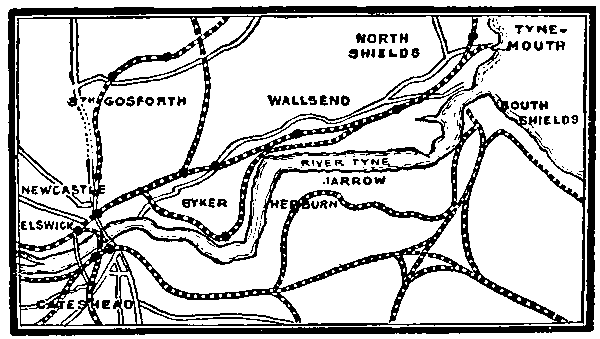 MAP OF THE TYNE DISTRICT.
The Lazare Carnot and the Masséna, heedless of the fire
from the shore, steamed at half speed across the estuary until
they were opposite the Tynemouth Battery, when they suddenly
opened fire, being quickly joined by six French and Russian
cruisers. In the meantime the contact mines were being
blown up by piquet boats, who, although suffering heavily
from the fire from the shore, nevertheless continued their task.
It was then seen how utterly inadequate were the defences of
the Tyne, and what negligence had been displayed on the part
of the War Office in not providing at Tynemouth adequate
means of warding off or successfully coping with an attack.
From behind the tall grey lighthouse a few guns were
thundering, but in face of the overwhelming force at sea it
was but a sorry attempt. One shot from the battery severely
damaged the superstructure of the Lazare Carnot, another cut
through the funnel of the Neptune, carrying it away, and a
third entering the magazine of one of the small cruisers caused
it to explode with serious loss of life. Yet the devastating
effect of the enemy's shells on the obsolete defences of Tynemouth
was appalling.
Enclosed in the fortifications were the crumbling ruins of
the ancient Priory, with its restored chapel, a graveyard, and
an old Castle that had been converted into artillery barracks.
As flame and smoke rushed continuously from the barbettes,
turrets, and broadsides of the hostile ships, the shots brought
down the bare, dark old walls of the Priory, and, crashing into
the Castle, played havoc with the building. The lantern of
the lighthouse, too, was carried away, probably by a shot flying
accidentally wide, and every moment death and desolation was
being spread throughout the fort. Such a magnificent natural
position, commanding as it did the whole estuary of the Tyne,
should have been rendered impregnable, yet, as it remained in
1894, so it stood on this fatal day, a typical example of War
Office apathy and shortsightedness.
Its guns were a mere make-believe, that gave the place an
appearance of strength that it did not possess. In the North
Battery, on the left side, commanding a broad sweep of sea
beyond Sharpness, only one gun, a 64-pounder, was mounted,
the remaining five rotting platforms being unoccupied! At the
extreme point, to command the mouth of the river, a single
5-tonner was placed well forward with great ostentation, its
weight, calibre, and other details having been painted up in
conspicuous white letters, for the delectation of an admiring
public admitted to view the Priory. The South Battery, a trifle
stronger, was, nevertheless, a sheer burlesque, its weakness
being a disgrace to the British nation. In fact, in the whole
of the battery the upper defences had long been known to
experts to be obsolete, and the lower ones totally inadequate
for the resistance they should have been able to offer.
Was it any wonder, then, that the shells of the enemy
should cause such frightful destruction? Among the British
artillerymen there was no lack of courage, for they exerted
every muscle in their gallant efforts to repulse the foe. Yet,
handicapped as they were by lack of efficient arms and properly
constructed fortifications, their heroic struggles were
futile, and they sacrificed their lives to no purpose. The
deadly hail from the floating monsters swept away the whole
of the ancient Priory walls, demolishing the old red brick
barracks, blowing up the Castle gateway, wrecking the guardroom,
and igniting the Priory Chapel. The loss of life was
terrible, the whole of the men manning the 5-ton gun pointing
seaward having been killed by a single shell that burst
among them, while everywhere else men of the Royal Artillery,
and those of the Tynemouth Volunteer Artillery, who were
assisting, were killed or maimed by the incessant rain of
projectiles.
Night clouds gathered black and threatening, and it appeared
as if the enemy were carrying all before them. The
French battleship Neptune, seeing the guns of all three batteries
had been considerably weakened, was steaming slowly into the
mouth of the Tyne, followed by the Russian cruiser Syzran,
when suddenly two terrific explosions occurred, shaking both
North and South Shields to their very foundations. High into
the air the water rose, and it was then seen that two submarine
mines had been exploded simultaneously by electric
current from the Tynemouth Battery, and that both vessels
had been completely blown up. Such was the force of the
explosion, that the hull of the Neptune, a great armour-clad of
over ten thousand tons, had been ripped up like paper, and of her
crew scarcely a man escaped, while the cruiser had been completely
broken in half, and many of her crew blown to atoms.
Scarcely had this success of the defenders been realised when
it was followed by another, for a second later a British torpedo
boat succeeded in blowing up with all hands the French
torpedo gunboat Lance.
These reverses, however, caused but little dismay among
the invaders, for ere long the British cruisers had been driven
off, the guns at Trow had been silenced, while those at Spanish
Battery and Tynemouth could only keep up a desultory fire.
Then, in the falling gloom, ship after ship, guided by foreign
pilots, and carefully evading a number of hulks that had been
placed near the estuary, entered the Tyne, pouring forth their
heavy monotonous fire into North Shields and South Shields.
Skilfully as the despairing defenders managed their submarine
mines, they only succeeded in destroying three more of the
enemy's ships, the French torpedo gunboats Iberville and
Cassini and the cruiser Desaix, the crews perishing.
Not for a moment was there a cessation of the cannonade
as the smaller ships of the enemy advanced up the river, and
the damage wrought by their shells was enormous. Tynemouth
had already suffered heavily, many of the streets being in
flames. The tower of St. Saviour's Church had fallen, the
conspicuous spire of the Congregational Chapel had been shot
away, the Piers Office had been reduced to ruins, and the long
building of the Royal Hotel completely wrecked. The houses
facing Percy Park had in many cases been shattered, a shell
exploding under the archway of the Bath Hotel had demolished
it, and the handsome clock tower at the end of the road had
been hurled down and scattered.
Slackening opposite the Scarp, the gunboats and cruisers
belched forth shot and shell upon North Shields, aiming first
at the more conspicuous objects, such as the Sailors' Home, the
Custom House, the tall tower of Christ Church, and the Harbour
Master's office, either totally destroying them or injuring them
irreparably, while the houses on Union Quay and those in
Dockway Square and in adjoining streets, from the gasometers
down to the Town Hall, were also swept by shells. Resistance
was made from Fort Clifford on the one side of the town, from
a position occupied by a battery of the Durham Volunteer
Artillery, who had mounted guns on the hill behind Smith's
Yard, and also by the submarine mines of the Tyne Division
Volunteer Miners; but it was most ineffectual, and, when
night fell, hundreds of terror-stricken persons had been killed,
and the town was on fire in dozens of places, the flames
illuminating the sky with their lurid brilliancy.
In South Shields tragic scenes were being enacted. Shells
flying about the town from the river on the one side and the
sea on the other exploded in the streets, blowing unfortunate
men, women, and children into atoms, wrecking public buildings,
and setting fire to the cherished homes of the toilers. The
congested blocks of buildings around Panash Point were one
huge furnace; the Custom House, the River Police Station,
and the Plate Glass Works were wrecked, while a shell exploding
in one of the petroleum tanks on the Commissioners'
Wharf caused it to burst with fearful effect. The queer old
turret of St. Hilda's fell with a crash, the Church of St. Stephen
was practically demolished, and the school in the vicinity
unroofed. The dome of the Marine School was carried bodily
away; nothing remained standing of the Wouldhave Memorial
Clock but a few feet of the square lower structure, and the
Ingham Infirmary being set on fire, several of the patients
lost their lives. Amid this frightful panic, Lieut.-Col.
Gowans and Major Carr of the 3rd Durham Artillery, the
Mayor, Mr. Readhead, Alderman Rennoldson, Councillors Lisle,
Marshall, and Stainton, the Town Clerk, Mr. Hayton, and the
Rev. H. E. Savage, were all conspicuous for the coolness they
displayed. Courage, however, was unavailing, for South Shields
was at the mercy of the invaders, and all defence was feeble
and futile. Hundreds of the townspeople were killed by flying
fragments of shells, hundreds more were buried in the débris
of tottering buildings, while those who survived fled horror-stricken
with their valuables away into the country, beyond the
range of the enemy's fire.
The horrors of Hull were being repeated. The streets ran
with the life-blood of unoffending British citizens.
As evening wore on, the invaders came slowly up the Tyne,
heedless of the strenuous opposition with which they were met
by Volunteer Artillery, who, having established batteries on
various positions between Shields and Newcastle, poured a hot
fire upon them. Advancing, their terrible guns spread death
and destruction on either bank.
The crowds of idle shipping in the great Tyne Dock at
South Shields, and those in the Albert Edward and Northumberland
Docks on the north bank, together with the staiths,
warehouses, and offices, were blazing furiously, while the Tyne
Commissioners' great workshops, Edwards' Shipbuilding Yard,
and many other factories and shipbuilding yards, were either
set on fire or seriously damaged.
Many of the affrighted inhabitants of North Shields sought
refuge in the railway tunnel, and so escaped, but hundreds lost
their lives in the neighbourhood of Wallsend and Percy Main.
Shells fell in Swinburne's brass foundry at Carville,
destroying the buildings, together with the Carville Hotel
and the railway viaduct between that place and Howdon.
The Wallsend Railway Station and the Theatre of Varieties
were blown to atoms, and the houses both at High and Low
Walker suffered severely, while opposite at Jarrow enormous
damage was everywhere caused. At the latter place the 1st
Durham Volunteer Engineers rendered excellent defensive
service under Lieut.-Col. Price and Major Forneaux, and the
Mayor was most energetic in his efforts to insure the safety of
the people. A submarine mine had been laid opposite
Hebburn, and, being successfully exploded, blew to atoms the
French gunboat Gabes, and at the same time seriously injured
the propeller of the cruiser Cosamo. This vessel subsequently
broke down, and a second mine fired from the shore destroyed
her also. Nevertheless the invaders steadily advanced up the
broad river, blowing up obstacles, dealing decisive blows, and
destroying human life and valuable property with every shot
from their merciless weapons.
The panic that night in Newcastle was terrible. The
streets were in a turmoil of excitement, for the reports from
Tynemouth had produced the most intense alarm and dismay.
On receipt of the first intelligence the Free Library Committee
of the City Council happened to be sitting, and the chairman,
Alderman H. W. Newton, the popular representative of All
Saints' North, formally announced it to his colleagues, among
whom was the Mayor. The committee broke up in confusion,
and an excited consultation followed, in which Councillors
Durnford, Fitzgerald, and Flowers, with Alderman Sutton, took
part. Capt. Nicholls, the Chief Constable, Major A. M. Potter
of the 1st Northumberland Artillery, Lieut.-Col. Angus of
the 1st Newcastle Volunteer Artillery, Lieut.-Col. Palmer and
Major Emley of the Volunteer Engineers, Mr. Hill Motum,
and Mr. Joseph Cowen also entered the room and engaged in
the discussion.
At such a hasty informal meeting, nothing, however, could
be done. The Mayor and Councillors were assured by the
Volunteer officers that everything possible under the circumstances
had been arranged for the defence of the Tyne.
Property worth millions was at stake, and now that the news
had spread from mouth to mouth the streets around the Town
Hall were filled with crowds of excited, breathless citizens,
anxious to know what steps were being taken to insure their
protection.
So loudly did they demand information, that the Mayor
was compelled to appear for a moment and address a few
words to them, assuring them that arrangements had been
made which he hoped would be found adequate to repel the foe.
This appeased them in a measure, and the crowd dispersed;
but in the other thoroughfares the excitement was intensified,
and famished thousands rushed aimlessly about, many going
out upon the High Level and Low Level Bridges and straining
their eyes down the river in endeavour to catch a glimpse of
the enemy.
Heavy and continuous firing could be heard as the dark
evening dragged on, and presently, just before nine o'clock, the
anxious ones upon the bridges saw the flash of guns as the
invading vessels rounded the sharp bend of the river at the
ferry beyond Rotterdam Wharf.
The sight caused the people to rush panic-stricken up into
the higher parts of Newcastle or across the bridges into Gateshead,
and from both towns a rapid exodus was taking place,
thousands fleeing into the country. From gun-vessels, torpedo
gunboats, and cruisers, shot and shell poured in continuous
streams into the wharves, shipping, and congested masses of
houses on either bank.
The houses along City Road, St. Lawrence Road, Quality
Row, and Byker Bank, on the outskirts of Newcastle, suffered
severely, while shots damaged the great Ouseburn Viaduct,
wrecked St. Dominic's Roman Catholic Chapel, and blew away
the roof of the new Board School, a prominent feature of the
landscape.
Several shells fell and exploded in Jesmond Vale. One
burst and set fire to the Sandyford Brewery, and one or two falling
in Portland Road caused widespread destruction and terrible
loss of life. The London and Hamburg Wharves, with the
shipping lying near, were soon blazing furiously, and all along
Quay Side, right up to the Guildhall, shops and offices were
every moment being destroyed and swept away. New Greenwich
and South Shore on the Gateshead side were vigorously
attacked, and many shots fired over the Salt Marshes fell in
the narrow thoroughfares that lie between Sunderland Road
and Brunswick Street.
Upon the enemy's ships the Volunteer batteries on the
commanding positions on either side of the high banks poured
a galling fire, one battery at the foot of the Swing Bridge on
the Gateshead side effecting terrible execution. Their guns
had been well laid, and the salvoes of shell played about the
French gun-vessels and torpedo boats, causing frightful destruction
among the crews. Both Newcastle and Gateshead,
lying so much higher than the river, were in a certain measure
protected, and the high banks afforded a wide command over
the waterway. At various points, including the entrances to
the High Level Bridge, at the Side, the Close, New Chatham,
and the Rabbit Banks, the Volunteers had opened fire, and
were keeping up a terrible cannonade. The dark river reflected
the red light which flashed forth every moment from gun
muzzles, while search-lights from both ships and shore were
constantly streaming forth, and the thunder of war shook the
tall factory chimneys to their very foundations.
Heedless of the strenuous opposition, the invading ships
kept up a vigorous fire, which, aimed high, fell in the centre of
Newcastle with most appalling effect. In the midst of the
crowds in Newgate and Pilgrim Streets shells exploded, blowing
dozens of British citizens to atoms and tearing out the
fronts of shops. One projectile, aimed at the strangely shaped
tower of St. Nicholas' Cathedral, struck it, and swept away
the thin upper portion, and another, crashing into the sloping
roof of the grim, time-mellowed relic Black Gate, shattered it,
and tore away part of the walls.
The old castle and the railway bridge were also blown up
in the earlier stages of the bombardment, and the square tower
of St. John's fell with a sudden crash right across the street,
completely blocking it. From end to end Grainger Street was
swept by French mélinite shells, which, bursting in rapid
succession, filled the air with tiny flying fragments, each as
fatal as a bullet fired from a rifle. The French shell is much
more formidable than ours, for, while the latter breaks into
large pieces, the former is broken up into tiny and exceedingly
destructive fragments.
In the midst of this terrible panic a shot cut its way
through the Earl Grey Monument, causing it to fall, many
persons being crushed to death beneath the stones, while both
the Central Exchange and the Theatre Royal were now alight,
shedding a brilliant glare skyward.
At this time, too, the whole of Quay Side was a mass of
roaring, crackling flames, the thin spire of St. Mary's Roman
Catholic Cathedral had been shot away, Bainbridge's great
emporium was blazing furiously, and the Art Club premises
had taken fire. One shot had fallen at the back of the Town
Hall, and torn an enormous hole in the wall, while another,
entering the first floor of the County Hotel, had burst with
awful force, and carried away the greater part of its gloomy
façade.
In the Central Station opposite, dozens of shells had
exploded, and it was now on fire, hopelessly involved together
with the adjoining Station Hotel. The grey front of the
imposing Chronicle building had been wrecked by a shell that
had descended upon the roof, and a row of dark old-fashioned
houses in Eldon Square had been demolished.
The same fate had been shared by the Co-operative Wholesale
Society's warehouse, the Fish Market, the Journal office,
and both the Crown and Métropole Hotels at the bottom of
Clayton Street.
Yet the firing continued; the terrified citizens were granted
no quarter. The Royal Arcade was blown to atoms, the new
red brick buildings of the Prudential Assurance Company
were set on fire, and were blazing with increasing fury. The
building of the North British and Mercantile Assurance Company,
the Savings Bank at the corner of Newgate Street, and
the Empire Theatre were wrecked. Along New Bridge
Street dozens of houses were blown to pieces, several fine
residences in Ellison Place were utterly demolished and
blocked the roadway with their débris, and the whole city,
from the river up to Brandling Village, was swept time after
time by salvoes of devastating shots. Rows of houses fell,
and in hundreds the terrified people were massacred. Away
over the Nun's Moor shells were hurled and burst, and
others were precipitated into the great Armstrong works at
Elswick.
Suddenly, in the midst of the incessant thunder, a series of
terrific explosions occurred, and the great High Level Bridge
collapsed, and fell with an awful crash into the Tyne. The
enemy had placed dynamite under the huge brick supports,
and blown them up simultaneously. A few moments later the
Swing Bridge was treated in similar manner; but the enemy,
under the galling fire from the Volunteer batteries, were now
losing frightfully. Many of the new guns at the Elswick
works were brought into action, and several ironclads in the
course of construction afforded cover to those desperately
defending their homes.
But this blow of the invaders had been struck at a most
inopportune moment, and was evidently the result of an order
that had been imperfectly understood. It caused them to suffer
a greater disaster than they had anticipated. Six torpedo boats
and two gun-vessels had passed under the bridge, and, lying off
the Haughs, were firing into the Elswick works at the moment
when the bridges were demolished, and the débris, falling across
the stream, cut off all means of escape.
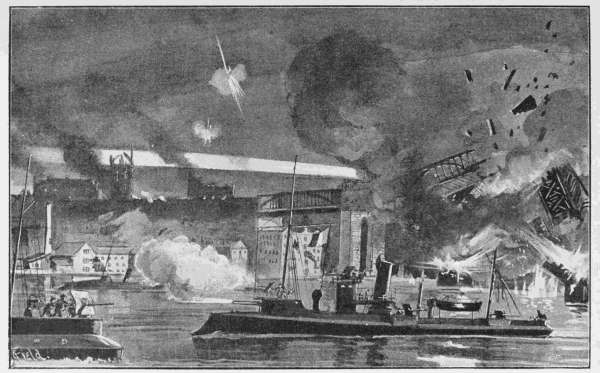 NEWCASTLE BOMBARDED: BLOWING UP OF THE HIGH LEVEL BRIDGE.
The defenders, noticing this, worked on, pounding away at
the hostile craft with merciless monotony, until one after
another the French and Russians were blown to atoms, and
their vessels sank beneath them into the dark, swirling
waters.
While this was proceeding, two mines, one opposite Hill
Gate, at Gateshead, and the other near the Rotterdam Wharf,
on the Newcastle side, were fired by the Volunteer Engineers,
who thus succeeded in blowing up two more French gunboats,
while the battery at the foot of the Swing Bridge sank two
more torpedo boats, and that in front of the Chemical Works at
Gateshead sent a shell into the "vitals" of one of the most
powerful torpedo gunboats, with the result that she blew up.
Everywhere the enemy were being cut to pieces.
Seeing the trap into which their vessels had fallen above
the ruined bridges, and feeling that they had caused sufficient
damage, they turned, and with their guns still belching forth
flame, steamed at half speed back again towards the sea.
But they were not allowed to escape so easily, for the mines
recently laid by the Volunteers were now brought into vigorous
play, and in the long reach of the river between High Walker
and Wallsend no fewer than six more of the enemy's gun and
torpedo boats had their bottoms blown out, and their crews torn
limb from limb.
Flashed throughout the land, the news of the enemy's
repulse, though gained at such enormous loss, excited a feeling
of profound satisfaction.
The injury inflicted on the invaders had been terrible, and
from that attack upon the Tyne they had been hurled reeling
back the poorer by the loss of a whole fleet of torpedo and gun
boats, one of the most effective arms of their squadrons, while
the sea had closed over one of France's proudest battleships,
the Neptune, and no fewer than four of her cruisers.
The surviving vessels, which retreated round the Black
Middens and gained the open sea, all more or less had their
engines crippled, and not half the men that had manned
them escaped alive.
They had wrought incalculable damage, it is true, for part of
Newcastle was burning, and the loss of life had been terrible;
yet they were driven back by the Volunteers' desperately
vigorous fire, and the lives of many thousands in Newcastle
and Gateshead had thus been saved at the eleventh hour by
British patriots.
Alas, it was a black day in England's history!
Was this to be a turning-point in the wave of disaster
which had swept so suddenly upon our land?
 BOMBARDMENT OF LONDON: "IN LUDGATE HILL THE SCENE WAS AWFUL."