160 pages of colored maps from new plates, size 11 1/2 x 14
inches, printed on special paper with marginal index, and well
worth its regular price—— $2.50.
Every one has some sort of an atlas, doubtless, but an old atlas is no
better than an old directory; countries do not move away, as do people,
but they do change and our knowledge of them increases, and this atlas,
made in 1897 from new plates, is perfect and up to date and covers every
point on
Those not subscribers should secure the subscription of a friend and remit
$5 to cover it and their own. A copy of the atlas will be sent to either
address.
GREAT ROUND WORLD,
3 and 5 West 18th Street, · · · · · · · ·New York City.

Vol. 1 April 15, 1897. No. 23
It is said that the unfortunate Princess Charlotte of Belgium is to be
taken over to Mexico, in the hope that a visit to the scenes of her former
happiness may restore her reason.
Her story brings back to memory a very sad and interesting page of our
modern history.
Princess Charlotte, the daughter of Leopold I., King of the Belgians, was
the most accomplished and beautiful princess of her time. She was the only
daughter of the king. While she was still quite young he found she had a
great talent for statecraft, and so he had her admitted to all the
councils of state, and from her earliest childhood she was familiar with
the ways and arts of diplomacy.
A brilliant future was expected for her, but when she was seventeen she
married, for love, the young Archduke Maximilian, brother of the Emperor
of Austria.
There was no expectation that Maximilian would ever come to a throne, and
so it seemed as if the young princess' talents were to be thrown away when
she settled down with her husband, and became the happiest young wife in
Europe.
For seven years these two young folks were a model happy couple; then, one
fatal day, Napoleon III. of France offered Maximilian the crown of Mexico.
Europe thought that Mexico needed a wise and clever ruler to straighten
out the tangle into which its affairs had fallen, and it was supposed that
Maximilian, backed by his beautiful and clever wife, would be just the man
for the post. As Mexican affairs were in a very turbulent state, Napoleon
promised Maximilian that he would keep a number of French troops in the
country, and support him with an armed force, until the people of Mexico
had learned to love and trust him, and he could rule them without danger.
Under these conditions Maximilian accepted, and the young couple became
Emperor and Empress of Mexico, and, setting forth to their new land, bade
farewell to Europe and happiness.
At that time Mexico was in the most terrible condition, as you will
understand when you learn that within a period of forty-seven years there
were three hundred revolutions, some successful, some the reverse. During
this time the government was changed ten times, and over fifty persons
succeeded each other as presidents, dictators, and emperors.
The throne of such an uneasy kingdom as this was by no means a pleasant
one to occupy.
During these frequent revolutions it is easy to understand that many
treaties were broken, and much property was seized.
The foreign residents in particular found Mexico a dangerous country to
live in, and within a few years Spain, England, and France were making
heavy claims against the country for damage done to their citizens.
The claims of England and Spain were satisfied, and they withdrew the
troops they had sent to Mexico to enforce their demands.
France, however, could get no satisfaction, and so she remained, and
carried on war against the Mexicans until she succeeded in getting a
little the best of them.
It was at this moment that Louis Napoleon made up his mind that an Emperor
was what Mexico needed, and sent out the unfortunate Archduke Maximilian
to rule a wild, boisterous, and only half-conquered people.
The Mexicans, ever pleased with a change, welcomed the Emperor very
kindly; the beauty and charity of the Empress made many friends for her,
and for a time all went well.
With the aid of the French troops, Maximilian completed the conquest of
the rebellious Mexicans, and was at the height of his popularity, when, in
an evil moment, he made a proclamation that all the rebels who had fought
against the government should be regarded as bandits, and punished as
such.
The people were furious at this. These bandits were many of them of their
own families and friends, and revolutions were so common in the country,
that they could not see why these men should be hanged and shot by a
foreign prince, whom they had never invited to come and govern them.
From that moment they began to conspire against him, and his position was
becoming very unsafe, when Napoleon ordered his French soldiers to return
from Mexico.
Maximilian would not allow this; he reminded Napoleon that he had only
accepted the throne on the condition that the French soldiers were left to
protect him; but Napoleon III. paid no attention to his protest, nor to
the assurance that he would not be safe if the French soldiers were
withdrawn.
The orders to return to France were repeated.
Both Maximilian and Charlotte were fearful of the result of this rash act;
and as the Empress had been very successful in managing several difficult
affairs in the government of Mexico, it was thought best that she should
go to Napoleon and explain things to him, and get the order for the
soldiers to remain in Mexico.
She started on her long voyage, hopeful of success; but when she reached
France, Napoleon managed to avoid seeing her for months, and when at last
she was admitted to his presence, she found him cold, hard, and determined
to follow out his own plans.
The French soldiers should leave Mexico at all cost.
The poor young Empress had lived long enough in Mexico to fear the worst
for her husband if he were left to the tender mercies of the Mexicans.
Heartbroken at Napoleon's refusal, she determined to seek the Pope, and
see if he would not help her.
The Pope received her with the greatest kindness, but soon convinced her
that, no matter how good his will, he had no power to aid her.
When Charlotte realized this, and that her long journey had been of no
use, and that she had only separated herself from her beloved husband in
his hour of need, her mind gave way, and she became insane.
Poor Maximilian, waiting anxiously for news of her success, received word
that his troubles had driven his wife insane, and from that moment he
cared little what became of him or of Mexico.
A few months after Napoleon had so treacherously withdrawn his troops, the
people once more rose against their ruler.
The Emperor led his army of loyal Mexicans against the rebels, but after a
few weeks was defeated, taken prisoner, and condemned to be shot.
So ended the career of these two unfortunate young people.
It is thought that the Empress to this hour does not know the fate that
befell her husband.
The whole sad tragedy happened thirty years ago, and in all that time she
has never had a glimmering of reason. She is gentle, kindly, and
interested in the simple country life of the estate on which she lives.
Her madness has never taken a violent form, and it is said that she lives
in constant expectation of her husband's return.
Of late her mind has become slightly clearer, and her doctors have decided
that it is possible that her reason may be restored if she once more
visits Mexico.
This decision seems hardly a kindly one. If it be true that the poor
Empress, who is now a woman of fifty-seven, does not know the full force
of the sorrows that fell upon her, it would seem kinder to leave her in
ignorance of them, than to restore her reason, and allow her to suffer for
griefs that are now thirty years old.
Europe has again been shocked by the news of Christian Powers firing on
the Greeks, and endeavoring to prevent them from freeing themselves from
the rule of the hated heathen Turk.
The feeling in England is very strong on this point. So much so that the
old statesman, Mr. Gladstone, who is to England what Bismarck has been to
Germany, has published a very fine letter on the subject.
In the strongest kind of language, Mr. Gladstone calls the Powers to
account for the action they are taking. He declares that they are
listening to the advice of two ambitious young rulers, the Emperor of
Germany and the Czar of Russia, and allowing themselves to be guided by
the desires of these young men, instead of listening to the voice of the
people, which is decidedly against their actions.
He speaks in no friendly terms of Turkey, her massacres and her misrule,
and says that Greece has done a great service for the world in helping
Crete to throw off the yoke of such a sovereign as the Sultan.
He hopes that the people of Europe may be allowed to say what they think
in the matter, and feels confident that Greece will then no longer be
interfered with. He thinks the only true way to settle the difficulty, is
to let the Cretans have their own government under the rule of Greece, and
pay tribute to Turkey.
Every one is wondering whether these bold words of Mr. Gladstone will have
an effect on the situation.
The so-called Concert of the Powers does not seem to exist any longer. The
six powers are divided among themselves. Great Britain and Italy hold
together in not wanting harsh measures used with Greece; Germany and
Russia think force ought to be used, and France and Austria are
undecided.
Some of the foreign papers are saying that it is quite impossible for the
Powers ever to come to an understanding.
Some people are thinking that Mr. Gladstone's letter has already had an
effect, for a private telegram from Paris states that the Sultan of Turkey
has sent word to the Powers that he is willing to let King George of
Greece occupy the island of Crete, and govern it, provided that he pays
tribute for it.
This is so exactly Mr. Gladstone's suggestion, that, if the report is
true, the Sultan would seem to have been influenced by him.
Mr. Gladstone in his letter showed clearly how such an arrangement would
be of benefit to all concerned, and spoke of the island of Cyprus as an
example. Cyprus was once under the rule of Turkey, but is now governed by
the Queen of England, and pays a tribute to Turkey.
It is to be hoped that this telegram is true, but we must remember that it
is only news, and not history, and therefore we must be quite prepared
to have it contradicted next week.
The blockade of Crete is now complete. No ships are allowed to enter the
ports that bring supplies to the Cretans or Greeks.
But the Greeks are not submitting tamely to the blockade.
There are two forts that guard the entrance to Canea, and both of them are
being vigorously besieged by the insurgents, with the intention of
establishing a blockade of Canea on the landward side, and so keeping the
troops of the Powers enclosed where they can do little harm.
A late despatch from Crete says that the Cretans have forced the Turks to
flee from Malaxa, and have killed the garrison.
During the fight over Malaxa, the Turkish warships in the Bay of Suda
opened fire on the Cretans, with the hope of dislodging them from the
heights around Malaxa. The Powers have had the grace to be very much
disturbed at this, and have sent word to the admirals in command of the
fleets at Crete, that they may use their own best judgment about ordering
the Turkish warships to leave Crete.
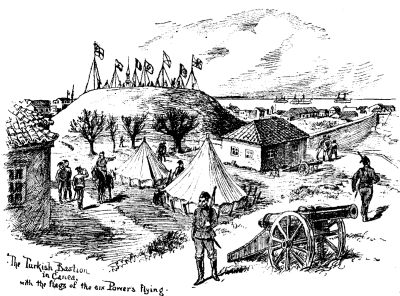
The admirals decided that the forts of Malaxa and Keratide must be kept
out of the hands of the Cretans, and so they sent word to the insurgents
that the Powers forbade them to attack either fort.
The Cretans did not take the slightest notice of this order, but
continued the attack, and drove the Turks out. The allied warships in the
Bay of Suda at once opened fire on the Cretans, who withstood the fire
bravely.
The result of the whole matter has been that, though the insurgents gained
a decided victory over the Turks, the foreign Powers have stepped in
between them and their prize, and are occupying the town of Malaxa.
The Cretans must heartily wish that the Powers would go away and mind
their own business, and leave them to settle their own affairs.
If it were not so sad and so serious, it would be amusing to watch the
double game that Turkey is playing with the Powers, and how she is
laughing in her sleeve at the whole of Europe.
After months of conferences, and diplomatic fussing over plans of mighty
reforms which the Sultan was to make for the unfortunate Armenians, the
"unspeakable Turk" has not made one single effort to improve the condition
of these unhappy people. He has waited until the Powers of Europe have so
tangled themselves up over him, that he finds them befriending him, and
firing on brother Christians for his sweet sake, while he is still at
liberty to have a few more Armenians massacred without the fear of any
consequences.
News has just come that there has been another slaughter of Armenians,
seven hundred of these unfortunate people having fallen victims to the
Turks. If the Powers have any conscience left, this news must have made
them thoroughly ashamed of their ridiculous position.
The week's news from Cuba is still of the same hopeful character for the
Cubans.
It is stated on the best authority that the Cubans are in absolute
possession of the eastern end of the island, the whole province of
Santiago de Cuba being in the hands of the insurgents.
It is stated that this province is really Cuba Libre, or "Free Cuba."
The government is being carried on there, and the peasants are able to sow
their fields and gather their crops in peace and safety.
The Cubans assert that if we would only recognize that they were engaged
in a real war, and give them the right to fit out a navy for themselves,
the war would be over in a very short time. They have now no fear but that
they will gain their liberty; they say, however, that with the Spanish
navy guarding the coast, and preventing the landing of help and supplies,
the war will last a good deal longer than it ought.
The Spaniards are very uneasy, and Havana is greatly alarmed over the last
expedition of General Weyler. The Spanish general has determined to force
a battle on General Gomez, and to make one great effort to subdue him.
It is reported that General Gomez is in Santa Clara, and Weyler has gone
thither with all the troops he can mass together to meet him.
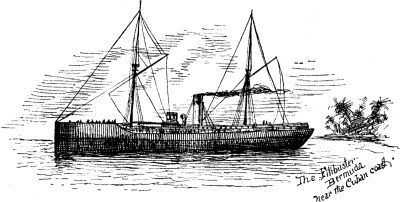
All Cuba has, however, learned by this time that the whereabouts of Gomez
and his army are never to be relied on. The Spaniards go out to fight them
in a certain place, and when they reach the spot where they expect the
enemy to be, they find that the Cubans have made a forced march and
escaped them, and are making war in quite a fresh section of the country.
The Cubans have accomplished some of the most wonderful marches in the
history of war, and have won many of their advantages by stealing past the
enemy that was advancing to fight them, and capturing towns and stores
left unprotected in the enemy's rear.
It is therefore not to be wondered at that there is a report in Havana
that Gomez has slipped past Weyler, and is advancing upon the city to
capture it.
If Gomez feels himself strong enough to fight a real battle with Weyler,
it may perhaps be the decisive battle of the war.
All the Cuban generals have had good luck lately, but the most successful
and brilliant work has been done by General Calixto Garcia in Santiago.
Lest you should feel confused when hearing of so many generals, and so
many provinces, it is perhaps as well to explain something about the
formation of the island of Cuba.
It is a narrow, mountainous strip of land, 760 miles long and in some
parts only 28 miles wide, the very broadest part being 127 miles.[A]
You can readily see that no one general could control the whole of such a
country.
The Cuban army has been divided into three parts:
The Eastern Division, under General Calixto Garcia, which is fighting in
and has brought peace to Santiago de Cuba, the most eastern part of the
island.
The Central Division, under the leadership of General Maximo Gomez,
against which Weyler has set out, and which is supposed to be in Santa
Clara.
The Western division, consisting of the bands that have been raiding the
suburbs of Havana, and making so much trouble in Pinar del Rio, the most
westerly province of the island.
The brilliant feat that General Garcia has accomplished is that he has
made a force of nearly three thousand Spanish soldiers come out to meet
him, and after pretending to fall back before them until he had lured them
to a certain place, he has turned upon them, and chased them into the
mountains, until he has finally forced them into the Algones Valley.
In this valley they are completely cut off from their friends, and he has
them at his mercy. News is hourly expected that the entire Spanish force
has either surrendered or been killed.
If this is true, it will be a very severe blow to Spain.
Reliable news has come that another part of Gomez's force has captured the
town of Holguin, an important town in Santiago de Cuba, and one of the few
strong-holds the Spanish still held in that province. It is said that
quantities of stores and ammunition fell into the Cubans' hands.
A telegram from Havana says that Fondeviella, now a lieutenant-colonel,
has been made Chief of Police in Havana. The Spaniards must certainly
approve of this horrible man's conduct, and Havana is likely to feel still
more uneasy with such a person in power. A later telegram reports the
capture of General Ruis Rivera, who was in command of the Western
Division. If this is true it will be a sad check to the Cuban successes.
Reports have come that the dynamite-gun, of which the Cubans were so
proud, has proved a failure.
The various nations, all over the world, are watching the trial of this
gun with the greatest interest. It can be so easily handled, can be
carried by ten men, and put together and made ready for firing two minutes
after it is unloaded, that other nations are anxious to see if it is
really the valuable weapon it is claimed to be.
Besides the advantages of being light and easy to handle, it can be fired
without noise or smoke, and therefore its whereabouts are not easily
discovered by an enemy; and moreover, if it has to be abandoned in a
retreat, it can be disabled with one sharp blow of a stone, so that it can
never be turned on its fleeing owners by a victorious enemy.
If the report about it is true, it has one fault, that is so serious that
it outweighs all the virtues. This fault is that the dynamite-gun has a
habit of going off at both ends; that is to say, it is liable to explode
both at the breech and the muzzle. It may therefore be quite as
destructive to the army firing it, as to the enemy at which it is fired.
Of course this will render the gun very unpopular, if it is true; but
people who understand the weapon declare that the fault lies, not in the
gun, but with the climate of the West Indies.
The three tubes of this gun (which we described fully in Number 6 of
The Great Round World) are fastened together at the breech with a
clasp which holds the whole mechanism of the gun in place.
The climate of the West Indies is so moist that metal rusts in an
amazingly short space of time, and it is difficult to keep anything bright
and polished.
It is supposed by those who understand the gun that, having been
constantly exposed to the moist air, it has rusted, and that the important
clasp has become so rusty that it can no longer be pushed fully home, and
so the gun is not secure.
In their opinion the failure of the dynamite-gun has not been proved; it
may be necessary to make some alterations to fit it for service in swampy
countries, but that as a weapon it is still a success.
Terrible floods are reported from the Mississippi Valley. A section of the
country equal in size to the whole State of Missouri is now under water,
and steamboats are hurrying over what were once farm lands, rescuing the
unfortunate families who have been caught by the floods.
The Mississippi, the largest river on our continent, flows through what is
known as the Gulf Coast Plain.
The Gulf Coast Plain is formed by the valley lying between the great
mountain ranges which make the framework of our country.
The Mississippi with its tributaries drains the whole of the enormous
tract of land lying between these three main mountain ranges.
This great river forms the highway for the interior of our country, and
winds through the plain for about a thousand miles. Every year when the
heavy spring rains fall, and the snows melt in the north, the river
overflows its bed, and floods the lowlands around it.
To keep the river within its bounds, mounds of earth, called levees, have
been built for hundreds of miles along the banks. The Mississippi floods
are only dangerous when the thaws are very sudden, or the rains so heavy
that the river swells in size to such an extent that the levees are broken
down, and the water, bursting its bounds, rushes with an angry flood over
the surrounding country, destroying everything in its path.
As a usual thing the spring floods are beneficial to the country, for the
Mississippi is a very muddy river, and when it overflows it spreads this
mud over the country, in much the same fashion that the Nile does, and
with the same result of fertilizing and enriching the soil.
All swift waters wash away some portion of their bed in their flow, and
carry it along with them in their journey to the sea.
The Mississippi in its thousand-mile course carries a vast amount of this
stolen earth, so much indeed that every year it deposits in the Gulf of
Mexico an amount of mud which would make a pile one mile square and 268
feet high.
This enormous yearly deposit is literally filling up the Gulf, and in the
ages to come dry land and a new country will be found where the waters of
the Gulf now lie.
Every year the Mississippi brings down enough earth with it to help it
move its mouth 338 feet farther out into the sea, and every year it builds
on to its delta, which now contains thousands of square miles!
You can understand that the angry flood of such a powerful river as this
must be a very serious matter. For a distance of nearly twenty miles in
Arkansas, levees have given way, and thousands of acres of land have been
flooded; the waters sweeping away the homes, drowning the cattle, and
compelling the people to seek the points above the angry waters, and wait
in the hope of relief-boats coming to save them.
In other parts of the country through which the river flows, special
trains loaded with sacks are being run to points near the river banks. The
sacks are filled with earth, and thrown upon the levees to strengthen
them. The men of that country are working night and day to shore up the
levees until the floods subside.
This is the worst flood that has been known for many years, and people
along the banks of the Mississippi have been ruined through the damage
done by the waters.
March 22d was celebrated throughout Germany as a national holiday, for it
was on this day one hundred years ago that Emperor William I. was born.
The old Emperor was the man who, with the help of Bismarck, united all the
various States and Principalities of Germany under one rule, and raised
Germany from the dust into which Napoleon had thrown her, to the glorious
position she holds to-day.
The day was celebrated in Berlin by the unveiling of a magnificent
monument to the old Emperor.
The statue of William I. shows him seated on horseback, with winged
figures representing Victory standing on the pedestal beneath him, and the
Goddess of Peace holding the bridle of his horse.
On the base of the pedestal is carved:
WILLIAM THE GREAT,
German Emperor—King of Prussia,
1861-1888. |
And on the back:
With gratitude and faithful love,
The German People. |
The Emperor unveiled the monument in the presence of a great number of
German Princes and nobles, all of whom laid wreaths at the foot of the
monument.
In consequence of the recent troubles over his "revelations," Prince
Bismarck was not invited to take part in the ceremonies. Many people
thought the young Emperor should have invited him in spite of everything;
but the people of Germany did not forget the man who had done so much for
them, and throughout the entire day telegrams and messages were showered
upon the old Iron Chancellor, by those who appreciated all he had done for
their country.
The New York Zoological Society has been presented with a tract of land
containing 261 acres, for the making of a Zoological Garden, which it is
intended shall be the finest in the world. The land presented to the
Society is in Bronx Park.
The Zoo is to be finished within three years, and to be free to the public
at least four days of the week, including Sundays and all half holidays;
it is to be open not less than seven hours every day.
Work is to be begun this spring, and the Vice-President of the Society
promises to have a part of the garden ready to open to the public next
spring.
The Society agrees to prepare the park grounds, and erect such buildings
as are necessary to house the animals, and the City agrees to take care of
the animals and grounds after they are ready.
This great work is being done by some public-spirited citizens, and when
we get our Zoo we shall have to thank these good people for it.
The Botanical Garden, which is in course of preparation, will also be in
Bronx Park, and many of the same people who are working to get a
Zoological Garden for us have also helped to provide New York with its
Botanical Garden.
One lady, Mrs. Esther Hermann, gave ten thousand dollars for the Botanical
Garden—which, according to the latest report, will be opened this summer.
Genie H. Rosenfeld.