"O-o-oh!" he moaned. "They got me. It's a wonder
they didn't kill me. But here I am along with old Neil
Gleazen."
"Where's your bundle?" Gleazen demanded.
"Down in the grass by the spring."
"Let me tell you, Matterson, it's good I carried my
own."
Matterson repressed another groan and made no answer.
Blood was running from a great gash above his ear and
across his cheek, which we hastened to bind to the best of
our ability, and he lay down on the floor with his head on
his hand.
"I'm on the sick list," he said at last, "but I've had
water, and if those black sons of hell have not poisoned the
spring, I'll call it quits."
Matterson's face was a ghastly sight, and already blood
had reddened the strip of sacking round his head; but I
believe there was not a man of us who would not have
taken his wound to have got his chance at water.
"If only we could catch a king," Gleazen remarked
thoughtfully. "That's the way to end a war in Africa.
Catch us a king and make peace on him."
"That's one way surely to end a war," said O'Hara,
darkly, "but not this war."
"And why not this war?"
"Because," said O'Hara, "Bull built the house on a
king's grave. It's the spirits that are offended."
Gleazen laughed unkindly.
"Aye, laugh," cried O'Hara, "that's all you know about
spirits. Now I'll tell ye, believe me or not as it pleases ye,
that the spirit of a nigger is a bad thing to cross. And care
as little as ye please for jujus and fetishes and nigger gods,
the times are coming when they'd serve you well if you'd
not turned them off by laughing at them."
"Spirits—" said my uncle in an undertone. "Hm!
Hollands, Scotch, and Rye. We must lay in more Hollands,
Sim; the stock's getting low. And while you are
about it, we'd best take an inventory of our cordials."
Gleazen fluently swore, and watched Seth Upham with
a keen, appraising look. There was no doubt that in his
own wandering mind my uncle was back again in his store
in Topham.
"I'm thirsty," he said suddenly. "I must get a drink
of water. Now where's the bucket? Sim, where's the
bucket?"
As he fumbled along the wall, we stared at one another
with eyes in which there was fear as well as horror. I
swallowed hard. Poor, poor Uncle Seth, I thought. What
was to become of him? And indeed, for the matter of that,
of us all?
By this time I had come to see clearly that poor Seth
Upham was in no condition to stand up for his own rights,
and that, whether or not he could stand up for his rights,
he had no chance of getting them from that precious trio,
his associates, without a stronger advocate than mere
justice.
They had promised unconditionally that half the profits
of their mad voyage should be his, and by that promise
alone they had so cruelly persuaded him to sell home and
business and embark in their enterprise. Now, deceived,
bullied, flouted, he bade fair to lose not only those gains
which were rightfully his, but also his vessel, his stores,
and every cent that he had ventured. If there was to
be a copper penny saved for him, Arnold, Abe, and I must
save it.
Through the rough, less pleasant memories of his abrupt,
sharp ways—and so often, even when he was in the
abruptest and sharpest of moods he had betrayed unconsciously,
even unwillingly, his thought of my future, for
which he was building, as well as for his own—there came
memories of old days, when he and my mother and I had
lived so quietly and happily together in Topham.
I started up, all at once awakened from my reveries,
with Abe's dazed voice ringing in my ears. "Look!
Look!" he cried. "Look there!"
For the moment, in our horror at my uncle's condition,
we had almost forgotten our danger from without.
"Look!" Abe cried again. "In heaven's name look
there!"
We crowded shoulder to shoulder by the window where
Abe had stationed himself and saw in the moonlit clearing
a strange creature, which came dancing and rolling along
from the edge of the forest. It was dressed in skins and
rags. It was painted with big white rings and bars. Now
it began to utter strange whines and squeals and whimpers,
in an unearthly tone that it might have produced by
blowing on a split quill.
From the corner of my eye I saw that Matterson was
biting his lip. At my side I felt O'Hara violently trembling.
Out in the moonlight, where the swaying creepers cast
dim, spectral shadows, the gibbering, murmuring creature
was coming nearer. Its boldness was appalling. I had
been brought up in a Christian country and given a Christian
education, but even to me that clumsy, dancing
wizard, with his unearthly squeals and cries, brought a
superstitious fear so keen that I could scarcely control my
wits. Small wonder that such tricks impose on credulous
savages!
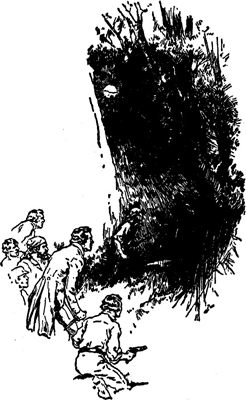
"Watch, now!" Gleazen said quietly. He leveled a
musket across the window-sill. "Spirits is it? I'll show
them."
"Don't shoot," O'Hara cried. "Don't shoot, Neil, don't
shoot!"
He reached past me toward Gleazen; but before he
could lay hands on the gun, Gleazen fired. A spurt of
flame shot from the muzzle, and as the report went thundering
off into the forest the medicine man—wizard—devil—call
him what you will—seemed curiously to wilt
like a drought-killed plant, but more suddenly than ever
plant wilted, and fell in a crumpled heap in the moonlight.
"You fool!" O'Hara cried, "you cursed fool! First it
was Bull that built the house on a king's grave and now
it is you that's killed a devil!"
"He's dead enough," Gleazen calmly replied.
"Look!"
Here and there, along the edge of the forest, men darted
into the moonlight. They carried spears, which flashed
now and then when the moon fell just so on the points.
First they gathered by the body of the wizard and carried
it back into the woods. We saw them, a little knot of men
with the heavy weight of the fallen mummer in their
midst, moving slowly to the wall of vines and through it
into the mysterious depths beyond. Then, coming slowly
out again, they moved back and forth before the hut as if
to appraise our chances of defending it. Then they once
more disappeared.
All this time they had walked as if in a world of death.
Although we had seen their every gesture, we had not
heard a sound loud enough to rival the almost imperceptible
drone of insects in the grass. But now we heard again
that grimly familiar, haunting, wild cry. Three times we
heard it, terribly mournful and prolonged; then we heard
a voice wailing, "White man, I come 'peak: white man all
go Dead Land."
The voice died away, a few formless shrieks and yells
followed it, and a silence, long and deep, settled upon the
clearing.
Once more Arnold, Abe, and I stood on one side of the
hut, and Gleazen, Matterson, and O'Hara on the other,
with poor Seth Upham wandering aimlessly between us.
There was war within and without. There was almost
no food. There was no water at all. I thought, then, that
I should never see the town of Topham again; and—which
oddly enough seemed even harder to endure—I
thought that I never again should see the mission on
the river.
"I swear," O'Hara whispered,—so clearly did I hear
the words, as I stood with one eye for the inside of the
hut and one for the outside, that I jumped like a nervous
girl,—"I swear we've started a war that will reach from
here to Barbary before it's done. Hearken to that!"
We heard afar off the throbbing of native drums, the
roar of distant angry voices, a strange chant sung in some
remote African encampment.
Hunger and thirst were stripping away the last vestige
of our pretended good-will, and our two parties glared at
each other in a sullen rage, which seemed visibly to grow
more intense, until it was the most natural thing in the
world that Arnold should touch with the toe of his shoe a
board that ran from one end of the hut to the other and
divided the floor approximately into halves.
"That side," he said, "is yours. This side is ours. You
shall not cross that line. You shall guard the hut from
that side; we, from this."
Gleazen looked at Matterson, then at O'Hara, then
both he and Matterson nodded grim assent.
But although a board across the hut divided us into two
hostile camps, we shared a peril so imminent and so overwhelming
that we dared not for an instant relax our watchfulness
toward our enemies in the forest.
With one eye on our foes without and one on our foes
within, we settled ourselves for another night, which I remember
by the agonies of thirst that we endured; and
with a certain grim confidence, shared by both parties in
the hut, that neither would betray the other, since to do
so would be to throw away its own one chance for life, we
watched and waited for the dawn.
And meanwhile we heard in the forest such a clamor
and din as few white men have ever been so unlucky as to
hear. First, we heard unseen people running about and
furiously screaming; then, here and there through the
trees and vines we caught glimpses of flaming torches,
which they swung in great circles and again and again
touched to the ground. I was convinced that it preluded
an attack, and I screwed up my courage and fingered my
pistols and tried not to show my fear; but in a brief lull I
learned from something that O'Hara was saying to his
companions that they were not preparing for an attack;
they were mourning for the wizard whom Gleazen had
killed, and with the flaming torches they were driving
away evil spirits. Now far down the valley we caught
glimpses of moving lights; and once in a while, through
pauses in the nearer din, we heard a distant droning, by
which we knew that the blacks of the countryside were
converging upon us from the remotest districts, along their
narrow trails, in thin streams like ants. Minute by minute
the cries became more general, and rose to such a
hideous intermingling of wails and shrieks as I should not
have believed could issue from merely human throats.
By its volume and extent the uproar was an appalling
revelation of the number of those who had surrounded us,
and I tell you that we seven men in that hut in the clearing
were properly frightened. It seemed a miracle that
they did not sweep over us in one great irresistible wave
and bear us down and blot us out. Yet such was their superstitious
fear of things they did not understand, that
from the cover of our frail little hut our few firearms still
held them at a distance.
Never dreaming that their own power was infinitely superior
to ours, attributing the death of their wizard to a
witchcraft stronger than his own, they circled round and
round us under cover of the forest and dared not come
within gunshot.
As day broke, and the sun rose like a ball of fire and
blazed down on us and doubled the tortures that we had
suffered in the night, we heard the drummers who had
come to pound their drums by the body of the dead wizard.
The drumming throbbed and rolled in waves; bells
rang and hands clapped; and all the time there was shrieking
and wailing and moaning.
They drummed the stars down and the sun up, and
when at noon there had been no respite from the din,
which by then fairly tortured us, the other three, who had
been talking together among themselves, called us to the
board across the hut for conference.
"Now, men," O'Hara began, "we'll make no foolish
talk of being friends together; surely we and you know
how much such talk is worth. But we and you know,
surely, that if one party of us is killed, the others will be
killed likewise; for we are too few to fight for our lives,
even supposing as now that every man jack of us is alive
and bustling. Is not that so?
"Now, lads, there's a chance we can break through
their line and run for the river while the niggers is praying
and mourning over that corpse yonder."
O'Hara stopped as if for us to reply, and I glanced at
Arnold, who, meeting my glance, turned to Abe Guptil
and thoughtfully said, "Shall we take that chance, Abe?"
"Take any chance, is my feeling, Mr. Lamont. Chances
are all too few."
With a nod at O'Hara, Arnold replied, "We are agreed,
I think. As you say, there is a chance. You three shall go
first. We will follow."
"It's a chance," O'Hara repeated, almost stubbornly.
"We are in a mood for chances," Arnold returned.
"But you three must go first."
When O'Hara frowned, hesitated, and acceded, I wondered
if he thought we were gullible enough to let them
come behind us.
Arnold was quietly smiling, but the others, as they gathered
in the door, were grave indeed. There was not one of
us who did not know in his heart that our hope was utterly
forlorn. Only Arnold—time and again I marveled
at him!—sustained that amazing equanimity.
Gleazen shouldered his pack, but the others let theirs lie.
"How about the rest of the baggage?" Arnold asked, as
composedly as if he were setting out from the store in
Topham upon a two days' journey.
"Leave it to the devils and the ants," Matterson thickly
retorted.
Both he and Gleazen were lame from their wounds and
must have suffered more than any of the rest of us. How
they could face the long, forced march, I did not understand;
for though hunger and thirst were my only troubles,
my head swam when I moved quickly and my limbs were
now very light, now heavier than so much lead. But
Gleazen had long since shown his mettle, and Matterson,
although he staggered when he walked, set his teeth as he
leaned against the wall and waited to start.
If the truth were told, we had no real hope of getting
away; and immediately whatever desperate dreams we
clung to were frustrated; for, as we appeared in front of
the hut and weakly started down the hill, there came a
sudden lull in the mad wailing over the dead wizard; black
warriors appeared on all sides of us, and a line of them,
like hornets streaming out of their nest, emerged from the
forest and massed between us and the spring.
"Come, men, it's back to the house," said O'Hara; and
back we went, each party to its own side as before, but
each turning to the others as if for what pitiful mutual reassurance
there could be in such a situation.
"There's war from here to the coast," Matterson muttered.
"Such a war as never was before."
The voice that issued from his dry throat was so thick
and husky that I should never have known it for the light,
effeminate voice of Matterson.
"It's bad," said Gleazen, "but so help me, they'll be
cleaning out old Parmenter and putting an end to the
sniveling psalm-singers on this river. And then, lads! Ah,
then'll be great times ahead, if once we get free and clear
of this accursed hornets' nest."
In the face of our desperate danger, the man was actually
exultant. But I thought of the girl at the mission, and
a dread filled my heart, so strong that the room went black
and I sat down, literally too sick to stand.
With never a word poor Uncle Seth was pacing back and
forth across the hut. Of us all, he alone had the liberty of
the entire place; but it was a tolerant, contemptuous liberty
that the others gave him, and nothing else would
have testified so vividly to the way he had fallen in their
regard.
It seemed incredible that this pale, gaunt, voiceless
man, who suffered so much in silence, who without comment
or remark let matters take their own course, who
resented no indignity and aspired to no authority, could
be that same Seth Upham who had made himself one of
the leading men of our own Topham. And indeed it was
not the same Seth Upham! Something was broken; something
was lost. In my heart of hearts, I knew well enough
what it was, but I could not bear to put the thought into
words. No man in my place, who had a tender regard for
old times and old associations, could have done so.
There had been no life at all in our last attempt to leave
the hut. We faced the future now in the listlessness of
despair. Still the extraordinary situation continued unchanged.
Apparently, so long as we remained in the hut,
we were to be ignored. It seemed as if the black fiends
must know how bitterly we were suffering as hour after
hour the clamor of their mourning rose and fell; as if they
were deliberately torturing us.
When Matterson sat down on the floor with his back
against the wall, and began to whittle out bits of wood
from one of the legs of the table, I watched him with an
inward passion that I made no effort to control. He, for
one, was responsible for Seth Upham's sad plight, but
with a heart as hard as the blade of his knife he calmly sat
for hours whittling, and smiling over his work.
All that day we heard the tumult in the forest; all that
day the sun blazed down on the hut and doubled and
trebled the tortures of our thirst; all that day Seth Upham
paced the hut in silence; and from noon till late afternoon
Matterson whittled at little sticks of wood.
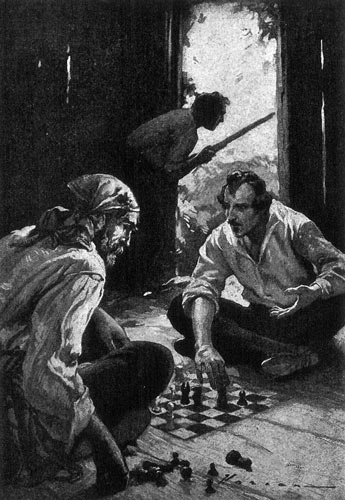
Piece by piece there grew before our eyes a set of chessmen.
Rough and crude though the men were, they
slowly took the familiar shapes of kings and queens and
bishops and knights and pawns. When they were done,
Matterson hunted through the pockets of the coat that
the skeleton still wore, and found a carpenter's pencil,
with which he blackened half the men. Then, grunting
with pain as he moved, he drew a crude chessboard on the
floor squarely in the middle of the hut.
"Lamont," said he, "shall we play?"
Arnold smiled. "I will play you a game," he said.
And with that the two sat down by the board and tossed
for white and set up the crudely carved men, and began
perhaps the most extraordinary game of chess that ever
two men played.
There was something admirable in their very bravado.
While the rest of us watched the clearing, every man of us
suffering from thirst and hunger, the tortures of the
damned, those two, swaying sometimes from sheer weakness,
played at chess as coolly as if it were one of the games
that Arnold and Sim had played of old in my uncle's store
at Topham; and although to this day I have never really
mastered chess, I knew enough of it to perceive that it was
no uneven battle that they fought. As the pawns and
knights advanced, and the bishops deployed, and the
queens came out into the board, the two players became
more and more absorbed in their game, which seemed to
take them out of themselves and to enable them to forget
all that had happened and was happening.
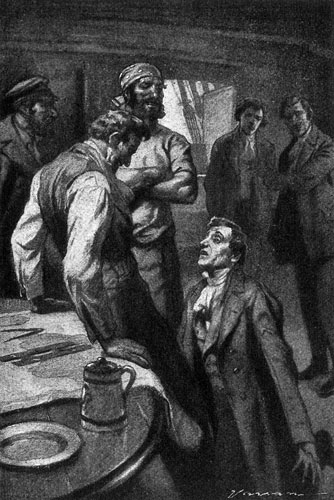
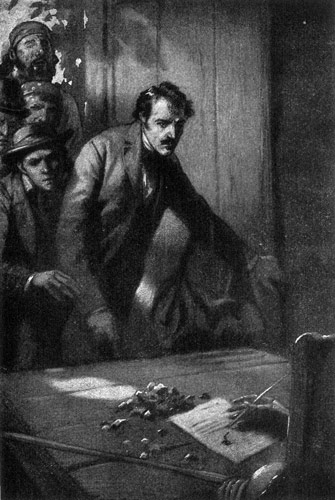
And with that the two sat down by the board ... and began perhaps the
most extraordinary game of chess that ever two men played.
Indeed, it well-nigh hypnotized those of us who were
only watching. The ghastly calm of the two, the fierceness
with which they fixed their eyes on each move, the coolness
with which they ignored the wild clamor, all helped
to compose the rest of us, and by their example they made
us ashamed of revealing to one another the fears we were
struggling against.
"Neil," said O'Hara suddenly,—his harsh, hoarse
voice startled even the chess-players,—"shall we have a
turn at cards? I do believe there's a wonderful solace in
such hazards."
"Cards!" Gleazen echoed. His own voice was stranger
than O'Hara's. "We have no cards."
From the pocket of the blue coat on the skeleton O'Hara
drew out a dingy old pack, which a dead man's fingers had
placed there.
"Sure, and I know where to find them," he said. "Never
did Bull travel without them."
With that the two squatted on the floor, and shuffled
the cards with a pleasant whir, and dealt and played and
dealt again.
It was as if our party had suddenly been transported
back to Topham. Such nonchalance was almost beyond
my understanding. Matterson, by his cool, bold defiance
of danger, seemed to have aroused emulation in every one
of us; and Gleazen, always reckless, now talked as lightly
and gayly of the games as if it were a child's play to while
away the dull hours of a holiday afternoon.
For the time, abandoning the agreement that neither
side should trespass on the other's half of the hut, Abe and
I watched from window to window lest the blacks take us
by surprise, and now and then we would see someone observing
the hut from under the trees a long gunshot away.
But although the wails and yells and moans and the constant
drumming over the dead wizard never ceased, no
man came from the cover of the vines into the clearing.
Now Arnold precisely and clearly said, "Check."
Matterson swore and snapped his fingers and moved.
Again Arnold moved, and again he said, "Check!"
Matterson bent over the board and frowned. After a
long delay he moved once more.
Instantly Arnold moved again and in his calm voice repeated,
"Check!"
Matterson looked up at him with a strange new respect
in his eyes.
"You win!" he cried with an oath. "You've done well.
I didn't think you could. You are a chess-player."
"I have played a good deal," Arnold quietly replied.
"You have played with better men than Sim Muzzy."
"Yes." For a moment Arnold hesitated, then he added:
"I have beaten at chess a great man. It was like to have
cost me my sword and my head."
"Your sword?" Matterson repeated slowly. "Your
sword and your head?"
There was a question in his voice, but Arnold did not
answer it. Returning a curt, "Yes," as if regretting that
he had said so much, he brushed Matterson's chessmen
together, and looked out of the door and down the long
slope at the tall green grass beside the spring, which seemed
as far away from us as did our own well, thousands of miles
away in Topham.
And still Gleazen and O'Hara played on. Time and
again we heard the whir of shuffling and the slap of cards
flung on top of one another.
Now the sun was setting. The swift twilight came upon
us and faded into darkness, and the card-players also
stopped their game.
All day Seth Upham had scarcely said a word. From
dawn until dark he had paced the hut, apparently buried
deep in thought. Only his gaunt, pitiful face revealed
the extent to which he shared our tortures.
Now for the first time in all that day, to our surprise, he
spoke; and his first words confirmed every fear we had felt
for him.
"The boys ought not to make so much noise," he said.
"I must speak to the constable about it."
Matterson softly swore and shifted the bandage on his
face. Gleazen significantly looked over at me. Abe Guptil
stood with his mouth open and stared at Seth Upham.
Never boys of a New England town made such an uproar
as was going on outside. Those wails and yells and
hideous drummings and trumpetings were African in every
weird cadence and boisterous hoot and clang.
Then, as if the first words had broken a way through his
silence, Seth Upham began to talk in a low, hurried voice;
and however reluctant we had hitherto been to believe
that he was mad, there was no longer any hope for him at
all. The man had lost his mind completely under the terrific
strain that he had endured.
Small wonder when you think of all that had happened:
of how, for Cornelius Gleazen's mad project, he had thrown
away a place of honor and assured comfort back in Topham;
of how he had been driven deeper and still deeper
into Gleazen's nefarious schemes by blackmail for we
knew not what crimes that he had committed in his
young-manhood; of how, even in that alliance of thieves,
he had fallen from a place of authority to such a place
that he got not even civil treatment; of how he had lost
reputation, livelihood, money, and now even his vessel.
"I declare, we must put in another constable," he muttered.
"Johnson can't even keep the boys in order—In
order, did you say? Who else should keep the place in
order?—O Sim, if only you had wits to match your good
intentions! How can you expect to keep books if you can't
keep the stock in order?—" He stopped suddenly and
faced the door. "Hark! Who called? I declare, I thought
I was a lad again."
Moment by moment, as he paced the hut, we watched
his expression change with the mood of his delirium,—sometimes
I have wondered if the fever of the tropics did
not precipitate his strange frenzy,—and moment by moment
his emotions seemed to become more intense.
Now, pursuing that latest fancy, he talked about his
boyhood and told how deeply he repented of the wicked
life he had led as a young man; told us, all unwittingly, of
unsuspected ambitions that had led him from wild ways
into sober ones, and of his youthful determination to win
a creditable place in the community; told us of the hard
honest work that he had given to accomplish it. Now he
revealed the pride he had taken in all that he had succeeded
in doing and building, and—which touched me
more than I can tell you—how he had counted on me,
his only kinsman, to take his place and carry on his work.
All this, you understand, not as if he were talking to us or
to anyone else, but as if he were thinking out loud,—as
indeed he was,—merely running over in his own mind
the story of his life.
Now he reverted again to his repentance for the wicked
youth that he had lived. And now, suddenly, his manner
of speaking changed, and from merely thinking aloud he
burst out into wild accusation.
"The dice are loaded," he cried,—his voice was hoarse
and strained with the agonies that he, like all of us, had
endured and was still enduring,—"the dice are loaded.
I'll not play with loaded dice, Neil Gleazen!"
At that Gleazen gasped out a queer whisper.
But already Seth Upham's mind was racing away on another
tack.
"Aye, loaded with the blessed weight of salvation.
Didn't my old mother, God bless her, teach me at her
knee that a man's soul can never die? Our Father, who
art in heaven, hallowed be thy name—"
Staring at him in horror, we saw that he was not blasphemous.
The words came reverently from his weak lips.
He simply was mad.
Suddenly in a high-pitched voice, he began to sing,
"Low at Thy gracious feet I bend,
My God, my everlasting friend."
He sang three stanzas of the hymn in a way that appalled
every one of those three men who of us all, I think, were
least easily appalled—indeed, I think that for once they
were more appalled than the rest of us; certainly none of
them had Arnold's composure or Abe's obvious, almost
overpowering sympathy for poor Seth Upham. Then he
stopped and faced about with eyes strangely aflame. In
his manner now there was all his old imperiousness and
something more, an almost noble dignity, a commanding
enthusiasm, which, whether it came from madness alone or
whether it had always been in him, got respect even from
Matterson and O'Hara.
"I am going to meet my God face to face at the throne
of Judgment," he cried.
It was the first time in days that he had addressed us
directly, and he spoke with a fierce intensity that amazed
us; then, before we guessed what was in his disordered
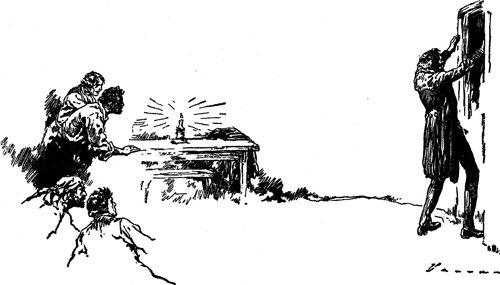
mind, before a man of us could stop him, he stepped outside
the door and flung his arms straight out like a cross,
and with his head thrown back marched, singing, into the
darkness.
"By Heaven!" Gleazen gasped, "he has set sail now
for the port of Kingdom Come!"
We who remained in the hut, where a spell of silence
had fallen, could hear him strongly and clearly singing as
he strode down the long, dark vista toward the spring:—
"Lo what a glorious sight appears
To our believing eyes!
The earth and seas are past away,
And the old rolling skies!"
It may seem strange to one who reads of that fearful
night that we did not rush after him and drag him back.
But at the time we were taken completely by surprise, literally
stupefied by the extraordinary climax of our days
and nights of suffering and anxiety; and even then, I
think,—certainly I have later come to believe it,—we
felt in our inmost hearts that it was kinder to let him go.
He went down the hill, singing like an innocent child.
His voice, which but a moment before had been pathetically
weak, had now become all at once as clear as silver.
And still the words came back from the tall grass by the
spring, where creatures ten thousand times worse than
any crawling son of the serpent of Eden lay in wait for
him:—
"Attending angels shout for joy,
And the bright armies sing,
Mortals, behold the sacred feet;
Of your descending King."
Then the song quavered and died away, and there came
back to us a queer choking cry; then the silence of the
jungle, enigmatic, ominous, unfathomable, enfolded us all,
and we sat for a long time with never a word between us.
The wailing and drumming over the body of the dead
wizard had suddenly and completely ceased. At what was
coming next, not a man of us ventured to guess.
Gleazen was first to break that ghastly silence. "They
got him," he whispered. For once the man was awed.
"No," said Arnold Lamont, very quietly, "they have
not got him. Unless I am mistaken, his madness purged
his soul of its black stains, and he went straight to the
God whose name was on his lips when he died."
Of that we never spoke again. Some thought one thing;
some, another. We had no heart to argue it.
Poor Uncle Seth! What he had done in his youth that
brought him at last to that bitterly tragic end, perhaps no
other besides Cornelius Gleazen really knew, and Cornelius
Gleazen, be it said to his everlasting credit, never told.
But for all that, I was to learn a certain story long afterward
and far away. Not one man in hundreds of thousands
pays such a penalty for blasphemous sins of his mature
years; and whatever Seth Upham had done, however dark
the memory, it had been a boy's fault, which he had so
well lived down that, when Cornelius Gleazen came back
to Topham, no one in the whole world, except those two,
would have believed it of him.
In that grim, threatening silence, which enfolded us like
a thick, new blanket, we forgot our own quarrel; we almost
forgot the very cause for which we had risked, and
now bade fair to lose, our lives.
We were six men, two of us wounded, three of us arrant
desperadoes, but all of us at least white of skin, surrounded
by a black horde that was able, if ever it knew its own
power, to wipe us at one blow clean off the face of the
earth. Now that the terrible thing which had just happened
had broken down and done away with every thought
of those trivial enmities that fed on such unworthy motives
as desire for riches, our common danger bound us, in
spite of every antagonism, closer together than brothers.
By some strange power that cry which had come back to
us when Seth Upham's song ended not only enforced a
truce between our two parties, but so brought out the
naked sincerity of each one of us, that we knew, each and
all, without a spoken word, that for the time being we
could trust one another.
Gleazen, always reckless, was the first to break the silence.
From the wall he took down a pewter mug, which
the dead man they called Bull had hung there. Pretending
to pour into it wine from an imaginary bottle, he
looked across it at Arnold.
"This is not the vintage I should choose for my toast,"
he said with a wry mouth, "but it must serve. Yes, Lamont,
it must serve." He raised the mug high. "In half
an hour we'll be six dead men. I drink—to the next one
to go."
Arnold coolly smiled. Pretending to raise a glass and
clink it against the mug, he, too, went through the pantomime
of drinking.
I was not surprised that Abe Guptil was staring at them,
his lips parted, or that his face was pale. Although drunk
only in make-believe, it was a toast to make a man think
twice. I drew a deep breath; I could only admire the coolness
of the two.
Yet now and then there flashed in Arnold's eye a hint of
resourceful determination such as Gleazen probably never
dreamed of, a hint of scorn for such theatrical trickery.
We were all on our feet now, standing together in our
silent truce, when we heard for the last time that sound,
so unhappily familiar, the long-drawn wailing cry that,
whenever the wizard spoke, had preceded and followed his
harangue. Coming from the dark forest beyond the clearing,
it brought home to us more vividly than ever the
ominous silence that had ensued since Seth Upham fell by
the spring. Then that familiar, accursed voice, faint but
penetrating, came from the wall of vines:—
"White man, him go Dead Land!
"White man, him go Dead Land!
"White man, him go Dead Land!"
"Now, by the holy," O'Hara whimpered, "it's fight for
our lives, or hand them away like so many maundy
pennies."
"Fight, is it?" Gleazen roared. And forgetting his stiff
wounds, he sprang to his feet. "Load those guns! Name
of heaven, be quick!"
Why at this particular time the bawling voice of the native
should thus have called us to action is not easy to say,
for you would think that, having become familiar with it,
we should have regarded it with proverbial contempt.
But we knew that the deadlock could not last forever;
Seth Upham's fate was all too vivid in our minds; and I
really think that, in the strange voice itself, there was
more than a hint of what was to follow.
Forgotten now was the edict that one party should stay
on one side of the hut, the other on the opposite side.
Forgotten, even, was the bag of stones in Gleazen's pack.
Armed with every weapon that the hut afforded, we stood
behind door and window and saw a sight that appalled
the bravest of us.
Straight up the hill from the spring where they had
killed Seth Upham there streamed a raging black horde.
The rising moon shone on their spears and revealed the
endless multitudes that came hard at the heels of the leaders.
Their yells reverberated from wall to wall of the forest
and even, it seemed to us, to the starry sky above them.
As we fired on them, the streamers of flame from our
guns darted into the night and the acrid smoke drifted
back to us. But though they faltered, this time they came
doggedly on. Already in the moonlight we could distinguish
individuals; now we could see their contorted features
alive with rage and vindictiveness. That they would
take the hut by storm, there was not the slightest doubt;
nor was there a ray of hope that we should survive its fall.
It was a long, long way from Topham to that wattled
hut in a clearing on the side of an African hill, and in
more ways than one it was a far call from Higgleby's barn.
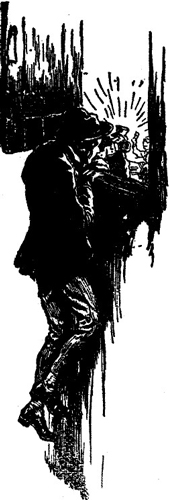
But it was Higgleby's barn that I thought of then—Higgleby's
barn in the pasture, with a light shining through
a crack between the boards, and a boy scaling the wall
under the window; Higgleby's barn in the dark, with
tongues of flame running out from it through the grass.
Truly, I thought in metaphor, which was rare for me, the
fire that sprang up so long ago in Higgleby's barn had already
killed Seth Upham, and now it was going to enfold
and engulf us all.
Then I thought of the mission on the river, and the girl
whom I had seen first among the mangroves, then in the
darkness on the mission porch. Did the war actually
reach to the coast? And would the war wipe out "old
Parmenter" as Gleazen had said? By heaven, I thought,
it would not and it should not!
All this, of course, takes far longer to tell, than it took
to go coursing through my mind. In the time it took to
think it out, not one black foot struck the ground; not one
left the ground. Before that racing army of negroes had
advanced another step, the answer had come to me; and
now, no longer the boy who had climbed in idle curiosity
the wall of Higgleby's barn, but a man to think and act, I
cried from my dry throat:—
"Out of the back window, men! O'Hara, help me brace
the door! Out of the window and over the hill!"
With an oath Gleazen cried, "He's right! They're all
coming on us up the hill! The back way's our only
chance!"
O'Hara, in spite of my call for help, led the way out of
the back window; but Arnold paused to jam chairs and
boards against the door; and Gleazen, ever reckless,
stooped in the darkness and picked something up. As we
sprang to the window, he came last of all, and I saw that
he, the only one to think of it in that hour of desperate
peril, was of a mind to bring his pack—the pack that had
held the thing for which we had left our homes and
crossed the seas. I saw Matterson clinging to brave Abe
Guptil's shoulder, and striving desperately, with Abe's
help, to keep pace with O'Hara, who in all this time had
not got so much as a scratch. I saw the forest wherein lay
our sole hope of safety, and terribly far off it seemed.
Then I rolled out into the moonlight, and ran as if the
devil were at my heels.
Almost at once I heard Gleazen come tumbling after
me, and gasp with a frightful oath that the pack had
caught and he had left it.
As we ran, we kept, as far as possible, the house between
us and the blacks, and so intent were they on attacking
our little citadel, that for a moment or two they overlooked
our flight.
We heard their cries as they battered down the door,
their eager shouts, their sudden silence, and then the fierce
yell of discovery when they saw us in the moonlight. It
occurred to me then that, but for my poor uncle's death
down by the spring, which had very likely caused them to
break their circle and gather there in the open, we should
not have had so easy a time of it when we fled over the
hill behind the hut. Weak though we were, despair was a
mighty stimulus and we ran desperately for the woods;
but although we had got a fair start, the pack was now
yelping in full cry on our trail.
The pitiful futility of it all, I thought. Seth Upham was
dead—the stones were lost—we ourselves were hunted
for our lives! As I staggered after the others straight into
the wall of almost impenetrable vines, I turned in the act
of wriggling through it and let fly with my pistol. Compared
with the muskets, the pistol made a dainty little
spit of fire and sound, but it served to delay the foremost
negroes, and with our scanty hopes a little brighter for
their hesitation, I struggled on to come up with the others.
It was well for us, after all, that O'Hara had taken the
lead. Say what you will against him, the man knew the
country. First, guided by the general lay of the land, he
led us down the hill, through rocks and brush, straight to
a stream where we drank and—warned by Arnold Lamont
—fought against the temptation to drink more than
a tiny fraction of what we desired.
Revived by the plunge into water, we turned and followed
O'Hara up the stream-bed, bending low so that no
onlooker could see us, climbed a great precipitous hill
down which the stream tumbled in noisy cascades that
hid every sound of our flight, drank again, and kept on
up into the rocks away from the water. Not daring to
raise our heads above the dry bed of the rainy-season torrent
along which we now hurried, we never once looked
back down the slope up which we had toiled, panting and
puffing and reeling; but behind us, far behind us now, we
could hear the shrieks and yells of the disappointed savages,
who, having outflanked the timber into which we
disappeared, and having wasted many minutes in beating
through it, a manœuvre that their wholesome respect for
our firearms had much delayed, had now come out on the
brow of the rocky declivity leading down to the creek, and
were losing much time, if we could judge by their clamor,
in arguing which way we were likely to have gone.
I wonder if the whole performance to which we owed our
lives was not characteristic of the natives of the African
coast? If therein did not lie just the difference between a
people so easily led into slavery and a people that never,
whatever their weaknesses have been, have yielded to
their oppressors? It all happened long ago, and it was my
only acquaintance with black warfare; but surely we
could never thus have thrown American Indians off the
scent.
It seemed to me, then, that we had made good our escape
and could run straight for the river, and in my enthusiasm
I said as much. But Arnold and Abe Guptil
shook their heads, and O'Hara significantly raised his
hand. "Hark!"
I listened, and realized that an undertone of sound,
which I had heard without noticing it, as one hears a
clock ticking, was the rumble of drums miles and miles
away. While I listened, another drum far to the north
took up the grim throbbing note, then another to the east.
Then, mingling with the swelling voice of all the drums,—how
many of them there were, or in how many villages,
I had not the vaguest notion,—I heard human voices
down the hill on our right, and after a time other voices
down the hill on our left. I then knew that however stupid
our pursuers might seem, to reach the river was no such
easy task as I had hoped.
For an hour we lay hidden among the rocks, with the
world spread out before us in the moonlight. Here and
there were small points of fire, which shone as if they were
stars reflected on water,—we knew, of course, that there
was no water, and that they must, therefore, be lights of
village or camp,—and twice, at a distance of half a mile,
men passed with torches. But for the most part we lay
shoulder to shoulder, with only the moon and the twinkling
points of light to awaken our meditations.
I thought of Uncle Seth dead in the grass by the spring
down to which he had gone so bravely. I thought of the
hut in which, so far as we knew, still lay the skeleton and
the bag of pebbles. And while I was thinking thus, I
heard to the southeast the sound of gunshots.
First came several almost together like a volley, then
another and another, then two or three more, and after
that, at intervals, still others.
O'Hara looked first at the sky and then in the direction
of the shooting. "They're attacking a trader's caravan,"
he said. "There'll be white men in it, surely. The thing
for us to do, my lads, is to join up with them. They'll
have food."
"Aye, but how?" asked Gleazen.
As if in answer to his question,—a terribly discouraging
answer!—we heard, when we stopped to listen, coming
up to us out of the night from every side, near and far,
the throbbing of drums.
"Aye, 'how?'" O'Hara repeated.
"Can we not," I asked, "work down toward them and
break through the blacks?"
"The war has gone to the coast by now, and they are
attacking all comers. But it's us they're keen on the trail
of, all because Bull built his house on a king's grave and
a blithering idiot killed a devil. 'Tis true, Joe. If we
could work down toward them, come three o'clock in the
morning, it might happen even as you say."
There were no torches, now, to be seen; no voices were
to be heard. There were only the fixed lights shining like
stars and the steadily throbbing drums. Whether or not,
back on our trail, the blacks were still hunting for us,
we did not know; but by all signs that we could see,
they were settling quietly down for the remainder of the
night.
"And if it don't happen like you say," O'Hara added
as an afterthought, "we'll be nearer the river surely, and
there may be hope for us yet."
At that he looked at Gleazen and smiled, and Gleazen
softly laughed and nudged Matterson, at which Matterson
swore, because Gleazen's elbow had touched a wound.
Then they all three looked at one another and laughed;
and remembering the board in the centre of the hut and
the law that neither side should trespass on the part allotted
to the other, I heartily wished that we had another
such board and another such law. We had agreed upon
our truce under the stress of great danger. Take away
that danger, I thought, and there would be nothing to
keep the old coals of hate from springing into flame anew.
Down from the hilltop we went, slowly picking our way
among the boulders, to still another brawling stream at the
foot. There we drank and waited and reconnoitred, and
finally, convinced that we were in no immediate danger,
pushed on after our guide, O'Hara.
He first led us down the ravine and through a wild and
wooded country; but within two miles the sound of drums,
which had become louder and nearer, warned us of a village
ahead, and, leaving the stream, we climbed a hill,
passed through scattered patches of plantains and yams,
from which we took such food as would dull the edge of our
hunger, came down again into dense timber, worked our
way through it, and emerged at last into an open space
above a broad plain.
And all this long way faithful Abe Guptil had half carried,
half dragged the great body of Matterson, who
fought hard to keep up with the rest of us and strove to
regain the strength that his wound had taken from him,
but who despite his bravest efforts, still was sadly weak.
As well as we could judge by the interminable drumming,
there were villages on our right and on our left and
behind us. By the stars we estimated that it was still an
hour before dawn, and by lights on the plain we guessed at
the location of the camp of which we had come in search.
We had already wandered so far from the road by which
we had come to the mountain, that it seemed as if only a
miracle could bring us back to the place on the river where
we had left our boat; but in that respect O'Hara was no
mean worker of miracles, for his years in Africa had given
him an uncanny judgment of direction and distance.
"Yonder will be the river," he said, pointing slightly to
the left; "and yonder will surely be the camp where we
heard guns firing. Below there'll be a road and the camp
will be on the road. I know this place; I've been here
before."
With that he once more plunged down the steep declivity
and through a growth of scrubby trees to a great
prairie, where, even as he had said, a road ran in the direction
that our journey led us. Fire not long since had
burned over the meadow, and spears of grass from fifteen
to twenty feet high had fallen across the road and tangled
and twisted so that most of the time we had to bend almost
double as we walked. But in that early morning
hour there were no travelers on the road except occasional
deer, which went dashing off through the grass; and it
crossed many streams into which we plunged our hot faces.
With water for our thirst and plantains for our hunger, we
fared on, until, just as dawn was breaking, we came in
sight of the red coals of a fire.
O'Hara raised his hand and we stopped. "The niggers
are ahead of us," he whispered. "Beyond the niggers will
be the caravan surely, and beyond the caravan there'll be
more niggers."
"The question, then, my friends," said Arnold, slowly,
"is whether to go round them and on alone, or to go
through the blacks and take our chances on a friendly reception
from whoever is camping just ahead."
"That," said O'Hara, "is the question."
"There's no doubt but they're traders," Gleazen muttered.
"We'll have to fight before we reach the river. The
more on our side, the merrier, I say, when it comes to
fighting."
By our silence we assented.
Arnold raised his hand. "It is by surprise, gentlemen,
or not at all. Are you ready?"
Breathing hard, we pressed closer together.
"Quickly, then! Together, and with speed!"
Arnold's voice snapped out the orders as if we were a
company of military. There was something so commanding,
so martial, in his manner and carriage, yet something
that fitted him so well and seemed so much a part of
his old, calm, taciturn, wise way, that I felt a sudden new
wonder at him, a feeling that, well though I thought I had
known him, I never had known him.
Then, brought all at once into action by the energy and
force of his command, as was every one of the others, I
started at the word as did they. Together we ran straight
through the camp of sleeping blacks,—so strong was
Matterson's spirit, so great his eagerness, that he now kept
pace with us almost without help,—straight past the
coals of their campfire, over the remnants of their evening
meal, over their weapons and shields strewn in the road,
and on toward their picket-line. As they woke behind us,
bewildered, and groped to learn the cause of the sudden
disorder, and realized what was happening, and started up
with angry cries, we leaped, one after another, actually
leaped, over a black sentry nodding at his post, over a
frail barrier that they had thrown up to conceal their
movements, and charged down upon a threatening stockade
behind which lay the caravan.
That the caravan kept better watch than their besiegers,
we learned first of all; for even as we leaped the barricade
and came racing down the road, a gun went off in our
faces and a cry of warning called the defenders from their
sleep.
"Don't shoot!" O'Hara yelled. "We're white men!
Don't shoot!"
All now depended on the men of that caravan. Were
they friends or foes, honest men or thieves, we had cast
the dice, and on that throw our fate waited.
I heard Gleazen bellowing in Spanish and Arnold Lamont
calling in French; then up I came with Matterson
and Abe to the crude, hasty rampart of mud and grass,
and over I tumbled upon a man who cried out in amazement
and raised his gun to strike me down, only to desist
at the sight of my white face, which was no whiter than
his own. Arnold was ahead of me; Gleazen and Matterson
came in, almost at the same moment; then came Abe; and
last of all, dumb with terror, O'Hara, who had tripped and
fallen midway between the two barricades and had narrowly
escaped perishing at the hands of the negro guards.
In we came and about we turned, side by side with the
strange whites, and when the hostile spearmen showed
signs of rushing upon us, we gave them balls from musket
and pistol to remember us by, and they faltered and drew
back. But that the end was not yet in sight the thudding
of their drums and the growing chorus of their angry yells
unmistakably told us.
"Ha! Dey t'ink dey git us yet," one of the strangers
cried, hearing me speak to Arnold in English. "Dis one
beeg war. Where he start, who know? Dey fight, how dey
fight! Dey come down upon us—whee! Gun, spear—when
we start we have feefty slave. Ten we loos' before
war hit us so we know and hit back. Ha! Dis one beeg
war!"
"How far, tell me," gasped O'Hara, "has the fighting
gone?"
"Leesten!" The stranger lifted his hand. "Hear dem
drum? One here—one dar—one five mile 'way—one
ten mile 'way! Oh, ev'ywhere dem drum! Hear dem
yell! How far dis war gone—dis war gone clean to Cuba!
Dis one beeg war, by damn!"
"Has the war," I cried, "reached the mission on the
river?"
"Ha! You t'ink you see dat meession, hey? Dat
meession, he fall down long since time, I'll bet. One good
t'ing dat war he do."
If only I had never seen the girl by the river, I thought.
If only I could have forgotten her! I turned away. Yet
even then I would not have spared one iota of my brief
memories of that girl with the strong, kind face and quiet
voice. If I never saw her again, I still had something to
hold fast. How many times, since Seth Upham went down
to die by the spring, had I thought of that girl as one of the
few people whom I should be glad to see again, and how
many times had I wished that she did not think so ill of
me!
"Tell me, you man, where from you come?" the stranger
now asked. "You come pop! So! Whee!"
At that Gleazen spoke in Spanish, and the man turned
like a cat taken unawares and looked at him with shrewd,
keen eyes. Then Matterson came up to them and likewise
began to talk in Spanish, and others crowded round
them.
Arnold, after listening for a moment, drew me to one
side. "See," he murmured.
Following his gesture, I looked around the camp and
saw, in the middle of the clearing, thirty or forty cowering
negroes bound fast by bamboo withes. Behind them and
mingling with them were bullocks and sheep and goats.
Moving restlessly about in the light of earliest morning
were numbers of male and female slaves; and on every
side were baled hides and bundles of merchandise: ivory,
rice, beeswax, and even, it was whispered, gold.
"I fear, my friend," Arnold said in an undertone, "that
our hosts are more to the taste of Gleazen than of ourselves."
"You have heard them talking," I whispered. "Tell
me what they said."
"Only," replied Arnold, "that we have a ship and they
have a cargo; that it will be to our mutual advantage to
join forces."
I looked again at the captive negroes, and again thought
of the girl at the mission and of the evil that she had attributed
to me.
"To join forces," I said,—and in my excitement I spoke
aloud,—"in trading human beings? Not that!"
The others turned.
"What are you two talking about?" Matterson asked
quickly in his light voice.
"Of one thing and another," I replied, flushing.
"Come," said Gleazen, boldly, "let us all talk together."
"Dis one beeg war!" the trader cried. "To fight—eet
is all we can do. Fighting we go, da's what me, I say.
See! Sun, he come up!"
"To that," said Arnold, "we all agree. We, sir, will go
with you and fight by your side."
"Good! Me, I's happy. You brave men. Dis one beeg
war, but we make plenty war back again."
Then he cried out orders in Spanish, and the camp woke
to the activities of the new day; and while some of us held
off the blacks, the rest of us ate our morning meal in the
first golden sunlight of the dawn, with a hum and bustle
of packing and harnessing and herding going on around us.
But all the time the drums beat, and far away we would
hear now and then calls and shouts that made the strange
trader and Gleazen and O'Hara exchange significant
glances.
As with loaded muskets we fell in to guard the caravan,
and the porters lifted their bundles, and the herders goaded
their beasts, and the captive negroes started hopelessly on
the road to the river, and the sudden hush of voices made
the trample of feet seem three times louder than before,
we heard guns behind us.
"Ha! Dose trade gun, hey?" the trader cried, and fell
into Spanish.
Wheeling his horse, he anxiously looked back along the
road.
One thing for which we had crossed the sea was lost in a
hut overrun by an army of vengeful savages. There was
no fortune left for us, I knew, unless it were a fortune
gained by bartering human souls; and at that, which lay
at the real bottom of all Neil Gleazen's schemes, my heart
revolted. What chance should we have had of saving for
Seth Upham his ship and what money was left, even if he
had lived? Small chance, I admitted.
All day we drove on in a forced march, leaving the war
to all appearances far behind us and stopping only at
noon, by a clear cold stream in the forest, to eat a hasty
meal; and at nightfall, crossing another stretch of prairie,
we came to still another forest.
"Here," the trader cried, "here ees one fine leetle river!
Here we camp one leetle while! Den we go—like fire—when
midnight come, mebbe we see one beeg river!"
That we, who had come the night before from the house
on the king's grave, were ready to rest, I can assure you.
Never in all my life have I been so heavy with weariness,
nay, with downright exhaustion, as on that evening at the
edge of that African forest.
The very beasts were weary after the long day's march.
The trader's horse hung its head. The bullocks and goats
and sheep plodded on before their noisy herders and
scarcely quickened their pace at thrust of goad or snap of
whip. The captive negroes, wretched creatures doomed to
the horrors of the infamous middle passage in the hold of
some Cuban or Brazilian slave-ship, wearily dragged along,
their chins out-thrust, their hands lashed behind them.
The traders' own slaves, bending under the weight of
hides and rice and ivory, stumbled as they walked, and
even the white men themselves, who had done nothing
more than ride or walk over the road, breathed hard and
showed drawn faces as they eagerly pushed on or apprehensively
looked back.
Into the woods we pressed, thanking in our hearts the
Divine Providence that here at least there was no throb
of drum, no howling of black heathen, no war at all. The
aisles between the great trees were cool and green and inviting.
The river rippled over rocks and suggested by its
music the luxury of bathing; fruits were to be had for the
picking, and there was no doubt in my mind that our
hosts would butcher a sheep for the evening meal.
Water, food, and sleep at that moment seemed more
desirable than all the dominions of Africa; and water,
food, and sleep, I was confident, were but now at hand.
Into the forest we marched, for once relaxing the watchfulness
that we had maintained since sunrise, and down
the trail to the creek that we could hear murmuring on its
way over the rocks and through the underbrush. And
there, at the end of our long day's journey, the bushes suddenly
blossomed in flame.
Guns boomed in our very faces. Up and down the creek
fire flashed in long spurts. The wind brought to our nostrils
the stinging smell of powder-smoke. Men and beasts
were thrown into wild confusion. In the dim light of the
forest I saw coming at us from all sides, naked men armed
with trade guns and bows and spears and lances. Louder
than the shouts and curses behind us, rang the exultant
yells before us.
When I was a boy in school, I one day ran across a translation
of Homer's Iliad and carried it home and read it
afternoons for a week. During those days I lived in the
great pictures of the battles on the plains of Troy, and
though afterwards I had seldom thought of them, they had
never quite faded from my memory.
It was far indeed from Homer's Iliad to an ambush in an
African forest; but the fight that ensued when we walked
into that hornets' nest of black warriors nevertheless
brought Homer's story vividly to my mind. The spears,
I think, suggested the resemblance; or perhaps the wild
swiftness of the fight. First an arrow came whistling
through the air and struck one of the men on the throat
and went through his neck half the length of the shaft.
He spun round, spattering me with dark blood that ran
from a severed vein, and went down under the feet of the
bullocks without a word. Then the bullocks turned, stampeded
by the sight and smell of blood, and crowded back
upon the sheep and goats, and the porters dropped their
burdens and tried to run. O'Hara threw up his musket
and shattered the skull of a huge black who came at him
with a knife like the blade of a scythe, and, himself stooping
to pick up the knife, grappled with another and died,
shrieking, from a spear-thrust up under the ribs. Then one
of the porters hurled a bundle at a man who was about to
cut him down, and the bundle broke and a shower of yellow
gold scattered in front of us, whereupon there was a
short, fierce rush for plunder.
Side by side with Arnold Lamont and Gleazen, emptying
my pistol into the crowd, I saw out of the corner of my
eye that the blacks were cutting their way into the heart
of the caravan for slaves and booty.
Imagine, if you can, that motley horde which had rushed
upon us out of the wood. Some, naked except for loin
cloths, brandished spears and howled like enraged maniacs;
some, in queer quilted armor and helmets with ostrich
plumes, clumsily wielded trade muskets; some advanced
boldly under the cover of shields and others, ranging
through the underbrush, kept up a desultory flight
of arrows. It was primitive, unorganized, ferocious war.
"Mon dieu, what a spectacle!" Arnold exclaimed; then,
"Now, my friends, quick! To the left! While the thieves
steal, we yet may escape!"
Up from the mêlée, streaked with blood and dust, now
came the trader. "All, all ees gone!" he wailed, and
waved his arms and shrieked and stamped and cursed and
jabbered on in Spanish.
Had our enemies been content to delay their plundering
until they had killed us all, not one of us would have escaped
to tell the true story of that bloody day. But at the
sight of a rich caravan and loose gold, the blacks, in the
twinkling of an eye, were fighting among themselves.
"Quick!" again cried Arnold's voice, strangely familiar
in the midst of that grotesquely unreal uproar, and as
amazingly precise as ever. "Quick, gentlemen! It is our
only chance."
And with that, he, Gleazen, Matterson, the trader, Abe,
and I took to our heels into the bushes. The woods behind
the line of the ambush appeared to be deserted. At
the foot of a ravine ran the creek. We crossed it by a rude
bridge of branches, hastily and silently climbed the opposite
bank, and stole off quite unobserved.
A hundred yards farther on, at the sound of a great
thrash and clatter, we dove into the undergrowth and lay
hidden while a band of blacks tore past us to the scene of
battle. But getting hastily up as soon as they were out of
sight, we resumed our headlong retreat.
Every bush and tree darkly threatened us. Great rocks,
deeply clothed in moss and tumbled so together as to form
damp holes and caves, at once tempted us by their scores
of hiding-places and filled us with apprehension lest natives
might have hidden there before us. But as if we were playing
the old game of follow-my-leader, we scrambled up and
down, and in and out, and always hard ahead, until we
again heard before us a rumble of voices and pounding feet,
and a second time, desperately, flung ourselves into the
undergrowth and lay all atremble while half a hundred
naked negroes, armed with bows and clubs and spears,
came trotting, single file, like wolves, and passed us not
fifty feet away.
As they disappeared, and while we still dared not move,
I saw something stir not five English cubits from my face.
I caught my breath and stared at the thing. Ten feet
ahead of it; the leaves and ferns rustled, and twenty feet
ahead of it then, twitching, it disappeared. I broke out
from head to foot in sweat. Unwittingly, we had thrown
ourselves down within hand's reach of a great serpent.
Whether or not newly gorged, and so too sleepy to resent
our nearness, it moved slowly away through the quivering
undergrowth.
When we had put a mile between ourselves and the
plundered caravan, Matterson turned with an oath.
"Poor Bud!" he said in his hard, light voice. "At least,
we'll hear no more of jujus and devils and king's graves."
Gleazen shrugged and turned to the trader. "How far
is the river?" he asked.
"Mebbe one mile—mebbe two."
"Do you, sir, know the road?" Arnold asked.
The trader nodded and spread his hands as if in despair.
"Know heem? I know heem, yes! T'ree, ten, fifty
time I come with slave and ivory and hide—now all
gone! Forty prime slave all gone! Ev'ytheeng gone!"
Gleazen grunted.
"Let us go to the river," said Arnold.
"Heem reever go by town," wailed the trader. "Heem
beeg town! Walls so high and strong!"
"Ah, that is another matter," said Arnold. "But let us
go forward at all events. We may, for all that we can tell,
strike the river below the town."
So forward we went in the darkness, and a slow, tedious
journey it was, particularly for Abe and me, who helped
Matterson along as best we could; but we avoided the
town by the sound of drumming that issued from behind
its walls, and having helped ourselves to fruit from the
patches of cultivated land that we passed, we at last
emerged from the darkness of the woods into the half light
of a great clearing, and saw a vast, black, living surface on
which strange lights played unsteadily. It seemed unbelievable
that it really could be the same river that we
had left so long ago,—in the sense of all that had happened,
so very long ago,—and yet I knew, as I watched
Gleazen and Matterson, that it must be the same. The
black, swift current recalled to my mind the toil that we
had expended in coming so far to so little purpose. In
which direction the creek lay that we had entered on our
way to the ill-fated hut, I had not the remotest idea; but
I looked a long time downstream toward the mission.
Bearing around in a rough half-circle, we worked slowly
down the bank, until the walls of the town itself were before
us, at a safe distance.
"Our boat," said Matterson, grimly, "is fifty miles
away."
"Wait here," said I. "There'll be canoes under the
town. I'll get one."
Gleazen made a motion as if to go himself, but Arnold
shook his head. "No; let Joe go first. He will learn where
the canoes are, and do it more quietly than we."
They all sat down by the edge of the water, and, leaving
them, I went on alone. It took all the courage I could
muster; but having rashly offered, I would not hesitate.
For one thing, it gave me time to think, and in a sense
I desired to think, although in another sense it came to me
that I was more afraid of my own thoughts than of all the
walled towns in Africa. The living nightmare through
which we had passed had left me worn in body and mind.
That Uncle Seth, upon whom once I had placed every confidence,
should have died so tragic a death, now brought
me a fresh burst of sorrow, as if I realized it for the first
time. It seemed to me that I could hear his sharp yet
kindly voice speaking to me of little things in our life at
Topham. I thought of one episode after another in those
earlier days, some of them, things that had happened while
my mother was alive; others, things that had happened
after her death; all, things that I had almost forgotten
long before. My poor uncle, I thought for the hundredth
time—my poor, poor uncle!
Then suddenly another thought came to me and I
straightened up and stood well-nigh aghast. By the terms
of my uncle's will, of which more than once he had told
me, all that had been his was mine!
The river silently swept down between its high banks,
past me who stood where the waves licked at my feet, past
the black walls of the town, which stood like a sentinel
guarding the unknown fastnesses of the continent of
Africa, past high hill and low gravel shoal and bottomless
morass, past pawpaw and pine palm and mangrove, to the
mission and the sea.
There I stood, as still as a statue, until after a long time
I remembered my errand and, like one just awakened, continued
on my way.
I found a score of canoes drawn up on the beach under
the town, and very carefully placing paddles by one that
was large enough for our entire party, I cautiously returned
to the others and reported what I had done. Together
we all slipped silently along the shore to the canoes,
launched the one that I had chosen, and with a last glance
up at the pointed roofs of the houses and the sharpened
pickets of the stockade, silently paddled, all unobserved,
out on the strong current and went flying down into the
darkness.
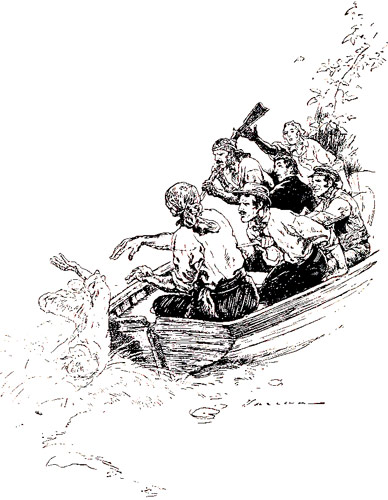
It had been one thing to row up stream against that current.
It was quite another, and vastly easier, even though
three of us were entirely ignorant of handling such a canoe,
to paddle down the swift waters of midstream. Exerting
always the greatest care to balance the ticklish wooden
craft, which the blacks with their crude adzes had hewn
out of a solid log, we sent it, even by our clumsy efforts,
fairly flying past the trees ashore; and as it seemed that
we had struck the river many miles below the creek where
we had left our boat, we had hopes that the one night
would bring us within striking distance of the open sea.
Indeed, I found myself watching every point and bend, in
hope that the mission lay just beyond it.
Estimating that daylight was still two hours away, we
drew in shore at Gleazen's suggestion, to raid a patch of
yams or plantains.
"A man," he said arrogantly, but with truth, "can't go
forever on an empty stomach."
Luckless venture that it was—no sooner did the canoe
grate on the beach than a wakeful woman in a hut on the
bank set up a squealing and squalling. As we put out
again incontinently into the river, we heard, first behind
us, then also ahead of us, the roll of those accursed native
drums.
To this very day I abhor the sound of drumming. It has
a devilishly haunting note that I cannot escape; and small
wonder.
We swept on down the current, but now, here and there,
the river-banks were alive with blacks, and always the
booming of drums ran before us, to warn the country that
we were coming. Once, as we passed a wooded point, a
spear flew over our heads and went hissing into the water,
and I was all for putting over to the other bank. But Arnold,
who could use his eyes and ears as well as his head,
cried, "No! Watch!"
All at once, under the dark bank of the river, there was
screaming and splashing and floundering. The torches
that immediately flared up revealed what Arnold, and now
the rest of us, expected to see, but they also revealed indistinctly
another and more dreadful sight: on the shore,
running back and forth in great excitement, were many
men; but in the troubled water a negro was struggling in
vain to escape from the toils of a huge serpent, which was
wrapping itself round him and dragging him down into the
river where it had been lying in wait.
To me, even though I knew that that very negro had
been watching for a chance to waylay us, the sight of the
poor fellow's horrible death almost overcame me.
Not so with Matterson and Gleazen.
With a curse, Matterson cried, "There's one less of
them now." His light voice filled me with loathing.
And Gleazen softly laughed.
On down the river we went, with flying paddles, and
round a bend. But as we passed the bend, I looked back,
and saw coming after us, first one canoe, then two, then
six, then so many that I lost all count.
How far we had come in that one night, I had little or
no idea; but it was easy to see by the attitude of those
who knew the river better than I, that the end of our
journey was close at hand. Glancing round at our pursuers,
Gleazen spoke in an undertone to Matterson, and
both they and the trader studied the shore ahead of us.
"A scant ten miles," Gleazen muttered; "only ten miles
more."
I felt the heavy dugout leap forward under the fierce
pull of our paddles. The water turned away from the bow
in foam, and we fairly outrode the current. But fast
though we were, the war fleets behind us were faster. By
the next bend they had gained a hundred yards, by the
next, another hundred. We now led them by a scant quarter
of a mile, and if Gleazen had estimated our distance
rightly, they would have had us long before we could
reach port. But suddenly, all unexpectedly, round the
next bend, not half a mile away, the mission sprang into
sight.
There it stood, in the early morning sun, as clean and
cool and still as if it were a thousand miles away from
Africa and all its wars.
"Give me your pistols," Arnold cried; and when we
tossed them to him and in frantic haste resumed our
paddling, he coolly renewed the priming and one by one
fired them at our pursuers.
That the negroes had a gun we then learned, for they
retorted by a single shot; but the shot went wild and the
arrows that followed it fell short, and our pistols cooled
their eagerness. So we swept in to the landing by the mission,
and beached the canoe, and ran up the long straight
path to the mission house as fast as we could go, while the
black canoemen paused in midstream and let their craft
swing with the current.
The place, as we came rushing up to it, was so quiet, so
peaceful, so free from any faintest sign of the terrible days
through which we had passed, that it seemed as if, after
all, we had never left it; as if we were waking from a
troubled sleep; as if we had spent a thousand years in the
still, hazy heat of that very clearing. The face in the window,
the opening door, only intensified that uncanny sense
of familiarity.
The door opened, and the man we had seen before met
us. His eyes were stern and inhospitable.
"What?" said he. "Must you bring your vile quarrels
and vile wars to the very threshold of one whose whole
duty here is to preach the word of God?"
"Those," cried Arnold, angry in turn, but as always,
precise in phrase and enunciation, "are hard words to cast
at strangers who come to your gate in trouble."
"Trouble, sir, of your own brewing," the missionary retorted.
"What you have been up to, I do not know. Nor
have I any wish to save your rascally necks from a fate
you no doubt richly merit."
"Your words are inclusive," I cried.
"They certainly include you, young man. If you would
not be judged by this company that you are keeping, you
should think twice or three times before embarking with
it."
"Father!" said a low voice.
My heart leaped, but I did not turn my head. Down the
river, manned by warriors armed to the teeth, came more
canoes of the war. Behind them were more,—and more,—and
still more.
"Come, come, you sniveling parson," Gleazen bellowed,
"where are your guns? Where's your powder?
Come, arm yourself!"
The man turned on him with a look of scorn that no
words of mine can properly describe.
"You have brought your dirty quarrel to my door," he
said in a grim, hard voice. "Now do you wish me to fight
your battles for you?"
Steadily, silently, the canoes were swinging inshore. I
saw negroes running into the clearing. On my left I heard
a cry so shrill and full of woe that it stood out, even amid
the ungodly clamor of the blacks, and commanded my
attention.
The man stepped down from the porch.
"This," he said, turning, "is a house of peace. I order
you to leave it. I will go down and talk with these men
myself."
"You'll never come back alive!" Matterson cried, and
hoarsely laughed.
At that the missionary, John Parmenter, merely smiled,
and, afraid of neither man nor devil, walked down toward
the river and fell dead with a chance arrow through his
heart.
There was something truly magnificent in his cold
courage, and Gleazen paid him almost involuntary tribute
by crying, "There, by heaven, went a brave man!"
But from the door of the house the girl suddenly ran
out. Her face was deathly white and her voice shook, but
as yet there were no tears in her eyes.
"Father!" she cried, and ran down the path, where occasional
arrows still fell, and bent over the dead man.
"Come up, you little fool," Gleazen shouted. "Come
back!" Then he jumped and swore, as an arrow with a
longer flight than its fellows passed above his head.
The canoes were drawing in upon the shore, very cautiously,
deliberately, grimly, in a great half-moon, and
more of them were arriving at every moment.
I leaped from the porch and sped down beside the girl.
"Come," I cried, "you—we—can do nothing for
him."
"Is it you?" she said. "You—I—go back!"
"Come," I cried hoarsely.
"Don't leave him here."
I bent over and lifted the body, and staggering under
its weight, carried it up into the house and laid it on the
couch in the big front room.
All this time the noise within and without the mission
was deafening. The blacks on the river were howling with
fury, and those ashore, who had not already fled to the
woods, were wailing in grief and terror. Gleazen and Arnold
Lamont had joined forces to organize a defense, the
one raving at the arrant cowards who were fleeing from
first sight of an enemy, while the other turned the place
upside down in search of arms. And still the blacks on the
river held off, probably for fear of firearms, though there
were indications that as their numbers grew, they were
screwing up their courage to decisive action.
The girl, suddenly realizing the object of Arnold's
search, said quietly, "There are no weapons."
Arnold threw his hands out in a gesture of despair.
"If you wish to leave," she coldly said, "there is a boat
half a mile downstream. You can reach it by the path
that leads from the chapel. No one will notice you if you
hurry."
"Then," I cried, "we'll go and you shall come with us."
Gleazen spoke to the trader in Spanish.
Abe Guptil was beside me now and Arnold behind me.
We three, come what would, were united.
A louder yell than any before attracted our attention,
and Matterson, who stood where he could see out of the
window, called, "They're coming! Run, Neil, run!"
At that he turned and fled, with the others after him.
I stopped and looked into the girl's gray eyes.
"Come!" I cried, "in heaven's name, make haste!"
I had clean forgotten that the dead man by whom the
girl was standing was her father; but her next words,
which were spoken from deepest despair, reminded me of
it grimly.
"I will not leave him," she said.
"You must!"
"I cannot."
"What," said I, "would he himself have had you do?"
Her determination faltered.
"Come! You cannot do anything more for him!
Come."
She shook her head.
"Then I shall stay," I said.
"No," said she, and I saw that there was a change in
her manner toward me. "You will go and I—I—"
Then she whistled and cried, "Paul! Paul!"
The great black Fantee servant whom I had seen with
her in the canoe on that day when first we met, appeared
suddenly.
"Come," she said.
I now saw that Arnold Lamont was running back to the
door of the room.
"Quick!" he called. "Mon dieu, be quick!"
He stepped aside and let her go through the door first.
As we ran down the footpath, we heard them after us
like hounds on the trail, and I tell you, it galled me to
run from that cowardly pack. Oh, for one good fight, I
thought! For a chance to avenge Seth Upham, who lay
miles away beside the spring at the king's grave, to avenge
the stern man who had fallen so bravely in front of the
mission! For a chance to show the black curs that we
would and could meet them, though the odds against us
were a hundred to one! A chance to hold our own with
them in defiance of their arms and numbers!
The hot pride of youth burned in my cheeks, and I was
actually tempted to turn on them there and then; but
now I thought of something besides myself, of something
besides Seth Upham's rights and my own: I thought of the
girl who ran ahead of me so lithely and easily. Be the hazards
what they might, be the shame of our retreat ever so
great, she must not, while one of us lived, be left to that
herd at our heels.
So, running thus in headlong flight, out we came on the
river bank.
There was a boat on the river, made fast to a peg on the
bank, and there was a long canoe drawn up in the bushes.
But at a great distance, where a narrow channel led
through the mangroves, we saw titanic waves rolling on
the bar in shining cascades from which the sun was
brightly reflected, and which, one after another, hurled ton
upon ton of water into a welter of foaming whirlpools.
And over the lifting crests of the surf we saw, standing offshore,
the topsails of a brig. The prospect of riding that
surf in any boat ever built gave me, I confess without
shame, a miserably sick feeling; and as if that were not
enough, in through the mangroves to the shore in front of
us shot three canoes of the war, and cut us off from the
river.
Our time now had come to fight. With blacks behind us
and blacks before us, we could no longer double and turn.
The river, we knew, was alive with the canoes of the war.
Already the black hornets were swarming through the
woods and swamps around us. Three times now we had
eluded them; this time we must fight. Our guns were lost
and only pistols were left. No longer, as in that fatal hut
on the king's grave,—in my heart I cursed the bull-headed
stupidity of the man who built it and who had
paid but a fraction of the price with his own life!—could
we hold them at a distance by fear of firearms. Their
frenzy by now brooked no such fear. To the brig, whose
topsails we could descry miles off shore, we must win our
way; there lay our only hope.
I thought of the voice of the wizard—"White man him
go Dead Land." Verily to the door of his Dead Land we
had come; and it seemed now that we must surely follow
Bull and Seth Upham and Bud O'Hara and many another
over the threshold.
"Men," said Arnold Lamont,—and his voice, calm, precise,
cutting, brought us together,—"stones and clubs are
not weapons to be despised in an encounter hand to hand."
"Have into 'em, then!" Gleazen gasped. "All hands
together!"
"Mademoiselle," said Arnold, "keep close at our heels."
The girl was beside me now. Her eyes were wide, but
her lips were set with a courage that rose above fear.
"Come," she cried, and set my heart beating faster than
ever, if it were possible, "they're upon us from the rear!"
Then she spoke to her great negro in a language that I had
never heard, and came close behind us when we charged
down on the blacks ahead.
I fired my pistol and saw that the ball accounted for one
of our enemies. I reeled from a glancing blow on the head,
which knocked me to my knees; but, rising, I lifted a great
rock on the end of a rope, which evidently the girl or her
father had used for an anchor,—never negro tied that
knot!—and swinging the huge weapon round my head,
brought down one assailant with his shoulder and half his
ribs broken. Now Arnold fired his pistol; now Matterson
pitched, groaning, into the boat. Now, with my bare
hand, I parried a spear-thrust and, again swinging my
rock, killed a negro in his tracks.
Out of the corner of my eye I saw that the girl had
shoved the canoe into the water. She was calling to us
eagerly, but neither I nor the others could distinguish
her words.
As Gleazen, with an oath, cut the painter of the boat
and leaped into her, the impulse of his jump carried her
ten feet out from shore; and instantly thrusting out the
oars, he started to row away with Matterson and desert us.
"Come back, you yellow cur!" Arnold cried.
The trader, who had fought industriously but to no
great purpose, now ran down the bank and, flinging himself
full length into the river, caught the stern of the boat,
with outstretched fingers, and dragged himself into her,
and at the same moment Abe Guptil, obviously with the
intention of holding the boat until the rest of us should
have a chance to embark, too, not of saving himself,
fought his own way aboard and, in spite of violent efforts
to lay hands on the oars, was carried, protesting, away.
It is not to be thought that Gleazen had the remotest
notion of saving our lives. Having got rid of Arnold and
me, he could, as he very well knew, do what he pleased
with the brig when once he had silenced Gideon North.
But although he had every desire not to help us, he in
truth did help us in very spite of himself: no sooner did he
appear to be getting safely out into the river, than the
blacks, who had us all but at their mercy, suddenly bent
every effort to keep him, too, from escaping.
"Let them go! Let them go! Oh, will you not come this
way?"
It was the girl again. There was not a drop of cowardly
blood in her veins. She, in the bow of the canoe and her
big black servant in the stern, held the craft against the
bank.
Taking advantage of the momentary respite that we got
while the enemy was putting after Gleazen, Arnold and I
fairly trembling in our haste—Arnold missed his footing
and plunged waist-deep into the river—climbed in after
them.
All this, which has taken a long time to tell, happened
like so many cracks of the whip. Each event leaped
sharply and suddenly at the heels of another, so that it
was really but a few seconds—at all events less than a
minute—after our arrival at the shore when we found
ourselves gliding swiftly and noiselessly through a tiny
channel among the mangroves, of which Gleazen had never
dreamed. A turn of the paddle carried us out of sight of
the struggle behind us, and it now appeared that, once out
of sight, we were likewise out of mind.
"Mademoiselle," said Arnold, with a manner at once so
deferential and in itself so proud, that it puzzled me more
than a little, "shall we not paddle? Permit me to take
your place."
"Thank you, no," she said.
"It is not fitting—" he began.
"I know the canoe, the river and the surf," she said.
"It is safer that I keep the paddle."
And to my surprise, as well as Arnold's, she did keep it
and handled it in a way that would have shamed our efforts
had we been permitted to try. It was a strange
thing in those days, when most women laced tightly, and
fainted gracefully if ever occasion required, and played at
croquet and battledore and shuttlecock, to see a slender
girl swing a paddle with far more than a man's deftness
and skill to make up for what she lacked of a man's
strength. But though she appeared so slender, so frail,
there was that in her bearing which told us that her life
in that wild place had given her muscles of steel. The big
Fantee, too, drove the long craft ahead with sure, powerful
strokes; so we shot out of the mangroves, out of the mouth
of the river, into the full glare of the sun.
For a time the sails of the brig had grown small in the
distance, but already we saw that she had come about and
was standing in again. Why, I wondered, did Gideon
North not anchor? Why should he indefinitely stand off
and on? How long had he been beating back and forth,
and how long would he continue to wait for us if we were
not to come? We were long overdue at the meeting-place.
"To think," I said, "that now we can go home to
Topham!"
"To Topham?" said Arnold. There was a question in
his voice. "I should be surer of going home to Topham if
we were rid of Gleazen. Also, my friend, we must ride that
surf to the open sea."
The negro in the stern of the canoe now spoke up in
gutturals.
"See!" Arnold cried.
Looking back up the river, we saw Gleazen and Abe
Guptil, whom we had outdistanced by our short cut, now
rowing madly downstream. Big and heavy though the
boat was, they rowed with the strength that precedes despair,
and sent her ploughing through the river with a
wake such as a cutter might have left. In the stern beside
the trader lay Matterson; and though his face, we could
see, was streaked with blood, he menaced the negroes upstream
with a loaded pistol. Arrows flew, and then a long
spear hurtled through the air and struck the bow of the
boat. But for all that, they bade fair to get clean away,
and none of them appeared aware that we had slipped
ahead of them in the race for life.
Now we in the canoe had come to the very edge of the
surf, where the surge of the breakers swept past us in
waves of foam. Beyond that surf was the open sea, the brig
and safety. Behind it were more terrors than we had yet
endured. For a moment the canoe hung motionless in the
boiling surge; then, taking advantage of the outward flow
and guided and driven by the hands of the great negro and
the white, slender girl, she shot forward like a living creature,
rose on the moving wall of an incoming wave, yielded
and for a brief space drew back, then shot ahead once
more and passed over the crest just before the wave curled
and broke.
I heard a cry from behind us and knew that the others
had discovered us ahead of them.
Turning, as we pitched on the heavy seas at a safe distance
from the breakers, I watched them, too, row into the
surf. I faintly heard Matterson's pistol spit, then I saw
Gleazen drive the boat forward, saw her hesitate and
swing round, lose way and go over as the next wave broke.
Then we saw them swimming and heard their cries.
As a mere matter of cold justice we should, I am convinced,
have left that villainous pair, Matterson and Gleazen,
to their fate. They had been ready enough to leave
us to ours. Their whole career was sown with fraud, cruelty,
brazen effrontery, and downright dishonesty. But
even Arnold and I could scarcely have borne to do that,
for the trader was guiltless enough according to his lights,
and Abe Guptil was struggling with them in the water.
The girl, turning and looking back when she heard their
shouts, spoke to the great negro in his own language. The
canoe came about. Again we paused, waiting for a lull.
Then we shot back on the crest of a wave, back down upon
the overturned boat, and within gunshot of the flotilla of
canoes that were spreading to receive us.
As we passed the wallowing boat I leaned out and
caught Gleazen's hands and drew him up to the canoe.
The negro cried a hoarse warning, and the canoe herself
almost went over; but by as clever use of paddles as ever
man achieved, the girl and the negro brought us up on an
even keel, and Arnold and I lifted Gleazen aboard, half
drowned, and gave a hand to Abe Guptil, who had made
out to swim to the canoe. Of Matterson and the trader we
saw no sign.
Then Abe, himself but newly rescued, gave a lurch to
starboard, and with a clutch at something just under
water, was whipped, fiercely struggling to prevent it, clean
overboard.
We could neither stop nor turn; either would have been
suicide. Would we or would we not, we went past him and
left him, and drove on in the wash of the breaking waves
down upon the grim line of canoes.
To them we must have seemed a visitation. When I sit
alone in the dark I can see again in memory, very clearly,
that white girl, her eyes flashing, that great, black Fantee,
his bared teeth thrust out between his thick lips. The
long breakers were roaring as they swept across the bar
and crashed at slow intervals behind us. In those seething
waters the fiercest attack would have been futile; the very
tigers of the sea must have lain just beyond the wash of
the surf, as did the war. To one who has never seen a
Fantee on his native coast, the story that I tell of that
wild canoe-ride may seem incredible. It was an appalling,
horrifying thing to those of us who were forced passively
to endure it, who a dozen times were flung to the very
brink of death. And yet every word is true. Though I
could scarce draw breath, so swiftly did we escape one
danger only to meet another, the big black, trained from
childhood to face every peril of the coast, with the white
girl paddling in the bow, brought the canoe through the
surf and shipped no more than a bucket of water. And
then that negro and that slim girl turned in the surge, as
coolly as if there were no enemy within a thousand miles,
and started back, out again through the surf, to the Adventure.
Were we thus, I thought, to lose Abe Guptil, whom but
now we had rescued—good old Abe Guptil, into whose
home I had gone long since with the sad news that had
forced him to embark with us on Gleazen's mad quest?
The thunder of the seas was so loud that I could only wait—no
words that I might utter could be heard a hand's-breadth
away.
For a moment the canoe hung motionless on the racing
waters as a hummingbird hangs in the air, then she shot
ahead; and up from the sea, directly in her path, came a
tangle of bodies. Leaning out, Arnold and I laid hands on
Abe and Matterson; and while the negro held the canoe
in place, the girl herself reached back and caught that rascal
of a trader by the hair. Now tons of water broke
around us and the canoe half filled. Now the big negro,
by the might of his single paddle, drove us forward. The
wash of water caught us up and carried us on half a cable's
length; the negro again fairly lifted us by his great
strength; we went in safety over the crest of the next
wave, then as we drew the last of the three into the canoe,
we began to pitch in the heavy swell of the open sea.
With our backs turned forever on the war, we paddled
out to meet the brig. Our great quest had failed. We had
left a trail of dead men, plundered goods, and a broken
mission. But though all our hopes had gone wrong, though
Gleazen had lost all that he sought, there was that in his
face as he lay sick and miserable in the canoe which told
me that he had other strings for his bow; and when I
looked up at the brig, I vowed to myself that I would defend
my own property with as much zeal as I would have
defended my uncle's.
"See!" Arnold whispered. "Yonder is a strange ship!"
I saw the sail, but I thought little of it at the time. I had
grown surprisingly in many ways, but to this very day I
have not acquired Arnold Lamont's wonderful power to
appraise seemingly insignificant events at their true value.
I only thought of how glad I was to come at last to the
shelter of the brig Adventure, how strangely glad I was to
have brought off the girl from the mission.
And when we came up under the side of the brig and
saw honest Gideon North and all the others on deck looking
down at us, the girl let her paddle slide into the water
and bent her head on her hands and cried.