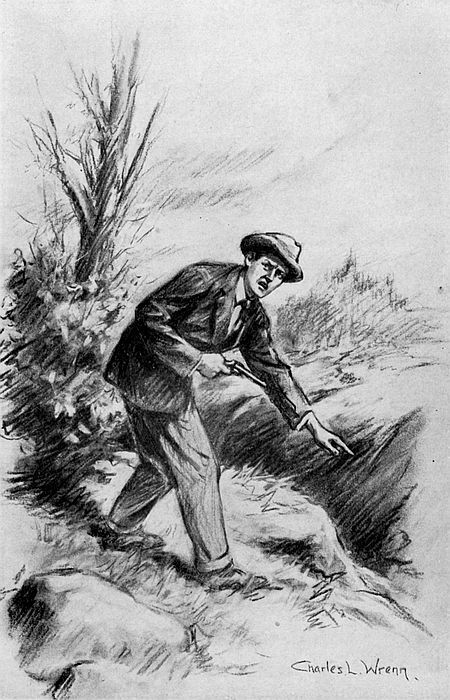
Two boys, each carrying a gun, came out of
a strip of woods and paused. They were followed
by a short-haired pointer dog. One of
the boys, whose gun was a single-barreled repeater,
bore a game-bag suspended from his
shoulder by a strap, and he spoke to the dog
with an air of authority that proclaimed him the
animal’s master. He was a pleasant-faced, blue-eyed
chap, and his name was Fred Sage.
The gun of the other boy was a double-barreled
hammerless. The boy had a slightly undershot
jaw, and his eyes were a trifle too small.
This was Roy Hooker. During the months of
the past summer these two fellows had become
exceedingly friendly.
6“There are the Hopkins woodcock covers
down yonder, Fred,” said Roy, pointing across
the open strip of pasture land. “Old Hopkins
doesn’t like to have anyone gun there, but I’m
for giving those covers a try, as long as he will
probably never know it.”
“Has he posted ‘No Trespass’ signs?” asked
Sage.
“Guess not; I haven’t seen any. He doesn’t
do any shooting himself, but being a cranky old
bear, he doesn’t like to have anyone else gun on
his property.”
“Well, as long as there are no warnings posted
and he hasn’t personally notified us to keep off,
we’ll see if we can find any birds there. The
covers look attractive to me. Here, Spot; heel,
sir.”
With the first indication that the boys intended
to proceed, the eager dog had started forward,
but he turned at the command of his master and
once more fell in behind.
7The forenoon of this clear, sunny autumn day
was not far advanced, the young hunters having
set forth shortly after breakfast. Although the
air was clear and almost warm, there was a certain
suggestion of crispness in it, which, together
with the flaming leaves of the deciduous trees,
plainly betokened that the early autumn frosts
had been at work. The stubble of the open pasture
land was brown and dry. Behind the boys,
in the woods they had just left, squirrels were
chattering and bluejays screaming, but Fred and
Roy were after bigger and more legitimate game.
Thus far their hunt had proved disappointing.
“If we don’t find anything down yonder,” said
Hooker, “I’ll get mad and shoot the next squirrel
that barks at me. I was tempted to pop over one
big gray fellow that leered at me from a limb.”
“You don’t eat squirrels, do you?”
“Oh, no.”
“What would you do with them if you should
shoot ’em?”
“Nothing; just throw them away.”
8“Then don’t shoot them, Roy. It’s not good
sport to kill practically harmless creatures simply
for the sake of killing something. I’d rather
never shoot anything at all than do that.”
“Oh, you’re deucedly finicky about some things,
old fellow. You won’t have many chances to
gun this fall, for football is going to keep you
busy. When I proposed it last night I hardly
thought I’d get you out to-day.”
“And I came out with the understanding that
we are to get back in time for practice this afternoon.
Next Saturday, a week from to-day, the
team plays its first game.”
“And will be beautifully beaten,” prophesied
Hooker.
“What makes you think so?”
“Why shouldn’t I think so? The eleven is
going to be weak this year. With Roger Eliot
for captain, it made an unexpected success last
fall; but Eliot is gone, and Stone, who was
chosen to follow him as captain, never can be
such a crafty, far-sighted general. The team
was weakened fifty per cent by the loss of Eliot.”
9“Perhaps you’re right,” admitted Sage; “but
you seem to forget that we ought to receive some
strength from the development of new players.
For instance, there’s that fellow from Texas,
Rodney Grant——”
“Oh, yes,” nodded Roy quickly, “I suppose
he’ll help some, but it takes time to make a football
player, and Grant has had little experience
at the game. Stone realizes he’s going to be shy
of material, and he’s coaxing everybody to come
out for practice. He’s been at me.”
“You’re going to come out, aren’t you?”
“I don’t know. Never did care a great deal
about football. You know it’s my ambition to
be a baseball pitcher, and a fellow can’t do everything.”
“Baseball is over now, and there’ll be no more
until next spring. For the good of the team you
ought to take hold and do your best to become
a player and fill one of the weak spots.”
“And maybe get a broken leg or arm or collar-bone
to set me back. A baseball player is taking
chances when he goes in for football.”
10“But if none of our ball players went in for
football,” reminded Sage, “we’d have no eleven.
Our school isn’t big enough for the two teams to
be made up of distinct and independent bodies of
players. You’re quick, active and strong, Roy,
and, if you choose to take hold and work hard,
it seems to me you might become one of the
valuable members of the eleven.”
“Oh, possibly,” admitted Hooker, attempting
to conceal the fact that he was somewhat flattered.
“I fancy I could do as well as some other
fellows, Piper, Cooper or Tuttle, for instance.
In a way they are mere makeshifts; none of them
is a bang-up good football man.”
By this time they had crossed the pasture land
and reached the edge of the covers, the dog betraying
a restless desire to get to work. Sage
permitted the animal to go forward, directing his
movements now and then by a word of command,
and, with the guns held ready for quick use, the
young hunters advanced slowly, keeping their
eyes on the pointer the most of the time. They
separated somewhat and went forward with the
dog at the apex of an imaginary triangle. Nearly
all the time the boys could see each other through
11the scrub growth, which made it unlikely that
either would place his friend in danger by careless
shooting.
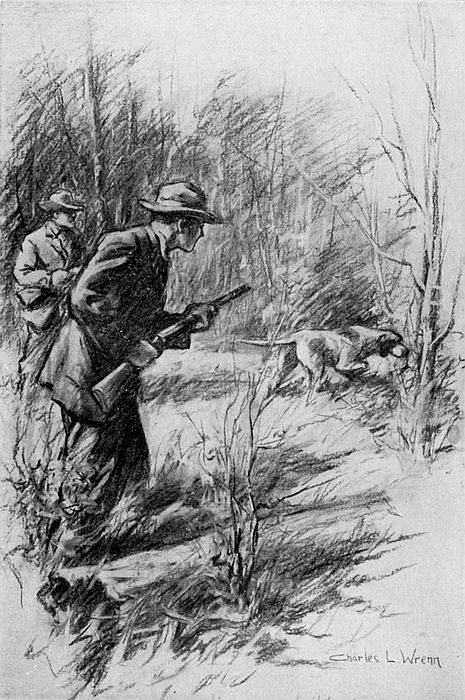
Moving hither and thither, sniffing, pausing,
advancing, every hunting instinct alert, the dog
did his work beautifully. Suddenly, with one
foot uplifted, tail horizontal and rigid and muzzle
thrust forward, the pointer became a statue of
stone. Directly ahead of him, a few feet away,
was a thick cluster of low bushes.
“Point, Roy—point!” called Sage softly, his
repeater held in both hands and half lifted, ready
for a quick shot.
Immediately Hooker swerved toward the dog
and advanced as swiftly and noiselessly as
possible, in order to obtain a position for a shot
when the bird should flush. Reaching a favorable
spot, he placed himself in position to shoot
and waited for the rise.
The seconds passed slowly—so slowly that to
the anxious boys they seemed more like minutes.
A chickadee flitted through the bushes, lighted
on a branch within five feet of Roy, performed
12some surprising horizontal bar evolutions and
applauded himself in a ludicrously hoarse voice.
Something rustled at a distance, like a creature
running swiftly along the ground. Far away,
so far that it was but faintly heard, the gun of
some other hunter spoke.
With a sudden whirr of wings a woodcock
rose straight up from the further side of the
cluster of bushes. The butt of Sage’s gun came
to his shoulder, his eye caught the sights, and
he fired.
Hooker was a trifle slower, but ere Sage, realizing
that he had shot too quickly and therefore
made a miss, could fire again, Roy’s weapon
spoke.
Down came the bird into the midst of the
thicket.
“Good work, old man,” cried Fred approvingly.
“You got him. I shot under; didn’t wait
for him to make his full rise. Go fetch, Spot.”
The dog, released from the spell that had
chained him motionless, plunged forward, sniffing
around in search of the bird. In a few moments
he brought the dead woodcock and placed it at
his master’s feet.
13“A plump fellow,” laughed Sage, holding the
kill up for the other lad to see. “That’s the first
blood for you, Roy. Shall I put it in my bag?”
“Sure; I haven’t any. There’s likely more of
them near by.”
There were more, and Sage evened things up
by bringing down the next one. After this both
boys missed a shot, and, though they had tried
to “mark” their birds when they lighted, they
beat back and forth for more than half an hour
without getting another flush.
“Come on,” said Roy at last; “I’m tired of this.
There’s some good partridge timber near by, and
I’d rather shoot one partridge than half a dozen
woodcock.”
“Every fellow to his taste,” laughed Sage. “I
prefer the sport of woodcock shooting, and I certainly
hate to leave without getting either of
those two birds up again.”
14He yielded, however, to Hooker’s urging, and
they left the low covers for the adjacent timber,
in which partridges might be found.
The partridges were there, too. Roy put one
up almost beneath his feet, but the timber was
so thick at that point that he could not get even
a chance shot with the slightest hope of success.
While he was grumbling over this, Spot made a
point and the partridge rose with a booming of
wings before Sage could give his companion
warning.
Fred fired.
“Did you get her?” called Hooker.
“I think I hit her,” was the answer. “I saw
her go down. Come, Spot, we must dig that
bird out.”
Hooker started to follow, but had not advanced
thirty feet before still another partridge
rose and went sailing away in another direction.
This time Roy fired, but he did so under such a
disadvantage and with so much haste that he had
little hope of bringing down the game.
“Confound it!” he muttered. “Are all these
birds going to get away?”
15For a full minute he stood still in his tracks,
peering into the woods on all sides and listening
keenly. Then he removed the empty shell from
his gun and slipped a loaded one into place.
“I’m going to follow that old bird I banged
at,” he decided. “I don’t believe she went beyond
the road that runs through these woods. If I
can get her without the assistance of the dog,
it will be a trick worth turning.”
Having hurried after the partridge until he
fancied he had reached a point where the bird
might have alighted, he began creeping forward
with the utmost caution, pausing every few yards
to listen and use his eyes. Once an acorn, clipping
down through the leaves and striking the
ground, gave him a start, but it seemed that the
partridge had flown farther than he thought, for
presently, without again sighting the game, he
approached the road. A short distance from the
highway he stopped in his tracks and flung the
gun to his shoulder, the barrel levelled toward
some roadside bushes, near which he had heard
a slight noise.
16Beyond the bushes a man rose into view from
a stone on which he had been seated, and found
himself looking straight into the muzzle of
Hooker’s gun.
CHAPTER II. THE MYSTERIOUS STRANGER.
17
Roy was tremendously startled. The gun had
an easy pull, and his bent finger was gently
touching the trigger, yet so astonished was he
by the unexpected appearance of the man that
for some moments he stood rigid with the weapon
leveled at the stranger’s head.
On the other hand, the man was no less dismayed.
Not more than twenty-six or seven years
of age, he was somewhat roughly dressed and
decidedly in need of a shave. His eyes opened
wide at sight of the threatening weapon, and a
wave of pallor swept over his bronzed face. Not
a word escaped his parted lips.
Presently, with a catch of his breath, Hooker
lowered the gun.
“By Jove!” he cried, with a touch of resentment.
“You came near getting shot, bobbing
up that fashion from behind those bushes.”
18No longer menaced by the gun, the stranger
seemed greatly relieved. Gradually the color returned
to his face, and, his eyes searching the
young hunter keenly, he gave a short, nervous
laugh.
“It’s pretty serious,” he said, “when a chap
can’t sit down by the roadside to rest without
being in danger of getting himself peppered from
a shotgun. You should make sure of the kind of
game you’re banging at, before you fire.”
“If I hadn’t done so,” returned Hooker, still
feeling slightly resentful, “I’d probably blown
your head off. I was following a partridge. Did
you see one fly across the road a short time ago?”
“No, I didn’t; but I haven’t been here more
than four or five minutes—perhaps not that
long.”
The man had a pleasant, agreeable face, and
Hooker thought that, were he shaved and better
dressed, he would be a rather good-looking chap.
Apparently he had not wholly recovered from
the start which the sight of the armed boy had
given him, for he was still a bit nervous and
uneasy.
19“Maybe,” said Roy, “it took me longer than I
thought to follow that old bird to this point.
Perhaps she flew across the road before you
came along.”
“Are you alone?” asked the man.
“I’m with a friend. He’s back in the woods
somewhere with his dog.”
“Of course you live near here?”
“Yes, in Oakdale.”
The man seemed interested. “Oakdale; that’s
a small town near by, isn’t it?”
“You must be a total stranger in these parts,”
said Roy, as he stepped out into the road. “Oakdale
is not more than three or four miles from
here. It’s a country village.” He was wondering
if the man could be a tramp, but closer inspection
made this seem quite improbable, despite
the stranger’s rough clothes and somewhat
shabby appearance.
20“No, I don’t belong around here,” said the
man. “I’m looking for work. Anything a fellow
can do in Oakdale?”
“I don’t know about that, but I presume one
could find some sort of work if he wasn’t too
particular. There are two mills and some lime
quarries, but the men who work in the quarries
are mostly foreigners. What are your special
qualifications?”
“I haven’t any,” was the frank confession.
“I’m ready to do any sort of work to earn an
honest living.”
“In that case, it shouldn’t be hard for you to
find something.”
“It’s not as easy as you might think. You
see, employers usually like to know something
about the workmen they engage, and they are apt
to be suspicious of a total stranger who looks a
bit rough and down in his luck.”
“Of course you’re ready to tell anyone about
yourself and give references?”
21The young man shrugged his shoulders. “I
don’t happen to have any references,” he answered.
“Of course I can answer questions about
myself, but who would know I wasn’t lying?”
“If you stated your last place of employment,
it would be a simple matter to investigate your
story.”
Again that quick shrugging of the shoulders.
“Yes, but supposing that, for reasons of my own,
I didn’t care to tell where I’ve been employed?”
“Reasons? What sort of reasons could you
have, unless——”
“It might be the case, you know, that I had had
trouble with my former employer. Perhaps,”
he went on hastily, “we quarreled over something
for which I was not at all to blame, and that
quarrel led to my leaving without giving due
notice. You see, that would deprive me of references
and would make it impossible for me to
hope for any benefit by stating where and for
whom I had worked.”
“Yes, I see,” nodded Hooker slowly. “That
would put you in bad. In such a case, unless
someone was in great need of a man, I doubt if
you could find employment.”
22The stranger made a quick gesture with one
hand.
“There you are,” he said; “or rather, there I
am. Until you get up against it yourself, you’ll
not be able to understand such a predicament,
and I hope you’ll never have the misfortune to
face such a situation.”
Now Hooker had been led to believe that the
misfortunes which usually befall a person, barring
ill health, were almost always the result of
incompetence, carelessness or dishonesty, and the
fact that this stranger was wholly indisposed to
make known his past history led the boy to regard
him with doubt and suspicion. Perhaps the
man understood something of what was passing
in Roy’s mind, for suddenly he said:
“You can see how it is; even you would hesitate
about giving me work. That’s the way with
everybody. They demand to know a person’s
past; they want to pry into his private affairs.
But I tell you,” he added, a trifle bitterly, “I feel
that it’s none of their business, and I resent their
impertinence. The man who gives me a job
23at which I can earn an honest living will find
me ready to do my work, and do it well. Why
should he insist on probing private matters concerning
me, any more than I should demand to
know about his personal history? In fact, in
many cases it would be to the advantage of the
laborer if his employer were compelled to lay
bare such secrets. A great many would be shown
up as grinders of the poor, bloodsuckers living
and growing fat upon the life-toll of others, unfeeling
despots paying their workmen a mere
pittance while they piled up riches by what those
workmen produced. And some would be branded
as dishonest rascals from whom their neighbors
would shrink in abhorrence.”
“Jingoes!” exclaimed Hooker, fancying himself
enlightened by the vehement words of the
stranger. “I guess I know what’s the matter
with you. You must be a Socialist.”
The man laughed. “That’s the usual term
applied in these days to those who have courage
enough to question the honesty and fair dealing
of a certain greedy, selfish brand of employers.
But I’m not claiming that all employers
24are of that sort. If they were, conditions in this
country would be desperate indeed. But what’s
the use in talking to you of such things; you’re
simply a boy, and at your age problems of that
nature had never troubled me for a moment. At
your age,” he continued, something like a dreamy
look of sadness creeping into his blue eyes, “I
was as carefree and thoughtless as you are to-day.
I’d give a great deal if it were possible for
me to go back to that time.”
This statement served to convince Hooker
that the stranger was carrying a secret locked in
his heart, and that the secret was one which gave
him no small amount of regret and remorse.
Otherwise, why should a man in the very prime
of his youth and vigor, a time to which Roy
looked forward with eager anticipation, desire
to blot out a portion of his life that he might return
to the days of his boyhood?
The sad and dreamy look was gone in a moment,
and the stranger asked:
“Have you lived long in Oakdale?”
25“Brought up there,” answered Hooker.
“Then I presume you know nearly everyone
in town?”
“Sure. In a little place like that everybody
knows everybody else.”
The man’s next question gave the lad a start:
“Do you know any people by the name of
Sage?”
“What? Sage? I should say so!”
“Ah!” breathed the man. “There is a family
by that name in Oakdale?”
“Yes.”
“How long have they been there?”
“Let me see. About three years, I think.”
“Where did they come from? Do you know?”
“Not exactly, though I believe they came from
somewhere in New York State. Why, Fred Sage
is my chum.”
“Oh, is he?” The stranger’s eyes were now
bright with interest and his manner eager.
“You bet he is,” nodded Roy. “He’s a fine
chap, too. We’re gunning together to-day. He’s
the fellow I spoke of. I left him back yonder
26with his dog. Do you know the Sages? If you
do, perhaps they might give you a recommendation
that would help you get work.”
At this moment the report of a gun, only a
short distance away, rang through the woods.
“That’s Fred—that’s him now,” cried Hooker.
“I’ll bet he bagged that old biddy.” Then he
lifted his voice and shouted: “Hey, Fred! Here
I am, out in the road. Did you get anything?”
“I didn’t miss that time,” came back the triumphant
answer. “It’s a partridge.”
“The one I was after, I reckon,” said Roy,
with a touch of chagrin. “She must have run
on the ground so that I lost track of her. Here
comes Fred now.”
There was a sound of someone pushing
through the underbrush, and Roy, facing the
woods, waited for his chum to appear. In a few
moments, followed by the dog, Sage came out
of the woods, triumphantly holding aloft a dead
partridge.
27“The other one fooled me and I lost her,” he
said; “but I got a good open chance at this old
biddy. She didn’t get away.”
“She got away from me,” said Roy. “I’m sure
that’s the one I chased, but she gave me the slip
all right. I was so hot after her that I came
near shooting——”
He stopped abruptly, his mouth open as he
looked around for the mysterious stranger. To
his astonishment, the man had disappeared.
CHAPTER III. THE HOME OF THE SAGES.
28
“Well, what do you know about that?” muttered
Hooker wonderingly. “He’s gone.”
“Who?” questioned Fred, reaching the road.
“The man—the man I was talking with. He
was sitting right here on this stone when I came
sneaking down through the woods, and I almost
shot his head off. He rose up into view just in
time. Where the dickens has he gone?”
In both directions a strip of road lay in plain
view, but, save themselves, there was no human
being to be seen upon it.
“When did he go?” questioned Sage.
“After you fired; while I was watching for
you to come out of the woods. He was right
here within five feet of me. I can’t understand
how he got away so quickly without my knowing
it. He must have put off into the woods on the
other side.”
29“What made him do that?”
“You’ve got me. He was a stranger around
these parts, and said he was looking for work.
There was something queer about him, too. He
was a good, healthy looking specimen, and he
didn’t seem like a hobo, though his clothes were
rather rough. He talked like an educated man.
Say, Fred, he asked about you.”
“About me?” exclaimed Sage in surprise.
“Why, how was that?”
“Don’t know. He asked if there was a family
by the name of Sage in Oakdale and how long
they had been there. He must be someone who
knows you, Fred.”
“Describe him.”
Roy did so as well as he was able, but his
friend did not seem at all enlightened.
“I can’t imagine who he was,” said Fred. “The
description doesn’t seem to fit anyone I know.
Did he give his name?”
“No; I forgot to ask it. He talked like a Socialist
or an Anarchist, although he didn’t look
to be a very desperate character. And he seemed
30nervous and troubled about something or other,
but perhaps that was because he fancied he had
come so near getting himself shot. When he
saw me, with the gun leveled straight at him,
he turned pale.”
“I don’t wonder,” said Fred, with a laugh. “It
was enough to give anyone a start. I don’t see
what made him run away, and I wish he’d waited
until I could have taken a look at him.”
“Perhaps he was somebody who knew you
before you came to Oakdale.”
Sage frowned a bit. “It doesn’t seem likely,
and yet, of course, it may be so. Well, we can’t
fret ourselves about him. Let’s go on with the
hunt. Spot is getting restless.”
For some time the pointer had been running
back and forth in the road, turning at intervals
to gaze inquiringly at his master and whine beseechingly.
Apparently the dog was wondering
why the boys should linger there, with the woods
all about them and their success thus far giving
ample evidence that there was plenty of game to
be had for the hunting.
31Absorbed once more in the search for birds,
both lads seemingly dismissed all thoughts
of the stranger and his puzzling behavior; but,
had he possessed the faculty of reading his companion’s
mind, Hooker would have been surprised
to discover that, far from dismissing such
thoughts, Sage was not a little troubled by them.
Indeed, so deeply plunged was he in mental
speculations that he failed to note when the dog
next made a point, and he flushed the bird unexpectedly
by the careless manner in which he
stumbled forward through the underbrush.
Taken thus unawares, he could not recover his
self-possession in time to shoot, and, Hooker being
in no position to fire, the game got away untouched,
not a little to the disgust of Spot.
“What’s the matter with you, Fred?” called
Roy sharply. “You almost stepped on that one.
Didn’t you see Spot point?”
“No,” was the regretful confession, “I didn’t
notice it.”
32“I started to call to you, but I thought you
knew your business and were ready to pepper
away when the bird flushed.”
Later, when they ran into a covey of woodcock,
Fred was astonishingly slow about shooting,
and Hooker brought down two birds to his
one, which seemed rather remarkable, as Sage
was much the better wing shot. It was Fred, too,
who, seeming the first to tire of the sport, finally
proposed that they should go home.
“There’s time enough,” objected Roy. “Practice
doesn’t begin until three o’clock, and it’s not
yet noon.”
“But I’ll need to rest up a bit after this tramp.
I’ve got enough, anyhow.”
On the way back to the village Sage suddenly
asked Hooker once more to describe the stranger,
and when Roy had complied he again asserted
that he had not the least idea as to the man’s
identity.
It was nearly one o’clock when Sage reached
his home, a comfortable, well-kept story-and-a-half
house on the outskirts of the village, but
he found that his mother had kept dinner waiting
for him, for which he scolded her in a laughing
fashion.
33“No need to put yourself to so much trouble,
mother,” he said. “I could have done just as
well with a cold lunch from the pantry.”
“It was no trouble, my boy,” she replied, affection
in her tone and in the glance she gave him.
“We knew you would be home, for you said
there was to be football practice this afternoon,
and it was your father who suggested that we
should wait for you.”
She was not an old woman, but her hair was
snowy white, and there was something in her
face and the depths of her gentle eyes which indicated
that her life had not been wholly free
from care and sorrow.
Fred’s father, who had been reading in the
sitting-room, put aside his newspaper and came
into the dining-room, rubbing his hands together
as he peered at the boy over the gold-bowed
spectacles that clung to his nose.
“Well, what luck, young man?” he asked.
“Did you find any shooting worth while?”
34“We got seven woodcock and three partridges,”
answered Fred; “but Roy shot the most
of them, though he insisted on dividing them. I
made him take the odd partridge, though, keeping
only one for mother, as she doesn’t care
for woodcock.”
“H’m!” nodded Andrew Sage slowly. “How
did you happen to let him outshoot you, Fred?
With that new gun of yours, I thought you’d
make a record. Doesn’t it shoot as well as you
expected?”
“Oh, the gun is all right. I suppose I was a
bit off form.”
He was on the point of telling them of the
unknown man who had questioned Hooker about
the Sages living in Oakdale and then run away
in such a perplexing manner on Fred’s approach,
but something seemed to caution him to remain
silent, and he did so.
Like Roy Hooker, the people of Oakdale knew
little about the Sages, save that they had lived
in the place for three years having moved there
from some distant state. Andrew Sage was a
35man nearly sixty years of age, with the speech
and bearing of a person of education and refinement.
He had purchased a tiny farm of some
twenty acres, the buildings of which were
promptly repaired, remodelled within and thoroughly
painted. The grounds in the vicinity of
the buildings were cleared and graded, with the
exception of a picket-fenced front yard, where
an old-fashioned flower garden had been choked
out by weeds. Of course the fence was straightened
up, repaired and given several coats of
paint, and the flower garden was restored to its
former state of blooming fragrance and beauty;
but this work was done at the direction of Mrs.
Sage, who seemed to find in that garden something
to occupy her mind and give her many
hours of pleasure. Her knowledge of flowers
and their proper care was much superior to the
knowledge displayed by her husband in the vegetable
garden, which he planted and attended. The
neighbors often remarked that it was plain
enough that Andrew Sage had never turned his
hand to such labor before coming to Oakdale.
36That the Sages possessed an income sufficient
to support them modestly was likewise evident,
for they lived comfortably and paid their bills
promptly, although Mr. Sage worked upon his
own property only, and, as conducted, that
brought in practically no revenue whatever.
The little household was held together by
strong bands of understanding and affection
which would have been apparent enough to anyone
who could have watched them this day at
their belated dinner. Into their pleasant conversation
there entered no jarring note, and their
thoughtfulness and consideration for one another
was of the finest sort. The atmosphere of that
home was truly such as it should be, comfortable,
homelike, fraught with an indescribable something
that always makes such a place the best-loved
spot on earth.
It was natural that Fred’s mother should speak
of football and its dangers and express her regret
that he should care to take part in such
sport. And in supporting Fred’s arguments in
favor of the game, it was diplomatic of his father
37to seem, in a way, to favor both sides of the
question, while all the time he was cleverly reassuring
the apprehensive woman. Andrew
Sage’s skill in this form of controversy not only
made it much easier for Fred, but checked, in a
great measure, the worriment of the boy’s
mother.
When he reached the football field that afternoon
Fred found Roy Hooker telling a group of
boys about the encounter with the mysterious
stranger. Of those boys Billy Piper, familiarly
known as “Sleuth” on account of his yearning
desire to emulate the feats of detective heroes
of fiction, appeared to be the most deeply interested.
The others showed a disposition to treat
the affair as something of minor importance or
no importance whatever.
“Through what I can gather from your statements,
Hooker,” said Sleuth, “I am led to infer
that this unknown party may have been a red-handed
criminal fleeing from justice. Or, perchance,
to look at the matter in another light,
he was a person deeply wronged, seeking to visit
38retribution on the head of one who had injured
him. I say, Sage,” he called, catching sight of
Fred, “have you any reason to suppose that you
or any of your immediate relatives may have a
bitter and remorseless enemy who seeks reprisal
for some fancied injury in the dark and buried
years of the past?”
“As far as I know,” answered Fred, “we have
not an enemy in the world.”
“And you haven’t a notion as to the identity
of the mysterious stranger who made inquiries
about you and then ran away before you could
get a look at him?”
“Not the remotest idea.”
“Hah!” breathed Piper in deep satisfaction.
“The plot thickens. I scent a mystery of deep
and terrible significance. The clues are faint
indeed, but they shall not baffle me. If this unknown
stranger lingers in the vicinity of Oakdale,
I’ll yet lay bare his foul designs and foil
him in his fell purpose.”
39“Oh, slush!” cried Phil Springer. “You’ve got
another bad attack, Pipe. You bub-better forget
it. Here comes Stoney. Let’s start practice,
fellows.”
The group dissolved, leaving Piper, his arms
folded, his eyes fixed upon the ground, in profound
meditation.
CHAPTER IV. A MAN “WANTED.”
40
Captain Stone, who seemed to be amazingly
conversant with the new football rules, which
of late he had studied faithfully during all his
spare moments, tried hard to impart an understanding
of them to the other boys, the most of
whom were eager to learn, their willingness
keeping them at practice until the gathering
darkness finally forced them to stop.
Upon the occasion of his son leaving Oakdale
Academy for the purpose of taking a final college
preparatory year in one of the leading prep
schools of the country, Urian Eliot had contributed
five hundred dollars for the purpose of
carrying out a plan for certain improvements of
the Oakdale gymnasium. These improvements
had been made, and now in one end of the former
bowling alley there were heated dressing
41rooms and a number of shower baths. This
made it possible for the boys to take their showers
after practice or games, and then rub down and
dress in comfort.
Hurrying to the gym, Fred Sage lost no time
in stripping off his soiled and sweaty football
clothes and making a dive for one of the shower
compartments. The rooms resounded with the
voices of the boys, and from some of the showers
rose whoops and boos and strange gasps
mingling with the hissing rush and drip of water.
“Hey, there, Cooper!” called a voice. “What
are you doing? Turn on the cold. You’ll parboil
yourself in a minute. Look, fellers—look a’ the
steam coming out of Chipper’s cell!”
“Aw, go on and mind your business,” came
from the steaming compartment. “I always
start with it warm and turn off the hot gradually
till it’s cold enough to suit me.”
“And that’s abaout cold enough to bile aigs,”
chuckled Sile Crane, a lanky country boy who
talked through his nose. “Hurry up there, Chipper,
and give a feller a chance. Tuttle’s treatin’
on peanuts, and you won’t git none if you don’t
git a move on.”
42“Somebody can have my place,” said Sage, as
he shot out of the compartment, dripping icy
water from every part of his shining body.
“Where’s my towel? I left it right here. Somebody
has swiped my towel.”
In a moment he had found the towel and was
using it vigorously. A thorough scrubbing set
his firm flesh aglow, and he jumped into his
clothes feeling as fresh and vigorous as if he
had not tramped the forenoon through, carrying
a gun, and followed that up by an afternoon of
strenuous football practice. He was almost fully
dressed when he observed Sleuth Piper, still
adorned in football togs, standing a short distance
away and regarding him through half
closed lids. In some story Sleuth had read that
whenever he wished to concentrate his mind on
any perplexing problem the hero of the yarn
always gazed fixedly at some object through
partly closed eyelids.
43“Hi, there, Pipe!” called Fred sharply. “Going
to sleep? Wake up. Going to wear those rags
the rest of the evening?”
“Hush!” said Piper, frowning and lifting a
reproving hand. “Don’t interrupt me that way
when my mind is at work upon a problem.”
“Forget it,” advised Fred. “You’ll be late for
supper. Cæsar’s ghost! but I’m as hungry as a
bear.”
He was the first one to leave the gymnasium,
and he strode away whistling. In a few moments,
however, he ceased to whistle and proceeded
with his head slightly bent and his hands
sunk deep in his pockets. Finally, with a shake
of his shoulders, he tossed back his head, muttering:
“Confound Sleuth, anyhow! He’s always trying
to make a deep, dark mystery out of any unusual
occurrence. It was queer that the man
should ask about the Sages and then run away
when he knew I was coming, but it isn’t likely
he’ll ever be seen again by anyone around here,
so what’s the use for me to addle my brains
over it?”
44Truly, Fred seemed “hungry as a bear,” and
the manner in which he swept the food from the
supper table made his mother gasp and caused his
father to chuckle.
“One thing about football,” said Mr. Sage,
“boys who play the game aren’t apt to be finicky
about their food. How did you get along at the
field this afternoon, son?”
“First-rate, everything considered. Of course
the new rules are going to bother us a little, but
Stone seems wise to them, and I fancy he’ll be
able to do pretty well with the team, though of
course we’re going to miss Eliot.”
“A fine boy, Roger Eliot,” nodded Andrew
Sage.
“Sure thing,” agreed Fred instantly; “and his
father comes pretty near being the real thing,
too. When we first came to Oakdale people
were saying that Urian Eliot was cold and close-fisted,
but look what he did for the school.
We’ve got a new gym now, heated and lighted
and fitted out with shower baths, like a first-class
place. I tell you, the fellows take off their
hats to Mr. Eliot these days.”
45“Oakdale people are just beginning to realize
that Eliot has done a great deal for the town,”
said Mr. Sage. “He’s one of our solid, reliable
citizens. Only for him, we’d still be without a
bank.”
After supper Andrew Sage lighted his pipe,
and Fred, feeling no desire to go out, settled
down to a book before the comfortable open fire
in the sitting-room.
An hour had not passed when there came a
ring at the door-bell, and Fred himself rose at
once to answer. On the steps stood a dark figure
with coat collar upturned and cap pulled well
down. Blinded a little by the sudden change
from light to darkness, the boy failed to recognize
the caller.
“Good evening,” he said.
“’St!” came back a sibilant hiss. “It’s me,
Piper. Why don’t you ask a feller in? Almost
cold enough to freeze to-night.”
46“Oh, come in, Sleuth,” was the invitation, and
the visitor lost no time in stepping out of the
chilly wind that swept round the corner of the
house.
“What brings you up here at this hour?”
questioned Fred.
“Hush! I’m doing my duty. I’m gathering
up the scattered threads one by one. The skein
shall be untangled.”
Piper was known to Mr. and Mrs. Sage, who
spoke to him pleasantly, although both were
somewhat surprised by this, his first, visit to
their home. Having removed his cap and
jammed it into the side pocket of his coat, Sleuth
deported himself in his usual mysterious manner
when “investigating,” and suddenly the other
boy began to fear that he would speak of the
stranger in the presence of the older people.
“I’m glad you dropped around, Pipe,” said
Fred. “I suppose you want to talk football?
Come on up to my room; we can chin there as
much as we like.”
47The caller was more than willing, and they
mounted the stairs to Fred’s room, which was
large, comfortable and exceedingly well furnished.
But Piper, still bearing himself “professionally,”
gave little heed to the aspect of the
room.
“I’ve come,” he announced, declining to sit
down, “to propound a few vital questions, which
I trust you may see fit to answer without evasion
or subterfuge.”
“What’s this?” laughed Sage. “Is it a court
of inquiry?”
“Not exactly. Of course there is no compulsion
in the matter, but, assuming that you have
nothing to conceal, there should be no reason for
refusing the information I require.”
“Oh, say, Sleuth, don’t you ever get tired of
it? It must be wearisome, searching for these
deep, dark mysteries in a quiet, uneventful
country town like Oakdale. Of course I know
what you’re driving at, and in this case I think
you’re trying to make something out of nothing—and
that’s impossible.”
Piper shook his head. With his hands locked
behind his back, he slowly paced the floor.
48“You are like the usual order of persons who
lack the analytical mind,” he retorted. “You
fail to see the true significance of apparently
commonplace events. I am different. At this
moment I feel assured that we are face to face
with one of the most perplexing mysteries on
record. I’ve interviewed Hooker this evening,
and from him I obtained a certain amount of
information concerning the mysterious man he
encountered in the woods beyond Culver’s
Bridge. According to his statement, that man
was about twenty-six years of age, and apparently
something like five feet and ten inches in
height. Hooker judged that this person should
weigh in the neighborhood of one hundred and
sixty pounds. His complexion was medium, and
he had hair slightly curly. His eyes were blue,
his teeth white and even, and his smile pleasant.
His voice was agreeable, but he showed traces
of nervousness and anxiety. He spoke with some
bitterness of people who had wealth and employed
laborers. Roy states that, as far as he
49could see, the man bore no peculiarly distinguishing
mark, like a scar or deformity.”
“Well,” said Fred, lounging on the Morris
chair, “why should the appearance of such a
stranger interest you so deeply?”
“Wait,” said Piper, halting in front of Sage’s
chair. “This man made inquiries concerning
your family. He must have known you.”
“We’ve lived in Oakdale only three years.
There are people outside of this place who know
us.”
“Quite true; but when he learned that you
were near at hand, and when he heard you approaching,
the man disappeared in a most astounding,
inexplicable and unaccountable manner.
He didn’t wait until you should come forth
to meet him face to face.”
“That was rather odd,” admitted Sage.
“And, furthermore, you have stated that you
have no idea who the person can be.”
“Not the slightest.”
50“Is there anything connected with your past
or that of your parents which, for good and sufficient
reasons, you wish to conceal?”
Fred sat up suddenly. “Why should you imagine
anything of that sort?” he retorted
sharply. “Of course it’s nonsense.”
“H’m!” said Sleuth. “It’s a rare family closet
that doesn’t contain a skeleton.”
“Well, Piper, if you’ve come here to pry into
private family affairs, you may as well chase
yourself at once.”
“Restrain your annoyance, Sage; check your
angry resentment. If you choose to unbosom
yourself to me in my professional capacity, you
may do so with the assurance of my honorable
intention to hold inviolate any secret with which
I may be entrusted.”
Fred’s face was flushed and he betrayed annoyance,
which, however, he endeavored to restrain.
“Cut out that fol-de-rol, Piper. There’s no
reason why I should tell you any family secrets,
if we happen to have them. As you’ve just said,
doubtless there are few families who do not have
51some minor secrets they choose to keep hidden;
but, as a rule, such things concern no others than
those personally interested. Again, let me repeat
that you are trying to make something out of
nothing, and it’s extremely ridiculous.”
“Perhaps so,” retorted Sleuth. “But tell me,
did you ever hear of a man by the name of James
Wilson?”
“Never. What has he to do with the matter?”
The visitor drew a folded newspaper from an
inner pocket of his coat. “It’s my custom,” he
said, “to take special note of the records of crime
and criminals as contained in the press of the
day. I never overlook anything of the sort.
Here in this paper is the description of one James
Wilson, alias ‘William Hunt,’ alias ‘Philip Hastings,’
but known among his pals as ‘Gentleman
Jim.’ This man is described as twenty-six years
of age, five feet, ten inches in height, and weighing
one hundred and sixty pounds. While there
are no distinguishing marks upon his person, he
has blue eyes; a medium complexion; hair
slightly curly; white, even teeth; a pleasant
52smile; an agreeable voice; and white, shapely
hands, which show evidence of recent arduous
labor. This labor was performed in prison, from
which Jim Wilson has but lately been released.
He is a confidence man and safe-breaker, and it
seems that his prison experience has done little
to cure him of his criminal proclivities, for it is
suspected that since his release he has been concerned
in certain unlawful operations. One week
ago he was arrested in Harpersville, which is
just over the state line, and placed in jail to
await the arrival of officers who wanted him.
But Mr. Wilson, alias ‘William Hunt,’ alias
‘Philip Hastings,’ alias ‘Gentleman Jim,’ is a slippery
customer, and he didn’t remain in that insecure
jail. Instead of doing so, he broke out
of his cell, cracked the guard’s skull, and made
good his escape. The guard is not expected to
live, and the authorities have offered a reward of
five hundred dollars for the capture of the murderous
scoundrel.”
53“Well!” breathed Sage, who had listened with
swiftly increasing interest. “Do you think this
James Wilson and the stranger Hooker talked
with this forenoon are one and the same?”
“I haven’t a doubt of it,” declared Sleuth.
CHAPTER V. BY THE LIGHT FROM THE WINDOW.
54
“But that,” said Fred, “is practically a matter
of supposition with you; you have no real
proof.”
“Proof?” returned Piper reprovingly. “Why
not? The circumstances are significant, and it’s
only the bigoted person who denies the value of
circumstantial evidence in criminal cases. The
description of James Wilson applies perfectly to
the mysterious stranger with whom Hooker conversed.”
“If you’ll think it over a bit, that description
might apply to a great many persons. Wilson
seems fortunate in having practically no personal
characteristics by which he might readily
be identified. It seems to me, Piper, that, casting
aside your professed caution and acuteness,
you have jumped at a conclusion. Simply because
you happen to read about an ex-convict
55who has recently broken jail in a neighboring
state, and the description of this convict, although
in a way indefinite and unsatisfactory,
apparently applies to a stranger in these parts,
you immediately decide that the convict and the
stranger are one and the same. I’m surprised
at you, Sleuth.”
“Wait a moment,” said Piper, holding up his
finger. “Let me ask you a question. Since you
came to Oakdale, how often have you seen strangers
in these parts who looked like tramps, talked
like educated men, and deported themselves in
a manner which, without the least stretch of
fancy, could be called mysterious?”
“Seldom,” admitted Sage.
“Never before,” asserted Piper.
“And, because this happens to be the first instance
of the sort, you feel confident in your
hasty conclusion. I’m afraid you’ll never make
a great detective, Sleuth, for in stories, at least,
they never jump at conclusions, and they always
make sure they’re right before forming a definite
opinion.”
56Piper was not pleased by these words. He
frowned heavily and shook his head.
“You can’t deny,” he retorted, “that it was
most strange that the man should inquire for
your family and then take flight when he learned
that you were about to appear before him.”
“That, I admit, was odd indeed. Nevertheless,
I do not think it justifies you in seeking to connect
us with the ex-convict, James Wilson. It’s
scarcely necessary for me to tell you that we
have never known such a man.”
“It gives me no small amount of satisfaction,”
said Sleuth, “to hear that statement from your
lips, even though it may, in a measure, make my
work more difficult.”
“Your work? What do you propose to do?”
“I hope to lay this safe-cracker by the heels.
I hope to enmesh him in the toils and turn him
over to the stern hand of justice.”
57“In which case it seems to me that your proper
course would be to notify the officers. Why
don’t you go to Deputy Sheriff Pickle?”
“Haw!” cried Sleuth, contemptuously snapping
his fingers. “That would be the height of
folly. These rural officers are blockheads in
ninety-nine cases out of a hundred, and William
Pickle is no exception. For instance, recall the
bungling mess he made of it when he arrested
your friend, Benjamin Stone. Only for me,
Stone might have been convicted of a crime he
never committed.”
“You helped get Ben out of an unpleasant predicament,”
admitted Sage; “but in that case
Pickle did his duty, according to instructions. If
you are so positive that you’re not bungling in
this case, you’ll require the assistance of Mr.
Pickle, for you can’t expect to capture James
Wilson unaided.”
“And so you would advise me to apply to
Pickle? You would advise me to tell him my
deductions, through which he would be enabled,
perhaps, to capture this jail-breaker and get the
reward of five hundred dollars? That’s what
would happen if he made the capture; he’d claim
the reward, and get it. Oh, I know Bill Pickle!”
58“If you gave the information on which the
man was arrested, doubtless you could claim and
obtain a portion of the reward money.”
“Perhaps so, and perhaps not. I tell you I
know Bill Pickle. He’d get it all if he could.”
“But, having talked with Roy Hooker of this
matter, how do you expect to keep it secret long
enough to do anything yourself?”
“I didn’t tell Hooker about James Wilson. I
simply questioned him regarding the stranger,
and learned enough to satisfy me that he and
Wilson must be the same man.”
“Well, how did you happen to tell me so
much?”
Sleuth hesitated. “You see, I—I thought it
might be—well, different in your case,” he stumbled.
“I fancied there might be reasons why you
wouldn’t care to say anything about it.”
Sage rose to his feet. “You make me tired,
Piper,” he said, with a touch of angry reproof.
“It’s evident that you did think my family was
59somehow connected with this criminal, whom we
might be inclined to shield. Just to show you
what a bungler you really are, I think I’ll tell
Pickle myself.”
In a moment the visitor was thrown into the
utmost consternation. Seizing Fred by the arm,
he cried:
“Don’t do that—don’t! Why, if you did, and
Pickle should happen to catch the man and he
turned out to be the right one, you’d get part of
the reward! That wouldn’t be fair to me, Fred,
and you know it. Give a chap a square deal, old
man.”
“If you’re right in your suspicions, Piper, it’s
a bad thing to have this jail-breaker prowling
around Oakdale, and it’s your duty to notify the
local officers.”
“But supposing,” protested Sleuth, “that, by
some unusual chance, I should be mistaken? You
can see what that would mean. I might get the
wrong man arrested and make an awful mess of
it. I might become the laughing stock of the village.
My professional reputation might be
blasted.”
60“Oh, then you’re not nearly as confident as you
pretended to be? It seems to me like a huge joke,
Piper, and if you’ll take my advice, you’ll stop
cramming your head with foolish detective yarns
and abandon the idea that you possess any special
talents in the way of detecting criminals or
fathoming mysteries. The last I heard about
you, you were trying to write stories, and, by the
way of amusement, I advise you to rely upon
that occupation. Not that I imagine you’ll ever
write anything printable, but it might serve to
keep you from the rather obnoxious habit of
poking your nose into affairs which don’t concern
you.”
Thus reproved, Sleuth found it difficult to restrain
his indignation and resentment.
“You’re like everybody else around here,” he
cried. “But you should remember the old saying
that a prophet is never without honor save in his
own country. Some day I’ll show these people
a thing or two, see if I don’t. I’ll make them sit
61up and take notice. They may think Billy
Piper’s a fool, but I’ll show them. Say, Sage,
give me a little time on this case; don’t run
straight to Pickle with what I’ve told you. Promise
me you won’t do that.”
In spite of himself, Fred laughed. “If I really
thought there was one chance in a hundred that
you had guessed right, I might insist on telling
Pickle, providing you refused to do so. Not having
the slightest confidence in your so-called ‘deductions,’
I’m willing to keep still.”
“Thanks,” said Piper. “Some fellows I
wouldn’t trust, even on their promise; but I know
you, and I’m sure you’ll do nothing without first
consulting me. I think I’ll be going.”
Sage descended and bade Piper good-night at
the door, watching Sleuth slouch away toward
the distant lights of the village, a few of which
gleamed through the darkness. Andrew Sage
glanced up as the boy returned to the sitting-room.
“Well,” he said, “been discussing football,
son?”
62“Not exactly,” answered Fred. “Piper had
something else on his mind.”
“Isn’t he a bit queer?” asked Mrs. Sage, who
was employing herself with some needlework in
front of the open fire.
“Most persons think he is.”
“He behaves so oddly. Does he always act
like that?”
“Oh, it’s Piper’s way. The fellows don’t pay
much attention to it, though they josh him sometimes.”
Fred attempted again to interest himself in his
book, but in spite of his efforts, his mind wandered
from the story, and he repeatedly found
himself thinking of Sleuth and the matter they
had discussed. There was, of course, a remote
possibility that Piper had not made a mistake
in fancying the stranger in Oakdale was James
Wilson, for whose capture a large reward had
been offered; and only for his promise to remain
silent Fred might have told his parents. He was
inclined to regret that unconsidered pledge.
Presently, his eyes drooping, he decided to go to
bed, and bade his father and mother good-night.
63In his room he paced the floor, thinking it all
over, his perplexity increasing.
“I can’t understand why that man ran away
after asking about us,” he muttered. “That’s
what gets me. If I hadn’t been afraid of giving
mother uneasiness, I’d have told about it when
I first came home. Piper can’t be right, for certainly
we don’t know any convicts and jail-breakers.”
As if his final words had given him a shock,
he stopped in his tracks, his lips parted, his face
paling somewhat, and for some moments he
stood thus, without moving. Presently he resumed
his walk up and down the room, his brows
knitted, his manner absorbed. At last he stopped
and laughed shortly as he thought of Piper pacing
the floor in almost precisely that same way.
“Oh, he’s a joke. I’m going to bed.”
The strenuous diversions of the day had given
him a healthy weariness which he was now feeling,
and it did not take him long to undress. He
had put out the light when he remembered that
his window was still closed, and he turned to
open it.
64With his hand on the sash he paused, an electric
thrill shooting through his body. Directly
beneath his room the light from a lower window
shone forth into the darkness, falling upon the
dimly seen figure of a man, who, with his hat
pulled down over his eyes, was standing where
he could look into the sitting-room.
For some seconds Fred remained rigid, watching
the motionless man. In an instant he had
become convinced that it was the stranger with
whom Hooker had talked, but the baffling hat-brim
prevented Fred from seeing the fellow’s
face.
Suddenly, as if becoming aware that someone
was near who had no right to be there, the dog
barked in the room below. Immediately the man
drew hastily back from the border of light and
retreated into the darkness.
In a twinkling Fred Sage was leaping into his
clothes. The dog, quieted by a word from Mr.
Sage, did not bark again. The deep darkness beneath
a tree near the house had enfolded the
man.
65Fred did not strike a light. With his hastily
donned clothes barely clinging to him, he caught
up a pair of rubber-soled “sneakers,” thrust his
feet into them, opened the door of his room
quickly but quietly, and crept down the stairs.
He could hear his father and mother talking,
but they did not hear him as he turned the key
in the lock of the door and let himself out.
Quivering with excitement, the boy reached
the corner of the house and peered round it. He
could see no one, although the tree beneath which
the man had vanished was only a short distance
away.
“If I can find him, I’ll demand to know what
business he has around here,” thought Fred. “If
mother knew, she’d be badly frightened.”
Summoning all his courage, he stepped out
boldly and advanced toward the tree, but when
he reached it there was still no living creature
to be seen.
66Twice Sage circled the buildings without result,
and he became satisfied that the unknown
had lost no time in departing.
“But it’s mighty queer,” he muttered—“mighty
queer. I don’t understand it. Perhaps
I ought to tell father, but if I do I know mother
won’t sleep to-night.”
Silently though he reentered the house, Spot
barked again, and Fred’s father opened the door
into the hall.
“Just stepped outdoors for a minute,” said the
boy. “It’s going to be a good day to-morrow, I
think.”
“Oh, is it you?” said Mr. Sage. “Spot barked,
and your mother thought he heard something.
We had an idea you were abed.”
“I’m going now. Good-night. Good-night,
mother.”
“Good-night, Fred,” called his mother in response,
and Mr. Sage closed the door.
For more than half an hour Fred watched
from his unlighted window. He heard his parents
retire, and the light no longer shone forth
from the sitting-room. His eyes had become accustomed
to the darkness and he could see certain
67objects in the vicinity of the house, but they
were all familiar objects, and amid them no
strange shadow moved.
“I’ll have to tell father and mother to-morrow,”
decided the boy, as he finally got into bed.
Again and again during the night he dreamed
of the mysterious stranger, and once he awoke
panting from a terrific hand-to-hand struggle
with the man. It brought him up to gaze once
more from the window, through which came the
chill air of the autumn night.
“I’m a fool,” he whispered, his teeth chattering
with the cold. “I’m going to sleep now, and
see if I can’t dodge those silly dreams. Confound
Sleuth Piper, anyhow! Still, I’d like to
know what that man was doing here.”
CHAPTER VI. CAPTAIN QUINN’S MONKEY.
68
Fred’s parents were regular church attendants,
and Fred himself rarely failed to appear
with them at morning service on the Sabbath
day. It must be regretfully confessed that
church had little attraction for many of the
youths of Oakdale, and among those who seldom
sat through a sermon was Roy Hooker.
Roy, however, was waiting on the sidewalk in
front of the church when Fred came out. It was
a mild, sunny day, and the outside world looked
most attractive. In response to a covert signal
from Hooker, Sage joined him.
“Come for a walk, old man,” invited Roy.
“Gee! you must be dopey, sitting in that dark old
church and listening to a dry sermon.”
“I did get a bit sleepy,” Fred confessed.
“You’re not going to walk far, are you?”
69“Oh, you can suit yourself about that. What
time do you have dinner?”
“Around two o’clock.”
“That will give us a couple of hours. It’s
mighty pokey loafing around all day Sunday,
with nothing for amusement. If you’d only go
gunning——”
“Not on the Sabbath. Too many fellows do
that around here.”
Fred’s parents had lingered to exchange a few
words with some friends, and as they finally
came down the walk he told them he was going
for a short stroll with Roy.
“Be home to dinner, surely,” urged his mother.
He promised, and set off with Hooker, turning
down the street. At the square, in the center
of the village, they turned on to Lake Street and
proceeded eastward, passing the new bank, a
small, square building of brick and stone.
“That makes a great improvement on this
street,” commented Fred.
70“Oh, yes,” nodded Hooker; “but it would have
looked better had they been able to purchase that
little old hut and the land belonging to Aaron
Quinn. That shanty, squatting right there almost
under the rear eaves of the bank, is a regular
eyesore, but I understand old Quinn refused
to sell at any price.”
The building in question was a tiny old house
that stood some distance from the street, partly
hidden by two large oak trees and a straggling
growth of lilac bushes. It was sorely in need of
repairs and paint, and some of the broken windows
had been patched or stuffed with rags.
Aaron Quinn, the owner of this disreputable
little shanty, was a surly, blustering old sea captain,
who had given up his calling on account of
age and rheumatism and returned to spend the
latter days of his life at his birthplace in Oakdale.
His irascible temper and general crabbedness
made him more or less unpopular among
the villagers, and especially so with the boys of
the town, who seldom lost an opportunity to jibe
or annoy him.
71As the two friends were passing beneath the
spreading limbs of one of the oaks, something
struck Roy on the shoulder and bounded to the
sidewalk. It was an acorn, and Hooker might
have thought that it had fallen in a natural manner
from the tree had it not been followed almost
immediately by another, which clipped the
edge of his cap-visor.
“Hey!” he exclaimed, looking up. “Who’s
throwing them? Oh, I see; it’s that confounded
monkey.”
Grinning down at the boys from one of the
branches, a large monkey let fly another acorn
with surprising accuracy. The creature belonged
to the old sea captain, being, apparently, Quinn’s
only congenial companion; and, like his master,
the monkey had learned to detest the village lads.
“Ah! ha! Mr. Jocko,” cried Hooker, as he
quickly stepped off the sidewalk and found a
stone. “Two can play at that game.”
“Don’t,” said Fred.
But before he could interfere Roy had sent the
stone whistling and clipping through the
branches of the tree, causing Jocko to utter a
chattering scream of mingled dismay and defiance
as he quickly mounted higher.
72In a moment there came a roar from the hut
beyond the lilac bushes, and forth from the door,
which had been standing ajar, issued Aaron
Quinn with his stout cane. At one time, although
rather short of stature, he had been a
sturdy, husky man, who commanded the respect,
if not the liking, of his sailors. Now the bushy
fringe of whiskers beneath his chin seemed to
bristle, his lips were drawn back from his teeth,
and his eyes glared with rage.
“You young lubber!” he shouted, as he came
hobbling down the path, flourishing the cane.
“I’ll teach ye! I’ll larn ye to stone my monkey!
If I ketch ye, I’ll break your back!”
With a mocking shout of laughter and a taunt,
Hooker took to his heels.
“Run, Fred!” he cried. “The old gink will
swat you if you don’t!”
But Sage did not run. Instead, he remained
calmly facing the wrathy old sailor, who seemed
bent on using the stout cane over the boy’s head.
73“Why don’t you skedaddle?” snarled Captain
Quinn. “Ain’t you got sense enough to run?”
“I didn’t do anything, and I sha’n’t run,” was
the quiet retort. “I don’t believe you’ll hit me.”
The man paused with the cane uplifted, surprise
written on his face.
“Oh, it’s you, is it?” he said in a milder tone.
“You’re about the only brat around here who
hasn’t tried his tricks on me. You seem to be
different from the rest of these unmanly cubs.
No, I won’t crack ye, but if ever I get my hands
on that other rascal, he’ll have to take to his bed.”
“Aw, you couldn’t catch a snail,” taunted
Hooker. “Somebody will shoot that monkey of
yours some day.”
“If anybody hurts him, they’ll sartain wish
they hadn’t,” retorted Quinn. “He knows more
than half the people in this town, and that ain’t
giving him a great deal of credit. Here, Jocko—here,
come down.”
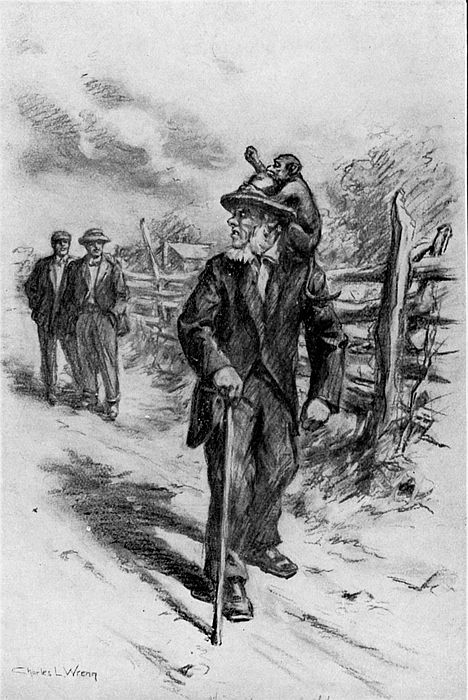
Chattering a little, the monkey slowly swung
himself down to the lower limbs and dropped to
his master’s shoulder, where he perched in evident
assurance of security, making faces at the
boys.
74Fred laughed and rejoined Hooker, while, assisted
by his cane, Aaron Quinn hobbled back
toward the hut, carrying the monkey.
“It would be a good thing if that old pirate
would get out of town,” said Roy. “He’s no benefit
to the place.”
“He’s harmless enough if people will let him
alone,” retorted Fred; “but he’s been pestered
so much that he seems to have it in for everybody.
At the most, it’s doubtful if he lives many
years, and when he dies the bank people will
doubtless get his little place for what it’s really
worth.”
They proceeded on their way, the conversation
soon drifting into other channels, football for a
time being the main topic, as, to Sage’s surprise,
Hooker betrayed considerable interest in the
game.
“You’re right about old Stoney,” he said. “He
knows the new rules. Why, he must have
studied them until he has every word by heart.
Perhaps he’ll make a fairly good captain, after
all, though he never can come up to Roger Eliot.”
AARON QUINN HOBBLED BACK TOWARD THE HUT, CARRYING THE MONKEY. —Page 74.
75“Perhaps not,” admitted Sage. “Eliot certainly
was a natural leader at anything he undertook.
I’m glad you came out yesterday.”
“Oh, it isn’t likely I’ll get a chance to play.”
“I’ll guarantee you will if you pitch in. Why,
there’s Piper, the last fellow one would ever suppose
could make good at the game.”
“That’s right,” agreed Roy. “Say, he came
round and interviewed me last night. He’s got
another bug in his bonnet. Asked me all sorts
of questions about the strange man I saw in the
woods. What do you suppose he thinks he’s up
to?”
“He’s struck a trail,” laughed Fred. “He was
up at my house to see me, too.”
“Well, it would give me some satisfaction if
he could find out who the man was. Don’t suppose
you were able to enlighten him any?”
“Not a bit. I told you yesterday that I hadn’t
the remotest idea who the stranger could be.”
76“I know you did, but I thought you might have
placed him since.”
Down the river on the road to Clearport they
entered a grove and sat chatting for some time
on a fallen tree. Roy was anxious for another
gunning expedition, but Fred feared that school
work and football practice would give him little
time for it. Finally they returned to the village,
and Roy walked up Main Street to accompany
his friend part of the way toward home.
On the sidewalk in front of Urian Eliot’s
house they saw Mr. Eliot talking with Lucius
Timmick, the cashier of the bank. Timmick was
a man under thirty years of age, thin, smooth-faced,
save for some high cut “siders,” and a
trifle sanctimonious in his manner. He was
dressed wholly in black and carried a Bible in
his hand.
Mr. Eliot spoke pleasantly to the boys as they
passed, and Timmick gave them a grudging nod.
“That dried-up shrimp makes me tired,” muttered
Hooker. “Just because Urian Eliot took
him into the bank and made him cashier, he
77thinks he’s something. I know him; he always
was a sneak. Why, he used to watch the boys
nights and blow on them every time they had a
little fun. He caught us hooking apples once,
and made an awful fuss about it. Talked of
having some of us sent to the reform school.
Now he teaches a class in Sabbath School, and
butter wouldn’t melt in his mouth.”
“It is evident,” smiled Fred, “that you don’t
love Mr. Timmick much.”
“You wouldn’t think much of him either, if
you’d lived long in Oakdale. He has too much
dignity now to sneak round nights trying to find
out what the fellows are doing, but he’s just as
much a fox as he ever was. If I was president
of a bank, I’d never trust him to handle the
cash.”
“Evidently Mr. Eliot trusts him thoroughly.”
“Oh, yes, he’s got Urian Eliot fooled. Well,
guess I’ll hike for home, as Rod Grant would say.
Bye, bye, old man.”
78Thus far Fred had found no good opportunity
to tell his father privately about the mysterious
stranger and about what he had seen from his
window the night before, nor did he find such a
chance that day. The following morning he
dismissed the matter from his mind, fancying
it improbable that the man would again be
seen around Oakdale.
CHAPTER VII. ANNOYING ATTENTIONS.
79
Sleuth Piper seemed to develop a sudden remarkable
fondness for Fred Sage, upon whom
he persisted in thrusting himself whenever possible,
although he endeavored to make his actions
seem natural and unpremeditated. At the
academy he hung around a great deal in Fred’s
vicinity, usually near enough to hear and understand
anything Sage might say. Time after
time he engaged Fred in conversation, which he
usually brought about by speaking of school matters
or sports in which the most of the boys were
interested.
Monday morning, as he was making his way
to the academy, Fred had been a bit surprised to
encounter Sleuth in the vicinity of the Methodist
church, for Piper, if also bound for school, had
come a considerable distance out of his way.
80This action seemed to be explained, however,
when the queer fellow betrayed a certain amount
of anxiety lest Sage had broken his promise to
maintain secrecy regarding the Saturday night
interview at Fred’s house.
“What do you take me for, Piper?” exclaimed
Fred, annoyed. “When I get ready to tell about
that, I’ll let you know in advance.”
“No offence, old fellow,” said Sleuth hastily.
“You understand anyone can let such things leak
unintentionally.”
That night, after the shower in the gym following
practice on the field, Sleuth was waiting
to join Fred and persisted in walking all the way
home with him, maintaining a confidential atmosphere,
which seemed to invite confidence and
trust on the part of the other. This effort was
so palpably apparent that, although inwardly annoyed,
Sage could not help laughing over it when
Sleuth finally set off for his own home.
“The chump!” he muttered. “He thinks he’s
clever, but it’s easy enough to see through him.”
81But when, on the following morning, Sleuth
again joined Fred on the way to school, Sage
could scarcely restrain his annoyance. Succeeding,
however, he tried the effect of joshing and
banter.
“Say, Sleuth,” he laughed, “you’ve certainly
taken a sudden pronounced liking for my society.
I never dreamed you entertained such deep affection
for me.”
“Oh,” returned Piper, with pretended carelessness,
“I’ve always liked you, Fred, ever since
you came here from—from—. Let me see, where
did you come from? I’ve forgotten.”
“Perhaps you never knew.”
“That’s right, perhaps I didn’t. Seems to me,
though, I’ve heard it was somewhere in New
York State. Is that right?”
“Let it go at that; it’s near enough.”
“Oh, if there’s any reason why you don’t care
to tell, of course you’ve a right to decline to answer.”
82“Do you know, Sleuth, I always feel a natural
disinclination to gratify the unwarranted curiosity
of people who try to pry into affairs that are
of no concern to them.”
“Oh, piffle, Fred! I’m not prying. What’s the
matter with you? I was just thinking that probably
before coming here you attended a school
of more importance than Oakdale Academy.
You knew as much about football as any fellow
in this town when you appeared here, and that’s
how you happened to get on the team as quarterback
last year. Eliot said you were the fellow
best adapted for the position, and you proved
that he was right by the way you filled it.”
“Thanks for the taffy. Your generosity in
handing it out has got me going. What do you
want to know next? Ask and ye shall not receive.
Rubber and you’ll get it in the neck.”
“Oh, all right, if you’re going to take it that
way,” muttered Piper sourly. “Still, I don’t see
why you should be so thundering suspicious.
That is, I don’t see unless——”
“Unless I’ve some dark and terrible secret to
conceal. You’re still making a jack of yourself
trying to connect the Sages with your desperate
83jailbird, Gentleman Jim. It doesn’t seem to me,
my astute detective friend, that you’re making
much progress on your latest case. Apparently
that reward is keeping well beyond the reach of
your grasping fingers.”
“Even Sherlock Holmes required a certain
amount of time to solve his problems,” reminded
Piper, causing his companion to laugh loudly.
“As an imitator of the great Sherlock, you’re
a merry jest, Pipe. Go ahead and amuse yourself
playing your little farce, but don’t bother
me.”
It was difficult, however, to escape Piper, who
again persisted in hovering about in Fred’s vicinity
throughout the day.
That night, shortly after four o’clock, Mrs.
Sage, at work in her kitchen, was surprised and
a little startled when Billy Piper came walking in
through the door, which chanced to be standing
open, as the day had been unusually warm for
the season.
“Good evening,” said the boy. “I just ran up
to see Fred a minute. Is he around?”
84“No, indeed,” was the answer. “He never
gets home now until after dark. Football practice
keeps him. Don’t you play on the team?”
“Oh, yes,” answered Pipe easily; “but I don’t
have to practice all the time. You see, I’m pretty
well up on the game. If you don’t mind, I’ll wait
for Fred.”
“Of course I don’t mind, though it’s likely he’ll
not be home for more than an hour.”
“Oh, well, I’ll just make myself comfortable
till he comes. Thought perhaps he might have
a book for me to read. I’m a great reader.”
“There are some magazines on the sitting-room
table.”
“Thanks,” said Sleuth, entering the room indicated.
“I reckon they will do first-rate. Don’t
mind about me, Mrs. Sage. Here’s a nice, comfortable
chair, and I’ll be all right.”
Although she wondered that he should have
come there expecting to find Fred at that time,
Mrs. Sage attributed it to the boy’s eccentricity,
though occasionally she glanced into the sitting-room
when passing the open door. Sleuth
85seemed to be interested for a time in the magazines,
but presently she discovered him gazing
around the room, although he remained seated
near the table. A few moments later she saw
his face brighten up as his eyes discovered an
old-fashioned family photograph album within
reach of his hand. In a moment he was looking
through the album, apparently deeply engrossed
in the pictures it contained, and for some time he
remained thus occupied. Mrs. Sage had almost
forgotten the visitor when he reappeared in the
kitchen.
“I don’t believe I’ll wait for Fred after all,”
said Sleuth. “I think I’ll go home. Tell him
when he comes that I was looking for a good
book, but I don’t believe he has anything of the
kind that would suit me.”
It was verging on twilight when Sleuth departed,
and something like half an hour later
Fred reached home. On being told by his mother
of Piper’s visit, the boy betrayed some surprise
and a singular amount of annoyance.
86“Confound that fellow!” he exclaimed. “I’d
like to know what he means. Did he try to pump
you, mother?”
“Pump me? Why, no, I don’t think——”
“Didn’t ask you a whole lot of foolish questions,
did he?”
“I don’t think he asked me any questions at
all.”
“Well, what did he do while he was here?”
“Entertained himself by looking at some magazines
in the sitting-room.”
“He didn’t go prowling around over the
house?”
“He went no further than that room.”
“Still, he had no business around here.”
“He said that he came for a book. He wanted
something to read.”
“Bluff. He knows the stories I read wouldn’t
interest him at all. Furthermore, he knew when
he came that I wasn’t here. He got excused
from practice to-night by saying that he had a
cracking headache and felt ill.”
87“He didn’t mention anything of the sort to
me, and I’m sure he did not appear ill. I’m
afraid there’s something wrong with that boy,
Fred. You admitted yourself that some people
thought him queer.”
“I’ll queer him, if he doesn’t behave,” muttered
Fred.
On Wednesday morning Piper was not waiting
for Sage on the way to school, but Fred
found him with some other fellows at the academy.
Straightway Sleuth was called aside by
the vexed youth.
“Look here, Piper,” said Fred grimly, “I want
to know why you showed up at my house last
night and asked for me, when you knew I was at
practice on the field?”
“Why, didn’t your mother tell you I wanted to
borrow a book?” asked Sleuth innocently.
“Now don’t try any of that on me,” advised
the other boy. “You knew I wouldn’t have anything
you’d care to read. Besides that, you pretended
that you expected to find me home.”
“Who said so?”
“My mother.”
“Oh, she misunderstood me.”
88“But I don’t misunderstand you, and I’ll tell
you now to keep away from me and my home in
future. I mean it, too. This business of playing
the detective may be amusing and interesting to
you, but it’s infernally annoying to anyone you
happen to pester. I’ve had enough of it, and I
won’t stand any more. Get that?”
“Of course I get it,” replied Sleuth sulkily.
“I’m no fool.”
“Then don’t act like one. That’s all I have to
say.” With which Fred turned sharply and
walked away.
“Those who have guilty secrets,” muttered
Piper to himself, “are always annoyed by too
much attention.”
CHAPTER VIII. HOOKER HAS A PLAN.
89
On Thursday afternoon the Oakdale football
team put in the last strenuous practice before the
first real game of the season, which was to be
played Saturday on the home grounds, the contesting
eleven coming from Barville. As far as
possible Captain Stone had drilled a knowledge
of the new rules into the heads of his followers,
and although, like a good captain, he was not
wholly satisfied either with their advancement or
his own, he decided that stiff, strenuous practice
work on Friday would not be advisable, considering
the possibility that someone might get
hurt, with insufficient time to recover before the
Barville contest. Therefore he simply notified
his teammates to come out Friday for a little
brushing up in signals.
90Encouraged by Sage, Hooker had practiced
faithfully, and had made a fairly good showing
in the line of the scrub team when it played short
periods against the regulars. Fortunately, Roy’s
“condition” had been excellent when he began
this, and therefore, save for a few minor bruises
and sprains, which caused temporary soreness or
lameness, he escaped injury. He was feeling
somewhat elated over this when he left the gymnasium
in company with Fred.
“It doesn’t seem to be such a tough old game,
after all,” said Roy. “Of course a fellow gets
pounded around a lot, but it doesn’t hurt him
much if he’s good and hard.”
“That’s the point generally overlooked by people
who put up a holler against the game,” said
Fred. “Football isn’t for babies and weaklings,
and the fellow who goes into it should be in perfect
health and hardened by training that will enable
him to stand up under pounding and jolts
which would put a feeble chap all to the bad in
no time at all. Observe how quickly fellows in
fine condition recover from injuries on the field
which would seem sufficient to put them under
91the doctor’s care for weeks or months. When
some foolish chap who is soft as mush or has
some chronic weakness attempts to get into the
game, notice how often it happens that he’s the
one seriously injured; and of course this gives
people who do not understand the circumstances
and who are opposed to the game a chance to
raise a great to-do.”
“My folks have never wanted me to play.”
“Well, mine are not enthusiastically in favor
of my playing, although my mother is the chief
objector. But she’s always worrying about me
of late, no matter what I do. It has been that
way ever since——” He checked himself suddenly.
“Ever since what?” asked Roy.
“Oh,” answered Fred evasively, “ever since I
got old enough to go in for such things. She
doesn’t like to have me go gunning, and she actually
cried when father bought me my gun.”
“Oh, say,” exclaimed Hooker quickly, “that
makes me think of something. Why can’t we
get in a little shooting Saturday morning? There
92ought to be ducks over in Marsh Pond, and we
could try ’em Saturday, and arrange to get home
by the middle of the forenoon--by half past ten
or eleven, at the latest. That would give us
plenty of time to rest up before the game.”
“But Marsh Pond is nearly five miles from
here, and, in order to get there early enough to
pick up any ducks in the morning, we’d have to
turn out in the middle of the night and make a
stiff tramp of it. I’m afraid that would be a little
too much, Hooker.”
“Now listen to me; I have a plan. I’m not in
favor of rising at two or three o’clock and hoofing
it all that distance for half an hour’s shooting
after daybreak. You’re as wise to the signals
as any fellow on the team, aren’t you?”
“I think so,” nodded Fred modestly.
“Think so! Why, you’ve got them down pat.
You can reel ’em off like hot shot, and you know
every time just what you’re firing at. A little
signal practice to-morrow wouldn’t do you any
good, and, as I’m only a scrub man, it isn’t worth
my while bothering. I know where we can get a
93good set of decoys to use on that duck hunt, and
if you’ll go I’ll agree to get ’em. We can start
right after school to-morrow, and I’ll bet I can
hire Abe Hubbard to take us over to the pond
with his old horse and wagon. It won’t cost a
great deal, for Hubbard isn’t doing much of
anything, and he’d be glad to pick up a dollar.
It wouldn’t surprise me if the sight of a whole
dollar would hire him to tote us over there and
come for us any time we might set on Saturday.
If I can fix it,” he concluded eagerly, “will you
go?”
They had paused in front of the post-office, and
Fred meditated a moment over the proposal.
They were standing there as Sleuth Piper came
up, passed them and entered the building, turning
to cast a swift glance in their direction.
“It listens good, Hooker,” said Fred, tempted;
“but where are we going to stay all night? Have
you thought of that?”
“You bet I have. Why, don’t you remember
there’s an old camp over there, which nobody
ever uses nowadays? It has a stone fireplace,
and if we take an axe along to cut wood we can
be as comfortable as you please.”
94It was not remarkable that the temptation
grew, for what real boy would not be lured by
the prospect of a night in an old camp in the
woods?
“It listens good,” repeated Fred, smiling a bit;
“but how about a boat? Without a dog to do our
retrieving, if we shoot anything we’ll certainly
need a boat. Spot is no water dog, and he’d be
practically useless for us.”
“There isn’t any boat,” admitted Roy; “but I
know where there’s an old raft on the shore within
twenty rods of the shooting blind some hunters
made last fall. I know the raft ought to be
there, for I used it when I was over there fishing
once this summer. I saw the blind and inspected
it, too, and it will be all right for us without doing
a thing to it. It’s close by the feeding
grounds at the western end of the lake and will
serve us much better than a new one, as the
ducks are thoroughly accustomed to the sight
95of it by this time. You know how they shy sometimes
at a newly built blind they’ve never seen
before. With that raft near by for our use, we
can pick up any ducks we knock down. Come on,
Fred, of course you’ll go.”
“I’ll speak to Stone about it in the morning.”
“That would be rather late, for you know I’ve
got to see Hubbard and fix it with him. Why
not see Stone to-night? Give him a good game
of talk. Tell him you feel the need of something
like this to brace you up. Hard study, regular
practice, monotony, anxiety about the game—you
know the sort of argument to put up. He’ll
be a chump if he refuses. Why, if I was on the
team I’d simply see him and tell him I was going
to go anyhow.”
“And you’d put yourself in bad with old
Stoney. He’s an easy-going fellow in some
things, but when it comes to football matters he
believes in discipline and enforces it, too.”
“Yes,” nodded Roy, “he’s a little too stiff to
suit me; something of a tyrant, it seems.”
96“Not a tyrant; simply a captain who knows
what is right and demands it of his followers.
If Stone says he doesn’t think I should go, of
course I won’t, that’s all.”
“But you will if he’ll agree?” cried Hooker
exultantly. “Say, old man, leave it to me; let
me talk to Ben. I’ll tell him you want to go, but
don’t like to ask the privilege.”
“And that would be the truth.”
“Sure. No need to lie about it. Think perhaps
he can put a substitute in your place, same
as he would have to do if you were hurt in a
game, and that will be a good thing, as it will
brace the sub up on signaling. Will you leave it
to me, old chap?”
After a little hesitation, Sage agreed. “Go
ahead; have your own way about it. If Ben says
it’s all right, I’ll go ducking with you.”
“I’ll let you know this very evening,” promised
Hooker, as his friend started up the street toward
home.
Sage did not see Piper come quickly out of the
post-office and hasten after Roy. Having observed
the two boys in earnest consultation,
Sleuth’s curiosity was at white heat.
97Near eight o’clock that evening Hooker came
to see Fred at the latter’s home.
“It’s all right,” he announced in enthusiastic
triumph. “I brought Stone round nicely, and he
says you may go. I’ve seen Hubbard, too, and
fixed it up with him. He’ll be ready to start
right after school to-morrow, and he’ll come for
us at half past nine Saturday morning.”
Fred’s mother was listening with sudden interest.
“What are you planning, boys?” she
asked.
Fred explained, observing that her face took
on a shade of anxiety.
“Now don’t begin to worry, mother,” he
begged. “You know Roy and I are both careful
with guns, and there isn’t a bit of danger.
I don’t want to fret you, but I hope you won’t
object.”
She sighed a little. “I suppose it’s foolish,
but I can’t help feeling anxious about you when
you go gunning. However, your father bought
you the gun, and, now that you have it, it
wouldn’t seem reasonable for me to seek to prevent
you from getting some pleasure through the
use of it.”
98“All boys love a gun,” smiled Andrew Sage,
“and the right sort of a boy rarely gets hurt with
one.”
“Then it’s all fixed,” laughed Roy. “Get everything
ready to start right away after school,
Fred. Take along a blanket, for you’ll need it
in the old camp. If we have any luck at all, we
ought to bring home some ducks.”
Roy had been gone some time when Fred’s
mother came up quietly behind his chair, bent
over him and put her arms about his neck.
“Don’t think me foolish, my dear,” she said
in a low tone. “You understand why I can’t
help worrying. You’re the only boy I have left,
now.”
CHAPTER IX. THE CAMP IN THE WOODS.
99
Something over four miles from Oakdale Abel
Hubbard reined his horse into an old road which
led from the main highway into the depths of the
woods. Fred and Roy, with their outfits, were
in the wagon, and, the time being short ere darkness
must come on, they urged Hubbard to make
haste.
“Can’t hit any high places along this old
road,” answered the fat little village constable.
“If I tried it, I’d bounce ye both out in no time.
’Tain’t fur to the pond now, so what’s the use to
be in such an all-fired rush? All I want to do
is git back on to the main road before it sets in
dark.”
“But we’ve got some things to do ourselves,”
said Roy. “We’ve got to find the old raft and
have it ready for use in the morning, besides cutting
firewood and getting settled down for the
night.”
100“That hadn’t orter take ye long. I’ll git ye
there as soon’s I can. It’s sort of an accommodation,
anyhow. I wouldn’t think of making
both trips for anybody else unless they paid me
twice as much.”
“You’re not very busy these days, are you, Mr.
Hubbard?” asked Fred, smiling a little. “It
seems to me an easy way for you to pick up a dollar.”
“Oh, I could be busy,” returned the man, “if
I wanted to work for Lem Hayden in his quarry
or kilns, and I guess I could find a job in the
mills; but, as a regular commissioned officer, it’s
my duty to be unhampered and ready for anything
that may turn up. If I was workin’ and
Sheriff Pickle happened to need me, I’d have to
knock off.”
Real work had never seemed to have much
fascination for Abel Hubbard.
101“Then there are plenty of jobs a man might
get around Oakdale,” said Roy. “If a stranger
should show up with references, he could find
something to do, couldn’t he?”
“Reckon he could, such as it was. I don’t
cal’late them Dagoes in the quarries bring many
references.”
“You haven’t seen any stranger around town
recently looking for work, have you?”
“No, don’t think I have.”
“I didn’t know,” said Roy. “Last Saturday,
while gunning with Fred, I met a man who said
he was in search of a job, and he asked me about
the chances in town. I haven’t seen anything of
him since.”
“I generally take special notice of everybody
that comes inter Oakdale,” asserted Constable
Hubbard. “I cal’late it’s good policy to do so.
Ain’t nobody new showed up lately, so I guess
your man didn’t stop around here.”
“I don’t believe he did,” said Roy.
Presently they reached the old camp, from
which, through the trees, they could get a
glimpse of the pond. It did not take them long
to jump out and unload their belongings, which
102were carried into the camp, the door being fastened
merely by a wooden peg thrust through a
staple. Hubbard backed his wagon round, bade
them good luck and drove off into the shadows
which were gathering in the woods.
“Well, here we are, Roy,” said Fred.
“Yes, and it’s up to us to hustle. Let’s look
for that raft while it’s light enough to find it.
We can get together firewood later. Come on.”
Leaving their property in the camp, they hurried
to the pond, and Hooker led the way along
the marshy shore. The water-grass and rushes
stood thick and rank at this end of the lake, and
soon Hooker pointed out a mass of dead brush
in the midst of the reeds some distance from the
marshy shore.
“There’s the old blind,” he said. “You can
see it is located so it commands the cove beyond,
and that’s where the ducks coming in to feed
usually ’light.”
“How does a fellow get out to the blind?”
103“Wade. The water won’t come up to your
knees. There’s a sort of little knoll or island out
there, and the brush has been built up and woven
into the branches of an old fallen tree that may
have grown on that knoll before the water was
so high. It’s a fine chance all right. But come
on, we must dig that raft out.”
They went forward again, and suddenly, with
a splash and a sound of throbbing wings, a small
duck rose amid the rushes and went flying away
over the bosom of the lake.
“Hang it all!” exclaimed Roy in vexation.
“Just look at that! If we’d brought our guns,
we might have knocked her down. That’s a
young duck, or it would have flown before we
got anywhere near. Young ones always hide if
they can, until they get thoroughly used to the
idea that their wings will serve them better.
We’ll get some shooting here in the morning,
mark what I say.”
The raft was found where Hooker expected to
find it. It was a small affair and would support
only one of the boys, but would be sufficient for
their use in picking up such ducks as they might
shoot. With the raft there was a long pole and
a piece of board that had been roughly hewn into
the shape of a paddle.
104When the raft was floated Roy got on it and
poled it around into the little cove near the blind,
where he succeeded in concealing it quite effectively
amid the grass and reeds. Then he waded
ashore in his water-tight boots without sinking
nearly as much as he had thought he would.
“That’s done,” he said. “Now we’ll get back
to the camp and chop our firewood while we can
see to do it. There are no signs to indicate that
anyone has shot from the blind this fall, and
therefore the ducks ought to come up to it without
fear.”
Soon the strokes of an axe were ringing
through the gloomy woods as Sage worked at
the trunk of a dry fallen tree. Hooker carried
the wood into the camp and piled it beside the
old stone fireplace. Sunset’s faint afterglow
faded from the sky, and with gathering darkness
the atmosphere took on a sharp, nipping
chill, which, however, was little felt by the active
boys. Sage continued chopping, while Hooker
105found time between armfuls to build a fire.
Through the open door of the camp Fred saw the
welcoming glow of the flames, and it gave him
a feeling of buoyancy, of keen relish, of intense
satisfaction in life and the pleasures thereof. It
was good to be there with his chum in those
dark and silent autumn woods, making ready to
spend the night together in that old camp before
the duck hunt that was to come in the crispness
of gray dawn.
Hooker’s figure was silhouetted in the open
doorway.
“I say, old man,” he called, as he came out,
“there has been somebody in this camp lately.”
“That so? I thought you said you were sure
no one had used the shooting blind.”
“I am; I’ll bet on it. I looked to see, and I
could tell that no one had been there. They
would have left tracks and marks and probably
empty shells. Whoever it was that stopped in
the camp, they did not try any shooting from the
blind. And say, I’ll bet somebody was in that
camp last night. I thought I caught a smell of
106tobacco smoke when we first opened the door,
but it was so dusky inside that I didn’t notice
anything else. There’s fresh-cut boughs in the
bunk, and the ashes in the fireplace were hardly
cold. I found crumbs on the floor, too, and part
of a newspaper not quite two weeks old.”
“Then I reckon you’re right,” agreed Sage,
“though I don’t quite see why anyone should stop
in the old camp this time of year, unless he came
here to shoot ducks. We’d have been in a scrape
if we’d found someone here ahead of us to-night.”
They bore the last of the wood inside and
threw it down on a heaping pile beside the now
merrily blazing fire, which illumined the entire
interior of the camp. Hooker had thoughtfully
brought a can of water from a nearby spring,
and, thus prepared, they were ready to settle
down to the supper of sandwiches and doughnuts
put up for them by their mothers.
Roy closed and fastened the door with the inside
hasp.
107“You can see,” he said, with a gesture toward
the old bunk at one side of the room, “those
boughs on top are fresh cut.”
“That’s right,” nodded Sage, after examining
them. “Hacked off with a jackknife, I should
say, and not two days old. Well, somebody was
kind enough to help make us comfortable, for,
with our blankets and a fire going, we ought to
find that bunk all right to-night. I’m really
much obliged to the unknown person or persons.
I presume there may have been more than one.”
“Here’s that part of a newspaper,” said Roy,
taking it from the small rough table that had
been nailed against the wall opposite the bunk.
“The date on it is enough to show that someone
has been here lately.”
Fred took the paper and glanced at it carelessly.
In a moment, however, a queer expression
flashed across his face, his eyes opened wide,
his lips puckered, and he gave a long, low whistle.
“What is it?” questioned the boy.
“By Jove!” muttered Sage wonderingly. And
then, after a moment of silence, he repeated with
greater emphasis: “By Jove!”
108“What is it?” exclaimed Hooker.
“This paper,” answered Fred, staring at some
headlines in bold-faced type. “It’s either a part
of the same one or a duplicate of an issue I saw
in the possession of Billy Piper last Saturday
night.”
CHAPTER X. A PERPLEXING QUESTION.
109
The black headlines which had attracted
Fred’s eye told of the five hundred dollar reward
offered for the capture of Jim Wilson, who had
escaped from the Harpersville jail after a murderous
assault on the guard. The manner in
which the paper had been folded indicated that
this sensational article had been left outermost,
and the blurred ink and wear in the creases of
the folds bespoke the fact that the paper had
been carried around in someone’s pocket.
“Piper?” muttered Hooker. “Why, it isn’t
likely that he has been here.”
“It doesn’t seem at all likely,” agreed Sage;
“but still——”
“What was he doing with the paper, anyhow?”
110Fred turned sidewise, so that the bright light
from the open fire fell full on the page, and his
finger indicated the news article which had held
such deep interest for Sleuth.
“See that?”
“Yes,” said Roy, peering over his chum’s
shoulder. “‘Five hundred dollars reward. Desperate
character breaks jail after murderous assault
on keeper.’ Oh, yes, that’s the sort of
stuff that would interest old Sleuthy.”
“I’ve kept my promise to Piper to say nothing
about his wild theory,” said Fred, “and, a full
week having passed with no result, I don’t fancy
it will do him any good for me to continue a
clam. I was sure there was nothing in it, anyhow.
You see, Piper had a crazy notion that
this escaped criminal and the stranger you talked
with last Saturday might be identical. It’s
rather odd that the printed description of James
Wilson, as given here, corresponds with your description
of the man who talked with you and ran
away at my approach. Here it is.”
His eyes puckered, his lips pursed a little,
Hooker read the description of Gentleman Jim.
111“Why, that’s right,” he said slowly. “It does
sort of fit, and no mistake. But Pipe didn’t say
anything about this to me. You know I told you
how he came round and asked me a lot of questions,
some of which I couldn’t answer, and the
most of which seemed more or less foolish. He
tried to find out everything I knew about you
and your folks, seeming especially anxious to
learn where you came from when you moved into
Oakdale. Now what’s that got to do with this
stuff in the newspaper?”
Fred laughed shortly. “You see,” he explained,
with a touch of scorn, “Sleuth was trying
to connect us somehow with the notorious
and desperate Mr. Wilson.”
“How could he do that?”
“Have you forgotten that your stranger made
inquiries concerning the Sages in Oakdale?
Now you tumble; you’re on. If that man was
Wilson, he would not make such inquiries without
some knowledge of us, and, if he knew us,
it was natural to suppose that we knew him. I
informed Piper that I had never heard of such
a man.”
112“That should have ended it.”
“Not with Sleuth. Doubtless he reasoned that
if we had ever known this criminal we would,
most naturally, be sure to deny the fact.”
“But you never did know him?”
Sage shot his friend a quick, resentful glance.
“Do you think I’d lie, even to Piper?”
“Of course not.”
“I never heard of this James Wilson, alias
Gentleman Jim, until Sleuth told me about him.
My denial, however, had little effect on Piper,
who hinted at family skeletons hidden away in
closets and then proceeded to watch me in true
dime novel detective style. For a day or two I
couldn’t shake him; he hung around me all the
time. At last I got tired of it and gave him to
understand flatly that he’d better let up.”
“By Jingoes!” laughed Roy. “He was watching
you last night. After we fixed it up for this
little expedition and you had started for home,
Piper overtook me and casually did a little pumping.
Reckon I was easy, for I told him all about
113it. Say, you don’t suppose——” Roy paused,
as if wondering over an idea that had flashed
into his mind.
“What?”
“You don’t suppose he came here to this camp
after that? Perhaps he dropped the paper himself.”
Following a moment’s thought, Sage shook his
head. “It was after dark last night when he
found out what we had arranged to do, Roy.
Piper was at school to-day, and we left him starting
out for practice with the rest of the team.
While it’s not impossible, it’s most improbable
that he visited this place after learning we were
coming here, and got home in time to attend
school. The signs of a recent fire in the fireplace
and the fresh boughs on the bunk we may
accept as positive assurance that someone spent
last night here. Under any circumstances, Sleuth
wouldn’t do that—alone.”
114“Never,” agreed Hooker, with conviction.
“This piece of newspaper must have been left
here by someone else. It’s a mere coincidence
that it happens to be the same issue shown you
by Piper, and it isn’t worth bothering our brains
over any further. I’m hungry. Let’s eat.”
“All right,” agreed Fred, putting the newspaper
into his pocket.
Their lunch was opened up and placed on the
table. Two old boxes served them as chairs. The
warmth of the fire made the camp quite comfortable,
and its light was sufficient for their needs.
Sitting there and chatting after the manner of
bosom chums, they thoroughly enjoyed their supper.
After supper there was much to talk over,
things of mutual interest which kept them for
a time wide awake and in excellent humor. As
it was required, they placed fresh wood on the
fire, reserving the heavier sticks for the long
hours of the night, when they would need a
slower blaze.
The guns were looked over and fondled affectionately,
while they discussed their hunting
experiences, laughing with relish over blunders
115and failures which had seemed most annoying at
the time of their occurrence. They examined
the decoys Hooker had borrowed, making sure
they were properly “strung” and ready for setting.
Football and school affairs also furnished
topics for chatting and laughter and the expression
of more or less dogmatic opinions. At times
in the lulls of their talk they heard the night wind
in the trees outside, and occasional puffs coming
down the chimney blew a little smoke back into
the camp, the odor of which did not, however,
become strong enough to be offensive.
Behind them the firelight flung their shadows,
huge and wavering, against the camp wall, and,
looking round once by chance, Sage was startled
to observe those shadows hovering there like
something silent and sinister and menacing. Although
he did not refer again to the strange man
Roy had encountered, he was wondering who
that man could have been.
“Whoo!” cried an owl from the blackness of
the woods.
116Their chatter grew less; at last it ceased. They
sat silently gazing at the fire, with its bed of
glowing coals. Hooker moved, stretched and
yawned.
“It’s me for the sleeps,” he announced drowsily,
producing a dollar watch and beginning to
wind it. “We’ve got to be up and in that blind
ready for business before peep o’ day, you know.”
“I’m ready to turn in,” said Fred.
“Fellow who sleeps on the front side of the
bunk will have to replenish the fire once in a
while. We can change round in the night and
take turns at it. How are you about waking
up?”
“Pretty good. I’ll take my turn first.”
Some heavy logs were placed on the fire, and
Roy rolled himself into his blanket, an example
which Sage soon followed. In a few moments
Hooker was sound asleep, as his breathing indicated,
but for a long time Fred lay thinking and
wondering. He could not rid himself of the
conviction that the discovery in that old camp of
117the newspaper containing the account of Gentleman
Jim’s jail-break bore a significance unexplained
and uncomprehended. If that paper had
not been left there by Piper, who had left it?
“Whoo!” again cried the owl.
CHAPTER XI. THE HIDDEN SPORTSMEN.
118
Taking turns, the boys rose several times during
the night and replenished the fire. At best,
the bough bed was none too comfortable, but
toward morning both lads slept soundly for some
time.
Awaking suddenly after this period of slumber,
Sage lifted himself to his elbow and listened,
impressed by the hazy conviction that he had
been aroused by an unusual sound. The fire had
sunk to a mass of coals and embers, from which
emanated a faint glow that barely reached across
the stone hearth of the fireplace. Beyond that
dim gleam of light the interior of the camp was
wrapped in dense darkness. The wind no longer
roamed amid the treetops, and not even a breath
came down the chimney to disturb the gray ashes
in the fireplace.
119Fred’s heart thumped annoyingly, while his
ears were reaching out for a repetition of the
sound that had awakened him; and, when he had
begun to think it must have been a creation of
his imagination or dreams, it came again.
It was like footsteps—stealthy, cautious footsteps,
which, however, seemed to move a bit uncertainly
in the darkness. It seemed like one or
more persons walking in the woods a short distance
from the camp and occasionally stumbling
a bit, although moving slowly and with considerable
caution. The sounds were receding.
“It must be some straying animal,” thought
Fred.
Fainter and fainter grew the sounds. Once or
twice there came a cracking, as of dead branches
beneath a heavy foot, and at last the listening
lad heard something that sent a shock through
him. It was like the suppressed murmur of human
voices, and was followed immediately by a
low, soft, short whistle.
Sage grasped Hooker and gave him a shake.
“Hey? What is it?” mumbled Roy, awakened.
120“Hush!” breathed Fred excitedly. “There’s
someone prowling around this camp. Don’t make
a noise. Listen.”
Breathless, they listened for a full minute, but
now the woods seemed silent and lifeless, and
not a thing could they hear.
“Guess you’re mistaken, Fred,” said Roy in a
low tone. “You must have been dreaming.”
“I wasn’t dreaming,” asserted Sage positively;
“I never was more wide awake in all my life.
Keep still a little longer.”
For a long time they remained silent, gradually
growing tired and cramped by the rigid tensity
of their bodies.
“They’ve gone,” decided Sage at last.
“They?” questioned Roy. “Was there more
than one?”
“Two, at least. I heard them talking.”
“Oh, say, Fred, you must be mistaken. Who
would come prowling around in these black
woods at this hour?”
“I haven’t an idea who it was, but I’ll stake
my life on it that it was somebody. Nothing in
the world could convince me that I was mistaken.”
121“Oh, well, if you’re so positive——But it
seems ridiculous, impossible, preposterous. It’s
pitch dark, and no one would be wandering
through these woods under such circumstances.”
Fred threw off his blanket and got up. “I
don’t blame you for thinking so, and I would say
the same if I had not heard them. What makes
it all the more unaccountable is the fact that they
were sneaking. They were using the utmost caution
in their movements, Hooker, and when a person
sneaks he’s up to something.”
“Perhaps,” said Roy, with an attempt at persiflage,
“it was their design to murder and rob us
for our vast wealth.”
“Whatever their design may have been,” said
Sage, putting some small dry wood on the coals
of the fire, “it was not honest and open. People
do not creep around through the night like cut-throats
unless they’re up to something that won’t
bear inspection.”
122“If I didn’t know you as well as I do,” said
Roy, “I’d say you had a bad attack of nerves.
What time is it, anyhow?”
A little flame leaped up from the dry wood,
and by the light of this Sage looked at his watch.
“It’s almost five o’clock,” he answered in surprise.
“Jingoes!” exclaimed the other boy, rising
with a bound. “It’s time we were getting out.
With sunrise an hour away, we’ve got to do some
tall hustling.”
Fred agreed to this, and, although still disturbed
and perplexed over what he had heard,
he imitated Roy in losing no time about the preparations
to set forth. They pulled on their
boots, gray sweaters and coats, and gathered up
the guns, ammunition and decoys. Then the door
was opened, and they went out into the blackness
of the last hour of night. The sky must
have been overcast, for above the treetops there
was no gray hint of light to suggest the coming
dawn. The air was still and impregnated with
the coldness that suggested Thanksgiving, turkey,
plum pudding and skating.
123“I know the best way,” said Hooker. “Follow
me close.”
Even though Roy knew the way, as they proceeded
toward the pond Sage was impressed by
the conviction that they made at least double the
noise that had been made by the unknown prowlers.
Reaching the pond, they hurried forward
toward the blind, but only for Hooker, they
would have passed it. Ankle deep, they waded
out through the swishing grass and reeds, and
found the old raft where it had been left.
“Only one of us can work on the raft,” said
Roy. “You take the guns into the blind, while
I set the decoys.”
With no time to waste, Roy worked as swiftly
as possible. From the blind Fred could see the
dark figure of his chum, kneeling on the raft, as
he spread the decoys out so that they would float
upon the water in a natural manner and anchored
them with the weights. As soon as this was
done, Hooker poled the old raft back into the
cover of the reeds and hurried to join Sage.
124“Barely made it,” he chuckled. “There’s one
thing we have to thank your prowling friends
for; if we’d slept half an hour longer, it’s likely
we would have gotten out here too late for the
first flights. It’s getting light now in the east.”
It was true that far over the eastern end of the
pond a dull, grayish light was beginning to make
itself apparent low down upon the horizon, and
as this slowly spread it was reflected on the
glassy, unrippled surface of the water.
“Get ready for shooting,” said Hooker eagerly,
as he broke his gun and thrust two shells
into the barrels.
“I’m loaded up already,” stated Fred, settling
down with his repeater in a position which would
enable him to shoot toward the decoys as well as
watch the open stretch of the pond, up which the
birds were expected to come from the eastward.
Hooker knelt and tried aiming over the top of
the blind, swinging his gun to follow the movements
of some imaginary ducks.
“All right,” he laughed softly; “let ’em come.”
125With each passing moment the grayness in
the east continued to spread, until they could see
the wooded outlines of the shores, bordered by
deep shadows. Morning did not break with a
blush, but seemed to awaken reluctantly and
heavily, like a person aged and weary. Its chill
bit their noses, and would have benumbed their
fingers, only for the heavy protecting gloves they
wore.
Suddenly Fred gave a low, electrifying hiss.
“Birds!” he whispered, snatching the loose glove
from his right hand. “Here they come!”
Their nerves atingle, they crouched low, peering
forth from the blind. Against the eastern
sky they could see some small, black, swiftly moving
specks, which they knew were ducks coming
up the pond and doubtless headed for the feeding
grounds at the western end. The guns were
held ready for quick use, while the boys watched
those black specks coming nearer and nearer,
skimming through the air slightly higher than
the treetops on the shore.
126“They’ll come in here sure!” breathed Hooker.
“Be ready to nail them when they settle. Fire
when they discover the decoys aren’t the real
thing and start to rise again.”
But barely had he uttered the words when,
from a mass of swamp bushes on a low point that
thrust itself out into the pond a short distance
away, two puffs of smoke leaped upward, followed
by the reports of two guns, and, short-stopped
in their flight, two of the ducks came
tumbling downward to splash into the water.
Immediately, with quacks of alarm, the others
rose higher and whirled away. A third shot was
fired from the point, but apparently it was a clean
miss, as not one of the frightened and fleeing
ducks betrayed a symptom of being hit.
Thunderstruck, Sage and Hooker stared
dumbly toward the cover from which the unknown
hunters had fired. After a time Roy savagely
exclaimed:
“What do you think of that! Wouldn’t it kill
you dead!”
“It killed our chance at those birds,” returned
Fred, as he regretfully watched them disappearing
above the tree tops. “Who the dickens can it be?”
127“We ought to find out pretty quick. They’ll
have to pick up those two ducks.”
Eagerly and wrathfully they continued to
watch, and after some moments they saw a small
object moving out from the point toward the
floating ducks.
“They’ve got a retriever,” growled Sage, with
increased disgust. “They’re lying low and sending
the dog to bring their game.”
“Confound their hides!” raged Hooker.
“They’re going to spoil our fun, just as true as
you live. I’d like to punch their heads!”
“It would be a great satisfaction,” said Sage
bitterly.
“Look here, old man,” said Roy, smitten by a
thought, “there are your sneaking prowlers.
They are the gentlemen who woke you as they
passed the camp. I’ll bet anything they had just
come in by the old wood-road.”
“I’m inclined to think you’re right,” admitted
Fred. “But why were they so careful about
making a noise? Hook, they must have known
there was someone in that camp.”
128“Wouldn’t surprise me if you had stated the
reason for their caution. Furthermore, they
must be wise to the way the ducks usually fly
here, and they have the advantage of us by hiding
on that point.”
One after another, the dog retrieved the dead
birds and carried them to the point, finally disappearing
from view.
“If some of the birds will only keep far
enough from that point, we may get some shooting
yet, old man,” said Roy hopefully.
In a short time another flock, larger than the
first, was seen coming up the pond, and, to the
great satisfaction of the boys, they were flying
over the exact middle of the water, and would
therefore pass beyond gun-shot of the unknown
hunters, unless they should change their course.
“It’s our turn now,” exulted Roy. “I think
that bunch will come in here. Something doing
in a minute or two, old chap.”
There was—something tremendously provoking;
for, as the flock came opposite the low point,
both of the unseen sportsmen fired, although,
129with any reasonable amount of judgment, they
must have realized that there was not one chance
in a thousand that they could make a kill. Those
shots, however, were sufficient to cause the flock
to swerve, swing about in a half circle, and go
speeding off into the distance.
Hooker said something violent, while Sage
ground his strong teeth together.
“The chumps! The miserable, sneaking
idiots!” raged Roy. “If they have a bit of sense
in their bone-heads, they must have known they
couldn’t start a feather at that distance. Why
do you suppose they were foolish enough to try
it?”
“I can’t imagine any reason, unless they were
determined to spoil our chance,” answered Fred,
who was now furious enough to fight. “If they
keep that addle-pated business up, we won’t get
a shot this morning.”
“Slim chance of it now, anyhow. It’s broad
daylight, and we’ve lost our opportunity at two
flocks. There may be other birds coming in, but
those that have heard the firing will be likely to
keep away from this end of the pond. It’s rotten,
that’s what it is.”
130“With good luck, we might have knocked
down half a dozen out of that last big bunch.
Whoever those chaps are, they’re poor sportsmen.”
“They’re nasty sneaks; that’s my opinion.”
In the course of ten minutes three ducks, evidently
a remnant of a flock, came winging close
to the point, and with four shots the hidden hunters
tumbled the trio of birds into the water. One
was wounded, for it flopped about after splashing
into the pond, but soon another shot from the
bushes finished it. Then the dog swam out and
did the work of retrieving.
“It’s all off,” sighed Sage. “Our morning’s
sport is ruined.”
“Hardly a doubt of it,” agreed his companion.
“That is, as far as shooting ducks is concerned.
I propose to have a look at the gentlemen who
have tricked us in this brilliant and commendable
manner. They aren’t going to get away
before I see them and tell them a few things.
Come on; we can gather up the decoys later.”
131“You don’t think it’s any use to wait a little
longer, Roy?” asked Fred, loath to release the
skirts of hope.
“Not a bit. Besides, I’d rather face those
chaps now than to kill one or two stray ducks.”
Leaving the blind, they hurried to the shore
and turned their footsteps toward the point upon
which the rival duck hunters were ensconced.
Realizing it was wholly probable that their movements
had been observed, they lost no time in
plunging forward through the woods and thickets,
fearing that the ones they sought might take
alarm and depart.
Bursting forth from the bushes side by side,
they halted as they reached the point, beholding
two boys leaving the shelter in which they had
been hidden, burdened by guns and the slain
ducks and followed by a water-spaniel. These
boys stopped as Sage and Hooker appeared before
them.
One was Jack Nelson; the other Sleuth Piper.
CHAPTER XII. DISAPPOINTED DUCK HUNTERS.
132
“Well, I’ll be switched!” exclaimed Hooker, in
mingled astonishment and anger.
Nelson, whose dog had done the retrieving,
beamed pleasantly on the disappointed and
wrathy young sportsmen. “Good morning,” he
said. “You’re out for a little shooting, I see.
Had any luck?”
“Yes—rotten,” flung back Hooker. “Confound
you fellows! you spoiled the morning for
us.”
“Really?” chirped Nelson, in pretended surprise,
elevating his eyebrows. “How was that?”
“You know how,” grated Sage hotly. “You
did it purposely, too. But I suppose it was that
pestering, sly, conceited, cheap imitator of Sherlock
Holmes who is really responsible.”
133Piper looked aggrieved. “If you’re referring
to me,” he said, “permit me to inform you that
I’m not at all pleased by your insulting language.”
“I didn’t intend you should be,” Fred flung
back; “and you’d be less pleased if I could find
appropriate words to express my opinion of you.
It was a miserable, low-down trick you fellows
played on us this morning, and you know it.”
“Now hold on,” Nelson commanded, his cheerful
manner vanishing. “We won’t stand for
any of that. We’ve as much right to shoot ducks
on this pond as you have.”
“Of course we have,” Piper backed him up;
“but Sage seems to have an idea that he owns
the earth—that’s what’s the matter with him.”
Fred levelled his finger at the speaker’s face.
“You have annoyed me to the limit recently,” he
grated. “After getting a crazy notion into your
head, you’ve dogged me around constantly. You
found out that Roy and I were coming here to
shoot ducks this morning, for, without suspecting
your design, he let you pump him. Straightway,
134in a highly commendable manner, you arranged
to sneak in here some time in the night,
and you planked yourself on this point, where
you could bang away at the ducks as they flew
past, knowing perfectly well that every time
you’d fire into a flock you’d frighten them so that
they would not come to our decoys. A fine piece
of work!”
“I say, Sage, you take it hard, don’t you?”
laughed Nelson. “Even if we knew you were
coming to the lake, we had a right to do so ourselves.
And as long as you had not possession
of this point, which is the only place, besides the
old blind, from which any successful shooting
can be done at this end of the pond, it surely was
our privilege to grab it. Come, come, don’t be
a squealer. I’ve always considered you game,
but you’re showing another side.”
“Once,” said Fred, “you deliberately fired at a
passing flock when you must have known the
birds were beyond gun-shot. If you did not do
that to frighten them from coming to our decoys,
why did you do it?”
“Yes,” cried Hooker, “explain that.”
135“We took a chance on bringing one down,
that’s all,” said Nelson.
“Oh, don’t bother yourself to explain,” Piper
put in quickly. “It’s no use; they won’t believe
you. We’ve got to get home. Let’s not stand
here chewing the rag.”
“A good punching is what you deserve,”
snarled Hooker, “and I think we could hand it
to you, too.”
“Permit me to express doubts,” said Nelson.
“If you want to try it, you’ve a splendid opportunity.”
It was a tense moment, for both Fred and Roy
had been striving hard to hold themselves in
check, and the insolent defiance of the other pair
was almost too much for them to swallow. It
was Sage’s level head that averted the clash.
Knowing someone might be seriously hurt in a
hand-to-hand fight, and remembering that the
first football game of the season would take
place that afternoon, he put forth a hand and
grasped Hooker’s sleeve.
136“We won’t scrap with them,” he said in a low
tone. “They have shown what they are; let them
get as much satisfaction out of it as they can.”
Piper, who had not really relished the prospect
of a fist-fight, braced up wonderfully, while
Nelson laughed again.
“You’re showing a little sense now,” said the
latter, “which, doubtless, you’ll realize when you
come to think it over. The joke is on you, and
you may as well accept it in that light. It’s too
bad you didn’t get even a shot at anything, but
you can’t expect to go home loaded with game
every time you hunt. Some rather pretty birds
we have got, eh?” He held them up tantalizingly,
which caused Hooker’s teeth to snap together
and his hands to clench.
“Come, Roy,” urged Sage, “let’s go back and
gather up our decoys.”
Reluctantly Hooker permitted his chum to
swing him about, and he muttered under his
breath:
“Sometime I’ll even it up with this pair.
They’ll get what’s coming, all right.”
137As they were returning for the decoys they
heard for a time the voices of Piper and Nelson,
who seemed to be in high spirits, for they burst
into frequent peals of laughter. Finally the irritating
sounds died out as the triumphant duck
hunters receded into the distance, following the
old wood-road toward the main highway.
Grimly the disappointed lads gathered up the
decoys and returned to the old camp. Sage was
the first to show signs of reviving good nature,
which symptoms at first caused Hooker more or
less irritation.
“Perhaps you can take it that way, Fred,” said
Roy; “but I can’t. It was a dirty piece of business,
although it may seem very shrewd and
humorous to Piper and Nelson.”
Their blankets being rolled up and everything
made ready for the appearance of Abel Hubbard,
they still had some time to wait for the village
constable, and this time they spent discussing
the affair. Suddenly, as if struck by a
thought, Fred clapped his hand to his pocket and
drew forth the remnant of a newspaper that had
been found in the camp.
138“By Jove!” he exclaimed; “that’s queer. I
wish I’d questioned Sleuth about it.”
“What are you driving at now?” asked his
companion.
“It just occurred to me that, after all, this
paper may have been dropped here by Piper, although
I don’t quite understand how it could
have been. If so, he must have come here recently—as
recently as yesterday or the day before.”
“Nothing to it,” declared Hooker positively.
“He was at school both those days, and he has
practiced regularly with the teams every night.
He had no time to come here.”
“Unless he did so in the night—night before
last. But I don’t see why he——”
“You couldn’t hire him to come here alone at
night,” asserted Hooker; “he’s too big a coward.
A great detective should have plenty of courage,
but a rabbit is a lion compared with Sleuthy.”
“He may have had someone with him.”
139“If so, it was some fellow we know, and we’ll
find out about it. But I don’t think there’s the
remotest chance that it can be so, for he would
have announced the fact when we caught him
face to face a short time ago. It would have
served as an excuse for his presence this morning.
Why, he could have claimed that he had
come here ahead of us to look the ground over
and plan for a duck hunt. He could have accused
us of being encroachers. Forget it, Fred;
Sleuth never dropped that paper in this camp.”
“Which,” said Sage regretfully, “leaves us
just where we were before, up against a mystery.
I’m not going to puzzle my head over it
any more.”
“A sensible decision.” nodded Roy. “I’m inclined
to fancy you’ve placed too much importance
on that particular scrap of a newspaper.”
Shortly before nine o’clock, as they were sitting
on an old log in front of the camp, they
heard the creaking of Hubbard’s wagon, and directly
the constable appeared with the conveyance.
“Mornin’, boys,” he saluted. “What luck?”
140“Nothing but bad luck,” answered Hooker.
“Some other chaps spoiled our shooting for us,
and we didn’t get as much as a feather.”
“Sho! Now that’s too bad. I cal’late I seen
them other chaps. Met ’em on the road almost
to town. They was Jack Nelson and Billy Piper,
and they had some birds. Seemed to feel purty
nifty and chipper, too, for they laughed when
they spied me. Told me I’d better get a stouter
wagon to haul in my load, but I didn’t know just
what they meant.”
“Those chaps have a perverted sense of humor,”
rasped Roy. “They’ll get it taken out of
them some day. Come on, Fred, let’s throw our
dunnage aboard and set sail. I’m anxious to get
home to rest up before that game this afternoon.”
CHAPTER XIII. THE TARDY QUARTERBACK.
141
The members of the Oakdale football team
were gathering at the gymnasium to dress and
prepare for the game. Singly and in groups they
came hurrying in to open their lockers and drag
forth suits, cleated shoes, shin guards, head
pieces, nose protectors and other paraphernalia.
Some were in high spirits, while others, as if
impressed by the importance of the approaching
contest, appeared somewhat serious and grim.
Chipper Cooper, always volatile and lively, persisted
in perpetrating some very bad puns, being
finally given a call-down by Sile Crane, who was
wearing an almost funereal face.
“Oh, cut it aout,” remonstrated Sile. “Yeou’ll
make us all sick with yeour senseless slop. If
yeou’ve got an idee it’s goin’ to be any picnic
trouncin’ them Barville fellers this arternoon,
yeou’re away off yeour base.”
142Chipper’s retort was particularly atrocious. “I
would not debase myself by such a thought,” he
said.
Harry Hopper let fly a shoe, which Cooper
deftly dodged. “You’ll be murdered some day
if you don’t quit it,” declared Harry.
“It wouldn’t be murder,” said Chub Tuttle,
carelessly spilling peanuts from his pocket as he
flung his coat aside; “it would be a noble deed
for the general public good. No jury would ever
convict a feller for killing Coop in a frenzied moment,
following one of his alleged witticisms.”
“The assassin sure would escape on the plea of
temporary insanity,” laughed Rodney Grant.
“I tell yeou, fellers, we’ve got to play some if
we trim Barville,” said Crane. “I’ve got it
straight from Len Roberts that they’re goin’ to
chaw us up.”
“In the name of a good old English poet, let
them Chaucer,” snickered Cooper, flinging himself
into a defensive attitude. “Come on, you
base scoundrels; I defy you.”
143“Roberts is a big wind-bag,” was the opinion
of Jack Nelson. “He’s always blowing about
what Barville is going to do.”
“But they’ve got a coach,” said Crane. “Last
year we had one, but this season, without Roger
Eliot to raise the spondulicks, we couldn’t git one.
They’ve got some new players, too, that are said
to be rippers. I tell yeou, boys, I’m worried.”
“It’s just as bad to worry as it is to be overconfident,”
said Ben Stone, the captain of the
eleven, appearing among them. “It’s my opinion
they’ve been trying to get our goat by setting
afloat a lot of hot air about the strength of their
team and their wonderful new players. If we
go onto the field feeling a bit shy of them, which
is doubtless what they want, they will try to get
the jump on us at the start. But we’re not going
to let them work that trick. Has anyone seen
Sage? I wonder where he is.”
Fred Sage, who was usually one of the first
to be on hand, had not arrived, and when, a short
time later, he still remained absent, the captain’s
wonderment took on a touch of anxiety.
“Here, Hooker,” he called to Roy, who, as a
substitute, was getting into his armor, “do you
know anything about Sage? He isn’t around.”
144“I’ve been wondering where he was,” confessed
Hooker. “I haven’t seen him since I left
him in front of his house this forenoon.”
“Perhaps,” suggested Jack Nelson maliciously,
“he’s suffering from an attack of indigestion.
Wild duck is pretty heavy food, you know.”
“Look out,” retorted Roy, “that you don’t have
to eat crow yet.”
Another five minutes passing, and the quarterback
failing to arrive, Stone decided to send out
for him.
“Here, Tommy,” he called to Tommy Shea, the
mascot of the team, “you go find Sage and tell
him to get a move on. We must have our regular
warming up before the game, and I’ll guarantee
Barville is on the field now. I can’t see
what’s happened to keep him away. Stir yourself,
Tommy.”
As the little fellow dusted out of the gymnasium
there came through the momentarily
opened door the sound of a hearty Barville cheer,
which, doubtless, proclaimed the advent of the
visitors on the adjacent field.
145“They must have plenty of confidence in their
team,” said Bob Collins, “for they’ve certainly
sent over a big bunch of rooters. People have
been coming from Barville in all sorts of turnouts
for the past two hours.”
“All the more gate money for us,” exulted the
optimistic Cooper. “In fancy I can hear the
merry jingle of their quarters. They can give
us as many as they please, but we’ll give them no
quarter to-day. Nevertheless, without Sage we’d
be a quarter short, and we’d feel it before the end
of the first half. Mercy! I surrender! Spare
me!”
No one paid the slightest attention to him,
however, which led him disgustedly to mutter
something about casting pearls before swine.
In a short time Tommy Shea returned, followed
closely by Sage, whose face was flushed
and who betrayed some tokens of unusual excitement.
At least, this was what the watchful
Piper thought, and he became, if possible, more
watchful than ever.
“Met him on the way, captain,” the mascot reported
to Stone.
146“You’re late, Fred,” said Ben sharply. “We’re
ready to go out now, all but you. Anything the
matter?”
“No—no, nothing the matter,” was the somewhat
faltering answer, as Sage began ripping
off his clothes, having given Tommy Shea the key
to open his locker. “I had—some things to do at
home, and I didn’t—I didn’t realize it was so
late.”
“Lame excuse,” whispered Piper to himself.
“Something has happened, sure. He’s in a perfect
stew.”
While Fred was hurriedly preparing for the
field, Stone called the others around him and
talked to them earnestly, laying out a plan of
campaign for the first quarter. At first he addressed
them all in a general way, after which
he singled out individual members of the eleven
and gave each one advice and instructions. Ere
he had gone through the list Sage was completely
dressed for the game and apparently drinking in
the captain’s words, although to Piper it seemed
that he listened with a distinct effort which betrayed
a tendency of his mind to wander.
147“Just a word to you, Sage,” said Stone in conclusion.
“Keep things moving on the jump.
Don’t waste any time over your signals when
we’re on the offensive. I have an idea that Barville
will try to rush us off our feet at the start,
and we mustn’t let them do that. We’ll hammer
them hard as we can with straight football to
begin with, and hold back our trick plays for use
in emergencies. Of course if we quickly get
within striking distance of their goal, and they
hold us for a down that doesn’t give us a proper
gain, you may see fit to try a trick or to work the
forward pass. Now come on, everybody; let’s
go out with a snap and show that we’re alive.”
From the gymnasium to the players’ entrance
of the field was only a short distance, and Ben
led his sturdy followers at a swift pace. The
visitors were practicing at one end of the field,
watched and encouraged by the surprisingly
large gathering of Barville supporters who had
followed them to Oakdale. As the shocky-haired
locals dashed out into the open space they were
given a lusty cheer by the majority of the assembled
spectators. At once two footballs were
148put into use by them, and they went at the work
of warming up with commendable method and
ginger.
It was a hazy autumn afternoon, the sky being
overcast with a filmy veil, through which the sun
shone with a muffled orange glow. A tempered
southwest wind was blowing steadily, but not
with sufficient vigor to give much advantage to
the defenders of the western goal. For the spectators
on the seats, light outer wraps were
needed, even though the air was not crisp enough
to make first-class football weather.
With their coach watching them closely, the
Barville lads were making an impression by their
snappy practice, in which short dashes, every
man starting fast and running low, seemed to be
a particular feature.
Stone took this in at a glance, even while he
did not appear to give the rival team as much as
momentary attention. It was a reminder, however,
that for the past week he had striven constantly
to drill into the heads of his teammates
the necessity for rapidity in both assault and
defence, and the advantage of hitting the opposing
line low and hard.
149Among the followers of professional sports
there can be no such genuine loyalty and enthusiasm
as that shown by the adherents of school
and college teams; for, as a class, the supporters
of such teams are, like the players, heart and
soul in the game. In most cases the contestants
they are backing and on whom they pin their
hopes are known to them personally, which fact
establishes between them such friendly personal
relations as seldom exist between masses of
spectators and professionals; and always a well-earned
victory is a thing to be rejoiced over by
the satisfied supporter of the triumphant team,
like a piece of personal good fortune.
The referee for this game came from Clearport,
and was equally acceptable and satisfactory
to both teams, having demonstrated in other
contests his absolute impartiality and fairness.
At the proper moment he walked briskly out upon
the field and held a low-spoken consultation with
the two captains. A coin was tossed, and, Oakdale
obtaining the choice, Ben took the western
goal.
150The cheering of the spectators sank to a murmur,
and was followed by a few tense moments
of silence as the youthful gladiators spread out
over the outlined chalk marks and made
ready for the kick-off. Barville had been given
the ball, and the referee placed it carefully upon
a little soft mound of earth formed by his own
hands at the exact center of the field. A short
distance away Copley, the fullback, who was to
make the kick, balanced and steadied himself,
his eyes fastened on the huge yellow egg. The
referee retreated; the whistle sounded. With
tensed muscles, the players crouched a bit, ready
for the dash.
Copley advanced, quickening his steps. With
perfect judgment, he came into position with the
proper stride, swung his lusty right leg with
vigor, and, following the plunk of his foot
against the ball, the pigskin went sailing and
soaring far into Oakdale’s territory.
CHAPTER XIV. THE FIRST QUARTER.
151
Warren and Forest, the Barville ends, raced
along in a desperate dash, closing in as the ball
began to fall. Rodney Grant was waiting for
the oncoming pigskin, balanced ready for action,
his arms outstretched. He made a clean, fair
catch, and was off like a broncho of his native
state, quirt-stung and spur-jabbed. On one side
Warren was blocked off, but on the other Forest
came in like a charging fury and flung himself at
the Texan. Down they went on the thirty-yard
line, with the other players converging toward
that spot.
Remembering Stone’s admonition to hustle and
line up without loss of a moment, the Oakdale
boys strained every nerve to get quickly into position
for the first scrimmage. This was their
opportunity to show Barville right off the reel
what real snappy aggression meant.
152“Lively! lively!” urged Stone; and, ere the line
of the locals seemed fully formed, Sage began
barking the signal. He spat out the numbers
sharply, every one clear and distinct, and Oakdale
went into Barville like a whirlwind before
the visitors were fully set for defence. The result
was a gain of eighteen yards, made in a
style which seemed to carry the Barville boys
completely off their feet, with the exception of
the sturdy fullback, Copley, who yanked down
the runner and prevented what had promised to
be a clean break through the defence, and what
might have given the man with the pigskin a running
chance to score.
The home crowd went wild over this apparently
demoralizing attack of the Oakdale boys,
and there were many who, forming a hasty judgment,
declared their conviction that the locals
outclassed the visitors.
Sanger, who knew Stone as a rather slow and
methodical chap, had not imagined for a moment
that the Oakdale captain would spur his team to
a point of such rapid aggression. The Barville
leader, however, was not slow to grasp the fact
153that he had made an error in judgment, and his
voice was heard calling sharply to his somewhat
disorganized men as he ordered them to get into
position to stop the next charge. Copley came
up somewhat dazed by the shock of the collision
with the runner; but the latter was even more
dazed, and was so long about finding his place
in the formation that Barville was given sufficient
time to make ready for defence.
Three stingy yards were all Oakdale could
make on another line plunge; and when, following
this, a round-the-end run promised more satisfactory
results, the argus-eyed referee dismayed
the shrieking adherents of the team by
penalizing the locals for holding.
Barville took heart at once and fought Oakdale
tooth and nail, until the latter team was compelled
to kick rather than take the chance of losing
the ball on downs. Stone, who had a lusty
leg, booted the pigskin into the enemy’s territory,
where Larry Groove, the left halfback, scooped
it on the jump, dodged Hopper, and came all the
way back to the center line before he was
slammed to the turf. Of course this gave the
154Barville crowd its chance to cheer madly, and
their cries mingled with the Oakdale plaudits for
the tackler.
“Ginger up! ginger up!” Lee Sanger was calling,
as he crouched behind Bart Rock, the center.
“Signal! signal!” Then he reeled off a few sharp
numbers, and the youthful contestants leaped at
one another like tigers.
Again and again they crashed together, but
Oakdale stubbornly held its ground until an unexpected
fluke—a bad pass and a muff—gave
Sage a splendid opportunity. The ball came
bounding to his very feet, with Rollins and Tuttle
blocking off two of the enemy, the only ones
who seemed to realize just what had happened,
and Fred had time to scoop the ball up and a fine
chance to get away with it for a run.
Instead of doing so, Sage stared for a moment
at the pigskin, as if he did not realize what it
was. And when he awoke from this brief spell
of numbness and started into life and action, it
was Nelson who flung himself on the oval, to be
pinned down by Hope, who had finally bucked
Tuttle aside.
155In this manner, through the faltering of Sage,
Barville, although she lost the ball, stopped what
might have been a gain of ground by the locals.
Piper, who seemed to see everything, saw this,
although he was too far away at the time of the
fumble to get his hands on the pigskin. Sleuth
glared at Sage.
“Something wrong,” he panted to himself.
“First time he ever did a thing like that.”
“Wake up! wake up!” Stone was calling
sharply. “Positions! Get ready! Come on,
Sage, give us the signal.”
“Signal!” said Sage, and then he paused, as
if collecting his thoughts. “Signal!” he repeated.
“5-11-16-24.”
It was the former line-bucking play, which,
through experience thus quickly obtained, Barville
was ready to meet. Instead of a gain, the
result was a loss of two yards, the visitors actually
bearing the line of the home team back.
As the tangled mass of men untwined, following
the blast of the whistle, Sage heard Stone
calling in his ear:
The quarterback gave himself a shake. The
men were hopping into the line-up, and the Barvilleites,
now equally alert and ready, were planting
themselves for defence. Straight old-fashioned
line-bucking, with no varying plays, had
already become ineffective, and Sage gave the
signal for the double pass and the criss-cross.
The ball went to Nelson, who shot toward the
right, Grant closing in as if to support him, but
passing across his very heels and taking the pigskin
as he passed. Cooper blocked the right end
off. Piper put his body into the right tackle and
bore him in the opposite direction. A hole was
opened at precisely the proper moment, and
through it went the Texan at full speed.
THE FULLBACK CAME CHARGING ACROSS, FORCING RODNEY TOWARD THE SIDE LINE. —Page 156.
The main body of the enemy’s back field had
been led into starting in the wrong direction.
The right halfback, who was one of these, saw
through the play a moment too late to reach
Grant. The fullback, however, came charging
across, forcing Rodney out toward the side line.
It seemed that the Texan would be run out of
bounds, but ten feet from the border of the field
he deceived the charging fullback by a sudden
half-pivoting swerve, and the would-be tackler’s
fingers barely scraped his canvas jacket as he
shot by.
157The crowd rose and roared, for Grant was
flying over the chalk marks with giant strides,
followed by the players of both teams. Head
thrown back, nostrils expanded, Rodney covered
the ground as if his very life depended on it.
“Touchdown!” howled the excited Oakdale
spectators. “Touchdown! touchdown!”
There was no preventing it. Over the Barville
goal line went Grant, planting the ball favorably
for a goal. He did not seem to hear the
school cheer, which, with his name tagged at the
end, came rolling across the field. His manner
was grim and businesslike; his attention was entirely
centered upon the matter in hand.
There was no need to punt the ball out.
Brought forth properly by the referee, it gave
Oakdale a most favorable chance to boot it over
the bar, and Stone performed the trick.
158As the teams changed positions on the field,
the Oakdale captain found time to rest his hand
for a moment on the shoulder of Sage and speak
a few low, hasty words to him. In response Fred
nodded.
Soon they were at it again, but Barville, apparently
nothing disheartened, resumed the
struggle more fiercely and grimly than ever. The
tide of battle ebbed and flowed, neither side gaining
any great advantage, until presently a long,
shrill blast of the whistle announced the end of
the first scrimmage.
As the boys jogged off the field, Chipper
Cooper gave Piper a slap on the back, crying:
“Well, we put one across on ’em all right.”
“Yes,” nodded Sleuth; “but Sage lost an opportunity
for us before that. He isn’t right to-day.
There’s something the matter with him, or
I’m a dunce.”
CHAPTER XV. THE PLAYER WHO BLUNDERED.
159
The elation of the Oakdale players over making
a touchdown and goal in the first quarter was
quickly subdued by their captain, who, in the
privacy of the gym, sternly informed them that
they should have done much better.
“It was a lucky stab, nothing less,” said Ben.
“Only for the resourcefulness and speed of
Grant, they would have held us scoreless. We
threw away fine opportunities, one splendid
chance in particular; and, although we got the
start on them to begin with, we made nothing
by it. Unless we do better, we’ll be outplayed in
the next quarter, mark what I say.”
After this bit of general talk, he selected several
of the players for special advice and criticism.
Lastly he spoke to the quarterback, whose
eyes, although fixed on Stone, held a far-away
look, which seemed to indicate lack of attention.
160“Sage,” said Ben sharply, “Sage, listen to me.”
“Yes, sir,” said Fred, with a start.
“Several times you were woefully slow with
your signals, and you know that the swift aggression
of a team depends mainly upon the quarterback.
No matter how prompt and ready the
players may be, they can’t play fast when a quarter
dawdles over his signals. It’s not like you to
be slow, and I fail to understand it. You missed
a fine chance to take advantage of a Barville
fumble, and, only for Nelson, those chaps would
have obtained possession of the ball after losing
it on a bungling pass and letting it bound to your
very feet. Are you sick?”
Fred’s face was crimson. “No, sir, I’m not
sick,” he answered. “I’m all right.”
“Then it’s up to you to get into the game and
play as if you were all right.”
“I will, depend on it,” promised the quarterback.
Before the boys returned to the field Roy
Hooker found an opportunity to speak privately
with his friend.
161“Get a brace on, Fred—get a brace on,” urged
Roy. “If you don’t, they’ll blame it on our little
outing last night. I never saw you so punk before.
Your wits seem to be wool-gathering.”
“I guess that’s right,” acknowledged Fred regretfully.
“I’ll get into gear now. Watch me.”
“Has anything happened to worry you?”
“Nun-no,” faltered Sage, “not a thing.” But,
somehow, Roy felt that his chum had not spoken
the truth.
The second quarter opened quite as fiercely as
the first, but with Barville plainly prepared for
quick, savage work and ready to contribute her
part of it. Indeed, the visitors seemed the more
aggressive, even though Oakdale improved all
the opportunities that were offered; and, presently,
after some eight minutes of play, the home
team found itself making a desperate defence
on its own thirty-yard line. Right there, after
a first down had yielded no gain, Barville tried
the forward pass and executed it successfully,
cutting down the distance to the home team’s
goal by fully one half.
“Hold them, boys—you’ve got to hold them!”
was the cry from the Oakdale crowd.
162“Got ’em going!” came from the visiting spectators.
“Keep it up, boys! Put the ball over for
a touchdown! You can do it!”
Barville had found a weak spot in Oakdale’s
line, and, mercilessly buffeted and battered, Bob
Collins, the left guard, showed signs of grogginess.
With only fifteen yards to gain, the visitors
followed the forward pass with another assault
on Collins, which, although they made only
a slight gain, left him groaning on the ground.
Promptly attended by a doctor, Collins pluckily
tried to stand on his pins and resume his place
in the line; but the moment he was released by
supporting hands he staggered, being prevented
from falling only by the quickness of Nelson in
catching him.
Stone saw that Collins could not continue and
ordered him to the side line, at the same time
calling for Hooker. Surprised that he should be
selected from the waiting substitutes, Roy
promptly responded.
“Get in there at left guard, Hooker,” directed
Stone, “and see if you can stop that hole.”
163Fresh and exultant, Roy took his place in the
line, and, when Barville tried the quality of the
substitute, the hole was found to be stopped effectively.
Not another foot could the visitors
gain through Oakdale’s left wing.
Blocked and held, Barville apparently decided
to try for a field goal, even though success at
that would leave the home team still in the lead.
It was Stone, however, who suspected a fake
and hurriedly warned his players; and Ben’s perception
baffled the smashing charge of the visitors,
who were held for the final down, thus losing
the ball.
Of course no time was lost in booting the pigskin
away from that dangerous point.
Nothing daunted over this failure, Barville
resumed the battering process, occasionally varying
it with an end run or some peculiar piece of
strategy of her own concoction. But the locals,
stronger on the defence than the offence, refused
for the time being to let the enemy regain the
lost advantage.
In the last minutes of the quarter, with Oakdale
in possession of the ball, Sage once more betrayed
surprising slowness and even symptoms
164of confusion in giving the signals. This was
true to such an extent that finally, in desperation,
Stone went in at quarter himself, letting
Fred play fullback. And even then Sage was
slow about getting into the plays.
The quarter ended with the score unchanged.
In the second period of rest the Oakdale captain
drew the quarterback apart from the others
and talked to him with great earnestness. Of
those who watched the two, Piper took special
note of the fact that Sage seemed discouraged
and downcast, and it was evident that Stone was
seeking by every possible manner of encouragement
to brace him up. With Fred at his best, no
one else on the team could fill his position nearly
as well, and for this reason Ben was extremely
loath to make a change.
Collins, having recovered from the gruelling
he had received, was anxious to get back into
the game, and he made an appeal to Stone the
moment Ben finished his talk with Sage.
Hooker, however, had done surprisingly well,
and the captain told Collins that he would have
wait until, during the course of the play, an opportunity
offered for him to return.
165The Oakdale boys were now showing few
signs of elation, for the second quarter had led
them to realize that the two teams were more
evenly matched than they had supposed, and that,
doubtless, they had been rather lucky in securing
six points in the first quarter, to say nothing
of their success in holding Barville in check after
that.
In the last minute before they returned to the
field, Stone called all the players around him and
hastily gave them a plan of action. As soon as
the ball came into their possession, unless they
should chance to get it so close to their own line
that a kick would be necessary, they were to
line up and attempt a series of three varied plays,
without waiting for signals. He was careful to
make them all understand precisely what those
plays were to be, and in what order they would
be carried out. Having made certain that no
man misunderstood these directions, he led them
back to the gridiron.
166It was Barville’s kick-off, but Copley’s effort
was somewhat weak, and Nelson ran the ball almost
to the forty-five yard line before he bit
the dirt. This made it especially favorable for
the carrying out of Stone’s plans, and the Oakdale
players lined up, eager to get the start on
their antagonists then and there.
Tuttle, with the ball between his feet, took one
quick backward glance, and, seeing the others
springing into position, prepared to snap it. Just
as he was on the point of doing so, he was astounded
to hear Sage cry:
“Signal!” Following which, Fred rattled off
some numbers which called for a play entirely
different from that agreed upon.
A bit confused, Tuttle snapped the ball to
Sage, who passed it instantly to Grant. The
confusion of the center was likewise felt by
every member of the team, which led to faltering
and gave the enemy a chance to overwhelm them
and bear them back for a loss of more than five
yards.
In the midst of the untangling mass Stone
reached Sage, grasped him by the shoulder and
almost snarled into his ear:
167“What’s the matter with you? What made
you do that? You know we had arranged to
work three plays without signals.”
“I—I forgot,” said Fred. “I’m sorry, but I
forgot, captain.”
“Well, you messed things finely! It’s too late
now. Get into action and see if you can make
up for the blunder somehow.”
Apparently Sage tried hard to atone, and for
a time he displayed a return to his best form.
His blunder, however, had greatly disturbed the
others, and the entire team betrayed such uncertainty
and lack of cohesive, united action that
the home crowd was dismayed. In a few moments
Oakdale was compelled to surrender the
ball on a kick.
After this the quarter was heartbreaking in
many ways. Twice the visitors threatened Oakdale’s
goal, and twice they were repulsed. In
her turn Oakdale had an opportunity that set her
supporters into a frenzy of hope and enthusiasm.
An end run that netted thirty yards was followed
by a trick play that yielded ten more, and then
came a forward pass which placed the locals
within striking distance of the enemy’s goal.
168Right there Sage once more dashed Oakdale’s
hopes. The team had two sets of signals. This
was necessary to enable them to switch from one
set to the other in case their opponents should
get wise to the signals in use. Now, however,
Sage put them all into confusion by mixing the
signals himself in such a manner that it was impossible
to tell which of two plays he had called
for. Then he made a bad pass, which was followed
by a fumble, and Barville, coming through
Oakdale like water through a sieve, got the ball.
Immediately Stone ordered Sage out of the
game. Nelson was placed at quarter, and his
position was filled by a substitute.
CHAPTER XVI. REMARKABLE BEHAVIOR OF SAGE.
169
Crestfallen and deeply chagrined, Sage attempted
to watch the game from the side line.
He gave no heed to the substitutes, who stared
at him and muttered among themselves. His
face, at first flushed, gradually lost its color until
it became almost ghastly and haggard. He saw
the exultant, confident Barville team, with the
ball in its possession, tearing to pieces the defence
of the locals in a manner that promised disaster
for Oakdale.
“They’ll seek explanations in the next intermission,”
he whispered to himself. “I can’t answer
their questions.”
Turning suddenly, he left the field. Having
passed outside, he made a dash for the gymnasium,
in which he began ripping off his sweat-soaked
football togs in a manner that was almost
frantic. He did not pause for a shower,
knowing that there would be no time for it if he
170wished to get away before his teammates appeared.
Dully he seemed to hear the cheering of
the crowd upon the field, taking notice in a benumbed
way that the Barville cry was swelling
stronger and more triumphant.
Leaving his playing togs as he had dropped
them, he dashed bareheaded from the gymnasium,
flinging himself into his coat as he ran.
Round the corner he darted, scudded down Lake
Street until the entrance to the academy yard
was reached, ran panting across the yard and
settled into a rapid walk when his feet were presently
on the path that led across lots between
Middle and High Streets.
He had made his escape none too soon, for
barely was he out of sight when the third quarter
ended and the Oakdale players came hurrying
toward the gymnasium. They were a soiled, battered,
weary-looking band, and more than one
seemed to totter in his stride. In the gym they
flung themselves down upon benches and blankets,
some even sprawling upon the floor.
“Cripes!” groaned Sile Crane. “Them fellers
sartainly made us fight. We barely held ’em.”
171“If they’d had another minute they’d have
scored,” sighed Harry Hopper. “They’re better
trained than we are. They’re like iron.
That’s what a coach does for a team.”
Two chaps were rubbing Chipper Cooper’s left
ankle, which he had wrenched in a scrimmage.
The smell of witch hazel and arnica filled the
room.
“Look at the confounded thing,” snapped
Chipper, his face contorted by grimaces of pain.
“You can almost see it swell. I’ll be as lively as
a toad on that bum peg.”
“If Sage hadn’t messed things up!” muttered
Rodney Grant, as if speaking to himself.
“What was the matter with him, anyhow?”
“Where is Sage?” asked Stone, looking
around. “I don’t believe he came in from the
field. Here, Shea, go bring Sage.”
Piper touched Ben on the arm.
“Don’t bother to send for him, captain,” he
advised.
“Why not?”
“You won’t find him out there. He’s gone.”
“Gone—where? Why——”
172“I don’t know where,” said Sleuth; “but he’s
gone. Here are his field clothes just as he
dropped them. He didn’t even stop to put them
away.”
Astonishment was plainly revealed in Stone’s
face.
“I don’t understand it,” he finally said in a
low tone. “I can’t see why Fred should desert
us like this. What will we do if——” He
checked himself abruptly.
“He’s run away! He’s quit!” cried Nelson.
“What do you know about that, fellows?”
Hooker rose to the defence of his chum. “I’m
dead sure Fred is sick,” he said. “There’s no
other explanation for his actions. He wouldn’t
acknowledge it, but he must be sick. You all
know what a football enthusiast he is, and you
never before saw him put up such a numb, bungling
game.”
“At least,” said Stone, “if he had to quit, he
might have let me know.”
The inexplicable action of Sage seemed to cast
a heavier shadow upon the team. Desperately
though Stone sought to rally his players, he could
173not help feeling that the effort was profitless.
They returned to the game in a spiritless, almost
sullen humor, which made them, although they
fought stubbornly, quite unable to cope with the
persistent, determined, undaunted visitors; and,
with the opportunity in their grasp, the Barvilleites
presently hammered out a touchdown and
kicked the tying goal.
Oakdale made a mighty effort to hold the game
to a draw, and for a time it seemed that such
would be the result. In the very last minute of
play, however, getting within the home team’s
twenty-five yard line, the visitors made a field
goal.
As the ball soared over the crossbar a groan of
dismay came from the Oakdale spectators.
“That settles it,” declared a keenly disappointed
man. “Our boys are beaten.”
He was right; the game ended with Barville
victorious and jubilant.
It was a sore and disgruntled bunch of fellows
who took their showers and rubdowns in
the gymnasium. With scarcely an exception,
they were disposed to place the blame of their
defeat entirely upon Sage. Vainly Hooker tried
to defend his friend.
174“He ran away without a word,” reminded
Grant. “There’s sure no excuse for that.”
“Nary bit,” agreed Crane. “He done us a
dirty turn to-day, and it’ll take a whole lot of
explainin’ to put him right with the bunch.”
Roy was the first to leave the gymnasium, and
he started almost at a run for Sage’s home.
“I don’t understand it myself,” he muttered, as
he hurried along. “I can’t imagine what threw
Fred into such a pitiful condition. I hope he can
explain.”
As he came within view of Fred’s home he
discovered his chum and Mr. Sage standing near
the open stable door, apparently engaged in conversation.
At the same moment Fred seemed to
espy Roy, and immediately, with a quick word to
his father, he darted into the stable and disappeared.
Mr. Sage walked out to meet Hooker. There
was a strange expression on the man’s face, and
Roy fancied that he seemed somewhat nervous
and distraught.
175“I’d like to see Fred a minute,” said Hooker.
“I’m sorry,” was the answer, “but he’s not
feeling well. He can’t see you.”
His perplexity greatly augmented, Roy stared
at the man.
“Is he ill?”
Andrew Sage seemed to hesitate. Lifting a
hand to his lips, he coughed behind it.
“Well, not—er—not exactly ill,” he answered;
“but he isn’t feeling well enough to talk with
anyone, Roy. I hope you don’t mind?”
This treatment from his comrade piqued
Hooker. “I didn’t suppose,” he said, “that Fred
would refuse to see me unless he was dangerously
ill in bed—and I know he isn’t that. It’s
all right, though. Will you please tell him that
Barville won the game?”
Turning, he walked slowly away, his brow
knitted with perplexity.
“I can’t understand it,” he told himself once
more. “It’s too much for me. He isn’t sick,
that’s sure; and still, his father says that he
doesn’t feel well. Possibly,” he added resentfully,
“the information that Barville trimmed us
will make him feel better.”
CHAPTER XVII. WORK OF THE YOUNG DETECTIVE.
176
That evening a group of somewhat doleful-looking
boys gathered in front of the Oakdale
post-office and shivered as they discussed the
game. Without a single dissenting voice they
blamed Sage for their failure to win from Barville.
Sleuth Piper appeared, hurried into the post-office
and presented himself at the delivery window.
“Look a’ the businesslike bustle of the great
detective,” said Crane, watching Piper through
the window. “Anyone would sorter s’pose he
expected to receive about a bushel of important
mail. I bet he don’t get a thing.”
“You lose,” said Hunk Rollins, as a letter was
passed out to Sleuth. “He’s got something.”
177Before opening the letter, Piper was seen eagerly
scanning the postmark upon the envelope,
and the watchers fancied there was an expression
of mingled excitement and satisfaction upon
his face. Coming forth, Sleuth paused in front
of a lighted window a short distance from the
others and tore his letter open. In a moment he
was eagerly intent upon the contents.
“Hi! Who’s the girl, Sleuthy?” called Jack
Nelson. “Let us read it, will you?”
“’Sh!” sibilated Chub Tuttle, spluttering forth
munched peanuts with a hissing sound. “The
great detective has a scent.”
“Huh!” grunted Cooper, with a forced laugh.
“If that’s so, he’s better off than I am. I bet on
the game, and I haven’t a cent.”
“Look,” urged Nelson—“look at Sleuthy’s
face! He’s excited. By Jinks! that letter must
be rather interesting.”
“I’ll get a peep at it,” said Harry Hopper.
“I’ll tell you if it’s a girl’s writing.”
But, although he tiptoed forward with great
caution, Sleuth detected his approach, and, having
finished reading the letter, hastily folded the
missive and thrust it into his pocket.
178“Go chase yourself, Mr. Sly Boy,” he said,
waving Hopper off. “Rubbering will give you
a cramp in the neck sometime.”
Roy Hooker, looking decidedly glum, came
slouching along, his hands thrust deep into his
pockets. Immediately Sleuth pounced upon him.
“Just the man I’m looking for,” said Piper, in
almost tragic tones.
Roy drew away, seeking to shake Sleuth’s hand
from his shoulder.
“Well, I’m not looking for you,” he retorted.
“I’ve no particular use for you, Piper.”
“Come now,” said Sleuth, “I wish to hold a
private consultation with you on a matter of immense
moment.”
“Run away and consult with yourself,”
snapped Roy. “I don’t like your company, and
you know the reason why.”
But Sleuth grabbed at him again as he made
a move to pass on.
“Wait,” whispered Piper. “Perhaps you’d
like to know what was the matter with Sage to-day?
I can tell you.”
“The deuce you can!”
179“I can,” insisted the other boy. “I’ve solved
the mystery.”
“Well, if you know what ailed him, why don’t
you tell? I’m sure I’m not the only one who
would like to have the matter cleared up.”
“It’s not a subject for the public ear, Hooker;
it’s something to be talked over privately and discreetly
between ourselves. If you want to know
what I know, you’ll just take a little walk with
me to some spot where we’ll be all by our lonesomes.
If you don’t want to know, if you haven’t
got any interest in Sage and his affairs, you
needn’t bother.”
To say the least, Roy’s curiosity was aroused.
“I’ll wager it will be a waste of time,” he said;
“but I’ll listen. What have you done, concocted
some sort of fool deduction about it?”
“I have the straight, solid, indisputable facts
right in my inside pocket. I can tell you something
about the Sages that will make your hair
curl. Where shall we go?”
“You say.”
“Down to the bridge. There’s not likely to
be anybody around there.”
180It was somewhat chilly upon the bridge which
spanned the river below Lake Woodrim, and
Hooker’s teeth were inclined to chatter as he
leaned against the railing and invited his companion
to “divulge.”
“To begin with,” said Piper, “I want to ask
you a question, and I hope you’ll give me an honest
answer. You’ve been mighty chummy with
Sage, and I have a notion that he gave me away
by telling you that I was trying to make a ten-strike
by capturing a certain criminal for whom
a large reward is offered. Am I right, or not?”
“Whatever Fred has told me in confidence, I’ll
not blow on him. If it was your object to pump
me, Piper, you’re wasting your time—and mine.”
“You don’t have to answer,” said Sleuth instantly.
“Your failure to give me a fair and
square reply is sufficient. Sage told you. I knew
he would. Well, I don’t care. I’ve got something
to tell you now, and, as I said, it will make
your hair curl.”
He paused impressively, apparently desiring
Roy to urge him to go on; but Hooker, shrugging
his shoulders a bit, waited the promised revelation.
181“I want to ask one more question,” said Piper,
“and you’ll not betray a confidence by giving me
an answer. Saturday, one week ago, while out
hunting with Sage, you encountered a certain
mysterious stranger in the woods beyond Culver’s
Bridge. You talked with the man face to face
and had a fine opportunity to look him over thoroughly.
Tell me, did he bear any personal resemblance
to your friend, Sage?”
“Huh!” grunted Roy. “Resemblance? What
do you mean?”
“Did he look as if he might be a relative?”
“Why, I—I don’t know. What in the world
are you trying to get at, Pipe?”
“That man professed to know the Sages and
made inquiries about them. Nevertheless, at the
approach of Fred he ran away, and, although he
pretended to you that he was looking for work
hereabouts, as far as I can learn he has not attempted
to obtain employment, and has not been
publicly seen since that day.”
182“If you have an idea that he was some relative
of the Sages, the mere fact that he has not been
seen seems to knock your theory into a cocked
hat.”
“When I place you in full possession of the
facts,” returned Piper, in a lofty and superior
manner, “you’ll perceive that the man’s care not
to attract public attention strengthens the foundations
of my theory. You have not answered
my question. Did he look like Fred Sage?”
“In some respects he may have borne a slight
resemblance. He had blue eyes, and Fred’s eyes
are blue. But that’s nothing. Come across with
your dope that’s going to make my hair curl.”
“Doesn’t it occur to you as very singular that
so little is really known about the past history
of the Sages? This family, consisting of father,
mother and one son, came to Oakdale something
like three years ago and settled here. Yet who
is there in this town that can tell where they
came from and how they happened to come?
You’re chummy with the before-mentioned son,
Hooker. How much has he ever told you about
his past?”
183“Oh, say, Sleuth, if you’re trying to fasten a
dark and terrible past upon Fred Sage, you’ll do
nothing but make yourself ridiculous. Why, anybody
knows that he’s been one of the openest,
frankest fellows in the world.”
“Huh! Is that so?” sneered Piper. “Really,
he may appear to be all that you claim, Hooker,
but appearances, you should know, are often
most deceptive. Mr. Andrew Sage has the bearing
of a country gentleman in moderate circumstances.
Mrs. Sage is apparently a most estimable
lady. These people are regular churchgoers,
and have the respect of their townsfolk.
Nevertheless, since living here they have never
become especially intimate with anyone, and you
must admit that they are rather reserved.”
“Aw, rot!” exploded Roy in exasperation.
“Simply because people don’t choose to go about
telling everybody their business and all their past
history, you get the notion that they must have
some guilty secret they are trying to cover up.
That comes from reading the kind of trash with
which you stuff your mind, Piper.”
184“In a very few minutes,” retorted Sleuth, “I’ll
make it necessary for you to take back some of
your slurs, Mr. Hooker. You know what country
people are. You know that gossip is one of
their chief delights. As a rule, let a strange family
move into a town like Oakdale, and within
thirty days more than fifty per cent of the inhabitants
of that place are conversant with the
history of those people as far back as it can be
traced. When the Sages came here the usual
curious gossips attempted to learn things about
them. They failed. To me that’s a guarantee
that the Sages, for good and sufficient reasons,
desired to keep their family history from being
probed. This thought has occurred to me more
than once, and many a time I’ve told myself that
a little investigation of the before-mentioned
Sages might prove interesting to a sensational
degree. Recently I decided to investigate.”
“In other words, you decided to pry into affairs
which did not concern you in the least.
Poor business, Piper. The fellow who persists
in poking his nose into a crack is sure to get it
pinched some day.”
185Not the least ruffled, Sleuth retorted: “The
person who puts himself to extreme trouble to
hide his past must have a guilty secret. Sometimes
there are wolves in sheep’s clothing, and
for the public weal they should be exposed. In
order to obtain information regarding the Sages,
it was necessary to learn where they came from
when they moved to this town.”
“And you found out?”
“Having decided on a course of action, I never
permit anything to baffle me.”
“How did you do it?”
“Oh, one day I dropped in on Mrs. Sage for
a little social call. Fred wasn’t home, so I waited
for him; and, while waiting, I made myself comfortable,
at the lady’s invitation, in the sitting-room.
I knew there must be in that house something
which would give me the clue I sought. It
was not long before I discovered the very thing,
a family photograph album. While seemingly
amusing myself by looking at the pictures in that
album, I slipped several of them from their places
and looked for the imprint of the photographer.
There were pictures of Mr. and Mrs. Sage, and
also of Fred, taken some years ago. Those pictures,
I found, bore the name of a photographer
186in the town of Rutledge, State of New York.
I lost little time in writing a letter to the postmaster
of Rutledge, New York, making inquiries
concerning the Sages. I asked if they had ever
lived in that town. In case they had, I politely
requested information concerning the entire family.
To insure an answer, I enclosed a stamped
and addressed envelope.”
“And did you get an answer?”
“Sure,” exulted Piper. “I received it to-night.
I have it in my pocket now. The information it
contains is of the most sensational character. It
clears up the mystery of the Sages, and also, I
firmly believe, fixes the identity of the mysterious
man you met beyond Culver’s Bridge.”
CHAPTER XVIII. SLEUTH’S ASTONISHING THEORY.
187
Curiosity is one of the most powerful traits in
human nature, and in youth, being to some extent
unrestrained, it often reaches its highest
development. It was chiefly curiosity that had
led Hooker to listen thus far to the words of
Piper; but now, as if suddenly realizing the full
significance of Sleuth’s self-confessed and
shameless prying into the affairs of others, and
remembering at the same time his familiar and
friendly relations with Fred Sage, Roy suddenly
seared his companion with the red-hot iron of
contempt and wrath.
“You miserable, sneaking puppy!” he cried.
“Under pretence of making a friendly call, you
play a miserable trick like that, do you? I’ve a
mind to give you the finest drubbing you ever
had.”
188Indeed, so savage and threatening was his attitude
that Piper fell back precipitately, lifting
his hands as if to ward off a blow.
“Now you hold on!” he cried. “You hold on,
Hooker! You hadn’t better hit me. Perhaps
you think that would be a good way to make me
keep still about what I know concerning the
Sages. I’m not going to blow this thing round
to everybody. I chose you because you’re Fred’s
chum.”
“Oh, is that so?” scoffed Roy incredulously.
“You’ve begun blabbing with me, and it isn’t
likely you’ll stop there. I don’t know what
you’ve found out, but I do know that the way
you’ve gone about it to obtain your information
was dirty—just plain dirty.”
“It was thoroughly legitimate,” asserted
Sleuth in self-defence. “These people are living
here in our town and associating with our citizens.
If they’re the right sort, there can be no
harm in finding out about their past history. But
perhaps you’ve misunderstood me, Hooker. I’m
not making the claim that there’s anything
wrong with the Sages we know.”
189“Oh, aren’t you?” said Roy in surprise. “I
thought you were. If you haven’t found out
that there’s something wrong about them, what
the dickens have you found out that was so wonderful?
What is this sensational thing that’s
going to make my hair curl?”
“If you’ll give me a chance and not get fighting
mad over it, I’ll tell you. You know it’s often
the case that there’s a black sheep in the most respectable
family.”
“Huh! There are only three persons in this
particular family. Where’s the black sheep?”
“Only three of the family are known at the
present time to the people of Oakdale,” Piper
said hastily. “Have you never thought that there
might be at least one other member of this
family?”
“Can’t say such a thought ever occurred to
me.”
“Listen,” urged Sleuth, “and keep your temper
under check until I’m through. The information
I’ve obtained does not reflect upon Andrew
Sage, his wife or his son Fred.”
190“Well,” breathed Roy in relief, “there’s considerable
satisfaction to be derived from that
statement.”
“The postmaster of Rutledge states that Mr.
and Mrs. Sage and their younger son, Fred, are
most estimable people.”
“Whew!” whistled Hooker. “Their younger
son, eh? Oh, do you mean that there’s another—another
son we don’t know anything about?”
“There’s another son, of whom we’ve known
nothing whatever up to the present date. I know
something about him now, and he’s the black
sheep. It was the criminal act of this elder son,
Clarence Sage, that doubtless added many gray
hairs to his mother’s head and led the family,
weighted by the shame of it, to leave Rutledge
and seek another home, where no one would
know of their disgrace. Now if you don’t care
to hear any more about the matter,” said Sleuth
craftily, “I’ll close up.”
Roy’s aversion to hearing the information
Piper had secured was completely swept away.
“Oh, go on,” he invited, once more leaning
against the bridge rail. “What did this Clarence
Sage do?”
191“Robbed a bank.”
“In Rutledge?”
“Yes. He was employed in a bank there, and
he pilfered fourteen thousand dollars from the
institution.”
“Jove!” muttered Hooker. “I don’t wonder
Fred never has mentioned his brother.”
“The crime was discovered, as such things always
are, and Clarence Sage was arrested, tried,
convicted and sent to Sing Sing for a term of
years.”
“My hair curls!” exclaimed Roy. “So Fred
has a brother in prison. That’s a shame!”
“He had a brother in prison. Clarence Sage
isn’t there now.”
“Oh, his term has expired?”
“No.”
“Was he pardoned?”
“No.”
“Cæsar’s ghost! What happened then? Is
he dead?”
“Well,” answered Sleuth, “in my mind, at
least, there is a doubt at this point. He is supposed
to be dead. With two other prisoners, he
192broke out of Sing Sing in midwinter and tried
to escape by crossing the Hudson on the ice. The
other two convicts were both recaptured. The
trio had separated immediately after getting out
of the prison, and neither of the recaptured rascals
knew what had become of Clarence Sage.
For more than two months detectives sought
everywhere for Sage, whose apparent success in
avoiding them was both astonishing and perplexing.
Eventually the body of a man was recovered
from the river, but in such a condition
that identification was difficult. There were reasons,
however, to believe that the body was that
of Clarence Sage. Andrew Sage viewed the remains
and decided that it was his recreant son.
The body was buried in Rutledge, and the grave
is marked by a stone bearing the name of Clarence
Sage.”
“Well, then, why do you doubt that he’s dead?”
Piper tapped his forehead. “I believe I’ve got
a little gray matter up here,” he said boastfully.
“After reading this letter, it took about thirty
seconds for me to form a theory in which I have
the utmost confidence. My conviction is that
193Clarence Sage is still alive. I think he did make
good his escape and succeeded handsomely in
baffling the officers who tried to follow him. The
body that was taken from the river and buried
under the name of Clarence Sage was that of
some other man, as yet unknown. Perhaps it
will continue to be unknown. When this identification
and burial had taken place, danger for
the escaped man was reduced to a minimum.
Mind you, I’m not making the assertion that Andrew
Sage knew the body was not that of his
son, but what would be more natural than for
him to identify it as such in order to give Clarence
a better chance for freedom? Perhaps, at
the time, he really believed it to be the unfortunate
young man. Possibly, through some means,
he has since learned that his son is alive.”
“If you hadn’t read so much detective stuff,
such an improbable idea could not have found
lodgment in your crazy garret,” said Hooker.
“I understand you’ve even tried to write stories
yourself lately. Say, Sleuth, if this matter wasn’t
so serious, it would be laughable.”
194“Your words,” returned Piper, “betray the
narrow limits of your reasoning faculties. I’m
not basing my suspicions on mere guesswork,
Hooker.”
“Then, for the love of Mike, what do you base
them on?”
“One week ago you met a stranger who behaved
in a most peculiar manner. Apparently of
some education and refinement, this man seemed
to be somewhere near the age of Clarence Sage,
if Sage still lives. He made inquiries of you
concerning the Sages in Oakdale, and when he
learned that Fred Sage was approaching he took
to his heels and got away. He didn’t dare remain
to face Fred in your presence. Why,
Hooker—why? Simply because he knew that in
his amazement Fred would call him by name and
give the whole thing away. What do you think
about that?”
For a moment or two Roy shook his head. “I
don’t believe it. It can’t be true, Piper. If that’s
all you have to base your belief on——”
“Did there seem to be anything especially
wrong with Fred last night?”
“No, not that I observed.”
195“Well, there surely was something the matter
with him to-day. Something had happened to
upset him completely.”
“What do you think it was?”
“It was something tremendous, or it never
would have led him to bungle and blunder the
way he did in that game. It was such a tremendous
thing that he could not get it out of his
mind so that he might concentrate on the game.
Whenever he dismissed thoughts of it, he played
in something like his usual form for a few minutes,
but it kept coming back at him and putting
him on the blink. He denied that he was sick.
He denied that anything had happened to upset
him. All this is precisely what would have happened
had he made the amazing discovery to-day
that his brother Clarence was alive.”
“Gee whiz!” breathed Hooker. “I’ll own up
that you’ve got me staggered. If you’re right,
Piper, you certainly have got a head on your
shoulders.”
The darkness masked the smile of satisfaction
that Sleuth could not repress.
196“You can’t dodge the force of my deductions,”
he declared. “Let me give you a further illustration
of my reasoning ability. As an escaped
convict, is it likely that Clarence Sage would lead
an honest life? I admit that he might, but the
germ of dishonesty must have been virulent in
his blood, or he, the apparently promising son of
highly respectable parents, would never have
committed his first crime. Once a man has taken
a crooked step, he’s almost sure to take others.
Supposed to be dead, Sage surely traveled under
a fictitious name. A certain crook, called James
Wilson and known among his pals as Gentleman
Jim, bears a strong resemblance to the young
bank-looter who was sent to Sing Sing. This
crook was arrested in the town of Harpersville a
short time ago, but made his escape from the jail,
nearly killing the guard as he did so. A big
reward has been offered for Wilson’s capture.
The last peg in my argument is that this Gentleman
Jim is none other than Clarence Sage
himself.”
“If that should prove to be right,” said
Hooker, “I’ll admit that you’ve got all the detectives
of real life or fiction beaten to a froth.”
CHAPTER XIX. THE NIGHT ALARM.
197
On Sunday night, or, rather, Monday morning,
within a few minutes of the hour of three
(Captain Aaron Quinn afterward swore it was
at six bells precisely) occurred the explosion
which, although muffled and faintly heard by
two persons only, was of sufficient importance to
shake Oakdale village to its very foundations.
The only person actually to hear the explosion,
besides the old sailor, who could not sleep well on
account of his rheumatism, was Jonas Sylvester,
the fat and pompous village night-watch. With
the establishment of the bank the town authorities
had decided that a night guard must be employed
to patrol the streets, and Sylvester, whose
qualifications may be summed up briefly by the
statement that he weighed nearly three hundred
pounds and had no regular employment, was
chosen for the job.
198With his greatcoat brass-buttoned tightly to
the chin, Officer Sylvester had paused at the end
of Main Street bridge, the southern limit of his
beat, and was stamping his feet and thumping his
mittened hands together when, as he stated later,
he heard something like the closing of a distant
heavy door, which seemed accompanied by a
slight shock or jarring of the ground. Wondering
vaguely what it was, and recalling that he
had heard that earthquakes, however slight, almost
always manifested themselves by several
recurring detonations, Jonas ceased stamping
and thumping and stood quite still in the muffling
darkness, his lips parted as he listened.
“Hokey!” he muttered presently. “What was
it? ’Twasn’t thunder, for it’s out of season, and
I’m too fur away to hear a horse kicking up in
the livery stable. The bank——”
Immediately he started puffingly up the street
toward the new bank building.
The clock in the steeple of the Methodist
church struck three.
199In the meantime, Captain Quinn had been
further aroused by his monkey. Chattering excitedly,
the creature leaped upon the old sailor’s
breast and began tweaking at his hair.
“Quit it, ye swab!” rasped the old salt, thrusting
the monkey away. “Back to the fo’cas’le,
you imp of mischief. Leave me alone, you
scrub, or I’ll give you a douse of bilge-water.”
But Jocko refused to be repulsed by his irascible
master. His chattering rose to a squeaking
shriek as he returned with a bound and gave a
distressing tug at the captain’s whiskers.
“Keelhaul me!” roared Quinn, struggling up
and casting the animal to the floor. “I’ll throw
you into the hold and keep you under the hatches
for the rest of the voyage if you try it again,
you spawn!”
Even though he now kept beyond his master’s
reach, the monkey persisted in such a chattering
uproar and dashed about the dark room in such
a frantic manner that the wondering man, groaning
at the necessity, hoisted himself out of bed,
struck a match and looked at the brass-bound
ship’s clock which hung near at hand upon the
wall.
200“There’s something the matter,” decided
Quinn, dropping the burning match as the flame
threatened to scorch his fingers. Then, forgetting
that he was undressed, from force of habit
he placed his bare foot upon the match to extinguish
it.
The racket made by the monkey was nothing
in comparison to the roar that broke from the
lips of the now thoroughly awakened man, and
had anyone witnessed the tremendous jump
which Captain Quinn made he would have fancied
the old tar suddenly cured of his rheumatism.
The language which burst in a torrent
from Quinn’s lips was of a decidedly sulphurous
nature.
“You imp of the Old Nick!” he bellowed, making
a dive and a grab for the elusive monkey.
“I’ll wring your neck if I get my two hooks on
it!”
Jocko, however, bounding over the furniture,
skimming the length of a shelf, and seeming to
swing himself along one of the bare walls of the
room, perched on a window ledge beyond immediate
reach. If possible, Captain Quinn was
further aroused and enraged by barking his shins
upon a chair.
201“Furies!” he breathed. “Where’s my gun?
I’ll blow a porthole in the hide of that infernal
pest!”
As if realizing the peril to his very life, Jocko
yanked away a mass of old rags which had completely
filled the opening left by a broken windowpane,
and darted through the aperture.
At about this moment Officer Sylvester, hastily
approaching the front of the bank, fancied he
saw a dark figure dart around a corner of the
building and disappear. Shivering, more from
excitement and exertion than from the cold, the
night-watch pursued that shadowy figure,
weapon in hand. At the back of the building he
paused, hearing the voice of the old sailor raging
within the nearby shanty.
“I s’pose it’s that old fool that’s made the disturbance,”
muttered Jonas doubtfully. “Still, I
kinder thought I saw something.”
Producing the electric torch he always carried
while on duty, he flashed the light around him,
making almost a complete arc of a circle. Suddenly
the light stopped, bearing full upon an iron-barred
202window in the rear of the bank building,
and there it hung quivering, revealing to Sylvester’s
bulging eyes a most astounding and disturbing
fact.
Three of the bars had been cut completely off
and bent outward, and beyond them an entire
section of the window glass was missing, leaving
an opening large enough to admit the body of a
man.
Almost paralyzed by this amazing discovery,
Officer Sylvester felt his thick knees growing
weak beneath him.
“Robbers,” he gasped—“robbers, by the jumping
jingoes!”
That very instant there was a flash in the nearby
shadows, and, with the report of a pistol, a
bullet almost grazed the torch in Sylvester’s
hand.
The night-watch did not hesitate upon the order
of his going, but went at once. With a yell
of terror he took to his heels, and his wild shout
of “Robbers! robbers!” resounded through the
main part of the village as he dashed toward the
203public square near the post-office. Reaching the
square, he increased his efforts to arouse the
townspeople by firing his revolver several times
into the air.
“Marlin spikes and belaying pins!” spluttered
Captain Quinn, still groping for his shotgun.
“There’s blazes to pay! The monk wasn’t such
a fool, after all.”
Presently, gun in hand, he flung open his door
and stood peering into the night. He could hear
the courageous night-watch shouting from the
square and firing his revolver. But what interested
Aaron Quinn far more was the sight
of two figures which seemed to drop from the
rear window of the bank and run away into the
darkness.
“Shades of Neptune!” said Captain Quinn.
“It’s piracy on the high seas!”
Somewhat tardily, he got into action, lifting
the gun and firing into the darkness which had
swallowed the fleeing figures.
CHAPTER XX. IN THE BANK.
204
Naturally, all this shooting and shouting in the
early hours of the morning was sufficient to
arouse the villagers. In house after house lights
began to gleam, and ere long half-dressed men
were running toward the square, where, still lustily
bellowing, Jonas Sylvester was seeking with
trembling hands to reload his revolver. Hyde,
the livery stable keeper, Stickney, the grocer,
Lawyer Francis and others surrounded the officer
and demanded to know the meaning of it all.
Others kept coming from various directions as
Jonas told what he had discovered at the rear of
the bank and how nearly he had paid for that
discovery with his life.
“Robbers,” cried the livery man—“robbers in
the bank? Why didn’t you capture them?”
“Yes,” demanded the grocer in a high, quavering
falsetto, “why didn’t ye nab ’em? What
are you doing here? What do we hire ye for?”
205“I tell ye they shot at me,” replied Jonas.
“They banged right at me, and I couldn’t see a
soul. They had the advantage. Think of my
size. S’pose I was going to stand still and let
them pepper me full of bullets?”
“Fellow citizens,” said the lawyer, who of them
all seemed to retain the most presence of mind,
“if there are robbers in the bank they may escape
while we stand here wasting time in talk. Lead
the way, Sylvester; we’re with you.”
Thus encouraged, the night-watch took the
lead, accompanied by the excited crowd. A few
of the more timid ones either held back or hastily
returned to their homes to procure weapons.
Some expressed doubts, declaring their belief
that Oakdale’s nocturnal guardian must be mistaken.
But a single glance through the front window
of the bank convinced Lawyer Francis that something
was wrong there beyond dispute. With a
word he called attention to the fact that the light
which burned by night in front of the vault had
been extinguished.
206“Show us that winder,” commanded Hyde,
pushing Sylvester forward.
“Yes, show us the winder,” tremulously urged
Stickney, falling back until nearly all of the
crowd were ahead of him.
“Git ready for a bloody encounter,” warned
the night-watch. “They’re desperate men, and
they’ll fight to the last gasp.”
“We’ll find there are no robbers in the bank
now,” said the lawyer; “and all this uproar has
sent them scampering long before this.”
As they were hurrying round to the rear of the
building a voice roared at them through the
darkness.
“Avast there, you lubbers!” it shouted.
“You’re too late for action. The scoundrels
hoisted anchor and made sail long ago. By this
time they’re running before the wind under full
canvas.”
The old sailor came hobbling swiftly toward
them, bearing his gun, his cane forgotten for
the time being.
“Did you see them, Quinn?” asked Lawyer
Francis.
207“I did that,” was the prompt answer. “I put
my lamps on them just as they got under full
headway, and I’ll swear I hurried them some
with a double charge of buckshot.”
“You fired at them?”
“Both barrels at once, and it’s a mercy if I
ain’t got a busted shoulder to pay for it. The
old gun near kicked my head off, confound it!”
“How many of them were there? How many
did you see?”
“It’s dungeon dark a’most, but I’m certain sure
I saw two, at least.”
“Mebbe some of you thought I was lying or a
fool,” cried Officer Sylvester triumphantly.
“Now I guess you’ll change your tune. Here’s
the winder. Just look at it.”
The electric torch was again turned on the cut
and bended bars, and the group of men pressed
forward, staring and exclaiming.
“Which way did the robbers flee, Quinn?”
questioned Lawyer Francis, grasping the old
sea captain’s arm.
“Back that way toward Middle Street,” was
the answer.
208“They must not escape,” said the lawyer.
“They haven’t obtained much of a start. Let
every man arm himself and take up the search.
Deputy Sheriff Pickle and Constable Hubbard
must be notified at once. They must organize
posses and scour the country. Will you see to it
that this is done, Sylvester?”
“Yes, your honor,” assured the night-watch.
At this moment a citizen joined the group and
announced that Lucius Timmick, the bank
cashier, had arrived and was about to unlock the
bank door. This information led Lawyer Francis
to hasten back to the front of the building,
where, pushing his way through the rapidly increasing
crowd, he reached Timmick as the latter
finally found his key and inserted it in the
lock.
Doubtless fearful of entering, the cashier hesitated
a bit even after the key had thrown the
bolt.
“I’ll accompany you, Mr. Timmick,” said the
lawyer. “I think you need have no fear of encountering
any of the rascals within. They have
all fled.”
209“Thank you, Mr. Francis,” said Timmick, his
voice husky and not quite under control. “Doubtless
you are right, but I think it best that I should
have a few reputable citizens with me when I
investigate.”
“I’m here, Timmick; I’m with you,” encouraged
Stickney, the grocer, boldly jabbing his way
through the crowd with his sharp elbows.
“You’ll find me ready to back you up if you need
assistance.” His courage had revived amazingly
with the assurance that the robbers had fled.
Rufus Sprague, the jeweler, and Lemuel Hayden,
a leading business man, both of whom were
directors of the bank, were on hand, and with
those four citizens at his back the cashier opened
the door. Others who were inclined to crowd in
were commanded to stand back, but one there
was who, crouching low, slipped in unobserved
and congratulated himself over his cleverness as
he heard the door relocked. This was Sleuth
Piper.
210Timmick’s hand found the button and turned
on the electric lights. Then he opened the door
in the grating-guarded partition, beyond which
was located the bank vault.
An odor like that of a burnt explosive pervaded
the atmosphere of the place, and increased,
if possible, the tingling excitement of the men
who pressed after the cashier, eager to learn just
what had happened. What they now beheld
caused them to gasp with dismay.
A number of full sacks of grain had been
placed on the floor in front of the bank vault.
This grain had doubtless been brought in the
sacks from the old feed mill, a quarter of a mile
away; and the full sacks had been skilfully arranged
in such a position that the outer door of
the vault, blown from its hinges, had fallen upon
them. A leather grip stood open upon the floor,
and scattered about on all sides could be seen a
full set of up-to-date burglar’s tools.
“Look,” cried Timmick, aghast, pointing with
a trembling finger—“look at that, gentlemen!
Oh, the scoundrels!”
211Outside, the crowd, with noses pressed against
the cold plate glass of the big front window,
could see everything, and the sound of their agitated
voices reached the ears of those within.
“The bank’s been robbed!” cried Stickney.
“The critters must have done it in a hurry.”
“I don’t think it has been robbed,” said Lawyer
Francis. “The inner door of the vault remains
in place. The burglars were detected at
their work before they could complete the job.”
“Let us hope,” said Lemuel Hayden grimly,
“that you are right, sir.”
“Open that inside door, Timmick—open it!”
spluttered Rufus Sprague. “Let’s find out if
they got anything.”
But the cashier shook his head. “I think, gentlemen,”
he said, “we had better wait until the
president arrives. When I open that door I wish
to do so in the presence of Mr. Eliot. At any
rate, I think it would not be advisable to go ahead
beneath the watching eyes of that crowd outside
the window. Mr. Stickney, will you draw the
shade?”
“Yep, I will,” said Stickney, rejoicing with a
feeling of high importance over the fact that he
was one of those who had obtained admission to
212the bank. “Whether the robbers got anything
or not, it will be just as well to proceed with our
investigation in private.”
Hurrying to the window, he drew the shade,
greatly to the disappointment of the gathered
watchers, some of whom expressed their feelings
with considerable emphasis.
There was one person, however, who was not
thus deprived of further knowledge of what was
taking place within the bank. In the shadows of
the patrons’ side of the cashier window, Sleuth
Piper congratulated himself again.
CHAPTER XXI. WHAT SLEUTH LEARNED.
213
The excited chattering of the crowd in front
of the bank was broken in upon by the harsh
voice of Captain Quinn.
“Ahoy, you blatherskites!” cried the old sailor,
appearing upon the edge of the gathering.
“Stow that jabber a minute and tell me if you’ve
put your peepers on my monkey. The little
whelp has run away, and he’ll freeze to death
unless I find him. It would break my heart if
anything should happen to my monkey.”
This statement aroused some laughter and provoked
a few jeers.
“Go crawl into your bunk, you old pirate,” advised
one of the younger men. “It would be a
good thing if your monkey did freeze. The town
wouldn’t miss it—or you, either.”
214“Take twenty years off my shoulders,” snarled
the old tar, “and I’d lay you by the heels for that,
you swab! You talk bold and sassy to a man
three times your age and crippled with the rheumatics,
but I’ve scrubbed the deck of my vessel
with dozens of your kind in my day.”
“Everybody knows that, you old man-handler,”
was the retort. “You’ve cracked the skull
of more than one better man, but the law protected
you because you were the master and they
were nothing but common sailors. Oh, we know
you here in Oakdale.”
“Yes, and I know you, the whole common
crew of ye. You’re brave as dogfish chasing
po’gies until you spy a shark, and then you run
and hide. What are ye doing here? Why ain’t
ye off with the men that’s trying to run down the
burglars? You’re afraid. There’s not one of
ye’s got the courage of a squid.”
“If you weren’t so old,” said one of the wrathy
listeners, “we’d be handing you a taste of your
own high-sea methods before you could say half
as much.”
“Never mind my age,” bellowed Quinn, squaring
away. “Come try it, any one of ye or the
whole crew together. You’ll find it a bit lively
215while it lasts, or my name is not Aaron Quinn.
Hoist anchor, you blackguards. Up with your
sails, and come at me with every stitch set.
What’s the matter, you lubbers—what’s the matter?
Why don’t you come on? Afraid, eh?—afraid
of old Aaron Quinn! A bold lot you are!
You can wag your tongues loud and talk bold,
but not one of ye has as much gizzard as a
chicken. Bah!”
With a derisive gesture, he disdainfully turned
his back upon them and slowly moved off into the
darkness, seeming deaf to their jeers and cat-calls.
A few minutes later Urian Eliot appeared,
made his way through the throng that respectfully
stepped aside from his path, and was admitted
to the bank. The door had not long been
closed behind the president when it opened again,
for Stickney, the grocer, whose manner as he
came out betrayed that he was leaving the place
with great reluctance and much against his will.
“How is it, Stickney?” called one of the gathering.
“Did the robbers get anything, or were
they frightened away?”
216“Huh!” grunted the grocer, standing on the
steps. “I don’t know. They waited for Eliot
before they opened the inner door of the vault,
and when he came he proposed, as I didn’t happen
to be a director or some high muckamuck
connected with the bank, that I should leave.
And I was one who risked his life to follow Timmick
into that place, not knowing but we might
have to face desperate burglars armed to the
very teeth. That’s the way they treat a fellow
citizen who is ready to shed his blood for them.
But what can you expect of men who try to run
a bank in these days without a night watchman
of their own? That’s their idea of economy, perhaps,
but it will be a mercy if it hasn’t proved expensive
economy. They take our money in trust
and then fail to give it proper protection. Timmick
refused to touch the inner door until Eliot
came. Perhaps it was unlocked. It wouldn’t
surprise me to learn that the bank had been
cleaned out of every dollar and every scrap of
security it contained. I have an account here
myself; seventy-nine dollars balance, too. If
there has been a robbery, somebody will have to
217make good. They can afford it, men like Eliot
and Hayden and the others; but I can’t afford to
lose it.”
His resentment seemed contagious, and there
were others who began murmuring about the
bank officials. But, for the most part, those who
talked loudest had small accounts with the institution
or none at all.
“What have they done about catching the
scoundrels?” asked Stickney. “They ought to
have ’em by this time.”
He was told that armed squads were searching
for the cracksmen, although there had been no
reports of a capture.
“Oh, they’ll let ’em get away, I’ll guarantee,”
sneered the grocer. “I was opposed to the hiring
of a night-watch by the town. I said it would
be an extravagant waste of money, and this night
proves I was right.”
“Only for him,” reminded some one, “the robbers
might have finished the job and got off without
an alarm being raised. Likely nobody would
ever known it till the bank was opened at nine
o’clock.”
218“He might have nabbed ’em, instead of running
away and hollering like a loon,” asserted
Stickney. “He had the chance. If I’d been in
his place, I’d potted the whole bunch. Now it’s
doubtful if any one of ’em is caught. Well, I’m
going home to get a little rest before breakfast.”
Apparently it did not occur to the courageous
grocer that he might be of service by joining one
of the searching parties.
It was growing light and a curious throng still
lingered in front of the bank hoping to learn if a
robbery had actually taken place, when the door
of the building opened again, and this time Sleuth
Piper was thrust forth with such violence that
he was saved from sprawling on the sidewalk
only by the quick hand of a man who stood on the
lower step.
“Hello, Piper,” said this man, gazing at him
in astonishment. “How did you get in there?”
“Sh!” hissed Sleuth, pulling away. “Never
mind, never mind. In pursuance of my duty, I
am liable to be found anywhere. Had they given
me a little time, I might have imparted some information
of tremendous moment. But let them
go on. Let them work in the dark. They will
need me yet.”
219“Tell us, has the bank been robbed?”
“They are now going over the contents of the
vault,” was the boy’s evasive reply. “I’ll not
forestall their report by a premature statement.”
Some one pulled at his sleeve, and, looking
around, he saw Roy Hooker. Willingly he followed
Roy, who led the way to the rear of the
bank, where at least a dozen men were gathered
outside the window by which the robbers had obtained
entrance.
“You beat the Dutch, Pipe,” said Roy, in a
manner bordering on respect. “How the deuce
did you ever get in there?”
Piper explained, taking to himself abundant
credit for quick thought, rapidity of action and
amazing cleverness in keeping concealed once he
had slipped inside.
“Well, what did you learn, anyhow?” questioned
Hooker. “Did you find out anything, or
did you waste your time?”
220“I never waste my time,” retorted Sleuth with
dignity. “It was through my natural desire to
learn all that could be learned that I was detected
and ejected. At the present moment the
officers of the bank are in the directors’ room at
the rear, going over the securities. There’s a
door leading from that room into the outside corridor,
and, in order to hear and see, I had to open
that door. They closed it once, but I opened it
again on a crack, and that aroused the suspicions
of Rufus Sprague, who stepped out quickly
and nabbed me. Then, refusing to listen, they
chucked me outside. I was ready to throw a
bombshell into their midst, but I’m glad now that
I was restrained from action.”
“What did you propose to tell them, Sleuth?”
“It was on the tip of my tongue to advise them
to look for a certain party known as ‘James Wilson,’
alias ‘William Hunt,’ alias ‘Philip Hastings,’
alias ‘Gentleman Jim,’ and furthermore and
finally, alias Clarence Sage.”
“Then you fancy——”
“Fancy, Hooker? Nay, sir, this is no case of
guesswork; I know what I’m about. Doubtless
Sage is as far from Oakdale as his feet could
carry him in the time since the would-be robbers
fled.”
221“The would-be robbers!” echoed Roy. “Then
they really didn’t get anything?”
“Right there,” said Sleuth, “you touch the one
point that as yet remains inexplicable to me. The
inner door of the vault apparently has not been
broken open by the burglars. It was unlocked
by Timmick in the presence of Urian Eliot and
the directors. They removed cash and securities
to that back room for investigation. At first
everything seemed undisturbed and they were
congratulating themselves, when the discovery
was made that a package of securities amounting
to twenty thousand dollars was missing.”
“Gee!” gasped Hooker. “Then there was a
robbery. But how can it be possible, if the inner
door of the vault had not been opened?”
In the gray light of the morning a wise and
significant smile flickered across Piper’s face.
“There’s but one explanation,” he answered.
“The men who tried to rob the bank last night
did not get those securities. They were stolen
at some previous time.”
“That question,” admitted Sleuth, “I’m not
ready to answer at present. I’ll focus my marvelous
discerning intellect upon it after the
would-be bank robbers are securely in limbo. I’ll
guarantee that the posses searching for them are
rushing hither and thither without rhyme, reason
or system. That’s no way to hunt the scoundrels
down. Of course they may blunder upon
the fugitives by accident, but the trail should be
taken up and followed in a scientific manner.”
“That’s easy enough to talk about,” said Roy;
“but, without the aid of bloodhounds, how is it
to be done?”
“To begin with, we know they fled in this direction,
for old Quinn saw them running from
the back of the bank and fired at them. They
223must have reached Middle Street a short distance
away. It was impossible to follow their tracks
in the dark, but it’s now daylight, and I’m going
to try to pick up the trail.”
“A fine job you’ll do at that,” scoffed the other
boy. “Even if you should find their tracks, you’d
need the skill of an Injun to follow ’em.”
“We’ll see,” said Piper—“we’ll see about that.
There’s a cedar hedge running from Main Street
to Willow, and any person who dashed through
that hedge at full speed must have left some
tokens.”
“Let’s examine the hedge.”
In less than a minute Piper found a place
where the branches of the trimmed cedars were
bent and broken. He pointed at it exultantly.
“There’s where one of them went through,”
he declared.
“Perhaps it’s where some one, hurrying to the
bank, came in from the other direction.”
“Use your eyes, Hook. The manner in which
the cedars are twisted and bent shows that the
person who passed through the hedge came from
this direction, and he was in a hurry, too. Look
here! What’s this, Roy? It’s blood—blood on
the bushes!”
224No wonder Roy’s eyes bulged as he beheld the
slight bloodstain at which his companion pointed
with a triumphant finger.
“Blood!” he muttered. “Why, then——”
“Old Quinn hit one of them, no question about
it. There’s a wounded bank-breaker fleeing for
his life somewhere.”
Both lads were now greatly excited, although
Sleuth fought hard to maintain such an air of
coolness as he fancied would well become a great
detective.
“By this trail of blood we’ll track him,
Hooker,” he said. “If we capture one of the
rascals, perhaps he will squeal on his pals.”
“If we capture him!” spluttered Roy. “What
are you talking about? Do you think we could
do it alone? He’s a desperate man, and he’d
fight——”
“Are you armed?”
“No.”
225“Well, I am,” said Sleuth, displaying a small
revolver. “It’s too bad you have no weapon, but,
nevertheless, you may be of great assistance in
capturing the man. If you’ve got nerve enough
to stick by me, we’ll try to run him down.”
“Hadn’t we better get others? Do you think
we ought to try it alone?”
“If we call for assistance,” said Sleuth, “and
the man is actually captured, we’ll have to share
the reward with others. You know there’s a
large reward offered for the apprehension of the
man known as Gentleman Jim, and it’s not impossible
that the fellow who was winged by
Aaron Quinn is Gentleman Jim himself. If we
take him, just you and I, we can whack up on
that reward money. I’ll agree to give you a fair
share, providing you stand by me through thick
and thin.”
“You’ve certainly got a nerve, Piper, to think
of trying such a thing. I don’t know about it,
myself.”
“Oh, well, if you’re scared,” said Sleuth, with
no attempt to suppress his scorn, “I’ll go it alone.
I thought you had more sand, Hook.”
226“Well, nobody around here has ever figured
that you were running over with sand, yourself,”
was the resentful retort. “I guess I’ve got as
much as you have. Go ahead and see what you
can do at this job of trailing.”
Forcing their way through the hedge, they
reached Middle Street, where for a moment
Piper hesitated, as if considering the probable
course the fugitive had taken.
“About the time the man got here,” he said,
“Jonas Sylvester was waking people up by his
yells and shouts from the square in front of the
post-office. Under such circumstances, fearing
to encounter some citizen of the town who had
been aroused by Sylvester, the fleeing man would
avoid the streets as far as possible. I should say
he kept straight across the road here and struck
across lots for High Street.”
“Guesswork,” said Hooker.
“Deduction, reasoning, sound judgment,”
flung back Sleuth, as he hurried to examine the
top rail of the old slat fence upon the northern
side of the street; “and here’s my proof—a
smooch of blood where the man grasped the rail
as he vaulted over the fence.”
227“Jinks!” breathed Roy, gazing at the sanguine
mark. “You’re right; it’s there.”
Beyond the fence Piper continued northward,
bending forward that he might search the
ground with his eyes. Again and again he
pointed to frozen blood-drippings upon the grass,
and, at Sleuth’s heels, Roy felt his pulse throbbing
with a touch of the fierce excitement that
invariably seizes upon one who hunts fleeing men.
For the first time in his life he was beginning to
believe that Piper had been underestimated by
those who had scoffed at his ambition to become
a great detective.
Across High Street and into the neglected, old-fashioned
horse sheds at the rear of the Methodist
church the two boys followed the trail. In
one of those sheds there was a little pool of blood,
surrounded by similar drippings, at which
Hooker stared in great fascination.
“He stopped here,” asserted Sleuth. “Concealed
by the darkness, he hid in this shed for
some little time. Perhaps he was led to do this
through exhaustion caused by the wound. Perhaps
he did so because he heard citizens running
down Main Street toward the bank.”
228“Gee!” said Roy, giving himself a shake. “If
he’s hurt bad, we’re liable to come on him any
minute. Why, we might have found him here,
and perhaps he’d filled us full of lead. It’s ticklish
business, Pipe.”
“He won’t be liable to fight unless cornered,
and if we corner him we must get him foul so he
can’t pot us. Come on; time is precious.”
As if the flow from the wound had been partly
staunched, the trail now became decidedly more
difficult to follow. Nevertheless, Sleuth traced
it to upper Main Street, some distance below the
home of Urian Eliot. There it again led across
the road and into the broad fields beyond.
Through the midst of these fields ran a tiny
brook, the banks of which were lined by scattering
clumps of bushes. Here the brown grass
was rather tall, and the boys followed the man’s
tracks with little difficulty. At the point where
the fugitive had started to cross the brook a clay
bank some three feet in height had caved beneath
his feet.
229“He took a tumble here,” said Piper. “There’s
where he got on his pins again. See his tracks,
Hook?”
The prints of the man’s feet were plainly to
be seen, and, it being no more than a foot wide at
that point, he had crossed the brook at a stride.
On the western side the trail again led northward,
and before long the boys paused within
plain sight of the house of the Sages.
“Ah! ha!” breathed Sleuth, with an intonation
of deep exultation. “Now you can see what
he was doing. I’m sorry indeed for our mutual
friend, Fred Sage; but duty is duty, and we must
not falter.”
“It does look as if he made straight for the
Sages’ place,” admitted Roy.
“No question about it,” nodded Sleuth, grasping
his companion’s arm and drawing him back.
“Let’s preserve proper caution. We might be
seen.”
“I don’t see anyone stirring around the place.”
“No, but you can see that the front door of
the stable is standing open a bit. That door was
not left thus all night long, you can bet on it.”
230“I suppose they were woke up by the racket.”
“But why should they go to the stable? If
we locate our man there, Hooker, I’ll stay and
keep watch while you go for the officers.”
“I don’t see how we’re going to——”
“We’ll have to retreat a distance, cross the
road out of sight of the house and approach the
buildings from the rear. That’s the proper
trick.”
Hooker did not attempt an argument; he left
the maneuver to be carried through by Sleuth,
whom he continued to follow without proffering
advice.
Crouching low when the road was reached,
they darted across it, one after the other, circling
until they could approach the stable of the Sages
from the rear. To their surprise, they perceived
that the small back door of the building also
stood open. Their nerves taut and tingling, they
presently found themselves beside that door,
where, with one hand on his pistol and the other
upheld as a signal for caution, Piper listened intently.
“Can you hear anything?” whispered Roy.
231“No,” admitted Sleuth, “nothing that seems significant
to me. I’m going to look in. Keep still.”
Thrusting his head forward, he peered into
the gloomy interior of the building. After a few
glances, reaching backward without turning, he
beckoned for the other lad to follow, and entered,
walking on his toes.
They were in the very center of the stable floor
when a sudden stamping and a snort caused them
both to leap backward, Piper jerking up the hand
in which his nickle-plated revolver quivered tremulously.
After a moment he drew a breath of
relief, turning a pallid face toward Roy as he
explained in a whisper:
“Nothing but their cow in the tie-up yonder.”
“Thunder!” sighed Sleuth’s companion. “She
gave me an awful start. Don’t look like we’ll
find anything here, Pipe.”
“Wait. I have a theory into which I’ve been
led by the sight of the open doors, but it’s best
to proceed carefully and not overlook anything.”
Ten seconds later, not five feet from the
slightly opened front doors, Piper discovered
something that added in no small degree to his
232self-esteem. Upon the floor near a small grain
box was a pool of blood, and beside that pool he
perceived some shreds like ravellings from a torn
cloth.
“Our man was here, Hooker,” he said.
“Was here?” muttered Roy. “Then you think
he’s gone?”
“I think his injury was bound up right here in
this stable while he sat there upon that box. I
don’t believe he did the work of bandaging the
wound himself.”
“He must be in the house.”
“Don’t jump at conclusions. That’s the trouble
with most people. That’s how they lead
themselves astray. The fellow came here. He
must have been pretty badly used up, too. Somebody
tied up his injuries. Isn’t it likely they
realized the man would be traced by the blood-drippings?
And is it likely, in that case, that
they would think of trying to hide him here?”
“Why, I don’t know——”
“I don’t know, but I’m using logic, reasoning,
horse sense. I saw something as we entered by
that open back door which makes me confident
233that the fellow continued his flight in that direction.
Beyond the orchard, out there, lie the
woods to the north of Turkey Hill.”
“You think he hit out for those woods, do
you?”
“I think so, but unless I can find evidence to
confirm my belief we’ll not try to follow him
haphazard.”
They left the stable by the door through which
they had entered, and when they were outside
Sleuth once more fell to searching the ground
with his eyes.
“Tracks!” he muttered. “There were two of
them—two of them! And here’s the proof that
our man was one!”
He picked up a lump of half frozen clay which
plainly had fallen from the boot of a man. It
was the sort of clay into which the fugitive had
slumped when the brook bank gave way beneath
his feet.
“You’re a wonder, Pipe,” declared Roy, his
admiration unrestrained at last.
“Spare the compliments,” said Sleuth briskly.
“We’re off again.”
234The trail led through the orchard, beyond
which it was plain enough in the hoarfrost which
covered the ground.
“And these tracks weren’t made so long ago,
either,” asserted Piper. “It won’t be so easy to
follow them after we get into the woods. Too
bad.”
In truth, it was not an easy matter, and they
were proceeding with exasperating slowness
when of a sudden Piper whirled and clutched his
companion, exclaiming in a hoarse whisper:
“Hark! Some one coming! Get to cover,
Hooker—lively!”
Near by was a fallen tree. Sleuth cleared it
with a bound, flinging himself down behind the
thick trunk. His example was followed by Roy,
and there, amid a mass of leaves which the wind
had swept into a little hollow, they knelt, peering
over the fallen tree.
Barely were they thus hidden when another
boy came crashing at a run through some bushes
and appeared in full view.
It was Fred Sage!
CHAPTER XXIII. THE CAPTURE.
235
Fred was panting, his clothes were torn, and
his manner that of one overwrought with tremendous
excitement. He had come from the
deeper woods to the north of Turkey Hill, and
was plainly hurrying homeward as fast as his
feet would carry him.
Crouching behind the fallen tree, the two boys
gazed in astonishment at Sage as he passed them.
They could hear his panting breath and see his
breast heaving, and into the minds of both leaped
the strange thought that only for his exertions
his face would have been ghastly pale. There
was a wild expression in his eyes, like that of a
person in great fear.
Hooker remained kneeling, petrified, but Piper
partly rose, his lips open, as if he thought of
shouting to the running lad. If this was his intention,
however, he changed his mind, not uttering
as much as a whisper, and stood staring
236after the hurrying boy, the crashing sounds of
whose movements could be heard for some moments
following his disappearance. Presently
those sounds died out and silence fell upon the
woods.
Shaking off his lethargy, Hooker rose.
“Well,” he breathed, “what have you got to say
about that, Pipe?”
Sleuth’s forehead was puckered in a momentary
frown. Before answering, he climbed to the
bole of the tree and stepped down on the other
side, Roy following.
“It simply confirms my theory,” announced
Piper. “Fred is badly scared. Somewhere yonder
in these woods he lately parted from his
brother, who is wounded and a fugitive from
justice. That’s quite enough to put Fred’s nerves
on the blink.”
“But why is he running for home that
fashion?”
“For one reason, he doesn’t wish to be seen
here in the woods by anyone searching for the
bank robbers. For another reason, he must remember
that there is a telltale pool of blood on
237the floor of his father’s stable, every trace of
which I’ll guarantee will soon be removed after
Fred gets home.”
“I guess you’re right,” admitted Roy regretfully.
“I’m sorry about this business—mighty
sorry.”
“I, too, am sorry for Sage,” nodded Piper;
“but in matters like this, where justice and the
rights of peaceable citizens are involved, sentiment
must be put aside.”
“Fred’s a good fellow,” muttered Hooker.
“We’ve been pretty chummy.”
“Of course he’s a good fellow; nobody disputes
that.”
“But to think he has such a brother!”
“That’s his misfortune, not his fault.”
“And he’s trying to help the fellow escape.”
“You’d do the same under similar circumstances,
so don’t condemn him. But while we’re
gabbing here the fugitive is getting farther
away. Of course, if he’s badly hurt, as it seems
he must be, he can’t cover ground as fast as he
otherwise might.”
238“We can’t find him in these woods; we might
as well give up that idea.”
“And give up all hope of copping the reward!”
exclaimed Sleuth. “Not I. The slope of Turkey
Hill isn’t far away, and from it we can get
a good view of the swamp and the woods. Perhaps
we’ll see something of the fellow by climbing
up there. Anyhow, it won’t take us far out
of our course, if we’re going to make for that
old camp in the swamp, in which I fancy our
man, at Fred’s suggestion, may try to hide.
Don’t quit. Come on.”
For a short distance Sleuth sought to retrace
the trail made by Fred Sage while hurrying
homeward, but this was so slow and exasperating
that presently he abandoned the effort and
made straight for Turkey Hill. There the boys
pantingly climbed the first steep slope, soon arriving
at a clearing upon the hillside where the
timber had been cut away, leaving an expanse of
unsightly stumps.
“From this spot,” reminded Piper, “Spotty
Davis was seen when he shot Berlin Barker’s
hound. Use your eyes, Hooker. See if you can
discover anyone moving in the woods or the open
places down yonder.”
239For some moments they searched the lower expanse
of woods and clearings with their eyes.
“I don’t see a thing,” muttered Roy presently.
“I don’t believe we’ll be able to——”
“Look at those crows yonder,” interrupted
Sleuth, flinging out his hand.
Some distance away, near the base of the hill
to the westward, a number of crows had suddenly
risen into the air, cawing wildly.
“We’re not hunting for crows,” reminded
Hooker.
“I’ve studied the habits of those birds,” asserted
the amateur detective, “and I’ll guarantee
they’ve been suddenly alarmed by something
moving in the woods near by. Hear them cawing?
Take it from me, they are shouting in
crow language: ‘Man! man! Here’s a man!’”
“Oh, rot, Piper! You may be pretty wise
about some things, but——”
“There he is!” rasped Sleuth, suddenly seizing
his companion’s arm and pointing with the other
hand. “I saw him—I saw him run across a little
opening! He’s coming back this way, too!”
240“Why—why should he do that?” wondered
the bewildered Hooker.
“Because, in all probability, he has discovered
a posse of searchers over yonder. He has been
compelled to double back on his tracks. We may
be able to cut him off if we hustle.”
Without waiting to see if Roy followed, Piper
ran down across the clearing, dodging hither and
thither to avoid the stumps, and plunged once
more into the woods, setting a course calculated
to intercept the fleeing man. Once more he had
drawn his revolver, which he carried in his hand
as he ran.
Roy followed instinctively, although it must be
confessed that he had little relish for an encounter
with a desperate criminal fleeing from man-hunters.
Sleuth was buoyed by excitement and a
sort of fictitious courage, which, possibly, might
desert him in a twinkling when the decisive moment
came. On through the woods he darted,
turning hither and thither to avoid the denser
241thickets. His ears told him that Roy was coming,
and that was sufficient. Dead branches
snapped beneath their flying feet; in places fallen
leaves were scattered with a swish and a rustle;
once or twice both lads felt their heart-strings
tug as they glimpsed black tree trunks, any one
of which for a moment might have been mistaken
for a man.
Suddenly they burst out into a rocky bit of pasture
land, through which ran a deep gully. And
there, not thirty rods away, was the man!
Evidently warned by the sounds they had made
while running through the woods, he was looking
toward them when they appeared, and in
every respect his bearing was that of a creature
hunted and nearly cornered.
“Stop!” cried Sleuth, lifting the revolver and
halting so suddenly that Hooker nearly bumped
against him. “Throw up your hands!”
Instead of obeying, the man turned toward the
gully and made a desperate attempt to leap across
it. Beneath his feet the ground gave way, and
the boys saw him disappear with one arm outflung,
as if he had fruitlessly clutched at the
empty air.
242“Jerusalem!” burst from Roy’s lips. “He’s
gone!”
“And if that tumble doesn’t bump him some,
I’m mistaken,” said Sleuth. “We can get him
before he recovers.”
Nevertheless, he exhibited a certain amount of
caution and apprehension as he reached the gully
and peered into it.
“He may shoot,” called Hooker, holding back
discreetly.
“Not he,” exulted Sleuth. “Here he is! Come
on; we’ve got him!”
With seeming recklessness, Piper slid down
into the gully, still gripping his revolver in his
right hand.
“I never thought it of him,” said Roy, aghast—“never!”
A moment later, peering downward, he saw the
other boy bending over the body of a man who
lay amid some rocks at the bottom of the gully.
“Come down,” called Piper chokingly, his
voice husky and shaking with excitement.
“We’ve got him cold! He was knocked out,
stunned by that fall.”
“HERE HE IS! COME ON; WE’VE GOT HIM!” —Page 242.
243Hooker, his courage reviving, descended into
the gully, bringing down with him a small mass
of loose earth and stones. He found Piper going
through the pockets of the unconscious man.
“Here,” said Sleuth, passing over an automatic
pistol, “take this thing, Hook. We’ll render him
helpless by disarming him so that he can’t do
much when he comes round.”
“Hadn’t—hadn’t we better tie his hands behind
his back?” faltered Hooker.
“If we have to, we will,” assured Sleuth; “but
it will be liable to cause him a great deal of suffering.
You can see that he was shot in the
right arm and shoulder. That’s where old Quinn
plugged him. His coat sleeve is all bloody. The
coat was removed while his wound was bandaged,
and his arm is hanging loose inside of it
now. Certainly he couldn’t run very fast that
way. No wonder he didn’t get away.”
“He isn’t—dead—is he?” whispered Roy,
staring at the pale face of the unfortunate wretch
and noting a little trickle of blood which was
running down across the man’s temple from a
cut higher up in the edge of his scalp.
244“Oh, I guess not,” answered Piper, with an
hysterical little gulp of laughter. “He struck his
head on the rocks down here when he fell, and
that put him to sleep for fair; but I’ll wager he’ll
come round all right pretty soon. This is a big
piece of work for us, Hook, old pal. Five hundred
dollars for the capture of Mr. James Wilson,
alias Gentleman Jim, won’t divvy up so bad
between us. Eh? What?”
“But is he—is he Gentleman Jim?” muttered
Roy, staring at the man’s face. “Have we got
the right man?”
“The right man?” echoed Piper. “He must
be the right one, or Fred Sage never would have
tried to help him get away. Isn’t he the man you
saw and talked with in the woods beyond Culver’s
Bridge?”
“No, he’s not,” answered Roy positively.
“Gee!” gasped Sleuth in dismay. “That’s
queer!”
CHAPTER XXIV. SUSPICION.
245
“Not—not the man?” muttered Piper, still
staring at the unconscious captive. “Why, he
must be the man—he must be! He can’t be anybody
else.”
“He’s not the one I talked with,” reiterated
Hooker. “I never saw him before. That man
was larger, taller, better looking.”
“Wait a minute,” said Sleuth, thrusting his
hand into his pocket and bringing out a clipping
from a newspaper. “Here’s the description of
James Wilson. About twenty-six years of age,
five feet ten inches in height, weight one hundred
and sixty pounds, hair slightly curly, eyes blue,
teeth white and even.”
“Doesn’t come within a thousand miles of fitting
this fellow,” asserted Hooker. “This man
is thirty-five, if he’s a minute. He doesn’t stand
more than five feet seven or eight, and he won’t
246weigh a pound over one hundred and forty-five.
His hair is coarse, black and bristly. Can’t see
the color of his eyes, but look at those teeth!
You’d never call them white and even, would
you?”
“I should say not,” acknowledged Piper, in a
tone of profound regret. “This isn’t Gentleman
Jim, but it must be one of his pals. Do you realize
what that means, Roy?”
“It means that we’ve caught the wrong bird
and won’t get our fingers on that reward money,”
sighed the other boy regretfully.
“It means,” said Sleuth grimly, “that Fred
Sage was concerned in assisting to escape a member
of that gang, to whom he is in no way related.
It means that he’s an accomplice. There
would be an excuse for his aiding his brother,
but not for rendering assistance to any other
member of the gang. It looks pretty bad for
Fred.”
“I can’t believe it,” muttered Roy—“I can’t
believe he’d make himself the accomplice of
criminals.”
247“I don’t want to believe it, but what else are
we to believe?”
“I hope he can explain.”
“I hope he won’t have to.”
“Look out, Pipe, this fellow is coming round.”
The man’s breast heaved, and a faint groan
issued from his lips, following which his eyelids
fluttered a bit and then lifted slowly. He lay
there staring dumbly at the two boys, each of
whom menaced him with a loaded pistol. For
the time being he did not seem to realize what
had happened.
“It’s no use to try to kick up,” Piper stated
warningly. “We’ve got you, and we’ll have to
plug you if you try any tricks.”
Slowly comprehension seemed to creep into
the man’s brain, and presently he made a weak
effort, as if trying to sit up, but fell back with
a smothered cry that ended in a groan.
“It’s pretty tough,” said Piper; “but you’ll
have to make the best of it, my man. Fellows
engaged in your line of business have to take
their medicine when they run afoul of calamity.
What’s your name?”
248Until Sleuth had repeated this question three
times the man made no attempt to reply. After
the third demand he growled falteringly and
harshly:
“None of your business.”
“Thanks,” said Piper. “I guess your picture
is in the rogues’ gallery somewhere, and your
identity will be learned all right when you’re
placed on trial. We’ve disarmed you so you
can’t make any sort of a fight of it, and we’re
going to take you back to Oakdale. Our great
regret is that you’re not Gentleman Jim.”
The man looked at them queerly. “Who’s
Gentleman Jim?” he growled.
“Bluff,” said Piper—“pure bluff. He’s your
pal, and, doubtless, the leader of the gang who
broke into the Oakdale bank last night and blew
open the vault. Poor job, that. It’s tough to be
pinched without ever having lifted a dollar from
that bank.”
“You’re a wise young brat!” sneered the man.
“Hark!” exclaimed Hooker at this moment,
rising quickly to his feet. “I hear voices. It
must be some of the searchers.”
249“I hope so,” said Sleuth, who likewise could
hear the sound of voices, evidently approaching.
“I’ll keep this fellow covered, Roy. See who they
are.”
It proved to be a posse headed by Constable
Abel Hubbard. From this armed body of men
the captive had fled, having discovered them
ahead of him in the woods. Hooker, seeing and
recognizing the men, raised a shout that brought
them hurrying to the gully, and soon the two boys
were vainly trying to answer a score of questions
hurled at them promiscuously.
“Well, I swan to man!” spluttered Constable
Hubbard when he presently understood the situation.
“I swan to man, if these two younkers
ain’t ketched one of the rascals! That’s purty
clever work for boys, feller citizens.”
With scarcely an exception they agreed that
it was, and Sleuth and Roy were showered with
congratulations.
“We’re rather glad you turned up, constable,”
said Piper pompously. “It relieves us of the
trouble of marching this poor wretch back to the
lockup. We’ll turn him over to you with the understanding
that we’re to receive the reward, in
case there’s one offered for his apprehension.”
250After a time the prisoner was lifted to his feet
and boosted out of the gully, to be marched away
toward town by the rejoicing posse. The shortest
route was pursued, which led them down
across the fields to the Barville road and thence
into Lake Street.
Piper and Hooker followed.
The appearance of the party in the village created
a great sensation; but when the citizens were
informed that Sleuth and Roy had effected the
man’s capture, the sensation was even greater.
The boys were plied with questions. Hooker felt
like running away, but Piper seemed to enjoy it
all hugely, and was tireless in describing how the
man had been trailed, although, for some reason,
to the relief of his companion, he avoided mentioning
Fred Sage or speaking of the telltale pool
of blood upon the floor of Andrew Sage’s stable.
The captive was confined under guard in the
village lockup, and a doctor was called to give
his injury proper attention.
251The boys could not learn that anything further
in connection with the bank robbery had transpired.
Several armed posses were still searching
in the vicinity of Oakdale, and the surrounding
country and towns had been warned by telephoning,
which made it seem most improbable
that the associates of the captured burglar could
escape.
“I’m going home for breakfast,” Hooker finally
announced.
“I’ve just discovered that I’m hungry myself,”
said Sleuth.
At a street corner, having gotten away from
the crowd, they paused a moment. Piper, who
had borne himself with no small amount of pride
beneath the eyes of the townspeople, now betrayed
a disposition to be somewhat downcast
and gloomy.
“Look here,” said Roy, “I took special notice
that you didn’t mention Fred Sage in connection
with the matter. You dodged that, and so I kept
still, too.”
“I was in hopes you’d follow my lead, Hook.
Forgot to warn you until it was too late.”
252“But what’s your idea in shielding Sage, if
you think he’s guilty?”
“Is he guilty?”
“Why, you know it certainly seems that——”
“It seems so,” nodded Piper; “but, still, I can’t
bring myself to believe that our respected schoolmate
and comrade would make himself the accomplice
of criminals. I had this thing figured
down to a fine point, Roy, but I’m willing to admit
that my calculations were decidedly upset. I
don’t want to make any charges against Fred
until I talk with him face to face.”
“I’m glad,” breathed Roy—“I’m mighty glad
of that. I thought you were absolutely positive.
I own up it does look queer for Fred, but perhaps
he can explain. I’m sure he can. I’ll go to
him——”
“No, you won’t,” interrupted Sleuth sharply.
“You keep away from him, Hooker. You let me
do this. You’d make a mess of it. There are
other features of this affair that puzzle me a
bit. For instance, there are the missing securities.
Queer business that a bank vault which
was only partly broken open should be discovered
short to the extent of twenty thousand dollars
in negotiable securities.”
253“Haven’t you any theory at all, Sleuth?”
“Only one. As long as I’ve trusted you this
far, I may as well go the limit. Swear silence.”
“All right.”
“Cross your heart.”
“Here goes.”
“Then listen,” whispered Sleuth, after an unnecessary
glance around, as if to make sure no
one was within earshot. “I’ve never had much
confidence in that smug, smooth-faced, canting
cashier, Timmick. I know Urian Eliot trusts
him, but I wouldn’t. I thought he acted queer
while I was watching him in the bank after the
attempted robbery was discovered.”
“By Jove!” cried Hooker. “I’ve always said
he was a sneak. I told Sage so myself. You’ve
hit it—I’ll bet you’ve hit it, Sleuth!”
“Not so loud! Cautious! cautious!” warned
Piper. “Now don’t forget your oath. Don’t
breathe this suspicion to a soul. If the robbers
didn’t get those securities last night, and it’s a
certain fact that they didn’t, someone removed
254them from the vault at an earlier date. The investigation
by the president and the directors led
to the discovery that they were gone.”
“Timmick did it,” said Hooker. “He’s the
man.”
CHAPTER XXV. THE BOY WHO ACTED GUILTY.
255
The bank officials were perplexed and mystified.
With the arrival of Urian Eliot the inner
door of the vault had been opened by Timmick.
It was evident to them all that the looters had
been driven away before they could open this
door, and therefore there was every reason to
believe that the contents of the vault would be
found undisturbed.
In order that a thorough examination might be
made in the presence of the president and the
others, the cash and securities contained in the
various compartments of the vault had been removed
and placed upon a long oak table in the adjoining
directors’ room. This done, the officials
gathered about the table and began the investigation,
the president, pencil in hand, checking
everything off on a list that had been furnished
him by Timmick.
256Then it was that they were shocked to discover
that twenty thousand dollars’ worth of negotiable
securities could not be found. The suggestion
that these securities had been overlooked
sent Timmick and one of the directors back to
the vault, but without avail. In a few moments
the cashier and his companion returned, and
Timmick’s face was pale and his voice husky as
he said:
“Those securities must be here on this table.
They’re not in the vault. They must be here.
They can’t be gone.”
“We’ll go over the list again,” said Urian
Eliot. “Let’s do it slowly, carefully and systematically.”
Their great care in this second inspection simply
served to confirm the fact that the securities
were missing, whereupon Timmick collapsed
upon a chair, seemingly on the verge of fainting.
“It’s awful—incomprehensible!” he whispered
hoarsely, staring at the faces of the other men.
“I can’t understand it.”
“Nor I,” snapped the little jeweler, rapping
his knuckles sharply on the table and facing the
cashier with a piercing eye. “If you can’t explain
it, Mr. Timmick, I don’t know who can.”
257“Why—why,” faltered the distressed cashier,
“I hope—you don’t mean, sir——”
“I’m sure Mr. Sprague will not be hasty with
an insinuation,” interrupted Urian Eliot. “I’m
sure we all have the utmost confidence in your
integrity, Timmick.”
It was noticeable, however, that none of the
others said a word in support of this assertion,
and Mr. Lucius Timmick looked very ill indeed
by the white light of the shaded chandelier.
It was some time after daylight before the officials
came forth from the bank and made inquiries
concerning the search for the fugitive
crooks. Later they learned of the remarkable
capture by two boys of the wounded member of
the gang, and when the prisoner had been attended
by a physician they sought to obtain some
information from him by giving him a mild sort
of “third degree” treatment. The effort, however,
resulted most unsatisfactorily. The prisoner,
stretched on a cot in the lockup, grimly defied
them and sullenly refused to answer a single
question.
258“Aw, go on,” he growled. “You couldn’t make
me snitch if you skinned me.”
“Your accomplices are certain to be captured,”
asserted Lemuel Hayden. “They can’t get away.
It is your opportunity to obtain a little clemency
by confessing before any of the others do so.”
“Bite it off,” advised the prisoner. “You’re
wasting your wind, old geezer. I never ties up
with squealers.”
About this time Roy Hooker, crowding down
a breakfast rendered tasteless by his excitement,
was telling his astounded mother a story that
made her gasp and throw up her hands.
“Mercy!” she cried, staring at him. “You
caught one of the robbers—you and Billy Piper?
I never heard of such a thing! Two boys catching
a desperate burglar!”
“We caught him,” laughed Roy, “though perhaps
it wouldn’t have been so easy, only he was
pretty weak from his wound and the loss of
blood.”
259“You’ll be killed some day, Roy,” prophesied
his mother. “Now there’s your father; I didn’t
want him to go out with the men who are hunting
the robbers, but he just would go. I’m worried
to death for fear he’ll get shot or something.”
“Wonder what he will say when he hears what
Sleuth and I did,” chuckled Roy, gulping down a
final mouthful and pushing back from the table.
“Bet he don’t do as much.” He rose and grabbed
his cap.
“Where are you going now?” asked Mrs.
Hooker apprehensively. “I won’t be able to rest
easy a minute.”
“Oh, there’s something doing in Oakdale this
morning. Only a dead one could hang around
home with so much going on. Don’t worry,
mother; nothing will happen to me. They ought
to be marching in some of the other crooks pretty
soon, and I want to see ’em when they come.”
Outside the house, however, he paused, as if
doubtful concerning the course he would pursue,
and for some moments he seemed struggling
with contending desires.
260“Sleuth didn’t want me to see Fred,” he muttered.
“He made me promise I wouldn’t tell
Sage anything. Fred’s my friend. If he’s mixed
up in this rotten business it’s a shame. I’d like
to see him a minute; I must see him. I won’t
give anything away, but I’d like to see how he’ll
behave. I’m just going up to his house, that’s
all.”
Having arrived at this decision, he hurried up
Willow Street, crossing to Main only after the
heart of the village had been left behind. As
he drew near the home of the Sages his pace
slackened somewhat, and he began to realize that
he almost dreaded to meet Fred face to face.
Even when he had reached the proper point to
turn in from the street he hesitated and was almost
tempted to retrace his steps.
At that moment, as if he had seen Hooker,
Fred came out of the house, and Roy walked into
the yard.
“Hello, Hook,” said Sage. “What’s the latest?
Have they caught any of the robbers? My father
is down town now.”
It seemed rather singular to Hooker that Fred
also was not in the village, and, furthermore,
Roy imagined he could perceive something unnatural
and distraught in his friend’s manner.
261“S’pose you’ve heard about Pipe and me?” said
Roy.
“No. I’ve been staying home with mother.
She’s nervous. Father deposits at the bank, you
know, and he wanted to find out if there had
really been a robbery. What about you and
Sleuth?”
“We caught one of the gang,” announced the
visitor proudly.
“You—you did?” faltered Sage, seeming to
stiffen a bit. “Really and truly did you and
Sleuth catch one of them?”
“Really and truly, old man. We ran him down
over behind Turkey Hill and nabbed him. He’s
in the lockup now.”
“Back of Turkey Hill!” said Fred, a bit huskily,
and the other boy fancied his face lost color
somewhat. “How—how did you do it?”
“Oh, the fellow was wounded, and it wasn’t
much of a trick. Old Quinn blazed away blindly
at the robbers when they ran, and he happened
to hit this one. Of course,” he continued, with a
pardonable touch of pride, “some folks seem to
think we did quite a thing in nabbing him.”
262“I don’t wonder,” muttered Fred. “Tell me
just how you did it.”
With a sudden impulse, Roy strode past his
companion, saying: “Come on into the stable and
I’ll tell you.”
“We can talk just as well out here,” said Sage
hastily. “Let’s not go in there.”
“But I want to go in there,” persisted Hooker,
keeping on, although his friend had grasped his
arm.
The sliding doors were now nearly closed, but
Hooker thrust one of them back sufficiently to
enter, and Fred, ceasing to object, followed into
the building.
At a glance Roy perceived a large damp spot
upon the floor, where upon his previous visit
there had been a pool of blood. Every trace of
the blood stains was gone. Turning quickly to
Sage, Hooker saw that he was being watched
narrowly, but instantly Fred’s eyelids drooped.
“Sleuth was right in his suspicions, after all,”
thought the visitor, with sinking heart. “If there
wasn’t something wrong, they’d never removed
those stains and kept still about it.”
263“Tell me,” urged Fred, “how you happened to
find this wounded robber. How did you trace
him?”
“I didn’t say we traced him.”
“No, but I supposed—that is, I imagined you
must have been led in some way to search for
him over by Turkey Hill.”
“He’s in it—in it up to the neck,” thought Roy,
almost bitterly. “It’s a shame! He seemed like
such a fine fellow!”
“What’s the matter?” asked the other lad
nervously. “Why don’t you tell me all about it?”
“Oh, yes, I—I will. You see, it was this way.”
He began his story at the point where he and
Piper had discovered the fugitive from their position
in the clearing on the northern shoulder of
the hill. In the midst of the narrative, through
which he was hurrying, the boys were startled by
the swift tread of feet, and a moment later several
persons, led by Constable Hubbard, entered
the stable.
264“What—what is it?” demanded Fred Sage at
sight of the men. “What are you doing here?”
“We’re a-looking for one of them there bank
robber critters,” answered the constable, “and
for sartain reasons we’re led to believe he’s hiding
round these premises somewhere. The buildings
are surrounded complete, and he can’t git
away.”
CHAPTER XXVI. ANOTHER CAPTURE.
265
Roy Hooker, interrupted in the midst of his
narrative by the appearance of the constable and
the posse, was not a little startled, but his dismay
was nothing compared with that of Fred Sage.
For a few moments following the assertion of
Abel Hubbard Fred apparently found it impossible
to speak, although he made an effort to do
so. Recovering his voice presently, he falteringly
and huskily cried:
“One of the bank robbers here? It’s impossible,
Mr. Hubbard! You’re certainly mistaken.”
“Maybe so,” admitted the constable, rolling a
quid of tobacco into his plump cheek; “but we’ll
see about that. I received notice that he was
here from a certain young feller that’s showed
himself rather wise and slick by ketching one of
the bunch.”
266“By which,” said a voice, as Sleuth Piper
stepped forward, “the worthy officer refers to
me.”
“You!” gasped Fred, resentment mingling
with his alarm. “You! I might have guessed
it! You’ve got a grudge against me, Piper, and
you’ve made all sorts of trouble for——”
“I positively disclaim any personal animosity,”
interrupted Sleuth. “I’m simply doing my duty,
that the ends of justice may be attained. I will
add, Sage, that I’m mighty sorry to see you involved.”
Following this statement he turned somewhat
savagely upon Hooker, to whose side he quickly
stepped.
“You’re to blame,” he snapped in a low tone.
“You forced me into this sooner than I intended.”
“I did?” muttered Roy, astonished. “How?”
“You broke your pledge to me. You forgot
your solemn oath. I suspected that you might,
and, fortunately, I had my eyes open. I saw
you skin up here to tell Sage, and I lost no time
in notifying the constable and getting him to
bring an armed party to search these premises.”
267“I’ll bet they don’t find anything,” said
Hooker. “I hope not. If they don’t, it will take
some of the swelling out of your head.”
“Time is val’able,” announced Abel Hubbard
sagely, “so we’ll begin s’arching right away.
We’ll take the stable fust, and then we’ll go
through the house. Git at it, boys,” he commanded,
with a wave of one pudgy hand.
The men started to obey, but before they could
really begin the door of the little granary at one
side of the stable swung open, and a man stepped
out into view.
“If you’re looking for me,” he said coolly,
“you needn’t go any further; but let me state
right here that I was in no way concerned in
that attempted bank robbery.”
“Clarence!” gasped Fred Sage.
“The man I met in the woods!” burst from
Hooker’s lips.
“Gentleman Jim, or I’ll eat my hat!” exulted
Piper. “Nab him, men! He’s desperate! Don’t
let him play any tricks!”
268Immediately the man, who was indeed the
mysterious stranger with whom Hooker had
conversed, was covered by several loaded guns
and commanded to throw up his hands, an order
which he disdainfully obeyed.
“It won’t be necessary to shoot,” he said. “I
sha’n’t offer the slightest resistance.”
“Keep him kivered,” fluttered Constable Hubbard—“keep
him kivered till I put the irons on
him!”
Producing a set of old-fashioned manacles, the
excited constable bunglingly snapped them upon
the wrists of the man.
“There!” he breathed in deep satisfaction;
“we’ve got you, all right. By golly! that boy
Piper is a wonder.”
“Constable,” said Sleuth, remindingly, “you
mustn’t forget that it was solely through information
supplied by me that Mr. James Wilson,
alias Gentleman Jim, was captured. I shall lay
claims to the reward offered for him.”
“I guess you’ll git your share of it, if he’s the
feller you think he is.”
“He’s nobody of the sort,” excitedly asserted
Fred Sage. “He’s in no way connected with the
bank robbers. You’re making a dreadful blunder.”
269“Then what’s he doing, hiding here?” questioned
Hubbard incredulously. “Mebbe you can
explain that.”
“Yes, yes,” faltered Fred, “perhaps—I can.”
“Don’t try it,” implored the prisoner quickly.
“It won’t do any good, Fred; they wouldn’t believe
you. I should have gone away yesterday
and saved you all this trouble.”
“It’s awful,” choked young Sage—“awful for
you! Oh, what made you come here at all!”
“Simply because I was a fool and couldn’t keep
away,” was the bitter answer.
“This ain’t no place to chin it over,” said the
constable sharply. “It’s my business to lodge this
here gent in the lockup, and I’m going to do so
jest about as quick as I can.”
“Wait a minute,” pleaded Fred. “My mother
doesn’t know. She’s in the house. Doubtless
she’s in terror now because of all these armed
men around the place. Wait two minutes, until
I can go inside and prevent her from looking out
of the window when you take Clar—this man
away. Won’t you do that much, Mr. Hubbard?”
270“I don’t see no reason why I shouldn’t. Go
ahead, young feller, and soothe down your
mammy. I’ll give ye jest two minutes, and then
we’ll march this feller off to the caboose.”
Flinging a final resentful look at Piper, Fred
hurried into the house. Sleuth, preening himself
proudly, could not refrain from giving Hooker
another jab.
“You did a good thing for yourself, Hook,” he
sneered. “By going back on me, you cut yourself
out of any share in the reward money.
We’ve got the feller who calls himself James
Wilson; there’s no doubt about that. Furthermore,
you must have observed that Fred called
him Clarence, which fully confirms my deduction
that Clarence Sage is not dead, although an unknown
man was buried under that name.”
“It looks as if you’re right, Pipe,” admitted
Roy sadly; “but losing a share of the reward
don’t hurt me half as much as knowing what this
means to Fred and his folks.”
“Time’s up,” announced Constable Hubbard,
snapping shut the case of his silver watch and
dropping it into his pocket. “Come on, Mr.
Crook; for’ard, march!”
CHAPTER XXVII. THE TWO PRISONERS.
271
As the key rattled in the lock of the heavily
barred door the wounded prisoner looked up
from the cot on which he was lying and saw the
second captive marched into the room by Constable
Hubbard.
“I guess,” said the constable, “I can chance it
to take the irons off ye while you’re in here, for
we’ve got the place guarded by men who would
shoot ye quick as they’d spit if you ever did break
out, which ain’t nohow prob’le.”
“Thank you,” said the man, as Hubbard removed
the handcuffs. “I won’t try to break out,
I promise you that.”
“And I’d be a fool if I took any stock in your
promise,” said the fat officer, as he backed out of
the room, closing and relocking the door.
272With a grimace of pain, the wounded man
lifted himself to a sitting posture on the cot. The
eyes of the two prisoners met.
“So they nabbed you after all, Thirteen-thirteen,”
said the first prisoner. “Tough luck, old
pal. I told yer to lay low.”
The other man shrugged his shoulders. “I
did,” he answered; “but they surrounded the
place and had me pinched, so there was no use
trying to make a run for it. If I’d tried that,
the chances were a hundred to one that the damage
to your wing wouldn’t have been a patch
compared to what would have happened to me.”
“Tough luck,” repeated the other. “But they
can’t do anything to yer for this job we made
such a rotten mess of. I won’t forget how you
tied up this shoulder of mine, nor how the kid
did his best to give me a show to get away. I’ll
swear you wasn’t mixed up in the job here.”
The younger man smiled wearily. “It’s not
fear of their nailing this business onto me that
gets me,” he said; “it’s the old case against
me. I was supposed to be dead and buried, you
know. Yes, it’s tough luck. I was born under
an unlucky star on the thirteenth day of the
month. In prison I was ‘Number 1313,’ and
that was a double sign of bad luck.”
273“You made a great break, you and your two
pals. When they nabbed the other pair and
couldn’t find you, it seemed that all the luck was
yours. Course, arter I did my bit and was
turned loose, I heard you had croaked. When I
was sitting on that box just at day peep trying
to stop the blood that was leaking out of me and
you stepped out to give a hand at the job, you
certain looked like a ghost. I couldn’t believe
you was old Thirteen-thirteen till you owned up
to it. Then the youngster come on us, and we
had to——”
“That’s the thing I regret most. Look here,
Riley, you owe me something, don’t you?”
“Anything you say, old pal.”
“I bound up your wound the best way I could.
My brother caught me at it. Then we had to
bring him into the business, knowing that the
searchers were likely to trace you to that place.
If they did so, it was a sure thing that I’d be
nabbed, which must lead to the public knowledge
that Clarence Sage, escaped convict, had not been
274drowned in the Hudson. In hopes of avoiding
this, my brother guided you into the woods and
helped you as best as he could to get another start
in your flight.”
“The kid done his part all right, pal.”
“Now I want you to do yours, Riley.”
“Spiel it off. Lay it out. Put me on. What
am I to do?”
“Not one word about my brother and the part
he played must escape your lips. He did it for
me, not for you, but you owe him this much: you
must protect him.”
“Bank on it, cull—bank on it. They’ll never
jimmy a word of it outer me.”
“Thanks,” said Clarence Sage, taking the single
chair which the lockup contained and seating
himself near the cot. “That relieves my mind in
a measure. Fred’s a fine boy, and it would be a
shame to have suspicion fall on him. My misfortune
has cast enough stigma on my unfortunate
family.”
“Say, ’bo, there’s just one thing about you
that I don’t like. You don’t have to put up this
misfortune bluff to me. Course it’s always hard
275luck when we get laid by the heels on any little
job, but seems to me you’re throwing it out that
you was on the level.”
“I was,” asserted Clarence Sage grimly, almost
fiercely. “I was arrested, tried and convicted
for a crime I never committed. If this
were not true, I wouldn’t think of saying so now.
Somebody else looted the bank, and I believe I
know the man. It was on his testimony principally
that I was convicted. He saved himself, but
the knowledge that he sent an innocent man to
Sing Sing may possibly have caused him some
uneasy and regretful moments.”
“Well,” said Riley slowly, as he narrowly eyed
his fellow prisoner, “you spiels it like you was
talking gospel. Mebbe it’s true.”
“It is true,” asserted Clarence Sage. “Think
what it meant, Riley, not only to me, but to my
people. I have the finest mother a boy ever had.
The thought of her shame and suffering has been
gall and wormwood to me.”
“My old mother,” said Riley, with a touch of
sentiment, “was dead and buried before I was
pinched the first time, thank Heaven!”
276Sage bowed his head and spoke in a low tone,
his gaze fixed upon the floor.
“It was to get another look at my mother’s
face that I returned to Oakdale. I was here a
week ago, and I went away without obtaining a
glimpse of her. In all the years that I was supposed
to be dead I have carried her image in my
heart, and it was the knowledge of her faith in
me—for she never believed me guilty—that kept
me straight, I believe. I’ve knocked about in
many places and associated with all sorts of men,
some of them honest, but many more who were
crooks. I’ve roughed it in Alaska, sailed before
the mast, starved and nearly died from fever in
the Philippines, tried my hand at coal mining in
Australia; and through it all the knowledge of
my mother’s faith has kept me straight, even
though I’ve had many a chance to turn a good
thing by crookedness. At last, believing there
was little danger, I came back and hunted for my
people. I found them here, and here I have likewise
found my undoing.”
“Tough luck,” said Riley again. “They’ll send
you back to the jug.”
277“No doubt of it. I’ll have to serve out my
term, with an additional period hitched on to it
because of my break. There’s water in my veins,
Riley; the dread of what I’m up against takes the
heart out of me. Perhaps you don’t know what
it is to be sent to prison with the knowledge that
you’re innocent and serving time for the crime
of another man.”
“It must be fierce,” said Riley sympathetically.
“And you say he put it on you at the trial? Pal,
if I was in your boots, he’d get hisn some day.
When I’d done my turn and been discharged, I’d
look the gent up and hand him something he’d
remember—if he was in shape to remember anything.”
“That would be poor satisfaction to me. It
wouldn’t clear my name of the crime. It might
mean that I’d be sent up again for another, still
greater, crime. The only thing in this wide
world that can ever give me the least satisfaction
is proof of my innocence. I’ve dreamed of it—dreamed
of it a million times. I’ve dreamed of
standing before the world free and exonerated.
Of going to my old mother and feeling her arms
278about my neck and her tears upon my cheeks, and
hearing her glad cry, ‘I knew it, my boy—I knew
it!’ Nothing but that, Riley, can ever satisfy me,
and if there’s any justice under Heaven it will
come some day.”
“I hope so, pal—I hope so,” said Riley, with
genuine sympathy. “I’m just a plain crook, and
nothing else; but for an honest man to be marked
as a crook by the bulls and people in general—why,
that’s blazes, sure.”
CHAPTER XXVIII. THE SHREDS OF HOPE.
279
During the time that Clarence Sage had been
practically in hiding upon the premises of his
parents his mother had been wholly unaware of
his proximity. Resigned in her belief that her
unfortunate son lay buried in another state, Mrs.
Sage had bravely endeavored to make the best
of the terrible affliction which had come upon her
at a period of her life when all things had seemed
the most promising of happiness and prosperity.
Never for a moment, even after the jury had pronounced
him guilty and he had been sentenced to
prison, had Mrs. Sage entertained a doubt regarding
the innocence of her older son. As far
as possible the newspaper reports of the young
man’s escape from prison were kept from her;
but in time, when, many weeks later, Andrew
Sage had viewed the body of a man recovered
from the Hudson and pronounced it that of Clarence,
it had been necessary to tell her the crushing
and terrible truth.
280For a time the poor woman was prostrated and
under the constant care of a physician. During
that period the body of the drowned man was
buried and a tombstone bearing the name of
Clarence Sage was placed over the grave.
With commendable knowledge of feminine
nature, the physician, finally perceiving that
drugs or medicines of any sort would never help
Mrs. Sage, succeeded in rousing her by turning
her mind from herself to her husband; by leading
her gradually to believe that the shock of the
tragedy had benumbed Andrew Sage and threatened
to crush him entirely unless something could
be done to encourage him to brace up; by convincing
her that she alone could do this, and
that it was her duty to make the effort.
The result was most surprising. The sick
woman rose from her bed, and, seconded by the
younger son, set about the task of cheering and
encouraging the stricken father. She pleaded
with him to turn his thoughts from their dead
son and to remember that Heaven had graciously
281spared them another son, to whom they owed a
duty which must not be forgotten. She forced
herself to smile, and in time the sunshine of that
smile, even though tempered a bit with the faintest
cloud of sorrow, which promised never wholly
to leave her, drove most of the black shadows of
bitter resentment from the heart of old Andrew
Sage. In time they came to talk the matter over
calmly, and decided to leave their home in New
York, where, were they to remain, they must be
continually reminded of that which they wished
to forget, and move to some obscure town in another
state.
And so it happened that, after many years of
hardships and wandering and constant yearning
for the sight of his mother’s face, the young man
who was supposed to be dead traced them to that
little town. Through a window of the house he
had tried to get a look at his mother, but had been
sent scurrying away by Fred, who, discovering
the prowler, came out and circled the buildings.
That very night Clarence tramped onward to
another village, resolved to return no more to
Oakdale. He had learned that his parents and
282his brother were comfortably settled there and
apparently peaceful and happy, and he told himself
that the knowledge was sufficient.
But he had not seen his mother’s face, and each
hour and each day the yearning to do so grew
stronger within him, until presently it made him
falter, broke his resolution and caused him to
turn back.
Fred, returning home from the disappointing
duck hunt at Marsh Pond, was seen by Clarence,
who suddenly decided to let his brother know
that he still lived. The reader may imagine the
state of mind into which this meeting between the
brothers threw Fred Sage. It was this mental
condition which caused his thoughts to wander
in the football game that afternoon and made him
responsible for much of the bad playing and
many of the flukes which prevented the home
team from piling up a bigger score in the earlier
stages of the game, and thus encouraged the visitors
to keep plugging with all the energy and aggressiveness
they could work up, until eventually
they swept Oakdale down in defeat.
283For two nights Clarence Sage slept upon some
blankets in the stable granary. After seeing and
talking with Clarence several times, Fred decided
that their father should be taken into the great
secret—should be told that the boy he thought
dead was still living.
“If I know father,” argued Fred, “and I think
I do, it will do him a heap of good. On the other
hand, I’m just as sure that it would be a big mistake
to let mother know. She’d want you to stay
near her, that she might be able to see you, and
she would live in constant terror lest the truth
become known and you were taken back to prison.
She has struggled hard to forget you in a way,
Clarence—that is, to put you out of her mind so
that she might cease to brood over that dreadful
thing.”
Clarence agreed with Fred, and thus it came
about that on Sunday old Andrew Sage came to
know the amazing truth that his unfortunate son
still lived. While Fred entertained his mother in
the house the bewildered father talked with Clarence
in the stable.
284At first old Andrew had thought that his wife
must be told, but it was not difficult to convince
him that this would be unwise. He spent as
much time as possible talking with Clarence, who
told him briefly the story of his experiences since
escaping from prison, and together they laid
plans for the future. Only once did Clarence declare
to his father his innocence of the crime for
which he had been convicted. Mr. Sage checked
him promptly, stating positively that such a protestation
was unnecessary, as he had never permitted
himself for a single instant to entertain
any doubts upon that point.
Clarence thought of going away Sunday night,
but he had no money in his pocket, and, learning
this, his father practically commanded him to
wait until Monday, when he would draw from
the bank and furnish the wanderer with funds,
which might be taken as a loan and repaid when
convenient. Thus it happened that Clarence lingered,
finally to be captured as one of the bank
robbers by Constable Hubbard.
As he had expected, when he hurried into the
house to quiet her apprehensions, Fred found his
mother much disturbed by the presence of the
armed men whom she had seen through the windows.
285“What does it mean, my boy?” she asked, her
face quite pale. “Why are they here?”
“They’re hunting everywhere for the bank
robbers, you know,” was the answer. “There’s
no telling where the scoundrels may have taken
refuge.”
“But not here—they can’t expect to find any of
them here!”
“Perhaps they don’t really expect to find them,
but they can’t afford to overlook the possibility.
Why, what’s happened out here?” As he uttered
this exclamation he hurried to a window at the
back of the house and peered through it, pressing
his face against the glass.
The little subterfuge was sufficient. His
mother likewise hastened to the window and
looked forth, questioning him agitatedly.
“Two of the men out there—I saw them running,
I thought,” he answered. “They were running
toward the corner. I didn’t know but they
had seen something. Look, mother, at that big
tree at the edge of the orchard. Father had to
286prop the limbs up when it was loaded with fruit.
It must be pruned.” In this manner he kept her
at the window until he was quite certain that the
men with the prisoner had vanished down the
road toward town.
Afterward he waited with no small impatience
for the return of his father from the village. He
did not contemplate for a moment leaving his
mother alone. Ordinarily he might have done so,
but, now that she knew of the attempted bank
robbery and had seen the armed man-hunters,
she was pitifully pale and almost bordering upon
complete collapse. Fred knew that her mind had
been led to thoughts of Clarence and what he
must have suffered in prison and as a fugitive
with the armed guards hunting him across the
frozen bosom of the Hudson.
Fred’s own mind was in a scarcely less tumultuous
and painful condition, but he tried his best
to lead his mother’s thoughts into pleasanter
channels. All the while, having placed himself
where he could watch the road, he waited for
the coming of his father.
287In time Andrew Sage appeared, walking
briskly, although his shoulders were a trifle
stooped. At once Fred made an excuse and hurried
to meet his father.
As the boy drew near, he became assured by
the old man’s appearance that he did not know
that Clarence had been taken.
“Father,” said Fred hurriedly, “I want a word
with you before you go into the house. Something
has happened.”
“What is it?” asked Andrew Sage, a sudden
shadow of apprehension clouding his face.
“Uncle Ed Tower just told me that another one
of the robbers has been caught.”
“Father,” said Fred, standing with his back
toward the house, “what I am going to tell you
will be a shock, and it’s possible that mother is
watching us from the window. You must not
let her see that you’re affected.”
The man’s face grew suddenly ashen.
“Clarence?” he muttered hoarsely.
“Do brace up,” urged Fred. “They came here
to search for one of the robbers. They had been
told that he was hiding in our stable.”
“And they found Clarence?”
288“Yes. He gave himself up when he realized
that it was useless to try to hide.”
“But—but he had—nothing to do with the attempted
robbery. They had no right to touch
him for that. Didn’t he tell them?”
“What good would that have done, father? He
was found concealed in our stable, and he’s a
stranger in this town. You can see that no explanation
he could possibly make would keep
them from locking him up.”
“But they have no right to touch him!” cried
Mr. Sage, with a sudden vehement gesture.
“Steady, father. Remember about mother.
She does not know. I kept her diverted while
they took him away. You must be strong. We
must continue as long as possible to hide the
truth from her.”
“But it will all come out now,” groaned the
old man, his shoulders drooping more than ever.
“It’s my fault—my fault! Why didn’t I let the
boy go yesterday? I am to blame!”
“No one is to blame, father. It’s just fate. It
had to come.”
289“But—but if they find he’s not one of the robbers—if
he can prove that he’s not,” said Andrew
Sage eagerly, “perhaps they will let him
go.”
“That’s my only hope, and it’s a slim one,
father. We mustn’t base too much upon it.”
Even as he said this, Fred realized how futile
that hope was. For had not Sleuth Piper, by
prying and spying, learned the truth, which
would mean full exposure for Clarence? Still,
it was not best to let Andrew Sage know at present
how desperate the situation was.
“I’m going into town and see what can be
done,” said Fred. “You’re completely upset,
father, but still you must keep it from mother.
If they capture the other robbers there may yet
be a chance—a very small chance—for Clarence.”
“It’s fate,” mumbled Mr. Sage, repeating the
words the boy had spoken a few moments before—“fate!
It would have been better had he
never come here; better had he left us in ignorance
that he was alive.”
He swayed, and Fred clutched his arm, again
entreating him to brace up.
290“I’m tired, tired!” sighed old Andrew Sage,
his face drawn and haggard. “I must rest.”
Alarmed, Fred said, “I’ll help you to the
house.”
In a moment, however, Mr. Sage drew himself
up and protested that he needed no assistance.
“Your mother, boy—your mother,” he murmured.
“She will see and be frightened. I’m
all right now; I’m strong. You see what more
you can learn, and if it’s anything favorable let
me know as soon as possible. Look! You can
see that I’m all right now. Go!”
Bravely, sturdily he started onward toward
the house, even turning to wave his hand and
throw the boy a mock smile, which at that distance
might deceive the eyes of the woman within
the house.
After watching the old man for a few moments,
Fred turned toward the village, breaking
into a run ere he had passed beyond sight of his
home.
CHAPTER XXIX. A CONCESSION FROM SLEUTH.
291
In a way, business in Oakdale was suspended,
or, perhaps it should be said that it had not really
begun for the day. On the street corners groups
of men and boys discussed the recent exciting
events and speculated over the probability of
quick capture of the robber or robbers who still
remained at large; for it was believed that at
least three men had been concerned in the effort
to plunder the bank. Somehow, it had leaked out
that a part of the bank funds were missing, and
of course this created an additional volume of
gossip and speculation.
Fred, searching for Sleuth Piper, was hailed
by various schoolboy friends, but, further than
to make inquiries regarding Sleuth, he had no
time for them. At last he found the boy he
sought, who was on his way to the office of the
village lawyers.
292Sleuth turned and waited as Fred called his
name and came hurrying up.
“I want to see you, Piper,” said Sage. “I
want a little private talk with you.”
“I’m pretty busy,” returned Sleuth; “but I presume
I can spare you a little of my valuable time.
Of course I can imagine what you’re after, but
I’m afraid it won’t be any use, old fellow. I’m
sorry for you, but——”
“Oh, yes, you are—not,” flung back Fred
scornfully. “After what you’ve done——”
“Now wait; stop right there,” interrupted
Sleuth. “I’ve simply done my duty, although in
your position you may not regard it as such. If
my brother was a bank robber and an escaped
convict, perhaps I’d feel hard toward anyone who
tried to send him back to prison, but at the same
time I’m sure my sense of justice——”
“Bosh! That sort of tommyrot gives me a
cramp. Besides, my brother is an innocent man.”
Sleuth lifted his eyebrows and shrugged incredulously.
“He’s innocent, I tell you!” panted Fred
fiercely.
293“It looks that way, don’t it!” said the young
amateur detective, unable in spite of his professed
sympathy for Sage, to repress a slight
sneer.
“No, it doesn’t look that way,” admitted the
other boy. “I own up that it must seem that he’s
surely guilty. Here come some people, Piper.
They’ll stand around and listen. We can’t talk
here. Won’t you come with me some place where
we’ll be by ourselves, with no rubbernecks
around?”
Sleuth hesitated a moment. “I can see the
lawyers later,” he muttered presently. “As long
as it’s you, Fred, and you’re so badly broken up,
I’ll do what you want, though again I must say
I’m sure it’s useless.”
When Sile Crane and Chub Tuttle attempted
to follow them as they turned down the street
Fred whirled and almost snarled:
“What do you fellows want? Can’t you let
us have a little private talk?”
“Lordy!” gasped Tuttle. “Don’t snap anybody’s
head off. Haven’t you had breakfast?
Here, take some peanuts.”
294Disdaining this placating offer, Fred strode
away at Sleuth’s side. Reaching the bridge, they
paused.
“I hope you’re not going to appeal to me from
the standpoint of friendship,” said Piper. “You
must realize that it’s too late now, old man. Your
brother is captured, and I can do nothing. I expect
to receive the reward offered for his apprehension.”
“The offer was withdrawn long ago, when it
was supposed that he had been drowned in the
Hudson.”
“Oh, I don’t mean that; I mean the reward
offered for the party known as James Wilson, or
Gentleman Jim.”
“Piper, you’re on the wrong track. My brother
is not Gentleman Jim.”
Again Sleuth shrugged. Slipping his hand
into his pocket, he drew forth the printed description
of James Wilson which he had clipped from
the newspaper.
“This fits him to a tee,” he said. “He must be
the man.”
295“I admit that, in a way, the description of Wilson
seems to fit my brother, but still, I maintain
that they are two different men, Piper. You’ll
find it out, too, if this Wilson was concerned in
the attempt on the bank last night and he does
not escape the men who are hunting for him.
My brother had no hand in that business.”
“How do you know that?”
“How do I know? Why, he—he came here
alone; came to get a glimpse of the mother whose
heart was so nearly broken over his terrible misfortune.
Oh, Sleuth, you can’t realize what
you’ve done! You pried into our secret. There
are few families so fortunate that they have no
secret they wish to keep hidden from the general
public.”
“I won’t argue about that,” said Piper, returning
the newspaper clipping to his pocket, “for it
can have no bearing on the situation. You say
your brother was not concerned in the attempt to
rob the Oakdale bank. I ask, how do you know?
He was here, wasn’t he? He was hidden in your
stable. Of course he told you that he came here
to see your mother. That’s a plausible story.
But how do you know he didn’t come here to
296take a hand in that bank cracking? While you
were asleep in your bed last night, he was helping
his pals cut their way into the bank and blow
open the vault.”
“No—I tell you no!” contradicted Fred, his
hands working convulsively, as if he longed to
choke the other boy. “Clarence never did a dishonorable
or criminal thing in his life. After
his escape from prison he fled to the West, and,
while this man called Gentleman Jim has been
making himself notorious as a crook, Clarence
has been in Alaska and Australia. He has but
lately returned to this part of the country.”
“How do you know?” persisted Sleuth, unshaken
in his position. “Of course that’s the
story he told you. Naturally, he’d lie to you.”
Fred’s chest rose and fell; his teeth were set
and his nostrils dilated; his appearance was so
ominous that Piper shrank away.
“’Twon’t do you any good to jump on me,”
spluttered Sleuth. “If your brother wasn’t one
of that gang, how did it happen that the wound
of the other chap who was captured was bound
up in your stable? How did it happen that you
led him into the woods, in order that he might
have a chance to get away?”
297“I’ll tell you,” answered Fred, after exhaling
a long breath that seemed to relieve in a degree
the tension of his nerves. “My brother knew
that man in prison. The man’s name is Riley.
When Riley sought shelter in our stable my
brother saw him sitting there on a box and trying
weakly to staunch the flow of blood. Clarence
came out and gave a hand to bind up Riley’s
wound. About that time some men searching
for the robbers passed our house, and we learned
what had happened. I went into the stable and
came upon Clarence and Riley. Of course it was
necessary for them to tell me how matters stood.
In a moment I realized the danger to my brother—the
terrible danger of having Riley traced
there and captured on the premises. I knew
what I was doing when I guided the man into the
woods, but I did so for my brother’s sake.”
Sleuth shook his head. “Too bad—too bad
you had to do that, for it makes you sort of an
accomplice. However, Sage, even though you
thought me your bitter enemy and I knew just
298what you now own that you did, I haven’t
breathed a word that would bring suspicion of
this matter upon you. I’ve pledged Hooker to
keep still. He’s your friend, and that fact ought
to help keep his mouth buttoned up.”
“As long as you’ve done this much, why won’t
you do something more? It’s doubtful if the
people here know anything of my brother’s history,
and so, if it’s shown that he was not connected
with last night’s affair, he may be released.
They are still searching for the robbers
who have not yet been taken. Now if those men
are captured and one of them proves to be Gentleman
Jim, you’ll see what a blunder you’ve
made. It can do you no good to expose my
brother and send him back to Sing Sing. Before
telling what you know about him, won’t you wait
to see if one of these other burglars may not be
Gentleman Jim? If you refuse to do that, I’ll
know that your behavior toward me was
prompted by pure animosity, and nothing else.”
“You’re hanging on to a false hope, Sage,”
said Sleuth, after a moment or two of consideration;
“but, seeing it’s you, I’ll agree to keep mum
299for a while. That won’t hurt me, for your
brother is safe in custody and can’t get away.
When the robbers are captured and you’re satisfied
that your brother is the only one of the bunch
who could possibly be Gentleman Jim, I shall tell
the authorities everything. You can’t ask me to
do otherwise under those circumstances.”
“You’ve agreed to do all I expected of you—and
more,” acknowledged Fred in relief. “I—I
thank you, Piper.”
“Don’t,” said Sleuth. “Some day you’ll understand
that there was not an atom of animosity
or spite in my heart. Now, if you don’t mind,
I’ll go see those lawyers. And don’t worry, I
won’t blow until I’ve seen you again.”
A short time later Fred Sage presented himself
at the lockup, where he tried to get a word
with Clarence, but admission was denied him.
Ere returning home, more from habit than otherwise,
he called for mail at the post-office and was
given a letter addressed to his father. Not until
he had nearly reached his home did he observe
that the envelope bore the postmark of Rutledge,
New York, and that the names of “Jorlemon &
Gates, Attorneys-at-Law,” were printed upon it.
300Jorlemon and Gates were the lawyers who had
defended Clarence Sage at his trial.
CHAPTER XXX. THE TRUTH AT LAST.
301
Old Andrew Sage uttered a choking cry and
fell back on his chair, the letter he had been reading
fluttering from his nerveless fingers and
dropping upon his lap.
Startled, Mrs. Sage hastened toward her husband,
and Fred sprang forward, crying:
“What is it—what is it, father? What’s the
matter? Are you ill?”
No wonder he asked the question, for Mr.
Sage’s face was white as chalk and he was gasping
painfully, as if he found it difficult to breathe.
“Get some water quick, Fred,” urged Mrs.
Sage, bending over her husband.
In a moment Fred had brought a glass of
water, and Andrew Sage took a swallow or two,
which seemed to revive him in a measure.
“The letter,” he whispered hoarsely, peering
from beneath his spectacles—“where’s the letter?”
302“Here it is, father.”
“Read it, boy—read it!” almost shouted the
old man. “Read it aloud, that your mother may
hear. It doesn’t seem possible! It’s Heaven sent
at this moment!”
Wonderingly Fred picked up the typewritten
missive and began to read it aloud:
“Dear Mr. Sage:
It is possible that you have not yet heard
of the death of George Barrows, late cashier
of the First National Bank of Rutledge. Mr.
Barrows died yesterday, and, when he knew
beyond doubt that there was no hope for
him, he sent for me to come to his bedside
and bring with me a stenographer. I complied,
and in the privacy of the unfortunate
man’s death chamber I listened to a most
astounding confession which absolutely
clears the name of your unfortunate dead
son from the stigma of the crime for which
he was convicted and sent to Sing Sing.”
At this point it was necessary for Fred to give
his mother assistance and aid her into her own
special rocking-chair. The moment she was
seated, however, she begged him to go on with
the letter.
303 “We have now in our possession (Fred
read on), a full and complete typewritten
confession of the crime, in which Barrows
took the entire guilt upon his own shoulders.
Before the man passed away, we had
this typewritten document read to him in his
presence and sworn to before a notary. The
document is secure in our private safe, and
it can be made public at any time you choose.
Although, most unfortunately, this confession
comes too late to do your misjudged son
any good, it, nevertheless, must give you no
small degree of satisfaction and happiness.
If you desire, Mr. Gates will come to you
personally with the confession and place it
in your possession, it seeming unwise to us to
trust in the slightest degree to the uncertainty
of the mails.
Permit us, my dear sir, to offer you and
your good wife our most heartfelt congratulations.
Sincerely yours,
Henry D. Jorlemon.”
The excitement and joy produced by the reading
of this astounding letter was unbounded.
Amid tears and laughter the members of the little
family embraced one another again and
again, and finally, when a little calmness had
304come upon them, they knelt while Andrew Sage
offered up a prayer of thanksgiving which came
from the deepest chamber of his overflowing
heart.
The moment the prayer was ended Fred leaped
to his feet, kissed his mother, turned to his father
and cried:
“You tell her, father. I’m going back into the
village. I’m going to take this letter. You tell
her the wonderful truth.”
The door slammed behind him, and away he
went as fast as his legs could carry him. And
thus it happened that the parents of the young
man who had been falsely convicted of a crime
were alone together when old Andrew Sage
broke the marvelous tidings that Clarence Sage
lived and was even then in that town.
Racing into the village in search of Piper,
Fred was just in time to see Sheriff Pickle and a
large body of men conducting toward the lockup
two tattered and battered men, the associates of
the wounded burglar, who had been captured
only after a hot pursuit and a desperate fight.
305The morning train had brought into Oakdale a
slim, smooth-faced, quiet man in dark clothes,
who had seemed greatly interested in the story
of the attempted bank robbery. This man was
also on hand when Pickle appeared with the prisoners,
and with an air of authority he forced his
way through the posse until he almost touched
one of the captives, whom he surveyed with no
small amount of satisfaction.
“Hello, Wilson,” he said. “You seem to have
made a bad mess of this job.”
“Here! here!” cried the deputy sheriff, attempting
to thrust the stranger back. “None of
that! Keep away! What do you mean, men, by
allowing anyone to approach the prisoners this
fashion?”
“Keep your clothes on, my friend,” advised the
stranger, giving Pickle a look in which disdain
and amusement seemed mingled. “You’ll get
your share of the reward for capturing Gentleman
Jim, but I’ll take him back to York State.”
“Who are you?”
“My name is Burke Sheldon, and I’m a detective.”
Saying which, he flipped open his coat and
displayed a badge that caused Mr. Pickle to gasp
306and touch his hat with a sudden show of great
respect. “I was pretty close on this man’s heels.
His pals are likewise wanted. See that you hold
them tight and fast, officer, until I secure the
needed requisition papers.”
Now Sleuth Piper had not been far away when
the new captives arrived, and, crowding close
in the throng that surrounded the posse, he heard
the words of Detective Sheldon.
“Great scissors!” he muttered, aghast. “Is
that Gentleman Jim?”
Fred Sage had followed Sleuth into the thick
of the crowd, and he proceeded to lay a hand on
the shoulder of the bewildered boy.
“That’s Gentleman Jim,” he palpitated exultantly.
“Now you see what a blunder you made.
Luckily, you promised to keep still until these
men were caught.”
“It don’t seem possible!” muttered Piper sorrowfully.
“I don’t see how I could have missed
fire in my deduction.”
307“Come with me a minute,” urged Fred. “I’ve
got something to show you. I want to prove to
you that my brother told the truth when he declared
his innocence.”
Seemingly dazed and crushed, Sleuth permitted
Fred to drag him from the crowd, and
when he had read the letter from Jorlemon and
Gates he was a very sick-looking chap indeed.
For some moments he stood with his hands sunk
deep in his pockets, his head drooping and his
eyes fixed upon the ground. Presently, kicking
weakly at some pebbles, he began to speak.
“I had that five hundred dollars pretty well
spent,” he said. “I’d bought everything with it
from a new pair of skates to an automobile. And
now I don’t get a red cent!”
Then, as Fred was about to say something bitter
and cutting, Piper braced up suddenly.
“Look here, old man,” he exclaimed, with an
air of sincerity that surely seemed genuine, “for
all of my confidence that I had that money as
good as nailed, I’ve been feeling pretty rotten. I
don’t suppose you believe me, but it’s a fact. I’ve
been mighty sorry about the whole business since
you talked to me a while ago at the bridge. Now,
308even though I’ve lost the five hundred, I’m feeling better.
Say, Fred, you must be ready to blow
up with joy. Just think of it! Your brother is
alive, and he’s innocent. You have the proof.
Old fellow, I congratulate you.”
“Thanks,” returned Fred, a bit coldly. “I’m
glad you have the decency to say that much.”
“There’s only one hope left for me now,” said
Sleuth. “The bank is out twenty thousand dollars
in securities, and I believe I can put my hand
on the thief. Anyhow, that will be a feather in
my cap.”
At eleven o’clock that forenoon, while the officials
of the bank were in consultation in the directors’
room, the door-man appeared and stated
that there was a boy outside who insisted that he
could tell who had robbed the institution.
“It’s one of the boys who helped catch the
wounded burglar,” he said. “His name is
Piper.”
“Admit him,” directed Urian Eliot.
Sleuth entered, bearing himself well. His eyes
roved swiftly over the assembled officials until
they rested upon Lucius Timmick, who sat huddled
on a chair at one side of the great oak table.
309“What is this you claim, my boy?” asked Mr.
Eliot. “Do you pretend to say that you know
who robbed the bank?”
“Yes, sir,” answered Sleuth positively, “I’m
dead certain I can point out the man. He’s in
this very room.”
While the electrified assemblage gasped over
this statement, there came a sudden disturbance
outside the door, which was violently flung open
to admit Captain Quinn, who was threatening
with his cane the door-man as the latter tried to
collar him.
“Keep away, you swab!” roared the old sailor.
“I tell you I’ve got business in here. Put your
hands on me and I’ll mop the deck with you!”
“He—he would come in, gentlemen,” said the
door-man, seeking to excuse himself for the interruption.
“You bet I would!” rasped Quinn. “And if
I’d had a marlin-spike instead of this cane, I’d
busted your head when you tried to put your
dirty hooks on me! I guess I’ve got something
that belongs aboard this here craft. I caught
310my monkey, Jocko, hiding it in my bunk. I
reckon the little rat must have come in here
through the busted winder and swiped the stuff,
and I suppose in the excitement nobody saw him.
Here it is.”
He pulled a thick package from his pocket and
flung it down upon the table. Timmick, leaping
from his chair, seized the package and took one
look at it. Then he uttered a joyful shout.
“The missing securities!” he cried. “Here
they are! That lets me out.”
It likewise let Sleuth Piper out. At any rate,
in the midst of the confusion attendant upon the
return of the securities Sleuth slipped through
the open door and made all possible haste to leave
the bank.
Some time later Rod Grant found Piper leaning
on the railing of the bridge and gazing
gloomily down at the icy waters of the river.
Sleuth did not even look around when Rod
slapped him on the shoulder, crying:
“What are you thinking about, you great detective—jumping
into the drink? Going to commit
suicide?”
311“I will admit,” answered Piper in a doleful
voice, “that such black thoughts have percolated
through that empty chamber where up to the
present date I’ve supposed my brains were located.”
“What’s the matter?” persisted Grant. “Why,
you’re one of the heroes of the hour. You and
Hooker caught one of the burglars——”
“After he had tumbled into a gully and
bumped himself as helpless as a dead flounder,”
returned Sleuth, with unspeakable self-scorn. “A
great piece of work, that! Hook may feel chesty
over it, but not I. Leave me, Rodney—leave me
to my sorrow. Let me suffer alone and in silence.”
Thus the Great Oakdale Mystery was cleared
up to the satisfaction of all, for in time even
Sleuth Piper professed to be rejoiced, and his
profession was accepted as genuine by Fred
Sage, whose own great happiness would not permit
him to hold hard feelings toward anyone.
312Clarence Sage, cleared of any suspicion of
complicity in the attempted robbery of the Oakdale
bank, soon went to Rutledge, where Jorlemon
and Gates took up his case, and, with the
aid of the dead cashier’s confession, quickly obtained
for Clarence the governor’s pardon.
Transcriber’s Note:
Punctuation has been standardized. Minor spelling and typographic errors
have been corrected silently,
except as noted below.
On page 66, "reëntered" was changed to "reentered", as
other uses of the word "enter" does not use the diacritic e.
On page 273, "ring" was changed to "bring". The original text was:
Then we had to ring him into the business