Up-hill from Stilton,
three-quarters of a mile away, but well within sight, stands the
Norman Cross inn, where the Peterborough, Louth, Lincoln, and
Hull coaches turned off to the right.
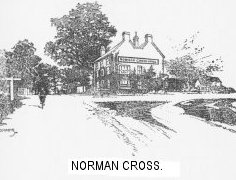
Norman Cross! how many have been those old-time cyclists who
have partaken of the hospitality of the inn here! Not
always, though, has it been a place of welcome memories.
For years, indeed, during the long struggles between England and
France, this was the site of one of the largest of the prisons in
which captured French soldiers were incarcerated. Over
three thousand were placed here, officers and privates, some
remaining captive for more than ten years. Happy those who,
through influence or by mere luck, were selected to be exchanged
for our soldiers, prisoners in France.
It was a weary time for those poor fellows. Many of them
died in the great insanitary sheds in which they were
confined, and others lost their reason. Desperate men
sometimes succeeded in escaping to the coast, where friends were
awaiting them. Others, wandering over the lonely flats,
perished miserably in the dykes and drains into which they fell
when the mists shrouded the countryside. There were, again,
those who stabbed the sentries and made off. Such an one
was Charles François Marie Bonchew, an officer, who had
wounded, but had not killed, a sentry named Alexander
Halliday. Being captured, he was sentenced to death at
Huntingdon, and was brought back to Norman Cross to be executed,
September 1808. All the prisoners were turned out to
witness the execution, and the garrison was under arms.
But it was not all savagery and horror here among those
military captives, for they were often allowed out on parole,
within certain hours and well-defined bounds. It was
understood that no prisoner out on parole should leave the
highroad, nor was he to be at large after sunset. If he
disregarded these rules he was liable to be shot at sight by any
one who had a gun handy. He was an Ishmael against whom
every hand was turned, and, indeed, the Post Office offered a
reward of £5 to any mail guard who, seeing a prisoner
breaking parole, should shoot him. After several
inoffensive farm-labourers, going home after dusk, had been
peppered with shot in mistake by guards anxious to secure this
reward, the village streets and roads adjacent became singularly
desolate when a coach was heard approaching.
There were exceptions to these strict rules, and officers of
high rank—and consequently assumed to have a nicer sense of
honour than that obtaining among subalterns and the rank and
file—were permitted to take private lodgings at
Stilton. Those were the fortunate ones. Most of the
prisoners, unhappily, were penniless, and after a time even their
own Government refused supplies for their maintenance.
Accordingly, they obtained some few little luxuries, and employed
the time that hung so heavily on their hands, by
carving toys and artistic nick-nacks out of fragments of wood, or
from the bones left from their rations, and selling them to the
crowds of country folks who came to gaze at them on certain
days. Straw-plaiting, too, was a prisoners’ industry,
until it was stopped by some of the military in charge.
In March, 1812, Sergeant Ives, of the West Essex Militia, was
stopped on the highway between Stilton and Norman Cross by a
number of persons unknown, who, after having knocked him down and
robbed him of his money and watch, wrenched open his jaws, and
with savage cruelty, cut off a piece of his tongue. It was
supposed that this outrage was in revenge for his having been
concerned in suppressing the plait trade at Norman Cross
barracks.
The prisoners were not entirely without spiritual consolation,
for the good Bishop de Moulines appointed himself their chaplain,
and, of his own free will leaving France, took up residence at
Stilton. He attended them in sickness, and helped them out
of his own resources.
The officers in charge of these prisoners were often brutal,
but that there were some who sympathised with their sorrows is
evident from the tablet still to be seen in Yaxley Church, a mile
distant, which tells of the gratitude of the prisoners for the
kindness shown them by Captain John Draper, R.N., who died after
being in charge of the prison for only eighteen months.
Norman Cross Prison, or “Yaxley
Barracks”—Norman Cross being in the parish of
Yaxley—built in 1796; was demolished in 1816, and no
vestige of it is left.
And so all recollection of these things might in time have
faded away had it not been for the monument erected by the
wayside in the fateful year 1914. Let us pause to consider
that moment. Events were hurrying towards the beginning of
the Great War of 1914–18, and the nation in general was
wholly ignorant of what was coming. Stupidly ignorant, for
there were many omens. It was at this moment, afterwards
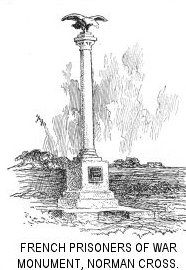
seen to be so full of tragedy, that the memorial pillar on, or
near, the site of Yaxley Barracks, to the memory of those French
prisoners of war, was unveiled, July 28th, 1914, by Lord
Weardale. A gilded bronze French Imperial eagle stoops on
the crest of a handsome pillar, and on the plinth is a tablet
stating that this is a memorial to 1770 French prisoners who died
in captivity.
These incidents, “picked from the wormholes of long
vanished days,” give romance to the otherwise featureless
road onwards to Kate’s Cabin and Water Newton. The
“Kate’s Cabin” inn is mentioned by every
road-book of coaching-times, but no one ever condescended to explain the origin of this curious
sign, and the inn itself, once standing in the receipt of custom
at the cross-roads, three miles and a half from Norman Cross, is
now a pretty cottage.
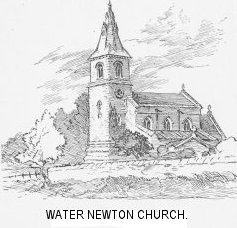
 Nearly two miles onward, Water Newton comes in sight,
standing, dry and secure, on its knoll above the water-meadows on
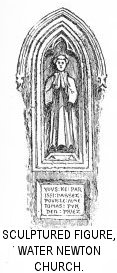
the river Nene. On the western face of its church tower,
which originally, before Wansford bridge was built and the road
diverted, faced the highway, may yet be seen a tabernacle
containing an ancient effigy of a man in semi-ecclesiastical
attire, his hands clasped in prayer. An inscription in
Norman French may with some difficulty be deciphered beneath it,
inviting the passer-by to pray for the soul of Thomas
Purden:—
Nearly two miles onward, Water Newton comes in sight,
standing, dry and secure, on its knoll above the water-meadows on
the river Nene. On the western face of its church tower,
which originally, before Wansford bridge was built and the road
diverted, faced the highway, may yet be seen a tabernacle
containing an ancient effigy of a man in semi-ecclesiastical
attire, his hands clasped in prayer. An inscription in
Norman French may with some difficulty be deciphered beneath it,
inviting the passer-by to pray for the soul of Thomas
Purden:—
“VOVS KE PAR
ISSI PASSEZ
POVR LE ALME
TOMAS PVR
DEN PRIEZ.”
Read aloud, we perceive this to be intended for rhyme.
No one prays for the soul of Thomas Purden nowadays, for these
two very excellent and individually sufficient reasons—that
prayers for the dead are not customary in the Church of England,
and that, since the road has been diverted, there are no
passers-by.
This brings us to the reason why Thomas Purden should have
expected wayfarers to intercede for his soul. That he
expected them to do this out of gratitude seems obvious; but it
is not at first evident for what they should be so grateful. We
are, however, to bear in mind that a road passed down beside this
church tower in those days, where no road—only a
meadow—exists to-day. The meadow slopes steeply to
the river, and doubtless a ford, a ferry, or some primitive
bridge was established here by Thomas Purden long before even a
wooden bridge existed at Wansford. In providing some safe
method by which travellers might pass this river, even now
subject to dangerous floods, Purden would have been a benefactor
in the eyes alike of men and of Holy Church, and fully entitled
to the prayers and intercessions of all.
For many years the head of the figure had disappeared, but
when the church was restored, some years since, an ingenious
mason fitted him with another which had, in the usual careless
fashion of restorers, been knocked off something else. And
it is a simple truth that since its “restoration,”
Water Newton church is sadly bare.
By the wayside, on the left, against the wall of a farm-house
residence, will be noticed an old milestone and horseman’s
upping-block combined. It marks the 81st mile from London,
and bears the initials “E. B.,” together with the
date, 1708. This is perhaps the only survivor of a series
which, according to De Foe, in his “Tour through the Whole
Island of Great Britain,” a Mr. Boulter was projecting
“to London, for the general benefit.”
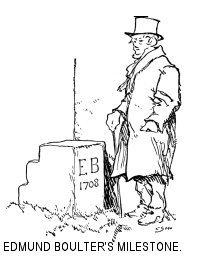
Edmund Boulter was one of the family who were then seated at
Gawthorp Hall, near Leeds, and who, not much later, sold that
property to Henry Lascelles, father of the first Lord
Harewood.
At
the hamlet of Sibson, on the left hand in descending toward the
level-crossing at Wansford station, may still be seen the stocks
and whipping-post beside the road. To the right flows the
winding Nene, through illimitable oozy meadows, its course marked
in the far distance by the pollard willows that line its
banks. The Nene here divides the counties of
Huntingdonshire and Northants, Wansford itself lying in the
last-mentioned county and Stibbington on the hither side of the
river. The famous Wansford Bridge joins the two, and helps
to render Wansford and Stibbington one place in the eyes of
strangers. Both places belong to the Duke of Bedford,
Stibbington bearing the mark of its ownership distinctly visible
in its severe and uncomfortable-looking “model”
modern-gothic stone houses, with the coroneted “B” on
their gables. In this manner the accursed Russells have
bedevilled many of the villages and townlets unhappily owned by
them, and the feelings of all who live in their earmarked houses
must be akin to those of paupers who inhabit workhouses and
infirmaries, with the important exception that the Duke’s
tenants pay rent and taxes. Wansford, fortunately, has not
been rebuilt, and it is possible for the villagers to live
without an uncomfortable sense of belonging, body and soul, to
the Dukes of Bedford.
The famous “Haycock” inn, usually spoken of as at
Wansford, is, in fact, on the Huntingdonshire side of the bridge,
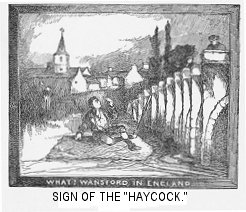
and in Stibbington. Its sign alludes to the supposed origin
of the curious nick-name of “Wansford-in-England,”
first mentioned in that scarce little early eighteenth-century
book, Drunken Barnaby’s Four Journeys to the North of
England. In its pages he describes being carried off by
a flood:—
“On a haycock sleeping soundly,
Th’ River rose and took me roundly
Down the current: People cry’d;
Sleeping, down the Stream I hy’d:
‘Where away,’ quoth they, ‘from
Greenland?’
‘No, from Wansforth-brigs in
England.’”
This
“in England” has puzzled many. It really refers
to the situation of Wansford in Northamptonshire, near, but not
in, “Holland”—the Holland division of
Lincolnshire.
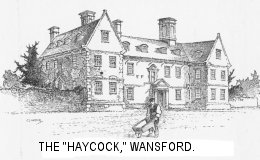
Wansford’s peculiar fame is thus more than local.
Perhaps the queer picture-sign of the grand old inn, representing
Drunken Barnaby on his haycock, helped to disperse it over
England in days when it could not fail to be seen by every
passing traveller. The “Haycock” ceased to be
an inn, and is now occupied as a hunting-box. It affords a
pleasing relief from the Duke of Bedford’s
almshouse-looking cottages, and is a building not only of
considerable age, but of dignified architectural character.
Stone-built, with handsome windows and steep slated roof, and
carefully designed, even to its chimneys, it is, architecturally
speaking, among the very finest of the houses ever used as inns
in England, and has more the appearance of having been originally
designed as a private mansion than as a house of public
entertainment. The sign is now hung in the hall of the
house, the corbels it rested on being still visible beside the
present door, replacing the old archway by which the coaches and
post-chaises entered and left the courtyard of the inn of
old.
The
“Haycock,” even in its days as an inn, was a noted
hunting centre. Situated in the country of the Fitzwilliam
Hunt, it afforded, with its splendid accommodation for guests and
for horses, headquarters for those who had not a hunting-box of
their own, and in those days stabled as many as a hundred and
fifty horses.
“Young Percival” kept the “Haycock”
from about 1826, and drove the “Regent” between
Wansford and Stamford, in place of “old John
Barker.” At that time he had more valour than
discretion in driving, and on one occasion at least nearly
brought disaster upon the coach at the famous bridge by
“punishing” a spirited team which had given some
trouble at starting. At the steep and narrow entrance to
the bridge they took it in their heads to resent his
double-thonging, the leaders turning round, and the whole team
presently facing towards London instead of Stamford. They had to be driven back to the
“Haycock,” and Barker took them on to Stamford.
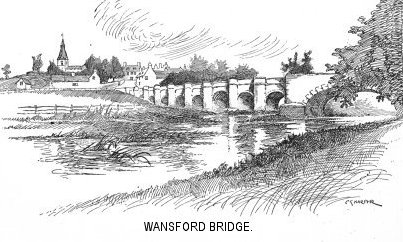
That bridge would have been an exceedingly awkward place for a
coach accident. It is picturesqueness itself, and by
consequence not the most convenient for traffic. Originally
built in 1577, with thirteen arches, it was repaired in 1674, as
a Latin inscription carved midway on it informs the inquiring
stranger. In the winter of 1795 an ice-flood destroyed some
of the southernmost arches, which were replaced the following
year by two wider spans, so that Wansford Bridge has now only ten
openings. The northern approach to it from Stamford leads
down in a dangerous, steep, sudden, and narrow curve, intersected
by a cross-road. Now that there is no longer a turnpike
gate at this point to bring the traffic to a slow pace, this
descent is fruitful in accidents, and at least one cyclist has
been killed here in an attempt to negotiate this sharp curve on
the descent into the cross-road. An inoffensive cottage
standing at the corner opposite the “Mermaid” inn has
received many a cyclist through its window, and the new masonry
of its wall bears witness to the wreck caused by a heavy wagon
hurtling down the hill, carrying away the side of the house.
The five miles between Wansford and Stamford begin with this
long rise, whose crest was cut through in coaching days, the
earth taken being used to fill up a deep hollow which succeeded,
where a little brook trickled across the road, the coaches
fording it. Thence, by what used to be called in the old
road-books “Whitewater Turnpike,” past the few
cottages of Thornhaugh, and so to where the long wall of Burghley
Park begins on the right hand. Here the telegraph poles,
that have hitherto so unfailingly followed the highway, suddenly
go off to the right, and into Stamford by the circuitous Barnack
road, in deference to the objections, or otherwise, of the
Marquis of Exeter, against their going through his park.
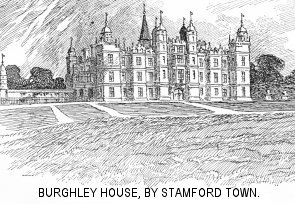
The
famous Burghley House by Stamford town is not visible from the
road, and is indeed situated a mile within the park, only the
gate-house to the estate being passed in the long descent into
that outlying portion of the town known as Stamford Baron.
There is, amid the works of Tennyson, a curiously romantic
poem, “The Lord of Burleigh,” which on the part of
the literary pilgrim will repay close examination; and this
examination will yield some astonishing results. It is,
briefly stated, the story of an Earl masquerading as a landscape
painter and winning the heart and hand of a farmer’s
daughter. He takes her, after the wedding, to
see—
“A mansion more majestic
Than all those she saw before;
Many a gallant gay domestic
Bows before him at the door.
And they speak in gentle murmur
When they answer to his call,
While he treads with footstep firmer,
Leading on from hall to hall.
And, while now she wonders blindly,
Nor the meaning can divine,
Proudly turns he round and kindly,
‘All of this is mine and thine.’
Here he lives in state and bounty,
Lord of Burleigh, fair and free,
Not a lord in all the county
Is so great a lord as he.”
The original person from whose doings this poem was written
was, in fact, Henry Cecil, tenth Earl, and afterwards first
Marquis, of Exeter. He was the lord of Burghley House (not
“Burleigh Hall”), by Stamford town, and his
descendants are there yet.
Not a landscape painter, but a kind of London man about town
and Member of Parliament for Stamford, 1774–1780,
1784–1790, and then plain Mr. Henry Cecil (for he did not
succeed his uncle in the title until December, 1793), he is found
rather mysteriously wandering about Shropshire in 1789, calling
himself (there is never any accounting for taste) “Mr.
Jones.” He was then a man who had been married
fourteen years, and was thirty-six years of age.
The scene opens (thus to put it in dramatic form) on an
evening towards the end of June, 1789, when a stranger knocked at
the door of Farmer Hoggins at Great Bolas in Shropshire, and
begged shelter for the night. He was obviously a gentleman,
but called himself by the very plebian name of “John
Jones.” He made himself so agreeable that his stay
“for the night” lasted some weeks, and he returned
again in a month or so, taking up his residence in the
village. The attraction which brought him back to Great
Bolas was evidently Sarah Hoggins, the farmer’s daughter,
at that time a girl of sixteen, having been born in June,
1773. He proposed for Sarah, and on April 17th, 1790, they
were married in Great Bolas Church, the register showing that he
married in the name of “John Jones.” Meanwhile
he had purchased land in the village, and built a house which he
called “Bolas Villa.” Gossip grew extremely
busy with this mysterious stranger who had thus descended upon
the place, and it was generally suspected that he was a
highwayman in an extensive way of business, especially as some
notable highway robberies happened coincidently with his
appearance.
Early in 1794, “Mr. John Jones,” living thus at
Great Bolas, learnt that his uncle, the ninth Earl of Exeter, had
died in December. Telling his wife they must journey into
Northamptonshire, where he had business, they set out and arrived
at “Burghley House, by Stamford town,” and there he
disclosed to her for the first time that he was not “John
Jones,” but Henry Cecil, and now Earl of Exeter.
At what time he broke the news to her that he was already a
married man there is no evidence to show. Strictly
speaking, he had made a bigamous marriage, because, although his
wife, one of the Vernons of Hanbury, in Worcestershire, had
eloped on June 14, 1789, with the Reverend William Sneyd, curate
of that place, he had at the time taken no steps to obtain a
divorce.
But he had every excuse. He had honestly fallen in love
with Sarah Hoggins after thus meeting her while wandering about
the country a few days after his wife’s flight; and he
obtained a divorce by Act of Parliament in March, 1791.
Having done this, he married Sarah Hoggins secondly some six
months later (October 3) in the City of London Church of St.
Mildred, Bread Street, in whose register his name appears as
“Henry Cecil, bachelor.”
Tennyson’s poem is, therefore, rather more romantic than
truthful; and the lines which tell us how she murmured—
“Oh!
that he
Were again that landscape painter
Who did win my heart from me,”
have no authority. Nor is there any evidence to warrant
the statement that—
“A trouble weighed upon her
And perplexed her, night and morn,
With the burthen of an honour
Unto which she was not born.”
The poet continues—
“So she droop’d and droop’d
before him,
Fading slowly from his side;
Three fair children first she bore him,
Then before her time she died.”
The Countess of Exeter, in fact, died on January 18, 1797, not
quite twenty-four years of age; but not from “the burthen
of an honour unto which she was not born.” Happily,
accession to the ranks of the titled nobility is not fatal, as
the marriage of many distinguished ornaments of the musical
comedy stage assure us; and so we must charge the Poet Laureate
with the flunkey thought that blue blood is a kind apart, and not
to be admixed with other strains. This from the poet who
wrote—
“Kind hearts are more than coronets,
And simple faith than Norman blood.”
is unexpected.
She left two sons and one daughter. Her eldest son became
second Marquis of Exeter, his father, the Earl, having been
raised a step in the peerage in 1801.
The enterprising Earl married, thirdly, in 1800, the divorced
wife of the eighth Duke of Hamilton, and died May 1, 1804, aged
fifty; but his third wife survived until January 17, 1837.
In the billiard-room of Burghley House is a portrait-group of
“the Lord of Burleigh” and his wife, Sarah Hoggins,
by Sir Thomas Lawrence.
“Bolas Villa” was given by the Earl to his
godson. It has since been enlarged, and is now styled
“Burghley Villa.” The church of Great Bolas is
a grim-looking brick building of the eighteenth century, when
many of the Shropshire churches in that district were
rebuilt.


