Music and poetry attained to a high state of cultivation
in the reign of Elizabeth; the Queen herself
was an admirable performer on the virginals, and by
her example and authority did all that was possible
to elevate the art of music, and to encourage learned
musicians throughout her dominions. This happy
condition of things was continued by her successors,
James I. and Charles I., but with the establishment
of the Commonwealth all music, both of church and
theatre, was rigidly suppressed. We read with horror
and indignation of the wanton destruction of church
organs and other musical instruments, and of the tearing
and burning of the various Service-books which had
been in use in the cathedrals and collegiate establishments.
At Canterbury cathedral "the soldiers violated
the monuments of the dead, spoyled the organs, broke
down the ancient rails and seats with the brazen
eagle which did support the Bible, forced open the
cupboards of the singing-men, rent some of their surplices,
gowns, and Bibles, and carryed away others,
mangled all our Service-books and books of Common
Prayer, bestrewing the whole pavement with the leaves
thereof." At Rochester cathedral, Colonel Sands, hearing
the organs, cryed, "A devil on those bag-pipes," and
"one of the rebels" discharged a pistol at the head of
Prebend Larken, who interposed and endeavoured to
prevent the spoliation of the cathedral. At Chichester
cathedral, the officers having sacked the plate and
vestments, left the "destructive and spoyling part to
be finished by the common soldiers, who brake down
the organs, and dashing the pipes with their pole-axes,
scoffingly said, 'Hark how the organs go!' They force
open all the locks, either of doors or desks wherein the
singing-men laid up their Common Prayer books, their
singing-books, their gowns and surplesses; they rent the
books in pieces, and scatter the torn leaves all over the
church, even to the covering of the pavement." At
Winchester "They enter the church with colours flying,
their drums beating, their matches fired, and that all
might have their part in so horrid an attempt, some of
their troops of horse also accompanied them in their
march, and rode up through the body of the church and
quire until they came to the altar; there they begin
their work; they rudely pluck down the table and
break the rail, and afterwards carrying it to an ale-house
they set it on fire, and in that fire burnt the
books of Common Prayer and all the singing-books
belonging to the Quire; they throw down the organ
and break the stories of the Old and New Testament
curiously cut out in carved work. The troopers ride
through the streets in surplesses, carrying Common
Prayer books and some broken organ pipes."
In Westminster Abbey, in 1643, "Soldiers were
quartered who brake down the rail about the altar,
and burnt it in the place where it stood; they brake
down the organ and pawned the pipes at several
ale-houses for pots of ale; they put on some of the
singing-men's surplesses, and in contempt of that
canonical habit, ran up and down the church; he
that wore the surpless was the hare, the rest were
the hounds."
It would be needless to add to these miserable stories;
those who care to read further on the subject, are referred
to the quaint old book Mercurius Rusticus, from
whence the foregoing extracts have been taken.
So complete was the destruction of church music-books,
that examples of the pre-Commonwealth time
are now most rare.
Not only were the organs and music destroyed, but
musicians, organists, and singers were turned adrift,
and had to seek precarious livelihoods by teaching
music to the few who cared or were willing to learn
the art, or else to escape starvation by adopting some
less congenial occupation than that for which they were
fitted by nature and education.
If tradition may be relied on, the Protector, Cromwell,
was himself a lover of music, and not unwilling, when
opportunity served, to assist and befriend musicians.
Cromwell's secretary, the poet Milton, was no mean
performer on the organ, and being the son of an eminent
composer,[1] would doubtless, with his passionate
love for music, be at all times ready to use his sympathetic
voice and counsel on behalf of any distressed and
poor musician who might petition the Protector for help
or redress.
It is well known that the organ which stood in
Magdalen College, Oxford, was saved from destruction
through the intervention of Cromwell, who privately
caused it to be removed to Hampton Court, where it
was placed in the great gallery, in order that he might
have the frequent pleasure of hearing it; and he also
appointed as his organist and music-master, at a salary
of 100l. per annum, John Hingston, who had been one
of the musicians to Charles I. Cromwell was extremely
partial to the Latin Motets composed by Richard Dering,
and these were performed on the organ by Hingston,
who was assisted by his pupils in the vocal parts. The
interesting organ which must have often poured forth
its sweet sounds under the fingers of Milton, was, after
the Protector's death, returned to Magdalen College;
but subsequently the College authorities sold it, and
it was removed to Tewkesbury Abbey, where it now
stands.
Anthony Wood, who lived during the Protectorate,
tells the following characteristic anecdote of Cromwell:—
"In October, 1659, James Quin, M.A., and one of
the senior students of Christ Church, a Middlesex man
born, but son of Walter Quin, of Dublin, died in a
crazed condition. A. W. had some acquaintance
with him, and hath several times heard him sing,
with great admiration. His voice was a bass, and he
had a great command of it. 'Twas very strong and
exceeding trouling, but he wanted skill, and could
scarce sing in consort. He had been turned out of
his student's place by the visitors, but being well
acquainted with some great men of those times that
loved music, they introduced him into the company
of Oliver Cromwell, the Protector, who loved a good
voice and instrumental music well. He heard him
sing with very great delight, liquored him with
sack, and in conclusion, said: 'Mr. Quin, you have
done very well, what shall I do for you?' To which
Quin made answer, with great compliments, of which
he had command, with a great grace, that 'Your
Highness would be pleased to restore him to his student's
place,' which he did accordingly, and so kept it to his
dying day."
It must not be forgotten that although during the
Commonwealth musicians found it difficult to earn
their bread in consequence of the prohibition of all
public exhibition of their executive skill, yet many of
the learned and erudite musical treatises which have
been handed down to us were published at that time.
From this we may be sure that the musical predilections
of Cromwell were regarded with secret hope by the few
musicians who were able privately to pursue their
calling; and indeed public signs were not wanting
during the latter years of the Protector's life, that
had he been spared, the art of music would probably
have received more emphatic and distinct assistance
at his hands. In 1656 he granted a licence to Sir
William Davenant to open a kind of theatre[2] for "an
entertainment in declamation and music after the manner
of the ancients;" and later on he licensed certain
theatrical performances at the Cockpit, in Drury Lane.
The extreme Puritan party did, however, so effectually
destroy and put down all Church music,[3] deeming organs
and service-books superstitious and ungodly, that at the
Restoration, when the authorities set about re-establishing
musical services in the cathedrals, it was impossible
to find either instruments, books, or singers
necessary for the purpose; and, indeed, out of the
large musical establishment of Charles I., only three
men—Dr. Wilson, Christopher Gibbons, and Henry
Lawes—came forward at the Restoration to claim their
former appointments.
We get a further insight into the condition of Church
music at the Restoration, from Matthew Locke's Present
Practice of Musick Vindicated, published in 1673,
wherein he says, "For above a year after the opening
of His Majestie's Chappel, the orderers of the musick
there were necessitated to supply superior parts of the
music with cornets and men's feigned voices, there
being not one lad for all that time capable of singing
his part readily."
An examination of the old MS. copies of anthems
composed by the organists and singing-men of the
various cathedrals in the reign of Charles II., shows
that a dearth of singing-boys (trebles) was general
throughout the kingdom, the compositions being
chiefly for men's voices only.
From the preceding slight and brief sketch of the
state of music during the Commonwealth, it will be
evident that the Puritan rule was most unpropitious
for the art; with its professors banned, and its public
performance well-nigh extinguished, music might perhaps
have been expected to have died an unnatural
death; but heaven-born, it retained a vital spark
which needed only the breath of freedom and gentle
encouragement to foster it into a flame.
With the death of Cromwell, the sun of the Puritan
world vanished, but happily at the same time a new
star in the musical firmament arose. Cromwell died in
1658, at Whitehall, and in the same year, within a
bow-shot of the Palace, was born the favoured child
of the muses, destined to raise the musical fame of
England to a height it had never before attained, and
by his beautiful creations to make for himself a name
of undying fame.
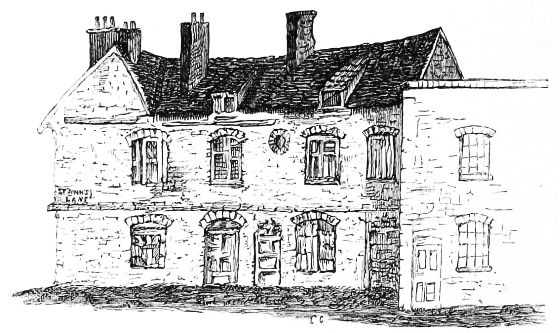
This welcome prodigy was Henry Purcell, his birth-place
St. Ann's Lane, Old Pye Street, Westminster.
The precise day of his birth there is unknown, but
there is no doubt about the year 1658. Some remains
of the house are still standing. A sketch of it
and the adjoining premises was made on the 15th of
April, 1845, by R. W. Withall.
The original drawing, of which a reduced copy is
given, has the following note:—
"Three ancient houses in Westminster; in the
right-hand one of which the great H. Purcell was
born, 1658, and passed his early life. They are now
in the last state of ruin, and have long been uninhabited.
The houses adjoining that of Purcell are
of modern date, and project before the others, as well
as encroach somewhat on Purcell's doorway, hiding
one side of the door-frame. Of the old houses the
windows and doorways are nearly all boarded up in the
roughest manner, under which, however, the original
panelled doors are still to be partly found. The
houses are of old red brick. The first door was the
back way into the public-house called the 'Bell and
Fish,' kept by Mr. Oldsworth, who lost his licence.
The second door the entrance to the skittle-ground.
The third was Purcell's house."
Purcell was named Henry after his father, a thoroughly
competent and efficient musician, of whom Pepys made
this quaint entry in his diary on the 21st of February,
1659:—
"After dinner I back to Westminster Hall with
him (Mr. Crewe) in his coach. Here I met with
Mr. Lock and Pursell, masters of musique, and with
them to the Coffee House, into a room next the water,
by ourselves, where we spent an hour or two, till
Captain Taylor came and told us that the House had
voted the gates of the city to be made up again, and
the members of the city that are in prison to be set at
liberty; and that Sir G. Booth's case be brought into
the House to-morrow. Here we had variety of brave
Italian and Spanish songs, and a canon for eight voices,
which Mr. Lock had lately made on these words,
'Domine salvum fac Regem,'—an admirable thing.
Here out of the window it was a most pleasant sight
to see the city from one end to the other with a glory
about it, so high was the light of the bonfires, and so
thick round the City; and the bells rang everywhere."
We may note here the intimacy which existed between
Purcell's father and Matthew Locke,[4] the celebrated
composer, an intimacy and friendship which was
afterwards extended to the son.
Henry Purcell, senior, was a gentleman of the Chapel
Royal, and in that capacity sang in the choir at the
coronation of Charles II.[5] He was also elected a
singing-man of Westminster Abbey, and master of the
chorister boys of that church; to these appointments he
added that of music copyist of Westminster Abbey, at
that time a very honourable and important position, in
consequence of the wholesale destruction of Service-books
which had taken place during the Commonwealth.
A very interesting official document, now preserved
in the British Museum, of which the following
is a copy, gives us information respecting the
appointments held by Henry Purcell, the father, in
Westminster Abbey:—
"Accounts of Richard Busby, D.D., 1664. The
money computed by John Needham (Gent.) receiver
of the college.
"Cantator in choro Henry Purcell £8 and 40s.
In re chorist Henry Purcell £10.
Cantator in choro per stipend et regard—
John Harding, Christopher Chapman,
Henry Purcell, Edwd. Braddock,
William Hutton, Owen Adamson,
Thomas Hughes, Peter Amblett, Thomas Shorter,
Thomas Condy, Thomas Finnell—each £8 and 40s.
"Choristicus—
Et in denariis solutis Henry Purcell,
Pro datum chorist ad—lxvis viyd
Intoto hoc anno xxxiy£ vis viyd.
Ac etiam et contess Heno Purcell, pro
Chorist. xx£.
Organista Chr. Gibbons £10.
"To Mr. Chaunter for nine Holly days—
| |
|

|
| On All Saints day |
39s. |
|
| The first of November |
" |
|
| Christmas day |
" |
|
| Epiphany |
" |
£ s. |
| Candlemas day |
" |
8 12 |
| Lady day |
" |
|
| Easter day |
" |
|
| Whitson day |
" |
|
| St. Peter's day |
" |
|
"To George Dalham, for tuning the organ this
year, 40s.[6]
"To John Hill,[7] for playing on the cornett in the
church this year, £4.
"To the organist for rent of his house, £8.
"Given to the organist[8] out of the rents at the
taking of his degree, £5.
"Given by order to the christened Turke—nil.[9]
"Jan. 11, 1664—"J. Dolben, Decanus.
Wal. Jones, Sub Decanus.
H. Killigrew.
S. Bolton.
Charles Gibbes.
Robt. South.
Ric. Perrinchief."
In addition to the before-mentioned appointments at
the Chapel Royal and Westminster Abbey held by
Purcell, senior, we find that he was also a member
of the Royal band. The old cheque-book of the Chapel
Royal in recording his death places the matter beyond
doubt:—
"These are to certify that Mr. Henry Purcell, who
succeeded Segnor Angello in his place of the private
musicke; that the said Mr. Henry Purcell took possession
of his place in the year 1663, upon St.
Thomas's day; deceased the 11th August, 1664. These
are to certifye the death of Mr. Henry Purcell.
- "Henry Cooke.
- Tho. Purcell.
- Alphonso Marsh.
- Gregory Thorndale.
- Edward Colman."
It is clear from the foregoing account of the numerous
important musical posts which the father held, that he
was a man of considerable ability, and fully equal to
the task of guiding and fostering the musical predilections
of his infant son; and there can be no doubt that
Henry Purcell received his earliest instructions in the
art of music from his father. When the latter died he
was buried in the cloisters of Westminster Abbey; his
age has not been ascertained, but presumably he was
but a young man—perhaps he was naturally weak in
constitution—and from him the boy Henry may have
inherited the seeds of consumption. The elder Purcell
died in 1664, at which time the young Henry was
just six years old, and with his natural genius he had
doubtless already acquired some considerable skill in
music. It is certain that he was immediately admitted
as a chorister of the Chapel Royal. Happily for him
he had been left by his father to the guardianship of his
uncle Thomas Purcell, who most warmly and affectionately
endeavoured to supply the place of the lost
parent by adopting the orphan as his own son.
Thomas Purcell's abilities and professional qualifications
well fitted him for the task which had fallen to
his lot. He was a gentleman of the Chapel Royal and
had been associated with his brother Henry at the
coronation of Charles II.; he must have been held
in high favour and regard by the king, for court
appointments in various musical capacities fell to him
in rapid succession. Amongst other honourable positions
we find him holding the post of lutenist as
described in the following warrant:—
"Charles R., by the Grace of God, &c., to our
trusty and well-beloved Sr Edward Griffin, Knight,
Treasurer of our Chamber, &c. Whereas wee have
made choice of Thomas Purcell to serve us in the office
and place of one of our musitians in ordinary for the
lute and voyce, in the roome of Henry Lawes, deceased,
and for this service and attendance in that place, are
pleased to allow him the wages and livery of six-and-thirty
pounds two shillings and sixpence by the year
during his life. Our will and pleasure is, and We do
hereby will and command you to pay, or cause to be
paid, unto the said Thomas Purcell or his assigns, the
said wages and livery, &c. The first payment to commence
and begin from the birth of our Lord, next
ensuing the date hereof, and to continue the same
during the natural life of him, the said Thomas Purcell.
Given the 29th of November, in the 14th year of our
reign (1662).
"Ex. pr. Warwick."
In 1672 Thomas Purcell was appointed a "composer
in ordinary for the violins" in conjunction with Pelham
Humphries, the warrant which is extremely curious
runs thus:—
"Charles R., by the Grace of God, &c., to our trusty
and well-beloved Sir Edward Griffin, Knight, Treasurer
of our Chamber, now being, &c. Whereas we have
been pleased to take into our service as Composer in
Ordinary for the Violins, Thomas Purcell and Pelham
Humphreys, Gents., in the room of George Hudson,
deceased, and for their entertainments in consideration
of services done, and to be done, unto us, we have
given and granted, and by these presents do for us and
Our Heirs and Successors, Wee do give and grant unto
the said Thomas Purcell and Pelham Humphreys for
their wages and fee, the sum of fifty-two pounds fifteen
shillings and tenpence, by the year, during their natural
lives, and the life of the longer liver of them, the first
payment to commence from the feast of St. Michael
the Archangel, 1672. Given under our Signet at our
Palace of Westminster, the Eighth day of August,
in the year of our Lord God, One thousand six hundred
and seventy-two (1672).
"Ex. John Nicolas."
Thomas Purcell and Pelham Humphries were also
associated as masters of the King's band of "four-and-twenty
fiddlers;" but Purcell was chief and leader, either
by virtue of seniority or special appointment.
A curious document in Thomas Purcell's autograph
is preserved by the "Royal Society of Musicians," which
gives the names of the gentlemen of the band and
other interesting particulars; it reads as follows:—
"The names of the Gent of his Matles Private Musick
who are to attend his Matie at Windsor paid out the
Excheker:
| |
£ |
s. |
d. |
Tho. Mr. Purcell }
Pelham Mr. Humphreys } |
200 |
0 |
0 |
| Jon. Mr. Hardinge |
40 |
0 |
0 |
| Wm. Mr. Howes |
46 |
10 |
10 |
| Tho. Mr. Blagrave, Seigr. |
40 |
9 |
2 |
| Alphonso Mr. March |
40 |
0 |
0 |
| Jon. Mr. Goodgroome |
40 |
0 |
0 |
| Nat. Mr. Wattkins |
40 |
0 |
0 |
| Math. Mr. Lock |
40 |
0 |
0 |
| Jon. Mr. Clayton |
152 |
13 |
4 |
| Isaac Mr. Stagins, Seigr. |
46 |
10 |
10 |
| Nich. Mr. Stagings, Junr. |
46 |
10 |
10 |
| Tho. Mr. Battes |
90 |
0 |
0 |
| John Mr. Lilly |
40 |
0 |
0 |
| Hen. Mr. Gregory |
60 |
0 |
0 |
| Theophilus Mr. Hills |
46 |
10 |
10 |
| Henry Mr. Madge |
86 |
12 |
8 |
| John Mr. Gombell |
46 |
10 |
10 |
| Richd. Mr. Dorney |
20 |
0 |
0 |
| Jon. Mr. Banister, Seigr. |
100 |
0 |
0 |
| Phil. Mr. Beckett |
60 |
2 |
6 |
| Rob. Mr. Blagrave, Junr. |
58 |
14 |
2 |
| John Mr. Singleton |
46 |
10 |
10 |
| Robt. Mr. Strange |
46 |
10 |
10 |
"15 May, 1674. These 24 Gent. of his Matles private
musick are to attend at Windsore. "T. Purcell."
In the original of the foregoing document the Christian
names were evidently prefixed after the list had been
written out; the spelling of the surnames is curious;
Stagins, father and son are spelt differently; another
proof, if it were required, of the utter indifference to
such matters at that period.
Pepys in his Diary (Dec. 19, 1666) made an entry that
"many of the musique are ready to starve, they being
five years behindhand for their wages." This irregularity
of payment of the "King's musique" seems to
have continued, for we find in the accounts of the
"Treasurer of the Chamber," the following record:—
"Paid to Thomas Pursell at xxli pr. ann. for Wages,
and xvjli ijs vjd pr. ann. for a Livery, due for fower
yeares and 3 quarters ended at Mic'mas, 1672.
clxxjli xjs xd ob."
Thomas Purcell was evidently a popular man, and on
the 24th of June, 1672, he was elected "Marshall
of the Corporation of Musique in Westminster," in
room of Captain Cooke,[10] who resigned "by reason of
sicknesse." Two years later he received another court
appointment from the King; a state paper preserved in
the Record Office tells us that he succeeded "John
Wilson, deceased, to hold during His Majesty's pleasure,
with the fee of £20 per annum, payable quarterly out
of the Exchequer, to commence 25th March, 1674,"
subscribed by warrant from the Earl of Burlington,
Master of His Majesty's Household.
Another warrant under the signet gives an order to
the treasurer of the chamber for the time being, "to
pay unto Thomas Purcell (one of His Majesty's
Musicians in Ordinary, in the place of Dr. John Wilson,
deceased), the wages and fee of £20 by the day, and
£16 2s. 6d. yearly for a livery, payable quarterly, from
Lady-day 1674, and to continue during His Majesty's
pleasure."
Thomas Purcell lived till 1682, so that he had the
satisfaction of witnessing the extraordinary development
of his nephew's genius, and could also rejoice to
see the general recognition of his merits, and of the
honourable rewards he was so rapidly acquiring. When,
at last, full of years and honours, Thomas departed
this life, he was buried near his brother in the cloisters
of Westminster Abbey. We seek in vain for the
musical compositions of either Henry (the elder) or
of Thomas: with the exception of a few chants in
common use in our cathedrals, nothing of their work
remains to us.
When Henry Purcell, the younger, became a chorister
in the Chapel Royal at six years of age, the master of
the boys was Captain Henry Cooke, an old musician,
who had belonged to the chapel of Charles I., but
who, on the breaking out of civil war, had laid aside the
peaceful art of music to engage in the rough dissonances
of battle and strife, and changed his service from that
of a Royal musician to become a Royalist soldier. In
the latter capacity he won a captain's commission, and
possibly it was not less as a reward for his devotion and
bravery on behalf of his king than as a recognition
of his musical ability that Charles II. appointed him
"Master of the Children of the Chapel." That he was
well qualified for the post can be shown by reference
to the opinions of his contemporaries, and also to the
numerous compositions of his still extant in manuscript.
Pepys' Diary contains frequent reference to Cooke,
and his compositions:—
"After sermon a brave anthem of Captain Cooke's
which he himself sang, and the king was well pleased
with it." (Aug. 12, 1660.)
"A poor dry sermon, but a very good anthem of
Captain Cooke's afterwards." (Oct. 7, 1660.)
"To Whitehall Chapel with Mr. Childe, and there
did hear Captain Cooke and his boys make trial of an
anthem against to-morrow, which was brave musique."
(Feb. 23, 1661.)
"Captain Cooke, Mr. Gibbons, and others of the
king's musicians, were come to present my Lord with
some songs and symphonys, which were performed
very finely." (May 19, 1661.)
"After dinner Mr. Townsend was called upon by
Captain Cooke; so we three went to a taverne hard by,
and there he did give us a song or two, and without
doubt he hath the best manner of singing in the world."
(July 27, 1661.)
"To Whitehall Chapel, where sermon almost done,
and I heard Captain Cooke's new musique. This the
first day of having vialls and other instruments to
play a symphony between every verse of the anthems,
but the musique more full than it was last Sunday, and
very fine it is. But yet I could discerne Captain Cooke
to overdo his part at singing, which I never did before."
(September 14, 1662.)
"We had an excellent anthem sung by Captain
Cooke and another, and brave musique.... After
dinner to chappel again, and there had another anthem
of Captain Cooke's." (May 18, 1662.)
"A most excellent anthem with symphonys between,
sung by Captain Cooke." (Sept. 7, 1662.)
"Captain Cooke, and his two boys, did sing some
Italian songs which, I must in a word say, I think was
fully the best musique that I ever yet heard in all my
life." (Dec. 21, 1663.)
Cooke composed a considerable number of pieces of
music for various royal and festal occasions; one
curious hymn for a ceremony in connection with a
festival service of the Knights of the Garter at Windsor
was accompanied by "two double sackbuts and two
double courtals placed at convenient distances among
the classes of the gentlemen of both choirs, to the end
that all might distinctly hear, and consequently keep
together both in time and tune; for one sackbut and
courtal was placed before the four petty canons who
begun the hymn, and the other two immediately before
the prebends of the college."
Captain Cooke's services were frequently required on
the stage,[11] and with his many accomplishments there is
no great wonder that he became conceited. Pepys,
from whom so many quotations have already been
made, wrote: "A vain coxcomb he is, though he sings so
well;" and this charge of vanity is supported by other
evidence. A contemporary historian says: "Captain
Cooke was the best musician of his time till Mr. Pelham
Humphreys, one of the children of the chapel educated
by himself, began to rival him, after which he died with
great discontent."[12]
Cooke was buried in the cloisters of Westminster
Abbey in July, 1672. During the years that he was
master of the children of the chapel he had as pupils
many who won for themselves distinguished names as
musicians, amongst them notably Pelham Humphreys,
Wise, Blow, Turner, and Purcell.
Purcell profited by Captain Cooke's instructions for a
period of eight years—from the age of six to that of fourteen,
a very important time in the life of a clever boy.
Historians seem to have forgotten this fact, and have
been disposed to credit the whole of Purcell's musical
education to Pelham Humphreys or to Dr. Blow.
During these early years Purcell had already put
forth specimens of his talent for musical composition.
In 1667 Playford published a little three-part song
entitled, "Sweet Tyraness, I now resign," which Dr.
Burney has included in his history under the supposition
that it was composed by Purcell's father; but
there is reason to believe that it was the composition of
the boy who, at the date of publication, was nine years
of age. Possibly the music was originally intended as
an air or song for a single voice, as we find it published
in this form in 1678, in a work called New Ayres and
Dialogues. This collection contained five other songs
by Henry Purcell.
When Purcell was eleven years old, he essayed his
powers in the composition of music for a piece called
"The Address of the Children of the Chapel Royal to
the King, and their Master, Captain Cooke, on his
Majesties Birthday, A.D. 1670, composed by Master
Purcell, one of the Children of the said Chapel."[13] It is
also probable that in this youthful time Purcell composed
the music to Macbeth, now commonly associated
with the name of Matthew Locke. That the latter did
compose music for Macbeth is certain, as some of it is
still in existence, but it does not bear the slightest
resemblance to that popularly known as his. In favour
of Purcell, it may be noted that the Macbeth music has
many Purcell-like touches; that a copy of the score in
Purcell's youthful hand is in existence;[14] that many old
MS. copies of the music have his name attached as
composer; and that he was entitled to the credit of it
was believed by Dr. William Hayes, Dr. Philip Hayes,
Dr. Arnold, and many other eminent musicians.
The music itself is clearly an elaboration and development
of a series of short movements composed by
Robert Johnson for Middleton's play of The Witch.[15]
It must not be forgotten that many of Purcell's
anthems now in use in our cathedrals were the product
of his youthful pen and genius whilst he was still a
pupil of Cooke. Captain Cooke, the soldier musician,
died, as previously stated, in 1672, and was succeeded
in his appointment as "Master of the Children of the
Chapel" by one whose nature, genius, and scientific
knowledge of music must have stimulated and excited
in a special manner the dawning powers of the youthful
musical company committed to his charge, and the force
of whose example must have proved of the greatest
service to Purcell. This man was Pelham Humphreys;[16]
he had been educated in the Chapel Royal under
Captain Cooke, where his abilities and his personal
attractions made a strong impression on Charles II.
In Nov., 1663, Pepys made the following entry in his
Diary: "The anthem was good after sermon, being the
fifty-first psalme, made for five voices, by one of Captain
Cooke's boys—a pretty boy. And they say there are
four or five of them that can do as much. And here I
first perceived that the king is musicall, and kept good
time with his hand all along the anthem."
The pretty boy was undoubtedly Pelham Humphreys.
Clifford's book of anthems, published in 1664, the year
after the incident just recorded, contains the words of
five anthems, "composed by Pelham Humphrey, one of
the Children of His Majesties Chappel;" and in Boyce's
Cathedral Music we find Humphreys' anthem, "Have
mercy upon me," the words of which are taken from
the fifty-first psalm. There can be little doubt, therefore,
that this was the very anthem heard and approved
by Pepys.
In 1664 the king sent Humphreys to Paris,[17] to study
under Lully; and he also probably went to Italy.
During his absence the king gave him an appointment
as one of the Gentlemen of the Chapel Royal; and on
his return to London in October, 1667, he was "sworn
in" to the place. He speedily produced several new
compositions, sacred and secular, by command of the
king.
Pepys' entry in his Diary for November 15, 1667, is
very quaint. He says, "Home, and there find, as I
expected, Mr. Cæsar and little Pelham Humphreys,
lately returned from France, and is an absolute Monsieur,
as full of form and confidence and vanity, and
disparages everything and everybody's skill but his
own. But to hear how he laughs at all the king's
musick here, at Blagrave and others, that they cannot
keep time or tune, nor understand anything: and at
Grebus,[18] the Frenchman, the king's master of musick,
how he understands nothing, nor can play on any instrument,
and so cannot compose: and that he will
give him a lift out of his place, and that he and the
king are mighty great." On the following day, the
16th, Pepys notes that there was a performance of
Pelham Humphreys' musick given before the king at
Whitehall.
That Humphreys was an admirable musician, possessed
of uncommon genius, is easily discernible from
the numerous compositions of his which have come
down to us. He took as his models Lulli and Carissimi;
but fortunately Purcell's genius was stronger
and more emphatic than that of his master: had it
been otherwise he would have become a mere copyist;
but, as we shall hereafter see, Purcell looked to
Italy for good musical models, and was not afraid to
express his dislike to the frivolity of the French
school.
There exists a very interesting manuscript anthem
in Purcell's handwriting, which was originally composed
by Humphreys, but afterwards altered and improved
by Purcell.
Poor Humphreys had but a short career, or we may
be sure he would have accomplished greater things than
he did. Two years before he died he married a very
beautiful lady, who followed him to his grave in the
cloisters of Westminster Abbey in 1674, he being only
twenty-seven years of age.
Purcell was then sixteen years old, and his boy-soprano
voice must have been near its breaking—perhaps
it had already departed. It was, however, the
good custom of the period to retain as supernumeraries
of the King's Chapel any of the old boys who gave
evidence of musical ability. In 1666 we find "Hen.
Cooke, Thomas Purcell, and other Gentlemen of the
Chapel Royal, petition on behalf of themselves, the
pages of the chapel, and boys whose voices have changed,
for payment, there being no money assigned to the
treasurer of the chamber for those purposes."
Purcell therefore continued attached to the Chapel
Royal, and became a pupil of Dr. John Blow, the successor
to Pelham Humphreys, as "Master of the Children."
That Purcell studied under Blow is certain from
the inscription on Blow's monument in Westminster
Abbey, where it is stated that he was "master to the
famous Henry Purcell." Blow was undoubtedly the
very master Purcell then needed, for he was eminent
for his goodness, amiability, and moral character, and
combined with those excellent qualities all the learning
and experience of a sound musician. His compositions
are remarkable for their melodies and the boldness of
their harmonical progressions.[19] He held appointments
at the Chapel Royal, Westminster Abbey, St. Paul's
Cathedral, and St. Margaret's, Westminster; and it
speaks strongly for his singleness of heart, and the total
absence of envy and jealousy in his nature, that recognising
and proclaiming the remarkable abilities of his
pupils, Purcell and Jeremiah Clarke, he resigned his
appointments at Westminster Abbey and St. Paul's
Cathedral, in order that they might occupy those prominent
and advantageous positions. This estimable man,
Blow, survived his dear friend and pupil, Purcell, some
years, and so became his successor at Westminster
Abbey, and was eventually laid in a grave close to him,
nearly beneath the organ where they had so often
discoursed sweet music together.
That Blow fully estimated the genius of his pupil
Purcell, there can be no doubt, since many manuscript
copies of the compositions of the latter exist in the
handwriting of Blow. Probably it was at the suggestion
of Blow that Purcell was appointed copyist[20] to Westminster
Abbey in 1676. He succeeded the Rev.
Stephen Byng, one of the minor canons, who probably
resigned the post, as he did not die till 1681. Purcell
was eighteen years of age when he became copyist of
Westminster Abbey; hence arose the mistake made by
Burney and Hawkins, and constantly repeated on their
authority, that Purcell was appointed organist of Westminster
Abbey at eighteen. The office of copyist he
held for two years only.
Mention has previously been made of the music to
Macbeth as the composition of Purcell; probably the
recognition of the excellence and effectiveness of this
work induced the managers of the theatres to give him
further employment; for in 1676 we find him composing
music for at least three plays—Shadwell's Epsom-Wells,
Dryden's Aurenge-Zebe, and Shadwell's Libertine. The
latter contains a four-part chorus, "In these delightful,
pleasant groves," still popular with choral societies.
The whole of the music of The Libertine is very bold,
and would be an interesting work to revive for its
merits; it is further curious from the fact that the
libretto is founded on the same story which was long
years afterwards adopted by Mozart for his opera, Don
Giovanni. In 1677 Purcell wrote the music for Mrs.
Behn's tragedy, Abdelazor, and also the music, solo and
chorus, of an ode "On the death of his Worthy Friend,
Mr. Matthew Locke, musick composer in ordinary to His
Majesty, and Organist of Her Majesties Chappel, who
Dyed in August 1677." The words of the ode are as
follow:—
"What hope for us remains now he is gone?
He that knew all the power of numbers flown;
Alas! too soon; even he
Whose skilful harmony
Had charms for all the ills that we endure,
And could apply a certain cure.
From pointed griefs he'd take the pain away;
Even ill nature did his lyre obey,
And in kind thoughts his artful hand repay:
His layes to anger and to war could move,
Then calm the tempest they had raised with love,
And with soft sounds to gentle thoughts incline,
No passion reign'd, where he did not combine.
He knew such mystic touches, that in death
Could cure the fear, or stop the parting breath:
And if to die had been his fear
Or life his care,
He with his lyre could call,
And could unite his spirits to the fight,
And vanquish Death in his own field of night.
Pleased with some powerful Hallelujah
He, wrapp'd in the joys of his own harmonie,
Sung on, and flew up to the Deitie."
Of the intimacy which existed between Locke and
the Purcell family we had some indication in the paragraph
previously quoted from Pepys, where he spoke
of Purcell's father; and that the son was on similarly
friendly terms with Locke is certain. Locke lived in
the Savoy, and from thence he penned the following
letter[21] to Purcell:—
"Dear Harry,—Some of the gentlemen of His
Majesties musick will honor my poor lodgings with
their company this evening, and I would have you
come and join them: bring with thee, Harry, thy last
anthem, and also the canon we tried over together at
our last meeting. Thine in all kindness,
"M. Locke.
"Savoy, March 16."
In 1678 Purcell resigned his appointment of Copyist
at Westminster Abbey,[22] doubtless that he might devote
more time to study and composition. In this year he
produced the fine music for the masque in Shadwell's
mutilation of Shakespeare's Timon of Athens.
In 1679 Purcell does not appear to have composed
music for the theatres, but that he was deeply engrossed
in his favourite occupation appears from the following
very curious letter, now printed for the first time:—
"This ffor Mr. John Gostling, Chaunter of ye quire
of Canterbury Cathedral. London ye 8th of ffeb. 9⁄78.
"Sir, I have read ye favor of yours of ye 4th with ye inclosed
for my sonne Henry: I am sorry wee are like to
be without you soe long as yours mentions: but 'tis
very likely you may have a summons to appeare among
us sooner than you imagine: for my sonne is composing
wherin you will be chiefly concern'd. However, your
occasions and tyes where you are must be considered
and your conveniences ever complyde withall: in ye
meantime assure yourself I shall be carefull of your
concern's heir by minding and refreshing our master's
memory of his Gratious promis when there is occasion.
My wife returns thanks for ye compliment with her
servis: and pray e give both our respects and humble
services to Dr. Belk and his Lady, and beleeve ever
that I am, Sir, your affectionate and humble servant,
"T. Purcell.
"Dr. Perce is in toune but I have not seen him
since. I have perform'd ye compliments to Dr. Blow,
Will Turner, etc.
"F faut: and E lamy are preparing for you."[23]
The Rev. John Gostling, M.A., to whom the letter is
addressed, was at the time a Minor Canon of Canterbury
Cathedral, and was celebrated for the quality and
extraordinary compass of his bass voice. It was especially
for him that most of the bass solos in Purcell's
anthems were written. Evelyn, in his Diary (January
1685,) speaks of that "stupendous bass, Gosling" singing
before his Majesty and the Duke.
We learn from the above interesting letter that
Thomas Purcell called Henry his son, and we can estimate
his influence with his master, Charles the Second,
by the successful way in which he evidently refreshed
the king's memory; for only a few days after the letter
was written the "Gratious promis" was fulfilled by
appointing Gosling to the Chapel Royal. On the 25th
of February, 9⁄78, Mr. John Gosling was sworn "Gentleman
of his Maties Chappel extraordinary," which means
that his was a special or supernumerary appointment;
but a vacancy in the regular staff of the Chapel
occurred almost immediately, and we find the following
entry in the cheque-book: "Mr. William Tucker, gent.,
of his Maties Chappell Royal, departed this life the 28th
day of February, 1678,[24] in whose place was admitted
in ordinary Mr. John Gostling, a base from Canterbury,
Master of Arts."
The postscript to the letter read in connection with
the previous paragraph "my sonne is composing wherin
you will be chiefly concern'd" is clearly a jocose reference
to Gostling's exceptionally low voice.
Purcell not only wrote double F (F faut) and double
E (E lamy) for him, as in the anthem, "Behold I bring
you glad tidings," but in another anthem commencing,
"They that go down to the sea in ships," he carried the
bass solo part down to double D.
The history of the composition of the latter anthem
is somewhat remarkable:—
"Charles the Second had given orders for building
a yacht, which as soon as it was finished he named the
Fubbs, in honour of the Duchess of Portsmouth, who, we
may suppose, was in her person rather full and plump.
The sculptors and painters apply this epithet to children,
and say, for instance, of the boys of Flammengo, that
they are fubby. Soon after the vessel was launched
the King made a party to sail in the yacht down the
river and round the Kentish coast; and to keep up the
mirth and good humour of the company Mr. Gostling
was requested to be of the number. They had got
as low as the North Foreland, when a violent storm
arose, in which the King and the Duke of York were
necessitated, in order to preserve the vessel, to hand the
sails and work like common seamen. By good providence,
however, they escaped to land: but the distress
they were in made an impression on the mind of
Mr. Gostling which was never effaced. Struck with a
just sense of the deliverance, and the horror of the
scene which he had but lately viewed, upon his return
to London he selected from the Psalms those passages
which declare the wonders and terrors of the deep and
gave them to Purcell to compose as an anthem, which
he did, adapting it so peculiarly to the compass of
Mr. Gostling's voice, which was a deep bass, that hardly
any person but himself was then, or has since, been
able to sing it; but the King did not live to hear it."
Charles the Second became extremely partial to the
singing of Gostling, and was heard to say, "You may
talk as much as you please of your nightingales, but I
have a gosling who excels them all." At another time
he presented Gostling with a silver egg filled with
guineas, saying, "He had heard eggs were good for the
voice."
Gostling was a devoted admirer of, and a performer
on, the viol da gamba, an instrument which Purcell
detested. We can therefore readily imagine that his
musical susceptibilities were frequently severely taxed
by the persistent practice of his friend. He accordingly
composed a round for three voices to the following words,[25]
which he presented to Gostling:—
"Of all the instruments that are,
None with the viol can compare.
Mark how the strings their order keep
With a whet, whet, whet, and a sweep, sweep, sweep.
But above all this still abounds
With a zingle, zingle, zing, and a zit zan zounds."
In 1680 Dr. Blow magnanimously resigned the
appointment of organist of Westminster Abbey in
favour of Purcell,[26] who thus became possessed of one
of the most distinguished musical positions in the
kingdom at the early age of twenty-two.
In the same year Purcell composed the music for
Lee's tragedy, Theodosius, or the Force of Love. It was
performed at the Duke's Theatre, and the music of the
songs was soon after published by Bently as an Appendix
to the play. He also wrote music for D'Urfey's comedy,
The Virtuous Wife, and two odes, the first, addressed
to the Duke of York, entitled "An Ode or Welcome
Song for his Royal Highness on his Return from
Scotland," and the second called "A Song to Welcome
Home His Majesty from Windsor."
But the most remarkable work of Purcell in this year
(1680) was the composition of the opera Dido and
Æneas, usually ascribed to his seventeenth year, 1675, a
complete mistake. An original copy of the libretto still
exists, with the following title, "An Opera performed
at Mr. Josias Priest's Boarding-school at Chelsey, by
young gentlewomen, the words made by Mr. Nat. Tate.
The musick composed by Mr. Henry Purcell."
That this was the first performance is tolerably
certain, for we find in D'Urfey's New Poems, 1690, "An
Epilogue to the Opera of Dido and Æneas, performed at
Mr. Priest's Boarding-school at Chelsey: spoken by the
Lady Dorothy Burk." We know that Priest removed
to Chelsey in 1680 by an advertisement in the London
Gazette, November 25th, 1680: "Josias Priest, dancing-master,
who kept a boarding-school of gentlewomen in
Leicester-fields, is removed to the great school-house at
Chelsey, that was Mr. Portman's. There will continue
the same masters and others to the improvement of the
said school."
Dido and Æneas will always remain a monument
to Purcell's extraordinary genius; it is in perfect
opera form, with an entire absence of dialogue, the
whole of the libretto being set in recitative, solos,
duets, and chorus. The opera is short, yet we cannot
but recognise the fact that had there been a public
demand for absolute music-drama, or even a proper
appreciation of a work cast in such a mould, the
composer had arisen who possessed the necessary genius,
inspiration, and feeling for building up a school of
opera which would have proved a model for his own
and succeeding generations, but the time was not ripe
for such a development. Purcell, like many other gifted
mortals, lived before his time, and thus his perfect
specimen of music-drama remains unique: so far as we
know he never attempted such another work.
There is a tradition that the part of Belinda (or
Anna), written for alto voice, was sung and acted[27] by
Purcell himself. The music of this opera remained in
MS. until 1840, when it was published by the "Musical
Antiquarian Society," edited by G. A. Macfarren, unfortunately
from an imperfect copy of the score, the
only one then attainable. It has been frequently performed
since Purcell's time, notably at the "Ancient
Concerts" in London, and more recently at Liverpool.
In this eventful year, or the succeeding one, 1681,
Purcell took unto himself a wife, and in the latter year
he again composed an ode or "Welcome Song" which
must have brought him favourably under the notice of
the King. It commences, "Swifter Isis, swifter flow."
In July, 1682, his abilities were publicly recognised
by giving him the appointment of Organist of the Chapel
Royal in place of Edward Lowe, deceased. The honour
and the additional income would be welcomed by the
young couple just starting on the voyage of life
as a favourable augury for their future comfort and
prosperity.
In this same year Purcell wrote music for a grand
civic festival, "The inauguration of the truly loyal
and right honourable Sir William Prichard, Knight,
lord Mayor of the city of London, president of the
honourable Artillery Company, and a member of the
worshipful company of Merchant-Taylors. Perform'd
on Monday, September xxx. 1682." In the following
month he composed another "Ode or Welcome Song
to the King on his return from Newmarket, Oct. 21."
The old uncle, Thomas Purcell, must have been well
pleased to witness his adopted son's happiness and
success; of the intercourse and friendship which continued
to exist between them we have evidence. When
Thomas became too old to go himself to the Pay-office for
his salaries he executed a power of attorney authorizing
his son Matthew to act for him, and this document
was witnessed by Frances Purcell—Henry's wife.
The quaint deed is worthy of reproduction here.[28] The
original is in my possession.
A few months afterwards, July 31st, 1682, the old
man died, and on the 2nd of August his mortal remains
were laid to rest in the cloisters of Westminster Abbey.
We can easily imagine the grief of Purcell who had to
mourn the loss of one who had been more than a father
to him.
A few days after the funeral of the uncle Thomas,
Purcell had occasion to rejoice in the birth of a son and
heir; the child was baptized in Westminster Abbey,
receiving the names of John Baptista, probably a mark
of friendly regard for the well-known musician, John
Baptist Draghi,[29] but the infant survived only a few
months and was buried with his kindred in the Abbey
cloisters. There is a volume of music in the handwriting
of Henry Purcell in the Fitzwilliam Library at
Cambridge, containing an entry which is worthy of note
in this place as showing the serious tone of his mind at
that period: at the end of an anthem he has written,
"God bless Mr. Henry Purcell. September ye 10th,
1682."
In the following year Purcell ventured on his first
publication, for which he solicited subscribers. His prospectus
or proposals are lost, but the following advertisement
from the London Gazette, May 24th, 1683, throws
much light on the subject:—
"These are to give Notice to all Gentlemen that have
subscribed to the Proposals Published by Mr. Henry
Purcell for the Printing his Sonata's of three Parts for
two Violins and Base to the Harpsichord or Organ, that
the said Books are now completely finished, and shall
be delivered to them upon the 11th June next: and if
any who have not yet Subscribed, shall before that time
Subscribe, according to the said Proposals (which is Ten
Shillings the whole Sett), which are at Mr. Hall's house
in Norfolk-street, or at Mr. Playford's and Mr. Carr's
shop in the Temple; for the said Books will not after
that time be Sold under 15s. the Sett."
Again on the following June the 7th, another
advertisement appeared in the London Gazette:—
"Wheras the time is now expired, this is therefore to
desire those Persons that have subscribed to Mr. Henry
Purcel's Sonata's to repair to his house in St. Ann's
Lane beyond Westminster Abbey, or to send Proposal-Paper
they received with the Receipt to it when they
Subscribed, and those who subscribed without a Paper
or Receipt to bring a Note under the Persons Hand to
whom they Subscribed, that there may be no mistake,
and they shall receive their Books, paying the remainder
part of the money."
Judging by the extreme rarity of the work, the subscription
list must have been a poor one, and as the
price charged was only ten shillings for the completed
work, Purcell must have been considerably out of
pocket, when he came to balance his accounts after
paying the engraver and printer; the former was the
celebrated copper-plate engraver, Thomas Cross, junior.
The title of the work reads thus: "Sonnata's of III
parts. Two Viollins and Basse to the Organ or Harpsichord.
Composed by Henry Purcell, Composer in
Ordinary to his Most sacred Majesty, and Organist of
his Chappell Royall, London. Printed for the Author,
and sold by J. Playford and J. Carr at the Temple,
Fleet St. 1683."
The sonatas are printed in four separate parts for
the instruments named, but there is no score, the first
violin part is embellished with a splendid portrait of
the composer, lettered "Vera Effigies Henrici Purcell,
Atat Suæ 24."
The dedication runs as follows:—
"To the King. May it please yor Majty. I had not
assum'd the confidence of laying ye following Compositions
at your Sacred feet; but that (as they are
the immediate Results of your Majesties Royall favour,
and benignity to me which have made me what I am),
so, I am constrain'd to hope, I may presume, amongst
Others of your Majesties over-oblig'd and altogether
undeserving Subjects, that your Majty will with your
accustom'd Clemency, Vouchsafe to Pardon the best
endeavours of yor Majties Most Humble and Obedient
Subject and Servant,
"H. Purcell."
The modest preface is interesting from its reference
to the novel use of Italian terms, and also as showing
the comparative regard in which Italian and French
music was held by the author, who writes:—
"Ingenious Reader. Instead of an elaborate harangue
on the beauty and the charms of Musick which (after
all the learned Encomions that words can contrive)
commends itself best by the performances of a skilful
hand, and an angelical voice: I shall say but a very
few things by way of Preface, concerning the following
Book, and its Author: for its Author, he has faithfully
endeavour'd a just imitation of the most fam'd Italian
Masters; principally, to bring the Seriousness and
gravity of that sort of Musick into vogue, and reputation
among our Country-men, whose humour, 'tis time
now, should begin to loath the levity and balladry of
our neighbours: The attempt he confesses to be bold
and daring, there being Pens and Artists of more
eminent abilities, much better qualifi'd for the imployment
than his, or himself, which he well hopes these
his weak endeavours, will in due time provoke, and
enflame to a more accurate undertaking. He is not
asham'd to own his unskilfulness in Italian Language;
but that's the unhappiness of his Education, which
cannot justly be accounted his fault, however he thinks
he may warrantably affirm, that he is not mistaken in
the power of the Italian Notes, or elegancy of their
Compositions, which he would recommend to the
English Artists. There has been neither care, nor
industry wanting, as well in contriving, as revising
the whole Work; which had been abroad in the world
much sooner, but that he has now thought fit to cause
the whole Thorough Bass to be Engraven, which was
a thing quite beside his first Resolutions. It remains
only that the English Practitioner be enform'd, that
he will find a few terms of Art perhaps unusual to
him, the chief of which are these following: Adagio
and Grave which imports nothing but a very slow
movement: Presto, Largo, and Vivace, a very brisk,
swift, or fast movement: Piano, soft. The Author
has no more to add, but his hearty wishes, that his
Book may fall into no other hands but theirs who
carry Musical Souls about them; for he is willing
to flatter himself into a belief, that with Such his
labours will seem neither unpleasant, nor unprofitable,
Vale."
The foregoing preface is eminently characteristic of
the unassuming and retiring disposition of Purcell. The
sonatas have never been printed in score, but a few
masterly movements selected from the parts and reduced
for the pianoforte are inserted in Dr. Crotch's specimens
of ancient music; a perusal of these will whet the
appetite for more music of such sterling quality.
This year, 1683, was a prolific one with Purcell, for
we find that he composed another "Ode, or Welcome
Song for the King," commencing, "Fly bold rebellion,"
and also an ode to celebrate the marriage of George,
Prince of Denmark, with the Princess Anne, afterwards
Queen. The marriage took place in July. The words
of the ode commence, "From hardy climes." A large
manuscript volume entirely in Purcell's hand, is still
in existence, which shows that he had been busy from
June, 1680, to February, 1683, in composing Fantasias
in three, four, five, six, seven, and eight parts; the book
in which these are written was evidently the commencement
of what was intended to be a complete and
lasting record of the composer's works, and perhaps it
was intended for presentation to the King.
The publication of the sonatas was soon followed by
another entitled, "A musical entertainment perform'd
on November xxii. 1683; it being the festival of St.
Cecilia, a great Patroness of Music, whose Memory is
annually honoured by a Public Feast made on that day
by the Masters and lovers of Music as well in England
as in foreign parts. London: Printed by J. Playford,
junior, and are to be sold by John Playford near the
Temple Church, and John Carr, at the Middle Temple
Gate, 1684."
The book, unlike the sonatas, which were beautifully
engraven, is a wretched specimen of type-printing, and
copies of it are now very rare. The Preface was addressed,
"To the Gentlemen of the Musical Society, and particularly
the Stewards for the year ensuing, William
Bridgman, Esq., Nicholas Staggins, Doctor in Music,
Gilbert Dolben, Esq., and Mr. Francis Forcer. Gentlemen,
your kind Approbation and benign Reception
of the performance of these Musical Compositions on
St. Cecilia's Day, by way of Gratitude, claim this Dedication;
which likewise furnishes the Author with an
opportunity of letting the World know the Obligations
he lies under to you; and that he is to all Lovers of
Music, a real Friend and Servant.—Henry Purcell."
The music consists of an introductory symphony,
choruses, and soli, with accompaniments for strings, and
has a very novel termination to the words "Iô Cecilia."
The words are poor, and were written by Christopher
Fishbourne,[30] who seems to have been both a poet and
a musician, but of no great pretension in either art.
Purcell's enthusiasm and industry are well exemplified
by the amount of music which he wrote for the first
public observance of St. Cecilia's Day in this country.
In addition to the ode already mentioned as published,
he composed two other odes, one in English and one in
Latin; the former is remarkable for being scored without
any part for the tenor violin, and without parts for
counter-tenor voices, although the latter voice was in
great favour in Purcell's day, and his music generally
abounds with solos for that voice. The Latin ode is
interesting as being scored for three men's voices with
accompaniments for two violins and bass. Both these
odes remain at present in manuscript. The Fitzwilliam
Library at Cambridge possesses a large volume of
manuscript music in the handwriting of Dr. Blow, and
internal evidence shows that it must have been completed
in 1683; it contains the following anthems by
Purcell:—1. "By the Waters of Babylon;" 2. "O God
Thou hast cast us out;" 3. "Remember not, Lord,
our Offences;" 4. "I will Sing unto the Lord;" 5.
"Blessed be the Lord my Strength;" 6. "O Lord, our
Governour;" 7. "Let God Arise;" 8. "Blessed is He;"
9. "Hear me, O Lord;" 10. "Bow down Thine Ear;"
11. "Jerusalem is Built;" 12. "My Beloved Spake;"
13. "O God, Thou art my God;" 14. "Lord, who can
tell?" 15. "Benedicite" in B ♭.
The year 1684 is notable for the remarkable organ
competition at the Temple Church, in which the two
great organ-builders of the day, Father Smith and
Renatus Harris, exhibited their skill by erecting rival
organs for the approval of the benchers of the Temple,
and which eventually resulted in the selection and
retention of the splendid instrument built by Smith.
The organ then chosen is still standing in the church,
and eloquently proclaims the fame of its builder. How
far Smith's success was due to the judicious choice he
made of organists to show off the qualities and varieties
of his stops, it is only possible now to guess, but certainly
no more skilful performers could have been found than
Dr. Blow and Henry Purcell. Smith's rival, Harris,
was also fortunate in obtaining the services of John
Baptist Draghi, the friend of Purcell previously mentioned,
and whose skill and popularity as an organist
contemporary records frequently mention. Smith's
organ had the singular advantage of possessing keys
for two extra quarter-tones in each octave, which
enabled the performer to use distinct pitches or sounds
for G sharp and A flat, and also for D sharp and E flat.
Those who are familiar with Purcell's sacred music
will readily understand what use he would have made
of these additional facilities for modulating into remote
keys. In his anthems he frequently wrote chords which
must have sounded most crude and harsh on all the
keyed instruments of his day, tuned as they were on
unequal temperament. Purcell, we know, was on very
intimate terms with Smith, who was not only an organ-builder,
but also an organist,[31] and it is quite probable
that it was at Purcell's suggestion that he added the
quarter-tones which constituted so remarkable a feature
in the Temple organ. In 1684 Purcell composed yet
another "Ode, or Welcome Song, on the King's return
to Whitehall after his summer's progress;" the words,
commencing, "From these serene and rapturous joys,"
were written by Thomas Flatman.
In 1685 Purcell was actively concerned in superintending
the erection of an organ in Westminster
Abbey expressly for the coronation of James II. and
his queen. On April 23rd he was paid the sum of
34l. 12s. for his services out of the "secret service
money." This organ was evidently a small instrument
erected just behind the seats occupied by the "King's
Choir of Vocal Music," who sat in a gallery in front of
and under a south chancel arch, the second from the
transept, whilst opposite them, in a similar gallery, were
placed the "King's Instrumental Musick." For the
coronation service Purcell produced two anthems, "I
was Glad," and "My Heart is Inditing," but it would
seem that he did not officiate at the organ, for we find
that "Purcell, Blow, Child, and Staggins," sang with
the basses in the choir on that occasion.
In this same year he composed an ode in honour of
King James, commencing, "Why are all the Muses
mute?" and it is very likely that he also composed
the music for the tragedy of Circe at or about this
period. This play, the work of Charles Davenant,
when first produced, was accompanied by music from
the pen of John Banister,[32] some of which was published
in 1679.
A few years since Dr. Rimbault unfortunately published
a portion of Purcell's music to Circe with Banister's
name attached as the composer,[33] but he afterwards
discovered the error he had fallen into.[34] Circe is one
of Purcell's best dramatic works, and contains music
which no other composer of his time could have written;
it still remains in manuscript. Only music to the
first act is now to be found. Perhaps Purcell never
completed it.
In 1686 Purcell was again afflicted by the death of a
child who had been christened Thomas in remembrance
of the deceased uncle. The infant was buried in the
cloisters of Westminster Abbey. In this year Purcell
composed the music for Dryden's tragedy, Tyrannic
Love, in which there are several effective and elegant
pieces, notably "Hark, my Daridear," a duet, and "Ah,
how sweet it is to love," a song. In addition to this,
he wrote another "Ode, or Welcome Song for the King,"
commencing, "Ye tuneful Muses."
In 1687 Purcell had another son born who was
named Henry, but he survived only two months, and
was buried with his kindred in the cloisters of Westminster
Abbey. Purcell composed another "Ode in
honour of King James," commencing "Sound the trumpet,
beat the drum," in which occurs a duet to the
words, "Let Cæsar and Urania live;" this became so
great a favourite that succeeding composers were wont
to insert it in their own royal birthday odes. This practice
continued till the close of the succeeding century.
About this time Purcell composed a "March" and a
"Quickstep," which soon became popular and familiar
to the soldiers; a short time afterward some one, probably
Lord Wharton, the Irish Viceroy, with much
foresight and wisdom, selected the tune of the "Quickstep"
as a vehicle for making known the absurd verses of
the song called "Lillibullero." Thanks to the music,
the song spread like wildfire, with the result described
by Bishop Burnet, who says, "A foolish ballad was
made at that time, treating the Papists, and chiefly the
Irish, in a very ridiculous manner, which had a burden
said to be Irish words, 'Lero, lero, lillibullero,' that
made an impression on the army that cannot be imagined
by those that saw it not. The whole army, and
at last the people, both in city and country, were singing
it perpetually, and perhaps never had so slight a
thing so great an effect." The Viceroy "boasted that
the song had sung a deluded Prince out of the three
kingdoms." Other testimony speaks of the song
"having contributed not a little towards the great
Revolution of 1688."
The earliest existing printed copies of these tunes
are dated 1686, but he reprinted the "Quickstep" in
1689, under the title of "A new Irish tune," in a work
called Musick's Handmaid for the Virginals or Harpsichord;
and he again used the tune as a ground-bass
to a piece of incidental music in the play of The
Gordian Knot Unty'd. The music of "Lillibullero"
remains in use to this day in the north of Ireland as a
political and party tune, but its use is discontinued by
our military bands out of respect for the feelings of our
Irish Roman Catholic brethren.
In 1687 Henry Playford published A Pastoral Elegy on
the Death of Mr. John Playford, the Words by Mr. Tate,
set to Musick by Mr. Henry Purcell. It has commonly been
believed that this was an elegy on "honest John," as he
was familiarly called, but in truth it was in memory of
the youngest son of the celebrated old publisher. We
have no particulars of his death, but judging from the
words of the elegy it must have occurred suddenly:—
"Then waste no more in sighs your breath,
Nor think his fate was hard;
There's no such thing as sudden death
To those that always are prepar'd."
This John Playford was only twenty-one years of age
when he died; he had commenced business as a music
publisher, and would seem to have been remarkable
for amiability and piety.
In January, 1688, Purcell, by virtue of his office as
"composer in ordinary to his Majesty," received instructions
from the King, James II., to compose an
anthem to be performed at the Chapel Royal on the
25th of that month, a day which was commanded to
be observed as a general thanksgiving in London and
twelve miles round, in consequence of the supposed
pregnancy of the Queen. As news travelled but slowly
in those days, places beyond the radius named were
commanded to keep the 29th as a day of joyful thanksgiving.
For the occasion Purcell wrote the anthem
commencing, "Blessed are they that fear the Lord;" it
is scored for the usual solo voices and chorus, with
accompaniments for the organ and quartet of strings.
In May, 1688, Purcell had a daughter born; she was
baptized in Westminster Abbey, receiving the name
of Frances. This child attained to years of maturity,
surviving both her father and her mother.
This year was a troublous one; the political horizon
was black, and the national fortunes were in great
jeopardy, people had small time or inclination for
public amusements, but Purcell contributed music for
at least one play, The Fool's Preferment, or the Three
Dukes of Dunstable, a comedy by D'Urfey. The songs
were sung by William Mountford, who, Colley Cibber
says,[35] "sung a clear counter-tenor, and had a melodious
warbling throat." "His voice was clear, full,
and melodious."
Mountford was a great favourite with the public as
an actor and singer, and he was also a dramatic author,
but his career was brought to an untimely end in his
thirty-third year by Lord Mohun and Captain Hill,
who murdered him in revenge for the part he took in
preventing the abduction of the celebrated actress, Mrs.
Bracegirdle.
The songs in the Fool's Preferment, were published
with the play soon after its production at the Queen's
Theatre in Dorset Gardens, the title partly reads
"together with all the songs and notes to 'em. Excellently
compos'd by Mr. Henry Purcell." Purcell still
continued composing for the church; an anthem, "The
Lord is King," bearing date 1688. He also composed
one more "Ode or Welcome Song" for James II.;
the last music he had occasion to pen for this King.
Curiously we find that Purcell again became Copyist
of Westminster Abbey in this year; he succeeded
Charles Taylour, but for what reason has not been
discovered. No information respecting Taylour can
now be found.
In December the unhappy monarch, James II., fled
from his throne and kingdom, and was succeeded by
William and Mary, who were crowned at Westminster
Abbey in 1689, and in connection with that event a
curious story is told by Hawkins:—[36]
"In the beginning of the year 1689 he (Purcell) became
engaged in a dispute with Dr. Sprat, the then Dean, and
the Chapter of Westminster, the occasion whereof was
this. It seems that at the coronation of King William
and Queen Mary, he had received and claimed as his
right, the money taken for admission into the organ
loft of persons desirous of being near spectators of that
ceremony, which for the following reasons must be
supposed to have amounted to a considerable sum; the
profit arising to the owner of one of the houses at the
west end of the Abbey, where only the procession
could be viewed, amounted at the last coronation to
five hundred pounds. The organ in Purcell's time was
on the north side of the choir, and was much nearer the
altar than now, so that the spectators from thence might
behold the whole of the august ceremony. A sum like
that which this must be presumed to have been was
worth contending for, and if Purcell had the authority
of precedent for his support, he was right in retaining it
as a perquisite arising from his office; but his masters
thought otherwise, and insisted on it as their due, for
in an old Chapter book I find the following entry:
'18 April, 1689, Mr. Purcell, the organ-blower, to pay
to Mr. Needham such money as was received by him
for places in the organ-loft, and in default thereof his
place to be declared null and void, and that his stipend
or salary to be detained in the treasurer's hands until
further orders.' Upon which it may be observed that
the penning of it is an evidence of great ignorance
or malice, in that it describes him by the appellation of
organ-blower who was the organist of their own church,
and in truth the most excellent musician of his time.
What the issue of this contest was does not appear.
It may be supposed either that he refunded the money,
or compounded the matter with the Dean and Chapter,
it being certain that he continued to execute his office
for some years after."
The above account in Sir John Hawkins's hand is
now lying before me with a note that it is to be inserted
in vol. iv. p. 497; it fills two pages of letter paper, and
on the third page of the same sheet is a further note
by Dr. Benjamin Cooke, which certainly ought to have
been printed with the foregoing:—
"The order herein alluded to is not the real entry
in the Chapter minutes, but is in another old book
which contains copies or memorandums of many of the
Chapter minutes, and probably was the rough draft, or
it might be done by Mr. Needham afterwards from his
recollection, and so the wording is different tho' the
substance of both is the same, and this book was
shown to me, and afterwards by my desire to Sir John
Hawkins, at which time we understood it to be the
original Chapter minutes, but have since been convinced
of the contrary by having seen the original
minute; and in this last he is not described by the
title of Organ-blower, as he is in the former, but he is
stil'd organist.—B. C."
Whatever may have been the end of this dispute, it
probably was speedily concluded, for we find by the
Abbey registers of the 6th September following, that
Purcell had an infant son baptized in the Abbey, who
received the name of Edward; this child survived his
parents and became an organist of some note.
On the 5th of August, 1689, a new ode by Purcell,
called "A Welcome Song at the Prince of Denmark's
Coming Home," and commencing, "Celestial music,"
was performed at Mr. Maidwell's, a schoolmaster. In
commemoration of the accession of William and Mary,
Tom D'Urfey prepared an ode abounding in praise of
"The Great Nassau." This Purcell set to music, and
it was subsequently performed at a cost of £100 in
the "Merchant Taylors' Hall," at the gathering of the
natives of the County of York at their feast, March
27th, 1690; from which circumstance the ode is known
as "The Yorkshire Feast Song." The music became
extremely popular; portions of it were printed in the
Orpheus Britannicus, and other collections, and the
entire work was printed by Goodison in 1788 or 1789,
but in a very incorrect fashion. It has lately been
published in a very satisfactory manner by the new
"Purcell Society."
In the year 1690 Purcell must have worked assiduously
for the theatres; we can trace to this period the
production of The Tempest, an alteration from Shakespeare
by Shadwell; The Prophetess, or Dioclesian, an
adaptation from Beaumont and Fletcher by Betterton;
the Massacre of Paris, by Lee; and Amphitryon, by
Dryden.
The music of The Tempest is extremely beautiful,
witness "Come unto these Yellow Sands" and "Full
Fathom Five," which are known and admired and in
vogue to this day. These pieces being allied to
Shakespeare's lines are not likely to be superseded by
other composers' music, but unfortunately the major
part of Purcell's work in The Tempest is married to
verse not Shakespeare's, and cannot therefore find any
fitting place in a performance of the play.
Dioclesian, at first called The Prophetess, was advertised
for publication in the London Gazette, July 3rd,
1690:—
"The vocal and instrumental musick in the opera
called The Prophetess, composed by Mr. Henry Purcell,
is designed to be printed by way of subscriptions. Proposals
may be seen at Mr. John Carr's shop at the
Middle Temple Gate, and at Mr. Henry Playford's shop
near the Inner Temple Church, who are appointed to
take subscriptions."
It was published the following year with the title,
"The Vocal and Instrumental Musick of the Prophetess,
or the History of Dioclesian, composed by Henry Purcell,
Organist of their Majesties' Chappel, and of St.
Peter's, Westminster. London, Printed by J. Heptinstall,
for the Author, and are to be sold by John Carr,
at his shop at the Middle Temple Gate near Temple-Barr.
M.DCXCI."
The libretto was made into a so-called opera. Purcell
dedicated the work to the Duke of Somerset, and, as
was the manner of the times, introduced his published
score of the music with a flowery preface; it contains
many interesting passages and reads as follows:—
"Your Grace has been pleas'd so particularly to
favour the Composition of the Musick in Dioclesian,
that from thence I have been encourag'd to this presumption
of Dedicating not only It, but also the unworthy
Author of it to your Protection. All Arts and Sciences
have receiv'd their first encouragement from Great
Persons, and owe their Propagation and Success to
their esteem: like some sort of Fruit-trees, which being
of a tender Constitution, and delicate in their Nature,
require the shadow of the Cedar to shield their Infancy
from Blites and Storms.
"Music and Poetry have ever been acknowledged
Sisters, which walking hand in hand supports each
other; As Poetry is the harmony of Words, So Musick
is that of Notes: and as Poetry is a Rise above Prose
and Oratory, so is Musick the exaltation of Poetry.
Both of them may excel apart, but sure they are most
excellent when they are joyn'd because nothing is then
wanting to either of their Perfections: for thus they
appear like Wit and Beauty in the same Person.
Poetry and Painting have arriv'd to their perfection in
our own Country: Musick is yet but in its Nonage, a
forward Child which gives hope of what it may be
hereafter in England, when the Masters of it shall
find more Encouragement. 'Tis now learning Italian,
which is its best Master, and studying a little of the
French Air, to give it somewhat more of Gayety and
Fashion. Thus being farther from the Sun, we are of
later Growth than our Neighbour Countries, and must
be content to shake off our Barbarity by degrees. The
present Age seems already dispos'd to be refin'd, and
to distinguish betwixt wild Fancy, and a just, numerous
Composition. So far the Genius of your Grace has
already prevail'd on Us. Many of the Nobility and
Gentry have followed your Illustrious Example in the
Patronage of Musick. Nay, even our Poets begin to
grow asham'd of their harsh and broken Numbers, and
promise to file our uncouth Language into smoother
Words. Once more, therefore, I presume to offer Myself
and this Composition with all humility to Your
Grace's Protection, at least till I can redeem so mean
a Present by One which may better deserve Your
Acceptation. Be pleas'd to pardon my Ambition, which
had no other means to obtain the Honour of being
made known to You, but only this. The Town, which
has been so indulgent to my first Endeavours in this
kind, has encourag'd me to proceed in the same
Attempt; and Your Favour to this Trifle will be a good
Omen not only to the Success of the Next, but also to
all the future Performances of Your Grace's most
Obedient and most Obliged Servant,
"Henry Purcell."
The music of Dioclesian is scored for "1st Violins,
2nd Violins, Tener Violins, Base Violins, 2 Flutes,
3 Hautboys (1st, 2nd, and Tener), 1 Basoon and 2 Trumpets;"
the vocal parts have solos for all the voices, and
there are numerous choruses. It is evident Purcell
regarded this work with some affection and pride; all
the printed copies were corrected by his own hand. At
the end of the book is printed the following:—
"Advertisement. In order to the speedier Publication
of this Book, I employed two several Printers; but
One of them falling into some trouble, and the Volume
swelling to a Bulk beyond my expectation, have been
the Occasions of this Delay.
"It has been objected that some of the Songs are
already common; but I presume that the Subscribers,
upon perusal of the Work, will easily be convinced that
they are not the Essential Parts of it. I have, according
to my Promise in the Proposals, been very carefull
in the Examination of every Sheet, and hope the
Whole will appear as Correct as any yet Extant. My
desire to make it as cheap as possibly I cou'd to the
Subscribers, prevail'd with me so far above the consideration
of my own Interest, that I find too late the
Subscription money will scarcely amount to the Expense
of compleating this Edition."
Although Dioclesian did not prove a lucrative investment
for the composer it must have added considerably
to his fame; produced at the Queen's Theatre in 1690,
Downes, in his Roscius Anglicanus, says, "It gratify'd
the expectation of Court and City; and got the author
great reputation." One of the airs in the piece, "What
shall I do to show how much I love her," was afterwards
adapted to the words, "Virgins are like the Fair
Flower in its Lustre," and did duty as a part of The
Beggar's Opera.
The songs from Amphitryon[37] were published by
Heptinstall soon after the production of the comedy.
Purcell's music for Dioclesian and for Amphitryon
seems to have opened the eyes of Dryden, who had
evidently been blind to the distinguished talent of the
composer. In the Epistle Dedicatory to Amphitryon,
dated October 24, 1690, Dryden says:—
"What has been wanting on my part has been abundantly
supplyed by the Excellent Composition of
Mr. Purcell; in whose Person we have at length found
an Englishman equal with the best abroad. At least
my Opinion of him has been such, since his happy and
judicious Performances in the late Opera,[38] and the Experiences
I have had of him, in the setting of my three
Songs for this Amphitryon: To all which, and particularly
to the Composition of the Pastoral Dialogue, the
numerous Quire of Fair Ladies gave so just an Applause
on the Third Day."
In addition to the before-mentioned plays, Purcell
composed in 1690 the music for D'Urfey's "Ode for
the Queen's Birthday, April 29," commencing "Arise,
my muse," and also an ode for King William beginning
with the words, "Sound the trumpet."
We find that he again resigned his appointment as
Copyist at Westminster Abbey, and was succeeded by
Edward Braddock, who was one of the Lay Vicars and
Master of the Choristers, and also a Gentleman of the
Chapels Royal.
In the succeeding year, 1691, Purcell produced the
music for King Arthur, written by Dryden. It was
one of Purcell's most elaborate and most successful
efforts in dramatic composition, and contains several
pieces which have always been held in popular favour.
The solo and chorus, "Come, if you Dare," is to this
day one of the most stirring and effective displays
which a tenor vocalist could select, and is therefore
frequently heard. The whole of the frost scene is remarkable
from its vocal realism of intense and freezing
cold. The peculiar and original effects here introduced
by Purcell were afterwards copied by Jeremiah Clark,
a fellow-student of Purcell, in the anthem, "I will love
Thee, O Lord." Mention must also be made of the
lovely duet, "Two daughters of this aged stream."
Unfortunately no complete copy of the score of this
work, the outcome of the composer's mature judgment,
exists. It is presumed that Purcell wrote only one
perfect copy, which was retained by the managers of
the theatre, who, jealous of possible rivals, would
neither permit it to be copied in manuscript or printed.[39]
The success at the time of its production is thus recorded
by Downes in his Roscius Anglicanus:—
"King Arthur, an opera, wrote by Mr. Dryden; it
was excellently adorned with scenes and machines: the
musical part set by the famous Mr. Henry Purcell, and
Dances made by Mr. Jo. Priest: the play and musick
pleas'd the Court and City, and being well perform'd
'twas very gainful to the company."
Dryden's courtly servility has been deplored by more
than one author. He had followed the lead set by
Charles II., who had imported Monsieur Grabu from
France, and set him up as a musical king, and for
him, by royal command, Dryden wrote the opera of
Albion and Albanius. In the preface to the work
he says:—
"The best judges, and those too of the best quality,
who have honoured his (Grabu's) rehearsals with their
presence, have no less commended the happiness of his
genius than his skill. These and other qualities have
raised M. Grabu to a degree above any man who shall
pretend to be his rival on our stage."
The composer who was thus set above Purcell appears
to have enjoyed a somewhat exalted opinion of his own
ability, as will be seen by the following extract from
the dedication of Albion and Albanius, addressed to
James II. by Grabu himself:—
"As the subject of this opera is naturally magnificent,
it could not but excite my genius, and raise it to a
greater height in the composition—even so as to surpass
itself. The only displeasure which remains with
me is, that I could not possibly be furnished with
variety of excellent voices to present it to your Majesty
in full perfection."
Contrast this bumptious self-assertion with the modest
prefaces of Purcell previously quoted. However, notwithstanding
the patronage of the King and the flatteries
of Dryden, Albion and Albanius proved a great failure:
it was performed only six times, and from the date of
its last performance (1685) Dryden became impressed
with the conviction that he must look elsewhere for
his future composer, and, as we have already seen, he
at last recognised the merits of Purcell. In the preface
to King Arthur, intended by Dryden as a sequel to
Albion and Albanius, the author says, "he submitted
himself in writing and preparing it for the stage"
entirely to the guidance of Purcell. This confession
was probably made with considerable compunction.
The following extracts from Dryden's Epistle Dedicatory,
prefixed to the libretto, will be read with interest:—
"I humbly offer you this trifle, which if it succeed
upon the stage, is like to be the chiefest Entertainment
of our Ladies and Gentlemen this summer. When I
wrote it, seven years ago, I employ'd some reading
about it, to inform myself out of Beda, Bochartus, and
other authors, concerning the rites and customs of the
heathen Saxons; as I also used the little skill I have
in Poetry to adorn it. But not to offend the present
times, nor a government which has hitherto protected
me, I have been obliged so much to alter the first
design, and take away so many beauties from the
writing, that it is now no more what it was formerly,
than the ship of the Royal Sovereign, after so often
taking down, and altering, to the vessel it was at the first
building. There is nothing better, than what I intended,
than the Musick; which has since arriv'd to a greater
perfection in England, than ever formerly; especially
passing through the artful hands of Mr. Purcel, who
has compos'd it with so great a genius, that he has
nothing to fear but an ignorant, ill-judging audience.
But the numbers of poetry and vocal musick, are sometimes
so contrary, that in many places I have been
oblig'd to cramp my Verses, and make them rugged to
the reader, that they may be harmonious to the hearer:
of which I have no reason to repent me, because these
sorts of Entertainments are principally design'd for the
ear and the eye; and therefore, in reason, my art on
this occasion ought to be subservient to his."
Dryden had evidently by this time become aware
of Purcell's superiority to his contemporary musical
brethren; the poet and musician met on intimate and
friendly terms. It is recorded that Purcell, by virtue
of his court appointments, had an apartment in the clock
tower of St. James's Palace, and that Dryden when in
debt availed himself of his friendship with Purcell, to
escape arrest by taking refuge in Purcell's room, where
he was perfectly safe, and could moreover enjoy the air
and exercise in the Palace gardens.[40]
King Arthur after many years of neglect, possibly in
consequence of the loss of the score of the music, was
revived at Drury Lane theatre in 1770 with enormous
success; again in 1781, in 1784, in 1803, and in 1842.
The music remained unpublished until 1843, when it was
edited by Edward Taylor, the Gresham music professor,
and printed by the "Musical Antiquarian Society."
Unfortunately the edition is imperfect, several pieces
being still wanting, and of those which are printed we
can be quite certain that they are not presented to us
in the complete form composed by Purcell: for instance,
the first overture is simply scored for strings, whereas
Purcell freely uses flutes, hautboys, and trumpets in
other parts of the work. Professor Taylor could find
no trace of this overture excepting in the Theatre Ayres
published by Mrs. Purcell in 1697, a collection which
only gave string parts. Whilst speaking of Dryden and
Purcell it will be well to correct a great blunder made
by Hawkins in his History of Music; he writes:—
"It is said that Dryden wrote his Alexander's Feast
with a view to its being set by Purcell, but that Purcell
declined the task, as thinking it beyond the power of
music to express sentiments so superlatively energetic
as that ode abounds with; the truth of the assertion may
well be questioned, seeing that he composed the Te
Deum, and scrupled not to set to music some of the
most sublime passages in the Psalms, the Prophecy of
Isaiah, and other parts of Holy Scriptures."[41]
Had Hawkins made proper inquiry he would have
discovered that Alexander's Feast was not written by
Dryden until two years after Purcell's death. This
fact is verified by a letter addressed by Dryden to his
son in September, 1697, in which he says: "I am
writing a song for St. Cecilia's Feast," and by the
additional testimony of Mr. St. John, afterwards Lord
Bolingbroke.[42]
In 1691 Purcell composed the music for Distressed
Innocence, a tragedy by Elkanah Settle, and also for the
comedies called the Gordian Knot Untyed, by an anonymous
author, and Sir Anthony Love by Southerne. In
addition to these works he wrote an "Ode for the Queen's
Birthday," commencing "Welcome glorious morn."
In 1692, he composed music for the plays, entitled,
the Wife's Excuse, by Southerne; the Indian Queen, by
Howard and Dryden; the Indian Emperour, by Dryden;
Œdipus, a tragedy by Dryden and Lee; the Marriage-hater
match'd, by D'Urfey; and the so-called opera,
the Fairy Queen, anonymously adapted from Shakespeare's
Midsummer Night's Dream. The music of the
Indian Queen abounds in very striking passages; it is
only necessary to recall the titles of "Ye Twice ten
Hundred Deities," which Dr. Burney considered the
best recitative in the English language; the dramatic
air, "By the Croaking of the Toad," and the delightful
song, "I Attempt from Love's Sickness to fly," a ditty
again made popular by the exquisite singing of Hobbs
in the generation just passed away.[43]
Three years after the first performance of the Indian
Queen, some portion of the music was published without
the consent, or even consultation, of the composer;
the publication, now become very rare, has the following
title:—
"The songs in the Indian Queen, as it is now compos'd
into an opera by Mr. Henry Purcell, composer
in ordinary to his Majesty, and one of the organists
of his Majesty's Chapel Royal, London. Printed by
J. Heptinstall, and are now to be sold by John May,
at his shop under St. Dunstan's church; and for
John Hudgbutt at Thomas Dring's, bookseller at the
Harrow at Clifford's-lane-end in Fleet Street, 1695."
The preface is too curious to be omitted:—
"The publishers to Mr. Henry Purcell. Sir, having
had the good Fortune to meet with the Score or Original
Draught of your Incomparable Essay of Musick
compos'd for the Play, call'd the Indian Queen, It
soon appear'd that we had found a Jewel of very
great Value; on which account we were unwilling
that so rich a Treasure should any longer lie bury'd
in Oblivion; and that the Commonwealth of Musick
should be depriv'd of so considerable a Benefit. Indeed,
we well knew your innate Modesty to be such, as not
to be easily prevailed upon to set forth anything in
Print, much less to Patronize your own Works,
although in some respects Inimitable. But in regard
that (the Press being now open) any one might print
an imperfect Copy of these admirable Songs, or publish
them in the nature of a Common Ballad, We were so
much the more emboldened to make this Attempt, even
without acquainting you with our Design; not doubting
but your accustomed Candor and Generosity will induce
you to pardon this Presumption. As for our parts,
if you shall think fit to condescend so far, we shall
always endeavour to approve ourselves your obedient
servants,
"J. May,
J. Hudgebutt."
Comment on this legal robbery of the fruit of an
author's brain-work is quite unnecessary.
The music to Œdipus is very dramatic, but not of
great importance. That of the Fairy Queen, on the
contrary, is of considerable pretension and was a great
success. Downes, in his Roscius Anglicanus, says:—
"This in ornaments was superior to the other two (King
Arthur and Dioclesian), especially in cloaths for all the
singers and dancers; scenes, machines, and decorations,
all most profusely set off, and excellently perform'd:
chiefly the instrumental and vocal part compos'd by
the said Mr. Purcell, and dances by Mr. Priest. The
Court and town were wonderfully satisfy'd with it, but
the expences in setting it out being so great the company
got little by it."
A portion of the music was published by the composer
with the title, "Some select songs as they are
sung in the Fairy Queen, set to musick by Mr. Henry
Purcell, London. Printed by J. Heptinstall for the
Author, and are to be sold by John Carr, at the Inner
Temple Gate, near Temple Barr, by Henry Playford
at his shop in the Temple, and at the Theatre in Dorset
Gardens, 1692."
A few pieces from the opera were also published
separately; one beginning "Now the maids and the
men," with the curious heading "A Dialogue in the
Opera call'd the Fairy Queen, set by Mr. Henry Purcell,
sung by Mr. Reading[44] and (Mr. Pate in Woman's
habit), and exactly engrav'd by Tho. Cross."
The Fairy Queen seems to have shared the fate of
much other music of Purcell's, for the London Gazette,
Oct. 13th, 1700, has the following advertisement:—"The
score of the musick for the Fairy Queen set by
the late Mr. Henry Purcell, and belonging to the
Patentees of the Theatre Royal in Covent Garden,
London, being lost by his death, whosoever brings
the said score, or a copy thereof, to Mr. Zackary Baggs,
Treasurer of the said Theatre, shall have 20 guineas
reward." The advertisement was repeated, evidently
without any successful result, as the opera was not
reproduced, but long years afterwards one of the songs,
"If Love's a Sweet Passion," was adapted to words
by Gay for the Beggar's Opera.
In this same year, 1692, Purcell composed an ode
for the Queen's birthday to words of Sir Charles Sedley,
commencing "Love's Goddess sure was blind." This
ode is notable as containing the song, "May her blest
example chase," the bass of which is the melody of
the old ballad "Cold and raw," a very popular song
of the day. It had been wrought into a catch by
John Hilton in 1652, but the reason for its incorporation
by Purcell in the Queen's birthday ode is narrated
by Hawkins as follows:—
"This tune was greatly admired by Queen Mary,
the consort of King William; and she once affronted
Purcell by requesting to have it sung to her, he being
present. The story is as follows: the Queen having a
mind one afternoon to be entertained with music, sent to
Mr. Gostling, then one of the chapel, and afterwards sub-dean
of St. Paul's, to Henry Purcell and Mrs. Arabella
Hunt, who had a very fine voice and an admirable
hand on the lute, with a request to attend her; they
obeyed her commands; Mr. Gostling and Mrs. Hunt
sang several compositions of Purcell, who accompanied
them on the harpsichord: at length the Queen beginning
to grow tired, asked Mrs. Hunt if she could not sing
the old Scots' ballad, 'Cold and raw.' Mrs. Hunt answered
yes, and sang it to her lute. Purcell was all the while
sitting at the harpsichord unemployed, and not a little
nettled at the Queen's preference of a vulgar ballad to
his music; but seeing her majesty delighted with this
tune, he determined that she should hear it upon another
occasion: and accordingly in the next birthday song,
viz. that for the year 1692, he composed an air to the
words, 'May her bright example,' the bass whereof is
the tune to 'Cold and raw:' it is printed in the second
part of the Orpheus Britannicus, and is note for note
the same with the Scots' tune."
Hawkins no doubt had this story from Gostling, the
son of the Gostling mentioned in the anecdote, and it
is therefore probably true.
In the same year he composed one of his most
celebrated odes, for the festival held in honour of St.
Cecilia at the Stationers' Hall, November 22nd. The
Gentleman's Journal or Monthly Miscellany, a periodical
published immediately afterward, gives an account of
the performance as follows:—
"In my first journal I gave you a large account of the
music feast on St. Cecilia's Day; so to avoid repetition,
I shall only tell you that the last was in no ways inferior
to the former. The following Ode was admirably
set to music by Mr. Henry Purcell, and performed twice
with universal applause, particularly the second stanza,
which was sung with incredible graces by Mr. Purcell
himself. Though I was enjoined not to name the author
of the Ode, I find a great deal of reluctance to forbear
letting you know whom you must thank for so beautiful
a poem; and to use Ovid's words, 'Sequoque nunc,
quàm vis est quiscere, Quinte Nominet invitum, vix
mea, Musa tenet.'"
The author was the Rev. Nicholas Brady of the
churches of St. Catherine Cree, and St. Michael, Wood
Street, better known as the co-labourer with Tate in
the versions of the Psalms published under their joint
names.
The Gentleman's Journal, January, 1693, has an
Epigram "by Mr. B—y, whose Ode for St. Cecilia's
Day you liked so well." The words of the ode were
printed in 1782[45] with Dr. Brady's name as author.
The air which Purcell "sang with incredible graces"
we are able to identify by means of various separate
publications of the song. The title of one copy printed
in 1692 or 1693 reads thus, "'Tis Nature's Voice (Ode
for St. Cecilia's day), a song set by Mr. H. Purcell,
and sung by himself at St. Cecilia's Feast in 1692, the
words by N. Brady."
The "incredible graces" are, of course, numerous
division passages, commonly called runs. These graces
were much in vogue in Purcell's day, and unfortunately
he too often pandered to the vulgar taste of the multitude,
and injured his music by writing many such,
both in his sacred and secular works. The fashion was
probably borrowed from the Italians. Bedford, in his
Abuse of Musick, printed in 1711, says:—
"Among the varieties which have been brought into
our musick, the divisions of many and short notes to
a syllable is the most obvious to every hearer. These
must be allowed to be some of the finest graces to our
modern performances. They are design'd to strike upon
the passions, and increase our rapture, and when they
are well compos'd and well perform'd they set off the
voice in a most excellent and extraordinary manner."
The following curious anecdote told by Tony Aston,
in his Brief Supplement to Colley Cibber, further illustrates
the custom of gracing music which descended to
our own times:—
"As Mr. Verbruggen had nature for his directress in
acting, so had a known singer, Jemmy Bowen, the same
in music. He, when practising a song set by Mr. Purcell,
some of the musick told him to grace and run a
division in such a place. 'O let him alone,' said
Mr. Purcel; 'he will grace it more naturally than you
or I can teach him.'"
The "Cecilia Ode" of 1692 was frequently performed,
and must have been an especial favourite, if we may
judge by the numerous manuscript copies of the score
still in existence. The work was published by "The
Musical Antiquarian Society" a few years since.
In 1693 Purcell composed music for the plays, the
Old Bachelor, a comedy by Congreve; the Richmond
Heiress, a comedy by D'Urfey; the Maid's Last Prayer,
a comedy by Southerne; and Henry II., a tragedy by
Bancroft. In addition to these pieces he composed
music for the "Queen's Birthday Ode," commencing
"Celebrate this festival," the libretto of which was
written by Nahum Tate. The overture to this ode
is the same as that to the "Cecilia Ode" of the
same year, transposed one note lower, from D to C.
It has been printed in a very incorrect manner by
Goodison.
One other ode belongs also to this year. It was
written by Tate for the commemoration of the centenary
of the foundation of Trinity College, Dublin, and commences
"Great Parent, hail." It is supposed that the
ode was performed at Christ Church, Dublin, on the
9th of January, 1694; but no information on the subject
has as yet been discovered either at Trinity College or
Christ Church. The ode was included in Goodison's
"Purcell publications."
In 1694 Purcell revised the twelfth edition of John
Playford's Introduction to the Skill of Musick. The third
part of the work, which treats of The Art of Descant,[46]
appears to have been almost wholly re-written by
Purcell. The directions for the use of "discords" were
quite novel for the time, and so also must have been
the paragraph where he says, "Formerly they used to
compose from the Bass, but modern authors compose to
the Treble when they make Counterpoint or Basses to
tunes or songs." Again, in speaking of composition in
three parts, he writes, "The first thing to treat of is
Counterpoint, and in this I must differ from Mr. Simpson
(whose Compendium I admire as the most ingenious
book I e're met with on this subject); but his rule in
three parts for Counterpoint is too strict and destructive
to good air, which ought to be preferred above such nice
rules." He then goes on to explain that in vocal music
the parts should move smoothly, but that in instrumental
music greater freedom would be admissible,
and he points out the Italian composers as worthy
models. He also gives a "Canon, four in one," by
Dr. Blow, of whom he says, his "character is sufficiently
known by his works, of which this very instance
is enough to recommend him for one of the greatest
masters in the world."
To Purcell's labours of this year, 1694, we are
indebted for the music to the plays of Don Quixote,
Parts I. and II. Purcell only composed a portion of
the music required, but amongst the number are two
worthy of particular mention,—a duet, "Sing all ye
Muses," and a bass song, "Let the dreadful engines."
The libretto was the work of D'Urfey.
Purcell also wrote music for a comedy called the
Married Beau, by Crowne; for the Double Dealer, a
comedy by Congreve; for the Fatal Marriage, a tragedy
by Southerne; and also for Love Triumphant, a tragi-comedy
by Dryden[47].
To these must be added another "Ode for the Queen's
Birthday," beginning, "Come ye sons of art;" and last
and best of all, the great "Te Deum and Jubilate" in
D, composed with orchestral accompaniments, the first
example of such a work this country had seen.
Composed expressly for the festival of St. Cecilia's
Day, 1694, the music was published by Purcell's widow
in 1697, with the following dedication:—
"To the Right Reverend Father in God, Nathaniel,
Lord Bishop of Durham. My Lord, the ambition I
have to do the greatest honour I can to the memory of
my Dear Husband, by inscribing some of his best compositions
to the best Patrons both of the science he
profess'd, and of his performances in it, is the fairest
Apology I can make to your Lordship; as it was the
main Inducement to myself for placing your Lordship's
Name before this Piece of Musick. The Pains he
bestow'd in preparing it for so Great and Judicious an
Auditory, were highly rewarded by their kind Reception
of it when it was first Perform'd, and more yet by their
Intention to have it repeated at their Annual Meeting;
but will receive the last and highest Honour by your
Lordship's favourable Reception of it from the Press,
to which I have committed it, that I might at once
gratifie the Desires of several gentlemen to see the
Score, and at the same time give myself an opportunity
to acknowledge, in the most Publick and Gratefull
Manner, the many Favours Your Lordship has bestow'd
on my Deceased Husband, and consequently on
"Your Lordship's
Most oblig'd and most Humble Servant,
F. Purcell."
The intention of annually performing the "Te Deum
and Jubilate" must have been formed in 1697, the year
of publication, as we know that in 1696 Dr. Blow
composed a "Te Deum and Jubilate" which were
performed. Purcell's work was immediately adopted
by the "Corporation of the Sons of the Clergy"[48] for
performance at their Annual Festival, and its use
continued until Handel, in 1713, composed his "Te
Deum and Jubilate" for the Peace of Utrecht. After
that time the works of Purcell and Handel were
performed alternately until 1743, when Handel's new
work composed for the victory at Dettingen displaced
the two former compositions. Of course Handel
must have often heard Purcell's "Te Deum;" and
that he greatly profited by it is evident from the
striking resemblance of many passages in his own
Te Deum, when compared with that of his illustrious
predecessor.
But it must in candour be admitted that the remarkable
likeness between Purcell's "Te Deum," as it is
now performed, and Handel's "Dettingen Te Deum,"
is greatly due to Dr. Boyce, who, being a thorough
Handelian scholar, re-scored and re-arranged Purcell's
work.
Queen Mary died on the 28th of December, 1694,
and Purcell composed the music for her funeral, which
took place the 5th of March following (1695), in
Westminster Abbey. Purcell composed two anthems,
to the words, "Blessed is the man that feareth the
Lord," and "Thou knowest, Lord, the secrets of our
hearts." Contemporary records speak in affecting
terms of the solemnity of the occasion;—"the day was
dark and troubled, and a few ghastly plumes of snow
fell on the black plumes of the funeral car." The procession
was attended by the two Houses of Parliament
with their maces, "the Lords robed in scarlet and
ermine, and the Commons in long black mantles;" the
banners of England and France, Scotland and Ireland,
were borne before the corpse. On the gorgeous coffin of
purple and gold were laid the crown and sceptre of the
realm. Inside the Abbey, the whole of the church,
nave, choir, and transepts were all ablaze with innumerable
waxlights; and a little robin-redbreast, who had
found refuge from the inclement weather, constantly
flew down and perched on the hearse, seeming to the
spectators as if he, too, mourned for the Queen who had
been so loved and was now so lamented. Of Purcell's
music, Dr. Tudway, one of the choir on this occasion,
says: "The anthem, 'Blessed is the man,' was composed
after the old way, and was sung at the interment of
Queen Mary in Westminster Abbey; a great Queen
and extremely lamented, being there to be interred,
everybody present was disposed and serious at so
solemn a service, as indeed they ought to be at all parts
of Divine worship. I appeal to all that were present,
as well such as understood music, as those that did not,
whether they ever heard anything so rapturously fine,
and solemn, and so heavenly in the operation, which
drew tears from all; and yet a plain natural composition,
which shows the power of music, when 'tis rightly
fitted and adapted to devotional purposes." The second
anthem, "Thou knowest, Lord, the secrets of our hearts,"
Dr. Tudway says, "was accompanied by flat, mournful
trumpets." This majestic movement is a splendid
monument to the memory of Purcell. It has been used
at every choral funeral in Westminster Abbey and St.
Paul's Cathedral since its first production. Dr. Croft,
who subsequently set the "Burial Office" to music,
refrained from composing to these words, on the ground
that the music of Purcell was unapproachable, and
adds, that in composing his own music he had endeavoured,
as near as possible, to "imitate that great
master and celebrated composer, whose name will for
ever stand high in the rank of those who have
laboured to improve the English style, in his so
happily adapting his compositions to English words
in that elegant and judicious manner, as was unknown
to many of his predecessors."
Queen Mary died of small-pox, and the memory of
her goodness was felt so universally by the people that
writers vied with each other in their endeavours to perpetuate
records of her worth. I have now before me a
volume containing thirty-six odes and monodies to her
memory, all published in 1695. Amongst them are an
"Epicedium," set to music by Dr. Blow, the words by
Mr. Herbert; a Latin version of the same, commencing,
"Incassum Lesbia," set to music by Henry Purcell, for
a solo voice; and another beginning, "O dive custos
auriacæ domus," also set to music by Purcell, for two
voices.
Purcell was in a delicate state of health at the time
of writing the music for Queen Mary's funeral, yet he
seems to have worked with undiminished determination,
composing music for the comedy, the Canterbury Guest,
written by Ravenscroft; the Mock Marriage, a comedy
by Scott; the Rival Sisters, a tragedy by Gould;
Oroonoko, a tragedy by Southerne; the Knight of Malta,
a play by Beaumont and Fletcher; and Bonduca, or
the British Heroine, a tragedy adapted from Beaumont
and Fletcher,—this play included the catch, "Jack,
Thou'rt a Toper," the admirable duets, "To Arms," and
"Britons Strike Home." Some of the music was
printed on single sheets immediately after performance,
but it remained for the "Musical Antiquarian Society"
to issue in 1842 a complete copy of the score, edited by
Dr. Rimbault.
Purcell also, on 24th July in this year, produced
a "Birthday Ode" for the Duke of Gloucester. The
ode commences, "Who can from joy refrain." It was
written for solo voices and chorus with orchestral
accompaniments. Among the principal singers at the
first performance were Mr. Howell, Mr. Robert, and
Mr. Damascene.
Purcell also wrote some music for D'Urfey's third
part of Don Quixote. Amongst the pieces he contributed
to this play was the celebrated cantata, "From Rosie
Bowers." This song was frequently reprinted, and with
the note that it was "The last song the Author sett,
it being in his sickness." It is probable that D'Urfey
had hoped to have had the advantage of Purcell's
musical skill for the setting of all his verses in the third
part of Don Quixote, but it would seem that Purcell was
too ill to accomplish the work.
"From Rosie Bowers" was considered so important
by D'Urfey that he published the music of the third
part of Don Quixote with the following title:—
"New Songs in the Third Part of the Comical History
of Don Quixote. Written by Mr. D'Urfey, and
sung at the Theatre Royal. With other new songs by
Mr. D'Urfey. Being the last piece set to musick by
the late Famous Mr. Henry Purcell, Mr. Courtivill,
Mr. Akroy'd, and other eminent Masters of the Age.
Engrav'd on Copper-Plates. London, printed for Samuel
Briscoe, at the Corner-shop of Charles-street, in Russell-street,
Covent Garden, 1696. Price Three Shillings.
Where are also to be had, the First and Second Parts
of Mr. D'Urfey's Songs, set to musick by Mr. Henry
Purcell."[49]
In the year of the publication just named another
song was printed, commencing, "Lovely Albina," with
the heading, "The last Song that Mr. Henry Purcell
sett before he dy'd." But a later edition says, "The
last song the author sett before his sickness." There
cannot be much doubt, therefore, that the air "From
Rosie Bowers" was really Purcell's last work. D'Urfey's
print and tradition agree in this.
And now we come to the last scene of all. It is
the 21st of November, 1695,—by a curious coincidence
the eve of the festival of St. Cecilia, a day so frequently
celebrated by Purcell. In a house on the West side
of Dean's Yard, Westminster, in a darkened chamber,
the dying musician is lying on his couch in full
possession of all his faculties, as he himself had
just said in his will, but with a thorough knowledge
that he was about to pass into the land of shadows.
He could possibly hear some faint murmurs of the
evensong service wafted from the old Abbey close by,
perhaps some well-remembered phrase of one of his own
soul-stirring anthems. The psalm of the day which
would be chanted at that evening service concluded
with words which he had set to music the world was
not likely soon to forget—music which still remains
unsurpassed in truthfulness and dignity. A more noble
or a more fitting death-chant for a child of song it
would be difficult to find:—
"Blessed be the Lord God of Israel,
From everlasting, and world without end.
And let all the people say, Amen."
By his bed-side were gathered his aged mother, his
young wife, and his three infant children; and so amid
their sighs and tears his gentle spirit passed into the
better world, there to continue his service of song and
praise in fulness and perfection.
That Purcell was sincerely loved and mourned by
relations and friends we know, and the following
testimony of tender regard will be read with interest.
It is written on the fly-leaf of a copy of his opera
Dioclesian:—[50]
Ex Dono Carissimi Desideratissimique Autoris Henrici Purcell
Musarum Sacerdotis: Qui Anno Domini 1695 Pridie Festi
Stae Cæcilæ Multis Flebilis occidit, Nulli Flebilior quàm Amico
suo atque Admiratori Jacobo Talbot.
Translated thus:
The gift of the most beloved and most distinguished author,
Henry Purcell, Priest of the Muses, who in the year of our
Lord 1695, the day before the feast of St. Cecilia, died with many
tears, to none more tearfully than to his friend and admirer,
Jacob Talbot.
Jacob Talbot was a Fellow of Trinity College, Cambridge,
and the author of the words of an "Ode for
the Consert at York Buildings, upon the death of
Mr. Purcell," which will be found in the Orpheus
Britannicus, 1698.
Purcell was buried on the 26th of November in
Westminster Abbey, beneath the organ which had so
often responded to his skilful touch. The anthems he
had composed for Queen Mary's funeral only a few
months before were again performed, so that Purcell
had rehearsed and inaugurated his own dirge. Doubtless
the remembrance of this would bring home to the
mourners the intense pathos of the music with double
force.
On the grave-stone the following lines were inscribed:
Plaudite, felices superi, tanto hospite; nostris
Præfuerat, vestris additur ille choris:
Invida nec vobis Purcellum terra reposcat,
Questa decus sedi deliciasque breves.
Tam cito decessisse, modos cui singula debet
Musa, prophana suos, religiosa suos,
Vivit, Io et vivat, dum vicina organa spirant,
Dumque colet numeris turba canora Deum.
Translated thus:
Applaud so great a guest, celestial pow'rs,
Who now resides with you, but once was ours;
Yet let invidious earth no more reclaim
Her short-lived fav'rite and her chiefest fame;
Complaining that so prematurely died
Good-nature's pleasure and devotion's pride.
Died? no, he lives, while yonder organs sound
And sacred echoes to the choir rebound.
Even in 1722 the inscription had become almost
illegible from the wear of passing feet, and soon was
entirely obliterated. The grave-stone remained in this
condition until 1876, when, by the exertions of Mr.
Henry F. Turle, son of the respected organist of the
Abbey, a private subscription was made which provided
funds for placing another stone and restoring the
inscription. By permission of the Dean, the following
lines were added:—
Francisca
Henrici Purcell Uxor,
Cum conjuge sepulta est.
xiv. Feb. mdccvi.
On the pillar adjacent to the grave there is a tablet
with the inscription:—
Here lies Henry Purcell, Esq., who left this life, and is gone
to that blessed place where only his harmony can be exceeded.
Obiit 21 mo die Novembris, anno ætates suæ 37mo. Annoq.
Domini 1695.
This memorial was erected by the Lady Elizabeth
Howard, whom Hawkins, and others, have supposed to
have been the wife of Dryden, and a pupil of Purcell.
Hawkins also inferred that it was Dryden who wrote
the inscription for the memorial, and further, that the
dedication of the Orpheus Britannicus to Lady Elizabeth
Howard was intended for Dryden's wife.
All these surmises are wrong. Dryden married Lady
Elizabeth Howard, the eldest daughter of the Earl of
Berkshire, in 1665, when Purcell was seven years old.
Of course, after the marriage the wife ceased to be Lady
Elizabeth Howard: moreover, her husband's (Dryden)
means would scarcely have permitted the serious cost of
Purcell's memorial tablet. This was in reality erected by
the wife of Sir Robert Howard, the dramatist, who had
been associated with Purcell in theatrical composition,
and the lady had been a pupil of Purcell; the probability
is, therefore, that Sir Robert wrote the inscription.
Purcell made his will on the day of his death; it is
important, and reads as follows:—
"In the name of God, Amen. I, Henry Purcell, of
the Citty of Westminster, gent., being dangerously ill
as to the constitution of my body, but in good and perfect
mind and memory (thanks be to God), doe by these
presents publish and declare this to be my last Will
and Testament. And I doe hereby give and bequeath
unto my loveing Wife, Frances Purcell, all my Estate
both reall and personall of what nature and kind soever,
to her and to her assigns for ever. And I doe hereby
constitute and appoint my said loveing Wife my sole
Executrix of this my last Will and Testament, revokeing
all former Will or Wills. Witnesse my hand and
seale this twentieth first day of November, Annoq.
Dni., One thousand six hundred ninety-five, and in the
seventh yeare of the Raigne of King William the
Third, &c. "H. Purcell.
"Signed, sealed, published, and declared by the said
Henry Purcell in the presence of Wm. Ecles, John
Capelin. "B. Peters."
Purcell's widow was thus left sole executrix, and she
with her children—Frances, aged 7, Edward, aged 6, and
Mary Peters, aged 2 years—continued to reside for a
time at the house in Great Dean's Yard, from whence,
in 1696, Mrs. Purcell issued A Choice Collection of
Lessons for the Harpsichord or Spinnet, composed by the
late Mr. Henry Purcell, Organist of his Majesties Chappel
Royal, and of St. Peter's, Westminster. Of this popular
little work three editions were speedily exhausted. In
1697 Mrs. Purcell published a collection of Ten Sonatas
in four parts, composed by the late Mr. Henry Purcell,
and also A Collection of Ayres, compos'd for the Theatre,
and upon other occasions, by the late Mr. Henry Purcell;
and in 1698 a further publication of the first volume of
Orpheus Britannicus: A Collection of all the Choicest
Songs for one, two, and three voices, compos'd by Mr.
Henry Purcell; together with such Symphonies for
Violins or Flutes as were by him design'd for any of
them: and a thorough-bass to each song; figur'd for
the Organ, Harpsichord, or Theorbolute. All which are
placed in their several Keys according to the order of the
Gamut.
To each of the above-mentioned works Mrs. Purcell prefixed
dedicatory epistles, and in all of them she speaks
in most affectionate terms of her deceased husband;
nevertheless, the breath of slander in later years attributed
to her some measure of responsibility for her
husband's untimely death. Mrs. Purcell eventually
removed from the house in Westminster to Richmond,
in Surrey, where she died in February, 1706, and was
buried on the 14th of that month with her deceased
husband in Westminster Abbey, having survived him
eleven years. On the 7th of February, 1706, she made
a nuncupative will as she sat in the parlour of her
dwelling house, by which she appointed Mr. Thomas
Tovey her executor until her daughter, Frances Purcell,
should reach the age of eighteen, when she was to be
her executrix. Mrs. Purcell goes on to say that,
"According to her husband's desire, she had given her
deare son (Edward) a good education, and she alsoe did
give him all the Bookes of Musicke in generall, the
Organ, the double spinett, the single spinett, a silver
tankard, a silver watch, two pair of gold buttons, a
hair ring, a mourning ring of Dr. Busby's, a Larum
clock, Mr. Edward Purcell's picture, handsome furniture
for a room, and he was to be maintained until provided
for. All the residue of her property she gave to her
said daughter Frances."[51]
Sir John Hawkins, in his History of Music, would
seem to suggest that Purcell left his family in distressed
circumstances, but the will of the widow, of
which he evidently knew nothing, gives a satisfactory
refutation of such a surmise. Hawkins also charges
Purcell with associating with tavern company; his
words are:—
"Mirth and good humour seemed to have been
habitual to him; and this is perhaps the best excuse
that can be made for those connections and
intimacies with Brown and others, which show him not
to have been very nice in the choice of his company.
Brown spent his life in taverns and ale-houses; the
Hole in the Wall in Baldwin's Gardens was the citadel
in which he baffled the assaults of creditors and bailiffs,
at the same time that he attracted thither such as
thought his wit atoned for his profligacy. Purcell
seems to have been of that number, and to merit
censure for having prostituted his invention, by adapting
music to some of the most wretched ribaldry that
was ever obtruded on the world for humour."
Hawkins goes on to say:—
"There is a tradition that his death was occasioned
by a cold which he caught in the night waiting for
admittance to his own house. It is said that he
used to keep late hours, and that his wife had given
orders to his servants not to let him in after midnight;
unfortunately he came home heated with wine from
the tavern at an hour later than that prescribed him,
and through the inclemency of the air contracted a
disorder of which he died. If this be true, it reflects
but little honour on Madam Purcell, for so she is styled
in the advertisements of his works; and but ill agrees
with those expressions of grief for her dear, lamented
husband, which she makes use of to Lady Howard
in the dedication of the Orpheus Britannicus. It
seems probable that the disease of which he died
was rather a lingering than an acute one, perhaps a
consumption."
We see from this, that Hawkins had some doubt as
to the truth of the story, and his daughter writing in
1822,[52] respecting some aspersions which had been cast
on her mother in reference to her treatment of her
father, says, "Sir John Hawkins was not at home at
all the sooner for his wife's fetching him. Mrs. Purcell,
I should conjecture, had other modes of attracting
Mr. Purcell; yet perhaps the whole may have been
as gross a falsification as that by which Lady Hawkins
is vilified."
In a volume of poetry of glees published by Richard
Clark in 1824, he improves the tale told by Hawkins,
and boldly adds details. He prints the words of the
catch, "Jack, thou'rt a toper."
"Jack, thou'rt a toper; let's have t'other quart.
Ring, we're so sober 'twere a shame to part;
None but a cuckold bully'd, by his wife
For coming late, fears a domestic strife;
I'm free, and so are you! to call and knock
Boldly, the watchman cries, 'Past two o'clock.'"
To these lines he appends the name of Tom Brown,
and tells us that Jack was intended for Dr. Blow,
and that "Purcell appears to have spent much of his
time with Tom Brown, who wrote the words of most
of his catches." Purcell never set a single line of
Brown's, and they were wholly unacquainted with
each other, as may be learnt from the following
verses written by Brown in June, 1693, two years
before Purcell's death, "To his unknown friend, Mr.
H. Purcell, upon his excellent compositions in the
Harmonia Sacra."
"Long did dark Ignorance our Isle 'ore-spread,
Our Musick and our Poetry lay dead;
But the dull Malice of a barbarous age
Fell most severe on David's sacred page:
To wound his Sense and quench his Heav'n born fire
Three vile Translators lewdly did conspire;
In holy Doggerel and low chiming Prose
The King and Poet they at once depose:
Vainly the unrighteous charge he did bemoan,
And languish'd in strange numbers, not his own.
Nor stopt his Usage here;
For what escap'd in Wisdom's ancient Rhimes
Was murder'd o're and o're in the Composer's Chimes.
What praises Purcell to thy Skill are due,
Who hast to Judah's Monarch been so true?
By thee he moves our Hearts, by thee he reigns,
By thee shakes off the old inglorious Chains,
And sees new Honours done to his immortal strains.
Not Italy, the Mother of each Art,
Did e're a juster, happier Son impart.
In thy performance we with wonder find
Corelli's genius to Bassani's join'd.
Sweetness, combined with Majesty, prepares
To sing Devotion with inspiring airs.
Thus I, unknown, my Gratitude express
And conscious Gratitude could do no less.
This Tribute from each British Muse is due;
The whole Poetic Tribe's obliged to you;
For when the Author's scanty Words have fail'd,
Thy happier Graces, Purcell, have prevail'd!
And surely none but you with equal ease,
Cou'd add to David, and make D'Urfy please."
The above lines were printed in the Gentleman's
Journal with an editorial note: "A music book intituled
Harmonia Sacra will shortly be printed for Mr.
Playford. I need not say anything more to recommend
it to you, than that you will find in it many of
Mr. Henry Purcell's admirable composures. As they
charm all men, they are universally extolled, and even
those who know him no otherwise than by his Notes
are fond of expressing their sense of his merit. Mr.
Thomas Brown is one of those, as you will find by
these lines."
The lines appeared in the several editions of Harmonia
Sacra even as late as 1714, and there is no ground for
believing that the poet and musician ever met.
Dr. Arne gave a concert at Drury Lane Theatre on
the 21st of June, 1768, for which he published a book
of the words; and one of the pieces is Purcell's catch,
"Jack, thou'rt a toper." To this Arne has appended the
following note:—
"The words of this catch are said to be written by
Mr. Purcell, wherein, it is obvious, that he meant
no elegance with regard to the poetry; but made it
intirely subservient to his extream pretty design in
the music."
The catch, as has been noticed previously, forms a
part of the opera Bonduca.
When we consider the immense amount and varied
kind of labour Purcell accomplished during his short
life of thirty-seven years, we must conclude that although
of a bright and joyous nature he was of temperate
habits; he had not only his duties at Westminster Abbey
and the Chapel Royal to fulfil, but there was also
constant occupation in composing for the Church, the
Court, and the Theatre; he had numerous professional
pupils, and gave lessons in the families of some
of the most distinguished gentry and aristocracy; he also
was frequently called upon to preside over and direct
the concerts which were given in private assemblies.
The Lord Keeper North, well known for his theoretical
and practical skill in music, and the author of the
Memoires of Musick, was wont to employ him in that
capacity at his house in Queen Street.
The position Purcell held in his profession necessitated
his keeping late hours, which undoubtedly overtaxed a
delicate constitution and culminated in his fatal illness
in the prime of his manhood. Valuable testimony to
this view of the circumstances attending Purcell's death
is to be found in a curious volume called the Great
Abuse of Musick, published in 1711 by the Rev. Arthur
Bedford, Chaplain to the Duke of Bedford, and Vicar
of the Temple in Bristol. The author, himself a
musician and composer, was also the writer of a
companion volume, On the Evil and Danger of Stage
Plays, and in both books he vigorously exposes the vice
and immorality prevalent in his day, and is justly
severe on poets and musicians; therefore the passages
in which he speaks of his contemporaries, Blow and
Purcell, are of great importance. He says:—
"It must be confess'd, that whilst musick was chiefly
employ'd in the nation for the glory of God, God was
pleas'd to shew his approbation thereof by wonderfully
improving the skill of the composers, insomuch that
I believe no Art was advanced from so mean a beginning
to so vast a height in so short a time as the
Science in the last century. Our musick began to equal
that of the Italians and to exceed all other. Our Purcell
was the delight of the nation and the wonder of the world,
and the character of Dr. Blow was but little inferior to
him. But when we made not that use thereof which
we ought, it pleas'd God to shew his resentment, and
a stop to our progress by taking away our Purcell in the
prime of his age, and Dr. Blow soon after. We all
lamented our misfortunes, but never considered them as
judgements for the abuse of this science, so that instead
of growing better we grew worse and worse. Now,
therefore, musick declines as fast as it did improve
before."
This testimony respecting Purcell, from a contemporary,
a distinguished divine and musician, ought
surely to wipe out the preposterous stories of Purcell's
cold-catching and low associations.
Valuable testimony to Purcell's high aims and laborious
life is to be found in the MSS. written by Dr. Tudway
for Edward, Lord Harley, and now deposited in the
British Museum. Dr. Tudway was just two years older
than Purcell, so that he entered the choir of the Chapel
Royal first; he afterwards became a tenor singer in
St. George's Chapel, Windsor, and in 1670 organist
of King's College, Cambridge, where he afterwards
took successively the degrees of Bachelor and Doctor
in Music, and eventually became Professor of the
University. He was also appointed "composer extraordinary"
to Queen Anne. Writing of Purcell, his
fellow-student, he says:—
"I knew him perfectly well. He had a most commendable
ambition of exceeding every one of his time, and
he succeeded in it without contradiction, there being
none in England, nor anywhere else that I know of,
that could come in competition with him for compositions
of all kinds. Towards the latter end of his
life he was prevailed on to compose for the English
stage. There was nothing that ever had appeared in
England like the representations he made of all kinds,
whether for pomp or solemnity, in his grand chorus, &c.,
or that exquisite piece called the freezing piece of
musick; in representing a mad couple, or country
swains making love, or indeed any other kind of musick
whatever. But these are trifles in comparison of the
solemn pieces he made for the Church, in which I will
name but one, and that is his Te Deum, &c., with
instruments, a composition for skill and invention
beyond what was ever attempted in England before
his time."
Evidence respecting Purcell's personal virtues and gifts
is to be found in an ode printed at the commencement
of the second volume of Orpheus Britannicus, 1702.
The poem is too long to quote entire, but the following
extracts will suffice:—
"Make room ye happy natures of the sky,
Room for a soul, all Love and Harmony;
A Soul that rose to such Perfection here,
It scarce will be advanced by being there.
Whether (to us by Transmigration given),
He once was an Inhabitant of Heav'n,
And form'd for Musick, with Diviner fire
Endu'd, compos'd, for the Celestial Choir;
Not for the Vulgar Race of Light to hear,
But on High-days to glad th' Immortal Ear.
So in some leisure hour was sent away,
(Their Hour is here a Life, a Thousand years their Day.)
And what th' Ætherial Musick was to show,
And teach the wonders of that Art below;
Whether this might not be, the Muse appeals
To his Composures, where such Magick dwells,
As rivals Heav'nly Skill, and human Pow'r excels.
Ah, most unworthy! shou'd we leave unsung
Such wondrous Goodness in a Life so young.
In spight of Practice, he this Truth hath shown,
That Harmony and Vertue shou'd be one.
So true to Nature, and so just to Wit,
His Musick was the very Sense you Writ.
Nor were his Beauties to his Art confin'd;
So justly were his Soul and Body join'd,
You'd think his Form the Product of his Mind.
A conqu'ring sweetness in his Visage dwelt,
His Eyes would warm, his Wit like lightning melt.
But those must no more be seen, and that no more be felt.
Pride was the sole aversion of his Eye,
Himself as Humble as his Art was High.
Oh! let him Heav'n (in Life so much ador'd)
Be now as universally Deplor'd!
There rest thy Ashes—but thy nobler name
Shall soar aloft and last as long as fame.
Nor shall thy Worth be to our Isle confin'd,
But flie and leave the lagging day behind.
Rome, that did once extend its arms so far,
Y'ave conquer'd in a nobler Art than War;
To its proud Sons but only Earth was giv'n,
But thou hast triumph'd both in Earth and Heav'n."
Purcell's friend and fellow-student, Henry Hall,
organist of Hereford Cathedral, also printed an ode
"To the Memory of my Dear Friend Mr. Henry
Purcell," which concludes thus:—
"Hail! and for ever hail, Harmonious shade,
I lov'd thee living, and admire thee Dead.
Apollo's harp at once our souls did strike;
We learnt together, but not learnt alike:
Though equal care our Master might bestow,
Yet only Purcell e're shall equal Blow:
For thou by Heaven for wondrous things design'd
Left'st thy companion lagging far behind.
Sometimes a Hero in an age appears,
But once a Purcell in a Thousand Years."
It is clear that Purcell attained the highest pinnacle
in the estimation of his countrymen;[53] but his fame
was not confined to England. I have seen a MS. volume
of music written by a contemporary musician, a native
of France, and in it he designates Purcell as M. Pourselle.
Roger of Amsterdam engraved and printed a set of his
Sonatas; and the following anecdote is told in some of
the biographies of Corelli:—
"While Corelli flourished with such éclat at Rome,
Harry Purcell was famous in England, and Corelli was
so greatly affected with the character and abilities of
this famous English musician, that, as fame reports, he
declared him to be then the only thing worth seeing in
England. Accordingly the great opinion he held of
Purcell made him resolve to make a journey into this
kingdom on purpose to visit him," but the journey was
abandoned on hearing of Purcell's death.
Another version of the story makes Corelli start on
his journey, but hearing of Purcell's death on shipboard,
when nearing Dover, he returns immediately to
Rome.
Purcell's secular music undoubtedly frequently suffered
from the worthless trash he had to accept as poetry;
too often it was not only devoid of literary merit, but
still worse, indecent; that was, however, the fault of the
age, and pervaded most of the dramatic literature then
in vogue. Even the well-known and estimable Dean
of Christ Church, Oxford, Dr. Aldrich, condescended to
set music to such words as shame would not permit us
to print at this day.
Tom D'Urfey was a notorious offender against good
taste, and for him Purcell composed very largely.
"Oh! who can view without a tear
Great Pindar's muse and D'Urfey near?
Whose soaring wit ne'er higher flew
Than to endite for Barthol'mew,
Setting, for sots at country fairs,
Dull saucy songs to
Purcell's airs."
[54]
D'Urfey's verses were so uncouth and irregular in
their construction, that a writer of the last century said,
"The modern Pindaric Odes which are humorously
resembled to a comb with the teeth broken by frequent
use are nothing to them." D'Urfey wrote some
especially rugged lines which he challenged Purcell to
set to music; the challenge was accepted and the composer
triumphed, but he confessed that it cost him more
trouble than the composition of a Te Deum. The ballad
in question was called "The Parson among the Peas,"
and was printed with Purcell's music in D'Urfey's
Pills to Purge Melancholy, 1719.
At the present day music has become such an extensively
developed science, particularly as regards orchestration,
that it is difficult to apprehend the state of
things which existed in Purcell's time; but to estimate
his genius fairly we must recall the condition of the
musical artistic world in which he lived. In so far as
orchestration is concerned he had no models, nor had he
any instrumental performers to suggest or incite his
creative powers. Purcell was familiar with the family
of stringed instruments called viols, and although
Charles II. introduced violins from France, yet the
instrument was not regarded with favour by musicians or
by the people generally. Doubtless this arose from the
fact that there were no remarkable players. Anthony
Wood of Oxford, speaking of the year 1657, says:—
"Gentlemen in private meetings, which A. W. frequented,
played three, four, and five parts with viols—as
treble viol, tenor, counter-tenor and bass, with an
organ, virginal or harpsicon joined to them; and they
esteemed a violin to be an instrument only belonging to
a common fiddler, and could not endure that it should
come among them, for feare of making these meetings
to be vain and fiddling."
The first musician to introduce violin playing
proper was Thomas Baltzar, who played at Oxford in
1658, and A. W. "saw him run up his fingers to the
end of the finger-board of the violin, and run them
back insensibly, and all with great alacrity and very
good tune, which he nor any one in England saw the
like before."
He also was the first to exhibit in England the
practice of shifting, or the whole shift on the violin,
and the half shift was not introduced until about
1714. Baltzar died in 1663, so that it is not probable
Purcell ever heard him play; indeed it has been justly
remarked that the probability is he never heard a
great violinist. Corelli's works were not introduced
into England until after Purcell's death, and the only
violin music Purcell knew was that composed by
Bassani.
In 1773 Daines Barrington, a well-known writer,
speaks of the "Amazing improvements in execution
which both singers and players have arrived at within
the last fifty years. When Corelli's music was first
published, our ablest violinists conceived that it was
too difficult to be performed. It is now, however,
the first composition attempted by a scholar. Every
year now produces greater and greater prodigies on
other instruments in point of execution."
Wind instruments were equally wanting if we except
the trumpet, hautboy and bassoon, and only the former
could be said to have arrived at any excellence in performance:
there were no flutes,[55] clarinets, horns, or
trombones. It cannot therefore be expected that grand
orchestral effects will be found in Purcell's music, but
what we do discover is an amazing comprehension of
the precise sentiment and feeling required by the words
or by the situation; harmonies which surprise us by
their beauty and boldness (many of them must have
been absolutely new when they were created by
Purcell), exquisite and refined melody, true rhythm,
and just accent. And when we look at Purcell's purely
instrumental music, his sonatas, we find that as music
they are superior to Corelli—containing more learning,
more ingenuity, and yet without any appearance of
labour or restraint; but Corelli was a violinist, and in
that respect he had the advantage of Purcell, and knew
what passages were best adapted for the instruments for
which he wrote.
Of Purcell's contrapuntal skill it would be impossible
to speak too highly; he has left for our wonder
and admiration numerous canons constructed in all the
many and artful modes that species of composition is
capable of; the ingenuity and contrivance exhibited give
ample evidence of his diligence and laborious study, and
the highest praise of all is that in spite of the deep
learning of which they give evidence they move as
melodiously, and as freely, as if they were unfettered
by the stern and inflexible chains imposed by the
rules of the schools.
Purcell's weakness in accepting the prevailing taste
for endless "graces" and divisions has already been
adverted to. Another peculiarity which characterises his
music may possibly be accounted for by the statement
by Stafford Smith that "Mr. Purcell has been heard
to declare more than once, that the variety which
the minor key is capable of affording by the change of
sounds in the ascending and descending scales, induced
him so frequently to give it the preference."[56] Now-a-days
few composers would select the minor mode when
composing music to the joyful words of the "Gloria
Patri," or to the lines,—
"In these delightful pleasant groves
Let us celebrate our happy loves."
Yet Purcell did so with perfect success, as his music
witnesses.
Very little has been said in the progress of this biography
of Purcell's anthems; they are easily obtainable
in the fine edition published with so much enthusiasm
by Vincent Novello, and in themselves form a most
valuable material for study. It is to be hoped that
before many years have passed away equal facilities
will exist for gaining an intimate knowledge of
his chamber and dramatic music.
Purcell's seeming repugnance to the publication of
his own music is remarkable. After his death his
widow issued the following advertisement:—
"All the excellent compositions of Mr. Henry
Purcell, both vocal and instrumental, that have been
published, viz.:—
"His First Book of Twelve Sonatas, in four parts.
"His Ayrs and Sonatas, newly printed in four
parts.
"The Opera of Diocletian.
"Te Deum and Jubilate in Score.
"A Choice Collection of Lessons, for the Harpsichord
or Spinett, with instructions for beginners.
"These six printed for Madam Purcell, and sold for
her by Henry Playford."
This list as already shown is not quite complete.
Henry Purcell published an Ode for Cecilia's Day,
in 1684, and the Songs in the Fairy Queen, in 1692.
What a meagre selection from the catalogue of his
known works, which numbered nearly 150 sacred
compositions, and nearly 50 dramatic compilations, 28
odes, and a large number of other vocal and instrumental
pieces which cannot be classed under either of
the foregoing heads.
Professor Taylor has eloquently said—
"It would seem as if the view which Purcell had
obtained of the powers and resources of his art, and
his conviction of what it might hereafter accomplish,
had led him to regard all that he had produced but as
the efforts of a learner (and we are justified in this
conclusion from his own words), fitted to give a brief
and transient impulse to his art, and having accomplished
this purpose, to be forgotten. It may be that
he was right: it may be that we stand, as he stood, but
at the threshold of music: it may be that in his 'clear
dream and solemn vision' he saw further than his
successors: nor will it be denied, that some of its
recesses have been further explored by geniuses and
talent like his own; but all the great attributes which
belong to the true artist, all the requirements which
make the true musician, we may yet learn of Purcell."