Not long ago I went to see William Livingstone,
President of the Lake Carriers’ Association—Great
Admiral, in a way, of the world’s
mightiest fleet of steel—an enrolled navy of 593
ships and a tonnage of nearly one million nine hundred
thousand. Unconsciously I had come to call this
man the Grey Man and the Man who Knows. Both
titles fit, as they will tell you from the twin Tonawandas
to Duluth. For six consecutive years president
of the greatest organisation of its kind on earth,
an association of ships made up, if weighed, of half of
the iron and steel floating on the Inland Seas, he has
become a part of Lake history. I sought him for an
idea. I found it.
The Grey Man was at his desk studying over the
expenditure of a matter of several millions of dollars
for a new canal at the “Soo.” He turned slowly—grey
suit, grey tie, grey eyes, grey beard, grey hair—all
beautifully blended. He seldom speaks first.
He is always fighting to be courteous, yet the days
are ten hours too short for him.
“I want a new idea,” I opened bluntly. “I want
something new in marine—something that will make
people sit up and take notice, as it were. Can you
help me?”
He swung slowly about in his chair until his eyes
rested upon a picture on the wall. It was a picture
of the old days on the Lakes. My eyes, too, rested
on the old picture. It reminded me of things, and I
kept pace with the thoughts that might be his. I saw
him, more than half a century before, the stripling
son of a ship’s carpenter, swimming in the shadows of
the big fore-’n’-afters that were monarchs before steam
came—glorious days when ninety-eight per cent. of
vessels carried sail, and sailors dispensed law with
their fists and bore dirks in their bootlegs. Later I
saw the proud moment of his first trip to “sea”—and
then, quickly, I noted his rise: his saving dollar
by dollar until he bought an interest in a tug, his
monopolisation of it later, his climb—up—up—until——
“I’m busy, very busy!” he broke in quietly.
“But say, did you ever think of this? Did you
ever build a city of the lumber we carry each year,
populate that city, feed it with the grain we carry,
and warm it with our coal? You can do it on paper
and you will be surprised at what you find. It will
show you more graphically than anything else just
what the ships carry. Try it. You’ll be interested.”
I have kept that idea warm. Now I am going to
use it. For probably in no better way can the immensity
of the lumber, grain, coal, flour, and package
freight traffic of the Great Lakes be given. Imagine,
then, this “City of the Five Great Lakes.” We will
build it, we will people it, feed it, and heat it—and our
only material, with the exception of its inhabitants,
will be the cargoes of the Lake carriers for a single
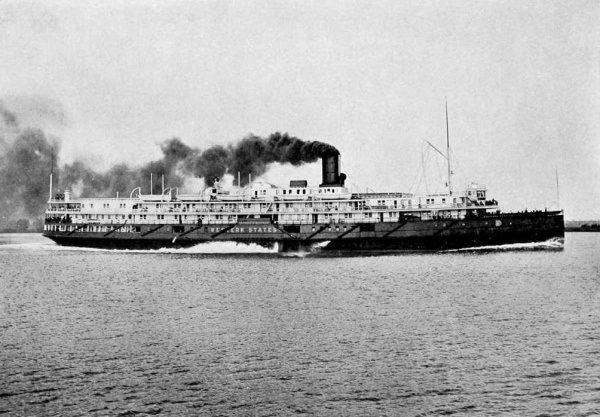
season. And these carriers? If you should stand
at the Lime Kiln Crossing, in the Detroit River, one
would pass you on an average every twelve minutes,
day and night, during the eight months of navigation;
and when you saw their number and size you would
wonder where they could possibly get all of their
cargoes. The cargoes with which we will deal in this
article will be of lumber, grain, flour and coal, for
these, with iron ore, constitute over ninety per cent.
of the commerce of the Inland Seas.
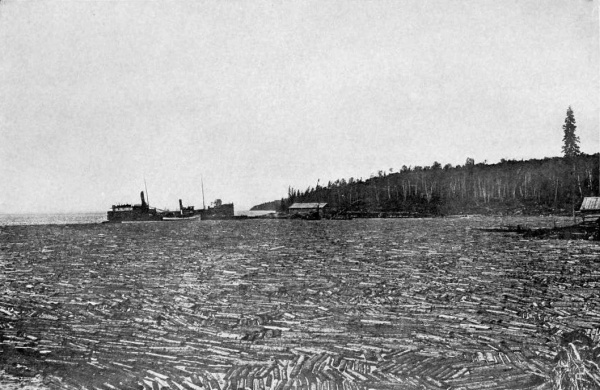
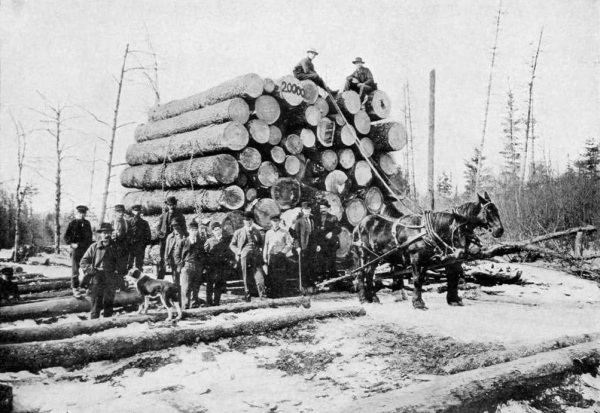
A Raft of Five Million Pulp Logs on the North Shore of Lake Michigan.
To build our city we first require lumber. During
the 1909 season of navigation about 1,500,000,000
feet of this material will be carried by Lake ships.
What this means it is hard to conceive until it is
turned into houses. To build a comfortable eight-room
dwelling, modern in every respect, requires about
20,000 feet of lumber, and when we divide a billion
and a half by this figure we have 75,000 homes, capable
of accommodating a population of about 400,000
people. With the thousands of tons of building stone
transported by lake each year, the millions of barrels
of cement, the cargoes of shingles, sand, and brick, our
“City of the Lakes” for 1909 would be as large as
Buffalo, Cleveland, or Detroit.
But one does not begin fully to comprehend the
significance of the enormous commerce of the Great
Lakes, and what it means not only to this country
but to half of the civilised world, until he begins to
figure how long the grain which will be carried by
ships during the present year would support this
imaginary city of 400,000 adult people. There will
pass through the “Soo” canals this year at least
90,000,000 bushels of wheat and 60,000,000 bushels
of other grain, besides 7,500,000 barrels of flour, all
of which represents the “bread stuff” that is shipped
from Lake Superior ports alone. There will, in addition,
be shipped by lake at least 50,000,000 bushels
from Chicago, Milwaukee, and other ports whose eastbound
commerce is not reported at the “Soo.” In
short, estimating conservatively from the past four
years, it is safe to say that at least 200,000,000 bushels
of grain and 11,000,000 barrels of flour will have been
transported by the Great Lakes marine by the end of
this year’s season of navigation.
But what do these figures mean? They seem top-heavy,
unwieldly, valuable perhaps to the scientific
economist, but of small interest to the ordinary everyday
eater of bread. Let us reduce this grain to flour.
It takes from four and a half to five bushels of grain
for a barrel of flour and dividing by the larger figure
our grain would give us 40,000,000 barrels, which,
plus the 11,000,000, would make a total of 51,000,000
barrels. Now we come right down to dinner-table
facts. At least 250 one-pound loaves of bread can be
made from each 196-pound barrel of flour, or a total
of 12,750,000,000 from the whole, which would mean
at least five loaves for every man, woman, and child
of the two and one half billion people who inhabit this
globe! In other words, figuring from the reports of
food specialists, the grain and flour carried by the
ships of the Lakes for one year would give the total
population of the earth a food supply sufficient to keep
it in life and health for a period of two weeks!
This enormous supply of the staff of life would give
each of the 400,000 bread-eating people in our “City of
the Lakes” a half-pound a day for one hundred and
seventy-five years, or it would supply a city of the
size of Chicago with bread for fifty years! To each
of the 60,000,000 bread-eaters in the United States
it would give 212 one-pound loaves, or, with an allowance
of half a pound for each person per day, it would
feed the nation for one year and two months!
Now, having built our city, peopled it, and supplied
it with food, we come to the point of heating it. In
1907, there were transported by Lake nearly 15,000,000
tons of coal, and this year another million will probably
be added to that figure. Here again mere figures fail
to tell the story. But when we come to divide this
coal among the homes of a city like Cleveland, Detroit,
or Buffalo, which rank with our 75,000-home “City
of the Lakes,” we again come to an easy understanding.
Each of these 75,000 home-owners would receive as
his share over 213 tons of coal, and if he burned six
tons each winter this would last him for thirty-five
years!
In a nutshell, there is enough lumber and other
material carried by Lake ships each year to build a
city the size of Detroit; there is enough grain transported
to supply its 400,000 inhabitants with bread-stuffs
for a period of one hundred and seventy-five
years, conceding the total population of the city to
be adults; and enough coal is shipped from Erie ports
into the North to heat the homes in this city for
thirty-five years!
When one knows these facts, when perhaps for the
first time in his life he is brought to a realisation of
the enormous proportions of the commerce of the
Inland Seas, he may, and with excellent excuse, believe
that he has reached the limit of its interest.
But as a matter of fact he has only begun to enter
upon its wonders, and the farther he goes the more
he sees that economic questions which have long been
mysteries to him are being unravelled by the Great
Lakes of the vast country in which he lives.
“Because of the ships of our Inland Seas,” James
A. Calbick, late President of the Lumber Carriers’
Association, said to me, “the people of the United
States, from the Atlantic Ocean to the Rocky Mountains,
and as far south as Kentucky and Tennessee,
have been able to build the cheapest homes in the
world—and the best,” and this assertion, which can
be proved in several different ways, brings us at once
to the lumber traffic as it exists on the Lakes to-day.
Going through almost any one of the Eastern and
Central States one will find thousands of old sheds
and barns, travelling the road to ruin through age
alone, though built of the best of pine and oak—materials
of a quality which cannot be found in the
best of modern homes in this year of 1909. For ten
years past the price of lumber has been steadily
climbing, and since 1900 the increase in the cost of
building construction has brought lumber to a par
with brick. While the commerce of the Lakes is
increasing by tremendous bounds in other ways,
people are now, perhaps unknowingly, witnessing the
rapid extinction of one of their oldest and most romantic
branches of traffic—the lumber industry; and
each year, as this industry comes nearer and nearer
to its end, the price of lumber climbs higher and
higher, home-owners become fewer in comparison
with other years, and fleets and lumber companies
go out of existence or direct their energies into other
channels.
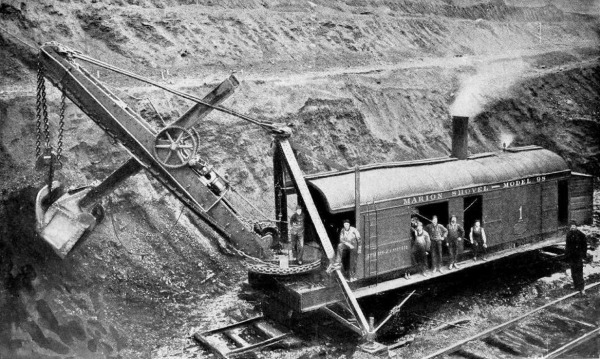
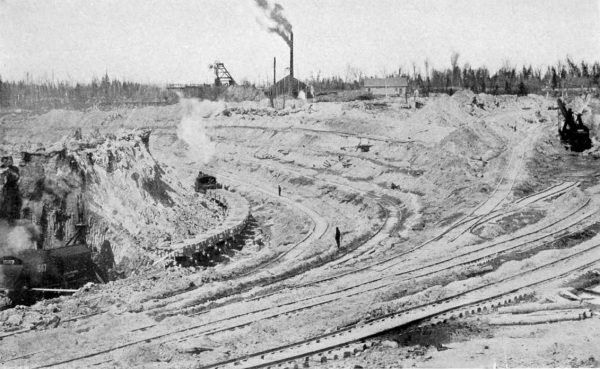
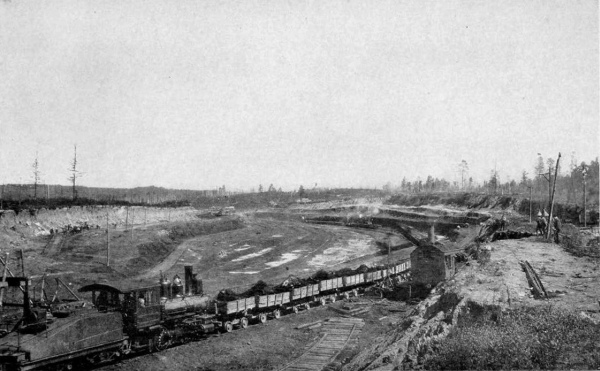
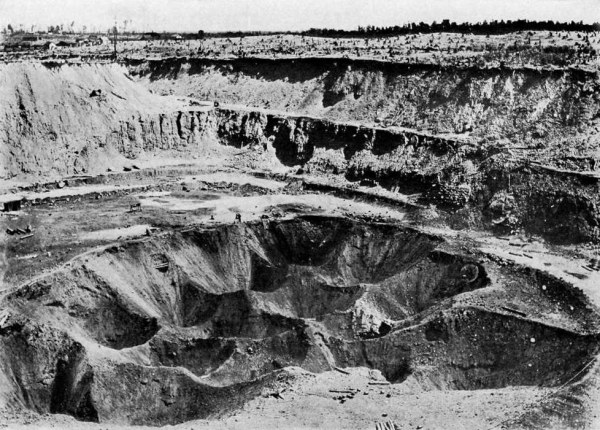
Scooping up Ore from the Mahoning Mine at Hibbing.
The largest open pit mine in the world.
To Lake people it is pathetic, this death of the
lumber fleets of the Inland Seas. An old soldier who
had sailed on a lumber hooker since the days of the
Civil War once said to me, “They’re the Grand Army
of the Lakes—are those old barges and schooners, and
they’re passing away as fast as we old fellows of the
days of ’61.” To-day no vessels are built along the
Lakes for the carrying of lumber. Scores of ancient
“hookers” and picturesque schooners of the romantic
days of old are rotting at their moorings, and when a
great steel leviathan of ten thousand tons passes one
of these veterans the eyes of her crew will follow it
until only her canvas remains above the horizon.
Yet from the enormous quantity of lumber which
will be transported by Lake during the present year,
one would not guess that the great fleet which will
carry it is fast nearing the end of its usefulness in this
way. In every lumbering camp along the Lakes, in
the great forests of Minnesota, and in the wilderness
regions of Canada, unprecedented effort has been expended
in securing “material” because of the high
prices offered, and the result has been something beyond
description. Recently I passed through the once great
lumbering regions of the Lakes to see for myself what
I had been told. Michigan is stripped; the “forest”
regions of Georgian Bay are scrub and underbrush; for
hundreds of square miles around Duluth the axe and
the saw have been ceaselessly at work, though there
is still a great deal of timber land in the northern
part of the State. In the vast lumber regions of a
decade ago, once lively and prosperous towns have
become almost depopulated. Scores of lumbering
camps are going to rot and ruin; saw-mills are abandoned
to the elements, and in places where lumbering
is still going on, timber is greedily accepted which
a few years ago would have been passed by as
practically worthless. A few years more and the
picture of ruin will be complete. Then the lumber
traffic on the Great Lakes will virtually have
ceased to be, the old ships will be gone, and past
forever will be the picturesque life of the lumberjack
and those weather-beaten old patriarchs who,
since the days of their youth, have been “goin’ up
f’r cedar ’n’ pine.”
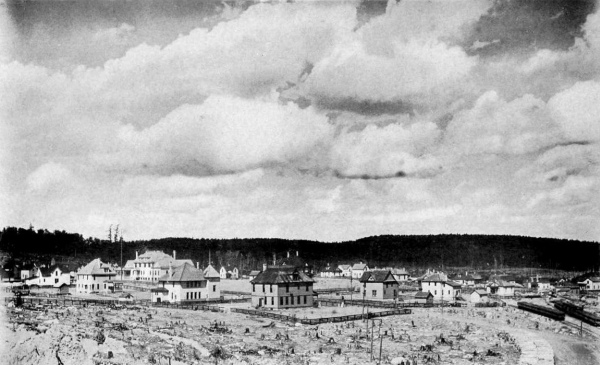
A Mining Town on the Mesaba Range, where a Few Years ago the Deer and Bear Roamed
Undisturbed.
But even in these last days of the lumber industry
on the Lakes the figures are big enough to create
astonishment and wonder, and give some idea of
what that industry has been in years past. Take
the Tonawandas, for instance—those two beautiful
little cities at the foot of Lake Erie, a few miles from
Buffalo. Lumber has made these towns, as it has
made scores of others along the Lakes. They are
the greatest “lumber towns” in the world, and estimating
from the business of former years there will
be carried to them by ship in 1909 between 300,000,000
and 400,000,000 feet of lumber. In 1890, there
entered the Tonawandas 718,000,000 feet, which
shows how the lumber traffic has fallen during the
last nineteen years. It is figured that about 10,000,000
feet of lumber, valued at $200,000, is lost each year
from aboard vessels bound for the “Twin Cities.”
In 1905, the vessels running to the Tonawandas
numbered 300; this year their number will not exceed
250—another proof of the rapidly failing lumber
supply along America’s great inland waterways.
“This talk of a lumber famine is all bosh,” I was
informed with great candour a short time ago. “Look
at the great forests of Washington and Oregon! Think
of the almost limitless supply of timber in some of the
Southern States! Why, the stripping of the Lake
States ought not to make any difference at all!”
There are probably several million people in this
country of ours who are, just at the present moment,
of the above opinion. They have never looked into
what I might call the “economy of the Lakes.” A
few words will show what part the Lakes have played
in the building of millions of American homes. At this
writing it cost $2.50 to bring a thousand feet of lumber
from Duluth to Detroit aboard a ship. It costs $5.50
to bring that same lumber by rail! Conceding that this
year’s billion and a half feet of lumber will be transported
a distance of seven hundred miles, the cost of
Lake transportation for the whole will be about $3,750,000.
The cost of transportation by rail of this same
lumber would be at least $7,500,000, or as much again!
Now what if you, my dear sir, who live in New York,
had to have the lumber for your house carried fourteen
hundred miles instead of seven, or three thousand miles,
from Washington State? To-day your lumber can
be brought a thousand miles by water for $3 per thousand
feet; by rail it would cost you $7! And this, with
competition playing a tremendous part in the game.
When lumber is gone from the Lake regions, will our
philanthropic railroads carry this material as cheaply
as now, when for eight months of the year they face
the bitter rivalry of our Great Lakes marine?
“When the time comes that there is no more lumber
along the Lakes, what will be the result?” I asked
Mr. Calbick, the late President of the Lumber Carriers’
Association. He replied:
“Lumber will advance in price as never before.
No longer will the frame cottage be the sign of the
poor man’s home; no longer will the brick mansion be
the manifestation of wealth. It will then cost much
more to build a dwelling of wood than of brick or
stone. The frame house will in time become the sign
of aristocracy and means. It will pass beyond the
poor man’s pocket-book, and while this poor man may
live in a house of brick it will not be his fortune to live
in a house of wood. That is what will happen when
the lumber industry ceases along the Great Lakes.”
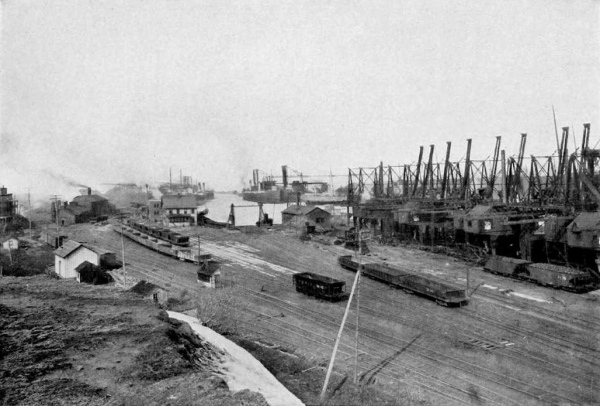
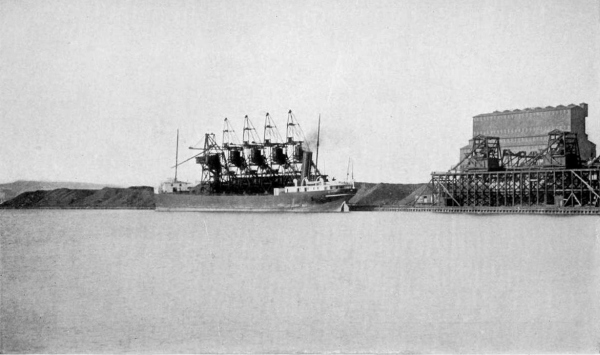
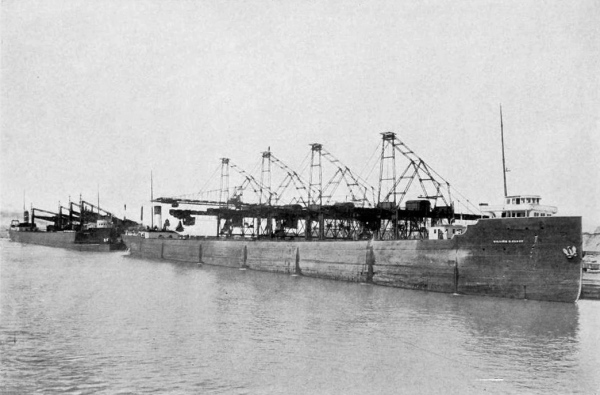
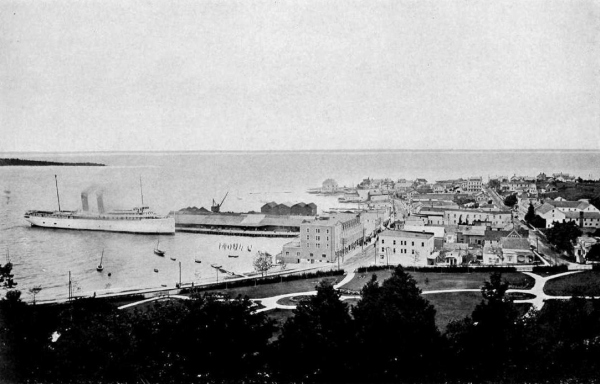
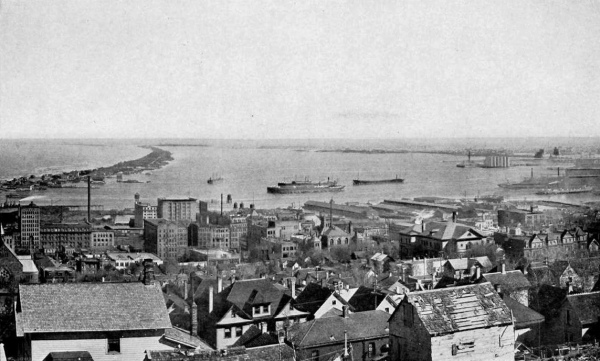
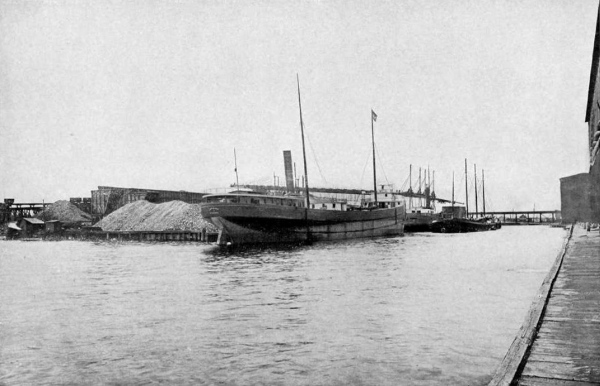
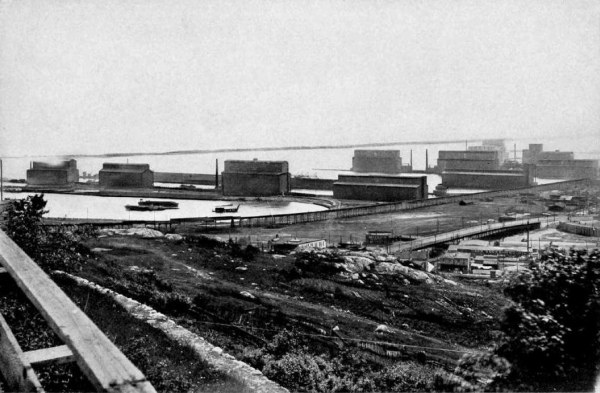
Harbour View at Conneaut, Ohio, Showing Docks and Machinery.
Then this great lumberman went on to say:
“People are beginning to see, and each year they
will see more plainly, how absolutely idiotic our State
and National governments have been in not compelling
forest preservation. For all the centuries to come
Michigan, Wisconsin, and Minnesota should be made
to supply the nation with timber. In these three
Lake States there are millions of acres of ideal forest
land which is good for nothing else. Yet for at least
half a century must these millions of acres now remain
worthless. Nothing has been left upon them. They
are “barrens” in the true sense of the word, and
before forests are regrown upon them fifty or a
hundred years hence, the greatest timber famine
the world has ever seen will have been upon us for
generations.”
Hardly could the significance of the passing of the
lumber industry along our Inland Seas be appreciated
without taking a brief glance into the past, to see
what it has already done for the nation. There is
now practically no white pine left in the State of
Michigan—once the home of the greatest pine regions
in the whole world. Michigan’s tribute to the nation
has been enormous. For twenty years she was the
leading lumber-producing State of the Union. As
nearly as can be estimated, her forests have yielded
160,000,000,000 feet of pine, more than one hundred
times the total amount of lumber that will be transported
on the Lakes this year. These are figures
which pass comprehension until they are translated
into more familiar terms. This enormous production
would build a board walk five feet wide, two inches
thick, and three million miles long—a walk that would
reach one hundred and twenty times around the earth
at the equator; or it would make a plank way one
mile wide and two inches thick that would stretch
across the continent from New York to San Francisco!
In other words, Michigan’s total contribution of pine
would build ten million six-room dwellings capable
of housing over half the present population of the
United States.
As a consequence of this absolute spoliation of the
forest lands, a large part of Michigan is now practically
worthless. First, the lands were bought by lumbering
companies; the timber was stripped—then came the
tax-collector! But why pay taxes on worthless barrens,
with only stumps and brush and desert sand to
claim? So people forgot they owned them, and as a
result one seventh of the State of Michigan is to-day
on the delinquent tax list.
Minnesota is going the way of Michigan. In 1906,
there was cut in the Duluth district a total of 828,000,000
feet of white pine; but each year this production
will become smaller, until in the not distant future
there will be nothing for the lumber ships of the Lakes
to carry. What this will mean to the home-builders
of the nation can be shown in a few words. Previous
to 1860, the Chicago man could buy 1000 feet of the
best white pine for $14. To-day it costs him $80!
What will it cost ten years hence?
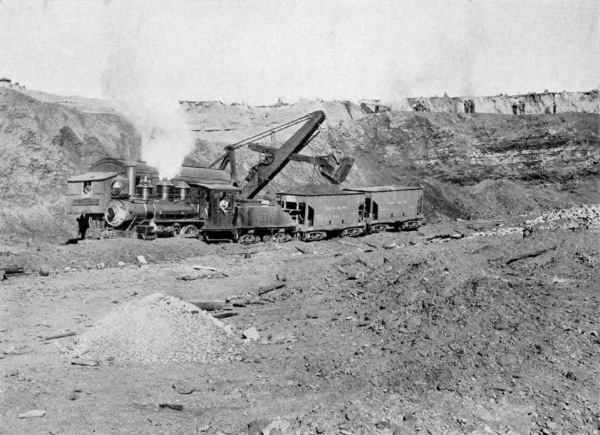
A Steam Shovel at Work.
This removes from 4000 to 8000 tons of ore a day.
Already the centre of lumber production has swung
from the North to the South. The yellow pine of
Louisiana is now taking the place once filled by white
pine, and at the rate it is being cut another decade
will see that State stripped as clean as Michigan now
is, and then the country’s last resort will be to turn
to the Pacific coast with its forests of Douglas fir.
And still, as though blindfolded to all sense and reason,
almost every State government continues to look
upon the fatal destruction without a thought for the
future, though before us are facts which show that
Americans are using nearly eight times as much lumber
per capita as is used in Europe, and that the nation
is consuming four times as much wood annually as
is produced by growth in our forests.
Ten years more and the last of the romantic old
lumber ships of the Inland Seas will have passed
away; gone forever will be the picturesque life of those
who have clung thus long to the fate of canvas and
the four winds of heaven; and with it, too, will pass
the remaining few of those old lumber kings who
have taken from Michigan forests alone fifty per cent.
more wealth than has been produced by all the gold
mines of California since their discovery in 1849.
But in the place of this passing industry is rapidly
growing another, the effect of which is already being
felt over half of the civilised world, and which in a
very few years from now will be counted the greatest
and most important commerce in existence. The
iron mines of the North may become exhausted, the
little remaining forest of the Lake regions will fade
away; but the grain trade will go on forever. Just
as the Superior mines have produced cheap iron and
steel, just as the Inland Seas have been the means
of giving the nation cheap lumber, so will they for all
time to come supply unnumbered millions with cheap
bread. Like great links, they connect the vast grain-producing
West with the millions of the bread-consuming
East. And not only do they control the grain
traffic of the United States. To-day western Canada
is spoken of as the future “Bread Basket of the World,”
and over the Lakes will travel the bulk of its grain.
Looking ahead for a dozen centuries, one cannot see
where there can be a monopoly of grain transportation,
either by railroad or ship. The water highways are
every man’s property; a few thousand dollars—a ship—and
you are your own master, to go where you please,
carry what you please, and at any price you please.
For all time, in the carrying of grain from field to
mouth, the Great Lakes will prove themselves the
poor man’s friend. To bring this poor man’s bushel
of wheat over the one thousand miles from Duluth to
Buffalo by Lake now costs only two cents.
And according to the predictions of some of the
oldest ship-owners of the Lakes, the tremendous saving
to the poor man because of the cheapness of Lake
freightage is bound to increase in the not distant future.
It must be remembered that at the present time ships
are not built too fast for Lake demand, and as a consequence
transportation rates, while exceedingly low
when compared with rail rates, are such as to make
fortunes each year for the owners of ships. Take the
cargo of the B. F. Jones, for instance, delivered at
Buffalo in October of 1906. She had on board 370,273
bushels of wheat which she had brought from Duluth
at two and three fourths cents a bushel, making her
four-day trip down pay to the tune of $7500! The
preceding year one cargo of 300,000 bushels was
brought down for six cents a bushel, a very extraordinary
exception to the regular cheap rate—one
of the exceptions which come during the last week or
two of navigation. The freight paid on this cargo
was $18,000. In other words, if this vessel had made
but this one trip during the season the profit on the
total investment of $300,000 represented by the ship
would have been six per cent. There are on the Lakes
vessels which pay from twenty to thirty per cent. a
year, and an “ordinary earner” is supposed to run
from ten to twenty.
In viewing these enormous profits, however, the
layman has no cause for complaint, for the vessels
that make them do so not to his cost, but from the
rapidity with which they achieve their work. The
W. B. Kerr is a vessel that can carry 400,000 bushels
of wheat. Figure that she makes twenty trips a season.
If she carried grain continually she would transport
a total of 8,000,000 bushels in a single season,
which would supply Chicago with bread for nearly a
year and a half. And it is an interesting fact, too,
that with few exceptions the ships of the Lakes are
not owned by corporations, but by the American
people. Their stock is held, not by thousands, but
by hundreds of thousands. Recognised as among the
best and safest investments in the United States, they
are the property of farmers, mechanics, clerks, and
other small investors, as well as of capitalists. Recently
one of the largest shipbuilders on the Lakes
said to me, “A third of the farmers in the Lake counties
of Ohio have money invested in shipping.” Which
shows that not only in the way of cheap transportation
are the common people of the country profiting
because of the existence of our Inland Seas. It may
be interesting to note at this point that the tonnage
shipped and received at Ohio ports in 1907 exceeded
that of all the ports of France.
The rate at which the grain traffic of the Lakes
is increasing is easily seen in the figures of the last
few years. In 1905, over 68,000,000 bushels of
wheat passed through the “Soo” canals. In 1906,
this increased to more than 84,000,000, showing a
growth in one year of 16,000,000 bushels, or 23 per
cent. This rate of increase is not only being maintained,
but it is becoming larger; and the grain men
of the Lakes are unanimous in the opinion that even
from the big increase of recent years cannot be figured
the future grain business of the Inland Seas.
“Ten years more will see the American and Canadian
Wests feeding the world,” a grain dealer tells me.
“Within that time I look to see the wheat production
of North America not only doubled, but trebled.”
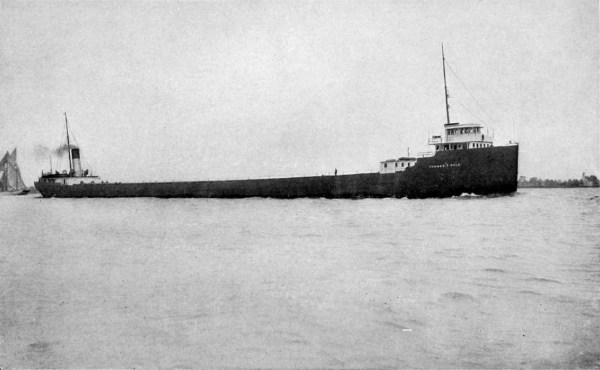
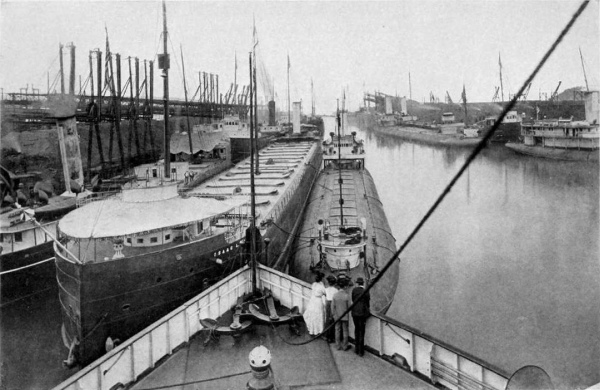
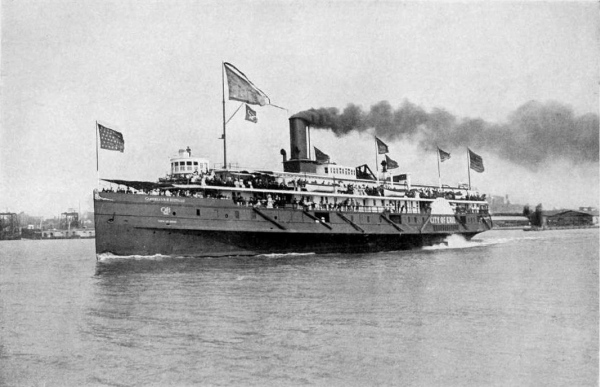
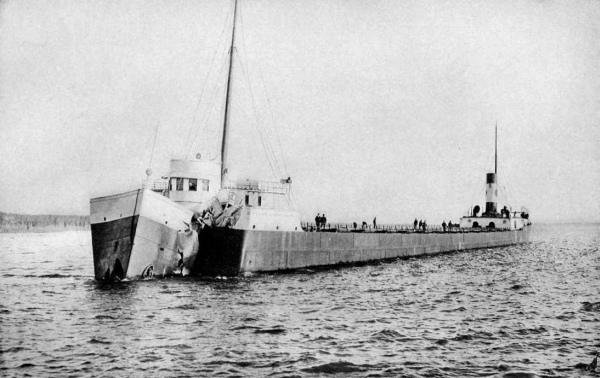
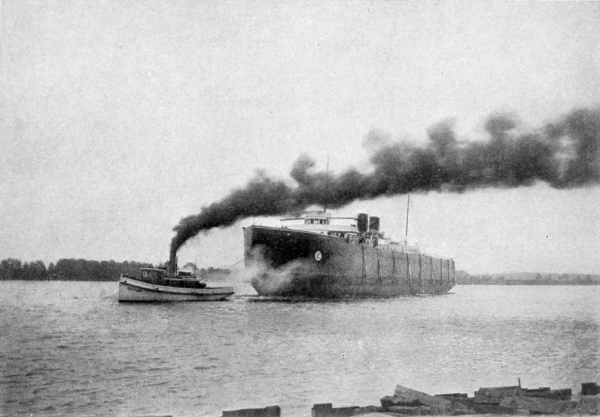
The Old and the New.
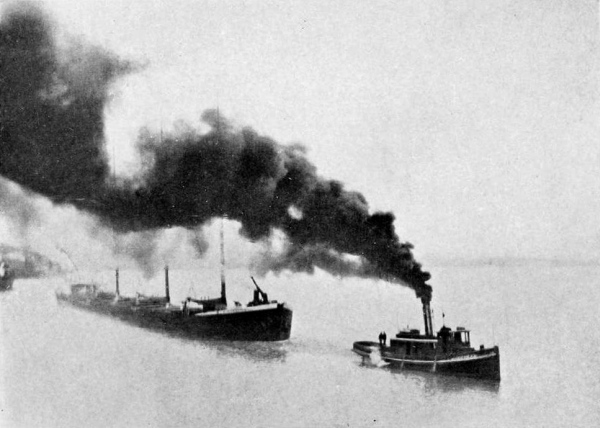
A modern freight carrier passing one of the old schooners.
What western Canada is destined to mean to Lake
commerce is already shown in marine figures. From
Port Arthur and Fort William, the “twin cities” of
Thunder Bay, were shipped in 1907 over 60,000,000
bushels of grain, and it is safe to predict that the shipment
of these two little cities will this year exceed
70,000,000 bushels. The largest elevator in the world,
with a capacity of 7,500,000 bushels, has been constructed
at Port Arthur; and Fort William already
has a capacity of 13,000,000 bushels.
And as yet the fertile regions of western Canada
have hardly been touched! These 70,000,000 bushels
of 1909 will represent part of the production, not of
a nation, but of a comparatively few pioneers in what
is destined to become the greatest grain-growing
country in the world—a country connected with the
East and the waterways to Europe by the Five Great
Lakes. When the task now under way of widening
and deepening the Erie Canal is accomplished, the
enormous Lake traffic in grain may continue without
interruption to the Atlantic coast. Even as it is, the
transportation of grain from Buffalo to New York by
canal is showing a phenomenal increase. The value
of the freight cleared by canal from Buffalo in 1907
was nearly $19,000,000, while in 1905 it was less than
$12,000,000.
Like the building of ships the building of elevators
is now one of the chief occupations along the Lakes.
The “grain age,” as vessel-men are already beginning
to call it, has begun. In the four chief grain ports of
the Lakes, Chicago, Duluth-Superior, Buffalo, and
Port Arthur-Fort William, there are now 145 elevators
with a capacity of 138,000,000 bushels. Chicago
leads, with 83 elevators and a capacity of 63,000,000,
although Duluth-Superior with their 27 elevators and
35,000,000-bushel capacity shipped half again as much
grain to Buffalo in 1907 as did Chicago. Buffalo is the
great “receiving port” of the lower Lakes. There vast
quantities of grain are made into flour, and the rest
is transhipped eastward. At present the city possesses
28 elevators with a capacity of 23,000,000 bushels.
There is another potent reason why the passing of
the lumber traffic and the future exhaustion of the
iron mines do not trouble ship builders and owners.
It has been asserted that when lumber and iron are
gone there will no longer be business for all of the
ships of the Lakes. How wrong this idea is has been
shown by the growth of the grain trade. But grain
will be only one item in the enormous commerce of
the future. Each year the coal transportation business
is growing, and the constantly increasing saving
to coal consumers because of this commerce is astonishing.
At one end of the Lakes are the vast coal deposits
of the East; at the other is Duluth, the natural
distributing point for a multitude of inland coal markets.
Of the 16,000,000 tons of coal to be shipped by
water this year probably 8,000,000 will go to Duluth,
and will be carried a distance of one thousand miles
for thirty-five cents a ton, just about what one would
pay to have it shovelled from a waggon into his basement
window! The remaining 8,000,000 tons will be
unloaded at Chicago, Milwaukee, etc.
One of the most interesting sights to be witnessed
along the Lakes is the loading and unloading of a
big cargo of coal. The W. B. Kerr holds the record
at this writing. She loaded 12,558 tons at Lorain for
Duluth, and took on 400 tons of fuel in addition. Inconceivable
as it may seem, such a cargo under good
conditions can be loaded on a ship in from ten to
fifteen hours. The vessel runs alongside the coal
dock, her crew lifts anywhere from a dozen to twenty
hatches, and the work begins. In the yards are hundreds
of loaded cars. An engine quickly pushes one
of these up an inclined track to a huge “lift,” or elevator,
to the tracks of which the wheels of the car are
automatically clamped. Then the car, with its forty
or fifty tons of coal, scoots skyward, and when forty
feet above the deck of the ship great steel arms reach
out and turn it upside down. With a thunderous
roar the coal rushes into a great chute, one end of
which empties into a hatch. Then the car tips back,
is quickly carried down by the elevator, and is “bumped
off” by another loaded car, which goes through the
same operation. Four or five days later, at the other
end of the Lakes, powerful arms, high in the air, reach
out over the open hatches of the same vessel. Out
upon one of these arms suddenly darts a huge “clamshell”
bucket; for a moment it poises above a hatch,
then suddenly tumbles downward, its huge mouth
agape, and half buries itself in the cargo of coal. As
it is pulled up, the “jaws” of the clam are closed, and
with it ascend several tons of fuel. Three or four
of these clam-shells may be at work on a vessel
at the same time, and can unload 10,000 tons in
about two days. In the days of old, it would have
taken three weeks and scores of men to unload such
a cargo.
“And in looking into the future we must take another
item into consideration,” said President Livingstone
to me. “And that is package freight. It is almost
impossible to estimate the amount that is carried, but
it is enormous, and has already saved the country millions
in transportation.”
There is one other “item” that is carried in the
ships of the Inland Seas—not a very large one, judging
by bulk alone, but one which shows that the possibilities
of romance are not yet gone from modern commerce.
Perhaps, sometime in the not distant future, you may
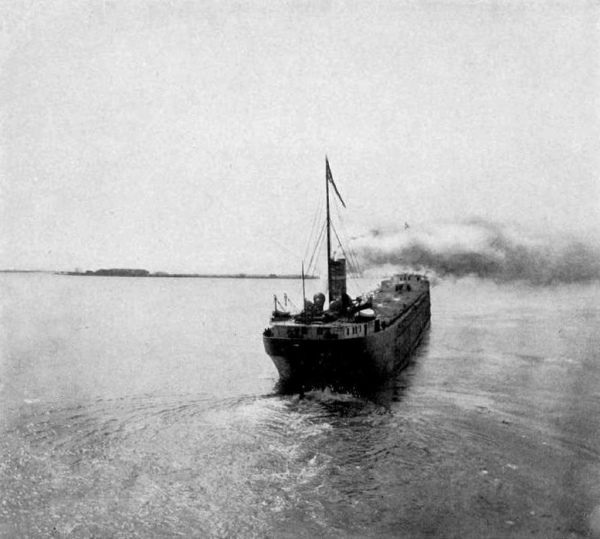
have the fortune to see a Lake ship under way. She
is long, and black, and ugly, you may say; she carries
neither guns nor fighting men, nor is she under convoy
of a man-o’-war. Yet it may be she carries a richer
prize than any galleon that ever sailed the Spanish
Main. She is a “treasure ship” of the Inland Seas,
bringing down copper from the great Bonanzas of
the North. The steamer Flagg holds the record, carrying
down as she did in 1906 $1,250,000 worth of
metal.
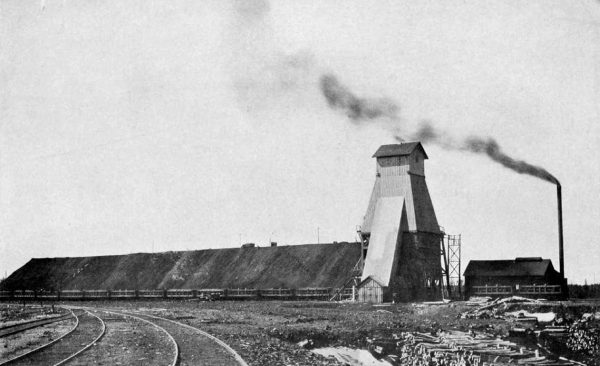
A Shaft on One of the Ranges.
Once a copper ship was lost——
But I will keep that story a little longer, for it
properly belongs in “The Romance and Tragedy of
the Inland Seas,” in which I pledge myself to show
that the great salt oceans are not the only treeless
and sandless wastes rich in mysterious, romantic, and
tragic happenings.