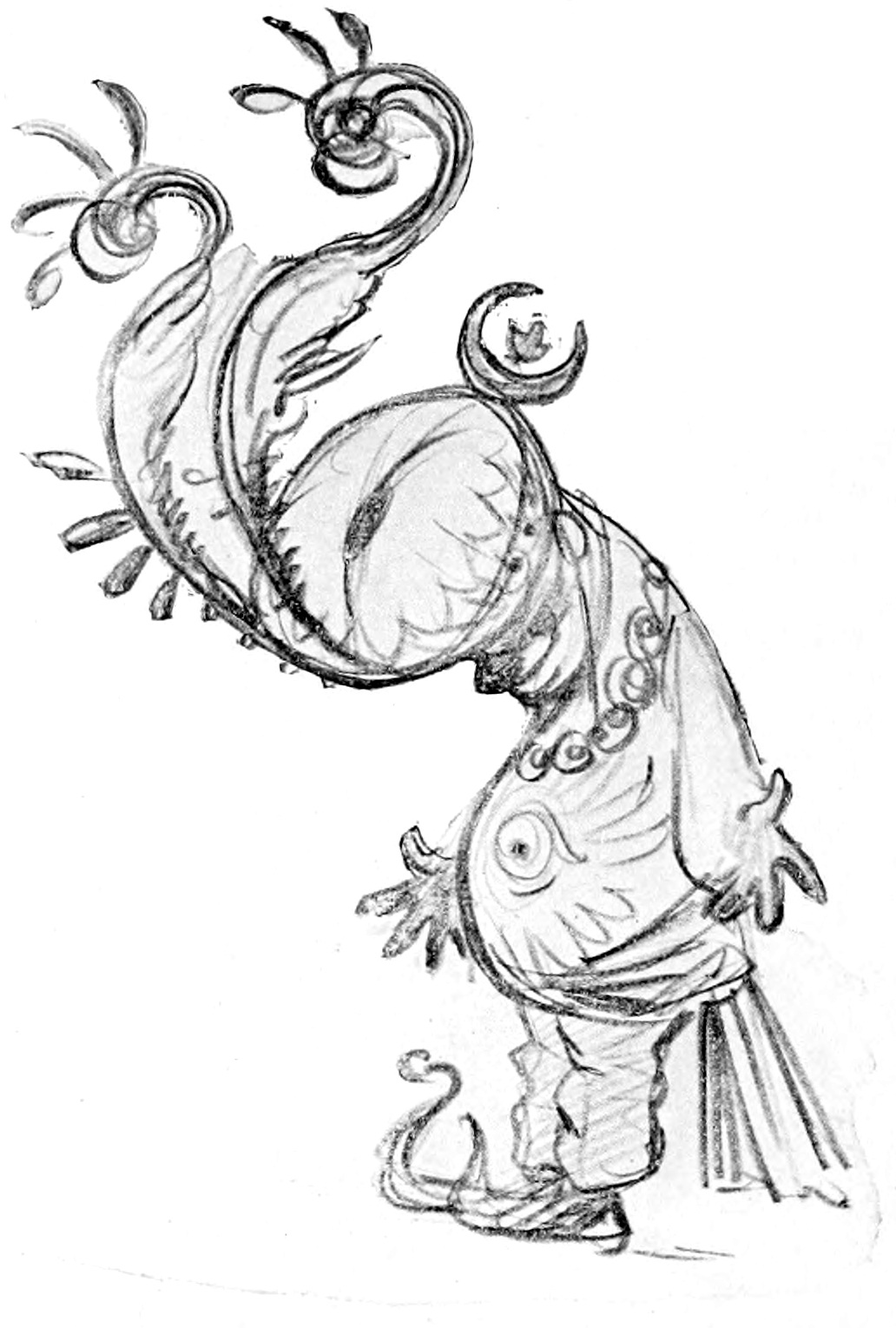
With the good taste that characterises our political life (how different from
the howling bear-gardens of the Continent!), these minutes were officially communicated,
as they appeared, to the Speaker, from whose pages they are now
collected in this the
ONLY, FINAL, AND AUTHORISED EDITION.
Letter from Mr. Chamberlain.
Blenheim Palace,
Woodstock, Feast of the Assumption, 1903.
Sir,
I am instructed by the Secretary of State for
the Colonies to acknowledge the receipt of your letter and of
the enclosed report. He desires me particularly to thank you
for Mr. Vince’s pamphlet. He has not yet heard of Mr. Vince,
but is bound to express his admiration for his lucid and patriotic
argument.
Pray note that the Secretary of State for the Colonies
will reply (through me) to all further communications as to
“A Working-man correspondent:” a long political career has
convinced him, etc.
Believe me, Your obedient and humble Servant, BALLYCANNON.
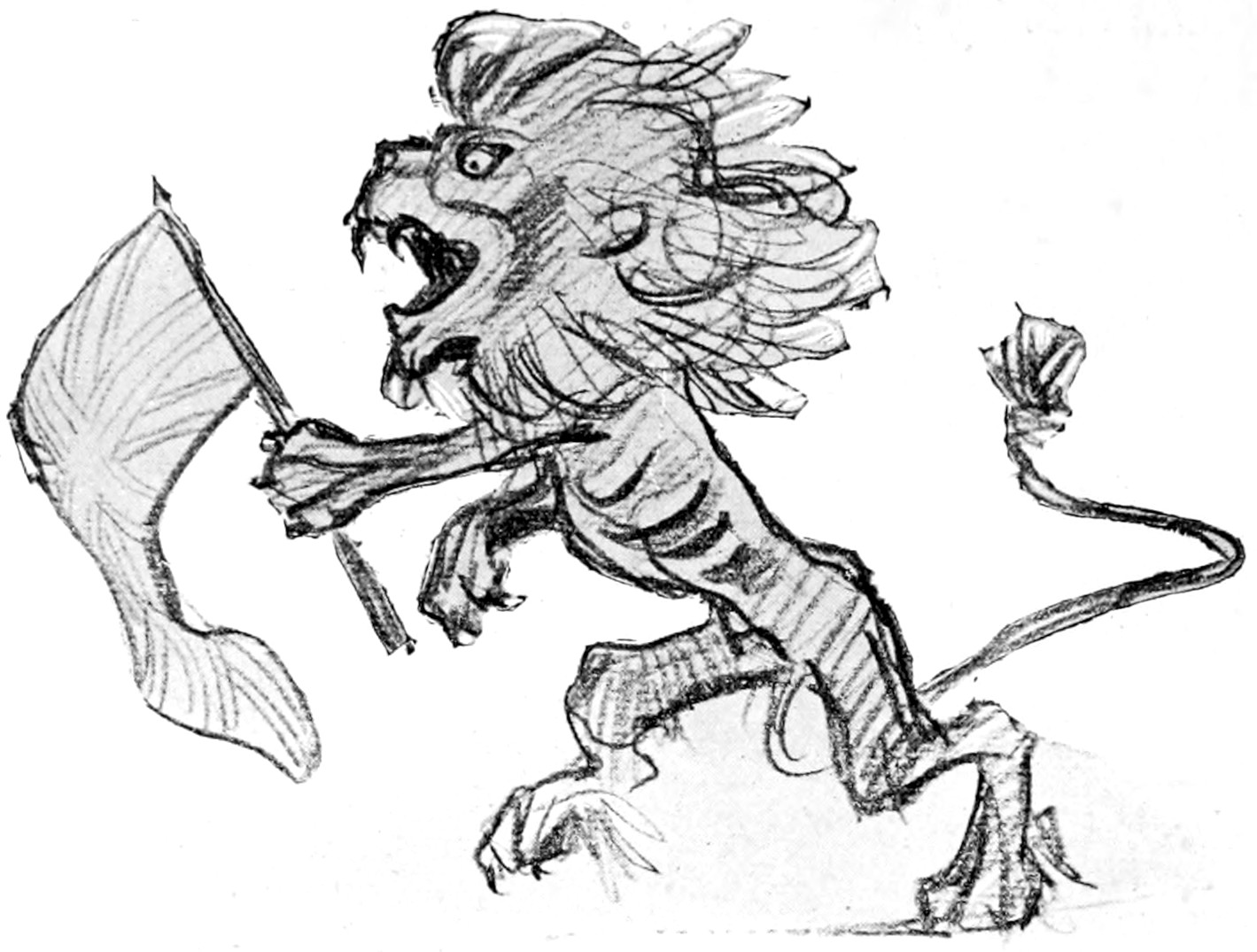
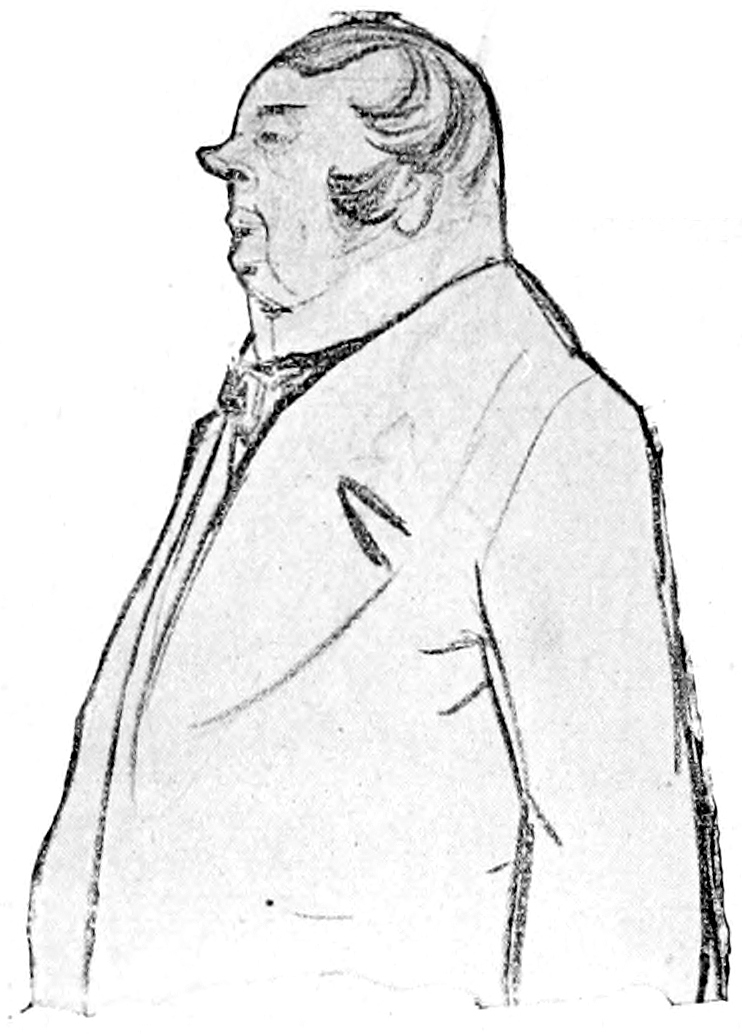
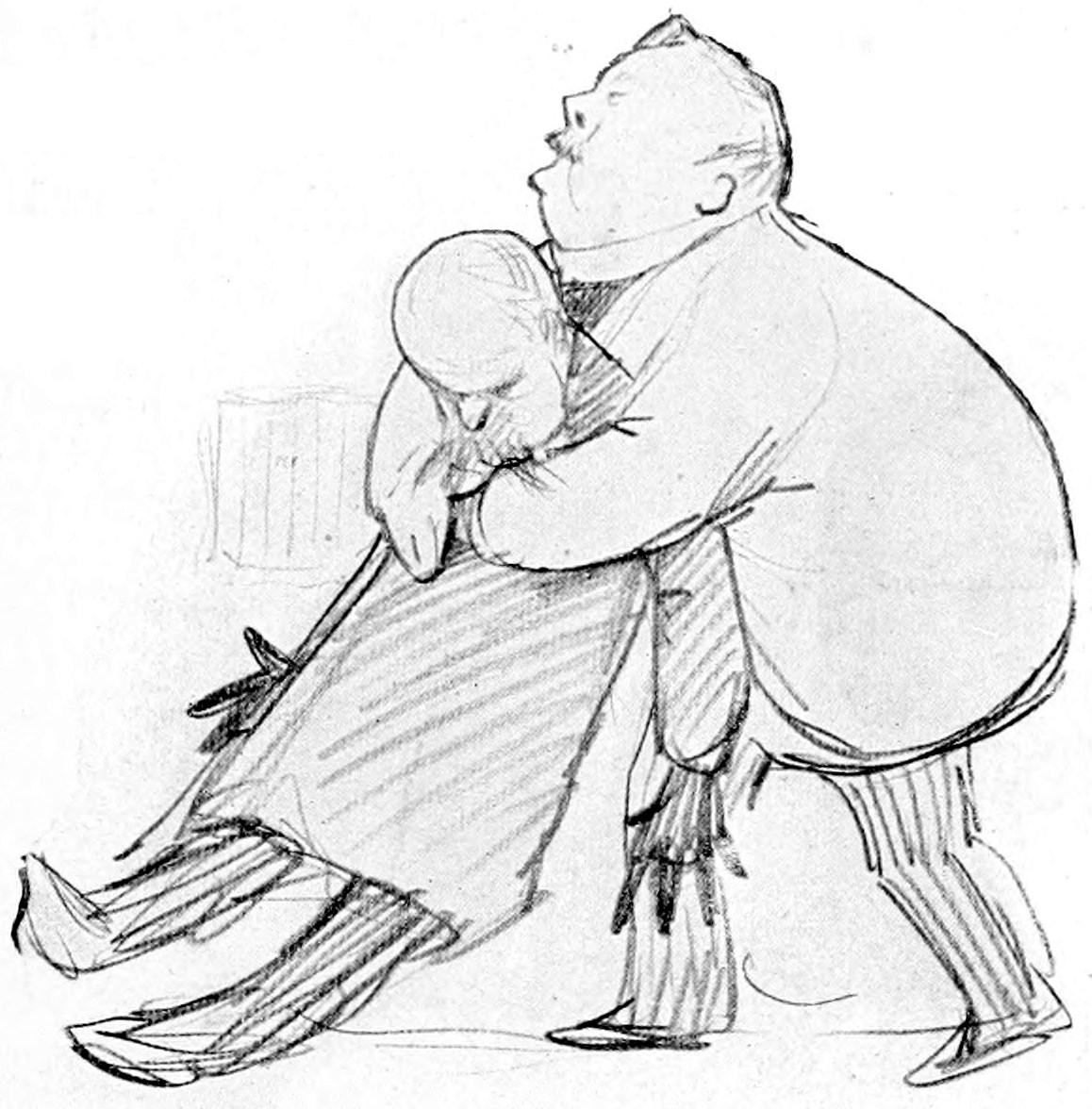
BRITONS!
LOOK ON THIS PICTURE
“I AM LEAN AND LIVELY.”
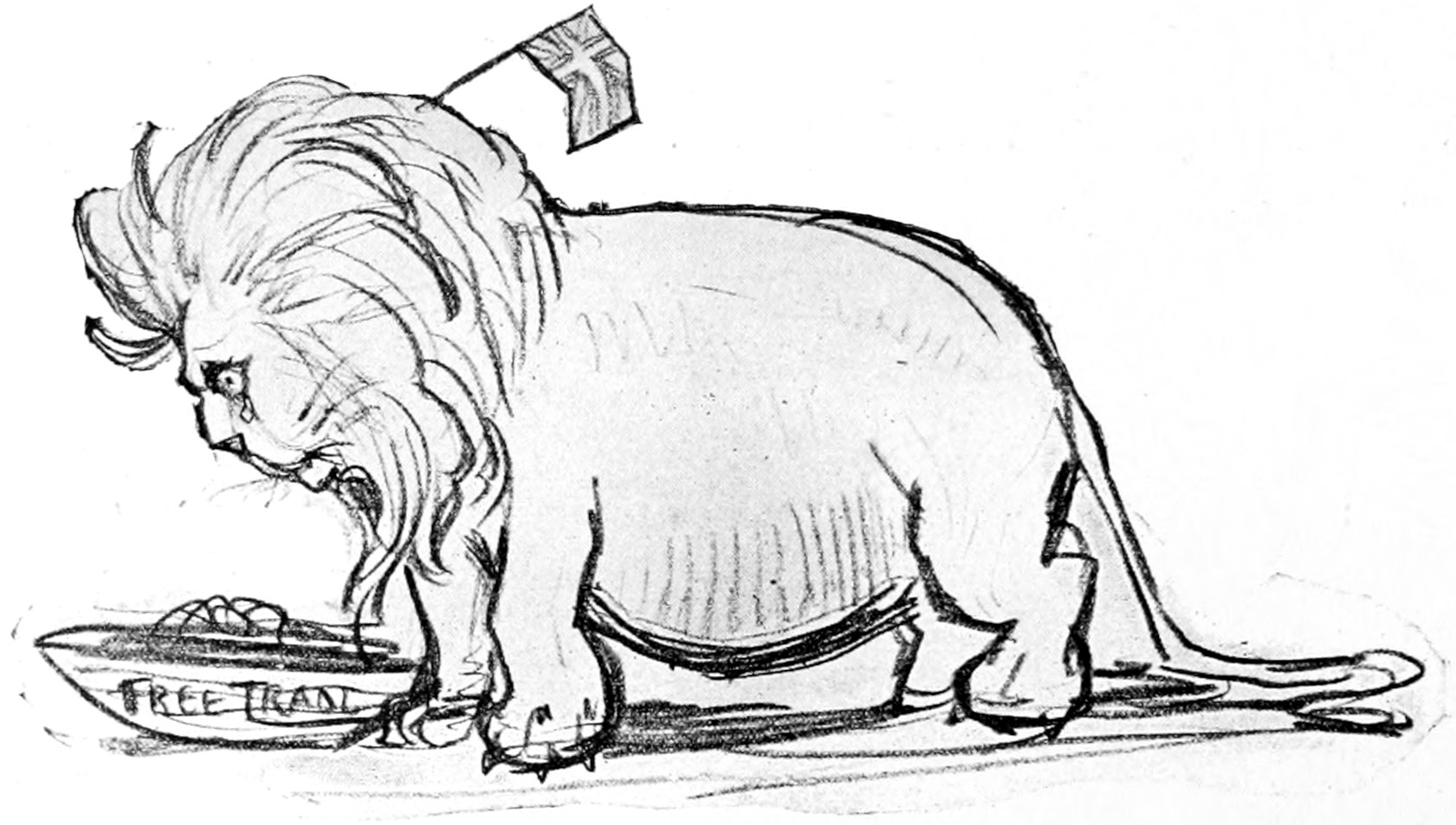
AND ON THIS.
“I AM TOO FAT.”
THE GREAT
INQUIRY
(ONLY AUTHORISED VERSION)
FAITHFULLY REPORTED
By H. B.
REPORTER TO THE COMMITTEE,
AND
ORNAMENTED WITH SHARP CUTS
DRAWN ON THE SPOT
By G. K. C.
DUCKWORTH & CO.,
3 HENRIETTA STREET, COVENT GARDEN, W.C.
OFFICIAL RECORD OF THE PROCEEDINGS OF THE GREAT INQUIRY,
With its Conclusions, Majority and Minority
Report, etc.
Printed by Order of the Committee.
Your Inquiring Body, or Commission of Inquest, has been formed of
a section of the Cabinet, with power to add to their number.
Of this power they have availed themselves sparingly and
judiciously, as the following list will show:
The Lord Privy Seal. Mr. Joseph Chamberlain, M.P. The Prime Minister. His Grace the Duke of Marlborough. His Excellency the Marquess of Lansdowne. Mr. Austen Chamberlain. Mr. Gerald Balfour. The Colonial Secretary. The Under Secretary for the Colonies. His Majesty’s Secretary for Foreign Affairs. The Postmaster-General. and Mr. Balfour himself.
These gentlemen, your Committee, having been sworn, in the
Scotch manner, “that they would well and truly bolt out the truth, the
whole truth, and nothing but the truth, such as would profit and serve
this Our realm of England, the Channel Islands, and all Our dominions
beyond the seas, so help them God,” the proceedings opened by a
prayer that the wisdom of this world might be turned into foolishness,
and that the false pride of Reason might be humbled, and the insolence
of philosophers confounded.
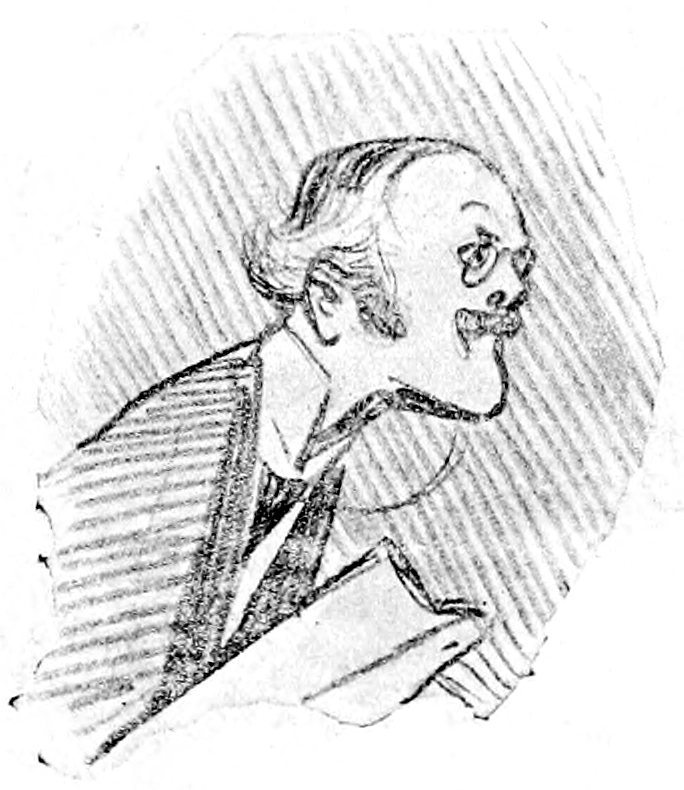
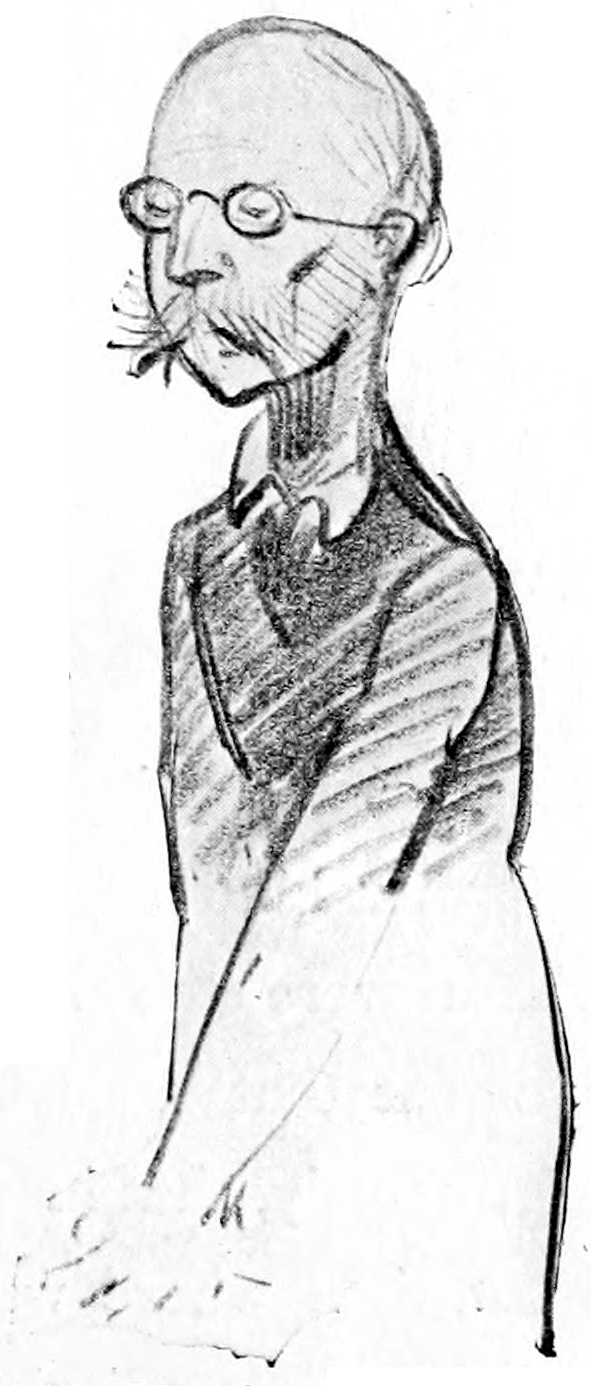
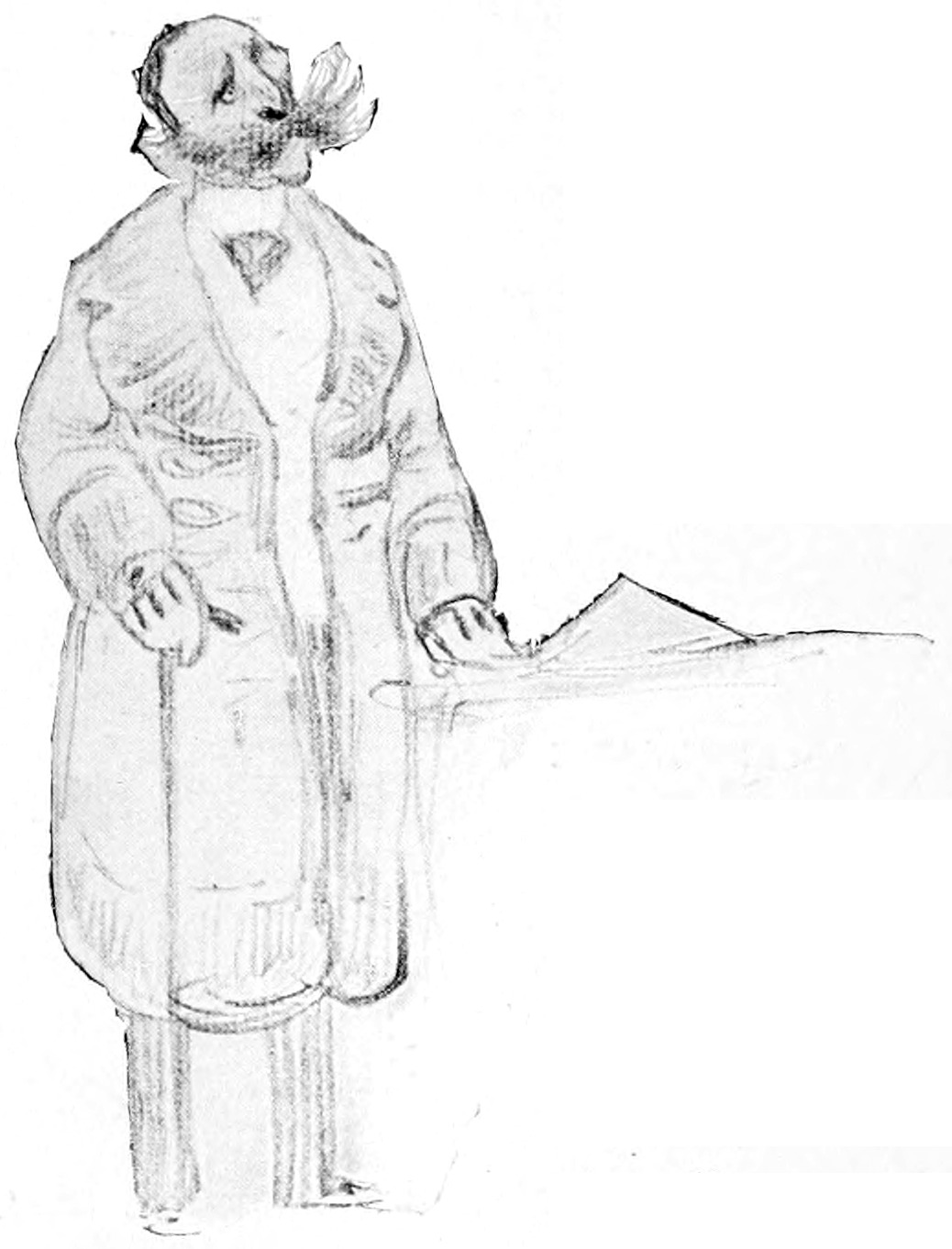
Upon which was called Mr. Baines, of Middlesbrough, a gentlemanly-looking
person, who deposed that:
The country was upon the verge of ruin. In the iron trade,
competition with America, and latterly with Belgium and Germany,
had been felt very severely. Mrs. Baines and self had passed
through many anxious moments since 1892. The extravagance of
their eldest son William at the University, which, under normal
circumstances, would have caused them no uneasiness, had driven
them almost distracted and had led to a most regrettable coolness
between parent and child. For the last eight years he had found it
impossible to spend more than one month, or at the most six weeks,
in London during the season, and that in a hired
house. In the worst year, 1897, Mrs. Baines had
been compelled to take lodgings. It was only by
an unstinted and harassing attention to detail that
the business had been kept going. His hair,
which twenty years ago had been of a
rich nut-brown colour, was now
quite grey, and growing very thin
and patchy.
“A gentlemanly-looking person.”
Mr. Gerald Balfour, who
had followed the business side
of the argument very closely, here
asked what remedy Mr. Baines proposed for
this state of things?
Mr. Baines replied that there seemed to be but two courses to
follow. The best way would be for the Government to pay him
quarterly not less than 25s. for every ton of pig-iron he might manufacture.
If, for party reasons, it was impossible to grant him such a
sum, the second course would be to impose a duty on all other iron
which would raise his, Mr. Baines’, iron by a similar amount.
Asked by Mr. Chamberlain whether it was his opinion that the
wages of his hands would rise under such a system, Mr. Baines
looked a trifle puzzled, and confessed that he did not understand the
drift of the question.
Mr. Chamberlain (smiling pleasantly): “I will put my question
in another form. Would you offer your employés
a portion of the profit so acquired?”
Mr. Baines (bewildered): “Why
should I?”
The Postmaster-General: “Let me
tackle him, father....” (To Mr. Baines): “I
take it all your men have a vote?”
Mr. Baines: “Yes, all except Ben Gailey,
who did time for ghurling.”
“What is ghurling?”
Mr. Balfour (with great interest): “What is ghurling?”
The Postmaster-General (hurriedly): “That’s all right. Well,
now, the question is this: if we give you £1 down for every ton of pig
iron you shove on the market, and we make it a condition that you
pay at least 5s. of it in extra wages, will you clinch?”
Mr. Baines: “Like a nut!”
The witness, who was complimented by Lord Lansdowne on the
manly and straightforward way in which he had given his evidence,
then stood down.
Mr. Harry Gibbs, farmer of Goudhurst, questioned upon Hops,
said that W’ops were in a turrible bad way, and all.
He knew his own mind. He was a practical
man. He said: “Let the Government prohibit
all foreign W’ops, Sussex
and all, and let brewers have a
law, and let ’un buy Kentish W’ops.
There was old Sir Charles Gorle,
there was, member of Parliament
and all, and he knew for
certain as that old man in his brewery
never bought none but Sussex, and he’d have
a law....”
Mr. Chamberlain (sternly): “Stand down.”
Witness (loudly): “Ar! I’m a plain man and not to be druv,
and I tell you....”
Lord Lansdowne: “Stand down, sir!”
Witness (more loudly): “I tell you if you let these dang Sussex
W’ops....”
The whole Committee here rose and in chorus ordered the witness
to stand down.
Witness: “You hear me! These Sussex W’ops, they have the
vly; they aren’t....”
The police here removed the witness, who struggled violently,
shaking his fist over his shoulder, and shouting:
“Ar, it’s stan’ down naow!... You wait till t’election....
Ar. You see which way I voät then.... Ar!”
Similar cries were heard in the passage without, until his voice
was lost in the distance, or was perhaps gagged by the police.
This unpleasant scene was succeeded by the testimony of a very
different witness, Lord Renton, who was of opinion that the good
money should be kept in the country.... He, for his part, could
see no kind of reason why we should buy from abroad what we could
very well make for ourselves.... He was interested in butter....
He believed that the preservation of eggs was only a matter of time.
At this moment, Mr. Balfour observing that the Committee had
sat for full twenty minutes, the inquiry was adjourned. Mr. Chamberlain
went out with Lord Renton, and partook of his motor-car, as he
was stopping with His Lordship from Saturday to Monday.
THE DRAIN OF GOLD.
At the second weekly meeting of the Cabinet Committee of Inquiry
into our Fiscal System, Lord Halsbury joined the Committee.
Mr. Manning, of East Ham, whose striking pamphlets,
What We Really Eat and Not by Bread
Alone, have brought him well-deserved fame, was
asked to join, but declined on the ground of party
loyalty.
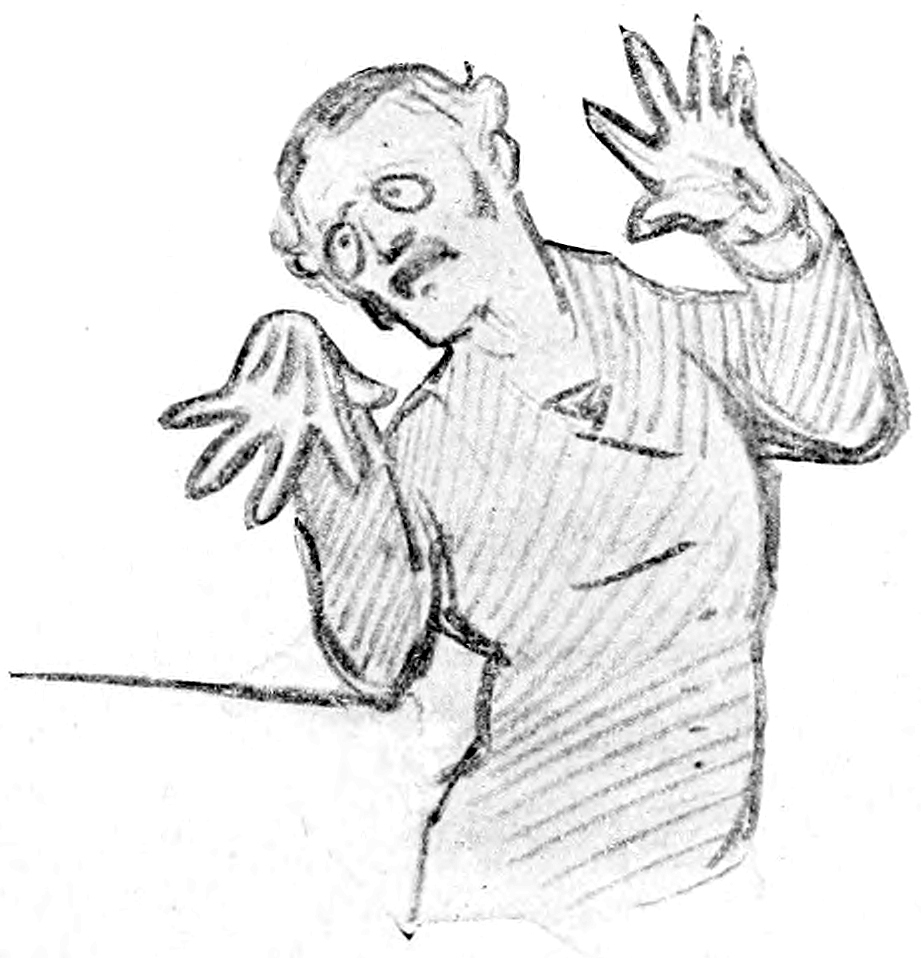
“Mr. Manning, of East Ham.”
The Duke of Sutherland, who had also been
invited to sit, had instructed his private secretary to
write to the same effect, expressing an ardent
sympathy with the objects of the Committee, but
recalling the great part he had played in Liberal
politics for many years, and pointing out that he
could better serve the cause by remaining attached
to a party which he hoped to leaven by
his example and oratory.
Mr. Benjamin Kidd, the first witness, deposed on oath that he
was a philosopher. He begged leave to give his testimony in metaphysical
language, as he could speak no other. After some consultation
leave was granted, and the sworn interpreter at Scotland
Yard was summoned by telephone.
“The Official Interpreter.”
Thus relieved, the witness swore that the synthesis
of an agglomeration, real or imaginary—in
plain words, of all thinkable congeries—was
informed by an appreciation of its organic
or inorganic character. He was
far from saying that the organic and inorganic
were separated by any hard and fast
line, but he did maintain⸺
Mr. Chamberlain: I think that
point is clear.
Mr. Benjamin Kidd, continuing, deposed that a political entity
was emphatically of the former kind as to its consciousness. And
without consciousness where were they? He then maintained it
demonstrable beyond argument that all truisms, including altruism,
lead to one central principle, namely, that in all inequalities differences
appeared, for if they did not, then where were they? Applying this
primordial and cosmic truth to the particular region of international
exchange, he could but conclude that all material increment of res
mercatoriæ must and did connote diminution of eorundem facilitas and
vice versâ.
The witness here sat down, and the interpreter, who had been
taking notes, declared in a loud voice that Mr. Kidd’s speech meant,
in English, that the excess of imports was paid for in gold. (Murmurs
of applause.)
The Lord Chancellor (emphatically): I always
said it!
Mr. Chamberlain (triumphantly
to Mr. Balfour):
What about Seddon now?
Mr. Balfour (in some
confusion): I never said
anything against Seddon,
besides which, who
knows but what Kidd—
Here Mr. Kidd was observed
to break down and sob
bitterly; willing hands supported him to the Carlton, where first aid to
the wounded was skilfully rendered by Doctor Sir Conan Doyle, V.C....
On recovering consciousness he attributed his agony to
severance from the Great Liberal Party, of which he had so long been
the most brilliant ornament. The distinguished physician, who had
himself suffered such pangs, soothed him as best he could, and conveyed
the news to the Committee, who were profoundly moved.
Mr. Chamberlain (solemnly): If this man dies, the Opposition
will have a heavy weight upon its soul.
[The Committee here murmured their approval, and the Inquiry
proceeded.]
Mr. Balfour: It is now our task, I think, to find by what issue
the gold escapes, and to stop the leak.
Mr. Charles Griggs (expert) deposed: That such a gold export
would require fifty-six vessels, each 500 ft. long by 45 broad with a
draught of 27 ft.
Peter Garry (Private Detective in the pay of the Birmingham
Caucus): “I have watched all the ports, and can swear that no such
vessel, let alone fifty-six, has cleared with gold since July, 1902.”
In view of the difficulties raised by this witness, it was determined
to call further testimony:
Peter Cale (porter) deposed to hauling great sacks of something
hard and heavy on to the passenger boats at Dover last April. These
sacks might very well have contained gold. Cross-examined: They
might have contained almost anything else. They had no smell.
Martha Quinn (labourer’s wife) swore that she had often heard
people, especially her husband’s master, say that a power of money
went abroad to pay for foreign kickshaws. She herself had paid a
considerable sum last year for Norwegian matches, American tobacco,
German sausage, foreign tea, and all. Cross-examined as to where the
tea came from, she said, after some hesitation, that she thought it came
from Lipton.
Mr. Chamberlain (sternly): That is within this Empire.
Martha Quinn (curtseying) begged the pardon of the Court.
She was ordered to stand down.
Mr. Thomas Hepton, draper, of Regent Street, W., swore that
he sold in the past year some 50,000 or 60,000 cases of foreign woven
stuffs, every one of which had to be paid for. The profit only remained
in England.
Cross-examined: He did not himself pay for the goods in gold,
but he gave a cheque upon his bankers, who doubtless sent the money
abroad in packing cases, and all that went to the ⸺ foreigner.
Lord Lansdowne: Moderate your language.
Mr. Hepton: I am sorry, my lord, but if you had sent case after
case of solid gold away to France week after week for ten years, you
would feel as I do.
Mr. Haywood of Bicester, Mr. Calm of Stroud, Mr. Merry of
Lincoln, Mr. Bowse of Lichfield, Mr. Hopper of Lancaster, Mr. Grape
of Shrewsbury, &c., bank managers, swore that their business consisted
almost wholly of handing out large masses of
bullion daily to offensive people, many of whom
had the appearance of
foreigners.
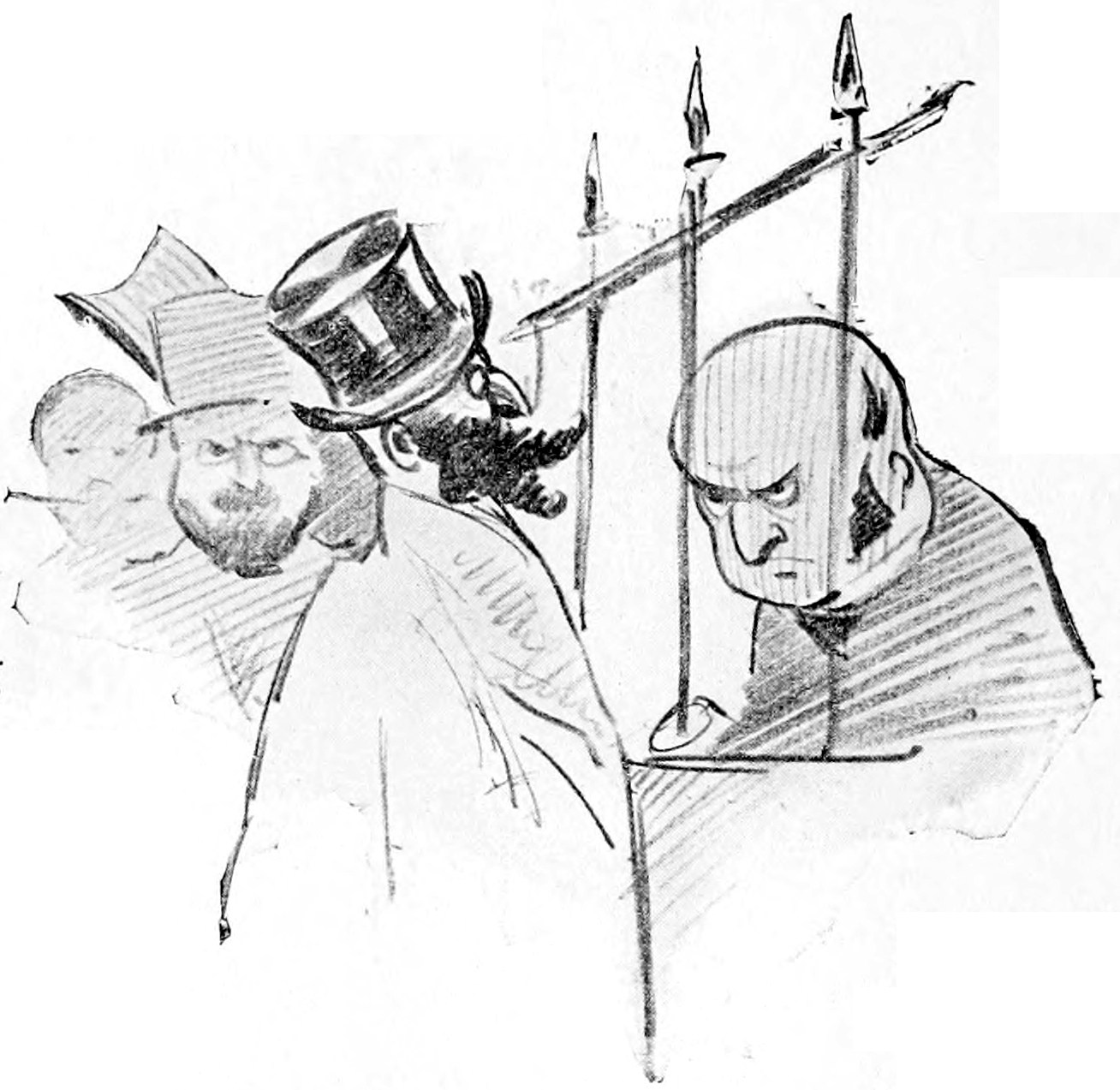
“With the appearance of foreigners”
Lord Halsbury: All
this is hearsay evidence, and
not worth the paper it
is written on.
During a short altercation
between the legal
and non-legal members of
the Committee, a person at the back of
the room leapt to his feet and demanded
to be heard. He was permitted to speak,
and deposed:
That he had been gathering statistics in the employment of a
politician whose name he must conceal.
Mr. Balfour: I am afraid we must have that name.
Witness: May I send it up on a piece of paper?
Lord Halsbury: Is he a peer?
Witness: No, my lord.
Lord Halsbury: Well, is he a person of importance?
Witness (eagerly): Oh! yes, my lord.
Lord Halsbury (after consulting his colleagues): We do not think
his name material. Proceed.
Witness (in an emphatic manner): The facts I have to produce
are simple. They are well known. It is their meaning which has
escaped the public. When the meaning is grasped it will amply
account for our great annual loss of gold.
(Here the Committee betrayed an interest bordering on frenzy,
leaning forward and fixing burning eyes on the witness, who continued:)
“The number of passenger tickets taken at the ports of this
country is over 12 millions annually. (Sensation.) Ships’ crews
(excluding coasters), fishermen running across to the continent, fugitive
criminals, and King’s messengers bring the number up to 18 millions.
(Sensation.) Not one of these 18 millions leaves without a sum of
money ... many carry away immense sums ... our office
can prove that the very clergy in their annual excursions will carry 20,
30, nay, 100 pounds a family. (Sensation.) How many return with
any money at all? (Here the speaker made a dramatic pause.) ...
I have little more to add. The total sum so lost by innumerable
outlets amounts certainly to 200, possibly to 230, million pounds.
England is a sieve.”
Witness here left the box, and the Committee rose in a state of
seething excitement, several of the more commonplace members
repeating mechanically, “A sieve!” “A regular sieve!” “Poor old
England is a sieve!”
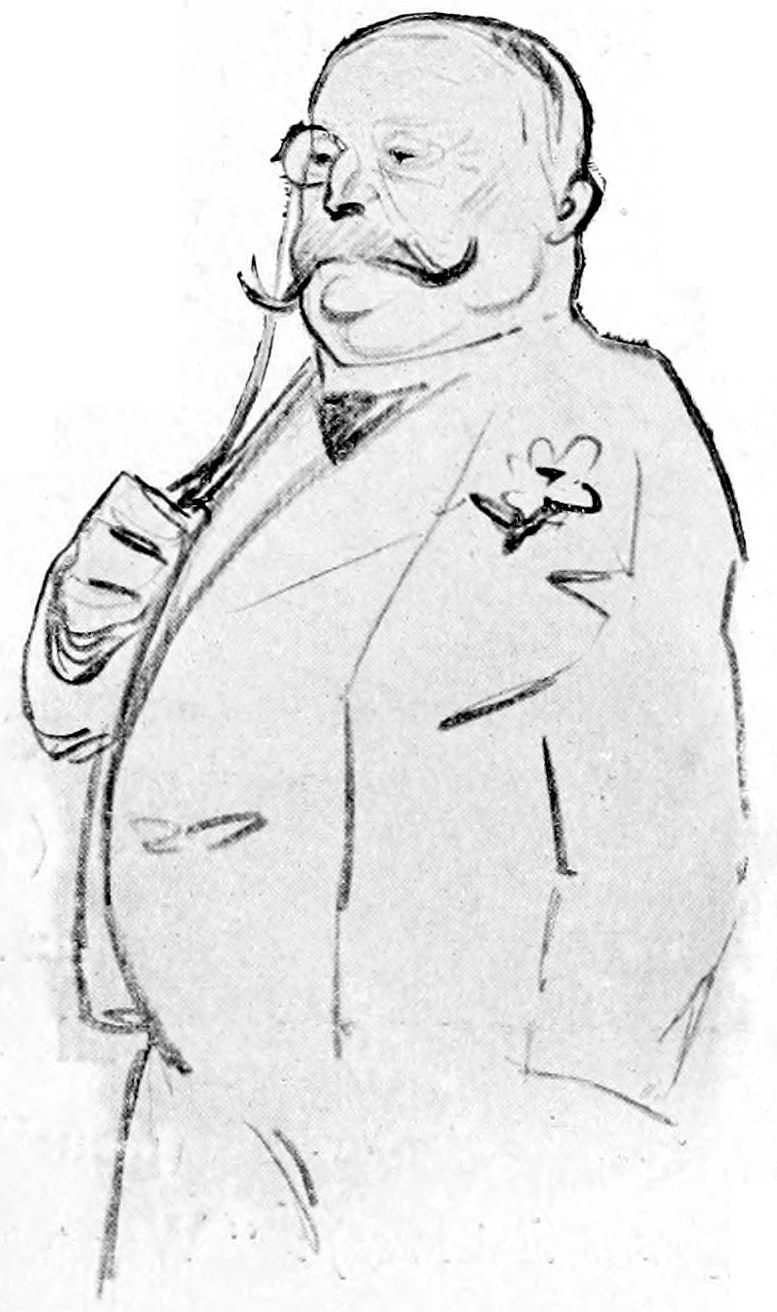
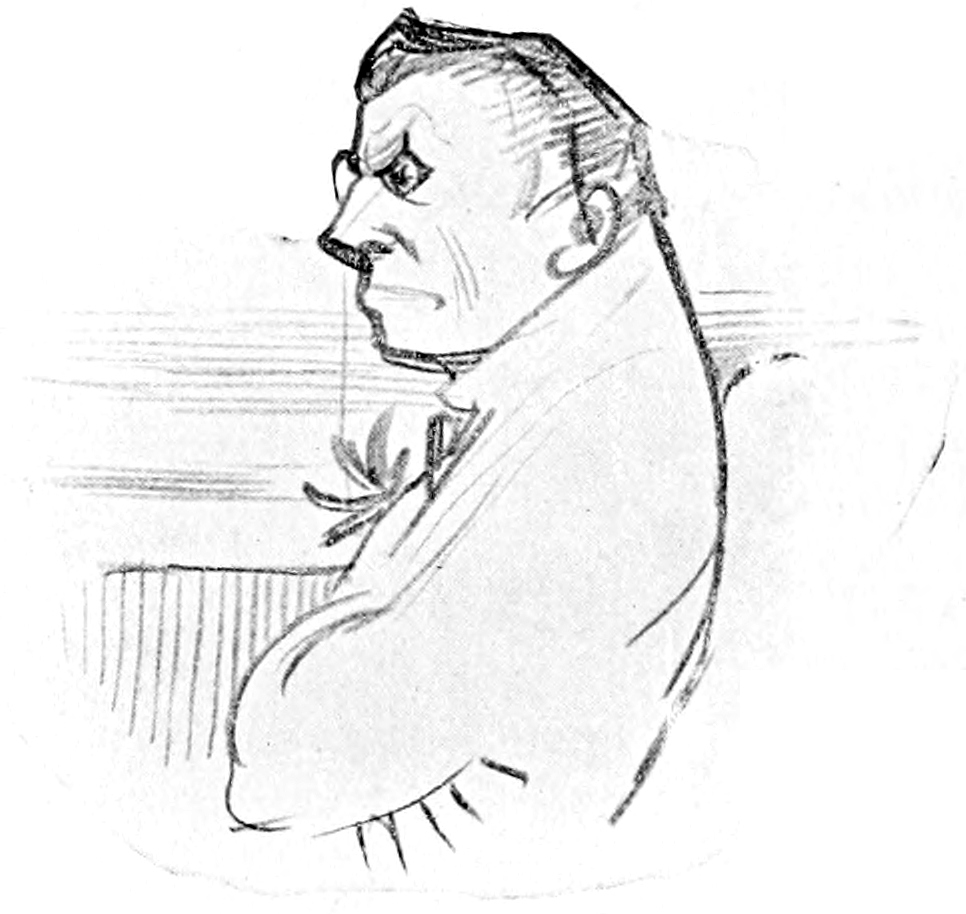
Mr. Chamberlain looked radiant in a black frock coat and top hat,
with boots to match, and a flower of some kind in his buttonhole, while
Mr. Balfour was quite cheerful and vivacious. As the Court rose the
opinion was freely expressed that the day’s work has given the Cause
a great lift forward.
TECHNICAL INFORMATION.
The third meeting of the Grand Committee of Inquest, commissioned
under the Privy Seal of Great Britain and Ireland and the Dominions
beyond the Seas, met at Downing Street this week to further explore—we
mean, to explore further—the Fiscal Conditions of this Realm of
England.
The late arrival of the members of the Committee gave rise to
some anxious talk in the passage which corresponds to the Lobby of
the House in Downing Street. The wildest rumours were afloat.
Some said that Mr. Chamberlain had resigned; others that he had
committed suicide. The more sober would have it that the inquest
was indefinitely postponed, and that the whole scheme for protecting
or not protecting native industries, or food, or what-not, as the Inquiry
might or might not have shown to be necessary, or unnecessary, or
either, was to be dropped. Among the adherents of the latter (or
former) opinion were several journalists, a bishop, four diplomats, and
an economist.
All doubts were set at rest by the arrival at 3.35 or thereabouts of
the first members of the Committee and two members of the
Birmingham “gang.” Three-quarters of an hour later Mr. Balfour
was towed up in his motor-car, and the Court opened.
The business before the Court this morning was to receive the
testimony of some fifty-eight witnesses on the technical details of our
chief industries, and to hear their views on special points; especially on
the inroads made by foreign competition in matters of construction.
A definition having been asked of where “technical detail” began,
the Prime Minister refused to define the matter, but he ventured so far
as to ask a question—whether there were not foreigners in the habit of
substituting in small but essential parts of machinery patterns to which
we, being of a superior race, could not stoop without changing the very
conditions of our psychology? It was more or less upon these lines
(said the Prime Minister) that the questions—if they could be called
questions—were, so to speak, to proceed; and he hoped that the
answers they should receive, using the word “answers” in its most
general sense, would on the whole conform to some such conception of
the duties more or less before them. (Applause.)
The first witness to be called was the Times economist, who
refused to reveal his real name. Being threatened with the torture, he
confessed to several aliases. He admitted to having signed many
letters before this above the pseudonym of “Verax,” and, more lately,
above those of “A Conservative Working-Man” and “A Disgusted
Liberal.” He was not specially paid for these articles: it was all in
the day’s work.
Cross-examined:
He admitted to having
written for the
Daily Telegraph;
he was not “Maude”
of Chit-Chat. Asked
whether he
were the “Revenue
Officer” of pious memory,
he denied the imputation—or,
as he called it, the “soft impeachment”—with
the utmost violence. He also denied any connection,
direct or indirect, with the “Times Encyclopædia,”
the “Times System of Payment by
Instalments,” the “Parnell Letters,” the “Hawkesley
Letters,” the “Jameson Raid,” the “Argument
upon the Mortality in the Concentration
Camps,” the recent “Roman Correspondence,” the Times “Dramatic
Criticism,” and “The Industrial Freedom League,” and, indeed,
everything else connected with that journal. The witness here swore
with some heat, the ingenuous colour mounting to his cheeks, that
he had never changed a date, nor forged nor garbled a letter, nor
taken South African shares, nor suppressed evidence, nor done any of
these things.
Counsel (suavely): My dear Mr. (I really do not know your
name), when has there been a bare suggestion of anything of the
kind?
Witness (hotly): I could see very well where your questions were
driving.
When this little scene had come to an end, the witness proceeded
to give evidence that the great mass of imported manufactured goods
were loaded with damnable contraptions, with the undoubted object of
destroying our own industry, and of supplanting them by that of the
foreigner. He quoted statistics to show that the iron trade, the textile
trade of Lancashire, the plain chair and kitchen table trade of High
Wycombe, the boot, shoe, and slipper trade, the cork trade, the shipbuilding
trade, the glue and gum trade, the fishbone manure trade, and
the manufacture of cheese had declined during the last fifteen years
from 10 to 30 per cent. He ascribed this deplorable breakdown partly
to the ignorance of technical detail prevalent among politicians, but
more to the devilish contrivances which gave foreign machinery a
specious appearance of superiority to our own. He thought it could
be proved that no one of these trades would have declined or disappeared
had not Britain suffered from this most unjust and tricky form
of competition. He was confident of one thing—that unless the
greatest attention was given by the Committee to what he called
“Spade-work,” uninteresting but essential matters of fact, it was all up
with the Empire.
Mr. Balfour (with some hesitation): All this is mere
assertion.
Witness (calmly): Upon
assertion every great religion has
been built.
Mr. Balfour (seraphically):
You are quite right. I have
always maintained that the analytical
function, and even the
quasi-postulated phenomena of
the senses⸺
“I have always maintained”
A Voice: Shut up!
Lord Lansdowne (smartly): If any further expressions of private
opinion are delivered from the well of the Court, I, for one, shall
protest.
Mr. Chamberlain (to the unknown person): Ked!
The Court then proceeded to call further witnesses.
Mr. Henderson, Gentleman-Agriculturalist, deposed that it was
the habit of foreigners, principally Frenchmen and Dutchmen, to arrive
in his district of Norfolk every summer with great masses of vegetables,
principally onions, which they had grown at least three weeks earlier
than they could honestly be produced. There was less infamy of this
kind in agriculture perhaps than in other trades—but it was there all
the same. The witness mentioned melons and giant earlies, and
alluded in passing to yellow kidneys, mammoths, Reading prides, and
other vegetables, in proof of his contention. But the chief example
was Hessian fly.
Cross-examined: Witness could not see what all this had to do
with machinery. Perhaps he had mistaken the day.... Anyhow
he was a practical man.
(Here followed a short and awkward pause.)
The witness then stood down with an inconclusive frown.
Mr. Lutworthy, of 236, Eton Square, and “The Knoll,”
Birmingham, deposed that for the last fifteen years German
hardware of all kinds had been flung at his head, and that
it was not in human nature to withstand it. To give an
example. Iron king-bolts with flange attachments selling in
Newcastle at 35s. the imperial gross in 1897, by discount, were
rebated on the margin—(here the Duke of Marlborough started
violently, recovered himself, gazed wildly at the witness, and then
began taking notes)—on the margin, he repeated, at a cover of
10 to 8 according to the higgling of the market. In 1898 the
margin had risen to the minimum fifth, in spite of heavy buying
from Russia. In 1899⸺
Lord Halsbury: Was not that before the little trouble in South
Africa?
Mr. Lutworthy: Yes, my lord, but it was late in the year.
Towards September futures were quoted at less than the old “Charles
Henry Agreement” rate—excluding freights. In 1900⸺
Mr. Gerald Balfour (anxiously): Would you mind repeating
that last sentence?
Mr. Lutworthy (pleasantly): Let me make it perfectly
clear. (The whole Committee here leant forward with the utmost
attention.) Let us suppose this (taking up the Book on which
he had been sworn) to be a king-bolt. Each king-bolt has
at the centre what is known as a flange attachment, as might
be this. (The witness then constructed a complicated thing out
of a piece of paper lying near, and stuck it all round the Book.)
Now, to attach the flange attachment so as to be attachable
and detachable, it is necessary to—(here the witness looked all
round the table anxiously)—Oh! yes. There; that will do!—(picking
up a pencil)—to affix either to it or to its bevel
a catch, as might be this pencil, so. (The witness here
suited the action to the word.) Now, the
Germans, instead of that, which is the
right way, they drop the counter, lift the
main-ratch, and so get all the head-gear into
one piece. (Here the witness paused with
a set, angry face; several people in the well
of the Court cried “Shame!” and Mr.
Balfour’s hand trembled. Then Mr. Lutworthy
added in a shaking voice): One can do nothing against that kind of
hitting below the belt.
Mr. Chamberlain: And you took that lying down!
Mr. Lutworthy (despairingly): I had to. What could I do?
If the bevel had been galvanised or plated, or even treated with
mercury in the original patent, I might have shifted the catch
myself. But as it was—(fiercely)—Oh! how I have struggled!
Lord Lansdowne (in a deep voice): It is not for long!
The witness here stood down with a bowed head.
Mr. Chamberlain (briskly): Next!
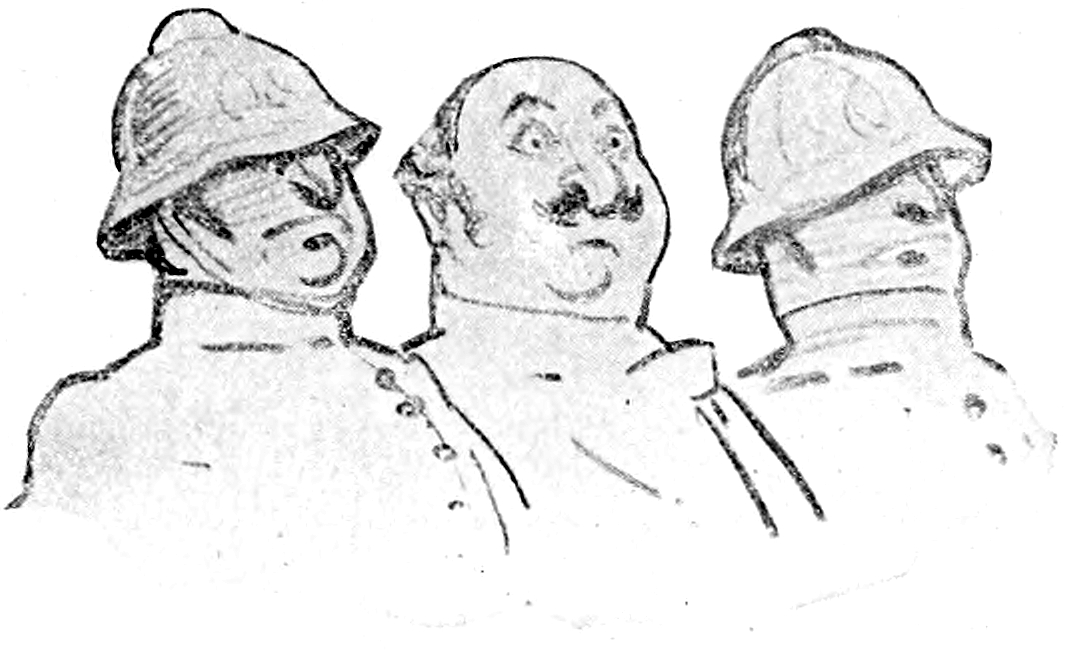
Sir Charles Castlegate, introduced between two policemen,
deposed that: As the results of his bankruptcy were still at issue, he
must speak guardedly.
“Between two policemen.”
Lord Halsbury (sympathetically): We quite understand, Sir
Charles ... pray continue.
Sir Charles (hurriedly): I have been concerned, as a company-promoter
and member of the Carlton Club, with gyroscopes, penny-in-the-slot
machines, atmospheric double-gear brakes, man-lifting kites,
clenched carrying chains, and
many other labour-saving devices.
I will deal first with
the auto-motor-sheaf-binder. It
was originally all British. (At this
point Mr. Balfour handed a
note marked “Urgent” to a
messenger, who rushed from the
room.) It was originally all British. Now, what happened? I
will make myself clear. In every sheaf-binding machine the essential
parts are a “binder” and a “clutch.” Now, the binder is
familiar to you all ... (Here some clamour seemed to rise
from the street) the clutch is more complicated. You must
consider these in the clutch. Either the pick and the main-nut or
(which is much the same) the spring, the oil-pan, and the “dagger.”
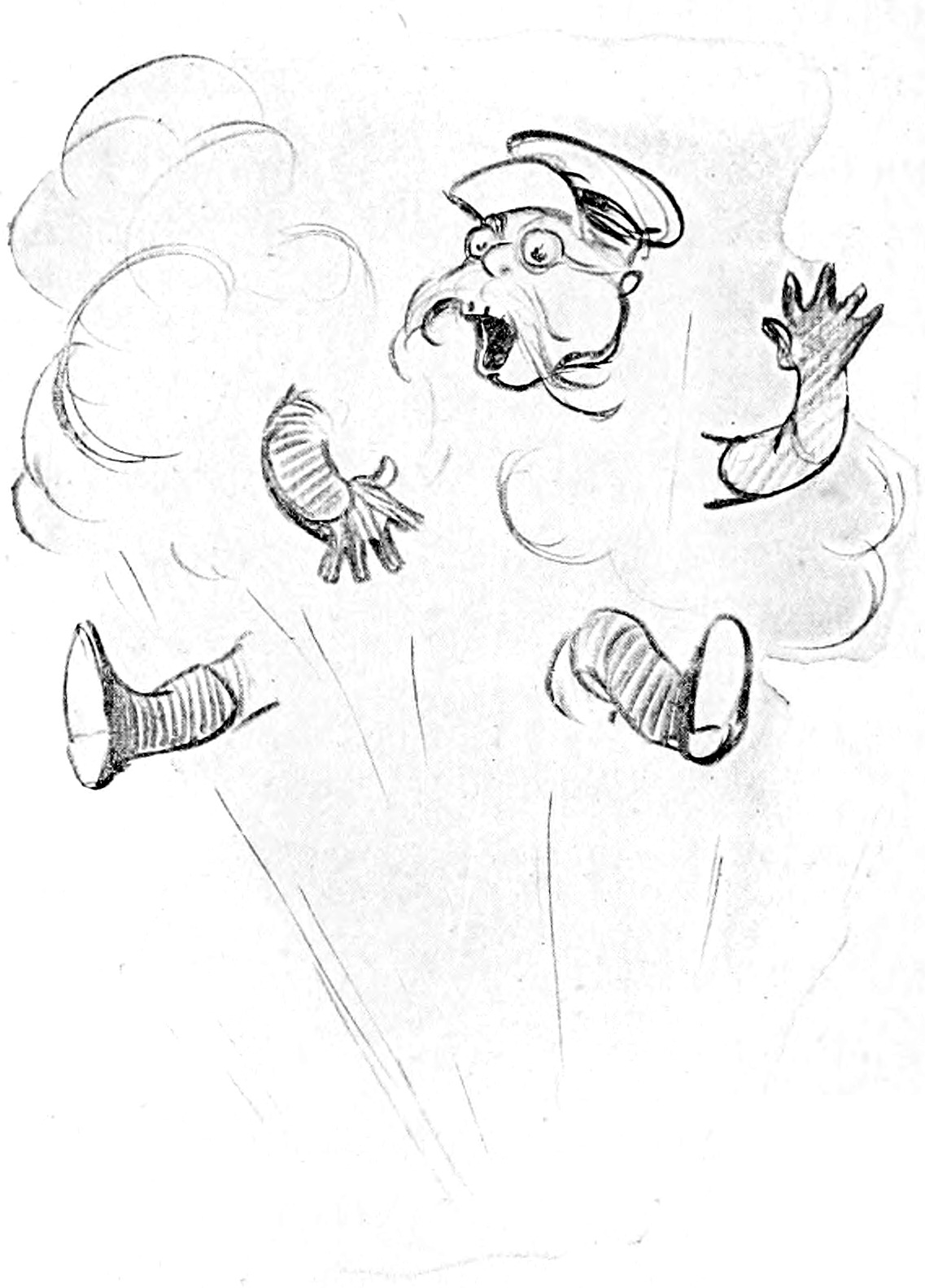
I will draw a rough sketch.... (As the prisoner leant
over the paper a loud cry of “Fire!” was raised without, several fire
engines were heard ringing their bells and shouting down Whitehall.
Immediately afterwards a four-inch stream of water burst into the
room and played upon the Court.
The Committee rose in the utmost trepidation and alarm, and the
whole Court poured down the historic staircase. Several young gentlemen
were crushed, one beyond recovery, and a grave tragedy was only
averted by the presence of mind of Mr. Balfour and Mr. Chamberlain,
who escaped with dignity and composure by another entry, and so relieved
the pressure. Nevertheless, the fruits of the day were, it is feared,
wholly lost, and no conclusion was arrived at.)
DUMPING.
At the fourth meeting of the Cabinet Committee, appointed by its own
members, with right of co-option, to discover by what means our Fiscal
Relations—suitable, no doubt, for an earlier age—might be brought
into closer relation, or relations, with the modern, &c., &c....
All the members arrived most punctually, several peers waiting outside
in the rain for some moments before the doors opened. (Paragraph.)
When the Bench was seated, silence was imposed by the voice of
a herald, and Mr. Chamberlain rose:
He assured the Court he would detain them but a few moments.
Lord Byron had wittily said that still waters ran deep, and he, for his
part, after a long life spent in close, hard-headed bargaining, had
noticed that the less a man said, the more he was worth. It was a
rule he himself had always observed. In his conception of Empire, the
silent man, who never spoke, but did, should rule until he reached the
sky.
(Here Lord Lansdowne began muttering to himself, Lord Halsbury
openly pulled out his watch, Mr. Balfour shut his eyes and crossed his legs,
and the Duke of Marlborough said “Hear, hear!” in a subdued voice.)
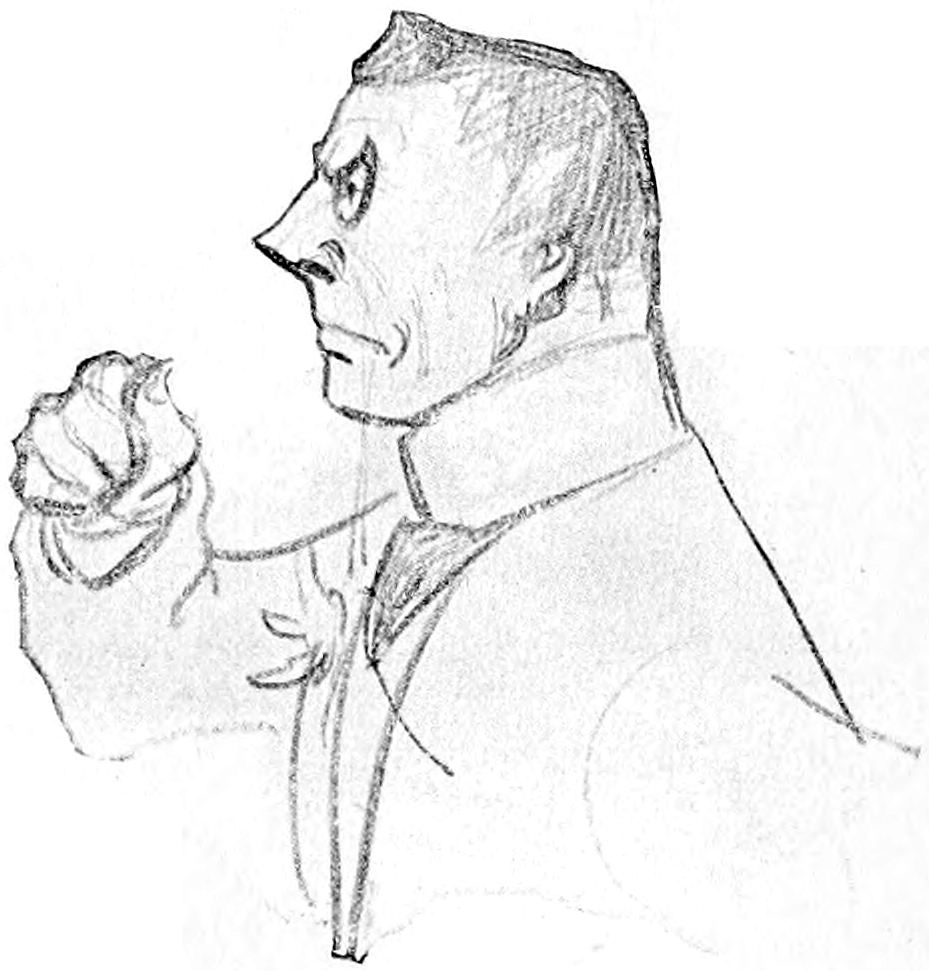
Mr. Chamberlain, continuing in a manner which combined courtesy
with firmness, and which was emphasised by his favourite gesture, said
that he felt it his duty to mention two painful incidents. One was the
premature announcement in the Daily Mail that he was backing down.
He had no intention of backing down till next February, and there
was an end of that. The second was the misadventure which had
broken up last week’s sitting. He alluded to the false alarm
of fire, and especially to the pouring of a four-inch
stream of water into a building sacred to his own
immortal predecessor, Mr. Pitt, the
father of Lord Chatham and the
Saviour of Europe—the man to
whom we owed Gibraltar, and all
that Gibraltar stood for.
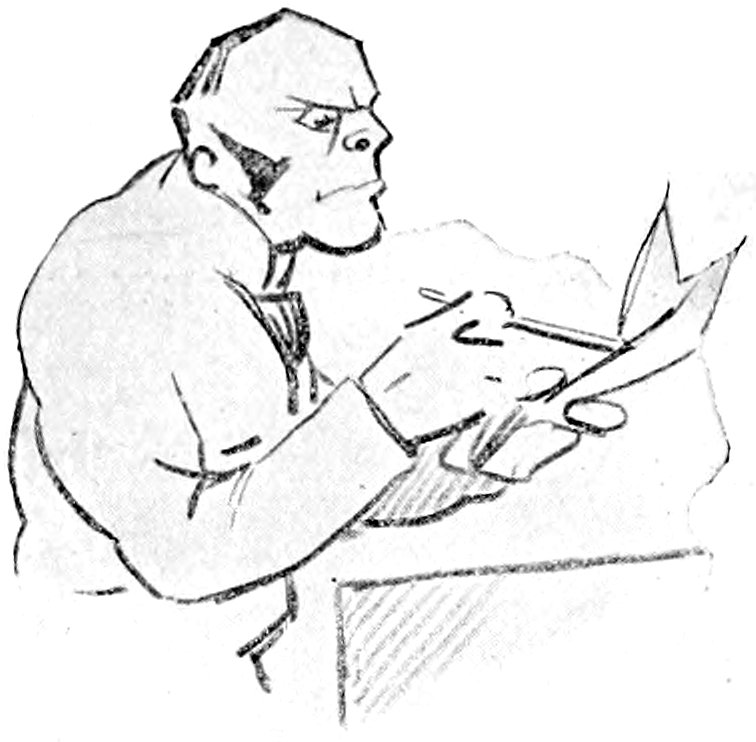
“Courtesy and firmness”
Whoever gave that false alarm
was unworthy of the name of Briton.
A pro-Boer newspaper had gone so far as
to ascribe it to a conspiracy against him among his own colleagues.
(Here Mr. Chamberlain looked round, and was met by nervous laughter.)
It was like a great deal else that such people said; it was a lie.
He had now passed several years in close intimacy with them all,
and he could only say that a more honourable and courteous set of
men he had never dealt with. He was sure they would reciprocate the
feeling.
He could safely say this: After visiting in all its extent the
majesty of the Empire, and returning to England, he could only
ascribe what had been done in his absence to the loyal support of the
men around him.
Mr. Chamberlain here sat down. He rose again, however, in a
moment, with the words, “I shall detain you but a very few minutes,”
and some time after closed an interesting and fruitful speech by saying
that the practice of “Dumping” was universally admitted, and that the
business before the Court that day would consist in hearing from
witnesses the form which the process took in various industries.
The first witness to be called was—
Mr. Henry Salter, manager of Messrs. Garrant and Schüler.
He was willing to turn King’s Evidence. (Murmurs.)
Mr. Chamberlain: I hope the witness will be heard with respect.
He is doing his duty, as did our brave allies on the veldt, and as did
my old friend Le Caron. (To witness) Mr. Salter, I am proud to
shake you by the hand. I wish I had known you in 1886. Such men
are rare.
Witness, continuing, deposed that for no less than eight years past
his employers had given away their German bicycles free.
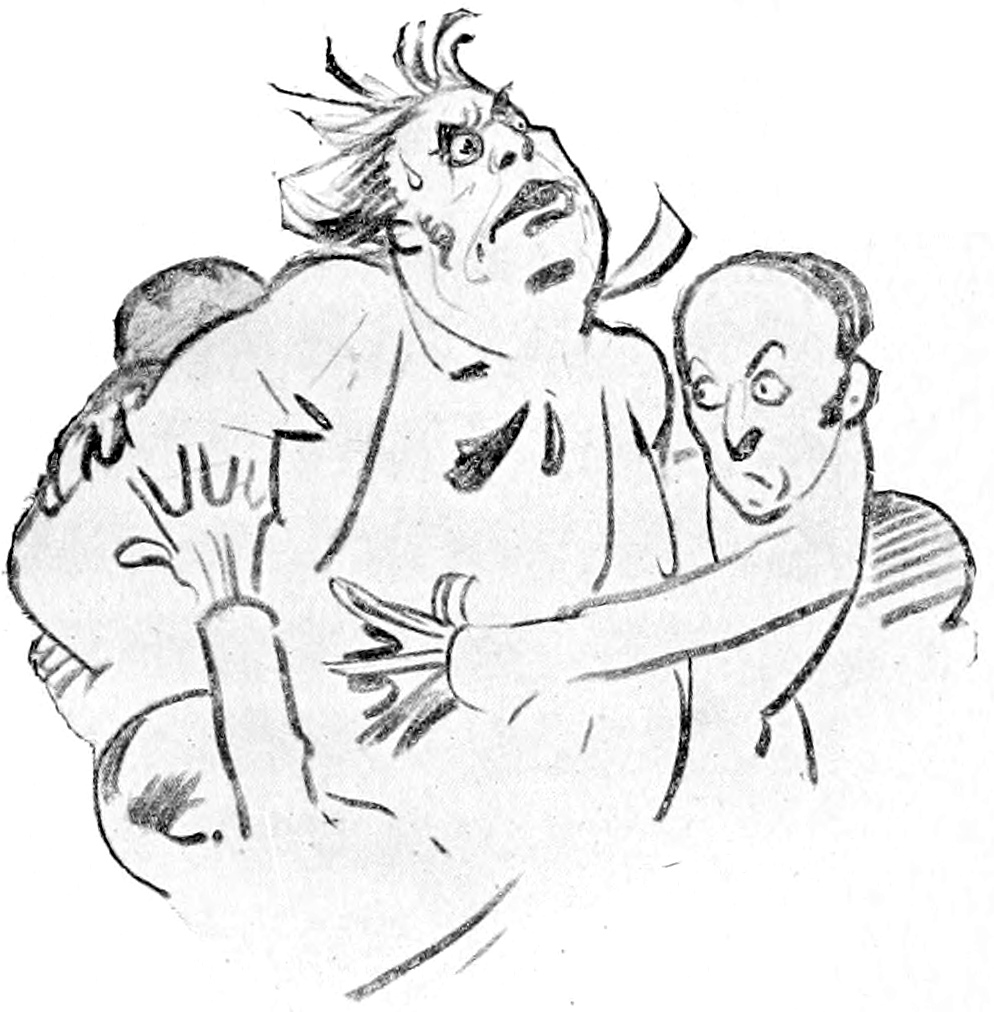
[Sensation. A furious voice from the well of the court cried,
“Let me get at him!” and an Anglo-Saxon of huge stature was with
difficulty prevented from making an ugly rush. He turned out to be a
patentee of the old style of high bicycles, who had been ruined by the
competition of safeties.]
“An Anglo-Saxon of huge stature”
Witness, further examined, estimated the
total number of bicycles he had thus offered
free at a little over three millions.
Mr. Chamberlain (smiling):
Oh, come, Mr. Salter, come!
Mr. Salter (shuffling uneasily):
Business is business, my
lord. (Loud laughter, in which
Mr. Chamberlain joined.) There’s
nothing to laugh at. Every man
must make the best of himself.
Lord Lansdowne: How were these bicycles bestowed? Did
you ask people to your country house, and give them by way of their
private secretaries, or did you forget to send in the bill?
Mr. Salter: Neither, Sir Thomas; we put an advertisement in
the papers, saying, a “£12 bicycle given away free.”
Mr. Balfour (with interest): I have seen such advertisements,
but I never understood what they meant. The words alone seem to
make no sense.
Mr. Salter (eagerly): They do, indeed, sir! All the competitors had
to do was to send 1s. 6d. in stamps, and to get orders for ten other bicycles.
(A pause, after which the witness added, anxiously) Am I free now?
Mr. Balfour (in confusion): Yes—I suppose so—you may go.
Mr. Salter: Yes. But I mean⸺They can’t do anything to me?
Lord Halsbury (peevishly): No! no! no! My good man! All
this is privileged, of course.
[The witness, heaving a deep sigh of relief, walked slowly and
rather insolently past two policemen, and sauntered into the street, where
he was at once arrested.]
Mr. Chamberlain (briskly): That settles Bicycles. Now for
Powder! Next!
[At the mention of “Powder” there stepped forward a most popular
gentleman, with whom all members of the Committee warmly shook hands.]
Witness, examined, swore that while his discovery was still in the
experimental stage, a hideous foreigner had appeared at his works, and had
proposed “a deal.” This foreigner produced a sample of Powder which exploded
practically at any moment the gunner might choose; at other times—in
magazines or manufactories—the Powder would not explode. It kept
in hot climates, and spread no disease aboard ship. It was certainly a most
remarkable product. The foreigner proposed that they should furnish it
to the Government as witness’s own, and share profits. (Indignation.)
Mr. Balfour: We owe
you a profound debt of gratitude!
Witness (visibly affected):
Thank you, Arthur. I
can only repay you all by loyal
service; and I think your
kindness will be partly justified
when I tell you that I am within
sight of producing powder
that explodes. Some has already
gone off by accident in one of my
sheds and killed a German.
[Witness here shook hands again warmly all round and went out.]
Mr. Chamberlain: Oil! Next!
Mr. Elihu Z. Kapper swore that he was an American. In 1872
he first began to import mineral oil into this country. The people
took kindly to it, and used it in a thousand ways. By 1880 he was
importing 50,000 gallons a year of it. Meanwhile he was chiselled
out by Mr. Rockefeller, and left to freeze. Mr. Rockefeller was a great
man. He (witness) had then turned his attention to the English field,
and had discovered vast lakes of oil in Devon, Norfolk, Denbigh,
Cumberland, and Rutland. He had floated ten companies.
Mr. Balfour (aside): Wasted capital!
Witness: They had all gone bankrupt, and their bankruptcy was
undoubtedly due to underselling from America. England had more
undeveloped oil than any other country in the world.
Mr. Chamberlain: Now let me put you a practical question. If
we prohibited the import of foreign oil, could you float an eleventh
company?
Mr. Kapper (promptly): I have an eleventh floated already,
Secretary—I could float a twelfth.
Witness was succeeded by young Mr. Garry, of Steynton Hall,
Rugby, who swore that a foreigner, a Prince, had met him at the
Savoy last June, and had given him several articles of foreign manufacture—a
cane, a match-box, a dachshund, a wrist-watch, and a dozen
of hock. In return he had given nothing. He had lent the Prince
sums of money on various occasions, but it had all remained in the
country.
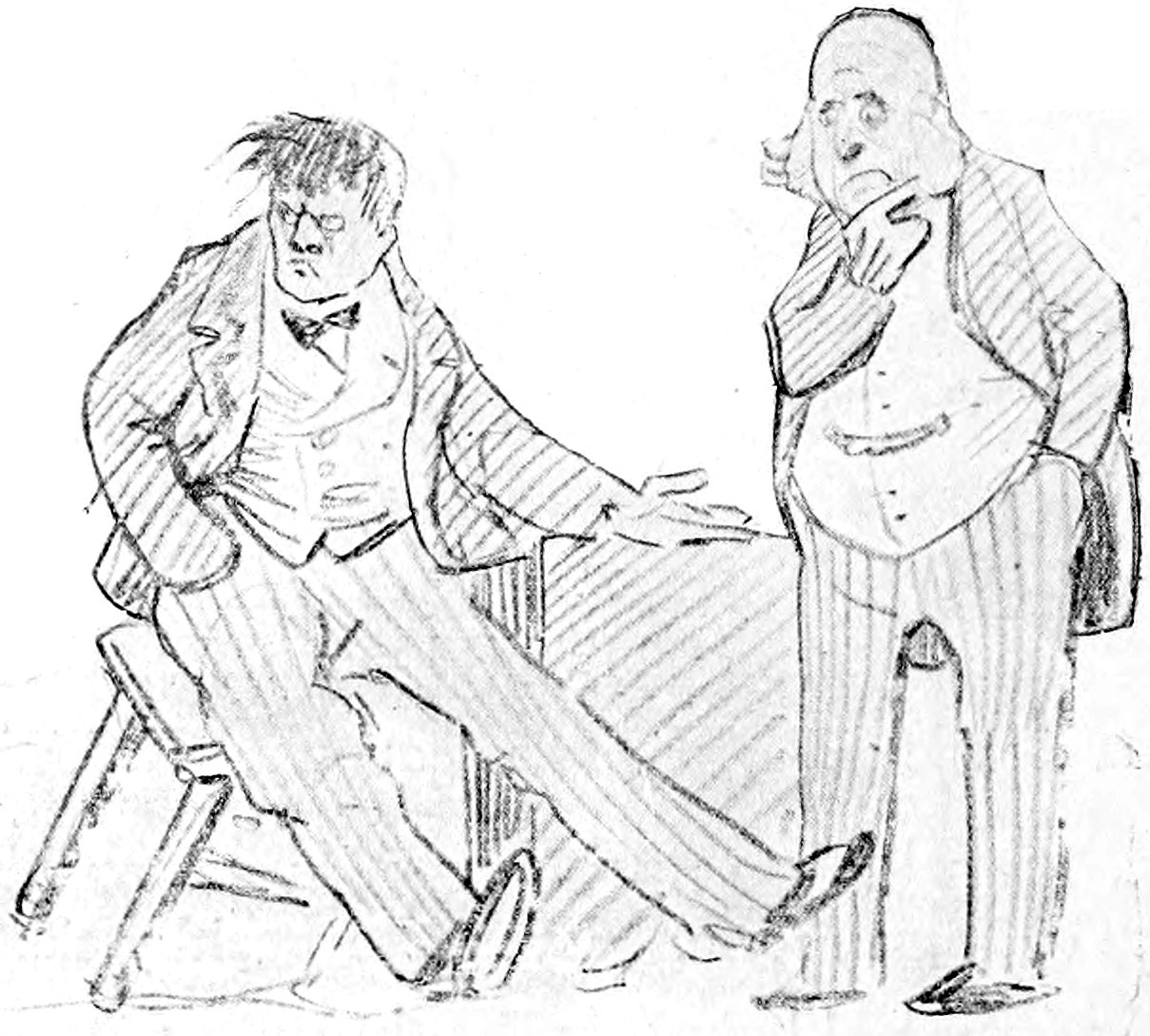
The next witness was Lord Rustington. His lordship was
visibly affected by illness, and his face, framed by great whiskers, bore
an anxious and even irritable expression. He
hobbled on a stick and said “thank you” to an
assistant who offered him a chair. He had
received the summons. He was willing to give
evidence on dumping. It was a growing evil.
At first (in his case) tin cans, packing boxes, and
paper were the only things to
complain of. Last year boots
were found.
Mr. Gerald Balfour (puzzled):
How “found”?
Witness (testily): Please let me finish
what I was going to say!... Were
found, I say, and occasionally empty bottles
as well⸺
Mr. Chamberlain: But, surely⸺
Witness (angrily): Will you let me finish a sentence? Empty
bottles, certainly, empty bottles. And this year it was awful. Old
rakes, broken wheels, heaps of filthy hats, baskets, and—it might seem
incredible—an old mowing-machine.
Cross-examined on the place of origin of these imports, witness
said: It was the gipsies. They always camped near that corner of
the home farm on the Pulboro’-road. They threw all sorts of things
over the hedge⸺
Mr. Balfour (firmly): There is some error. This can have
nothing to do with our inquiry. My dear Lord Rustentown⸺
Witness: Rustington!
[At this point the Committee consulted. After a little whispering
Mr. Balfour explained with the utmost gentleness that there had been a
mistake. The summons should have been sent to Lord Rustentown, the
well-known ironfounder, money-lender, newspaper-proprietor, and
supporter of the Government. If any apology of his⸺]
Witness in a towering passion declared that the fault lay with
this Government and their accursed folly in flooding the country with
new peers and letting them take any accursed name they fancied. In
the course of his remarks witness struck his game foot with his stick,
and thereupon became so violent that he was compelled to retire.
There succeeded a dignified silence of some few minutes, at the
close of which Lord Halsbury said:
Lord Halsbury: Humph!
His lordship then rose to his full height and strode solemnly out
of the room.
Mr. Gerald Balfour was the next to leave. He hurried through
the door without a word. The Prime Minister followed him, talking
to himself.
Lord Lansdowne smiled a little anxiously, looked right and left
at his colleagues, tapped on the table with his fingers, and
then got up in his turn and went out in a thoughtful
manner.
Throughout this painful scene
Mr. Chamberlain sat immovable,
with a fixed stare and with set
lips. At last, in a tone of characteristic
energy and resource, he
broke the silence with the cry of
“Next!” But in the universal uncertainty
and alarm no one responded to the summons.
The unnatural tension was relaxed by the abrupt departure of the
three remaining members of the Court, Mr. Austen Chamberlain
preceding his father, the Duke of Marlborough following his chief.
As the audience dispersed, the gloomiest forebodings arose upon
the subject of the next sitting.
THE ANIMALS.
The fifth—and, in some respects, or, as Mr. Balfour has put it, “in
many ways,” the most important—meeting of the Cabinet Committee
appointed to Inquire upon the Causes of our National Decline, and to
suggest some Remedy Therefor, was held at Downing Street in the
usual place: the little room on the first floor to the left of the
door.
The window, sketches of which have already appeared in the
illustrated papers, may be distinguished by the new and perfectly clean
panes of glass replacing those broken during the recent alarm of Fire.
A large crowd began to assemble at two o’clock outside the
premises wherein the tragedy was to take place, and it was with
difficulty that a number of policemen in plain clothes, but shod in the
regulation boots, kept a lane open through the anxious though good-natured
populace.
Mr. Chamberlain was the first to arrive, accompanied by the Postmaster-General.
They came on foot, faultlessly dressed and apparently
in the highest good humour.
Shortly afterwards the Duke of Marlborough appeared in the
lowest good humour; he was on horseback, and bore several very large
volumes precariously under one arm. The crowd waited in vain for
the other members of the Committee; they did not come.
Meanwhile it was explained to the Court within that the three
members present constituted a quorum, and the sitting was opened
by
Mr. Chamberlain rising and saying he would detain them but a
very few moments. He pointed out that his opponents were perpetually
harping sordidly upon the mere economic evils which might
follow the introduction of Preferential Free Trade. To reply to these
criticisms might have baffled a man of less determination; he could
not ask volunteers to come forward and submit themselves to the test,
and his—he supposed he must call him his honourable—friend had
refused to lend the Boer Prisoners still (he was glad to say) in captivity.
He had surmounted those difficulties. He would call a number of
living animals upon whom the whole scheme, from the recent procedure
in Parliament to the effect of cheap tobacco upon the stomach, had
been tried. (To the Door-keeper.) Let loose the⸺
The proceedings were here interrupted by Counsel for the
Cobden Club, who rose and said he had a “replevin et demurrer” to
lay before the Court. He believed such action to be cognisable under
the writ “de Hæretico Comburendo,” and submitted, in all respect, that
it was indictable by the Chartered Secretary of the S.P.C.F.C.H.H.[1]
before the Justices in Eyre or in Chambers.
Mr. Chamberlain, holding in his hand a little slip of paper, spoke
in his legal capacity as member of the Privy Council; still deciphering
the said slip, he pointed out that the jurisdiction of the Courts Seizined
was inferior to that of the Courts “En Plein” such as was this Court.
He was sure of his facts. He would allow no interruption, contradiction,
observation, Garrant in Warren or in Main, Bart, Blaspheme
or Marraeny, under pain of contempt. He trusted his learned brother
(turning to the Duke of Marlborough) would agree with him.
The Duke of Marlborough, rising with his hands clasped behind
his back, spoke in so low a tone that he could hardly be heard. He
was understood to say that it was all right.
Mr. Austen Chamberlain, speaking De Auctoritate Suâ, said
they had heard the opinion of the greatest statesman and jurist in
England, and also of one who, as one of the highest members of the
Highest Court in the Realm—the House of Lords—was an unimpeachable
authority.
The Court thus agreeing, Counsel for the Cobden Club was fined
a hundred pounds for contempt, and the Inquiry proceeded.
The first witness to be called was a Horse.
As it was evidently impious to swear the animal, and impossible to
take his affirmation with hand lifted over the head in the Agnostic style,
he was allowed to pledge himself by proxy that he would do nothing for
the sake of gain, prejudice, hate, love, favour, or worldly advantage.
The Trainer then explained that the horse would prove to
demonstration that muzzling produced no ill effect
upon living creatures.
Mr. Chamberlain: Have you tried the experiment
upon Human Beings?
The Trainer: No.
Mr. Chamberlain: No what?
The Trainer: No, your worship.
Mr. Chamberlain (sternly): That
is better.... (Gently) You have
not tried it upon Human Beings because
you thought an experiment in corporis viro would suffice?
The Trainer: ...? ...?
Mr. Chamberlain (testily): Do you hear me?
The Trainer (sulkily): Yus!
Mr. Chamberlain (to the Court, and especially to the Press):
The Horse, you will observe, is free. He can whinny, neigh, or bite
at will. Observe!
(At this word a gentleman calledJamesran a pin into theWitness,
who thereupon lashed out a violent kick against the wall.)
Mr. Chamberlain: He shall now be muzzled.
(A large leathern bag completely enveloping its head and mane
was put over the witness, who thereupon shuffled uneasily, as though
bewildered.)
Mr. Chamberlain: Now!
(Mr. Jamesagain touched up the witness with the pin. Instead of
kicking, the witness danced in an agitated manner and went through
various contortions.)
Mr. Chamberlain: I think no further proof is needed of the
advantage—or at any rate the innoxiousness—of the muzzle or gag.
I trust the experiment will put an end to those foolish complaints in
Parliament and the Press which have recently caused the continent
itself to sneer. Next!
The next witnesses called were Two Pigs.
The Counsel for the Cobden Club, at the risk of his fortune, rose
to protest. His disclaim was not so much against the Pigs themselves
(porcs de soi), for the Court had allowed them, and he (emphatically)
was not there to contradict the superior wisdom of the Court. It was
rather against the presence of two witnesses in the box at the same
time. It was wholly opposed to the spirit of Our English Law.
Latterly that spirit had been attacked in a hundred ways: Prisoners
could speak for themselves, even solicitors—he was ashamed to say—could
plead in inferior Courts, but two witnesses in the same box was
more, he thought, than the temper that produced an Eldon and a
Halsbury could stand. Let alone the relaxation of the moral bond
(for how could these two witnesses feel in common the awful meaning
of an individual oath?) let alone the moral bond....
Mr. Chamberlain (suddenly): You are making a speech!
The Counsel for the Cobden Club was then taken off to prison.
The Inquiry proceeded.
The Witnesses solemnly deposed by another’s mouth (as do
infants in baptism) that they were born of one litter in the beautiful
old-world village of....
Mr. Chamberlain: Go on! go on!
Witnesses, continuing, affirmed that they were reared in the
same way to the age of six months. It was then determined to feed
the one (Tom) in the Protectionist, the other (Bill) in the Free Trade
spirit. All manner of food was stuffed into the latter at all hours;
the former had a sparse meal once a week of honest English husks
and bean-pods, with a little straw. Look at them now! “Kruger,”
the free-trader pig, was so fat he could hardly walk. His life was a
burden: he implored the release of death. “Roosevelt,” on the other
hand, was a frisky, amiable, and active pig, capable of the most
amusing tricks, and a fit companion for the best wits of the age.
The Witnesses then stood down after receiving the thanks of
the Court.
A Ferret, two Dormice, and a Capercailzie having been heard
to little effect,
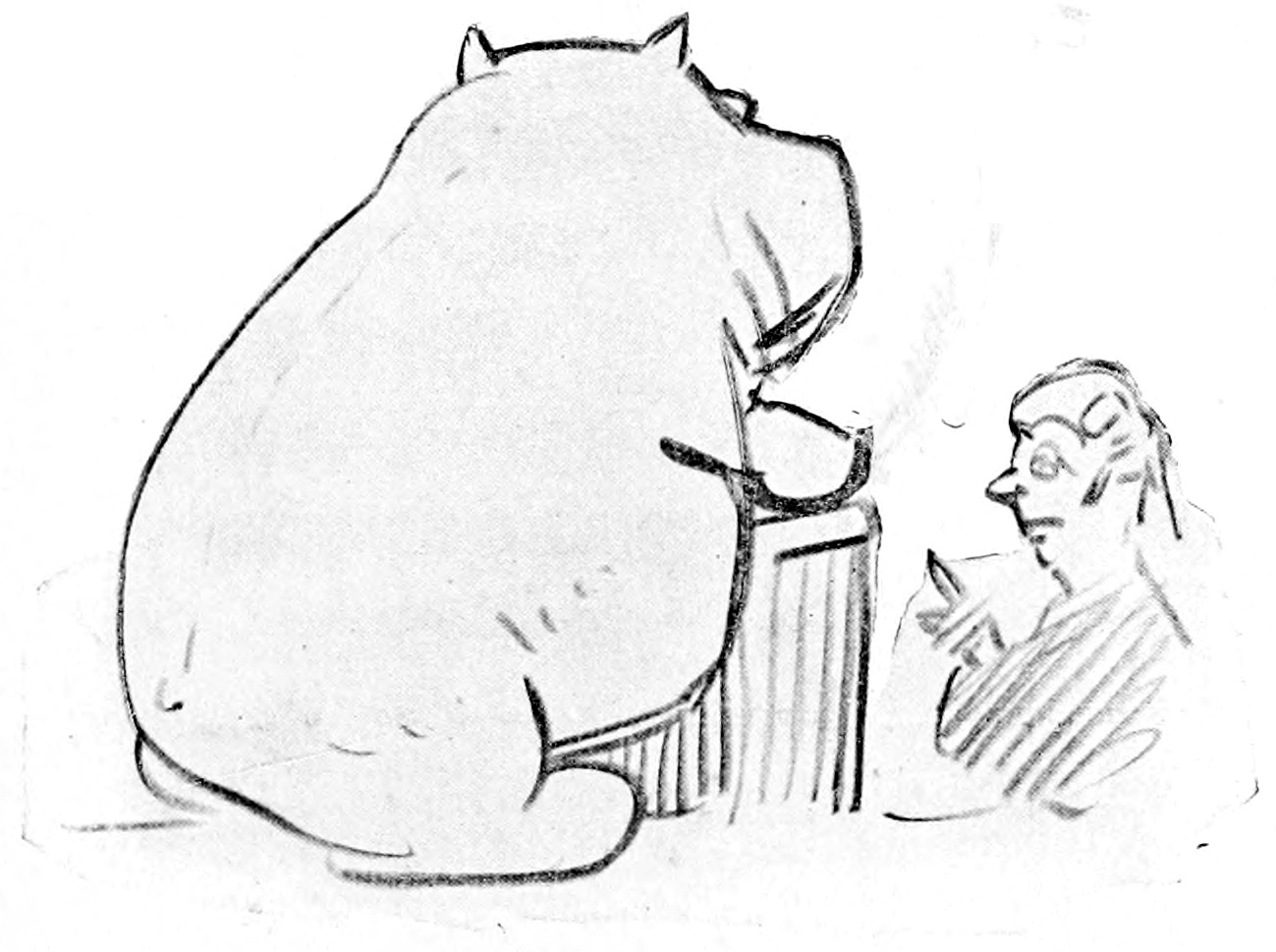
A Boa-Constrictor was called to show
that indirect taxation was capable of indefinite
expansion, and a
Hippopotamus to satisfy
the Court that a broad
basis was synonymous
with stability.
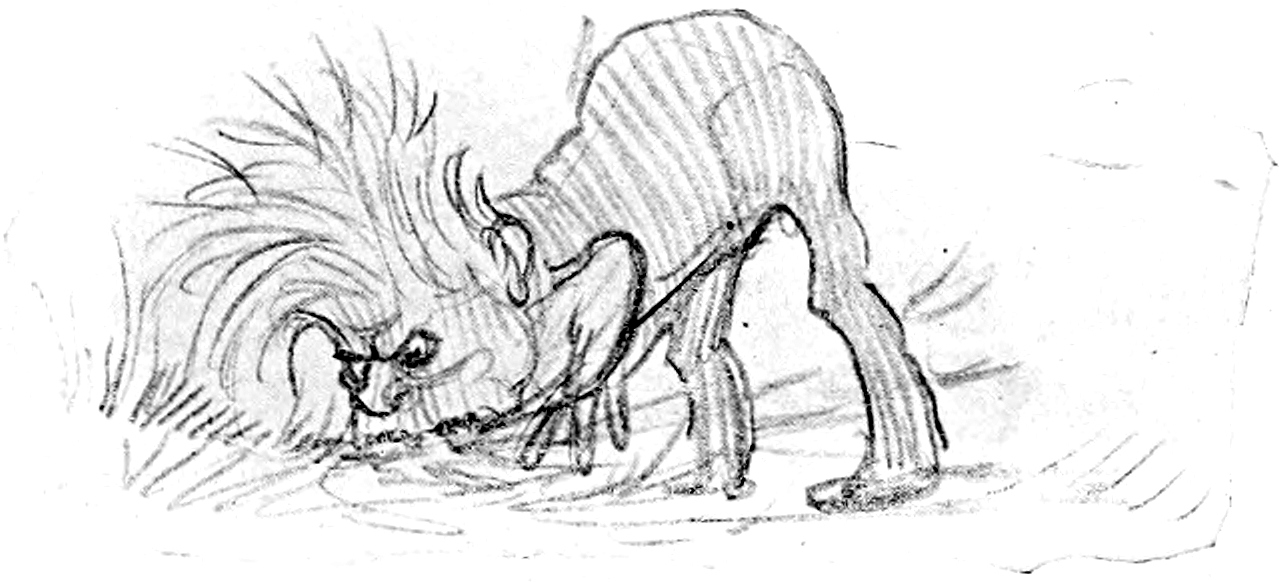
A Trained Lion was
sworn, and showed, in
the most amusing manner,
under the artificial stimulus of a trainer with a whip, how in
old age, with his teeth drawn and his spirit thoroughly broken, even so
dangerous a beast could be put to the most useful work: such as
rolling a log, balancing a see-saw, ploughing the sand, wiping something
off a slate, doing a little spade work, and even roaring at
command more loudly than in youth. The Imperial Brute was
dressed in a large Union-Jack, and while it provided instruction
afforded also entertainment to the company.
Many other witnesses, subpœnaed at enormous
expense, carried conviction to all present,
when Mr. Chamberlain ordered to
be introduced the Elephant, presented
by our Friend and Ally, the Maharajah
of Gûm.
After some delay, during
which the anxiety of the
Court was terrible to behold,
a Marabout arrived announcing
that the Faithful Animal
and Loyal Servant of the
Empire had breathed its
last that very hour in its
Rooms at St. James’s! The
Marabout, who elected to be
sworn in the Hindoo manner,
that is, formally and without prejudice, recounted with many
sobs the last hours of the noble Pachyderm. It was chosen, he
assured the Court, on account of its peculiar longevity; it being
assumed by His Highness the Maharajah (here witness bowed once to
the Court, once to the Royal Arms, and once to nothing in particular)
that an animal which had outlived the Empire of the Great Mogul
would survive the protracted Inquiry upon the Fiscal Relations of
the &c., &c. Alas! Providence had otherwise disposed!
In a chastened and humble mood, and dwelling upon the vanity
of human affairs, the Court solemnly adjourned. The Duke of Marlborough
was heard to murmur, in the words of Burke, “What shadows
we are, and what shadows we pursue!” a phrase which Mr. Chamberlain
immediately entered in his pocket-book under the heading “p. 273,
pop. quota.; mem. Latin original?”
VI.
The sixth and last sitting of the Inquiry upon the Fiscal (skip the rest)
was remarkable in many ways, but especially for the fact that Mr.
Chamberlain alone appeared.
The audience in the street outside, and the many experts and
officials who were privileged to enter the court, were waiting in vain
for the advent of at least the Duke of Marlborough or Mr. Austen
Chamberlain, when the Colonial Secretary rose, and after remarking
that he would detain them for but a very few moments, begged that
they would not take alarm at the constitution of the court.
The absence of his colleagues was just the kind of thing that his
more virulent opponents might put down to some difference within the
Cabinet. Against malicious ignorance of that kind there was no
weapon but direct contradiction. He would contradict it here and
now, as he had successfully contradicted in the past his connection with
the Jameson raid, the stupid story about the garden party at Lord
Rothschild’s, and the legend of his having been a Free Trader and a
Home Ruler, in some remote past which his enemies found it very
difficult to discover. (Laughter.)
He did not think it seemly that a man should talk too much about
himself. He would therefore make no allusion to the services he had
rendered his country. Such as they were, they could never be more
than the services of one man. A great man perhaps, a loveable man
certainly, but after all, only one man.
Lord Beaconsfield had said that men imputed themselves. He
was not quite clear what this meant, but,—....
(Here Mr. Chamberlain took up another little bit of paper,
frowned, let drop his eye-glass, fiddled a little with his fingers,
frowned again, replaced his eye-glass, and
explained that he had mislaid some of his
notes.)
Continuing in a more natural tone,
and with far less fluency, he proceeded to
give in detail the reasons for the absence
of each of his colleagues.
The Prime Minister was occupied
at Deptford, arguing with some
Nonconformists.
“Arguing with Nonconformists.”
Lord Halsbury had retired into a monastery, to make his peace
with God.
Lord Lansdowne had been suddenly called to the Foreign
Office to translate some Frenchified stuff or other in the Sugar
Convention.
The Duke of Marlborough was suffering from brain fever, and, in
spite of the terribly contagious nature of the disease, Mr. Gerald
Balfour was nursing him with all the tenderness of a woman.
His own son, Austen, had that very morning received a letter
from a Mrs. Augusta Legge, of Tooting. It was addressed to the
Postmaster-General, and complained that a box of fish, despatched by
her ten days ago, had been lost in the post. The Postmaster-General
always attended to these things himself. It was in the tradition of
hard, silent self-denial in which he had himself been brought up, and
in which he had brought up his family.
Under the circumstances he thought he would not call any
witnesses ... something much more convincing than any
number of witnesses was being prepared in the Horse Guards’ parade.
Mr. Chamberlain cordially invited those present to attend, and
sat down after speaking two hours and thirty-four minutes, during the
whole of which prodigious space of time he kept his audience
entranced and speechless.
At the close of these proceedings, Lord Burnham came forward
in his robes, his escutcheon borne by pages, and displaying as
supporters, Hummim and Thummim, with the legend “Nec Nomina
Mutant.” The Venerable Peer presented the Colonial Secretary with
a pair of white gloves, according to an ancient and touching custom,
which prescribes such a gift when a Court is happily spared the painful
duty of delivering a verdict.
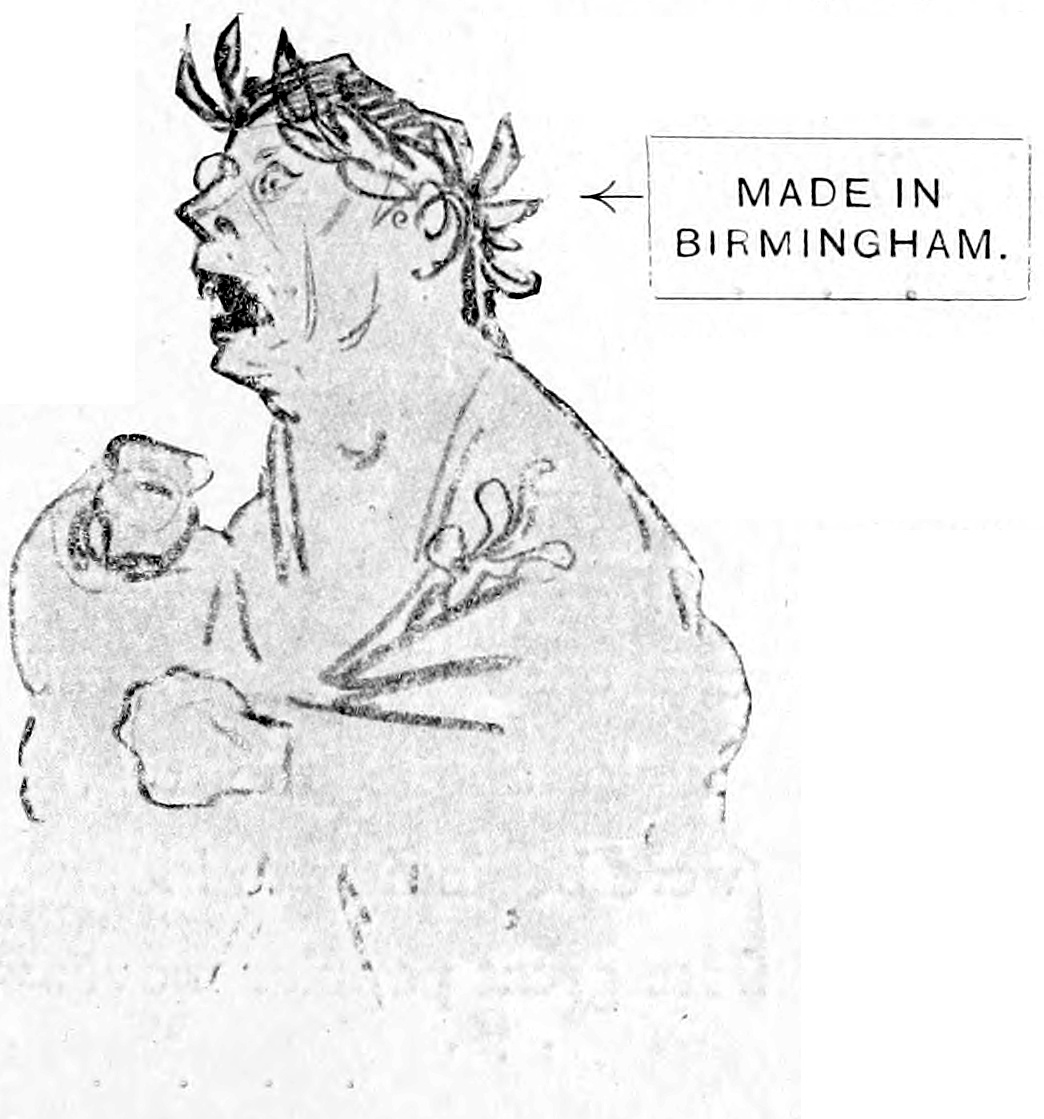
Mr. Chamberlain then disappeared through a little door to robe
himself as a Roman Emperor, in which character he proposed to address
the pageant.
On reaching the Horse Guards’
Parade an enormous crowd was discovered
stretching as far as the eye could reach,
but leaving between themselves and the grand
stand a space, through which could defile
the procession which had been arranged.
At precisely fifteen minutes to six Mr.
Chamberlain rose to address the crowd,
and by a fine conception the brass band,
the flags, and the various contingents
of the procession began marching past at the same time.
It was perhaps on this account that his speech was not very clearly
heard. The opening sentence, however, rang high and clear: “I shall
detain you,” he said, “for but a very few moments.” What followed
was drowned in a blast of trumpets preceding the arrival of⸺
A dozen miserable Unionist Free Traders. The unhappy men
were gagged and driven forward, with their hands tied behind their
backs, by a convoy of voters from Birmingham, arranged in blocks
of five, and bearing banners ornamented with mottoes in their own
dialect.
In the short interval following their passage, several of Mr.
Chamberlain’s sentences could be plainly heard:
“I will tell the truth ... that has ever been ...
Imperial race ... one united....”
At this moment the contingent of National Scouts, cheering
wildly and galloping past the saluting point, drowned the master’s voice.
When the dust they had raised had somewhat fallen, his stern,
impassive features were once more discernible, and a few more
sentences could be caught above the din, though with increasing
difficulty, as the mob were beginning to indulge in that loud horse-play
which is inseparable from great popular movements.
“He was not often mistaken.... They could not point to
any opinion which he had ... and which had not been....”
Though it was evident from the considerable distension of his
mouth that the Great Statesman was still making history, nothing
more could be heard: every word was swallowed up, as it were, in the
increasing enthusiasm of the crowd.
An effigy of Mr. Winston Churchill, stuffed with straw, was
dragged past the grand stand amid hoots and jeers, and finally burnt
at the stake in the open space near the Duke of York’s steps.
Fifty-seven enormous vans, drawn by twelve strong horses each,
and loaded to the height of at least forty feet with pamphlets and small
handbooks, received perhaps a greater ovation than any other section
of the procession, until, at its close,
and, as though to emphasize that
unity among all our fellow subjects,
which has been the object of
Mr. Chamberlain’s
life, a number of Kaffirs,
dressed as nearly as
possible in the manner
of the British working
man, appeared on
the extreme right, and
marched past with colours flying.
When the approaching tramp and order of these brave men
fell upon their ears, the crowd could no longer restrain themselves.
Loud shouts of “Tweebosch!” and the names of other well-fought
fields whereon they had fought and bled for us, rose from the
three educated men who were to be discovered in that vast assembly.
As the legion passed the stand itself, and turned eyes right to the
majestic figure that had enrolled them in the common service of the
Island Race, a great song, of which the words were at first indistinct,
rose spontaneously from various parts of the parade: within a few
seconds half a million undaunted voices were giving forth the great
Song of Empire:
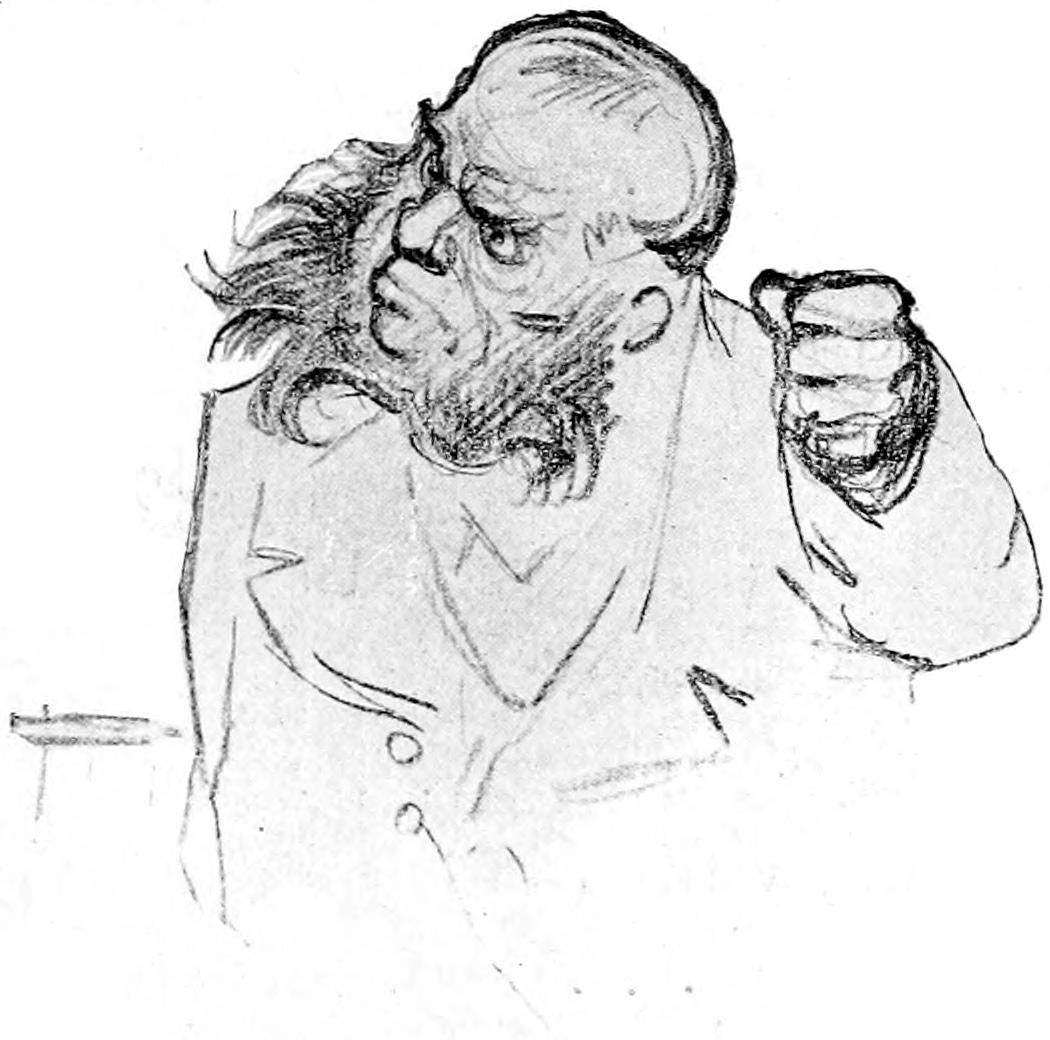
“Whoi carn’t every man ’Ave three woives!”
Spurred by such emotions, the crowd broke through the cordon
which had hitherto been stoutly maintained by a body of Mr. Brodrick’s
recruits, and made a rush for the grand stand; it unfortunately
collapsed under the multitude of those attempting to honour their
leader by a personal embrace. Perhaps no fitter termination could
have been imagined for a scene which marked a turning point in the
history of the Horse Guards’ Parade.
The Colonial Secretary, it need scarcely be added, did not remain
to receive this last testimony to his popularity, but the beginning of the
enthusiastic movement in the crowd was enough to convince him that
he had thousands at his back, and, as Napoleon is reported to have
said to his coachman after Waterloo, “With such numbers behind him
a man should be capable of all things.”
REPORT OF THE COMMITTEE — Footnotes — Transcriber’s Notes
APPOINTED TO
SIT HARD UPON
THE FISCAL CONDITIONS
OF THE
MOTHERLAND.
Made to the Cabinet in Full Session, crowned, robed, and
regardant, and ordered to be enrolled among
the Imperial Archives
Under the Great Seal, the Privy Seal, and the Mace
Statuant.
Your Committee—
Did first consider whether they should pursue the course of
stating their reasons before their conclusions; or, secondly, their conclusions
before their reasons; or, thirdly, their reasons only; or,
fourthly, their conclusions only; or, fifthly, a sort of rhodomontade in
which there should be neither reasons nor conclusions, as is the more
common practice. Your Committee divided upon each of these
questions, when it appeared that—
The first course was rejected unanimously. The second course was rejected by acclamation. The third course was rejected by inspiration. The fourth course was rejected by infatuation. The fifth course was rejected by error.
It having thus arrived, in the heat of the moment, that Your
Committee had by accident rejected all courses, and had nothing left to
go upon—there being no precedent for such a misadventure—
Your Committee
Thereupon decided to begin de novo et ab ovo, and there was
drawn up by
Your Committee, with the aid of an expert prose-writer, a
majority report, in the following tenor:—
SECTION I.Your Committee are of opinion, after hearing
all the evidence presented to them, that—
The Empire cannot go on like this. It is amply proved that not
only Great Britain and Ireland, but the Colonies also, are
and have been for many years increasing in wealth, population,
and power, to the grave detriment of the Christian Virtues
of Humility and Holy Dread. It is further proved beyond
cavil that the cheapness of goods of all kinds has enabled
the mass of the population to live riotously, has destroyed
thrift, impaired industry, and even threatened that Sobriety
which had hitherto been the chief mark of our race.
SECTION II. There is, however,
another side of the picture.
Not only Great
Britain and Ireland, but
the Colonies also, are on
the verge of bankruptcy;
their population is for
the most part starving;
in many districts, notably in Lancashire, the Isle of Thanet,
Manitoba, and the Wagga-Muri country, N.S.W., the wretched
populace subsist on grass like beasts of the field, and have lost
all semblance of human form. Even the wealthy classes have felt the
pinch. Three furnished houses in South Audley Street are untenanted,
and it has been necessary to provide out-door relief for the clergy.
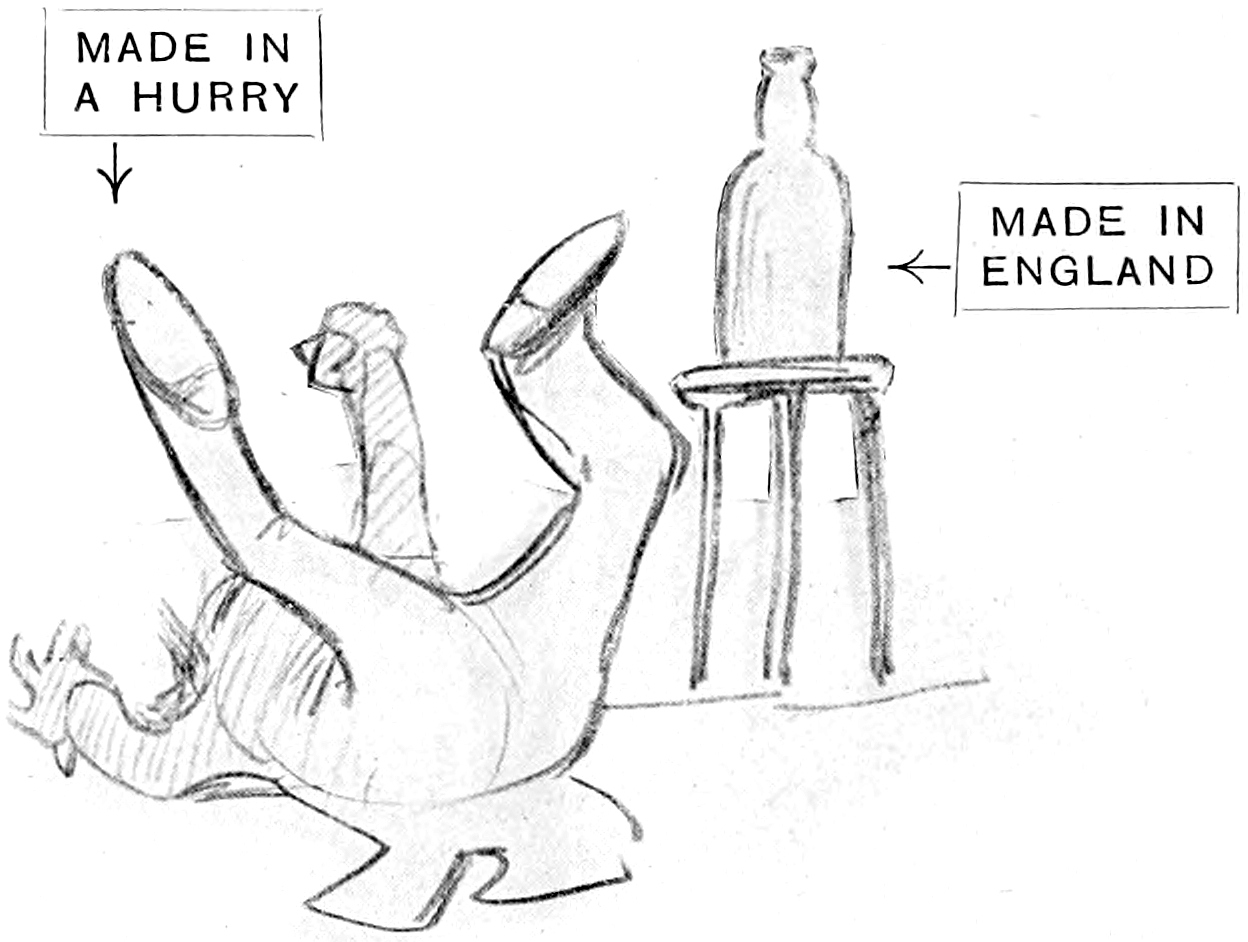
MADE IN POOR OLD KENT.
SECTION III. Gold has accumulated so rapidly of late years
as at once to clog the main channels of business, and to make men
lose all sense of the value of the precious metal. An increase of five
million pounds a year in the circulating medium of the country cannot
be regarded without alarm. Innumerable 10s. bits are carelessly
mistaken for sixpences. Whole sovereigns are dropped in cabs, and
capitalists of great prominence allow vast sums to be withdrawn by
fraud from their balances at the banks. The precious metals are used
in making cigarette cases, medals, and statuettes, and are even
wantonly wasted upon objects of superstition in the churches.
All these evils undoubtedly proceed
from what Professor
Macfadden has called “The
Plethora of Gold.”
SECTION IV. Meanwhile
there is
an awful and hitherto
irresistible
drain of gold from
every port in
the kingdom.
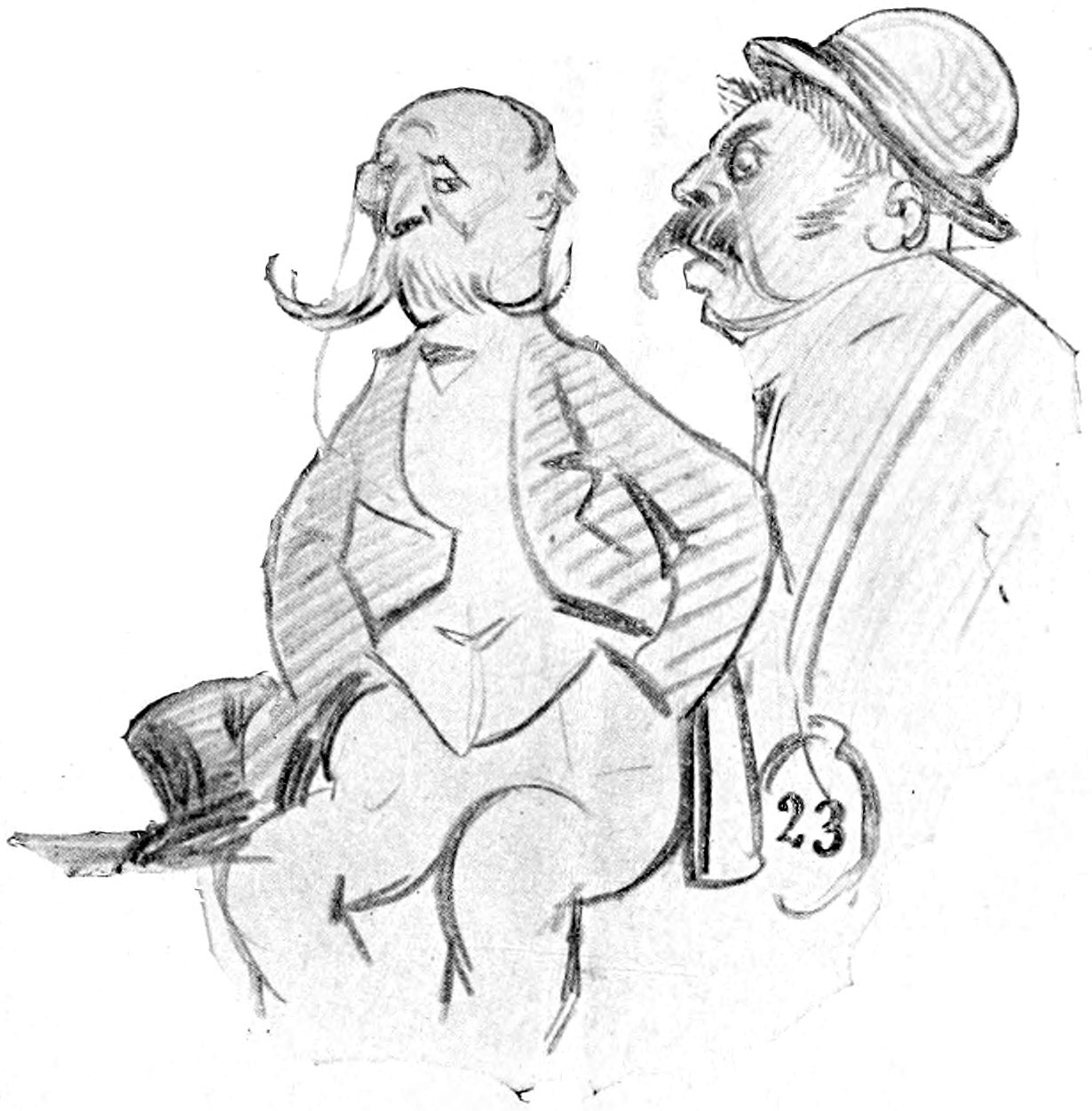
Most of our population, even those betraying every outward sign of
prosperity, say that “they do not know where to turn for money.”
The young men at our universities are all of them deeply in debt, and
even the old men are often pretty dicky.
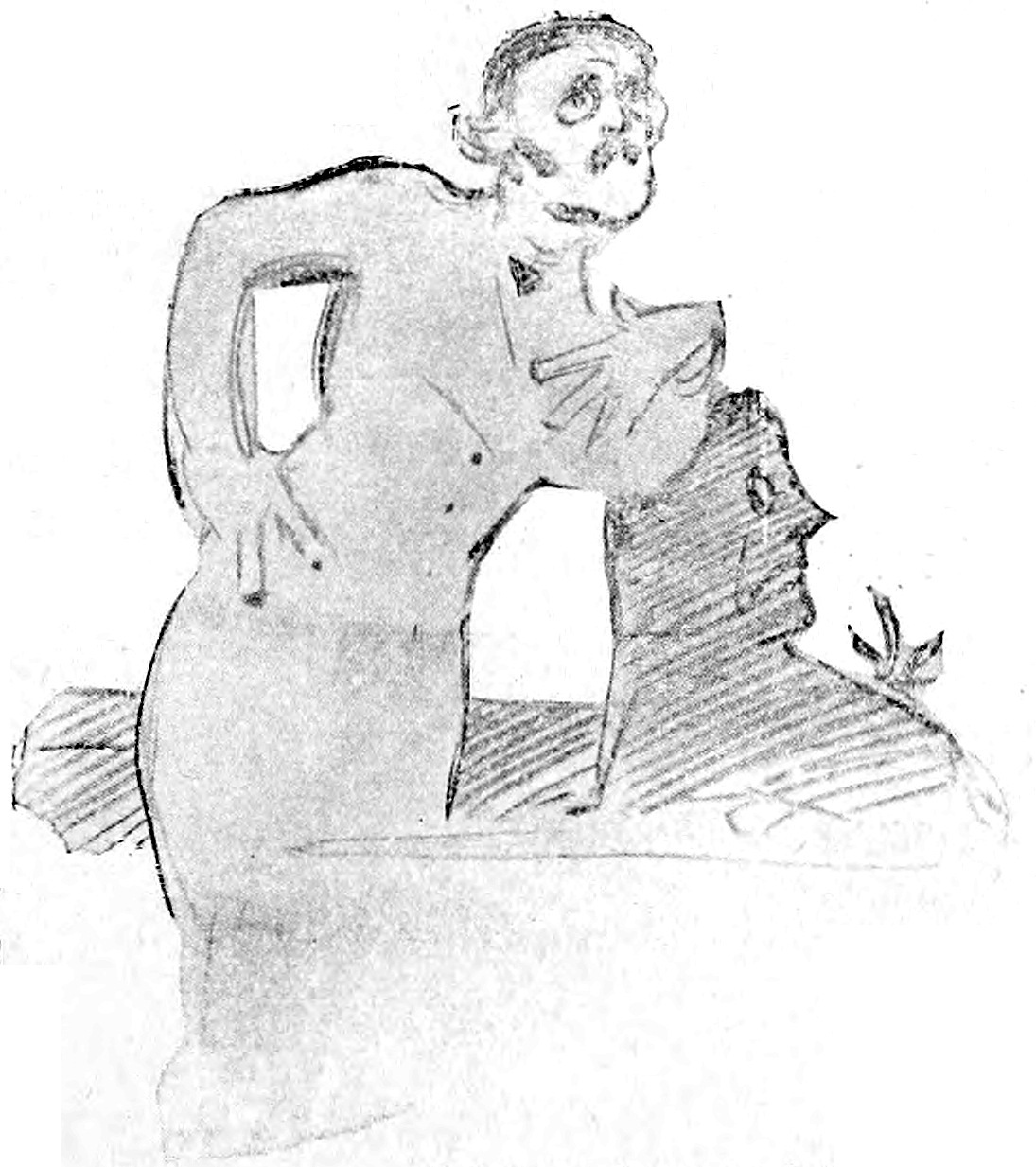
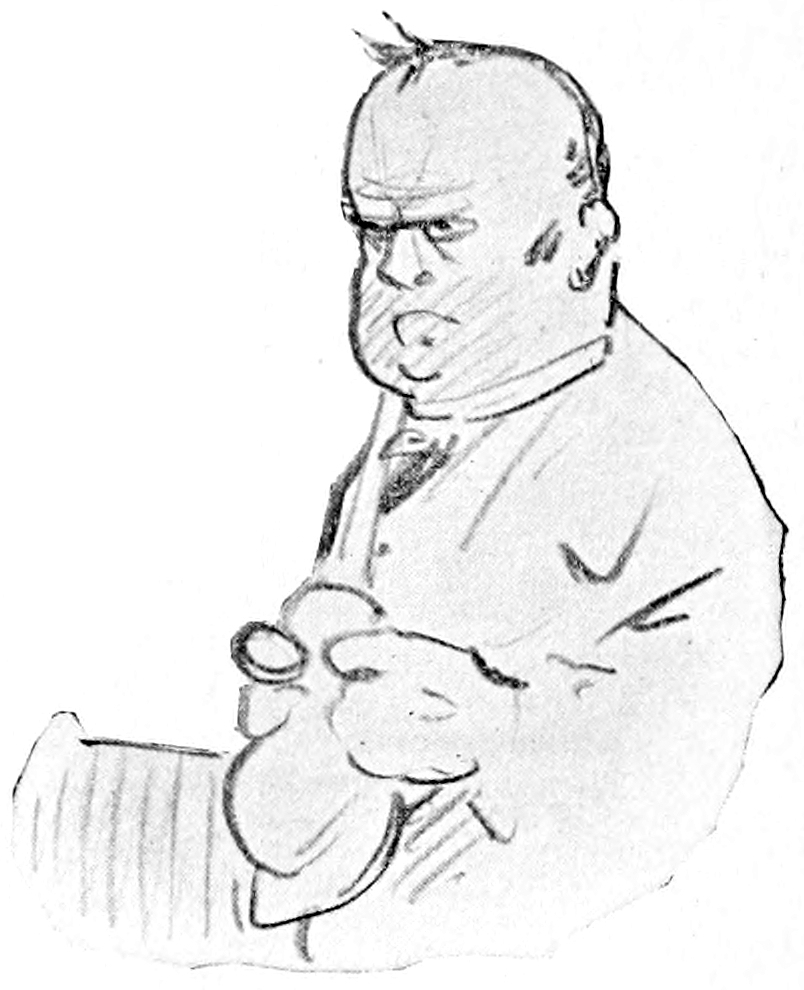
“The young men are all of them deeply in debt, and even the old
men are often pretty dicky.”
Four Colonial loans have failed during the year.
Mr. Seddon informs us that
a paltry reward offered him by a
grateful nation had to be raised in
no less than five instalments. Indeed,
he was for a long time
most anxious about the fifth.
It is extremely difficult
to get change.
Numerous cases
are on record in which gentlemen
of good birth have found
themselves in omnibuses without
the means to pay their fare.
Some of them have been thrown out with violence.
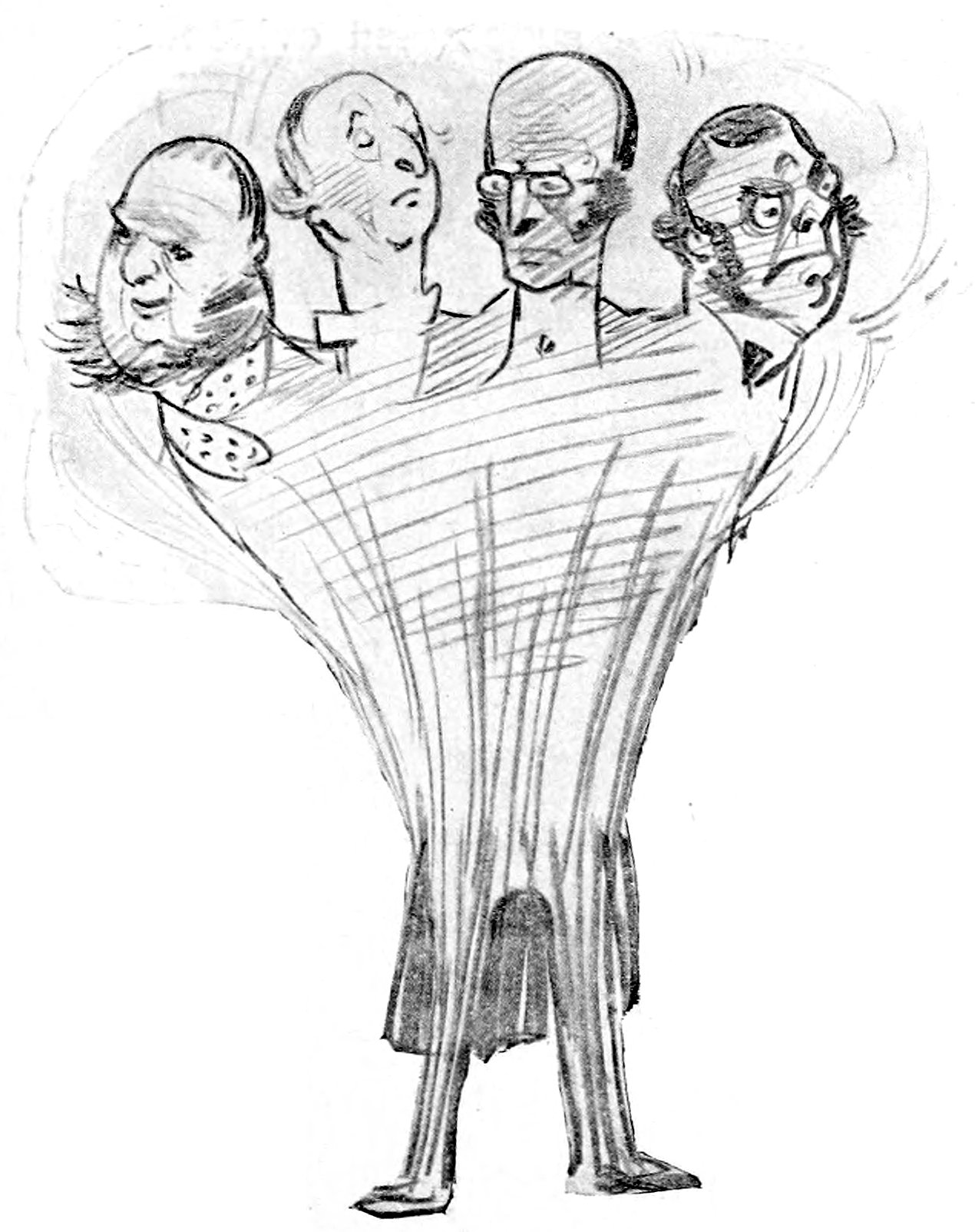
“Gentlemen of good birth”
Short temporary loans, such as could once be negotiated by
friends for nothing, can now only be raised upon ruinous terms—sometimes
as much as 60 per cent.—from total strangers.
Paper is everywhere creeping in in the place of metal, in the
shape of cheques, bank-notes, stamps, I.O.U.s, and dunning letters:
a state of affairs rather worthy of Spain than of a Race which has
spread its language over half the new world.
All these evils are most undoubtedly caused by the drain of gold.
SECTION V.
Foreign nations, in a
fit of madness, are
perpetually forcing presents
upon us, to the
ruin of our legitimate
trade. Patriots who
attempt to refuse these
gifts are met by threats.
A well-known alderman,
of Peckham,
who persistently bought English wine in preference to foreign trash,
has recently died in torment under the suspicion of poison.
A promising young clerk and poet, known as Balmy Jim, who
dressed exclusively in clothes of his own manufacture, has been discovered
hanging to a tree in Richmond Park.
The Rev. Charles Henty, Fellow of St. Barnabas, who broke a
lot of glass in Kew Gardens to encourage English glazing, has been
incarcerated.
SECTION VI. No less than fourteen professors of political
economy have pointed out, in a very able manifesto, that they differ
from some of the most remarkable of our politicians upon fiscal matters.
This alone should show the intense interest aroused by the whole
question, and the absurdity of pretending that an inquiry was not
demanded.
SECTION VII. We are informed by our colleagues that they
have been scurrilously attacked by no less than fourteen pedants,
whom they believe to be in the pay of foreign powers. This is not
the kind of accusation that can be proved or disproved. It suffices to
show the importance of the issues before us.
SECTION VIII. The Editors of the Daily Mail, of the
Spectator, of the Standard, and so forth, have suddenly turned nasty
against the Editors of the Times, the Daily Express, the Globe, and
what not, whoever they may be. This alone should show, &c., &c.
SECTION IX. The Duke of Devonshire has made some
most irritating remarks, so has Sir John Gorst. This alone, &c., &c.
Your Committee are, therefore, totally unable to make up their
minds what on earth should be done.
It is quite impossible to decide.
They are on the horns of a dilemma.
They are in the utmost perturbation.
They heartily wish you had not asked them to undertake this task.
And Your Commissioners will ever pray, &c.
PRINTED BY R. FOLKARD AND SON,
22, DEVONSHIRE STREET, QUEEN SQUARE,
BLOOMSBURY, LONDON, W.C.