In the reign of Queen Anne (1702-1713), the roads throughout England
were still of the worst description, and the ponderous carriages of the
nobility demanded great strength and weight in the animals which drew
them; and thus we now find the Shire Horse in demand as a carriage
horse. The Queen’s state coach was drawn by long-tailed Shire mares; and
the stage coaches which since 1670 had opened regular communication
between London and the most important towns in the kingdom were we need
not doubt, drawn by horses of a heavy, massive type; for until the end
of the century, when McAdam introduced the system of road making known
by his name, no team of lighter horses would have been equal to the
work. The value and importance of the Shire horse therefore in no wise
decreased when the abolition of armour enabled our ancestors to employ a
lighter stamp of cavalry trooper.
The London Evening Post, of September 24th to 27th, 1737, contains
notice of a race which shows that endeavours were made to encourage the
breeding of active cart horses. It runs as follows:—
“To be run for on Finchley Common, in the county of Middlesex, on
Tuesday the 4th of October next, a Set of Lating Bells and Whip,
for five Horses, by Carthorses that constantly go in a Team, and to
be rid by the Carter that did constantly drive the Team; to ride
bareback’d, with the Bit-Halter and his own Cart-Whip; to run two
miles at a Heat, the best of three Heats, and to pay three
shillings entrance, and no less than five to start, and enter the
day of running between the Hours of Eight and Two, at the place
above-mentioned; the first Horse to have the Bells, and the second
the Whip.”
Here is the advertisement of another race of somewhat similar character
which, in spite of the element of jocularity in the conditions, would
help to stimulate the interest taken by carters in their charges. This
is taken from the London Evening Post, of September 4th to 6th,
1739:—
“On the Wash, near Newbury, in Berkshire, on Friday, the 22nd of
September, 1739, will be run for, a set of Cart Harness with Bells,
for five Horses (given by the Most Honourable the Marquess of
Carnarvon), by any Horse, Mare, or Gelding that shall be 15 hands
high at the least, and has been train’d to the Cart only, and in
that way continued to be used. None but Carters to ride, and to
ride with Bell Halters, long Cart Whips, in Straw Boots and
Carter’s Frocks, and without saddles; and all Riders to change
their Horses, &c. (mares or geldings), before starting at the
Starting-Post, and no Man to ride his own Horse (mare or gelding),
&c., the Horse (mare or gelding) &c., that comes in last to win the
Prize. And if any Dispute shall arise about the Change of Horses,
starting, running, &c., the same to be determined by the said
Marquis, his deputy, or deputies, and 2s. 6d. will be given by the
said Marquiss to each Rider.”
Marshall in his Rural Economy of Norfolk, published 1795, describes
the road races in which “the lead was the goal contended for:” in his
time this dangerous amusement, as he justly considered it, had been “a
good deal laid aside though not entirely left off.” The gist of
Marshall’s account has been given in a former little work.[B]
From Heavy Horses (No. 3 of Messrs. Vinton’s Live Stock Handbooks
Series), we take the following interesting passage which shows the value
set upon good Shires, by their owners in the middle of the eighteenth
century:
“Only within the last year or so there went over to the great
majority ... an old stud groom, whose grandfather in his day was at
the head of a famous stud owned by people of the name of Gallemore,
who for generations had a celebrated Shire stud within two miles of
Calwich Abbey. At the time when Prince Charlie marched on Derby in
the famous ’45 this old retainer was forced to take refuge from the
invaders and place the stallions of this stud in a place of safety.
This he successfully did.”
The fear lest these animals should be appropriated by the invader
reminds us of the similar state of affairs three hundred years
previously, when the Wars of the Roses created a demand for horses which
private owners took extreme measures to avoid satisfying at their own
expense (pages 19-20).
This excerpt also furnishes us with a link between past and present; for
volume i. of the Shire Horse Stud Book contains mention of several of
the original Derbyshire stallions named Gallemore, which were no doubt
called after their owners. The stud referred to was stabled at Croxden
Abbey—“and from its courtyard the horses went forth into hiding. Though
it cannot be stated as an absolute fact, all the evidence points to the
famous Packington Blind Horse having been begotten at this same place”
(Ibid., p. 16).
The direct descendants of the Packington Blind Horse (believed to have
been in his full vigour from 1755 to 1770) are traced down to the year
1832.
It is certain that this breed, for which War Horse, Great Horse, Old
English Black Horse or Shire Horse are terms used at different periods
has been distributed for centuries through the district between the
Humber and the Cam, occupying the rich fen lands of Lincolnshire and
Cambridgeshire, and extending westward through the counties of
Huntingdon, Northampton, Leicester, Nottingham, Derby, Norwich and
Stafford, on to the Severn. It has also been extensively bred in the
low-lying pasture lands of England, in the counties both north and south
of those named, everywhere retaining its typical character subject to
slight variations produced by differences of climate, soil and food.
When Arthur Young, in the latter part of the last century, was
describing his tours through the counties of England and Scotland, he
mentions only two varieties of Cart Horse as deserving attention,
namely, the Large Black Old English Horse, “the produce principally of
the Shire counties in the heart of England and the Sorrel-coloured
Suffolk Punch for which the sandy tract of country near Woodbridge is
famous.”
The writer’s use of the word “Shire” will be remarked; we cannot doubt
but that a breed of horses whose home was in these counties would have
been known in other localities as “Shire Horses,” like the “Norfolk
Trotter” and “Suffolk Punch,” and at a later date the “Clydesdale;” the
only difference being that the Shire was
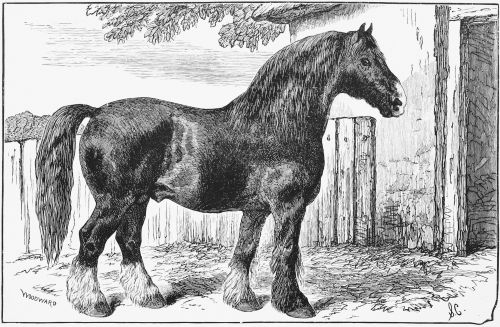
NORFOLK CART HORSE, DODMAN. Foaled 1780. After the
Picture by Woodward.
distributed over a larger breeding area, which therefore furnished him
with a less strictly local name. Arthur Young, it will also be observed,
describes the breed as the “Large Black Old English Horse,” a name
which, as we have seen, had been in current use since at least the time
of Oliver Cromwell. The Eastern counties breed was known and described
as the Black Lincolnshire Horse. Black and grey, as Mr. Reynolds points
out, were held to indicate purity of breeding.
We have now reached a period when painters of animal pictures were
sometimes commissioned to execute portraits of fine examples of horses,
cattle and sheep. The engraving which faces this page is from a picture
by Mr. Woodward of a Norfolk Cart Horse called Dodman (East Anglian for
“Snail”), of whose pedigree unfortunately no particulars exist, but
which was foaled in the year 1780. This horse was the property of an
ancestor of Anthony Hamond, Esq., and the portrait is preserved at his
family seat in the parish of Westacre near Brandon. The long hair-lock
hanging from the knee arrests the eye; this appendage, like a moustache
on the upper lip and a hair lock projecting from the back of the hock,
is regarded as the distinguishing mark of a strain or variety of the
Shire. Dodman seems to have been used as a stallion in the district
whence was obtained, nearly a century later, Honest Tom (1105), whose
portrait faces page 60.
Our next engraving is from a picture by George Morland, which was
probably painted at about the same date as that of Dodman. That artist,
between 1790 and 1795, went into hiding in Leicestershire to escape from
his creditors; he took up his abode in the neighbourhood of Mr.
Bakewell’s famous Dishley Farm; and the horse portrayed resembles in no
small degree pictures of some of Mr. Bakewell’s stud, which at that
period had attained its highest repute. It is therefore exceedingly
likely that this represents a typical Leicestershire Cart Horse of the
time. It belongs to a type differing in some respects from Dodman, being
longer in the body, finer about the head and lacking the hair-lock in
front of the knee, while the mane, tail, and feathering on the legs are
less profuse. These two portraits afford opportunity of comparing two
varieties of the Shire, the Fenland and the Leicestershire.
The Sporting Magazine of 1796 contains an article headed “Operations
on British
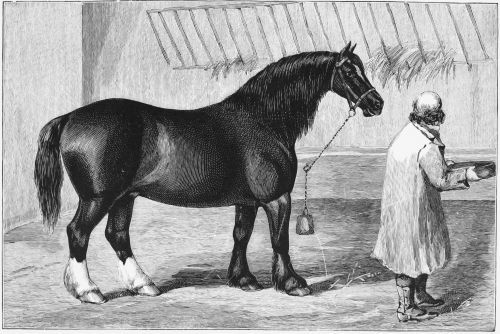
A LEICESTER SHIRE HORSE (1790-1795); after the Picture by
George Morland.
Horses,” in which the following passage occurs:—
“We have a large and strong breed in the more fertile and luxuriant
parts of the island; and there is no country can bring a parallel
to the strength and size of our horses destined for the draught, as
there are instances of single horses that are able to draw the
weight of three tons.”
The roads in England had been vastly improved since Holinshed described
the drawing powers of a team of horses in the latter half of the
sixteenth century; but we cannot doubt that the horse itself had also
improved, more especially during the eighteenth century when the Great
Horse was gradually becoming the servant of the farmer rather than that
of the soldier. The Statutes to which reference has been made
unquestionably did much to promote the building up of the Great Horse
breed and establish it as national; the counties and districts
enumerated in 32 of Henry VIII. quoted on p. 24 show very clearly how
wide was the area over which the breed was distributed three and a half
centuries ago; and it would be superfluous to lay stress upon the
increase of the area over which the Shire horse has been bred since that
remote day.
It would seem that the action which our forefathers sought to develop in
the Great Horse was still characteristic, in some degree at least, of
the Shire at the end of the last century; this engraving, published at
the time, shows a horse named Elephant, whose portrait was painted in
1792 by an artist whose name is unknown. An inscription on the frame
tells us that this horse was “supposed to be one of the most boney
horses ever seen;” at four years old he “is said to have stood 16’2” and
to have girthed 8 feet, while he measured round the knee-joint 16½
inches. He was plainly a horse of great muscular development and big
bone, while his attitude suggests the activity and spirit that
distinguished the War Horse from which he was descended.
From one of Garrard’s pictures now hanging in the Council Room of the
Shire Horse Society, we take our engraving of this gelding which was in
use at Whitehead’s Brewery in 1792, and was therefore a contemporary of
the horse painted by George Morland, and of Elephant. This picture
served as an illustration in Garrard’s series of engravings of British
Farm Stock. It is the likeness of an excellent horse—“type perfect,
flat bone, with good hocks, pasterns and feet.” Apparently this is a
fen-bred horse; a chestnut with the white face and
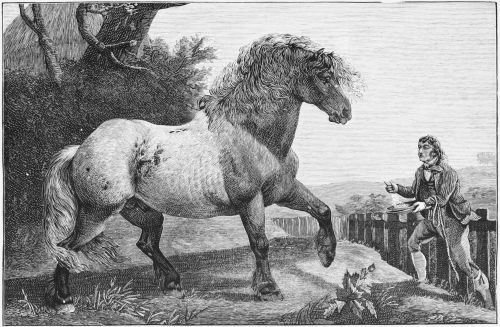
SHIRE HORSE, ELEPHANT (about 1792).
PORTRAIT OF A SHIRE GELDING IN USE AT MESSRS. WHITBREAD’S
BREWERY IN 1792; after the Picture by Geo. Garrard, A.R.A.
markings which we have, of late years, learned to associate with the
stock of the Rutlandshire Champions. High prices were paid for Shires in
the last quarter of the eighteenth century. Mr. Hambleton of Callon Moor
sold to Mr. Summerland in 1778 a brown stallion for 350 guineas; and in
1791 a two-year-old stallion named Marston was sold by Mr. Handley for
500 guineas; these would be good prices for pedigree stock at the
present day.
It is worth adding to the portraits of Shire Horses foaled during the
last decades of the eighteenth century one more showing a pair whose
colour betrays them as belonging to a variety closely allied to that
last noticed. The picture facing page 58 shows two horses named Pirate
and Outlaw, and was painted in 1810 by an artist named J. C. Zeitter;
the owner of the work was Mr. Andrew McCullum, and it was engraved by J.
Egan.
These particulars we obtain from an inscription on the frame of the
work, which is our only source of information. Having an eye to the
accessories in the background, we infer that Pirate and Outlaw were,
like Garrard’s horse, the property of a brewer; both before and after
this period views of well-known breweries were favourite subjects with
some of our best animal painters, who found excellent reason for their
preference in the magnificent teams of dray horses of which private
firms were so proud. The ownership of, and work performed by, these
horses, are however of no special importance; the interest of the
picture, apart from the substance and strength of the animals, lies in
the colour. This curious parti-colour is by no means uncommon in the
Shires reared in the Fen country; in the middle of the present century
Mr. Colvin, of Pishobury, Sawbridgeworth, Hertfordshire, had a breed of
Shire piebalds on his Home Farm. Mr. Charles Marsters, of Saddlebow,
King’s Lynn, Norfolk, possessed a celebrated stallion, “England’s
Wonder,” foaled in 1871; this horse was the sire of good animals, but
many of them horses of odd colours. To this day there is a tendency to
breed animals with white legs, white markings and odd colours.