It has seldom happened that the story of one man was
essentially the history of a great movement and of an epoch
in human progress. In the case of Luther, a large part of
the world regards his name as a historic epitome. The monk
whose "words were half-battles," and whom Carlyle chose for
his hero-priest, was chief among the reformers, and in the
general view stands for the Reformation itself.
But recognition of Luther's dominating position and
representative character should not leave us blind to other
factors in the religious revolution which was also an
evolution, the achievement not of one man, but of advancing
generations with many leaders. Luther had great helpers in
his own time and great successors. He also had great
predecessors. The Reformation was the religious development
of the Renaissance; it had been heralded by Wycliffe, Huss,
and Savonarola, and there were many minor prophets of a
reformed church before the great German was born.
Luther's Reformation was a revolt against the power and
abuses of the Roman Catholic Church. It was directed against
certain doctrines as well as certain practices, and
especially against evils in the spiritual and temporal
government of the Church.
All the reformers aimed at freeing themselves from
oppressive rule at Rome, and endeavored to establish a purer
faith. The appeal to private judgment as against
unquestioning belief was a natural result of the revival of
learning as well as of spiritual quickening.
Before Luther's time, however, such revolts against church
authority had been quickly suppressed. It is also true that
many abuses had been done away by reformation within the
Church itself; and that, indeed, was what Luther at first
intended. His movement became "too powerful to be put down,
and its leaders soon passed beyond the point at which they
were willing to reform the Church from within. Finding that
the Church would not respond as quickly and as fully to
their demands as they wished, they left the Church and
attacked it from without." In Germany the administration of
the Church had long caused discontent. Through Martin Luther
this feeling found powerful utterance, and in him the demand
for reforms became irresistibly urgent.
Luther, the son of a poor miner, was born at Eisleben,
Saxony, November 10, 1483. He became an Augustinian monk,
in 1507 was consecrated a priest, and the next year was made
professor of philosophy in the University of Wittenberg. In
1511 he visited Rome, and on his return to Wittenberg was
made doctor of theology. He had already become known through
the power and independence of his preaching. Although he
went to Rome "an insane papist," as he said, and while he
was still intensely devoted to the Church and its leaders,
he made known his belief in what became the fundamental
doctrines of Protestantism, exclusive authority of the
Bible—implying the right of private judgment—and
justification by faith.
The immediate occasion of Luther's first great protest was
the sale of indulgences by the Dominican monk John Tetzel.
From early times the church authorities had granted
indulgences or remissions of penances imposed on persons
guilty of mortal sins, the condition being true penitence.
At length the Church began to accept money, not in lieu of
penitence, but of the customary penances which usually
accompanied it. Before 1517 Luther had given warnings
against the abuse of indulgences, without blaming the
administration of the Church. But when in that year Tetzel
approached the borders of Saxony selling indulgences in the
name of the Pope, Leo X, who wanted money for the building
of St. Peter's Church in Rome, Luther, with many of the
better minds of Germany, was greatly offended by the
vender's methods. Against the course of Tetzel Luther took a
firm stand, and when the reformer posted his theses
(summarized by Koestlin) on the church door at Wittenberg
the first great movement of the Reformation in the sixteenth
century was inaugurated.
In accordance with the impartial plan of the present work
regarding the treatment of controverted matters, it is here
sought to satisfy the historic sense, which includes the
sense of justice, by giving a presentation of each view of
the story—the Protestant by Koestlin, the Catholic by Jean
M. V. Audin, whose Life of Luther has been called the
"tribunal" before which the great reformer must be summoned
for his answer.
Luther longed now to make known to theologians and ecclesiastics
generally his thoughts about indulgences, his own principles, his own
opinions and doubts, to excite public discussion on the subject, and to
awake and maintain the fray. This he did by the ninety-five Latin theses
or propositions which he posted on the doors of the Castle Church at
Wittenberg on October 31, 1517, the eve of All Saints' Day and of the
anniversary of the consecration of the church.
These theses were intended as a challenge for disputation. Such public
disputations were then very common at the universities and among
theologians, and they were meant to serve as means not only of
exercising learned thought, but of elucidating the truth. Luther headed
his theses as follows:
"Disputation to Explain the Virtue of Indulgences.—In charity, and in
the endeavor to bring the truth to light, a disputation on the following
propositions will be held at Wittenberg, presided over by the Reverend
Father Martin Luther. Those who are unable to attend personally may
discuss the question with us by letter. In the name of our Lord Jesus
Christ. Amen."
It was in accordance with the general custom of that time that, on the
occasion of a high festival, particular acts and announcements, and
likewise disputations at a university, were arranged, and the doors of a
collegiate church were used for posting such notices.
The contents of these theses show that their author really had such a
disputation in view. He was resolved to defend with all his might
certain fundamental truths to which he firmly adhered. Some points he
considered still within the region of dispute; it was his wish and
object to make these clear to himself by arguing about them with others.
Recognizing the connection between the system of indulgences and the
view of penance entertained by the Church, he starts with considering
the nature of true Christian repentance; but he would have this
understood in the sense and spirit taught by Christ and the Scriptures.
He begins with the thesis: "Our Lord and Master Jesus Christ, when he
says repent, desires that the whole life of the believer should be one
of repentance." He means, as the subsequent theses express it, that true
inward repentance, that sorrow for sin and hatred of one's own sinful
self, from which must proceed good works and mortification of the sinful
flesh. The pope could only remit his sin to the penitent so far as to
declare that God had forgiven it.
Thus then the theses expressly declare that God forgives no man his sin
without making him submit himself in humility to the priest who
represents him, and that he recognizes the punishments enjoined by the
Church in her outward sacrament of penance. But Luther's leading
principles are consistently opposed to the customary announcements of
indulgences by the Church. The pope, he holds, can only grant
indulgences for what the pope and the law of the Church have imposed;
nay, the pope himself means absolution from these obligations only, when
he promises absolution from all punishment. And it is only the living
against whom those punishments are directed which the Church's
discipline of penance enjoins; nothing, according to her own laws, can
be imposed upon those in another world.
Further on Luther declares: "When true repentance is awakened in a man,
full absolution from punishment and sin comes to him without any letters
of indulgence." At the same time he says that such a man would willingly
undergo self-imposed chastisement, nay, he would even seek and love it.
Still, it is not the indulgences themselves, if understood in the right
sense, that he wishes to be attacked, but the loose babble of those who
sold them. Blessed, he says, be he who protests against this, but cursed
be he who speaks against the truth of apostolic indulgences. He finds it
difficult, however, to praise these to the people, and at the same time
to teach them the true repentance of the heart. He would have them even
taught that a Christian would do better by giving money to the poor than
by spending it in buying indulgences, and that he who allows a poor man
near him to starve draws down on himself, not indulgences, but the wrath
of God. In sharp and scornful language he denounces the iniquitous
trader in indulgences, and gives the Pope credit for the same abhorrence
for the traffic that he felt himself. Christians must be told, he says,
that, if the Pope only knew of it, he would rather see St. Peter's
Church in ashes than have it built with the flesh and bones of his
sheep.
Agreeably with what the preceding theses had said about the true
penitent's earnestness and willingness to suffer, and the temptation
offered to a mere carnal sense of security, Luther concludes as follows:
"Away therefore with all those prophets who say to Christ's people
'Peace, peace!' when there is no peace, but welcome to all those who bid
them seek the Cross of Christ, not the cross which bears the papal arms.
Christians must be admonished to follow Christ their Master through
torture, death, and hell, and thus through much tribulation, rather
than, by a carnal feeling of false security, hope to enter the kingdom
of heaven."
The Catholics objected to this doctrine of salvation advanced by Luther
that, by trusting to God's free mercy, and by undervaluing good works,
it led to moral indolence. But, on the contrary, it was to the very
unbending moral earnestness of a Christian conscience, which, indignant
at the temptations offered to moral frivolity, to a deceitful feeling of
ease in respect to sin and guilt, and to a contempt of the fruits of
true morality, rebelled against the false value attached to this
indulgence money, that these theses, the germ, so to speak, of the
Reformation, owed their origin and prosecution. With the same
earnestness he now for the first time publicly attacked the
ecclesiastical power of the papacy, in so far namely as, in his
conviction, it invaded the territory reserved to himself by the heavenly
Lord and Judge. This was what the Pope and his theologians and
ecclesiastics could least of all endure.
On the same day that these theses were published, Luther sent a copy of
them with a letter to the archbishop Albert, his "revered and gracious
lord and shepherd in Christ." After a humble introduction, he begged him
most earnestly to prevent the scandalizing and iniquitous harangues with
which his agents hawked about their indulgences, and reminded him that
he would have to give an account of the souls intrusted to his episcopal
care.
The next day he addressed himself to the people from the pulpit in a
sermon he had to preach on the festival of All Saints. After exhorting
them to seek their salvation in God and Christ alone, and to let the
consecration by the Church become a real consecration of the heart, he
went on to tell them plainly, with regard to indulgences, that he could
only absolve from duties imposed by the Church, and that they dare not
rely on him for more, nor delay on his account the duties of true
repentance.
Theologians before Luther, and with far more acuteness and penetration
than he showed in his theses, had already assailed the whole system of
indulgences. And, in regard to any idea on Luther's part of the effects
of his theses extending widely in Germany, it may be noticed that not
only were they composed in Latin, but that they dealt largely with
scholastic expressions and ideas, which a layman would find it difficult
to understand.
Nevertheless the theses created a sensation which far surpassed Luther's
expectations. In fourteen days, as he tells us, they ran through the
whole of Germany, and were immediately translated and circulated in
German. They found, indeed, the soil already prepared for them, through
the indignation long since and generally aroused by the shameless doings
they attacked; though till then nobody, as Luther expresses it, had
liked to bell the cat, nobody had dared to expose himself to the
blasphemous clamor of the indulgence-mongers and the monks who were in
league with them, still less to the threatened charge of heresy. On the
other hand, the very impunity with which this traffic in indulgences had
been maintained throughout German Christendom had served to increase
from day to day the audacity of its promoters.
The task that Luther had now undertaken lay heavy upon his soul. He was
sincerely anxious, while fighting for the truth, to remain at peace with
his Church, and to serve her by the struggle. Pope Leo, on the contrary,
as was consistent with his whole character, treated the matter at first
very lightly, and, when it threatened to become dangerous, thought only
how, by means of his papal power, to make the restless German monk
harmless.
Two expressions of his in these early days of the contest are recorded.
"Brother Martin," he said, "is a man of a very fine genius, and this
outbreak the mere squabble of envious monks;" and again, "It is a
drunken German who has written the theses; he will think differently
about them when sober." Three months after the theses had appeared, he
ordered the vicar-general of the Augustinians to "quiet down the man,"
hoping still to extinguish easily the flame. The next step was to
institute a tribunal for heretics at Rome for Luther's trial; what its
judgment would be was patent from the fact that the single theologian of
learning among the judges was Sylvester Prierias. Before this tribunal
Luther was cited on August 7th; within sixty days he was to appear there
at Rome. Friend and foe could well feel certain that they would look in
vain for his return.
Papal influence, meanwhile, had been brought to bear on the elector
Frederick[25] to induce him not to take the part of Luther, and the
chief agent chosen for working on the Elector and the emperor Maximilian
was the papal legate, Cardinal Thomas Vio of Gaeta, called Cajetan, who
had made his appearance in Germany. The University of Wittenberg, on the
other hand, interposed on behalf of their member, whose theology was
popular there, and whose biblical lectures attracted crowds of
enthusiastic hearers. He had just been joined at Wittenberg by his
fellow-professor Philip Melanchthon, then only twenty-one years old, but
already in the first rank of Greek scholars, and the bond of friendship
was now formed which lasted through their lives. The university claimed
that Luther should at least be tried in Germany. Luther expressed the
same wish through Spalatin[26] to his sovereign.
The Pope meanwhile had passed from his previous state of haughty
complacency to one of violent haste. Already, on August 23d, thus long
before the sixty days had expired, he demanded the Elector to deliver up
this "child of the devil," who boasted of his protection, to the legate,
to bring away with him. This is clearly shown by two private briefs from
the Pope, of August 23d and 25th, the one addressed to the legate, the
other to the head of all the Augustinian convents in Saxony, as
distinguished from the vicar of those congregations, Staupitz, who
already was looked on with suspicion at Rome. These briefs instructed
both men to hasten the arrest of the heretic; his adherents were to be
secured with him, and every place where he was tolerated laid under the
interdict.
In the summer of 1518 a diet was held at Augsburg at which the papal
legate attended. The Pope was anxious to obtain its consent to the
imposition of a heavy tax throughout the empire, to be applied
ostensibly for the war against the Turks, but alleged to be wanted in
reality for entirely other objects. The demand for a tax, however, was
received with the utmost disfavor both by the diet and the empire; and a
long-cherished bitterness of feeling now found expression. An anonymous
pamphlet was circulated, from the pen of one Fischer, a prebendary of
Wuerzburg, which bluntly declared that the avaricious lords of Rome only
wished to cheat the "drunken Germans," and that the real Turks were to
be looked for in Italy. This pamphlet reached Wittenberg and fell into
the hands of Luther, whom now for the first time we hear denouncing
"Roman cunning," though he only charged the Pope himself with allowing
his grasping Florentine relations to deceive him.
The diet seized the opportunity offered by this demand for a tax, to
bring up a whole list of old grievances; the large sums drawn from
German benefices by the Pope under the name of annates, or extorted
under other pretexts; the illegal usurpation of ecclesiastical patronage
in Germany; the constant infringement of concordats, and so on. The
demand itself was refused; and in addition to this, an address was
presented to the diet from the bishop and clergy of Liège, inveighing
against the lying, thieving, avaricious conduct of the Romish minions,
in such sharp and violent tones that Luther, on reading it afterward
when printed, thought it only a hoax, and not really an episcopal
remonstrance.
This was reason enough why Cajetan, to avoid increasing the excitement,
should not attempt to lay hands on the Wittenberg opponent of
indulgences. The elector Frederick, from whose hands Cajetan would have
to demand Luther, was one of the most powerful and personally respected
princes of the empire, and his influence was especially important in
view of the election of a new emperor. This Prince went now in person to
Cajetan on Luther's behalf, and Cajetan promised him, at the very time
that the brief was on its way to him from Rome, that he would hear
Luther at Augsburg, treat him with fatherly kindness, and let him depart
in safety.
Luther accordingly was sent to Augsburg. It was an anxious time for
himself and his friends when he had to leave for that distant place,
where the Elector, with all his care, could not employ any physical
means for his protection, and to stand accused as a heretic before that
papal legate who, from his own theological principles, was bound to
condemn him. "My thoughts on the way," said Luther afterward, "were now
I must die; and I often lamented the disgrace I should be to my dear
parents."
He went thither in humble garb and manner. He made his way on foot till
within a short distance of Augsburg, when illness and weakness overcame
him, and he was forced to proceed by carriage. Another younger monk of
Wittenberg accompanied him, his pupil Leonard Baier. At Nuremberg he was
joined by his friend Link, who held an appointment there as preacher.
From him he borrowed a monk's frock, his own being too bad for Augsburg.
He arrived here on October 7th.
The surroundings he now entered, and the proceedings impending over him,
were wholly novel and unaccustomed. But he met with men who received him
with kindness and consideration; several of them were gentlemen of
Augsburg favorable to him, especially the respected patrician, Dr.
Conrad Peutinger, and two counsellors of the Elector. They advised him
to behave with prudence, and to observe carefully all the necessary
forms to which as yet he was a stranger.
Luther at once announced his arrival to Cajetan, who was anxious to
receive him without delay. His friends, however, kept him back until
they had obtained a written safe-conduct from the Emperor, who was then
hunting in the environs. In the mean time a distinguished friend of
Cajetan, one Urbanus of Serralonga, tried to persuade him, in a flippant
and, as Luther thought, a downright Italian manner, to come forward and
simply pronounce six letters—"Revoco" ("I retract"). Urbanus asked
him with a smile if he thought his sovereign would risk his country for
his sake. "God forbid!" answered Luther. "Where then do you mean to take
refuge?" he went on to ask him. "Under heaven," was Luther's reply.
On October 11th Luther received the letter of safe-conduct, and the next
day he appeared before Cajetan. Humbly, as he had been advised, he
prostrated himself before the representative of the Pope, who received
him graciously and bade him rise.
The Cardinal addressed him civilly and with a courtesy Luther was not
accustomed to meet with from his opponents; but he immediately demanded
him, in the name and by command of the Pope, to retract his errors, and
promise in future to abstain from them and from everything that might
disturb the peace of the Church. He pointed out, in particular, two
errors in his theses; namely, that the Church's treasure of indulgences
did not consist of the merits of Christ, and that faith on the part of
the recipient was necessary for the efficacy of the sacrament. With
respect to the second point, the religious principles upon which Luther
based his doctrine were altogether strange and unintelligible to the
scholastic standpoint of Cajetan; mere tittering and laughter followed
Luther's observations, and he was required to retract this thesis
unconditionally. The first point settled the question of papal
authority. The Cardinal-legate could not believe that Luther would
venture to resist a papal bull, and thought he had probably not read it.
He read him a vigorous lecture of his own on the paramount authority of
the pope over council, Church, and Scripture. As to any argument,
however, about the theses to be retracted, Cajetan refused from the
first to engage in it, and undoubtedly he went further in that direction
than he originally desired or intended. His sole wish was, as he said,
to give fatherly correction, and with fatherly friendliness to arrange
the matter. But in reality, says Luther, it was a blunt, naked,
unyielding display of power. Luther could only beg from him further time
for consideration.
Luther's friends at Augsburg, and Staupitz, who had just arrived there,
now attempted to divert the course of these proceedings, to collect
other decisions of importance bearing on the subject, and to give him
the opportunity of a public vindication. Accompanied therefore by
several jurists friendly to his cause, and by a notary and Staupitz, he
laid before the legate next day a short and formal statement of defence.
He could not retract unless convicted of error, and to all that he had
said he must hold as being Catholic truth. Nevertheless he was only
human, and therefore fallible, and he was willing to submit to a
legitimate decision of the Church. He offered, at the same time,
publicly to justify his theses, and he was ready to hear the judgment of
the learned doctors of Basel, Freiburg, Louvain, and even Paris upon
them. Cajetan with a smile dismissed Luther and his proposals, but
consented to receive a more detailed reply in writing to the principal
points discussed the previous day.
On the morrow, October 14th, Luther brought his reply to the legate. But
in this document also he insisted clearly and resolutely from the
commencement on those very principles which his opponents regarded as
destructive of all ecclesiastical authority and of the foundations of
Christian belief. Still he entreated Cajetan to intercede with Leo X,
that the latter might not harshly thrust out into darkness his soul,
which was seeking for the light. But he repeated that he could do
nothing against his conscience: one must obey God rather than man, and
he had the fullest confidence that he had Scripture on his side.
Cajetan, to whom he delivered this reply in person, once more tried to
persuade him. They fell into a lively and vehement argument; but Cajetan
cut it short with the exclamation, "Revoke." In the event of Luther not
revoking or submitting to judgment at Rome, he threatened him and all
his friends with excommunication, and whatever place he might go to with
an interdict; he had a mandate from the Pope to that effect already in
his hands. He then dismissed him with the words, "Revoke, or do not come
again into my presence." Nevertheless he spoke in quite a friendly
manner after this to Staupitz, urging him to try his best to convert
Luther, whom he wished well. Luther, however, wrote the same day to his
friend Spalatin, who was with the Elector, and to his friends at
Wittenberg, telling them he had refused to yield. Luther added further
that an appeal would be drawn up for him in the form best fitted to the
occasion. He further hinted to his Wittenberg friends at the possibility
of his having to go elsewhere in exile; indeed, his friends already
thought of taking him to Paris, where the university still rejected the
doctrine of papal absolutism. He concluded this letter by saying that he
refused to become a heretic by denying that which had made him a
Christian; sooner than do that, he would be burned, exiled, or cursed.
The appeal, of which Luther here spoke, was "from the Pope ill-informed
to the same when better informed." On October 16th he submitted it,
formally prepared, to a public notary.
Luther even addressed, on October 17th, a letter to Cajetan, conceding
to him the utmost he thought possible. Moved, as he said, by the
persuasions of his dear father Staupitz and his brother Link, he offered
to let the whole question of indulgences rest, if only that which drove
him to this tragedy were put a stop to; he confessed also to having been
too violent and disrespectful in dispute. In after-years he said to his
friends, when referring to this concession, that God had never allowed
him to sink deeper than when he had yielded so much. The next day,
however, he gave notice of his appeal to the legate, and told him he did
not wish longer to waste his time in Augsburg. To this letter he
received no answer.
Luther waited, however, till the 20th. He and his Augsburg patrons began
to suspect whether measures had not already been taken to detain him.
They therefore had a small gate in the city wall opened in the night,
and sent with him an escort well acquainted with the road. Thus he
hastened away, as he himself described it, on a hard-trotting hack, in a
simple monk's frock, with only knee-breeches, without boots or spurs,
and unarmed. On the first day he rode eight miles, as far as the little
town of Monheim. As he entered in the evening an inn and dismounted in
the stable, he was unable to stand from fatigue and fell down instantly
among the straw. He travelled thus on horseback to Wittenberg, where he
arrived, well and joyful, on the anniversary of his ninety-five theses.
He had heard on the way of the Pope's brief to Cajetan, but he refused
to think it could be genuine. His appeal, meanwhile, was delivered to
the Cardinal at Augsburg, who had it posted by his notary on the doors
of the cathedral.
Without waiting for an answer direct from Rome, Luther now abandoned all
thoughts of success with Leo X. On November 28th he formally and
solemnly appealed from the Pope to a general Christian council. By so
doing he anticipated the sentence of excommunication which he was daily
expecting. With Rome he had broken forever, unless she were to surrender
her claims and acquisitions of more than a thousand years.
After once the first restraints of awe were removed with which Luther
had regarded the papacy, behind and beyond the matter of the
indulgences, and he had learned to know the papal representative at
Augsburg, and made a stand against his demands and menaces, and escaped
from his dangerous clutches, he enjoyed for the first time the fearless
consciousness of freedom. He took a wider survey around him, and saw
plainly the deep corruption and ungodliness of the powers arrayed
against him. His mind was impelled forward with more energy as his
spirit for the fight was stirred within him. Even the prospect that he
might have to fly, and the uncertainty whither his flight could be, did
not daunt or deter him.
He was really prepared for exile or flight at any moment. At Wittenberg
his friends were alarmed by rumors of designs on the part of the Pope
against his life and liberty, and insisted on his being placed in
safety. Flight to France was continually talked of; had he not followed
in his appeal a precedent set by the University of Paris? We certainly
cannot see how he could safely have been conveyed thither, or where,
indeed, any other and safer place could have been found for him. Some
urged that the Elector himself should take him into custody and keep him
in a place of safety, and then write to the legate that he held him
securely in confinement and was in future responsible for him. Luther
proposed this to Spalatin, and added: "I leave the decision of this
matter to your discretion; I am in the hands of God and of my friends."
The Elector himself, anxious also in this respect, arranged early in
December a confidential interview between Luther and Spalatin at the
castle of Lichtenberg. He also, as Luther reported to Staupitz, wished
that Luther had some other place to be in, but he advised him against
going away so hastily to France. His own wish and counsel, however, he
refrained as yet from making known. Luther declared that at all events,
if a ban of excommunication were to come from Rome, he would not remain
longer at Wittenberg. On this point also the Prince kept secret his
resolve.
At Rome the bull of excommunication was published as early as June 16th.
It had been considered very carefully in the papal consistory. The
jurists there were of opinion that Luther should be cited once more, but
their views did not prevail. The bull begins with the words, "Arise, O
Lord, and avenge thy cause." It proceeds to invoke St. Peter, St. Paul,
the whole body of the saints, and the Church. A wild boar had broken
into the vineyard of the Lord, a wild beast was there seeking to devour,
etc. Of the heresy against which it was directed, the Pope, as he
states, had additional reason to complain, since the Germans, among whom
it had broken out, had always been regarded by him with such tender
affection: he gives them to understand that they owed the empire to the
Roman Church. Forty-one propositions from Luther's writings are then
rejected and condemned as heretical, or at least scandalous and
corrupting, and his works collectively are sentenced to be burned. As to
Luther himself, the Pope calls God to witness that he has neglected no
means of fatherly love to bring him into the right way. Even now he is
ready to follow toward him the example of divine mercy which wills not
the death of a sinner, but that he should be converted and live; and so
once more he calls upon him to repent, in which case he will receive him
graciously like the prodigal son. Sixty days are given him to recant.
But if he and his adherents will not repent, they are to be regarded as
obstinate heretics and withered branches of the vine of Christ, and must
be punished according to law. No doubt the punishment of burning was
meant; the bull in fact expressly condemns the proposition of Luther
which denounces the burning of heretics. All this was called then at
Rome, and has been called even latterly by the papal party, "the tone
rather of fatherly sorrow than of penal severity."
The emperor Charles V, before leaving the Netherlands on his journey to
Aix-la-Chapelle to be crowned (1520),[27] had already been induced to
take his first step against Luther. He had consented to the execution of
the sentence in the bull condemning Luther's works to be burned, and had
issued orders to that effect throughout the Netherlands. They were
burned in public at Louvain, Cologne, and Mainz. At Cologne this was
done while he was staying there. It was in this town that the two
legates approached the elector Frederick with the demand to have the
same done in his territory, and to execute due punishment on the heretic
himself, or at least to keep him close prisoner or to deliver him over
to the Pope. Frederick, however, refused, saying that Luther must first
be heard by impartial judges. Erasmus also, who was then staying at
Cologne, expressed himself to the same effect, in an opinion obtained
from him by Frederick through Spalatin. At an interview with the
Elector he said to him: "Luther has committed two great faults: he has
touched the Pope on his crown and the monks on their bellies." The
burning of Luther's books at Mainz was effected without hinderance, and
the legates in triumph proceeded to carry out their mission elsewhere.
Luther, however, lost no time in following up their execution of the
bull with his reply. On December 10th he posted a public announcement
that the next morning, at nine o'clock, the anti-Christian decretals,
that is, the papal law-books, would be burned, and he invited all the
Wittenberg students to attend. He chose for this purpose a spot in front
of the Elster gate, to the east of the town, near the Augustinian
convent. A multitude poured forth to the scene. With Luther appeared a
number of other doctors and masters, and among them Melanchthon and
Carlstadt. After one of the masters of art had built up a pile, Luther
laid the decretals upon it, and the former applied the fire. Luther then
threw the papal bull into the flames, with the words, "Because thou hast
vexed the Holy One of the Lord,[28] let the everlasting fire consume
thee." While Luther with the other teachers returned to the town, some
hundreds of students remained upon the scene and sang a Te Deum, and a
Dirge for the decretals. After the ten o'clock meal, some of the young
students, grotesquely attired, drove through the town in a large
carriage, with a banner, emblazoned with a bull, four yards in length,
amid the blowing of brass trumpets and other absurdities. They collected
from all quarters a mass of scholastic and papal writings, and hastened
with them and the bull to the pile, which their companions had meanwhile
kept alight. Another Te Deum was then sung, with a requiem, and the
hymn, "O du armer Judas."
Luther at his lecture the next day told his hearers with great
earnestness and emotion what he had done. The papal chair, he said,
would yet have to be burned. Unless with all their hearts they abjured
the kingdom of the pope, they could not obtain salvation.
By this bold act, Luther consummated his final rupture with the papal
system, which for centuries had dominated the Christian world and had
identified itself with Christianity. The news of it must also have made
the fire which his words had kindled throughout Germany blaze out in all
its violence. He saw now, as he wrote to Staupitz, a storm raging, such
as only the last day could allay, so fiercely were passions aroused on
both sides. Germany was then, in fact, in a state of excitement and
tension more critical than at any other period of her history.
The announcement of the retractation required from Luther by the bull
was to have been sent to Rome within one hundred twenty days. Luther had
given his answer. The Pope declared that the time of grace had expired;
and on January 3d Leo X finally pronounced the ban against Luther and
his followers, and an interdict on the places where they were harbored.
Never did the most momentous issue in the fortunes of the German nation
and church rest so entirely with one man as they did now with the
Emperor. Everything depended on this whether he, as head of the empire,
should take the great work in hand, or should fling his authority and
might into the opposite scale. Charles had been welcomed in Germany as
one whose youthful heart seemed likely to respond to the newly awakened
life and aspirations, as the son of an old German princely family, who
by his election as emperor had won a triumph over the foreign king
Francis, supported though the latter was by the Pope. Rumor now alleged
that he was in the hands of the Mendicant friars; the Franciscan Glapio
was his confessor and influential adviser, the very man who had
instigated the burning of Luther's works.
He was, however, by no means so dependent on those about him as might
have been supposed. His counsellors, in the general interests of his
government, pursued an independent line of policy, and Charles himself,
even in these his youthful days, knew to assert his independence as a
monarch and display his cleverness as a statesman. He saw the prudence
of cultivating friendship and contracting if possible an alliance with
the Pope. The pressure desirable for this purpose could now be supplied
by means of the very danger with which the papacy was threatened by the
great German heresy, and against which Rome so sorely needed the aid of
a temporal power. At the same time, Charles was far too astute to allow
his regard for the Pope, and his desire for the unity of the Church, to
entangle his policy in measures for which his own power was inadequate,
or by which his authority might be shaken and possibly destroyed.
Strengthened as was his monarchical power in Spain, in Germany he found
it hemmed in and fettered by the estates of the empire and the whole
contexture of political relations.
Such were the main points of view which determined for Charles V his
conduct toward Luther and his cause. Luther thus was at least a passive
sharer in the game of high policy, ecclesiastical and temporal, now
being played, and had to pursue his own course accordingly.
The imperial court was quickly enough acquainted with the state of
feeling in Germany. The Emperor showed himself prudent at this juncture,
and accessible to opinions differing from his own, however small cause
his proclamations gave to the friends of Luther to hope for any positive
act of favor on his part.
While Charles was on his way up the Rhine to hold, at the beginning of
the new year, a diet at Worms, the elector Frederick approached him with
the request that Luther should at least be heard before the Emperor took
any proceedings against him. The Emperor informed him in reply that he
might bring Luther for this purpose to Worms, promising that the monk
should not be molested.
The Emperor, on March 6th, issued a citation to Luther, summoning him to
Worms to give "information concerning his doctrines and books." An
imperial herald was sent to conduct him. In the event of his disobeying
the citation, or refusing to retract, the estates declared their consent
to treat him as an open heretic. Luther, therefore, had to renounce at
once all hope of having the truth touching his articles of faith tested
fairly at Worms by the standard of God's word in Scripture. Spalatin
indicated to him the points on which he would in any case be expected to
make a public recantation.
Luther formed his resolve at once on the two points required of him. He
determined to obey the summons to the diet, and, if there unconvicted of
error, to refuse the recantation demanded. The Emperor's citation was
delivered to him on March 26th by the imperial herald, Kaspar Sturm, who
was to accompany him to Worms. Within twenty-one days after its receipt,
Luther was to appear before the Emperor; he was due therefore at Worms
on April 16th at the latest.
On April 2d, the Tuesday after Easter, he set out on his way to Worms.
His friend Amsdorf and the Pomeranian nobleman Peter Swaven, who was
then studying at Wittenberg, accompanied him. He took with him also,
according to the rules of the order, a brother of the order, John
Pezensteiner. The Wittenberg magistracy provided carriages and horses.
The way led past Leipzig, through Thuringia from Naumburg to Eisenach,
southward past Berka, Hersfeld, Gruenberg, Friedberg, Frankfort, and
Oppenheim. The herald rode on before in his coat-of-arms, and announced
the man whose word had everywhere so mightily stirred the minds of
people, and for whose future behavior and fate friend and foe were alike
anxious. Everywhere people collected to catch a glimpse of him. On April
6th he was very solemnly received at Erfurt. The large majority of the
university there were by this time full of enthusiasm for his cause.
Meanwhile at Worms disquietude and suspense prevailed on both sides.
Hutten[29] from the castle of Ebernburg sent threatening and angry
letters to the papal legates, who became really anxious lest a blow
might be struck from that quarter. Some anxious friends of Luther's were
afraid that, according to papal law, the safe-conduct would not be
observed in the case of a condemned heretic. Spalatin himself sent from
Worms a second warning to Luther after he had left Frankfort, intimating
that he would suffer the fate of Huss.
But Luther continued on his way. To Spalatin he replied, though Huss
were burned, yet the truth was not burned; he would go to Worms though
there were as many devils there as there were tiles on the roofs of the
houses.
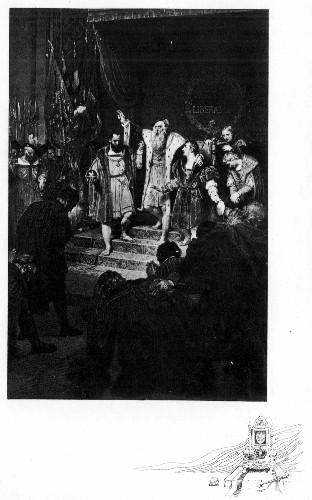
On April 16th, at ten o'clock in the morning, Luther entered Worms. He
sat in an open carriage with his three companions from Wittenberg,
clothed in his monk's habit. He was accompanied by a large number of men
on horseback, some of whom, like Jonas, had joined him earlier in his
journey; others, like some gentlemen belonging to the Elector's court,
had ridden out from Worms to receive him. The imperial herald rode on
before. The watchman blew a horn from the tower of the cathedral on
seeing the procession approach the gate. Thousands streamed hither to
see Luther. The gentlemen of the court escorted him into the house of
the Knights of St. John, where he lodged with two counsellors of the
Elector. As he stepped from his carriage he said, "God will be with me."
Aleander, writing to Rome, said that he looked around with the eyes of a
demon. Crowds of distinguished men, ecclesiastics and laymen, who were
anxious to know him personally, flocked daily to see him.
On the evening of the following day he had to appear before the diet,
which was assembled in the Bishop's palace, the residence of the
Emperor, not far from where Luther was lodging. He was conducted thither
by side streets, it being impossible to get through the crowds assembled
in the main thoroughfare to see him. On his way into the hall where the
diet was assembled, tradition tells us how the famous warrior, George
von Frundsberg, clapped him on the shoulder and said: "My poor monk! my
poor monk! thou art on thy way to make such a stand as I and many of my
knights have never done in our toughest battles. If thou art sure of the
justice of thy cause, then forward in the name of God, and be of good
courage—God will not forsake thee." The Elector had given Luther as his
advocate the lawyer Jerome Schurf, his Wittenberg colleague and friend.
When at length, after waiting two hours, Luther was admitted to the
diet, Eck, the official of the Archbishop of Treves, put to him simply,
in the name of the Emperor, two questions, whether he acknowledged the
books—pointing to them on a bench beside him—to be his own, and next,
whether he would retract their contents or persist in them. Schurf here
exclaimed, "Let the titles of the books be named." Eck then read them
out. Among them there were some merely edifying writings, such as A
Commentary on the Lord's Prayer, which had never been made the subject
of complaint.
Luther was not prepared for this proceeding, and possibly the first
sight of the august assembly made him nervous. He answered in a low
voice, and as if frightened, that the books were his, but that since the
question as to their contents concerned the highest of all things, the
Word of God and the salvation of souls, he must beware of giving a rash
answer, and must therefore humbly entreat further time for
consideration. After a short deliberation the Emperor instructed Eck to
reply that he would, out of his clemency, grant him a respite till the
next day.
So Luther had again, on April 18th, a Thursday, to appear before the
diet. Again he had to wait two hours till six o'clock. He stood there in
the hall among the dense crowd, talking unconstrained and cheerfully
with the ambassador of the diet, Peutinger, his patron at Augsburg.
After he was called in, Eck began by reproaching him for having wanted
time for consideration. He then put the second question to him in a form
more befitting and more conformable with the wishes of the members of
the diet: "Wilt thou defend all the books acknowledged by thee to be
thine, or recant some part?" Luther now answered with firmness and
modesty, in a well-considered speech. He divided his works into three
classes. In some of them he had set forth simple evangelical truths,
professed alike by friend and foe. Those he could on no account retract.
In others he had attacked corrupt laws and doctrines of the papacy,
which no one could deny had miserably vexed and martyred the consciences
of Christians, and had tyrannically devoured the property of the German
nation: if he were to retract these books, he would make himself a cloak
for wickedness and tyranny.
In the third class of his books he had written against individuals who
endeavored to shield that tyranny and to subvert godly doctrine. Against
these he freely confessed that he had been more violent than was
befitting. Yet even these writings it was impossible for him to retract
without lending a hand to tyranny and godlessness. But in defence of his
books he could only say in the words of the Lord Jesus Christ: "If I
have spoken evil, bear witness of the evil; but if well, why smitest
thou me?" If anyone could do so, let him produce his evidence and
confute him from the sacred writings, the Old Testament and the Gospel,
and he would be the first to throw his books into the fire. And now, as
in the course of his speech he had sounded a new challenge to the
papacy, so he concluded by an earnest warning to Emperor and empire,
lest, by endeavoring to promote peace by a condemnation of the divine
Word, they might rather bring a dreadful deluge of evils, and thus give
an unhappy and inauspicious beginning to the reign of the noble young
Emperor. He said not these things as if the great personages who heard
him stood in any need of his admonitions, but because it was a duty that
he owed to his native Germany, and he could not neglect to discharge it.
Luther, like Eck, spoke in Latin, and then, by desire, repeated his
speech with equal firmness in German. Schurf, who was standing by his
side, declared afterward with pride, "how Martin had made this answer
with such bravery and modest candor, with eyes upraised to heaven, that
he and everyone were astonished."
The princes held a short consultation after this harangue. Then Eck,
commissioned by the Emperor, sharply reproved him for having spoken
impertinently and not really answered the question put to him. He
rejected his demand that evidence from Scripture might be brought
against him by declaring that his heresies had already been condemned by
the Church, and in particular by the Council of Constance, and such
judgments must suffice if anything were to be held settled in
Christianity. He promised him, however, if he would retract the
offensive articles, that his other writings should be fairly dealt with,
and finally demanded a plain answer "without horns" to the question
whether he intended to adhere to all he had written or would retract any
part of it?
To this Luther replied he would give an answer "with neither horns nor
teeth." Unless he were refuted by proofs from Scripture, or by evident
reason, his conscience bound him to adhere to the Word of God which he
had quoted in his defence. Popes and councils, as was clear, had often
erred and contradicted themselves. He could not, therefore, and he would
not, retreat anything, for it was neither safe nor honest to act against
one's conscience.
Eck exchanged only a few more words with him in reply to his assertion
that councils had erred. "You cannot prove that," said Eck. "I will
pledge myself to do it," was Luther's answer. Pressed and threatened by
his enemy, he concluded with the famous words: "Here I stand, I can do
no otherwise. God help me. Amen."
The Emperor reluctantly broke up the diet at about eight o'clock in the
evening. Darkness had meanwhile come on; the hall was lighted with
torches, and the audience were in a state of general excitement and
agitation. Luther was led out; whereupon an uproar arose among the
Germans, who thought that he had been taken prisoner. As he stood among
the heated crowd, Duke Erich of Brunswick sent him a silver tankard of
Eimbeck beer, after having first drunk of it himself.
On reaching his lodging, "Luther," to use the words of a Nuremberger
present there, "stretched out his hands, and with a joyful countenance
exclaimed, 'I am through! I am through!'" Spalatin says: "He entered the
lodging so courageous, comforted, and joyful in the Lord that he said
before others and myself, 'if he had a thousand heads, he would rather
have them all cut off than make one recantation.'" He relates also how
the elector Frederick, before his supper, sent for him from Luther's
dwelling, took him into his room and expressed to him his astonishment
and delight at Luther's speech. "How excellently did Father Martin speak
both in Latin and German before the Emperor and the orders! He was bold
enough, if not too much so." The Emperor, on the contrary, had been so
little impressed by Luther's personality, and had understood so little
of it, that he fancied the writings ascribed to him must have been
written by someone else. Many of his Spaniards had pursued Luther, as he
left the diet, with hisses and shouts of scorn.
Luther, by refusing thus point-blank to retract, effectually destroyed
whatever hopes of mediation or reconciliation had been entertained by
the milder and more moderate adherents of the Church who still wished
for reform. Nor was any union possible with those who, while looking to
a truly representative council as the best safeguard against the tyranny
of a pope, were anxious also to obtain at such a council a secure and
final settlement of all questions of Christian faith and morals. It was
these very councils about which Eck purposely called on Luther for a
declaration; and Luther's words on this point might well have been
considered by the Elector as "too bold."
Luther remained faithful to himself. True it was that he had often
formerly spoken of yielding in mere externals, and of the duty of living
in love and harmony, and respecting the weaknesses of others; and his
conduct during the elaboration of his own church system will show us how
well he knew to accommodate himself to the time, and, where perfection
was impossible, to be content with what was imperfect. But the question
here was not about externals, or whether a given proceeding were
judicious or not for the attainment of an object admittedly good. It was
a question of confessing or denying the truth—the highest and holiest
truths, as he expressed it—relating to God and the salvation of man. In
this matter his conscience was bound.
And the trial thus offered for his endurance was not yet over. On the
morning of the 19th the Emperor sent word to the estates that he would
now send Luther back in safety to Wittenberg, but treat him as a
heretic. The majority insisted on attempting further negotiations with
him through a committee specially appointed. These were conducted
accordingly by the Elector of Treves. The friendliness and the visible
interest in his cause with which Luther now was urged were more
calculated to move him than Eck's behavior at the diet. He himself bore
witness afterward how the Archbishop had shown himself more than
gracious to him and would willingly have arranged matters peaceably.
Instead of being urged simply to retract all his propositions condemned
by the Pope, or his writings directed against the papacy, he was
referred in particular to those articles in which he rejected the
decisions of the Council of Constance. He was desired to submit in
confidence to a verdict of the Emperor and the empire when his books
should be submitted to judges beyond suspicion. After that he should at
least accept the decision of a future council, unfettered by any
acknowledgment of the previous sentence of the Pope.
So freely and independently of the Pope did this committee of the German
Diet, including several bishops and Duke George of Saxony, proceed in
negotiating with a papal heretic. But everything was shipwrecked on
Luther's firm reservation that the decision must not be contrary to the
Word of God; and on that question his conscience would not allow him to
renounce the right of judging for himself. After two days'
negotiations, he thus, on April 25th, according to Spalatin, declared
himself to the Archbishop: "Most gracious Lord, I cannot yield; it must
happen with me as God wills," and continued: "I beg of your grace that
you will obtain for me the gracious permission of his imperial majesty
that I may go home again, for I have now been here for ten days and
nothing yet has been effected." Three hours later the Emperor sent word
to Luther that he might return to the place he came from, and should be
given a safe-conduct for twenty-one days, but would not be allowed to
preach on the way.
Free residence, however, and protection at Wittenberg, in case Luther
were condemned by the empire, was more than even Frederick the Wise
would be able to assure him. But he had already laid his plan for the
emergency. Spalatin refers to it in these words: "Now was my most
gracious Lord somewhat disheartened; he was certainly fond of Dr.
Martin, and was also most unwilling to act against the Word of God or to
bring upon himself the displeasure of the Emperor. Accordingly, he
devised means how to get Dr. Martin out of the way for a time, until
matters might be quietly settled, and caused Luther also to be informed,
the evening before he left Worms, of his scheme for getting him out of
the way. At this Dr. Martin, out of deference to his Elector, was
submissively content, though certainly, then and at all times, he would
much rather have gone courageously to the attack."
The very next morning, Friday, the 26th, Luther departed. The imperial
herald went behind him, so as not to attract notice. They took the usual
road to Eisenach. At Friedberg Luther dismissed the herald, giving him a
letter to the Emperor and the estates, in which he defended his conduct
at Worms, and his refusal to trust in the decision of men, by saying
that when God's Word and things eternal were at stake, one's trust and
dependence should be placed, not on one man or many men, but on God
alone. At Hersfeld, where Abbot Crato, in spite of the ban, received him
with all marks of honor, and again at Eisenach, he preached,
notwithstanding the Emperor's prohibition, not daring to let the Word of
God be bound.
From Eisenach, while Swaven, Schurf, and several other of his companions
went straight on, he struck southward, together with Amsdorf and
Brother Pezensteiner, in order to go and see his relations at Moehra.
Here, after spending the night at the house of his uncle Heinz, he
preached the next morning, Saturday, May 4th. Then, accompanied by some
of his relations, he took the road through Schweina, past the castle of
Altenstein, and then across the back of the Thuringian Forest to
Waltershausen and Gotha. Toward evening, when near Altenstein, he bade
leave of his relations. About half an hour farther on, at a spot where
the road enters the wooded heights, and, ascending between hills along a
brook, leads to an old chapel, which even then was in ruins and has now
quite disappeared, armed horsemen attacked the carriage, ordered it to
stop with threats and curses, pulled Luther out of it, and then hurried
him away at full speed. Pezensteiner had run away as soon as he saw them
approach. Amsdorf and the coachman were allowed to pass on; the former
was in the secret, and pretended to be terrified, to avoid any suspicion
on the part of his companion.
The Wartburg[30] lay to the north, about eight miles distant, and had
been the starting-point of the horsemen, as it now was their goal; but
precaution made them ride first in an eastern direction with Luther. The
coachman afterward related how Luther in the haste of the flight dropped
a gray hat he had worn. And now Luther was given a horse to ride. The
night was dark, and at about eleven o'clock they arrived at the stately
castle, situated above Eisenach. Here he was to be kept as a
knight-prisoner. The secret was kept as strictly as possible toward
friend and foe. For many weeks afterward even Frederick's brother John
had no idea of it. Among his friends and followers the terrible news had
spread, immediately upon his capture, that he had been made away with by
his enemies.
At Worms, however, while the Pope was concluding an alliance with
Charles against France, the papal legate Aleander, by commission of the
Emperor, prepared the edict against Luther on the 8th of May. It was
not, however, until the 25th, after Frederick the Elector of the
Palatinate and a great part of the other members of the diet had already
left, that it was deemed advisable to have it communicated to the rest
of the estates; nevertheless it was antedated the 8th, and issued "by
the unanimous advice of the electors and estates." It pronounced upon
Luther, applying the customary strong expressions of papal bulls, the
ban and reban; no one was to receive him any longer, or feed him, etc.,
but wherever he was found he was to be seized and handed over to the
Emperor.
The Reformation was a revolution, and they who rebelled against the
authority of the Church were revolutionists. However slightly you look
into the constitution of the Church, you will be convinced that the
Reformation possessed the character of an insurrection. What is the
meaning of this fine word, Reformation? Amelioration, doubtless. Well,
then, with history before us, it is easy to show that it was only a
prostration of the human mind. Glutted with the wealth of which it
robbed the Catholics, and the blood which it shed, it gives us, instead
of the harmony and Christian love of which it deprived our ancestors,
nothing but dissensions, resentments, and discords. No, the Reformation
was not an era of happiness and peace; it was only established by
confusion and anarchy. Do you feel your heart beat at the mention of
justice and truth? Acknowledge, then, what it is impossible to deny,
that Luther must not be compared with the apostles. The apostles came
teaching in the name of Jesus Christ their master, and the Catholics are
entitled to ask us from whom Luther had his mission. We cannot prove
that he had a mission direct or indirect. Luther perverted Christianity;
he withdrew himself criminally from the communion in which regeneration
alone was possible.
It has been said that all Christendom demanded a reformation—who
disputes it? But long before the time of Luther the papacy had listened
to the complaints of the faithful. The Council of Lateran had been
convened to put an end to the scandals which afflicted the Church. The
papacy labored to restore the discipline of the early ages, in
proportion as Europe, freed from the yoke of brute force, became
politically organized and advanced with slow but sure step to
civilization. Was it not at that time that the source of all religious
truth was made accessible to scientific study, since, by means of the
watchful protection of the papacy, the holy Scriptures were translated
into every language? The New Testament of Erasmus, dedicated to Leo X,
had preceded the quarrel about indulgences.
A reformer should take care that, in his zeal to get rid of manifest
abuses, he does not at the same time shake the faith and its wholesome
institutions to the foundation. When the reformers violently separated
themselves from the Church of Rome, they thought it necessary to reject
every doctrine taught by her. Luther, that spirit of evil, who scattered
gold with dirt, declared war against the institutions without which the
Church could not exist; he destroyed unity. Who does not remember that
exclamation of Melanchthon, "We have committed many errors, and have
made good of evil without any necessity for it"?
In justification of the brutal rupture of Germany with Rome, the
scandals of the clergy are alleged. But if at the period of the
Reformation there were priests and monks in Germany whose conduct was
the cause of regret to Christians, their number was not larger than it
had been previously. When Luther appeared, there was in Germany a great
number of Catholic prelates whose piety the reformers themselves have
not hesitated to admire.
What pains they take to deceive us! In books of every size they teach
us, even at the present day, that the beast, the man of sin, the
creature of Babylon, are the names which God has given in his Scriptures
to the pope and the papacy! Can it be imagined that Christ, who died for
our sins, and saved us by his blood, would have suffered that for ten or
twelve centuries his church should be guided by such an abominable
wretch? that he would have allowed millions of his creatures to walk in
the shadow of death? and that so many generations should have had no
other pastor but Antichrist?
Luther mistook the genius of Christianity in introducing a new principle
into the world—the immediate authority of the Bible as the sole
criterion of the truth. If tradition is to be rejected, it follows that
the Bible cannot be authoritatively explained by acquired knowledge; in
a word, human interpretation based upon its comprehensions of the Greek
and Hebrew languages. So, by this theory, the palladium of orthodoxy is
to be found in a knowledge of foreign tongues, and living authority is
replaced by a dead letter; a slavery a thousand times more oppressive
than the yoke of tradition. Has any dogmatist succeeded in drawing up a
confession of faith by means of the Bible which could not be attacked by
means of reason? This formula, that the Bible must be the "unicum
principium theologiæ," is the source of contradictory doctrines in
Protestant theology; hence this question arises: "What Protestant
theology is there in which there are not errors more or less?" It was
the Bible that inspired all the neologists of the sixteenth century; the
Bible that they made use of to persecute and condemn themselves as
heretics. When Luther maintained that the Bible contains the enunciation
of all the truths of which a knowledge is necessary to salvation, and
that no doctrine which is not distinctly laid down in the Bible can be
regarded as an article of faith, he did not imagine that the time was at
hand when everybody, from this very volume, would form a confession for
himself, and reject all others which contradicted his individual creed.
This necessity for inquiry so occupies the minds of men at the present
day that the principal articles of the original creed are rejected by
those who call themselves the disciples of Jesus.
But what are we to understand by the Bible? The question was a difficult
one to solve even at the beginning of the Reformation, when Luther, in
his preface to the translation of the Bible, laid down a difference
between the canonical books by preferring the gospel of St. John to the
three other evangelists; by depreciating the Epistle of St. James as an
epistle of straw, that contained nothing of the Gospel in it, and which
an apostle could not have written, since it attributes to works a merit
which they did not possess. It was in the Bible that Luther discovered
these two great truths of salvation, which he revealed to the world at
the beginning of his apostleship—the slavery of man's will, and the
impeccability of the believer.
It is said in Exodus, chapter ix, that God hardened the heart of
Pharaoh. It was questioned whether these words were to be construed
literally. This Erasmus rightly denied, and it roused the doctor's
wrath. Luther, in his reply, furiously attacks the fools who, calling
reason to their aid, dare call for an account from God why he condemns
or predestines to damnation innocent beings before they have even seen
the light. Truly, Luther, in the eyes of all God's creatures, must
appear a prodigy of daring when he ventures to maintain that no one can
reach heaven unless he adopts the slavery of the human will. And it is
not merely by the spirit of disputation, but by settled conviction, that
he defends this most odious of all ideas. He lived and died teaching
that horrible doctrine, which the most illustrious of his
disciples—among others, Melanchthon and Matthew Albert of
Reutlingen—condemned. "How rich is the Christian!" repeated Luther;
"even though he wished it, he cannot forfeit heaven by any stain;
believe, then, and be assured of your salvation: God in eternity cannot
escape you. Believe, and you shall be saved: repentance, confession,
satisfaction, good works, all these are useless for salvation; it is
sufficient to have faith."
Is not this a fearful error—a desolating doctrine? If you demonstrate
to Luther its danger or absurdity, he replies that you blaspheme the
Spirit of light. Neither attempt to prove to him that he is mistaken; he
will tell you that you offend God. No, no, my brother, you will never
convince me that the Holy Spirit is confined to Wittenberg any more than
to your person.
Not content with maledictions, Luther then turns himself to prophecy; he
announces that his doctrine, which proceeds from heaven, will gain, one
by one, all the kingdoms of the world. He says of Zwingli's explanation
of the eucharist, "I am not afraid of this fanatical interpretation
lasting long." On the other hand Zwingli predicted that the Swiss creed
would be handed down from generation to generation, crossing the Elbe
and the Rhine. Prophet against prophet, if success be the test of truth,
Luther will inevitably have to yield in this point.
The Reformation, which at first was entirely a religious phenomenon,
soon assumed a political character; it could not fail to do so. When
people began to exclaim, like Luther, on the house-tops: "The Emperor
Charles V ought not to be supported longer; let him and the Pope be
knocked on the head;" that "he is an excited madman, a bloodhound, who
must be killed with pikes and clubs," how could civil society continue
subject to authority? It was natural that the monk's virulent writings
against the bishops' spiritual power should be reduced by the subjects
of the ecclesiastical superiors into a political theory. When he
proclaimed that the yoke of priests and monks must be shaken off, we
might expect that this wild appeal would be directed against the tithes
which the people paid to the prelates and the abbots. The Saxon's
doctrine being based wholly on the holy Scriptures, the peasant
considered himself authorized in virtue of their text to break violently
with his lord; hence that long war between the cottage and the castle.
This it was that made Erasmus write sorrowfully to Luther: "You see that
we are now reaping the fruits of what you sowed. You will not
acknowledge the rebels; but they acknowledge you, and they know only too
well that many of your disciples, who clothed themselves in the mantle
of the Gospel, have been the instigators of this bloody rebellion. In
your pamphlet against the peasants, you in vain endeavor to justify
yourself. It is you who have raised the storm by your publications
against the monks and the prelates, and you say that you fight for
gospel liberty, and against the tyranny of the great! From the moment
that you began your tragedy I foresaw the end of it."
That civil war, in which Germany had to mourn the loss of more than a
hundred thousand of her children, was the consequence of Luther's
preaching. It is fortunate that, through the efforts of a Catholic
prince, Duke George of Saxony, it was speedily brought to an end. Had it
lasted but a few years longer, of all the ancient monuments with which
Germany was filled, not a single vestige would have remained. Karlstadt
might then have sat upon their ruins, and sung, with his Bible in his
hand, the downfall of the images. The iconoclast's theories, all drawn
from the Word of God, held their ground in spite of Luther, and dealt a
fatal blow to the arts.
When a gorgeous worship requires magnificent temples, imposing
ceremonies, and striking solemnities; when religion presents to the eye
sensible images as objects of public veneration; when earth and heaven
are peopled with supernatural beings, to whom imagination can lend a
sensible form—then it is that the arts, encouraged and ennobled, reach
the zenith of their splendor and perfection. The architect, raised to
honors and fortune, conceives the plans of those basilicas and
cathedrals whose aspect strikes us with religious awe, and whose richly
adorned walls are ornamented with the finest efforts of art. Those
temples and altars are decorated with marbles and precious metals, which
sculpture has fashioned into the similitude of angels, saints, and the
images of illustrious men. The choirs, the jubes, the chapels, and
sacristies are hung with pictures on all sides. Here Jesus expires on
the cross; there he is transfigured on Mount Tabor. Art, the friend of
imagination, which delights only in heaven, finds there the most sublime
creations—a St. John, a Cecilia, above all a Mary, that patroness of
tender hearts, that virgin model to all mothers, that mediatrix of
graces, placed between man and his God, that august and amiable being,
of whom no other religion presents either the resemblance or the model.
During the solemnities, the most costly stuffs, precious stones, and
embroidery cover the altars, vessels, priests, and even the very walls
of the sanctuary. Music completes the charm by the most exquisite
strains, by the harmony of the choir. These powerful incentives are
repeated in a hundred different places; the metropolises, parishes, the
numerous religious houses, the simple oratories, sparkle with emulation
to captivate all the powers of the religious and devout mind. Thus a
taste for the arts becomes general by means of so potent a lever, and
artists increase in number and rivalry. Under this influence the
celebrated schools of Italy and Flanders flourished; and the finest
works which now remain to us testify the splendid encouragement which
the Catholic religion lavished upon them.
After this natural progress of events, it cannot be doubted that the
Reformation has been unfavorable to the fine arts, and has very much
restrained the exercise of them. It has severed the bonds which united
them to religion, which sanctified them, and secured for them a place in
the veneration of the people. The Protestant worship tends to disenchant
the material imagination; it makes fine churches and statues and
paintings unnecessary; it renders them unpopular, and takes from them
one of their most active springs.
The peasants' war was soon succeeded by the spoliation of the
monasteries; "an invasion of the most sacred of all rights, more
important, in certain respects, than liberty itself—property." From
that time not a day passed without Luther preaching up the robbery of
the religious houses. To excite the greed of the princes whom he wished
to secure to his views, he loved to direct their attention to the
treasures which the abbeys, cloisters, sacristies, and sanctuaries
contained. "Take them," he said; "all these are your own—all belong to
you." Luther was convinced that to the value of the golden remonstrances
which shone on the Catholic altars he was indebted for more than one
conversion. In a moment of humor he said: "The gentry and princes are
the best Lutherans; they willingly accept both monasteries and chapters,
and appropriate their treasures."
The Landgrave of Hesse, to obtain authority for giving his arm to two
lawful wives, took care to make the wealth of the monasteries glitter in
the eyes of the Church of Wittenberg, so that as the price of their
permission he was willing to give it to the Saxon ministers. The plunder
of church property, preached by Luther, will be the eternal condemnation
of the Protestants. Though Naboth's vineyard may serve as a bait or
reward for apostasy, it cannot justify crime.
A laureate of the Institute of France has discovered grounds for
palliating this blow to property. He congratulates the princes who
embraced the Reformation for having, by means of the ecclesiastical
property, filled their coffers, paid their debts, applied the
confiscated wealth to useful establishments, clubs, universities,
hospitals, orphanages, retreats, and rewards for the old servants of the
state. But Luther himself took care, on more than one occasion, to
denounce the avarice of the princes who, when once masters of the
monastic property, employed its revenues for the support of mistresses
and packs of hounds. We remember the eloquent complaints which he
uttered in his old age against these carnal men, who left the Protestant
clergy in destitution, and did not even pay the schoolmasters their
salaries. He mourned them, but it was too late. Sometimes the
chastisement of heaven fell, even in this life, on the spoiler; and
Luther has mentioned instances of several of those iron hands, who,
after having enriched themselves by the plunder of a monastery, church,
or abbey, fell into abject poverty. Besides, we will admit that Luther
never thought of consoling the plundered monks by asserting, like
Charles Villers, that "one of the finest effects of these terrible
commotions which unsettle all properties, the fruits of social
institutions, is to substitute for them greatness of mind, virtues, and
talents, the fruits of nature exclusively."
If the triumph of the peasants in the fields of Thuringia might have
been an irreparable misfortune to Germany and to Christianity, we cannot
deny that Luther's appeal to the secular arm, to suppress the rebellion,
may have thoroughly altered the character of the first Reformation. Till
then it had been established by preaching; but from the moment of that
bloody episode it required the civil authority to move it. The sword,
therefore, took the place of the Word; and to perpetuate itself the
Reformation was bound to exaggerate the theory of passive obedience. One
of the distinguished historians of Heidelberg, Carl Hagen, has recently
favored us with some portions of the political code in which
Protestantism commands subjects to be obedient to the civil power, even
when it commands them to commit sin.
Thus the democratic element, first developed by the Reformation, was
effaced to become absorbed in the despotic. It was no longer the people,
but the prince, who chose or rejected the Protestant minister. When the
Landgrave of Hesse consulted Melanchthon, in 1525, as to the line he
should pursue in the appointment of a pastor, the doctor told him that
he had the right to interfere in the election of the ministers, and
that, if he surmounted the struggles in which the Word of God had
involved him, he ought not to commit that sacred Word but to such
preacher as seemed best to him; in other terms, observes the historian,
to him whom the civil power thinks competent. And Martin Bucer contrived
to extend Melanchthon's theory by constituting the civil power supreme
judge of religious orthodoxy, by conferring on it the right of ultimate
decision in questions of heresy, and of punishing, if necessary by fire
and sword innovators, who are a thousand times more culpable, he says,
than the robber or murderer, who only steal the material bread and slay
the body, while the heretic steals the bread of life and kills the soul.
Intolerance then entered into the councils of the Reformation. It was no
longer with the peasants that Luther declared war. Whoever did not
believe in his doctrines was denounced as a rebel; in the Saxon's eyes,
the peasant was only an enemy to be despised; the real Satan was
Karlstadt, Zwingli, and Krautwald.
His disciples were no longer satisfied with plundering the
monasteries—they desired to live in ease; they must have servants, a
fine house, a well-supplied table, and plenty of money. The struggle
then was no longer with piety and knowledge, but with power and
influence. Every city and town had its own Lutheran pope. At Nuremberg,
Osiander was a regular pacha. Those who among the Protestants endeavored
to reprove his scandalous ostentation were abused and maligned. When he
ascended the pulpit, his fingers were adorned with diamonds which
dazzled the eyes of his hearers.
The religious disputes which disturbed men's minds in Germany retarded,
rather than advanced, the march of intellect. Blind people who fought
furiously with each other could not find the road to truth. These
quarrels were only another disease of the human mind. Although printing
served to disseminate the principles of the reformers, the sudden
progress of Lutheranism, and the zeal with which it was embraced, prove
that reason and reflection had no part in their development.
Villers has drawn a brilliant sketch of the influence which the
Reformation exercised over biblical criticism. "It may be said that
criticism of the Scripture text was unknown previous to the time of
Luther; and if by this is meant that captious, whimsical, and shuffling
criticism which DeWette has so justly condemned—certainly so. But that
which relates to languages, antiquities, the knowledge of times, places,
authors—in a word, hermeneutics—was known and practised in our schools
before the Reformation, as is proved by the works of Cajetan and
Sadoletus, and a multitude of learned men whom Leo X had encouraged and
rewarded. We have seen besides, in the history of the Reformation, what
that vain science has produced. It was by means of his critical
researches that, from the time of Luther, Karlstadt found such a meaning
of 'Semen immolare Moloch,' as made his disciples shrug their
shoulders; that Muenzer preached community of goods and wives; that
Melanchthon taught that the dogma of the Trinity deprives our mind of
all liberty; that at a later period Ammon asserted that the
resurrection of the dead could not be deduced from the New Testament;
Veter, that the Pentateuch was not written by Moses; that the history of
the Jews to the time of the Judges is only a popular tradition;
Bretschneider, that the Psalms cannot be looked upon as inspired;
Augusti, that the true doctrine of Jesus Christ has not been preserved
intact in the New Testament; and Geisse, that not one of the four
gospels was written by the evangelist whose name it bears.
"Since the days of Semler, Germany presents a singular spectacle: every
ten years, or nearly so, its theological literature undergoes a complete
revolution. What was admired during the one decennial period is rejected
in the next, and the image which they adored is burned to make way for
new divinities; the dogmas which were held in honor fall into discredit;
the classical treatise of morality is banished among the old books out
of date; criticism overturns criticism; and the commentary of yesterday
ridicules that of the previous day."
 Henry VIII, during the festivities at Guines—"The Field
of the Cloth of Gold"—in courtly dance with one of the French Queen's
ladies-in-waiting
Henry VIII, during the festivities at Guines—"The Field
of the Cloth of Gold"—in courtly dance with one of the French Queen's
ladies-in-waiting