"... As a strictly practical matter, a man who has to leave a task
that he has finished, and wishes it to remain as he leaves it, usually
finds it necessary to give the credit for his work to someone who will
remain on the spot and will thereby be moved to protect and defend it
so long as he lives...."
Manual, Interstellar Medical Service. Pp. 167-8.
Murgatroyd tugged at Calhoun and shrilled anxiously into his ear.
"Chee-chee!" he cried frantically. "Chee-chee-chee!"
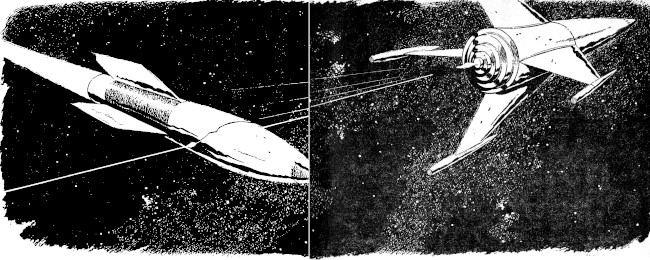
Calhoun blinked open his eyes. There was a crashing sound and the Med
ship swayed upon its landing-fins. It almost went over. It teetered
horribly, and then slowly swung back past uprightness and tilted nearly
as far in the opposite direction. There were crunching sounds as the
soil partly gave way beneath one landing fin.
Then Calhoun waked thoroughly. In one movement he was up and launching
himself across the cabin to the control-chair. There was another
violent impact. He swept his hand across the row of studs which turned
on all sources of information and communication. The screens came on,
and the spacephone, and the outside mikes and loud-speakers, and even
the planetary communication unit which would have reported had there
been any use of the electromagnetic spectrum in the atmosphere of this
planet.
Bedlam filled the cabin. From the spacephone speaker a stentorian voice
shouted:
"This is our last word! Permit our landing or—"
A thunderous detonation was reported by the outside mikes. The Med ship
fairly bounced. There was swirling white smoke outside the ship. It was
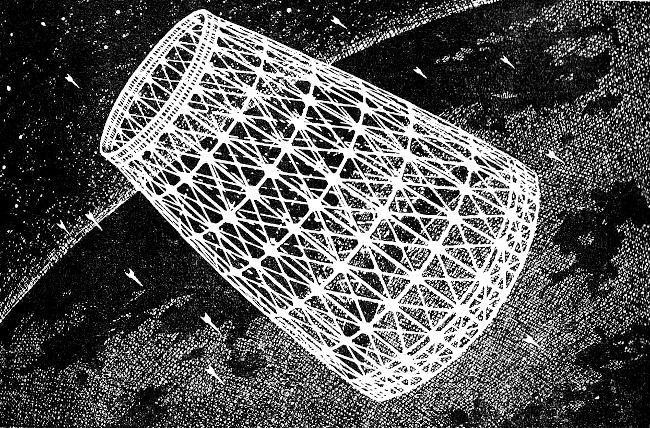
mid-morning, now, and the giant lacy structure of the landing-grid was
silhouetted against a deep-blue sky. There were cracklings from some
electric storm perhaps a thousand miles away. There were shoutings,
also brought in by the outside mikes.
Two groups of figures, fifty or a hundred yards from the Med ship,
labored furiously over some objects on the ground. Smoke billowed out;
then a heavy, blastlike "Boom!" Something came spinning through the
air, end over end, with sputtering sparks trailing behind it. It fell
close by the base of the upright Med ship.
Calhoun struck down the emergency rocket stud as it exploded. The roar
of the rocket filled the interior of the ship. The spacephone speaker
bellowed again:
"We've got a megaton-bomb missile headed down! This is our last word!
Permit landing or we come in fighting!"
The object from the crude cannon went off violently. With the emergency
rocket flaming to help, it lifted the Med ship, which jerked upward,
settled back—and only two of its fins touched solidity. It began to
topple because there was no support for the third.
Once toppled over, it would be helpless. It could be blasted with
deliberately placed charges between its hull and the ground. A crater
already existed where support for the third landing fin should have
been.
Calhoun pushed the stud down full. The ship steadied and lifted.
It went swinging across the level center of the landing-grid. Its
slender, ultra-high-velocity flame knifed down through the sod,
leaving a smoking, incandescent slash behind. The figures about the
bomb-throwers scattered and fled. The Med ship straightened to an
upright position and began to rise.
Calhoun swore. The grid was the planet's defense against landings
from space, because it could fling out missiles of any size with
perfect aim at any target within some hundred thousand miles—a good
twelve planetary diameters. Its operators meant to defy the fleet from
Phaedra and had to get rid of the Med ship before they dared energize
its coils. Now they were rid of it. Now they could throw bombs, or
boulders, or anything else its force-fields could handle.
The spacephone roared again:
"On the ground there! Our missile is aimed straight for your grid! It
carries a megaton fission bomb! Evacuate the area!"
Calhoun swore again. The gang, the guard, the young-warrior group at
the grid would be far too self-confident to heed such a threat. If
there were wiser heads on Canis III, they could not enforce their
commands. A human community has to be complete or it is not workable.
The civilization which had existed on Phaedra II was shattered by
the coming doom of its sun. The fragments—on Phaedra, in the fleet,
in each small occupied community on Canis III—were incomplete and
incapable of thinking or acting in concert with any other. Every small
group on this planet, certainly, gave only lip-service to the rest.
The young world was inherently incapable of organizing itself, save on
a miniature scale. And one such miniature group had the grid and would
fight with it regardless of the wishes of any other—because that group
happened to be composed of instinct-driven members of the young-warrior
group.
But he was still within the half-mile-high fence of the grid's steel
structure. He strapped himself in his seat. The ship rose and rose.
It came level with the top of the colony's one defense against space.
The peculiar, corrugated copper lip of that structure, formed into the
force-field guide which made it usable, swung toward him. He raised the
rocket-thrust and shot skyward.
A deafening bellow came from the speakers:
"Yeah! Go on out and join the old folk! We'll get you!"
Obviously, the voice was from the ground below him. The ship flashed
upward. Calhoun rasped into the spacephone mike, himself:
"Med ship calling fleet! Call back that missile! I've got the antibody
structure! This is no time for fighting! Call your missile back!"
Derisive laughter—again from the ground. Then the heavy, growling
voice of an older man.
"Keep out of the way, Med ship! These young fools are destroying
themselves. Now they're destroying our grandchildren! If we hadn't been
soft-hearted before—if we'd fought them from the beginning—the little
ones wouldn't be dying now! Keep out of the way! If you can help us,
it'll be after we've won the war!"
The sky turned purple, at the height Calhoun had reached. It went
black. The sun Canis flamed and flared against a background of ebony
space, sprinkled with a thousand million colored stars. The Med ship
continued to rise.
Calhoun felt singularly and helplessly alone. Below him the sunlit
surface of a world spread out, its edge already curving, cloud-masses
in its atmosphere veiling the details of mountains and green-clad
plains. There was the blue of ocean, creeping in. The city of the
landing-grid was tiny, now. The brown of ploughed fields was no longer
divided into rectangular shapes. It was a mere brownish haze between
the colorings of as-yet-untouched virgin areas. The colonists of Canis
III had so far made only a part of the new world their own. Many times
more remained to be turned to human use.
The rear screen showed something coming upward. Masses of stuff,
without shape but with terrific velocity. It was inchoate, indefinite
stuff. It was plain dirt from the center of the landing-grid's floor,
flung upward with the horrible power available for the landing and
launching of ships. And, focused upon it, the force-fields of the grid
could control it absolutely for a hundred thousand miles.
Calhoun swerved, ever so slightly. His own velocity had reached miles
per second, but the formless mass following him was traveling at
tens. It would not matter what such a hurtling missile was. At such
a velocity it would not strike like a mass, but like a meteor-shower,
flaring into incandescence when it touched and vaporizing the Med ship
with itself in the flame of impact.
But the grid would have to let go before it hit. There was monstrous
stored power in the ship's Duhanne cells. If so much raw energy
were released into anything on which a force-field was focused, it
would destroy the source of the field. The grid could control its
battering-ram until the very last fraction of a second, but then it
must release—and its operator knew it.
Calhoun swung his ship frantically.
The mass of speeding planet-matter raced past no more than hundreds of
yards away. It was released. It would go on through empty space for
months or years—perhaps forever.
Calhoun swung back to his upward course. Now he sent raging commands
before him:
"Pull back that missile! You can't land a bomb on Canis! There are
people there! You can't drop a bomb on Canis!"
There was no answer. He raged again:
"Med ship calling Phaedra fleet! There's disease on Canis! Your
children and grandchildren are stricken! You can't fight your way
to help them! You can't blast your way to sickbeds! You've got to
negotiate! You've got to compromise! You've got to make a bargain or
you and they together—"
A snarling voice from the ground said spitefully:
"Never mind, little Med man! Let 'em try to land! Let 'em try to take
over and boss us! We listened to them long enough! Let 'em try to land
and see what happens! We've got their fleet spotted! We'll take care of
them!"
Then the growling tones Calhoun had come to associate with Phaedra:
"You keep out of the way, Med Ship. If our young children are sick,
we're going to them! We're just beyond the area in which no drive will
work. When the grid has been blasted our landing ship will go down and
we'll come in! Our missile is only half an hour from target now! We'll
begin our landing in three hours or less! Out of the way!"
Calhoun said very bitter and extremely impolite words. But he faced
an absolute emotional stalemate between enemies of whom both were in
the wrong. The frantic anger of the adults of Phaedra, barred from the
world to which they'd sent their children first so they could stay
where doom awaited, was matched by the embittered revolt of the young
people who had been worked past endurance and burdened past anyone's
power to tolerate. There could be no compromise. It was not possible
for either side to confess even partial defeat by the other. The
quarrel had to be fought to a finish as between the opposing sides, and
then hatred would remain no matter which side won. Such hatred could
not be reasoned with.
It could only be replaced by a greater hatred.
Calhoun ground his teeth. The Med ship hurtled out from the sunlit
Canis III. Somewhere—not many thousands of miles away—the fleet of
Phaedra clustered. Its crews were raging, but they were sick with
anxiety about the enemies they prepared to fight. Aground there was
hatred among the older of the colonists—the young-warrior group in
particular, because that is the group in which hate is appropriate—and
there was no less a sickish disturbance because even in being right
they were wrong. Every decent impulse that had been played upon to
make them exhaust themselves, before their revolt, now protested the
consequences of their revolt. Yet they believed that in revolting they
were justified.
Murgatroyd did not like the continued roar of emergency-rockets. He
climbed up on Calhoun's lap and protested.
"Chee!" he said urgently. "Chee-chee!"
Calhoun grunted.
"Murgatroyd," he said, "it is a Med service rule that a Med ship man is
expendable in case of need. I'm very much afraid that we've got to be
expended. Hang on, now! We try some action!"
He turned the Med ship end for end and fed full power to the rockets.
The ship would decelerate even faster than it had gathered speed.
He set the nearest-object indicator to high gain. It showed the
now-retreating mass of stone and soil from Canis. Calhoun then set up a
scanner to examine a particular part of the sky.
"Since fathers can be insulted," he observed, "they've made a missile
to fight its way down through anything that's thrown at it. It'll be
remote-controlled for the purpose. It's very doubtful that there's a
spaceship on the planet to fight it back. There's been no reference to
one, anyhow. So what the missile will have to fight off will be stuff
from the landing-grid only. Which is good. Moreover, fathers being what
they are, regardless, that missile won't be a high-speed one. They'll
want to be able to call it back at the last minute. They'll hope to."
"Chee!" said Murgatroyd, insisting that he didn't like the
rocket-roar.
"So we will make ourselves as unpopular as possible with the fathers,"
observed Calhoun, "and if we live through it we will make ourselves
even more cordially hated by the sons. And then they will be able to
tolerate each other a little, because they both hate us so much. And so
the public-health situation on Canis III may be resolved. Ah!"
The nearest-object indicator showed something moving toward the Med
ship. The scanner repeated the information in greater detail. There
was a small object headed toward the planet from empty space. Its
velocity and course—
Calhoun put on double acceleration to intercept it, while he pointed
the ship quartering so he'd continue to lose outward speed.
Ten minutes later the spacephone growled:
"Med ship! What do you think you're doing?"
"Getting in trouble," said Calhoun briefly.
Silence. The screens showed a tiny pin point of moving light, far away
toward emptiness. Calhoun computed his course. He changed it.
"Med ship!" rasped the spacephone. "Keep out of the way of our
missile! It's a megaton bomb!"
Calhoun said irrelevantly:
"Those who in quarrels interpose, must often wipe a bloody nose." He
added. "I know what it is."
"Let it alone!" rasped the voice. "The grid on the ground has
spotted it. They're sending up rocks to fight it."
"They're rotten marksmen," said Calhoun. "They missed me!"
He aimed his ship. He knew the capacities of his ship as only a man
who'd handled one for a long time could. He knew quite exactly what it
could do.
The rocket from remoteness—the megaton-bomb guided missile—came
smoking furiously from the stars. Calhoun seemed to throw his ship into
a collision course. The rocket swerved to avoid him, though guided
from many thousands of miles away. There was a trivial time-lag, too,
between the time its scanners picked up a picture and transmitted it,
and the transmission reached the Phaedrian fleet and the controlling
impulses reached the missile in response. Calhoun counted on that. He
had to. But he wasn't trying for a collision. He was forcing evasive
action. He secured it. The rocket slanted itself to dart aside, and
Calhoun threw the Med ship into a flip-flop and—it was a hair-raising
thing—slashed the rocket lengthwise with his rocket flame. That flame
was less than half an inch thick, but it was of the temperature of
the surface of a star, and in emptiness it was some hundreds of yards
long. It sliced the rocket neatly. It flamed hideously, and even so
far, Calhoun felt a cushioned impact from the flame. But that was the
missile's rocket fuel. An atom bomb is the one known kind of bomb which
will not be exploded by being sliced in half.
The fragments of the guided missile went on toward the planet, but they
were harmless.
"All right!" said the spacephone icily—but Calhoun thought there was
relief in the voice. "You've only delayed our landing and lost a good
many lives to disease!"
Calhoun swallowed something he suspected was his heart, come up into
his throat.
"Now," he said, "we'll see if that's true!"
His ship had lost its spaceward velocity before it met the missile.
Now it was gaining velocity toward the planet. He cut off the rocket
to observe. He swung the hull about and gave a couple of short rocket
blasts.
"I'd better get economical," he told Murgatroyd. "Rocket fuel is hard
to come by, this far out in space. If I don't watch out, we'll be
caught in orbit, here, with no way to get down! I don't think the local
inhabitants would be inclined to help us."
His lateral dash at the missile had given him something close to
orbital speed relative to the planet's surface, though. The Med ship
went floating, with seemingly infinite leisure, around the vast bulge
of the embattled world. In less than half an hour it was deep in the
blackness of Canis' nighttime shadow. In three-quarters of an hour it
came out again at the sunrise edge, barely four hundred miles high.
"Not quite speed enough for a true orbit," he told Murgatroyd
critically. "I'd give a lot for a good map!"
He watched alertly. He could gain more height if he needed to, but he
was worried about rocket fuel. It is intended for dire emergencies
only. It weighed too much to be carried in quantity.
He spotted the city of Canopolis on the horizon. He became furiously
busy. He inverted the little ship and dived down into atmosphere. He
killed speed with rocket flames and air friction together, falling
recklessly the while. He was barely two miles high when he swept past
a ridge of mountains and the city lay ahead and below. He could have
crashed just short of it. But he spent more fuel to stay aloft. He used
the rockets twice. Delicately.
At a ground speed of perhaps as little as two hundred miles an hour,
supported at the end by a jetting, hair-thin rocket flame that was
like a rod of electric arc-fire, he swept across the top of the
landing-grid. The swordlike flame washed briefly over the nearer edge.
Very briefly. The flame cut a slash down through steel girders and
heavy copper cables together. The rockets roared furiously. That one
disabling cut at the grid had been on a downward, darting drift. Now
the ship shouted, and swooped up, and on—and it swept above the far
side of the grid only yards from the wide strip of copper which guided
its force-fields out into space. Here it cut cables, girders, and
force-field guide together for better than two hundred feet from the
top. The grid was useless until painstaking labor had made the damage
good.
Calhoun used nearly the last of his fuel for height while he said
crisply on the spacephone:
"Calling fleet! Calling fleet! Med ship calling fleet! I've disabled
the landing-grid on Canopolis! You can come in now and take care of the
sick. There are no weapons aground to speak of and if you don't get
trigger-happy there should be no fighting. I'll be landed off somewhere
in the hills to the north of the town. If the local inhabitants don't
pack explosives out and crack the ship to get at me, I'll have the
facts on the antibody ready for you. In fact, as soon as I get down
I'll give them to you by spacephone, just in case."
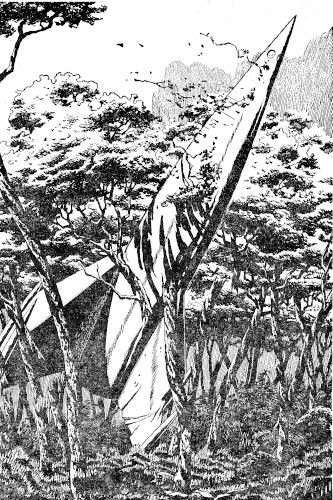
It was a near thing, though. His rocket fuel was exhausted when he hit
the ground. The flame sputtered and stopped when the ship was three
feet from touching. It fell over, splintering trees. It was distinctly
a rough landing.
Murgatroyd was very indignant about it. He scolded shrilly while
Calhoun unstrapped himself from the chair and when he looked out to see
where they were.
It was a week later when the Med ship—brought to the grid for repair
and refueling—was ready for space again. The original landing-grid
still stood, of course. But it was straddled and overwhelmed, huge as
it was, by the utterly gigantic flying grid from Phaedra. There were
not many ships aground, though. As Calhoun moved toward the control
building, now connected by cable to the control quarters in the flying
grid, one of the few ships remaining seemed to fall toward the sky. A
second ship followed only seconds later.
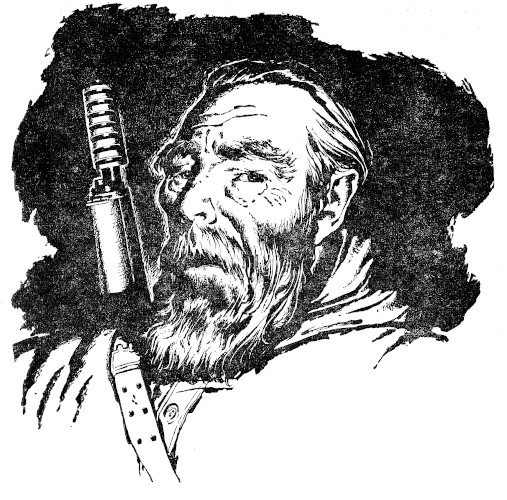
He went into the control building. Walker the elder, from Phaedra,
nodded remotely as he entered. The younger Walker scowled at him. He
had been in consultation with his father, and the atmosphere was one of
great reserve.
"Hm-m-m," said the elder Walker, gruffly. "What's the report?"
"Fairly good," said Calhoun. "There was one lot of antibody that
seems to have been a trifle under strength. But the general situation
seems satisfactory. There'll be a few more cases of one thing and
another, of course—cases that are incubating now. But they'll do
all right on the antibody shots. They have so far, at any rate." He
said to the younger Walker, "You did a very good job rounding up the
thirteen-to-fifteen-year-olds to escort the fleet doctors and handle
the patients for them. They took themselves very seriously. They were
ideal for the job. Your young-warrior group—"
"A lot of them," said young Walker dourly, "have taken to the woods.
They swear they'll never give in!"
"How about the girls?"
Young Walker shrugged.
"They're fluttering about and beginning to talk about clothes. When
older women arrive there'll be dress-making—"
"And the lads in the woods," said Calhoun, "will come out to fascinate,
and be fascinated instead. Do you think there'll be really much
trouble?"
"No-o-o," said young Walker sourly. "Some of ... our younger crowd seem
relieved to be rid of responsibility."
"But," interposed the older Walker, gruffly, "he wants it. He thrives
on it. He'll get it!" He hrrumphed. "The same with the others who
showed what they could do here. We oldsters need them. We don't plan
any ... ah ... reprisals."
Calhoun raised his eyebrows.
"Should I be surprised?"
The older Walker snorted.
"You didn't expect us to fall into each other's arms after what's
happened, did you? No! But we are going to try to ignore our ...
differences as much as we can. We won't forget them, though."
"I suspect," said Calhoun, "that they'll be harder to remember than
you think. You had a culture that split apart. Its pieces were
incomplete—and a society has to be complete to survive. It isn't a
human invention. It's something we have an instinct for—as birds have
an instinct to build nests. When we build a culture according to our
instincts, we get along. When that's impossible—there's trouble." Then
he said, "I'm not trying to lecture you."
"Oh," said the elder Walker. "You aren't?"
Calhoun grinned.
"I thought I'd be the most unpopular man on this planet," he said
cheerfully. "And I am. I interfered in everybody's business and nobody
carried out his plans the way he wanted to. But at least nobody feels
like he won. You'll be pleased when I lift the quarantine and take
off, won't you?"
The older Walker said scornfully:
"We're paying no attention to your quarantine! Our fleet's loading up
our wives on Phaedra, to ferry them here as fast as overdrive will do
it! D'you think we'd pay any attention to your quarantine?"
Calhoun grinned again. The younger Walker said painfully:
"I suppose you think we should—" He stopped, and said very carefully:
"What you did was for our good, all right, but it hurts us more than it
does you. In twenty years, maybe, we'll be able to laugh at ourselves.
Then we'll feel grateful. Now we know what we owe you, but we don't
like it."
"And that," said Calhoun, "means that everything is back to normal.
That's the traditional attitude toward all medical men—owe them a lot
and hate to pay. I'll sign the quarantine release and take off as soon
as you give me some rocket fuel, just in case of emergency."
"Right away!" said the two Walkers, in unison.
Calhoun snapped his fingers. Murgatroyd swaggered to his side. Calhoun
took the little tormal's black paw in his hand.
"Come along, Murgatroyd," he said cheerfully. "You're the only person
I really treated badly, and you don't mind. I suppose the moral of all
this is that a tormal is a man's best friend."