Larger versions of most illustrations may be seen by right-clicking them
and selecting an option to view them separately, or by double-tapping and/or
stretching them. Larger, higher-resolution versions of the maps and
diagrams may be seen by clicking or right-clicking “(High-res)” below
them.
New original cover art included with this eBook is granted
to the public domain. It includes an illustration taken
from the original book.
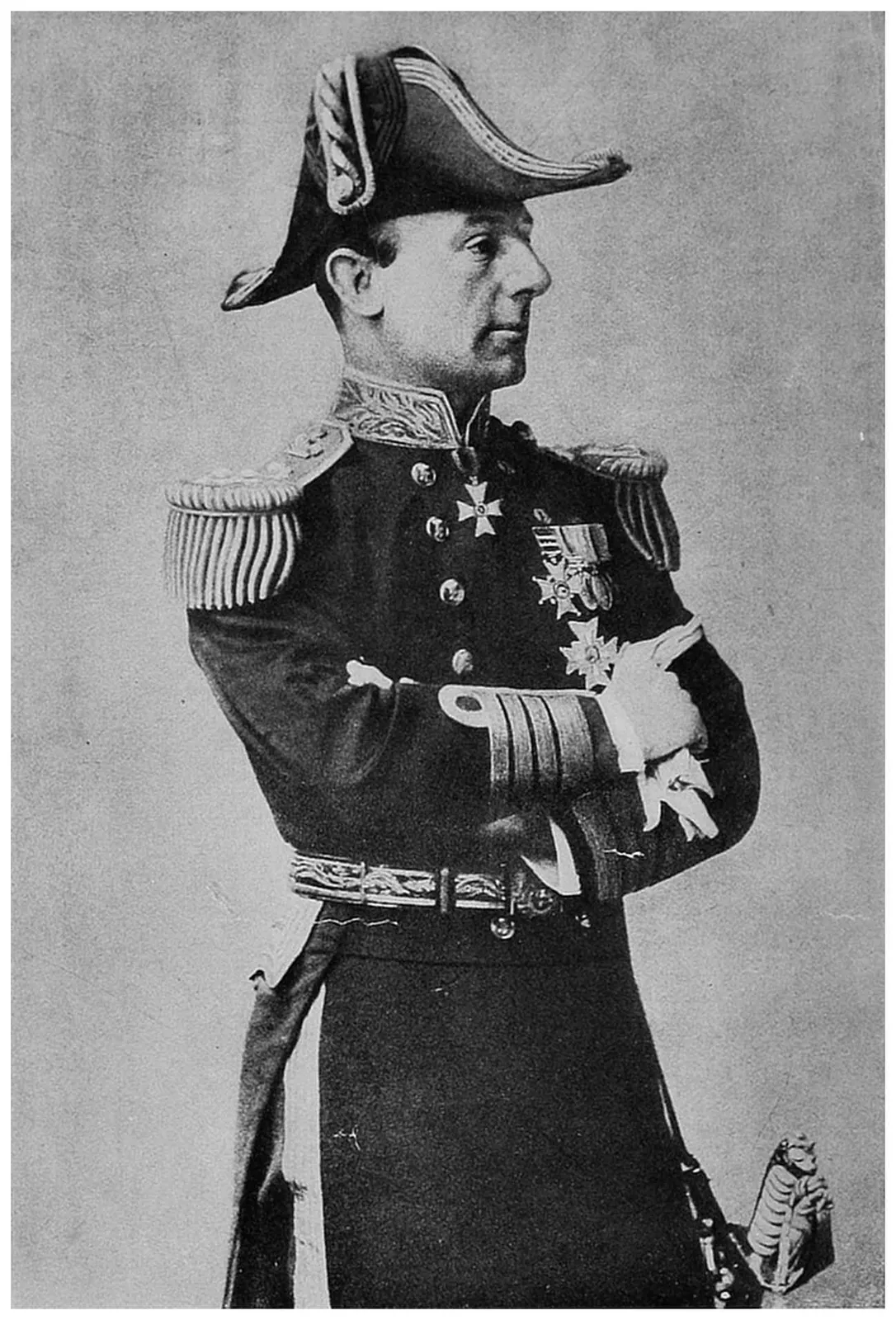
ADMIRAL VISCOUNT JELLICOE OF SCAPA, G.C.B., O.M., G.C.V.O.
ITS CREATION, DEVELOPMENT AND WORK
BY
ADMIRAL VISCOUNT JELLICOE OF SCAPA
G.C.B., O.M., G.C.V.O.
WITH ILLUSTRATIONS, PLANS AND DIAGRAMS
NEW YORK
GEORGE H. DORAN COMPANY
COPYRIGHT, 1919,
BY GEORGE H. DORAN COMPANY
PRINTED IN THE UNITED STATES OF AMERICA
TO MY COMRADES
OF THE GRAND FLEET
PREFACE
In the following pages the work of the Grand Fleet, from
the outbreak of war until the end of November, 1916,
is described.
The writing of this record of the work of the Grand
Fleet, of which little has been heard by the nation
hitherto, has helped to fill in days of leisure. The manuscript
was finished by the autumn of 1918, but publication
was deferred for obvious reasons. When the armistice
had been signed and the German Navy had, for all practical
purposes, ceased to exist, I felt free to issue the book.
The final revision has been done hastily owing to my early
departure for the Dominions, and in the circumstances I
hope I may rely on the indulgence of readers if any clerical
errors have escaped me. In order to minimise the chances
of such errors Mr. Archibald Hurd has kindly read the
proofs, and I am much indebted to him.
The narrative necessarily includes an account of the
gradual organisation and development of the Grand Fleet,
and its bases, by successive steps, after the hoisting of my
flag on the outbreak of hostilities; and the manner in
which the changing conditions of naval warfare were met
is also dealt with.
Admiral Mahan, amongst others, has truly said that
whilst the principles of naval strategy are unchangeable,
experience in war and changes in the weapons with which
war is waged may profoundly affect the application of
those principles.
The truth of this statement was shown in the Russo-Japanese
war; in the short interval between 1904 and 1914
further great advances took place in the technique of
warfare; these produced a striking influence on strategy
and tactics during the late war.
The reasons which made it necessary, during the war,
to hide from public view the work of the Grand Fleet
no longer exist, and it will no doubt be of interest to the
nation to learn something of its operations, especially as,
for various justifiable reasons, few despatches were issued
dealing with its activities. So far as the Battle Fleet
was concerned, the Battle of Jutland was the one
exception, and that despatch was written and published
when it was necessary to conceal a good deal from the
enemy.
As is inevitable, much of the information in this
volume is of a technical character and, though interesting
to seamen, may prove less so to the general reader. Those
who take this view may decide that Chapters IV to X,
inclusive, require only to be glanced at. Confidential
matter, which it is still undesirable to make public, has
been excluded from the book. Some of this may see the
light in later years.
The main portion of the book is written in narrative
form, but where it is thought that an explanation may
be useful, as to the reasons which governed any particular
movement or decision, such reason is given in order that
opportunity may be afforded the reader of understanding
the purpose in view and the manner in which it was hoped
to achieve it.
In some parts of the book reference is made to the
Germans being superior to us in matériel. There were
many directions, however, in which war experience
showed the correctness of our views and the wisdom of
our pre-war policy. We did, in fact, obtain a margin of
safety in the most essential type of vessel, the capital
ship, and we did gain advantage from the heavier calibre
of our guns. Naval policy is pursued in peace conditions
under inevitable disadvantages in a democratic country,
because there are many claims on the Exchequer. Reviewing
our pre-war programmes of ship construction and
equipment, and bearing in mind the unconsciousness of
the nation generally as to the imminence of war, it is
matter for satisfaction that the Boards of Admiralty
from the beginning of the century were able to achieve so
much, and that when at last war became inevitable the
nation had in control of its destinies at Whitehall a First
Lord and a First Sea Lord who, accepting their responsibility,
mobilised the Fleet before war was actually
declared, thus securing for us inestimable advantages, as,
I hope, I have demonstrated in my record of the Grand
Fleet. The years of strenuous work and training carried
out by the officers and men of the Fleet, which should
never be forgotten, had made of it a magnificent fighting
machine, and bore ample fruit during the war.
The Germans, in creating their Fleet, followed
generally the British lead. In this book reference is made
to the general efficiency of the German Navy and of the
good design and fine equipment of their ships. These
points were never questioned by British naval officers,
and the shameful surrender of the host of the German
ships in 1918 did not alter the opinions previously formed.
That surrender was the result of broken moral.
More than a hundred years after the Battle of Trafalgar,
and after a century of controversy, the Admiralty
considered it desirable to appoint a committee to decide
whether that action was fought in accordance with the
original intentions of the Commander-in-Chief, as embodied
in his famous Memorandum. It is hoped that
the facts recorded in this book, and the comments
accompanying them, constitute a clear statement of
the making of the Grand Fleet and the manner in which
it endeavoured, whilst under my command, to fulfil its
mission.
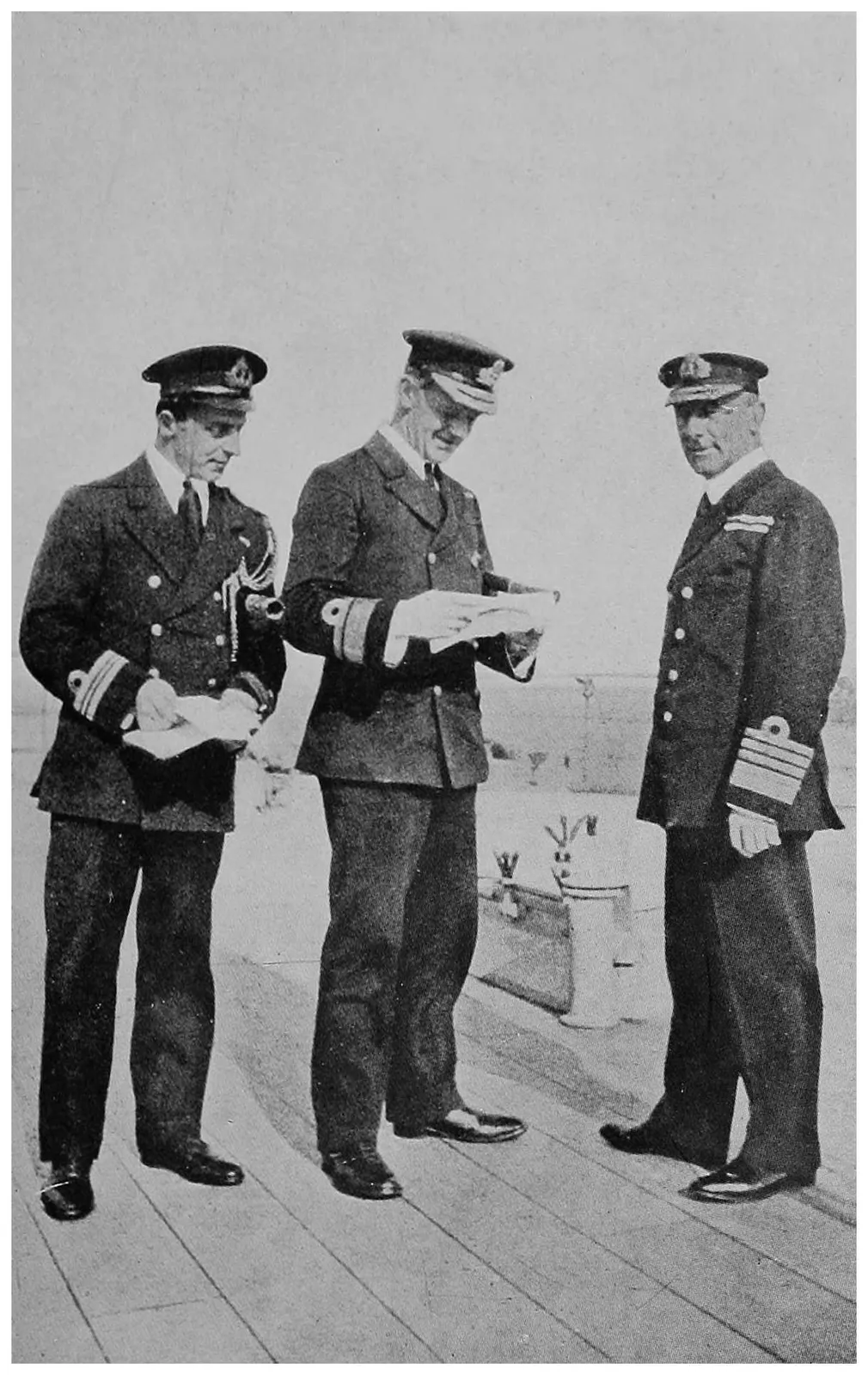
The Commander-in-Chief, Captain of the Fleet (Commodore Lionel Halsey), and the Flag Lieutenant (Lieut.-Commander Herbert Fitzherbert) on Board H.M.S. Iron Duke
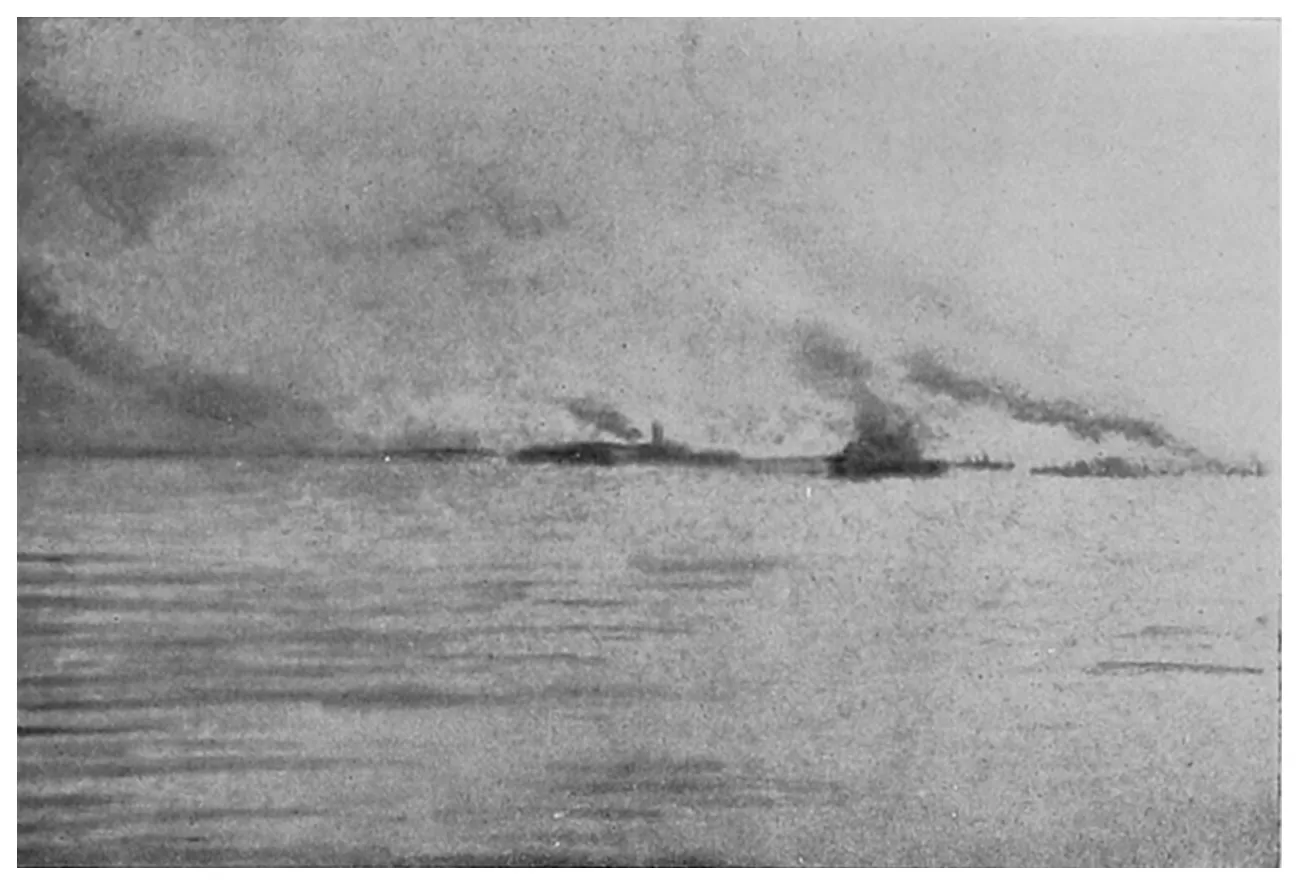
Operations During the Night of May 31st–June 1st, and on June 1st, 1916.
THE GRAND FLEET, 1914–1916
CHAPTER I THE OPENING OF THE WAR — THE HARWICH FORCE — THIRD FLEET
Early in 1914, whilst serving at the Admiralty as Second
Sea Lord, I had been offered and had accepted the command
of the Home Fleets, which in the ordinary course
would have become vacant in the following December on
the expiration of Admiral Sir George Callaghan’s term
of command, and public announcement was made of the
intended appointment.
Sir George Callaghan was my senior by seven years,
and he and I had served together in China fourteen years
before, when I was Flag Captain to Admiral—afterwards
Admiral of the Fleet—Sir Edward Seymour. He had
since had what is probably a unique period of sea service,
passing from one appointment to another without an
interval of half pay. Soon after his promotion to flag
rank he had become Rear-Admiral in the old Channel
Fleet; thence he had gone on to the 5th Cruiser Squadron
in 1907; two years later he became second in command
in the Mediterranean, and on the expiration of his term
there, in 1910, he returned to take up the appointment
of Vice-Admiral commanding the Second Division of the
Home Fleets, succeeding to the position of Commander-in-Chief
in 1910. The usual period for which the Commander-in-Chief
of the Home Fleet was supposed to fly
his flag was two years, but in 1913 the Admiralty,
accurately interpreting the sentiment of the whole Service,
extended Sir George Callaghan’s appointment. And it
was the approaching termination of this further period of
command—to the regret of the Admiralty, for which I
can speak from personal knowledge, and to the regret
also of the officers and men of the Home Fleets—which
led to my nomination in the spring of that year.
In the latter part of July, when the situation in Europe
had assumed a threatening aspect, Mr. Churchill, the First
Lord, informed me that in the event of hostilities occurring
involving this country, it was considered necessary
that the Commander-in-Chief of the Home Fleets should
have the assistance of a second in command, and he added
that I had been selected for the appointment, and it was
desired that I should arrange with Sir George as to the
ship in which I should fly my flag.
Sir George Callaghan visited the Admiralty very
shortly afterwards, and it was decided between us that
the battleship Centurion should be my flagship. We
discussed the slight reorganisation that this would involve
in the Fleet, and I selected my staff, which comprised:
Captain R. W. Bentinck as Chief of the Staff; Lieut. H.
Fitzherbert as Flag Lieutenant; Lieut.-Commander E.
Hardman Jones as Signal Officer; Lieut.-Commander
R. L. Nicholson as Wireless Officer; Lieut.-Commander
(N.) A. F. B. Carpenter as War Staff Officer, and Fleet
Paymaster H. H. Share as Secretary.
On July 28th, with no premonition of coming events,
I was present at a dinner party given by Lord Morley at
the United Services Club. The party was interesting,
as it comprised Field-Marshal Lord Kitchener, Mr.
Churchill, Lord Haldane, Lord Bryce, and others who
figured later prominently in the War.
During the two following days conferences took
place at the Admiralty as to the disposition of the Fleet,
etc., and, in view of the threatening political situation,
the work of demobilisation after the King’s inspection
at Spithead and the subsequent short fleet exercises were
suspended, pending further developments. I met Lord
Kitchener, who was about to return to Egypt, on one or
two occasions at the Admiralty during these days.
On July 30th I turned over the duties of Second
Sea Lord, which I had discharged since December, 1912,
to Vice-Admiral Sir Frederick Hamilton, K.C.B., and
made my final preparations for joining the Fleet as second
in command.
I spent some hours at the Admiralty on the following
day, and during a conversation with Mr. Churchill and
the Marquis of Milford Haven, the then First Sea Lord,
it was intimated to me that, in certain circumstances, I
might be appointed Commander-in-Chief in succession to
Sir George Callaghan.
This intimation came upon me as a great surprise,
and I protested against such an appointment being made
on what might possibly be on the very eve of war.
Nothing definite was settled. I left, however, with the
impression that the change was not one that had been
finally decided upon, but that it might take place. I
left London the same night by the mail train for Wick,
the Commander-in-Chief having informed me that he
would send a vessel to meet me there.
The idea that the change might be made occupied
my thoughts during the journey to the North. As I
thought over the possibility of a transfer of command at
such a moment, the stronger appeared the objections.
During the ensuing forty-eight hours I sent several
telegrams to both the First Lord and the First Sea
Lord on the subject. I dwelt strongly upon the danger
of substituting, at such a juncture and at such short notice,
an admiral who was not in touch with the Fleet, for
a Commander-in-Chief with long experience of the Command.
I mentioned, also, the strong feeling of admiration
and loyalty to the Commander-in-Chief that existed,
and suggested as an alternative that I should act as his
assistant on board the Fleet-Flagship. I had in mind
that I might act somewhat in the capacity of his
Chief of the Staff. In spite of the First Lord’s reiterated
opinion, my views remained unaltered, although it
did not occur to me that some anxiety might be felt
that Sir George Callaghan’s health would not stand
the strain of commanding the Fleet in the event of
war. That, however, was a matter on which the Admiralty
would be better informed than myself, and I had no hesitation
in urging the opinions expressed in my successive
telegrams.
A thick fog prevailed at Wick, and the Boadicea, the
ship in which I made the passage to Scapa Flow, was
not able to leave until late in the forenoon of August 2nd,
and arrived at Scapa Flow in the afternoon.
When I reported myself to the Commander-in-Chief,
the knowledge of the event which was apparently
impending made the interview both embarrassing and
painful, as I could see that he had no knowledge of the
possibility of his leaving the Fleet, and obviously I could
not tell him.
We discussed various arrangements, including the
question of the defence of Scapa Flow, for which temporary
but naturally inadequate measures were being
energetically taken with the limited resources at the disposal
of the Fleet.
At about 4 A.M. on August 4th, I received Admiralty
orders to open a secret envelope which had been handed
to me in the train as I was leaving London, by an officer
from the Admiralty. This envelope contained my
appointment as “Commander-in-Chief of the Grand
Fleet”—a new designation which must be explained
later.
On this order I was obliged to act, and I proceeded
on board the Iron Duke and found that the Commander-in-Chief
had received orders to turn over the command
to me.
Sir George Callaghan had been my Commander-in-Chief
during my command of the 2nd Battle Squadron.
He was, in addition, a personal friend, and I, like all those
with whom he had been in contact, had the most profound
respect and admiration for him. The idea of taking over
his command at the moment of his life naturally caused
me feelings of the greatest pain, and, moreover, it was
impossible to dismiss the fear that the Fleet might conclude
that I had been in some measure responsible for
the change. This possibility had, of course, been present
in my mind from the moment I left London, and it
appeared to add to the objections to a change of command
at such a juncture, since any idea of this nature
prevalent in the Fleet must affect the feeling of loyalty
to me as the new Commander-in-Chief.
It is unnecessary to dwell on the matter, but I cannot
close this portion of my narrative without paying a warm
tribute to the manner in which Sir George accepted the
Admiralty decision, which obviously came as a great
shock to him. He behaved, as always, as a most gallant
officer and gentleman, and his one desire was to make
the position easy for me, in entire disregard of his own
feelings.
It was decided that I should take over the Command
on the following day, but a telegram having been received
from the Admiralty ordering the Fleet to proceed to sea
at once, I returned to the Iron Duke, and Sir George
Callaghan arranged to leave the Fleet in the Sappho
before its departure at 8.30 in the morning.
At that hour I took over the Command from Sir
George Callaghan, who then struck his flag.
The following ten or fourteen days were a period of
great strain and anxiety. To assume so heavy a responsibility
as the command of the Grand Fleet at such short
notice on the eve of war was in itself a matter not to be
taken lightly; it became necessary to gather together
the strings of the whole organisation, to ascertain the
dispositions already made and those immediately required,
and the whole problem was largely complicated by the
fact that the port on which the Fleet was based was open
to attack both by destroyers and by submarines, the only
obstacle to such attack being the navigational difficulties
of the Pentland Firth. Though considerable, these were
by no means insuperable.
Added to this was my feeling of deep regret at superseding
a valued chief and friend at such a moment. The
one thing that helped me through this period was the
great and most loyal assistance rendered to me by the
staff of Sir George Callaghan, who, notwithstanding their
intense personal regret at his departure, gave me their
very warm support, and concealed from me any trace of
the feelings which they must have experienced at my
presence amongst them under such exceptional and trying
conditions. They behaved as naval officers always
behave—in a true spirit of comradeship. The same may
be said of the flag officers and captains in the Fleet, and
indeed of every officer and man.
Sir George Callaghan left his whole staff with me, with
the exception of his flag lieutenant, who accompanied
him to London. This staff included: Commodore A. F.
Everett, C.B., Captain of the Fleet; Captain R. N.
Lawson, Flag Captain; Commander Roger Backhouse,
C.B., Flag Commander; Fleet Paymaster C. F. Pollard,
C.B., Secretary; Commander the Hon. Matthew Best,
War Staff Officer; Commander R. W. Woods, Signal
Officer; Lieut.-Commander J. S. Salmond, Wireless
Officer; Lieut.-Commander R. M. Bellairs, War Staff
Officer; Lieut. W. D. Phipps, Signal Officer.A
A Later, Commodore L. Halsey, C.M.G., became Captain of the Fleet, Captain
F. C. Dreyer, C.B., Flag-Captain; Commander C. M. Forbes, Flag-Commander,
and Fleet-Paymaster V. H. T. Weekes, Additional Secretary.
When it became certain that I was to take command
of the Fleet, I asked the Admiralty to appoint Rear-Admiral
Charles Madden as Chief of the Staff; and I
was thus able to transfer Captain R. W. Bentinck to
act as Chief of the Staff to Vice-Admiral Sir George
Warrender, the next senior flag officer in the Fleet.
The composition of the Grand Fleet was:
Fleet-Flagship—H.M.S. Iron Duke.
Attached Ships—H.M.S. Sappho, H.M.S. Oak.
BATTLE FLEET
1st Battle Squadron:
Vice-Admiral Sir Lewis Bayly, K.C.B. (in command).
Rear-Admiral H. Evan Thomas (2nd in command).
Battleships Marlborough (Flag), St. Vincent (Rear Flag), Colossus,
Hercules, Neptune, Vanguard, Collingwood, Superb, Bellona
(attached Light Cruiser), Cyclops (repair ship)
2nd Battle Squadron:
Vice-Admiral Sir George Warrender, Bart., K.C.B.
(in command).
Rear-Admiral Sir Robert Arbuthnot, Bart. (2nd in
command).
Battleships King George V. (Flag), Orion (Rear Flag), Ajax, Audacious,
Centurion, Conqueror, Monarch, Thunderer, Boadicea
(attached Light Cruiser), Assistance (repair ship).
4th Battle Squadron:
Vice-Admiral Sir Douglas Gamble, K.C.V.O.
(in command).
Shetland Patrol Force: Forward (Scout) and four destroyers of the
River class.
The above vessels formed the Fleet under the immediate
command of the Commander-in-Chief at the
outbreak of hostilities. In addition, there were in
southern waters, and also under the command of the
Commander-in-Chief, the following vessels:
This force, although an integral portion of the Grand
Fleet, was based on Harwich. It was intended that it
should join the Grand Fleet at sea, if possible, in the
event of a fleet action being imminent, and for this
reason it was included in the organisation of the Fleet
for battle; but the force did not, in actual fact, ever so
join the Fleet, nor did I expect that it would be able
to do so. At the outbreak of war it was commanded
by Commodore R. Y. Tyrwhitt in H.M.C. Amethyst
and comprised:
1st Flotilla
Commanded by Captain W. Blunt in Fearless with
20 destroyers.
3rd Flotilla
Commanded by Captain C. H. Fox in Amphion with
15 destroyers.
Included also in the organisation of the Home Fleets,
which Sir George Callaghan had commanded-in-chief,
were the Second and Third Fleets:
SECOND FLEET
(under command of Vice-Admiral Sir Cecil Burney, K.C.B.,
K.C.M.G.).
Fleet-Flagship Lord Nelson, Rear-Admirals Stuart-Nicholson and
Bernard Currey (commanding Battle Squadrons).
5th Battle Squadron:
Prince of Wales (Flag), Agamemnon, Bulwark, Formidable, Implacable,
Irresistible, London, Queen, Venerable.
6th Battle Squadron:
Russell (Flag), Cornwallis, Albemarle, Duncan, Exmouth, Vengeance.
5th Cruiser Squadron:
Rear-Admiral A. P. Stoddart (in command).
Carnarvon (Flag), Falmouth, Liverpool.
6th Cruiser Squadron:
Rear-Admiral W. L. Grant (in command).
Drake, Good Hope, King Alfred, Leviathan.
(These last two Cruiser Squadrons were, however,
broken up immediately, and the ships transferred to other
duties.)
Minelayer Squadron, commanded by Captain M. H. Cobbe.
This Fleet comprised the 7th and 8th Battle
Squadrons, consisting of our oldest battleships, and the
7th, 9th, 10th, 11th and 12th Cruiser Squadrons, comprising
our oldest cruisers.
But the only vessels of this Fleet which were ever
associated with the Grand Fleet were the ships of the
10th Cruiser Squadron, which, under the command of
Rear-Admiral Dudley de Chair, joined the Grand Fleet
shortly after the outbreak of war, the Squadron being
employed mainly on blockading duties. It was composed
as follows:
Crescent (Flag), Edgar, Endymion, Gibraltar, Grafton, Hawke,
Royal Arthur, Theseus.
All submarines, except those of the B and C classes
which were detached for the protection of our coast and
ports from Rosyth southwards, were worked, in accordance
with Admiralty policy, from Harwich, and were not,
therefore, under my command. The C class submarines
were unfit for oversea work, and our operations in enemy
waters were therefore confined to boats of the D and E
classes, of which we possessed a total of 8 D’s and 9 E’s,
as against the German total of 28 boats of the U class.
CHAPTER II GENERAL NAVAL STRATEGY IN HOME WATERS — BATTLESHIPS
It is hardly surprising if the work and purpose of the
Navy had somewhat faded from public interest during
the century that had elapsed since the Napoleonic Wars,
the last occasion on which the inhabitants of this country
had felt that their safety depended on maritime power.
Indeed, it had fallen to the lot of a distinguished officer in
a foreign navy, Captain Mahan, to awaken interest in this
matter, and to point out the all-important influence which
Sea Power had exerted, and would exert, on history.
Associations such as the Navy League had been
formed, having as their object the enlightenment of our
countrymen, and although a great work was done in this
direction, the mere necessity for such work is an indication
of the extent to which the nation had forgotten the lessons
of the past.
I therefore offer no apology for making some reference
to the use and purpose of the British Navy.
The main objects for which our Navy exists may be
shortly summed up under four heads:
1. To ensure for British ships the unimpeded use
of the sea, this being vital to the existence of
an island nation, particularly one which is
not self-supporting in regard to food.
2. In the event of war, to bring steady economic
pressure to bear on our adversary by denying
to him the use of the sea, thus compelling
him to accept peace.
3. Similarly in the event of war to cover the
passage and assist any army sent overseas,
and to protect its communications and supplies.
4. To prevent invasion of this country and its
overseas Dominions by enemy forces.
The above objects are achieved in the quickest and
surest manner by destroying the enemy’s armed naval
forces, and this is therefore the first objective of our Fleet.
The Fleet exists to achieve victory.
But history has always shown that it is a very difficult
matter to impose our will upon a weaker naval adversary,
and that, instead of giving us the opportunity of destroying
his armed naval forces, he usually keeps the main
body of those forces—the Battle Fleet—in positions of
safety in fortified harbours, where they are a constant
threat to the sea communications of the stronger naval
Power, and force upon that Power a watching policy so
that the enemy may be engaged, should he put to sea,
before he is able to gain any advantage.
The watching policy in the great wars of the
Napoleonic era was carried out by keeping our squadrons,
through fair or foul weather, in the vicinity of those ports
of the enemy in which his fleet lay. Occasionally our
ships were driven off by stress of weather, but they
regained their stations as soon as conditions permitted.
During this war, however, the advent of the submarine
and destroyer, and, to a lesser extent, the use of the
mine rendered such dispositions impossible.
No large ship could cruise constantly in the vicinity
of enemy bases without the certainty that she would fall
an early victim to the attacks of submarines. Destroyers
could, it is true, afford some measure of protection, but
destroyers have a very limited range of action, and could
not keep the sea off the enemy’s distant coast even in
good weather for a sufficient length of time. Periodical
relief of the destroyers was an impossibility, owing to the
great numbers that would be required for this purpose.
Moreover, even if the submarine danger could be overcome,
the heavy ships would be so open to attack by
enemy destroyers at night, if cruising anywhere near
enemy bases, that they would certainly be injured, if not
sunk, before many days had passed.
These facts had been recognised before the War and
a watching policy from a distance decided upon, the watch
being instituted for the purpose of preventing enemy
vessels from gaining the open sea, where they would constitute
a danger to our sea communications. Now a watch
maintained at a distance from the port under observation
is necessarily only partial, except in circumstances where
the enemy has to pass through narrow straits before gaining
open water.
The chances of intercepting enemy ships depend
entirely on the number of watching vessels and the distance
that those on board them can see. At night this
distance is very short—on a dark night not more than
a quarter of a mile, and even in daylight, under the
average conditions of visibility obtaining in the North Sea,
it is not more than six to eight miles.
The North Sea, though small in contrast with the
Atlantic, is a big water area of about 120,000 square miles
in extent. The width across it, between the Shetland
Islands and Norway (the narrowest portion), is 160 miles,
and an additional 40 miles (the Fair Island Channel)
would need to be watched also if a patrol were established
along this line.
A consideration of all the circumstances had led to
the adoption by the Admiralty of Scapa Flow in the
Orkneys as the main Fleet Base, and the Admiralty had
determined upon a naval strategy in Home Waters, in
the event of war with Germany, based upon the idea that
the Grand Fleet would control the North Sea, and that
the Channel Fleet would watch the English Channel, thus,
in combination, holding the enemy’s main force.
To effect this purpose, it was intended that the main
Battle Fleet should occupy, as circumstances permitted, a
strategic position in the North Sea where it would act in
support of Cruiser Squadrons carrying out sweeps to the
southward in search of enemy vessels, and should be
favourably placed for bringing the High Sea Fleet to
action should it put to sea.
This policy of cruiser sweeps had been adopted as the
result of experience in the various naval manœuvres
carried out in previous years in the North Sea. These
had demonstrated quite clearly that the alternative
policy of stretching cruiser patrol lines across the North
Sea for the purpose of watching for the enemy was an
impracticable one, it having been shown on many occasions
that evasion of a single patrol line during the hours
of darkness, or even daylight, under the conditions of
visibility that usually prevail in the North Sea, is a very
simple matter. Further, a line of cruisers occupying
regular patrol positions is always in peril of successful
submarine attack; the loss of the cruisers Hogue, Cressy
and Aboukir showed this. It is also open to a concentrated
attack by surface vessels.
The War Orders issued to the Commander-in-Chief
of the Grand Fleet were based, therefore, on this general
idea, and when the Grand Fleet proceeded to sea in compliance
with Admiralty orders at 8.30 A.M. on August
the 4th, 1914, it left with the intention of carrying out
this general policy. The Channel Fleet, under the command
of Vice-Admiral Sir Cecil Burney, assembled in
the Channel in accordance with the general strategic
dispositions.
The vessels engaged in this first move of the Grand
Fleet comprised the 1st, 2nd, 3rd and 4th Battle Squadrons,
with their attached cruisers; the 1st Battle Cruiser
Squadron, with its Light Cruiser Squadron, strengthened
by the addition of the Falmouth and Liverpool; the 2nd
Cruiser Squadron, and the 3rd Cruiser Squadron. These
dispositions continued in force for some three weeks,
when the strong influence of the submarine on naval
strategy began to make itself apparent.
The ideas held in pre-War days as to the capabilities
of submarines were found, after a short experience of
war, to need modification. In the first place, it became
quickly apparent that the German submarines possessed
a radius of action and sea-keeping qualities considerably
greater than those of our own submarines. It had been,
for instance, looked upon as a considerable achievement
for our submarines to keep the sea for a period of five to
seven days, and they had not operated at any great distance
from the coast. It is true that submarines had on
occasion made long voyages such as to Australia, but
they were then usually escorted, or even towed, and the
number of days from port to port did not approach the
length of time for which German submarines remained
at sea. Further, it was known that the Germans possessed
a considerable superiority in the number of submarines
which were capable of operating overseas, and
the frequent sighting of enemy submarines as far north
as the Orkney and Shetland Islands early in the War,
combined with the fact that it appeared that the enemy
had established a regular submarine patrol in the centre
of the North Sea, made it evident that the German submarines
would constitute a very serious menace to our
heavy ships.
The comparative strength in submarines in Home
Waters at the outbreak of war was as follows:
German—
U Boats
28
of which U 1 to U 4 were hardly fit for oversea work, but were as good as our D class.
British—
D Class
8
{
of which D 1 was unreliable and the remaining units of the D class were not equal to the U boats.
E Class
9
C Class
34
}
Unfit for oversea work and used only for local defence of the coast or in the Channel.
B Class
3
The Germans also had at least 24 submarines under
construction, whilst we were building 19, apart from two
experimental vessels of which nothing resulted.
Of these 19 submarines, several were of new type, in
pursuance of a policy introduced by the Admiralty in
1913–14 of widening the area of supply of these vessels.
This policy had far-reaching and beneficial results on the
subsequent output of this class of vessel, as it enabled us
to increase our submarine flotillas more rapidly than would
otherwise have been the case.
A change in previous naval practice was considered
necessary at an early period, because vessels moving at
anything but high speed, particularly in the case of a
number of ships in company, ran very considerable risks
in waters where we might expect enemy submarines to be
operating, unless screened by a strong force of destroyers.
This conclusion affected the movements and operations
of the Battle Fleet, since the number of destroyers we
possessed was quite inadequate to form a screen for a
Battle Fleet and a Battle Cruiser Squadron which constantly
kept the sea. The number required, for such a
screen to be effective, was at least 40 for the Battle
Fleet alone as then constituted, and that number, 40, was
all that we had stationed at the Northern Base. The fuel
capacity of destroyers was only sufficient for them to
remain at sea in company with a fleet for some three days
and nights, whereas the Fleet itself could remain out for
three or four times that period. Moreover, the destroyers
could not be kept nearly so constantly at sea as the large
ships owing to their requirements in the way of boiler-cleaning
and the refit and adjustment of their more
delicate machinery, and the necessity for giving not only
the machinery, but the personnel, periods of rest. The
heavy ships, then, had two alternatives, either to remain
at sea without a destroyer screen or to return to harbour
with the destroyers. In the early days the first alternative
was adopted, the risk being accepted, but minimised as
far as possible, by keeping the ships in the northern part
of the North Sea.
A further danger soon made itself apparent. It
became evident at an early period, as many naval
officers had expected, in view of German language at the
Hague Conference, that our enemy intended to throw
overboard the doctrines of international law when he could
gain any advantage by doing so. He accordingly proceeded
at once to lay mines in positions where he thought
they would be advantageous to his operations, in utter disregard
of the safety, not only of British, but also of neutral
merchant ships. It was, therefore, thought very probable
that he would elaborate this practice by laying mines in the
North Sea in positions where he anticipated they might
prove effective against the Grand Fleet, and that he would
do this without issuing any warning to neutral countries.
Consequently, if the main Battle Fleet were kept moving
continuously in the central and southern waters of the
North Sea, in which waters the enemy could easily lay
mines with little danger of his operations being witnessed
(as he could carry them out under cover of darkness),
it was evident that considerable risks might be incurred
without our being aware of the fact. The policy
of attrition of our Battle Fleet might thus be carried
out with such success as to produce equality, or even
inferiority, on the part of the British Fleet as compared
with the German, in a comparatively short space of time.
The only safeguard against such action which we could
take would be to keep mine-sweepers constantly working
ahead of the Battle Fleet. But the number of mine-sweepers
that we possessed was wholly inadequate for
such a task; and even if this had not been so, to carry out
such an operation would have necessitated the speed of
the Battle Fleet being reduced to some 10 knots, the
maximum sweeping speed of mine-sweepers, and it would
have been forced also to steer a steady course without
zigzagging, conditions rendering the battleships exceedingly
vulnerable to submarine attack.
The first effect, therefore, of the submarine menace,
combined with possible German action in regard to mine-laying,
was to cause the Battle Fleet to confine its movements
under ordinary conditions to the more northern
waters of the North Sea, where the risk might be taken
of cruising without the presence of a screen of destroyers,
and where it was improbable, owing to the depth of water
and the distance from enemy bases, that the Germans
would be able to lay mines without discovery.
The fact that this course of action would be forced
upon us as the submarine and destroyer menace grew had
often been present in my mind in pre-War days, when I
had expressed the view that the beginning of a naval war
would be a conflict between the small craft, whilst the
larger and more valuable vessels were held aloof. I have
no doubt that this opinion was very generally held by
officers of experience.
The northward movement of the Battle Fleet was
combined with the establishment of certain cruiser patrol
areas in the North Sea. These areas, which were purposely
made large, were watched on a regular, organised
plan by our Cruiser Squadrons, moving at fairly high
speed in such a manner as to reduce the submarine risk
to the cruisers to a minimum, whist at the same time they
kept as effective a watch as possible, first, to intercept
German war vessels that might be covering a raid on our
coasts or transports, or trying to reach the open sea to
operate against trade, and, secondly, to ensure that all
merchant ships entering or leaving the North Sea should
be closely examined in order to enforce the blockade.
This patrol policy was associated with periodical
sweeps of cruisers, supported by the Battle Fleet, down
into the southern waters of the North Sea, the object
being to catch the enemy’s fleet at sea, if possible, and
in any case, owing to our movements being probably reported
to the Germans by neutral merchant ships, to
make them feel that they could never move a force to
sea without the possibility of encountering our Fleet
engaged in one of these southern sweeps, which we carried
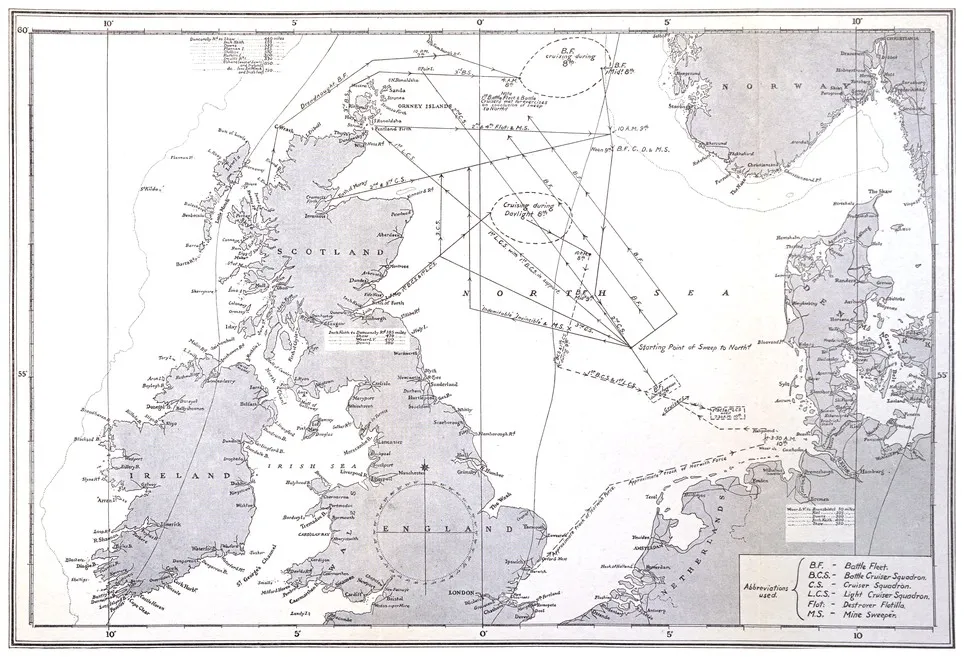
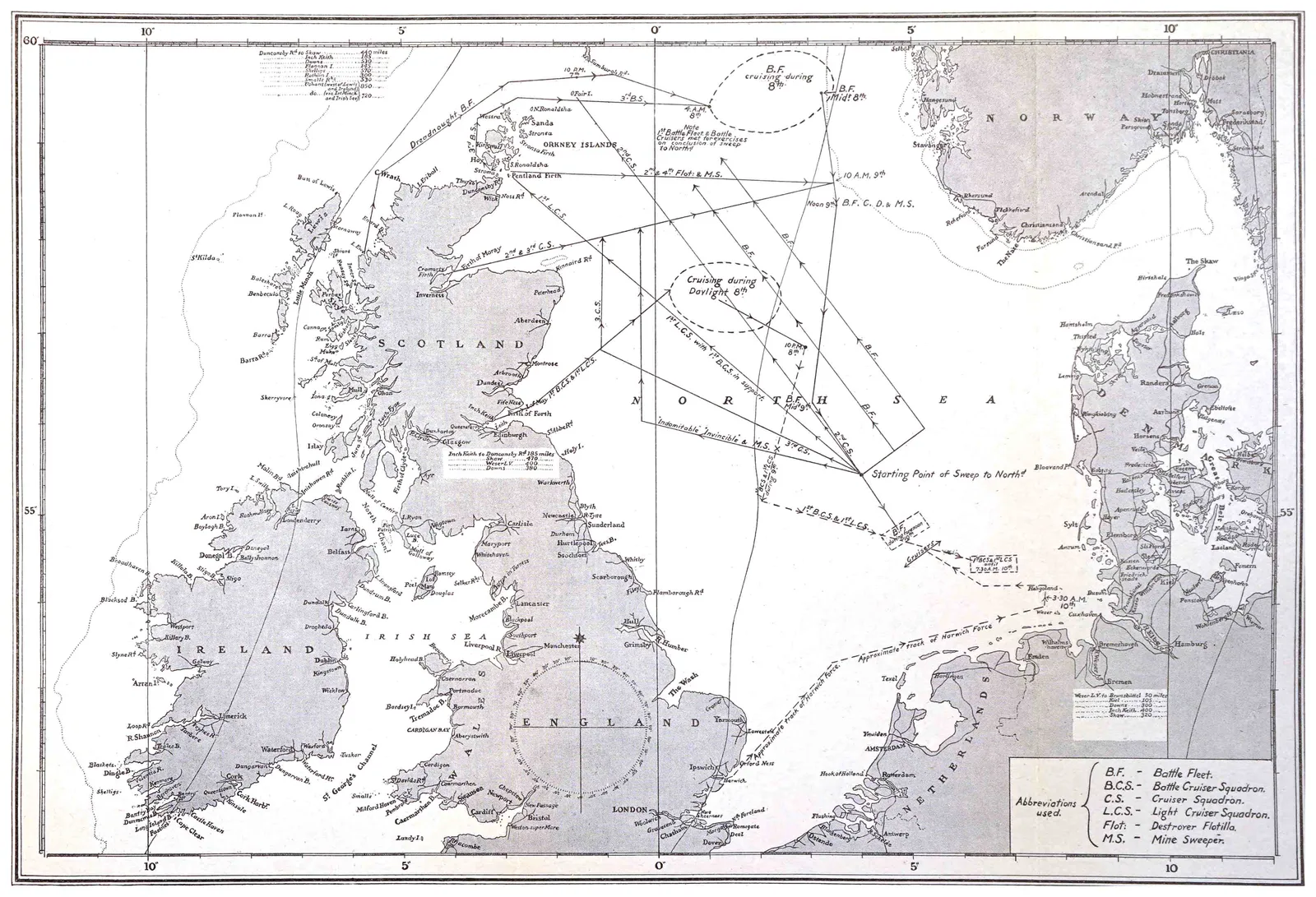
out at irregular intervals. A typical sweep is illustrated
in accompanying plans. On these occasions the
Battle Fleet was kept strictly concentrated during the
southern movement, and was screened as far as possible
by destroyers against submarine attack; and at times
mine-sweepers were directed to work ahead of the Battle
Fleet. When this was not possible, owing to the small
number of mine-sweepers available or the state of the
weather, some of the older battleships of the 6th Battle
Squadron, if they were in company, were stationed
ahead of the main Battle Fleet in order that, should a
minefield be encountered, these older ships would be the
first to strike the mines, thus giving sufficient warning
to enable me to manœuvre the more valuable ships clear
of the field.
This general policy was continued until the attack on
the Theseus and loss of the Hawke, belonging to the
10th Cruiser Squadron, by submarine attack on
October 15th, 1914, showed that even under the dispositions
then adopted, our larger cruisers were being risked
to too great an extent when working without destroyers
in the central part of the North Sea.
The next move, therefore, was the withdrawal of the
cruiser patrols to a safer position farther to the northward
and eastward of the Shetland Islands, this being combined
with a watch by the smaller craft on the Fair Island
Channel, and on the Pentland Firth approaches to the
North Sea. Under these conditions the Battle Fleet
was often kept either in a position westward of the
Orkneys, where it was in support of the cruisers and at
the same time formed a second blockade line, or it cruised
to the north and east of the Shetland Islands, the cruiser
patrols working farther south.
In all the dispositions which were made for a watch on
the northern entrance to the North Sea, the principle
kept in mind was the necessity for such an organisation
of the patrols as to have, in so far as numbers permitted,
two lines, or two areas, watched. The two areas were
at such a distance apart that vessels moving in or out
of the North Sea were forced, so far as all human foresight
could provide, to pass through the waters occupied
by one of the two groups of ships during daylight hours;
the distances apart were regulated according to the length
of the night at the different seasons of the year.
As the Battle Fleet worked farther to the northward
and westward, it became possible to make use of the
heavy ships to assist in blockade work without running
undue risks from submarines, and the blockade increased
correspondingly in effectiveness. As time went on, however,
the provision by the Admiralty of a larger number
of armed merchant cruisers enabled us to establish an
effective blockade line by the use of these vessels alone,
backed up by Cruiser Squadrons when such were available.
The withdrawal of the Battle Fleet to more northern
and western waters first took effect when the Fleet Base
was shifted temporarily from Scapa to Lough Swilly.
When this occurred, it did not affect the policy of frequent
cruiser sweeps into the southern portion of the
North Sea, supported by the Battle Fleet, which were still
continued.
The dispositions that have been described took account
naturally of two other very important factors.
The first was the transport of our Expeditionary Force
to France. It was highly probable that the enemy would
endeavour to interfere with this movement, and in the
early days of the War it would not have been a difficult
matter for him to cause us some loss. His failure to make
at least some attempt in this direction showed a lack of
enterprise which surprised me, as I think it surprised most
naval officers.
The conditions for him were distinctly favourable.
Our main Fleet was based, as he must have been aware,
far away to the northward, and if he had timed an attack
on the cross-Channel traffic for a period during which he
reckoned that the Grand Fleet, or at least the destroyers,
were returning to the base to fuel, he would have stood a
good chance of making the attack and returning to his
base before that Fleet could intervene. Consequently, he
would only have had to deal with the comparatively light
forces based in southern waters. On the other hand,
if our Fleet arrived on the scene without destroyers, the
Germans would have possessed no mean advantage.
The enemy was provided with a large number of
modern destroyers, and some of them would have been
well expended over a Channel dash, which would in all
probability have met with some success. During the
transport of the Expeditionary Force the heavy ships of
the Grand Fleet kept the sea as far as possible in order
to cover the movement, but the destroyers were constantly
returning to the base to fuel.
The second factor which had considerable influence on
Fleet dispositions was the possibility of an attempt at a
raid or invasion by the enemy. Such a move was not
very likely in the earliest days of the War, when the
nights were comparatively short and the Expeditionary
Force had not left the country. It is also probable that
the enemy had few troops to spare for the purpose. But
the chances became greater as we denuded the country of
men, and the conditions in other respects became more
favourable. In October and November, 1914, I held and
expressed the opinion that, if raids were attempted,
landings would probably be effected in the rivers on the
East Coast, the entrances to which were either unprotected
or inadequately protected. A beach landing on
our East Coast can only be carried out in fine weather,
and the chances of encountering favourable conditions on
arrival off the coast are not great, and I always doubted
the attempt being made. In our rivers the opportunities
are greater, and are not so dependent on fine weather,
and I suggested to the Admiralty that a simple preventive
in this case was to place merchant ships in position ready
to be sunk across the channels (which are narrow and
shallow), the ships being fitted with explosive charges
below ready to blow out the bottoms in case of necessity.
I mentioned the names of certain retired naval officers
who, I felt certain, would make all the necessary preparations
in a very few days. I believe that my proposals
were carried out.
The danger of raids, however, and the consequent
responsibility thrown upon the Admiralty for their prevention,
during a period when we had very little military
force in the country, led to a division of the Fleet by
Admiralty direction, which, however necessary, had certain
disadvantages from a strategic point of view.
The 3rd Battle Squadron, consisting of eight ships of
the “King Edward VII.” class, and the 3rd Cruiser
Squadron of four ships of the “County” class, were ordered
to be based on Rosyth, together with destroyers
for screening purposes. The eventuality that had then
to be faced was that of the remainder of the Grand Fleet
having to engage the High Sea Fleet, since concentration
with the 3rd Battle Squadron could probably not be
effected without the risk of losing the opportunity of
engaging.
At this time the battle cruisers Princess Royal, Invincible,
and Inflexible were in the Atlantic operating
against Von Spee’s squadron; and the Australia, Indomitable
had not joined the Grand Fleet. The Tiger was not
yet ready, so that at times our battle cruiser force consisted
of only three ships, the Lion, Queen Mary, and
New Zealand.
Throughout the War the responsibility of the Fleet
for the prevention of raids or invasion was a factor which
had a considerable influence on naval strategy.
If the Fleet, with destroyers, carried out a sweep in
the North Sea, or if it was at sea for a cruise having
exercises for its main object, there was bound to be
present in the mind of the Commander-in-Chief the chance
that he might be required suddenly to move south to engage
the High Sea Fleet which had put to sea to cover a
landing. If his destroyers were short of fuel at such a
moment very serious consequences might ensue, and
therefore all cruiser sweeps or other operations had to be
curtailed to prevent such a situation arising.
One other factor exercised a cramping effect upon our
naval strategy throughout the War, namely, the bombardment
of our undefended towns on the East Coast.
Such bombardments were of no immediate military value
to the enemy, but, in spite of the fact that the majority
of the Press, and the public, realised that the Navy should
not be led into false strategy because of these bombardments,
it was difficult for the Fleet to ignore them, and
I have no doubt that the Germans relied upon this fact.
Whilst the Fleet was based at Scapa Flow, it was
quite impossible to ensure that the enemy would be
brought to action after such an operation, since to attain
this end it would have been necessary for the Fleet, or
a portion of it, to be constantly cruising in the southern
portion of the North Sea. This was not practicable, even
had it been desirable, because of the impossibility of keeping
destroyers with the heavier ships, and in any case it
was false strategy to divide the Battle Fleet, as such a
course might well have resulted in disaster.
The usual course adopted was to base the Battle
Cruiser Fleet on Rosyth, and for that Fleet to cruise
from that neighbourhood. The speed of the battle
cruisers enabled them to get away from a decidedly
superior enemy force of battleships if encountered, but
there was always some risk in this case of a ship being
disabled; the flag officer in command would then have
been faced with the unpleasant alternative of abandoning
her or of risking his whole force to cover her retreat.
Had we been able to keep an effective look-out off the
enemy ports, so as to obtain warning of their ships leaving,
the difficulty would not have been so great, but our
submarines in those days (the only class of vessel which
could be used for such a purpose) were not fitted
with wireless installations with which they could signal
from the required positions, or indeed from positions anywhere
near the enemy’s coast, and, in any case, it must be
borne in mind that at night the exit of enemy vessels unobserved,
even under the conditions of a close submarine
look-out, is a comparatively easy matter.
At this stage it is convenient to remark upon the condition
of British naval bases. As is well known, the
Grand Fleet was moved to Scapa Flow during the latter
days of July, 1914, and the defenceless condition of the
Base, both against destroyer attack and submarine attack,
was brought very strongly into prominence by the presence
of so valuable a Fleet at this Base.
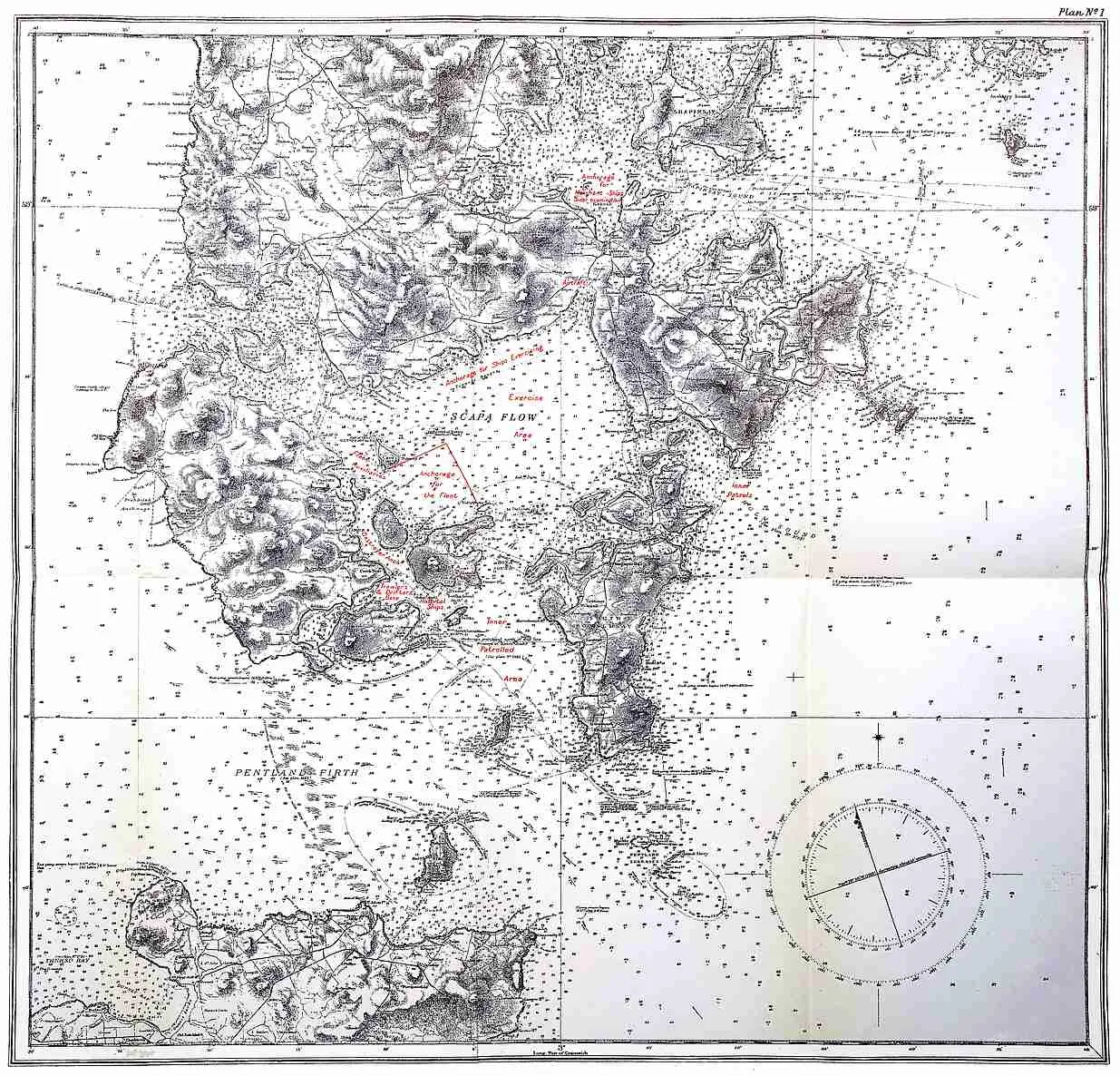
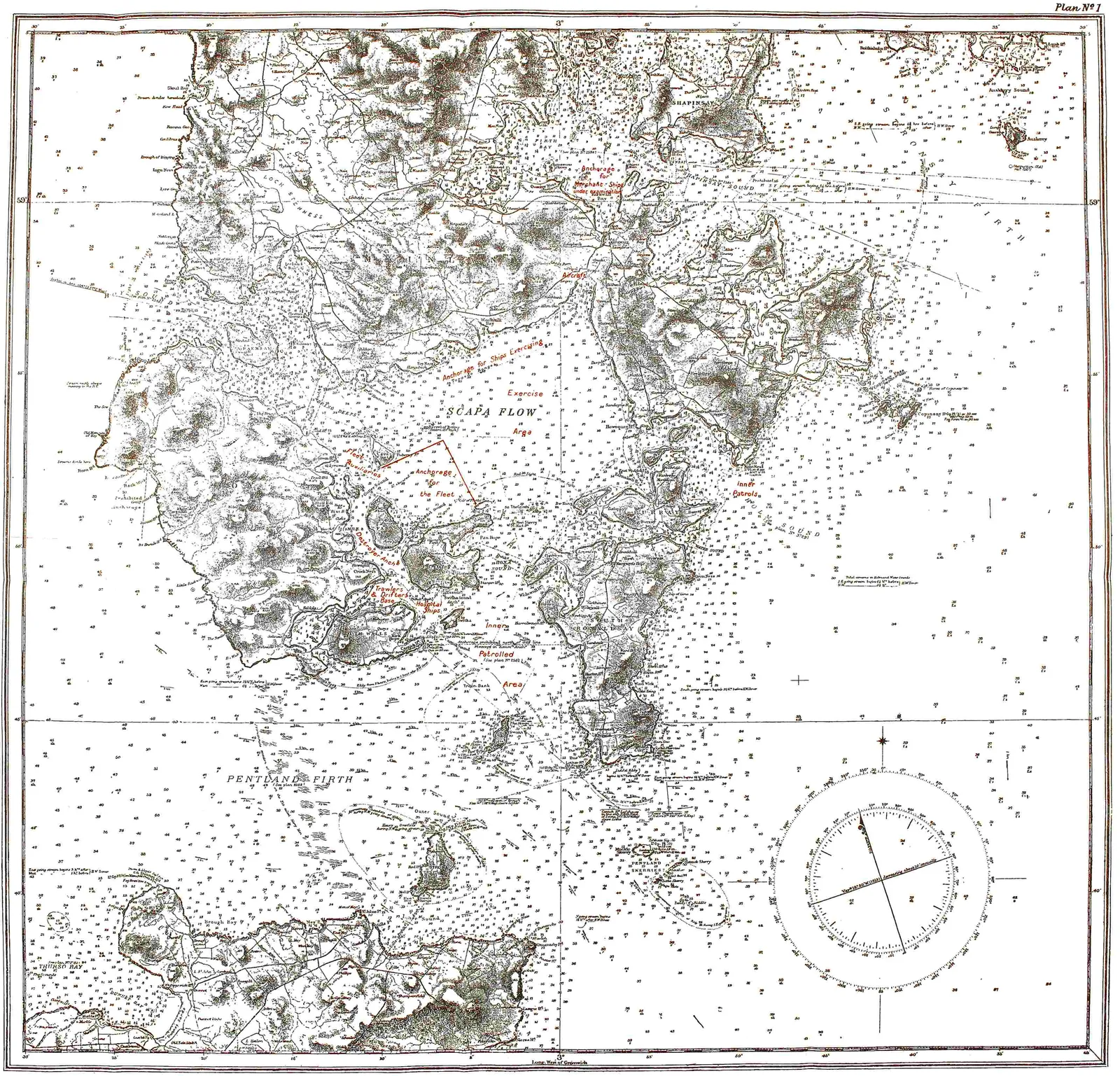
The anchorage known as Scapa Flow has three main
entrances navigable by all ships, the Hoxa, the Switha,
and Hoy Channels, and, in addition, has some more
narrow, shallow and tortuous entrances on the eastern
side, the main one being Holm Sound. The question of
providing gun defences for this Base, which the Admiralty
had decided a year or two before the War was
to be the main Fleet Base, had been discussed on more
than one occasion, after examination by a committee of
officers on the spot; but, since finance governs defence,
and the Admiralty from year to year had insufficient
money for even more urgent needs, no action had been
taken. Scapa Flow lies some 450 miles from the German
naval bases, and was, therefore, open to an attack by
enemy’s destroyer flotillas as well as, of course, by submarines.
Its main, indeed its only, safety against such
attacks by submarines lay in the navigational difficulties
attendant upon entry into the harbour, combined, as regards
destroyer attacks, with the possibility of an enemy’s
force being intercepted on its outward or homeward
passage, or of its being successfully engaged in the
vicinity of the base. The sailing directions laid great
stress upon the difficulties of navigations in the approaches
to this Base, due to the very strong and varying currents,
but the Germans were well acquainted with
the Orkney and Shetland Islands. They had indeed
made it a practice to send ships to visit these islands fairly
frequently before the War, and they were, therefore, as
well able to judge of the difficulties of entry into Scapa
Flow as we were; and seeing that we used it as a main
Fleet Base, they could deduce the fact, if they did not
know it already, that the difficulties of entry were not
insuperable.
Sir George Callaghan, under these conditions, on the
arrival of the Fleet at Scapa Flow at the end of July,
took immediate steps, with the resources at his disposal
in the Fleet, to improvise defences for the Base against
destroyer attack. All that he could do was to land some
12-pounder guns from the ships of the Fleet and mount
them at the entrances. No searchlights could, however,
be provided, so that the guns were not of much value at
night. Arrangements were also made for placing light
cruisers and destroyers at the various entrances to assist
these defences. The further step, of course, was taken
when the Fleet was present at the Base of placing patrols
to the eastward of the Pentland Firth. It was not felt in
the Fleet, however, that these measures gave much
security even against destroyer attack on a dark night, and,
it gave no security whatever against submarine attack.
Nothing but obstructions of some kind could give that
security. The matter was frequently discussed. Although
many brains had been at work, no satisfactory anti-submarine
obstruction had been devised. Under the urgent
pressure of war the solution was found. The conclusion
generally held by experienced submarine officers was that,
whilst the least important entrances, such as the Hoy,
the Switha and the Holm Sound Channels, would be extremely
difficult for the passage of a submarine, entry by
the Hoxa Sound Channel was quite practicable by a determined
submarine officer. So much for the Base at
Scapa Flow.
At Cromarty the conditions were somewhat better.
The only entrance to this Base is comparatively narrow,
and was defended against the entry of destroyers and
larger vessels by guns, which had been mounted by the
Admiralty before war broke out. There was, however,
no boom protection against the entry of destroyers, and
the conditions in regard to submarine attack were the
same as at Scapa Flow, there being no obstructions.
At Rosyth the same conditions prevailed as at
Cromarty, namely, the harbour was defended by guns
only against attack by destroyers. In this case, the guns
were manned by the military, and not by marines, as at
Cromarty; again the harbour was quite open to submarine
attack.
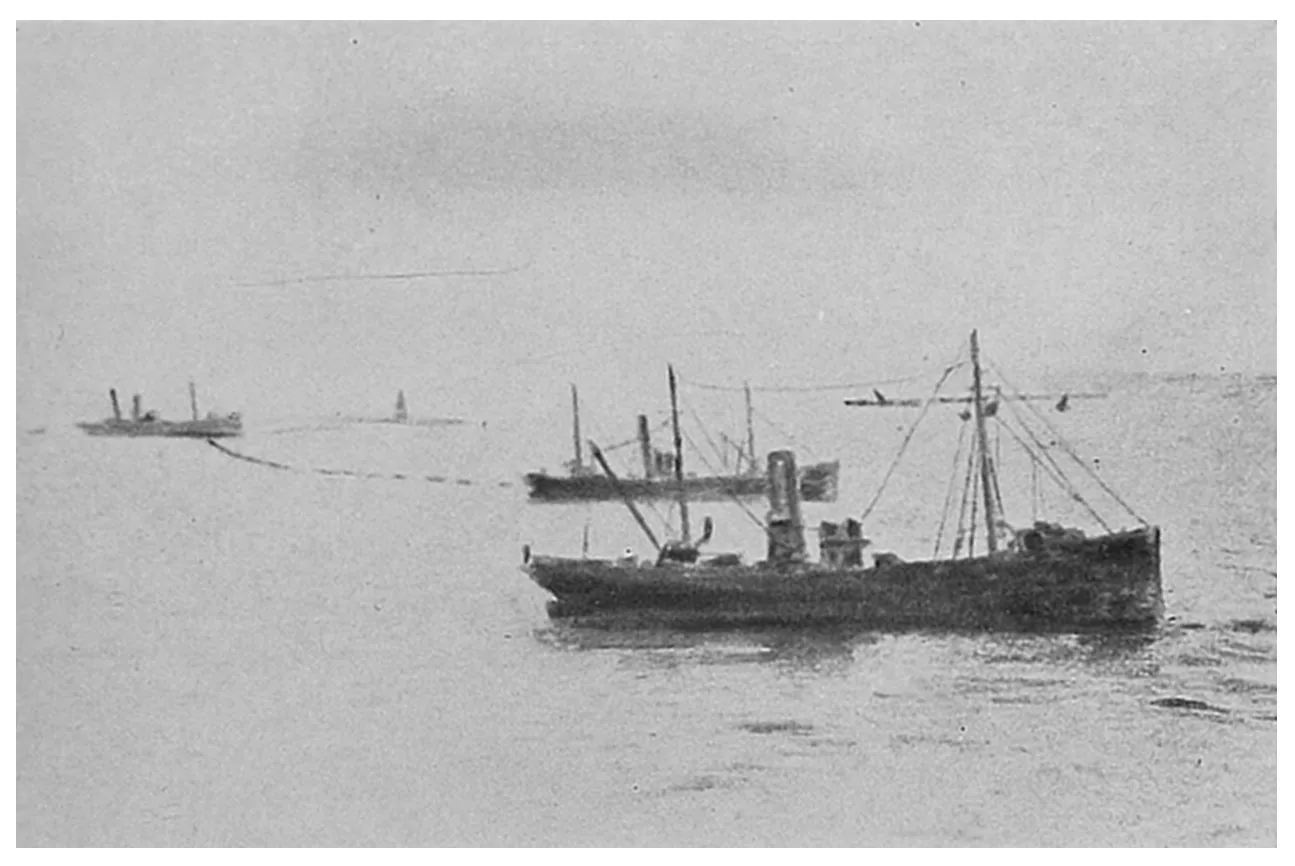
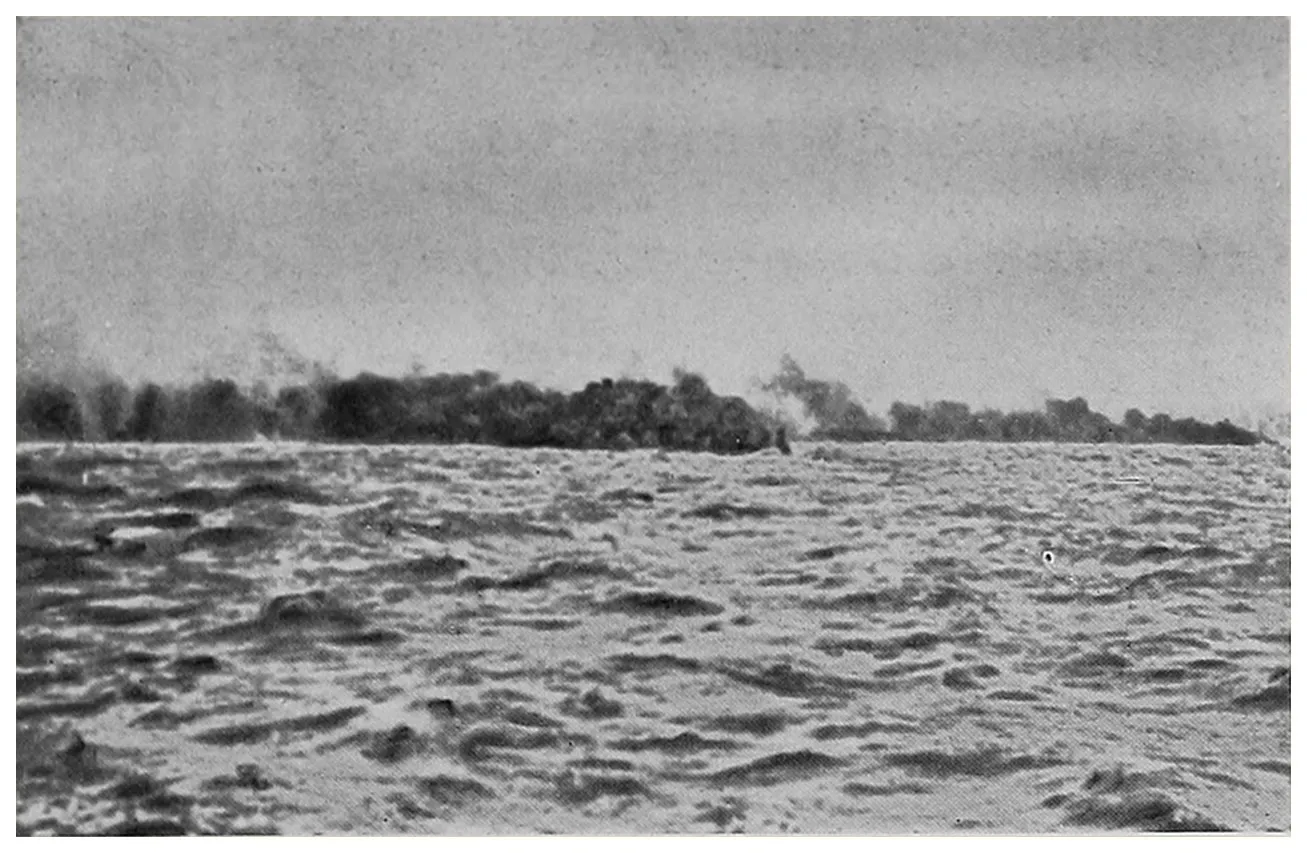
DESTROYERS RAISING STEAM ON THE FIRST OCCASION OF A
SUBMARINE BEING REPORTED INSIDE SCAPA FLOW
THE FIRST OBSTRUCTION AT SCAPA FLOW
Consequently, the anxiety of officers in command of
Fleets or Squadrons at anchor in any of the Bases used
by the Grand Fleet was immense. For my part, I was
always far more concerned for the safety of the Fleet
when it was at anchor in Scapa Flow during the exceedingly
brief periods which were spent there for coaling in
the early days of the War, than I was when the Fleet
was at sea, and this anxiety was reflected in the very short
time that the Fleet was kept in harbour. It was also the
cause of my taking the Fleet to sea very hurriedly on more
than one occasion owing to the reported presence of a
submarine in the anchorage, and considerable risks were
accepted in getting the Fleet to sea in very thick weather
at night on at least one of these occasions.
I have often wondered why the Germans did not
make greater efforts to reduce our strength in capital ships
by destroyer or submarine attacks on our bases in those
early days. They possessed, in comparison with the uses
for which they were required, almost a superfluity of
destroyers, certainly a superfluity as compared with ourselves,
and they could not have put them to a better use
than in an attack on Scapa Flow during the early months
of the 1914–1915 winter.
In August, 1914, Germany had 96 destroyers in home
waters fit for such an operation, all with a speed of, or
exceeding, 30 knots, this number being in addition to a
total of 48 more destroyers, rather smaller and with speeds
varying between 26 and 30 knots, which were quite fit for
work in the Baltic or in the vicinity of German bases in
the North Sea.
This country had in home waters at the same period
only 76 destroyers that could be compared with the German
vessels in view of modern requirements, and 33 of
these had a speed of only 27 knots. Of the 76 destroyers,
40 were allotted to the Grand Fleet proper, the remaining
36 being based on Harwich. We had in addition 11 large
and fast destroyers of the “Tribal” class which, owing to
their small fuel capacity, were only of use in southern
waters and were appropriated to Dover. And we possessed
25 destroyers of the “River” class, of a nominal
speed of only 25 knots, as well as the old 30-knot destroyer;
the latter class was only fit for patrol work in
the vicinity of the coast.
It may be said that similar reflections to those I have
mentioned might be made by the Germans as regards our
own movements, and that they were surprised that we
did not attack their Fleet at anchor. The answer is
obvious to those aware of the conditions. We were very
short of destroyers for fleet work, and we were well aware
of the thoroughness of the defences of the German naval
bases. We knew that they not only possessed the most
powerful and ample artillery defences, but we knew also
that the Germans had a very efficient mining service, and
we were justified in assuming that they had protected their
naval bases by extensive minefields. We, on the other
hand, were entirely unprovided with this particular form
of defence.
In view of the known quality of German artillery and
mine defences and the thorough nature of their organisation,
my own view was that they also possessed, in all
probability, anti-submarine defences. For these reasons,
together with the important fact that the German rivers
are so shallow that our submarines could not enter them
in a submerged condition, it appeared to me that an attack
on their ships in harbour would meet with no success,
and that we could not afford to expend any of our exceedingly
limited number of destroyers, or submarines, in
making an attack which would, in all human probability,
be foredoomed to failure. Later knowledge of the
German defences proved the correctness of this view.
I can only imagine that the Germans credited us, also,
with possessing harbour defences and obstructions which
in our case were non-existent, although we did our
best in the Fleet to give the impression that we had obstructed
the entrances, for, pending the provision of proper
obstructions, we improvised various contrivances. It
may have seemed impossible to the German mind that we
should place our Fleet, on which the Empire depended for
its very existence, in a position where it was open to submarine
or destroyer attack.
This view, however, did not relieve the minds of those
responsible for the safety of our Fleet from the gravest
anxiety whenever the more valuable ships were in the undefended
harbours.
A comparison of numbers between the Grand Fleet
and the High Sea Fleet in the early part of the War shows
the following figures. Only ships that had completed
their training and were fit to fight in the line are included:
B 21 completed, but two of these (Monarch and Conqueror) were seriously damaged
and one other battleship was refitting.
The above list gives the vessels nominally available.
In comparisons of the strength at Germany’s selected
and our average moment, the following facts should be remembered,
and were necessarily taken into account by me
at the time:
(a) We usually had at least two battleships, one or two
light cruisers, six destroyers, one or two cruisers, and perhaps
one battle cruiser under refit, in addition to any other
vessels that might be temporarily disabled.
(b) Germany would see to it that none of her ships was
refitting when planning an operation, and she could reinforce
her Fleet by several light cruisers and two or more
flotillas of destroyers from the Baltic.
(c) The pre-Dreadnoughts were not a very important
factor on either side owing to inferiority of speed, and, in
the case of our ships, the comparatively short range of
their guns, due to the small amount of elevation of which
their mountings admitted.
(d) The German Zeppelins, as their numbers increased,
were of great assistance to the enemy for scouting,
each one being, in favourable weather, equal to at least two
light cruisers for such a purpose.
(e) Account is not taken in the British figures of the
Harwich force, as this force could not be counted upon to
effect concentration with the remainder of the Grand Fleet
at the German selected moment.
(f) The British cruisers, not being very modern, lacked
the speed necessary for efficiency as scouts. They were
very slightly faster than the battleships of the “Dreadnought”
type, and, owing to their lack of speed, they
were awkwardly placed if they came within range of an
enemy Battle Squadron or Battle Cruiser Squadron. On
the other hand, they were very superior in fighting
qualities to the German light cruisers.
It will be seen from the above statements that the
enemy had by far his best opportunity from the naval
point of view in the early months of the War, as he was
then much nearer equality of strength with the Grand
Fleet than at any later period. A carefully laid trap,
which included minefields and submarines, with the High
Sea Fleet as a bait, might have been very effective at
any period of the War in inflicting considerable losses on
us. The Germans had their best opportunities between
November, 1914, and February, 1915. After April, 1915,
the situation got steadily worse for the enemy.
The lesson of vital importance to be drawn from this
review of relative naval strength, is that if this country
in the future decides to rely for safety against raids or
invasion on the Fleet alone, it is essential that we should
possess a considerably greater margin of superiority over
a possible enemy in all classes of vessels than we did in
August, 1914.
CHAPTER III THE GRAND FLEET AND ITS BASES — I.— The Development of the Grand Fleet — II.— The Staff Organisation — III.— Preparation of Cruising Orders — IV.— The Training of the Fleet — V.— The Blockade — VI.— The Grand Fleet Bases — VII.— The Personnel and its Welfare
The Grand Fleet may be said to have come into being
only at the outbreak of the War, when it was so christened.
As with the name, so with the organisation.
The great majority of the really effective ships in the
Grand Fleet were the outcome of the policy initiated by
Admiral of the Fleet Lord Fisher of Kilverstone when
he took up the appointment of First Sea Lord in 1904
in the Administration of the Earl of Selborne. One of
Lord Fisher’s first acts—and he carried through a number
of other changes which reacted favourably on the
efficiency of the Fleet for war—was the introduction of
the “all-big-gun” type of battleship, of which the Dreadnought,
laid down at Portsmouth on October 2nd, 1905,
was the earliest example. She was closely followed
by the three “all-big-gun” battle-cruisers of the “Invincible”
class, which were of the same programme—1905–6.
Much criticism was levelled at the
Dreadnought, but even more at the principle embodied
in the battle-cruisers—ships with the speed of
cruisers, but the same calibre armament as battleships.
The War has fully justified Lord Fisher’s
conception.
Our superiority in capital ships at the outbreak of
war was due to the efforts of the Boards presided over by
Lord Selborne and his successors from 1904 onwards, and
Lord Fisher held the post of First Sea Lord for five and
a half years of that period. At the beginning of 1909,
during Mr. McKenna’s tenure of office as First Lord,
great efforts were necessary to ensure the maintenance
of a sufficient standard of superiority in capital ships over
Germany, and to make good our deficiencies in destroyers.
The nation has good reason for the most profound
gratitude to Mr. McKenna for the very strong attitude
he assumed at this highly critical period. Reference to
the table on page 31 will show the position that would
have arisen if the four additional “Dreadnoughts” had
not been included in the 1909–10 building programme.
In the later Administration, presided over by Mr.
Churchill, continued efforts were necessary, and were
made, and steps were also taken with a view to meeting
the crying need for modern light cruisers; Lord
Beresford had for some years been pointing out how
essential it was to add largely to our programmes of light
cruisers and destroyers.
So much for construction in pre-War days when the
Germans were carrying out their Navy Acts, one following
the other in rapid succession.
It is also of interest to note the part which Lord
Fisher took in building up the Fleet organisation that
existed in 1914. He introduced the system of manning
the older ships, not in the first line, with nucleus crews
composed of the principal officers and ratings. These
ships were thus rendered capable of being put, in a very
short time, into a condition in which they were fit to
fight. This system superseded the old arrangement, by
which ships not in full commission were not manned at
all. Although it naturally led to a reduction in the total
number of fully-manned ships, a disadvantage which was
minimised by reducing squadrons abroad, it is probably
accepted now that in the circumstances existing at the
time the nucleus crew system is far preferable; it raised
the general standard of the whole Navy in British waters,
and facilitated the use of the Royal Fleet and Naval Reserves
on the outbreak of war.
In the organisation existing before the War, the
Home Fleets comprised the First, Second and Third
Fleets—in fact, practically all ships in home waters which
it was intended to mobilise on the outbreak of war.
The war organisation, as carried out, divided the Home
Fleets into two parts.
The First, the Grand Fleet, included the First Fleet,
comprising the latest-built ships; the force stationed at
Harwich; four ships of the 6th Battle Squadron; the 6th
and 10th Cruiser Squadrons from the Second and Third
Fleets respectively; and the mine-laying Squadron from
the Second Fleet.
The Second, or Channel Fleet, included the older
battleships, the 5th, 6th, 7th, and 8th Battle Squadrons,
the 5th and 7th Cruiser Squadrons, and a sweeping
flotilla with torpedo boats. This force was commanded
by Vice-Admiral Sir Cecil Burney until the end of 1914,
when he joined the Grand Fleet. It was independent of
the Grand Fleet.
Of the ships of the Channel Fleet, the 5th and 6th
Battle Squadrons and the 5th Cruiser Squadron were
manned before mobilisation with nucleus crews, and were
consequently partly trained; these ships assembled at
Portland. The ships of the 7th and 8th Battle
Squadrons and 7th Cruiser Squadron were not manned
until mobilisation, and the crews consequently required
training. This training was carried out near Plymouth,
and the battleships joined Sir Cecil Burney’s command
on September 3rd, 1914.
The ships of the 7th Cruiser Squadron were employed
as a look-out force in the Straits of Dover during the time
that the Channel Battle Fleet was patrolling to guard the
passage of the Expeditionary Force. They were subsequently
ordered by the Admiralty to another service, and
three of them, the Hogue, Cressy and Aboukir, were sunk
whilst patrolling the Broad Fourteens off the Dutch coast.
These, then, were the conditions when War opened.
It was only natural that war experience should show
very quickly the many directions in which we had to recast,
or elaborate, our pre-War ideas, or to introduce new arrangements.
Peace manœuvres, however useful, can never be a
substitute for war experience. They are many factors
which render peace manœuvres unreal. In the first place,
the available ships have to be divided so as to form the
opposing fleet, “an enemy”; secondly, a matter of far
greater moment, the manœuvres occupy much too short
a period, and many of the difficulties affecting both
matériel and personnel are not experienced; thirdly, the
conditions of war cannot be reproduced without serious
inconvenience, and even danger, to merchant ships; finally,
in our own manœuvres there was a tendency in the rules
to give the torpedo less than its proper value as a fighting
weapon.
But, more than all, it was the conditions under which
war broke out that made it necessary for us in the Grand
Fleet to build up what was almost a new organisation.
(a) The submarine had just become a most formidable
weapon; its development during the War was extraordinarily
rapid.
(b) The airship as a scout was in its infancy at the
start, but it also developed with great rapidity, as did the
heavier-than-air machines.
(c) The mine, neglected by us, had been highly developed
by the enemy, both defensively and offensively.
(d) The effective range both of the gun and of the
torpedo was quickly shown to be much greater than had
been considered possible before the War.C
(e) Wireless telegraphy developed with great rapidity,
and was put to many uses not dreamt of in pre-War days.
C In pre-War days our Battle Practice had been carried out at a maximum
range of about 9,500 yards, and only on one occasion, when the Colossus fired
at a target at 14,000 yards off Portland in 1912, had this range been exceeded.
On the other hand, we were very fortunate in having
the Fleet concentrated at the outbreak of war. People
had often pictured war with Germany coming as a bolt
from the blue, and even naval officers feared that when
the occasion did arise, it would be found, as had previously
been the case, that fear of precipitating a conflict might
lead the Government to delay concentration with the result
that our squadrons would be separated when war was
actually declared. Fortunately, the Admiralty in the last
days of July, 1914, placed us at once in a strong strategic
position. For this action the nation should be grateful
to the First Lord and First Sea Lord.
It was curious that, in spite of all the lessons of history,
there was general expectation that a great Fleet action
would at once be fought. No doubt this arose, partly,
from the boastings of German naval officers in pre-War
days, and partly from a knowledge of the great sacrifices
the enemy would incur unless he could dispute effectively
our command of the sea. Most people found it difficult
to imagine that the High Sea Fleet (built at vast
expense, and rightly considered by the enemy to be an
efficient weapon of war) would adopt from the outset a
purely passive rôle, with the inevitable result that German
trade would be swept from the seas. But there
were two factors tending to make the High Command
adopt this course. First, there was the fear that action
with the Grand Fleet would so weaken the High Sea
Fleet as to cause the command of the Baltic to pass into
Allied hands, with a consequent landing of Russian
troops on German soil as the result. This fear had been
present in the German mind ever since the days of Frederick
the Great, when Russia threatened Berlin during
the Seven Years’ War. The second point, no doubt,
was that the German High Command realised that, if
Germany adopted a defensive rôle with her Fleet, it
created, by far, the most difficult situation for us. Repugnant
as this might be to high-spirited German naval officers,
it was unquestionably the worst policy for us, for,
whilst the German High Sea Fleet remained “in being”
as a fighting force, we could not afford to undertake
operations tending to weaken our Grand Fleet, particularly
in the earlier period of the War when our margin
of superiority at Germany’s “selected moment” was not
great. The main disadvantage to the Germans, apart from
their loss of trade, lay in the inevitable gradual weakening
of the morale of the personnel of the Navy, and it is
highly probable that this loss of morale was in the end
responsible for the series of mutinies which broke out in
the High Sea Fleet during 1917 and 1918, culminating
in the final catastrophe in November, 1918. In my view,
the passive rôle was carried much too far.
To pass to the development of the organisation.
Almost the first question was that of Staff and Staff
work. In the days before the War, the Staff of the Commander-in-Chief
of the Home Fleets consisted of the following
officers:
(a) A Personal Staff, comprising a Flag-Commander,
Flag-Lieutenant, and Secretary. The Flag-Captain was
also, in a sense, on the Personal Staff.
(b) A General Staff, comprising a Captain of the
Fleet with his Secretary, a Wireless officer, a Signal officer,
and the clerical staff of the Secretary.
In addition, the organisation provided for the appointment
of two War Staff officers, on mobilisation for war.
This was the Staff which, together with an additional
Signal officer, I found in the Iron Duke, on assuming command
of the Grand Fleet.
It had always been my intention, on relieving Sir
George Callaghan in December, 1914 (as was originally
arranged before the War broke out, as I have explained),
to add to the above, a Captain, for the operational side
of the Staff, leaving the Flag-Captain responsible only
for the Command of the Fleet-flagship, this being, in my
opinion, sufficient work and responsibility to occupy his
whole time; and I had prepared an organisation of the
Staff of the Fleet-flagship in accordance with which the
work should be divided into two distinct branches, the
operations and the matériel side, each with a secretariat.
I had communicated my views to the officers selected for
the Staff. This, in my judgment, was the correct line for
any Naval Staff organisation, and it was later introduced
by me into the Admiralty Naval Staff.
When informed, just prior to the declaration of War,
that I might be required to take over the command of the
Fleet, I decided to ask, as the first step, for the services
of Rear-Admiral Charles E. Madden as Chief of the Staff.
I had brought with me from London on my own Staff,
as Second in Command of the Grand Fleet, a Captain
(Captain Bentinck), with the title of Captain on the
Staff, a Secretary with assistants, a Flag-Lieutenant, a
Signal officer, a Wireless officer, a War Staff officer, and
a Signal Boatswain. These, with the exception of Captain
Bentinck (who joined Vice-Admiral Sir George Warrender’s
Staff), I took to the Iron Duke, and my Staff
then comprised:
A Rear-Admiral as Chief of the Staff.
A Commodore as Captain of the Fleet.
Two Secretaries, with the necessary clerical staff.
A Flag-Lieutenant.
Three Signal officers.
Three Wireless officers (very soon reduced to two).
Three War Staff officers.
Two Signal Boatswains.
A Fleet Coaling officer also joined the Staff.
The main difficulty in providing a Flag officer afloat
with a suitable staff is that of accommodation, and this
difficulty was somewhat serious when I doubled the staff
on board the Iron Duke. However, it was successfully
overcome. The Staff was organised into two branches—Operations
and Matériel—the former directly under the
Chief of the Staff, the latter immediately under the Captain
of the Fleet. On proceeding to sea, however, the
work of the Captain of the Fleet became, of necessity,
very largely reduced, and he joined the operational side,
arrangements being made by which either he or the Chief
of the Staff was always on the bridge in my absence, as
we soon found under the new conditions, consequent on
the advent of the submarine as an important factor in
naval warfare, that it was essential that an officer should
be constantly on the bridge who could take immediate
action in moving the Fleet, or any portion of it, as might
be required.
Even so, the presence of the Commander-in-Chief
was so frequently required, at a moment’s notice, owing
to the swiftness with which a modern fleet moves, that I
never left my sea cabin, which was under the bridge,
to go to the after part of the ship when the Fleet was
at sea.
The duties of my Staff afloat were separated, as
already stated, under two headings. This division, as is
clear from the above remarks, affected their duties in
harbour more than when at sea. In the latter case the
two branches combined, and the whole staff became “operational.”
The Staff work under these conditions was carried out
in the war-room, situated under protection, below the conning
tower. Here the movements of our own ships were
recorded, as well as those of the enemy until we were
nearing contact. All intelligence was sent from the
bridge to this centre by the Signal officers, and the situation
at any moment could be seen by a glance at the charts
kept by the War Staff officer on duty.
When we were nearing enemy vessels or enemy waters,
the work was shifted from the war-room to the Admiral’s
shelter on the bridge, so that the situation could
be seen by me more readily; and finally, when, as on
May 31st and August 19th, 1916, the two fleets were
nearing touch with one another, the “plot” of the movements
as reported was continually under my observation.
At ordinary times, in harbour, the Staff officers engaged
on the operational side were following the movements
of such enemy vessels (chiefly, of course, submarines)
as were known to be at sea, as well as those
of our own vessels. (In the latter case frequent orders to
ships were necessary to ensure that they did not meet
each other at night—when risk of collision would be incurred
owing to ships not carrying lights, or in thick
weather.) They put into execution the orders given by
myself or the Chief of the Staff, and were engaged
in elaborating plans of future movements and drawing
up the necessary orders for such movements as I had in
contemplation. They were also engaged in arranging all
gunnery, torpedo and other practices and exercises, and
in the constant work of the production, revision and issue
of orders for the organisation and tactical working of the
Fleet.
On the matériel side, the Staff work comprised that of
storing, provisioning and fuelling the Fleet, all questions
of instruction, training, personnel, discipline, mails, refits
and repairs, etc.
In action each member of the Staff had his own
particular duty allotted to him. The secretaries took
notes and recorded proceedings; certain officers had as
their sole duty that of watching and reporting to me every
movement of enemy vessels; one officer was detailed to
attend solely to torpedo attacks made by the enemy,
keeping me informed of their progress and of their possibilities;
another dealt with all questions relating to concentration
or distribution of fire, bringing to my notice
any signals required to give effect to our preconceived
arrangements; each signal officer had his own special duty,
one being responsible that all signals for tactical movements
made visually were also made by “short distance”
wireless telegraphy. One wireless officer worked in the
main office and one in the auxiliary office. The Staff
was so organised as to leave the Commander-in-Chief
free to take a comprehensive survey of the whole position,
whilst ensuring that nothing that should be done was
left undone. It must, however, be realised that the rapidity
of movement of fleets is so great that, at critical
moments, the Commander-in-Chief of a fleet, or the Flag
Officer Commanding a Squadron, must of necessity make
instant decisions; there is no time for consultation or for
advice.
One of the earliest steps taken in organising the Grand
Fleet after the declaration of War was to lay down definitely
the various cruising orders for the Battle Fleet
and its “look-out” screen of battle-cruisers, cruisers and
light cruisers. There had been much discussion for some
years before the War as to the best disposition of cruisers
ahead of a Battle Fleet. None of the arrangements that
had been under discussion was adopted as a whole, but
war experience led to a series of diagrams being drawn
up giving the cruising stations of all the various classes
of cruisers and other light craft under the different conditions
that might exist. These included diagrams showing
the cruiser disposition with the fleet moving towards
enemy waters, under conditions of ordinary visibility,
by day, or in low visibility by day, both with the Battle
Cruiser Fleet in company and without it; a similar diagram
when moving away from enemy water by day (this
being to meet the possible case of an attempted attack
by destroyers as the fleet steered away from enemy
waters); diagrams were got out for steering towards or
away from enemy waters at night; and, finally, diagrams
were prepared, both for day and night, for the
dispositions of the cruisers and other light forces after an
action.
Several different cruising diagrams for the Battle
Fleet itself, both by day and at night, were similarly
drawn up. Some of these were specially designed to give
such safety from submarine attack as was possible to the
main body of the Fleet, in the not unlikely event of
destroyers being absent, from bad weather, shortage of
fuel, or other causes. The dispositions for use at night
provided for the use of destroyer attack, and were designed
to give safety from collision, due to squadrons
inadvertently closing each other in the darkness, when
showing no lights; this was a very possible event during
the course of a long night when a very slight error in
steering, or a slight difference in compasses, will rapidly
bring two squadrons together that started the night five
miles apart. It was necessary to keep squadrons separated,
as a long line of ships greatly facilitated successful
submarine attack, whilst a slight dispersal of squadrons
gave greater freedom of movement in the case of destroyer
attack. At the same time it was necessary to
provide for concentrating the Fleet quickly at daylight.
The question of submarine screens was taken up
at the commencement of war. This matter had
naturally been considered before the War, but was in
its earliest stages, and, although an efficient disposition
of a screen of destroyers is a comparatively simple matter
when there is no lack of destroyers, the case is different
when a fleet is very short of the requisite number, as was
our experience, and one destroyer had often to be disposed
to endeavour to do the work of two.
Diagrams of submarine screens were, therefore,
drawn up to meet the different conditions resulting from
the presence of varying numbers of destroyers, or a decreased
number of ships requiring to be screened, and
also providing for the ships being in various formations.
In November, 1916, the number of these diagrams was
seventeen.
Early in the War the danger of successful submarine
attack on warships at sea, whether in company or proceeding
singly, had impressed on us the necessity of
taking every precaution for safety, and the practice of the
fleet steering zigzag courses was devised and generally
adopted in accordance with my directions. In the case
of a fleet or squadron, the usual practice was to carry out
the alterations of course by turning the ships together;
occasionally the turn was made “in succession,” but this
was exceptional. In small squadrons, the turns were occasionally
made at fixed time intervals without signal.
Zigzagging had a very beneficial effect on the manner
in which officers of watches kept station in a fleet, since
there is no better practice than keeping station on a line of
bearing, a far more difficult matter to the novice than
keeping station astern of another ship. I attribute the
excellent manner in which the ships were handled in 1915
and 1916 very largely to this early experience. Much
theoretical investigation was instituted to determine the
method of zigzagging, both in a fleet and in a single ship,
which gave the greatest protection against submarine attack,
and actual experiments took place with our own
submarines with a view to forming correct conclusions;
the flag officers of the fleet rendered me much assistance
in this as in all other matters.
The experience of the Grand Fleet was utilised in the
instructions subsequently issued to merchant ships, and
the value of zigzagging in reducing the danger of submarine
attack was clearly shown during the year 1917 by
the comparative immunity of merchant ships that complied
with the orders as compared with those that did not
do so. Occasionally, of course, zigzagging brought a ship
into danger, but this was exceptional as compared with
the general immunity given.
When the convoying of merchant ships through
the submarine zone was instituted in 1917, after I had
returned to the Admiralty, the Grand Fleet experience
was again of value in the preparation of instructions.
The supremely important question of how best to
handle in action the large and increasing Fleet engaged
my attention from the commencement. In
drawing up the various instructions for the conduct of
the Fleet, both when cruising and in action, I availed
myself of the advice and assistance of the experienced
flag officers commanding the various Squadrons. Much
discussion took place on these matters, and many of the
dispositions adopted formed the subject of actual experiment
at sea before being incorporated in the
orders.
The successful and rapid deployment of the Battle
Fleet from its cruising formation was a matter of the
greatest importance, and constant practice in carrying out
this manœuvre under every varying condition was given
to the Fleet when at sea. Various arrangements were
introduced having as their object the simplification and
shortening of the manœuvre, with a view to bringing
the heaviest possible fire to bear on the enemy’s fleet as
quickly as possible. Orders were drawn up to meet
cases of deployment in thick weather, when the enemy
might be sighted at short range, and immediate independent
action by a divisional Flag Officer would be
necessary.
In the early part of the War the rapid deployment of
the Fleet for action was complicated by the presence of
the 3rd Battle Squadron of pre-Dreadnoughts—the vessels
of the “King Edward VII.” class—as the speed
of the ships of this squadron was some three knots less
than that of the rest of the Battle Fleet. I endeavoured
to solve this problem by practical experience. Much
depended on the tactics likely to be adopted by the
enemy’s Battle Fleet. The main difficulty lay in the
fact that if the 3rd Battle Squadron was placed on one
flank of the Battle Fleet when in cruising order and deployment
towards that flank became necessary in conformity
with an enemy movement, thus placing the slow
3rd Battle Squadron in the van, the fleet speed of the
whole Battle Line was necessarily reduced to some 14
knots, in order to have the necessary reserve of speed in
hand. If, on the other hand, the 3rd Battle Squadron
was placed in the centre of the Fleet, the Fleet speed
was again reduced to that attainable by this squadron.
It was desirable to devise a cruising order for the Battle
Fleet which would admit of the 3rd Battle Squadron being
in the rear after deployment, in whichever direction
deployment took place. There was still the objection,
which had to be accepted, that a turn of 16 points forced
upon us by the enemy would place this squadron in the
van.
The cruising order eventually adopted placed the pre-Dreadnought
Squadron in rear of the Dreadnought
Squadrons, with a view to the slow squadron turning in
the opposite direction to the remainder on deployment,
and eventually taking station in rear of the Dreadnought
Fleet. This involved accepting some delay in getting the
3rd Battle Squadron into effective action.
The question was not one of importance subsequent
to April, 1915, from which date our superiority in battleships
of the Dreadnought type was sufficient to give me
confidence that the High Sea Fleet, engaged under suitable
conditions, could be crushed in action without the
aid of the 3rd Battle Squadron; but during the winter
of 1914–15, when our superiority in Dreadnoughts was
frequently very slight, and the enemy possessed two
pre-Dreadnought Battle Squadrons, our 3rd Battle Squadron
was a necessary addition to the Grand Fleet.
The Battle Orders indicated the position to be
occupied by our battle-cruisers, cruisers, light cruisers
and destroyers on deployment, as well as that of the
fast 5th Battle Squadron, consisting of ships of the
“Queen Elizabeth” class, when that squadron joined the
Fleet. The first Battle Orders drawn up and issued
shortly after war commenced were modelled on a Battle
memorandum which I had prepared when in command,
first, of the Atlantic Fleet, and, later, of the 2nd Battle
Squadron. But the changing situation soon made alterations
and additions necessary, and the Orders were under
constant revision.
The tactics to be pursued by the different units of
the Fleet in action under all conceivable conditions were
provided for as far as possible.
Stress was laid from the beginning on the fact that
the Commander-in-Chief of a large fleet could not after
deployment control the movements of all the squadrons
comprising that fleet under the conditions of modern
action when funnel and cordite smoke, and the great
length of the line, would hamper his knowledge of events,
and increase the difficulty of communication. The necessity
for wide decentralisation of command, after the deployment
of the fleet for action, was emphasised.
As the Fleet grew in size, increasing stress was laid
on this point. Flag officers commanding squadrons were,
of course, kept fully acquainted with the general ideas
under which the Fleet would act, so that they might be
able to interpret my wishes when acting independently.
Stress was laid on the necessity for keeping a close watch
on the movements of the Commander-in-Chief, so that
squadrons could conform to his movements. The general
lines on which I intended to engage were defined. These
included the range at which it was intended to open the
engagement, the range below which it was not intended to
close under ordinary conditions, on account of the risks
to be apprehended from torpedo fire, and the exceptions to
this rule which might become necessary. Emphasis was
laid on the supreme necessity for a free use of our own
torpedoes when opportunity occurred.
After the experience of the engagement on January
24th, 1915, between the battle-cruisers, and especially as
our superiority increased and the High Sea Fleet gave no
sign of a desire to engage, the conviction became stronger
than in any action between the two fleets, the enemy would
fight a retiring battle. This is the most difficult form of
tactics to counter in these days of submarines, mines
and torpedoes, since a retiring fleet is in a position of
great tactical advantage in the employment of these
weapons. The Tactical Board was in constant use for
a consideration of this problem, both by myself and the
other flag officers.
In the earliest stages of the War, when the German
submarine strength was not great, one of the main problems
to be considered in regard to a fleet action was the
employment of our destroyers and light cruisers to
attack the enemy’s Battle Fleet with torpedoes and to
counter his similar attacks, which, owing to his great superiority
in destroyers, was a matter of supreme importance.
The knowledge, too, that his light cruisers and
destroyers, as well possibly as some of his heavier ships,
were fitted for mine-laying (which was not the case with
us) made it necessary to take into account the probability
that he would use this form of attack at the commencement
of a general action, or during the stages leading
up to it. Later, when his submarines increased in number,
the method of countering the use of such vessels by
the enemy, in the preliminary stages of a fleet action,
had also to be considered, particularly as it was not
until 1916 that the Grand Fleet was provided with any
submarines of this type, and not until 1917 that submarines
which could maintain the Fleet-speed at sea became
part of the organisation.
The comparative immunity of the van from torpedo attack
by the enemy, if the fleets were approximately abeam
of one another, and the risks run by the centre and rear
were pointed out, as were the different conditions produced
in the case of a retiring enemy, or one which had
a position of torpedo advantage.
The influence of the torpedo on tactics became greater
as the War progressed, owing to the advance made in
the technique of these weapons. Before the opening of
hostilities, for instance, torpedoes had a maximum range of
about 10,000 yards. We made many improvements
in our torpedoes as the War progressed, including
a great increase in range, and we had every reason to
believe that the Germans were making similar progress,
and that the range of their torpedoes was as much in excess
of the pre-War range as was that of our own
weapons.
The threat of successful torpedo attack even from
battleships in the line was, therefore, an important factor
to be taken into account, with the ships of the opposing
fleets formed in single line at the close intervals which are
necessary for successful co-operation and the concentration
of power afforded by a shortened line. Investigation
into possible alternative formations for fighting a fleet
action was constantly proceeding, but the single line, or
a modification of it, was, under most conditions, the best
that could be devised.
It was pointed out that, although our Fleet would be
manœuvred for advantage in gunnery position, it might
be necessary to engage under unfavourable gunnery conditions
in order to prevent the enemy reaching his own
waters.
Several new manœuvres were introduced and practised
by the Fleet with a view to countering possible tactics
on the part of the enemy. These included a
“turn away” or a “turn towards” to counter a serious
attack by torpedoes; a quick method of reversing the
course of the Fleet without impairing its organisation
to meet enemy tactics necessitating such a move;
rapid methods of re-forming single line; etc. Other new
tactical methods were introduced as time progressed
to meet the changing conditions of modern warfare.
Detailed orders were drawn up in regard to the conduct
of the Fleet after an action, so far as it was possible
to foresee the conditions that might arise. The object
was to arrange to continue the attack by light craft,
whilst safeguarding the heavy ships against counter-attack
by light forces.
In the orders which were issued for the guidance of
the destroyers both before, during, and after an action, endeavour
was made to provide for all these contingencies.
The stations of the flotillas, including the Harwich
flotillas, if they were present, were laid down, and each
had its particular duties assigned to it. General directions
were given for the employment of the destroyers,
wide latitude being reserved to the officers commanding
flotillas.
The treatment of disabled ships was legislated for.
The duties of each class of vessel, battle-cruiser,
cruiser and light cruiser when in cruising order, or in
action, or after an action, were defined, particular emphasis
being laid on the necessity for ships in the van,
when in action, gaining a position of torpedo advantage
in regard to the enemy’s Battle Fleet, whilst at the
same time engaging enemy vessels of a similar class and
preventing torpedo attacks on our own Battle Fleet from
developing.
Thus it was laid down as the leading principle in the
General Cruiser Instructions, that after gaining touch
with the enemy the first essential was to maintain that
touch. Instructions were also given that in the event of
the enemy’s advanced forces becoming engaged with our
Battle-Cruiser Fleet, the cruisers in our advanced line were
to push on and gain touch with the enemy’s Battle Fleet.
It will be seen later that this situation arose during the
Jutland battle.
The Instructions for battle-cruisers laid down the principle
that in action their primary function was the destruction
of the similar enemy vessels if present, and, after
their destruction or in their absence, to attack the van
of the enemy’s Battle Fleet. Prior to action their duty
was defined as giving information as to the enemy’s Battle
Fleet, whilst denying similar information to the enemy.
The Vice-Admiral commanding the Battle-Cruiser
Fleet was given a free hand to carry out these general
instructions.
The Instructions for the 5th Battle Squadron (the
ships of the “Queen Elizabeth” class) were drawn up to
provide for the battle-cruisers being either absent or
present. In the former event, this squadron took the
place, and the duties, of the battle-cruisers; with our
battle-cruisers present and in the van, the 5th Battle
Squadron was ordered to take station ahead of the remainder
of the Battle Fleet in the case of a deployment
towards Heligoland, and in rear of the Battle Fleet in the
case of deployment away from Heligoland. The object of
this latter disposition was to place the High Sea Fleet
at a disadvantage should it execute a 16-point turn after
deployment. In order to enable the 5th Battle Squadron
to carry out its functions in action, it was stationed between
the Cruiser Line and the main Battle Fleet when
in cruising order.
The Instructions to the light cruisers defined their
duties in action as being to attack the enemy’s light cruisers
and torpedo craft, to support our destroyers, and to attack
the enemy’s battle line with torpedoes. For this
purpose most of the light cruiser squadrons were required
to be in the van on deployment.
The Instructions for destroyers laid emphasis on the
fact that they should carry out an early attack on the
enemy’s Battle Fleet, commencing their attacks in clear
weather, as soon as the Battle Fleet were engaged. Under
conditions of low visibility, they were instructed to
attack without waiting for the Battle Fleets to be engaged.
It was pointed out that destroyers closing the
enemy’s Battle Fleet for the purpose of an attack were
also in the best position for preventing successful attacks
on our own fleets.
As soon as submarine flotillas were attached to the
Grand Fleet, in 1916, instructions for their conduct before,
during, and after action were drawn up. Instructions
for two other classes of vessel, namely, mine-layers
and sea-plane carriers, had been issued earlier, vessels of
the mine-laying type, but of a slow speed, having
been attached to the Fleet from the commencement of
War, and sea-plane carriers, possessing, however, but slow
speed and inferior arrangements, having joined during
1915.
Inseparable from the question of the management of
the Fleet before and during action was that of the working
together of its units at sea by day and at night. This
matter was, of course, one to which great attention had
been devoted by Sir George Callaghan, who, when he
handed over the Fleet to me, gave me a fighting machine
trained to a very high pitch of perfection by an officer
who was a past master in fleet training.
But it was inevitable that war conditions should make
even greater demands on the skill of the personnel than
had previously been necessary, and in no direction was
this more necessary than at night, the number of ships
in company being far greater than had previously been
usual; and the necessity of abstaining from signalling
added to the difficulties. Further, under peace conditions,
fleets cruising on dark, stormy nights without showing any
lights, did so for comparatively short periods, during
which the more experienced officers could, to a certain
extent, remain on deck.
Under war conditions no ships at sea ever showed
more than a very dim light at the stern, and frequently
not even that, adding greatly to difficulties of fleet cruising.
Consequently provision had to be made for ensuring
safety whilst cruising under these conditions, and considerable
foresight and great skill on the part of officers
was necessary.
Single ships and squadrons that might by any possibility
pass close to one another during hours of darkness
were warned beforehand of the danger, and arrangements
made so that they should be aware of each other’s
positions. Destroyers, especially, were given directions
so as to enable them to keep clear of larger vessels which
otherwise might open fire upon them. Patrol craft of all
sorts were similarly warned so far as this was possible,
but in their case the conditions, owing to difficulties of
communication, were frequently much more embarrassing.
Finally, the methods of disposing the Fleet at night
had to be such as to reduce to a minimum the necessity
for signals, whilst giving freedom of action in an emergency.
What applied to conditions of darkness applied
equally to fog. The ordinary means adopted for ensuring
safety in a fog at sea, the use of the steam syren,
could not as a rule be employed, since the blasts might
give warning to the enemy and place the Fleet open
to attack by enemy destroyers or submarines. On the
other hand, the necessity for our destroyers being in
close company with the larger ships for screening purposes
against submarines led, in the case of sudden fog, to a
difficult situation, as, before the Fleet could safely carry
out any manœuvre, it was essential to get the destroyers
clear. The sudden descent of fog during zigzagging by
the large ships was also embarrassing. Orders were issued
to meet all these conditions, and the best testimony to
the training of the Fleet prior to the War was the remarkable
freedom from accident during the early months after
the opening of hostilities. The manner in which newly
commissioned ships (in many cases ships which were by
no means handy vessels in a fleet) fell into the organisation,
was also a source of great gratification to me, and
must have been most satisfactory to the officers and men
concerned.
The gradual increase in the size of the Fleet, particularly
in light craft, the higher speeds attained by its
units, the extreme importance of reducing signalling by
wireless at sea to an absolute minimum, except in the
presence of the enemy, all tended to concentrate attention
on the question of the efficiency of our signal arrangements.
Wireless signalling by ships at sea had to
be stopped, because by means of directional wireless stations
the positions of ships using wireless telegraphy could
be determined by the enemy. As time went on, we felt
that the enemy might be able to ascertain the class and
in some cases even the name of the ship so signalling.
This we deduced from the fact that we ourselves made
progress in this direction. The fact of a German fleet
being at sea, for instance, could hardly be disguised if
much use was made of wireless signals. We naturally
concluded that the enemy could similarly locate any of
our squadrons using the same means of communication.
That was an inevitable inference.
The foregoing considerations made it necessary, in
the first place, to endeavour, by means of carefully compiled
and elaborate orders, to reduce the amount of signalling
that would ordinarily be required after the Fleet
had left its bases. Printed orders were prepared for the
Fleet leaving its bases under all the varying conditions
that could be anticipated, and whilst this made the orders
somewhat lengthy so as to meet every possibility, the
object was achieved.
Similarly, when the Fleet was in cruising order at sea
in daylight, arrangements were made to pass signals in
and out between the most advanced cruisers and the Fleet
Flagship by searchlight, except in the presence of the
enemy, and good organisation gradually reduced the time
occupied in this process very considerably. All Fleet
manœuvring when much to the southward of the latitude
of Kinnaird Head, on the coast of Aberdeen, was
also carried out by visual signalling.
Owing to the danger of disclosing the position of the
Fleet to enemy submarines or destroyers, it was not possible
to use visual signalling at night, except with carefully
shaded lamps which were only visible at a distance of
about a quarter of a mile, and then only by the ship
addressed, and this problem thus became complicated at
night, in fogs or in very thick weather. Occasional resort
had then to be made to wireless, but by signalling before
dark all expected movements during the night, and by
arranging the course of the Fleet so that few alterations
were necessary, we succeeded in keeping almost absolute
wireless silence. It had to be used, however, when important
information from the Admiralty and elsewhere
was to be transmitted to the Fleet-Flagship, or to senior
officers of squadrons, or to single ships when at sea engaged
in operations, etc., and early in the War we had
to devise a method by which this could be done without
calling up the ships in question by wireless, thus necessitating
a reply from them, and thus possibly acquainting
the enemy of their position.
After a time a satisfactory and ingenious system of
communicating the required information without causing
the ship herself to divulge her position was devised by
the Fleet Wireless officer, Lieutenant-Commander R. L.
Nicholson. This plan worked excellently and gradually
was greatly extended during the later stages of the War.
It must not be thought that, because wireless signalling
at sea was restricted, it was not intended to make
full use of it when necessary and when silence was no
longer required, such as when the fleets were within
sight of one another. On the contrary, a great advance
was made during the War in the use of wireless telegraphy
for manœuvring the Battle Fleet, as well as in
every other direction. So proficient did the ships become
under the organisation introduced by Lieutenant-Commander
Nicholson, assisted as he was by the very
efficient wireless officers and wireless personnel, that in
1916 I could handle the Battle Fleet by wireless with as
much ease and rapidity as by visual signals. At the beginning
of the War ten minutes to a quarter of an hour would
elapse before I could be sure that all ships had received
a manœuvring wireless signal addressed to the whole
Battle Fleet. In 1916 the time rarely exceeded two to
three minutes. This great improvement was due to new
methods introduced, as well as to incessant practice in
harbour.
Our advance in the use of wireless telegraphy was
very considerable indeed, and I owed a great debt of
gratitude to Lieutenant-Commander Nicholson, the other
wireless officers of the Fleet-Flagship, and the wireless
officers and personnel of the whole Fleet. The progress
was the more remarkable since, owing to extreme shortage
of wireless personnel for the expanding Fleet and
the large number of auxiliary vessels commissioned, we
were forced to discharge many of the best operators in
the Fleet as the War progressed and to replace them by
boys trained in the Wireless School established by the
Fleet at Scapa Flow.
A point which war experience brought into considerable
prominence was the difficulty of distinguishing,
with sufficient rapidity, enemy vessels from our own
ships both before, and, more particularly during, action.
The difficulty applied to all classes of vessels, but was
greatest in the case of torpedo craft and submarines.
Steps were taken to deal with it, and satisfactory arrangements
made for certain distinguishing marks visible at
long distances to be worn during daylight by our own
surface vessels. The question of identification at night
was more difficult, and although we effected improvement
in this respect also, the results were not so satisfactory.
Of the original experimental work carried out by the
Fleet at Scapa Flow none was more important than that
connected with the safety of ships from mines. Early
in the War it had become obvious that there was danger
of a serious weakening of the Grand Fleet by successful
mine attack, and no safeguard existed beyond the work
of the mine-sweepers; these vessels could not work far
afield, and in bad weather could not work even close to
their bases, whereas the Fleet might be required to proceed
to sea when mine-sweeping was impracticable.
A solution of this difficulty was required. Commander
Cecil V. Usborne, of the Colossus, in these
circumstances proposed to me the trial of an apparatus
which he suggested should be towed from the bows of
ships; it was intended to fend off any mine encountered,
provided the ship did not strike it absolutely “end on.”
I ordered immediate trials; all the necessary matériel was
provided with Fleet labour and appliances, and starting
with trials in a picket boat, they were continued until a
series of experiments commenced in large ships, battleships
and cruisers. I placed Rear-Admirals A. L. Duff
and A. C. Leveson in charge of the experiments and
great progress was made, although absolute success was
not obtained.
Lieutenant Dennis Burney, the son of Admiral Sir
Cecil Burney, visited the base at this juncture, and,
knowing his inventive turn of mind, I discussed the
matter with him at considerable length. Lieutenant
Burney soon afterwards put forward proposals for
effecting the required object. His idea was to utilise
apparatus which he had devised earlier for other purposes.
His scheme was of a more elaborate nature than that
devised by Commander Usborne, and necessitated the
manufacture of appliances by outside manufacturers. I
urged the Admiralty to take up the question at once;
this was done, and the experiments, started at Portsmouth,
were transferred to Scapa Flow as soon as preliminary
success had been obtained.
The two devices were then tried over a considerable
period at Scapa Flow, still under the immediate direction
of Rear-Admirals Duff and Leveson, who threw themselves
wholeheartedly into the task, Rear-Admiral
E. F. A. Gaunt taking up this work in their occasional
absence. After many disappointments the Burney
system was proved to be successful, and I at once requested
that manufacture on a large scale should be
proceeded with. The device was of an elaborate character,
and many persons at first were sceptical as to its
value, owing partly to early difficulties in manipulation.
But Rear-Admirals Duff and Leveson rendered the
greatest assistance in overcoming objections, and gradually
it came to be seen in the Fleet that we had
become possessed of a most valuable safeguard. By
the time I relinquished the Command a very large number
of battleships, battle-cruisers, and cruisers, and some
light cruisers had been fitted, and the gear was working
well. Owing to Lieutenant Burney’s efforts, improvement
was constantly being effected, with the result that
during 1917 the fitting was universal. During that year
it was instrumental in saving several warships from damage
by mines, and in 1918 the number of ships saved was
also considerable.
The initial idea was that of Commander Usborne,
and both he and Lieutenant Burney displayed much
energy in working out their respective devices. But it
was through Lieutenant Burney’s ingenuity that final
success was achieved. Rear-Admirals Duff and Leveson
eventually brought the appliance to perfection, with the
result that it was generally adopted. A modified arrangement
of the same nature was fitted to merchant ships
during 1917 and 1918, and proved of very great value.
As was inevitable, my thoughts turned at an early
stage of my Command to the necessity for constant
improvement in the fighting efficiency of the Grand
Fleet. My knowledge of the German Navy, which was
considerable, left me under no delusions as to its
character. I had made it my business to keep myself
very fully acquainted with German progress. I had
first been brought into close touch with the modern
German Navy during service in China from 1899 to
1902, which included the Boxer campaign, when I
saw a great deal of its officers and men. I had then
formed a high estimate of its efficiency, and subsequent
touch on many occasions with the German Fleet had
convinced me that in matériel the Germans were ahead
of us, and that the personnel, though lacking the
initiative and resource and seamanlike character of the
British, was highly disciplined, and well educated and
trained. I knew also that the German Fleet was in no
way short of officers; this was the case with us owing to the
constant political pressure in the years before the War,
and I expected that this shortage of officers would be a
great handicap to us as the War progressed. The branch
of the German Navy from which I expected very good
work was the destroyer service. I had seen German destroyers
manœuvring.
Finally I knew, perhaps better than most of our
officers, how efficient was the gunnery and torpedo work
of the High Sea Fleet, and how rapid had been its advance
in the year or two before the War. A great increase
had been made in the allowance of ammunition for
practice. Before the War this was much higher than our
own, and there was no doubt in my mind that the German
allowance would be well expended. Indeed, we had obtained
information which placed this beyond question.
I was well acquainted personally with many of the
flag officers and captains in the German Navy and had
some idea of their views on naval warfare. Amongst
those whom I knew best were Admiral von Ingenohl,
the then Commander-in-Chief of the High Sea Fleet,
Vice-Admiral von Lans, commanding a Battle Squadron,
Admiral von Pohl, the Chief of the Naval Staff, who
later succeeded Admiral von Ingenohl, Grand-Admiral
von Tirpitz, Admiral von Holtzendorff, a former Commander-in-Chief
of the High Sea Fleet, who succeeded
Admiral von Pohl as chief of the Naval Staff, and Admiral
von Usedom, who did conspicuous work in the shore
batteries during the Dardanelles operations. My knowledge
of these officers led me to expect good work in the
High Command, and I also expected that they would be
well supported.
It is interesting to record that I took part in a Conference
of Allied naval officers in a pagoda at the end
of the Great Wall of China in company with Admiral
von Holtzendorff (the then German Flag Captain in
China) after the capture of the Shan-hai-Kwan forts,
in 1900, and that Admiral von Usedom succeeded me
as Chief of the Staff to Admiral—afterwards Admiral
of the Fleet—Sir Edward Seymour, when I was wounded
during the international expedition for the relief of the
Peking Legations. I had met both these officers on several
subsequent occasions, as well as Admiral von Lans,
who was in command of the Iltis at the capture of the
Taku forts by the Allies in the Boxer campaign.
My knowledge of the German Navy was a strong reason,
had no others existed, for making me desirous of
doing all that was possible to increase our own gunnery
and torpedo efficiency.
The Germans possessed an excellent practice ground
in Kiel Bay, with every appliance for carrying out gunnery
exercises, and I felt sure that they had rendered it
safe from any hostile attack, and that the German Fleet
would be able to maintain and improve its efficiency as
time progressed.
We were not in so fortunate a position. There had
been no recent opportunity for carrying out gunnery and
torpedo exercises and practices; Scapa Flow had not been
used as a base for such work in peace time, except for
destroyers, and consequently no facilities existed there,
although the proximity of Cromarty, which had been a
Fleet practice base, neutralised this disadvantage to a
certain extent at a later period. But there was no protected
area outside the harbour where practices could be
carried out in safety, and the harbour itself was not at
first secure against submarine attack. Much use, however,
was made of the Moray Firth outside Cromarty
later when submarine obstructions had been provided,
and the Germans had obligingly laid a mine-field which
protected the practice area from seaward. At the
commencement of the War, then, it was necessary to
depend on fleet resources for the provision of targets for
gunnery practices, and the practices themselves were carried
out under conditions which laid the ships open to
submarine attack. This was most unsatisfactory, and the
work suffered considerably as the result. The opportunity
provided by constant sea work in the first months of the
War was, however, utilised to carry out such gunnery
practices as the conditions admitted.
At first the custom was for the Fleet to use small
targets which the ships carried with them. These were
unsuitable; their small size rendered them frequently
invisible at even moderate ranges in any sea, and I felt
that the Fleet could not make progress under such conditions.
Practice at rocks or small islands was next resorted
to, but no really suitable rocks existed, and, in any
case, practice at them eventually involved too much risk
of submarine attack, as the German submarines began
to find their way to the westward of Scotland. Towards
the end of 1915 it became possible, owing to the increase
in the number of destroyers attached to the Fleet, and to
the provision of submarine obstructions at Cromarty, to
carry out gunnery practices at long ranges at targets in
the Moray Firth, and real improvement dated from that
period.
Later still, battle practice targets were brought to
Scapa Flow, and the long-range firing was carried
out in the Pentland Firth, a still more convenient
place.
Meanwhile Scapa Flow itself had been developed for
all the preliminary gunnery practices which could be
carried out with guns up to 6-inch in calibre, and also
for night firing and for torpedo work. The fine stretch
of water was secure from submarine attack after the
obstructions had been provided, and ships could practise
by day and night without danger of attack. The Flow
was simply invaluable for this purpose. Ships were
firing, running torpedoes, practising fire control exercises,
carrying out experiments and exercising in dealing
with attacks by destroyers, day after day, from daylight
until dark.
After dark, night firing was frequently carried out,
and occasionally a division of battleships was exercised
in steaming in company, without lights, in order to give
the officers of watches practice. When the constant sea
work of the earlier months of the War gave place to occasional
cruises, the seagoing and fighting efficiency of
the Fleet was maintained at a remarkably high standard
as a result of the work in Scapa Flow.
During the period 1914–16 a marked advance was
undoubtedly made in gunnery efficiency. At an early
period of the War a memorandum was issued pointing
out the necessity for increased attention to drill and
organisation. Absolute perfection was insisted upon,
and it was obtained, by the strenuous efforts of officers
and men. I knew that we had to deal with an enemy
who would be as perfect as constant drill could
ensure.
A great extension of the system of Director Firing,
by which one officer or man could lay and fire all the guns,
was made. The situation in this respect before the War
was that a few ships had been fitted for the system, which
had been devised by Admiral Sir Percy Scott. But a
very large number of officers were sceptical as to its value
compared with the alternative system; there was considerable
opposition to it, and the great majority of the ships
were not fitted. In some cases the system was not favoured
even in the ships provided with it.
It had fallen to my lot in 1912 to carry out competitive
trials of the Director System and the alternative
system already in use, and the results of these trials
had fully confirmed me in my previous opinion of the
great value of the Director System. I was able to press
these views on my return to the Admiralty at the end
of 1912 as Second Sea Lord, and it was then decided to
provide all the later ships with the arrangement. Little
progress had, however, been made when the War broke
out, only eight battleships having been fitted.
Early in 1915 arrangements were made, with the assistance
of Sir Percy Scott and the warm support of
Lord Fisher, then First Sea Lord, by which the battleships
and battle-cruisers were supplied with this system,
without being put out of action or sent to a dockyard
for the purpose. The necessary instruments were manufactured
at various contractors’ shops, and the very laborious
task of fitting them, and the heavy electric cables,
on board the ships was carried out by electricians sent
to the various bases. The complicated work naturally
took a considerable time, and many vexatious delays occurred;
but gradually all ships were fitted, Sir Percy
Scott rendering invaluable assistance at headquarters.
As a first step, the system was fitted to the heavy
guns mounted in turrets, and by the date of the Battle
of Jutland there were few ships that were not supplied
with the system, although six of those last fitted had not
had much experience with it.
The conditions under which that action was fought
converted any waverers at once to a firm belief in the
Director System, and there was never afterwards any
doubt expressed as to its great value.
Further efforts were made later to accelerate the work,
and the system was extended to smaller vessels. This
had been the intention even before the action, but there
were then still many who were unconvinced. However,
during the remainder of 1916 and 1917 the work was
pressed forward, and the system became universal for all
guns and in all classes of ships.
The improvement in what may be termed the application
of existing methods of fire control may now be mentioned.
Throughout the War we had gradually, as the
result of practice, increased greatly the effective range
at which ships could engage, and stress had been laid
on the necessity for bringing the fire rapidly on to the
target in order to obtain early hits. Improvement was
perhaps most rapid in the five or six months following
the Jutland action. In this action the Fire Control Instruments,
as adopted in the Service, which were the outcome
of the work of naval officers, were found to meet
the gunnery requirements most successfully. The only
important improvement that was made was the provision
of additional means for keeping the observation of
Fire Instruments trained on the correct enemy ship. Various
committees were formed immediately after the battle
in order that full advantage might be taken at once of
our experience. The result was the introduction of new
rules for correcting gunfire; these, in addition to greatly
increasing the volume of fire from a ship, also rendered
it difficult for the enemy vessels to evade punishment
by dodging tactics.
SMOKE SCREEN MADE BY DESTROYERS
A DUMMY BATTLESHIP, MARCH, 1915
In order to cope more successfully with the latter development,
more experiments were ordered, having as
their object the determination of the inclination of the
enemy vessel to the line of bearing from us, and various
methods of obtaining this inclination were recommended
to the Fleet. The most promising at the time that I
relinquished command of the Fleet was that proposed
by Lieutenant J. W. Rivett-Carnac, R.N., the range-finding
expert of the Grand Fleet, who had investigated this
inclination problem for some years. A great increase
in the rapidity with which the fall of shot were “spotted
on” to a target resulted from all this work. It is not
too much to say that the interval between opening fire
and the moment at which the salvoes began to “straddle”
the target was certainly halved, and the rapidity of
fire when the enemy was “straddled” was very greatly
increased. The new firing rules, by standardising the
system of correcting fire, produced a marked increase
in the efficiency of the methods by which the fire of two
ships was concentrated on to one target and generally
paved the way for the solution of many gunnery
problems which the Fleet had previously been unable
to solve completely.
The use of smoke screens was closely investigated as
a result of our experience of the German use of this device.
Prolonged experiments were carried out at Scapa
Flow to ascertain the possibilities and the best method
of using smoke screens, and they were also used during
battle tactics and during range-finder exercises. The
trials included the use of smoke shell as well as funnel
and artificial smoke.
In another direction efforts were made to increase
efficiency. The Jutland battle convinced us that our armour-piercing
shell was inferior in its penetrative power
to that used by the Germans, and immediately
after the action I represented this with a view to immediate
investigation. A Committee sat to consider the
matter. In 1917, as First Sea Lord, I appointed a second
Committee.
With one of the old type of armour-piercing shells of
a particular calibre as used at Jutland the shell would,
with oblique impact at battle range, break up whilst holing
a certain thickness of plate, and the shell could not,
therefore, reach the vitals of the enemy’s ships. A shell
of the new type, as produced by the 1917 Committee, of
the same calibre would at the same oblique impact and
range pass whole through a plate of double the thickness
before exploding and could therefore with delay action
fuse penetrate to the magazines of a capital ship. Had
our ships possessed the new type of armour-piercing shell
at Jutland, many of the enemy’s vessels, instead of being
only damaged, would probably not have been able to
reach port. The manufacture of these new type shells
for the Fleet was well advanced before the end of 1917.
The value of the torpedo as a fighting weapon in
action, from ships, from destroyers, and from submarines,
was also greatly increased. The torpedo practices at
Scapa Flow, which were of a realistic character, were of
the greatest possible use.
The real cause underlying the improvement was the
great keenness displayed by officers and men. Their one
idea was to strive for the highest efficiency, and
there was never apparent the least sign of weariness or
staleness in repeating time after time exercises and practices
with which they were so familiar. No tribute
that I can pay to the personnel of the Grand Fleet in
this connection could be sufficiently high. I know that
under my successor the improvement in fighting efficiency
continued.
Owing to the collapse of the moral of the personnel
of the German Navy, culminating in the surrender for
internment of the majority of their capital ships, the
Grand Fleet was given no opportunity of testing in action
the methods adopted as a result of our experience
during the first two years of war, and perfected by two
years’ further training. Had the German fleet come out
to battle a terrible punishment awaited it!
Mention has been made of the development of aircraft
during the War. The possibilities resulting from the use
of the air for reconnaissance work, for assisting in the direction
of gunfire, and, finally, for offensive operations,
were fully recognised in the Grand Fleet; but for a considerable
period the lack of suitable machines hindered
development. The first decisive step taken was the fitting
out of the Campania, a passenger ship of the Cunard
Line, as a sea-plane carrier to be attached to the Battle
Fleet. Prior to that, the Harwich Force and, later, the
Battle Cruiser Fleet had been provided with smaller vessels,
the Vindex and Engadine, carrying a few sea-planes.
They had been used in operations in the Heligoland
Bight, but without much success, owing to the difficulty
experienced in getting sea-planes to rise from the water
except in the finest weather.
With the arrival of the Campania at Scapa, we were
able to investigate the difficulties attending the use of aircraft
from ships as then fitted and to indicate the direction
in which improvement was desirable and possible. It
was apparent that little improvement could be expected
so long as we were dependent on the machines rising from
the water. The first step, therefore, was to improve the
arrangements for flying off from the deck of the
Campania. The ship returned to Liverpool at the end
of 1915 in order that the necessary alterations
might be effected; these were not completed until
the late spring of 1916; during the alterations, the
Campania was also, at my request, fitted to carry a kite
balloon.
The advantages to be obtained from the use of kite
balloons had been demonstrated during the Dardanelles
operations, and the Menelaus, kite balloon ship, was sent
to the Grand Fleet. But it was soon obvious that we
could not make profitable use of kite balloons in a fleet
action unless they were flown from the ships themselves,
and experiments were carried out, under the direction of
Vice-Admiral Sir Doveton Sturdee, commanding the
4th Battle Squadron, having as their object the best
method of fitting and using kite balloons from warships.
Many difficulties were experienced, the principal one
being that of providing wire of sufficient strength to stand
the tension of the balloon during strong winds. The Kite
Balloon Section at Roehampton gradually solved the
difficulties, and by the end of 1916 the majority of the
flagships leading divisions of the Fleet were provided
with kite balloons, and were experiencing their utility.
From this beginning, great developments took place in
providing vessels of all classes, including light cruisers,
destroyers, P boats, and trawlers, with kite balloons; the
balloon was used in the case of the smaller vessels
for anti-submarine reconnaissance work, whilst in the
heavy ships it was used for observation and correction
of fire.
Meanwhile, the development of the air-craft carrier
had proceeded, but not with the same rapidity. It was
evident to me in 1916 that for anti-Zeppelin work we
should look towards the aeroplane flying from the deck,
rather than to the sea-plane, although it also could rise
from the deck; but I gathered the time was hardly ripe
for the step, owing to the landing difficulty, and the first
efforts of the Royal Naval Air Service lay in the direction
of providing a type of sea-plane that would fly well off
the deck and climb quickly. These efforts were fairly
successful, but the development of the heavier-than-air
craft machine for use with the Fleet did not begin until
the aeroplane was adopted for the work; and this took
place in 1917, when progress became rapid, and continued
until the end of the War.
There remains the question of the airship, which was
also being developed during the period 1914–16, but as
this matter was not within the province of the Fleet, it
is unnecessary to touch upon it here.
The story of the development of the Grand Fleet
would be incomplete without reference to the Blockade,
and, in particular, to the work of the 10th Cruiser Squadron.
In the early days of the War, the 10th Cruiser Squadron
consisted of the ships of the “Edgar” class—vessels
at least twenty years old; and during August,
1914, the Admiralty commissioned three armed merchant
ships, the Mantua, Alsatian and Oceanic, to strengthen
the squadron for blockade work; the latter ship was lost
by shipwreck in September of that year.
The Blockade in those early days was carried out by
the 10th Cruiser Squadron and by the other cruiser squadrons
attached to the Grand Fleet. During November,
1914, the ships of the “Edgar” class were withdrawn
owing to their unseaworthy condition, and the
ships’ companies utilised to commission a number of additional
armed merchant cruisers. By the end of December,
1914, the squadron consisted of eighteen ships,
being raised later to a strength of twenty-four ships. A
very large proportion of the officers and men of the reconstituted
10th Cruiser Squadron belonged to the Mercantile
Marine.
The advent of so large a squadron of these vessels
called for a considerable organisation for their maintenance;
they were based on Liverpool for all the heavy
work of upkeep, whilst a secondary advanced base at
Swarbachs Minn, on the west coast of the Shetland
Islands, was gradually developed, and obstructed against
submarine attack. The work of organisation was carried
out by Rear-Admiral de Chair, who commanded the
squadron, ably seconded by Rear-Admiral H. H. Stileman,
the Senior Naval Officer at Liverpool, to whom
we were much indebted for hearty co-operation and efficient
organisation at the base.
The work of the squadron consisted in intercepting
and boarding all vessels bound into or out of the northern
entrance to the North Sea, and this work could obviously
not be carried out in the face of the German submarines
without heavy risk to the ships. The danger was
greatest during the operation of boarding, as the examining
vessel was obliged to stop to lower the boarding-boat.
As the number of German submarines increased, the
squadron was necessarily withdrawn to positions further
removed from the enemy submarine bases, and the Blockade
line, after the spring of 1915, ran generally from
the Orkneys and Shetlands past the Faroe Islands to
Iceland, and when freedom from ice rendered passage
round the north of Iceland possible, ships operated in that
neighbourhood.
A careful organisation of the movements of the ships
was necessary to cover such an immense area of the sea,
and to provide that all ships should, as far as possible, be
intercepted. Even in the case of ships of such large coal
endurance as the armed merchant steamers, it was not
possible to keep much more than one-half the number in
commission on an average on the patrol line at the same
time. The remainder were either in port refitting and
refueling, or were en route to and from the bases. The
distance from the middle of the patrol line to Liverpool
was some 600 miles, so that two days were occupied in
the passage each way.
Chart showing in pecked lines the area in which
the ships of the 10th. Cruiser Squadron usually worked
after about the middle of the year 1915; the positions
of the ships being constantly changed.
Prior to this the areas were in the vicinity of A.B.C.D.G.
When going to or from Liverpool the ships had to run
the gauntlet of enemy submarines, which were passing
down the west coast of the Hebrides and Ireland, and
as no destroyers were available with which to screen them
against attack, the risk was considerable. They had also
to face the constant danger of mine-fields. Several ships
of the squadron fell victims to submarines or mines with
a resultant heavy loss of life.
Whilst the ships were on patrol, the work of the boarding
parties was very arduous. The preliminary examination
could not be carried out without boarding,
and the manner in which the boats of the squadron were
handled in the very heavy weather, almost constant in
northern latitudes, was a fine tribute to the seamanship
of the officers and men. In this boarding work the fishermen
of the Newfoundland Royal Naval Reserve, hardy
and experienced seamen, rendered most conspicuous
service.
The efficiency of the Blockade increased gradually
from its inception, as is well known, and after a time the
percentage of vessels that evaded the ships of the 10th
Cruiser Squadron became so low as to be almost negligible.
The procedure adopted was to send all ships,
preliminary examination of which at sea aroused any
suspicion, into Kirkwall or Lerwick harbours, where regular
examination services were instituted. The ships were
taken in under the supervision of an armed guard, sent
on board from the boarding-vessel, and these guards underwent
many unpleasant experiences. Several lost their
lives in ships which were torpedoed by German submarines,
and in many cases, particularly in badly found sailing
ships, they underwent great hardships. The guards
were also the means of saving more than one such ship
from shipwreck, by working her themselves when the crew
refused to do so any longer, and in all cases great tact
and discretion on the part of the officer in charge, usually
a junior officer of the Royal Naval Reserve, were necessary
in his dealings with the neutral captains. The whole
question of the efficiency of the Blockade—as shown by
the returns furnished to me from Headquarters—was constantly
under review by my Staff and myself.
The fate of the detained ship was decided in London
on receipt of the report of examination. As was perhaps
natural, the sentence on many ships’ cargoes pronounced
in London was not accepted without question from the
Fleet, and a good deal of correspondence passed with
reference to individual ships. We, in the Fleet, were naturally
very critical of any suspicion of laxity in passing,
into neutral countries bordering on Germany, articles
which we suspected might find their way into Germany,
and constant criticisms were forwarded by me, first to the
Admiralty, and, later, to the Ministry of Blockade, when
that Ministry was established. The difficulties with which
the Foreign Office was faced in regard to neutral susceptibilities
were naturally not so apparent in the Fleet
as to the authorities in London, and though many of our
criticisms were perhaps somewhat unjustifiable, and some
possibly incorrect, it is certain that in the main they were
of use. Indeed, they were welcomed in London as giving
the naval point of view. The decisive effect of the
Blockade did not become apparent until the end, when
the final crash came, and it was seen how supreme an
influence on the result of the War this powerful weapon
had exercised. Even those who during the War had
been asking what the Navy was doing, recognised at the
last how victory had been achieved, largely, as the result
of the silent pressure of Sea Power.
Mention has been made elsewhere of the unprotected
state of the Grand Fleet bases against submarine attack
in the early part of the War. The matter was one of
supreme importance, and formed the subject of very
urgent representations to the Admiralty. Many brains
were at work on the problem at the Admiralty, at the
bases, and in the Fleet itself.
The first step was that taken under the direction of
Captain Donald S. Munro, the King’s Harbour Master
at Cromarty, who devised a system of submarine
obstruction which later formed the pattern for the deep-water
obstructions at most of our naval bases. Owing
to his energy and driving power, the entrance to
Cromarty was rendered fairly secure by October 26th,
1914. Whilst he was working out a defence for
Cromarty another officer, Lieutenant Bircham, R.N.V.R.,
under the command of Admiral Sir Robert Lowry,
the Commander-in-Chief of the coast of Scotland,
suggested a method for providing an obstruction for
the Rosyth base. This was fitted in place by
the end of October, 1914, and was also entirely successful.
As soon as the Cromarty scheme was in train, I requested
that obstructions on similar lines should be
fitted to the three main entrances to Scapa Flow, the
Hoxa entrance (by far the most likely to be attempted)
being taken in hand first. Exasperating delays in the
supply of the necessary material were experienced,
and the first line of obstructions in the Hoxa entrance
was not completed until December 29th, 1914, the first
line in Switha Sound by January 12th, 1915, and that
in Hoy Sound by February 19th, 1915. Meanwhile officers
and men of the Fleet had improvised obstructions,
first at Lough Swilly and Loch na Keal, and later at
Scapa Flow, which, while not giving thorough security
against a determined attempt at entry, had a psychological
value. These obstructions, which were kept in existence
even after the completion of the more efficient methods
of dealing with the problem, involved much labour.
Towards the end of 1915, or early in 1916, the disadvantages
attendant on basing the Fleet so far north as
Scapa Flow, were discussed between Sir Henry Jackson
(then First Sea Lord) and myself. We both felt that,
with the Fleet at the northern base, the difficulties of
intercepting the High Sea Fleet during coast raids, and
of dealing with landing raids covered by the High Sea
Fleet, were so considerable as to make it eminently desirable
to base the whole Fleet farther south, if this were
feasible. A discussion took place at Rosyth, and as the
result I suggested a scheme of submarine obstructions
across the Firth of Forth, which would admit not only
of berthing the whole Grand Fleet in that anchorage, but
would also allow of gunnery and torpedo practices being
carried out with a considerable degree of safety in the
Forth, so that the Fleet, if based there, could keep up its
fighting efficiency. Many senior officers in the Grand
Fleet were not in favour of the idea, for two reasons:
first, that the Fleet could be mined in by the enemy
with much greater ease when in the Forth than when at
Scapa; and, secondly, that practices could not be so efficiently
carried out in the Forth. There was much weight
in both these objections, although the difficulties of carrying
out practices in the Forth were exaggerated; but the
strategic advantage, in my opinion, outweighed them, and
the scheme was proceeded with as proposed.
That part of the scheme which admitted of the safe
carrying out of practices was completed by December,
1916, and the whole of the new obstructions were in place
by July, 1917, nearly a year later, it is true, than the
anticipated date. The result certainly justified the conclusion
arrived at. When the conditions made it at
all probable that the High Sea Fleet might put to
sea for an operation in southern waters, the Grand
Fleet assembled in the Firth of Forth, and the undoubted
disadvantages of the southern base were neutralised by
skilful dispositions on the part of the flag officers responsible.
The protection of the Grand Fleet bases against submarine
attack was only one of the many factors necessary
for their development. In pre-War days, although it
had been decided that the use of northern bases would
be necessary in the event of a war with Germany, the
bases had not been prepared to meet the new situation. It
is, perhaps, desirable to remove any misunderstanding as
to the causes of this failure.
(a) The decision had not long been taken, and
(b) The necessary financial provision was lacking.
Under the first of these headings the base at Scapa
Flow was affected, and, under the second, that at Rosyth,
where for some time progress in the development of the
base had been arrested.
The Admiralty had taken steps to make some preparations
at Cromarty, in so far as the provision of gun
defences against attack by surface vessels was concerned,
but nothing had been done for the upkeep of a fleet beyond
a decision to transfer to Cromarty, during war, one
of the floating docks at southern yards.
In fact, the situation was that, whilst we had shifted
our Fleet to the north, all the conveniences for the maintenance
of that fleet were still in the Channel ports. The
first step was the transference of the large floating dock
from Portsmouth to Invergordon, in the Cromarty Firth,
together with a staff of dockyard workmen, who were
housed in a merchant ship captured from the Germans.
Workshops were fitted up on shore under the energetic
superintendence of Rear-Admiral Edmund R. Pears and
his able staff of dockyard officers. It can be said with
great emphasis that this floating dock was simply invaluable
to the Grand Fleet.
Invergordon gradually developed into a great repairing
base. A second and smaller floating dock was purchased
early in 1916 at my request and placed there, and
by the middle of that year the base had attained large
proportions; work of all kinds was carried out with rapidity
and success, including the repairs of battleships
after the Jutland battle, and the great extension in
armoured-deck protection fitted to ships after the same
action.
Ordinary refits of battleships had been carried out at
Invergordon since the autumn of 1914. At Scapa Flow
the same possibilities as a repairing base did not exist,
although a floating dock for destroyers, for which many
requests had been made, was eventually obtained and
placed there.
But the base at Scapa Flow had extended out of all
knowledge in other directions. In August, 1914, the
base organisation consisted only of the seagoing Fleet repair
ships Cyclops and Assistance. At an early stage the
Cyclops was connected to a shore telegraph cable off the
village of Scapa, and she became at the same time a
floating post office and a base for the auxiliary vessels (a
few drifters) which were first requisitioned. Rear-Admiral
Francis S. Miller was appointed to her as the Senior
Naval Officer at the base. The manner in which the great
demands on her accommodation were met was a standing
wonder to me. In the early part of the War, officers on
Admiral Miller’s staff and others were obliged to make
their sleeping berths, as best they could, on the deck or
on top of their writing-tables, and it was surprising that
the overcrowding in all directions did not affect health.
But the work went on very successfully in the most inconvenient
circumstances.
Towards the end of 1914 it became necessary, owing
to the weather conditions, to move the base organisations
from the north to the south-west side of Scapa Flow.
The anchorage at Long Hope was selected, whilst the
Fleet itself lay off the north side of the Island of Flotta,
and the numerous larger auxiliaries, colliers, oilers, store
ships, and the ammunition ships lay between Long Hope
and Hoy Sound. Prior to this, the importance of the
organisation in the Orkneys and Shetlands had increased
to such an extent that I had asked for the appointment
of a Senior Flag Officer in general command
of the whole district, and of the defences in particular.
So much of my time was being occupied in deciding
and pressing forward the work of organisation of the base
and its obstructions and defences, in dealing with the
numerous questions relating to the patrol of the coast by
coast watchers, in arranging for the disposal of merchant
ships sent in for re-examination, and for guarding such
vessels, in considering questions affecting the occupation
of land for the erection of defences, in the requisitioning
of trawlers and drifters, etc., that it was becoming
difficult to deal with the fast accumulating Fleet work
proper. Vice-Admiral Sir Stanley Colville, who suggested
that he should waive his seniority in order to serve
as my junior officer, was appointed Vice-Admiral Commanding
the Orkneys and Shetlands. This left Rear-Admiral
Miller free to devote himself to the increasingly
heavy work of base organisation proper, relieved me of
a mass of work outside the Fleet, and was of the greatest
possible benefit in every way. Under Sir Stanley Colville’s
most able direction, the completion of the organisation
for the general defences of the Islands, the work
of patrol craft and mine-sweepers, and the provision of
submarine obstructions was effected, and the work pushed
forward. Captain Stanley Dean Pitt, R.N., an officer of
very wide experience, was appointed to superintend the
work of laying the submarine obstructions, and under
his able direction, in the face of the greatest difficulties
due to bad weather and strong tides, the entrances to
Scapa Flow were either blocked by sunken ships or obstructed
by nets, mines, and other devices.
The gun defences at Scapa, which at the beginning
of the War consisted of 12-pounder and 3-pounder guns
landed from the Fleet, were gradually reinforced by four-inch
and six-inch guns obtained from abroad, the whole
being manned by Royal Marine pensioners under Lieut.-Colonel
Gerald N. A. Harris, R.M.A. The garrison was
housed in huts, erected temporarily for the purpose,
and although with the handiness which characterises
a Royal Marine in all circumstances, the
officers and men eventually made themselves comfortable
even under such weather conditions as are experienced at
Scapa Flow, they endured a very considerable amount of
hardship in the early days with their accustomed cheerfulness.
And here I cannot fail to mention the endurance and
staying qualities of the crews of the trawlers that supported
the submarine obstructions, particularly those at
Scapa Flow. These trawlers were moored in positions in
which they were exposed to the whole fury of northerly
and southerly gales; in many cases they were within a
few yards of a rocky coast, heavy seas breaking over them
and bringing on board tons of water. The skippers knew
that they had to stick it out for the sake of the safety of
the Fleet and the maintenance of the obstruction, and
under these conditions they did their duty in a manner
which calls for the highest praise.
Meanwhile the development of the base proper proceeded
apace. One of the earlier arrivals was the old
cruiser Impérieuse, which was used as a post office, depot,
and general overflow ship to the Cyclops. The number of
trawlers and drifters, which had their home at
Scapa Flow and which were engaged on patrol or mine-sweeping
work, attendance on the Fleet, garrison, or on
the mass of Fleet auxiliaries, increased with great rapidity
during the winter of 1914–15; on September 1st, 1914,
the number was nil, and it reached a total of some four
yachts, eighty-five trawlers, and twenty-seven drifters by
the summer of 1915. These vessels all looked to the
Cyclops, Assistance and Impérieuse for refit, pay, food,
and for every conceivable want. Gradually the number of
base ships was increased, culminating in the arrival of
the old battleship Victorious about March 6, 1916, as the
“home” of some 500 dockyard workmen working in the
Fleet, fitting the Director System, increasing the protection
to decks and magazines, carrying out minor
repairs, retubing condensers, and many other urgent
tasks.
Mention has been made of the large number of colliers,
oilers, store ships, ammunition ships, etc., that were used
by the Fleet. At one time this caused some criticism,
based principally on the time spent by the colliers at the
Fleet Base. It may be as well to explain the
necessity for this. There were no facilities at the base
for the storage of coal, either in lighters or on shore.
Consequently, the whole of the coal required at the base
was necessarily kept on board the colliers. The actual
number of colliers which I deemed it necessary to keep
at the base during the first two years of war was
determined by the necessity for coaling the Fleet and
getting it to sea again with the utmost possible rapidity.
We could not contemplate such a situation as the Fleet
arriving short of fuel, and being delayed in completing
owing to shortage of colliers, with the possibility of information
being received simultaneously that the High
Sea Fleet was at sea and covering a landing raid on our
coast! Rapidity of fuelling was of vital importance to
the Empire.
Therefore, in stating my requirements of colliers, I
gave the number necessary to enable almost the whole
Fleet to be fuelled simultaneously; in other words,
the number of colliers was dependent on the number of
coal-burning ships in the Fleet. Some slight reduction
was found possible, to allow for the probable case of some
ships requiring less coal than others, thus admitting of
two such ships using one collier in succession; but,
broadly speaking, the requirements were as stated.
When the cargo of colliers fell below a certain minimum,
they return to Cardiff to refill to economise tonnage.
At Rosyth the situation was eased by the transport of
coal by rail to Grangemouth and its transshipment to
colliers there. As we needed colliers as coal-storing ships,
so also we required ammunition ships to carry a proportion
of the reserve ammunition for the Fleet. There
were no facilities at Scapa or Cromarty for storage on
shore. The number of ships required for this service was,
however, much smaller.
Floating storage of all sorts possesses one great advantage
over shore storage; should strategic conditions
necessitate a change of base, the coal, ammunition and
other auxiliaries can move with the Fleet. The
same argument applies in a lesser degree to floating
docks.
A consideration of all these facts connected with the
development of fleet bases will show that this question
necessarily required a good deal of attention on the part
of my Staff and myself, and was incidental to the development
of the Grand Fleet.
Another factor in the development of the Fleet, by
no means the least important, was that of the moral and
spirit of the personnel. It is, of course, impossible to
exaggerate the importance of this question as an element
in the efficiency of the Fleet. In the early months of
war, when the Fleet was continually at sea, the few hours
spent in harbour were fully occupied in coaling and storing
the ships; but these conditions could not be continued
indefinitely. As the months passed with no sign of enemy
vessels at sea and time in harbour increased as compared
to that spent at sea, it became necessary to find
some diversion for the minds of the officers and men.
The first step taken at Scapa Flow was carried out
under the superintendence of Vice-Admiral Sir Lewis
Bayly, then commanding the 1st Battle Squadron.
Always alive to the necessity for providing occupation,
recreation, and exercise for officers and men, he started
considerable works on Flotta Island, works of such a
divergent nature as batteries for the defence of the submarine
obstructions then in progress, football grounds
for the men, a golf course for the officers, and landing
piers on the beach. These schemes grew and were eventually
divided out amongst the various squadrons. A rifle
and pistol range were also constructed, and several piers
built. The whole of the work was carried out, I may
add, by means of Fleet labour. Later a “Canteen” ship,
the s.s. Ghourko, was fitted up by the Junior Army and
Navy Stores, and this vessel played an important part
in the harbour life of the Grand Fleet. She carried stores
and provisions of all sorts, available for use by all ships,
but particularly of the smaller vessels which could not
send their mess stewards far afield in search of a change
of diet. She was provided with a stage, and theatrical
and cinema entertainments took place on board frequently.
She was also fitted with a boxing ring, and
squadron boxing competitions were held on board with
great frequency. Finally, she was utilised for lectures
of all sorts, and for the Church services of Roman Catholics
and Nonconformists.
The system of lectures was encouraged to the utmost.
Officers lectured on board their ships to the ships’ companies
on every subject, the War included, and much
good resulted.
Education was freely developed. The Admiralty
provided, at my request, schoolmasters in large numbers,
and classes for the boys and voluntary classes for the men
in the evenings in harbour were very well attended.
And, finally, exercise of all sorts was encouraged to
the utmost extent possible. This took the form principally
of football, rowing regattas, athletic sports and boxing.
The keenness displayed in all these sports was a
certain indication that the personnel was showing no sign
of staleness.
The Englishman’s love of sport helps him to tide over
periods of tedium and weariness, which are most calculated
to undermine discipline. Occupation and interest
are the surest antidotes to discontent and unrest, and
never during the first two and a half years did I see signs
of either. On the contrary, the men, I believe, were thoroughly
happy and contented, treated the War as being
in the day’s work, and looked forward eagerly to the day
on which their enemy would give them the opportunity
for which they were waiting, and for which they kept
themselves thoroughly efficient and fit.
In those days the officers got to know the men even
better than they had done before, and the spirit of comradeship
between all ranks became correspondingly closer.
Certainly no Commander-in-Chief could ever have desired
to see in the force under his orders a finer spirit than
that which animated the officers and men of the Grand
Fleet.
CHAPTER IV DECLARATION OF WAR
At 8.30 A.M. on August 4th, 1914, the Grand Fleet proceeded
to sea in compliance with Admiralty orders. The
ships accompanying the Fleet-Flagship Iron Duke were
the vessels of the 1st, 2nd, 3rd and 4th Battle Squadrons,
the light cruisers Southampton, Birmingham, Boadicea,
Blonde and the destroyers of the 4th Flotilla; the cruisers
Shannon, Natal and Roxburgh, and the light cruisers
Nottingham, Falmouth and Liverpool, which were at
Rosyth with the 2nd Destroyer Flotilla, were directed to
meet the Fleet at a rendezvous in Lat. 58.40 N., Long.
1.30 E. The light cruisers Bellona and Blanche were left
behind to coal.
A report received from the Admiralty that three German
transports had passed the Great Belt on the evening
of August 1st had led to the 3rd Cruiser Squadron,
with the cruisers Cochrane and Achilles, and the 1st
Battle Cruiser Squadron, being ordered to sea on the
evening of August 3d to cruise to the southward of the
Fair Island Channel during the night.
The orders under which the Fleet acted were to sweep
east as far as Long. 2 E. and, then, for the cruisers
to carry out a wide sweep to the southward and south-westward.
These orders were in conformity with the
general strategical ideas embodied in the War Orders for
the Grand Fleet, which, as already indicated, aimed at
establishing a blockade; at preventing the enemy forces
from getting into the Atlantic to interfere with the operations
of our cruisers engaged in protecting our own trade
as well as stopping trade on the part of the enemy; and
at asserting control of the North Sea and denying it to
the enemy. Pursuant to these orders, the 1st Battle
Cruiser Squadron and 3rd Cruiser Squadron were directed
to sweep the area between Lat. 60 and 61 N., working
eastward from the Shetland Islands to Long. 2 E., arriving
there at 4 P.M., thence to sweep to the S.E. until
5 A.M. on August 5th, when they were on a line drawn
S.W. from Hangesund Light in Lat. 59.25 N. with the
eastern ship 20 miles from the coast. The Antrim and
Argyll, being short of fuel, were detached during the
evening of August 4th to coal at Scapa.
The sweep was prolonged to the westward by the
cruisers and light cruisers from Rosyth; the 2nd Flotilla
was detached to Rosyth to fuel. This first sweep was
begun in northern waters because the North Sea is
narrower at this point, and also because it afforded opportunity
of intercepting vessels which might have left
German ports two days previously in anticipation of
hostilities. The cruiser sweep was supported by the
Battle Fleet, which steamed as far as Long. 2 E., turning
at 3 A.M. on August 5th to the westward.
The 3rd Battle Squadron which had been compelled
to leave Scapa 30 per cent. short of fuel owing to the
paucity of colliers, was detached to that base at 8.30 P.M.
on the 4th, to complete with coal.
During the night information was received by wireless
telegraphy that war had been declared against Germany
at midnight, 4th–5th August, and the following gracious
message was received from His Majesty the King and was
communicated to the Fleet:
“At this grave moment in our National History, I
send to you and through you to the officers and men of
the Fleet of which you have assumed command, the
assurance of my confidence that under your direction they
will revive and renew the old glories of the Royal Navy,
and prove once again the sure Shield of Britain and of her
Empire in the hour of trial.”
During daylight on the 5th, the Battle Fleet cruised
to the northward of Lat. 57.30 N., in accordance with
Admiralty telegraphic orders; the 1st Battle Cruiser
Squadron was sent back to Scapa to coal, as well as four
light cruisers and the Lowestoft, and the 4th Flotilla was
sent to Invergordon for a similar purpose. In the afternoon,
the 2nd Cruiser Squadron and the cruiser Devonshire,
as well as the 1st Light Cruiser Squadron, were
detached to sweep to the eastward, and the Battle Fleet
turned to the southward at 3 A.M. on the 6th to meet the
3rd Battle Squadron and 3rd Cruiser Squadron in Lat.
59 N., Long. 1.0 E.
During August 6th the following reports were received:
(a) Two German cruisers were reported passing
Trondhjem going north. (This came from the Admiralty.)
(b) Four torpedo-boats had been seen off the north-west
end of the Shetlands going north. (This was a local
report.)
(c) The German liner Kronprinzessin Cecilie was
stated to have passed through the Stronsay Firth, Orkneys,
bound east, during the night of the 5th–6th. (Local
report.)
The destroyer Oak was despatched to search the
vicinity of the Stronsay and Westray Firths, but obtained
no confirmation of the report.
(d) It was reported that the Germans had established
a base in Lat. 62 N. on the Norwegian coast (the exact
position unknown).
A search of the coast by cruisers revealed nothing in
confirmation of the last report, but a British trawler
reported that a large number of German merchant ships
had assembled in the West Fiord and in the harbours of
the Lofoten Islands on the coast of Norway. Reports
as to the Germans having established a base on the Norwegian
coast were very persistent during the early days
of the War. These reports were probably to some extent
due to the ideas prevailing before the War as to German
intentions in this respect, these views being naturally
coloured by the frequent visits of the German High Sea
Fleet in peace time to Norwegian waters, particularly
to the vicinity of Trondhjem.
In 1911, when I commanded the Atlantic Fleet, arrangements
had been made for me to visit Norwegian
ports at the same time as the High Sea Fleet, in order
to bring about a meeting between the two navies, with,
it was hoped, beneficial results. But the Agadir crisis
intervened, and the visit was postponed. The meeting
took place in 1914, when a portion of the 2nd Battle
Squadron, under the command of Vice-Admiral Sir
George Warrender, visited Kiel during the regatta week,
very shortly before the outbreak of war.
During daylight of August 6th the Dreadnought
Battle Fleet cruised between Lat. 59 N. and 60 N. and
Long. 1 E. and 1 W.; the 2nd Cruiser Squadron and the
1st Light Cruiser Squadron swept to the eastward between
Lat. 58 N. and 60 N., thence to the northward along
the Norwegian coast, and to the Shetlands and Scapa
Flow, the 3rd Battle Squadron being detached to the
N.E. to cover them. The 1st Battle Cruiser Squadron
rejoined the Battle Fleet at sea after refuelling; the
2nd Flotilla left Rosyth at daylight and swept to the
north-eastward; and the 4th Flotilla left Invergordon with
orders to search the vicinity of the Pentland Firth for submarines
prior to the arrival of the Battle Fleet on the 7th.
The Dreadnought Battle Fleet arrived at Scapa at
6 A.M. on the 7th to fuel; the 2nd Cruiser Squadron and
the 1st Light Cruiser Squadron arrived at 10 A.M., and
during the day the 3rd Cruiser Squadron, with the 2nd
Flotilla, carried out a thorough search of the Norwegian
coast, being covered by the 1st Battle Cruiser Squadron
and 3rd Battle Squadron. No sign of a German base
could be discovered, and the force was ordered back to
Scapa to fuel.
The fuelling of the Fleet was considerably delayed,
owing to the inadequate number of colliers, many of those
present being also unsuitable for the work of rapid coaling.
The lack of lubricating oil for the 3rd Battle
Squadron also caused trouble, but these early difficulties,
although a source of considerable anxiety at the commencement
of hostilities, were overcome later.
The greatest anxiety constantly confronting me was
the defenceless nature of the base at Scapa, which was
open to submarine and destroyer attacks. Whilst the
Fleet was fuelling the only protection that could be
afforded was to anchor light cruisers and destroyers off
the various entrances and to patrol outside the main
entrance; but these measures were no real defence
against submarines, and the position was such that it was
deemed most inadvisable to keep the Fleet in harbour
longer than was absolutely necessary for fuelling purposes.
Accordingly, at 6.30 P.M. on the same day, the
Battle Fleet again proceeded to sea, being screened
through the Pentland Firth to the westward until dark
by the 4th Flotilla, and course being then shaped to pass
round the Orkneys into the North Sea. In order to
provide some protection against destroyer attack, a request
was forwarded to the Admiralty asking that two
of the older battleships might be sent up to defend the
main entrances. This measure was approved and a reply
was received that the Hannibal and Magnificent were
being despatched.
The Russell, Albemarle and Exmouth, of the 6th
Battle Squadron, belonging originally to the Channel
Fleet, arrived at Scapa to join the Grand Fleet on the
night of the 7th–8th.
At 9.30 P.M. on the 8th the battleships Orion, Monarch
and Ajax were detached to carry out target practice, and
the remainder of the Fleet proceeded to the south-eastward
from Fair Island, carrying out Fire Control Exercises;
but, on receipt of a report from the Monarch that
a torpedo had been fired at her by a submarine, the practice
was stopped and the ships rejoined, one-half of the
2nd Flotilla being directed to search for the submarine.
At 6.30 P.M. the officer of the watch on board the Iron
Duke sighted a periscope and altered course to ram; the
same periscope was shortly afterwards reported by the
Dreadnought, but was not seen again.
At 4 A.M. on the 9th, the Fleet was in Lat. 58.31 N.,
Long. 1.9 E.
Shortly afterwards the Orion reported a strong smell
of oil, and bubbles were seen on the surface, and the
Birmingham, commanded by Captain A. M. Duff, of
the 1st Light Cruiser Squadron, which had been screening
ahead of the Fleet with the 2nd Cruiser Squadron,
claimed to have rammed and sunk the German submarine
U 15, which she had sighted on the surface. This initial
success was hailed with great satisfaction in the Fleet.
Subsequent information showed that the Birmingham
had been handled with great promptitude. During daylight
of August 9th, the Battle Fleet and 1st Battle
Cruiser Squadron were cruising in company, the noon position
being Lat. 58.41 N., Long. 0.15 W., and as the presence
of submarines was suspected, the Fleet was constantly
zigzagging, the ships altering course by “Blue
Pendant” turns, that is, turning together by signal.
At midnight, 9th–10th, the position of the Iron Duke
was Lat. 57.51 N., Long. 1.2 E.
On the 9th a telegram was dispatched to the Admiralty
requesting that the movements of the Commodore (T)
and Commodore (S) might be directed from the Admiralty,
whilst the Commander-in-Chief with the Fleet
remained in northern waters, as it was not possible to be
sufficiently conversant with the conditions in the south for
the Commander-in-Chief to control these movements.
This plan was adopted and continued throughout the War.
On August 10th, the movements of the Fleet were as
follows:
At 5 A.M. the Iron Duke parted company from the
Fleet and proceeded to Scapa in order that the Commander-in-Chief
might communicate by land wire with
the Admiralty and make further arrangements for the
work at the fleet bases. The Iron Duke, with the 2nd
Cruiser Squadron, and the Falmouth, Liverpool and
Bellona, arrived at Scapa at 2.30 P.M., the 2nd Flotilla
forming a submarine screen through the Pentland Firth.
The remainder of the Battle Fleet proceeded north
under the command of Sir George Warrender to a position
to the westward of the Shetlands, in accordance with
telegraphic directions received from the Admiralty, where
it was considered that the submarine danger in the
North Sea was considerable at this time. The 1st Battle
Cruiser Squadron was detached to sweep a wide area to
northward and westward in advance of the Battle Fleet,
which was screened by the 4th Flotilla as far north as
Lat. 60 N.; this flotilla was then detached for operations
on the Norwegian coast in conjunction with the 3rd
Cruiser Squadron and the 1st Light Cruiser Squadron.
The latter force was directed to search for a suspected
German submarine base in the vicinity of Stavanger Fiord.
The Flag officer in command was directed to carry out the
operation of endeavouring to locate this base—if it
existed—with due regard to the susceptibilities of the
Norwegians. Commodore W. E. Goodenough, commanding
the 1st Light Cruiser Squadron, visited Stavanger
in the Southampton and was assured by the
Norwegian authorities that no base had been formed in
that vicinity by the enemy.
The 2nd Cruiser Squadron and the Falmouth left
Scapa at 10 P.M. on the 10th to co-operate with the 3rd
Cruiser Squadron, the Hannibal and Magnificent having
arrived at Scapa at 4 P.M. These two battleships were
stationed to defend the Hoxa and Hoy entrances to Scapa
Flow against attack by destroyers.
Rear-Admiral Miller, who arrived in the Hannibal,
was placed in administrative charge of the base and of the
local defences, and arrangements were made for the local
Territorial Force and other inhabitants of the Orkneys
and Shetlands to patrol the coast and watch the harbours.
Telephonic communication round the coast was established
by degrees.
Reports were received of aeroplanes having been seen
over the Orkneys on the evening of the 10th, and the
Centurion reported having sighted an airship north of the
Shetlands on the same evening. Little credence was attached
to these reports, which in the early days of the War
were very frequently received.
August 11th.—The Iron Duke left Scapa and rejoined
the Battle Fleet at 5 P.M. in Lat. 60.8 N., Long.
3.28 W. The Battle Fleet was then exercised in forming
line of battle, and also carried out sub-calibre gun practice.
The 1st Battle Cruiser Squadron joined after completing
its northern sweep and was detached to Scapa
to fuel at 8 P.M. The 3rd Cruiser Squadron, 1st Light
Cruiser Squadron, and 4th Flotilla, having completed
their examination of the Norwegian coast, returned, some
to Scapa and some to Cromarty, to fuel. The 2nd
Cruiser Squadron returned to a position N.E. by E., 30
miles from Kinnaird Head. The Drake, flying the Flag
of Rear-Admiral W. L. Grant, which had joined the
Grand Fleet, was dispatched to search the coast of the
Faroe Islands for possible enemy bases.
The 10th Cruiser Squadron, consisting of the old
cruisers of the “Edgar” class, had by this time been
established on a northern patrol area between the Shetlands
and the Norwegian coast, under the command of
Rear-Admiral Dudley de Chair.
On this day orders were given to establish Loch Ewe,
on the north-west coast of Scotland, as a secondary coaling
base for the Fleet, and Rear-Admiral Richard P. F.
Purefoy was appointed to take charge of the base.
A week of war had now elapsed without any move
whatever being made on the part of the High Sea Fleet;
the only German naval activities had been mine-laying in
southern waters during the first two days of the War,
together with some submarine activity in the North Sea.
The British Fleet during the week had been largely occupied
in boarding all merchant vessels sighted, and in instituting
as strict a blockade as was possible.
THE COMMANDER-IN-CHIEF, CAPTAIN OF THE FLEET (COMMODORE LIONEL HALSEY),
AND THE FLAG LIEUTENANT (LIEUT.-COMMANDER HERBERT FITZHERBERT),
ON BOARD H. M. S. “IRON DUKE”
August 12th.—The Battle Fleet to the westward of the
Orkneys (noon position Lat. 59.20 N., Long. 4.12 W.)
was exercised during the forenoon and afternoon at
battle tactics and carried out gunnery practices between 4
and 8 P.M.; it proceeded then to Scapa Flow to fuel,
arriving at daylight on the 15th, with the exception of the
3rd Battle Squadron, which went to Loch Ewe to coal,
and to test the suitability of this base and its capability
for defence against submarine attack.
The 1st Battle Cruiser Squadron, which had been
fuelling at Scapa, left before dark on the 12th to cruise
west of the Orkneys with orders to economise fuel in
view of a projected operation to the southward.
The 2nd Cruiser Squadron and the Falmouth swept
100 miles to the south-eastward from Kinnaird Head
during the day, and then returned to Cromarty to fuel.
The Bellona and Liverpool swept to the south-eastward
of the Pentland Firth during the day and night of
the 12th, together with one-half of the 2nd Flotilla as
a guard against destroyer attack on the Fleet whilst coaling.
The 10th Cruiser Squadron remained on the northern
patrol. A report was received from Rear-Admiral Grant,
in the Drake, that the position in the Faroe Islands was
quite satisfactory, neutrality being observed. The Drake
remained on patrol to the north-eastward of the Faroe
Islands, and two ships of the 10th Cruiser Squadron were
sent to assist her in her work of blockade.
Rear-Admiral E. R. Pears was on this date appointed
in charge of the Fleet Base at Cromarty.
The Admiralty informed me that a neutral steamer
from Hamburg had arrived in England and reported that
there were fourteen enemy battleships at Cuxhaven on
the 9th inst., together with several mine-layers; that
there were 30 destroyers between Cuxhaven and Heligoland,
and that a large mine-field had been laid outside the
entrance to the Jade river. This was the first definite
news of the enemy’s main fleet.
August 13th.—The Dreadnought Battle Fleet was
coaling at Scapa during the day, and the 3rd Battle
Squadron coaling and storing at Loch Ewe. My object
in providing this alternative base was to expedite entry
into the bases for fuelling, and also to be prepared with
a second base in the event of Scapa Flow becoming
untenable by submarine attack.
The Albemarle relieved the Liverpool and Bellona on
patrol to the eastward of the Orkneys in the evening, these
two ships returning to Scapa to fuel.
The 1st Battle Cruiser Squadron was at sea west of
the Orkneys; the 2nd Cruiser Squadron at Cromarty coaling;
the 3rd Cruiser Squadron at sea sweeping to the
south-eastward from the Aberdeenshire coast; and the 1st
Light Cruiser Squadron at Scapa coaling. The Falmouth
was now attached to this squadron.
The 10th Cruiser Squadron and the Drake were on
the northern and Faroe patrols. During the day the
Commander-in-Chief held a conference with the Flag
officers of the Fleet and explained the operations contemplated
on the 15th and 16th inst. At 7.30 P.M. the
Dreadnought Battle Fleet proceeded to sea to the westward,
except two ships which had not finished coaling,
the operation having been again delayed owing to an
insufficient number of colliers being provided. They followed
later.
The Ajax reported a turret defective, and was sent
back to effect repairs with the aid of the Cyclops.
August 14th.—During the forenoon the Dreadnought
Battle Fleet and battle cruisers were carrying out target
practice. Noon position of the Iron Duke, Lat. 59.11 N.,
Long. 4.27 W.
At 2 P.M. all Battle Squadrons, including the 3rd
Battle Squadron from Rosyth and the 6th Battle Squadron,
rejoined the Flag, and battle exercises, including deployments,
were carried out till 7 P.M.
At midnight the whole Fleet passed through the Fair
Island Channel on its way to carry out a sweep in the
North Sea.
During the night of the 14th–15th all squadrons were
moving towards a concentration rendezvous in the North
Sea, that for the 2nd and 3rd Cruiser Squadrons being
Lat. 58.52 N., Long. 0.0, and for the 1st Light Cruiser
Squadron Lat. 59.0 N., Long. 0.15 E., at 3 A.M. on the
15th; the rendezvous for the 2nd and 4th Flotillas was
Lat. 59.7 N., Long. 0.40 W., at 4 A.M. the 15th; for the
mine-sweepers Lat. 58.40 N., Long. 3.45 E., at 6 P.M.
the 15th; four ships of the 10th Cruiser Squadron from
the northern patrol joined the Fleet at 6 A.M. on the 15th.
Towards the end of July, 1914, information from a
usually reliable source had been received at the Admiralty
indicating that the Germans intended carrying out a very
extensive mine-laying policy in British waters in the event
of war between the two countries. The actual positions of
many mine-fields were given by our informant, and it was
apparent, provided the information were correct, that
the enemy intended to lay mines regardless of their effect
on mercantile traffic, whether British, Allied, or neutral.
The proceedings of the mine-layer Köningen Louise
in the first days of war tended to confirm this view, and
consequently it was thought to be quite probable that
mine-fields of an extensive character might be laid in the
North Sea, in positions where they might be expected
to be effective against any movement of our Fleet, particularly
any southward movement.
The small margin of superiority which we possessed
over the German fleet, as compared with the immense
difference in our naval responsibilities, made it very necessary
that precautions should be taken to safeguard the
most valuable of our ships from such a menace when operating
in waters that might be mined.
It was for this reason that the six mine-sweepers
accompanied the Battle Fleet during this sweep, for, although
the speed of the Fleet was necessarily reduced by
their presence in order to admit of sweeping operations,
and the danger from submarine attack thereby increased,
and although the sweeping operations could only be carried
out in an exploratory fashion, there was the chance
that the danger incurred by taking the whole Fleet over
possible mine-fields might be much reduced.
Later, when it became impossible to take the sweepers
to sea as their presence was more necessary in the vicinity
of the bases, the practice was introduced of placing one of
the older battleships of the 6th Battle Squadron ahead of
each squadron of the Dreadnought Fleet in order that
these less valuable ships might first discover the mines
instead of the Dreadnought battleships. The officers and
men of the 6th Battle Squadron named their Squadron
the “Mine Bumping Squadron” on this account.
August 15th.—At noon the Iron Duke’s position was
Lat. 58.16 N., Long. 1.45 E., the whole Fleet being in
company in cruising order and steering to the eastward,
preparatory to turning south. The plan of operations
included a sweep of the southern part of the North Sea by
cruiser forces comprising some of the older cruisers, together
with the 1st and 3rd Flotillas from Harwich; two
of our submarines had been ordered to be off the Ems
and two off the Jade by 6 A.M. on the 16th.
During the day three sea-planes and two aeroplanes
arrived at Scapa for reconnaissance work from the base.
August 16th.—At 4 A.M. the Iron Duke was in Lat.
56.43 N., Long. 4.5 E. At 8 A.M., no report having been
received of the sighting of any German vessels, the
Commander-in-Chief directed the cruisers to continue the
sweep until 9.30 A.M. At this time the Fleet-flagship
Iron Duke’s position was Lat. 55.56 N., Long. 4.40 E.,
the battle cruisers being some 40 to 50 miles ahead of
the Battle Fleet. The only enemy vessel seen was one
submarine by the New Zealand at 10.35 A.M. in Lat.
55.45 N., Long. 5.26 E.
The weather was very fine with high visibility, and at
9.30 A.M., the cruisers being then well to the southward
of the latitude of the Horn Reef, the whole Fleet turned
to the northward, the Battle Fleet on a north by west
course, at a speed of 12 knots, zigzagging.
Rear-Admiral Christian, of the 7th Cruiser Squadron,
reported that the sweep of the southern force had been
unproductive.
The cruisers were now disposed on a wide front for
a northerly sweep, spreading from the Norwegian coast,
for a distance of 150 miles, to the westward, with the
Battle Fleet in the centre. The 2nd Cruiser Squadron
swept to Lister, on the Norwegian coast, and then along
that coast as far as Lat. 60 N., thence towards Kinnaird
Head, with the 1st Battle Cruiser Squadron prolonging
and supporting. The 3rd Cruiser Squadron extended the
front to the westward, supported by the 3rd Battle
Squadron.
The 1st Light Cruiser Squadron remained in rear of
the Battle Fleet until dusk, and then was stationed 12
miles ahead. The 10th Cruiser Squadron, spread 10 miles
apart, covered the area between the Battle Fleet and the
2nd Cruiser Squadron. The 2nd and 4th Flotillas remained
with the Battle Fleet, acting as a submarine
screen by day, and keeping in rear of the Fleet at night.
The mine-sweepers, which had swept ahead of the
Battle Fleet when on the southerly course, acted as a
submarine screen during the passage to the northward.
During the night of the 16th–17th the 3rd Cruiser Squadron
was detached to Cromarty to coal, the 10th Cruiser
Squadron to Scapa to coal, and to resume the northern
patrol, and the 6th Battle Squadron, the 2nd Flotilla
mine-sweepers and 3rd Battle Squadron proceeded to
Scapa to fuel.
August 17th.—At 7.15 A.M. the Dreadnought Battle
Fleet altered course to pass through the Fair Island
Channel, and the 1st Battle Cruiser Squadron rejoined.
The 4th Flotilla, which had been disposed astern during
the night, resumed station as a submarine screen at daylight.
The Battle Fleet zigzagged as usual throughout
daylight.
At noon the Iron Duke’s position was Lat. 58.59
N., Long. 1.35 E. At midnight, Lat. 59.27 N., Long.
2.25 W., and at 8 A.M. the 18th, Lat. 58.44 N., Long.
4.47 W.
The 2nd Cruiser Squadron on the northerly sweep
sighted only neutral vessels and proceeded to work in an
area designated as No. 5 (eastward from Kinnaird Head).
Noon position, Lat. 58.42 N., Long. 3.0 E.
This area, No. 5, was designed to cover the approach
to the Pentland Firth, both for blockade purposes and as
an outpost position for the Fleet at Scapa.
At this time, the northern and central parts of the
North Sea were divided into certain numbered areas in
which cruisers could be directed by wireless to work without
the necessity of making a long signal.
The various areas were approximately placed as
follows:
Area No. 1.—Covering the route round the north end of the Shetland
Islands from the southward and eastward.
Area No. 2.—Covering the Fair Island Channel to south-eastward,
working down to the line Kinnaird Head—Udsire.
Area No. 3.—South-eastward from the N.E. end of the Orkneys to
Lat. of Kinnaird Head, with a width of about 50 miles
from the line Noss Head—Kinnaird Head.
Area No. 4.—South-eastward 120 miles from the line Kinnaird Head—Udsire
Lighthouse between 70 and 140 miles from
Kinnaird Head.
Area No. 5.—South-eastward 120 miles from the line Kinnaird Head—Udsire
Lighthouse, between Area 4 and Norwegian
territorial waters.
Area No. 6.—South-eastward 120 miles from the line Kinnaird Head—Udsire
Lighthouse, between 20 and 70 miles from
Kinnaird Head.
Area No. 7.—Between Lat. 55.20 N. and 57.50 N. and between 50 and
150 miles from the English coast.
The 10th Cruiser Squadron, having coaled, left to
resume the northern patrol; the Drake, and the two ships
acting with her, were ordered to return to Scapa to coal,
and directions were given for the other two ships to rejoin
the 10th Cruiser Squadron subsequently. During the
day the Orion developed serious condenser defects, necessitating
retubing her condensers. A telegram was sent
to the Admiralty requesting that new condenser tubes
might be sent at once to Loch Ewe, together with dockyard
workmen to assist with the retubing. Meanwhile
arrangements were made for giving fleet assistance to the
Orion, and for all suitable spare condenser tubes from
the fleet to be sent to her on arrival.
The situation as regards the coal supply to the Fleet
had by this time become very serious, and was causing
me much anxiety; in reply to strong representations to
the Admiralty, a telegram was received explaining the
position and the efforts being made to rectify matters.
The Admiralty also informed me of the great importance
that was attached to the efficiency of the northern
patrol, and stated that four armed merchant ships were
being sent to reinforce the 10th Cruiser Squadron.
The constant sea work had by this time shown the
inadequacy of the engine-room implements of all ships
for war conditions, and, in consequence of representations
to this effect, 1,000 R.N.R. firemen were sent to
Scapa for distribution amongst the various ships. The
benefit derived from this measure was very considerable.
Two Fleet messenger vessels, the Cambria and Anglia,
arrived at Scapa on the 17th. These ships were used for
communication between the bases, for carrying mails and
despatches, and for boarding duties.
August 18th.—The Dreadnought Battle Fleet
arrived at Loch Ewe to fuel early in the afternoon; it was
accompanied by the 1st Light Cruiser Squadron which was
without the Falmouth and Liverpool. The attached
cruisers were anchored in suitable positions for defending
the entrance against submarine attack, so far as they were
capable of doing it, and the armed steamboats of the fleet
patrolled the entrance.
The 1st Battle Cruiser Squadron had been detached
to Scapa at daylight to fuel. A coaling base for the 10th
Cruiser Squadron had been by this time established at
Lerwick in order to shorten the distance for the ships
when proceeding to fuel. The Alsatian, an armed merchant
ship, joined the 10th Cruiser Squadron.
The Assistance arrived at Loch Ewe as base repair
ship, and was connected to the shore telegraph system.
Aeroplanes were reported off Foula Island, south-west
of the Shetlands, during the night of the 18th–19th. Enquiry
showed this rumour to be false.
The Admiralty informed me on this date that Rear-Admiral
Arthur Christian, with his Flag in the Sapphire,
had been placed in command of all forces in the southern
portion of the North Sea, namely, Cruiser force C, the
destroyer and submarine flotillas. As already explained,
these forces were acting under direct Admiralty orders and
were independent of me, unless ordered to join my Flag.
This organisation was dropped later on, after the loss
of the Cressy, Aboukir and Hogue, Cruiser force C being
abolished, and the command of the destroyer and submarine
forces reverting to their own senior officers.
August 19th, 21st, 22nd.—The Battle Fleet and 1st
Battle Cruiser Squadron remained in harbour during the
19th, coaling, storing, cleaning boilers, and taking in additional
ammunition up to a maximum storage. With the
exception of the Orion, these ships left on the 20th at 6.30
P.M. for an area to the westward of the Orkneys and
Shetlands, with orders to carry out target practice on the
21st. The battle cruiser New Zealand was ordered to the
Humber to join the Invincible.
As Commodore Keyes reported on this date that our
submarines in the Heligoland Bight were being followed
and watched by German trawlers fitted with wireless, I
informed the Admiralty that I proposed to treat such
vessels as men of war. This was approved. The 2nd and
3rd Cruiser Squadrons were directed to work in Patrol
Area 1 alternately, and to carry out target practice in the
Cromarty Firth, en route to the patrol area.
The practice of the Battle Fleet on the 21st was interfered
with by fog and the Fleet did not form up until late
at night, and passed through the Fair Island Channel into
the North Sea during the early morning of the 22nd.
The Battle Fleet was joined off Fair Island by the 1st
Light Cruiser Squadron, was exercised in battle tactics
during the day, and in the afternoon was joined by the
2nd Flotilla as a submarine screen in Lat. 59.50 N., Long.
1.30 E. The position of the Iron Duke at midnight,
22nd–23rd, was Lat. 59.34 N., Long. 1.58 E., steering to
southward.
The 1st Battle Cruiser Squadron, which had been
detained at Scapa by fog during the 21st, carried out
target practice to the westward of the Orkneys on the
22nd, and then proceeded to a position in Lat. 59.15 N.,
Long. 1 E., in readiness to support cruisers of the 3rd
Cruiser Squadron and the 6th Cruiser Squadron, now
comprising the Drake and King Alfred, which were
ordered to work between Scotland and Norway in areas
to the southward of the position named.
There were no reports of enemy ships being sighted
except one submarine in Lat. 55.4 N., Long. 1.35 E.,
on August 20th. The Admiralty informed me on this
date that the Portsmouth floating-dock had left for
Cromarty northabout, in pursuance of the policy decided
on before the War. It was, therefore, suggested that one
of the boy artificers’ floating workshops should be sent
north to work in conjunction with the dock. Steps were
taken to carry out this suggestion, but the ship was lost
on passage in bad weather near Portland.
August 23rd.—The Battle Fleet remained cruising in
the North Sea in support of the Cruiser Squadrons, the
weather being misty, with rain. The 3rd Battle Squadron
was detached to Scapa to coal, to arrive at daylight, the
24th; the 2nd and 6th Cruiser Squadrons and 1st Light
Cruiser Squadron, supported by the 1st Battle Cruiser
Squadron, were sweeping to the southward as far south as
Lat. 56 N.; the Alsatian was sent with the 6th Cruiser
Squadron to look out off Jaederens Point, on the southern
coast of Norway, to ascertain if German merchant ships,
trying to make their own ports, were leaving territorial
waters at this point, and, if so, to capture them. One-half
of the 2nd Flotilla was screening the Battle Fleet,
the second half searching for a submarine reported east
of the Orkneys. A submarine was sighted by the Ruby
of the 2nd Flotilla with the Battle Fleet at 5 P.M., and
course altered to avoid her.
The destroyers Rifleman and Comet collided in a fog,
the latter being considerably damaged.
The Sappho was sent to search North Rona Island, a
statement having been received indicating that it might
possibly have been used by the enemy as a base for aircraft.
She reported, after examination, that the island
was, as expected, unsuitable for such a purpose.
The Ajax reported having burnt out a boiler, and the
Admiralty was asked to instruct the contractors to send
to Scapa men and tubes for retubing it.
The King Edward VII. reported cracks in the inner
A tubes of two of her 12-inch guns.
August 24th.—The Battle Fleet cruised between the
Orkneys and the Norwegian coast, and carried out battle
tactics during the forenoon, the weather becoming too
thick in the afternoon.
The 1st Battle Squadron was detached to Scapa to
fuel, as well as the 1st Light Cruiser Squadron, the latter
being relieved by the 3rd Cruiser Squadron. The remainder
of the cruisers continued their sweeping operations
as on the 23rd.
August 25th.—The 3rd Battle Squadron left Scapa to
relieve the 1st Battle Cruiser Squadron in immediate support
of the cruisers at 6 A.M., and while en route to its
position captured an Austrian steamer, the Attila. The
remainder of the Battle Fleet left its cruising ground,
arriving at Scapa at 7.30 A.M. on the 26th, with the 1st
Battle Cruiser Squadron to fuel. The Agincourt, a new
battleship which was bought from Turkey when still in
an unfinished state, was met off Noss Head and entered
with the Fleet.
At 5.30 P.M. a submarine was sighted from the bridge
of the Iron Duke, and the Fleet manœuvred clear of the
position. One-half of the 4th Flotilla, which had screened
the 3rd Battle Squadron to sea, joined the Commander-in-Chief
at 5 P.M., and was ordered to search for this
submarine, but without result. The Drake, of the 6th
Cruiser Squadron, left the Norwegian coast for Scapa at
4 A.M., the 25th, owing to condenser trouble.
The Dominion reported two of her 12-inch guns
cracked. The King Edward VII. left Scapa for Devonport
to change her two guns, which had also cracked,
Vice-Admiral Bradford shifting his flag to the battleship
Dominion.
The weather was thick during the night of the 25th–26th,
but the fog lifted sufficiently for the Battle Fleet
to enter Scapa.
August 26th.—The Iron Duke, the 2nd and 4th Battle
Squadrons, 1st Battle Cruiser Squadron, and 2nd Flotilla,
were at Scapa fuelling.
The 1st Battle Squadron, with one-half of the 4th
Flotilla, left to join the 3rd Battle Squadron at sea, their
departure having been delayed for some hours by thick fog.
The 2nd Cruiser Squadron left patrol at 5 P.M. for
Rosyth to coal.
The 6th Cruiser Squadron left patrol at 8 P.M. to coal,
the King Alfred at Scapa, and the Alsatian at Liverpool;
the arrangements in the large merchant-ships were such
as to render coaling from colliers a difficult and slow
progress.
The 10th Cruiser Squadron, except the Mantua, left
the northern patrol to coal at Scapa.
During the day the Admiralty informed me of some
operations which the southern forces were intended to
carry out in the Heligoland Bight on the 28th, and directed
that the 1st Light Cruiser Squadron should join in
the operations. I made urgent representations as to the
necessity of supporting the force with battle cruisers, and
informed the Admiralty that I was sending the 1st Battle
Cruiser Squadron to take part. I requested that the
Vice-Admiral, 1st Battle Cruiser Squadron, and the Commodore,
1st Light Cruiser Squadron, might be informed
direct by the Admiralty of the positions which the other
ships would occupy, and that the senior officers of the
southern force taking part should also be informed of
the presence of the battle cruisers and 1st Light Cruiser
Squadron.
On this date 1,000 additional seamen ratings arrived
to join the Fleet, experience having shown that the number
of deck complements, as well as the engine-room
complements, required increasing, principally owing to
the heavy guns of the secondary armament being so constantly
manned at sea—by day against submarine attack,
and by night against destroyer attack.
August 27th.—On this date I wired to the Admiralty
proposing the erection of two wireless stations in the
Orkneys for local communication, and a directional station
to assist in locating the positions of German ships
using wireless. The remainder of the Battle Fleet proceeded
to sea at 6 P.M. to join the 1st and 3rd Battle
Squadrons at 7 A.M. on the 28th to the south-eastward of
the Orkneys in Lat. 58.20 N., Long. 0.20 W. The 2nd
Flotilla accompanied the Fleet as a submarine screen.
On this date a patrol of the eastern approaches to the
Pentland Firth was inaugurated by the Mine-laying
Squadron which was not required at the time for mine-laying
operations, with the object of ensuring a closer
watch on the mercantile traffic through the Pentland
Firth, and the Oceanic, an armed merchant cruiser, which
had joined the Fleet, was detached to carry out a patrol to
the westward of the Fair Island Channel in order to control
the traffic at this point.
Information was received from the Admiralty of the
existence of mined areas off Harwich, Flamborough Head
and Tynemouth. The positions of the two latter minefields
appeared to corroborate the information obtained
prior to the outbreak of war.
A collision occurred at 9.30 P.M. between the Bellerophon
and the s.s. St. Clair, which was passing through
the Fleet. The St. Clair was damaged, but the damage
to the Bellerophon was not serious.
August 28th.—The weather was misty with a visibility
of 4 to 6 miles until the evening, when it cleared slightly.
The Battle Fleet during the day proceeded to the southward,
the noon position being Lat. 58.19 N., Long. 0.21
E., with cruisers in advance.
The Fleet was exercised during the day at battle tactics.
The sweep of light forces into the Heligoland Bight
which took place at dawn was successful in bringing enemy
light forces to action. The official despatches relating to
this operation are given in an Appendix. The events may
be shortly described here. At 6.53 A.M. Commodore
Tyrwhitt, commanding the Harwich force, which had
swept into the Heligoland Bight during the night to cut
off enemy vessels, sighted a destroyer and chased her.
From 7.20 to 8 A.M. the Arethusa and the 3rd Flotilla
were in action with destroyers and torpedo-boats making
for Heligoland, sinking one destroyer. At 7.57 the
Arethusa, Commodore Tyrwhitt’s flagship, which had
been in commission only a few days, sighted two enemy
light cruisers, and engaged them, assisted a little later
by the light cruiser Fearless. At 8.25 A.M. a hit from the
Arethusa wrecked the fore bridge of one of the enemy
ships, and they both steamed at once for Heligoland,
which was then sighted, and our ships turned to the westward.
The Arethusa had been considerably damaged
during the action and had suffered several casualties.
At 10.55 A.M. another German light cruiser was
sighted by the Arethusa, and on being attacked by the
Fearless and destroyers turned away; she reappeared at
11.5 and engaged the Arethusa and Fearless and was
attacked by these ships and by destroyers and again turned
away. Meanwhile Commodore Tyrwhitt had informed
Sir David Beatty of the position, and that officer proceeded
at full speed to his support. The light cruiser
Mainz had been attacking the somewhat disabled Arethusa
and the Fearless at about 11.30 A.M. and had suffered very
severely in the action, being practically disabled. The
arrival of the First Light Cruiser Squadron, under Commodore
Goodenough, on the scene at about noon secured
her destruction.
Between 12.37 P.M. and 1.45 P.M. the 1st Battle
Cruiser Squadron and 1st Light Cruiser Squadron engaged
two other German light cruisers, one of which was
sunk; the second was last seen burning furiously and in
a sinking condition.
Even thus early in the War the difference between
the behaviour of British and German seamen was noticeable.
On the British side, in addition to other assistance
rendered to the survivors of the Mainz (which had been
sunk), Commander Keyes, in the destroyer Firedrake,
proceeded alongside and rescued 220 of her crew, many of
them being wounded. A German light cruiser opened
fire on the British destroyers engaged in picking up survivors
from the German destroyer V187 when that vessel
was sunk by our craft, thus making it necessary for
the destroyers to leave behind the boats carrying out the
rescue work. The British submarine E4 afterwards took
our officers and men out of these boats and left some unwounded
Germans to take the other boats, which contained
German wounded, to Heligoland.
In the afternoon of August 28th the 10th Cruiser
Squadron was directed to work in Area No. 6, leaving
the armed merchant cruisers farther to the northward. The
object was to give a better chance of intercepting enemy
vessels or neutral ships carrying contraband of war by
establishing two patrols on the probable exit or entrance
courses, one of which would in all probability be crossed
of necessity during daylight hours, even if the second were
passed through at night.
August 29th.—This was a bright, fine day, with high
visibility. The Dreadnought Battle Fleet remained at
sea with three divisions of the 2nd Flotilla, cruising and
carrying out battle tactics and other exercises.
The 1st Battle Cruiser Squadron arrived at Scapa to
fuel at 7 P.M., in company with the 1st Light Cruiser
Squadron, the Liverpool being detached to Rosyth to land
the German prisoners captured in the Heligoland Bight
on the 28th.
The 2nd Cruiser Squadron was cruising in Area No. 5,
which the 3rd Cruiser Squadron left during the day for
Cromarty to fuel.
The 6th Cruiser Squadron and 10th Cruiser Squadron
were in Area No. 6; the mine-layers were in Area No. 3.
During the day the Oak arrived from Scapa with telegrams
and despatches for me and returned with similar
correspondence for the Admiralty. The Oak was usually
employed on this duty while the Iron Duke was at sea
during the earlier months of the War, my infrequent
visits to a base rendering this essential.
Some risk from submarine attack was naturally involved
during the time that the Iron Duke, or any other
heavy ship, was stopped to communicate. The risk was
recognised, and, as the number of enemy submarines increased,
it became undesirable to incur it, and the practice
of stopping ships at sea for any such purpose was
abandoned; the longer time spent in harbour tended to
reduce the necessity for the practice to some extent, but
during the early part of the War this was the only means
of conveying despatches to the Fleet when it was constantly
at sea.
The reported increase in enemy mine-laying off our
eastern coasts caused me to suggest to the Admiralty at
this time the desirability of the patrol flotillas working
somewhat farther seaward, and to ask for an increase as
soon as possible in the number of fast light craft to work
off the northern fleet bases. A request for 20 drifters to
work in the approaches to the Pentland Firth was also
forwarded.
The Fleet messenger Cambria was brought out to work
with the Battle Fleet for the purpose of boarding merchant
ships owing to the shortage of light cruisers for this work.
August 30th.—In the afternoon the Dreadnought
Battle Fleet shaped course for Scapa, and arrived at 7
A.M. on the 31st to fuel, the 3rd Battle Squadron being
ordered out to the eastward of the Orkneys to support the
2nd Cruiser Squadron, which was searching the eastern
portion of Area 5.
The patrol of the 6th and 10th Cruiser Squadrons was
continued as usual, the 6th Cruiser Squadron leaving the
Area at 3 A.M. on the 31st to fuel at Scapa.
During the day the Assistance returned to Scapa from
Loch Ewe as base ship, and the Illustrious arrived there
as defence ship for the entrance. I had decided her position
during my previous visit.
As a result of inquiries of the Admiralty, I was informed
that trawlers were being taken up and armed for
patrol duties as rapidly as possible, and that arrangements
for the defences of Scapa, which had formed the subject
of correspondence between the Admiralty and myself, had
been approved, including the laying of certain mine-fields
at the entrances.
August 31st.—A sweep towards the Scottish coast
of all vessels at sea, or ready for sea, was carried out in
consequence of information having been received pointing
to the possibility of mine-laying by the enemy in the
vicinity of the Pentland Firth or Moray Firth during the
night of August 31st–September 1st; the sweep was
arranged to intercept the enemy mine-layers on their
return trip. But it was unproductive, no mine-laying
having taken place. The squadrons engaged in the sweep
were the 1st Battle Cruiser Squadron, 3rd Battle Squadron,
3rd Cruiser Squadron, 10th Cruiser Squadron.
In consequence of urgent representations as to the
insufficiency of .303 rifle ammunition for the Army, all
ships disembarked 50 per cent. of their ammunition of
this calibre at the end of August for conveyance to
Woolwich.
Later, still more of the rifle ammunition and all but
a very small number of rifles, as well as many machine-guns,
were landed from the Fleet for use by the Army.
A meeting of all the captains of Dreadnought battleships
was held on board the Iron Duke on August 31st in
order to discuss with them the subject of tactics in action.
CHAPTER V THE SUBMARINE AND MINE MENACE IN THE NORTH SEA
On September 1st the Dreadnought Battle Fleet with
the 1st Light Cruiser Squadron, the 6th Cruiser Squadron
and the 2nd and 4th Flotillas were at Scapa Flow, cleaning
boilers, storing, and taking in ammunition, etc. The
Fleet was at the usual anchorage off Scapa Pier, on the
north side of the Flow; the ships which were fitted with
torpedo nets had them out, as was customary, unless colliers
or store-ships were alongside.
The Falmouth, of the 1st Light Cruiser Squadron, was
anchored to the westward of Holm Sound, and the remainder
of this squadron formed the outer or southward
line of ships, all at two hours’ notice for steam. The
weather during the day was dull and misty, with rain at
times.
At 6 P.M. the Falmouth reported the periscope of a
submarine in sight inside the harbour, and immediately
opened fire, four rounds being fired by this ship; she
reported having probably hit the submarine. Directly
afterwards the Vanguard, one of the outer line of battleships,
also opened fire on an object reported as a periscope,
as did one of the E class destroyers, which was patrolling
between the Fleet and the Hoxa entrance.
The 1st Light Cruiser Squadron was directed to weigh
immediately steam was ready, which was at 8.30 P.M., and
to endeavour to locate the submarine and keep her under.
The 2nd Flotilla, lying at Longhope, at short notice,
was also instructed to weigh at once and search for the
submarine. The whole of the ships present were ordered
to raise steam with all despatch, and to prepare for torpedo
attack, and the small craft, such as drifters, steamboats,
motor-boats, yachts, etc., which had steam ready
and which could be collected, were at once organised in
detachments to steam up and down the lines at high speed
and outside the Fleet, with the object of confusing the
submarine and endeavouring to ram her, if sighted. Colliers
and store-ships which had steam ready were directed
to weigh and to go alongside the battleships that were
not fitted with torpedo nets, in order to act as a form of
protection against torpedoes fired at these valuable vessels.
All ships in the outer lines were directed to burn
searchlights to locate and confuse the submarine.
At about 6.30 P.M. the Drake reported a submarine
in sight from that ship, thus confirming the earlier reports.
The Fleet was directed to weigh by divisions as soon
as steam was ready and to proceed to sea. By 9 P.M. the
weather was exceedingly thick inside the harbour and considerable
difficulty was experienced in getting the Fleet
out, as at this time there were no navigational facilities
of any sort for leaving the harbour at night or in thick
weather; but by 11 P.M. all the ships had left the harbour
without accident, and, although there was a dense fog
outside, the Fleet cleared the Pentland Firth successfully.
The Assistance was ordered to Loch Ewe, and left
after the Fleet, reporting having sighted a submarine in
the entrance whilst going out. The 2nd Flotilla was left
behind to locate and, if possible, destroy the submarine,
and the 4th Flotilla was stationed outside the Hoxa and
Hoy entrances during the night, and directed to meet
the Fleet at 7 A.M. on the 2nd. The only ship, as distinct
from destroyers, remaining in the harbour was the
Cyclops, lying off Scapa with the telegraph and telephone
cables on board, and directions were given to Rear-Admiral
Miller to endeavour to locate, by means of the mine-sweeping
gunboats, the submarine reported sunk by the
Falmouth.
No trace of a submarine was discovered, and subsequent
investigation showed that the alarm may have
been false, the evidence not being conclusive either way.
The incident, however, made it clear that protection
against submarine attack was an absolute necessity, as
the Fleet could not remain at a base that was as open
to this form of attack as Scapa Flow. The only possible
action, in the event of an alarm being given of the
presence of a submarine, was to take the Fleet to sea,
and, in addition to the dangers arising at that time from
a hurried departure in thick weather, a feeling of insecurity
was created, which would be bad for moral, and
the ships were deprived of opportunities for cleaning
boilers, refitting machinery, etc., which experience was
showing was essential if the steaming efficiency of the
Fleet was to be maintained.
The matter was at once represented to the Admiralty
and proposals were made for blocking all the entrances
to Scapa Flow, except the Hoxa and Hoy entrances, by
sinking old merchant ships in the channels. Pending
the supply of reliable defences for the main entrance,
Rear-Admiral Miller was directed to requisition a large
number of net-drifters. The plan was to lay drift
nets in the entrance to be watched by the drifters, the
nets having indicator buoys attached to them and floating
on the surface, so that the presence of a submarine might
be indicated by the buoy moving with the net.
The navigational difficulties of the narrower entrances
were, meanwhile, the only obstacles to the passage of
submarines through them, but it was realised that these
were considerable. The opinion was formed, however,
that the Hoxa entrance presented no insurmountable
difficulty of this nature to a determined submarine
commander.
By this date the local defence flotilla of destroyers
consisted of vessels of the E class. A request was made
for basing a hunting flotilla of 16 trawlers on Kirkwall,
these vessels being intended to guard the approaches to
the Pentland Firth and to act as submarine hunters
generally. It was also suggested that a monetary
reward should be offered to the personnel of any trawler
through whose agency a submarine was captured or destroyed.
The mine-sweeping force at Scapa had been
strengthened by the addition of a flotilla of trawlers, and
the mine-sweeping gunboats and trawlers were continuously
employed in keeping certain fixed channels of
approach to the Pentland Firth swept and clear of mines.
These vessels were, therefore, not available for anti-submarine
work, except to the detriment of their mine-sweeping
duties.
On September 1st the available cruiser squadrons were
employed in Area No. 6, supported by the 3d Battle
Squadron and the 1st Battle Cruiser Squadron.
From September 1st to September 5th the Battle
Fleet remained at sea, cruising in the area between the
north-east coast of Scotland and the coast of Norway, in
support of the cruiser squadrons working to the southward,
and opportunity was taken to continue the exercises
of the Fleet in battle tactics, together with occasional
gunnery practice. The Orion, of the 2nd Battle Squadron,
was still absent from the Fleet, retubing condensers; the
King Edward VII. rejoined on the 2nd, after exchanging
defective guns; and the Dominion was then detached to
Devonport to exchange her damaged 12-inch guns.
The 1st Battle Cruiser Squadron had been strengthened
by the arrival of the Inflexible from the Mediterranean,
and was employed during this period in support
of the cruiser sweeps, the Squadron joining the Battle
Fleet on the 3rd for battle exercises.
During the period under review reports from time to
time of the sighting of enemy submarines appeared to
indicate that they were working on a line Ekersund-Pentland
Firth, the line which they were apparently
occupying during the first few days of the War, when
U 15 was sunk by the Birmingham.
Information received on September 3d suggested that
enemy cruisers might have passed, or might be intending
to pass, into the North Sea via the Skagerrak. The
2nd and 3rd Cruiser Squadrons and the 1st Light
Cruiser Squadron, supported by the 1st Battle Cruiser
Squadron and accompanied by the 2nd Flotilla, were,
therefore, directed to sweep to the entrance to the
Skagerrak, arriving there by noon of September 4th,
starting from a position in Lat. 58 N., Long. 2.36 E.,
at 4 A.M. that day. From the Skagerrak the 2nd and 3rd
Cruiser Squadrons were to make a detour to the south-westward
with the 1st Battle Cruiser Squadron, the latter
proceeding then to Rosyth and the Cruiser Squadrons
to Cromarty; and the 1st Light Cruiser Squadron,
with the 2nd Flotilla, was directed to sweep on a wide
front towards the Pentland Firth on the Ekersund-Pentland
line in search of enemy submarines, which it
was hoped might be caught on the surface at night.
Thence the 1st Light Cruiser Squadron was to proceed
to Scapa to fuel, and the 2nd Flotilla to the westward of
the Orkneys to search for submarines, returning to
Longhope at 9 P.M. on September 6th. The 4th Flotilla,
which had been with the Battle Fleet, was directed at
the same time to sweep the western portion of the Ekersund-Pentland
line for submarines, and then to return
to Longhope.
These orders were carried out, but no enemy vessels
of any sort were sighted, except that at 6.30 A.M. on the
5th the Thetis, mine-layer, working south-eastward
of the Orkneys, reported a suspicious vessel, thought
to be a German cruiser. The 2nd and 6th Cruiser
Squadrons and 1st Light Cruiser Squadron closed in on
the position, but the ship was eventually identified as one
of our own vessels.
The Dreadnought Battle Fleet arrived at Loch Ewe
at 4 P.M. on the 5th to coal, two mine-sweeping gunboats
having been previously detached to that base to search
the entrance for mines.
During the early days of September frequent reports
were received of enemy mines having been discovered on
the east coast, and several vessels were sunk, as a consequence,
including the gunboat Speedy. It appeared that
the enemy was laying the mines from merchant vessels
flying neutral or even, possibly, British colours, as well
as from regular mine-laying ships. The large number
of vessels trading on the east coast and of fishing craft
at sea, both British and neutral, greatly increased the
difficulty of preventing these operations. The task of
boarding and examining even a considerable percentage
of these vessels involved a heavy strain. Our cruiser
sweeps were showing this daily. The Admiralty’s attention
was drawn to the matter, and the question was raised
of establishing some restrictions, particularly as regards
the areas in which fishing should be permitted.
The extinction of a large proportion of our coast lights
was also proposed, the burning of which enabled the
enemy to fix his position accurately when engaged in
mine-laying operations. This policy of the extinction of
lights, thus started, gradually became general, and
eventually only the most important lights were exhibited
at night, and the large majority of these were only shown
when requests were made by men-of-war who required
them for entering port, the time of their exhibition being
thus reduced to a minimum.
The Dreadnought Battle Fleet remained at Loch Ewe
until 6 A.M. on September 7th, and then proceeded to
sea. The Orion was left behind to complete work on her
condensers and rejoined the Fleet at sea on September
9th, having been absent for twenty-one days.
The Agincourt, the new battleship which since commissioning
had been engaged in gunnery and torpedo
practices either at Scapa or to the westward of the
Orkneys, joined the 4th Battle Squadron at sea on September
7th in order to give her officers experience in
working with the Fleet. There had been great difficulty
in carrying out her practices because she had not been
supplied with “sub-calibre” guns, and this deficiency
could not be made good for some months; this caused
much delay in raising her battle efficiency. However,
she was manned with officers and a ship’s company of
a very high standard and, in spite of all disadvantages,
the early gunnery practices carried out by her in company
with the Fleet showed that she would eventually
prove to be a most valuable addition to the Fleet.
Representations had been made by me to the Admiralty
that the presence of a senior Flag officer in
general command of the Orkneys and Shetlands, who
would be responsible for the defences of these islands and
the Fleet bases, was very necessary, the work of actual
administration of the base at Scapa Flow being sufficient
fully to occupy the time of Rear-Admiral Miller.
Vice-Admiral the Hon. Sir Stanley Colville accepted
the post, and as it was very desirable that the officer
holding this position should be junior to the Commander-in-Chief
of the Grand Fleet, he paid me the compliment
of expressing his desire to be placed junior on the list to
myself, a reversal of our proper respective seniorities.
He was, accordingly, appointed, and came to Loch
Ewe on September 6th, to confer with me before taking
up his appointment. He accompanied me to sea in the
Iron Duke on the 7th in order to talk matters over, was
embarked on board the Oak to the westward of the
Orkneys, and took up his command on arrival. The
result was immediately most beneficial. He was able to
devote his whole time to the questions of defence and
organisation and relieved me of all these matters which
had, as was inevitable under the previous arrangement,
occupied so much of my time in harbour and so much
of my thoughts at sea.
On September 6th the Portsmouth floating dock arrived
safely at Cromarty.
During September 7th the Dreadnought Battle Fleet
proceeded northward from Loch Ewe en route to the
North Sea, and passed through the Fair Island Channel
at 10 P.M., being joined at 4 A.M. by the 3rd Battle
Squadron. The 1st Battle Cruiser Squadron left Rosyth
after dark on this date and proceeded to the north-eastward,
being joined at 4 A.M. on the 8th by the Sappho
and four destroyers of the 4th Flotilla. These smaller
vessels were intended to carry out boarding duties in order
to avoid the danger to the large ships from submarine
attack, consequent on stopping for this purpose. The
1st Battle Cruiser Squadron swept to the south-eastward
of Area 6 during daylight on the 8th, and during the
night of the 8th and daylight of the 9th was on a patrol
area approximately between Lat. 55 N., Long. 2 E., and
Lat. 56.20 N., Long. 2.40 E., with the object of intercepting
possible enemy mine-layers. The Battle Fleet
carried out gunnery practices and exercised battle tactics
during the 8th eastward of the Orkneys, and at dark proceeded
to the southward to support an extensive sweep
into the Heligoland Bight which it had been decided to
carry out on September 10th. The dispositions for this
sweep were generally as follows:
The 1st and 3d Flotillas from Harwich, supported
by the 1st Light Cruiser Squadron and 1st Battle Cruiser
Squadron to the northward, and the 7th Cruiser Squadron
to the westward, swept out the Heligoland Bight from
east to west, commencing from a position some ten to
twelve miles from Heligoland, which position was to be
reached one hour before dawn. The Battle Fleet, with
the 2nd and 3rd Cruiser Squadrons, spread 20 miles
ahead, was in position Lat. 55.9 N., Long. 4.24 E.
at 8 A.M. on September 10th, steering S.S.E. at 12
knots speed of advance.
The Battle Fleet, with the 2nd and 3rd Cruiser
Squadrons to the southward, cruised to the north-westward
of Heligoland until 11 A.M. on the 10th, by which
time it was clear that the sweep had been unproductive.
No German vessel of any sort was sighted, except one
seaplane reported by the 7th Cruiser Squadron. The 2nd
Flotilla was stationed with the Battle Fleet as a submarine
screen, and to assist the attached cruisers in boarding
duties during the day, and the 4th Flotilla, which had been
working with the 2nd and 3rd Cruiser Squadrons, principally
for boarding duties, was also directed to join the
Battle Fleet on the morning of the 10th, but by reason
of the thick weather did not do so until 2 P.M. Owing
to the large number of trawlers that were met with,
nearly all of which were flying neutral colours, the boarding
duties were very onerous. Considerable suspicion
attached to these trawlers because frequently Telefunken
wireless signals were noticed to be very strong after the
Fleet had passed these vessels; but close examination
failed to reveal anything suspicious in those that were
boarded, no wireless apparatus being discovered in any
of them.
The conditions on September 10th were very unfavourable
for the sweep into the Bight. Thick weather prevailed
both before and after daylight, and the visibility
varied from between two and five miles. The mist prevented
the junction of the 4th Flotilla with the Battle
Fleet for eight hours, a circumstance which would have
had awkward consequences had the High Sea Fleet been
encountered with its full complement of 80 to 100 destroyers,
as might have been the case in such close proximity
to German ports.
It was noted at the time that the conditions were very
unfavourable for a Fleet action owing to the low visibility
combined with the glare produced by the occasional sunshine
and absence of wind. A passage in the notes made
on this occasion referred to such conditions as follows:
“The weather conditions ... were very unfavourable
for a general action owing to the low visibility and
the glare caused by brilliant sunlight and absence of
wind.... The conditions make it impossible for
the Commander-in-Chief in the centre of the Fleet to
know what is going on in the van and rear ... besides
being entirely favourable to tactics largely based on the
employment of torpedo craft or mine-layers.
“In addition there are great difficulties in concentrating
detached ships and flotillas and in forming the
Fleet prior to battle, also in the recognition of ships and
destroyers.”
This passage is of interest because of its bearing on
the Jutland battle some two years later when somewhat
similar conditions prevailed.
The difficulty of recognition mentioned made so much
impression on my mind that special daylight recognition
devices which could be seen at a considerable distance were
subsequently devised and used by our own light cruisers
and destroyers when in the presence of the enemy.
When it became evident that there were no enemy
vessels to engage, I organised a sweep to the northward
on a large scale, with a view to intercepting any enemy
ships that might be at sea and of closely examining all
merchant ships and fishing vessels which were met with.
The starting-point of the sweep was Lat. 55.30 N.,
Long. 4.0 E., the dispositions being:
The Invincible (which had now joined the Battle Cruisers)
and the Inflexible, to sweep towards Dundee.
3rd Cruiser Squadron towards Aberdeen at 12 knots speed of
advance.
1st Light Cruiser Squadron towards Pentland Firth at 11
knots speed of advance.
2nd Cruiser Squadron towards Fair Island at 10 knots speed
of advance.
All ships spread as widely as visibility admitted.
The 1st Battle Cruiser Squadron (which now once more included
the New Zealand) to be in general support.
The Battle Fleet with divisions spread four miles apart to extend
the sweep to the eastward.
These dispositions are shown in Chart No. 2.
At 3 A.M. on the 11th the sweep was directed to turn
to N. 16 E., and, later, the 2nd Cruiser Squadron was
stationed in a new area, No. 7, between Lat. 55.20 N.
and 57.30 N., between 50 and 150 miles from the coast.
The 3rd Cruiser Squadron was sent to Cromarty to coal;
the 1st Battle Cruiser Squadron and 1st Light Cruiser
Squadron rejoined the Battle Fleet, and the Invincible
and Inflexible were sent to Scapa to coal, as well as the
3rd Battle Squadron, a half flotilla of destroyers screening
these vessels into the base.
During the 11th and 12th the Battle Fleet and 1st
Battle Cruiser Squadron carried out battle tactics and
gunnery exercises, and the Battle Fleet then proceeded to
Loch Ewe, and the 1st Battle Cruiser Squadron and 1st
Light Cruiser Squadron to Scapa to fuel.
During the passage south and north numerous reports
of floating mines were received. The majority proved to
be fishermen’s bladders which at this time were being
frequently reported by merchant ships as floating mines.
The Admiralty now informed me that a patrol of the
3rd meridian of East Long. between the parallels of
55.30 N. and 53.30 N. had been established by the 1st
and 3rd Flotilla, the patrol consisting of eight destroyers
and one light cruiser, supported by two cruisers of the
“Bacchante” class, the object being to catch enemy
mine-layers. I was also informed that a patrol of the
“Broad Fourteens,” off the Dutch coast, was being
maintained to guard the Eastern Channel and Thames
approaches.
On September 11th the Hibernia reported a 12-inch
gun cracked, the fifth since the outbreak of war!
On the same day salvage operations on the armed
merchant-cruiser Oceanic, which had gone ashore in
a fog on Foula Island on September 8th, were
abandoned owing to heavy weather. The vessel broke
up eventually.
Rear-Admiral E. R. Pears reported that the Portsmouth
floating dock would be ready for work on September
21st, a very smart piece of mooring work
having been carried out by Captain Munro, R.N., the
King’s Harbour Master.
The Dreadnought Battle Fleet remained at Loch
Ewe coaling, storing and cleaning boilers, etc., from
5 P.M. on September 13th until 6 P.M. on September 17th,
and the 1st Battle Cruiser Squadron, except the Inflexible
and Invincible, remained at Scapa until September
18th. Meanwhile the usual cruiser sweeps in the
North Sea in Areas 3, 6 and 7 were carried out by the 2nd,
3rd, 6th and 10th Cruiser Squadrons and the Mine-layer
Squadron, supported by the Invincible, Inflexible and
3rd Battle Squadron, which left Scapa on the morning
of September 14th for the purpose. The armed merchant-cruisers
Alsatian and Mantua were patrolling eastward of
the Shetlands.
Advantage was taken of the stay at Loch Ewe to
make general arrangements with the Admiralty for the
defence of that base, and on September 17th the First
Lord of the Admiralty, with the Chief of War Staff,
the Director of Intelligence Division, Commodores (S)
and (T) arrived at Loch Ewe to confer with me. The
bombardment and capture of Heligoland was also discussed.
The proposals had been previously forwarded to
me by Mr. Churchill, and had been carefully examined by
myself, Rear-Admiral Charles Madden, the Chief of
Staff, and by the Flag officers commanding the Battle
Squadrons. The opinions of these officers against the
operation were unanimous. It had not been suggested
that the Grand Fleet should be used for the operation,
except as a supporting force; the older battleships were
intended for this purpose. But the arguments against
the operation were overwhelmingly strong. It was
pointed out that ships were no match for heavy fortifications
such as were known to exist on Heligoland; that
direct fire from high-velocity guns with a low trajectory
would be ineffective against well-placed, heavily protected
and well-concealed land guns; that, even if a storming
party were able to land and to capture the
island, it would be quite impossible to hold it, situated
as it was close to German naval bases, for if we could take
it in a fortified condition, it would be far easier for the
Germans to recapture it with the fortifications demolished;
that it would be under continuous attack by sea
and air, and that any attempt to hold it, if captured,
would involve keeping the Grand Fleet constantly in
southern waters, which, owing to the number of small
craft then available, was an impossibility. Aircraft
spotting, which would be a necessary adjunct, was at that
time in its infancy, and we had no vessels specially suited
for bombardments at long range, such as the monitors
which, later on, carried out such useful work on the
Belgian coast. After a conference, at which the Flag
officers were present, I thought that the idea would be
abandoned.
This was not the case, however, and the matter was
taken up later at the Admiralty with Vice-Admiral Sir
Cecil Burney, commanding the Channel Fleet. His view
coincided with those expressed by the Flag officers at the
Loch Ewe conference, although he was of course prepared
to carry out any orders that might be given him. The
idea was not finally abandoned for some time. The
opinions of Sir Cecil Burney and myself were identical,
as indeed were those of every Flag officer with whom I
discussed the matter, with one single exception, a junior
Flag officer.
Another subject touched on during Mr. Churchill’s
visit was that of operations in the Baltic, but as no large
operations of this nature could be attempted without the
assistance of Allied battleships, in order to maintain
supremacy in the North Sea during such operations, no
steps were taken.
By this date a regular programme of dockings and
refits for all ships was recognised as necessary, and
battleships were now being detached one at a time for
this purpose. For some months after the commencement
of the War, it was not possible to allow ships more than
four days for docking and for the execution of the most
urgent work, except in cases of accident or very serious
defects, as our margin of superiority was none too large,
and we were already experiencing a good deal of trouble
with condenser tubes, necessitating ships being laid up
for the work of retubing; but the work achieved in the
four days was a very fine tribute to the dockyard organisation
and to the industry of the dockyard men.
The Battle Fleet left Loch Ewe on the evening of
September 17th, the Erin, a new battleship bought, incomplete,
from Turkey, being in company for the first
time in order to accustom her officers to working the ship
with the Fleet. Target practice was carried out to the
westward of the Orkneys during the forenoon of the
18th, but was interfered with by bad weather—a frequent
experience. The Battle Fleet then proceeded into the
North Sea, via the Fair Island Channel, the position at
midnight, 18th, being Lat. 59.23 N., Long. 1.13 W., and
course south. The 1st Battle Cruiser Squadron left Scapa
with the 1st Light Cruiser Squadron on the evening of
the 19th, and the 2nd Cruiser Squadron left Cromarty at
the same time, all for the southward for a sweep into
the Heligoland Bight, supported by the Battle Fleet, in
search of the enemy and with a view to carrying out a
thorough examination of trawlers suspected of acting as
look-out vessels for the enemy.
While on passage south during the 19th the Battle
Fleet was exercised at battle tactics. At midnight on
the 19th the Battle Fleet was in position Lat. 58.3 N.,
Long. 2.24 E., and at 8 A.M. on the 20th, in Lat. 57.8 N.,
Long. 3.20 E., having met the 2nd Cruiser Squadron.
The 2nd Flotilla had been under orders to leave Scapa
in time to meet the Battle Fleet at 8 A.M. on the 21st,
but, owing to bad weather, the orders were cancelled
and the flotilla returned to Scapa, as did the 4th Flotilla,
which was to have accompanied the battle cruisers.
During daylight of the 20th the Battle Fleet cruised towards
the Norwegian coast to the northward of Lat.
57 N., in support of the battle cruisers engaged in examining
trawlers in the vicinity of the Little Fisher
Bank; it turned to the southward at 4 P.M. to rendezvous,
at 5 A.M. on the 21st, in Lat. 56 N., Long. 3.30 E., with
the 3rd Battle Squadron, which had been coaling at
Scapa and had left on the 20th to join the Commander-in-Chief.
At 7 A.M. on the 21st the Battle Fleet was in position
Lat. 55.45 N., Long. 3.30 E., and the Vice-Admiral of
the battle cruisers having reported at 6.20 A.M. from a
position in Lat. 55.16 N., Long. 4.52 E., that the weather
was too bad to admit of the search of trawlers being
carried out satisfactorily, the operation was abandoned
and the Fleet turned to the northward, as it was considered
that an incomplete examination would do more
harm than good.
During this period the 3rd Cruiser Squadron was
working in Area 7, and the 10th Cruiser Squadron in
Area 6, as usual; the Alsatian and Mantua, with the
Drake, of the 6th Cruiser Squadron, were sweeping down
the Norwegian coast and then returned to resume their
patrol east of the Shetlands, where they were joined by
the armed merchant ship Teutonic.
The 2nd and 4th Flotillas left Scapa on the 20th and
joined the Battle Fleet and the Battle Cruiser Squadron
respectively on the 21st.
All wireless telegraphy signalling at sea was stopped
between 4 P.M. on the 20th and 4 P.M. on the 21st, in
order that the enemy should not become aware of the
movements of the Fleet, as such knowledge might prevent
the High Sea Fleet from putting to sea and possibly
deprive us of our opportunity of catching it.
During the passage of the Fleet to the northward, an
extensive sweep was carried out during daylight of the
21st. The Battle Fleet covered a front of 40 miles, and
battle cruisers and cruisers prolonged the front to the
eastward and westward.
On the evening of the 21st I was informed by
wireless telegraphy from the Admiralty of a report
that a German force of two light cruisers, with
destroyers and submarines in company, had been
sighted from Esbjerg on the 20th, proceeding to the
northward. The whole Fleet was turned to the southward
at midnight on the 21st, and spread at dawn to cover a
front of 104 miles from the Norwegian coast westward,
sweeping to the northward, to endeavour to intercept the
enemy vessels if they had continued a course to the northward.
The sweep to the northward was continued until
10 A.M. The Iron Duke was in position Lat. 59 N.,
Long. 2.35 E., when the line was directed to wheel
towards the Orkneys and Shetlands on a course N. 51 W.
During the 22nd, visibility was very good, but no enemy
vessels were sighted, and the Dreadnought Battle Fleet
and battle cruisers passed to the westward of the Orkneys
during the night, the 3rd Battle Squadron and 6th Battle
Squadron being detached to support the cruisers searching
in the North Sea areas.
At 7.45 A.M. on the 22nd wireless telegraphy signals
from the Cressy were intercepted indicating that the
Aboukir and Hogue had been sunk by submarines in
Lat. 52.18 N., Long. 3.41 E. These vessels were
patrolling the “Broad Fourteens,” off the Dutch Coast,
under Admiralty orders. No further details were received,
beyond a wireless signal from Commodore (S), at
11.30 A.M., that he was proceeding in the Fearless with
seventeen destroyers to Terschelling to endeavour to intercept
the enemy submarines on their way back. The
Commander-in-Chief, thereupon, ordered the 2nd Cruiser
Squadron (from the southern position of Area 7) to proceed
at once to support the Commodore (S). By directions,
however, given by the Admiralty these orders were
cancelled, and the forces returned.
At 10.30 P.M. I ordered the armed merchant-cruisers
to proceed at once to a position off Trondhjem, as a report
had been received that the German liner Brandenburg,
lying at that port, was likely to sail. Constant reports
to this effect were received for several days, and the
Brandenburg was heard using her wireless telegraphy on
September 25th. The patrol was maintained until September
28th, when contradictory reports were to hand—one
that she had been seen at sea on the 27th, and the
other that she was being interned by the Norwegian
Government. The latter report proved to be correct.
The patrol was then moved to a position off the Utvoer
Lighthouse, Lat. 61.3 N., Long. 4.30 E., to intercept
the German destroyer Prinz Friedrich Wilhelm, said to
be leaving a Norwegian port.
During the 23rd the Dreadnought Battle Fleet and
battle cruisers attempted to carry out gunnery practices,
but thick weather interfered. The force returned to
Scapa to fuel, arriving on the 24th; the 3rd Battle
Squadron arrived for the same purpose on the 25th.
On the 23rd and 24th the 2nd Cruiser Squadron proceeded
from Area 7 to sweep up the Norwegian coast,
thence going to Cromarty to coal. The squadron arrived
there on the evening of the 25th.
The Dreadnought Battle Fleet remained at Scapa
until the evening of the 25th, when it proceeded out to
the westward of the Orkneys; on the 26th bad weather
again prevented target practice, a heavy westerly gale
being experienced. This moderated on the morning of
the 27th, when the Battle Fleet was to the eastward of
the Shetlands, but increased again to a very strong gale
during that day, with a wind force of 70 miles per hour
and a very heavy confused sea.
A considerable amount of damage was done to wireless
masts, topmasts, etc., and several ships had boats
damaged or washed away. The ships of the “Iron
Duke” class took in large quantities of water through
their 6-inch gun ports, due to these guns being mounted
at such a low level. The gale continued during the 28th,
veering to the northward, and moderated on the 29th, on
which date the Battle Fleet, which had moved to the
southward during the 28th, returned to Scapa, being met
and screened by destroyers which had not been able to
join the Fleet at sea owing to the bad weather.
The 1st Battle Cruiser Squadron left Scapa on the
morning of the 26th, and proceeded to the Norwegian
coast, sweeping down as far as the Naze in search of
enemy ships, particularly the s.s. Prinz Friedrich Wilhelm,
reported to be about to leave Bergen. It was also
to support the Drake, Nottingham, Falmouth, and two
destroyers, which had been sent to the vicinity of the
Naze to meet Submarines E1 and E5. The latter vessels
had been reconnoitring in the Skagerrak and Kattegat for
enemy vessels. The two submarines and the destroyers
experienced very heavy weather on their return across the
North Sea, and some anxiety was felt for their safety.
The 3rd Cruiser Squadron proceeded to Area 2 on the
26th, and on the 29th was sent to watch off the entrances
to Bergen in Norway for the German s.s. Prinz
Friedrich Wilhelm. The squadron returned to Cromarty
on October 1st. On the 28th the Princess Royal left the
1st Battle Cruiser Squadron (proceeding to Scapa to
fuel, en route) to meet, and protect, a convoy of Canadian
troops about to leave the Dominion for the United
Kingdom. The Invincible and Inflexible, which had
been cruising north of the Faroe Islands, joined the 1st
Battle Cruiser Squadron at sea on the 29th. For the purpose
of supporting the cruisers in the North Sea area, the
3rd Battle Squadron and 6th Battle Squadron sailed from
Scapa on the arrival of the Dreadnought Battle Fleet.
Additional precautions against attack by submarines
were taken during the stay of the Fleet at Scapa on this
occasion, as reports indicated the presence of a considerably
increased number in the North Sea. These precautions
included more numerous patrols by destroyers of the
2nd and 4th Flotillas outside the entrances to Scapa, and
necessarily involved a greatly increased strain on the destroyers.
Further precautions against submarine attack were
also found necessary in the Firth of Forth, and the arrival
of light cruisers at Leith for refit were temporarily suspended
by Admiralty orders owing to the presence of
submarines in the vicinity. Two torpedoes were fired at
the destroyer Stag, and another at a torpedo boat off May
Island on the 25th. The destroyer Cheerful was also
fired at on the 26th.
The month of October, 1914, opened with the
Dreadnought Battle Fleet at Scapa, with the exception
of the Ajax, which was en route to Devonport to refit,
and the Audacious, which was on passage from Devonport
after refit. The 3rd and 6th Battle Squadrons were
at sea supporting the cruisers, except the Exmouth, of
the 6th Battle Squadron, which was at Devonport
refitting. The 1st Battle Cruiser Squadron, the Invincible,
and the Inflexible, were at Scapa; the Princess
Royal was cleaning boilers and preparing for her trip to
Halifax.
Of the cruisers, the Devonshire, of the 3rd Cruiser
Squadron, was refitting at Cromarty; the Theseus, of the
10th Cruiser Squadron, was returning from the White
Sea, where she had been to fetch some Russian officers;
the Mantua and Alsatian, armed merchant-cruisers, were
at Liverpool, coaling and making good defects.
Of the destroyer flotillas, the Active and five destroyers
of the 2nd Flotilla, and two of the 4th Flotilla,
were absent refitting.
On October 1st regulations were brought into force
under which a large number of coastal navigational lights
were extinguished, as also were regulations closing the
east coast ports to neutral fishing craft; other regulations
were issued to control the movements of fishing vessels
in certain areas. On October 10th further orders, under
which additional coastal navigation lights were extinguished
(principally in the North of Scotland), became
effective.
The Dreadnought Battle Fleet remained at Scapa
until 5 P.M. on October 2nd, and then proceeded into the
North Sea. The 1st Battle Cruiser Squadron sailed at
daylight, October 3rd, and the newly constituted 2nd
Battle Cruiser Squadron, consisting of the Invincible and
Inflexible, with the Sappho and three mine-layers, left at
2 P.M. on October 3rd.
On October 3rd all the ships of the Grand Fleet took
up pre-arranged positions designed to secure a close watch
over the northern portion of the North Sea, partly with
a view to an interception of all traffic, and partly to
ensure that no enemy vessel broke out of the North Sea
during the ensuing week. The main object was the protection
of an important convoy of Canadian troops, which
was crossing from Halifax, and which the battle cruiser
Princess Royal and the battleship Majestic had been
sent to meet and to protect. The Princess Royal
arrived at the rendezvous at 8 P.M. on October 7th,
and waited for the convoy, which was two and a half
days late.
The Grand Fleet was disposed for this purpose during
the period Oct. 3rd–11th approximately as follows:
The 1st Battle Cruiser Squadron was watching the Fair Island
Channel from the western side.
The 2nd Battle Cruiser Squadron, with armed merchant-cruisers,
the Sappho and three mine-layers, was stationed to the northward
and eastward of the Shetland Islands.
The 1st Light Cruiser Squadron patrolled the northern portion
of Area No. 4.
The 2nd and 3rd Cruiser Squadrons patrolled Area No. 5.
The 10th Cruiser Squadron also patrolled Area No. 5.
The mine-sweepers patrolled to the eastward of the Fair Island
Channel.
The Dreadnought Battle Fleet, with its divisions widely spread,
worked to the northward of Area No. 5, and the 3rd Battle
Squadron to the northward of Area No. 4, whilst the 6th Battle
Squadron was utilised to watch the waters between the Dreadnought
Battle Fleet and Norwegian territorial waters.
The destroyers were stationed, some to guard the eastern approaches
of the Pentland Firth, some to work off the Norwegian
coast, and the remaining available vessels to work with the Battle
Fleet for screening and boarding purposes. They returned to
the bases (Lerwick or Scapa) as necessary for refuelling, and
for shelter when the weather necessitated this.
These dispositions are shown in Chart No. 3.
The Princess Royal met the Canadian convoy in Lat.
49.45 N., Long. 27.5 W., at 8 P.M. on October 10th.
On the 11th the Dreadnought Battle Fleet passed to the
westward of the Orkneys, remaining there until daylight
on the 12th, and then returning to Scapa, the 2nd Battle
Cruiser Squadron, with the Teutonic, being withdrawn
from the patrol north of the Shetlands to a patrol line
north-west from Sule Skerry lighthouse, Lat. 59.6 N.,
Long. 4.24 W., during the night of the 11th and remaining
there until daylight on the 13th, when they left for
Scapa. During October 12th all other vessels engaged
in this operation returned to their bases for fuel, except
the 3rd Battle Squadron (the ships of which had coaled
two at a time during the operation) and the cruiser squadrons,
which had been relieved as necessary to fuel.
Whilst the Fleet was engaged on this service the
following incidents occurred. On October 2nd the
Alsatian took six concealed Germans off a Danish
steamer. At 5 A.M. on October 7th a submarine was
reported inside Loch Ewe, being sighted by a collier and
by the Assistance; she was fired at by the latter ship, in
misty weather. On receipt of the report I ordered all
vessels to leave Loch Ewe at once, and sent a division
of destroyers there from Scapa to search for the submarine.
Later investigation indicated that the report
was well founded.
On October 9th the Alsatian sighted an enemy submarine
in Lat. 61.42 N., Long. 0.50 W.; on the same
day at 3 P.M. the Antrim, flagship of the 3rd Cruiser
Squadron, when in Lat. 59 N., Long. 4.40 E., was missed
by two torpedoes fired at her by a submarine which the
Antrim just failed to ram after the attack; numerous
reports of enemy aircraft having been sighted on the East
and West coasts of Scotland were also received.
On October 10th the Liverpool and one-half of the 4th
Flotilla were sent to the Norwegian coast to examine the
islands in the vicinity of Udsire light, Lat. 59.19 N.,
Long. 4.50 E., to ascertain that they were not being used
as German submarine bases, in view of the attack on the
Antrim in that vicinity on the 9th. The 3rd Cruiser
Squadron supported. Nothing was seen that lent colour
to this idea.
Ships of the Battle Fleet were detached to the northward,
two or three at a time, during the operations, to
carry out gunnery practices by day and by night. Thick
fogs were prevalent during the whole period, and ships
detached from the Fleet experienced very considerable
difficulty in rejoining. The foggy weather nearly
resulted in a serious collision between a battleship of the
6th Battle Squadron and one of the Dreadnought Battle
Fleet, the two ships passing within a few feet of each other
on opposite courses.
On the return of the Battle Fleet to Scapa on the
morning of October 12th, Admiral Sir Stanley Colville
reported that a partial submarine obstruction was in place
across the Hoxa entrance. The presence of even a
partial obstruction reduced the danger of submarine
attack on the Fleet whilst coaling, a matter which had
given me much anxiety since the beginning of hostilities.
On arrival in harbour it was found that the condenser
tubes of the Iron Duke were in a bad condition, although
the ship was quite new, and that the condensers would
need either complete, or partial, retubing. The discovery
was very disconcerting when taken in conjunction with
the case of the Orion, the condensers of which ship had
been retubed during September; it naturally led to suspicion
being directed to the condenser tubes generally
of other ships, from which reports of cases of tubes occasionally
giving out were being received.
The whole question was taken up with the Admiralty,
requests being made that all available spare tubes should
be sent at once to the Northern bases, together with some
dockyard fitters who could assist the artificers of the
Fleet in the work of retubing. Representations were also
made as to the urgent necessity of increasing the
stock of reserve tubes in case the defects became
general in the Fleet owing to the ships being so constantly
under steam at sea. The task of replacing the defective
tubes in the Iron Duke’s condensers was begun at once,
with the help of the artificers of the Fleet, and the
Centurion was detailed as the spare Fleet-Flagship in
case of emergency. But at this time the Iron Duke was
not kept specially in harbour for retubing work, this being
carried out as opportunity occurred, although under considerable
difficulties, since the labour of suddenly preparing
for sea, with a condenser undergoing retubing, was
very appreciable. The manner in which this heavy work
was taken in hand and rapidly completed in several ships,
largely by Fleet labour, demonstrated the extreme
efficiency and very fine spirit of the engine-room departments
of the ships of the Grand Fleet.
From the 12th to the 16th October the 1st and 4th
Battle Squadrons remained at Scapa, and at 6 P.M. on the
16th they left to carry out target practice to the westward
of the Orkneys. The 2nd Battle Squadron left Scapa
on the evening of the 13th to support the cruisers in the
North Sea; it joined the 3rd Battle Squadron already
there, the ships of which were being detached to Scapa
two at a time to fuel and to overhaul their machinery.
It was found necessary to give these ships, with reciprocating
engines, five days off duty periodically in order to
carry out necessary adjustments.
The 1st Battle Cruiser Squadron, with the 1st Light
Cruiser Squadron and two divisions of destroyers, left
Scapa at 5.30 P.M. on the 12th, to carry out a sweep of
the southern part of the North Sea. This force swept on
the 13th on a broad front down to the Dogger Bank,
thence to the Norwegian coast, and to the northward
on the 14th in conjunction with the 2nd Cruiser Squadron
(which was then prolonging the sweeping line), without
sighting any enemy vessels. The battle cruisers and light
cruisers took up a position on the 15th to support the
cruiser squadrons on patrol, the destroyers proceeding
to Lerwick to fuel.
The 2nd Battle Cruiser Squadron remained at Scapa.
The 2nd Cruiser Squadron was working the N.E. corner
of Area 6, and the 10th Cruiser Squadron at this period
was working the south-western portion of Area No. 6.
At 1.15 P.M. on October 15th the Theseus reported that
a torpedo, which had missed, had been fired at her in
Lat. 57.50 N., Long. 0.33 E.
On receipt of this report orders were given that the
ships of the 10th Cruiser Squadron, on patrol, were to be
withdrawn to the northern corner of the area, and later,
at 8 P.M., orders were sent that they were to join the
2nd Battle Squadron still farther north, and to be used
by the battleships (which were spread for the purpose of
intercepting trade or enemy’s ships) for boarding purposes.
Meanwhile the senior officer of the 10th Cruiser
Squadron ships operating in Area 6 (H.M.S. Edgar) reported
that he could get no reply to wireless signals from
the Hawke. The Swift, with a division of destroyers,
was ordered to proceed from Scapa at high speed to the
last reported position of the Hawke in Lat. 57.47 N.,
Long. 0.12 E., to search for the ship. Two other
divisions of destroyers were sent, later on, to assist the
Swift. It is to be noted that a submarine had been
reported off Tod Head on the Aberdeen coast at 8.30
A.M. on the 14th, but this report did not reach the Iron
Duke until the afternoon of the 15th.
The Swift reported on the 16th having picked up a
raft with an officer and 20 men, survivors of the Hawke,
which had been sunk by a submarine in Lat. 57.40 N.,
Long. 0.13 W., on the 15th. Shortly after sighting the
raft, the Swift was attacked by the same or another submarine
(it was thought by more than one) whilst engaged
in her work of rescue, and torpedoes were fired at her.
Captain Wintour subsequently stated that he was only
able to effect the rescue by manœuvring at high speed in
the midst of the wreckage, etc., using the destroyers with
him to screen his movements. His experience was an
unpleasant one, as he naturally desired to remain on
the spot until he had ascertained with certainty that he
had picked up all the survivors, and this he proceeded to
do with praiseworthy persistence, bringing them to
Scapa. On the 16th reports were also received that
the destroyers Alarm and Nymphe had been attacked by
submarines to the eastward of the Pentland Firth, and
that the Nymphe had rammed the submarine that had
attacked her. Later examination of the Nymphe’s
bottom by divers showed that her starboard propeller was
damaged.
At 4.18 P.M. on the same day, the 16th, it was
reported from one of the shore batteries that a submarine
was close into the Switha entrance to Scapa Flow. The
ships inside were immediately ordered to raise steam with
all despatch, and the usual precautions were taken of
patrolling the harbour with every available small craft,
including destroyers, tugs, trawlers, drifters and picket-boats;
and colliers and store-ships were as usual sent
alongside the battleships, which were not fitted with
torpedo nets, as a precaution.
The scene in the harbour on such occasions was a busy
one. Small craft of every nature were patrolling at
the sight of a periscope; all guns were manned; torpedo
nets, where fitted, were placed in position; and every
effort was made to ensure that the Fleet was as adequately
guarded by the available patrol craft as circumstances
admitted. All large ships except the repair ships Cyclops
and Assistance left harbour during the night, the Iron
Duke joining the 1st and 4th Battle Squadrons west of
the Orkneys.
At noon on the 17th Sir Stanley Colville, who had
been requested to organise a careful search for the reported
submarine, signalled that a submarine was believed
to be inside Scapa Flow and had been hunted, but not
actually located. Reports had been received that officers
and men on board several of the destroyers, and the gunboat
Leda, had seen the periscope of the submarine, and
that a torpedo had actually been fired at one of the hunting
vessels. It was, however, ascertained subsequently
that this torpedo was one which had been accidentally
discharged by one of our own destroyers.
The accuracy or otherwise of these reports has never
yet been determined with certainty, but many of the
officers engaged in the search were convinced at the time
that a submarine was actually inside, and that they had
seen her. Indeed, a good many rounds were fired during
the day at objects which were thought at the time to be
a periscope.
The reports signalled to me convinced me that, until
the matter was cleared up with certainty, and until some
more absolute security against submarine attack on the
Fleet at anchor could be provided, it was courting disaster
to base battleships or battle cruisers at Scapa Flow. We
had seen in the loss of the Hawke that enemy submarines
could quite well operate in northern waters, and it was
thought to be only a matter of time before they would
attempt an attack on the Fleet in Scapa Flow, if indeed
the attempt had not already been made.
I decided, therefore, that it was necessary to seek for
a temporary base which could be used with safety whilst
the submarine obstructions at Scapa were being perfected.
The incident that had already occurred at Loch
Ewe cast doubt on the safety of that base, since it was
unprovided with any obstructions at all and the depth of
water made it impossible to improvise them with Fleet
resources.
Accordingly I looked for other and more easily obstructed
ports, and eventually decided on Lough Swilly
for the main part of the Fleet, and Loch-na-Keal in the
Island of Mull for the ships for which berthing-space
could not be found at Lough Swilly. Both ports possessed
comparatively narrow entrances, and at Lough Swilly
the water was so shallow as to make it difficult for a submarine
to enter submerged. It was also a “defended port”
and therefore possessed an organisation which would be
useful for regulating the entry of ships.
The extensive dispositions necessitated by the temporary
change of base were at once ordered. Colliers,
store-ships, and auxiliaries of one kind and another, which
were either en route to, or at, Scapa Flow, were diverted
to the new bases; the 2nd Battle Squadron and 1st Battle
Cruiser Squadron were ordered to Loch-na-Keal to fuel
and to improvise anti-submarine obstructions at the
entrance; and the Illustrious was ordered there from Loch
Ewe to act as guard ship; the 1st and 4th Battle Squadrons
and 2nd Battle Cruiser Squadron were detached to
cruise to the north-westward of the Hebrides for blockading
purposes, and to carry out practices; and the 1st
Light Cruiser Squadron, 2nd Cruiser Squadron and 3rd
and 6th Battle Squadrons were sent to Lough Swilly to
coal. The cruiser blockade and look-out line was withdrawn
farther to the northward owing to the danger from
submarines incurred in operating in the central or
southern portions of the North Sea on a regular patrol,
and the impossibility of providing destroyers as a screen
for the ships. The new line was to the northward of the
Shetland Islands, and the 3rd and 10th Cruiser Squadrons
and armed merchant-cruisers carried out the patrol. There
were, therefore, two lines of blockade, one formed by the
heavy ships north-westward of the Hebrides, the second
to the northward of the Shetland Islands. The organisation
was such that it was probable that vessels attempting
to evade the blockade would pass one of the two lines
during daylight hours. In making these new dispositions
it was still intended to keep the North Sea itself under
observation by frequent cruiser sweeps.
Numerous reports of submarines in the Minch at this
time led to the Active and two divisions of destroyers
being sent there to search for them, and the remainder of
the 2nd and 4th Flotillas were divided between blockade
duty in the Pentland Firth, work at Scapa Flow, and in
the vicinity of the Orkneys and Shetlands, and with the
ships at Loch-na-Keal and Lough Swilly.
On October 21st the 2nd Battle Cruiser Squadron
arrived at Cromarty to coal. Owing to the receipt of information
from the Admiralty early that day, that it was
reported that some German cruisers, destroyers and submarines
had left Danzig on October 17th for the North
Sea, the 1st Battle Cruiser Squadron and 1st Light
Cruiser Squadron were ordered to leave their bases that
morning, proceed into the North Sea, and sweep down
on a broad front to the Skagerrak, screened by the 4th
Flotilla of destroyers. The latter had to be sent back to
their base on October 22nd owing to heavy weather. The
remainder of the force swept up to the Skaw without
sighting any enemy vessels, then north along the Norwegian
coast, and proceeded, the 1st Battle Cruiser
Squadron to Cromarty and the 1st Light Cruiser Squadron
to Scapa.
On October 21st a submarine was reported just outside
Cromarty by an armed trawler, and another report
was received of one having been sighted by the destroyer
Lynx. The submarine obstruction at Cromarty, designed
by Captain Munro, had now been completed, and the base
was considered secure. It would, however, only accommodate
a small portion of the Fleet.
The dispositions given above were maintained until
October 22nd, when the Iron Duke, 1st and 4th Battle
Squadrons, the Active and two divisions of destroyers
of the 2nd Flotilla, arrived at Lough Swilly. The 3rd and
6th Battle Squadrons and 2nd Cruiser Squadron took
their place to the north-westward of the Hebrides as an
outer blockade line and support for the cruiser squadrons.
The 2nd Battle Cruiser Squadron and four
destroyers were detached to the southern part of the
North Sea on the 23rd to support the Commodore (T) in
carrying out aerial operations in the Heligoland Bight.
The operations failed owing to the difficulty the sea-planes
experienced in rising off the water, and the 2nd Battle
Cruiser Squadron returned to Cromarty.
On arrival of the 1st and 4th Battle Squadrons at
Lough Swilly, steps were immediately taken to lay an
anti-submarine obstruction at the entrance, and this was
very smartly completed with the limited resources of the
squadrons by 4 P.M. on the 23rd, and for the first time
since the declaration of war the Fleet occupied a secure
base. Wire hawsers provided by the ships of the Fleet
were suspended at varying depths between six colliers
which were anchored across the entrance, with target rafts
as intermediate supports.
It was a fairly effective obstruction, and armed steamboats
from the fleet patrolled near it with destroyers as
a support.
The relief to those responsible for the safety of the
Fleet was immense, and attention was at once turned to
the well-being of the personnel, which had been pressed
very hard, and to improving the efficiency of the ships in
gunnery and torpedo work. Battle practice targets were
ordered over from Lamlash, in the Island of Arran, a
pre-War practice base, with the intention of carrying out
practice in the waters north-west of Ireland. The work
of retubing the condensers of the Iron Duke was once
more taken in hand, and ships were given the opportunity
of overhauling and adjusting machinery, steam being
put back to longer notice than had previously been
possible. The anti-submarine defence was continually
strengthened and improved during the stay of the Fleet,
and the colliers supporting it were gradually replaced by
trawlers and drifters.
In order to give the men some much-needed diversion
and exercise a pulling regatta was organised and held on
October 26th, and the men were landed for route marches
as frequently as possible during the stay of the ships at
Lough Swilly.
On the 26th a submarine was reported inside
Cromarty harbour, but Sir David Beatty, who was there
with the battle cruisers, stated, after investigation, that
he did not consider the report was true.
Discussions took place with the Admiralty during the
stay of the Fleet at Lough Swilly on the subject of
trawlers for the patrol of the Minches and vicinity, and
the requirements were given as thirty-six trawlers for this
service, which was considered next in importance to the
provision of an adequate patrol force of this nature for
the waters in the vicinity of the bases at Scapa Flow
and Cromarty.
The stay of the Fleet at Lough Swilly was rendered
memorable by the unfortunate loss of the Audacious,
then one of our most modern battleships.
Orders had been given to the 2nd Battle Squadron to
carry out target practice against the two battle practice
targets obtained from Lamlash, and the squadron left
Loch-na-Keal on the evening of October 26th for a
rendezvous in Lat. 55.45 N., Long. 8.30 W., at daylight
on the 27th, where the targets which had left Lough
Swilly in tow of two tugs, the Plover and Flying Condor,
escorted by the light cruiser Liverpool, were to be met.
The squadron was in Lat. 55.34 N., Long. 8.30 W.
at 9 A.M. on the 27th, preparing for the practice, when
at that hour the Audacious struck a mine whilst turning.
The explosion resulted in the flooding of the port
engine-room and partly flooding the centre engine-room.
It was not clear at the time whether the ship had been
mined or torpedoed. The Monarch having reported sighting
a submarine at 11 A.M., a precautionary signal was
made to Sir George Warrender to keep the squadron
clear of the Audacious.
Meanwhile all available destroyers, tugs, trawlers and
other small craft were sent from Lough Swilly and Loch-na-Keal
to assist the Audacious and to prevent the submarine
(if one were present) from doing further damage;
and the armed boarding steamer Cambria escorted the
collier Thornhill (provided with towing hawsers) to the
scene. The hospital-ship Soudan was ordered out to give
help to survivors in case the Audacious sank or to the
injured, and the Liverpool was directed to stand by her,
but to keep moving at high speed. The battleship
Exmouth was put at “short notice” ready to tow the
Audacious in if necessary. Vice-Admiral Sir Lewis
Bayly, commanding the 1st Battle Squadron, came on
board the Iron Duke to suggest that he should proceed to
the scene to render any assistance, an offer of which I
very gladly availed myself, as Sir George Warrender, in
the 2nd Battle Squadron, could not close the ship whilst
the danger of submarine attack existed.
Shortly after the Audacious struck the mine, the
s.s. Olympic, on passage from the United States to Liverpool,
closed the ship on learning of the disaster, and
Captain Haddock, C.B., R.N.R., who was in command,
at once volunteered to help in any way possible. Captain
Dampier, of the Audacious, asked that his ship might be
taken in tow and brought into Lough Swilly, and Captain
Haddock, disregarding the danger of submarine attack or
of being mined, took immediate steps to carry out this
request. Unfortunately a considerable sea was running,
which increased during the day. In spite of the most magnificent
and seamanlike handling of the Olympic by
Captain Haddock, and later in the day excellent work on
the part of the master of the Thornhill, the hawsers
constantly parted, owing to the state of the sea and the
weight of the Audacious, the stern of that ship being
almost awash by the afternoon. The two ships were
worked in a manner which Sir Lewis Bayly reported as
beyond praise. The attempts to tow the injured ship had
to be abandoned before dark, and Sir Lewis Bayly,
Captain Dampier and the few officers and men who had
remained on board to work the hawsers, etc., were taken
off the Audacious by 7.15 P.M. The remainder of the
ship’s company had been removed without accident, in
spite of the heavy sea, in the course of the day by destroyers,
trawlers, and other small craft, and in the boats
of the Audacious.
The work of the destroyers on this occasion was, as
usual, of the greatest value, and the exceedingly seamanlike
handling of the Fury by Lieutenant-Commander
Sumner, who, in the teeth of the greatest difficulties, took
heavy wire towing hawsers between the Audacious and
the towing ships on several occasions, elicited from
Sir Lewis Bayly expressions of warm admiration.
Arrangements were made for the Liverpool to stand by
the Audacious during the night, but at 9 P.M. she suddenly
blew up with great violence and sank. The cause
of this explosion was never ascertained with certainty.
At the time the ship blew up the Liverpool was not far
distant, and a good deal of débris fell on the deck of that
ship, killing one petty officer. This was the only casualty
due to the loss of the Audacious.
Meanwhile, at 1.8 P.M., information reached me from
Kingstown that the s.s. Manchester Commerce had been
sunk on the night of the 26th by a mine in the vicinity of
the disaster to the Audacious, and at 4.40 P.M. a report
came from Malin Head that a four-masted sailing vessel,
the Caldaff, had also struck a mine in the neighbourhood
on the previous night.
These unfortunately belated reports disposed at once
of any idea that submarines had attacked the Audacious,
and at 5 P.M. the Exmouth sailed from Lough Swilly to
attempt to tow her in. Steps had already been taken to
warn outward and homeward bound vessels of the existence
of the mine-field and to divert all traffic clear of it;
and all mine-sweeping gunboats were ordered to Lough
Swilly to locate the exact limits of the mine-field and to
sweep a clear passage along the north coast of Ireland.
On the arrival of the s.s. Olympic at Lough Swilly,
orders were given that no communication between the
ship and the shore was to take place. I wired to the
Admiralty suggesting that the loss of the Audacious
should be kept secret for as long as possible, so that the
enemy should not learn of it, as the fact would afford
him encouragement at a time when the military situation
was extremely critical for the Allies, and also because, as
a general policy, it was desirable to conceal from the
enemy any serious losses of which he could otherwise have
no immediate knowledge.
This procedure was approved for the time, because of
the military situation, and the Olympic was kept at Lough
Swilly for several days. This was necessary as she had
on board a considerable number of United States passengers,
and it was known that they had taken photographs
of the Audacious in a sinking condition.
Amongst these passengers was Mr. Schwab, of the
Bethlehem Steel Company, and it was made known to me
after a day or two that he had come over on very important
business connected with War Office contracts, and
wished to proceed to London. After an interview with
him, this was agreed to, and I asked him to call on Lord
Fisher of the Admiralty in connection with the construction
of some submarines which I ascertained from him
that his firm was in a position to build very rapidly and
which would be of the greatest value to us. He did this,
and with the most satisfactory results, as ten submarines
were constructed—as he promised—in the extraordinarily
short space of five months. These vessels were most useful
to us later.
The 1st and 4th Battle Squadrons were at Lough
Swilly during the remainder of October; the 2nd Battle
Squadron proceeded to Lamlash on the 29th to coal, and
to Lough Swilly on November 1st; the 3rd Battle Squadron
went to Scapa on the 27th; and the 6th Battle Squadron
to Lough Swilly.
On October 27th a trawler reported very suspicious
movements on the part of a large steamer to the westward
of the island of Sule Skerry (west of the Orkneys). It
appeared possible that the ship might be a German mine-layer,
and the 1st Light Cruiser Squadron at Scapa was
sent to a position 120 miles from Fair Island on the Fair
Island—Heligoland line, to intercept her on returning,
with orders that, at daylight on the 29th, she should
spread widely and sweep towards Fair Island, then
sweeping over to the Norwegian coast near Jaederen’s
Point, spreading at daylight on the 30th and sweeping
up a line approximately N. 15 W. from Heligoland,
before returning to Scapa. Destroyers of the 4th
Flotilla were also sent out from Scapa on the 28th in
search of the suspected vessel, and the 3rd and 10th
Cruiser Squadrons were disposed so as to cut her off if
she passed to the north of the Shetlands. The ship was
not sighted, and no mines had been laid.
The Grand Fleet was considerably weakened at this
time apart from the loss of the Audacious. The Ajax had
developed condenser defects; the Iron Duke had similar
troubles; the Orion had to be sent to Greenock for
examination of the turbine supports, which appeared to
be defective; the Conqueror was at Devonport refitting,
and the New Zealand was in dock at Cromarty. The
Erin and Agincourt, having been newly commissioned,
could not yet be regarded as efficient, so that the Dreadnought
Fleet only consisted of 17 effective battleships
and 5 battle cruisers; the German Dreadnought Fleet
at the time comprised 15 battleships and 4 battle cruisers,
with the Blücher in addition. The margin of superiority
was, therefore, unpleasantly small in view of the fact
that the High Sea Fleet possessed 88 destroyers and the
Grand Fleet only 42.
During the stay of the Fleet at Lough Swilly numerous
reports of the presence of submarines on the west
coast of Scotland were received, a large number of the
reports coming from the coast watchers. Destroyers were
sent on many occasions to search the localities from which
the reports emanated, and the various harbours that
could be used by submarines as a base were frequently
examined. At this period it was considered possible
that enemy submarines, acting so far from their home
ports as the west coast of Scotland, would be working
from a short or from a floating base. It was not thought—from
experience with our own submarines—that they
would be self-supporting at this distance, and the best
method of limiting their activities, if not destroying the
submarines, was to find their base. Later experience,
and a closer knowledge of German submarines, however,
showed that they were independent of such bases.
It is very doubtful whether any enemy submarines
passed to the westward of Scotland during October. We,
at any rate, found no certain evidence that they were
present, in spite of the very numerous reports of their
being sighted. Similarly, reports were constantly being
received of air-craft (both Zeppelins and aeroplanes)
being seen in the north of Scotland; many of the rumours
were of the most circumstantial nature, some coming
even from warships. It is quite certain that these reports
were founded on optical illusions, and it may be said that
little credence was attached to them at the time.
But the currency of many rumours in those early days
of the War, sometimes supported by statements of the
most plausible character, were not only embarrassing, but
frequently involved a great deal of unproductive cruising,
for it was impossible to ignore anything which would
enable us to find out the enemy’s movements or intentions.
At the end of October, news came of the unfortunate
wreck of the hospital ship Rohilla off Whitby, with considerable
loss of life.
About this time the German land forces occupied
the Belgian coast. The effect of this occupation on naval
strategy was considered in the Grand Fleet, and Sir Lewis
Bayly and I discussed the blocking of Zeebrugge by sinking
ships across the channel. Sir Lewis Bayly considered
the scheme feasible, and wrote to me on the subject. I
then suggested to the Admiralty that such an operation
should be carried out. It was not considered practicable
by the Admiralty at the time. It is perhaps of interest
to note that the subject was discussed as early as 1914.
Some two years later I caused the question to be reconsidered
after taking up the appointment of First Sea
Lord at the Admiralty (it had been under consideration
between 1914 and 1917). More than one plan was discussed
between Admiral Bacon (commanding the Dover
patrol) and myself; one idea, which I favoured, was to
utilise ships of the “Apollo” class, cutting down their
upper works to render them less visible during approach.
Meanwhile, other schemes for driving the enemy
from the Belgian coast were in operation, so the question of
blocking was deferred. In September, 1917, when it became
clear that the object in view would not be effected
by military operations during that year, I gave directions
to the Plans Division of the Naval Staff, of which Rear-Admiral
Roger Keyes had recently become the head, that
plans for blocking Zeebrugge were to be prepared; later,
after considering an independent proposal by Sir Reginald
Bacon for attacking the mole by landing parties
from monitors run alongside it, I decided that the operation
was to be combined with the landing on the Zeebrugge
mole. The main objective for the landing was
the destruction of enemy destroyers known to be lying
alongside the mole, and I considered that this landing
would also be very useful in creating a diversion to facilitate
the approach of the block ships. The scheme was
eventually approved by me in November, 1917, and the
training of the storming party and selection of the block
ships were taken in hand.
CHAPTER VI INCIDENTS AT SEA—NOVEMBER 1 TO DECEMBER 31, 1914
On November 1st I left Lough Swilly to confer at the
Admiralty with the First Lord and the First Sea Lord,
Lord Fisher, who had relieved the Marquis of Milford
Haven in this post. During this conference, held on
November 2nd, the requirements of trawlers, drifters,
etc., for the patrol of the vicinity of the various fleet
bases, the Minches, and the waters surrounding the
Orkneys and Shetlands were discussed at length and
decisions reached. The defence of the bases was also considered.
I stated that the requirements of patrol vessels
for the Orkney and Shetland areas were a total of 72,
and for the Minches of 36.
The future general naval policy was also discussed,
one of the main questions being that of the 3rd and
6th Battle Squadrons joining the Channel Fleet. It
was determined that this step should be taken and the
necessary orders were given. I agreed to it with some
reluctance, as there was obviously no prospect of the 3rd
Battle Squadron being able to join the Dreadnought
Fleet before a Fleet action if stationed in southern waters,
and a dispersion of the Fleet, which resulted in the main
Battle Fleet having but a slender preponderance of
strength over the High Sea Fleet, was a measure which
was open to considerable objection. The increasing
necessity for refitting our ships, which involved sending
them as far away as Portsmouth or Devonport, combined
with the failures in condenser tubes that were occurring,
led to two, or three, or even more battleships being absent
at a time, on passage, laid up, or refitting. At the
German selected moment, our main Battle Fleet might
well at this period have been reduced to 18 ships (all
Dreadnoughts), whilst the High Sea Fleet was just
rising to a strength of 16 Dreadnoughts and 16 pre-Dreadnoughts.
Later, however, after the raid on East Coast towns,
the 3rd Battle Squadron was again detached from the
Channel Fleet and based on Rosyth, with the 3rd
Cruiser Squadron; the two squadrons arrived there on
November 20th after passing west of Ireland and coaling
at Scapa. The 6th Battle Squadron remained in southern
waters. The object which it was desired to attain by this
last distribution, which was ordered from the Admiralty,
was to have a naval force based farther south than Scapa,
to be more immediately available in the case of an attempt
by the enemy to land a hostile force on our east
coast.
I returned to Lough Swilly at noon, November 3rd,
and found the Fleet under orders from the Admiralty to
proceed to Scapa at once. These orders were cancelled
after my arrival, and the movements of the Battle Fleet
left to my discretion. I proceeded to sea with the 1st,
2nd and 4th Battle Squadrons at 3.45 P.M. and, passing
south of Tory Island, made for the vicinity of the Bills
Rocks on the coast of Galway, for target practice, which
was carried out on the 4th, the Fleet then proceeding to
the northward.
The Battle Fleet was screened out of Lough Swilly
by the 2nd Flotilla, which then left for Scapa. This
flotilla had been employed during the stay at Lough Swilly
in providing patrols off the entrance and in hunting for
submarines, reports of which were very frequent.
Prior to leaving Lough Swilly, news arrived from the
Admiralty that the light cruiser Undaunted, of the
Harwich force, was being chased by several German
vessels in southern waters, and that hostile battle cruisers
had been sighted off Gorleston. These occurrences had,
presumably, led to the ordering of the Fleet to Scapa.
As it was thought that the operations of the German
battle cruisers might be part of a general movement,
orders were sent to the 3rd Battle Squadron to join the
Commander-in-Chief at Scapa, the 1st and 2nd Battle
Cruiser Squadrons being directed to proceed with all
dispatch towards Heligoland, with the 1st Light Cruiser
Squadron; the 2nd and 6th Cruiser Squadrons were ordered
to Scapa to coal, and the 10th Cruiser Squadron
to the Shetlands for the same purpose, ready for eventualities.
These orders were cancelled when it became
apparent that the German movement was local, and that
our ships would be too late to intercept the enemy. On
this occasion, the German cruiser Yorck, when returning
to port, struck a German mine and sank.
The base at Loch-na-Keal was abandoned when the
Fleet left Lough Swilly, and the obstructions removed
by the battleship Illustrious.
On November 3rd the Admiralty issued a general notice
proclaiming the North Sea as an area in which hostile
operations were being carried out, and pointing out the
danger incurred by neutral vessels which entered the North
Sea without first ascertaining the steps necessary for
safety.
On November 5th the Invincible and Inflexible left
Cromarty for Devonport by Admiralty orders, prior to
proceeding to search for Admiral von Spee’s squadron
in the South Atlantic. This order, the necessity for
which was apparent, and the subsequent results of which
were undoubtedly of high value, had, however, the effect
of still further weakening the Grand Fleet.
The Iron Duke, with the 1st, 2nd and 4th Battle
Squadrons cruised between the Hebrides, Faroe Islands
and Shetlands after November 4th, and carried out gunnery
practices and battle exercises as opportunity occurred.
The 1st Battle Squadron was sent to Scapa to
coal on the 7th, the 2nd Battle Squadron on the 8th, and
the Iron Duke and 4th Battle Squadron arrived there on
the 9th.
The 2nd, 3rd and 10th Cruiser Squadrons were engaged
on blockade work during this period.
On November 6th, the 1st Battle Cruiser Squadron,
with the 1st Light Cruiser Squadron and one-half of the
4th Flotilla, was sent from Cromarty to carry out a sweep
of the North Sea, passing through the following positions,
namely:
1.
Lat. 56.0
N.
Long. 1.30
E.
2.
Lat. 57.50
N.
Long. 5.0
E.
3.
Lat. 60.10
N.
Long. 3.15
E.
4.
Lat. 61.20
N.
Long. 3.0
E.
5.
Lat. 61.0
N.
Long. 1.0
E.
6.
Lat. 58.50
N.
Long. 0.0
.
thence the Battle Cruiser Squadron and destroyers were
to go to Cromarty and the light cruisers to Scapa.
The new battle cruiser Tiger, which had been working
up gunnery and torpedo practices at Bantry Bay in
the south of Ireland, arrived at Scapa on November 6th to
continue her practices and to join the 1st Battle Cruiser
Squadron. It was felt that she would prove a very welcome
reinforcement when efficient, since the departure
of the Invincible and Inflexible had left us in a questionable
position with regard to battle cruisers as compared
with the Germans.
After the Battle Fleet left Lough Swilly, and in
consequence of information sent to me by Admiral Colville
as to the slow progress being made with the submarine
obstructions, orders were given to the various ships to
prepare sections of rope net submarine detectors for use
in the entrances to Scapa Flow, and these were rapidly
placed in position by the Fleet in Hoxa, Switha and Hoy
Sounds when the ships arrived at Scapa, armed trawlers
being detailed to watch each section. It was very disappointing
to find on returning to the base that so little
headway had been made with the supply of material for
the permanent submarine wire net obstruction, and that
the Fleet was still, therefore, open to submarine attack.
The increase in the number of patrol trawlers, however,
for service in the vicinity of the base gave some protection
to the entrances, and relieved the hard-pressed destroyers
to a welcome extent.
At this time the watching and blockading cruisers
were disposed in areas between the Shetland Islands,
Faroe Islands, and Iceland and to the north-westward of
the Hebrides, but the whole of the cruisers were beginning
to show signs of overwork.
The Rear-Admiral commanding the 10th Cruiser
Squadron reported that all his ships, which were very old,
were showing increasing signs of needing thorough repair
at a dockyard, and arrangements were put in hand for
sending them, three at a time, to the Clyde. In addition,
the Antrim, of the 3rd Cruiser Squadron, reported condenser
defects; the Drake, of the 6th Cruiser Squadron,
was at Scapa making good defects, which were constantly
developing, and the King Alfred and Leviathan,
of the same squadron, were refitting at dockyard ports.
In spite of these incidents, however, large numbers of
steamers were being intercepted daily by cruisers, battleships
and destroyers, and sent into Kirkwall for examination.
About this time the increase in the number of
patrol craft at Scapa made it necessary to add considerably
to the administrative organisation at that base, and
requests were sent to the Admiralty to provide depôt ships
for the local defence destroyers, the patrol trawlers, and
the other small craft, as well as adequate administrative
staffs.
The Dreadnought Battle Fleet remained at Scapa
until November 17th with steam ready at from two to
three hours’ notice, and on that date the 2nd Battle
Squadron, 1st Battle Cruiser Squadron, 2nd Cruiser
Squadron, and 1st Light Cruiser Squadron, with a half
flotilla as a screen, left their bases to take up positions for
preventing a suspected attempt on the part of the enemy
to send some ships into the Atlantic. The 2nd Battle
Squadron worked to the westward, and the remaining
vessels to the eastward of the Shetland Islands. The 1st
Battle Cruiser Squadron and 1st Light Cruiser Squadron
returned to Scapa on the 20th and the 2nd Battle Squadron
and 2nd Cruiser Squadron on the 21st.
A heavy gale was experienced in the northern part of
the North Sea and in the waters surrounding the Orkneys
and Shetlands from November 11th to November 13th,
and all work in the harbour had to be suspended, ships
lying with steam up, whilst at sea most of the cruisers
were obliged to lay to. At Scapa all the sea-plane sheds
were wrecked by the gale, and the sea-planes damaged.
During this stay of the Battle Fleet at Scapa the
routine was introduced of carrying out gunnery and torpedo
practices inside the harbour, two or three ships being
under way at a time for the purpose. This routine was
subsequently carried out whenever the Fleet, or any portion
of it, was at Scapa and the greatest possible benefit
was derived from it. It was found possible to carry out
practice from all guns, up to and including 6-inch, inside
the harbour by day and night, besides the ordinary sub-calibre
firing and torpedo practices by ships, and by destroyers
attacking ships, or divisions of ships.
On November 11th, the battle cruiser Princess Royal
sailed for Halifax, by Admiralty orders, for the purpose
of strengthening the North American Squadron in operations
against Admiral von Spee’s squadron, should it
appear in northern waters. I protested, as Commander-in-Chief,
against sending so powerful a ship as the Princess
Royal, armed with 13.5-inch guns, since her absence left
our Battle Cruiser Squadron inferior in strength to the
German battle cruiser force. I suggested that the New
Zealand, carrying 12-inch guns, was, owing to her economical
coal consumption, more suited to the work required
and strong enough for the purpose. However, the
Princess Royal sailed and remained absent from the North
Sea until the beginning of January, 1915.
At this period, reports of enemy submarines being
sighted, more particularly by shore observers in the
Hebrides, Orkneys and Shetlands, were very numerous,
and destroyers and patrol craft were frequently being sent
to search suspected bases or sheltered bays in which submarines
might be taking refuge. All such searches were,
however, fruitless, although in many cases the reports
were very circumstantial and convincing.
On November 18th the mine-sweeping gunboats,
whilst searching the Fair Island Channel, sighted a
submarine on the surface and chased her at a speed of 18
knots, but could not overhaul her. The submarine subsequently
dived. This incident was the first practical
proof of the high surface speed possessed by German
submarines.
Destroyers were sent out immediately from Scapa to
assist in the search, with orders to use their searchlights
after dark in order to force the submarine to keep under
water and so exhaust her batteries. The search, however,
proved abortive, although continued for 24 hours. The
use of searchlights for this purpose, begun on this occasion,
became common later on.
A submarine was sighted by the 2nd Battle Squadron
at 9 A.M. on the 19th, well to the westward of the
Orkneys, and this may have been the vessel chased by
the mine-sweepers.
During the gale on November 12th, the ships of the
10th Cruiser Squadron—the old “Edgar” class of cruisers—which
were on patrol between the Shetlands and Faroe
Islands had suffered much damage, many of them showing
signs of leaking and straining; boats and ventilators
were washed away; and water in large quantities found
its way below. It became evident that these old ships were
not sufficiently seaworthy to withstand the winter gales
of northern latitudes without first undergoing a thorough
repair, and arrangements were made to send them, three
at a time, to the Clyde for survey and refit. The survey
of the first three, however, revealed that some months’
work would be required to make them efficient for winter
blockade duty, and it was then decided by the Admiralty
to pay off the whole squadron, and to utilise the crews to
commission armed merchant ships, which would be far
more suitable, as they could keep the sea for much longer
periods.
The ships of the 10th Cruiser Squadron had been
using Swarbachs Minn, a harbour in the Shetland Islands,
as an occasional coaling base. This was evacuated on
November 20th in consequence of the receipt of a report
that a submarine attack on the harbours in the Shetland
Islands was probable, all of these harbours being, at that
time, defenceless against such attack. On leaving the
base, the ships of the 10th Cruiser Squadron, not already
at a refitting port, were ordered to dockyard ports to pay
off.
On November 20th, during practice, a lyddite common
shell detonated in one of the 9.2-inch guns of the Achilles,
and the muzzle of the gun was blown off, eleven of the
gun’s crew being injured. This occurrence cast doubt on
the safety of the whole of the lyddite shell afloat, and
restrictions on their use were issued, but were eventually
removed, after the withdrawal of all suspected shell of
this nature.
At dusk on November 22nd the Grand Fleet left its
bases for the purpose of carrying out a sweep of the
North Sea, and to support an aerial operation in the
Heligoland Bight. The 3rd Battle Squadron and 3rd
Cruiser Squadron, from Rosyth, were included in this
movement, and met the remainder of the Fleet at sea at
9.30 A.M. on November 23rd in Lat. 57.40 N., Long.
2.30 E.
The 1st, 2nd, 3rd and 4th Battle Squadrons, 1st
Battle Cruiser Squadron, 1st Light Cruiser Squadron,
2nd Cruiser Squadron, 3rd Cruiser Squadron, 6th Cruiser
Squadron, and 2nd and 4th Flotillas, took part in the
operation, the Fleet proceeding south in cruising order,
with destroyers screening the Battle Fleet and 1st Battle
Cruiser Squadron against submarine attack by day. The
channel eastward of the Pentland Firth was, as usual,
searched by the mine-sweeping gunboats prior to the departure
of the Fleet.
The Commodore (T) from Harwich, with three Light
Cruisers and eight destroyers, was directed to co-operate
in the aerial operations. During daylight on the 23rd
opportunity was taken to carry out two tactical exercises.
The Iron Duke’s position at midnight was Lat. 56.55 N.,
Long. 4.11 E. Ships were ordered to be at action stations
by dawn on the 24th, and the 1st Battle Cruiser Squadron,
with the 1st Light Cruiser Squadron and a division of
destroyers, was detached in the afternoon of the 23rd with
directions to be in Lat. 55.10 N., Long. 6.20 E. by 5.30
A.M. on the 24th.
The Drake reported her port engine disabled at 1
P.M. on the 23rd, and had consequently to be sent back
to Scapa.
During the night the Admiralty informed me that the
aerial operations had been abandoned, as it was thought
that the enemy had a force present in the Bight, which
would be too strong for our detached vessels. I then
directed the Commodore (T) to meet the 2nd Cruiser
Squadron at its daylight position in Lat. 54.50 N., Long.
7.6 E., and thence to proceed towards Heligoland and
endeavour to draw any enemy forces that might be encountered
towards our Fleet. The 1st Battle Cruiser
Squadron and 1st Light Cruiser Squadron were directed
also to proceed to the 2nd Cruiser Squadron to give any
necessary support.
The weather on the 24th was fine and bright with
high visibility. The Commodore (T) reconnoitred Heligoland
and reported at 10.40 A.M. that there was smoke
behind the island, and ships steaming to the southward;
and that he had sighted a submarine. The Rear-Admiral
of the 2nd Cruiser Squadron reported at 11 A.M. that he
had only sighted destroyers, and that he could not draw
the enemy towards him, and so was returning to the
northward with Commodore (T). The Vice-Admiral of
the 1st Battle Cruiser Squadron, who was supporting,
turned to the northward shortly afterwards, his noon position
being Lat. 54.47 N., Long. 6.35 E. The 2nd Cruiser
Squadron was attacked at 12.35 P.M. by an aeroplane,
which dropped five bombs near the Liverpool, which was
in company.
The Battle Fleet cruised in support, the 10 A.M. position
of the Iron Duke being Lat. 55.23 N., Long. 5.30
E. At 2 P.M. the Battle Fleet turned to the north-westward,
sighting the 1st Battle Cruiser Squadron astern at
3.30 P.M. The battle cruisers and light cruisers were
stationed 15 miles to the eastward of the Battle Fleet
during the night, and the necessary dispositions were taken
to provide against a destroyer attack during the night.
On November 25th two more tactical exercises were
carried out. During the afternoon the wind increased,
and thick weather set in, and by daylight on the 26th a
heavy southerly gale was blowing, so the attached cruisers
were sent to the bases for shelter. The 1st Battle Squadron,
1st Battle Cruiser Squadron and the 1st Light
Cruiser Squadron, and the destroyers, had been detached
at midnight on the 25th for Scapa, Rosyth and Invergordon
respectively. The original intention was to take
the remainder of the Fleet farther north for target practice,
but it was abandoned owing to the bad weather,
and the Iron Duke, the 2nd and 4th Battle Squadrons
and the 2nd Cruiser Squadron arrived at Scapa on the
27th.
During the absence of the Fleet, the German submarine
U 18 was rammed at 12.20 P.M. November 24th
by mine-sweeping trawler No. 96, one mile off the Hoxa
entrance to Scapa. U 18 was damaged in the collision,
dived, hit the bottom and received further damage. All
the available patrol craft were ordered to the spot most
promptly by the Vice-Admiral commanding the Orkneys
and Shetlands and hunted her. She finally came to the
surface and surrendered off Muckle Skerry in the Pentland
Firth. The submarine sank as the crew came on
deck, the sea cocks, probably, having been previously
opened. The commanding officer of the submarine, who
had apparently intended to try to enter Scapa Flow,
expressed great surprise to Admiral Colville at the absence
of the Fleet. It seemed possible that he had been
deterred from his attempt by the sight of the buoys across
the entrance, probably suspecting the presence of an obstruction
which, however, was not there. The sinking
of the submarine caused the greatest gratification to the
local defence forces at Scapa and acted as an incentive
to further efforts. It was also, probably, a deterrent
to further attacks on the Fleet at Scapa, as the circumstances
in which U 18 was sunk were kept most secret in
order that the enemy might be led to think that her destruction
was due to nets or mines. Indeed, it is very likely that
this incident and the secrecy observed had important results
in preventing the loss of ships of the Grand Fleet when
at anchor in Scapa Flow.
Great submarine activity occurred at this time in the
vicinity of the Orkneys and Shetlands. The Dryad
sighted a submarine on the 24th in Lat. 58.35 N., Long.
1.45 W.; a second was sighted by an armed trawler off
Copinsay on the same day; and a third was sighted from
the shore, proceeding to the eastward through the Pentland
Firth. On the 25th U 16 was sighted by a collier
and trawler in Lat. 58.46 N., Long. 2.15 W., and later
by the mine-sweeping gunboat Skipjack not far from this
position.
On the return of the Fleet arrangements were made
for constructing, with Fleet resources, net obstructions
across the Hoy entrance to Scapa Flow, and, in view of
the attempt of U 18, all patrols were stiffened to the utmost
extent possible.
During November 27th and 28th the strong gale continued,
interfering considerably with the work on the
submarine obstructions. Several reports of the sighting
of submarines in harbours in the north of Scotland, the
Orkneys and Shetlands were received during the last days
of November, and destroyers and patrol craft were kept
very busy in searching the various bays and harbours.
In many cases charges were exploded on the bottom in
bays in which it was considered that a submarine might
be lying, in the hope of forcing her to the surface. No
known result, however, was obtained.
The Fleet remained in the various bases until the end
of the month, the ships in Scapa Flow carrying out gunnery
and torpedo practices and working at the obstructions.
The King George V., which had just returned
from refit at a dockyard, developed condenser defects
necessitating partial retubing; she was the fourth battleship
in which this defect had occurred since the War
started, a period of only four months, and it will be realised
that such wholesale breakdowns caused me uneasiness.
During November the work of sinking block-ships in
all the entrance channels to Scapa Flow, except the Hoxa
and Hoy entrances, was carried out. Unfortunately the
block-ships had been sent up in a light condition without
cement ballast which, I was informed, could not be supplied,
and they began in many cases to break up or to
shift their position during the winter gales. This fact,
combined with the great difficulty experienced in sinking
them in the exact positions required owing to the strong
tides prevailing (up to at least eight knots in strength),
and the very short periods of slack water, rendered the
work of blocking only partially effective.
At the end of November the effective state of the
Grand Fleet was as follows:
Fleet-Flagship: the Iron Duke.
1st Battle Squadron:
7 ships, the Neptune being away refitting.
2nd Battle Squadron:
7 ships, of which one, the King George V., was disabled, retubing
condensers.
3rd Battle Squadron (Pre-Dreadnoughts):
7 ships, one ship refitting at twelve hours’ notice for steam,
and the 8th ship returning from a dockyard refit.
4th Battle Squadron:
5 ships (complete).
1st Battle Cruiser Squadron:
4 ships (the Princess Royal having been detached to North
America).
2nd Cruiser Squadron:
3 ships. The Shannon was refitting.
3rd Cruiser Squadron:
4 ships (complete).
6th Cruiser Squadron:
4 ships (complete).
1st Light Cruiser Squadron:
5 ships. The Liverpool was refitting.
2nd Flotilla:
15 destroyers (5 refitting).
4th Flotilla:
15 destroyers (5 refitting).
10th Cruiser Squadron: Nil (paid off).
Armed Merchant-Cruisers:
2 (2 were coaling at Liverpool).
Mine-sweeping Gunboats:
5 (3 were refitting).
The two new battleships, the Emperor of India and
Benbow, the former flying the flag of Rear-Admiral A.
L. Duff, C.B., had arrived at Berehaven in the south of
Ireland on December 1st to “work up” after commissioning.
On the same date the Leviathan arrived at
Cromarty to act as flagship of the 1st Cruiser Squadron
under the orders of Rear-Admiral Sir A. G. W. Moore.
His flag was transferred to her from the New Zealand on
December 2nd.
On the night of December 2nd a very violent gale
sprang up at Scapa Flow, during which several ships
dragged their anchors, in spite of two anchors being down
and steam up; the gale lasted until the morning of the
4th. All communication between ships in Scapa Flow,
even by drifter, was suspended, and the light cruisers at
sea on patrol were forced to lie to. An officer and one
man were washed overboard from a picket-boat sheltering
under the stern of a store-ship and drowned.
On December 3rd Rear-Admiral Dudley de Chair,
lately in command of the 10th Cruiser Squadron, hoisted
his flag in the armed merchant ship Alsatian to command
the merchant cruisers attached to the Grand Fleet, which
were now constituted as the new 10th Cruiser Squadron.
At 1.45 P.M. on December 3rd the destroyer Garry,
Commander W. W. Wilson, of the local defence force,
reported that she was engaging a submarine at the Holm
Sound entrance to Scapa Flow. This submarine was
possibly sheltering there from the bad weather. Destroyers
and trawlers were at once sent out to assist,
and the submarine was last reported diving to seaward.
Several rounds from her 12-pounder gun were fired by
the Garry at the submarine’s conning tower, but apparently
without effect, and an attempt to ram her also
failed owing to the heavy sea and very strong tides. The
submarine and the Garry fired torpedoes at one another,
the submarine’s torpedo passing under the stern of the
Garry. All ships were directed to raise steam for leaving
harbour on receipt of the first report from the Garry,
from which it was not clear whether the submarine had
passed through Holm Sound into the harbour, but this
order was cancelled when it was ascertained that she was
outside.
On December 4th all the mine-sweeping gunboats
attached to the Grand Fleet were sent to Sheerness by
Admiralty direction for the purpose of carrying out
sweeping operations off the coast of Belgium; trawlers
were then the only sweeping vessels left with the Grand
Fleet.
On December 5th another heavy gale was experienced,
lasting until the following morning, and all small craft at
sea were forced to shelter.
In consequence of representations made to the Admiralty
of the inadequacy of the mine-sweeping force at
this time attached to the Grand Fleet, owing to the
withdrawal of the gunboats, steps were taken to fit out
eight small steamers for the purpose, and I was informed
that they would arrive on various dates during the month
of December. These vessels did not prove very satisfactory
as mine-sweepers in northern waters, and were
withdrawn later for use in the Mediterranean.
During the stay of the Fleet in Scapa Flow work on
the improvised submarine obstructions was continued by
naval parties with all possible speed, and, meanwhile,
work on the permanent obstructions was in hand, though
progressing but slowly, owing to the difficulty experienced
in fitting out the trawlers at Inverness with the necessary
winches and providing the required moorings.
On December 6th bad weather was again experienced.
Orders were issued on this date for a sweep down the
North Sea, but were cancelled on receipt of information
from the Admiralty that the recent bad weather had
caused a very large number of mines to break adrift in
the southern portion of the North Sea. On the same day
the light cruiser Sappho and three armed boarding
steamers were sent to Loch Ewe and based there with
orders to work north-west of the Hebrides for the interception
of trade; the force of armed boarding steamers
was increased later. These vessels were mostly Irish mail
packets. Rather extensive alterations were necessary,
after they had been sent up, before they were fit for their
duties.
During the early part of December the ships of the
2nd and 6th Cruiser Squadrons and the 1st Light Cruiser
Squadron were mainly engaged in Areas 3, 4 and 6; the
3rd Cruiser Squadron was at Rosyth and working to the
eastward from that base.
On December 7th Rear-Admiral Sir A. G. W.
Moore, K.C.B., assumed command of the newly constituted
1st Cruiser Squadron, and the Leviathan and
Duke of Edinburgh arrived at Scapa on that date; the
Warrior and Black Prince, with the above ships, comprised
the squadron. On December 7th, two merchant
ships, the s.s. Michigan and City of Oxford, disguised as
men-of-war, arrived at Scapa. These vessels, with
several others, had been fitted out at Belfast by Admiralty
orders with dummy turrets and guns, and altered with a
view to representing certain British battleships and battle
cruisers. The whole of these were formed into a squadron
under the command of Commodore Haddock, C.B.,
R.N.R., of Olympic fame, and termed the Special Service
Squadron. The disguise of the ships was carried out
very cleverly, though presumably at considerable expense.
They would have been of value had it been possible to
select vessels of a suitable speed, but the highest speed
attainable by any vessel in the squadron was not more
than nine to ten knots, whilst the speed of the squadron
as a whole did not exceed seven knots. The ships
could not under these conditions accompany the Fleet
to sea, and it was very difficult to find a use for them
in home waters. Commodore Haddock was, later, detached
with the squadron to Loch Ewe, where the ships
were worked up to carry out fleet movements. This he
did most successfully, so that, had the ships possessed
the requisite speed, use might have been made of them
as a squadron for various decoy purposes. But, under
the conditions existing, this was impossible, and eventually
the squadron was disbanded with the exception of
one vessel; the experiment was tried of sending her to
sea disguised as a disabled man-of-war with a considerable
heel to one side, and with patrol craft accompanying
her as if for protection, in the hope that a submarine
might be induced to attack her and so afford the patrols
an opportunity of sinking the submarine.
This scheme, however, met with no success. All the
vessels were restored to their original conditions for trading
purposes, with the exception of some which were sent
to the Mediterranean and to North America, where it was
reported that they were of some use.
On December 8th another gale was experienced. The
Thunderer, which had developed condenser defects, left
for Devonport on the 8th for refit and for retubing condensers;
yet another case of this defect!
On December 9th the 1st Battle Squadron proceeded
to sea to cruise to the north-westward of the Shetland
Islands and to carry out gunnery practices as convenient.
In consequence of bad weather the Vice-Admiral sent the
attached cruiser Bellona back to Scapa for shelter.
On December 10th the new battleships Benbow and
Emperor of India arrived from Berehaven to strengthen
the 4th Battle Squadron, and proved very welcome additions
to the Fleet. They, as well as all other new ships
joining, necessarily spent several weeks in practices before
becoming efficient to join the Fleet at sea, or to take part
in action. Owing to the hurried completion of these two
ships, a great deal of fitting work was also required before
they were in a proper condition, and this delayed their
practices considerably. On the 11th another gale was
experienced which lasted until the 14th. The weather
during this period was very bad, and ships at sea (including
the 1st Battle Squadron which returned to Scapa
on the 12th) met with very bad weather. Destroyers on
patrol were unable to maintain their stations and were
forced to run for shelter, and one of them, the Cockatrice,
suffered some damage.
On the 12th the work of retubing the port condenser
of the King George V. was completed; the starboard condenser
was not taken in hand owing to the small margin
of superiority of the Battle Fleet over the High Sea Fleet
at this time.
During this stay of the Battle Fleet some very necessary
work in the ships of the “Iron Duke” class was
partially carried out. These ships were the first modern
battleships fitted with 6-inch guns for their secondary
armament, and the gunports were very low. Early in the
War it was found necessary to unship the ports altogether,
as the sea washed them away constantly. Water then
had free access to the inside of the ship through the opening
between the revolving shield and the ship’s side, and,
except in fine weather, water entered freely. In bad
weather the water, as deep as three to four inches, was
continually washing about the living decks and finding its
way below through the open hatches, to the great discomfort
of the ship’s company, who were continually wet, and
to the detriment of efficiency. Arrangements were devised
on board the Iron Duke to overcome this trouble,
and steps taken to have all the necessary fittings made
at various contractors’ yards. A partial bulkhead was
fitted in rear of the guns to confine the water which entered
the ship, and watertight indiarubber joints provided
between the gun shields and the ship’s side. The
result was satisfactory, and similar changes were made
in the ships of the “Queen Elizabeth” class and in the
Tiger. The two after 6-inch guns, which were on the
main deck level, were removed altogether at the first
opportunity, and the ship’s side and armour completed in
the after embrasure in all these ships, as it was apparent
that these guns could never be worked at sea, being only
a few feet above the water line. The guns themselves
were mounted in new unarmoured casemates on the
superstructure deck level. The work connected with the
forward 6-inch guns was entirely carried out at Scapa,
with the ships at short notice for steam, and in some
cases the workmen remained in the ships and continued
the work at sea.
On December 12th serious defects in the boilers of
the Liverpool became apparent and the speed of the ship
was limited to 17 knots. This defect, which first showed
itself in this ship, gradually affected the boilers of the
same type in all ships so fitted, as they experienced a certain
degree of wear, and from this time onwards there was
usually one, and occasionally two, light cruisers paid off
for the purpose of carrying out the necessary repairs
which occupied a period of two or three months. This
reduction in the number of efficient light cruisers was
serious, at a time when our numbers compared badly with
those possessed by the enemy.
On December 14th directions were given to the 2nd
Battle Squadron and the 1st Light Cruiser Squadron at
Scapa, the 1st Battle Cruiser Squadron at Cromarty and
all the available destroyers which were at that base,
and the 3rd Cruiser Squadron from Rosyth, to proceed
to sea to meet at a rendezvous in Lat. 57.20 N., Long.
0.10 W., at 2.30 P.M. on December 15th, the force then
to proceed to the southward with a view to sweeping
the western portion of the North Sea. The 2nd Battle
Squadron—without the Thunderer, which was refitting,
and, therefore, comprising only six ships—left Scapa early
on the 15th, but in passing through the Pentland Firth
the attached cruisers Blanche and Boadicea were seriously
damaged by the heavy sea running as the result of the late
exceptional gales, and were forced to return. The
Boadicea had her bridge washed away and lost several
men swept overboard and drowned. This ship was sent
to the Clyde for repairs; the damage to the Blanche being
less was made good at Scapa. The number of destroyers
accompanying the force was, unfortunately, very inadequate,
the 2nd Battle Squadron being unprovided with
any vessels of this class, as the weather conditions in the
Pentland Firth made it out of the question for destroyers
to go to sea from Scapa. It was decided not to postpone
the sweep on this account. I ordered all available
destroyers out from Cromarty in the hope that the weather
conditions in the Moray Firth might be better than at
Scapa; only seven were available, however, and I therefore
asked the Admiralty to direct the Commodore (T),
with the 1st and 3rd Flotillas from Harwich, to meet the
northern force at a southern rendezvous at daylight on
December 16th. This proposal was not carried out, however,
the Harwich force, which was at sea, remaining a
considerable distance to the southward.
Whilst the force was on passage to the southward, the
destroyers Lynx, Ambuscade, Unity, Hardy, Shark,
Acasta and Spitfire—which had left Cromarty with the
battle cruisers and on reaching the rendezvous were stationed
10 miles ahead of the 2nd Battle Squadron—sighted
and became engaged before daylight on December
16th with a strong force of enemy destroyers, and,
later, with one enemy cruiser and three light cruisers.
The destroyers appeared to be screening ahead of the other
vessels and both destroyers and cruisers were engaged by
our small destroyer force. It was difficult to ascertain
the result of the engagement so far as the German vessels
were concerned, although the Hardy claimed to have hit
a light cruiser at close range; the Hardy’s steering-gear
was disabled by enemy fire, two men killed and one officer
and 14 men wounded. The Ambuscade and Lynx were
also holed, the Lynx having one man wounded. The
Hardy finally withdrew under escort of the Lynx. The
engagement caused our own destroyers to become scattered
and separated from the Battle Squadron, and in
the course of the day they proceeded to various east coast
ports to repair and refuel, the Hardy being escorted to
the Humber by the Spitfire. No report of this engagement
reached me at the time. My first information of
the presence of enemy forces in the vicinity of our coast
was obtained by intercepting at 8.55 A.M. a wireless message
from the Admiralty to Vice-Admiral commanding
the 2nd Battle Squadron, timed 8.35 A.M., stating that
Scarborough was being shelled. The Grand Fleet was at
once ordered to raise steam, and left at 12.15 P.M., steering
for a position Lat. 57 N., Long. 2.30 E. The weather
had now moderated sufficiently to allow of destroyers accompanying
the Fleet.
Meanwhile Sir George Warrender, who was in command
of the 2nd Battle Squadron and was the senior
officer of the forces at sea, on receipt of the Admiralty
telegram had turned to the northward to endeavour to
intercept the enemy forces on their return passage.
Wireless signals were intercepted in the Iron Duke indicating
that the scout Patrol was being engaged by two
enemy battle cruisers and that battleships or battle
cruisers were off Scarborough and light cruisers off
Hartlepool. I knew that a gap between two mine-fields
laid by the enemy off our coast existed between Lat.
54.20 N. and 54.40 N. and concluded that any enemy
forces operating off our coasts would pass through this
gap. At 10 A.M., therefore, after intercepting the various
messages mentioned above, I reminded the Vice-Admiral
of the 2nd Battle Squadron and the Vice-Admiral of the
1st Battle Cruiser Squadron by wireless that this gap
existed, and that the enemy would probably emerge there,
and Sir George Warrender at 10.26 A.M. directed Sir
David Beatty to pass through the gap towards our coast.
The Admiralty at 10.30 signalled, however, to the Vice-Admiral
of the 2nd Battle Squadron that the enemy was
probably returning towards Heligoland, and that he
should keep outside the mine-fields and steer to cut off
the enemy. Sir George Warrender then directed Sir
David Beatty to obey this latter order.
I had ordered the 3rd Battle Squadron to sea from
Rosyth immediately on receipt of the first news of the
enemy, and Vice-Admiral Bradford, whose squadron was
at short notice for steam, left at 10 A.M. with directions
from me to proceed to lat. 55.50 N., Long. 1.10 W.,
my object being for this force to intercept the enemy
should he pass out to the northward of the German minefields
instead of through the gap between them.
Sir George Warrender, with the 2nd Battle Squadron,
the 3rd Cruiser Squadron being in company, was informed
of these dispositions by me. At 11.40 A.M. he signalled
that at 12.30 P.M. he would be in Lat. 54.24 N., Long.
2.0 E. Sir David Beatty, with the 1st Battle Cruiser
Squadron and 1st Light Cruiser Squadron, was to the
north-westward of the Battle Squadron, and the Commodore
(T) some 60 miles to the southward, having been
ordered by the Vice-Admiral of the 2nd Battle Squadron,
at 10.28 A.M., to steer for a position in Lat. 54.20 N.,
Long. 1.30 E. The weather throughout the whole morning
had been very misty, with a visibility of about five
miles, and sufficient sea to cause a great deal of spray
when ships were steaming at high speed.
At 11.30 A.M. Commodore Goodenough, in the
Southampton (1st Light Cruiser Squadron), sighted an
enemy light cruiser and destroyers steering to the southward,
gave chase with the Birmingham and engaged them;
owing to the spray washing over the ship, and to the mist,
no result was visible. Three other enemy light cruisers,
or cruisers, were sighted to the south-westward shortly
before 11.50 A.M., at about which time touch with these
vessels was lost.
At 12.16 P.M., German cruisers and destroyers were
sighted in Lat. 54.23 N., Long. 2.14 E. by the 2nd
Battle Squadron distant about five miles on a bearing
north by west, steering to the eastward, having evidently
come out through the gap in the mine-fields as was anticipated;
the 1st Battle Cruiser Squadron at this time
was some 15 miles north of the Battle Squadron. It
seems probable that the German force passed either
between our 2nd Battle Squadron and the 1st Battle
Cruiser Squadron, or ahead of the former and astern of
the latter. On sighting our Battle Squadron, which turned
to close, the enemy steered to the northward and disappeared
shortly afterwards in the mist, steaming at high
speed, and without being engaged by the 2nd Battle
Squadron. The 1st Battle Cruiser Squadron did not sight
any enemy forces.
The escape of the enemy’s force was most disappointing,
seeing that our own squadrons were in a very favourable
position for intercepting the raiders. Low visibility
was the main reason for their escape, but the absence
from the Battle Squadron (through the bad weather in
the Pentland Firth) of its attached cruisers and of a
sufficient force of destroyers was a contributory cause, as
well as the fact of our light cruisers having lost touch with
the enemy at 11.50.
At 3 P.M. the Vice-Admiral of the 2nd Battle Squadron
informed me of the main features of the position, and
stated that he was in Lat. 54.43 N., Long. 1.55 E., steering
to the northward, with the 3rd Cruiser Squadron, adding
that he had ordered the battle cruisers and light cruisers
to rejoin him.
At about 2 P.M. the Admiralty informed me that it
was thought, from the information given by our directional
stations, that other ships of the High Sea Fleet
were probably at sea, and at 6.30 P.M. I gave all our forces
a rendezvous at which to meet at 6 A.M. on the 17th.
The force from Scapa, consisting of the 1st and 4th
Battle Squadrons, with the 2nd Flotilla, and the 1st, 2nd
and 6th Cruiser Squadrons, met at this time the force
under Sir George Warrender, the 3rd Battle Squadron
under Vice-Admiral E. E. Bradford, and the Commodore
(T) with three light cruisers, and proceeded to the southward.
During the afternoon of the 17th the Admiralty
was able to ascertain (by directional wireless telegraphy)
and to inform me that the ships of the High Sea Fleet,
previously reported, were now in harbour.
Opportunity was then taken of the whole Fleet being
in company with the Commodore (T) to carry out a battle
exercise. At dusk the Commodore (T) was detached to
Harwich, the 3rd Battle Squadron and 3rd Cruiser
Squadron to Rosyth, the 2nd Battle Squadron and 2nd
Flotilla to Scapa, and the Marlborough to Rosyth, for the
purpose of allowing Sir Lewis Bayly and Sir Cecil Burney
to exchange commands in accordance with orders received
from the Admiralty by wireless telegraphy when at sea.
The light cruiser Bellona and the flotilla leader Broke
collided during the battle exercises, and were seriously
damaged, being sent to Rosyth under the escort of the
Devonshire.
During the 17th wireless messages intercepted in the
Iron Duke showed that the enemy raiding force had laid
a large number of mines off the Yorkshire coast and that
some British and neutral merchant ships had been sunk
as a result.
During December 18th the 1st and 4th Battle Squadrons,
the 1st Battle Cruiser Squadron and the 1st Light
Cruiser Squadron remained at sea to the eastward of the
Orkneys, and in the evening the battleships shaped course
for Scapa, arriving on the 19th, the 1st Battle Cruiser
Squadron and 1st Light Cruiser Squadron reaching
Cromarty on the same day. The 1st and 2nd Cruiser
Squadrons also proceeded to Cromarty, and the 6th
Cruiser Squadron remained out on patrol.
During the 18th a submarine was reported inside
Scapa Flow, and the 2nd Battle Squadron raised steam;
but investigation showed that the report was not well
founded.
The strength of the 10th Cruiser Squadron had now
risen to 18 ships, and directions were given by me to
the Rear-Admiral commanding to establish patrols as
follows:
Patrol A.—North of the Faroes and to westward of Long.
5.30 W.
Patrol B.—North of the Shetlands and to westward of Long.
1.0 W.
Patrol C.—South of the Faroes and to westward of a line
joining Sydero and Sule Skerry lighthouses.
Patrol D.—West of the Hebrides and a line N.½W. from
St. Kilda.
The Sappho and the seven armed boarding-steamers,
now available, were based on Loch Ewe, and completed
the blockade line between Patrol D and the Hebrides.
They were, however, shifted later on to Scapa, where
they were employed on patrol and boarding duties in
the approaches to the Pentland Firth, or at sea with
cruiser squadrons.
On December 20th a report was received that the
submarine obstruction in Hoxa Sound had been found to
be pierced; this led to steam being raised by all ships at
Scapa, and the usual search by small craft was ordered;
boats were also sent to explode charges on the bottom in
the vicinity of the damaged portion of the submarine
obstruction, where it was thought a submarine might
have been entangled. Another alarm took place later,
due to some trawlers inside Scapa Flow mistaking the
concussion due to the explosion of these charges for torpedoes
and firing warning signals in consequence. The
precautions were kept in force until after daylight on the
21st. On that date Vice-Admiral Sir Cecil Burney
arrived at Scapa in the Marlborough and assumed command
of the 1st Battle Squadron, Sir Lewis Bayly taking
over the command of the Channel Fleet.
On the 21st the 1st Battle Squadron and 1st Light
Cruiser Squadron left Cromarty for Rosyth in obedience
to directions from the Admiralty that the battle cruisers
and light cruisers were to be based on the latter port.
This change was one result of the Scarborough raid.
The mine-sweeping gunboats rejoined the Grand Fleet
on this date.
On December 23rd the 2nd and 4th Battle Squadrons,
with the Iron Duke, proceeded to sea to the westward of
the Orkneys, and carried out target practice at the Sulis-Ker
Rock, north of the Hebrides, on the 24th, passed
through the Pentland Firth at 6 P.M. on that date, and
proceeded into the North Sea for a sweep into southern
waters.
During daylight of the 25th the 1st Battle Squadron,
the 2nd Flotilla and the 6th Cruiser Squadron from Scapa,
the 3rd Battle Squadron, the 3rd Cruiser Squadron, the
1st Battle Cruiser Squadron and the 1st Light Cruiser
Squadron from Rosyth, and the 1st and 2nd Cruiser
Squadrons and 4th Flotilla from Cromarty met the Iron
Duke, and the 2nd and 4th Battle Squadrons at given
rendezvous between Lat. 56.45 N., Long. 1.30., and Lat.
56.14 N., Long. 3.20 E.
Vice-Admiral Sir Cecil Burney was under treatment
on board a hospital ship and too unwell to take his
squadron to sea. Admiral Sir Stanley Colville was,
therefore, directed to hoist his flag on board the Marlborough
and to assume temporary command of the 1st
Battle Squadron.
The whole Fleet was together by 1.20 P.M. on the
25th, steering south-south-east at 15 knots. At 1.40
P.M. the Birmingham and Southampton, of the 1st Light
Cruiser Squadron, both sighted submarines about 15 miles
to the south-westward of the Battle Fleet.
The Battle Fleet was then gradually turned from the
south-south-eastward course to north-north-eastward until
3 P.M., being then in position Lat. 56.22 N., Long. 3.43
E. Course was altered to north-north-west at 3.15 P.M.
and speed reduced. At 9.15 P.M. the Fleet again turned
to the southward, speed having to be reduced owing to
the sea becoming too heavy for the destroyers. By
midnight a south-westerly gale was blowing.
At 8 A.M. on December 26th the Battle Fleet was in
Lat. 55.58 N., Long. 2.16 E., with the 1st Battle Cruiser
Squadron and the 1st Light Cruiser Squadron 40 miles
to the southward; a speed of 11 knots was the most that
the destroyers could keep up without risk of serious damage,
and, as the weather was getting rapidly worse, they
were detached at 8.10 A.M. to their bases.
By 10 A.M. a whole gale was blowing from the south-eastward.
The sweep was abandoned and course altered
to the northward. At 11 A.M. the Rosyth and Cromarty
squadrons were ordered to proceed to their bases, the
Indomitable, which had joined the Fleet at 8 A.M. from
the Mediterranean, being ordered to Rosyth, there to join
the 1st Battle Cruiser Squadron. The destroyers and
light cruisers suffered somewhat from the gale, the 2nd
Flotilla unfortunately losing three men, and from the
light cruiser Caroline one man was washed overboard.
Bad weather continued during the passage north with
a very rough sea, and on nearing the Pentland Firth the
Dreadnought Battle Fleet found the conditions to be
exceptionally severe, with a following wind which caused
the funnel smoke to obscure objects ahead of the ships.
The ships were directed to enter Scapa Flow in the following
order: 2nd Battle Squadron, 1st Battle Squadron,
4th Battle Squadron; the 2nd Battle Squadron was timed
to enter at 6 A.M.—some time, of course, before daylight,
which, at this period of the year at Scapa Flow, is about
8.30 A.M.
As the rear subdivision of the 2nd Battle Squadron
approached the entrance, the ships as usual having no
lights showing, the Monarch altered course and stopped
to avoid a patrol trawler which she suddenly sighted close
under her bows. The Conqueror, astern of her, was
unable to avoid the Monarch and the two ships collided;
the stern of the Monarch and the starboard bow of the
Conqueror were very seriously damaged, rendering both
ships unseaworthy. They were brought into the harbour
and safely berthed.
Meanwhile, the 1st Battle Squadron, following astern
of the 2nd Battle Squadron, entered safely. The Iron
Duke was leading the 4th Battle Squadron, and, on intercepting
the wireless messages indicating that something
was wrong, I stood through the Pentland Firth to the
westward with the 4th Battle Squadron until the situation
had become clearer. The dawn was very late and a
furious gale was blowing, with a very heavy sea and strong
tide in the Firth. These conditions made the handling
of the battleships very difficult when they turned through
16 points to return to the eastward.
The Iron Duke and 4th Battle Squadron entered at
10 A.M. The whole Fleet remained with two anchors
down and steam up on account of the weather until 1
P.M., when the wind and sea moderated, and by the morning
of the 28th normal conditions were resumed. As a
result of the gale, it was necessary to send the destroyers
Hope, Redpole and Ruby to dockyards for repairs.
On the 28th a new Light Cruiser Squadron, termed
the 2nd Light Cruiser Squadron, was formed, consisting
of the Falmouth (Flag of Rear-Admiral Trevelyan
Napier), Gloucester, Yarmouth and Dartmouth.
Vice-Admiral Sir Cecil Burney now resumed command
of the 1st Battle Squadron.
Enemy submarines were active at the entrance to the
Firth of Forth at this time; a torpedo was fired at T.B.
No. 33 and another at T.B. No. 31 on the 25th, and two
submarines were sighted during the 28th off the entrance
to the Tay.
Temporary repairs to the Monarch and Conqueror
were begun as soon as the weather permitted, and the
former ship was able to leave Scapa for Devonport for
thorough repair on December 29th. It was found necessary
to obtain salvage plant and assistance in the case of
the Conqueror, which had sustained very extensive underwater
injury over a considerable length, and Captain
Young, of the Liverpool Salvage Association, for whose
services I applied at once, was sent up with the salvage
ship Rattler, arriving on December 31st. The Conqueror
was taken into Switha Sound and the repair ship
Assistance secured alongside her, and excellent temporary
repairs were effected by the 18th January, by
the staff of the Assistance, Captain Betty, R.N., and by
the salvage artificers under Captain Young.
The second condenser of the King George V. was
taken in hand for retubing at this time.
At the end of 1914 the condition of the Fleet was:
Fleet-Flagship: Iron Duke.
1st Battle Squadron:
8 ships (complete).
2nd Battle Squadron:
4 ships (the Conqueror and Monarch being disabled and the
King George V. retubing her second condenser).
4th Battle Squadron:
7 ships (complete) but two new ships, the Benbow and Emperor
of India, not yet efficient.
1st Battle Cruiser Squadron:
5 ships (Princess Royal was away).
2nd Light Cruiser Squadron:
3 ships (Black Prince refitting).
2nd Cruiser Squadron:
4 ships (complete).
3rd Cruiser Squadron:
4 ships (complete).
6th Cruiser Squadron:
2 ships (complete).
1st Light Cruiser Squadron:
4 ships (complete).
2nd Light Cruiser Squadron:
2 ships (2 not joined).
10th Cruiser Squadron:
14 ships (4 coaling and refitting).
2nd Flotilla:
16 destroyers (4 refitting).
4th Flotilla:
17 destroyers (3 refitting).
CHAPTER VII THE DOGGER BANK ACTION
Developments in the intelligence system at the
Admiralty, initiated at the outbreak of war by Rear-Admiral
Henry F. Oliver, the Director of the Intelligence
Division, and an improvement in the efficiency
of our directional wireless stations and of wireless telegraphy
generally, led to our being able to obtain more
reliable knowledge of the movements of enemy vessels.
The result was that it had become unnecessary towards
the end of 1914 to keep the Fleet so constantly at sea
in anticipation of enemy movements. It was very desirable
to spare the ships to some extent since it was increasingly
evident that the War would be prolonged, and
we had already had several warnings that the strain of
constant sea work was telling on the efficiency of the
machinery. Two very disquieting examples of this were
the failure of condenser tubes on a large scale, particularly
in the battleships, and the trouble developing in the boilers
of a very considerable number of light cruisers.
The problem of training personnel was also beginning
to prove serious. In order to commission the large
number of new ships which had been laid down since Lord
Fisher, full of energy and ideas, had taken up the office
of First Sea Lord (the number, of all sorts, building and
projected, being more than 600), it became evident that
it would be necessary to remove trained men from the
Grand Fleet and to replace them with boys or untrained
landsmen. Under these conditions the individual
efficiency of the ships in gunnery and torpedo work, as
well as in such matters as signalling (visual and wireless)
and the other factors which are essential in a fighting
ship, could only be maintained if we could spend sufficient
time in harbour, during which regular instruction
could be given; this instruction to be followed by frequent
practices under way, in conditions where the ships would
not be liable to attack by enemy submarines, and need
not, therefore, be screened by the overworked destroyers.
The organisation for carrying out this work at Scapa Flow
was, therefore, greatly elaborated.
Steps were taken to start a school for training young
wireless operators at Scapa, first on board each ship, and,
later, in a specially fitted merchant ship. The want of
wireless operators had been most seriously felt since the
War began. In addition to the needs of new warships
of all classes in this respect, the requirements for merchant
ships, trawlers and other patrol craft were immense and
could not be met. In this branch of instruction Lieut.-Commander
R. L. Nicholson, the Fleet wireless officer
on my staff, carried out invaluable work in organising
and starting the school. The training of young ratings in
visual signal duties was also taken in hand vigorously
under Commander A. E. Wood and the signal officers of
the Fleet. The Grand Fleet became, in effect, a great
school for turning out trained personnel for the Navy as
a whole, whilst still keeping watch over the High Sea
Fleet, and controlling the North Sea and its northern exit,
thus carrying out its rôle as the centre and pivot of the
whole naval side of the War.
Early in 1915 the subject of the instruction and education
of the midshipmen also exercised my attention. On
mobilisation all the cadets had been removed from
Dartmouth and sent to sea, with their training, of course,
very incomplete. During the first months of the War,
when the ships were either at sea or, if in harbour, were
coaling, it was impossible to give these young officers
any regular instruction, and, whilst they were learning
much that would be invaluable to them in the future,
it was evidently highly desirable that their systematic
education should be continued as far as was possible during
a war.
Steps were accordingly taken in this direction. The
first essential was to obtain naval instructors for the ships
carrying midshipmen. The policy of the Admiralty, for
some years before the War, had been to reduce gradually
the number of naval instructors afloat, the idea being that
the training at the Colleges and on board the training
cruisers rendered the presence of instructors at sea
unnecessary. I never held this view personally, but, in
any case, it was clear that, as the cadets had gone to sea
with less than half their course completed, further instruction
at sea was necessary. The specialist officers
afloat could not undertake this work under war conditions
and strong representations were, therefore, made to the
Admiralty on the subject. Eventually a number of
gentlemen were entered specially for this instructional
work and, after a short course of training in navigation
at Greenwich, were sent to the Fleet, where their work
proved to be of great value to the rising generation of
officers.
The blockade was becoming daily more effective,
although the blockading cruisers worked at so great a
distance from the German coast. The only interference
ever attempted by the enemy was by submarine attack
or by mines, and during the year 1915 no great success
was achieved by them in this respect when the conditions
are considered. The regular blockading squadron, the
10th Cruiser Squadron, was assisted in its work by the
sweeps of our cruisers and light cruisers, accompanied
occasionally by the Battle Fleet. In addition to the
discharge of these duties, the Battle Fleet engaged in
periodical cruises, during which battle exercises were
carried out for the purpose of maintaining efficiency in
the handling of the ships and squadrons and of giving the
fresh officers, who were frequently joining the Fleet, to
replace others required for the new ships, experience in
the work of the Grand Fleet under the novel war
conditions.
Pursuant to this general policy, the Dreadnought
Battle Fleet remained in harbour until January 10th, and
then left for a cruise to the westward of the Orkneys and
Shetlands. Gunnery practices were carried out by day
and at night, as well as battle exercises, and the Fleet
returned to Scapa during the day and the night of the
13th. The 3rd Battle Squadron left Rosyth on the 12th
for a cruise in the North Sea, and on the night of the 13th–14th
passed to the westward of the Orkneys for gunnery
practice, returning to Rosyth on the 15th.
Other events of interest during the first fortnight of
January were the return of the Princess Royal from
North American waters on the 1st; a short cruise in the
centre of the North Sea by the 1st Battle Cruiser
Squadron and the 1st Light Cruiser Squadron between
the 3rd and the 5th, and by the 3rd Cruiser Squadron
between the 6th and the 8th; a cruise by the 1st Cruiser
Squadron to the westward of the Orkneys between the 4th
and 6th, and by the 6th Cruiser Squadron between the
6th and the 9th, and the 10th and 14th. On January 4th
the King George V. completed the work of retubing her
condenser.
On the 9th all ships at Scapa raised steam ready for
leaving, in consequence of a report of a submarine being
sighted in Hoy Sound, and available destroyers and
trawlers were sent to patrol in the vicinity of the Hoy
anti-submarine Fleet obstructions until the Battle Fleet
left harbour on the 10th.
Gales were experienced at Scapa on the 1st, 13th, 16th
and 19th of January.
On January 15th the 2nd Battle Cruiser Squadron
was reconstituted, under Vice-Admiral Sir A. G. W.
Moore, K.C.B., whose flag was transferred from the
Leviathan, of the 1st Cruiser Squadron, to the New
Zealand; the 2nd Battle Cruiser Squadron then comprised
the New Zealand, Indomitable and Invincible (the last
not having yet arrived). Rear-Admiral Sir Robert
Arbuthnot, Bart., took command of the 1st Cruiser
Squadron in place of Sir Gordon Moore, flying his flag
in the Defence, which took the place of the Leviathan;
the latter vessel was transferred to the 6th Cruiser
Squadron. Rear-Admiral A. C. Leveson, C.B., relieved
Sir Robert Arbuthnot as Rear-Admiral in the 2nd Battle
Squadron, flying his flag in the Orion.
On the 17th the 1st and 2nd Battle Cruiser
Squadrons and 1st Light Cruiser Squadron left Rosyth
for a cruise in the centre and southern portions of the
North Sea, and on the 19th, at dawn, arrived in position
Lat. 55 N., Long. 5.30 E. to support Commodore Tyrwhitt
in carrying out a reconnaissance in Heligoland
Bight. Nothing was sighted beyond an airship and a sea-plane,
and the force was ordered to return to its bases
and arrived during the night of the 20th–21st.
On the 18th the Admiral commanding at Queenstown
reported that a German mine had been washed ashore
at Portrush, as well as bodies and wreckage, apparently
belonging to the Viknor, an armed merchant cruiser of
the 10th Cruiser Squadron. Anxiety had been felt as
to the safety of the Viknor for two or three days owing
to no reply to wireless signals being received from her,
and the ships of the 10th Cruiser Squadron had been
directed to search for her. The report from Portrush
pointed to the probability that she had struck a mine off
the north coast of Ireland, either in the Audacious minefield
or a field further to the southward, and had been lost
with all hands in the very heavy weather prevailing at the
time in this vicinity. All traffic round the north of
Ireland was stopped until sweepers were able to examine
the whole area.
At this time a large number of German mines were
being constantly reported both in the North Sea and on
the west coasts of Scotland and Ireland, having evidently
broken adrift from their moorings in the heavy weather
which had been generally prevalent. These mines, which
were not safe when adrift, as provided for under The
Hague Convention, were a source of some danger to
ships, particularly at night. On the 18th the battleship
Superb, having developed defects in one of her turbines,
was sent to Portsmouth. She was absent from the Fleet
until March 11th.
On January 19th, the orders for the 10th Cruiser
Squadron (blockading squadron) were somewhat modified
by me; the new centre lines of patrol positions being:
Patrol A.—A line 80 miles long, 360° from Lat. 62.20 N.,
Long. 10.0 W.
Patrol B.—A line 80 miles long, 360° from Lat. 61.10 N.,
Long. 1.15 E.
Patrol C.—A line 80 miles long, 360° from Lat. 59.40 N.,
Long. 9.0 W.
Patrol D.—Eastern line of patrol to be 80 miles in the direction
335° from St. Kilda.
The ships were ordered to patrol on east and west
courses on each side of the centre line at a speed of at
least 13 knots by day, zigzagging.
At the same time four ships were directed to carry
out a special patrol of the Norwegian coast between the
parallels of 62 N. and 62.20 N. This patrol was maintained
until the 22nd. As indicating the growing work
of the ships of the 10th Cruiser Squadron and the
efficiency of the blockade, the Rear-Admiral of the 10th
Cruiser Squadron reported on January 18th that 80 ships
had been intercepted by his squadron since December
26th, 52 of which were eastward-bound. The strength
of the 10th Cruiser Squadron had now risen to 21 ships,
exclusive of the Viknor, the loss of which ship with her
fine ship’s company was deeply regretted.
A patrol to the eastward of the Pentland Firth was
at this period being worked by the Sappho and five armed
boarding-steamers, which were supported at night by one
or two cruisers or light cruisers as necessary.
The Monarch returned from being repaired at Devonport
on the 20th. Temporary repairs to the Conqueror
had been completed about January 18th, but the ship was
detained pending more favourable weather conditions;
on the 21st she left for a southern dockyard, escorted
by four destroyers. On clearing the Pentland Firth,
however, she found that the sea was too heavy for the
passage to be made with safety in her damaged condition,
and the ship returned to Scapa, where further work was
taken in hand and it was decided that it would be necessary
to dock her in the floating-dock at Invergordon to
effect more permanent repairs for the passage south than
could be carried out by divers at Scapa. She reached
Invergordon on January 24th.
On January 23rd the 1st and 2nd Battle Cruiser
Squadrons and the 1st Light Cruiser Squadron at Rosyth
left for a sweep in the southern portion of the North Sea,
in conjunction with the Harwich force. The remainder
of the Grand Fleet acted in support. The 1st and 2nd
Battle Cruiser Squadrons (except the Queen Mary, which
was absent refitting) and the 1st Light Cruiser Squadron
were directed to a rendezvous, where the Commodore (T),
with available destroyers and light cruisers, was ordered
to meet them.
The 3rd Battle Squadron and 3rd Cruiser Squadron
were ordered to the vicinity of the battle cruisers’
rendezvous.
The Iron Duke, the 1st, 2nd and 4th Battle Squadrons,
the 1st, 2nd and 6th Cruiser Squadrons, and the
2nd Light Cruiser Squadron, available destroyers of 2nd
and 4th Flotilla (a total of 28 destroyers) left Scapa
during the evening of the 23rd and proceeded towards the
same rendezvous.
At 7.20 A.M. the Aurora, of the Harwich force,
reported that she was in action with enemy vessels; at
7.30 A.M. Sir David Beatty reported enemy battle cruisers
and cruisers in sight in Lat. 54.53 N., Long. 3.32 E.,
steering east. At 7.55 A.M. Commodore Goodenough,
commanding the 1st Light Cruiser Squadron, reported
his position as Lat. 55.10 N., Long. 3.32 E., and enemy
vessels in sight, consisting of battle cruisers, light cruisers
and destroyers, steering between south-east and south.
On receipt of these reports the Battle Fleet increased to
19 knots speed, and steered to support the battle cruisers,
and the 3rd Battle Squadron and 3rd Cruiser Squadron,
which were further to the southward, were ordered to
steer for Heligoland at full speed, to act in immediate
support. The 2nd Light Cruiser Squadron was also sent
on ahead at full speed to join the other forces.
The proceedings of the force under Sir David Beatty
are best described in his report given in an Appendix.
During the early part of the engagement Sir David
Beatty kept me informed of his position and proceedings,
but at 11.30 A.M. a report was received from Sir Gordon
Moore that he was heavily engaged with the enemy battle
cruisers in Lat. 54.21 N., Long. 5.4 E. The fact that
this report was made by this officer caused me some uneasiness
at first, as it implied that the Lion could not
signal, but as the Rear-Admiral made no mention of
any casualty to the Lion, I concluded the cause was some
breakdown in her wireless arrangements and that all was
well.
At 11.50 A.M. Commodore Goodenough, commanding
the 1st Light Cruiser Squadron, reported the enemy
steering south-east at 25 knots, and at noon that he had
lost touch with them; at 12.5 P.M. Rear Admiral Sir
Gordon Moore reported that he was retiring north-west,
and, later, north-north-west, that the Blücher was out of
action, and that the remaining enemy battle cruisers were
out of sight; he added that the Lion had hauled out of
action. He gave his position as Lat. 54.19 N., Long.
5.22 E.
The Dreadnought Battle Fleet’s position at noon was
Lat. 56.29 N., Long. 3.22 E., with the cruisers 15
miles ahead and the 2nd Light Cruiser Squadron ahead
of the cruisers. At 1.15 Rear-Admiral Moore reported
in reply to my enquiry that Sir David Beatty was on
board the Princess Royal, that the Lion was damaged and
detached; Sir David Beatty then reported that the Lion’s
speed was reduced to 12 knots, that the Blücher had
been sunk, and two other enemy battle cruisers seriously
damaged, and that he was covering the retirement of the
Lion, which was steaming with her starboard engine only.
The hit which disabled the Lion was a piece of luck
for the enemy.
At 2 P.M. Vice-Admiral Bradford, commanding the
3rd Battle Squadron, reported that he was turning to the
northward, having all the battle cruisers in sight. The
3rd Battle Squadron was sighted from the Iron Duke at
3.30 P.M., and stationed on the Dreadnought Battle
Fleet. Sir David Beatty had meanwhile directed the
Indomitable at 3.38 P.M. to take the Lion in tow, and
this operation was effected by 5 P.M. At 4 P.M. the Iron
Duke’s position was Lat. 55.15 N., Long. 4.7 E., and
at 4.30 P.M. the battle cruisers were in sight from the
Iron Duke. The Battle Fleet then turned to the northward,
keeping in company with the battle cruisers until
dark.
At 7 P.M. the Lion’s starboard engine became disabled
and the speed was still further reduced.
At dusk the 1st and 2nd Light Cruiser Squadrons and
all destroyers of the 2nd and 4th Flotillas with the Battle
Fleet, except those vessels which were short of fuel, had
been detached to assist the remaining destroyers in screening
the Lion and her escort against destroyer and submarine
attack. The heavy ships, battleships and battle
cruisers, stood to the northward to be clear of torpedo
attack. The night passed without incident, the 1st and
2nd Light Cruiser Squadrons joining the battle cruisers
during the darkness. Wireless messages were sent on the
24th to the Senior Naval Officer, Tyne, to send out tugs
to meet the Lion, and this was done.
The Dreadnought Battle Fleet and the battle cruisers
remained cruising in the North Sea during daylight on
the 25th, except the 3rd Battle Squadron and 3rd
Cruiser Squadron, which were detached to Rosyth at
8 A.M.
During these operations many floating mines were
sighted and sunk.
The battle cruisers proceeded to Rosyth at dusk, and
the Battle Fleet to Scapa, except the Iron Duke and
Centurion, which were sent to Cromarty, the Iron Duke
to dock and refit and the Centurion to act as “stand by”
Fleet-Flagship during the refit. The Lion arrived at
Rosyth at 6.35 A.M. on the 26th in a dense fog and was
taken up harbour for temporary repairs, the Assistance
being sent from Scapa to Rosyth to help in the work.
The main injury to the Lion was caused by two hits under
water, which pierced the feed tank and displaced an
armour plate; the permanent repairs were completed on
the Tyne, the work being carried out by the aid of coffer
dams, there being no dock there capable of taking the
ship. Her casualties consisted of 11 men wounded. The
only other battle cruiser that received injury was the
Tiger, in which ship Engineer Captain Taylor, a most
valuable officer, and five men were killed, 11 being
wounded; the material damage to the ship was slight.
The enemy, as the result of this action, suffered the
total loss of the Blücher; and two battle cruisers, the
Derfflinger and Seydlitz, sustained severe injuries, a
serious fire or explosion occurring in one of the after
turrets of one ship, which put that, or possibly both after
turrets, out of action and caused a large number of
casualties amongst the crew. It was ascertained at a
later date from German prisoners that the condition of
one, if not of both ships on return to harbour was very
serious; the casualties, as well as the material injury, were
heavy. It was stated subsequently that the Derfflinger
had 60 killed and 250 wounded, and the Seydlitz about
100 killed.
One of our destroyers, the Meteor, was damaged
in the action, but was towed back to port and
repaired.
On the 26th the 6th Cruiser Squadron was reconstituted
and composed of the Drake, Leviathan and
Cumberland, and a 7th Cruiser Squadron was formed
under the command of Rear-Admiral A. W. Waymouth,
consisting of the Minotaur (flagship), Hampshire and
Donegal. The 1st and 6th Cruiser Squadrons were sent
to Scapa, and the 2nd and 7th to Cromarty.
The Britannia, of the 3rd Battle Squadron, grounded
in the Firth of Forth in the fog on her way back to
Rosyth, was ashore for 36 hours, and suffered considerable
damage, necessitating repairs at a dockyard.
On the 27th January the 1st Cruiser Squadron and a
division of destroyers sailed to cruise in the centre portion
of the North Sea and returned on the 30th, being relieved
by the 2nd Cruiser Squadron. On January 28th
the battle cruisers Princess Royal and Queen Mary, with
the 1st Light Cruiser Squadron, left Rosyth to support
operations being carried out in the Heligoland Bight by
Commodore Tyrwhitt and Commodore Keyes on January
30th and 31st. Owing to fog the operations could not
be carried out, and the force returned to its bases on the
30th.
A report of a submarine inside Cromarty Harbour on
the 29th caused ships to raise steam preparatory to
leaving, and all small craft to search for the submarine,
but on investigation it was considered that the report was
unreliable.
On January 30th enemy submarines appeared in the
Irish Sea, one of them opening fire on Walney Island,
where the works of Messrs. Vickers, Limited, are situated.
At about this date, owing to marked enemy submarine
activity in the Irish Sea, the ships of the 10th Cruiser
Squadron were directed to coal temporarily at Loch
Ewe instead of at Liverpool, and two divisions of Grand
Fleet destroyers were detached to the Irish Sea to assist
in hunting the submarines.
During January the number of drifting German mines
in the North Sea was very considerable. Many were
sighted and sunk by the Fleet when at sea; the 2nd
Cruiser Squadron alone, when on patrol on the 30th and
31st January sinking 12 mines.
At the end of January the condition of the Grand
Fleet was as follows:
BATTLE FLEET
Iron Duke, Fleet-Flagship, refitting.
1st Battle Squadron:
7 ships (Superb was away).
2nd Battle Squadron:
6 ships (Conqueror was unserviceable).
4th Battle Squadron:
7 ships (complete).
3rd Battle Squadron:
6 ships (Commonwealth and Britannia, refitting).
1st Battle Cruiser Squadron:
2 ships (Lion was effecting temporary repairs; the Tiger refitting).
2nd Battle Cruiser Squadron:
1 ship (Indomitable refitting after a fire, due to defective electric
circuits).
2nd Flotilla:
11 destroyers (5 refitting, 4 detached in the Irish Sea).
4th Flotilla:
11 destroyers (5 refitting, 4 detached in the Irish Sea).
The shortage of destroyers at this period was exceedingly
marked.
During February the Battle Fleet remained in harbour.
No enemy movements took place or were expected
as several changes were being made in the High Sea
Fleet commands; the principal of these was the relief of
Admiral von Inghenol by Admiral von Pohl as Commander-in-Chief.
It was anticipated that the new
Flag officers would exercise their squadrons in order
to become familiar with them before attempting any
operations.
The opportunity was taken of refitting the Iron
Duke, and the ship remained at Invergordon, in the
Cromarty Firth, until February 23rd. It was becoming
desirable to give the officers and men of the Battle Fleet
some change from Scapa Flow, where there were no
opportunities for landing for exercise or recreation, and
arrangements were made by which battle, as well as
cruiser squadrons should visit Invergordon periodically
for this purpose. The 2nd Battle Squadron accordingly
arrived at this base on February 24th.
During the first half of February, 1915, eight destroyers
were absent from the Grand Fleet flotillas,
working in the Irish Channel against submarines, leaving
only a total of 20 to 22 available for the Fleet; an insufficient
number for screening purposes. This deficiency
made it desirable to keep the Battle Fleet in harbour,
except in an emergency.
The enemy’s submarine activity became much more
marked during February. Early in the month the German
Admiralty proclaimed that after February 18th all
the waters round the British Isles would be declared
unsafe for merchant-ships of all nationalities, and intimated
that Allied merchant-ships would be destroyed in
these waters and that neutral merchant-ships ran similar
risks. Enemy submarines began to operate in increasing
numbers in the English Channel, to the westward of the
English Channel, in the Irish Sea and off the west coast
of Ireland, as well as on the east coast of England, and the
losses of merchant-ships from submarine attack became
serious. The destroyers of the Grand Fleet that remained
at the northern bases were kept fully employed in searching
for and hunting reported submarines.
In addition to the maintenance of the blockade by the
10th Cruiser Squadron, cruiser and light cruiser squadrons
carried out various patrol and search operations
during the month. The 3rd Cruiser Squadron cruised in
the centre portion of the North Sea from February 1st
to 3rd; the 2nd Cruiser Squadron cruised off the Shetland
Islands from the 11th–13th, then swept down
the Norwegian coast and returned to Cromarty on the
15th; the new 2nd Light Cruiser Squadron carried out
a sweep in the southern portion of the North Sea between
the 16th and 20th with destroyers in company;
the new 3rd Light Cruiser Squadron cruised to the westward
of the Shetlands for exercise between the 15th and
18th, then passed into the North Sea and swept to the
southward, returning to Scapa on the 20th; the 1st
Cruiser Squadron left Scapa on the 17th for the vicinity
of the Norwegian coast, swept down towards the Naze and
then returned to patrol north of the Shetlands until the
21st, when the squadron arrived at Scapa; the four light
cruisers attached to the Battle Fleet, Bellona, Blanche,
Boadicea, and Blonde, with four destroyers, left Scapa on
the 18th for a line N. 37 E. 60 miles long from Lat. 57.30
N., Long. 0.30 W., with directions to sweep towards the
Naze by day and patrol the line at night; they remained
on this duty until the 21st. The 7th Cruiser Squadron
cruised to the westward of the Fair Island Channel from
the 19th to the 22nd, and available destroyers of the 2nd
and 4th Flotillas were patrolling to the eastward of the
Fair Island Channel and the Moray Firth respectively
during the same period.
The 3rd Cruiser Squadron, with four destroyers, left
Rosyth on the 23rd to cover the Fleet mine-sweepers
whilst searching for mines along a projected Fleet track
in the North Sea, but, the sea being too heavy for mine-sweeping,
the squadron carried out a patrol instead until
the 25th, when the mine-sweeping operations took place,
lasting until the 27th, when the squadron returned to
Rosyth.
This searching mine-sweep was carried out because of
the increasing probability of the enemy laying mines
intended to catch our heavy ships when proceeding towards
the southern portion of the North Sea, and the
consequent necessity for a periodical examination of a
route which the Fleet could traverse with some safety.
This policy was maintained throughout the period of
my command, alternative routes being periodically
examined; although it was obviously impossible to carry
out this examination frequently, it did afford some chance
of a mine-field being discovered before serious losses were
sustained by the Fleet.
During the month of February a reorganisation of
the battle cruiser and light cruiser squadrons was carried
out by Admiralty orders, and a “Battle Cruiser Fleet”
instituted under the command of Sir David Beatty, with
the title Vice-Admiral Commanding the Battle Cruiser
Fleet.
The organisation was as follows:
Lion, Fleet-Flagship.
1st Battle Cruiser Squadron: Princess Royal (Flag of Rear-Admiral O. de B. Brock), Queen
Mary, Tiger.
2nd Battle Cruiser Squadron: Australia (Flag of Rear-Admiral W. C. Pakenham), New
Zealand, Indefatigable.
3rd Battle Cruiser Squadron: Invincible (to be Flag), Inflexible,DIndomitable.
1st Light Cruiser Squadron: Galatea (Broad pennant of Commodore E. S. Alexander-Sinclair),
Cordelia, Caroline, Inconstant.
2nd Light Cruiser Squadron: Southampton (Broad pennant of Commodore W. E. Goodenough),
Nottingham, Birmingham, Lowestoft.
D The Inflexible had not yet joined by the end of February.
The Battle Cruiser Fleet remained an integral portion
of the Grand Fleet. In some respects the term “Fleet”
was an unfortunate selection, as it implied, incorrectly,
an independent organisation. On my taking office
as First Sea Lord at the end of 1916, the title was altered
to the more appropriate one of Battle Cruiser Force.
The Australia joined the Battle Cruiser Fleet at
Rosyth on February 17th, and the Invincible, having
concluded the very successful operations in the South
Atlantic under Sir Doveton Sturdee, which culminated
in the destruction of Admiral von Spee’s Squadron of
cruisers and light cruisers, arrived at Scapa for gunnery
practices during the latter part of February, and joined
the Battle Cruiser Fleet at Rosyth early in March;
the Indefatigable also arrived on the 24th from the Mediterranean.
The Tiger arrived in the Tyne on February 1st for
refit, and left again on the 8th. The Lion reached
the Tyne for repairs on February 9th, remaining there
for the remainder of the month. The strength of the
destroyer force working with the Grand Fleet was
increased on February 19th by the addition of the light
cruiser Fearless and two divisions of destroyers from the
1st Flotilla. These vessels had been relieved at Harwich
by new destroyers of the “M” class. This addition
brought the destroyer force actually with the Grand Fleet
up to a total of 48, and further additions were now
gradually made from the 1st Flotilla at Harwich as new
destroyers were completed to relieve them.
His Majesty the King honoured the Grand Fleet on
February 27th by visiting the ships based on Rosyth.
In the course of February the destroyers of the
“River” or “E” class, based at Scapa for local defence,
were replaced, by Admiralty directions, by destroyers of
the “C” class (old 30-knot type). This change, although
dictated by the general naval situation, limited considerably
the range of activity of the local defence vessels,
owing to the poorer sea-going qualities of the destroyers
of the “C” class.
During the month the destroyer Erne was wrecked
off Rattray Head on the Aberdeen coast, and became a
total loss; the Goldfinch went ashore in a fog in the north
of the Orkneys and was also lost; the Sparrowhawk also
went ashore, but was got off, though considerably
damaged. The armed merchant-cruiser Clan McNaughton,
of the 10th Cruiser Squadron, was lost with all hands
during the month, the supposition being that she
foundered in one of the numerous heavy gales. Although
a prolonged search was carried out, only a certain amount
of wreckage was found. The loss of this ship and her
efficient ship’s company brought once more into prominence
the excellent work of the 10th Cruiser Squadron and
the risks to which the ships were subjected.
The activities of the 10th Cruiser Squadron were daily
increasing, and the number of ships passing the blockade
line unexamined was becoming very small. During one
week in February sixty-seven vessels were intercepted
and eighteen of them sent in with prize crews on board.
During February the old battleships Hannibal and
Magnificent were relieved as guard-ships by the old
cruisers Crescent and Royal Arthur.
Vice-Admiral Sir Doveton Sturdee succeeded Vice-Admiral
Sir Douglas Gamble in the command of the
4th Battle Squadron during the month; Admiral
Gamble’s period of command had expired. Sir Doveton
Sturdee, who had served as Chief of the Naval Staff early
in the War, came to the Fleet fresh from his Falkland
Islands victory.
The weather at the northern bases during February
was less boisterous than usual. There was a good deal of
misty and foggy weather in the early part of the month,
and a considerable amount of snow towards the end.
During March the principal movements of the Fleet
were as follows:
From the 4th to the 10th, the 6th Cruiser Squadron
was, with the Orotava of the 10th Cruiser Squadron,
cruising off the Norwegian Coast.
From the 7th to the 10th the Dreadnought Battle
Fleet was cruising in the northern portion of the North
Sea, accompanied by the 1st, 2nd, and 7th Cruiser
Squadrons and the 4th Flotilla; and the Battle Cruiser
Fleet was also cruising during the same period in the
central part of the North Sea. The opportunity was
taken of carrying out various battle exercises. The 2nd
Battle Squadron and 7th Cruiser Squadron did not return
with the remainder of the Battle Fleet on the 10th, but
remained at sea until the 11th. The 4th Flotilla was
forced to shelter at Lerwick from the 7th to the 9th owing
to bad weather. From March 10th to the 13th the 3rd
Battle Squadron and 3rd Cruiser Squadron were cruising
in the centre portion of the North Sea.
From the 16th to the 19th the Dreadnought Battle
Fleet again cruised in the northern and central parts of
the North Sea, accompanied by the 1st, 2nd, and 7th
Cruiser Squadrons, the 3rd Light Cruiser Squadron, and
the 2nd Flotilla. The 2nd Flotilla, however, could not
remain at sea on the 17th owing to bad weather and was
sent back to Scapa. A collision occurred between the
Nemesis and Nymphe, which necessitated the docking of
both vessels for repairs. The flotilla was ordered out
again from Scapa early on the 18th, but only seven
destroyers were available, and they reached the Fleet at
2 P.M. on that date.
The Battle Fleet and cruisers carried out a strategical
exercise in the early morning of the 18th, and then
steered for the bases, a projected second exercise being
abandoned as the Fleet was by this time in an area which
was not considered safe from submarine attack; the
visibility was also very high, and it was suspected that
at least one enemy submarine might be in the neighbourhood.
At noon the Battle Fleet was in Lat. 58.21 N., Long.
1.12 E., zigzagging at a speed of 15 knots, and the 4th
Battle Squadron had just been detached to proceed to
Cromarty, when at 12.18 P.M. Vice-Admiral Sir Cecil
Burney commanding the 1st Battle Squadron signalled
that a submarine’s periscope had been sighted from the
Marlborough, the leading ship of the port wing column,
and that a torpedo fired by the submarine had passed just
astern of the Neptune, the rear ship of the column. The
Fleet was at once turned away from the submarine 12
points to starboard (ships turning together) and speed
was increased to 17 knots.
At 12.30 P.M. the 4th Battle Squadron was crossing
under the stern of the remainder of the Battle Fleet and
signals were being made to Vice-Admiral Sir Doveton
Sturdee to steer clear of the position in which the submarine
was sighted, but before any movement was
effected the officer of the watch, Lieutenant-Commander
Piercy, of the Dreadnought of that Squadron, sighted a
periscope close to, one point on the port bow, the submarine
apparently steering a southerly course and
zigzagging. Captain Alderson, commanding the Dreadnought,
at once altered course direct for the submarine,
increased speed, followed, and rammed her. The bow
of the submarine came out of the water and her number,
U 29, was plainly visible. She sank immediately. The
Blanche, which passed close to the spot, reported a large
quantity of wreckage, one article of clothing and much oil
and bubbles on the surface, but no survivors.
It seems probable that the captain of the submarine,
after firing at the 1st Battle Squadron, was confused by
the movements of the 4th Battle Squadron crossing astern
of the remainder of the zigzagging Fleet, at high speed,
and in trying to get clear failed to observe the Dreadnought
until too late. The Dreadnought was admirably
handled.
On arrival of the Fleet in harbour I wired to the
Admiralty urging that the fate of U 29 should be kept
secret. The secrecy regarding the loss of this submarine,
commanded by Commander Weddingen, was much
resented in Germany, and many accusations of treacherous
conduct levelled at the British, probably in the hope
that we might give information as to her fate. The policy
of secrecy was certainly correct, as it left the enemy
entirely ignorant of our methods, and possibly had some
effect of the moral of the submarine crews.
The Fleet steered to the eastward until well clear of
the area in case other submarines were present, and then
shaped course for the bases, arriving on the 19th.
On March 29th the Grand Fleet left its bases with the
intention of carrying out a sweep of the North Sea, but
the plan was abandoned and the Fleet returned to its
bases on the following day.
The principal movements of destroyers during March,
additional to the regular patrols and fleet movements,
were as follows:
From March 2nd to March 5th search was made by
a half flotilla for a number of oil drums reported as
moored in certain areas in the North Sea. The report
indicated that the enemy might be refuelling submarines
in this manner; the search disposed of the supposition.
From March 8th to March 10th the Commander-in-Chief
Coast of Scotland, Sir Robert Lowry, in conjunction
with Vice-Admiral Bradford, who was the Senior
Flag Officer of Grand Fleet ships at Rosyth, and was,
therefore, responsible for all movements of these ships
from the Rosyth base, organised a search on a large
scale for a submarine reported to be operating off the
Aberdeenshire coast. The vessels employed in this operation
comprised trawler patrols and destroyers of the 1st
Flotilla, and they were rewarded on March 10th by
forcing the submarine—U 12—to the surface, when
H.M.S. Ariel, very skilfully handled, succeeded in ramming
and sinking her. Ten of her crew of twenty-eight
were rescued. The Ariel was considerably damaged, and
was docked at Leith for repairs.
On March 20th and 21st a division of destroyers hunted
a submarine in the Moray Firth without success.
On March 12th the Faulknor and six destroyers
were detached from the Grand Fleet flotillas to operate
against submarines in the Irish Sea.
In the course of the month the small steamers,
specially fitted as mine-sweepers for the Grand Fleet, were
withdrawn for service abroad. The increasing number of
mines in the North Sea and the paucity of mine-sweepers
led me to decide on March 22nd to fit eight destroyers each
from the 2nd and 4th Flotillas with light mine-sweeps, and
the work was taken in hand. These vessels were intended
to augment the regular force of mine-sweepers in an
emergency, as it was felt that a movement of the High
Sea Fleet for an important naval operation would in all
probability be preceded by extensive mine-laying outside
the Fleet bases, and a much stronger sweeping force than
we possessed was required to enable a passage for the
Fleet to be rapidly cleared.
The Conqueror rejoined the Fleet on March 6th
after effecting repairs which had been carried out by
Messrs. Cammell Laird at Liverpool with most commendable
rapidity.
The 10th Cruiser Squadron experienced a further loss
during March, the Bayano being sunk by a submarine off
Corsewall Point, Galloway, on March 11th, with considerable
loss of life.
In the course of this month Rear-Admiral W. L.
Grant succeeded Rear-Admiral W. C. Pakenham in
command of the 3rd Cruiser Squadron, the latter succeeding
Rear-Admiral Sir Gordon Moore in command of the
2nd Battle Cruiser Squadron; Vice-Admiral Patey
transferred his flag from the Australia to the Leviathan
to proceed to the West Indies as Commander-in-Chief,
and the 6th Cruiser Squadron was broken up, the ships
being transferred to service abroad.
The enemy submarines were very active against merchant
shipping during March, and our losses were considerable,
both from this cause and from mines.
During March the weather at the northern bases was
not very boisterous, but a great deal of mist and fog was
prevalent during the first fortnight, and during the last
fortnight snow fell on at least seven days. An average
of fifty-six ships per week was intercepted by the ships of
the 10th Cruiser Squadron during the month.
During April, 1915, intended Fleet movements were
prevented on several occasions by bad weather, and the
10th Cruiser Squadron and other ships at sea experienced
exceptional gales; the principal movements carried out
were as follows:
From the 5th to the 8th the 3rd Battle Squadron,
3rd Cruiser Squadron and five destroyers of the 1st
Flotilla cruised in the North Sea (central portion), and
from the 5th to the 9th the Battle Cruiser Fleet with
eight destroyers of the 1st Flotilla cruised in the northern
portion of the North Sea.
On April 8th the Lancaster, of the 7th Cruiser Squadron,
and the Caribbean, of the 10th Cruiser Squadron,
were detached to watch the Norwegian coast between
Lat. 62 and 64 N.
On April 11th the whole Grand Fleet proceeded to
sea; the Battle Fleet met the Battle Cruiser Fleet
and 3rd Battle Squadron from Rosyth, and cruised in the
centre portion of the North Sea during the 12th and
13th, returning to the various bases on the 14th to fuel.
The opportunity was taken of carrying out battle
exercises.
Whilst the Dreadnought Battle Fleet was passing
down east of the Orkneys at 2.30 P.M., and was
being met by the 2nd and 4th Flotillas, which had come
out to screen the ships in, the Neptune reported having
sighted a submarine’s periscope, but as the Fleet was
steaming at 18 knots and the destroyers were taking up
screening stations it was not considered that successful
attack was probable, and the Fleet held its course for
Scapa.
Submarines were also sighted during the day by the
Antrim in Lat. 57.18 N., Long. 1.2 E., and by the
Battle Cruiser Fleet in Lat. 58.15 N., Long. 2.40 E.,
but no successful attack resulted.
The Grand Fleet proceeded to sea again for a sweep
in southern waters on the 17th, and at 8 A.M. on the
18th the Dreadnought Battle Fleet, with the 1st, 2nd,
and 7th Cruiser Squadrons looking out ahead and the 2nd
and 4th Flotillas screening, was in Lat. 57.25 N., Long.
1.4 E., steering at 18 knots’ speed for a position in
Lat. 56.30 N., Long. 3.30 E., where it was intended to
meet the 3rd Battle Squadron and 3rd Cruiser Squadron
from Rosyth.
The junction took place at 4 P.M., the Battle Cruiser
Fleet, which had been ordered to a position a little farther
south, arriving there at this time. No enemy vessels
having been sighted, the whole Fleet was turned to the
northward shortly before dusk, when in the vicinity of
the Little Fisher Bank, to the westward of Northern Denmark.
During the night the 3rd Battle Squadron and
3rd Cruiser Squadron were detached to return to Rosyth,
and the 2nd and 4th Flotillas to Scapa; the Vice-Admiral,
Battle Cruiser Fleet, was directed to cruise independently
on the 19th; and the Dreadnought Battle Fleet, with
the 1st, 2nd and 7th Cruiser Squadrons, proceeded to the
eastward of the Shetlands; target practice was carried
out during daylight of the 19th and the night of the 19th–20th,
and the Battle Fleet returned to its bases at Scapa
and Cromarty during the night of the 20th–21st and
fuelled. During the cruise the Achilles, of the 2nd
Cruiser Squadron, reported sighting a submarine at 2.40
P.M. on the 18th.
On the 19th the Albemarle and Russell, of the 6th
Battle Squadron, which had rejoined the 3rd Battle
Squadron from the Channel ports, were detached from
Rosyth to Scapa for practices.
The Grand Fleet again proceeded to sea on the night
of the 21st for another sweep towards the Danish coast,
and at 8 A.M. on the 22nd the forces from Scapa and
Cromarty, comprising the 1st, 2nd and 4th Battle Squadrons,
Russell and Albemarle, 1st, 2nd and 7th Cruiser
Squadrons, and the 2nd and 4th Flotillas, were in position
Lat. 58.4 N., Long. 0.27 E.
At 4.30 P.M. the 3rd Battle Squadron and 3rd Cruiser
Squadron joined the Commander-in-Chief, and the Battle
Cruiser Fleet took station ahead of the cruiser screen.
At dusk no enemy ships had been sighted and the Fleet
turned to the northward again, the Iron Duke’s position
being Lat. 57.11 N., Long. 4.53 E.
The 3rd Battle Squadron, 3rd Cruiser Squadron and
the Battle Cruiser Fleet were detached to return to Rosyth
during the night, and the remainder of the Fleet arrived
at the Scapa and Cromarty bases on the 23rd.
During these two southerly sweeps the Fleet sighted
a large number of neutral steamers and trawlers which
were closely examined, but nothing suspicious was found,
although the interception of German wireless messages,
when the Fleet was in the vicinity of the trawlers, raised
suspicions that they were acting as look-out vessels; this
suspicion was strengthened by carrier pigeons being
sighted from various ships.
One Norwegian steamer which was found to be carrying
magnetic ore to Rotterdam was sent to the Firth of
Forth.
Movements of interest of individual ships during
April included the arrival of the Lion at Rosyth on the 7th
after completion of all repairs, the arrival of the new
Battleship Warspite, of the “Queen Elizabeth” class,
at Scapa on the 13th, and the commissioning on the 26th
of four more mercantile vessels to join the 10th Cruiser
Squadron.
The Invincible was sent to the Tyne to change some
of her 12-inch guns, which had become worn during the
Falkland Island engagement.
On April 10th Rear-Admiral Tottenham succeeded
Rear-Admiral Waymouth in command of the 7th Cruiser
Squadron, the latter officer’s health having unfortunately
broken down.
On April 7th the patrol areas of the 10th Cruiser
Squadron were rearranged somewhat in view of the
lengthening of the days:
Patrol Area A was north of the Faroes, the centre line being occasionally shifted.
Patrol Area C had as its centre a line from Cape Sydero in the Faroe Islands to Lat. 58.30 N., Long. 8.0 W.
Patrol Area E was north of Iceland.
Patrol Area F was south of Iceland.
Patrol Area G had as its centre the meridian of 3° E. Long. between Lat. 62 N. and 63½ N. A cruiser was sent to strengthen the patrol in this area.
During the month the average number of vessels
intercepted weekly by the ships of the 10th Cruiser
Squadron was 68, of which an average number of 23 was
sent in weekly for examination.
Enemy submarines were very active in April, and
destroyers were sent out frequently from the Fleet
bases to endeavour to destroy craft reported in the
vicinity—particularly in the neighbourhood of the Fair
Island Channel—but no success was achieved, except
in the case of the Ariel and U 12. The look-out and
navigational arrangements for the Pentland Firth were
improved during April by the establishment of telephonic
communications between Scapa and the Island of Swona.
Arrangements were also gradually perfected for obtaining
the exhibition of all navigational lights and fog signals
in the Pentland Firth on demand by our ships at all
times. The weather at Scapa during April was bad.
Gales were experienced on the 4th, 5th, 6th, 7th,
9th and 10th. There was a great deal of mist and fog
during the latter part of the month as well as a moderate
amount of snow.
The enemy laid a large mine-field in the middle of
the southern portion of the North Sea during April, thus
pursuing the policy which it was expected he would
adopt, regardless of the interests of neutrals. Fortunately,
information as to its existence was obtained in
time to prevent any of our ships from falling victims
to the mines. But the mine-field was undoubtedly well
placed strategically so as to interfere with the freedom of
movement of our Fleet in southern waters if it were
endeavouring to bring the High Sea Fleet to action, since
it necessitated our ships making a wide detour to the
eastward or westward to reach the waters to the southward
of the mine-field; it was doubtless laid with this
object in view.
In May the Grand Fleet flotillas were much occupied
in endeavouring to locate and destroy enemy submarines,
and the movements of the heavy ships were curtailed
during the month owing to the absence of destroyers for
the purpose of acting as a submarine screen.
The principal work of the destroyers in this connection—officers
and men showing a fine spirit in carrying
out what were frequently fruitless searches—was as
follows:
May 1st–3rd.—The 2nd Flotilla was engaged in operations
against enemy submarines reported, first, in the Fair Island
Channel and, then, to the eastward and south-eastward of the
Pentland Firth. The flotilla did not succeed in gaining touch
with the submarines.
May 5th–7th.—One half of the 1st Flotilla was searching for
a submarine off the Aberdeenshire coast, without result.
May 7th.—One division of the 2nd Flotilla was acting against
a submarine reported in the Fair Island Channel, and then
proceeded to work down the shipping route west of the Hebrides
and Ireland in the hope of catching a submarine attacking
trade.
May 8th.—Half the 4th Flotilla was searching for submarines
off the east coast of the Orkneys.
May 10th–11th.—A division of the 4th Flotilla was searching
for a submarine reported to be off North Ronaldshay; later,
this division was reinforced by all available destroyers from
Scapa, with orders that the force was to continue the search
during the night, burning searchlights to assist the work and
cause the submarine to submerge, thus exhausting her battery
power.
May 13th.—Six destroyers were searching for a submarine
reported west of Thurso.
May 15th.—A division of the 1st Flotilla left Rosyth to
operate against a submarine off Aberdeen.
May 16th.—A division of the 4th Flotilla was searching for
a submarine reported approaching the Fair Island Channel.
May 19th–20th.—A division of the 4th Flotilla was acting
against a submarine reported west of the Orkneys.
The principal Fleet movements during the month
were:
May 2nd to May 5th.—Two forces, each consisting
of two light cruisers and eight destroyers, were engaged
in carrying out a thorough examination of all vessels,
especially fishing craft, found in the areas usually traversed
by the Fleet during southerly sweeps in order to
ascertain whether any were acting as German look-out
ships under neutral colours. A considerable number of
vessels were examined, especially trawlers, and some were
sent in for more detailed examination at the bases, but
nothing incriminating was discovered.
Between May 5th and 10th the 3rd Battle Squadron
and 3rd Cruiser Squadron cruised in the northern portion
of the North Sea, being screened out from Rosyth by a
half flotilla. On the return towards Rosyth in Lat. 56.49
N., Long. 0.39 E., and before being met by the screening
destroyers, the 3rd Battle Squadron, two torpedoes
were fired by a submarine; they were aimed apparently
at the Dominion, but both missed. The squadron was in
division in line ahead, steaming at 15 knots, and was zigzagging
at the time.
On May 6th the mine-layer Orvieto and eight destroyers
left Scapa to carry out a mine-laying operation
in the Heligoland Bight. The force ran into a dense fog,
and a collision occurred between the destroyers Comet
and Nemesis, the latter being seriously damaged. The
force was directed to return and left Scapa again on the
8th, carrying out the operation successfully during the
night of the 10th–11th; it returned on the 12th.
The light cruisers Phaeton and Royalist left Scapa on
May 12th for a position north of the Shetlands, in order
to intercept a neutral steamer reported to have left
Bremerhaven on May 11th with wireless installations on
board. The C Patrol of the 10th Cruiser Squadron was
also moved to a position to intercept this vessel, and the
light cruiser Sappho and armed boarding steamer Amsterdam
were placed on the western side of the Fair Island
Channel. The force returned on the 14th, the report
proving to be incorrect.
The whole Grand Fleet carried out a sweep of the
central part of the North Sea between May 17th and
19th, the forces from Scapa, Cromarty and Rosyth meeting
at a rendezvous in Lat. 57.10 N., Long. 0.0 at 7 A.M.
on the 8th, and sweeping to the south-eastward at a speed
of 16 knots until the afternoon, with the Battle Cruiser
Fleet some thirty to fifty miles ahead of the Battle Fleet.
The Fleet returned to its bases on the 19th, not having
sighted any hostile vessels. Battle tactics were exercised
during the passage north.
On May 21st the Fleet mine-sweepers, which had been
sent to Aberdeen beforehand in readiness, left with an
escort of two light cruisers to examine the mine-field
reported to have been laid in the centre of the southern
portion of the North Sea. Two of the sweepers collided
in a fog on leaving Aberdeen, and another went ashore;
the remainder proceeded and located the north-east corner
of the mine-field on the 22nd and 23rd; they returned to
Aberdeen on the 24th, after examining en route a position
in which it was reported that paraffin barrels were moored.
These were destroyed. It was thought that they might be
intended for German submarines.
Whilst the Fleet sweepers located the north-east
corner of the mine-field, paddle sweepers, under the escort
of two light cruisers from Harwich, located the south-west
corner. The search was subsequently continued under the
same conditions, and the limits of the mine-field, which
covered a large area south of Lat. 56 N. and east
of Long. 2.30 E., were determined. The enemy made
no attempt to interfere with the sweeping operations, if
indeed he was aware of them.
On the 21st the patrol, comprising the Sappho and
armed boarding steamers, hitherto maintained in an area
east and south-east of the Pentland Firth, was moved temporarily
to the west of the Firth on account of submarine
activity. Destroyers from the Grand Fleet replaced the
original patrol at night, the interception of mercantile
traffic being carried out by the armed boarding steamers
to the westward. The destroyer Rifleman grounded in a
fog on the 22nd, necessitating docking for repairs.
A new form of anti-submarine operation was begun
on May 23rd by the Commander-in-Chief Coast of Scotland
(Admiral Sir R. Lowry). This consisted of two
C-class submarines operating with an armed trawler,
the idea being that the trawler should invite attack by a
submarine, thus giving our submarines an opportunity of
sinking the enemy by torpedo attack.
On May 24th the Admiralty telegraphed that Italy
had entered the War on the side of the Allies.
On the next day I proceeded in the Iron Duke to
Rosyth to confer with Admiral Sir Henry Jackson, who
had succeeded Lord Fisher as First Sea Lord. The conference
took place on the 26th and was of an important
nature. The general naval policy, so far as it concerned
the Grand Fleet, was discussed, and arrangements made
as to the procedure to be followed in future. Sir Henry
Jackson asked that Commodore Everett might join him
at the Admiralty as Naval Assistant, and, with the consent
of Commodore Everett, this was arranged. His place as
Captain of the Fleet was filled by Captain Lionel Halsey,
C.M.G., of the New Zealand. It was with great regret
that I parted with Commodore Everett; his long experience
in the Fleet under Sir George Callaghan and his
intimate knowledge of fleet work and unfailing tact had
been of the greatest possible assistance. The Iron Duke
returned to Scapa on the morning of the 28th. On the
26th Rear-Admiral the Hon. Horace Hood, C.B., had
hoisted his flag in the Invincible as Rear-Admiral commanding
the 3rd Battle Cruiser Squadron. The battleship
Queen Elizabeth arrived at Scapa from the Dardanelles
on the same day.
From May 29th to 31st the Grand Fleet carried out
another sweep in the North Sea, the direction on this occasion
being towards the Dogger Bank. The forces from
Scapa and Cromarty concentrated in Lat. 57.35 N.,
Long. 0.0 at 7.15 A.M. on the 30th, and steered to the
southward at 17 knots’ speed. The Rosyth force steered
for a point farther south and was in sight from the cruiser
line at 9.30 A.M., being ordered to keep ahead of the Fleet.
The sweep was continued until the Dreadnought Battle
Fleet was in the vicinity of the Dogger Bank. No enemy
vessel was sighted.
The Fleet then turned to the northward and, owing
to a northerly swell, speed had to be reduced on account
of the destroyers. During the night the Rosyth force was
detached to its base. Speed was increased as the weather
improved, and the Scapa and Cromarty forces arrived on
the morning of May 31st. The Iron Duke left Scapa for
Cromarty during the afternoon of May 31st, and arrived
that evening.
During the month the procedure of moving squadrons
between Scapa and Cromarty was continued. At this
period a second line of submarine obstructions, which was
designed to prevent the entry of destroyers, as well as
submarines, into Scapa Flow, advanced considerably towards
completion. Progress was also made with the
laying of mine-fields at the entrance. The anchorage at
Swarbachs Minn, in the Shetlands, had been selected as
a secondary coaling base for the ships of the 10th Cruiser
Squadron, and steps were taken to prepare a submarine
obstruction for the entrance, and to provide the necessary
labour for coaling the ships from colliers.
The blockade work of the 10th Cruiser Squadron continued
actively during the month, the average number
of ships intercepted per week being 62, and the average
number sent into port for closer examination, 16.
The weather at Scapa during the month was misty,
fog being experienced on the 5th, 6th, 21st, 23rd, 24th,
27th and 28th, and snow on the 11th and 12th. The wind
during the month was not strong.
CHAPTER VIII GERMAN MINES AND SUBMARINES
In the early summer of 1915 there was a vague impression
in some quarters, unsupported, so far as I am aware, by
any confirmatory evidence, that the enemy might exhibit
greater activity at sea. But during June, so far as
could be ascertained by our intelligence system and by
our submarine patrols, the Germans made no attempt to
move to sea, but concentrated attention on increased
submarine activity. The Grand Fleet, for various reasons
unconnected with this development, spent the greater
part of the time in harbour, exercising in Scapa Flow,
the ships from the Rosyth base being sent up in pairs to
exercise and carry out gunnery and torpedo practices.
The opportunity of this change of base was usually taken
for a searching sweep whilst en route between the
bases, so that the North Sea was continually under observation.
On June 11th, however, the Grand Fleet went to
sea for a cruise in northern waters principally for gunnery
practices and battle exercises, which were carried out on
a large scale. On this occasion the sea-planes working
from the Campania were utilised, so far as I am aware,
for the first time in history in observing the movements
of the squadrons, which were ordered to represent a large
hostile fleet. From this beginning, there was a great
development in the work of heavier-than-air craft operating
with a fleet. The first step was the provision of a
flying-off deck in a ship for sea-planes, as the extreme
difficulty experienced by sea-planes in rising from the
water, except in very fine weather, rendered the provision
of a flying-off deck essential; the next was the substitution
of aeroplanes for sea-planes, working from special
carriers; and, finally, the provision of flying-off platforms
in fighting ships themselves, first in light cruisers, afterwards
in battle cruisers, and, eventually, in battleships;
these successive developments were rendered possible by
the progressive improvement in aircraft. In this way,
naval power was given the assistance which air power
could give it, both in reconnaissance and in making its
gunnery more effective.
The Scapa force proceeded to the westward through
the Pentland Firth on the 11th. It carried out target
practice at special targets towed by colliers to the north-westward
of the Shetlands on the 12th, being joined by
the Cromarty force (the 1st Battle Squadron and 7th
Cruiser Squadron) that evening; the fleet then separated
for night-firing.
The Battle Cruiser Fleet, which had also left Rosyth
on the 11th, carried out night-firing on the 12th, and the
whole Grand Fleet practised battle exercises on the 13th,
the Battle Cruiser Fleet afterwards firing at the targets
which were towed by colliers, and rejoining my flag at
daylight on the 14th. On that day further battle exercises
were carried out. The Campania, with her sea-planes,
again took part in these exercises, and an improvement
in the scouting work of the sea-planes was
noticeable. The Fleet then returned to the various bases,
the Scapa force passing westward of the Orkneys.
Whilst the main portion of the Grand Fleet was exercising
in northern waters, the 3rd Battle Squadron and
3rd Cruiser Squadron, with one-half of the 1st Flotilla,
cruised in the central portion of the North Sea.
Other operations during the month included:
From the 1st to the 3rd, and the 5th to the 7th, further
mine-sweeping operations were carried out by the
Fleet sweepers and paddle sweepers in connection with the
German mine-field in the southern portion of the North
Sea, the operation being covered by four light cruisers and
a force of destroyers. The work of clearing that portion
of the mine-field, which it was decided to sweep up, was
completed on the 7th. On several days during the month
a force from Harwich, comprising light cruisers and destroyers,
was cruising off the Dutch coast with the object
of intercepting and attacking zeppelins. The force did
not, however, meet with any success.
From the 4th to the 7th the 1st Cruiser Squadron,
with three armed boarding-steamers and three destroyers,
operated on the two trade routes, St. Abbs Head to the
Skagerrak and Rotterdam to Norwegian ports, examining
all vessels encountered; nothing of special interest
occurred. But when returning during a thick fog to
Scapa the armed boarding-steamer Duke of Albany
grounded on the Lother Rock, Pentland Firth, at 4 A.M.
on the 7th, remained ashore for seven days, and was considerably
damaged.
From the 18th to the 21st the 3rd Cruiser Squadron,
with the light cruisers Nottingham and Birmingham, of
the 2nd Light Cruiser Squadron, accompanied by four
destroyers, swept across the North Sea, steering to the
eastward from Rosyth to the entrance to the Skagerrak,
thence to the coast of Norway and back to Rosyth. This
force was attacked by at least three submarines during
the sweep, and torpedoes were fired at the Birmingham
on the 19th, and at the Argyll, the Roxburgh (on two
occasions), and the Nottingham on the 20th. Two torpedoes
were fired at the Nottingham. These ships were proceeding
at high speed and all the attacks failed, except
the second attack on the Roxburgh (Captain C. R. de C.
Foot), which was hit in the bows by a torpedo at 2 P.M. on
the 20th in Lat. 56.47 N., Long. 0.38 E. Fortunately,
the damage was well forward, and the Roxburgh was able
to maintain a speed of 14 knots during her return to
Rosyth, all available destroyers of the 1st Flotilla being
sent out to meet and screen her in. At the time of the
attack the Roxburgh was proceeding at high speed and
zigzagging, with one destroyer screening her. The ship
was considerably damaged, and her repairs at a dockyard
occupied a lengthened period.
The incident furnished an example of the risks run
by heavy ships cruising in the North Sea in waters frequented
by submarines, unless accompanied by a much
stronger screen of destroyers than it was possible to provide
owing to the paucity of destroyers and the immense
amount of work required of them. It was noted at the
time, and considered to be suspicious, that a large fleet
of trawlers flying neutral colours was fishing in the neighbourhood
of these submarine attacks.
As a result a force comprising three armed boarding-steamers
and three destroyers was despatched from Scapa
on June 26th to examine a fleet of neutral fishing vessels
working to the south-eastward of the Pentland Firth and
on the ordinary track of the Fleet when proceeding to sea.
Six vessels were sent in for detailed examination, but
nothing suspicious was found on board. The fishing fleet,
however, shifted its ground to a position clear of the track
of the Fleet.
Operations against enemy submarines carried out by
Grand Fleet forces during June included the following:
June 1st to 2nd.—A division of destroyers endeavoured, without
success, to locate and attack a submarine 60 to 80 miles to
the eastward of May Island.
June 4th to 5th.—Two destroyers and two sloops operated
against a submarine, with a supposed tender, to the eastward
of the Pentland Firth.
June 5th.—The armed trawler Hawk, of the Peterhead area,
disabled submarine U 14 by gun fire and sank her by ramming
at 7.30 A.M. in Lat. 57.15 N., Long. 0.32 E. One officer and
21 men were rescued. It was a fine exploit, typical of the consistently
good work of the vessels of the Peterhead patrol; it
was a success that was specially welcome at this time when submarines
were very active in northern waters.
There were many other engagements between auxiliary
patrols and submarines during the month, but no
other certain successes. It was believed that at least one
submarine was sunk in a deep mine-field which had been
laid at my request off Tod Head on the Aberdeen coast.
Appended are notes of further operations against the
enemy’s under-water craft:
June 18th and 19th.—Anti-submarine operations by three destroyers
and sloops were carried out in the Fair Island Channel.
June 20th.—Four destroyers were operating against submarines
to the westward of the Orkneys.
June 21st and 22nd.—The Botha and eight destroyers of the
1st Flotilla were operating against submarines in an area between
Lat. 56.20 and 57.10 N. and Long. 1 E. to 1 W.
June 21st.—Four destroyers and six gunboats were operating
to the east of the Pentland Firth against a submarine.
June 23rd.—Submarine U 40 was sunk 50 miles S.E. by S.
of Girdle Ness at 9 A.M. by submarine C 24, working in company
with a trawler.
June 23rd.—A division of destroyers was sent to operate
against a submarine to westward of the Fair Island Channel.
June 24th–26th.—Three sloops were engaged in searching for
a submarine to the eastward of Orkneys and Shetlands.
June 26th.—A large force, comprising 20 armed trawlers
from Granton in the Firth of Forth, began to operate against
submarines in an area round Lat. 57 N., Long. 1 E., remaining
out until July 7th. Two armed trawlers, with C class submarines
in company, were also operating to the southward of this
position.
June 30th–July 1st.—A force of eight destroyers was operating
against submarines in the Fair Island Channel.
The anti-submarine operations by destroyers or sloops
met with no success. The invariable difficulty was the
provision of a sufficiently large number of vessels to keep
the submarine down long enough to cause her to exhaust
her battery power, a period of some 48 hours. When
destroyers belonging to the Grand Fleet were used for
anti-submarine operations at any distance from the base,
the disadvantage of their not being available to accompany
the Fleet to sea in an emergency had to be accepted.
This would have led to awkward results had the Fleet
proceeded to sea with any considerable shortage of destroyers
for screening purposes on passage south and for
Fleet purposes during a Fleet action. The dilemma was
one which faced me during the whole period of my command
of the Fleet.
My experience convinced me that anti-submarine
operations by destroyers in such open waters as existed
near the northern bases had but little prospect of success
unless undertaken by a considerably larger number of
vessels than were usually available at Scapa for such
operations; a contributory reason for the shortage of destroyers
was that in addition to the operations carried out
by the heavy ships, cruisers and light cruisers, for which
the presence of destroyers was necessary, there was a
constant call on these vessels for escort work during the
movements of single ships or of squadrons between bases.
Other events of interest during this month included:
The formation of the 4th Light Cruiser Squadron of
new light cruisers under the command of the late Commodore
Le Mesurier, C.B., in the Calliope. This
squadron was attached to the Battle Fleet, and in cruising
order at sea was usually stationed from three to five miles
ahead of the Battle Fleet to act as an advanced submarine
screen forcing submarines to dive. From this position
it could reach the van of the Fleet on deployment for
action, and was stationed there for the purpose of attacking
enemy destroyers with gunfire and the enemy’s Battle
Fleet with torpedoes. It was a squadron on which, as
Commander-in-Chief, I kept a hold so that I might be
certain it would be at my disposal when action with the
enemy was joined. Other light cruiser squadrons, which
occupied an advanced position in the cruiser screen, could
not be depended upon with the same certainty to occupy
the van position to which they were allotted during a fleet
action, since they might become engaged with enemy vessels
of the same class.
The battle cruiser Inflexible joined the Fleet from
Gibraltar on June 19th.
The Liverpool left to pay off on the 26th for repair
to boilers. Rear-Admiral W. B. Fawckner took charge
of the 10th Cruiser Squadron base at Swarbachs Minn on
the 18th.
During the month observation mine-fields at the entrance
to Cromarty and off Hoy Sound, Scapa Flow, were
completed.
A short visit was paid to the Fleet at Scapa Flow by
the Archbishop of York on the 26th. He held a Fleet
Confirmation in the Iron Duke, a great open-air service
on Flotta Island, many thousands of officers and men attending;
there was another service at Longhope, and, in
addition, he visited the majority of the ships. He was
indeed indefatigable and left amidst the most sincere expressions
of regret. To me personally his visit gave the
greatest pleasure. From Scapa he passed to Invergordon,
where, during a two days’ stay, he held a large open-air
service, and visited most of the ships based there, moving
on to Rosyth, where an impressive open-air service
took place in one of the large graving-docks.
The activities of the 10th Cruiser Squadron continued
throughout the month, an average of 73 ships being intercepted
weekly and 15 sent in for detailed examination.
A serious attack was made by an enemy submarine
on the fishing fleet some 50 miles to the eastward of
the Shetlands on the night of the 23rd–24th June, about
16 drifters being sunk by bombs and gunfire. This incident
emphasised the necessity for better control over the
movements of our fishing vessels in northern waters and
of providing some form of protection for them. Steps
were taken in both directions, although they naturally
resulted in some unavoidable reduction in the operations
of the fishing fleet.
The weather at Scapa during June was very misty,
fog or mist being experienced on the 7th, 8th, 12th, 13th,
26th, 27th, 28th, 29th and 30th.
During July, 1915, fleet movements were kept to the
lowest possible minimum owing to a threatened strike in
the Welsh coal-fields, which eventually took place on the
18th, and caused considerable anxiety as to its effect on
Fleet movements.
From the 11th to the 14th the Dreadnought Battle
Fleet, the 1st, 2nd and 7th Cruiser Squadrons, the 4th
Light Cruiser Squadron, the 2nd and 4th Flotillas, and the
Campania cruised in the vicinity of the Shetland Islands
and carried out a series of battle exercises during the
cruise. The Battle Cruiser Fleet made a sweep between
the 11th and 13th down to the Dogger Bank. Whilst
the Battle Fleet was at sea the destroyer flotillas were
sent into Balta Sound (Shetland Islands) to complete
with fuel in case a move south on the part of the Battle
Fleet became necessary.
On the 28th the 2nd Battle Cruiser Squadron, with
two ships of the 1st Light Cruiser Squadron, the 2nd
Light Cruiser Squadron, the 4th Light Cruiser Squadron,
and 14 destroyers of the 1st and 4th Flotillas from Rosyth
and Scapa, together with Commodore Tyrwhitt and four
light cruisers and 12 destroyers from Harwich, left their
bases to carry out an operation in the Skagerrak, with the
object of intercepting trade and searching for any enemy
vessels. Only one German vessel (a trawler) was encountered,
and she was sunk after removal of the crew. A
Danish steamer was sent in to a British port with a guard
on board and the force returned to their various bases on
the 31st.
As the threatened coal strike limited the movements
of the coal-burning heavy ships, the oil-burning destroyers
were used for anti-submarine work to a greater extent
than would have been desirable if greater activity of the
Fleet had been anticipated.
Operations against enemy submarines included:
On July 1st the Hampshire reported that a torpedo
had been fired at her in the Moray Firth. Twelve destroyers
and all available local patrol vessels were sent to
endeavour to locate and sink the submarine. The steamboats
from the ships at Cromarty were also despatched
to operate in the various bays in the Moray Firth, where
a submarine might elect to lie on the bottom. The boats
exploded a large number of charges on the bottom in the
hope of forcing any submarine to the surface. The operations
were abandoned on the evening of the 2nd, the submarine
not having been located.
On the 4th a division of the 2nd Flotilla hunted for
another submarine reported in the Moray Firth.
From the 5th to the 10th the sea-plane carrier Campania,
with a flotilla leader, eight destroyers, four sloops
and a large number of trawlers and net-drifters, operated
against submarines that were reported to be passing
through the Fair Island Channel, being based on Pierowall
Harbour, in the north of the Orkneys. The destroyers,
sloops and patrol vessels operated in conjunction
with the sea-planes. No success was achieved, however,
although these extensive operations covered a large area.
On the night of the 16th a division of destroyers
operated against a submarine reported to the southward
of the Pentland Firth, off Duncansby Head, but again
without result.
From the 15th to the 19th six sloops and seven gunboats
were despatched against submarines in the Fair
Island Channel and north of the Shetlands, the Campania’s
sea-planes again assisting from Pierowall Harbour.
Destroyers were also helping during a portion of
the period covered by the operations. On the 16th the
gunboat Speedwell reported having sighted the periscope
of a submarine, ramming her at a speed of 15 knots. The
submarine was struck on her starboard quarter at an angle
of 10 degrees, but there was, unfortunately, no evidence
to show that she was sunk, although it was probable that
she was considerably damaged. She was not seen again.
On the same day a submarine was reported by the armed
yacht Zaza, as being in a drift-net 12 miles east-north-east
from Fair Island. Local patrol vessels, gunboats
and four destroyers concentrated on the position and explosive
charges were fired, but without certain result.
From the 25th to the 27th a sub-division of destroyers
searched, fruitlessly, a large area to the northward of the
Hebrides for submarines and a reported submarine base
ship. They were assisted by four sloops operating in the
area from the 26th to the 30th.
On the 18th and 19th a division of destroyers was
engaged in moving a neutral fishing fleet away from an
area to the eastward of the Firth of Forth where they
interfered with Fleet operations. Submarine C 27 had
for some little time been operating against submarines in
the North Sea from Scapa, in tow of a trawler, to which
vessel she was connected by telephone. This idea, which
had first been conceived at the Rosyth base, had also been
put into operation at Scapa, the arrangements being
made under the direction of Admiral Sir Stanley Colville.
On July 20th the trawler Princess Louise, Lieutenant
Morton, R.N.R., being in command, with Lieutenant
Cantlie, R.N., a submarine officer, on board, was towing
Submarine C 27 (Lieutenant-Commander Dobson) in a
submerged condition when a German submarine, U 23,
was sighted 1¼ miles off on the port bow. C 27 was informed
by telephone, telephonic communication then
breaking down. U 23 opened fire at a range of 2,000
yards on the Princess Louise. Lieutenant Cantlie, being
unable to communicate further with C 27, slipped the
tow and proceeded to abandon the trawler with every
appearance of haste. U 23 closed to within 600 yards
and stopped. Meanwhile, Lieutenant-Commander Dobson,
hearing nothing further by telephone, but noticing
the splash and explosion of the projectiles in the water,
got well clear of the trawler after slipping, and then
brought his periscope to the surface for a look around.
He sighted U 23 about 900 yards off, closed to a good
position for attack within 500 yards, and fired his first
torpedo, which missed. His second shot hit; there was a
heavy explosion, and U 23 sank; four officers and six men
were picked up out of a crew of 34. The whole attack
was exceedingly well managed and a very well deserved
success scored, which reflected much credit on all concerned
in the operations.
On the 26th a submarine was engaged about 120 miles
east of Dundee by the armed trawler Taranaki, which
claimed to have sunk her.
On the 27th an engagement took place between the
armed trawler No. 830 and a submarine to the southward
of St. Kilda, the trawler reporting that the submarine was
hit several times by gunfire and considered to have been
badly damaged.
Other events of interest during the month included
an attempt by the Digby to tow the Norwegian steamer
Oscar II., damaged by collision with the Patuca on July
1st, into Stornoway, the destroyers Fury and Staunch
being detached from Scapa and local patrol vessels from
Stornoway to assist. In spite of perseverance under very
bad weather conditions, during which the ships and the
destroyers were handled with great ability, the Oscar II.
sank on the night of the 3rd.
An expedition consisting of the armed merchant-ship
Columbella, the sloop Acacia and the two trawlers Arley
and Mafeking, left Scapa on July 29th for Bear Island
and Spitzbergen to search for a reported German submarine
base and wireless station. These vessels carried
out as thorough a search as was possible, in face of the
ice-fields in the neighbourhood of the islands; but no trace
of a submarine base was discovered, nor could it have been
possible for one to operate under such conditions.
The average figures per week for the 10th Cruiser
Squadron during the month were:
Number of ships intercepted, 62; number of ships
sent in with armed guards, 10; number of ships on patrol,
15; number of ships refitting, coaling or on passage to or
from base, 9.
German submarines were active in the vicinity of the
ships of the 10th Cruiser Squadron during the month, and
the Columbella was unsuccessfully attacked on the 21st.
Some armed boarding steamers were detailed to assist
the 10th Cruiser Squadron during the month, being withdrawn
from the patrol eastward of the Pentland Firth.
The anti-submarine defence of the base at Swarbachs
Minn was practically completed during the month.
An event of great interest to the officers and men of
the Fleet was a visit from His Majesty the King, who
arrived at Scapa on July 7th, crossing from Thurso in the
Oak, escorted by a portion of the 2nd Flotilla.
During His Majesty’s visit he stayed with Admiral Sir
Stanley Colville at Longhope and spent two very busy
days with the Fleet. His Majesty visited all the flagships,
and a large number of the officers and men of the ships
of each division of the Battle Fleet and of each vessel in
the cruiser squadrons were assembled on board the various
flagships and passed before the King. His Majesty
reviewed the officers and men of the smaller vessels, destroyers,
sloops, etc., on the island of Flotta, visited hospital
ships, and reviewed the great mass of auxiliary
vessels anchored in Scapa Flow, being greeted with enthusiastic
loyalty by the crews of these vessels: visited the
various shore batteries, and inspected the anti-submarine
defences and the boom vessels. The weather was bad, but
the programme was carried out in spite of these conditions.
The officers and men of the Fleet derived the utmost
encouragement from His Majesty’s gracious visit.
The King made the following signal to the Commander-in-Chief
as the Oak left the Fleet, escorted by a portion of
the 4th Flotilla:
“I am delighted that I have been able to carry out a long-cherished
desire to visit my Grand Fleet. After two most interesting
days spent here, I leave with feelings of pride and
admiration for the splendid force which you command with the
full confidence of myself and your fellow-countrymen.
“I have had the pleasure of seeing the greater portion of the
officers and men of the Fleet. I realise the patience and determined
spirit with which you have faced long months of waiting
and hoping. I know how strong is the comradeship that links
all ranks together.
“Such a happy state of things convinces me that whenever
the day of battle comes my Navy will add fresh triumphs to its
old glorious traditions.”
In reply to His Majesty’s gracious message, I expressed
the appreciation of the officers and men of the
Grand Fleet, adding that it was “my conviction that the
glorious traditions of the Navy are safe in the hands of
those I have the honour to command.”
During August the coal strike continued to influence
Fleet movements to a certain extent.
On August 2nd the Iron Duke, the 2nd Battle Squadron
and the 1st Cruiser Squadron carried out target practice
from Cromarty. This was a new departure, the
practice hitherto having been limited to firing at a small
target towed by other ships or by a collier to the northward
or eastward of the Shetlands, or firing at a rock. Both
were highly unsatisfactory methods, which did not enable
the gunnery efficiency of ships to be either tested or
greatly improved. Accordingly I decided to risk sending
ships out from Cromarty to fire at a large target of the
pattern used in peace practices; it was towed across the
Moray Firth, the ships firing and the towing vessels being
protected from submarine attack by destroyers, sloops
and gunboats. The system was an improvement,
although very expensive in the employment of destroyers,
etc. It was continued until practice in the Pentland
Firth took its place. The usual procedure was for two
ships, screened by destroyers, to be on the firing ground
at a time, firing either independently or with concentrated
fire, with two more vessels approaching the firing ground
ready to fire when the first pair had finished. On completion
of practice the first pair returned to harbour and
were met at the entrance by the third pair, to which they
turned over their destroyers. Careful organisation insured
that ships did not have to wait at the entrance, nor was
there delay for the target to be turned round for the
return run. A large number of destroyers, sloops or gunboats,
patrolled to seaward of the target to prevent submarines
from approaching. The total number usually employed
screening and patrolling during a day’s firing was
from 22 to 28.
The Iron Duke, with the 2nd Battle Squadron and
the 1st Cruiser Squadron, proceeded to Scapa on completion
of the practice, being relieved later by another
battle squadron and cruiser squadron in accordance with
the routine which had been established of changing bases
periodically. The special service ship No. 6 left Scapa
for Rosyth, with two destroyers, to endeavour to “draw”
submarines to attack her and give the destroyers an opportunity
of engaging them; but no attack took place.
From August 5th to the 9th extensive anti-submarine
operations were carried out to the westward of the
Orkneys by a force consisting of nine destroyers, six
sloops, five gunboats and a large number of patrol
trawlers. The operations covered a very large area, the
general idea being to compel any submarine intending
to pass round the Shetland Islands or through the Fair
Island Channel to submerge for a period that would exhaust
her batteries and eventually bring her to the surface
to recharge. The limited duration of darkness in
northern latitudes assisted the operations of the hunting
vessels. No certain success was attained. A submarine
was sighted on the 6th at 7 P.M., and a heavy explosion,
under water, close to the sloop Hollyhock at 9.30 P.M. on
the same night might have been due to a submarine coming
to grief, while another submarine was sighted at 10.30
A.M. on the 7th. Examination of a sailing vessel found
in the vicinity of this latter submarine was unproductive.
The 4th Light Cruiser Squadron left Scapa on August
6th to cruise off the Norwegian coast, and the battleships
Albemarle and Russell, of the 6th Battle Squadron, arrived
at Scapa for practices, having left the Channel
Fleet.
On August 7th I returned in the Iron Duke to
Cromarty in order to meet the Prime Minister and Chancellor
of the Exchequer who were about to visit Invergordon.
At 9 A.M. on the 8th a wireless report was received
in the Iron Duke that a submarine was attacking
a steamer off Rosehearty on the southern shore of the
Moray Firth. The “duty” destroyer division was ordered
to sea at once, and the remaining three available destroyers
followed shortly afterwards. Meanwhile, the destroyer
Christopher, already on patrol in the Moray Firth, reported
herself in action at 11 A.M. with the submarine,
which had submerged, the report stating that the merchant-ship
had been sunk. The second destroyer on
patrol, the Midge, assisted in the search for the submarine,
as did the remaining destroyers and patrol trawlers, without
result. At 10 A.M. the trawler mine-sweepers, which
had been carrying out the usual routine sweep on the
southern shore of the Moray Firth, reported the discovery
of a mine-field to the northward of Banff, and several
reports were received during the day of drifting mines
being sighted along the coast and in the Firth. All destroyers
were ordered in at 4 P.M., except the two on
patrol and any others in touch with the submarine, and
vessels remaining on patrol were given the limits of the
mine-field as far as they had then been ascertained.
Such investigation as could be hurriedly carried out
during the day, by signal and wireless, revealed the fact
that a yacht and a trawler on patrol on the night of the
7th–8th had sighted strange lights, but without identifying
the vessel carrying them, and it became apparent
that a German surface mine-laying vessel had been at
work. The night had been somewhat misty. Directions
were at once sent by wireless to the 4th Light Cruiser
Squadron, still at sea, to proceed at full speed towards the
Horn Reef to endeavour to intercept the returning mine-layer,
and the 1st and 2nd Light Cruiser Squadrons, from
Rosyth, were also sent out for the purpose; the Admiralty
was also informed, and as a result the Harwich force was
sent on the same mission.
As the other squadrons proceeded, the 4th Light
Cruiser Squadron was directed to the Skagerrak in case
the mine-layer endeavoured to return by that route, whilst
the remaining light cruiser squadrons made for the Horn
Reef. All the mine-sweepers and the destroyers engaged
in the anti-submarine operation mentioned earlier were
recalled to fuel with all despatch, and sweeping by the
Fleet mine-sweepers, trawlers and destroyers, organised
on a large scale, was begun on the 9th and continued until
clear routes for the ships at Cromarty and for merchant-ships,
gradually extending to 10 miles in width, had been
swept on both the northern and southern shores of the
Moray Firth. These sweeping operations were greatly
delayed by persistent fog, although a clear channel sufficiently
wide to admit of the exit of the squadrons at
Cromarty was quickly swept. The Campania was sent
to Cromarty, so that her sea-planes might assist to locate
the mines, but in the rather thick waters of the Moray
Firth they were of no use for this purpose.
On the afternoon of the 9th news was received that
the destroyer Lynx had been sunk by a mine at 6 A.M.
that morning in a position stated to be two miles to the
northward of the mine-field as then located. It was very
regrettable that only three officers and 21 men were saved
out of her fine ship’s company; those lost included her
captain, Commander John F. H. Cole, an officer of great
promise. The loss of such a comparatively shallow draft
vessel showed that some of the mines had been laid near
the surface, and mine-sweeping operations were suspended
near the time of low water.
At 4.30 P.M. Commodore Tyrwhitt, of the Harwich
force, reported that the German mine-layer Meteor,
which had been sighted by his vessels in the vicinity of
the Horn Reef, had been abandoned and sunk by her
own crew and that he had subsequently rescued four
officers and 39 men, survivors of the armed boarding-steamer
Ramsey, who had been prisoners on board the
Meteor. The Ramsey had been on patrol south-east of
the Pentland Firth, and it was ascertained from the survivors
later that she had sighted and closed the Meteor,
which was disguised as a neutral merchant-ship, shortly
after daylight on August 8th, with the intention of
boarding her. On closing, however, the Meteor suddenly
showed her true character; her powerful armament,
hitherto concealed, opened a heavy fire on the Ramsey,
which was returned by the latter ship’s greatly inferior
armament of 12-pounder guns. But the surprise was too
complete and the odds too heavy, and the Ramsey was
sunk very quickly with her colours flying, four officers
and 39 men out of a complement of 97 being picked up by
the Meteor. Acting-Lieut. P. S. Atkins, R.N.R., the
senior surviving officer of the Ramsey, came north to report
himself to me, and gave full details of his experiences.
He stated that when the officers of the Meteor abandoned
and sank their ship on sighting Commodore Tyrwhitt’s
force, the crew, with the British prisoners, went on board
a neutral fishing vessel. Shortly afterwards the British
light cruisers passed close to the fishing vessel, and Lieut.
Atkins signalled to the Commodore, stating that they were
survivors of the Ramsey and asked to be taken off. He
added that the Commodore, who was at that time being
attacked by both aircraft and submarines, replied, “Steer
south-west; I will return and pick you up.”
Lieut. Atkins thereupon asked the Captain of the
Meteor to steer south-west, but the Germans naturally
enough objected, as they desired to make their own coast.
However, in spite of the fact that the British were unarmed
and numerically very inferior, their arguments
prevailed and a south-west course was steered for a short
time until another fishing vessel was sighted; the British
suggested transferring to her; this was agreed to by the
Germans. As the British were leaving, the German captain,
Konstten-Kapitän von Knorr, asked Lieut. Atkins
if he had any money, to which he replied, “How could I,
seeing that you picked me up in pyjamas?” Captain von
Knorr pressed money on him, but Lieut. Atkins said that
he did not see that he would require it. However, he
eventually took it, Captain von Knorr handing him an
English £5 note and other money. It is pleasant to record
so gentlemanly and courteous an act, which stands out
in strong contrast to the usual behaviour of German naval
officers during the War. The money was given to me, and
I sent it to the Admiralty, asking that it might be repaid,
with the thanks of the British for the courtesy shown to
our prisoners of war.
The 1st, 2nd and 4th Light Cruiser Squadrons were
ordered to return to their bases on receipt of the news
of the sinking of the Meteor.
The mine-sweeping operations in the Moray Firth on
August 9th showed that the mine-field was larger than
had been at first reported, and additional paddle mine-sweepers
were sent from the Clyde to assist the other
vessels.
Mr. Asquith and Mr. McKenna were on board the
Iron Duke from the 7th to the 9th, and various matters
of importance were discussed. When questioned as to
urgent requirements I pressed for the building of a large
number of sloops, a class of vessel which had proved most
useful, both as mine-sweepers and as patrol vessels, and
which could supplement the numerous destroyers then
building, which took much longer to complete.
The persistence of the fog at this period is shown by
the fact that the Agincourt, returning to Scapa from
Portsmouth, was unable to enter the base for 36 hours
after passing Cape Wrath, only 60 miles distant, and was
forced to cruise to the westward, making repeated attempts
at entry. The Ajax was similarly delayed in entry
for 12 hours during the same period.
On August 10th the armed merchant-ship India, of
the 10th Cruiser Squadron, was torpedoed and sunk by
an enemy submarine off the coast of Norway with considerable
loss of life.
Four destroyers were sent on August 13th to locate
and engage a submarine that had attacked one of the
Fleet mine-sweepers. They did not succeed in finding
her, but on the following day an armed yacht engaged
a submarine off the Aberdeen coast and claimed to have
hit her by gunfire; and the trawler Shamrock claimed to
have run over another submarine.
The 1st Light Cruiser Squadron from Rosyth, the 4th
Light Cruiser Squadron from Scapa, and seven destroyers
carried out a search between the 16th and 18th for enemy
vessels in the northern and central portion of the North
Sea, sweeping towards the Skagerrak, and covering a
large area by wide zigzags.
The Iron Duke returned to Scapa from Cromarty on
the 16th.
From the 18th to the 21st the Lion, with the 1st
Battle Cruiser Squadron and 2nd Light Cruiser Squadron,
was cruising in the North Sea and carrying out
exercises off the Shetland Islands, proceeding to Scapa
for practices on the 21st, and returning to Rosyth on
the 23rd.
On August 18th the Fleet mine-sweeper Lilac, Lieut.-Commander
Leslie Fisher, while at work on the Moray
Firth mine-field, struck a mine. The whole fore part of
the ship was destroyed and the wreck of it hung down
from the after part, causing her to draw 30 feet of water
forward, instead of the usual nine to ten feet. The
weather was very bad and a heavy sea running, but by
great persistence and good seamanship, aided by very
gallant work on the part of her own crew and that of the
Hollyhock, Captain Preston, senior officer of Fleet mine-sweepers,
who was in command of the Hollyhock, succeeded
in towing her to Peterhead. She was eventually
reconstructed and rejoined the Fleet mine-sweeping flotillas.
The value of this class of vessel was clearly shown
by the incident.
Eight destroyers from Scapa, with a flotilla leader,
were carrying out on August 23rd and 24th anti-submarine
operations in the Fair Island Channel, and a division
was similarly employed east of May Island, in the
Firth of Forth.
Between August 24th and 26th the 3rd and 7th
Cruiser Squadrons exchanged bases, between Scapa and
Rosyth, carrying out a wide search of the North Sea en
route, destroyers screening the ships by day.
On the 24th Rear-Admiral E. F. A. Gaunt, C.M.G.,
relieved Rear-Admiral Hugh Evan-Thomas in the 1st
Battle Squadron, the latter officer being designated to
take command of the new 5th Battle Squadron (five ships
of the “Queen Elizabeth” class), as it was formed.
On August 30th–31st the 3rd Light Cruiser Squadron,
with destroyers, searched to the eastward of May Island
for enemy vessels; and from August 31 to September
1st the 2nd Light Cruiser Squadron, accompanied by four
destroyers, was cruising between the Firth of Forth and
the Dogger Bank for the same purpose.
During the month the 2nd and 4th Battle Squadrons
carried out target practice in the Moray Firth, and all
battle squadrons and cruiser squadrons proceeded to sea
for cruises, independently, from their bases, screened by
destroyers.
His Royal Highness the Prince of Wales visited Sir
Stanley Colville at Longhope during the month, remaining
for six days. He went on board many of the ships
of the Grand Fleet.
The 10th Cruiser Squadron report for the month
showed the average weekly results as follows: Ships intercepted,
65; ships sent in, 13; number of vessels on patrol,
14; number refitting, coaling or en route to or from
patrol, 9.
The weather at Scapa was very misty. Fog or mist
was experienced on the 3rd, 6th, 10th, 11th, 12th, 13th,
14th, 15th, 16th, 17th, 23rd, 31st. There were no gales.
On August 3rd the large floating-dock from the Medway,
which had been towed to the Tyne, was reported as
ready for use.
On the 29th the old light cruiser Brilliant arrived at
Lerwick to act as guard and depot ship at that base,
which was being developed as a secondary examination
base for vessels sent in by the 10th Cruiser Squadron.
An extended patrol to the south-eastward of the Pentland
Firth during the month was maintained by three
armed boarding steamers and three destroyers.
The principal events of September, 1915, may perhaps
be given most conveniently and briefly in diary form:
On September 1st eight destroyers, fitted for mine-sweeping,
swept the waters to the westward of the Pentland
Firth. This was the first occasion on which destroyers
were used for this purpose.
September 1st and 2nd.—The Black Prince and four
light cruisers, with six destroyers, carried out a sweep to
the eastward from Scapa.
September 2nd–5th.—The Dreadnought Battle Fleet,
the 1st, 2nd and 3rd Cruiser Squadrons, and the 4th
Light Cruiser Squadron were cruising in northern waters.
Destroyers screened the Fleet out and back, but did not
remain with it during the cruise, being kept at the base,
ready fuelled, in case it became necessary to move to the
southward. Battle exercises and night-firing were carried
out during the cruise, as opportunity offered. The
battleship Superb reported sighting the periscope of a
submarine.
On September 2nd the Fleet was visited by five
French gentlemen of eminence, and a representative of
the United States Press. This was the first visit paid to
the Grand Fleet base by anyone not immediately connected
with the Service, and we were flattered that the
occasion should have brought to Scapa Flow representatives
of our gallant Allies from across the Channel. The
Fleet left immediately after the visit, and an opportunity
was afforded our visitors of seeing the ships leave harbour.
September 4th.—Another mine-sweeping sloop, the
Dahlia, Lieutenant G. Parsons, R.N., struck a mine in
the Moray Firth mine-field during sweeping operations.
She was very badly damaged; Lieut. Parsons himself was
severely injured. The ship reached Invergordon with the
loss of three killed and one missing. She was subsequently
repaired.
September 7th.—The 3rd Cruiser Squadron left
Scapa, with destroyers, swept down in the direction of
the Horn Reef, and arrived at Rosyth on the 9th without
sighting enemy vessels. Visibility was low during the
sweep.
September 8th.—The 7th Cruiser Squadron left
Rosyth, with destroyers, swept out to the eastward, towards
the Skagerrak, then turned to the northward and
arrived at Scapa on the 10th.
Two destroyers were damaged by collision with
steamers in a fog on the 8th, necessitating repairs at a
dockyard in both cases.
September 10th–12th.—The Lion, with the 1st and
3rd Battle Cruiser Squadrons, the 1st and 2nd Light
Cruiser Squadrons and 16 destroyers, was cruising in the
North Sea to cover mine-laying operations carried out by
our mine-layers in the Heligoland Bight, the remainder
of the Grand Fleet being, as was usual on such occasions,
at short notice for steam. The Fearless and a destroyer,
part of the force with the battle cruisers, collided while
at sea, the former sustaining considerable damage.
September 11th.—The Patia and Oropesa, of the 10th
Cruiser Squadron, collided; the Patia was seriously damaged,
and was brought into port under convoy of a destroyer
and armed trawlers with considerable difficulty,
being unsuccessfully attacked by a submarine en route.
September 12th.—Submarine E 16, attached to the
Grand Fleet flotilla, was sent to the coast of Norway
from Aberdeen to operate against an enemy submarine
thought to be operating in those waters. On the 15th
E 16 sighted a hostile submarine off the Norwegian coast
and sank her with a torpedo. This success, one of the
earliest achieved by one submarine operating against
another, was very encouraging after the somewhat similar
success of C 27 in July.
September 17th.—The 2nd Light Cruiser Squadron,
with four destroyers, left Rosyth to sweep to the
Skagerrak. They returned on the 19th, without having
sighted any enemy vessels.
September 23rd.—The destroyer Christopher was
damaged in collision with the armed boarding-steamer
King Orry in a fog.
September 26th.—The s.s. Caribbean, which had
been fitted out as a receiving-ship for dockyard workmen,
encountered very heavy weather whilst en route from her
port to Scapa, and got into serious difficulties, taking in
a great deal of water. Her wireless distress calls off Cape
Wrath were answered by sending to her assistance the
light cruiser Birkenhead from Scapa, together with tugs
and yachts from Scapa and Stornoway. At 4.45 A.M. on
the 27th the Birkenhead and patrol vessels, which were
then standing by, took off most of the crew of the Caribbean,
which sank at 7.30 A.M., unfortunately with the
loss of 15 lives.
During the month the battle and cruiser squadrons
carried out independent cruises by day and at night from
the Scapa and Rosyth bases, being screened by destroyers
during the exercises. The squadrons of the Battle
Cruiser Fleet, also, all visited Scapa for the purpose of
carrying out gunnery and torpedo practices.
A widely extended patrol by one or more light
cruisers with destroyers, working to the south-eastward
from Scapa, was maintained during the month, in order
to guard against any attempt at mine-laying in the
Pentland Firth by enemy vessels disguised as merchant-ships.
Similar precautions were taken at Rosyth. This
patrol was henceforth regularly established when the
conditions of the moon rendered attempted mine-laying
operations at night probable.
The sweeping operations in the Moray Firth were
continued on a large scale throughout the month, and
clear channels on each shore were provided. Up to
September 19th, 222 mines had been accounted for out of
the 450 which survivors of the Ramsey stated had been
laid by the Meteor. The Moray Firth mine-field, in the
centre of the Firth, was purposely left undisturbed, as it
formed an excellent anti-submarine defence in that position
and reduced the area to be patrolled by our vessels.
The 3rd Cruiser Squadron became non-existent during
the month, two ships being detached by the Admiralty
on special service, and the remaining two sent into port for
somewhat extensive repairs.
The 10th Cruiser Squadron’s weekly average for the
month worked out at:
Ships intercepted, 64; sent in with armed guards, 11;
number of vessels on patrol, 13; number absent or en
route to or from patrols, 10.
The weather at Scapa showed fog or mist on the 6th,
8th, 9th, 10th, 14th, 18th, 23rd and 24th; a very heavy
gale occurred between the 25th and 28th, during which
great damage was done to the anti-submarine obstructions
at Scapa, and a good deal of damage was suffered on the
mainland in the north of Scotland, a portion of the Highland
Railway being washed away.
Between June and August, 1915, I had pressed upon
the Admiralty my opinion that we should carry out a
much more comprehensive mining policy in the Heligoland
Bight. I had urged this early in the War, but the
view taken at the Admiralty was that mining on any
large scale would impede both our submarine operations
and also any Fleet operations that might be undertaken
in those waters. I felt that unless we adopted one of
two policies—namely, either a close watch by surface
ships on the exits from the German bases, or an
extensive mining policy—we could never feel that we
should receive sufficient warning of the exit of enemy
forces as to prevent mischief being done. The close
blockade by surface ships was not a feasible operation
in view of the number of craft at our disposal and the
submarine danger; our submarines were too few in number
and had not the necessary means of communication to take
the place of surface ships.
I could see no alternatives to very extensive mining,
limited only by the number of mines that could be produced.
The mining proposed by me was intended to
hamper the operations of both surface vessels and submarines.
I pointed out that earlier in the War the view
had been expressed to me by the Admiralty that we
should not risk our cruisers too freely in the North Sea
owing to the submarine danger, and that, if we adhered
to this policy, it was impossible to insure that the exits
to the Fleet bases would not be mined by surface mine-layers,
as the Meteor incident had shown, and as was also
indicated by the success of our own infrequent mining excursions
to the Heligoland Bight.
The correspondence resulted in increased activity on
the part of our mine-layers, but the success of our work
was unfortunately handicapped by defects in the pattern
of mine in use at that time, especially as against
submarines.
In 1917, shortly after my return to the Admiralty,
I undertook a very extensive mining policy. In the
previous year, during Sir Henry Jackson’s period as First
Sea Lord, a new and much improved mine was designed,
the trials of which were carried out after I relieved him.
This was one of the replies to the submarine. One hundred
thousand of these mines were ordered by me early in
1917 to carry out various schemes for mining the Heligoland
Bight and the Straits of Dover. Later in 1917, with
the assistance of the United States, provision was made
for the large mine-field across the North Sea known as the
Northern Barrage. It was not until the large supplies
of mines became available in the autumn that really effective
results against submarines by mining began to be
achieved, although the operations of German surface vessels
had previously been hampered to a very considerable
extent.
CHAPTER IX CONTROLLING THE NORTH SEA
During the later months of 1915 the Grand Fleet continued
to sweep and control the North Sea in spite of the
enemy’s efforts to effect attrition by submarines and
mines. On October 1st the 3rd Light Cruiser Squadron,
with destroyers escorting, left Rosyth and proceeded
towards the Little Fisher Bank; on reaching that locality
the squadron turned to the north-westward and steered
towards Scapa, arriving on the 3rd. The line thus swept
was the possible course of enemy mine-laying or other
vessels, proceeding towards, or returning from, the
vicinity of Scapa and Cromarty. No enemy ships were
sighted.
On October 2nd the battleship Barham, Flagship of
the new 5th Battle Squadron, arrived at Scapa.
Commodore Tyrwhitt, with the 5th Light Cruiser
Squadron (now comprising six light cruisers) and nine
destroyers, left Harwich on the 6th to sweep towards the
Skagerrak in search of enemy vessels, particularly fishing
trawlers, which were suspected of acting as outpost vessels.
The operation on this occasion was fruitful in result; 14
German trawlers were captured and sent in; one was also
sunk. As usual during such operations when a supporting
force was not actually at sea, the Battle Cruiser Fleet was
kept at short notice for steam, to be ready to put to sea
if required.
On October 10th the 3rd Light Cruiser Squadron left
Scapa and swept down to the Little Fisher Bank, and
thence to Rosyth with the same object in view as that of
the Harwich force, being met at daylight on the 11th by
destroyers from Rosyth, and arriving at that base on the
12th. On this occasion the operation gave no result.
The Dreadnought Battle Fleet, comprising the 1st,
2nd and 4th Battle Squadrons, the 1st, 2nd and 7th
Cruiser Squadrons, the 4th Light Cruiser Squadron, and
the 2nd and 4th Flotillas, left Scapa on the 13th, and
proceeded into the northern portion of the North Sea for
a cruise. Owing to bad weather the destroyers were sent
back on the 11th, one, the Mandate, being damaged by
a heavy sea; the Ardent and Fortune collided, the former
vessel being damaged. The fleet carried out battle exercises
during the cruise, and returned to the bases at Scapa
and Cromarty on the 15th, on which day the new battleship
Canada joined the Grand Fleet.
On October 18th the Harwich force, consisting of the
5th Light Cruiser Squadron and destroyers, sailed to
operate off the Danish coast, north of the Horn Reef,
against any enemy vessels found there. The Lion, with
the 1st Battle Cruiser Squadron and eight destroyers, left
Rosyth to support the Harwich force, which closed the
Danish coast at daylight on the 19th, then steered to the
north-westward, till dark, returning afterwards to Harwich.
The search was unproductive, no enemy vessels
being sighted. The Lion and 1st Battle Cruiser Squadron
proceeded towards Cromarty, but were diverted to Scapa
during the night of the 19th–20th, owing to a report of
suspicious vessels, possibly mine-layers, being sighted off
Noss Head. These vessels were subsequently identified
as two of our own trawlers.
On October 22nd three divisions of destroyers were
sent from Scapa to hunt a submarine off Fair Island, but
were forced to return owing to bad weather.
On October 27th the 1st Cruiser Squadron, with two
armed boarding-steamers, left Scapa to search the
northern portion of the North Sea, returning on the 30th.
Nothing was sighted.
On October 30th Commodore Tyrwhitt, with the 5th
Light Cruiser Squadron and destroyers, left Harwich for
another sweep off the Danish coast. His force passed
through a position some 70 miles north-west of Heligoland
before daylight on the 21st, steered for the Little
Fisher Bank, and thence to Harwich. A portion of the
Battle Cruiser Fleet kept steam at short notice during the
operation, which was unproductive, except for the interception
of an ore-laden neutral steamer which was sent
in to a British port.
On October 30th the Birkenhead and Liverpool,
newly commissioned light cruisers, left Scapa for a searching
and exercise cruise in the northern portion of the
North Sea, and returned to Scapa on November 1st.
During October squadrons cruised independently in
the North Sea from Scapa, as in previous months, by day
and at night. The ships of the Battle Cruiser Fleet, as
well as the 3rd Battle Squadron from Rosyth and squadrons
from Scapa, proceeded to Cromarty, in turn, in
order to carry out long-range firing at towed targets in
the Moray Firth, being screened from submarine attack
by destroyers. Squadrons from Rosyth proceeded also
to Scapa to carry out practices.
A patrol, comprising the Sappho and eight armed
whalers, based on Peterhead, was instituted as a guard
against further attempted mine-laying in the Moray
Firth. The Peterhead and Cromarty mine-sweeping
vessels, which had been working under the Senior
Officer of Fleet mine-sweepers (Captain Preston) for the
clearance of the Moray Firth mine-field, reverted to their
proper commands, and arrangements were made for a
constant sweep by mine-sweeping trawlers of the channel
along the south shore of the Moray Firth, which was that
used by ships based on Cromarty when concentrating with
the remainder of the Grand Fleet in the North Sea. It
was essential to ensure that this channel was kept clear
of mines so long as any portion of the Grand Fleet was
based on Cromarty.
It may not be out of place here to state the patrol
arrangements existing in the vicinity of the Pentland
Firth at this time. Usually three armed boarding-steamers
and three destroyers were patrolling to the eastward
of the Firth. They moved to the northward during
daylight and worked for a considerable distance to the
south-eastward of the Firth at night. An extended patrol,
usually consisting of a light cruiser and a destroyer, also
worked from Peterhead. A patrol of one or two
destroyers was maintained at night off Noss Head on the
north shore of the Moray Firth. Destroyers were kept
off the entrance to Hoy Sound and Holm Sound, and
a large number of trawlers near the Hoxa Sound
entrance. In bad weather the eastern destroyer patrol
was withdrawn to work between Swona Island and
the land to the eastward and to the north-westward. The
old local defence destroyers also carried out patrol work
off the entrance, and off Kirkwall. These particulars
are of interest as conveying some idea of the sea work
in a restricted area which had to be carried out in all
weathers.
From October 1st to October 11th the Fleet Flagship
Iron Duke was refitting at Invergordon.
On October 28th the Argyll, en route from Devonport
to Rosyth to rejoin the 3rd Cruiser Squadron,
grounded on the Bell Rock, near Dundee, early in the
morning in thick weather, and became a total wreck; all
hands were taken off in a heavy sea by destroyers from
Rosyth. The destroyers were exceedingly well handled
under very difficult conditions. On the following day the
Arlanza, of the 10th Cruiser Squadron, which had been
sent to the White Sea, struck a mine and was seriously
damaged, but succeeded in reaching the Yakanski anchorage,
in the neighbourhood. Repairs were impossible during
the winter and the greater part of her crew was, therefore,
brought home in the Orcoma, of the same squadron
which had been sent north for the purpose.
From October 29th to October 30th a heavy gale was
experienced at Scapa, and considerable damage was done
to the anti-submarine defences and to the block-ships at
the entrances. Fog or mist was experienced on October
3rd, 4th, 5th, 6th, 9th, 14th, 16th and 30th.
The 10th Cruiser Squadron’s work showed as a weekly
average the following figures: Ships intercepted, 56; sent
in, 16; number on patrol, 14; number absent, 8. The
bad weather experienced interfered with the work of the
squadron.
On November 2nd the 1st, 2nd, 4th and 5th Battle
Squadrons, the 1st, 2nd and 7th Cruiser Squadrons, the
1st Light Cruiser Squadron and the destroyers of the 4th
and 11th (old 2nd) Flotilla left for a cruise to the westward
of the Orkneys. The destroyers were sent back on
the 3rd owing to bad weather. Battle exercises and sub-calibre
firing took place during the cruise, which was
otherwise uneventful; the Fleet arrived at Scapa and
Cromarty on November 5th, being screened in by the
destroyers.
On November 6th the 1st and 2nd Light Cruiser
Squadrons, with destroyers, left Scapa and Rosyth respectively,
to carry out an operation in the Skagerrak.
The force was timed to arrive at the eastern end of the
Skagerrak at dawn on the 7th, and to sweep westward
during daylight in order that our ships should be between
the enemy and his Baltic base if enemy ships were
sighted. The Lion, with the 1st and 3rd Battle Cruiser
Squadrons and destroyers, left Rosyth in time to be in
a supporting position by daylight on the 7th. A large
number of vessels were boarded by the destroyers, but
nothing suspicious was encountered, and the forces returned
to the bases on November 8th.
During the night of November 6th–7th the battleship
Hibernia, flying the flag of Rear-Admiral S. Fremantle,
with the Zealandia and Albemarle, passed through the
Pentland Firth to the westward en route for southern
ports and the Mediterranean. A strong wind was
blowing against the spring tides, and a very heavy sea
was running in the Firth, as was not unusual. Whilst
passing through the Firth the Albemarle, Captain R. A.
Nugent, shipped two heavy seas which washed away her
fore bridge, with everyone on it, and even displaced the
roof of the conning tower; hundreds of tons of water
flooded the decks and poured down below. An officer
and one man were washed overboard and drowned,
and several men injured; Captain Nugent found himself
on the upper deck amidst the wreckage of the
bridge. The Hibernia, which was ahead, turned to assist
the Albemarle, and an urgent signal for assistance
was received on board the Iron Duke. One of the
emergency cruisers at Scapa was directed to raise steam
with all despatch; the Hibernia arrived in with the Albemarle
at daylight. The ship presented an extraordinary
sight, the sea having made a clean sweep of her bridge
and everything on it. In all our experience of the Pentland
Firth, we had never witnessed such havoc before. The
Zealandia was also obliged to turn back to repair her
gunports, damaged by the sea in the Firth.
The next few days were marked only by comparatively
trifling incidents. On November 6th the
Birkenhead, which had recently been commissioned, completed
her practices at Scapa and joined the 3rd Light
Cruiser Squadron at Rosyth. Two days later the Princess
Margaret laid mines successfully in the Heligoland
Bight; on the 9th the Crescent, harbour-defence vessel at
Hoy Sound, was withdrawn and left to pay off; and
the Matchless, of the 10th Destroyer Flotilla, struck a
drifting mine in southern waters, her stern being blown
off.
On the 12th Submarine E 17 was sent into the Kattegat
to reconnoitre and ascertain whether any German
trawlers or other vessels were working there. She returned
on the 19th and reported in the negative. On the night of
the 15th–16th the s.s. Kristianiafiord, of the Norwegian-American
line, a ship which had been endeavouring on
other occasions to evade the blockading squadron, was
intercepted by the Teutonic in high latitudes; she was
steaming fast without lights, and was sent to Kirkwall for
examination. In this and in other similar cases the ships
ran great risk of being mistaken for enemy vessels and
sunk, since the methods employed by the Germans made
it very difficult to abstain from opening fire on vessels
without running the serious danger of our own ships
being sunk by surprise attack. In the case of a ship carrying
a large number of passengers, like the Kristianiafiord,
the risk taken was very great and could not be
justified.
On November 16th the 7th Cruiser Squadron, without
the Donegal, but accompanied by the Liverpool and one
armed boarding-steamer, left Scapa to patrol an area
north of the Shetlands and Faroe Islands, with a view to
intercepting possible raiders or other vessels.
At noon on the 18th a report reached me that an
enemy three-funnelled cruiser had been seen on the 17th
to pass through the Danish Sound going north. The
possible objectives of this vessel, if the report were true,
appeared to be either mine-laying off our bases or an attempt
to interfere with the White Sea traffic, the Admiralty
having informed me on the 16th that large consignments
of arms and ammunition would be passing from
France to the White Sea during November and December.
In view of the fact that the news had reached me too
late to intercept this vessel in southern waters, the dispositions
made were as follows:
The Donegal, which had left Scapa on the 17th to
cruise along the trade route to the White Sea, was directed
to rendezvous with the Orcoma (a ship of the 10th Cruiser
Squadron on patrol off the Norwegian coast), and to
patrol the parallel of Lat. 66 N. between the meridians
of 5.30 E. and 7.30 E.
The 2nd Light Cruiser Squadron sailed from Scapa for
a position Lat. 63 N., Long. 4 E., there to meet the 7th
Cruiser Squadron, already at sea. Both squadrons, widely
spread, were to sweep to the northward along the Norwegian
coast, as far as the Rost Islands, and to cruise
to the westward of the Lofoten Islands during daylight
of the 20th, then returning to their base. The 2nd Cruiser
Squadron also left Scapa and proceeded north, the ships
spread to cover a wide area to the westward of the 7th
Cruiser Squadron, in order to protect the Archangel trade.
The 4th Light Cruiser Squadron also left Scapa on the
18th to sweep to the eastward, with orders to return to
Cromarty on the 19th.
Strong destroyer patrols were despatched from Scapa
and Rosyth to prevent mine-laying off the bases, and one
Battle Cruiser Squadron was put at short notice for steam.
No enemy vessels were sighted, and the Donegal eventually
proceeded to the White Sea, being accompanied
by the Minotaur as far as the North Cape.
On November 19th three submarines proceeded from
Harwich to the Kattegat to obtain information relative
to the presence of any enemy vessels.
On November 23rd the Warspite rejoined the 5th
Battle Squadron, after having been for some weeks under
repair in the Tyne, owing to injuries sustained through
grounding in the Firth of Forth.
On November 28th the Battle Cruiser Fleet left
Rosyth for a cruise in the northern portion of the North
Sea, during which cruiser exercises and gunnery practices
were carried out; the squadron returned to Rosyth on
December 2nd.
From November 22nd to December 7th, the Donegal
and Hampshire were protecting the White Sea trade,
working on the trade route and coaling at Alexandrovsk.
During the month independent squadron exercise
cruises from the bases were continued, as was target practice
from Cromarty.
The figures for the 10th Cruiser Squadron gave as a
weekly average: Ships intercepted, 30; sent in, 9; number
on patrol, 10; absent at ports or en route, 9; on
special service, 3. The bad weather experienced during
the month interfered considerably with the boarding
operations of the squadron and also hampered Fleet
movements.
On December 1st the 1st, 2nd, 4th and 5th Battle
Squadrons, the 1st and 2nd Cruiser Squadrons, the 4th
Light Cruiser Squadron, and the Minotaur of the 7th
Cruiser Squadron, proceeded to the westward for a cruise.
Battle exercises were carried out on the 2nd and 3rd, and
the Fleet returned to Scapa and Cromarty on December
4th. The exercises were specially intended to represent
the conditions that might arise if the High Sea Fleet tried
to draw the Grand Fleet over areas in which mines had
been laid or in which submarines were operating. During
the exercises the Barham and Warspite of the 5th Battle
Squadron collided, both being considerably damaged.
They were escorted to Scapa for temporary repairs and
left later, the Barham for Invergordon and the Warspite
for Devonport.
On December 8th the 2nd Light Cruiser Squadron
left Rosyth, swept to the eastward to the Little Fisher
Bank, and returned on the 10th.
From the 11th to the 13th two ships of the 4th Light
Cruiser Squadron were cruising to the eastward of the
Fair Island Channel.
On December 12th Submarines D 7 and D 8, which
were based temporarily on Blyth, were directed to leave
for the Norwegian coast to operate against enemy trade
and against enemy submarines. D 7 was directed to make
the Ryvingen Light during the dark hours and then to
cruise to intercept trade between Ryvingen and Arendal,
and between Ryvingen and the west coast of Denmark.
It was anticipated that this might draw enemy
submarines to the northward from German ports to try to
sink D 7, and D 7 was directed to be back at Ryvingen 36
hours after she expected that the first vessel she examined
had reached port, so that she might be ready to attack
enemy submarines sent after her. D 8 was directed to
cruise on a bearing 270° from the Hantsholm Light (coast
of Denmark) in order to intercept enemy submarines sent
after D 7. Bad weather prevented D 7 leaving before
December 15th. The enemy was apparently not drawn,
and no success was obtained.
On December 15th the 2nd Cruiser Squadron left
Scapa for a sweep to the south-eastward, and returned
on the 17th.
Two neutral ships, steaming at high speed at night
without lights on the 15th and 16th, evidently intending to
evade the blockade, were intercepted by the 10th Cruiser
squadron and sent into Kirkwall.
On December 20th Commodore Tyrwhitt left Harwich
with the 5th Light Cruiser Squadron, to sweep to the
Danish coast, and the Battle Cruiser Fleet was kept at
the usual short notice for steam during the time that he
was absent until the 23rd.
On December 24th the 1st Cruiser Squadron left
Scapa to search the central portion of the North Sea.
During the day anxiety was felt as to the safety of the
destroyers Porpoise and Morning Star, which had been
escorting a Russian ice-breaker to the northward and
which had hove to near the Fair Island Channel in a heavy
gale during the 23rd. The 1st Cruiser Squadron was
directed to spread and search for them, and the Hampshire
and Donegal were also sent from Scapa to endeavour
to gain touch. Both the destroyers, however, reached
Cromarty in safety, the Porpoise on the 25th, and the
Morning Star on the 26th, after having experienced very
heavy weather. Many compartments were flooded, and
very considerable damage was done. They had been
handled with great ability during the exceptionally heavy
weather. The 1st Cruiser Squadron, with the Hampshire
and Donegal, returned to Scapa on the 26th.
On the 24th the 3rd Light Cruiser Squadron also proceeded
from Rosyth to search the North Sea, down to
the vicinity of the Dogger Bank, thence towards the Little
Fisher Bank, and back to Rosyth. No enemy vessels were
sighted. The weather in the North Sea at this period
was very severe, and the Sappho, which was supporting
the armed trawler patrol to the north-eastward of Peterhead,
lost her rudder in a heavy sea.
On the 30th the 3rd Cruiser Squadron and 1st
Light Cruiser Squadron, with destroyers, left Rosyth and
carried out a sweep to the south-eastward, returning on
the 31st.
On the same day, a lamentable disaster occurred, the
cruiser Natal (Captain Eric Back) being blown up in
Cromarty harbour with great loss of life. Captain Back
was amongst those who lost their lives. It was reported
by adjacent vessels at 3.25 P.M. that the ship was on fire,
and at 3.30 P.M., before any action could be taken, the
ship blew up and sank, the explosion taking place in her
after magazines. Steps were taken to deal with the situation
in case the explosion had been caused by an enemy
submarine having entered the harbour, but it soon became
evident that this was not the case. Examination of the
wreck by divers later showed no signs of any external
explosion. A court-martial was subsequently held at
Chatham to investigate the causes of the disaster, but the
conclusions were not made public.
During the month of December independent exercises
from the Fleet bases were continued, as well as target
practice from Cromarty. As to the latter, an interesting
practice was carried out by the Iron Duke at the range,
and under the conditions of battle practice before the
War, in order to ascertain, by examining the actual hits
made on the canvas of the target, whether the pre-War
standard of shooting was being maintained. Some uncertainty
existed owing to the great increase in the ranges
at which practices were carried out during the War,
namely, 16,000 to 19,000 yards, as compared with the
9,500 yards, which was the maximum peace range. The
result was very satisfactory and indicated a most decided
advance on pre-War accuracy of fire.
On December 13th the first target practice was carried
out in the Pentland Firth. This was in the nature
of an experiment and, being successful, practice in this
locality was later substituted for practice in the Moray
Firth; it was far more convenient for the main Fleet base
and much less extravagant in the use of screening and
protecting destroyers.
On December 16th Vice-Admiral Sir Martyn Jerram,
K.C.B., relieved Vice-Admiral Sir George Warrender,
Bart., in command of the 2nd Battle Squadron, on the
termination of the latter officer’s three years’ command.
During December patrols seaward of the bases were
strengthened and considerably extended during the first
and fourth quarters of the moon in order to frustrate any
attempted mine-laying on the part of the enemy. This
“dark night” patrol subsequently became a matter of
routine.
The 10th Cruiser Squadron’s weekly average showed:
Ships intercepted, 35; sent in, 14; number of ships on
patrol, 12; number at bases or en route, 7; number on
special service, 2.
The long nights and bad weather were responsible
for the reduction in the number of vessels intercepted.
During December fog or mist were experienced at
Scapa on the 15th, 22nd, 25th and 26th; gales on the
6th, 8th and 23rd; and snow on the 3rd, 4th, 8th and
12th. Although the weather at Scapa Flow was fairly
good, gales in the North Sea and to the westward of the
Orkneys were frequent and violent during the month.
Before turning to the events of 1916 it is of interest
to notice the work of the “decoy ships,” known later by
the name of “Q” ships, fitted out at Scapa during the
year 1915. These vessels, five in number, were designed
to sink enemy submarines by inducing the latter to close
them for the purpose of attack by gun fire or by torpedo.
The same system was employed in southern waters, and
was developed greatly during the year 1917. At Scapa
in 1915 and 1916 the ships were manned principally by
volunteers from the Grand Fleet, or from the depôt ships
at the base. Colliers or store-ships were selected for their
size and general suitability for the work, and they were
fitted with a very carefully concealed armament, which was
kept hidden until the submarine was within point-blank
range, so that fire opened on her must be immediately
effective; unless the submarine was holed in less than a
minute after fire was opened on her she could submerge
and escape, and probably torpedo the decoy ship as well.
The five ships, the Prince Charles, Vala, Duncombe,
Penshurst and Glen Isla, were fitted up by Captain Farrington
of the Cyclops, under the direction of Admiral
Sir Stanley Colville and were marvels of ingenuity. Their
usual cruising-ground was in the vicinity of the Orkneys,
Shetlands, or Hebrides, or towards the Norwegian coast,
or the White Sea, or down the east coast of Scotland.
They worked on a route that was freely used by merchant-ships
and altered their appearance according to their route
so as to give them the look of vessels usually trading on
that route.
Many stories of the “Q” ships have been told in the
Press and need not be repeated here, but a high tribute
must be paid to the extreme gallantry and splendid
discipline of the officers and men who manned these vessels.
I had personal knowledge of the work of the
vessels operating from Scapa. Their opportunities for
engaging submarines successfully were rare, and the work
in the small ships in the heavy seas encountered in northern
latitudes was very arduous; there was never any lack of
volunteers for the duty, the difficulty always being that
of selection from the large number of officers and men
anxious to serve. It is satisfactory to record that the first
submarine sunk by a decoy ship fell a victim to a vessel
working from Scapa Flow.
On July 25th, 1915, the Prince Charles (Lieutenant
W. P. Mark-Wardlaw—of Admiral Colville’s staff—in
command) sighted, near North Rona Island, the Danish
steamer Louise, stopped and with a submarine close to.
When the submarine sighted the Prince Charles she proceeded
at full speed towards her and opened fire at 5,000
yards’ range. Lieutenant Mark-Wardlaw stopped his
engines and went through the usual process of lowering
boats in a great hurry. The submarine, which was the
U 36, closed to within 500 yards, still on the surface, and
at that range the Prince Charles revealed her true character,
unmasked her guns, and opened a most accurate
fire with her two 6-pounders and two 3-pounders. The
U 36 was immediately holed, and two men killed in the
conning tower. She was unable to dive and sank stern
first; 4 commissioned officers, 2 warrant officers, and 9
men were saved by the Prince Charles.
CHAPTER X ATTEMPTS TO ENTICE THE ENEMY TO ACTION
The year 1916 opened and still no general action had
been fought in the North Sea, which the Grand Fleet
continued to dominate, paying its price—though not so
heavy as might have been expected—for the influence it
exerted on all the operations—naval, military and economic—to
which the country had by that time been committed
in face of the active operations pursued by enemy
submarines and mine-laving craft.
On January 5th the Battle Cruiser Fleet left Rosyth
to cruise in the northern part of the North Sea, and returned
during the night of the 8th–9th.
The facility with which enemy mines could be laid
in the vicinity of naval bases during the long winter
nights, when there was little or no moon (as shown, inter
alia, by our own mine-laying in the Heligoland Bight,
which, though not very frequent in 1916, became constant
in 1917), led me to extend still further the patrols
from the bases at such times; from January 2nd to
January 10th inclusive, the patrol vessels (two light
cruisers and a destroyer) worked in an area about 140
miles and between bearings 80 and 130 degrees from the
Pentland Firth, the ships being in the area by 2 P.M.
each day. Similar patrols were ordered to be instituted
from the Rosyth base. The enemy, however, instead of
mining the exit from the bases to the eastward, selected
the western approach to the Pentland Firth for the
purpose, possibly because of the considerable mercantile
traffic using this route. The patrols in this direction did
not extend so far from the base, the sea being very frequently
too heavy in the winter months; the practice was to
search the route periodically for mines.
The weather early in January had been very bad, and
both sweeping and patrol work were impracticable. In
these circumstances the enemy raider Moewe, disguised
as a neutral merchant-ship, which had probably passed up
the Norwegian coast and round the north of the Shetland
Islands, laid an extensive and very scattered mine-field
between Cape Wrath and a position about north from
Strathie Point, on the Scottish coast, on the night of
January 1st or 2nd. The work of the Moewe was facilitated
by the fact that the lights on Cape Wrath and
Sule Skerry Island were necessarily exhibited at night
for the sake of the large mercantile traffic using the
Pentland Firth and the Minches.
On January 6th, at 7 A.M., the pre-Dreadnought
battleship King Edward VII., of the 3rd Battle Squadron,
left Scapa for Belfast to refit, and at 10.47 A.M.,
when in Lat. 58.43 N., Long. 4.12 W., a violent explosion
occurred under the starboard engine-room. Captain
Maclachlan first reported that the ship had been torpedoed,
but later came to the conclusion that she had been
mined, as was eventually found to be, undoubtedly, the
case. The ship heeled at once to starboard, and both engine-rooms
filled. A strong westerly wind was blowing
at the time with a rising sea.
As soon as the report was received at Scapa the
flotilla leader Kempenfelt and 12 destroyers were sent out
to assist and to keep the submarine under, if one were
present. Tugs were also despatched. Meanwhile the
collier Melita, which had arrived on the scene, proceeded
to take the King Edward VII. in tow, assisted by the
Kempenfelt; but the ship was very low in the water and
unmanageable, and the tow parted. At 4 P.M., the battleship
having by this time a heavy list, Captain Maclachlan
decided to abandon her for the night, and the
destroyers Musketeer, Marne, Fortune and Nessus were
taken alongside her in a heavy sea with great skill; they
embarked all hands without loss of life, although the
destroyer Musketeer received considerable injury from
projections on the side of the battleship. The destroyer
Nessus and a tug stood by the King Edward VII. until
8.10 P.M. when she turned over and sank. The Africa,
also of the 3rd Battle Squadron, en route from Belfast
to Scapa, passed safely through the mined area a few
hours before the King Edward VII. was mined—a very
fortunate escape!
Steps were at once taken to divert traffic from passing
between Cape Wrath and the Pentland Firth, and a large
force of mine-sweepers was detached to ascertain the
limits of the mine-field and to sweep clear a passage along
the coast. The mine-sweepers were based, some on Loch
Eribol, an anchorage between Strathie Point and Cape
Wrath, and some on Scapa, but continuous bad weather
interfered with the sweeping operations to such an extent
that, between January 7th and January 21st, no sweeping
was possible except close in shore in sheltered water. On
January 14th a German mine drifted ashore in Dunnet
Bay, near Thurso, and any doubt as to the cause of the
loss of the King Edward VII. was thereby removed.
On January 7th the battleship Albemarle left Scapa
for Archangel, and, on the 9th, Submarine D 7 left Blyth
to operate in the Skagerrak; she returned on the 16th,
having met with no success.
On January 12th a very heavy north-westerly gale was
experienced at Scapa. The oiler Prudentia drifted across
the bows of the Iron Duke during the night and sank, and
one ammunition-ship, one store-carrier, a tug and three
trawlers went ashore. The wind registered 80 miles an
hour at the shore observatory during this gale. The Iron
Duke was undamaged.
Between January 20th and 22nd three ships of the
10th Cruiser Squadron on patrol suffered considerable
damage from the heavy seas. The month of January,
as a whole, was indeed conspicuous for the exceptionally
bad weather prevailing in northern latitudes and over
the whole North Sea. Great injury was done to all the
anti-submarine obstructions at Scapa, many of them being
entirely destroyed. In order to make the base temporarily
as secure as possible from submarine attack, the
Fleet was directed to make and lay improvised net obstructions.
On January 24 the destroyer Talisman reported that
a torpedo had been fired at her off Blyth. The Botha and
10 destroyers were sent out from Rosyth to locate and
destroy the submarine, but they saw nothing of her.
On January 25th the Ebro, of the 10th Cruiser Squadron,
picked up a dismasted Norwegian sailing-ship and
towed her to Lerwick, arriving on the 28th.
On January 26th the 1st Light Cruiser Squadron,
with six destroyers, and the 2nd Battle Cruiser Squadron,
with five destroyers, left Rosyth for operations in
the Skagerrak. The 1st Light Cruiser Squadron and destroyers,
during daylight on the 27th, swept through the
Skagerrak to the Skaw, the 2nd Battle Cruiser Squadron
being in support. The ships then moved to the northward;
at daylight on the 28th, the whole force, joined by
the 4th Light Cruiser Squadron and three destroyers from
Scapa, spread on a line 210° from Udsire Lighthouse and
again swept into the Skagerrak. The squadrons then
returned to their respective bases. During the operations
the remainder of the Battle Cruiser Fleet was at short
notice for steam. No suspicious vessels were sighted outside
territorial waters, but Commodore Le Mesurier, of
the 4th Light Cruiser Squadron, reported a stream of
small vessels passing along the Norwegian coast inside
territorial waters.
On January 28th the senior officer of the mine-sweepers
reported that he had swept a clear channel along
the north coast of Scotland from Cape Wrath to Scapa,
between the coast and the Whiten Bank mine-field laid
by the Moewe. This channel was instituted for warships
only for use in daylight. Mercantile auxiliaries were directed
to steer to the northward from Cape Wrath, thence
to make Noup Head, on the north-west coast of the Orkneys,
passing afterwards down the west coast to Scapa;
all other vessels were ordered to pass through the Fair
Island Channel to their destination.
During the month of January gunnery practices were
carried out, both in the Moray Firth and in the Pentland
Firth.
The operations of the 10th Cruiser Squadron were
much restricted by the bad weather experienced, the
weekly average showing:
Number of ships intercepted, 21; number sent in, 8;
number of ships on patrol, 11; number absent at ports or
en route to or from patrol, 10; number on special
service, 2.
Gales were experienced at Scapa or the neighbourhood
on January 5th, 6th, 7th, 8th, 9th, 12th, 13th, 14th,
15th, 19th, 20th, 22nd, 23rd, 24th and 30th. The weather
during the month both at Scapa and in the whole northern
area was exceptionally severe, and seriously hampered
the work of the 10th Cruiser Squadron and the movements
of all small craft.
Independent squadron exercises at sea by day and by
night from the various bases were continued in January,
as was the change of base of the Rosyth squadrons to
Scapa and Cromarty for practices.
At 6 A.M. on February 1st the 1st Cruiser Squadron
and four destroyers left Scapa, steering towards the little
Fisher Bank, whence the destroyers returned to Scapa,
and the squadron proceeded to sweep up the Norwegian
coast during daylight hours and thence to Scapa. These
sweeps up the coast were undertaken because it was considered
probable that enemy raiders, attempting to pass
out of the North Sea, would hug the coast on passage.
On February 2nd the 5th Light Cruiser Squadron,
from Harwich, was at sea endeavouring to intercept zeppelins
returning from raiding our east coast. The fishing
trawler King Stephen on this day sighted Zeppelin L 19
in a sinking condition in the North Sea.
On February 5th Submarine D 8 left Blyth to operate
off the Norwegian coast. She returned on the 13th.
On February 7th the 7th Cruiser Squadron proceeded
to a position about 150 miles to the south-eastward from
Scapa for patrol during the night and returned on the
8th, on which date the 1st Cruiser Squadron carried out
a similar patrol, returning on the 9th.
On the night of February 10th the 10th Sloop Flotilla,
operating from the Humber under the orders of the Rear-Admiral
of the East Coast, was attacked by enemy torpedo
craft in the vicinity of the Dogger Bank, and the
Arabis was sunk. On receipt of the news, and pending
further information as to the strength of enemy forces at
sea, the Battle Cruiser Fleet left Rosyth during the night
of the 10th–11th, and proceeded to the southward; the
5th Light Cruiser Squadron sailed from Harwich; and
the remainder of the Grand Fleet left its bases at Scapa,
Cromarty and Rosyth to rendezvous in the North Sea and
move to the southward. The situation became clear during
the 11th, when it was evident that the enemy’s force,
which had consisted only of destroyers, had returned to
its base.
At 10.30 P.M. (the Battle Fleet being then in Lat.
57.57 N., Long. 0.20 E.) orders were given for the Grand
Fleet to return to its bases, and the squadrons arrived on
the 12th.
From the 17th to the 19th the 3rd Cruiser Squadron,
with the armed boarding-steamers Dundee and Duke of
Clarence, from Scapa, swept from that base to the Utvoer
Lighthouse (Lat. 61.2 N., Long. 40.31 E.), thence down
the Norwegian coast and to Rosyth, the armed boarding-steamers
returning to Scapa. The only vessels sighted
were two enemy submarines off the coast of Norway.
On February 18th the new battleship Malaya, the gift
of the Federated Malay States, arrived at Scapa and
joined the 5th Battle Squadron.
On February 22nd Submarines D 7 and E 30 were
sent to the Skagerrak to examine and board merchant-vessels
with a view to stopping the iron ore trade from
Narvik to Rotterdam. Armed guards were sent in the
submarines. They were ordered, during the latter part
of their cruise, to operate against two enemy submarines
reported off the Norwegian coast. They returned on
February 28th, not having met, outside territorial waters,
the submarines or with any vessels which were engaged
in the iron ore trade.
On February 24th two divisions of destroyers were
sent without result to operate against a submarine reported
in the Fair Island Channel.
On February 26th the Dreadnought Battle Fleet, with
the 2nd and 7th Cruiser Squadrons, the 4th Light Cruiser
Squadron and flotillas, left Scapa before daylight for a
watching and exercise cruise in the northern part of the
North Sea. A sweep to the Heligoland Bight, in conjunction
with the Harwich force, had been intended, but
was abandoned on receipt of a report from Commodore
Tyrwhitt that the weather and other conditions were unsuitable
for his operations. Battle exercises took place
during the afternoon, and the Battle Cruiser Fleet, which
left Rosyth at 1.30 P.M. on the 26th, joined the Battle
Fleet at 8 A.M. next day. During that day further battle
exercises were carried out, including deployments of the
whole Grand Fleet from its cruising order, so that the
battle cruisers, cruisers, light cruisers and destroyers might
become accustomed to taking up the stations assigned to
them on deployment under certain conditions. The exercises
were of considerable interest. The Fleet returned
to its bases on the 28th.
During the absence of the Fleet from Scapa the mine-sweeping
sloops patrolled to the eastward of the Orkneys
to prevent mine-laying in the approaches to the base.
On February 28th dispositions were made to intercept
any enemy vessel that might be attempting to pass out into
the North Sea. Information from neutral sources had
led to a belief in the possibility of such an attempt being
made. As was almost inevitable on such occasions, the
information was received after the event, that is, it was
reported that the vessel in question had already left German
waters. The dispositions were made, therefore, on
this assumption, and in making them it was necessary to
place our vessels in areas which the enemy might be expected
to pass through in daylight.
The dispositions were designed to intercept the ship,
whether her mission were mine-laying near our bases, or
an attempt to pass out into the Atlantic. The Patia and
Columbella, of the 10th Cruiser Squadron, were directed
to patrol a line running north-east from Lat. 61.45 N.,
Long. 0.50 E., and ships of the same squadron on the
C Patrol line were directed to extend this line to the
north-eastward. The Alcantara and Andes, of the same
squadron, already on a special patrol line, were ordered
to remain in their position till further orders. Two
ships of the 1st Light Cruiser Squadron and four destroyers
left Rosyth at 8 P.M. on the 28th to patrol the
area covering the Farn Island—Skaw and the May
Island—Skaw trade routes, working to the eastward.
Early on the 29th the Comus and the Calliope, of the
4th Light Cruiser Squadron, which had sailed on the
28th with two destroyers for areas in the vicinity of Lat.
58.38 N., Long. 2.30 E., and Lat. 59.20 N., Long. 3.0 E.
respectively, were directed to patrol lines 40 miles long,
running 50° to 230° respectively from a position in Lat.
61 N., Long. 1.10 E. The Blanche, which had also sailed,
was ordered to a position Lat. 61.30 N., Long. 0.0. The
Minotaur and a destroyer were sent to patrol the Fair
Island passage during daylight on the 29th. Steps were
also taken to cover the approaches to the Pentland Firth
against mine-laying.
At 8.55 A.M. on the 29th the Andes, Captain G. B.
Young, R.N., reported by wireless that an enemy vessel
was in sight in Lat. 61.58 N., Long. 1.8 E., and gave
her course, speed and description; her enemy character
was assumed owing to her movements. The Alcantara,
Captain T. E. Wardle, R.N., was not at this time in sight
of the Andes, but sighted her at 9.10 A.M. chasing a
strange vessel, joined in the pursuit, and, at 9.15 A.M.,
being then about 6,000 yards from her, ordered her to
stop. She complied and informed the Alcantara that
she was the Norwegian s.s. Rena from Rio to Trondjhem.
She was flying the Norwegian flag, which was also painted
on her sides. At 9.40 A.M. the Alcantara, then about
2,500 yards on the quarter of the stranger, began to
hoist out a boat for the purpose of boarding. At this
moment the other vessel opened a heavy fire from her
hitherto concealed armament, throwing her Norwegian
ensign and staff overboard and hoisting a German ensign
at the main. But she still showed the Norwegian flag on
her sides, where it was displayed throughout the action.
At the close range at which fire was opened hitting commenced
immediately, and as the first hits on the Alcantara
cut all her communications, Captain Wardle experienced
great difficulty in passing orders to the guns. But the
enemy’s fire was returned quickly and with effect, in spite
of the difficulty of communication. Both ships went ahead
and a hot action ensued; the enemy fired torpedoes, one of
which hit the Alcantara between the boiler-rooms at about
10 A.M., causing them gradually to fill.
By 10.15 A.M. the enemy was badly on fire and stopped.
A few minutes later, at 10.22 P.M., boats were observed
to be leaving her and the Alcantara ceased firing. The
latter ship was by this time listing heavily and was abandoned
shortly afterwards, sinking at 11.2 A.M. The Andes,
which had been engaging the enemy at a longer range
than the Alcantara, rendered assistance to the boats of
the two ships.
On receipt of the first signal from the Andes, the
Calliope, Comus and Blanche had been ordered to the
scene at full speed. The Comus, Captain Alan G. Hotham,
R.N., the nearest vessel, with the destroyer Munster,
arrived on the spot Lat. 61.48 N., Long. 1.40 E., as
the Alcantara was sinking. The Munster picked up the
crew of the Alcantara, and as the enemy raider still had
colours flying the Comus proceeded to sink her by gunfire
and to pick up the survivors in her boats. The Calliope
and Magic arrived at 1 P.M., but, not being required,
returned to their patrol line. The enemy vessel turned
out to be the disguised raider Grief, armed with four
5.9-inch guns and two torpedo tubes; she had a complement
of 306, of whom 209, including many wounded, were
rescued by the Comus and Andes.
The incident showed the great difficulty of carrying
out blockade work under modern conditions when dealing
with an unscrupulous enemy. A raider disguised as
a neutral, and armed with torpedo tubes, is a most difficult
customer to deal with, and every neutral vessel had
perforce to be treated as “suspect” after an incident of
this nature. It is not possible to examine a vessel without
boarding her, and, except in very fine weather, it is necessary
for the boarding ship to be close to the suspected ship
before lowering her boat, as the latter obviously cannot
pull long distances. The experience of the Alcantara
showed the danger of closing the ship to be boarded. An
attempt to solve the problem was made by informing all
neutrals that, when any of our vessels displayed a certain
signal, the ship to be boarded should steam towards the
boarding boat, this boat being lowered some distance away.
But, in order to carry this into effect, we were obviously
dependent to a large extent on the co-operation of neutrals,
which was not always in evidence.
Modern blockade work undoubtedly bristles with difficulties
which did not exist in the days of our forefathers,
not the least being the advent of the torpedo and the submarine.
The German method of solving such difficulties
was to sink vessels at sight, but such methods did not, and
never will, appeal to the British mind, or to the mind of
any seaman belonging to the Allied nations.
During February, 1916, the somewhat shorter nights,
combined with more favourable weather, gave the 10th
Cruiser Squadron better opportunities for the blockade,
and the average weekly results were: Number of ships
intercepted, 39; number sent in, 111; number of ships on
patrol, 12; number absent at ports or en route to or from
patrol, 9; number detached on special service, 1.
Gales were experienced at Scapa or in the neighbourhood
on February 6th, 7th, 8th, 12th, 14th. The usual
exchange of bases for practices and the independent
squadron exercises at sea from the bases were carried out
during the month.
On March 1st a party of distinguished Russian gentlemen
visited the Fleet at Scapa Flow, leaving again in
the evening. The party included M. Danchenko, Count
Alexis Tolstoy, M. Vladimir Nabakoff, M. Bashmakoff,
M. Yegoroff and M. Chukovsky.
On March 2nd the new battleship Valiant, a vessel
of the “Queen Elizabeth” class, arrived at Scapa and
joined the 5th Battle Squadron.
Submarine D7 was despatched on March 5th to the
Kattegat to intercept trade and to ascertain the situation
there on the chance of any enemy vessels being found.
She did not sight any enemy craft. On the same day
the 3rd Battle Squadron left Rosyth for a watching and
exercise cruise in the centre portion of the North Sea.
On the 6th the remainder of the Grand Fleet proceeded
into the North Sea for a southerly sweep, concentration
being ordered to take place in the vicinity of the “Long
Forties,” the centre of that area being in Lat. 57.20 N. on
the meridian of Greenwich. The weather, however, became
very unfavourable for destroyers, and speed had eventually
to be reduced to such an extent that the sweep was
abandoned, and the Fleet returned to its bases on the 7th.
On March 9th a patrol consisting of one cruiser and
one armed boarding-steamer was instituted in an area
north of the Shetlands. It was designed to cover the
track of vessels en route between the north of Iceland
and a point on the Norwegian coast in the vicinity of
Stadlandet (Lat. 62.10 N., Long. 5.10 E.), as it was
considered probable that this route might be taken by
enemy raiders as well as by vessels attempting to evade
the blockade. The patrol was continued throughout the
year, although occasionally modified in details and frequently
doubled in strength. It was eventually successful
in intercepting and sinking the German raider Wolf,
in the spring of 1917, the Achilles (Captain F. M. Leake,
R.N.) and the armed boarding-steamer Dundee (Commander
Selwyn Day, R.N.R.) being the vessels engaged
in this operation. This patrol was also of use for blockade
work.
On March 11th the 1st Light Cruiser Squadron, with
a division of destroyers of the 1st Flotilla, left Rosyth
at 7.30 A.M. for operations off the Norwegian coast, the
objective being the capture of any enemy merchant-ships
found outside territorial waters between Ekersund and
the Naze. It had been ascertained that some of the German
merchant-ships engaged in trade with Norwegian
ports, and especially Narvik, occasionally ventured outside
territorial waters in this locality. It was the only locality,
besides the vicinity of Stadlandet, in which they did so
venture, and in which, therefore, there was a chance of
capturing them. The remainder of the Battle Cruiser
Fleet sailed later, on the 11th, for a position to the southward
of the Naze for supporting purposes. It was also
intended that the remainder of the Grand Fleet should
be cruising in the neighbourhood. But an easterly gale
sprang up, which prevented the destroyers from accompanying
the Battle Fleet, and this portion of the programme
was cancelled; Sir David Beatty was informed
that, if the weather conditions farther south prevented
his destroyers from screening the battle cruisers, the latter
should return to their base and a light cruiser squadron
be left to support the 1st Light Cruiser Squadron. The
conditions being unfavourable for destroyers, this course
was adopted. The weather eventually became too bad
for the light cruiser squadrons to maintain their speed,
and the sweep, which was unproductive, was curtailed.
Submarine E30 proceeded into the Kattegat on
March 14th to intercept contraband trade and for reconnoitring
purposes. She did not sight any enemy vessels,
but sent in one neutral vessel suspected of carrying
contraband.
The 5th Light Cruiser Squadron, from Harwich, was
at sea on March 14th and 15th, and the Roxburgh and
two destroyers left Rosyth on the 15th for another sweep
on the Norwegian coast from Udsire Lighthouse to the
Naze. This was again unproductive.
The cruiser Theseus left Barry on the 15th for Alexandrovsk
in the White Sea. On the same date the cruiser
Crescent, en route from Scapa to the south, was fired at
and missed by a submarine south of the Hebrides.
On the 19th the light cruiser Calliope, with two destroyers,
left the Tyne, where she had been refitting, with
orders to proceed to the Naze and sweep up the Norwegian
coast to Udsire; and the Comus and two destroyers
left Scapa to proceed to Udsire to sweep down the Norwegian
coast to the Naze, the object being again the capture
of any German merchant-ships found outside territorial
waters in this locality. The Calliope was forced
to put in to Rosyth owing to a serious fire occurring in
her after boiler-room. The Comus completed her sweep
in bad weather without sighting any enemy vessels.
On March 24th the Harwich force sailed to carry out
aerial operations off the Danish coast, involving an attack
on the enemy’s zeppelin shed at Tondern, and the Battle
Cruiser Fleet left early that day to cover the operation.
In the course of the operations the destroyers of the
Harwich force were stationed in positions to pick up returning
sea-planes, some of them being despatched to the
southward of the Horn Reef for this purpose. Some
German outpost trawlers were encountered here by the
destroyers; they were engaged and destroyed. But during
the engagement the destroyer Medusa was rammed by
the destroyer Laverock, being very seriously damaged.
The Medusa was taken in tow, but, the weather becoming
very bad, the towing hawser parted, and all attempts to
get her in tow again after dark failed. Our vessels were
in close proximity to the enemy bases, and it was evident
that the enemy would be aware of the incident by means
of his directional wireless system, since a good deal of
wireless signalling on the part of our ships had been necessary.
It was expected, therefore, that he would send
out a considerable force of destroyers during the dark
hours to attack our vessels. In these circumstances, and in
view of the weather conditions, Commodore Tyrwhitt
rightly judged it expedient to abandon and sink the
Medusa, and gave orders to this effect. The ship’s company
of the Medusa was taken off in a most seamanlike
manner by Lieutenant-Commander Bullen of the Lassoo.
Owing to the bad weather and the darkness it was
difficult for Commander Tyrwhitt to ascertain the exact
conditions, but during the night of the 25th, having sent
his destroyers ahead, he steered with his light cruisers in
order to pass to the northward of the enemy’s North
Sea mine-field. At about 10 P.M. two enemy destroyers
were sighted on the port bow of the Cleopatra (flying
Commodore Tyrwhitt’s broad pennant) at a distance of
about 800 yards. Their presence was betrayed by the
flame from their funnels; they were evidently part of
the force which, as anticipated, had been sent out by the
enemy. The Cleopatra at once opened fire and headed
for the destroyers, and when it was seen that they were
crossing from port to starboard, Captain Loder Symonds
of the Cleopatra ported his helm and rammed the second
destroyer very neatly amidships, cutting her practically
in half. There was a tremendous crash, followed by
what seemed to be two explosions, one possibly a boiler
explosion, and the second due to either a mine or depth-charge,
causing considerable damage to the stem piece
of the Cleopatra. The injury was subsequently found to
be far too great to have been caused by the impact alone.
The sudden alterations of course by the Cleopatra, combined
with the gunfire and explosions, had thrown the
squadron into some confusion, and, although fighting and
navigation lights were all switched on very smartly, the
Cleopatra, in separating from the sinking destroyer, found
herself across the Undaunted’s stem; the latter was
somewhat seriously damaged, and reported subsequently
that she could only steam at slow speed. The Commodore,
therefore, remained near the Undaunted for the night.
Meanwhile the Battle Cruiser Fleet, which had left
Rosyth on the 24th to cover the operations, was in the
vicinity of the Harwich force, and, on the morning of
the 26th, the 5th Light Cruiser Squadron, except the
Undaunted, closed the Battle Cruiser Fleet, and the force
swept back towards her position, not sighting any enemy
vessels. Three of the light cruisers covered the Undaunted
during her passage to the Tyne, where she was
sent for repairs. Considerable difficulty was experienced
in locating the Undaunted, owing to a difference in “dead
reckoning” between the various ships. In order to be
prepared for eventualities the remainder of the Grand
Fleet proceeded to sea during the night of the 25th–26th,
heavy snowstorms being experienced by both the Scapa
and Cromarty forces on leaving their bases; the visibility
was also very low; a heavy south-westerly gale sprang
up when the snow ceased. During the early afternoon
of the 26th the wireless reports from the Vice-Admiral
of the Battle Cruiser Fleet, Commodore Tyrwhitt, and
the Undaunted cleared up the situation, the latter
ship reporting herself as hove to until the weather
moderated.
By 4.30 P.M., when the Fleet was in the vicinity of
the “Long Forties,” the sea had become so heavy and
steep that destroyers with the Battle Fleet could not
safely steam at 10 knots, and, as the presence of the
whole Battle Fleet was no longer necessary in southern
waters, and the Undaunted was approaching a safe area,
the 5th Battle Squadron was detached at high speed,
without destroyers, to assist in covering her passage back
to the coast, and the remainder of the Battle Fleet and
cruiser squadrons were ordered back to Scapa and
Cromarty. The Iron Duke convoyed the destroyer
flotillas in order that they could be given their position,
as the coast was approached. The weather moderated
during the night, and the fleet arrived at its bases on the
27th. Two destroyers collided off Noss Head just before
daylight on the 27th, one, the Michael, being somewhat
seriously damaged.
By 8 A.M. on the 27th the Undaunted was in Lat.
56.35 N., Long. 2 E., and the 5th Battle Squadron returned
to Scapa, the Battle Cruiser Fleet arriving at
Rosyth on the 27th.
The 1st, 2nd, 4th and 5th Battle Squadrons, the 1st
and 7th Cruiser Squadrons, the 4th Light Cruiser Squadron
and flotillas again proceeded to sea on March 29th,
for a watching and exercise cruise in the northern part
of the North Sea. Battle exercises were carried out on
the 30th. The Fleet returned to its bases on the 31st,
the destroyers having to return independently as they
were unable to maintain Fleet speed through bad weather
conditions.
During March the system of carrying out target practice
in the Pentland Firth off Dunnet Head, instead of
in the Moray Firth was regularly instituted, and no further
practices took place in the Moray Firth during the year
1916. The new procedure proved to be most satisfactory
in every respect, no difficulty ever arising, except that
of towing the target in the strong tides of the Pentland
Firth.
On March 19th the battleship Hercules, which had
been laid up at Scapa with a defective turbine for nearly
six weeks, completed her repairs. These were carried out
with the assistance of artisans from the engine contractors.
The usual visits to Scapa of the squadrons from Rosyth
for the purpose of practices continued.
The 10th Cruiser Squadron’s weekly average for
March showed: Number of ships intercepted, 43; number
sent in, 11; number on patrol, 12; number absent at
bases, or en route to or from patrol, 9; number on special
service, 1.
A great deal of fog, mist and snow was experienced
during the month, and the weather generally in northern
waters was bad, gales occurring on the 6th, 11th, 12th,
25th, 26th, 27th, 28th and 29th.
On April 2nd zeppelins reached the Firth of Forth
and attacked Leith and Edinburgh, but did not make
any attempt on the Fleet at anchor. The 2nd Light
Cruiser Squadron was sent to sea in the hope of intercepting
some of them during their return passage, but
saw nothing of them.
On April 3rd the Devonshire and two destroyers left
Rosyth and proceeded to the Norwegian coast in the
vicinity of Udsire lighthouse, and swept thence to the
Naze to intercept German merchant-ships, or neutrals
with contraband which might be found outside territorial
waters. One Swedish steamer was sent in; heavy traffic
in territorial waters was reported.
On April 5th three submarines left Blyth to operate
against enemy submarines on the route which it was
thought was taken by them between the Shetlands and
Heligoland. They were directed to work on lines about
30 miles apart, zigzagging across the lines. They did not,
however, sight any enemy submarines. Anti-submarine
operations of this nature by the submarines attached to
the Grand Fleet were carried out at frequent intervals
during the remainder of the year 1916 whenever any craft
were available for this purpose; the plan of operations
was constantly varied. The general scheme was to place
our craft in positions through which hostile submarines
were expected to pass, or along the routes which they
usually took.
On April 6th the Roxburgh left Rosyth with two destroyers,
to repeat once again the operation of sweeping
down the Norwegian coast from Udsire to the Naze. The
search was again unproductive.
On April 12th the armed liner Campania returned
from a lengthy refit at Liverpool, during which the ship
had, at my request, been provided with a “flying-off”
deck for her sea-planes, as experience throughout the War
had shown conclusively that it was of little use to depend
on sea-planes rising from the water, except under the
most advantageous conditions, and that the only system
which would give reasonable certainty of the machines
being able to get into the air when required was to fly
them from the ship. At the same time I formed the conclusion,
after consultation with Captain O. Schwann, of
the Campania, and pressed it upon the Naval Air Service,
that the sea-plane should be replaced by aeroplanes flown
from ships, since the weight of the floats of sea-planes
greatly limited their climbing powers, their radius of action
and their speed. This alteration to the Campania
was the commencement of the system, gradually introduced,
of providing light cruisers, battle cruisers and battleships
with scouting aeroplanes, which could rise from
the ship under practically all conditions. I make no apology
for referring again to this subject in view of its importance.
The Campania had also been fitted to carry a kite
balloon aft, for use for spotting the fall of shot and for
reconnaissance purposes. This fitting was the beginning
of the arrangement, gradually introduced during 1916, of
carrying kite balloons in capital ships. The success in
large ships led, before the end of the year, to their being
also provided for light cruisers, destroyers, and other small
craft, an arrangement which proved to be of great use
for anti-submarine and convoy work.
On April 17th the patrol areas of the 10th Cruiser
Squadron were modified; “A” and “C” patrols took up
a line running from Lat. 56.30 N., Long. 11.30 W. to
Lat. 63.30 N., Long. 16.00 W., ships 40 miles apart
and steering 70° and 250°. Two ships were also stationed
to the northward of Iceland.
On April 20th a force left to carry out an extensive
sweep into the Kattegat, designed (1) to intercept
and examine all mercantile traffic, (2) to operate against
enemy vessels in the Kattegat, (3) to engage any enemy
vessels drawn out from North Sea ports by the movements
in the Kattegat of the light forces, which it was
intended should be sighted from neutral shores in the
expectation that they might be reported to the enemy
by his agents.
The force included three submarines, which were ordered
to positions commanding the northern entrance to
the Sound, and the Great and Little Belts, so that enemy
forces drawn from the Baltic by the movement might
be engaged by them. On April 21st, however, it was
decided to move south to the vicinity of the Horn Reef
with the whole Grand Fleet, the object being to induce
the enemy to keep the ships of the High Sea Fleet in
North Sea ports instead of sending them to the Baltic,
where they might cause interference with the relaying the
Russian mine-fields, an operation which became necessary
at this season of the year after the ice had broken up.
It was thought that the appearance of the Grand Fleet
in the vicinity of the Heligoland Bight would probably
effect this object better than the operation in the Kattegat.
Consequently the Grand Fleet left its bases on the
21st, with orders for the battle and cruiser squadrons to
concentrate on the morning of the 22nd in a given position
to the eastward of the “Long Forties,” whilst the
Battle Cruiser Fleet took station some 40 miles ahead
of the Battle Fleet in its cruising formation. The 3rd
Battle Squadron and 3rd Cruiser Squadron, from Rosyth,
were ordered to an area from which they could concentrate
later, with the remainder of the Battle Fleet, if required.
At 2.30 P.M. of the 22nd the 4th Light Cruiser
Squadron was detached, with three destroyers, to proceed
to the Skagerrak, with directions to arrive in the
vicinity of the Skaw by daylight on the 23rd, and to
sweep out to the westward. The Battle Cruiser Fleet
was ordered to push ahead, and at 6 P.M. of the 22nd
was in Lat. 56.11 N., Long. 5.26 E., cruising in an area
north-west of the Horn Reef until daylight, when it was
intended to steer for the Horn Reef, provided the weather,
which had become misty, was sufficiently clear. The Battle
Fleet, with cruiser squadrons disposed ahead, steered
to the eastward from Scapa until shortly before dark, and
then altered course to South 18 East for the Horn Reef,
to close the Battle Cruiser Fleet by daylight on the 23rd.
The weather had been gradually thickening since 3
P.M., and at 6 P.M. Sir David Beatty reported that the
Australia and New Zealand had collided in a fog and
had received damage necessitating both ships returning to
their base. By 10 P.M. the Battle Fleet and cruisers were
also in a dense fog, which continued throughout the night.
It was undesirable to close the Danish coast under such
conditions with so large a Fleet; the Battle Fleet, cruisers
and destroyers, when to the westward of the Little Fisher
Bank, were accordingly turned to the northward, the order
of turning being rear squadrons first and thence to the
van, so as to reduce the danger of collision. Special signals
had been introduced to provide for such circumstances,
and were of great use on this occasion.
In spite, however, of this precaution, some difficulty
was experienced in carrying out the turn in the dense
fog that prevailed, especially amongst the destroyers,
and three of them, namely, the Garland, Ardent and
Ambuscade, were in collision; the Ardent was so seriously
damaged forward that it became necessary to tow her
back to a repairing-port, stern first. During the night a
neutral steamer, in passing through the Fleet in the fog,
collided with the battleship Neptune, doing considerable
injury to that ship.
The weather cleared somewhat during the morning,
and the Fleet cruised to the westward of the Little Fisher
Bank until it was certain that the damaged destroyers
were safely on their way to their bases. The operations
were then abandoned, as the conditions were unsuitable,
and the destroyers had not sufficient fuel to admit of the
Fleet remaining out for a further twenty-four hours, so
as to repeat the sweep to the Horn Reef on the following
day.
The whole Fleet returned to its bases during the 24th,
fuelled, and again proceeded to sea for another movement
south during the evening of that day, the 5th Battle
Squadron being sent on in advance of the remainder of
the Battle Fleet in order to gain touch with and strengthen
the Battle Cruiser Fleet, which was, of course, short of
the Australia and New Zealand, damaged in collision.
At 4.6 A.M. on the 25th, however, whilst steering to
the southward, a report was received from Commodore
Tyrwhitt, who was at sea with the Harwich force, that
he had sighted enemy battle cruisers and light cruisers
in Lat. 52.24 N., Long. 1.57 E. This report at once influenced
the direction of the sweep, and the Battle Fleet
increased to full speed, and shaped a course to pass down
the searched channel to the westward of the German mine-field
to support the Battle Cruiser Fleet and the 5th
Battle Squadron, which proceeded at full speed on a course
designed to intercept the enemy battle cruisers during
their expected return passage to their ports. At 4.20 A.M.
the Admiralty informed me that the enemy was bombarding
Lowestoft, and that the 5th Light Cruiser Squadron
was in touch with the enemy’s ships; and at 5.40 A.M.
the Aldeburgh wireless station reported enemy battle
cruisers in sight steaming to the eastward.
At 11 A.M. the Iron Duke, with the Dreadnought
Battle Fleet, was in Lat. 56.22 N., Long. 0.0; the 3rd
Battle Squadron and 3rd Cruiser Squadron were about
35 miles and the 5th Battle Squadron about 70 miles to
the southward, the Battle Cruiser Fleet being well to the
south-eastward in the direction of Terschelling, and, as
appeared later, having evidently only just barely missed
cutting the enemy off from his base. The Battle Fleet
stood on to the south-eastward until the afternoon, when
it became evident that the Germans had escaped to their
bases, and the Fleet then turned to the northward and
shaped course for the bases, arriving on the 26th.
On returning, my opinion was asked by the Admiralty
as to the steps which could be taken to minimise the
danger of a recurrence of such raids on unfortified towns
on the south-east coast as that of the 25th. Although
they inflicted no military damage, they were undoubtedly
a great annoyance owing to the alarm of the inhabitants,
and might result in much loss of life. I suggested that
the placing of the 3rd Battle Squadron in the Humber
or in the Thames might act as a deterrent, and in any case
would make it necessary for the enemy to bring heavy
ships, which would give us an opportunity of inflicting
injury by submarines or by the ships of the Grand Fleet,
if, by good fortune, we happened to be cruising sufficiently
far to the southward at the time. The presence of the
squadron in southern waters would be useful, also, in the
unlikely event of landing raids, and would provide a good
backing to the Harwich force, although the difficulties of
movement, due to the frequent mine-laying by enemy submarines
in southern waters, were considerable. I pointed
out that since the arrival of the 5th Battle Squadron and
the other new ships, the 3rd Battle Squadron was no
longer required to strengthen the Grand Fleet; the ships
of the “Revenge” class were also approaching completion.
The proposal was adopted, and the 3rd Battle
Squadron and 3rd Cruiser Squadron sailed for the Humber
on the 29th, en route to the Medway. On that port
the 3rd Battle Squadron was based in future, the
ships of the 3rd Cruiser Squadron being gradually withdrawn
for service in foreign waters. The Admiralty also
stationed some of the monitors in the more important undefended
ports.
During the month of April a policy, suggested by
me, of placing the Captains (D) in flotilla leaders instead
of in light cruisers, was adopted. This was made possible
by the completion of several vessels of the class. The
object was to add the light cruisers thus released to our
all too slender light cruiser force.
The average weekly figures for the 10th Cruiser Squadron
during April were:
Number of ships intercepted, 40; number sent in, 10;
number of ships on patrol, 12; number absent at ports
or en route to or from patrol, 9; number on special
service, 1.
A very considerable amount of mist and fog was experienced
during the month, and gales on the 8th, 16th
and 24th.
On May 2nd forces left for an aerial operation in the
vicinity of the Horn Reef. The operation was covered
by the Grand Fleet. One of its objects was, as before,
to attract the attention of the enemy’s naval forces to
the North Sea. Even if no enemy force were actually
drawn out, it was expected that the presence of the Grand
Fleet in southern waters would soon become known to
the enemy from neutral sources, with the result that vessels
of the High Sea Fleet, intended for operations in the
Baltic, might be detained in, or brought back to, North
Sea ports. From information obtained subsequently from
reliable sources, it appeared that the operation produced
the intended result. Between the afternoon of May 2nd
and daylight on the 3rd the Fleet left its bases.
The 1st Light Cruiser Squadron, with 16 destroyers
convoying the sea-plane-carriers Vindex and Engadine,
proceeded to a position just north of the Horn Reef, arriving
at dawn on May 4th; the objective of the sea-planes
was the zeppelin sheds at Tondern. The mine-layer Abdiel
proceeded to lay mines on the night of the 3rd–4th to the
southward of the Vyl Lightship on the expected track
of enemy vessels en route to the North Sea via the Horn
Reef. The mine-layer Princess Margaret was directed
to lay mines on the same night across the expected route
taken by enemy vessels if coming out along the route
passing the West Frisian Islands. Both mine-fields were
completed without any interference on the part of the
enemy.
Three submarines were sent to positions off the Horn
Reef, three to positions off the Vyl light vessel, and three
to positions off Terschelling, to arrive on the evening of
the 3rd.E
E Two of our submarines collided while submerged off the Horn Reef, one
being slightly damaged.
The Battle Cruiser Fleet and destroyers proceeded to
a position for supporting the 1st Light Cruiser Squadron,
near the Horn Reef, with directions to arrive at daylight
on the 4th, and the Battle Fleet, with its cruiser squadrons,
the 4th Light Cruiser Squadron and the destroyer
flotillas, to a supporting position to the northward of the
Battle Cruiser Fleet. The list of ships absent from the
Fleet on this occasion, owing to refit, repair, or to being
engaged on other operations, is given below; it is useful
as showing the reduction that takes place in the nominal
numbers comprising a watching fleet at any given moment:
Battleships, Ajax and Dreadnought; battle
cruisers, New Zealand, Australia, Invincible; cruisers,
Black Prince, Warrior, Donegal; light cruisers, Southampton,
Gloucester, Blonde; destroyers, 3 from the 1st
Flotilla, 6 from the 2nd Flotilla, 3 from the 11th Flotilla.
During the passage south, the 4th Light Cruiser Squadron
was detached to endeavour to locate a zeppelin reported
by directional wireless to be in the centre of the
North Sea (zeppelins had been seen off the north-east
coast on the night of the 2nd). The search was unsuccessful,
but the zeppelin descended off Stavanger later
and was destroyed.
On the morning of the 4th the conditions for sea-planes
seemed from the Battle Fleet to be ideal, but,
once more, the difficulty of getting these machines to rise
from the water was experienced, a slight sea being sufficient
to prevent all, except one, from carrying out the
attack. This one sea-plane reported having dropped
bombs on the objective. The remainder were damaged
by the sea.
At 10 A.M. a zeppelin, L 7, was sighted by the 1st
Light Cruiser Squadron and attacked by gunfire by the
Galatea and Phaeton. She was damaged sufficiently to
cause her to descend near submarine E 31 in the vicinity
of the Vyl Lightship. E 31 completed her destruction
and rescued seven survivors.
The Fleet cruised in the vicinity of the Horn Reef
during May 4th, no enemy vessels being sighted, and then
returned to its various bases. A thick fog was experienced
during the return passage, which was made without incident;
the Cromarty force was, however, taken to Scapa,
as a submarine had been reported off Tarbet Ness in the
Moray Firth.
On May 9th the 4th Light Cruiser Squadron left
Scapa to carry out another sweep on the Norwegian coast
between the Naze and Udsire Lighthouse. The squadron
was divided, two ships proceeding to the Naze and two
to Udsire, arriving in position at daylight on the 10th
and then sweeping towards each other. One neutral
steamer, carrying iron ore for Lübeck, was intercepted
outside territorial waters and sent in. On the same day
the 2nd Light Cruiser Squadron left Rosyth for Scapa,
searching the central portion of the North Sea en route.
On the 9th, 11th and 13th the ships on the northern
patrol off the Shetlands moved in to Stadlandet for a
short period, on the chance of intercepting ships outside
territorial waters.
On the 14th an unsuccessful search for a reported submarine
was carried out to the south-east of the Pentland
Firth.
On the 15th Submarines D 7 and E 30 left for the
Kattegat to operate at the northern end of the Sound and
off Anholt Island. One German merchant-steamer was
intercepted and sunk outside territorial waters off the
Kullen on the 22nd by E 30. On the 18th another submarine
was sent to operate off Goteberg in Sweden. She
returned on the 25th, not having sighted any enemy vessels.
On the same day a reliable report was received that
an exceptionally large force of enemy submarines was now
operating in the North Sea, and additional precautions
were taken at all the bases to strengthen the patrols and
to protect inward- and outward-bound vessels. The Vice-Admiral
of the 10th Cruiser Squadron was warned to
be ready to move all his patrol lines to given alternative
positions, and on the 19th was directed to move his
ships to the most western of these lines. Precautions
against mine-laying by submarines were also taken, and
the waters to the eastward of the “Long Forties,”
through which the Fleet usually passed when on passage
south, were examined by the Fleet mine-sweepers, protected
by destroyers, on the 21st and subsequent days.
These vessels searched without result on the 22nd for a
submarine which was being chased by a patrol vessel in
this neighbourhood.
On the 21st the Donegal and two destroyers were sent
to the vicinity of the entrance to Bergen to intercept a
steamer which, it was thought, had passed through the
10th Cruiser Squadron blockade during a fog. The ship
however, called later at Kirkwall, and the force was recalled.
On the 23rd the first of a series of deep mine-fields
in the Moray Firth, which I had requested might be laid
with the object of catching enemy submarines, was placed
in position by the mine-layer Biarritz.
On the 24th the Donegal and an armed boarding-steamer
were sent to patrol off Stadlandet with a view to
intercepting ships engaged in the iron ore trade from
Narvik. This, as before stated, was one of the few positions
at which ships were obliged for navigational reasons
to leave territorial waters.
On the 24th the 4th Light Cruiser Squadron, with
destroyers, which had been at Rosyth, left for another
search off the Norwegian coast from the Naze to Udsire,
and thence to Scapa. The search was unproductive.
On the 26th two submarines were despatched to
operate against enemy submarines off the Norwegian
coast, and, on the same date, the 1st Light Cruiser Squadron,
with six destroyers, left, via the searched channel,
to carry out a reconnaissance to the southward of the
German North Sea mine-field. The squadron proceeded
as far east as Long. 6 E., but, unfortunately, sighted
nothing.
The Broke and 12 destroyers left on the 27th to search
for a submarine reported to have been sighted to the eastward
of the Pentland Firth, and returned on the 28th,
not having seen her; but on the 27th Trawler Unit No. 42,
working from Peterhead, reported having engaged and
sunk a submarine at 12.45 P.M. in Lat. 57.10 N., Long.
1.20 E., thus adding one more success to the record of
this patrol. On the 30th Fleet-sweeper Gentian was
missed, in a position about 40 miles due east of the Pentland
Firth, by a torpedo fired evidently by the submarine
that had been hunted on the 28th. A half flotilla and
sea-planes were sent out to search, and a submarine was
sighted at 3.45 P.M. near the position given, but she dived
and got clear away.
The movements of the Fleet between the time of leaving
and returning to the bases in connection with the
Battle of Jutland are given in Chapter XI., but some
mention may be made of an incident which occurred on
the night of May 31st. A report was received at Scapa
that an enemy raider might be attempting to escape into
the Atlantic. The Vice-Admiral of the 10th Cruiser
Squadron was directed to assume a patrol north of the
Shetlands in accordance with a plan which had been pre-arranged
to meet such a case. On June 3rd, after the
return of the Fleet to its bases, light cruisers were sent
out to patrol to the north-westward of the Orkneys, and
the 10th Cruiser Squadron was then directed to fall back
to a position farther west to form a second patrol line.
Nothing came of the matter.
During the month of May the weekly average results
of the 10th Cruiser Squadron showed: Number of vessels
intercepted, 55, besides 17 trawlers; number sent in, 18;
number of ships on patrol, 11; number absent at ports
or en route to or from patrol, 9; number on special
service, 2.
A good deal of fog and mist was experienced during
the month, the worst periods being from the 17th to the
20th, 24th, 26th, and the 28th to 30th.
During the month of May the firing exercises in the
Pentland Firth continued, as did the usual exchange of
bases between squadrons.
During the months of March, April and May, a
flotilla of submarines had been gradually organised as a
unit of the Grand Fleet. It was named the 11th Submarine
Flotilla, was based on Blyth, with the Titania as
parent ship and the Talisman and Trident as attendant
destroyers. Separate spheres of activity for the Grand
Fleet submarine flotillas and for the submarine flotillas
based on Harwich and Yarmouth were also arranged, the
dividing line running from a position a little to the southward
of the Horn Reef to Flamborough Head. The line
was subsequently slightly altered once or twice as the
strength of the Grand Fleet submarine flotillas increased,
but the general principle was that the Grand Fleet submarines
worked to the northward of such a line and the
remaining submarines to the southward.
It may not be out of place here to mention the
organisation for getting the Grand Fleet to sea from its
bases to any desired point of concentration with rapidity
and safety, and of bringing the Fleet back into the bases
in face of probable submarine or mine attack.
As the Grand Fleet increased in size, and the danger
from mine and submarine grew, so the problem of leaving
Scapa Flow and re-entering that base with safety
became more complicated. The necessity for the Fleet
leaving harbour in the shortest possible time and with the
fewest possible number of signals was obvious. Similarly
on returning the various squadrons had to enter the base
with the least practicable delay in order to avoid giving
submarines engaged in watching the approaches an opportunity
for getting into positions for attacking the squadrons
in rear, after having sighted those in the van. The
operations, both of departure and entry, were rendered all
the more difficult owing to the very strong and erratic tides
experienced in the Pentland Firth, while all ships navigating
at night had to be navigated without showing lights.
The usual method of departure from Scapa was as
follows: A “Preparatory Signal for leaving Scapa” consisting
of one word was made as soon as I decided to take
the Fleet to sea. On receipt of this “Preparatory Signal”
all ships raised steam for 18 knots at two hours’ notice.
Patrol destroyers were recalled by the Commodore (F)
for refuelling. All officers and men absent on patrol
duty in drifters were also recalled, and every preparation
was made for leaving harbour. The Admiral Commanding
the Orkneys and Shetlands warned the outer patrols
that the Fleet might be leaving shortly.
Whilst the Fleet was raising steam in readiness to be
off at two hours’ notice a signal was made which indicated
the time at which the first squadron to leave was to move
ahead from the anchorage, together with the speed to be
maintained after passing the submarine obstructions. No
further signals were necessary. The organisation provided
for the order in which squadrons were to leave, as
well as the interval between squadrons or divisions, which
in daylight was usually one mile from the rear ship of
one squadron, or division of four ships, to the leading ship
of that following, or two miles at night. The organisation
also provided for successive squadrons or divisions
being taken alternately north or south of the Pentland
Skerries if the Fleet proceeded to the eastward, in order
that the interval between those following the same course
might be increased.
In the strong tides, particularly at night, some such
procedure had to be adopted, because the tide was not
felt until the ships were clear of Swona Island, and then
the effect of it, if running to the westward, and particularly
at the period of spring tides, when it has a speed of
10 knots, was to bring a leading squadron or division
back on top of that in rear of it. Frequently also a ship,
emerging from slack water into the strength of the tide,
would be caught by the tide on the bow, and, unless
the greatest possible care was taken to watch the steering
(and even sometimes in spite of every care), the ship
would be turned round through 8, 12 or even 16 points,F
becoming a danger to those astern of her, as she would
be almost unmanageable for a time. Such a situation on
a dark night, with a large fleet showing no lights, was not
pleasant, and it speaks well for the skill shown in handling
the ships that no accident occurred from this cause.
The practice in regard to the destroyers, when they
accompanied the Fleet (as was necessary after the
first twelve months of war), was for the various groups
which were detailed by the Commodore (F) to screen the
squadrons or divisions of the heavy ships, to meet them
just outside the submarine obstruction and screen them
from there in daylight, or on moonlight nights, and
to form astern on dark nights, in readiness to re-establish
the screen at daylight. In the early days of the War, and
indeed for the first eighteen months, the practice was for
the destroyer flotillas to be stationed some 10 miles from
the Battle Fleet at night in order to avoid any chance of
their being sighted and mistaken for enemy destroyers;
but this procedure caused considerable delay in forming
the submarine screen at daylight, and in thick weather
the destroyers frequently experienced difficulty in finding
the Battle Fleet. Consequently, it became the practice
to keep the destroyers actually in company at night, and
this procedure was undoubtedly preferable.
After the various squadrons had passed the Pentland
Skerries, the organisation provided for their taking certain
defined routes; the usual practice was to use three
routes with the squadrons divided between them, the
routes being about seven miles apart.
A concentration point, which the squadrons would
reach at the ordered speed shortly after daylight, was
given in the departure signal, and the squadrons closed
in on this point at the appointed time, so that the whole
Battle Fleet, including detachments coming from Cromarty,
was concentrated shortly after daylight, with the
cruisers in their assigned positions scouting ahead.
The organisation of the Battle Fleet provided for the
strongest squadron being on the eastern flank, because
it was considered that the enemy would invariably make
towards his bases if touch was gained, and it was desired
to have our strongest squadron in the van.
The “departure” organisation was carefully worked
out by my Staff and very minutely described in the Grand
Fleet orders. It was most useful, the whole Fleet,
comprising frequently 50 or more battleships, cruisers
and light cruisers, and as many as 50 destroyers, being
in daylight under weigh in one hour, and clear of the
harbour in an hour and a half after the signal was made
to proceed; on dark nights this time was lengthened by
half an hour.
When returning to Scapa Flow, the usual practice
was for the time of entry to be arranged so that the leading
squadrons passed the Pentland Skerries shortly before
dawn, in order to minimise the danger from submarine
attack; but it was not, of course, always possible to
arrange the time of entry in this manner. In returning
to Scapa, when the arrival was thus timed for dawn,
the different squadrons were disposed, as a rule, in two
separate lines, the lines being some five miles apart and
the squadrons in each line having an interval of about
three miles between them. One line would enter the
Pentland Firth by passing north of the Pentland Skerries
and the other by passing south of these rocks, the object
being to confuse any enemy submarines that might be
watching the approaches, and also to get the Fleet into
the Firth as quickly as possible, as once in the tideway
there was little to fear from submarine attack.
If the Fleet entered Scapa Flow during darkness,
the ships anchored in the centre of the Flow in certain
specified berths, and waited for daylight before taking
up their berths in the Fleet anchorage; towards the end
of my period of command, however, coloured lights were
arranged to be placed as leading-marks for the Fleet
anchorage, so that ships could proceed to their final
berths under all conditions.
As regards mines, an exploratory search of the channel
intended to be used was always carried out, if time
permitted, before the Fleet left, and similarly before
it returned. Three channels were used, each some 7
to 10 miles in width—one passing up the east side of
the Orkneys, one running to the eastward from the Pentland
Skerries, and one passing down the Scottish coast
for a short distance and then to the eastward. Usually
the second of these channels was used.
The principal difficulty with which we had to deal
when leaving or returning was fog. In a really dense
fog there was great risk in attempting to leave Scapa
with a large fleet, owing to the strong tides to be encountered
in the Pentland Firth, and nothing but the
gravest emergency would have justified the attempt being
made. If it became really necessary, an organisation
had been provided to meet the case, and the attempt
would have been made. The interval between the various
squadrons would have been considerably greater, and the
time occupied in leaving would have been correspondingly
increased.
The conditions for leaving the other two fleet bases,
Cromarty and Rosyth, were, of course, simpler, owing to
the absence of the very strong cross-tides, but fog was
even more prevalent at Rosyth than at Scapa, and the
operation of leaving with a considerable number of ships
was not at all an easy one. It was skilfully performed
under difficulties on very numerous occasions and with
remarkable freedom from accident during my period of
command. The approach to the Firth of Forth in thick
weather was difficult, and many anxious moments were
experienced in making the land when the position of
the ships had not been accurately ascertained by sights
for some time before approaching the base. These
approaches could have been mined by the enemy with
great ease by surface ships had they been sufficiently
enterprising, and it was a standing wonder to me that
the attempt was never made.
CHAPTER XI THE NAVAL SITUATION IN MAY, 1916
It may not be out of place here to touch upon the general
naval situation in the spring of 1916—that is, on the eve of
the Battle of Jutland. What were the strategical conditions?
To what extent was it justifiable to take risks
with the Grand Fleet, particularly risks the full consequences
of which could not be foreseen owing to the new
conditions of naval warfare?
The Grand Fleet included almost the whole of our
available capital ships. There was very little in the way of
reserve behind it. The battleships not included in the
Grand Fleet were all of them pre-Dreadnoughts and
therefore inferior fighting units. They consisted of seven
ships of the “King Edward VII.” class, two ships of the
“Lord Nelson” class, and four of the “Queen” class,
all of these ships being in the Mediterranean except five of
the “King Edward VII.” class. They were required
there either for work with the Italian Fleet or for the
operations in the Ægean. Five of our light cruisers were
also in the Mediterranean.
The French and Italian Battle Fleets were also in
the Mediterranean, but, owing to political considerations
and their duty in watching the Austrian Fleet, there
was little prospect of their leaving that locality.
It is interesting to compare this situation with that
existing a century earlier. In September, 1805, the
month before Trafalgar, the disposition of British ships
in commission in home waters and the Mediterranean is
given in the following table:
Station
Commander- in-Chief
Ships of the Line
Frigates
Sloops and small vessels
Total
From Shetland to Beachy Head
Lord Keith
10
15
155
180
Channel
Port Admirals
1
51
52
Guernsey and Jersey
Sir J. Saumarez
2
12
14
Off Ushant, etc.
Admiral Cornwallis
26
15
20
61
Irish
Lord Gardner
10
14
24
Mediterranean
Lord Nelson
26
19
24
69
In port refitting and destined to reinforce Lords Nelson and Cornwallis
11
7
17
35
In addition to Nelson’s force of 26 capital ships and
19 frigates, the Navy had, therefore, in commission in
home waters and the Mediterranean a yet more numerous
force of 47 capital ships and 50 frigates. The main portion
of this force was with Cornwallis off Ushant, and
was watching Brest. Between the Shetlands and Beachy
Head we had 155 sloops and small vessels.
In 1916, in addition to the Grand Fleet of 39 capital
ships (including battle cruisers) and 32 cruisers and light
cruisers, we had in commission in home waters and the
Mediterranean only 13 capital ships (all of pre-Dreadnought
types and, therefore, obsolescent) and 5 light
cruisers. Between the Shetlands and Beachy Head we
had, exclusive of the Grand Fleet and Harwich force,
about 60 destroyers (mostly of old type), 6 P boats, and
33 old torpedo boats.
In September, 1805, we had building 32 ships of the
line in England, besides 10 under construction in Russia,
and 36 frigates. In May, 1916, we had building five
capital ships and about nine light cruisers.
A consideration of these figures will show that the
situation at the two periods under review was very different,
in that, in 1805, the force engaged at Trafalgar
was only a relatively small portion of the available British
Fleet, whilst in 1916 the Grand Fleet included the large
majority of the vessels upon which the country had to
rely for safety.
Earlier in the War, at the end of October, 1914, I
had written to the Admiralty pointing out the dangers
which an intelligent use of submarines, mines and torpedoes
by the Germans, before and during a Fleet action,
would involve to the Grand Fleet, and had stated the
tactics which I had intended to employ to meet the
expected German movement in order to bring the enemy
to action in the shortest practicable time and with the best
chance of achieving such a victory as would be decisive.
I stated that with new and untried methods of warfare
new tactics must be devised to meet them.
I received in reply an expression of approval of
my views and of confidence in the manner in which I
proposed to handle the Fleet in action.
Neither in October, 1914, nor in May, 1916, did the
margin of superiority of the Grand Fleet over the High
Sea Fleet justify me in disregarding the enemy’s torpedo
fire or meeting it otherwise than by definite movements
deduced after most careful analysis of the problem at sea
with the Fleet and on the tactical board.
The severely restricted forces behind the Grand Fleet
were taken into account in making this decision. There
was also a possibility that the Grand Fleet might later
be called upon to confront a situation of much wider
scope than that already existing.
The position gradually improved after 1916. During
the latter half of that year the remaining ships of the
“Royal Sovereign” class joined the Grand Fleet, and
greatly increased the ratio of strength of the Fleet as
compared with the High Sea Fleet. Early in 1917 it
was also possible to withdraw the four battleships of the
“Queen” class from the Adriatic. This greatly eased the
manning situation. And in April, 1917, the culminating
event was the entry of the United States of America into
the War on the side of the Entente. In December, 1917,
the United States sent a division of battleships to join
the Grand Fleet, and it was apparent that we could count
upon the whole battleship strength of the United States
Navy, if required, to second our efforts.
Finally, and perhaps most important of all, the light
cruiser and destroyer forces with the Grand Fleet increased
steadily after the Battle of Jutland, and to a very
considerable extent reduced the danger of successful torpedo
attack on the Grand Fleet in action by surface craft.
The inclusion of the K. class submarines—submarines of
high speed—in the Grand Fleet in 1917 made it very
probable that any losses suffered by us by submarine
attack would be more than compensated by enemy losses
from the same cause.
In spite of the fact that, in 1918, the situation in
regard to battle cruisers was becoming unsatisfactory,
the general effect of all these considerations upon the
tactics of the Grand Fleet was bound to be overwhelming.
The position was assured, and we could have afforded to
take risks later on which, in 1916, would have been most
unwise.
CHAPTER XII THE BATTLE OF JUTLAND — I.— The Battle Cruiser Fleet’s Action
On May 31st, 1916, the Grand Fleet and the High Sea
Fleet fought the action which has become known as the
Battle of Jutland. The despatchG describing the battle,
as published some weeks later, was not quite in its original
form as written by me. After a conference held at the
Admiralty, early in June, modifications were made: some
of them because it was considered that certain passages
might convey useful information to the enemy, and others
because it was thought to be undesirable to draw attention
to certain features of British design. Amongst the latter
was the insufficiency of the armour protection of our
earlier battle cruisers.
Throughout the War it had been our policy to cause
our battle cruisers, with their attendant light cruisers, to
occupy when at sea an advanced position, often at a considerable
distance from the Battle Fleet. Battle cruisers
were designed and built in order that they might keep
in touch with the enemy and report his movements
when he had been found; hence the heavy guns which
they carried. They were intended to find the enemy for
the Battle Fleet and to ascertain the enemy’s strength in
order to report to the Battle Fleet. Had this policy not
been adopted the enemy’s battle cruisers could not have
been brought to action on such occasions as the engagement
of January 24th, 1915. And in the cases of raids
on our coast, the battle cruisers were always sent ahead
at full speed to endeavour to cut off the enemy battle
cruisers.
Bearing in mind our superiority in numbers in the
middle of 1916 and the heavier armaments carried by our
ships, the real risk involved in this policy was that of our
battle cruisers being drawn on to the enemy’s Battle
Fleet, and one or more of our vessels being disabled.
Provided that our ships were not disabled, they would,
owing to their higher speed, have no difficulty in clear
weather in keeping out of range of the enemy’s Battle
Fleet, if it were sighted, whilst still maintaining touch
with it, and driving off lighter vessels. With the added
support of the ships of the 5th Battle Squadron, which
had been grouped with the Battle Cruiser Fleet owing to
the absence of the 3rd Battle Squadron at Scapa Flow,
the tactical advantage of our ships was even stronger,
provided always that the 5th Battle Squadron had an
excess of speed over the fastest enemy’s Battle Squadron.
In these circumstances, when preparing my despatch,
I had felt it necessary on the highest grounds, as well as
only just to the officers and men of our battle cruisers,
to give some explanation of the heavy losses incurred by
our ships in the early part of the action, when we were
opposing six battle cruisers (supported, though at long
range, by four battleships of the “Queen Elizabeth”
class, comprising the 5th Battle Squadron) to five enemy
battle cruisers, which were not then supported by the
German Battle Fleet. Inquiry into this matter showed
that one explanation was that our ships were very inadequately
protected by armour as compared with the
German vessels of the battle cruiser type. It was considered
undesirable to draw attention to this publicly
while the war was in progress.
The relative values of protection and gun power had
frequently engaged my serious attention. It was also a
subject of much discussion amongst writers on naval
matters, some of whom went to the length of suggesting
that all available weight should be put into gun power and
that ships should be left practically without armour.
Their views were based on the argument that “the best
defense is a powerful offensive.” Although this argument
is very true when applied to strategy, the War has
shown its fallacy as applied to matériel. The loss of the
Good Hope, Monmouth, Queen Mary, Indefatigable,
Invincible, Defence, and Warrior, and the considerations
to which these losses gave rise, convinced naval officers
afloat, even if they did not convince others less intimately
associated with the Fleet during the War, that ships with
inadequate defensive qualities are no match for those
which possess them to a considerably greater degree,
even if the former are superior in gun power. The conviction
was strengthened by the knowledge we obtained,
that German ships, far more frequently hit by gunfire,
torpedo, or mine than many of our ships that sank, were
yet taken safely into port owing, partly, to their defensive
qualities, but, partly, to the limitations of our armour-piercing
shell at that time.
There has been in the past a tendency in some quarters,
when comparing the relative strength of the British
and German Fleets for the purpose of future provision
of large vessels in the Navy Estimates, to make comparison
only on the basis of the gun power of the vessels
of the two Navies. Great superiority in fighting qualities
on the part of the British Fleet was suggested by this
blindness to other considerations. During my pre-War
service at the Admiralty this question was often under
discussion, and I consistently demurred to this line of
argument as being very misleading, and pointed out that
the true comparison lay between the displacement of the
ships of the various classes, because if we assumed, as
War experience has since shown that we were justified
in assuming that the German naval designers and
constructors were not inferior in ability to our own,
it was obvious that, taking ships of equal displacement
and equal speed, and about contemporary date, if our
vessels possessed superiority in gunfire, the Germans
must possess superiority in some other direction. It was
well known at the Admiralty that their superiority lay in
greatly increased protection, combined with heavier torpedo
armament.
We were also aware that the German vessels were
fitted with small tube boilers, which were very economical
in weight for a given horse-power, and, consequently, the
German vessels obtained thereby a further advantage,
the weight saved being presumably utilised in giving the
ships additional protection. In other words, they adopted
a different disposition of the weight available in each
ship.
The tables on pp. 308–11 give particulars of the
armament, protection, and displacement of the capital
ships of the two Navies engaged in the Battle of Jutland,
so far as they are known to me.
The main facts revealed by an examination of these
tables are:
BATTLESHIPS
1. The German ships of any particular period were of considerably
greater displacement as compared with contemporary
British ships.
2. The German ships carried a much greater weight of armour
than their British contemporaries.
TABLE I
BRITISH BATTLESHIPS
Armour
Ships
Programme
Designed load displacement
Speed
Fuel capacity
Main and secondary guns
Submerged torpedo tubes
Main belt
Upper belt
Belt at bow
Belt at stern
Secondary gun battery armour
Turret front plates
Protective decks
Remarks
Year
Tons
Knots
Tons
“Royal Sovereign” Class (5)
1913–14
25,750
21.5
3,400
8, 15″ 14, 6″
4
13″
6″
4″
4″
6″
13″
1″ to 4″
Side armoured up to upper deck and secondary battery above that.
“Queen Elizabeth” Class (5)
1912–13
27,500
25.0
3,400
8, 15″ 12, 6″
4
13″
6″
4″
4″
6″
13″
1″ to 3″
Ditto
“Iron Duke” Class (4)
1911–12
25,000
21.0
4,300
10, 13″.5 12, 6″
4
12″
9″ and 8″
4″
4″
6″
11″
1½″ to 2½″
Ditto
“King George V.” Class (3)
1910–11
23,000
21.0
4,000
10, 13″.5 12, 4″
2
12″
9″ and 8″
4″
2½″
nil
11″
1½″ to 4″
Side armoured up to upper deck.
“Orion” Class (4)
1909–10
22,500
21.0
4,100
10, 13″.5 13, 4″
2
12″
9″ and 8″
4″
2½″
nil
11″
1½″ to 4″
Ditto
Canada
Emergency War Programme
28,000
22.75
3,800
10, 14″ 12, 6″
4
9″
7″ and 4½″
4″
4″
6″
10″
1½″ to 4″
Side armoured up to upper deck and secondary battery above that.
Erin
Ditto
23,000
21.0
2,800
10, 13″.5 16, 6″
3
12″
9″ and 8″
4″
4″
5″
11″
1½″ to 3″
Ditto
Agincourt
Ditto
27,500
22.0
3,800
14, 12″ 20, 6″
3
9″
6″
4″
4″
6″
12″
1″ to 1½″
Ditto
“Hercules” Class (3)
1909–10
20,000
21.0
3,700
10, 12″ 12, 4″
2
11″
8″
2½″
2½″
nil
11″
1½″ to 4″
Side armoured up to main deck only.
“St. Vincent” Class (2)
1907–8
19,250
21.0
3,700
10, 12″ 13, 4″
2
10″
8″
2″
2″
nil
11″
¾″ to 3″
Ditto
“Bellerophon” Class (3)
1906–7
18,600
21.0
3,500
10, 12″ 12, 4″
2
10″
8″
6″
5″
nil
11″
¾″ to 3″
Ditto
Dreadnought
1905–6
17,900
21.0
4,000
10, 12″
4
11″
8″
6″
4″
nil
11″
¾″ to 3″
Ditto
TABLE II
BRITISH BATTLE CRUISERS
Armour
Ships
Programme
Designed load displacement
Speed
Fuel capacity
Main and secondary guns
Submerged torpedo tubes
Main belt
Upper belt
Belt at bow
Belt at stern
Secondary gun battery armour
Turret front plates
Protective decks
Remarks
Year
Tons
Knots
Tons
Tiger (1)
1911–12
28,500
29.0
6,800
8, 13″.5 12, 6″
2
9″
6″
4″
4″
6″
9″
1″ to 3″
Side armoured up to upper deck and secondary battery above that.
“Lion” Class (3)
1909–10
26,350
28.0
4,600
8, 13″.5 15, 4″
2
9″
6″
4″
4″
nil
9″
1″ to 2½″
Side armoured up to upper deck.
“New Zealand” Class (3)
18,800
26.0
4,000
8, 12″ 14, 4″
2
6″
4″
4″
nil
7″
1″ to 2½″
Side armoured up to main deck.
“Inflexible” Class (3)
1905–6
17,250
25.0
3,800
8, 12″ 12, 4″
4
6″
4″
nil
nil
7″
¾″ to 2½″
Ditto
TABLE III
GERMAN BATTLESHIPS
Armour
Ships
Programme
Designed load displacement
Speed
Fuel capacity
Main and secondary guns
Submerged torpedo tubes
Main belt
Upper belt
Belt at bow
Belt at stern
Secondary gun battery armour
Turret front plates
Protective decks
Remarks
Year
Tons
Knots
Tons
“König” Class (4)
1911–12
25,390
23.0
4,200
10, 12″ 14, 5″.9
5
14″
10″
6″
6″
8″
14″
2½″ to 3″
Side armoured up to upper deck and secondary battery above that.
“Kaiser” Class (5)
1909–11
24,410
21.0
3,700
10, 12″ 14, 5″.9
5
13″.75
9″
7¾″
7¾″
7¾″
11¾″
1½″ to 4″
Ditto, but at after end side only armoured up to main deck.
“Heligoland” Class (4)
1908–9
22,440
20.5
3,100
12, 12″ 14, 5″.9
6
11″.75
7¾″
7¾″
7¾″
7¾″
11¾″
1½″ to 2¾″
Side armoured up to main deck and secondary battery above that.
TABLE V
Comparison of weight of armour in British and German ships of the same date. N. B.—The German figures are approximate.
Displacement
Weight of armour
Weight of deck protection
Total
Length of ship
Beam
Battleships—
Tons
Tons
Tons
Feet
Feet
Monarch
British
22,500
4,560
2,010
6,570
545
88½
Kaiser
German
24,410
5,430
3,130
8,560
564
95
Battle Cruisers—
Queen Mary
British
27,000
3,900
2,300
6,200
660
89
Seydlitz
German
24,610
5,200
2,400
7,600
656
93½
Note.—Similar comparisons between other ships of the same date would show similar results.
3. All German Dreadnoughts were provided with side armour
to the upper deck;, whilst nine of the earliest British
Dreadnoughts were provided with armour protection to the
main deck only, thus rendering them far more open to artillery
attack. The “Orion” class of battleship and the “Lion” class
of battle cruiser, designed during my service at the Admiralty
as Controller, were the first of our Dreadnoughts armoured to
the upper deck.
4. The main belt and upper belt armour of the German ships
was in nearly all cases thicker than in their British contemporaries,
whilst the protection at the bow and stern was in all cases
considerably greater in the German ships.
5. The deck protection in the German ships was usually
greater than in the British vessels and the watertight subdivision
more complete.
6. The German ships carried a greater number of submerged
torpedo tubes than the British vessels.
BATTLE CRUISERS
1. The earlier German battle cruisers were of greater displacement
than their British contemporaries.
2. The German ships carried a greater weight of armour than
their British contemporaries.
3. Five out of our nine battle cruisers were without protection
above the main deck, the whole of the German vessels being
provided with protection to the upper deck.
4. The German vessels possessed thicker armour in all positions,
including deck protection, as well as more complete watertight
subdivisions.
5. The German ships carried a greater number of submerged
torpedo tubes than the British ships.
As against the additional protection of the German
ships our vessels of contemporary design were provided in
all cases with heavier turret guns, whilst the German
ships carried heavier secondary armaments.
A point of considerable interest, which should also
be mentioned because it was to prove important, was
that the Germans possessed a delay-action fuse which,
combined with a highly efficient armour-piercing projectile,
ensured the burst of shell taking place inside
the armour of British ships instead of outside, or whilst
passing through the armour, which was the case with
British shells of that date fired against the thick German
armour.
The fuel capacity of the ships of the two Navies was
not widely different, although the British ships, as a
rule, were fitted to carry more fuel. Although I arranged,
after the first few months of war, to reduce the amount
of fuel carried by our ships very considerably—in fact,
by more than 25 per cent.—I was unable to reduce it further
in coal-burning ships without sacrificing some of the
protection afforded by the coal, since in our case it was
necessary to be prepared to do a considerable amount of
steaming at high speed, involving expenditure of coal,
before obtaining contact with the enemy. It would have
been unwise to contemplate meeting the Germans with
coal below what I may call the “safety line.” On the
other hand, it was well known that, as the Germans had
no intention of fighting an action far from their bases,
they had effected a very much greater reduction in the
quantity of fuel carried with consequently a corresponding
advantage in speed.
There was yet one other matter of great importance,
namely, the vulnerability of the ships of the two Navies
in regard to under-water attack. Here the Germans possessed
a very real advantage, which stood them in good
stead throughout the war. It arose from two causes:
1. The greater extent of the protective armour inside
the ships, and in many cases its greater thickness.
2. The greater distance of this armour from the outer
skin of the ship and the consequent additional protection
to under-water attack afforded thereby.
In regard to the first point, the great majority of
our ships only carried partial internal protection, that is,
protection over a portion of the length of the ship. The
protection was usually confined to the region of the
magazine and shell-rooms. In the German ships it ran
throughout the length of the vessel.
As to the second point, it was possible to place the
protective bulkhead farther “inboard” in the German
ships without cramping machinery and magazine spaces,
because the ships themselves were of much greater beam.
Consequently the explosion of a mine or a torpedo against
the hull of the ship was far less likely to injure the protective
bulkhead and so to admit water into the vitals of
the ships than was the case with a British vessel. The
result was that, although it is known that many German
capital ships were mined and torpedoed during the war,
including several at the Jutland battle, the Germans have
not so far admitted that any were sunk, except the pre-Dreadnought
battleship Pommern and the battle cruiser
Lutzow, whose injuries from shell fire were also very
extensive.
On the other hand, British capital ships, mined or
torpedoed, rarely survived. The recorded instances of
escape are the Inflexible (mined in the Dardanelles) and
the Marlborough (torpedoed at Jutland), and in the latter
case, although the torpedo struck at about the most
favourable spot for the ship, she had some difficulty in
reaching port.
The question will be asked why it was that British
ships were under this disadvantage. The reply is that the
whole of our Dreadnought battleships, designed before
the War, were hampered by the absence of proper dock
accommodation. The German Emperor once remarked
to me at Kiel on this subject, that we had made the
mistake of building our ships before we had proper dock
accommodation for them, whilst in Germany they had provided
the dock accommodation first and had designed the
ships subsequently. He was quite right, although, since
docks took a long time to construct, the German policy
involved delay in shipbuilding, whereas we got ships of
a type, and hence our margin of superiority in 1914. As
each successive type of Dreadnought was designed, our
constructive staff were faced with the fact that if they
went beyond a certain beam the number of docks available
would be insufficient; and it was always a matter
of great difficulty to obtain money with which to construct
adequate docks. Docks make no appeal to the
imagination of the public and cost a great deal of money.
The result was that August, 1914, found us with a superiority
in ships, but woefully lacking in dock accommodation;
and for this reason alone a Fleet action early in
the War, resulting in considerable damage to heavy ships,
would have produced embarrassing results.
It is only just to our very able constructive staff at
the Admiralty to point this out; it was one of the reasons
which led to the German ships being much better equipped
to withstand under-water attack than were our own. It is
devoutly to be hoped that this lesson will be borne in mind
in the future, and adequate dock accommodation provided
for the Fleet.
The matter is one of which I have considerable personal
knowledge, since it came within my province as
Controller in 1909–11 and was also given to me to examine
whilst Second Sea Lord in 1913. It is needless to say
that on both occasions the necessities were pointed out
with emphasis. These remarks are not out of place, as
will be shown, as an introduction in a consideration of the
Battle of Jutland, if that action is to be rightly judged.
In following the proceedings of the Fleet it is essential
to bear in mind that the time of receipt of signals,
especially of reports emanating from the bridge of a ship,
is not a true indication of the time at which the officer
making the report began his task. A varying but considerable
interval is bound to elapse; this includes the
time taken to write out the report, transmit it to the
wireless office or signal bridge, code it, signal it, decode
it on board the receiving ship, write it out and transmit
it to the bridge. The interval is greater with wireless
than with visual signals.
The Grand Fleet put to sea on May 30th for the purpose
of carrying out one of its periodical sweeps in the
North Sea. The orders from me under which the Fleet
acted were as follows:
Vice-Admiral Sir Martyn Jerram, with the 2nd Battle
Squadron from Cromarty, was directed to pass through
a position in Lat. 58.15 N., Long. 2.0 E., and to meet
the remainder of the Battle Fleet at 2 P.M. on the 31st
at position (A) in Lat. 57.45 N., Long. 4.15 E.
Vice-Admiral Sir David Beatty, with the Battle
Cruiser Fleet and the 5th Battle Squadron, was directed
to proceed to a position in Lat. 56.40 N., Long. 5 E.,
economising fuel in the destroyers as much as possible;
it was expected that he would be in that position by about
2 P.M. on the 31st, after which he was directed to stand
to the northward to get into visual touch with the Battle
Fleet.
Operations of BATTLE CRUISER FLEET
II·00 p.m to VI·15 p.m. 31st. May.
The Iron Duke and the 1st and 4th Battle Squadrons,
together with the 3rd Battle Cruiser Squadron, and the
newly commissioned light cruisers Chester and Canterbury,
which had been carrying out gunnery and torpedo
practices at Scapa, left that base during the evening of
May 30th, and proceeded towards position (A), Lat.
57.45 N., Long. 4.15 E., having met the 2nd Battle
Squadron en route at 11.15 A.M. in Lat. 58.13 N.,
Long. 2.42 E. Sir David Beatty had been informed
before sailing that the Battle Fleet would steer towards
the Horn Reef from the position in Lat. 57.45 N.,
Long. 4.15 E.
At 2 P.M. on May 31st the Battle Fleet was about
18 miles to the north-westward of the position (A),
being actually in Lat. 57.57 N., Long. 3.45 E., in
organisation No. 5. The Fleet had been slightly delayed
for the purpose of enabling the usual and necessary practice
of examining trawlers and other vessels met with en
route to be carried out without causing the examining
vessels to expend unnecessary fuel in regaining station.
We had to be on our guard against scouts. The divisions
were in line ahead disposed abeam to starboard
in the order: 1st–6th Divisions (screened by the 4th,
11th, and 12th Flotillas) with the 4th Light Cruiser
Squadron, three miles ahead of the Battle Fleet.
The cruisers, with one destroyer to each cruiser, were
stationed 16 miles ahead of the Battle Fleet, spread six
miles apart on a line of direction N. 40 E. and S. 40 W.;
the cruisers being eight miles apart and their positions
being in the order from east to west:
(F.) (F.)
CochraneShannonMinotaurDefenceDuke of EdinburghBlack Prince
. .
. .
. Warrior
.
.
Hampshire (linking ship 6 miles astern of the Minotaur)
The attached cruisers, the Active, Boadicea, Blanche,
and Bellona, were on the flanks of the Battle Fleet, and
the 3rd Battle Cruiser Squadron, with the light cruisers
Chester and Canterbury, about 20 miles ahead, the whole
steering S. 50 E., and zigzagging, the speed of advance
being 14 knots.
The disposition of the Battle Fleet is shown below:
Line of Advance.
↑
1st Div.
2nd Div.
3rd Div.
4th Div.
5th Div.
6th Div.
King George V.(F.)
Orion (F.)
Iron Duke (F.F.)
Benbow (F.)
Colossus (F.)
Marlborough (F.)
Ajax
Monarch
Royal Oak
Bellerophon
Collingwood
Revenge
Centurion
Conqueror
Superb (F.)
Temeraire
Neptune
Hercules
Erin
Thunderer
Canada
Vanguard
St. Vincent
Agincourt
F., Flagships; F.F., Fleet Flagship.
It may be added in further explanation that the
flagships of the Battle Fleet were:
Iron Duke, Fleet-Flagship.—Flag of Admiral Sir John Jellicoe (Commander-in-Chief).
King George V.—Flagship of Vice-Admiral Sir M. Jerram, Commanding
2nd Battle Squadron.
Orion.—Flagship of Rear-Admiral A. C. Leveson, Rear-Admiral in
the 2nd Battle Squadron.
Superb.—Flagship of Rear-Admiral A. L. Duff, Rear-Admiral in
the 4th Battle Squadron.
Benbow.—Flagship of Vice-Admiral Sir Doveton Sturdee, Commanding
the 4th Battle Squadron.
Colossus.—Flagship of Rear-Admiral E. F. A. Gaunt, Rear-Admiral
in the 1st Battle Squadron.
Marlborough.—Flagship of Vice-Admiral Sir Cecil Burney, Commanding
1st Battle Squadron and second in command of
the Grand Fleet.
The Battle Cruiser Fleet and 5th Battle Squadron,
with destroyers, were at 2 P.M. in Lat. 56.46 N., Long.
4.40 E., and had turned to the northward, steering N. by
E., speed 19½ knots, in the order:
The Lion and 1st Battle Cruiser Squadron in single
line ahead, screened by the light cruiser Champion and
10 destroyers of the 13th Flotilla, with the 2nd Battle
Cruiser Squadron in single line ahead three miles E.N.E.
of the Lion, screened by six destroyers.I The 5th Battle
Squadron, in single line ahead, was five miles N.N.W.
of the Lion, being screened by the light cruiser Fearless
and nine destroyers of the 1st Flotilla. The Light Cruiser
Squadrons formed a screen eight miles S.S.E. from the
Lion, ships spread on a line of direction E.N.E. and
W.S.W., five miles apart in the order from west to east:
2nd Light Cruiser Squadron
3rd Light Cruiser Squadron
1st Light Cruiser Squadron
Southampton (F.) Nottingham Birmingham Dublin
Falmouth (F.) Birkenhead Gloucester
Inconstant Galatea (F.) Cordelia Phaeton
I These destroyers belonged to the Harwich force, but happened to be at
Rosyth.
It should be added that the flagships were:
Lion.—Battle Cruiser Fleet-Flagship of Vice-Admiral Sir David
Beatty.
Princess Royal.—Flagship of Rear-Admiral O. de B. Brock, commanding
1st Battle Cruiser Squadron.
New Zealand.—Flagship of Rear-Admiral W. Pakenham, commanding
2nd Battle Cruiser Squadron.
Barham.—Flagship of Rear-Admiral H. Evan-Thomas, commanding
5th Battle Squadron.
The Engadine, a sea-plane carrier, was stationed between
the light cruisers Gloucester and Cordelia, and the
light cruiser Yarmouth acted as linking ship between
the Lion and the light cruiser screen.
The first report of enemy vessels was received from the
Galatea, the flagship of Commodore E. S. Alexander-Sinclair,
commanding the 1st Light Cruiser Squadron,
who, at 2.20 P.M., sighted two enemy vessels to the
E.S.E. apparently stopped and engaged in boarding a
neutral steamer. Sir David Beatty, recognising the possibilities
of the situation, immediately turned his fleet to the
S.S.E., the course for the Horn Reef, so as to get
between the enemy and his base.
At 2.35 P.M. the Galatea reported a large amount of
smoke “as from a fleet” bearing E.N.E., followed by a
report that the vessels were steering north. The course
of the Battle Cruiser Fleet was then altered to the eastward
and N.E. towards the smoke, the enemy being
sighted at 3.31 P.M. and identified as five battle cruisers
accompanied by destroyers.
Meanwhile the 1st and 3rd Light Cruiser Squadrons
changed their direction, and, judging the situation
accurately, spread to the east without waiting for orders,
forming a screen in advance of the heavy ships. Our
Light Cruisers sighted and engaged enemy vessels of a
similar class at long range. The 2nd Light Cruiser
Squadron, under Commodore W. E. Goodenough, with
his broad pendant in the Southampton, came in at high
speed towards the battle cruisers and formed ahead of
them on an E.S.E. course, and at 3.30 P.M. sighted
enemy battle cruisers bearing E.N.E.
On receipt of the Galatea’s report, Sir David Beatty
ordered the Engadine to send up a sea-plane to scout to
the N.N.E. This was the first time that sea-planes had
been used for reconnaissance work with a fleet in an
action, and the event is notable for that reason. The
low-lying clouds made observation difficult, but the sea-plane,
with Flight-Lieutenant F. S. Rutland, R.N., as
pilot, and Assistant Paymaster G. S. Trewin, R.N., as
observer, was able, by flying low under the clouds, to
identify and report four enemy light cruisers, the report
being received on board the Lion at 3.30 P.M. The
sea-plane was under heavy fire from the light cruisers
during the observation. By this time the line of battle
was being formed, the 2nd Battle Cruiser Squadron
forming astern of the 1st Battle Cruiser Squadron, with
the destroyers of the 9th and 13th Flotillas taking station
ahead. The course was E.S.E., slightly converging on
the enemy, the speed 25 knots, and the range 23,000
yards. Sir David Beatty formed his ships on a line of
bearing in order to clear the smoke.
The 5th Battle Squadron, which had conformed to the
movements of the Battle Cruiser Fleet, was now bearing
N.N.W., distant 10,000 yards; the weather was favourable,
the sun being behind our ships, the wind S.E., and
the visibility good.
Meanwhile the wireless reports from the Galatea to the
Lion had been intercepted on board the Iron Duke, and
directions were at once given to the Battle Fleet to raise
steam for full speed, the ships being at the time at short
notice for full speed. The cruisers had been ordered to
raise steam for full speed earlier. At 3.10 P.M. the Battle
Fleet was ordered to prepare for action, and at 3.30 P.M.
I directed Flag Officers of Divisions to inform their ships
of the situation. The earliest reports from the Galatea
had indicated the presence of light cruisers and destroyers
only, and my first impression was that these vessels, on
sighting the British force, would endeavour to escape via
the Skagerrak, as they were to the eastward of our vessels
and were consequently not in so much danger of being
cut off as if they turned to the southward. The 3rd
Battle Cruiser Squadron, which was well placed for cutting
the enemy off, had the anticipated move taken place,
was ordered to frustrate any such intention; but at 4 P.M.,
on the receipt of the information of the presence of enemy
battle cruisers, it was directed to reinforce Sir David
Beatty. About 3.40 P.M. I received a report from Sir
David Beatty that he had sighted five battle cruisers and
a number of destroyers, and he gave his position at the
same time.
As soon as the presence of hostile battle cruisers was
reported, course was altered in the Battle Fleet to close
our battle cruisers, and speed increased as rapidly as
possible. By 4 P.M. the “Fleet Speed” was 20 knots,
being higher than had previously been obtained. Zigzagging
was abandoned on receipt of the Galatea’s first
report. The battleships were also directed to keep clear
of the wake of the next ahead in order to prevent loss of
speed from the wash.
At 3.48 P.M. the action between the battle cruisers
began at a range of about 18,500 yards, fire being opened
by the two forces practically simultaneously. At the commencement
the fire from the German vessels was rapid
and accurate, the Lion being hit twice three minutes after
fire was opened, and the Lion, Tiger and Princess Royal
all receiving several hits by 4 P.M.; observers on board
our own ships were also of opinion that our fire was
effective at that stage.
At about 4 P.M. it was evident by the accuracy of the
enemy’s fire that he had obtained the range of our ships,
which was then about 16,000 yards. The enemy bore
well abaft the beam, and course was altered slightly to
the southward to confuse his fire control. Course was
altered two or three times subsequently for the same purpose.
The German ships frequently zigzagged for the
purpose of confusing our fire control.
At this period the fire of the enemy’s ships was very
rapid and accurate; the Lion received several hits, the roof
of one of her turrets being blown off at 4 P.M. At about
4.6 P.M. the Indefatigable was hit, approximately at the
outer edge of the upper deck level in line with the after
turret, by several projectiles of one salvo; an explosion
followed (evidently that of a magazine) and the ship fell
out of the line, sinking by the stern. She was again hit
by another salvo forward, turned over and sank.
About this time (4.8 P.M.) the 5th Battle Squadron
came into action, opening fire at a range between 19,000
and 20,000 yards. This slower squadron was some distance
astern of the battle cruisers and, by reason partly of
the smoke of the ships ahead of the enemy vessels and
partly of the light to the eastward having become less
favourable, difficulty was experienced in seeing the
targets, not more than two ships being visible at a time.
At 4.12 P.M. the range of the enemy’s battle cruisers
from our own was about 23,000 yards, and course was
altered from S.S.E. to S.E. to close the enemy. Fire
had slackened owing to the increase in range.
The tracks of torpedoes were now reported as crossing
the line of our battle cruisers, and reports of sighting the
periscopes of enemy submarines were also made by more
than one ship.
In accordance with the general directions given by
Sir David Beatty to the destroyers to attack when a
favourable opportunity occurred, the Nestor, Nomad,
Nicator, Narborough, Pelican, Petard, Obdurate, Nerissa,
Moorsom, Morris, Turbulent and Termagant moved out
at 4.15 P.M.; at the same time a similar movement took
place on the part of an enemy force of one light cruiser
and 15 destroyers. Both sides first steered to reach an
advantageous position at the van of the opposing battle
cruiser lines from which to deliver their attack, and then
turned to the northward to attack. A fierce engagement
at close quarters between the light forces resulted, and the
enemy lost two destroyers, sunk by our vessels; and, in
addition, his torpedo attack was partially frustrated; some
torpedoes were fired by the enemy, two of which crossed
the track of the 5th Battle Squadron, which had been
turned away to avoid the attack.
During this action, which reflected the greatest credit
on our destroyers, several of our attacking vessels, owing
to their having dropped back towards the rear of our line,
were not in a good position to attack the enemy’s battle
cruisers with torpedoes. The Nestor, Nomad, and Nicator,
most gallantly led by Commander the Hon. E. B. S. Bingham
in the Nestor, were able to press home their attack,
causing the enemy’s battle cruisers to turn away to avoid
their torpedoes. The Nomad was damaged and forced
to haul out of line before getting within torpedo range of
the battle cruisers, but the Nestor and Nicator succeeded
in firing torpedoes at the battle cruisers under a heavy
fire from the German secondary armaments. The Nestor
was then hit, badly damaged by the fire of a light cruiser,
and remained stopped between the lines. She was sunk
later by the German Battle Fleet when that force
appeared on the scene, but not before she had fired her last
torpedo at the approaching ships. The Nomad was also
sunk by the German Battle Fleet as it came up, but this
vessel also fired her torpedoes at the fleet as it approached.
In both these destroyers the utmost gallantry in most trying
circumstances was shown by the officers and men. It
is gratifying to record that a considerable proportion of
the ship’s company of both destroyers was picked up by
German destroyers as the German Battle Fleet passed
the scene. After completing her attack upon the battle
cruisers, the Nicator was able to rejoin her flotilla. The
Moorsom also attacked the enemy’s Battle Fleet and
returned. In the meantime, the Petard, Nerissa, Turbulent
and Termagant succeeded in firing torpedoes at long
range (7,000 yards) at the enemy’s battle cruisers. For
his gallantry on the occasion of this destroyer attack
Commander the Hon. E. B. S. Bingham, who was
rescued from the Nestor and taken prisoner by the
Germans, received the Victoria Cross.
Meanwhile the engagement between the heavy ships
had become very fierce, and the effect on the enemy battle
cruisers began to be noticeable, the third ship in the line
being observed to be on fire at 4.18 P.M., whilst our ships
of the 5th Battle Squadron were also inflicting and receiving
some punishment. The accuracy and rapidity of
the fire from the enemy’s vessels was deteriorating at
this period; our own ships were much handicapped by the
decreasing visibility, due partly to the use by the enemy
of smoke screens, under cover of which he altered course
to throw out our fire.
The flagship Barham, of the 5th Battle Squadron,
received her first hit at 4.23 P.M.
At about 4.26 P.M. a second disaster befell the British
battle cruisers. A salvo fired from one of the enemy’s
battle cruisers hit the Queen Mary abreast of “Q” turret
and a terrific explosion resulted, evidently caused by a
magazine blowing up. The Tiger, which was following
close astern of the Queen Mary, passed through the dense
cloud of smoke caused by the explosion, and a great deal
of material fell on her decks, but otherwise the Queen
Mary had completely vanished. A few survivors from
this ship and from the Indefatigable were afterwards
rescued by our destroyers. The loss of these two fine
ships with their splendid ships’ companies was a heavy
blow to the Battle Cruiser Fleet, the instantaneous nature
of the disaster adding to its magnitude.J
J I was not aware of the loss of the Queen Mary and Indefatigable until
the morning of June 1st.
At 4.38 P.M. Commodore Goodenough, in the Southampton,
Flagship of the 2nd Light Cruiser Squadron,
which had been scouting ahead of the Battle Cruisers, reported
that the enemy’s Battle Fleet was in sight bearing
S.E., and steering to the northward, and gave its position.
Sir David Beatty recalled his destroyers, and on sighting
the Battle Fleet at 4.42 P.M. turned the battle cruisers
16 points in succession to starboard. This movement was
followed by the enemy’s battle cruisers, and Sir David
Beatty directed Rear-Admiral Evan-Thomas to turn
his ships in succession 16 points to starboard. Commodore
Goodenough led the 2nd Light Cruiser Squadron
to a favourable position from which to observe the
movements of the enemy’s Battle Fleet, within 13,000
yards’ range of the heavy ships, and, in spite of a very
heavy fire, clung tenaciously to these ships and forwarded
several reports of their position and movements;
the skilful manner in which the Commodore, aided by his
captains, handled the squadron under this fire undoubtedly
saved the ships from heavy loss. Owing to the constant
manœuvring of the ships of the 2nd Light Cruiser Squadron
during the engagement, the position of the Southampton,
as obtained by reckoning, was somewhat inaccurate,
as was to be expected. This fact detracted from the value
of the reports to me; the position of the enemy by latitude
and longitude, as reported from time to time to
the Iron Duke, was consequently incorrect. This discrepancy
added greatly to the difficulty experienced in
ascertaining the correct moment at which to deploy the
Battle Fleet, the flank on which to deploy, and the direction
of deployment. Such discrepancies are, however,
inevitable under the conditions.
The necessary move of the battle cruisers to the southward
in their pursuit of the enemy, at a speed considerably
in excess of that which the Battle Fleet could
attain, resulted in opening the distance between the two
forces, so that at the time of the turn of Sir David Beatty’s
force to the northward, the Iron Duke and the Lion were
over 50 miles apart, and closing at a rate of about 45 miles
per hour.
As soon as the position of the Lion was known after
the receipt of the report of enemy battle cruisers being
in sight, Rear-Admiral the Hon. H. S. Hood was directed
to proceed immediately to reinforce Sir David Beatty’s
force, whose position, course and speed was signalled to
the Rear-Admiral. The latter officer reported his own
position and gave his course and speed as S.S.E., 25 knots.
At the same time the Battle Fleet was informed that our
battle cruisers were in action with the enemy’s battle
cruisers, and an inquiry was addressed to Rear-Admiral
Evan-Thomas to ascertain whether he was in company
with Sir David Beatty, a reply in the affirmative being
received, with a report that his squadron was in action.
At this time I was confident that, under the determined
leadership of Sir David Beatty, with a force of four of our
best and fastest battleships and six battle cruisers, very
serious injury would be inflicted on the five battle cruisers
of the enemy if they could be kept within range.
The report of the presence of the German Battle Fleet,
which was communicated to our Battle Fleet, did not
cause me any uneasiness in respect of the safety of our
own vessels, since our ships of the 5th Battle Squadron
were credited with a speed of 25 knots. I did not, however,
expect that they would be able to exceed a speed of
24 knots; the information furnished to me at this time
gave the designed speed of the fastest German battleships
as 20.5 knots only. Even after making full allowance for
the fact that our ships were probably carrying more fuel
and stores proportionately than the Germans, and giving
the Germans credit for some excess over the designed
speed, no doubt existed in my mind that both our battleships
and our battle cruisers with Sir David Beatty could
keep well out of range of the enemy’s Battle Fleet, if
necessary, until I was able to reinforce them. I learned
later, as an unpleasant surprise, that the 5th Battle Squadron,
when going at its utmost speed, found considerable
difficulty in increasing its distance from the enemy’s 3rd
Battle Squadron, consisting of ships of the “König”
class, and on return to Scapa I received a report from the
Admiralty which credited this enemy squadron with a
speed of 23 knots for a short period, this being the first
intimation I had received of such a speed being attainable
by them.
To return to Sir David Beatty. The action between
the battle cruisers was renewed during the retirement of
our ships to the northward, and the two leading ships of
the 5th Battle Squadron, the Barham and Valiant, supported
our battle cruisers by their fire, whilst the two rear
ships of that force, the Warspite and Malaya, engaged
the leading ships of the enemy’s Battle Fleet as long as
their guns would bear, at a range of about 19,000 yards.
The light cruiser Fearless, with destroyers of the 1st
Flotilla, were now stationed ahead of the battle cruisers,
and the light cruiser Champion, with destroyers of the
13th Flotilla, joined the 5th Battle Squadron. The 1st and
3rd Light Cruiser Squadrons, which had been in the rear
during the southerly course, now took up a position on the
starboard, or advanced, bow of the battle cruisers, the 2nd
Light Cruiser Squadron being on the port quarter. During
this northerly run the fire from our ships was very
intermittent, owing to the weather thickening to the eastward,
although the enemy was able at times to fire with
some accuracy.
From 5 P.M. until after 6 P.M. the light was very much
in favour of the enemy, being far clearer to the westward
than to the eastward. A photograph taken on board the
Malaya at 5.15 P.M. towards the western horizon established
this clearly. Our destroyers, shown silhouetted
against the bright horizon, were at this time at least 16,000
yards distant.
Our battle cruisers ceased fire altogether for about 30
minutes after 5.12 P.M. owing to the enemy’s ships being
invisible, fire being reopened at about 5.40 P.M. on the
enemy’s battle cruisers, three or four of which could be
seen, although indistinctly, at a distance of some 14,000
yards. Between 5.42 and 5.52, however, our fire seemed
to be effective, the Lion alone firing some 15 salvoes during
this period.
At 5.10 P.M. the destroyer Moresby, which had rejoined
the Battle Cruiser Fleet after assisting the Engadine
with her sea-plane, fired a torpedo at the enemy’s
line at a range of between 6,000 and 8,000 yards from a
favourable position—two points before the beam of the
enemy’s leading battle cruiser.
At 5.35 P.M. the Lion’s course was gradually altered
from N.N.E. to N.E. in order to conform to the signalled
movements and resulting position of the British Battle
Fleet. The enemy’s battle cruisers also gradually hauled
to the eastward, being probably influenced in this movement
by reports received from their light cruisers, which
were by this time in contact with the light cruiser Chester
and in sight of our 3rd Battle Cruiser Squadron led by
Rear-Admiral Hood.
The proceedings of these vessels will now be described.
At 4 P.M., in accordance with my directions, the 3rd
Battle Cruiser Squadron, under Rear-Admiral Hood,
proceeded at full speed to reinforce Sir David Beatty. At
5 P.M. the squadron, comprising the Invincible (Flag),
Inflexible, and Indomitable, in single line ahead in that
order, with the destroyers Shark, Christopher, Ophelia,
and Acasta, disposed ahead as a submarine screen, had
the light cruiser Canterbury five miles ahead and the light
cruiser Chester bearing N. 70° W., and was steering S.
by E. at 25 knots. The visibility was rapidly decreasing.
According to the Indomitable’s report, objects could be
distinguished at a distance of 16,000 yards on some bearings,
and on others at only 2,000 yards, and from then
onwards, according to the same report, the visibility
varied between 14,000 and 5,000 yards, although other
reports place it higher at times.
At 5.30 P.M. the sound of gunfire was plainly heard
to the south-westward, and the Chester turned in that
direction to investigate, and, at 5.36 P.M., sighted a three-funnelled
light cruiser on the starboard bow, with one or
two destroyers in company. The Chester challenged and,
receiving no reply, altered course to west to close, judging
from the appearance of the destroyer that the vessel
was hostile.
As the Chester closed, course was altered to about
north in order to avoid being open to torpedo attack by
the destroyer on a bearing favourable to the latter. This
turn brought the enemy well abaft the port beam of the
Chester and on an approximately parallel course. During
the turn the Chester sighted two or more light cruisers
astern of the first ship, and the leading enemy light cruiser
opened fire on the Chester, the latter replying immediately
afterwards, at a range of about 6,000 yards. The visibility
at this time, judging by the distance at which the
enemy’s light cruisers were sighted from the Chester,
could not have exceeded 8,000 yards. The enemy’s fourth
salvo hit the Chester, put No. 1 gun port out of action,
and killed and wounded a large proportion of the gun
crews of Nos. 1, 2, and 3 port guns. The light cruisers
sighted by the Chester undoubtedly belonged to one of
the enemy’s scouting groups stationed on the starboard
bow of their battle cruisers.
Captain Lawson of the Chester, in view of the superior
force to which he was opposed, altered course to the N.E.
and towards the 3rd Battle Cruiser Squadron, bringing
the enemy’s light cruisers, all of which had opened a rapid
and accurate fire, astern of him. The enemy vessels
turned after the Chester, and during the unequal engagement,
which lasted for 19 minutes, Captain Lawson successfully
manœuvred his ship with a view to impeding
the accuracy of the hostile fire, realising that she was in no
condition to engage such superior forces successfully in
her damaged state.
The Chester closed the 3rd Battle Cruiser Squadron
and took station N.E. of this squadron, joining the 2nd
Cruiser Squadron at a later phase of the action. The
ship suffered considerable casualties, having 31 killed and
50 wounded; three guns and her fire control circuits were
disabled; she had four shell holes a little distance above
the water line. It was on board the Chester that the
second Victoria Cross of the action was earned, posthumously,
by Jack Cornwell, Boy 1st Class, who was
mortally wounded early in the action. This gallant lad,
whose age was less than 16½ years, nevertheless remained
standing alone at a most exposed post, quietly
awaiting orders till the end of the action, with the guns’
crew, dead and wounded, all round him.
Meanwhile flashes of gunfire were seen from the 3rd
Battle Cruiser Squadron at 5.40 P.M., and Rear-Admiral
Hood turned his ships to starboard and brought the
enemy light cruisers, which were engaging the Chester,
and from which vessels the flashes came, on to his port
bow. During this turn the destroyers attached to the
3rd Battle Cruiser Squadron were brought on to the port
quarter of the squadron. As soon as Rear-Admiral Hood
made out his position he led his squadron with the Canterbury
between the enemy and the Chester, on a course
about W.N.W., and at 5.55 P.M. opened an effective fire
on the German light cruisers with his port guns, at a
range of about 10,000 to 12,000 yards. The enemy vessels
turned away from this attack and fired torpedoes at
the battle cruisers; the tracks of five torpedoes were seen
later from the Indomitable. At about 6.10 P.M. the Invincible
and Indomitable turned to starboard to avoid
these torpedoes, three of which passed very close to the
latter ship, and ran alongside within 20 yards of the vessel.
The Inflexible turned to port.
Meanwhile more enemy light cruisers were sighted
astern of the first group, and the four British destroyers,
Shark, Acasta, Ophelia and Christopher, attacked them
and the large destroyer force in company with them, and
were received by a heavy fire which disabled the Shark
and damaged the Acasta. On board the Shark the third
V.C. of the action was earned by her gallant captain,
Commander Loftus Jones, this award also being, I regret
to say, posthumous.
The attack of the British destroyers was carried out
with great gallantry and determination, and having frustrated
the enemy’s torpedo attack on the 3rd Battle
Cruiser Squadron, Commander Loftus Jones turned his
division to regain his position on our battle cruisers. At
this moment three German vessels came into sight out
of the mist and opened a heavy fire, further disabling the
Shark and causing many casualties on board; Commander
Loftus Jones was amongst those wounded. Lieut.-Commander
J. O. Barron, commanding the Acasta, came
to the assistance of the Shark, but Commander Loftus
Jones refused to imperil a second destroyer, and directed
the Acasta to leave him. The Shark then became the
target for the German ships and destroyers. Commander
Loftus Jones, who was assisting to keep the only undamaged
gun in action, ordered the last torpedo to be
placed in the tube and fired; but whilst this was being
done the torpedo was hit by a shell and exploded, causing
many casualties. Those gallant officers and men in the
Shark who still survived, continued to fight the only gun
left in action, the greatest heroism being exhibited. The
captain was now wounded again, his right leg being
taken off by a shell; but he still continued to direct the
fire, until the condition of the Shark and the approach of
German destroyers made it probable that the ship would
fall into the hands of the enemy, when he gave orders
for her to be sunk, countermanding this order shortly
afterwards on realising that her remaining gun could still
be fought. Shortly afterwards she was hit by two torpedoes,
and sank with her colours flying. Only six survivors
were picked up the next morning by a Danish
steamer. In recognition of the great gallantry displayed,
the whole of the survivors were awarded the Distinguished
Service Medal. Their names are: W. C. R. Griffin,
Petty Officer; C. Filleul, Stoker Petty Officer; C. C.
Hope, A.B.; C. H. Smith, A.B.; T. O. G. Howell, A.B.;
T. W. Swan, Stoker.
At this point it is well to turn to the proceedings of
our advanced cruiser line, which at 5 P.M. was about 16
miles ahead of the Battle Fleet, the latter being at that
time in Lat. 57.24 N., Long. 5.12 E., steering S.E. by S.
at 20 knots. It should be noted that, owing to decreasing
visibility, which was stated in reports from the cruisers to
be slightly above six miles, the cruisers on the starboard
flank had closed in and were about six miles apart by 5.30
P.M. The 3rd Battle Cruiser Squadron was about 16
miles due east of the advanced cruiser line, but was steering
more to the southward on a converging course at a
speed of about five knots faster.
At 5.40 P.M. firing was heard ahead by the cruiser line,
and shortly afterwards ships were seen from the Minotaur
to be emerging from the mist. Rear-Admiral Heath, the
senior officer of the cruiser line, had recalled the ships
of the 2nd Cruiser Squadron on hearing the firing and
had ordered them to form single line ahead on the
Minotaur. He then made the signal to engage the
enemy, namely, the ships in sight ahead; but before fire
was opened they replied to his challenge and were identified
as the ships of the 3rd Battle Cruiser Squadron, engaged
with the enemy’s light cruisers and steering to the
westward.
At 5.47 P.M. the Defence, with the Warrior astern,
sighted on a S. by W. bearing (namely, on the starboard
bow) three or four enemy light cruisers, and course was
altered three points to port, bringing them nearly on a
beam bearing. Rear-Admiral Sir Robert Arbuthnot, in
the Defence, then signalled “Commence fire.” Each
ship fired three salvoes at a three-funnelled cruiser. The
salvoes fell short, and the Defence altered course to starboard,
brought the enemy first ahead, and then to a
bearing on the port bow, evidently with the intention of
closing. The latter alteration of course was made at 6.1
P.M., and by this time projectiles from the light cruisers
were falling in close proximity to the Defence and the
Warrior. These ships opened fire with their port guns
at 6.5 P.M. and shortly afterwards passed close across the
bows of the Lion from port to starboard. One light
cruiser, probably the Wiesbaden, was hit by the second
salvoes of both ships, appeared to be badly crippled, and
nearly stopped. Our ships continued to close her until
within 5,500 yards. From about 6.10 P.M. onwards they
had come under fire of guns of heavy calibre from the
enemy’s battle cruisers, but Sir Robert Arbuthnot, as
gallant and determined an officer as ever lived, was evidently
bent on finishing off his opponent, and held on,
probably not realising in the gathering smoke and mist
that the enemy’s heavy ships were at fairly close range.
At about 6.16 P.M. the Defence was hit by two salvoes in
quick succession, which caused her magazines to blow up
and the ship disappeared. The loss of so valuable an
officer as Sir Robert Arbuthnot and so splendid a ship’s
company as the officers and men of the Defence was a
heavy blow. The Warrior was very badly damaged by
shell fire, her engine-rooms being flooded; but Captain
Molteno was able to bring his ship out of action, having
first seen the Defence disappear. From diagrams made
in the Warrior it appears that the German battle cruisers
turned 16 points (possibly with a view either to close their
Battle Fleet or to come to the aid of the disabled Wiesbaden),
engaged the Defence and Warrior, and then
turned back again. This supposition is confirmed by
sketches taken on board the Duke of Edinburgh at the
same time. Owing to the smoke and the mist, however,
it was difficult to state exactly what occurred. From the
observations on board the Warrior it is certain that the
visibility was much greater in her direction from the
enemy’s line, than it was in the direction of the enemy
from the Warrior. Although the Defence and Warrior
were being hit frequently, those on board the Warrior
could only see the ships firing at them very indistinctly,
and it is probable that the low visibility led to Sir Robert
Arbuthnot not realising that he was at comparatively short
range from the German battle cruisers until he was already
under an overwhelming fire.
The Warrior passed astern of the 5th Battle Squadron
at the period when the steering gear of the Warspite had
become temporarily disabled.K
The Duke of Edinburgh, the ship next to the westward
of the Defence and the Warrior in the cruiser
screen, had turned to close these ships when they became
engaged with the enemy’s light cruisers in accordance
with a signal from the Defence. The Duke of Edinburgh
joined in the engagement, but, on sighting the Lion on
her starboard bow, did not follow the other ships across
the bows of the battle cruisers, as to do so would have
seriously incommoded these vessels; she turned to port to
a parallel course and eventually joined the 2nd Cruiser
Squadron.
The Black Prince was observed from the Duke of
Edinburgh to turn some 12 points to port at the same
time that the Duke of Edinburgh turned, but her subsequent
movements are not clear; the German accounts of
the action stated that the Black Prince was sunk by gunfire
at the same time as the Defence, but she was not seen
to be in action at this time by any of our vessels, and,
moreover, a wireless signal, reporting a submarine in sight
and timed 8.48 P.M., was subsequently received from her.
It is probable that the Black Prince passed to the rear
of the Battle Fleet at about 6.30 P.M., and that during the
night she found herself close to one of the German battle
squadrons, and was sunk then by superior gunfire. In
support of this theory, the German account mentions that
a cruiser of the “Cressy” type was sunk in that manner
during the night. None of the ships of this class was
present during the engagement, but the Black Prince
might well have been mistaken for a ship of this type in
the circumstances.
THE BATTLE OF JUTLAND, AS DEPICTED DY A GERMAN ARTIST, SHOWING THE “WIESBADEN” SINKING BETWEEN THE BATTLE LINES
The print from which this was reproduced was found in a German dug-out between Ostend and Zeebrugge, on November 4, 1918
We left the 3rd Battle Cruiser Squadron at about
6.10 P.M. at the termination of their engagement with
enemy light cruisers, turning to avoid torpedoes fired at
them. At about this time Rear-Admiral Hood sighted
the Lion and the 1st Battle Cruiser Squadron, and at
about 6.16 P.M. hoisted the signal to his squadron to form
single line ahead, and turned to take station ahead of the
Lion and to engage the hostile battle cruisers, which at
6.20 P.M. were sighted at a range of 8,600 yards.
A furious engagement ensued for a few minutes, and
the fire of the squadron was judged by those on board
the Invincible to be very effective. Rear-Admiral Hood,
who was on the bridge of the Invincible with Captain
Cay, hailed Commander Dannreuther, the gunnery officer
in the fore control, at about 6.30 P.M., saying, “Your firing
is very good. Keep at it as quickly as you can; every
shot is telling.” At about 6.34 P.M. the Invincible, which
had already been hit more than once by heavy shell without
appreciable damage, was struck in “Q” turret. The
shell apparently burst inside the turret, as Commander
Dannreuther saw the roof blown off. A very heavy explosion
followed immediately, evidently caused by the
magazine blowing up, and the ship broke in half and sank
at once, only two officers, including Commander Dannreuther,
and four men being subsequently picked up by
the destroyer Badger. The British Navy sustained a most
serious loss in Rear-Admiral the Hon. Horace Hood,
one of the most distinguished of our younger flag officers,
and in Captain Cay and the officers and men of his flagship.
The difficulties of distinguishing enemy ships even at the
close range of this engagement is revealed by the fact that
the officers in the Invincible and Indomitable were under
the impression that they were engaging battle cruisers,
whilst officers in the Inflexible, stationed between these
two ships in the line, reported that her fire was being directed
at a battleship of the “Kaiser” or “König” class,
and that only one ship could be seen.
Just before the loss of the Invincible, the 3rd Light
Cruiser Squadron, commanded by Rear-Admiral Napier,
had carried out an effective torpedo attack on the enemy’s
battle cruisers; both the light cruisers Falmouth and Yarmouth
fired torpedoes at the leading battle cruiser. It was
thought that one of the torpedoes hit its mark as a heavy
under-water explosion was felt at this time.
After the loss of the Invincible, the Inflexible was
left as leader of the line, and as soon as the wreck of the
Invincible had been passed, course was altered two points
to starboard to close the enemy ships, which were disappearing
in the mist. A further turn to starboard for
the same purpose was made, but at this time, 6.50 P.M.,
the battle cruisers being clear of the leading battleships
(which were bearing N.N.W. three miles distant), Sir
David Beatty signalled the 3rd Battle Cruiser Squadron
to prolong the line of the battle cruisers, and the Inflexible
and Indomitable took station astern of the New Zealand.
The course of events can now be traced with accuracy.
The Chester with the 3rd Battle Cruiser Squadron, which
by 5.40 P.M. had got ahead of the Battle Fleet’s cruiser
screen, encountered some of the light cruisers composing
the enemy’s screen, and engaged them, and, in doing so,
drew the enemy’s light cruisers towards the 3rd Battle
Cruiser Squadron, which, with the Canterbury and destroyers,
turned to about W.N.W. to assist the Chester
and to engage the enemy vessels.
In the course of this movement a destroyer attack was
made by four British destroyers on the enemy’s light
cruisers. This attack was apparently thought by the Germans
to come from the flotillas with the Battle Fleet, as
far as can be judged from their report of the action; the
ships of the 3rd Battle Cruiser Squadron were undoubtedly
mistaken by their vessels for the van of our Battle
Fleet, since mention is made in the German report of the
British Battle Fleet having been sighted at this time by
the German light forces, steering in a westerly or north-westerly
direction. The mistaken idea caused the van of
the High Sea Fleet to turn off to starboard.
So far from our Battle Fleet being on a westerly course
at this time, the fact is that our Battle Fleet held its south-easterly
course before, through, and immediately subsequent
to deployment, gradually hauling round afterwards,
first through south to south-west, and, then, to west, but
it was not until 8 P.M.that a westerly course was being
steered.
The only point that is not clear is the identity of the
light cruiser engaged and seriously damaged by the 3rd
Battle Cruiser Squadron. The ship engaged by the Defence
and Warrior was apparently the Wiesbaden. It
seems to be impossible that the 3rd Battle Cruiser Squadron
engaged the same vessel, and it is more likely to have
been another light cruiser in the enemy’s screen. The two
engagements took place at almost the same time, the 3rd
Battle Cruiser Squadron opening fire at 5.55 P.M., and
the Defence and the Warrior (the 1st Cruiser Squadron)
commencing their engagement with the starboard guns at
about 5.50 P.M. and continuing it with the port guns at
6.5 P.M. It is hardly possible, even in the conditions of low
visibility that prevailed, that the two squadrons could have
been engaging the same vessel.
Mention should be made here of the work of the destroyer
Onslow, commanded by Lieut.-Commander J. C.
Tovey, which at 6.5 P.M. sighted an enemy’s light cruiser
in a position on the bows of the Lion and favourable for
torpedo attack on that ship. The Onslow closed and engaged
the light cruiser with gunfire at ranges between
2,000 and 4,000 yards, and then, although severely damaged
by shell fire, succeeded in closing a German battle
cruiser to attack with torpedoes; she was struck by a heavy
shell before more than one torpedo could be fired. Lieut.-Commander
Tovey thought that his order to fire all torpedoes
had been carried out, and finding that this was not
the case, closed the light cruiser and fired a torpedo at her,
and then sighting the Battle Fleet fired the remaining torpedoes
at battleships. The Onslow’s engines then stopped,
but the damaged destroyer Defender, Lieut.-Commander
Palmer, closed her at 7.15 P.M. and took her in tow under
a heavy fire, and, in spite of bad weather during the night
and the damaged condition of both destroyers, brought
her back to home waters, transferring her on June 1st to
the care of a tug.
CHAPTER XIII THE BATTLE OF JUTLAND —( Continued ) — II.— The Battle Fleet in Action
The “plot” made on the reports received between 5 and
6 P.M. from Commodore Goodenough, of the 2nd Light
Cruiser Squadron, and the report at 4.45 P.M. from Sir
David Beatty in the Lion giving the position of the
enemy’s Battle Fleet, showed that we, of the Battle Fleet,
might meet the High Sea Fleet approximately ahead and
that the cruiser line ahead of the Battle Fleet would sight
the enemy nearly ahead of the centre. Obviously, however,
great reliance could not be placed on the positions
given by the ships of the Battle Cruiser Fleet, which had
been in action for two hours and frequently altering course.
I realised this, but when contact actually took place it was
found that the positions given were at least twelve miles
in error when compared with the Iron Duke’s reckoning.
The result was that the enemy’s Battle Fleet appeared
on the starboard bow instead of ahead, as I had expected,
and contact also took place earlier than was anticipated.
There can be no doubt as to the accuracy of the reckoning
on board the Iron Duke, as the movements of that ship
could be “plotted” with accuracy after leaving Scapa
Flow, there being no disturbing elements to deal with.
The first accurate information regarding the position
of affairs was contained in a signal from the Black Prince,
of the 1st Cruiser Squadron (the starboard wing ship of
the cruiser screen), which was timed 5.40 P.M., but received
by me considerably later, and in which it was reported
that battle cruisers were in sight, bearing south,
distant five miles. It was assumed by me that these were
our own vessels.
Prior to this, in view of the rapid decrease in visibility,
I had directed Captain Dreyer, my Flag-Captain, to cause
the range-finder operators to take ranges of ships on bearings
in every direction and to report the direction in which
the visibility appeared to be the greatest. My object was
to ascertain the most favourable bearing in which to engage
the enemy should circumstances admit of a choice
being exercised. Captain Dreyer reported that the visibility
appeared to be best to the southward.
At 5.45 P.M. the Comus (Captain Hotham), of the 4th
Light Cruiser Squadron, which was stationed three miles
ahead of the Battle Fleet, reported heavy gunfire on a
southerly bearing, i.e., three points from ahead, and shortly
afterwards flashes of gunfire were visible bearing south-south-west
although no ships could be seen.
At about 5.50 P.M. I received a wireless signal from
Sir Robert Arbuthnot, of the 1st Cruiser Squadron, reporting
having sighted ships in action bearing south-south-west
and steering north-east. There was, however, no clue
as to the identity of these ships. It was in my mind that
they might be the opposing battle cruisers.
At 5.55 P.M. a signal was made by me to Admiral Sir
Cecil Burney, leading the starboard wing division in the
Marlborough, inquiring what he could see. The reply was:
“Gun flashes and heavy gunfire on the starboard bow.”
This reply was received at about 6.5 P.M.
The uncertainty which still prevailed as to the position
of the enemy’s Battle Fleet and its formation caused me
to continue in the Battle Fleet on the course south-east by
south at a speed of 20 knots, in divisions line ahead disposed
abeam to starboard, the Iron Duke at 6 P.M. being
in Lat. 57.11 N., Long. 5.39 E.
H. M. S. “IRON DUKE” AND 3RD DIVISION OF THE BATTLE FLEET
DEPLOYING AT THE BATTLE OF JUTLAND
The information so far received had not even been
sufficient to justify me in altering the bearing of the guides
of columns from the Iron Duke preparatory to deployment,
and they were still, therefore, on the beam. The
destroyers also were still disposed ahead in their screening
formation, as it was very desirable to decide on the direction
of deployment before stationing them for action.
At 5.56 P.M. Admiral Sir Cecil Burney reported
strange vessels in sight bearing south-south-west and steering
east, and at 6 P.M. he reported them as British battle
cruisers three to four miles distant, the Lion being the
leading ship.
This report was made by searchlight and consequently
reached me shortly after 6 P.M., but as showing the interval
that elapses between the intention to make a signal
and the actual receipt of it (even under conditions where
the urgency is apparent, no effort is spared to avoid delay,
and the signal staff is efficient), it is to be noted that whereas
the report gave the bearing of our vessels as south-south-west,
notes taken on board the Colossus placed our
battle cruisers one point on the starboard bow of that ship,
that is, on a south-south-east bearing and distant two miles
at 6.5 P.M.
Shortly after 6 P.M. we sighted strange vessels bearing
south-west from the Iron Duke at a distance of about five
miles. They were identified as our battle cruisers, steering
east across the bows of the Battle Fleet. Owing to the
mist it was not possible to make out the number of ships
that were following the Lion.
At this stage there was still great uncertainty as to the
position of the enemy’s Battle Fleet; flashes of gunfire
were visible from ahead round to the starboard beam, and
the noise was heavy and continuous. Our cruisers ahead
seemed to be hotly engaged, but the fact that they were not
closing the Battle Fleet indicated to me that their opponents
could hardly be battleships.
In order to take ground to starboard, with a view to
clearing up the situation without altering the formation
of the Battle Fleet, a signal had been made to the Battle
Fleet at 6.2 P.M. to alter course leaders together, the remainder
in succession, to south (a turn of three points).
Speed was at the same time reduced to 18 knots to allow
of the ships closing up into station. Immediately afterwards
it became apparent by the sound of the heavy firing
that enemy’s heavy ships must be in close proximity, and
the Lion, which was sighted at this moment, signalled at
6.6 P.M. that the enemy’s battle cruisers bore south-east.
Meanwhile, at about 5.50 P.M., I had received a wireless
report from Commodore Goodenough, commanding the
2nd Light Cruiser Squadron, to the effect that the
enemy’s battle cruisers bore south-west from their Battle
Fleet; in other words, that his Battle Fleet bore north-east
from his battle cruisers.
In view of the report from Sir Cecil Burney that our
battle cruisers were steering east, and observing that Sir
David Beatty reported at 6.6 P.M. that the enemy’s battle
cruisers bore south-east, it appeared from Commodore
Goodenough’s signal that the enemy’s Battle Fleet must
be ahead of his battle cruisers. On the other hand, it
seemed to me almost incredible that the Battle Fleet could
have passed the battle cruisers. The conflicting reports
added greatly to the perplexity of the situation, and I
determined to hold on until matters became clearer.
The conviction was, however, forming in my mind
that I should strike the enemy’s Battle Fleet on a bearing
a little on the starboard bow, and in order to be prepared
for deployment I turned the Fleet to a south-east course,
leaders together and the remainder in succession, and the
destroyer flotillas were directed by signal, at 6.8 P.M., to
take up the destroyer position No. 1 for battle. This order
disposed them as follows:
There was, however, a very short interval between this
signal to the destroyers and the signal for deployment,
and consequently the destroyers did not reach their positions
before deployment. The subsequent alterations of
course to the southward and westward added to their
difficulties and delayed them greatly in gaining their stations
at the van of the Fleet after deployment. The correct
position for the two van flotillas on deployment was
three miles ahead of the Fleet, but slightly on the engaged
bow.
At 6.1 P.M., immediately on sighting the Lion, a signal
had been made to Sir David Beatty inquiring the position
of the enemy’s Battle Fleet. This signal was repeated at
6.10 P.M., and at 6.14 P.M. he signalled: “Have sighted the
enemy’s Battle Fleet bearing south-south-west”; this report
gave me the first information on which I could take
effective action for deployment.
At 6.15 P.M. Rear-Admiral Hugh Evan-Thomas, in
the Barham, commanding the 5th Battle Squadron, signalled
by wireless that the enemy’s Battle Fleet was in
sight, bearing south-south-east. The distance was not reported
in either case, but in view of the low visibility, I
concluded it could not be more than some five miles. Sir
Cecil Burney had already reported the 5th Battle Squadron
at 6.7 P.M. as in sight, bearing south-west from the
Marlborough.
The first definite information received on board the
Fleet-Flagship of the position of the enemy’s Battle Fleet
did not, therefore, come in until 6.14 P.M., and the position
given placed it thirty degrees before the starboard beam
of the Iron Duke, or fifty-nine degrees before the starboard
beam of the Marlborough, and apparently in close
proximity. There was no time to lose, as there was evident
danger of the starboard wing column of the Battle Fleet
being engaged by the whole German Battle Fleet before
deployment could be effected. So at 6.16 P.M. a signal
was made to the Battle Fleet to form line of battle on the
port wing column, on a course south-east by east, it being
assumed that the course of the enemy was approximately
the same as that of our battle cruisers.
Speed was at the same time reduced to 14 knots to
admit of our battle cruisers passing ahead of the Battle
Fleet, as there was danger of the fire of the Battle Fleet
being blanketed by them.
During the short interval, crowded with events, that
had elapsed since the first flashes and sound of gunfire
had been noted on board the Iron Duke, the question of
most urgent importance before me had been the direction
and manner of deployment.
As the evidence accumulated that the enemy’s Battle
Fleet was on our starboard side, but on a bearing well
before the beam of the Iron Duke, the point for decision
was whether to form line of battle on the starboard or on
the port wing column. My first and natural impulse was
to form on the starboard wing column in order to bring
the Fleet into action at the earliest possible moment, but
it became increasingly apparent, both from the sound of
gunfire and the reports from the Lion and the Barham,
that the High Sea Fleet was in such close proximity and
on such a bearing as to create obvious disadvantages in
such a movement. I assumed that the German destroyers
would be ahead of their Battle Fleet, and it was clear that,
owing to the mist, the operations of destroyers attacking
from a commanding position in the van would be much
facilitated; it would be suicidal to place the Battle Fleet
in a position where it might be open to attack by destroyers
during such a deployment, as such an event would throw
the Fleet into confusion at a critical moment.
H. M. S. “IRON DUKE” OPENING FIRE AT THE BATTLE OF JUTLAND
H. M. S. “ROYAL OAK” AND “SUPERB” ASTERN, AND “THUNDERER” AHEAD
The further points that occurred to me were, that if
the German ships were as close as seemed probable, there
was considerable danger of the 1st Battle Squadron, and
especially the Marlborough’s Division, being severely
handled by the concentrated fire of the High Sea Fleet
before the remaining divisions could get into line to assist.
The 1st Battle Squadron was composed of many of our
weakest ships, with only indifferent protection as compared
with the German capital ships, and an interval of
at least four minutes would elapse between each division
coming into line astern of the sixth division and a further
interval before the guns could be directed on to the ship
selected and their fire become effective after so large a
change of course.
The final disadvantage would be that it appeared, from
the supposed position of the High Sea Fleet, that the van
of the enemy would have a very considerable “overlap”
if the deployment took place on the starboard wing division,
whereas this would not be the case with deployment
on the port wing column. The overlap would necessitate
a large turn of the starboard wing division to port to prevent
the “T” being crossed, and each successive division
coming into line would have to make this turn, in addition
to the 8-point turn required to form the line. I therefore
decided to deploy on the first, the port wing, division.
The further knowledge which I gained of the actual
state of affairs after the action confirmed my view that the
course adopted was the best in the circumstances.
The reports from the ships of the starboard wing division
show that the range of the van of the enemy’s Battle
Fleet at the moment of deployment was about 13,000
yards. The fleets were converging rapidly, with the High
Sea Fleet holding a position of advantage such as would
enable it to engage effectively, first the unsupported starboard
division, and subsequently succeeding divisions as
they formed up astern. It is to be observed that it would
take some twenty minutes to complete the formation of
the line of battle.
The German gunnery was always good at the start,
and their ships invariably found the range of a target with
great rapidity, and it would have been very bad tactics
to give them such an initial advantage, not only in regard
to gunnery but also in respect of torpedo attack, both
from ships and from destroyers.
A subsequent study of the reports and the signals
received has admitted of the accompanying plans being
drawn up.
The reports on being reviewed fit in very well, and
show clearly how great would have been the objections to
deploying to starboard. It will be seen that the bearings
of the enemy Battle Fleet, as given by the Lion and the
Barham at 6.14 and 6.15 respectively, give a fair “cut,”
and the bearing on which the Marlborough opened fire
enables the position of the Battle Fleet to be placed with
considerable accuracy.
Assuming that the German Battle Fleet was steaming
at 17 knots on an easterly course between 6.14 and 6.31,
it will be observed that at the latter time it bore 21 degrees
before the starboard beam of the Iron Duke at a range
of 12,000 yards. The Iron Duke actually engaged the
leading battleship at this time on a bearing 20 degrees
before the starboard beam at a range of 12,000 yards.
The accuracy of the “plot” is therefore confirmed, so far
as confirmation is possible. It appears certain that between
about 6.0 P.M. and 6.16 P.M. the German battle
cruisers turned 16 points towards their Battle Fleet, and
again turned 16 points to their original course. This
is borne out by observations on board the Warrior, which
ship was being engaged by the starboard guns of enemy
vessels. The German account also shows such a turn at
this period.
Rear-Admiral Evan-Thomas, commanding the 5th
Battle Squadron, had sighted the Marlborough at 6.6 P.M.
and the remainder of the 6th Division of the Battle Fleet
a little later. Not seeing any other columns, he concluded
that the Marlborough was leading the whole line, and decided
to take station ahead of that ship. At 6.19 P.M.,
however, other battleships were sighted, and Admiral
Evan-Thomas realised that the Fleet was deploying to
port, the 6th Division being the starboard wing column.
He then determined to make a large turn of his squadron
to port, in order to form astern of the 6th Division, which
by this time had also turned to port to form line of battle.
During the turn, which was very well executed, the ships
of the 5th Battle Squadron were under fire of the enemy’s
leading battleships, but the shooting was not good, and
our vessels received little injury.
Unfortunately, however, the helm of the Warspite
jammed, and that ship, continuing her turn through sixteen
points came under a very heavy fire and received considerable
injury. The disabled Warrior happened to be
in close proximity at this time, and the turn of the Warspite
had the effect for the moment of diverting attention
from the Warrior, so that the latter vessel got clear.
The Warspite was well extricated by Captain Phillpotts
from an unpleasant position and was steered to the
northward to make good damages, and eventually, in
accordance with directions from Rear-Admiral Evan-Thomas,
returned independently to Rosyth, considerably
down by the stern owing to damage aft, but otherwise not
much injured.
By 6.38 P.M. the remaining ships of the 5th Battle
Squadron were in station astern of the Agincourt (1st
Battle Squadron), the last ship of the line.
At 6.33 P.M., as soon as the battle cruisers had passed
clear, the speed of the Battle Fleet was increased to 17
knots, and this speed was subsequently maintained. The
reduction of speed to 14 knots during the deployment
caused some “bunching” at the rear of the line as the
signal did not get through quickly. The reduction had,
however, to be maintained until the battle cruisers had
formed ahead.
Experience at all Fleet exercises had shown the necessity
for keeping a reserve of some three knots of speed in
hand in the case of a long line of ships, in order to allow
of station being kept in the line under conditions of action,
when ships were making alterations of course to throw
out enemy’s fire, to avoid torpedoes, or when other independent
action on the part of single ships, or of divisions
of ships, became necessary, as well as to avoid excessive
smoke from the funnels; for this reason the Fleet speed
during the action was fixed at 17 knots. The experience
of the 1st Battle Squadron, in which some ships had at
times to steam at 20 knots, is proof of the necessity for
this reserve.
Plan 8
APPROXIMATE POSITIONS OF SHIPS OF THE
GRAND FLEET AT 6.45. P.M. ON
31st. MAY 1916.
At 6.14 P.M. the enemy’s salvoes were falling near
ships of the 1st Battle Squadron, and the Marlborough’s
Division of the Battle Squadron became engaged with
some ships of the enemy’s Battle Fleet at 6.17 P.M.
immediately after turning for the deployment. At this
time fire was opened by the Marlborough on a ship stated
to be of the “Kaiser” class, at a range of 13,000 yards
and on a bearing 20° abaft the starboard beam; this
knowledge enables us to deduce the position of the van
of the German Battle Fleet at this time.
Our rear ships were now able to make out the enemy’s
Fleet steering to the eastward, the battle cruisers leading,
followed by the Battle Fleet in single line, the order
being, four ships of the “König” class in the van, followed
by ships of the “Kaiser” and “Heligoland” classes, the
rear of the line being invisible. A report that had reached
me at 4.48 P.M. from the Commodore of the 2nd Light
Cruiser Squadron indicated that ships of the “Kaiser”
class were in the van of the Battle Fleet. The order of
the Fleet may have been changed subsequent to this report,
but there is no doubt that ships of the “König” class led
during the Fleet action. The point is not, however, of
importance.
At about 6.38 P.M. the 6th Division was in line and
our deployment was complete.
Enemy shells had been falling close to the Colossus and
her 5th Division since 6.18 P.M., and these ships opened
fire at 6.30 P.M.; but the conditions of visibility made it
difficult to distinguish the enemy’s battleships.
At 6.23 P.M. a three-funnelled enemy vessel had passed
down the line, on the starboard, or engaged, side of our
Fleet, apparently partly disabled. Her identity could not
at the time he clearly established, but her German colours
were flying and she was in a position for attacking the
Battle Fleet by torpedoes; at 6.20 P.M. the Iron Duke
fired a few turret salvoes at her; she was fired at with turret
guns by other vessels and was seen to sink at the rear
of the line.
At this time, owing to smoke and mist, it was most difficult
to distinguish friend from foe, and quite impossible
to form an opinion on board the Iron Duke, in her position
towards the centre of the line, as to the formation of the
enemy’s Fleet. The identity of ships in sight on the starboard
beam was not even sufficiently clear for me to permit
of fire being opened; but at 6.30 P.M. it became certain
that our own battle cruisers had drawn ahead of the Battle
Fleet and that the vessels then before the beam were battleships
of the “König” class. The order was, therefore,
given to open fire, and the Iron Duke engaged what appeared
to be the leading battleship at a range of 12,000
yards on a bearing 20° before the starboard beam; other
ships of the 3rd and 4th Divisions (the 4th Battle Squadron)
opened fire at about the same time, and the van divisions
(2nd Battle Squadron) very shortly afterwards;
these latter ships reported engaging enemy battle cruisers
as well as battleships. The fire of the Iron Duke, which
came more directly under my personal observation, was
seen to be immediately effective, the third and fourth salvoes
fired registering several palpable hits. It appeared
as if all the enemy ships at that time in sight from the Iron
Duke (not more than three or four, owing to smoke and
mist) were receiving heavy punishment, and the second
battleship was seen to turn out of the line badly on fire,
and settling by the stern. A large number of observers
in the Thunderer, Benbow, Barham, Marne, Morning Star
and Magic stated afterwards that they saw this ship blow
up at 6.50 P.M.
The visibility was very variable and perhaps averaged
about 12,000 yards to the southward, though much less on
other bearings, but ranges could not at times be obtained
from the range-finders of the Iron Duke at a greater distance
than 9,000 yards, although at 7.15 P.M., in a temporary
clear channel through the mist, good ranges of
15,000 yards were obtained of a battleship at which four
salvoes were fired by the Iron Duke before she was again
hidden by smoke and mist. The very baffling light was
caused principally by low misty clouds, but partly also by
the heavy smoke from the funnels and guns of the opposing
Fleets. The direction of the wind was about west-south-west
with a force 2, causing the enemy’s funnel
smoke to drift towards our line, thus further obscuring our
view of his Fleet.
The visibility at the rear of the battle line was apparently
greater than in the centre at about 7 P.M., and the
enemy’s fire, which was probably being concentrated on
our rear ships, was more accurate at this period, but quite
ineffective, only one ship, the Colossus, being hit by gunfire,
although numerous projectiles were falling near the
ships of the 1st and 5th Battle Squadrons.
Whilst observers in ships in the van and centre of the
Battle Fleet could see only three or four enemy vessels at
any one time, those in the ships of the rear division did
occasionally see as many as eight, and were consequently
better able to distinguish the formation and movements
of the enemy’s Battle Fleet. It was not possible, owing
to the small number of ships in sight, due to smoke and
mist, to distribute the fire of the battleships by signal in
the customary manner; the only course to adopt was for
the captains to direct the fire of their guns on to any target
which they could distinguish.
The course of the Fleet on deployment had been south-east
by east, as already stated, but the van had hauled on
to south-east without signal shortly after deployment in
order to close the enemy, and at 6.50 P.M., as the range was
apparently opening, the course was altered by signal to
south “by divisions” in order to close the enemy. The
King George V., leading the van of the Battle Fleet, had
just anticipated this signal by turning to south. The alteration
was made “by divisions” instead of “in succession”
in order that the enemy should be closed more rapidly by
the whole Battle Fleet.
This large turn (of four points) “by divisions” involved
some small amount of “blanketing” of the rear
ships of one division by the leading ships of that next
astern, and at one time the Thunderer was firing over the
bows of the Iron Duke, causing some slight inconvenience
on the bridge of the latter ship; the “blanketing,” however,
was unavoidable and the loss of fire involved was inappreciable.
At 6.45 P.M. one or two torpedoes crossed the track
of the rear of our battle line, and the Marlborough
altered course to avoid one. They were apparently
fired, at long range, by enemy destroyers, which were
barely visible to the ships in rear and quite invisible to
those on board the Iron Duke. They might, however,
have been fired by enemy battleships which were within
torpedo range, or by a submarine, the Revenge reporting
that it was thought that one had been rammed by that
ship. The tracks of some of the torpedoes were seen by
the observers stationed aloft, and were avoided by very
skilful handling of the ships by their captains.
At 6.45 P.M., however, a heavy explosion occurred
under the fore bridge of the Marlborough, abreast the
starboard forward hydraulic engine-room. The ship took
up a list of some seven degrees to starboard, but continued
in action so effectively that she avoided three more torpedoes
shortly afterwards, re-opened fire at 7.3 P.M., and
at 7.12 P.M. fired fourteen rapid salvoes at a ship of the
“König” class, hitting her so frequently that she was seen
to turn out of line.
The signal from Sir Cecil Burney of the damage to
his flagship stated that the vessel had been struck by a
“mine or torpedo.” It was assumed by me that a torpedo
had hit the ship, as so many vessels had passed over the
same locality without injury from mine. This proved
to be the case, the track of this torpedo not having been
sufficiently visible to enable Captain Ross to avoid it.
The fact of the tracks of so many of the enemy’s torpedoes
being visible was a matter of great surprise to me,
and I think to other officers. Reports had been prevalent
that the Germans had succeeded in producing a torpedo
which left little or no track on the surface. The information
as to the visibility of the tracks did not reach me
until the return of the Fleet to harbour, as although one
torpedo was reported by observers on board the destroyer
Oak to have passed close ahead of the Iron Duke at about
7.35 P.M., finishing its run 2,000 yards beyond that ship,
and a second was observed by the Benbow to pass apparently
ahead of the Iron Duke at 8.30 P.M., neither of them
was seen on board the flagship by the trained look-outs
specially stationed for the purpose.
Some ten minutes after the alteration of course to
south, a signal was made to the 2nd Battle Squadron to
take station ahead of the Iron Duke and for the 1st Battle
Squadron to form astern. This signal had, however, been
already anticipated by the vessels ahead of the Iron Duke
in accordance with the general battle orders giving discretionary
powers to the commanders of squadrons, and
the line had been partly reformed before the signal was
made.
An incident occurred at about 6.47 P.M. which was an
indication of the spirit prevailing in the Fleet, of which
it is impossible to speak too highly. The destroyer Acasta,
which had been badly hit aft during her attack on enemy
light cruisers in company with the Shark and had her
engines disabled, was passed by the Fleet. Her commanding
officer, Lieut.-Commander J. O. Barron, signalled
the condition of his ship to the Iron Duke as that ship
passed, leaving the Acasta on her starboard or engaged
side. The ship’s company was observed to be cheering
each ship as they passed. It is satisfactory to relate that
this destroyer and her gallant ship’s company were subsequently
brought into Aberdeen, being assisted by the
Nonsuch.
Shortly after 6.55 P.M. the Iron Duke passed the
wreck of a ship with the bow and stern standing out of
the water, the centre portion apparently resting on the
bottom, with the destroyer Badger picking up survivors.
It was thought at first that this was the remains of a
German light cruiser, but inquiry of the Badger elicited
the lamentable news that the wreck was that of the Invincible.
It was assumed at the time that she had been sunk
either by a mine or by a torpedo, and, in view of the safe
passage of other ships in her vicinity, the latter appeared
to be the more probable cause of her loss. Subsequent
information, however, showed that she was destroyed by
gunfire, causing her magazines to explode, as already
recorded.
At 7 P.M. Sir David Beatty signalled reporting that
the enemy was to the westward.
Our alteration of course to south had, meanwhile,
brought the enemy’s line into view once more, and between
7.0 and 7.30 P.M. the Battle Fleet was again in
action with battleships and also battle cruisers, as they
could be distinguished in the haze, which at that period
was very baffling. The range varied from as much as
15,000 yards at the van to as little as 8,000 in the rear,
this difference in range indicating that the enemy’s Fleet
was turning to the westward, as shown in the accompanying
plan facing page 358.
In spite of the difficult conditions the fire of many of
our battleships was very effective at this period. Some
instances may be given. At 7.15 P.M. the Iron Duke, as
already mentioned, engaged a hostile battleship at 15,000
yards’ range and on a bearing 74 degrees from right ahead.
At 7.20 she trained her guns on a battle cruiser of “Lutzow”
type, abaft the beam, which hid herself by a destroyer
smoke screen; at 7.17 P.M. the King George V. opened
fire on a vessel, taken to be the leading ship in the enemy’s
line at a range of about 13,000 yards; the Orion at a
battleshipL; the St. Vincent was “holding her target (a
battleship) effectively till 7.26 P.M., the range being between
10,000 and 9,500 yards”; the Agincourt at 7.6 P.M.
opened fire at 11,000 yards on one of four battleships that
showed clearly out of the mist, and judged that at least
four of her salvoes “straddled” the target; the Revenge
was engaging what were taken to be battle cruisers, obtaining
distinct hits on two of them; the Colossus from
7.12 to 7.20 P.M. was engaging a ship taken to be a battle
cruiser, either the Derfflinger or Lutzow, at ranges between
10,000 and 8,000 yards, and observed several direct
hits, two being on the water line; whilst the Marlborough,
as already mentioned, “engaged a ship of the ‘König’
class.” Other vessels reported being in effective action
during this period. The Royal Oak, the ship next astern
of the Iron Duke, opened fire at 7.15 P.M. on the leading
ship of three vessels taken to be battle cruisers, at a range
of 14,000 yards; this ship was hit and turned away, and
fire was shifted to the second ship which was lost to sight
in the mist after a few rounds had been fired. It was
difficult to be certain of the class of vessel on which fire
was being directed, but one or more of the enemy’s battle
cruisers had undoubtedly dropped astern by 7 P.M., as a
result of the heavy punishment they had received from our
battle cruisers and the 5th Battle Squadron, and were
engaged by ships of the Battle Fleet.
L The Calliope reported at 7.1 P.M.: “Two enemy battleships, ‘König’ class,
engaged by Orion’s division, observed to be heavily on fire.”
Both at this period and earlier in the action, the ships
of the 1st Battle Squadron were afforded more opportunities
for effective fire than the rest of the Battle Fleet, and
the fullest use was made of the opportunities. This squadron,
under the able command of Sir Cecil Burney, was
known by me to be highly efficient, and very strong proof
was furnished during the Jutland battle, if proof were
needed, that his careful training had borne excellent results.
The immunity of the ships of the squadron from
the enemy’s fire, whilst they were inflicting on his vessels
very severe punishment, bears very eloquent testimony to
the offensive powers of the squadron.
APPROXIMATE POSITIONS OF SHIPS OF THE GRAND FLEET
At 7. 15 P.M. 31st May 1916.
Probable approximate course of the German Battle Fleet,
as evidenced by the positions of the ships engaged at the time,
shown in Red.
The Battle Cruisers and 3rd Light Cruiser Squadron,
have crossed from the port to the starboard bow of
the Battle Fleet.
Note. Their battle station is between 5 and 6 miles
slightly on the engaged bow of the Van of the
Battle Fleet.
The 2nd Battle Squadron is forming ahead of the
Iron Duke.
The 1st Battle Squadron is forming astern of the
Iron Duke.
The 4th Light Cruiser Squadron is getting into its
battle-station on the Van of the Battle Fleet.
The 4th and 11th Flotillas are moving towards their
battle stations.
The 1st Light Cruiser Squadron is coming up from
the rear of the Battle Fleet to join the Battle Cruisers.
The Minotaur and Cruisers are trying to get up to
their battle stations ahead of the Battle Fleet.
At 7.5 P.M. the whole battle line was turned together
three more points to starboard to close the range further;
immediately afterwards two ships ahead of the Iron Duke
reported a submarine a little on the port bow; at 7.10
P.M. a flotilla of enemy destroyers, supported by a cruiser,
was observed to be approaching on a bearing S. 50 W.
from the Iron Duke, and the Fleet was turned back to
south in order to turn on to the submarine and bring the
ships in line ahead ready, for any required manœuvre.
A heavy fire was opened on the destroyers at ranges between
10,000 and 6,500 yards. At the latter range the
destroyers turned and passed towards the rear of the line
in a heavy smoke screen. One destroyer was seen by
several observers to sink from the effects of the gunfire.
At a sufficient interval before it was considered that
the torpedoes fired by the destroyers would cross our line,
a signal was made to the Battle Fleet to turn two points
to port by subdivisions. Some minutes later a report was
made to me by Commander Bellairs (the officer on my
Staff especially detailed for this duty and provided with
an instrument for giving the necessary information) that
this turn was insufficient to clear the torpedoes, as I had
held on until the last moment; a further turn of two
points was then made for a short time. As a result of
this attack and another that followed immediately, some
twenty or more torpedoes were observed to cross the track
of the Battle Fleet, in spite of our turn, the large majority
of them passing the ships of the 1st and 5th Battle Squadrons
at the rear of the line. It was fortunate that, owing
to the turn away of the Fleet, the torpedoes were apparently
near the end of their run, and were consequently
not running at high speed. They were all avoided by the
very skilful handling of the ships by their captains, to
whom the highest credit is due, not only for their skill in
avoiding the torpedoes, but for the manner in which the
ships, by neighbourly conduct towards each other, prevented
risk of collision and kept their station in the line.
The captains were most ably assisted by the admirable
look-out kept by the organisation that existed for dealing
with this danger.
The skill shown could not, however, have prevented
several ships from being torpedoed had the range been
less and the torpedoes consequently running at a higher
speed. Frequent exercises carried out at Scapa Flow
showed conclusively that the percentage of torpedoes that
would hit ships in a line when fired from destroyers at
ranges up to 8,000 yards was comparatively high, even
if the tracks were seen and the ships were manœuvred to
avoid them. One very good reason is that torpedoes are
always a considerable but varying distance ahead of the
line of bubbles marking their track, making it difficult to
judge the position of the torpedo from its track. Many
ships experienced escapes from this and other attacks;
thus the Hercules reported that she “turned away six
points to avoid the torpedoes, one of which passed along
the starboard side and 40 yards across the bow, and the
other passed close under the stern”; the Neptune reported
that “the tracks of three torpedoes were seen from the fore-top,
one of which passed very close and was avoided by
the use of the helm”; in the Agincourt’s report, a statement
occurred that “at 7.8 P.M. a torpedo just missed astern,
it having been reported from aloft and course altered”;
and again, “at 7.38 P.M. tracks of two torpedoes running
parallel were observed approaching; course altered to
avoid torpedoes which passed ahead; and at 8.25 P.M.
torpedo track on starboard side, turned at full speed;
torpedo broke surface at about 150 yards on the starboard
bow”; the Revenge remarked, “at 7.35 P.M. altered
course to port to avoid two torpedoes, one passed about
ten yards ahead and the other about twenty yards astern,
and at 7.43 P.M. altered course to avoid torpedoes, two
passing astern”; the Colossus stated, “at 7.35 P.M. turned
to port to avoid a torpedo coming from starboard side”;
the Barham at this period reported that “at least four
torpedoes passed through the line close to the Barham”;
the Collingwood reported, “torpedo track was seen 20
degrees abaft the beam and coming straight at the ship;
large helm was put on and the torpedo passed very close
astern; at the same time another was seen to pass about
thirty yards ahead.” The captain of the Collingwood, in
remarking on the destroyer’s attack, added, “the great
value of this form of attack on a line of ships is, to me,
an outstanding feature of the Battle Fleet action.”
The first two-point turn was made at 7.23 P.M. and
the Fleet was brought to a south by west course by
7.33 P.M. (that is, to a course one point to the westward
of the course of the Fleet before the destroyer attack).
The total amount by which the range was opened by the
turns was about 1,750 yards.
The 4th Light Cruiser Squadron and the 4th and 11th
Flotillas had been delayed in reaching their action station
at the van until about 7.10 P.M., owing to the turns to the
westward made by the Battle Fleet to close the enemy.
In accordance with arrangements made previously to
counter destroyer attacks, these vessels were ordered out
to engage the enemy destroyers, which, according to the
report of the Commodore Le Mesurier, commanding the
4th Light Cruiser Squadron, were steering towards the
head of the division led by the King George V., the van
ship of the Battle Fleet. Although not very well placed
for the first attack for the reason given above, they were
in a very favourable position to counter the second destroyer
attack, which took place at 7.25 P.M. The enemy’s
flotilla was sighted bearing 30 degrees before the starboard
beam of the Iron Duke at a range of 9,000 yards and was
heavily engaged by the light forces and the 4th, 1st, and
5th Battle Squadrons. During this attack three enemy
destroyers were reported as sunk by the fire of the battleships,
light cruisers and destroyers; one of them, bearing
a Commodore’s pendant, being sunk at 7.50 P.M. by a division
of the 12th Flotilla, consisting of the Obedient,
Marvel, Mindful and Onslaught, which attacked them
near the rear of our battle line. The Southampton
and Dublin, of the 2nd Light Cruiser Squadron, attacked
and sank a second destroyer at this period. At least six
torpedoes were observed to pass ahead of, or through the
track of, the 4th Light Cruiser Squadron during their
attack on the German flotilla.
The destroyer attacks were combined with a retiring
movement on the part of the enemy’s Battle Fleet, the
movement being covered with the aid of a heavy smoke
screen. Although this retirement was not visible from the
Iron Duke owing to the smoke and mist, and was, therefore,
not known to me until after the action, it was clearly
seen from the rear of our line, as is indicated by the following
citations:
The Captain of the Valiant stated in his report:
“At 7.23 P.M. enemy’s Battle Fleet now altered
course together away from us and broke off the
action, sending out a low cloud of smoke which
effectually covered their retreat and obscured them
from further view.”
The Captain of the Malaya reported, referring to
this period: “This was the last of the enemy seen in
daylight, owing to their Battle Fleet having turned
away.”
Sir Cecil Burney stated in regard to this period:
“As the destroyer attack developed, the enemy’s
Battle Fleet in sight were observed to turn at least
eight points until their sterns were towards our line.
They ceased fire, declined further action, and disappeared
into the mist.”
The Captain of the St. Vincent said: “The target
was held closely until 7.26 P.M. (32 minutes in
all), when the enemy had turned eight or ten points
away, disappearing into the mist and with a smoke
screen made by destroyers to cover them as well.”
Rear-Admiral Evan-Thomas remarked: “After
joining the Battle Fleet the 5th Battle Squadron
conformed to the movements of the Commander-in-Chief,
engaging the rear ships of the enemy’s battle
line, until they turned away and went out of sight,
all ships apparently covering themselves with artificial
smoke.”
The Captain of the Revenge recorded: “A flotilla
of destroyers passed through the line and made a
most efficient smoke screen. At this period the
enemy’s fleet turned eight points to starboard and
rapidly drew out of sight.”
In the German account of the action at this stage, it
is stated, in more than one passage, that the British Fleet
during this action between the Battle Fleets was to the
northward of the High Seas Fleet. This is correct of the
earlier stages. The account refers to the attacks on our
line by the German destroyer flotillas, and states finally
that in the last attack the destroyers did not sight the
heavy ships, but only light cruisers and destroyers to the
north-eastward. The accuracy of this statement is doubtful,
since the destroyers were clearly in sight from our
heavy ships. But the account then proceeds to state that
“the German Commander-in-Chief turns his battle line
to a southerly and south-westerly course on which the
enemy was last seen, but he is no longer to be found.”
This is illuminating. It is first stated that our ships
bore north and north-east from the enemy and then that
the enemy turned to south and south-west, that is, directly
away from the British Fleet. Thus the fact that the German
Fleet turned directly away is confirmed by Germans.
No report of this movement of the German Fleet
reached me, and at first it was thought that his temporary
disappearance was due to the thickening mist, especially
as firing could be heard from the battleships in rear, but
at 7.41 P.M., the enemy Battle Fleet being no longer in
sight from the Iron Duke, course was altered “by divisions”
three points more to starboard (namely, to south-west)
to close the enemy, and single line ahead was again
formed on the Iron Duke on that course.
At this period the rear of our battle line was still in
action at intervals with one or two ships of the enemy’s
fleet, which were probably some that had dropped astern
partially disabled, but by 7.55 P.M. fire had practically
ceased.
At about 7.40 P.M. I received a report from Sir David
Beatty stating that the enemy bore north-west by west
from the Lion, distant 10 to 11 miles, and that the Lion’s
course was south-west. Although the battle cruisers were
not in sight from the Iron Duke, I assumed the Lion to
be five or six miles ahead of the van of the Battle Fleet,
but it appeared later from a report received in reply to directions
signalled by me at 8.10 P.M. to the King George V.
to follow the battle cruisers, that they were not in sight
from that ship either.
At this time the enemy’s Battle Fleet seems to have
become divided, for whilst Sir David Beatty reported the
presence of battleships north-west by west from the Lion,
other enemy battleships were observed to the westward
(that is, on the starboard bow of the Iron Duke), and
the course of the Fleet was at once altered “by divisions”
to west in order to close the enemy; this alteration was
made at 7.59 P.M.
It will be observed that all the large alterations of
course of the Battle Fleet during the engagement were
made “by divisions” instead of “in succession from the
van, or together.” The reason was that in this way the
whole Fleet could be brought closer to the enemy with
far greater rapidity, and in a more ordered formation,
than if the movement had been carried out by the line
“in succession.”
The objection to altering by turning all ships together
was the inevitable confusion that would have ensued as
the result of such a manœuvre carried out with a very
large Fleet under action conditions in misty weather,
particularly if the ships were thus kept on a line of bearing
for a long period.
The battleships sighted at 7.59 P.M. opened fire on the
ships of the 4th Light Cruiser Squadron, which had moved
out to starboard of the battle line to engage a flotilla of
enemy destroyers which were steering to attack the Battle
Fleet. The Calliope, the flagship of Commodore Le
Mesurier, was hit by a heavy shell and received some
damage, but retained her fighting efficiency, and fired a
torpedo at the leading battleship at a range of 6,500
yards; an explosion was noticed on board a ship of the
“Kaiser” class by the Calliope.M The ships sighted
turned away and touch could not be regained, although
sounds of gunfire could be heard from ahead at 8.25 P.M.,
probably from our battle cruisers, which obtained touch
with and engaged some of the enemy’s ships very effectively
between 8.22 and 8.25 P.M. The Falmouth was
the last ship of the Battle Cruiser Fleet to be in touch
with the enemy, at 8.38 P.M.; the ships then in sight
turned eight points together away from the Falmouth.
M All our battle cruisers felt this heavy explosion which was clearly concussion
under water, and may have been caused by the Calliope’s torpedo obtaining
a hit.
At 8.30 P.M. the light was failing and the Fleet was
turned “by divisions” to a south-west course, thus reforming
single line again.
During the proceedings of the Battle Fleet described
above, the battle cruisers were in action ahead as mentioned
in Sir David Beatty’s report in the Appendix.
At first, touch with the enemy was lost owing to the
large alterations of course carried out by the High Sea
Fleet, but it was regained at 7.12 P.M., the battle cruisers
opening fire at 7.14 P.M., though only for two and a half
minutes, and increasing speed to 22 knots. At this
period the battle cruisers were steering south-west by
south to south-west, and this course took them from the
port to the starboard bow of the Battle Fleet by 7.12 P.M.
The movements of our battle cruisers, which were at this
time between four and five miles ahead of the van of the
Battle Fleet, could not be distinguished, owing, partly, to
the funnel and cordite smoke from the battle cruisers
themselves, but even more to the funnel smoke from the
numerous cruisers, light cruisers and destroyers which
were attempting to gain their positions ahead of the van.
The movements of the enemy’s fleet could not be distinguished
from our Battle Fleet owing again to their own
funnel and cordite smoke, and, also, to the smoke screens
which ships and destroyers were making to conceal their
movements.
It will be realised that these conditions, which particularly
affected the Battle Fleet, did not apply to the
same extent to our ships ahead of our Battle Fleet. They
had little but the smoke of the enemy’s leading ships to
obscure the view. Farther to the rear, the Battle Fleet
had the smoke of all our craft ahead of it as well as that
of the enemy’s long line of ships.
H. M. S. “SUPERB” OPENING FIRE AT THE BATTLE OF JUTLAND
H. M. S. “CANADA” ASTERN OF “SUPERB”
Conditions which were perhaps difficult ahead of the
Battle Fleet were very much accentuated in the Battle
Fleet. Vice-Admiral Sir Martyn Jerram, in his report,
remarked on this point: “As leading ship, in addition to
the hazy atmosphere, I was much hampered by what I
imagine must have been cordite fumes from the battle
cruisers after they had passed us, and from other
cruisers engaged on the bow, also by funnel gases from
small craft ahead, and for a considerable time by dense
smoke from the Duke of Edinburgh, which was unable
to draw clear.”
The general position at 6.45 P.M. and again at 7.15
P.M. is shown in plans 8 and 9.
At 7.10 P.M., according to remarks from the Minotaur,
flagship of Rear-Admiral W. L. Heath, commanding
the 2nd Cruiser Squadron, the position as seen from
that ship was as follows: “The 2nd Cruiser Squadron
was in single line ahead three to four miles on the port
side of the King George V., gaining on her slightly, but
with all the destroyers and light craft between her and
the King George V. The battle cruisers were about four
miles distant on the starboard bow of the Minotaur;
owing to their higher speed, the battle cruisers rapidly
increased their distance from the Battle Fleet to some
eight miles.”N
N Judged by reports from other cruisers the positions here described should
be timed at about 6.50 to 7 P.M., and the diagrams show this accordingly.
At 7.5 P.M. according to a report from the Shannon,
of the 2nd Cruiser Squadron, the Shannon’s course was
S. 10 W., “the 2nd Cruiser Squadron endeavouring to
take station on the engaged bow of the Battle Fleet; the
Battle Fleet still engaged, the battle cruisers not engaged
and turned slightly to port.” And again at 7.22
P.M. a report says: “The Duke of Edinburgh had now
taken station astern of the Shannon, the battle cruisers
were engaged and had wheeled to starboard. Leading
ships of the 2nd Cruiser Squadron were starting to cross
the bows of the Battle Fleet from port to starboard.
Battle cruisers firing intermittently, light cruisers making
their way through the destroyer flotillas to attack the
enemy light cruisers.” Rear-Admiral Heath stated:
“At 7.11 P.M. I proceeded with the squadron at 20 knots
to take up station astern of the Battle Cruiser Fleet, which
was then engaged with the enemy.” He added: “One
salvo fell short on the starboard bow of the Minotaur and
some others in close proximity”; and later says, “even
when the salvo referred to in the preceding paragraph fell,
no more than the flashes of the enemy’s guns could be
seen.”
Further remarks from the Shannon, at a later stage,
were: “At 8 P.M. Battle Fleet altered course to starboard
to close the enemy, and by 8.15 was lost to sight, bearing
about north by east.”
“At 8.15 P.M. Battle Fleet, out of sight from Shannon,
was heard to be in action.”
“At 8.30 P.M. the visibility of grey ships was about
9,000 yards.” “At 8.45 P.M.King George V. again
sighted, bearing north-north-east. Visibility had again improved,
and her range was estimated at about 10,000
yards. Conformed to her course S. 75 W. to close
enemy.”
At 7.20 P.M. the ships engaged by our battle cruisers
turned away and were lost to sight. They were located
for a moment at 8.20 P.M. with the aid of the 1st and 3rd
Light Cruiser Squadrons, and, although they disappeared
again at once, they were once more located and effectively
engaged between 8.22 and 8.28 P.M. at about 10,000 yards
range. They turned away once more and were finally lost
to sight by the 3rd Light Cruiser Squadron (the last ships
to keep in touch) at 8.38 P.M., steaming to the westward.
This was the last opportunity which the battle cruisers
had of putting the finishing touch upon a fine afternoon’s
work. They had, under the very able and gallant leadership
of Sir David Beatty, assisted by the splendid squadron
so well commanded by Admiral Evan-Thomas, gone
far to crush out of existence the opposing Battle Cruiser
Squadron.
It will be seen from the above account that our battle
cruisers experienced great difficulty in locating and holding
the enemy after 7.20 P.M., even when far ahead of the
Battle Fleet, with its small craft, and therefore in a
position of freedom from the smoke of our own vessels and
the enemy’s line. After this time, 7.20 P.M., the battle
cruisers were only engaged for some six minutes. The
enemy turned away on each occasion when he was located
and showed no disposition to fight.
The visibility by this time had become very bad; the
light was failing, and it became necessary to decide on the
disposition for the night.
CHAPTER XIV THE BATTLE OF JUTLAND —( Continued ) — III.— The Night Action
The situation, which had never been at all clear to me
owing to the fact that I had not seen more than a few
ships at a time, appeared to be as follows:
We were between the enemy and his bases, whether
he shaped a course to return via the Horn Reef, via
Heligoland direct, or via the swept channel which he was
known to use along the coast of the West Frisian Islands.
I concluded that the enemy was well to the westward
of us. He had been turning on interior lines throughout.
We had altered course gradually during the action from
south-east by east to west, a turn of 13 points, or 146
degrees, in all, and the result must have been to place his
ships well to the westward and ahead of us; although it
was possible that ships, which had fallen out owing to
damage, might be to the northward.
The possibility of a night action was, of course,
present to my mind, but for several reasons it was not
my intention to seek such an action between the heavy
ships.
It is sufficient to mention the principal arguments
against it.
In the first place, such a course must have inevitably
led to our Battle Fleet being the object of attack by a
very large destroyer force throughout the night. No
senior officer would willingly court such an attack, even
if our battleships were equipped with the best searchlights
and the best arrangements for the control of the searchlights
and the gunfire at night.
It was, however, known to me that neither our searchlights
nor their control arrangements were at this time of
the best type. The fitting of director-firing gear for the
guns of the secondary armament of our battleships (a very
important factor for firing at night) had also only just
been begun, although repeatedly applied for. The delay
was due to manufacturing and labour difficulties. Without
these adjuncts I knew well that the maximum effect of
our fire at night could not be obtained, and that we could
place no dependence on beating off destroyer attacks by
gunfire. Therefore, if destroyers got into touch with the
heavy ships, we were bound to suffer serious losses with
no corresponding advantage. Our own destroyers were
no effective antidote at night, since, if they were disposed
with this sole object in view, they would certainly be taken
for enemy destroyers and be fired on by our own ships.
But putting aside the question of attack by destroyers,
the result of night actions between heavy ships must
always be very largely a matter of chance, as there is
little opportunity for skill on either side. Such an action
must be fought at very close range, the decision depending
on the course of events in the first few minutes. It
is, therefore, an undesirable procedure on these general
grounds. The greater efficiency of German searchlights
at the time of the Jutland action, and the greater number
of torpedo tubes fitted in enemy ships, combined with
his superiority in destroyers, would, I knew, give the
Germans the opportunity of scoring heavily at the commencement
of such an action.
The question then remained as to the course to be
steered. The first desideratum was to keep the British
Fleet between the enemy and his bases, so as to be in a
position to renew the action at dawn. Daylight was
rapidly disappearing; it was necessary to form the Fleet
for the night as quickly as possible to avoid visual signalling
after dark; and it was also necessary to place
our destroyers in a position where the chances of their
coming in contact with our own ships was reduced to a
minimum, and yet giving them an opportunity of attacking
the enemy’s capital ships during the night. The Grand
Fleet was formed at the time in practically a single line,
steering approximately west-south-west. I considered
that a southerly course would meet the situation and
would enable me to form the Fleet very quickly, and,
if I put the destroyers astern, they would fulfil three
conditions: first, they would be in an excellent position
for attacking the enemy’s fleet should it also turn to the
southward with a view to regaining its bases during the
night (which seemed a very probable movement on the
part of the enemy); secondly, they would also be in
position to attack enemy destroyers should the latter
search for our fleet with a view to a night attack on the
heavy ships; finally, they would be clear of our own ships,
and the danger of their attacking our battleships in error
or of our battleships firing on them would be reduced to
a minimum.
Accordingly, at 9 P.M., I signalled to the Battle
Fleet to alter course by divisions to south, informing the
Flag officers of the Battle Cruiser Fleet, the cruiser and
light cruiser squadrons, and the officers commanding destroyer
flotillas, of my movements in order that they
should conform. Shortly afterwards I directed the Battle
Fleet to assume the second organisation and to form
divisions in line ahead disposed abeam to port, with the
columns one mile apart. This had the effect of placing
the Battle Fleet as shown in the diagram:
My object in closing the columns to one mile apart was
to ensure that adjacent columns should not lose sight of
each other during the night, and that therefore they would
not mistake our own ships for those of the enemy.
As soon as the Battle Fleet had turned to the southerly
course the destroyer flotillas were directed to take station
five miles astern of the Battle Fleet. At 9.32 P.M. a
signal was made to the mine-laying flotilla leader Abdiel
(Captain Berwick Curtis) to proceed to lay a mine-field
in a defined area some 15 miles from the Vyl Lightship,
over which it was expected the High Sea Fleet would
pass if the ships attempted to regain their ports during
the night viâ the Horn Reef. The Abdiel carried out this
operation unobserved in the same successful manner as
numerous other similar operations had been undertaken
by this most useful little vessel; from the evidence of one
of our submarines, stationed near the Horn Reef, which
reported on return to her base having heard several underwater
explosions between 2.15 and 5.30 A.M. on June 1st,
it was judged that some enemy ships had struck mines.
At 10 P.M. the position of the Iron Duke was Lat.
56.22 N., Long. 5.47 E., course south, speed 17 knots,
and the order of the Fleet from west to east was:
2nd Light Cruiser Squadron astern of the 5th Battle Squadron;
4th Light Cruiser Squadron ahead of the Battle Fleet;
11th, 4th, 12th, 9th, 10th and 13th Flotillas disposed from
west to east, in that order, astern of the Battle Fleet.
Shortly before the turn of the Fleet to the southward
for the night a destroyer attack took place on the 2nd
Light Cruiser Squadron at the rear of our Battle line.
This was reported to me shortly after 9 P.M., but immediately
afterwards a further report stated that the enemy
had been driven off to the north-west.
At 10.4 P.M. Commodore Hawkesley, in the Castor,
commanding the destroyer flotillas, after dropping astern,
sighted three or more vessels at a range of 2,000 yards
which he took to be enemy battle cruisers. If the German
report is to be believed, the ships were light cruisers and
included the Hamburg and Elbing. The enemy at once
opened a rapid and accurate fire, and the Castor was hit,
and her bridge and wireless telegraphy gear damaged,
making it impossible to signal to the 11th Flotilla, which
the Castor was leading. The damage to the Castor was
slight. The Castor, Magic, and Marne fired torpedoes
at the enemy, but the remaining destroyers of the flotilla
refrained from doing so, not being certain of the identity
of the vessels in sight. The enemy disappeared after a
violent detonation, following on the discharge of the torpedoes,
had been felt in the engine-rooms of the destroyers
near the Castor.
At 0.15 A.M. the Castor sighted a German destroyer
on her starboard bow and opened fire with all guns at
point-blank range. She was not seen again.
At 10.20 P.M. the 2nd Light Cruiser Squadron sighted
and engaged five enemy vessels, apparently a cruiser with
four light cruisers, probably of the 4th Scouting Group.
The enemy again opened fire with great rapidity and
accuracy, and concentrated his fire on our two leading
ships, the Southampton and Dublin, at very short range.
Both vessels suffered considerable damage during the 15
minutes’ engagement and there were fairly heavy casualties;
three fires which broke out on board the Southampton
were promptly extinguished by fine work on the part of
the officers and men, in spite of the fact that the hoses had
been much cut up by shell fire.
The enemy squadron disappeared after this short but
fierce engagement, and it is probable that the German
light cruiser Frauenlob, whose loss was admitted by the
enemy, was sunk during this action, which took place in
that case between our own 2nd Light Cruiser Squadron
and the German 4th Scouting Group.
At 11.30 P.M. the 4th Flotilla sighted and attacked
enemy cruisers steering a south-easterly course. Again
the vessels sighted opened fire immediately, and the flotilla
leader Tipperary, commanded by Captain Wintour, the
leader of the flotilla, was severely damaged by gunfire
and set on fire forward; the Broke, leader of the 2nd half
Flotilla, received injury to her steering-gear, rendering
her temporarily unmanageable and causing her to ram
the destroyer Sparrowhawk, with the result that it became
necessary to abandon the latter destroyer on the
following morning after taking off her crew. The destroyer
Spitfire (Lieutenant-Commander C. W. Trelawny),
next astern of the Tipperary, fired torpedoes at
a four-funnelled cruiser which appeared to be hit and in
a sinking condition, and the Spitfire then collided with a
German light cruiser and, in scraping along her side, carried
off some 29 feet of her skin plating.
The remainder of the 4th Flotilla, after this engagement,
while steering to the south-eastward, came into contact
at midnight with the enemy’s 2nd Battle Squadron,
and one ship (probably the Pommern) was torpedoed and
sunk either by the Ardent (Lieutenant-Commander Marsden)
or Ambuscade (Lieutenant-Commander G. A.
Coles) or Garland (Lieutenant-Commander R. S. Goff).
A heavy and accurate fire was opened by the enemy and
the destroyer Fortune (Lieutenant-Commander F. G.
Terry) was sunk.
The flotilla was again in action a little later with some
enemy battleships, and the Ardent attacked, and fired a
torpedo, but the result could not be observed as a very
heavy fire was concentrated on the Ardent, which sank
with colours flying after a very gallant night’s work. It
is sad to record that Lieutenant-Commander Marsden
and one man were the only survivors, being picked up
by a destroyer on June 1st after having been five hours in
the water.
The 12th Flotilla had formed after dark astern of
the 1st Battle Squadron. The 1st Battle Squadron was
somewhat astern of the remainder of the Fleet during
the night, owing to the Marlborough not being able
to keep up 17 knots, although steaming at the revolutions
for this speed. Consequently the 1st Flotilla was also
more than five miles astern of the main portion of the
Battle Fleet. At 11.30 P.M. also this flotilla was obliged
for some little time to steer a south-easterly course, owing
to the movements of another flotilla on the starboard
hand, the identity of which cannot be determined with
certainty. The result was that the 12th Flotilla was probably
some ten miles to the north-eastward of the 1st Battle
Squadron by midnight. The incident was a fortunate one
since it brought the flotilla into contact with one of the
enemy’s battle squadrons.
At 1.45 A.M. Captain Stirling, leading the flotilla in
the Faulknor, sighted on the starboard bow this battle
squadron, consisting of six ships steering south-east. The
leading ships were thought to belong to the “Kaiser”
class. Captain Stirling altered his course to one parallel
to that of the enemy and increased speed to 25 knots
to draw ahead, with the intention of turning to attack
on a north-westerly course (the reverse of the enemy’s
course), in order to give an opportunity of getting into
close range. This attack was carried out at 2 A.M. at a
range of about 3,000 yards, and all destroyers fired their
torpedoes at the second and third ships in the line. Some
took effect on the third battleship in the line, the explosion
being so violent and the flame reaching to such a
height that it appeared to those in our destroyers that
the explosion of the torpedoes must have detonated the
magazine and destroyed the ship.
Our destroyers were then forced to withdraw by the
enemy light cruisers, which were in company with the
battle squadron. The destroyer Mænad (Commander
J. P. Champion) had, however, not turned to the north-westward
with the remainder of the flotilla, as it had
been anticipated that the attack would have been made
with torpedo tubes bearing to starboard, and her tubes
were not ready to fire to port. Commander Champion
held on the south-easterly course and, turning later than
the rest of the flotilla, fired one port tube, then turned
again to south-east, trained his tubes to starboard, and at
2.25 A.M. fired two torpedoes to starboard at the fourth
ship in the line at a range between 4,000 and 5,000 yards,
one of which took effect. In this case, too, the flame of
the explosion reached the mast head, and the ship was
not seen again, although those ahead and astern of her
were visible.
It is of interest to note that at the time of the first
attack on this squadron six battleships were visible. After
the first attack only five were seen by Captain Stirling,
and twenty-five minutes later five were sighted by the
Mænad, and after the Mænad’s attack only four were
visible. The evidence that at least one of the battleships
was sunk was considered at the time to be very strong,
particularly as the reports from the Mænad and from
Captain Stirling were sent to me quite independently,
and Commander Champion was unaware of the fact that
Captain Stirling had reported six ships as the original
number in the battle squadron, and five as the number
remaining after his attack.
When Captain Stirling had located the enemy’s battle
squadron he reported the fact by wireless, but the signal
was, unfortunately, not received by any ship, owing, presumably,
to the strong interference caused by German
wireless signalling at the time.
The destroyers of the 9th, 10th, and 13th Flotillas
took station astern the Battle Fleet in company with the
Champion (Captain Farie), leader of the 13th Flotilla;
the Fearless, leader of the 9th Flotilla, had not been able
to maintain touch with her flotilla. Many of the destroyers
of these flotillas lost touch with the Champion
during the night, and the flotillas became somewhat
scattered.
At 12.30 A.M. a large vessel, taken at first for one of
our own ships, crossed the rear of the flotilla at high
speed, passing close to the Petard and Turbulent. She
rammed the Turbulent and opened a heavy fire on both
the Turbulent and Petard; the Turbulent sank and the
Petard was damaged.
At 2.35 A.M. the destroyer Moresby, of the 13th Flotilla,
sighted four battleships of the “Deutschland” class,
and attacked, firing one torpedo; an explosion was subsequently
heard.
It was impossible to state with certainty which of our
destroyers were actually successful in their attacks. The
enemy, of course, denied that any marked success was
obtained by our attacks, but information obtained after
the action made it certain that at least four battleships
of the “Dreadnought” type were hit by torpedoes, in addition
to the pre-Dreadnought battleship Pommern, which
was admitted to have been sunk by a torpedo, as was the
light cruiser Rostock.
Although the credit for the successful attacks cannot
be attributed to particular destroyers, the work of the
flotillas as a whole, and particularly of the 4th and 12th
Flotillas, was characterised by the splendid dash, skill and
gallantry for which our destroyers had been conspicuous
throughout the War. They were most ably led and
achieved magnificent work under very difficult conditions.
There is no doubt at all that the German organisation
for night action was of a remarkably high standard.
In the first place, the use of star shell, at that time unfamiliar
to us, was of the greatest use to them in locating
our destroyers without revealing their own positions; and,
secondly, their searchlights were not only very powerful
(much more so than ours), but their method of controlling
them and bringing guns and searchlights rapidly on to
any vessel sighted was excellent. It also appeared that
some system of director-firing was fitted to the guns of
their secondary armament.
The increased offensive power given by these devices
did not, however, prevent our destroyers from inflicting
great damage on the enemy during their night attacks,
although they led to the loss of some valuable destroyers
and still more valuable lives. Captain Wintour, leader
of the 4th Flotilla, an officer of wide experience of destroyer
work and a fine leader, was a very heavy loss, and
other splendid officers perished with their gallant crews.
Our destroyer service has, indeed, every reason to be exceedingly
proud of the achievements of the flotillas, both
during the day action of May 31st and during the night
following that action.
Gunfire and under-water explosions were heard at intervals
during the night, and, curiously enough, the under-water
explosions, four or five in number, were quite
clearly recorded on a barograph in the Malaya, a ship
well placed for the purpose, as she was in the rear. There
is little doubt that these records showed the explosion of
our torpedoes against enemy ships.
From the Battle Fleet it was evident shortly after dark
that our destroyers were in action. Star shells were fired
with great frequency by the enemy, and they produced
a very brilliant illumination, leaving the enemy ships in
complete darkness and not revealing their positions.
At 11 P.M. the light cruiser Active, astern of the 2nd
Battle Squadron, observed a ship coming up from astern,
and shortly afterwards saw searchlights switched on and
a heavy fire opened against this vessel by a ship, or ships,
on her starboard quarter. She appeared to be heavily hit
and to sink. It is possible that this ship may have been
the Black Prince, which had apparently lost touch with
our fleet during the day action.
Shortly after this incident the Active passed over some
submerged object which she bumped heavily. Subsequent
examination showed that some 15 feet of her bilge
keel had been torn away. It was not conceivable that
the object struck could have been submerged wreckage
from any ship which had taken part in the action, no
fighting having taken place in the vicinity, and it seemed
possible that the Active had struck an enemy submarine.
At 11.30 P.M. the Colossus also passed over some submerged
object which was felt to scrape along the bottom
of the ship. Subsequent examination showed damage to
both starboard propeller blades. Again there is doubt
as to what the obstruction could have been; it was certainly
not wreckage from any ship that had been in action.
At 2 A.M. on June 1st Vice-Admiral Sir Cecil Burney
informed me that the Marlborough could not maintain
the Fleet speed of 17 knots any longer, on account of the
stress on the bulkheads, and that she had been obliged
to ease to 12 knots. I directed him to order the ship to
proceed to the Tyne or Rosyth, passing south of the
German mined area. Sir Cecil Burney called the light
cruiser Fearless alongside the Marlborough, and was
transferred in her, with his Staff, to the Revenge, the
Fearless being then detached to escort the Marlborough.
Some idea of the area covered by the different engagements
which constituted the Battle of Jutland will be
gathered from a consideration of the distances steamed
by our ships during the operations.
The Battle Cruisers steamed some 64 miles between
3.48 P.M., the time of opening fire, and 6.17 P.M. the
time that the Battle Fleet commenced action, and a
further distance of some 57 miles to 9 P.M., when the
Fleet turned to the southward for the night. The Battle
Fleet steamed some 47 miles between the commencement
of their engagement with the High Sea Fleet and the
turn to the southward at 9 P.M.
The whole Fleet steamed some 85 miles during the
period covered by the night action—9 P.M. to 2 A.M.
At 2.47 A.M., as dawn was breaking, the Fleet altered
course to north and formed single line ahead in the order—2nd
Battle Squadron, 4th Battle Squadron, 1st Battle
Squadron (less the 6th Division). The 5th Battle Squadron
rejoined at 3.30 A.M. and took station ahead of the
2nd Battle Squadron.
The weather was misty and the visibility even less than
on May 31st, being only some three or four miles, and
I considered it desirable under these conditions, and in
view of the fact that I was not in touch with either my
cruisers or destroyers, to accept the danger of submarine
attack on a long line in order to be ready to meet the
enemy’s Battle Fleet, if suddenly sighted. The 6th
Division of the Battle Fleet was not in sight at daylight,
having dropped astern during the night owing to the
reduction in speed of the Marlborough and the change
of flag from the Marlborough to the Revenge. Partly on
account of the low visibility, and partly because of the
inevitable difference in dead reckoning between ships, due
to their many movements during the action and during
the night, considerable difficulty was experienced in collecting
the Fleet. This applied particularly to the destroyer
flotillas, which had been heavily engaged, and
whose facilities for computing their positions under these
conditions were only slight; but the same difficulty was
experienced with all classes of ships, and, although awkward,
the fact did not cause me any surprise. The cruisers
were not sighted until 6 A.M., the destroyers did not join
the Battle Fleet until 9 A.M., and the 6th Division of the
Battle Fleet with the Vice-Admiral of the 1st Battle
Squadron, was not in company until the evening.
The difficulties experienced in collecting the Fleet
(particularly the destroyers), due to the above causes,
rendered it undesirable for the Battle Fleet to close the
Horn Reef at daylight, as had been my intention when
deciding to steer to the southward during the night.
It was obviously necessary to concentrate the Battle
Fleet and the destroyers before renewing action. By
the time this concentration was effected it had become
apparent that the High Sea Fleet, steering for the Horn
Reef, had passed behind the shelter of the German minefields
in the early morning on the way to their ports. The
presence of a Zeppelin, sighted at 3.30 A.M., made it
certain that our position at that time would be known
to the enemy, should he be at sea, but the information
obtained from our wireless directional stations during the
early morning showed that ships of the High Sea Fleet
must have passed the Horn Reef on a southerly course
shortly after daylight.
At 3 A.M. the destroyer Sparrowhawk, which was
lying disabled in Lat. 55.54 N., Long. 5.59 E., sighted
a German light cruiser two miles to the eastward, steaming
slowly to the northward. After being in sight for
about five minutes this vessel slowly heeled over and sank,
bows first. The Sparrowhawk was subsequently sighted
by the Marksman and others of our destroyers, and, being
too seriously damaged for towing back to a base, was
sunk by the Marksman.
Shortly after 3.30 A.M. the report of gunfire to the
westward was audible in the Battle Fleet, and at 3.38
Rear-Admiral Trevelyan Napier, commanding the 3rd
Light Cruiser Squadron, reported that he was engaging
a Zeppelin in a position to the westward of the Battle
Fleet. Course was altered “by divisions” to west at
3.44 A.M., as it seemed that the presence of the airship
might possibly indicate the presence also of the High Sea
Fleet. At 3.50 A.M. a Zeppelin was in sight from the
Battle Fleet, but nothing else; course was altered back
again to north and fire opened on the airship, which,
however, was too high for the fire to be effective. She
disappeared to the eastward. She was sighted subsequently
at intervals.
At 4.10 A.M. the Battle Fleet was formed into divisions
in line ahead, disposed abeam to starboard, in order
to widen the front and to reduce the risk of submarine attack.
At 4.25 A.M. the cruiser Dublin reported by wireless
that she had sighted an enemy cruiser and two destroyers,
and she gave her position.
At 5.15 A.M. the Battle Cruiser Fleet joined the Battle
Fleet in accordance with orders signalled, and was directed
to locate the cruiser reported by the Dublin, whilst the
Battle Fleet searched to the south-eastward for one of
the enemy’s battle cruisers which was thought to be in
a damaged condition and probably, therefore, still making
for a German port. At 4.45 A.M. the Battle Fleet was
in Lat. 55.29 N., Long. 6.02 E.; at 5 A.M. the Commodore
of the flotillas (Commodore Hawkesley), with destroyers,
reported himself as being in Lat. 55.48 N.,
Long. 6.22 E.; at 5.48 A.M. the Battle Cruiser Fleet was
in Lat. 55.45 N., Long. 6.16 E., steering south-east at
18 knots, and at 6.15 A.M. altered course to south. At
6 A.M., not having met the destroyers, the Battle Fleet
altered course to south-east, with the cruisers in company,
steaming at 17 knots, and maintained that course until
7.15 A.M., at which time course was altered to north, the
Battle Cruiser Fleet altering to north-east at 7.30 A.M.
and to north at 8 A.M.
The Dublin was sighted at 7.55 A.M. and reported
having lost sight in a fog, in Lat. 55.28 N., Long. 6.32
E., of the cruiser and torpedo boat destroyers she had
reported, and, in reply to further inquiries, stated that
the cruiser was apparently not disabled and was steaming
fast.
At 8.15 A.M. the Battle Fleet was in Lat. 55.54 N.,
Long. 6.10 E., steering north at 17 knots, turning at
8.52 A.M. to a south-west course.
Between 8 A.M. and 9 A.M. a considerable amount of
wreckage was passed, and the bodies of dead German
bluejackets were seen in the water. The wreckage of the
destroyer Ardent was also passed. Drifting mines in considerable
numbers were seen during the whole forenoon
of the 1st June, and there were one or two reports of submarines
being sighted. At 10 A.M. the Battle Cruiser
Fleet was again in sight, ahead of the Battle Fleet, and
course was altered to north by west, the destroyers, which
had now joined, being stationed to form a submarine
screen.
At noon the Battle Fleet was in position Lat. 56.20
N., Long. 5.25 E., and at 12.30 P.M. the Battle Cruiser
Fleet was in Lat. 56.32 N., Long. 6.11 E.
It was now clear that all disabled enemy vessels had
either sunk or had passed inside the mine-fields en route
to their bases. It had been evident since the early morning,
from the definite information obtained by our directional
stations, that the enemy’s fleet was returning to
port. All our own injured vessels were also en route for
their bases, and I decided to return with the whole Fleet,
and gave the necessary instructions to the Rosyth force
to return independently. Diagram 4 shows the movement
of the Fleet during the night of May 31st and the
forenoon of June 1st.
The Harwich force, under Commodore Tyrwhitt, had
been kept in port by Admiralty orders on May 31st, and
was despatched to sea on the morning of June 1st, when
I was informed that it was being sent out to join me and
to replace vessels requiring fuel. At 7 A.M. I instructed
Commodore Tyrwhitt to send four of his destroyers to
screen the Marlborough to her base; he informed me at
2.30 P.M. that he had sighted the Marlborough. At 10.40
A.M. I had reported to the Admiralty that I did not require
the Harwich force. I desired Commodore Tyrwhitt
to strengthen the Marlborough’s escort and told him that
I did not need his ships. They would have been of great
use at daylight in June 1st had they been on the scene
at that time, and it is needless to add how much I should
have welcomed the participation of the Harwich force in
the action had circumstances admitted of this. I knew
well the extreme efficiency and the fine fighting spirit
of this force which, under its gallant and distinguished
commodore, had rendered such splendid service throughout
the War.
The Marlborough reported at 11 A.M. that a torpedo
had been fired at her and had missed. Some anxiety was
felt about the ship on the morning of June 2nd, as bad
weather set in and her pumps became choked; tugs were
ordered out to meet her, but she arrived in the Humber
at 8 A.M.
The Warrior, which had been taken in tow by the
sea-plane carrier Engadine, was in Lat. 57.18 N., Long.
3.54 E. at 8 A.M. on the 1st June, but the crew was
taken off by the Engadine and the ship abandoned later
in the day, as the weather had become bad and it was
evident the ship could not remain afloat. The work of
rescue was very smartly carried out, the Engadine being
skilfully placed alongside the Warrior in a considerable
sea way by her Captain, Lieutenant-Commander C. G.
Robinson, and the large number of wounded transferred
to her. The reports as to the condition of the Warrior
were not clear, and it was feared that she might remain
afloat, and later fall into the hands of the enemy. Therefore
I detached the 2nd Cruiser Squadron, and subsequently
the 3rd Light Cruiser Squadron, to search for
her. The search continued until the evening of June 23rd,
no trace of the ship being found. It became clear from a
report received subsequently from the Captain of the
Warrior that her condition was such that she must have
sunk shortly after having been abandoned. During the
search for the Warrior, one of the cruisers of the 2nd
Cruiser Squadron sighted a submarine on the surface at
dusk, opened fire, and tried to ram. It was reported
quite definitely that the submarine had been sunk. Later
evidence showed, however, that the submarine was one
of our own vessels of this class, that she had a very narrow
escape, but had dived in time to escape injury. This
was one instance, amongst others, of our own submarines
being mistaken for an enemy, attacked by our own ships,
and considered to be sunk. The difficulty of ascertaining
definitely the result of an engagement with a submarine
was thereby exemplified, and was one of the
weighty reasons which led the Admiralty during the War
to refrain from publishing any figures giving the results
of engagements with submarines.
Some anxiety had been felt as to the safety of the
destroyer Broke, and the 2nd Cruiser Squadron was
directed to search for that vessel also, assisted by two
light cruisers. She, however, arrived safely in the Tyne,
having been delayed by bad weather. Other disabled or
partially disabled destroyers requiring assistance to reach
port were the Acasta, towed by the Nonsuch, and the
Onslow, towed by the Defender.
The Fleet arrived at its bases on June 2nd, fuelled,
and was reported ready for sea at four hours’ notice at
9.45 P.M. on that date.
Note.—In the diagrams embodied in this chapter
there are some slight departures from those which accompanied
my original despatch to the Admiralty.
That despatch was sent in under constant pressure
for its early receipt and at a time when I, in common
with my Staff, was very fully occupied with the arrangements
connected with the repair of damaged ships, the
constructive alterations which the action had shown to
be necessary in our ships, and the various committees
which I had formed to report on different subjects in
the light of our experience. I was not, therefore, able
to give the personal attention to the reports which later
opportunities have afforded me, and such slight
modifications as I have made are due to a closer study
of these reports, and of the signals received during May
31st.
* * * * *
One of my first acts on returning to Scapa was to
send to the King on the morning of June 3rd a message
of humble duty, respectful and heartfelt wishes on His
Majesty’s birthday.
The following reply was received from His Majesty,
and communicated to the Fleet:
“I am deeply touched by the message which you
have sent me on behalf of the Grand Fleet. It
reaches me on the morrow of a battle which has once
more displayed the splendid gallantry of the officers
and men under your command. I mourn the loss of
brave men, many of them personal friends of my
own, who have fallen in their country’s cause. Yet
even more do I regret that the German High Sea
Fleet in spite of its heavy losses was enabled by
the misty weather to evade the full consequences of
an encounter they have always professed to desire,
but for which when the opportunity arrived they
showed no inclination. Though the retirement of the
enemy immediately after the opening of the general
engagement robbed us of the opportunity of gaining
a decisive victory, the events of last Wednesday
amply justify my confidence in the valour and efficiency
of the fleets under your command.
“George R. I.”
The simple duty remained of acknowledging this gracious
message, and I added in my telegram to His
Majesty that it was “a matter of the greatest gratification
to all ranks to receive such an expression of Your
Majesty’s approval and sympathy for the loss of our
gallant comrades.”
CHAPTER XV REFLECTIONS ON THE BATTLE OF JUTLAND
There has been some discussion on the tactics of the
Jutland Battle, and no doubt there will be more. I have
endeavoured to give the facts, so that future discussions
may take place with adequate knowledge.
It is as well, first, to dispel the illusion, which I have
seen expressed, that the Grand Fleet was divided with
the object of enticing the enemy out to attack the
weaker portion in order to provide the opportunity for
a Fleet action. There was no such intention. On May
31st the Battle Cruiser Fleet was scouting to the
southward of the Battle Fleet in pursuance of the policy
which had been frequently carried out on previous
occasions.
Many surmises have been made as to the object with
which the High Sea Fleet put to sea on this occasion.
The view which I have always held is that the frequent
light cruiser sweeps, which had taken place down
the Norwegian coast and in the vicinity of the
Skagerrak during the spring of 1916, may have induced
the German Commander-in-Chief to send out a force
with the object of cutting off the light cruisers engaged
in one of these operations, and that he took the Battle
Fleet to sea in support of this force. There is no doubt
that he did not expect to meet the whole Grand Fleet.
If confirmation of this were needed it is supplied in the
German account of the battle, in which it is stated
that “there was no reason for supposing that any
enemy forces were about, much less the entire British
Fleet.”
Consideration of the tactics at Jutland, or indeed of
the whole strategy and tactics of the War, leads naturally
to the fresh problems which the advent of new
weapons had introduced. When I took command of
the Grand Fleet one of these problems was that
of how to counter a destroyer attack in a day action.
It had excited more attention in the two or three
years before the War than any other question of
tactics, much attention was devoted to it during the
War, and for that reason it is desirable to discuss it
fully.
It was not, I believe, until the year 1911, during what
were then known as “P.Z. Exercises” (that is, actions
between Battle Fleets as an exercise), that destroyer attacks
were actually carried out in the British Navy on
a large scale.
During that year manœuvres took place between the
3rd and 4th Divisions of the Home Fleets, commanded
by Admiral the Marquis of Milford Haven, and the Atlantic
Fleet, commanded by myself; and the first phase
of the manœuvres of that year included some Battle
Fleet “P.Z. Exercises,” during which attacks by considerable
forces of destroyers were carried out. Before
this date the risk attendant on such exercises, and the
fact that our Main Fleet exercises frequently took place
without destroyer flotillas being present, had prevented
the matter from being made the subject of thorough
practical experiment on such a scale as to give reliable
guidance. The 1911 exercises brought the question into
greater prominence.
The Fleet manœuvres of 1912 did not throw further
light on the question, as no Fleet action took place in
which destroyers were engaged; and the subsequent
Battle Fleet exercises did not, so far as I recollect,
include destroyer flotillas amongst the vessels engaged.
During the Fleet action at the close of the 1913 manœuvres
most of the destroyer attacks on the “Red”
Fleet were made from towards the rear of the “Blue”
battle line, and we did not gain much fresh knowledge
from them.
To turn from manœuvre experience; during the
years 1911–14, covering the period of Sir George Callaghan’s
command of the Home Fleets, destroyer
attacks were practised in the smaller Fleet exercises that
were constantly being carried out, and officers were
impressed with the supreme importance of the whole
matter.
This was the position when I took over the command
of the Grand Fleet on the outbreak of War, and the matter
immediately engaged my attention. The “counter”
which had usually been favoured by flag officers commanding
Fleets up to the date named, had been the
obvious one of an attack by our own light cruisers’ torpedo
craft on those of the enemy, as the latter advanced
to attack. It was difficult to forecast how far such a
“counter” would be successful in preventing the destroyers
from firing their torpedoes. Much depended on the
distance the torpedo could be relied upon to run with
accuracy, and on its speed, both constantly increasing
figures.
The great number of destroyers possessed by the
enemy, the largely increased range of torpedoes, the difficulty
which our light cruisers and flotillas might experience
in reaching a favourable position for meeting and
disposing of the enemy destroyers before the latter could
discharge their torpedoes, together with the danger attendant
on meeting the enemy’s fleet in weather of low
visibility, when a destroyer attack could be instantly and
effectively launched before such a “counter” could take
place, made it essential to consider other means for dealing
with the situation.
Some German documents which came into our possession
early in the War proved the importance which
the enemy attached to this form of attack, and emphasised
the gravity of the question.
It was, of course, fully realised that the question had
two sides, and that if our own Battle Fleet was open to
this form of attack, that of the enemy was equally so,
but as against this there were important considerations
to which it was necessary to devote attention.
The first was that the element of chance enters very
largely into torpedo warfare of this nature. A flotilla
of destroyers attacking a Battle Fleet at long range does
so with the idea that a certain percentage of the torpedoes
fired will take effect on the ships, the remainder
passing between the ships.
Obviously a torpedo fired at a range of 8,000 yards
having a speed of 30 knots an hour, or, in other words,
of 50 feet per second, is not comparable to a projectile
from a gun which has a velocity at 8,000 yards of say
2,000 feet per second. The torpedo may run perfectly
straight after discharge, but unless the speed and course
of the target have been determined with considerable accuracy,
the torpedo will not hit. Let us assume that the
target ship X at position A is steaming at 15 knots, and
that the destroyer attacks from a favourable position on
the bow so that the torpedo with its speed of 30 knots is
discharged on a line at right angles to the course of the
target at a distance of 8,000 yards (seediagram). The
target ship will advance 4,000 yards along the line A B
whilst the torpedo is running 8,000 yards along the line
C D. The time occupied in each case is eight minutes.
It will be seen that if
the course of the target
ship has been misjudged
very slightly, or had been
altered during the passage
from A to B, the torpedo
will pass ahead or astern of
it. In that case it might
hit instead a ship Z ahead or
one Y astern of X.
There are no means
available on board a destroyer
for determining
with any real accuracy
either the speed or the
course of a ship at a distance
of four or five miles.
Hence the difficulty, and
the reason why torpedoes
are fired at a ship a little way down a line of ships, in
expectation that one of the ships in the line will be hit.
The object in view is thus rather to “brown” the
enemy, and the chances of achieving this object are naturally
proportional to the target presented by a ship as
compared with the space between adjacent ships.
In the case of a British line of eight battleships attacked
“beam on,” the chances of a hit for torpedoes which
reach the British line may be assessed roughly at seven
to nine, taking the length of a ship as 600 feet, and the
distance from the bow of one ship to the bow of her next
astern as two and a half cables, that is 1,500 feet, thus
giving a total length of ships of 4,800 feet, and the total
of the interval between them as 6,300 feet.
A German destroyer usually carries six torpedoes,
and at long ranges one may calculate the chances of hits
on the above reasoning at between three and four per
destroyer, provided all the torpedoes are correctly fired
at such a range as to ensure that they reach the British
battle line, and provided that the British ships can take
no effective steps to avoid the torpedoes.O
O Few British destroyers carried more than four torpedoes up to the year
1917, although they mounted a much heavier gun armament than their enemies.
It has been said that the element of chance is a large
factor in torpedo warfare of the nature herein discussed.
By this it is meant that skill is not a factor that can produce
a decisive effect when dealing with torpedoes, as in
the case of guns dealing with guns. It is true that skilful
manœuvring may enable a ship to avoid a torpedo, if sufficient
warning of its approach is given, and if its position
with reference to any track it is leaving can be correctly
judged. When experience at the Jutland Battle showed
that under favourable weather conditions the track of
German torpedoes was visible for some distance, great
care was taken to avoid all mention of this in the dispatches
so that future use could be made of the fact.
Another factor in this matter was the knowledge that
our enemy was almost certain to possess a very considerable
superiority over us in the number of destroyers likely
to be present during a Fleet action. This was a question
which had given rise to anxiety in the minds of the then
First Sea Lord and myself before the War; we had discussed
it on more than one occasion when the destroyer
building programme was being considered.
Our fears were realised, particularly during the first
two years of the War.
The relative position of the two Fleets in this respect
at different periods is shown in the following table, so far
as it is known to me:—
Date
British destroyers with the Grand Fleet, including Flotilla LeadersP
German destroyers probably attached to the High Sea Fleet
Additional German destroyers, less than 12 years old, that could join the High Sea Fleet at Germany’s selected moment
P The Harwich force, as a whole, is not included in the figures in column 2,
since I never expected that it would be able to concentrate with the Grand
Fleet.
Q No account is taken in column 4 of German losses in destroyers.
Of the 80 destroyers belonging to the Grand Fleet at
the end of May, 1916, 70 were available to go to sea on
May 30th (an unusually large proportion). There happened,
also, to be on this date at Rosyth eight destroyers
belonging to the Harwich force, and these accompanied
the battle cruisers to sea, making a total of 78, of which
47 were with the Battle Fleet and cruisers, and 31 with
the Battle Cruiser Fleet, including the 3rd Battle Cruiser
Squadron. The smaller German Fleet had 88, a far
larger proportion to each ship.
This superiority in numbers on the part of the Germans
arose from three causes:
(a) The formation, by us, of a light cruiser and destroyer
force at Harwich, the presence of which
force during a Fleet action was very improbable,
owing to the fact that a Fleet action would, if
it took place, probably do so at Germany’s selected
moment and not at ours, and to the difficulty
of concentration under such circumstances.
(b) The necessity of utilising a large number of our
destroyers for patrol purposes in the Straits of
Dover and elsewhere.
(c) We had not built an adequate number of destroyers
in the years before the War to meet the
many needs that only this class of vessel could fulfil,
particularly as the enemy developed his submarine
warfare against merchant-ships.
The shipbuilding programmes of 1908–09, and following
years up to 1912–13, included provision for twenty
destroyers each year. Subsequent to the latter date, the
programme of destroyers was somewhat reduced in order
to provide for light cruisers, a class of vessel in which we
were woefully deficient. In spite of the continual rise in
the Estimates, there was never sufficient money to meet
all the Admiralty’s needs. It was intimated that one or
other of the requirements had to give way at a time when
the Navy Estimates were mounting up year by year, and
as the light cruisers were considered to be even more necessary
than the destroyers, the number of the latter class
of vessel was reduced.
Although, in spite of the great destroyer programme
initiated by Lord Fisher at the end of 1914, the shortage
of destroyers was most seriously felt throughout the whole
War, the conditions would probably have been even worse
had the pre-War programme of light cruisers been sacrificed
to maintain the output of destroyers to the standard
desired by the Admiralty.
A third consideration that was present in my mind
was the necessity for not leaving anything to chance in a
Fleet action, because our Fleet was the one and only factor
that was vital to the existence of the Empire, as indeed
to the Allied cause. We had no reserve outside the Battle
Fleet which could in any way take its place, should disaster
befall it or even should its margin of superiority over
the enemy be eliminated.
The situation was in many respects different from that
with which our Navy was faced in the time of the old wars.
In those days disaster could only come about by reason
of bad strategy or tactics owing to our enemy being in
overwhelming strength when met, or handling his force
better, and, apart from manœuvring, the action was invariably
decided by gunfire, a well-known and well-tried
weapon.
During the recent War two entirely new features of
the greatest importance were introduced. First, the torpedo
could be fired at very long range, up to 15,000 yards,
either from large ships or destroyers, and at shorter range
from submarines, and the mine had been developed; the
invisibility of these weapons made it difficult for it to be
known when they were being employed.
The reasons which make it necessary to be more cautious
when dealing with the attack of under-water weapons
than with gun attack are the greater damage which
one torpedo hit will cause, which damage may well be
fatal to many ships, in most cases compelling the ship to
reduce speed and leave the line of battle. With the gun, it
is usually different; a ship which is being heavily hit
can—if her own offensive powers will not save her by
crushing the fire of the enemy—so manœuvre as to derange
temporarily the accuracy of that fire. Therein
lies the whole necessity for the exercise of care when dealing
with the underwater weapon.
These considerations led me to introduce measures
for dealing with destroyer attacks on the Battle Fleet
other than the counter of attack by our light craft on
the enemy’s destroyers. These measures involved a turn
on the part of the ships, either towards the torpedoes or
away from them.
In the first case, the object was to turn the ships so
that they would present as small a target as possible to
the torpedo, and incidentally that the space between the
ships should be correspondingly large. The matter is
very technical, and presents many interesting features,
one of which may be illustrated by an example:
Generally speaking a safe course to pursue is for ships
to steer direct for the attacking destroyers if the moment
at which the torpedoes are fired can be ascertained.
This course, although applicable to one attack, leads
to difficulties in the case of successive attacks, since further
turns towards will bring the battle line within effective
range of torpedoes fired from the enemy’s battleships;
occasions will arise when this risk must be accepted.
The accompanying diagram shows that the van and
centre squadrons are not so well safeguarded by a turn
towards the attacking destroyers as is the rear squadron,
for if the enemy’s flotilla is seen to fire torpedoes from C
(a threatening position to the van) and the van squadron
turns inwards 4 points, the 4th ship of the squadron will
steer along the line A B.
If the torpedoes have been fired at the rear squadron
instead of the van squadron as supposed, and their objective
is the twentieth ship in the line, they will run along
the line C D, i.e., directly at the fourth ship in the line.
The target presented is, however, small, and the
chances of a flotilla attacking the rear squadron when
in a favourable position for attacking the van are not
great.
The important point in the case of a turn towards is,
however, the necessity for ascertaining the moment of
discharge of the torpedoes.
In the second case, that of turning away, the object
is to place the ships at such a distance from the attacking
destroyers that the torpedoes will not cross their tracks,
but if this object is not achieved the ships are in a good
position for avoiding the torpedoes if their tracks are
visible; the objection to this manœuvre is that the range
of the enemy’s battle line is necessarily opened.
It was my intention in a Fleet action to use one or
other of the manœuvres should destroyer attacks take
place under conditions which prevented an effective
“counter” by our own light craft; both manœuvres were
arranged to be carried out “by subdivisions” as a turn
by divisions of four ships would delay the completion of
the manœuvre to too great an extent.
The Grand Fleet Battle Orders contained a great
deal in the way of discussion and instructions on the subject
of torpedo attack in a Fleet action. The duties of
light cruisers and destroyers in this connection were dealt
with at considerable length, and stress was laid on the supreme
importance both of making early torpedo attacks
on the enemy’s line and of immediately countering such
attacks, and it was pointed out that an early attack by
our own destroyers would not only tend to stop an enemy
attack, but would place our attacking vessels in the best
position to meet a hostile attack.
The battle stations of both light cruisers and destroyers
were so fixed that they should be in the best positions
to effect these two objects, such positions being obviously
in the van of the Fleet; in order to provide against
a 16-point turn on the part of the enemy, or deployment
in the opposite direction to that anticipated, one or two
flotillas, according to the numbers available, and a light
cruiser squadron, were also stationed in the rear.
The probable tactics of the German Fleet had been
a matter of almost daily consideration, and all our experience
and thought led to the same conclusion, namely,
that retiring tactics, combined with destroyer attacks,
would be adopted by them. There were many reasons for
this belief, and some of them were as follows:
1. On each occasion when German vessels were met,
they had immediately retired towards their bases.
2. The tactical advantages of such a move were obvious.
They might be enumerated thus:
(a) The retiring fleet places itself in a position of
advantage in regard to torpedo attack on the following
fleet. The retiring fleet also eliminates,
to a large extent, danger of torpedo attack by the
following fleet.
(b) Opportunity is afforded the retiring fleet of
drawing its opponent over a mine or submarine
trap.
(c) Smoke screens can be used with effect to interfere
with the observation of gunfire by the following
fleet.
(d) Considerations of moral effect will force the
stronger fleet to follow the weaker, and play into
the hands of the enemy.
We were so certain that the enemy would adopt these
tactics that in all the many exercises carried out by the
Fleet during the War, it was the invariable rule to indicate
beforehand an assumed position of Heligoland,
and the Flag officer, representing the Commander-in-Chief
of the High Sea Fleet in these exercises, always
deployed his Fleet in the direction of Heligoland and
adopted retiring tactics. The difficulties resulting from
the employment of these retiring tactics and the best
method to adopt in the circumstances were, therefore, the
subject of constant thought, both by myself and by all the
senior officers in the Fleet, and the subject was very frequently
discussed and worked out on the tactical board.
The difficulty is, to a certain extent, insuperable if
retiring tactics are employed in conjunction with a free
and skilful use of under-water weapons.
When, therefore, the two Fleets met on May 31st,
1916, these thoughts were in my mind, and were no doubt
present in the minds of all Flag officers in the British
Fleet. It has been mentioned that the circumstances of
the meeting made it very difficult to ascertain with any
degree of certainty the disposition of the enemy’s Battle
Fleet, and the deployment of our own Fleet took place
under these conditions. Even so, however, the course on
deployment (that is, south-east by east) was to a certain
extent governed by the idea of getting between the enemy
and his base on the supposition that he would be making
towards it by the shortest route, namely, the Horn Reef
Channel.
The arrival of the 3rd Battle Cruiser Squadron in a
commanding position on the bow of the enemy caused the
enemy to make a large turn to starboard, largely because
this squadron—Rear-Admiral Hood’s—was mistaken for
the British Battle Fleet. The German account, as I have
already mentioned, bears out this view, as it is stated that
at about 5.45 P.M. “dim shapes of enemy battleships are
discerned in a north-easterly direction.” These shapes
were undoubtedly the 3rd Battle Cruiser Squadron. The
German account states that their battle cruisers turned
away on sighting these ships. This gave the British Battle
Fleet the chance of placing itself between the enemy
and his base. Advantage was taken of this opportunity,
and the enemy was then forced to pursue his retiring
tactics in a westerly direction. In making the large turns
required to effect our object, we were inevitably placed
in a position of tactical disadvantage owing to the British
Fleet working round on a wide circle outside the enemy.
A careful study of the movements of the two Fleets
will show this at once.R The course of the British Fleet
on deployment was south-east by east. Successive turns
to starboard brought the course through south by west
to south-west and finally to west, a total alteration of 13
points on the outer of two similar arcs, some 12,000 yards
apart, the German Fleet moving on the inner of these two
circles.
The result was that the “overlap,” which the Germans
erroneously thought was in favour of the British Battle
Fleet, but which was always with the enemy, was accentuated,
and the Grand Fleet was gradually brought farther
and farther abaft the beam of the High Sea Fleet,
placing the latter in a position of tactical advantage in
regard to torpedo attack. This advantage was increased
by the low visibility, which rendered it difficult to see
flotillas approaching to attack until they were at fairly
short range.
When the first attack by German destroyers took
place and the first of the enemy’s flotillas was seen to be
approaching on a bearing 30 degrees before the beam of
the Iron Duke, and had reached a distance of 9,000 yards
or less, the “counter” of a turn “towards” or “away” was
essential. Our own flotillas had been using every endeavour
to get to the van, but the frequent turns to starboard
and the movement of our battle cruisers across the
bows of the Battle Fleet had delayed their movement, and
it was evident that neither they nor the light cruisers could
prevent the attack from developing.
The moment of discharge of torpedoes could not be determined
with sufficient accuracy for a turn “towards”
and therefore the Battle Fleet was “turned away,” in
subdivisions.
Although I was not aware of the fact at the time, coincidentally
with the destroyer attack the enemy made a
very large turn-away from our Fleet, and thus opened the
range much farther, disappearing entirely from view even
from our rear; this process was repeated on each occasion
of our ships getting back into range. The enemy was,
therefore, continually refusing action.
It may be asked whether it was necessary to turn the
whole line of battle away for this attack, or whether the
leading squadron could not have held the original course.
Such a movement was provided for in the Battle Orders,
but the destroyers were observed at a range of 9,000
yards on a bearing 30 degrees before the beam of the
Iron Duke, the leading ship of the centre battle squadron,
and therefore the leading Battle Squadron was as open
to attack by torpedoes as was the centre or rear squadron;
indeed, the destroyers were standing in a direction to attack
the van squadron. The rear of the leading Battle
Squadron was also not at the time clear of the van of the
centre squadron, as the turns that had been made had prevented
line ahead being re-formed, and the Iron Duke’s
Division could not turn unless the division ahead also
turned. These facts strengthened the reasons which led
me to make the signal general to the Battle Fleet.
According to the reports of the captains of the ships
of the Battle Fleet, a total of at least 20 torpedoes crossed
the line of our Battle Fleet during the 7.10 P.M. destroyer
attack alone, in spite of the turn. The large majority
of these were observed by the ships of the 1st and 5th
Battle Squadrons, but one torpedo is known to have
crossed the line ahead of the Iron Duke, and at least
six crossed the track of the 4th Light Cruiser Squadron,
which was moving out to attack the enemy’s flotilla.
In the case of a long line of ships there is always danger
of the torpedo menace to the ships at the rear being
forgotten or minimised by ships that are in the van, owing
to failure to realise how dangerous the torpedo fire of
ships or destroyers abreast of them may be to vessels a
long way in rear, although they themselves are quite
immune from this danger.
The Grand Fleet Battle Orders provided for considerable
decentralisation of command, and great stress
was laid on this point in the general instructions for “Battle
Tactics.” The opening paragraphs of this section of
the Battle Orders emphasised this strongly. It was
pointed out that whilst the Commander-in-Chief would
control the movements of the whole Battle Fleet before
and on deployment (except in the extreme case of very
low visibility rendering it necessary for the Flag officer
of a wing division to take immediate action), he could
not be certain of doing so after deployment, when funnel
and other smoke made both vision and communication difficult.
The necessity for wide decentralisation of command
was then pointed out, combined with a close watch
on the movements of the Commander-in-Chief, with which
Flag officers should generally conform.
The Battle of Jutland was the first Fleet action since
Trafalgar if we except the actions in the Russo-Japanese
War, and advantage was naturally taken of the experience
to make some changes in the Battle Orders; but there
were no surprises in the way of enemy tactics, and, therefore,
no radical alterations were necessary. As the Chief
of the Staff remarked to me during the Battle Fleet engagement,
“This is all going according to expectation.”
We did, however, obtain confirmation of our views as to
the probable retiring tactics that would be adopted by
the German fleet.
The principal changes that were made in the Battle
Orders were in the direction of laying still further emphasis
on the discretionary power which was vested in
Flag Officers commanding squadrons, owing to the difficulty,
always clearly recognised, and confirmed at Jutland,
which the Commander-in-Chief would experience in
controlling the movements of the whole Fleet in the heat
of action; also in defining still further the different movements
that might be adopted to deal with torpedo attacks,
whether the torpedoes were fired from battleships
or from destroyers.
A very exhaustive analysis of the subject of torpedo
attacks in action had been prepared by my Staff during
the spring of 1916, and a memorandum, with diagrams,
had been written showing the various situations that might
arise and the effect of the different counter-movements in
each case. It is of interest to note that this memorandum
was on the point of issue when the Jutland Battle was
fought. It was dated May 27th, 1916, but it had not
actually been issued.
The experience gained at Jutland was embodied in
the memorandum before it was finally issued to the Fleet.
The questions of the use of the torpedo in action and
the “counter” measures adopted have been dealt with
at considerable length, since this form of attack and its
“counter” have been much discussed in the Service since
1911, and it is a subject on which discussion is likely to
continue. It is also certain that it will form the subject
of much future experiment.
The German attacks at Jutland did not produce any
great effect, and their importance should not be exaggerated.
The turn of the British Battle Fleet opened
the range some 1,750 yards, but it was not this turn which
led to the difficulty of keeping touch with the enemy.
That difficulty was due to the fact that the German Fleet
made a very large turn to the westward under cover of a
smoke screen at the moment of launching the earliest destroyer
attacks. Neither our battle cruisers in the van
which did not turn away at the time, as it was not necessary
in their case, nor the Battle Fleet, were able to regain
touch until 8.20 P.M. because of the retirement of
the enemy.
The instructions as to my intentions as the Commander-in-Chief,
in regard to the ranges at which the
opening phases of the action should be fought, remained
unaltered, and stress was once more laid on the policy
of keeping the centre and rear of the Battle Fleet outside
torpedo range from the enemy’s battle line in ordinary
circumstances.
As is very frequently the case when naval actions
do not result in overwhelming material losses by one side
or the other, or the capture or destruction of a large part
of the opposing Fleet, both sides at the time claimed a
victory at Jutland, the Germans because they hoped to
support confidence at home and encourage a young Fleet,
besides influencing neutral, and probably in particular
American, opinion.
The Germans apparently based their claim on two
grounds, the first being that of having inflicted heavier
losses than they received. In order to make good this
contention, the Germans claimed to have sunk one battleship,
one armoured cruiser, three light cruisers, and
five destroyers more than actually were sunk on the British
side; and they concealed, until further concealment
was impossible, the sinking of the battle cruiser Lutzow
and the light cruiser Rostock, besides omitting to mention
that the Seydlitz had to be beached to prevent her sinking,
thereby slurring over the point that the Seydlitz would
undoubtedly have gone to the bottom as our own Warrior
did, had the action been fought as far from German bases
as it was from British bases. They also said nothing of
at least four German battleships being torpedoed, and
of several battleships and all their battle cruisers being
so severely damaged by gunfire as to be incapable of further
fighting for several months. The case was very different
with the British ships, as has been already stated.
If these points are borne in mind, the original German
claim to victory falls to the ground, even on the material
side. After the surrender of the German ships in November,
1918, Captain Persius, a reputable and informed
writer on naval matters, stated in the Berliner Tageblatt
of November 18th that “our Fleet’s losses were severe,”
adding that “on June 1st, 1916, it was clear to every thinking
person that this battle must, and would be, the last
one. Authoritative quarters,” he declared, “said so
openly.”
But a victory is judged not merely by material losses
and damage, but by its results. It is profitable to examine
the results of the Jutland Battle. With the single
exception of a cruise towards the English coast on August
19th, 1916—undertaken, no doubt, by such part of the
High Sea Fleet as had been repaired in order to show
that it was still capable of going to sea—the High Sea
Fleet never again, up to the end of 1917, ventured much
outside the “Heligoland triangle,” and even on August
19th, 1916, the much reduced Fleet made precipitately
for home as soon as it was warned by its Zeppelin scouts
of the approach of the Grand Fleet. This is hardly the
method of procedure that would be adopted by a Fleet
flushed with victory and belonging to a country which
was being strangled by the sea blockade.
Again, in the German account of the “victory” it
is remarked that “as the dawn coloured the eastern sky
on the historic 1st of June, everyone expected that
the rising sun would illuminate the British line deployed
in readiness to renew the battle. This expectation
was not realised. As far as the eye could reach the
horizon was clear. Not until the late morning did our
airships, which had gone up in the meantime, announce
that a Battle Squadron consisting of twelve ships was
approaching from the southern part of the North Sea at
full speed on a northerly course. To the great regret of
all concerned, it was too late for our Fleet to overtake
and attack theirs.”
What are the facts? We know now that as the sun
rose, the High Sea Fleet (except such portions as were
escaping via the Skaw) was close to the Horn Reef,
steaming as fast as the damaged ships could go for
home behind the shelter of the German minefields.
And the Grand Fleet was waiting for them to appear
and searching the waters to the westward and northward
of the Horn Reef for the enemy vessels; it maintained
the search during the forenoon of June 1st,
and the airship, far from sighting the Fleet late in the
morning, as stated, did so, first at 3.30 A.M., and on several
occasions subsequently during the forenoon. And
if that airship reported only twelve ships present, what
an opportunity for the victorious High Sea Fleet to annihilate
them! One is forced to the conclusion that this
victorious fleet did not consider itself capable of engaging
only twelve British battleships.
I cannot conclude these remarks on the Jutland
Battle without mentioning the personnel of the Fleet.
From the second in command, Sir Cecil Burney, to the
youngest boy, who was possibly young Cornwell in the
Chester, the Fleet was imbued with the same high spirit
and determination. Sir Cecil Burney was an old and
trusted friend, a fine seaman who always handled his
squadron—or, in my absence, the Fleet—with marked
skill and ability. Sir Martyn Jerram, who held a high
reputation as a squadron commander; Sir Doveton
Sturdee, the victor at the Falkland Islands, an officer
who had made a special study of tactics; Rear-Admiral
Evan-Thomas, and the other squadron leaders, including
my very old friends and gallant brother officers Sir
Robert Arbuthnot and Rear-Admiral Hood, by whose
deaths the nation and Fleet lost of their best—were all
officers of proved ability, in whom not myself only, but
the Fleet, had absolute confidence.
In Sir David Beatty the Battle Cruiser Fleet possessed
a leader who throughout his Service career had
shown fighting qualities of the highest order, and he had
imbued his force with his own indomitable spirit.
The Flag officers second in command of squadrons
had all led divisions for a considerable period, and I was
confident that they would handle their divisions as well
in action as they did during exercises, as proved to be
the case.
The officers commanding Light Cruiser Squadrons
and destroyer flotillas had invariably fulfilled every expectation
that I had formed of them. I had always admired
the manner in which the personnel of these vessels
had endured the conditions under which their work was
so frequently performed.
Assisted as I was by a brilliant Staff, with Rear-Admiral
Sir Charles Madden (my righthand man
throughout) and Commodore Lionel Halsey as its chief
members, seconded by such able and experienced Flag
officers, and with captains who had on countless occasions
shown their skill, I was indeed in a fortunate position.
To the above advantages I must add those obtained
by the magnificence of the personnel of the lower ranks.
The officers and ships’ companies were as keen as any
Commander-in-Chief could desire. The long wait had
never produced the slightest feeling of staleness. Officers
and men were day after day striving to perfect the
fighting efficiency of their ships, and well had they succeeded.
The engine room staffs had demonstrated early
in the War that they would respond magnificently to any
demand that I called upon them to make, and they did it
on the occasion of the Jutland Battle. The spirit and
moral of the Fleet never stood higher than at the time
of the Battle of Jutland, and because of that spirit I
knew that the Fleet under my command was the most
formidable fighting machine in the world.
Of the gallantry shown it is difficult to write with
proper restraint. Whenever and wherever there was opportunity,
officers and men displayed courage and self-sacrifice
of the highest order. There were innumerable
instances which proved that the personnel of the present
Navy has nothing to learn in this respect from its forefathers.
The dead died heroic deaths; the wounded behaved
with marvellous fortitude. Forty-four years
passed in the Service had given me unbounded faith in,
and admiration for, the British officer and bluejacket,
but they surpassed all my expectations, and so long as
that spirit endures, this country will be fortunate, and
with adequate forces will be safe.
It may not be out of place to quote the memorandum
issued to the Fleet after the Jutland Battle:
Iron Duke,
June 4th, 1916.
H.F. 0022 349.
MEMORANDUM.
I desire to express to the Flag Officers, Captains,
Officers and Men of the Grand Fleet my very high
appreciation of the manner in which the ships were
fought during the action on May 31st, 1916.
2. At this stage, when full information is not available,
it is not possible to enter into details, but quite
sufficient is already known to enable me to state definitely
that the glorious traditions handed down to us
by generations of gallant seamen were most worthily
upheld.
3. Weather conditions of a highly unfavourable
nature robbed the Fleet of that complete victory
which I know was expected by all ranks, which is
necessary for the safety of the Empire and which
will yet be ours.
4. Our losses were heavy and we miss many most
gallant comrades, but, although it is very difficult to
obtain accurate information as to the enemy losses,
I have no doubt that we shall find that they are certainly
not less than our own. Sufficient information
has already been received for me to make that statement
with confidence.
I hope to be able to give the Fleet fuller information
on this point at an early date, but do not wish
to delay the issue of this expression of my keen
appreciation of the work of the Fleet, and my confidence
in future complete victory.
5. I cannot close without stating that the wonderful
spirit and fortitude of the wounded has filled me
with the greatest admiration.
I am more proud than ever to have the honour of
commanding a fleet manned by such officers and men.
J. R. JELLICOE. Admiral,
Commander-in-Chief.
The Flag Officers, Commodores
and Officers in command of
H.M. ships of the Grand Fleet.
My official despatch on the battle to the Board of
Admiralty was forwarded on June 19th, and the
following letter was afterwards promulgated to the
Grand Fleet:—
Admiralty,
July 4th, 1916.
Sir,—My Lords Commissioners of the Admiralty
have considered your reports on the action off
the Jutland Bank between the Grand Fleet under
your command and the German High Sea Fleet on
the 31st May, together with the report of the Vice-Admiral
Commanding the Battle Cruiser Fleet, and
those of the various Flag Officers and Commanding
Officers of the Grand Fleet.
2. Their lordships congratulate the officers, seamen,
and marines of the Grand Fleet on this, the
first Fleet action which has occurred since the outbreak
of the war, as a result of which the enemy,
severely punished, withdrew to his own ports. The
events of the 31st May and 1st June gave ample
proof of the gallantry and devotion which characterised
all who took part in the battle; the ships of
every class were handled with skill and determination;
their steaming under battle conditions afforded
a splendid testimony to the zeal and efficiency of the
engineering staff; while individual initiative and tactical
subordination were equally conspicuous.
3. The results of the action prove that the officers
and men of the Grand Fleet have known both
how to study the new problems with which they are
confronted and how to turn their knowledge to account.
The expectations of the country were high;
they have been well fulfilled.
4. My Lords desire me to convey to you their
full approval of your proceedings on this occasion.
I am, Sir, your obedient Servant, W. Graham Greene.
CHAPTER XVI THE LESSONS OF EXPERIENCE; LORD KITCHENER’S FAREWELL
The ships which had received damage in the Jutland
Battle had to be repaired without delay. The great
majority of the repairs were completed during June
or by the first week in July, and, whilst under repair,
the opportunity was taken of effecting certain alterations
which experience gained in the action had shown
to be desirable. The Marlborough was the only large
ship whose repairs occupied any considerable length of
time, and even she rejoined the Fleet in August, although
the work upon her was handicapped to some extent
by being carried out in a floating dock moored in a
somewhat inconvenient position. The light cruiser
Chester was also detained at Hull until July 29th, as
her injuries from gunfire were fairly extensive, and a
great many alterations were carried out. The principal
points affecting matériel to which attention was directed
were:
(a) The urgent need for arrangements to prevent
the flash of cordite charges, ignited by the explosion
of a shell in a turret or in positions between
the turret and the magazine, being communicated
to the magazine itself. It was probable
that the loss of one, if not two, of our battle
cruisers was due to this cause, after the armour
had been pierced.
(b) Better measures were required to prevent the
charges of small guns from being ignited by
bursting shell, and to localise any fires due to this
cause, in the case of guns of the secondary battery
in large ships, and the main armament in
small ships.
(c) Increased deck armour protection in large
ships had been shown to be desirable in order
that shell or fragments of shell might not reach
the magazines. This need was particularly felt
in all our earlier ships of the Dreadnought type,
since their side armour was not carried to the
upper deck level. The long range at which most
modern sea actions are fought, and the consequent
large angle of descent of the projectiles
made our ships very vulnerable in this respect.
(d) The pressing need for a better armour-piercing
projectile with an improved fuze was also
revealed.
(e) Improved arrangements for flooding magazines
and drenching exposed cartridges had to
be made.
Committees were immediately appointed in the Fleet
to deal with all questions of this nature, as well as the
important matter of possible developments in the fire-control
system with a view to improving the methods of
correction of fire to enable enemy ships to be “straddled”
with greater rapidity. In all these matters, the great
gunnery knowledge and experience of Captain F. C.
Dreyer, my Flag Captain, were of immense assistance,
and he was most ably seconded by the numerous highly
skilled gunnery officers on the staffs of the Flag officers
and in the ships of the fleet.
The action taken in connection with these matters
was prompt, with the gratifying result that before I relinquished
the command of the Fleet, the great majority
of the heavy ships had been provided with additional
deck protection on an extensive scale, and with fittings
for rendering their magazines safe. Most of the work
was carried out while the ships were at their usual notice
for steam, much of it being actually done at Scapa Flow
by the dockyard artificers berthed there on board the
Victorious: the work carried out by these artificers and
by the dockyard staff at Invergordon was executed with
most commendable rapidity.
Later, during my period of service at the Admiralty,
as First Sea Lord, and under the immediate direction
of Captain Dreyer, then Director of Naval Ordnance, a
new design of armour-piercing projectile, with a new
type of burster and an altered fuse, was introduced for
guns of 12-inch calibre and above, which certainly doubled
their offensive power.
The investigation into the possibility of further development
in fire-correction methods, a subject to which
constant attention had been given throughout the War,
was at first carried out by two independent committees.
Their conclusions were considered by a third Committee,
composed of the most experienced and most successful
gunnery officers in the Fleet, and modified rules were, as
the result, drawn up and passed for adoption in the Fleet;
these had already produced a most convincing and most
satisfactory advance in accuracy and rapidity of fire before
I gave up Command of the Grand Fleet. It is no
exaggeration to say that the average time taken to find
the gun range of the enemy with these new methods was
about one half of that previously required.
Some delay occurred in improving our range-finders.
The majority had been installed in the Fleet before the
great increases in the range of opening effective fire had
come about, as the result of experience during the War.
Our most modern ships at Jutland were provided with
range-finders 15 feet in length, but the majority of the
ships present were fitted with instruments only nine feet
long. During 1917 successful steps were taken to supply
range-finders up to 25 and 30 feet in length; a series of
experiments with stereoscopic range-finders was also instituted
in the same year. It had become known that the
Germans used this type of range-finder. It should be
stated, in passing, to prevent any misunderstanding, that
the developments introduced in the fire-control arrangements
of the Grand Fleet after the Battle of Jutland
did not affect the instruments already in use, which fully
met our requirements, but the methods of using those
instruments and particularly the system of correction of
fire.
On June 5th the Battle Cruiser Squadrons and
Cruiser Squadrons were re-organised as follows:—
Battle Cruiser Squadron
Lion (Fleet-Flagship of Battle Cruiser Fleet).
1st Battle Cruiser Squadron: Princess Royal (Flag), New Zealand, Tiger.
2nd Battle Cruiser Squadron: Australia (Flag), Indomitable, Inflexible.
Cruiser Squadrons
2nd Cruiser Squadron: Minotaur (Flag), Duke of Edinburgh, Cochrane, Shannon, Achilles, Donegal.
On June 5th Field Marshal Lord Kitchener arrived
at Scapa en route to Archangel. In the morning he
crossed from Thurso in the Oak, and came on board the
Iron Duke on arrival at Scapa. He lunched with me,
and the Flag officers present were invited to meet him.
Before lunch we went round the ship. The officers and
men naturally greeted him with much respect, and he can
have had no doubt of the admiration in which he was held.
During lunch he discussed with me his forthcoming trip,
and said once or twice that he was looking forward to it
as a real holiday. The strain of the last two years, he confessed,
had been very great, adding that he had felt that
he could not have gone on without this break, which he
welcomed very much. He was not, however, very
sanguine that he could achieve much in Russia. He mentioned
the difficulty which he experienced in dealing with
questions discussed in the Cabinet, a difficulty felt by
most soldiers and sailors, whose training does not fit them
to state or to argue a case, and who frequently find great
difficulty in doing so. They are, as a rule, accustomed
to carry out their ideas without having first to bring conviction
to the minds of men who, although possessing
great general knowledge and administrative experience,
have naturally but little acquaintance with naval and
military affairs which in themselves form a lifelong
study.
After lunch conversation turned to the Jutland
action, and Lord Kitchener evinced much interest in
the tactics and the general story of the action.
Lord Kitchener impressed me strongly with the
idea that he was working to a time-table, and that
he felt that he had not a day to lose. He mentioned
three weeks as the limit of his absence, and I expressed
astonishment at the programme which he had planned
to carry out in the restricted period. He was most
anxious not to lose a moment on the sea trip and
asked me more than once what I thought was the shortest
time in which the passage could be made.
During the day the weather at Scapa, which had
been bad in the morning, gradually became worse,
and by the afternoon it was blowing a gale from the
north-eastward. It had been originally intended that
the Hampshire should take the route which passed
up the eastern side of the Orkneys, following the
channel ordinarily searched by mine-sweeping vessels as
a routine measure; but as the north-easterly gale
was causing a heavy sea on that side, mine-sweeping
was out of the question, and it was also obvious
that the escorting destroyers could not face the sea
at high speed. I discussed with my Staff which
route on the west, or lee, side would be the safest,
and finally decided that the Hampshire should pass
close in shore, and not take the alternative route
passing farther to the westward near Sule Skerry
Lighthouse. The reasons which influenced this decision
were:—
(a) With a north-easterly wind there would be less
sea and, therefore, more chance of the destroyers
being able to keep up with the Hampshire.
(b) It was practically impossible that this route
could have been mined by any surface mine-layer
owing to the dark period in Northern
latitudes being confined to a couple of hours,
during which no ship could expect to approach
the shore for mine-laying without having first
been sighted.
(c) The route was one used by Fleet auxiliaries,
and was, therefore, under frequent observation.
At this date, mine-laying by enemy submarines
had been confined to water well to the southward of the
Firth of Forth, presumably because of their small radius
of action. Danger from this source was, therefore, considered
to be very remote.
Finally the weather itself was a protection against
submarine attack which was at that time more to be
feared than the danger from submarine laid mines.
Mine-sweeping on either side of the Orkneys had not
been practicable for three or four days owing to the
weather conditions.
At about 4 P.M. Lord Kitchener proceeded on board
the Hampshire, accompanied by his Staff comprising
Brigadier-General Ellershaw, Sir F. Donaldson, Colonel
FitzGerald, Mr. O’Beirne of the Foreign Office, Mr.
Robertson of the Munitions Department, and Second-Lieutenant
McPherson, Cameron Highlanders. The
Hampshire sailed at 5.30 P.M. escorted by two destroyers.
Her orders were to proceed at a speed of at least 16
knots, if the weather permitted, and to send the destroyers
back if they could not maintain the Hampshire’s speed.
Experience had proved that high speed was a valuable
protection against submarines.
At about 7 P.M. Captain Savill, commanding the
Hampshire, ordered the two destroyers back to Scapa,
as they were unable to face the heavy seas at the
speed of the Hampshire. Between 7.30 and 7.45 P.M.
the Hampshire struck a mine about 1½ miles off shore,
between the Brough of Birsay and Marwick Head;
she sank in 15 minutes, bows first. The incident was
witnessed by observers on shore, and a telephone message
was sent to the Vice-Admiral Commanding Orkneys
and Shetlands that the cruiser was in difficulties.
He at once ordered out patrol vessels and informed me,
with the result that destroyers were sent to the scene
immediately.
The evidence of the few survivors of the Hampshire
showed that Lord Kitchener was below when the ship
was mined, and that an officer escorted him on deck.
Captain Savill was heard to give directions from the
bridge for a boat to be prepared for Lord Kitchener and
his Staff, and Lord Kitchener was seen subsequently
on deck, but was not seen after the ship sank. The
weather conditions prevented any boats being hoisted
out or lowered, although four boats floated clear as the
ship sank.
The scene of the disaster was searched during the night
by destroyers and patrol craft, but the only survivors
were twelve men who drifted ashore on a Carley raft, although
many bodies were picked up by the searching
vessels, and many drifted ashore.
The body of Lord Kitchener was not recovered.
At the time of the disaster the Hampshire was
steaming at 13½ knots, the wind being north-north-west,
with a force of 50 miles an hour. The cold water
and the very heavy sea were against even the strongest
swimmers surviving for any time. The wind, which
was north-east at 4 P.M. at Scapa, had become north-north-west
by the time the Hampshire was outside, and
there was, therefore, no lee on the west side of the Orkneys,
as had been anticipated.
The hours that passed after the receipt of the report
of the Hampshire being in difficulties were most anxious
ones. In spite of the fact that the destroyers had
been sent back, it seemed almost incredible that the
wind and sea could have risen to such an extent as
was actually the case, as the conditions in Scapa Flow
were not so bad as to indicate so extremely heavy a
sea off the Brough of Birsay; and even when it was
reported that the Hampshire had sunk (a report which
took some time to come through), there was hope that,
at any rate, Lord Kitchener and his mission would be
saved by boat. As the hours passed and no news was
received of the rescue of any survivors, the anxiety
became intense. With the arrival of daylight, and the
certainty that this great man, who had served his
country so faithfully and well in its greatest emergency,
had met his death when under the care of the Navy,
the anxiety turned to consternation and grief. Lord
Kitchener had inspired the Service with confidence
and trust. The Navy had frequently worked under
him in Egypt and in South Africa, and he had been
one of the outstanding figures in the European War
on the side of the Entente. Everyone in the Grand
Fleet felt the magnitude of the disaster that had fallen
upon the nation, and it can well be imagined that the
feelings of the Fleet generally were intensified in me,
on whom lay the main responsibility for his safe
passage to Archangel, so far as such safety could be
ensured.
I have often wondered since that fatal day whether
anything could have been done that was not done,
but short of postponing the departure of the Hampshire
altogether, until weather conditions admitted
of a channel being swept ahead of her, nothing could
have been done. Such a decision would have resulted
in two or three days’ delay in starting, and would never
have been agreed to by Lord Kitchener. Moreover,
with the knowledge then at my disposal as to enemy
mine-laying possibilities, I did not consider the delay
necessary as I should not have hesitated, if need had
arisen, to take the Grand Fleet to sea on the same
night and by the same route as that traversed by
the Hampshire.
My own sorrow for the incident was overwhelming.
There was, at first, doubt in the minds of some people
as to whether the loss of the Hampshire was due to
a mine or to a submarine, but these doubts were set
at rest by the sweeping operations which were undertaken
as soon as the weather admitted. They resulted
in the discovery of moored mines of the type laid in
southern waters by enemy submarines, these mines
being easily distinguishable from those laid by surface
vessels.
During the month of June cruisers were kept constantly
patrolling the route to Archangel to protect
shipping against possible enemy raiders, as the traffic
was very heavy at this period. The Donegal, Antrim,
Devonshire and Roxburgh were the vessels employed.
They visited the Norwegian coast in the vicinity of
Stadlandet, en route to and from patrol, with a view to
intercepting vessels carrying ore from Narvick.
The submarines of the 11th Submarine Flotilla
were employed in watching the waters in the Kattegat
and cruised in the Skagerrak and off the Norwegian
coast, looking for enemy submarines and surface craft.
A regular submarine patrol was also begun off the
Horn Reef, and was continued up to the time of my
relinquishing command of the Fleet. At first two,
and later, three, submarines were used for this patrol,
which was of great utility in giving information of the
movements of the few enemy surface vessels that ever
ventured so far from their base, and also proved of
use for attacking enemy submarines. At the commencement,
the efficiency of our submarines for patrol and
look-out purposes was very inferior as compared with
that of the German submarines, by reason of their bad
wireless equipment, which admitted of a range of
some 50 miles only. As soon as submarines were
attached to the Grand Fleet, I represented strongly
the absolute necessity of effecting an improvement in
this particular, stating that I was quite prepared to
sacrifice some of the torpedo armament should this
be necessary, but that it was a vital matter to install
efficient wireless apparatus in the only class of vessel
that could carry out a watching patrol in the vicinity
of German bases. Eventually arrangements were made
to provide them with a wireless installation which gave
a range of 300 to 400 miles.
When our submarines had been equipped in this
way we were at once able to establish an efficient
chain of outposts off the Horn Reef by the Grand
Fleet submarines; and from Terschelling to the northward
the Harwich submarines were on duty, with the
result that in daylight, at any rate, it was very difficult
for the enemy to put to sea unobserved and unreported.
The comparative inefficiency of the wireless installation
in our submarines, and to a lesser extent in our
destroyers, was one of the disadvantages which we had
to face during the first two years of War. It should be
added that while patrolling in the Kattegat, submarine
G 4 sank by gunfire on June 19th, outside territorial
waters, the German steamship Ems, on passage from
Christiania to Lübeck with oil, zinc and copper. The
crew were rescued.
The cruiser and light cruiser movements during the
month, other than the usual patrols, were as follows:—
The 1st Light Cruiser Squadron, with destroyers,
left Rosyth on the 14th for the Naze, thence steered
up the Norwegian Coast to Udsire, and returned to
Rosyth.
The Comus and Constance left Scapa on the 25th,
swept down the Norwegian coast and returned on
the 27th.
The 3rd Light Cruiser Squadron and destroyers carried
out a similar sweep from Rosyth between the 29th
June and July 1st.
On June 22nd the first mines from a British submarine
mine-layer were laid by E 41 in the German
Bight.
His Majesty the King honoured the Grand Fleet with
a visit on the 14th, arriving at Scapa from Thurso in
the Oak, at 5 P.M., being escorted by the destroyers of
the 11th Flotilla. After steaming round the Fleet in
the Oak, His Majesty proceeded on board the Iron Duke,
where he spent the night. On the following day the
King visited all the flagships, on board of which a large
percentage of officers and men from the various squadrons
were assembled, and left for Thurso in the Oak at 5 P.M.,
proceeded to Invergordon, and thence to Rosyth, honouring
the squadrons at each of these bases with a
visit.
His Majesty addressed a representative gathering
of officers and men from the ships at Scapa, who had
been assembled on board the Iron Duke on the morning
of the 15th in the following terms:—
“Sir John Jellicoe, officers, and men of the Grand
Fleet, you have waited for nearly two years with most
exemplary patience for the opportunity of meeting and
engaging the enemy’s fleet.
“I can well understand how trying has been this period,
and how great must have been the relief when you knew
on May 31st that the enemy had been sighted.
“Unfavourable weather conditions and approaching
darkness prevented that complete result which you all
expected, but you did all that was possible in the circumstances.
You drove the enemy into his harbours, and
inflicted on him very severe losses, and you added yet
another page to the glorious traditions of the British
Navy.
“You could not do more, and for your splendid work
I thank you.”
The average weekly report of the 10th Cruiser Squadron
during June, gave as the figures:—
No. of ships intercepted, 55 and 22 trawlers; No.
sent in, 20; No. on patrol, 13; No. absent at ports
or en route to a given patrol, 8; No. on special
service, 1.
A great deal of fog and mist was experienced during
the month—especially in the latter half—and this interfered
somewhat with the work of the 10th Cruiser Squadron.
A very dense fog prevailed in the Pentland Firth
on June 22nd and 23rd. Strong winds, principally from
the northward, were prevalent during the first portion
of the month, and a northerly gale occurred on the
5th.
No large Fleet movements took place during June,
as it was known that the greater part of the High Sea
Fleet was under repair as the result of the Jutland
action.
During July the Battle Fleet as a whole only engaged
in one cruise, namely, from the 17th to the 20th.
The 1st, 2nd, 4th and 5th Battle Squadrons, 2nd
and 3rd Cruiser Squadrons, 4th Light Cruiser Squadron,
the Campania, with sea-planes, and destroyer
flotillas left Scapa between noon and 1.30 P.M. on the
17th, and proceeded to the northward and eastward
of the Shetlands. The opportunity was taken of
carrying out a series of battle exercises on the 18th
and 19th; they were based on the experience gained
of enemy tactics during the Jutland action. Some of
the flotillas were re-fuelled at Lerwick during the cruise,
and the Fleet returned to Scapa and Cromarty during
the forenoon of the 20th. Fog was met with as the ships
approached the Pentland Firth, making entry somewhat
difficult.
Cruiser movements during the month comprised:—
(a) A regular patrol of the Archangel route by
Grand Fleet Cruisers to protect trade against
raiders.
(b) The establishment on the 7th of a regular
patrol of two cruisers and two destroyers in an
area well to the northward of the Shetlands, this
patrol taking the place of that of a cruiser and
armed boarding-steamer which had been previously
placed there.
(c) Extensive dispositions were made on the
9th to intercept a German raider reported
from neutral quarters, as about to leave for
the Atlantic. These dispositions included a
close patrol by two light cruiser squadrons and
eight destroyers from Rosyth of an area 80 to
100 miles off the Norwegian coast through which
it was expected the enemy would pass; a further
patrol by the 4th Light Cruiser Squadron
and six destroyers was established farther north
to ensure a daylight intercept of hostile vessels;
two cruisers were ordered to patrol north of
the Shetlands, local patrol vessels being between
these cruisers and the Shetlands; a half
flotilla of destroyers patrolled the Fair Island
Channel.S
(d) Two light cruisers and six destroyers left
Rosyth on the 12th and swept up the Norwegian
coast and back, returning on the 15th.
(e) On the 17th two more light cruisers and six
destroyers repeated the sweep, returning on the
20th.
(f) On the 21st two light cruisers and four destroyers
left Rosyth and swept to the southward in
the direction of the Horn Reef from a position
near the Naze, returning on the 23rd, not having
sighted anything.
(g) Two light cruisers and four destroyers repeated
the sweep of the Norwegian coast on the
24th.
(h) The 2nd Light Cruiser Squadron, with four
destroyers, left Rosyth on the 26th, and proceeded
to a position to the westward of the Little
Fisher Bank, thence swept during daylight to
the Naze on the look out for enemy raiders or
Zeppelins, reports having been received of the frequent
presence of Zeppelins on this line; the force
turned to the northward from the Naze and swept
along the 100-fathom line to Lat. 59 N., proceeding
thence to Scapa. The sweep was again uneventful.
S The dispositions remained in force until the 14th, no enemy vessels being
sighted; the report was probably incorrect.
The submarines of the 11th (Grand Fleet) Flotilla
were active during the month in the Kattegat and patrolling
off the Horn Reef. They reported on the 20th
that nothing but enemy submarines and aircraft were
visible.
The attacks by enemy submarines on warships reported
during the month were:
The mine-sweeping sloop Rosemary of the Southern
Force was torpedoed on the 4th, but was towed into the
Humber.
The light cruiser Galatea was missed by a torpedo on
the 12th, in Lat. 57.43 N., Long. 1.14 E.
The armed boarding-steamer Duke of Cornwall was
missed by two torpedoes on the 13th, whilst engaged
in boarding a ship south-east of the Pentland
Skerries.
The light cruiser Yarmouth was missed by a torpedo
on the 26th.
Three armed trawlers of the Peterhead patrol were
sunk by the gunfire of four enemy submarines, on the
11th, in Lat. 57.14 N., Long. 1.11 E., their guns being
entirely outranged by the 4-inch guns with which the submarines
are armed. This combined attack on the trawlers
of the Peterhead patrol, although resulting in the
regrettable loss of the three trawlers, was a great and
well deserved tribute paid by the enemy to the work
of that patrol which had been uniformly successful,
and had proved a great annoyance to the German submarines.
Attempts were made to locate and destroy enemy submarines
on the 7th, to the eastward of the Pentland Firth;
on the 12th, two divisions of destroyers were sent from
Scapa to attack the submarine that had fired at the Duke
of Cornwall, the Musketeer dropping a depth charge close
to the periscope of the submarine, and it was thought considerably
damaging her; on the 15th, destroyers and sea-planes
from Scapa were sent after a submarine reported
by the armed boarding steamer Dundee as sighted 10
miles east-south-east of the Pentland Skerries, but she
was not seen again; on the 29th, a division of destroyers
again attempted to locate a submarine in that vicinity,
but failed to do so.
Mines laid by an enemy submarine were discovered
by the sweeping trawlers in the southern channel in the
Moray Firth on the 26th, and were swept up by trawlers
and fleet sweepers before any damage was done.
The weekly average of the 10th Cruiser Squadron
showed:
No. of vessels intercepted, 62 and 34 trawlers; No.
sent in, 23; No. on patrol, 13; No. absent at ports or
en route to or from patrol, 10; No. on special service, 0.
The armed merchant-steamer Arlanza, after temporary
repairs at Alexandrovsk, arrived at Belfast in July
for refit.
The weather during July was very foggy, fog or mist
being experienced at Scapa or in the neighbourhood on
the 2nd, 3rd, 15th, 18th, 23rd, 24th and 25th.
During the month of August the principal cruiser
movements, apart from those in connection with the Battle
Fleet, were as follows:
(a) The patrol of two cruisers and two destroyers
in an area well to the northward of the Shetlands
was continued.
(b) The “dark night” light cruiser extended-patrol
seaward of the Fleet bases was maintained.
(c) The patrol of a cruiser on the Archangel route
was continued.
(d) Light cruiser sweeps were carried out as follows:
On the 1st, two light cruisers and four destroyers
left Rosyth for a sweep down the Norwegian coast, returning
on the 3rd, having sighted nothing of interest;
on the 8th, two light cruisers and four destroyers from
Rosyth swept from Lat. 60 N., Long. 2 E., to Lat. 57.30
N., Long. 5.0 E., and returned to their base on the 10th,
without result. On the 12th the 4th Light Cruiser Squadron,
with four destroyers, left Scapa and proceeded towards
Udsire Lighthouse, where they met a convoy of
10 British merchant-ships which had been brought out of
the Baltic. These vessels were escorted across the North
Sea to Rattray Head. The convoy arrived safely on
the 14th.
On the night of the 15th the armed boarding-steamers
Dundee and King Orry, which had been disguised as
merchant-ships, left Scapa for operations off the Norwegian
coast. It was hoped that they would be able to
close enemy and neutral vessels carrying contraband without
exciting suspicion, and that they would stand a better
chance of capturing them than any vessel having the
appearance of a warship. The Dundee operated between
Udsire and Lister, and the King Orry off Stadlandet,
both being localities in which ships were in the habit of
leaving territorial waters. The light cruiser Constance
and two destroyers were sent to support the Dundee,
keeping well to seaward of her, as that ship was operating
in waters in which enemy warships might be found. The
operation resulted in a Norwegian steamer, carrying a
cargo of magnetic iron ore for Rotterdam, being
sent in.
On the 30th the Abdiel left Scapa to lay mines in the
vicinity of the Horn Reef. She carried out the operation
successfully, and without being observed, on the night of
the 31st–1st.
The work of the 11th Submarine Flotilla in the Kattegat
and in the vicinity of the Horn Reef continued.
The submarines, returning on the 17th, reported having
been attacked by a German decoy trawler in the
Kattegat. On the 30th submarine E 43 sailed to
operate against this vessel, but met with no success.
Casualties to war-vessels during the month included:
The light cruiser Cleopatra, of the Harwich force,
which was mined on the 4th near the Thornton Ridge
off the Dutch coast, and reached the Nore to be
repaired; the destroyer Lassoo, also of the Harwich force,
was sunk by mine or submarine near the Maas Lightship
off the Dutch coast on the 13th; the armed boarding-steamer
Duke of Albany was sunk by a submarine on
the 24th, 20 miles to the eastward of the Pentland Skerries,
with considerable loss of life, including Commander
G. N. Ramage, R.N.R. Sixteen destroyers, sea-planes,
and an airship were sent out from Scapa
at once to hunt this submarine, but saw nothing of
her, although the armed boarding-steamer Duke of
Clarence which had stood by the Duke of Albany and
rescued the survivors reported that she had passed
over and struck a submerged object. The light cruiser
Blonde went ashore on the Lowther Rock, Pentland
Firth, in thick weather on the 10th, but was lightened
and towed off on the 11th, having sustained considerable
injuries; the battleships Warspite and Valiant
collided in the Scapa Flow on the night of the
24th, whilst, respectively, returning from and proceeding
to the night firing area, both ships being considerably
damaged, with the result that they had to
be docked.
On August 3rd mines were laid off the Longstone by
an enemy submarine, and the departure of the Marlborough
from the Tyne was thereby delayed; the coincidence
that mines were frequently laid in this neighbourhood
when warships were due to leave the Tyne after repairs,
led to suspicion that enemy agents were working in that
locality. On the 4th or 5th August a considerable number
of mines of the submarine type were also laid in the War
channel in the White Sea by enemy vessels.
On August 3rd four “C” class submarines left the
Nore in tow of tugs for Archangel, en route by the canal
system for service in the Baltic. These submarines performed
very useful work in those waters during the year
1917.
The increase in mine-laying by German submarines
gave rise to anxiety that the movements of the Grand
Fleet might be hampered by mine-fields near the bases
at a critical moment, and, in the absence of any new
mine-sweepers, the mine-sweeping force at Scapa was
strengthened during July by withdrawing a certain number
of trawlers from patrol duty in order to form a mine-sweeping
flotilla; during the latter half of 1916 the Grand
Fleet mine-sweeping force at Scapa or Cromarty comprised
two flotillas composed of sloops and gunboats, as
well as two flotillas, each consisting of 12 trawlers; in
addition one flotilla of paddle mine-sweepers was based
on Granton in the Firth of Forth. These flotillas were
all additional to the small local sweeping force of trawlers
at the various fleet bases.
On August 18th the Grand Fleet proceeded to sea
for a sweep in southern waters. The presence of an unusually
large number of submarines in the North Sea—a
phenomenon which had been observed shortly before
the Jutland Battle—had suggested the possibility of
movement on the part of the enemy and a sweep appeared
desirable. The Iron Duke, after leaving Scapa Flow,
proceeded ahead of the remainder of the Battle Fleet
screened by two destroyers to communicate with the
Royalist, and at 7.55 P.M., as the ships were about to communicate,
a submarine on the starboard bow, about 250
yards off, fired a torpedo, which passed close astern of the
screening destroyer Onslaught on that bow. Only one
torpedo was seen. Possibly the submarine misjudged the
attack, and did not get into the position intended for attacking
the Iron Duke, which was proceeding at high
speed, and zigzagging, and, therefore, fired at the Onslaught
instead. Communication between the Iron Duke
and Royalist was deferred until after dark in consequence
of this attack; the Fleet was warned by signal.
The squadrons from Scapa were opened out to avoid
the submarine, and passed her without further incident,
and the Battle Fleet and cruisers concentrated at daylight
on the 19th, in the vicinity of the “Long Forties,”
steering to the southward at a speed of advance of 17
knots. The Battle Cruiser Fleet had been ordered to a
position 30 miles ahead of the Battle Fleet. At 5.55 A.M.
on the 19th the Nottingham, one of the light cruiser
screen ahead of the battle cruisers, whilst zigzagging at
20 knots speed, was hit by two torpedoes in Lat. 55.34
N., Long. 0.12 E. The submarine was not seen, and the
torpedoes struck the port side almost simultaneously. The
first report indicated that she had been hit by mines or
torpedoes, and, until it was clear that a mine-field did not
exist, it was prudent for the Fleet to avoid this locality,
and course was accordingly reversed until it was ascertained
that the damage was due to torpedoes; when this
became clear the southward course of the Fleet was
shaped to pass to the eastward of the submarine. Meanwhile
the Dublin cruised at high speed in the vicinity of
the Nottingham for the purpose of keeping the submarine
down so as to prevent further attacks. But at 6.26
A.M. the Nottingham was hit by a third torpedo, and it
became evident that she could not float much longer. Her
boats were lowered, and the majority of the ship’s company
placed in them. The ship sank at 7.10 A.M., just
as the destroyers Penn and Oracle, which had been sent
to her assistance, arrived on the scene. These two destroyers
picked up all the survivors, except Captain Miller,
one officer, and several men who remained on board
until the ship sank, and who were rescued by a cutter
from the Dublin. Several torpedoes were fired at the
Dublin and the two destroyers during their work of rescue,
but all fortunately missed.
From 8.24 A.M. onwards Zeppelins were frequently
in sight from both the Battle Fleet, and the Battle
Cruiser Fleet, and were fired at, but they kept at too
long a range for our fire to be effective. The Galatea
sighted the first airship at 8.24 A.M., and the second was
seen by the Battle Fleet at 9.55 A.M.; at 10 A.M. Commodore
Tyrwhitt, who was at sea with the Harwich force,
reported himself in position Lat. 52.50 N., Long. 3.38 E.,
and also being followed by a Zeppelin. He stated later
that his force was shadowed by airships during the whole
period of daylight on the 19th. Reports were also received
from the patrol trawler Ramexo that she had two Zeppelins
in sight in Lat. 57 N., Long. 1 E. It was evident
that a very large force of airships was out. A total of at
least ten was identified by our directional wireless stations
and they appeared to stretch right across the North
Sea.
At 10.10 A.M. a report was received from submarine
E 23, on patrol in the Heligoland Bight, that she had
sighted ships of the High Sea Fleet steering west at
9.19 A.M.; the position as received in the signal appeared
incorrect, and I rightly assumed it to be Lat. 54.20 N.,
Long. 5.0 E. Information received earlier from our directional
wireless stations also led me to consider that a
ship of the High Sea Fleet was in the position named at
5.30 A.M., instead of at 9.19 A.M. On the return of E 23
to Harwich, her captain reported that he had attacked
the battle cruiser Derfflinger unsuccessfully at 3.13 A.M.
on the 20th. At 5 A.M., in spite of the strong enemy destroyer
screen, he succeeded in torpedoing the rear battleship
of the first Battle Squadron, a ship of the “Nassau”
type. This ship turned for home on being torpedoed,
and proceeded under the escort of five destroyers, but
at 7.20 A.M. E 23 succeeded in again torpedoing her,
and the captain of E 23 was of opinion that the ship was
sunk. Subsequent information, however, showed that she
reached port in a damaged condition; the persistent action
of the captain of E 23 in the face of great opposition,
was a fine example of the determined spirit animating our
submarine service.
On receipt of the reports from E 23, and from our
directional wireless stations, speed was increased, and
course shaped to a position at which it was hoped the
High Sea Fleet would be met, if the objective of that
fleet was a bombardment of the works on the Tyne or in
the neighbourhood as appeared possible. My intention
was to make for a position in about Lat. 55 N., Long. 0.40
E., where the Fleet would be favourably placed either to
engage the enemy before he closed the coast or to cut him
off from his bases afterwards. From previous experience
of coast raids, I formed the opinion that if that was his
objective the bombardment would be carried out either
shortly before dusk, or at daylight, in order to facilitate
escape afterwards, or approach before, unobserved. In
the possible alternative of the movement being designed
to cover a landing, the Fleet would also be favourably
placed to prevent such an operation. At noon the Battle
Fleet was in position Lat. 55.42 N., Long. 1.04 E. steering
south-south-east. Submarines were sighted by the
cruiser Minotaur at 1.23 P.M., and by the light cruiser
Boadicea at 1.38 P.M.; both these ships were in the vicinity
of the Battle Fleet which was manœuvred as necessary
to avoid the submarines; this caused some slight delay
in the southward movement.
The 11th Submarine Flotilla had been ordered to sea
in readiness to meet the Fleet, if required, and during
the forenoon of the 19th, was directed to spread on a line
running 180° from Lat. 55 N., Long. 0, where the submarines
would be clear of our Fleet and would be in a
position to attack the enemy’s vessels should they proceed
towards our coast north of Flamborough Head; in
such an event the enemy would be between the Fleet and
the submarines.
The Active, with nine destroyers of the newly formed
4th Flotilla in the Humber, which was also at sea, was
directed to join the Battle Fleet.
At 1.45 P.M. I received information by wireless that
directional wireless stations placed enemy vessels at 12.30
P.M. in a position approximately Lat. 54.30 N., Long.
1.40 E. Our Battle Fleet at 1.45 P.M. was in Lat. 55.15
N., Long. 1.0 E., and the Battle Cruiser Fleet was well
ahead. If the High Sea Fleet had continued on the
same course after 12.30 P.M. as it had steered between
5.30 A.M. and 12.30 P.M., which would take them to
Hartlepool, it was evident that it might be sighted at any
moment by the Battle Cruiser Fleet, the distance between
the opposing Battle Fleets being only 42 miles; a signal
was therefore made to the Battle Fleet that the High
Sea Fleet might be encountered at any moment. The
meeting appeared to be so certain that I arranged the
distribution of gunfire of the Battle Fleet. On the assumption
that the enemy would turn to the eastward on
meeting us, I directed a concentration of fire of ships that
would be ahead of the Iron Duke on deployment, of two
ships on one, leaving the Iron Duke to deal with one
ship singly, as a compliment to her accurate firing at
Jutland. The conditions were eminently favourable to
us. The weather was clear. There seemed to be a very
good prospect that we might, on gaining touch with the
enemy, find that the Grand Fleet was in a position to cut
off the High Sea Fleet from its base, as it was probable
that we should be to the eastward, although farther north.
Our submarines were also well placed should the enemy
elect to make for our coast and try to escape to the northward,
where he would have found himself between the
Grand Fleet and the submarines. As time passed, however,
and no reports of enemy vessels being sighted came
in from our light cruisers, it became evident that the High
Sea Fleet had turned back, probably owing to the fact
that the Zeppelins had warned the German Commander-in-Chief
of our presence and movements. On this assumption,
at 2.35 P.M. I directed Commodore Tyrwhitt
to steer for a position to the north-westward of Terschelling,
so that he might be ready to deliver a night attack
on the enemy’s fleet with the Harwich force.
It seemed fairly certain to me that the enemy would
leave a trap behind him in the shape of mines or submarines,
or both; and, indeed, the numerous submarines already
sighted made it probable that the trap was extensive;
it was therefore unwise to pass over the waters
which he had occupied unless there was a prospect of
bringing the High Sea Fleet to action.
It was clear that if no enemy vessels were in sight
by 4 P.M., and if he had turned for home, it would be
impossible to bring him to action; I therefore passed a
visual signal out at 3.5 P.M. to Sir David Beatty to the
effect that his force was to turn 16 points, if nothing was
in sight by 4 P.M.
At 3.20 P.M., however, the Rear-Admiral Commanding
the 3rd Light Cruiser Squadron reported a submarine
in sight, and I signalled to Sir David Beatty to turn
at once, as it seemed that my supposition as to the submarines
was correct.
At 3.40 P.M. I directed the 5th Battle Squadron and
the cruisers ahead to turn. At this time I received information
from our directional wireless stations that
enemy ships were in Lat. 54.14 N., Long. 2.0 E., at 2.45
P.M. It was evident then that the enemy was returning
to his bases, and was far beyond pursuit. I therefore
turned the Battle Fleet at 3.56 P.M., when in Lat. 54.40
N., Long. 1.01 E., reversing the course to pass up the
searched channel so as to avoid mines.
At 4.52 P.M. the Falmouth of the 3rd Light Cruiser
Squadron in Lat. 54.27 N., Long. 1.15 E., was hit by
two torpedoes, one right forward, and one right aft. The
ship was zigzagging at 23 knots speed at the time, and
the submarine was not seen, although the tracks of the
torpedoes were visible for about 300 yards on the starboard
bow after she had been hit. The Chester, stationed
astern of the Falmouth, proceeded at full speed to zigzag
in the vicinity with the object of keeping the submarine
submerged and preventing further attack. Another torpedo
was fired at the Falmouth at 5.14 P.M., but missed.
At 5.20 P.M. the destroyers Pasley, Pelican, and
Negro, detached to assist the Falmouth, arrived on the
scene and the Falmouth, under their escort, proceeded
towards the coast under her own steam, the Chester then
leaving to rejoin her squadron to the northward.
At 6.55 P.M. the Pelican sighted a periscope, tried
to ram the submarine, but missed. She then dropped six
depth charges and reported that the submarine came to
the surface almost immediately, and then appeared to
sink. Requests for tugs had meanwhile been signalled,
and four more destroyers were detached to assist to screen
the Falmouth, which was proceeding at five knots. The
ship eventually reached the vicinity of Flamborough
Head safely, and was there again hit by two more torpedoes
fired from a submarine. She still remained afloat,
and was towed by four tugs, and escorted by nine destroyers
until 8 P.M. on the 20th, when she sank in Lat.
54 N., Long. 0.2 W.
At 2.30 P.M. on the 20th, the destroyer Porpoise reported
having rammed a submarine that had attacked the
Falmouth.
To return to the Grand Fleet proceedings on the 19th.
From 3.10 P.M. onwards frequent reports were received
of submarines being sighted. The Phaeton, Dublin
(twice), and Southampton all reported submarines in
sight between 3.10 and 4.52 P.M., the time at which the
Falmouth was torpedoed. At 6 P.M. Sir David Beatty
reported that there was a German submarine screen of
several boats extending north-east for some 25 miles from
Lat. 54.19 N., Long. 1.0 E. At 6.7 P.M. Commodore
Tyrwhitt reported that he was following an enemy’s
force of heavy ships steering east, accompanied by two
Zeppelins. A reply was sent giving the position of the
Grand Fleet; the conditions for night attack proved to
be unfavourable, and at 7.30 P.M. the Commodore reported
that he had abandoned the pursuit; he returned
with his force to Harwich. At 6.20 P.M. reports received
from our directional stations showed that enemy ships
were in Lat. 54.16 N., Long. 2.51 E., at 4.52 P.M., giving
clear evidence that the enemy was returning to his
base.
During the passage up the searched channel a
number of submarines were sighted and frequent, and
in some cases, large alterations of course were necessary
to avoid them; if all the reports were correct, the
locality indeed seemed to be a hotbed of submarines.
Reports of submarines being seen were received between
4 P.M. and dark, from the Galatea, Phaeton, Bellona,
Dublin, Southampton, Lion, Royal Sovereign (two submarines),
Queen Elizabeth, and Inflexible, the last ship
reporting that two torpedoes had been fired at her at
7.50 P.M., and that both had passed close astern; at this
time the Battle Fleet and Battle Cruiser Fleet were in
company.
Zeppelins were also sighted during the afternoon by
the Chatham, Galatea, and Lion, and the trawlers Sea
Ranger and Ramexo; the last-named reported having
sighted a Zeppelin at a low altitude, and having scored
two hits and caused a fire in the forward car.
During the evening the Battle Cruiser Fleet was detached
to Rosyth, and the Battle Fleet continued to the
northward. Reports of submarines being sighted to the
eastward of the Pentland Skerries were received at 5
A.M. and 3.30 P.M. on the 20th, and the Battle Fleet was
therefore taken well to the northward to avoid them, and
approached the Pentland Firth from a north-easterly
direction, arriving without incident between 6.30 and
8 P.M.
The experience of August 19th showed that light
cruisers, proceeding at even the highest speed unscreened
by destroyers, ran considerable danger from
enemy submarines. The enemy’s submarine commanders
were no doubt increasing in efficiency, and risks,
which we could afford to run earlier in the War, were
now unjustifiable. Representations were made to the
Admiralty to the effect that it was considered that in
future light cruisers should be screened by at least one
destroyer per ship; the number of destroyers available
for the Grand Fleet did not at the time admit of
this, but as the total complement of 100 (the number
intended to be appropriated to the Fleet) was reached,
destroyers could be allotted to most of the light cruisers
in the advanced line, provided there were not many
absent from the Fleet carrying out extraneous services.
The ease with which the enemy could lay a submarine
trap for the Fleet had been demonstrated on the
19th of August; what had constantly puzzled me was
that this had not been done very frequently at an earlier
stage in the War. Since, however, it had been attempted
and with some success, there seemed to be every reason
to expect a repetition of the operation, and it was
clear that it was unwise to take the Fleet far into
southern waters unless an adequate destroyer force
was present to act as a submarine screen for all ships.
If the circumstances were exceptional and the need
very pressing, it would be necessary to accept
the risk. There was general agreement on this point
between the Flag officers of the Fleet and the
Admiralty.
During the month of August the weekly average of the
10th Cruiser Squadron showed:
No. of ships intercepted, including trawlers, 112;
No. sent in, 35; No. on patrol, 13; No. absent at ports
or en route to or from patrols, 10; No. on special service, 0.
The weather at Scapa and in the neighbourhood was
foggy and misty during a great part of the month. Much
mist or fog was experienced from the 1st to the 6th, the
10th to the 12th, and 13th to 16th.
During the month Grand Fleet submarines were exercised
at Scapa Flow in carrying out attacks on ships
under way, and the destroyer flotillas were similarly
practised in making torpedo attacks, the Battle Fleet
divisions being exercised in countering such attacks
by turning movements. These exercises were continued
for the remainder of the year, and much experience was
obtained from them as to the different methods of dealing
with attacks by enemy destroyers during a Fleet
action.
CHAPTER XVII THE SUBMARINE PERIL, TO MERCHANT SHIPPING; RECALL TO THE ADMIRALTY
Events were to prove that my period of command
of the Grand Fleet was drawing to a close, my transfer
to the Admiralty occurring at the end of November,
1917.
But before coming to that development something
must be said in continuation of the narrative of the work
of the Grand Fleet.
During the month of September, 1916, there was
not much movement by the Fleet as a whole. On the
4th, the 2nd Battle Cruiser Squadron and 2nd Light
Cruiser Squadron, with eleven destroyers, left Rosyth,
swept towards the Naze, then down to the southward
of the Little Fisher Bank, and back to Rosyth. On
the same day three divisions of destroyers from Scapa
endeavoured without success to locate a submarine reported
by the Talisman to the eastward of the Pentland
Skerries. On the 7th a further unsuccessful
search for a submarine was carried out in the same
locality.
On the 10th the 1st and 4th Light Cruiser Squadrons
left Rosyth and Scapa respectively to exchange
bases, carrying out a search of the North Sea en route,
and on the 20th two light cruisers and four destroyers
left Rosyth for a similar sweep to that carried out on
the 4th.
On the 22nd numerous reports of submarines to the
eastward made it necessary to move the patrol line of the
10th Cruiser Squadron temporarily farther west.
On September 20th the Battle Fleet, 2nd Battle
Cruiser Squadron, 4th Light Cruiser Squadron, Campania,
and the destroyer flotillas left Scapa for a cruise
between the Orkneys and Shetland Islands and the Norwegian
coast. Three battleships, three cruisers, two light
cruisers, and ten destroyers were absent, undergoing refit.
Battle exercises were carried out during the cruise. A
submarine was reported on the intended track of the fleet
on return, and the base was, therefore, approached by another
route, the available local patrol vessels being employed
to keep the submarine submerged during the entry
of the fleet to Scapa.
Submarines were again active during the latter part
of the month in the vicinity of the cruising-ground of the
10th Cruiser Squadron, the position of the squadron being
shifted for that reason.
On the 26th two light cruisers and four destroyers
left Rosyth to search the waters to the southward of the
German North Sea mine-field, returning on the 28th.
On the same date the yacht Conqueror II., the patrol
trawler Sarah Alice, and two British steamers were torpedoed
in the Fair Island Channel by enemy submarines.
On receipt of the news at Scapa Flow, destroyers were
detached from the Grand Fleet flotillas to operate against
the submarines, and to strengthen the patrol in these
waters.
Early on the 30th the Lion, with the 1st and 2nd
Battle Cruiser Squadrons, and the 2nd Light Cruiser
Squadron, and accompanied by a destroyer escort, left
Rosyth and swept in the direction of the Naze, then turned
to the northward and proceeded to Scapa.
During September the cruiser patrols were continuously
maintained to the northward of the Shetlands and
on the Archangel routes, each patrol consisting of a cruiser
and an armed boarding steamer. The submarine patrol,
consisting of three submarines, was maintained off the
Horn Reef. The enemy had presumably found the patrols
inconvenient, and German destroyers on several occasions
during the month cruised at night in the area patrolled
with a view to interrupting our submarines when
recharging their batteries. This was met by a frequent
change of position at night. Submarine G 12, when returning
from patrol on the 29th, sighted an enemy submarine
on the surface, and, being unable to get into position
to attack by torpedo, engaged her by gunfire, but did
not score any hits before the enemy submarine submerged.
The formation of a new Grand Fleet Submarine Flotilla
(the 10th Submarine Flotilla) was begun during the
month, the base being the River Tees, and the parent ship
the Lucia, with two attendant destroyers. The formation
of the 15th Destroyer Flotilla was also commenced,
this being the last of the Grand Fleet Flotillas to be
formed to complete the total number of Grand Fleet destroyers
to 100.
On the 21st the new battle cruiser Repulse, heavily
armed and of high speed, but with inadequate protection
for a battle cruiser, joined the Fleet at Scapa to work up
gunnery and torpedo practices. The armour protection
of this ship was about equal to that of the Australia and
New Zealand, and she was greatly inferior in this respect
to the Lion, and later battle cruisers. As already stated,
experience during the War had demonstrated very clearly
that our battle cruisers were at a marked disadvantage
in engaging German vessels of the same class, unless they
were provided with better protection than that given to
the Australia and earlier vessels. Proposals were, therefore,
forwarded to the Admiralty for adding very considerably
to the deck protection of both the Repulse and
her sister ship, the Renown. These proposals were approved
and the work carried out at the Fleet bases. Although
the ships were much improved by the alteration,
they were still far inferior in protection to the German
battle cruisers.
On the 23rd a new floating-dock, which had been built
on the Tyne, for light cruisers and destroyers, arrived at
Invergordon, and was a very useful addition to that most
valuable refitting base.
The average weekly results from the 10th Cruiser
Squadron during September were:
No. of ships intercepted, 135; No. sent in, 45; No. on
patrol, 15; No. absent at ports or en route to or from
patrol, 9; No. on special service, 0.
The favourable weather and short nights, combined
with the large number of vessels maintained on patrol
were responsible for the increase in the number of ships
intercepted.
The weather as a whole was good during the month.
Fog or mist was prevalent on the 3rd, 8th, 23rd, 24th
and 27th, and a gale occurred on the 18th. Otherwise
the conditions were favourable.
In the early part of October, the activities of the
enemy’s submarines in the White Sea, which had been
considerable during the month of September, became
more pronounced. Between October 1st and 5th three
Norwegian steamers were sunk in the vicinity of Sletness,
and a British vessel and Russian steamer fell victims
to U 43, in Lat. 70.14 N., Long. 35.3 E. Some
submarines were attacked by Russian destroyers in Lat.
69.45 N., Long. 33.6 E., and it was reported that the attack
was successful. The Fearless, now a submarine
parent ship, and three submarines started for the White
Sea on October 13th from Scapa to operate from Alexandrovsk
against the hostile submarines. They arrived
on the 20th and began operations at once. During their
stay in the White Sea, they did not succeed in sinking any
enemy submarines, but there was a marked decrease in
enemy operations, possibly due to the cramping effect of
the presence of our vessels in those waters. The Fearless,
with her submarines, left Alexandrovsk on the return
passage on November 15th, in order to be clear of these
waters before the ice began to form.
On October 2nd the 1st Battle Squadron, some ships
of the 2nd Cruiser Squadron, and the 12th Destroyer
Flotilla, left Scapa for a cruise to the eastward, returning
on the 4th.
On the 7th the Battle Cruiser Fleet left Scapa and
swept towards the Naze, thence proceeding to a position
to the south-westward of the Little Fisher Bank, in which
our submarines engaged in the Horn Reef patrol had
reported the presence of trawlers, which had been acting
suspiciously. Twelve trawlers flying neutral colours
were found there by the 2nd Light Cruiser Squadron;
three were selected and sent in for examination, but were
found to be in order.
On the same day, the 7th, two light cruisers left
Scapa to meet at sea the airships stationed at Longside,
near Peterhead, with a view to gaining experience in airships
and light cruisers working together. The programme
arranged could not be completed owing to bad
weather, but was carried out on a subsequent occasion,
and some useful hints were gained. This work was undertaken
as a preliminary to the airships being detailed to
accompany the Fleet to sea when on passage south, as the
number of these craft completing in the near future justified
such a procedure; although we still lacked airships of
the Zeppelin type, it was felt that those of the smaller
class might be able to carry out useful reconnaissance
work ahead of the Fleet if moving south on the western
side of the North Sea. We had already had considerable
experience of the value of Zeppelins to the German
High Sea Fleet in this respect. That experience had
fully confirmed the views put forward in 1913 on this
subject at a period when, as Second Sea Lord, the Naval
Air Service came under my supervision. These views
were expressed on an occasion when the building of a
fleet of Zeppelins was being urged on behalf of the Navy.
It was then pointed out with emphasis how great would
be the value of such vessels for reconnaissance duty in
connection with Fleet movements. At this time the usual
conflict was proceeding as to the relative values of Zeppelin
and heavier-than-air craft, but the views expressed
were that whatever future there might be for the latter as
development proceeded, there was no likelihood of their
having the radius of action necessary for scouting work
in a fleet for some years, whereas the Zeppelin already
possessed it. My apology for making mention of this
fact is that it controverts the assertion so constantly made
that the senior officers in the Navy were not alive to the
value of air-craft before the War.
On October 8th, the 2nd Battle Squadron, some
cruisers of the 2nd Cruiser Squadron, and destroyers of
the 15th and 11th Flotillas, left Scapa to cruise to the
eastward, returning on the 10th.
On the 15th, two light cruisers and four destroyers
left for a sweep, but were recalled on the 16th owing to
bad weather.
On the 17th two light cruisers and four destroyers
sailed from Rosyth for a position to the westward of
Ekersund, and thence swept down to the Little Fisher
Bank and back to Rosyth, without sighting anything of
interest.
On the 19th two cruisers, two light cruisers and eight
destroyers left the northern bases to spread on a line between
Lat. 59.30 N., Long. 1 E., and Lat. 60 N., Long.
4.20 E., and sweep down, in wide zigzags, on a course
approximately parallel to the Norwegian coast in order
to search for possible enemy raiders; the operation was
repeated during daylight hours on two successive days;
no enemy vessels were sighted.
On the 22nd the 4th and 5th Battle Squadrons and
the 14th and 15th Flotillas left Scapa for a watching
and exercise cruise to the eastward, returning on the 24th.
During each of the Battle Squadron cruises carried
out during the month of October, the Flag officers were
directed to carry out battle exercises based on the tactics
employed by the enemy during the Jutland action, with
a view to gaining experience in methods designed to meet
these tactics; reports on the subject were requested from
all Flag officers.
On October 24th a division of destroyers, together
with sea-planes, was sent to the Fair Island Channel
to operate against enemy submarines reported to be using
this passage. No enemy vessels were sighted during the
patrol.
On the 26th a submarine was sent into the Skagerrak
to operate against an enemy decoy vessel reported in
those waters. On the same day the Kildonan Castle,
of the 10th Cruiser Squadron, was fired at by a submarine
and missed by two torpedoes in Lat. 63.17 N.,
Long. 18.30 W. The 10th Cruiser Squadron patrol
line was consequently moved temporarily to the westward,
and trawlers were despatched to the neighbourhood.
On the 28th two light cruisers and four destroyers
sailed from Rosyth to carry out a reconnaissance of the
waters south of the German North Sea mine-field. They
returned on the 30th, not having sighted any enemy
vessels.
On October 31st the Battle Cruiser Fleet and 13th
Flotilla left Rosyth for an observation and exercise
cruise in the central and northern positions of the
North Sea, and returned without incident on November
3rd.
During the month the Northern patrol north of the
Shetlands by one cruiser and one armed boarding-steamer
was continued, as were the patrol on the Archangel
route, and the submarine patrol off the Horn
Reef.
The weekly average for the 10th Cruiser Squadron
showed the following figures:—
No. of ships intercepted, 74; No. sent in, 25; No. on
patrol, 12; No. absent at ports or en route to or from
patrol, 12; No. on special service, 0.
Bad weather during the month interfered with the
operations of the squadron; gales were experienced on
the 10th, 12th, 14th and 25th. There was little fog or
mist.
On November 1st I left the Iron Duke at Cromarty
and proceeded to the Admiralty at the request of the
First Lord, Mr. Balfour. The visit was the result of
letters I had written on the subject of the ever-growing
danger of the submarine to our sea communications, and
the necessity for the adoption of most energetic measures
to deal with this danger. It had been for some time my
opinion that unless the Navy could devise effective means,
first, to destroy the submarines, and, secondly, to protect
our communications more successfully until the submarines
could be destroyed, there was undoubted risk of
our being forced into making an unsatisfactory peace.
From information furnished to me it was evident that
the Germans were making special efforts to increase
the number of their submarines very largely, and there
did not seem to be much prospect, with the methods we
were at the time employing, of destroying submarines
at a rate at all approaching that of their construction.
So far as I was aware there was an insufficient
reserve of food in the country to provide against the
consequences of successful action by enemy submarines;
and the construction of merchant-ships on
an adequate scale to replace those lost had not been
taken in hand, this being obviously an essential
measure. I had written semi-officially for eighteen
months before on the matter.T It seemed to me
questionable whether our organisation at the Admiralty
included a sufficiently numerous and important
staff, having as its sole business the work of
dealing, rapidly and effectively, with the problem
which was assuming such very serious proportions.
It did not appear that new proposals and inventions
for dealing with the submarine campaign were being
pushed forward with the necessary rapidity, possibly
because of the absence of such an organisation,
of difficulties connected with labour and matériel;
and generally it seemed doubtful whether the dangers
confronting us would be successfully combated.
T The Admiralty had no responsibility either for food supplies or, at that
time, for merchant-ship building.
I knew that the First Sea Lord, Sir Henry Jackson,
was alive to the danger, and that it caused him much
anxiety. We had corresponded very freely on all subjects
during his tenure of office at the Admiralty,
and I was aware of his views on matters connected
with the War, on which we had always been in complete
agreement. His direction and assistance in connection
with matters concerning the development and employment
of the Grand Fleet had been most helpful to me,
and invaluable to the nation, and my hope was that
in putting forward my views as to the new and serious
danger confronting us, and the possible methods of
dealing with it, I should be rendering him assistance
in combating the menace. One of my suggestions
was the formation of a committee, or department, at
the Admiralty under a senior officer, and composed of
some of the clever and younger officers who had shown
marked ability in studying new ideas. Their sole
object would be the development of arrangements for
dealing with the submarine warfare against merchant
shipping, and the production of the necessary material.
I pointed out that our existing methods were not
meeting with the success attained at an earlier period,
and gave the reasons which, in my opinion, were responsible
for this result.
I had also formed and expressed the opinion that
the High Sea Fleet would not be risked again in a
Fleet action, at any rate, until the submarine campaign
against merchant shipping had been fully tried and
had failed. So strongly did I hold this view that I
suggested to the Admiralty the desirability of reducing
the number of destroyers in the Grand Fleet by one
flotilla for work against the enemy’s submarines in
waters where such action had some chance of success.
I pointed out, once again, that offensive action against
submarines in the northern part of the North Sea (the
only waters in which Grand Fleet destroyers could be
used, and yet be available for work with the Fleet in
an emergency) was not likely to give satisfactory results,
as the submarines could, in the wide expanse of water
open to them, always dive and escape. The areas in
which destroyers could act more effectively against
submarines were comparatively narrow and deep waters;
in restricted localities, such as some parts of the
English Channel, where the depth did not allow
of their resting on the bottom, if hunted. My contention
was that it was probably wise to reduce the number
of Grand Fleet destroyer flotillas in order to strengthen
the force required to deal with the submarine danger,
even if this reduction necessitated sending the Grand
Fleet to sea short of one battle squadron, should
it have to deal with a grave emergency, such as attempted
invasion. The alternative, which I felt we
could not face, was to run the graver risk of serious
disaster from successful submarine warfare on merchant
shipping.
It was my firm belief that the High Sea Fleet would
not risk a fleet action for some time, and even if this
Fleet undertook an operation having as its objective some
military advantage, I considered that with the 1st, 2nd
and 5th Battle Squadrons (all the ships of which had
been fitted with additional deck protection) it could be
engaged with every prospect of success, provided always
that it was well screened from submarine attack and carefully
handled. The only direction, apart from an attack
on our sea communications, in which the High Sea Fleet
could inflict any material damage on us and which the
Grand Fleet could expect to be in a position to prevent,
lay in attempted invasion. The bombardment of coast
towns was an operation which the Grand Fleet could
not prevent, unless by some fortunate chance it happened
to be at sea and in the right position at the right
moment.
The objection which might be raised to this policy,
which was otherwise to my mind correct, was the effect
on the public mind of the High Sea Fleet being at sea
without being brought to action, even if it could achieve
no military success by its presence at sea. I recognised
very fully the force of this objection, and the responsibility
involved in disregarding it. On the other hand,
the submarine danger to our shipping was most pressing
and should, I felt strongly, be dealt with at all costs,
and without delay, since the existence of the armies as
well as that of the civil population depended on merchant
shipping.
I returned to the Fleet from my visit to the Admiralty
on November 5th.
On the 2nd the 2nd Battle Squadron with the 4th
Light Cruiser Squadron and 11th Destroyer Flotilla, left
Scapa to cruise eastward of the Shetland Islands, returning
on November 4th.
On the 3rd the Botha, with four destroyers of the
14th Flotilla, left Scapa for a sweep northward along the
Norwegian coast from a position near Udsire Lighthouse
on the probable track of enemy submarines returning to
their bases. On the same day the Faulknor and six
destroyers of the 12th Flotilla from Cromarty carried
out a similar sweep to the northward, starting from the
vicinity of the Little Fisher Bank. The 1st Light Cruiser
Squadron and eight destroyers of the 13th Flotilla from
Rosyth supported both forces.
At 1.20 P.M., on November 5th, submarine J 1 on
patrol off the Horn Reef, sighted four enemy battleships
of the “Kaiser” class in Lat. 56.6 N., Long. 6.53 E.
A considerable sea was running, making it difficult to
prevent J 1 from breaking surface. The battleships had
a strong destroyer screen, and the conditions for attack
were very difficult. But Commander Lawrence succeeded,
in spite of these difficulties, in firing his four bow torpedoes
at a range of 4,000 yards. Two of them took
effect on two of the battleships. The battleships turned
to the southward, and the destroyers hunted J 1 for a considerable
period, but unsuccessfully. It was learned subsequently
that the two damaged ships managed to reach
port, but this fact does not detract from the great credit
attaching to the submarine for her very successful attack
under exceedingly difficult conditions. The incident
showed, as in previous cases, the efficiency of the German
system of underwater protection in their capital ships.
On the 9th submarine G 9 left to operate against
enemy submarines on their expected tracks.
From the 16th to the 18th very heavy weather was
experienced in northern waters; several merchant ships
were disabled and assistance was rendered to them by the
ships of the 10th Cruiser Squadron, and by tugs from
Scapa. One Admiralty collier foundered at sea on the
17th.
On the 18th the Otway, of the 10th Cruiser Squadron,
intercepted the Norwegian steamship Older, which was
found to be in charge of a prize crew from a German submarine.
She had on board, in addition, survivors of an
Italian steamship and a British trawler, sunk by the submarine.
The Otway recaptured her, but was not in time
to prevent the Germans from exploding several bombs
in an attempt to sink her. The attempt did not, however,
succeed, and the ship was brought into Stornoway.
During the period up to November 19th, the weekly
average of work of the 10th Cruiser Squadron showed the
following figures:—
No. of ships intercepted, 29; No. sent in, 10; No. on
patrol, 13; No. absent, 11; No. on special service, 0.
The weather throughout the period to the 19th November
was very bad, and the figures showed a corresponding
reduction in the number of ships intercepted.
Gales were experienced on the 4th, 5th, 6th, 12th,
16th, 17th and 18th.
On the 24th, the 1st, 2nd, 4th and 5th Battle Squadrons,
1st and 2nd Cruiser Squadrons, 4th Light Cruiser
Squadron, and destroyers proceeded to sea for a cruise in
northern waters, during which battle exercises were carried
out.
Shortly before the Iron Duke slipped from her buoy,
and whilst the remainder of the Battle Fleet was on its
way out of harbour, I received a telegram from the First
Lord, Mr. Balfour, offering me the post of First Sea
Lord, and expressing a hope that I would accept it. I
consulted my chief of the Staff, Sir Charles Madden, and
he stated his opinion that I ought to accept the post in
order to be in a position to put into practice the views I
held as to the steps required to deal with the submarine
menace to shipping. It was naturally a great blow to
leave the Fleet, with which I had been associated since
the outbreak of the War, for a position which I knew was
the most difficult that a sailor could be called upon to
fill in war time.
I replied to Mr. Balfour, saying that I was ready to
do whatever was considered best for the Service, and in
accordance with the wish expressed in his telegram, agreed
to meet him at Rosyth.
I then followed the Fleet to sea in the Iron Duke,
and having completed the exercises on the 26th, I turned
over the Command of the Fleet to Admiral Sir Cecil
Burney (second in command), with directions that the
ships should return to the Fleet bases, and I proceeded
in the Iron Duke to Rosyth, arriving there on the morning
of the 27th.
I met and conferred with Mr. Balfour during the
27th, on the question of taking up the work at the Admiralty,
and accepted the appointment. He intimated
to me that in that event, it had been decided that Sir
David Beatty should succeed to the Command of the
Grand Fleet, and informed me also of the other changes
in Flag appointments that would be effected. I made
suggestions on some of these matters.
Mr. Balfour then returned to London, and I started
my preparations for the change of duties and the transfer
of command. I was under no delusion as to the difficulty
of the task before me. The attacks already made upon
the Admiralty in connection with the shipping losses due
to submarine warfare, and on the subject of night raids
on our coast, which it was impossible to prevent, with
the means existing, fully prepared me for what was to
come.
I knew then that no fresh measures, involving the
production of fresh material, could become effective for
a period of at least six to twelve months. Indeed,
I was so certain of the course that events would take,
that in bidding farewell to the officers and men of
the Iron Duke (a very difficult task in view of the intense
regret that I felt at leaving them), I said that
they must expect to see me the object of the same
attacks as those to which my distinguished predecessor,
Sir Henry Jackson, had been exposed. I was
not wrong in this surmise. I left the Iron Duke with
a very sad heart on November 28th, 1916, and cannot
close this record of the work of the Grand Fleet
during my twenty-eight months’ service as Commander-in-Chief
better than by quoting my farewell
memorandum to the Fleet which I loved so
well.
“In bidding farewell to the Flag officers, Captains,
officers and men of the Fleet which it has been my
privilege to command since the commencement of the
War, I desire to express my warmest thanks to all ranks
for their loyal support during a period which I know must
have tried their patience to the breaking-point.
“The disappointment which has so constantly attended
the southern movements of the Fleet might well have resulted
in a tendency to staleness and a feeling that the
strenuous efforts made to maintain the highest state of
efficiency were unavailing if the opportunities for testing
the result were so seldom provided by our enemy.
“But this is far from being the case. I am proud to
be able to say, with absolute confidence, that the spirit
of keenness and enthusiasm has constantly grown, and I
am convinced that the Fleet gains in efficiency from day
to day. We have benefited by experience, and we have
turned that experience to good account.
“Whilst leaving the Fleet with feelings of the deepest
regret, I do so with the knowledge that officers and men
are imbued with that spirit which has carried their forefathers
to victory throughout all ages, whenever and
wherever they have met the enemies of their country, and
whilst giving our present foe full credit for high efficiency,
I am perfectly confident that in the Grand Fleet they
will meet more than their match, ship for ship in all classes,
and that the result will never be for one moment in doubt.
“May your arduous work be crowned with a glorious
victory resulting in a just and lasting peace!
“J. R. Jellicoe,
“Admiral.”
Appendix I BATTLE OF JUTLAND DESPATCH — Proceedings of Battle Fleet — The Battle Cruisers in the van — Details of Battle Fleet Action — Night Dispositions — Night Attacks by Flotillas — Proceedings on 1st June — Losses — The Personnel of the Fleet — Enclosure in Home Fleets Letter No. 1395, H.F. 0022, dated 18th June, 1916.
Iron Duke, 18th June, 1916.
No. 1395 H.F. 0022.
The Secretary of the Admiralty,
Sir,—
Be pleased to inform the Lords Commissioners of the Admiralty
that the German High Sea Fleet was brought to action on 31 May,
1916, to the westward of the Jutland Bank, off the coast of Denmark.
2. The available ships of the Grand Fleet, in pursuance of the
general policy of periodical sweeps through the North Sea, had left
its bases on the previous day, in accordance with instructions issued
by me.
3. The ships under my command taking part in the sweep were
as follows:
(a) Those in company with me:
Iron Duke—Captain Frederic C. Dreyer, C.B. (flying my Flag).
Marlborough—Captain George P. Ross (flying the Flag of Vice-Admiral
Sir Cecil Burney, K.C.B., K.C.M.G.; Captain E.
Percy F. G. Grant, Chief of the Staff).
Colossus—Captain Alfred D. P. R. Pound (flying the Flag of Rear-Admiral
Ernest F. A. Gaunt, C.M.G.).
Hercules—Captain Lewis Clinton-Baker.
Neptune—Captain Vivian H. G. Bernard.
Collingwood—Captain James C. Ley.
Revenge—Captain Edward B. Kiddle.
Agincourt—Captain Henry M. Doughty.
St. Vincent—Captain William W. Fisher, M.V.O.
Bellona—Captain Arthur B. S. Dutton.
King George V.—Captain Frederick L. Field (flying the Flag of
Vice-Admiral Sir Thomas Jerram, K.C.B.).
Orion—Captain Oliver Backhouse, C.B. (flying the Flag of Rear-Admiral
Arthur C. Leveson, C.B.).
Centurion—Captain Michael Culme-Seymour, M.V.O.
Conqueror—Captain Hugh H. D. Tothill.
Erin—Captain The Hon. Victor A. Stanley, M.V.O., A.D.C.
Thunderer—Captain James A. Fergusson.
Monarch—Captain George H. Borrett.
Ajax—Captain George H. Baird.
Boadicea—Captain Louis C. S. Woollcombe, M.V.O.
Benbow—Captain Henry Wise Parker (flying the Flag of Vice-Admiral
Sir Doveton Sturdee, Bt., K.C.B., C.V.O., C.M.G.).
Superb—Captain Edmond Hyde Parker (flying the Flag of Rear-Admiral
Alexander L. Duff, C.B.).
Canada—Captain William C. M. Nicholson.
Bellerophon—Captain Edward F. Bruen.
Temeraire—Captain Edwin V. Underhill.
Vanguard—Captain James D. Dick.
Royal Oak—Captain Crawford Maclachlan.
Blanche—Captain John M. Casement.
Minotaur—Captain Arthur C. S. H. D’Aeth (flying the Flag of Rear-Admiral
Herbert L. Heath, M.V.O.).
Hampshire—Captain Herbert J. Savill.
Cochrane—Captain Eustace La T. Leatham.
Shannon—Captain John S. Dumaresq, M.V.O.
Defence—Captain Stanley V. Ellis (flying the Flag of Rear-Admiral
Sir Robert Arbuthnot, Bt., M.V.O.).
Duke of Edinburgh—Captain Henry Blackett.
Black Prince—Captain Thomas P. Bonham.
Warrior—Captain Vincent B. Molteno.
Invincible—Captain Arthur L. Cay (flying the Flag of Rear-Admiral
The Hon. Horace L. A. Hood, C.B., M.V.O., D.S.O.).
Indomitable—Captain Francis W. Kennedy.
Inflexible—Captain Edward H. F. Heaton-Ellis, M.V.O.
Calliope—Commodore Charles E. Le Mesurier.
Caroline—Captain H. Ralph Crooke.
Comus—Captain Alan G. Hotham.
Constance—Captain Cyril S. Townsend.
Royalist—Captain The Hon. Herbert Meade, D.S.O.
Canterbury—Captain Percy M. R. Royds.
Chester—Captain Robert N. Lawson.
Active—Captain Percy Withers.
Castor—Commodore (F.) James R. P. Hawkesley, M.V.O.
Tipperary—Captain (D.) Charles J. Wintour.
Broke—Commander Walter L. Allen.
Shark—Commander Loftus W. Jones.
Acasta—Lieutenant-Commander John O. Barron.
Spitfire—Lieutenant-Commander Clarence W. E. Trelawny.
Sparrowhawk—Lieutenant-Commander Sydney Hopkins.
Achates—Commander Reginald B. C. Hutchinson, D.S.C.
Ambuscade—Lieutenant-Commander Gordon A. Coles.
Ardent—Lieutenant-Commander Arthur Marsden.
Fortune—Lieutenant-Commander Frank G. Terry.
Porpoise—Commander Hugh D. Colville.
Unity—Lieutenant-Commander Arthur M. Lecky.
Garland—Lieutenant-Commander Reginald S. Goff.
Christopher—Lieutenant-Commander Fairfax M. Kerr.
Contest—Lieutenant-Commander Ernald G. H. Master.
Owl—Commander Robert G. Hamond.
Hardy—Commander Richard A. A. Plowden.
Midge—Lieutenant-Commander James R. C. Cavendish.
Ophelia—Commander Lewis G. E. Crabbe.
Kempenfelt—Commander Harold E. Sulivan.
Ossory—Commander Harold V. Dundas.
Martial—Lieutenant-Commander Julian Harrison.
Magic—Lieutenant-Commander Gerald C. Wynter.
Minion—Lieutenant-Commander Henry C. Rawlings.
Mystic—Commander Claude F. Allsup.
Mons—Lieutenant-Commander Robert Makin.
Mandate—Lieutenant-Commander Edward Mc. C. W. Lawrie.
Michael—Lieutenant-Commander Claude L. Bate.
Marne—Lieutenant-Commander George B. Hartford.
Milbrook—Lieutenant Charles G. Naylor.
Manners—Lieutenant-Commander Gerald C. Harrison.
Moon—Commander (Acting) William D. Irvin.
Mounsey—Lieutenant-Commander Ralph V. Eyre.
Morning Star—Lieutenant-Commander Hugh U. Fletcher.
Faulknor—Captain (D) Anselan J. B. Stirling.
Marksman—Commander Norton A. Sulivan.
Obedient—Commander George W. Mc. C. Campbell.
Mindful—Lieutenant-Commander John J. C. Ridley.
Marvel—Lieutenant-Commander Reginald W. Grubb.
Onslaught—Lieutenant-Commander Arthur G. Onslow, D.S.C.
Mænad—Commander John P. Champion.
Narwhal—Lieutenant-Commander Henry V. Hudson.
Nessus—Lieutenant-Commander Eric Q. Carter.
Noble—Lieutenant-Commander Henry P. Boxer.
Opal—Commander Charles G. C. Sumner.
Nonsuch—Lieutenant-Commander Herbert I. N. Lyon.
Menace—Lieutenant-Commander Charles A. Poignand.
Munster—Lieutenant-Commander Spencer F. Russell.
Mary Rose—Lieutenant-Commander Edwin A. Homan.
Mischief—Lieutenant-Commander The Hon. Cyril A. Ward, M.V.O.
Oak—Lieutenant-Commander Douglas Faviell, M.V.O.
Abdiel—Commander Berwick Curtis.
(b) Those in company with Vice-Admiral Sir David Beatty:
Lion—Captain Alfred E. M. Chatfield, C.V.O. (flying the Flag of
Vice-Admiral Sir David Beatty, K.C.B., M.V.O., D.S.O.);
Captain Rudolf W. Bentinck, Chief of the Staff.
Princess Royal—Captain Walter H. Cowan, M.V.O., D.S.O. (flying
the Flag of Rear-Admiral Osmond de B. Brock, C.B.).
Tiger—Captain Henry B. Pelly, M.V.O.
Queen Mary—Captain Cecil I. Prowse.
New Zealand—Captain John F. E. Green (flying the Flag of Rear-Admiral
William C. Pakenham, C.B., M.V.O.).
Indefatigable—Captain Charles F. Sowerby.
Southampton—Commodore William E. Goodenough, M.V.O., A.D.C.
Nottingham—Captain Charles B. Miller.
Birmingham—Captain Arthur A. M. Duff.
Dublin—Captain Albert C. Scott.
Galatea—Commodore Edwyn S. Alexander-Sinclair, M.V.O.
Inconstant—Captain Bertram S. Thesiger, C.M.G.
Phaeton—Captain John E. Cameron, M.V.O.
Cordelia—Captain Tufton P. H. Beamish.
Falmouth—Captain John D. Edwards (flying the Flag of Rear-Admiral
Trevylyan D. W. Napier, M.V.O.).
Birkenhead—Captain Edward Reeves.
Gloucester—Captain William F. Blunt, D.S.O.
Yarmouth—Captain Thomas D. Pratt.
“Barham”—Captain Arthur W. Craig (flying the Flag of Rear-Admiral
Hugh Evan-Thomas, M.V.O.).
Warspite—Captain Edward M. Phillpotts.
Valiant—Captain Maurice Woollcombe.
Malaya—Captain The Hon. Algernon D. E. H. Boyle, C.B.,
M.V.O.
Champion—Captain (D.) James U. Farie.
Nestor—Commander The Hon. Edward B. S. Bingham.
Nomad—Lieutenant-Commander Paul Whitfield.
Narborough—Lieutenant-Commander Geoffrey Corlett.
Obdurate—Lieutenant-Commander Cecil H. H. Sams.
Petard—Lieutenant-Commander Evelyn C. O. Thomson.
Pelican—Lieutenant-Commander Kenneth A. Beattie.
Nerissa—Lieutenant-Commander Montague C. B. Legge.
Onslow—Lieutenant-Commander John C. Tovey.
Moresby—Lieutenant-Commander Roger V. Alison.
Nicator—Lieutenant Jack E. A. Mocatta.
Fearless—Captain (D.) Charles D. Roper.
Acheron—Commander Charles G. Ramsey.
Ariel—Lieutenant-Commander Arthur G. Tippet.
Attack—Lieutenant-Commander Charles H. N. James.
Hydra—Lieutenant Francis G. Glossop.
Badger—Commander G. A. Fremantle.
Goshawk—Commander Dashwood F. Moir.
Defender—Lieutenant-Commander Lawrence R. Palmer.
Lizard—Lieutenant-Commander Edward Brooke.
Lapwing—Lieutenant-Commander Alexander H. Gye.
Lydiard—Commander Malcolm L. Goldsmith.
Liberty—Lieutenant-Commander Philip W. S. King.
Landrail—Lieutenant-Commander Francis E. H. G. Hobart.
Laurel—Lieutenant Henry D. C. Stanistreet.
Moorsom—Commander John C. Hodgson.
Morris—Lieutenant-Commander Edward S. Graham.
Turbulent—Lieutenant-Commander Dudley Stuart.
Termagent—Lieutenant-Commander Cuthbert P. Blake.
Engadine—Lieutenant-Commander Charles G. Robinson.
4. In the early afternoon of Wednesday, 31 May, the 1st and 2nd
Battle Cruiser Squadrons, 1st, 2nd, and 3rd Light Cruiser Squadrons
and destroyers from the 1st, 9th, and 13th Flotillas, supported by the
5th Battle Squadron, were, in accordance with my directions, scouting
to the southward of the Battle Fleet, which was accompanied by the
3rd Battle Cruiser Squadron, 1st and 2nd Cruiser Squadrons, 4th
Light Cruiser Squadron, 4th, 11th, and 12th Flotillas.
5. The junction of the Battle Fleet with the scouting force after
the enemy had been sighted was delayed owing to the southerly course
steered by the latter during the first hour of their action with the
enemy battle cruisers. This was, of course, unavoidable, as had our
battle cruisers not followed the enemy to the southward the main fleets
would never have been in contact.
The Battle Cruiser Fleet, gallantly led by Sir David Beatty, and
admirably supported by the ships of the Fifth Battle Squadron under
Rear-Admiral Evan-Thomas, fought an action under, at times, disadvantageous
conditions, in a manner that was in keeping with the
best traditions of the service. Our vessels had a considerable advantage
in gun-power and in numbers prior to the arrival of the German
Battle Fleet, but the great disparity between British and German battle
cruisers in the matter of protection must not be forgotten. The German
vessels are in this respect equal to powerful battleships, whereas
our battle cruisers, particularly those of the 2nd and 3rd Battle Cruiser
Squadrons, are very lightly protected. The main difficulty with which
our ships had to contend was the bad light. All reports mention the
difficulty experienced in seeing the enemy vessels to the eastward,
whilst remarking on the clearness of the western horizon. A photograph
taken from Malaya during the action indicates this fact very
clearly.
During the period that the Fifth Battle Squadron was engaged
with the enemy leading battleships as well as battle cruisers, all the
advantages of light and numbers were on the side of the enemy, and
the punishment inflicted by our ships is testimony to the fighting qualities
of the personnel.
6. The following extracts from the report of Vice-Admiral Sir
David Beatty give the course of events before the Battle Fleet came
upon the scene:
“At 2.20 P.M. reports were received from Galatea indicating the
presence of enemy vessels. The direction of advance was immediately
altered to S.S.E., the course for Horn Reef, so as to place my force
between the enemy and his base.
“At 2.35 P.M. a considerable amount of smoke was sighted to the
eastward. This made it clear that the enemy was to the northward
and eastward, and that it would be impossible for him to round the
Horn Reef without being brought to action. Course was accordingly
altered the eastward and north-eastward, the enemy being sighted at
3.31 P.M. They appeared to be five battle cruisers.
“After the first report of the enemy the 1st and 3rd Light Cruiser
Squadrons changed their direction and without waiting for orders
spread to the east, thereby forming a screen in advance of the battle
cruiser squadrons and 5th Battle Squadron by the time we had hauled
up to the course of approach. They engaged enemy light cruisers at
long range. In the meantime the 2nd Light Cruiser Squadron had
come in at high speed and was able to take station ahead of the battle
cruisers by the time we turned E.S.E., the course on which we first
engaged the enemy. In this respect the work of the light cruiser
squadrons was excellent and of great value.
“From a report from Galatea at 2.25 P.M. it was evident that the
enemy force was considerable and not merely an isolated unit of light
cruisers, so at 2.45 P.M. I ordered Engadine to send up a seaplane and
scout to N.N.E. This order was carried out very quickly, and by
3.8 P.M. a seaplane, with Flight-Lieutenant F. J. Rutland, R.N., as
Pilot, and Asst.-Paymaster G. S. Trewin, R.N., as Observer, was well
under way; her first reports of the enemy were received in Engadine
about 3.30 P.M. Owing to clouds it was necessary to fly very low,
and in order to identify four enemy light cruisers the seaplane had
to fly at a height of 900 feet within 3,000 yards of them, the light
cruisers opening fire on her with every gun that would bear. This in
no way interfered with the clarity of their reports, and both Flight-Lieutenant
Rutland and Assistant-Paymaster Trewin are to be congratulated
on their achievement, which indicates that seaplanes under
such circumstances are of distinct value.
“At 3.30 P.M. I increased speed to 25 knots and formed Line of
Battle, the 2nd Battle Cruiser Squadron forming astern of the 1st
Battle Cruiser Squadron, with destroyers of the 13th and 9th Flotillas
taking station ahead. I turned to E.S.E., slightly converging
on the enemy, who were now at a range of 23,000 yards, and formed
the ships on a line of bearing to clear the smoke. The 5th Battle
Squadron, who had conformed to our movements, were now bearing
N.N.W., 10,000 yards. The visibility at this time was good, the sun
behind us, and the wind S.E. Being between the enemy and his base,
our situation was both tactically and strategically good.
“At 3.48 P.M. the action commenced at a range of 18,500 yards,
both forces opening fire practically simultaneously. Course was altered
to the southward, and subsequently the mean direction was S.S.E., the
enemy steering a parallel course distant about 18,000 to 14,500 yards.
“Shortly after 4 P.M.Indefatigable, after a violent explosion, fell
out of the line, turned over and sank.
“At 4.8 P.M. the 5th Battle Squadron came into action and opened
fire at a range of 20,000 yards. The enemy’s fire now seemed to
slacken. It would appear that at this time we passed through a screen
of enemy submarines. The destroyer Landrail of 9th Flotilla, who
was on our port beam trying to take station ahead, sighted the
periscope of a submarine on her port quarter. Though causing considerable
inconvenience from smoke, the presence of Lydiard and
Landrail undoubtedly preserved the battle cruisers from closer submarine
attack. Nottingham also reported a submarine on the starboard
beam.
“Eight destroyers of the 13th Flotilla, Nestor, Nomad, Nicator,
Narborough, Pelican, Petard, Obdurate, Nerissa, with Moorsom and
Morris of 10th Flotilla, Turbulent and Termagent of the 9th Flotilla,
having been ordered to attack the enemy with torpedoes when opportunity
offered, moved out at 4.15 P.M. simultaneously with a similar
movement on the part of the enemy. The attack was carried
out in the most gallant manner and with great determination. Before
arriving at a favourable position to fire torpedoes, they intercepted an
enemy force consisting of a light cruiser and 15 destroyers. A fierce
engagement ensued at close quarters, with the result that the enemy
were forced to retire on their battle cruisers, having lost two destroyers
sunk, and having their torpedo attack frustrated. Our destroyers sustained
no loss in this engagement, but their attack on the enemy battle
cruisers was rendered less effective owing to some of the destroyers
having dropped astern during the fight. Their position was therefore
unfavourable for torpedo attack.
“Nestor, Nomad and Nicator, gallantly led by Commander the
Hon. Edward B. S. Bingham, of Nestor, pressed home their attack on
the battle cruisers and fired two torpedoes at them at a range of 6,000
and 5,000 yards, being subjected to a heavy fire from the enemy’s
secondary armament. Nomad was badly hit and apparently remained
stopped between the lines. Subsequently Nestor and Nicator altered
course to the S.E., and in a short time the opposing battle cruisers
having turned 16 points, found themselves within close range of
a number of enemy battleships. Nothing daunted, though under a
terrific fire, they stood on, and their position being favourable for
torpedo attack, fired a torpedo at the second ship of the enemy line at
a range of 3,000 yards. Before they could fire their fourth torpedo,
Nestor was badly hit and swung to starboard, Nicator altering course
inside her to avoid collision and thereby being prevented from firing the
last torpedo. Nicator made good her escape and subsequently rejoined
the Captain (D), 13th Flotilla. Nestor remained stopped, but was
afloat when last seen. Moorsom also carried out an attack on the
enemy’s battle fleet.
“Petard, Nerissa, Turbulent and Termagent also pressed home
their attack on the enemy battle cruisers, firing torpedoes after the
engagement with enemy destroyers. Petard reports that all her torpedoes
must have crossed the enemy’s line, while Nerissa states that
one torpedo appeared to strike the rear ship. These destroyer attacks
were indicative of the spirit pervading His Majesty’s Navy, and were
worthy of its highest traditions.
“From 4.15 to 4.43 P.M. the conflict between the opposing battle
cruisers was of a very fierce and resolute character. The 5th Battle
Squadron was engaging the enemy’s rear ships, unfortunately at very
long range. Our fire began to tell, the accuracy and rapidity of that
of the enemy depreciating considerably. At 4.18 P.M. the third
enemy ship was seen to be on fire. The visibility to the north-eastward
had become considerably reduced and the outline of the ships very
indistinct.
“At 4.26 P.M. there was a violent explosion in Queen Mary; she was
enveloped in clouds of grey smoke and disappeared. Eighteen of her
officers and men were subsequently picked up by Laurel.
“At 4.38 P.M.Southampton reported the enemy’s Battle Fleet
ahead. The destroyers were recalled, and at 4.42 P.M. the enemy’s
Battle Fleet was sighted S.E. Course was altered 16 points in succession
to starboard, and I proceeded on a northerly course to lead
them towards the Grand Fleet. The enemy battle cruisers altered
course shortly afterwards, and the action continued. Southampton
with the 2nd Light Cruiser Squadron held on to the southward to observe.
They closed to within 13,000 yards of the enemy battle fleet and
came under a very heavy but ineffective fire. Southampton’s reports
were most valuable. The 5th Battle Squadron were now closing on an
opposite course and engaging the enemy battle cruisers with all guns.
The position of the enemy battle fleet was communicated to them, and
I ordered them to alter course 16 points. Led by Rear-Admiral Hugh
Evan-Thomas, M.V.O., in Barham, this squadron supported us brilliantly
and effectively.
“At 4.57 P.M. the 5th Battle Squadron turned up astern of me and
came under the fire of the leading ships of the enemy battle fleet.
Fearless with the destroyers of 1st Flotilla joined the battle cruisers,
and, when speed admitted, took station ahead. Champion with 13th
Flotilla took station on the 5th Battle Squadron. At 5 P.M. the 1st and
3rd Light Cruiser Squadrons, which had been following me on the
southerly course, took station on my starboard bow; the 2nd Light
Cruiser Squadron took station on my port quarter.
“The weather conditions now became unfavourable, our ships
being silhouetted against a clear horizon to the westward, while the
enemy were for the most part obscured by mist, only showing up clearly
at intervals. These conditions prevailed until we had turned their van
at about 6 P.M. Between 5 and 6 P.M. the action continued on a
northerly course, the range being about 14,000 yards. During this
time the enemy received very severe punishment, and undoubtedly one
of their battle cruisers quitted the line in a considerably damaged condition.
This came under my personal observation and was corroborated
by Princess Royal and Tiger. Other enemy ships also showed
signs of increasing injury. At 5.5 P.M.Onslow and Moresby, who had
been detached to assist Engadine with the seaplane, rejoined the battle
cruiser squadrons and took station on the starboard (engaged) bow of
Lion. At 5.10 P.M.Moresby, being 2 points before the beam of the
leading enemy ship, fired a torpedo at the 3rd in their line. Eight
minutes later she observed a hit with a torpedo on what was judged to
be the 6th ship in the line. Moresby then passed between the lines
to clear the range of smoke, and rejoined Champion. In corroboration
of this, Fearless reports having seen an enemy heavy ship heavily on
fire at about 5.10 P.M., and shortly afterwards a huge cloud of smoke
and steam similar to that which accompanied the blowing up of Queen
Mary and Indefatigable.
“At 5.35 P.M. our course was N.N.E. and the estimated position of
the Grand Fleet was N. 16 W., so we gradually hauled to the north-eastward,
keeping the range of the enemy at 14,000 yards. He was
gradually hauling to the eastward, receiving severe punishment at the
head of his line, and probably acting on information received from his
light cruisers which had sighted and were engaged with the Third
Battle Cruiser Squadron (vide Indomitable’s report). Possibly Zeppelins
were present also. At 5.50 P.M. British cruisers were sighted
on the port bow, and at 5.56 P.M. the leading battleships of the Grand
Fleet bearing north 5 miles. I thereupon altered course to east and
proceeded at utmost speed. This brought the range of the enemy
down to 12,000 yards. I made a report to the Commander-in-Chief
that the enemy battle cruisers bore south-east. At this time only three
of the enemy battle cruisers were visible, closely followed by battleships
of the ”König“ class.
“At about 6.5 P.M.Onslow, being on the engaged bow of Lion,
sighted an enemy light cruiser at a distance of 6,000 yards from us, apparently
endeavouring to attack with torpedoes. Onslow at once
closed and engaged her, firing 58 rounds at a range of from 4,000
to 2,000 yards, scoring a number of hits. Onslow then closed the
enemy battle cruisers, and orders were given for all torpedoes to be
fired. At this moment she was struck amidships by a heavy shell,
with the result that only one torpedo was fired. Thinking that all his
torpedoes had gone, the Commanding Officer proceeded to retire at
slow speed. Being informed that he still had three torpedoes, he
closed the light cruiser previously engaged and torpedoed her. The
enemy’s battle fleet was then sighted, and the remaining torpedoes
were fired at them; having started correctly, they must have crossed
the enemy’s track. Damage then caused Onslow to stop.
“At 7.15 P.M.Defender, whose speed had been reduced to 10 knots,
while on the disengaged side of the battle cruisers, by a shell which
damaged her foremost boiler, closed Onslow and took her in tow. Shell
were falling all round them during this operation, which, however,
was successfully accomplished. During the heavy weather of the ensuing
night the tow parted twice, but was re-secured. The two struggled
on together until 1. P.M. 1st June, when Onslow was transferred to
tugs. I consider the performances of these two destroyers to be
gallant in the extreme, and I am recommending Lieutenant-Commander
J. C. Tovey of Onslow, and Lieutenant-Commander Palmer of Defender,
for special recognition. Onslow was possibly the destroyer
referred to by the Rear-Admiral Commanding, 3rd Light Cruiser
Squadron, as follows:
“‘Here I should like to bring to your notice the action of a destroyer
(name unknown) which we passed close in a disabled condition
soon after 6 P.M. She apparently was able to struggle ahead again,
and made straight for the Derfflinger to attack her. The incident appeared
so courageous that it seems desirable to investigate it further.’”
7. On receipt of the information that the enemy had been sighted,
the British Battle Fleet, with its accompanying Cruiser and Destroyer
Force, proceeded at full speed on a S.E. by S. course to close
the Battle Cruiser Fleet. During the two hours that elapsed before
the arrival of the battle fleet on the scene the steaming qualities of the
older battleships were severely tested. Great credit is due to the
engine-room departments for the manner in which they, as always,
responded to the call, the whole Fleet maintaining a speed in excess
of the trial speeds of some of the older vessels.
The Third Battle Cruiser Squadron, commanded by Rear-Admiral
the Hon. Horace L. A. Hood, which was in advance of the battle fleet,
was ordered to reinforce Sir David Beatty. The difference in reckoning
between Lion and the Iron Duke, which was inevitable under the
circumstances existing, apparently caused the Third Battle Cruiser
Squadron to press rather too far to the eastward, and it was not until
5.30 P.M. that this squadron observed flashes of gunfire and heard the
sound of guns to the south-westward. Rear-Admiral Hood sent the
Chester (Captain Robert N. Lawson) to investigate, and this ship engaged
three or four enemy light cruisers at about 5.45 P.M. The
engagement lasted for about twenty minutes, during which period
Captain Lawson handled his vessel with great skill against heavy
odds, and although the ship suffered considerably in casualties her
fighting and steaming qualities were unimpaired, and at about 6.5 P.M.
she rejoined the Third Battle Cruiser Squadron.
The Third Battle Cruiser Squadron had turned to the north-westward,
and at 6.10 P.M. sighted our battle cruisers, the squadron taking
station ahead of the Lion at 6.21 P.M. in accordance with the orders of
the Vice-Admiral Commanding, Battle Cruiser Fleet. He reports as
follows:
“I ordered them to take station ahead, which was carried out
magnificently, Rear-Admiral Hood bringing his squadron into action
ahead in a most inspiring manner, worthy of his great naval ancestors.
At 6.25 P.M. I altered course to the E.S.E. in support of the Third
Battle Cruiser Squadron, who were at this time only 8,000 yards from
the enemy’s leading ship. They were pouring a hot fire into her, and
caused her to turn to the westward of south. At the same time I made
a visual report to the Commander-in-Chief of the bearing and distance
of the enemy battle fleet. At 6.33 P.M.Invincible blew up.
“After the loss of Invincible, the squadron was led by Inflexible
until 6.50 P.M. By this time the battle cruisers were clear of our
leading battle squadron then bearing about N.N.W. 3 miles, and I
ordered the Third Battle Cruiser Squadron to prolong the line astern
and reduced to 18 knots. The visibility at this time was very indifferent,
not more than 4 miles, and the enemy ships were temporarily
lost sight of. It is interesting to note that after 6 P.M., although the
visibility became reduced, it was undoubtedly more favourable to us
than to the enemy. At intervals their ships showed up clearly, enabling
us to punish them very severely and establish a definite
superiority over them. The damage received by our ships during this
period, excepting the destruction of Invincible, was slight. From the
reports of other ships and my own observation it was clear that the
enemy suffered severely, battle cruisers and battleships alike. The head
of their line was crumpled up, leaving battleships as targets for the
majority of our battle cruisers. Before leaving us the Fifth Battle
Squadron were also engaging battleships. The report of Rear-Admiral
Evan-Thomas shows that excellent results were obtained, and it can be
safely said that his magnificent squadron wrought great execution.
“From the report of Rear-Admiral T. D. W. Napier, M.V.O., the
Third Light Cruiser Squadron, which had maintained its station on
our starboard bow well ahead of the enemy, at 6.25 P.M. attacked with
the torpedo. Falmouth and Yarmouth both fired torpedoes at the
leading enemy battle cruiser, and it is believed that one torpedo hit,
as a heavy underwater explosion was observed. The Third Light
Cruiser Squadron then gallantly attacked the heavy ships with gunfire,
with impunity to themselves, thereby demonstrating that the fighting
efficiency of the enemy had been seriously impaired. Rear-Admiral
Napier deserves great credit for his determined and effective attack.
Indomitable reports that about this time one of the Derfflinger class
fell out of the enemy’s line.”
8. Meanwhile, at 6 P.M., Canterbury (Captain Percy M. R. Royds)
had engaged enemy light cruisers which were firing heavily on the torpedo-boat
destroyer Shark (Commander Loftus W. Jones), Acasta
(Lieutenant-Commander John O. Barron), and Christopher (Lieutenant-Commander
Fairfax M. Kerr); as a result of this engagement
the Shark was sunk.
9. At 5.45 P.M. the report of guns had become audible to me, and
at 5.55 P.M. flashes were visible from ahead round to the starboard
beam, although in the mist no ships could be distinguished and the
position of the enemy’s battle fleet could not be determined. The
difference in reckoning between Iron Duke and Lion mentioned in
paragraph 6 added to the uncertainty of the general situation.
10. Shortly after 5.55 P.M. some of the cruisers ahead, under
Rear-Admirals Herbert L. Heath and Sir Robert Arbuthnot, were
seen to be in action, and reports received show that Defence, Flagship
(Captain Stanley V. Ellis), and Warrior (Captain Vincent B. Molteno),
of the First Cruiser Squadron, engaged an enemy light cruiser
at this time, which subsequently sank.
11. At 6 P.M. vessels, afterwards seen to be our battle cruisers,
were sighted by Marlborough bearing before the starboard beam of the
battle fleet.
At the same time the Vice-Admiral Commanding, Battle Cruiser
Fleet, reported to me the position of the enemy battle cruisers, and at
6.14 P.M. reported the position of the enemy battle fleet.
At this period, when the battle fleet was meeting the battle cruisers
and the Fifth Battle Squadron, great care was necessary to ensure that
our own ships were not mistaken for enemy vessels.
12. I formed the battle fleet in line of battle on receipt of Sir
David Beatty’s report, and during deployment the fleets became engaged.
Sir David Beatty had meanwhile formed the battle cruisers
ahead of the battle fleet.
The divisions of the battle fleet were led by:
The Commander-in-Chief,
Vice-Admiral Sir Cecil Burney,
Vice-Admiral Sir Thomas Jerram,
Vice-Admiral Sir Doveton Sturdee,
Rear-Admiral Alexander L. Duff,
Rear-Admiral Arthur C. Leveson,
Rear-Admiral Ernest F. A. Gaunt.
13. At 6.16 P.M.Defence and Warrior were observed passing down
between the British and German Battle Fleets under a very heavy
fire. Defence was seen to blow up and Warrior passed to the rear
disabled. It is probable that Sir Robert Arbuthnot, during his engagement
with the enemy’s light cruisers and in his desire to complete
their destruction, was not aware of the approach of the enemy’s heavy
ships, owing to the mist, until he found himself in close proximity to
the main fleet, and before he could withdraw his ships they were
caught under a heavy fire and disabled. It is not known when Black
Prince (Captain Thomas P. Bonham), of the same squadron, was sunk,
but as a wireless signal was received from her between 8 and 9 P.M.
reporting the position of a submarine, it is possible that her loss was
the result of a torpedo attack. There is much strong evidence of the
presence of a large number of enemy submarines in the vicinity of the
scene of the action.
14. The First Battle Squadron, which was in the rear on deployment,
became engaged during deployment, the Vice-Admiral opening
fire at 6.17 P.M. on a battleship of the “Kaiser” class. The centre
squadron, which had previously been firing at an enemy light cruiser,
opened fire at 6.30 P.M. on a battleship of the “König” class, and the
van squadron commenced immediately afterwards.
At 6.6 P.M. the Rear-Admiral Commanding, Fifth Battle Squadron,
then in company with the battle cruisers, had sighted the starboard
wing division of the battle fleet on the port bow of Barham, and the
first intention of Rear-Admiral Evan-Thomas was to form ahead of the
remainder of the battle fleet, but on realising the direction of deployment
he was compelled to form astern, a manœuvre which was well
executed by the squadron under a heavy fire from the enemy battle fleet.
An accident to Warspite’s steering gear caused her helm to become
jammed temporarily and took the ship in the direction of the enemy’s
line, during which time she was hit several times. Clever handling
enabled Captain Phillpotts to extricate his ship from a somewhat
awkward situation.
Owing principally to the mist, but partly to the smoke, it was possible
to see only a few ships at a time in the enemy’s battle line. Towards
the van only some four or five ships were ever visible at once.
More could be seen from the rear squadron, but never more than eight
to twelve.
The action between the battle fleets lasted intermittently from
6.17 P.M. to 8.20 P.M. at ranges between 9,000 and 12,000 yards, during
which time the British Fleet made alterations of course from S.E.
by E. to W. in the endeavour to close. The enemy constantly turned
away and opened the range under cover of destroyer attacks and
smoke screens as the effect of the British fire was felt, and the alterations,
of course, had the effect of bringing the British Fleet (which
commenced the action in a position of advantage on the bow of the
enemy) to a quarterly bearing from the enemy battle line, but at the
same time placed us between the enemy and his bases.
At 6.55 P.M.Iron Duke passed the wreck of Invincible with Badger
standing by. I was not aware of the loss of Queen Mary and Indefatigable
until the following day.
15. During the somewhat brief periods that the ships of the High
Sea Fleet were visible through the mist, the heavy and effective fire
kept up by the battleships and battle cruisers of the Grand Fleet
caused me much satisfaction, and the enemy vessels were seen to be
constantly hit, some being observed to haul out of the line, and at
least one to sink. The enemy’s return fire at this period was not effective,
and the damage caused to our ships was insignificant.
16. Sir David Beatty reports:
“Between 7 and 7.12 P.M. we hauled round gradually to S.W. by S.
to regain touch with the enemy, and at 7.14 P.M. again sighted them
at a range of about 15,000 yards. The ships sighted at this time were
two battle cruisers and two battleships, apparently of the ‘König’
class. No doubt more continued the line to the northward, but that
was all that could be seen. The visibility having improved considerably
as the sun descended below the clouds, we re-engaged at 7.17 P.M.
and increased speed to 22 knots. At 7.32 P.M. my course was S.W.,
speed 18 knots, the leading enemy battleship bearing N.W. by W.
Again after a very short time the enemy showed signs of punishment,
one ship being on fire while another appeared to drop right astern.
The destroyers at the head of the enemy’s line emitted volumes of
grey smoke, covering their capital ships as with a pall, under cover of
which they undoubtedly turned away, and at 7.45 P.M. we lost sight
of them.
“At 7.58 P.M. I ordered the First and Third Light Cruiser Squadrons
to sweep to the westward and locate the head of the enemy’s
line, and at 8.20 P.M. we altered course to west in support. We soon
located two battle cruisers and battleships, and more heavily engaged
at a short range of about 10,000 yards. The leading ship was hit
repeatedly by Lion and turned away 8 points, emitting very high
flames and with a heavy list to port. Princess Royal set fire to a three-funnelled
battleship; New Zealand and Indomitable report that the
third ship, which they both engaged, hauled out of the line, heeling
over and on fire. The mist which now came down enveloped them,
and Falmouth reported they were last seen at 8.38 P.M. steaming to
the westward.
“At 8.40 P.M. all our battle cruisers felt a heavy shock, as if struck
by a mine or torpedo, or possibly sunken wreckage. As, however,
examination of the bottoms reveals no sign of such an occurrence, it
is assumed that it indicated the blowing up of a great vessel. This
seems a very probable explanation in view of the condition in which the
enemy was last seen.”
17. As was anticipated, the German Fleet appeared to rely very
much on torpedo attacks, which were favoured by the low visibility
and by the fact that we had arrived in the position of a “following”
or “chasing” fleet. A large number of torpedoes were apparently fired,
but only one took effect (on Marlborough), and even in this case the
ship was able to remain in the line and to continue the action. The
menace of effective torpedo attack on a long line, however, in weather
conditions which were ideal for the purpose, contributed to the difficulty
of keeping within effective gun range of the enemy. Two
separate destroyer attacks were made by the enemy.
18. The First Battle Squadron, under Vice-Admiral Sir Cecil
Burney, came into action at 6.15 P.M. with the enemy’s Third Battle
Squadron, at a range of about 11,000 yards, and administered severe
punishment, both to the battleships and to the battle cruisers and light
cruisers which were also engaged. The fire of Marlborough (Captain
George P. Ross) was particularly rapid and effective. This ship commenced
at 6.17 P.M. by firing seven salvoes at a ship of the “Kaiser”
class, then engaged a cruiser, and again a battleship, and at 6.54 she
was hit by a torpedo and took up a considerable list to starboard,
but re-opened at 7.3 P.M. at a cruiser and at 7.12 P.M. fired fourteen
rapid salvoes at a ship of the “König” class, hitting her frequently
until she turned out of the line. The manner in which this effective
fire was kept up, in spite of the disadvantages due to the injury caused
by the torpedo, was most creditable to the ship and a very fine example
to the squadron.
The range decreased during the course of the action to 9,000
yards. The First Battle Squadron received more of the enemy’s
return fire than the remainder of the battle fleet, with the exception of
the Fifth Battle Squadron. Colossus was hit but not seriously damaged,
and other ships were straddled with fair frequency.
In the Fourth Battle Squadron—in which squadron my Flagship
Iron Duke was placed—Vice-Admiral Sir Doveton Sturdee, leading
one of the divisions, the enemy engaged was the Third Squadron and
some of the battle cruisers, as well as disabled cruisers and light
cruisers. The mist rendered range-taking a difficult matter, but the
fire of the squadron was effective. Iron Duke, having previously fired
at a light cruiser between the lines, opened fire at 6.30 P.M. on a battleship
of the “König” class at a range of 12,000 yards. The latter was
very quickly straddled, and hitting commenced at the second salvo, and
only ceased when the target ship turned away. The rapidity with
which hitting was established was most creditable to the excellent
gunnery organisation of the flagship so ably commanded by my Flag
Captain, Captain Frederic C. Dreyer.
The fire of other ships of the squadron was principally directed
at enemy battle cruisers and cruisers as they appeared out of the mist.
Hits were observed to take effect on several ships.
The ships of the Second Battle Squadron, under Vice-Admiral Sir
Thomas Jerram, were in action with vessels of the “Kaiser” or “König”
classes between 6.30 and 7.20 P.M., and fired also at an enemy battle
cruiser which had apparently dropped back severely damaged.
19. During the action between the battle fleets, the Second Cruiser
Squadron, ably commanded by Rear-Admiral Herbert L. Heath, with
the addition of Duke of Edinburgh of the First Cruiser Squadron,
occupied a position at the van of the battle fleet and acted as a connecting
link between the battle fleet and the battle cruiser fleet. This
squadron, although it carried out useful work, did not have an opportunity
of coming into action.
The attached cruisers Boadicea, Active, Blanche, and Bellona carried
out their duties as repeating ships with remarkable rapidity and
accuracy under difficult conditions.
The Fourth Light Cruiser Squadron, under Commodore Charles
E. Le Mesurier, occupied a position in the van until ordered to attack
enemy destroyers at 7.20 P.M. and again at 8.18 P.M. when they supported
the Eleventh Flotilla, which had moved out under Commodore
James R. P. Hawkesley to attack. On each occasion the Fourth
Light Cruiser Squadron was very well handled by Commodore Le
Mesurier, his captains giving him excellent support, and their object
was attained, although with some loss in the second attack, when the
ships came under the heavy fire of the enemy battle fleet at between
6,500 and 8,000 yards. The Calliope was hit several times but did not
sustain serious damage, although, I regret to say, she had several
casualties. The light cruisers attacked the enemy’s battleships with
torpedoes at this time, but were not able to observe the result; an explosion
on board a ship of the “Kaiser” class was seen, however, at
8.38 P.M.
During these destroyer attacks, four enemy torpedo-boat destroyers
were sunk by the gunfire of battleships, light cruisers and destroyers.
20. At 9 P.M. the enemy was entirely out of sight, and the threat
of torpedo-boat destroyer attacks during the rapidly approaching
darkness made it necessary for me to dispose the fleet for the night
with a view to its safety from such attacks whilst providing for a
renewal of action at daylight. I accordingly manœuvred to remain
between the enemy and his bases, placing our flotillas in a position
in which they would afford protection to the fleet from destroyer attack
and at the same time be favourably situated for attacking the enemy’s
heavy ships.
21. During the night the British heavy ships were not attacked,
but the Fourth, Eleventh, and Twelfth Flotillas, under Commodore
Hawkesley and Captains Wintour and Stirling, delivered a series of
very gallant and successful attacks on the enemy, causing him heavy
losses.
22. It was during these attacks that severe losses in the Fourth
Flotilla occurred, including that of Tipperary with the gallant leader
of the Flotilla, Captain Wintour. He had brought his flotilla to a high
pitch of perfection, and although suffering severely from the fire of the
enemy, a heavy toll of enemy vessels was taken and many gallant
actions were performed by the flotilla.
Two torpedoes were seen at least to take effect on enemy vessels
as the result of the attacks of the Fourth Flotilla, one being from
Spitfire (Lieutenant-Commander Clarence W. E. Trelawny), and the
other from either Ardent (Lieutenant-Commander Arthur Marsden),
Ambuscade (Lieutenant-Commander Gordon A. Coles), or Garland
(Lieutenant-Commander Reginald S. Goff).
23. The attack carried out by the Twelfth Flotilla (Captain Anselan
J. B. Stirling) was admirably executed. The squadron attacked,
which consisted of six large vessels besides light cruisers, comprised
vessels of the “Kaiser” class, and were almost completely surprised. A
large number of torpedoes was fired, including some at the second and
third ships in the line; those fired at the third ship took effect, and she
was observed to blow up. A second attack made twenty minutes later
by Mænad (Commander John T. Champion) on the five vessels still
remaining resulted in the second ship in the line being also hit and
blown up.
The destroyers were under a heavy fire from the light cruisers on
reaching the rear of the line, but Onslaught was the only vessel which
received any material injuries. In Onslaught Sub-lieutenant Harry
W. A. Kemmis, assisted by Midshipman Reginald G. Arnot, R.N.R., the
only executive officers not disabled, brought the ship successfully out
of action and reached Rosyth.
24. During the attack carried out by the Eleventh Flotilla, Castor
(Commodore John R. P. Hawkesley) leading, the flotilla engaged and
sank an enemy torpedo-boat destroyer at point blank range.
The 13th Flotilla under the command of Captain James U. Farie in
Champion took station astern of the battle fleet for the night. At
0.30 A.M. on Thursday, 1st June, a large vessel crossed the rear of the
flotilla at high speed. She passed close to the Petard and Turbulent,
switched on searchlights, and opened a heavy fire which severely damaged
Petard and disabled Turbulent. At 3.30 A.M.Champion was
engaged for a few minutes with four enemy destroyers. Moresby reports
four ships of “Deutschland” class sighted at 2.35 A.M. at whom
she fired one torpedo. Two minutes later an explosion was felt by
Moresby and Obdurate.
Abdiel, ably commanded by Commander Berwick Curtis, carried out
her duties with the success which has always characterised her work.
There were many gallant deeds performed by the destroyer flotillas;
they surpassed the very highest expectations that I had formed of
them.
Apart from the proceedings of the flotillas, the Second Light
Cruiser Squadron in the rear of the battle fleet was in close action for
about fifteen minutes at 10.20 P.M. with a squadron comprising one
enemy cruiser and four light cruisers, during which period Southampton
and Dublin suffered rather heavy casualties, although their steaming
and fighting qualities were not impaired. It is reasonable to suppose
that they inflicted considerable damage on their opponents.
25. At daylight, 1st June, the battle fleet being then to the southward
and westward of the Horn Reef, turned to the northward in
search of enemy vessels, and for the purpose of collecting our own
cruisers and torpedo-boat destroyers. At 2.30 A.M. Vice-Admiral Sir
Cecil Burney transferred his flag from Marlborough to Revenge, as the
former ship had some difficulty in keeping up the speed of the squadron.
Marlborough was detached by my direction to a base, being unsuccessfully
attacked en route by enemy submarines. The visibility
early on 1st June (three to four miles) was less than on 31st May, and
difficulty was experienced in meeting all ships, the torpedo-boat destroyers
not rejoining until 9 A.M. The waters from the latitude
of the Horn Reef to the scene of the action were thoroughly searched,
and some survivors from the destroyers Ardent, Fortune, and Tipperary
were picked up, and the Sparrowhawk, which had been in collision
and was no longer seaworthy, was sunk after her crew had been taken
off. A large amount of wreckage was seen, but no enemy ships, and
at 1.15 P.M., it being evident that the German Fleet had succeeded
in returning to port, course was shaped for our bases, which were
reached without further incident on Friday, 2nd June. A cruiser
squadron was detached to search for Warrior, which vessel had been
abandoned whilst in tow of Engadine on her way to the base owing to
bad weather setting in, and the vessel becoming unseaworthy, but no
trace of her was discovered, and a further subsequent search by a light
cruiser squadron having failed to locate her, it is evident that she
foundered.
26. The fleet fuelled and replenished with ammunition, and at 9.30
P.M. on 2nd June was reported ready for further action.
27. The conditions of low visibility under which the day action
took place, the approach of darkness and the tactics adopted by the
enemy of retiring under cover of torpedo attacks, enhance the difficulty
of giving an accurate report of the damage inflicted, or the
names of the ships sunk by our forces, but after a most careful examination
of the evidence of all officers, who testified to seeing enemy
vessels actually sink, and personal interviews with a large number of
these officers, I am of opinion that the list shown in the enclosure
gives the minimum in regard to numbers, though it is possibly not
entirely accurate as regards the particular class of vessel, particularly
those which were sunk during the night attacks. In addition to the
vessels sunk it is unquestionable that many other ships were very
seriously damaged by gunfire and by torpedo attack.
28. The enemy fought with the gallantry that was expected of
him, and showed humanity in rescuing officers and men from the
water. I particularly admired the conduct of those on board a disabled
German light cruiser which passed down the British line shortly
after deployment, under a heavy fire which was returned by the only
gun left in action. But after the arrival of the British Battle Fleet,
there appeared to be no desire on the part of the High Sea Fleet to
continue the engagement. The battleships turned away on each occasion
of being sighted soon after fire was opened, and although the
British Fleet remained in the proximity of the battlefield and near
the line of approach to German ports until 11 A.M. on 1st June, in
spite of the disadvantage of long distances from fleet bases and the
danger incurred in waters adjacent to enemy coasts from submarines
and torpedo craft, the enemy made no sign, and I was reluctantly compelled
to the conclusion that the High Sea Fleet had returned into port.
Subsequent events proved this assumption to have been correct. Our
position must have been known to the enemy, as at 2.50 A.M. the fleet
engaged a Zeppelin for quite five minutes, during which time she had
ample opportunity to note and subsequently report the position and
course of the British Fleet.
29. I deeply regret to report the loss of H. M. Ships mentioned
in this despatch, and still more do I regret the resultant heavy
loss of life. The death of such gallant and distinguished officers as
Rear-Admiral Sir Robert Arbuthnot, Bart., Rear-Admiral The Hon.
Horace Hood, Captain Charles F. Sowerby, Captain Cecil I. Prowse,
Captain Arthur L. Cay, Captain Thomas P. Bonham, Captain Charles
J. Wintour, and Captain Stanley V. Ellis, and those who perished
with them, is a serious loss to the Navy and to the country. They led
officers and men who were equally gallant and whose death is
mourned by their comrades in the Grand Fleet. They fell doing their
duty nobly, a death which they would have been the first to desire.
30. The conduct of officers and men throughout the day and night
actions was entirely beyond praise. No words of mine could do them
justice. On all sides it is reported to me that the glorious traditions of
the past were most worthily upheld—whether in heavy ships, cruisers,
light cruisers, or destroyers—the same admirable spirit prevailed.
Officers and men were cool and determined, with a cheeriness that
would have carried them through anything. The heroism of the
wounded was the admiration of all.
I cannot adequately express the pride with which the spirit of the
Fleet filled me.
31. I have now given details of the work of the various ships
during action. It must never be forgotten, however, that the prelude
to action is the work of the engine-room department, and that during
action the officers and men of that department perform their most
important duties without the incentive which a knowledge of the course
of the action gives to those on deck. The qualities of discipline and
endurance are taxed to the utmost under these conditions, and they
were, as always, most fully maintained throughout the operations
under review. Many ships attained speeds that had never before been
reached, thus showing very clearly their high state of steaming efficiency.
Failures in material were conspicuous by their absence, and
many instances are reported of magnificent work on the part of the
engine-room departments of injured ships.
32. The work of the medical officers of the Fleet, carried out very
largely under the most difficult conditions, was entirely admirable and
invaluable. Lacking in many cases all the essentials for performing
critical operations and with their staff seriously depleted by casualties,
they worked untiringly and with the greatest success. To them we
owe a deep debt of gratitude.
33. It will be seen that the hardest fighting fell to the lot of the
Battle Cruiser Fleet, the Fifth Battle Squadron, and the flotillas. This
was inevitable under the conditions, and the squadrons and flotillas
mentioned as well as the individual vessels composing them were
handled with conspicuous ability, as were also the 1st, 2nd, and 4th
Squadrons of the battle fleet and the 2nd Cruiser Squadron.
34. In paragraph 3 of this despatch I have named the Commanding
Officers of all the ships mentioned above, and I desire to place on
record my high appreciation of the manner in which all vessels were
handled. The conditions were such as to call for great skill and
ability, quick judgment and decisions, and this was conspicuous
throughout the day.
I beg also to draw special attention to the services rendered by
Vice-Admiral Sir Cecil Burney (Second in Command of the Grand
Fleet), Vice-Admiral Sir Thomas Jerram, Vice-Admiral Sir Doveton
Sturdee, Rear-Admiral Hugh Evan-Thomas, Rear-Admiral Alexander
L. Duff, Rear-Admiral Arthur C. Leveson, and Rear-Admiral Ernest
F. A. Gaunt, commanding squadrons or divisions in the battle fleet.
They acted throughout with skill and judgment. Sir Cecil Burney’s
squadron owing to its position was able to see more of the enemy battle
fleet than the squadrons ahead, and under a leader who has rendered
me most valuable and loyal assistance at all times the squadron did
excellent work. The magnificent squadron commanded by Rear-Admiral
Evan-Thomas formed a support of great value to Sir David
Beatty during the afternoon, and was brought into action in rear
of the battle fleet in the most judicious manner in the evening.
Sir David Beatty once again showed his fine qualities of gallant
leadership, firm determination, and correct strategic insight. He appreciated
the situation at once on sighting first the enemy’s lighter
forces, then his battle cruisers and finally his battle fleet. I can fully
sympathise with his feelings when the evening mist and fading light
robbed the Fleet of that complete victory for which he had manœuvred
and for which the vessels in company with him had striven so hard.
The services rendered by him, not only on this, but on two previous
occasions, have been of the very greatest value.
Sir David Beatty brings to my notice the brilliant support afforded
him by Rear-Admiral Hugh Evan-Thomas; the magnificent manner
in which Rear-Admiral The Hon. Horace Hood brought his squadron
into action, the able support afforded him by Rear-Admiral William C.
Pakenham and Rear-Admiral Osmond de B. Brock, and the good work
performed by the Light Cruiser Squadrons under the command respectively
of Rear-Admiral Trevylyan D. W. Napier, Commodore William
E. Goodenough and Commodore Edwyn S. Alexander-Sinclair. He
states that on every occasion these officers anticipated his wishes and
used their forces to the best possible effect. I most fully endorse all
his remarks, and I forward also the following extract from his report
regarding the valuable services rendered by his staff:
“I desire to bring to your notice the great assistance that I received
on a day of great anxiety and strain from my Chief of the
Staff, Captain Rudolf W. Bentinck, whose good judgment was of the
greatest help. He was a tower of strength. My Flag-Commander,
The Hon. Reginald A. R. Plunkett, was most valuable in observing the
effect of our fire, thereby enabling me to take advantage of the
enemy’s discomfiture; my secretary, Frank T. Spickernell, who made
accurate notes of events as they occurred, which proved of the utmost
value in keeping the situation clearly before me; my Flag Lieutenant-Commander
Ralph F. Seymour, who maintained efficient communications
under the most difficult circumstances despite the fact that his
signalling appliances were continually shot away. All these officers
carried out their duties with great coolness on the manœuvring platform,
where they were fully exposed to the enemy’s fire.”
35. I cannot close this despatch without recording the brilliant
work of my Chief of the Staff, Vice-Admiral Sir Charles Madden,
K.C.B., C.V.O. Throughout a period of twenty-one months of war
his services have been of inestimable value. His good judgment, his
long experience in fleets, special gift for organisation, and his capacity
for unlimited work, have all been of the greatest assistance to me, and
have relieved me of much of the anxiety inseparable from the conduct
of the Fleet during the war. In the stages leading up to the Fleet
action and during and after the action he was always at hand to assist,
and his judgment never at fault. I owe him more than I can say.
My special thanks are due also to Commodore Lionel Halsey,
C.M.G., the Captain of the Fleet, who also renders me much assistance
in the working of the fleet at sea, and to whose good organisation is
largely due the rapidity with which the fleet was fuelled and replenished
with ammunition on return to its bases. He was of much assistance
to me during the action.
Commander Charles M. Forbes, my flag-commander, and Commander
Roger M. Bellairs of my staff, plotted the movements of the
two fleets with rapidity and accuracy as reports were received; Commander
the Hon. Matthew R. Best, M.V.O., of my staff, acted as observer
aloft throughout the action, and his services were of value.
These officers carried out their duties efficiently during the action.
The signals were worked with smoothness and rapidity by Commander
Alexander R. W. Wood, assisted by the other signal officers,
and all ships responded remarkably well under difficult conditions.
My Flag-Lieutenant, Lieutenant-Commander Herbert Fitzherbert, was
also of much service to me throughout the action.
The high state of efficiency of the W.T. arrangements of the Fleet
and the facility with which they were worked before, during, and after
the action is a great testimony to the indefatigable work carried out
by Commander Richard L. Nicholson. His services have been invaluable
throughout the war.
A special word of praise is due to the wireless departments in all
ships.
My Secretaries, Fleet Paymasters Hamnet H. Share, C.B., and
Victor H. T. Weekes, recorded with accuracy salient features of the
action. Their records have been of much assistance.
To the Master of the Fleet, Captain Oliver E. Leggett, I am indebted
for the accuracy with which he kept the reckoning throughout
the operations.
36. In a separate despatch I propose to bring to the notice of
their Lordships the names of other officers and men who did not come
under my personal observation, but who had the opportunity of
specially distinguishing themselves.
I am, Sir, Your obedient Servant, (Signed) J. R. Jellicoe, Admiral, Commander-in-Chief.
LIST OF ENEMY VESSELS CONSIDERED TO BE SUNK, 31st May–1st June, 1916.
Battleships or Battle Cruisers.
2
Battleships, “Dreadnought” type
Certain
1
Battleship, “Deutschland” type
Certain.
1
Battleship or Battle Cruiser
Probable
1
Battleship, “Dreadnought” type
Probable.
Light Cruisers.
4
Light Cruisers
Certain
1
Heavy ship or Light Cruiser
Certain.
Torpedo-boat Destroyers.
6
Torpedo-boat Destroyers
Certain.
3
Torpedo-boat Destroyers
Probable.
Submarines.
1
Submarine
Certain.
3
Submarines
Possible.
Appendix II ACTION IN THE NORTH SEA, ON SUNDAY, 24th JANUARY, 1915
Admiralty, 3rd March, 1915.
The following despatch has been received from Vice-Admiral Sir
David Beatty, K.C.B., M.V.O., D.S.O., commanding the First Battle
Cruiser Squadron, reporting the action in the North Sea on Sunday,
the 24th of January, 1915:—
H.M.S. Princess Royal, 2nd February, 1915.
Sir,—I have the honour to report that at daybreak on 24th January,
1915, the following vessels were patrolling in company:
The Battle Cruisers Lion, Captain Alfred E. M. Chatfield, C.V.O.,
flying my flag; Princess Royal, Captain Osmond de B. Brock, Aide-de-Camp;
Tiger, Captain Henry B. Pelly, M.V.O.; New Zealand,
Captain Lionel Halsey, C.M.G., Aide-de-Camp, flying the flag of Rear-Admiral
Sir Archibald Moore, K.C.B., C.V.O.; and Indomitable, Captain
Francis W. Kennedy.
The Light Cruisers Southampton, flying the broad pendant of
Commodore William E. Goodenough, M.V.O.; Nottingham, Captain
Charles B. Miller; Birmingham, Captain Arthur A. M. Duff; and
Lowestoft, Captain Theobald W. B. Kennedy, were disposed on my
port beam.
Commodore (T) Reginald Y. Tyrwhitt, C.B., in Arethusa, Aurora,
Captain Wilmot S. Nicholson, Undaunted, Captain Francis G. St.
John, M.V.O., Arethusa, and the Destroyer Flotillas were ahead.
At 7.25 A.M. the flash of guns was observed S.S.E. Shortly afterwards
a report reached me from Aurora that she was engaged with
enemy’s ships. I immediately altered course to S.S.E., increased to
22 knots, and ordered the Light Cruisers and Flotillas to chase S.S.E.
to get in touch and report movements of enemy.
This order was acted upon with great promptitude; indeed, my
wishes had already been forestalled by the respective Senior Officers,
and reports almost immediately followed from Southampton, Arethusa,
and Aurora as to the position and composition of the enemy, which
consisted of 3 Battle Cruisers and Blücher, 6 Light Cruisers, and a
number of Destroyers, steering N.W. The enemy had altered course
to S.E. From now onwards the Light Cruisers maintained touch with
the enemy, and kept me fully informed as to their movements.
The Battle Cruisers worked up to full speed, steering to the
southward. The wind at the time was N.E., light, with extreme
visibility. At 7.30 A.M. the enemy were sighted on the port bow steaming
fast, steering approximately S.E. distant 14 miles.
Owing to the prompt reports received we had attained our position
on the quarter of the enemy, and so altered course to S.E. parallel to
them, and settled down to a long stern chase, gradually increasing our
speed until we reached 28.5 knots. Great credit is due to the Engineer
Staffs of New Zealand and Indomitable—these ships greatly
exceeded their normal speed.
At 8.52 A.M., as we had closed to within 20,000 yards of the rear
ship, the Battle Cruisers manœuvred to keep on a line of bearing so
that guns would bear, and Lion fired a single shot, which fell short.
The enemy at this time were in single line ahead, with Light Cruisers
ahead and a large number of Destroyers on their starboard beam.
Single shots were fired at intervals to test the range, and at 9.9
A.M.Lion made her first hit on the Blücher, No. 4 in the line. The
Tiger opened fire at 9.20 A.M. on the rear ship, the Lion shifted to
No. 3 in the line, at 18,000 yards, this ship being hit by several salvoes.
The enemy returned our fire at 9.14 A.M.Princess Royal, on coming
into range, opened fire on Blücher, the range of the leading ship being
17,500 yards at 9.35 A.M.New Zealand was within range of Blücher,
which had dropped somewhat astern, and opened fire on her. Princess
Royal shifted to the third ship in the line, inflicting considerable
damage on her.
Our flotilla cruisers and destroyers had gradually dropped from a
position broad on our beam to our port quarter, so as not to foul our
range with their smoke; but the enemy’s destroyers threatening attack,
the Meteor and “M” Division passed ahead of us, Captain the Hon.
H. Meade, D.S.O., handling this Division with conspicuous ability.
About 9.45 A.M. the situation was as follows: Blücher, the fourth in
their line, already showed signs of having suffered severely from gunfire;
their leading ship and No. 3 were also on fire. Lion was engaging
No. 1, Princess Royal No. 3, New Zealand No. 4, while the Tiger,
who was second in our line, fired first at their No. 1, and when interfered
with by smoke, at their No. 4.
The enemy’s destroyers emitted vast columns of smoke to screen
their battle cruisers, and under cover of this the latter now appeared
to have altered course to the northward to increase their distance, and
certainly the rear ships hauled out on the port quarter of their leader,
thereby increasing their distance from our line. The battle cruisers,
therefore, were ordered to form a line of bearing N.N.W., and proceed
at their utmost speed.
Their destroyers then showed evident signs of an attempt to attack.
Lion and Tiger opened fire on them, and caused them to retire and resume
their original course.
The Light Cruisers maintained an excellent position on the port
quarter of the enemy’s line, enabling them to observe, and keep touch,
or attack any vessel that might fall out of the line.
At 10.48 A.M. the Blücher, which had dropped considerably astern
of enemy’s line, hauled out to port, steering north with a heavy list,
on fire, and apparently in a defeated condition. I consequently
ordered Indomitable to attack enemy breaking northward.
At 10.54 A.M. submarines were reported on the starboard bow, and I
personally observed the wash of a periscope, two points on our starboard
bow. Immediately turned to port.
At 11.3 A.M. an injury to the Lion being reported as incapable of
immediate repair, I directed Lion to shape course N.W. At 11.20 A.M.
I called the Attack alongside, shifting my flag to her at about 11.35
A.M. I proceeded at utmost speed to rejoin the Squadron, and met
them at noon retiring N.N.W.
I boarded and hoisted my flag in Princess Royal at about 12.20
P.M., when Captain Brock acquainted me of what had occurred since the
Lion fell out of the line, namely, that Blücher had been sunk and that
the enemy Battle Cruisers had continued their course to the eastward
in a considerably damaged condition. He also informed me that a
Zeppelin and a seaplane had endeavoured to drop bombs on the vessels
which went to the rescue of the survivors of Blücher.
The good seamanship of Lieut.-Commander Cyril Callaghan,
H.M.S. Attack, in placing his vessel alongside the Lion and subsequently
the Princess Royal, enabled the transfer of flag to be made in
the shortest possible time.
At 2 P.M. I closed Lion and received a report that her starboard
engine was giving trouble owing to priming, and at 3.38 P.M. I ordered
Indomitable to take her in tow, which was accomplished by 5 P.M.
The greatest credit is due to the Captains of Indomitable and Lion
for the seamanlike manner in which the Lion was taken in tow under
difficult circumstances.
The excellent steaming of the ships engaged in the operation
was a conspicuous feature.
I attach an appendix giving the names of various officers and men
who specially distinguished themselves.
Where all did well it is difficult to single out Officers and Men for
special mention, and as Lion and Tiger were the only ships hit by the
enemy, the majority of these I mentioned belong to those ships.
I have the honour to be, Sir, Your obedient Servant, (Signed) David Beatty,
Vice-Admiral.
The position of our Battle Cruisers at 6.0. P.M. is fixed
by a report from the Marlborough and confirmed at
6.4. P.M. by a report from the Rear-Admiral 1st Battle
Squadron in the Colossus.
The position of the 5th Battle Squadron is fixed by
a report from the Marlborough at 6.5. P.M. taken
in conjunction with the reports of the Rear-Admiral
5th Battle Squadron.
The courses of our Battle Cruisers are taken from
the report of the Vice-Admiral Battle Cruiser Fleet
and from the Lion and Indomitable.
The position of the Enemy Battle Cruisers at 6.7. P.M.
is fixed by a report from the Lion received at 6.6. P.M.;
this gave the bearing; the distance is obtained by a
consideration of the ranges at which the Lion was firing.
The position of the Enemy Battle Fleet is fixed at 6.14.
P.M. from the Lion and at 6.15. P.M. from the Barham;
the latter being signalled by wireless, an interval of four
minutes being allowed between transmission and
receipt.
Subsequent movements of the Enemy Battle Cruisers
are fixed by the bearings on which our Battle Cruisers
were firing and the ranges given, and by a consideration
of the German reports which show a 32 point turn
between 6.6. and 6.15. P.M.
Subsequent movements of the Enemy Battle Fleet are
fixed by bearings and ranges given by the Marlborough
at 6.17. P.M., Iron Duke at 6.31. P.M. and Monarch
at 6.33. P.M.
The movements of the Defence, Warrior and Warspite are
fixed by reports and diagrams from the Warrior, Duke of
Edinburgh and the Rear-Admiral 5th Battle Squadron.
Note.—In studying this diagram it should be borne in mind that
only a few of the German ships were visible at a time due
to the smoke and mist.
Diagram II.
DIAGRAM TO ILLUSTRATE THE SITUATION THAT MIGHT
HAVE ARISEN HAD THE BATTLE FLEET DEPLOYED ON
THE STARBOARD WING COLUMN.
It should be borne in mind that no information as to
the position of the Enemy Battle Fleet was received until
6.14. P.M., and that the only reports received had been
one at 6.6. P.M., giving a bearing of the Enemy Battle
Cruisers from the “Lion”, and a report at 5.50. P.M.
from the “Southampton” to the effect that the Enemy
Battle Fleet bore north-east from his Battle Cruisers
(and were therefore presumably ahead of them and right
ahead of our Battle Fleet.)
There had therefore been no sufficient information on
which to re-dispose the guides of columns; deployment
on the starboard wing column to meet an enemy before
the starboard beam would necessarily be an awkward
manoeuvre as it would involve a considerable alteration
of the starboard wing column to port and a very large
alteration of course of the remaining columns when
coming into line astern of it.
A torpedo attack during deployment would under these
conditions throw the British Battle Fleet into great
confusion and a concentration of gunfire on the turning
point would be very effective; our own gunfire, owing to
the large alterations of course and the consequent
difficulty of obtaining correct fire control data would be
correspondingly ineffective: our own destroyers had been
spread ahead of the Battle Fleet as a submarine screen
until 6.8 P.M. and were moving across the front in an
unformed condition to the two flanks.
The movements that would probably have resulted and
the number of ships on each side in action are shown in
the diagram for each 3-minute interval from 6.16 to
6.28 P.M.
The three ships of the 5th. Battle Squadron would
eventually have come into line ahead of the 6th. division,
but would possibly have masked the fire of that division
during the movement.
Diagram III.
DIAGRAM SHOWING
ORDER OF THE BATTLEFLEET BATTLE OF JUTLAND
31st. MAY 1916
During night, Battle Fleet in 3 columns, 1 mile apart,
disposed abeam.
From 2.45 A. M. to 3.30 A. M., in single line.
From 3.30 A. M. onward, in 6 columns, 1 mile apart,
disposed abeam.
POSITIONS OF CRUISERS ETC.
Dublin at 4.30 A. M. in Lat. 55° 30′ N., Long. 6° 36′ E.
Commodore of Flotillas at 5.0 A. M. in Lat. 55° 48′ N.,
Long. 6° 22′ E.
Vice Admiral 1st Battle Squadron with 6th Division at
6.40 A. M. in Lat. 55° 55′ N., Long. 5° 15′ E. steering
S. SE. 19 knots.
3 Submarines off Vyl Light Ship on bearing 270°, 4
miles, 12 miles and 20 miles respectively from Lightship.
Punctuation, hyphenation, and spelling were made consistent when a
predominant preference was found in the original book; otherwise they
were not changed.
Simple typographical errors were corrected; unbalanced quotation
marks were remedied when the change was obvious, and otherwise left
unbalanced.
Illustrations in this eBook have been positioned between paragraphs
and outside quotations. In versions of this eBook that support
hyperlinks, the page references in the List of Illustrations lead to
the corresponding illustrations.
Footnotes, originally at the bottoms of the pages that referenced them,
have been collected, sequentially renumbered, and placed at the end of
the book.
The index was not checked for proper alphabetization or correct page
references.
Original text uses two forms of the following words; both retained here:
“moral” and “morale”
“underwater” and “under-water”
“minefield” and “mine-field”
“seaplanes” and “sea-planes”
Redundant book title on page 1 has been removed by Transcriber.
Page 316: The times in the illustration's heading use a mix of Roman
and Arabic numerals.
Page 360: The time shown as “7.8” was printed that way. It may mean “8
minutes after 7”. Similar times appear on other pages.