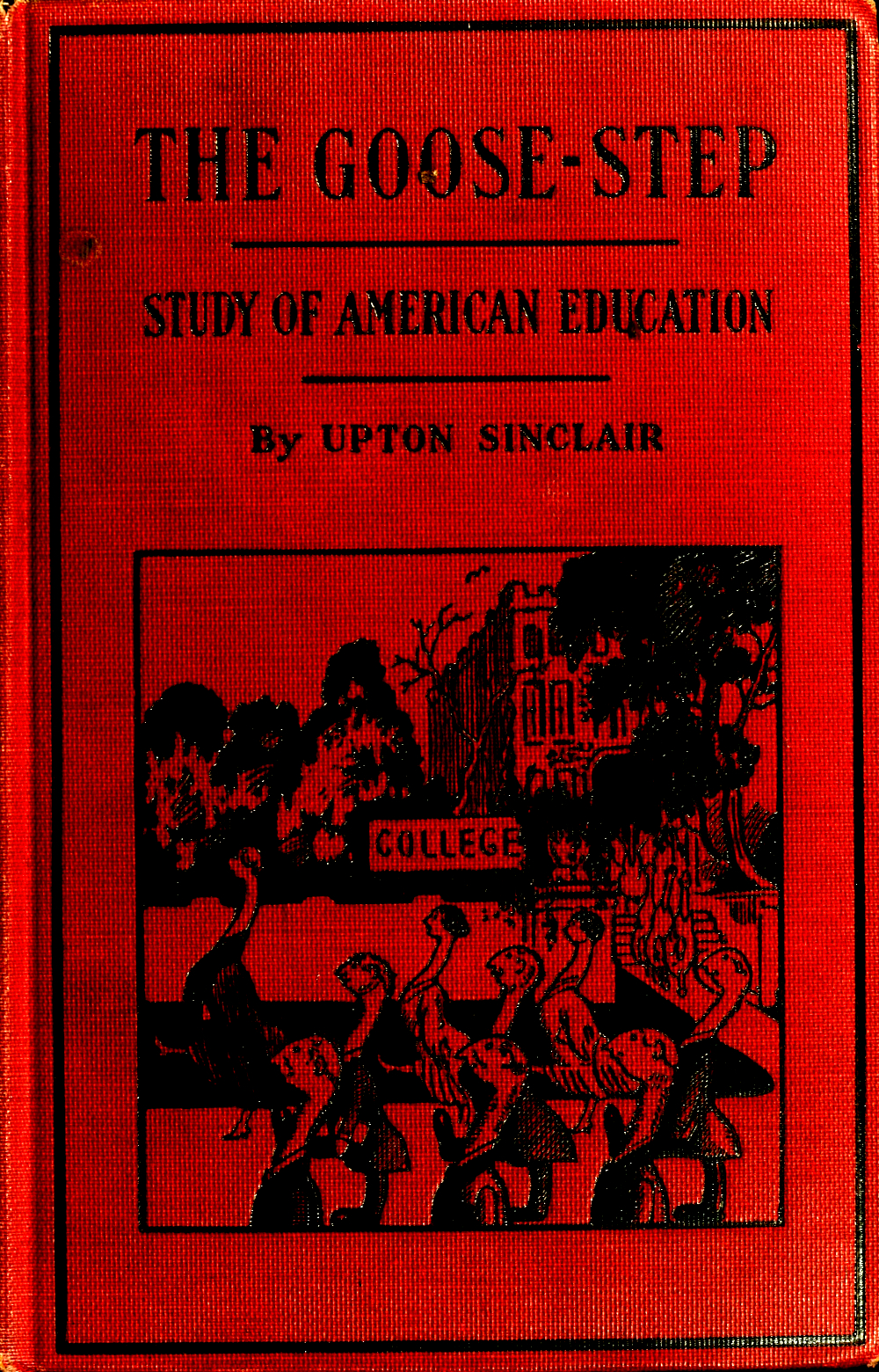
INTRODUCTORY
ix
Six hundred thousand young people are attending colleges
and universities in America. They are the pick of
our coming generation; they are the future of our country.
If they are wisely and soundly taught, America will
be great and happy; if they are misguided and mistaught,
no power can save us.
What is the so-called “higher education” of these
United States? You have taken it, for the most part, on
faith. It is something which has come to be; it is big and
impressive, and you are impressed. Every year you pay
a hundred million dollars of public funds to help maintain
it, and half that amount in tuition fees for your sons and
daughters. You take it for granted that this money is
honestly and wisely used; that the students are getting the
best, the “highest” education the money can buy.
Suppose I were to tell you that this educational
machine has been stolen? That a bandit crew have got
hold of it and have set it to work, not for your benefit, nor
the benefit of your sons and daughters, but for ends
very far from these? That our six hundred thousand
young people are being taught, deliberately and of set purpose,
not wisdom but folly, not justice but greed, not freedom
but slavery, not love but hate?
For the past year I have been studying American Education.
I have read on the subject—books, pamphlets, reports,
speeches, letters, newspaper and magazine articles—not
less than five or six million words. I have traveled
over America from coast to coast and back again, for the
sole purpose of talking with educators and those interested
in education. I have stopped in twenty-five American
cities, and have questioned not less than a thousand people—school
teachers and principals, superintendents and
board members, pupils and parents, college professors and
students and alumni, presidents and chancellors and deans
and regents and trustees and governors and curators and
fellows and overseers and founders and donors and whatever
else they call themselves. This mass of information
I have turned over and over in my mind, sorting it, organizing
xit—until now, I really know something about American
Education.
I do not intend in this book to expound my ideas on the
subject; to argue with you as to what education might be,
or ought to be; to persuade you to any dogma or point of
view. I intend merely to put before you the facts; to say,
this is what American Education now is. This is what is
going on in the college and university world. This is what
is being done to your sons and daughters; and what the
sons and daughters think about it; and what the instructors
think about it. Here is the situation: make up your
own mind, whether it suits you, or whether you want it
changed.
1THE GOOSE-STEP
A Study of American Education
CHAPTER I THE LITTLE GOSLING
Once upon a time there was a little boy; a little boy
unusually eager, and curious about the world he lived in.
He was a nuisance to old gentlemen who wanted to read
their newspaper; but young men liked to carry him on
their shoulders and maul him about in romps, old ladies
liked to make ginger cakes for him, and other boys liked
to play “shinny” with him, and race on roller skates, and
“hook” potatoes from the corner grocery and roast them
in forbidden fires on vacant lots. The little boy lived in a
crowded part of the city of New York, in what is called a
“flat”; that is, a group of little boxes, enclosed in a large
box called a “flat-house.” Every morning this little boy’s
mother saw to his scrubbing, with special attention to his
ears, both inside and back, and put a clean white collar on
him, and packed his lunch-box with two sandwiches and
a piece of cake and an apple, and started him off to school.
The school was a vast building—or so it seemed to the
little boy. It had stone staircases with iron railings, and
big rooms with rows of little desks, blackboards, maps of
strange countries, and pictures of George Washington and
Abraham Lincoln and Aurora driving her chariot. Everywhere
you went in this school you formed in line and
marched; you talked in chorus, everybody saying the same
thing as nearly at the same instant as could be contrived.
The little boy found that a delightful arrangement, for he
liked other boys, and the more of them there were, the
better. He kept step happily, and sat with glee in the
assembly room, and clapped when the others clapped, and
2laughed when they laughed, and joined with them in
shouting:
Oh, Columbia, the Gem of the Ocean,
The—ee home of the Bra—ave and the Free—ee!
The rest of the day the little boy sat in a crowded classroom,
learning things. The first thing he learned was that
you must be quiet—otherwise the teacher, passing down
the aisle, would crack your knuckles with a ruler. Another
thing was that you must raise your hand if you wanted to
speak. Maybe these things were necessary, but the little
boy did not learn why they were necessary; in school all
you learned was that things were so. For example, if you
wanted to divide one fraction by another, you turned the
second fraction upside down; it seemed an odd procedure,
but if you asked the reason for it, the teacher would be apt
to answer in a way that caused the other little boys to
laugh at you—something which is very painful.
The teacher would give out a series of problems in
“mental arithmetic”—tricks which you had been taught,
and you wrote the answers on your slate, and then marched
in line past the teacher’s desk, and if you had done it
according to rule, you got a check on your slate. You
learned the great purpose of life was these “marks.” If
you got good ones, your teacher smiled at you, your parents
praised you at home, you had a sense of triumph over
other little boys who were stupid. You enjoyed this triumph,
because no one ever suggested to you that it was
cruel to laugh at your weaker fellows. In fact, the system
appeared to be designed to bring out your superiority, and
to increase the humiliation of the others.
In this school everything in the world had been conveniently
arranged in packages, which could be stowed
away in your mind and made the subject of a “mark.”
Columbus discovered America in 1492; the Declaration of
Independence was signed on July 4, 1776; Switzerland
was bounded on the north by Germany. This business of
“boundings” appeared in little diagrams; Switzerland was
yellow and Germany pink, and no one burdened your mind
with the idea that these spots of color represented places
where human beings lived. At this same time the little
boy was going to Sunday school, where he learned something
called “the creed,” with a sentence declaring that
3“from Thency shall come to judge the quick and the
dead.” The little boy pondered hard, but never made sure
whether “Thency” was the name of a person or a place.
Some thirty-five years have passed, but the little boy
still remembers the personalities of these teachers. There
was a middle-aged lady, stout and amiable, and always
dressed in black; then one who was angular and irritable;
then one who had pretty brown eyes and hair, but to the
puzzlement of the little boy had also the beginnings of a
mustache. Next came a young man with a real mustache,
and pale, washed-out eyes and complexion; but he was
dreadfully dull. The novelty had worn off the school by
this time, and the boy had got tired of stowing away packages
of facts in his mind. He had become so expert that
he was able to do two years’ work in one, and at the age of
twelve was ready for what was called the City College.
But he was judged too young, and had to take one year in
the grammar school all over. The fates took pity on him,
and gave him as teacher for that year a jolly Irish gentlemangentleman,
so full of interest in his boys that he did not keep
the rules. If you wanted to ask him questions you asked,
and without first raising your hand; you might even get
into an argument with him, as with any boy, and if he
caught you whispering to your neighbor, his method of
correcting you was novel, but highly effective—he would
let fly a piece of chalk at your head, and you would grin,
and the class would howl with delight.
In this strange, happy group the little boy went by the
nick-name of “Chappie”; for the school was located on
the East side of New York, and most of the boys were
“tough,” and had never before heard the English language
correctly spoken by a boy. “Chappie” owned a collection
of one or two hundred story-books which had been given
him by aunts and uncles and cousins at a succession of
Christmases and birthdays. The priceless treasure, when
he left the school, became the foundation of a class library,
to the vast delight of the other boys and of the Irish
teacher. So the boy ended his grammar-school life in a
blaze of glory, and went away thinking the public school
system a most admirable affair.
CHAPTER II THE COLLEGE GOOSE
4
The College of the City of New York at that time occupied
an old brick building on Twenty-third Street and
Lexington Avenue. It gave a five years’ course, leading
up to a college degree; but the first two or three years
were the same as high school years at present. The boy
went there, not because he knew anything about it, nor
because he knew what he wanted, but because that was the
way the machinery was built; he was turned out of the
grammar school hopper, and into the city college hopper.
In his earliest days it had been his intention to become the
driver of a hook-and-ladder truck; later on he had decided
to follow his ancestors to Annapolis; now he had in mind
to be a lawyer; but first of all he wanted to be “educated.”
Most of the students in this college were Jews. I
didn’t know why this was; in fact, I hardly knew that it
was, because I didn’t know the difference between Jews
and Gentiles. They came from poor families, and most of
them worked hard; they lived at home, so there was little
of what is called “college life” about our education. There
were feeble attempts made to get up “college spirit”; now
and then a group of lads would run about the streets emitting
yells, but their efforts were feeble, and struck me as
silly. In the course of time one of the better dressed
members of my class came to me with mysterious hints
about a “fraternity.” I didn’t know what a “fraternity”
was, and anyhow, I had no money to spare; I was living
on four dollars and a half a week, and earning it by
writing jokes and sketches for the newspapers.
I took six or eight courses each half year at the college,
and as I recall them, my principal impression is of
their incredible dullness. For example, the tired little gentleman
who taught me what was called “English”; I remember
a book of lessons, each lesson consisting of thirty
or forty sentences containing grammatical errors. I
would open the book and run down the list; I would see
all the grammatical errors in the first three minutes, and
for the remaining fifty-seven minutes was required to sit
and listen while one member of the class after another was
called on to explain and correct one of the errors. The
5cruelty of this procedure lay in the fact that you never
knew at what moment your name would be called, and you
would have to know what was the next sentence. If you
didn’t know, you were not “paying attention,” and you
got a zero. I tried all kinds of psychological tricks to compel
myself to follow that dreary routine, but was powerless
to chain my mind to it.
Then there was “history”; first the history of the
world, ancient and modern, and then the history of England.
I remember the tall, stringy old gentleman who
taught us lists of names and dates, which we recited one
hour and forgot the next. Here, if you were caught not
paying attention, it was possible to use your wits and “get
by.” I remember one bright moment when we were discussing
the birth of the first prince of Wales. Said the
professor: “How did it happen that an English prince, the
son of an English king, was born on Welsh soil?” The
student, caught unawares by this singular question, stammered,
“Why—er—why—his mother was there!”
Also there were the physics classes; rather less dull,
because they included “experiments,” which exhibited the
peculiarities of natural forces—sparks and smoke, and
noises of explosions major or minor. But why these
things happened, or what they meant, was never understood
by anyone, and whether an explosion was major or
minor was entirely a matter of luck. I remember composing
a poem for the college paper, dealing with the effect
of physics upon a poet’s mind:
He learned that the painted rainbow,
God’s promise, as poets feign,
Was transverse oscillations
Turning somersaults in rain.
And then there was drawing. We sat in a big studio,
in front of plaster casts of historic faces, and we made
smudges supposed to resemble them. On this subject,
also, I wrote some verses, portraying the plight of a student
who forgot which cast he was copying, and paced
up and down before them, exclaiming: “Good gracious, is
it Juno or King Henry of Navarre?”
I studied a number of complicated technical subjects—perspective
and mechanical drawing and surveying—though
now, thirty years later, I could not survey my
6front porch. I studied mathematics, from simple addition
to differential calculus. The addition I still remember;
but if I were asked to do the simplest problem in algebra
I should not have an idea how to set about it.
I remember with vividness the men who put me
through these various torments; young men, some feeble,
some impatient, but always uninterested in what they were
doing; old men, kind and lovable, or irritable and angry,
but all of them hopeless so far as concerned the task of
teaching anybody anything of any use. Every morning
we spent half an hour in what was called “chapel,” and
the old men, the members of the faculty, were lined up
on the platform, and remain to this hour the most vivid
line of human faces stored in my memory. It was their
duty to listen to student oratory; and so perfect had been
the discipline of their lives that they were able to sit without
moving a muscle, or giving the least sign of what they
must have felt.
Sooner or later we came into the class-rooms of these
old men, and each in turn did what he could for us. I remember
the professor of German, lovable, genial, highly
cultured. During the two years that I studied with him,
I learned perhaps two hundred words—certainly no more
than I could have learned in two days of active study
under an intelligent system. Little things he taught me
that were not in the course, for example by a slight frown
when he saw me trimming my finger-nails in class.
And then the professor of Greek, a white-whiskered
old terror. For three years he had me five hours per
week, and today I could not read a sentence from a child’s
primer in Greek, though I still know the letters and the
sounds. I suppose there are Greek words which I have
looked up in the dictionary a thousand times, yet it never
occurred to any human being to point out to me that I
might save time and trouble by learning the meaning of
the words once for all. I marvel when I realize that it was
possible for me to read “The Acharnians” of Aristophanes,
line by line, and hardly once get a smile out of it,
nor have it occur to me that there was any resemblance
between what happened in that play, and the fight against
Tammany Hall and the Hearst newspapers which was
going on in the world about me.
And then the professor of Latin; he also was a terror,
7though his whiskers were brown. He was a prominent
Catholic propagandist, editor of “The Catholic Encyclopedia,”
and conceived a dislike for me because I refused
to believe things just because they were told me. I can
see this old gentleman’s knitted brows and hear his angry
tones as he exclaims: “Mr. Sinclair, it is so because I say
it is so!” Five hours a week for five years I studied with
that old gentleman, or his subordinates, and I read a
great deal of Latin literature, but I never got so that I
could read a paragraph of the simplest Latin prose without
a dictionary. I look at a page of the language, and
the words are as familiar to me as my own English, but
I don’t know what they mean, unless they happen to be
the same as the English.
And then the professor of chemistry; an extremely
irascible old gentleman with only one arm. There was a
rumor to the effect that he had lost the other through the
misbehavior of chemicals, but I never investigated the
matter. I learned that chemistry consists of mixing
liquids in test-tubes, and seeing that various colored
“precipitates” result. After you do this you write down
formulas, showing that a part of one chemical has got
switched over to the other chemical; but why these things
happen, or how anybody knows that they happen, was
something entirely beyond my comprehension, and which
neither the professor of chemistry nor his three assistants
ever explained to any member of my class. My most vivid
recollection of this class has to do with the close of the
hour, when a group of us would gather with our various
test-tubes, and each put up a nickel, and guess a color;
then we would mix the contents of the tubes in one big
tube, and shake them up, and the fellow who guessed the
right color won the “pot.”
And then the professor of literature. Perhaps you
think I should have had some success in classes of literature;
but that only shows how little you know about college.
A new professor came in just as I reached this
class, and I learned in after years that he had got his appointment
through the Tammany machine. A bouncing
and somewhat vulgar little man, he was an ardent and
argumentative Catholic, and his idea of conducting a class
of literature was to find out if there was anything in the
subject which could in any way be connected with Catholic
8doctrine and history, and if so, to bring out that aspect
of the subject. Thus I learned that Milton, though undoubtedly
a great poet, had cruelly lied about the popes;
also I learned that Chaucer was positively not a Wyckliffite.
I had not the remotest idea what a Wyckliffite was,
but got the general impression that it was something terrible,
and I was quite willing to believe the best of
Chaucer, in spite of his perverse way of spelling English
words. As part of the process of disciplining our taste
in literature, we were required to learn poems by heart,
and this professor selected poems which had something to
do with Catholicism. Seeing that most of us were Jews,
this was irritating, but we got what fun we could out of
our predicament. At that time there was a popular music-hall
song, with a chorus: “Ta-ra-ra-ra-boom-de-ay”; so
we used to go about the corridors of our college chanting
to this lively tune a poem by Austin Dobson:
Missal of the Gothic age,
Missal with the blazoned page,
Whence, O Missal, hither come,
From what dim scriptorium?
Whose the name that wrought thee thus,
Ambrose or Theophilus,
Bending, through the waning light,
O’er thy vellum scraped and white!
I hope you know the tune of “Ta-ra-ra-ra-boom-de-ay,”
so that you may get the full cultural benefit from this
recitation!
However, my little Catholic professor of literature did
one thing for me; he let me know of the existence of a
poet by the name of Shelley. We read “The Skylark”
and “The Cloud” in class, and there came over me a realization
of the ghastly farce I was going through in this
college. I was near the end of my senior year, but my
store of patience gave out, and I presented a letter to the
faculty, stating that I was obliged to earn my own living,
and requesting that I be allowed two months’ leave of absence.
The statement was strictly true, but the implication,
that I was going to spend the two months in earning
money, was not true; I spent the two months sitting on
the bed in an eight by ten hall bedroom in a lodging-house,
reading Shelley’s poetry and Emerson’s Essays and the
9prose of Ruskin and Carlyle. I went back to college and
made up my lost months in a week or two, and passed my
examinations without either credit or discredit—ranking
just in the middle of my class.
I take it that the purpose of education is to discover
the special aptitudes of the student, and to foster them.
And here was I, a man with one special aptitude; here
were a score of teachers, with whom I had been in daily
contact for five years; yet I am sure, if these teachers
had been told that one man in the class of ’97 would come
to be known throughout the civilized world in less than
nine years, they would have guessed more than half my
class-mates before they guessed me. I am not so egotistical
as to imagine that I was the only man in that class
who had special aptitudes; if none of the others have developed
any, I think I know the reason—the machine had
rolled them flat!
CHAPTER III THE UNIVERSITY GOOSE
Columbia University at the time I went to it had just
moved up to its new buildings on Morningside Heights.
The center of the group was a magnificent white marble
library, built almost entirely for display, and with but little
relation to books and those who were to use them. But
of this I had no suspicion; I had come now to the real
headquarters of education, and I studied the fascinating
lists of courses, and my heart leaped, because I was free
to choose whatever I wished of all this feast. I was a
proud “bachelor of arts,” and declared my intention of
becoming a still prouder “master of arts.” To achieve the
feat I must complete a year’s course, consisting of a
“major” subject and two “minors,” and I must also compose
a “thesis.” To register for all this I paid a hundred
and fifty dollars, earned by a newly discovered talent for
writing dime novels.
My major subject was English; and as part of the
work Professor George Rice Carpenter undertook to teach
me the art of composition. This was an undergraduate
course, taken by students of Columbia College, and so I
had a chance to see how they were taught. To my dismay
10I found it exactly the same dreary routine that I had been
through at my City College. Our professor would set us
a topic on which to write a “theme”: “Should College Students
Take Part in Athletics;” or perhaps, “A Description
of the Country in Winter.” My own efforts at this
task were pitiful, and I was angrily aware that they were
pitiful; I did not care anything about the matters on which
I was asked to write, and I could never in my life write
about anything I did not care about. I stood some six
weeks of it, and then went to the professor and told him
I wanted to drop the course.
So I discovered one of the embarrassments of the
American college system. Students are supposed to
choose courses, but no provision is made for them to
sample the wares and make an intelligent selection. If
anybody finds he has made a mistake, he is in the same
plight as if he has married the wrong girl; he can not get
out without hurting the girl’s feelings, and I, unhappy
blunderer in the undergraduate machine, had to hurt the
feelings of Professor Carpenter. “I don’t know what
you want,” said he, “or how you think you are going to
get it; but this one thing I can tell you positively—you
don’t know how to write.” To which I answered humbly,
of course; that was why I had to come to him. But I had
become convinced that I wasn’t going to learn in that way,
and my mind was made up to drop the course.
Also I took a course in poetry with William Peterfield
Trent. The predecessors of Milton were the subject of
our investigation, I remember, and perhaps they were uninteresting
poets—anyhow, the lectures about them certainly
were. I stood it for a month or two, and then we
came upon a grammatical error in one of our poets. “You
will find such things occasionally,” said the professor.
“There is a line in Byron—‘There let him lay’—and I have
an impression that I once came upon a similar error in
Shelley. Some day before long I plan to read Shelley
through and see if I can find it.” And that finished me.
Shelley was my dearest friend in all the world, and I
imagined a man confronting the record of his ecstasies,
seeking a grammatical error! I quit that course.
Also I had started one in French. It was the same
dreary routine I had gone through for five years in Latin;
translating little foolish sentences by looking up words in
11the dictionary. I seriously meant to read French, so
stayed long enough to get the accent correctly, and then
retired, and got myself a note-book and set to work to
hammer the meaning of French words into my head. In
another six weeks I had read half a dozen of the best
French novels, and in the course of the next year I read
all the standard French classics. I did the same thing
with German; having already got the pronunciation, I
proceeded to teach myself words, and in a year or two
had got to know German literature as well as English.
Most of my experience at Columbia consisted of beginning
courses, and dropping them after a few weeks. At
the end I figured up that I had sampled over forty courses.
I finished five or six, but never took an examination in
one. And this was no mere whim or idleness on my part;
it was a deliberate judgment upon the university and its
methods. I had made the discovery that, being registered
for a master’s degree, and not having completed the necessary
courses, I was free to register for new courses the
second year, without paying additional tuition fees; and
failing to complete the courses the second year, I was free
to register for the third year, and so on.
Thus I worked out my system—education in spite of
the educators! I would start a course, and get a preliminary
view of the subject, and the list of the required readings;
then I would go off by myself and do the readings.
Almost invariably there was one book which the professor
used as a text-book, and his lectures were nothing but an
inadequate résumé thereof. At the beginning of his
course on the drama Brander Matthews would say “Gentlemen,
I make it a point of honor with you not to read
my book—‘The Development of the Drama,’ until after
you have finished my course!”
Brander Matthews was a new type to me, the literary
“man of the world.” His mind was a store-house of gossip
about the theater and the stage-world, and I was interested,
and eagerly read the plays. I knew that Brander
was not my kind of man, that his world was not for me;
but what kind of world I was going to choose, or to make
for myself, I did not at that time know. As I dwell on
these days, I see before me his loose, rather shambling
figure, with a queerly shaped brown beard and a cigarette
dangling from the lower lip. I do not know how this
12dangling was contrived, but I doubt if I ever saw the professor
at a lecture that he did not have that cigarette in
position as he talked. Brander is the beau ideal of the
successful college professor, metropolitan style; a clubman,
easy-going and cynical, but not too much so for propriety;
wealthy enough to be received at the dinners of
trustees, and witty enough to be welcome anywhere. He
is a bitter reactionary, and has become one of President
Butler’s most active henchmen; his reputation as author of
more than forty books is made use of by the New York
“Times” for an occasional job of assassinating a liberal
writer.
With Nicholas Murray Butler I took a course in the
critical philosophy. At this time he was a modest professor,
and his dazzling career lay in the future. I shall have
many impolite things to say about Butler, so let me make
it plain that there is nothing personal in my attitude; to
me he was always affable. He possesses a subtle mind,
and uses it thoroughly. With him I read “The Critique
of Pure Reason” twice through and as a work of supererogation
I read also the impossible German. I had had
a little metaphysics before this, and was now pleased to
have Kant demonstrate that I had wasted my time. I took
seriously what I read, and assumed that my professor was
taking seriously what he taught; so imagine my bewilderment
when shortly afterwards I learned that Professor
Butler had left the Presbyterian church, and had joined
the Episcopal church, as one of the steps necessary to becoming
president of Columbia University. It gave me a
shock, because I knew he had no belief whatever in any
of the dogmas of the Christian religion, and had completely
demonstrated to me the impossibility of any valid
knowledge concerning immortality, free will or a First
Cause.
Another “man of the world” type of professor whom
I encountered was Harry Thurston Peck, who gave me a
course in Roman civilization of the Augustan age. It was
so like America that it was terrifying, but Professor Peck
I am sure was entirely unterrified. He was widely read
in the literature of decadence, and from him I heard the
names of strange writers, from Petronius and Boccaccio
to Zola and Gautier. It was a world of grim and cruel
depravity, but one had sooner or later to know that it
13existed, and to steel one’s soul for a new endeavor to
save the race. Poor Harry Peck was not steeled enough,
and he broke the first rule of the “man of the world,” and
got found out. A woman sued him for breach of promise,
and published his letters in the newspapers. There
were some who thought he should not have been assumed
to be guilty, merely because a blackmailer accused him;
but the powers which ruled Columbia thought otherwise,
and Professor Peck was driven out, and committed
suicide.
It was a peculiar thing, which I observed as time went
on—every single man who had had anything worth-while
of any sort to teach me was forced out of Columbia University
in some manner or other. The ones that stayed
were the dull ones, or the worldly and cunning ones.
Carpenter stayed until he died, and Brander Matthews,
and Butler, and Trent, who purposed to read through the
works of Shelley to find a grammatical error, and John
Erskine, whom I knew as a timid and conventional “researcher,”
and who, I am told, has been chosen by Butler
as his heir-apparent. But Peck went—and Hyslop, and
Spingarn, and Robinson, and MacDowell, and Woodberry.
James Hyslop gave me a course in what he called
“practical ethics,” and this was a curious affair. In the
first part he discussed abstract rules of conduct—regardless
of the fact that there can be no such things. In the
second part he attempted to apply these rules to New York
City politics, explaining the methods by which Tammany
politicians got their graft, and devising elaborate laws and
electoral arrangements whereby these politicians could be
kept out of office, or made to be good while in. The professor
was a frail and ascetic-looking little man with a
feeble black beard. It was painfully clear to me that the
politicians were more clever than he, and would devise a
hundred ways of countering his program before he had
got it into action.
Now, as I look back upon this course, the thing which
strikes me as marvelous is that never once in a whole year
of instruction did the professor drop a hint concerning the
economic basis of political corruption. The politicians got
money—yes, of course; but who paid them the money,
and what did the payers get out of it? In other words,
14what part was Big Business playing in the undermining
of American public life? I took an entire course in “practical
ethics” at Columbia University in the year ’99 or
1900—two hours a week for nine months—and never once
did I hear that question mentioned, either by the professor
or by any of the graduate students in that class!
You would have thought that this would have made
James Hyslop safe for life; but alas! the poor man became
too anxious concerning the growth of Socialism
throughout the world, and decided that the way to counter
it was to renew the faith of the people in heaven and hell.
You may find his ideas on this point quoted in “The Profits
of Religion,” page 224. He took to studying spiritualism,
and the newspapers took him up, and the university
authorities, who tolerate no sort of eccentricity, politely
slid him out of his job.
After his recent visit to the United States, H. G.
Wells wrote that the most vital mind he had met was
James Harvey Robinson, author of “The Mind in the
Making.” Twenty-two or three years ago I took with
Professor Robinson a course in the history of the Renaissance
and Reformation. It was a great period, when the
mind of the race was breaking the shackles of mediæval
tyranny in religion, politics, and thought. I read with
eagerness about John Huss and Wyckliffe, Erasmus and
Luther. I still hope for such heroes and for such an
awakening in my own modern world; meantime, I observe
that Professor Robinson, unable to stand the mediævalism
of Columbia, has handed in his resignation.
Then MacDowell, the composer. Edward MacDowell
was the first authentic man of genius I met; he is the only
American musician whose work has won fame abroad.
He was a man as well as an artist, and his courses in general
musical culture were a rare delight. After much
urging, he consented to play us parts of his own works,
and discuss them with us. Needless to say, this was not
orthodox academic procedure, and the college authorities,
who do not recognize genius less than a hundred years
away, would not give proper credits for work with MacDowell.
The composer’s beautiful dream of a center of
musical education came to nothing, and he retired, broken-hearted.
As I described the tragedy at the time, he ran
into Nicholas Murray Butler and was killed.
15Finally, George Edward Woodberry, who was in the
field of letters what MacDowell was in music, a master
not merely of criticism but of creation; also a charming
spirit and a friend to students. He gave a course in what
he called comparative literature, and made us acquainted
with Plato, Cervantes, Dante, Ariosto, Spenser, and Shelley.
He was a truly liberalizing influence, and so popular
among the men that the Columbia machine hated him
heartily. I was taking Brander Matthews’ course at the
same time as Woodberry’s, and would hear Matthews
sneer at Woodberry’s “idealism,” and at his methods of
teaching. A year later Woodberry was forced out, under
circumstances which I shall presently narrate.
CHAPTER IV THE GOOSE-STEPPERS
In the year 1901 I was twenty-one years of age, and
was ready to quit Columbia. The great university had
become to me nothing but a library full of books, and
some empty class-rooms in which to sit while reading
them. No longer was I lured by elaborate prospectuses,
setting forth lists of “courses”; I had tried forty of them,
and knew that nine-tenths of them were dull. The great
institution was a hollow shell, a body without a soul, a
mass of brick and stone held together by red tape.
But before I went out into the world, I made one final
test of the place. I knew by this time exactly what I
wanted to do in the world; I wanted to create literature.
I had an overwhelming impulse, so intense that it had
completely ruined me as a hack-writer; my “half-dime”
novels had become impossible to me, and the question of
how I was to earn my living was a serious one.
And here was a great university, devoted to the furthering
of all the liberal arts. This university had trained
me to love and reverence the great writers of the past;
what was its attitude to the great writers of the future?
The university controlled and awarded a vast number of
scholarships and fellowships in all branches of learning;
that is to say, it offered support to young men while they
equipped themselves to understand and teach the writings
of the past. But what about the writings of the future?
16What aid would the university give to these? I was planning
to spend the summer writing a novel, and the idea
occurred to me: Would Columbia University accept a
novel as a thesis or dissertation, or as evidence of merit
and of work accomplished, in competition for any fellowship
or endowment under its control?
I made this proposition to the proper authorities at
Columbia, the heads of the various departments of literature,
and to the president’s office as well; and I received
one unanimous decision: there was no fellowship or endowment
under the control of the university which could
be won by any kind of creative writing, but only by
“scholarship”—that is to say, by writing about the work
of other people!
I was not satisfied entirely. It occurred to me—maybe
there was some other university in this broad land of
freedom which might have a more liberal and intelligent
policy than Columbia; so I set out on a campaign to test
out the question. I wrote to the authorities at Harvard,
and at Yale, and at Princeton, and Cornell, and Stanford,
and the University of Pennsylvania, and Chicago, and
Wisconsin and California, and I know not what others.
I did not let up until I had made quite certain that among
all the hundreds of millions of dollars of endowment at
the disposal of the great American universities, there was
not one dollar which could be won by a piece of creative
literature, nor one university president who was interested
in the possibility that there might be a man of genius actually
alive in America at the beginning of the twentieth
century.
So I went out into the world to make my own way,
and to fight for the preservation of my own talent. I
had given the academic authorities nine years in which
to do what they could to me, so I might fairly lay claim
to be a completely educated man. I look back now, and
see myself as I was, and I shudder—not merely for myself,
but for all other products of the educational machine.
I think of the things I didn’t know, and of the pains and
perils to which my ignorance exposed me! I knew nothing
whatever about hygiene and health; everything of that
sort I had to learn by painful error. I knew nothing about
women; I had met only three or four beside my mother,
and had no idea how to deal with them. I knew as much
17about sex as was known to the ancient religious ascetics,
but nothing of modern discoveries or theories on the subject.
More significant yet, I knew nothing about modern literature
in any language; I had acquired a supreme and
top-lofty contempt for it, and was embarrassed when I
happened to read “Sentimental Tommy,” and discovered
that someone had written a work of genius in my own
time! I knew nothing about modern history; so far as
my mind was concerned, the world had come to an end
with the Franco-Prussian war, and nothing had happened
since. Of course, there was the daily paper, but I didn’t
know what this daily paper was, who made it, or what
relation it had to me. I knew that politics was rotten,
but I didn’t know the cause of this rottenness, nor had I
any idea what to do about it. I knew nothing about
money, the life-blood of society, nor the part it plays in
the life of modern men. I knew nothing about business,
except that I despised it, and shrank in agony of spirit
from contact with business people. All that I knew about
labor was a few tags of prejudice which I had picked
up from newspapers.
Most significant of all to me personally, I was unaware
that the modern revolutionary movement existed.
I was all ready for it, but I was as much alone in the
world as Shelley a hundred years before me. I knew, of
course, that there had been Socialism in ancient times, for
I had read Plato, and been amused by his quaint suggestions
for the reconstruction of the world. Also I knew
that there had been dreamers and cranks in America who
went off and tried to found Utopian commonwealths. It
was safe for me to be told about these experiments, because
they had failed. I had heard the names of Marx
and Lassalle, and had a vague idea of them as dreadful
men, who met in the back rooms of beer-gardens, and conspired,
and made dynamite bombs, and practised free love.
That they had any relationship to my life, that they had
anything to teach me, that they had founded a movement
which embraced all the future—of this I was as ignorant
as I was of the civilization of Dahomey, or the topography
of the far side of the moon.
I went out into the world, and learned about these
matters, by most painful experience; and then I looked
18back upon my education, and understood many things
which had previously been dark. One question I asked
myself: was all that deficiency accidental, or was it deliberate?
Was it merely the ignorance of those who taught
me, or was there some reason why they did not teach
me all they knew? I have come to understand that the
latter is the case. Our educational system is not a public
service, but an instrument of special privilege; its purpose
is not to further the welfare of mankind, but merely
to keep America capitalist. To establish this thesis is the
purpose of “The Goose-step.”
And first a few words as to the title. We spent some
thirty billions of treasure, and a hundred thousand young
lives, to put down the German autocracy; being told, and
devoutly believing, that we were thereby banishing from
the earth a certain evil thing known as Kultur. It was
not merely a physical thing, the drilling of a whole population
for the aggrandizement of a military caste; it was
a spiritual thing, a regimen of autocratic dogmatism. The
best expression of it upon which I have come in my readings
is that of Johann Gottlieb Fichte, Prussian philosopher
and apostle of Nationalism; I quote two sentences,
from a long discourse: “To compel men to a state of
right, to put them under the yoke of right by force, is
not only the right but the sacred duty of every man who
has the knowledge and the power.... He is the
master, armed with compulsion and appointed by God.”
I ask you to read those sentences over, to bear them in
mind as you follow chapter after chapter of this book; see
if I am not right in my contention that what we did, when
we thought we were banishing the Goose-step from the
world, was to bring it to our own land, and put ourselves
under its sway—our thinking, and, more dreadful yet, the
teaching of our younger generation.
CHAPTER V INTERLOCKING DIRECTORATES
The first step toward the intelligent study of American
education is to consider the country in which this education
grows. We are told upon good authority that men
do not gather figs from thistles; we are also told that we
19cannot understand the cultural institutions of any country
unless we know its economic and social conditions.
If you want to learn about America, the plutocratic
empire, come with me and meet the emperor and his
princes and lords; come to the Customs House in New
York City, early in the year 1913. The memory of our
busy age is short, so perhaps it will mean nothing to you
if I say that the Pujo Committee of the House of Representatives
is in session. They sit in a solemn row, eleven
solemn legislators; and into the witness chair step one
after another the masters of this plutocratic empire: J.
P. Morgan senior, a bulbous-nosed and surly-tempered
old man whom everyone in the room knows to be the
emperor; George F. Baker, president of the First National
Bank of New York, the second richest man in the
world; William Rockefeller, brother of the richest man
in the world; George M. Reynolds, president of the Continental
National Bank of Chicago, the second largest
bank in America; Henry P. Davison, Jacob Schiff—so on
through a long list.
They are being questioned by a small, frail-looking
Jewish lawyer named Samuel Untermyer. All his life
he has been one of them, he has been in the game with
them and made his millions; he knows every trick and
turn of their minds, every corner where their money is
hidden—and now he turns against them and exposes them
to the world. They hate him, but he has them at his
mercy, and step by step he shows us the machinery of our
industrial and financial life, the thing which he calls the
Money Trust, and which I call the plutocratic empire.
There is one phrase which makes the whole argument
of the Pujo Report, and that phrase is “interlocking directorates.”
Interlocking directorates are the device
whereby three great banks in New York, with two trust
companies under their control, manage the financial affairs
and direct the policies of a hundred and twelve key
corporations of America. The three banks are J. P. Morgan
and Company, the First National Bank, and the National
City Bank; and the two trust companies are the
Guaranty and the Equitable. Please fix these five concerns
in your mind, for we shall come back to them in
almost every chapter of this book. Their directors sit
upon the boards of the corporations, sometimes several
20on each board, and their orders are obeyed because they
control credit, which is the life-blood of our business
world. Said George M. Reynolds, in his testimony,
speaking of the control of American finance: “I believe
it lies in the hands of a dozen men; and I plead guilty
to being one, in the last analysis, of these men.”
Such was the situation in 1913; and now, America
has fought and won a war, and become the financial
master of the world. The wealth of America was estimated
in 1912 at a hundred and twenty-seven billions; in
1920 it was estimated at five hundred billions, greater
than the combined wealth of the British Empire, France,
Italy, Russia, Germany, and Japan. At the same time
that wealth has increased, so has the concentration of its
control. If the Pujo Committee were to conduct another
inquiry in the year 1922, it would find exactly the same
interlocking directorates, only more of them; and it would
find that the financial empire controlled by three great
banks and two trust companies has grown from twenty-two
billions to not less than seventy-five, and probably
close to a hundred billions of dollars.
Just how do these interlocking directorates work? A
picture of their method was drawn in Harper’s Weekly
by Louis D. Brandeis, at that time an anti-corporation
lawyer of Boston, and now a Justice of the United States
Supreme Court. Said Mr. Brandeis:
Mr. J. P. Morgan (or a partner), a director of the New
York, New Haven and Hartford Railroad, causes that company
to sell to J. P. Morgan and Company an issue of bonds. J. P.
Morgan and Company borrow the money with which to pay for
those bonds from the Guaranty Trust Company, of which Mr.
Morgan (or a partner) is a director. J. P. Morgan and Company
sell the bonds to the Penn Mutual Life Insurance Company, of
which Mr. Morgan (or a partner) is a director. The New Haven
spends the proceeds of the bonds in purchasing steel from the
United States Steel Corporation, of which Mr. Morgan (or a partner)
is a director. The United States Steel Corporation spends
the proceeds of the rails in purchasing electrical supplies from
the General Electric Company, of which Mr. Morgan (or a partner)
is a director. The General Electric Company sells the supplies
to the Western Union Telegraph Company, a subsidiary of
the American Telephone and Telegraph Company, and in both Mr.
Morgan (or a partner) is director. The Telegraph Company has
a special wire contract with the Reading, in which Mr. Morgan
(or a partner) is a director—
21So on to the Pullman Company and the Baldwin Locomotive
Works. Mr. Brandeis points out how “all these
concerns patronize one another; they all market their securities
through J. P. Morgan and Company, they deposit
their funds with J. P. Morgan and Company, and J. P.
Morgan and Company use the funds of each in further
transactions.”
But Mr. Brandeis stops his story too soon; he ought
to show us some of the wider ramifications of these directorates.
He ought to picture Mr. Morgan (or a partner)
falling ill, and being treated in St. Luke’s Hospital, in
which Mr. Morgan (or a partner) is a trustee, and by a
physician who is also a trustee, and who was educated in
the College of Physicians and Surgeons, of which Mr.
Morgan (or a partner) is a trustee. He ought to picture
Mr. Morgan dying, and being buried from Trinity Church,
in which several of his partners are vestrymen, and having
his funeral oration preached by a bishop who is a
stockholder in his bank, and reported in newspapers whose
bonds repose in his vaults. Mr. Brandeis might say about
all these persons and institutions just what he says about
the Steel Corporation and the General Electric Company
and the Western Union Telegraph Company and the
Baldwin Locomotive Works—they all patronize one
another and they all deposit their funds with J. P. Morgan
and Company.
Men die, but the plutocracy is immortal; and it is
necessary that fresh generations should be trained to its
service. Therefore the interlocking directorate has need
of an educational system, and has provided it complete.
There is a great university, of which Mr. Morgan was all
his active life a trustee, also his son-in-law and one or
two of his attorneys and several of his bankers. The
president of this university is a director in one of Mr.
Morgan’s life insurance companies, and is interlocked with
Mr. Morgan’s bishop, and Mr. Morgan’s physician, and
Mr. Morgan’s newspaper. If the president of the university
writes a book, telling the American people to be
good and humble servants of the plutocracy, this book may
be published by a concern in which Mr. Morgan (or a
partner) is a director, and the paper may be bought from
the International Paper Company, in which Mr. Morgan
has a director through the Guaranty Trust Company. If
22you visit the town where the paper is made, you will find
that the president of the school board is a director in the
local bank, which deposits its funds with the Guaranty
Trust Company at a low rate of interest, to be reloaned by
Mr. Morgan at a high rate of interest. The superintendent
of the schools will be a graduate of Mr. Morgan’s
university, and will have been recommended to the school
board president by Mr. Morgan’s dean of education. Both
the board and president and the school superintendent will
insure their lives in the company of which Mr. Morgan’s
university president is a director; and the school books
selected in that town will be published by a concern in
which Mr. Morgan (or a partner) is a director, and
they will be written by Mr. Morgan’s university’s
dean of education, and they will be praised in the
journal of education founded by Mr. Morgan’s university
president; also they will be praised by Mr.
Morgan’s newspaper and magazine editors. The superintendent
of schools will give promotion to teachers
who take the university’s summer courses, and will cause
the high school pupils to aspire to that university. Once
a year he will attend the convention of the National Educational
Association, and will elect as president a man who
is a graduate of Mr. Morgan’s university, and also a
member of Mr. Morgan’s church, and a reader of Mr.
Morgan’s newspaper, and of Mr. Morgan’s university’s
president’s educational journal, and a patron of Mr. Morgan’s
university presidents’ life insurance company, and a
depositor in a bank which pays him no interest, but sends
his money to the Guaranty Trust Company for Mr. Morgan
to loan at a high rate of interest. And when the Republican
party, of which Mr. Morgan (or a partner) is a
director, nominates the president of Mr. Morgan’s university
for vice-president of the United States, Mr. Morgan’s
bishop will bless the proceedings, and Mr. Morgan’s
newspapers will report them, and Mr. Morgan’s school
superintendent will invite the children to a picnic to hear
Mr. Morgan’s candidates’ campaign speeches on a phonograph,
and to drink lemonade paid for by Mr. Morgan’s
campaign committee, out of the funds of the life insurance
company of which Mr. Morgan’s university president
is director.
Such is the system of the interlocking directorates;
23such is, in skeleton form, that department of the plutocratic
empire which calls itself American Education. And
if you don’t believe me, just come along and let me show
you—not merely the skeleton of this beast, but the nerves
and the brains, the blood and the meat, the hair and the
hide, the teeth and the claws of it.
CHAPTER VI THE UNIVERSITY OF THE HOUSE OF MORGAN
The headquarters of the American plutocracy is, of
course, New York City. Here are the three central banks,
and here the hundred and twelve corporations have their
offices, and the interlocking directors roll about in their
padded limousines and collect their gold eagles and half-eagles
with the minimum of trouble and delay. According
to the Pujo Committee, the banks and trust companies
of New York, all interlocked with the House of Morgan,
had over five billion dollars’ worth of resources, which
was nearly one-fourth of the bank resources of the country.
This did not include the House of Morgan itself,
which was, and is, a private institution. These figures,
of course, seem puny since the world war; in that war the
House of Morgan alone is reputed to have made a billion
dollars from its war purchases for the British government,
and if the Pujo Committee were to inquire at the
present time it would find the banking resources of New
York City somewhere between fifteen and twenty-five billions
of dollars.
It is inevitable that this headquarters of our plutocratic
empire should be also the headquarters of our plutocratic
education. The interlocking directors could not discommode
themselves by taking long journeys; therefore they
selected themselves a spacious site on Morningside
Heights, and there stands the palatial University of the
House of Morgan, which sets the standard for the higher
education of America. Other universities, we shall find,
vary from the ideal; there are some which have old traditions,
there are others which permit modern eccentricities;
but in Columbia you have plutocracy, perfect, complete
and final, and as I shall presently show, the rest of
America’s educational system comes more and more to be
24modeled upon it. Columbia’s educational experts take
charge of the school and college systems of the country,
and the production of plutocratic ideas becomes an industry
as thoroughly established, as completely systematized
and standardized as the production of automobiles
or sausages.
Needless to say, the University of the House of
Morgan is completely provided with funds; its resources
are estimated at over seventy-five million dollars and its
annual income is over seven million. A considerable part
of its endowment is invested in stocks and bonds, under
the supervision of the interlocking directors. I have a
typewritten list of these holdings, which occupies more
than twenty pages, and includes practically all the important
railroads and industrial corporations in the United
States. Whoever you are, and wherever you live in
America, you cannot spend a day, you can hardly spend an
hour of your life, without paying tribute to Columbia
University. In order to collect the material for this book
I took a journey of seven thousand miles, and traveled
on fourteen railroads. I observe that every one of these
railroads is included in the lists, so on every mile of my
journey I was helping to build up the Columbia machine.
I helped to build it up when I lit the gas in my lodging-house
room in New York; for Columbia University owns
$58,000 worth of New York Gas and Electric Light,
Heat and Power Company’s 4 per cent bonds; I helped
to build it up when I telephoned my friends to make engagements,
for Columbia University owns $50,000 worth
of the New York Telephone Company’s 4½ per cent
bonds; I helped to build it up when I took a spoonful of
sugar with my breakfast, for Columbia University owns
some shares in the American Sugar Refining Company,
and also in the Cuba Cane Sugar Corporation.
The great university stops at nothing, however small:
“five and ten cent stores,” and the Park and Tilford
Grocery Company, and the Liggett and Myers Tobacco
Company. I have on my desk a letter from a woman, telling
me how the Standard Oil Company has been dispossessing
homesteaders from the oil lands of California;
Columbia University is profiting by these robberies, because
it owns $25,000 worth of the gold debenture bonds
of the Standard Oil Company of California. Recently
25I met a pitiful human wreck who had given all but his life
to the Bethlehem Steel Company; Columbia University
took a part of this man’s health and happiness. Crossing
the desert on my way home, in the baking heat of summer
I saw far out in the barren mountains a huge copper
smelter, vomiting clouds of yellow smoke into the air.
We in the Pullman sat in our shirt-sleeves, with electric
fans playing and white-clad waiters bringing us cool
drinks, but even so, we suffered from the heat; yet, out
there in those lonely wastes men toil in front of furnace
fires, and when they drop they are turned to mummies in
the baking sand and their names are not recorded. Not a
thought of them came into the minds of the passengers in
the transcontinental train; and, needless to say, no thought
of them troubles the minds of the thirty thousand seekers
of the higher learning who flock to Columbia University
every year. With serene consciences these young people
cultivate the graces of life, upon the income of $49,000
worth of stock in the American Smelters Securities Company.
This University of the House of Morgan is run by a
board of trustees. Under the law these trustees are the
absolute sovereign, the administrators of the property,
responsible to no one. They cannot be removed, no
matter what they do, and they are self-perpetuating, they
appoint their own successors. Their charter, be it noted,
is a contract with the state, and can never be altered or
revised. Such was the decision of the United States
Supreme Court in the Dartmouth case, way back in 1819.
Who are the members of this board? The first thing
to be noted about them is that there is only one educator,
and that is the president of the university, an ex-officio
member. Not one of them is a scholar, nor familiar with
the life of the intellect. There is one engineer, one
physician, and one bishop; there are ten corporation
lawyers, and eight classified as bankers, railroad owners,
real estate owners, merchants and manufacturers. Without
exception they are the interlocking directors of the
Pujo charts. The chairman of the board is William Barclay
Parsons, engineer of the subway, and director in
numerous corporations. The youngest member of the
board is Marcellus Hartley Dodge, who was elected when
he was 26 years old, and was a director of the Equitable
26Life while still an undergraduate at Columbia; he is a
son-in-law of William Rockefeller, and is chairman of
the Remington Arms Company and Union Metallic Cartridge
Company. He is said to have cleaned up twenty-four
million in one deal in Midvale Steel, and in October,
1916, he is credited with making two million by cornering
the market in munitions machinery. Frederick R. Coudert
is one of the most prominent attorneys of the plutocracy,
a director in the National Surety and Equitable Trust.
Herbert L. Satterlee is a Morgan attorney and a Morgan
son-in-law. Robert S. Lovett is chairman of the Union
Pacific Railroad, and director of a dozen other roads.
Newcomb Carlton, president of the Western Union Telegraph
Company, guides the affairs of a great university
in spite of the fact that he is not a college man. Reverend
William T. Manning is an ex-officio member, one might
say, being the bishop of the church of J. P. Morgan and
Company. You must understand that Columbia is descended
from Kings College, an Episcopal institution, and
the bishop, and three vestrymen of Old Trinity are on its
board. Pierpont Morgan, the elder, was on all his life,
and Stephen Baker, president of the Bank of Manhattan
and the Bank of the Metropolis, is still on. A study of
those who have held office on the board of Columbia,
from 1900 to 1922, shows fifty-nine persons classified as
follows: bankers, railroad owners, real estate owners,
merchants and manufacturers, 20; lawyers, 21; ministers,
8; physicians, 6; educators, 1; engineers, 3. The six
physicians were on because of their connection with the
College of Physicians and Surgeons, a branch of
Columbia.
How rich in their own right are the particular Money
Trust lords who run this great University it is not possible
to determine, because these gentlemen, for the most part,
keep their affairs secret. But in the list of those who
have died during twenty-two years we have means for an
estimate, for the property of many of these was listed in
the probate courts of New York and appraised by the
transfer tax appraisers. A study of these records has been
made by Henry R. Linville, president of the Teachers’
Union, and he has courteously placed the manuscript at
my disposal. There are twenty-one trustees who have
died and been appraised, and the list of their stocks and
27bonds fills a total of twenty-three typewritten pages, and
shows that the total wealth on which they paid an inheritance
tax amounted to one hundred and seventy-three
million dollars, an average of over eight million each. I
note among the list five members of the clergy of Jesus
Christ, and I am sure that if He had visited their parishes
He would have been delighted at their state of affluence—He
could hardly have told it from His heavenly courts
with their streets of gold. The poorest of these clergy
was Bishop Burch, who left $37,840; second came the
Reverend Coe, who left $80,683; next came the Reverend
Greer, who left $172,619; next came the Reverend Dix,
rector of Trinity, who left $269,637; and finally, Bishop
Potter, my own bishop, whose train I carried when I was
a little boy,boy, in the solemn ceremonials of the church. I
was dully awe-stricken, but not so much as I would have
been if I had realized that I was carrying the train of
$380,568. Such sums loom big in the imagination of a
little boy; but they don’t amount to so much on the board
of a university where you associate with the elder Morgan,
who left seventy-eight millions, and with John S. Kennedy,
banker of the Gould interests, who left sixty-five
millions.
You might possibly think that our interlocking directors
would be so busy with the task of managing our industries
and our government that they would not have time to
superintend our education; but that would be underestimating
their diligence and foresight. They do the job
and they do it personally, not trusting it to subordinates.
In the office of the Teachers’ Union of New York I
inspected a chart, dealing with the interlocking directorates
of Columbia University; and except by the label, you
could not tell it from the charts in the three volumes of
the Pujo Reports. It is the same thing, and the men
shown are the same men. They serve J. P Morgan and
Company as directors in the coal trust, the steel trust,
the railroad trust; they serve also on the boards of
schools, colleges, and universities through the United
States. You could not tell a chart of the Columbia
trustees from a chart of the New York Central Railroad,
or the Remington Arms Company. You could not
tell a chart of Harvard University from a chart of Lee,
Higginson and Company, the banking house of Boston.
28You could not tell a chart of the University of Pennsylvania
from a chart of the United Gas Improvement Company.
You could not tell a chart of the University of
Pittsburgh from a chart of the United States Steel Corporation.
You could not tell a chart of the University
of California from one of the Hydro-Electric Power
Trust, one of Denver University from the Colorado Fuel
and Iron Company, one of the University of Montana
from the Anaconda Copper Company, one of the University
of Minnesota from the Ore Trust. These corporations
are one, their interests are one, and their purposes
are one.
Evans Clark, a preceptor in Princeton University—until
he made this survey—collected the facts as to the
financial interests of governing boards of the largest
American universities—seven of which were privately
controlled and twenty-two state controlled. He found that
the plutocratic class, or those intimately connected therewith—bankers,
manufacturers, merchants, public utility
officers, financiers, great publishers and lawyers—composed
56 per cent of the membership of the privately controlled
boards, and 68 per cent of the publicly controlled
boards. Says Mr. Clark: “Of the other two great economic
groups in society there is little or no representation.
The farmers total between 6 per cent in private and 4 per
cent in public boards, while no representative of labor has
a place on any board, public or private. And finally, no college
professor is a trustee of the college in which he
serves, while only fourteen out of 649 are professors in
other institutions. Of these, six are Harvard professors
on the Radcliffe board (the women’s college connected
with Harvard). We have allowed the education of
our youth to fall into the absolute control of a group of
men who represent not only a minority of the total
population but have, at the same time, enormous economic
and business stakes in what kind of an education it
shall be.”
And this condition prevails right through the list of
our colleges, regardless of size, or where they are located
or how financed. This was shown by Scott Nearing in
an exhaustive study, reported in “School and Society” for
September 8, 1917. He wrote to the governing bodies of
all colleges and universities in the United States having
29more than five hundred students. There are 189 such
institutions, and 143 of these supplied the lists of trustees
with their occupations. The total number of trustees was
2,470. There were 208 merchants, 196 manufacturers,
112 capitalists, 6 contractors, 32 real estate men, 26 insurance
men, 115 corporation officials, 202 bankers, 15
brokers, and 18 publishers, making for the plutocratic
group a total of 930. There were 111 doctors, 514 lawyers,
125 educators, 353 ministers, 8 authors, 43 editors, 70
scientists, 13 social workers and 32 judges, making a
total for the professional group of 1,269. For the miscellaneous
group there were 94 retired business men, 3 salesmen,
123 farmers, 46 home-keepers, 3 mechanics, and 2
librarians, making a total of 271. For the purpose of this
inquiry the lawyers belong, not with the professional class,
but with the commercial and financial class, whose retainers
they are. That makes a total of 1,444 of that
class, or 58 per cent. In the state universities the commercial
class had a total of 477 out of 776, or 61 per cent.
And this, you will note, without counting the retired
business men, who are certainly no less plutocratic in their
mentality than the active ones; without counting the many
doctors, ministers, editors, and educators who are just
as plutocratic as the bankers. How plutocratic an educator
can be when he is well paid for it is the next proposition
we have to prove to you.
CHAPTER VII THE INTERLOCKING PRESIDENT
We have investigated the governing board of the University
of the House of Morgan. We have next to investigate
the president they have selected to carry out their
will. Naturally, they would seek the most plutocratic college
president in the most plutocratic country of the
world. They sought him and they found him; his name
is Nicholas Murray Butler, abbreviated by his subordinates
to “Nicholas Miraculous.” I am going to sketch
his career and describe his character; and as what I
say will be bitter, I repeat that I bear him no personal
ill-will. If I pillory him, it is as a type, the representative,
champion and creator of what I regard as false and
30cruel ideals. His influence must be destroyed, if America
is to live as anything worthwhile, kindly or beautiful. For
this reason I have made a detailed study of him, and present
here a full length portrait. If some of it seems too
personal, bear in mind the explanation; you will understand
every aspect of our higher education more clearly,
if you know, thoroughly and intimately, one specimen of
the ideal interlocking university president.
Nicholas Murray Butler was born in Paterson, N. J.,
and his father was a mechanic. This is nothing to his discredit,
quite the contrary; the only thing to his discredit
is the fact that he is ashamed of it, and tries to suppress
it. When he was candidate for vice-president in 1912 it
was given out that he was descended from the old Murray
family of New York, which gave the name to aristocratic
Murray Hill; and this I am assured is not the fact.
He has been all his life what is called a “climber.” Ordinarily
I hate puns on people’s names, but the name of
Butler seems to have been a special act of Providence.
His toadying to the rich and powerful is so conspicuous
that it defeats its own ends, and brings him the contempt
of men whose intimacy he wishes to gain. George L.
Rives, former corporation counsel of New York City, and
chairman of the board of Columbia University for many
years, said of him: “Butler is a great man, but the
damnedest fool I know; he values himself for his worst
qualities.”
Here is a man with a first-class brain, a driving, executive
worker, capable in anything he puts his mind to, but
utterly overpowered by the presence of great wealth. He
serves the rich, and they despise him. The rich themselves,
you understand, are not in awe of wealth; at least,
if they are, they hide the fact. They are sometimes willing
to meet plain, ordinary human beings as equals, and
when they see a man boot-licking them because of their
wealth they sneer at him behind his back, and sometimes
to his face. At the Union Club they joke about Butler,
with his crude talk about “the right people.” They observe
that he will never go anywhere to a dinner party
unless there are to be prominent people present, unless he
has some prestige to gain from it. He has been married
twice, and both times he has married money; his present
wife is a Catholic, and she and her sister are tireless
31society ladies, “doing St. James’ and that kind of thin.”
Butler became a teacher, then school superintendent,
then instructor in Columbia College, then professor of
philosophy in the university, then dean, and now president.
This would seem to most men a splendid career—especially
considering the perquisites which have gone
with it. The interlocking trustees built for their favorite a
splendid mansion, costing over three hundred thousand
dollars—paying for it out of the trust funds of the university.
This mansion is free from taxation, upon the
theory that it is used for educational purposes; but Professor
Cattell publishes the statement that Butler uses it
“for social climbing and political intrigues.” No one has
ever been able to find out what portion of the trust funds
of the university is paid to its president as salary. In addition,
it is generally rumored at Columbia that Butler
has accepted gifts from his trustees and other wealthy admirers.
But all this has not been sufficient for our ambitious
educator. He has craved political honors; seeking them
tirelessly, begging for them with abject insistence. He
has been candidate for vice-president with Taft, and has
been several times candidate for the Presidential nomination.
All these things he has taken with the most desperate
seriousness, utterly unable to understand why the
politicians tell him he cannot be elected. He would go
down to Washington to plead, and Jim Wadsworth, young
aristocrat who runs the up-state political machine of New
York, would “kick him about.” He would travel over
the country addressing banquets of the “best people,”
telling them how the country should be saved, and how he
was the man to save it; at the same time he would go
down to the common people, and pose as one of them. If
you want to succeed in America, you must be what is
called a “joiner”; so Butler joined the Elks, and a man
who was present at this adventure told me about it. The
Elks gathered, a vast herd; they had come to hear a great
educator, and it was to be a highbrow affair for once in
their lives, and they were solemn about it, expecting to
be uplifted from their primitive Elkhood. Instead of
which, the great educator flopped to their level, or below
it. He tried to “jolly” them, telling them that he was “a
regular fellow,” “one of the boys,” and that it was “all
32right for a man to have a good time now and then.” Of
course, the Elks were disgusted.
In one of President Butler’s published speeches I find
him sneering at the progressives as “declaimers and sandlot
orators and perpetual candidates for office.” What
this refers to is men like Roosevelt and LaFollette, who
go out to the people and seek election. It does not apply
to those who go in secret to the homes and offices of political
corruptionists and wire-pullers, there to plead, almost
on their knees, for nominations and favors. A prominent
Republican politician of New York said to me: “He
begged in my office for two hours. He told me he had the
support of this man and that, and then I inquired and
found it was not so.”
It is embarrassing to find so many people asserting
that the president of Columbia University does not always
tell the truth. It will be still more embarrassing to have
to state that most of the presidents of colleges and universities
in the United States do not always tell the truth.
A curious fact which I observed in my travels over the
country—there was hardly a single college head about
whom I was not told: “He is a liar.” I believe there are
no effects without causes, and I have tried to analyze the
factors in the life of college heads which compel them
to lie. I shall present these to you in due course; for
the present suffice it to say that a man who has held the
highest offices in New York state told me how Butler had
assured him that Pierpont Morgan had promised to “back
Butler to the limit for President,” and later this politician
ascertained that no such promise had been given. Butler
stated that he had the unqualified endorsement of another
man; the politician questioned him closely—the matter had
been settled only yesterday afternoon, so Butler declared.
As soon as Butler left, this politician called up the man
on the telephone, and ascertained that the man had not
seen Butler for a month, and had made no promise.
Also, my informant had attended a caucus of the Republican
party at the Republican Club in New York City,
when President Butler was intriguing for the nomination
for President. Butler came out from that caucus and
was surrounded by a group of reporters, who asked him:
“Was Theodore Roosevelt’s name proposed?” Roosevelt,
you understand, was Butler’s most dreaded rival, and to
33keep him from getting the nomination was the first aim
of every reactionary leader in the country. Said President
Butler to the assembled reporters: “Gentlemen, you
can take this one thing from me—Theodore Roosevelt’s
name was positively not mentioned in this caucus.” But,
so my informant declared, Roosevelt’s name had been
mentioned only a few minutes before in the caucus, and
President Butler had opposed it! It is worth noting that
Butler denounced Roosevelt and abused him with almost
insane violence; but when Roosevelt died he made lovely
speeches about him, and hailed himself as the true heir
of the Roosevelt tradition. He sought the support of one
of Roosevelt’s close relatives on this basis, and the report
was spread among newspaper men that he had got it.
Nicholas Murray Butler considers himself the intellectual
leader of the American plutocracy; he takes that
rôle quite frankly, and enacts it with grave solemnity,
lending the support of his academic authority to the plutocracy’s
instinctive greed. There has never been a more
complete Tory in our public life; to him there is no “people,”
there is only “the mob,” and he never wearies of
thundering against it. “In working out this program we
must take care to protect ourselves against the mob.”
Socialism “would constitute a mob.” “Doubtless the mob
will prefer cheering to its own whoopings,” etc.—all this
fifteen years ago, in one speech at the University of California.
President Wheeler of that university remarked
to a friend of mine that this speech might have been made
by Kaiser Wilhelm; and Wheeler ought to have known,
for he had been the Kaiser’s intimate.
And the fifteen years that have passed have made no
change in our miraculous Nicholas. As I write, Senator
LaFollette addresses the convention of the American
Federation of Labor, and says: “A century and a half
ago our forefathers shed their blood in order that they
might establish on this continent a government deriving
its just powers from the consent of the governed, in which
the will of the people, expressed through their duly elected
representatives, should be sovereign.”
And instantly our interlocking president rushes to the
rescue. Before the convention of the New Jersey Bar
Association he exclaims: “Our forefathers did nothing
of the sort. They took good care to do something quite
34different.” And the Associated Press takes that and
sends it all over the United States, and ninety-nine out
of a hundred good Americans read it, and say, reverently:
“A great university president says so; it must be true.”
CHAPTER VIII THE SCHOLAR IN POLITICS
What is the function of an American university president?
Apparently it is to travel about the country, and
summon the captains and the kings of finance, and dine in
their splendid banquet halls, and lay down to them the
law and the gospel of predation. I consult the name of
Nicholas Murray Butler in the New York Public Library,
and I find a long list of pamphlets, each one immortalizing
a plutocratic feast; the Annual Luncheon of the Associated
Press, 1916; the Annual Dinner of the Commercial
Club of Kansas City, 1908, the Annual Dinner of the
Pittsburgh Chamber of Commerce, 1917, the Annual Dinner
of the Association of Cotton Manufacturers, Springfield,
Mass., 1917, the Annual Banquet of the Chamber of
Commerce of the State of New York, 1911, the Annual
Dinner of the American Bankers’ Association—and so on.
In addressing these mighty men of money there is no
cruelty which our interlocking president will not endorse
and defend, no vileness of slander he will not perpetrate
against those who struggle for justice in our commercial
hell. “Political patent medicine men,” he calls us; and
he tells the masters of the clubs and bayonets, the gas-bombs
and machine-guns that we seek our ends “by some
means—violent if possible, peaceable if necessary”; he
tells about Socialists “whose conception of government is
a sort of glorified lynching.”
And all this, you understand, not referring to the Bolsheviks;
this in the days of the “Bull Moose”! In his
speech before the Republican State Convention in 1912
President Butler portrayed the struggle with the Progressives
as one “to decide whether our government is to be
Republican or Cossack”! He discussed proposals to amend
the constitution, saying it was like “proposing amendments
to the multiplication table”! In the year 1911 we
find him before the 143d Annual Banquet of the New
35York Chamber of Commerce, stating that “our business
men are attacked,” and that this constitutes “civil war.”
Our political conventions are being besieged “by every
crude, senseless, half-baked scheme in the country”—a
terrifying situation, and what is to be done about it? The
orator is ready with the answer: “Why should not the associated
business men of the United States unite to demand
that the next political campaign be conducted with
a view to their oversight and protection?”
The associated business men of the United States
thought this was fine advice, so through the agency of
their Grand Old Party they nominated Nicholas Murray
Butler for the office of vice-president of the United
States. In that campaign Butler called one of his opponents,
Theodore Roosevelt, a demagog, and the other,
Woodrow Wilson, a charlatan; and he triumphantly polled
the electoral votes of the states of Utah and Vermont, a
total of eight out of a possible four hundred and ninety-one.
But did that end the political ambitions of our interlocking
president? It did not. He gave an honorary degree
to the senator who had helped him carry the state of
Utah, and continued diligently to cultivate the rich and
powerful. In 1916 we find him in the field again, and
this time his ambitions have swelled, he wishes to be
President of the United States. In 1920 he wishes it
still more ardently; his campaign managers solemnly assure
the world that he will take nothing less. The “Literary
Digest” conducted a straw vote in the spring of 1920
to find out what the American people wanted; 211,000 of
them wanted General Wood, 164,000 wanted Senator
Johnson, 20,000 of them wanted poor old Taft, and how
many of them do you think wanted Nicholas Miraculous?
2,369! But did that trouble our interlocking president?
It did not; because, you see, he knows that the politicians
nominate what the interlocking directorate bids them nominate,
and the people choose the least bad of the two interlocking
candidates—if they can find out which that is.
So President Butler’s campaign continued, and with
the help of D. O. Mills, the banker, and Elihu Root, the
fox, and Bill Barnes, the infamous, he corralled the sixty-eight
delegates of the New York state machine, and a few
days before they departed for the Chicago convention we
36find President Butler giving them a dinner and making
them a speech at the Republican Club. They went to Chicago,
and in the hotel rooms where the wires were pulled
President Butler argued and pleaded and fought, but in
vain. One of the most prominent Republicans in the
United States described these scenes to me, and told of the
pitiful, impotent fury of Butler when finally Harding was
nominated. He stormed about the room, denouncing this
man and that man. “Look what I did for him, this, that
and the other thing—and what he has done for me!” And
when the delegation returned from Chicago, Butler received
the newspaper reporters and poured out his balked
egotism in a statement which startled the country. He denounced
the campaign backers of General Wood, “a motley
group of stock-gamblers, oil and mining promoters,
munition makers, and other like persons.” These men,
he said, had “with reckless audacity started out to buy the
Presidency.” He went on to picture the New York delegation,
the heroic sixty-eight who had stood by President
Butler and saved the nation’s honor.
Then, of course, there was the devil let loose! General
Wood came out in the next day’s paper, denouncing Butler’s
statement as “a vicious and malicious falsehood.” It
was necessary, said General Wood, “to brand a faker and
denounce a lie.” And also there was Procter, Ivory Soap
magnate, and General Wood’s principal backer, denouncing
“this self-seeking and cowardly attack.” President
Butler was interviewed by the New York “Times,” and
was dignified. “I am sorry that General Wood lost his temper.
It does not sound well.” He went on to point out
that the New York “World” had exposed the corruptionists
who were putting up the money for General Wood;
and this made lively material for the Democratic campaign—you
can imagine!
There was a hurried session of the trustees of the
University of the House of Morgan a day or two after
that break of President Butler’s. I have been told on the
best authority what went on there; but you don’t need to
be told, you can imagine it. The interlocking president
had denounced “stock-gamblers,” and here on his board
was one who had made two million by cornering the market!
He had denounced “mining promoters,” and here
was a director in three mining companies! He had denounced
37“munition makers,” and here was the chairman
of Remington Arms and Union Metallic Cartridge! The
trustees laid down the law, either an apology or a resignation;
and so, a couple of days later, the New York newspapers
published a statement from President Butler as
follows:
“I am convinced that my word, spoken under the
strain, turmoil and fatigue of the Chicago convention,
and in sharp revolt against the power of money in politics,
was both unbecoming and unwarranted and that I
should, and do, apologize to each and every one who felt
hurt by what I said.”
The American people may have failed to appreciate
the services of the president of their greatest university,
but the plutocracy has appreciated him, and has showered
upon him all the honors at its command. He has received
honorary degrees from no less than twenty-five
universities; he is a trustee of the Cathedral of St. John
the Divine, and of the New York Life Insurance Company—the
interlocking directorate! He is a member of
fifteen clubs, and author of eight books of speeches. He
has traveled abroad, and has been honored at Oxford and
Cambridge, at Strassburg and Breslau. He is a Commander
of the Red Eagle (with star) of Prussia, this
honor dating from the year 1910.
In 1917-18 Nicholas Murray Butler was, of course, a
vehement Hun-hunter; he was also vehement in denouncing
American Socialists, on the basis of their supposed
pro-Germanism. But let us go back ten years, to the time
when the seeds of the World War were being sown.
What then was the attitude of American Socialists, and
what was the attitude of President Butler?
In the year 1907 the author of “The Goose-step”
published a study of world conditions, “The Industrial
Republic,” in which he showed how the German Kaiser
was drilling his people to make war on the world. The
English edition of this book was barred from Germany
by the Kaiser’s government. The book showed how the
German Socialists were struggling against their autocrat,
and appealed to Americans to give their sympathy and
support. I quote:
I do not think that we shall sleep forever; I do not think that
the memories of Jefferson and Lincoln will call to us in vain forever;
38but assuredly there never was in all American history a sign
of torpor so deep, of degeneration so frightful, as this fact that
in such a crisis, when the down-trodden millions of the German
Empire are struggling to free themselves from the tyranny of military
and personal government, there should come to them not one
breath of sympathy from the people of the American Republic!
And all our interest, all our attention, is for that strutting turkey-cock,
the war-lord whose mailed fist holds them down! That
monstrous creature, with his insane egotism, his blustering and
his swaggering, his curled mustachios and military poses! An
epileptic degenerate....
And so on. It was strong language, but it seemed
stronger than it does now. And let us ask, who were the
American glorifiers of the Kaiser at whom these words
were aimed? Head and front among them was Nicholas
Murray Butler! In that same year of 1907 President
Butler was spending the summer in Germany—arranging
for the “epileptic degenerate” to send a “Kaiser professor”
to Columbia University, to heighten his prestige
with the American people! I have taken the trouble to
look up this errand of President Butler in Germany, and
I quote one sample of what our representative told the
German people about their ruler. In the “Norddeutscher
Allgemeine Zeitung,” October 4, 1907, I read as follows:
A second more spirited honorer (Verehrer) of the Kaiser,
Professor N. M. Butler, the president of Columbia University,
returns home today, after a long sojourn in Germany. He explained
among other things: “I was twice invited to the Imperial
table, and I can only explain that the idea prevailing in America
that the Kaiser is undependable is entirely erroneous. On the contrary,
his personality has something uncommonly winning, and he
possesses at the same time a democratic streak in his nature. The
industrial and political activity, not merely of his own land, but
of the entire world, awakens his most eager interest. He is a
genuine statesman, and if he were not Kaiser he would surely become
president.”
And then President Butler came home, and when
some one jeered at the Kaiser in the New York “Times,”
he rushed to the rescue with a letter full of glowing and
eloquent praise; detailing all the virtues which a great
ruler and statesman might possess, and pointing out the
Kaiser as the sum of them all. It culminated with the
sentence: “He would have been chosen monarch or chief
executive by popular vote of any modern people among
whom his lot might have been cast.”
39In enthusiasm for Wilhelm our Miraculous Nicholas
had been forestalled by Harvard University, which had
already established an exchange professorship, and had
got another Kaiser professor in the person of Muensterberg,
the eminent psychologist of the plutocracy, who used
to delight his employers by analyzing labor agitators in
jail, and proving by up-to-date psychological tests that
they had done whatever crimes they were accused of.
There was bitter rivalry between these two Kaiser professors,
and still more bitter rivalry between the Harvard
professor and the Columbia professor in Berlin. For, of
course, these exalted scholars did not go to represent the
American people, they went to represent the plutocratic
empire, and they did not appeal to the German people,
they appealed to the Kaiser’s court. The wives of these
two professors got into a scrap over the question of court
precedence, and denounced each other in the newspapers,
and a Frenchman, writing a book about Germany, described
the Kaiser’s court chamberlain as “bewailing in
disgust the presence of increasing numbers of rich and
well-gowned American women who got on their knees to
royalty, and on all occasions betrayed their total lack of
breeding and good manners.”
But, you see, a German court chamberlain fails to
realize the drabness of life in America, where the wives
of eminent scholars have no way to demonstrate their superiority
over one another, and when they come to places
where there are courts and ceremonials they can hardly
be blamed if the glory goes to their heads. We can
hardly blame President Butler, because, after having had
an eight-hour session with Kaiser Wilhelm, he hailed his
host as one of the greatest statesmen of all time; but I
think we may blame him just a little because he failed to
imitate any of the good things which the Kaiser had done,
and chose only the despotic things for his praise. For
example, Kaiser Wilhelm had established old-age pensions
and unemployment insurance in Germany, and had abolished
child labor from the country; but President Butler
came home and in a telegram to the Illinois Bankers’
Association denounced the child labor law in such
ferocious terms that even the interlocking directors
were shocked, and refused to read the telegram at
their meeting, or to give it to the press!
CHAPTER IX NICHOLAS MIRACULOUS
40
We are now familiar with the social and political
career of Nicholas Murray Butler; we have next to observe
him as an educational administrator. We shall devote
generous space to the study, for the reason already
explained—that Columbia University is the largest and
richest educational institution in the United States, and
the model for all others that wish to grow large and rich.
The author of its success is President Butler; and by observing
him at work we learn how a university succeeds in
the plutocratic empire, and what its success means to the
faculty, the students, and the general public.
In David Warfield’s play, “The Auctioneer,” there is
a scene in a second-hand clothing shop. The clerk comes
up to the proprietor with a coat in his hand, and whispers:
“How much?” “Eleven eighty-five,” says the proprietor.
But the clerk whispers, “Buying, not selling.” “Oh!”
says the proprietor, with a sudden change of tone. “Two
dollars!” I am reminded of this when I follow President
Butler from the great world of public affairs to the inside
of his university. When he is interviewing political statesmen
and millionaire backers and trustees, he values them
at eleven eighty-five, but when he is talking to his professors
and instructors, he values them at thirty cents. I
have talked with some twenty men who have been or still
are, under him, and I have their adjectives in my note-book—“hard,
insensitive, vulgar, materialistic.” “Insolence
in conversation and letters” is the phrase used by
Professor Cattell, while one of Butler’s deans said to me:
“Men of refinement cannot stand his air of extreme prosperity
and power.”
He rules the university as an absolute autocrat; he permits
no slightest interference with his will. He furiously
attacks or cunningly intrigues against anyone who shows
any trace of interference, nor does he rest until he has
disgraced the man and driven him from the university.
His “Faculty Council” is a farce, because it has only
advisory powers, and he overrides it when he sees fit. He
makes promises to his faculty, to allow them this and that
and the other kind of freedom and authority, but when
41the time for action comes he does exactly what he pleases.
One of his favorite devices is to use the trustees as a
club over the heads of his faculty. Whatever is done, it is
the trustees who have done it; but no one ever knows what
Butler has said to the trustees, or what he has advised
them to do. No member of the faculty has a seat on the
board, or ever gets near the board except he is summoned
to be browbeaten for his opinions. Says Professor Joel
E. Spingarn, in a pamphlet on this subject:
Moreover, all the officers of the university hold their positions
“at the pleasure of the trustees.” This phrase has not as yet received
final adjudication by any court of highest resort, but it is
interpreted by the trustees to mean that the tenure of the professorial
office is absolutely at their whim. No personal hearing is
ever given by them to any member of the teaching staff, and a
professor may learn of their intentions only after they have made
their final decision of dismissal. This further increases the immense
power of the president, since it is possible for him to
prejudice the minds of the trustees against any officer toward
whom his own feelings are unfriendly or of whom, for any reason,
he entertains an unfavorable opinion.
And Professor Spingarn goes on to show how the
problems of academic freedom are handled by a committee
of the trustees, whose meetings only three or four attend.
These are Butler’s intimates, in one or two cases his
creatures. Says Professor Spingarn:
Under such a system, it is small wonder that the president is
surrounded by sycophants, since sycophancy is a condition of official
favor; small wonder that intellectual freedom and personal
courage dwindle, explaining, if not justifying, the jibe of European
scholars that there are three sexes in America, men, women and
professors; small wonder that permission to give utterance to mild
theories of parlor Socialism is mistaken by American universities
for superb freedom of action. But whatever may be the defects
or the virtues of this system, it fails utterly unless the president is,
as it were, a transparent medium between the teaching corps and
the trustees. If he misrepresents the conditions of the university;
if he distorts the communications entrusted to him for presentation
to the trustees; if he uses his position to serve the ends of spite or
rancor or his own ambition, hapless indeed (in Milton’s words) is
the race of men whose misfortune it is to have understanding.
The gravest offense which a man can commit at
Butler’s university is to interfere in any way with the
administration, to criticize it even privately; the safe thing
is to have no ideas about this or anything else, and to be
a perfect cog in the machine. At luncheon, in the Faculty
42Club, if you have criticisms you make them to your most
intimate friends, and in whispers; and whoever and whatever
you may be, you make your reports on schedule time,
you perform your duly and precisely appointed functions.
You are in a great education factory, with the whirr of its
machinery all about you. It makes no difference if you
are the foremost musician of genius that America has ever
produced; you may be in the midst of composing your
greatest sonata, but you must come at a certain hour to
make your reports, and also you must not expect that an
ornamental subject like music will be taken seriously, or
its students granted full credits. If you protest about
these matters you will receive cruel and insulting letters
from the president, and if you don’t like that, out you go.
Nor does it make any difference if you are a great poet,
an inspired critic and teacher of youth, like George Edward
Woodberry. You will be forbidden to give courses
at convenient hours and on interesting subjects, because
you will draw all the students away from rival professors
in your department, who do not happen to be teachers of
genius, but are henchmen and political favorites of the
president. If you persist in having your own way, you
will have your assistant taken from you and your undergraduate
courses abolished; and if your students revolt and
raise an uproar in the newspapers, the ring-leaders will be
expelled. But you will not get back your assistant—no,
not even though your students may offer to subscribe the
money to pay for the assistant out of their own pockets!
Not even though a Standard Oil millionaire may offer to
endow the chair of the assistant in perpetuity!
Consider the experience of Professor Joel E. Spingarn,
a distinguished poet and scholar, who took Professor
Woodberry’s place in the department of comparative literature,
and filled it for many years acceptably. A member
of the department of Latin, Professor Harry Thurston
Peck, was sued by a woman for breach of promise,
and his letters were given to the newspapers. Professor
Peck declared that the woman was a blackmailer, and
most of the faculty at Columbia thought that he should
not be judged guilty until the charge was proven; but
Butler got rid of Peck, incidentally publishing statements
about him which caused Peck to sue him for libel. Professor
Spingarn was outraged at Butler’s proceedings,
43and introduced in the faculty of philosophy a resolution
testifying to the academic services of Professor Peck, who
had been twenty-two years with Columbia. This, of
course, was a declaration of war upon the administration,
and Butler made to Spingarn the threat: “If you don’t
drop this matter you will get into trouble.” Within ten
days thereafter he notified Spingarn that a committee of
the trustees had voted to abolish his chair. Professor
Spingarn published a pamphlet, in which he gave the
history of the case, and the entire correspondence with
Butler. I quote from his comments:
It would be disheartening to a proud son of Columbia to linger
over all the details of official trickery and deception, of threat and
insult, of manners even worse than morals; but it would be unjust
to those who love Columbia’s honor to hide from them the
fact that, in the course of this single incident, the president of
their alma mater told at least five deliberate falsehoods, broke at
least three deliberate promises, and denied his own statements
whenever it served his purpose to do so. It is without rancor, and
with deep regret, that Professor Spingarn feels obliged to state
these facts, and to express his mature conviction that the word or
promise of President Butler is absolutely worthless unless it is
recorded in writing and that even a written document offers no
certain safeguard against evasion or distortion. It is to this executive,
with this code of honor, that Columbia entrusts all avenues
of communication between the subservient faculties and the governing
trustees.
This is not a history or an estimate of President Butler’s administration
of Columbia; it is merely the record of a single
abuse. But the record would be incomplete if it were not clearly
made known that the facts, so far from being exceptional, are
typical of his executive career. It is not merely that Columbia’s
greatest teachers, poets, musicians, have been lost to the university
from the very outset as a result of his methods and his
policies. The real scandal is worse than this. It is that in the
conduct of its affairs a great university, so far from being above
the commercialism of its industrial environment, actually employs
methods that would be spurned in the humblest of business undertakings.
Even the decencies of ordinary business are not always
observed; and the poor scholar, unfamiliar with methods such as
these, falls an easy prey. No device, however unworthy, is regarded
as forbidden by custom or by honor. A professor may be
asked to send in a purely formal resignation as a compliment to
the prospective new head of his department, and then be dumbfounded
to have his letter acted upon by the president immediately
upon its receipt, and before the new head is actually appointed. A
professor may be induced to come to Columbia by the assurance
of the president that the usual contract, “for three years or during
the pleasure of the trustees,” involves an actual obligation for
three years on the part of the university, while another professor
44holding the same contract with the university may find his chair
abolished, on the recommendation of the president, at the end of
two years. These are actual cases.
Shortly after this Spingarn incident President Butler
completed the tenth year of his administration at Columbia,
and a banquet was held at the Hotel Astor, attended
by some two hundred members of the faculty. “It was an
evening of much felicitation,” the New York “Times” reported
(May 16, 1911), but there were “almost imperceptible
references” to the recent conflicts. The “Times”
report goes on to quote some jovial remarks by Professor
Seligman, head of the department of political science. I
quote:
Prof. Seligman regaled the diners with some anecdotes of the
days when Dr. Butler was an undergraduate. He told of a student
to whom was spared the embarrassment of reciting by pulling
the gong and getting the class dismissed. He said he did not
know who that student was, but admitted that he had his suspicions,
as he did in the case of the same student getting to the
head of his class by making a ten out of his zero on the professor’s
record.
The above anecdote proves once more the ancient truth,
that the child is father to the man; it would seem that by
careful watching of one’s classmates one can pick out those
students who are destined to grow up into college presidents
who do not always tells the truth.
CHAPTER X THE LIGHTNING-CHANGE ARTIST
President Butler’s career at Columbia has been like
that of a drunken motorist in a crowded street; he has left
behind him a trail of corpses. In the course of twenty
years of office he has managed to expel or force to withdraw
some two score men, including most of the best in
the place. The cases of MacDowell and Woodberry occurred
in 1902, the cases of Peck and Spingarn in 1910
and 1911. Beginning in 1917 there was a sudden series
of casualties; but before these can be clearly explained, it
is necessary that the reader should be made acquainted
with another aspect of the career of Nicholas Miraculous—as
pacifist and prophet of the Capitalist International.
45Butler’s friend, Carnegie, put up ten million dollars
to establish a foundation in the cause of universal peace;
and Butler became a trustee. The pointed question has
been asked whether the Carnegie Peace Foundation pays
for the elaborate banquets which President Butler serves
to peace delegates in his home. Needless to say, when
you have half a million dollars a year to administer, you
can hire a great many secretaries, and print a great deal
of literature, and give a great many champagne banquets,
and make a great splurge in the world. Butler engaged
a young man, Leon Fraser, to organize a peace movement
in the colleges, and had him made an instructor in the department
of political science at Columbia. We shall see in
a minute what happened to this young man.
In the summer of 1914 Butler went to Europe to continue
his peace work—but not with entire success. He
came home in September, very much horrified at what had
happened in Europe, and to the students at the opening
of the university he made a speech in which you find him
at his best, with his clear, keen mind and driving energy.
He denounced the war-makers in language which left
nothing to be desired. One thing this war had done, he
said; it had “put a final end to the contention, always
stupid and often insincere, that huge armaments are an
insurance against war and an aid in maintaining peace.
This argument was invented by the war-makers who had
munitions of war to sell.... Since war is an affair of
governments and of armies, one result of the present war
should be to make the manufacture and sale of munitions
of war a government monopoly hereafter.... How anyone
not fit subject for a madhouse, can find in the awful
events now happening in Europe a reason for increasing
the military and naval establishments and expenditures of
the United States is to me wholly inconceivable. Militarism—there
is the enemy!”
Good for Nicholas Miraculous, you say! That is the
sort of college president we want in America! But in the
cold light of the morning after our pacifist orator thought
it over. Perhaps he remembered his interlocking directorate—the
grim-visaged, growling wild boar, old Pierpont
Morgan, preparing to make his billion dollars out of the
British government; young Marcellus Hartley Dodge,
chairman of Remington Arms and Union Metallic Cartridge,
46getting ready to clean up his millions by cornering
the market in munitions machinery! How awkward to
meet Marcellus Hartley on the board, after talking about
“the contention, always stupid and often insincere ...
invented by war-makers who have munitions of war to
sell!” Also, Butler was expecting to be Republican candidate
for president two years from date; and it would not
be easy to carry Elihu Root and Bill Barnes and Jim
Wadsworth for a government monopoly of Remington
Arms and Union Metallic Cartridge, to say nothing of
Bethlehem and Carnegie Steel!
So President Butler sat himself down and edited his
eloquence. The passages I have quoted are from the
speech as given to the newspapers, September 24, 1914;
but now see how it reads as published in Butler’s book,
“America in Ferment.” “The contention, always stupid
and often insincere,” is softened to “the contention, always
made with more emphasis than reasonableness.” The
argument which was “invented by the war-makers who
have munitions of war to sell” now becomes an argument
which was “invented by those who really believe in war
and in armaments as ends in themselves.” That lets out
Marcellus Hartley, you see; in fact, it lets out Butler’s
friend the Kaiser, and everybody in the world since
Genghis Khan. The proposed plank for the Republican
party’s presidential platform, providing for a government
monopoly of the manufacture and sale of munitions of
war, has been dropped overboard and lost forever; while
the phrase about “increasing the military and naval establishments
and expenditures of the United States” has been
deftly turned into “asking the United States to desist
from its attempts to promote a new international order in
the world!” Let nobody expect that Nicholas Miraculous
will abandon his charge of that half million dollars a year
of Carnegie money!
After this you will be prepared for any amount of
hedging. President Butler had for ten years been conducting
with President Wheeler of the University of California
an ardent rivalry for the affections of the Kaiser;
but now the interlocking directorate is going to “can the
Kaiser,” and their university president is going to enlist
in the speech-making brigade. Wheeler of California is
three thousand miles away from the seat of authority,
47but Butler gets the “tip” in time, and saves himself by
climbing out on the faces of those who took seriously his
belief in universal peace.
For example, Leon Fraser, the young instructor who
has been set to work organizing peace societies in American
colleges, including Columbia! President Butler had
sent a dean to ask Professor Beard to take Fraser into
his department; now he sent the dean to ask Beard to
drop Fraser again. Professor Beard, who has a capacity
for indignation, told the dean that Fraser had done what
he had been employed to do, and had done it sincerely and
capably, therefore it was his intention to propose Fraser
for a full professorship; and then Beard showed the dean
to the door. Beard took the matter to the members of his
department, and they agreed unanimously that Fraser
should be promoted.
Knowing Butler as you now do, you will understand
that he marked two more victims on his blacklist. One
was Fraser and the other was Beard. Fraser was got rid
of quickly; as soon as America entered the war, Butler
announced that Columbia would not need so many professors,
so he dropped three, Fraser among them. Subsequently
he took back the other two; but Fraser meantime
had enlisted. The dean remarked to a friend of mine, a
Columbia professor, how fortunate it was that Fraser had
gone to the war, so that a scandal over the question of his
dismissal had been avoided. “Yes,” replied my friend,
“and wouldn’t it be fortunate if he were shot to pieces,
so that he could never come back and tell how Columbia
treated him?”
The next experience in order of time is that of Professors
Cattell and Dana; but since we have seen Beard
put on the blacklist, perhaps we had better finish his story.
Charles A. Beard is a sincere and determined fighter; incidentally,
he is one of America’s leading economists and
scholars. There was an uproar in the newspapers over
the charge that a labor leader, speaking at a civic center
in a New York public school, had said: “To hell with the
stars and stripes.” He didn’t really say it, as you may
read in “The Brass Check,” page 344. But the New York
papers reported that he said it, so it was proposed to close
all the civic centers in the schools. Professor Beard at
48a public meeting stated that he did not think it was wise
to close all the schools to the public, just because one labor
leader was reported to have said, “To hell with the stars
and stripes.” So next morning one of the New York
newspapers reported that Professor Beard of Columbia
University had defended a labor leader for saying “To
hell with the stars and stripes.”
So now behold our professor summoned before the
interlocking trustees in solemn conclave! They demanded
to know what he had said, and he told them, and then,
thinking that the incident was closed, he started to leave
the room. But one of them called to him, and to the
consternation of this leading economist and scholar, he
was grilled for half an hour concerning his beliefs and
teachings, by two members of the board—Frederick R.
Coudert, lawyer, and director of a trust company, a safe
deposit company and a surety company; and Francis S.
Bangs, lawyer, and director in five express companies, a
trust company, a savings bank, and a water power corporation.
They demanded his views on war and peace, on
Americanism and the constitution, on capitalism and the
rights of property; and when they had satisfied themselves
that he did not believe anything for which he could be arrested,
they dismissed him, with orders to warn all others
in his department “against teachings likely to inculcate
disrespect for American institutions.” Professor Beard
went back to his colleagues, and reported this extraordinary
scene, and the members of his department burst
into roars of laughter; asking whether among the
“American institutions” for which they were to “teach
respect” the trustees included Tammany HallHall and the pork
barrel!
Shortly after this it was announced that the trustees
had appointed a special committee to investigate the ideas
which were being taught at Columbia. “The Committee
on the State of Teaching,” it was called, and its members
were four lawyers and one banker. The response of the
faculty was to meet and protest, and appoint a committee
of nine to defend themselves. The Faculty Council
adopted a very strong resolution on the subject of academic
freedom—which resolution, be it noted, was afterwards
suppressed.
49The Columbia faculty at this time was preparing for
real action, and Butler had his hands full smoothing them
down. He sent one of his deans to see Professor Beard,
and plead with him not to push the issue; the trustees had
learned their lesson, said Butler, the incident would never
be repeated. Also, if Beard forced the matter he would
greatly inconvenience Butler, who was just then in trouble
with his trustees because of his pacifist activities. No
more professors would be dismissed from Columbia, except
with the consent of their departments, so Butler
promised; but he kept this promise no more than he kept
others. Soon afterwards he got rid of Leon Fraser, and
after that of another member of the faculty. Butler
had promised that all nominations for promotion should
come from the faculty; but soon afterwards he sent an
ambassador to Beard, to say that a certain man whom
the department proposed to promote would be refused
promotion by the trustees; so the man was not named for
promotion—and Butler was able to go on saying that
all moves for promotion in Columbia came from the various
departments! Professor Beard had had enough,
and handed in his resignation, in which he paid his respects
to “the few obscure and willful trustees who now
dominate the university and terrorize the young instructors.”
Discussing the subject of academic tenure, he said:
“The status of a professor in Columbia is lower than that
of a manual laborer.”
CHAPTER XI THE TWILIGHT ZONE
A well known American scientist made to me the
statement that there has not been a man of distinction
called to Columbia in ten years, nor has one arisen there.
To attribute so much to Butler and his interlocking trustees
might seem to credit them with superhuman maleficence;
but the scientist explained the phenomenon, as follows:
American university teachers are greatly underpaid;
there is no first class man who could not get more
money if he turned his energies to other pursuits. If he
stays as a teacher it is because he loves the work, and is
willing to accept his reward in other forms—in the respect
50of his fellow men. But if he finds that he has no
standing and no power; if he sees himself and his colleagues
browbeaten and insulted by commercial persons;
if he knows that all the world pays no attention to his
opinions, assuming him to be the puppet of commercial
persons—then the dignity of the academic life is gone,
and nothing is left but an inadequate money reward.
What you have at Columbia is a host of inferior men,
dwelling, as one phrased it to me, in “a twilight zone of
mediocrity”; dull pedants, raking over the dust heaps of
learning and occupying their minds with petty problems
of administration. They have full power to decide
whether Greek shall be given in nine courses or nine and
one-half, also whether it shall count for four credits or
four and a quarter. “And we love that,” said one to me,
with a bitter sneer.
The standing of Columbia University in the field of
science under the regime of the interlocking president
was interestingly revealed by a study published in
“Science” in 1906, and continued in 1910: “A Statistical
Study of American Men of Science,” by J. McKeen Cattell,
Professor of Psychology in Columbia University. It
so happens that Professor Cattell has become President
Butler’s most vigorous opponent; but this investigation
had no special reference to Columbia, and the method of
conducting it was such as to preclude favoritism. A list
of the thousand leading men of American science was obtained
by writing to ten leading men in twelve different
branches of science, and asking them to name the most
eminent representatives of their science in the country.
The one thousand leaders thus selected were studied from
various points of view, their ages, the countries from
which they came, the institutions at which they studied,
the institutions with which they were connected. Of
these leaders it appeared that thirty-eight had taken their
doctorate degrees at Columbia, while 102 had taken their
degrees at Johns Hopkins; 78 had studied at Columbia,
while 237 had studied at Harvard. In 1905 Columbia had
60 of the thousand leaders on its faculty, while Harvard
had 66 and Yale 26; but in 1910 Columbia had 48, a loss
of 12, while Harvard had 79, a gain of 13 and Yale had
38, a gain of 12. In the listing of 1910 it appeared that
238 scientific men had gained a place among the leaders,
51while 201 had lost their standing in that group. A study
of the institutions with which these men were connected
revealed an extraordinary state of affairs. Among the
Harvard men 22 had won their way to the first thousand;
among the Chicago men 13 had won; while among Columbia
men, with a much larger faculty, only 8 had won.
On the other hand, 6 Harvard men had lost their standing,
and 3 Chicago men, while 12 Columbia men had lost—more
than in any other institution in the United States!
So much for academic autocracy!
Another table presented a study of the ratio between
the number of distinguished men at each institution and
the total number of the faculty at that institution. Disregarding
fractions, it appeared that one man in every seven
at Harvard belonged among the first thousand, one man
in every six at Chicago, one in every five at Johns Hopkins,
one in every two at Clark—and one in every thirteen
at Columbia! Taking the ratio of distinguished men to
the number of students, it appeared that there was one
distinguished scientist for every twenty-one students at
Johns Hopkins, and one for every ninety-six students at
Columbia. Considering the matter in relation to the
value of buildings and grounds, it appeared that Massachusetts
Institute of Technology had a distinguished
scientist for every $53,000 worth of buildings and grounds,
while Columbia had one for every $259,000 worth. Considering
the matter in relation to income, it appeared that
Johns Hopkins had a distinguished man for every $10,000
of income, while Columbia had one for every $45,000.
Before I finish with this book I expect to show you
that all the colleges in the United States are plutocratic;
but there are some which are less plutocratic than others,
and the above figures will show you exactly what the
plutocratic policy does, when it has its way completely, to
crush the life of the intellect, and turn a great institution
of learning into a thing of bricks and mortar without a
soul.
There are some fifteen hundred men on the Columbia
faculty; but you can count upon the fingers of one hand
the men of any originality and force of character. John
Dewey has stayed on; being the foremost educator in the
country, it would make a terrible fuss if he were to go.
Butler notes that Dewey takes no part in the internal
52politics of the university, but politely resigned from a
faculty committee to supervise expulsions, when he discovered
that this committee was to have no power. There
is one other professor at Columbia who is known to be a
Socialist; a very quiet one, who has retired from the
Socialist party, and is writing an abstract work on metaphysics.
He is useful to Butler and the whole crowd of
the interlocking directorate, because whenever the question
of academic freedom is raised, they can say: “Look
at Montague, he is a Socialist!”
Similarly, in the worst days of reaction in Germany,
they used to have in their universities what were called
“renommir professoren,” that is to say, “boast professors,”
or, as we should say in vulgar American, “shirtfronts.”
In the same way, whenever Bismarck was conducting
his campaigns against the Jews, he was always
careful to have one Jew in the cabinet. I count over these
“renommir professoren” in American universities; two at
Columbia, one at Chicago, two at Wisconsin, one at Stanford,
and one at Clark, expecting to be fired; a very
young man at Johns Hopkins, and two old ladies at
Wellesley. That is the complete list, so far as my investigations
reveal; ten out of a total of some forty thousand
college and university teachers—and that shows how much
American colleges and universities have to make a pretense
of caring about freedom!
Exactly how does the plutocratic regime operate
to eliminate originality and power? The process is perfectly
shown in the case of Professor Goodnow, now
president of Johns Hopkins University. Goodnow taught
administrative law at Columbia, and when Professor Burgess
withdrew, Goodnow was the choice of the faculty for
the Ruggles professorship, one of the most important
chairs in Columbia. Butler had promised the faculty that
each department should decide its own promotions, but
he was worried about Goodnow, because Goodnow had
published a book in which he set forth the dangerous idea
that the constitution of the United States as it now exists
is not final. Goodnow studied the constitution as the
product of a certain social environment, and that maddens
Butler. “Don’t you think there are some things we can
call settled?” he remarked, irritably, to one of my informants.
So the trustees, without consulting the faculty of
53political science, passed over Goodnow, and appointed one
of the interlocking directors! William D. Guthrie, law
partner of one of the trustees, a corporation lawyer, rich,
smooth, hard, and ignorant, was selected to come once a
week during half a semester, and give a lecture interpreting
the constitution as the interlocking directorate wants
it interpreted—a permanent bulwark against any kind of
change in property relations. He did none of the work of
an ordinary college professor, but conferred upon the
university his plutocratic prestige for the sum of seventy-five
hundred dollars a year.
Or consider the testimony of Bayard Boyesen, who
was a member of the Columbia faculty for several years,
and whose father was one of Columbia’s oldest and most
honored professors. Says young Boyesen, in a letter to
me:
You speak of whispering at the Faculty Club. It was worse
than that. I have on several occasions seen professors, after beginning
luncheon at one table, rise and go to another because the
talk had turned, not to radical propaganda, but to a purely intellectual
discussion of such subjects as Socialism, Syndicalism and
the like. I was on at least twenty occasions asked by different
professors and instructors to hold as confidential the ideas they
had expounded to me as their own.
To show the utter cowardice of many of the professors, I
will relate a personal incident. During my third year as instructor
at Columbia, I resigned in order to have all my time for other
work, but was persuaded by a senior professor of my department
to remain. He wrote me a very strong letter in praise of my work
and guaranteed me a full professorship for the following year.
When, however, I got into trouble with the trustees because of
radical speeches made before audiences of laboring men, and because
of a pamphlet I had written on education, the professor
came to me and asked me to return the letter he had sent me. Very
evidently, he feared that I might jeopardize his position if I quoted
from it. And this man had told me that he could hardly see his
way to remaining at Columbia unless I was there to help in
building up a department sadly in need of rejuvenation.
An illustration of how Columbia gets rid of its “undesirables.”
I was told by Professor Ashley Thorndike of my department
(English) that a charge had been preferred against me by Dr.
Butler acting for the trustees, and that therefore I could not be
recommended for appointment the following year. He refused
to tell me what the charge was, on the ground that he was pledged
not to reveal it. I thereupon wrote to Dr. Butler requesting an
interview. His secretary wrote that the president was too busy
to see me. I then threatened to bring the matter to court, for
though an instructor’s tenure of office is for one year only, I felt
sure that the trustees had no right to make a charge of any kind
54against me without giving me an opportunity to answer it. After
this, I obtained an interview with the president, during which he
said that no charges of any sort had been made and that it was
purely a departmental matter. He refused, however, to put this
into writing, though he several times reiterated it. I returned to
Professor Thorndike, and told him, as politely as circumstances
would allow, that either he or Dr. Butler had “misinformed” me.
He replied evasively that a man of my intelligence should have
understood the whole matter from the beginning, and added significantly
that I had been warned before in regard to my outside
activities. I finally obtained from him an oral statement that
there were no charges against me, as well as a grudging apology
for the “misunderstanding.”
CHAPTER XII THE ACADEMIC DEPARTMENT STORE
I have several times mentioned in this narrative Professor
Cattell and his opinions of Columbia. My story
would not be complete without an account of his adventures,
for he was the one man who gave the interlocking
directors a real fight.
James McKeen Cattell was a teacher at Columbia for
twenty-six years. He was the first professor of psychology
in any university in the world; he is the editor of
four leading scientific journals. Cattell objected to some
of Butler’s methods, such as the appointment of an unfit
professor in his division, because this man brought with
him a gift of a hundred thousand dollars. Cattell was
left to learn of this appointment from the newspapers,
and when he protested, Butler wrote him insolent letters,
trying to force him to resign, as he had done with MacDowell
and Woodberry. But Cattell stuck, whereupon
Butler took from him the use of six rooms, a laboratory
of psychological research which had been built with funds
obtained by Cattell. The income of a trust fund of one
hundred thousand dollars, which Cattell had got “to increase
the facilities of his department,” was taken to pay
Cattell’s own salary.
Cattell then withdrew as head of his department, and
took no more part in Columbia’s politics. But he published
articles criticizing the Carnegie pension scheme, in
which Butler was a leading spirit. He showed how it was
used to control the university professor, as seniority rights
55and pensions are used to keep employes in order. So in
1910 a resolution proposing to dismiss Cattell was before
the trustees. In 1913 he published a book on “University
Control,” in which he demonstrated that 85 per cent of
the members of college and university faculties are dissatisfied
with the present system of the management of
scholars by business men. In punishment for this the
trustees voted to retire him on a pension—taking the step
without the knowledge of the faculty. There was unanimous
protest, and the trustees yielded. In 1917 Professor
Cattell wrote a letter to members of the Faculty Club, referring
to “our much-climbing and many-talented president.”
This, of course, was lese majesté, and for the third
time a resolution proposing to dismiss Professor Cattell
was presented to the trustees; but action was postponed,
on the recommendation of a committee of deans and professors.
Nicholas Miraculous bided his time, and several
months later came the chance to get rid of Cattell and at
the same time to exhibit his new patriotism. Cattell wrote
a letter to a congressman, in support of pending legislation
exempting from combatant service in Europe conscripts
who objected to war. The interlocking trustees,
who had already conscripted themselves to make
money out of the war, took the position that in writing
this letter Cattell had committed a crime, and they suddenly
dismissed him from the university. In spite of his
twenty-six years’ service, they did not even take the
trouble to notify him what they proposed to do, but left
him to learn of their action from a newspaper reporter
who waked him in the middle of the night. The trustees
declared that a professor could not take a stand on any
public question as his own personal opinion; to which
Cattell replied: “When trustees announce that no statement
can be made by a teacher that is not affirmed by
Columbia University, they challenge the intellectual integrity
of every teacher.”
These ferocious old men who had conscripted themselves
to make money out of the war were not content to
get rid of a too-independent professor; they wished to
brand him for life, so they rushed to the press with a
statement charging him with “treason,” “sedition,” and
“obstruction to the enforcement of the laws of the United
56States.” And this although Professor Cattell was actively
engaged in psychological work for the army, and
his only son who was of war age had already volunteered!
Professor Cattell, in his counter-statement, referred to the
trustees as “men whose horizon is bounded by the two
sides of Wall Street with Trinity Church at the end.”
He described the university as a place “overrun with intrigue
and secret diplomacy.” He said of President Butler:
“He has run the university as a department store,
playing the part of both proprietor and floor walker to the
faculty, while an errand boy to the trustees.”[A] Cattell
brought suit for libel and threatened to sue for the pension
to which he was entitled. The trustees waited several
years, until the libel case was about to come up for trial,
and then admitted their guilt by paying forty-five thousand
dollars of the university’s money.money.
With Professor Cattell there went out Professor H.
W. L. Dana, a grandson of Henry Wadsworth Longfellow
and of Richard Henry Dana; his crime was that he
had belonged to the People’s Council—with the knowledge
of President Butler. Shortly after this went Beard, and
Henry Mussey, one of Columbia’s most loved professors;
also my old teacher, James Harvey Robinson.
I write the above, and then the door-bell of my home
rings, and there enters another man who went out—Leon
Ardzrooni, an Armenian with an irrepressible sense of
humor, who for two years was a professor of economics.
I do not have to ask Ardzrooni about his success as a
teacher, because his reputation has preceded him. He
brought Columbia twelve thousand dollars a year in tuition
fees, of which they paid him three thousand to lecture
on labor problems; and every now and then they
would send for him and make anxious faces over the fact
that he taught the realities of modern industry. Professor
Seligman, his dean, heard the distressing report that
he made some of his young ladies—graduate students out
of Barnard—“unhappy.” “It would be all right for older
57people,” said Professor Seligman; “but not for the
young, who are so impressionable.” Said Ardzrooni;
“What’s the use of teaching them when they’re so old
that I can’t make any impression?”
The students asked him about an I. W. W. strike, and
he told how such a matter appeared to the strikers. “Don’t
they get enough to eat?” asked one, a young army officer.
“Yes, I suppose so,” said the professor; “but so do the
owners get enough to eat. That isn’t the only issue.”
Professor Ardzrooni gave that answer at ten o’clock in
the morning, and at twelve he went to the Faculty Club
for lunch, and there on the faces of his colleagues he saw
written the dreadful tidings—he had been reported! The
busy telephone system of the university had informed the
whole campus that the genial Armenian had been discovered
to be a member of the I. W. W.; he had boasted to
his classes of carrying a red card, and all his colleagues
were so sorry for him!
Ardzrooni was summoned before Butler, and instead
of taking it meekly, he demanded a showdown. Who was
it that accused him of belonging to the I. W. W. and of
carrying a red card? Butler refused to tell him, evading
the issue, so the professor went on the warpath. It happens
that he is a rich man, not dependent upon anybody’s
favor, so he went to Woodbridge, dean of the faculty, announcing
that he was going to bring suit againstagainst the university
that very day; he would put Butler on the witness
stand, and find out whether a college professor has any
rights, or can be slandered at will!
Instantly, of course, the whole machinery of intimidation
collapsed; it had never occurred to anyone that a college
professor might act like a man! They would drop
the whole matter, say nothing more about the red card,
give Ardzrooni promotion and increase his salary—anything
to keep out of court! The professor of labor problems
laughed at them, and following the example of all
other self-respecting men, went out into the free world.
CHAPTER XIII THE EMPIRE OF DULLNESS
58
Those who have stayed in the great academic department-store
have stayed under the shadow of disgrace;
branded as men who love their pitiful salaries more than
they love their self-respect and dignity as scholars, more
than they love the cause of democracy and justice throughout
the world. They stay on the terms that the voice of
democracy and justice is silent among them, while the
voice of reaction bellows with brazen throat.
I have shown you the plutocratic president storming
the banquet halls of merchants and manufacturers and
bankers, pouring out what Gutzon Borglum, the sculptor,
described as “his sweeping intolerance of free speech
and of organization by those not of his belief.” And
everything in Columbia or connected with Columbia has
been stamped with the impress of Butler’s hard materialism,
his cold and calculating snobbery. He uses the prestige
of his university to confer honors on reaction both
at home and abroad. In 1912 he honored Senator Underwood,
praising him to the skies as the leader of democracy—this
in the hope of keeping Woodrow Wilson from
getting the Democratic nomination for president. In 1922
we find him glorifying an Episcopal bishop, the rector of
Trinity Church, the governor of the Federal Reserve
Board, a Belgian baron, a Portuguese viscount, the Chinese
ambassador, and Paderewski, apostle of Polish militarism!
With the help of his millionaire trustees Butler has
built up an alumni machine, and the alumni paper is the
organ of his personal glory. He has built up a faculty
machine, of men who understand that they are free so
long as they agree with their president, and who go forth
to carry out the president’s will wherever the Columbia
influence reaches—which is throughout the entire school
and college system of our plutocratic empire.
Butler, you understand, was head of the department
of education at Columbia; he fixed the policy of this department,
making it a machine for the turning out of
“educational experts,” trained to see life as a battleground
of money-ambition, and to run the schools as efficient
59factories. Butler edited the “Educational Review,”
and the present editor is a Columbia man, and his puppet.
I shall take you with me before long for a trip over the
United States, and show you the Tammany Hall of education;
the league of superintendents, and the politicians
of the National Educational Association, financed by the
book companies and other big grafters, and combining with
the chambers of commerce and professional patriots to
drive out liberalism in education as in politics, and resist
every new idea in every department of human thought
and activity. They are backed by the political machines
of special privilege, and protected and glorified by the
“Brass Check” press; and everywhere you find Columbia
men the leading advocates of routine, red tape, and reaction.
I turn over my notes; the people of New York are
struggling in the grip of rapacious landlords, and here
comes Samuel McCune Lindsay, Professor of Social Legislation
at Columbia University, with a pamphlet to demonstrate
that there is really no shortage of apartments,
but on the contrary a surplus of thirty thousand. The
Lockwood Commission puts the professor on the stand
and draws out the fact that he was paid five hundred dollars
by the Real Estate Board for the writing of this pamphlet.
Samuel Untermyer, counsel of the commission,
characterizes Prof. Lindsay’s figures as “absurd,” and
forces the professor to admit that he made no actual investigation,
and has “no practical knowledge.”
I turn to another page. Dr. Albert Shiels is superintendent
of the public schools of Los Angeles in the year
1919, and at the height of the White Terror in America
he publishes in President Butler’s “Educational Review”
an article denouncing the Soviet government. At a mass
meeting in Los Angeles the chairman states that he has
made count of the errors of fact in this article, and they
total one hundred and twenty-four. Louise Bryant, just
returned from Russia, is at the meeting, and the audience
votes to send a challenge to Dr. Shiels to debate with her.
Someone in the audience puts up a two hundred dollar
Liberty Bond to pay Dr. Shiels, and the audience contributes
over twelve hundred dollars to give publicity to
the debate. Dr. Shiels is invited to appear, and his answer
is: “I believe it is contrary to good public policy
60to place Bolshevism and its practices on a par with debatable
questions”—an answer which so delights President
Butler that he calls Dr. Shiels to New York, to become
Associate Director of the Institute of Educational Research
of Columbia University!
Yet another case: The people of North Dakota are
trying to take over the education of their own children
and liberalize the school system of their state; and here
comes George D. Strayer, professor of Educational Administration
at Columbia University, addressing the legislative
committee of the state educational committee,
Minot, North Dakota, April 18, 1919, attacking
the proposed new laws, and laying out a complete
program of pedagogical toryism. No violation of
academic propriety for a Columbia professor to take part
in politics—provided it is on the side of special privilege!
Nor is it a violation of academic propriety if a Columbia
professor rushes into the capitalistic press, provided
he rushes in in defense of his masters. In the New York
“Times” for May 22, 1922, I find Professor James C. Egbert,
Director of University Extension and Director of
the School of Business of Columbia University, spreading
himself to the extent of three columns on the subject
of “labor education.” There was no slightest occasion
for this professor to spread himself; nobody asked his
opinion, he did not even have the pretext of a public address
before some bankers’ association. The only camouflage
which the Times provides is the phrase, “in a recent
interview”—that is, in this precise present interview
with the Times! After which the Times goes on to publish
nearly three columns of the professor’s manuscript,
with nothing but quotation marks to keep up the pretense
that it is an “interview.” Says the professor: “The educational
system devised by the labor unions has virtually
broken down”—which is a plain lie. The professor then
goes on to say that the proper place for the labor unions
to come for their education is to the established universities.
I read the professor’s three columns of eloquence,
and realize that I learned the whole thing when I was
three years old, in two lines of nursery rhyme:
“‘Won’t you come into my parlor?’
Said the spider to the fly.”
61What is the final product of all this system we have
been studying? It may be stated in one word, which is
dullness. Some men are hired, and they are hired because
they are dull, and will do dull work; and they do it.
The student comes to college, full of eagerness and
hope, and he finds it dull. He has no idea why it should
be so; it is incredible to him that men should be selected
because they are dull, and should be fired if they prove
to be anything but dull. All he sees is the dullness, and
he hates it, and “cuts” it as much as he can, and goes off
to practice football or get drunk. I quote one more paragraph
from the letter of Bayard Boyesen:
There is nothing tending to make a teacher so enthusiastic
and optimistic as any average class of freshmen, the great majority
of whom come to Columbia eager, alert and responsive to every
contact with beauty, nobility, aspiration and high endeavor; and
there is nothing tending to make the teacher so disappointed and
pessimistic as to see these same young men, after they have been
blunted and flattened, go out with smiles of cynical superiority, to
take their allotted places in the world of American business.
All this wealth, all this magnificence, stone and concrete
and white marble—and inside it dullness and death!
You read about the millions given for education, and rejoice,
thinking it means progress; but all that the millions
can buy is—dullness and death! Look at Nicholas Murray
Butler, with a ten million dollar peace foundation,
which he uses to finance the writing of a history of the
war! Half a million dollars a year, donated to bring
peace to mankind, and now, in the greatest crisis of history,
Butler sets a man to writing a history of a war!
If you think I exaggerate when I state that the Columbia
system means the deliberate exclusion of new
ideas, and of living, creative attitudes, listen to our plutocratic
president himself, laying down the law on the subject
of education: “The duty of one generation is to pass
on to the next, unimpaired, the institutions it has inherited
from its forbears.” Just so! To keep mankind as it has
been, forever and ever, world without end, amen! Is it
anybody’s duty to discover new truth and complete man’s
mastery over nature? Is it anybody’s duty to inspire us,
that we may cease to be the bloody-handed savages that
history has left us? Is it anybody’s business to bring order
out of our commercial anarchy, and use the collective
62powers of mankind for the making instead of the destroying
of life? It is nobody’s business to do these things;
what we go to college for is to learn about our ancestors,
and become what they were—the pitiful victims of blind
instincts.
CHAPTER XIV THE UNIVERSITY OF LEE-HIGGINSON
There is a saying that when you go to Philadelphia
they ask you who your grandfather was, and when you go
to New York they ask you what you are worth, and when
you go to Boston they ask you what you know. We are
now going to the hub of America’s intellectual life, and
make ourselves familiar with our most highly cultured
university.
We shall begin, as before, by investigating those who
run it; and straightway we shall get a shock. We shall
find not merely the interlocking directorate—the princes,
and the dukes, and the barons; we shall find the emperor
himself, none other than J. Pierpont Morgan! I was puzzled
when I studied the affairs of Columbia, for I knew
that the elder Morgan had been on the board until his
death, and I could not imagine how President Butler
managed to overlook his son and heir. When I came to
study Harvard I discovered the reason; the younger Morgan
was graduated from Harvard in 1889. The purpose
of such interchanges of royalty is, of course, to cement
the bonds of empire.
The house of J. P. Morgan & Company is closely allied
with the Boston banking house of Lee, Higginson &
Company. Mr. Morgan was reelected to the Harvard
board in 1917, along with Francis Lee Higginson, Jr., of
Lee, Higginson & Company; Eliot Wadsworth, representative
of Stone & Webster, an allied banking house;
Howard Elliott, then president and now chairman of the
New Haven, a Morgan railroad; and, finally, a prominent
corporation lawyer in San Francisco, representing the interlocking
directorate in that city.
In his discussion of the Pujo report Justice Brandeis
wrote that “Concentration of banking capital has proceeded
even farther in Boston than in New York.” He
63goes on to tell of three great banking concerns, with their
interlocking directorates, controlling ninety-two per cent
of Boston’s money resources. These concerns competed
in minor and local matters, said Mr. Brandeis, but they
were all allied with Morgan. “Financial concentration
seems to have found its highest exemplification in Boston.”
And exactly the same thing is true of the concentration
of control of Harvard University and the Massachusetts
Institute of Technology, and the group of smaller
colleges located in Eastern Massachusetts. They are all
“State Street”—this being the Boston equivalent of “Wall
Street.”
In 1916 the New York Evening Post, at that time in
rebellion against the House of Morgan, published an interesting
study of the financial connections of the governing
board of Harvard. There are six members of the
Harvard corporation, known as the “fellows,” and these
are appointed for life. In addition, there are thirty “overseers,”
elected by the whole body of graduates. The New
York “Evening Post” examined these latter, and found
eleven capitalists and seven lawyers, a generous majority
for the plutocracy. Nor was there much danger to the
plutocracy from some of the others; those classified as
“public men” including Senator Lodge and F. A. Delano,
ex-president of several railroads.
A year later the “Evening Post” made a further examination,
considering not merely the fellows and the
overseers, but the nine directors of the Harvard Alumni
Association, the nine members of the Association’s nominating
committee, twenty candidates for overseers who
had just been called, and six who had just been called as
candidates for directors of the Association. That made a
body of eighty Harvard graduates, forty of them Boston
men, and twenty-nine of these forty being financial men,
or attorneys for the State Street houses. All but six were
connected with the three interlocked financial institutions;
twenty were connected with Lee, Higginson & Company
or its institutions—nine with the Old Colony Trust Company,
the great Lee-Higginson bank, five with Lee, Higginson
& Company itself, four directors in another Lee-Higginson
bank, six directors in a Lee-Higginson savings
bank, six in another Lee-Higginson savings bank, four in
a Lee-Higginson insurance company, and six attorneys for
64these. “State Street,” you see, is like Virginia; the old
families have been intermarrying for so long that everybody
is related to everybody else.
A Harvard graduate wrote to the New York “Evening
Post,” “Harvard has assets to be invested of about
thirty-four million dollars. Is that the reason why practically
five-sixths of the Boston business representation
(of Harvard) is affiliated with investment banking concerns,
or is it because they wish to use Harvard as a
knighthood for their friends?” The “Evening Post” went
on politely to say that it did not believe this was the case;
the financial domination of Harvard had resulted by accident!
But this bit of humor did not save the “Evening
Post” from the wrath of the interlocking directorate. The
paper offended also by opposing America’s entry into the
war—and so the valuable advertising business of Lee,
Higginson & Co. was withdrawn, and shortly afterwards
the owner of the paper was forced to sell out to Mr. Lamont,
a partner of the House of Morgan. This story is
in “The Brass Check,” page 248. To complete it we should
note the part played by Harvard in the swallowing. It
was a Harvard overseer who bought the “Evening Post”;
another overseer is now president and trustee of the “Evening
Post” company, and a third overseer is also a trustee
of the “Evening Post” company!
Also, it will be worth while to notice the Massachusetts
Institute of Technology, until recently a part
of Harvard. This is one of the most marvelous collections
of plutocrats ever assembled in the world; it includes
the president of the Powder Trust, and his cousin Mr.
Coleman du Pont, who is emperor of the State of Delaware;
also Mr. Eastman, the kodak king; two of our
greatest international bankers, Mr. Otto Kahn and Mr.
Frank Vanderlip; Mr. Howard Elliott, chairman of the
New Haven, Mr. Elisha Lee, vice-president of the Pennsylvania;
both members of the firm of Stone and Webster,
with all of its enormous electrical interests; also nine
other electrical bankers, two officials of the General Electric
Company, one big electrical manufacturer, and six
others who are interested in electric railways. Make particular
note of this mass of electrical connections, because
in succeeding chapters you will find several amusing instances
of the influence of electric light and electric railway
65interests upon the policy and teaching of both Harvard
and Massachusetts Tech.
As we have seen, the endowment of Harvard was estimated
at thirty-four millions of dollars in 1917, and since
then there has been a campaign in which nearly fifteen
millions was raised. This money is under the direction of
the Morgan-Lee-Higginson directorate, and needless to
say is largely invested in Morgan-Lee-Higginson enterprises.
We are told by some friends of Harvard that
Harvard stands for “liberalism” in American education;
do you suppose that Harvard stands for “liberalism” in
American industry? Do you suppose that the votes of
Harvard administrators are cast for policies of justice and
democracy in the enterprises it exploits? If you suppose
that, you are extremely naive. The Harvard votes are
cast, just as any other votes of any other business concerns
are cast, for the largest amount of dividends for
Harvard. For example, Harvard owns twenty-five hundred
shares in a Boston department store; has Harvard
done anything to humanize the management of that store?
It has not. Harvard likewise operates a mine. Harvard
has a graduate business school and trains executives to
run mines—on the basis of getting the maximum production
at the lowest cost, and maintaining the present system
of industrial feudalism.
I take these facts concerning the Harvard investments
from a paper by Harry Emerson Wildes, a Harvard graduate.
It is interesting to note that Mr. Wildes at the time
he made this study was doing voluntary publicity work
for the alumni group which was raising Harvard funds
in Philadelphia; and Mr. Wildes was “dropped” immediately
after this study saw the light!
We have seen how Columbia owns stocks and bonds
in American railroads, public service corporations, and industrial
corporations of all sorts. Exactly the same thing
is true of Harvard. Says Mr. Wildes:
Twelve separate cities feed the Harvard purse from their
traction lines, and more than half a hundred pay tribute from
their lighting, heating, gas and power plants. Harvard has two
million dollars in the traction game. The two-cent transfer charge
on New York City trolleys goes to pay the interest on three-quarters
of a million dollars’ worth of traction bonds in Harvard
ownership, and Boston ten-cent fare goes partially to Harvard’s
third of a million in Boston traction bonds.
66Mr. Wildes goes on to study the effect of these investments
upon Harvard, and the effect which Harvard,
through the power of these investments, might have upon
the industrial life of the country. I cannot present the
subject better than he has done, so I quote his words:
With rapid transit lines throughout the nation in a state of
rising fares, and continual labor strife taking place, the intervention
of a conciliatory investor holding any such amounts might
aid in bringing better harmony between the companies on the one
hand and the public and the workmen on the other. But nothing
has been done by Harvard University, nor by any educational body
in the land, to work for the friendship of either public or labor
towards the transit lines....
How strenuously the influence of Harvard will be thrown
on the side of limitation of armaments and the ending of war may
be gauged by the total of more than a million dollars’ worth of
ordnance bonds and munitions stock owned by the corporation.
And, as these are largely in great steel corporations such as Bethlehem,
Midvale and Illinois, the attitude of the college heads towards
the move for unionizing workers can be clearly understood.
When railroad brotherhoods put forth a plan for guild operation
of the lines, they face a mighty opposition from security
investors. The eight million dollars which Harvard holds in
railroad stock and bonds would be affected by victory for the
Plumb Plan. The professors of economics and particularly of
railroad operation and finance can scarcely be expected to imbue
their scholars with a holy zeal for the securing of the Brotherhood
aims....
Evidence of the patriotic ardor of the financiers directing Harvard’s
investments may be readily seen in the fact that only one
per cent of the funds of the university is invested in the Liberty
Loans. The total of United States bonds held is less than half of
that spent for bonds of five foreign nations. Intervention in
Mexico would perhaps be pleasing to the authorities, since they
hold a total of nearly one hundred thousand dollars in Mexican
government bonds. So, also, is the pacification of Central America
through the stationing of American marines and blue-jackets
in those lands. Meddling of our State Department in the internal
affairs of Costa Rica, Honduras, San Salvador and the rest helps
to uphold the value of another one hundred thousand dollars’
worth of United Fruit Company bonds.[B] This company notoriously
controls entire nations in Central America and sets up or deposes
presidents at its whim. There is scarcely a large community north
of Panama that is not in some degree tapped by the Harvard
treasury. The American college is becoming the strongest single
force in the world. Its management is almost entirely in the
hands of international bankers or men dependent upon that group.
67Such are the business facts underlying Harvard University;
such are the roots of the plant, and we shall now
examine its flowers.
CHAPTER XV THE HARVARD TRADITION
Harvard has a tradition, which is a part of the tradition
of New England; it is one of scholarship, of respect
for the dignity of learning. Money counts in New
England, but money is not enough, so you will be told;
you must have culture also, and the prestige of the intellectual
life. More than that, in New England is found
that quality which must necessarily go with belief in the
intellectual life, the quality of open-mindedness, the willingness
to consider new ideas.
Such is the tradition; and first, it will pay us to ask,
how did the tradition originate? Was it made by Harvard
University? Or was it made by Charles Sumner, anti-slavery
senator from Massachusetts, who was found unfit
to be a professor in the Harvard Law School, and wrote
to his brother: “I am too much of a reformer in law to be
trusted in a post of such commanding influence as this
has now become.” Was it made by Harvard, or by Wendell
Phillips, who, according to his biographer, Sears, denounced
“the restraint of Harvard, which he attributed
to affiliation with the commercial interests of Boston, and
the silence they imposed on anti-slavery sentiments.” Was
it made by Harvard or by William Lloyd Garrison, who
was dragged through the streets of Boston with a rope
about his neck, by a silk-hatted mob of State Streeters,
many of them of course from Harvard?
Sumner, Phillips and Garrison were extremists, you
may say; and the best traditions are not made by such.
They are made by scholars, who lead retired lives and
guide others by the power of thought. Very well; New
England has had no more revered scholar, no more keen
thinker than Emerson. Emerson was gentle, Emerson
was dignified, and you will find Emerson a part of the
Harvard tradition—one of its halls bears his name. So let
us see what Emerson had to report about the Harvard
of his time; how much credit he gives it for progress in
68the anti-slavery days. Writing in 1861, in “The Celebration
of the Intellect,” Emerson said: “Harvard College
has no voice in Harvard College, but State Street votes
it down on every ballot. Everything will be permitted
there, which goes to adorn Boston Whiggism—is it geology,
astronomy, poetry, antiquities, art, rhetoric? But
that which it exists for, to be a fountain of novelties out
of heaven, a Delphos uttering warning and ravishing oracles
to lift and lead mankind—that it shall not be permitted
to do or to think of. On the contrary, every generosity
of thought is suspect and has a bad name. And all the
youths come out decrepit citizens; not a prophet, not a
poet, not a daimon, but is gagged and stifled or driven
away.”
And precisely that is what we have to report about the
Harvard of the time of capitalistic reaction, which is 1922.
For thirteen years Harvard has been under the administration
of a cultured corporation lawyer of Boston, who
has generally carried out the politics of his State Street
associates in all essential matters, and has preserved just
as much reputation for liberalism as can be preserved—safely.
A. Lawrence Lowell is not, like Nicholas Murray Butler,
a climber and a toady; he could not be a climber, because
he was born on a mountaintop, and there was no
place to climb to—he could only stay where he was or descend.
He belongs to the Lowell family, who are among
the Boston Brahmins, and it would not occur to him that
any millionaire could confer a favor upon Harvard University,
or upon the president of Harvard University. On
the other hand, it does occur to him that Harvard is a
close corporation, a family affair of the vested interests of
New England, which cover an enormous financial power
with a decorous coating of refined exclusiveness.
Before the days of President Lowell, Harvard was
presided over by Charles W. Eliot, a scholar who believed
to some extent in a safe and reasonable freedom of opinion—using
his own freedom to glorify the “great American
hero” known as the “scab.” President Lowell has inherited
the Eliot tradition, and in my travels about the
country I heard many rumors as to how he had stood by
his professors in time of stress. When I got to Harvard,
and turned these rumors into fact, I found an amusing
69situation. No circus rider who keeps his footing on two
horses has ever done a more deft and delicate feat of balancing
than President Lowell, with one foot on the Eliot
tradition and the other foot on the House of Lee-Higginson.
They will tell you proudly that professors are not let
out of Harvard because of their opinions; and that is
sometimes true. One reason is, because the Harvard
teaching staff is selected with meticulous care, and because,
when the new man comes to Harvard he comes under
the influence of a subtle but powerful atmosphere of
good form. It is not crude materialism, as in Columbia;
it is cleverly compounded of high intellectual and social
qualities, and it is brought to the young educators’ attention
with humor and good fellowship. A friend of mine,
a Harvard man who knows the game, described to me
from personal experience how the State Street pressure
operates. Somebody in Lee-Higginson calls President
Lowell on the telephone and says: “How can we get So-and-so
to put up the money for that chair, if young This-or-that
gets his name in the newspapers as lecturing to
workingmen?” President Lowell smiles and says he will
see about it, and the young instructor is invited to dinner
and amiably shown how the most liberal university in
America cannot run entirely without money. The young
instructor sees the point, and the president goes away,
thinking to himself: “Thank God we are not as Columbia!”
Even down to the humblest freshman such pressure
is conveyed. There are things that “are not done” at Harvard;
and you would be surprised to know how minute is
the supervision. You might not think it was a grave offense
for a student, wearing a soft shirt in summer-time,
to leave the top button unfastened; but a student friend of
mine, who had ideas of the simple life—going back to nature
and all that—was coldly asked by Dean Gay: “Is
the button of your shirt open by mistake, or is the button
missing?” And when he did not take this delicate hint,
Professor Richard C. Cabot told another student that he
might help the young man by advising him to close the top
button of his shirt. I am advised that Harvard men will
call this story “rot”; therefore I specify that I have it in
writing from the man to whom it happened.
70And if they are so careful about shirt-buttons, they
would hardly be careless about public speeches. A couple
of years ago the Harvard Liberal Club made so bold as
to invite Wilfred Humphries, a mild little gentleman who
served with the Y. M. C. A., to tell about his experiences
in Russia; whereupon the president of the Liberal Club
received a letter from the secretary to the Corporation of
Harvard, politely pointing out that there was likely to be
embarrassment to the university, and would the president
of the club kindly call upon the secretary, in order to provide
him with arguments, “in case the press takes the thing
up in a way which might embarrass the progress of the
Endowment Fund Campaign.” Just as deftly as that, you
see!
I found that Harvard’s reputation for liberalism was
based upon the custom of President Lowell to take into
his institution men who had been expelled from other colleges.
I was impressed by this, until Harvard men explained
to me how it is managed. The basis of it is a
painstaking inquiry into the character and opinions of those
men, to make sure there is nothing really dangerous about
them. In some cases they are men who have offended
local interests, with which “State Street” has little concern.
Others are men of ability who have offended religious
prejudices in the provinces; the tradition of Harvard
is Unitarian, and nobody is shocked by the idea that his
ancestors swung from the tree-tops by their tails. The
State of Texas has just passed a law providing for the expulsion
of professors who teach that idea, so in due course
you may hear of Harvard taking over some Texas scholar.
How men are investigated before they are taken into
Harvard is a matter about which I happen to know from
a man who underwent the ordeal. I will call my informant
Professor Smith, and he was head of a department
in a leading university. Appointed on a public service
commission, he discovered that the local gas company was
engaged in swindling the city. The facts got into the
newspapers, and this public spirited professor was on the
verge of being expelled by his trustees, several of whom
were “in gas.” Some friends of his put the matter before
President Lowell, and Lowell made inquiry, and ascertained
that Smith was a liberal of the very mildest sort,
well connected and affable, in every way worthy to associate
71with the best families, and to train their sons; so Professor
Smith received a letter, asking him if he would
come to Cambridge and make the acquaintance of President
Lowell. He made the journey, and found himself
a guest at a dinner party in the home of one of the interlocking
directorate. President Lowell was seated next to
him, and they chatted on many subjects, but only once did
they touch on the subject of Smith and his qualifications.
“By the way,” said Lowell (I reproduce the conversation
from careful notes). “I understand you had some little
unpleasantness in your home city.”
“Quite a good deal of it,” replied Smith.
“I’m not quite clear about it,” said Lowell. “It had
something to do with the gas company, did it not?”
“Yes,” replied Smith.
“It was merely gas? It had nothing to do with electricity?”
“Oh, no,” said Smith. “Nothing whatever.”
“You are sure the electric light company was not involved?”
“Quite sure. They are separate concerns.”
“I see,” said Lowell, and talked about the European
situation.
So Professor Smith went home, and told a friend
about the matter; the friend made him repeat it over,
word for word, and then burst out laughing. “Don’t you see
the point?” he asked; but Smith saw no point whatever.
“Don’t you know that gas companies and electric light
companies are sometimes rivals?” inquired the friend.
“You can light your house with either gas or electricity;
you can cook with either gas or electricity, you can heat
with either gas or electricity.”
“Yes, of course,” said Smith, still unenlightened.
“Well, you attacked the gas company,” said the friend.
“You did not attack the Edison Electric Company of your
city, which happens to be a part of the electric trust which
covers the entire United States. Harvard is all tied up
with this electrical trust, and Massachusetts Tech still
more so, and Lee, Higginson & Company are its bankers.
President Lowell was perfectly willing for you to fight
your local gas company, but he wanted to make sure that
you hadn’t trod on the toes of Harvard’s leading industry!
You will get your invitation to Harvard, I’ll wager.”
72And, sure enough, the invitation came a few days later!
To complete the humor of the story, the fact of the invitation
became known at once among the faculty of Professor
Smith’s university, and had the effect of instantly
killing the talk of Professor Smith’s being asked to resign!
I tell this incident as it was told to me. Standing by
itself it might not mean much; but before we finish with
Harvard we shall have plenty of evidence to prove that
when the electric men play a tune, the Lee-Higginson university
dances. President Lowell, I am told, did not know
the difference between a mathematician and an astronomer;
when Pickering died, he proposed to put in a mathematician,
and was naively surprised when it was explained
to him that modern astronomy has gone so far that an
observatory cannot be run by a mathematician, however
expert. But ignorant as our Boston Brahmin may be
about the stars of the milky way, it is certain that he
knows all about the stars of State Street, he has them carefully
charted and plotted, and neither he nor any member
of his faculty ever bumps into them.
CHAPTER XVI FREE SPEECH BUT—
We have referred to the Harvard Liberal Club, an organization
formed by some graduates who sympathized
with the cause of social justice. This club brought speakers
to Harvard, and got itself into the newspapers several
times; for example, during the anti-red hysteria they
heard an address from Federal Judge Anderson, who denounced
the Palmer raids as crimes against the constitution.
This caused President Lowell great annoyance,
but he could not control the club, because it was a graduate
organization. He demanded that it abandon the name
Harvard, saying it might cause people to get a wrong
idea of the university. Inquiries were made to ascertain
if legal measures could be taken; and when he found that
such measures wouldn’t work, he came to one of its meetings,
very courteous and deeply interested, trying to steer
it into ways of academic propriety. “We are all liberals
at Harvard,” he said—an old, old formula! For a generation
73the British labor party has been hearing from the
Tories: “We are all Socialists in England.”
Just how much of a liberal President Lowell is, of
his own impulse and from his own conviction, was shown
at the time that Louis D. Brandeis was nominated by President
Wilson for the Supreme Court. Brandeis is a graduate
of the Harvard Law School, and was a prosperous
corporation lawyer in Boston; a man of European culture
and charming manners, he was the darling of Harvard,
in spite of the fact that he is a Jew. The Lees and
the Higginsons took him up—until suddenly he ran into
the New Haven railroad! Then the other crowd, the Kidders
and the Peabodys, took him up—until he ran into the
gas company! After that everybody dropped him, and if
he had not been a man of wealth he would have been
ruined. When he was proposed for the Supreme Court,
a committee of lawyers, with Austen G. Fox, a Harvard
man, at their head, took up the fight against him in the
United States Senate. This fight didn’t involve Harvard,
and there was no reason for President Lowell to meddle
in it; but he made it his personal fight, and a fight of the
most determined and bitter character.
In 1918 there was a great strike in the Lawrence textile
mills, and this made a delicate situation, because Harvard
holds six hundred thousand dollars’ worth of woolen
mill loans and mortgages, and an equal amount of bonds
and stocks. It seemed natural, therefore, to the overseers
that Harvard students should go out as militiamen to
crush this strike; it did not seem natural to them that
members of the Liberal Club should call meetings and invite
strike leaders to tell the students of the university
their side of the case. But the members of this Liberal
Club persisted, and when the district attorney accused the
strikers of violence, they appointed a committee to interview
him and get his facts. They gave a dinner, to which
they invited the directors of the mills to meet the strike-leaders;
they appointed a committee to consider terms of
settlement, and in the end they forced a compromise.
Things like this caused most intense annoyance to the
interlocking directorate. This was voiced to a Harvard
man of my acquaintance, one of the organizers of the
Liberal Club, by a Harvard graduate whose father has
been a Harvard overseer, and is one of Massachusetts’Massachusetts’
74most distinguished jurists. In the Harvard Club of Boston
my friend was challenged to say what he meant by a
liberal; and when his definition was not found satisfactory,
the Harvard graduate exclaimed: “A liberal? I’ll tell you
what a liberal is! A liberal is a —- —— —— —— ——
——!” In order to reproduce the scene you will have to
fill these blanks, not with the ordinary terms of abuse used
by longshoremen and lumber-jacks, but with the most obscene
expletives which your imagination can invent.
Such is the present attitude of the ruling class of
Harvard toward the issue of free speech. The attitude of
the students was delightfully set forth by an editorial in
the Harvard “Crimson,” at the time of the Liberal Club
lecture of Wilfred Humphries, Y. M. C. A. worker from
Russia. The “Crimson” was for Free Speech—But!
What the “Crimson” wished to forbid was “propaganda”;
and it made clear that by this term it meant any and all
protest against things established. Said the cautious young
editor: “Not prohibited by law, propaganda creeps in and
is accepted by many as an almost essential part of freedom
of speech!” This is as persuasive as the communications
of the Harvard Union to the liberal students, barring
various radicals from the platform, on the ground that
the Union did not permit “partisan” speakers: the Union’s
idea of non-partisan speakers being such well-poised and
judicious conservatives as Admiral Sims and Detective
Burns! As the old saying runs: “Orthodoxy is my doxy,
heterodoxy is your doxy!” There is a standing rule at
Harvard barring “outside” speakers who discuss “contentious
contemporaneous questions of politics or economics”;
and this rule was used to bar Mrs. Pankhurst!
I tell you of these petty incidents of discrimination;
and yet, if we are to keep our sense of proportion, we
must state that in the totality of American universities,
Harvard ranks, from the point of view of academic liberalism,
among the three or four best. There was no interference
with its professors during the war hysteria—and
I found but one other large institution, the University
of Chicago, of which this statement may be made. Also,
Harvard has to its credit one post-war case, in which
academic freedom was gravely involved, and in which
the Harvard tradition proved itself still alive. This is
a curious and dramatic story, and I will tell it in detail.
75In the summer of 1918 the United States Army invaded
Archangel in Northern Russia, and Vladivostok in
Eastern Siberia, seizing the territory of a friendly people
and killing its inhabitants without the declaration of war
required by the constitution of the United States. This
invasion was the blackest crime in American public history,
and was denounced by many of our leading thinkers.
Also it was denounced by five obscure Russian Jews,
mere children in age, living in the East-side slums of New
York City. Four boys and a girl printed a leaflet, asking
the American people not to kill their Russian compatriots,
and they distributed these leaflets in public—for which
crime they were arrested, taken to prison, and beaten and
tortured so severely that one of them died a few days later.
The surviving four were placed on trial, and after a
hideous travesty of justice were given sentences of from
fifteen to twenty years in prison.
This is known as the “Abrams case,” and it stood as
one of our greatest judicial scandals. Among others who
protested was Professor Zechariah Chafee, Jr., of the
Harvard Law School. He published in the “Harvard
Law Review,” April, 1920, an article entitled “A Contemporary
State Trial”; and subsequently he embodied
this article as a chapter in his book on “Freedom of
Speech.” Dean Pound of the Harvard Law School, with
Professors Frankfurter, Chafee and Sayre (President
Wilson’s son-in-law), also the librarian of the Law
School, signed a petition for executive clemency in this
Abrams case. These actions excited great indignation
among the interlocking directorates, and Mr. Austen G.
Fox, a Harvard graduate and Wall Street lawyer, drew
up a protest to the Harvard board of overseers, which
protest was signed by twenty prominent corporation
lawyers, all Harvard men, including Mr. Peter B. Olney,
a prominent Tammany politician; Mr. Beekman Winthrop,
ex-governor of Porto Rico, and Mr. Joseph H.
Choate, Jr., recently notorious in connection with the
scandals of the Alien Property Custodian. The overseers
referred the matter to the “Committee to Visit the
Law School,” which consists of fourteen prominent servants
of the plutocracy, including a number of judges. The
result was a “conference,” in reality a solemn trial, which
occupied an entire day and evening, May 22, 1921, at the
76Harvard Club in Boston. Mr. Fox appeared, with a committee
of his supporters and a mass of documents in the
case; also the United States attorney and his assistant,
serving as witnesses.
President Lowell’s attitude on this occasion is described
to me as that of “a hen protecting her brood
against an old Fox.” Professor Chafee himself tells me
that President Lowell stood by him all through the “conference,”
and made Mr. Fox uncomfortable by well-directed
inquiries. Mr. Fox’s principal charge was that
Professor Chafee had taken his quotations of testimony at
the Abrams trial from the official record submitted to the
Supreme Court in the defendant’s appeal, instead of going
to the prosecuting attorney and getting the complete
stenographic record. And lo and behold, when Mr. Fox
came to confront the fourteen Harvard judges, it transpired
that he himself had committed a similar blunder,
only far worse! He accused the five professors at the
Law School of having made false representations in their
petition to President Wilson; but instead of going to the
office of his friend the government prosecutor, and getting
a photographic reproduction of the petition as signed
by the professors, Mr. Fox presented in evidence a four-page
circular, printed by the Abrams defense, containing
a fac-simile of the petition, with the signatures of the five
professors; the statements which Mr. Fox claimed were
inaccurate were printed on the reverse side of this circular.
But it was easy for the professors to show that
they had nothing to do with the circular or its statements.
The document had been compiled by the Abrams defense
some time after the professors signed the petition. Mr.
Fox, champion of strict legal accuracy, had based his
charge upon a piece of propaganda literature, for which
the professors had been no more responsible than he!
It is interesting to note how the interlocking newspapers
of Boston handled this incident. It was, as you can
understand, a most sensational piece of news; but it was
an “inside” story, a family dispute of the interlocking
directorate. The only newspaper which gave any account
of the indictment of the professors was the Hearst paper,
which is to a certain extent an outlaw institution, and
publishes sensational news concerning the plutocracy,
when the interests of Mr. Hearst and his group are not
77involved. But no other Boston newspaper published the
news about this trial at the time that it took place; the
first account was in the Boston “Herald,” nearly two
months later, after the story was stale!
It was an amazing demonstration of the power of the
Boston plutocracy; and it affords us curious evidence of
the consequences of news suppression. I heard about the
Chafee trial all the way from California to Massachusetts,
and back again; and every time I heard it, I heard a different
version—and always from some one who knew
it positively, on the very best authority. These guardians
of the dignity of Harvard thought that by keeping the
story quiet they were helping the cause of academic freedom;
but what they really did was to set loose a flood of
wild rumors, for the most part discreditable to themselves.
Of course, they may say that they do not care
about gossip; but why is it not just as important to educate
people about Harvard, as to educate them about the
ancient Egyptians and Greeks?
CHAPTER XVII INTERFERENCE
We have seen President Lowell’s behavior when a
group of Wall Street lawyers attempted to dictate to his
university. We have next to investigate his attitude when
it is his own intimates and financial supporters who are
being attacked; when it is, not Wall Street, but State
Street, which calls to him for help. Here again our
Boston Brahmin has put himself on record, with exactly
the same self-will and decisiveness—but, unfortunately,
on the other side! We were promised some more evidence
on the subject of Harvard in relation to Lee-Higginson
and Edison Electric. Now we are to have it.
I am indebted for the details of the incident to Mr.
Morris Llewellyn Cooke, an engineer of Philadelphia who
was Director of Public Works under a reform administration.
For a series of five years Mr. Cooke had been
a regular lecturer at the Graduate School of Business Administration
of Harvard University. He prepared two
lectures on the public utility problem in American cities,
which he gave at a number of universities, and was invited
78to give at Harvard. Mr. Cooke took the precaution to
inquire whether he would be free “to discuss conditions
exactly as they exist in the public utility field.” The reply
was, in the magnificent Harvard manner: “I am desirous
that your lectures be both specific and frank. I am anxious
for the students to see clearly the real relation of local
public utilities to the municipalities, and vice versa, and
am not considering whether your remarks may hurt any
one’s feelings.”
Mr. Cooke came and delivered his two lectures, and
was announced to give them again; but four months later
came a letter from the dean of the Graduate School, saying:
“Mr. Lowell feels, and I agree with him, that in
view of the use you made of your invitation to come here
this last year, we cannot renew the invitation.” Mr. Cooke
then wrote to President Lowell to find out what was the
matter, and was told that he had violated academic ethics
by giving to the press an abstract of his lectures. In answering
President Lowell, Mr. Cooke pointed out that six
weeks prior to giving the lectures he had written on three
separate occasions to the Graduate School, giving notice
of his intention to publish an abstract of his remarks, because
officials in other cities wished the information on
public utilities which he had accumulated. “Trusting that
if this is not entirely satisfactory to you, you will so advise
me at your convenience,” etc. The reply from the
Business School had been: “I note that you intend to
publish these two lectures later, which will be perfectly
satisfactory to us.”
President Lowell now condescended to explain to Mr.
Cooke wherein he had offended; he had violated “academic
customs ... not in the least peculiar to Harvard,
but true in all universities.” Mr. Cooke thereupon wrote
to universities all over the United States; he obtained
statements from a score or two of university professors,
deans and presidents, showing that not only was there no
such custom, but that it was a quite common custom for
lecturers at universities to make abstracts of their lectures
and furnish these to the press. The authorities quoted
include the president of the University of Wisconsin, and
a dean who is now president; Professor Dewey of Columbia,
Hoxie of Chicago—and Frankfurter of President
Lowell’s own university! Theodore Roosevelt wrote:
79
Until I received your letter, I knew nothing whatever of any
rule prohibiting the remarks of academic lecturers from being
published in the periodical press or in other ways being quoted
as material used in the lecture room.
If you really want to test the sincerity of President
Lowell’s statement, here is the way to do it: Imagine
Theodore Roosevelt, distinguished Harvard alumnus, coming
to his alma mater to deliver a lecture on “The Duties
of the College Man as a Citizen,” and preparing a summary
of his lecture and giving it to the press; and then
imagine him receiving from President Lowell a letter rebuking
him for his action, and informing him that because
of it he would not again be invited to speak at Harvard!
No, we shall have to examine Mr. Cooke’s lectures,
for some other reason why his career as a Harvard lecturer
was so suddenly cut short. Mr. Cooke has printed
the lectures in pamphlet form under the title “Snapping
Cords.” On page 9 I find a statement of the over-valuation
of public utilities in Philadelphia, and note that
the Philadelphia Electric Company has securities to the
amount of over fifty million dollars upon an actual valuation
of less than twenty-five million. And this is an
Edison concern, allied with Boston Edison and Lee Higginson!
I turn to page 12, and learn how the National
Electric Light Association, the society of electrical engineers,
is being used as a dummy by the electric light interests.
I turn to page 14, and find the American Electric
Railway Association shown up as planning to corrupt
American education, creating a financed Bureau of Public
Relations for the self-stated purpose of “influencing the
sources of public education particularly by (a) lectures
on the Chautauqua circuit and (b) formation of a committee
of prominent technical educators to promote the
formation and teaching of correct principles on public
service questions in technical and economic departments
at American colleges, through courses of lectures and
otherwise.”
The tactless Mr. Cooke goes on to examine the activities
of “prominent technical educators” who have lent
themselves to this program. Among the names I find—can
such a thing be possible?—George F. Swain, professor
of civil engineering in the Graduate School of
Applied Science of Harvard University! Professor
80Swain, it appears, has done “valuation work” for Mr.
Morgan’s New Haven Railroad—our interlocking directorate,
you perceive! You may not know what “valuation
work” consists of; it is the job of determining how
much money you shall pay for your water, light, gas
and transportation, and needless to say, the utility corporations
want the valuation put as high as possible. Mr.
Cooke, since the incidents here narrated, put through a
rate case whereby the Philadelphia Electric Company collects
from the city and the people of that city one million
dollars less per year. So you see just what an ornery
cuss Mr. Cooke is!
Professor Swain lays out “principles” for the doing
of this ticklish “valuation work.”[C] One of his “principles”
is that when anything has increased in value, the
increased valuation shall be allowed the corporations, but
when anything has decreased in value there shall be no
corresponding decrease in the valuation! (We used to
play this game when we were children; we called it
“Heads I win and tails you lose.”) Another of Professor
Swain’s “principles” is that when states, counties
or cities have helped to pay the cost of grade crossings,
the railroads shall be credited with the full value of these
grade crossings. (We used to play that game also when
we were children; we called it “Findings is keepings.”)
Needless to say, a man who is so clever as to get away
with things like that regards himself as superior to the
rest of us, who let him get away with it. So, as president
of the American Society of Civil Engineers, Professor
Swain voices his distrust of democratic ideals, and informs
the engineers that “present-day humanitarianism
leads to race degeneracy.”
And then I turn on to page 35 of the pamphlet, and
stumble on still more tactless conduct on the part of
this dreadful Mr. Cooke. He tells us about Dugald C.
Jackson, professor of electrical engineering at Harvard
University,[D] who also does this fancy “valuation work.”
81Says Mr. Cooke: “Professor Jackson has never really
been so much a university professor as a corporate employe
giving courses in universities. While he probably
receives five thousand dollars from his present teaching
post he must receive at least four times this amount from
his corporate clients—charging as he does one hundred
dollars a day for his own time and a percentage on the
time of his assistants!”
Mr. Cooke goes on to show that before taking up
teaching, Professor Jackson was a chief engineer for the
Edison General Electric Company. In 1910, while a
professor at Harvard, he rendered a report showing that
the Chicago Telephone Company was running behind
over eight hundred thousand dollars per year; but two
years later it was proven that the company could afford
a reduction in rates of seven hundred thousand dollars
per year! Again, Professor Jackson rendered a report
showing that the Buffalo General Electric Company had a
valuation of $4,966,000; but the state commission subsequently
fixed the valuation at $3,194,000. He valued
three thousand municipal arc lamps at $21.70 each, but
the New York commission showed that the actual cost
of these lamps was $13.53. Says Mr. Cooke:
“What constitutes being employed by a corporation?
Professor Jackson is to all intents and purposes consulting
engineer in chief as to rates and valuations to the
entire electrical industry in the United States. He has
made inventories of the Boston Edison Company and the
New York Edison Company. He is now engaged in
doing similar work for the Philadelphia Electric Company.
These three companies have a combined gross
annual income of thirty-five million dollars.”
Do you see the “nigger in the woodpile” now? If
you are a mine guard or strike-breaking gunman, experienced
in shooting up the tent-colonies of striking miners,
the corporations will pay you five dollars a day and
board for your services. If you are a “prominent technical
educator,” with a string of university degrees and
82titles, who can enable the great corporations to swindle
the public out of tens of millions of dollars every year,
then you can command a salary of a hundred dollars a
day, with a percentage on the time of your assistants.
That is what a college education is for; and if you think
that an over-cynical statement, I ask you to read the
whole of this book before you decide!
And what is a college president for? A college
president is paid by the interlocking directorate to take
their “consulting engineers” and “valuation experts” and
cover them with a mantle of respectability, enabling them
to do their dirty work in the name of education and
public service. And if any freak individual comes along,
trying to break in and spoil the game, the function of a
college president is to furnish what the college football
player knows as “interference“—tripping the fellow up,
slugging him, maiming him. In football there are strict
rules against fouls; but in this game of plutocratic education
“everything goes.”
CHAPTER XVIII THE LASKI LAMPOON
A more recent test of Harvard University was made
by Harold J. Laski, a brilliant young writer whom President
Lowell in an unguarded moment admitted to teach
political science. Laski holds unorthodox ideas concerning
the modern capitalist state; he thinks it may not be
the divinely appointed instrument which it considers itself.
Laski raised this question in his Harvard classes,
which caused tremendous excitement in State Street. The
Harvard “drive” for sixteen millions was on, and a
number of people wrote that they would give no money
to Harvard while Laski was on its teaching staff. On
the other hand, a Chicago lawyer wrote that his son had
never taken any interest in his studies previously, but
that since he had come under Laski’s influence he had
become a serious student; this lawyer sent fifty thousand
dollars to make up the losses. The controversy got into the
Boston newspapers, and President Lowell stood by Laski;
no Harvard professor should be driven out because of
his opinions. “Thank God we are not as Columbia!”
83I asked a Cambridge friend about President Lowell’s
heroism, and he took a cynical view of it. Lowell is
the author of a book interpreting the British constitution,
and has a reputation in England based on this book;
he has received an Oxford degree, and hopes some day
to be ambassador. In England people really believe in
free speech, and practice their beliefs; and Laski, it happens,
is a Manchester Jew, his family associated with
the present ruling group in England. Also, Laski himself
wields a capable pen, and is not the sort of man one
chooses for an enemy. If Laski were to go home and
state that he had been expelled from President Lowell’s
university because of disbelief in the modern state, what
would become of Lowell’s English reputation? Said my
friend: “If Laski had been a German Jew, or a Russian
Jew”—and he smiled.
As to the overseers and their handling of the case,
Professor Laski writes me that they were very nice to
him. “I was simply invited to a dinner at which we
exchanged opinions in a friendly fashion. My only doubt
there was a doubt whether the committee realized how
very conservative my opinions really were in this changing
social world. Like most business men, they had
little or no knowledge of the results of modern social
science.”
The climax came with the Boston police strike in the
fall of 1919. This was a very curious illustration of the
part which the Harvard plutocracy plays in the public
life of Boston, so pardon me if I tell the story in some
detail. You know how the cost of living doubled all over
the country, while the wages of public servants increased
very little. The policemen of Boston were not able to
live on their wages; they begged for an increase, and the
police commissioner promised them the increase if they
would wait until after the war. They waited; and then
the police commissioner tried to keep his promise, and
the mayor and the Democratic administration worked out
a settlement. But the Harvard plutocracy, which runs
the government of the state, decided not to permit that
settlement, but to force a strike of the policemen, so
that they could smash the policemen’s union. The late
Murray Crane, senator and millionaire, holder of a Harvard
LL. D., planned the job in the Union Club of Boston,
84together with Kidder, Peabody & Co., the bankers. Governor
Coolidge, the tool of Crane, upset the arrangements
made by the mayor of Boston, and the mayor was
so furious that he “pasted the governor one in the eye”—the
inside reason why Coolidge disappeared so mysteriously
during the strike. But the newspapers of the interlocking
directorate celebrated him as the hero of the
affair, and he became vice-president of the United States
on a wave of glory!
The strike came, and according to the standard American
technique of strike-breaking, hoodlums were turned
loose at the right moment, to throw stones and terrify the
public. The whole affair was obviously stage-managed;
nothing was stolen, and no real harm was done. Insiders
assured me that all the time the “riots” were going on,
there was a safe reserve of police locked up in the police-station,
waiting in case things should go too far. The
Boston policemen were represented as traitors to society,
and a wave of fury swept the country—including Harvard,
which holds hundreds of thousands of dollars’ worth of
Boston city bonds, also securities of Boston public service
corporations. These properties must be protected; so
a “Harvard Emergency Committee” was formed, headed
by the professor who had first reported to the overseers
Professor Laski’s too great zeal in outside activities.
Needless to say, no one complained about the “outside
activities” of this anti-strike professor; on the contrary,
President Lowell issued a resounding call to Harvard men
to help smash the policemen’s strike.
Incidentally, Harvard men smashed Harold J. Laski,
who had the temerity to interject himself into this class
war. Laski went to Boston and made a speech to the
strikers’ wives, expressing sympathy with their cause;
whereat all Boston raged. “I would like to ask you something,
Mr. Laski,” said President Lowell, at a dinner
party. “Why did you make that speech?” “Why, Mr.
Lowell,” said Laski, smiling, “I made it because there is
a general impression throughout the labor world that
Harvard is a capitalistic institution, and I wanted to show
that it is not true.” Laski was only twenty-six years
old at the time, and it took some nerve, you must admit.
How to get this young incendiary out of Harvard was
the next job of the interlocking directorate.
85Meet Mr. James Thomas Williams, Jr., of Boston.
Mr. Williams was graduated from Columbia University
in the same year that I quit it; he then joined the Associated
Press, and now serves the interlocking directorate
as editor of the Boston “Evening Transcript,” the
paper which is read by every Tory in New England. You
may learn more about this paper by consulting pages 284,
306, 307 and 379 of “The Brass Check.” Also, perhaps
I should tell you a little incident which happened after
“The Brass Check” came out. Desiring to test the capitalist
newspapers, I made up a dignified advertisement
of the book—nothing abusive or sensational, merely opinions
from leading journals of Europe. I sent this advertisement,
with a perfectly good check, to the Boston “Evening
Transcript,” and the check was returned to me, with
the statement that the “Transcript” thought it best not
to publish the advertisement, because of the possibility
of being sued for libel.
I was puzzled at first, wondering what paper might
sue the Boston “Evening Transcript” for publishing an
advertisement of “The Brass Check.” Then I remembered
that in the book I had accused a Boston newspaper
of having shared in the slush funds of the New York,
New Haven, and Hartford Railroad; also of having suppressed
reports of Justice Brandeis’ exposures of the
Boston Gas Company, at the same time publishing page
advertisements from this gas company; also of having
published advertisements of “Harvard Beer, 1,000 Pure,”
at the same time suppressing news of the fact that the
federal government was prosecuting the manufacturers of
Harvard Beer for violation of the pure food laws. So
I understood that the Boston “Evening Transcript” was
afraid of being sued by the Boston “Evening Transcript.”
Now behold the editor of this fine old Tory newspaper
rushing to the defense of his interlocking directorate.
Mr. Laski must be driven from Harvard, and Mr. Williams
knows exactly how to do it. He interviews the
editors of the Harvard “Crimson” and “Advocate;” finally
in the editors of the “Lampoon,” he finds a group who
will carry out his ideas. The result is an issue of that
paper, January 16, 1920, known to history as the “Laski
Lampoon.” If ever there was a fouler product of class
venom, it has not yet come under my eye.
86I have never had the pleasure of meeting Harold J.
Laski, but I form an idea of him from a score of pictures
in this publication. From a painting on the cover I gather
he is a short, thin, naked young skeleton with a paunch;
he wears large glasses, and has a fringe of whiskers, or
long hair, and a red dawn behind him, serving as a halo.
From another picture, a piece of clay modelling, I am
puzzled about the whiskers, or hairs, because I do not
know whether they are little worms or pieces of spaghetti.
From other cartoons I gather that Professor Laski sometimes
wears clothes, and does not wear them entirely in
the Harvard manner; that is, his clothes do not fit him,
and his hat has too broad a brim, and is not worn entirely
straight on his head. I gather that he sometimes smokes
cigarettes, a vice entirely unknown in refined undergraduate
circles.
Also Mr. Laski is described to me in a hundred or so
sketches, verses and witticisms. He is “the great indoor
agitator”; he is “a member of the firm of Lenin, Trotski
and Laski.” This evil young man, you must understand,
holds the idea that the people of Russia should be permitted
to work out their own revolution in their own
way, and that American troops should not be sent in to
attack them in Archangel and Siberia without a declaration
of war. This makes him a “Bolshevik”; this makes
him “Laski de Lenin,” and “Ivan Itchykoff,” and the
author of “The Constitution of the Russian Itchocracy,”
and of the “Autobiographia Laskivia.” “Love had to go.
One love was bad enough, but thirty or forty were insupportable.
I had tried it and I knew.” He is invited
to “sing a song of Bolsheviks,” and he tells us that “Comrade
Lenin has a hundred and forty-eight motor cars, and
Comrade Trotsky has fifty-two.” He is “Cataline,” and
again he is “Professor Moses Smartelikoff”—the “Moses”
meaning that he is a Jew, and the rest that he thinks
differently from Harvard. Such thinking must not be
allowed to get a start, say our cautious young undergraduates:
The moral, oh ye masters, is, without a doubt,
Stop infection early; kick the first one out.
And here are more verses, addressed to our unpopular
professor:
87As you sit there, growing prouder,
With your skillful tongue awag,
As your piping voice grows louder,
Preaching Socialistic gag—
Stop a moment, let us warn you,
Nature’s freak,
That we loathe you and we scorn you, Bolshevik!
Harold Laski was scheduled to give a lecture at Yale,
and when he got there he found this copy of the “Lampoon”
on sale all over town, together with a reprint of
an editorial in the “Transcript” denouncing him. He was
young, and rather sensitive, and naturally it occurred to
him that he was wasting his talents upon Harvard. He
would be allowed to stay there, he told a friend of mine,
but he would never be promoted, he would have no career.
On the other hand, the University of London offered him
a full professorship at a higher salary, in a part of the
world where men may think what they please about the
capitalist state. Laski resigned; and so cleverly the job
had been managed—he had quit of his own free will,
and the great university could go on boasting that its
professors are not forced out because of their opinions!
As a commentary on this story, I am sure you will be
interested in an extract from a letter from Laski, dated
August 16, 1922:
The results of the American atmosphere are quite clear.
1. Many men deliberately adopt reactionary views to secure promotion.
2. Many more never express opinions lest the penalty be exacted.
3. Those who do are penalized when the chance of promotion comes.
I am very much impressed by the contrast between the general
freedom of the English academic atmosphere and the illiberalism
of America. Three of my colleagues at the London School
of Economics are labor candidates; business men predominate on
the governing body; but interference is never dreamed of. At
Oxford and Cambridge the widest range of view prevails. But
alumni do not protest, and if they do, they are told to mind their
own business. In America, one always feels hampered by the
sense of a control outside; in England you never feel that it is
necessary to watch your tongue. No ox treads upon it.
CHAPTER XIX RAKING THE DUST-HEAPS
88
We have studied the “Laski Lampoon” to see what
we can learn about Professor Laski. Let us now examine
it to see what we can learn about Harvard. You remember
the student who was compelled to button his collar;
so you would expect to find Harvard objecting to a radical
professor who did not wear the right kind of tie,
and did not get his clothes from the right tailor. The
“Lampoon” refers again and again to this, both in verse
and drawings; it speaks of Laski’s “creed of charming
untidiness”; and if you want to know about Harvard’s
creed of charming tidiness, turn to the advertising portions
of this paper. One cannot publish an American
magazine without advertisements, and the “Laski Lampoon”
is almost up to the standard of the “Saturday Evening
Post”—it has fifteen pages of reading matter and
thirty-nine of advertisements!
Some of this matter we may assume was contributed
as a means of helping to save our alma mater from Bolshevism;
for example, the page of the Baldwin Locomotive
Works, and the page of the United Shoe Machinery
Company, and the quarter-page of the Boston “Evening
Transcript,” telling us: “This paper stands unflinchingly
at home and abroad for ‘straight Americanism,’
for the cultivation of ‘an American character,’
which the First American called ‘the Cement that binds
the Union.’“ But the rest are the advertisements of
concerns which expect to sell things; and as they spend
enormous sums in this way, they make it their business
to get the returns, and know how to appeal to each group.
So here we learn what Harvard men like, and why they
did not like Professor Laski! “Follow the Arrow and
you follow the style in collars,” we are told, and on another
page: “Correctness dominates the style policies of
these stores.” Here are the usual handsome, haughty
young men in “the Kuppenheimer clothes,” and here is
the specially proper “Brogue Boot.”
Wishing to see just what Harvard men spend their
money for, I take the trouble to classify this advertising.
There are seven and one-half pages devoted to
89clothing, three and three-fourths devoted to luxurious
hotels, three and one-half devoted to automobiles, and
three and one-half to investments of the interlocking directorate,
including an invitation to gamble in German
marks. One and one-half pages are given to tobacco,
one and one-fourth to candy, one and one-fourth to games
and sporting goods, one to jewels, one to movies, three-fourths
to music, one-fourth to the “Transcript,” one-fourth
to art, and one-fourth to books. From the above
we may reckon that Harvard students spend thirty times
as much on clothes as they spend on books, and fourteen
times as much on motor cars as on art. Such is the state
of “culture” when teaching is dominated by a vested class,
which fears ideas, and forbids all thinking save what is
certified to be harmless.
It is a truism in the affairs of the mind, that when
you bar one truth, you bar all; and when you refuse
to permit students to use their minds, when you withdraw
from them the vital stimulus of intellectual conflict—then
they go off and get drunk. The last “senior
picnic” at Harvard was “a glorified booze party,” so I
was told by several who attended. There was a ball game,
and certain prominent residents of the “Gold Coast”
amused themselves by circulating among the crowd, making
filthy remarks to girls. Some of the students became
indignant, and wished to take the matter up, knowing
that the remedy for such evils lies in publicity. But
Mr. Frederick J. Allen, secretary to the Corporation—the
same gentleman who made the tactful inquiry about
the Wilfred Humphries lecture—pleaded with them to
spare the good name of the university. So of course
there will be another “glorified booze party” next year;
and, needless to say, there will be the useful efforts to
make certain that Harvard men do not think any new
or vital thought about the issues which are shaping the
mind of the world.
Class ignorance, class fear, and class repression are
written over the modern curricula at Harvard, as at all
other American universities. It proclaims that it opens its
doors to all classes of the community, and sets forth statistics
to prove that it is not a rich man’s affair; yet it has
among its thirty overseers only three or four educators,
not one woman, not one representative of agriculture, and
90not one of labor! The modern revolutionary movement
is not explained to the students; and so they go out,
ready to believe the grotesque falsehoods which are served
up to them in the Boston “Evening Transcript” and the
Providence “Journal”; ready to be led into any sort of
lynching bee by the hundred per cent profiteers.
There was one young graduate of Harvard who managed
to chop his way out of this glacier of cultured prejudice,
and went over to Russia and gave his life for the
revolution. His generous spirit will wipe out in Russian
history the infamies committed by American capitalist
government against the workers of Russia. He is in
every way as beautiful and inspiring a figure as Lafayette,
and he will live in the imaginations of the Russian people,
precisely as Lafayette lives in ours. A hundred years
from now he will be Harvard’s proudest product; but
what has Harvard snobbery to say about him today? During
the endowment drive for sixteen million dollars, carried
on three years ago, Harvard boasted of its “hundred
per cent record” for patriotism—but adding three
words, for which it will blush to the end of history:
“EXCEPT JOHN REED.”
No, the modern revolutionary movement is not interpreted
at the university of Lee-Higginson. What is interpreted?
I have a list of some of the titles of “theses
in English,” accepted for the Ph.D. degree by Harvard
University in the last ten years, and representing Harvard’s
view of general culture. Slaves in Boston’s great
department store, in which Harvard University owns
twenty-five hundred shares of stock, be reconciled to
your long hours and low wages and sentence to die of
tuberculosis—because upon the wealth which you produce
some learned person has prepared for mankind full data
on “The Strong Verb in Chaucer.” Policemen who have
had your strike smashed by Harvard students, rest content
with your starvation wages—because one of these
students has enlightened mankind on “The Syntax of the
Infinitive in Shakespeare.” Girls who work in the textile
mills, who walk the streets of the “she-towns” of New
England and part with your virtue for the price of a
sandwich, be rejoiced—because you have made it possible
for humanity to be informed concerning “The Subjunctive
in Layamon’s ‘Brut.’” Men who slave twelve
91hours a day in front of blazing white furnaces of Bethlehem,
Midvale and Illinois Steel, cheer up and take a fresh
grip on your shovels—you are making it possible for mankind
to acquire exact knowledge concerning “The Beginnings
of the Epistolary Novel in the Romance Languages.”
Miners, who toil in the bowels of the earth in
hourly danger of maiming and suffocation, be reconciled
to the failure of a great university to install safety devices
to protect your lives—because that money has gone
to the collecting and editing of “Political Ballads Issued
During the Administration of Sir Robert Walpole.”
Peons, who quiver under the lash of the masters’ whip
beneath tropic suns in Central America, be docile—because
your labors helped to pay off the bonds of the
United Fruit Company, so that a Harvard scholar might
win a teaching position by compiling “Chapters in the
History of Literary Patronage from Chaucer to Caxton.”
CHAPTER XX THE UNIVERSITY OF U. G. I.
Having visited the city in which they ask you what
you are worth, and the city in which they ask you what
you know, we have next to visit the city in which they
ask you who your grandfather was. We shall find that
in these modern days the purpose of the inquiry is to
find out if your grandfather was rich. If your grandfather
was poor, it will be necessary for you to become
richer before you get what you want in that city.
In order to reach Philadelphia from Boston we take
the New York, New Haven & Hartford Railroad, which
is a Morgan road with a recent Harvard overseer for
chairman, a Brown trustee for vice-president, a recent
Yale president for director, and a member of the Yale advisory
board, a Washburn College trustee, a Wellesley
trustee, a Pratt Institute trustee, and two Harvard visitors
for directors. The second part of our journey is on
the Pennsylvania Railroad, which is a Morgan road and
is interlocked with the Guaranty Trust Company, Massachusetts
Tech, Johns Hopkins, Princeton, Yale, the University
of Pittsburgh, the United States Steel Corporation,
Bryn Mawr College, Wilson College, Carnegie Tech, the
92Girard Trust Company of Philadelphia and the University
of Pennsylvania. Or, if we prefer, we can take the Baltimore
& Ohio Railroad, which has a Johns Hopkins trustee
for president, and another Johns Hopkins trustee for
director, a Pittsburgh trustee, a Princeton trustee, a Lafayette
trustee, a Rutgers trustee, a Teachers’ College and
a Lehigh trustee for directors, also a Morgan partner and
a First National Bank director and two Guaranty Trust
Company directors and a trustee of the University of
Pennsylvania. Or we can take the Reading Railroad,
which is Morgan and University of Pennsylvania, University
of Pittsburgh, Swarthmore and Pennsylvania
State; or the Philadelphia, Baltimore and Washington,
which is University of Pennsylvania, Equitable Life, and
Johns Hopkins.
We arrive in Philadelphia, which means the City of
Brotherly Love, and observe in every down-town city
block its ideals embodied in especially large men in blue
uniform, riding on especially large horses and carrying
especially large clubs, also revolvers scarcely concealed.
Philadelphia is located in the state of Pennsylvania, which
means Penn’s Woodland, and was named after a radical
pacifist. All over these woodlands now ride the state
constabulary, and club the heads of persons such as William
Penn whenever they show themselves in action.
In the New York branch of our plutocratic empire of
education we found the emperor, and in the Boston
branch we found his son; in Philadelphia we find the
eldest of the grand dukes. The office of J. P. Morgan &
Company in that city is known as Drexel & Company,
and Philadelphia’s great university is presided over by
Mr. Edward T. Stotesbury, head of Drexel & Company,
and partner in J. P. Morgan & Company of New York.
Mr. Stotesbury is the chief investment banker of that
part of the country; he is president of three railroads and
director in about twenty, also in about twenty coal companies,
and as many financial institutions, banks, trust
companies, safe deposit and insurance companies, also
the Baldwin Locomotive Works and the Cambria Steel
Company. The laws of the United States strictly forbid
railroads to own coal companies, and vice versa, but the
interlocking directorate has defied this law for a generation,
and Mr. Stotesbury is one of the principal defiers.
93This eldest of the grand dukes is active in their
Grand Ducal party, having taken the job of raising the
money to buy the presidency of the United States in
1904 and 1908. He is also a patron of the graces of
life; he spent fourteen thousand dollars for a trotting
horse in a city in which tens of thousands of little children
go to school hungry every day; he is so little
ashamed of this performance that he caused it to be embodied
in his biography in “Who’s Who.” As second
grand duke of his university, Mr. Stotesbury has the son
of old “Pete” Widener, Philadelphia’s traction king; as
assistants on the board of this university he has a partner
in his banking firm, and a choice assortment of plutocrats,
totalling as follows: five bankers, three lawyers,
two public utility officials, two corporation officials, three
manufacturers, an insurance and coal mining man, a publisher,
an architect, an engineer, two doctors, two judges,
and a senator. It is difficult to classify these trustees
exactly, because the functions of the various members
overlap; most of the bankers are in the coal business,
the lawyers are directors in banks, the architect is an exbanker,
the engineer is director of a power company and
a trolley company, while the publisher is president of a
steel company and a railroad, and director of a national
bank. One of the public utility officials is the brother
of Senator Penrose, one of the most aristocratic political
corruptionists America ever had; one of the lawyers,
Wickersham, was Taft’s attorney general; the senator is
George Wharton Pepper, chief lackey to the plutocracy
of Pennsylvania. Another lawyer is general counsel and
active vice-president of the United Gas Improvement
Company; two of the bankers are directors in that company.
Another of the bankers is a sugar smuggler, and
one of the manufacturers helped in the effort to buy
a presidential nomination for General Wood.
One could not get a more plutocratic board than this;
and the significant thing about it is that they are nearly
all of them active, hard-fighting plutocrats; no retired
bandits fattening on their accumulated loot, but hard campaigners,
living in the saddle, riding day by day to combat.
They are the banking men, the coal men, the gas
men, the railroad men, who are robbing the public and
crushing labor hour by hour, and the control they exercise
94over their educational system is of the instant, vigilant,
smashing kind which you would expect from military
men on hard service.
It is a little difficult to find a satisfactory name for
a university in which so many plutocratic interests are so
completely represented. I might call it the University
of Morgan-Drexel, or I might call it the University of
the Pennsylvania Railroad, and be entirely just and exact.
After studying its management and history, I realize that
its most active single interest is the United Gas Improvement
Company of Philadelphia, known as U. G. I. You
must not think of this as a local gas company; it is a
great chain of corporations, ruling over three hundred
cities and towns, and with a total investment of five hundred
millions of dollars. Of the seven directors of this
concern, Mr. Stotesbury and two others are on the board
of the university, and a fourth left only last year; also
an attorney for the U. G. I. is on the board. Mr.
Randall Morgan, vice president of the U. G. I., is chairman
of the finance committee of the university, the all-powerful
position.
Some eighteen years ago Lincoln Steffens described
the City of Brotherly Love in an article entitled “Philadelphia
Corrupt and Contented.” He told how the political
ring voted dead dogs and Negro babies at elections,
and how they played poker in hotel rooms for the
franchises and public privileges of the city. Philadelphia
was corrupt in those days, but it was not really contented;
for the people had assembled with ropes in their
hands, to mob their city councilmen who were giving
away a franchise to the U. G. I. But since those days
the war has come, and taught our rulers how to handle
social discontent. There was a general strike in the City
of Brotherly Love, and it was smashed; the little Socialist
bookstore was raided, the books burned and everybody
who sold them jailed, and now Philadelphia is truly contented,
and where the interlocking directorate used to
plunder in tens of millions it now plunders in hundreds.[E]
[Footnote E: In April, 1922, all the officers and directors of the United
Gas Improvement Company, and its subsidiaries, were indicted
by the Federal grand jury in New York for criminal activities.
This grand jury took testimony for over four weeks, hearing city
officials from all over the Eastern and Central states. The
charges listed in the indictment were that the U. G. I. “(1) instituted
and caused to be instituted unwarranted, vexatious and
tortuous litigation against competitors for the purpose of injuring
and intimidating them and preventing them from continuing
to engage in the industry; (2) instigating the false arrest of
competitors and falsely charged said competitors with counterfeiting
trade-marks; (3) acquired control of competing companies
wherever possible and operated said companies as ostensible
but not real competitors of the United Gas Improvement
Company; (4) secretly and fraudulently acquired stock control
of competing companies and eliminated competition on the part
of said companies; (5) entered or caused to be entered collusive
bids for contracts for furnishing and maintaining incandescent
gas street lamps by two or more companies belonging to the
United Gas Improvement Company, each company falsely representing
itself to be independent and not connected with any other
company bidding for the same contract; (6) concealed and denied
ownership of various subsidiary companies, and operated said
companies ostensibly as competitors but in fact as unlawful instruments
in accomplishing the objects of the combination and
monopoly; (7) circulated or caused to be circulated false and
misleading reports concerning competitors for the purpose of
preventing competition; (8) molested, injured, and interfered
with competitors for the purpose of intimidating and discouraging
them and preventing them from continuing as competitors
in the industry; (9) entered into contracts with competitors
whereby said competitors agreed to refrain from competition.”
The prosecutions were called off by Attorney-General Daugherty,
the particular government official whom President Harding has
appointed for the protecting of big business criminals in the
United States.]
95From the beginning the U. G. I. has been vigilant in
holding down the professors in its university. As early
as 1886 Professor Edmund J. James prepared a paper
in which he showed the excessive cost of gas furnished by
private companies; for this he was severely mishandled.
Later on, when a syndicate was formed to steal the waterworks
from the city of Philadelphia, they offered Professor
James twenty thousand dollars to keep still on
the subject of municipal waterworks; and when he declined
this most generous proposition, they let him go to
the University of Chicago.
Next, in 1898, Professor Leo S. Rowe, now director
of the Pan-American Union, published a paper on Philadelphia’s
experiences with its gas supply. Mr. Clark,
one of the vice-presidents of the U. G. I., took great
offense at these statements and made desperate efforts
to compel Mr. Rowe to change them. Professor E. W.
Bemis of the University of Chicago has stated over his
96own signature as follows: “Failing in this endeavor, he,
Clark, became much excited, and declared to me that if
Professor Rowe did not change or withdraw the account,
he would lose all social and scientific standing in Philadelphia
and at the University of Pennsylvania. Mr. Clark
added that he was positive of this, because he was in
close touch with both the city and the university.” Bear
in mind, if you can, the name of this injudicious Professor
Bemis, because we shall hear about him and his adventures
at the University of Chicago.
A friend of mine in Philadelphia, who was in touch
with this controversy, told me the curious experience
of a young instructor, who is now connected with the
State Department at Washington. This instructor dug
out information concerning certain defects in the charter
of the U. G. I.; and when the directors of the company
learned what he had got, they treated him to “the finest
dinner on earth.” “One thing we want to suggest that
you change,” etc. “Well,” said the young instructor, “I
got this out of an ordinance.” He went to his dean
with the facts, and the dean found he was right and told
him to stick by it. This dean was Lewis, another man
who got into trouble in the university, and had a ten
years’ campaign to hold his job, because he persisted in
taking part in the activities of the Progressive party. The
young instructor turned his material over to Professor
Rowe, and Rowe made use of it, and as a result his salary
was held down for years; none of his young instructors
could get promoted, and he was handicapped at every
turn. Finally, when he was doing war work for the
government, and Secretary McAdoo asked for further
leave of absence, an ugly answer was returned by the
university, and Professor Rowe was forced to withdraw.
Next came the adventure of Professor Clyde King,
who in 1912 made the discovery that the U. G. I. was
robbing the government of the city of half a million
dollars a year, by delivering gas of less than twenty-two
candlepower, the quality specified in its lease.
They worked this little scheme through the chief of the
Bureau of Gas, and the exposure made a terrific scandal
in Philadelphia. This chief had ten thousand dollars a
year for his department, and he himself drew fifty-five
hundred of this, and had five assistants, and only one
97doing any work. Professor King took records as to the
gas tests, and proved that the U. G. I. had notice in advance,
by a secret telephone code, and they pumped in
benzol vapor to improve the quality of the gas.[F] The
president of the gas company, of course, denied that he
knew anything about it. The vice-president and active
head of the gas company, a trustee of the university, made
desperate efforts to suppress this scandal, but he failed;
and as a result of the exposure, the chief of the gas
bureau was fired—and three months afterwards was given
an honorary degree by Muhlenberg College, at Allentown,
Pa.
You may have been puzzled as you read this book
to understand why the plutocracy should be so anxious
to own universities and colleges; but now you can understand.
If you own a university or college, neither you
nor your friends can ever be sent to jail, and no matter
what crimes you may commit, you can always be made
respectable again. This was proven in the case of the
gas chief, for shortly afterwards the U. G. I. came back
into control of the city, and the gas chief was reappointed
to his office! It is interesting to note that the grand duke
of Muhlenberg College who arranged this honor for the
gas chief is Colonel Trexler, president of a lumber company,
a cement company, a trolley company and a telephone
company, and author of the wittiest remark now
current in the educational world: “I believe that colleges
should grow by degrees!”
CHAPTER XXI STEALING A TRUST FUND
Before we go on with this story we should make the
acquaintance of the executive head of the University of
U. G. I., who bears the title of provost instead of president.
From 1911 to 1921 he was Edgar Smith, a former
professor of chemistry, who had been all his life an active
henchman of the interlocking directorate and its political
machine. He attended the Chicago convention in 1912
as a delegate from Pennsylvania, and voted for Taft as
98a candidate. He was intimate with the contractor-politician
who ran the political machine of Philadelphia; he
defended this man in public, and freely defended other
political crooks, while denying his deans and professors
the right to take part in politics in opposition to such
crooks. When he took office the trustees promised they
would finance the university, but this promise was not
kept, so he had to go to the politicians every year and
spend weeks begging for a subsidy, and being scolded
for the improper activities of his faculty.
In his attitude to his trustees this provost was the
ideal of subservience. He publicly declared that he himself
had “no policy”; he placed the responsibility of action
on those who asserted the right and had the power to
act—that is to say, the trustees. He referred to them
always as “the administration,” and in all public matters
he took to them an attitude of touching deference. Thus,
speaking at a banquet of the Pennsylvania alumni in New
York, he said: “Tonight you will not expect me to occupy
much of your time, for our trustees are your real
guests, and you desire to hear from them.” Needless
to say, such a type of mind is religious, and wedded to all
things dull. Provost Smith never wearied of telling his
audiences that he was a believer in “an old fashioned
education”—with “four years each of Latin, Greek and
Mathematics, and from four to three years of English,
French and German.”
In administering the university, this aged-minded
provost made it his function to carry to the trustees all
manner of scandal concerning his radical professors—such
as the fact that one of them was accustomed to dig
in his garden on Sunday! Also he would bring back to
the professors pitiful accounts of the embarrassments to
which he was exposed. His attitude is illustrated by a
statement he made to three professors whom he summoned
to his office at the time the U. G. I. was under
attack. “Gentlemen, what business have academic people
to be meddling in political questions? Suppose, for illustration,
that I, as a chemist, should discover that some
big slaughtering company was putting formalin in its
sausage; now, surely, that would be none of my business!”
Said one of the professors: “My answer would be that
99if I were to find such a condition, I should have no right
to go to sleep until something was done about it.”
As a result of this attitude, the dean who had charge of
these professors was allowed no funds at all; he would
have to go to the provost if he wanted to have a cupboard
built in some store-room, and whenever he went, he would
find his boss with newspaper clippings on his desk. “Now,
Young, how can we get any results with this kind of thing
going on?”
It so happened that fate had played upon poor Provost
Smith a cruel prank. Some forty years ago there lived in
Philadelphia a truly liberal capitalist, who in his will left
six hundred thousand dollars to found the Wharton
School of Finance at the university. He laid down what
the school was to teach as follows:
The immorality and practical inexpediency of seeking to acquire
wealth by winning it from another rather than earning it
through some sort of service to one’s fellowmen.
The deep comfort and healthfulness of pecuniary independence,
whether the scale of affairs be small or great.
The necessity of rigorously punishing by legal penalties and
by social exclusion those persons who commit frauds, betray
trusts or steal public funds, directly or indirectly. The fatal consequence
to a community of any weak toleration of such offenses
must be most distinctly pointed out and enforced.
And then the shrewd old rascal, evidently knowing
his business associates thoroughly, added this amazing
provision.
The grantees covenant that these things shall be done, and
that the failure to comply with these stipulations shall be deemed
such a default as to cause reversion in the manner hereinafter
provided.
Now, you understand that the first principle of the
interlocking directorate is never to let go of money on
which it gets its hands. It is accustomed to misappropriating
funds, and turning public funds to its own uses;
a little thing like a deed of trust would not stand in its
way. What it failed to realize in the case of this Wharton
trust was the uncomfortable amount of agitation and
publicity which would be involved. If the trustees of
the University of U. G. I. had realized what was coming
to them, they would have made up that six hundred thousand
dollars by raising the price of gas in Philadelphia.
For the effect of the deed of trust was to bring in a
100number of ardent young teachers who took seriously the
words of the dead founder, and believed they had rights
in the place. They shamelessly attacked the U. G. I.,
as I have narrated; they attacked other interests of the
interlocking trustees in the same reckless way. For example,
Professor Thomas Conway proved how the street
railways were being plundered and ruined. He was
unanimously recommended by his faculty for promotion,
but this recommendationrecommendation was held up for three years
by the trustees. During these three years the trustees
were engaged in selling a street railway at an inflated
valuation to the New Haven, and were putting through
another “deal” of the same sort in Indiana!
Or take the case of Dr. Ward W. Pierson, who
showed before the public service commission how the
coal companies were charging $1.70 per ton transportation
charges on coal, whereas the actual cost was only
55 cents; and here was our university, with two-thirds of
its trustees interested in the mining and transporting of
coal! Here was a coal operator about to give a large
sum of money to the university, and withdrawing it! Dr.
Pierson also was recommended for promotion, and waited
three years, and meantime the scandal bureau of the interlocking
directorate was put to work on him, and he
was charged with a grave offense. His colleagues investigated
the charge, and proved it to be absolutely
without foundation.
Next came the case of Scott Nearing, who had begun
his career as secretary to the Pennsylvania Child Labor
Committee. At this time Pennsylvania had more working
children than any other state in the union. For example,
there was Helen Sissack, a girl of twelve working
in a silk mill, walking three miles from her home to start
work at six o’clock at night, finishing work at six in the
morning, and walking three miles back. Nearing became
an instructor at the Wharton School, but went on opposing
child labor, and the president of the Pennsylvania
Manufacturers’ Association attacked him, and the dean
of the Wharton School was instructed by the provost of
the university to instruct Nearing to stop his child labor
talks. The university was scolded by a newspaper belonging
to Joseph R. Grundy, woolen manufacturer and
political boss, and this sent the provost into another panic.
101After several years of strife, Nearing promised to be
“good” for a year, and he was “good” for two years;
that is, he made no outside speeches; but it didn’t help
him, because what he said in his class-rooms was reported
by the students, and reached the ears of the interlocking
trustees. The standard time for promotion in the Wharton
School is five years, but Nearing waited eight years,
and along with his promotion he got a notice from the
provost that the period of his appointment was for one
year at a time! Randall Morgan, vice-president of the
U. G. I., and trustee of the University of U. G. I., remarked
to a friend of mine: “He may stay until he’s
bald-headed, but he’ll never get promoted.” Another
trustee said to Nearing: “We’ll give you young fellows
rope and you’ll hang yourselves. There’ll be no dismissals.”
This was E. B. Morris, president of the
Girard Trust Company, a Morgan concern, with Mr.
Stotesbury, the grand duke, for a director; also chairman
of the Cambria Steel Company, of which Mr.
Stotesbury is a director; also director of the Pennsylvania
Steel Company.
The provost thought he knew how to handle this
matter. He said to one of his henchmen: “Load him
with administrative work, so that he can’t lecture.
‘Squeeze’ him.“ This is a term which they understand
at plutocratic universities; to “squeeze” you is to make
changes in your curriculum, so as to make your courses
less important; to take them out of the required list,
or to give required French at the same hour, so that
nobody will be free to come to your courses; or to put
them at inconvenient hours, say at three o’clock in the
afternoon, when nobody likes to come. If you are a
professor, they will “squeeze” your young men; you will
be unable to get promotions and proper salaries for your
subordinates, or equipment or proper supplies for your
department.
You may find the adventures of Scott Nearing set
forth in a book called “The Nearing Case,” by Lightner
Witmer, a professor at the university. It is interesting
to note that Professor Witmer paid for the publication
of this book by being “squeezed” himself, and by having
his young men “squeezed.” Scott Nearing, ring-leader
of the agitation, they kept on a salary of fifteen hundred
102dollars—and at the same time they delicately called his
attention to an opening which presented itself at another
university, where he might get three thousand dollars!
“What a shame about that nice young Nearing fellow!”
said Professor Lingelbach of the department of history.
“He might have been getting seven or eight thousand
dollars now, if he had held his tongue!” But on another
occasion this venerable professor argued in a faculty discussion
that there was no suppression of free speech at
the University of Pennsylvania. Somebody put to him
the question, suppose he wanted to join in municipal research
work, to take up gas or street railways. Yes,
everybody present admitted, that might make a difference!
CHAPTER XXII PROFESSOR BILLY SUNDAY
No study of the University of Pennsylvania would be
complete which failed to mention that it was founded
by Benjamin Franklin, and gave an honorary degree to
Thomas Paine. Franklin’s doctrines, political and religious,
could not be taught in any university in America
today, while as for Paine, he could not keep out of jail
in any state of the Union. Theodore Roosevelt described
Paine as “a filthy little atheist,” which makes one think
of Agassiz’s student, who defined a lobster as “a red
fish that swims backwards.” There were only three things
wrong with the definition, said Agassiz; a lobster is not
red, it is not a fish, and it does not swim backwards.
Thomas Paine was not filthy, he was not little, and he
wrote: “I believe in one God and no more.” Paine first
proposed the Declaration of Independence, he saved the
American Revolution by his eloquence, and he will come
into his own when Americans are free men. Meantime,
the great university which honored him would not dare
to mention his name, and his place in the academic sunshine
is taken by the Rev. William A. Sunday, D.D.
For the benefit of posterity, I explain that Sunday
was an incredibly vulgar and blatant religious revivalist,
who abused the labor movement and extolled the rich, and
was used by the interlocking directorate to keep the eyes
of the masses fixed on heaven. They carried him from one
103city to another all over the United States, and in Philadelphia
they financed for him a four weeks’ campaign. Sunday
had already received the degree of doctor of divinity
from one American college; he was now welcomed with
open arms by the University of Pennsylvania, which had
barred Samuel Gompers from speaking, and more recently
has barred James Maurer, president of the Pennsylvania
State Federation of Labor.
About the reception of the Rev. Billy, you may read in
his biography, a chapter headed “A Wonderful Day in
a Great University.” “The greatest day of his crowded
life,” the biographer comments, and quotes a few samples
of the eloquence whereby the great evangelist promoted
the cause of culture and scholarship. “Oh, Jesus, isn’t
this a fine bunch?” he began his closing prayer. “Hot
Cakes Off the Griddle” was the title of his address, and
he portrayed the wife of Pilate—“one of those miserable,
pliable, plastic, two-faced, two-by-four, lick-spittle, toot-my-own-horn
sort of women”; and then Pilate himself—“one
of those rathole, pin-headed, pliable, stand-pat, free-lunch,
pie-counter politicians.” Speaking in the largest
auditorium of the university, before the assembled students
and instructors, Billy Sunday declared that “Jesus
Christ is either the son of God or the natural offspring
of a Jewish harlot.”
You will appreciate this even more when you learn
that one of the underground charges laid against Scott
Nearing was that he, when asked privately by a student
for his opinion of the Episcopal Academy, had said that
he would rather send a son of his to hell than to the
academy. This shocked a trustee, Mr. Bell, Republican
machine politician and ex-attorney general, who had never
heard such language used in political life. But Mr. Bell
did not object to the Rev. Sunday stating that ex-President
Eliot of Harvard University was a man “so low-down he
would need an aeroplane to get into hell.” Poor President
Eliot, it should be explained, is a Unitarian—that is the
reason he gets cussed![G]
104Mr. Bell is not the only pious politician on this pious
board. Senator George Wharton Pepper is a devout
Episcopalian, leader of the church of J. P. Morgan and
Company in the City of Brotherly Love. Mr. Pepper
is so pious that he does not believe in education, he believes
only in religion. In his book, “A Voice From the
Crowd,” he says: “Subtract God and you get—not secular
education, but no education at all.” Again he says:
“The teacher who interprets all of life in terms of brotherhood
is responsible for leading the students to forget
God.” So, needless to say, Mr. Pepper was annoyed
when Scott Nearing caused to be published in the Philadelphia
“North American” a letter addressed to Billy Sunday,
advocating the godless idea of brotherhood. Read
Nearing’s evil words:
You have declared your interest in the salvation of Philadelphia.
Look around you and ask yourself what salvation means
here.
The city is filled with unemployment and poverty; multitudes
are literally starving; thousands of little children toil in the
city’s factories and stores; its workers, a third of a million
strong, have no workmen’s compensation law for their protection.
Meanwhile the railroad interests which control the hard coal fields
are reaping exorbitant profits; the traction company exacts the
highest fares paid by the people of any American city; the manufacturers,
intrenched at Harrisburg, are fighting tooth and claw
to prevent the passage of up-to-date labor laws, and the vested
interests are placing property rights above men’s souls.
These monstrous offenses against humanity—this defiance of
the spirit of Christ’s gospel—exist today in the city which hears
your message.
And further: the well-fed people, whose ease and luxury are
built upon this poverty, child labor and exploitation, sit in your
congregation, contribute to your campaign funds, entertain you
socially, and invite you to hold prayer meetings in their homes.
These are they that bind grievous burdens on men’s shoulders,
that make clean the outside of the cup and the platter—the
devourers of widows’ houses, against whom Christ hurled His
curses.
Here is Dives; yonder is Lazarus. And it is Dives who has
made your campaign financially possible.
105Make no mistake! The chief priests, scribes and Pharisees
of Philadelphia will never crucify you while you deal in theological
pleasantries. Has it occurred to you that their kindness is a
return for your services in helping them to divert attention from
real, pressing worldly injustice to heavenly bliss? Turn your
oratorical brilliancy for a moment against low wages, over-work,
unemployment, monopoly and special privilege.
Before you leave Philadelphia will you speak these truths?
We pray “Thy Kingdom come on earth.” While men are
underpaid, while women are overworked, while children grow up
in squalor, while exploitation and social injustice remain, the
Kingdom of God never can come on earth and never will.
It was after the publication of this blasphemy that our
interlocking trustees decided that Scott Nearing must go.
They knew that the young professor’s colleagues were
solidly behind him, and they also knew that there had
been no room in Logan Hall big enough to hold the crowds
of students who thronged to his lectures. So they must
be cunning, and wait until both instructors and students
had scattered to the country, and there was no longer a
chance of organized action. On June 14 they voted not
to reappoint Nearing, and the provost wrote him a brief
note advising him of this action; at the same time the
trustees voted privately that they would make no statement
on the subject—regular gum-shoe work, such as they
were accustomed to use when they put a bill through their
city council, stealing the socks off the feet of William
Penn’s statue!
But some of the alumni got together and formed a
committee, and wrote letters to all the trustees, and also
wrote letters to the press, and before long the newspaper
reporters were dogging the trustees, trying to “smoke
them out.” “Why should we make an explanation of
what we choose to do as trustees?” demanded Mr. J. Levering
Jones, trust company and street railway company and
insurance company director and Republican machine politician.
“The University of Pennsylvania is not a public
institution.” And then the reporters got after the pious
Senator Pepper, who also denied that the university was
a public institution. The people of the state were putting
up a million dollars a year for it—they are now putting
up a million and a half; but they have no say as to how
this million dollars is spent! The professors of the university
were in the same position as Senator Pepper’s secretary,
so this pious man declared; he had the same right
106to discharge them, and they had no more right to demand
an explanation. Nor were the trustees obliged to pay
attention to the provisions of the Wharton trust deed—in
spite of the indignant protests of Mr. Morris, one of
the trustees of the Wharton estate.
The agitation continued, and little by little these
trustees were smoked out and forced to reveal themselves.
Terrible rumors were spread as to what Scott
Nearing had done. He had questioned a student, the
son of a Philadelphia judge, and not liking the student’s
answers, had sneered: “That is the kind of ignorance
you would expect to find in judicial circles.” The above
statement being widely quoted by the trustees, Nearing’s
colleagues produced a signed statement from the student,
that he had never met Professor Nearing or spoken to
him; he had sat in Nearing’s classes, but had never been
asked any oral questions by him.
The real reason behind the whole proceeding was revealed
by a legislator up in Harrisburg, who got drunk at
the Majestic Hotel and told how “Joe” Grundy, woolen
manufacturer of Bristol, and president of the State Manufacturers’
Association, had fixed it up with Senator Buckman,
his political boss, that the university should not get
its annual appropriation until Nearing was fired. So
Nearing was fired, and stayed fired, and that was the
end of it. Several of his colleagues quit the university;
the rest of them raised a fund to pay Nearing a year’s
salary, as tribute of their admiration; but they themselves
stayed on and behaved themselves, and there has been no
more disturbance at the Wharton School. The University
of Pennsylvania professors no longer go out and
lecture against child labor, they no longer serve on public
commissions—or if they do, their findings are what the
interlocking directorate wishes found. There are no
longer graft exposures in Philadelphia; as one professor
remarked to me: “It’s all inside the heads of people who
don’t tell!” And this same professor reported an exclamation
which came from the lips of his dean: “Oh, how
I hate reformers!”
CHAPTER XXIII THE TRIUMPH OF DEATH
107
What is the intellectual state of the University of
U. G. I. at the present moment? I questioned four different
professors about it—taking the precaution to meet
each one secretly, not letting even the others know about
it. Always I got the same report, frequently backed by
the same anecdotes. Some one had gone to the head of
a department in the Wharton School to say that the
“Young Democracy” group of students wanted to arrange
a debate, to have one of their professors answer the
Socialist arguments of Scott Nearing. “I should like to
do it,” replied the department head. “It’s just what I
believe in, but I am very busy, and have plans to have
my department expanded; I don’t believe in pussy-footing,
but there’s no use throwing away a chance to get
some good work done.” In other words, this man did
not even dare to debate against Scott Nearing, for fear
of offending his trustees! In the Greek department a
young instructor did not dare join the “Young Democracy”
group, though this was an open forum, strictly
non-political; he would give his money, he said, but not
his name, it was too dangerous. “They never interfere
with my teaching Greek,” he added.
Keep hidden, that is the wise policy; keep your head
down. Anything you say may get into the newspapers,
and get in wrong. A leader of the striking longshoremen
was arrested and clubbed, and a student tried to raise
bail. “Penn Man Defends Radical,” ran the scare headlines.
And some one told me a mournful story, one that
I heard over and over again in the colleges and universities
I visited. You know in country settlements they
have the traditional “village idiot”; likewise in every
college and university they have some unhappy, beaten
man, who made a mistake once in his youth, and has
never been able to atone for it. At the University of
U. G. I. there is a young professor, whose students
wished to debate the McNamara case; they asked him for
advice on each side of the debate, and he made suggestions,
and tried to explain how the use of violence would
appear to a labor leader. For this he was hauled up before
108the trustees and brow-beaten. He has never got beyond
the rank of assistant professor, and is a broken
man. He was an active party Socialist, but now does
nothing, and if he writes a letter to a newspaper on a
public question, he dares not sign his own name to it.
The trustees may not pay much attention to the teaching
of Greek, but they watch the economics and history
departments like hawks. A friend of mine, not a professor,
told of taking a motor ride with one of these
trustees, who referred to a Wharton School professor as
“that pizen pup.”
“What ideas of his do you object to?” asked my
friend.
“Oh, all kinds of ideas; that Ireland should be free,
for example. As near as I can get it, he believes just
what my cook believes.”
Said my friend: “You are mistaken about the man.
He’s really a lovable fellow; if you knew him you would
like him. But, naturally, you don’t meet him. You
have an unwritten law—he would have to ask permission
of his dean or of the provost before he met you;
otherwise he would commit an unthinkable offense.”
“Well,” replied the trustee, “he’s unscientific, and anyhow,
he doesn’t get along with the boys.”
My friend said: “But that’s because his curriculum
was changed so that he can’t get any boys.”
“Well, anyhow,” said the trustee, “he’s not the calibre
of man we want for full professor.”
A woman friend of mine was present at a tea party
where the head of a department in the University of U.
G. I. told about a proposed appointment in the political
science department. The man under discussion was connected
with the State Department in Washington. He
was wealthy, said this dean, and had a good social position;
his wife’s mother had especially important social
connections. He was right on Russia, he was right on
Japan, he was right on reparations; he had written the
recent note of Secretary Hughes to the Bolshevist delegation
at Genoa, and Hughes had passed this note with
only two or three emendations. Such is the atmosphere
in the high-up circles of our plutocratic education; such
are the standards of eminence! I am informed on the
best authority that this sturdy opponent of the Soviet
109government in our State Department received three flattering
offers from leading Eastern universities, as soon
as it became known that he was the author of that
Hughes note!
Such is the way the game is played. As one professor
remarked to me: “Knowing the ropes as I do,
I could get any sort of promotion, any sort of honors—and
that not by worthy work, not by any true contribution
to science, but simply by knowing the interests, and being
unscrupulous enough. It is a situation which destroys
the morals of every man who knows about it.” And
another said: “There is not a man in the Wharton
School today who truly respects himself.”
Such are the instructors; and the students are what
you would expect. One professor said to me: “Not five
per cent of my men are thinking about public questions.
They take what I teach them as cows in the pasture take
rain, something to be endured but not thought about.
They come from high schools where they have heard no
discussions of vital questions. I have talked with thousands
of them; ask anybody in the university and you
will get the same answer—their mental life is as dead as
the tomb.”
Another professor told how one of his colleagues had
brought into his class a former lecturer of the Y. M. C.
A. in Siberia, who described to the students the behavior
of Semenoff, the Cossack bandit, one of the pets of our
State Department. The lecturer had traveled in Semenoff’s
train, and had been invited to tea, and Semenoff
came in with his tunic spotted with blood, explaining that
he had just dispatched a carload of prisoners. He had
shot them, one by one, with his own revolver, and left
the dead for the American troops to bury. There had
been some discussion of the incident in the class, and
not a man there thought there was anything wrong about
it. “They never batted an eye,” said my informant.
Such are the triumphs of plutocratic education; and
lest you doubt this, I mention that the students proved
their convictions by action. They kidnapped a Russian
student, a quiet and unobtrusive fellow, a Socialist, not
a Communist; they carried him in an automobile some
fifteen miles outside the city, beat him until he was
helpless, and left him to get back as best he could. This
110was punishment for expressing the opinion that the
Russian people should be permitted to work out their
own destiny in their own way. For things such as this
the state of Pennsylvania contributes a subsidy of a million
and a half dollars a year!
The interlocking trustees are so sure of their power
that they ventured recently to give to all the world a
demonstration of it. The old provost retired, and they
cast about for a new one, and offered to the American
academic world the gravest insult it has yet sustained.
You might spend much time searching through the names
of prominent people in America, before you found one
less fitted to be head of a great university than Leonard
Wood; a second-rate regimental surgeon at the Presidio
in San Francisco, who had the fortune to become the
favorite of Theodore Roosevelt, and was by him rushed
to a high command in the army, against the unanimous
protest of army men. In 1920 he was picked out by a group
of millionaire adventurers as their candidate for president;
these men were shown by the New York “World”
to have spent millions to buy him the nomination. They
failed; and perhaps to soothe the general’s wounded feelings
the trustees of U. G. I. selected him for the highest
honor in their gift. Also, Harvard has just made him
an overseer—the interlocking process in a new form!
At the University of Pennsylvania the General receives
twenty-five thousand dollars per year. He has not yet
condescended to honor the university with his presence,
but his duties are performed by an assistant provost, at
six or eight thousand. As faculty men explained to me,
the one thing which makes it possible to tolerate the indignities
of management by business men, is the fact that
the president is always a professional educator, a man
who has been one of them and understands their problems.
But here is a man who has never been an educator,
and is not even a graduate of a university; a military
autocrat, utterly out of sympathy with true ideals of
education. So the professor is pushed one step lower in
the social scale, his status of inferiority is fixed; and at
the University of U. G. I. everybody sits still and holds
his breath, waiting for the Grand Duke of Drexel-Morgan
to die, and leave his millions to his dead university!
P. S. As this goes to press, General Wood resigns.
CHAPTER XXIV THE TIGER’S LAIR
111
For four years during my early life as a writer I
lived—first in a tent, then in a little cabin which I built,
then in an old farm-house—in the wooded hills about
five miles north of Princeton. I wrote “Manassas” there,
and “The Jungle.” For “Manassas” I used the Princeton
library, so I spent a great deal of time about the
place, and got to know it very well. I dwell on those
days, and visions rise of elegant country gentlemen’s
estates, deep shade-trees and smooth cool lawns with peacocks
and lyre-birds strutting about; and the campus,
with elegant young gentlemen lounging, garbed with costly
simplicity and elaborately studied carelessness. I remember
the warm perfumed evenings of spring, with the
singing on the steps of “Old North”; the bonfires and
parades and rejoicings over athletic victories; the grave
ceremonials of commencement, and the speeches full of
exalted sentiments. I remember a tall black-coated figure—I
never saw it without a shining silk hat—striding
about the grounds, or standing on the steps of “Prexy’s
house,” responding to a serenade, and reminding the
students how they were destined to go out and be
leaders in the battle for all things noble and true and
grand.
Then I would go into the library and work for a
couple of hours, and come out late at night, and see these
same young leaders of the future come staggering out of
their clubhouses to vomit in the gutter. The public was
told that drinking was forbidden in these clubs; but I
saw what I saw. I suspected that the tall gentleman
in the black coat and silk hat must also know what was
going on, and that therefore he did not mean his golden
words to be taken with entire literalness. If only there
had been some way by which I could have warned the
world concerning this eloquent college president who did
not mean his golden words—what a tragedy to mankind
might have been averted!
I did not meet Woodrow Wilson at Princeton, but I
met a good many of his professors. I called on his professor
of literature, Henry Van Dyke, poet and scholar,
112a dear amiable gentleman who had about as much idea of
the realities of modern capitalism as had the roses in his
garden. I met some of his students—I took walks over
the hills with one who had literary aspirations, and considered
Tennyson’s poems to Queen Victoria the highest
imaginative flight of our age. This earnest young man
discovered that I admired a disreputable English free-lover
by the name of Shelley; and so our acquaintance
died. Another time my family was away, and I lived
in town in a student boarding-house; I turn weak even
now when I think of those solemn, pale, black-clad young
men from the theological seminary, eating their thin and
watery meals, and living in a state of mind precisely as
if the last hundred and fifty years had never happened to
anybody.
The manners and traditions of Princeton are English;
the architecture, the ivy, and the elaborate carelessness
of the men’s attire. Strolling about the campus you might
be in the midst of one of those interminable English
novels, in which the hero goes first through the public
school and eats at “tuck-shops,” and then meanders up
to Cambridge or Oxford, and gracefully loiters for two
hundred pages, punting on the river, reading a few random
books of poetry, and seducing a girl or two. Princeton
is the home of the graces, the most perfect school of
snobbery in America. It is meant for gentlemen’s sons,
and no nonsense about it; no Negroes, few Jews or Catholics
if they are known. The society clubs run, not merely
the campus, but the faculty, and the endowment is presided
over by the prettiest bunch of plutocrats yet assembled
in our empire of education.
The grand duke of Princeton was, until he died last
year, Mr. Taylor Pyne, numbered among a score of the
wealthiest men in the wealthiest country in the world.
Mr. Pyne was a director in the National City Bank, one
of the three great institutions of the money trust; he
was also a director of the Delaware and Lackawanna
Railroad, and of the Prudential Life Insurance Company,
one of the great honey-pots of Wall Street. It was on
Mr. Pyne’s cool green lawns that I watched the peacocks
and lyre-birds, in the days when I had come back from
the Chicago stockyards, white and sick with the horror
of what I had seen.
113The second grand duke of Princeton is Cyrus H. McCormick,
head of the International Harvester Company,
also a director in the National City Bank. The third
grand duke is William Cooper Procter, the Ivory Soap
magnate, who tried to buy the presidency of the United
States for General Wood. Mr. Procter is also a director
in the National City Bank—quite a smell of Standard Oil
on the Tiger’s coat, you notice! The fourth grand duke
is Robert Garrett, the biggest banker of Baltimore, whose
brownstone mansion was one of the wonders of my childhood.
All the above are life-trustees of Princeton; and to assist
them they have two more bankers, and a Philadelphia
lawyer who is a director in the Pennsylvania Railroad,
and in the Lehigh Railroad and the Lehigh Coal Company;
a cotton manufacturer who is a member of the
Republican Campaign Committee; a Pittsburgh merchant
who is director in a national bank; the secretary-treasurer
of the United Railroads of New Jersey; the president
of the United States Trust Company; a publisher who is
a director of two banks, a lawyer who is director of two
insurance companies, and another who is chairman of a
railroad, and another who is attorney for the Prudential
Life. No unsound or subversive ideas need apply at
Princeton! And the just reward of all this respectability
was reaped when H. C. Frick, the steel king, died, and
left a great part of his fortune to the university.
Woodrow Wilson made a lot of trouble for these
super-plutocratic trustees. He saw that the club system
was destroying the intellectual life of the university, and
he tried to break it up and introduce a system under
which the rich students would at least know the names
of the less rich ones. He was bitterly fought at every
point by the society group, led by Andrew West, head of
the Latin department, and dean of the Graduate School,
a college politician who is genial to people he can use,
but is a bitter partisan of reaction. This Dean West had
a vision of a hyper-exclusive school for graduate students,
an ivory tower of classical culture, and he got Mr. Procter,
who owns a tower of ivory soap, to offer half a
million dollars for this purpose. But Woodrow Wilson
objected to the plan and delayed it, and Mr. Procter
became angry and withdrew his money—which caused
114a furious hullabaloo among the Princeton plutocracy, led
by Mr. Taylor Pyne, the first grand duke.
For some time the conflict raged, and it was settled
in a peculiar way. Dean West got somebody to offer three
millions for the proposed school; and that licked Woodrow,
and Woodrow bowed his head in submission. It
had been possible to hesitate over half a million, but three
millions—“flesh and blood cooden bear it!” I am quoting
from the delightful scene in Thackeray’s “Yellowplush
Papers,” where “Chawls,” who is in the service of the
Honorable Algernon Deuceace, is being tempted to do
some rascality for “his Exlnsy the Right Honorable Earl
of Crabs.” At first he resists the temptation; but then
his Exlnsy “lugs out a crisp, fluttering, snowy HUNDRED-PUN
NOTE! ‘You shall have this; and I will,
moreover, take you into my service and give you double
your present wages.’
“Flesh and blood cooden bear it. ‘My lord,’ says I,
laying my hand upon my busm, ‘only give me security,
and I’m yours forever.’
“The old noblemin grin’d, and pattid me on the shoulder.
‘Right, my lad,’ says he, ‘right—you’re a nice promising
youth. Here is the best security.’ And he pulls
out his pocketbook, returns the hundred-pun bill, and
takes out one for fifty. ‘Here is half today; tomorrow
you shall have the remainder.’” And so Dean West
became the master of the Graduate School of Princeton;
according to the terms of the gift he and another man
hold the purse-strings. Up with the aristocratic tradition,
and good-bye to elegant and studied carelessness! Everybody
in the Graduate School of Princeton must wear an
academic gown for dinner!
They kicked Woodrow Wilson upstairs, and put in
his place a Presbyterian clergyman by the name of John
Grier Hibben, snob to his fingertips, a timid little man
who compensates for his own sheltered life by being in
his imaginings a ferocious militarist, clamoring for all
kinds of slaughter. He is an active director in half a
dozen organizations for the purpose of getting us ready
for every war in sight, and only the other day he was
calling at Commencement for us to “bring down our fist
on the council-table of Europe” and to “take Russia by
the throat”—using, by an unfortunate coincidence, the
115very same words that we heard a few years ago from
Wilhelm Hohenzollern! President Hibben was educated
at the University of Berlin; a curious fact which I note
about one after another of these academic drill-sergeants—Butler
of Columbia, Berlin—Lowell of Harvard, Berlin—Smith
of Pennsylvania, Goettingen! These we have
met so far; and next we shall meet Angell of Yale,
Berlin—Wheeler of California, Heidelberg—Wilbur of
Stanford, Frankfurt and Munich—everyone of them
learned the Goose-step under the Kaiser!
CHAPTER XXV PEACOCKS AND SLUMS
Evans Clark, now of the Labor Bureau in New York,
was for three years a “preceptor” at Princeton, and tried
to interest the young men in what was going on in the
outside world; among other things he assigned them
Walter Lippmann’s “Preface to Politics” as a book to
read. I remember that I made a diligent “go” at this
book, to find out what Lippmann meant and what he
wanted; but I never could, and I doubt if any Princeton
under-graduate could do more. However, Professor William
Starr Myers of the department of history, a popular
orator at ladies’ clubs, thought it was a terrible book,
and pleaded with Clark that he was “taking an unfair
advantage of immature minds!” A professor at another
university, who knows Professor Myers well, tells me
that “he is, next to Cal Coolidge and Ole Hanson, the
most consummate ass on radicalism in the country. He
is the lion of the afternoon pink teas.”
As always, where you have smooth cool lawns with
peacocks and lyre-birds on them, you also have vile and
filthy slums, in which babies die of typhoid and dysentery,
and little children grow up crooked and poisoned for life.
In this elegant aristocratic university town are some of
the worst slums in the world; the Rev. Edward A. Steiner,
author of “The Trail of the Immigrant,” was brought to
Princeton to preach, and he inspected them, and writes
me: “The housing conditions at Princeton were about as
I have found in the most congested district of New York.
Under the shadow of three million dollar dormitories
116were tenements of the worst type. They were occupied
by colored and white help.”[H]
There was a young social worker, Nell Vincent by
name, who was called to act as secretary to the charity
organization society of the town. Some common laborers,
working on the college buildings, went on strike and
began picketing. It was a spontaneous strike, by Italians
and other foreigners, and Miss Vincent, who knew their
wives and children, tried to organize them, and spoke
to them at a meeting, urging them to refrain from violence
and abide by the law. The news of this came to
the charity organization trustees, and there was a terrible
fuss; some of the prominent members of the faculty
summoned Miss Vincent to appear before the board, and
challenged her for stirring up trouble in the town. One
charge they brought against her was that she had never
been to church; another was that while living on a
“good” street, she had invited the poor to visit her, and
the wives and families of Italian laborers trailing up to
her door had “lowered the social tone of the street.”
She had brought into Princeton a critical sentiment, which
was most distressing to the authorities of a fashionable
university. One professor’s wife reported that the attitude
of the Italians had entirely changed; she no longer
had any pleasure in distributing charity to them, they did
not love her any more. President Hibben finally succeeded
in patching up the trouble; but he told Miss Vincent,
referring to some of the university trustees who are
members of the charity board, “You have no idea how I
had to argue with them!” In a letter to me Miss Vincent
uses the phrase, “the exquisite lie that is Princeton.”
In connection with this strike Evans Clark tells an
anecdote which throws a bright light on Princeton education.
He was invited by a student to lunch on Prospect
avenue, where all the rich clubs are. The strikers had
quit work on a club building, and were picketing this
117building, riding up and down on bicycles. “What are
those men doing?” asked the student, and Clark explained—they
were pickets. “What are pickets?” was
the next question. They went inside, continuing their
conversation at the club dining-table; here were a score
of college men, and all asked questions, and hardly one
knew what the word “picket” means, and hardly one knew
there was a strike of the laborers working on Princeton’s
exclusive new club!
Six or seven years ago we had a chance to make war
on Mexico; and the former president of Princeton took
us part way in, while the then president of Princeton
tried furiously to get us all the way in. It happened that
Norman Angell, the English writer and pacifist, was invited
to Princeton to lecture, and made some casual reference
to the militarist propaganda against Mexico—and
so got himself into a bewildering experience. Picture
him, a foreigner from a land of politeness, an invited
guest at a university supposed to represent culture and
urbanity; and the president of this university, a clergyman
of Jesus Christ, springs up in the audience and challenges
him. “Do you believe in murder? Do you believe
in allowing American citizens to be murdered in Mexico?”
The lecturer tries politely to answer, but is not allowed
to finish. “Answer me, yes or no!” cries the president
of Princeton. “Do you believe in murder?” And when
the Englishman still fails to answer yes or no, the shepherd
of Jesus shakes his finger at him, trembling with
rage and screaming again and again, “Answer me, yes
or no! Do you believe in murder?” Both Evans Clark
and his wife were witnesses of this extraordinary scene,
and described it to me in detail, not resenting my incredulity,
but patiently assuring me that they were not exaggerating,
it happened just so. And a letter from Mr. Angell
substantiates it.
In the year 1916 arrangements had been made to have
President David Starr Jordan of Stanford speak in a
hall on the campus; but President Hibben, a life-long
friend of Jordan’s, refused him the use of the building,
and he had to speak in the Presbyterian church. Two or
three students had organized an anti-war society, and they
invited Professor Henry Mussey of Columbia, but could
118not get either a college hall or a church of Jesus Christ;
they rented an obscure room in the labor quarters of the
town, and here the lecture took place. It had not gone
very far before Frank Jewett Mather, professor of art—sixty
years of age, and old enough to know better, you
would think—stuck in his head, and then slammed the
door with a loud noise. Apparently he went off for reinforcements,
for ten minutes later he flung the door
open, and entered with a professor of French and another
professor. These three stamped over the hall, up
one aisle and down another, shouting comments on the
lecturer’s remarks, and not stopping at personal insults.
In order to appreciate the scene you would have to know
Henry Mussey—so gentle and charming, rosy-faced, smiling
like a cherub just arrived from heaven. And here
was Evans Clark, a young preceptor, presiding, and he
had to get up several times and ask three full professors
of his university to behave themselves like gentlemen!
Finally, they marched out, shouting “Vive la France!”
“Was this before we went into the war?” I asked, and
the answer was: “It was after Princeton went into the
war, but before the rest of the United States did.”
Also Mr. Clark’s wife told me some of her adventures.
She is Frieda Kirchwey, daughter of a former
dean of the Columbia University Law School; she is one
of the editors of the “Nation,” and as lovely a person as
you will find. But you know how it is with these proper
society people, their imaginations always run to foulness
concerning people who differ with them; they cannot see
how anybody who refuses to believe in class privilege
and wage slavery can lead a decent life. Before the
Clarks had been at Princeton a few months, a head of
one of the departments asked if it was true, as reported,
that their marriage was a trial one! Then, in a railroad
train, sitting behind two socially exclusive professors’
wives, Frieda Kirchwey became acquainted with Princeton
ideas about herself. At this time she had a job in New
York and commuted every day; the trip takes an hour
and a half each way, and you must admit that a woman
who stands that all the year round must love her husband
a good deal. But here sat the two ladies, gossiping
about pacifism, and the moral obloquy attendant
thereon. “My dear,” said one, “they say he’s married,
119but nobody ever sees her; she doesn’t live with him—except
maybe on vacations, of course. Nobody knows
where he picked her up.”
To balance this, you should have a glimpse of the
morals of Princeton’s chosen ones. Let me remind you
that President Hibben is a clergyman, and that Dean
West of the Graduate School, who makes the students
wear academic gowns at dinner, is a clergyman’s son.
Now read the following paragraph from a letter of Miss
Vincent:
You of course are familiar with the time-honored custom of
college commencements, class tents in and around which old grads
let loose and get messed up generally, with booze and women.
Well, in Princeton these tents are set up on vacant lots around
in the town, and the townspeople feel that it is a most degrading
influence upon their children, who hear the ribald songs and see
sights that even grown people stay within doors to avoid if possible,
during this grand and glorious reunion of the sons of
Princeton. A protest as to this condition came up at a civic
meeting. A committee of which I was chairman was appointed
to meet Dean McClenahan of Princeton and the dean of the
Graduate School. We met. The genial dean of the Graduate
School after a few innocent questions said, “Why yes, Miss
Vincent, you see we can’t very well have the reunion tents on
the campus, because it would reflect upon the university’s good
name, and would influence parents against it. But we do need
to foster the reunions, because we need the support of the old
graduates to keep up the college spirit.”
You see, they are not really concerned about morality;
like all the rest of the bourgeois world, they are merely
concerned not to be found out; that, and to protect property.
Above all things else, there must be no taint of social
protest at Princeton. I have a rather pathetic letter
from a young man who was a preceptor at Princeton for a
year. He admits that he was dropped from the university
because of his “radical point of view,” but he
asks me not to mention his name or to tell his story.
He still holds to his Socialist philosophy, but he believes
that his best work “can be done as a research worker
rather than as a propagandist.” He was only twenty-four
at that time, and he was lacking in “tact and circumspection.”
He adds: “Of course I do not think that in justice
I should have been dropped. Robert McElroy of
Princeton has been guilty of more propaganda in recent
years than I could put forth in a lifetime. He stayed
120because his propaganda was for hundred per cent Americanism.”
In order to make the significance of this clear
to you, I mention that Professor McElroy is head of the
Department of History and Politics at Princeton University,
and at the same time was for three years educational
director of the National Security League!
In the teaching of the social sciences Princeton is a
perfect illustration of intellectual dry rot. One who has
been through the mill tells me that it is “a combination
of conventional history—anecdotes and dynasties—metaphysical
economics, legalistic and scholastic political
science, and no sociology worthy of the name.” How
much they respect the facts in history you may judge
from a remark made by a Princeton professor to a friend
of mine—that “Charles Beard is no gentleman to speak
of the founders of the Constitution as he does!” Also
from the fact that the professor of economic history is
George B. McClellan, former mayor of New York City.
Mr. McClellan bears a name honored in our history,
and he was invited to lend this name to serve as a screen
for the thugs of Tammany Hall while they plundered the
people of the metropolis. He loaned it, and for seven
years protected the keepers of brothels and dives, also the
public service corporations which had put up the campaign
funds to elect him; a form of public activity so
much appreciated by Princeton that they gave him an
LL.D., and made him a trustee as well as a professor!
I talked with the wife of a Princeton instructor, who
was performing some clerical duties for her husband, and
thereby had opportunities to “listen in” on Princeton education.
She tells me of juniors and seniors in the great
fashionable university, who would ask naive and childish
questions about things that were going on in the world,
revealing ignorance of which grammar school children
would be ashamed. These elegant young idlers had been
to college for three years, some of them four years, and
had not learned to read a newspaper! Yet they were all
eager to go to war, for a cause of which they understood
nothing, and of which their leaders understood no more—as
they proved to us before they got us out of the mess.
Two years later there came as it were a colossal volcanic
eruption, whereby Princeton culture, Princeton
ideals and Princeton pieties were exploded over the entire
121globe. At present writing it appears that it will take
mankind a hundred years to recover from the disasters
that resulted. You, plain working men or business men
who glance at this book, and think that college stupidity
and corruption does not concern you, take this one fact
and ponder it: millions of German and Austrian babies
are hopelessly deformed by rickets, tens of millions of
Russian peasants have perished of starvation, three hundred
billions of human treasure and thirty million human
lives were thrown away to no purpose—because, forty-five
years ago, one student of Princeton College, Thomas
Woodrow Wilson by name, was studying Hebrew, Greek,
and imbecile theology, when he should have been studying
economics, geography, and social engineering!
CHAPTER XXVI THE BULL-DOG’S DEN
A short journey on Mr. Morgan’s Pennsylvania Railroad,
with its Johns Hopkins, Princeton, Yale, Bryn
Mawr, Wilson, Lafayette, Rutgers, Teachers’ College,
Lehigh, Pittsburgh, Massachusetts Tech and University
of Pennsylvania directors, and another short journey on
Mr. Morgan’s New Haven Railroad, with its recent Harvard
overseer for chairman, a Brown trustee for vice-president,
a recent Yale president for director, and a
member of the Yale advisory board, a Washburn trustee,
a Wellesley trustee, a Pratt Institute trustee and two Harvard
visitors for directors, and we find ourselves at the
home of Princeton’s age-long rival, Old Eli; another carefully
guarded fortress of the plutocracy, a ruling class
munition factory, turning out mental bombs and poison
gas for use in the class war.
There was a time when Yale was called “democratic.”
This did not mean, of course, that the students had any
use for the “muckers” of the town of New Haven, but
merely that all the students knew one another; they were
all bound for the top, and all stood together. But the
secret societies came in, and now Yale is just what Princeton
is, a place where the sons of millionaires draw apart
and live exclusive lives. These secret societies run not
merely the student life, they run the institution, through
122the alumni who belonged to the societies when they were
undergraduates, and are now getting their sons and their
friends’ sons in, and doing everything to hold up the
power of “Skull and Bones.”
For this new imitation piracy the young fellows begin
their training long before they see the college; there are
eight or ten fashionable preparatory schools, which also
have their fraternities, so that the lads are intriguing and
wire-pulling and imitating one another’s imbecilities before
they get out of short trousers. It is a rigid caste
system, a set of artificial ideals and standards—clothes,
accent, athletic prestige, money-spending, all the arcana of
snobbery. The older fellows are watching, criticizing,
patronizing; you “make” the proper “frat” at your “prep”
school, and then go to the great university, knowing that
you are watched every moment by sharply critical eyes.
For a year or two you bend every thought and effort to
being just exactly what the great social leaders dictate;
and then comes the day of anguish, when the “tapping” is
done, and you are swept on to a lifetime of triumph, or
cast down into everlasting humiliation.
The standards of these fashionable societies permit
you to get drunk and to acquire your due share of venereal
disease, but they do not permit you to wear the wrong
color tie, or to use the wrong kind of slang, or to smoke
the wrong tobacco. Needless to say, they permit no smallest
trace of eccentricity in ideas, and here we have a
mob sentiment which supplants all academic discipline.
Fifteen or twenty years ago Alexander Irvine was pastor
of a church at New Haven, and thrilled some students
with visions of social reform. Jack London came in
1905, and gave his famous lecture, “Revolution,” and
prominent society students sat up all night to wrangle
with him. But the war has swept all this away, there is
no longer any trace of liberalism at Yale that I could
find. Instead, there is discipline and herd sentiment.
“This is the way we do it at Yale,” and woe to the
youngster who tries to do it differently!
One of its products of which Yale does not boast is
Sinclair Lewis. (He ran away, and came to Helicon Hall
to learn about Socialism!) He told me how the men in
his class hated compulsory chapel, and proposed to organize
and protest; they would get up early in the morning
123and march through the gateway, and defy the authorities.
To a man they “cussed” the chapel; yet, so completely
did the spirit of Yale conquer them, when they
came to be seniors, and had to vote on college customs,
they voted for compulsory chapel! “After all, it’s a
good thing, it helps to get the men together and make
college spirit!”
Yale was founded on “the Bible, rum and niggers”—that
is to say, the slave trade; and it stands today four
square on wage slavery. It has an endowment of thirty-two
million dollars; and needless to say, the interlocking
directorate is in full charge. The board includes: the
president of the New York Trust Company, who is a director
in a trolley company, a fire insurance company,
and a securities company; the president of the Merchants’
National Bank of Boston; the president of the Title
Guarantee and Trust Company of New York; the president
of the Westinghouse Company of Pittsburgh; a
Chicago dry goods merchant, who is a director of a great
railroad system and a national bank; a silk manufacturer
who is a bank trustee; the publisher of a leading newspaper,
also a director of the Associated Press and two
insurance corporations; another newspaper publisher who
is a director in the Erie Railroad; the chief counsel of the
Connecticut Trolley Company; and, to make the group
entirely safe and conservative, four ministers of the gospel
of Jesus Christ. Quite recently I saw a document which
was sent out to the Yale alumni, asking their opinions
on a group of candidates for the new elections; and at
the top of the list stood the name of America’s prize
Tory, ex-President and Chief Justice of the Supreme
Court William Howard Taft.
Taft is a Yale man, and is proud to boast himself a
pupil of the late William Graham Sumner, professor of
political economy, and a prime minister in the empire of
plutocratic education. I doubt if there has ever been a
more capitalistic economist than Sumner, a man who took
a ghoulish delight in the glorifying of commercialism.
He is the author of a book “What Social Classes Owe to
Each Other”; reading this book you discover that what
the rich owe is to enjoy their riches, while what the poor
owe is to keep out of the way. Never that I know of
has stark brutal selfishness been so deified, and covered by
124the mantle of science. “Every man and woman in society
has one big duty. That is to take care of his or her own
self.” Such was the first commandment according to
Sumner; and the second was like unto it: “Mind your
own business.”
Of course, to such a man there was no person so
irritating as a “reformer” of any sort, and he never
wearied of pouring out ridicule upon the man who imagined
he could do anything to make society better. “Society
does not need any care or supervision,” decreed
the all-wise professor, and that settled it; the hard young
Roman rulers thronged to his classes, and absorbed his
gospel of the wolf-pack, and went out with their minds
encased in a triple-plated Harveyized steel armor of
prejudice, ready to commit any crimes that might be
necessary to the preserving of their privileges. Today the
pupils of Professor Sumner are walking upon the faces
of labor and stamping out the hopes of mankind in hundreds
of the leading industries of the country, and in
the highest posts of the government, from the United
States Supreme Court down. Such a man is worth many
billions of dollars to the plutocrats; they pay him a few
thousand a year, and tickle his vanity with solemnly conferred
degrees and an academic robe to wear, and at
the end of his thirty years of service the editors of the
“Yale Review” celebrate him in a series of articles as
“Pioneer—Teacher—Inspirer—Idealist—Man—and Veteran.”
Professor Sumner’s place is now ably taken by one
of his pupils, Professor Albert G. Keller, author of “Societal
Evolution,” which a well-known American sociologist
describes to me as “a lengthy example of secondary
rationalization to prove the immorality of social
reform.” In case you do not understand these scientific
technicalities, let me explain that Professor Keller is employed
by the New England plutocracy to act as intellectual
night-watchman for their property; and that having
got his orders what to teach, he then invents an elaborate
set of reasons to convince himself and the world
that this is the right thing to teach, and that in so teaching
he is protecting society.
Meantime, what of the men at Yale who happen to
have some vision of social service and human sympathy?
125I managed to find one who had been there, and for a
while thought he was going to make a success in the
great university. He invented during the war a device
to destroy submarines, and the United States government
took it up. Word came to the interlocking trustees,
and the secretary of the corporation, Mr. Anson Phelps
Stokes, sent for the professor in haste. There was a
story in this—some advertising for Old Eli! Simon
Lake, a Yale man, had invented the submarine, and now
another Yale man was to wipe it out! “For God, for
country, and for Yale!” Mr. Stokes with eager fingers
began turning the pages of an encyclopedia, to find out
the date of Simon Lake’s invention, and the date of his
sojourn in the university!
But this bit of favor was quickly lost, when the professor
took up the troubles of his colleagues, who found
it impossible to exist upon their salaries, with the cost of
living going up day by day. My friend had spent ten
years preparing himself for university teaching; he had
spent eight years teaching at Clark, at Harvard and at
Yale, and now he was getting fourteen hundred dollars!
He insisted that he and his colleagues should get more;
and the secretary was irritated by this agitation. Mr.
Stokes comes from a wealthy family himself, but believes
that other people should wait for their rewards in heaven.
He wrote my friend that college professors should not
interfere with matters which are not their own business;
also that he had never advised Yale instructors to get
married!
What this means is that such universities as Yale,
Harvard and Johns Hopkins rely upon their prestige to
get them teachers, paying starvation wages, and tacitly
establishing a celibate order in the service of the plutocracy.
I note in my morning newspaper that Northwestern
University, a great religious institution at Evanston,
Ill., has come out into the open, and has refused to
engage married men as professors, explaining that it
cannot afford to pay a salary for two. So you see, we
are literally realizing the sarcastic observation of Professor
Spingarn, that there are three sexes in America—men,
women and professors. There is only one step
more to be taken, and I expect some morning to pick up
my paper and read that the president of some great university
126has announced that, inasmuch as college professors
who cannot afford to marry sometimes set bad moral examples
for the students, it is now ordained that none but
eunuchs need apply for jobs. If this arrangement has
proved useful to the ruling classes of Turkey, and for the
choir boys of the Vatican, why should it not be given
a trial in our plutocratic empire?
CHAPTER XXVII THE UNIVERSITY OF THE BLACK HAND
We have completed a survey of our five largest Eastern
universities, Columbia, Harvard, Pennsylvania,
Princeton and Yale; we shall now cross the continent,
to the Western domains of our interlocking directorate.
We may begin our journey on the New York Central,
which is a Vanderbilt-Morgan road, and has a Columbia
and a Cornell and a Rochester University trustee for directors,
a recent Yale and New York University trustee for
director, a Lake Erie College trustee for vice-president,
and a Cornell trustee for vice-president, also a Guaranty
Trust and two National City Bank directors; and continue
it on the Michigan Central under the same auspices; then
on the Illinois Central, which has a Columbia trustee and
an Armour Institute trustee and a recent University of
Chicago trustee, and a Knox and a Rockford College trustee
for directors, and one First National, one Guaranty
Trust, and two National City Bank directors; then on the
Missouri Pacific, with a Brown University and a Vassar
College and a Middlebury College trustee for directors,
and a New York University council member for director
and a Massachusetts Tech trustee for vice-president,
and one Equitable Trust and two Guaranty Trust
directors; finishing on the Union Pacific, which has a Columbia
trustee for chairman, also a Rutgers College
trustee and two Massachusetts Tech trustees and a Hebrew
Tech trustee for directors, also two Equitable Trust,
two Guaranty Trust, and three National City Bank directors.
We may announce our coming by the Western
Union, which has a Columbia trustee for president, and
on its directorate two Columbia trustees, a Princeton trustee,
a Massachusetts Tech and Hebrew Tech trustee, and
127a recent Harvard overseer. Arriving in San Francisco
we shall be welcomed by the interlocking directorate in
charge of railroads, telegraphs, telephones, electricity,
land, water, gas—and education.
Across the bay from San Francisco, high up above the
city of Berkeley, stands the University of California, a
medieval fortress from which the intellectual life of the
state is dominated; and here also we find one of the grand
dukes of the plutocracy in charge—Mr. William H.
Crocker, whose father looted the Southern Pacific railroads,
covering all California. Mr. Crocker is a “social
leader,” and active head of the Republican political machine,
which runs the government and is run by the
finance of the state. We shall feel at home with Mr.
Crocker, when we discover that he is a director of the
Equitable Trust Company of New York, one of the five
great banking institutions of the Money Trust, and that
he sits on this board with Mr. Coudert, attorney for
the plutocracy and trustee of Columbia University; also
when we learn that he was a director of the Parkside
Land Company, all of whose officers were indicted in the
San Francisco graft scandal.
Associated with Mr. Crocker in the running of the
University of California is Mortimer Fleishhacker, the
biggest banker in San Francisco, president of the Anglo-California
Trust Company, and first vice-president of the
Anglo and London National Bank. I can give you a
glimpse of this gentleman’s activities, for the other day
I met a young newspaper man who had shipped on one of
the fishing vessels which constitute the “hell fleet of the
Pacific.” Mr. Fleishhacker is vice-president of the Union
Fish Company, which is paying men $5 a ton for catching
and salting cod, which are sold in San Francisco for
$160 a ton, the incidental costs being practically nothing.
Mr. Fleishhacker is also vice-president of the Alaska
Canning Company, whose workers are hired by a Chinese
contractor for $34 a month and board—which consists
of two meals a day of scurvy diet, and only one cup of
water a day. In the canning factories they work from
3 a. m. to 9 p. m., and they sleep in ramshackle bunkhouses,
with no heat, no light and tide water wetting the
floor. Eight of them died of small-pox while my friend
was there.
128As aid on his university board Mr. Fleishhacker has
his attorney, Mr. Guy C. Earl, vice-president of two
power companies and two electric companies, and a very
crude and subservient newspaper, the Los Angeles “Express”;
also Mr. Dickson, proprietor of this same “Express.”
Also we find the president of San Francisco’s
gas company, Mr. Britten, an active enemy of every
public ownership movement; Mr. Moffitt, vice-president
of the First National Bank, an honest believer in capitalism
at its worst, and a furious reactionary; also Mr.
Bowles, president of the First National Bank of Oakland,
and director in a railway, a water company, and a timber
company; also Mr. Cochran, vice-president of the Southern
California Edison Company, president of a life insurance
company, a director in Mr. Fleishhacker’s bank,
and a director in half a dozen large financial institutions;
also Mr. Foster, another director in Mr. Fleishhacker’s
bank. Mr. Foster lives in Marin county, just north of
the university, and is known as the Duke of Marin; so
you see these medieval titles are not entirely the product
of my muck-raking imagination.
In addition to these seven, there are two wealthy corporation
attorneys, one of them counsel for the Catholic
Church, and for the grafters who were put on trial in
1910; a Catholic priest who is a close adviser of the archbishop
who runs the San Francisco school system; and the
wife of Sartori, one of the largest bankers in Los Angeles,
who, as I happen to know, helped to finance the concession-hunting
expedition of Vanderlip in Kamtchatka.
These are the appointed regents; and in addition there are
some who hold ex-officio—the Governor of the state, the
Lieutenant Governor, the Speaker of the Assembly, etc.
These do not matter, being merely machine politicians, selected
by Mr. Crocker and Mr. Fleishhacker and two or
three others in private conference, nominated by these
gentlemen’s newspapers, and elected by these gentlemen’s
checks.
Besides the state government and the university, and
their own banks and railroads, Mr. Crocker and Mr.
Fleishhacker control for the interlocking directorate a vast
network of gas and electric companies, street railways,
land companies, and power companies. The recent development
of water power has made this the dominant
129industry of the state, and the means whereby the other
industries are subordinated. Mr. Fleishhacker is president
of the Great Western Power Company, and of the
California Electric Generating Company, and a director in
the Northwestern Electric Company; while his attorney,
Mr. Earl, also a trustee of the university, is vice-president
of two of these concerns. Eight other regents are active
directors of such power companies; and we shall see
shortly how they use their university as a propaganda department
against power development by the state. Mr.
Foster, the Duke of Marin, is president of the ferry company,
and a director of the United Railroads of San Francisco,
which has been a leading agency in corrupting the
city for the past twenty years. Mr. Crocker is a director
in the committee which is now trying to reorganize these
United Railroads, after the looters have got through with
them. We shall see how these gentlemen use their university
as a strike-breaking agency for the benefit of their
street railways, their ferries and their gas and electric
companies.
One might think that the plutocracy of California
ought to be content to leave its educational business in the
hands of such a board; nevertheless, they have felt it
necessary to organize an independent vigilance committee,
to supplement Mr. Crocker and Mr. Fleishhacker.
The prime mover in this action was Mr. Harry Haldeman,
president of the Pacific Pipe & Supply Company of
Los Angeles, a gentleman whose qualifications to direct
the higher education of California were acquired while
driving a stage. Mr. Haldeman founded what he called
the Commercial Federation of California; later, learning
from the war the advantages of camouflage, he changed
the name to the Better America Federation. He went out
among the interlocking directorate and raised the sum of
eight hundred thousand dollars, to be expended for the
purpose of keeping California capitalist. The Better
America Federation is a kind of “black hand” society of
the rich, a terrorist organization which does not stop short
of crime, as I know from personal experience. It works
in league with several depraved newspapers—the Los Angeles
“Times,” owned by Harry Chandler, speculator in
Mexican revolutions, and co-partner with Mrs. Sartori’s
husband in the Vanderlip Kamtchtkan adventure; the Los
130Angeles “Express,” with two university regents in charge;
the San Francisco “Chronicle,” owned by Mike de Young,
whom Ambrose Bierce pictured hanging on all the gibbets
of the world; the San Francisco “Bulletin,” whose bottomless
venality has been revealed in Fremont Older’s
book. I have told in “The Brass Check,” Chapter LXVI,
the story of how “The Dugout,” a returned soldier’s paper
in Los Angeles, was smashed because its publisher would
not have it used as a strike-breaking agency. The secret
service branch of the Better America Federation committed
a dozen separate crimes in the doing of this job, and
much of this was proved at the publisher’s trial.
The Better America Federation investigates every person
who runs for office in California, and black-lists him
unless he is one hundred per cent capitalist. It browbeats
public officials and slanders them in its newspapers; it
causes the raiding of labor offices, and the jailing without
trial of labor organizers; and among its other activities it
runs the educational system of California, including the
state university. The spirit in which it works is revealed
in a bill which it came near to pushing through the last
California legislature, providing for cancelling the license
of any school teacher who, discussing the constitution of
the United States with a pupil “shall express to such pupil
any opinion or argument in favor of making any change
in any provision.”
How this organization puts pressure on university professors
is a matter about which you do not have to take
my word; you may have the word of Mr. Harry Haldeman,
president of the Better America Federation. In the
San Francisco “Call” for January 20, 1922, I find an article
occupying the top of seven columns, “Aims of Better
America Body Told Business Men of San Francisco.”
This is a report of a luncheon at the St. Francis Hotel, in
which Mr. Haldeman explained his work to the president
and vice-president of the Southern Pacific Railroad, and
a group of such leading interlocking directors. Said Mr.
Haldeman: “Through the children of the best business
families throughout the land, who are attending universities,
we are having students of radical tendencies
watched. We are receiving reports of what is going on,
both as to students and teachers that uphold radical doctrines
and views.”
131So here is the spy system in our universities; college
boys and girls set to tale-bearing on their fellows and on
their teachers! On such ignorant and garbled reports professors
in the University of California are black-listed for
promotion; or they are quietly let out without explanation—or
with just a lie or two. When they apply for jobs
in other places, letters are written to keep them from getting
those jobs. School teachers are black-listed over the
entire state; students in the university who graduate with
honors are unable to get teaching positions, because the
employment system maintained by the university is under
the control of this kid-gloved Black Hand.
The active manager of this organization until a few
months ago was Mr. Woodworth Clum, a lawyer, author
of a pamphlet, “America Is Calling,” the substance of
which is that America is calling her school children to mob
their fellow students with whose opinions they do not
agree. Mr. Clum was formerly secretary of the Greater
Iowa Association, at a salary of ten thousand dollars a
year; also secretary to the Iowa Commission to the Panama-Pacific
Exposition. He left the state after a three
years’ controversy over the fact that this Commission had
failed to file a proper statement of its expenditure of
public funds with the state accountant, twenty thousand
dollars being missing; also after a typewriter belonging
to the Commission had been traced to the office of the
Greater Iowa Association; also after Mr. Clum had
walked across the street and brutally struck in the face a
Civil War veteran, wearing a Grand Army button, because
this old man was deaf and did not hear a band playing
the Star-Spangled Banner some distance away, and therefore
had failed to remove his hat.
Now, here is Mr. Clum’s new organization, the kid-gloved
Black Hand of California, working in close alliance
with the “open-shoppers” and labor union smashers of the
state, and holding over school teachers and college professors
the lash, not merely of black-list, slander and
starvation, but of sentence to fourteen years in prison.
For you must understand that we have a “criminal syndicalism”
law in California, and this is applied to you, not
merely if you belong to a radical labor union, but if you
take any action on behalf of the victims of the Black
Hand. This organization has a private army of sluggers,
132called the “citizens’ police,” which maintains a standing
offer of fifty dollars for every arrest of a “radical,” and
three hundred dollars for every conviction. As I write
this book, one J. P. McDonald is arrested at Long Beach,
California, for asking signatures to a petition to President
Harding for the release of political prisoners—this petition
being one which was signed by three hundred thousand
American citizens and presented to the President by
a delegation of some thirty leaders of liberal thought.
Holding over this workingman’s head the threat of prosecution
for “criminal syndicalism,” the police persuaded
him to plead guilty to vagrancy—though he had money in
his pocket and a job. They promised him he would get
thirty days, and the judge gave him six months, and
grinned at him. Such is California, described by Romain
Rolland as “Land of Orange Groves and Jails”; and
such is the atmosphere of espionage and terrorism in
which is conducted the University of the Black Hand.
CHAPTER XXVIII THE FORTRESS OF MEDIEVALISM
My first visit to Berkeley was in the winter of 1909-10.
I had come to see a professor—I shall not name him, since
he does not welcome publicity; suffice it to say that he is
one of the world’s leading scientists, and in any country
in Europe would be named among a dozen greatest contributors
to advanced knowledge. He was educated in
Europe, and had come to the great California university,
thinking he would be welcomed as at home. Shortly after
his arrival came “Charter Day,” and he was invited to a
grand academic banquet, a function which he described
to me with infinite amusement.
There was a table of honor across the front of the
room, raised above the others, and at this table sat
the president of the university, and on his right
hand the grand duke of the interlocking regents, and on his
left hand the second grand duke, and all the robber
lords and barons of the state carefully ranged
according to their financial standing, looked up in
the latest Moody’s Manual, or Dun or Bradstreet, or
wherever it is that you find these things. At the other
133tables, tapering away from the royal presence, were placed
the deans and heads of departments, the professors, the
assistant professors, the instructors, all graded according
to the amount of their salaries, and any slightest variation
in the order of precedence jealously looked out for
and resented. My friend the scientist was put in his pecuniary
proper place; the fact that he was a master mind
who would have occupied the seat of honor at any function
of any university faculty in Europe, made no slightest
difference; he was not even asked to meet the interlocking
regents, nor were they aware of his existence. The
president met such great ones, and shook hands with them,
for he was a fifteen thousand dollar a year man; but my
scientist friend was only a four or five thousand dollar a
year man, and was expected to stay with his own kind.
Also, while on this visit to Berkeley, I talked with the
wife of a professor; the ladies, you know, have an especially
acute sense for social matters, and often have a
pungent way of expressing what they feel. This lady had
been walking on the beach at Del Monte, the exclusive
resort of the California plutocracy. Perhaps she wasn’t
meant to be there; anyhow, there came strolling toward
her the president of the university, with two or three of
the wives of his wealthiestwealthiest regents. They were coquettishly
and elaborately got up, and he was indulging in
elephantine playfulness, talking to them about “getting
their tootsies wet”—crude efforts of a man of majesty and
learning to descend to social dalliance. He stopped in
front of the wife of his professor and spoke to her, but
did not introduce her to the other ladies, a grave and intentional
discourtesy. Instead of that, he looked at her
sternly and said: “I wish you to know that I have no use
whatever for science.”
This, you must understand, to the wife of a man who
was supposed to be discovering some of nature’s most vital
secrets! I asked in bewilderment just what could have
been the motive for such a remark, and the explanation
was that scientists sometimes think themselves of importance,
and it is necessary to academic discipline that they
should be put in their place. This same scientist was instrumental
in bringing to the university half a dozen of the
greatest men of Europe as lecturers—Arrhenius, de Vries,
Sir William Ramsay. They were paid inadequately for
134their long journey, and my friend suggested that it might
be a good idea to reward them with an honorary degree.
Said President Wheeler, with instant decision: “I give no
degrees to scientists!” “Whom do you give them to?”
asked my friend, and the answer was: “I give them to people
of importance—to statesmen, public men, college presidents.”
This was Benjamin Ide Wheeler, ex-professor
to the German Kaiser, and tireless singer of the Kaiser’s
praises, holder of a Heidelberg degree, and of honorary
degrees from all the great Eastern centers of the interlocking
directorate, Princeton, Harvard, Brown, Yale, Johns
Hopkins, Dartmouth and Columbia. He called himself a
liberal, but never enough to offend Mrs. Hearst, who gave
the university a Greek theater, with her son’s name carved
across the front of the stage.
While I was in Berkeley there was a scandal at the university,
because of the sudden appointment of a new professor
to be dean of the Graduate School. This was
David P. Barrows, now president of the university, and
a person whose career is of interest to us. He is a product
of the University of California, and was finished in
Nicholas Murray Butler’s educational enameling machine.
Thence he went to be superintendent of schools of the city
of Manila, and later on director of education for the Philippine
Islands. Having received a thorough training in
imperialism, he came home to proclaim the gospel of the
mailed fist in our empire of raisins and prunes.
Dean Barrows was a fighting man, and became immediately
active in university politics. You may be startled
to hear that anything so dubious as “politics” exists in a
university; but if you believe in applied imperialism, and
start to apply it to those about you, you are apt to find
some of them resisting, and you will have to put them
down, and put up others who are willing to obey you and
promote your interests. So Barrows became a tireless
university politician, and he and his subordinates also became
active in the outside politics of their city and state.
As it happens, Berkeley had a large working class population,
and a strong Socialist sentiment, and naturally
there is no higher duty that an imperialist college dean can
perform than to crush Socialism in his home town.
I have described the university as a medieval fortress
on a hill. You thought, no doubt, I was just slinging
135language; but consider the situation. The university has
nothing to do with Berkeley, it is not a part of the city,
it pays no taxes, either to city or state; nevertheless, it
lays claim to run the affairs of the city, and does so. If
there are any charters or city contracts to be drawn, the
university professors do it, and they do it in the interests
of the university, and of the university’s interlocking regents.
If there is a school superintendent or a mayor to
be selected, the university machine is ready with a university
man. It is the established custom that one member of
the school board of Berkeley shall be a university professor,
and you always find this professor voting on the side
of reaction and special privilege. For example, the law
provides that insurance on school buildings be placed with
the companies which make the lowest bids; the school
board wished to violate this law, and a Socialist member
of the school board fought for a whole day to prevent the
violation, and was beaten by the vote of the university
professor. When election time comes round, the university
goes into the campaign as one man to “smash the
Socialists.” The university machine circulates slanders
against the Socialist administration, and university students
are registered and voted wholesale for the plutocracy.
The university machine selects the local judges,
and the Key Route, a street railroad, puts up the money
to elect them—this money being voted by directors who
are university regents. In one campaign Stitt Wilson,
Socialist mayor of Berkeley, read from the platform the
affidavit of a student to the effect that the president of
the student body had stated that he had received five thousand
dollars from the Key Route, to be used on the
campus to beat the Socialist ticket.
Of course the Key Route expects to be paid back for
this, and presents its bill whenever there is a strike of its
workers. It would be too much to expect that the interlocking
directorate should own and run a university, and
then, in an emergency like a strike, should see eight or
ten thousand young men sitting by entirely idle, except
for fool studies. When strikes occur, the interlocking
newspapers paint terrifying pictures of the public emergency,
and the interlocking deans organize the students
and give them special credits for the time they spend as
“great American heroes.” In 1913 came a gas and electric
136strike, and the president of the gas company, a member
of the board of regents, called on his university for help,
and the boys from the engineering department were given
credit for a full semester’s work for their services as
“scabs.” After that, when the Socialists proposed a measure
to have the regents elected by the people, the labor
leaders of California said they weren’t interested; working
men didn’t go to college, so why should they bother
about such matters?
And just as this University of the Black Hand seeks
to run the city, so also it seeks to run the state. Just now
there is a bitter struggle under way, over a bill to enable
cities and towns to combine and develop water power for
their own use. The special interests of California are
fighting this measure tooth and nail; and prominent among
them are the ten university regents who are interested in
power companies. Do these gentlemen fail to make use
of their university in the struggle? If you expect such a
thing, you do not know our empire of raisins and prunes!
The farmers of this empire are organized into farm
bureaus at state expense. These bureaus are supposed to
be run by the farmers themselves, but the university appoints
“experts,” and the state pays them to act as advisers
and guiding lights to the farm bureaus. During
this campaign it was observed that resolutions against the
hydro-electric power bill kept coming in from the farm
bureaus; which seemed unaccountable, because in the state
legislature the farmers’ bloc was unanimous for the bill.
The mystery was traced down, and in every case it was
discovered that the treacherous resolution had come from
the “experts”—university men, appointed by university
regents in the interest of their privately owned power
plants! And at the same time in San Francisco, Mr.
Crocker, grand duke of the regents, is starting a campaign
to get Rudolph Spreckles, a liberal capitalist, out of
control of the First National Bank, because Mr. Spreckles
has committed the crime of supporting this power bill!
CHAPTER XXIX THE DEAN OF IMPERIALISM
137
We return to David P. Barrows to follow his career
as he rises to the heights of academic prominence and
power. For seven years he stumped the state of California,
proclaiming the destiny of the Stars and Stripes to
float from the North Pole to the South. The world was
to be divided up, it was our business to get our share; we
should win because we were better organized, more efficient;
the world would not tolerate small nations; strong
men must rule. And presently came a chance for strong
men to rule in Mexico; but the strong men had at their
head a weakling by the name of Woodrow Wilson, who
refused to act. You might think there would be some
impropriety, some violation of military precedence, in a
university dean’s attacking a former university president,
who had become President of the United States; but when
Woodrow Wilson took Vera Cruz, and then refused to
take the rest of Mexico, Dean Barrows rushed to the
front, denouncing him before chambers of commerce, and
being reported in the interlocking newspapers.
We shall note in the course of this book many cases
of college professors forbidden to take part in “outside
activities,” and especially to get themselves into the newspapers.
The professor’s place is the classroom, we are
told; and to this there is only one exception—when the
professor is advocating more loot for the exploiters who
pay him his salary. Shortly after this Vera Cruz affair
the San Francisco “Star” published some revelations concerning
our imperialist dean, stating that at the very time
he was campaigning for intervention, he was vice-president
of the Vera Cruz Land & Cattle Company. A friend
who knows Dean Barrows well, defended him to me by
the statement that his holdings in this company were not
valuable. When I asked how valuable they might have
become if the United States had conquered Mexico, my
friend changed the subject.
The next part of the world to be divided up was Siberia,
and our imperialist dean was made a colonel, and
put in charge of the Army Intelligence Service. So far as I
know, he has not told the full story of his adventures in
138Siberia, but we may glean hints in the press of China and
Japan, which charged that Colonel Barrows was an accomplice
of Semenoff, the Cossack bandit, in a plot to
separate Mongolia from the Chinese Empire and place it
under the rule of Semenoff and the American concession-hunters.
The situation in Siberia at this time was a complicated
one. Kolchak was the official representative of
the allies, fighting the Bolsheviki with American money
and supplies. Semenoff revolted against Kolchak, and set
himself up as an independent bandit, controlling a part of
Mongolia. He was intimate with Colonel Barrows at this
time, and a leading Chinese journalist wrote an article in
“Millard’s Review,” in which he referred to Barrows as
“an unscrupulous and unprincipled American adventurer.”
It was rumored at this time, and has since been thoroughly
proven, that Semenoff entered the pay of the Japanese,
and was used by them in their Siberian intrigues; Colonel
Barrows himself admitted this in an interview published
in the San Francisco “Chronicle,” April 15, 1922.
Semenoff was in America at this time, backed by the
Japanese intriguers, but supposed to represent the anti-Bolshevik
cause. Naturally he was welcomed by his
friend, Colonel Barrows, and ardently defended in the interlocking
newspapers. Certain “Bolshevik” agitators
pointed out that Semenoff had fired upon and murdered a
number of American soldiers; and just what does our
academic colonel think about the murdering of American
soldiers by a Cossack bandit in Japanese pay? Our colonel
declares that he investigated the matter, and that it
was merely owing to “a misunderstanding”; General Semenoff
wanted to move a train across a sector at Chita,
where the Americans refused to let him go, and so he shot
and killed a few American soldiers. That is all! The
colonel describes Semenoff as “a man of iron, both in
courage and military leadership. He was brave....
Semenoff did not thing (evidently a misprint in the newspaper)
of which I disapproved. He accepted the help of
the Japanese ... but even in this he was helpless; when
the allies refused their aid, he was compelled to accept
Japanese assistance.... Whatever he did, it was with
the sole aim of beating the Bolsheviki, whom he hated.”
This was at the time that Senator Borah was exposing
Semenoff’s infamies. Borah read extracts from a
139speech by an American Railway Commission officer, who
stated that Semenoff “carried with him on his so-called
‘summer car’ a harem of thirty of the most beautiful women
I ever saw.” Mr. Borah offered to show a picture of
the car, and we wonder if this was one of the things which
Colonel Barrows saw, when he saw “not thing” of which
he disapproved! Colonel Morrow, in command of the
American troops at Chita, stated that Semenoff’s own
Cossacks had estimated that Semenoff had slaughtered
one hundred thousand non-combatants in Siberia. Colonel
Morrow testified to “the extreme cruelty and wholesale
murders” of Semenoff; this on April 12, three days
before the Barrows interview. Also General Graves,
commander of the American Siberian expedition, used the
phrase “wholesale murderer,” and described “grim murder
trains, which took men out to be shot along the side track
and buried in common graves; American soldiers ruthlessly
murdered; an American lieutenant held virtual prisoner
forty hours,” etc. All this was fully reported in the
press, and was in President Barrows’ newspapers several
days before he made his statement that Semenoff had
done “not thing” of which he, Barrows, disapproved. To
quote from the San Francisco “Examiner,” April 13,
1922:
It is part of the testimony that prisoners captured by Semenoff’s
army in their raids upon villages were taken by trainloads
to places which Colonel Morrow designated as “Semenoff’s
slaughter houses” and there shot down by the wholesale.
All this Colonel Barrows had every opportunity to see,
and in it he saw “not thing” that he disapproved; so you
see that our “dean of political science” is no fragile mollycoddle,
no bespectacled professor living a closet life, but
a real, red-blooded, two-fisted man of action. Coming
back to California, fresh from “Semenoff’s slaughter
houses,” Colonel Barrows proceeded to advocate the setting
up similar establishments on the campus of his university.
Speaking before a convention of the State High
School Association, he advocated that the Bolsheviki
should be stood against the wall and shot. “There is only
one way to deal with Bolshevism—fight it. Force is the
only way. The time has come to treat them with militarism;
I believe in killing the Bolsheviki.” Then Captain
140Schuyler, one of the intelligence officers whom Barrows
brought back with him, spoke his sentiments: “If a man
stood before me and declared himself a Bolshevist, I
would shoot him on the spot, like a mad dog.”
Naturally, that made considerable fuss in Berkeley;
for the city had a Socialist mayor and school board only a
couple of years previously, and the chambers of commerce
and the professional patriots were doing their best to establish
the term “Bolsheviki” as including, not merely all
Socialists, but everybody who believed in the initiative and
referendum, or in government ownership of railroads. So
the Socialists of Berkeley challenged Barrows to a debate.
He accepted, and the Socialists tried first to get the university
hall, and then the high school auditorium; but the
president of the Berkeley board of education—a dentist,
described to me by another school board member as rarely
attending a session without the smell of liquor on his
breath—opposed the use of the building, and advocated
that all Socialists should be “driven into the bay.” Finally,
however, the use of the auditorium was obtained; it
would only seat twelve hundred people, whereas between
eight and ten thousand came.
This was July 30, 1919, at the time when “Bolsheviki”
by thousands were being clubbed over the heads and
thrown into jail all over the United States. The mayor
and the chief of police of Berkeley sat on the platform,
and two auto loads of secret service men attended; an
effort was made to start a riot and raid the Socialists, a
scheme which was averted by the quickness of Mrs. Elvina
Beals, who presided at the meeting. Mrs. Beals was for
many years a Socialist member of the school board, and
the people of Berkeley know her. In the course of the
debate, Dean Barrows advocated that the American government
should conquer Siberia and Russia for Kolchak,
and he asked whether the Socialists of Berkeley would
support a strike to prevent the shipment of ammunition
to Siberia. They answered with a roar that they would;
and so Dean Barrows retired, and did no more debating
with these Berkeley “Bolsheviki.”
CHAPTER XXX THE MOB OF LITTLE HATERS
141
President Wheeler having been intimate with the
German kaiser, and ardent in his defense, the interlocking
regents wanted somebody else to attend to their interests
in war-time. What more natural than to turn
to their Dean of Imperialism? They made him president,
and he put “ginger” into the system of military
training. Twelve thousand students get a free education,
but must pay for it by taking two years of military
training, fifty-five hours a year. A part of this
training consists in learning to plunge a bayonet into
an imitation human body, and you must growl savagely
while you do this, and one student found it so realistic
that he fainted and was dismissed from the university.
Under President Barrows’ administration the best
land of the university has been taken for an artillery
field, and Strawberry Canyon, the one beauty spot
available for nature lovers, has been taken for a million
dollar “stadium,” to be used for athletic tourneys. One
professor resigned in protest against this vandalism;
but President Barrows believes ardently in athletics,
because it trains those strong young men who are to
carry the flag from the North Pole to the South. He
publicly stated that one advantage of having a big university
is that you have abundant material from which
to select athletic teams. In other parts of the world,
when you hear of the “classics,” you think of Homer
and Virgil; but in California the “classics” are the annual
Stanford-California foot-ball game, and the intercollegiate
track-meet, and the Pacific Coast tennis
doubles.
I visited the university this spring, and was invited
to a fraternity house. These well-groomed young
gladiators did not know quite how to talk to a Socialist
author, so between courses of the dinner they relieved
their embarrassment by singing, or rather
shouting in very loud tones—and I observed that their
songs invariably dealt with fighting somebody. I asked
a student about to graduate what he thought of his
142classmates, and his answer was, “They are a mob of
little haters. They hate the Germans, they hate the
Russians, they hate the Socialists, they hate the Japs.
They are ready to hate the French or the English any
time they are told to; and always they hate Stanford.”
Stanford, you understand, is a rival university, and
they carry in triumph a battle-ax which they captured
from this enemy many years ago; their military president
and professors encourage this kind of play ferocity,
as training for the setting up of slaughter-houses
later on. These future world conquerors are pleased
to portray themselves under the terrifying symbol of
the Golden Bear. Almost every college is some kind
of wild animal, you know; Princeton is a Tiger, and
Yale is a Bull-dog, and they all sing songs about eating
somebody up. At Harvard they tell you that the
motto Veritas, means “To hell with Yale,” and at
New Haven they pledge their devotion in a carefully
ordered climax, “For God, for country, and for Yale.”
Needless to say, the university authorities see to it
that no modern ideas get access to these young barbarians
all at play. President Barrows’ first act as
president was to forbid Raymond Robins to speak at
the university; he knew that Robins had been in
Russia, and learned some things which President Barrows
also learned, but did not tell. The kind of speaker
Barrows wants for his students he found in General
Joffre, whom he welcomed with open arms, making a
grandiloquent speech about “a soldier president welcoming
a soldier hero.” The students thronged to hear
the Marshal, though they could not understand him;
and they mobbed young Herman Meyling for offering
Socialist literature for sale. “Intolerance is a virtue
in war-time,” says President Barrows; and, of course,
all time is war-time to an imperialist.
The keen young commercialists of this school of
hate are thoroughly imbued with the psychology of
the dominant classes; even the boys who come from
the working class are on the way to the top, and the
quicker they learn to feel like gentlemen, the better
fraternity they will “make.” “I think organized labor
should be killed,” said one undergraduate to a friend
of mine. So they are eager for strike-breaking expeditions,
143and their “soldier president” has kept alive this
university tradition. When the electric workers went
on strike, the mayor of Berkeley smashed the strike with
university boys.
And then came the seamen’s strike, which proved
a more serious matter; it is a lark to run a dynamo or
a trolley car for a few days, but to ship on a steamer
is something you can’t get out of, and some unfortunate
boys who were trapped by the knavish university
machine into shipping as seamen on the Matson Line
and the Dollar Line paid for their blunder with their
lives. Others of them came home thoroughly trained
radicals—having learned more in a few months below
deck on a steamship than they would have learned in
a hundred years in the lap of their alma mater. Some
of the steamships broke down at sea, and the capitalist
newspapers were filled with scare stories about
sabotage; but of course the real reason was inexperienced
labor. On the steamship Ohio the chief engineer
was a Washington athlete, the second engineer
was a Boston dental student, and the third engineer
an undergraduate student of the University of California!
All the time, you understand, the secret agents of
the Better America Federation are watching the university.
When they find the least trace of an unorthodox
idea they report it, and the unorthodox person
if he be a student, fails to pass his examination, or if
he be an instructor he is let out upon any handy pretext.
(All appointments in the university are for one
year only; even the full professors have no tenure!).
Take, for example, the case of three young instructors
of English, whose conscience prompted them to sign a
petition to the President for revision of the sentences
of political prisoners. They were summoned before
the acting heads of the university, and implored to
withdraw their signatures. There was a bill before
the legislature to increase the salaries of all professors,
and loyalty to their colleagues should prompt them not
to jeopardize this bill! One of them, Witter Bynner,
the poet, asked if he might announce that the deans
requested that he place the interests of the university
above the interests of the country. Later, after Barrows
144had come in, it was intimated to these evil three
that their contracts with the university would not be
renewed. But this, of course, was not because of their
unorthodox ideas; oh, no—they were not wanted because
they had failed to qualify themselves for higher
degrees by doing “research work!”
Just what is meant by “research work” in the University
of California? It means the digging out of
absurd details about far off and long dead writings,
such as “the use of tu and vous in Molière.” This is
the kind of thing you must do if you want to rise to
prominence in a university of the interlocking directorate.
With what desperate seriousness they take
such work you may learn from a program submitted
to the department of English by the dean of the summer
session. This program quotes the president of
Northwestern University as follows:
When you consider the value of your personal research, you
will without any doubt regret that you have not paid more attention
to this phase of your activities. You will discover that distinction
in a professor is usually founded on successful research;
that men for our faculty positions are selected largely on the
basis of research ability; that the most essential credential is a
research degree; that promotions within the faculty are based
very largely on research accomplishments; that the only official
record made by the university of the members of this faculty is
the record of the publications of each member of the faculty;
that the administration officers scan this list from year to year
to see which men are engaged in production research; that research
is looked upon with favor by every one of your associates.
So on through a long chant in praise of research,
research, research. And the dean who quotes this
adds:
All this is absolutely true of the University of California.
We may deplore this emphasis upon research, but it is a fact, a
fact which must be reckoned with in our plans for ourselves, for
one another, and for the department.
What the poor dean means when he says “it is a
fact,” is simply that it is the administration policy, and
no one has the courage to oppose it. The authorities
of the university know no vital thing for scholars to
do, and are in terror of all genuine activities of the
spirit; therefore they sentence men to spend their lives
rooting in the garbage heaps of man’s past history,
145while their students go to hell with canned jazz and
boot-leg whiskey and “petting parties.” Apparently
some of the faculty are likewise not puritanical, for
an undergraduate publication, “The Laughing Horse,”
remarked last spring that “the professors of Latin and
Greek would much rather see a leg-show than the
‘Medea’ of Euripides.”
There was one instructor at the university who
made a real and successful effort to lift the thoughts
of students above “leg-shows.” That was Witter
Bynner, one of our distinguished poets, and incidentally
a most lovable and delightful human being. He
was invited to the university as a special lecturer on
poetry, and made an extraordinary success. But, alas,
he was one of the men who signed the petition for the
political prisoners; also he wrote twelve lines of rather
stunning poetry, which you may find as a frontispiece
to the volume, “Debs and the Poets.” As Bynner
says: “Certain eminent citizens demanded my dismissal
and brought upon me attacks of every imaginable
kind, personal, social and professional.” Bynner’s
year at the university expired; and the authorities
did not ask him to stay on. The students organized a
class of their own, and begged him to meet them, outside
the campus; also they issued a volume of verse in
his honor. Come back to the University of California
a hundred years from now and you will find that
Witter Bynner has become an object of “research!”
CHAPTER XXXI THE DRILL SERGEANT ON THE CAMPUS
These great military universities come to be run
more and more on the lines of an army; everything
rigid, precise and formal, all emergencies provided for,
all policies fixed. The passion of the military mind for
uniformity and regimentation is comically exhibited in
an article published by President Barrows in the University
of California “Chronicle,” April, 1922, entitled
“What Are the Prospects of the University Professor?”
It was read before the Board of Alumni
Visitors, who must have been edified, to note how
146completely the professor’s life had been laid out for
him by his thoughtful superiors. Colonel Barrows has
a vision of the American college professor, taking in
this country the place of the ruling classes of Britain,
who govern “by reason of rank, breeding and traditional
influence.” With the idea of attracting that
kind of man, President Barrows submits a schedule of
his life, showing how much he will receive every year,
when he will marry and have a family, when he will
travel, what degrees he will get. The president does
not specify what he is to eat, but he will assuredly
not eat much, with a wife and “one or more children”
on a salary starting at a hundred and fifty dollars
a month.
One detail in this article intrigued me, so I wrote
President Barrows a letter, as follows:
You state the salary of the young instructor, and say: “It
has permitted him to marry and to provide for the birth of one
or more children.” The question which this suggests to me, and
which you do not answer, is how many more children? Manifestly,
the salary suggested would not make possible the raising
of more than two, or three at the outside; but the young professor
is 29 or 30 years of age, and he might have eight or ten
children. What I should like to know is, what would happen to
him if he did so? It is a fact that most of your professors don’t,
and there seems to be in your article the implicit understanding
that they mustn’t; so I am forced to assume that you favor what
is known as Birth Control, and tacitly recommend it. I am one
of those who believe that the methods of Birth Control ought
to be made known, not merely to the cultured classes, but to the
working classes, and I should like to know the stand of the president
of the University of California on this subject. Will you
answer for publication these two specific questions: First, do
you recognize that your article implies the prevention of conception
by the married instructors of your university? Second,
would you advocate legislation to permit working class families
to obtain a knowledge of these same methods?
President Barrows is usually rather free about taking
up controversies, but on this occasion he for some
reason thought it best to lie low![I]
147Being devoted to the training of young aristocrats,
this school of imperialism has no great fondness for
the vulgar modern activities known as “extension
work.” “University extension,” be it explained, consists
in traveling about, giving education to tiresome
common people, who had no leisure to get it when
they were young, and so lack those British qualifications
of “rank, breeding and traditional influence.”
At the University of California was a “regular” professor
by the name of Ira Howerth, who was engaged
in extension work, and took this work with plebeian
seriousness; all over the state women’s clubs and labor
unions clamored for his lectures, and his efforts to
comply with their demands led to endless conflict with
the university authorities. The “consulting committee”
did everything to handicap him; he was forbidden
to address clubs in the city of Berkeley, and was refused
the use of university rooms, and of the library.
He could get no appropriations; and when finally the
pressure of the people forced the legislature to grant
funds, the authorities resented this, and blamed
Howerth as the cause of money being “forced upon
them.”
In the year 1917, during the Charter Day exercises,
Professor Howerth asked that some part of the time
be given to the extension work. They gave him Friday
night, the end of the week’s activities, and on that
night they arranged a big banquet in San Francisco,
expecting to take all the people away. But Howerth
invited President Van Hise of Wisconsin and Oswald
Garrison Villard, and had the biggest meeting of the
week. Of course, the university authorities were furious.
I can testify to Professor Howerth’s competence as
a teacher, for I had the pleasure of attending some of
his lectures in Pasadena. They were given in the
Board of Trade rooms, where to a large audience of
mature men and women the professor gave intelligent
explanations of the sociology of Lester Ward. Here
148we were on the home ground of the Black Hand, and
it seemed to me inconceivable that the regents would
permit this kind of thing to go on; and they did not.
In bringing an end to it, they chose the most insulting
and humiliating method possible. Professor
Howerth had his Sabbatical year, and while he was in
Paris, eleven days before the end of his leave of absence,
he received a letter from the president of the university,
telling him that he was “fired.” He made so
bold as to return, and discovered that a report which
he had prepared before leaving, describing the development
of the extension work, had been taken over
by another professor, and signed by that professor’s
name, and issued by the university, with no credit
given to Professor Howerth. He made every effort to
find out what were the charges against him, but could
not get one word. He appeared before the finance
committee of the regents—five of our interlocking directors,
with Mr. Earl, attorney to Banker Fleishhacker,
as chairman. Professor Howerth stated his
case, asking what wrong he had done. Said Chairman
Earl: “Has anybody anything to say on that?” No
one had anything to say, and the committee went on
with the order of business, leaving Professor Howerth
standing there like a whipped school boy.
Such is the dignity of the teaching profession in
the University of the Black Hand. And what is the
standing of scholarship? On that point hear the weird
experience of Professor Kiang, an eminent Chinese
scholar, formerly of the University of Pekin, who was
invited to teach his native language and literature to
Californians for the munificent salary of eighty dollars
a month. Professor Kiang presented to the university
an extremely valuable library of Chinese books, which
collection the university casually accepted. It happened
that Witter Bynner was once asked by President
Wheeler and Colonel Barrows whom he had
found the most interesting man in the place. “Undoubtedly
Kiang,” responded Bynner; and the two
gentlemen looked disconcerted. “Kiang?” exclaimed
Wheeler, “Why he only gets eighty dollars a month!”
Within a few days the Oriental professor’s salary was
raised to a hundred dollars a month!
149Returning to China on a visit, Professor Kiang had
an uncomfortable experience. On the steamer an
American borrowed a hundred dollars from him, promising
to return it at the journey’s end. Later, in China,
when Professor Kiang needed his money, the man
turned on him with angry threats, saying that he was
known to be living with a woman not his wife, and
that the man would report him to the university and
cause him to lose his job.
Now, the situation regarding Professor Kiang’s
wife was that for eight years his first wife had been
hopelessly insane. In many parts of America you can
divorce a wife who is insane, but in China you do not
do this, because to divorce a woman is to inflict both
upon her and her relatives a most dreadful disgrace.
Insanity not being the woman’s fault, nor the fault
of her relatives, it is unthinkable in China to seek a
divorce for such a reason. What you do is to avail
yourself of the privilege of having a second wife. As
a rule the Westernized Chinese have but one wife,
but in a case such as this they would have two, and
the second wife would be treated with especial consideration
because of the particular circumstances. When
Professor Kiang married again, the relatives of his
first wife attended the ceremony, and this same attitude
to the matter was manifested by everyone. Witter
Bynner went to China with Kiang, to collaborate
with him in translating Chinese poetry into English,
and Bynner writes:
I can testify that the second wife has been signally honored;
she was the first woman, for instance, to address a body similar
to our chambers of commerce in the capital of Kiang’s native
province, and she broke another precedent by addressing, together
with her husband, the officers of Wu Pei-fu’s army. Wu Pei-fu
is now, as you know, the Dictator of Pekin and more or less of
China. It will interest you to know that he and his leading generals,
being Christians, were concerned to know whether there
might be any conflict between Socialism and Christianity, and
found them upon investigation to be expressions of the same
thing. If there were any objections to Kiang’s second wife, Wu
Pei-fu, as a Christian, might have been expected to feel it. Perhaps
his being a Socialist, however, incapacitates him for true
morality!
It had been understood that Professor Kiang was to
return to the University of California; but now the Black
Hand got busy. Not merely was there a flaw in Kiang’s
150marriage certificate; also, he was a leading Chinese Socialist,
one of the founders of that movement in his own country.
So he received from President Barrows a cruel and
insolent letter, informing him that he was not to return.
It was practically the same thing as the Gorki story, and
both Gorki and Kiang were enemies of the interlocking
directorate. But Semenoff was their friend, so you do
not find Colonel Barrows, in espousing his Cossack hero,
mentioning the fact that Semenoff was traveling in America
with a lady not his wife; still less do you find him
mentioning those thirty most beautiful women in Semenoff’s
“summer car!”
Becoming aware of the Black Hand and its power in
the institution, independent-minded men seek other occupations;
the sycophants and the sluggards remain, and as
a result, the quality of the teaching goes down. Every
year the boys and girls pour in from the cities and ranches
of California, and they are commanded to study dull subjects
under dull instructors, and they prefer football and
flirtation. In Berkeley there are twelve thousand, and in
the Southern branch in Los Angeles four or five thousand
more. Immorality is more common than scholarship;
the conditions have become a scandal throughout the state,
and our imperialist president finds himself with a peck of
trouble on his hands, a board of quarreling regents who
cannot agree what is to be done. There is a flaw, apparently,
in Colonel Barrows’ doctrine of the strong man;
the strong man does not always rule—especially when he
is a stupid man! So our “soldier president” has just
asked to be excused from his job, and allowed to become
once more a humble Professor of Political Ignorance.
P. S.—After this book has been put into type an interesting
development occurs at Berkeley. The editors
of an independent student publication, the “Laughing
Horse,” asked my permission to quote extracts from
these chapters, and they printed six or eight pages in
their issue of November, 1922. The publication created
great excitement at the university, and a senior student
by the name of Butler went to a magistrate and swore
out a warrant for the arrest of Roy Chanslor, the
“Laughing Horse” editor, upon the charge of publishing
obscene matter. The pretext was another article in the
magazine, a letter from D. H. Lawrence, the English
151novelist, reviewing and strongly condemning as immoral
a novel by Ben Hecht. But the real reason was obviously
the passages from “The Goose-step.” The “Daily Californian,”
the student paper, gave the thing away, denouncing
“the printing of disgusting articles by Upton
Sinclair and other perverted ‘knockers.’ To jolt the university
they hurled and blatted the most unprecedented
compilations of lies that has (sic) yet found expression
in these parts. At first the students rose in righteous
wrath to ‘tar and feather’ the perpetrators of such foul,
insane blusterings.”
I am informed that the action against Chanslor was
instigated by a high official of the university. The student,
Butler, is a son of the president of the California State
Bar Association; on the eve of the trial his father came
to Berkeley and declared with indignation that his son
was being made a tool of, and worse, was being made
a fool of. The magistrate threw out the complaint, as it
failed to contain the necessary legal technicalities.
Chanslor was summoned before the Undergraduate Student
Affairs Committee; he stood upon his rights, and a
day or two later was summoned before President Barrows
and expelled from the university. I quote an account of
the matter, sent to me by one of the editors of the
“Laughing Horse”:
Barrows said he was doing so by a recommendation from
the Student Affairs Committee, and gave as his reason not only
the D. H. Lawrence letter but the poem by Witter Bynner,
“Little Fly.” He did not mention the excerpts from “The Goose-step.”
How Barrows can have the face to expel any student
from the university for obscenity is quite beyond me! I, myself,
saw Barrows sit through a “Smoker Rally” (the men’s rally
before the Big Game with Stanford), at which the football
coaches and prominent alumni told the most vulgar and filthy
stories that anyone ever heard. The speaker of the evening, an
alumnus from Pasadena, told one story that I remember that
one would hear only in the coarsest society. Moreover, the
campus comic monthly, “The Pelican,” prints thinly disguised
obscenities of all sorts that is countenanced without a murmur.
Yet Barrows solemnly upbraided Chanslor for printing this
frank, straightforward and really highly moral letter. Apparently
everyone has been cautioned not to let any indignation over
your exposé creep into the case again.
I also quote one paragraph from a letter addressed to
President Barrows, written by Roy Chanslor after his expulsion.
152I think it says about all there is to say on the
subject:
You have apparently confused the sincere and fine and beautiful
expression of a great artist and a brilliant and original
thinker with the crude vulgarities and obvious obscenities regularly
on tap at smoker rallies, and with the corrupt literature
which I have heard is sold to those who desire it by bell-boys
and train-boys. At the smoker rally held late in November, the
night before the annual California-Stanford football game, it
did not strike my attention that you did anything to stop the
bawdy stories and the frankly vulgar exhibition of dancing
which a student in black-face gave with a dummy stuffed to
represent a woman, but it did strike my attention that you sat
through the spectacle in a seat in the front row, tacitly, by your
silence, countenancing the whole affair. This spectacle, which
was frankly vulgar and obscene, apparently did not arouse in
you any of the moral indignation which the letter of Mr. Lawrence
did, a letter which I repeat is not obscene or corrupt or
degenerate, but fine and sincere and beautiful.
CHAPTER XXXII THE STORY OF STANFORD
Thirty miles south of San Francisco, sheltered behind
the coast range of mountains, lies the great institution
with whose students the “Golden Bear” does its fighting.
Stanford University was founded by one of the “Big
Four” railroad kings, who for forty years or more plundered
the people of California. Like other railroad kings,
Leland Stanford amused himself by purchasing racehorses
and state legislators, but he differed from the rest
in that he had a respect for knowledge. He wanted to be
a trustee of the University of California, and when he
failed, he decided to start a rival institution. When his
only son died in early youth, the heart-broken old man
chose this means of perpetuating the boy’s name, and he
pledged to Leland Stanford, Jr., University his land, his
racehorses, and a part of his railroad stock; also a valuable
asset in the form of David Starr Jordan, a scientist
and teacher with some real interest in democracy.
Senator Stanford died in the midst of the panic of
1893, and his university was in a predicament; there was
no money on hand, and it was impossible to sell any land,
and parasites and blackmailers gathered in a swarm—relatives
and friends, legislators whom the senator had kept
on his payroll, newspaper editors and publishers he had
153used. The editor of one San Jose newspaper sent in a
bill for twenty-five hundred dollars advertising—he had
printed news about the opening of the university! Senator
Stanford left a hundred thousand dollars to every
relative he could find, hoping thereby to buy them off;
but within twenty-four hours of his death one of his relatives
in New York forged his name to a check for a hundred
thousand dollars; another relative, a woman, was
shot by her husband, a gambler, because she did not get
her money quickly enough!
The only way to keep the university safe was to make
it Mrs. Stanford’s personal property; all the professors
were listed as her private servants—a device which some
other presidents of universities might be interested to
make note of! For years the institution was supported
from Mrs. Stanford’s income, eked out by the occasional
selling of a racehorse. The job of running a university
and a racing stable in combination offered a diversified
task for the widow of a railroad king and a specialist in
ichthyology. The senator had been offered a hundred
and fifty thousand dollars for “Palo Alto,” a prize stallion;
the offer was refused—and next year the stallion
died!
The university owned a fourth interest in the Central
Pacific Railroad, now a portion of the Southern Pacific;
the other fourths were owned by the Crocker estate, the
Hopkins estate, and Collis P. Huntington, the prize
grabber of them all, who resented the university as an insult
to his lack of culture. He would “stop that circus
some day,” he used to say; describing it as “putting a
two thousand dollar education into a two hundred dollar
boy.” Some years previously he had proposed that in
order to determine the value of the Central Pacific stock,
each of the four holders should put some of it on the
market; this was done, and Huntington secretly bought
it all, and then turned Stanford out and had himself made
president of the road. Dr. Jordan described Huntington’s
motto as: “Anything is mine that is not nailed down, and
nothing is nailed that I can pry loose.” After Stanford’s
death he tried to buy the university holdings in the railroad
for three million dollars; but the university held on—and
had better luck than Johns Hopkins University,
which was left a big block of Baltimore and Ohio stock by
154its founder, and was frozen out by the big fellows, and
did not get a dollar. Ultimately the Stanford stock was
sold to James Speyer for sixteen millions.
Many and curious were the efforts made to get Mrs.
Stanford’s money away from her university. A preacher
came and delivered a sermon about her dead boy, in which
he compared him to the youthful Jesus Christ—but he did
not get her millions for Methodism! The Catholics came,
and they deeply impressed the old lady’s failing mind
with their bells and incense and colored lights—but they
did not persuade her to move the Stanford girl-students to
their school at Menlo Park! Bearing in mind these tragedies
averted, we may forgive our ichthyological diplomat
for some of the minor atrocities which he was unable to
avert: for example, the great bronze statue of Senator
Stanford, with his wife and son kneeling dutifully at his
feet. This group is known to the irreverent students as
the “Holy Trinity,” and it used to stand in the middle of
the campus; but the elements were also irreverent, and
so it has been moved indoors, and fills the rotunda of the
museum.
I do not know where in the world you can find a more
curious and pathetic monument to human vanity than the
family rooms of this Stanford museum; rooms full of
great glass cases, filled with the domestic implements and
the clothes, the toys and the trophies of the tribe of Stanford.
Case No. One: The senator’s uniform, his military
vest, gloves, sword and pistols, which he never had occasion
to use except on parade. Case No. Two: the crockery
and lamps used by the Stanford family at all stages of
its career. Case No. Three: the skirts and other wearing
apparel of Mrs. Stanford’s sisters—all these objects
patiently classified and labeled in the old lady’s handwriting.
Case No. Four: the photographs of the senator’s
racehorses, the cups they won, and the hoofs and ears of
many of them. Case No. Five: sixty-two photographs of
the Stanford family—this not counting the photographs in
other cases. Case No. Six: the baby paintings, the chess
set, and eight of the canes of the only begotten son. Case
No. Seven: his baby shoes, toilet set, pens and cups. Case
No. Eight: his boxing gloves, fishing lines, rifles, magic
lanterns. Case No. Nine: his wood carvings and other
apparatus. Case No. Ten: his toy boats and trains. Case
155No. Eleven: his soldiers, cannon, drum. Poor, feeble lad,
spoon-fed and coddled, he beat his little drum, but the
drum-sticks fell from his nerveless fingers. If he had
grown up he would have wasted the Stanford fortune, as
the Pullman boys, and the Goulds, and the Thaws, and the
Crokers, and the Whitneys, and the MCCormicks, and so
many others. Instead, he died, and the world has a university!
We continue our walk about the room. Case No.
Twelve: the fans which Mrs. Stanford wielded in a lifetime
of fascination. Case No. Thirteen: her souvenir
spoons and necklaces. Case No. Fourteen: the senator’s
chair, and the canes which he carried, all carefully labeled
as to where he purchased them and carried them. A
plain and humble author, I have been able to go through
life so far without ever owning a cane; but it appears that
a senator and railroad king must have twenty-four elaborate
and expensive ones; and posterity must have a fireproof
building in which to preserve them, and great steel
doors, such as you find in the vaults of a bank, to keep
them safe from thieves. If you have not seen enough,
come downstairs, and inspect more of Leland’s toys, including
his old-fashioned bicycle. The students declare
that somewhere in this museum is hidden a model of
Leland’s last breakfast of fried ham and eggs; but this,
of course, may be just youthful waggery.[J]
We are told not to look a gift-horse in the mouth, and
the saying should perhaps apply to a university. We
can hardly expect that a vain old lady, put in charge of an
institution of learning for ten or fifteen years, would not
busy herself to see that evil ideas were kept out of it. In
the Bryan campaign of 1896, there rose up in the university
a big bold fellow by the name of Ross, who actively
favored Free Silver—which meant the cutting in half of
the wealth of all the interlocking directors, except those
who owned silver mines. Subsequently this bold bad man
made speeches opposing oriental immigration, whereas he
knew that Senator Stanford had been an ardent advocate
of cheap Chinese labor. Also he said to some of his students
156in the university that “a railroad deal is a railroad
steal!” So Mrs. Stanford served notice on her president
that Professor Ross must go; and this at the perilous
time when the Catholic cohorts were gathering, with their
bells and incense and colored lights and other magic
spells! I could appreciate that President Jordan was
speaking from the depths of his heart when he said to me:
“The best thing that the founder of a university can do is
to die and let others run it!”
The radical professor was let out, and there was a
terrific uproar, and several others resigned. The controversy
lasted all through the academic year. Professor G.
E. Howard, head of the department of history, ventured
to make a sarcastic reference to the incident in a lecture
to a class, and some weeks later received a letter from the
president, asking for his resignation; this was followed by
a number of other resignations, chiefly in Professor Howard’s
department. This series of events caused so much
injury to Stanford’s reputation that the authorities made a
desperate effort to counteract the effects. The story of
what they did is told me by Professor A. O. Lovejoy, now
of the department of philosophy of Johns Hopkins, and at
that time professor of philosophy at Stanford. I quote
from his letter:
Late in the academic year, near the beginning of which Professor
Ross was dismissed, a statement addressed to the public
and designed for signature by members of the Stanford faculty
was drawn—by whom I do not know—and an attempt was made
to secure the signatures of all members (I believe) above the
rank of instructor. Each teacher was invited to come separately
to the office of one of the senior professors, a close personal
friend of President Jordan; was there shown certain correspondence
between Mrs. Stanford and President Jordan, which had
not been made public; and was thereupon invited to sign the
statement—which was to the effect that the signers, having seen
certain unpublished documents, had arrived at the conclusion that
President Jordan was justified in the dismissal of Professor Ross
and that there was no question of academic freedom involved in
the case. It was perfectly well understood by me, and I think
by all who were shown the letters, that we were desired by the
university authorities to sign the “round-robin”; and it was intimated
that if any, after seeing the correspondence, should reach
a conclusion contrary to that in the “round-robin,” they were at
least expected to keep silence.
Because of this last intimation I myself for some time refused
to have the letters shown me; and consented finally to
examine them only after stipulating that I should retain complete
157freedom to take such action afterwards as the circumstances
might seem to me to require. When I read the letters they appearedappeared
to me to prove precisely the opposite to the two propositions
contained in the statement to the public. They showed
clearly (a) that President Jordan—-who under the existing constitution
of the university was the official responsible in such matters—had
been originally altogether unwilling to dismiss Ross,
and had consented to do so only under pressure from Mrs. Stanford;
(b) that the express grounds of Mrs. Stanford’s objection
to Ross were certain public utterances of his, and that, therefore,
the question of academic freedom was distinctly involved. I drew
up a short statement to this effect, and after the “round-robin”
was published, communicated it to the newspapers, at the same
time declining the reappointment of which I had previously been
notified. I was thereupon directed to discontinue my courses
immediately. About the same time another man—-one of the best
scholars and the most effective teachers in his department—-who
had refused to sign, and was known to disapprove strongly of the
administration’s conduct, but who had given no public expression
of his opinion, was notified that he would not be reappointed;
and it was currently reported in the faculty that the vice-president,
then acting president, of the university, Dr. Branner, had
announced a policy of (in his own phrase) “shaking off the loose
plaster.”
Professor Lovejoy goes on to tell how some years
later, when he was visiting Palo Alto, “one of the signers
of the collective statement to the public told me that he
had signed with great reluctance, and with a sense of humiliation,
but, since he had a family of young children, he
had not felt that he could afford to risk the loss of his
position. I cannot, of course, give this man’s name.” Professor
Lovejoy calls attention to the fact that practically
all the men who resigned were either unmarried or were
married men without children. It might seem as if
Francis Bacon, a scholar himself, had foreseen the plutocratic
empire of American education when he wrote, three
hundred years ago: “He that hath a wife and children
hath given hostages to fortune.”
CHAPTER XXXIII THE WIND OF FREEDOM
The poor old lady died at last, but she did not leave
her fortune to be adminstered by an eminent ichthyologist,
badly tainted with democracy and pacifism. On the contrary,
she left it to a board of fifteen trustees—the usual
158interlocking directorate. As first grand duke we find none
other than Mr. Timothy Hopkins, son of Senator Stanford’s
colleague in the “Big Four.” Mr. Hopkins is president
of a milling company, and director in a trust company,
an ice company, and a telephone and telegraph company.
As second grand duke there is Mr. Frank B. Anderson,
president of the Bank of California, the great Standard
Oil institution of the state. I am told that Mr. Anderson
is there to represent the Morgan interests. He is vice-president
of another bank, and director in three gas and
electric companies, and in numerous other great concerns,
including the Spring Valley Water Company, celebrated
in the San Francisco graft prosecutions.
Mr. Bourn, the president of this company, is also on
the board; and Mr. Grant, described to me by a friend
who knows him as “an idle millionaire, the son of an old
money grubber”; but he can’t really be so idle, being vice-president
of a gas company and an oil company, chairman
of a power company, director of the Bank of California,
another bank, a trust company, another power company,
a gas and electric company, another gas company, and a
steel company. Also there is Mr. Nickel, “who married
forty million dollars,” and is a director of the Bank of
California, president of an irrigation company, a live
stock company, and of the greatest land company in California;
also Mr. Newhall, the son of an old-time auctioneer,
a dyed-in-the-wool reactionary, vice-president of
a great land company. In addition to these, there are
three prominent corporation lawyers, two judges, both
very conservative, a banker, an insurance man, and Mr.
Herbert Hoover, than whom the plutocracy has no more
faithful servant in these United States. One of the corporation
lawyers, T. T. C. Gregory, is that Captain Gregory
who was Mr. Hoover’s representative in Hungary,
and used his control of the distribution of the relief funds
and supplies furnished by the American people, for the
purpose of breaking the revolution of the workers of
Hungary, and bringing into power the infamous Horthy,
who drowned the hopes of the Hungarian workers in a
sea of blood. Few blacker deeds have been committed by
American class-greed; but such is the state of our public
opinion, that Captain Gregory came home and boasted of
it in a series of articles in “World’s Work,” and Mr.
159Hoover stood back of him, and the Stanford trustees
elected him to their exclusive board, and made him their
secretary!
Such are the men in charge of the Stanford millions.
David Starr Jordan has retired, and the great university
is governed from the cozy arm-chairs of the Pacific Union
Club of San Francisco. As president they have appointed
a physician, Dr. Wilbur, who learned the Goose-step at
two of the Kaiser’s universities. He aspires to be, like
Colonel Barrows, “a man on horseback.” In the days
before America entered the war some of the students of
Stanford were taking military training, and I am informed
by one who was present at the graduating ceremonies that
President Wilbur shook hands with all those who were in
uniform, and refused to shake hands with those who were
not in uniform. More recently, at an alumni reunion, he
gave a curious proof of the abject condition of spirit to
which the lackeys of the plutocracy have come. He was
describing how he went to the dock in New York to welcome
Herbert Hoover home from abroad; said President
Wilbur: “I saw one of America’s biggest bankers throw
his arms around him, and I said to myself: ‘At last Stanford
has arrived’!” The gentleman who tells me of this
incident, a scholar and a scientist, reports: “He said it in
sweet unconsciousness, and at least half a dozen of my
friends turned in my direction and gave me appreciative
glances.”
Stanford was founded for the purpose of giving the
young people of California a free education; that was
the basis of its democratic spirit—but the interlocking
trustees have now decided to exclude all those common
people who cannot pay two hundred and twenty-five dollars
a year. So the tone of the place is rapidly altering,
and on my recent visit one member of the senior class
remarked to me, “I have seen such a change in my four
years that I’m glad I’m through.” Two years ago a group
of the students wished to start a liberal club for free discussion.
A Chinese student writes me what happened, and
I quote from his letter, leaving his quaint English as it
stands, because the fine spirit of the writer shines through
it so very clearly.
Then we received discouraging advices from outsiders, principally
from faculty members. None was willing to encourage us
160of such study. Occasionally individuals received discourtesy from
their society, because of being connected to this movement. For
instance, I was dismissed from a position soon after I was found
out that I was “an ardent student of Socialism.” Another illustration,
I was short in finance once. Went to see the Dean of
Man to ask for a loan from the university. Was at first refused
this request because I was reported to that office being “socialistic
in belief.” Shortly after, a great majority of us left
Stanford on account of their graduation, the movement died
down gradually.
Now it is starting once more. I have a letter from
another student, who is going to try again, in spite of
warning from the older students that it may result in his
not getting his diploma. The motto of Stanford used to
be “the wind of freedom blows”; but this sentiment was
expressed in German, and so a few years ago the trustees
dropped it. Of course we know that talk about “freedom”
nowadays is German propaganda, or else Bolshevik.
In the effort to introduce a little democracy into the
faculty, President Jordan established an Academic Council,
which was supposed to deal with questions suitable to
the intelligence of professors. The educational affairs of
the state were in a bad way, and some professors thought
that was a proper subject for their attention. The Progressive
administration of Hiram Johnson had just come
into power, and the academic council adopted a resolution,
favoring a commission to reorganize the educational system
of the state. But the interlocking trustees would not
stand for any dealings between their professors and a state
administration which was pledged to put them out of politics.
Grand Duke Timothy Hopkins came hurrying down,
and ordered the Academic Council to withdraw their resolution—which
they did. To one of the professors Mr.
Hopkins made the grim statement, “We are coming back;”
meaning thereby that the railroad and other big grafters
were going to take over the government of California
again—which they have done.
In her decree concerning the Stanford trust, Mrs.
Stanford laid down the rule, phrased as a request, that no
Stanford professor “shall electioneer among or seek to
dominate other professors or the students for the success
of any political party or candidate in any political contest.”
This rule, like all other such rules, is interpreted to mean
that Stanford professors renounce their rights as citizens—when
they do not happen to agree with the politics of
161the plutocratic trustees. Thus I note that no one makes
any objection when President Wilbur joins with President
Barrows of California in issuing a manifesto to the people
of the state, opposing some of the constitutional amendments
now being submitted to the ballot. Neither do the
Stanford authorities object that Professor “Jimmie” Hyde
spends two months campaigning with Mr. Moore, candidate
of the power interests and other reactionary business
groups for the Republican nomination for senator.
I have shown you the University of California regents
dominating politics and finance through the great companies
which turn water power into electricity and distribute
it over the state. I have shown you the University of
California helping these power companies to defeat the bill
for the public development and operation of hydro-electric
power. And now we come to Stanford and we find one
trustee heavily interested in power companies, and several
others in electric companies, and others acting as bankers,
lawyers and judges for such companies. And what does
Stanford have to say officially on the campaign for this
hydro-electric power bill?
There is in California a “League of Municipalities,”
an official organization of the communities of the state.
They hold a convention once a year; the officials of cities
and towns attend as delegates, and deal with all matters
concerning the welfare of their communities—sanitation,
health, paving, taxes, public utilities, etc. This summer
Stanford University extended the hospitality of its buildings
for the sessions of the convention, and of its dormitories
as lodgings for the delegates; but the faculty of
the University and the citizens of Palo Alto learned to
their surprise that one of the sessions of the convention
was to be held at the Community House in the town of
Palo Alto, instead of being held in the university hall. I
have a letter from a gentleman who was present as an
official guest at this session, and he explains the mysterious
change of location.
At its opening the President, Mayor Louis Bartlett, of
Berkeley, said that the delegates should be informed why this
particular session was being held in a different place from the
others, and then proceeded to read a letter from President Newhall
of the Board of Trustees, asking them to omit the Water
and Power Act from their program in the University buildings,
as the university did not wish to be understood as taking sides,
162and any action they might take might be interpreted, incorrectly,
as being the action of the university. There appeared to be no
objection to the danger of the university’s being similarly misunderstood
in regard to half a dozen other proposed constitutional
amendments! The stupid officers of the League didn’t take
the hint, as gentlemen should, and drop the offending subject
from the program entirely. They merely called the session meeting
in the Community House in Palo Alto (which has nobly
served as an open forum upon other critical occasions) and there
we listened to a vigorous debate all afternoon, led by Rudolph
Spreckels and Francis J. Heney on the one side and Allison
Ware and Eustace Cullinan on the other, at the close of which a
vote was taken which was unanimous for the Water and Power
Act, with the exception of the vote of San Francisco, the most
prominent figure in whose delegation was Supervisor (ex-Mayor)
Eugene Schmitz—with some public corporation corruption record!
CHAPTER XXXIV THE STANFORD SKELETON
I have referred to the dissatisfaction of Grand Duke
Timothy Hopkins at the coming into power of a progressive
government in California. This event was especially
embarrassing to the Stanford trustees, because of a
family skeleton which for many years they had been hiding
in their academic closet. You understand that these
high-up masters of finance have an elaborate system for
plundering the railroads and public utility companies
which they control. They have holding companies and
investment companies and subsidiary concerns of various
sorts, whereby they skim off the cream of the profits,
without interference by public commissions. Nobody but
a few insiders today can form any idea where the profits
of an American railroad or public utility corporation are
going, or what should be the income from any particular
investment. And now, here are these same smooth gentlemen
administering the investments of a university; what
more natural than that it should occur to them to handle
these funds in the same manner?
Apparently old Senator Stanford foresaw this, for his
trust deed provided that the Governor of the state should
receive a complete report each year upon the financial
affairs of the trust. But the Governor of the state never
received that complete report. For many years the faculty
of Stanford, who were living on short rations, could get
163no statement whatever; the trustees allowed the university
the lump sum of eight hundred thousand dollars a year,
and no explanations. Finally, about 1908, after some
years of agitation, a statement was prepared and circulated
at a board meeting. It was the first financial statement
which President Jordan had ever seen, and he badly
wanted a copy of it, so he “swiped” it—at least so he told
a member of the faculty, who told me. He called a meeting
of the full professors, to whom he gave certain figures
purporting to be the income of the university trust as communicated
to him, but one of the professors who had made
a detailed study of the court schedule of Mrs. Stanford’s
estate pointed out that the interest on the bonds there
scheduled amounted to more than the purported total submitted
by President Jordan—this not counting other
sources of income. And Trustee Crothers, in a letter to
me, admits that during the period he held the Pacific Improvement
stock in trust the income from this one item
amounted to two million dollars in thirty-one months,
which is just about eight hundred thousand dollars a year!
After that nothing more appears to have been heard or
seen of this financial statement.
These facts are known to many who are interested in
the university; they were known to Thorstein Veblen, who
was a professor in Stanford for three years. In 1918
Veblen published a book entitled, “The Higher Learning
in America,” in which he referred briefly to this scandal.
But his sense of politeness toward the university caused
him to withhold its name—which got him into trouble with
Professor Brander Matthews. If I tell you this story, it
will lead us off the trail of Stanford for a page or two;
but it will teach us about the prestige of universities and
how it is maintained, and we shall thus be better able to
understand the Stanford skeleton, and how it has been
kept hidden all these years.
I am told by a person high up in Columbia University
that it was Nicholas Murray Butler, sitting in his high
watch-tower and keeping guard over his empire of education,
who first saw this dangerous book of Veblen’s, and
turned it over to his henchman, Brander Matthews, to be
“slated.” Matthews wrote what was supposed to be a
book review, but was really an assassination, and the New
York “Times,” which exists to perform these little services
164for the plutocracy, gave it prominence. Matthews
found one trivial grammatical error in Veblen’s book, and
another printer’s error which could be laid to Veblen; on
this basis he accused of illiteracy the most brilliant economic
satirist in the world! Because of Veblen’s politeness
in failing to name Stanford, Brander Matthews described
him as “a creature who creeps up stealthily with a stiletto
to deal a stab in the back.” Says Matthews: “On page
67 and on page 70 Mr. Veblen seems to suggest that there
are boards of trustees whose members make a personal
profit out of the funds entrusted to them; the insinuation
is hedged about with weazel words—i. e., ‘instances of the
kind are not wholly unknown, though presumably (!) exceptional.’”
To appreciate this extreme piety of Professor Brander
Matthews, you would have to see him, as I have, dangling
a cigarette from his lower lip as he lectures to his students,
and causing these prematurely wise young men to chuckle
at his worldly wit. For Brander is a club man and cynic,
one of the very shrewdest, and he knows what butters
parsnips. If in the bosom of the Century Club he and
his friend, Nicholas Miraculous, were to hear a story
about a member of a school board getting advance information
and buying up real estate, or about a college trustee
handling the investment of trust funds in such a way
as to make “honest graft” out of it, the two of them would
tip each other a wink. But when they are talking for publication—when
they set out to assassinate a dangerous radical—the
two cronies take on an air of innocent trustfulness
which has not been met with in the world since Moses
Primrose came home from the fair with his gross of
green spectacles with silver rims and shagreen cases!
For my part I don’t want to take any chance of being
called “a creature who creeps up stealthily with a stiletto
to deal a stab in the back!” Whatever my old friend Professor
Matthews may say about me when he comes to
assassinate this book in the New York “Times,” let him at
least put me under his other classification—that more
respectable person “who comes straight at us with a bowie
knife in his hand.” Before I finish this volume I shall
give Professor Matthews several cases of university and
college trustees misusing funds; in a succeeding volume,
I shall show him school board members getting commissions
165from book companies, and buying up land to sell to
the public for school sites. If Professor Matthews will
obtain a copy of a printed report made in 1908 to Mayor
Taylor of San Francisco by a graft investigating committee,
he will find it proven that one of the regents of the
University of California invested university funds in a
“French Restaurant” building on the corner of Geary and
Mason streets, constructed by him with a view to its use as
a house of assignation. And if that seems too far off for
Professor Matthews, let him investigate the properties in
New York City on which his own university holds its
mortgages, and he will find that one of them at least was
being used as a disorderly house last spring! Or let him
run up to Rochester, where the university is moving out
to a magnificent new site, furnished by Mr. Eastman, the
kodak king, and all around that site he will find that members
of the board of trustees and their relatives and
friends have been making money buying up real estate on
advance information. Or let him visit the Connecticut
College for Women, at New London, and hear the story
of Frederick Sykes, the recent president, who discovered
that the trustees were stealing the funds of the college,
even to the coal, and tried to interfere with them and was
fired from his job! One of the trustees was a high
school principal, and the board furnished him an automobile
to go out and collect funds. He never got any
funds, but continued to use the car, and when the scandal
was exposed, it was explained that he had arranged to
have the price of the car returned to the college in his
will. The grand duke who ran this board of trustees was
a multi-millionaire, who had set them a bad example by
living a dissolute life. He wanted an inn-keeper’s wife,
and paid the inn-keeper forty thousand dollars to get a
divorce from her; then the grand duke married the lady,
and got an honorary degree from his college!
With this much of preliminary, we return to Stanford,
to see just what this super-plutocratic board of trustees
has done. To begin with, let me explain that the holding
concern devised by the “Big Four” plunderers of the Central-Southern
Pacific, for the purpose of skimming off the
cream of the profits, was known as the Pacific Improvement
Company. The affairs of this concern have been
kept a dark secret; the holdings of Stanford in Pacific
166Improvement stock were not made over to the Stanford
trust by Mrs. Stanford, but were placed in the hands of
Judge Crothers, a trustee, and by him turned over to the
Stanford trust after Mrs. Stanford died. In the last
annual report of the treasurer of the university, I find the
value of this holding listed at one hundred dollars for
twenty-five hundred shares, with “dividends from earnings”
for the year of $2,482.44, and “liquidation dividends”
of two hundred and seventy-five thousand dollars.
That is a pretty good earning capacity for a hundred dollars’
worth of stock, you must admit! You see how the big
insiders operate—no one knows what this stock is really
worth. In his letter to me Trustee Crothers admits that
“there were a number of reasons why Mrs. Stanford did
not wish the whole world, nor even all of the trustees of
the university to know the terms ... of the Pacific Improvement
trust.” No probate courts, or inheritance tax
appraisers, or other unfriendly investigators were ever to
have a chance to stick their noses into Pacific Improvement!
Next, these super-plutocratic trustees turned over
to Stanford University the sum of eight hundred thousand
dollars a year, without explanation, and this sum
of money was deposited in the Union Trust Company
of San Francisco without interest. Let Professor
Brander Matthews inquire around among his banker
friends in New York, and find out how much they
would be willing to pay him in the way of interest on
a deposit account, amounting at its maximum to eight
hundred thousand dollars a year! I am informed that
when Mr. Anderson came into the board, representing
the Morgan interests in the Standard Oil Bank of California,
he pointed out that that arrangement was not a
profitable one for the university. Also, I am told by a
Stanford professor, in whose rigid integrity I have
many reasons for trusting, that he once heard one of
these trustees state angrily that the board had that
afternoon made a loan of five hundred thousand dollars
to one of their own members, at a ridiculously low
rate of interest on the real estate security offered.
Afterwards the trustee who had borrowed this money
got into trouble, and no one knows how much money
the university lost. In the last president’s report I
167find a “capital decrease” recorded of $17,320 on Sacramento
Northern Railway bonds. I also find an item,
“Stock not recorded on books, when acquired in 1919
at Northern Electric Company reorganization.” This
is only one sample—nobody knows how many other
items are “not recorded on books!”
There are other matters of record which can be
verified by anyone. These trustees are the high-up
members of the California plutocracy, the shrewdest
business men the state possesses; they work diligently
for their own financial interests, and have vastly increased
their personal fortunes during the last thirty
years. But what have they done for Stanford? They
have made failures of the most important business
transactions they have managed for the university.
The president of the board of trustees is one of the
richest ranchers in California, and there are on the
board officials and directors of several of the state’s
colossal land companies; how comes it that men like
Mr. Newhall and Mr. Nickel have never been able to
tell Stanford how to make a success of its big ranches?
The Palo Alto, Vina and Gridley ranches all failed,
and the last two were finally sold at sacrifice prices.
There were something like a hundred thousand acres,
sold for about four million dollars, which is forty dollars
an acre. The Gridley ranch was sold at a price so
low that every piece of it was almost immediately
saleable at an advance about forty per cent, without
further subdivision; a great part of this land is now
being held for two hundred and seventy-five dollars an
acre.
And these same first-class business men have carried
on elaborate building programs at the peak of
high prices; they have leased a wonderful building
site for a long term of years, with the privilege of buying
at any time during the life of the lease, at a price
set at the beginning of the lease! They have killed
Stanford as a democratic institution, and brought it
close to the rocks of bankruptcy, by starting a medical
school in San Francisco, against the judgment of the
best experts, and allowing the expenses of that school
to swallow up the funds of Stanford. That they had
doubt as to the success of the medical school was
168shown by their resolution in 1908, to the effect that
this school should never be allowed to take more than
twenty-five thousand dollars a year out of Stanford’s
funds. But in the last president’s report I find the
medical school with a minus balance of a hundred and
nineteen thousand dollars—and this does not include
the expenses of the instruction at Palo Alto, comprising
the first four or five years of the course. For
instance, the biological group alone shows a deficit of
a hundred and thirty thousand dollars!
So much for the handling of the Stanford trust. If
I had a life-time in which to study universities, I
should like to see what care has been taken with the
funds of the University of the United Gas Improvement
Company of Philadelphia, and with those of the
University of the Steel Trust, at Pittsburgh, and with
those of the University of Heaven, at Syracuse, and
with those of the Mining-Camp University at Denver.
I should like to settle down in New York and make
a thorough financial study of the University of the
House of Morgan, and tell Professor Moses Primrose
the names of all those trustees and professors who got
advance news of the moving of the university to Morningside
Heights; I should like to raise a fund and
have a search made of the title records, and give him a
list of the various lots and parcels of land which now
belong to Barnard College, and figure up the total of
the fortunes cleared by the insiders who purchased the
old insane asylum which stood on that site! But maybe
Professor Moses Primrose would call that “honest
graft!”
CHAPTER XXXV THE UNIVERSITY OF THE LUMBER TRUST
We take the Southern Pacific Railroad, which was
plundered by the founder of Stanford, aided by the
father of a Stanford trustee and the father of a California
trustee, and which now has a Rutgers College trustee,
an Equitable Trust, a Guaranty Trust, and a National
City Bank director. We travel north for a day
and a little more, and find ourselves in a country ruled
169with iron hand by three great lumber companies, and
the interlocking banks which finance them. The headquarters
of this oligarchy of the Northwest are at
Portland and Seattle, and we begin with the former
city. You expect, perhaps, to find a lumber country
crude and wild; but you will find in Portland an old
city with a long-established aristocracy, as much concerned
with its ancestors as Philadelphia.
Fifteen years ago there was a strong movement for
social justice in Oregon, led by reformers who fondly
imagined that if you gave the people the powers of
direct legislation they would have the intelligence to
protect their own interests. We see now that the hope
was delusive; the people have not the intelligence to
help themselves, and the interlocking directorate is
vigorously occupied to see that they do not get this
intelligence. To this end they utilize two institutions,
Reed College in Portland, which is privately endowed,
and the University of Oregon, located in the neighboring
town of Eugene. As we have seen with Eastern
universities, it makes no particle of difference whether
an institution is directly owned and controlled by the
plutocracy, or indirectly controlled through the plutocracy’s
political machine.
The grand duke who attends to the education of
Oregon is Mr. A. L. Mills, president of the First National
Bank of Portland, and vice president of a trust
company and an insurance company which handle the
finances of the state. Mr. Mills is an active and efficient
ruler; as his right-hand man he maintains a
political boss, Gus Moser, and through him he beat the
teachers’ tenure law in Oregon, denouncing it as a
move to establish a “teachers’ soviet.” He called in
the Black Hand from California to his aid, and the
pamphlets of Mr. Clum were distributed in Oregon,
and a law was put through the legislature to compel
teachers to take an oath of loyalty to the constitution,
the flag, and the state. There is as yet no law requiring
any oath of loyalty to truth, to freedom, and to
justice.
In Reed College was a president, Foster, who had
progressive ideas. He hired a liberal young professor
who had just been fired from the University of Washington,
170Joseph K. Hart, now one of the editors of “The
Survey”; and for three years the interlocking trustees
fought to get rid of Professor Hart, and of Foster, who
stood by Hart. Under such circumstances the regular
procedure is to starve out the college; but they could
not very well do it in this case, because they owned all
the real estate surrounding the college, and the college
was the main source of the real estate’s value.
Nevertheless, the editor of the Portland “Oregonian,”
the old Tory newspaper which manages the thinking
of the people of Oregon, laid down the law that Reed
College should get no publicity so long as Hart and
Foster stayed.
The interlocking trustee who runs Reed College is
Mr. James B. Kerr, who studied law in the office of an
ancient reactionary, Senator Spooner, and is general
counsel for Mr. Morgan’s Northern Pacific Railroad
Company. Mr. Kerr evolved from his legal mind a
scheme to have a larger board of regents, taking in
the former trustees, and making them a minority; so
President Foster retired, and Professor Hart, who
was away doing war work, was authorized to stay
away![K] A professor of history from the University of
Washington was asked to become the new president,
and when he was installed, Mr. Mills, in his role as general
overseer of education, attended the ceremonies
and made the principal address, in which he laid down
the law to the new incumbent: “The business men of
Oregon wish the youth of the state to become this and
not that, we wish them to be ‘shaped’ in this way and
171not that way.” Educators who were present described to
me the insolence, not merely of the grand duke’s
words, but of his manner. The board of regents of Reed
College now consists of Mr. Kerr; Mr. Ladd, chairman
of the Ladd and Tilton Bank; an elderly department
store proprietor; a reactionary judge; and a
retired clergyman.
Next for the state university. Here we have to
deal with a “war case.” I do not plan to make use of
“war cases” as such, for I realize that intolerance in
war time becomes what Barrows of California said it
ought to be—a virtue. The only war cases to which
I shall refer are those in which the war was a pretext,
and the real motive was to get rid of an enemy of the
plutocracy. My investigations indicate that this kind
of war case constitutes one hundred per cent of the
total. There may have been some professors in American
universities and colleges who sympathized with
the German Kaiser and desired to see him win; all I
can say is that I have not come upon such a case.
At the University of Oregon was Mr. Allen Eaton,
one of the most public-spirited young teachers it has
been my fortune to hear about. There was an epidemic
of typhoid in the town of Eugene, and eighty of
the students were ill, and more than two hundred of
the townspeople—twenty-two of them died within a
fortnight. Mr. Eaton ascertained from the physicians
of the town that the city water was contaminated,
and so he published an article advising everyone to
boil the water before drinking it. The water supply
was controlled by a private water company, in which
the banks were interested, also prominent members of
the Eugene Commercial Club. Mr. Eaton’s banker
and others of these citizens undertook to “persuade”
172him to keep quiet about the epidemic; “so much talk
is giving the town a black eye.” They made threats
which forced the young professor either to “knuckle
down” or to fight in the open. He chose the latter
course, and he forced municipal ownership of the
waterworks; a modern filtration system was installed,
and in ten years there has not been a single case of
typhoid traceable to the city water. We shall find in
the course of this book many boards of trustees laying
down the law that university professors are not
allowed to take part in politics, but I think you must
admit that in this case it might fairly be claimed that
Mr. Eaton was forced into politics to protect his own
self-respect.
He was six times elected to the Oregon state legislature,
his chief local opponent being a hard-boiled
politician in the hire of the Southern Pacific Railroad.
Eaton made in the legislature an immaculate record;
he exposed and abolished a wasteful type of road
which the contractors were building in the state; he
planned the Oregon building at the San Francisco
Exposition, the most beautiful building on the
grounds; he labored to introduce art into county fairs—and
if you know what an American county fair is
you can understand what a job the young instructor
had! All this time his pay stayed low and promotion
was lacking; nevertheless, he gave lectures for the
people at the university and all over the state, and
taught them what true art means—the people’s own
creation of beauty in their daily lives.
People who have lived all their lives in Oregon
assure me that there has never been a man, either in
the university or in the state legislature, who has done
as much for education as Allen Eaton did. He undertook
a campaign to increase the appropriation for the
university; the governor of the state opposed him—this
gentleman, being wealthy, sent his children to a
fashionable university in the East. Eaton put through
a bill to raise the appropriation from $47,500 to $125,000,
and when the governor vetoed the proposition,
he directed a state-wide referendum campaign and
carried the measure. He worked equally hard for the
public schools; but at the same time he committed the
173crime of forcing the taxation of water-power sites, and
advocating the direct election of United States senators.
Still worse, he committed the crime of carrying
to the Supreme Court of the state a case which kept
the Southern Pacific Railroad from stealing sixty-six
million dollars worth of timber-lands from the people
of Oregon. Mr. Eaton is not a lawyer, but he got
lawyers to help him, and he won the case; so the special
interests of Oregon were out to “get” him at any
price.
When the war came it happened that Allen Eaton
was in Chicago, and he attended the convention of the
People’s Council. He took no part in the affair, not
being himself a pacifist; but he wrote an honest account
of the proceedings for the Portland “Journal,”
and so the large scale grafters got their chance. The
Commercial Club of Eugene adopted a set of resolutions,
bringing seven separate charges of disloyalty;
the Spanish War Veterans endorsed the charges, and
the regents of the university were summoned in solemn
conclave, and Mr. Eaton appeared for trial, with the
Portland Chamber of Commerce and the Commercial
Club of Eugene as the prosecutors. Every one of the
charges was disproven in every detail. The president
of the university stood by Mr. Eaton, and the faculty
of the university adopted a resolution in his support.
The regents themselves admitted his innocence, for
they stated that they “did not intend to accuse him of
intending disloyalty to his government.” Nevertheless,
they accepted his resignation, giving him less
than ten days’ notice in which to shape his life plans—the
Chamber of Commerce was in that much of a hurry!
Mr. Eaton ran for the legislature again, and among
the super-patriots who set out to compass his defeat
was a leading banker, who shortly afterwards was
arrested for setting fire to a building in which he had
stored a quantity of potatoes, held as an unsuccessful
war-speculation; also a hundred percent sheriff, whose
boast was that he had broken up a public meeting in
defense of Mr. Eaton. At the very time he did this
he had in his pockets forty-five hundred dollars which
he had stolen from the county; a little later this was
discovered and he was forced to leave overnight!
174It might be worth while to mention that at the very
time that Allen Eaton was fired from the University
of Oregon, Professor Foerster of the University of
Munich, an ardent pacifist, was denouncing the German
government and being widely quoted by the allies;
he was ostracized by the entire faculty of his university—nevertheless,
the Kaiser’s government let him
continue to teach, because in Germany they really understand
what academic freedom is, and stand by the
principle. In all Great Britain there was only one
case during the war of interference with academic
freedom, and that was the case of Bertrand Russell,
who was prosecuted and sent to prison for his pacifist
activities. But in America, which understands no kind
of freedom except the freedom of mobs to suppress
anybody they do not like, I know of just two great universities
in which some man or group of men were not
hounded from their positions, for pointing out this or
that unwelcome truth to the public.
CHAPTER XXXVI THE UNIVERSITY OF THE CHIMES
We move a couple of hundred miles farther north
to Seattle. It may be difficult to believe that there
was ever a time when students in an American university
took an active interest in the people’s rights, and
declined to receive favors from wholesale corrupters
of public life; but such was actually the case ten years
ago, at the height of the Progressive movement in the
state of Washington.
The grand duke who ran the higher education of
that state was Colonel Blethen, publisher of the Seattle
“Times,” an exceptional old scoundrel who had
manipulated street railways in Minnesota, and then
brought his fortune to Seattle and bought a newspaper,
which he used for the rawest kind of blackmailing,
by a “strong arm” advertising department. Colonel
Blethen had been made a member of the board of regents
of the university; and in the effort to rehabilitate
himself and his family name, he spent twelve thousand
dollars for a set of chimes, which he presented to
175the university with the stipulation that they were to
be known by his name.
The students of the university did not feel grateful;
fifty-one of them composed and signed a letter of protest
which was inserted in the student daily, and put
on the presses, when the printer “tipped off” Colonel
Blethen’s university president, and the presses were
stopped. The students took the letter to the city and
there printed it and distributed it. The editor of the
college paper refused to publish again until he could
publish the letter. When ordered by the authorities to
issue the paper, he did so with a blank space where the
letter had been!
Colonel Blethen’s president was a gentleman
named Kane—bear his name in mind, if you can, as we
shall have some adventures with him at the University
of North Dakota. President Kane accepted the
chimes, and a solemn ceremony of dedication was performed—with
the students distributing handbills of
protest on the outskirts of the crowd! If you consider
the coincidence of Times, chimes and crimes, you will
understand that the young men were literally driven
to writing verses. The ones they made strike me as
exceptionally good, so I quote two stanzas.
Recommended to friends of the University of Washington as a suitable
Dedication Ode for the Blethen Chimes:
Clang the Chimes—clang the Chimes,
Help to glorify The Times;
And the fame to which it’s heir
—All the sins that “dailies” dare—
Swell aloud from college walls;
Peal through all the college halls.
Slander’s pence and scandal’s dimes
Here transform to silver chimes
That shall tell, as they swell,
All is well; all—is—well....
Champion of the den and sty!
Daily forty-page-long-lie!
Yet, despite its thousand crimes,
Praise The Times; clang its Chimes.
Let them charm the ear of Youth;
Let them swell its jeers at Truth
And in Truth’s own court proclaim
176Gold is power; brass is fame;
Watch The Times go on and sell
All the news that’s fit—(for h—).
All is well; All—is—well.
The protest had been orderly and dignified—the
only violence being committed by one of the regents,
who had dragged a student about, trying to tear his
papers away from him and denouncing him for what
he was doing. The student body was thoroughly
roused, and more than seven hundred signed a letter
endorsing the protest. Blethen had come on to the
campus to make a speech, and the students had heckled
him and as one of them told me “had him on the run.”
The university authorities now barred all save invited
speakers, and the president ordained that the teaching
of progressive ideas at the university must cease, and
there was to be no student criticism of president or
regents, or their acts. The whole controversy was reviewed
by the regents, who endorsed what the president
had done.
We have spoken of Professor Hart, and how he
was dropped from Reed. At this time Hart was at the
University of Washington, and an incident will illustrate
the feeling of all parties. Hart sat at luncheon in
the Faculty Club, when President Kane entered and
told of the action of the regents. Said Hart, “They
think they can get away with it?” To which the president
answered: “Aren’t they the authorities?” Said
Hart: “Do you realize that there are a thousand students
in this university who have votes, and may hold
the balance of power at the next election?”
Evidently the regents thought the same thing; it
was the year of the Roosevelt revolt, and the Progressives
were certain of carrying the state. A few days
before the election, the Seattle “Post-Intelligencer,”
owned by the transportation lines and the Seattle National
Bank, dug up a story to the effect that the Progressive
candidate had divorced his wife. They mailed
out ten thousand post cards to the women of the state:
“Do you want a divorced man for governor?” As a
result, the Democrats carried the election by eight
hundred votes. They threw out two regents who had
supported the students, and later on, as a result of the
177controversy, the governor turned out the entire board
and put in four standpat business men, with a Catholic
M. D. at the head. This gentleman made a desperate
effort to have a Catholic chosen as president of the
university, but finally compromised upon a High
Church Episcopalian of Catholic extraction, a product
of Nicholas Murray Butler’s finishing machine.
Professor Hart was at this time one of the most
popular members of the faculty with the students, a
lecturer widely known throughout the state; he was
now told that his inability to get along with his colleagues
in his department was a reason for his dismissal.
They gave him a year’s leave of absence, though
he did not want it; then they set out to find a substitute,
and he applied for the job of substitute! Finally,
they let out all three professors in the department, including
Hart; a little later they took back one of
them, the dean! A great many people thought this
was a trick, and Hart’s students protested bitterly, but
in vain. They paid Hart an unusual tribute of appreciation,
organizing a publishing company to finance
his book on social service.
Old Colonel Blethen of the “Times” is dead, and
the University of the Chimes now has as its first grand
duke a gentleman who is president of a bank, a commercial
company, an investment company, an irrigating
company, and a mortgage and a loan company;
he is assisted by a politician and lobbyist, chairman of
the appropriations committee of the state legislature.
In twenty-five years, I am informed, there has never
been a farmer or a labor representative on the board!
The university remains a place of low standards, no
academic achievements, and perpetual cheap advertising
by the administration. Three different men have
written me to tell how they have been strangled—but always
warning me not to use their names—not even to
tell the details of their experiences! One writes about
another professor, not in any sense a radical, but who
tells the truth about public questions, and as a result has
been an object of attack for twenty-five years:
Most of the time it has been under cover and has consisted in
efforts to bring pressure to bear on the president and board of
regents. But a number of times it has come out into the open. A
178governor some years ago in his inaugural address announced his
determination to bring about the removal of Professor ——,
and a few times an effort has been made in the legislature to make
elimination of his department a condition of legislative support
for the university. But while a good deal of publicity was given
to these more spectacular assaults on academic freedom, they had
little effect except perhaps to strengthen the administrative conviction
that such departments were a good deal of a nuisance.
Far more effective are the ever active forces which are working
silently without any publicity upon those in control—president and
regents. Nor does the failure to exercise power to remove indicate
necessarily lack of real influence. There are many ways of disciplining
an obstreperous faculty member without actual removal.
A president in his control of salaries, distribution of library and
other departmental funds may withhold from an offending faculty
member opportunities accorded to those who have not incurred
his displeasuredispleasure. In the course of my experience as a faculty member
I have seen a good deal of the sinister side of university control.
And peace reigns in the country of the Lumber
Trust. Last year the big lumber companies cut wages,
and on an investment of three millions they paid dividends
of seven millions. At Port Angeles they are
bringing in ship-loads of Japanese labor, in defiance of
the law. The lumber-jacks and the blanket-stiffs work
in hourly peril of life and limb; they sleep in filthy
bunks and eat rotten food, and if they attempt to organize
and better their conditions, their organizations
are destroyed and their meeting halls sacked by mobs
of business men. If they appeal to the public authorities
they are laughed at; if they appeal to the public
their voices are unheard; if they exercise the elemental
right of self-defense, as they did at Centralia, they
are shot, or beaten to death, or castrated with pocket
knives and hanged, or tried before a mob jury and sentenced
to ten or twenty years in jail. These things
are done, not as acts of primitive barbarism, but as a
business system; they are planned by the interlocking
directorate, sitting in padded arm-chairs around tables
in directors’ rooms; they are carried out by efficient
executives telephoning from mahogany desks. Such is
the rule of the Lumber Trust; and at the University
of the Lumber Trust the professors know all about it;
they go to their classes and teach what their masters
tell them to teach, and on behalf of justice and humanity
they utter not one single peep.
CHAPTER XXXVII THE UNIVERSITIES OF THE ANACONDA
179
We take the Northern Pacific Railroad, which has
Mr. Morgan himself for a director, also two Morgan
partners, one of them a recent Harvard overseer and
a Massachusetts Tech trustee, and the other a Harvard
overseer and Smith College trustee; also an Amherst
trustee, a Hampton trustee, a Union Theological
Seminary director, a Cornell trustee, and three
First National Bank directors. We travel East until
we come to the mining country; first, Montana, which
has been swallowed whole by an enormous corporation,
appropriately called the Anaconda. The people
of this state maintain a university, scattered in four
widely separated places, in order to please various real
estate interests.
The State Board of Education, which runs matters
for the Anaconda, contains the following appointed
members: the personal attorney of Senator Clark,
sometimes called the richest man in the world, and
certainly the worst corruptionist who ever broke into
the United States Senate; another attorney for big
business, a hard fighting reactionary, who “grilled” a
professor of the university law school for the crime of
not giving his son high marks; another corporation
lawyer, and a fourth lawyer who is a mild progressive;
two merchants of the aggressive Chamber of Commerce
type; one rich and conservative farmer; and
one very subservient school principal.
The chancellor of the university up to last year was
Edward C. Elliott, and he had to handle not merely
this board, but the politicians of the Anaconda who
run the state legislature; he had to go to them every
year to beg for appropriations, and he had the bright
thought that he would try to have an annual tax provided
for higher education in the state. He suggested
to Louis Levine, his professor of economics, to make a
study of the whole tax problem in Montana. Professor
Levine set to work—beginning with the subject of
mining companies and their contributions, or lack of
contributions, to the state taxes! In the course of the
180year 1918 occurred a state tax conference, and Professor
Levine addressed it, and was furiously attacked by
a representative of the Anaconda Copper Company,
which had packed the conference with its lawyers and
lobbyists.
Toward the end of the year Professor Levine completed
his report on mine taxation, in which he proved
that the great corporations paid only a small percentage
of the taxes they owed the state. He submitted
this report to the chancellor, who read it and had a
desperate case of “cold feet.” His contract was about
to come up for renewal, and he decided that he had
better shift the responsibility to the State Board of
Education, which governs the university. Professor
Levine agreed to this, but on the stipulation that if the
board declined to publish the document, he should be
free to publish it himself. He took the position that if
he submitted to pressure in this issue, he would lose
the moral right to lecture to classes of young people.
Now began a bitter struggle behind the scenes,
with the governor of the state and a senator-henchman
of the Anaconda striving frantically to keep the
report from appearing. Finally the poor chancellor
wrote to Levine, forbidding him to publish the report;
Levine answered that there had been a definite understanding,
made in the presence of President Sisson of
Montana State University, that Levine was to be free
to publish the report if he so desired. Accordingly
he published it,[L] and the chancellor, in a rage, immediately
“fired” him.
This was about as clear a case of the violation of
academic freedom as had ever occurred in America.
The matter created a great scandal, and this scandal
caused pain to the faculty of the university. A committee
of professors took the matter up, and reported,
somewhat plaintively:
“It must have been foreseen that the enforcement
of this order would lead to all of the undesirable publicity
which has attended this whole affair, and which
has brought down upon the University of Montana
181the condemnation of some of the most widely read
newspapers and periodicals of the country, and which
has made the university stand in the minds of people
throughout the United States as a horrible example of
narrow-mindedness, bigotry and intolerance....
Not only have the members of the faculty of the State
University been made to feel that they have lost all
independence of thought and action, which are (sic)
absolutely essential to the maintenance of a university’s
morale, but the day is far distant when the University
of Montana will be able to attract to its faculties
broad-minded and eminent scholars of independence
and initiative.”
Also the American Association of University Professors
took up the matter and sent out a representative
to mediate. The State Board of Education could
not face the public clamor; doubtless, also, they reasoned
that the report was out, and their mining companies
had sustained all the harm possible. They tactfully
voted that both sides were right; the chancellor
had acted properly in firing Professor Levine, but Levine
should now be reinstated, and paid for the time he
had been fired! The state legislature appointed a committee
to investigate the university, and especially the
teaching of “Socialism” in its economics department.
This committee met privately in the empty bar-room
of Helena’s biggest hotel, and learned from Professor
Levine that co-operative marketing by farmers is not
the entire program of the Third International. After
giving this information, Professor Levine resigned.
In the University of Montana law school was a
young professor by the name of Arthur Fisher, son of
the ex-Secretary of the Interior. He was a splendid
teacher, popular with the students and with the faculty;
but he associated himself with the Farmer-Labor
movement, an effort of the people of the Northwestern
states to take the control of their affairs away
from the corporations. A former president of the university,
who had been kicked out by the Anaconda,
had started a liberal newspaper, the “New Northwest,”
and Professor Fisher became interested in this
and thereby stirred the fury of the “Missoulian,”
a newspaper of the Anaconda, which discovered that
182Fisher was a Bolshevist, and that he was “financing
the paper with the street-car graft of his father”—Fisher’s
father being a man who had spent a large part
of his life opposing the street-car graft in Chicago. In
the spring of 1921 the “Missoulian” dug up the fact
that Fisher had made a speech in Chicago during the
war, urging that the United States should force the
allies to define their war aims. That, of course, was
“pro-German,” and the American Legion—swallowed
by the Anaconda—took up the issue, and demanded
Fisher’s scalp.
A faculty committee of the university spent a good
part of the summer on this problem, and vindicated the
young professor on every point; but the chancellor—who
still had to get his appropriations every year from
an Anaconda legislature—mutilated the report of his
faculty committee before he submitted it to the state
board of education; and he and his board and the attorney
general of the state of Anaconda worked out a
most ingenious solution—they gave the radical young
professor a compulsory leave of absence at full pay;
they forbid him to teach law at the university, but
they pay him the state’s money while he edits the
“New Northwest!” And the interlocking directorate
were so much pleased with this ingenuity of Chancellor
Elliott that they called him to become president of
Purdue University at a higher salary!
We move down to Moscow, Idaho, where we find
another university of the Copper Trust. Five years
ago this university had a president named Brannon,
described to me by a friend as “a liberal conservative,
an educator and a scientist.” The politicians who run
the state are the Day brothers, mining kings; they
starved the university, and their henchmen, who controlled
the school funds, refused to pay the university’s
bills. They tried to reduce the president’s salary,
though he had a contract; he resigned, but there
was such an uproar in the state that they had to recede.
Senator Day’s whole family, including the ladies,
now took up the intrigue against President Brannon;
they caused an investigation of the bursar, and
when the accounts were reported all right, they sent
back their investigators with instructions to find something
183wrong. A prominent newspaper publisher served
notice that he must have the university printing or he
would make trouble; and it is reported on good authority
that on this occasion President Brannon said
a “cuss” word. Anyhow, he was forced to resign,
though no charges had been brought against him.
Dean Ayres, and another dean who had supported
him, went at the same time. We shall meet President
Brannon again before long at Beloit, and it will appear
that he has learned his lesson; for this time, when the
interlocking directorate gives him orders, he obeys!
The educational affairs of Idaho, both school and
university, are in the hands of Dr. E. A. Bryan, chief
administrative officer of the State Board of Education.
I have before me a very sumptuous pamphlet,
printed by this board a few months ago at the expense
of the people of Idaho. It contains an address by Dr.
Bryan, entitled “The Foes of Democracy,” and has as
a frontispiece the portrait of an exceedingly handsome
but stern-looking hundred per cent American. Dr.
Bryan has discovered four dangerous foes of democracy:
first, the “reds”; second, the “radicals”; third,
the “profiteers”; and fourth, the “robber barons.” Just
what is the difference between a “red” and a “radical”
I do not know, and Dr. Bryan does not enable me to
find out. Apparently a “radical” is a person who advises
labor unions to use strikes to “injure the public.”
It is manifest that there can be no strike which does
not injure the public; Dr. Bryan is a bit muddled, but
it is clear what he means, that as strikes grow more
big, they also grow more inconvenient. I find him
equally muddled on the subject of the “profiteer”; because,
while he tells us not to make “an excess profit,”
he does not tell us what “an excess profit” is, nor how
there can be such a thing in a competitive world. Apparently
it is the same thing as in the case of strikes:
profiteering has got too big! But that big strikes
might be a consequence of big profiteering has apparently
not penetrated Dr. Bryan’s handsome head.
Also I seek in vain to find out the difference between
the “profiteers” and the “robber barons.” All I
can gather is that there are bad men in the world, and
they abuse their power. It is Dr. Bryan’s idea that
184they will read his pamphlet, and reform, and then all
will be well. May I suggest that he send copies of his
pamphlet to the Day brothers, and also to the Day
wives, who run the mining and the education of Idaho?
The significant thing about the pamphlet, aside
from its feebleness of thought, is the amount of space
which it gives to the various kinds of evil persons.
The “reds” get eleven pages, the “radicals” get four
and a half, the “profiteers” get one and a quarter, and
the “robber barons” get two and a half. I took the
trouble to figure this out, and it appears that the head
of Idaho’s educational machine considers that eighty
per cent of the perils to present-day American life
comes from the poor, and less than twenty per cent
from the rich. So I am not surprised to receive a letter
from a university professor, telling me that “in
Idaho, when a successor to President Lindley of the
state university at Moscow was being sought, the state
commissioner of education, Dr. Bryan, requested a
Stanford professor to come and meet the regents. He
did this and was not appointed, because of certain
views in reference to the present economic order. Dr.
Bryan told me this himself.” I suggest that Dr. Bryan
should issue a new edition of his pamphlet, listing a
fifth variety of “foes of democracy,” in the shape of
university authorities who train the youth of the country
to be henchmen and lackeys of the profiteers and
the robber barons.
CHAPTER XXXVIII THE UNIVERSITY OF THE LATTER-DAY SAINTS
We next take the Union Pacific Railroad, with its
Columbia trustee for chairman, and a Rutgers trustee
and two Massachusetts Tech trustees and a Hebrew
Tech trustee for directors, two Equitable Trust Company
directors, two Guaranty Trust Company directors,
and three National City Bank directors; and find
ourselves in Salt Lake City, in the domain of another
group of mining kings, working in alliance with one of
the weirdest religious organizations that have ever
sanctified America, the Church of the Latter-Day
185Saints. This is not a book on religion, so we shall
merely say that the Mormons are hard-working people,
who have heaped up enormous treasures, and have
turned the control of these treasures over to the heads
of their church. So here is a group of pious plutocrats,
who run the financial, political, religious and educational
life of the State of Utah.
Also, of course, they run the state university. Mr.
Richard Young, the son of Joseph Young, was until
quite recently chairman of the board of regents of the
University of Utah, and also trustee of the Brigham
Young University. He is a prominent stand-pat politician,
and made it his business to see that the professors
of his university said nothing impolite about the
Copper Trust, or the Smelter Trust, or the Public
Utility Trust, or the Latter-Day Sanctity Trust.
Seven years ago his activities culminated in a violent
row. Two professors were fired without warning,
and the resentment of the faculty was so great that
sixteen others resigned, and the control of the university
by the church and the corporations received a
thorough ventilation. It appeared that professors had
been admonished and punished for various strange
reasons—such as mentioning the important part played
by the English church in English literature; making a
private criticism of a Mormon woman at a social gathering;
or making an impolite remark concerning the
cuspidor shown in a painting of Brigham Young, patriarch
of the Mormon religion!
The two professors who had been fired were accused
of criticizing the university president; also,
it was charged that one of them had remarked in a
private conversation: “Isn’t it too bad that we have a
man like Richard Young as chairman of the board of
regents.” The witnesses who told of the criticism of
the president of the university were never called, and
the president was never required to name them. The
regents, in an elaborate public statement on the controversy,
brushed this demand aside by saying that
whenever there was disagreement between the president
and members of the faculty, they would settle the
issue by deciding, not who was right, nor who told the
truth, but who was the most useful to the university!
186This affair was investigated by a committee of
seven professors, representing the American Association
of University Professors, who issued an eighty-two
page report, covering every detail of the controversy.
From this evidence it appears that the
charges against the professors were false; and it appears
that the president was to be numbered among
those many university heads who do not always tell
the truth. A student at commencement had delivered
an address, advocating “a public utilities commission,
and investigation into the methods of mining and industrial
corporations.” The interlocking directors
were furious over this, and the governor of the state
set to work to find out what professors had approved
it. The president of the university denied that the
governor had engaged in any such activities; but the
report produces a mass of evidence, making it perfectly
clear that the president’s statement was untrue.
Also, it appears that the interlocking regents were
not above evasion of the truth. They denied knowing
that the faculty of the university had adopted a petition
for redress of grievances—and this although full
details about the faculty action had been published in
the newspapers nine or ten days before the regents
met! By keeping at it, the committee of professors
extracted a few admissions from these saintly plutocrats;
thus, they got Chairman Young to admit over
his own signature “that the president had warned a
certain prominent professor that his activity in behalf
of a public utilities bill might injure the university;
that he advised an instructor against participating in
a political campaign, and enjoined a partisan rally on
the campus.”
It must be a difficult matter, running a university
in the capital of the Latter-Day Saints. You have to
know that your wealthy regents are living in polygamous
relationships, which differ from those maintained
by wealthy regents in other parts of the country
in that they are crimes under the United States
law, but acts of holiness under the church law; and
you have to know in just what ways to know about
these semi-secret families, and in just what ways to
be ignorant of them. Outside is all the world, laughing
187at you; and naturally you are sensitive to that
laughter, and your professors are still more so. They
cannot be entirely unaware of modern thought; and
so you have to summon them to your office and plead
with them, pointing out how certain regents object
that they “have been teaching against the experiences
of Joseph Smith.” You have to get them “to bring
into class discussions and explanations of the term
God or deity, if they can conscientiously do so.” You
have to explain to them that unless they “can conscientiously
do so,” the legislature will withhold appropriations,
and they will not get their salaries.
And then, when the Latter-Day Grafters put pressure
upon you, you have to remove a competent professor
from the head of your Department of English,
and put in a bishop of the Mormon church, the distinguished
editor of “The Juvenile Instructor, a monthly
magazine devoted to the interests of the Sunday Schools
of the Mormon church”; also author of “The Restoration
of the Gospel, a volume of Mormon apologetics, consisting
chiefly of lessons prepared for the Young Ladies’ Improvement
Association, 1910-1911, with an introduction
by Joseph F. Smith, Jr., of the Quorum of Twelve Apostles,
1912.” And when your professors object to things
like this, your interlocking regents retire you, and put the
brother of the Mormon bishop into your place!
That is what happened at the University of Utah;
Mr. Richard Young, grand saint of the board of regents,
put in as president of his institution Mr. J. A.
Widstoe, M. A., author of “Joseph Smith, the Scientist,”
in which he proves that the Mormon founder anticipated
all modern science—excepting only Darwinism, which is
taboo by the Church! Now Mr. Richard Young has gone
to his eternal reward as grand saint, and his place is taken
by Mr. Waldemar Van Cott, attorney for the Rio
Grande Railroad and the Utah Fuel Company, and the
most active agent in the attack on the liberal professors.
President Widstoe has been promoted to “apostle”
of the Church, and his place as head of the university
has been taken by Dr. George Thomas, professor
of economics. What kind of economics they now teach
at the university is summed up for me by a lawyer of
188Salt Lake City, who was formerly on the faculty of the
institution. He says:
“Let it be noted that the Mormon church is a business
institution. It owns and controls properties,
banks, commercial institutions and industries. It is
conservative. It is a foe of all doctrines and plans
that might weaken property rights. Also, let it be
noted that the organization of the Mormon church is
perfect and that those who hold power depend upon
the doctrines of the church for their tenure upon
power and influence.”
And then I take up the catalogue of the university,
to see what they are teaching their three thousand
students, and I find that they are catholic in their
tastes. As courses leading to university degrees, they
include commerce and finance, commercial art, business
bookkeeping and stenography, auto mechanics,
carpentering and plumbing! Three professors at the
university write me that conditions under the new administration
are greatly improved. One professor asserts
that there is now complete freedom. I trust he will not
think me unduly skeptical if I say that I would attach
more weight to his experiences if he were teaching, say
economics, instead of “ancient language and literature.”
CHAPTER XL THE COLLEGES OF THE SMELTER TRUST
The interlocking directorate of Colorado maintains
also a state university at Boulder, on the Colorado and
Southern Railroad; which road has a trustee of Williams
College for president, and a General Theological Seminary
trustee for director. The standards of academic
freedom prevailing at the University of Colorado are
very interestingly revealed in a case which occurred
seven years ago.
During the coal strike of 1914, the operators and
their militia set aside the constitution of the United
States in the Southern counties of the state, and one
professor at the law school took a stand against their
action. The operators had burned and suffocated
three women and eleven children at Ludlow, and Professor
James W. Brewster accepted the chairmanship
of a public committee to investigate the strike situation.
In peril, not merely of his job, but of his life, he
spent several weeks in the coal fields, questioning witnesses
and bringing out evidence. He was the means
of forcing an investigation by Congress, and he appeared
and testified before the Congressional Committee.
His subsequent dismissal from the university was
investigated by the American Association of University
Professors, and their report lies before me. I will
state briefly the facts admitted, and the contentions of
both parties to the dispute, and leave it for the reader
to form his own conclusions.
Professor Brewster was nearly fifty-nine years of age,
and the president of the university claims that on this account
his appointment to the university had been merely
193temporary, and that this was fully made clear to Professor
Brewster. Professor Brewster denies that he had any
such understanding. It was admitted by both the president
and the dean of the law school that Brewster’s teaching
was “entirely satisfactory.” Says the report:
The testimony of students in his law classes is that Professor
Brewster in the class room adhered strictly to the subjects he was
teaching and made no allusions whatever to industrial questions.
The courses that he was teaching did not in any way involve the
issues that were then agitating Colorado. Immediately after
Professor Brewster’s testifying in December he was abusively
attacked by several Colorado newspapers in unrestrained language
and with the most unreasonable distortion and exaggeration
of the tenor of his testimony. According to the testimony
of President Farrand, E. M. Ammons, then Governor of Colorado,
called up President Farrand by telephone soon after Mr.
Brewster’s appearance before the Commission in Denver, and
urged the immediate dismissal of Professor Brewster because of
his testimony.
The president of the university asserts that he refused
the governor’s request. That was in December, 1914; in
May, 1915, Professor Brewster was invited to come to
Washington, to give his testimony before the United
States Commission on Industrial Relations. Professor
Brewster went to the president of the university, and
stated that he had been able to arrange for a colleague to
take his classes for the few days of his absence. As to
what happened next there is a disagreement. Professor
Brewster claims that the president told him that if he
went to Washington his connection with the university
must cease at once. The president, in his statement to the
committee of the association, gives his version of the interview
as follows:
I told him that I regarded the publicity which had attended
his former testimony as detrimental in its effect upon the university.
In the inflamed condition of public sentiment in Colorado
at that time it was exploited in a way which I regarded as unfortunate.
His connection with the university was made prominent
in the inaccurate publicity which resulted and the institution was
drawn thereby into a controversy, and an attitude attributed to
the university as an institution, which I regarded as unwarranted
and unfortunate. In further discussion of this point and in
illustrating the prejudice aroused by the testimony, I cited the
feeling expressed by members of the Legislature and reported to
me during the legislative session of 1915. I used some expression
to the effect that his public statements regarding the industrial
situation had been an obstacle in the university’s effort to obtain
194additional support from the Legislature. I did not, as I recall it,
lay any stress upon this and mentioned it incidentally as an illustration
and matter of interest at the moment. I stated that in
view of the inaccurate publicity and the involvement of the university
at the time of his previous appearance before the Federal
Commission, I thought it would be desirable, in case he decided
to go to Washington, that a statement should be issued indicating
the temporary nature of his connection with the university
and that that connection would naturally terminate at the end of
the academic year.
The outcome of the matter was that Professor Brewster
decided not to go to Washington; nevertheless, he
was dropped from the University of Colorado. It is interesting
to note that among those who were retained at the
University was Dr. John Chase, who will live in American
history as the man responsible for the Ludlow massacre.
He was adjutant-general of the Colorado militia at
the time, and an unscrupulous partisan of the coal operators.
Among the regents at the time was Mr. C. C. Parks,
politician, banker, coal company director, and furious opponent
of the strikers. Among the law faculty who
fought Professor Brewster was Professor A. A. Reed,
whose law partner was engaged in prosecuting a number
of the former strikers. Professor Reed, a former bank
president, was at this time an official of a national bank in
Denver, and a director of the Colorado Fuel & Iron Company,
Mr. Rockefeller’s concern which put through the
Ludlow massacre. I am interested to note that another
member of the faculty who is not objected to is Professor
L. W. Cole, director of the School of Social Service, who
last summer recommended to the students of his summer
school Vice-President Coolidge’s magazine articles on the
“Red menace,” a farrago of foolishness gathered by the
Lusk committee and their secret agents.
Also we ought to have a glance at Colorado College,
located at Colorado Springs; a co-educational institution
started by the Congregational Church, and now conducted
by the interlocking directorate. They had a first-class
business man for president, but there were brought
against him “serious charges of indiscreet and improper
conduct toward two women employed in the college offices.”
Now, of course, the business men who run the
government of Colorado, in conjunction with the brothels
and wine-rooms, understand that college presidents have
195to have their little pleasures in off hours; but some of the
faculty thought that college presidents ought to have these
pleasures somewhere off the campus. They endeavored
privately to force the resignation of the president; whereat
the trustees became furious, and fired a dean who had
been active in the matter. When the students organized
and protested, they contemptuously rejected the students’
demands.
This matter likewise was investigated by the American
Association of University Professors, and it happened that
I studied their report before I knew anything about the
trustees and their financial position. It was rather funny;
I read what the trustees said to the professors, and how
they behaved in the various conferences; I read their letters,
and found myself thinking: this must be a rich man,
and so must this; here must be the grand duke, the fellow
who runs the place! Then I looked them up in
“Who’s Who,” and, sure enough, there they were—Mr.
Philip B. Stewart, mining and public utility magnate, an
active Republican politician; and Mr. Irving Howbert,
president of a bank, a gold mining company and a railroad,
also an active Republican politician!
Would you like to hear one of these grand dukes addressing
his college professors, gathered together to be
taught their place? Listen to the affidavit of Professor
George M. Howe:
The meeting was opened by Mr. P. B. Stewart, chairman of
the executive committee of the Board. Mr. Stewart berated us
soundly for what we had done.... His mains points were that
we had been guilty of sending libelous matter through the mail,
for which we might well be sent to the penitentiary; that we had
given the slanderous charges against Dr. Slocum into the hands
of persons who should know nothing of them, since our letters
would come into the hands of private secretaries of the men to
whom they were sent; and that we had made the completion of
the five hundred thousand dollar fund for the College impossible,
since the Trustees, who were large contributors, would now withhold
their subscriptions. His purpose was apparently to make us
feel that our conduct had been thoroughly idiotic and ill-advised
in every respect.
And then hear the summing up of the American Association
of University Professors:
“The committee feels constrained to remark, further,
that the attitude of the majority of the members of the
Board of Trustees and of the Board as a body towards the
196faculty has been characterized by grave discourtesy, a lack
of openness and candor, and an habitual disregard of the
fact that the administrative officers and teaching staff of a
college have large and definite moral responsibilities in relation
to the internal conditions and standards of the
institution with which they are connected.”
The outcome of the whole matter was that the graduating
class of the college fell off from eighty to twenty-six;
but the interlocking trustees waited. They held the
purse-strings, and they knew that the incident would be
forgotten, and the students would come back—which they
did.
Also the plutocracy of Colorado maintains an institution
for training its engineers and mining experts; this
is the Colorado School of Mines, located at Golden. Here
also there was trouble, because on “Senior Day” some of
the students got drunk and beat up a member of the faculty
at a baseball game. Naturally, the president and
the faculty resented this, and they suspended five of the
students, and there was a great uproar, culminating in a
student strike. This incident also was investigated by the
Association of University Professors, and I studied the
report before I knew anything about the various trustees.
Here again I was able to pick out the grand duke by his
bad manners, and by the way everybody cringed before
him when he came down from Cripple Creek to deal with
the row. He is Mr. A. E. Carlton, president of four
banks and of several mining companies.
Naturally, so great a man realized the absurdity of
suspending the sons of the plutocracy, merely for the beating
up of a college professor! With the help of Captain
Smith, another member of the board, he settled the strike
by reinstating the suspended students and forcing the
resignation of the protesting president. The board put in
a former president of the college, who had been dismissed
for cause, but who was exactly the sort of fellow they
wanted, as you can see from the sworn testimony of seven
different professors, to the effect that he had lowered the
teaching standards of the college by insisting again and
again that the sons of the plutocracy should be given
passing marks after they had failed. The committee of
university professors states that “Professor H. B. Patton,
for twenty-four years a member of the faculty, informed
197the Committee that President Alderson condoned cheating
on the part of a son of an influential Denver citizen.”
Says Professor Albert G. Wolf: “Many students at the
school during Alderson’s administration were allowed to
pass, after having failed in their studies, because they were
either athletes or relations of influential men of Colorado.”
Says Professor Stephen Worrell: “President Alderson
arbitrarily raised the grades of some of the men I had
either conditioned or failed.... Subsequent investigation
revealed that the men whose grades had been raised were
relatives of prominent politicians in the State. I found on
inquiry that the same thing had happened to other members
of the faculty, but that they had all accepted the situation
as inevitable.”
This controversy was settled by the dismissal of several
of the protesting professors, and by the appointment
of a committee of the state legislature, which investigated
the situation and reported in the following apposite words:
In conclusion, your Committee finds that the management
and administration of the School of Mines is efficient, the trustees,
officers, and faculty competent, well qualified, and trustworthy,
and that the institution, members, officers, faculty, and trustees
are entitled to the support, respect, and encouragement of the
citizens of this State, the alumni of the institution, and the general
public. Your Committee is of the opinion that the institution
will flourish and its excellent reputation be maintained if it
receives the encouragement and patronage to which it is so justly
entitled.
CHAPTER XLI A LAND GRANT COLLEGE
We travel Northeast, and leave the mining country.
On the lonely plains of the state of North Dakota we find
men toiling for long hours, and raising a hundred million
bushels of wheat every year. They mill very little wheat,
but ship it away to the “twin cities” of Minneapolis and
St. Paul; and then import their own flour: which means
that from the time the wheat leaves his land the farmer is
paying tribute to a chain of exploiters—elevator men, railroads,
speculators, millers, and the bankers who furnish
the capital for these operations. The same situation prevails
throughout the prairie states, and so here you have a
198well-matured class struggle between the dwellers in the
country and the dwellers in the towns. Ever since the
Civil War the farmers have been struggling to free themselves
from the “money devil.” Wave after wave of
revolt has risen, and sunk again, but always the masters of
credit have managed to hold on. They have done this
by owning or subsidizing the newspapers, the agricultural
weeklies and the general magazines, and also by controlling
the schools and colleges in which the farmers’ children
are educated.
Writing in 1916, Gilson Gardner stated that the United
States Bureau of Education had approximately two hundred
employes, and out of this number one hundred and
thirty appeared on the official rolls as drawing a salary of
one dollar per year. “The source from which these men
are paid is unknown. It is known in general, however,
that some of them get their salaries from the Rockefeller
General Education Board and some from the Sage Foundation
or other endowments of private capital. The reports
made by these employes go out as government experiment
publications with the full prestige of official endorsement
upon them.”
One of the government employes who is not a corporation
hireling is Professor W. J. Spillman, chief of the Bureau
of Agricultural Economics, and editor of a farm
paper. Professor Spillman states that a wealthy friend
came to him, with a statement that the Rockefeller General
Education Board was seeking to control the educational
institutions of the country, to see that the men employed
in them were “right.” They had been successful
with the smaller institutions, but some of the larger ones
had held out, and Rockefeller was now adding a hundred
million dollars to the foundation, “for the express purpose
of forcing his money into these big institutions. He
is looking for a man who can put this across. I think you
are just the man for the place. There is a fat salary in it
for the man who can do the thing,” and so on. Professor
Spillman expressed some doubt of the Rockefellers being
able to accomplish their purpose, and the friend explained
that the removal of the unsatisfactory educators would be
brought about as the result of “local dissatisfaction.”
You will call this a “cock and bull story”; but just
notice—in the years 1915 and 1916 there were nine liberal
199presidents of Western colleges turned out of their
jobs, and at least twenty professors, mostly of economics
and sociology! Do you really think that the masters of
the Money Trust, having bought up the last newspaper
and the last popular magazine, would overlook your
schools and colleges? If so, you are exactly the kind of
foolish person they count upon you to be!
Most influential among the farmers are the so-called
“land grant colleges,” which, way back in the days of
President Lincoln, received from Congress large grants
of government land for their support. Much of this land
was stolen outright by the grafters. I am told that in
Maine large tracts of the most valuable timber land were
sold for a mere song, and without advertisement; exactly
the same thing was done in Michigan, Wisconsin, Minnesota
and Oregon—these land steals form the basis of the
power of those old aristocratic families whom we found
running Reed College and the University of Oregon.
From what I know of my United States, I feel quite sure
that an investigation in any state between Maine and Oregon
would reveal the same kind of thing.
Anyhow, here are these land grant colleges, some of
them big and prosperous, educating the farmers’ boys, and
as yet not aspiring to the snobbery of the big universities.
The interlocking directorate wishes to get hold of these
institutions, and to see that dangerous thoughts are kept
out. I purpose to show you what they did in one state; I
bespeak your careful attention, because the story of one is
the story of all, and in reading about North Dakota you
will also be reading about Maine, Vermont, Michigan,
Wisconsin, Kansas, Nebraska, Iowa, Colorado and Oregon.
John H. Worst, at that time lieutenant-governor of
North Dakota, became president of the Agricultural College
in 1895. It was a small institution at that time; by
seventeen years of hard work he built it up until he had
over twelve hundred students. Also he conducted, in
connection with the college, a government experiment station,
in which he had some devoted scientists. One of
these, Professor E. F. Ladd, now United States Senator
put in office by the Non-Partisan League, was a chemist,
who became state pure food commissioner, and carried on
a vigorous campaign against light weights and short
200measures, and the adulterating and misbranding of food.
He went to the shelves of the grocery stores, and showed
that the stomachs of the people of North Dakota were
made a dumping-ground for timothy seed, gelatine and
coal tar dyes. He exposed the use of dangerous poisons
in patent medicines, and denounced the practice of bleaching
flour—nor was he content to prove these things in his
laboratory, he went out and taught the people of the
state, and helped to put through laws against these practices.
As a result, he incurred the mortal enmity of whiskey
rectifiers, baking-powder manufacturers, paint manufacturers,
the Beef Trust and the Milling Trust. I talked
with Senator Ladd in Washington in June, 1922, and he
told me that the last libel suit filed against him—for one
hundred thousand dollars—had been dismissed on the
fourteenth of the previous April; prior to that time, for
twenty-two years he had never been free from libel suits
and injunctions. At one time there had been six hanging
over his head, and never one had been filed by a citizen of
North Dakota, nor had he ever lost one.
Next, meet Professor H. C. Bolley, who is my dream
of a scientist; a long, lean, keen old gentleman, a demon
for the hunting out of knowledge, and an untamed champion
of the people’s cause. I met him in Fargo, and asked
him if he would tell me his story, and there came a few
more wrinkles on his thin face. “I have been in this
for twenty-two years,” he said, “and maybe it will be my
fate to be kicked out for talking to Upton Sinclair!” Then
the old professor thrust out an eager finger: “This is the
question I am asking: Is a college professor a citizen?
Or does he part with his rights, and become some kind of
subject when he takes a college job? I made up my mind
that I was going to stay a citizen, and exercise every one
of the rights of a citizen, including the right to go out and
talk to my fellow-citizens, to educate them, and organize
them to protect their rights against all-comers. That is all
there is to my story.”
Professor Bolley is one of the leading plant pathologists
of the United States; it was he who first discovered
the causes of most of the diseases which plague the farms
of North Dakota—of “rust” and “smut” and “root rots”
in wheat and other cereals, of potato “scab” and flax
“wilt”—and he worked out remedies for these troubles,
201and taught them to the people. He proved that “flax
wilt” is due to “sick” soil—and that seemed a terrible
thing to the land interests and the railroads, who were
making money out of getting new farmers into North Dakota.
These speculators were not interested in having
Professor Bolley cure the “sick” soil; it paid them better
if the farmers went into bankruptcy every few years. The
discoveries of Professor Bolley were worth hundreds of
millions to the farmers of the Northwest. He made discoveries
about flaxseed, and the linseed crushers and paint
makers tried to buy his services—they were used to buying
professors. Bolley had them put the money into the
institution, with the provision that it was to be employed
for his researches. We shall presently see how his enemies
tried to take it away from him.
Also, this professor-citizen took up the question of the
grading of wheat, the sorest point with the Northwestern
farmers. They are absolutely at the mercy of the elevator
men and the millers, and the whole thing is one colossal
swindle. Professor Bolley knows wheat as well as any
other man in the world, and he showed the tricks to the
farmers. In the first place, the wheat all gets mixed up
in the elevators, and there is no way to tell Smith’s from
Jones’s. Nevertheless, the farce of “grading” goes on, and
its effect is to beat down the price to the farmer. The
millers say they must have Number One Red Spring—but
there is not enough of this produced in America to feed
one big city! What determines the mixture is the percentage
of protein, starch, and gluten, and they test the
flour as it comes through the mill, and when this or that ingredient
is needed, they let in wheat of a certain kind, regardless
of its “grade.” That which they grade as “D,”
and buy as “feed” wheat, just because it is shrunken, may
be the richest of all in proteins, and be used in their best
brands of flour.
It is a fact that a great part of the flour is made from
“rejected” wheat; and the sole point of the rejecting is to
lower the price. I asked, “What is the price of rejected
wheat?” and the answer was, “It is a bottomless pit—you
can buy it for anything.” They reject wheat if there is
water in it—but they have to put water in it themselves in
order to mill it! They reject it for smut—but they use it
just the same, because the brush that takes off the bran
202also takes off the smut! They even use the mouldy wheat,
because they bleach it. Many times Professor Bolley
found them rejecting wheat for smut, and he would go
to that neighborhood and learn there was little or no smut
to be found there, and the elevator men made no effort to
keep the wheat with smut separate from the rest. The
elevator and grading workers would tell him that they
had received word—there was too much wheat on the
market, and they were to buy only “rejected” wheat—as
an act of charity to those poor farmers who had got
smut into their wheat; but the effect of this action was to
force more farmers into ruin.
Professor Bolley was invited to accompany fifty scientists,
including some from Europe, to inspect the flour
mills in the “Twin Cities.” Here came the prize “boosters”
of the millers, setting forth the wonders of the place
and the extreme precautions they took to use only the very
finest wheat—they were making their best flour. Professor
Bolley dipped his hand into one hopper and then
into another, and carried home samples of this wheat.
Fifty per cent of it consisted of amber durum, which
they rejected, seven per cent of another rejected kind,
and the balance of a very inferior grade of winter wheat;
no hard spring wheat in the sample! And yet the
millers would invite Professor Bolley to the Chamber of
Commerce, to tell them how they could teach the farmers
to raise better wheat! Professor Bolley went to Russia
and spent a year collecting hardy wheats; the Siberian
wheat which he brought home thrived, but the millers said
it was worthless—and they bought it cheap. Then the
farmers stopped growing it; whereupon the millers suddenly
decided that this Siberian wheat was good; the
climate had changed it, they said!
Meantime, Professor Ladd had set up a model bakery
and a flour mill at the experiment station, and on the
basis of his demonstrations, President Worst was showing
the farmers of North Dakota how they could save the
sum of fifty-five million dollars a year, by setting up elevators
and mills, and exporting flour instead of wheat. In
this demonstration lay the beginnings of the Nonpartisan
League movement, and the masters of the Money Trust
perceived that they must crush these rebel educators. How
they tried to do it is the story we have next to hear.
CHAPTER XLII AN AGRICULTURAL MELODRAMA
203
In January, 1911, there was held in the Twin Cities a
gathering of the interlocking directorate, called by A. R.
Rogers, lumber magnate, Howe, the elevator man, and
a group of the big bankers; afterwards they got in the
late “Jesse James” Hill, the railroad king of the Northwest.
These gentlemen worked out a scheme, and wrote
their checks for five thousand each. One of them threw
in a remark: “It would be worth twenty-five thousand a
year of any man’s money to get Bolley out of the state,
or to keep his damned mouth shut.”
They were going to “educate” the farmers of North
Dakota, and they called their movement the “Hundred
Dollar An Acre Club,” subsequently changing it to the
“Better Farming Association.” They appointed an executive
committee consisting of Rogers, the lumberman,
Howe, the elevator man, one farmer, and eighteen North
Dakota bankers, with the president of the First National
Bank of Fargo at their head! These bankers were borrowing
money in Wall Street at six per cent and lending
it to the farmers of their state at ten per cent, which
represented a profit of twelve million dollars a year to
them.
As manager of their program of “education” they selected
one Thomas Cooper, at a larger salary than any
“educator” in North Dakota had ever been paid before.
Forty-five thousand dollars a year was pledged, and Mr.
Cooper set to work to “educate” the farmers as to the
wickedness of Ladd, Bolley, and others. After three
years the balance-sheet of the organization showed liabilities
of forty thousand dollars, and assets of one brilliant
idea. The bankers of the organization went to that other
group of bankers who comprised the trustees of the North
Dakota Agricultural College, and proposed that the college
should take over Mr. Cooper and his salary and his
deficit, and should give him entire control of the experiment
station and extension division, and joint authority
over the instruction division, with eighteen North Dakota
bankers as an advisory board! This little job was put
through in 1913, and the exact facts were hidden from
204the people of North Dakota, and two years later the Nonpartisan
League newspapers had to steal the documents in
the case in order to make them known!
Now behold Mr. Cooper and his eighteen bankers in
control of a state experiment station! The first thing
they do is to lock Professor Bolley out of his laboratories,
and the poor janitor is somewhat bewildered, not knowing
whom to let in! They even take away from his department
the research money which he had got from the linseed
crushers! They forbid Ladd and Bolley to go to the
state capital while the state legislature is in session. They
issue a written order forbidding them to publish press bulletins
or newspaper articles until these have received the
O. K. of Mr. Cooper; and when Professor Bolley submits
bulletins they chop them to pieces and publish them in
such garbled form that they make nonsense. For four
years they publish nothing at all of Bolley’s work.
The brunt of the struggle fell on President Worst, not
because he had done anything himself, but because he
stood by his professors. In the fall of 1914 Worst was in
Washington, attending a convention of the agricultural
colleges, and the board passed a secret resolution promoting
him to be president-emeritus—an honorary degree
hitherto unknown in North Dakota agricultural culture.
They had conceived the clever idea of putting Ladd in his
place, because this would pacify the people, and they believed
that Ladd would prove a poor executive, and would
be unable to hold on. They came to Ladd and begged him
to accept, and assured him that Worst had consented—which
was not true.
When the governor of the state learned what they had
done, he fell into a panic, and ordered them to rescind the
action, and for a year thereafter they backed and filled
and argued, trying to persuade Worst to resign and Ladd
to take his place. In the following year Governor Hanna,
himself a prominent banker and director in many corporations,
appointed a new board of regents, with a banker as
president, and another banker and his lawyer making the
majority. To this new board President Worst protested
against the disorganization in the institution, and proposed
some division of authority. The interlocking newspapers
lied about what he had said, and the board again got up
the nerve to kick him upstairs. The students met, and in
205mass conventions denounced and protested, and the board
spent three days badgering them trying to find out who
had written an editorial of protest.
Finally, Worst went out and Ladd came in—on condition
that he was to have complete authority, and that
Professor Bolley was to remain. Senator Ladd tells me
that as soon as he had been elected, and in the very room
where these conditions had been agreed to, one member
of the board asked him to get rid of Bolley, and called him
a “damned fool” when he refused. After that there was
never a single meeting of the board that they did not pick
a row with him over this issue. Soon they began asking
him to resign; at first they asked him to write his resignation,
and later they wrote it for him—all they asked him
to do was to sign it!
Also there were filed some forty odd charges of unprofessional
conduct against Professor Bolley, whom they
had now discovered to be “crazy.” They gave this “crazy”
man a busy time for several years. Two members of the
board came to Fargo, to demand that Bolley should be
fired; then an investigating committee of the faculty was
appointed, which completely exonerated him. But the
board insisted that this was a partisan committee; they
appointed a committee of their own members, and this
committee called on the chairman of the faculty committee,
and abused him for not making a proper investigation;
then they went to Bolley, and took up one question after
another, and Bolley refuted each. After three hours one
member of the board said: “Well, I think it’s time to
quit.” The second said: “If you are satisfied, I am.”
The board received this report of complete exoneration
from its committee, and decided they would have to
discontinue the procedure—but they refused to exonerate
Bolley! The controversy was carried to the national government,
and the Department of Agriculture appointed a
committee, which also investigated, and could find nothing
wrong with the “crazy” professor.
This whole story of Bolley makes you think of the
melodramas we used to see on the Bowery, where the
heroine is tied to a railroad track, or tied on a log which
is going into a saw-mill, and the rescuers come galloping
up on horseback at the instant when the villain seems
triumphant. In the fall of 1916 the Non-partisan League
206swept the State of North Dakota, and on January 1, 1917,
Lynn Frasier came galloping into the governorship of
North Dakota, and the farmers of the state got the results
of Professor Bolley’s experiments once more.
Thunders of applause from the gallery!
CHAPTER XLIII THE UNIVERSITY OF WHEAT
The state of North Dakota is small in population, likewise
in its influence in the academic world; but its story
is important, because its people have blazed a path upon
which the rest of us are destined to travel for the next
decade. What has happened in North Dakota education
will happen in hundreds of our institutions, and therefore
it is desirable that academic liberals should know
the story.
The University of North Dakota is located at Grand
Forks. The president from 1909 to 1913 was Frank L.
McVey, who was chairman of a tax commission in Minnesota,
and got in the way of “Jesse James” Hill, and was
shunted off to North Dakota to get rid of him. That he
was not a dangerous radical may be judged from the fact
that in 1912 he objected to three of his professors taking
part in the Progressive movement. In 1914 Professor
Lewinsohn of the law school resigned his position with a
dignified statement, and the president replied by a letter,
in which he set up the contention that college professors
are in the same position as judges.
The grand duke of the board of regents at this time
was Judge N. C. Young, railroad attorney. Needless to
say, Judge Young did not refrain from politics; on the
contrary, he ran the Republican machine of the state—and
incidentally never hesitated to denounce the liberals
at his university. Judge Young’s assistant was Mr. Tracy
Bangs, aggressive attorney for the Northern States Power
Company and the Northwestern Bell Telephone Company.
Mr. Bangs defended in a murder case the son of a rich
farmer, and got his client off on a plea of “self-defense,”
despite the fact that the victim, a farm-hand, had been
shot in the back. Thereupon, several hundred of Mr.
Bangs’ fellow citizens, including many university professors,
207signed a petition to the grand jury, charging him
with jury-bribing and demanding his indictment. One
professor, A. J. Ladd, asked him to resign from the board
of trustees while he was under this indictment. Mr.
Bangs did not resign, but he bided his time, and as I
write he is seeing to it that Professor A. J. Ladd is separated
from the university!
In 1915, when the Non-partisan League was started,
the university “opposed it by nature”—so a former professor
phrased it to me. One man, Professor Gillette,
consented to speak at the first meeting of the league, and
his life has been one long struggle with the reactionaries
ever since. In 1917 President McVey resigned, and the
board hastened to nominate his successor, before the Non-partisans
got in and appointed Frederick C. Howe! They
selected President Kane of the University of Washington—upon
the reputation which he had made for himself by
forgiving the crimes and accepting the chimes of the Seattle
“Times.”
A professor at North Dakota, who got to know President
Kane very well, describes him to me in these words:
“He has less sense of honor than any man I ever knew.”
It was not long before he had proved his incapacity in
North Dakota, and there was a storm of protest concerning
him; by way of defending himself he set up the claim
that the opposition was due to his refusal to appoint nominees
of the Non-partisan League to posts as teachers. The
statement was absurd on the face of it, because all nominations
were made by the heads of departments; but it
served to bring the support of the reactionaries. I am
told on good authority that President Kane made a deal
with the I. V. A.—“Independent Voters’ Association,”
camouflage for big business—that he was to be retained
and allowed to “swing the axe,” in return for his using
the university influence against the Non-partisan League.
The president had an organization all ready-made, in
the fraternities and sororities; and in 1920, when the
faculty petitioned for his removal, he and his reactionaries
went to these groups for support. They incited a student
rebellion—and I find this especially significant, in
view of the insistence of all interlocking trustees and
newspapers upon academic order and authority. What
could be more shocking to a believer in propriety than for
208college students to organize and try to force the hands of
their superiors? But of course that does not apply in a
case where the sons of bankers and railroad attorneys and
public utility magnates are endeavoring to cripple a political
movement of “rubes” and “hicks” and “hayseeds.”
The active agent in this student rebellion was the wife
of an employe of the Grand Forks “Herald,” whose owner,
Mr. Jerry Bacon, represents the Twin City milling and
railroad interests in North Dakota. Mr. Bacon had
fought the movement for faculty control, calling it “sovietism
in the university.” I am told by one of his friends
that in this matter of the student uprising he went up to
Minneapolis and got his orders from Louis Hill, son and
heir of “Jesse James.” Whether he got the money from
Mr. Hill I do not know, but I do know that the presses
of his newspaper printed cards, supposed to be voicing
the students of the university, urging the student-body to
refuse to attend classes of those professors who demanded
the president’s resignation. A student strike to keep
President Kane in office! It must have been much pleasanter
for him than that other strike, back in Washington,
when the students made rhymes denouncing the crimes
and rejecting the chimes of the Seattle “Times”!
Last year, when the “I. V. A.” came into power, the
new Governor Nestos came to the university to deliver
the Founders’ Day address, and revealed the new scheme
of his crowd—to “get” the liberal professors on the issue
of religion. In the North Dakota legislature a representative
of the “I. V. A.” had proclaimed the terrible tidings
that the state library was circulating “The Profits of
Religion.” He described the pages referring to the Catholic
political machine as “so sacrilegious, so terrible, that
I would not read it in this house or any other place.” According
to the Bismarck “Tribune,” he “called the attention
of every minister in North Dakota to this book”—apparently
overlooking the inconsistency of asking the
ministers to read the book, and at the same time forbidding
the state library to furnish it to them!
Now came Governor Nestos, accusing the professors
of “undermining the faith of the students”; and President
Kane wrote letters to three of the liberals, O. G.
Libby, A. J. Ladd, and Dean Willis of the Law School—several
pages of virulent abuse, culminating in the announcement
209of their dismissal. Under the constitution,
this matter should have been taken up by the dean, and
the professors had the right of appeal to the university
council. This council appointed a committee, consisting
exclusively of Kane supporters; nevertheless, after hearing
the evidence, this committee unanimously exonerated
the professors, and the board of administration did the
same. The board tried to settle the matter by requesting
both Kane and the professors to resign, but the railroad
attorneys who are now running the university will not
permit that. The struggle is still on, and the outcome uncertain
as I write. One man who has got away tells me
how it feels to teach under the control of big business in
North Dakota:
“It means the surrender, not merely of your mind,
but of your character; a man who stands it for two or
three years becomes wholly unfit to influence the young.
It has been less than a year since I left, yet I have had
letters from probably twelve men at the university, asking
me to help them to get positions elsewhere!”
Finally, in justice to the liberal professors, I think I
should state that no person now at the university has
furnished me any information about it. Several were
asked to do so, and declined.
CHAPTER XLIV THE UNIVERSITY OF THE ORE TRUST
Let us continue East on the Northern Pacific Railroad,
which has Mr. Morgan and two of his partners for directors,
a recent Harvard overseer and Massachusetts Tech
trustee for chairman, a Harvard overseer and Smith College
trustee, a Cornell trustee, an Amherst trustee, a
Hampton trustee and a Union Theological Seminary trustee
for directors, also three First National Bank directors;
and we come to the “Twin Cities,” from which the Northwestern
grain country is run. Here we are in one of the
strongholds of the Steel Trust, also of the Lumber Trust
and the grain speculators. Minnesota contains a great part
of the iron ore of the United States, and the Steel Trust
owns it all, and in alliance with the millers and the lumbermen,
it runs the government of the state, and of course the
210state university. The university had a most wonderful
endowment of government land, covered with the finest
white and Norway pine. The Lumber Trust wanted this
timber, and they got practically all of it. Likewise the
Steel Trust wanted the ore that was under the land, and
they got it; and sometimes it happened that the officials
who sold this land at bargain prices were also trustees of
the university.
For a generation the grand duke who ran the University
of Minnesota was John S. Pillsbury, co-author with
his two brothers of a famous work entitled “Pillsbury’s
Best,” widely known all over the United States. I had
better abandon this feeble jest and be explicit, stating that
Governor Pillsbury belonged to a family of flour manufacturers,
the founders of the Milling Trust. Governor
Pillsbury himself went in more especially for lumber; he
got fraudulent possession of more public lands than any
other person in the state, and gave some of the profits to
the university, and so is called the “father of the university.”
Now he is dead, and the grand duke of his institution
is his son-in-law, Fred B. Snyder, president of a
mining company and director of the biggest bank and
trust company in Minneapolis. As his right-hand man he
has Pierce Butler, railroad attorney, a hard-fisted and aggressive
agent of the plutocracy, counsel for the Great
Northern Railroad. As his assistants he has the vice-president
of a national bank in Duluth, who is director
of another national bank and a large owner of land and
mines; the biggest dry-goods wholesaler in Minneapolis,
director in the city traction lines; a water-power financier;
the wife and daughter-in-law of two mining and lumber
magnates; a physician, son-in-law of “Jesse James” Hill,
the railroad king; and another very wealthy physician, on
whose yacht on the Mississippi River the regents sometimes
hold their meetings.
I remember Lincoln Steffens, telling twenty years ago
of the Shame of the Cities, describing how the politicians
in Pittsburgh would travel to Philadelphia, Boston, Cincinnati,
and other cities, to find out the latest wrinkles in
graft, with a view to applying them at home. It occurs to
me that the interlocking regents of Minnesota must have
sent a commission to study methods at the University of
Pennsylvania; for when I asked Minnesota professors to
211tell me what happened to them, I heard the same story
that I had heard in the Wharton School of Finance, told
in the very same phrases.
If you displease your superiors of the Milling Trust,
you may get no changes in your courses, but may have to
teach large classes of freshmen, over and over again the
same weary routine, until your heart breaks. You ask for
more advanced classes, and you do not get them; you do
not get promotions or increases in salary, and when you
inquire the reason, your superiors are politely vague. If
you still do not take the hint and abandon your independent
manners and beliefs, the head of your department
sends for you and tells you that he is very sorry, but there
are a lot of cranks running the state just now. “Here I
have a letter from the dean, who has it from the president,
who has it from a regent.” If your superior happens to
like you, he offers you one more opportunity to recant, or
he offers “to land you at Wisconsin”; he will give you “a
bully recommendation,” it will be “a fine opportunity for
you.” If, on the other hand, he does not happen to like
you, then you pick up your evening paper, and read a
scare headline on the front page, to the effect that you
have been dismissed from the university for conduct unbecoming
the academic profession.
There were some students who thought it would be
interesting to have an “open discussion club.” They were
handicapped by many regulations; and, quite casually,
the dean of student affairs would stroll in on their meetings,
to keep watch over them. One of the students went
to a member of the faculty, and asked him if he would
come and explain to the students the doctrines of Karl
Marx; the professor smiled, and answered that he wanted
to stay at the university. I am happy to be able to say
that the students were not so timid as the professor, and
they now meet quite openly, calling themselves the
“Seekers.”
They have had several grave mishaps at this University
of the Ore Trust. First, a man came and registered
in the classes, and was discovered to be a Communist! The
man had been brought to the United States when he was
three years old, and so he was an alien, and was slated
for deportation. But the government was in an embarrassing
position; the man did not know what country
212to claim, and the government couldn’t find out, and
didn’t know where to send him! Needless to say, however,
the university got rid of him in a hurry.
They had for three years a Harvard Ph.D., educated
in England; after the fashion of Englishmen, he was
a member of the Fabian Society, and thought he had a
perfect right to his political views, just the same as if he
had been at Oxford. He began working for the Committee
of Forty-eight, making speeches at other places,
and so he got into the newspapers. The head of his
department sent for him: “We have to keep out of the
newspapers; look at me, I have been here twelve years,
and I have never got into them!” But this instructor
would not change his evil practices, so he too had to be
got rid of.
Meet Professor John Henry Gray, one of the most
distinguished economists in the United States. Professor
Gray was for fifteen years at Northwestern University,
and for fifteen at the University of Minnesota. He is not
a Socialist, but an extremely mild liberal, a quiet man and
a patient worker, who gets the facts on his subject and sets
them forth regardless of consequences. He has been selected
to represent the United States government on many
economic commissions abroad—at the International Cooperative
Congress at Manchester, 1902; at the International
Congress on Insurance for Laboring Men, at Düsseldorf,
and the International Congress of Commerce and
Industry, at Ostend. He was appointed on a commission
of the National Civic Federation in 1905, to study municipal
ownership abroad; again, in 1911-1914, to investigate
the regulation of public service corporations. He is associate
editor of two economic journals—I might go on to
give a long list of his honors and positions. But Professor
Gray had the bad taste to become converted to the
doctrines of municipal ownership, and the still worse
taste, while working for the government in Washington
during the war, to interfere with some of the interlocking
directors from his home state, engaged in their usual practice
of robbing the government. So Professor Gray’s life
at the university became a torment.
They removed him from the leadership of his department,
saying that he had no executive ability and
couldn’t keep order. They would move him from one
213room to another, and subject him to every humiliation. He
was sixty-three years of age, and would soon be entitled to
a pension, so he held on; but he never got a “raise,” and
he was told that he never would get it, nor would any
man he recommended ever get it. They brought in a
subordinate from the census bureau in Washington, and
paid this man $1,500 a year more than Professor Gray
was getting. They “reorganized” his department, deposing
him from the headship, and combining it with a
“School of Business,” and so finally succeeded in making
him resign.
Or consider the strange experience of a young instructor
of chemistry named Bernard Dietrichson. He
had a dispute with his dean, and two members of the
law faculty were appointed by the regents to make an
inquiry. This committee reported that the department
had been seriously mismanaged by the dean, and that
Mr. Dietrichson “had done nothing to merit discipline or
dismissal.” This report was received by a committee of
the regents, with Pierce Butler, chief bully of the board
of regents, in charge. It issued a decision, stating that
it had examined the findings of the investigating committee
of lawyers, and that on the basis of these findings
it held that there had been no mismanagement by the
dean, and that Mr. Dietrichson ought to be dismissed!
The regents’ committee then suppressed the text of the
findings of the investigating committee; but unfortunately
for Mr. Butler, the document containing the suppressed
facts came into the hands of Dietrichson, and he published
it. Thereupon, the dean of the chemistry department
was dismissed, and the department reorganized—a
complete confession that Dietrichson was right. Nevertheless,
he is still out of the university!
More money is appropriated for the University of the
Ore Trust, more buildings are erected, more students
come piling in; but the soul of the place is poisoned.
There is no solidarity in the faculty, there is only intrigue,
jealousy and fear. There is an elaborate system of
outside spying, and no one knows whom to trust. If you
go to the faculty club and listen to the gossip about your
associates, and take part in the petty politics of your department,
then you are respectable, and they let you alone;
but if you don’t do these things, then they know you
214must be some kind of crank, and it is the business of the
spies to find out what you are doing with your spare time,
and whether you have any dangerous ideas. If you make
a public address, there will be volunteer patriotic organizations
taking notes of your remarks, and a copy will be sent
to the president of the university, or perhaps to the
grand dukes of the board.
Meetings of the board of regents are by law required
to be public, but they get around this by the simple device
of having “executive sessions”—and once in a while a
champagne picnic on Dr. Mayo’s private yacht! A member
of the faculty will be hauled up—he has never seen
one of the regents before, and has no idea who has accused
him, or what are the accusations. They do not
scruple to ask him the most personal questions, not merely
about his beliefs, but about his private life. Is it true that
he is separated from his wife? Is it true that he took a
young lady to dinner? They will call in his dean and his
fellow professors, and if the charge is a serious one, he
is decapitated in advance. Here sit the angry plutocrats,
brutal, full of hate—“I understand this”—“Is it true that”—and
so on. “Did you vote for Debs?” “Did you belong
to the Progressive party?” “Do you believe in God?”
“Have you studied the constitution of the United States?”
“Do you believe in abolishing the capitalistic system?”
“What church do you go to?”
Sometimes a professor gets “sore,” and tells these
mighty ones to go to hell; after that he can get no job in
any American university. I was told of a leading authority
on state government taxation and political science
who is now making washboards. This man was listed as a
“war case;” that is to say, he had served on a charter
commission in Minneapolis, and had put through certain
franchise provisions opposed by the public service companies;
so when the war came he was called unpatriotic.
He writes me as follows:
Usually the intimidation of a professor is so veiled and
vague that he hardly knows what is wrong. A certain significant
remark dropped at the right time, a certain coldness of attitude,
failure to be included in certain social affairs, a certain slowness
to get well earned increases, granted with gusto to others, many
other little hints that his views do not meet with favor in certain
quarters will serve to curb many a man with wife and babies to
provide for. For instance, there were a score or more called
215before the regents at the time I was, every one of whom had
opposed our entrance into the war and had not changed views
as to the wisdom or justice of our going in, but they were willing
to disavow their attitude, when confronted with instant dismissal.
Some of these men told me they had to lie or starve
their wives and babies, and they took the easier road.
Another man, a former professor, writes me of the
present head of the university: “He does not hesitate to
use the black-list to ruin a man’s career.” A professor
now at the university writes me a long letter, telling me,
among other cases, of a man summoned before the regents
and later commanded to resign, for having stated in a
private conversation to an old acquaintance that “now that
the war is over, we ought to set the political prisoners
free”; this man defended himself, and managed to hold
on; but another instructor, an able man, was placed in
peril of his job for having presided at a political meeting
in his home ward, in favor of the labor candidate for
mayor. This man was ousted a year later, under circumstances
to be narrated.
You will wish to know something about the spy-system,
maintained by the “Citizen’s Alliance,” with the cooperation
of the trustees; so I submit a statement from
Mr. Fred W. Bentley, who was for three years an instructor.
His statement is dated August 20, 1919, and the essential
parts of it are as follows:
One day last spring, I do not remember the exact date, I was
called to the ’phone in my office, Room No. 111, Main Engineering
Building, by a stranger who said his name was Miller. He
first stated that he had a private matter to talk about, and asked
if it were safe to talk to me where I was. I informed him that
he could talk to me anywhere, that I had nothing to cover up.
He then told me that he was interested in a little enterprise
and that some of my friends had recommended me to him as
one who might help him a little financially. He said that he had
never had the pleasure of meeting me but that he knew some of
my friends. He asked me if I knew a man (I don’t remember
the name) who ran a saloon on Seventh Street, but I informed
him that I did not. He asked me if I had seen the publication
called “Hunger” and I informed him that I had seen someone
selling it on the street but that I had not read it.
He said that they were trying to get out another edition and
would have to have some machine (I don’t remember what he
called it) and asked if I would make a contribution toward it.
I told him I didn’t mind giving a dollar or two, and he asked
me if I would leave it with State Secretary Dirba, which I promised
to do.
216A few days after that I saw Dirba and asked him if he had
been approached in the matter and he said he had not. I told
Dirba that if anyone did come to him to send the party to me, and
thought nothing further of the matter until one day, sometime
later, Dean Allen came to me in the drafting room and told me
that the Board of Regents was meeting in the president’s office
and wanted to see me. I went immediately with Dean Allen to
the meeting of the board, where I was informed that charges of
disloyalty had been preferred against me. When I inquired what
they were I learned that the above ’phone conversation was the
basis for the charges.
After a few questions relative to the “Hunger” incident,
President Burton and the members of the board proceeded to ask
numerous questions as to my opinions on many topics, social,
political and economic, all of which were none of their business,
the more so since I was teaching Drawing, Descriptive Geometry,
and Machine Design, and was never called upon to address
the students on any other subject.
I cannot, of course, remember all their questions but some of
them were as follows
Are you a Socialist? Do you belong to the Socialist Party?
Have you attended any of the meetings at Commonwealth Hall?
Have you ever belonged to the I. W. W.? Have you ever attended
any of the I. W. W. meetings? Do you favor Trade
Unionism or Industrial Unionism? Are there many Industrial
Unionists in the A. F. of L.? Do you believe in bringing about
the social change you advocate by education or violence? Do
you believe in the confiscation of property? Have you read the
constitution of Soviet Russia? Do you think it right that the
employers of labor in Russia should be denied the right to vote?
Are there many men of the faculty who believe as you do, etc.?
There is nothing to add to this, except that Mr. Bentley
was not reappointed to the university—and was left
to learn this fact by accident, from a friend! He had
worked for three years at a very low salary, upon the
promise that he would soon be made a professor; but
now they dropped him—and so late in the year that
he could not apply for a position elsewhere.
CHAPTER XLVI INTRODUCING A UNIVERSITY PRESIDENT
From the University of Minnesota we take the Chicago
and Northwestern Railroad, which has a Princeton
trustee and a recent New York University and Yale
trustee for directors, and two National City Bank directors.
Overnight we come to Madison, Wisconsin, where
for the first time we find an institution of higher education
which has partly emerged from under the shadow of
the White Terror. The reason for this is one man—Senator
LaFollette, who for forty years has been fighting the
battle of the people in his state. LaFollette has not always
had his way; he has been in again and out again
half a dozen times; but the thought of him is never out
of the minds of the reactionaries, and many things they
have wished to do in their university they have not dared
to do. So at Wisconsin are two professors who are
“rank” Socialists, and perhaps a dozen others more or
less on the way to “rankness.” Just now the state administration
is LaFollette’s, but the administration of the university
is reactionary, a relic of the war hysteria.
The grand duke of the plutocratic element of the board
is Mr. A. J. Horlick, whose contribution to American
scholarship is a brand of malted milk, with a picture of
a cow from which the commodity is understood to be
derived. Quite recently the president of the University of
Wisconsin announced that no one would be permitted to
address the university who had not supported the government
during the war. Mr. Horlick has proven his right
to be numbered among the hundred percent patriots, the
223firm of which he is head having been indicted by the
United States government and fined fifty thousand dollars
for the hoarding of flour. (Query: Is malted milk
made out of flour?)
The most active reactionary upon the board is Mr.
Harry J. Butler, a railroad attorney of Madison; he is
ably seconded by Dr. Seaman, a physician, anti-LaFollette
candidate for governor last year; also by a wholesale grocer,
a manufacturer of bathroom fixtures, two other attorneys,
and a manufacturer’s wife. For many years the
university had a liberal president; since his death they
have had an elderly zoologist of reactionary temper, who
deftly dodges trouble by “passing the buck” to his board.
The liberals, inside the university and out, are biding their
time; they strengthened their hold on the state at the
recent election, and now hope to get one or two more
members of the board, so that when a new president is
chosen he may be of their kind.
Last winter it was rumored that I was coming East,
and the students of the Social Science Club asked if I
would deliver an address at the university. Before I had
time to answer, I learned from newspaper clippings that
the president of the university had announced that I was
not a proper person to be heard by the students, and would
not be granted the use of a hall. I have to spend some
time every day declining invitations to deliver lectures, and
the elderly Wisconsin zoologist might have saved himself
a lot of trouble if he had waited before he spoke. Of
course, when he told me I couldn’t come, I felt compelled
to go.
President Birge had stated in the Madison “Capital-Times”
that “Upton Sinclair’s attack on journalism could
only be fairly expounded if a representative of the Associated
Press or other organized journalistic body were
present at the same time to answer.” Apparently it was
the president’s idea that I never talked on any subject but
the newspapers, which of course was underestimating the
range of my discontent. However, I wired the “Capital-Times,”
asking them to convey to their president the information,
“I have been trying in every possible way to
inveigle the Associated Press into answering ‘The Brass
Check’ in any manner they might choose. I have publicly
challenged them and their leading representatives a
224dozen different times. If President Birge will persuade
the Associated Press to send a representative to debate
with me, he will confer upon me the greatest favor I
could name.”
President Birge made no answer to this, and on Friday,
April 28th, when I arrived in Madison, I learned
that the students of the Social Science Club had arranged
that the meeting should be held on the following Monday
in the high school auditorium. I thought it would be interesting
to collect a university president for this book, so
the first thing I did was to go and pay a call on Dr. Birge.
I am told that in his own line he is a distinguished
scientist, and his friends at the university explained that
he is accustomed to being treated with extreme deference.
I am sorry to say that I missed this point. I considered
that I had been attacked in the newspapers entirely without
provocation, and I was not willing to be content with
polite evasions. In trying to get at the facts, I felt that
I was acting in a public cause, and I was not thinking
about the personality of a university president, any more
than I was thinking about my own.
He is a rather small man, with small dark eyes, and
he sat at his big desk, watching me uncomfortably. I
asked him what reasons he had for pronouncing the ban
upon me, and he could only say it was my reputation. I
asked him where he had got his impression of my reputation,
and of course he had to admit that he had got it
from the capitalist newspapers. I asked if he had read
any book of mine, and at first he said he had not, then
he thought he had read “The Jungle,” but had forgotten it.
“Oh, no, President Birge,” I answered. “Nobody that
has read ‘The Jungle’ has ever forgotten it.” And I could
see that this was not the answer he had expected.
I asked him on what he based his impression that I
had exaggerated in “The Brass Check.” He admitted
that he had not read the book; whereat I remarked: “You
have spoiled my score!” I explained that I had traveled
from Pasadena to Madison, and stopped at nine cities on
the way, and in each place I had talked to from ten to
twenty educators—school teachers and college professors—and
so far every person had read “The Brass Check.”
“I thought I was going to get to New York with a hundred
225percent record!” President Birge murmured sympathetically.
“You will realize,” I added, “that it strikes me as significant
that the one person who thinks the book isn’t true
is the person who hasn’t read it.”
I went on to tell about the many and various efforts
I had made to lure the Associated Press into the arena.
Before publishing the book I had submitted to Mr. Melville
E. Stone, then general manager of the Associated
Press, four questions for him to answer. He had previously
written that he would be glad to answer any questions,
but he fell silent when he read the questions I sent.
I had written to Mr. Stone’s assistant, now general manager,
calling his attention to the book, and asking for an
answer on various points. At the annual convention of
the Associated Press, held in New York in April, 1921,
after “The Brass Check” had been out more than a year,
it was officially announced in the “Editor and Publisher,”
and also in the New York “Evening Post,” that the Associated
Press had a committee investigating “The Brass
Check,” and was shortly to issue a complete report upon
the book. A couple of months later, when this report
failed to appear, I wrote the Associated Press asking what
had become of it, and when they failed to reply, I published
my letter and sent a copy of it to the managing
editor of every Associated Press newspaper in the United
States—but without getting a reply from a single one!
Only a couple of weeks before I met President Birge,
another annual convention of the Associated Press took
place in New York, and I repeated my challenge to this
gathering, and sent a copy to every managing editor, and
also every publisher, of the thirteen hundred Associated
Press newspapers in the United States. No attention was
paid to these communications, and not one single Associated
Press newspaper was willing to demand that the
Associated Press should produce the report on “The
Brass Check,” which it had officially announced it was
preparing.
I showed President Birge also how the students of his
own Social Science Club had tried in vain to get the
Associated Press to answer me. Their first request, that
the Associated Press should send a representative to meet
me on a university platform, had met with no reply; a
226second and very sharp letter had brought the response
that no responsible newspaper man would be willing to
meet me on a platform. Any newspaper man will realize
the absurdity of this statement. The A. P. could find a
man in any city—if they could furnish him with the facts!
Then I set forth to President Birge my qualifications
as an orator in university halls; as it happened, I came
within his specifications, in that I had supported the government
during the war. I came of a long line of American
ancestors; my grandfather and my great-grandfather
had been captains in the United States Navy, and my
great-great-grandfather had commanded the frigate “Constitution.”
I had had nine years of college and university
life, and was a married man of good moral character.
Also, I mentioned that it was not my intention to discuss
the newspapers, but to lecture on “The College Student
and the Modern Crisis.” All these facts the elderly zoologist
politely received, and told me that if I would embody
them in a letter to him he would oblige me by a
reply not later than noon of the next day.
I wrote the letter, and received the reply, which was
that President Birge would not change his decision,
but that if the board of regents saw fit to grant my request,
they would be at liberty to do so. Thereupon I gave to the
press my letter to President Birge and his reply, and also
an interview in which I stated that the president had afforded
me an exceedingly good example of my thesis
“that educational institutions are controlled by special
privilege,” and that I would give up my intention of lecturing
on “The College Student and the Modern Crisis”
in Madison, and instead would discuss the subject of free
speech in universities. The effect of which announcement
was that the superintendent of the high school took fright,
and withdrew permission for me to speak in his auditorium!
CHAPTER XLVII INTRODUCING A BOARD OF REGENTS
227
On Tuesday morning the regents of the University of
Wisconsin held a session; and I assumed that, having
made the acquaintance of a university president, you
might also be interested in interviewing a board of regents.
I looked up the statutes of the state of Wisconsin,
and ascertained that under the law all meetings of the
board are public. So I went to the administration building
at ten o’clock on Tuesday morning, the hour set for
the meeting—and to my great surprise discovered the
ladies and gentlemen of the august board meeting behind
locked doors!
It appears that whenever they have a ticklish question
to discuss, they evade the law by calling it a meeting of
a “committee.” I am in position to testify that the meeting
of the “committee” was a meeting of exactly the same
individuals as later constituted a meeting of the “board”;
also I am in position to testify that they discussed exactly
the same subject, because the anteroom in which I was
invited to sit and wait was so near to the meeting-room,
that I could hear the voices when they were raised, and I
knew that they were discussing the subject of my proposed
speech. I handed to the secretary of the board a
formal request for a hearing, and then waited. At a quarter
past ten, the secretary of the board came to the anteroom,
which was occupied by myself and half a dozen
newspaper reporters, and requested that we should go
downstairs and wait, as it was not proper for us to be
“listening in on the proceedings of the board.” Naturally
I was not gratified by this remark, as I had been sitting
quietly in the chair which had been indicated to me as
the proper chair for me to occupy, and I had not been
told that it was my duty to stuff cotton into my ears.
However, I went downstairs, and waited another half
hour, and then I wrote another note, stating briefly that
I protested against the board settling a question in secret
meeting, when the law required that their proceedings
should be public. After that I waited another hour, and
then the secretary informed me that the meeting of the
board of regents was now about to begin, and that the
228“public” was welcome to enter. I entered the room where
the ladies and gentlemen of the board had been violating
the law of their state for an hour and three-quarters, and
I was informed that the board would be pleased to give
me ten minutes in which to present my case.
I have made it my practice to use most careful courtesy
in dealing with my enemies, so as to put them in the
wrong. I dutifully rehearsed to the regents my qualifications
as a university orator, after which the board proceeded
to question me, the two active questioners being
Mr. Butler, the railroad attorney, and Dr. Seaman, the
reactionary candidate for governor. The latter wanted to
know if I had been correctly quoted in the newspaper interview,
in which I had charged that President Birge “had
been influenced by money” in his decision against me.
Pardon me if I go into details on this point. We have
seen several university professors being cross-questioned
by boards of regents, and it will be worth while for us to
have exact knowledge of how these inquisitions are conducted.
You would have thought that Dr. Seaman, being
a man prominent in public life, would have taken the
trouble to provide himself with a copy of the interview
about which he intended to cross-question me; but he had
not done so, and I, as it happens, do not go about with
copies of my newspaper interviews in my pocket. I was
embarrassed by Dr. Seaman’s question, and could only
explain that I had no recollection of having made any such
statement about President Birge, and that certainly I could
have no such idea about him. Newspaper reports were
frequently inaccurate. What I had intended to say and
should have said was that in his decision concerning me
President Birge had “acted in the interest of special privilege.”
Later, when I went out from the board, and got a
copy of the interview, I discovered that this is exactly what
I was reported to have said, and that Dr. Seaman had been
misquoting me in a public session of the board, with half
a dozen newspaper reporters diligently taking notes!
President Birge arose and asked on what ground I
could have made such a statement about him. My answer
was that he had shown his attitude of sympathy with
special privilege by many things he had said in our long
interview; also he had shown a very strong prejudice
against the enemies of special privilege.
229“How, for example?” he asked.
I answered: “If I were a person disposed to take personal
offense, I would have considered myself outraged
by the remark you made to me, that without having read
any of my books you had come to the conclusion that I
was a person ‘accustomed to pep up and exaggerate his
statements in order to create a sensation and to increase
the sale of his books.’” (I loathe the expression “pep
up,” and beg the reader to understand that I am quoting
a university president.)
At this President Birge became much excited, saying
that this had been a confidential conversation; he had
given me his personal opinion of my reputation at my
request, and I now proceeded to tell it in the presence of
newspaper reporters—and he was a man old enough to
be my father!
I answered that I did not see that age had anything to
do with the matter, nor could I understand how our interview
could be regarded as “confidential”; I had come to
him, a public official, acting in a public matter. There
could have been nothing “personal” between us, for I did
not know President Birge, I had never even heard his
name until I read his interview in a Madison newspaper,
stating that I was an unfit person to address the university
students.
Said President Birge: “I did not say you were unfit.”
Said I: “I don’t know what your word was, but your
action was certainly to that effect.”
Then Attorney Butler spoke up, and wanted to know
if I had threatened that if I were not permitted the use of
a university building I would attack President Birge and
the university in some other hall. To this I said that my
action followed automatically from the situation. I had
come to Madison for the purpose of delivering to the students
an address entitled: “The College Student and the
Modern Crisis.” If the university would permit me to
deliver this address, I should deliver it. If they wouldn’t
permit me to deliver this address, I should naturally have
to discuss the question of why they took such action. Mr.
Butler’s answer was that nobody should come to the university,
with his consent, and try to bulldoze the board
of regents by any kind of threat.
The board offered me an additional five minutes, if I
230wished it, but I answered that the greatest virtue in an
orator was to know when he had said his say. I thanked
them and retired; and that afternoon they held another
session, and Mr. Butler and Dr. Seaman, ably seconded
by the bathtub manufacturer and the wholesale grocer,
voted that I should be refused the use of the gymnasium.
The seven other members of the board voted that President
Birge should be requested to grant me the use of the
gymnasium. President Birge himself did not vote, and I
am sorry to state that the malted milk regent was absent
and did not get recorded. Needless to say, all this publicity—it
filled many columns of Madison’s two newspapers
for five days—resulted in the gymnasium’s being
packed on Wednesday evening. Some two thousand students
heard my scheduled address, and asked me questions
for an hour afterwards, and the walls of the building
did not collapse, nor have any of the students since
thrown any bombs.
Next afternoon I met the champion tennis team of
the university, and played each of its members in turn,
and beat them in straight sets; and I am told that the student
body regarded this as a far more sensational incident
than my Socialist speech. An elderly professor came up
to me on the campus next day—I had never seen him before,
and don’t know his name; but he assured me, with
deep conviction, that I had made a grave blunder—I
should have played the tennis matches first, and made the
speech second, and no building on the campus would have
been big enough to hold the crowd!
CHAPTER XLVIII THE PRICE OF LIBERTY
The University of Wisconsin has the reputation of
being the most liberal institution of higher education in
the United States, and on the whole I think the reputation
is deserved. I have shown what a struggle it took to introduce
one little impulse of new thinking into the place;
and you must realize that every mite of freedom has been
won by the same struggle, and the maintaining of it depends
upon somebody’s willingness to be disagreeable. I
talked with one professor, who is known throughout the
231United States as a writer and lecturer, not a Socialist,
but a tireless advocate of social justice. This man has
won, and he holds grimly the right to have his own say
and his own way. He assigns to his graduate students
“The Brass Check” as required reading, and as their thesis
they make a study of some capitalist newspaper in its
handling of half a dozen crucial public issues, such as the
steel strike and Mexican intervention.
The rub comes when the professor goes outside and
lectures to city clubs and chambers of commerce, and gets
into the newspapers in favor of the recognition of Soviet
Russia. Then all the reactionaries in the state clamor for
his scalp. He said to me: “They say a fox learns to enjoy
being chased, and in the same way I have had to learn to
enjoy outmatching my enemies. I feel that I am being
stalked by a band of thugs; I have to set out deliberately
and consciously to build up my prestige throughout the
state, to keep myself in the public mind, so that my enemies
won’t dare go beyond abusing me. Manifestly, that
means that academic freedom is only for the man who
has a tough skin and can be happy in a fight. The young
man, also the weak man, is helpless; if he tries to tell the
truth about anything, he’ll have to go out and write life
insurance for a living.”
Such is the judgment, after nearly two decades’ experience,
of one of America’s freest college professors, in
America’s freest university. That many men should fail
in such a test is inevitable. There is another professor in
the university, an elderly man, who began his career as a
Socialist of the academic type; he is the author of standard
books on Socialism, and all through the years when he
made his reputation he recognized the unearned increment
of land as a grave form of social injustice. He has
now changed his views, and has become the tamest of
conservatives, a pitiable figure. It happened recently that
a friend of mine was in his office, and discovered an economic
basis for this transformation. Some one wanted to
buy some lots from the old professor; and the price was
two thousand dollars each, he said. He listened to some
protest of the would-be purchaser; then he said: “I know;
the price was eighteen hundred a couple of weeks ago, but
it has now gone up.”
He hung up the receiver, and blandly explained to my
232friend that he was the fortunate possessor of a tongue of
land between two lakes which blocked the development of
the city of Madison, and real estate values were increasing
there very rapidly! To a student of my acquaintance this
old gentleman recently made the statement that “one who
talks about unearned increment shows by that very act
that he has not brains enough to be a graduate student.”
It is interesting to note that when the President of the
United States was appointing a commission to settle an
important public question, it was this man he selected to
represent the economists of the United States.
They had their war hysteria in Wisconsin, as everywhere.
Senator LaFollette made a speech in which he
said we had “a grievance” against the German Government,
and the Associated Press took out the word “a” and
substituted the word “no”—such a little lie, but it caused
the whole country to shriek for LaFollette’s blood. A
petition for his expulsion from the senate was circulated
among the university faculty—the same thing the German
reactionaries did with their university professors at the
outbreak of the war. It is not recorded how many professors
in Germany refused to sign; but there were six
courageous men at Wisconsin. One of these was Professor
Kahlenberg, whose father refused military service in
Germany. Professor Kahlenberg lost the leadership of
the chemistry department, and most of his worthwhile
courses, and has not yet regained them.
Also, there was George F. Comings, a lecturer in the
Extension Department, who after the war advocated an
amnesty resolution at a meeting of the American Association
of Equity, a farmers’ organization. The resolution
was laid on the table; letters of protest were written to
the board of regents, and the lecturer was summoned to
appear before the regents to submit to a rebuke. He refused
to appear, and was dismissed, and became candidate
for lieutenant-governor of the LaFollette party, receiving
the largest majority of any candidate on the ticket. When
Kate Richards O’Hare was refused permission to speak
in a university hall, Lieutenant-Governor Comings introduced
her, and defended her from organized rowdies, at a
meeting in the assembly chamber of the state capitol. He
presided at a dinner of the Federated Press, at which I
spoke in Madison, and presented a resolution in favor of
233free speech. It is interesting to note that while he was in
the university his most ardent opponent was a very
wealthy dean, who is interested in several banks and a
power company, and sells stock to the other professors.
Some thirty years ago, during a controversy over academic
freedom, the board of regents of Wisconsin adopted
a resolution, as follows: “Whatever may be the limitations
which trammel inquiry elsewhere, we believe that the
great State University of Wisconsin should ever encourage
that continual and fearless sifting and winnowing by
which alone the truth can be found.” A tablet containing
this statement was presented by the class of 1910, but it
was hidden in the cellar, covered with dust for many
years, because the regents refused to allow it to be placed
upon the building. It is now in place on Bascom Hall;
and during the controversy over my address, the regents
reaffirmed this motto as the policy of the board. But
they refused to permit a committee of students and the
faculty to determine what speakers should be heard. It
appears that their understanding of freedom is the ancient
one of freedom for those who rule.
I have referred to the fate of the weaker and the
younger members of the faculty. Let me tell you one
story; I do it with much hesitation, because the man who
told it to me begged me not to repeat it, and I can only do
so by taking care to give no hint of his identity. Suffice
it to say that he is a young instructor, a self-made and self-taught
man, who has worked his way up from bitter poverty
in the face of severe physical handicaps. Life has
meant continual suffering to him, but he is one of those
natures which manage to use their trials as a means of
self-discipline. He is one of the gentlest and sweetest
natures it has ever been my fortune to meet. I wish he
were a bold man and a fighter, but it happens to be the
essence of his nature to shrink from strife and notoriety.
I introduce to you another gentleman, who loves attention,
and does not hesitate to thrust himself forward—the
Honorable David Jayne Hill, ex-president of Rochester
University and ex-ambassador to Germany; a public
personage of wealth and reactionary views, who founded
an organization, the National Association for Constitutional
Government, for the purpose of distributing his
convictions to the people of the United States. The National
234Association for Constitutional Government, with
David Jayne Hill as president, mailed out to all educators
in the United States a pamphlet by David Jayne Hill,
setting forth the importance of preserving those features
in the constitution of the United States which enable the
rich to become richer and compel the poor to become
poorer. Along with the pamphlet went a personal letter,
inviting the recipient to express his opinion of the views
set forth in the pamphlet, and stating, among other things,
that the pamphlet was not circulated for propaganda purposes,
but purely to ascertain the views of others upon
the question.
The young instructor received a copy of this letter; his
opinion was asked for, and he gave it; he said that he
thought the views expressed in the pamphlet were wrong,
and he added: “When you state that you are not circulating
it for propaganda purposes, I must say plainly that
I think you are lying.”
Let me point out that the young instructor did not rush
to the newspapers with this opinion; he wrote it in a
private letter, at request. He was specifically invited to
say frankly what he thought, and he said frankly what
he thought, to the organization which asked his opinion
and no one else.
But, of course, he had insulted one of the great moguls
of the plutocracy; he had committed lese majesté in its
grossest form. It is easy to imagine what happened; the
huffy mogul sent the letter to some mogul regent, or perhaps
to a mogul administrator, and before many days the
young instructor was summoned to appear before his
mogul dean. Maybe you imagine that the dean pointed
out in a friendly way that the youngster had been injudicious
in using a short and ugly word, and ought to use
longer words while he was connected with a state university.
If that is what you imagine, you know very little
about universities.
What actually happened was something I had to drag
from the young man by half an hour of tactful questioning.
It was evident that the experience had been a cruel
one; he did not want to think about it, he could not speak
about it without his hands trembling, and his voice also.
He had been stormed at and denounced, he had been told
that he was a fool and a puppy, and that he should there
235and then take his pen in hand and write an abject apology
to the great mogul he had so insulted. And here was
a young man trying to exist upon the pitiful salary of a
university instructor, and with a young wife expecting a
baby. He demanded twenty-four hours to think it over,
and he went away and wrestled it out with himself. He
wrote the letter, and since that time has retired into his
own shell; he never thinks about public questions, he
writes no letters to anyone, he hardly even reads a newspaper,
but lives and labors in a little specialty, where he
hopes to make some contribution to human knowledge.
Meantime, the dean who did this thing is one of the most
prominent and powerful persons in the university, in
charge of the moral destinies of several thousand future
citizens of the state of Wisconsin. And that is what
“academic freedom” means in America’s freest university!
CHAPTER XLIX THE PEOPLE AND THEIR UNIVERSITY
I do not want anyone who reads this book to get the
idea that I am so naive as to imagine that there is no
enemy of freedom of teaching save economic privilege.
I know there are others, and all I am doing is tackle the
biggest one first. If I work for the control of universities
by organized farmers and labor unions, it is not because
I am unaware that these groups have their interests
and prejudices, but merely because I believe that these
groups can learn to understand true freedom and justice,
whereas I know that a plutocratic class has never been
able to learn anything at any time in human history.
In the University of Wisconsin it is interestingly
shown that as soon as you break down the rule of special
privilege, you find yourself confronted by various kinds
of mass prejudice and group interest. The people of the
state consider that they own a university, and they expect
this university to do their way. The question arises—who
shall set the standards, the voters, or the faculty, who
think they know more? The Wisconsin farmer drives up
to Madison in his automobile, and demands an interview
with a dean, saying: “Here I am supporting this university
by my taxes, and here you’ve gone and flunked my
236son!” The farmers’ organizations keep jealous watch
over the percentage of “flunkings,” and if it is too high,
they say the university is being made into a place of academic
snobbery. And maybe they are right—it is not so
easy to say!
A former state superintendent of education in Wisconsin
told me a funny story. It was proposed to have the
normal schools teach engineering, but President Van Hise
of the university said this was impossible; the university
alone could teach engineering, it had mysteriously and
mystically efficient methods of doing so. The superintendent
met an instructor who had recently been taken on in
this school, and thinking he would like to know about
these special methods, he asked: “How did they tell you
to teach engineering?”
“They didn’t tell me anything,” said the instructor.
“You mean they gave you no special instructions about
how you were to teach?”
“Nothing at all,” said the other; then he thought—“Oh,
yes, to be sure, they told me to flunk one-third of
the students and send them to the Agricultural School!”
Also there are the religious organizations, clamoring
for their share of power. There is the so-called
“Fundamentalist” movement in the Baptist church, an organization
which combines theological with economic
obscurantism, and wages vigorous war against the teaching
of modern ideas. Professor Otto is giving a course
on “Man and Nature,” an elementary survey of evolution,
the most popular course in the university. The Baptists
denounce him as an atheist, and all the religious organizations
have got together to demand that the university shall
drop this course. The place is surrounded by a veritable
fortification of religious establishments, all carrying on
instruction of their own, and all trying to break into the
state institution. There is the Wesleyan Foundation,
which hires “student pastors,” and is giving courses off
the campus, and wants these courses to count as university
credits. They have succeeded in arranging this at the
University of Illinois; why not at Wisconsin? There are
the Catholics, with a million dollar endowment, a chapel
and dormitories, also clamoring for their share of university
power and prestige. There is a Lutheran building,
an Episcopal chapter-house, and so on. These religious
237movements are now opened with an official university
convocation, and they are pushing, pushing all the time,
trying to keep modern science away from the people.
Also, of course, the militarists have been lifted up by
the war wave. Wisconsin is compelled to have military
training, being a “land grant” institution. So the campus
is troubled by the clamor of young men preparing themselves
for slaughter. Officers strut about with artificial
pomposity—I say artificial, because I suspect they are ex-real
estate men and Rotary Club members. However, their
disguise serves them with the khaki-clad sheep who rush
here and there in response to barked-out orders, and have
their photographs taken in long lines, to send home to
mamma and papa on the farm. I wandered about watching
them; and for variety I came upon a madman, standing
all alone on the campus, leaping up like a jumping-jack,
shooting his two arms this way and that, and making silence
through a megaphone. I was puzzled, until I saw
a moving-picture operator taking the scene; it was a
“cheer leader” having himself perpetuated!
They have, of course, their athletic craze at Wisconsin,
as everywhere else. Enormous sums are handled, and
there is the usual graft; favoritism in jobs, free tickets
and passes, and the “scalping” of these. There is the
usual professionalism, with easy jobs for athletes pretending
to go through college. There are the usual fraternities
and sororities, organized into little snobbish
groups, and busy with student politics, “log-rolling” and
“back-scratching.” If the purpose of the university is to
prepare students for what they are to meet in outside life,
these things, of course, have their place.
They have a daily paper, the “Cardinal,” and I discovered
that here also the students are getting a complete
training in the ways of the outside world. The “Cardinal”
is supposed to be the publication of the student body,
and those who edit it are supposed to do the work for the
honor and the experience. But large sums are taken in
and no one knows where they go. There was an investigation
by the student senate, and the findings were kept
secret. One student on the board persisted in asking questions,
and he was expelled; he ran for re-election, and
on the very day of election the paper published an elaborate
attack upon his integrity; his answer was published
238the day after his defeat! The paper refused publication of
another student’s article, demanding to know the circulation
of the paper and the salaries paid to the editors, if
any. It developed that the business manager had borrowed
three hundred and seventy dollars from the paper
without security, and that there had been other such loans
not specified. A pretty complete training for capitalist
journalism and politics!
Here, as everywhere, it is the fraternity and sorority
groups which run the student body. They bring from
their wealthy homes the usual reactionary opinions; and
the last reactionary governor, Philipp by name, laid down
the ideal of a university a couple of years ago—the mothers
and fathers of Wisconsin might rest assured that their
university would send their sons and daughters home with
the same ideas they had when they came! I picked up a
couple of issues of the “Wisconsin Octopus,” a humorous
monthly published by the student body. Here is a little
sketch, which might have been taken from the “Saturday
Evening Post,” showing a long-haired student in spectacles,
listening enraptured to a frantic Bolshevist orator on
a soap-box, while another figure, labeled “Stude Body,”
turns away in disgust. This heads an editorial, “Boost
Wisconsin.” “Empty heads are the cause of mental revolution,”
says this wise editor—forgetting about stomachs.
He denounces “a small group, yet a very insistent and
annoying group,” which is attacking its alma mater. “Wisconsin
welcomes criticism, but criticism made in a holy
and healthy manner. Wisconsin has no room for knockers.
They are not welcome.... Let those with radical
thoughts keep them to themselves.”
I turn to the front cover of this satisfied publication;
it portrays a table in a lobster palace, with a semi-nude
girl-student at a supper-party with a man-student. There
is a quart bottle of liquor on the table, and another in a
bucket of ice beside the table, and the man-student has
fallen asleep, dead drunk. Such is student life according
to the “Wisconsin Octopus” for May, 1922. And in case
this issue be not representative, I take up that of January,
1922. This also portrays on the cover a semi-nude girl-student
at a “prom” with a young man-student, who can
scarcely be distinguished from the one in the “Arrow”
collar advertisement on the back cover. The frontispiece
239of the issue consists of a drawing entitled: “The Clock
Watcher,” and we discover that a “clock watcher” is a
man-student observing the ankles of a girl-student.
On the next page we find a poem, which speaks for itself:
Absinth makes the heart grow fonder,
Make the lights go blinking yonder,
Makes one lamp-post seem like ten,
Absent absinth, come again.
On the next page we find a cartoon, portraying a semi-nude
girl-student, sunk in a lounging chair, smoking a
cigarette; we are told:
A good woman’s a good woman,
But a smoke’s a smoke.
On the next page we find some sketches, seeming to indicate
that the “prom” is a kind of college kissing game, and
that at the end of this game the girl lies in a drunken
swoon. Later on we find three drawings, “The Famous
Prom Soak,” which tell us in three funny ways that the
“prom” is a place where both boys and girls get drunk
and have a headache the next morning. A little farther on
occurs an illustration of a boy and girl who are conversing:
“I know something that beats the Prom.”
“What?”
“Buy a car, and park some place.”
A little later we learn: “If it’s stag, it’s a souse-party.”
A little later we see a girl walking on an electric-light wire,
and it is explained to us, “A modern girl can’t be shocked.”
I think I have quoted enough. I leave it to the impartial
reader to decide the question—whose heads are empty
at the University of Wisconsin? Is it the little group of
devoted idealists of the Social Science Club, who in the
face of ridicule and scolding have brought a series of
writers and public men, both radical and conservative, to
discuss modern problems before the student body? Or is
it the little set of snobbish fraternity men, who run the
social and political life of the university, and edit its publications
for the advertising of their own sensuality and
cynicism?
CHAPTER L EDUCATION F. O. B. CHICAGO
240
There was one American captain of industry with a
monstrously developed bump of acquisitiveness; as he
described himself: “I am a great clamorer for dividends.”
It was frequently charged that in the early days his clamoring—or
at any rate that of his subordinates—did not
stop at arson and burglary; it is certain that it did not
stop at railroad rebates, “midnight tariffs,” and numerous
other violations of law. By such means he made himself
master of the oil industry of the country, and was on the
way to acquiring the railways and the banks and the
Child’s restaurants. He had made one or two hundred
millions of dollars, and was busily turning it into one or
two billions; but he found rising against him a clamor of
public execration, and the poor rich man, whose second
most conspicuous bump was of fear, began casting about
for some way to take the curse off himself.
About that time he met an educator—one of these typical
American combinations of financial shrewdness and
moral fervor, a veritable wizard of a money-getter, a
“vamp” in trousers, a grand, impressive, inspirational
Chautauqua potentate. The old oil king was completely
captivated. We can imagine him going home to the
privacy of the royal bed-chamber, or wherever it is that
oil kings and queens exchange domestic confidences. “Say,
Laura, I met a fellow today—by crackie, he’s a wonder!
He’s a professor of Semitics, or pyrotechnics, or something
or other, I forget just what—but he knows everything
there is, and he’s going to build me a university and
make me the greatest philanthropist in America!”
“Now, John,” says the oil queen, “you better be careful
and hold on to your money. The Lord is able to take
care of people’s souls, and they don’t need this newfangled
modern learning.”
“That’s all right, my dear,” says the oil king, “but
every business has to advertise. I figured out that this is
the cheapest yet. And, besides, I always wished I’d had
an education, so that you and I might get invited out to
dinner-parties, and not have everybody laugh at us the way
they do.”
241This oil king had a pathetic trust in education, as
something you could buy ready-made for cash, the same
as a political machine or a state railroad commission. If
anybody tried to put off on him an oil-field that had got
salt water in, he would know the difference; but it did
not occur to him that there might be fakes in education,
or that a petroleum philanthropist might not be able to
order the whole of the human spirit, F. O. B. Chicago,
thirty days net.
I picture the educational “he-vamp,” President Harper,
calling into consultation some fellow-faker in the architectural
line. Says the architectural wizard: “I suppose
this old bird will want something plain and economical—the
biggest floor-space for his money.”
“Not on your life,” says the educational wizard. “He
wants something he never saw before; he’s going in for
culture. You know I specialize in these old things—Hebrew
and Greek and Assyrian and Sanskrit and Egyptian——”
“How would it do to give him a row of pyramids?”
says the architectural wizard.
“No,” says the educational wizard, “he would think
that was heathen. He’s a religious old bird—a Baptist,
like me; that’s how I got him, in fact—met him at an ice
cream festival.”
“Oh, well then, it’s plain,” says the architectural
wizard. “What we want is real old Gothic—stained-glass
windows, mullioned, and crenellated battlements, and
moated draw-bridges—”
“That sounds great!” says the educational wizard.
“What does it look like?”
“I’ll have one of my office boys get you up a sketch this
afternoon,” says the architectural wizard. “It’s a good
style from our point of view, because it uses about four
times as much stone per square foot of floor-space, and
stone is where we get our rake-off.”
A thousand years ago, you understand, men rode over
the earth, clad in heavy iron armor, like hard-shell crabs.
Every joint had to be tightly covered, lest a flying arrow
should pierce the crack; and when they built themselves
homes they were moved by this same terror of swift
arrows, so they made the windows narrow and deep. They
built the walls of thick stone to withstand the pounding of
242battering-rams, and to hold up the enormous weight of
the pile. Such was the origin of “Gothic” architecture;
and I do not know any better way to expose to you the
elaborate system of buncombe which is called “higher
education” than to state that here in twentieth century
America, where we know of bows and arrows only in
poetry, and have the materials and the skill to build structures
of steel and glass, big and airy and bright as day—we
deliberately go and reproduce the architectural monstrosities,
the intellectual and spiritual deformities of a
thousand years ago, and compel modern chemists and
biologists and engineers to do their research work by artificial
light, for fear of arrows which ceased to fly when
the last Indian was penned up in a reservation.
Not alone at the University of Chicago do you find
stone towers with crenellated battlements—that is, notches
through which arrows may be fired, and stones and flaming
Standard Oil hurled down; you find them at college
after college all over the United States. I look up some
pictures I happen to have—here they are at Princeton and
at Syracuse and at Colorado! You find Columbia University
spending several millions for a huge Roman temple
of white marble, called a library—a structure which is
magnificent for picture post-card purposes, but which
gives about ten per cent of the shelf-room that should
have been bought for the money, and compels everybody
in the main reading-room to use electric lights most of the
day!
I recall one of my earliest radical impulses, derived
from the spectacle I used to see when I stayed late in the
afternoon in this library building. From regions unknown
would emerge an army of old women with buckets
and scrubbing-brushes; pitiful, wizened up old creatures
crawling about the marble corridors on their hands
and knees, mopping up the dirt of the students’
feet and the spittle of their mouths. Manifestly, this
cleaning might have been done by machinery, it might
have been done by able-bodied men with mops; but
women were cheaper, and there were those in charge of
the university’s affairs who cared more about money than
humanity.
Of course, we know what such persons will answer;
the old women were glad to get the work. In the same
243way they answer that chemists and biologists and engineers
are glad to get a chance to do research work, even
at cost of their eyesight. At the University of Chicago
they discovered that men were anxious to get such work,
even at the cost of their health. In his book, “The Higher
Learning in America,” Thorstein Veblen tells of an incident
which happened in a certain laboratory “dedicated to
one of the branches of biological science.” Having been
for ten years a professor at the University of Chicago,
Professor Veblen felt under the necessity of withholding
names; but I am not under the same necessity, and I
make so bold as to state that it occurred in the Hull Biological
Laboratory of the University of Chicago.
The building was supposed to be ventilated by a hot air
system; fresh air was taken in from the outside, and
warmed over steam coils, and distributed through the
building. It began to be noted that members of the scientific
staff were mysteriously falling sick. They would be
forced to stay at home, or to take a vacation; they would
get well, and then come back and get sick again. Finally,
one professor went rooting about in the basement of the
building, and made the discovery that the university authorities,
in order to save the cost of heating, had boarded
up the outside intake, so that the air which passed through
the steam-coils was being derived in part from a manhole
leading to a sewer. The great capitalist university
had found it too costly to heat its Gothic halls—playfully
described by Veblen as “heavy ceiled, ill-lighted lobbies,
which might have served as a mustering place for a body
of unruly men at arms, but which mean nothing more to
the point today than so many inconvenient flag-stones to
be crossed in coming and going.”
CHAPTER LI THE UNIVERSITY OF STANDARD OIL
Providence arranged it that soon after the University
of Chicago was built, the oil king’s digestion gave out,
and he retired to the country to live on graham crackers
and milk and play golf all day. The job of turning his
two hundred million dollars into two billions was left to
his efficient subordinates, and they were not so much interested
244in the old man’s advertising ventures, so that the
university was left to run itself. Veblen describes its
spirit as “a ravenous megalomania.” For years President
Harper followed the plan of buying everything he wanted,
and sending the bill to John D. But that was stopped,
and now the running of the university is seen to by the
usual board of interlocking directors, mostly elderly Baptists.
They have had in past times some first-rate scientists;
what they have now is a faculty of aged dotards,
who set the tone of the place, and the young men try to
act dotards to the best of their ability.
They are sensitive on the subject of petroleum at the
university; they blush at mention of the word, and do not
admit the conventional book-plates showing the lamp of
knowledge. Some time ago a wag composed a “doxology”
for use by the students, and the young radicals have fun
with this—
Praise God from whom oil blessings flow,
Praise him, oil creatures here below,
Praise him above, ye heavenly host,
Praise Father, Son—but John the most.
I met one professor at the University of Chicago who
insisted that teaching was entirely free. He added, with
some asperity: “Of course you will do the Bemis story!
We shall never hear the end of the Bemis story.”
“Too bad!” I said, sympathetically. “I haven’t heard
that story; what is it?”
“Just a piece of slander,” said the professor. “I
know positively that the case of Bemis was not a case of
academic freedom at all, and he himself admits it.”
That was something definite. I ascertained that Edward
W. Bemis is an economist and engineer, with offices
in Chicago and New York, so I wrote and asked him
about the matter. I quote his letter, and leave it for you
to form your own judgment:
I was called from Vanderbilt University to the University
of Chicago to the chair of Associate Professor of Economics
and Sociology, at the opening of the University of Chicago in
October, 1892. In March, 1895, President Harper informed me
that the trustees had dropped me from the faculty the previous
December, to take effect in July, 1895. He informed me then
and in subsequent conversations that my attitude on public utility
and labor questions was the cause, and that if he cared to
245talk about the reasons for my dismissal, I could not secure any
other college position in the country.
A great deal was made of the matter in the newspapers all
over this country, under the heading of College Freedom, and
many papers took it up. I did teach after that, for two years,
1897-9, in the Kansas State Agricultural College, but, finding
no openings in the larger universities, I turned my attention
exclusively to the investigation of public utility questions, and
to assisting states, cities and commissions in such matters. I
found a congenial field as head of the Cleveland, Ohio, Water
Department, under Tom L. Johnson, from September, 1901, to
1910, and have since then spent my strength on building up an
organization of engineers and accountants devoted to assisting
cities and states and other public bodies, including the national
government, in appraisals and rate adjustments of public utilities.
I received no calls for teaching, save as above mentioned,
since I was forced out of the University of Chicago, and for
over twenty years have sought none. I have never been a
Socialist, or an extremist along any line, but have investigated
and to some degree favored public ownership of public utilities,
and have had a friendly relation with the American labor movement.
My opposition to the efforts of certain Chicago utilities to
secure lighting and street railway franchises, while I was at the
University of Chicago, and the public address which I made
during the famous Pullman strike in 1894, wherein I did not
endorse the strike but did say that the railroads had often boycotted
each other, violated law, etc., as well as had the men,
were features assigned by President Harper for the opposition
to me, resulting in my dismissal by the trustees of the university.
A professor at the University of Chicago who read
this manuscript volunteered to get for me the university’s
side of the story, and he wrote me:
At the time of his “dismissal” Bemis was in the extension
division. His appointment ran out and he was offered re-appointment,
his remuneration to come from the fees of students. This
action might, of course, be described in Mr. Bemis’ phrase,
“dropped me from the faculty.”
I submitted that statement to Professor Bemis, who
answered by wire:
My letter which you quote is absolutely correct. No proposition
for continuance of my work, half of which was to advanced
students within the university walls, was ever made to me.
Another of the casualties of Mr. Rockefeller’s university
was Professor Triggs, as I have told in “The
Brass Check,” and I gather they were not sorry when
Veblen moved West. I was told that one professor had
246recently been “on the carpet for excess of radical zeal,”
and I wrote to ask him if this was true. He answered
that the trouble he had got into was for being away too
much. Said he: “I have never known of anyone at Chicago
being interfered with in any way ‘for excess of
radical zeal.’ To be sure, no such excess exists.” Which
I find a charming reply!
To the same effect is the testimony of John C. Kennedy,
formerly a professor at the University of Chicago.
Questioned by Chairman Walsh of the Industrial Relations
Commission, Professor Kennedy stated concerning
the faculty: “A sincere desire to deal with fundamental
conditions does not seem to be there in most cases.... I
think they are a poor crowd among which to look for leaders
to bring about any fundamental change in social conditions.”
The reason for Professor Kennedy’s discontent
was that he had been engaged by the University of Chicago
Settlement to make a survey of labor and living conditions
among the Stockyards workers. He had prepared
an elaborate and thoroughly documented report, which
several of the packers found satisfactory; but Swift &
Company—which has a member of the firm on the board
of the University of Chicago—objected that Professor
Kennedy had drawn “political conclusions” from his data;
that is, he had suggested a remedy for the evil conditions
in the Stockyards, for the workers to organize to protect
themselves! These portions of the report were cut out
before it was published, and the whole matter was hushed
up, both by the university authorities and by the newspapers
of the interlocking directorate in Chicago.
They have one “renommir professor” at Chicago, and
are very proud of him. I don’t think I exaggerate in saying
that out of the score of faculty members I talked with
on the subject of academic freedom, not one failed to
mention Robert Morss Lovett as the university’s certificate
of emancipation from Standard Oil. Out of the
warmth of his big heart Professor Lovett gives his help
to Hindoo revolutionists thrown into jail, and to Russian
sweat-shop workers clubbed over the head by the police.
I asked him to read this manuscript, and he tells me that
he thinks I am too severe upon the university. He wonders
what I will have to say about places like Minnesota
and Illinois, which are so much worse. To avoid misunderstanding,
247let me state that I have not been able to find
a single one of the great American universities which is
truly liberal or truly free; but there are degrees of badness
among them, and the University of Chicago is one
of the best. I have no desire to deny it due credit, therefore
I note Professor Lovett’s comment—that during the
early days of the university President Harper stood for
liberalism in religion, and thereby lost much Baptist
money; also that the university made an enviable record
during the war, in that there was no interference with
the private views of any professor on this question.
Shortly after the war there developed a strong
movement to refuse diplomas to about a dozen of the students
who were accused of radical activities, but this
movement was defeated at the last minute. I talked with
several of these students, and with others who are now
struggling to defend ideas of social justice at the university.
They had a little paper, called “Chanticleer,” and
were so indiscreet as to reprint an article from the Seattle
“Union Record” praising the paper. So the student daily
hailed them as the “boy Bolsheviks” of the university, and
both students and professors joined in a campaign of ridicule
and sneering. The climax came with the fourth issue,
containing an article by Clarence Darrow; not twenty
students could be found to distribute this. Among the
most active in attacking the little paper was a dean who
has just died; he never lost an opportunity to denounce
the radicals, and gave no scholarships or honors to such.
I am presenting in this book many cases of college professors
“let out” for speaking intemperately about conservatives;
I am wondering if anyone will answer me by
telling of a single professor “let out” from an American
college for speaking intemperately about radicals!
I talked with another professor at Chicago, who does
not want his name used. I asked him what he thought
about the status of his profession, and he gave the best
description of academic freedom in America that I have
yet come upon. He said: “We are good cows; we stand
quietly in our stanchions, and give down our milk at
regular hours. We are free, because we have no desire
to do anything but what we are told we ought to do. And
we die of premature senility.”
They have another professor at the University of Chicago
248who is not entirely satisfied with America as it is,
and that is Robert Herrick, the novelist. He expressed
the fear that I might try to write the same kind of book
as “The Brass Check”; that is, to show direct pressure
of financial interests upon college professors—whereas the
way it is done is by class feeling, by the tradition of academic
dignity, the prestige of old and established things,
“the tone of the house.” I took the liberty of telling Professor
Herrick of a few cases I had collected, and he
admitted that he had had no idea there were things like
that going on.
Robert Herrick would, of course, never fail in urbanity
and graciousness; but fundamentally, I think he is
more pessimistic about American education than I am. He
said: “Universities can’t get money except by getting
great numbers of students; so they dare not set any higher
standards than rival institutions in the same neighborhood.
So the American soul stays flabby; all that counts
is show, and in every department you get by with superficiality.
It is a lunch-counter system of education; read
a novel and get a credit; then go out into the world, and
use your college prestige to make a fortune; and then
give your name to a college building. We do absolutely
nothing for men and women who come to college, in the
way of giving them true culture, higher standards of
thought or conduct. I go to any university club and look
over the alumni, and I see that we have given them no
distinction—in dress, in speech, in morals, in ideas. You
cannot tell them from the bathtub salesmen or the agents
of barbers’ supplies you meet in the lobby of the Blackstone
Hotel.”
The above is from a man who has been teaching for
twenty-nine years at the University of Chicago; and you
may compare it with the pungent remark of Professor
Cattell, who was a teacher for twenty-six years at Columbia:
“The average university club in America could more
easily dispense with its library than with its bar.”
CHAPTER LII LITTLE HALLS FOR RADICALS
249
The touchiest problem with all academic authorities is
that of “outside speakers.” They can handle their own
professors; by care in selecting instructors, and weeding
out the undesirables before they get prestige, they can keep
dangerous ideas from creeping into the classrooms. But
it always happens there are half a dozen students who
come from Socialist homes, and these get together and
call themselves some society with a college name, and start
inviting labor agitators and literary self-advertisers, to disturb
the dignity and calm of scholarship. This puts the
university administration in a dilemma; they are damned
if they do and damned if they don’t. If they refuse to let
the radical propagandist in, there is a howl that they are
repressing freedom of thought; on the other hand, if they
do let him in, who can figure what millionaire may be led
to alter his will?
There is always a little group of disturbers at every
large university; and those at Chicago were moved to
invite Upton Sinclair to come to their campus and repeat
his Wisconsin performance. I was not present at the
consultation between the president of the University of
Chicago and his loyal and efficient secretary; but I have
been able to imagine the scene. You understand, there
isn’t a particle of prejudice against radicals, and we have
absolute freedom of speech at our university, we are
willing for the students to hear anyone they wish; but we
decide that we had better minimize the trouble by confining
this literary self-advertiser to a small hall, so that
students will not announce the meeting, and the newspapers
won’t hear about it, and the wealthy trustees and
donors may not know that it has happened.
But the day before the lecture there is excitement in
our president’s office—Upton Sinclair has arrived in Chicago,
and has telephoned asking for an interview. He
comes; and we discover that he has shaved off the bushy
black Bolshevik whiskers in which we had every right to
expect to find him; also he has left off his red necktie, and
has adopted a gentle and seductive smile—you know how
cunning these Bolsheviks are! Our president’s secretary
250tries to smooth him down—tells him what a great novelist
he is, and how delighted we are to have him speak at
our university, and how, of course, there is no particle of
prejudice against radicals. Then he is taken into the dark
Gothic chamber where our aged president sits by the dim
light of arrow-proof windows.
Harry Pratt Judson has been at our university since it
was founded thirty years ago, and is a holder of ten college
degrees, and a high interlocking director in all the
Rockefeller foundations for the guidance of American
intellectual life. Also he is the author of a manual for
college presidents entitled: “The Higher Education as a
Training for Business,” a book which deserves to be
required reading for every course in educational administration,
a standard guide to the art of persuading the rich
to put up their money for mullioned windows and crenellated
battlements and moated draw-bridges. There has
to be somebody to keep the interlocking directorate aware
of the importance of culture, and Harry Pratt Judson is
the boy for this job; showing how a college education
really does pay in dollars and cents, and putting it in language
so simple that the basest pork merchant over at the
“yards” can get the point. Says our President Judson:
“Men buy and sell, not merely for fun, but for profit.”
And again: “A reputation for honest dealing with customers
is a valuable asset.” And again: “The habit of sustained
mental application is got only by persistently applying
the mind to work in a systematic way.” Can any
one deny these statements? If so, let him speak, or forever
after hold his peace, while we, the administration of the
University of Chicago, assert and declare that our Harry
Pratt Judson is an educated educator and an inspired inspirationalist.
The Bolshevik author enters the presidential sanctum,
still with that evil seductive smile. He explains that he
has spoken to an audience of two thousand people at the
University of Wisconsin, and fears that a hall seating
only two hundred people will not accommodate those who
wish to hear him at Chicago. He understands there is a
large auditorium, Mandel Hall, which seats thirteen hundred——
“Ah, yes,” says our president, with that urbanity which
distinguishes him, “but we are accustomed to reserve
251Mandel Hall for speakers who are invited by the university.”
“Well,” says the Bolshevik author—could anyone
imagine the impudence?—“I should be perfectly willing to
be invited by the university.”
“I’m afraid that could hardly be arranged,” says our
president, as sweetly as ever. “Of course, Mr. Sinclair,
you understand that we are quite willing for our students
to listen to anyone’s ideas; we have absolute freedom of
speech at this university, but we have our established traditions
regarding the use of our halls, and you could not
expect us to make an exception in your case.”
“Well,” says the Bolshevik author, “it would seem,
President Judson, that your idea of freedom of speech is
that the radicals have a small hall and the conservatives a
large hall.”
But even that does not cause our president to waver in
his urbanity. He is an old and wise man, accustomed to
handling many crude people—you cannot imagine the
things he has had said to him by pork merchants! He
smiles his gentle, rebuking smile, and says: “You must
admit, Mr. Sinclair, it would be better for you to have a
hall that is too small than to have one that is too large.”
To this the fellow answers that he is willing to take
the risk. So our president sees there is nothing to be
gained by prolonging the discussion, and tells him in plain
words that the hall which has been assigned him is the
only hall he can have.
The Bolshevik author goes out, and doubtless would
like to denounce us in the newspapers, but our interlocking
trustees have seen to that—they own all the newspapers
in Chicago, and Upton Sinclair stays in the city a week,
and not one pays any attention to his presence. More
than that, we have got things so arranged all over the
United States that Upton Sinclair can spend three months
traveling over the country, stopping at twenty-five cities,
and in all that time have only two newspaper reporters
come to ask him for an interview!
However, we know that he is a dangerous customer,
and we watch with some trepidation to see what he will
do. On the evening of the lecture we go to the hall, and
fifteen minutes before the time set we find a state of affairs—truly,
we don’t know whether to be amused or
252irritated. We can’t think how the students managed to
hear about this unadvertised lecture, and it is a distressing
thing to see so many young people with a craving for unwholesome
sensation. They have packed the little hall;
the aisles are solid with them; they are hanging from our
mullioned windows, and blocking all the corridors outside
the many doors. And all the time more of them
coming!
The Bolshevik author arrives, accompanied by two or
three professors. We have always said that these “reds”
ought to be kicked off the faculty, and now we see
the consequences of tolerating them! The author shoves
his way to the platform, and—we tremble with indignation
even now as we recall his proceedings—he tells the
students about his interview with our august president,
and states plainly that he thinks we have discriminated
against him because he is a radical. He asserts, on the
authority of several students, that no difficulty has ever
before been raised about giving Mandel Hall for speakers
invited by students; also he mentions that the university
has barred Raymond Robins and Rabindranath
Tagore. And we note that a large percentage of the
audience laugh and applaud, as if they thought such fellows
ought to be heard! He goes on to say that outside is
a beautiful warm spring evening, and a quadrangle with
soft green grass, and thick Gothic walls to shelter it from
the wind. If they will go outside and squat, he will come
and talk to them, and there will be plenty of room for
everyone who wishes to hear his self-laudations.
The students laugh and cheer—what can you expect
of young people, who have little sense of dignity, and
think this is a lark? They troop outside, and more come
running up from all directions. Never in the thirty years
of our university has there been such a violation of propriety.
For an hour the man delivers a rankly socialistic
harangue to fifteen hundred students, and when he tries
to stop, they clamor for him to go on, they crowd about
and ask him questions, and he is kept talking until eleven
o’clock at night, telling our young men and women about
strikes and graft—all the most dangerous ideas, which
we have been working so hard to keep away from them!
Even things right here in Chicago—the fact that our biggest
newspapers have their buildings upon land which they
253have stolen from the city schools; the fact that our school-board
has been stealing several millions of dollars of the
people’s money, while a clerk of our city jail has got
away with three thousand dollars belonging to his prisoners!
However, we are happy to say that some of our students
resisted these Bolshevik blandishments, and gave
proof of the principles we have instilled into them. We
have a university paper called the “Daily Maroon,” which
the radicals impudently dub the “Moron.” This paper
next day had a report of the meeting, and it certainly was
delightful the way they gave it to the oratorical author:
“His talk was a more or less skilful combination of a
frenzied street corner gathering (to be sure, there was no
soap-box), and a lecture in Political Economy on capital
and labor and the feudal system. All the old platitudes
used for the last decade in liberal workmen’s papers were
repeated.” You will not fail to appreciate the gentlemanly
tone of that rebuke; and then, this most cruel cut of all:
“One is tempted, too, to wonder what kind of novels Mr.
Sinclair writes; if they are as full of mistakes in grammar
as his address last night, his publishers must be gray
around the temples.” Reading the above, we were so much
pleased that we sent marked copies to all the directors of
the Standard Oil Company and the packers, so that our
friends might have proof that the better classes of our
students do not read socialistic books.
That was the end of the incident, except for a trick
which the wretched Bolshevik played upon us. Would
you believe it, he wasn’t cowed by the rebuke of the
“Daily Maroon,” but actually tried to seduce our student
body next afternoon by engaging in a tennis match with
the champion of our university. Our champion beat him,
though by an effort so mighty that it split his pants. But
all the time the author was being beaten, he kept up a
hypocritical pretense of good nature, intending thereby
to win the regard of our young and unsophisticated undergraduates.
In this purpose we are sorry to say he seemed
to be successful, for next day the “Daily Maroon” appeared
with a grave editorial, in which it took back at
least a portion of the previous day’s well-deserved rebuke:
Upton Sinclair plays tennis more pleasingly than he talks
or writes. Although he lost two sets to Captain Frankenstein
254yesterday afternoon, he did it with a grace that does not characterize
his books and speeches. He played and lost like a
sportsman. He gave no evident sign of petty displeasure at
being defeated. One admires manliness, and one finds far more
of it in witnessing Mr. Sinclair on the tennis court than in
reading one of his tearful harangues of the yellow press which,
he declares, has hounded him, and suppressed his thoughts.
All we can say about that is, how fortunate that so
few Bolsheviks take part in athletics!
CHAPTER LIII THE UNIVERSITY OF JUDGE GARY
There is another great ruling class munition-factory in
the vicinity of Chicago, Northwestern University, at
Evanston, Illinois. It is one of those terrible places, of
which there are scores in the United States, which began
as little church institutions, and by the grace of graft have
grown to enormous size. Northwestern is Methodist, and
has some ten thousand strictly pious students, and over
six hundred instructors, and not a rag of an idea to cover
its bare bones. The man who was until last year its president
fitted himself for that office by being the university’s
“Director of the Bureau of Salesmanship Research.” The
first vice-president of the university is the general counsel
of the Illinois Steel Company; the third vice-president
is vice-president of the Illinois Steel Company; while the
grand duke is the very grandest of all grand dukes in the
United States—that prince of open shoppers and potentate
of reaction, Judge Gary, chairman of the United
States Steel Corporation!
For many years previously the leading grand duke was
James A. Patten, the grain speculator, whose million dollar
corner in wheat was the sensation of my boyhood.
Mr. Patten began life as a clerk in a country store, and his
claim to direct a great educational institution is based upon
his acquaintance with the grain commission business, one
of the most thoroughly organized of American swindles.
Mr. Patten is director of two national banks, a trust company,
a grain company, and an Edison company. He is a
malignant “open shopper,” and during his reign at Northwestern
waged incessant war upon two or three liberals
who got into the place.
255One of these men was Professor Gray, whom we have
already met at the University of Minnesota. Gray managed
to stick at Northwestern for sixteen years. He
taught economics; a liberal colleague taught psychology,
and the president of the university remarked to a friend of
mine that these were the two hardest departments he had
to administer, because one touched on religion and the
other on the pocket-book! Gray was handicapped in the
usual way by low salaries and lack of promotion for himself
and his assistants. For many years he tried to get
Harry Ward as assistant, but could never manage it.
Mr. Patten was twice elected mayor of Evanston, and
when he ran again, Professor Gray, who was a Progressive,
talked against him, and led the Progressive forces in
the legislature that drove Patten’s chairman out. Naturally,
that caused Mr. Patten intense annoyance. He had
given the university a gymnasium, and a generous share of
the millions he had extracted from the bread supply of
the American people. So he demanded that the president
should support him; and the president sent for Gray,
and proceeded to administer a rebuke. Gray asked: “Are
you speaking officially or as an individual?”
The climax of the affair was that Gray asked to meet
Patten and thresh the matter out face to face. They met
at luncheon, and Patten presented his complaint. He was
sore because Gray had quoted him as saying with regard
to the pious students of the university—“it had cost more
to get out the Bible vote than any other.” “But,” said
Gray, “you did say that, didn’t you?” Patten admitted
that he had said it, so Professor Gray finally offered to
settle the matter by writing a letter to both the Evanston
newspapers, stating exactly what Mr. Patten admitted he
had said, and exactly what he denied; but Patten was not
satisfied with this settlement of the difficulty!
A little later Professor Gray was appointed by the National
Civic Federation as one of a committee of economists
to investigate municipal ownership in Europe. They
were all supposed to be reactionaries, and their findings
were supposed to be what they knew the National Civic
Federation wanted; but Professor Gray had the wretched
taste to become converted to the doctrines of municipal
ownership by the facts he observed in Europe, and he so
stated in his report. When he got a proof of this report
256he found that it had been doctored in the office of Mr.
Ralph Easley, the very ardent “open shopper” and hundred
per cent plutocratic secretary of that organization.
The professor had to threaten a law-suit against the National
Civic Federation in order to force them to correct
the report.
Also, Gray had a “run-in” with Charles Deering, Harvester
Trust magnate, the second grand duke of the board.
Deering asked Gray to speak against a strike of the Harvester
Trust workers, and said that he purposed to put
this strike down with guns. “Yes, Mr. Deering,” said
the professor, “but suppose the day comes when you are
under the sod and the other fellow has the guns.” Needless
to say, the authorities of Northwestern were glad
when this too popular professor received an offer from
the University of Minnesota, which had come for the
moment under a liberal administration. A friend of mine
was present at a private luncheon, at which Mr. Patten
made the statement that he had got rid of Gray, and was
now going to get rid of another man.
This especially pious university is the one we mentioned
as having established a rule that only bachelors are
to be accepted as teachers; also the one which we found
officially declaring that excellence in a college professor
lies, not in his being able to teach, but in his diligence in
raking in the dust-heaps of history. Last spring they
gave their grand duke the usual honorary degree, and took
occasion to have him instruct their ten thousand students
in the principles of American piety. A copy of the address
lies before me, one of those beautifully but mysteriously
printed pamphlets which bear the name of no publisher
and no purchase price, but manage to get circulated
by hundreds of thousands of copies all over the
country.
The subject of Judge Gary’s address is “Ethics in
Business,” and he begins by making some curious admissions.
There was a time, “not many years ago, perhaps
not much more than a score,” when in American business
“the rule of might over right prevailed.... Competition
was tyrannical and destructive. Weaker competitors were
forced out of business, often by means not only unethical
but severe and brutal. The graves of insolvents were
strewn along the paths of industrial development and
257operation. The financially strong grew stronger and
richer.”
Of course you understand what all this means; it is
an amiable preliminary to the statement which Judge Gary
is going to make, that now all these evil things have
changed, this wicked time has passed! But I would like
to put to Judge Gary the question: how did it happen to
pass? Who brought it about, and what were you, Judge
Gary, doing at the time? Were you going about the
country, telling boys and girls in colleges about the need
of business reform? The question answers itself. At
that time Judge Gary was head of the Federal Steel Company,
and busily engaged in organizing the Steel Trust,
the most perfect illustration in America of the evils he
refers to. Also he was engaged in denouncing as agitators
and disturbers of the public peace the very men, from
Theodore Roosevelt down, whose labors on behalf of reform
he now pretends to justify and accept.
In those wicked days, he tells the students, the masters
of industry “did not give to employes just consideration.
The wage rates were adjusted strictly in accordance
with the laws of supply and demand. The welfare of the
workmen was decided almost entirely from the standpoint
of utility and profit.” But now, all that is over. “The
large majority of business men now conduct their affairs”
on the basis “that employes are associates rather than
servants, and should be treated accordingly.... Conscientious
treatment of employes which secures their respect
and confidence will tend to increase their loyalty and
efficiency.” And this from the man who continues to
maintain throughout the greatest industry in America a
twelve-hour day, with a twenty-four-hour day once a
week! Who uses all the power of his colossal organization
to deny to his employes the most essential of all industrial
rights—the right to organize for their own protection!
Who, as an incident to this policy, maintains the most
widespread and most infamous system of espionage and
terrorism that has ever been known in an Anglo-Saxon
country! This man, who pays more money to spies and
provocateurs in one year than the czar of all the Russians
paid in ten—this man, whose hands are slimy with
the blood of union organizers shot down in cold blood,
whose lips are foul with ten thousand lies, told about his
258wage-slaves during the last steel strike—this man has the
insolence to stand up before a commencement audience at a
“Christian” university, and declare that justice and kindness
now prevail in American big business, and that wage
rates are no longer “adjusted strictly in accordance with
the laws of supply and demand!”
Such is the state of social conscience in the greatest
educational institution of the Methodist church in America;
but, thank God, the entire church no longer applauds
this re-crucifixion of Jesus. The Inter-church Federation
has issued a report on the steel strike; and if you want to
know just how honest a man Judge Gary is, take the trouble
to read their account of the handling of this strike by
his Pittsburgh newspapers. After that you will be able
to get the full humor of the comment of Bishop McConnell
of the Methodist church upon the giving of the degree
to Gary. At the “Evanston Conference” the bishop said
that the conferring of this degree did not mean any intellectual
attainments on the part of the recipient; “it
merely means that for certain specific and well-known
purposes you are giving him a degree.” In other words,
you are selling your soul for the price of a building!
CHAPTER LIV THE UNIVERSITY OF THE GRAND DUCHESS
We take the Illinois Central Railroad, with its Columbia
trustee, a recent University of Chicago trustee, a
Knox College and a Rockford College trustee, and an
Armour Institute trustee, and one First National, one
Guaranty Trust, and two National City Bank directors,
and find ourselves in the town of Urbana, where the state
university is located. Here is another of these terrible
mushroom places, with a thousand instructors, and ten
thousand students exposed to all the ravages of commercialism.
I first heard of this university after the publication
of “The Jungle,” when the Chicago packers flew to
their interlocking regents for protection, and a committee
of the university faculty was appointed to inspect the
stockyards and report that everything was all right. In
return for this, Mr. Armour gave some money for a veterinary
college, and Mr. Armour’s partner, Arthur Meeker,
259was made a regent, and his portrait now hangs in the
Sanhedrim where the interlocking regents meet.
This University of Illinois has made itself conspicuous
in the glorification of trade; they have a whole college devoted
thereto, with an especially large building, and ten
years ago they had a solemn ceremonial in which they
dedicated this temple to Mammon. The affair was known
as a “Conference on Commercial Education and Business
Progress,” and doubtless it caused great progress in the
business of getting contributions from the plutocracy and
its politicians. It lasted two days, and was addressed by
such dignitaries as the president of the Chamber of Commerce
of the United States, the president of the Chicago
Association of Commerce, the dean of the College of Commerce
and Administration of the University of Chicago,
and the President of the Board of Trustees of the University
of Illinois, who was, and still is, chief operating engineer
of Edison Electric. There was an invocation to the
God of Commerce by the Reverend President of Knox
College, and an address by the President of the Illinois
Bankers’ Association, who opened the Hall of Fame of
the University by presenting a portrait of a lately deceased
banker; then there was a prayer of dedication to
the God of Bankers by the Reverend President McClelland;
and on the evening of the last day there was a banquet
tendered by the Commercial Club of Urbana, with all
the big business potentates above-mentioned listed as “honored
guests,” and preceded by an invocation to the God
of Gastronomy.
The university traditions thus established have been
reverently cherished. In 1916 the college put on three
lectures, under the auspices of the Chicago Board of
Trade, dealing with the art of gambling in the staff of your
life and mine. A gentleman living in Urbana writes me:
These lectures were illustrated by lantern slides, conspicuous
among which was one giving the signals used on the
Board of Trade in the rapid gambling when the Board is in
session. This was minutely dwelt upon and the manual code
of signs fully explained. After the close of the lecture I went
to a fine old professorial acquaintance. I said: “I know now
where my children are taught grain-gambling. If they are to
be gamblers I want them to be first-class gamblers. Where
do you teach poker, baccarat and other games?” He said:
“Upon my word, I never knew any such thing was carried
260on by the University of Illinois.” He appeared much disconcerted,
blushing greatly.
Needless to say, such an institution is profoundly and
reverently religious. It is at this place that the various
sects have been able to get credits for their teachings. The
laws of the state prohibit religious instruction in public
institutions; nevertheless, you can go to the University of
Illinois and study in the Bible classes of the Baptists, or
the Methodists, or the Lutherans, or the Campbellites, or
the Seventh Day Adventists—and some day, no doubt,
the Holy Rollers; you may learn about how Jonah swallowed
the whale, and how David killed Cock Robin with
his little bow and arrow; and as a reward for these labors
you may receive a university degree—having just as much
cultural significance as if it were conferred by the king of
Dahomey.
I visited Urbana, and took occasion to inspect a file of
the student paper, “The Daily Illini.” A Jewish student
had written to this paper a polite and respectful letter, suggesting
that the university authorities should open the
libraries and tennis courts on Sunday, for the benefit of
such as might care to make use of them. The reply was a
letter from the “dean of men,” a piece of insolent rudeness.
With elaborate sneering he informed the heathen
student that he lived in a Christian community, and must
make up his mind that this community intended “to preserve
the Christian traditions.”
Of course, there would be no use talking about a little
thing like the constitution of the United States to so
mighty a person as a dean of men in a state university.
Nevertheless, I mention in passing that our forefathers
put into the constitution a provision that “Congress shall
make no law respecting an establishment of religion”;
and this, according to decisions of the Supreme Court,
means state legislatures and all bodies deriving their authority
therefrom, including regents of state universities
and their presidents and deans. Perhaps it will be more
to the point if I quote the second letter of the Jewish
student, who suggested that the dean of men should investigate
how students really pass their Sunday afternoons
and evenings at Illinois: “Shooting craps in the privacy
of one’s room, playing cards amidst dense clouds of smoke,
261or shimmying to the strains of some horrible piece of
canned jazz.”
The board of this university is distinguished in that it
has a grand duchess, who makes her home in Urbana, and
runs both the university and the town. She is Mrs. Mary
E. Busey, wife of a former Democratic congressman; she
is president of the Busey National Bank, and a large landowner,
and in the year 1913, while a regent, she sold a
tract of land to the university for $160,000 or $1,000 per
acre, while land adjoining the tract was purchased for
$600 per acre. Mrs. Busey herself attended these meetings
and voted for this purchase from herself. (Attention
Professor Brander Matthews of Columbia University!)
For president of her university Mrs. Busey selected an
aged and venerable product of the university’s own regime,
who began his career twenty-eight years ago as director
of the School of Commerce. He is David Kinley,
locally known as “King David.” I am told by several who
have been his victims that he never fails to question an
applicant for a position as to whether he is a Socialist.
“This is no time for disloyalty,” he says; nor will it ever
be such a time while King David reigns.
Before the war the university was not so careful, and
agitators and disturbers of the academic peace crept in.
There was one young member of the faculty who had
acquired at the University of Oxford the evil habit of
going without his hat, and in October, 1917, the dean of
the Graduate School delivered an address to the graduate
students, formally condemning this practice. Other members
of the faculty were seen to be smoking on the street—whereas
we have learned from the Jewish student that
university smoking is done only at poker and jazz parties.
Another member was reported to the president by
the dean of the college, on the charge of having accepted
an invitation to speak on the topic, “Philosophical Reasons
for the Non-existence of God.” Fortunately, he
was able to prove that he had not accepted such an invitation;
also that he had not received it.
Another member of the faculty received an elaborate
letter from the head of the sociological department, reporting
several evil remarks he was said to have made to
other professors, regarding his having taken some whiskey
262with him on a camping trip, and other such matters.
This professor was placed on trial before his dean, and
was acquitted of the evil remarks. Later there were
dreadful allegations concerning members of the faculty
having been seen to be drinking at a supper-party at the
country club. All the servants of the club were interviewed
by a faculty committee, and denied the charges,
and the agitation died down. Nevertheless, the activities
of the scandal bureau continued, and the grand duchess
became fearfully wrought up. Another investigation was
conducted, this time by secret service agents of the United
States government. Five professors were summoned, one
of them a lady, Miss Shepherd, and she was told that she
was “a rank, rotten, vicious Socialist and Anarchist.” Mrs.
Busey was terribly upset, and wrung her hands, exclaiming,
“To think that members of my faculty should behave
in this way!” “My faculty?” questioned Professor Tolman.
“Do you mean to say we are your hired servants?”
“Well,” replied Mrs. Busey, “you are in my employ!”
This was one of the incidents I mentioned to Professor
Robert Herrick, who lives in his ivory tower at the University
of Chicago, only a hundred miles away, and thinks
that college professors are controlled by “the tone of the
house,” and never get direct orders from the plutocracy!
The upshot of the matter was a formal trial before the
interlocking regents, with the dean of the Graduate School
presiding. A great array of witnesses were summoned,
and several of the victims described the scene to me. The
affair was carried through with the utmost solemnity; the
master of ceremonies would enter and announce: “Two
witnesses wait without.” The two witnesses would be
led in, and questioned as to what evil things they knew
about the radical professors. One old lady, wife of a
high-up faculty-member, had a dreadful charge: “Well,
they sit next us in the Faculty Club, and it’s very unpleasant;
Mr. Stevens laughs a great deal!”
The ceremonies lasted from ten o’clock in the morning
until ten o’clock at night, and every now and then the
accused professors would demand a chance to cross-question
this or that witness, and they would be told: “Wait;
you will have your chance.” Witness after witness testified
as to their political and religious beliefs, but they
themselves were given no chance to be heard, neither
263were they permitted to call any witnesses for their side.
Late at night the proceedings were adjourned, and the
chance they had been promised was never given.
Even with this one-sided procedure, nothing wrong
could be found with them, and the report of the regents
exonerated them completely. Nevertheless, two of them
were let out at the end of the year, and a third, Professor
Richard C. Tolman, resigned. It is amusing to note that
the charge against him had been disloyalty to his government,
and as soon as he quit the university he was
taken by his government into its most difficult and confidential
service—the Department of Chemical Warfare!
Apparently he gave satisfaction, for his government made
him a major, and later on put him in charge of nitrogen
fixation work.
CHAPTER LV THE UNIVERSITY OF AUTOMOBILES
We take the Wabash Railroad to Detroit, traveling
under the protection of a Columbia University trustee;
and from Detroit we take the Michigan Central Railroad,
with a Columbia trustee, a Cornell trustee, a Rochester
trustee and a recent Yale and New York University trustee
for directors and two First National, two Guaranty
Trust, and two National City Bank directors; and so we
arrive at Ann Arbor, home of the University of Michigan.
In the upper peninsula of this State are enormous
deposits of copper, with a great trust, Calumet and Hecla,
in charge of the region. We shall feel at home here, because
the enterprise is financed by Lee-Higginson, and
all the old Boston families, the Shaws, Agassizs, Higginsons
and Lowells, got in on the ground floor. So now
when strikers have to be shot down or kidnapped, we find
highly cultured graduates of Harvard in charge of the
job; when they have to be lied about, the Associated Press
is ready, with a Harvard graduate as general manager—see
“The Brass Check,” pages 358-361.
In the lower peninsula are great manufacturing cities,
including Detroit, headquarters of the automobile industry.
The grand duke of the state university is Frank B.
Leland, president of the United Savings Bank and brother
264of a great motor magnate. As his right-hand agent and
local manager at Ann Arbor he has Mr. Junius P.
Beal, former owner of the Ann Arbor “Times,” prominent
Republican politician, director of a bank and an insurance
company, and owner of most of the saloon property
in Detroit; also Judge Murfin, a leading stand-pat politician;
a doctor, who is also an active politician; the manager
of the Grand Rapids street railways, who is interested
in banks; and a Bay City manufacturer, who is president
of a national bank.
No account of education in Michigan would be complete
which did not mention Senator Newberry, the especial
darling of the plutocracy of the state. Newberry is
the son-in-law of A. V. Barnes, president of the American
Book Company, which is the school-book trust, the most
important single agency in the corrupting of American
education. We shall come to know this American Book
Company intimately when we deal with our public schools.
Suffice it for the moment to say that when ex-Secretary
of the Navy Newberry bought his way into the United
States Senate, he used money which had been pilfered
from the school children of the United States. Mr. Fred
Cody, henchman of Newberry, and convicted with him, is
an American Book Company agent, while his brother,
Frank Cody, is superintendent of schools in Detroit. You
see what a tight little system they have in Michigan!
As president of the university they had until two years
ago a native son, who began teaching there fifty years ago.
He is described to me by one who had much dealings with
him as a typical “go-getter,” with the mentality of a hardware
sales agent; very expert at getting money from the
rich, but in the realm of the intellect “a bouncing old
fool.” A year or two ago they got in Marion LeRoy Burton,
the great inspirationalist whom we met at the University
of Minnesota. We saw him introduced there with
brass bands and fireworks, and I have a friend who saw
the same thing happen at Ann Arbor; these inspirationalists,
it seems, live always in the glare of fireworks and
the blare of brass bands—or else the sound of their own
eloquence, which is the same thing.
The University of Michigan is another of these huge
educational department stores, a by-product of the sudden
prosperity of the automobile business. Its spirit was interestingly
265revealed by the Detroit “News” of two years
ago, at which time the enrollment amounted to twelve
thousand. Said the “News:”
Whether it is wise or best for the individual and society
is difficult to decide; but it is true and very natural indeed
that for nearly all of these young persons an education is not
greatly worth while if at the end of the college course or soon
thereafter it can not be translated into good pay and the material
comforts of life. The old ideal of education as an end
in itself, as the deepening and broadening of one’s view of life,
as the acquiring of a certain amount and kind of culture, has
gone from among us.
At this university they have, of course, all the usual
paraphernalia of fraternities and sororities and “student
activities”; also they have an oversupply of what passes
for religion in a commercial age. There are five or six
hundred instructors, employed to prepare boys and girls
for money-making, and a few fond idealists, who struggle
to introduce a little understanding of the intellectual life.
At this, as at other universities, you hear wailing about
the impossibility of getting college students to study; so
you would have thought that when a man came along who
proved himself a wizard at that art, the harassed authorities
would have grappled him to their hearts. I put it to
you, overworked and troubled college professor, in whatever
part of America you may be: suppose some one put
to you the task of getting seventy-five college boys to come
to you, begging you to teach them in off hours, and outside
the regular classes, and without any credits; offering to
rent rooms for the purpose, clean them up themselves, buy
lumber and saw it and build benches with their own hands—would
you say you know how to do that? Suppose you
were asked if you could spend hundreds of hours in intimate
association with such students, and never once hear
a dirty story, never once hear talk about football or society
politics, never see a man light a cigarette—would
you say that any man alive could do such a thing? Suppose
it were up to you to get yourself invited to the
toughest fraternity-house on the campus, to read the Bible
to the men between five and six o’clock in the afternoon,
and have everybody in the fraternity-house attend, and
even bring in crowds from the other fraternity-houses—would
you think that could be done in any American university?
And if a man were doing all these things, would
266you say that he ought to be made dean of men, and then,
as quickly as possible, president of the university—or
would you say that he ought to be fired from the university
in disgrace? Of course it would depend; before giving
your answer, you have to know whether the man is a
Socialist!
He is; and so he was driven from the University of
Automobiles. His story was told to me by some of his
former students, who ask me not to use his name; he has
another job, and might very easily lose that. So let us
call him Smithfield. He began teaching at Ann Arbor
fifteen years ago, starting in on rhetoric. Naturally, the
way to make rhetoric interesting is to see how it is used
by live writers; so Smithfield and his classes would read
H. G. Wells, and the plays and prefaces of Bernard
Shaw, and the essays of John Stuart Mill. He would set
his classes interesting stunts to do; a passage from Wells
to write over in the style of Milton, or one of Shakespeare
in the manner of Carlyle. His classes grew, and
when he turned them over to others they fell off. The
head of the department brought him three boys, sons of
the interlocking directorate, who could not pass; Smithfield
taught them, and they passed. “It’s a marvel,” said
the professor; “I don’t see how you do it.”
But parents began to complain. Their children were
coming home with different ideas; they were learning real
things about modern life, instead of the pretenses the parents
were used to! A nephew of Mr. Henry Leland, of
Lincoln Motors, brought to Mr. Bulkley, the banker, at
that time a regent, the dreadful story that Smithfield
was a Socialist; so the president of the university summoned
him in haste: “My dear Smithfield,” said he,
“can’t you see that if you were to divide everything up, it
would not be many years before the more able people had
got possession of everything again?” Such was the mentality
of the aged native product; and he was backed by
Mr. Beal, the resident regent, owner of banks and saloon
real estate. The boys had to come to this latter to
ask for the use of a hall for a lecture by some
unorthodox person, and they would regularly be asked
this question about dividing up!
Matters got so serious, with complaints of rich parents,
that there was a formal investigation by a committee.
267Thirty students were corralled and questioned by
five members of the faculty. “Have you ever read a
Socialist book? Have you ever been to a Socialist lecture?
Where did you get these ideas? Were you taught Socialism
by Professor Smithfield?” One and all, the boys
testified that Smithfield had never taught them Socialism;
he had taught them to think. He had been tireless
in impressing upon them that they should learn to hold
their minds in suspense, and to judge for themselves; they
should test new ideas, and accept what they found convincing
to their reason. As a result of this investigation,
one of the deans informed Smithfield that he had been
suspended by the regents, but this statement turned out
not to be true—not yet!
These professors were charming fellows in their social
life; but when they were offended in their class prejudices,
they became vindictive. They were incensed against
Professor William E. Bohn, who was a candidate on the
Socialist ticket, and made a speech at Kalamazoo, which
was taken up by the capitalist press. Professor Bohn’s
manuscript showed that he did not say what the papers
accused him of saying, and many members of the audience
substantiated his statement, nevertheless he was fired.
About this same time they barred Jane Addams from
speaking in a college building; she was arguing for
woman suffrage, and that was a contentious political question,
unfit for student ears!
For thirteen years Smithfield was in perpetual hot
water, being “called up” and cautioned and pleaded with
by the authorities. “What is the matter?” he asked of
his dean. “Can’t I teach?” The answer was, “You teach
too God-damned well.” This was Mortimer E. Cooley, a
high-up authority in the engineering world, one of those
valuation wizards about whom we learned in our study of
Harvard. Dean Cooley has been interested all his life
in privately owned public utilities, and he stated his point
of view to one of his professors: “An engineer owes his
first duty to the man who employs him.” In the pamphlet,
“Snapping Cords,” by Morris L. Cooke, of Philadelphia,
it is narrated how Professor Cooley serves his
masters; he went to the Worcester Polytechnic Institute,
and told these students that “in 1911 the average rate of
return on all the capital (of all utility corporations) was
268but 2.3 per cent.” Mr. Cooke cites a circular of Henry
L. Doherty & Company, New York investment bankers,
giving a table of net earnings of such corporations for the
ten years from 1902, to 1912, and they amount to: gas
and electric, 8.45; industrials, 7.79; railroads, 4.25 per
cent. Mr. Cooke adds the important note that the securities
of such utility corporations are from fifty to one hundred
per cent in excess of invested capital!
Dean Cooley was troubled, because he could not get his
engineering students to take any interest in ideas. They
ought to have a little more culture than the average business
men, he thought; so he tried to get them to read
Shakespeare and Milton, but in vain; he tried to get
them to read Darwin and Huxley, but in vain. Chemistry
and physics they got in the laboratory, but they had no
biology and wanted none. Smithfield tried them on the
social sciences, introducing them to Bertrand Russell and
Bernard Shaw; and these hustling young engineers suddenly
discovered that literature had something to do with
life. In six semesters this teacher had eight sections,
over two hundred students. But every bit of this was
abolished by the university authorities, under pressure of
the plutocracy of automobiles, railroads and banks.
It was then that Smithfield’s students took matters
into their own hands. They asked if he would meet with
them for talks, and they started an open forum, renting
some rooms above a drug store, and doing all the work
themselves. They cut out smoking and drinking, and took
to debating social problems. As one of them phrased it
to me, “We let loose a spirit of real knowledge, and if we
could have gone on, we should have changed the social
order in ten years.” But, of course, that is exactly what
the plutocracy of Michigan did not intend to have happen;
they are going to keep the present social order—which
means that we are going to have civil war in
America, with the horrors we have seen in Russia and
Ireland.
Some boys came to Smithfield, saying they would
like to meet on Sunday mornings and study religion.
Smithfield thought he would like to know something
about religion himself; so they got together and began
to read the Bible. Of course they read it with their eyes
open; they studied the class struggle in ancient Judea,
269the Hebrews enslaved by the plutocracy of Rome, the
Hebrew proletariat enslaved by their own exploiters, with
the help of priests and preachers of institutionalized religion.
You can see the same thing in Ann Arbor and
Detroit, so Professor Smithfield’s boys discovered the
Bible to be “live stuff.”
Presently came the Y. M. C. A. hand-shakers, seeking
to introduce Bible study into the fraternity-houses. They
would select some fraternity man to read the Bible between
five and six o’clock in the afternoon; and then it
was the Alpha Deltas, who boast themselves the toughest
bunch in town, came to Smithfield and asked him to
read to them. All the other classes petered out, and came
to nothing; and naturally the “Y” people were sore, because
a radical was able to hold his classes while they
could not.
Professor Smithfield’s attitude toward the war was
about the same as my own; that is, he swallowed the allies’
propaganda sufficiently to think there might be a
greater hope for democracy if the allies were to win. He
made speeches, and sold Liberty Bonds, and his enemies
could not get him on this issue. So the scandal bureau
was put to work. Professor Smithfield’s wife was a
teacher of swimming in the public schools of Detroit, and
presently it began to be rumored that she had had a red-headed
baby. One of the students told me the origin
of this red-headed baby story, but I forget it; maybe the
wife had been seen to pat a red-headed baby on the street,
or maybe she had taken care of a red-headed baby for
some friend—any little thing like that will do for the
scandal bureau. It happens that the wife is likewise a
Socialist, and in 1919 she answered some questions which
students asked her about the Newberry case. As we have
seen, the superintendent of schools in Detroit is a brother
to Newberry’s leading henchman, so Mrs. Smithfield lost
her position as a teacher of swimming.
Shortly afterwards her husband lost his position as a
teacher of modern ideas. They did not notify Smithfield
himself, but the newspapers got hold of it, and the
reporters interviewed his dean, and also Regent Beal, and
both declared the report was untrue, it was a mistake. The
dean told Smithfield it was a mistake; but shortly afterwards
Smithfield discovered that it was the truth. And
270if you want to know why college teaching is dull, and why
college students drink and smoke and gamble and go to
“petting-parties,” you have the whole answer in this
experience of one live and interesting teacher.
They have a newspaper at the university, the “Michigan
Daily,” and on Sunday they publish an eight-page literary
supplement of very excellent quality. In October,
1922, a senior student, G. D. Eaton, published in this supplement
a review of John Kenneth Turner’s book, “Shall
It Be Again?” an exposure of the dishonesties of the
late war, based upon documents, and therefore not to be
answered. The student who reviewed it had been an ardent
patriot, and had endeavored to enlist; being rejected
as under weight, he managed to get in by a trick, and
performed his military duties competently. He was invalided,
and is at the university as a ward of the Federal
Board of Vocational Rehabilitation. Immediately on the
appearance of his review, President Burton summoned
the faculty members of the Board of Control of Student
Publications, and directed this board to dismiss Eaton at
once, the declared reason being one sentence in the review:
“Most history professors are senile, simple and misguided
asses.” A faculty member visited the offices of all three
student publications, and not merely forbade that Eaton
should contribute to any of these papers, but forbade that
the papers should mention his dismissal in any way. The
Dean of Students endeavored to have the government
withdraw support from Eaton, so that he would have to
quit the university. Extraordinary efforts were made to
keep the case from getting into the newspapers; but a
month later the Detroit “Free Press” got hold of the
story, and gave young Eaton a little course in practical
journalism. They got an interview with him, and from
this interview they cut everything that might be favorable
to his case; as the rest was not unfavorable enough, they
embellished it with fourteen distinct falsehoods, which Mr.
Eaton lists in a letter to me. Also I ought to mention that
this returned soldier was mobbed and badly beaten by
the students for an article in the “Smart Set,” discussing
the university. His successor as editor has been forbidden
to publish an article proving that freedom of opinion
among the students is not desired or permitted.
CHAPTER LVI THE UNIVERSITY OF THE STEEL TRUST
271
We set out for Pittsburgh; and we can take either the
Baltimore and Ohio, with a Johns Hopkins trustee for
president and another Johns Hopkins trustee for director,
also a Pittsburgh trustee, a Princeton trustee, a Lafayette
trustee, a Teacher’s College trustee, a Lehigh trustee for
directors, also a Morgan partner and a First National Bank
director and two Guaranty Trust Company directors, and
a trustee of the University of Pennsylvania; or we can
take the Pennsylvania Railroad, which is interlocked with
the Guaranty Trust Company, Massachusetts Tech, Johns
Hopkins, Princeton, Yale, the United States Steel Corporation,
Bryn Mawr College, Wilson College, the University
of Pennsylvania, the Girard Trust Company, and
the University of Pittsburgh. It is this Pittsburgh institution
we are now going to investigate, and we shall have
no difficulty in tracing its financial connections. As one
of the professors remarked to me, “At Pittsburgh the
plumbing is all open.”
He might also have added that this plumbing has been
“swiped.” In other universities the members of the plutocracy
who run things have put up at least a part of the
funds; in Pittsburgh they have made the people put up the
funds, while the interlocking directorate takes the honors
and emoluments. We saw Judge Gary being made a
learned doctor of laws at Northwestern University; and
that was not so bad, because everybody understands that
this particular title is merely a compliment for big-wigs
and money-bags. But at the University of Pittsburgh they
made him a doctor of science, which is supposed to be a
real degree; and if you could plumb the depths of Judge
Gary’s ignorance on every subject except making money
and killing men, you would appreciate the absurdity of this
academic performance.
The grand duke of Pittsburgh is Mr. A. W. Mellon,
Secretary of the United States Treasury, and reputed to
be the third richest man in the country; he is president of
the Mellon National Bank, and vice-president or director
in a list of fifty-five great financial and industrial organizations.
As second grand duke he has his brother, Mr.
272R. B. Mellon, vice-president of his bank, and vice-president
or director of fifty-six organizations—beating his
brother by one! As active assistant they have Mr. Babcock,
mayor of Pittsburgh, lumber magnate and director in
a long list of corporations. There are twenty-seven other
members of this regal board, and any time a full meeting
was held, they could transact the business of most of the
banks and steel companies of Allegheny county. The
typewritten list of their directorates, which lies before
me, fills ten solid pages. I know you don’t want to hear
it all, so I will just give a glimpse, here and there: a
steel king, whose father left him sixty millions; the
treasurer of the Pennsylvania Railroad, western lines;
a coal operator, vice-president of a national bank; the
chairman of the Pittsburgh Plate Glass Company; a steel
magnate; a physician who married Standard Oil; the
head financier of the Thaw family; the chairman of a
foundry company; a president of seven oil companies;
another representative of the Thaw family; the owner of
several newspapers; the president of an electric company;
the president of a foundry company; the manager
of several aluminum companies, Mellon enterprises; the
president of the Heinz pickle palaces; a real estate and
coal man; the president of a national bank and three coal
companies; the president of a Mellon trust company; a
United States senator and Mellon attorney; a young steel
magnate; the president of the Carnegie Steel Company;
two corporation lawyers; the head of the Carnegie Institute,
a Presbyterian clergyman, and the Episcopal bishop,
who has just fled from the smoky hell of the steel-country
to his eternal reward.
We saw at the University of Pennsylvania a peculiar
arrangement, whereby a private institution, entirely controlled
by private plutocrats, receives a subsidy every year
from the state, and spends this money for anti-social purposes.
At Pittsburgh we see the same arrangement; the
state contributes nearly a million dollars a year to be expended
by these steel and oil and coal and railroad and
money kings. This means in practice that every year the
chancellor of the university has to make a deal with the
political bosses. Finding himself inadequate to the task,
he has turned it over to a firm of lawyers, one member of
which was speaker of the legislature, and afterwards candidate
273for the Republican nomination for governor. Those
who put through the appropriation get ten per cent of it;
this is known as the “cut,” and is a regular custom—even
the public hospitals in Pennsylvania have to pay such
tribute. There is a network of graft, involving every kind
of organization in the state; the saloons, the doctors, the
fraternal organizations—anybody who wants special privilege
or freedom to break the laws has to put up bribes.
The lawmakers protest against this or that steal, but when
the orders come, they vote. How big is the rake-off we
may judge from the fact that the mayor of Pittsburgh
put up six hundred and ninety-five thousand dollars to
secure his election to an office which pays a salary of
eleven thousand dollars a year!
The people are helpless; they have no idea what is
going on, because they have no newspapers, the so-called
newspapers of Pittsburgh being merely house organs of
the steel companies. The papers have an association regulating
their output and prices, also the number of editions.
They have agreed to issue no “extras,” and have put up
a bond of ten thousand dollars, which they forfeit if they
violate this agreement. At the time of the steel strike they
flooded the country with hysterical lies about the strikers;
the record stands complete in the report of the Interchurch
Federation.
Pittsburgh University is another mushroom establishment,
with five thousand students and no ideas. The steel
kings condescend to run it, but they do not patronize it;
the interlocking trustees send their sons, not to Pittsburgh,
but to the big Eastern universities. “Pitt” is bitterly
jealous of “Penn,” which is old and aristocratic and athletic.
For a time Pennsylvania refused to play football
with them, and they went to the state legislature, seeking
to have this made a condition of the state appropriations
for their rival!
The chancellor of the university was a preacher named
McCormick, but he failed to “get the dough,” so he quit,
and they put in ex-President Bowman of Iowa University,
a product of the Columbia University educational
machine. Bowman is known as “Mellon’s man,” but he
also has failed as a “vamp.” It appears that somebody
tried to work a little scheme on Grand Duke Mellon; it
was announced in the newspapers that he had made a gift
274of land worth two million dollars. The papers played it
up, with pictures of the Mellon brothers and fatuous interviews
with Chancellor Bowman. But Mr. Mellon came
out with the statement that all he had promised to do was
to put up a hundred thousand dollars to secure an option
on the property. They are hard-fisted fellows, these steel
men, and as the saying is, they “have to be shown.” They
can see that it is worthwhile to train experts in steel-making,
so Carnegie Tech is taken care of; but when it comes
to general culture, this Latin and Greek stuff and highbrow
ologies—they let the legislature do it!
The professors tell a story about Mayor Babcock, lumber
magnate and interlocking trustee. Chancellor McCormick
wanted to advance a young man in the chemistry department
over the head of his senior, who was a Jew. He
explained in a meeting of the trustees that it would look
all right, because the Jew was not a Ph. D. Mr. Babcock,
deputy grand duke of the board, had fallen asleep,
and now he opened his eyes suddenly. “Ph. D? What
the hell’s that?”
Needless to say, they don’t waste much time fooling
about academic freedom at the University of Pittsburgh.
The nearest approach to a radical that ever got into the
place is a professor at the law school, one of the twelve
lawyers who signed the protest against Attorney-General
Palmer’s raids on the constitution of the United States.
There was a terrible uproar in Pittsburgh over this. The
professor received a letter of protest from the chancellor,
and was called in for a long argument. The new chancellor
came in at this time, and at the first meeting of the
board he started his money “spiel.” “Gentlemen,” said
he, “the first duty before the university is to raise six and
a half million dollars.” But Mr. Babcock thought that
the board had another duty, which was to listen to him
curse the radical professor. The secret service department
of the Steel Trust was put to work, and there was a
report on this professor, and he lost his chance to become
head of his department. “We must lie low now,” said the
chancellor. “We have a big program ahead.”
Needless to say, they are very devout at this University
of the Steel Trust. One of their grand dukes was
the elder Mr. Heinz, distinguished author of “Fifty-seven
Varieties,” and proud owner of sixty-eight pickle factories
275and forty-five branch houses. Mr. Heinz was an eminent
Presbyterian, and head of the World’s Sunday School
Association, and left a quarter of a million dollars to
Pittsburgh University for a building to teach Sunday
School work. Naturally, therefore, it seemed a dreadful
thing to the interlocking trustees that the church should
turn traitor to their interests. Trustee Follansbee furiously
attacked the Interchurch World Movement report
on the steel strike; at a meeting in New York he said that
it had set back the cause of Christianity fifty years. And
when the United States Senate sent out a committee to
investigate the strike—then suddenly the fighting steel
kings discovered what a handy thing it is to own an educational
machine! Mayor Babcock gave the senators a
grand dinner-party, to which he invited his chancellor and
some of his trustees and deans, and these eminent and disinterested
gentlemen loaded the senators up with information
concerning the Bolshevik uprising in Western Pennsylvania.
Needless to say, there are no liberal movements of the
students at this university, and no “outside speakers”
bringing them improper ideas. A recent graduate writes
to me:
One cannot describe the stupidity and ignorance of the
students. Most of them could never see beyond themselves;
most of them attended school to avoid working, for the sake
of the diploma which at least would give them more pay, if not
secure them a better job, and some even because they could
not think of a better, easier, and happier way to spend four
years. The professors and instructors were even worse, there
being hardly one who could inspire a student.
Also needless to say, there is no organization of the
professors; the university has the “open shop” as well as
“open plumbing.” At the time of the Scott Nearing affair
at Pennsylvania, there was a strong movement for faculty
representation, and several of the men who stood for this
movement were charged with insubordination and fired;
others, who stood by the authorities in order to curry
favor, got promotions. A University Council was established,
but it proved a tender plant, and did not survive
in the smoke-laden atmosphere of the steel country. Chancellor
Bowman has now laid down the law, that all appointments
are subject to annual renewal; teachers are
276no different from other employes, and he intends to run
the university like a business concern. This is the sort of
talk that brings satisfaction to steel kings!
I was told about a professor who was brought before
the chancellor, upon the charge of having destroyed the
religious faith of one of his students. The boy’s father
had complained, and it developed that the professor, in a
private talk with the boy, had been asked and had answered
questions about the divinity of Jesus. There was
a solemn council of the chancellor, the dean, and all the
professors in this department, and the chancellor drew up
a statement for the professors to sign, to the effect that
they would do everything in their power to avoid tampering
with the religious faith of the students. They refused;
the utmost they were willing to sign was an agreement
that they would not go out of their way to tamper
with the religious faith of their students.
These men, of course, are teaching the scientific method,
which is incompatible with revelation; they know it,
and the chancellor knows it; all he asks is to avoid
trouble with parents and interlocking trustees who are
making money out of the system of private monopoly,
and wish to keep the thoughts of their wage-slaves upon
their future heaven and off their present hell. A friend of
mine tells me that, at the time of the Braddock shootings
the Pittsburgh professors “talked like Bolsheviks”—but
only among themselves! When it comes to public talking,
that is attended to by people like Mayor Garland, a former
trustee, who at a big meeting of faculty, students and
alumni declared that “in a community like Pittsburgh,
which depends upon a high tariff for its prosperity, it
would be very wrong for any professor to advocate free
trade.” A friend of mine asks: “Was he joking?” I
answer that one might as well expect to hear a convocation
of Catholic prelates joking about the Immaculate
Conception.
And while we are in this neighborhood we ought to
make note of the curious experience of Prof. G. F.
Gundelfinger, author of “Ten Years at Yale,” who was
assistant professor of mathematics at the Carnegie Institute
of Technology, and wrote a personal letter to the
president protesting against an indecent orgy of the
students, publicly conducted and led by the president. The
277letter was sent to the president’s home, and was opened
by his wife; Professor Gundelfinger was fired a few days
later. He made a public fight, and the trustees dismissed
the president—but they did not take Professor Gundelfinger
back!
CHAPTER LVII THE UNIVERSITY OF HEAVEN
We travel to Buffalo by the Pennsylvania Railroad,
and from Buffalo we continue our journey by way of the
New York Central Railroad, which has a Columbia trustee
and a Cornell trustee and a Rochester trustee for directors,
a recent Yale and New York University trustee
for director, a Lake Erie College trustee for vice-president,
a Guaranty Trust director and two National City
Bank directors; and so we arrive at the University of
Heaven, which has God Almighty for a director.
Thirty years ago there was nothing here; now there
are a score of elaborate buildings, and six thousand students.
Never has there been such a series of grand dukes
and duchesses as at this university; Mr. John D. Archbold,
president of the Standard Oil Company, and Huyler,
the candy king, and Samuel Bowne, the cod liver oil
king, and L. C. Smith, the typewriter king, and Mrs.
Russell Sage, the charity queen, and E. L. French, head
of Crucible Steel and the Halcombe Steel Company. At
present they have as their chief duke Horace S. Wilkinson,
steel magnate, one of the leading powers in the steamship
lines of the Great Lakes. As assistants there are
half a dozen prominent business men of the town, including
the two leading merchants; a former brewer of New
York, who is head of a great asphalt company and a sugar
company; Mrs. Bowne, the widow of Samuel Bowne; Mr.
Childs, the coal tar king; Mr. Flaccus, the Pittsburgh
glass magnate; the Honorable Louis Marshall, millionaire
lawyer of New York; the Honorable Edgar T. Brackett,
leading politician of Saratoga Springs, headquarters of
New York state’s gambling and political conventions; and
the Reverend Ezra Squier Tipple, D.D., Ph.D., president
of Drew Theological Seminary, professor of practical
theology, and author of the “Drew Sermons, Series One
278and Two,” and of the “Drew Sermons on the Golden
Texts, Series One, Two and Three.”
All this has grown out of the genius of one man, the
Reverend James Roscoe Day, D.D., Sc.D., LL.D., D.C.L.,
L.H.D., chancellor of the University of Heaven. He
made it, unassisted save by God.
What is Heaven—in the plutocratic sense? It is a
place whose streets are paved with gold and flowing with
milk and honey. It is inhabited exclusively by the elect,
all others having been cast into outer darkness. It is a
place entirely under the control of the “right people”; all
unorthodox thoughts are barred, “chapel” is conducted
every morning, and if anybody does not like the way we
run things, he can go to hell.
Some time ago I made you acquainted with the ideal
university president of the metropolitan plutocracy, Nicholas
Murray Butler; a man of the world, dignified and urbane,
his religion of the Episcopalian variety, reserved and
proper. Compared with him, Chancellor Day of Syracuse
University is provincial and naive, representing the adoration
of wealth in its primitive, instinctive form. His emotions
flow with child-like enthusiasm; his denomination
might be described as evangelical Mammonism. His fervor
is such that he is not ashamed to bear testimony before
the world; to raise his hands in public and shout:
“Money, money! Hallelujah! Amen!” This chancellor
brings to the support of his plutocracy the direct personal
revelation of the Almighty. When he makes commencement
orations, or gives interviews to the interlocking
press, or sends telegrams of congratulation to the murderers
of strikers, he brings to their support the latest decisions
and interpretations of the Throne of Grace. “God
has made the rich of this world to serve Him.... He
has shown them a way to have this world’s goods and to
be rich towards God.... God wants the rich man....
Christ’s doctrines have made the world rich, and provide
adequate uses for its riches.” These are from the
chancellor’s book, “The Raid on Prosperity”; you can
find more of it quoted in “The Profits of Religion.”
Recently he has published another book, “My Neighbor
the Workingman,” and in this book we find God in
a bloodthirsty mood. It appears that the radicals are taking
advantage of our courts, which “assume innocence
279until guilt is proved.” There must be “a suspension of
this order of things,” God says; “we have found no foe
more worthy of extermination.” Strikes, God teaches us,
are efforts to make labor superior to law; “the strike is a
conspiracy and nothing less.” Yet when labor proposes to
use legal methods, God does not seem to like it any better;
we find Him discussing the founding of the Labor
Party in Chicago, and speaking of the delegates as “these
Simian descendants”—and just after He has made His
chief complaint against strikers, that they call non-union
men bad names! God portrays the Socialist utopia: “The
soap-box orators, in the tramp’s unclean rags, will take
charge of the banks, and the bomb-makers can be started
to run the factories.” Opposed to this is God’s own
utopia, and you may take your choice: “The rich and the
poor dwell together. There is divine wisdom in the plan.
They always have so lived. They always will so live.
Noble characters are in both. It must be the divine
order.”
This chancellor of the University of Heaven was
providentially equipped for his rôle. He stands about six
and a half feet high, and broad in proportion, with the
face of a Jupiter commanding the lightnings. He has a
magnificent rolling voice, so that Jehovah’s commands are
heard as usual amid the thunders of Sinai. He is a masterful
personality; he knows instantly what God wants,
and he goes after the bacon and gets it for God, and
every plutocrat, meeting him, recognizes him as the ideal
person to take charge of the thinking of posterity.
No nonsense is tolerated at Syracuse; they know what
truth is, and how it should be taught, and you teach it that
way or you get out, the quicker the better. Early in the
chancellor’s administration he discovered that John R.
Commons was tolerant toward free silver, and he fired
him, giving as his reason that the professor was tolerant
towards Sunday baseball! Every year he discovers that
several others are tolerant towards something ungodly, and
he fires them. There is no “tenure” or faculty control, or
stuff of that sort; it is the chancellor who pays the salaries,
and the chancellor who decides what the various men
are worth—and he generally decides they are not worth
much. He said at a faculty meeting, “You fellows needn’t
280think you mean anything to me; I could replace you all in
an hour and a half.”
This is his regular manner toward his faculty; he subjects
them to the most incredible indignities. For example,
he gave the degree of doctor of science to one of his
grand dukes, Mr. E. L. French, president of Crucible
Steel. At a faculty meeting at which this project was
brought up, one of the professors ventured to suggest
that it might be better to make it an LL.D., which is
generally understood as having an honorary significance,
instead of an Sc.D., which is understood to indicate actual
achievement in the scientific field. Chancellor Day pointed
at the objector a finger which trembled with rage, and
shouted: “Sit down and shut up!” This was Professor
E. N. Pattee, and I find him still listed in the Syracuse catalogue
as “director of the chemical laboratory,” so I presume
that he sat down and shut up as directed.
Several people described to me the eloquence of the
chancellor’s sermons, with the tremolo stop which reduces
his auditors to tears. I asked one of them, “Does he believe
in his religion?” The answer was: “No more than
I do. He has no particle of Christianity or of faith; he
uses it merely as a shield.” To his faculty its purpose
appears to be to beat down their salaries. If you go into
his office to ask for a raise, he will glare at you and pound
on the desk, shouting: “What’s this I hear about you, John
Smith? Do you believe in the divinity of Jesus? Have
you been saying that you distrust the verbal inspiration of
the Pentateuch?” Or maybe he will say: “I want you to
understand, young man, I have been hearing reports about
you. You were seen walking on the street with Professor
So-and-So’s wife!” Or maybe he will say: “I have taken
the trouble to inquire, and I find that you subscribe to the
‘Nation’ and the ‘New Republic.’”
Heaven, from the point of view of college professors,
is an intellectual sweatshop. I was told of a professor of
geology, who was there for twenty years, and finally got
up the nerve to ask for a raise, and he got fifty dollars a
year. Another professor asked for a raise, but the chancellor
discovered that this man had written a book, and he
said: “A man who has written a book ought not to expect
promotion; it shows that he had spare time on his hands.”
All contracts with the university are verbal, and you take
281the chancellor’s word for your fate. It may seem a dreadful
thing to say about heaven, but the fact remains that
a number of the chancellor’s faculty, both past and present,
unite in placing him among those college heads who
do not always tell the truth.
A few years ago he got rid of his treasurer, Mr. W.
W. Porter, who had served the university for nineteen
years. The chancellor published a series of accusations
against Mr. Porter, and the latter replied in a printed
statement of twelve thousand words, which I have before
me. It is a dignified and frank and convincing document.
Mr. Porter bears testimony to that same “wrath and vindictive
spirit and methods” upon which all authorities
agree. He goes on to give the documents and figures of
a series of petty grafts perpetrated by the chancellor: For
example he states that laborers worked on the chancellor’s
farm, and were paid out of the university treasury
amounts aggregating $710.82; also, that the chancellor
sold this farm to the university “at cost,” and when the
treasurer asked for proper vouchers, “he immediately
flew into a passion, stating that his word was sufficient”;
also, that a member of the chancellor’s family purchased
a building, and leased it to the university, to be used as a
book-store, at an excessive rental; also, that the chancellor
sold his old automobile to the university at an excessive
price; “the chancellor sold horses, wagons, harness, etc.,
at various times to the university, making out bills in favor
of himself and receipting the same, acting as both seller
and purchaser.” We might go on to summarize twelve
closely printed sheets of this kind of thing; but space is
limited, so we content ourselves by stating that we know
where this document is, and we will submit it to Professor
Brander Matthews on demand!
CHAPTER LVIII THE HARPOONER OF WHALES
282
For a score of years the worst scandal at Syracuse was
a sort of Rasputin, whom the chancellor maintained at the
university as his intimate and confidant. The man was a
Nova-Scotia herring fisherman, originally hired by the
late Dean French to split wood and mow lawns. It is
generally whispered at Syracuse that he must have found
out something about the chancellor; at any rate, he was
suddenly promoted to become superintendent of buildings
and grounds, and became the chief power behind the
throne. Dean Kent of the Engineering College, the most
distinguished man who has ever been on the Syracuse
faculty, criticized the inefficient heating and care of the
buildings, whereupon this man demanded his dismissal,
and incredible as it may seem, secured it. The incident
almost caused a strike of the students of the engineering
school. One professor writes me:
No picture of the chancellor’s regime would be perfect
without the portrayal of a half-dozen or more prominent members
of the faculty waiting in the ante-room outside the chancellor’s
office, having been told that the chancellor was too
busy to see anyone. While they are waiting patiently, the
chancellor’s favorite struts through this room, dressed in a
jaunty suit, jostles against members of the faculty in an arrogant
manner without apologies, does not even knock at the
door, enters and engages the chancellor in conversation, interspersed
with ribald laughter, for an hour or more. This was
almost a weekly occurrence for a generation.
And when someone made bold to criticize the chancellor
for making an intimate of this low character, he flew
into a passion and declared that anyone who so criticized
him was criticizing Jesus; for had not Jesus chosen his
friends among fishermen? So the intimacy continued;
and last summer it came to a climax. The story is told in
a letter from a friend at Syracuse, who is accurately informed
concerning affairs at the university. I quote:
For some weeks Mr. Spencer, the manager of the dormitory
grocery store, has been missing considerable quantities
of groceries and meats. He made repeated complaints to the
police, but nothing was accomplished. At length the situation
became so bad that two detectives were stationed nightly at
the store. Two weeks ago last Friday night about ten in the
283evening an automobile stopped about a block from the store, the
driver then entered the building, and when he was well loaded
with plunder, the detectives closed in. To their surprise they
found that they had bagged the chancellor’s favorite. He was
taken to the police station and examined, and his house was
searched, where more groceries were found. Hurlbut Smith,
now president of the board of trustees, was sent for, and at
his request the matter was kept out of the papers, because the
pledges to the university emergency fund are being paid so
slowly, that he feared the effect of such an incident. The chancellor
and his favorite are now trying to bulldoze Mr. Spencer,
manager of the store, into the statement that the chancellor’s
favorite often came to the store, took groceries and left a slip
for them; but Spencer down to date has not made this statement,
perhaps because he is not a liar.
Later: the board of trustees forced the “resignation” of the
favorite. The chancellor stormed at the trustees, and two all-day
sessions were held over the issue. His old legal supporter, Louis
Marshall, tried all the wiles of a spell-binder on the trustees for
over an hour, but could get only three votes for the chancellor’s
favorite. The chancellor has now made him his chauffeur and
butler; but he will have to go down-town for groceries hereafter!
The chancellor’s furious rages, the vileness of his
language, and the slanders which he circulates about men
who displease him—these things would be incredible, but
for the fact that man after man unites in testifying from
personal knowledge. Thus, Professor A. G. Webster,
now of Clark University, tells of seeing the chancellor
insult one of his professors on the campus; and subsequently
Professor Webster mentioned this incident in a
letter to the Boston “Herald,” whereupon the chancellor
wrote to the “Herald” in scathing terms, denying all
knowledge of the incident or of Professor Webster. But,
as it happened, Webster had in his files a letter from the
chancellor, offering to appoint him head of the department
of physics!
Dr. Homer A. Harvey, a physician practising at Batavia,
New York, was a brilliant professor of Romance
languages at Syracuse, and was studying medicine in his
off-hours, taking various courses at the university. After
two years the chancellor discovered this grave offense,
and his first step was to deposit the professor’s salary-check
in the bank, short the amount of a recent increase
in salary. The professor did not discover this until some
of his checks were returned by the bank; then followed
an interview with the chancellor, in which the young instructor
284was stormed at and denounced, and commanded
instantly to abandon his studies at the medical college. He
refused to do so, and resigned his teaching position. The
chancellor flew into a dreadful rage, but the young instructor
walked out, and completed his medical studies and got
his degree. A year later he wrote to the chancellor about
another matter, and received a suave and sympathetic
letter, disclaiming all knowledge of the late unpleasantness.
Dr. Harvey declined to accept this statement,
whereupon the chancellor flew into a rage, and wrote a
second and furious letter, bringing a great number of
false charges against Dr. Harvey—and incidentally revealing
a complete and detailed knowledge of the unpleasantness
which he had just denied! Shortly after that Dr.
Harvey learned that reports were being circulated at Syracuse,
to the effect that at the time of graduation he had
“been caught cheating at the finals, and had been brazen
enough to boast openly of it.” Dr. Harvey adds: “The
source of that falsehood I have no difficulty in surmising.”
And the same despotic methods which the chancellor
applies to his faculty he applies to his students—to everyone,
in fact, but his rich donors. A student who had been
working in industry during the summer started a “discussion
club” in one of the dormitories. It was only a
few hours before he was “on the mat” before the chancellor.
“Young man, study your books. Do what you are
told at this university.” Some of the students took to
meeting secretly at the home of one of the professors, and
they brought a Socialist from town to explain his ideas.
The chancellor’s spies brought word of this, and he
stormed into a faculty meeting. “This place is honeycombed
with sedition!” Still worse was the situation when
they took a straw vote for president in 1920, and it was
discovered that four of the students had voted for Debs.
The newspapers got word of this, and shouted for blood.
Recently the University of Heaven had a sensational
experience. An instructor became insane, and shot and
killed the dean who had discharged him. Chancellor Day
has long ago adopted the thesis, generally popular among
the plutocracy, that all Socialists are lunatics; he now
committed what his professor of formal logic would explain
to him as “the fallacy of the undistributed middle
term.” He jumped to the conclusion that because all
285Socialists are lunatics, therefore all lunatics are Socialists,
and he trumpeted to the world the announcement that his
dean had fallen victim to a Bolshevik assassin. To the
bewildered editor of “Zion’s Herald,” a very pious Methodist
paper of Boston, the chancellor announced that he
had a right to “see red”; he had seen a pool of blood beneath
the body of his slain professor!
The chancellor has personally excluded all radical and
liberal publications from the library. Every book which
deals with the subject of government ownership opposes
that doctrine; all others have been systematically cleaned
out. The chancellor even carries his hatred of labor
unions to the point of crippling the university. Workingmen
have been changed two or three times in one week;
the chancellor set the maximum price that a workingman
is worth at twenty-eight cents an hour, and as a result,
the boilers of the heating plant were ruined, and the
cost was four thousand dollars.
There is the same strenuous watching, with the help of
spies and stool-pigeons, over the religious life of the university.
Judge Gary was brought there last summer, to
preach his piety to the students, who have chapel every
morning, and “are expected to attend regularly the Sabbath
church service of the denomination to which they belong.”
The chancellor received a protest from some minister,
whose daughter had learned something about evolution,
and he announced to the faculty: “You men are
hired to teach your subject; don’t try to teach theology.”
Then, observing a cold silence from this group of scientists,
he added: “I don’t expect you to change your opinions,
but do, for God’s sake, be as pious as you can!”
The old rascal is decidedly cynical among his intimates,
fond of telling smutty stories, and willing even to joke
about the educational game. His professor of psychology
came to him, telling him about the wonderful new intelligence
tests which some universities were using in place of
examinations. “Fine!” said the chancellor. “We’ll use
them, but don’t let them affect admissions. We want to
give everybody a cheap education. Tell them it’s a good
one, and they won’t know the difference.” Confronted
by the usual trouble of raising funds, he let himself be
persuaded to try an appeal for small donations from a
large number of the alumni; but the results did not equal
286the cost of the circulars, and the chancellor remarked at
a faculty meeting: “I never went fishing for small fish
with a net; I went out and stuck my harpoon into a
whale.”
In the days of his prime our vicegerent of Heaven
was really a whale of a whaler; but he met with one great
disappointment, which appears to have wrecked his career.
He spent twenty years cultivating the president of the
Standard Oil Company. He chiseled off the label of one
of his buildings, the College of Liberal Arts, and labeled
it the John Dustin Archbold College. He got Archbold
to give him a stadium and a gymnasium, also a mansion
to live in; but he hoped for more than that, and for ten
years he whispered to his faculty: “Be careful now, behave
yourselves, we have a great endowment coming.” But
Archbold died and left him nothing, and all the family
could be got to put up was half a million dollars.
From that time on the chancellor’s star began to wane.
The university had been running into debt, and some time
ago the banks refused to carry it any further, and the
grand dukes refused to “come across.” The alumni
would do nothing, for they share in the detestation with
which the chancellor is regarded by the faculty and students.
In order to confound his enemies, the chancellor
hired a firm of professional money-raisers, who undertook
to get six million dollars in thirty-six weeks for Syracuse.
But before they had gone very far they realized that no
one would put up money, so long as the chancellor remained
in office; they told him so, and he dismissed them
for incompetence. They sued for thirty-six thousand dollars
still due, and it was shown that the chancellor had
spent a huge sum of the university’s money on this fiasco,
and without getting a penny of return.
The debts of the university now amounted to a million
and a half, and so matters came to a head. The interlocking
trustees had done everything they could think of to
persuade the aged whale-hunter to resign, but all their
efforts failed, so they worked out a most ingenious scheme.
One morning the chancellor opened his copy of the Syracuse
“Post-Standard” at breakfast, and there, to his consternation,
he found himself confronted with an elaborate
front-page article to the effect that he had resigned. There
was his picture, and there were columns upon columns of
287laudatory articles about himself, written by his leading
teachers and his leading grand dukes and duchesses.
Never was there such a series of panegyrics of a triumphantly
retiring chancellor!
All the Syracuse newspapers had it, and what was the
poor man to do? Should he dump out all that milk and
honey into the dirt, and make for himself a horrible scandal?
He bowed to his fate, and the trustees appointed
Dean Peck as acting chancellor; but shortly afterwards
Dean Peck died of heart-trouble, and our whale-hunter
moved back into his office. There was no one with authority
to keep him out, and he set the university carpenters at
work making alterations on his new home and made to
his faculty the triumphant announcement: “You see, gentlemen,
God has vindicated me; He has struck Peck down,
in order that I may return to my position!” Such is the
University of Heaven; and we close with the familiar
comment: “Heaven for climate, hell for company.”
P. S.—While this chapter is being prepared for the
printer, the chancellor resigns once more. Whether this
time it is permanent, only God knows.
CHAPTER LIX AN ACADEMIC TRAGEDY
We continue on the New York Central Railroad to
Albany, and then take the Boston & Albany, which is
leased to the New York Central, and has a Harvard “visitor,”
a recent Harvard overseer, a Massachusetts Tech
trustee, and a trustee of Clark University for directors. It
is to this latter university we are bound, to study one of
the tragedies of our academic history.
In the gold rush of ’49, a hardware and furniture
dealer of Massachusetts went out to California, and established
a monopoly in his line and made a fortune. He
came back home, expecting to be welcomed by the aristocracy
of his state; but they snubbed him, and so he
turned his thoughts to education. He endowed a university,
and put at the head of it one of the most original
and fertile minds that have ever appeared in the educational
field in America. President G. Stanley Hall of
Clark University has been interested in almost every
288branch of advanced science; he is the author of great
works on adolescence and senescence, and was the first
to introduce psychoanalysis into academic teaching. He
brought Freud and Jung to America, and even made so
bold as to apply the psychoanalytic method to Jesus
Christ. Instead of making Clark the usual academic department-store,
he made it a place where the most advanced
men in every field of science found a home, and
where students came to specialize in the highest and most
difficult branches of knowledge.
The founder was a plain old boy, and gave them two
plain brick buildings, modeled on his “Boston Store,” the
great retail establishment of Worcester. So undistinguished
are these buildings that the story is told of a
farmer driving by, learning that this was Clark University,
and exclaiming: “Christ! I thought it was the jail!”
Yet these brick buildings carried the name of American
science all over the world. We saw in our study of Columbia
University that the great home of the plutocracy
had one distinguished scientist for every thirteen members
of its faculty, whereas the poor and unpretentious Clark
had the highest standing of any university in the United
States, having one distinguished scientist for every two
members of its faculty!
This was not what the old hardware and furniture
merchant had wanted; he did not understand what was
going on, and saw no sense in a professor of mathematics
who filled six blackboards with a complicated demonstration,
nor in a professor of chemistry who discovered substances
with names that filled whole lines of print. He
quarreled with President Hall, and cut off most of the
funds of the university, and started a second institution,
Clark College, where poor boys could get an education in
three years; to this latter institution he left a large part
of his money. Of course, there was no other plutocrat
in America who cared for what President Hall was doing,
so for a generation Clark University was starved for
funds. Nevertheless, many of the scientists stayed, because
it was a place where they could do their work in
their own way. They were free not merely to teach their
own specialties, but to help run their university. Never
in America has there been such an unruly faculty; men
would pound on the table, and shake their fists in the
289president’s face, calling him a great number of impolite
names, and threatening to resign; but he would argue it
out with them, and they would stay on.
The strongest emotion which animated old Jonas
Clark was a hatred of the plutocracy of Worcester, which
had scorned him. More than anything else, he wanted to
make certain that this plutocracy should never get hold of
his university or his college. Concerning the university
he laid down the law in his will:
And I also declare in this connection, that it is my earnest
desire, will and direction, that the said university, in its practical
management, as well as in theory, may be wholly free
from every kind of denominational or sectarian control, bias
or limitation, and that its doors may be ever open to all
classes and persons, whatsoever may be their religious faith
or political sympathies, or to whatever creed, sect, or party they
may belong, and I especially charge upon my executors and
said trustees, and the said mayor to secure the enforcement of
this clause of my will by applications to the Court as above
provided, or otherwise by every means in their power.
Such is the purpose for which Clark was founded. Its
founder is dead, and two years ago its great president retired
at the age of seventy-four, and the tragedy of America’s
most intellectual university can be told in one sentence—the
plutocracy of Worcester has got it!
There are eight members of the board of trustees today.
The grand duke is Mr. A. G. Bullock of Worcester,
chairman of a life insurance company, president of a railroad
and a railroad investment company, trustee of a savings
bank, director of the Boston & Albany Railroad, two
other railroads, a gas company, a Boston trust company
and a Boston security company. The second grand duke
is Mr. F. H. Dewey, lawyer, president of the Mechanics’
National Bank and of the Worcester street railways, president
of five other street railway companies and a steam
railway, trustee for a savings bank and a national bank,
vice-president of a gas company and two railroads, director
of three railroads, an investment company, an insurance
company, and a telephone and telegraph company.
The third grand duke is Mr. C. H. Thurber, business
manager of Ginn & Company, school book publishers, the
largest and most active competitors of the American
Book Company. Mr. Thurber’s political views are described
290to me by one who knows him well: “Anybody
more liberal than ex-President Taft is a Bolshevik to
him.”
These three constitute the finance committee and run
the university. As assistants they have Judge Parker, one
of the most notorious of the aristocratic corporation lawyers
of Massachusetts, counsel for the men who smashed
the Boston police strike; Chief Justice Rugg of the Massachusetts
Supreme Court, a former Worcester lawyer and
a very conservative individualist; Mr. Aiken, a high-up
interlocking director, formerly of Worcester, but now
president of the National Shawmut Bank of Boston; a
cautious young lawyer of Worcester, in partnership with
Judge Rugg’s son; and another young man, who has just
been appointed to the board, and is expected to serve as
another dummy.
This board is a close corporation, self-perpetuating,
with no elected representative of faculty or alumni. For
twenty years the finance committee has had charge of the
investing of the endowment, and I should like to call the
especial attention of Professor Brander Matthews of Columbia
University to what they have done. I am not intimately
familiar with the changing standards of American
high finance, but I do not know whether the administration
of this finance committee is what would be described
in banking circles as “honest graft” or “dishonest
graft.” They have invested the funds of the university
through their own banks, railways, trolley lines and gas
companies, and have paid the university four per cent
interest on the funds, while neighboring institutions have
been getting five or six per cent. For example, the treasurer
of Wesleyan University writes: “All the invested
funds of the university netted us last year 5.71%. This
will show you, of course, that we carry very small balances
in our banks and make no investments through
them.” As we have seen, Clark University has been
making investments through the banks, and it has thereby
lost 1.71% on $4,700,000, or $80,370 per year for twenty
years, a total of $1,607,400, which went to make fat the
banks of Worcester instead of to educate the students of
Clark. Also I took the trouble to inquire concerning the
State Mutual Life Assurance Company of Worcester, and
I find that for the year 1921 it realized 5.51% on its book
291assets. Mr. Bullock is chairman of this concern, and his
son is vice-president and general counsel; and you see
how much better they do for themselves than they do for
Clark!
The treasurer of Clark is the head of a big Worcester
bank, and his reports of the university’s finances were not
audited; this irresponsibility continued for some time,
and this year Chief Justice Rugg asked that the report be
audited in future. I am told by a former professor that
it is almost impossible to get hold of a copy of this treasurer’s
report, and when you do get it you find it a mass
of enigmas. Thus the university carries one large block
of New Haven stock at 200, and another at 110! Mr.
Dewey, the lawyer who handles the finances of the university,
is one of the shrewd big business manipulators
of Massachusetts. He and Bullock were with the Mellon
crowd which manipulated the legislature, and Dewey was
head of the New England Investment Company, the holding
concern for the New Haven Railroad, the device
whereby the big investors skimmed off the cream from
that huge system, and left the “widows and orphans”
hungry. It is only the peculiar workings of our system
of justice which enabled these able gentlemen to escape
the penitentiary; and you find that their university has
large holdings in all these half broken-down railroads—the
Boston and Maine, the Vermont Valley, the Norwich
and Worcester, the Providence and Worcester—and more
than a hundred thousand dollars in Mr. Dewey’s gas
company!
CHAPTER LX THE GEOGRAPHY LINE
Needless to say, Clark University had been for a generation
a cause of indignation to the town of Worcester,
which is the largest manufacturing center in New England,
and next to Pittsburgh the most notorious “kept
city” and “open shop” town in America. Clark regarded
Worcester as the Mammon of Unrighteousness, while
Worcester regarded Clark as a nest of atheism, infidelity,
and Bolshevism. An American university with no stadium,
no gymnasium, and no chapel, no “eleven” and no
292“nine,” no rowing crew and no “petting-parties”! Obviously,
no gentleman would send his son to such a place;
it would be left for “muckers” and Bolsheviks. One of
the trustees expressed his opinion of the matter to a student
with whom I talked: “The college would fare better
if it turned out a winning football team than if it had
eleven of the most famous scientists in the country. That’s
what the public wants, and that’s the way to get the
money.”
When President Hall resigned, the plutocracy of Worcester
perceived that their chance had come. They arranged
for the president of Clark College to resign at the
same time, and they cast about for some man of their own
type to take charge of both institutions. The selection
was made by Mr. Thurber, business manager of Ginn &
Company; and again I don’t know whether I should describe
it as “honest” or “dishonest” graft. One of the
principal “lines” of Ginn & Company is the Frye-Atwood
elementary school geographies, which are handsomely
illustrated, and have been sold to the extent of over half
a million copies to school boards throughout the United
States. The author of these books was a professor of
geography, first at the University of Chicago, then at Harvard.
It occurred to Mr. Thurber what an admirable
thing it would be, if, instead of advertising these geographies
as written by a professor at Harvard, he could
advertise them as written by the president of Clark University!
Also if he could use Clark University as a place
for tea-parties to entertain visiting delegations of school
superintendents and teachers desirous of meeting the distinguished
author of Ginn & Company’s leading “line”!
Of course I don’t mean literally “tea-parties”; in the
educational world these publicity enterprises proceed under
the decorous title of Summer Schools. Elaborate advertising
campaigns are undertaken, the praises of this or
that particular “line” are seductively set forth, and the
schoolmarms flock from all over the United States—likewise
the principals and the high-up superintendents—and
they meet the distinguished authors of school books, and
listen to their patriotic eloquence, and go home singing
the wonders of the various “lines.” Then when the new
orders are placed for text-books, the enterprising salesmen
are on hand to get the business.
293Mr. Thurber announced that he had a new president
for Clark College and Clark University; he announced
it at the commencement dinner, and there was
consternation on the faces of everybody present, because
nobody had ever heard of Wallace Walter Atwood, professor
of physiography at Harvard University, and author
of “The Mineral Resources of Southwestern
Alaska,” and “The Glaciation of the Uinta and Wasatch
Mountains.” I am told that one of Professor Atwood’s
colleagues at Harvard, hearing the news, remarked: “I
suppose Clark thinks it is getting a geographer and an
educator; Clark will find it has neither.” And Clark did!
President Atwood may be a well-informed man in his
narrow specialty; certainly he fulfils the ideal of the interlocking
trustees, in that he is a hundred percent pious
and a hundred percent patriotic and a hundred percent
plutocratic. But when it comes to the administration of a
university, and to broad questions of public welfare—I
have cast about and tested all the terms in my vocabulary,
but I have been unable to find any one word to describe
the ignorant crudity and childish absurdity of this former
Harvard physiographer.
He announced at the very beginning that he had no
interest in being the president of a poor man’s university;
he was going to start a “drive” for funds, and make Clark
a normal and respectable place. In an address to the students
he set forth the advantages of a technical education,
using the standard phrases of the “go-getters”: “As an
expert witness you can sometimes get as much as a hundred
dollars a day.” This to a group of men whose chief
pride was that they had a real understanding of the intellectual
life! One student came to him to ask for time to
pay his tuition fee. “Why do you come here if you can’t
pay what you owe?” asked the president, sharply. On the
other hand, to a famous athlete, member of a wealthy
family, who had found it impossible to pass his examinations,
he said: “Don’t worry too much about that; we all
get by in the end; it took me five years to get through
myself.”
At the formal inauguration ceremony President Atwood
announced—doubtless with a sly wink at Mr. Thurber
on the platform—that he was going to make Clark
University the great center of American geographic and
294physiographic education. Now I have no desire to deny
the importance of these subjects; they are interesting
specialties and have their place; but when some one sets
out to raise them into major sciences, we may be sure
that we are dealing with a buncombe artist, and may look
with certainty for commercial motives. In the Clark University
bulletin we find the commercial ideal set forth in
the plainest possible language: “Many of the universities
and colleges of this country are now calling for trained
geographers. Commissioners of education, normal
schools, and high schools are looking for men or women
who can serve as supervisors or as special teachers of
geography. The large financial houses are endeavoring
to train men in commercial geography in their own
schools. The departments of the government are now
using trained geographers, and the Civil Service Commission
has recently recognized the profession of geography”—etc.,
etc.
Under President Atwood’s regime the graduate work
in mathematics and biology has ceased. The two best
psychologists are gone, and the department has declined
to nothing. The department of chemistry is undermanned
and woefully deficient in equipment. History and
the social sciences are even worse off, and no adequate
work in government is offered, in spite of the fact that
the will of the founder specifies the preparing of useful
citizens as the first task of the university. Instead of
that—we have geography! There is an independent
“Graduate School of Geography,” free from faculty control
and headed by President Atwood himself, with a professor
of meteorology and climatology, and a lecturer in
anthropogeography—delicious mouthful for schoolmarms
to take home to Main Street!—also four other professors
and lecturers, and four more listed as “offering closely
related work.” There are twenty-one courses in this Graduate
School, and a “special series” of six lectures, besides
a program of anti-Bolshevik propaganda, described as a
“Conference on Russian Affairs,” with five lecturers, including
Mr. A. J. Sack, ex-chief of Ambassador Bakmetieff’s
lie-factory! In addition to this, there is the
Summer School, with only one course in psychology, and
only two in education, and only two in social science—but
with twelve in geography! And worse yet, there is to
295be a “Correspondence School,” with endless courses in the
Frye-Atwood geographies, for rural school and grade
teachers, with the horrified and agonized faculty of the
university compelled to give university credits for this
commercial work!
Men who can thus turn culture into cash are seldom
permitted to hide their light under a bushel in capitalist
society. President Atwood has also become editor of a
magazine; or rather director of the “Institute of International
Information,” a contrivance for getting subscriptions
to a magazine called “Our World.” In its pages you
may find a picture of our worthy physiographer in full
academic regalia, holding one of his geography books,
decorated with ribbons, clasped in his hands. For four
dollars you may join this “Institution,” and get the magazine
for a year, and “have the privilege of asking any
question of international significance, etc.” The funniest
thing about the proposition is that our pious and super-respectable
president of a reformed atheist university is
here working hand in hand with and advertised alongside
of Mr. Arthur Bullard. Surely President Atwood does
not know who this terrible creature Bullard is—an international
revolutionary conspirator who, concealing himself
under the alias of “Albert Edwards,” endeavored to undermine
American institutions by a Socialist novel called
“Comrade Yetta,” and a most shocking “free love” novel,
“A Man’s World!”
CHAPTER LXI A LEAP INTO THE LIMELIGHT
The program of converting Clark University into an
advertising department of Ginn & Company proceeded
merrily so far as concerned Ginn & Company; but it
caused great distress to the faculty of the university,
which held a series of meetings and prepared a memorandum
to the board of trustees, in which they bitterly denounced
the new policy. Also there were signs of revolt
among the students; even the Rotary clubs and other business
organizations of Worcester began to tire of a diet
of geography, fried, boiled and hashed for three meals a
day. I have not been admitted to the inside of President
296Atwood’s psychology, but some of his professors suspect
that he began to realize that something desperate must be
done, and resorted to the favorite device of George M.
Cohan, who, whenever one of his plays began to lag,
would come dancing out on the stage with an American
flag.
The students at Clark maintain a Liberal Club, and
invite speakers of all points of view to discuss public questions
before them. They are accustomed to question
these men and tear their arguments to pieces, and if the
men cannot thoroughly document their statements, they
have an unhappy time. That the students really conduct
an open forum is proven by the fact that they brought
not merely Harry Laidler to defend Socialism, but the
Reverend Murlin, president of Boston University, to
speak against it. They invited Frank Tannenbaum to defend
the radical movement, and they invited the Reverend
Dr. Wyland of Worcester to denounce it. Dr. Wyland’s
point of view on social questions is sufficiently revealed
by the fact that in the Worcester “Telegram” he
referred to Scott Nearing’s “licentious and seditious utterances”—and
this without having attended Nearing’s lecture!
It was early in 1922 that the Liberal Club announced
a coming lecture by Scott Nearing, and obtained President
Atwood’s consent for it. A few days before the
lecture President Atwood summoned the president of the
club, and told him that there was to be a geography lecture
that evening and asked that the Nearing address be
shifted to a different and smaller hall. President Atwood
himself, of course, went to the geography lecture; when
it was over he came to the hall where Nearing had been
speaking for an hour and a half to some three hundred
people. I am told that on the steps of the building he
met a high-up society lady of Worcester, wife of one of
the interlocking directors. This lady was trembling with
indignation, and told President Atwood about the horrible
thing that was going on in the hall—a Bolshevist speaker
was shamelessly defaming the American people.
President Atwood went in, and listened to the address
for about three minutes. Scott Nearing was discussing
the control of American intellectual life by the plutocracy,
and, as it happened, he had just got to the subject
297of educational institutions, and was describing the contents
of “The Higher Learning in America,” by Thorstein
Veblen—who happens to be Atwood’s brother-in-law.
Atwood listened, and his bosom swelled. Some poet has
described Opportunity as a beautiful caparisoned white
horse, which gallops by and stops for a moment in front
of a man, and then gallops on. At this moment Atwood
perceived that the steed had halted before him; here was
the way to make the Frye-Atwood geographies known, not
merely to all the schoolmarms of the United States, but
to all leaders of patriotic thought all over the world!
President Atwood leaped upon the horse—and rode into
the limelight!
What he did was to rise up in the audience, and tell
the president of the Liberal Club to stop the lecture. He
had to repeat this several times before the bewildered
student got his meaning; then the student went upon the
platform and told Nearing to stop, and Nearing politely
did so. In talking about the matter with Nearing, I told
him that I thought he had made a mistake; he should have
insisted upon his right to finish his lecture—and I was assured
by students at Clark that if he had done this, the
audience would have politely put the president of the university
out of the hall. But it didn’t happen that way;
Nearing stopped, and President Atwood went to the front
of the platform and informed the audience that the meeting
was dismissed. He said this three times, while the
amazed people stared at him. He turned and instructed the
janitor to “blink” the lights, so as to compel the audience
to leave.
There were half a dozen of the faculty present, also
the venerable scholar, ex-President G. Stanley Hall. One
of the professors came forward and remarked that it
seemed rather late to dismiss the meeting. President Atwood
answered: “We can’t have these things going on
here.”
“Why not?” asked the professor.
“This is no proper audience to hear such remarks.”
“But the audience consists of at least fifty percent
college men.”
“Yes,” said President Atwood, “that’s the worst of
it.” And he pounded on the wall in his excitement. “This
298kind of thing must be stopped! I am going to crush it
with every means in my power!”
The author of the Frye-Atwood geographies was new
to Clark University, and does not possess the mentality
to understand the place; he was genuinely bewildered by
the uproar which followed. The students called mass
meetings of protest; they organized and appointed committees,
and proceeded in vigorous and determined fashion
to make good their right of free speech. The incident, of
course, was telegraphed all over the country, and brought
back upon the head of the unhappy physiographer a storm
of ridicule and denunciation. He fled from it, and shut
himself up in his house. The student committee could
not get access to him; but finally they dug him out, and
put him on the griddle.
I talked with a member of this committee, and he told
me how the president had called to see him at a fraternity
house, almost weeping, and saying that his life had been
threatened. Next day he received a delegation from the
student-body, and made them a prepared speech, in which
he said: “I deeply and sincerely regret the dramatic manner
in which I interrupted Dr. Nearing.” But a day or
two later he appeared before a mass meeting of the whole
student-body, and read them an address entitled “Extra-Curricula
Activities and Academic Freedom,” in the
course of which he said that Scott Nearing had
“maligned the moral integrity of the American people,”
and added: “I know that I should have closed that meeting.
I do not regret that I have shown in a positive way
that I disapprove of such influences within the halls of
the university.” To a committee of the students he stated
that he had evidence of “a world-wide plot to bring Bolshevism
from the street corner into the colleges,” and
this evidence he intended to lay before the board of
trustees. He intimated that the liberal professors at Clark
were privy to this conspiracy; but when the time came for
him to produce the “goods,” all he had was the absurd
magazine articles of Cal Coolidge!
You see, the poor fellow is utterly ignorant of the
problems with which he is trying to deal; a child in his
mentality, he was talking to students who had been trained
in the social sciences, and were accustomed to do their
own thinking, and to produce evidence for their statements.
299These students persisted in pinning him down as
to what he meant by freedom of speech and of teaching,
and they succeeded in extracting from him one extraordinary
piece of obscurantist dogma. He said to them:
“If, in teaching geology I had in my class Lutherans who
believed in an actual six day creation of the earth, I could
only state that scientists were aware that the earth is very
old and it is our theory, nothing but theory, that it evolved
through countless eons; but as to its actual creation,
whether or not it took six days we do not know. I could
say nothing which seemed to contradict the beliefs which
they had gained in the home.”
Another student who had a session with him made
very careful notes, and has placed these at my disposal.
Said President Atwood: “When I came to this college
and found that you had no chapel, I was shocked to the
depths of my soul. My father was a minister, and I regard
religion as the fundamental basis of all education.”
The student replied by informing his president that the
study of religion formed an essential part of all the sociology
courses at Clark. Said the student: “Do you suppose
that many members of the student-body agreed with what
Nearing said?” “No,” replied President Atwood, “maybe
not, but they would have if they had a chance to hear
him.” The student laughed at this, and told him that if
he had let the meeting alone and sat quietly, he would
have heard Scott Nearing questioned and made to back
his assertions, if he could. The president was told about
the misadventure of the Reverend Wyland, who had come
to talk against Bolshevism, without knowing a single thing
about the subject; he had been questioned and backed
into a corner, and when he got off the platform he was “as
limp as a rag.” But somehow that did not satisfy President
Atwood!
How simple-minded he is you may perceive from the
fact that he allowed a professor of his geography department,
coming forward in his defense, to point out that
Harvard, by holding on to Laski, had lost more than a
million dollars! He went before the Rotary Club at Worcester,
which received him with tumultuous cheering; he
was their kind of man! Also the Reverend Wyland defended
him—with the result that the student glee-club
canceled a concert at Wyland’s church. The clergyman
300gave out to the press a statement that the reason for the
canceling was that not enough tickets had been sold! President
Atwood called off the weekly assembly, because he
dared not face the students; they might refuse to sing, he
said. They used to cheer him on the campus, but now they
passed him in silence; when he addressed them at the mass
meeting, there were present not merely the state police,
but a number of private detectives. The newspapers had
scare headlines: “POLICE PROTECT COLLEGE
PRESIDENT FROM STUDENTS.”
An interesting aspect of this affair is the behavior of
the kept press of Worcester. One of the students said
to me: “I read ‘The Brass Check,’ and I couldn’t believe
it, but now I know it is true, because I saw the Worcester
newspapers do practically everything that you told about.”
Throughout the whole affair the students were orderly
and dignified; yet their local newspapers sent over the
country wild tales about riots and threats. The Worcester
“Telegram,” in its first account of the incident, ran the
headline: “SPEAKER FLAYS SCHOOLS,
CHURCHES, GOVERNMENT”—whereas Scott Nearing
had not once mentioned the government. Next day
the “Telegram” quoted the president of the Liberal Club
as saying: “If we could raise enough money we would engage
Upton Sinclair.” This anecdote is told in the “Clark
College Monthly,” a student paper, which declares: “This
statement is without the slightest foundation in fact.
Asked by a reporter if the Liberal Club planned to have
any more radical speakers, as for example, Upton Sinclair,
Fraser had replied: ‘Why, he is in California’; and
thus grows the mighty oak!”
One day more, and the “Telegram” buried the students’
official statement in an obscure page, and ran the
headline: “STUDENTS TALK STRIKE, PREXY
SAYS, ‘LET THEM TRY IT’!” The Springfield
“Union” declared that the “notorious Scott Nearing was
delivering an anarchistic lecture.” Throughout the whole
affair both these papers referred to the student-body by
such phrases as “irresponsible college boys,” “make-believe
radicals,” “children who should be spanked,” and
“sincere young people of an impressionable age”; entirely
concealing the fact that the average age of Clark students,
including the freshman class, is twenty-one years, while
301the average of the Liberal Club members at the time of
the Nearing lecture was twenty-five and six-tenths years.
To conclude the story: the protests of the students
availed them nothing. The author of the Frye-Atwood
geographies announced his intention to oversee their activities
and their thoughts; and he has done so. He did
not announce his intention to get rid of the professors who
had publicly opposed him, but he proceeded to make it so
uncomfortable for them that they would hasten to remove
themselves. The great tragedy of American academic life
is the lack of solidarity of the faculty. Even the more
courageous and public-spirited men among the Clark
faculty did not seem to feel that they owed a duty to the
institution and its traditions; instead of proceeding to
organize the faculty, and to stand as a unit against the
degradation of Clark, what has happened is that six of the
best men have resigned in as many months; they have
found congenial places in other institutions, and their
colleagues are left to their fate. As John Jay Chapman
puts it:
“The average professor in an American college will
look on at an act of injustice done to a brother professor
by their college president with the same unconcern as the
rabbit who is not attacked watches the ferret pursue his
brother up and down through the warren to a predestinate
and horrible death. We know, of course, that it would
cost the non-attacked rabbit his place to express sympathy
for the martyr; and the non-attacked is poor, and has
offspring, and hopes of advancement.”
The students, of course, are helpless; no student-body
can ever control an institution, except for a brief period,
by some violent outburst. The best trained and most intelligent
men go out every year, and a new crop of youngsters
come in, who know nothing of the traditions of the
institution; nor can they find out what is going on in the
outside world, since the librarian of the university keeps
the “Nation” and the “New Republic” hidden away in the
basement, among the obscene literature which can only be
got by special signed request! So all that the interlocking
directorate has to do is to sit tight and hold on to the
purse-strings. In two or three years the last trace of the
Clark tradition will be forgotten, and the university which
stood at the head of America’s scientific life will be one
302more of the regulation standard educational department-stores—but
distinguished by the fact that every summer
it conducts geographical tea-parties, at which the distinguished
author of the Frye-Atwood geographies tells the
assembled fifth-grade schoolmarms that “the great object
of you teachers is to prepare the minds of youth to stand
firm against the great wave of radicalism which is sweeping
American institutions off the face of the earth.”
CHAPTER LXII THE PROCESS OF FORDIZATION
While we are contemplating academic tragedies, let us
take our familiar Baltimore and Ohio Railroad, with a
Johns Hopkins trustee for president and another Johns
Hopkins trustee for director, also a Princeton trustee, a
Lafayette trustee, a Teachers’ College trustee, a Lehigh
trustee for directors, also a Morgan partner and a First
National Bank director and two Guaranty Trust Company
directors and a trustee of the University of Pennsylvania.
We travel to Baltimore, where we shall find another university
fallen upon exactly the same pitiful fate as Clark;
save that the interlocking trustees have handled the matter
more deftly, and have not made themselves a scandal
in the newspapers.
Johns Hopkins University was founded by an old
Quaker, who left three and a half millions to endow a
university, with a medical school as an integral part. He
had the wisdom to call in a great educator, Daniel Coit
Gilman, who did in Baltimore exactly what Stanley Hall
did at Worcester; the money, instead of being spent on
buildings, was spent on men. I doubt if any institution
in America has made as great a reputation with as miserable
a physical equipment as Johns Hopkins University.
Recently a friend of mine was walking down the street
with a stranger to Baltimore, and my friend remarked:
“There is Johns Hopkins.”
The other looked, and thought my friend was joking.
“Why, that must be a ‘nigger school,’” he said.
“That is Johns Hopkins.” And the other asked:
“Where is the rest of it?” But there was no rest of it;
these old buildings were the whole thing. But to this
303place came live young men of ability, some of them for
almost nothing, because here the intellectual life was honored,
and scientific investigators could do their own work
in their own way.
The business men of Baltimore regarded Johns Hopkins
exactly as the business men of Worcester regarded
Clark. It was opened without prayer; therefore it was
an atheist university, a terrible place. Now that the work
is done and the reputation made, of course they are proud
of Johns Hopkins, as well they may be, since it and the
“Star-Spangled Banner” are Baltimore’s only contributions
to world culture—unless some day they count H. L.
Mencken and the author of “The Goose-step,” both of
whom were born there!
Some twenty years ago Gilman retired from Johns
Hopkins, to start the Carnegie Institution at the age of
seventy. For ten years the university was administered
by one of its professors; then the interlocking trustees
cast about for some one of their own type of mentality,
and pitched upon Professor Goodnow, formerly of the
Columbia Law School. As we have seen, Goodnow did
not get along with Nicholas Miraculous, but that was a
long time ago, and the servants of the plutocracy gain in
wisdom and caution as they grow older. Professor Goodnow
had been legal adviser to the Chinese government,
and had recommended that they should not attempt to
found a republic—the last word of an American scholar
to a people struggling for freedom! President Goodnow
possesses a rather uncouth and forbidding personality,
and I am told that he is a poor speaker, but he is a favorite
orator at Merchants’ and Manufacturers’ Association
banquets, because he tells them what they like to hear; also
because he has set out to make JohnsJohns Hopkins what they
like a university to be—an elegant country-club with athletics
and “college spirit” and “rah-rah-stuff.”
They have moved out to a magnificent new site at
Homewood, and have fifteen million dollars, and all the
beautiful buildings which are the price of a university’s
soul. The board of trustees has as its chief grand duke
Mr. Daniel Willard, president of the Baltimore & Ohio
Railroad. As president the board has Mr. R. Brent
Keyser, copper magnate, and director of Mr. Willard’s
railroad, also of a bank. There is Mr. Levering, coffee
304merchant, and president of a national bank; also Mr.
Blanchard Randall, a merchant, director of a national bank,
a trust company, an insurance company, and a railroad, and
reported to have made a million dollars out of one speculation
during the war; also Judge Harlan, reactionary
politician, counsel for a trust company; Mr. Woods, a
steel magnate; Mr. Griswold, a prominent financier; Mr.
White, another; Mr. Theodore Marburg, ex-minister to
Belgium; and Newton D. Baker, who called himself a
radical, but forgot it when he became a cabinet member.
Also I ought to mention one of the hidden influences
in the university, Bishop Murray of the Episcopal church,
a sort of pope of reaction in Baltimore, a bigoted mediaevalist
who drove the Reverend Richard Hogue, secretary
of the Church League for Industrial Democracy, from
his pulpit in Baltimore, and broke up the church open
forum by publishing in the Baltimore newspapers advertisements
carefully veiled so as not quite to be libelous.
Now the bishop is busy immortalizing himself by building
a twelve million dollar cathedral; giving lawn parties to
the rich, and making speeches explaining how the great
structure is to be four hundred feet long and to have the
highest tower east of the Mississippi. As a Johns Hopkins
professor phrased it to me: “The church is running
to plant; and so is the university.”
Mr. H. L. Mencken, who lives in Baltimore and
watches from a high tower, told me what has happened
under the new regime. “It is a process of Fordization.
The university has a campus, and the usual outfit of uplifters;
it has a summer school, with advertising and journalism
and gas engineering and folk-singing and pedagogy
and counter-point taught in six weeks, and every known
kind of Main Street stuff. It has gone flop at one crack
to the level of Ohio Wesleyan; it is a technical high school
for the manufacturing of ten-thousand-dollar-a-year
Chautauqua fakers.” Mr. Mencken insists that a student
got his doctorate degree for marking on a curve the
vocabulary of Latin students after six months’ training.
Also he told me the tragic tale of a professor of psychology,
who “had a hyena of a wife,” and some other woman
made love to him, and his wife started a divorce suit, and
he had to leave the new Baltimore Chautauqua. On the
other hand, a gentleman who was for many years one of
305the most prominent members of the board of trustees held
that position in spite of the fact that everybody in Baltimore
society knew that he was living with another woman
while he had a wife. He still holds a position on the
bishop’s committee to raise funds for the cathedral!
On the outskirts of Johns Hopkins hovers Miss Elizabeth
Gilman, daughter of the former president, a gentle
but indefatigable ghost, troubling the uneasy souls of the
new Chautauqua-masters. Miss Gilman is a Socialist,
and an ardent champion of starving wives and children of
strikers. She sees her father’s great university in process
of being kidnapped, and now and then her distress breaks
out into pamphlet or leaflet form. During a strike of the
typographical union, Miss Gilman wrote to President
Goodnow, protesting against the university’s having its
printing done in anti-union shops, but he coldly declined
to have anything to do with “questions of that sort.” I
went to see Miss Gilman, to ask her to tell me about her
experiences. She could not bring herself to do it, and,
I think, in order to be fair to her, I ought to say that it is
to others I owe what I have written here. I persuaded
Miss Gilman to state over her own signature her opinion
of the new Johns Hopkins, and this she did, as follows:
The university has been to me more like a sister than an
institution. I gloried in what she stood for and in what she
accomplished. During the last few years it seems to me that
she has lost much of her intellectual leadership in America,
at the very time when academic freedom and democratic principles
need brave champions. The fine new buildings and campus
have not to my mind compensated for a considerable lowering
of intellectual ideals and accomplishments. Money getting
is horribly dangerous to institutions as well as to individuals,
and the Johns Hopkins University has been out to get money.
It is true that this money has been given for education and
not for profit, and yet even so, there may be the insidious
temptation of adopting purely business standards. We need in
Baltimore, as well as throughout the country, courageous, untrammelled
leadership, as expressed in the motto of the Johns
Hopkins University, “The truth shall make you free.” My
hope is that a new cycle may be at hand, and that the Johns
Hopkins University will again lead in all that is best and
highest.
I talked with three Johns Hopkins professors, and had
a curious experience with each one in turn. Each told me
of some feeble little effort he had made at liberalism, and
306how deftly and subtly he had been sat down upon by the
university authorities. I made notes of the little anecdotes,
planning to tell them here, without names, to show
you how the proprieties are maintained by privilege; but
to my great grief, each professor came to me in turn, or
wrote to me subsequently, to ask that I should not use anything
of what he had told me—the anecdote would certainly
be recognized, and his career of usefulness might be
hampered. Such pitiful little stories—and such pitiful
little fears!
I found only one professor at Johns Hopkins who was
willing to be quoted in my book. This gentleman I met
at luncheon in the University Club of Baltimore, and he
indulged himself in bitter sneers at the so-called “radical”
type of professor. I myself could name about twelve
really radical American college professors; but from the
talk of this Johns Hopkins professor you would have
thought there were thousands. To be a “radical” was
the way to get promotion, said this JohnsJohns Hopkins man;
to attract notoriety to yourself and make yourself somebody.
Once you had got the name for being a radical, then
the trustees wouldn’t dare to fire you, because that would
be a violation of academic freedom. I smiled gently,
promising this sarcastic gentleman that I would send him
a copy of my book when it was written, and let him see
how his statements sounded side by side with the facts!
How do you think they sound?
CHAPTER LXIII INTELLECTUAL DRY-ROT
There are a few other universities, which in past times
have established reputations in America; for example,
Cornell University, located at Ithaca, New York, on the
Lackawanna Railroad, with a Cornell trustee, a Columbia
trustee, and a Princeton trustee; also on the Lehigh Railroad,
with a trustee and recent president of Lehigh College,
a trustee of the University of Pennsylvania, and a
trustee of Lafayette College for directors. Cornell today
has some six thousand students, and as choice an outfit of
trustees as a plutocratic imagination could invent. The
grand duke is Mr. George F. Baker, reputed to be, next
307to Rockefeller, the richest man in America. I might take
a page of this book to list all the various institutions of
which Mr. Baker is an interlocking director. He is president
of the First National Bank of New York, one of the
three great institutions of the Money Trust, and also a
trustee of the Mutual Life Insurance Company, a great
treasure-chest. He is director in a dozen railroads, and
his son is director in many more.
Next to Mr. Baker stands Mr. Charles M. Schwab,
president of Bethlehem Steel, and H. H. Westinghouse,
chairman of the Westinghouse Company. It will suffice
to indicate a few of the others—the head of the biggest
bank in Ithaca; the head of a great machinery company,
president of a national bank; a corporation lawyer and
bank director; a metal manufacturer, director of many
railroads; an ex-governor and prominent Republican
politician; the chairman of the Bankers’ Trust Company
of Buffalo, president of a steamship company, a lumber
company and a railroad company; the vice-president and
counsel of the New York Central Railroad; a prominent
corporation lawyer; a judge, ex-mayor of Ithaca, and
director of a national bank; the president of a national
bank and director of half a dozen others; the president of
the Ithaca Trust Company, director of many other banks;
an official of Mr. Schwab’s shipbuilding corporation; the
chief justice, and another justice, of the New York Court
of Appeals; and, finally, that Major Seaman whose heroic
defense of the Chicago packers you may read about in
Chapter IV of “The Brass Check.”
Not so very long ago Cornell had a famous president,
Schurman, who had studied the Goose-step in three of
the Kaiser’s universities. I received an interesting account
of him from Mr. W. E. Zeuch, who was on the Cornell
faculty, when the Bolshevik-hunters got hold of some letters,
written to him by another professor. This other
professor was quite a “red,” and Zeuch was trying to
“tame him down”; the letters of Zeuch were not published,
but he was represented as a Bolshevist, and his
scalp was demanded. Cornell at this time was in the
midst of a “drive” for ten millions, and a lumber magnate
wrote to President Schurman that so long as Zeuch remained
he would not lead the “drive.” The economics
department of the university appointed a committee, which
308endorsed Zeuch and declared that a contract had been
made, and that the university should stand by a competent
man. In twenty-five years the university had never rejected
the decision of such a faculty committee; nevertheless,
President Schurman proposed that Zeuch should
resign from the faculty, and accept a position as a “fellow,”
to do the same amount of work and receive the
same salary!
Also they had a flurry at Cornell over Thorstein
Veblen three or four years ago. He had been scheduled
for appointment; his courses had been listed, and the
members of the economics department had sent out to
various colleges a circular letter calling attention to the
fact that Veblen was to come to Cornell, and that graduate
students could get work with him there. But the
interlocking trustees got busy, and the call was countermanded.
Nevertheless, in the interest of discrimination
it must be specified that Cornell is to be numbered among
our less illiberal universities. One professor made so
bold during the war as to advocate the financing of the
war by taxation rather than by bonds. This would have
meant that the plutocracy would have to pay at least a
part of the costs instead of collecting it all by installments
from you and me. The trustees of the university
heard this professor explain his ideas; they did not take
action to recommend this policy to the country—but they
refrained from firing the professor. Also there is another
professor, an elderly gentleman, who is a great
favorite with the students, who take his liberal ideas
with playful good humor. Several of this old gentleman’s
friends assured me that he would tell me the story
of his twenty-five years’ struggle for the right to think
for himself; but apparently the old professor decided
that he did not want to have any more struggles!
Henrik Willem Van Loon, author of “The Story of
Mankind,” was also a member of this Cornell faculty,
and gave me an amusing account of the atmosphere of the
place. President Schurman was selling four hundred
thousand dollars worth of education per year, “training
boys to become superintendents of sewage disposal plants
and presidents of Rotary clubs.” Van Loon was gravely
rebuked by Schurman, because of a humorous remark
which created a scandal; he had been writing on the
309blackboard, when a thunderstorm had come up, and he
playfully compared himself to Moses writing the Ten
Commandments amid the thunders of Sinai. Van Loon
swears it is true, and I am compelled to believe him—that
when he asked to see the Dante collection they took
him to inspect an electric manure sprayer!
Or take Brown University, located at Providence,
Rhode Island, on the familiar New Haven Railroad. Here
is an extremely wealthy institution, catering to the sons
of the plutocracy, and almost as snobbish as Princeton.
It was built in part out of Rockefeller money, and the
man who has been its president for the last twenty-three
years is a Baptist clergyman, for ten years pastor of
Rockefeller’s Fifth Avenue church in New York. For
“chancellor” the university has an extremely wealthy cotton
manufacturer, president of a bank; for treasurer it
has the president of the Providence Banking Company,
also treasurer of the United Traction and Electric Company,
and of the Rumford Chemical Works. The three
most active grand dukes of the board are Mr. Bedford,
chairman of the Standard Oil Company, who represents
the Rockefeller interests; Mr. Sharpe, head of the Brown
& Sharpe Company, the largest manufacturers of tools
in the United States; and Mr. Metcalf, a big textile manufacturer,
president of the Providence “Journal” Company.
Also there is the manager of the Brown & Sharpe
Company; the president of the Cadillac Motor Car Company;
the head of a big New York banking company,
president of a railroad and a coal company, director of
three railroads, three trust companies, a milk company,
a patent medicine company, and a brick company; a very
wealthy manufacturing chemist; an influential New England
textile manufacturer; a steel magnate; a lawyer, who
is president of a land company and secretary of several
railroads and trust companies; the treasurer of the largest
textile manufacturing company in New England, who is
director in half a dozen others, and in half a dozen of the
largest financial institutions; another Providence banker;
and, finally, Secretary of State Charles E. Hughes. Mr.
Hughes first came under my observation when I studied
the life insurance scandals in New York City. I noted
that he sternly carried these investigations to the point
310necessary to put Morgan and his group in control, and
stopped exactly at that point. For this service he was
awarded a national reputation and the governorship of
New York State. He has since occupied the Supreme
Court bench, and come within a few votes of being president,
and is now guiding the foreign affairs of our country,
making a desperate and almost a successful effort to
exceed the futility of the Wilson administration.
What happens to a great and wealthy university under
such a regime? Brown has a high tradition, derived from
Roger Williams, most famous of New England’s religious
rebels. But in 1899 its president, Andrews, was ousted,
because he had dared to back Bryan in the campaign of
1896. Quite recently occurred a similar case, when William
MacDonald, professor of history, was forced out, to
become one of the editors of the “Nation.” Brown in its
day had such outstanding men as Lester F. Ward and
Meikeljohn, now president of Amherst; but those days
have passed, and there has followed a regime of intellectual
dry-rot. It is a League of the Old Men, maintaining
a caste system, based upon seniority; any young instructor
who arises to suggest a new idea is quickly taught his
place. A professor who knows the situation intimately
writes:
In the fields of history, political science, economics and
sociology the policy under Faunce has been silent and safe
decay. These departments were once among the most eminent
in the country. Now they are absolutely dead. Except for some
formal texts by Professor Dealey no important publication has
come from these departments in over a decade. The economics
department is now being made over into a business school to
train men to make more money. The general educational
policy throughout the institution under Faunce has been that
of comfortable quiescence. With the exception of one man in
physics and three biologists there has been practically no intellectual
activity or scholarly productivity at Brown for the
last fifteen years. This situation cannot be excused on the
ground of lack of resources. Brown has plenty of money and
pays very high salaries. It could get some of the best and
most productive men in any line of research and teaching if it
cared to do so. The decline of scholarly interests at Brown
has been accompanied by a parallel growth of interest in and
expenditures for the safer field of physical outlet, namely, athletics.
Under such a regime what becomes of the students?
Exactly the same thing as we found happening to students
311at Harvard, Wisconsin, and California; they get
drunk. In “The Book of Life,” Chapter XXX, I discussed
the morals of our young people, as set forth in an
editorial in a student paper of Brown University. Said
this student editor:
The modern social bud drinks, not too much, often, but
enough. She smokes unguardedly, swears considerably, and
tells “dirty” stories. All in all, she is a most frivolous, passionate,
sensation-seeking little thing.
Let us move on to Wesleyan University, located at
Middletown, Connecticut, also on the New Haven Railroad.
Here is an institution with an old-time Methodist
foundation and traditions of liberalism, and the usual
board of interlocking trustees, the grand duke being a
Philadelphia manufacturer of gas meters who is most
versatile, being director in four large gas companies, two
street railways, a bank, a trust company, four insurance
companies, a publishing company, a sugar company, and a
transfer company. Nine years ago his university began its
downward course, with an especially notorious case of invasion
of academic freedom. Willard C. Fisher had been
a member of the faculty for twenty years, and professor
of social economics for fifteen. He was one of those college
professors who insist upon being a citizen; he served
two years as councilman in the Middletown city government,
and four years as mayor. He was not a Socialist,
on the contrary, an active opponent of Socialism; but he
considered himself a servant of the people, and did not
hesitate to warn them of the economic waste and social
peril of extreme inequality of wealth and the oppression
of labor.
As a teacher in a Christian community, he considered
it his duty to assert that industrial relations should be
moralized. He organized the Consumers’ League of Connecticut,
and served it for many years as president. He
developed the habit of attending legislative hearings at the
capital, and speaking in support of progressive measures,
such as workmen’s compensation, income tax, industrial
sanitation, factory inspection, and prison reform. And
there, of course, he came into conflict with the interlocking
trustees and the interlocking alumni. One influential
alumnus, a wealthy manufacturer, was always a member
of one House or the other, in order to watch out for the
312interests of industrial employers; and naturally it vexed
him to be opposed by a professor of his own college. He
declared this vexation openly; and also a group of Wesleyan
lawyers declared their vexation, when the legislature
employed Professor Fisher to write a workmen’s compensation
measure!
Also there arose an embarrassing situation, when Professor
Fisher, as mayor of Middletown, discovered a
trustee of the college to be delinquent with public school
funds of which he was the custodian. (Memo. for Brander
Matthews!) Mayor Fisher exposed this situation;
nor did he consider it necessary to suppress his disapproval
of President Shanklin’s well-known habit of taking
the thoughts and utterances of other writers and giving
them to the world as his own. This president, who
has been at Wesleyan for thirteen years, got his degree
from the Garrett Bible Institute at Evanston, Illinois; but
apparently a number of other college presidents have
sympathized with his lack of distinction, because no less
than ten of them have showered honorary degrees upon
him!
Matters came to a head when President Shanklin
started a drive for a million dollars. In a public discussion
the president of a Hartford trust company asked
Professor Fisher if he expected to go about the state
speaking as he did, and have trust company presidents
contribute to the support of the college in which he taught.
It was widely rumored at Wesleyan that President Shanklin
got contributions upon the condition that Fisher should
be kicked off the faculty. A number of men of wealth
refused to contribute on other terms; and so the president
cast about for a handy pretext.
He found one. In the course of a public address,
widely reported in Connecticut newspapers, Professor
Fisher made the playful suggestion that it might be a good
idea to close all the churches for a while, to give the people
a chance to find out the difference between true religion
and church formalities. Very soon thereafter Professor
Fisher was asked to resign, and the president gave
the reason—not the suggestion of the closing of the
churches, but the broad publicity given to this suggestion
by the newspapers! Professor Fisher might have stayed
and made a fight, but he had been so humiliated by the
313changed spirit and atmosphere of Wesleyan, that he quit;
and now the university is on the intellectual level of the
Garrett Bible Institute of Evanston, Illinois!
CHAPTER LXIV THE UNIVERSITY OF JABBERGRAB
Some fifteen years ago my postman brought me a
puzzling communication from Sweden; a large and expensive
linen envelope, carefully sealed with a great deal
of red wax, registered, and addressed:
“Editor, Jabbergrab, Finanz-Lexikon, New York
City.” At first I could not make out why the missive
was delivered to me, but then in one corner I noted
“Jabbergrab is mentioned in Upton Sinclair’s ‘Industrie-baron’'”
I recognized “Der Industriebaron” as the German
title of my story, “A Captain of Industry,” written
when I was twenty-two years old; it is a satirical biography
of a great financier, and after his ignominious death
the story quotes some eulogies of his career from an
imaginary publication, “Jabbergrab: Heroes of Finance.”
I made so bold as to open the envelope, and found several
sheets of heavy foolscap paper, written in German in
an exceedingly fine hand, and giving the data for a biographical
sketch of a wealthy Swedish lumber magnate and
financier. Here, in carefully tabulated and precisely
ordered form, were the minute details of his life—the enterprises
with which he had been connected, the offices
he held, the properties he owned, the names of his children,
the college degrees they had earned, the names of
his race-horses and the prizes they had won, the names of
his yachts and the cups they had won—all these items duly
attested and signed by the great man himself.
Gradually it dawned over me what had happened. The
man had read my satirical story, missing the point of the
satire. He thought that I really felt all that admiration for
a man of wealth and social eminence; and reading about
Jabbergrab’s “Heroes of Finance,” the desire possessed
him to have his own career immortalized in this biographical
directory. So he had sat himself down, and painfully
written out the data for the proposed sketch, and had sent
it by registered mail to “Jabbergrab.”
314It is the Jabbergrabs of America who have created a
good part of our “higher” education, and placed upon it
the stamp of their crude and simple faith in material success.
I have shown how the spirit of Jabbergrab has destroyed
two shrines of American scientific life, Clark University
and Johns Hopkins; I purpose next to show what
that spirit does, when it has its way from the beginning,
unhampered by any intellectual traditions. I invite you to
visit New York University, an institution whose buildings
are scattered about in various parts of the city, including
an office building on Washington Square, in the heart of
the clothing district, and another in Wall Street.
New York University has enrolled no less than thirteen
thousand students, and is described to me by one who
works in it as “an intellectual sweat-shop.” As chancellor
it has one Brown, who learned the Goose-step from the
Kaiser, and as treasurer one Kingsley, a Wall Street
banker, interlocked with the United States Trust Company,
the Sixth Avenue Elevated Railroad, and the Union
Theological Seminary. Last year Chancellor Brown published
in the New York newspapers a series of thirty “advertising
talks” on education, in the very latest “follow-up”
style. These talks came to me in a little pamphlet,
with a cover all printed over with photographs of newspaper
clippings, and accompanied by a circular, carefully
disguised to look like a personal letter, and beginning:
“Dear Mr. Sinclair: You are one of the prominent citizens
we had in mind when we prepared the enclosed advertisement.
What we have learned of you encourages
us to believe that this appeal of New York University
must strike a responsive chord in you.”
I may be over-suspicious, but I believe that these statements
are not entirely in accordance with the truth; I
believe that if they were made in accordance with the
truth they would read this way: “You are one of the
twenty-two thousand persons whose names we have got
from ‘Who’s Who in America,’ and we are taking a chance
on being able to interest you in our university.” These
necessary differences between advertising and fact are understood
and taught to the students in all university
schools of advertising.
Chancellor Brown sets forth the fact that out of his
thirteen thousand students, ten thousand are earning the
315money to pay for their education. I believe that every
college student in the country should do this—my own
son is doing it—so I should be the last man to sneer at
New York University’s lack of academic and social prestige.
But here is the point: self-supporting students who
go to night-school in New York go in order to increase
their money-making capacity, and they judge the education
they get by that criterion, and they irresistibly mold
the educational standards of the institution they attend.
So the spirit of education becomes that of Jabbergrab—ravenous
greed, veiled by buncombe and hypocritical pretenses.
That is what you have at New York University,
and the fact is made clear in Chancellor Brown’s own
pamphlet. Talk Number Sixteen is headed: “Welcome
to the Advertising Men.” Says our Chancellor of Jabbergrab:
New York University is host today to members of the National
Association of Teachers of Advertising, who are holding
a sectional conference in this city while a similar conference
for Western members is held at the University of Wisconsin.
I am glad to welcome the members of this Association. Since
I have been writing these little talks I have gained a feeling
of warmer sympathy with all advertising men and their work.
I have learned something of the fascinations—as well as the
difficulties—of the profession.
So you see, our University of Jabbergrab has discovered
advertising to be a “profession”; it takes its place
alongside chiropody, palmistry and fox-trotting. If you
want to know what these new “professors” are doing to
American journalism, I invite you to read Chapters
XLIII-XLVII of “The Brass Check”; I invite you to
study the samples of advertising there quoted—one of
which occupied a full page in all the most popular and
respectable American magazines—and then come back to
Chancellor Brown’s pamphlet and read his statement:
“Many advertising men, I am told, were formerly teachers.
The two professions seem to me to have a great deal
in common.”
I should be sorry indeed to believe that about all American
teachers, but I know it is true of some of the teachers
who have been selected by the University of Jabbergrab.
For example, consider Professor William E. Aughinbaugh,
an editor of the New York “Commercial,” a director
316in sixteen corporations, and for seven years “Professor
of Foreign Trade” in New York University. He
boasts of having crossed the equator thirty-six times on
commercial missions, and he publishes through one of
our most esteemed publishing houses, the Century Company,
an elaborately got up book, entitled, “Advertising
for Trade in Latin America.” The price of this book is
three dollars, and if you will study its maxims and apply
them, you will find it worth all that. For example:
Latin-American advertisements are replete with the nude
female form, which appeals strongly to all classes of readers.
Due to the fact that a majority of the inhabitants are brunettes,
or have Negro or Indian blood in their veins, the blonde
exerts a stronger appeal to their imagination and for that
reason should be employed when necessary or advisable to use
such an illustration.
And so we know what the Chancellor of Jabbergrab
means when he writes:
Advertising men have it in their power to educate millions
of people not only in an intelligent use of commodities but in
well-considered habits of thought and action.
Let us hear Professor Aughinbaugh again:
Reproductions of famous holy or religious paintings or
scenes from the Bible may also be profitably used.... It
occurred to me that if a saint could be found whose special
duty was to prevent loss of life during seismic disturbances,
much might be done through his aid to bring calm into these
regions of terror. I selected my second name, “Edmund,” as
the cognomen for the new assistant deity, added the prefix
“Saint” to it, and wrote an appropriate earthquake prayer which
was printed beneath the picture of the home-made saint. Of
course each card contained our advertisement (of a patent
medicine) which the supplicant for protection must have seen
as he prayed.
And so we learned what the Chancellor of Jabbergrab
means when he writes:
I can appreciate the reasons that impel any manufacturer to
spread abroad through the columns of our newspapers and
magazines the information about his worthy products. I can
believe, too, that this information is often of real service to
the public in guiding them to wise decisions regarding their
expenditures and investments.
And again let us hear Professor Aughinbaugh on the
subject of how to deal with the custom-laws of the countries
with which you trade:
317
When I have decided upon an advertising campaign in any
given Latin-American country, the requisite amount of cards,
hangers, booklets, posters, banners, and other materials are
boxed and shipped to the various ports, consigned to some man
of straw. Upon their arrival at the local port they will be
stored in the customs warehouse to await claim by the alleged
consignee. At the expiration of sixty or ninety, or one hundred
and twenty days, in accordance with the local laws, these goods
will be advertised for sale to the highest bidder. By previous
arrangement with your agent, or some merchant, who has been
advised of the dispatch of these goods to his port, they can
be bid in very cheaply and delivered to the person most concerned
with their use. In Venezuela, for instance, on one shipment
alone the duties would have amounted to much more
than one thousand dollars, yet the local wholesale druggist
bought the entire consignment at auction for eighty-five dollars.
And so we know exactly what the Chancellor of the
University of Jabbergrab means when he says to the “Sectional
Conference of Teachers of Advertising”:
I believe, also, that the teachers of advertising can make a
valuable contribution to the education of our future business men
by teaching them how to use the force of advertising intelligently,
effectively, and for the human benefit.
It happened that I saw Professor Aughinbaugh mentioned
also as “Professor of Foreign Trade at Columbia
University.” Wishing to get the record straight, I asked
my brother-in-law, who has been helping me get material
for this book, to write Professor Aughinbaugh a note asking
him where he was a professor. Thinking that possibly
he might be away, or ill, or for some other reason
might fail to reply, I asked my brother-in-law to write
also to New York University for the information. The
result was two letters: one from Professor Aughinbaugh
stating that “for two years past I have held the same
position in New York University and Columbia University.
The work became too hard for me and I was
obliged to resign my professorship at New York University,
now devoting my time to Columbia University.”
The second letter was from the registrar of New York
University, and stated: “Dr. William E. Aughinbaugh
was, from October 11, 1915, to June 13, 1922, Lecturer
on Foreign Trade at New York University. He did not,
at any time, have professorial status.”
Here was, obviously, a contradiction. Professor
Aughinbaugh is listed in “Who’s Who” as Professor of
318Foreign Trade; and “Who’s Who” states that it publishes
no information except that furnished by the person concerned.
Also, in a circular of his book, Professor Aughinbaugh
is shown as “Chairman of Foreign Trade.”
Wishing to make certain about this matter, I dictated to
my secretary a formal note, calling Professor Aughinbaugh’s
attention to the discrepancies, and asking him to
state which title was correct. This note was signed by
my brother-in-law and mailed, and no reply to it has ever
been received.
But some three weeks after it was mailed, there called
at my office in Pasadena a man who announced himself as
an agent of the Department of Justice, and gave the name
of “A. J. Taylor.” He interviewed my brother-in-law, a
young man of twenty-one, and stated that my brother-in-law
had been writing letters of a “scurrilous and defamatory
nature” to Professor Aughinbaugh; that he had
asked questions such as he had no business to ask, that he
had made “improper statements” about the wife of Professor
Aughinbaugh, and that he was to “stop writing
letters,” or he would get into serious trouble. Subsequent
inquiry of the Department of Justice in Los Angeles, of
the United States Attorney for this district, Attorney-General
Daugherty in Washington, and Post Office Inspectors
of New York, Washington and Los Angeles,
brought the positive statements that no such person as
“A. J. Taylor” was known, and no investigation of any
such matter had been undertaken. The Postmaster at
Pasadena stated that he had received letters from private
parties in New York, complaining of “blackmailing” letters
written by my brother-in-law; and some ten days
later there came a letter from Professor Aughinbaugh to
me stating that he had learned from the postal authorities
in California that I had written to him, under my brother-in-law’s
name, and asking what was the purpose of my
inquiry. I replied, stating to Professor Aughinbaugh
exactly what was my purpose, and asking him if he would
in return answer some questions of mine, as follows:
1. Did you send this A. J. Taylor to see my brother-in-law?
2. Did you tell him to represent himself as an agent of the
Department of Justice?
3. Did you make to him any statement which would have
justified him in the wholly false and absurd assertion that my
brother-in-law had ever mentioned your wife?
3194. If you did send this “A. J. Taylor,” who is he, and where
can he be located?
5. If you did not send him, can you offer any suggestion as
to how he learned about the correspondence between my brother-in-law
and yourself, and what interest he had in troubling himself
about the matter?
To these questions Professor Aughinbaugh made no
answer, except to send me in an envelope three circulars
of his book, in one of which he is described as “lecturer,”
in another as “instructor,” and in another as “chairman.”
I wrote again, calling his attention to his failure to answer,
but no further response came. From the publishers of
“Who’s Who” I learn that the lecturer-instructor-chairman-professor
himself furnished them with the information
concerning his status; also that he has recently
written to them asking to be recorded as no longer “professor”
but as just plain “lecturer!”
CHAPTER LXV THE GROWTH OF JABBERGRAB
Modern industry is an enormously complicated thing,
and specialized teaching of industrial processes is just as
necessary as any other kind of education. I would not
give anyone the impression that I object to the teaching of
advertising or foreign trade or finance, any more than I
object to the teaching of plumbing or manicuring fingernails.
My point is that all these arts should be taught in
trade schools, and they should be taught as trades. For
example, the International Harvester Company maintains
an excellent school for training its employes; it does not
pretend that this school is a “university,” it does not call
the turning out of harvester machines a “profession,” and
it does not constitute a high-speed steel worker a “doctor
of science.” It is when these schools of commerce and
departments of trade crowd into universities, and take to
themselves academic honors and dignities, and exploit
themselves with high-sounding phrases of religion and
social idealism, that I am moved to protest; as when I see
some parasitic vine climbing a beautiful shade-tree,
spreading out over the surface of the tree, blocking its
light and air and choking it to death.
That is what is happening in the field of American
higher education; it is happening not merely at New York
320University and other great “intellectual sweat-shops,” it
is happening at practically every one of our state universities
and at most of our great endowed institutions. It
was Harvard which started this vile business, with a College
of Commerce and Administration; Columbia followed
suit, and the plague has spread from Maine to California.
I consult a few college catalogues at random, and I find
that at the University of Illinois they are teaching millinery,
also at the University of Nebraska and the University
of Southern California. At the University of California
they have a “costume laboratory,” also a course in
“jewelry.” At Boston University, made out of the millions
of Isaac Rich, the merchant, and Lee Chaflin, the shoe
manufacturer, they will teach you how to collect tips at
summer hotels. The commercial men and women who
specialize in such subjects come into the universities, and
they bid against the professors of liberal arts for power
and prestige and pay—and how much chance do you think
a scholar or lover of belles-lettres stands against such
people?
You understand that the president of a university,
making up his salary budget, is like all other business
men, he pays what he has to pay. And here is the Professor
of Department-store Advertising pointing out that
at Goldberg & Isaacstein’s, in the shopping district, he can
get fifteen thousand a year, and he has a letter in his
pocket to prove it. He will come to the university for
twelve thousand, because of his love of the higher things
of life, but he won’t take a cent less, and the president
tries once or twice and finds out that he is not bluffing.
For a year the president has been trying to get a first-class
Professor of Commercial Correspondence, who understands
the three varieties of “follow-up letters”; and
the Director of his School of Business keeps telling him
that any man who really commands that precious knowledge
can get ten thousand a year. But who is there in
the outside world that will pay anything to a professor
of archeology, or to a man who can explain the Einstein
theory, or a man who knows more about the life of Dante
than anyone else in America? Such men have to take
what they can get, and their salaries remain stagnant
while the value of the dollar is cut in half.
At the University of Minnesota I was told about a
321discussion at a meeting of the regents. The president of
the university was very anxious to get Professor Stuart
P. Sherman, well known as a conservative literary critic.
Some one remarked that Sherman would want six thousand
dollars; whereupon the grand duke of the board put
down his fist on the table. “There’s not an English man
in America worth six thousand dollars!” he declared. I
am sorry I cannot state exactly what value this gentleman
sets upon the services of a grand duke of the plutocracy,
but it is at least a score of times the sum of six
thousand a year. But you see, this gentleman has all his
life been buying men at their market price, and he knows
that market price, and has no idea that they have any other
value.
At the University of Chicago they have a School of
Commerce, which is growing like the weed that it is, and
in their advertising literature, with its variety of “follow-up
letters,” they tell you that after two years’ training
you can command a salary of twelve thousand dollars.
This, of course, is the kind of talk that brings the business;
these are the courses which the “he-men” take. And
after they have got a degree, they become professors, and
perhaps deans, and they run the university. If it is a
question of starting a drive for funds, they are the ones
who know how to get out the “literature,” they are experts
in the psychology of mendication. They understand
the newspapers, and how to get favors from them;
they understand the politicians and the big business men
who run the politicians; they are the fellows after the
trustees’ own hearts, and when the time comes for the old
president to be shelved, it is one of these “go-getters” who
is in line for the place. We have seen that happen at
one university after another; at the University of Illinois
President Kinley was Director of the School of Commerce,
and at Northwestern University President Scott
was Director of the Bureau of Salesmanship Research.
Let us return to our University of Jabbergrab, where
these new educational tendencies “rule the roost.” Chancellor
Brown sets forth that the “School of Commerce,
Accounts and Finance” of his university contains six
thousand students, and that from it has sprung a “Graduate
School of Business Administration,” also in the last
three years a “School of Retailing.” Twenty-two department-stores
322and other retail establishments in New York
“have made direct connection with the university, and
thirty-seven college graduates are each morning pursuing
their studies in retailing in our class-rooms, and in the
afternoon of the same day are receiving practical experience
in the various operations of the stores themselves.”
I have not attended these classes, but I do not need to
inquire what these students are learning; I can go to the
New York department-stores, and see them displaying
“marked-down” goods, which were marked up before they
were marked down. I have only to read their imbecile
advertisements in the New York newspapers, setting forth
the latest fads and foibles of “Milady,” and the latest “importations”
of the latest “creations” of the keepers of
French mistresses.
New York University’s catalogue lists three professors
of marketing, five professors of finance, four professors
of accounting, four of business English, three of management,
one of salesmanship, one of merchandising, one of
foreign trade, one of life insurance—and a Director of
the Wall Street Division!
Of course, this new kind of education is yet in its infancy,
and we must not expect perfection. Pick up this
university catalogue ten years from now, and you will find
its deficiencies made up; you will find a Professor of
Stock-watering and an Instructor in Political Manipulation.
You will find an eloquent statement setting forth
the fact that the handling of labor has now become an
enormous American industry; that there are hundreds of
large agencies for the putting down of strikes, and salaries
as high as twenty and thirty thousand dollars a year
are paid to competent masters of such work; therefore
the university is establishing a Department of Strike-Breaking,
with a Professor of Gunmanship and a Demonstrator
of the Third Degree. Also there will be eloquent
“advertising talks,” explaining that business men now
spend most of their time keeping agitators out of their
factories, and that the secret service departments of great
corporations have come to be the most important part
thereof; so the university is now establishing a Department
of Espionage, with a Professor of Varieties of Bolshevism,
and a Dean of Deportation Proceedings, and a
Special Lecturer on Attorney-Generalship.
CHAPTER LXVI JABBERGRAB IN JOURNALISM
323
In all these new academic department-stores one of the
leading departments is that of journalism. Here they
teach you how to write for and edit newspapers; and
needless to say, what the students want is to be prepared
to fill positions on the capitalist press, and their judgment
of a school of journalism is conditioned upon the salaries
secured by its graduates. The first school of this kind was
started at Columbia, with an endowment left by Joseph
Pulitzer, the father of “yellow” journalism. Being curious
to know what kind of ethics Mr. Pulitzer’s school is
teaching, I pick up a publication of the Alumni Association,
“Clean Copy.” The title page contains a list of officers,
and I note the chairman’s name, and his address—prepare
yourself for a laugh!—care Ivy Lee, 61 Broadway,
New York City! So we learn that the Columbia
School of Journalism is preparing students to work in
the offices of “Poison Ivy!” Its standards are such that
it is willing for an employe of “Poison Ivy” to be chairman
of its Alumni, and to advertise that fact in its paper!
When I first came in touch with Mr. Lee’s lie-factory,
he was press agent for John D. Rockefeller, Jr., at a
thousand dollars a month; then he became prize poisoner
for the Pennsylvania Railroad, and now he has in New
York and Washington a great publicity bureau, serving
all the railroads of the United States in their war upon
the American people. What “Poison Ivy” gets for this
work I have no idea, but it must be a generous sum; a
friend of mine was looking for an apartment in New
York, and entered one of those new palatial houses just
off Fifth Avenue, and was informed by those in charge
that the cheapest apartment in the place rented for twenty-five
thousand dollars a year—and one of the tenants is
Ivy L. Lee! It is interesting to note that it took a combination
of our three most aristocratic universities, Princeton,
Harvard and Columbia, to turn out this super-professor
of prevarication!
Also the University of Wisconsin got in early on the
journalism business. One of its professors got out a textbook,
which was used until quite recently at Wisconsin,
324and is still used at many other places; there are thousands
of practicing journalists in America today who got their
ethical ideals from Professor Hyde’s text-book, which
advises students about dramatic criticism: “Very few
critics are so fortunate as to be able to say exactly what
they think about a play; they must say what the editor
wants them to say.”... The dramatic critic “must
praise more cleverly, and give his copy the appearance of
honest criticism.”
Needless to say, they have a school of journalism at
the University of Jabbergrab. The director of this department
is James Melvin Lee, who got his training for
the teaching of journalistic ideals on the staff of “Leslie’s,”
the barber-shop weekly, and later for four years as editor
of “Judge,” the bar-room comic. Concerning Professor
Lee’s journalistic standards I have intimate knowledge,
derived from a protracted controversy over “The Brass
Check”; so here I can draw you a complete picture of
Jabbergrab in action.
A controversy with Professor Lee is a good deal like
fighting one of those enchanters you read about in the
fairy tales—your sword goes straight through him, and
leaves him the same as he was before. He made his first
attack on “The Brass Check” at the Brownsville Labor
Forum, and his cry was that he wanted definite facts—there
were none in my book! Again and again I supplied
him with facts, and discovered the curious phenomenon—he
paid not the slightest attention to any which I supplied;
he would come again, demanding the same ones! The
New York “Globe” saw in our controversy a good journalistic
stunt, and they invited Professor Lee and myself
to row it out, and gave each of us a total of six columns.
And here in the “Globe,” Professor Lee repeated one after
another all the various demands and challenges which he
had issued at the Brownsville Labor Forum—overlooking
almost all the data I had furnished him in the meantime!
For my first article in the “Globe,” I took the trouble
to go over “The Brass Check” and count the number of
cases which give complete documentation—names, places,
and dates—and these came to a total of two hundred and
thirteen. In addition, there are perhaps a dozen or two
anecdotes which I narrate upon the authority of other
people, being in every case careful to name my authority.
325Finally, there are half a dozen trivial incidents—such as
the fact that an old college professor of mine fell down an
elevator shaft in a department-store—which I did not
document, for the reason that these incidents occurred to
me in the final revision of the book, and I could not have
the files of the New York newspapers consulted in time.
Professor Lee’s method of controversy was to pick out
these few trifling incidents, and recite them to the Brownsville
audience, and to the readers of the New York
“Globe,” with elaborate challenges to me to produce this
information. Thus, to a single anecdote of Gaylord Wilshire
being misrepresented by the Associated Press, Professor
Lee devoted three paragraphs in the “Globe,” demanding
at great length the names of the newspapers and
the dates; I supplied him with the names and dates of
two newspapers—but to no result that I could discover.
Both in his Brownsville address and in the “Globe”
controversy he took up my story of the Associated Press
crimes in Colorado; but he was careful to confine himself
to one detail, my telegram to President Wilson—because
he was able to argue that this telegram was libelous and
that it was “self-advertising.” He made no mention of
any other aspect of the whole series of suppressions which
I proved against the Associated Press during that Colorado
coal strike. Still more significant is the fact that
nowhere in these controversies could I get him to mention
the conduct of the Associated Press in the West Virginia
coal strike. The reason was obvious enough; the Associated
Press had here been so indiscreet as to come into
court and submit its own dispatches in evidence, and its
poisoning of the news was proved by its sworn official
admissions. This was not the sort of “facts” that Professor
Lee was looking for, and so he never let anyone
hear about them!
Equally significant was his handling of the false report
sent out by the Associated Press, to the effect that my wife
had been arrested during our demonstration in front of
the Standard Oil Building, New York, during the Colorado
coal strike. I stated in “The Brass Check” that my
wife notified the Associated Press of the falsity of this
report, and demanded a retraction. In his first letter to
me Professor Lee made the flat statement: “The Associated
Press does not have proof; it did not receive it.” In
326my reply, I pointed out to Professor Lee the naïveté of
his own statement; how without one particle of evidence,
he accepted the word of the Associated Press, and turned
it into a flat statement of his own. My wife filed libel
suits against thirty Associated Press newspapers which
had published the false report, and the Associated Press
was liable for every dollar that these newspapers might
have to pay. Was it humanly believable that not one of
these newspapers would notify the Associated Press of
the filing of these suits? On the contrary, was it not certain
that every one of these papers, under the advice of
their attorneys, would notify the Associated Press of the
filing of the suit, and of the paper’s expectation that the
Associated Press would defend it? I sent to my New
York office a copy of a newspaper, containing an account
of the filing of the suit, and Professor Lee inspected this
evidence in the presence of my New York manager; but
did this make any difference to him? It made not a particle!
When he took up the controversy in the New York
“Globe,” he brought up the same argument again: “The
point at issue is whether such attention was called to the
Associated Press!”
Still funnier was what happened in the case of Professor
Lee’s demand that some one should name a newspaper
which had suppressed the name of a department-store
in connection with a discreditable news item. Professor
Lee, reading “The Brass Check,” observed that
most of my anecdotes of this kind dealt with newspapers
in Philadelphia, Boston, Milwaukee and other cities.
Therefore, he phrased his challenge at the Brownsville
Labor Forum so that it referred only to New York newspapers;
he called for names, places and dates—and of
course nobody at the Brownsville Labor Forum could supply
such data. In the New York “Globe” he repeated this
challenge, very proudly and very confidently. But, alas,
right in the middle of the controversy, his friends on the
kept press threw him down! On June 27 he published in
the “Globe” his article headed, “Lee Calls on Sinclair for
Names, Dates, Places”; and nine days later the New
York “Evening Sun,” in its baseball edition, Wednesday,
July 6, 1920, page two, column eight, published a story
about a man who had sued a department-store and collected
327money from it—and nowhere in the article was
the department-store named!
Also I ought to mention the behavior of this professor
of Jabbergrab in connection with the New York “Times.”
This controversy, with all the documents, is given in a
pamphlet, “The Crimes of the ‘Times,’” which you may
have for the asking. I will here mention only one or
two details. The “Times” reported Professor Lee’s
Brownsville address to the extent of two columns, quoting
mainly his defense of the “Times.” I replied in a letter,
and the “Times” did to this the most dishonest thing a
newspaper can do—it refused to publish the letter, but
discussed it in an editorial, and falsified its contents! I
sent the “Times” a telegram, calling attention to the
falsifications, but they refused any sort of redress. These
falsifications stand in the files of the paper; they are
listed in its index, found in every large library in the
country. Students of “The Brass Check” will come upon
those falsehoods; but they will know nothing about my
answer, for my humble little pamphlet is not catalogued
in libraries. I trust therefore that the reader will pardon
me if I take two paragraphs of this book to state the
facts; especially since every step of the controversy was a
test, not merely of the “Times,” but of the Director of
Journalism of New York University.
The incident in dispute is told on page 77 of “The
Brass Check,” dealing with the publication of my novel,
“The Metropolis.” The New York “Times” had prepared
a front-page news story about this novel, and the story
was killed at the last minute by Mr. Ochs, publisher of
the “Times.” Professor Lee, in his Brownsville speech,
declared that this narrative of mine was absurd upon its
face. In my letter to the “Times,” I put it up to the
“Times” to say whether my narrative was true or false.
The “Times,” refusing to publish the letter, declared editorially
that no such incident had occurred. Said the
“Times”: “Mr. Sinclair refers to this tale in his letter to
the ‘Times,’ but with a shifting of ground. For his own
positive statement in ‘The Brass Check’ he now substitutes
the alleged statement of a ‘publicity agent’ of a publishing
house,” etc.
Now the facts were as follows: “The Metropolis” had
been published in serial form in the “American Magazine”;
328and in “The Brass Check” I had stated that it was
this magazine which had arranged for the story in the
“Times.” Subsequently I recalled that it was Moffat,
Yard & Company, the publishers of the book, who had
made the arrangements, and this correction I noted in my
letter to the “Times.” Manifestly, this made no difference,
so far as concerned the “Times”; but you see what
use they made of this “shifting of ground”! Their assertion,
that I “relied upon the alleged statement of a
publicity agent of a publishing house” was a flat falsehood;
for in my letter to the “Times” I told them that
“I saw the proofs of the proposed story with my own
eyes.” A day or two later I was able to telegraph them
statements from the two gentlemen who had composed
the firm of Moffat, Yard & Company, Mr. W. D. Moffat
and Mr. Robert Sterling Yard, both declaring that they
plainly remembered the preparing of the story by the
“Times,” and their disappointment when they found it did
not appear as promised. The “Times” received this testimony,
but refused publication to it, and paid no attention
to my telegrams of protest!
And now, where was Professor Lee during this controversy?
Professor Lee had furnished the “Times” with
the ammunition to attack me; he had defended their journalistic
practices, and they had published his defense.
Here he saw them committing a piece of the baldest journalistic
rascality—and what did he do about it? I telegraphed
him again and again, asking him to take steps to
induce the newspaper to correct its published falsehoods.
Later on, I challenged him again and again to withdraw
his published endorsement of the newspaper’s ethical code.
His reply was to go before the University Settlement, and
repeat his attack upon “The Brass Check” and his defense
of the “Times”—and the “Times” once more featured his
address! To the manager of my New York office Professor
Lee made the smiling statement that he was publishing
a magazine for business men, and he did not care
how much I attacked him in public—it would only help
him with his business clients!
You have heard me protesting against the practice of
covering commercialists and servants of privilege with the
mantle of academic dignity; and here you see what it
means, and why it is done. The New York “Times” did
329not dare to answer “The Brass Check” itself; for a year
it had ignored the book—save to post in its editorial rooms
a statement that anyone found with a copy in the office
would be summarily discharged! But then came forward
a personage with the high-sounding title of “Director of
the Department of Journalism of New York University”;
and the “Times” made itself into a megaphone, to carry
this hitherto negligible voice to the farthest ends of the
earth!
CHAPTER LXVII THE CITY COLLEGES
There is another crowded institution in the great
metropolis, the College of the City of New York, where I
got the one degree of which I boast. I went back there
this spring, after twenty-five years, and it was a curious
experience. They have their new buildings, all in the venerable
Gothic style, with arrow-proof windows; and in the
faculty room I inspected a row of oil paintings of those
old professors who had been the chief torment of five
years of my youth. They were so lifelike it gave me a
chill; I expected to see the old red-whiskered professor of
Latin, or the old white-whiskered professor of Greek,
come down from his frame and denounce me for my
twenty years of socialistic agitation.
This college has grown to enormous size, with some
sixteen thousand students, and all the regulation “Main
Street” courses; also there is Hunter College for women,
with four thousand more. These are the only colleges in
New York to which Jews can now get admission on their
merits, and the student membership of “C. C. N. Y.” is
eighty-five percent Jewish; the Anglo-Saxons who constitute
the interlocking trustees have a difficult time to
keep down the active-minded East-side boys. One of
them, Leon Samson, ventured to ask a question of General
Webb at a “preparedness” meeting, and for this he
was expelled. (He moved on to Columbia, from which
he was expelled on the basis of garbled newspaper reports
of a speech in opposition to the draft.) The students
have not been allowed to have an open forum, and
the list of speakers is sternly censored. Scott Nearing
330was barred, also the Reverend John Haynes Holmes, and
a lecture by Bouck White was forbidden very dramatically
an hour before it began. Incredible as it may seem, Glenn
E. Plumb was not permitted to debate the “Plumb plan”
before these students!
I found here all the regular methods for holding down
the faculty. Said one young professor: “Our president
commands a cruel form of torture; he sets you to teaching
freshmen for the rest of your life.” Promotion depends
upon conformity, and dark secrets are whispered, and suffocation
befalls those upon whom suspicion lights. I
talked with one professor, a bit of a liberal, who gave me
a curious picture of the operation of the academic terror.
He had been recommended by the head of his department
for promotion, but had been passed over; he went to his
dean, and tried to drag out of him what was the matter.
“Do you know?” Yes, the dean knew. “Will you tell?”
No, the dean shook his head. “Will you tell me this, then?
Does this reason, whatever it is, operate next year?” No,
the dean wouldn’t tell that. But for three years it did
operate, and a live man was deprived of his right to advancement,
and kept upon a dead routine until his spirit
should be broken.
I sat with three of these young professors, and one
after another they told me their stories, and I noted their
phrases. “There is nothing brutal about it; we know our
places, and we keep to them; but we think of things that
we ought to be doing, and we don’t respect ourselves; we
invent sophistries to quiet our consciences, we build up a
defensive mechanism.” And one of the men told me how
he had gone out during the summer, and had got a job as
a salesman. “I was trying to get over my fear,” he said.
“I wanted to make sure that I could earn a living in the
world.”
“Did you earn it?” I asked.
“Yes,” he answered; “but I didn’t get over my fear. I
don’t want to be a business man and have to sell things!”
They told me of the efforts of various professors to
introduce courses in literature, biology, political science.
The heads of these departments are old men, some of
them in office forty years; dull, timid, afraid of new ideas.
To them everything since 1870 is worthless, and until
quite recently they would not allow any modern
331courses, obviously in fear that if live teaching were
introduced they would lose their students. I picture
these poor pedagogues; I picture the other old men I
knew on that faculty—exactly the same as all the other
old men of all the other old faculties of all the other old
universities. Modern life comes rushing down upon them
like a storm, and they have no idea what to do with it, how
to handle it. It is a hail-storm of boys and girls—thousands,
tens of thousands, hundreds of thousands of them.
What are they? What do they mean?—these strange,
wild creatures, thrusting themselves forward, demanding
their “rights,” clamoring for new things never heard of
by old professors! Despising Tennyson, and demanding
Bernard Shaw! Doubting the Bible, disputing property
rights, questioning marriage, discussing outrageous things—divorce,
birth control—actually right out in public! I
recalled Jack London’s short story, about a group of old
Indians up in Alaska, who saw the white men coming in
and undermining their ancient civilization. These Indians
formed a society to destroy the new intruders: “The
League of the Old Men.” And I thought to myself: that
is what modern education is—a league of the old men to
make the young what the old want them to be!
Colleges which are located in big cities have one advantage,
in that the students more frequently live at home,
and are less apt to develop that pest known as “college
spirit.” On the other hand, being in the midst of roaring
commerce, they are even less apt to think about anything
but preparation for money-making. Most of these “city
colleges” and “universities” are nothing but trade-schools:
for example, the University of Cincinnati, which boasts
of four thousand students. The same men who control
this place control the banks of the city; they took a professor
of economics and made him president of a bank,
raising him from four thousand dollars to twenty-five
thousand—a lesson for all college professors to ponder!
It was this institution which started the wonderful scheme
of having students spend their mornings in college classrooms
and their afternoons in factories, department-stores
and banks. More than a thousand students are now following
this plan, in some two hundred and fifty business
places in Cincinnati!
Or take Washington University, in St. Louis, which
332also has four thousand students. The trustees of this
place were described to me by a member of the faculty
as “hard-boiled, self-made millionaires.” The university
advertises in the newspapers for students, setting forth in
plain language the increase in earning power attributable
to a college training. The students here were forbidden
to organize a liberal club; a young lawyer, a member of
the faculty, is known as a Bolshevik, and when I asked
him why, he said it was because, in a group of millionaires,
he heard the opinion expressed that Judge Gary was the
best man in the country for president, and he kept silence!
The other day I received a letter from a man in Philadelphia,
sending me the advertisements of “Temple University”;
I had never heard of such a place, but I looked
it up—and behold, it has over eight thousand students,
with a School of Theology, a School of Chiropody and a
School of Commerce with courses in Salesmanship, Hand-lettering,
Advertising Copy and Layout, Advertising Campaigns,
Psychology of Advertising. The president and
creator of this place is Russell H. Conwell, a Baptist
preacher, one of Philadelphia’s great men, described by
John Wanamaker as “my yoke-fellow.” He is the author
of a lecture entitled “Acres of Diamonds,” which up to
1915 had been delivered five thousand times, and had
earned four million dollars. This, with a biography of
the preacher and a history of his university, is available
in book form; the most characteristically American thing
which I have read since the autobiography of P. T. Barnum;
a perfect product of that combination of commercial
ecstasy and sentimental religiosity which is the
soul of my country. The title, “Acres of Diamonds,” is
derived from the story of an Arab who went out to hunt
for diamonds all over the world, and never discovered
that he had acres of them on his own farm. Dr. Conwell
has discovered that you can exploit the labor of your fellow
man in Philadelphia just as well as anywhere else,
and he pronounces the law of God that “to make money
honestly is to preach the gospel.” I took the trouble to go
over the first forty pages of his lecture, checking off
the words which refer to wealth in its many forms—money,
gold, silver, diamonds, riches, millions, dollars,
fortune, etc. You may think I am joking, but try it for
yourself; in the first forty pages of the lecture I counted
333two hundred and eighteen such words! And each one of
them spoken five thousand times—more than one million
words of greed uttered to American audiences by one
single preacher of Jesus!
Or take the University of Southern California, with
nearly six thousand students, located in the heart of Los
Angeles, metropolis of our “land of orange groves and
jails.” I have no words to describe the ravenous commercialism
of this region, the earthly paradise of oil stock
salesmen and “realtors”; its varied and multiple greeds
affect my imagination like the sounds of a vast menagerie
at feeding-time. Needless to say, the university of this
outdoor stock-exchange has all the Jabbergrab courses:
Feature Writing, and Advanced Advertising, Investments,
Commercial Banking, Credits and Collections, Corporation
Finance. The catalogue gives a list of commercial
organizations which are called in to supervise various
courses; for example, the course in business correspondence
is under the patronage of the “Better Letters Association!”
The grand duke of this institution is Mr. E. L.
Doheny, jr., whose father is the biggest oil magnate in
the West, president of half a dozen bloated Mexican and
California oil companies, of which Mr. Doheny, jr., is
vice-president. Mr. Doheny, sr., boasts of owning the
biggest private yacht in the world, and gives elaborate
entertainments on this yacht, and has photographs of himself
and his guests filling pages of our Sunday newspapers.
Mr. Doheny has been vehement in support of
intervention in Mexico, and fortunes of his money have
been spent in intrigues to produce Mexican revolutions.
Needless to say, therefore, he is deeply religious; appreciating
the importance of all methods of holding down the
masses, he gives a quarter of a million dollars to build a
Catholic church, while his son is on the board of trustees
of a Methodist “university.”
The articles of incorporation of this institution provide
that the trustees shall all be Methodists. They have
a School of Religion, with a big foundation, and courses
in such topics as “Personality in Missions,” “Functions
and Methods of Evangelism,” and “The Pastoral Office
under Modern Conditions”—which might be more briefly
phrased as “How to Handle Doheny.” As I write, the
334devout young Christian commercialists of this school engage
in a mass riot with the students of the University
of California’s southern branch, and one of the students
of the latter institution has the letters “U. C.”—that is,
University of California—branded on his forehead with
nitric acid. This was supposed to have been done by
the students of the rival institution; but investigation
by detectives brought out the fact that it had been done
by some of the student’s own fellows. They did not like
him, because he neglected student activities; also they
wanted to discredit the University of Southern California,
by putting the job off on it. You can learn everything
at American universities—even the “frame-up”!
CHAPTER LXVIII THE LARGE MUSHROOMS
America is half a continent, and its wealth is enormous,
and there is a constantly increasing swarm of
young people who want the social prestige which a college
education gives. They have an opportunity to treat
themselves to four years of pleasant idleness on papa’s
money, and they avail themselves of that opportunity.
So all over the country spring up mushroom universities,
swelling to unwieldy size, and making frantic efforts to
accumulate traditions and reputation. We have visited a
dozen of the great state universities, following our route
along the Northern tier of states. To complete our survey
we should also visit the prairie country, and see
what this plutocracy of railroads and banks is doing to
its young people.
Let us begin with the University of Nebraska, the
dominant institution of the prairie country. This place
contents itself with a small board of the big insiders—Mr.
Hall, president of one of the largest banks in the
state; Mr. Seymour, a banker of Elgin, and Mr. Landis,
a banker of Seward; Mr. Judson, the largest retail merchant
of Omaha, and Mr. Bates, wealthy rancher and
insurance man. All of these gentlemen know money;
they know nothing whatever about education, yet they
guide the thinking of some eight thousand students. A
study of promotions and salaries reveals the usual fact,
335that instructors who deal with commercial subjects have
been advanced far beyond those whose humble task is the
improving of the students’ minds.
I am told of one professor who has been twenty years
in the place, and who is a liberal, though in no sense a
Socialist. Being a staunch believer in democratic institutions,
he has criticized the anti-democratic elements in
the university, and has been called into “conference” by
those in control, and had the law laid down to him concerning
his teachings. He has been held back upon what
amounts to a starvation salary. Being an elderly man,
he cannot make a change. Another, a professor of economics,
a widely-known authority on matters of taxation,
was appointed on a commission to study the revenue
system of the state. He proved his competence so thoroughly
that he was invited by the state legislature to
appear before its committee on revenue and taxation, and
give them the benefit of his knowledge. One of this
man’s colleagues describes to me what happened:
Back-stair influences were instantly mobilized. The professor
was called into conference and warned not to meet
with the committee, because it was not advisable for an
instructor of the university to become involved in political
questions. The professor insisted that he ought to give a
law-making body the benefit of his own information. Suffice
it to say, the professor never met with the committee,
because it was hinted to him that dire consequences might
follow. This man also is on a starvation salary.
Equally significant was the case of the gentleman
who had charge of the dairy department of the University
of Nebraska. The dairy business of Lincoln and vicinity
is in the hands of a grasping corporation, which flagrantly
adulterates its products; so the head of the dairy department
conceived the idea of distributing the products of
the College of Agriculture at a price much below that
charged by the corporation. The dairy products of the
university being genuine, there was great demand for
them, and as my informant tells me, “the upshot of the
competition on the part of the university led to a fight
on the man who had charge of the dairy department, and
ultimately resulted in his dismissal.”
I explained my purpose to deal with “war cases” in
this book, only when the war was used as a pretext to get
rid of liberals. There was a series of such cases at the
336University of Nebraska in 1918. Several professors were
dismissed, but the records of the trial plainly show that
they were dismissed because of economic unorthodoxy.
One taught mathematics, and stated to the board of regents
that he had not considered it his business to teach
his students about the war. We have noted many cases
of college professors being told that it is their duty to
teach their specialty, and not meddle in public questions;
now again we note that this rule applies only when they
are advocating measures contrary to the interests of the
plutocracy. When the plutocracy wants to go to war,
then all professors have to teach war—even those who
are supposed to be teaching mathematics!
An interesting demonstration of the policy of depriving
college professors of their citizenship has just been
given at the University of Oklahoma. Here is a state
of oil speculators and starving tenant farmers. One of
the products of their degradation is the squalid frenzy
known as the Ku Klux Klan; and the board of regents
has just issued a decree, declaring that the university
must “keep the good-will of all factions and parties,”
and therefore members of the faculty are forbidden to
take part in the controversy over the Klan. What this
means is that they are forbidden to oppose it; I am told
on good authority that the president of this board is a
member of the Klan, as also the vice-president of the
university, and about two-thirds of the faculty! The
same decree forbids members of the faculty to take part
in politics; but this does not interfere with five out of
seven members of the board of regents being actively engaged
in putting down the Farmer-Labor party by every
means of intimidation and corruption.
Next let us glance at the University of Iowa, which
has nearly six thousand students, and is controlled by
the railroads which run this “rock-ribbed” Republican
state. A member of the faculty writes me that its president
is “politically a Harding Republican, and personally
he has no curiosity about or sympathy with liberal
thought of any kind. His attitude toward freedom of
teaching in his faculty is a purely pragmatic one. Since
his main job is to get funds from the state legislature,
he does not propose to allow the ‘indiscretions’ of a professor
to damage the cause of the university there. In
337other words, a professor can say anything he wants to
in the class-room, if his students don’t talk too much and
thus arouse sentiment in the state unfriendly to the university.
An ‘injudicious’ remark might cost the university
a half-million dollars in much needed appropriations.”
An excellent motto for this state of Iowa has
been composed by Ellis Parker Butler, as follows:
“Three millions yearly for manure,
And not one cent for literature.”
Or take Ohio State University, with nine thousand
students. Here the president is a clergyman—“missionary
and pastor,” he describes himself; also he is a coal
merchant and farmer, vice-president of a bank and president
of an insurance company, and faculty committees
have to wait while he keeps his important business appointments.
His professors are underpaid, and when
they get into debt, he doesn’t increase their salaries, but
loans them money from his City National Bank at the
prevailing rate of interest. This, you perceive, offers a
quite unique method of controlling academic activities.
President Thompson, I am told, is frequently quite kind-hearted
to those who conform to primitive Calvinism in
their personal righteousness; but on the other hand, a
man who does not subject himself to the established order
is sternly disciplined—for his own good, of course, as
when a child is spanked. Ludwig Lewisohn was on the
faculty for six years, and tells me of one professor who
struggled many years to pay off a debt incurred for the
funeral of his wife; another, an excellent teacher and
scholar, who did not indulge in riotous living, but found
that with the increase of prices during the war his family
could hardly keep alive, delayed to pay a bill for a pair
of shoes, and the shoe store sent the bill to the president
of the university, and this guardian of the business proprieties
fired the professor, stating that he “lacked integrity.”
Lewisohn declares that at the faculty gatherings in this
university he never in his life heard a fundamental discussion
of any subject; everything was “silence and
stealth.” Another professor writes, describing the extreme
patriotism prevailing: “A bugler plays taps every
Wednesday at convocation hour, and everyone is supposed
338to stand still with bared head. The president is attended
at all functions by his ‘military staff.’ All instructors
must swear to an oath of allegiance in the presence of a
notary before they can receive their salaries.” This correspondent
tells me how a member of the staff was forced
out because he had separated from his wife; also how the
“university pastors” on the campus are trying to establish
a School of Religion, at state expense, and to get their
courses listed for university credits. With a clergyman
for president, this ought to be easy; especially when the
president holds the opinion which President Thompson
expressed in answer to a suggestion that his professors
ought to have more opportunity to study and improve
their education. He said that most of them held Ph. D.
degrees, therefore their education was a closed matter,
and their only duty henceforth was to teach, both in the
regular session and in the summer schools!
A gentleman who was a member of President Thompson’s
faculty for more than ten years writes me about
the place as follows:
“My personal difficulties were primarily with the head
of the institution, who is a Presbyterian minister, a man
who would not tell a lie, but a man whose word cannot
be depended upon; very jealous, sensitive to criticism, apparently
always your friend to your face and your bitterest
foe to your back. My observation is that ninety
per cent of the faculty at Ohio State are afraid to offend
the president for fear he will make them suffer for it,
either in failing to promote them or to raise their salaries.
The result of this condition is a servile faculty that are
working harder to have a good ‘stand-in’ with the president
than they are to develop their subjects. I think
another result of this condition is to make narrow-minded,
selfish, self-seeking men. One of the reasons that
prompted me to leave teaching was the little narrow-minded
individuals with whom I was compelled to associate,
men whose chief thought seemed to be, how can I
get my salary raised. I am farming now, and I must
say that I find the companionship of my cows and horses
a great improvement over some of my associates in university
circles.”
CHAPTER LXIX THE LITTLE TOADSTOOLS
339
So far we have been dealing with the great educational
centres, which number their students in thousands and
even tens of thousands; but for every one such institution
there are scores of little places scattered over the country,
with anywhere from a hundred to a thousand students
each. In general, one can say concerning these little
places that they try to be as much like the big places as
possible. They get the local financial celebrities on their
boards; they get the Gothic buildings with arrow-proof
windows, and ivy of the quickest growing variety; they
dress up their faculty in fancy robes, and their graduating
students in caps and gowns; they have their fraternities
and sororities, their full equipment of athletic
teams and alumni boosters. And, just as in country villages
you find more spying and more spite than in big
cities, so in little colleges you find class greed and religious
bigotry incessantly on the watch for any trace of a
new idea.
To Beloit College, in Wisconsin, befell a singular fate—it
got upon its faculty a young man of talent, who wrote
a live novel. “Iron City,” by M. H. Hedges, is a picture
of life in a small college, located in a manufacturing town,
and of the ferment of modern ideas trying to break into
such a place. Mr. Hedges declares that he did not indicate
Beloit especially, and has received many letters
from professors in other college towns, saying that the
cap fitted them. But the gossips of Beloit insisted upon
riveting the cap upon their own heads, and there was a
dreadful scandal.
Beloit is a town of twenty thousand inhabitants, its
one big industry being the Fairbanks-Morse Manufacturing
Company, the largest makers of scales in the world.
Mr. Morse is the grand duke of the Beloit board, and
has as his assistants Mr. Salmon, director of the Beloit
Water, Gas & Electric Company, and Mr. Tyrrell, head
of a great knitting works in an adjoining town; also a
big Chicago wheat broker; the head of Montgomery
Ward & Company; a great paper manufacturer; a leading
Chicago insurance man; a local preacher; and a
340“special investigator” of the United States Department of
Justice. So you see Beloit is fully equipped to install,
not merely a college of commerce and a department of
divinity, but also a school of spying.
With the publication of “Iron City” its secret service
got to work immediately; I am told by one who was on
the inside that three days after the book was out, one of
the trustees called President Brannon on the telephone
from Chicago, exclaiming: “I understand you have a
novelist on your faculty. Why do you have people like
that?” In less than a month the board of trustees had
formally demanded Professor Hedges’ resignation. President
Brannon is a scientist, whom we saw kicked out of
the University of Idaho by the mining kings; he had
some liberal ideas when he came to Beloit five years ago.
He liked his novelist, and tried to save him, calling him
his best teacher; but the uproar was too great—the outraged
townspeople stopped speaking to Professor Hedges
and his wife on the street. Shortly after this, three liberal
professors were driven from the institution, and the
president pleaded for them also; it is said that he threatened
to resign—but I note that they are gone, while
he is still in office.
President Brannon had an interesting plan to remedy
the housing shortage and improve the community spirit
in this manufacturing town. He started a “chamber of
commerce,” for the purpose of constructing a million
dollars’ worth of homes on a co-operative basis, with the
help of the labor unions. The banks, the utility company
heads, and the Fairbanks-Morse people vigorously opposed
the plan and tried to head it off; after it had got
started they called up the local merchants and other
members of the new “chamber of commerce” on the telephone,
and ordered them to have nothing to do with so
dangerous an undertaking, under penalty of loss of credit
at the banks. So the “chamber of commerce” no longer
exists.
There is peace now in Beloit and its college. The
last danger passed when a student was expelled after
publishing in the student paper a review of “The Brass
Check”! The head of the local knitting works, one of the
ultra-religious type of trustees, comes to the college and
makes orations, being introduced as “a progressive
341Christian employer”; whereas it is well known among the
students that the white slave industry of the town is
recruited from girls who cannot earn living wages in
the knitting works.
These manufacturing towns are scattered over the
Middle West, and they and their colleges are very much
alike. Let us have a glimpse at Marietta College, in Ohio.
The recent president of this institution was formerly
editor-in-chief of the Chicago “Inter-Ocean,” and championed
the infamous Lorimer and the greedy Yerkes. A
student with whom I talked was present in a class in
sociology, to which President Hinman made the statement
that preachers should not discuss social and civic
problems. Some of the students took exception to this
idea, and attempted to argue with him, whereupon he
barred discussion in that class for the rest of the year.
He fired a Y. M. C. A. secretary for the crime of having
offered to a student a ticket to “Damaged Goods”—a
play which had its opening performance in Washington,
attended by President Wilson and his wife, and all the
members of the cabinet and the Supreme Court.
The grand duke of this board was Mr. W. W. Mills,
local traction magnate and capitalist, president of the First
National Bank, interested in a cabinet company, a brick
company, a bridge company, a chair company, a floral
company, a paint company, and a street railway company.
This versatile gentleman also controls the two
newspapers of the town, and censors the proceedings of
the state conferences of the Congregational church. His
brother, also on the board, is director in the bank and
president of the chair company. The rest of the board
was made up of Mr. Mills’ nephew, Mr. Rufus Dawes, a
powerful millionaire of Chicago, president of a dozen
different gas and electric companies; and his brother,
Mr. Charles G. Dawes, president of the Central Trust
Company of Illinois, and comptroller of the currency
under President McKinley; a retired merchant, director
in the Mills bank; a local railway attorney, related to
the Mills; the president of the Mills paint company;
the postmaster of the town, protégé of the Mills; an attorney
for the Mills corporations; the pastor of the Mills
church; a corporation lawyer, director in the Mills bank;
and a retired minister, related by marriage to the Mills.
342Professors Morse and Owens were let out of Marietta
upon suspicion of liberalism, and in explaining the various
reasons, the latter wrote: “Mr. John Mills expressed
a sincere desire to wring my neck because I remarked
at a dinner where he was present that the men in his
mills are an unusually intelligent set.” This referred to
the chair company, in which conditions were especially
terrible; there were cases of married men receiving as
low as seven dollars a week in wages! Says Professor
Owens:
We were urged to be Americans, and yet if we raised our
wee small voice in favor of a wage that would enable the workers
to live up to accepted American standards, we were at once
regarded as dangerous anarchists. They were utterly blind to
the fact that wages should be raised not only in the interest of
justice but of efficiency. Repeatedly we stated that we were entirely
willing to stand by each and every statement we had made.
If we had lied we were willing to suffer the penalty. But we
were denied every opportunity to present our view of the situation,
denied a hearing which one of our by-laws said we were
entitled to.
You remember Professor Bolley of the North Dakota
Agricultural College, and his brave statement that
a college professor is a citizen. For example, may a
college professor become president of his local school
board? Surely, yes!—you will say. But wait a moment;
let me complete the sentence, “May a college professor
become president of his local school board under
a labor administration?” Well, now—of course—that depends!
At Rockford, Illinois, a manufacturing and commercial
center, is a very exclusive college for young ladies, with
a wonderful board of trustees, including a great agricultural
implement manufacturer, another large manufacturer,
and the widow of a third; the attorney for the
town’s principal industrial enterprise, also a large stockholder
in the concern; the town’s principal merchant, its
principal lumber and fuel dealer, and the editor of its
interlocking newspaper; a bank president, a steel manufacturer,
a judge, and an ex-governor of the state of
Illinois, a notorious corporation tool. May a professor
in such a college accept any sort of office under a labor
administration? Let us see!
President Maddox of Rockford College went in for
343liberalism and the enlightening of the masses. He had
got a very conscientious young teacher by the name
of Seba Eldridge, and gave him a couple of impressive
titles—“Head of the Social Science Department and Professor
of Economics and Sociology.” Professor Eldridge
went out and did “social work,” and presently the labor
men of Rockford elected themselves a mayor, and this
mayor appointed a school board. It would seem to have
been of a representative character—a Catholic business
woman of independent mind, a Socialist ex-teacher who
was a good Methodist, a Swedish workingman, self-taught
but of particular intelligence, a building contractor of
large practical experience, and finally, as president of the
board, Professor Seba Eldridge of Rockford College.
Professor Eldridge had served on a local school board
of New York City, and is author of two books, including
a useful work on social legislation; the very man for
the place, you would have thought. So thought the president
of the college and the chairman of his board of
trustees; and Professor Eldridge accepted the post.
But the business men of Rockford had still to be
heard from! They had control of the board of aldermen,
and they meant to smash this labor administration, so
their aldermen rejected the board of education proposed
by the mayor. Their newspapers fell to denouncing Professor
Eldridge, and the big bankers made it plain that
the city of Rockford could sell no school bonds until
the board had a “business man” for its head. The interlocking
trustees came round and interviewed the president,
whereupon that gentleman suddenly changed his
position, and withdrew his approval of Professor Eldridge’s
acceptance of the school board presidency. As the
school board position paid no salary, and as the young
professor had a family dependent upon him, he decided
to let the mayor name a school board president who would
be confirmed by the city council! He resigned from the
college also and accepted a position elsewhere.
Mr. Fay Lewis, who lives in Rockford, has been kind
enough to supply me with a file of newspaper clippings
on this incident, which occurred in 1921. Among these
clippings I find a curious illustration of the method by
which the “Morning Star” of Rockford serves its interlocking
directorate. There was a discussion before the
344Rotary Club between the labor mayor of the town and
a former president of the school board, representing the
business men. The newspaper reports this discussion in
full; that is to say, it quotes twenty-nine inches of what
the representative of the plutocracy had to say, and two
inches of what the labor mayor had to say in reply!
Also, I ought to give you a little glimpse into Williams
College, at Williamstown, Massachusetts. It was originally
established as an institution for poor boys. It has
become the most exclusive country club in the United
States, with the possible exception of Princeton. Like
Brown University, it is a place of dry rot; the faculty
is devoted to social life and respectability, and has been
rewarded by Mr. “Barney” Baruch, who has established
a summer school of politics for the purpose of promoting
the “Bankers’ International.” The president of the University
is Harry A. Garfield, son of a former president of
the United States; and as I read the proofs of this book
he rushes into the newspapers to set forth his ideas on
the subject of a living wage. Unskilled workers, it appears,
should not receive a living wage for their families,
but only for themselves. Should the worker marry, the
wife should help him to earn the household income until
he educates himself out of the unskilled status—presumably
by going to college and having President Garfield
show him how!
Before we conclude this chapter, you might be interested
to learn what the invention of gunpowder has done
to higher education; something which is on demonstration
in the state of Delaware. This home of the powder
oligarchy ranked almost at the bottom of the list of states
in matters of education, until Mr. Coleman du Pont, the
powder king, took the matter off the hands of the people,
and put up the money for a new educational system.
That was kind of Mr. du Pont, of course, and the people
of Delaware appreciate it; but it means that we have
the feudal system permanently established and officially
recognized in an American state. The powder oligarchy has
a university, located at Newark, and here was a typhoid
scandal, exactly as at the University of Oregon, with the
local magnates controlling the situation, and a young instructor
persisting in telling the facts. It was Ibsen’s
play, “An Enemy of the People,” precisely re-enacted.
345On the day that one student was buried, this young instructor
published a letter, in which he accused of murder
the people who had refused to put in a sewage system.
He was threatened with tarring and feathering, and the
president of the college was very sorry he could not offer
this young instructor a raise. But he always did what
the treasurer of the college wanted—and the treasurer
was the man who had blocked the efforts of the board
of health to avoid a typhoid epidemic! A gentleman who
was for many years a member of the faculty of this university
writes me, in very temperate language, as follows:
“I think the university needs an awakening to the fact
that political and social conditions in the state and nation
are proper and necessary subjects of the freest possible
discussion. I also believe that, in spite of Pierre du
Pont’s altruistic attitude, the du Pont wealth stands at
the gates of opportunity in Delaware, and that some who
enter renounce, consciously or unconsciously, their personal
freedom of opinion and action. As to the du Pont
control of politics, it should be fully and forever repudiated
by the people of Delaware as an insolent attempt
to enslave the state to a single great interest.”
CHAPTER LXX GOD AND MAMMON
I have tried in the closing chapters of “The Profits of
Religion,” and also in “The Book of Life,” to make
plain that I honor the religious impulse in its true form.
But that does not mean that I owe respect to human
systems which call themselves religious, and which make
the spiritual needs of mankind a basis of enslavement. I
can tolerate the business man who tells me that “money
makes the mare go”; I can show him how, under a cooperative
system, money would make the mare go faster.
But I find it hard to tolerate those preachers of “personal
righteousness,” who keep the eyes of the working class
uplifted to heaven, while their pockets are picked on
earth; our modern Pharisees, who take the greatest of the
world’s proletarian martyrs, and bind him anew, and
deliver him to be crucified upon a jewelled cross.
I make this explanation because we are now going
346to have a glance at some of our “religious” colleges. Let
us begin with Wooster, Ohio, an institution run by the
Presbyterian church. We have seen how at Clark they
are introducing a summer school, to make education pay;
and we can see what that will end in, because the college
of Wooster has for many years been run by its summer
school: an absurdly crude, privately-owned, money-making
institution, which draws schoolmarms by offering gold
watches as prizes for those who bring in the greatest
number of new students, and by advertising in terms of
dollars and cents the amount of business done by its free
teachers’ agency. In country newspapers it advertises itself
as “a School of Inspiration, Preparation and Perspiration.”
Fifteen hundred schoolmarms come each summer,
and the local papers explain that they are “free with their
expense accounts.” The regular college, having only five
hundred students, is relatively unimportant.
The active trustees, being local business men, naturally
want to boost the summer school; whereas the faculty
of the college have absurd notions of the dignity of true
knowledge. Out of this grew a furious quarrel, which
lasted for several years. The partisans of the summer
school kicked out the excellent president of the college,
who had spent sixteen years building it up from nothing.
They brought in to replace him a shouting Y. M. C. A.
evangelist of no college training, an utter ignoramus, and
so many kinds of a liar that it would take the rest of
this book to tell about it. The American Association of
University Professors investigated the affair, and devoted
a hundred and thirty-six pages to it, and the bulletin for
May, 1917, is a study of the mental processes of a religious
hypocrite, shouting about the love of Jesus, while
stooping to every kind of vile and cowardly intrigue.
Also, while we are in Ohio, let us have a look at
Muskingum College, at New Concord. We may see this
through the eyes of Professor Arthur S. White, who was
let out of the Department of Political Science and Sociology
this year. The charge against him was that he had
created “a critical attitude” among the students. The
vice-president of the college charged him “with having
taught the students to think, and that they were not thinking
the right things.” At the very beginning of his work,
three years ago, he had explained to the students his dislike
347of “the compartment method of education,” whereby
students are crammed into a certain tight mold. “I remarked
that such methods were destructive of personality,
and must foster decay in our institutions. When I had
finished the whole class applauded. At the end of the
hour, some eight or ten waited to tell me that they were,
and had been, victims of such methods, and that they
hoped my work would be different.” As a result of
this, Professor White’s classes in political science increased
from twenty-seven to a hundred and forty-two.
There was no fault to be found with his character
or personal conduct, nor is he a Socialist or propagandist
of any sort. I quote again from his statement: “My
method was to present all the facts on every question that
were available; to analyze ideas, dogmas and institutions
in the light of their original professions and accomplishments.
I tried to respect the personality of my students,
by insisting on their being free to make a conscientious
choice of their loyalties.” But, of course, this did not
fit into a college whose dean phrased the duty of the
faculty: “Our attitude toward the president should be
that of the soldier to the general, it should be the attitude
that he can do no wrong.” Muskingum is a Presbyterian
institution, and in order to get the financial support of
the church, it advertises itself widely as a “safe” place
for parents to send their children. Everything must
be “in accordance with our tradition of ideals and customs.”
So, of course, the professor who taught his
students to think had to move on.
Let us also move, to Meadville, Pennsylvania, where
there is a little religious toadstool in the heart of the oil
country, and with a Standard Oil board of trustees. On
this Allegheny College we have a report of the American
Association of University Professors, in the bulletin for
December, 1917. The president (now president-emeritus)
is a product of Judge Gary’s Northwestern University,
a Methodist clergyman, and trustee of the Carnegie Foundation.
An alumnus who got to know him writes me:
“Crawford is a man who has seemingly lost his moral
perception, and throughout his stay at Allegheny was notoriously
untruthful and untrustworthy.” For fourteen
years he had a professor of English literature by the
name of Frank C. Lockwood, who was an ardent Prohibitionist,
348and came into conflict with the two local grand
dukes of the board of trustees, political bosses and attorneys
representing applicants for liquor licenses in
Meadville. Professor Lockwood had the audacity to run
for congress on the Prohibition ticket, with the backing
of the Progressives; and, worse yet, although he himself
was a Methodist minister, his wife joined the Unitarian
church. The report does not make clear what the interlocking
trustees expected the Methodist professor to do
about this; they would hardly have been satisfied if he
had divorced his wife for being a Unitarian; maybe
they expected him to beat her until she reformed. Anyhow,
the board adopted a resolution forbidding its professors
to take part in politics by becoming candidates
for public office; and, furthermore, it made clear its intention
to drop Professor Lockwood at the end of the
next year—so he quit. A college professor is not a
citizen in Pennsylvania, any more than he is in Illinois!
Let us have a look at the prairie country, the “free
state” of Kansas. At Washburn College, an institution
of the Congregational church at Topeka, we shall again
find the worship of God and Mammon perfectly blended.
All the local plutocracy is represented on this board, and
also a collection of clergymen, headed by the Reverend
Charles M. Sheldon, famous throughout the Middle West
as the author of “In His Steps.” The president of Washburn
is the Reverend Parley Paul Womer—I am aware
this sounds like a novel, but it isn’t. Washburn had been
in financial need, and President Womer was called in as a
“fund-raiser”; he being the perfect type of plutocratic
piety, with knees calloused from constant worship before
the altar of the Golden Calf.
His record also is set down in a report of the Association.
We find him requiring one of his professors to
promote a certain student, because his father was “a
prominent and well-to-do man,” and “had intimated that
if Washburn would graduate his son he might do something
handsome for the college in a financial way.” We
find him continually humiliating members of the faculty,
by warning them not to do this and not to do that “which
might conceivably be displeasing to any persons from
whom we might hope for aid.” We find him refusing
all reforms in the way of faculty control, because “Washburn
349depends for its financial support on business men,
men of large financial interests who would be quick to
resent any appearance of Bolshevism in the administration
of the college.” We find him summarily discharging
professors who opposed his combination of boot-licking
and bullying, and then lying about these professors, and
then asking that the committee of the Association should
consider these lies to be “confidential”!
Finally, matters came to a head; more than half the
faculty either resigned or were discharged, and the students
rose up and began bombarding the pious president’s
house with rotten eggs. But did that make any difference
to President Womer? It did not! The smell of rotten
eggs evaporates quickly, but money endures, and he is
the boy who gets the money. His interlocking trustees
stood by him, and one month after the publication of the
damning report of the Association, I find in the Topeka
“Daily Capital” a front-page story about the culmination
of President Womer’s marvelous drive to raise the endowment
of Washburn to eight hundred thousand dollars.
He has raised three hundred and seventy-five thousand
outside of Topeka, and three hundred thousand inside.
Fifty thousand of this comes from Mr. Joab Mulvane, the
grand duke of the city, and according to the newspaper,
“the walls of the Chamber of Commerce shivered in the
greatest uproar of applause they ever enclosed....
President Womer received at last night’s meeting a demonstration
of cordial good-will and appreciation such as
few public men hope for in a lifetime.” “One of the
greatest days in the history of Topeka,” was Mr. Mulvane’s
own characterization of the event. There are two
columns of this kind of rapture, with the names of all
the donors and the “volunteer workers,” and descriptions
of parades, fireworks, dancing, brass-bands, and the singing
of “Washburn pep songs.”
Also the Catholics have their educational machine,
and raise money from wealthy Catholics for the protection
both of Catholicism and of wealth. In the city of
Washington they have a great central institution. An
official of the United States Department of Education
writes me:
I made a study of the American University in Washington
not long ago. There are a number of wealthy men on the board.
350They are obviously placed there for the usual purpose. Most
of them never went to college themselves, and they know nothing
about higher education in general or in particular. Now I saw
no occasion to doubt their desire to do the best they know how
for the institution. But some things they know about, from their
associations, and others they do not. They simply cannot appreciate,
for example, the fine zeal the founders had for the establishment
of a great graduate university. They can see a considerable
demand for education in law and business, and so they
very naturally let the institution turn in this direction. Consequently
a low grade law school and a lower grade business course
are being established. The trustees can see some use in these
courses and some demand. The need for a great graduate school,
so patent to educators, the trustees are blissfully ignorant of, and
I doubt very much whether on account of their limited educational
experience they will ever be able to appreciate the need for such a
graduate institution in Washington.
We move South to Durham, North Carolina, home
of Trinity College, a considerable religious institution,
founded by Washington Duke, the tobacco king. A
friend of mine who knew the old gentleman tells me
how he furnished his mansion, ordering the books for his
library by the size and color of binding; and now his
statue decorates a college grounds. The present head of
the family is James B., locally known as “Buck” Duke,
and it would be a poor pun to describe him as the Grand
Duke of Trinity College. He and his brother, Mr. B.
N. Duke, his wife, his son and his daughter, have all
purchased the good will of North Carolina Methodism
by making public gifts to Trinity, amounting to four million
dollars; all three of the male Dukes are therefore
on its board of trustees. James B. has just given a
million to the endowment, fifty thousand towards a new
school for religious training, and other sums for gymnasium
and law building. So I note in the Greensboro
“Daily News” an editorial headed: “The Duke Also Has
Virtues.”
Forty years ago “Buck” Duke could not borrow ten
thousand dollars in North Carolina; today he boasts that
he is worth four hundred million, beside what his father
and brother have accumulated. Assuming that his services
in providing the world with tobacco were worth a
hundred dollars a week, it would have taken a hundred
and fifty-four thousand years to earn his own share of
this money. “Buck” is distinguished among interlocking
trustees in that he has had a decision of the United
351States Supreme Court on his money-making methods;
the exact words are that he “persistently and continuously
and consciously violated the law.” The Supreme Court
has not yet passed on the fact that a man who is worth
four hundred million dollars pays only eight hundred and
twenty-eight dollars taxes in the state where he lives in
a magnificent palace!
The Methodist church is, as we know, violently opposed
to the use of tobacco, but it applies the ancient
saying of one of the Roman emperors, Pecunia non olet—money
has no smell. Mr. Duke completed his purchase
of the church by a so-called donation for the support of
its superannuated ministers, and so his right to run both
church and university is undisputed. He brought in a
South Carolina minister of pliant principles, and made
him president of the university, and this president never
lost an occasion to chant the praises of his grand Duke.
The grand Duke had this chief chanter made a director
of his Southern railroad, and wanted to have him made
also a bishop of the church, but for three successive
years he failed; then he hired some regular lobbyists and
sent them to the Methodist General Conference—and
that was the way to do it. “Pecunia non olet”; and also,
“pecunia parlat”; and also, “pecunia ambulare equinam
fecit!”—if you will let me fix up the Latin.
CHAPTER LXXI THE ORANG-OUTANG HUNTERS
There is a part of the United States which suffered
for a century or two under the blight of Negro slavery;
in consequence, from Virginia to Texas, the population
still lives in the ideas of a hundred years ago. Here are
communities which are not content to use religious dogmas
as a shield for special privilege; they really believe the
dogmas, and are willing to fight about them and to torture
one another, as in the old days. In these states there has
sprung up what is called the “Fundamentalist” movement,
made up of seventeenth century Cromwellians in modern
machine-made clothing; the only difference being that
whereas the old Pilgrims wished to “come out from among
them,” the idea of these modern fanatics is to drive out
352the other fellow. They are carrying on an enormous
campaign in the evangelical churches, seeking to keep out
of the pulpits people who do not believe in the literal inspiration
of Scripture—in Noah’s ark, and Jonah and the
whale, and Joshua blowing down the walls of Jericho; also
in the virgin birth, and the six-day creation of man.
They are especially indignant against “evolution,” which
means to them one thing, that man is descended from
the monkey—something it does not mean to any scientist.
The leader of this new fanaticism is no less a personage
than the Honorable William Jennings Bryan, the
Peerless Commoner, who, having made several hundred
thousand dollars out of lecturing, is not so keen for
the breaking of the money power, but gives his time to
the preserving of the ignorance of his forefathers. Mr.
Bryan has used his enormous prestige with the legislatures
of the Southern states; he came within one vote of putting
through the Kentucky legislature a bill providing that
no public appropriations should be used for salaries of
employes who teach Evolution or Darwinism. Incredible
as it may seem, he succeeded in putting through such a
measure in the states of South Carolina and Oklahoma,
and he expects to make a tour of the legislatures this
winter and try with others.
These reactionaries are busy in all the Southern colleges,
plying their brooms against the tide of modern
thought. They succeeded in driving Professor Wheeler
from the University of Mississippi, and Professor Rice
from the Southern Methodist University at Dallas, Texas.
Also they are strong among the Baptists, and at Waco,
Texas, they have got possession of a large school called
Baylor University. This place had a professor of
sociology, G. S. Dow, who devoutly believed in his Baptist
faith, and earnestly protested that he did not teach that
“man came from another species”; but he published a
text-book, “Introduction to the Principles of Sociology,”
in which he used some phrases of modern science, and
the howling dervishes of Texas took it up. In Fort
Worth is a Baptist preacher, who publishes a paper called
the “Searchlight,” and has grown rich out of waging
war upon modern thought; in what delicate language his
controversies are carried on you may judge from one
sentence, referring to the expulsion of Professor Rice:
353“While the Methodists have put their orang-outang out,
we are keeping ours in!”
I really felt sorry for Professor Dow, as I read over
a mass of clippings concerning his trouble; he is such
a humble and patient Christian gentleman! But, you
see, in his book he actually made reference to “primitive
man,” and we all know there was no such beast; says the
“Searchlight”: “Those of us who read our Bibles have
always thought that he was made in the image of God.”
So Professor Dow was forced to resign, and he stayed
resigned, in spite of indignant protests of his students.
The Baptists of Texas appointed a committee, which
went about in these educational institutions, submitting to
every instructor a questionnaire, and forcing the resignation
of several who were too honest in their confessions.
They held a “pastors’ and laymen’s conference,” in which
they laid down “uncompromising opposition to the teachings
of Darwinian evolution, and the substitution of social
service for regeneration.” Reading their literature is to
a modern man like having a nightmare; it takes you
back three hundred years in human history, when they
burned witches at the stake, and tore men to pieces on
the rack. In Texas now they burn only Negroes; but the
wretched, half-starved, rack-rented tenant-farmers and
their wives are victims of the most degrading sort of
terrors. In one issue of the “Searchlight” I find a portrait
of a maniac with a big black moustache, cavorting
with clenched fists on a platform, and advertised as “the
man who preaches sin black, hell hot, life short, death
certain, eternity long, and calls sinners to a blood-bought
redemption.”
In “The Profits of Religion” I have pictured the
“Bootstrap-lifters,” with their eyes uplifted to heaven
while the agents of the Wholesale Pickpockets’ Association
are robbing them on earth. Just so it is with the
“Fundamentalists”; while they were getting the professor
of evolution fired from the Southern Methodist University,
the public utility interests of Texas, camouflaged
as the “Texas Public Service Information Bureau,” have
been poisoning the minds of the students. They have
contrived a course of lectures, to be given by expert
public utility pickpockets—the general manager of the
telephone company, the president of the power and light
354company, the general manager of the traction company—so
on through a long list.
Also these Fundamentalists are active in Tennessee,
where they brought destruction to an old friend of mine,
a thoroughly trained scientist and most humane and
charming gentleman, who was director of hygiene and
physician at the state university. They were cordial to
him in the first weeks, until he began attending the
Unitarian church; then a pillar of the rich Baptist church
in Knoxville refused to donate to the “Y” work at the
university “so long as they had Unitarians on the faculty.”
In the hope of forcing my friend to withdraw, the president
and dean proceeded to make him unpopular by requiring
all freshmen to take a course of two hours a week
in “personal hygiene” with him—and receiving no credit
for the course! Still, the professor made a success of it,
and more students came to him for treatment than he
could handle; so last spring he was unceremoniously
dropped.
At Bethany, West Virginia, is a college of the religious
body who call themselves the “Disciples of Christ,”
or “Christians”—to distinguish themselves from Baptists
and Methodists and Presbyterians and other kinds of
heathen. This institution is described as “a literary,
moral and religious school,” and it now has some five
hundred students, and thirty or forty members of the
faculty. They got a young professor by the name of
Croyle, in the “Chair of Hebrew and Old Testament,”
and they kept him less than a year, and then summarily
fired him without notice. The professor put the case in
the hands of the American Association of University
Professors, which wrote to the president of the college
and proposed an investigation. The president’s name is
Cramblet—again I have to explain that I do not make
these things up. President Cramblet replied to the effect
that he and his college did not want any interference
from professors’ associations. “For the present we are
quite sure that we can make our own rules and conduct
our own affairs better than some people who are not able
to take care of their own business.”
It is interesting to follow this story and watch the
slow process of the opening up of this religious hard shell.
It took the Association about a year and a half to do the
355job; they kept boring away—a little publicity here and a
threat of publicity there—until finally President Cramblet
popped open and wrote a long letter, explaining the
crimes of Professor Croyle, and agreeing to meet a committee
of the Association and prove his charges. It appeared
that Professor Croyle had come from the Union
Theological Seminary, with his mind full of what in the
West Virginia mountains is known as “destructive criticism.”
In one of his classes he had explained that maybe
the story of God’s plan to drown everybody in the world
except Noah and his family was not to be taken quite
literally; that night President Cramblet was called to the
girls’ dormitory, “because a number of them were weeping
and well-nigh hysterical over this experience!”
It is interesting to note that the Professors’ Association
does not attempt to insist that church colleges shall
maintain any standards of freedom of teaching or of
thinking. All it lays down is that “church colleges should
fully and unequivocally inform the public and their professors
of all restrictions that their tenets impose upon
academic freedom.” And it notes that this “Christian”
college has now taken out of its catalogue the statement
that “Bethany seeks the latest and best results of modern
scholarship,” and that “the latest results of archeology
are used in an attempt to understand the vitality of the
Prophetic Activity!”
I close this chapter with the singular adventure of
my friend, Harry Laidler, who went a few years ago to
lecture at Emory and Henry College, one of the oldest
institutions in Virginia. Laidler was secretary of the Intercollegiate
Socialist Society, and the students had asked
to hear him, and the president had consented. It chanced,
however, that an itinerant preacher was present that morning,
and he strongly disapproved of a Socialist lecture,
and took occasion to save the students from the consequences
of their wayward curiosity. He took the platform,
and lifted his hands in invocation to the Almighty,
imploring Him to protect these young minds from the
heresies and false doctrines to which they were about to
be exposed!
CHAPTER LXXII THE ACADEMIC POGROM
356
It is natural that in a time of reaction such as the
present, every form of organized cruelty and hatred
should lift its ugly head; and so we have in our colleges
not merely campaigns of religious bigotry, but also of
race prejudice.
We know the ideal American college student. He
comes from our best families, his figure is tall and
straight, and his features regular and blank, according
to the Gibson standard. He is perfectly groomed, in the
Arrow collar and the Kuppenheimer clothes and the
Brogue boot. He has always had plenty of servants to
wait on him, so he does not know how to work. He is
thoroughly skilled, however, in every form of play, and
has been raised in a system of conventions which constitute
“good manners.” He comes to college to spend
the four pleasantest years of his life in the company of
his social equals. His father and big brothers before him
have belonged to the right clubs, and are prominent in
the alumni association. He goes in for athletics, and for
the glee club, and gets a fraternity pin and a big Y, or
whatever letter it may be, on his sweater; he becomes a
leader of his class and a social favorite, and takes the
college girls to dances in his big car, and now and then
he takes one of the town girls out into the country on
summer evenings, or to a road-house in winter. He is an
expert in smoking tobacco, and connects up with the
best university boot-legger—but all quietly, of course, and
nothing to excess, except on football nights and special
occasions.
There is only one thing wrong with this four years
of paradise, and that is a lot of fool pedants and bookworms,
who think they have something to do with running
the college, and worry a fellow to death stuffing his
head with old Anglo-Saxon roots and mathematical
formulas, names and dates of dead kings and battles,
and peculiarities of French and Greek irregular verbs.
The young gentleman in college regards these pedants as
his natural enemies, and the outwitting of them as one
of his entertainments. If you have plenty of money you
357can hire sharp fellows to study examination papers and
work out the science of “getting by,” and two weeks before
examinations you shut yourself up in your room,
with a wet towel about your head and a pot of strong
coffee on your desk, and you cram your mind with the
necessary mass of facts, and so you pass. You understand
the unwritten law of colleges—just as the old
French marquis understood the heavenly system, when
he said that God would think twice before he damned a
gentleman like him. Make yourself a power in athletics
and in social life, and pay a certain minimum debt to the
thing called “learning,” and you may be sure that no
member of the faculty will have the insolence to “flunk”
you. Such is American college life today, and when we
read in college journals and in the capitalist press about
the preservation of Anglo-Saxon traditions in our institutions
of higher education, that is what we are talking
about.
But now along come a lot of fellows—and worse, a
few girls as well—whose features lack the regular vapidity
of the Gibson type, but on the contrary, have been
distorted by suffering and struggle. These people have
for the last two thousand years been an oppressed race,
and they display the painful qualities which oppression
causes in human beings. Sometimes they cringe, and
again, when they get power they may become insolent.
For two thousand years they have survived in the world
by two qualities, racial and religious solidarity, and commercial
shrewdness. We in America are full of the raptures
of dollar-getting; but here is a people who can
make two dollars while we are making one, and can
save ten dollars while we are squandering a hundred.
Being people who have had to make their own way in
the world, they are apt to be pushing and thick-skinned;
they sometimes come where they are not wanted, and
do not always take a hint to leave.
They try to break into “society”; that is, having acquired
wealth, they assume they are entitled to the perquisites
of wealth. But we bar them from our dinner-parties
and our clubs, and sometimes from our hotels.
Naturally their sons and daughters turn their eyes upon
our colleges; and here is an atrocious situation. These
institutions have established no social tests, but have left
358their doors open for anyone who can pass an examination.
And these people take advantage of us—they actually
expect to break in among our sons and daughters, just
by learning more than our sons and daughters know!
That is easy for them, you understand; not being admitted
to fraternities and glee clubs, they have nothing better
to do than to sit in their rooms and read and study.
And what chance do our “Gibson types” stand against
such a proposition? They stand no chance whatever;
and so the Jews carry off the honors and the prizes—actually,
if things were allowed to go on, they would become
members of the faculty, and we should be sending
our future Anglo-Saxon conquerors to be taught by
Jewish scientists and men of letters!
Such is the problem faced by our interlocking
trustees and their faculties; it is an embarrassing problem,
because, in the first place, the Jews are enormously
wealthy, and they stand together, and have not merely
financial but political power. Also, they take pride in
their culture; they point out that they gave the world
its first great literature, and have given to Anglo-Saxon
countries practically everything in the way of religion
which these countries consider divine. They have contributed
their due share of scientists and writers and
statesmen of modern times; also they have given to the
world the religion of the future, through the labor of
Marx and Lassalle, Jaurès and Liebknecht.
In the light of these varied facts, we cannot come
out boldly and say that we refuse to admit Jews to
our universities; we find it easier to employ those peculiar
talents for prevarication which our college heads
have developed. We invent what are called “psychological
tests”; we fill our examination papers with “catch”
questions—little details of language idiom and social observance
and historical tradition, with which the Jews
are less apt to be familiar. Or we conduct oral examinations,
concerning which there are no records, and therefore
no proofs of prejudice. By these means, in a
couple of years we cut down the percentage of Jews at
Columbia from forty percent to twenty-two percent, and
at New York University we cut it down from fifty percent
to fifteen.
Our really aristocratic university, Princeton, has never
359“made any bones” about it. Very few Jews and no
Negroes have been able to pass the “examinations” for
admission to Princeton. At Harvard it has always been
possible to get in by passing a much stricter examination;
but even by this method the percentage of Jews keeps
creeping up, and when I was in Harvard last spring
they were talking about introducing the “psychological
tests,” as at Columbia. One student reported a conversation
with Richard Cabot, professor of “social ethics,” who
said that he did not object to the exclusion of Jews, but
thought it should be done frankly. His idea prevailed
among the overseers, and shortly afterwards a statement
was issued which gives an amusing illustration of what
Harvard regards as frankness. The statement set forth
that there were more applicants for admission than Harvard
was able to accommodate, and the governing body
must take some action in the matter. Then: “It is natural
that with a widespread discussion of this sort going
on there should be talk about the proportion of Jews at
the college.” In the course of the “discussion” that followed,
we find President Lowell deploring the growth of
anti-Semitic feeling, and suggesting a marvelous plan to
eliminate it from American colleges—let the Jews keep
away!
And then the Negro question. They have a Memorial
Hall at Harvard, and make much of their heroes who
died to abolish Negro slavery. I have a cousin who went
to Harvard twenty years ago, and though he is a Southern
man, he was able to live comfortably in a dormitory
in which there was a Negro student. But a year or two
ago a student engaged a room in a freshman dormitory,
and went to occupy it, and when they made the discovery
that he was a Negro, they told him that a mistake had
been made, they had no room vacant in that dormitory,
or in any other dormitory. Not until they had been exposed
several times in such evasions, did they come forward
and announce that in future no Negroes would be
admitted to freshman dormitories at Harvard.
We have mentioned New York University. During
the controversy over Jews at Harvard, Chancellor Brown
favored the press with the proud announcement that there
was no discrimination against Jews at Jabbergrab; and
a week or two later there was published in the “Nation”
360(July 12, 1922) a letter from Mr. Joseph Girdansky, who
made a reputation as an athlete at this place, telling about
the experience of his younger brother, also an athlete,
and presumably acceptable to his fellow students, since
he was elected president of the junior class. When this
result was announced, the faculty of Jabbergrab rose up
and called off the election. First, it appeared, the officers
elected were Bolshevists; second, there had been ballot-stuffing;
and third, fourth and fifth, the elections were
null and void. Several Jewish boys were threatened
with expulsion for having been elected to class offices!
Mr. Girdansky went on to tell about his interview with
Dean Archibald Banton of Jabbergrab. This was two or
three years ago, and the dean quite frankly admitted that
it was a Jewish question. In the elder Girdansky’s day,
said the dean, the percentage of Jews had been from two
to four, while now it had got to fifty. So the university
was introducing what it called an “Americanization plan.”
Mr. Girdansky threatened to expose this state of affairs—right
in the midst of Chancellor Brown’s advertising campaign
for funds! The dean begged him to wait until
the fall, promising that the class elections would be settled
satisfactorily. They were settled by a great number
of the Jewish students leaving, and new class officers
being elected, or appointed by the faculty—all the important
ones being non-Jews!
At Barnard, which is the women’s college of Columbia
University, they have a committee on admissions, which
in actual practice means the dean and the secretary, who
decide upon the eligibility of girls who have passed the
examinations. Highly competent graduates of New York
high schools are left out, because they happen to be
Jewesses; and in their place girls are taken from the
fashionable “finishing schools,” who are so poor in scholarship
that they have to be conditioned. I was told of
one case of a Russian Jewish girl who had been excluded
and went to Hunter College and made a brilliant record.
There was some agitation about this case, and the dean
sent someone to look it up, and the report was that “keeping
her out was a good job.” The teacher who told me
this story was interested in the matter, and went over to
Hunter College herself to find out what was wrong about
the girl. There were two things the matter with her:
361first, she was a Socialist, and second, she had expressed
her opinion in favor of the recognition of Soviet Russia.
Also at the University of Pennsylvania the issue has
been taken up. The endowment drive was held up because
the leaders wished to engraft upon it the verbal
pledge to anti-Semitic contributors that Jewish enrollment
would be curtailed. One seminary course at the
university during the past year was largely devoted, under
cover, to sounding out the views of the graduate students
in economics upon the Jew menace. It was freely stated
in that course that desire to reduce the high percentage
of Jews in the Wharton School was the motive prompting
the “intelligence test” requirement for admission.
Needless to say, the academic pogrom extends not only
to students, but to professors. You may find this situation
effectively set forth in a vital criticism of America,
“Up Stream,” by Ludwig Lewisohn. Mr. Lewisohn tells
how he studied under the aegis of Nicholas Murray Butler,
and made himself a master of English literature and
English style. You do not have to take his word for
this; he proves it in his book. Few indeed are the Anglo-Saxon
professors in American universities who can demonstrate
equal attainments! This German-Jew was poor,
his family had made heavy sacrifices to give him an education;
but he could get no teaching position, and for a
long time the Columbia professors who had charge of his
career kept from him the dark secret, that Jews are not
employed to teach literature in American universities.
Lewisohn was forced to do newspaper work, and not until
years later did he get a chance to teach at the University
of Wisconsin.
Also you ought to hear the experience of Professor
Kornhauser of Denison University, at Granville, Ohio.
He taught zoology, and was admitted to have one of the
best departments in this Baptist institution; he was an
active Y. M. C. A. worker, president of the Faculty Club,
and commander of the American Legion post—it is difficult
to see what more a Jew might do to take the
curse off himself! He was offered an important position
at the Battle Creek Sanitarium, and as the price of
declining this, was made a full professor at Denison, and
spent three years building up his department. But last
April the president of the university asked him to resign,
362and stated as his reason that some of the financial supporters
of the university objected to the presence of a
Jew on the faculty. The students protested, and in the
effort to silence them the president threatened that if they
published anything about the case he would refuse to
recommend Professor Kornhauser for a job at any other
university. The senior class, by a vote of eighty to six,
passed a resolution asking for the president’s removal.
Also you should consider the experience of Professor
Robert T. Kerlin, a high-minded and devoted Christian
gentleman, who was dismissed from the Virginia Military
Institute for having written a dignified open letter to the
governor of Arkansas, protesting against the execution
of some Negroes for the crime of having defended their
lives against a mob. You may read his letter in the files
of the “Nation,” June 15, 1921.
And then, to return to the Jews, hear the strange
experience of Mr. S. S. Catell, who was an instructor
in accounting at the University of Oklahoma. Mr. Catell
happens to be near-sighted, and was turned out upon the
pretext that he was unable to teach properly on this account.
He sent a questionnaire to his students, and out
of a total of forty-nine, thirty said that his work was
above the average, while eighteen said it was average; one
was absent and did not reply. But this did not get Mr.
Catell restored, and so he investigated, and discovered
that the head of his department did not like Jews. The
way in which the young instructor made this discovery
would seem sufficiently convincing to anyone. He met the
head of his department in the hallway of the latter’s home,
and the department head put to him a question: “Do you
know who killed Jesus Christ?” Mr. Catell, in his letter
to me, says that he contented himself with the answer:
“I do not know, since it was so long ago!”
If I were a cultured Jew in America, I know what I
should do. I should not flatter the race conceit of Anglo-Saxon
colleges; I should make it my task to persuade
wealthy Jews to establish an endowment and gather a
faculty of Jewish scientists and scholars—there are enough
of them to make the most wonderful faculty in the world.
And then I should open the doors of this university to
seekers of knowledge of all races—save that I should bar
students who had anti-Semitic prejudice!
CHAPTER LXXIII THE SEMI-SIMIAN MOB
363
Race prejudice is merely one side of the many-sided
snobbery of college life. The college is the collective
prestige of a mob of socially superior persons, and each
and every one of them is interested to protect that prestige.
I asked one of the most eminent of American
scientists, a man who has lived most of his life in universities,
what is the matter with these institutions, and
his answer came in an explosion: “It is the semi-simian
mob of the alumni! They have been to college for the
sake of their social position; they have gone out utterly
ignorant, and made what they call a success in the world,
and they come back once a year in a solid phalanx of
philistinism, to dominate the college and bully the trustees
and the president.”
“You don’t think it’s the president’s fault, then?” I
asked, and the answer was: “It is the alumni, that semi-simian
mob!”
The problem of who is to blame, the president or the
alumni, is like the ancient question: “Which comes first,
the hen or the egg?” The president makes the alumni,
and the alumni make the president, and the vicious circle
continues ad infinitum. The alumnus who counts is the
“successful son,” and he values in his college those qualities
which have enabled him to succeed. The college is
to him a place where he can be sure of having his son
made into the same admirable thing he knows himself to
be. The college is an insurance agency for the business
and social prosperity of his progeny. When he has got
the youngsters into Groton, and then into Harvard, and
finally into the Harvard Club, they will have made so
many affiliations that nothing can hurt them; there will
always be “openings,”“openings,” desirable friendships, quick promotions,
favors and honors: there will be rich girls to choose
from, a welcome in homes of luxury.
The college is to the alumnus a place in which he has
invested four years of his life, and he wants to keep up
the value of that investment. He welcomes everything
which enhances that value—football victories, for example,
which fill the columns of the newspapers, and enable him
364to swell out his chest and remember that he is a son of
“Old Eli.” On the other hand, if there are stories in the
newspapers that his college has become a “hot-bed” of
some kind, that is a humiliation, that is a diminution
of his prestige; he calls up the president and trustees
on the telephone, and wants to know what the hell does
this mean?
College is the place in which the alumnus spent the
happiest years of his life; it is the center of pleasant
memories, about which to grow sentimental. He goes
back to renew old friendships, to sing old songs, to feel
tears in his eyes, delicious emotions stirring his bosom.
And just as a shrewd mother of many daughters employs
their charms and exploits the weaknesses of the
male animal, so the college “alma mater” utilizes the
tender emotions of her “old boys” to separate them from
their cash. I have before me a begging circular of Yale
University, got up in the best style of the schools of
advertising, attractively printed in two colors on tinted
paper. “Yale’s power lies partly in your hands,” we are
told in red ink; and then in black ink: “An Endowment
to Yale: Yourself. Interest on the Endowment: Whatever
you can afford each year.”
And when the time comes for a “drive,” these herd
emotions are whipped up to frenzy. We learned these
tricks in the war days, and immediately after the war the
colleges with one accord started to apply the technique:
class quotas and sectional quotas, “follow-up” letters and
daily “dope” for the press; the members of the faculty
shutting their books and turning into “gladhanders”;
“prexy” making speeches to the Rotarians and the Kiwanis
and the Elks, and proving himself a “mixer.” In
1920 I find Northwestern setting out after twenty-five
millions, Pittsburgh after sixteen, Harvard fifteen, Princeton
fourteen, Cornell ten, followed by Boston University,
New York University, Oberlin, Bryn Mawr, Massachusetts
Tech—a total of more than sixty institutions, demanding
over two hundred millions of dollars. I have no
objection to colleges getting money; I am merely pointing
out the price of money in a class civilization—which
is conformity to class ideas and ideals.
One of the most entertaining stories I heard on my
tour of the colleges was told by a young congressman of
365the modern college type, who was graduated from one of
the “little toadstools” in the Middle West. He is a
handsome fellow, and made a reputation as a quarterback,
and was selected by his alumni association to lead
a campaign for funds for a group of colleges which had
combined together—Beloit, Ripon and Lawrence, all in
Wisconsin. It was his duty to travel from city to city
throughout the state; he would summon the “old boys,”
and rout out the football squads, and lecture at the Y. M.
C. A.s, and call on the clergymen of the town for the
names of the likely “prospects”; he would visit the homes
of the rich, and make tennis dates with the sons, and take
the daughters driving. All his expenses were paid; he
was provided with the latest sport costumes, and automobiles
without limit. He would be invited to dinner-parties,
where he would talk about the institution, awakening
tender memories in the bosom of the “old boy,” and
literally “vamping” him. He was furnished with a supply
of fraternity pins, which he allowed the girls to extract
from his necktie; needless to say, he was many times
engaged. Sometimes, he told me, he even stooped to kiss
the babies. He came back in triumph, with a total of
three hundred thousand dollars to his credit. And one
of his crowd made an even greater success—he not merely
got engaged, but got married to the daughter of a multimillionaire
wheat speculator; the bride gave real estate
and money to the institution, so the bridegroom’s share
of the loot was not begrudged him.
You thought perhaps I was exaggerating when I
portrayed the childish pleasure of the oil king in his
Gothic buildings, with crenellated battlements and moated
draw-bridge. But that is the precise and calculated purpose
of these trappings; they are part of the vamping
equipment—they create an atmosphere and a glamour,
they set the college apart from wholesale haberdashery,
or hardware, or whatever may be the “line” of the successful
son. This is the purpose of the ivy and the college
songs, the sheepskins and gold seals, the gowns and
mortar-boards and solemn processions. I have before
me the picture section of the New York “Times,” showing
the installation of the new president of Yale. It is
only a photograph, but if an artist had composed a picture
of college flummery he could not have done better. In
366the background are the venerable buildings, with ivy-covered
walls, memorial tablets, and huge iron gates;
and here comes a procession, headed by a solemn young
official in a long black night-gown, carrying a huge drum-major’s
baton, covered with filigree like a bridal cake—a
mace of office, no doubt copied from the one used in the
House of Commons. Behind him stride the outgoing
president and the incoming president—a pair who might
be labeled, like the patent medicine advertisements, “Before
and After Taking.” “Before Taking” you are a
fairly capable and intelligent looking human male, but
“After Taking” you have a large mouth, with jaw hanging
down, and an expression of withered imbecility; in
both cases you wear gorgeous colored robes, and immediately
behind you, in frock-coat and silk hat, walks
the grand duke of your board, grim-faced, solemn, and
paunched. Next come half a dozen army officers, then
a long double file of scholars in caps and gowns, the
faculty, carefully ordered according to the amount of
their salaries. On each side stand the rows of graduating
students in their black nighties, their heads respectfully
bared, their hands folded across their tummies.
This kind of monkey-business goes on once or twice
a year in every American college and university. There
is no “toadstool” so small that it does not hasten to get
up such a performance, and to contrive itself a set of
“traditions.” There is none big enough or mature enough
to put away childish things, to dispense with the tinsel
and gold lace of the scholastic life. At Harvard they
have a solemn commencement day parade, with the House
of Morgan and the House of Lee-Higginson all in top
hats and swallow-tail coats—the only sign of a sense of
humor being that they forbid the taking of photographs!
At Columbia, Nicholas Miraculous appears in a rakish
tam-o’-shanter, which is of almost infinite dignity, because
it signifies that he has not been content with a
baker’s dozen of honors from up-start American universities
but has received the supreme academic accolade
from Oxford.
We have heard the statement that “colleges grow by
degrees.” There is no law regulating the distribution of
fancy names, and they serve just as peerages and lesser
titles serve in England—to get campaign funds for the
367gang in office. Through the pages of “Who’s Who in
America” they are scattered as if with a pepper-box, and
a study of them is an amusing revelation. Pick out the
leading old tories in the United States, the blind leaders of
the blind who have almost tumbled our country into the
ditch; you will find everyone of them with a string of
academic dignities tacked to his name. William Howard
Taft has nine, Charles E. Hughes eleven, Woodrow Wilson
ten, Leonard Wood nine, Henry Cabot Lodge nine,
William C. Sproul nine, Robert Lansing six, Elihu Root
sixteen, Herbert Hoover twenty-four. On the other hand,
think of the men who have been struggling all their lives
to make this country a little bit of a democracy: take the
very truest and bravest of them—how many honorary
degrees have they? How many has Louis D. Brandeis?
Not one! How many has Robert M. LaFollette? Not
one! How many have William E. Borah, Samuel Untermyer,
Clarence Darrow, Lincoln Steffens, Fremont Older,
Frederick C. Howe, John Haynes Holmes? Not one to
divide among them!
No, the academic honors are reserved exclusively for
the darlings of the plutocracy, the henchmen and retainers
of special privilege. You remember the pious Senator
Pepper, trustee of the University of U. G. I. Six colleges
have honored him—including, of course, his own. Three
honored Philander C. Knox before he died, and six
honored Thomas Nelson Page. Four have honored David
Jayne Hill, Col. George Harvey, Alton B. Parker and
Frank O. Lowden; three have honored Judge Gary and
A. Mitchell Palmer, two have honored Otto Kahn, four
have honored Brander Matthews—including, of course,
Columbia. We saw Columbia conferring a degree upon
Paderewski; they also conferred one upon Miller, editor
of the New York “Times,” of whom Brisbane caustically
remarked that the paper had been sold several times, and
he had been sold along with it. Senator Depew, the aged
buffoon, has one, Howard Elliott has one, Augustus
Thomas has one; Owen Wister got one from the University
of U. G. I., and Booth Tarkington one from Princeton—a
little wee one, he being a mere writer of novels.
It is at the commencement ceremonies that these
honors are bestowed; and always the president makes a
speech, telling the great one how great he is. Sometimes
368the great one also delivers an address, and furnishes
a copy to the newspapers in advance, and so the university
becomes a center of propaganda for every form of
class greed and cruelty. In the spring of this year, while
I was touring the colleges, Judge Gary fed his pious
poison to the graduating class at the University of
Heaven. At the University of the Steel Trust they gave
degrees to the president of Indiana University, and to
an Episcopal clergyman, and to the chairman of the
board of directors of the Standard Oil Company—a
gentleman we met as one of the grand dukes of Brown
University. “This highest honor of the university is
appropriately bestowed upon Mr. Bedford in recognition
of his activities in the development of the American petroleum
industry,” etc. At the Pennsylvania Military
College degrees were conferred upon Secretary of War
Weeks and the pious Senator Pepper. Mr. Weeks is
described by the “Literary Digest” as “a banker and
broker of high standing in private life,” and he takes the
occasion to give a boost to the liquor lobby, and recommend
to these budding soldier-boys the return of Bacchus
to America.
And while I am revising my manuscript for the
printer, the college hordes reassemble, and the college
orators remount the rostrum, and the broadcasting stations
go into action. The world is informed by the
president of Dartmouth College that too many students
are trying to get an education in America, there is no
use wasting our time on any but superior minds. And a
few days later the new head of Colgate University, Dr.
George Barton Cutten, repeals the Declaration of Independence
and overthrows the political theories of Washington,
Jefferson and Lincoln. Democracy is a delusion,
“founded on a mistaken theory,” and more than ever we
must look to be ruled by aristocracy. “Manhood suffrage
has been our greatest and most popular failure, and now
we double it by granting universal suffrage.”
With exceptions so few as to be hardly worth mentioning,
the rule holds good that everywhere, in every
issue involving a conflict between the people and special
privilege, the universities and colleges are on the side of
special privilege. In the San Francisco graft prosecutions
the University of California was almost unanimous
369in support of the grafters, so much so that when Rudolph
Spreckles and Francis J. Heney entered the University
Club in San Francisco, every man in the room would get
up and leave. On the other side of the continent the Harvard
alumni machine fought almost to a man against the
appointment of Brandeis to the Supreme Court; and for
twenty-nine years this machine has voiced its political
ideals in the United States Senate through Henry Cabot
Lodge.
At the risk of boring you, I am going to take you to
just one of the meetings of these Harvard alumni. It is
a dinner, the fortieth anniversary of the class of 1881,
held in the University Club of Boston, June 22, 1921.
The principal speaker is a distinguished member of that
class, Mr. Howard Elliott, C. E. of Harvard, and LL. D.
of Middlebury College. Mr. Elliott was at this time a
Harvard overseer, and chairman of Harvard’s favorite
New Haven system; he is now also chairman of Mr.
Morgan’s Northern Pacific Railroad, and a trustee
of Massachusetts Tech. He is, therefore, the beau ideal
of the successful son, and what he says to his classmates
after forty years’ experience in the outside world represents
the very soul of the alumni. Mr. Elliott is naively
proud of his remarks, and has had them printed in a
pamphlet, which he sends about freely. Try to enter into
his primitive state of mind for a minute or two, and read
half a dozen paragraphs of his oratory:
There is a spirit of unrest, of discontent, of extravagance, of
idleness, of expected perfection, and impatience when we should
remember that perfection and success are not immediately within
one’s grasp.
There has developed out of this a noisy effort by a relatively
small number of people to upset and dislocate the established order
of things and to “Fly to evils that we know not of.”
What are called Radicalism, Socialism, Sovietism and Bolshevism
are advocated, and too many people who should know
better lend a receptive ear to those foolish, yet dangerous, doctrines,
and thus encourage the ignorant, the thoughtless and the
wicked.
In schools, colleges and even in our beloved Harvard, there
is some of this atmosphere, and it is disturbing many of the best
friends of education and progress in the country.
In giving young people their physical nourishment, we do
not spread before them every kind of food and say, “Eat what
you like whether it agrees with you or not.” We know that the
physical machine can absorb only a certain amount and that all
370else is waste and trash, with the result that bodies are poisoned
and weakened.
In giving mental nourishment, why lay before young and
impressionable men and women un-American doctrines and ideas
that take mental time and energy from the study and consideration
of the great fundamentals and eternal truths, fill the mind
with unprofitable mental trash which, with some, result only in
sowing the seeds of discontent and unrest? And which can result
only in absolute life failure, spiritual and material.
The first thing we note from the above is, what an
extremely low standard of English composition prevailed
at Harvard from 1877 to 1881. The second is, upon
what feeble intellectual equipment it is possible for a
man to have charge of two great American railroads. The
third is, why Mr. Howard Elliott declined an invitation to
discuss the railroad problems of the country on the same
platform with Glenn E. Plumb. The fourth is, why an
advocate of special privilege tries so desperately to avoid
giving the young people of the country an opportunity to
compare his mental equipment with that of the radicals.
CHAPTER LXXIV THE RAH-RAH BOYS
The most conspicuous of the activities of the alumni
have, of course, to do with athletics; this is the part of
college life which the students have made for themselves,
and it is what college really means to the great bulk of
them. Now, the sedentary life is one of the many evils
invented by our civilization, and if college athletics meant
that all the students in the institution, both men and
women, were getting a thorough “work-out” three or four
times a week, I should be willing to say that the athletics
justified the colleges. But what college athletics really
means is that two per cent of the students, or in small
colleges probably ten per cent, get an excessive amount
of exercise, sometimes to the permanent injury of their
vital organs; while the great bulk of the students are surrendered
to the mob-excitements of a series of gladiatorial
combats and sporting events, which provide exercise only
for the vocal cords and the gambling instincts.
College athletics, under the spur of commercialism, has
become a monstrous cancer, which is rapidly eating out
371the moral and intellectual life of our educational institutions.
College rivalries have been erected into the dignity
of little wars, enlisting an elaborate cult of loyalties and
heroisms. The securing of prize athletes, the training of
them, the exploiting of them in mass combats, has become
an enormous industry, absorbing the services not merely
of students and alumni, but of a whole class of professional
coaches, directors, press agents and promoters, who
are rapidly coming to dominate college life and put the
faculty on the shelf. “Drives” are instigated and funds
raised for the building of “stadiums,” and these, being a
source of income, are a continual stimulus to new activities.
So this evil, also, is one which breeds itself. The
athletic alumni bring in new students for athletic purposes,
and these students increase the athletic excitement
while they are undergraduates, and go out from the institution
to multiply the athletic alumni.
I am only stating what every insider knows perfectly
well, that our college athletics today is almost universally
commercialized. All the big colleges have “alumni committees,”
who are out scouting for the best athletic material;
they are watching the athletic life of all the “prep”
schools and other institutions where likely material is to
be found—including steel-mills and lumber camps. They
are offering husky men all sorts of inducements to come
to the right college. The offering of money is supposed
to be forbidden, but there are very few colleges today
which do not regularly and systematically violate or evade
this rule. There are many kinds of jobs in connection
with the gladiatorial life which can be made available to
the right persons, and which are or can be made into sinecures.
There are tickets to be sold and accounts kept;
there are duties as masseurs and attendants and janitors’
assistants. I know of one case, of a student who managed
the Intercollegiate track meet not so very long ago,
who received eight hundred dollars for this small service.
The athletic budget of Harvard is considerably over a
million dollars a year, and football pays for it. First-class
coaches claim twenty thousand a year and get it,
and graduate managers also receive high salaries. There
is a careful pretense kept up that this gladiatorial industry
is managed by students, but in all the big universities
this is a farce; the student managers are
372puppets, the real masters of the industry being the alumni—business
men who bring the business point of view into
sport. Anything to win!
Consider, for example, the athletic developments at
Stanford University, which have played their part in the
demoralizing of that great institution. There is a noisy
bunch of alumni who have been called upon to raise money
on various occasions, and who have thus come to power,
and know it. They have cast out the honest but unpopular
Rugby game, and brought in the American game of
batter and smash. They run the annual contests with the
University of California, working in alliance with the
railroads, the hotels, the restaurants, and the “sporting-houses,”
which of course make millions out of the enormous
crowds of free-spending people. The stadium at
Stanford seats sixty thousand, at five dollars apiece, so
you can see how much money there is at stake, and how
quickly there grows up in the university a powerful
group of students who are nothing but sporting promoters,
with the point of view and the vices of the underworld.
Of course, everything depends upon victory, and to
make certain of victory there are professional coaches—the
alumni pay the Stanford coach ten thousand dollars
a year, which is more than any professor has ever received
in the history of Stanford, and twice the salary of the
professor of clinical history. The alumni have raised a
“yellow dog” fund, to bring in professional athletes, and
of course these fellows know what they are there for,
and do not waste much of their precious time upon studies.
A Stanford professor assured me that many of
them did not even bother to get text-books. The committee
on scholarship was changed, because some professors
had made themselves unpopular by refusing to lower the
standards for these athletic idols.
Such was the story I was told at Stanford in April;
and in July I read in my paper that Stanford’s Board of
Athletic Control is beginning the construction of a four
hundred and fifty thousand dollar men’s dormitory, to
be built out of the receipts from athletic contests. This
news appears on the “sporting” page of my newspaper,
and is written by a “sporting” man, with a “sporting”
point of view. Note the haughty tone in which the academic
world is taught its place:
373
This would seem to be the correct answer to the row about
taking in gate receipts by certain academic minded professors in
the East, who charged “commercialism.” The stadium cost Stanford
approximately two hundred and five thousand dollars, and
approximately one hundred and ten thousand was realized by Stanford
as her share of gate receipts from the big game alone. A
certain sum of money had already been advanced by the trustees
to build the stadium. The crowd at this year’s contests in the
stadium is expected to be even larger.
And of course, if Stanford has a stadium, the University
of California must have one. Her alumni and
athletic boosters set to work to raise a million dollars,
using the methods of intimidation they had learned during
the war-time “drives.” One member of the faculty, full
professor and dean, became especially truculent about the
meaning of “California spirit”—to be proven by putting
up money for the stadium. Students were compelled to
subscribe, and in the fall, when some of them found that
they had not been able to earn money to pay their full
subscriptions, they were refused admission to the university;
that is, the university refused to accept their
registration fees, until their stadium pledges had been
paid!
Ex-President Jordan talked to me very emphatically
about the athletic evil at Stanford and at other institutions.
There was a famous coach at Stanford, who was
taken to a university of the Middle West many years ago;
he gathered in among his gladiators men who were too
ignorant to speak English correctly, and some one paid
them with cash, and with promises of college promotions,
which the faculty duly delivered. Thus a certain famous
football champion published in his home paper in
California the statement that he had been offered fifteen
hundred dollars and an education, to play football at
this university. He went to the Law School, with less
than a high school education, and he was graduated from
the Law School the year he would only have entered
Stanford. There was a gathering of college heads in Chicago,
to consider the problem of professional athletics,
and President Jordan was invited by a professor of the
university in question to tell about his experiences with
this coach. The result was that the alumni organized to
demand the resignation of this professor. Concerning
one of these gladiators President Jordan writes me:
374“After leaving college, he used to stand in a San Francisco
saloon where he collected small sums for letting
men feel of his muscles. He is not now living.” It
would seem that one needs more than muscle to secure
survival in modern society!
That was ten or fifteen years ago, and the exploiting
of muscle has grown like all other kinds of American big
business. At Princeton, which is especially notorious for
the purchasing of athletes, President Hibben called a conference
with the presidents of Yale and Harvard, to see
what could be done about it; they solemnly passed a
series of resolutions to the effect that the athletic managers
must obey the amateur rules—which they knew all
about and laughed at; they laughed none the less after
this conference. I talked with a student at the Massachusetts
Institute of Technology, who saw at first-hand
the process whereby Princeton bought a champion hammer
thrower and shot putter from that institution. It
fell to my friend to answer the telephone in the athletic
association office while the Princeton alumni were trying
to get this man. The students at Tech are bitter about
the way their athletes are bought or stolen—they haven’t
as much money as Princeton. Another all-around athlete
was not allowed to run by Tech, but this did not worry
him very much—because he had such a handsome offer
from Bowdoin!
To get a famous athlete is the only way these little
colleges know to “put themselves on the map.” They
make desperate efforts, and sometimes the results are
comical. For example, in Kentucky is a little religious
institution known as Center College. No one had ever
heard of it before, but a couple of years ago it turned up
with a carefully selected assortment of gladiators, and
beat Harvard at football. I happen to know about one
of the leading athletic lights who achieved this triumph;
he was a pool-room hanger-on before he was brought to
the college, and now that his brief day of glory is past,
he is a farm-hand!
Everywhere these mighty men of muscle and money
are coming to feel their power. Speaking at an alumni
meeting of the University of Pennsylvania, a British rowing
coach laid down the law to the vice-provost of the university:
375
You, Mr. Vice-provost, as representing the faculty, have told
us that the university has added from eight buildings in ’76 to
eighty now; that the students have grown from one thousand to
seven thousand, but what has made your university? Why, athletics.
Athletics are the biggest advertisement for any university,
and athletics have made Pennsylvania. What has the faculty ever
done for athletics? Nothing.... Get busy and alter it all....
Pressure on the faculty quick, and you can do it.
Thorstein Veblen, in his book, “The Higher Learning
in America,” gives an amusing illustration of the methods
used to get these professional gladiators “by” in their
classes. The athletic committee, casting around for
“snap” courses, selected Italian as a likely one, and when
examination time came round the gladiators were required
to read a passage in Italian—the passage submitted being
the Lord’s Prayer! Professor Veblen does not name the
university at which this happened, but I have ascertained
that it was Mr. Rockefeller’s University of Chicago.
A curious illustration of the operation of the athletic
system in our smaller colleges is found in the January,
1922, bulletin of the American Association of University
Professors, dealing with the affairs of Washington and
Jefferson College, a religious institution located at Washington,
Pennsylvania. All these little toadstools are trying
to turn into big mushrooms, and there are two essentials
to the procedure; one is—if you will pardon the
mixed metaphor—the harpooning of whales, and the other
is the winning of football victories. At Washington and
Jefferson there was one member of the faculty, a professor
of chemistry by the name of H. E. Wells, who
failed to appreciate the supreme importance of football
victories in college life. He had his mind set on the upholding
of academic standards, and he ruthlessly “flunked”
some prominent athletes, who had failed to make good in
their class work.
Naturally, this roused the indignation of the athletic
alumni, who were putting up their good money to pay the
tuition and college fees, board and room rent of members
of the football team. (This was proved by a committee of
the trustees appointed to investigate the athletic situation.)
The athletic alumni set out to “get” the cantankerous professor
of chemistry, using for their purpose a man who
was listed as “general secretary” of the college, but had
been energetic and successful as a “field agent,” recruiting
376students for athletics. This man, backed by the alumni,
caused the publication in their interlocking newspaper,
the Washington “Reporter,” of an article attacking Professor
Wells’ record as a teacher, and presenting statistics
as to the number of students he had “flunked.” These
statistics were entirely false, and Professor Wells sent in
a correction—which correction was, as usual, buried in an
obscure part of the paper. The American Association of
University Professors points out the important fact that
the college administration made no move to protect Professor
Wells against these false charges; on the contrary,
says the report, “the administration permitted a professor
to be struck below the belt in such a way that his popularity
with students and with alumni was extensively
damaged.” After that, of course, it was easy for a committee
of the athletic alumni to appear before the trustees
and charge that Professor Wells was “unpopular among
the students.” So Professor Wells was dropped by the
trustees at three months’ notice, without giving him a
hearing, without giving him a right to face his accusers,
in fact without his even knowing some of the charges
against him.
Still more curious was the case of George Winchester,
professor of physics. He had raised the money for the
only first class laboratory at the college, and he had given
more money than the majority of the trustees; but he
committed the offense of putting studies above football,
and for that he was punished. In March, 1918, the board
of trustees granted to Professor Winchester “a leave of
absence for the duration of the war, or so long as he
remains in the service of the allies.” After the armistice
the board wrote to Professor Winchester, to ask him
when he would be ready to take up his work again, and
Professor Winchester cabled that he would be ready to
resume work on July 1, 1919; after cabling, he went to
Toulon to do work with the French Admiralty. Meantime,
the athletic alumni got busy with the board, and the
board summarily dropped Professor Winchester, and appointed
his successor! Says the committee of the Professors’
Association:
It would require stronger language than is suitable to this
report to characterize justly the action taken. Regardless of any
argument that might be developed to account for the extraordinary
377action of the board, it is sufficient to recount the bare fact
that the board, after having granted a leave of absence, dismissed
Professor Winchester in absentia, while he was in France on
active service in the work for which leave had been granted, without
a previous notification, without a hearing, without any redress
whatsoever. It constitutes an act about which there can be no
difference of opinion among right thinking men.
CHAPTER LXXV THE SOCIAL TRAITORS
The failure of colleges to impart culture is a standard
topic of our time, so I shall not dwell upon it. The theme
of this book is something of far greater importance—the
success of colleges in imparting a spirit of bigotry, intolerance
and suspicion toward ideas. Says a teacher in a
Pennsylvania college, who asks me not to use his name:
“Our students are climbers, strangers to idealism, or at
best mere dabblers at it.” Or consider the testimony of
Hendrik Willem Van Loon, who taught at Cornell, and
later at Antioch, which is trying a novel experiment in
combining education and everyday work. Van Loon declares
that he found in the students of both colleges a profound
and deeply rooted hostility toward originality, a
personal resentment toward anyone who interfered with
their standardized notions. They are taught from textbooks,
and they follow the book, and refuse to think about
anything that is not in the book.
To the same effect testifies Robert Herrick, after thirty
years experience at the University of Chicago. Our colleges
follow the English monastic tradition, says Professor
Herrick; they pretend to watch over the morals of their
students, but with the crowds now thronging in, the task
is impossible, and the pretense is dishonest. No large
university would today dare attempt any real control, nor
would the parents support it; because fathers who send
their sons to college with large allowances and high-powered
cars know perfectly well that these young men go on
“bats,” and that they take girls out into the country in
their cars.
What discipline they get, according to Herrick, they
get from one another in their fraternities and clubs. They
are uncritical, naive and barbarous, with herd feelings
378instead of ideas. The first requirement is that everyone
shall be alike, a part of a mob. They teach the newcomer
the rules; he must wear a freshman cap, and if he has
opinions of his own they tell him he is too “tonguey,” and
proceed to knock the nonsense out of him. The faculty
know of this, and think it is fine; they mix with the men,
and join the fraternities, and help in the production of
subservience and conformity. I quoted the above remarks
to a professor in another university, and he threw
up his hands. “My God!” he cried. “I am stupefied! My
students accept everything that I say as gospel. If only I
might once discover a crank in my classes!” And he
quoted the phrase of William James, once of Harvard:
“Our undisciplinables are our proudest product.”
I have before me a letter from a professor in one of
the “little toad-stools,” Parsons College, Fairfield, Iowa.
The Student Council passed a rule, which was later approved
by the faculty, that all freshmen were to wear
green caps. A hundred and fifty freshmen meekly submitted;
but there was one “conscientious objector.” My
informant writes:
The upper classmen got together and announced that unless
every freshman got a cap by noon of a certain day he would be
subjected to the gauntlet of the paddling machine. I wish I could
have gotten a picture of that mob of upper classmen on the campus
of a “Christian” college, each provided with a club, as they
lined up and forced Ball through the line of clubs, each taking as
hearty a swat as possible—a fine specimen of the type of civilization
we can expect from the leaders we are training in the Christian
colleges today! What a new social order it will be! Through
it all, the president has practically approved the whole procedure,
from the chapel platform. Ball still refuses, in spite of a boycott
by the student body, even his own fellow freshmen; and I understand
a paper is to be read in chapel next week denouncing him,
and calling for a boycott unless he submits. This is supposed to
be the daily Christian religious service—the hour of devotion for
the students!
Yet another professor compared his students to the
crackers which are packed in tin boxes by the wholesale
bakeries; all cut from certain patterns, and stamped
with certain standard designs. We have sheltered
them from realities, and kept them ignorant of the
problems they are to confront. We have taught them a
few formulas of morality, utterly unpractical and impossible
to apply—as we prove by not applying them ourselves.
379From their social life the students learn what the
real world is—a place of class distinctions based upon
property; they learn the American religion—what William
James calls “the worship of the bitch-goddess Success.”
They throw themselves into the social struggle with ferocious
determination to get ahead; and when they go out
into the world, they carry that spirit into the commercial
struggle.
In every profession they find, of course, that the way
to get ahead is to serve the powers that rule, and to betray
the general welfare. I could take you through the professions
which are taught in our universities, one after
another, and show you how the prevailing ethical standards
constitute treason to the human race. I could show
you in academic teaching how these same standards are
justified, in phrases only partly veiled. Take, Harvard,
for example, and the Massachusetts Institute of Technology,
admitted to have the highest standards of any
engineering school in America; we saw the professors in
these institutions selling themselves to predatory corporations,
and laying down high-sounding “principles,”
whose sole effect and purpose is to enable the Wholesale
Pickpockets’ Association to plunder the public. I have a
letter from a high official of the United States Bureau of
Education, who tells me more about these engineering
traitors. He says:
I recall one man, for example, who was called in by a water
company for expert service in connection with the purity of the
water, which was being questioned by the people. He contended
with me that it was “his business” if he could find remunerative
employment of that sort, and that he was under no obligation to
give the public the benefit of his expert knowledge concerning
the impurity of the water supply. But what aroused my ire more
than anything else was the fact that he preached that kind of
thing to his technical students as the standard of “loyalty” they
should pursue toward the companies where they might be employed
after graduation. This man was a real scientist. He was
so thoroughly interested in his subject that he was willing to take
considerable personal risks in conducting experiments, but he was
sadly lacking in that social and religious conception which makes
us realize our mutual obligations and duties.
Or take the work of inventors; they have a man at
one of our greatest universities who is a famous inventor,
and he makes great scientific discoveries, and then he goes
to the big corporations and sells them—what? The right
380to use his invention and spread it throughout the world
for the benefit of mankind? No; he sells them the right
to suppress the invention, and deprive mankind of the
use of it for a generation or two! You see, a new invention
may mean the scrapping of a great deal of existing
machinery; if it falls into the hands of some independent
concern, it may cost the big monopolists enormous losses.
So they pay for the right to suppress it, and a great inventor
is turned by the social system into a kind of scientific
blackmailer.
Or take the lawyers; surely I do not need to prove to
you how the lawyers are betraying mankind. A professor
at the University of Chicago told me of attending a class
reunion, where a group of high-up corporation lawyers
got drunk and began gossiping about the tricks they had
played in their profession, and, as the professor said, it
made him physically ill. I also have heard these high-up
lawyers talking; the late James B. Dill, who was paid a
million dollars to organize the Steel Trust, spent many
an evening in his home telling me the game as he had seen
it, and it began with bribery of judges, juries and legislators,
and ended with wire-tapping and burglary. The late
Francis Lynde Stetson, one of the highest paid corporation
lawyers in New York, went down to Trenton on the
train with Judge Dill to beat some railroad rate law, and
he opened his suit-case playfully, showing that he had
fifty thousand dollars in new bank-notes. “That’s a fine
kind of work for a pillar of the church like you,” said
Dill, and the other answered, with a grin: “How do I
know but that I may have to pay for my lunch?”
Or if you cannot believe Judge Dill, believe Judge
Lindsey, who told me about a young man who came to
Denver from the Harvard Law School, full of the fine
phrases of altruism with which his teachers had filled him,
and when he learned what he had to do to practice corporation
law in Denver, he broke down in Lindsey’s office,
and buried his head in his arms and cried like a baby.
Afterwards, so Lindsey writes me, “he capitulated and
joined the gang.”
Or maybe it is medicine the young man has studied.
He has heard about the nobleness of the healing art, but
he has to keep an automobile, and his wife wants to get
into society, and competition is keen. There is one way
381a physician can make a thousand dollars by a few minutes’
work, and any physician who is in touch with the
leisure class has women on their knees to him every week,
begging him to take their money. Dr. William J. Robinson
estimates that there are a million abortions performed
in the United States every year, so you see that our medical
schools have not steeled all their graduates against this
temptation. Now we have another one added—every
physician in the United States is made by law a dispenser
of joviality, the seneschal of the castle, the keeper of the
keys to the wine-cellar!
Or maybe the graduate becomes a newspaper reporter.
One of the oldest Wall Street reporters in New York
talked to me last spring, telling me a little of the way
things are going there. The newspaper reporters also are
keepers of the keys of the wine-cellar; they have police
passes, and some of them are running a bootlegging industry
between New York and Canada! Others have
gone into high finance on a large scale—because, of
course, a financial reporter comes on information which is
worth thousands, and sometimes tens of thousands.
“Nowadays,” said my friend, “when a Wall Street reporter
gets a tip and rushes to the telephone, you don’t
hear him call his city editor; you hear him call his broker.”
I was told of one newspaper man who had the fortune
to be called in when Mr. Charles Sabin of the Guaranty
Trust Company gave out some news of the German overtures
for peace, and this enterprising young man cleared
fifty thousand dollars from the information.
Or perhaps the young man becomes a college professor;
if so, he hides his convictions and makes himself a
tight little snob and reactionary, to win the favor of the
college machine. He hides the truth from his students,
or he “shades” it, which is the same thing, and takes his
pitiful little bribe in the dignity of a full professorship.
He turns out class after class of young men, as ignorant
of life and as helpless against temptation as he himself
was once. So reaction rules in our country, and men who
plead for social justice are slandered and maligned, and
turned into criminals in the public eye; all the agencies
of law and justice become mobs, and the Ku Klux Klan
meets every night in lonely places, and lights its fiery
382cross and prepares for the wholesale slaughter of the
future of mankind.
Just now the rich are having it all their own way; they
can do the killing and the bludgeoning and the jailing—and
it never occurs to them to think what an example
they are setting to the workers, and what it will mean
when the tables are turned, and the disinherited of the
earth have their way for a while! It ought to be the chief
function of educators to point out things like this to the
public; but that would be “meddling in politics,” and we
have seen that politics in colleges is a privilege reserved
to presidents and trustees. There are going to be ferocious
attacks made upon this book, and this seems as
convenient a place as any in which to explain what they
mean. Faculty members will rush forward to defend
their institutions; in some cases, no doubt, there will be
resolutions of protest, with many signatures. They will
have some ammunition; for, of course no one can write
a book of this size, full of such masses of facts, and
not make a few slips of detail. These will be taken up
and magnified into gigantic blunders, and denunciation
of them spread broadcast in the capitalist press. When
you read these things, bear one circumstance in mind:
that any young professor who wants to become a dean in
a hurry, who has a vision of himself selected as president
in the course of a few years, will know that he can find
no more certain way to win favor with his overlords than
to find something wrong with this book, and then tell
about it gallantly!
CHAPTER LXXVI PREXY
I promised early in this book to consider how it happens
that so many college presidents are men who do not
always tell the truth. We have now seen far enough into
the inside of colleges to understand the reason. The president
of a college or university is the great reconciler of
irreconcilabilities; he is the chemist who mixes oil and
water, the high priest who makes peace between God and
Mammon, the circus-rider who stands on two horses going
in opposite directions; and all these things not by choice,
383but ex-officio and of inescapable necessity. The college
president is a man who procures money from the rich,
and uses it for the spreading of knowledge; in fulfilling
which two functions he places himself, not merely in the
line of fire of the warring forces of the class struggle, but
between the incompatible elements of human nature itself—between
greed and service, between hate and love, between
body and spirit.
Consider the rich, how they become so. Either they
or their ancestors before them have taken from others,
and that which they have taken, the others have lost. The
very essence of their richness is that there are many poor.
If all were rich, there would be no sense in wealth, no
power in it, for there would be none willing to serve. It
is plain to anyone who can think that richness means possessing
material things, and excluding others from possession
thereof. Of such is the kingdom of Mammon.
And of what is the kingdom of God? In the region of
the mind the situation is exactly the opposite; the wealth
of one is the wealth of all, and the highest joy of possession
is that the thing possessed may be shared by all and
be of benefit to all, with no diminution to anyone. I am
trying here to write a useful book; my pleasure is in communicating
to you what I believe to be truth, and exactly
proportionate to my success in spreading this truth is my
own gratification. This applies to Shakespeare writing a
play, it applies to Beethoven composing a symphony, it
applies to Newton discovering a natural law; each gives
something which all mankind may enjoy forever, and no
one’s pleasure in “As You Like It,” or in the “Fifth Symphony,”
or in an understanding of the movements of the
planets, is any less because at the same time millions of
other people are having that same pleasure.
This fact determines the attitude to life of the true
scientist, the scholar and the lover of the arts; it is as
different from the attitude of the trader, the speculator
and the exploiter as black is different from white, or night
from day. There can be no greater irreconcilability conceivable
to the human mind. But now comes a new
species of superman, whose function it is to make peace
between these two forces, to persuade the lion of commerce
and the lamb of learning to lie down in the same
384pasture together! The name of this great American enchanter
is PREXY.
How does he do it? I am moved to be blunt, and say
in plain English that he does it by being the most universal
faker and the most variegated prevaricator that has yet
appeared in the civilized world. He does it by making
his entire being a conglomeration of hypocrisies and stultifications,
so that by the time he has been in office a year
or two he has told so many different kinds of falsehoods
and made so many different kinds of pretenses to so many
different people, that he has lost all understanding of
what truth is, or how a man could speak it.
The college needs money. Colleges always need
money, because college students get three times as much as
they pay for, and the hope of getting social prestige,
to enable them to live easy lives, brings constantly
increasing crowds each year to the college gates. So
“prexy” seeks out possible donors; “prospects,” as they
are called in the slang of mendication. He cannot go to
them directly and ask for money; the man who tries
methods so crude is speedily eliminated from the list of
college presidents. The successful one is the possessor of
what is called “tact”; that is to say, he understands the
weaknesses of human nature, he is an expert in the predatory
psychology, a hunter who knows how to pierce the
tough and scaly hides of old commercial monsters who
have spent a lifetime watching people trying to get their
money away from them, and have managed hitherto to
resist all threats and blandishments.
The college president has to meet these plutocratic
monsters socially; he has to be “human” to them—that is
to say, he has to pretend to be interested in them, to admire
them and their ways of life. He has to flatter their
vanities, invite them to meals and find out what they like
to eat, hold their overcoats and escort them to the motorcar,
be gracious to their wives and a bit flirtatious to their
daughters. After he thinks he has sufficiently gained their
confidence, he begins a careful approach, to make these
monsters realize the indispensability of propaganda to
every ruling class. There is a battle of ideas going on in
the world, dangerous notions are clamoring for attention,
class hatreds and jealousies are raising their hideous hydra
heads. What safety can there be for vested interests, unless
385they make it their business to see that the new generation
is taught respect for the property clauses of the
Constitution? There is no department of human thought
into which this struggle with new ideas does not penetrate,
there is nothing that universities do or teach that cannot
be related, in the eloquence of college presidents hunting
money, to the cause of law and order and safe and sane
stagnation.
On that basis the college president does his “vamping”;
and having got the necessary papers signed and witnessed
before a notary, he gets a bath and a shave, and puts on
clean clothes, and draws a deep breath, and expands his
chest, and confronts the world with a proclamation of
magnificent devotion to the service of truth and the welfare
of mankind. These millions which he has just collected
from the aged oil dinosaur, or steel megatherium,
or beef pterodactyl, or whatever the beast may be—these
millions he is now going to spend in a free and absolutely
disinterested pursuit of understanding, with utter loyalty
to scientific facts wherever they may lead, with complete
trust in democracy and the wisdom of the people, with
reverent humility before the God of Truth and Justice and
Love. This that I am pronouncing you will immediately
recognize as a standard commencement oration; delivered
in the presence of a hundred plutocrats in decent frock-coats,
and five hundred faculty members in caps and
gowns, and a graduating class of a thousand young people;
published next morning to the extent of four columns
in all local newspapers, and relayed by the Associated
Press to the extent of half a column to thirteen
hundred morning newspapers throughout the United
States. In the course of my trip among the colleges I was
talking with a certain eminent scientist, and I spoke of the
tragedy and horror that had befallen mankind through the
failure of Woodrow Wilson to mean any of his golden
words. “My God!” said the scientist. “Didn’t you know
what all that was? Haven’t you been hearing that kind of
thing for thirty years? Didn’t you know that those
speeches of Woodrow’s were commencement orations?”
It makes no difference whether the college president
is dealing personally with the interlocking directorate, as
in privately endowed institutions, or whether he deals
with the politicians who run the government machine for
386these same plutocrats. As a matter of fact, the college
president who represents the so-called public institutions
is in the more humiliating position of the two; for the
free lance man has an open field, he can get himself invited
to dinner-parties, and always has the hope that some
day he may run into a politer plutocrat; but the president
of a state university has no choice, he has to deal with the
“boss” whom he finds in power. He will be snubbed and
insulted until the tears run down his cheeks; and then he
will go back to his deans and his kitchen cabinet and explain
what it is that the political machine demands—the
expulsion of this or that professor, the support of the university
for this candidate or that bit of graft; and the
president and his cabinet will work out the proper set of
lies to tell to the discharged professor, or to the plundered
public, or to both.
Thus the college president spends his time running
back and forth between Mammon and God, known in the
academic vocabulary as Business and Learning. He pleads
with the business man to make a little more allowance for
the eccentricities of the scholar; explaining the absurd
notion which men of learning have that they owe loyalty
to truth and public welfare. He points out that if the college
comes to be known as a mere tool of special privilege
it loses all its dignity and authority; it is absolutely necessary
that it should maintain a pretense of disinterestedness,
it should appear to the public as a shrine of wisdom
and piety. He points out that Professor So-and-So has
managed to secure great prestige throughout the state,
and if he is unceremoniously fired it will make a terrific
scandal, and perhaps cause other faculty members to resign,
and other famous scientists to stay away from the
institution.
The president says this at a dinner-party in the home
of his grand duke; and next morning he hurries off to
argue with the recalcitrant professor. He points out the
humiliating need of funds—just now when the professor’s
own salary is so entirely inadequate. He begs the
professor to realize the president’s own position, the crudity
of business men who hold the purse-strings, and have
no understanding of academic dignity. He pleads for just
a little discretion, just a little time—just a little anything
387that will moderate the clash between greed and service,
the incompatibility of hate and love.
Either he succeeds in his purpose of persuading the
professor to be less a scientist, a citizen, and a man of
honor, or else he decides, in conference with his kitchen
cabinet, that a way must be found to get rid of this unreasonable
marplot. He and his cabinet now start a campaign
of intrigue against the professor; they set going
rumors calculated to damage his prestige; they contrive
traps into which to snare him; or they wait until in the
war between greed and service he gives utterance to some
plain human emotion—whereupon they find him guilty of
“indiscretion,” and announce to the public that he has
shown himself to be lacking in that “judicious” attitude
of mind which is essential to those occupying academic
positions. Or perhaps they find that they have too many
men in that department; or they decide to combine the
departments of literature and obstetrics. They have a
thousand different devices, scores of which I have shown
you in action. Always they tell the professor—with their
right hands upon the Bible they swear it to the public
and to the newspapers—that it is purely “an administrative
matter,” there is no question of academic freedom
involved, and everyone in their institution lives, moves and
has his being in the single-minded love of truth.
I have on my desk a letter from a Harvard professor,
who tells me that my chapters on that institution are interesting,
but he thinks I attribute too much cunning to
the objects of my indignation. “These conforming
preachers and editors and teachers are more of the genus
Babbitt than of the genus Machiavelli.” This is a question
of psychology, which only the Maker of the creatures
can decide. In any case it matters little, because my purpose
here is not to apportion blame, but to point out social
peril, and it matters not whether social traitors know what
they are doing—the effect of their action remains equally
destructive to society. I have called the American college
and university a ruling-class munition-factory for the
manufacture of high explosive shells and gas bombs to be
used in the service of intrenched greed and cruelty. The
college president is the man who runs this indispensable
institution; and he is not one of the military leaders who
sit in swivel chairs in city offices, he is one who sallies
388forth in person at the head of his armies, bravely hurling
commencement bombs and Fourth of July torpedoes.
The college president is a human radio, a walking
broadcasting station, a combination of encyclopedia and
megaphone. He is that man whose profession it is to
know everything; in his one mind is summed up ex-officio
all the knowledge of all the specialties. He tells his
professors what to teach, and how to teach it, and has little
birds and whispering galleries and telepathic mediums to
advise him if they obey. He is a human card-index, an
information service bureau concerning the reputations of
professors in all other institutions, and of promising undergraduates
and Ph.D. candidates, and just what they
are worth, and how much less they can be hired for. Or,
if he does not possess all this knowledge, he possesses a
perfectly satisfactory substitute—the ability to look as if
he possessed it, and to act as if he possessed it. Such is
the advantage of being an autocrat; criticism does not affect
you, and whether you are right or whether you are
wrong is the same thing.
The college president has acquired enormous prestige
in American capitalist society; he is a priest of the new
god of science, and newspapers and purveyors of “public
opinion” unite in exalting him. He receives the salary
of a plutocrat, and arrogates to himself the prestige and
precedence that go with it. He lives on terms of equality
with business emperors and financial dukes, and conveys
their will to mankind, and perpetuates their ideals and prejudices
in the coming generation. It is a new aristocracy
which has arisen among us, and they all stand together,
they and their henchmen and courtiers, against whatever
forces may threaten. I have shown how they have invented
a new set of titles of nobility, which they sell for cash, or
use to exalt their patrons and overawe you and me. We
shall find it worth while to turn over the pages of “Who’s
Who in America,” and see what these mighty ones of the
earth think of one another, and what they do to flatter
one another’s pride, and to keep their own order in the
public eye.
“I do not give degrees to scientists,” said Wheeler of
California. “I give them to statesmen and college presidents”;
which means that these gentry have a system of
“you scratch my back and I’ll scratch yours.” Wheeler
389managed to get scratched no less than twelve times during
his life, Eliot of Harvard eleven times, Shanklin of Wesleyan
eleven times, Smith of Pennsylvania twenty times,
Lowell of Harvard twenty times, Nicholas Miraculous
twenty-five times. Descending in the scale of plutocratic
importance we find Angell of Yale with nine honorary
degrees, Faunce of Brown with nine, Schurman of Cornell
eight, Judson of Chicago seven, Day of Syracuse
seven, Burton of Michigan six, Goodnow of Johns Hopkins
five. Jordan of Stanford got only four—you remember
that our icthyologist and race-horse expert was
tainted with pacifism and democracy!
You remember also the mushrooms and toadstools,
and the absurdities we discovered at these places. I look
up the present and recent heads of these institutions, and
there is scarcely one who has not been able to get his back
scratched. I find Crawford of Allegheny with seven degrees,
Thompson of Ohio State with five, Mitchell of
Delaware with three, Wishart of Wooster with three, Few
of Trinity with three, Garfield of Williams with five,
Conwell of Temple with two, Hixson of Allegheny with
two, Brooks of Baylor with one, Buchtel of Denver with
one, Parsons of Marietta with one, Goodnight of Bethany
with one, Montgomery of Muskingum with one. Also, it
is interesting to note, you will find all these presidents of
little toad stools duly recorded in “Who’s Who.” You
may look in that volume for the best minds in our country,
the men who are serving as pioneers of social justice
and democracy, and three times out of four you will
not find their names, or, when you do find them, they are
relegated, like the present writer, to a back volume. But
all presidents of colleges, no matter how insignificant or
absurd, take rank with senators and cabinet members and
ambassadors and supreme court judges and admirals and
generals, and go into every volume ex officio.
CHAPTER LXXVII DAMN THE FACULTY
390
We have seen the successful sons returning to shed
their glory upon their alma mater; and we have seen the
successful grandsons enjoying their four years of play at
learning and work at football. Let us now have a glimpse
at the life of the scholar amid all this worldly pomp and
gladiatorial clamor, the thunder of the foot-ball captains
and the shouting of the cheer-leaders.
There are few more pitiful proletarians in America
than the underpaid, overworked, and contemptuously ignored
rank and file college teacher. Everyone has more
than he—trustees and presidents, coaches and trainers,
merchants and tailors, architects and building contractors,
sometimes even masons and carpenters. A young instructor
in a great endowed university, living on a starvation
wage, made to me the bitter remark: “We are the
fellows of whom the Bible speaks—we ask for bread and
we are given a stone”—he waved his hand toward a showy
new structure rising on the campus. I have before me a
copy of “School and Society,” for November 6, 1920,
giving the result of an investigation: “How Professors
Live.” At the University of Illinois a hundred and sixty-seven
men, or forty per cent of those at the institution,
filled out a questionnaire. I quote a few paragraphs from
those of the associate professors, each paragraph referring
to a different man:
Old clothing is invariably made over for children. Have
gardened a lot and kept chickens. Use butter substitutes. Wear
clothing until frayed. Above expenses do not consider depreciation
of furniture and household equipment.
Using vacations to earn money. Postponing dental services.
Using inferior grades of clothing and using them when they
should be discarded. Cut down food in quality and quantity.
We have no help, do our own washing and my wife makes all
the children’s clothes, etc.
Neglecting necessary repairs; inferior clothing, butter substitutes,
etc. Almost no theatres, entertainments, travel or books.
Small apartment, clothing below standard of position, entertainment
almost eliminated, etc.
General retrenchments (food, clothing, medical services, etc.)
and the discontinuing of newspapers, magazines, all amusements,
concerts, etc., that are not free. Am unable to subscribe to
worthy causes (relief funds, etc.).
391No vacation trips. Postponed dental attention. Inferior
grades of clothing. Cannot wear as good clothes as I did when
in high school and college. Have not spent as much on entertainment.
We use butter substitutes; I run a garden and sole the family’s
shoes; my wife makes all her own clothing.
Unable to take vacations or trips to relatives who live at
distance. Buy no books, only clothing absolutely necessary. Self-denial
in almost everything imaginable.
There you have nine little family tragedies, out of
ninety I might have quoted from the article, out of one
or two hundred thousand that exist in our country. So
the poor professors and their wives and children live;
and above them is the world of prominence and power
into which they dream of climbing. The way of success is
the way of toadying and boot-licking, of conformity and
reverence for the gods established. Do you wonder that,
as Harold Laski says, some men deliberately adopt reactionary
ideas as a means to promotion, while others, whose
brains do not permit them to be reactionary, conceal their
real opinions? Do you wonder that the young instructor
comes like the chameleon to take the color of the environment
which surrounds him? However much he may be
absorbed in his books, his wife knows about the world
outside, and their children have to be reared in this world.
To show you how college professors are tempted, let
me tell you an anecdote, the experience of a teacher of
political science at one of our leading Eastern universities.
I will call him Smith; and he was invited to meet
the head of one of the largest universities of the Middle
West, whom I will call Jones. President Jones had suggested
that Professor Smith should come to his institution
as head of a big department, and while Jones was in
the East they met to talk it over. Said Smith, telling me
the story: “This was a big chance, and I was disposed
to accept it; but first I wanted to find out what would be
my status. Of course, I could not ask the man directly:
‘Shall I be free?’ I might as well have asked:
‘Shall I be allowed to commit rape?’ What I did was
to set a trap; I said: ‘You know I teach a ticklish subject,
public service work; the question is, should my
teaching be administrative, or should it be policy-determining?
My conception of the matter is that I should get
the data, but not determine policies.’ And you should
392have seen the man’s face light up! ‘That’s it exactly!’ he
said. ‘I’m so glad to have you make the distinction! That
makes the matter perfectly clear.’ And he went home and
told his faculty that I was the best man they could possibly
get!” While Professor Smith told me this story we
were sitting at dinner in a restaurant, and he added: “It
happened right in this room—at that table over there. I
declined the appointment, of course. But you see how it
is; when men face temptations such as that, it breaks
down their characters in the end.”
How much direct bribery of college professors there
may be, I cannot say. A dean at the University of Wisconsin
told me how a wealthy father had offered him
money to “pass” his deficient son; and I suspect that kind
of thing happens more often than it is told. But most of
the time the thing is done through what I call the “dress-suit
bribe.” A college professor is human like the rest
of us; he likes a good dinner and a good cigar; he likes to
be invited to “nice” homes—and his wife likes it still
more. I know a professor at a state university who
“flunked” the son of a trustee—and this in spite of all
kinds of pressure from those above him. But the average
man can hardly be expected to jeopardize his career in a
case like that. Where such temptations exist, it is a
psychological axiom that many will fall.
I have heard faculty members—mostly very young
ones, or else very old ones—assert that there is never any
favoritism in college examinations; and I have contented
myself with a gentle smile. Imagine such a situation as
we saw at Columbia, when young Marcellus Hartley
Dodge, heir to untold millions, was an undergraduateundergraduate. He
gave to the university a building while he was still in college,
and was prepared to make a still larger donation
upon his graduation, and to become a trustee at the age
of twenty-six. And now, some little whipper-snapper of
an instructor of English composition, or of French syntax,
presumes to “flunk” Marcellus Hartley, and subject
that young prince of the plutocracy to the humiliation of
stepping down among despised lower classmen! Let the
whipper-snapper try it, and he would soon find out the
meaning of that Columbia student-song whose chorus
runs: “Damn the faculty!”
Sydney Smith made the remark that there was no use
393expecting every curate to be a St. Paul; and we may say,
quite as safely, there is no use expecting every college
instructor to be a Charles A. Beard. Men who are trained
in colleges of snobbery come out snobs, and if at the top
of your educational system you heap all the honors upon
wealth and all the humiliations upon scholarship, you will
have at the bottom of your faculty young men who have
learned what the world is, and have set themselves the task
of getting up by the methods established. I assert that
from top to bottom in our colleges and universities today
wealth is replacing knowledge, and worldly-minded and
cynical members of the faculty are catering to the rich
among the students, knowing that when these students
come back as “successful sons,” they will be the persons
whose friendship counts.
The students are organized into exclusive fraternities—perfectly
ridiculous and perfectly banal things, and yet
they run the social life of the colleges, and without exception
they run the alumni association, and speak with the
voice of the college in the public press. And do you think
they fail to impress the faculty? Remember, the fraternity
men are the ones with money and good clothes and
good manners; they stand together and make a gang, they
do “log rolling” for one another, they tip one another off
to the “snap” courses and the “easy” teachers; they study
the psychology of the various “profs,” and advise one
another how to “work” them. They frequently take
faculty members into the fraternities, and thus get their
backing for the system.
A professor at the University of Wisconsin told me a
curious story. A group of boys had failed to get into any
of the fraternities, and they had a bright idea; why not
organize one for themselves? Somebody had organized
every fraternity at some time past, and there were plenty
of Greek letters still not taken up! So they proceeded to
devise a new combination, and a mystic pin, and a set of
pass-words and initiation idiocies; they rented a house,
and invited some “goats” in other colleges to follow their
example.
Now at this university there was a certain young professor
whom I call Black, to distinguish him from my
informant, whom I call White. Black was a country boy,
who had worked his way through college, and had always
394been a non-fraternity man. Now he came to White, very
much flattered, revealing the fact that he had been invited
to join a fraternity. White asked which one, and was
told—it was this one of which White had witnessed the
organizing only a year ago! It seemed just as good to
Black; and in a few years it would seem just as good to
everybody. But imagine the intellectual state of an institution
when one of its professors, a mature man, a
scientist and master of an important specialty, could be
naively pleased at being invited to take part in flummeries
got up by a dozen boys not yet out of their teens, and
whose sole aim and ideal was to prove themselves superior
to a mass of other boys!
You miss the point of this story if you do not understand
it as a symptom of the disease which is poisoning
our intellectual life. Every little “fresh water college” is
trying to “make” the big fraternities; every president of
every little toadstool is shaping his policy to such ends—because
that is the way to get the rich students, which is
the way to get the rich alumni, which is the way to get
the money. In the big Eastern universities, which are
the fountain-heads of this imbecility, the social competition
amounts to a ravenous and frenzied war, involving
not merely the students, but the very mightiest of our
academic big-wigs. Look them up in “Who’s Who,” and
you find them solemnly recording their phi-beta-babbles
and their kappa-gamma-gabbles and their alphaalpha-apple-pies.
And when men of science and learning come down from
the thrones of reason and take part in the jostling and the
trampling and the climbing of this silk-hatted mob—then
you witness sights that make you despair for the human
race. Not so long ago the greatest thinker of our time
came to America—Albert Einstein, who happens to be a
Jew, and still more terrible to mention, a German. As
fate would have it, there came to our country at the same
time another distinguished visitor, the Prince of Monaco—a
mighty potentate, his bosom covered with various ribbons
and jewelled orders. He is owner of the world’s
greatest gambling-hell, at Monte Carlo, and keeps himself
out of jail just as do the gambling-princes of New York—by
owning the police.
Now the institution whose duty it is to welcome visiting
scientists is the American Academy of Science; and
395this institution prepared to welcome Einstein and the
Prince of Monaco at the same banquet. But, horror of
horrors, his Excellency, the Prince, refused to be received
along with a German! There was terrible excitement in
academic circles. The master of ceremonies was a high-up
scientific snob, married to a member of the Morgan
family, and a pet of Nicholas Miraculous. He decided
that the invitation to Einstein must be canceled. But
finally a compromise was arrived at; His Excellency consented
to come, provided Einstein was put away in an
obscure place at the foot of the table, and not asked to
speak!
The greatest thinker of our time is a naive and childlike
person, simple and human, and he apparently had no
idea what was happening to him. He was not used to the
world of what calls itself “science” in America, with its
“pushers” and “tuft-hunters,” forcing themselves to the
front, while the real workers stay in their laboratories
and do their work, suffering in silence “the insolence of
office and the spurns that patient merit from the unworthy
takes.”
CHAPTER LXXVIII SMALL SOULS
What every man and every organization of men in
America want is to grow big. If you ask why they want
to grow big they are puzzled, because it has never before
happened to them to hear anybody question the moral
axiom that bigness is greatness. An office building which
is twelve stories high is twice as admirable as one which is
six stories high; a city which has a million inhabitants
is twice as important as one which has only half a million.
It matters not that the additional population may be festering
in wretched slums; whatever they may be, grafters
and grabbers, drunkards and morons, a greater number
of them is a thing to be boosted for and boasted about.
The city grows big in body, but in soul it remains small.
And the same thing happens to the college. Every little
college wants to be bigger than its neighbor, and looks
forward to being the biggest in the state, and to that end
employs the noisy arts of the real estate promoter and
396the circus agent. An article published in “School and Society,”
April 22, 1922, tells about the activities of “field
secretaries” and “field agents” now employed by colleges.
“According to the president of one of Ohio’s state universities,
only four or five of the forty colleges in the state
are able to dispense with the services of one or more of
these functionaries. Their use is apparently growing in
favor. The dean of one of Ohio’s strongest colleges confessed
regretfully that the authorities in his institution are
about to yield to the pressure being exerted within the institution
to appoint a man to ‘sell the college’ to prospective
students.” Crossing the prairies I stepped from my
train to get a breath of fresh air on a station platform, and
found myself confronted by an enormous sign, hailing me
in the breezy Western fashion: “Hello, this is Manhattan,
Kansas, a Good Town, home of the famous Kansas State
Agricultural College, 1400 acres, 50 buildings, 433 faculty,
3500 students. Free auto camping grounds.”
The professor, needless to say, is expected to be a
“good sport,” and contribute his proper share to the “uplift”
of his institution. Anything notable that he does is
seized upon and exploited by the college press agent; and
sometimes the efforts of publicity hounds to deal with unfamiliar
sciences and arts produce comical results. Professor
Jacques Loeb began to experiment in the artificial
fertilization of the eggs of sea-urchins, and this was marvelous
material for stories, it went all over the world.
Hardly any of it was right, but that made no difference—not
even in academic circles; Professor Loeb’s star
ascended, and so did his salary. He was invited to the
University of California to continue his researches, and
there he found the successful sons prepared to use him as
they do the Mission bells and the Bohemian Club “jinks.”
They put a “booster button” on him, and got out picture
post-cards of his laboratory, and a real estate firm started
an advertising campaign to sell lots in his neighborhood.
But when they found that Loeb resented this kind of exploitation,
they lost interest in artificial parthenogenesis,
and discovered that the professor was a godless materialist
and a poor hand at teaching freshmen.
The average faculty member of course never scales
the heights of fame, never sees his portrait on picture post
cards. The college grows big in body and stays small
397in soul; while the professor is apt to stay small in both
body and soul. His salary does not permit a generous diet,
and his work is confining and tedious. He teaches three
or four classes a day, and corrects compositions and test-papers,
and keeps records and makes out reports, and
obeys his superiors and keeps himself within the limits of
his little specialty. He leads a narrow life, withdrawn
from realities. He goes to lunch at the Faculty Club and
talks “shop” with his colleagues, men who live equally
empty lives and are equally out of touch with great events.
There is gossip and intrigue and wire-pulling; a professor
at the University of Chicago heard his colleagues talk
for an hour about the fact that someone had got an increase
in salary of two or three hundred dollars. A professor
at Johns Hopkins compared his colleagues to the
lotus eaters: “Peaceful, endowed and dull.”
As I write, Professor Frank C. Hankins, one of the
rebels at Clark University, hands in his resignation and
formulates his criticism of the teaching in our higher institutions:
The teacher of social science may treat his subject matter in
a purely formal manner, as is done in most high school courses in
civics, where attention is given to the powers and duties of Congress,
the number of justices in the Supreme court, etc. This is a
pity; but the high school teacher and, unfortunately, a large number
of college teachers of the social sciences must reckon with the
“man in the street,” who would feel that “sacred” things were
being defiled if civics courses discussed the origin and development
of institutions, the relation of patriotism to war, or the relative
merits of individualism and collectivism in social life. It is a
real tragedy in the life of a teacher if he must squeeze all the
juice out of his subject matter and give his pupils the dry pulp,
in order to hold his job.
And to the same effect testifies Ludwig Lewisohn, out
of many years experience at Wisconsin and Ohio State.
I jotted down his phrases in my notes:
It is like teaching from a cook-book. There are certain receipts
which you follow. You try to explain the scientific spirit,
but you find that in college the word “science” means cut and
dried experiments without meaning. You teach the principles of a
subject, but you never apply them. You explain the “Novum
Organum,” for example, but you don’t apply Bacon’s method to
the current formulas of capitalist imperialism. You explain the
relativity of morals according to Locke, but you never test present-day
marriage and divorce, property rights and the duty of
obedience to the state.
398And again, a professor now at Wisconsin: “You teach
the facts, but you do not interpret them; and especially
you do not deal with remedies. You teach details, not
vision. You accumulate ‘learning,’ in the narrow sense of
that word; raking in the dust-heaps of the past, and producing
carefully documented treatises about absurdities.”
I have given a list of such topics in the chapter on Harvard;
I ran into others here and there—Professor E. A.
Ross mentioned two theses which won degrees while he
was at Berlin—“The Linden Tree in German Literature,”
and “The Hay Supply in the Army of Frederick the
Great.” Or, if Germany is too far away, perhaps you
would be interested in a Columbia thesis, composed by a
man who is now a professor at Princeton: “Metaphors
Concerned with Nature in the Prose of Aelfric”; or a
Columbia thesis, by a professor who is now at Charleston:
“The Dialect Contamination in the Old English Gospels.”
Said NietzscheNietzsche: “You beat them, and they give out dust
like meal-sacks. But who could guess that their dust
came from corn, and the golden wonder of the summer
fields?”
Colleges are growing like those prehistoric monsters,
the size of a freight-car, with brains that would fit inside
a walnut-shell. And as they grow, there is more and
more “administration,” more and more red tape and routine;
the professor is turned into a bookkeeper and a filing
clerk. Writing in “Science,” President Maclaurin of the
Massachusetts Institute of Technology drew a picture of
the adventures of Isaac Newton in a modern American
university:
The superintendent of buildings and grounds, or other competent
authority, calls upon Mr. Newton.
Supt.: Your theory of gravitation is hanging fire unduly.
The director insists on a finished report, filed in his office by
nine A. M. Monday next; summarized on one page; typewritten,
and the main points underlined. Also a careful estimate of the
cost of the research per student-hour.
Newton: But there is one difficulty that has been puzzling
me for fourteen years, and I am not quite ...
Supt. (with snap and vigor): Guess you had better overcome
that difficulty by Monday morning or quit.
How can dull men, absorbed in dull routine, hold the
attention of large groups of wide-awake youngsters? The
answer is that they do not, and that is the failure of our
399colleges. The situation is summed up in a delightful anecdote,
which was solemnly sworn to me by a college professor
who dares not let me use his name. He was doing the
customary “glad-hand” stunts at a reunion of the “old
boys,” and one of these successful sons came up to him,
beaming with pleasure, and clasped his hand in a hearty
grip. “Professor Smith! Well, well, Professor Smith, I
sure am glad to see you! You have no idea what a good
time I had in that English class of yours. We read
‘Hamlet,’ you remember, but we only got halfway through.
I often find myself wondering how that play came out.”
Or, if you cannot believe that story, take the testimony
of Professor C. T. Titus of Whitman College, who tried
the experiment of asking college seniors in what state the
city of St. Louis is located. There were guesses as far
apart as Louisiana, Kentucky and Tennessee! No wonder
that Bertrand Russell remarks that “Education has been
one of the chief obstacles to the development of intelligence.”
CHAPTER LXXIX THE WORLD OF “HUSH”
Knowing as I do the economics of our plutocratic empire,
I had a general idea of what I should find in my
tour of the colleges; but I had little idea of the details,
and went with an open mind, prepared to follow the facts
where they led. After I had visited a dozen colleges, I
began to be struck by a peculiar circumstancecircumstance; not merely
was I encountering similar incidents—I was hearing the
same phrases over and over! Certain expressions became
familiar, and I would wait for them; if they did not come,
I would suggest them, and note the instant response: “Yes,
that’s it exactly!”
I go over my note-book and cull out these phrases: “It
is a slow strangling.” “It is the wearing away of a stone
by drops of water.” “It is an intangible thing, an atmospheric
pressure.” “It is a question of good taste, of loyalty
to the institution, to one’s colleagues.” So ran the
story, over and over, all the way from California to Massachusetts
and back again. I came to realize that the important
fact about academic freedom in America is not
400the extreme and dramatic cases I have been narrating; it
is the whole system of class prejudice and class repression,
which operates for the most part without its victims being
conscious of it.
I quote other statements from my note-book: “Our
young instructors are weaklings, selected as such. They
seek a comfortable berth, sheltered from the storms of the
world.” “They find that promotion depends upon conformity,
and they conform.” “There is a tremendous absence
of freedom, but the victims don’t realize it; they
think they are merely being polite; before they know what
has happened to them they have become small men.” “No
man who thinks can tell just when he will become a victim,
or how he will be tripped up.” “I can count an indefinite
number of friends to whom I would express myself—up
to a certain point.” “You may stay in the place for
years, and then some day discover one man to whom you
dare to talk.” “Those who go out have adventures, but
pity those who stay.” “The plow-horse does not feel the
rein until he tries to step out of the furrow.” “Yes, our
men are free; they are horses that stand without hitching.”
Such statements, with varying phraseology, were made by
scores of men, in as many different colleges and universities.
I sat in one group of faculty members discussing this
subject, and the conversation took a humorous turn; they
started making a list of the various offenses for which a
man may be fired from an American university. You may
be fired if you don’t like your wife, or if your wife doesn’t
like you. You may be fired if you use the word revolution,
referring to anything since the eighteenth century.
You may be fired if you get into a fight with the janitor.
“That happened to a very distinguished botanist of my acquaintance,”
said one professor. You may be fired if you
go to church too little, or you may be fired if you go to
church too much. I asked how the latter could be, and
the explanation was that there are aristocratic universities
like Harvard and Princeton and Pennsylvania, which follow
the Episcopal tradition, and an excessive demonstration
of piety would be highly offensive. You may be fired
if you are near-sighted, and also if you are far-sighted.
You may be fired if you are discovered to have Negro
blood in your veins—an incident narrated by Alvin Johnson
401in the “New Republic,” under a thin veil of fiction.
You may be fired if you undertake to prove that a candidate
of the Republican party for President has Negro
blood in his veins—the singular experience of Professor
W. E. Chancellor of Wooster. Of course you will be fired
if you are discovered in any irregular sex relationship;
also you may be fired if you discover the president of your
university, or one of your prominent trustees, committing
a similar offense. In general, you may be fired if you
depart in any way from the beaten track of propriety—and
this whether your motives be the lowest or the highest,
whether you are subnormal or supernormal, a crank
or a genius.
And here is the all-important fact; the decision in
this difficult matter lies not in the hands of your colleagues,
who know you, but in some autocratic individual
who is too important to know you, and too busy. Says
Professor George T. Ladd of Yale University, discussing
the position of the college professor:
“His whole career, and the reputation and influence
which he has won by a life of self-sacrificing labor, may
at any moment be in peril through the caprice, or cowardice,
or ill-will of a single man, or of a little group of
men who have influence with that single man.”
There are many college professors who have learned to
adjust themselves to this situation, and make the best of
it. They will call this book exaggerated and even absurd;
but can they deny the statement of Professor Ladd
above quoted? Can they deny that this is the situation in
ninety-five per cent of American colleges and universities?
The professors have no tenure and no security, save the
kindness and good faith of those who hold the purse-strings
and rule their lives. Says Professor Cattell in
his book, “University Control”: “In certain departments
of certain universities, instructors and junior professors
are placed in a situation to which no decent domestic servant
would submit.” If you will look up this book in your
library you will find in it overwhelming evidence of the
discontent of college professors with their status. Three
hundred leading men were consulted, and out of these,
eighty-five per cent agreed that the present arrangements
for the government of colleges are unsatisfactory. Says
402James P. Munroe, for many years a professor at Massachusetts
Tech:
Unless American college teachers can be assured that they
are no longer to be looked upon as mere employes paid to do the
bidding of men who, however courteous or however eminent, have
not the faculty’s professional knowledge of the complicated problems
of education, our universities will suffer increasingly from
a dearth of strong men, and teaching will remain outside the pale
of the really learned professions. The problem is not one of
wages; for no university can become rich enough to buy the independence
of any man who is really worth purchasing.
Or consider the testimony of Professor E. A. Ross, of
the University of Wisconsin, in the “Publications of the
American Sociological Society,” Vol. IX, 1914, p. 166:
I agree with Professor Nearing; academic asphyxiation is
much more common than is generally realized. President Pritchett’s
paper is, I think, far too optimistic. The dismissal of professors
by no means gives the clue to the frequency of the gag
in academic life. We forget the many who take their medicine
and make no fuss. There, indeed, is your real tragedy. Don’t
waste any pity on the men who, despite repeated hints and
warnings, go ahead until they are dismissed. They will generally
prove to be able to take care of themselves. Pity rather the men
who, without giving sign or creating scandal, bow to the powers
above and cultivate a discreet silence. There are very many of
them. I know it, for many of them have come and told me with
bitterness and rage of the gag that has been placed in their
mouths.
Remember, too, that the source of danger is not endowment,
at least if the donor has kept no strings upon his gift or is dead.
It is not what has been given but what is hoped for that influences
most the policy of university authorities. When a sizable
donation is trembling in the balance, when an institution has been
generously remembered in the will of some conservative gentleman
who takes an annoying interest in the details of its life, how
the governing board of the institution caters to the prejudices of
the potential donor and how intolerable and unpardonable appear
untimely professorial utterances or teachings which put the gift
in peril!
I have before me a letter from Mr. Arthur E. Holder,
who is not a college man, but a labor leader who had four
years’ experience with college men, as representative of
labor on the Federal Board for Vocational Education. Mr.
Holder writes:
My conclusion after several years’ contact with college professors
and public school teachers is that the environment of
school and college life is degenerating to the male species. Outside
of a bare half dozen, these men seem to be afraid to say
403that their souls are their own. They apparently admire boldness
in others, and they applaud when another exposes the economic
evils surrounding them. They do not hesitate to whisper as to
their experiences; but it almost always is followed by a caution,
“Don’t say I said so,” or “This is on the square,” or “This is
just for yourself alone,” etc.
My experience in collecting material for this book
brought out the academic situation with startling vividness.
To begin with, I had the idea that if you wanted information
on any subject you had merely to write to the
people who had it. I collected from various sources the
names of one or two hundred college professors who were
supposed to be sympathetic towards social progress, and
I printed a little circular outlining my proposed book, and
asking them to tell me their experiences and conclusions.
I mailed these circulars, and waited for replies; I waited
two or three months, and the number of replies I received
could be counted upon the fingers of one hand!
Of course, that might be because all these professors
were satisfied with their position, and had no information
to give. But I doubted that, and decided to travel
over the country and talk personally with these individuals.
I laid out a schedule and wrote again to arrange for interviews.
Taught by experience, I explained that everything
would be strictly confidential; but even on this basis
I failed to hear from two-thirds of the men to whom I
wrote. In various ways, through friends or colleagues, I
would learn that this one or that one had thought it best
to be able to say that he had never met me!
Still further insight came to me on the trip. I visited
some thirty institutions, and met men and women who had
taught in two or three hundred. Out of all these I should
estimate that ninety-five per cent accepted my offer to
consider what they told me confidential, and some even accepted
my offer not to mention to their colleagues that they
had talked with me. I would not need but one or two
fingers to count the number of men and women now teaching
in American colleges and universities who told me
their experiences frankly, and stated that I might quote
them by name.
Still further evidence: I came home after my seven
thousand-mile journey, and sorted out my notes, and made
a list of new names and new sources of information which
404had been suggested. There must have been four hundred
such names, and I wrote a letter to each one, again enclosing
my little circular and making careful promises of
secrecy. Out of these four hundred I may have heard
from one hundred, and I should estimate that three-fourths
of these told me about the experiences of other men.
There are eight or ten who profess themselves fully satisfied
with the conditions under which they work, but
even most of these do not care to be quoted. A number
avail themselves of my offer, not merely to consider their
communications confidential, but to send back their letters
after I have read them!
Another detail, even more significant: there would be
places in my notes concerning which I was in doubt, some
statement for which I wished additional verification, and
I would write to the people I had met. I recall them now,
one after another—men with whom I sat at luncheon or
dinner in a quiet corner in some restaurant, or in their
homes; some of them talked to me for two or three hours,
telling me their experiences and the experiences of their
colleagues, some shameful, some grotesque and absurd.
Many of these men promised me additional data, a clipping
or a letter or confirmation of some sort; and I write
to remind them of their promises, or to ask some new
questions—and there comes no reply! I write to some of
them two or three times before I realize what is the matter;
these men are dead so far as concerns the mail! As
matters now stand, they can deny that they ever met me—many
of them told me that they would do that! But if
they should send me so much as a line of their handwriting,
some day the Black Hand of the plutocracy might
raid my home and steal my papers—and then there would
be ruin for them and their families!
Can you think of stronger evidence of terrorism than
this? Out of not less than a hundred men who welcomed
me with every courtesy, who expressed cordial interest in
my project, and complete agreement with my view of the
academic situation—out of these hundred men I need
just the fingers of my two hands to count the ones who
have been willing to write and answer my questions under
the strictest pledge of secrecy! I take this occasion to send
my greetings to the others, and assure them that I do not
blame them too severely.
405While preparing my proofs, still more evidence comes
to me. In two different cases I sent a chapter of my
book to university professors for them to revise, as they
had offered to do. They dictated to their secretaries
cold and stern letters, stating that they did not care to
comply with my request; and along with these letters
they sent me the manuscript, carefully and minutely revised!
They understand that I will get the point; they
have done what they promised to do, but at the same
time they have protected themselves, and have a letter
which they can display to college authorities, proving
that they had nothing to do with my nefarious book!
Another case, still more significant: the liberal professors
in one state university in the Middle West banded
together and sent me a message through a former colleague,
imploring me not to tell the story of their experiences
in my book! The details of this controversy
have been given full publicity in the press, and are public
property; nevertheless, I am implored not to mention
them, because it will stir up the reactionaries once more!
Another professor in a great Eastern university, who told
me how he took a public stand on an issue of academic
freedom, telegraphs forbidding me to mention his name—and
this though the story of his action has been publicly
praised in the bulletin of the American Association of
University Professors, and in several of the liberal magazines!
A former professor in one of our largest Middle
Western universities begs me to omit his name in telling
his story—and this although I have newspaper clippings
telling every detail! What am I to do about cases
of this sort? Whom shall I consider, the individual professor
or the public welfare? Read the man’s pitiful
words:
I realize the value to you of specific instances, and am well
aware of how much I am asking when I request the omission of
my name. But it means my livelihood! If I am again kicked
out of educational work I shall never be able to accomplish such
educational reforms as I have in mind for the future. Please
don’t put me in jeopardy! Sociological investigation often, of
course, sacrifices the individual with perfect equanimity; but in
this instance the individual is perhaps worth saving. Please let
me know that you will spare me.
And here is another letter from a professor at another
great state university in the Middle West:
406
I am greatly interested in the subject of the book which you
are preparing, and I gladly give you my answer to the questions
contained in your circular, with the definite understanding, however,
that you will not mention my name as the source of information,
or in any other way disclose my identity. The mere fact
that as a matter of self-preservation and of protection to my
family I feel compelled to make this proviso—disgusting as otherwise
it is to me both as a man and a scholar—is proof sufficient
of the control which special privilege exercises over educators in
this country.
And here is one more letter, perhaps the most significant
of all. The writer is a young scientist, who got
his training at the University of Wisconsin, where for
two years he took part in the activities of the liberal
students. He tells me the effect which these two years
have produced upon all his later career. Read his
analysis of “academic freedom” among scientists; it covers
the case completely, and every fairminded scientific
man who reads it will be forced to admit that it is as
exact as it is painful.
My position was student assistant, a half time instructorship.
I stayed at Dr. P——’s house two years, and my relations with
all the faculty of that department were intimate and cordial
always, and still are. I was known as a rather harmless and
intellectualized radical, and as rather a hard worker, one who
spent long hours in his laboratory and applied himself assiduously:
being especially useful around a scientific department by reason
of ingenuity with apparatus. A sufficiency of all the technical
virtues, you see, and the result was that I was very well thought
of. A taste for sociology and radical discussion was looked upon
as an amiable and altruistic weakness, which might serve to give
my biology a humanistic turn....
No specific thing has ever happened since which I could lay
against any of my professors at Madison. They have backed me
cordially and enthusiastically whenever the occasion demanded.
However, my reputation as a radical, still re-echoes through my
career as a scientist; almost overshadows it. My chief professor,
though he said I was the best man he had ever turned out, when
I wanted a job, said also privately that he didn’t think I would
ever make a scientist, I was interested in too many other things.
Another Wisconsin professor, when asked about me, questioned
whether I would ever “settle down to a scientific career,” though
I had done absolutely nothing else for three years since I left
there. A third expressed doubt, to me personally, that I would
ever “accomplish anything.” My reputation has followed me
through two jobs, so that when considered for the one I now
hold, the question of my radical proclivities was again raised.
All these things, and many others, are hard to get at objectively;
but they sum up to a condition in which an activity incidental to
three years study on a Ph.D thesis appears still to be of more
407weight in the eyes of the men who pride themselves on being
unbiased and liberal-minded scientists, than anything scientific
that I may have accomplished. Every one of them would unhesitatingly
state that a man’s radical opinions were of no concern
to them “if he did his work”; and no one of them would
admit that any man would be “doing his work” if they knew
he held these opinions. My own reaction is to pretend that I
have lost interest in unconventional affairs, and to sedulously
avoid any appearance of such interest in them in my professional
capacity; in effect, I am one thing as a scientist, and another as a
human being; I have dissociated most of my private concerns
from my official ones; and the barrier between my school activities
and any other intellectual interests is complete. I have two sets
of ideas, two sets of friends, two modes of behavior, a regular
double standard of morality, and I suppose I am only half a man
in either capacity.
This is something of a tragedy to me personally, though that
is not the interesting thing in general. The aspect of this that
has struck me is, how perverted the whole unconscious thought
of the academic institution is. As I have said, this is not evidence
for a book. I might have trouble in demonstrating that
my professors were not right about me. But one thing is certain;
that I could have spent more than the amount of time
and energy I spent on radical activities, on any of a number of
more or less creditable things; on Wine, Women and Song, on
student activities, golf, poker, or just plain idleness, and never
have attracted any discreditable attention scientifically. Those
things my professors and colleagues would disregard, provided I
kept up a reasonable show of professional proficiency. There is
only one realm of relaxation or dissipation which is recognized
academically as a vicious incursion into scientific singlemindedness
and assiduity; and that one is an intellectual interest in social
unconventionality. That one distraction, and that alone, is
recognized as an inherent and incontestible enemy of scientific
right thinking. And the amusing part of it is that the scientists
themselves fail to realize their own bias. For that is what it
amounts to, even in the best of them; about one whole set of
data, if they are not positively reactionary, then they not only have
no positive opinions, but they impose upon themselves and others
a negativity of opinion that amounts to a condition of positive
prejudice.
CHAPTER LXXX THE FOUNDATIONS OF FRAUD
I have taken you about from college to college and
shown you the interlocking trustees, using the institution
for the protection of their money-bags; also the successful
sons, guarding the prestige and good name of their
alma mater. To complete the picture I now draw your
408attention to the many organizations, national in their
scope, which have been formed for the purpose of keeping
our educational system in the capitalist fetters.
I begin with the Carnegie Foundation for the Advancement
of Teaching, which was started seventeen years ago
with a gift of ten million dollars. Its purpose was to provide
pensions for superannuated college professors, and
in his letter to the trustees Carnegie announced that “according
to expert calculation” the revenue would be ample
“to provide retiring pensions for the teachers of universities,
college and technical schools in our country, Canada
and Newfoundland.” This statement was speedily shown
to be absurd; the total cost of the system for Columbia
University alone would have been twice the income of the
Foundation, and the cost for all the country would have
been two hundred times the income of the Foundation. So
very speedily the Foundation was compelled to limit the
institutions included in its list, and it began laying down
rules for colleges, and assuming control of higher education.
It refused pensions to professors in the University
of Illinois unless the university would alter the conduct of
its medical school at Chicago. In like manner the governor
of Ohio was informed that the universities of the state
must be “reconstructed” on lines laid down by the Foundation.
Becoming still more embarrassed for lack of
funds, the Foundation discovered that it was bad for
teachers “to have the risk of dependence lifted from them
by free gifts,” and it proposed to have the professors begin
paying for their own insurance.
Now, in the first place, a slight knowledge of economics
will enable anyone to realize that a free gift of life
insurance to professors at certain institutions would not
permanently benefit the professors, because, under the
stimulus of competition, this benefit would at once be
taken into account in the salaries paid by the institution.
So, what the Foundation amounts to is an endowment to
certain privileged universities, with a highly autocratic
control accompanying the gift. Under the plan as modified
to compel the professor to pay for his insurance, the
plan becomes a method of binding him to the institution
and subjecting him to the administration. A part of the
professor’s salary is held out, to be repaid to him later on
as a reward for good behavior. Says Professor Cattell:
409“The professor who does not see eye to eye with Wall
Street and Trinity Church may be compelled to sacrifice
either his intellectual integrity or his wife and children.
He is under heavy bonds to keep the peace; but it will be
the peace of the desert.”
If you are interested in this shrewd device for the enslavement
of college professors, you are referred to Professor
Cattell’s book, “Carnegie Pensions,” published in
1919. The new insurance organization is headed by Elihu
Root and Nicholas Murray Butler, a sufficient guarantee
of its character. That the sheep have learned to recognize
these wolves in shepherd’s clothing is shown by the fact
that a questionnaire sent out by “School and Society” to
a great number of college professors, asking for their
opinions, brought a vote of thirteen in favor of the scheme
and six hundred and thirty-six against it! The American
Association of University Professors appointed a committee
of twenty-four to study the scheme, and this committee
submitted two elaborate reports condemning it.
The gentleman who was appointed by Mr. Carnegie to
run this Foundation, and who worked out the scheme, is
Dr. Henry Smith Pritchett; I look him up in “Who’s
Who,” and find amusing evidence of what it means to have
a strangle-hold over American institutions of learning.
Dr. Pritchett goes about like an Indian war-chief with
scalps at his belt—no fewer than eighteen honorary degrees
from American colleges and universities! What the
professors think of his administration you may guess from
the comments on his last statement made by Joseph Jastrow,
professor of psychology at the University of Wisconsin.
“There is the same copious shuffling of the issues,
the same lack of frankness, the same assumption of benevolence
of motive, the same disregard of accepted principle
as of actual opinion, the same aspersions and evasions.”
The next great benefactor of our educational system
was Mr. John D. Rockefeller, who has given one or two
hundred millions of dollars to a foundation for the purpose
of improving our schools and colleges according to
Standard Oil ideals. The General Education Board has
millions to give to those educational institutions which
conform, and it holds over the head of every college and
university president a perpetual bribe to sell out the interests
of the people. Great numbers have accepted, a few
410have refused, and these have been the object of continual
intrigue. Turn back to the chapter on North Dakota,
and read the statements of Dr. W. J. Spillman of the
United States Bureau of Agricultural Economics, concerning
the efforts of these Rockefeller “educators” to dominate
the land grant colleges. And let me call your attention
to a speech delivered by this courageous public servant
before the semi-annual conference of the National
Board of Farm Organizations, February 11, 1919.
In order that you may understand Dr. Spillman’s
charges, I will first make plain the economics of the situation.
After the war there was a frightful slump in
values; the Federal Reserve Board, which controls our
banking system, gave unlimited credit to the Wall Street
banks, which they passed on to the big corporations, to
enable them to get by the crisis without dropping the
prices of their products. The farmers were left to “hold
the sack,” and they were ruined by millions—on my trip
through the Northwest I was told of whole counties in
which every single farm was for sale for taxes. The
farmers wanted to know why the price of farm products
should drop to nothing, while the price of manufactured
articles was not affected. They wanted to know the cost
of producing farm products, and they looked to the experts
of the Department of Agriculture to get these figures.
On the other hand, of course, big business decreed
that the figures should not be got.
Their agent in carrying out this decree was the Secretary
of Agriculture, David F. Houston, Harvard graduate,
ex-president of the University of Texas, ex-chancellor
of Washington University, and holder of seven honorary
degrees; a member of the Southern Education
Board, a subsidiary of the Rockefeller General Education
Board; later chairman of the Federal Reserve and Farm
Loan Boards, and now president of the Bell Telephone Securities
Company. Dr. Spillman portrays Dr. Houston
as lying, cheating and intriguing, resorting to every device
in order to keep the facts about farming costs from being
collected. Says Dr. Spillman:
I cannot give you the full facts about this matter without exposing
honest and honorable men to the fury of this brutal autocrat,
under whom they unfortunately have to serve.... Early
in his administration there was circulated through the department
411a typewritten sheet said to have been written by a member of Mr.
Rockefeller’s General Education Board, and which was said to
represent Mr. Rockefeller’s views, in which Secretary Houston
concurred. This sheet purported to outline the duties of the department.
It stated that the department should make no investigations
that would reveal the profits made by farmers, or that
would determine the cost of producing farm products. No representative
of the department should ever under any circumstances
even intimate that it is possible to overproduce any farm product.
The entire business of the department was to teach farmers how
to produce more than they now produce.
The General Education Board, you understand, possesses
unlimited funds, it pays no taxes, and renders no
accounting to anyone. Professor Cattell stated in
“Science” that it “keeps for its own private use the information
that it collects, and does not even publish the
financial statements that should be required by law from
every corporation, and first of all from those exempted
from taxation.” And these funds are used in paying fancy
salaries to experts in all subjects, especially intrigue and
wire-pulling. Dr. Spillman tells how this board got charge
of the farm demonstration work in the South, and how
he kept them from getting charge of the same work in
the Northern and Western states. In order to hamper
Spillman’s work, “Mr. Houston issued orders to demonstration
workers in the department not to co-operate with
any outside agency except Mr. Rockefeller’s General Education
Board.”
Soon after Mr. Houston became secretary he established
an office in the department, known as the Rural
Organization Service. The funds for the initiation of
this work were furnished by the General Education Board.
The important work of the Bureau of Markets was placed
under this office, and Professor T. N. Carver of Harvard
was invited to become head of the new bureau. He came
to the department with real enthusiasm for his work, and
at once proceeded to outline a series of important investigations
on marketing of farm products, rural credits, and
similar subjects. But when his plans were laid before
the General Education Board by Secretary Houston they
turned him down flat, with no explanation for their action.
Professor Carver was much puzzled at this, and sought
an interview with certain members of the board, for the
purpose of finding out, if possible, why they had decided
412to discontinue their support; but he could get no information
of any kind. He then told them in very plain language
just what he thought of the General Education
Board. Soon after this the newspapers carried a brief
notice to the effect that Professor Carver had not found
his work in the Department of Agriculture entirely congenial
and would probably return to Harvard at the end
of the year. He did return to Harvard soon thereafter.
You will appreciate the gay humor of the fact that Professor
T. N. Carver of Harvard University is named by
Woodworth Clum, of the Better America Federation, the
Black Hand of California, as one of two college professors
who are heroically battling against Socialism in the
colleges, and are deserving of the ardent support of all
patriotic and liberty-loving Americans!
CHAPTER LXXXI THE BOLSHEVIK HUNTERS
We shall next have a glance at those organizations
and foundations which are frankly propagandist in their
purposes, and which conduct departments of espionage
and slander. We have already seen the work of the Better
America Federation of California; there are a number
of similar institutions which are nation-wide in their
activities.
You remember, in the story of the University of Wisconsin,
the young instructor whose career was placed in
jeopardy by the National Association for Constitutional
Government. This organization has been active in our
educational centers, and among its publications is a
pamphlet by a prominent corporation lawyer of Washington,
advocating the establishment in all American colleges
of a compulsory course in opposition to Socialism.
Nicholas Murray Butler has actually established such a
course at Columbia; it is required of freshmen, and is
camouflaged under the name of “Contemporary History.”
The students have embodied their opinion of it in the
phrase, “Contemptible History.”
Also, the National Association of Manufacturers has
been active. It was this organization which was exposed,
in the famous “Mulhall” letters, as expending many millions
413in the bribing of Congress in the interest of big business.
This organization has sent out agents to make
propaganda in favor of commercial training in all colleges,
and also to turn our public school system into an
institution for the perpetuating of a class civilization.
They call their scheme “vocational training,” and they
wish to educate the children of the poor as workers, and
to exclude them from general culture.
Also there is the National Security League, a high-up
hundred per cent organization, whose active educational
head received a three years’ leave of absence from Princeton
UniversityUniversity, to carry on propaganda on behalf of capitalist
nationalism. In the beginning it was Hun-hunting,
but later it turned into a Bolshevik-hunt, with Woodrow
Wilson waging a private war in Siberia and Archangel,
and Attorney-General Palmer’s thugs clubbing the heads
of men and women who dared to disbelieve in the divine
right of the plutocracy. Just now this organization is
carrying on a campaign in defense of the Supreme Court’s
right to annul acts of Congress, and defeat the will of
the people in the interests of property. It has what is
called a program for “economic education”; it proposes
to have “the Constitution” taught in the public schools—meaning
thereby the inviolability of special privilege. It
sends out “dope” to the press of the country—and in
this material I note an amusing concession to the well-known
habit of newspapers to falsify. The “date line”
of this press matter begins with the word “New York,”
and then a blank is left, so that newspapers may pretend
to have received a long telegram from the metropolis!
There are such organizations as this in every section
of our country. They call themselves merchants’ and
manufacturers’ associations, chambers of commerce, citizens’
alliances, national protective associations, home defense
leagues. They do not deal especially with education,
but when their attention is called to unorthodox
teachings, or to “outside activities” of college professors,
they intervene with authority. From the “National
American Council” I have obtained a list of seventy-nine
such organizations, all pledged to keep the American
people in “blinkers.” Recently a number of them—the
National Association for Constitutional Government, the
Public Interest League, the League for Preservation of
414American Independence, the Constitutional Liberty
League, the Anti-Centralization Club—have formed themselves
into one super-organization known as the “Sentinels
of the Republic.” They intend to enlist a million
patriots, their motto being “Every citizen a sentinel, every
home a sentry-box.” The object of this sentineling is to
smash the Socialists, and among the organizers are of
course David Jayne Hill and Nicholas Murray Butler.
Also, this chapter would not be complete without mention
of that immortal committee of the New York state
legislature, which has given to the English language a
new word. The “Luskers” hauled radicals of all sorts
before it, raiding their homes and offices, smashing their
furniture and stealing their papers. It went particularly
after the school-teachers, and we shall meet it again when
we come to the schools. One of its chosen victims was
the Rand School of Social Science, which is really a
college, but modestly refrains from calling itself such.
It is an institution in which students are frankly and
shamelessly taught to think for themselves, and the politicians
of the state and city of New York understand that
their existence is jeopardized by such a place. The first
steps taken against the Rand School were to raid the place
and throw the typewriters and the teachers down the
stairs. As that did not cause the pupils to stop thinking
for themselves, the Lusk committee recommended, and
the New York state legislature passed a bill, requiring
that all institutions which carry on teaching in New York
state shall have a license from the regents of the state
education board; the intention, of course, being that a
license shall be issued to all institutions in the state except
the Rand School of Social Science and the “Modern
School,” organized by the followers of Ferrer.
The Rand School has refused to apply for a license
under this law, and the Supreme Court, Appellate Division,
has just ruled against the school, holding the act
constitutional. The next step is to carry the case to the
Court of Appeals, and after that to the United States
Supreme Court. It is manifest that if this Lusk law is
upheld, there will be no use talking any more about
academic freedom, so far as concerns the state of New
York. Common sense would suggest that the provision
in the United States Constitution, forbidding the passing
415of laws interfering with freedom of speech and of the
press, should cover this case; but when you investigate
the subject you find that common sense and the plain
words of the Constitution are not what count in capitalist
law. There is a provision in our Constitution forbidding
interference with “the right of the people to bear
arms in time of peace”; but that right has not prevented
the courts of New York state from upholding a law forbidding
a citizen to keep a revolver in his home! It is
pleasant to be able to record that Governor Miller, who
signed these Lusk laws, was defeated for re-election in
November, 1922, by a plurality of four hundred and ten
thousand votes, the largest plurality ever cast in the history
of an American state.
There are many other organizations watching our
colleges. The interlocking newspapers are vigilant, and
do not always confine their activities to their own locality.
The Chicago “Tribune” has exposed and caused
the expulsion of more than one college professor. We
have seen in this book such activities on the part of the
“Oregonian” of Portland and the “Missoulian” of Montana,
the Seattle “Times” and the Boston “Evening Transcript,”
the Grand Forks, North Dakota, “Herald,” the
Rockford, Illinois, “Star,” the Fort Worth, Texas,
“Searchlight.”
In Rhode Island is the Providence “Journal,” whose
publisher we have met as one of the three leading trustees
of Brown University. The editor of this paper is a
super-patriot, Mr. John Revelstoke Rathom, who is tireless
in war upon “radicalism” in the colleges, not merely
of his own state, but throughout New England. I find
Mr. Rathom lecturing before the Liberal Club of Clark
University—the same organization which was so bitterly
denounced by the Worcester “Telegram” as Bolshevist!
Mr. Rathom put no restraint upon his contempt for the
parlor Socialists; he denounced them as “unsexed
brains,” and declared that he “would not pay them twenty-five
dollars a week” on his newspaper—this being the
final test of excellence in human brains. “Still,” says Mr.
Rathom, “they are permitted to teach our young students
all this filth, this infidelity to country, this bestial doctrine.”
He declared that in many places “our public
416schools have become hot-beds of anarchy, instead of
shrines of liberty.”
Mr. Rathom’s title to hundred percent Americanism
is secured by his Australian birth and English education.
In the days before America entered the war, this multiple
patriot took up the task of bringing us in, and published
in his paper an elaborate series of exposés of German
intrigue in our country. It read like Sherlock Holmes,
and was taken up by the interlocking press, and created
an enormous sensation. Then Mr. Rathom started a
series of articles in the “World’s Work”—tales about
German spies and bomb plots, and how Mr. Rathom with
his host of secret agents had penetrated even into the
German embassy at Washington! But something happened,
nobody knew what. Mr. Rathom’s narrative
came to a sudden stop, and the “World’s Work” said no
more about it. It was not until several years later that
the truth was revealed; the United States Secret Service
authorities had objected to being represented as a collection
of “boobs,” and had forced Mr. Rathom to a showdown.
Not merely had they made him stop the publication
of his articles; they had made him sign an elaborate
document, in which he admitted that a good part of his
material was the product of his own imagination, and
the rest had been furnished him by the Bohemian National
Alliance, and the Croatian and Serbian national societies,
and other anti-German and anti-Austrian groups in
America! I quote you just one sentence of this document,
in order that you may observe the nature of a
worm when it wriggles:
I feel that the general public opinion, which has rather unfortunately
credited us with the actual bringing to justice of German
spies and malefactors, has been misdirected to the extent that our
only possible claim to valuable constructive work in the past three
and one-half years ought in fairness to be restricted to the educational
value of our combined efforts, and the newspaper enterprise
which produced a great number of stories printed in
our newspapers.
And then follow twenty-eight long paragraphs, in
which Mr. Rathom admits in detail the falsehoods in the
“stories” he published, and winds up by agreeing to make
no more public addresses during the war! Also, one
ought not deny the honor of mention to Mr. James M.
417Beck, corporation lawyer and amateur patriot. Mr. Beck
holds three honorary degrees from American universities,
and is described to me by a university professor as “the
most notorious high-brow ass in the country.” He travels
about making commencement orations in our colleges,
and clamoring for the casting out of professors who fail
in loyalty to the plutocracy. If you want to know just
how foolish one of these hundred percenters can make
himself in public, read the controversy of Mr. Beck with
Professor Frankfurter of the Harvard Law School concerning
the Mooney case, published in the “New Republic”
for January 18, 1922.
Another hundred percenter who is much concerned
with our education is a leading corporation lawyer of
Denver, Mr. Charles R. Brock, one of the grand dukes
of Denver University, where we studied the career of
Chancellor Buchtel. Mr. Brock is attorney for the “Big
Four” utility corporations, which have run the city government
of Denver for a generation; his partner was for
a long time chairman of the infinitely corrupt Democratic
party of Colorado. So Mr. Brock is terribly afraid of
Socialists, and last spring I find him delivering a tirade
against them to the young ladies of the most exclusive
finishing school in Denver. Also he published in the
Denver “Post” an attack upon President Thomas of
Bryn Mawr, because of her radicalism. We shall have
an inside glimpse at Miss Thomas’s activities before long,
and discover the truly comical cautiousness of her “radicalism.”
It seems to trouble these corporation gentlemen especially
that women should be venturing to think; they get
after the women’s colleges again and again. Thus, some
years ago, the president of Vassar received a letter from
a high-up interlocking trustee, informing her that it had
been discovered that twenty girls in that institution had
formed a Socialist group, and that the trustee proposed to
take action unless this group was broken up. The president
of Wellesley received a letter from a prominent successful
son, stating that he had learned that two members
of the faculty had voted for Debs! At Vassar they pretend
to permit freedom of discussion, but they limit the
Socialist organization to two speakers a year, while they
place no restriction upon the number of speakers brought
418in by the Y. M. C. A. and other groups. A lecture by
Albert Rhys Williams was canceled, upon action of the
trustees, after that friend of the Russian people had given
his testimony before the Overman committee of the
United States Senate. A professor at another woman’s
college—she will not permit me to name the place—told
me a funny story of how the president was visited by a
hundred percent banker, who frightened her with the tidings
that he had unearthed “radical activities” among the
faculty, and proposed to take action about it before the
trustees. He had the “goods” in his pocket, he said; and
after some persuasion, he consented to produce the
“goods”—which proved to consist of a letter from a
parent, reporting one of the professors as advising a girl
to read “those Bolshevist and Anarchist magazines, the
‘Survey’ and the ‘New Republic’!”
CHAPTER LXXXII THE HELEN GHOULS
I have reserved for a separate chapter our most
active anti-socialist organization, the National Civic Federation,
a combination of class-conscious capitalists such
as Elbert H. Gary and Alton B. Parker, with high-salaried
labor leaders who have sold out their class. Once
a year these labor leaders are honored with an elaborate
banquet in New York City, where they listen to patriotic
speeches from the wholesale corrupters of our public life.
This National Civic Federation has a special department,
headed by Condé B. Pallen, a Catholic lecturer, the “Committee
for the Study of Revolutionary Movements.” It
runs an elaborate system of espionage, and is perhaps the
greatest single agency for the brow-beating of college
professors.
I had special opportunity to observe the workings of
this enterprise, because I served for ten years on the
executive committee of the Intercollegiate Socialist Society,
which used to receive the special attention of Mr.
Ralph M. Easley, secretary of the Federation. This gentleman
subscribed for six copies of our little monthly
magazine, and used to quote extracts from it as a means
of terrifying his backers into parting with their cash.
419He would list the names of the professors and students
whom we mentioned, and would stir up college presidents
and trustees and local business men and newspaper editors
against them. Some tragedies resulted from this; and
often it happened that professors and students lost interest
in our work, and offered no explanation.
The most prominent of the backers of this Federation
has been Mrs. Finley J. Shepard, née Helen Gould; one
of the half dozen children of Jay Gould, the old-time
railroad wrecker and Wall Street gambler. His other
children turned out wasters and wantons, but Helen was
a woman of kind heart, who gave much money to charity,
and was the darling of the New York newspapers in
the days of my childhood. She married a corporation
lawyer, an official in the Gould railroads, and now she has
swallowed whole the goblin stories of those who live
by scaring rich people into putting up their money for
class propaganda.
I do not mean to say that there are not men and
women among the “reds” who would be glad to overthrow
the American government and abolish the constitution,
but I say that such people can only be met and
overcome by free discussion, based upon an honest resolve
to bring social justice into the world. Also, I say
that the peril to our land which these “reds” represent is
not one per cent of that represented by the big business
criminals who run the National Civic Federation. I say
furthermore that the constitution of the United States
and the good name and credit of our country will not
suffer as much damage from the propaganda of Lenin
and Trotsky in a hundred years as they have suffered
from the system of corruption and terrorism instituted
by Ralph M. Easley and Condé B. Pallen with the money
of Helen Gould Shepard.
When I was in New York I met a man who declared
that he had been present at a luncheon-party, at which
Mrs. Shepard stated that she had pledged her entire fortune
to the stamping out of radicalism from our colleges.
She was maintaining an organization for the carrying on
of “investigations” into the teaching of social questions,
and the ousting of those who taught unsound ideas.
Within the last year Mrs. Shepard herself had caused the
ousting of two such men. I did not want to repeat
420these statements without giving Mrs. Shepard an opportunity
to confirm or deny them, so I wrote her a polite
note, asking for an interview. This note was not answered,
and a couple of months later I wrote a detailed
letter, in which I stated what I had learned from several
sources, and asked her to correct the statements if they
were false. I pointed out that when persons of great
wealth spend their money for propaganda, they enter a
field which is of public concern, and the public has a
right to be informed as to what they are doing. This
letter likewise remained unanswered, so I take itit as fair to
assume that Mrs. Shepard admits the truth of the statements
quoted above.
In these activities she is earnestly supported by her
husband, who is a trustee of the University of Jabbergrab,
and last spring was serving on a committee
appointed by the state superintendent of education to
browbeat the school teachers of the city who were suspected
of unorthodox ideas. The sessions of this committee
were secret, so I was not able to observe Mr.
Shepard functioning. I have, however, a pretty good picture
of the Shepard family life, in a letter from a well-known
Methodist clergyman, who was invited to a dinner-party
at the home of Mr. and Mrs. Shepard. Their
conversation was devoted almost exclusively to “the intellectuals,”
whom Mrs. Shepard “held responsible for
the present disturbance in the social order.” She gave
her guest the Lusk committee report—six large volumes,
in the index of which the author of “The Goose-step” is
listed as “a violent literary Socialist.” Also, she gave
him two books attacking modern ideas in religion—which
books are published and distributed upon her bounty.
Said Mr. Shepard: “It is the business of the preacher to
preach salvation and let industry alone. When men are
converted they will apply the gospel to business. My
father was a preacher. What did he know about business?”
Mr. Shepard characterized Judge Gary as “the
savior of the country”; and Mrs. Shepard declared that
“the Union Theological Seminary is the greatest menace
to New York City today.” Says the clergyman: “I came
away with the idea well driven home, that the social
Gospel is Socialism; that Socialism is Bolshevism; that
Bolshevism is Atheism; and that nothing but the pure
421individualistic Gospel can save the nation and the world.”
You may judge from this that it is not a diverting
experience to be invited to a dinner-party at the home
of the Shepards. I have before me another document,
which indicates that it is a still less diverting experience
to be invited to a cemetery with Mr. and Mrs. Shepard.
This document is a four-page leaflet, containing an address
signed, “Helen Gould Shepard,” and headed as
follows:
At the Graves of John More and Betty Taylor, His Wife
The Cemetery, Roxbury, New York
August 31, 1920
Cousins of the More Family:
We are here today to honor the memory of our ancestors,
John More and Betty Taylor, his wife, who came from Scotland
in 1722 and settled in the Catskill Mountains, then a very wild
region.
The little speech goes on for three paragraphs, to
tell about the virtues of the John Mores; after which,
for five paragraphs itit proceeds to implore the cousins
of the More family not to fall victims to the evil and
insidious modern “isms” which are “threatening to carry
us on to utter catastrophe unless the Christians of the
nation awaken.” Imagine, if you can, this poor, good-hearted,
feeble-minded rich lady reading a memorial oration
at the graves of her ancestors, and devoting one-fourth
of her time to reciting the bugaboo-stories sent
out in the begging letters of the National Civic Federation!
Hear a sample paragraph:
The forces of autocratic barbarism are not confined to the
Socialists, Anarchists and I. W. W.’s, but the cause of Lenine is
more actively furthered either frankly or by indirection by radical,
pseudo-intellectual writers, editors, professors, teachers and
clergymen in our newspapers, magazines, colleges, schools and
churches, and in some of these the enemies of democratic government
are found to hold the very highest positions.
You will say that this is ridiculous, and you may say
that it is negligible; but I assure you that nothing is
negligible in America that has money. The wage-slaves
of the railroads of the United States furnish millions of
dollars every year for Mrs. Shepard to use in circulating
such drivel, and subsidizing professional intriguers and
422character-assassins. I presume that Mrs. Shepard is a
tender-hearted woman, who would be incapable of killing
a mouse with her own hands. History reports the same
thing of Queen Mary; but that did not keep her from
causing Protestants to be burned at the stake. Moved by
religious terrors and class arrogance Mrs. Shepard considers
herself justified in setting in motion machinery
for destroying the careers of men whose only offense
is that they resent social oppression, and venture here
and there to raise a feeble voice against it.
I have before me a letter from one such man, who
has been blacklisted by the National Civic Federation, and
in consequence has been hounded from college to college
throughout the United States; I submit him as an exhibit
of Mrs. Shepard’s achievements, a scalp which she wears
at her belt. Or perhaps I might call him a series of scalps,
since the poor man has lost his job ten times in sixteen
years. I refrain from giving his name, at his request; he
says: “I am perfectly capable of accumulating enough
notoriety for myself without any professional assistance.”
He goes on to tell about his adventures, one after
another. He was on the faculty of the Florida State
College for Women, and was very successful as a teacher,
but it began to be noticed that his students developed
Socialist opinions, and the local newspapers took up the
case, and the board of trustees fired him, in spite of the
protest of the students. Then he went to Lenox College
in Iowa, a town which had elected a Socialist mayor.
“In the spring the president called me in and told me that
he did not want me to think they had decided to drop
me, but they made no move toward holding me for another
year, so I got another job.” He went to Maryville
College in Tennessee, and at the end of the second year
“monied people in the East objected to my writings”; so
he was dropped. Next he was dropped at Clark University,
on account of his opposition to the war. He went
to the University of Kentucky, and after a year of teaching
was invited to give a lecture on Russia by the college
Y. M. C. A. “The head of the department said it would
be as much as his job was worth to recommend me for
reappointment, and that the same would be true of the
dean and the president; so I was not reappointed.” That
was the summer of 1919, and he went to DePauw, but
423before he got started the Chicago “Tribune” got after him,
so that he was “out of a job before entering upon it.”
The curious thing about all these experiences is how
little the professor himself realized the significance of
them. He wrote me: “My record does not seem to occasion
special suspicion!” Again he said: “There is no
organized system of control by privilege over American
education!” As it happens, I was behind the scenes in
New York, and heard some mention of this same professor’s
name. Some day we shall have a government in
this country which will indict the heads of the National
Civic Federation for criminal conspiracy, and then we
may take a turn at looking into their papers, and this
professor may learn why it was that the heads of so
many colleges suddenly discovered that it would be as
much as their jobs were worth to recommend him for
promotion!
P. S.—It is interesting to note that only three months
later this young professor had grown wiser. He wrote to
me again, as follows:
I have been thinking that I might have to revise my letter to
you in one point. I said I had never encountered anything like a
black-list. Now I am not so sure. I had to hunt another job
this year (just why I am not perfectly sure), but failed in my
efforts to land anything suitable. A certain proportion of the
institutions to which I applied answered in such a way as aroused
no suspicion of anything ulterior. A good many did not answer
at all, or else merely returned my material. I have a notion
that some of them have me spotted. In one case where I was
asked to apply in person, the case was closed in a dubious way, etc.
We have one supremely successful organization for
standardizing the thoughts and morals of America, the
Ku Klux Klan. The reason for its success is that its
members dress themselves in night-gowns and white hoods,
and its leaders call themselves Grand Goblins and Imperial
Kleagles. These symbols and names of terror have
proven so effective, that I wonder the idea is not taken
up by the secret agents and scandal-hounds of the National
Civic Federation’s “Committee for Study of Revolutionary
Movements.” I offer the suggestion for what
it is worth; let them name themselves the Helen Ghouls,
and let Mr. Condé B. Pallen be known as the Shepard’s
Watch-dog, and Mr. Ralph M. Easley as the Shepard’s
Crook! I must not suggest this latter name without definite
reason, so I set aside the next chapter to show you
424by what devious devices Mr. Easley does his work of
destroying the reputation of educators who fail to recognize
his plutocratic authority.
CHAPTER LXXXIII THE SHEPARD’S CROOK
There is at Annandale, New York, an Episcopal
church institution called St. Stephen’s College, having as
its president the Reverend Bernard Iddings Bell, who
was dean of the cathedral at Fond-du-lac, Wisconsin, for
five years, and chaplain of the Great Lakes Naval Training
Station during the war. President Bell is a former
Socialist, who resigned from the Church Socialist Fellowship
at the outbreak of the war, but has not abandoned
his belief that the way to confute error is to understand
it and tell the truth about it, instead of to lie about it and
repress it by force.
Immediately after the war the National Civic Federation
invited Bishop Burch of the Episcopal diocese of
New York to send delegates to a conference on labor
conditions, and President Bell was asked to become one
of the delegates; he declined, and wrote Bishop Burch
advising him not to send any delegates, “since to do soso
would be to tie up the church officially with an organization
which is suspect among most social workers of
responsibility and reliability.” As a result of this advice,
Bishop Burch sent no delegates.
Shortly afterwards word of this came to Mr. Ralph
M. Easley, and he was furiously incensed against President
Bell. He met President MacCracken of Vassar
College at a dinner-party, and “in a most violent and unrestrained
manner” announced that he was going to “get
this man Bell”; St. Stephen’s College was “full of Bolshevism,”
etc. From various other people word came to
President Bell that Mr. Easley was attacking St. Stephen’s,
“in the same violent and unrestrained manner, selecting
especially those persons who were liable to make
financial contributions to the college.” President Bell
thereupon wrote Mr. Easley a very courteous letter, explaining
that he was under an entire misapprehension concerning
St. Stephen’s, and inviting him to come there
425and make an investigation of the place, and incidentally
to explain the Civic Federation’s work to the students.
Mr. Easley replied that he could not come at once, but
would take up the matter later. He never did take it up,
nor did he ever accept the invitation several times repeated
by President Bell during the controversy which
followed.
What Mr. Easley did was to publish in the “National
Civic Federation Review” for January, 1920, what President
Bell described as “a vituperative article, based on
false information and illegitimate deductions.” These
words were used by President Bell in a letter to Judge
Alton B. Parker, president of the Civic Federation.
Said President Bell: “I do not believe that the Civic
Federation stands by this kind of thing, and I think it is
high time that someone takes your publication in hand
and teaches it the principles of honest journalism.”
President Bell went on to express his confidence in Judge
Parker’s belief in honesty and fair play; but apparently
his confidence was misplaced, for Judge Parker never
answered this letter, nor any other letter on the subject
of the misdeeds of Mr. Easley. What Judge Parker did
was to show President Bell’s letter, “with violent indignation,”
to the general counsel of the Metropolitan Life
Insurance Company, in the Metropolitan Club of New
York, known as the “Millionaires.” He was surprised to
learn that this gentleman was a trustee of St. Stephen’s,
and that he stood by President Bell. The trustee undertook
to obtain from President Bell a detailed statement
of the falsehoods in Mr. Easley’s article. So President
Bell wrote to his trustee, pointing out a series of ten
false statements and inferences in Mr. Easley’s attack
upon the college. I don’t suppose the reader will wish to
go into these details; suffice it to say that the clergyman
proved his case thoroughly, and that his bill of complaint
traveled by way of the trustee and Judge Parker to
Mr. Easley, who wrote to President Bell, stating that he
was turning the whole correspondence over “to a committee
composed of members of the Protestant Episcopal
Church who are interesting themselves in the subject of
the extent to which the revolutionary forces have permeated
that church.”
This committee consisted of an obscure lawyer by
426the name of Townsend, an Episcopal clergyman by the
name of Carstensen, and Mr. Everett P. Wheeler, a New
York lawyer, whose excuse is that he is eighty-two years
of age. Dr. Carstensen was courteous enough to advise
President Bell that he was serving on this committee, and
asked that an anti-Bolshevist army officer should be permitted
to address the students of St. Stephen’s College—which
request President Bell cheerfully granted.
About this time happened one of the those mysterious
things which may always be counted upon to happen
when you are dealing with the Helen Ghouls and the
Shepard’s Crooks. Somehow or other the news of the
affair gets to the capitalist press; somehow the capitalist
press comes into possession of the complete documents—of
one side of the case! This time it was the New York
“World” which learned that a committee of the National
Civic Federation was preparing a report on Bolshevism
at St. Stephen’s, and the “World” published this report
upon its front page. Dr. Carstensen, who in the meantime
had visited St. Stephen’s, wrote to President Bell
that he had refused to sign the report. He added that
the report was about to be issued officially by the National
Civic Federation; to which President Bell replied, expressing
doubt that the report would be officially issued.
The publication in the New York “World” had raised a
storm among the supporters of St. Stephen’s; and, said
President Bell, “Easley is not fond of making charges
the responsibility for which he cannot easily disavow,
when he discovers that he has done something unpopular.”
Sure enough, when one of the trustees of the National
Civic Federation came out in the “World” supporting
President Bell, Mr. Easley suddenly stepped from under!
He publicly denied that he had anything to do with the
attack on St. Stephen’s, and declared that the committee
had no connection with the National Civic Federation,
but that the members of the committee alone were responsible
for what they had done! Imagine, if you can,
the chagrin of poor Mr. Eighty-two-year-old Everett P.
Wheeler! Mr. Wheeler wrote to President Bell to explain
that he had nothing to do with the publication, that
he had protested against it to the New York “World,”
and that he considered it “a shameful abuse by a great
427newspaper.” The purpose of the committee, said Mr.
Wheeler, had been to act toward President Bell “as
Christian brethren, and to give you every opportunity to
explain your position. We are not without hope that we
may convince you that you have erred.”
So you can see what has happened; poor Mr. Wheeler
blames the New York “World,” but his aged mind does
not go back to the question of who supplied the “World”
with the data of which it made use. Who was it, do you
think? Was it the Shepard’s Crook, employing the
name and reputation of an aged dotard, once a vigorous
reformer, as a means to assail a liberal teacher and
clergyman? Telling Mr. Wheeler that he is serving on a
committee of the National Civic Federation, and that the
purpose of this committee is to prepare an appeal to
President Bell, in the hope of convincing him that he has
erred; and then secretly permitting this confidential material
to reach the New York “World”; and finally when
he sees that his charges have overshot the mark, disavowing
his aged tool, and leaving him exposed to public contempt!
I conclude with President Bell’s summary of what
this story shows about Mr. Ralph M. Easley:
1. His willingness to attack an institution and a person because
of personal bias, and to involve the National Civic Federation
in the task of pulling his personal chestnuts out of the fire.
2. The absurdity of his contention that his society has never
attacked individuals.
3. His absolute lack of courtesy in correspondence.
4. His willingness to circulate sub rosa information about
people whom he does not like, and when caught at it to deny responsibility
in the name of himself and of his Federation.
5. His using of other people for his purposes, telling them
only what he wishes of the controversies in which he seeks to engage
their aid. This is especially plain in his refusal to tell the
committee headed by Mr. Wheeler that this college was welcoming
investigation and that it had invited him to investigate for himself
or send others to investigate. If Mr. Wheeler had known all this
it would have thrown an entirely different emphasis upon the
whole situation.
CHAPTER LXXXIV CITIES OF REFUGE
428
The reader will be ready by this time with the question:
are there no free colleges whatever in America, no
institutions of higher learning where truth is sought and
respected? There are a few, and we have now to give
them credit.
We have heard Mrs. Helen Gould Shepard declaring
at her dinner-table that “the Union Theological Seminary
is the greatest menace to New York City today.” Translated
into commonsense, this means that there are professors
at this institution who have come to realize the
futility of basing the moral standards of mankind upon
a literal acceptance of fairy stories, the product of the
child-mind of the race; also who have read the words of
Jesus about the impossibility of serving both God and
Mammon.
Among these revolutionary theologians is Harry F.
Ward, secretary of the Social Service Federation of the
Methodist church. Dr. Ward was active in protest against
the crimes of Judge Gary during the recent steel strike,
and as a result fell victim to the Helen Ghouls. A man
called upon him, being obviously not of the idealist type,
but representing himself as a lecturer on Bolshevism,
wishing to verify certain facts. After a brief conversation
Dr. Ward gave the man a “calling-down,” telling
him that he was utterly ignorant of the subject with
which he pretended to deal. Not long afterwards Dr.
Ward learned of a document, issued by the National Civic
Federation, but bearing no name, and accompanied by a
request for its return after reading. It was being submitted
to open shop employers and propagandists, and
used as a means of money-getting: an alleged interview
with Ward, in which he was represented as having said
that Christianity would soon pass away, and Bolshevism
take its place; the full absurdity of which statement you
could not realize unless you had the fortune to know
this passionately earnest Christian clergyman. Ward had
mentioned a young Y. M. C. A. man named Hecker, as
one who had first-hand knowledge of the Seattle strike,
and this document named Hecker, and was used to procure
429his discharge. It was also used to bar Jerome Davis
from Chautauqua platforms. When a committee of the
Inter-church Federation called upon Judge Gary, they
found the document on his desk, and he quoted from it
liberally. Also it was in the hands of Chancellor Buchtel
of Denver University when he barred Harry Ward from
speaking. So far extends the reach of the Shepard’s
Crook!
There are other places in the country in which the
revolutionary leaven of Jesus is working. There is the
Berkeley Divinity School at Middletown, Connecticut, a
place of open-mindedness and fine idealism, presided over
by Dean W. P. Ladd. Wild rumors were spread concerning
Bolshevist activities, and the grand duke of the trustees,
Mr. Nettleton, president of the New Haven Gas
Company, took up the fight. One of the charges was that
the dean belonged to the Church League for Industrial
Democracy—among whose members are fifteen bishops
of the Episcopal church! The investigating committee of
the trustees decided that it was unwise for the dean and
members of the faculty to belong to this organization.
They qualified their statement, “in the present state of
the public mind, and from the standpoint of the citizen
of the world”; to which Dean Ladd makes the pungent
comment: “One would have thought that even a citizen
of the world would prefer that a member of the faculty
of a Christian divinity school should regulate his conduct,
not with reference to the world and the prevailing
state of the public mind, but according to the principles
of the religion which he professes.” Also the committee
laid down the rule: “We cannot for a moment permit
any action or influence of theirs (the faculty), as teachers,
which would seem to develop Socialism as a political
idea.” And further, the committee laid down the rule:
“What the teachings of the School shall be and how they
shall be taught, and under what influences the students
shall live are matters for (the trustees), if not entirely,
at least in co-operation with the dean and the faculty.”
Dean Ladd issued a counter statement, in which he
frankly and completely differs from this policy, and
declares that he will not follow it. He says:
I cannot while I remain dean of the School be a party to a
policy so entirely at variance with my own judgment and conviction
430of what is right. The Berkeley Divinity School is, of
course, desperately in need of money. And trustees and others
have repeatedly said that no money will be forthcoming so long
as our present policy continues. I hope this is not so. But if the
School has to die in a losing fight for a policy, one feature of
which is to try to make justice and love the controlling motive
in all social conditions, I am quite ready to say, with Bishop
Brewster, “Then let it die!” Better so to die than to live on
prosperously in an attitude of subservience and compromise.
The school still lives; but you may judge the drawing-power
of social idealism in America today by the fact
that it has only fifteen students. It has to exist by gifts,
because its trustees invested most of its funds in the
shares of the New Haven Railroad!
Also at Oberlin, Ohio, is an old college under religious
auspices, struggling hard to preserve the high
traditions of its abolitionist founders. From its beginning
in 1833 it admitted women and Negroes, and its internal
affairs have always been controlled by its faculty. Appointments
are made by the faculty and ratified by the
trustees, and so far the trustees have behaved themselves.
During the war they tried to drive out a professor on
the ground that he was pro-German, but they were only
able to get one faculty vote for the proposal, and so
were forced to drop it. A professor at Oberlin writes
me that the faculty is conservative, as in all other colleges,
and they naturally try to appoint only those who
conform; “but if a mistake is made there is never a
thing said to coerce his freedom in the class or out.”
As a consequence, this professor has ventured to advise
his classes to read “The Brass Check.” When the
librarian declared that the library had no funds with
which to subscribe to the New York “Call,” the professor
of Hebrew advised him to take the money from the
“Old Testament fund,” explaining quite correctly that
“the Old Testament is a book of prophecy.”
Also, in Denver is the Iliff School of Theology of the
Methodist church, where several young professors are
following the example of the dangerous Harry Ward.
When Ward was barred from speaking by Chancellor
Buchtel, they brought him across the street and triumphantly
listened to his message. When I came to Denver
they welcomed me in a church, and told me the story
431of their struggle against the infinite corruption enthroned
in Denver politics, and worshipped in Denver churches.
And then, I must not overlook the Y. M. C. A. College,
located at Springfield, Massachusetts, which through
some freak of chance has secured a phenomenal president
in L. L. Doggett, who brought his old Oberlin professor,
Ballantine, to teach some truth about the Bible, and thus
caused anguish to the orthodox. The war brought President
Doggett to the conclusion that the world cannot be
saved by prayer and Indian clubs, and he went abroad
and got into touch with the London School of Economics,
and other European progressives, and came back and
founded an “industrial course,” in the face of bitter opposition
from a solemn, prayerful and gymnastic faculty.
The pious morons in the Association are fighting him
tooth and nail, and have, of course, curtailed their gifts
to the college. President Doggett has taken up an endowment
campaign of his own, and I cheerfully give him
this “boost,” though I fear it may do him more harm than
good!
This part of my story would not be complete unless
I paid tribute to the Church League for Industrial Democracy,
and to the tireless services of Richard W. Hogue,
an Episcopal clergyman who was kicked out of his
church and his open forum in Baltimore, and now travels
over the country, gathering groups of theological students
and Y. M. C. A. workers, and preaching to them
the real gospel of the crucified proletarian. He tells me
that he finds increasing welcome; he tells of several little
colleges throughout the Middle West, whose faculties—and
in one or two cases, the presidents—believe in free
discussion, and have given him a hearing.
Also, there is one free law school in America—at
Harvard. We have seen Dean Pound and Professors
Frankfurter, Sayre and Chafee taking a bold stand for
freedom of speech. These men fearlessly teach the evolution
of law, and suggest to their students the possibility
of improvement in American institutions. Thus, from the
last report of Dean Pound I quote a few scattered sentences,
just to give you an idea of the tone:
A clear body of law has grown up already as the result of
the experience of a generation in the Interstate Commerce Commission,
a body of law is forming under our eyes through the
432administration of workmen’s compensation acts by industrial commissions,
and the exigencies of general peace and good order, if
nothing else, must lead before long to a new body of law governing
industrial disputes.... Collective bargaining is likely to
compel us to think over again the whole subject of juristic personality
in Anglo-American law. Criminal law and procedure
call for the best efforts of thoroughly trained common-law lawyers
acquainted with the social science of today.... For much
that we have had to study and to teach in the immediate past is
already yielding in importance to these new elements in the legal
system. Much of our nineteenth-century law will presently be as
obsolete as the learning of real actions and of the feudal law of
estates in land which held so large a place in the curriculum of
the Law School a century ago, or the elaborate and involved
procedural law which was so important fifty years later, or the
pedantic law of bailments which has given way to a modern doctrine
of the obligations of public service.
Needless to say, such utterances as this, from such a
source, are the cause of continually increasing distress to
the legal retainers of our plutocracy!
Also, there is a New England college of considerable
reputation, whose president has taken a firm stand for
open-mindedness, and that is Amherst. President Meikeljohn
was one of the live men who got out of Brown when
it began to die. He is now trying to make one small
college in which young men are taught to think, instead
of just to believe in dogmas. He is in the midst of a
fight with reactionary trustees; in 1920 they asked for his
resignation, but he consulted a lawyer and told them they
had no authority in the premises. He is still in office,
for how long I do not know.
Also, there is Swarthmore, in Pennsylvania, in which
some professors are making a brave struggle. This is
an old co-educational institution established by the
Quakers, a sect which had more than its share of persecution,
and took pains to provide for freedom of opinion.
But now the Quakers have become rich, and there is a
new kind of persecution in the world, and shall they permit
freedom of opinion about special privilege? That
Swarthmore has not been entirely liberal, you may judge
from the fact that its most conspicuous graduates are
Governor Sproul of Pennsylvania, who smashed the steel
strike with his Cossacks, and Attorney-General Palmer,
who killed and buried the constitution of the United
States. The thousands of alleged radicals and helpless
foreigners who had their heads cracked by Mr. Palmer’s
433thugs will appreciate the gay humor of the fact that this
gentleman is a devout and active Quaker!
Governor Sproul gave to Swarthmore an astronomical
observatory; the stars are a long way off, and the governor
is not afraid of anything that might be discovered
there. But Professor Robert C. Brooks of Swarthmore
put his sociological telescope upon Delaware County, in
which the college is located, and drew a diagram of the
“jury wheel system,” whereby the big political crooks
managed to keep themselves out of jail. Certain men of
wealth came to the president of Swarthmore, saying:
“Here we have given five millions, and we can’t do it
with a man like Brooks running round and stirring up
trouble”; so the president had a “frank talk” with Professor
Brooks.
Nevertheless, some professors are holding on both to
their convictions and their jobs, and so the place is regarded
as a “hot-bed.” There is a professor of philosophy,
who is using modern literature as a door to Plato,
and tells the students to read “Man and Superman” and
“The Spoon River Anthology.” He got from this experiment
a lively response; some of the boys and girls
were shocked, but they asked questions, and presently
began to think for themselves, and discovered that thinking
is a thrilling experience. I am told that the librarian
of the college stays shocked. Never before had he heard
of students in college being taught from a book like
“The Spoon River Anthology.”
There is also one state institution which deserves mention—the
University of North Carolina, sometimes called
the “Wisconsin of the South.” Richard Hogue tells me
that he was permitted to explain the meaning of industrial
democracy to the students of this institution. I
wrote one of the professors and received from him a letter,
assuring me that here was a place, having some twenty-five
hundred students, which was both free and democratic.
I thought I would test the matter a little, so I
asked him whether a professor who was an avowed Socialist
would be tolerated, and whether the modern Socialist
movement was adequately explained to the students.
My correspondent replied that he himself was a “Christian
Socialist,” but that he did not mean “as Bouck
White sees it, or even as Ward sees it.” He adds: “My
434experience is that the destructive radical is a chap with a
screw loose somewhere—with a twist in his intelligence
or with an excess of inflammable emotion. Oftimes he
has intellect and courage, but is emotionally unbalanced,
like Scott Nearing, for instance. Or he is intelligent
and deliberately destructive like Foster.” In comment on
the above I will merely state my own opinion; first, that
Scott Nearing is the ablest economist in the United States
today; and second, that William Z. Foster is a very
constructive force in the American labor movement.
I have letters from several other professors, who are
sure that their institutions are free, and I tested them
also with these questions. You will be amused to know
that one of them was a professor at the University of
Pennsylvania! He stated that professors known to be
Socialists would be permitted to teach “as scientific
scholars. I suppose if they devoted their time to propaganda
they would properly be eliminated.” Of course
no mention is made of the many professors at the University
of Pennsylvania who devote their time to capitalist
propaganda—such as for example, Meade, Conway, Hess,
Johnson and Huebner.
Some of the professors who seceded from Columbia
University, including James Harvey Robinson, Charles
A. Beard and Thorstein Veblen, organized a free institution
known as the New School for Social Research; it
was to cater to students who really wished to study, and
to dispense with all the flummeries, including examinations
and degrees. The enterprise has not proved a financial
success, for a peculiar reason. The capitalist
system does not permit people to study for the luxury of
possessing knowledge; the purpose of study is to earn
a living, and to that end you have to have a certificate
that you have studied. In other words, you must go to
an institution which fits as a cog in the educational machine.
The New School for Social Research has on its
teaching staff half a dozen of the best minds in America,
and its purpose is really to teach people to think; therefore
I give it a free “boost,” and advise you that its address
is 465 West 23rd Street, New York.
There was another free college in America; it didn’t
last long, but I mention it because it was a gallant effort,
and offers a model for the future. It was known as Wire
435City College, and had a beautiful location in a big house
high up on the banks of the Missouri River at Leavenworth,
Kansas. Its professors, and likewise its students,
were military prisoners of the United States government,
and they proceeded to organize themselves, forming a really
free college, governed by its students and faculty. All
the teachers were elected by the students, and ran the
class until they were deposed; all the papers were voluntary,
there were no examinations, and—most vital this
difference from other colleges—all the students studied.
There was a secret library of three hundred radical
books, in addition to the prison library of seven thousand
respectable books. The library reading room was the
lavatory. There were lectures every evening from seven
to eight; on Monday English was taught by H. Austin
Simons, a former reporter for the Hearst newspapers; on
Tuesday logic was taught by Carl Haessler, now managing
editor of the Federated Press; on Wednesday economics
was taught by Carlton Rodolf, secretary of the Marx Institute
of New York. (His students decided that he was
too technical, so they fired him.) There was also Clark
Getts, later connected with the Federated Press. On
Thursday biology was taught by George Schmieder, former
high school teacher and graduate of the University
of Pennsylvania; on Friday philosophy was taught by
Haessler; and on Saturday there were discussions.
The college published a paper, the “Wire City Weekly,”
also a bulletin, clandestinely made on prison typewriters;
the time-schedules were printed by a conscientious
objector in the prison printery. The institution was conducted
for several months, until finally the authorities
found out about it, and almost the entire faculty was
kidnapped and carried off to Alcatraz Island, and almost
the entire student body to Fort Douglas, Utah. So far
as I know, this is the only college in America which has
thus been dealt with; but no doubt the interlocking directorate
has made note of the plan, and if free colleges
should continue to spring up, we shall get used to the
wholesale disappearance of college faculties and students.
CHAPTER LXXXV THE ACADEMIC RABBITS
436
There are, of course, a large number of individual
professors in institutions of higher learning who take their
stand for what they believe to be the truth, and risk their
jobs and chances of promotion. I have mentioned the
existence of eight “renommir professoren.” At Wellesley
is Vida Scudder, who “gets by” because she is a devout
Episcopalian; also Professor Ellen Hayes, who “gets by”
because she is old, and because she teaches astronomy.
These reasons are not my guesses, but were the statements
of the president of the college, when she was asked at
a women’s club in Denver why she kept a notorious Socialist
and labor agitator on her faculty.
Professor Hayes got this reputation by running for
office on the Socialist party ticket; I visited her on my
trip, and heard some funny stories. Here is one of the
sweetest and most lovable old ladies you ever met, who
is not mealy-mouthed about her belief in the right and
destiny of the workers to control the world’s industry
for their own benefit. She deliberately lives in a working-class
neighborhood—with rather comical results. Her
neighbors are in awe of her, because she is a college professor,
and a little afraid of her, because of her bad
reputation; the one way she might get to know them,
through the church, is not available, because Professor
Hayes is a scientist.
On the other side of the continent is Guido Marx of
Stanford, who shamelessly avows his sympathy with the
co-operative movement, and likewise with faculty control
of universities. Professor Marx, it is amusing to notice,
teaches mechanical engineering, a subject almost as safe
as the stars. If there is a single professor in the United
States who teaches political economy and admits himself
a Socialist, that professor is a needle which I have been
unable to find in our academic hay-stack.
Of course there are many radicals who conceal their
views, and judiciously try to open the minds of their
students without putting any label upon themselves. I
have told in “The Profits of Religion” about Jowett at
Oxford, who got by with the Apostles’ Creed whenever
437he had to recite it in public, by inserting the words
“used to” between the words “I believe,” saying the inserted
words under his breath, thus: “I used to believe
in the Father, the Son, and the Holy Ghost.” I encountered
several college professors who have equally
ingenious devices for salving their consciences in their
unhappy situation. I might terrify the plutocratic world
by stating that I know two presidents of small colleges
in the United States, who in their own homes and among
their trusted friends are real “reds.” One of them, a
young man recently appointed, was asked by his assembled
trustees: “What are your views on property questions?”
He answered, with an easy smile: “I fear I am far too
conservative for a man of thirty-seven”—and he got by
with that! The other one is head of a woman’s college,
and was asked by her trustees: “Are you a Socialist?”
She said to me: “I could answer no with a perfectly
good conscience, for I had just made up my mind that
I am a convert to the Soviet form of political and industrial
organization!”
Of course, it is perfectly possible to teach modern
ideas without the labels, and to open the minds of your
students by seeing that they hear both sides of every case.
If you avoid the extremely crucial questions, such as the
I. W. W. and Russia, you can get by with this in the
majority of institutions, especially if you eschew outside
activities and never get into the newspapers. Many professors
are doing this, others have tried and slipped up,
and have sacrificed promotion and security. Many professors
are rovers in the academic world, staying in one
place for two or three years, and when they are not able
to stand it any more, moving on. There is an infinite
variety of degrees and shadings in such cases; conditions
differ with institutions, and with subjects taught, and
with individual teachers. Some “get away” with what
others dare not attempt. Some spoil their chances by
bad manners or bad judgment; and, of course, many
others are accused of doing this. You will seldom find
a fight over a question of academic freedom where there
are not other factors present or alleged, personal weaknesses
or eccentricities. It is always easy to find defects
in the characters and temperaments of persons whose ideas
are offensive to us.
438Likewise, of course, it is easy to find excuses for
seeking the safest way, and holding on to our jobs. The
psychoanalysts have a useful word for mental processes
of this sort—they are “rationalizations”; and the masters
of our educational system have provided an elaborate set
of “rationalizations” for college professors who wish to
avoid the painful duty of being heroes. They will be
loyal to the institution and to their colleagues. They
will be scholars and not propagandists. They will be
judicious, instead of being “emotionally unbalanced, like
Scott Nearing.” They will argue that their specialty is
one of unusual importance, and they are privileged beings,
set apart to work at that. Or they will plead that social
evolution takes a long time, and that every man’s first
duty is to look out for his wife and children. These,
too, are phrases which I heard over and over again, and
they reveal the psychology of the academic rabbits. You
will perhaps be interested to meet one of these rabbits,
so here is part of a letter written by a professor in a
large college in New York City:
I do not believe that there is a single group of “special privilege.”
The human race is made up of people who are looking
after their own interests first—some with energy and ability, some
with weakness and folly, but not with less singleness of purpose.
All such groups, in so far as they have ability enough, want to
control education and all other group activities in their interest.
This is perfectly natural.... Of course the big book corporations
work for the promotion of their friends just as you and I
do. If they put bad people into the schools and colleges it is the
fault of the employing agencies.
Before I conclude this chapter I ought to mention one
hopeful incident which happened at Lafayette College, a
religious institution located at Easton, Pennsylvania. The
president of this institution, MacCracken, is a product of
the University of Jabbergrab; he was professor of politics
there for twelve years, and has five honorary degrees. He
has as the grand duke of his trustees the president of the
Hazleton National Bank and the Hazleton Iron Works;
and as first assistant he has Mr. Fred Morgan Kirby,
president of the Woolworth stores, also of a bank and a
railroad; a high-up interlocking director in railroads, lumber,
insurance, gas and electricity. Mr. Kirby decided
that he did not like modern ideas, so he gave a hundred
thousand dollars to Lafayette, to furnish a salary of seven
439thousand a year for the teaching of “civil rights”; very
carefully laying down his definition—“those absolute rights
of persons, such as ... the right to acquire and enjoy
property as regulated and protected by law.” Also he
declared his purpose:
That the fallacies of Socialism and kindred theories and
practises which tend to hamper and discourage and throttle individual
effort, and individual energy, may be exposed and avoided
... with a firm belief that the protection of the civil rights
of individuals has contributed greatly to the advancement of the
nation and that the encroachments, and threatened encroachments
on these rights will imperil the country, and destroy the prosperity
and happiness of our people, I, Fred Morgan Kirby, give to
Lafayette College, etc.
These are high-sounding legal phrases, and we shall
understand the situation better if we put them into plain
business English, as follows:
I, Fred Morgan Kirby, having become owner of a chain of
hundreds of stores throughout the United States, and wishing to
have my descendants own these stores forever, seek to provide that
the wage-slaves who work in these stores shall never organize,
but shall come to be hired as individuals under the competitive-wage
system. To this end I wish to hire a man to teach in a
college that any proposition to have the Woolworth stores owned
by the public, or democratically run by the people who work in
the stores, will imperil the country and destroy the prosperity and
happiness of America.
Mr. Kirby thought that seven thousand a year ought
to buy a real high-up professor of political science, and
his college president invited a young professor of a leading
university, who asks me to omit his name in telling
the story. This professor boldly asked for an opportunity
to discuss the question with Mr. Kirby himself, so
they sat down to luncheon, the grand duke and his
university president and this young supposed-to-be rabbit.
The supposed-to-be rabbit suggested that it might
not be quite fair to lay down to a man of science exactly
what he should teach forever after; which surprised Mr.
Kirby, and rather hurt his feelings. He said that when
he hired a salesman, he told him what to say and how to
say it. Mr. Kirby is a nice, amiable old business gentleman,
and he asked, plaintively: “Why can’t I employ
a college professor to sell my opinions?” The professor,
who is a lawyer, said that he should be very glad
440to become Mr. Kirby’s attorney if invited. He would
give up teaching work and advocate Mr. Kirby’s ideas—only
the fee which Mr. Kirby offered was insufficient for
a lawyer, and he would regard that merely as a retaining
fee. Then the professor turned to President MacCracken,
asking him if he did not think that possibly the
terms of the bequest might have a tendency to control
the opinions of the professor who accepted the chair.
President MacCracken answered naively that he had never
thought of that. Such a dear, innocent college president—he
had given an honorary degree to A. Mitchell Palmer
only a year before this!
The deal with this professor did not go through,
and—here is the significant part of the story—President
MacCracken asked one university after another to recommend
a man for that chair, and not one would do it;
not one economist of standing could be found who would
accept seven thousand dollars a year to become the salesman
of Mr. Kirby’s ideas! In the end they had to take
an obscure lawyer from Washington, whom no one had
ever heard of before, or has ever heard of since. That
is encouraging—except for the poor students at Lafayette,
who are innocently swallowing Mr. Kirby’s poison!
CHAPTER LXXXVI WORKERS’ EDUCATION
We come now to one of the most important aspects
of American education, the movement of the workers to
take charge of their own minds. We have surveyed the
field, and seen that our great universities and small colleges,
with negligibly few exceptions, represent education
of the people by the plutocracy for the plutocracy. As
the class struggle intensifies, it naturally occurs to the exploited
classes to have an educational system of their
own, to be run by them for their own benefit. This is
the movement known as Workers’ Education.
I have been protesting in this book against class control
of thinking. So the average American reader will
be moved to say: “You object to capitalist class education,
but now you are going to favor working class education!”
441There are a few words to be said on this subject
before we enter the workers’ colleges.
Let us assume for a moment that, human nature being
what it is, and the forces of capitalism being what they
are, we have to have some kind of class control of education.
Which would be preferable, capitalist class education
or working class education? The first point in
reply is that the workers outnumber the capitalists in our
society by a hundred to one; education for the benefit of
the workers would be, therefore, education for the benefit
of a hundred times as many people. The next point is
that the workers extend to all capitalists a cordial invitation
to become workers; whereas the capitalists extend
no such invitation to the workers. They may, of course,
do it in Fourth of July speeches and political campaign
platforms, but in everyday life they do everything possible
to keep the workers from becoming capitalists, and
compel them to remain workers. If the capitalists were
to accept the invitation of the workers and become workers,
we should have classes abolished in our society, and
our workers’ education would be education for the benefit
of all.
For this reason the program of the workers is generous
and free, whereas that of the capitalists is selfish and
repressive. The worker is able to face the truth, while
the capitalist dares not face it. The worker has everything
to gain by the truth, while the capitalist has everything
to lose. So it happens that if you compare workers’
colleges with capitalist colleges, you invariably find this
difference: the workers’ college believes in free discussion,
and will hear anybody argue about any question;
whereas the capitalist college fears free discussion, and
invents a hundred pretexts to keep the other side from
being heard. I have shown you everywhere throughout
the country representatives of the working class being
denied an opportunity to present their point of view to
the students in capitalist colleges. I have never heard of
a capitalist being denied an opportunity to explain his
point of view to the students of workers’ colleges; on the
contrary, I have known of many cases of capitalists, or
representatives of capitalism, being invited to debate, and
finding some excuse to decline the invitation.
In the above discussion I am using the word “workers”
442in the intelligent, revolutionary sense. I do not
mean the men who dig ditches or who run machines; I
mean workers of hand or brain, all those men and women
who do the useful and necessary work of the world,
whether it be digging ditches or surveying them, tending
machines or inventing them, sweeping out the buildings
of a college, or teaching in its class-rooms, or determining
its policies. I am using the term workers in contradistinction
to the owners, those who live by monopolizing
the means whereby other men live, and exacting from
the others a tribute for the right to work. Also, I should
explain that when I speak of labor, I do not mean the old-style
labor unions which hold the field today. I perfectly
well understand that they are products of capitalism,
animated by the greeds and jealousies of the profit system.
Little by little, however, these labor unions are
forced to widen their boundaries, to combine and take in
larger groups of the workers; and at the same time they
broaden their ideals, and approach the revolutionary point
of view, which understands by social justice the right of
all workers to access to the sources of wealth, and understands
by freedom the right of all men to agitate, educate
and organize for a society in which no man exploits his
fellows.
In college after college we have seen the brains of the
working class stolen away from them; we have seen young
men and women who come from the working class, and
who should fight for their class and save it, being seduced
by the dress-suit bribe, the flummeries and snobberies of
academic life, and becoming traitors to their class, betrayers
and even murderers of their class. So come the
organized workers to save their own; to teach their sons
and daughters, first, class loyalty, and through that, loyalty
to truth and social justice. Such is the meaning of
Workers’ Education.
We have seen the capitalist college reveal its true
colors on many occasions; but never does it reveal it more
plainly than when the workers proceed to organize their
own educational system. I have shown you Professor
Egbert, Director of University Extension and Director
of the School of Business of Columbia University, displaying
himself to the extent of three columns in the New
York “Times,” announcing that “workers’ education has
443virtually broken down in America.” But the interlocking
professors do not content themselves with lying about
labor education in the capitalist press; they and their masters
intrigue against it, they boycott it, they turn loose
their slander factories, their Helen Ghouls and “hundred
percent” mobs against it. We have seen the typewriters
and the teachers of the Rand School of Social Science
being thrown down the stairs. We shall see professors
of capitalist colleges being, figuratively speaking,
thrown down the stairs for venturing to help in labor
education.
Let us take, for example, the experience of the
Workers’ College of Minneapolis, narrated in an affidavit
by E. H. H. Holman, chairman of the education committee
of some of the labor unions. The Workers’ College
of Minneapolis laid down a very moderate program:
It is hereby proposed to organize an educational program for
the workers of Minneapolis, under their own control, through
which such educational work will be undertaken as will better fit
them to serve society through a wider comprehension of social
problems, through an understanding of the technique of industrial
production, and through a better knowledge of the labor problem
in general, thus to be in position to act effectively in the solution
of pressing problems that grip the world today.
Not such a bad statement, you may concede. This
statement was adopted in December, 1920, and classes
were organized, among them a class in public speaking.
Professor T. P. Beyer of Hamline University was asked
to take charge of this class, and he did so. There were
protests in the newspapers of the Twin Cities, and several
of the interlocking regents of Hamline gave newspaper
interviews registering their indignation. It had been
stated in the contract with Professor Beyer that he was
not expected “to advocate any theories or further any
propaganda.” Nevertheless, the grand dukes of Hamline
spoke, and Professor Beyer withdrew. Shortly afterwards
Mr. Holman happened to meet President Kerfoot
of Hamline University, a Methodist clergyman holding
three honorary degrees; and this gentleman said that “it
would never do” to have one of his professors linked
up with radicals. “Those who contribute the money to
support Hamline would never stand for it.”
Again in Topeka, Kansas, the labor men were conducting
an open forum, and considering the project for
444a labor college. Some of the professors from Washburn
College took to attending this forum, and meeting these
labor leaders. The interlocking newspapers made a scandal
out of it, the intrigue being conducted by the secretary
of the Merchants and Manufacturers’ Association, who
was maintaining a black-list against union men. One of
the professors at Washburn College received a threatening
letter; it was supposed to have come from the labor
group, but manifestly it came from this “M & M” agent,
or some of his spies. Anyway, the Washburn College
professors were compelled to cease attending the open
forum.
In Denver the president of the newly organized labor
college applied for the use of some of the high school
buildings, in the evening. The request was turned down,
on the ground that the college was too radical; if the authorities
allowed working-class people to meet in the
schools, they must also allow the capitalists to meet. In
Denver, you see, they have never opened the schools for
free discussion, or for teaching the people anything except
what the politicians approve. In this case the school
authorities said that they would allow the use of the
rooms, provided they were allowed to appoint the instructors!
Johns Hopkins University moved out to its magnificent
new site at Homewood, which it had obtained by the
selling of its soul. The old buildings were left in Baltimore,
and the Reverend Richard Hogue, secretary of the
Church League for Industrial Democracy, applied for
the use of one of the buildings. They had actually begun
meeting, under the direction of one of the professors,
but the university put them out by order of the trustees.
The “hundred percenters” who superintend education in
Baltimore call themselves the George Washington Society,
and they bitterly attacked one Johns Hopkins professor
for taking part in a labor college, and demanded
that he be forced out of Johns Hopkins.
You may be interested to know how it comes about
that a young professor in one of our most prosperous
and important universities happened to be espousing the
cause of self-education by the workers. This young professor
at the outbreak of the war was a reporter for the
Richmond “News-Leader,” and a strike was threatened
445in the Richmond plant of the American Locomotive Company.
The basis of the strike was the refusal of the company
officials to comply with the regulations of the War
Labor Board; and the young reporter wrote the facts,
and his newspaper published them, to the great indignation
of the interlocking directorate. In the midst of the
controversy a stranger turned up—we will call him
Brown—producing credentials from the New York
“World.” He pretended to be sympathetic to the union
men, and diligently sought information concerning them.
The “News-Leader” became suspicious, and telegraphed
to the New York “World,” and the answer came, “Brown
is all right.”
So Brown continued his operations for a few days
longer. He suggested to the young reporter a wonderful
plan to get the facts about what the company was doing;
he and the reporter were to bribe the book-keeper, and
break into the company offices at night! Such temptations
arise now and then in the lives of newspapermen,
and if it is information against labor unions you are
seeking, you may employ such methods. But this reporter
knew that you cannot commit burglaries against
big business, and his paper investigated further, and discovered
that Brown was a secret agent of the American
Locomotive Company, operating under the protection of
the New York “World”! The young professor suggested
that this story would fit in “The Brass Check”; but it
seems to me that it does very well in this place—showing
how a college professor who leaves the shelter of the
cloister is forced to revise his formulas concerning large
scale capitalist industry!
CHAPTER LXXXVII THE SPIDER AND THE FLY
We have noted Professor Egbert of the University of
J. P. Morgan & Company, advising the workers to avail
themselves of the existing college system—in other words,
to let the capitalists do their educating for them. “Won’t
you walk into my parlor? said the spider to the fly.”
Just what labor education turns into when it is superintended
by the existing educational authorities was amusingly
446demonstrated at Bryn Mawr, a very aristocratic
college for women located near Philadelphia, and having
the president of an insurance company for its treasurer,
and for its grand duke the president of a steel company
and a trust company, vice-president of a national bank
and director of a sugar company.
We have seen President Thomas of Bryn Mawr
branded in the Denver “Post” as a dangerous radical, and
we now discover the basis of the charge; she started a
movement to educate working girls! The idea was that
the brightest and most promising members of labor unions
should come to Bryn Mawr in the summer and be taught
by professors from various colleges. This, of course,
was a step in the right direction, and I have no desire
to belittle it; though I should have liked to see the further
provision that at the same time the young ladies of Bryn
Mawr should take the places of the working girls in the
factories.
I have no doubt whatever that this experiment was
well meant; but in its working out it revealed the impossibility
of honesty under our present class system. In
raising money it was set forth that the purpose of the
plan was to bring the working girls into touch with the
cultured classes and break down the spirit of class consciousness.
Then, after the money was got, it was necessary
to get the girls; and so the unions were told that the
purpose of the plan was to make the girls into more
efficient and capable leaders of unions.
Bryn Mawr has received a heavy endowment from
John D. Rockefeller; a hall is named for him, and also a
gateway. The organizers of the summer school were
getting up a prospectus telling of the plan, and they put
on the cover a photograph, with the name “Rockefeller
Gateway.” But at the last moment it occurred to someone
that this might not look well to the unions, so the
label “Rockefeller” was left off, and the photograph went
out with the caption, “A Gateway.”
I met three different professors who were invited to
come to Bryn Mawr and teach at this summer session;
one of them, Professor H. W. L. Dana, whom we saw
turned out of Columbia University as a scapegoat for the
pacifism of Nicholas Miraculous. Professor Dana had an
interview with President Thomas, in which the terms of
447the engagement were laid down to him. There were to
be no social relationships with the working girls, no tennis
dates, no activities outside the classes. His subject was
to be literature, and he was to avoid dangerous writers,
such as Morris, Whitman and Ruskin; he was to teach
literature as art, and not as part of the labor movement.
On the train going home, Professor Dana decided that
his academic dignity had been infringed upon; therefore
he sent a telegram to President Thomas, saying that he
was unable to agree to the terms. He sent a copy of this
telegram to Rose Schneiderman, one of the working class
leaders, who had been charged with selecting the girls:
the effect of which procedure was instant collapse on the
part of President Thomas. She wrote saying that Professor
Dana had entirely misunderstood her, she had not
intended anything of the sort. Dana had asked that there
should be student representation on the board controlling
the experiment, and President Thomas now said that she
had had that idea in mind all along. So they provided a
system of student representation, with an open vote, and
the balance of power in the hands of Bryn Mawr graduates,
who were helping at the summer school with the
title of “tutors.” A harmless working girl, not a trades
unionist, was selected as representative of the girls.
The union girls, of course, understood perfectly what
was being done to them; they would smile to Professor
Dana and say: “You must remember, they aren’t used to
democracy. You must be gentle with them. You see,
they haven’t suffered.” (Stop and think about that beautiful
phrase!). The “tutors” would gossip among themselves,
telling about funny mistakes which the working
girls had made, such as not knowing to what century
Shakespeare belonged. They would correct the table
manners of the girls—and without ever thinking that the
girls also had secret laughter over the mistakes of the
“tutors.” Thus, some tutor had asked: “What do the
letters A. F. of L. stand for?”—which seemed to the
working girls quite as important a matter as the date
of Shakespeare’s birth. One of the tutors asked: “Is
the International Ladies’ Garment Workers’ Union the
same as the Third International?”—and that seemed the
funniest thing in the world to these union girls.
More serious matters arose quickly; for you see, these
448girls have convictions, and take them just as seriously as
Bryn Mawr girls take their table manners. The first
thing they did was to go to the chambermaids and discover
that these women there were working twelve and fourteen
hours a day. They proceeded to organize the women,
and the college authorities were confronted with a demand
for an eight-hour day—which they granted! They granted
a number of other things before they got through. Teaching
economics and social science to union girls was quite
a different matter from teaching it to the daughters of
the leisure class. In the winter time Bryn Mawr professors
can get by with formulas, but in these summer
months they had to come down to brass tacks; for to these
girls an economic theory meant some particular place,
some particular set of circumstances: “When I was in
such and such a shop,” or, “When I was on strike in
New York!” This made an entirely new thing out of
the subject of economics.
Also, it made a new thing out of literature. Professor
Dana was selected to read poetry to the girls at
chapel, and poetry, as we know, is an important source
of culture. Dana read one or two poems on Russia,
at which the dean in charge seemed shocked. She asked
him to read poems at least a hundred years old. Dana
thought it over, and answered that he would do so, and
next morning he read in chapel two poems which were
exactly a hundred years old—Shelley’s “Mask of Anarchy,”
and his
Men of England, wherefore plow
For the lords who lay ye low?
This Bryn Mawr experiment was repeated last summer,
with much hurrah in the newspapers; but needless
to say, Harry Dana was not one of the teachers, and
neither was a woman professor who proved too sympathetic
to the working girls. Also a Bryn Mawr teacher,
who “got the vision” from the girls, and prepared to
teach some of them in the winter time, was omitted this
year. Nevertheless, the leaven works, and two of the
“tutors,” Bryn Mawr students, were arrested during the
summer school term while picketing a clothing shop in
Philadelphia, during a strike by the Amalgamated Clothing
Workers. Once let the rich girls realize what the
449poor girls suffer, and some of the rich girls will protest!
I had a pleasant experience in Cambridge. I was guest
in a home which is the shrine of pilgrims from all over
the United States—that of New England’s favorite poet
and Cambridge’s most eminent citizen, Henry Wadsworth
Longfellow. Here lives the poet’s grandson, who is also
a grandson of Richard Henry Dana, a born teacher, and
incidentally a warm-hearted and most lovable man.
Nicholas Murray Butler has not invited him back to Columbia;
nor has it occurred to President Lowell to invite
him to step around the corner from his home and lecture
on the literature of social protest to Harvard students.
Nevertheless, Harry Dana has found some teaching to do;
he travels over to the Boston Labor College, and teaches
workingmen. One Sunday morning I attended a committee
meeting of this institution—several college professors
and several labor leaders, conspiring in the home
of the poet Longfellow to overturn academic authority in
the United States!
Then I traveled across the continent to my home in
Pasadena, and found that Professor John Scott had been
kicked out of the Pasadena High School in the interests
of one hundred percent reaction, and with the help of
progressive labor leaders had started a workers’ college
in Los Angeles. So it goes, in one city after another; any
time a group of labor men want to save the brains of
their young people, they can find a kicked-out professor;
and any time a kicked-out professor is willing to cultivate
his self-respect on a little oatmeal, he can manage to get
together a group of class-conscious labor men, and can
greatly increase his influence and effectiveness. When
Dana was fired from Columbia, he lectured to classes of
six and eight hundred people at the Rand School; while
Scott Nearing assures me that continuously during the
eight years since he parted from the University of Pennsylvania,
he has had not merely larger audiences, but more
serious and more interesting audiences.
CHAPTER LXXXVIII THE WORKERS’ COLLEGES
450
I begin this chapter by telling you about a very pleasant
enterprise, the resident college which has just been
started by the labor education movement, the Brookwood
School at Katonah, New York. Brookwood is a co-educational
college, with a two years’ course and a year of
post-graduate work. Its aims are set forth as follows:
Brookwood aims to train economists, statisticians, journalists,
writers and teachers, organizers, workers and speakers, for the
labor and farmer movements in order that these movements may
have people coming from their own ranks, with their own point of
view, who are fully capable by training and knowledge of exercising
a genuine statesmanship.
Brookwood was organized by Toscan Bennett, a reformed
corporation lawyer, and his wife, a reformed
suffragette. They purchased a farm, with a beautiful
old colonial building, and this summer, while I am writing
a book, they are working on new dormitories—and I
wish I might be there! If you want to find in this ugly
and greedy world a place where the true spirit of comradeship
prevails, where men and women, middle-aged
and young, consecrate themselves with fervor, and also
with fun, to the service of freedom and social justice,
take my advice and pay a visit to Brookwood.
The clothing workers’ unions in New York and the
coal miners in Pennsylvania furnish most of the pupils,
and pay a part of their expenses. They are taught by
the customary outfit of kicked-out college professors and
school teachers. There is Josephine Colby, who organized
the teachers of Fresno, California, and was separated
from her position by a superintendent who stated in the
newspapers that he didn’t believe in using arguments in
dealing with union school teachers, the thing to use was
a baseball bat. Also there is David Saposs, who was in
a student revolt at the University of Wisconsin, when
the working students organized and got the business manager
of the university fired; as a result, Saposs was told
that it would do him no good to get a degree, as he would
not be recommended for a teaching position!
Also there is A. J. Muste, a reformed Quaker clergyman,
451who has received a quite unique training for his
career as labor educator. I first heard of him as a theological
student, through a little mimeographed circular,
“Towards a New Preaching Order.” He and a group of
three or four young men proposed to go out into the
world in the old apostolic fashion, without scrip or purse,
and bring capitalism to its knees by moral fervor. It
was a most eloquent piece of writing, and I marked this
young clergyman for a career. Next I heard of him in
the Lawrence textile strike of 1919; his “preaching
order” was trying its eloquence upon the president of the
Woolen Trust, who came within an ace of going to prison,
upon the charge of having had dynamite planted in the
homes of non-union workers, as a means of discrediting
the strikers. Mr. Wood did not yield to young Muste’s
apostolic fervor; on the contrary, he had his Cossacks
ride the young clergyman down on the sidewalk, and
pound him over the head with their clubs and finally
throw him into jail. So Mr. Muste preached to the
strikers, and following the best apostolic precedents,
started a soup kitchen for them, performing the miracle
of the loaves and fishes with the help of checks from a
few good angels scattered over the country. After he
had got through with that strike, he was a trained labor
scholar and ready to teach literature in a workers’
college!
Four years ago there were only two or three labor
colleges in the United States, all of them in New York
City; now there are six in the state of Pennsylvania alone.
A bulletin of the United States Bureau of Labor, published
in June, 1921, “Education of Adult Working
Classes,” lists twenty-four such institutions, in places as
widely scattered as Washington, Pittsburgh, Rochester,
Cleveland, Detroit, St. Paul, Minneapolis, Duluth and
Seattle. The auspices under which these schools are organized
are: central labor unions, five; local unions, five;
international unions, five; State federations, seven;
Socialist and radical groups, one; the Women’s Trade-Union
League, one.
Mr. Paul Blanshard, secretary of the Rochester
Labor College, gives me an interesting account of one
such institution, and the vicissitudes of a would-be
teacher. Mr. Blanshard got his training in class-consciousness
452during the textile strike at Utica several years
ago; he tried to start some classes for foreigners in English,
and the interlocking newspapers took him up, and
all Utica read that he was starting “a school in Bolshevism”!
The Lusk committee went after him—on the testimony
of a police captain who was later released from
the force under grave suspicion; also of a detective in
the employ of the Helen Ghouls. Mr. Blanshard, of
course, was not given a hearing, and the scare headlines
in the newspapers frightened away all his pupils.
But the Amalgamated Clothing Workers are powerful
in Rochester, and are not so easily frightened; they
joined with thirteen other unions to make a college for
Mr. Blanshard to run. They make a contribution of
one cent per month for each member, a total income of
seven hundred dollars a year—which no doubt looks extremely
small to Professor Egbert of Columbia University,
which has seven millions a year. Nevertheless, on
this income the college has weekly educational mass meetings,
addressed by the livest men in the country, and attended
by some fifteen hundred workers; it publishes a
four-page educational bulletin every week, and has
classes in unionism and public speaking, in English, in
current events, in economics, and in labor problems.
That is a glimpse at one city; and you will find the
same thing happening in all the others. In Portland,
Oregon, the college meets in the Labor Temple, and the
Central Labor Council assesses one-twelfth of its total
revenue to save its brains for its own uses. In New
York City two of the greatest unions, the International
Ladies’ Garment Workers and the Amalgamated Clothing
Workers, have established educational departments,
and are carrying out elaborate programs for the benefit of
their members. The I. L. G. W. U. has eight “unity centers”
in New York public schools, with classes in English,
the teachers assigned by the Board of Education. It arranges
independent courses in the labor movement, economics,
psychology, literature, music, health, etc. Its
“Workers’ University” meets in the Washington Irving
High School, with courses in about twenty subjects, and
a registration of three hundred students. Also there is
an extension department, which arranges for lectures,
concerts, and classes of all sorts at the headquarters of the
453various local unions. There are branches of this enterprise
in Cleveland and Philadelphia, and the whole thing
is the growth of only four years.
In order to realize the deliberate dishonesty of Professor
Egbert’s statement that “labor education has virtually
broken down in America,” you should have attended
a conference called by the Workers’ Education
Bureau of America, organized in connection with the
New School for Social Research in New York City, for
the purpose of co-ordinating these labor colleges, and
furnishing them with literature and text-books. This
conference was held April 22 and 23, 1922, just one
month before Professor Egbert’s three columns of
treachery were featured in the New York “Times.” Here
were eager delegates, teachers and students, addressed
by speakers as wide apart in their views as Samuel
Gompers, James Maurer, Charles A. Beard and Benjamin
Schlesinger. I will list the subjects discussed at
one of the sessions, dealing with “Teaching Methods in
Workers’ Education”—this just to give you an idea of
the breadth of view and practical grip of the movement:
“The Forum,” “The Debate,” “School-room Methods,”
“Discussion Methods,” “Health Education,” “Methods of
Health Education,” “The Teaching of Economics,”
“Journalism,” “Mass Education,” “Educational Aspects
of Work,” “Correspondence Education,” “Text Books,”
“Public Discussion,” “Trade Union Meetings,” “Problems
of Adult Instruction.”
Also this Workers’ Education Bureau is publishing
a series of volumes, entitled “The Workers’ Bookshelf,”
to serve as text-books in the labor colleges. They are
the kind of books I believe in, for they cost only fifty
cents a volume. In the “Labor Age,” New York, you
will find much news about these movements. Also you
should know something about the work in England,
where it is twenty years old, and has grown to be the
brains and fighting spirit of the British labor movement.
The story is told in “An Adventure in Working Class
Education,” by Albert Mansbridge, founder and general
secretary of the Workers’ Educational Association of
Great Britain. The radicals who are making over the
mind of British labor have a magazine, the “Plebs,”
which American students ought to see.
454Teaching at these workers’ colleges is a very different
matter from being an old-line college professor. Here
you have students who really want to study. You are
back in the twelfth century when five thousand men
thronged to Paris and sat on the hillside to listen to
Abelard and dispute with him. You are back in the old
days in America, when a college was “a student sitting
one end of a log and Mark Hopkins on the other end.”
You are dealing with students who, while they may be
painfully deficient in book learning, have acquired much
knowledge of life, and are accustomed to assert their
point of view. It does not occur to them to defer to
authority; they only defer to facts, and you have to produce
the facts and convince them. Many times the
teacher will find that he himself has become a student,
and all college professors who have tried the adventure
agreed in testifying how exhilarating they find this.
Labor education offers to the college professor a
semi-respectable way to get into contact with the real
world. So I plead with professors who read this book
to avail themselves of the opportunities existing—or if
there are none in their neighborhood, to get busy and
make some. I am told of one professor in Pennsylvania
who used to travel about from town to town teaching
labor groups, a class each night in a different town. That
is real adventure, and it lies right at the gates of all our
institutions of higher learning. Try it for a year or two,
and you may find that you have built up a clientele, and
no longer have to shiver in your boots when you hear a
rumor that one of your trustees has asked whether it is
true that you are a Bolshevik!
CHAPTER LXXXIX THE PROFESSORS’ UNION
The labor movement at its present stage can, of course,
not support all the college professors who would like to
be free, so it becomes necessary to seek another remedy.
This remedy is obvious; the college professor must do
what the labor men are doing—agitate, educate, organize.
The formula, “In union there is strength,” applies to
brain workers precisely as to hand workers. You would
455think the brain workers ought to have the brains to realize
this, but they do not, for the reason that their class
prejudices stand in the way, the anarchist attitude which
goes with the intellectual life. So it comes about that
college professors are only two or three percent organized,
while coal miners are sixty or seventy percent organized,
and garment workers and railway men from
ninety to a hundred percent organized.
The union of our higher educators is known as the
American Association of University Professors, and we
have seen it at work in a number of institutions. It has
a total membership of five thousand, among a possible
membership of some two hundred thousand. Thus two
or three percent of higher educators pay the cost and
bear the burden of representing the whole group. They
publish a quarterly bulletin from their headquarters at
222 Charles River Road, Cambridge, Massachusetts, and
investigate cases of infringement of academic freedom,
and work out constructive programs of faculty control.
I have quoted extracts from their reports, the accuracy
and honesty of which have never been successfully challenged.
So far as this work goes it is excellent, but it
represents only a feeble start upon the way.
What spoils the usefulness of the professors’ association
is precisely that feeling of class superiority, which
makes them as fat rabbits to the plutocracy. The first
aim of the association has apparently been to distinguish
itself from labor unions, whereas the fact is that it is a
labor union, an organization of intellectual proletarians,
who have nothing but their brain-power to sell. Instructors
at the University of California begin on a salary
of a hundred and fifty dollars a month, at the University
of Chicago on a hundred and thirty-three dollars a month,
at the University of Illinois the same, at Yale and Michigan
on a hundred and twenty-five, and at Harvard for
salaries as low as fifty and one hundred a month—this
for the glory of a Harvard record! Men who have to
keep their families, and dress as gentlemen, and purchase
the tools of a highly specialized trade upon such pay are
proletarians, and the bulk of them will remain proletarians
all their lives, and the quicker they realize it the better
for them. Even though their salaries be raised, and they
be put in position to acquire a home and a few investments,
456they remain dependent for the things they value
most upon an exploiting class, which dominates the industry
of the country, and therefore inevitably dominates
its thought.
This being the case, the college professor’s freedom
is bound up with the freedom of the working class. He
may protest to the end of time, but his status will remain
the same, until the plutocratic empire is overthrown and
industrial democracy takes its place. After that, the
status of the professor, as of all intellectual workers, will
rest in the hands of labor—and this is something which
is coming, regardless of anything the professor can do.
Such being the case, it would seem sensible for him to
study the labor movement and take his place in it—not
merely in his own interest, but in the interest of the
intellectual life. I have shown you in the labor colleges
working-class leaders co-operating with college professors;
and the significance of this is not merely that educational
men are helping the industrial revolution; it is
that the new forces which are preparing to take control
of society are coming to understand what the intellectual
life means, and learning to trust those who live that life.
This is something the importance of which no one can
exaggerate; and so I point out to those college professors
who shut themselves up in their shell of academic snobbery,
that the time is coming, and coming soon, when
they will have cause to wish that they had not been quite
so haughtily indifferent to the heartbreak of the poor.
I have on my desk an interesting letter from a Stanford
professor, discussing a problem in etiquette which
I submitted to him: the story of a young Columbia instructor
who refused to obey the casual command of
Nicholas Miraculous and escort old Pierpont Morgan to
his car. Says the Stanford professor:
As I view it, the essence of wage-slavery lies in the acceptance
(on both sides) of the assumption that the man who happens
to “pay” the wages for work done thereby attains a right to dictate
in the fields of all other thoughts and acts of the employe.
This is passively so generally accepted that I have always refused
to consider myself in the light of an employe of the president
and board, but rather as a co-worker in a mutual administration
of a trust in which they have their part and I have mine—and
this despite the fact that they have the undoubted legal power
to “dismiss” me and I have not that to dismiss them, this being
merely one of the differentiations of function in the administration
457of the trust. Authority is an insidious thing. Few can possess
it without being ruined, and I never heard that Butler was
among the exceptions.
This, you will admit, is the dignified attitude of a
scholar; and I have no doubt that many college professors
seek to maintain that attitude. All I can do is to
tell them how they seem to me—as men swimming
against a powerful current, and it is only a question of
time before their energy gives out and they move the way
everything else is moving. An individual may hold out,
his prestige enabling him to be regarded as a harmless
eccentric; but the young man who tries to take such an
attitude will go out and write life insurance or make
wash-boards.
The effect of economic inferiority is inescapable and
automatic; it produces a psychology of submission, it produces
a set of customs and manners based upon that, and
Mrs. Partington, who tried to sweep back the sea with
her broom, was no more foolish than the college professor
who imagines that he can have an institution with
wealthy trustees dominating its financial existence, and
preserve in that institution a real respect for the intellectual
life, or a real democratic relationship between the
trustees and their hired servants.
If this be true, then the dignity of the intellectual
worker depends upon the establishment of industrial
democracy; freedom for the college professor awaits the
overthrow of the plutocratic empire. And since the only
force in our society which can achieve that overthrow is
labor, it follows that the college professor’s hopes are
bound up with the movement of the workers for freedom.
A college professor who imagines that he can work for
faculty control and academic independence, while at the
same time remaining a conservative in his political and
economic ideas, is simply a man with water-tight compartments
in his brain.
The forces of industrialism compel the worker to
organize in larger and larger units, and to take into
solidarity a wider and wider proportion of the population.
Exactly the same forces are compelling the college
professor, first to realize himself as a class, and second,
to study the movements of other workers for freedom,
to become more sympathetic toward them, and more identified
458with them in interest and action. College professors
must join their own union; they must set before
themselves the same goal as miners and railwaymen—to
organize one hundred per cent of their trade, and develop
a spirit of class loyalty and class discipline. I
have shown you the indignities endured by college professors,
and how pitifully they submit and hold on to
their jobs; I have shown you individuals and groups
unceremoniously kicked out, and obediently going out and
seeking for new jobs. Perhaps it never occurred to you
to notice what was lacking—I have not been able to tell
about a single strike of college professors in America!
There have been several cases of student strikes—the
young are impulsive, so that it has been possible for
them to act like human beings; but if there has ever been
a group of college professors in the United States who
have banded themselves together and said: “If one of us
goes, all of us go,” I have not been able to learn of that
instance.
No, college professors are like actors; they have their
individual idiosyncrasies, their jealousies and personal
superiorities. They do not think of themselves as a class;
each one thinks of himself as something impossible to
duplicate. An official of a school-teacher’s union remarked
to me that the price of a teacher is fifty dollars—meaning
thereby that an increase of that amount in
salaries would cause a group of teachers to foreswear
their union and place themselves at the mercy of a
school-board. Just what is the price of a college professor
I do not know, but I could cite thousands of cases of
men who should have stood by a colleague in some flagrant
case of oppression, but who stayed on and got rewarded
for loyalty to their masters.
The all-important fact in the situation is this; any
time the college professors of America get ready to take
control of their own destinies, and of the intellectual life
of their institutions, they can do it. There is not a college
or university in the United States today which could
resists the demands of its faculty a hundred percent organized
and meaning business. Even Nicholas Murray
Butler would bow his haughty head if the faculty of Columbia
should rise up and demand for that plutocratic empire
a system of constitutional government. Chancellor
459Day may pound on the table and tell his faculty that he
could replace them in an hour and a half, but he would
find that he could not replace them in a century and a
half—especially if they took another leaf out of the notebook
of labor, and set pickets at the gates of Heaven!
When the college professors of America get ready to go
on strike, they will have their reasons and their program;
they will put these before the student-body and before
their colleagues in other institutions; nor will they be so
easy to intimidate with policemen’s clubs and court injunctions
as are the wage-slaves of factories and mines!
A humble beginning has been made. The American
Federation of Teachers, which is a labor union, affiliated
with the American Federation of Labor, has a local, No.
120, at the University of Montana. This union was a
result of the Levine case, and it comprises practically the
entire faculty. There is a similar local at the University
of North Dakota, a consequence of the class struggle
there. And in New York City is the Teachers’ Union of
New York No. 5, which includes a number of social
minded college men, including Dewey of Columbia, Ward
of the Union Theological Seminary, and Overstreet and
Stairs of the College of the City of New York. The
president of the American Federation of Teachers writes
me:
We have had a few other collegiate and university locals but
they did not prove very long-lived, and it was very difficult for us
to get detailed reasons for their decline. I presume fear would
account for most of them.
CHAPTER XC THE PROFESSORS’ STRIKE
The final purpose of this book, you will now realize,
is to bring about a strike of college professors. The
next question to be considered is, what are the principles
upon which this strike shall be based?
First and foremost, the question of tenure; which is
exactly the same thing as the claim of the worker to security
in his job. The college professor must not forfeit
his standing except for cause, and upon due and reasonable
notice. He must have the right which every criminal
460possesses, of knowing what are the charges against him,
and of having a hearing in which he is confronted by his
accusers, and given the right to cross-question them, and
to answer their charges and prove them false if he can.
The decision in his case must rest, not with his masters
and exploiters, but with his fellow-workers; in other
words, the ancient right embodied in Magna Carta, to be
tried by a jury of his peers. These rights are elemental;
there can be no freedom, no dignity or self-respect for
any man who does not possess them. They are possessed
by scholars in all other civilized countries; it is only in
our sweet land of liberty that scholars are slaves. Says
James McKeen Cattell:
That a professor’s salary should depend on the favor of a
president, or that he should be dismissed without a hearing by a
president with the consent of an absentee board of trustees, is a
state of affairs not conceivable in an English or a German university.
The reason for this anomaly is that the American
college has not been organized on the principles of American
government, but on those of American business; the
college is not a state, but a factory. I have compared
Columbia and Minnesota to department-stores and Clark
and Johns Hopkins to Ford factories; and in so doing I
was not merely calling names, but making a diagnosis.
They are organized upon that basis, and run upon that
basis, and the problem of changing them is simply one of
the problems of Americanization. The college must become
a democratic republic, run by its citizens and
workers.
That brings us to the second demand of the college
professor; not merely must he have security in his job,
he must have collective control of that job, he must say
how the college shall be conducted, and what higher education
shall be. That means that he must take from the
trustees, and from their hired man, the president, the
greater part of their present functions.
I say democracy in education, and you have a vision
of a great university turned into a debating society, all
the time which should be spent in “getting things done”
being devoted to squabbling and bickering among various
factions and cliques of the faculty. That will happen
sometimes, inevitably; it is one of the incidentals of all
461beginnings of democracy to function. But we have been
trying out democracy in this country for three centuries,
and we do not have to begin all over again with the
blunders of our childhood. We know today what a constitution
is; we understand the differences among the three
functions of government, the legislative, the executive,
and the judicial; we understand how an executive can be
democratically chosen, and given authority for a reasonable
period of time, and loyally obeyed for that time. We
understand how it is possible to have a thorough and free
democratic discussion of policy, and to decide by majority
vote, and then to carry out the will of the majority. If
we do not know how to do these things, the students will
teach us, for they are accustomed every year to organize
a football team, and to thresh out its policies, and elect
a captain, and then do what he says. On the football
field they do not stop to argue about signals; they play
the game.
The question of a constitution for universities is one
of detail; you will find a very thorough exposition of it
in Professor Cattell’s book, “University Control.” Professor
J. E. Kirkpatrick of the University of Michigan
has worked out practical suggestions. Also the matter is
being frequently discussed in “School and Society,” and
in the bulletins of the professors’ association. We have
not the space in this book for anything but a brief statement.
It is a problem of reconciling the rights of many
different groups, which perform many different functions.
The largest single group upon the board of a college
should obviously be the faculty, who know most about
the institution, and have its interests most at heart. The
alumni should be represented, for their interest is real,
and their services will became more valuable as colleges
become democratic, and as the spirit of class is broken in
our society. Likewise the students are entitled to representation,
especially the upper classes, which have come
to know the institution. If the purpose of the college
is to train men to live and serve in a democracy, then
manifestly there should be democracy in their training;
they should be given encouragement to discuss their own
needs and purposes, to arrive at collective agreements,
and to make their will effective.effective.
So long as we have a system of private ownership
462of natural resources, we shall of course have to have
trustees who represent money interests. But we should
endeavor to pare down the powers of this special privilege
group as much as possible; and especially all faculty
members should set their face against the idea of any
interference with teaching, or with the opinions or outside
activities of the faculty, by monied men who represent
ownership and not service in the institution.
You have followed me from college to college, listing
the grand dukes and the interlocking directors, and you
have thought perhaps that I condemn these men because
they are rich, and consider that people who have money
are ipso facto unfit to have anything to do with education.
All I can answer is that I number among my friends
some rich people, who are ardently striving to abolish
special privilege from the world; and if any rich man
wants to come into a college and work for faculty control
and academic freedom, for the right of service and
true scholarship to guide our education, I will bid that
man welcome, and will promise to make no complaint
because he happens to be president of six national banks,
director of eight railroads, ten steel companies and a
dozen pickle factories and sausage mills. The world for
which I am working is a world of freedom and fair play;
my kingdom of heaven is open to all, and any man may
do his part to make it real on earth. All that I insist is
that the rich man shall renounce his class and his class
interests; he shall turn traitor to that predatory group
which now controls our country and its thinking.
I do not expect many of the interlocking trustees to
accept this invitation. I do expect, however, that developments
in our public affairs will force a constantly
increasing number of college professors to realize the
intolerable nature of their present position, and to take
up the work of educating their colleagues and the general
public. These men will come to realize the broad nature
of their task; how the roots of our academic problem go
down into the very deeps of our political and economic
life. The need of the college professor is one with the
need of the citizen and the worker; and so, when you
agitate for academic democracy and freedom of teaching,
you are educating the community and taking your part
463in that class struggle which is the dominant fact of our
time.
You will find that the struggle calls for its heroes
and its martyrs, in universities as in factories and mines.
To college professors who read this book—and especially
the young ones—I say: what is life without a little adventure?
You will not starve; no educated man need starve
in America, if he keeps command of his inner forces,
and uses but a small quantity of that shrewdness with
which his enemies are so well provided. And surely it
is not too much to ask that among the two hundred thousand
instructors in American colleges there should arise
just a few who are capable of combining intelligence and
self-sacrifice!
What are you? You teach history, perhaps; you
handle the bones of dead heroes, the ashes of martyrs are
the stuff with which you work. Or you teach literature;
the spirits of thousands of idealists come to your study,
and cry out to you in your dreams. Or perhaps you are
a scientist; if so, remind yourself how Socrates drank
the hemlock cup with dignity, in order that men might
be free to use their reason; how Galileo was tortured in
a dungeon, in order that modern science might be born.
Is it then too much to ask that you should risk your
monthly pay check, to save the minds of the young men
and women of our time? Think of these things, the next
time you are summoned by your dean for a scolding, and
tell him that a college professor remains an American
citizen, and that he does not sell all his brains for two
or three hundred dollars a month!
I ask for a little personal boldness, also a little for
your institution. What if the new endowment does not
come, and you cannot get the new buildings you had hoped
for? The best work of men’s brains has been done in
garrets, and not in marble halls. Remember the glorious
example of Johns Hopkins and Clark in the old days!
It is really possible for a university to remain small, and
for everybody in it to starve along and serve the unfolding
spirit of man. You do not know the possibilities of sacrifice
that lie in a group of scholars and thinkers until you
try; even your students would be willing to work and
earn money for their institution, if it were put up to
them as a new crusade. Yes, and you would find here
464and there an alumnus who would understand and help.
I do not urge that you should refuse money when it is
offered on honest terms; all I mean is that you should
make plain your policy, that money has no voice in the
control of the institution, which knows but one loyalty—to
the truth—and but one instrument—the open mind—and
but one method—investigation and free discussion. Say
to your would-be benefactors: we are educators; we know
what the pursuit of knowledge is, and we teach it; if you
wish to help in that, well and good; otherwise we go our
way alone. I conclude this chapter with three stanzas
written by Ralph Chaplin, one of America’s greatest poets,
whom the United States government has held in prison
for the last five years, and plans to hold for fifteen years
longer, on account of his political opinions.
Mourn not the dead that in the cool earth lie—
Dust unto dust—
The calm, sweet earth that mothers all who die
As all men must.
Mourn not your captive comrades who must dwell—
Too strong to strive—
Within each steel-bound coffin of a cell,
Buried alive.
But rather mourn the apathetic throng—
The cowed and meek—
Who see the world’s great anguish and its wrong
And dare not speak!
CHAPTER XCI EDUCATING THE EDUCATORS
There is another group in the colleges which must
help to reform them, and that is the students. I have
already shown that the student-body alone cannot dominate
a college for any length of time; but in the student
body is always a little group of thinking men, and these
constitute a leaven which can work mighty changes in a
great mass of solid dough.
The first organized effort of college students to educate
themselves, and incidentally to educate their educators,
was the Intercollegiate Socialist Society, which
was founded by the writer some eighteen years ago. That
was after I had come out from nine years of college and
465university life without knowing that the modern Socialist
movement existed; I resolved to do what I could to
make it less easy for the plutocracy to accomplish that
feat in future. Some twenty or thirty people got together
in New York City, and elected Jack London as
president, and he delivered his famous address, “Revolution,”
within the shuddering walls of the Universities of
California, Chicago, Harvard and Yale. We were careful
to specify our purpose: “to promote an intelligent interest
in the study of Socialism”; but even with that
moderate statement, only a few institutions would let us
in under our own evil name, and we had to disguise ourselves
as liberal societies, and open forums, and social
science clubs.
The name Socialism became so unpopular during the
recent flood-tide of patriotism, that the organization has
now called itself the League for Industrial Democracy.
It has as its directors the Reverend Norman Thomas,
editor of “The World Tomorrow,” and Harry Laidler,
author of an excellent text-book, which ought to be used
in every college, “Socialism in Thought and Action.”
The purpose of the league is declared to be “education
for a new social order, based on production for use and
not for profit.” It undertakes “research work, the development
of pamphlet literature, and the thinking
through of concrete problems of social ownership.”
The president is Professor Robert Morss Lovett of the
University of Chicago, and the vice-presidents are
Charles P. Steinmetz, Evans Clark, Florence Kelley and
Arthur Gleason. The league holds a winter convention
in New York and a summer conference lasting a week,
at Camp Tamiment, belonging to the Rand School. The
address of the league is 70 Fifth Avenue, New York.
Recently another student organization has entered the
field, the National Student Forum, product of the labors
of a group of young Harvard liberals, with John Rothschild
as secretary. They publish a fortnightly paper,
“The New Student,” at 2929 Broadway, New York; they
have drawn up a “preamble,” which is so much to the
point that I quote it in full:
“Realizing that these are times of rapid social
change, the liberal spirited students of America are
466building this organization as an instrument of orderly
progress.
“It is apparent to them that if the social changes now
in process are to proceed sanely, those whose education
is fitting them for positions of leadership must be better
informed than hitherto regarding the contemporary affairs
of the world in which they live. The students who
founded The National Student Forum are aware that already
in almost every institution of learning there is a
group of students whose interest in social problems has
brought them together into some local organization. It
is their belief that to be of influence in the student life of
America the scattered groups must effect an association
through which they may learn from one another’s experience,
and publicly share the search for new light.
“With this in mind they have founded and now maintain
The National Student Forum. They dedicate this
organization to the cultivation of the scientifically inquiring
mind; they declare it unbiased in any particular controversy,
yet permitting within itself the expression of
every bias; they declare its one principle to be freedom
of expression, for they realize that without intellectual
liberty the students of America cannot attain the completeness
of vision and the social understanding which
will enable them to be effective in the progress of the
community.”
As an illustration of the activities of this group I
mention that the Harvard Liberal Club, during the year
1922, had sixty luncheon speakers in five months, including
such radicals as Clark Getts, Lincoln Steffens,
Florence Kelley, Raymond Robins, Frank Tannenbaum,
Roger Baldwin, Percy Mackaye, Clare Sheridan, Norman
Angell, and W. E. B. Dubois; properly balanced by a
group of respectable people, including Admiral Sims,
Hamilton Holt, President Eliot, and a nephew of Lord
Bryce. What it means to the students of one of our universities
to have such a corrective to the provincialism
of its curriculum is something which only the students
themselves can tell you, after they have had a chance to
notice the difference. They come with bright eyes and
eager faces, they listen and applaud, and they stay for
hours to ask questions. They go away, knowing at least
this much: that there are ideas in the world which are not
467tedious and dusty, and that the free use of the intellectual
faculties can be as interesting as fraternity gossip and
waving flags at gladiatorial combats.
So to the little group who come from free-thinking
homes, or from the working classes, and do not mean to
sell out their own people, I say: face the gales of ridicule
and scolding, and see to it that while you are in college
the students become acquainted with modern ideas. Get
together a little group, and invite in speakers of all shades
of opinion, and if the radical ones are barred, make an
issue of it, and agitate for freedom of discussion. Join
with those members of the faculty who are sympathetic
to your point of view, extend their influence among the
student-body, and back them up in controversies with
the administration. Constitute yourself a ferment and
leaven the dough-heads! I do not mean by this that you
should be “fresh,” or should go out of your way to seek
trouble. Take the time to study, and know what you are
talking about, so that when you take a position you will
not be easily put down. When you have really studied
and thought, then do not be afraid of being laughed at;
for you will surely never do anything new or worthwhile
in your life without being laughed at by fools and idlers.
Choose the big issues, and choose men and women
who really have something to bring to the student-body.
You will find them nearly always willing to come—all
except the conservatives; but invite these also, and keep
after them, and advertise the fact that you have done it.
You have nothing to fear from their arguments, however
masterful may be their air; we can handle them, I
promise you—I have been through the whole question
from A to Z, I have read the best that the opposition has
to produce, and they cannot refute the claims of the
workers for freedom, for social justice, and for light. If
I had only one message to give to college students, it
would be this: there exists in the modern revolutionary
movement a vast treasure of idealism and inspiration,
which your elders seek by every means in their power to
keep from you. This treasure is your birthright, and to
make it yours is your life’s great success.
That they cannot answer the arguments of the social
rebels, is something which the League of the Old Men
knows perfectly well, and that is why they are afraid of
468us. In the literature of the Better America Federation
of California it is again and again admitted that the immature
minds of the young cannot be trusted to resist
the temptations of idealism; if they meet these beautiful-sounding
ideas they adopt them—and so they must be kept
from knowing that the ideas exist! The soundness of
this fear has been proven, wherever free discussion has
been tried out. For example, in the state of Colorado,
one of the great centers of metal mining and corruption
in our country, the various colleges organized a State
League for Debating, and they held a debate on the “open
shop,” and one of the teachers reported to me the results.
There were eleven members of the “team,” and
they came from the homes of the employing classes, and
everyone of them believed in the “American plan.” At
the end of the debate two were in doubt and nine opposed
to the plan! Another team consisted of four women, and
three of these were converted.
There is another interesting college movement, which
has taken its rise in the West, under the leadership of B.
M. Cherrington, a young Y. M. C. A. worker of the new
type, who has seen the light and is preaching the social
gospel. This organization is taking college students out
into industry in the summer-time, not merely to earn
money, but to learn the facts about labor conditions, and
to understand them. The students are required to read
books on the subject, and to prepare papers on what they
have found. There was a street railway strike, in which
more than sixty persons were shot. The students attended
the conferences over this strike, and heard both
sides presented. At the end of the summer’s work they
held a convention and drew up a statement, as follows:
“Having been associated, under the leadership of men
of high ideals and Christian motives, for the purpose of
intensive study of the human factor in industry, and having,
as a result, come to a realization of the present
seriousness and possible disastrous results of the turmoil
and unrest which is now gripping the industrial world;
and further realizing that those who are to become the
business, professional and political leaders of tomorrow,
the present college men, are, through lack of knowledge
of and interest in these conditions, not only neglecting a
vital part of their education, but are actually committing
469an injustice against humanity in failing to prepare themselves
to meet the inevitable crisis, we, the members of
the Denver Summer Study Group of 1920, undertake to
expand that organization under the name “The Collegiate
Industrial Research Movement.”
The same thing is being done by the Young Women’s
Christian Association. There was a movement of this
kind under the direction of Miss Caroline Goforth, and
I heard an interesting story about one of the girls, who
was running an elevator, and had her foot caught and
injured. She was dressed like a “lady,” and looked like
one, and the surgeon took her for a passenger, and was
courteous and helpful—until he discovered that she was
an employe, when he became abrupt and negligent. Our
interlocking newspapers profess to wonder at the existence
of “parlor Bolshevists” and “pink tea Socialists,”
and may be interested to know how such creatures are
made. Here was one made in a few minutes, by sharing
the actual bitter experience of the workers!
I have narrated how the working class students at
Bryn Mawr proceeded to unionize the “help” at that college.
This is another work which liberal students may
undertake with profit at many American colleges and
universities. I have already referred to the experience
of a group of students who set out ten years ago to reform
conditions of labor at the University of Wisconsin.
They organized an industrial union of all working students;
the university authorities tried to break it up, and
threatened to expel a group of forty active students from
their jobs—and therefore from the university. They
locked out a hundred and fifty from the University Commons.
But the students succeeded in getting publicity;
they brought in labor organizers, who surveyed the working
conditions, and showed up the graft in the running
of the university dining-rooms, the purchasing of milk
and other supplies. They showed that two carloads of
potatoes had been allowed to rot, that a car of apples had
been allowed to freeze; also that the university was
working girls in violation of the state industrial law.
The interlocking regents were called in, and also the
board of visitors, and there was great excitement. One
of the students reminded President Van Hise that the
Milwaukee Trades and Labor Assembly controlled a
470hundred and fifty thousand votes; which apparently produced
the effect intended, for the business manager of
the university retired. The interlocking trustees showed
their appreciation of his fidelity to the principles of exploitation
by immediately calling him to become president
of Tufts College! Tufts gave him an honorary degree,
and Brown and Clark followed suit, and now he is chairman
of the Massachusetts Security League!
CHAPTER XCII THE LEAGUE OF YOUTH
I have ventured to suggest student representation on
boards controlling our colleges; and perhaps you thought
I was showing too much confidence in student wisdom.
Fortunately I can show you a few places where students
are beginning to take up the problems of their own
educating, and to find fault with the courses served out to
them by the interlocking directorate. For example, Mt.
Holyoke, a woman’s college with a thousand students,
located at South Hadley, Massachusetts; they have organized
the “Mt. Holyoke College Community,” governed
entirely by committees of students and faculty. I
note that they are fully aware of the various functions of
government, and how to make a democracy work. They
have arranged “an executive body consisting of the acting
President of the College Community (a student) and the
presidents of various student and faculty organizations;
a legislative body consisting of one member for every
fifteen students and one for every five members of the
faculty; and a judicial body consisting of five students
and two members of the faculty.” Also these students
have organized a committee on the curriculum, and three
hundred and forty of them have reported “a strong demand
for the elimination of required Latin and mathematics,
and for the requirement of physiology and
economics; also for modern government and hygiene.”
More significant yet, the students of Barnard have got
busy, right under the nose of Nicholas Miraculous! They
organized a committee on their own initiative, and have
constructed an “ideal” curriculum. Listen to what these
progressive young ladies purpose requiring of freshmen:
471a course on the history of mankind, counting ten points,
“a synthetic survey course designed to bring out the chief
aspects of man’s relation to his environment by tracing
present conditions and tendencies to historic processes;
the physical nature of the universe ... man as a product
of evolution ... the early history of man ...
the concept of culture ... the historical processes
leading to present cultural conditions ... modern
problems, political, economic and social.” Next they
want a course, counting six points, in human biology and
psychology, “giving an outline of human development
and distribution on earth, man in relation to his nearest
kin, a survey of human powers and functions, an introduction
to general biology, the structure of the human
body, outlines of embryology, functions of the body and
their inter-relationships”—and laboratory work on all
these problems. Also—imagine young ladies actually
putting such things on paper!—they ask for:
“Specific human development of the sex-reproductive-child
bearing function.
- a. “The facts of structure, functions, development and hygiene of the sex and
reproductive apparatus of the male and female.
- b. “The outstanding facts of maternity and paternity.
- c. “Effects of sex on individual human development from fertilization to maturity.
- d. “The nature and power of the sex impulse.
- e. “The gradually developed sex controls imposed on the individual by society.
- f. “The pathological effects of perverse and unsocial uses of sex in society.
- g. “The facts underlying a satisfactory adjustment in marriage and homemaking.”
Also they want a course in “general mathematical
analysis,” counting six points; “the technique of expression,”
counting two points; and “Engliliterature,”
counting six points, with the aim “to present literature
as an aspect of life; the emphasis throughout is therefore
on subject matter rather than on technical or historical
problems.”
Yes; and also these young ladies of Barnard have
taken up the problem of having Nicholas Miraculous tell
472them whom they may listen to. It was declared to them
that the good repute of the college must be preserved, and
after an argument they submitted to that imposition;
but one thing they laid down very emphatically—they
want the college authorities to give up the idea of protecting
their tender young minds! As they put it:
“Resolved, that it is the feeling of the Student Council:
“That there is nothing gained in shielding students
during four years from problems and ideas they must
face during the rest of their life, and
“That if they are considered incapable of rational
judgment upon theories presented to them, the solution
lies in further training in scientific method rather than in
quarantine from ideas, and
“That a reputation for fearless open-mindedness is
more to be desired for an academic institution than material
prosperity.”
Also the Harvard students are waking up, under the
influence of the Liberal Club. They have been discussing
the subject of education, calling in various professors
and deans to address them, and last spring the members
of the corporation and the board of overseers were the
guests of the club, to consider inaugurating the English
tutorial system at Harvard. Also Harvard has a cooperative
society, with three students upon its board of
directors, and the Barnard students are planning a cooperative
book-store, to be run entirely by themselves.
Such things as this have a way of spreading; they
are spreading rapidly in Germany, where there is a movement
of insurgent youth, taking steps to form a “World
League of Youth,” to make over the thinking and the
social life of mankind. You will no doubt admit that the
youth of Germany have justification for being discontented
with the management of their Fatherland. Let
me quote from their manifesto:
“Comrades! We are united in the hatred of the institutions
of our social life and of our time. We ask
ourselves: Whose fault are these institutions, this civilization?
On whose conscience rest these political systems,
these schools, these churches, these politics, these newspapersnewspapers
and so much else? The ‘adult’ people....”
473Again, here is a statement from one of the leaders of
this new and vitally important movement:
“The unifying characteristic, indeed the only sense of
the youth movement is this: we no longer want to obey
laws, coercions, customs that come to us from the outside
and that have aims without a living, inner meaning
to ourselves. We want to form our lives in accordance
with laws that are within us, laws toward which alone we
feel a responsibility.”
Our own country has been more fortunate than Germany;
we have still a great measure of prosperity, we
are not yet in the pit of hell with Central Europe. But
we are sliding, and sliding fast, and those who run our
country do not know how to stop the process. I have
shown you the League of the Old Men, suppressing
thought and wrecking the world; and now here is the
answer—the League of Youth! The Old Men were
raised in the old order, their thinking is bound by its
limitations. But we, the youth of the world, live in a new
age, and have new problems to deal with. We cannot
well do worse than our elders have done; we may very
easily do better. Since we have longer to live in this
world than our elders, we have surely the right to save
it if we can!
CHAPTER XCIII THE OPEN FORUM
I am writing in a time of reaction, but already the
streaks of dawn are beginning to show. We are soon to
witness the social revolution in Western Europe, and it
will not be possible to keep these ideas from stirring the
minds of young America. Our politics will change, and
with that change will come freedom in our state universities,
and the privately endowed institutions will be
forced to come along. Just what will happen in the great
centers of snobbery, such as Columbia and Princeton and
Pennsylvania, I do not attempt to predict; perhaps their
faculties will wake up and take control of their own destinies,
or perhaps we shall see in our political life some
violent revolutionary change, which will sweep the plutocratic
endowments out of existence all at once. I am
474not advocating such a procedure, but I see our ruling
classes doing everything in their power to force it, and
if their efforts should succeed, we may see very quick
reforms in American higher education.
What is it that I want? What should I do if I had
my own unhampered way? Should I kick out all the
reactionary professors, and turn Columbia and Princeton
and Pennsylvania into Socialist propaganda clubs? If
I could have my way, I should not commit a single violation
of the principles of academic freedom for which
I have pleaded in this book. The trustees and the presidents
should of course be laid on the shelf, for these are
administrative officials, and properly removable when a
change of policy is desired. This would apply equally
to the deans as administrators; but so far as the teachers
are concerned, I would do them the honor to set them
free, and plead with them to open their eyes to the
new dawn of social justice. Just as there are thousands
of members of the clergy who would jump up with a
shout if they knew they could cease preaching fairy tales
without losing their jobs, so there are thousands of college
professors who would consider the truth if it were
presented to them, and would teach it if they were encouraged.
As for the aged-minded ones—what I should do with
them is to compete them out of business. I really believe
in truth, and in the power of truth to confute error; I
take my stand on the sentence of Wendell Phillips: “If
anything cannot stand the truth, let it crack.” What I
ask is free discussion; what I want in the colleges is that
both faculty and students should have opportunity to hear
all sides of all questions, and especially those questions
which lie at the heart of the great class struggle of our
time. What I should do to the college would be to introduce
a few live young professors who know modern
ideas, and would lecture on modern books and modern
political movements, explaining the revolutionary spirit
which is vitalizing history, philosophy, religion and art.
You would see in a year or two how the students thronged
to these live men, and how the old men would have to
wake up and fight for their prestige.
This is the plan of the open forum, and I urge groups
of young professors and students everywhere to take their
475stand on that. We desperately need men to lift their
voices in this cause just now, for in the last eight bitter
years the American people have shown that they have no
idea what free speech means—no trace of such an idea!
We sent one or two thousand men to jail for the crime
of expressing unpopular opinion; as I write, four years
after the armistice, we are still holding seventy-six such
men in torment, and the great mass of authority which
controls our politics, our press and our pulpits shows that
it has no conception whatever of the right of a man to
advocate an unpopular belief, or of the danger to society
involved in the crushing of minority opinion.
It is not too much to say that in America today it is
a general and firmly held conviction that to believe and
teach certain ideas is a crime. And from where shall
we expect opposition to this survival of savagery among
us, if not from our universities, which are supposed to
be dedicated to the search for truth? It is the shame of
our time that our colleges and universities have been silent
while freedom of opinion has been strangled in America.
Right here is the crucial issue, here is where the call for
academic heroes and martyrs goes out. The few of us
who believe in the truth have an organization, which will
back you and furnish you with ammunition in this fight;
if you do not know its literature, write to the American
Civil Liberties Union, New York City.
I have heard the arguments of the reactionaries, their
cries of horror at the idea that the sensitive minds of the
young should be exposed to the corruption of vicious
and incendiary ideas. To this the answer is plain: if
any parent wants to keep his child from thinking, there
is no law to deny him this power, but he should keep
that child at home, and not send it to an institution
which exists for the purpose of training young men and
women to use the faculties of the mind. Colleges and universities
are places, or should be places, for those who
wish to think; and for any institution making such a
pretense there can be but one rule of procedure, which
is that all ideas are given a hearing and tried out in the
furnace of controversy.
I am aware, of course, that there are lunatics in the
world, and an infinite variety of cranks and bores—my
mail is burdened with their writings, and they keep my
476door bell buzzing. I do not mean to say that college
platforms should be turned over to such people; what I
do say is, that whenever any considerable group of thinking
people claim to have important new ideas to teach
the world, they should be given a hearing in colleges,
and if their ideas are unsound, let it be the business of
the college to produce some one on the same platform to
expose that unsoundness. The one thing that should
never be heard inside college walls, or in connection with
college policy, is that ideas should be suppressed because
they are “dangerous”—because, in other words, they
might win converts if they were given a hearing!
I met on my journey a horrified university trustee,
who exclaimed: “What! You would permit anarchists and
I. W. W.’s to speak at our institution?”
My answer was a counter-question: “Do you think
that anarchism is right, or that it is wrong?”
The answer was: “Wrong!”
“Then,” I said, “why are you afraid to hear it?”
“I am not afraid for myself, but when you are dealing
with young minds”—and there you are; we must
protect the minds of the young! It is hard for the old
to realize that the young may have older minds, having
grown up in a world with better means of thinking and of
spreading ideas.
We deported Emma Goldman, and thought we had
thereby prevented the spread of anarchism; which shows
that whatever else our colleges and universities have done,
they have not taught us the psychology of martyrdom. I
agree with the university trustee in thinking that anarchism
is wrong—at least for a hundred years or so; but my
way of handling Emma Goldman would have been to run
her on a lecture tour in every American college and university,
in a debate with some thoroughly trained expert
in the history of social evolution. I would have let all
the students hear her, and keep her until midnight answering
questions; so, if there was truth in her views it would
have spread, and if there was error the students would
have been inoculated against it for life.
Some years ago I wrote that I should like to send
every clergyman in the United States to jail for a week;
this not out of any ill will for the church, but as a step
toward prison reform. In the same way I should like
477to see our college students go to jail; or barring that,
I should like to have the prisoners come to the colleges,
to tell the students how men become criminals, and what
society could do about it. Some of the most interesting
men I ever met were criminals, and others were tramps,
and others were social revolutionists. I should like to see
all college students go to work in factories, and I should
like to see the leaders of labor, both conservatives and
radicals, brought to the colleges to tell the students about
industrial problems. Let the employers come also—both
sides would be more careful of their facts if they knew
they had to present them before a jury of wide-awake students
and highly trained faculty members. What a service
the college might perform, in toning down the bitterness
of the class struggle, if the faculty made it their
business to invite both sides in every labor dispute to
come and justify themselves; if the faculty would keep
at it, and accept no refusal, but “smoke out” the arrogant
ones, who take, either publicly or privately, the old-style
attitude of “the public be damned!”
That is my program for colleges—to discuss the vital
ideas, the subjects that men are arguing and fighting over,
the problems that must be solved if our society is not
to be rent by civil war. Everybody is interested in these
questions, old and young, rich and poor, high and low,
and if you deal with them you solve several vexing
problems at once. You solve the problem of getting students
to study, and also the problem of student morals;
you turn your college from a country club to which elegant
young gentlemen come to wear good clothes and play
games, and more or less in secret to drink and carouse—you
turn it from that into a place where ideas are taken
seriously, and the young learn the use of the most wonderful
tool that the human race has so far developed,
that of experimental science.
When you understand this weapon and its powers,
you are no longer afraid of the specters and the goblins,
the dragons and devils and other monsters which haunted
the imagination of our racial childhood. You know; you
know precisely, and you know certainly, and so you are
free from fear; you go out into life as a young warrior
with an enchanted sword, all powerful against all enemies.
To forge that sword and train you in the care of it and
478the use of it—that is the true task of our institutions of
higher education. To that end the call goes out to all
men and women, who have learned to believe in reason,
and wish to have it vindicated and used in the world.
Our educational system today is in the hands of its last
organized enemy, which is class greed and selfishness
based upon economic privilege. To slay that monster is
to set free all the future. If this book helps to make
clear the issue, and to bring fresh recruits to the army
of emancipation, its purpose will be served and its author
will be content.
It was my original intention to write a book dealing
with our whole educational system; but as you have seen,
the mass of material dealing with colleges alone proved
sufficient to make a full-sized book. It is my purpose
to follow this with a second volume, dealing with the
public schools, and entitled “The Goslings.”
INDEX
479
Roman numerals refer to chapters, Arabic numerals to pages.
Names of colleges and universities are in italics.
- Abelard, 454
- Abortions, 381
- “Abrams case,” 75
- “Acres of Diamonds,” 332
- Advertising, 315
- Allegheny, 347
- Allen, F. J., 89
- Alumni, LXXIII
- Amal. Clothing Workers, 452
- “A Man’s World,” 295
- American, 349
- Amer. Ass’n of University Profs., 181, 186, 192, 195, 346–7, 354, 375, 409, 455
- Amer. Book Co., 289
- Amer. Civil Lib. Union, 475
- Amer. Fed. of Teachers, 459
- Amherst, 432
- Ammons, 193
- Anaconda, 179
- Anderson, F. B., 158, 166
- Anderson, Judge, 72
- Angell, J. R., 115, 389
- Angell, N., 117
- Ann Arbor, 264
- Antioch, 377
- Archbold, 277, 286
- Ardzrooni, 56
- Armour, 258
- Associated Press, 34, 223, 225, 263, 325
- Athletics, LXXIV
- Atwood, W. W., LX-LXI
- “Auctioneer,” 40
- Aughinbaugh, LXIV
- Automobiles, LV
- Ayres, 183
- Babcock, Mayor, 272–4
- Bacon, J., 208
- Baker, G. F., 19, 306
- Baker, N. D., 304
- Baker, S., 26
- Ballantine, 431
- 480Bangs, 206
- Bangs, F. S., 48
- Banton, 360
- Barnard, 56, 168, 360, 470–1
- Barnes, A. V., 264
- Barnes, B., 35, 46
- Barrows, XXVII-XXXI, 161
- Barnum, 332
- Bartlett, 161
- Baruch, 344
- Baylor, 352
- Beal, 264–9
- Beals, 140
- Beard, 47–9, 56, 120, 393, 434, 453
- “Beast,” 189
- Beck, J. M., 416
- Bedford, 368
- Bell, 103
- Bell, B. I., LXXXIII
- Beloit, 339–65
- Bemis, 95, 244–5
- Bentley, F. W., 215, 450
- Berkeley, 135, 140
- Berkeley Divinity, 429
- Bethany, 354
- Better Amer. Fed., 129, 130, 143, 468
- Beyer, 443
- Birge, XLVI
- Birth Control, 146
- Bismarck, 52
- B. “Tribune,” 208
- Black Hand, 131, 149, 150, 169
- Blanshard, P., 451
- Blethen, 174–7
- Bohn, W. E., 267
- Bolley, 200–4
- Bolshevism, 60, 86, 138, 160, 182
- “Book of Life,” 311, 345
- “Bootstrap-lifters,” 353
- Borglum, 58
- Borah, 138, 367
- Boston, 320
- B. “Eve. Transcript,” 85
- 481B. “Herald,” 283
- Boston Labor, 449
- Bowman, 273, 275
- Bowne, 277
- Boyesen, 53, 61
- Brackett, 277
- Brandeis, L. D., 20, 62, 73, 85, 367
- Brannon, 182, 340
- “Brass Check,” LXVI, 47, 64, 85, 223-4-31-63, 300–15-40, 430
- Brewster, 192
- Brisbane, 367
- Brock, 417
- Brooks, R. C., 433
- Brookwood, 450
- Brown, LXIII
- Brown, Chancellor, LXIV, 359
- Bryan, E. A., 183
- Bryan, W. J., 352
- Bryant, L., 59
- Buchtel, 190, 389, 429, 430
- Bulkley, 266
- Bullock, A. G., 289, 295
- Burch, 27
- Burns, 74
- Burton, M. L., 217, 218, 221, 264, 270, 389
- Busey, 261–2
- Butler, H. J., 223, 228–9
- Butler, N. M., VII-XIII, 12, 115, 134, 163, 278, 366, 409, 412, 414, 456, 458
- Butler, P., XLIX
- Bynner, 143, 145, 148, 151
- Cabot, 69, 359
- California, XXVII-XXXI, 320–368, 372, 396, 455
- “Capital-Times,” 223
- “Cardinal,” 237
- Carlton, 26, 196
- Carnegie, 45, 46, 54
- C. Foundation, 408
- “C. Pensions,” 409
- Carnegie Tech., 276
- Carpenter, G. R., 9
- Carstensen, 426
- Carver, 411
- Catholic, 7, 177, 349
- Catell, S. S., 362
- 482Cattell, J. McK., 31, 40, 54, 55, 56, 248, 401, 408, 411, 460, 461
- Center, 374
- Central Pacific, 153
- Chafee, 75, 76
- Chaflin, 320
- Chancellor, W. E., 401
- Chandler, 129
- Chanslor, 150, 151
- “Chanticleer,” 247
- Chaplin, R., 464
- Chapman, J. J., 301
- “Charter Day,” 132
- Chase, John, 194
- Chaucer, 8
- Chemistry, 7
- Cherrington, 468
- Chicago, L-LII, 321, 375, 377, 380, 397, 455
- Chi. “Inter-Ocean,” 341
- Chi. “Tribune,” 415
- Chinese, 149, 159
- Choate, 75
- Church League for Industrial Democ., 429, 431, 444
- Citizen’s Alliance, 215
- City College, N. Y., II, 329
- Cincinnati, 331
- Clark, LIX-LXI, 422
- Clark, E., 28, 115, 117, 465
- Clark, Senator, 179
- Classics, 141
- Clum, 131, 169, 412
- Cody, 264
- Coe, 27
- Coffman, 218
- Cohan, 296
- Colby, J., 450
- Cole, L. W., 194
- Colgate, 368
- Colorado College, 194
- Col. School of Mines, 196
- Col. Univ., 192
- Columbia, III, IV, VI-XIII, 320, 359, 366, 443, 458
- Comings, 232
- Commons, 279
- “Comrade Yetta,” 295
- Conn. C. for Women, 165
- Conway, 100
- Conwell, 332, 389
- Cooke, M. L., 77, 79, 267
- Cooley, 267
- 483Coolidge, 84, 194
- Cooper, T., 203, 204
- Cornell, LXIII, 377
- Coudert, 26, 48, 127
- Cramblet, 354
- Crane, M., 83, 84
- Crawford, 347, 389
- “Crimes of Times,” 327
- “Criminal Syndicalism,” 131
- “Crimson,” 74
- Crocker, 127, 129, 136, 153
- Crothers, 163, 166
- Croyle, 355
- Cutten, 368
- “Damaged Goods,” 341
- Dana, H. W. L., 56, 446–9
- “Daily Californian,” 151
- Darrow, 367
- Dartmouth, 368
- Darwinism, 352
- Davis, J., 429
- Dawes, 341
- Day Brothers, 182
- Day, J. R., LVII-III, 389, 459
- Debs, 145, 284, 417
- Deering, 256
- Degrees, 366, 388–9
- Delano, 63
- Delaware, 344
- Democracy, 460
- Denison, 361
- Denver, XXXIX, 417
- Denver, 444
- D. “Post,” 189, 417, 446
- DePauw, 422
- Depew, 367
- Detroit “Free Press,” 270
- Detroit “News,” 265
- Dewey, F. H., 289, 291
- Dewey, 51, 78, 459
- de Young, 130
- Dill, 380
- Dietrichson, 213
- Dirba, 215
- Dix, 27
- Dobson, A., 8
- Dodge, M. H., 25, 45, 392
- Doggett, 431
- Doheny, 333
- Doherty, H. L., 268
- Dollar Line, 143
- 484Dow, 352
- Drexel, 92
- “Dugout”, 130
- Duke, 350
- du Pont, 64, 344
- Earl, 128, 129, 148
- Easley, LXXXII-LXXXIII
- Eastman, 64, 165
- Eaton, A., 171–173
- Eaton, G. D., 270
- Edison Electric, 71, 77
- “Editor & Publisher”, 225
- Edwards, A., 295
- Egbert, 60, 442, 445, 453
- Einstein, 394
- Eldridge, 343
- Eliot, C. W., 68, 103, 389
- Elks, 31
- Elliott, E. C., 179
- Elliott, H., 62, 64, 367, 369
- Emerson, 68
- Emory & Henry, 355
- Engineers, 267, 379
- English, 4, 9
- Erskine, 13
- Evans, W. G., 189–90
- Evanston Conference, 258
- Evolution, 352
- Farmer-Labor Party, 222
- Farrand, 193
- Faunce, 389
- Fed. Res. Board, 410
- Fed. Press, 232
- Few, 389
- Fichte, 18
- Fisher, A., 181
- Fisher, W. C., 311–2
- Flaccus, 277
- Fleishhacker, 127, 128, 129
- Florida State, 422
- Foerster, 174
- “Foes of Democracy”, 183
- Follansbee, 275
- “Foolscap”, 218
- Foster, W. T., 169
- Foster, W. Z., 434
- Fox, A. G., 73, 75, 76
- Frankfurter, 75, 78
- Franklin, B., 102
- Fraser, L., 45-7-9
- 485Frasier, L., 206
- Fraternities, 122, 393
- French, 10
- French, Dean, 282
- French, E. L., 277, 280
- Freud, 288
- Frick, 113
- Frye-Atwood, 292–7
- “Fundamentalists”, 236, 351–3
- Gardner, G., 198
- Garfield, 344, 389
- Garland (Mayor), 276
- Garrett, 113
- Garrison, W. L., 67
- Gary, LIII, 191, 271, 285, 332, 367, 368, 418, 420
- Gen. Educ. Board, 198, 409
- Geo. Wash. Society, 444
- German, 6, 11, 18, 160
- Getts, 435
- “Gibson Standard”, 356
- Gillette, 207
- Gilman, D. C., 302–3
- Gilman, E., 305
- Ginn & Co., 283, 292–5
- Girdansky, 360
- Gleason, 465
- Goforth, 469
- Goldman, 476
- Gompers, 103, 453
- Goodnight, 389
- Goodnow, 52, 303, 389
- Goose-step, 18
- Gorki, 150
- Gosling, I, 478
- Gothic, 241, 365
- Grand Duchess, LIV
- Grand Forks “Herald”, 208
- Graves, 139
- Gray, J. H., 212, 255
- Greater Iowa Ass’n, 131
- Greek, 6
- Greer, 27
- Gregory, T. T. C., 158
- Grundy, 100, 106
- Guggenheim, 189–191
- Gundelfinger, 276
- Guthrie, 53
- Haessler, 435
- Haldeman, 129, 130
- 486Hall, G. S., LIX-LXI
- Hamline, 443
- Hankins, 397
- Hanna, 204
- Harding, 222
- Harper, 241–7
- Hart, 170, 176–7
- Harvard, XIV-XIX, 28, 39, 263, 320, 359, 366, 369, 371, 374, 455
- Harvard Law, 73, 431
- Harvard Liberal Club, 70, 72, 73, 466
- Harvey, Geo., 367
- Harvey, H. A., 283
- Hayes, E., 436
- Hearst, 76, 134
- Heaven, LVII-III
- Hecker, 428
- Hedges, 339
- Heinz, 272–4
- Helen Ghouls, LXXXII-III, 453
- Helicon Hall, 122
- Heney, 162, 369
- “Herald”, 77
- Herrick, R., 248, 262, 377
- Hibben, 114, 116, 117, 119, 374
- Higginson, 62
- Hill, D. J., 233–4, 367, 414
- Hill, J. J., 203, 206
- Hill, L., 208
- Hinman, 341
- History, 5
- Hixson, 389
- Hogue, 304, 433, 444
- Holmes, 330, 367
- Holman, E. H. H., 443
- “Holy Trinity”, 154
- Holder, 402
- Hoover, 158–9, 367
- Hopkins, 153, 158, 160, 162
- Horlick, 222
- Houston, D. F., 410–1
- Howard, 156
- Howbert, 195
- Howe, F. C., 207, 367
- Howerth, 147, 148
- Hoxie, 78
- Hughes, 108, 309, 367
- Humphries, 70, 74
- Hunter, 329, 360
- Huntington, 153
- 487Huyler, 277
- Hyde, 161, 324
- Hydro-electric, 161
- Hyslop, 13
- Idaho, XXXVII
- Iliff, 430
- “Illini”, 260
- Illinois, LIV, 320, 390, 455
- I. V. A., 207
- “Industrial Republic”, 37
- I. W. W., 57, 476
- Interchurch Fed., 258, 273
- Interchurch World Movement, 191, 275
- Intercoll. Socialist Soc., 355
- Interlocking Directorates, V
- Internat. Harvester Co., 319
- Internat. Ladies’ Garment Workers, 452
- Inventors, 379
- Iowa, 336
- “Iron City”, 339
- Irvine, 122
- Jabbergrab, LXIV-VI
- Jackson, D. C., 80
- James, E. J., 95
- James, Wm., 378
- Jastrow, 409
- Jaurès, 358
- Jesus, 27, 256, 276, 282
- Jews, LXXII, 4, 52, 75, 83, 329
- Joffre, 142
- Johns Hopkins, LXII, 53, 397, 444
- Johnson, H., 160
- Jones, J. L., 105
- Jordan, 117, 152, 153, 156, 159, 160, 163, 373, 389
- Journalism, LXVI
- Jowett, 436
- “Judge”, 324
- Judson, 250, 389
- Jung, 288
- “Jungle”, 224
- Kahlenberg, 232
- Kahn, 64, 367
- Kaiser, 33, 37, 38, 39, 46
- Kane, 175–6, 207
- 488Kansas State, 396
- Kant, 12
- Keller, 124
- Kelley, F., 465
- Kennedy, J. C., 246
- Kennedy, J. S., 27
- Kent, Dean, 282
- Kerfoot, 443
- Kerlin, 362
- Kerr, 170
- Key Route, 135
- Keyser, 303
- Kiang, 148, 149, 150
- Kidder-Peabody, 84
- King, 96
- Kingsley, 314
- Kinley, 261, 321
- Kirby, F. M., 438
- Kirchwey, F., 118
- Knox, 259
- Knox, P. C., 367
- Kolchak, 138
- Kornhauser, 361
- Ku Klux Klan, 336, 381, 423
- “Labor Age”, 453
- Labor Party, 279
- Ladd, A. J., 207
- Ladd, E. F., 199–204
- Ladd, G. T., 401
- Ladd, W. P., 429
- Lafayette, 438
- LaFollette, 32, 33, 222, 232, 367
- Laidler, 296, 355, 465
- Lake, 125
- “Lampoon”, 85
- Land Grant Colleges, 199
- Lansing, 367
- Laski, XVIII-XIX, 299, 391
- Lassalle, 17, 358
- Latin, 6
- Latter Day Saints, XXXVIII, 145, 150
- Lawrence, 365
- Lawrence, 73, 150
- Lawrence strike, 451
- Lawyers, 380
- League for Ind. Democ., 465
- “League of Old Men”, 331, 467, 473
- League of Youth, 473
- Leavenworth, 435
- 489Lee, E., 64
- Lee, I., 323
- Lee, J. M., LXVI
- Lee-Higginson, XIV-XIX, 263, 366
- Leland, F. B., 263
- Leland, H., 266
- Lenin, 86
- “Leslie’s”, 324
- Levine, XXXVII, 303
- Lewis, F., 343
- Lewis, S., 122, 217
- Lewis, Wm. D., 96
- Lewinsohn, 206
- Lewisohn, 337, 361, 397
- Libby, O. G., 208
- Liberal, 74
- Liebknecht, 358
- Lindsay, S. McC., 59
- Lindsey, 189, 380
- Lingelbach, 102
- Linville, 26
- Lippmann, 115
- “Literary Digest”, 35
- Literature, 7
- Lockwood, 347
- Lockwood Comm., 59
- Lodge, 63, 367, 369
- Loeb, 396
- London, J., 122, 331, 465
- Los Angeles “Express”, 128
- L. A. “Times”, 129
- Lovejoy, 156, 157
- Lovett, R. M., 246, 465
- Lovett, R. S., 26
- Lowden, 367
- Lowell, A. L., XV-XIX, 115, 359, 389
- Lumber Trust, 177
- “Luskers”, 414
- MacCracken, 424, 438, 440
- MacDonald, 310
- MacDowell, 14
- Maclaurin, 398
- Maddox, 342
- “Man and Superman”, 433
- Manning, W. T., 26
- Mansbridge, 453
- Marburg, 304
- Marietta, 341
- “Maroon”, 253
- 490Marshall, L., 277
- Marx, G., 436
- Marx, K., 17, 211, 358
- Maryville, 422
- Mass. Tech., 64, 71, 374
- Mather, 118
- Matson Line, 143
- Matthews, B., 11, 163–166, 261–281, 290, 367
- Maurer, 103, 453
- Mayo, 214
- McAdoo, 96
- McClellan, 120
- McClelland, Rev., 259
- McClenahan, 119
- McConnell, 258
- McCormick, 113
- McCormick, Rev., 273
- McElroy, 119, 120
- McVey, 206
- Meadville (Pa.), 347
- Meeker, 258
- Meikeljohn, 432
- Mellon, LVI
- Mencken, 303–4
- “Metropolis”, 327
- Mexico, 117
- Meyling, 142
- Michigan, LV, 455
- “Michigan Daily”, 270
- Middletown, 311
- “Mile High Club”, 218
- Miller, Chas., 367
- Mills, A. L., 169–170
- Mills, D. O., 35
- Mills, W. W., 341
- Minnesota, XLIV-V, 320
- Mississippi, 352
- “Missoulian”, 181
- Mitchell, Pres., 389
- Modern School, 414
- Moffat, W. D., 328
- Monaco, 394
- Money Trust, 19, 199
- Montague, 52
- Montana, XXXVII, 459
- Montgomery, 389
- Morgan, J. P., V, VI, 45, 62, 179, 366, 456
- Morgan, R., 101
- Mormons, 185
- Morris, E. B., 101
- Morrow, 139
- 491Morse, 342
- Moser, 169
- Mt. Holyoke, 470
- Muensterberg, 39
- Muhlenberg, 97
- Mulvane, 349
- Munich, 174
- Munroe, 402
- Murfin, 264
- Murlin, 296
- Murray, Bishop, 304
- “Mushrooms”, LXVIII
- Muskingum, 346
- Mussey, 56, 117
- Muste, 450
- Myers, 115
- “My Neighbor the Workingman”, 278
- “Nation”, 280, 301
- Nat’l Ass’n for Constitutional Govt., 233
- Nat’l Ass’n Mfrs., 412
- Nat’l Civic Fed., LXXXII, 255
- Nat’l Educ. Ass’n, 59
- Nat’l Security League, 413
- Nat’l Student Forum, 465
- Nearing, XXI-II, LXI, 28
- Nebraska, 320, 334
- Negroes, 353, 359, 401
- Nestos, 208
- Nettleton, 429
- Newark (Del.), 344
- Newberry, 264
- Newhall, 158, 167
- New Haven, 73, 85
- “New Northwest”, 181
- “New Republic”, 280, 301, 418
- New School for Social Research, 434, 453
- “New Student”, 465
- Newton, 398
- N. Y. “Call”, 430
- N. Y. “Eve. Post”, 63, 64, 225
- N. Y. “Eve. Sun”, 326
- N. Y. “Globe”, LXVI
- N. Y. “Times”, 38, 44, 60, 163, 327, 442, 453
- N. Y. Univ., LXIV-VI, 359
- N. Y. “World”, 426, 445
- Nickel, 158, 167
- 492Nonpartisan League, 199, 202, 221
- North Carolina, 433
- North Dakota, 60
- N. Dakota Agric., XLI-II, 203
- N. Dakota Univ., XLIII, 459
- Northrop, 216
- Northwestern, LIII, 125, 144, 321
- Oberlin, 430
- “Octopus”, 238
- O’Hare, 232
- Ohio State, 337
- Oklahoma, 336, 362
- Older, 130, 367
- Olney, 75
- Open Forum, XCIII
- Oregon, XXXV, 199
- “Oregonian”, 170
- Ore Trust, XLIV-V
- Otto, 236
- “Our World”, 295
- Overstreet, 459
- Owens, 342
- Pacific Improvement Co., 165
- Paderewski, 58, 367
- Page, T. N., 367
- Paine, 102
- Pallen, 418
- Palmer, 72, 274, 367, 413, 432, 440
- Palo Alto, 161, 462
- Parker, A. B., 367, 418, 425
- Parks, C. C., 194
- Parlor Bolshevists, 469
- Parsons, 378
- Parsons, W. B., 25
- Pasadena High, 449
- Pattee, 280
- Patten, 254, 255
- Patton, H. B., 196
- Peck, Dean, 287
- Peck, H. T., 12, 42
- Pennsylvania, XX-XXIII, 374, 434
- Penn. Mil., 368
- Penrose, 93
- People’s Council, 173
- Pepper, G. W., 93, 104, 105, 367, 368
- 493Philadelphia, 92
- Phila. “No. Amer.”, 104
- Phillips, W., 67, 474
- Phipps, 191
- Physicians, 381
- Pierson, 100
- Pilate, 103
- Pillsbury, J. S., 210
- Pittsburgh, LVI
- “Plebs”, 453
- Plumb, 330, 370
- “Poison Ivy”, 323
- Porter, W. W., 281
- Portland, 452
- Potter, 27
- Powder Trust, 64
- Pound, 75, 431
- President, LXXVI
- Prexy, LXXVI
- Princeton, XXIV-VI, 358, 374
- Pritchett, 409
- Procter, 36, 113
- Professors’ Union, LXXXIX
- “Profits of Religion”, 345
- Providence “Journal”, 415
- Pulitzer, 323
- Pujo Committee, 19
- Purdue, 182
- Pyne, 112
- Rabbits, LXXXV
- Radcliffe, 28
- Rand School, 414, 443
- Rathom, 415
- “Rationalizations”, 438
- “Reds”, 419
- Reed, XXXV, 199
- Reed, A. A., 194
- Reed, J., 90
- Renommir, 52
- Reporters, 381
- Research, 144
- Reynolds, G. M., 19, 20
- Rice, Prof., 352
- Rich, I., 320
- Richmond “News-Leader”, 444
- Ripon, 365
- Rives, 30
- Robins, R., 142, 252
- Robinson, J. H., 14, 56, 434
- 494Robinson, Wm. J., 381
- Rochester, 165
- Rochester Labor, 451
- Rockefeller, 194, 198, 323, 409, 446
- R. Foundation, 217
- Rockefeller, W., 19, 26
- Rockford, 342
- R. “Morning Star”, 343
- Rodolf, 435
- Rogers, A. R., 203–6
- Rolland, 132
- Roosevelt, 32, 35, 78, 102, 110
- Root, 35, 46, 367, 409
- Ross, E. A., 155, 402, 456
- Rothschild, 465
- Rowe, 95, 96
- Rugg, 290, 291
- Russell, B., 174, 399
- Sabin, 381
- Sack, A. J., 294
- Sage, Mrs., 277
- Saposs, 450
- Sartori, 128
- Satterlee, 26
- Sayre, 75
- Schlesinger, 453
- Schmieder, 435
- Schmitz, 162
- SchneidermanSchneiderman, 447
- “School & Society”, 390, 461
- Schurman, 307, 389
- Schwab, 307
- Scientists, 133
- Scott, J., 449
- Scudder, 436
- Seaman, Dr., 223, 228
- Seaman, Major, 307
- “Searchlight”, 352
- Seattle, 174
- S. “Post-Intelligencer”, 176
- S. “Times”, 174
- “Seekers”, 211
- Seligman, 44, 56
- Semenoff, 109, 138, 139, 150
- “Sentimental Tommy”, 17
- “Sentinels of Republic”, 414
- Shanklin, 312, 389
- Shaw, B., 266
- Sheldon, 348
- Shelley, 8, 10, 112
- 495Shepard, 419
- Shepard’s Crook, LXXXIII
- Shepherd (Miss), 262
- Sherman, S. P., 321
- Shiels, 59
- Sims, 74
- Sinclair, 249–254, 300
- Sisson, 180
- “Skull and Bones”, 122
- Smith, Captain, 196
- Smith, E., XXI, 97, 389
- Smith, Jos., 187
- Smith, H., 283
- Smith, L. C., 277
- Smithfield, LV
- “Snapping Cords”, 79, 267
- Snobbery, 363
- Snyder, F. B., 210, 218
- Socialism, 17, 37, 52, 135, 140
- Sou. Methodist, 352
- Soviet Government, 59
- S. California, 320, 333
- Speyer, 154
- Spillman, 198, 410
- Spingarn, 41–43, 125
- “Spoon River Anthology”, 433
- Spreckles, 136, 162, 369
- Sproul, 367, 432
- Stairs, 459
- Stanford, XXXII-IV, 372, 373
- Stanford, L., 152, 162
- Stanford, Mrs., XXXII-III, 160
- Standard Oil, L-LII, 24, 42
- State Street, 63, 72, 77
- Steel Trust, LVI
- Steffens, 94, 210, 367
- Steiner, 115
- Steinmetz, 465
- Stetson, 380
- Stewart, P. B., 195
- Stockyards, 246
- Stokes, A. P., 125
- Stone, M. E., 225
- Stotesbury, 92, 93
- Strayer, 60
- St. Stephen’s, LXXXIII
- Submarines, 125
- Summer Schools, 292
- Sumner, C., 67
- Sumner, W. G., 123, 124
- Sunday, Wm. A., XXII
- “Survey”, 418
- 496Swain, 79
- Swarthmore, 432
- Sykes, F., 165
- Syracuse, LVII-III
- Taft, 123, 367
- Tagore, 252
- Tannenbaum, 296
- Tarkington, 367
- Taylor, Mayor, 165
- Teachers’ Union, 26, 27, 459
- Temple, 332
- Tennis, 230, 253
- Tennessee, 354
- Tennyson, 112
- “Ten Years at Yale”, 276
- Texas, 70, 252–3
- Thackeray, 114
- Thaw, 272
- Third International, 447
- Thomas, Augustus, 367
- Thomas, G., 187
- Thomas, M. C., 417, 446
- Thomas, N., 465
- Thompson, Pres., 337, 389
- Thurber, C. H., 289, 292, 293
- Tipple, E. S., 277
- Titus, 399
- “Toadstools”, LXIX
- Tolman, 262, 263
- Topeka “Daily Capital”, 349
- Traditions, 366
- Trent, W. P., 10
- Trexler, 97
- Triggs, 245
- Trinity, 350
- Trinity Church, 56
- Trotsky, 86
- Tufts, 470
- Turner, J. K., 270
- “Twin Cities”, 202
- Underwood, 58
- Unearned Increment, 232
- Union Theo. Sem., 355, 420
- Unitarian, 70, 348, 354
- U. G. I., XX-XXIII
- U. S. Comm. Industrial Relations, 193
- “University Control”, 55, 401, 461
- 497Untermyer, S., 19, 59, 367
- “Up Stream”, 361
- Urbana, 258
- Utah, XXXVIII
- Van Cott, 187
- Vanderlip, 64, 128, 129
- Van Dyke, 111
- Van Hise, 147, 236, 469
- Van Loon, 308, 377
- Vassar, 417
- Veblen, 163, 164, 243, 297, 308, 375, 434
- Vera Cruz, 137
- Villard, 147
- Vincent, M., 116, 119
- Vincent, Pres., 217
- Virginia Mil. Inst., 362
- Vladivostok, 75
- Wadsworth, E., 62
- Wadsworth, J., 31, 46
- Wanamaker, 332
- Ward, H. F., 191, 255, 428, 430, 433, 459
- Ward, L., 147
- Warfield, D., 40
- Washburn, 348, 444
- Washington, XXXVI, 331
- Wash. & Jeff., 375
- Webb, General, 329
- Webster, A. G., 283
- Weeks, 368
- Wellesley, 436
- Wells, H. E., 375
- Wells, H. G., 14, 266
- Wesleyan, LXIII, 290
- Wesleyan Foundation, 236
- West, A., 113, 114, 119
- Westinghouse, 307
- Wharton School, 99
- Wheat, 201
- Wheeler, B. I., 33, 46, 115, 134, 141, 148, 388
- Wheeler, E. P., 426
- Wheeler, Prof., 352
- White, A. S., 346
- White, B., 330, 433
- Wickersham, 93
- Widener, 93
- Widstoe, 187
- 498Wilbur, 115, 159, 161
- Wildes, H. E., 65, 66
- Wilhelm, 115
- Wilkinson, H. S., 277
- Willard, 303
- Williams, 344
- Williams, A. R., 418
- Williams, J. T., 85
- Willis, 208
- Wilshire, 325
- Wilson, S., 135
- Wilson, W., 137, 367, 385, 413
- Winchester, Geo., 376
- Winthrop, 75
- Wire City, 434
- Wisconsin, XXVI-IX, 393, 469
- Wishart, 389
- Wister, 367
- Witmer, 101
- Wolf, A. G., 197
- Womer, 348
- Wood, A. E., 116
- Wood, L., 36, 93, 110, 367
- Wood, W. W., 451
- Woodberry, 15, 42
- Wooster, 346
- Worcester, 290
- W. “Telegram”, 296
- “Workers”, 441
- Workers’ Education, LXXXVI
- Workers’ Ed. Bureau, 453
- “World’s Work”, 416
- Worrell, 197
- Worst, 199, 204
- Wyckliffite, 8
- Wyland, 296-9
- Yale, XXVI, 364, 365, 455
- “Yale Review”, 124
- Yard, R. S., 328
- “Yellowplush Papers”, 114
- Young, J., 185
- Young, N. C., 206
- Young, R., 185-7
- “Young Democracy”, 107
- Y. M. C. A., 70, 191, 269, 422, 468
- Y. M. C. A. College, 431
- Y. W. C. A., 469
- Zeuch, 307
- “Zion’s Herald”, 285
Proposition to Reprint
The Early Books of Upton Sinclair
All the books written by me from 1901 to
1911 are now out of print and unobtainable.
These include:
“Manassas,” which Jack London called
“The best Civil War book I have read.”
“Samuel the Seeker,” which Frederik van
Eeden, the Dutch poet and novelist, considered
my best novel.
“The Metropolis,” a novel portraying
“Four Hundred” of New York, which caused
a sensation in its day.
“The Moneychangers,” a novel dealing
withwith the causes of the panic of 1907.
“The Journal of Arthur Stirling,” which
is my favorite among my early books.
“Jimmie Higgins,” a novel of the war, published
in 1918, and already out of print.
It is my wish to reprint these six books
in a uniform edition, both cloth-bound and
paper-bound. The price will be 60 cents a
copy paper and $1.20 a copy cloth. In order
to obtain the necessary capital for this publication
I wish to hear from those who will
agree to take the six volumes, in sets put up
in a box. The price will be $2.50 per set
paper-bound and $5.00 per set cloth-bound.
You need not send the money; all I want is
to know how many of my readers will take
these books when they are published. If a
sufficient number of guarantees are received
the books will be issued in the summer of
1923. The very low price in sets is intended
only for advance orders, and will not be repeated.
UPTON SINCLAIR,
Pasadena, California.
Who Owns the Press, and Why?
When you read your daily paper, are you reading
facts or propaganda? And whose propaganda?
Who furnishes the raw material for your thoughts
about life? Is it honest material?
No man can ask more important questions than
these; and here for the first time the questions are
answered in a book.
THE BRASS CHECK
A Study of American Journalism
By UPTON SINCLAIR
Read the record of this book to August, 1920: Published
in February, 1920; first edition, 23,000 paper-bound copies,
sold in two weeks. Second edition, 21,000 paper-bound,
sold before it could be put to press. Third edition, 15,000,
and fourth edition, 12,000, sold. Fifth edition, 15,000, in
press. Paper for sixth edition, 110,000, just shipped from
the mill. The third and fourth editions are printed on
“number one news”; the sixth will be printed on a carload
of lightweight brown wrapping paper—all we could get
in a hurry.
The first cloth edition, 16,500 copies, all sold; a carload
of paper for the second edition, 40,000 copies, has just
reached our printer—and so we dare to advertise!
Ninety thousand copies of a book sold in six months—and
published by the author, with no advertising, and only
a few scattered reviews! What this means is that the
American people want to know the truth about their newspapers.
They have found the truth in “The Brass Check”
and they are calling for it by telegraph. Put these books
on your counter, and you will see, as one doctor wrote us—“they
melt away like the snow.”
From the pastor of the Community Church, New York:
“I am writing to thank you for sending me a copy
of your new book, ‘The Brass Check.’ Although it
arrived only a few days ago, I have already read it
through, every word, and have loaned it to one of my
colleagues for reading. The book is tremendous. I
have never read a more strongly consistent argument
or one so formidably buttressed by facts. You have
proved your case to the handle. I again take satisfaction
in saluting you not only as a great novelist,
but as the ablest pamphleteer in America today. I
am already passing around the word in my church
and taking orders for the book.”—John Haynes
Holmes.
440 pages. Single copy, paper, 6Oc postpaid; three copies, $1.50; ten copies, $4.50. Single copy, cloth, $1.20 postpaid; three copies, $3.00; ten copies, $9.00
Address: UPTON SINCLAIR, Pasadena, Cal.
They Call Me Carpenter
By UPTON SINCLAIR
Would you like to meet Jesus? Would you
care to walk down Broadway with him in
the year 1922? What would he order for dinner
in a lobster palace? What would he do in
a beauty parlor? What would he make of a
permanent wave? What would he say to Mary
Magna, million dollar queen of the movies? And
how would he greet the pillars of St. Bartholomew’s
Church? How would he behave at strike
headquarters? What would he say at a mass
meeting of the “reds”? And what would the
American Legion do to him?
From the “Survey”:
“Upton Sinclair has a reputation for rushing in where
angels fear to tread. He has done it again and, artist that
he is, has mastered the most difficult theme with ease and
sureness. That the figure of Jesus is woven into a novel
which is glorious fun, in itself will shock many people. But
the graphic arts have long been given the liberty of treating
His life in a contemporary setting—why not the novelist?
“Heywood Broun and other critics notwithstanding, it
must be stated that Sinclair has treated the figure of Christ
with a reverence far more sincere than that of writings in
which His presence is shrouded in pseudo-mystic inanity.
By an artistry borrowed from the technique of modern expressionist
fiction, he has combined downright realism with
an extravagant imaginativeness in which the appearance of
Christ is no more improper than it is in the actual dreams
of hundreds of thousands of devout Christians.
“Like all of Sinclair’s writings, this book is, of course,
a Socialist tract; but here—in a spirit which entirely destroys
Mr. Broun’s charge that he has made Christ the
spokesman of one class—he is unmerciful in his exposure
of the sins of the poor as well as of the rich, and directs
at the comrades in radical movements a sermon which every
churchman will gladly endorse.
“It is not necessary to recommend a book that will find
its way into thousands of homes. Incidentally one wonders
how a story so colloquially American—Mr. Broun considers
this bad taste—can possibly be translated into the Hungarian,
the Chinese and the dozen or so other languages in
which Sinclair’s books are devoured by the common people
of the world.”
Price, $1.75 cloth, postpaid.
Order from
UPTON SINCLAIR,
Pasadena, California
A book which has been absolutely boycotted by the literary reviews of America.
THE PROFITS OF RELIGION
By Upton Sinclair
A study of Supernaturalism as a Source of
Income and a Shield to Privilege; the first
examination in any language of institutionalized
religion from the economic point of view. “Has the
labour as well as the merit of breaking virgin soil,”
writes Joseph McCabe. The book has had practically
no advertising and only two or three reviews in
radical publications; yet forty thousand copies have
been sold in the first year.
From the Rev. John Haynes Holmes: “I must confess
that it has fairly made me writhe to read these pages, not
because they are untrue or unfair, but on the contrary, because
I know them to be the real facts. I love the church
as I love my home, and therefore it is no pleasant experience
to be made to face such a story as this which you have told.
It had to be done, however, and I am glad you have done
it, for my interest in the church, after all, is more or less
incidental, whereas my interest in religion is a fundamental
thing.... Let me repeat again that I feel that you have
done us all a service in the writing of this book. Our
churches today, like those of ancient Palestine, are the abode
of Pharisees and scribes. It is as spiritual and helpful a
thing now as it was in Jesus’ day for that fact to be revealed.”
From Luther Burbank: “No one has ever told ‘the
truth, the whole truth, and nothing but the truth’ more
faithfully than Upton Sinclair in ‘The Profits of Religion.’”
From Louis Untermeyer: “Let me add my quavering
alto to the chorus of applause of ‘The Profits of Religion.’
It is something more than a book—it is a Work!”
315 pages. Single copy, 60c postpaid; three copies,
$1.50; ten copies, $4.50; By freight or express, collect,
twenty-five copies at 40c per copy; 100 copies at 38c; 500
copies at 36c; 1,000 copies at 35c. Single copy, cloth, $1.20
postpaid; three copies, $3.00; ten copies, $9.00. By freight
or express, collect, twenty-five copies at 80c per copy; 100
copies at 76c; 500 copies at 72c; 1,000 copies at 70c.
A New Novel by Upton Sinclair
100%
THE STORY OF A PATRIOT
Would you like to go behind the scenes and
see the “invisible government” of your country
saving you from the Bolsheviks and the Reds?
Would you like to meet the secret agents and provocateurs
of “Big Business,” to know what they
look like, how they talk and what they are doing to
make the world safe for democracy? Several of
these gentlemen have been haunting the home of
Upton Sinclair during the past three years and he
has had the idea of turning the tables and investigating
the investigators. He has put one of them,
Peter Gudge by name, into a book, together with
Peter’s ladyloves, and his wife, and his boss and
a whole group of his fellow-agents and their employers.
The hero of this book is a red-blooded, 100%
American, a “he-man” and no mollycoddle. He
begins with the Mooney case, and goes through half
a dozen big cases of which you have heard. His
story is a fact-story of America from 1916 to 1920,
and will make a bigger sensation than “The Jungle.”
Albert Rhys Williams, author of “Lenin” and “In
the Claws of the German Eagle,” read the MS. and
wrote:
“This is the first novel of yours that I have read
through with real interest. It is your most timely work,
and is bound to make a sensation. I venture that you will
have even more trouble than you had with ‘The Brass
Check’—in getting the books printed fast enough.”
Single copy, 60c postpaid; three copies, $1.50; ten copies,
$4.50. By freight or express, collect, twenty-five copies at
40c per copy; 100 copies at 38c; 500 copies at 36c; 1,000
copies at 35c. Single copy, cloth, $1.20 postpaid; three
copies, $3.00; ten copies, $9.00. By freight or express, collect,
twenty-five copies at 80c per copy; 100 copies at 76c;
500 copies at 72c; 1,000 copies at 70c.
UPTON SINCLAIR — Pasadena, California
“Jimmie Higgins” is the fellow who does the hard
work in the job of waking up the workers. Jimmie hates
war—all war—and fights against it with heart and soul.
But war comes, and Jimmie is drawn into it, whether he will
or no. He has many adventures—strikes, jails, munitions explosions,
draft-boards, army-camps, submarines and battles.
“Jimmie Higgins Goes to War” at last, and when he does he
holds back the German army and wins the battle of “Chatty
Terry.” But then they send him into Russia to fight the Bolsheviki,
and there “Jimmie Higgins Votes for Democracy.”
A picture of the American working-class movement during
four years of world-war; all wings of the movement, all the
various tendencies and clashing impulses are portrayed.
Cloth, $1.20 postpaid.
From “The Candidate”: I have just finished reading the first installment
of “Jimmie Higgins” and I am delighted with it. It is the
beginning of a great story, a story that will be translated into many
languages and be read by eager and interested millions all over the
world. I feel that your art will lend itself readily to “Jimmie Higgins,”
and that you will be at your best in placing this dear little
comrade where he belongs in the Socialist movement. The opening
story of your chapter proves that you know him intimately. So do
I and I love him with all my heart, even as you do. He has done
more for me than I shall ever be able to do for him. Almost
anyone can be “The Candidate,” and almost anyone will do for a
speaker, but it takes the rarest of qualities to produce a “Jimmie
Higgins.” You are painting a superb portrait of our “Jimmie” and
I congratulate you.
Eugene V. Debs.
From Mrs. Jack London: Jimmie Higgins is immense. He is
real, and so are the other characters. I’m sure you rather fancy
Comrade Dr. Service! The beginning of the narrative is delicious
with an irresistible loving humor; and as a change comes over it
and the Big Medicine begins to work, one realizes by the light of
1918, what you have undertaken to accomplish. The sure touch of
your genius is here, Upton Sinclair, and I wish Jack London might
read and enjoy.
Charmian London.
From a Socialist Artist: Jimmie Higgins’ start is a master portrayal
of that character. I have been out so long on these lecture tours
that I can appreciate the picture. I am waiting to see how the
story develops. It starts better than “King Coal.”
Ryan Walker.
Price, cloth, $1.20 postpaid.
UPTON SINCLAIR, Pasadena, California
Not since Byron awoke one morning to find himself famous
has there been such an example of world-wide celebrity
won in a day by a book as has come to Upton Sinclair.—New
York Evening World.
It is a book that does for modern industrial slavery what
“Uncle Tom’s Cabin” did for black slavery. But the work is
done far better and more accurately in “The Jungle” than in
“Uncle Tom’s Cabin.”—Arthur Brisbane in the New York
Evening Journal.
I never expected to read a serial. I am reading “The Jungle,”
and I should be afraid to trust myself to tell how it
affects me. It is a great work. I have a feeling that you
yourself will be dazed some day by the excitement about it.
It is impossible that such a power should not be felt. It is so
simple, so true, so tragic and so human. It is so eloquent, and
yet so exact. I must restrain myself or you may misunderstand.—David
Graham Phillips.
In this fearful story the horrors of industrial slavery are
as vividly drawn as if by lightning. It marks an epoch in
revolutionary literature.—Eugene V. Debs.
Mr. Heinemann isn’t a man to bungle;
He’s published a book which is called “The Jungle.”
It’s written by Upton Sinclair, who
Appears to have heard a thing or two
About Chicago and what men do
Who live in that city—a loathsome crew.
It’s there that the stockyards reek with blood,
And the poor man dies, as he lives, in mud;
The Trusts are wealthy beyond compare,
And the bosses are all triumphant there,
And everything rushes without a skid
To be plunged in a hell which has lost its lid.
For a country where things like that are done
There’s just one remedy, only one,
A latter-day Upton Sinclairism
Which the rest of us know as Socialism.
Here’s luck to the book! It will make you cower,
For it’s written with wonderful, thrilling power.
It grips your throat with a grip Titanic,
And scatters shams with a force volcanic.
Go buy the book, for I judge you need it,
And when you have bought it, read it, read it.
—Punch (London).
OTHER BOOKS BY
UPTON SINCLAIR.
KING COAL: a Novel of the Colorado coal
country. Cloth, $1.20 postpaid.
“Clear, convincing, complete.”—Lincoln Steffens.
“I wish that every word of it could be burned
deep into the heart of every American.”—Adolph
Germer.
THE CRY FOR JUSTICE: an Anthology of
the Literature of Social Protest, with an Introduction
by Jack London, who calls it “this
humanist Holy-book.” Thirty-two illustrations,
891 pages. Price $1.50 cloth; $1.00 paper.
“It should rank with the very noblest works
of all time. You could scarcely have improved
on its contents—it is remarkable in variety and
scope. Buoyant, but never blatant, powerful and
passionate, it has the spirit of a challenge and a
battle cry.”—Louis Untermeyer.
“You have marvelously covered the whole
ground. The result is a book that radicals of every
shade have long been waiting for. You have made
one that every student of the world’s thought—economic,
philosophic, artistic—has to have.”—Reginald
Wright Kauffman.
SYLVIA: a Novel of the Far South. Price
$1.20 postpaid.
SYLVIA’S MARRIAGE: a sequel. Price
$1.20 postpaid.
DAMAGED GOODS: a Novel made from
the play by Brieux. Cloth, $1.20; paper, 60 cents
postpaid.
PLAYS OF PROTEST: four dramas. Price
$1.20 postpaid.
The above prices postpaid.
UPTON SINCLAIR—Pasadena, California
The index entry for ‘Open Forum’ incorrectly referenced an invalid
Roman numeral ‘LCIII’ rather than ‘XCIII’. This has been corrected.
Errors deemed most likely to be the printer’s have been corrected, and
are noted here. The references are to the page and line in the original.
The following issues should be noted, along with the resolutions.
| 3.19 |
a jolly Irish gentle[tle]man |
Removed. |
| 27.15 |
when I was a little boy[./,] |
Replaced. |
| 48.32 |
the trustees included Tammany [T/H]all |
Replaced. |
| 56.16 |
of the university’s money[,/.] |
Replaced. |
| 57.26 |
to bring suit aga[ni/in]st the university |
Transposed. |
| 73.43 |
one of Massachusett[’s/s’] most distinguished jurists. |
Transposed. |
| 100.8 |
but this recomm[ne/en]dation was held up |
Transposed. |
| 133.24 |
the wives of his wea[l]thiest regents |
Inserted. |
| 157.2 |
they app[e]ared |
Inserted. |
| 178.17 |
who have not incurred his disple[sa/as]ure |
Transposed. |
| 180.41 |
B. W. Huebsch, New York[,/.] |
Replaced. |
| 303.22 |
John[s] Hopkins what they like |
Added. |
| 306.19 |
said this John[s] Hopkins man |
Added. |
| 363.32 |
will always be “openings[,]” desirable friendships |
Inserted. |
| 392.31 |
was an undergradu[a]te |
Inserted. |
| 394.27 |
and their a[l]pha-apple-pies |
Inserted. |
| 398.18 |
Said N[ei/ie]tzsche |
Transposed. |
| 399.25 |
by a peculiar circumstance[s] |
Removed. |
| 413.12 |
from Princeton Univer[s]ity |
Inserted. |
| 420.11 |
so I take i[s/t] as fair to assume |
Replaced. |
| 421.20 |
for five paragraphs i[s/t] proceeds |
Replaced. |
| 424.21 |
since to do so[ so] would |
Removed. |
| 461.42 |
to make their will effective[.] |
Added. |
| 472.40 |
these politics, these newspaper[s] |
Added. |
| 486.29 |
Schneiderman[n], 447 |
Removed. |
| ad.1 |
dealing wit[t]h the causes |
Removed. |
| |