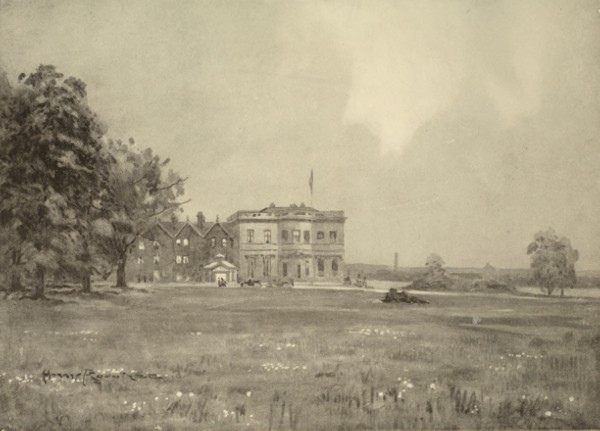
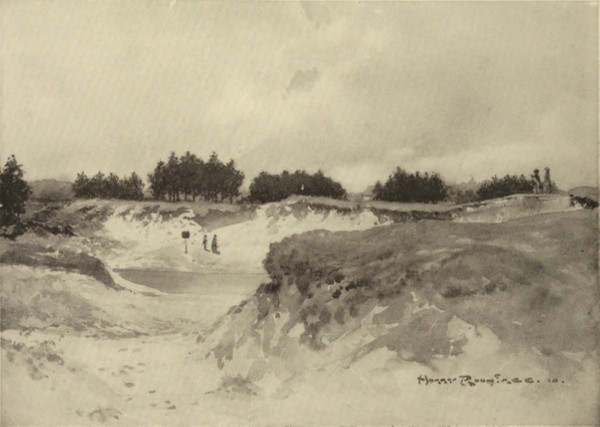
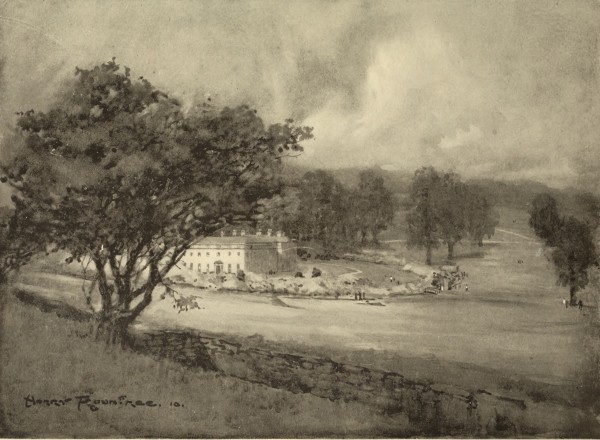
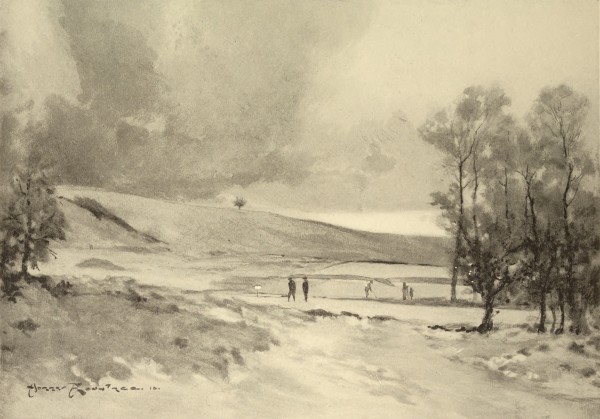
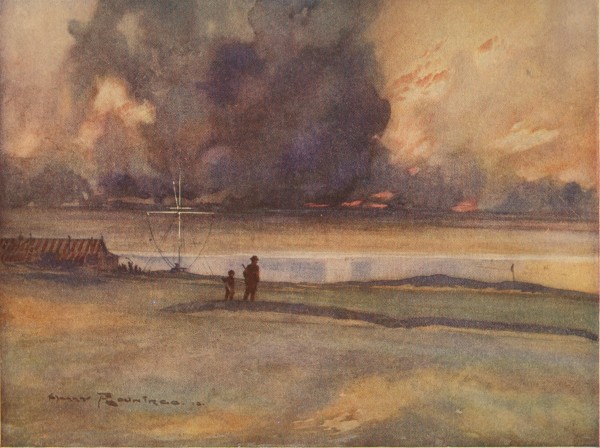
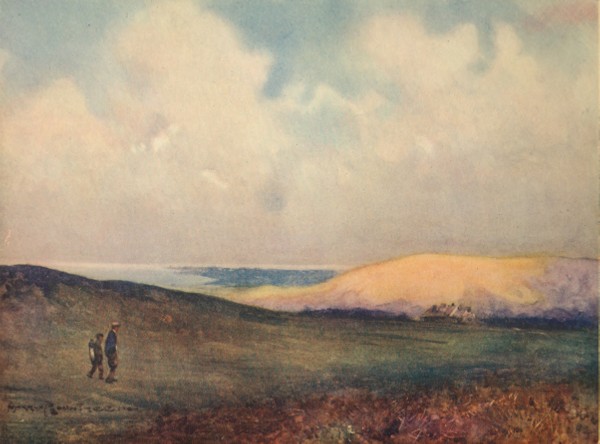
It would clearly be unbecoming to treat the western and south-western
courses in strict geographical order, because there is one honoured
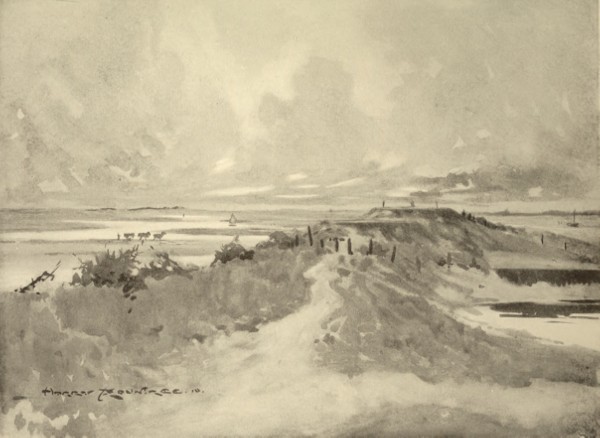
name which must come first, that of Westward Ho!—the oldest
seaside golf course in England. The Royal North Devon Club was founded
in 1864, and when the golf at Westward Ho! was in its infancy it was
fostered and encouraged by Mr. George Glennie of St. Andrews celebrity,
who played much of his golf at Blackheath, so that the famous flinty
old course on the heath may claim to be a kind of god-parent to the
sandhills and rushes of Northam Burrows.
To go to Westward Ho! is not to make a mere visit of pleasure as to
an ordinary course; it is, as is the case of a few other great links,
a reverent pilgrimage. Was it not here that Mr. Horace Hutchinson and
J.H. Taylor, besides a host of other fine players, learned the game?
and surely, it may be added in parenthesis, no golfing nursery has
ever turned out two infant prodigies with such unique and dissimilar
styles. Has it not the tallest and spikiest rushes in the world, and
the biggest bunker to carry from the tee? and, lastly, has it not
lately been remodelled and reformed and made so difficult that many
will compare it, not even with bated breath, to St. Andrews. Therefore,
the stranger, as he jogs along in the little train from Bideford and
looks out at the white horses in Barnstaple Bay, may be pardoned if he
is in a state of suppressed excitement and full of the highest hopes.
In truth, it is a splendid course for which he is bound, and not only
is it wonderfully difficult and wonderfully interesting, but it has a
charm that is given to but few links. It looks more like a good golf
course than almost any other course in the world. Not perhaps when we
first emerge from the club-house, for the first three holes lie upon a
rather flat and marshy piece of ground, but as soon as we get to the
fourth hole it is obvious that the burrows were ordained by providence
for no other than their present purpose. From the high tee to the fifth
hole we get a view of a perfect stretch of golfing country, broken and
undulating with the sandhills on the left and a vast expanse of rushes
on the right, for, in spite of much pruning and uprooting, there are
still plenty of the famous rushes left. It is a sight to make glad the
heart of man, and at the same time to fill him with gloomy doubts as to
whether he is quite good enough to play upon such a course.
Another great attraction about Westward Ho! is its supreme naturalness.
It looks for all the world as if some golfing adventurer had merely
had to stroll out with a hole-cutter, a bundle of flags, and perhaps
a light roller, and had made the course in less than no time. Many
bunkers have been cut, of course, but with one exception they look
quite inartificial, and do not take away from the wonderful impression
of naturalness made by the greens. Sometimes the hole is on a plateau
or in a hollow, and then it is obvious that Nature and not any human
architect has been at work; no man could have devised those jutting
promontories, those little irregular bays, which are so alluring.
Sometimes, again, the greens lie flat and open, and then they blend
so imperceptibly and harmoniously with the surrounding country that
it is impossible to say where the green ends and “through the green”
begins, for the turf is quite beautiful. Some years ago a pestilence of
weeds seized upon it, and the lies and greens of Westward Ho! were in
grave danger of losing their reputation, but with infinite patience and
trouble the weeds have been removed and the turf is once more itself
again, crisp and smooth, and withal full of life and run.
It has often been said and written that the feature of the golf at
Westward Ho! is that the ball must be placed with each shot, and it
is, I think, on the whole, a sound criticism. It is often possible to
hit the ball very crooked without being immediately punished, but in
nearly every case the next shot will be an exceedingly difficult one. I
do not know the course quite as well as I could wish, but the seventh
hole comes into my head as a good example. Here it is possible to
pull considerably from the tee without getting anything but a perfect
lie, but then, between the player and the hole, close to the green,
there stretches a phalanx of pot-bunkers, whereas the man who has
played well out to the right over the guiding flag, has an easy and
open approach. At the ninth, again, there is vast prairie into which to
drive, but it is only by keeping well out to the right that we shall
be able to hook the ball round on to that cunning plateau green; that
little pot-bunker in the face of the plateau will most effectually put
the man who has hooked from the tee, into a quandary.
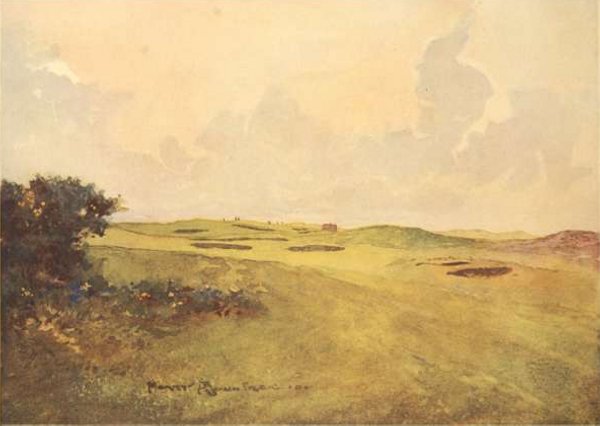
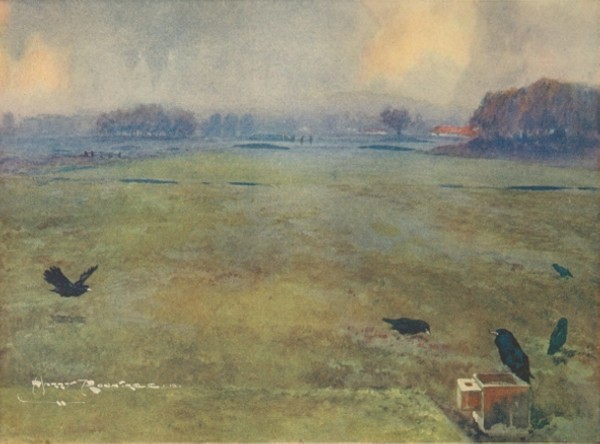
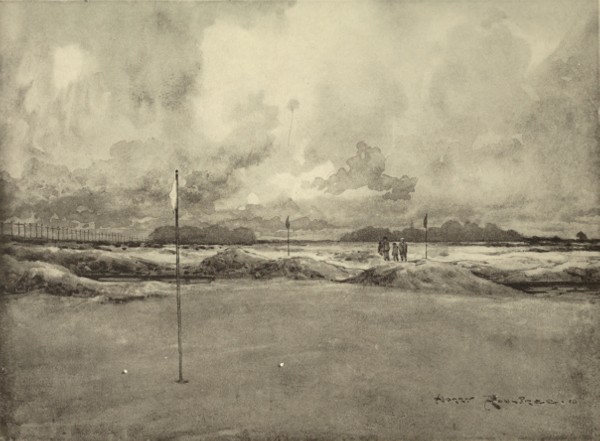
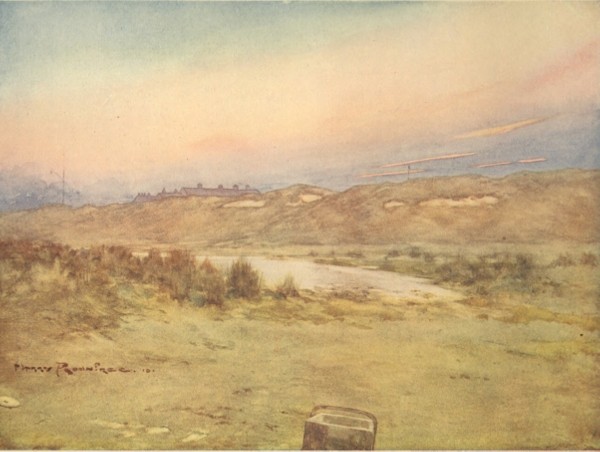
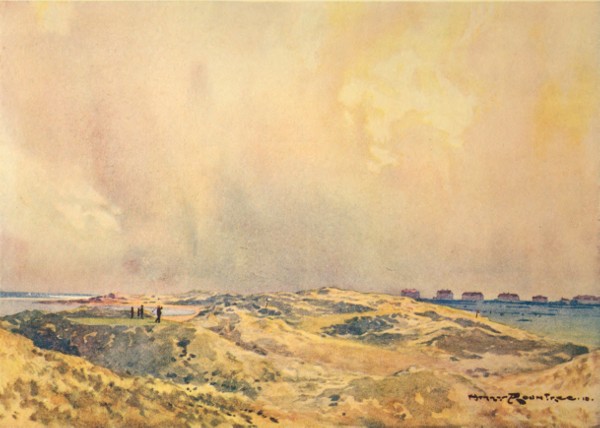
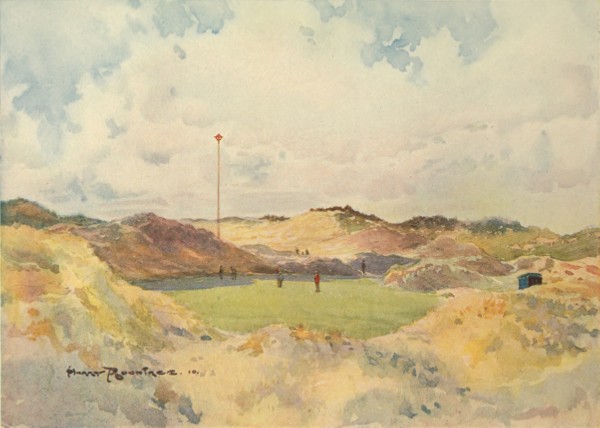
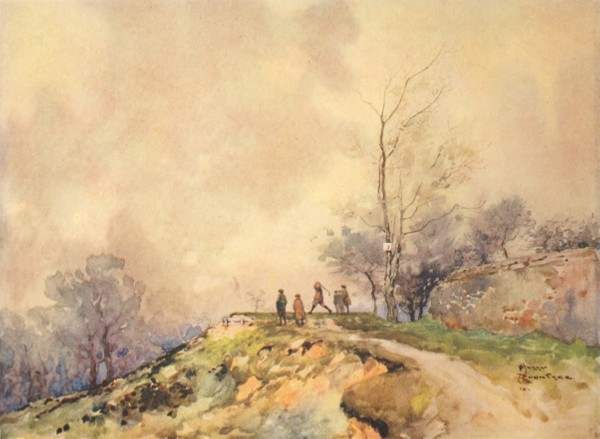
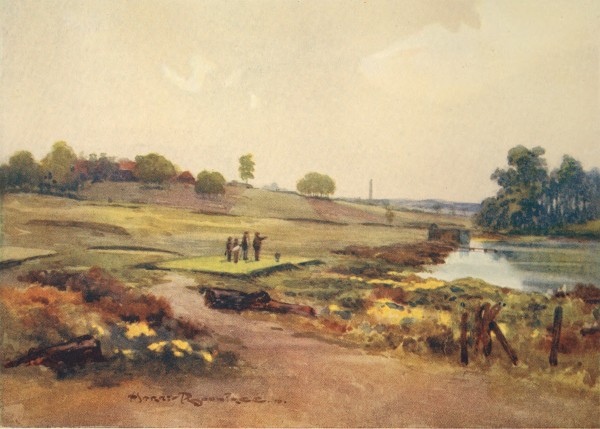
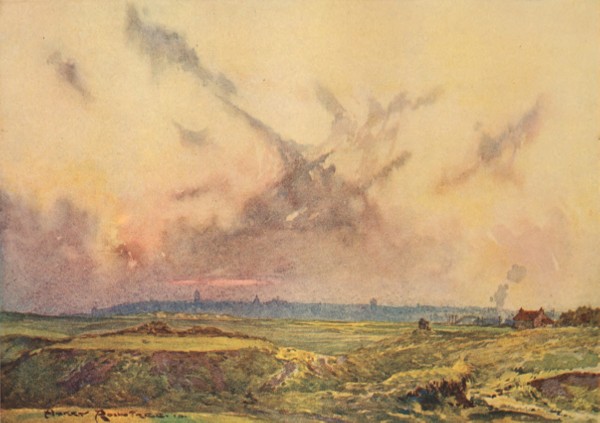
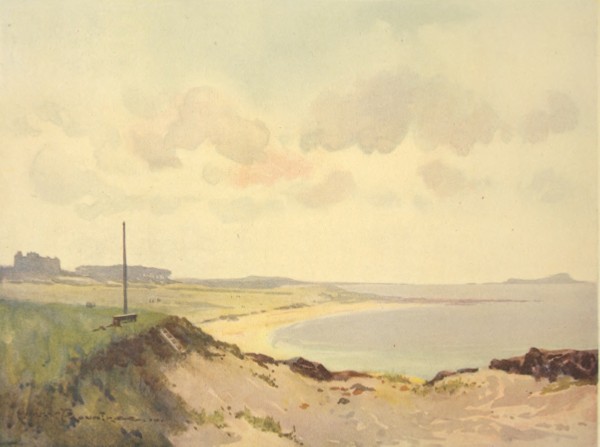
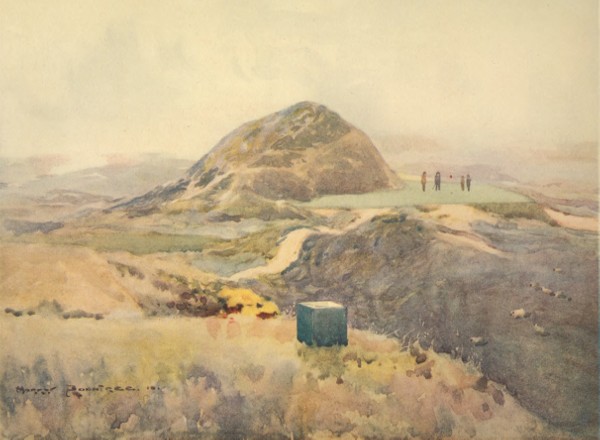
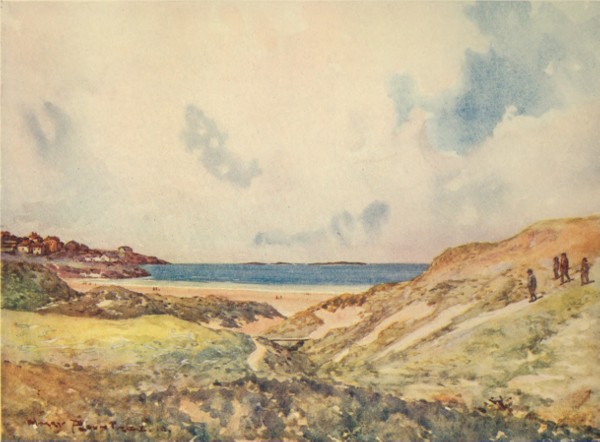
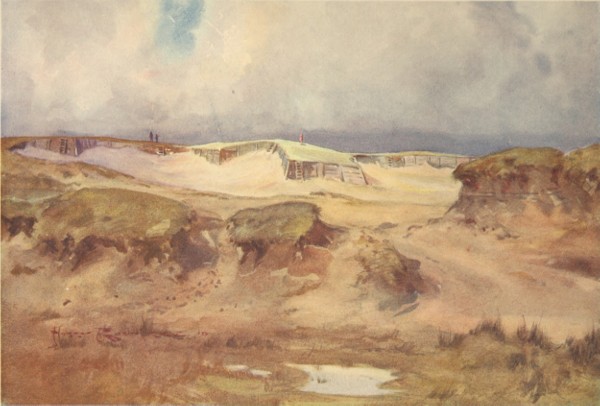
WESTWARD HO!
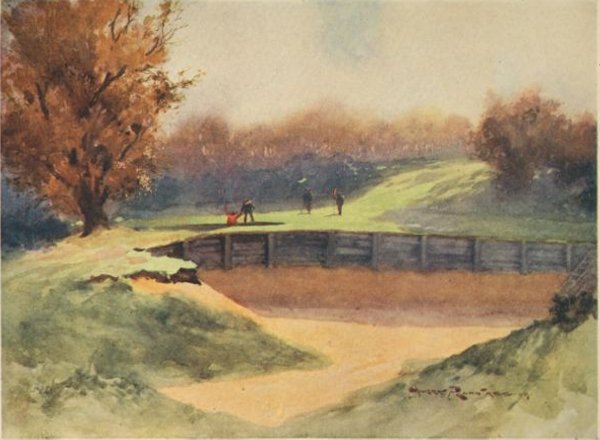
The carry at the fifth tee
It is not perhaps quite justifiable to include wind in a list of the
permanent difficulties of any course, but, as far as my experience
goes, it is always blowing hard at Westward Ho! I am told that when
Braid did his 69, he had a still day, and I certainly believe it, for
the reason that no human man could play such a round in a high wind; it
is almost incredibly good in a dead calm. Personally, however, I have
never found anything but a fine fresh wind blowing, a wind from the
west that causes one to slice woefully on the way out and hook horribly
on the way home. I revisited Westward Ho! after a lamentably long
absence of some ten years, and found the same wind still blowing, and
it brought vividly back to me the recollections of how for one solid
week I had sliced my tee-shots twice daily at the fourth, fifth, sixth,
and seventh holes.
No course ever had more convincing testimony paid to its difficulties
than did Westward Ho! at that Easter of slicing memory in 1900. There
was a team of the Royal Liverpool Club with Mr. Hilton to lead it—Mr.
Ball and Mr. Graham were not there; there was a strong team of the
Oxford and Cambridge Golfing Society; and there were all the local
champions. Yet out of that field Mr. Horace Hutchinson won the Kashmir
Cup with a score of 179, which represents, unless my arithmetic be at
fault, but one under an average of five strokes a hole. It was in truth
the most desperately difficult golf, and there was but one player who
seemed able to triumph over it. That was the late Mr. J.A.T. Bramston,
then a freshman at Oxford, who for the first time showed the world
in general what a magnificent golfer he was. He played in four team
matches against the most redoubtable opponents, and beat them all. He
beat Mr. Hutchinson by a number of holes so large that it would be
kinder to draw a discreet veil over the details, and Mr. John Low by a
smaller but still very sufficient margin. Mr. Hilton and Mr. Humphrey
Ellis (then at his very best, and how terribly good that best was!) he
defeated by some two or three holes apiece. It was the most brilliant
week in a brilliant and all too short career.
If Westward Ho! was difficult then—albeit with a gutty ball—how
difficult must it be now, when Mr. Fowler has stretched it and bunkered
it, so that there are some ready to rise up and call him not blessed.
The one alleviation is that the rushes have been cut away in a good
many places, and though bunkers have replaced them, no bunker is so
fatal as a Westward Ho! rush, which is as tall as the golfer himself,
and a great deal stronger. Practically the only criticism now to be
made is in its essence a futile one, namely, that it is a pity that
providence did not see fit to bring the true sandy golfing country up
to the club-house door, instead of interposing that short stretch of
low-lying and rather depressing marshland.
There the marsh is, however, and the best has undoubtedly been made
of it, so that the first three and the last two holes, if they
have no particular fascination, are thoroughly good and difficult:
more difficult, indeed, than some of the more attractive ones. The
first hole demands two very long, straight shots, for there is a
ditch to catch a slice and only a narrow opening to the green. The
second, again, is a fine, long driving hole, a little ‘dog-legged’
in character, and at the third, which is a short one, the green is
beleaguered with pot-bunkers on every side. Yet this third hole shows
that there are limits to what human ingenuity can do, for the hole is
as difficult as can be, and yet of so flat and melancholy an appearance
that one could scarcely feel any warm affection for it.
By this time we are close to the famous ‘Pebble Ridge,’ and the real
golfing country begins with the fourth hole, a fine two-shot hole with
a well-guarded green. Next comes the fifth, and in front of the tee
there is a bunker so colossal that the carry looks at first sight to be
impossible. A good long carry it certainly is, but it is not nearly so
appalling as it looks; a well struck ball will career gaily over it,
and, if we feel frightened, we can make the carry a little shorter by
going to the right. A moderate pitch will take us home after the drive,
and this is true not only of the fifth, but of the sixth and seventh
also.
It is just a little unfortunate that these holes, which have a good
many features in common, should come so close together, for their
doing so imparts just a suspicion of weakness to this part of the
course. In each case there is a stirring tee-shot from a high tee, and
if that be well struck we may then pitch easily home, although the
greens are very well protected, and should have a comfortable string
of fours. There is a spot further on among the hills to the left where
some desire that the green should be placed, and if ever it is done,
not only the sixth but indirectly the fifth and seventh will also be
benefitted.
The eighth is an interesting little short hole—an extremely difficult
one from the back tee—and after that come two of the finest holes in
golf, the ninth and tenth.
The ninth green lies in a hollow on the top of a small plateau at the
range of two very full shots from the tee, and the superlative virtue
of the hole consists in a little unobtrusive pot-bunker, before alluded
to, in the face of the hill. We can hardly hope to drive far enough to
carry the bunker in our second, and if we could it would scarcely be
possible to stay on the green. Therefore, we must drive well out to
the right, and hope to reach the green with a subtle hook. The ground
breaks in towards the hole from the right, and so a perfectly played
shot, with just sufficient hook, will keep turning and turning towards
the hole, till it totters with its last gasp down the last slope
and lies close to the hole. Often, of course, it will be out of the
question to get home in two, but the hole will still be interesting,
and our approach shot anything but a simple one.
The tenth affords a standing example of what a ‘dog-legged’ hole
should be, and it is here that we come really to close quarters with
the rushes. There is a vast tract of them in front of the tee, and if
we could carry some three hundred and more yards no doubt we could
reach the green in one. Assuming, however, that our driving powers
are more limited, we drive well out to the right, carrying just as
many yards of rushes as we safely dare; then, turning to the left, we
play our second between the rushes on one side and rough country on
the other over a bunker and on to a narrow gully of a green. With a
favourable wind we may hope to get home easily enough with an iron, but
when two really full shots are needed, it is a hole for gods and heroes.
Next we come to some of the new holes. At the eleventh we drive not
over but down an avenue of rushes, and must then play a shot which is
curiously rare at Westward Ho!—a high, quickly stopping pitch over a
cross-bunker. The twelfth and thirteenth are both good two-shot holes,
the former, with a green most sternly bunkered, and the latter, with a
lovely little plateau green. This plateau looks so eminently natural
that I have once fallen into the error of describing it as such,
thereby doing grave injustice to Mr. Fowler, who built it in the middle
of a flat plain.
Fourteen is a short hole with a bunker in front and rushes in the
neighbourhood: a good hole, but comparatively ordinary, and certainly
not so attractive as the other short hole, the sixteenth. This is
but the length of a mashie pitch, but what a difficult pitch it is!
When I last played it the wind blew strongly from left to right, and
the inhuman green-keeper had cut the hole in the left-hand corner
of the green. To pitch right up to the hole was to run far over the
green; to be at all short meant a pot-bunker, while a ball with the
least suspicion of cut would tear away to the right and end, in all
probability, in another bunker. It seemed to be almost necessary to
pitch on a particular bump, on a particular hill just short of the
flag—a desperate task.
I must go back for a minute to praise the fifteenth, a hole which
has the added interest of alternative routes, according as we drive
to right or left of a formidable hedge of furze, and then we come to
a parlous long hole, the seventeenth. There is a ditch guarding the
green, but before we arrive at the approaching stage, we must hit first
of all a good tee-shot, and then a good brassey shot, over a rampart
of terrible appearance. This is the one bunker on the course which is,
from an artistic point of view, unworthy of it. It does indeed look as
if it had been transplanted from some inland park, but do not let us be
too hard on it, for there is much joy in the carrying of it.
At the last hole we should, with a good second shot, carry the burn and
get a four, but there is a gentleman waiting with a net to fish our
ball out if we fail, and the sight of him is apt to have a horribly
destructive effect. If we go into the burn we shall be reminded of
the fact when we are paying for our caddie, by the demand for the
recognized toll of one penny for its rescue. Finally, no account of
Westward Ho! would be complete without a reference to the tea at
the club-house. There is a particular form of roll cut in half and
liberally plastered with Devonshire cream and jam. Epithets fail me,
and I can only declare that the tea is worthy of the golf.
From Westward Ho! we may cross the border into Cornwall, a thing
infinitely more easy to do in the imagination than in a train. Cornwall
has several pleasant courses—Newquay, Lelant, St. Enodoc, and Bude,
amongst others. Of these, St. Enodoc is a course of wonderful natural
possibilities, and for that matter there is a rather solitary,
inaccessible piece of land near Hale, not far from Lelant, where might
be made one of the golf courses of the world. So at least it seemed
to me as I wandered once on a Sunday morning amongst its hills and
valleys.
Bude is a place beloved by many summer visitors, and the course
is a good course if there are not too many of them upon it. The turf is
of the seaside order, and there are many hills that must once have been
sandhills, so that perhaps in some earlier geological epoch the course
might have been more exciting than it is now. These hills are now,
for the most part, covered with grass, but the sand appears quickly
enough if a bunker has to be cut. There is one fact which is perhaps
a little sad about Bude, and that is, that though there are the most
magnificent waves to be seen there, the golf course is not the place to
see them from, and we do not really catch sight of them till we come to
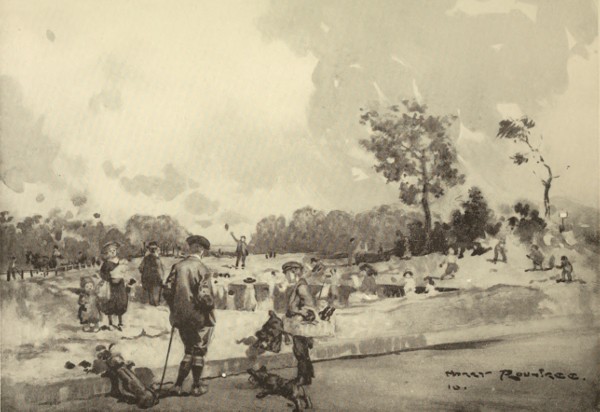
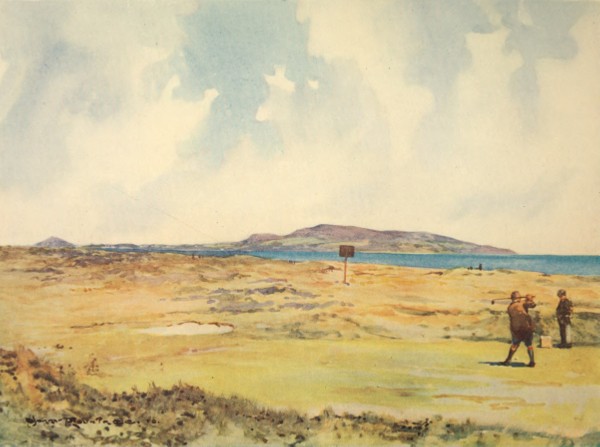
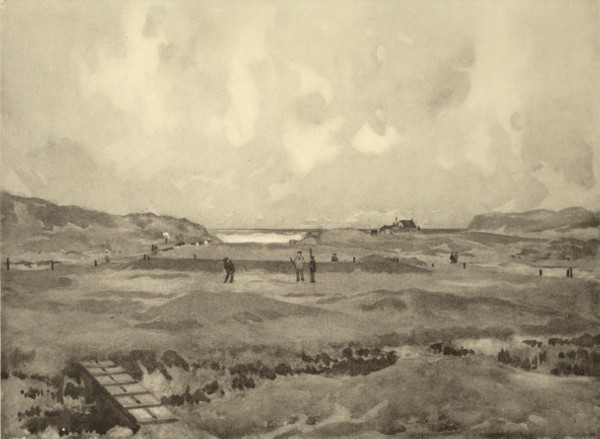
the sixteenth hole, which a friend of mine has christened the ‘Nursery
Maid’ hole. Here we have to play across a road that leads inland from
the beach, and, as we are often finishing our round at precisely the
same moment when the nurserymaids are conducting their young charges
in for lunch, it becomes necessary to wait while an apparently endless
procession wends its way homeward with much purposeless halting of
children and screaming of maids.
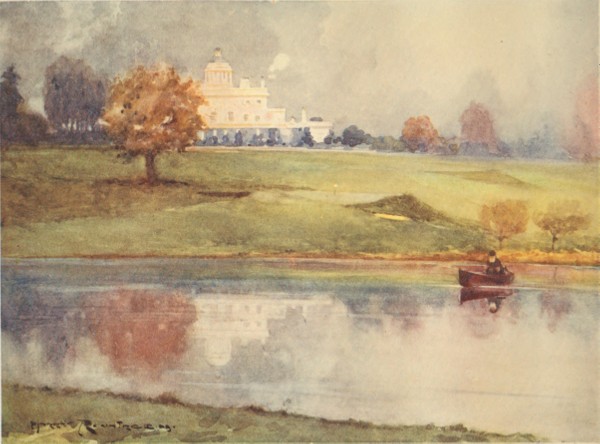
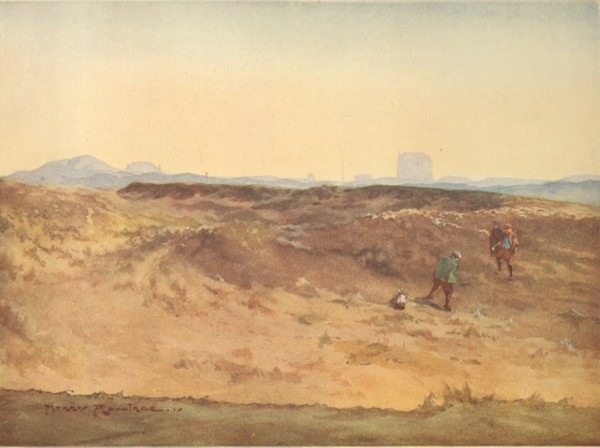
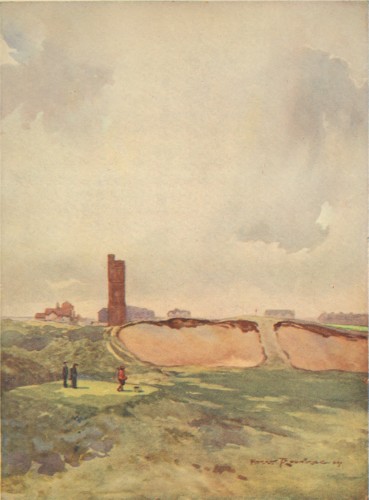
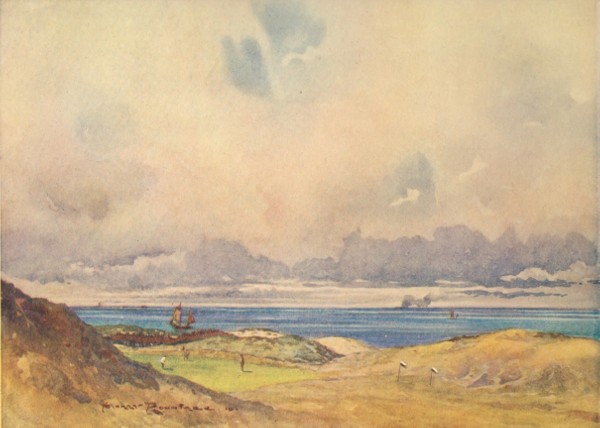
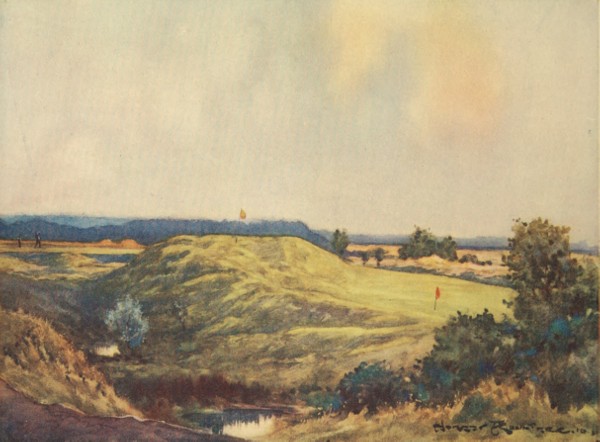
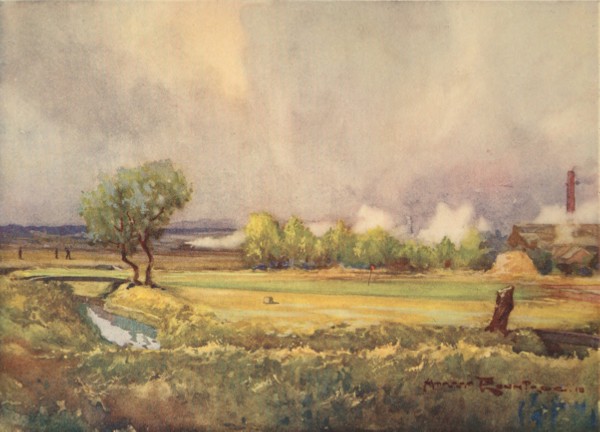
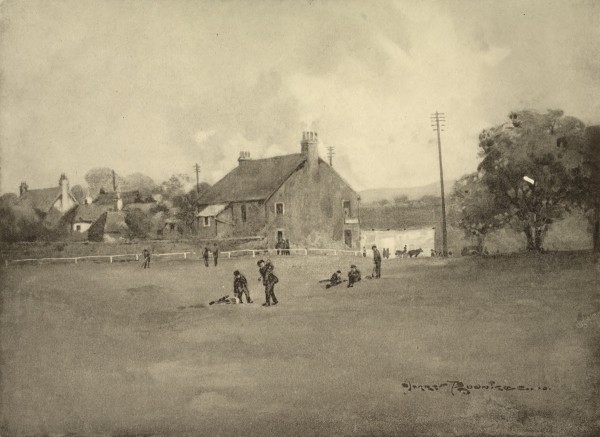
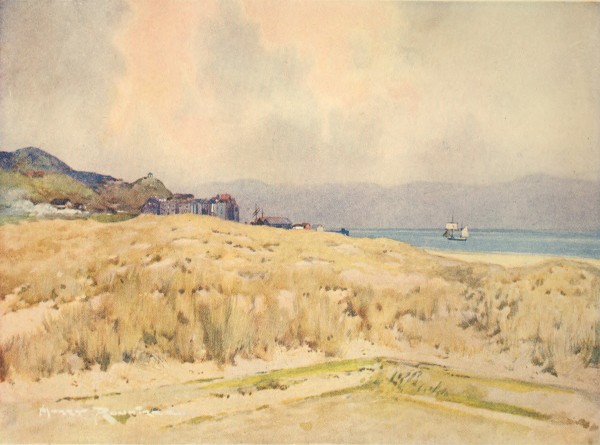
BUDE
The ‘Nursery Maid’ hole
Perhaps the best hole on the outward journey is the third, where there
are really a variety of reasons why we should very likely play a bad
second shot. In the first place, we shall not improbably have rather
a hanging lie from which to play our pitch, and, to make things more
difficult, the green is sloping away from us. Guarding the green is a
fine natural bunker, where the punishment is apt to be very severe, and
beyond it is a sandy road, so that altogether our pitch cannot possibly
be called easy. We can so place our tee-shot as to modify its terrors,
but we can by no means do away with them altogether.
After the agonies of the third there is a partial relapse into
mildness, but there are good carries from the sixth and seventh tees;
at the latter of the two over a big hill, the face of which has been
cut out and converted into a bunker. The ninth too has a good tee-shot
over another big bunker on to a green which is well protected on
every side. At the tenth a punchbowl green brings hopes of a perhaps
undeserved three, and then for a space we play in and out of some land
that was once a garden or orchard: we can still see where the wall
and the ditch used to run. We enter the garden by means of a good
cleek shot over a big hill thickly covered with bents; leave it at the
twelfth and re-enter it at the thirteenth, a hole not unlike the
eleventh. At the fourteenth we may break the windows in a terrace of
houses by a well executed slice; and at the sixteenth the aforesaid
nurserymaids have to be circumvented. When we have paid for the windows
and buried the nurserymaids, we play quite a short but deceptive iron
shot to the seventeenth, avoiding a bunker and a sandy road, and so
home with a good two-shot hole to end with.
We can go no further west than Cornwall, so let us turn back to
Burnham, in Somersetshire. Whenever a golfing conversation turns
upon blind holes, and one party boasts of the giant hills and deep
valleys of any particular course, it is almost certain that another
will say, “Ah, but you should just see Burnham in Somerset.” Thus it
happens that we go there for our first visit in the frame of mind of
one who sets out for the Alps after having seen nothing perceptibly
higher than Constitution Hill.
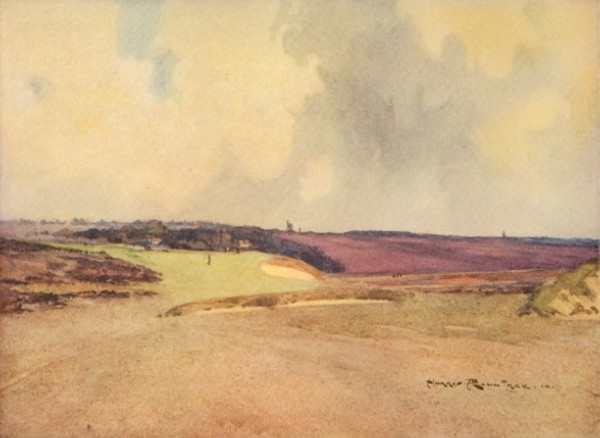
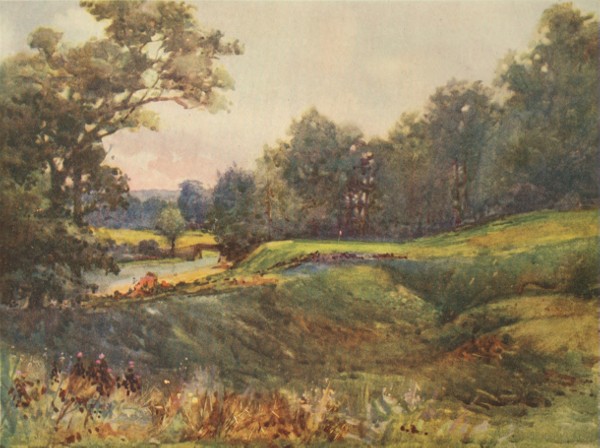
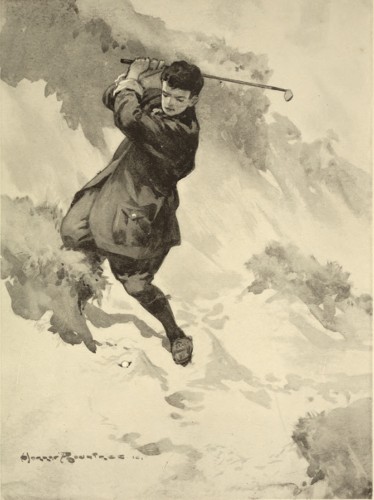
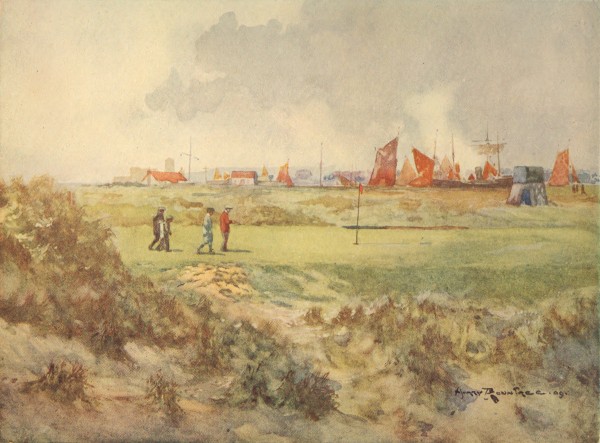
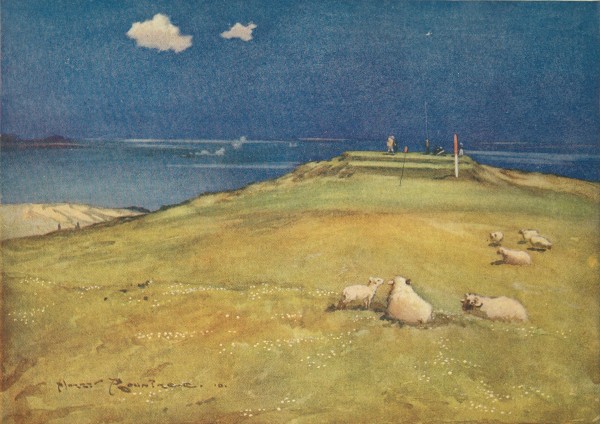
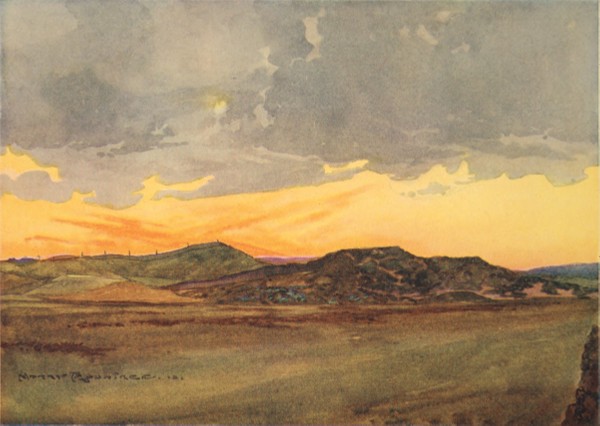
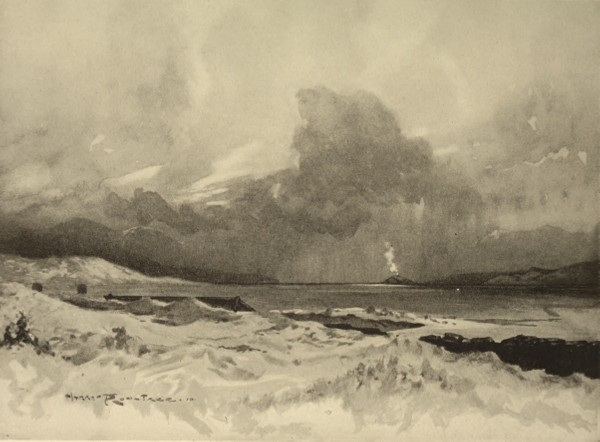
BURNHAM
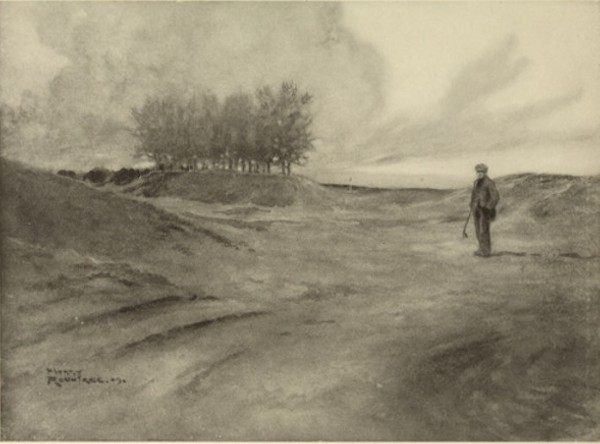
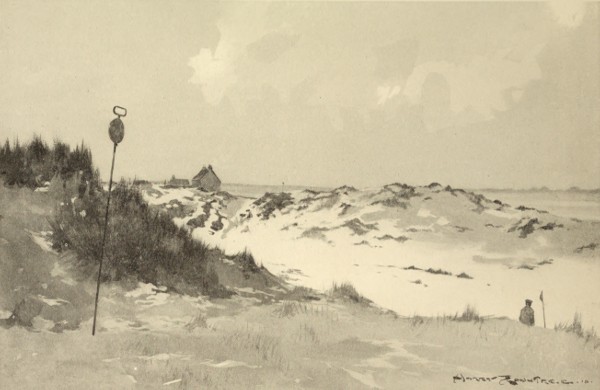
Among the sandhills
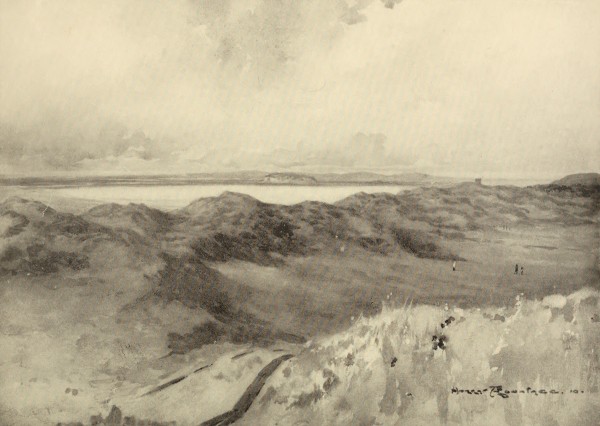
A first glance at the course assures us that we shall not be
disappointed, for as we take our stand upon the tee we are ringed
round with sandhills, and wherever the first hole may be, this much is
evident, that we shall have to drive the ball over a mountain in order
to get there. Hole succeeds hole, and still the endless range of hills
goes on, and from the summit of each one we get the most lovely views:
to the right a chain of hills, with the Cheddar Gorge in the distance;
to the left the Bristol Channel, with the islands of Steep Home and
Flat Home and an expanse of dim country on the other side. When we
turn for home at the ninth, we still see the sandhills stretching
tumultuously away towards Weston, with their strange fantastic shapes,
and occasionally a narrow, meandering ribbon of turf in between. There
seems to be material for at least one other course, and, indeed, the
difficulty would appear to be not to find bunkers, but to find an open
place where there are not too many of them.
With this wonderful stretch of country to work upon, it is small wonder
that those who originally designed the course made a number of blind
holes. They would have been hard put to it to do anything else, and
there are, in fact, on the old course, if my reckoning be correct, no
less than six blind one-shot holes, to say nothing of several longer
holes, where the approach shot is played merely at a guide flag waving
upon a hill top. I say the old course because, as I write, Burnham
is in a transition stage, and what may be called the new course is
practically in working order. Thus some of the blind short holes will
disappear for ever, not, perhaps, without leaving a pang of regret
behind them, and in their place come some flatter, and longer, and
more open holes, which are not so characteristic of Burnham, but are
none the worse for that. The hills will be all the more enjoyable when
occasionally contrasted with the plains, and these new holes now give
the course just that extra length that it needed.
Now let us play in imagination over the course in its altered
condition, and tee up our ball for the first hole. There is a little
dip between two grassy hills—a horribly narrow one it looks—and that
is where we have to drive. A really fine shot may take us to the edge
of the green, and we may go on our way rejoicing with a three, for
the green is big and good. A drive and a pitch in the country of hills
should suffice for the second, and then come two excellent holes, where
we cease to drive over the hills, and are set the far severer task of
hitting straight down the gully that lies between them.
“This reminds me very much of Wallasey,” I remarked, not without hopes
of having made an interesting and original comment, and my guide
answered in a tone, in which courtesy struggled with weariness, that he
had often heard the same comment made before. Of these two holes the
fourth, which is ‘dog-legged,’ and gives a well-deserved advantage to
the fearless hitter, is particularly good; and then there comes a most
fascinating hole, the fifth. Two full shots are needed, over some very
broken and billowy country, to reach a green that lies at the bottom of
a deep hollow. This hollow has merits, which are not given to all of
its kind, for its sides are abruptly precipitous and not possessed of
those gentle and flattering slopes, which coax the indifferently struck
ball in the direction of the hole. The sixth, on the other hand, which
is a one-shot hole, has all the vices which the fifth avoids, for here
all roads lead to the flag, and the perfect shot, the paltry slice, and
the too vigorous hook, may all meet together at such a range from the
hole that a two is by no means improbable.
After being unduly pampered by this sixth hole, we are brought face to
face with the sterner realities of life, and must be prepared to play
a series of long and accurate brassey shots if we are to do anything
better than five for each of the next three holes. Of these three the
eighth and ninth are new, and the only thing to be said against them
is that there is such a family likeness between them that it is a pity
they come immediately together. Nothing but long, straight hitting will
do here along a narrow tongue of grass that is flanked on either side
by sand and bents.
The tenth deserves a special word, if only for the fact that a huge
sandhill has had its head cut off—this is regarded as quite a minor
operation at Burnham—in order that we may see the flag from the tee.
There it is, a terribly long way off, as it seems, but one really good
shot should reach the green, avoiding some little nests of pot-bunkers
on the way, and there is a three to reduce the average of fives for the
homeward journey. Another three should come at the twelfth, when only
a short pitch is needed, but eleven and thirteen are very likely to be
fives; long, narrow, flat holes, with broken ground and little clumps
of rushes that are intensely business-like. The fourteenth is, I think,
almost the best hole on the course, and certainly the tee-shot is the
most alarming. We can see all our troubles only too clearly here—a
sandy road full of the deepest ruts on the right, called in spirit of
ostentatious levity the ‘Old Kent Road,’ and on the left a prickly
and seductive hedge. If only there was a mountain in the way at this
hole, we should probably come less frequently to grief. As it is, we
concentrate all our attention on being straight, and are all the more
terribly crooked in consequence.
The next two holes both need accurate approach shots, and then comes
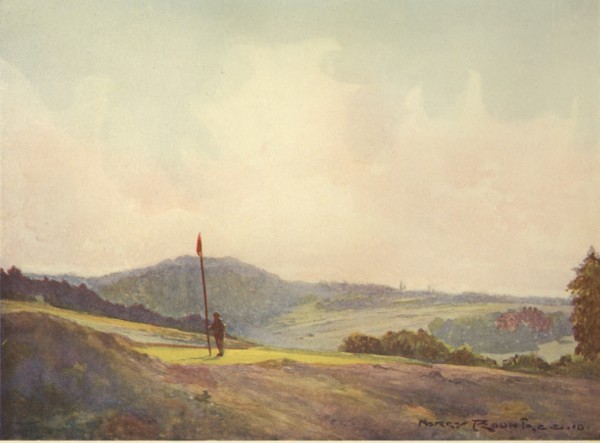
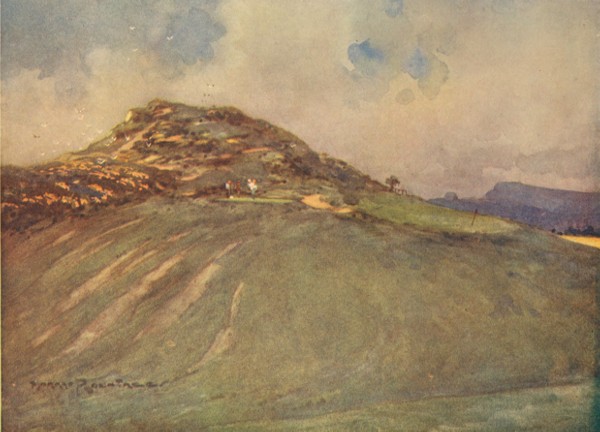
the last and best of the blind holes, ‘Majuba.’ There is a steep hill
of a rather curious conical shape to drive over, but the chief of the
dangers lie on the far side, where the green lies in a narrow little
gorge between a bunker on the right, and on the left a hill thickly
covered with bents. This is as good a blind short hole as one could
possibly wish for, and makes a sufficiently critical and exciting
seventeenth, while the new eighteenth should be one of the best last
holes to be seen anywhere. Two raking shots will be wanted, and the
second of them, if it go as straight as an arrow between two flanking
bunkers, will be rewarded by as good a piece of turf as the heart of
the putter can desire.
Still travelling back in an easterly direction, we come to Broadstone,
in Dorsetshire, not far from Bournemouth. Broadstone is, I
think, rather an easy course to remember, which is the same as saying
that the holes have each got very definite characters of their own; at
any rate, although I have seen them but once, I can play them all quite
clearly in my mind’s eye, save only the park holes, which, truth to
tell, are not much worth remembering. These park holes are certainly
one of the drawbacks to the course. For six holes we are playing
excellent golf in the right golfing country, with heather, and sand,
and everything as it should be. Then we go through a wicket gate, the
whole scene instantly changes, and, behold! we are playing a hole of
the typical inland kind. There is no heather and no sand, save such
as has been transplanted to fill up a number of conscientious little
bunkers, and it is no great injustice to liken the turf to that of a
good smooth field. For six holes we are playing in the park, and then
the tyranny is overpast, and we emerge once more upon the heather for
the rest of the round. In fact, the course is divided into three slices
of six holes each, the first and last slice being good, and the middle
slice being of very ordinary stuff indeed.
It is a little hard to understand why these park holes were ever made,
because there is a glorious and apparently illimitable tract of heather
waiting to be played over, only divided from the course by the railway.
I believe there is a scheme afoot to make some further holes upon this
heather, that is now so lamentably wasting its sweetness, and if this
is done, Broadstone should be able to hold its head very high among
inland courses.
In point of mere looks, it is very hard to beat now, and especially is
there a most lovely view, with Poole Harbour in the distance, from the
fifteenth hole, which is on the highest part of the course. This hole
has likewise a unique feature in the shape of a genuine Roman tumulus,
which at first sight the stranger is apt to attribute to the genius of
Mr. Herbert Fowler, or some other maker of hazards. It stands almost
exactly in the middle of the fairway, and those who drive too straight
must deal with the situation as best they can with their niblicks.
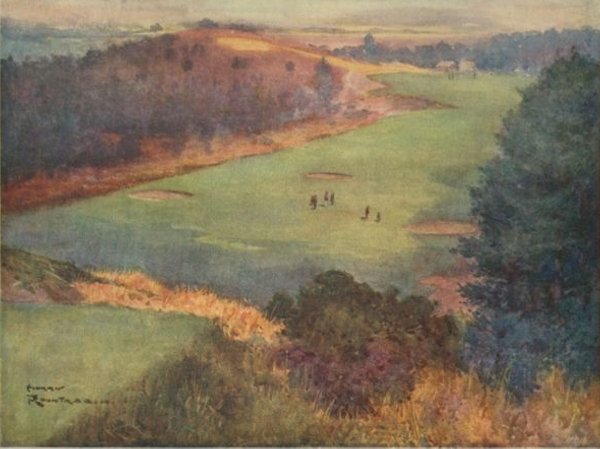
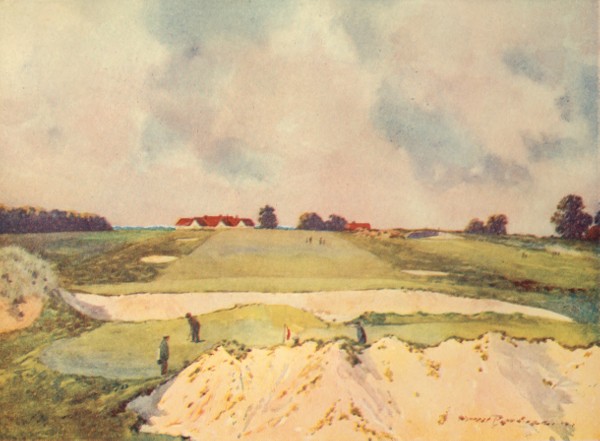
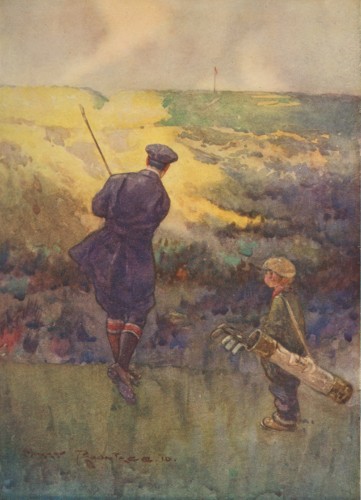
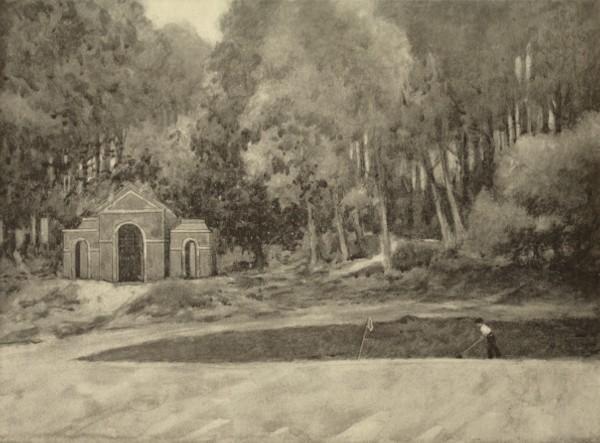
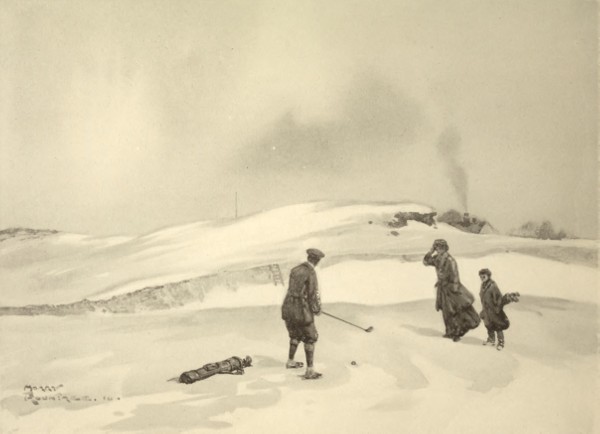
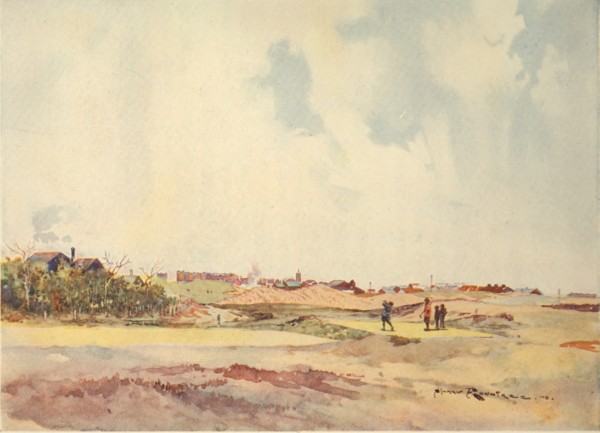
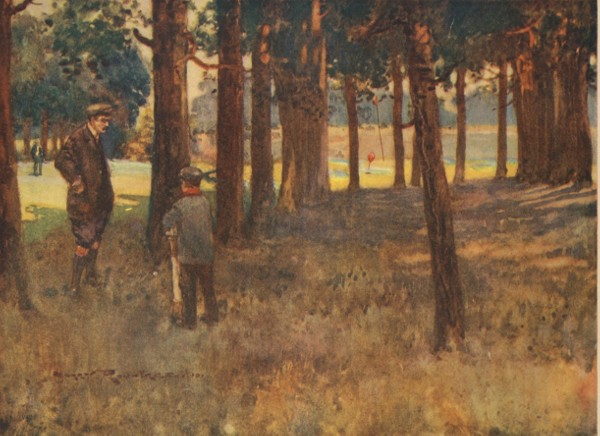
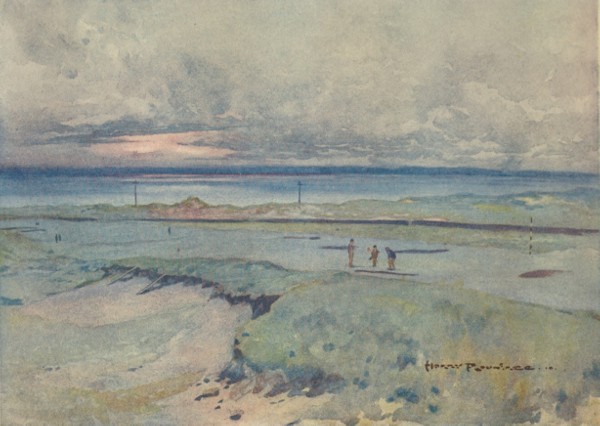
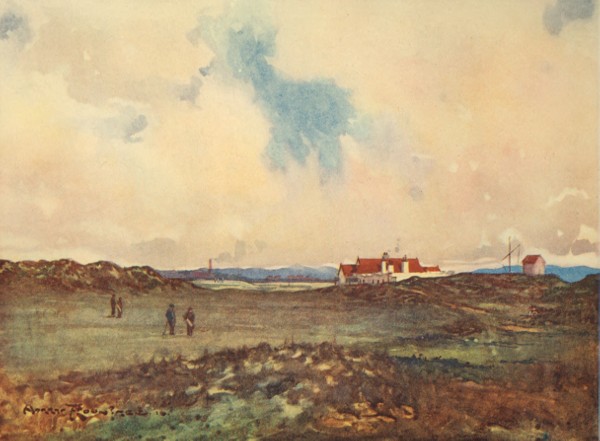
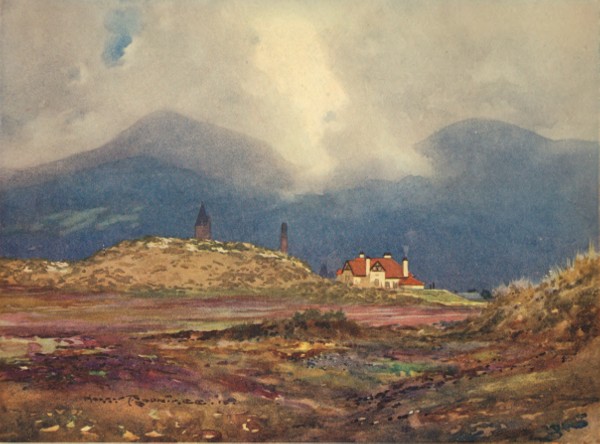
BROADSTONE
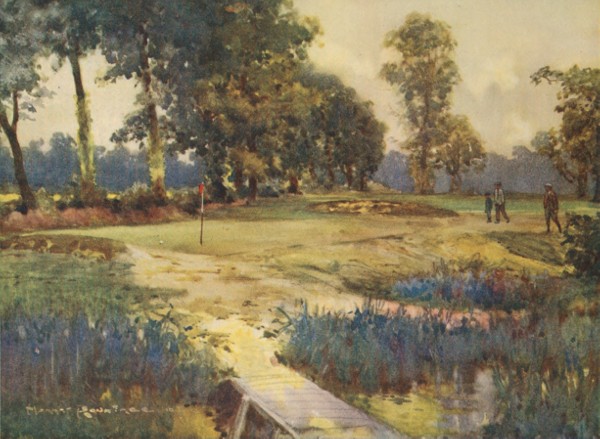
The fourth hole
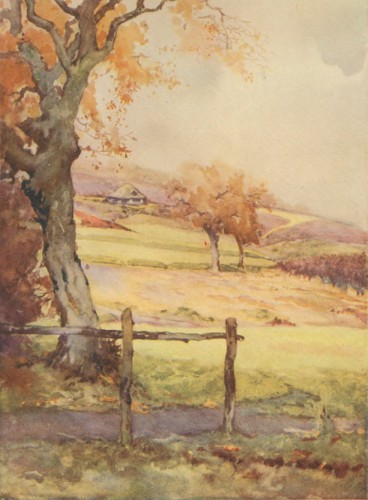
A vast deal of trouble and money must have been spent on the putting
greens, which are very smooth and good, and enormously big. They
are, in fact, too big, and a revolutionary leader who should dig
bunkers in the edge of them would be doing the course a service.
I cannot help thinking, also, that rather too many of them are upon
plateaus—not the plateaus of St. Andrews, but the plateau that is cut
out of the side of a slope and has a back wall to cover a multitude of
approaching sins. The bunkering is something of a patchwork, in which
the theories of two opposite schools have been blended. We see, first
of all, the remains of an older civilization in the shape of deep sandy
trenches, with the accompanying ramparts dug right across the course.
Then, as golfing opinion has progressed, or at any rate altered,
there have been added, under Mr. Fowler’s guidance, a good number of
pot-bunkers, which seem to have some of the qualities of those we know
and fear at Walton Heath, being easy to get into and hard to get out
of. Besides these, the heather is always there to trap us at the sides
of the course; there are also trees in places, and likewise whins,
while one of the park holes so far demeans itself as to be guarded by
an ordinary hedge.
The course begins very well with a fine, long, two-shot hole, a little
‘dog-legged,’ where the second shot will just creep on to the green
between two sentinel bunkers. The second is another fine one, save that
the plateau green has a terribly steep bank; and the third is wholly
admirable, with its cheerful tee-shot from a height, followed by an
iron shot down the middle of an avenue of trees. The fourth I believe
to be likewise an excellent hole, but my attention was distracted from
the hole by the scene I witnessed on the tee. There was an irascible
gentleman and a small caddie; the caddie had made an inefficient
tee, and the irascible gentleman was the possessor of a prolonged and
solemn waggle. The waggle began and the ball fell off; the irascible
gentleman made opprobrious remarks, and put it on the tee again,
while the small caddie showed a dreadful tendency to laugh, which he
restrained with obvious difficulty. This happened really innumerable
times, till both the gentleman and the small boy appeared certain, from
different causes, to die of apoplexy, and, indeed, I had serious fears
for myself. The ball was ultimately despatched into a neighbouring
ditch, and I passed on without having disgraced myself, but remembering
very little about the hole. Both the fifth and sixth are short holes,
though the sixth needs a long, straight shot, and then we pass into the
park, or better still, by a short cut along the high road, which brings
us back to the heathery country and the thirteenth hole—a good short
hole, where a wood to the right of the green has doubtless slain its
tens of thousands.
At the fourteenth we need a long, straight drive, followed by an iron
shot that must be played firmly and boldly home on to a plateau guarded
in front by a steep and unclimbable bank, and to the right by a pit
of destruction, where the horrors of sand and whins are intermingled.
Of the remaining holes, the seventeenth and eighteenth are both good,
especially the former, which, with its tee-shot among the whins, has an
air of Huntercombe about it. The sixteenth, however, does not seem at
all worthy of its fellows, being, as it appeared to me, as essentially
vicious as a hole can be. The ball is struck—with a measure of
straightness, I admit—to the brow of a hill, then the hill does the
rest. The ball hops, and skips, and jumps down the slope till it
reaches a green built out from the hillside, and, lest it should jump
too far and run over, there is a back wall of wire-netting. This is
the kind of hole—I can think of nothing worse to say of it—that some
people call ‘sporting.’
Having given relief to my pent-up feelings on the subject of that
sixteenth hole, I feel entirely at peace with Broadstone, which has
some really fine holes, and is as pleasant a spot to play golf in—as
breezy, and pretty, and quiet—as anyone could desire.
Besides Broadstone and the new course at Parkstone, which can be
reached by a very short train journey, Bournemouth has two courses
of its very own, Meyrick Park and Queen’s Park. Both are situated
in very pretty spots, amid the fir trees that are always with us at
Bournemouth. Meyrick Park is rather a miniature affair, although
it is not so short as when Tom Dunn originally laid it out. Then there
was one green that could be reached with a shortish putt from the tee,
and the most decrepit might hope for a round under eighty. There are
still many threes for the accurate iron player, but there are also one
or two good long holes, particularly the ninth, where we play, as it
were, into the narrow neck of a bottle among the pine-woods. It is not
unamusing, but the serious golfer will rather betake himself to the
newer course at the Boscombe end of the world, Queen’s Park.
Both these courses belong to the Corporation, and all we have to do
is to pay our shilling and play our round. We get plenty for our money
at Queen’s Park, for the course is over 6000 yards in length, which is
certainly not too short for the wants of old gentlemen who totter round
it.
It is really good golfing country, with big, rolling undulations and
plenty of heather and sand. There are long, narrow gullies running in
between the hills, rather reminiscent of another very pretty course,
Hindhead. For the most part, however, we are not playing along the
gullies, which would have tested our accuracy to the full, but rather
go leaping from one hillside to the other; in fact, if we are virtuous
we are always on a hill, and the valleys represent the infernal
regions—it is only the wicked who go down into them. This is just a
little monotonous, and we might rashly call it a fault in architecture.
There is, however, a reason for it, in that all the best soil is to be
found in the highlands, while the low-lying ground is in that respect
unsatisfactory.
The course is still comparatively young, and has not yet put forth
any very thick crop of bunkers; but the heather is wiry and tenacious
and the fairway narrow. There are two consecutive holes of a most
paralyzing narrowness—the seventh and eighth—where the ball has to
be steered between a fir wood on the right and a high road, which is
out of bounds, on the left. The third hole, again, is a fine two-shot
hole, and there are plenty more. They are perhaps rather too similar
in character owing to the recurring valleys, but they one and all need
good play.
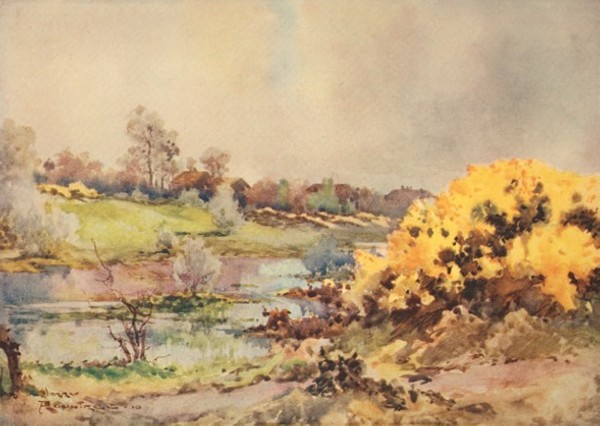
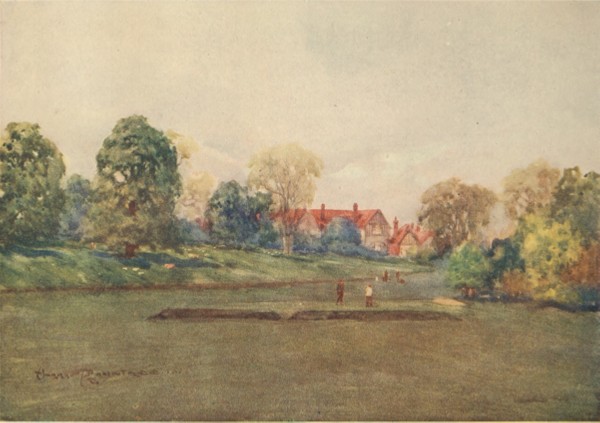
QUEEN’S PARK, BOURNEMOUTH
The eleventh green and twelfth tee
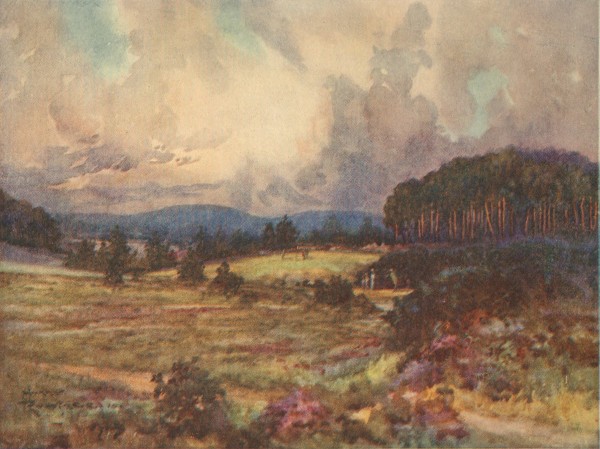
Even among the heathery courses, which are nearly all good to look
upon, Queen’s Park takes a very high place for beauty, and it is a joy
to find anything so pretty and peaceful on the very edge of a big town.
Every prospect pleases, and only the old colonel, who is in front of us
and plays fifteen more with his niblick, is entirely vile.
The reader must now make in imagination the short and generally
innocuous crossing to the Isle of Wight, in order to see one of the
most charming of nine-hole courses at Bembridge. The Royal Isle
of Wight Golf Club can boast of a comparatively hoary antiquity, since
it was founded in 1882, and Bembridge was perhaps rather more famous
when there were fewer links in existence. It is still, however, very
good golf, and has many faithful and affectionate friends. The nine
holes dodge in and out after the manner of a cat’s cradle, so that
Bembridge has earned a reputation for being one of the most dangerous
courses in the world, and it used to be said that all the local players
expected to be hit once at least in the course of a year. To cry a
brisk ‘fore’ is to absolve oneself from responsibility, and one may
then let fly at any impeding player with a clear conscience. There is
one particularly perilous spot, where the ball is apt to lie after a
straight drive of moderate length on the way to the first hole. Here
the player is in the midst of a veritable ring of death, since a hot
fire may be opened upon him simultaneously from the seventh, eighth,
and ninth tees, to say nothing of the first tee to his immediate rear.
It is perhaps owing to this exciting characteristic of the course that
that pleasant anachronism, the red coat, is still occasionally to be
seen at Bembridge.
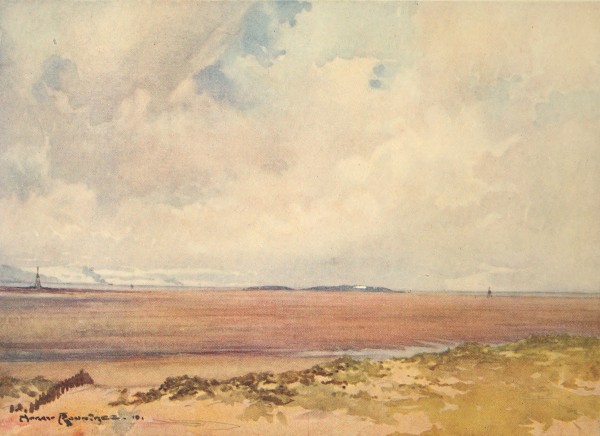
The course lies upon a spur of land between Bembridge harbour and the
Solent, and one is rowed over to it from the hotel in a boat. Small
things remain absurdly graven on the memory, and I remember nothing
at Bembridge more clearly than the nautical gentleman who used to
row us over a great many years ago, and his expression when Mr. John
Low genially hailed him as “You licensed brigand.” Once the stranger
arrives on the course he will be struck, possibly by a ball, and
certainly by the ubiquitous character of a road which winds about the
course like a snake, and is an almost ever-present menace throughout
the round; indeed, it has some say in the matter at every one of the
holes, save only the third and the fifth. Some of its glory—or its
horror, according to the light in which we view the matter—has,
however, departed, for whereas it was once uniformly sandy and soft
and full of the direst ruts, it is now metalled in many places, and so
is naturally much less terrible. Another feature of the course, which
is now less pronounced than it used to be, is the luxuriant growth of
whins. These have become sadly thinner, and one who knows and loves
his Bembridge well tells me that this is in a measure due to the havoc
wrought among them in the early days of the rubber-cored ball, when a
Haskell was infinitely precious and was not to be given up for lost
till the entire neighbourhood had been laid waste with the niblick.
BEMBRIDGE
A loop of the ‘cat’s cradle’
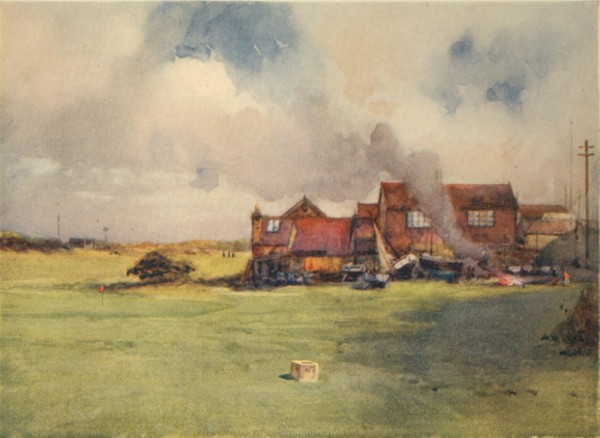
The first hole is one of the best on the course, requiring a
drive, followed by an accurate cleek-shot on a still day, and against
the wind two really fine shots. The whins lie in wait for a sliced
shot, while on the left is the strong shore of the harbour. There is a
delightful account of a round at Bembridge, written years ago by Mr.
Horace Hutchinson, in which the writer pulls his shot at this hole on
to the beach, and ultimately finds his ball lying upon a ‘dead and
derelict dog’—a grisly and, I trust, an unusual hazard. The next two
holes are of very similar length, and can both be reached with a drive
and a pitching shot; there are whins and a big bunker to trap the
erring tee-shot, and in both cases the approach has to be played on to
a green which is difficult to the verge of trickiness.
The fourth is a really good hole, some 460 yards in length, and has a
thoroughly difficult tee-shot, since the most contemptible of golfing
vices will be punished by a large bunker, while the more manly but
still reprehensible pull lands the ball in a grassy pit. The fifth is
a short hole, gifted with no particular merit and a number of whin
bushes, but at the sixth we come to a hole which can hold its own
in the very best of company. It has the virtue of presenting to the
player the choice of two alternative routes, so that, according as
he is long or short, courageous or cautious, he can vary the length
of the hole for himself. If he is a strong and ambitious hitter,
he will go straight for the second green, carrying the road on the
way; the situation is the more poignant because the road is here not
metalled, and failure must entail a measure of disaster. On the other
hand, if the road be safely carried, he is left with a comparatively
short and straightforward second shot, though he has still to cross
a bunker of magnificent proportions that guards the green. The more
careful, on the other hand, push their tee-shot to a spot further
out to the right and short of the road, whence it is still possible
to get home, but only by means of a shot that is both longer and
harder. There are, I believe, many persons of sound judgment who think
that the playing of the tee-shot on to the second green should be
prohibited by law, both because all unnecessary risks of doing murder
are undesirable and also on the ground that the second stroke by the
right-hand line is more difficult and more interesting. Two holes of
the drive and pitch type follow; indeed, a strong hitter may hope,
under very favourable conditions, to get home with his tee-shot; but
at the eighth in particular the drive must be a very straight one, for
there are whins to right and left, and our old enemy the road lurks at
the edge of the green. Finally, the green is a very tricky one, and
altogether discretion at this hole lives fully up to its proverbial
characteristics.
At the last hole, which calls for a drive and a good full iron-shot,
a four is never to be despised, and with that we start off once more
between the whins and the beach, and pass pale and trembling again
through the fiery zone. The golf at Bembridge is most certainly
attractive, and that it has other and more sterling qualities is shown
by the fine players it has produced, the two Toogoods and Rowland Jones
amongst them. “By their fruits ye shall know them” is true of golf
links as well as of other things.