Whitey did not have long to wait for the opportunity to put the matter
up to Injun, for that individual rode into the ranch-yard within ten
minutes after the conversation that had awakened Whitey's curiosity.
It took five additional minutes for Whitey to retail to Injun what he
had heard, and, as usual, Injun thought gravely over the matter before
speaking. In fact, it was Whitey who again broke the silence.
"Injun," he said, "do you think you could find the place where Bill
lost the trail of the cattle at the creek, and the place where it
looked as though they had stampeded?"
Injun nodded confidently. It must not be imagined that because Injun
seldom spoke, or because of his broken English when he did speak, that
he could not understand what was said. He could understand any words in
ordinary usage, and there was very little in any conversation that "got
by" him. He not only comprehended the words, but he had a remarkably
well trained ear, and he could catch and distinguish sounds that would
have been inaudible to most people. There were times when his dinner,
or even his very life, depended on this faculty, and there is nothing
like Necessity to develop the faculties.
The same Necessity that had developed Injun's hearing had also
developed his sight; and although Whitey supposed that he had as good
eyes as anybody, he found, after a time, that Injun could distinguish
objects that were all but invisible to him. What was a mere speck in
the distance to Whitey, Injun would declare to be a man on horse-back.
And by the time that Whitey could recognize this to be true, Injun
could tell who the man was.
It is, after all, a matter of training. Probably Whitey's eyes were
just as good, in many ways, as Injun's; but they were not trained the
same way. For instance: when trailing a man or an animal, Whitey could
see the broken twig or the pressed down spear of grass that marked
the trail—after Injun had pointed it out to him. But he could not
detect it if he went over the ground first. Injun had trained his eyes
to observe the most minute things, for those minute things told him a
story that meant a great deal to him; and often very small things made
big sign-posts to guide or regulate his movements. Possibly Injun, had
he seen Whitey read rapidly the page of a book, would have thought
Whitey's eyes far more wonderful than his own—and that is only another
kind of eye-training. Nature was Injun's book, and, perhaps, just as
easy to read as Whitey's book—but it takes different eye-training.
The two boys slipped away from the ranch without attracting notice.
This was not unusual, for by this time Whitey had become accustomed
to riding long distances, and he and Injun were permitted to go about
as they pleased. But up to the present time his wanderings had been
confined to the ranch limits.
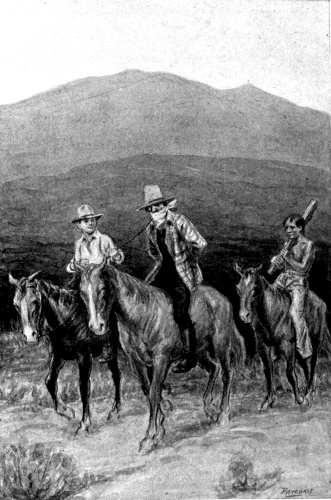
A mile or so from the ranch Injun broke away from the trail and struck
off to the northwest toward the mountains. The branch or creek that
Whitey had described lay some seven or eight miles further on, and in
the general direction of Ross' ranch; and at the steady clip set by
Injun, they made it without much exertion in something less than an
hour. The ride was without incident until they were a mile or two from
the creek, though still within the confines of the ranch, when the
quick eye of Injun detected two horsemen riding in a direction that
would bring them across their trail.
"Who are they?" asked Whitey, when they were a long distance away. "Can
you make them out?"
"Him Bar O," said Injun confidently.
Whitey had not figured on meeting men from the ranch, who might
interfere with their plans, or, at least, carry back the news that
they had crossed the trail of the boys; and he suggested that they
make a detour that would carry them in such a way that the trails
would not meet. The boys turned their horses at almost right angles and
started toward a wooded and rocky region where they would not be so
conspicuous; but if they thought to escape in that way, they soon found
that they were mistaken. It was evident that the ranchmen were not to
be lost or thrown off the track, and that they proposed to find out
who was riding in that neighborhood. It was either a case of run for
it, or stand and deliver; and after some hesitation Whitey determined
that the former course, even if successful, would alarm the ranch, as
the supposition would be that they were rustlers, and would invite a
general pursuit. So the boys again turned their horses and continued in
the general direction that they had first taken, and it was not long
before the range riders came alongside of them.
"What are yo' two scalawags doin' out here?" asked Walker, who was one
of the riders in that section. "Yo' liable to give us heart-disease—we
was plumb shore we hed ketched a pair o' rus'lers!"
"We're just taking a ride," said Whitey, innocently. "It's a fine day,
isn't it?" he added.
"Yes," said Walker, dryly, "it shore is a fine day—if it don't rain.
Does yo'r pa know yo' all is gallivantin' 'round out here? Where was
yo' all headin' for, anyhow—yo' an' Settin' Bull, here?"
"I tell you, Mr. Walker," said Whitey, "we were just looking 'round to
see what we could see."
"Oh, them kids is all right, Walker," said the other rider. "Let 'em
alone. Thet there little red devil knows this here range like I know my
boots. They won't git into nuthin'."
"Mebbe," said Walker, undecidedly. "Mebbe they won't—an' mebbe they
will. 'Tain't none too healthy fer them 'babes in the wood' right
in these parts jes' now! Not to my way o' thinkin' it ain't. But,
howsumever, 'tain't really none o' my funeral. But lemme give yo' all a
tip—keep away from thet Cross an' Circle outfit an' stay on the range!"
"Why?" asked Whitey, a little impatiently. "What harm will it do to go
off the range?"
"Will y' listen to thet!" exclaimed Walker, laughing. "Ain't yer
own yard big enough fer yo' all to play in? Looks to me like 't
might be! Anyway, yo' jes' take my tip! An' as fer yo', young Mr.
Rain-in-the-Face, don't yo' let this here kid git into no mischief, er
Bill Jordan'll cut off them two ears o' your'n an' sic the coyotes onto
yo'!"
With this parting injunction, the two riders turned their horses and
rode away; but it was plain that Walker was not altogether satisfied
with the situation; and more than once he looked back at the boys as
the distance between them increased.
Whitey was not the kind of a boy to be turned from his purpose by any
such admonition as this. In fact, the scent of some possible danger
only added zest to the matter; and the two boys rode forward toward the
creek with an increased appetite for the business in hand.
Within a few moments the boys came to the edge of the branch or creek
that marked the confines of the Bar O ranch. The banks were, except at
intervals, steep and high—some six or eight feet above the water—and
it was manifestly improbable that the cattle had taken to the water
from the top of the bank. Injun, therefore, followed the stream down;
and some half-mile below where they had come upon the creek, they found
a place where the bank sloped gradually down to the water's edge.
Injun dismounted and examined the ground closely, Whitey following, but
not able to see anything more than that it had been somewhat trampled.
Injun, however, saw a good deal more than that. He pointed out the fact
that on the two outer edges there were marks of horses' hoofs; while
in the middle of the trampled course leading to the river, the cloven
hoofs of the cattle were visible—not plainly, but after Injun had
outlined several of them with his finger, Whitey could make them out.
"Bill was right, then?" asked Whitey, excitedly; "the cattle were
driven and kept close together?"
Injun nodded, and proceeded with his investigations. Leading his pinto
and looking closely at the ground and the surrounding grass and bushes,
he followed the trail back from the creek. Some distance from the
bank the boys came upon a place where the ground was bare and somewhat
softer than that near the water, and this spot Injun examined minutely,
crawling on his hands and knees and measuring the horses' hoof-prints
carefully with one of his arrows. At length he rose as though
apparently satisfied.
Although Walker and Bill Jordan had ridden over the ground, their
horses had left no traces that confused the other marks; for by this
time the ground was hard and dry, while at the time of the stampede it
had been wet. Whitey looked at Injun inquiringly. "Four hoss," said
Injun, holding up four fingers.
"And how many cattle?" asked Whitey, anxiously.
Injun shrugged his shoulders and shook his head. "Dunno," he said,
frankly; "Mebbe 'lev'n ten."
"And could you tell the horses if you saw their hoofs again?" asked
Whitey, the Sherlock Holmes instinct stirring within him.
"Tell two," said Injun, holding up two fingers; and then, in response
to Whitey's inquiry as to how he could do this, Injun pointed out
certain slight peculiarities in the hoof-prints that were plainly
discernible on a minute examination. Whitey was delighted at this
exhibition, and he noted well the peculiarities for future reference.
Injun even went a little further than that. Two of the hoof-prints were
very plainly marked; and taking some flat stones, he arranged them in
such a manner as to cover and preserve the impressions of the hoofs in
the ground and yet at the same time were not particularly noticeable.
Not satisfied with this, Injun then proceeded to search for a marked
peculiarity among the cloven hoof-prints; and succeeded in finding one
in which there was an unmistakable dissimilarity. The right forefoot
of one of the cattle showed an unusual deformity, being so split as
to give the impression of toes. This print Injun covered in the same
manner. Injun had never heard of the Bertillon fingerprint system, but
he had common sense.
Having followed the trail back to the point where the animals
were separated from the rest of the herd, nothing new in the way of
foot-prints was found, the nature of the soil and its thick carpet of
grass making any discovery difficult. In fact, most of the marks were
almost obliterated.
But the keen eye of Injun detected another thing, seemingly slight,
but really of the utmost importance in the last analysis. On one of
the tough branches of a small, thorny bush, there hung several woolen
threads of variegated colors; threads not more than an inch or two in
length, that had apparently been torn from a piece of cloth by being
caught by the tough thorny branch. An examination of the ground near
the bush, which was fortunately soft, showed that the heel-mark of a
man's boot was plainly discernible, and also the four hoof-prints of
a horse. The heel of the boot had been pressed into the ground to a
more than ordinary depth, and the hoof-prints of the horse were on each
side of it. Injun pointed this out to Whitey with some evidence of
satisfaction, but it meant nothing to Whitey.
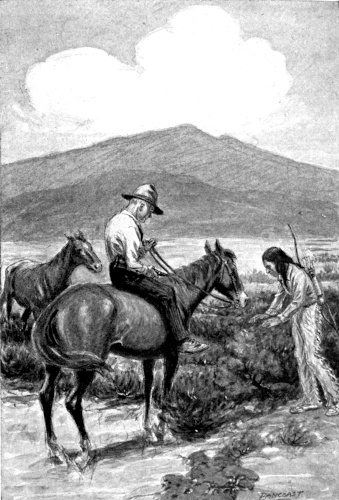
The keen eye of Injun detected another thing.
"What about it?" he asked; "what happened here?"
"Him loose latigo," said Injun. "Pull 'em tight," and Injun
illustrated how a man would dig his heel into the ground as he had
exerted a powerful pull at a saddle-cinch. Injun leaned back as he made
the imaginary pull, and the thorny branch of the bush swept his side
and caught slightly in his shirt. It was all plain to Whitey now.
"Say!" he exclaimed, in undisguised admiration, "Sherlock Holmes has
nothing on you! He never doped out anything better 'n that!"
Injun looked blankly at him, never having heard of Sherlock Holmes; but
Whitey's manner was unmistakably complimentary, and so Injun let it
go at that. Whitey was about to take the threads from the branch, but
Injun stopped him. He broke the branch that held the threads from the
bush, carefully peeling the bark for several inches down the stem, and
put it into his quiver. Then he marked the bush and the spot so that
he could easily recognize them again. Then the two boys mounted their
horses and rode back over the trail toward the creek, which was rocky
and shallow, and could be easily forded without swimming.
When the boys arrived at the creek, having retraced the trail without
incident, although it was well past three o'clock in the afternoon,
Whitey and Injun had no thought of abandoning their quest. After a
consultation, they proceeded to cross to the other side of the creek
and to examine the other bank in the hope that Injun's keen vision
would be able to discern things that Bill and his men had missed. They
followed the course of the stream down to where it emptied into the
Elkhorn, a distance of perhaps a mile and a half; but, though Injun
dismounted several times and scrutinized the ground carefully, there
were no signs that cattle had landed anywhere along the route.
Whitey was puzzled. Arguing on the principle that "what goes up must
come down," and "what goes in must come out, or stay there," Whitey
said:
"If the cattle went into the creek, they must have come out
somewhere; or else," he added, after a moment, "they must be in it
yet."
This admitted of no discussion, and Injun did not attempt to refute
it. It did not seem probable that the cattle were still in the creek,
and it seemed hardly possible that the cattle could have gone into the
creek, swum all the way down to the Elkhorn, and then continued down
the larger stream—but there appeared to be no other alternative; and
Whitey determined to investigate even such an improbable thing as that.
In one way, Whitey was in command of the expedition, and Injun readily
complied with any plan of campaign that he suggested. The details of
the investigation and the deductions drawn from them were in Injun's
hands, and very capable hands they were, too.
Accordingly it was agreed that Injun should swim to the left bank of
the Elkhorn and follow it down, while Whitey followed the right bank,
keeping as nearly parallel as possible. The Elkhorn was not more than a
hundred yards wide, and the two boys could call to each other easily
and communicate any finds that either made. This they proceeded to do.
The investigation was greatly simplified, at least on Whitey's side,
by the fact that the bank of the Elkhorn offered very few possible
landing-places, being high and steep, and there were few places that
needed examination at all. On Injun's side, however, the ground
required more careful scrutiny; but on neither side did anything
develop. And before they were aware, they were almost at the Ross ranch.
The ranch lay just around a bend in the Elkhorn, on the left bank, and
where the river was indented by a small bight, or pointed bay, that
extended for several yards into the ranch property. The left bank of
this bight was high above the water, and thickly covered by vines and
shrubs that grew down to the water's edge, and many of them overhung
the water, which was shallow at that point.
Once the boys were in sight of the ranch, the cautiousness of Injun
manifested itself. He knew that the Ross outfit were none too partial
to him, and he also knew that it would be unwise, if not unsafe,
for him to be found so near to it. And riding down into the water,
where the high bank concealed him from view, he rode cautiously
around the bend of the bayou. Whitey, on the opposite bank, watched
Injun's movements closely; and finally, in response to a signal, swam
his horse across and landed under the high bank near Injun, whom he
found examining the narrow shore or beach of the bayou under the high
bank. The surface of the ground, which was sandy and covered with
pebbles, had been undoubtedly disturbed recently; but it was seemingly
impossible to tell by what. There were deep marks as though heavy
planks had been pushed against it, and the ground about showed the
hoof-marks of horses. These also were discernible in the mud under the
shallow water. On the small beach it looked as though an attempt had
been made to obliterate these marks, for the sand showed evidences of
having been recently turned over in places.
Dismounting from his horse, Injun pulled aside the branches and bushes
but nothing was revealed save the flat, gray face of the rock of the
bank. Injun looked keenly at this for a moment; and then putting out
his hand, found that it yielded to his touch! The rock wasn't rock
at all! And going to one side, he found that what seemed to be rock
was nothing more nor less than a heavy canvas, painted a dark gray to
resemble rock, and smeared with mud and pieces of grass and leaves! So
skillfully was this done, that it required close scrutiny to reveal it;
and from a distance, even of ten or fifteen feet, it would never have
awakened the slightest suspicion!
Lifting the edge of the canvas, Injun disclosed an opening in the face
of the cliff nearly six feet high and of about the same breadth, and
into this the two boys crept cautiously, leaving their horses on the
narrow strip of beach near the entrance.
The interior of the cavern or tunnel was quite dark; but Whitey had
been in the West long enough to learn that one of the most necessary
things in a plainsman's equipment is matches. Injun, of course, had
his flint and steel and tinder, but they would have necessitated the
lighting of a torch, which would have been dangerous on account of the
chance of discovery. They proceeded slowly along the tunnel, Injun
examining it carefully, and a few yards from the entrance they found
a number of very heavy planks so fashioned that they could be linked
together to form a rude raft. The logs were wet and water-soaked. And
the mystery of how the cattle got out of the river was no longer a
mystery!
Whitey's first idea was, that having discovered this much, and thus
definitely fixing the manner and means of the disappearance of the
cattle, it would be a good thing to make a get-away while there was
yet time, and report their discoveries to the Bar O outfit; and it
would have been well for him if he had followed this plan. But Whitey
was nothing if not courageous, and he was also impelled by an intense
curiosity to fathom the rest of the mystery. If he could locate and
identify the lost cattle, which would be easy on account of the brand,
and possibly the one with the deformed hoof would be among them, his
investigations would then be complete. But unfortunately for the
success of this plan, there were certain difficulties in the way which
neither Whitey nor Injun could foresee; and certain contingencies
happened which had their fortunate side as well as their unfortunate.
The two horses had been left untied on the narrow strip of beach
outside the tunnel entrance. Left alone, Injun's cayuse would have
stood there for many hours. But Whitey's horse, Monty, was not, as yet,
so well trained; and after a time began to be restless. The spot was
not exactly an attractive one in which to stand for an indefinite time,
and Monty finally retraced his steps around the bend and out of the
bayou where there were grass and sunshine. With such an example, the
pinto slowly followed; but scarcely had Monty come around the bend when
a rattler that was sunning himself on the rocks sounded his warning,
and Monty gave a frightened snort and proceeded to "beat it" away from
there in a panic.
When a horse is badly frightened and starts to run in a panic, the
first thought that comes into his head is to get home as fast as he
can; and Monty proceeded to put this idea into execution. He tore along
the bank, and at the proper place swam the stream, and was soon well on
his way back toward the Bar O ranch.
By the time Injun's horse got around the bend the rattler had
disappeared, and therefore he was not thrown into any panic, as Monty
had been. Monty was not in sight either; and so, although he probably
wondered what had become of his pal, he climbed the bank and proceeded
to graze on the sweet grass, plainly visible from the windows of the
Ross ranch!
Meanwhile, the two boys went cautiously along further into the tunnel,
which appeared to be of natural origin, as though a stream had eaten
its way through the porous rock in search of an outlet—a sort of
natural drain. The hole, originally small, had been enlarged by digging
up to its present size. There was a continual rise in the floor of the
tunnel as it receded from the water, and the floor of it was wet with
a very small stream trickling down toward the entrance.
The boys had proceeded perhaps a hundred feet from the entrance, when
they came upon a sudden enlargement in the tunnel which took almost the
form of a large room. The top or ceiling was so high as to be invisible
to them, and the place itself was evidently a natural cavern. Whitey
lighted a match, and its flare disclosed the fact that the chamber was
some twenty-five or thirty feet across, and in it, among other things,
were several large barrels and packing-cases.
As the boys started to cross the room, keeping a little to the side,
the match went out and they were again enveloped in darkness so thick
that they could feel it. Whitey was about to scratch another match,
but he felt Injun's hand clutch his arm and draw him still further
toward the side of the chamber. Whitey had heard nothing, and knew of
no reason for this; but he was quite willing to be guided by Injun's
superior senses.
In a few seconds, however, he heard foot-steps coming toward them from
the upper end of the chamber, and caught a faint glimmer of light.
Injun hastily and noiselessly pulled Whitey toward one of the boxes
that were scattered about that side of the chamber, and behind this the
two boys crouched as the sound of the foot-steps indicated that some
one was coming in their direction. Whitey's heart was beating so loud
that he felt sure that any one who came near him must surely hear it. A
moment afterward this was probably true in Injun's case, also—and for
a good reason!
Into the far end of the chamber came the light of a lantern, and as
it illuminated the space about the man who carried it, Whitey could
see that he was dark-haired and swarthy, though rather under-sized,
but very wiry. He was clad in a multi-colored Mackinaw jacket, with
the regulation cowman's trousers and boots, with his revolver in the
holster at his side. The man came directly toward the boys and Whitey
instinctively grasped the handle of the little pearl-handled .22
that Atherton had given him and which he had always carried in the
hip-pocket of his trousers. True, he had his rifle with him; but he
felt that at close quarters the revolver would be more valuable. (Even
a .22 fired at close range can be annoying; besides, he might throw it
at the man and do more damage than if he shot him with it!)
The man came directly to the box behind which the two boys were hidden
and it seemed as though discovery was inevitable; had he lifted the
lantern high, it could not have been avoided. But he placed it onto
the floor and reached down into the box and took out several objects
which the boys afterward saw to be bottles of liquor of some kind. He
was so close that either Injun or Whitey could have put out a hand
and touched him, and they could hear his heavy breathing, for plainly
he was partially drunk. Each of the boys held himself tense, and was
ready for a vigorous defense, and against the knife that Injun gripped
in his hand, to say nothing of the pop-gun that Whitey held, the man,
unprepared as he was, would probably have fared badly.
But at length, when he had taken out several bottles, he picked up
the lantern from the floor and started to retrace his steps. Suddenly
he stopped and came back near to the box. Setting down the bottles,
he picked up one of the burned matches that Whitey had thrown on the
floor of the chamber and examined it carefully. Again the boys held
their breath, and Whitey upbraided himself for his carelessness. After
examining the match for a moment or two, the man took up the lantern
and looked about the chamber. He started as though to go out toward
the entrance, but thought better of it; and after another cursory look
about him, he went away as he had come. The sound of his foot-falls
became fainter and fainter; the light from the lantern grew dimmer and
dimmer; and at last, the foot-falls died away entirely, and complete
darkness enveloped them again. For a moment they crouched in silence;
then Whitey felt Injun's hand grasp his arm, and heard Injun whisper
into his ear:
"Him Pedro!" he said.