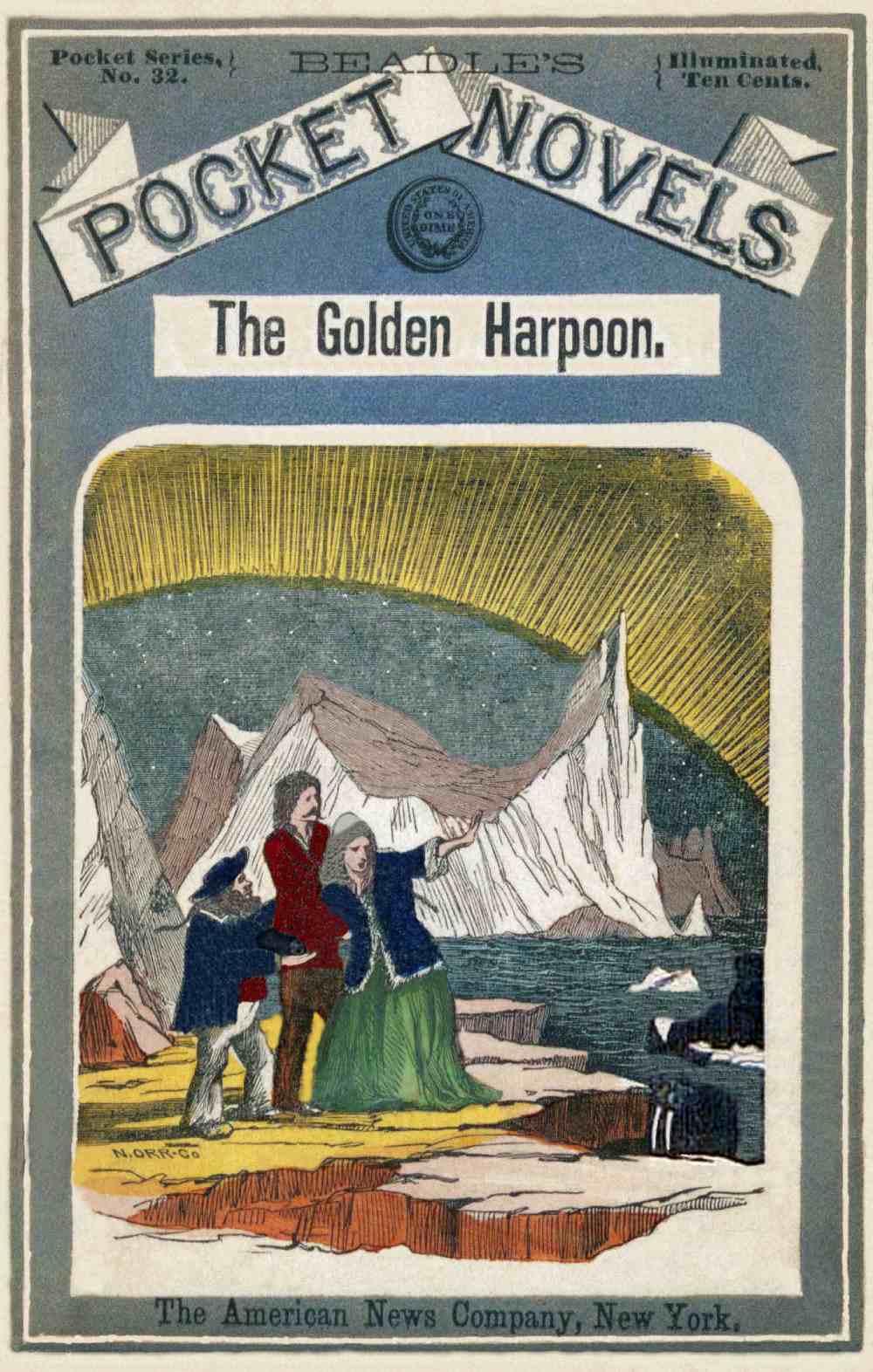
To return to the little party upon the ice.
We left our friend Stump, sitting in a very uncomfortable
position, near the edge of the frozen block, and complaining
because the lovers had not yet unfastened his bonds.
“Oh, a thousand pardons, my dear friend!” replied Alice,
blushing deeply. “It was, indeed, very wrong, on my part,
to forget you.”
“I am more to blame, Alice, than you are,” interrupted
Marline, drawing his sheath-knife, and proceeding to cut the
cords from the wrists and ankles of the prostrate seaman.
“Ay, ay, old chum,” he added, as Stump, with a sigh of
relief, arose to his feet, and began to kick the “cramp” from
his little legs; “it is all my fault that you were overlooked.”
“Never mind apologies, now,” replied Stump, “seeing as
the way you acted was parfectly nat’ral, considering that you
hadn’t met for half an hour. But those pow-wows, twist
’em, have sarved us a lubberly trick; for, besides taking the
ship, they haven’t left me a drop of ’ile to grease my pigtail
with!”
“Your pigtail, friend Jack, is of but little consequence, at
present,” said the harpooner; “it will doubtless need oiling
more than it does now, before we are picked up.”
“Ay, ay, there’s some truth in that last,” retorted Stump,
with a mournful “grin,” “and I’m sorry for it, because I
always like to keep the ‘thing’ neat and shining like, when
there’s a young lass to look at it.”
“Then you may set your mind at ease, my friend,” said
Alice, kindly, “for I like the pigtail as well without it as
with it.”
“The Stumps always wore ’em ’iled,” said the shipkeeper,
shaking his head; “but it’s consoling to me, at any rate, Miss
Alice, to hear you say that you like mine as well when it
doesn’t shine as when it does.”
“We are certainly in a very disagreeable situation, at
present,” said Marline.
“There’s no disputing that p’int,” replied Stump, as he
threw a woeful glance around him. “There isn’t a very fine
prospectus spread out before us, seeing as these cold blocks
and bergs of ice don’t look quite as comfortable as the quarters
we are used to. Then, again, we ain’t got any provision to
live on, which is another parfectly overpowering consideration.”
“It’s a pity,” said Marline, “that the captain and his crew
did not remain aboard the ship, as they are accustomed to do.
Then all this trouble would have been prevented. You and
I, Stump, can easily endure the hardships before us; but, with
Alice, it is different.”
“Indeed,” said the captain’s niece, assuming a gay tone;
“you will find that I can bear them, too. Besides,” she continued,
“as soon as the fog clears, we will see the other boats,
and then we can go ashore, and build a tent, and make a
good fire.”
“All this will come to pass, in time, I have no doubt,” replied
Harry, “and very soon, too, if Briggs and the men, who
left me about an hour before the ship stove my boat, have
succeeded in their purpose, which was to find our friends.
But, if they have failed, and have lost themselves, we may
have to pass the night upon the ice, and perhaps a great portion
of the next day, for this fog, in my opinion, will be of
long duration.”
“Never mind,” said the young girl. “You perceive I have
a thick fur cloak, which will keep me warm enough, under
almost any circumstances; but you and Stump, I am sorry to
see, are not very thickly clad.”
The two seamen laughed, good-humoredly.
“We are used to roughing it, as you know, Alice,” said
Harry, “and don’t feel the cold.”
“Ay, ay,” cried Stump, “that’s it; our hides are as tough
as bull-fish, and we can only feel consarn on your account,
sweet lass, for it must be owned that this fog isn’t as good for
your lungs as the steam from a cup of tea.”
“It won’t hurt me, nevertheless,” said Alice, smiling; “for
I have a good constitution, and you know I have remained on
the deck of the Montpelier, in a thick fog, and when the weather
was much colder than it is now.”
“Well, blast my eyes!” cried Stump, in admiration, “if
ever I saw such a parfect little duck of a philosopher before!
There are few women that could speak so cheery-like under
present sarcumstances.”
“You are right, there, chum,” said Harry, warmly. “I
have seen girls, before now, that would do nothing but moan
and faint, were they to find themselves in a predicament of
this kind.”
Alice did not attempt to conceal the glowing manifestations
of pleasure that her lover’s compliment called forth upon her
cheek, and in her eyes. But, before the blush and the smile
had faded from her face—with the natural desire to defend
her sisters, which animates the bosom of every true-hearted
woman—she added:
“It is hardly just, Harry, to imply that any woman would
act unbecomingly under circumstances in which you have
never seen her placed. A girl, who shrinks and trembles
when threatened with some light misfortune, may show much
bravery and fortitude upon occasions of great peril.”
“True enough,” said the harpooner; “but you must acknowledge,”
he added, smiling, “that there are some young
women who, by their general behavior alone, give the most
unequivocal proofs of a nature too weak and frivolous to
evince resolution, or unselfish devotion, under any circumstances.”
“That’s so,” put in Stump, “and Molly Banks, of Nantucket,
was one of them kind. In my young days, I made a lubber
of myself, by proposing to splice hands with that young
she. But, she hadn’t enough devotion in her natur’, she said,
to marry a man that wore a pigtail.” This took me all aback,
as well it might; says I, “Why, Molly,” says I, “the Stumps
always wore ’em, and mine is very becoming to me!”
“Nonsense!” says she, “it’s too old-fashioned; I’d never
have courage to take a husband with one of them things.”
“All right,” says I, as I sheered off, “a woman that hasn’t
neither devotion nor courage, isn’t to my taste.”
“You are a sensible man, Jack,” cried Harry, smiling. “I
think I should have acted in the same manner, had I been in
your place.”
“The damsel was certainly unworthy of you, friend Stump,
and showed herself to be a very frivolous creature,” said
Alice.
She drew her cloak more closely about her as she spoke,
for a cold, drizzling rain had just commenced to fall, increasing
the chilliness of the atmosphere, and dampening the
young girl’s cheeks and the thick braids of her hair.
Her lover, who had been watching her with tender concern,
now motioned to Stump, and made his way to the spot near
which the boat that Lark had provided for their accommodation
had been stove and sunk. The wreck of the little
craft was still partially visible, for, as the two men perceived,
upon making an examination of it, the keel had become
wedged in a narrow fissure that extended across a shelf of ice
about a foot and a half beneath the surface of the water.
“This is fortunate!” cried the harpooner, “for the wreck
and its contents will be of great service to us. We can pull
the boat out of the water, I think, with a little exertion.”
“Ay, ay,” replied Stump, “we can do it with the help of
some of the whale line—a few coils of which are still left in
one of the tubs, as you can see for yourself.”
The young man threw off his jacket, as his shipmate
spoke, and rolled up one of his shirt sleeves to his shoulder.
Then stooping over the edge of the ice, he plunged his naked
arm into the partially submerged boat, and seizing the end of
the rope to which the shipkeeper had alluded, he drew it up
and proceeded to coil the line upon the surface of the frozen
raft. After this task had been accomplished, a part of the
rope was secured to the shattered bow of the boat, whose contents,
consisting of a few lances, a couple of harpoons, a
hatchet, a small bucket of tar with a brush, the two line-tubs,
the boatsail, a few large chunks of salt beef, a breaker
of fresh water—another containing hard bread—and a few
of the other articles, were taken out. Then both Marline and
his chum grasped that part of the line which was about a
fathom from the place where it was fastened, and tugged and
strained at it until they had succeeded in raising the head of
the vessel above the edge of the ice. A quarter of an hour’s
work accomplished the rest, and, as the shattered craft lay
dripping before them, upon the ice, the little party exchanged
glances of the most intense satisfaction.
“We’ll soon have a shelter rigged for you now, Alice,” said
the harpooner, as the young girl, who had been watching the
operations of her lover with much interest, glided to his side.
She looked up gratefully into his face as he spoke, and
placed her hand upon his arm.
“How will you do it?” she inquired, “with that broken boat
and those line-tubs?”
“You shall see,” replied Marline, and drawing his sheath
knife, he commenced to cut the pieces of rope-yarn that held
the sail to the mast.
It had previously been unrolled by Stump, and as the last
rope-yarn was severed, the shipkeeper twisted the cloth into
as small a compass as possible. Both men then seized it and
began to wring it out, for it had become thoroughly soaked,
and required a “little drying” before it could be used for the
purposes in view. The manner in which the two seamen
handled the cloth as they squeezed it, seemed droll enough to
Alice, and more than once, as Harry glanced toward her, he
saw a sly smile hovering about the corners of her mouth.
The task, however, was soon accomplished, and, spreading out
the sail, the harpooner then proceeded to cover it with a coat
of tar, so that the rain might not penetrate the cloth; while
Stump, in accordance with the directions of the young man,
lashed one of the line-tubs—turned upon its side—to the
after part of the boat, and the other in like manner to the
forward part. An oar was then placed lengthways above the
vessel, with each of its ends resting upon one of the tubs, to
which it was securely fastened in a short time by the skillful
fingers of the harpooner and his companion.
The tarred sail was then thrown across the oar and secured
to the broken gunwales, in such a manner as to form quite a
respectable roof, and which could be opened at any moment
on one side. So much having been done, the young man
seized the hatchet, and knocking away all the thwarts, with
the exception of one, gave them to Stump, directing him to
stop up the holes in the sides of the vessel with them, as well
as he could. While the shipkeeper was engaged in this duty,
Marline examined the inside bottom of the boat, and was glad
to perceive that the planks which covered it were still in good
condition.
He wiped them with a piece of canvas, until they were
as dry as he could make them in this manner; and then, with
the roll of sail-cloth that had been found among the other contents
of the vessel, he assisted Stump in his efforts to stop up
some of the many crevices and holes in the broken bows and
sides of the boat.
“There, Alice!” he cried, springing out upon the ice, as
soon as this duty was finished, “you can now go into your
ark, which will at least keep you from getting wet.”
“It is very nice,” said the young girl, “but is there room
for us all?”
“Oh yes, in case we should care to go in. But Jack and I
prefer to stay outside for the present, so as to watch for
Briggs and his party, or for any of the boats.”
As he spoke, he seized the hand that Alice extended to him,
and helped her into the vessel—his heart throbbing with delight
as he listened to the praises that she lavished upon the
simple accommodations which had been prepared for her.
“It is almost as warm and snug here,” she said, when she
had seated herself, “as the cabin of the Montpelier.”
“My eyes!” whispered Stump in Harry’s ear, “it’s a raal
pleasure to do any thing for this gal; she takes every thing
so ship-shape and sailor-like!”
“I am glad it pleases you, Alice,” said Marline, “but with
the help of a few blankets it might have been improved.”
“Indeed, Harry, there is not the least need of them, so far
as I am concerned, for I have my cloak, which will keep me
warm enough.”
The harpooner was about to reply, when Stump twitched
his arm, causing him to turn his head.
The shipkeeper moved to the edge of the ice-raft, by a wink
of the eye implying that he desired Marline to follow him.
Wondering what he could wish to say to him, of a secret
nature, the young man made his way to the side of his companion,
who then addressed him in a low voice:
“I didn’t wish to alarm the gal,” said he, “but you can
perceive that the tide is changing, and that we’ll soon, on that
account, be drifting in a direction that won’t be likely to carry
us toward the boats.”
“Ay, ay, that’s true enough,” said the harpooner; “I expected
it; but we must trust to Providence.”
“Them that trusts entirely to that,” said Stump, oracularly,
“don’t always come out right in the end, which isn’t the fault
of Providence, hows’ever, but the fault of them that don’t take
advantage of the chances and such like which it offers to ’em
to get out of their scrapes. There was a chaplain on board of
the Minerva, a craft that I once sailed in, and during a terrific
gale that we had, the ship leaked badly and we’d all have gone
to Davy Jones, if we had taken the advice of the Bible-man,
who wanted us to leave the pumps and pray to God to save
the vessel. My eyes! she would have gone down in no time
if we’d done that; but the captain was a sensible man, and
ordered us to pump away, by which means we saved the craft,
which we wouldn’t have done if we had leaned on Providence!”
“You did perfectly right in your case,” said the young
man, “and your words would seem to imply that there is some
means that Providence offers us to get out of our present uncomfortable
situation. If so I should be glad to hear you explain
yourself.”
“Here goes, then,” replied Stump, smoothing his pigtail.
“The land, you know, is not much more than a league to the
east’ard of us, and we have a couple of oars. With them
oars, it’s my honest opinion that we might contrive to work
this block of ice that we are standing on, to the shore, which
would be much better than to let the current carry us any
further from the boats. As to Briggs and his party, there is
no use waiting for them, for we couldn’t do ’em any good if
they should come.”
“True enough!” exclaimed Harry. “I wonder that this plan
did not occur to me. We had better go to work at once!”
And the two men were preparing themselves for the task,
when the sound of a horn, blown from a distance which could
not have been greater than a quarter of a mile from the spot
they occupied, saluted their ears. The noise was repeated several
times, and it drew the pretty Alice from her miniature ark.
“Surely, Harry, that is one of our boats,” she said, moving
to the side of the young man. “Oh, I am so glad!”
“It is a pity that we have no horn,” said the harpooner, in
a voice of regret, “otherwise we could now make our position
known.”
“But the boat will come to us as things are, perhaps,” suggested
Alice.
“It may, or it may not,” answered Harry. “I think it
very likely that it will turn off in some other direction before
it gets here, and for that reason, I think I shall try to go to it.”
“Oh no!” cried the young girl, anxiously. “Briggs and
his party ought to serve as a warning to you. I would not
do so, for the world. You will certainly lose yourself as the
others have done.”
“You have not the least reason to be alarmed, Alice,” retorted
the young man; “the boats were much further off when
Briggs left me than this one is now, and besides I have only
to go in a straight line to get to it.”
This assurance somewhat quieted the fears of Alice, but,
some minutes elapsed before the persuasions of her lover could
reconcile her to his departure. At length, however, impressing
a kiss upon her cheek, and assuring her that he would
soon be back, he moved away, leaving the young girl to watch
him until the fog had shut his form from her view.
Even then she did not stir from her position, but kept her
eyes turned toward the spot where Marline had disappeared;
and as minute after minute passed, she still remained, gently
refusing to comply with the entreaties of Stump, who wished
her to return to the ark that she might not be exposed to the
rain.
Half an hour passed, still, neither her lover nor the boat
appeared to calm her uneasiness; and when the time had
lengthened into a full hour, she turned her pale, agitated countenance
toward the shipkeeper, and expressed her anxiety in
a tremulous voice.
“There’s not the least reason to be alarmed, Miss Alice,”
said Stump, “not the least. The lad has probably reached
the boat long before this, and has got into it. But it is
probably so jammed in the ice, that they can’t get here in a
moment.”
The young girl shook her head.
“No, no!” she cried, “he wouldn’t have entered the boat;
he would have come right back after finding it, if nothing
had happened!”
Perceiving that he was unable to calm her fears, the shipkeeper
reflected a moment and then drew a small pocket compass
from his Guernsey, and looked at it. He had formed the
resolution to go in search of Marline.
“I’ll bring you news of the lad in a short time,” he said,
turning to the young girl and exhibiting the compass. “This
instrument will let me know my bearings, so that I can easily
find my way back.”
“You will soon return, my friend?”
“Ay, ay, bless you, very soon, for I’ve sworn to stick to
you, and my conscience wouldn’t allow me to remain long absent.”
And ducking his head, by way of a bow, Stump departed,
presenting a comical figure, as he leaped from berg to berg.
He made his way, with a celerity which would not have been
expected of a man of his proportions—moving in the direction
of the horn which was still blowing, but which, it struck
him, did not sound so near as it did an hour before.
This circumstance made him feel uneasy, for, if Harry had
succeeded in reaching the boat, it would not now be receding
instead of advancing. He hurried on, however, until a sloping
iceberg, about ten feet high and fifteen feet in length, barred his
further progress. This he would be obliged to scale before he
could proceed, for he could not go around it on account of a
channel of water, too wide to cross, that bounded it on each
side. He looked up dubiously at the top of the frozen pile,
and, while still hesitating at its base, he fancied he heard a
shout close to his ear.
He looked around in amazement, and as he did so, the cry
was repeated, this time louder than before, and seeming to
emerge from the very heart of the iceberg.
“Who is that?” cried the shipkeeper, “and where are
you?”
“It is I—Harry Marline,” retorted the voice. “Is that you,
Stump?”
“Ay, ay, it’s me, bless your eyes, but skin me if I see how
you could have condensed yourself so as to get into this solid
chunk of ice!”
“You are mistaken,” retorted the laughing voice of the
harpooner, “there’s a rift in the berg like a ravine. You can
see it if you climb to the top where I was before I slipped
into it.”
“And is this where you’ve been all the time?”
“Yes. The inner sides of my quarters are so slippery that
I can’t climb them! You had better get a rope and—”
“I have a bunch of ratlin stuff in my pocket!” interrupted
Stump, who generally carried a little of every thing useful
about him, “which I guess will do.”
And pulling out the bunch of rigging, he fastened one of
its ends to his pigtail—for he did not like the taste of tar
sufficiently to put the strands in his mouth—and proceeded to
scramble to the top of the ice, which he finally gained with
much difficulty. Peering through the mouth of the rift, he
saw the upturned face of Marline, toward which he now lowered
the disengaged end of the piece of rigging. It was soon
in the young man’s hand, and Stump was about to unfasten
the other end from the pendent mass of hair, so as to secure it
to one of the rough projections of ice, when his foot slipped,
causing him to descend half way down the frozen declivity,
which he had mounted with so much trouble, and where he
now hung suspended by his pigtail to the rope; for the young
harpooner, believing that his corpulent chum was clinging to
it with his hands, and that he was doing him a good service
by holding on to the piece of rigging, had not allowed it to
escape his grasp!
So there hung the stout little shipkeeper, kicking his legs,
and vociferating in an excited manner, until at length he succeeded
in turning himself and grasping the rope with both
hands.
“You sarved me a bad trick, Marline, without knowing it,”
he said, as soon as he had regained the top of the berg. “Blast
me if I think my pigtail will ever recover from the effects of
it.”
And he then proceeded to explain the predicament in which
he had been placed. The harpooner expressed his sympathy
and regret, after which Stump proceeded very carefully to
fasten the rope to an icy projection near the mouth of the
crevice.
Assured that the rope was perfectly secure, Harry clambered
hand over hand, until he had gained the top of the berg,
and then expressed his intention of continuing his search for
the boats.
“As for you, Stump,” he added, “you had better make
your way back to Alice, as speedily as possible, so as to calm
her fears on my account.”
“Willingly enough will I do that,” replied the shipkeeper,
gently smoothing his ruffled pigtail, “for I’m mightily tired of
this ice-cruising business—I’ll give you my word for that.”
The two men separated, soon afterward, but not until
Stump had presented the pocket-compass to his chum and
delivered a long tirade upon its merits.
“You are sure you can find your way back—are you not?”
shouted Harry, after he had gone a few paces.
“Ay, ay,” responded Stump, “there isn’t a doubt upon that
p’int. All I have to do is to follow my nose, which won’t
twist either to the right or the left, seeing as its parfectly flat.”
Each of the seamen then continued his course—the shipkeeper
waddling along toward the spot where he had left
Alice, which was not more than five hundred yards from the
scene of his late adventure, and the young harpooner darting
swiftly forward in the direction of the blowing horn.
Stump strained his eyes, as he neared the point of his destination,
eager to get a glimpse of the captain’s fair niece. In
order to relieve her anxiety as soon as possible, he kept up a
continual shouting as he advanced.
“It’s all right, Miss Alice—bless your pretty eyes—it’s all
right! I’ve seen him, I have, and he’s well and hearty! He
was penned up in a sort of seal-hole, but I got him out of
it in quick time, and he’s now started off again after the boats.”
Quickening his pace as he moved on, he had soon made so
much progress that the little ark, looming up through the fog,
directly ahead of him, suddenly broke upon his view. Then
looking around him in every direction, and not seeing Alice,
he stopped short, and rubbed his eyes, to make sure that they
had not been disarranged in such a manner as to deceive him.
The next moment he laughed very quietly to himself.
“What a lubber I am getting to be, to think that the poor gal
would have stood where I left her all this time. She’s gone
into her little cubby-hole, and is now, I dare say, a-grieving and
taking on in a sad fashion. And that’s why she didn’t answer
my shouting as I came on. Ay, ay, that’s it, sure enough!”
Eager to soothe the young girl with the news of her lover’s
safety, he hurried forward until he had gained the side of the
boat, when he hastily threw aside the end of the tarred cloth
that covered it. To his astonishment and dismay, the vessel
was empty!
Little did the harpooner imagine this as he moved onward
over the floating bergs. Hope made his step light and his
heart buoyant. The horn was still being blown, and he
doubted not that he would soon reach the boat. Suddenly,
however, the sound of the instrument became hushed. He
paused, waiting in vain for a repetition of the familiar notes.
He heard only the whispering noise of the rain, the gurgling
of the seal, as it rolled about in the water, impatient for the
sunshine, and the cry of the northern bird, as it wheeled in
circles through the foggy air. Now and then, it is true, a
louder and more startling noise would salute his ears, when
some huge mass of ice, becoming loosened on the summit of a
miniature cathedral, would fall, with a tremendous crash, to
the base of the tower.
He continued his search a quarter of an hour longer, when
his further progress was prevented by a channel not less than
fifteen feet wide, and which separated the floe into two parts.
As he was turning to retrace his steps, his attention was
drawn to a number of little eddies that suddenly appeared
upon the surface of the water. Round and round they
whirled, becoming larger every moment. A peculiar noise,
resembling the distant rolling of a drum, rose up from the
depths of the sea. The berg upon which he stood, trembled
like a rock when the rumbling earthquake approaches its
foundation. At length the little whirlpools vanished; the
water bubbled and broke into ripples—then parted with a
roar, as the hump of a huge whale rose above the surface.
Marline had no difficulty in recognizing this monster as the
same from which Briggs had been obliged to ‘cut;’ for he
saw his own irons protruding from its body. The barbed
instruments seemed to madden the creature with pain. It
rolled and plunged from side to side, so furiously lashing the
water with its flukes, that the harpooner was enveloped in
clouds of spray. In order to escape this uncomfortable
shower-bath, he ascended a “crystal tower,” the upper part
of which, though out of range of the flying drops of water,
yet afforded him a good view of the whale. He continued to
watch the monster with much interest, feeling sorry that he
had not the means with which to put an end to its sufferings.
The noise of its spouting was inexpressibly mournful; it was
not unlike the half-smothered shriek of a drowning man,
heard amid the roaring of the blast. Soon, however, the
animal became silent: for a few seconds it remained nearly
motionless: then it rushed quickly backward and breached
(sprung upward) nearly its full length out of the sea. For an
instant, with its fins extended and the tremendous proportions
of its body fully exposed, it hovered in the air, and then came
crashing down with a noise like the bursting of a thunder-bolt!
The upheaving waters dashing against the icebergs,
agitated them on all sides. The frozen mass occupied by Marline,
rocked so violently that he could scarcely maintain his
position. He descended from it just in time to catch a
glimpse of the whale’s uplifted flukes, as the monster dove
into the green depths of the sea.
“Ay, ay,” he muttered, sorrowfully, “there it goes at last—back
again to its watery chambers below, as though it
would flee from the torturing pain caused by those barbed
irons. Would to heaven that we had succeeded in killing
it! It must suffer terribly!”
He turned, and, glancing at the compass in his possession,
hurried off, with the intention of returning to the ark. He
had not gone far, however, when he heard upon his right a
light pattering noise, such as a dog might have made in running
over the ice. His curiosity being excited, he moved in
the direction of the sound, peering keenly through the fog as
he advanced. The footfalls receded rapidly, but pressing
steadily forward, the young man was enabled, before long, to
distinguish the faint outline of some animal gliding swiftly on
ahead of him. He quickened his steps into a run; as he did so
the object disappeared behind an iceberg. Marline soon gained
the frozen mass, but the creature, whatever it was, had vanished.
“This is strange!” muttered the harpooner. “The animal
must be pretty swift of foot to get out of my sight so quickly;
though it is true the fog would hide it, if it were only a few
yards from me. Perhaps, however, it has crawled into some
hollow in the ice.”
So saying, he commenced to peer into the nooks and
crevices among the bergs, after which he climbed to their
summits to look for rifts, using his boat-hatchet freely when
he encountered any rugged mass that might contain a secret
chamber; but his search was unrewarded. He thrust the
hatchet in his belt, and had turned once more for the purpose
of making his way to the ark, when his glance fell upon an
object that caused him to utter an exclamation of surprise and
horror. He advanced a few steps to assure himself that he
was not deceived by any peculiarity in the formation of the
ice; then he moved to the side of the object and eyed it
closely. It was the skeleton of a human being, extended
upon a shelf of ice that protruded from the lower part of a
lofty berg. Bleached by wind and sunshine it had evidently
lain here for many weeks. Every particle of flesh had been
stripped from its bones by some hungry bear that had been
cast adrift upon the floe. It lay upon its back so that its
hollow sockets, partially glazed over with ice, were turned upward
as if it were trying to discover whether or not its spirit
had passed to the ethereal shores of Heaven. Marline gazed
upon it for a long time, and then clapped his hand to his
brow, as though some sudden recollection had flashed across
his mind.
“Ay, ay!” he exclaimed, as he pointed to the broken
ribs of the skeleton; “it must be so! The remains before
me are none other than those of George Wills, whose story was
related to me by one of the crew of the Comus, a week ago.”
He turned away with a sigh, and once more consulting his
compass, moved off in the direction of the ark.
The story of which he had spoken, may be told in a few
words.
George Wills, a native of Nantucket, sailed from New
Bedford in the whaler Comus, on the 18th of September, 18—.
Being a strong, active young man, and an excellent sailor, he
was soon promoted from a foremast hand to the position of
harpooner in the mate’s boat. In due course of time the
vessel arrived upon the whaling grounds, in the Ochotsk Sea,
where there was no lack of opportunities for the new boat-steerer
to try his skill in wielding the barbed iron. Much to
his own satisfaction and that of the first officer, he proved as
expert in this work as he was in handling the marlinespike
and the oar.
One morning the four boats were got ready for one of those
protracted whale-hunts so common in the north-west. The
crews were provided with a plentiful stock of provisions and
fresh water, as they intended to remain absent from the ship
for several days. George Wills being very partial to expeditions
of this kind, was in excellent spirits. Little did he
imagine the gloomy fate in store for him.
At five o’clock, A. M., the boats were lowered; and after
pulling about fifteen miles from the ship, the crews sighted
whales in a large floe to leeward. The eight vessels were
soon in the ice, and separating, each gave chase to a whale.
Before long the mate’s boat was within five fathoms of a huge
bowhead.
“Stand up, George!”
“Ay, ay, sir!”
“Give it to him!”
But before the harpooner could dart, he received a blow
upon the breast from the whale’s ponderous flukes, and fell
over the gunwale—dead!
“Ay, ay, he’s gone, sure enough—poor Wills!” exclaimed
the mate, as the men dragged the body into the boat.
“I don’t know where I shall find another like him. There
blows! there blows! right ahead of us! Put the body in the
ice, men, and do it quickly but gently. God have mercy on
the poor fellow’s soul! There blows! blows! blows! Lively
with that body, lads, it’s high time we were after that whale!
We’ll come back and pick up the corpse after we’ve captured
that ‘oil-but!’ Heaven pity Wills’ poor old mother! Come,
men, bear a hand there; one hundred barrels a-waiting for us
to come and take ’em! Poor Wills!—he’s gone to that
‘boom’ from which no man returns! What d’ye say, men,
are you ready?”
The men having by this time placed the body upon a shelf
of ice, sprung into the boat and seized their paddles. The
whale was overtaken and fastened to; but after it had towed
the boat a long distance, the line became “foul” and the mate
was obliged to cut. A thick fog having risen in the mean
time, he was now unable to find the spot where the body of
George Wills had been left. After pulling in many different
directions for a number of hours, he gave up the search. On
the next day, the fog having cleared, the search was continued,
but without success. The body was never found by
the crew of the Comus, and, as the reader already knows, it
was only mere chance that directed the footsteps of Marline
to the ice-tomb containing the fleshless remains. Leaving
him to muse upon his melancholy discovery, while pursuing
his way toward the ark, we will now return to Stump.