WHO WINS THE PRIZE?
MOST auspiciously shone the sun on the fête at the Villa of Roses; no
weather could be more favourable for an archery-meeting. There was not
even a puff of southerly breeze to blow an arrow aside. Soft white
clouds lay like snowy mountains on the horizon; all above was blue as
the sky of Italy.
Lady Macaw, brilliant in a dress that might have suited a duchess, and
with a gracious condescension of manner that might have befitted a
queen, received her numerous guests at the top of the steps which led
down into her pretty pleasure-grounds, beyond which lay the field with
the targets. The terrace, where an hour before nothing had been heard
but the song of a bird, was now crowded with gaily-dressed ladies, and
the hum of their voices filled the air. The school of Thwayte afforded
a topic which superseded even that of the weather. Lady Macaw imparted
information and received congratulations on all hands, with serene
self-consciousness of having well earned the laurels on which she
reposed. The unfavourable opinion which she had formed of the master of
Burnesbey Abbey had been much modified by his note; though even that,
as she owned, betrayed an ignorance of the forms of society such as
might hardly have been expected in a man of his station.
"Mr. Coffin," Lady Macaw blandly observed, "is one whose character is
misunderstood by many, and therefore severely judged. He has a great
knowledge of the world, but has unfortunately not seen the best side
of it. But there is a great deal of warmth of heart and generosity of
nature under a cynical manner; and no doubt, with a little judicious
advice from those whom he trusts and esteems, our good friend will soon
understand and fulfil all the duties attending his position."
Carriage after carriage set down its fair freight, and dresses and
parasols of every hue gave to the lawn the appearance of an animated
flower-bed. The gentlemen-archers and some of the ladies appeared in
uniforms of Lincoln green appropriate to the occasion: but such a
costume was not "de rigueur," and Delia Langton and Philomel Lamb, two
of the best lady-archers in the county, had both resolved not to wear
it; the latter from economy, the former because "cloth is so dreadfully
heavy, and green so shockingly trying to the complexion!" Delia adopted
instead a more becoming dress of white muslin, with a cerise-coloured
scarf, and a long feather of the same brilliant hue drooping from a hat
of the smallest dimensions. A graceful quiver hung from her shoulder,
filled with many-tinted darts; and as she stood leaning on her bow
which was adorned with ribbon of cerise, Delia Langton might certainly
have been pointed out as the prettiest girl in the gay assembly had she
not looked so conscious of being so.
Poor little Miss Eccles moved uneasily amongst the gay throng. She was
far more in her element in the cottage or at the sewing-class, than in
a scene so brilliant as this. She was conscious that even her dress
looked peculiar amongst the fashionable robes around her, though she
had donned her best—her only silk gown, that which her brother had
presented her with on his marriage, and which had since appeared, "just
as good as new," at the christenings of most of his nine children.
After perambulating the walks in a vain search for Philomel, by whose
side she would feel more at ease, the shy little woman took refuge
under the wing of Delia, whom she had known from her cradle, and who
was standing in an attitude which some might call graceful and others
affected, under a laburnum's gold-dropping boughs.
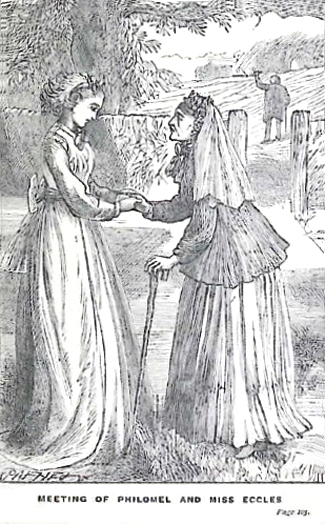
"My dear, I'm so glad to see you; it's so nice to be near somebody one
knows," cried Miss Eccles, limping up to the belle of Thwayte, who
happened at the moment to be speaking to no one. "I feel bewildered in
such a gay crowd. I've been hunting for Philomel Lamb—old Mrs. Brown
was to bring her from the vicarage. I wonder what can make her so late!
The shooting will begin in a few minutes, I suppose; people are moving
already towards the meadow."
"There is Philomel," observed Delia coldly, glancing in the direction
of a walk through the shrubbery, from which two figures were emerging.
"Ah, yes, with her father—but that's not Mr. Lamb; no, no, how dull
my old eyes are growing! It's Mr. Latour in his archery dress,
bow, quiver, and all! The two seem engaged in a very interesting
conversation. How happy our Philomel is looking—her cheeks are as
bright as your ribbon! Dearie me! I should never have believed that she
could have looked so well with all her pretty ringlets cut off!"
"She has made a fright of herself," observed Delia, and the cerise
feather quivered as she spoke.
"Some one does not think so, I'll be bound," said Miss Eccles, with a
knowing smile. Like most unmarried ladies, she took special interest in
anything that might end in a wedding. "I've thought for a long time,"
she added, dropping her voice to a confidential whisper, "that there
was a fancy in that direction."
"The fancy is all in your own brain," replied Delia, with the slightest
approach towards asperity.
The expression of her face, however, instantly changed, and her pretty
teeth were shown in a gracious smile, as she caught the eye of Mr.
Latour, who raised his cap, and came forward to greet her.
Miss Eccles limped off at once to Philomel, near to whom, faithful as a
shadow, she remained during the rest of the fête.
After a few commonplace observations had been exchanged between Mr.
Latour and Miss Langton, relative to the weather, the company, the
shooting, the archer, bending his tall form so that his accents might
be heard by his companion, without reaching any ear but her own, said,
with a little hesitation in his tone,—
"I believe that you and your sister are very intimate with Miss Lamb.
Can you inform me—have you any idea why she has adopted that new mode
of wearing her hair?"
"Wearing it!—Rather of 'not' wearing it," said Delia, with a little
affected simper. "She has certainly confided nothing to us, though Miss
Eccles and we were putting her to the question about it this morning.
I suppose that Philomel Lamb has her whims and fancies, like other
people."
"I should not think that Miss Lamb is one likely to act upon mere
whim," observed Mr. Latour. "She has perhaps some reason which she does
not choose to make known."
"Oh, surely young ladies are not bound to have reasons for all that
they do!" replied Delia, gently stroking down the feather of an arrow
which she had drawn from her quiver. "Some people like to be odd, and
different from others. Philomel belongs to rather an eccentric family."
"I never heard that before," said the archer, coldly.
"Her aunt was eccentric—very eccentric. I know that she was once under
restraint, poor thing!" observed the benevolent Delia.
"Mr. Coffin never had a sister except Mrs. Lamb. I suppose that
this poor lady was a sister of the vicar?" The observation took the
interrogatory form.
"Yes; that is, sister-in-law," replied Delia, biting her lip; for
she intuitively perceived that she was not raising herself in the
estimation of Mr. Latour. To change the conversation, the young lady
abruptly remarked: "Of course, you have heard that Mr. Coffin has held
out hopes of his keeping up our dear little school. Do you believe that
he will actually do so?"
"I have no doubt upon the subject," the archer replied. "I had a very
interesting conversation with Mr. Coffin at Burnesbey Abbey this
morning. Ah! Here he comes to answer for himself. I believe that we
were only waiting for his arrival to commence the shooting. Will you
permit me to string your bow, Miss Langton?"
Caleb Coffin was just entering the gate leading to the Villa of Roses
when he was overtaken by his brother-in-law, Thomas Lamb. The vicar
came, umbrella in hand, heated after his long walk to and from G—.
"I've just dropped in to see my little girl shoot," he observed, after
shaking hands with Mr. Coffin.
"What's this that I hear about Philomel?" asked Caleb, abruptly.
"People say that she has clipped off all her gold curls. What could
induce a young girl to do anything so absurd?"
The old merchant fixed his keen eyes, as he spoke, on the vicar, with a
penetrating glance of inquiry.
"I cannot conceive why she did it. It passes my comprehension," replied
the honest pastor, shrugging his shoulders.
"What! You have not asked her?" inquired Caleb Coffin.
"She keeps her own counsel," replied the vicar, looking rather annoyed.
"I never before knew my little girl have anything like a secret with
me."
Caleb indulged for a moment in his little hissing laugh. And then, in
his stiff, ungainly manner, advanced towards Lady Macaw, who came down
the steps with both hands extended to welcome her guest. She was too
much absorbed in doing the honours to the liberal master of Burnesbey
Abbey, to have much attention to bestow on the simple honest-hearted
vicar who stood at his side.
Caleb received all the courteous and flattering things that were said
to him by Lady Macaw with a little shake of the head and twinkle of the
eye, which puzzled and somewhat disconcerted her. She noticed (nothing
ever escaped the notice of Lady Macaw) that Mr. Coffin was followed
by his servant, bearing two narrow boxes under his arm. She inquired
the meaning of this with her eyes; but as Caleb Coffin either did not
understand that kind of language, or did not choose to appear to do
so, she left him to make his explanation when he pleased. Lady Macaw
had her own ideas, her own hopes, regarding the contents of those
mysterious boxes, but had sufficient tact not to trouble her eccentric
guest with questions. "After a salmon has taken the bait, it must be
given line, and humoured and played with, or it may break away after
all," thought the sagacious lady of the Villa of Roses.
All the company now adjourned to the field where the archery contest
was to take place. A double set of targets had been put up; one at
long range for the gentlemen, the other at shorter range for the
ladies. While the archers, bow in hand, betook themselves to their
own appointed place, by far the larger portion of the company ranged
themselves in a semicircle behind one of the ladies' targets, as the
point of greatest interest. In the centre of this semicircle stood Lady
Macaw, her long train sweeping the grass. Caleb Coffin was at her side.
A little to the left, ever keeping as close as possible to Philomel
when her turn for shooting arrived, appeared the vicar, leaning with
both hands on his umbrella, firmly planted in the sod; while Miss
Eccles kept rather in the background, save when the flight of an arrow
shot by a friend was succeeded by the plop which told that the target
was struck, when her eagerness made her press forward a little.
Philomel Lamb looked bright and hopeful, as she slowly drew the
lengthening cord. A spring of pleasure was rising in the young maiden's
heart, not altogether springing from a sense of duty performed, though
owing much of its sweetness to that source. The vicar's daughter had
felt that in the eyes of one at least she was not disfigured; and such
being the case, she could cheerfully part with the admiration of all
the world beside.
Several ladies from G— and its neighbourhood contended for the silver
arrow; but it was soon evident that one of the fair archers of Thwayte
was likely to carry off the prize. The arrows of Lucy Langton, indeed,
seemed as erratic as herself: over or under the mark, to the right
or the left—now ringing against the iron stand of the target, now
disappearing no one knew where—it was clear that the silver prize was
not likely to be won by her bow.
But Delia had practised diligently, had a good eye and a steady hand,
and had set her heart upon being the queen of the day. In shooting, no
lady approached her except Philomel Lamb, who kept for some time but a
little behind her.
The vicar's daughter was encouraged and animated by the hearty sympathy
of her father, who was standing near her, eagerly watching the flight
of each of her arrows. The vicar's love of archery, and partiality for
his child, made him take a keen interest in the sport; and he could not
refrain from calling out directions as Philomel pointed her arrow, or
exclaiming with hearty pleasure when that arrow quivered in the target.
The last arrows were at length to be shot off. Delia and Philomel were
the last to shoot; and before they did so, both were in advance of all
their rivals. The prize must therefore, of necessity, be gained by one
or other of these fair maidens of Thwayte. Delia had marked a point
higher than Philomel before this last decisive trial, and therefore the
chances of success were in her favour. Very slowly and cautiously Delia
took her aim and drew the tightening cord. The arrow flew through the
air.
"A hit!—'Tis in the outer circle," exclaimed Caleb Coffin, who, peering
through his goggle spectacles, showed more interest in the game than
was consistent with his character of cynic.
"Now, success to you, my child!" cried the vicar, as he handed the last
arrow to Philomel, then drew back, eagerly awaiting the result.
A shout from the spot where the gentlemen were shooting was heard at
this moment.
"Latour has it!" was the cry.
Philomel paused, turned her head for an instant to listen, and then,
with a bright smile on her lips, drew her bow, and her last arrow
went quivering right into the centre of the gold! The vicar could not
refrain from a shout, and Miss Eccles clapped her hands with delight.
"Well done, lamb of the shorn fleece!—Well done!" exclaimed Caleb
Coffin. "I thought you would win the day. You've hit the right point in
more than one sense."
There were smiles and congratulations on all sides, in which the
gentlemen-archers, who now joined the circle around the ladies' target,
united. There was but one face on which a cloud rested. Delia unstrung
her bow with a feeling of deeper mortification at her heart than could
have been caused by mere failure in winning the silver brooch.
"And now let us adjourn to the Villa of Roses," said Lady Macaw, "that
our Robin Hood and the sylvan queen may receive the prizes which
are awaiting them there. Mr. Latour, you have won the privilege of
escorting Miss Lamb, and of presenting to her—our fair victor—the
silver arrow, trophy of success."
"A moment—excuse me. Let me have a part in this matter," said Caleb
Coffin, who, as soon as the contest had been decided, had beckoned
to his servant, who had been waiting at a little distance while the
shooting went on. "Let Mr. Latour and my niece Philomel respectively
have the honour, or pleasure, or privilege, or whatever you may call
it, of presenting each other with prizes. But I have on this occasion
followed your suggestion, Miss Delia Langton."
Caleb seemed to take a little malicious pleasure in teasing the
discomfited lady archer. "You showed me your golden prize bracelet, and
gave me a pretty strong hint that if I wished to be a popular man in
Thwayte, I should follow Sir John's example by giving something worth
shooting for. I am not above taking a lady's advice. I am going to
appear in my new character of a popular man. I have provided prizes not
only for the lady, but for the gentleman winner also; and I hope that I
may have succeeded in pleasing the taste of each."
There was a murmur of applause through the circle, and the proceedings
of Caleb Coffin were watched with no little interest as he took the
first box from his servant and said, as he placed it in the hands of
Mr. Latour, "Meredith, present that to the lady whose arrow struck the
centre of the gold."
Smiling and blushing and sharing in no small degree the curiosity of
those around her, Philomel received and opened the box which contained
the gift of her uncle, and drew out a piece of parchment written over,
signed, and sealed.
"What is it? What can it be?" passed from mouth to mouth, as inquiring
glances were exchanged amongst the spectators.
"Allow me to explain," said Meredith Latour, who was assuredly not the
least pleased or interested member of the throng. "This parchment is a
deed, which I had the gratification of signing as witness this morning,
by which my late guardian, Mr. Coffin, makes over the cottage now used
as a schoolhouse in Thwayte, with a liberal endowment in perpetuity, to
any trustees whom Miss Lamb, his niece, may be pleased to appoint."
There was a general murmur of satisfaction, amidst which Lady Macaw's
faint "Oh!" was unheeded and unheard.
"In the name of all my parishioners, as well as in that of my daughter,
I thank you most heartily, Caleb Coffin, for your generous gift!" cried
the delighted Vicar of Thwayte.
"There is no generosity in the matter, nor is that deed a gift,"
replied Caleb, with a significant nod at Philomel, whose eyes spoke the
joy and gratitude which she could not put into words. "The affair is
a mercantile transaction between my niece Philomel and me. I have had
a 'quid pro quo' for my money, goods delivered beforehand, an honest
bargain has been made and kept by both parties concerned,—he! he! he!"
"What on earth can he mean!" exclaimed Lady Macaw.
Curiosity became intense, and the circle of listeners drew closer,
while Philomel, embarrassed notwithstanding her happiness, would gladly
have made her escape.
"But let us finish our business before we tell our stories," said
Caleb. "Philomel, queen of the bow, it is your duty now to present the
prize to the victor."
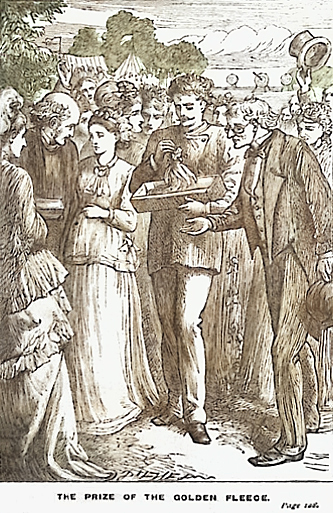
Philomel gave over her own box with its precious contents to her
father, and receiving the other from Mr. Coffin, shyly and with
downcast eyes placed it in the hands of Meredith Latour.
Every one, except Caleb and the winner of the prize, gave an
exclamation of amazement when the lid was raised, and disclosed the
contents of the box to be rich tresses of golden hair!
"There! Talk of generosity now, if you will!" said the cynic gaily,
turning towards the astonished vicar. "That little heap of lady's
locks has cost me two thousand guineas this morning. I challenged you
yesterday," continued Caleb Coffin, addressing himself to Meredith—"I
challenged you to find in the world a woman who would sacrifice vanity
to duty, who would be content to do good in the dark, and I promised
a golden forfeit should such a phœnix be found. Philomel has twice
purchased the deed which she has received—first, by the sacrifice of
her hair, and secondly, by her silence; and now I redeem my pledge—the
Golden Fleece is your own."
Philomel caught the exclamation of "My noble girl!" and felt the
pressure of her father's hand on her shoulder. The words and the
pressure filled her with keener joy than the volley of applause and
congratulation which resounded on all sides.
"I was certain that she had her reasons—that she must have her
reasons!" exclaimed Miss Eccles, almost crying with pleasure.
"I never saw anything so shocking—so—so improper," whispered the
indignant Delia to her sister. "Only fancy the bad taste—that word is a
thousand times too mild—shown by the horrid old owl in presenting his
niece's hair as an archery prize to a gentleman! What on earth will he
do with it?"
"Oh, he will know well enough what to do with it," laughed Lucy,
greatly amused. "Meredith Latour has the golden chain—the gold ring is
sure to follow. Caleb Coffin would never have given the fleece, had he
not had the best reasons for knowing that the lamb was sure to follow
it."
"Mr. Latour will be carrying her off to Northumberland," said Miss
Eccles, confidentially. "I always guessed, you know, that something was
going on in that quarter."
"I pity her—from my soul I pity her!" observed Delia, shrugging her
shoulders. "I would prefer Newgate to Northumberland with its horrid
colliers and coal-dust! To crop her hair close before sending her to
prison was really a sensible thing!"
Philomel neither felt nor looked an object for pity at that moment,
though she who had "done good by stealth" might and did "blush to find
it fame." She longed, indeed, to be out of the throng, and freed from
its embarrassing gaze—alone, if but for an hour, with her father or
somebody else; but the intensity of her happiness overpowered even the
pain of her shyness.
Lady Macaw had at first experienced a sense of disappointment, as one
who finds that she has been unconsciously appropriating and wearing the
laurel-wreath due to another. She had the tact, however, not to betray
her mortification. Approaching the shy young maiden before her, she
took her graciously by the hand, and said, addressing herself to the
master of Burnesbey Abbey:—
"We have all to thank you, Mr. Coffin, not only for your munificent
gift to our village, but for making known to us the full value of the
treasure which we have long cherished amongst us. Philanthropy will be
named from henceforth in Thwayte, 'the Order of the Golden Fleece.' And
I hope that it will be found that we have many 'companions' in that
illustrious order."
"With Lady Macaw for grand-master," whispered Lucy Langton to her
sister.
"Nay, nay," observed old Caleb, in his own cynical manner; "to give
money may be common, to beg money more common; there's many a man will
do the first—many a woman the second; but I've been told that—
"'Our good deeds must be judged—and few will bear the trial—
By our "purity of motive" and "strength of self-denial."'"
If Philomel's proof of sincerity were made the touchstone for all, I
suspect that many whose names figure on subscription-lists, and whose
fair persons at charity-meetings, would hardly come forward to claim
the honours of this new order of—
The Golden Fleece