That night, after a chat with Lola, I sat in my room at the palace and
could not help recollecting how strangely the Marchesa had started
when my name had been uttered.
Did she know of my connection with “The Golden Face”? If she did, then
she might naturally suspect me and hold me at arm’s length. Yet if she
feared me, why should she have asked me, as well as Lola and Madame,
to call at the Palazzo Romanelli?
I had thanked her, and accepted.
Therefore on Tuesday night, with Lola and Madame both smartly dressed,
I went to the huge, old fifteenth-century palace, grim and prison-like
because of its heavily barred windows of the days when every palazzo
was a fortress, and within found it the acme of luxury and refinement,
its great salons filled with priceless pictures and ancient statuary,
and magnificent furniture of the Renaissance.
About thirty people were present, most of them the élite of Naples
society, all the ladies being exquisitely dressed. My hostess
expressed delight as I bowed and raised her hand to my lips, in
Italian fashion, and then I introduced my two companions. A few
moments after I found myself chatting with the pretty Flavia, who, to
my annoyance, seemed to be very inquisitive concerning my movements.
As I stood gossiping with her, my eyes fell upon a little Florentine
table of polished black marble inlaid with colored stones forming a
basket of fruit, a marvel of Renaissance art, and upon it there stood
a silver model of a gigantic tarantula, or spider, the body being
about seven inches long by five broad, with eight long curved legs,
most perfectly copied from nature.
Flavia noticed that I had seen it.
“That’s our Silver Spider!” she laughed. “It’s the ancient mascot of
the Romanelli.”
I walked over and examined it, but without, of course, taking it in my
hand. Then I remarked upon its beautiful workmanship, and we turned
away.
It was a gay informal assembly. Among the men there were several naval
and military attachés from the Embassies, as well as one or two
Deputies with their wives. Once or twice I had brief chats with the
Marchesa, who, of course, was the center of her guests. One man, tall,
with deep-set eyes and a well-trimmed black beard, seemed to pay her
particular attention, and on discreet inquiry as to who he was, I
discovered him to be the well-known banker, Pietro Zuccari, who
represented Orvieto in the Chamber.
Now the reason of our visit to the Marchesa’s was to see what manner
of company she kept, but I detected nothing suspicious in any person
in that chattering assembly. Yet I could not put away from myself what
Fra Pacifico had told me in the silence of the cloisters of San
Domenico.
Again I looked upon the handsome face of that gay society woman and
wondered what secret could be hidden behind that happy, laughing
countenance.
After leaving the Palazzo Romanelli that night I resolved to “fade
out” and watch.
Now Admiral the Marquis Romanelli, who was in charge of the important
port of Naples, had, during the late war, returned to his position as
a high naval officer, and with all his patriotism as the head of a
noble Roman house, had done his level best against the enemy until the
proclamation of peace.
Wherever one went one heard loud praises of “Torquato,” as he was
affectionately called by his Christian name by the populace.
After due consideration I decided that we should move from Naples to
the pretty little town of Salerno at the other end of the blue bay,
and there at the Hôtel d’Angleterre, facing the sapphire sea, I spent
several delightful days with the girl I so passionately loved.
“I cannot see the reason for all this inquiry, Mr. Hargreave,” she
said one evening, as we were walking by the moonlit sea after we had
dined and Madame had retired. “Why should father wish you to watch the
Marchesa so narrowly? How can she concern him? They are strangers.”
I was silent for a few seconds.
“Your father’s business is a confidential one, no doubt. He has his
own views, and I am, after all, his secretary and servant.”
“I—I often wish you were not,” the girl blurted forth.
“Why?” I asked in surprise.
“Oh! I don’t really know. Sometimes I feel so horribly apprehensive.
Madame is always so discreet and so mysterious. She will never tell me
anything; and you—you, Mr. Hargreave, you are the same,” she declared
petulantly.
“I cannot, I regret, disclose to you facts of which I am ignorant,” I
protested. “I am just as much in the dark concerning the actual object
of our mission here as you are.”
“Do you think Madame knows anything of your mission here?” asked the
girl.
“I don’t expect so. Your father is a very close and secretive man
concerning his own business.”
“Ah! a mysterious business!” she exclaimed in a strange meaning voice.
“Sometimes, Mr. Hargreave—sometimes I feel that it is not altogether
an honest business.”
“Many brilliant pieces of business savor of dishonesty,” I remarked.
“The successful business man cannot always, in these days of
double-dealing chicanery and cut prices, act squarely, otherwise he is
quickly left behind by his more shrewd competitors.”
And then I thought it wise to turn the subject of our conversation.
Salerno is only thirty miles from Naples, therefore I often traveled
to the latter place—indeed, almost daily.
In Italian they have an old saying, “A chi veglia tutto si rivela”
(“To him who remains watchful everything becomes revealed”). That had
long been my motto. With Lola and Madame Duperré I was in Italy in
order to learn what I could concerning the woman whom Fra Pacifico had
so bitterly denounced.
One warm afternoon when, without being seen, I was watching the
Marchesa’s pretty daughter Flavia who had strolled into the town, I
saw her meet, close to the Café Ferrari, that tall, black-bearded,
middle-aged banker Pietro Zuccari, whom I had seen at their palazzo.
They walked as far as the Piazza San Ferdinando and entered the
Gambrinus, where they sat at a little table eating ices, while he
talked to her very confidentially. As I idled outside in a shabby suit
and battered straw hat which I had bought, I saw this great Italian
banker gesticulating and whispering into her ear.
The girl’s attitude was that of a person absorbing all his arguments
in order to repeat them, for she nodded slowly from time to time,
though she uttered but few words; indeed, only now and then did she
ask any question.
I could, of course, hear nothing. But what I was able to observe
aroused my curiosity, for the meeting between the girl and the
middle-aged banker was palpably a clandestine one.
On emerging, they parted, he walking in the direction of the railway
station, while the girl strolled homeward. Was she carrying a message
to her mother from the famous financier?
The excitement he had betrayed interested me. I noticed that he had
once clenched his fist and brought it down heavily before her as they
sat together.
For a whole month we remained at Salerno, and a delightful month it
proved, for I had long chats and walks with Lola, and we became even
greater and more intimate friends. Madame Duperré noticed it but said
nothing.
I went each day to slouch and idle in Naples, to sit before cafés and
eat my frugal meal at one or other of the osterie which abound in the
city, or to take my apératif at the liquoristi, Canevera’s,
Attila’s, or the others’.
I confess that I was mystified why I should have been sent to watch
that woman.
So clever, so well-thought-out and so insidious were all Rayne’s
methods to obtain information of the intentions and movements of
certain people of wealth, that I knew from experience that there was
some cleverly concealed scheme afoot which could only be carried out
after certain accurate details had been obtained.
I was torn between two intentions, either to reappear suddenly as a
passing traveler and call at the Palazzo Romanelli, or still to lie
low.
Many times I discussed it with Lola and Madame.
“Zuccari is always with the Marchesa,” I said one morning as we sat
together at déjeuner at Salerno. “I can’t quite make things out. I
have been watching intently, yet I can discover nothing. He sent a
message to her by Flavia the other day—an urgent and defiant message,
I believe. I hear also that the Admiral goes to Rome to-night,” I
added. “He has been suddenly called to the Ministry of Marine.”
“Then you will follow, of course? We will remain here to keep an eye
upon the Marchesa,” said Madame.
“You do not suspect the Admiral?” I asked.
“Not at all,” she said. “It is the woman we have to watch.”
“And also the pretty daughter?” I suggested.
With that she agreed. We were, however, faced by a strangely complex
problem. Here was a woman—one of the most popular in all
Italy—denounced by the humble monk of San Domenico as a dangerous
adventuress. And yet she was the strongest supporter of the popular
Pietro Zuccari—the wealthy man by whose efforts the finances of Italy
had been reëstablished after the war.
After a long conference it was arranged that Madame and Lola should go
to Rome and there watch the Admiral’s movements, while I remained in
Naples ever on the alert.
Sometimes I became obsessed by the feeling that I was off the track.
Once or twice I had received “ferma in posta”—confidential letters
from Rudolph Rayne and also from Duperré. To these I replied to an
unsuspicious address—a library in Knightsbridge.
By reason, however, of keeping observation upon the Palazzo Romanelli
I gained considerable knowledge concerning those who came and went. I
knew, for instance, that the pretty Flavia was in the habit of meeting
in strictest secrecy a good-looking young lieutenant of artillery
named Rinaldo Ricci. Indeed, they met almost daily. It struck me as
more than curious that on the day after the Admiral had left hurriedly
for Rome Zuccari should arrive from Bari, and having taken a room at
the Excelsior Hotel, dine at the palazzo.
My vigil that night was a long one. I managed to creep up through the
grounds and peer through the wooden shutters into the fine,
well-furnished salon of the palazzo. It was unoccupied, but upon a
table on the opposite side of the room stood the Silver Spider, the
strange but exquisite mascot of the Romanelli. No doubt some legend
was attached to it, just as there are legends to many family
heirlooms.
That night I made a further discovery, namely, that when Zuccari left
he returned to his hotel, where Flavia’s secret lover had a long chat
with him.
Next day a strange thing happened. While watching the Marchesa I saw
her, about eleven o’clock in the morning, walking alone in the Corso
Vittorio when she accidentally encountered the banker Zuccari. They
passed each other as total strangers!
Why? There was some deep motive in that pretended ignorance of each
other’s identity. Could it be because they feared they were being
watched? And yet was not Zuccari a frequent visitor at the Palazzo
Romanelli, for it was there I had first met him? In any case, it was
curious that Zuccari and young Rinaldo Ricci should be friends
apparently unknown to either the Marchesa or to Flavia.
In order to probe the mystery I decided that it would be necessary to
learn more of Zuccari’s movements. Therefore, having watched him call
at the Palazzo Romanelli, I waited for him to leave, and at ten
o’clock that same night he suddenly departed from Naples for the
north. I traveled by the same train. Arrived at Rome, the banker
remained at the buffet about half an hour, when he joined the express
train for Milan, and all through the day and the night I traveled,
wondering what might be his destination.
On arrival at Milan, I kept observation upon him. From the chief
telegraph office he dispatched a telegram and then drove to the Hôtel
Cavour, where he engaged a room. At once I telegraphed to Madame to
bring Lola and join me at the Hôtel de Milan. They arrived next day
and I told them of my movements.
Three days later Zuccari left the Cavour and traveled to the frontier,
little dreaming that he was being so closely followed. Madame and Lola
went by the same train, but having discovered that he had bought a
ticket for Zurich, I left by the train that followed.
On arrival at Zurich, I was not long in rejoining my companions, for
we had a rendezvous at the Savoy, when I learnt that Zuccari was
staying at the Dolder Hotel, up on the Zurichberg above the Lake.
“A man named Hauser is calling upon him this evening,” Madame told me.
“We must watch.”
This we did. More respectably dressed than when in Naples, I was
smoking my after-dinner cigar in the handsome hall of the Dolder Hotel
when a tall, well-set-up man, whose fair hair and square jaw stamped
him as German-Swiss, inquired of the hall porter for Signor Zuccari,
and was at once shown up to the banker’s private sitting-room, where
they remained together for nearly an hour.
As I sat waiting impatiently below, I wondered what was happening.
I had already reported our movements to Rayne, who had, in a telegram,
expressed great surprise that the Deputy should have left Italy and
gone to Zurich—of all places.
Zuccari, on descending the stairs with his friend Hauser, confronted
me face to face, but it was apparent that he did not recognize me.
Hence I took courage and, later on, engaging a room, moved to the same
hotel. Next morning I saw the banker meet the man Hauser a second
time, and together they took a long walk on the outskirts of the town
above the Lake.
From the concierge I extracted certain valuable information in
exchange for the hundred-franc note I slipped into his hands. It
seemed that the banker Zuccari frequently visited that hotel, and on
every occasion the man Hauser came to Zurich to see him.
“They are conducting some crooked business—that is my belief,
m’sieur!” the uniformed man told me in confidence.
“Why do you suspect that?” I asked quickly.
“Well,” he said confidentially, “Isler, the commissary of police, who
is now at Berne, once pointed him out to me and said he was a friend,
and believed to be one of the accomplices, of Ferdinando Morosini, the
notorious jewel-thief who was caught in Milan six months ago and sent
to fifteen years’ at Gorgona.”
At the mention of jewel theft I at once pricked up my ears.
“Then Hauser may be a receiver of stolen jewels, eh?” I whispered.
“I would not like to say that, m’sieur, but depend upon it he is a
person to be gravely suspected. What business he has with the banker I
cannot imagine.”
I knew Morosini by repute. I had heard Rayne mention him, and no doubt
he was a member of the gang who had blundered and fallen into the
hands of the police. Was it in connection with this incident that I
had been sent to Italy to make inquiries?
I told Madame when alone what I had discovered, whereat she smiled.
“I expect you have discovered the truth,” she said. “We must let
Rudolph know at once.”
To telegraph was impossible, therefore I sat down and wrote a long
letter, and then I waited inactive but anxious for a reply.
It came at last. He expressed himself fully satisfied, but urged me to
continue my investigations regarding the handsome wife of the
Marchese.
“Be careful how you act,” he added. “If they suspected you of prying
something disagreeable might happen to you.”
I was not surprised at his warning, for I knew the character of some
of the international crooks who were Rayne’s “friends.”
But surely the banker Zuccari could not be a crook? If he were, then
he was a master-criminal like Rayne himself. If so, what was the
motive of his close association with the Marchesa Romanelli? I had
noticed when at the palazzo that he seemed infatuated with her, yet
she no doubt little dreamed of his active association with such a
person as Hauser.
It seemed quite plain that whatever the truth the Admiral had no
suspicion of his wife.
Zuccari and Hauser still remained in Zurich, so, though I had arranged
with Madame and Lola to return with them to Naples, I sent them back
alone and remained to watch.
On the night of their departure I was tired and must have slept
soundly after a heavy day, when I was suddenly awakened by a strong
light flashed into my face, and at the same instant I saw a hand
holding a silken cord which had been slowly slipped beneath my ear as
I lay upon the pillow.
For a second I held my breath, but next moment I realized that I was
being attacked, and that the cord being already round my neck with a
slip-knot, those sinewy hands I had seen in the flash of light
intended to strangle me.
My only chance was to keep cool. So I grunted in pretense of being
only half-awake, and turning very slightly to my side, my hand slowly
reached against my pillow. At any second the cord might be drawn tight
when all chance of giving the alarm would be swept away from me. Yet
my assailant was deliberate, apparently in order to make quite certain
that the cord around my neck should effect its fatal purpose.
Of a sudden I grasped what I had against my pillow—a small rubber
ball—and suddenly shooting out my hand in his direction, squeezed it.
A yell of excruciating pain rang through the hotel, and he sprang
back, releasing his hold upon the cord.
Then next moment, when I switched on the light, I found the man Hauser
dancing about my room, his face covered with his hands—blinded, and
his countenance burnt by the dose of sulphuric acid I had, in
self-defense, squirted full into it.
For defense against secret attack the rubber ball filled with acid
Rayne always compelled me to carry, as being far preferable to
revolver, knife or sword-cane. It is easily carried, easily concealed
in the palm of the hand, makes no noise, and if used suddenly is
entirely efficacious.
My assailant, blinded, shrieking with pain, and his face forever
scarred, quickly disappeared to make what excuse he might. Later I
found that he had previously tampered with the brass bolt of my door
by removing the screws of the socket, enlarging the holes and
embedding the screws in soft putty so that on turning the handle and
pressing the door the socket gave way and fell noiselessly upon the
carpet!
This attempt upon me at once proved that I was on the right scent, and
according to Rayne’s instructions I that day followed Madame and Lola
back to Salerno.
On changing trains at the Central Station at Rome I bought a
newspaper, and the first heading that met my eyes was one which told
of a mysterious robbery of the wonderful pearls of the Princess di
Acquanero.
With avidity I read that the young Princess, as noted for her beauty
as for her jewels, the only daughter of the millionaire Italian
shipowner Andrea Ottone, of Genoa, who had married the Prince a year
ago, had been robbed of her famous string of pearls under most
mysterious circumstances.
Two days before she had been staying at the great Castello di
Antigniano, near Bari, where her uncle, the Baron Bertolini, had been
entertaining a party of friends. On dressing for dinner she found that
her jewel-case had been rifled and the pearls, worth twenty thousand
pounds sterling, were missing!
“The police have a theory that the guilty person was introduced into
the castello by one of the many servants,” the report went on. “The
thief, whoever it was, must, however, have had great difficulty in
reaching the Princess’ room, as the Baron, knowing that his lady
guests bring valuable jewelry, always sets a watch upon the only
staircase by which the ladies’ rooms can be approached.”
With the paper in my hand the train slowly drew out of Rome on its way
south. My mind was filled with suspicion. I was wondering vaguely
whether the Marchesa Romanelli had been among the guests, for I
recollected those words of Fra Pacifico that “the woman had committed
sacrilege in the House of God.”
Could it be possible that he knew the Marchesa to be a thief who had
stolen some valuable church plate from one or other of the ancient
churches in Italy? If so, then, though the wife of the Admiral, she
was also a thief.
On arrival at Salerno I took Madame aside, and telling her of my
adventure with the man Hauser, I showed her the newspaper and declared
my suspicions.
“It may be so,” she said. “If she is so friendly with this banker
whose past is quite obscure, it may be her hand which takes the stuff
and passes it on to Zuccari, who in turn sells it to Hauser.”
With that theory I agreed.
On the following day I took train into Naples, and that afternoon I
called upon the Marchesa.
Fortunately I found her alone, and when I was shown into her salon I
thought she looked rather wan and pale, but she greeted me affably and
expressed delight that I should call before returning to England.
As we chatted she let drop, as I expected she would, the fact that she
had been staying at the Castello di Antigniano.
“You’ve seen in the papers, I suppose, all about the pearls of the
Princess di Acquanero?” she went on. “A most mysterious affair!”
I looked the pretty woman straight in the face, and replied:
“Not so very mysterious, Marchesa.”
“Why not?” she asked, opening her big, black eyes widely.
“Not so mysterious if I may be permitted to look inside that ornament
over there—the heirloom of the Romanelli—the Silver Spider,” I said
calmly.
“What do you mean?” she cried resentfully. “I don’t understand you.”
I smiled.
“Then let me be a little more explicit,” I said. “Have you heard of a
man named Hauser? Well, he made an attempt upon my life. Hence I am
here this afternoon to see you. May I lift the body of the Silver
Spider and look inside?”
“Certainly not!” she cried, facing me boldly.
“Then you fear me—eh?”
“I do not fear you. I don’t know you!” she cried.
I laughed, and said:
“Then if not, why may I not be permitted to look inside your husband’s
family heirloom?”
She was silent for a moment. My question nonplussed her. I was, I
confess, bitter because of the deliberate attempt to kill me.
“I will not allow any stranger to tamper with our Silver Spider!” she
cried resentfully.
“Very well. Then I shall take my own course, and I shall inform your
husband that you stole the Princess’s pearls, that your banker friend
acts as intermediary in your clever thefts, and that Hauser disposes
of the jewels in Amsterdam.”
“I—I——” she gasped.
“I know everything,” I said, while she looked around bewildered. “I
know that you are playing a crooked game even with those who played
straight with you before your marriage to the Marchese. He is in
ignorance of your past. But I know it. Listen!” and I paused and
looked straight into her eyes.
“You were a widow with a young daughter before you married the
Marchese. That was nine years ago. To him you passed yourself off as
the widow of an Italian advocate named Terroni, of Perugia; but you
were not. You are Austrian. Your name is Frieda Hoheisel, and you were
an adventuress and a thief! You married a certain man who is to-day
in a monastery at Signa in the Val d’Arno, and though you pose as the
loving wife of one of Italy’s premier admirals, you are a noted
jewel-thief, and commit these robberies in order to supply your bogus
banker friend Zuccari with funds. Now,” I added, “I will take the
Princess’s necklace from the Silver Spider and you will, in my
presence, pack it up and address it to her. I will post it.”
“Never! I risked too much to get it!” she cried, her face aflame.
“Very well. Then within an hour your husband and the police will know
the truth. Remember, I have been suspected of making inquiries by your
friends and have very nearly lost my life in consequence.”
“But—oh! I can’t——”
“You shall, woman!” I thundered. “You shall give back those stolen
pearls!”
And crossing to the table whereon stood the Silver Spider, I opened
it, and there within reposed the pearls in a place that nobody would
suspect.
I stood over her while she packed them into a common cardboard box and
addressed them to the Princess in Rome. At first she demurred about
her handwriting, but I insisted. I intended her to take the risk—just
as I had taken a risk.
And, further, I compelled her to order her car, and we drove to the
General Post Office in Naples, where I saw that she registered the
valuable packet.
The anonymous return of the pearls was a nine days’ wonder throughout
Italy; but the Marchesa never knew how I had obtained my information,
and never dreamed that I had come to her upon a mission of inquiry
from the one person in all the world whom she feared, the man in whose
clutches she had been for years—the mysterious “Golden Face.”
When, with Lola and Madame, I returned home a week later and explained
the whole of my adventures, Rayne sat for a few moments silent. Then,
as I looked, I saw vengeance written upon his face.
“I suspected that she was playing me false, and selling stuff in
secret through that fellow Zuccari! She is carrying on the business by
herself. I now have proof of it—and I shall take my own steps! You
will see!”
He did—and a month later the Marchesa Romanelli was arrested and sent
to prison for the theft of a pair of diamond earrings belonging to a
fellow-guest staying at one of the great palaces of Florence.
It was a scandal that Italy is not likely to easily forget.
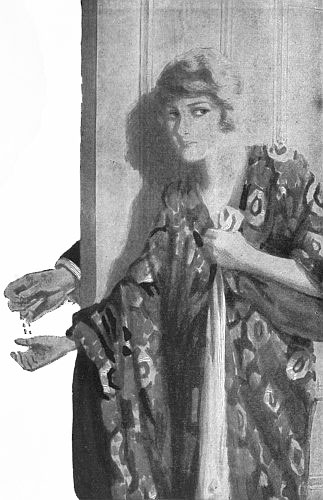 I slipped the pendant into Lady Lydbrook’s soft hand as
she stood in déshabille at the half-opened door of her bedroom.
I slipped the pendant into Lady Lydbrook’s soft hand as
she stood in déshabille at the half-opened door of her bedroom.