THE — GOLD THREAD — WEE DAVIE — TWO STORIES FOR THE YOUNG — NORMAN MACLEOD, D.D.
AND
BY
AUTHOR OF “THE STARLING,” “THE OLD
LIEUTENANT AND HIS SON,” ETC.
THOMAS NELSON AND SONS, Ltd.
LONDON, EDINBURGH, AND NEW YORK
Whole book · 15 sections
THOMAS NELSON AND SONS, Ltd.
LONDON, EDINBURGH, AND NEW YORK
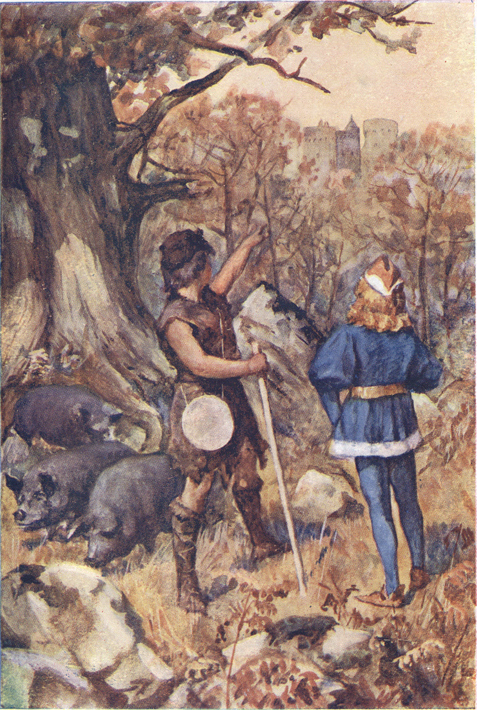
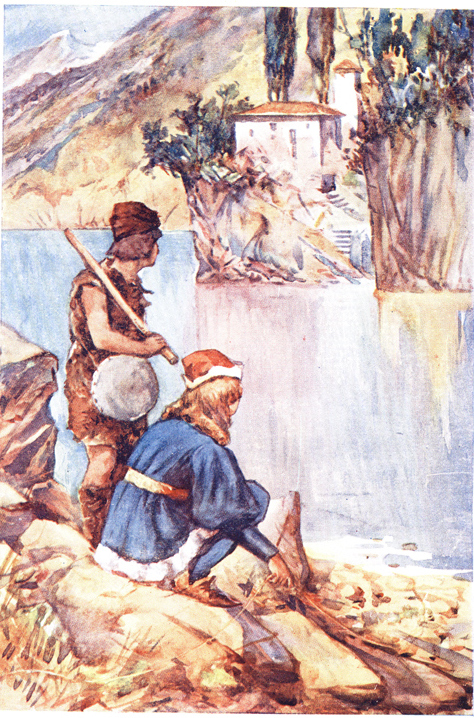
| “Look yonder; that is the house of Darkeye the forester. We are safe!” | Frontispiece |
| “See that tall tower,” said Wolf | 16 |
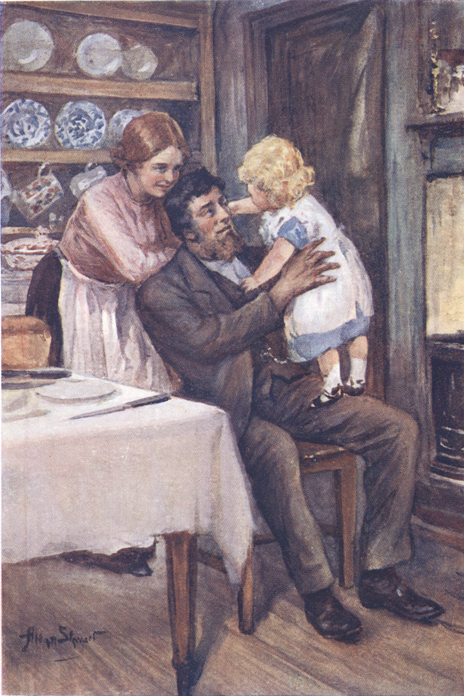
| “Isn’t he a bonnie bit bairn?” | 96 |
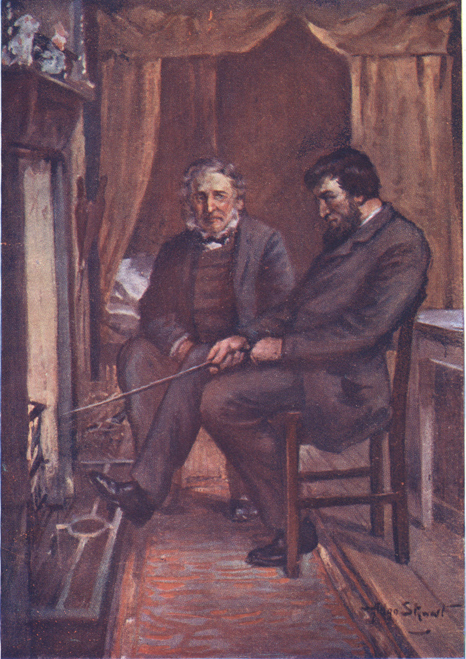
| William never moved, though his great chest seemed to heave | 144 |
A STORY FOR THE YOUNG
Once upon a time, a boy lost his way in a vast forest that filled many a valley and passed over many a hill—a rolling sea of leaves for miles and miles, farther than the eye could reach. His name was Eric, son of the good King Magnus. He was dressed in a blue velvet dress, with a gold band round his waist, and his fair locks in silken curls waved from his beautiful head. He was a lovely boy, and if you looked into his large blue eyes, and saw his sweet smile, you would say in your heart, “There is a boy so winning and brave and true, that I would dearly like to have him as a friend and companion.” But, alas! his hands and face were scratched, and his clothes torn with the briars, as he ran here and there like one much perplexed. Sometimes he made his way through tangled brushwood, or crossed the little grassy plains in the forest, now losing himself in dark ravines, then climbing up their steep sides, or crossing with difficulty the streams that hurried through them. For a long time he kept his heart up, and always said to himself, “I shall find it, I shall find it;” until, as the day advanced, he was wearied and hungry; and every now and then he cried, “Oh, my father! where is my father? I’m lost! I’m lost!” And “Where, oh, where is my gold thread?”
All day the forest seemed to him to be very sad. He had never seen it so gloomy. There was a strange sadness in the rustle of the leaves, and a sadness in the noise of the streams. He did not hear the birds sing as they used to do. But he heard the ravens croak with their hoarse voice, as their black forms swept along the precipices which here and there rose above the forest, and he never saw so many large hawks wheeling in the sky. They always appeared to be wheeling over his head, pausing, and fluttering as if about to dart down upon him. But on he journeyed, in the hope of finding his way out of the boundless forest, or of meeting some one who would be his guide. At last the sun appeared to be near its setting, and he could see the high branches of the trees shining like gold, as its rays from the west fell upon them. But underneath, the forest was getting darker and darker, and all the birds were preparing to sleep, and everything at last became so still that he could hear his steps echoing through the wood, and if he stopped, he heard his heart beating, or a leaf falling; but nowhere did he see a house, and no human being had he met since morning. Then the wind suddenly began to rise, and he heard it at first creeping along the tree-tops like a gentle whisper, and by-and-by to call louder and louder for the storm to come. Dark clouds gathered over the sky, and rushed along chased by the winds, that were soon to search the forest and fight with the old trees. No wonder if the boy began to fear, in case some evil would happen to him. Not that he was a coward, but a very bravehearted boy; but he had done wrong, and it was that which made him afraid.
At last, wearied and hardly able to go further, he sat down at the root of an old oak, burying his face in his hands, not knowing what to do. He then tried to climb the tree, and there to sleep somewhere among its branches, in case wild beasts should attack him. But as he was climbing up, he heard some one singing with a loud voice. He listened attentively, and looking eagerly through the leaves, he saw a boy apparently older than himself, dressed in rough shaggy clothes, as if made from skins of wild animals. His long matted hair escaped over his cheeks from under a black bearskin cap. With a short thick stick he was driving a herd of swine through the wood. “Hey there, you black porker!” cried the boy, as he threw a stone at some pig which was running away. “Get along, you lazy long snout!” he shouted to another, as he came thump on its back with his short stick. And then he sang this song with a loud voice which made the woods ring:—
“Get along, you rascals,” cried the savage-looking herd, “or I’ll kill and roast you before your time;” and soon the herd, with his swine, were concealed from Eric’s sight by the wood; but he still heard his “rub-a-dub” chorus, to which he beat time with a sort of rude drum, which he had made for himself with a skin and hoop. Eric determined to make his acquaintance, or at all events to follow him to some house; so he descended from the tree, and ran off in the direction from which he heard the song coming. He soon overtook him.
“Hollo!” said the wild-looking lad, with as much astonishment as if Eric had fallen from the clouds. “Who? where from? where to?”
“I have lost my way in the wood,” said Eric, “and want you to guide me.”
“To Ralph?” asked the swineherd.
“Ralph! pray, who is he?”
“Master, chief, captain, all,” replied the young savage.
“I will go anywhere for shelter, as night is coming on; but I will reward you if you bring me to my father’s home.”
“Who is your father, my fine fellow?” inquired the swineherd, leaning on his stick.
“The king,” replied Eric.
“You lie! Ralph is king.”
“I speak the truth, swineherd.”
The swineherd by this time was examining Eric’s dress with an impudent look. “Pay me now,” said he; “give me this gold band, and I will guide you.”
“I cannot give you this gold band, for my father gave it to me, and I have lost enough to-day. By the bye, did you see a gold thread waving anywhere among the trees?”
“A gold thread! What do you mean? I saw nothing but pigs until I saw you, and I shall treat you like a pig, d’ye hear? and lick you too, for I have no time to put off. So give me your band. Come, be quick!” said he, with his fierce face, and holding up his stick as he came up to Eric.
“Keep off, swineherd; don’t touch me!”
“Don’t touch you! why shouldn’t I touch you? Do you see this stick? How would you like to have it among your fine curls, as I drive it among the pigs’ bristles?” and he began to flourish it over his head, and to press nearer and nearer. “Once! twice! when I say thrice, if you do not unbuckle, I shall save you the trouble, and leave you to the wild beasts, who would like a tender bit of prince’s flesh better than pork. Come; once! twice!”
Eric was on his guard, and said, “I shall fight you, you young robber, till death, rather than give you this band—so keep off.”
“Thrice!” shouted the herd, and down came his thick cudgel, which he intended should fall on Eric’s head.
But Eric sprang aside, and before he could recover himself, dashed in upon him, tripped him up, and threw him on the grass, getting on top of him and seizing him by the throat in a moment. The herd, in his efforts to get out of Eric’s grasp, let go his cudgel, which Eric seized and held over his head. “Unless you promise, master swineherd, to leave me alone, I may leave you alone with the wild beasts.”
“You are stronger than I thought,” said the herd. “Let me up, or I shall be choked. Let me up, I say, and I promise to guide you.”
“I shall trust you,” said Eric, “though you would not trust me. Rise!”
So the herd rose and picked up his cap, but Eric would not give him his stick until he guided him to some house. “Come along,” said he sulkily.
“What is your name?” asked Eric.
“They call me Wolf. I killed a wolf once with my boar-spear.”
“Why, Wolf, did you try to kill me?”
“Because I wanted your gold belt.”
“But it is a great sin to rob and kill.”
“Other people rob me, and would kill me too if I did not take care of their pigs,” said Wolf carelessly.
“You should fear God, Wolf.”
“I fear that name truly, for Ralph always swears by it when he is in a rage. But I do not know what it means.”
“O Wolf, surely your father and mother told you about God, who made all things, and made you and me; God, who loves us, and wishes us to love Him, and to do what is right?”
“I have no father or mother,” replied Wolf, “nor brothers or sisters, and I never heard of God. No one cares for me but my pigs, and so I sleep with them, and eat with them.”
“Poor fellow!” said Eric, with a look of kindness; “I am sorry for you. Here is all the money I have. Take it. I wish to show you that I have no ill will to you;” and Eric gave him a gold coin.
Wolf gave a grunt like one of his pigs, and began his song of “Rub-a-dub.”
“No one ever gave me money before,” remarked Wolf almost to himself, as he examined the coin on his rough hand, which looked like tanned leather. “How much is this?” inquired Wolf.
Eric explained its value. The herd was astonished, and began to think what he could purchase with it. He seemed very anxious to conceal it, and at last did so in the top of his hairy cap.
“See that tall tower,” said Wolf, “which looks like a rock above the trees; that is the only house near for twenty miles round. You can reach it soon; and when you do reach it,” said Wolf, speaking low, as if some one might hear him, “take my advice, and get away as fast as you can from my master Ralph, for”—and Wolf gave a number of winks, as much as to say, I know something.
“What do you mean?” asked Eric.
“Oh, nothing, nothing; but take Wolf’s advice, and say to Ralph you are a beggar. Put the gold band in your pocket, and swear to remain with him, but run off when you can. Cheat him; that’s my way.”
“It is not my way,” replied Eric, and, come what may, never will be, for a voice says to me,—
“Ha! ha!” said Wolf; “I wish you lived with Ralph. He would teach you another lesson, my lad.”
“I would rather that I had you, Wolf, to live in my house. I would be kind to you, and help you to be good, and tell you about God, who lives in the sky.”
“And is that He who is speaking? Listen!”
Thunder began to mutter in the sky.
“Yes, it is He,” replied Eric; “and if you listen, you will also hear Him often speak with a small still voice in your heart.”
“I never heard Him,” replied Wolf; “but I cannot stay longer with you, for my pigs will wander: there is a black rascal who always leads them astray. Now, king’s son, give Wolf the stick; it is all he has.”
“Here it is to you, and I am sure you will not use it wrongly; you will try to be good, Wolf? for it will make you happy.”
“Humph!” said Wolf, “I am happy when I get my pigs home, and Ralph does not strike me. But I must away, and see you don’t tell any one you gave me money. They would rob me.” And away he ran among the trees in search of his pigs, while Eric heard his little drum, and his song of “Rub-a-dub, halloo!” die away in the distance.
Another loud peal of thunder and flash of lightning made Eric start, and off he ran towards a light which now beamed from the tower. But he thought to himself, “I am much worse than that poor Wolf, for I knew what was right, and did not do it. I heard the voice, but did not attend to it. Oh, my father, why did I not obey you?”
Sometimes he lost sight of the light, and again he caught it, till it became brighter and brighter, and very soon he came to a high rock, on the top of which was perched a tall dark tower. After groping about, he found a narrow path that led up to the tower. From one of the windows of the tower the light was brightly shining. He went up a flight of steep steps till he reached a massive door covered with iron, and knocked as loud as he could, when a large dog began barking furiously inside, and springing up to the door, as if it would tear it down. Then a gruff voice called out of a window over the door, “Who is there? Who disturbs me in this way?”
The little boy replied, “Please, sir, I am Eric, son of King Magnus, and I have lost my way in this wood.”
“The son of the king, are you?” asked the voice. “That is a grand joke! Let me have a sight of you.” Then the window was shut, and he heard footsteps coming tramp, tramp down the stairs, and the voice said to the dog, “Lie down, hound, and don’t be greedy! You would not eat a young prince, would you? Lie down!”
The door was then opened by a fierce-looking man with a long beard. The man bid him enter, and examined him about himself and his journey. Eric answered truly every question.
Then the man rang a bell for an old woman who lived in the house, and bid her take the boy with her, and give him his supper. The old woman looked very ugly and very cross, and led Eric up, up, a great number of dark gloomy stairs, until she reached a small room, with a bed and table in it, where she bade Eric wait till she brought him supper.
The big hound followed them, and stayed in the room while the woman went away. Eric was at first afraid of the dog, he was so large and wild-looking; but he came and laid his head on his knee, and Eric scratched his ears, and patted him, and was very kind to him. The supper came, and little Eric managed to keep a few bits of meat out of his own supper for the dog, and when the old woman went out of the room he fed the hound, who seemed very hungry, and said to him, “Good dog, I love you very much.” The dog wagged his tail, and looked up kindly with his large eyes, for he was thankful for his supper, and ate much more than Eric.
“Now,” said the old woman gruffly, when she took away the remains of the supper, “you have ate what would do me for a week. You won’t starve, master prince. Go to bed.”
The old woman left him, but suddenly returning, she discovered Eric on his knees. As he rose she scoffed and jeered him, and asked, “Do you always say your prayers?”
“Yes, always,” replied the boy.
“Who taught you?”
“My mother, who is dead.”
The old woman heaved a deep sigh, but the boy did not know why. Perhaps she used to pray when she was a little girl herself, and had given up doing so, and become wicked; or perhaps she thought of some child of her own whom she had never taught to pray. She then went away without speaking a word more, and Eric was left in darkness. He looked out through the narrow window of his room, but could see nothing but black clouds rushing over the sky. Far down he heard a stream roaring, and the wind, which now blew a gale, came booming over the tree-tops, and howling round the tower. Every now and then a flash lighted up the forest, and the thunder crashed in the sky. It was a fearful night!
By-and-by Eric heard footsteps at his door, and immediately the man with the beard entered it, and sat down. “Do you know,” he asked, “where your father is?”
“No,” said Eric; “as I told you, I lost my way in the forest, and have been wandering all day, and cannot find him; but perhaps you will send some one to-morrow with me to show me the way to his castle, and I am sure my kind, good father will give you a rich reward.”
“You are very, very far from your father’s house,” said the man, “and I fear you will never see him again; but come with me, and I shall show you some beautiful things that will please you.” So the man took Eric by the hand, and, carrying a bright lamp in the other, led him into a room that seemed full of gold and silver, with beautiful dresses sparkling with diamonds, and every kind of splendour, and he said, “Stay with me, my boy, and I will give you all this, for I am a king too, and will make you my heir.”
“Oh no, no,” said Eric; “I will never forsake my own father.”
The man then said, “If you stay with me, you need never go to school all day, but may amuse yourself from morning till night, and have a beautiful pony to ride, and a gun to shoot deer with, and also fishing-rods, and a servant to attend you, and any kind of meat and drink you like best. Do stay with me!”
“You are very kind,” said Eric, “but I cannot be happy without my father. Oh, my dear father! if I found you I would never leave you more!”
“Come then with me, my fine fellow, and I shall show you something different,” said the man, seizing Eric firmly by the arm, and looking very fierce.
After walking along a passage, from the end of which confused noises came, a door was opened, and in a large hall, round a great oak table, sat a company of fierce-looking men, drinking from large flagons which stood before them. Their faces were red, and their eyes gleamed like fire. Ralph placed Eric on the table. One of the robbers was singing this song:—
No wonder poor Eric trembled as he heard that lawless band thus glorying in their shame, and like demons singing their horrid song in praise of all that was most dreadful and most wicked. He had read stories of robbers, which sometimes made him think that they were fine, brave fellows, but now that he was among them, he saw how depraved, cruel, and frightful they were. Their savage, coarse looks terrified him; but he was held by Ralph on the table.
When the song was ended, one of them asked, “Whom have we got here?”
“Who do you think?” replied Ralph. “What would you say, my men, to a young prince—no less than the son of our great enemy, King Magnus?”
“A young prince! The son of Magnus! What a prize!” they exclaimed. “What shall we do with him?”
“First of all, let us have his gold belt,” said Ralph, unbuckling Eric’s belt. “Ha! what a pretty thing it is!”
“My father gave it to me, and I don’t wish to part with it. The swineherd Wolf tried to take it from me, but I fought him, and kept it,” said Eric.
“Wolf is a brave young robber,” replied Ralph, “and he shall have it for his trouble. In the meantime, my lad, it is mine. But what, my men, shall we do with the prince?”
“Kill him,” said one.
“Starve him to death,” said another.
“Put his eyes out, and send him back to his father,” said a third.
Eric prayed to God, but said nothing.
“I propose,” said Ralph, “to make him a captain if he will stay with us.”
“Never!” said Eric; “I would rather die!”
“Let him die, then,” said a fierce robber; “for his father hung my brother for killing one of his nobles.”
“I tell you what we will do with the lion’s whelp,” said Ralph: “let us keep him in prison, and send a message to his father that we have him snug in a den among the mountains, and that, unless he sends us an immense ransom, we shall kill him.”
“That will do famously,” said the robbers; “so off with him!”
Then Ralph led the boy downstairs—down, down, until Eric thought they never would stop—and at last they came to an iron door, with great bars on it, and a large lock, and Ralph turned to Eric, and said, “I know your father, and I hate him! for he sends his soldiers after me, and tries to save travellers from me; and now I have got his son. I will keep you here till you die, or till he pays!” Then he opened the dungeon door, and thrust Eric in. When it closed it echoed like thunder through the passages. Eric lay down on the dungeon floor, and wept till his heart seemed to break.
All seemed a strange dream. Oh, how he repented having disobeyed his father! and how he seemed to be as bad as the dreadful robbers in having done what he pleased, and followed his own will, instead of doing what was right! After some time he heard some rustling, as if high up on the wall, and a voice whispering “Eric!”
“Who is there?” asked Eric, and his little heart trembled.
“Silence! quiet! it is Wolf. Here is a small window in your prison, and I have opened it outside; climb up, get out, and run for your life.”
Eric heard no more, but scrambled in the dark up the rough stones in the wall until he reached the window. As he looked out he saw the stars and the woods. He soon forced his way through, and dropped down on the opposite side. Some one caught him in his arms. It was Wolf.
“Here is your gold band, Eric. I got it from Ralph; for He who was speaking in the thunder has been saying things in my heart. You were kind to poor Wolf. Now run for your life! I shall close the window again. Ralph will never know how you got out, and he will not open the prison door till after breakfast. So you have a long time. Run as long as you can along that road till you reach a hill, then cross it and follow a stream. Run off!”
“Bless you, Wolf!” said Eric; “I shall never forget you.”
Poor Eric! how he ran, and ran, beneath the stars! He felt no fatigue for a time. He thought he heard the robbers after him; every time the wind blew loud, he imagined it was their wild cry. On he ran till he reached the hill, and crossed it, and came to a green spot beneath a rock, when he could run no more, but fell down, and whether he fainted or fell asleep he could not tell.
Eric knew not how long he slept, but as in a dream he heard a sweet voice singing these words:—
Eric opened his eyes, but moved not a limb, as if under some strange fascination. It was early morning. High overhead a lark was also “singing like an angel in the clouds.” The mysterious voice went on in the same beautiful and soothing strain,—
Eric could neither move nor speak; but in his heart he confessed with sorrow that he had done what was wrong. And again the voice sang,—
“I shall arise and go to my father!” said Eric, springing to his feet. He saw beside him a beautiful lady, who looked like a picture in his father’s room of his dead mother, or like one of those angels from heaven about whom he had often read.
And the lady said, “Fear not! I know you, Eric, and how it came to pass that you are here. Your father sent you for a wise and good purpose through the forest, and gave you hold of a gold thread to guide you, and told you never to let it go; but instead of doing your duty, and keeping hold of the thread, you let it go to chase butterflies and gather wild berries and to amuse yourself. This you did more than once. You neglected your father’s counsels and warnings, and so you lost your thread, and then you lost your way. What dangers and troubles have you thus got into through disobedience to your father’s commands, and want of confidence in his love and wisdom! But if you had only trusted your father’s directions, the gold thread would have brought you to his beautiful castle, where there is to be a happy meeting of your friends, with all your brothers and sisters.” Poor little Eric began to weep! “Listen to me, child,” said the lady kindly, “for you cannot have peace but by being good. Do you know, all your brothers and sisters made this very journey by help of the gold thread, and they are at home with great joy.”
“Oh, save me, save me!” cried Eric, and caught the lady’s hand.
“Yes, I shall save you,” said she, “if you will learn obedience. I know and love you, dear boy. I know and love your father, and have been sent by him to deliver you. I heard what you said, and know all you did, last night, and I was very glad that you proved your love to your father, and your love of truth, and your love of others, and this makes me hope all good of you for the future. Come now with me.”
And so the beautiful woman took him by the hand. The storm had passed away, and the sun was shining on the green leaves of the trees, and every drop of dew sparkled like a diamond. The birds were all warbling their morning hymns, and feeding their young ones in their nests. The streams were also dancing down the rocks and through the glens. “The mountains broke forth into singing, and all the trees clapped their hands with joy.” Everything thus seemed so happy to Eric, for he himself was happy at the thought of doing what was right, and of going home. The lady led him to a sunny glade in the wood, covered with wild flowers, from which the bees were busy gathering their honey, and she said, “Now, child, are you willing to do your father’s will?”
“Oh yes!”
“Will you do it, whatever dangers may await you?”
“Yes!”
“Well, then, I must tell you that your father has given me the gold thread you lost; and he bids me remind you that if you keep hold of it, and follow it wherever it leads, you are sure to come to him at sunset; but if you let it go, you may wander on in this dark forest till you die, or are again taken prisoner by robbers.”
“Oh, bless you,” said Eric, “for such good news! I am resolved to do my duty, come what may.”
“May you be helped to do it!” said the lady. She then gave him a cake, to support him in his journey. “And now, child,” she added, “one advice more I will give you, and it was given you by your father, though you forgot it; it is this—if ever you feel the thread slipping from your hands, or are yourself tempted to let it go, pray immediately, and you will get wisdom and strength to find it, to lay hold of it, and follow it. Before we part, kneel down and ask assistance to be good and obedient, brave and patient, until you meet your father.”
The little boy knelt down and repeated the Lord’s Prayer; and as he said, “Thy will be done on earth, as it is done in heaven,” he felt calm and happy as he used to do when he knelt at his mother’s knee, and he thought her hand was on his head, and that she kissed his cheek and blessed him. When he lifted up his head there was no one there but himself; but he saw an old gray cross, and a Gold Thread was tied to it, and passed away, away, shining through the woods.
With a firm hold of his gold thread, the boy began his journey home. He passed along pathways on which the brown leaves of last year’s growing were thickly strewn, and from among which flowers of every colour were springing. He crossed little brooks that ran like silver threads and tinkled like silver bells. He went under trees with huge trunks, and huge branches that swept down to the ground and waved far up in the blue sky. The birds hopped about him, and looked down upon him from among the green leaves, and they sang him songs, and some of them seemed to speak to him. He thought one large bird like a crow cried, “Good boy, good boy!” and another whistled, “Cheer up, cheer up!” and so he went merrily on, and very often he gave the robins and blackbirds that came near him bits of his cake.
After a while, he came to a green spot in the middle of the wood, without trees, and a footpath went direct across it, to the place where the gold thread was leading him, and there he saw a sight that made him wonder and pause. It was a bird about the size of a pigeon, with feathers like gold and a crown like silver, and it was slowly walking not far from him, and he saw gold eggs glittering in a nest among the grass a few yards off. Now he thought it would be such a nice thing to bring home a nest with gold eggs! The bird did not seem afraid of him, but stopped and looked at him with a calm blue eye, as if she said, “Surely you would not rob me?” He could not, however, reach the nest with his hand, and though he pulled and pulled the thread, it would not yield one inch, but seemed as stiff as a wire.
“I see the thread quite plain,” said the boy to himself, “the very place where it enters the dark wood on the other side. I will just jump to the nest, and in a moment I shall have the eggs in my pocket, and then spring back and catch the thread again. I cannot lose it here, with the sun shining; and, besides, I see it a long way before me.” So he took one step to seize the eggs; but he was in such haste that he fell and crushed the nest, breaking the eggs to pieces, and the little bird screamed and flew away; and then all at once the birds in the trees began to fly about, and a large owl flew out of a dark glade, and cried, “Whoo—whoo—whoo-oo-oo!” and a cloud came over the sun!
Eric’s heart beat quick, and he made a grasp at his gold thread, but it was not there! Another, and another grasp, but it was not there! and soon he saw it waving far above his head, like a gossamer thread in the breeze. You would have pitied him, while you could not have helped being angry with him for having been so silly and disobedient when thus tried, if you had only seen his pale face, as he looked above him for his thread, and about him for the road, but could see neither! And he became so confused with his fall, that he did not know which side of the open glade he had entered, nor to which point he was travelling. But at last he thought he heard a bird chirping, “Seek—seek—seek!” and another repeating, “Try again—try again—try—try!” and then he remembered what the lady had said to him, and he fell on his knees and told all his grief, and cried, “Oh, give me back my thread! and help me never, never, to let it go again!”
As he lifted up his eyes, he saw the thread come slowly, slowly down; and when it came near, he sprang to it and caught it, and he did not know whether to laugh, or cry, or sing, he was so thankful and happy! “Ah!” said he, “I hope I shall never forget this fall!” That part of the Lord’s Prayer came into his mind which says, “Lead us not into temptation, but deliver us from evil.”
“Who would have thought,” said he to himself, “that I was in any danger in such a beautiful, green, sunny place as this!”
Then on he went, and a large crow on a tree was hoarsely croaking, “Beware, beware!”
“Thank you, Mr. Crow,” said the boy, “I shall;” and he threw him a bit of bread for his good advice, and ran on gaily to make up for lost time.
But now the thread led him through the strangest places. One was a very dark deep ravine, with a stream that roared and rushed far down, and overhead the rocks seemed to meet, and thick bushes concealed the light, and nothing could Eric see but the gold thread, that looked like a thread of fire, though even that grew dim sometimes, until he could only feel it in his hand. And whither he was going he knew not. At times he seemed to be on the edge of a precipice, until he almost thought the next step must lead him over and plunge him down; but just when he came to the very edge, the thread would lead him quite safely along it. Then appeared a rock which looked like a wall, and he would say to himself, “Well, I must be stopped here! I shall never be able to climb up!” But just as he touched it, he would find steps cut in it, and up, up, the thread would lead him to the top! Then it would bring him down, down, until he once stood beside a raging stream, and the water foamed and dashed. “And now,” he would think, “I must be drowned; but never mind, I will not let my thread go.” But so it was, that when he came so near the stream as to feel the spray upon his cheek, and thought he must leap in if he followed his thread, what would he see but a little bridge that passed from bank to bank, and by which he crossed in perfect safety; until he began to lose fear, and to believe more and more that he would always be in the right road, as long as he did not trust mere appearances, but kept hold of his thread!
At last Eric got very tired and hungry, for his cake was nearly done, and he had started early, and it was now well on in the day. But what was very strange, the thread supported him more than a staff could have done, and seemed to lift him up from the ground and make him go lightly along.
Eric had now to endure a great trial of his faith in the thread. As he journeyed on, the thread led him up a winding path towards the summit of a hill, descending which the large trees of the forest were left behind, and small stunted bushes grew among masses of gray rocks. The path was like the bed of a dry brook, and was often very steep. There were no birds, except little stonechats, that hopped and chirped among the large round stones. Far below, he could see the tops of the trees, and here and there a stream glittering under the sunbeams. Nothing disturbed the silence but the hoarse croak of the raven, or the wild cry of a kite or an eagle, that, like a speck, wheeled far up in the sky. But, suddenly, Eric heard a roar like thunder, that seemed to come from the direction towards which the thread was leading him. He stopped for a moment, but the thread was firm in his hand and led right up the hill. On he went, and no wonder he was afraid, when, as he turned the corner of a rock, he heard another roar, and saw the head of a large lion looking out of what seemed to be a cave, a few yards back from the edge of a dizzy precipice! He saw, too, that the path he must follow was between the lion’s den and the precipice! What now was to be done? Would he give up his thread and fly? No! A voice in his heart encouraged him to be brave and not fear, and he knew from his experience that he had always been led in safety and peace when he followed the road, holding fast to his thread. He was certain that his father never would deceive him, or bid him do anything but what was right; and he was sure, too, that the lady, from her love to him, and her teaching him to trust God and to pray, would not have bid him do anything that was wrong. And then an old verse his nurse taught him came into his mind,—
All this, and much more, passed through little Eric’s mind in a minute, and so he resolved to go on, come what might. There was just one thing he saw which cheered him, and that was a white hare, sitting with her ears cocked, quite close to the lion’s den, and he wondered how she had no fear, but could not explain it at the time. On he went, but he could hardly breathe, as the thread led still nearer and nearer the den. These big eyes were glaring on him, and seemed to draw him closer and closer! There the lion was, on one side of the path, and the great precipice on the other. One step more, and he was between them. He went on until he was so near that he seemed to feel the lion’s breath, when suddenly he sprang out on him, and tried to strike him with his huge paw that would have crushed him to the dust! Eric shut his eyes, and gave himself up for lost. But the lion suddenly fell back, for he was held fast by a great iron chain, and so Eric passed in safety!
Oh! how thankful he was! and how gladly he ran downhill, the lion roaring behind him in his den. Down he ran until all was quiet again. As he pursued his journey in the beautiful green woods, something told him his greatest trial was past. He felt very peaceful and strong. And now, as he reached some noble old beech-trees, the thread fell on the grass, and he took this as a sign that he should lie down too, and so he did, grateful for the rest. He ate some of his cake that tasted so nice, and drank from a clear spring beside him, and gathered wild strawberries which grew in abundance all round him, and thus had quite a feast. He then stretched himself on his back among soft moss, and looked up through the branches of the gigantic trees, and watched with delight the sunlight speckling the emerald green leaves and brown bark with touches of silver, and, far up, the deep blue sky with white clouds reposing on it, like snowy islands on a blue ocean; and he watched the squirrels with their bushy tails, as they ran up the trees, and jumped from branch to branch, and sported among the leaves, until he fell into a sort of pleasant day-dream, and felt so happy, he hardly knew why.
As he lay here, he thought he heard in his half-waking dream a little squirrel sing a song. Was it not his own heart, now so glad because doing what was right, which was singing? This was the song which he thought he heard:—
As Eric opened his eyes and looked up, he saw a little squirrel with its tail curling up its back, sitting on a branch looking down upon him; and then it playfully ran away with the tail waving after it. “Farewell, happy little fellow!” said Eric; “I must do my work now, and play like you afterwards;” for now the thread again became tight, and Eric, refreshed with his rest, and hearty for his journey, stepped out bravely. He saw, at some distance beyond an open glade in the forest, a rapid river towards which he was descending, when he thought he perceived something struggling in the stream, and then heard a loud cry or scream for help, as if from one drowning. He was almost tempted to run off to his assistance without his thread, but he felt thankful that the thread became tight again, and led in the very direction from whence he heard the cries coming. So off he ran as fast as he could, and as he came to the brink of a deep, dark pool in the river, he saw the head of a boy rising above the water, as the poor little fellow tried to keep himself afloat. Now he sank—again he rose—until he suddenly sank down and did not again appear. Eric laid hold of his thread with a firm hand and leaped in over head and ears, and then rose to the surface, and with his other hand swam to where the boy had disappeared. He soon caught him, and brought him with great difficulty to the surface, which he never could have done unless the thread had supported them both above the water.
“Eric!” cried the gasping boy, opening his eyes, almost covered by his long wet hair.
“Wolf, is it you?” It was indeed poor Wolf, who lay panting on the dry land, with his hairy clothes dripping with water, and himself hardly able to speak. “Oh, tell me, Wolf, what brought you here? I am so glad to have helped you!”
After a little time, when Wolf could speak, he told him in his own way, bit by bit, how Ralph had suspected him; and how the old woman had heard him speaking as she was looking out of an upper window; and how when Ralph asked the gold belt he could not give it; and how he was obliged himself to fly; and how he had been running for his life for hours. “Now let us fly,” said Wolf; “I am quite strong again. I fear that they are in pursuit of us.”
They both went on at a quick pace, Eric having shown Wolf the thread he had asked him about the day before, and explained to him how he must never part with it, come what might. “Oh, rub-a-dub, dub!” said Wolf, squeezing the water out of his hair, as he trotted along; “I am glad to be away. Ralph would have killed me like a pig. The voice told me to run after you.” So on they went as fast as they could, when suddenly Wolf stopped, and listening with anxious face he said, “Hark! did you hear anything?”
“No,” said Eric; “what was it?”
“Hush!—listen!—there again—I hear it!”
“I think I do hear something far off like a dog’s bark,” replied Eric. “Hark!”
So they both stopped and listened, and far away they heard a deep “Bow-wow-wow-wow-o-o-o-o-o” echoing through the forest.
“Let us run as fast as we can,” said the boy, in evident fear; “hear him—hear him!”
“Bow-wow-wow-o-o-o-o,” and the sound came nearer and nearer.
“What is it? why are you so afraid?” anxiously inquired Eric.
“Oh! that is Ralph’s bloodhound, Tuscar,” cried Wolf, “and he is following us. He won’t perhaps touch me, but you he may.” So Eric ran as fast as he could, but never let go the gold thread, which this time led up a steep hill, which they were obliged to scramble up. “Run, Eric!—quick—hide—up a tree—anywhere!”
“I cannot, I dare not,” said Eric; “whatever happens, I must hold fast my thread.”
But they heard the “Bow-wow-o-o-o” coming nearer and nearer, and as they looked back they saw an immense hound rush out of the wood, and as he came to the water he saw the boys on the opposite hill, and so he leaped into the stream, and in a few minutes would be near them. And now he came bellowing like a fierce bull up the hill, his tongue hanging out, and his nose smelling along the ground, following their footsteps.
“I shall run and meet him,” said Wolf, “and stop him if I can;” and down ran the swineherd, calling “Tuscar! Tuscar! good dog, Tuscar!”
But though Tuscar knew Wolf, he passed him, and ran up to Eric. As he reached Eric, who stood calm and firm, the bloodhound stopped panting, smelling his clothes all round, but, strange to say, wagging his huge tail, and then ran back the way he had come, as if he had made a mistake, and all his race was for nothing! It was the large hound Eric had fed! So his kindness was not lost even on the dog.
Eric and Wolf now pursued their journey with light and hopeful hearts, for they had got out of what was called the wild robber country, and he knew that he was drawing near home. The thread was stronger than ever, and every hour it helped more and more to support him. On the two went together, Wolf trotting along with his short stick, and sometimes snorting and blowing with fatigue like one of his own pigs. They conversed as best they could about all they had seen.
“Did you see big Thorold the lion?” asked Wolf.
“I did,” said Eric; “he is very awful, but he was chained.”
“Lucky for you,” said Wolf, “for Ralph hunts with him and kills travellers. He will obey none but Ralph. I heard him roaring. He is hungry. He once ate one of my pigs, and would have ate me if he had not first caught the porker. I escaped up a tree.”
And thus they talked, as they journeyed on through woods, and across green plains, and over low hills, until, as they were walking along, Wolf complained of hunger. Eric at once gave him what remained of his large cake; but it did not suffice to appease the appetite of the swineherd, who was, however, very grateful for what he got. To their delight they now saw a beautiful cottage not far from their path, and, as they approached it, an old woman with a pretty girl, who seemed to be her daughter, came out to meet them.
“Good-day, young gentleman!” said the old woman, with a kind smile and a courtesy; “you seem to be on your travels, and look wearied. Pray come into my cottage, and I shall refresh you.”
“What lucky fellows we are!” said Wolf.
“We are much obliged to you for your hospitality,” replied Eric. But alas! the thread drew him in an opposite direction; so turning to Wolf he said, “I cannot go in.”
“Come, my handsome young gentleman,” said the young woman, “and we shall make you so happy. You shall have such a dinner as will delight you, I am sure; and you may remain as long as you please, and I shall dance and sing to you; nor need you pay anything.” And she came forward smiling and dancing, offering her arm to Eric. “Surely you won’t be so ungallant as refuse me! you are so beautiful, and have such lovely hair and eyes, and I never saw such a belt as you wear: do come!”
“Come, my son,” said the old woman to Wolf, as she put her hand round his neck.
“With all my heart,” replied Wolf; “for, to tell the truth, I am wearied and hungry: such offers as yours one does not get every day.”
“I cannot go,” again said Eric. They could not see the thread, for to some it was invisible; but he saw it, and felt it like a wire passing away from the cottage. “Who are you, kind friends?” inquired Eric.
“Friends of the king and of his family. Honest subjects, good people,” said the old woman.
“Do you know Prince Eric?” asked Wolf.
“Right well!” replied the young woman. “He is a great friend of mine; a fine tall comely youth. He calls me his own little sweetheart.”
“It is false!” said Eric; “you do not know him. You should not lie.” But he did not tell her who he was, neither did Wolf, for Eric had made a sign to him to be silent. “I won’t enter your dwelling,” said Eric, “for my duty calls me away.”
They both gave a loud laugh, and said, “Hear him! Only hear a fine young fellow talking about duty! Pleasure, ease, and liberty are for the young. We only want to make you happy: come!”
“I shall go with you,” said Wolf; “do come, Eric.”
“Wolf, speak to me,” said Eric, whispering to the swineherd. “You know I cannot go, for my duty tells me to follow the thread. But now I see that this is the house of the wicked, for you heard how they lied; they neither knew the king nor his children; and they laugh, too, at duty. Be advised, Wolf, and follow me.”
Wolf hesitated, and looked displeased. “Only for an hour, Eric.”
“Not a minute, Wolf. If you trust them more than me, go; but I am sure you and I shall never meet again.”
“Then I will trust you, Eric,” said Wolf; “the voice in my heart tells me to do so.”
And so they both passed on. But the old woman and the girl began to abuse them, and call them all manner of evil names, and to laugh at them as silly fellows. The girl threw stones at them, which made Wolf turn round and flourish his stick over his head. At last they re-entered the cottage, the old woman shaking her fist, and calling out from the door, “I’ll soon send my friend Ralph after you!”
“Oh, ho! is that the way the wind blows?” exclaimed the swineherd, with a whistle; and, grasping Eric’s arm, said, “You were right, prince! I never suspected them. I see now they are bad.”
“I saw that before,” replied Eric, “and knew that no good would come to us from making their acquaintance.”
“Were they not cunning?”
“Yes; but probably, with all their smiles, flattery, and fair promises, they would have proved more cruel in the end than either Ralph or old Thorold.”
“What would they have done to us? Why did they meet us? Who are they, think you?”
“I don’t know, Wolf; it was enough for me that they lied, and did not wish us to do what was right.”
Not long after this strange adventure they reached a rising ground from which a magnificent view burst upon them. Below there was a large lake, surrounded by wooded hills, above which rose noble rocks fringed with stately pines, and higher ranges of mountains beyond, some of whose summits were covered with snow that glittered like purest alabaster in the azure blue of the sky. Eric gave a cry of joy; for he saw the house of one of his father’s foresters, where he had once been with his father. “Wolf! Wolf!” he exclaimed, “look yonder; that is the house of Darkeye the forester. We are safe!” and the thread was leading straight down in the very direction which they wished.
Darkeye’s house was built on a small green island in the lake. The island was like a little fort, for on every side the rocks descended like a wall. It could only be approached by a boat, which Darkeye kept on the island, and then by a narrow stair cut out of the rock. No robbers could thus get near it, and Darkeye was there to give shelter to travellers, and to help any of the poor who had to pass that way. The thread led down to the shore and the narrow ferry. They forgot their fatigue, and ran down till they reached the ferry. “Boat ahoy!” shouted Eric.
By-and-by two boys were seen running out of the cottage, and after looking cautiously at those who were calling for the boat, they rowed off, and soon were at the shore, where stood Eric with his gold belt, and Wolf in his rough skins. “Don’t you remember me?” asked Eric. The boys looked astonished as they recognized the young prince, and received him joyfully into their boat, he holding by the thread, which seemed to cross the ferry towards the cottage.
How many questions were mutually put and answered in a few minutes! They told him their father was at home; and how he had lately seen the king; and how the king was anxiously looking for Eric’s return; and how glad all on the island would be to see him. And the younger boy told him how they had a tame otter, that fished in the lake, and a fine golden eagle which they had got young in her nest, that lived on the island with them; and how their mother had got another baby since he had been there, and how happy they all were, and so on, until they arrived at the island. And there was old Darkeye himself waiting to receive them; and when he saw who was in the boat, he ran down the stone steps and grasped the young prince’s hand, and drew him to his heart. “Welcome, welcome!” said he; “I knew you had been in the forest, but your father would not tell me anything more about you. He only said that he longed for your coming home. But who is this?” asked Darkeye, pointing to Wolf.
“A friend of mine,” said Eric, with a smile.
“My name is Wolf,” grunted the swineherd.
“I think I have seen him before. But no! What? Yes!” said Darkeye, examining him; then added, as if he had discovered some old acquaintance, “Surely I have seen him. Tell me, my fine fellow, did you——”
It was evident Darkeye had seen Wolf killing his game, or in some affray with the robbers. Wolf looked steadily at Darkeye, then at Eric, but said nothing.
“O Darkeye, do not trouble poor Wolf, but let him go into the cottage, and come you with me, as I wish to tell you all that has happened to me during these few days.”
So, while the boys took Wolf to the cottage, and food was being prepared, Eric told Darkeye all his adventures; and you would have been sure that the forester was hearing something which surprised and interested him wonderfully, had you seen his face, and how he sometimes laughed, or knit his brows and looked angry, or sad and solemn, or sprang to his feet from the rock on which he was sitting beside Eric.
When Eric came to speak about the old woman and her daughter, “Ah!” said Darkeye, “there are not worse people in that wicked country! They say that the old woman is a witch of some kind. But whether she poisons travellers or drowns them, I know not. No doubt she is in league with Ralph the robber, and would have robbed you or kept you fast in some way or other till you were handed over to him. You were right, my prince, in all you did. The only way of being delivered from temptation is to be brave, and do what is right, come what may.” At last, grasping Eric by the hand, he led him back to the cottage. There Darkeye’s wife received him like a mother, and all the children gathered round him in surprise and admiration, he looked so brave and lovely.
One of the walls of the cottage was reared on the edge of the rock, so that it seemed a continuation of it, and to rise up from the deep waters of the lake. The boys were thus able often to fish with a long line out of the window. A winding stair led to a look-out on the roof, from which the whole island, called “The Green Island of the Lake,” could be seen. It was about a mile or more in circumference, and was dotted all over with the cottages of the other foresters and king’s huntsmen, each surrounded with clumps of trees, through which the curling smoke from the chimneys might be seen ascending. There were everywhere beautifully kept gardens, with fruits, and flowers, and beehives; and fields, too, with their crops. On the green knolls and in the little valleys might be seen cows and sheep; while flocks of goats browsed among ivy-covered rocks.
In the middle of the island was a little shallow lake, beside which the otter had his house among the rocks; and there the eagle also lived. All the children in the island were the best of friends, and they played together, and sailed their boats on the little lake, and every day met in the house of one of the foresters to learn their lessons; and on Sunday, as they were very far away from any church, old Darkeye used to read good books to them, and worship with them, and did all he could to make them good and happy. They often met at such times in the open air, beneath a large tree which sheltered them from the sun.
There was also in the island a house where, by the king’s orders, all poor travellers could find refuge and refreshment. And it was a great pleasure to the boys and girls to visit them; and if they were sick and confined to bed, to read to them, and attend to their wants. If the stranger had any children, the young islanders always shared their sports with them. And nothing pleased these stranger children more than to get leave to sail a boat, or to have the loan of a fishing-rod, or to hear the boys call Oscar—for that was the name of the otter—out of his den, and play with Tor the eagle; or to see them feed Oscar with some of the fish they had caught, and Tor with a bit of meat. The dogs were so friendly, too, that they never touched Oscar, but would swim about in the same pool with him. And so all were happy in the Green Island; because Darkeye had taught them what a wicked thing selfishness was, and that the only way to be happy was by thinking about others as well as themselves, and by loving one another. He also used to say: “Now, when you work, work like men, and when you play, play like boys: be hearty at both.” And so while there was no idleness, there was abundance of recreation.
Another evil was never permitted in the island, and that was disobedience to parents, or want of respect to the old. But, indeed, punishment for these offences was seldom or never needed. The young learned to like to do what was right, and were too brave and manly to give pain and trouble to others.
I should have mentioned, also, that they had a little band of musicians. One beat the drum, a few played the fife, and others some simple instrument; while almost all could sing tolerably well in parts. Thus, many a traveller would pause and listen with delight as he heard on a summer’s evening the chorus song from many voices, or the music from the band coming from the island. “Young people,” Darkeye used to say, “have much wealth and happiness given them, if they only used their gifts.”
But I am forgetting Eric and Wolf. They were both, you may be sure, ready for their dinner, and there was laid for them on a table, cream, cakes, and fresh trout, and such other good things as the kind woman could get ready.
But now the thread began to move, as if it wished Eric to move also. Before rising to depart, he told Wolf how Darkeye, for his sake, would be so glad to take care of him, until he got his father’s permission to bring him into the castle; that he would learn to be a huntsman, and be taught what was good, and to know about the voice that spoke in his heart, and that all the boys in the island would make him their friend if he did what was right.
“Ralph will come here!” said Wolf, hanging his head.
“I wish the rascal did,” said Darkeye, “for he would never go back. But he cannot enter my fort, and knows me and my huntsmen too well ever to try it. I have had more than one brush with the villain, and we hope soon to drive him and his brood from their bloody nest. Wolf, you are welcome and safe, for Eric’s sake!” Then turning to Eric, he said, “I shall teach him, and make a man of him, my young prince, depend upon it. And now, before we part, I have to ask a favour,” continued Darkeye. “You know our custom near evening? If the thread permits, remain and be one of us.”
“I remember it,” said Eric, “and will remain and be one of you, and let poor Wolf also be one.”
And so they entered the cottage, and all sat down round an open window which looked out upon the beautiful lake dotted with wooded islands, and surrounded by the noble forest, above which rose the giant peaks and precipices. The water was calm as glass, and reflected every brilliant colour from rock and tree, and, most of all, from the golden clouds, which already began to gather in the west. Darkeye read from the Blessed Book of one who had left his father’s house, and went to a far country, where he would fain have satisfied his hunger from the husks which the swine did eat, but who at last returned home after having suffered from his disobedience. When he closed the Book, all stood up and sang these words with sweet and happy voices:—
Then they knelt down, and Darkeye spoke to God in the name of them all, thanking Him for His goodness, and telling Him their wants. When they rose from their knees, the gold thread shone brilliantly, and, like a beam of light, passed out at the door in the direction of the ferry. During the singing of the verses, Wolf seemed for the first time quite overcome. He bent his head, and covered his face with his hands. He then said, in a low voice, when the short service was over, and as if speaking to himself, while all were silent listening to him, “I had a dream. Long, long ago. A carriage—a lady. She was on her knees crying. She had hold of me. Ralph was there and the robbers. I forget the rest.” He rose and looked out of the window, gazing vacantly.
“What can he mean?” asked Eric aside to Darkeye, who was looking tenderly on Wolf.
“Ah! who knows, poor boy! Singing always touches the heart of these wanderers. Perhaps—yes—it may be,” he said, so that Eric alone could hear him, “that he has been taken when a child by Ralph from some rich traveller, and perhaps his mother was killed! He may have been the child of good people. Was that his mother who prayed for him? If so, her prayers are now answered, for her boy will be delivered—poor Wolf!—Wolf, my boy,” said Darkeye, “come and bid farewell to your friend.”
Wolf started as from a dream, and came to Eric.
“Farewell, my kind Wolf, and I hope some day to see you in my father’s house.” The swineherd spoke not a word, but wiped his eyes with the back of his rough hand. “Cheer up, Wolf, for you will be good and happy here.”
“Wolf is happy already, and he will take care of the pigs, or do anything for you all.” He then held out his stick to Eric, and said, “Take it; it is all Wolf has: Ralph has the gold coin.”
“Thank you, good Wolf; but you will require it, and I need nothing to remember you.”
“Don’t be angry, Eric, for what I did in the forest when we met. My heart is sorry.”
“We did not know one another then, Wolf, and I shall never forget that to you I owe my escape.”
“Wolf loves you, and every one here.”
“I am sure you do, Wolf, and I love you. God bless you, Wolf, I must go; farewell!”
And so they parted. But all gathered round Eric, and accompanied him to the boat, blessing the little prince, and wishing him a peaceful and happy journey. Eric thanked them with many smiles and tender words. Darkeye alone went with him into the boat, wondering greatly at the thread, and most of all at the prince, who shone with a beauty that seemed not of this world. The prince landed, but Darkeye knew for many reasons that he could not accompany him in his journey, which he must take alone. Eric landed on the shore, embraced Darkeye, and waving his hand to all on the island, he soon was lost to their sight in the great forest.
A winding pathway, over the ridge of hills, led down to a broad and rapid but smooth river, and on its banks was a royal boat, beautiful to look upon. The thread led into the boat, and though no one was there, Eric entered, and sat on a velvet cushion on which the golden thread laid itself down. No sooner had he gone on board of the boat, than—as if his little foot, when it touched her, had sent her from the shore—she slowly moved into the centre of the channel, and was carried downwards by the current. On she swept on the bosom of that clear stream, between shores adorned with all that could delight the eye—rocks and trees and flowers, with here and there waterfalls, white as snow, from mountain rivulets which poured themselves into the great river. The woods were full of song, and birds with splendid plumage gleamed and flashed amidst the foliage like rainbow hues amidst the clouds.
Eric knew not whither he was being carried, but his heart was sunshine and peace. On and on he swept with the winding stream, until at last darting under a dark archway of brick, and then emerging into light, the boat grounded on a shore of pure white sand, while the thread rose and led him to the land.
No sooner had he stepped on shore and ascended the green bank, than he found himself at the end of a long, broad avenue of splendid old trees, whose tops met in a green arch overhead. The far-off end of the avenue was closed by a great stair of pure white marble steps which ascended to a magnificent castle. Wall rose above wall, and tower over tower. He saw grand flights of stairs, leading from one stately terrace to another, with marble statues, clear gushing fountains, and flower gardens, and every kind of lovely tree. It was his father’s castle at last! He ran on with breathless anxiety and joy. He soon reached it. A large gate was before him, that seemed to be covered with glittering gold. The thread led directly to it. As he reached the door, he saw the thread tied to a golden knocker, shaped like the old cross in the forest. Inscribed over the door were the words, “He that persevereth to the end shall be saved.” And on the knocker, “Knock, and it shall be opened.” He seized the knocker, and the moment it fell, the thread broke and vanished. A crash of music was heard inside. The door opened, and there stood Eric’s father, surrounded by his brothers and sisters; and the beautiful lady was there too, and many, many more to welcome Eric. His father clasped him to his heart, and said, “My son was lost, but is found!”
While all crowded around Eric with his weary feet and torn dress, kept together by his golden band, a chorus was heard singing,—
Then there rose a swell of many young voices singing,—
And then the sun set, and the earth was dark, but the palace of the king shone like an aurora in the wintry sky.
“And a little child shall lead them.”
“Wee Davie” was the only child of William Thorburn, blacksmith. The child had reached the age in which he could venture, with prudence and reflection, on a journey from one chair to another, his wits kept alive by maternal warnings of “Tak’ care, Davie; mind the fire, Davie.” And when his journey was ended in safety, and he looked over his shoulder with a cry of joy to his mother, he was rewarded, in addition to the rewards of his own brave and adventurous spirit, by such a smile as equalled only his own, and by the well-merited approval of “Weel done, Davie!”
Davie was the most powerful and influential member of the household. Neither the British fleet, nor the French army, nor the Armstrong gun, nor the British Constitution had the power of doing what Davie did. They might as well have tried to make a primrose grow or a lark sing! He was, for example, a wonderful stimulus to labour. His father, the smith, had been rather disposed to idleness before his son’s arrival. He did not take to his work on cold mornings as he might have done, and was apt to neglect many opportunities which offered themselves of bettering his condition; and Jeanie was easily put off by some plausible objection when she urged her husband to make an additional honest penny to keep the house. But “the bairn” became a new motive to exertion; and the thought of leaving him and Jeanie more comfortable, in case sickness laid the smith aside, or death took him away, became like a new sinew to his powerful arm, as he wielded the hammer, and made it ring the music of hearty work on the sounding anvil. The meaning of benefit-clubs, sick-societies, and penny-banks was fully explained by “wee Davie.”
Davie also exercised a remarkable influence on his father’s political views and social habits. The smith had been fond of debates on political questions, and no more sonorous growl of discontent than his could be heard against the powers that be, the injustice done to the masses, and the misery which was occasioned by class legislation. He had also made up his mind not to be happy or contented, but only to endure life as a necessity laid upon him, until the required reforms in Church and State, at home and abroad, had been attained.
But his wife, without uttering a syllable on matters which she did not pretend even to understand, and by a series of acts out of Parliament, by reforms in household arrangements, by introducing good bills to her own House of Commons, and by a charter, whose points were chiefly very commonplace ones, such as a comfortable meal, a tidy home, a clean fireside, a polished grate, above all, a cheerful countenance and womanly love—these radical changes had made her husband wonderfully fond of his own house. He was, under this teaching, getting every day too contented for a patriot, and too happy for a man in such an ill-governed world. His old companions could not at last coax him out at night. He was lost as a member of one of the most philosophical clubs in the neighbourhood. His old pluck, they said, was gone. The wife, it was alleged by the patriotic bachelors, had “cowed” him, and driven all the spirit out of him. But “wee Davie” completed this revolution.
One failing of William’s had hitherto resisted Jeanie’s silent influence. The smith had formed the habit, before he was married, of meeting a few companions, “just in a friendly way,” on pay-nights at a public-house. It was true that he was never “what might be called a drunkard,” “never lost a day’s work,” “never was the worse of liquor,” etc. But, nevertheless, when he entered the snuggery in Peter Wilson’s whisky shop, with the blazing fire and comfortable atmosphere; and when, with half a dozen talkative and, to him, pleasant fellows and old companions, he sat round the fire, and the glass circulated, and the gossip of the week was discussed, and racy stories were told, and one or two songs sung, linked together by memories of old merry meetings; and current jokes were repeated, with humour, of the tyrannical influence which some would presume to exercise on “innocent social enjoyment”—then would the smith’s brawny chest expand, and his face beam, and his feelings become malleable, and his sixpences begin to melt, and flow out in generous sympathy into Peter Wilson’s fozy hand, and there counted beneath his sodden eyes. And so it was that the smith’s wages were always minus Peter’s gains.
His wife had her fears—her horrid anticipations—but did not like to “even” her husband to anything so dreadful as what she in her heart dreaded. She took her own way, however, to win him to the house and to good, and gently insinuated wishes rather than expressed them. The smith, no doubt, was only “merry,” and never was ill-tempered or unkind; “yet at times—” “and then, what if—” Yes, Jeanie, you are right! The demon sneaks into the house by degrees, and at first may be dispelled, and the door shut upon him; but let him only once take possession, then he will keep it, and shut the door against everything pure, and lovely, and of good report, and bar it against thee and “wee Davie,” ay, and against better than thee and than all else, and fill the house with sin and shame, with misery and despair! But “wee Davie,” with his arm of might, drove the demon out.
It happened thus. One evening when the smith returned home so that “you would know it on him,” his child toddled to him, and, lifting him up, he made him stand before him on his knee. The child began to play with the locks of the Samson, and to pat him on the cheek, and to repeat with glee the name of “dad-a.” The smith gazed at him intently, and with a peculiar look of love, mingled with sadness.
“Isn’t he a bonnie bit bairn?” asked Jeanie, as she looked over her husband’s shoulder at the child, nodding and smiling to him.
The smith spoke not a word, but gazed still upon his boy, while some sudden emotion was strongly working in his countenance. “It’s done!” he at last said, as he put his child down.
“What’s wrang? what’s wrang?” exclaimed his wife, as she stood before him, and put her hands round his shoulders, bending down until her face was close to his.
“Everything is wrang, Jeanie!”
“Willie, what is’t? are ye no’ weel?—tell me what’s wrang wi’ you?—oh, tell me!” she exclaimed in evident alarm.
“It’s a’ richt noo!” he said, rising up, and seizing his child, lifted him up to his breast, and kissed him. He then folded him in his arms, clasped him to his heart, and looking up in silence, said, “Davie has done it, along wi’ you, Jeanie. Thank God, I am a free man!”
His wife felt awed, she knew not how.
“Sit doon,” he said, as he took out his handkerchief and wiped away a tear from his eye, “and I’ll tell you a’ aboot it.”
Jeanie sat on a stool at his feet, with Davie on her knee.
Her husband seized his child’s little hand with one of his own, and with the other took his wife’s. “I havena been what ye may ca’ a drunkard,” he said, “but I hae been often as I shouldna hae been, and as, wi’ God’s help, I never, never will be again!”
“Oh!” exclaimed Jeanie.
“Let me speak,” said William. “To think, Jeanie”—here he struggled as if something was choking him—“to think that for whisky I might beggar you and wee Davie; tak’ the claes aff your back; drive ye to the workhouse; break your heart; and ruin my bonnie bairn, that loves me sae weel, in saul and body, for time and for eternity! God forgie me! I canna stand the thocht o’t, let alane the reality!” and the strong man rose, and little accustomed as he was to show his feelings, he kissed his wife and child. “It’s done, it’s done!” he said; “dinna greet, Jeanie. Thank God for you and Davie, my best blessings.”
“Except Himsel’!” said Jeanie, as she hung on her husband’s neck.
“Amen!” said the smith; “and noo, woman, nae mair aboot it; it’s done. Gie wee Davie a piece, and get the supper ready.”
“Wee Davie” was also a great promoter of social intercourse, an unconscious link between man and man, and a great practical “unionist.” He healed breaches, reconciled differences, and was a peace-maker between kinsfolk and neighbours. For example: Jeanie’s parents were rather opposed to her marriage with the smith; some said because they belonged to the rural aristocracy of country farmers. They regretted, therefore, the day—though their regret was expressed only to old friends—when the lame condition of some of the horses had brought Thorburn into communion with their stable, and ultimately with their house. Thorburn was admitted to be a sensible, well-to-do man; but then he was, at best, but a smith, and Jeanie was good-looking, and “by ordinary,” with expectations of some “tocher,” and as her mother remarked, “though I say it, that shouldna say it,” etc., and so, with this introduction, she would proceed to enlarge on Jeanie’s excellences, commenting on the poor smith rather with pauses of silence, and expressions of hope “that she might be mistaken,” all of which, from their very mystery, were more depreciatory than any direct charges. But when “wee Davie” was born, the old couple deemed it proper and due to themselves—not to speak of the respect due to their daughter, whom they sincerely loved—to come and visit her. Her mother had been with her, indeed, at an earlier period; and the house was so clean, and Thorburn so intelligent, and the child pronounced to be so like old David Armstrong, Jeanie’s father, especially about the forehead, that the two families, as the smith remarked, were evidently being welded, so that a few more gentle hammerings would make them one.
“Wee Davie,” as he grew up, became the fire of love which heated the hearts of good metal so as to enable favourable circumstances to give the necessary finishing stroke which would permanently unite them. These circumstances were constantly occurring until, at last, Armstrong called on every market-day to see his daughter and grandson, and he played with the boy (who was his only grandson), and took him on his knee, and put a “sweetie” into his mouth, and evidently felt as if he himself was reproduced and lived in the boy. This led to closer intercourse, until David Armstrong admitted that William Thorburn was one of the most sensible men he knew, and that he would not only back him against any of his acquaintances for a knowledge of a good horse, but for wonderful information as to the state of the country generally, especially of the landed interest and the high rent of land. Mrs. Armstrong finally admitted that Jeanie was not so far mistaken in her choice of a husband. The good woman always assumed that the sagacity of the family was derived from her side of the house. But whatever doubts still lingered in their minds as to the marriage, these were all dissipated by one look of “wee Davie.” “I’m just real proud aboot that braw bairn o’ Jeanie’s,” she used to say to her husband. She added one day, with a chuckling laugh and smile, “D’ye no’ think yersel’, gudeman, that wee Davie has a look o’ auld Davie?”
“Maybe, maybe,” replied auld Davie; “but I aye think he’s our ain bairn we lost thirty years syne.”
“That has been in my ain mind,” said his wife; “but I never liked to say it. But he’s no’ the waur o’ being like baith.”
Again: There lived in the same common passage, and opposite to William Thorburn’s door, an old soldier, a pensioner. He was a bachelor, and by no means disposed to hold much intercourse with his neighbours. The noise of the children was obnoxious to him. He maintained that “an hour’s drill every day would alone make them tolerable. Obedience to authority; right about, march! That’s the thing,” the Corporal would say to some father of a numerous family in the “close,” as he flourished his stick with a smile rather than a growl. Jeanie pronounced him to be “a selfish body.” Thorburn had more than once tried to cultivate acquaintance with him, as they were constantly brought into outward contact. But the Corporal was a Tory, and more than suspected the smith of holding “Radical” sentiments. To defend things as they were was a point of honour with the pensioner—a religion. Any dislike to the Government seemed a slight upon the army, and therefore upon himself. Thorburn at last avoided him, and pronounced him proud and ignorant. But one day “wee Davie” found his way into his house, and putting his hands on his knees as he smoked his pipe at the fireside, looked up to his face. The old soldier was arrested by the beauty of the child, and took him on his knee. To his surprise, Davie did not scream; and when his mother soon followed in search of her boy, and made many apologies for his “impudence,” as she called it, the Corporal maintained that he was a jewel, a perfect gentleman, and dubbed him “the Captain.”
Next day, tapping at Thorburn’s door, the Corporal gracefully presented a toy in the shape of a small sword and drum for his young hero. That night he smoked his pipe at the smith’s fireside, and told such stories of his battles as fired the smith’s enthusiasm, called forth his praises, and, what was more substantial, a most comfortable tea by Jeanie, which clinched their friendly intercourse. He and “the Captain” became constant associates, and many a loud laugh might be heard from the Corporal’s room as he played with the boy, and educated his genius. “He makes me young again, does the Captain!” remarked the Corporal to his mother.
Mrs. Fergusson, another neighbour, was also drawn into the same net by “wee Davie.” She was a fussy, gossiping woman, noisy and disagreeable. She found Jeanie uncongenial, who “kept herself to herself,” instead of giving away some of her good self to her neighbour, and thus taking some of her neighbour’s bad self out of her. But her youngest child became seriously ill, and Jeanie thought, “If Davie was ill I would like a neighbour to speir for him,” and so she went upstairs to visit Mrs. Fergusson, and begged pardon, but “wished to know how Mary was?” and Mrs. Fergusson was bowed down with sorrow, and thanked her, and bid her “to come ben.” And Jeanie did so, and spoke kindly to the child, and told her, moreover, what pleasure it would give her to nurse her baby occasionally; and she invited the younger children to come down to her house and play with “wee Davie,” and thus keep the sick one quiet; and she helped also to cook some nutritive drinks, and got nice milk from her father for the sick one, and often excused herself for apparent meddling by saying, “When one has a bairn o’ their ain, they canna but feel for other folk’s bairns.”
Mrs. Fergusson’s heart became subdued, softened, and friendly, and she said, “We took it as extraordinar’ kind in Mrs. Thorburn to do as she has done. It is a blessing to have sic a neighbour.”
But it was “wee Davie” did it.
The street in which the smith lived was as uninteresting as any could be. A description of its outs and ins would have made a “social science” meeting shudder. Beauty or even neatness it had not. Every “close” or “entry” in it looked like a sepulchre. The back courts were a huddled confusion of outhouses; strings of linens drying; stray dogs searching for food; pigeons similarly employed with more apparent success and satisfaction; and cats creeping about; with crowds of children, laughing, shouting, and muddy to the eyes, acting with intense glee the great dramas of life, marriages, battles, deaths, and burials, with castle-building and extensive farming and commercial operations. But everywhere smoke, mud, wet, and an utterly uncomfortable look. And so long as we in Scotland have a western ocean to afford an unlimited supply of water, and western mountains to condense it as it passes in the blue air over their summits, and western winds to waft it to our cities, and so long as it will pour down, and be welcomed by smoke above and earth below—then consequently so long we shall find it difficult to be “neat and tidy about the doors,” or to transport the cleanliness of England into our streets and lanes. But, in spite of all this, how many cheerful homes, with bright fires and nice furniture, and rows of books, and intelligent, sober, happy men and women, with healthy, nice children, are everywhere to be found in those very streets, that seem to the eye of those who have never penetrated farther than their outside, to be “dreadful-looking places;” and who imagine that all their inhabitants must be like pigs in pigstyes, steeped in wretchedness and whisky; and infer that every ignorant and filthy and drunken Irish brawler and labourer is a fair type of the whole of our artisans.
There is, I begin to suspect, a vast deal of exaggerated nonsense written about the working classes. Be that as it may, I feel pretty certain of this, that there is no country on earth in which the skilled and well-conducted artisan can get so much for his money, socially, physically, intellectually, and morally, as in our own Britain, and none in which there are to be found so many artisans who take advantage of these benefits. But for the ignorant and ill-disposed, the idle and the drunken, there is no country where their degradation is more rapid, and their ruin more sure. The former can easily rise above the mud, and breathe a free and happy atmosphere; but if he falls into it, it is likely he will be sooner smothered and buried than anywhere else on earth.
A happier home could hardly be found than William Thorburn’s, smith, as he sat, after coming home from his work, at the fireside, reading his newspaper, or some book of weightier literature, Jeanie sewing opposite to him, and, as it often happened, both absorbed occasionally in the rays of that bright light, “wee Davie,” which filled their dwelling, and the whole world, to their eyes; or listened to the grand concert of his happy voice, which mingled with their busy work and silent thoughts, giving harmony to all. How much was done for his sake! He was the most sensible, efficient, and thoroughly philosophical missionary of social science in all its departments who could enter that house.
My heart is sore as I write it, that “wee Davie” got ill. He began to refuse his food, and nothing would please him; then to get peevish and cross, so that he would hardly go to his father, except to kiss him with tearful cheeks, and then stretch out his hands with a cry for his mother. His mother nursed him on her knee, and rocked him, and walked with him, and sang to him her own household lullabies; and put him to bed, and lifted him up, and laid him down, and “fought” with him day and night, caring for neither food nor sleep, but only for her child’s ease and comfort. What lessons of self-sacrificing love was she thus unconsciously taught by her little sufferer! The physician was at last called in, who pronounced it “a bad case—a very serious case.” I forget the specific nature of the illness. The idea of danger to Davie had never entered the minds of his parents. The day on which William realized it, he was, as his fellow-workmen expressed it, “clean stupid.” They saw him make mistakes he had never made before, and knew it could not be from drink, but could not guess the cause. “I maun gang hame!” was his only explanation, when, at three o’clock, he put on his coat and stalked out of the smithy, like one utterly indifferent as to what the consequences might be to ploughs or harrows, wheels or horse-shoes. Yet taking an old fellow-workman aside, he whispered to him, “For auld friendship sake, Tam, tak’ charge this day o’ my wark.”
“What ails Willie?” was the only question put by him and others, to which no reply could be given.
It was on the afternoon of next day that “the minister” called. It must here be confessed that William was a rare attender of any church. The fact was, he had been hitherto rather sceptical in his tendencies; not that his doubts had ever assumed a systematic form, or had ever been expressed in any determined or dogmatic manner. But he had read Tom Paine, associated the political rights of man with rebellion against all old authorities, all of whom seemed to him to have denied them, and he had imbibed the idea at the old “philosophical” club, that ministers, especially those of the Established Church, were the enemies of all progress, had no sympathy with the working classes, were slaves to the aristocracy, preached as a mere profession and only for their pay, and had, moreover, a large share of hypocrisy and humbug in them. The visit of Dr. M‘Gavin was, therefore, very unexpected.
When the Doctor entered the house, after a courteous request to be allowed to do so, as it was always his principle that the poorest man was entitled to the same respect as the man of rank or riches, he said, “I have just heard from some of your neighbours, whom I have been visiting, that your child is seriously unwell, and I thought you would excuse me intruding upon you to inquire for him.”
William made him welcome and begged him to be seated. The call was specially acceptable to Jeanie. Old David, I should have mentioned, was an “elder” in a most worthy dissenting congregation, and his strong religious convictions and church views formed in his mind a chief objection to the marriage of his daughter with a man “who was not,” as he said, “even a member of any kirk.” Jeanie had often wished her husband to be more decided in what she felt herself to be a duty and a privilege. The visit of the Doctor, whose character was well known and much esteemed, was therefore peculiarly welcome to her. In a little while the Doctor was standing beside the little bed of the sufferer, who was asleep, and gently touching “wee Davie’s” hand, he said, in a quiet voice, to the smith, “My brother, I sincerely feel for you! I am myself a father, and have suffered losses in my family.”
At the word losses, William winced, and moved from his place as if he felt uneasy.
The Doctor quickly perceived it, and said, “I do not, of course, mean to express so rash and unkind an opinion as that you are to lose this very beautiful and interesting boy, but only to show you how I am enabled, from experience, to understand your anxiety, and to sympathize with you and your wife.” And noiselessly walking to the arm-chair near the fire, he there sat down, while William and Jeanie sat near him. After hearing with patience and attention the account from Jeanie of the beginning and progress of the child’s disease, he said, “Whatever happens, it is a comfort to know that God our Father is acquainted with all that you suffer, all you fear, and all you wish; and that Jesus Christ, our Brother, has a fellow-feeling with us in all our infirmities and trials.”
“The Deity must know all,” said William, with a softened voice; “He is infinitely great and incomprehensible.”
“Yes,” replied the Doctor; “and so great, that He can attend to our smallest concerns; yet not so incomprehensible but that a father’s heart can truly feel after Him, so as at least to find Him through His Son. Ah! my brother,” continued the Doctor, “what a comfort and strength the thought is to all men, and ought to be to you working men, and to you parents, especially with your dear child in sickness, that He who marks a sparrow fall, smitten by winter’s cold, and who feeds the wild beasts, is acquainted with us, with our most secret affairs, so that even, as it were, the hairs of our heads are numbered; that He who is the Father, Almighty Maker of the heavens and the earth, knows the things which we need; that He has in us, individually, an interest which is incomprehensible, only because His love to us is so in its depth; that He considers each of us, and weighs all His dealings towards us with a carefulness as great as if we alone existed in His universe; so that, as a father pitieth his children, He pitieth us, knowing our frames, and remembering we are dust.”
William bent his head and was silent, while Jeanie listened with her whole soul.
“It is not easy, minister,” said William, breaking silence, “for hard-wrought and tried men to believe that.”
“Nor for any man,” replied the Doctor. “I find it very difficult to believe it myself as a real thing, yet I know it to be true; and,” he continued, with a low and affectionate voice, “perhaps we never could have known it and believed it at all, unless God had taught it to us by the life of His own Son, who came to reveal Him. But as I see Him taking up little children into His loving arms, when others would keep them away who did not understand what perfect love was, and as I see in such doings how love cannot but come down and meet the wants of its smallest and weakest object, oh! it is then I learn in what consists the real greatness of God, ‘whose name is Love.’” The Doctor paused for a moment, and then went on: “Because, my brother, I see in this love of Christ more than the love of a good man merely; I see revealed in it the loving tenderness towards us and ours of that God whom no eye hath seen or can see, but whom the eye of the spirit can perceive; for, as Jesus said, ‘He who seeth Me, seeth the Father.’”
“I believe a’ ye say, Doctor,” said Jeanie meekly. “I wadna like to keep my bairn frae Him; but, oh! sir, I hope—I hope He wull lift him up, and do to us now as He did to many distressed ones while on earth!”
“I hope,” said the Doctor, “God will spare your boy; but you must ask Him sincerely so to do, and you must trust Him, and commit your child into His hands without fear, and acquiesce in His doing towards you and your boy as He pleases.”
“That is hard!” remarked William.
“Hard?” mildly replied the Doctor. “What would you choose else, had you the power of doing so, rather than of acquiescing in the will of God? Would you trust your own heart, for instance, more than the heart of God? or would you rather have your child’s fate decided by any other on earth than by yourself?”
“No, for I know how I love the boy.”
“But God loves him much more than you do; for he belongs to God, and was made by Him and for Him.”
“Excuse me, Doctor, but yet I canna thole the thocht o’ parting wi’ him!” said Jeanie.
“May God spare him to you, my friends!” replied the minister, “if it be for your good and his. But,” he added, “there are worse things than death.”
This remark, made in almost an under voice, was followed by silence for a few moments. The Doctor’s eyes were cast down as if in meditation or prayer.
“Death is hard enough!” said the smith.
“But hard chiefly as a sign of something worse,” continued the minister. “Pardon me for asking you such questions as these:—What if your child grew up an enemy to you? What if he never returned your love? What if he never would trust you? What if he never would speak to you? What if he always disobeyed you? Would this not bring down your gray hairs with sorrow to the grave?”
“Eh! sir,” said Jeanie, “that would be waur than death!”
“But excuse me, Doctor, for just remarking,” interrupted William, “that I never knew any child with a good parent who would so act. I really don’t think it possible that our ain wee Davie, even with our poor bringing up, would ever come to that. It would be so unnatural.”
“God knows, Thorburn,” said the Doctor. “There are many unnatural things in this world. Listen to me kindly; for I sincerely thank you for having allowed one who is a stranger to speak so frankly to you, and for having heard me with such considerate patience.”
“Oh, gang on, gang on, Doctor; I like to hear you,” said Jeanie.
“Certainly, sir,” added the smith.
“Well, then,” said the Doctor, “I have no wish to appear even to find fault with you at such a time. I feel more disposed to weep with you in your sorrow than to search your heart or life for sin. But I feel at such solemn times as these, solemn to you and to your wife, that the voice of a Father is speaking to you in the rod, and it ought to be heard; and that His hand is ministering discipline in time, and you ought to give Him reverence, and be in subjection to the Father of our spirits that you may live; and therefore, in order to impart to you more strength and comfort in the end, let me beseech of you, after I am gone, to consider candidly whether you have not perhaps been acting towards your Father in heaven in the very way in which did your child grow up and act towards you would be reckoned as worse than death. Therefore honestly ask yourselves whether there has been from you love to God your Father in return for His love to you. Has there been cordial friendship or the reverse? Confidence or distrust? Disobedience or rebellion? Communion in frank, believing, and affectionate prayer, or silence? I do not ask you to reply to me; but I wish you and myself, as loving fathers of our children, to ask whether we have felt and acted towards the best and most loving of fathers as we wish our children to feel and act towards ourselves.” The Doctor paused for a moment. Jeanie shook her head slowly, and the smith stared with her at the fire. “My friends, we have all sinned, and this is our sin of sins, that we have not known nor loved our Father, but have been forgetful of Him, strange, shy to Him; yes, we have been cold, heartless, prodigal, disobedient children.” Another short pause, and the Doctor then spoke on in the same quiet and loving voice—“But whatever we are or have been, let us hope in God, or we perish. Every sinner is doomed, but no man is doomed to be a sinner. God is our Father still; and just as you both have nourished and cherished your dear boy, and have been loving when he knew it not, nor could understand that great love in your hearts which, sure am I, will never grow cold but in the grave, so has it been with God to us His children. Open your hearts to His love, as you would open your eyes to the light which has been ever shining. Believe it as the grand reality, as you would have your boy open his heart to and believe in your love when he awakens from his sleep. Your love, as I have said, is deep, real to your boy, irrespective of his knowledge or return of it. But what is this to the love of God? ‘Herein is love, not that we loved God, but that He loved us, and gave His Son to be a propitiation for our sins.’ Let us, my friends, never rest till we are enabled in some degree to see and to appreciate this, and to say, ‘We have known and believed the love which God has to us.’”
“Dr. M‘Gavin,” said William, “you have spoken to me as no man ever did before, and you will believe me, I am sure, when I say that I respect you and myself too much to flatter you. But there is surely a meaning in my love to that boy which I never saw before. It begins to glimmer on me.”
“Thank God if it does! But I do not speak to you—and this you must give me credit for—as if it were my profession only; I speak to you as a man, a father, and a brother, wishing you to share the good which God has given to me and gives to you. So I tell you again, and would repeat it and repeat it, that if we would only have to God that simple confidence, hearty love, frank, cheerful communion, peace and joy, which we wish our children to have towards us, we would experience a true regeneration. And what was the whole life of Jesus Christ save a life of this blessed, confiding, obedient, childlike sonship? Oh, that we would learn of Him, and grow up in likeness to Him! But this ignorance of God is worse than death. For if knowledge be life, spiritual ignorance is death. My good friends, I have been led to give you a regular sermon!” said the Doctor, smiling; “but I really cannot help it. To use common everyday language, I think our treatment of God has been shameful, unjust, and disgraceful on the part of men with reason, conscience, and heart. I do not express myself half so strongly as I feel. I am ashamed and disgusted with myself, and all the members of the human family, for what we feel, and feel not, to such a Father. If it were not for what the one Elder Brother was and did, the whole family would have been disgraced and ruined most righteously!”
“Doctor,” said William, with a trembling voice, “thank ye, thank ye, from my heart. I confess I have been very careless in going to the church, but—”
“We may talk of that again, if you allow me to return to-morrow. Yet,” continued the Doctor, pointing to the child, “God in His mercy never leaves Himself without a witness. Look at your child, and listen to your own heart, and remember all I have said, and you will perhaps discover that though you tried it you could not fly from the Word of the Lord. A father’s voice by a child has been preaching to you. Yes, Thorburn, when in love God gave you that child, He sent an eloquent and holy missionary to your house to preach the gospel of what our Father is, and what we as children ought to be. Only listen to that sermon, and you will soon be prepared to listen to others.”
The Doctor rose to depart. Before doing so, he asked permission to pray, which was cheerfully granted. Wishing to strengthen the faith of those sufferers in prayer, he first said, “If God cannot hear and answer prayer, He is not supreme; if He will not, He is not our Father. But blessed be His name, His own Son, who knew Him perfectly, who Himself prayed, and was heard in that He prayed, has enabled our parental hearts, from our love to our own children, to feel the beauty and truth of this His own argument, ‘Ask, and it shall be given you; seek, and ye shall find; knock, and it shall be opened unto you: for every one that asketh, receiveth; and he that seeketh, findeth; and to him that knocketh, it shall be opened. Or what man is there of you, whom, if his son ask bread, will he give him a stone? Or if he ask a fish, will he give him a serpent? If ye then, being evil, know how to give good gifts unto your children, how much more shall your Father which is in heaven give good things to them that ask Him!’” And then the Doctor poured forth a simple, loving, and most sympathizing prayer, in which he made himself one with his fellow-worshippers, and expressed to a common Father the anguish of the hearts around him. When it ended, he went to the bed, and looked at the sleeping child, touched its white hand, and said, “God bless your little one! May this sleep be for health!”
“It’s the first sleep,” said Jeanie, “he has had for a lang time. It may be a turn in his complaint.”
Without waiting to force the parents to give him an immediate reply to what he had taught them, the Doctor shook them warmly by the hand, and gazed on them with a world of interest in his eyes, asking them only kindly to consider what he had said. The silence which ensued for a few minutes after his absence, as William and Jeanie returned from the door and stood beside the bed, was broken by the smith observing, “I am glad that man came to our house, Jeanie. Yon was indeed preaching that a man can understand and canna forget. It was wee Davie did it.”
“That’s true,” said Jeanie; “thank God for’t!” And after gazing on the sleeping child, she added, “Is he no’ bonnie? I dinna wunner that sic a bairn should bring gude to the house.”
That night William had thoughts in his heart which burned with a redder glow than the coals upon the smithy fire! I am much mistaken if he did not begin to feel that God had sent him a home missionary in “wee Davie.”
It was a beautiful morning in spring, with blue sky, living air, springing grass, and singing bird; but William Thorburn had not left his house that morning, and the door was shut.
Mrs. Fergusson trod the wooden stair that led to the flat above his with slow and cautious step; and as she met her boy running down whistling, she said, “What d’ye mean, Jamie, wi’ that noise? Do ye no’ ken wee Davie is dead? Ye should hae mair feeling, laddie!”
The Corporal, whose door was half open, crept out, and in an under-breath beckoned Mrs. Fergusson to speak to him. “Do you know how they are?” he asked in a low voice.
“No,” she replied, shaking her head. “I sat up wi’ Mrs. Thorburn half the night, and left Davie sleeping, and never thocht it would come to this. My heart is sair for them. But since it happened the door has been barred, and no one has been in. I somehow dinna like to intrude, for, nae doot, they will be in an awfu’ way aboot that bairn.”
“I don’t wonder—I don’t wonder!” remarked the Corporal meditatively; “I did not believe I could feel as I do. I don’t understand it. Here am I, who have seen men killed by my side. I have seen a single shot cut down half our company.”
“Is it possible?”
“It is certain,” said the Corporal; “and I have charged at Pampeluna—it was there I was wounded—over dead and dying comrades, yet, will you believe me? I never shed a tear—never; but there was something in that Captain—I mean the boy”—and the Corporal took out his snuff-box, and snuffed vehemently. “And what a brave fellow his father is! I never thought I could love a Radical; but he was not what you call a Radical; he was—I don’t know what else, but he is a man, an out-and-out man, every inch of him; I’ll say that for him—a man is William Thorburn! Have you not seen his wife?”
“No, poor body! It was six o’clock when she ran up to me, no’ distracted either, but awfu’ quiet like, and wakened me up, and just said, ‘He is awa’;’ and then afore I could speak she ran doon the stair, and steekit the door; and she has such a keen speerit, I dinna like to gang to bother her. My heart is sair for her.”
They both were silent, as if listening for some sound in William Thorburn’s house, but all was still as the grave.
The first who entered it was old David Armstrong and his wife. They found Jeanie busy about her house, and William sitting on a chair, staring into the fire, dressed with more than usual care. The curtains of the bed were up. It was covered with a pure white sheet, and something lay upon it which they knew.
Jeanie came forward, and took the hand of father and mother, without a tear on her face, and said quietly, “Come ben,” as she gave her father a chair beside her husband, and led her mother into an inner room, closing the door. What was spoken there between them I know not.
William rose to receive old David, and said, “It was a fine spring day.” David gave a warm squeeze to his hand, and sat down. He rose and went to the bed. William followed him, and took the cloth off the boy’s face in silence. They both gazed on it. The face was unchanged, as in sleep. The flaxen curls seemed to have been carefully arranged, for they escaped from under the white cap, and clustered like golden wreaths around the silvery forehead and cheeks. William covered up the face, and both returned to their seats by the fireside.
“I never lost ane since my ain wee Davie dee’d, and yours, Willie, was dear to me as my ain,” exclaimed the old man, and then broke down, and sobbed like a child.
William never moved, though his great chest seemed to heave; but he seized the poker and began to arrange the fire, and then was still as before. By-and-by, the door of the inner room opened, and Jeanie and her mother appeared, both of them composed and serene. The same scene was repeated as they passed the bed. Mrs. Armstrong seated herself beside her husband, and Jeanie placed a large Bible on the table, and, pointing to it, said, “Father,” and then drew her chair near the smith.
David Armstrong put on his spectacles, opened the Bible, and selecting a portion of Scripture, reverently said, “Let us read the Word of God.” The house was quiet. No business on that day intruded itself upon their minds. It was difficult for any of them to speak, but they were ready to hear. The passages which old David selected for reading were 2 Samuel xii. 15-23, Matthew ix. 18-26, and John xi. 1-44. Having closed the book, he said, with a trembling but solemn voice, “God, who doeth all things according to the counsel of His own will, has been pleased to send us a heavy affliction. ‘The Lord giveth, and the Lord taketh away!’ May He enable us to say at all times, ‘Blessed be the name of the Lord.’ For whether He gives or takes away, He is always the same in love and mercy. If He takes away, it is but to give something better, for He afflicts us to make us partakers of His holiness. Our wee one is not dead; he only sleepeth.” Here David paused, but recovering himself, said, “Yes, his body sleepeth in Jesus till the resurrection morning. He himself is with Christ. He is alive, in his Father’s bosom. Oh, it is strange to think o’t, and hard to believe! but, blessed be God! it’s true, that—that—Jesus Christ, who sees us, sees him, and sees us thegither, ay, enoo!—” continued David thoughtfully, like one pondering on a new truth; “this very minute we are all in His sight! Oh, it’s grand and comforting; our wee Davie is in the arms of Jesus Christ!” A solemn silence ensued. “The bonnie bairn will never return to us, but we shall go to him, and some o’ us ere lang, I hope. Let us pray.” And they all knelt down, and a true prayer, from a true heart, was spoken, from suffering parents, to Him “of whom the whole family in heaven and earth is named.”
To David’s surprise and great satisfaction, he heard William utter Amen to his prayer, which included honest confession of sin; expressions of thankfulness for mercies, enumerating very many mercies, among others, the great gift of their child, thus taken away, with thanks for all he had been, and for all he then was; with trustful petitions for grace to help them in their time of need.
That afternoon Dr. M‘Gavin called, and manifested quiet, unobtrusive, but most touching sympathy. His very silence was eloquent affection.
“I’m proud to meet wi’ you, sir,” said old Armstrong, after the Doctor had been seated for a while. “Although I’m no’ o’ your kirk, yet we’re baith o’ ae Kirk for a’ that.”
“With one Father, one Brother, one Spirit, one life, one love, one hope!” replied the Doctor.
“True, sir, true, sir, our differences are nothing to our agreements, Doctor.”
“Our non-essential differences arise out of our essential union, Mr. Armstrong. If we differ honestly and conscientiously as brethren, I hope it is because we differ only in judgment as to how to please our Father, and our Eldest Brother. Our hearts are one in our wish to do Their will. For none of us liveth, or dieth even, to himself.”
“Ay, ay, Doctor. So it is, so it is! as the auld saying has’t, ‘The best men are but men at the best.’ We maun carry ane another’s burdens; and ignorance, or even bigotry, is the heaviest ony man can carry for his neebour. Thank God, brighter and better times are coming! We here see through a glass darkly; but then face to face. We know only in pairt; then shall we know even as we are known. We must be faithful to our given light, and serve Him, and not man.”
“There are differences among living men,” replied the Doctor, “but none among the dead. We shall only agree perfectly when we know and love as saints, without error and without sin.”
“I mind,” said David, warming with the conversation, and the pleasure of getting his better heart out—“I mind two neighbours of mine, and ye’ll mind them too, gudewife? that was Johnnie Morton and auld Andrew Gebbie. The tane was a keen Burgher, and the tother an Antiburgher. Baith lived in the same house, though at different ends, and it was the bargain that each should keep his ain side o’ the house aye weel thatched. But they happened to dispute so desperate about the principles o’ their kirks, that at last they quarrelled, and didna speak. So ae day after this, as they were on the roof thatching, each on his ain side, they reached the tap, and sae looking ower, face met face. What could they do? They couldna flee. So at last Andrew took aff his Kilmarnock cap, and, scratching his head, said, ‘Johnnie, you and me, I think, have been very foolish to dispute as we hae done as to Christ’s will aboot our kirks, till we hae forgot His will aboot ourselves; and so we hae fought sae keen for what we ca’ the truth that it has ended in brither fechting against brither. Whatever’s wrang, this canna be richt, if we dinna love. Noo, it strikes me that maybe it’s wi’ the Kirk as wi’ this hoose: ye’re working on ae side and me on the other, but if we only do our wark weel, we wull meet at the tap at last. Gie’s your han’!’ And so they shook han’s, and were the best o’ freens ever after.”
“Thank you, Mr. Armstrong, for the story,” said the Doctor. Then looking to the bed, he remarked, “Oh, if we were only simple, true, and loving, like little children, would we not, like that dear one, enter the kingdom of heaven, and know and love all who were in it, or on their way to it?”
“I’m glad I have met you, Doctor,” resumed the old elder. “It does ane’s heart good to meet a brother who has been a stranger. But if it hadna been for his death noo, we might never have met. Isna that queer? God’s ways are no’ our ways.”
“God brings life out of death,” replied the Doctor, “and in many ways does He ordain praise from babes and sucklings, whether living or dead.” Was not “wee Davie” a home missionary to the dissenting elder and Established Church minister? “And now,” continued the Doctor, “with your permission, good friends, I will read a short psalm and offer up a short prayer before I go.”
They thanked him, and he read the 23rd Psalm. His only remark was, as he closed the Bible, “The Good Shepherd has been pleased to take this dear lamb into His fold, never more to leave it.”
“And may the lamb be the means of making the auld sheep to follow!” added the elder.
When the prayer was over, Jeanie, who had hardly spoken a word, said, without looking at the Doctor, “Oh, sir, God didna hear our prayer for my bairn!”
“Dinna speak that way, Jeanie woman!” said old David softly, yet firmly.
“I canna help it, father; I maun get oot my thochts that are burning at my heart. The minister maun forgie me,” replied Jeanie.
“Surely, Mrs. Thorburn,” said the Doctor; “and it would be a great satisfaction to me if I could, from what God has taught me from His Word, and from my experience of sorrow, be able to solve any difficulty, or help you to acquiesce in God’s dealings with you; not because you must, but because you ought to submit; not because God has power, and therefore does as He pleases, but because He is Love, and therefore pleases always to do what is right.”
“But, oh, He didna hear our prayer; that’s my battle! We were maybe wrang in asking what was against His wull.”
“Not in the way, perhaps, in which you expected, Mrs. Thorburn; yet every true prayer is verily heard and answered by Him. But He is too good, too wise, too loving, to give us always literally what we ask; if so, He would often be very cruel, and that He can never be. You would not give your child a serpent, if in his assurance he asked one, mistaking it for a fish; nor would you give him a stone for bread?”
The Doctor paused.
“When Nathan, the Lord’s prophet, telt King David that his child must die,” said Armstrong, “yet David even then prayed to the Lord to spare his life, and I dinna doot that his Father in heaven was pleased wi’ his freedom and faith.”
“Right,” continued the Doctor, “for I am sure we cannot trust Him too much, or open our human hearts to Him too freely; let us always remember, too, that when God refuses what we ask, He gives us something better—yea, far more than we can ask or think. He gave your dear child for a time; and if He has taken him away, can you, for example, tell the evil, the misery, which may have been prevented? How many parents would give worlds that their children had died in infancy! And you could not wish for more than your child’s good, and so God has thus far literally heard that prayer. He has done so by taking your child to Himself. Your precious jewel is not lost, but is in God’s treasury, where no thief can break through and steal; that is surely something.”
“Oh yes, sir, it is!” said Jeanie; “but yet it’s an awfu’ blank! Ilka thing in the world seems different.”
“I’m jist thinking, Jeanie,” said Mrs. Armstrong, “that it’s a comfort ye ever pit yer een on Davie, for there’s puir Mrs. Blair—John Blair’s blin’ wife, ye ken—when she lost her callant, May was a year, she cam’ to me in an awfu’ way aboot it, and what vexed her sae muckle was, that she never had seen his wee face, and that she could only touch and han’le him, and hear him greet.”
“Puir body,” remarked Jeanie, “it was a sair misfortun’ for ony mither that—an’ yet—But I’ll no’ think aboot it; ilk ane has their ain burden to carry. Noo, minister, let me speir at you, sir: Will I never see my bairn again? and if I see him, will I no’ ken him?”
“You might as well ask whether you could see and know your child if he had gone to a foreign country instead of to heaven,” replied the Doctor. “Alas! if we did not know our beloved friends in heaven, earth in some respects would be dearer to our hearts! But then, ignorance is not possible in such a place of light and love.”
“It wadna be rational to think so,” remarked William, speaking for the first time, though he had been listening with great interest to the Doctor.
“But,” continued Jeanie, with quiet earnestness, “will our bairn aye be a bairn, Doctor? Oh, I hope so!”
“Dinna try, Jeanie dear,” said David, “to be wise aboon what is written.”
The Doctor smiled, and asked, “If your child had lived, think you would you have rejoiced had he always continued to be a child and never grown or advanced? and are you a loss or a gain to your father and mother, because you have grown in mind and knowledge since you were an infant?”
“I never thocht o’ that,” said Jeanie thoughtfully.
“Be assured,” continued the Doctor, “there will be no such abortions there as infants in intellect and sense for ever. All will be perfect and complete, according to the plan of God, who made us for fellowship with Himself and all His blissful family. Your darling has gone to a noble school, and will be taught and trained there for immortality by Him who was Himself a child, and who knows a mother’s love and a mother’s sorrow; and you too, parents, if you believe in Christ, and hold fast your confidence in Him, and become to Him as little children, will be made fit to enter the same society; and thus you and your boy, though never, perhaps, forgetting your old relationship on earth, will be fit companions for one another for ever and ever. Depend upon it, you will both know and love each other there better than you ever could have done here.”
“My wee pet!” murmured Jeanie, as the tears began to flow from a softened, because happier, heart.
William hid his face in his hands. After a while, he broke silence and said, “These thoughts of heaven are new to me. But common sense tells me they maun be true. Heaven does not seem to me noo to be the same strange place it used to be. My loss is not so complete as I once thought it was. Neither we nor our bairn have lived in vain.”
“Surely not,” said the Doctor—
You have contributed one citizen to the heavenly Jerusalem; one member to the family above; one happy spirit to add his voice to the anthem before the throne of God!”
“Lord, help our unbelief!” said Mr. Armstrong; “for the mair I think o’ the things which I believe, the mair they seem to me owre gude news to be true!”
“The disciples, when they first saw Christ after His resurrection,” said the Doctor, “did not believe from very joy.”
“We think owre muckle o’ our ain folk, Doctor, and owre little o’ Him. But it’s a comfort that He’s kent and loved as He ought to be by them. I thank Him, alang wi’ them that’s awa’, for all He is and gies to them noo.”
“And for all He is and does, and will ever be and do, to every man who trusts Him,” added the Doctor; “our friends would be grieved, if grief were possible to them now, did they think our memory of them made us forget Him, or that our love to them made us love Him less. Surely, if they know what we are doing, they would rejoice if they also knew that, along with themselves, we too rejoiced in their God and our God. What child in heaven but would be glad to know that its parents joined with it in the prayer of ‘Our Father’?”
“If wee Davie could preach to us, I dare say, sir, that micht be his text.”
“Though dead, he yet speaks,” replied the Doctor.
Yes, the boy was yet a home missionary, drawing the hearts of that household to God.
The Doctor rose to depart. “By-the-bye,” he said, “let me repeat a verse or two to you, Thorburn, from a poem which I am sure you will like. It expresses the thoughts of a parent about his dead girl, and which have already in part been poorly expressed by me when your wife asked me if she would know her boy:—
“Thank ye, sir, thank ye,” said Thorburn; “and ye’ll no’ be offended if I ax ye to gie me a grip o’ yer han’.” And the smith laid hold of the Doctor’s proffered hand, so small and white, with his own hand, so large and powerful—“God reward ye, sir, for we canna! And noo, Doctor,” the smith continued, “I maun oot wi’t! Since ye hae been so kind as gie us that fine bit o’ English poetry, I canna help gieing you a bit o’ Scotch, for Scotch poetry has been a favourite reading o’ mine, and there’s a verse that has been dirling a’ day in my heart. This is it:—
Fareweel, sir! I’ll expect ye the morn at two, if convenient,” the smith whispered to the Doctor as he opened the door to him.
“I’ll be sure to come,” he replied. “Thank you for those verses; and think for your good about all I have said.”
That evening, there was a comfortable tea prepared by Jeanie for her friends, and the Corporal was one of the party. Had a stranger dropped in upon them, he would not have supposed that there was sorrow in the house. There is a merciful reaction to strong feeling. The highest waves, when they dash against the rock, flow farthest back, and scatter themselves in their rebound into sparkling foam and airy bubbles. The Corporal told some of his old stories of weariness and famine, of wounds and sufferings, and marches over the fields of Spain from victory to victory. Old Armstrong could match these only by Covenanter tales from The Scots Worthies, of battles long ago, but was astonished to find the Corporal a staunch Episcopalian, who had no sympathy with “rebels.” Yet so kind and courteous was the pensioner, that the elder confessed that he was “a real fine body, withoot a grain o’ bigotry.” William, too, had his talk on “the times,” and his favourite topic of reform; while Jeanie and her mother spoke of the farm, and of old friends among the cows, with many bygone reminiscences of persons and things. And thus the weight of their hearts was lightened, and made stronger, along with higher and better thoughts, to carry their burden; but ever and anon there came one little presence before them, causing a sinking of the heart.
No sooner had their friends left the house for the night than the smith did what he never did before. He opened the Bible, and said to Jeanie, “I will read a chapter aloud before we retire to rest.”
Jeanie clapped her husband fondly on the shoulder, and in silence sat down beside him while he read again some of the same passages which they had already heard. Few houses had that night more quiet and peaceful sleepers than that house, under whose roof, beneath the shining stars of God, those parents and their child reposed.
The little black coffin was brought to the smith’s the night before the funeral. When the house was quiet, Davie was laid in it gently by his father. Jeanie stood by and assumed the duty of arranging with care the white garments in which her boy was dressed, wrapping them round him, and adjusting the head as if to sleep in her own bosom. She brushed once more the golden ringlets, and put the little hands in their right place, and opened out the frills in the cap, and removed every particle of sawdust which soiled the shroud. When all was finished, though she seemed anxious to prolong the work, the lid was put on the coffin, but so as to leave the face uncovered. Both were as silent as their child. But ere they retired to rest for the night, they instinctively went to take another look. As they gazed in silence, side by side, the smith felt his hand gently seized by his wife. She played at first nervously with the fingers, until, finding her own hand held by her husband, she looked into his face with an unutterable expression, and meeting his eyes so full of unobtrusive sorrow, she leant her head on his shoulder and said, “Willie, this is my last look o’ him on this side the grave. But, Willie dear, you and me maun see him again, and, mind ye, no’ to part—na, I canna thole that! We ken whaur he is, and we maun gang till him. Noo, promise me! vow alang wi’ me here, that, as we love him and ane another, we’ll attend mair to what’s gude than we hae dune, that—oh, Willie! forgie me, for it’s no’ my pairt to speak, but I canna help it th’ noo, and just, my bonnie man, just agree wi’ me—that we’ll gie our hearts noo and for ever to our ain Saviour, and the Saviour o’ our wee Davie!”
These words were uttered without ever lifting her head from her husband’s shoulder, and in low, broken accents, half choked with an inward struggle, but without a tear. She was encouraged to say this—for she had a timid awe for her husband—by the pressure ever and anon returned to hers from his hand.
The smith spoke not, but bent his head over his wife, who felt his tears falling on her neck, as he whispered, “Amen, Jeanie! so help me, God!”
A silence ensued, during which Jeanie got, as she said, “a gude greet,” for the first time, which took a weight off her heart. She then quietly kissed her child and turned away.
Thorburn took the hand of his boy and said, “Fareweel, Davie, and when you and me meet again, we’ll baith, I tak’ it, be a bit different frae what we are this nicht!” He then put the lid on mechanically, turned one or two of the screws, and then sat down at the fireside to chat about the arrangements of the funeral as on a matter of business.
After that, for the first time, William asked his wife to kneel down, and he would pray before they retired to rest. Poor fellow! he was sincere as ever man was, and never after till the day of his death did he omit this “exercise,” which once on a day was universal in every family whose head was a member of the church, and I have known it continued by the widow when her head was taken away. But on this the first night when the smith tried to utter aloud the thoughts of his heart, he could only say, “Our Father—!” There he stopped. Something seemed to seize him, and to stop his utterance. Did he only know how much was in these words, he possibly might have said more. As it was, the thoughts of the father on earth so mingled, he knew not how, with those of the Father in heaven, that he could not speak. But he continued on his knees, and spoke there to God as he had never spoken before. Jeanie did the same.
After a while they both rose, and Jeanie said, “Thank ye, Willie. It’s a beautifu’ beginning, and it wull, I’m sure, hae a braw ending.”
“It’s cauld iron, Jeanie woman,” said the smith, “but it wull melt and come a’ richt.”
The day of the funeral was a day of beauty and sunshine. A few fellow-tradesmen and neighbours assembled in the house, dressed in their Sunday’s best, though it was visible in one or two that the best was the worse of the wear. The last thing a Scotch workman will part with, even to keep his family in food, is his Sunday clothes; and the last duty he will fail to perform, is following the body of a neighbour or acquaintance to the grave. All were dressed with crape on their hats, and had weepers on their coats—the Corporal wore, besides, a medal on his. The smith, according to custom, sat near the door, and shook each man by the hand as he pointed to a seat. Not a word, of course, was spoken.
When all who were expected had assembled, the Doctor, who occupied a chair near the table on which the Bible lay, opened the Book, and after reading a portion of it without any comment, he prayed with a fervour and suitableness which touched every heart. This is our only Scotch burial service. The little coffin was then brought out, and was easily carried. The Corporal was the first to step forward, and saluting the smith by putting his hand to his hat, soldier fashion, he begged to have the honour of assisting. Slowly the small procession advanced towards the churchyard, about half a mile off; and angels beheld that wondrous sight, a child’s funeral—wondrous as a symbol of sin and of redemption; of the insignificance of a human being as a mere creature, and of his magnificence as belonging to Christ Jesus.
As they reached the grave, the birds were singing, and a flood of light steeped in glory a neighbouring range of hill; while overhead, the sky had only one small, snow-white cloud reposing in peace on its azure blue.
When the sexton had finished the grave and smoothed it with his spade, William quietly seized it, saying, “Gie me the shool, John, and I’ll gie him the last clap mysel’,” and he went over again the green turf carefully with gentle beats, and removed with his hand the small stones and gravel which roughened its surface. Those who stood very near, had they been narrowly watching him, which they had too much feeling to do, might have observed the smith give a peculiar, tender pressure and clap on the grave with his hand, as on a child’s breast, ere he returned the spade, and with a careless air said, “Here, John, thank ye; it’s a’ richt noo.” Then lifting up his hat, and looking round, added, “Thank ye, freens, for your trouble in coming.” And so they left “wee Davie” more precious and more enduring than the everlasting hills!
* * * * *
Several years after this, Dr. M‘Gavin, then a very old man, as he sat at his study fire, was conversing with a young preacher, who seemed to think that nothing could be accomplished of much value for the advancement of Christ’s kingdom, unless by some great “effort,” or “movement,” or “large committee,” which would carry everything at once by a coup de main. The Doctor quietly remarked, “My young friend, when you have lived as long in the ministry as I have done, you will learn how true it is, that ‘God fulfils Himself in many ways,’ He is in the still, small voice, and often, too, when He is neither in the earthquake nor in the hurricane. One of the most valuable elders I ever had—and whose admirable wife and daughters and well-doing, prosperous sons are still members of my church, and much attached friends—told me on his dying bed that, under God, he owed his chief good to the death of his first child, the circumstance which accidentally made me acquainted with him. On the last evening of his life, when enumerating the many things which had been blessed for his good, he said to me, ‘But under God it was my wee Davie that did it a’!’”
Dialect, obsolete and alternative spellings were left unchanged. No changes were made to misplaced punctuation.