This is the place where we are to be initiated into the beauties of camp
life; and to fit out and start with our mule trains for California.
At 4 P.M. we had our tents pitched and, as we believed, were perfectly
well prepared for the first night in camp, and partaking of a little
supper—the first of our own cooking—we lay down, all seeming anxious
to try our new manner of living.
We rested very comfortably for a time, but at length it began to rain
quite rapidly, and we felt much pleased to find our tents so well
adapted to shed water and protect us from a heavy shower.
Our joy, however, was soon after turned to disgust and chagrin when we
felt the water between us and the ground, and on rising, we found our
under blankets thoroughly drenched with water. Many of us were
thoroughly wet to the skin.
This first mishap of the kind to happen must be attributed to our own
innocent ignorance, as our tents were set on a slight declivity, and the
necessity of trenching them on the upper sides to turn the water away,
did not occur to us. However, we learned this part of camp life in such
a manner as to never be forgotten.
It was learned in the same manner as we shall hereafter, probably, learn
many other new things before our journey is ended. A few of our party
begin to believe that they have already seen almost enough of camp life
to satisfy them.
The company held the monthly meeting today for the election of officers,
for the month ensuing, at which Joseph B. Gage was elected president,
his term of office to extend to June first. He seemed to feel very much
pleased with his new position.
The rain descended in torrents today.
In the afternoon, nine of us took our saddles, a tent and some
provisions and went about three miles in a southerly direction, where a
large number of our mules were herded, for the purpose of trying our
hand at breaking them.
These mules had been purchased by the agents of the two companies and
were being kept by Mr. Sloan. We set our tent at the place of herding
and made an ineffectual effort to kindle a fire; and after several like
attempts, we were compelled to give it up and do without a fire, and put
up with some raw ham and hard bread for our supper; after which we
retired for a second night’s lodging in the tent.
Saturday, May 5.
The rain ceased last night, and it was fair and pleasant this morning.
Five of our mules had broken out of their enclosure and gone astray.
Some two or three of our party went in search of them, but returned
tonight without success.
We tried our skill today at breaking mules, but having heretofore had
no experience or acquaintance with the long-eared animals, we found it
to be a more difficult task than we had supposed it to be, and
consequently did not make much progress.
They were young mules which had never been halter-broken, and were
almost as wild as the deer on the prairie. A wild, unbroken mule is the
most desperate animal that I have ever seen.
I will pass over the time intervening between now and May 26, or about
three weeks, with the mention of a few incidents that occurred during
our stay at Independence, and giving a slight description of the country
surrounding this place.
This being one of the principal fitting-out places for California, it
was crowded with immigrants from all parts of the United States.
Hundreds of ox-teams and mule-teams were leaving here daily for
California, besides many pack-trains, coaches and almost every kind of
team or vehicle.
The Asiatic cholera was raging among the immigrants to a large extent.
Many were daily falling victims to this dreaded scourge, while many
others were becoming disheartened and were turning back to their homes.
Everything here was bustle and wild confusion. Much of the weather was
rainy and disagreeable, with occasionally one of the most terrific
thunder showers that I ever witnessed.
We tried in vain to break our mules by putting large packs of sand on
their backs and leading them about, but it availed very little, as the
second trial was as bad as the first; and they were nearly as wild and
vicious when we started on our journey as they were when they were
first packed.
Several of our company were sick with the cholera, while a number of the
Mount Washington company died with the same dread disease. These adverse
circumstances detained us somewhat longer than we wished, and much
longer than it was for our interest to remain; but as it seemed
unavoidable, we were compelled to content ourselves as best we could.
But we were looking for better days. Joseph B. Gage continued to fill
the office of president.
The surrounding country is very beautiful with a rich, productive soil,
much of it being a high, rolling prairie.
Timber is somewhat scarce, but it is of a superior quality.
There are some small plantations, principally cultivated by colored
people, who in almost all cases appear to be well satisfied with their
condition in life.
On May 26th, we had moved out about twenty miles from Independence and
were prepared for a start. Independence is but a short distant from
where Kansas City now stands. (Distance to here, 20 miles.)
Saturday, May 26.
We commenced packing our mules early in the morning, but owing to their
wild and unbroken state, and being unacquainted with packing, we were
not prepared to start until five o’clock in the evening, when we left
our old camp-ground and travelled three miles and again camped.
(Distance, 3 miles.)
This appeared like a very tedious way to get to California, a distance
of more than 2,000 miles.
Sunday, May 27.
We commenced packing again this morning and were prepared to start at
about noon. This is quite an improvement in point of time over
yesterday.
It took as many men to pack a mule as could stand around it, and we were
obliged to choke many of them, before we could get the saddle upon their
backs.
They would kick, bite and strike with their fore feet, making it very
dangerous to go about them. Several of our company were quite badly
disabled by working with them, so that they were unable to assist in
packing.
We started about noon and traveled about eight miles, over a high,
rolling prairie, and camped. Today we crossed the western boundary of
Missouri and entered the Indian Territory. (Distance, 8 miles.)
Monday, May 28.
This morning we started at 9 o’clock and traveled eighteen miles over a
rolling prairie country, and camped near a small Indian village. Very
little timber of any kind is found in this section, but we find plenty
of grass and water.
The soil is deep and of first-rate quality; and at no distant day this
must become one of the richest and most productive agricultural sections
of the country. (Distance, 18 miles.)
Tuesday, May 29.
Leave camp at 10 o’clock and travel twelve miles across a prairie and
camp in a very pleasant place, where we find plenty of good grass and
water, and also a scanty supply of wood.
We saw about a dozen wild horses; but it was impossible to approach near
them. Very little game is seen near the road. (Distance, 12 miles.)
Wednesday, May 30.
Owing to some of our horses and mules straying away last night and
taking the road toward Missouri, we remained encamped today. The horses,
mules and cattle belonging to the two companies number more than three
hundred. It was necessary to guard them nights, and each member was
obliged to take his turn on guard, regularly, a part of the night, once
in two or three nights.
The cattle that we were driving were designed to furnish us with our
principal dependence for provisions during our long journey. They were
mostly young cattle and not very large. When we were in need of some
provisions we would have one killed and dressed, and the meat was
divided among the different messes.
We were fortunate enough to recover our mules and horses before night.
I went across about three miles to an Indian village. They have very
comfortable log cabins, and were at work turning up the prairie with the
plow; and apparently some of them have very good farms, and appear to be
partially civilized, and seem to be in a fair way to give up their
former nomadic way of life in exchange for civilization, and gain their
livelihood by tilling the soil, instead of pursuing the chase. This,
probably, is one of the most civilized tribes, and the great majority of
our wild Indians must be expected to cling to their ancient manners and
customs for many years in the future.
Thursday, May 31.
The weather is fair and pleasant.
Edward Moon, Esq., secretary of our company, being very much out of
health, turned back and left the company for Boston.
This is the second one of our company who has given up going to
California and returned to his home.
Many are turning back with their teams, having become discouraged in
anticipation of the long and tedious journey before them; large numbers
are dying daily of cholera and other fatal diseases.
Leave camp at one o’clock and travel about four miles, where we cross a
small river running south; and later, we cross a low, wet, swampy
prairie about one and one-half miles in width, after which we travel six
miles and camp.
Land today principally prairie, with some cottonwood timber along the
streams. Soil excellent. (Distance traveled, 12 miles.)
Friday, June 1.
A beautiful morning. We leave camp at 9 o’clock this morning and travel
about twenty miles, over a rolling prairie, without wood or water. Camp
in the afternoon about one-half miles west of the road.
We have lost four or five of our cattle, they having left the herd and
strayed away. The mules are now becoming very tame and docile, but many
of them have very sore backs.
Some of our mules are packed with more than two hundred pounds, which is
much too heavy for so young animals. (Distance today, 20 miles.)
Saturday, June 2.
We delayed starting until 2 o’clock, for the reason that two of the
Mount Washington men that are traveling with us were taken with the
cholera during last night. We leave them with Dr. A. Haynes with
assistants and travel twelve miles and camp on the north bend of a small
stream, about fifteen miles from the Kansas River.
One of the cholera patients died at 5 o’clock this evening. The other
seems some better and appears to be in a fair way to recover.
Sunday, June 3.
Fair and warm. Thermometer 86 degrees in the shade. The last of the two
cholera patients died this morning at 9 o’clock. They both died at the
camp where we left them, twelve miles east.
We remain here today where we find plenty of good wood, water and grass.
The men of both companies are now in good health.
The two men that died of the cholera were large, heavy, strong men in
good health, and were taking their turn at driving cattle on Friday.
They were stricken with cholera on Friday night. One of the men died
Saturday afternoon, and the other died Sunday morning at 9 o’clock. They
were buried on the wild prairie. There are hundreds of the immigrants
dying constantly—more or less every day.
Monday, June 4.
Leave camp at 10 o’clock for the Kansas River. We cross two or three
small streams and pass some Indian settlements, and arrive at the Kaw
River ferry in season to cross our horses and mules and a part of our
baggage before night.
The ferry-boat is made from hewn planks framed together, bearing a very
strong resemblance to a raft.
The river is about 650 feet in width, with a rapid and muddy current.
This is one of the three or four streams that contribute to render the
waters of the Missouri so very muddy.
On the right bank of the river is situated a small Indian village, known
as Uniontown, which, together with the Indian population, contains a few
white men who have taken Indian women for their wives.
Two or three of the Mount Washington company are seriously attacked with
cholera, but they recovered during the night. (Distance, 15 miles.)
Tuesday, June 5.
It was quite late in the afternoon before we had succeeded in getting
all of our mules, horses, cattle and baggage over the river,
consequently we did not move our camp today.
The Pottawatomie tribe of Indians that inhabit this section of the
country is quite numerous and is in a partial state of civilization.
They are cultivating the soil to considerable extent and raise wheat,
corn and potatoes in moderate quantities. We purchased of them some
flour and two or three Indian ponies.
One or two of our company are talking some of leaving our company and
joining some other party, but they concluded to continue with us.
Wednesday, June 6.
We leave camp at 12 o’clock and travel 18 miles. We passed a Catholic
mission erected for the purpose of Christianizing the Indian tribes and
converting them to the Catholic religion. Indian settlements are quite
numerous here. Rattlesnakes are seen in large numbers.
We camped in the evening, after which a very violent shower came up.
The wind blew so violently that all of our tents were leveled to the
earth over our heads, which was not very agreeable. However, we are
compelled to make the best of all such misfortunes, and are becoming
more accustomed to the endurance of hardships than at first. (Distance,
18 miles.)
Thursday, June 7.
We start at 9 o’clock this morning and after traveling four miles, cross
the Little Vermillion River.
We halt for dinner at 10 o’clock, and camp at 6 o’clock. The country
through which we are traveling is very beautiful, it being a high,
rolling prairie covered with a fine growth of grass, and watered by
numerous cool springs of good water, with some small streams. (Distance,
16 miles.)
Friday, June 8.
Strike camp at 8 o’clock, travel until noon, when we unpack our mules
and remain until 2 o’clock. Camp at 6 in the evening.
The road is dry and hard and almost as good as a turnpike.
The ox-teams make as good time as our mule train. (Distance traveled, 20
miles.)
Saturday, June 9.
Leave camp at 8:30, and soon after cross the Big Vermillion River, which
is a stream of considerable size, with a very rapid current.
Halt for dinner at noon and camp at night without wood. The water is
considerably impregnated with alkali, so very strong that it feels
slippery.
There is said to be much of this kind of water on the plains. It is
destructive to health and even life, both to man and animals. (Distance,
20 miles.)
Sunday, June 10.
Break camp before breakfast and travel twelve miles, where we find an
abundance of wood and good water.
Some returning Californians dined with us today, having traveled about
150 miles beyond this point, when they became discouraged and began to
retrace their footsteps.
The prospects of reaching California certainly look somewhat
discouraging at the present time.
The great bulk of the immigration, which is very large, is in advance of
us. That very much dreaded scourge, the Asiatic cholera, is making such
sad havoc among the Californians that almost every camp-ground is
converted into a burial-ground, and at many places twelve or fifteen
graves may be seen in a row.
Almost every traveler that we meet, who has ever been west of the Rocky
Mountains, gives it as his opinion that there is not grass enough in
that region of country to sustain one-half of the stock that is now on
the California trail; and they are of the opinion that the present
immigration cannot reach California this season.
Much trouble is also anticipated by many from some of the western tribes
of Indians, who are said to be hostile to the whites. The Mormons who
settled near the California trail, in the Great Lake valley, in 1847,
are also much feared by a large number of those from Missouri.
All these circumstances and conditions combined are of sufficient weight
to frighten many and cause them to banish the bright, golden visions
which allured them from their homes, with the bright anticipations of
soon becoming wealthy.
The principal anxiety that seems to fill the minds of such at the
present time is to reach, as soon as possible, their former homes; and
consequently, while the great majority are moving west, a large number
are traveling east.
To meet so many who have been farther westward on the trail, and who
have turned backward, and are now seeking their former homes, has its
influence upon a large number that would otherwise proceed and causes
them to also reverse their course.
I have, myself, heard all these discouragements many times rehearsed,
and weighed the matter, and have found conclusions as follows:
I started for California anticipating that we should meet many
hardships, privations and dangers on our long journey, and, as yet, we
have experienced nothing of a nature any more severe than we had reason
to expect; and as for what we may find ahead of us we know but little
of. I am fully determined to proceed as far in the direction of
California as it is possible for me to go, and not to return until I
have seen the place I set out to reach.
It seems to be a very curious fact that the immigrants from the state of
Missouri—which by the way, were more numerous than from any other one
state—seem to suffer more from the cholera than almost all the other
immigration combined.
I know of no good reason why this should be so. They have had their
homes on the frontier and, consequently, have been subjected to more
exposure and hardships than any other class now on the California trail.
(Distance traveled, 12 miles.)
Monday, June 11.
The first experience worthy of note this morning was a very heavy
shower. This lasted two hours and was accompanied with a most terrific
gale, which very soon levelled every tent in our camp, leaving us
nothing under which we could shelter ourselves. Consequently, we were
all most thoroughly drenched.
Start in the afternoon and travel fifteen miles over a smooth prairie,
and camp. (Distance, 15 miles.)
Tuesday, June 12.
Weather very fine. Leave camp at 9 o’clock, and travel eight miles and
camp until three, when we again move on nine miles farther, and camp for
the night. (Distance traveled, 17 miles.)
Wednesday, June 13.
A shower with a heavy wind occurred at about midnight.
Our tents withstood the gale, but the rain was driven through in such
large quantities as to drench us thoroughly.
At about 2 o’clock another shower occurred with a wind much stronger and
more severe than the first, which levelled all our tents to the ground,
notwithstanding the exertions of us all to keep them standing; and we
were again left without a shelter, and compelled to pass the balance of
the night as best we could—some standing in the open air with their
backs to the storm, while others were lying under their prostrate tents
with water all around them two or three inches deep.
These showers are accompanied with very violent electrical displays and
very heavy thunder. They are the most violent and terrifying of anything
of the kind I have ever witnessed.
About daylight we managed to get fires started, and before noon dried
ourselves and our camp equipage almost completely.
We started at noon and traveled eighteen miles. The land through which
we passed is apparently very fertile, but is almost destitute of timber
of any kind. Camp on a small stream of clear, pure water.
Thursday, June 14.
Leave camp at seven in the morning and travel until eleven o’clock. We
take dinner on the bank of the Big Blue River—a fork of the Kansas. We
start again at two o’clock and camp at six on the Big Blue. (Distance,
25 miles.)
Friday, June 15.
Weather fair and cool. Travel up the Blue River today. This is a most
beautiful stream; has a rich and fertile soil, with considerable good
timber. (Distance, 25 miles.)
Saturday, June 16.
Decamp at eight o’clock and travel ten miles to the point where the
trail leaves the Blue River. We dine here.
The road from this place to the Platte River is through prairie country
destitute of wood. We travel fifteen miles in the afternoon and camp on
the prairie, without wood, and with quite poor water.
Sunday, June 17.
Travel twelve miles in the forenoon to the Platte, or Nebraska River. In
the afternoon we go up the river eight miles and camp near Fort Kearney,
at the head of Grand Island. This island is 52 miles in length and
appears to be well timbered.
The Platte is a large river, being from one to two miles wide, and has a
very rapid current. Its waters are so very muddy that after a bucketful
has settled, an inch of mud, or sediment will appear at the bottom. It
has a bed of sand which is constantly in motion. (Distance traveled, 20
miles.)
Monday, June 18.
We remain here today.
The weather is fair and warm. Thermometer 86 degrees in the shade. Grass
is not very abundant.
We repair our pack-saddles and other equipage which has become
considerably out of repair. The backs and shoulders of many of our mules
have become very sore and in a serious condition, many of them having
lost large patches of skin, and the prospect, at present, seems to be
that few of them will survive to reach California the present season.
We have made an inspection of our packs today in
 From an Old Painting.
BAY OF SAN FRANCISCO.
view of trying to make them lighter, if possible, but could discover
very little in them that the members were willing to discard.
We have, for one thing, a patent “filter,” the weight of which is about
30 pounds, which has been of no use to us, and the prospect now is that
it will never be of any benefit whatever. We have some iron spades that
probably will be of no benefit to any one.
We have also some large, heavy picks which we have brought all the way
from Boston, and also shovels. These may be useful in the mines, but it
does not seem to be feasible to pack them 2000 miles on the sore backs
of mules.
There are, however, such a large number in the company that are so
bitterly opposed to leaving any such article that they will defeat any
such measure proposed; and even call all such foolish who believe it
would be wise to lighten the loads of our poor mules in such a manner.
Tuesday, June 19.
Weather fair and very windy.
Remain here today. I visit Fort Kearney, which is about one and one-half
miles distant from our camp.
The fort and other buildings are constructed of adobe, or sun-burned
bricks, with one exception. The fort was established about two years
since.
A large number of immigrants are encamped about the fort, at this time,
and also a company of United States cavalry. It is said at Fort Kearney
that the wagons passed here already this season, en route for
California, number 5,400, and also three pack trains. This point is
about 350 miles from Independence, Mo.
Wednesday, June 20.
We packed in the afternoon and after traveling four miles, we
encountered a very fierce shower, which thoroughly drenched every one of
us. A little later another shower was encountered, which was much more
severe than the first, and which was accompanied with some hail and a
terrific wind.
Camp at the first good camping place after the showers. Blankets and all
clothes thoroughly wet and no opportunity for drying them. It is
certainly uncomfortable lodgings.
Since leaving Independence, until the last two or three days, my health
has not been very good. (Distance, 10 miles.)
Thursday, June 21.
Travel nine miles in the forenoon and six in the afternoon. Our course
is up the Platte River, the valley of which is nearly level and is
several miles wide on either side. We camp tonight where there is no
wood on the mainland, and we waded a branch of the river about twenty
rods to an island to procure it. The water is not deep, but the current
is quite rapid. There are numerous islands in the river.
Friday, June 22.
Travel 12 miles in the forenoon, halt two hours and dine. Travel eight
miles in the afternoon and camp. All in good health.
Saturday, June 23.
Travel up the River Platte today 20 miles, and camp without wood, but
find plenty of “Buffalo chips,” which, if dry, are a very good
substitute for fuel.
Sunday, June 24.
Weather fair and warm. Thermometer stands at 95 degrees, at noon, in the
shade.
I traveled south, back from the river, about four miles to the bluffs,
today. Owing to the very clear, transparent atmosphere, no one who was
not acquainted with it could believe the distance was more than one mile
at most. I did not believe it when I left camp, after having been told
by those who had traveled the distance and back.
These bluffs are a succession of sand hills, rising abruptly from the
level plain, along the Platte on both sides, and extend back from the
river a long distance.
Antelopes are very plentiful, but are not easily killed on the level
prairie. There is little timber or wood here. The soil is sandy, but
produces a very good grass.
Monday, June 25.
Broke camp at 5 o’clock in the morning and traveled eight miles, where
we halted until two in the afternoon. Travel three and one-half hours in
the afternoon and camp on the bank of the river, where we found a good
supply of wood. Mosquitoes are more plentiful here than I have ever seen
before. I would judge there are more than forty bushels of these pests
to the acre, and they are of a very large breed. (Distance, 20 miles.)
Tuesday, June 26.
Started at 5 o’clock this morning. We had traveled about ten miles, when
the startling cry of “Buffalo ahead” was heard from those in advance.
This was the first buffalo herd seen by our company, and every one was
anxious to gratify his curiosity by a sight of a real live American
bison. On looking ahead about two miles, and not far from the immigrant
trail, a herd of about one hundred buffaloes could be seen, quietly
grazing.
A number of the company that could be spared from the train, immediately
left the train and gave chase to the herd. The buffaloes on seeing their
approach, immediately started toward the sand hills, and soon
disappeared from sight. The men who were in pursuit followed them, and
we soon after camped on the bank of the River Platte.
Soon after we had unpacked the mules, we saw four large buffaloes
emerging from the brush, not more than 100 rods distant from our camp.
Our horses were all unsaddled, and before we could catch and saddle
them, the large animals were a long distance from us.
One of our men, Mr. Hodgdon, soon came in and stated that he had shot
and killed a buffalo, about four miles distant from our camp, in the
sand hills. After dinner, a party of four or five with two extra mules,
went out to dress the slaughtered bison, and to bring the meat into our
camp; and the balance of the company packed up the camp and started.
During the afternoon, we killed a buffalo calf, four or five weeks old.
We ate buffalo meat for supper, cooked with “Buffalo chips.” The meat is
very coarse grained and of a dark color, and is very good, but in my
estimation, is much inferior to good beefsteak. They are said not to be
so good at this season of the year as they will be later, when they will
be more fleshy. (Distance, 18 miles.)
Wednesday, June 27.
We started at 8 o’clock and traveled four miles in the forenoon. In the
afternoon we go up the river to the South Platte.
I went up the river about three miles for some wood. Plenty of buffalo.
(Distance, 17 miles.)
Thursday, June 28.
Fair weather. Packed in the morning and prepared to ford the south fork
of the Platte River.
The stream is about three-fourths of a mile in width and from one foot
to three feet deep. The current is rapid and water very muddy. From its
appearance, any one might suppose the stream was 20 feet deep.
I crossed and recrossed it on horseback three times. We had no very bad
luck in crossing. Some of our packs became wet and we unpacked on the
west side of the stream and dried them. We started at one o’clock and
traveled 12 miles in the afternoon and camped without wood, but found
plenty of good, dry “Buffalo chips.” (Distance, 13 miles.)
Friday, June 29.
Start at 6.30 o’clock and finding neither wood nor water, we traveled
seven hours, when we halt and make a search for water, and find a spring
about one mile from camp.
This was good fortune. (Distance, 20 miles.)
Saturday, June 30.
Weather warm and dry. Travel ten miles in the forenoon and eight in the
afternoon. One of our company killed a buffalo this afternoon, and after
we had camped, Joseph B. Gage, with two or three others, with mules,
went back to bring in the meat; but before they had arrived at the place
where it was slain, they saw a band of Indians riding toward them, and
they became frightened and returned to camp with all possible speed.
The next morning, a party of Sioux Indians came into our camp, and
desired the doctor should give them some medicine, stating that their
camp was on the opposite side of the Platte, and that the smallpox was
raging among them.
They were perfectly friendly and said they had no intention of
frightening our men away from the buffalo meat, but that they wished to
talk with them and get some medicine; and also stated that they made all
the friendly signs that they could think of to have them stop. The
doctor supplied them with medicine and they left our camp. (Distance, 18
miles.)
Sunday, July 1.
We did not move camp today.
The land is not so level here as it is on the Lower Platte. Soil sandy;
wood scarce; weather fair and dry.
Monday, July 2.
We started in the morning and soon passed through Ash Hollow, so-called.
It derives its name from large quantities of red ash timber found here.
We dine at the foot of Castle Bluffs. These bluffs of sandstone rise
abruptly several hundred feet, and having been exposed to the weather
for many thousand years, have been transformed into shapes very much
resembling ancient castles, hence the name. Camp on the Platte.
The road today has been very sandy. (Distance, 23 miles.)
Tuesday, July 3.
Break camp at half past six in the morning and travel four hours in the
forenoon and eleven miles in the afternoon. Found the road sandy. Camp
on the bank of the North Platte. (Distance, 25 miles.)
Wednesday, July 4.
The Fourth of July will remind an American of his home wherever he may
be or however far he may be separated from it. Early in the morning we
fired several rounds, and made as much noise as possible in honor of the
day of Independence. We started in the morning and soon passed an
encampment where we had the pleasure of beholding the “Star Spangled
Banner” floating in the cool breeze. We traveled a few miles farther and
passed another camp with two large American flags waving above it.
We halted at noon within sight of Court House Rock. This rock is several
hundred feet in length and at a distance bears a strong resemblance to a
large building with a cupola. It is said to be about 12 miles from the
road, but to measure the distance with the eye, a person would judge it
to be not more than one mile distant. The name of J. J. Astor, with the
date 1798, is said to have been carved there, and that it may still be
seen. Mr. Astor was one of the American fur traders to cross the
continent.
We camp seven miles south of Chimney Rock. This rock rises about 255
feet and in form very much resembles a chimney. Standing as it does on a
level plain, it can be seen 25 or 30 miles away. Its material is
sandstone and may easily be worked or cut. (Distance, 20 miles.)
Thursday, July 5.
Weather pleasant. Traveled 18 miles up the Platte and camped. Grass is
quite scarce here.
Friday, July 6.
We passed “Scott’s Bluffs” in the forenoon which present a very peculiar
appearance. We found plenty of wood at noon—the first we have had for
four days.
Camp at a fine spring, where we also find an abundance of fuel but a
scarcity of grass. In the afternoon we have a view of “Laramie Peak,”
distant more than 50 miles west. Camp at night on Horse Creek, where we
find good grass and water. (Distance, 25 miles.)
Saturday, July 7.
Traveled 20 miles, principally over a barren country, and camped.
Sunday, July 8.
Weather fair with a high wind.
Start in the morning and after traveling three hours we reach Laramie
River, which we ford with no other difficulty than to have some of our
packs considerably wet. This stream, although small, is very rapid and
has a gravelly bottom with clear water.
We soon after passed Fort Laramie and camp two miles above the fort on
Laramie River. By recrossing the river we have good grass for our
horses, mules and cattle. (Distance, 15 miles.)
Monday, July 9.
Remained here today.
Before leaving Boston we had light, strong trunks manufactured—two for
each pack mule—in which to pack our clothing, provisions, etc. They
were made as portable as was possible to insure sufficient strength. We
now, after packing them about 700 miles, get a vote of the company to
break them up and make bags from the leather coverings. This measure
some of us have believed to be a wise plan for a month past, but those
who first favored the plan were laughed at by the majority. We have
been packing thirty pounds of dead weight to each mule which can be
dispensed with. The first thought of packing these trunks—two to each
mule—to California, was a sad oversight by Captain Thing, who suggested
them.
Tuesday, July 10.
Weather fair and warm; thermometer 98 degrees in the shade. Remained
here today. In the evening I went down to the fort. The outside wall is
built of adobe, or sun-burnt bricks, and encloses about one-half acre.
The buildings are within the enclosure. The fort was established several
years since by the American Fur Company for the purpose of trading with
the Indians, and was sold a short time since by that company to the
United States Government, and is now occupied by Colonel Sanderson with
a regiment of United States Cavalry. He is now engaged in building a
mill, house, barracks, etc.
Wednesday, July 11.
We still remain here.
All the camp grounds near the fort are literally covered with wagon
irons, clothing, beans, bacon, pork and provisions of almost all kinds,
which have been left by the advance immigration to lighten their loads
and facilitate their speed.
Thursday, July 12.
Decamp at 9 o’clock and after traveling 21 miles, we camp on a small
stream. Grass poor.
Friday, July 13.
Weather cool. Started at seven in the morning and after 13 miles’
travel, we found a most excellent spring at which we dined.
In the afternoon we cross a small stream and camp on the Platte, where
we find good grass. (Distance, 24 miles.)
Saturday, July 14.
Travel 13 miles in the forenoon and 12 in the afternoon and camped on a
small river. Grass scarce.
Sunday, July 15.
Weather fair and warm. Remain in camp today. We have found plenty of
wood since we left Laramie. The country through this part is hilly and
broken; soil barren and sterile. The health of the company is good. The
cholera followed the immigration to near Fort Laramie, making sad
ravages in very many companies; but it seems at last to have slackened
its hold and seems to have become extinct. For the last week we have
seen but few graves by the roadside.
Many were the men who left their homes for California last spring, with
bright prospects of reaping a golden harvest within a few months and
returning to their home and friends. But alas! their hopes were blasted,
and instead they have left their bones to bleach upon the great plains
of Nebraska, with not even a stone to mark their resting place. Many,
who one day have been in the enjoyment of perfect health, the next have
been in their graves.
Monday, July 16.
We started in the morning and in good season, and drove 17 miles before
dinner, and eight more in the afternoon. The land over which we have
traveled today is very barren and produces very little, excepting wild
sage weeds with a very little grass, which at this time is perfectly
dry.
Tuesday, July 17.
Started in the morning and traveled eight miles to the lower ferry on
the North Platte, where we camped. Here we found a poor ferry boat in
which we carried our packs to the opposite side of the stream, and
caused all of our animals to swim over. We lost one mule by being
drowned, with which exception we were very fortunate. The stream at this
point is very rapid and deep. Travel 12 miles in the afternoon over a
barren, sandy country and camp on the Platte.
Wednesday, July 18.
Travel 18 miles up the river and camp.
The land is poor and many of our mules are in poor condition; and some
of the weakest appear as if they would be unable to proceed a great
distance further.
Large quantities of bacon and other kinds of provisions have been left
by immigrants by the side of the road when teams became exhausted, and
may be seen in large heaps on almost every camp ground.
Farming and mining implements of all descriptions, mechanics’ tools, and
wagons, all go to make up the list of abandoned property.
Thursday, July 19.
Travel 12 miles and camp on the North Platte, two miles above the upper
ferry, at a point where the road leaves the river.
In the afternoon we have very fine sport catching a sort of white fish
from the river which are very plentiful at this place, and are a fine
fish.
Friday, July 20.
We did not start today until noon.
The filter of which I have before spoken has been packed all these many
miles from Independence on the mule of George Carlton. He has spoken in
favor of leaving it several times, but the consent of some of the
company could not be had. What could be done? The poor mule was getting
weak and poor.
Mr. Carlton took the filter from the pack and put it into a thicket and
informed two or three whom he well knew were in favor of leaving it
behind, and said if we would “keep dark” he would let it remain there.
So the filter was left behind when we started.
In the afternoon we traveled 11 miles and camped at a spring.
Saturday, July 21.
Start in the morning and in ten miles’ travel come to some very strong
alkali water. Travel 5 miles farther and dine at a good spring.
Go 5 miles in the afternoon. Wild sage is the principal production
here.
Sunday, July 22.
Weather fine. Start in the morning and travel 20 miles. Camp on the
Sweetwater River, a branch of the Platte, one mile above Independence
Rock.
The country between the Platte and Sweetwater Rivers is very barren,
destitute of timber, with very little grass or other vegetation, except
wild sage. Much of the water is alkali, poisonous to cattle and horses
and is entirely unfit for use. When water has evaporated here, a
substance resembling saleratus may be gathered up in large quantities.
In some cases it may be found on the surface three or four inches in
thickness, white and pure as the finest pearlash manufactured; and on
trial we found it equally as good for the purpose of making bread. We
have seen large numbers of dead cattle by the roadside the past three
days.
Monday, July 23.
Remain encamped here today for the benefit of our tired mules.
We had a fine shower in the afternoon. A buffalo was killed by one of
our company yesterday which affords us plenty of meat.
Tuesday, July 24.
The majority of our company is not ready to advance, consequently we
must remain here another day.
The excuse is made that it is necessary for the animals to recruit, but
the grass is poor, and I believe the animals will gain very little. A
short stop might be of some benefit, but to remain two or three days
where there is very little grass seems like wasting time to no good
purpose. The company is too large to travel in one body. Some are for
going ahead, while others are in favor of resting. A company of ten men
is quite large enough to travel expeditiously, but our company is so
situated that it cannot well be dissolved at present.
Wednesday, July 25.
We break camp and travel up the Sweetwater River an hour, which brings
us to the Devil’s Gate. This is a fissure in the rock in the Sweetwater
River, thirty or forty feet wide, two or three hundred feet long, and
perhaps two hundred feet high, through which the river passes, and is
quite a natural curiosity.
Travel 20 miles and camp on the river.
Thursday, July 26.
Travel 10 miles in the forenoon and 10 in the afternoon, continuing up
the Sweetwater. There is a range of mountains of each side of the
valley. On the right they are composed almost entirely of barren rocks,
destitute of vegetation. On the left they have some soil and some
vegetation.
Friday, July 27.
Start in the morning and after six miles’ travel the road leaves the
river and we travel 16 miles farther before we find either water or
grass, when we reach the river again.
We travel up the river two miles further and camp. Grass poor. The land
along the Sweetwater is very poor, with the exception of a little bottom
land. Today we had a view of the snow capped mountains—the Wind River
Mountains.
Saturday, July 28.
Travel up the river 8 miles, where we find good grass, which we have not
had the pleasure of seeing before for several days.
Sunday, July 29.
Weather fair and warm.
We remained encamped here today. I went out from camp a short distance
into a small piece of timber and on my return a young deer ran out
before me and I shot it with my pistol through the heart. This is the
first deer that has been killed by the company. Mr. Lyon also killed a
Mountain Sheep, or Bighorn.
Monday, July 30.
As we didn’t move our camp today some of us went deer hunting. Deer were
quite plentiful, and J. B. Gage killed one, which we dressed and carried
four miles to camp. I fired several shots with buckshot but did not
succeed in killing any game.
The country in this vicinity is broken and mountainous; soil is rocky,
sandy and not very productive.
 THE GOLDEN GATE.
Tuesday, July 31.
Weather fine—warm days and cool nights. Break camp at a late hour and
leave the Sweetwater River, and in 16 miles’ travel we intersect it
again, where we unpack our mules and dine. Grouse are very plentiful in
this region. Remain two hours, after which we travel up the river six
miles and camp where we find good grass. The Sweetwater is a fork of the
Platte and derives its name from the peculiar taste of the water.
Wednesday, August 1.
We are now near the summit of the Rocky Mountains, at an elevation of
about 7,000 feet above the Gulf of Mexico.
There was a heavy frost this morning.
Traveled up the river 11 miles in the forenoon. In the afternoon we
traveled up the river five miles farther and camped on a small branch of
the Sweetwater. We left the road today with the intention of taking a
straight course through the mountains to Fort Hall, thereby avoiding the
circuitous route by the way of Fort Bridges.
Captain Thing, our guide, states that he once traveled the route and in
his opinion we shall find good grass and water, and that there is an
Indian trail through which he thinks he can follow. The main road is now
several miles to the south of us. This is known as the South Pass of the
Rocky Mountains. Many suppose it to be a narrow, precipitous pass with
high mountains on either side; but it is directly the reverse, it being
almost a level plain, extending many miles to the north and to the
south; and were it not that the waters divide near this place, and a
portion flow to the Gulf of Mexico, and another portion to the Pacific
Ocean through the Colorado River and the Gulf of California, any one
would not believe that they were standing on the summit of the Rocky
Mountains.
The altitude of the South Pass is said to be 7,200 feet, as taken by
Col. J. C. Fremont about two years since.
Thursday, August 2.
The weather was so cold last night that water in our buckets was frozen
over this morning.
Traveled 13 miles over a sandy, barren country and intersect the Little
Sandy River, a small stream coursing south. After camping I went out and
shot a dozen grouse. Several others were out at the same time and killed
as many as I did.
Friday, August 3.
Traveled 9 miles to the Big Sandy River and camped. Land poor and
somewhat broken; destitute of timber with the exception of small willows
near the streams.
Saturday, August 4.
Started this morning for Green River and traveled 30 miles over a barren
desert, destitute of both grass and water. The country is not very
broken, and we had no difficulty in traveling wherever we chose. We
intersected Green River at a point where grass was abundant and wood
plentiful. Mr. Hodgdon, a prominent man of our company, was taken sick
yesterday and was unable to travel this morning, consequently we left
him behind together with eight other men, and we shall remain here until
they arrive.
Sunday, August 5.
Remained in camp here today. Green River is a clear, rapid stream, ten
to fifteen rods wide and is fordable in many places. It is one of the
principal branches of the Colorado. Its waters are very cold, and its
source is said to be Fremont’s Peak, a snow-capped mountain a
considerable distance north, the altitude of which is about 13,000 feet.
Monday, August 6.
As we did not start today, some of us went deer hunting and killed one
buck. At 9 o’clock in the evening the men whom we left behind with Mr.
Hodgdon arrived safely, he having nearly recovered.
Tuesday, August 7.
Two or three of our company were not in very good health today and
consequently we remained at the old camp ground.
Wednesday, August 8.
Our mules are in much better condition than they were when we camped on
Green River. They had become so wild that it was with considerable
difficulty that we could catch them this morning.
Start this morning and travel down the river about one mile where we
ford it without difficulty. We then followed down the river two miles
farther to a branch that came from the west. We followed this branch up
15 miles and camped.
Thursday, August 9.
We left the stream this morning and commenced ascending a mountain. At
noon we ate our dinner at a very fine mountain spring.
In the afternoon we continued to ascend and passed through a heavy
growth of spruce timber. Our ascent was gradual until about 4 o’clock,
when we found ourselves at the top of a peak of the Rocky Mountains. To
the west and north the descent was steep—almost precipitous. We could
see the stream that we had left in the morning many hundreds of feet
below, but to reach it with our pack mules seemed almost an
impossibility. There were but two ways from which to choose—either to
descend to the stream, or retrace our steps. We were not long in
deciding, and we chose the first and concluded to try to descend. In
about two hours we reached the stream in a small pleasant valley. The
descent made by us was about 2,000 feet and probably about one and
one-half miles in length, the greater part being covered with a thick
growth of standing and fallen timber.
Captain Thing says he was never before at this place and is at a loss to
know what route to take to get out. (Distance, 15 miles.)
Friday, August 10.
We started in the morning and followed the stream up seven miles to its
source. We then traveled one mile farther and halted, where we found
neither water nor grass.
Captain Thing, with two or three men, went ahead to endeavor to find a
passage through the mountains, which are heavily timbered and very rough
and broken. They returned before night and we went on two miles farther
through a dense growth of spruce, pine and fir and camped. Good grass
and excellent water. This is in a small valley. (Distance, 10 miles.)
Saturday, August 11.
Started in good season this morning and soon after crossed some small
mountainous streams, the headwaters of the Columbia. We traveled over
hills and through small valleys a few miles when we began to descend a
high mountain. The descent is very steep and we were an hour in making
it. We reached the valley at length, through which passed a small stream
with a southern course, which is probably a tributary of Bear River. We
followed the valley down five miles, where we halted an hour or two,
after which we packed and went down five miles farther, where we left
the valley and passed over a ridge in a westerly direction and entered
another small valley with a small stream.
We followed down this stream five miles and camped. We passed over
places today on the sides of mountains along Indian trails which were
about one foot wide, on both sides of which were steeps, almost
perpendicular, for hundreds of feet on the one side up and on the other
down; and in many places, should a horse or mule make a misstep, they
would be precipitated to the bottom. This is not only disagreeable and
perplexing traveling, but dangerous. The mountains are very rough and
broken and are principally heavily timbered. A great part of the timber
has been killed by fire. Where we halted at noon I found strawberries
plentiful and fine. The 11th of August seems late for that kind of
fruit.
We have passed over several snow banks within two or three days, and
sometimes found beautiful flowers in blossom within 20 feet of them.
(Distance, 20 miles.)
Sunday, August 12.
We had a dispute, or difference of opinion, this morning about starting.
Captain Thing wished to remain here today and look out a route for
tomorrow, and go straight through to Fort Hall. He thought we had come
too far north for the route he had taken eleven years previous, and said
that had caused our misfortune.
A part of the company desired to remain and follow the guide. The others
had lost all confidence in his knowledge as a guide in the Rocky
Mountain country, and wished to start today and follow the small stream
down to Bear River valley, where it was thought to flow.
A vote of the company was taken on the question and the latter party was
in the majority.
We started at 8 o’clock and travelled down the stream a distance of
about 22 miles, where we intersected Bear River valley near the mouth of
Smith’s Fork where the road crosses the same. We traveled three miles
farther and camped on Bear River.
Our road today was wellnigh impassable. We are once again on the
California trail after having wandered in the mountains for twelve days.
Many ox teams that were behind us when we left the road on the
Sweetwater River, are now many miles in advance of us. This route has
been christened “Thing’s Cutoff.” A majority of the company was in favor
of trying it, relying on Captain Thing’s knowledge of the country and
experience.
Monday, August 13.
Traveled ten miles down the river, crossed Thomas’ Fork and camped.
Bear River valley is very beautiful and possesses a fertile soil, but
the altitude is high. The nights are probably frosty.
Bear River discharges its waters into Great Salt Lake at its northern
extremity. The River Jordan also discharges its Salt Lake at its south
side, and yet the lake has no visible outlet. (Distance, 10 miles.)
Tuesday, August 14.
In the forenoon we passed over a high spur of the mountains and
intersected the river again near Peg Leg Smith’s, an old one-legged
trader who has lived here among the Indians fourteen years. He has a
small log cabin and one or two other small buildings.
We saw an old Mormon here who tried hard to induce us to go by the way
of Salt Lake City. He said it would be no farther than to follow the
California trail, and offered us his services as a pilot. A majority of
the company were at first in favor of adopting that plan, but on
referring the matter to Peg Leg Smith, who is perfectly well acquainted
with both routes, we learned that the old Mormon was lying and that the
distance by way of the Mormon city would be at least 150 miles greater.
Smith has a squaw wife, and trades with the Indians and immigrants.
We left the Mormon and traveled six miles and camped. (Distance, 18
miles.)
Wednesday, August 15.
Traveled 20 miles down Bear River and camped. The weather is fine.
Thursday, August 16.
Started in the morning and after 13 miles of travel reached the Soda
Springs. From the journals of Col. John C. Fremont, Bryant and others,
anyone would suppose that the waters of these springs were a delicious
beverage to the weary traveler, and I had been led to anticipate having
a fine draught of soda from nature’s own fountains, pure and
unadulterated. I came up to one of the springs where several members of
the company were drinking from a tin cup. Feeling somewhat thirsty I did
not wait my turn for the cup, but lay down to drink from the spring. I
drank one or two swallows when I arose, perfectly satisfied with soda
water. I very much disliked its taste. Of all the bad water I have been
obliged to drink on the plains it is the worst of all.
There are several of these springs in this vicinity, but the most
interesting of all is near the bank of Bear River, and is known as the
Steamboat Spring. It issues from a hole in a rock, a foot or more in
diameter, and at one moment the water will boil up a foot or two above
the surface of the rock and at the next it will settle down so that no
water will be visible. Thus it continues to ebb and flow, and has ever
since first discovered by white men, it is said.
The chemical qualities I will not undertake to explain. Some of the
company seemed to like the taste of the soda water, but I noticed they
did not drink very heartily from it. Three miles from the Soda Springs
we came to a fork in the road—one branch leading to Fort Hall, it being
the old Oregon Trail of about 1843. The other is a new trail called the
“Immigrants’ Cutoff,” which is said to be 20 or 30 miles shorter.
By a majority vote of the company we concluded to take the cutoff. We
soon after passed near an extinct crater, which at some time in the
past, had vomited forth its molten lava and covered the plains over
which we passed.
Traveled until about 9 o’clock and camped on a small stream. (Distance,
28 miles.)
Friday, August 17.
We started late in the morning and traveled eight miles in the forenoon
and ten in the afternoon and camped where we found good grass and good
water, which are the two principal requisites to a good camp ground.
(Distance, 18 miles.)
Saturday, August 18.
Traveled ten miles in the forenoon and 12 in the afternoon, and camped
at a fine spring. Springs are plentiful on this road and grass is good.
Sunday, August 19.
Remained encamped today. Water was frozen over to the thickness of a
quarter of an inch last night. Summer berries are very plentiful along
the route. They much resemble the sugar plum of New England, but are
nearly as large as a good sized cherry. We have found the road very
hilly for the last two or three days.
Monday, August 20.
Started at 8 o’clock in the morning and traveled eight and one-half
hours before we found water. Camped at a fine spring. (Distance, 25
miles.)
Tuesday, August 21.
Traveled 11 miles in the forenoon and five in the afternoon. Camped at a
spring at the south of the road.
Wednesday, August 22.
Decamped and nine miles of travel brought us to a small stream, after
which we cross a barren plain, 12 miles broad, destitute of wood, water
and grass.
After we had crossed the desert plain we found a small stream of clear,
cool water at which we halted two hours and became refreshed. We
traveled six miles to Raft River and camped. Here we intersected the old
trail from Fort Hall to California. The trail through the Cutoff—a
distance of about 120 miles—is good with the exception of being
considerably uneven.
Thursday, August 23.
Started at 1 o’clock P.M. and traveled up the stream 11 miles and
camped. Road very dry and extremely dusty. Raft River is a tributary of
Snake River, which is one of the principal forks of the Columbia.
Finding good grass three or four feet high in this valley, and our stock
being in poor condition for traveling, we concluded to remain here until
Monday morning. A few of our mules and horses have been left behind,
they having become completely worn out or exhausted.
Monday, August 27.
Decamped at an early hour and 11 miles of travel brought us to a small
stream where we dined. Eight miles further we intersected the Mormon
road, leading from Salt Lake City to California. Camped at a spring six
miles farther on.
Calvin S. Fifield and Dr. Haynes left the company this morning and went
on in advance, with the intention of buying their provisions of the
immigrants and of camping with them, and of arriving in California in
advance of the body of the company, and making necessary arrangements
for its reception.
Tuesday, August 28.
Traveled 11 miles in the forenoon over a hilly and broken country, when
we came to Goose Creek in latitude 41° 45´ agreeable to an observation
taken by the quadrant.
Traveled up the stream 10 miles in the afternoon. Road level and dusty.
Good water and poor grass.
It is thought by many that the Mormons of Salt Lake City have discovered
rich gold mines on this stream, and that they are now privately working
them and are doing well. How far the statement deserves credit is not
known, but I have seen no good reason to believe it.
Wednesday, August 29.
We started at seven in the morning and traveled 12 miles in the
forenoon, when we halted for dinner; after which we traveled 15 miles
before finding water. We camped at a spring where grass was not very
plentiful.
Thursday, August 30.
Very cold morning. Ice formed one-half inch in thickness. We traveled 12
miles in the forenoon over a barren desert and nooned in a small valley,
where we found a small quantity of poor water.
Traveled up the valley eight miles in the afternoon and camped at a
spring. Grass good.
Friday, August 31.
Started at seven in the morning and traveled up the valley eight miles,
where we intersected a small stream where we halted for dinner, after
which we traveled two miles and came to a warm spring, the water of
which is so hot that the hand cannot be held in it for a moment with
comfort. Traveled eight miles farther up the valley, thence over a high
mountain ridge and camped at a spring.
Saturday, September 1.
In the forenoon we traveled over a barren plain, ten miles in extent,
when we found a spring. Traveled seven miles in the afternoon and
intersected a tributary of Mary’s River, or Humboldt River, and camped.
Sunday, September 2.
We did not move our camp today. Grass good. All in good health.
Monday, September 3.
Traveled down the Humboldt valley 11 miles in the forenoon and dined on
the river, which at this point is a small stream of clear water.
The valley is broad with a fertile soil which produces a good quality of
grass. At this time it is parched with drouth. We traveled down the
valley 12 miles over a level road, and camped where we found plenty of
grass, four or five feet high, very thick and of fine quality. The land
in this vicinity is fertile, but is entirely destitute of timber, with
the exception of some small willows near the streams. The Mormon whom we
met on Bear River told us that the grass on Mary’s River had been
entirely consumed by fire which had been set by the Digger tribe of
Indians for the purpose of preventing the immigrants from passing
through to California, and that in his opinion it was an impossibility
to travel over that portion of the route with teams of horses or cattle.
And further, that authentic reports had reached Salt Lake City that men,
women and children were traveling barefooted and destitute of
provisions, and that many were dying daily of starvation and exposure.
However, his very pitiful tale was not credited to any great extent by
our company. His motive, probably, was to induce us to go by the way of
the Mormon settlement and sell them a portion of our stock at whatever
price they might feel willing to pay. Captain Thing sold him a cow, much
against the will of a majority of the company.
They have agents along the road to decoy immigrants through their
settlements and then make as much out of them as possible. (Traveled 23
miles.)
Tuesday, September 4.
Started in good season this morning and in seven miles of travel we
crossed a fork of Mary’s River—coming from the north—after which we
traveled 16 miles and camped on the river, where we found good grass.
We passed over some sand hills today where the road was extremely dusty.
After traveling a few miles over this dusty road on a warm day a white
man will be equally as black as a negro. The dust here is different
from anything of the kind that I have ever before seen. It bears a
strong resemblance to ashes in some respects, both in appearance and
smell, and seems to contain quite a large percentage of alkali.
Wednesday, September 5.
We started this morning at sunrise and passed down the Humboldt a few
miles, where we met a large train of Mormon teams, 53 days from Sutter’s
Fort in the Sacramento River valley, on their way to Salt Lake City.
They report the miners in California as doing well, and some of them
stated that they had as much gold as they wished for.
Traveled 15 miles in the forenoon and 10 in the afternoon and camped on
the river, where we found but little grass.
Thursday, September 6.
Started in the morning and went down the river three miles, when we left
the same and commenced ascending a mountain, and traveled 18 miles
through a mountainous country and over a rough road before we again
intersected the river. We then traveled down the river a mile and
camped. Grass poor.
Our stock is again in poor condition for traveling, and we have yet a
long road before us before we reach the Sacramento valley. Our cattle,
which are our principal dependence for our food, are almost destitute of
fat or suet, and are composed chiefly of hide, horns, cords and gristle
and lean, flabby meat. It is not very nutritious living. Our appetites
are wonderfully good. We have sometimes boiled the hide when we had
plenty of time.
Friday, September 7.
Decamped at sunrise this morning and traveled 11 miles in the forenoon
over a very poor and barren country.
In the afternoon we met a train of United States Government teams from
Oregon, under the command of Gen. Joel Palmer. This train left Oregon
early in the spring, and came by the way of California, where it is
thought it remained a long time. It was sent from Oregon with provisions
for the benefit of the United States soldiers who are on their way
thither to assist the Oregonians in repelling the barbarous attacks of
the Indians upon their settlements, it is said, and General Palmer
expects to meet the command near Fort Hall.
General Palmer reports having had a serious battle with the Digger
Indians at Mud Lake, where he lost one man killed and had two or three
wounded.
Traveled 10 miles in the afternoon and camped on the river, where we
found good grass.
Saturday, September 8.
Traveled down the river 10 miles in the morning, when we left it and
pursued a straight course over a barren plain on which nothing grows
except wild sage and greasewood.
After traveling four miles across the desert we again intersected the
river and camped. Some of our company
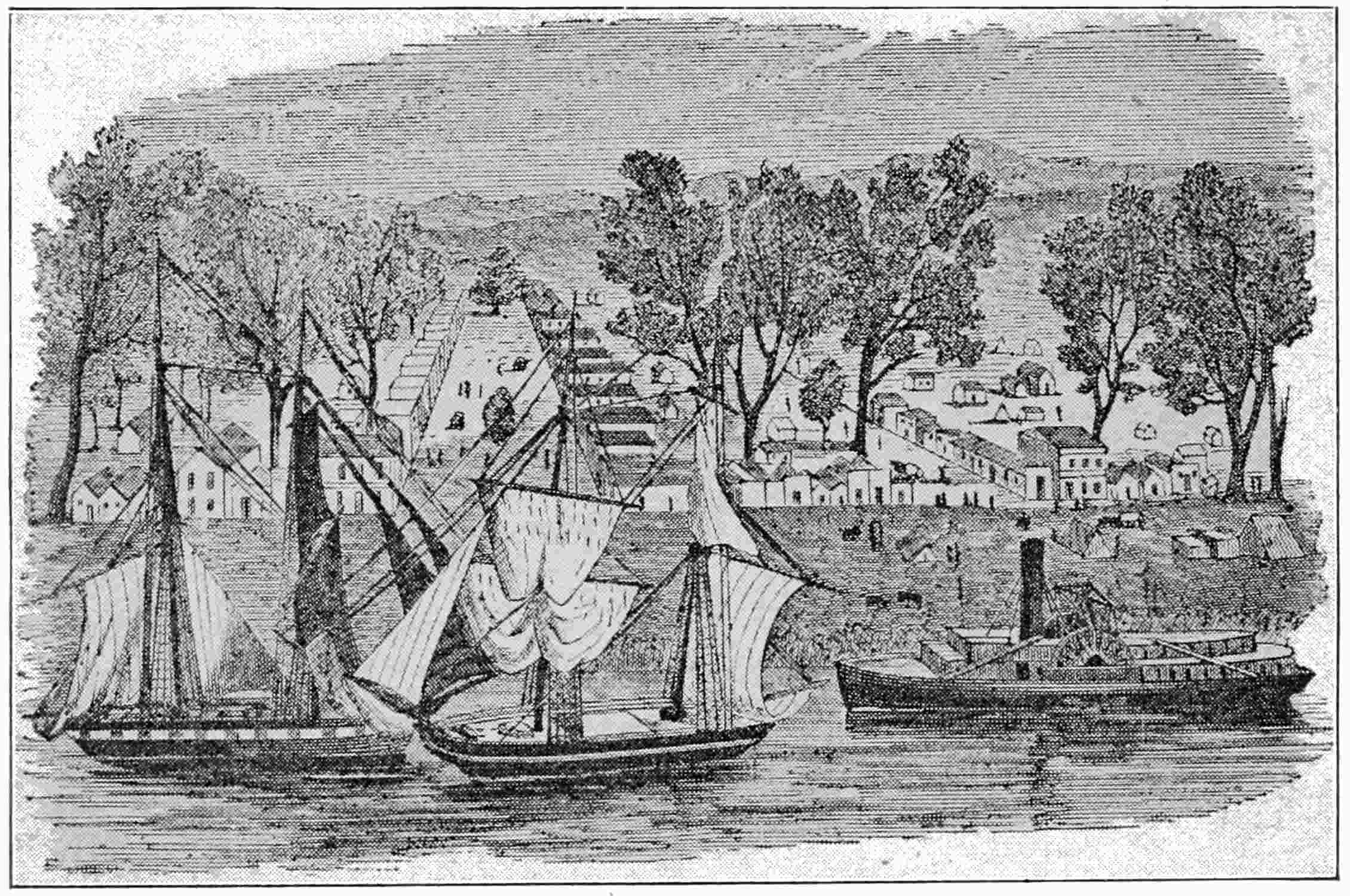
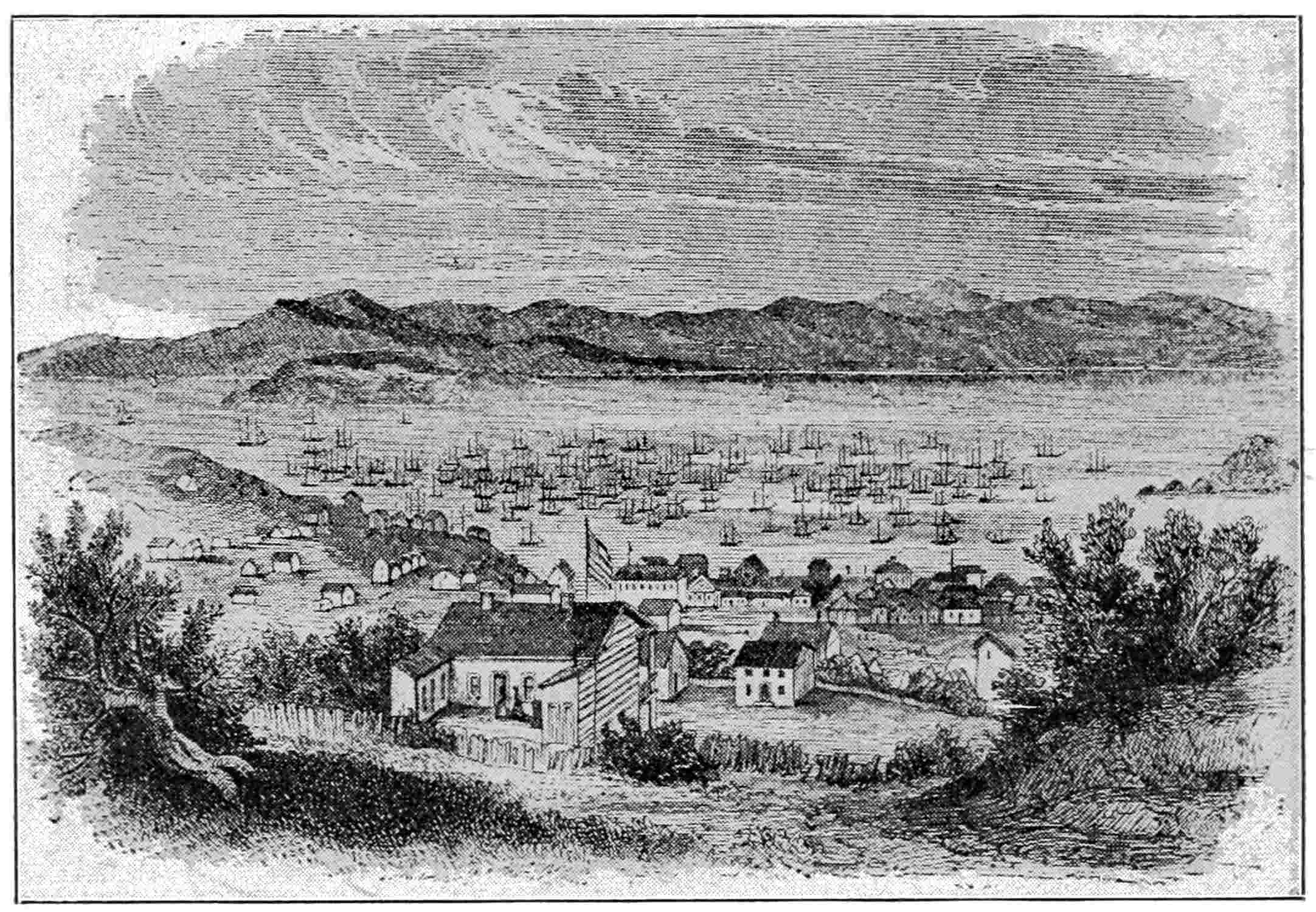 SAN FRANCISCO. 1849.
who followed the trail are in advance of the train, and will probably
camp with some other train.
The days are very warm but the nights are cool and pleasant.
Sunday, September 9.
Finding a good supply of grass at this camp ground we did not move our
camp today.
Monday, September 10.
Broke camp at six o’clock this morning and traveled down the river 12
miles in the forenoon and 13 in the afternoon and camped. Grass poor.
Tuesday, September 11.
Decamped at 5.30 o’clock this morning and traveled 11 miles in the
forenoon and 12 in the afternoon. The road down this river is
comfortably good, but is very dry and dusty. The weather has been
extremely warm today.
Wednesday, September 12.
Traveled ten miles in the forenoon and nine in the afternoon and camped
on the river. A slight shower of rain fell during the night.
Thursday, September 13.
Traveled 16 miles in the forenoon and eight more in the afternoon and
camped on the river, where we found a limited quantity of grass.
Friday, September 14.
Traveled 12 miles in the forenoon and halted where grass was not very
plentiful. In the afternoon we traveled five miles farther, when we came
to another fork in the road.
The left hand road is the old trail and leads down the river to the
“Sink,” as it is called, it being where the water of the river
disappears in the sandy desert, as is the case with a majority of the
streams of the “Great Interior Basin.”
From the “Sink” the road passes thence over a desert plain to Salmon
Trout River, and thence across the Sierra Nevada Mountains to the
Sacramento valley. The distance from this place to the Sacramento
valley, according to the best information in our possession, is about
300 miles.
The other, or right hand road, is called the Cherokee Cutoff, and the
distance is said to be but 180 miles from this place to the Feather
River gold mines.