WITH AN INTRODUCTION BY
SIR WILLIAM OSLER, B.A., M.D., F.R.S.
AND A PREFACE BY
FRANCIS R. PACKARD, M.D.
NEW YORK
PAUL·B·HOEBER
1915
Copyright, 1915 By PAUL B. HOEBER
Published April, 1915
Printed in the U. S. A.
INTRODUCTION.
It is very fitting that a new edition of the
Gold Headed Cane should appear just at this
time, as a memorial of the life and labours of
its first owner, Dr. John Radcliffe. Here in
Oxford, where his name is writ large in stone,
we had hoped to have ceremonies appropriate
to the 200th anniversary of his death, but at
present the University has other things to think
of. The Radcliffe Trustees have, however, arranged
with Dr. Nias and the Clarendon Press
to issue a brief life and an account of the Travelling
Fellows, with whom his name is associated.
When and where he got the celebrated
cane is unknown. To the story of his life so
well told here by Dr. Macmichael nothing need
be added. There is probably no name in our
profession with which are associated so many
benefactions. The Radcliffe Infirmary, originally
erected by his Trustees out of their
funds, has become one of the most important
of the county hospitals in England; but the
Trustees no longer have any financial interest
in its support. The Radcliffe Observatory
was built by them and they pay the upkeep
and the salary of the Radcliffe Observer. The
Radcliffe Camera or Library, one of the most
beautiful buildings in Oxford, was designed
for the scientific part of the Bodleian Library.
After the laboratories were centred about the
museum it was found more convenient to have
the scientific books close at hand, and one of
the old Guilds, the Draper’s Company of London,
put up a beautiful new building in which
the Radcliffe Library is now housed, all the
expenses of which are paid by the Trustees.
Also under Dr. Radcliffe’s will £600 a year
is paid to St. Bartholomew’s Hospital. The
property is largely in land not far from Stony
Stratford. In addition, he left his Yorkshire
estate to the Master and Fellows of University
College, to provide for the maintenance of the
Travelling Fellows: one is elected each year
and holds the appointment, worth £200, for
three years, one of the conditions being that he
spends half of the time in studying abroad.
These splendid benefactions keep alive the
name of Dr. Radcliffe in Oxford and in professional
circles.
In many ways the account of Mead is the
best in the volume. Of him Johnson is reported
to have said that he lived more in the
sunshine of life than any man he knew. Dr.
Macmichael in this little volume has done more
for Mead’s memory than his published works.
It is a pity that he did not hand over his wonderful
collections to the College of Physicians.
Now the bibliophile turns the pages of the
printed catalogue of his books, which took
twenty-seven days to sell, and mourns that the
treasures of his lifetime should have been dispersed.
About the next possessor of the Cane, Anthony
Askew, the memory lingers in connection
with the famous Bibliotheca Askeviana,
the priceless treasures of which were dispersed
in 1775 in a twenty days’ sale. Only one of
the great libraries collected by physicians in the
18th century remains. William Hunter had
the good sense to leave his books, coins, manuscripts
and specimens to his native place, and
the Hunterian Library and Museum are
among the most precious possessions of Glasgow
University.
Pitcairn is remembered to-day solely from
his association with the Cane. In the rambling
section under his name, Macmichael does not
tell us much about him, and leaves us a little in
doubt when he died, and whether or not his
nephew, David, was one of the possessors of
the Cane. As a practitioner he appears to
have picked up the secret of Sydenham’s success,
the free use of opium, as in the book he
speaks of his currus triumphalis opii.
Baillie, in many ways the most distinguished
possessor of the Cane, had caught the inspiration
from his uncles John and William
Hunter, and to him more than to any other
man is due that close combination of pathology
with clinical medicine, still the distinguishing
feature of the English school, and of which
such splendid use was made by Bright, Addison,
and Hodgkin.
Few books of its kind have been more successful,
and that a new edition should appear
from the press of Mr. Hoeber is an indication
of the zeal with which the study of the history
of medicine has been taken up by the profession
of the United States.
Oxford,
February 26th, 1915.
PREFACE
William Macmichael, the author of the
Gold-Headed Cane, was born at Bridgenorth,
in Shropshire, in 1784, and after receiving his
education at the grammar school of that town,
entered as a student at Christ Church, Oxford,
where, after receiving his degree of Master of
Arts in 1807, he graduated as a Doctor of
Medicine in 1816. In 1811, he was elected to
the Radcliffe Travelling Fellowship which
owed its foundation to the generosity of Dr.
Radcliffe, about whom he writes so delightfully
in his chef d’œuvre. These fellowships
were founded with the purpose of giving their
holders the opportunity of travel in foreign
lands, and Dr. Macmichael passed several
years journeying in Russia, Turkey, Greece
and Palestine. That he was an observing and
interested traveller is manifested in a little
work which he published in London in 1819,
entitled “A Journey from Moscow to Constantinople,
in the Years 1817 and 1818.”
He was, for a short time, physician to Lord
Londonderry while the latter was ambassador
to Vienna. He settled in London in the practice
of medicine in 1818, and was elected a fellow
of the College of Physicians of London in
the same year. At the outset of his career as
a practicing physician, he had the good fortune
to secure the friendship of Sir Henry Halford,
to whom the College was indebted for the gift
of the Gold-Headed Cane, which had descended
to Sir Henry from the distinguished
line of bearers about whom Macmichael centered
its autobiography. Sir Henry Halford’s
influence in professional and social circles in
London was immense. His name was really
Henry Vaughan. His father was a physician
in Leicester, who devoted his entire income to
the education of his seven sons, all of whom
proved themselves worthy of the parental self-denial
by the eminent positions which they subsequently
obtained in the professions which
they respectively adopted. Sir Henry, after
graduating from Oxford, secured an advantageous
social position for himself by his marriage
to the daughter of Lord St. John of
Bletsoe. He inherited a large property on
the death of Lady Denbigh, the widow of his
mother’s cousin, Sir Charles Halford, Bart.,
and by an act of Parliament, in 1809, changed
his name from Vaughan to Halford. In the
subsequent year he was made a baronet. He
attended in a professional capacity George
III, George IV and Queen Victoria, and after
the death of Matthew Baillie, he had the largest
and most fashionable practice in London.
Halford was the president of the College of
Physicians of London from 1820 until his
death in 1844, and it was during his presidency
that the College was removed from Warwick
Lane to Pall Mall East. Those who envied
his position attributed his success to his courtly
manners, and he was nicknamed “the eel-backed
baronet.” The story is told that he
galloped from the death bed of George IV out
to Bushy Park in order that he might have
the honor of being the first to inform William
IV of the glad event. He was present at the
opening of the coffin of Charles I, in 1813, and
published an account of the proceedings on
that occasion. J. F. Clarke, in his autobiography,
accuses Halford, amongst other things,
of retaining possession of part of the King’s
fourth cervical vertebra through which the
axe passed, and displaying it at his dinner
table as an interesting curio.
Halford, in the words of Dr. Munk, “at the
height of his success, and when his duties at
Court were the most onerous, found it necessary
to have in reserve some physician on
whom he could implicitly rely, to act as his
representative and substitute when such was
needed. His choice fell on Dr. Macmichael,
who, through Sir Henry’s influence, was appointed
in rapid succession Physician Extraordinary
to the King in 1829, Librarian to the
King in 1830, in place of a very eminent
physician, Dr. Gooch, recently deceased; and
finally, in 1831, Physician in Ordinary to the
King.”
Halford had been obliged to resign his position
as physician to the Middlesex Hospital,
owing to the pressure of other duties, as early
as 1800; but it was probably due to his influence
that twenty-two years later Macmichael
was appointed to the same position. Macmichael
was very active in the affairs of the
College of Physicians, served among its officers
on several occasions, and read a number
of communications before it. He wrote various
articles on contagion and infection, none
of them possessing any great value. In spite
of powerful backing and the important positions
he held, Dr. Macmichael lacked the ambition
or did not possess the aptitude to acquire
a large practice.
In 1830 Macmichael published “Lives of
British Physicians,” of which another edition
was published by Thomas Tegg in 1846.
Macmichael himself contributed to it the lives
of Linacre, Caius, Harvey, Sir Thomas
Browne, Sydenham and Radcliffe. The biographies
of twelve other English medical worthies
were contributed by Dr. Bisset Hawkins,
Dr. Parry, Dr. Southey, Dr. Munk, and Mr.
Clarke. The book is a small volume containing
portraits of some of the more famous
subjects. It was dedicated to Sir Henry
Halford. Although not so happy in its conception
and execution as the Gold-Headed
Cane, this little work is a most valuable contribution
to English medical literature. The
lives are well written, accurate, and contain
information much of which is derived from
sources inaccessible to the general reader.
In 1837, at the age of fifty-three, Dr. Macmichael
suffered a stroke of paralysis which
obliged him to retire from professional life and
he died two years later at his residence in
Maida Vale. Sir Thomas Watson, the famous
London Physician, was one of Dr. Macmichael’s
friends who knew him many years.
In 1878 Sir Thomas Watson wrote of him as
follows, to Munk:[1] “Dr. Macmichael was
fond of society, and qualified alike to enjoy and
embellish it. Having travelled long and seen
many cities and the manners of many men, he
possessed a large stock of general information,
was fertile in various and amusing anecdotes,
and was wont to mix, with certain natural ease
and grace, in lively and interesting discourse,
without making his own share in it unduly
prominent. His cheerfulness and equanimity
of temper, and kindness of heart, endeared him
to a large circle of devoted friends, of whom
a very few only, at the time of this writing,
survive to commemorate his engaging qualities
and to regret his loss.”
Under Sir Henry Halford’s presidency the
College of Physicians underwent a great
awakening. It acquired, largely through his
individual efforts, a splendid new home and
he also originated the evening meetings which
were henceforth held in the Hall. These were
held once a month during the first six months
of the year, at nine o’clock in the evening.
Tea and coffee were provided. The meetings
were attended not only by physicians, but by
many persons of prominence in the various
walks of life. The papers presented at them
were, therefore, as a general rule, adapted to
a mixed audience. They were not read by
their authors, but by the Registrar of the College,
except in the instance of the President,
who was permitted to read such communications
as he might wish to make himself. A
great part of Sir Henry Halford’s success in
these innovations was due to the active part
taken by Macmichael in seconding his efforts
in this as in every other way by which he could
show his gratitude and aid his friend and benefactor.
In nothing could he have succeeded
better in awakening renewed interest in the
venerable College than by directing attention
to its past history and to the achievements of
the illustrious men who had been connected
with it. It was probably this desire which led
Macmichael to utilize his erudite knowledge
of the subject in the compilation of the fascinating
book to which he gave the name of
“The Gold-Headed Cane.”
The new College was opened on the 25th of
June, 1825. According to its veracious autobiography,
on the previous day the Cane was
deposited in a corner closet of the new building,
“with the observation that I was no
longer to be carried about.” The Gold-Headed
Cane now occupies a glass case in the
Library of the College, where it may have the
consolation of feeling that it is gazed on by
many visitors who have read its history and
been stimulated by it to wish a close view of
the author.
The Cane was carried successively by Radcliffe,
Mead, Askew, Pitcairn and Baillie, and
bears their various arms engraved upon its
head. It was presented to Sir Henry Halford
by Dr. Baillie’s widow and he in turn
placed it in the College.
Dr. Macmichael’s happy inspiration to write
its autobiography was carried into effect at the
time when the enthusiasm of the Fellows at
the acquisition of their splendid new hall was
at its height. The first edition was published
in 1827, and a second edition in the succeeding
year. A third edition, edited by Dr. William
Munk, was published in 1884, forty-five years
after Macmichael’s death.
The cane in ancient days was regarded as an
essential part of the equipment of every physician.
Dr. Munk, in the third edition of the
Gold-Headed Cane, adverts to this fact and
also explains the origin of the custom. The
cane usually carried by physicians had for its
head a knob of gold, silver or ivory, which was
hollow, and perforated so that it served to contain
aromatic preparations which could be inhaled
as a preventive of contagion. The
favorite preparation for this purpose was the
“vinegar of the four thieves,” or Marseilles
Vinegar, an aromatic vinegar which, according
to the confession of four thieves (who had,
during a plague at Marseilles plundered the
dead bodies) had prevented them from contracting
the disease while pursuing their nefarious
occupation.
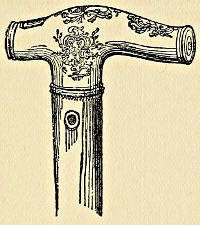
The Gold-Headed Cane was adorned by a
cross bar for a top instead of a knob, a fact
which Munk explains by the statement that
Radcliffe, its first owner, was a rule unto himself,
and very possibly preferred a handle of
that kind for his cane as a distinction from that
used by the majority of physicians.
With its passage from the possession of Dr.
Pitcairn into that of Dr. Baillie, the Cane pathetically
states: “I ceased to be considered
any longer as a necessary appendage of the
profession, and consequently the opportunities
I enjoyed of seeing the world, or even of
knowing much about the state of physic, were
very greatly abridged, and of but rare occurrence.”
With the account of Baillie and the state of
physic in his time the Cane ceased its autobiography
and regarded its honorable career as
closed. Dr. Munk, in the third edition, published
in 1884, wrote a continuation of the narrative
in very good imitation of Macmichael’s
style, which brought the story down to the year
1871.
The publication of a new edition of a medical
and literary classic such as the Gold-Headed
Cane requires no apologia. The
three previous editions are now all of them
so difficult to obtain, the book so eagerly
sought for, and its perusal productive of so
much profit and pleasure, that the demand is
obvious.
The medical profession in Great Britain and
America owe the present undertaking entirely
to the unselfish zeal of the Publisher, whose
love and admiration for the merits of the Cane
prompted him to undertake a venture from
which in a commercial point of view no profit
can be expected.
The present edition follows the text and
illustrations contained in the second edition,
which was chosen for reprinting because it
was revised, added to and published by the
author himself. The first edition contained
179 pages. To the second edition Dr. Macmichael
added 88 pages of text, which contain
much of the very best of his work. The
third edition contained no illustrations, and although
the continuation of the narrative is
most interesting, it is not Macmichael’s and
therefore not the Cane’s.
It is to be hoped that with the recent great
stimulation of interest in medical history which
the profession in this country has shown this
little volume will achieve the same popularity
as its predecessors and add more lustre to the
glory of the Cane.
Francis R. Packard.
Philadelphia,
March, 1915.
BIBLIOGRAPHY OF THE WRITINGS OF WILLIAM MACMICHAEL.
“A Journey from Moscow to Constantinople in the year
1817-18.” 4to, London, 1819.
“A New View of the Infection of Scarlet Fever; illustrated
by Remarks on Other Contagious Disorders,”
8vo, vi, 100 pp. London, T. and G. Underwood,
1822.
“A Brief Sketch of the Progress of Opinion upon the
Subject of Contagion, with Some Remarks on Quarantine.”
8vo, London, 1825.
“The Gold-Headed Cane,” 179 pp., 8vo, London, J.
Murray, 1827.
“The Gold-Headed Cane,” 267 pp., 8vo, London, J.
Murray, 1828.
“Is the Cholera Spasmodica of India a Contagious Disease?”
The question considered in a letter to Sir
Henry Halford, Bart., M.D. 34 pp., 8vo, London, J.
Murray, 1831. A French translation of this pamphlet
was published in Paris in 1831.
“Some Remarks on Dropsy; with a Narrative of the
Last Illness of H. R. H. the Duke of York”; read at
the Royal College of Physicians, May 25, 1835. 18 pp.,
8vo, London, J. Murray, 1835.
“The Gold-Headed Cane,” edited by William Munk,
XVI, 266 pp., 8vo, London, Longmans, 1884.
In this edition the editor continues the narrative of
the Gold-Headed Cane down to the year 1876, in imitation
of Macmichael’s style. It lacks the quaint illustrations
which ornamented the first two editions
and added so much to their charm.
THE
GOLD-HEADED CANE.
SECOND EDITION.
LONDON:
JOHN MURRAY, ALBEMARLE-STREET. MDCCCXXVIII.
TO THE HONOURABLE LADY HALFORD,
THIS VOLUME
IS DEDICATED
WITH
SENTIMENTS OF THE GREATEST RESPECT AND ESTEEM,
BY
HER LADYSHIP’S
MOST FAITHFUL SERVANT, THE EDITOR.
NOTICE BY THE EDITOR.
A short time before the opening of the New
College of Physicians, Mrs. Baillie presented
to that learned body a Gold-Headed Cane,
which had been successively carried by Drs.
Radcliffe, Mead, Askew, Pitcairn, and her
own lamented husband.
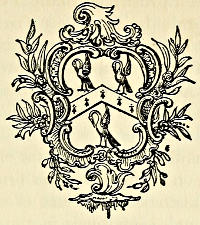
The arms of these celebrated Physicians are
engraved on the head of the Cane, and they
form the Vignettes of the five Chapters into
which this little Volume is divided.
When I was deposited in a corner closet
of the Library, on the 24th of June, 1825, the
day before the opening of the New College
of Physicians, with the observation that I was
no longer to be carried about, but to be kept
amongst the reliques of that learned body, it
was impossible to avoid secretly lamenting the
obscurity which was henceforth to be my lot.
Formerly the entrée of palaces had been open
to me; I had been freely admitted into the
houses of the great and the rich; but now I
was doomed to darkness, and condemned to
occupy the corner of a library—spacious and
splendid, it must be allowed, but where I was
surrounded by nothing but the musty manuscripts
of defunct doctors. The gloom, however,
of my present abode was enlivened on
the following day by my overhearing the elegant
oration of the President of the College;
and an occasional glance I had of scarlet
dresses recalled the decorum and propriety of
the days of yore, when, on all solemn occasions
of public meeting, the Fellows appeared habited
in the doctors’ robes of their respective
universities. I had passed through so many
erudite hands, and had been present at so many
grave consultations, that the language of the
oration was familiar to me, and I could easily
collect, from certain allusions in the speech,
that princes of the blood, the legislators of the
land, the nobles and learned of England,
formed a considerable portion of the audience.
The topics upon which the accomplished orator
touched were various and interesting; but I
listened with increased attention when I heard
him speak of the donation of the Radcliffe
Trustees[2], and every fibre thrilled within me
at the consciousness of the heartfelt delight
with which my first kind and generous master
would have grasped me, could he have foreseen
the liberal spirit of the future guardians
of his princely fortune.
The low murmur of applause which accompanied
the commemoration of the integrity
and honest simplicity of character of the last
physician, whose hand I had graced, checked
as it was by the reflection, that he was now,
alas! no more, marked alike the eloquence of
the orator, and the good taste and feeling of
his audience. But the speech was too soon
finished, and the guests slowly retired from
the Library. I was once more left to silence
and solitude; never, perhaps, to see the light
of day, unless when my closet was occasionally
unlocked, that I might be shown as a curiosity
to some idle and casual visitor. I had, however,
been closely connected with medicine for
a century and a half; and might consequently,
without vanity, look upon myself as the depositary
of many important secrets, in which
the dignity of the profession was nearly concerned.
I resolved, therefore, to employ my
leisure in recording the most striking scenes
I had witnessed. The Doctors had indeed resumed
their robes; but it was too much to
expect that they would again carry the cane,
and adopt the use of the full-bottomed wig;
though I have not the least doubt that the
honour of physic, and perhaps the welfare of
mankind, would be greatly promoted by so
praiseworthy a practice.
These Memoirs are the fruit of my retirement;
and should the reader feel any disposition
to authenticate my narrative by reference
to the records of the different periods it embraces,
I feel no fear for the result of his investigation:
since if the written documents be
correct, they must agree with my story.
Of my early state and separate condition
I have no recollection whatever; and it may
reasonably enough be supposed, that it was
not till after the acquisition of my head that
I became conscious of existence, and capable
of observation. But I shall never forget the
first consultation at which I was present;
where every thing being strange to me, I was
attentive to the most minute circumstances,
which then came recommended to my notice
as well by the importance and dignity of the
patient, as by the novelty of the scene. As
in these conferences there is usually much matter
of routine, I became afterwards more careless;
and as none of the responsibility of the
advice given rested with me, I allowed my
thoughts to wander.
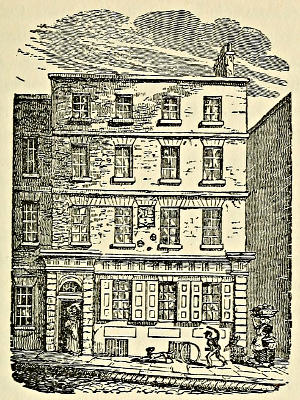
It was in the autumn of 1689. My master,
Dr. Radcliffe, had just then returned from a
distant journey in the country, and was much
fatigued, when an urgent message reached
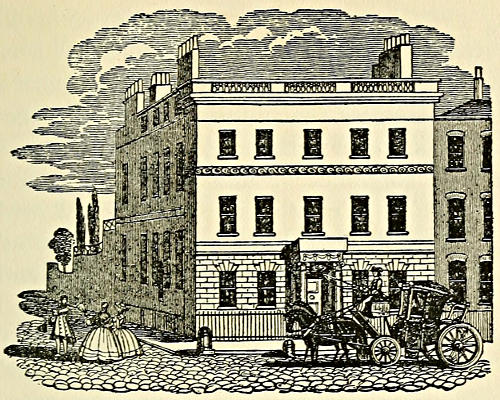
him at his house in Bow-street, Covent Garden.
Snatching me up, he hurried into his
carriage, and set off with all speed for Kensington
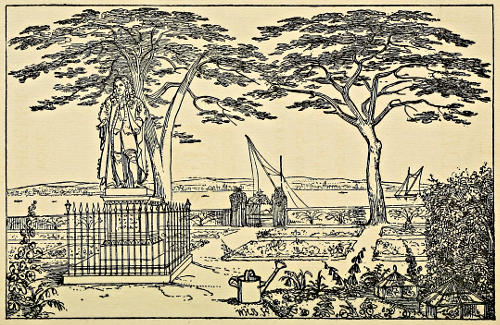
House. This irregular edifice, which
had recently been purchased by the crown of
the second Earl of Nottingham, had undergone
several alterations, and received some
additions hastily put together for the immediate
accommodation of the court. The edifice
itself was not extensive, having rather the
appearance of the neat villa of a nobleman
than that of a royal mansion; and the gardens
were upon a small scale, but kept in the
neatest possible order. From the town of
Kensington, the approach was by a double
row of large elm trees, leading to the north
entrance of the house, through an unenclosed
field, which was at that time disfigured by a
gravel-pit. Here, however, afterwards, the
skill of the famous gardeners of the day,
London and Wise, was employed; and the
cut yew and variegated holly hedges were
taught to imitate the fines, angles, bastions,
scarps, and counterscarps, of a regular fortification.
This curious upper garden, known
by the name of the Siege of Troy, was long
the admiration of every lover of that kind of
trim horticultural embellishment[3].
We were ushered through a suite of several
rooms, plainly but handsomely furnished, by
Simon de Brienne; and it seemed to me that
the Doctor assumed a more lofty air, and
walked with a firmer step, and I was conscious
of a gentle pressure of his hand, as he
stopped and gazed for a moment on the likeness
of the Founder of the College of Physicians,
Dr. Linacre, painted by Holbein, which
was hanging in one of the rooms, amongst
the royal portraits of the Henrys, and several
other of the Kings and Queens of England
and Scotland.
On entering the sick chamber, which was
a small cabinet in the south-east angle of the
building, called the Writing Closet, a person
of a grave and solemn aspect, apparently about
forty years of age, of a thin and weak body,
brown hair, and of middle stature, was seen
sitting in an arm-chair, and breathing with
great difficulty. The naturally serious character
of the King (for it was His Majesty
William the Third) was rendered more melancholy
by the distressing symptoms of an
asthma, the consequence of the dregs of the
small-pox, that had fallen on his lungs. In
the absence of the fit, and at other times, his
sparkling eyes, large and elevated forehead,
and aquiline nose, gave a dignity to his countenance,
which, though usually grave and
phlegmatic, was said in the day of battle to
be susceptible of the most animated expression.
“Doctor,” said the King, “Bentinck[4]
and Zulestein[5] have been urgent with me
that I should again send for you; and though
I have great confidence in my two body-physicians
here, yet I have heard so much of your
great skill, that I desire you will confer with
Bidloo and Laurence, whether some other plan
might not be adopted. They have plied me so
much with aperitives to open my stomach, that
I am greatly reduced; my condition is, I think,
hazardous, unless you try other measures.”
The King seldom spoke so long at a time,
his conversation being usually remarkably dry
and repulsive; and here His Majesty’s speech
was interrupted by a deep cough, and he sunk
back in his chair exhausted. “May it please
Your Majesty,” said Dr. Radcliffe, “I must be
plain with you, Sir: your case is one of danger,
no doubt, but if you will adhere to my prescriptions,
I will engage to do you good. The
rheum is dripping on your lungs, and will be
of fatal consequence to you, unless it be otherwise
diverted.”—Upon this Dr. Bidloo, who,
though expert in the knowledge of some
branches of physic, was not always happy or
quick in his conjectures, was about to reply.
There was something like an insinuation of
mala praxis in the last observation; and
being somewhat of an irascible temper, the
Dutchman, anxious perhaps to return to his
duties of professor of anatomy and surgery at
Leyden, was indifferent about giving offence
to his royal master. But the King, in a calm
and sullen manner, imposed silence, and intimated
to the physicians to withdraw and consult
upon the treatment of his malady. The
consultation was short, and the result was,
that some medicines should be tried that
might have the effect of promoting the flow
of saliva. This treatment fully succeeded, for
the King was so completely restored, that a
few months afterwards he fought the battle
of the Boyne.
Before we left the palace, my master waited
upon Her Majesty the Queen; and as it was
well known, that Mary grew weary of any
body who would not talk a great deal (while
her sister the Princess Anne of Denmark was
so silent that she rarely spoke more than was
necessary to answer a question), our audience
was not soon over. It was said by the enemies
of the Queen, that whatever good qualities
she had to make her popular, it was
but too evident, by many instances, that she
wanted bowels; but on the present occasion
the accusation was quite untrue, for on the
subject of the King’s indisposition, nothing
could exceed her anxiety, and it was impossible
for the physician to answer Her Majesty’s innumerable
inquiries. What was the nature
of his complaint? the probable issue? how long
a time would be required to complete his recovery,
so that, in the present critical state
of affairs, His Majesty might be enabled to
return to the management of public business,
and take the field against his enemies? In
fact, the Queen asked questions which I soon
found, by a very little experience, that the conjectural
nature of the art of medicine would
not always allow to be answered with precision.
The person of the Queen was majestic,
and calculated to inspire respect; and her conversation
(when not under the influence of
such feelings as now agitated her) indicated
a fine and cultivated understanding, for she
had read much in history and divinity. Her
Majesty’s studies were, however, even now
beginning to be interrupted by a course of
humours that was forming in her eyes, and
which compelled her to employ her time in
another manner. But she was ever active;
and so industrious, that she wrought many
hours a day herself, with her ladies and maids
of honour working about her, while one read
to them all.
Our interview with the Queen took place
in a small apartment, afterwards known by
the name of the Patch-work Closet, the sides
of which were hung with tapestry, the work
of her own hands; as were also the coverings
of the chairs with which the room was furnished.
As I shall not have occasion again to
speak of the Queen, it may here be mentioned
that, five years afterwards, this incomparable
Princess fell a victim to the small-pox; and
though my master was blamed by his enemies,
as having caused her death, either by his
negligence or unskilfulness, yet he himself
always maintained that he was called too late,
and that no remedies that could then be tried
had the least chance of doing her good. On
this delicate point, any evidence which I could
advance would be received with suspicion;
and it remains only to observe, that on this
melancholy occasion King William exhibited
feelings which no one had previously given
him credit for. A great politician and soldier,
who had been immersed in dangers and calamities
from his infancy, he was possessed of
boundless ambition, which he concealed under
a cold exterior, never allowing his speech to
betray the wishes of his heart. But during
the last sickness of the Queen, His Majesty
was in an agony that amazed every one about
his person, fainting often, and breaking out
into most violent lamentations. When he
heard of her death, he was much affected,
burst into tears, and for some weeks after was
not capable of minding business or of seeing
company.
Whilst the nation was grieving for the loss
of the Queen, an event took place in our
domestic establishment, which considerably
ruffled my master’s temper, and interrupted,
for a short space, the usual gaiety of his life.
Though it could not be said that our house
was ever a melancholy one (in truth, we were
little at home, the Doctor living much in society,
whither I accompanied him to taverns
and clubs, where the choicest spirits were wont
to assemble), yet still the home of a bachelor
is occasionally but a dull and stupid residence.
The friends of Radcliffe were therefore always
urging him to look out for a wife, and he at
length listened to their advice. One who was
so general a favourite in society, and, besides,
who was known to be so well to pass in the
world (for at that time he was worth, at the
least, £30,000, and daily adding to his wealth),
had no great difficulty in meeting with an object
upon whom to place his affections. A
young lady, the daughter of a wealthy citizen,
whose name I forbear to mention, in consideration
of the awkward disclosure which ultimately
took place, soon attracted his attention.
She was an only child, not more than twenty-four
years of age, and with a tolerable share
of personal charms: the parents readily assented
to the proposal, and the terms of the
marriage were soon agreed upon; the lady was
to have £15,000 down, and the residue of the
citizen’s estate at his decease. The visits of
my master into the city were numerous, but he
took me with him once or twice only. To tell
the truth, I felt myself, on these occasions,
quite misplaced; not that I was at all unaccustomed
to female society—quite the reverse;
but then the conversations, with which I was
familiar, were altogether so different. Here
were none of the ordinary questions about
health, the last night’s repose, the situation of
pain, the long detail of complaints, the vapours,
the low muttering with the waiting-woman
aside; and at last, when the hurry and
agitation occasioned by the doctor’s arrival had
subsided, the sagacious feeling of the pulse.
To all this I was daily habituated; but, in the
new scene to which I was now introduced, I
was conscious of making an awkward appearance,
and was glad to be left at home. Matters,
however, seemed to proceed prosperously,
and every thing promised a consummation of
my master’s happiness; when, one evening, he
returned late to his home, obviously much discomposed.
He was no sooner alone in his
chamber, than he gave vent to his chagrin.
“Good God!” said he, as he paced up and
down the room, “what a discovery! Well!
hanging and marrying certainly go by destiny;
and if I had been guilty of the last, I
should scarcely have escaped the first. What
would my acquaintance have said? And my
neighbour, Sir Godfrey, how would he have
triumphed! He was sarcastic enough the
other day about that confounded garden-door[6]—here
there would have been no bounds
to his mirth; I should have been the laughing-stock
of all who know me.
“Mrs. Mary is a very deserving gentlewoman,
no doubt; but her father must pardon
me, if I think her by no means fit to be
my wife, since she is or ought to be another
man’s already!” These and other similar expressions
escaped him, as he continued to walk
to and fro, apparently in the highest degree
of excitement. At length he sat down to his
table and wrote a letter to Mr. S—d, declining
the honour of becoming his son-in-law, and
stating his reasons in full for so sudden a
change of resolution. The effects of this disappointment
were visible for some time, but
he ultimately recovered his spirits, returned to
his former aversion to matrimony, and resumed
his usual habits of conviviality and independence.
His practice increased, and there were few
families of any note that had not some time
or other recourse to his skill and advice. I
began now to consider how his superiority over
his rivals was to be explained, whence arose
the great confidence reposed in him by his
patients; to what, in fine, his eminent success
was to be attributed. It was clear, his
erudition had nothing to do with it; but
though there was something rude in the manner
in which he frequently disparaged the
practice of others, yet it could not be denied
that his general good sense and practical
knowledge of the world distinguished him from
all his competitors. He was remarkable for
his apt and witty replies, and always ready in
suggesting expedients; though, to be sure, some
of them were homely enough, and occasionally
sufficiently ludicrous, and such as I never
witnessed with the grave and more polished
doctors into whose hands I afterwards passed.
He was once sent for into the country, to visit
a gentleman ill of a quinsey. Finding that
no external nor internal application would be
of service, he desired the lady of the house to
order a hasty-pudding to be made: when it
was done, his own servants were to bring it up,
and while the pudding was preparing, he gave
them his private instructions. In a short time
it was set on the table, in full view of the
patient. “Come, Jack and Dick,” said Radcliffe,
“eat as quickly as possible; you have
had no breakfast this morning.” Both began
with their spoons, but on Jack’s dipping once
only for Dick’s twice, a quarrel arose. Spoonfuls
of hot pudding were discharged on both
sides, and at last, handfuls were pelted at each
other. The patient was seized with a hearty
fit of laughter, the quinsey burst and discharged
its contents, and my master soon
completed the cure.
So much for his humour; but it was the
confident tone in which he frequently predicted
the issue of diseases, a quality which
he possessed in an eminent degree, and often
exercised with great success, that chiefly gave
a decided advantage to Radcliffe over his
rivals in practice. I will relate one of these
occasions, which was very striking. Being
sent for once, to attend the Duke of Beaufort
at Badminton, who was very ill, the Doctor,
instead of complying with the request, told
the gentleman who brought the message,
“There was no manner of necessity for his
presence, since the Duke his master died such
an hour the day before:” which the messenger
on his return found to be true.
By the judicious exercise of this foresight
a physician acquires the greatest reputation,
and when his prognosis is the result of mature
experience, he is entitled to be bold. Besides,
the fears, the doubts, and anxiety of the
friends of the sick ought to be taken into account:
they have a right to the consolation
of certainty; and the doctor ought not to be
over-scrupulous of his reputation, nor entrench
himself too much in the security of an ambiguous
reply. His duties demand discretion
and humanity: in circumstances of danger, he
is called upon to give to the friends of the
patient timely notice of its approach; to the
sick, he should be the minister of hope and
comfort, that by such cordials he may raise
the drooping spirit and smooth the bed of
death. That “the Doctor should go out at
one door when the Clergyman enters in at
the other,” is a quaint conceit, more expressive
of impiety than humour; for even when
the life of the patient is absolutely despaired
of, the presence of a man of a compassionate
and feeling heart will prove highly grateful
and useful to the dying sufferer, as well as
to his nearest relations.
The health of King William continued tolerably
good till after his return from abroad in
1697, on the ratification of the celebrated treaty
of Ryswick, when my master was again sent
for to visit his royal patient. After rather
jocosely illustrating His Majesty’s situation
by an allusion to one of Æsop’s fables, which
the King (previously to our arrival) was reading,
in Sir Roger L’Estrange’s translation, I
was rather startled at the blunt manner in
which Radcliffe told his patient that he must
not be buoyed up with hopes that his malady
would soon be driven away. “Your juices are
all vitiated, your whole mass of blood corrupted,
and the nutriment for the most part
turned to water: but,” added the Doctor, “if
Your Majesty will forbear making long visits
to the Earl of Bradford, (where, to tell the
truth, the King was wont to drink very hard,)
I’ll engage to make you live three or four years
longer; but beyond that time no physic can
protract Your Majesty’s existence.” I trembled
at the bold and familiar tone assumed by
my master, as well as at the positive prognosis
which he ventured to give; but his prediction
was verified by the sequel. King William died
in 1702. The year before this event, Dr. Bidloo
had accompanied His Majesty to Holland,
where his treatment of his royal patient at
that time, and for some months before his
death, was a subject of animadversion with
the other doctors attached to the court. In
addition to many other infirmities under which
the King laboured, he was troubled with boils
that formed in different parts of his body; and
for these Bidloo directed that his feet and legs
should be rubbed night and morning, with
flannel covered with powder of crabs’-eyes,
flour, and cummin-seed. As to diet, the Doctor
was exceedingly indulgent, allowing His
Majesty to drink cider, ale—in short, all sorts
of strong beer; and to take crude aliments before
going to bed. It was in vain that Doctors
Hutton, Millington, Blakemore, and Laurence
remonstrated. On the King’s return to
Hampton Court, the dropsical swelling of the
inferior extremities extended upwards, for
which Bidloo prescribed a vapour-bath, and inclosed
the legs of the patient in a wooden box
constructed for that purpose. In a constitution
so weak, which this treatment was reported
to have still more debilitated, an accident was
likely to prove fatal. On the 27th of February,
1702-3, while hunting, the King fell from
his horse, and broke his right clavicle near the
acromion. This occurred in the neighbourhood
of Hampton Court; but the French surgeon
Ronjat was at hand, and soon reduced the
fracture. But when he wanted to bleed His
Majesty, a new obstacle arose, for it was necessary
not only to have the sanction of some one
of the court physicians, but also the authority
of the privy council, for the performance of
that operation.
Notwithstanding the necessity and advantage
of rest, the King persisted in his wish to
return to Kensington, where he arrived between
nine and ten o’clock in the evening: here
a discussion arose between Bidloo and the
Surgeon as to whether there had really been
any fracture or not. Ronjat stoutly maintained
the affirmative; the Dutch Doctor as
stoutly denied it. This point was, however,
at length settled, when a new difference of
opinion occurred as to the mode of applying
the bandages. Bidloo wished himself to apply
them, but the Surgeon said no, “You are here
either in the character of a physician or in that
of a surgeon: if the former, you have nothing
to do with bandages, if the latter, c’est moi qui
suis le premier chirurgien du Roi.”
After the death of the King, a paper war
took place, and the various arguments and
statements advanced by each party were frequently
mentioned in societies where I was
present; for luckily my master had no share
in these disputes. On the one hand Bidloo
put forth a pamphlet[7], published at Leyden,
written in Low Dutch, in order, as his enemies
said, that few might read it in this
country; the year after, M. Ronjat entered
the field in a French reply[8], published in
London by Henry Ribotteau, Bookseller in
the Strand, over-against Bedford’s Buildings.
Of the public and private character of King
William, a prince so celebrated in the history
of that period, it would be presumption in
me to speak. No one can deny that by his
talents as a negotiator in the cabinet, he saved
his own country from ruin, restored the liberties
of England, and preserved the independence
of Europe. His great object in accepting
the crown of this country was to engage
her more deeply in the concerns of the Continent,
and thus enable him to gratify his ambition,
the scope of which had always been
to humble the French. When he found,
however, the year after his arrival in England,
that the spirit of party ran so high
here as to thwart all his measures, he resolved
to quit the country altogether, go over
to Holland, and leave the government in the
Queen’s hands. And yet it is singular that
William was naturally of so cold and reserved
a disposition, that Her Majesty knew nothing
of this important determination, in which she
was so nearly concerned, till she heard it from
Bishop Burnet. It was said also, that the
King, though he occasionally put on some
appearance of application, was averse from
business of all sort, and that it was to avoid
company and occupation, that he betook himself
to a perpetual course of hunting. Of his
own personal safety he was very regardless,
and perhaps his belief of predestination made
him more adventurous than was necessary.
The most striking feature of his character
was, however, as has been mentioned before,
the gravity of his deportment; and Burnet
used to relate, that on the most critical occasion
of his life, on his landing at Torbay, in
1688, the King shook him heartily by the hand,
asked him if he would not now believe in predestination;
was, for a short time only, cheerfuller
than ordinary, but soon returned to his
usual gravity. I do not vouch for the truth
of this story, nor for the scrupulous accuracy
of the Bishop in all which he relates, though
I have heard that he is the best and indeed
the only authority to be met with on many of
the subjects he treats of. The repulsive qualities
of the King were the cause, no doubt, of
the coolness that subsisted between the different
members of the royal family. I recollect
there was much talk at the time, of the
affront put upon the Prince of Denmark, who,
on his accompanying the King to Ireland, was
not allowed to go in the coach with him, though
it was well known that the Prince had put himself
to great expense on the occasion of that
expedition.
The Princess, afterwards Our Gracious
Majesty Queen Anne, was treated even with
still less courtesy; for, while she was dining
one day with the King and Queen, His
Majesty ate up all the green pease, then newly
come in, without even once offering that rarity
to his royal consort or guest.
Of Prince George of Denmark I have little
to say, for his physician was Dr. Arbuthnot.
His Highness was an invalid, labouring, like
the King, under an asthma; and during his
illness, which was protracted, his Queen was
very attentive to him. He died six years
after King William. He had the Danish
countenance, blonde, was of few words—spake
French but ill, seemed somewhat heavy, but
had the character of a good mathematician.
He made no figure in politics, and did not
understand much of the post of High Admiral,
which he filled, though he possessed many good
qualities; was brave, mild, and gentle.
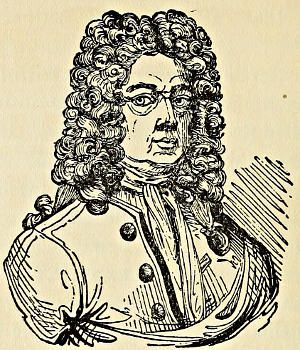
This sketch is from an original picture by his friend
Sir Godfrey Kneller, which is placed in the Library of
the College of Physicians, in one of the closets of which
I am now immured.
But I must descend from these high matters,
and speak again of my master, and, I am
sorry to say, of another disappointment which
occurred in our house. Two years after the
death of Prince George, when Radcliffe was
in his sixtieth year, I was somewhat surprised,
one morning after breakfast, to observe
him attired with more than ordinary
exactness. His full-bottomed wig was dressed
with peculiar care; he had put on his best suit
of lilac-coloured velvet with yellow basket buttons,
and his air upon the whole was very
commanding. He reminded me strongly of
his appearance some ten or fifteen years before.
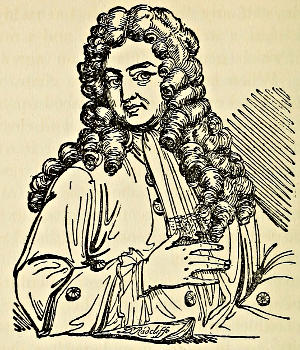
He had an elevated forehead, hazel
eyes, cheeks telling of the good cheer of former
days, if any thing a little too ruddy; a
double chin, a well-formed nose, and a mouth
round which generally played an agreeable
smile. When he sat in his easy chair, with
his right hand expanded, and placed upon his
breast, as if meditating a speech, and clearing
his voice for the purpose of giving it utterance;
his left wearing his glove, and resting
on his side immediately above the hilt of his
sword, which was a very usual attitude with
him, he certainly had a most comely and well-favoured
appearance.
I love to dwell upon these particulars of
my old worthy master; for to him I owe my
first introduction into the world, and whatever
celebrity my memoirs may hereafter obtain.
When fully equipped, he stepped into a gay
gilt chariot, drawn by fresh prancing horses,
the coachman wearing a new cockade, and our
lacqueys looking with all the insolence of
plenty in their countenances. We paraded
the streets, passed through Covent Garden,
and the most frequented parts of the town;
but it grieved me to observe, that our glittering
equipage served only to provoke the
smiles and ridicule of the malicious. To
speak out, it was now notorious that the
Doctor was in love, and that all this parade
was for the purpose of captivating the young
lady of whom he was enamoured. Suffice it
to say, he was lampooned, proved unfortunate
in his suit, and was styled by the wicked wits
of the day “the mourning Esculapius,” “the
languishing hopeless lover of the divine Hebe,
the emblem of youth and beauty.”
But more sober reflection and the busy
duties of his profession soon withdrew his
thoughts from these amorous toys, and he
continued actively employed for a few years
longer, though it was but too evident that his
health and spirits were daily declining.
About this time that celebrated warrior,
Prince Eugene, so distinguished for his campaigns
in Hungary and Italy, where he had
gained such splendid victories over the Turk
and the King of France, arrived in England.
The object of his visit was to try if it were
possible to engage our court to go on with
the war, which met with great obstruction.
But the juncture was unfavourable to his
project; for on the very day before his arrival,
his great friend and companion in arms, the
Duke of Marlborough, was turned out of all
his places. The days of intimacy between the
Queen and the Duchess were at an end; and
the endearing appellations of the “poor, unfortunate,
faithful Morley,” and Mrs. Freeman,
no longer marked the extraordinary
terms of friendly intercourse which had subsisted
between Her Majesty and a subject.
The Prince was, however, caressed by the
courtiers for his own worth; and though his
negotiations went slowly on, he was entertained
by most of the nobility, and magnificently
feasted by the city. My master invited
His Highness to dinner; and a large party of
the nobility, and several topping merchants,
particularly some of those who had formerly
contributed to the Silesian loan, were engaged
to meet him. The enmity of the
Prince to every thing French was known,
and it had been rendered still more notorious
by his admirable reply to an insolent threat
of the minister of the Grand Monarque, which
was at this time in the mouth of every one.
Louvois had intimated to the Prince, that he
must not think of returning to France; to
which the warrior replied, “Eugene entrera
un jour en France, en depit de Louvois et de
Louis.” To do honour to such a guest was
the ambition of Radcliffe; and in giving orders
for dinner, “Let there be no ragouts,”
said he; “no kickshaws of France; but let
us treat the Prince as a soldier. He shall
have a specimen of true English hospitality.
I will have my table covered with barons of
beef, jiggets of mutton, and legs of pork.”
At the appointed hour the guests assembled,
and the Prince charmed every one by his unassuming
modesty, his easy address and behaviour.
His aspect was erect and composed,
his eye lively and thoughtful, yet rather vigilant
than sparkling: but his manner was peculiarly
graceful, and he descended to an easy
equality with those who conversed with him.
The shape of his person and composure of
his limbs was remarkably erect and beautiful;
still, with all his condescension, and though
he was affable to every one, it was evident
that he rather suffered the presence of much
company, instead of taking delight in public
gaze and popular applause. The entertainment
of my master went off very well; all
seemed to be pleased, though some of the
courtiers indulged in a little pleasantry at the
ample cheer with which the table groaned.
The princely stranger expressed himself much
satisfied, and was loud in his praise of some
capital seven years old beer, which we happened
at that time to have in tap.
I forgot to mention, that, a few years before
the period of which I am now speaking,
I saw, for the first time, Dr. Mead, who was
then beginning to be known as a man rising
in his profession, and into whose hands I was
afterwards destined to fall. He lived then in
Austyn friers; and we found him one morning
in his library, reading Hippocrates; when
the following dialogue took place between the
two physicians:
Radcliffe (taking up the volume of the
venerable Father of Physic). “What! my
young friend, do you read Hippocrates in the
original language? Well, take my word for
it, when I am dead you will occupy the throne
of physic in this great town.”
Mead. “No, Sir; when you are gone, your
empire, like Alexander’s, will be divided
amongst many successors.”
I felt that this courteous reply pleased
my master mightily; and although Mead was
even then known to be a man of great talent,
had already written his treatise on Poisons,
published several other works of merit, and
was therefore in every respect deserving of the
countenance and patronage of the eminent
doctor of the day, yet I have myself no doubt
that this well-timed compliment to Radcliffe’s
eminence served to cement the intimate friendship
of these two physicians.
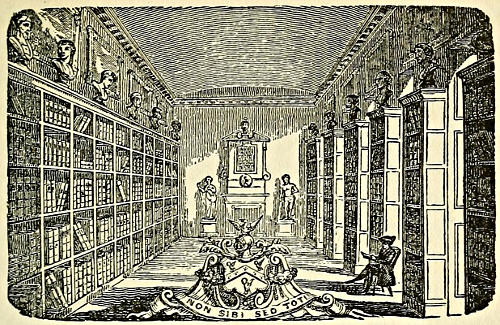
The library of Mead was even at this time
considerable. Many rooms of his small house
were filled with books; and the two doctors
indulged in a long chat. The conversation
embraced many topics. Mead was very lively
and entertaining; related several anecdotes
of things which he had seen abroad; and described
with great animation his joy on finding
the Tabula Isiaca[9] in a lumber room at
Florence. Upon this subject my master asked
many questions, and appeared much struck
with the advantage of foreign travel to a
physician. On taking his leave, he again expressed
his admiration of the literary attainments
of Mead, and said in a tone of great
earnestness and sincerity—“Some day or
other, the Alma Mater where I was bred shall
receive from me substantial proofs of the true
concern I feel for the welfare of the cause of
learning: for as I have grown older, every
year of my life has convinced me more and
more of the value of the education of the
scholar and the gentleman, to the thoroughbred
physician. But,” added he, “perhaps
your friend here (pointing me to a folio edition
of Celsus which stood on one of the shelves
of the library) expresses my meaning better
than I can myself, where he says, that this
discipline of the mind, ‘quamvis non faciat
medicum, aptiorem tamen medicinæ reddit.’”
Radcliffe, as if unwilling to trust himself with
any farther quotation, embraced Dr. Mead,
and hastened to his carriage.
On the 1st of August, 1714, died Queen
Anne; an event memorable in the life of Radcliffe.
The domestic physicians of Her Majesty,
assisted by Dr. Mead, had applied various
remedies without success. It was reported
that the privy council, as well as the Queen,
had given orders that my master should be
present at the consultation, and that he excused
himself under pretence of indisposition.
The truth is, he was not in town at that time,
but down at his country-house at Carshalton
in Surrey, ill himself of the gout, which had
seized his head and stomach. Yet notwithstanding
this, the enemies of Radcliffe imputed
the death of the Queen to his absence, and he
was accordingly threatened with assassination.
This unpopularity, undeserved as it was, made
him keep his house, where, on the 4th of
August, three days after the death of Her
Majesty, Dr. Mead and his brother the lawyer
came down to dine with him at two o’clock.
In spite of the ill state of his health, the conversation
of two such good friends afforded
him much pleasure and satisfaction. After
dinner, his wonted good humour returned,
and, taking me in his hand, he presented me,
with the following discourse, to Dr. Mead:—
“Though my life is, I dare say, pretty well
known to you, yet I will mention some of the
leading circumstances of it, from which perhaps
you may be able to derive some instruction.
Since I began the study of medicine,
I have devoted myself chiefly to a careful
examination of the most valuable modern
treatises. In this particular I differ, I know,
from you, who are a profound scholar; but
my books have always been few, though I
hope well chosen. When I was at the university,
a few vials, a skeleton, and an herbal,
chiefly formed my library. By following the
dictates of common sense, while I practised at
Oxford after taking my bachelor of medicine’s
degree, instead of stoving up my patients who
were ill of the small-pox, as was done by the
Galenists of those days, I gave them air and
cooling emulsions, and thus rescued more than
a hundred from the grave. I have always
endeavoured to discountenance the attempts
of quacks and intermeddlers in physic, and by
the help of Providence I have succeeded most
wonderfully. My good Dr. Mead, you must
consider this conversation as quite confidential,
and if I mention any thing that has the
air of boasting, you will reflect that I unbosom
myself to a friend, and what I am about to
say is for your encouragement. In 1686, I
was made principal physician to Her Royal
Highness the Princess Anne of Denmark, and
soon after His late Majesty King William’s
arrival in England, he was graciously pleased
to make me an offer of being sworn one of
his physicians in ordinary, with a salary of
two hundred pounds per annum more than
any other. At the same time he generously
ordered me five hundred guineas out of the
privy purse for the cures of M. Bentinck and
M. Zulestein. Though I begged to be permitted
to refuse the post, yet the King was so
frequently ill of rheum and asthma, that, for
the first eleven years of his reign, I gained, one
year with another, more than six hundred
guineas per annum by my attendance upon
His Majesty. My practice rapidly increased,
and I was even credibly informed that Dr.
Gibbons, who lived in my neighbourhood, got
more than one thousand pounds a year by patients
whom I really had not time to see, and
who had therefore recourse to him. As my
wealth increased, you will naturally ask me
why I never married: it does not become me
to speak of my good or ill fortune in that
line, especially now when I ought to call my
thoughts from all such vanities, and when the
decays of nature tell me that I have only a
short time to live. That time is, I am afraid,
barely sufficient to repent me of the idle hours
which I have spent in riotous living; for I now
feel, in the pain which afflicts my nerves, that
I am a martyr to excess, and am afraid that
I have been an abettor and encourager of intemperance
in others. Though by an indiscreet
speech I lost the good graces of the Princess
Anne, yet His Majesty King William still
continued to have confidence in my skill. As
a proof of it, I may mention that in 1695 I
was sent for to Namur, to cure Lord Albemarle.
After a week’s residence in the camp
abroad, His Majesty generously gave me an
order on the Treasury for £1200; and his
Lordship presented me with four hundred
guineas, and this diamond ring, which I have
always worn since. As to honours, I have
always refused them: a baronetcy was offered
me, but of what use would a title have been
to me, who have no descendants to inherit it?
I have always lived in a state of celibacy, and
have uniformly replied to those who formerly
urged me to marry some young gentlewoman
to get heirs by, that truly I had an old one
to take care of, who I intended should be my
executrix, as Oxford[10] will learn after my
death. For, thanks to Providence, I have
been very successful, from the very beginning
of my professional life; and I had not been
settled a year in London, when I got twenty
guineas a day by my practice: and even Dandridge,
the apothecary whom I patronised,
died, as I am informed, worth more than
£50,000. The liberality of my patients enabled
me to live and act in a generous manner.
My fees were good: of which you may form
some notion when I mention, that to go from
Bloomsbury Square to Bow, I received five
guineas. I do not tell this to you, my good
friend, out of ostentation, but that it may
serve as an encouragement to you to hear how
the practice of physic has been remunerated.”
Here Radcliffe paused, and appeared exhausted
by speaking so long at a time.
Dr. Mead—“I feel infinitely obliged to you
for your kind and confidential communication.
No one in the least acquainted with the liberality
of your conduct can for a moment accuse
you of an ostentatious display of your wealth.
The subject upon which you last touched,
is one that has often excited my curiosity.
I should like of all things to know, what Linacre
got by his profession; how much Caius,
Harvey, Sydenham, and other worthies of
medicine received yearly for their professional
labour. The honorarium or fee of a doctor,
one would suppose, must always have been in
proportion to the rarity of professional skill,
though we must take into account the greater
value of money in former times. There may
be notices of this kind to be met with in different
books, but the only instances that occur
at present to my memory are mentioned
by that great benefactor of our College, Baldwin
Hamey. In the valuable and entertaining
account left by him of his contemporaries,
he mentions, that about the year 1644, Dr.
Rob. Wright, who died at the early age of
twenty-eight years, was very successful in
practice. The Latin expression (for his MS.[11]
is written most elegantly in that language),
is, I believe, as follows: ‘Wrightus vixdum
trimulus doctor, mille admodum coronatos,
annuo spacio lucraretur.’ Now, the coronatus,
usually called a broad-piece, was about
twenty-two shillings in value, and the receipt
of a thousand of these by so young a physician,
who had only been settled three years in
the metropolis, is an instance of very singular
good fortune indeed.
“The next, is an account of a fee received
by Hamey himself, and is thus related in the
MS. life of that excellent man:—
“It was in the time of the civil wars when
it pleased God to visit him with a severe fit
of sickness, or peripneumonia, which confined
him a great while to his chamber, and to the
more than ordinary care of his tender spouse.
During this affliction, he was disabled from
practice; but the very first time he dined in
his parlour afterwards, a certain great man
in high station came to consult him on an indisposition—(ratione
vagi sui amoris)—and
he was one of the godly ones too of those
times. After the doctor had received him in
his study, and modestly attended to his long
religious preface, with which he introduced
his ignominious circumstances, and Dr. Hamey
had assured him of his fidelity, and gave him
hopes of success in his affair, the generous
soldier (for such he was) drew out of his
pocket a bag of gold, and offered it all at a
lump to his physician. Dr. Hamey, surprised
at so extraordinary a fee, modestly declined
the acceptance of it; upon which the great
man, dipping his hand into the bag himself,
grasped up as much of his coin as his fist
could hold, and generously put it into the
doctor’s coat pocket, and so took his leave.
Dr. Hamey returned into his parlour to dinner,
which had waited for him all that time,
and smiling (whilst his lady was discomposed
at his absenting so long), emptied his pocket
into her lap. This soon altered the features
of her countenance, who telling the money
over, found it to be thirty-six broad pieces of
gold: at which she being greatly surprised,
confessed to the doctor that this was surely
the most providential fee he ever received;
and declared to him that, during the height
of his severe illness, she had paid away (unknown
to him) on a state levy towards a public
supply, the like sum in number and value of
pieces of gold; lest under the lowness of his
spirits, it should have proved a matter of
vexation, unequal to his strength at that time
to bear; which being thus so remarkably reimbursed
to him by Providence, it was the
properest juncture she could lay hold on to
let him into the truth of it. It may be said,”
continued Mead, “that this was an extraordinary
case, and the fee a most exorbitant
one, which the patient paid as the price of
secrecy: but the precaution was unnecessary
(as it ought always to be in a profession
whose very essence is honour and confidence);
for the name of the generous soldier is never
once mentioned in the life of Hamey, though
I have good reason to believe he was no other
than Ireton, the son-in-law of Cromwell.”
Radcliffe. “These are curious particulars,
and I thank you for them. To speak
once more of my own good fortune, I found
that, even seven years ago, to say nothing of
what I have acquired since, upon inquiry into
the bulk of my estate, both land and money,
I was worth more than £80,000, which I then
resolved to devote, all or most of it, to the service
of the public. I hope, however, notwithstanding
what I shall leave behind me,
no one can accuse me of having been sordid
in my lifetime, or in case of the private distress
of my friends, not to have instantly
relieved them. I have never been such a
niggard as to have preferred mountains of
gold to the conversation and charms of society.
Perhaps there was selfishness in this: for I
never recollect to have spent a more delightful
evening than that in the old room at the
Mitre Tavern in Fleet Street, when my good
friend Billy Nutley, who was indeed the better
half of me, had been prevailed upon to accept
of a small temporary assistance, and joined
our party, the Earl of Denbigh, Lords Colpeper
and Stawel, and Mr. Blackmore. But
enough of this affair of money. To one so
well skilled as yourself, I have not much to
say on the subject of practice; but recollect,
I beg of you, the treatment of small-pox.
Combat the prejudices of mankind on that
point. By insisting upon this, I lately saved
the life of the young Duke of Beaufort. You
have done much, by showing the advantage of
employing aperient medicines in the decline
of that distemper; and I much regret that
the letter you wrote to Dr. Freind upon that
matter, and which you permitted me to inform
him he might publish, has not yet seen
the light. Go on as you have begun; and I
confidently hope that something more may
still be introduced into general practice by a
physician of your good sense and liberal views,
to mitigate the violence of that most formidable
disease.
“But I am now drawing to a close. Last
year, upon my being returned member of
parliament for the town of Buckingham, I retired
from practice, and I have recommended
you to all my patients. Your own merit and
acquirements will insure you success; but
perhaps your career may be facilitated by
what I have done for you. Recollect that
the fame of a physician is subject to the
caprices of fortune. I know the nature of
attending crowned heads very well. But
continue as you have commenced. Nothing
could be better than the method you took for
the preservation of her late gracious Majesty’s
health; though the people about her (the
plagues of Egypt fall upon them!) put it out
of the power of physic to be of use to her.
But I was sorry to hear the other day, that
your enemies have spread a report that, during
the last days of the Queen’s illness, you
had pronounced that her Majesty could not
live two minutes, and that you seemed uneasy
it did not so happen. Tell me, I beg, the
real state of the case.”
“You very well know,” said Dr. Mead,
“that her Majesty had been long corpulent;
and that, in her latter years, the habit of her
body became gross and unwieldy. For the
most part she had a good stomach, and ate
heartily. But by reason of her immoderate
fatness, and her weakness, occasioned by the
gout, she became so inactive that she used but
little exercise. In the beginning of her Majesty’s
illness, there was a difference of opinion
among the doctors as to the propriety of
giving the jesuits’ bark; but I will not enter
into all the disputes which took place on that
occasion. It is enough to state, that after the
appearance of the imposthume on the left
leg, and the coming on of the doziness which
seized her on Thursday the 28th July, there
was no doubt about the propriety of cupping
her; and blisters were ordered, but not applied,
for what reason I know not. The next
morning her Majesty was seized with an apoplectic
fit, attended with convulsions. After
two hours and a half she recovered her senses,
but lost them again next day, and died the
following morning.”
Radcliffe. “Well, I will inquire no
further. I see your own modesty will not
allow you to find fault with the injudicious
practice and fatal security of your colleagues.
I cannot but applaud your good feeling and
liberality of sentiment; and wish you most
heartily success in your future professional
life. Accept this cane. It has accompanied
me now for many years in my visits to the
sick, and been present at many a consultation.
Receive it as a token of my friendship, and
prosper. ‘Te nunc habet ista secundum.’”
Here a twinge of the gout interrupted the
speech of my old master; and Dr. Mead
shortly after left for London, taking me with
him.
Dr. Radcliffe died on the first of November,
1714, three months after the Queen; and it
was said that the dread he had of the populace,
and the want of company in the country village
where he had retired, and which he did
not dare to leave, shortened his life.
MEAD.
CHAPTER II.
From the possession of a physician who
was kind, generous, and social in the highest
degree, but who was certainly more remarkable
for strong good sense and natural sagacity
than for literary attainments, I passed
into the hands of an accomplished scholar.
Dr. Mead was allowed even by his antagonists,
themselves men of great erudition, to be artis
medicæ decus, vitæ revera nobilis, and one
who excelled all our chief nobility in the encouragement
he afforded to the fine arts, polite
learning, and the knowledge of antiquity.
But though I had changed masters, it was no
small satisfaction to me to return to the old
House, for Mead not only succeeded Radcliffe
in the greater part of his business, but removed
to the residence which he had formerly
occupied in Bloomsbury-square[12]. My present
master, on commencing his profession, had
first settled at Stepney, had then resided in
Crutched, and afterwards in Austin Friers,
for the purpose of being near St. Thomas’
Hospital; but now the distance of his new
abode obliged him to resign the situation of
physician to that charitable establishment.
About six months after the death of Radcliffe,
I was present at a consultation between
Sir Hans Sloane, Dr. Cheyne, and Mead. It
was held on the case of Bishop Burnet, the
prelate so celebrated for the “History of his
own Time,” and for the active part he had
taken in the great transactions of that eventful
period.
He had been taken ill of a violent cold,
which soon turned to a pleurisy; and this increasing,
and baffling all remedies, his worthy
friend and relation Dr. Cheyne called in the
assistance of the two other doctors. Up to
this time Burnet had enjoyed uninterrupted
good health, which he attributed, not without
reason, to his temperate habits. “I will give
you,” said the venerable patient to Dr. Mead
(for the Bishop was now 72 years old), “a
short outline of my course of life. In summer
I have been in the habit of rising at five in
the morning, in the winter at six; and I have
always officiated myself at prayer, though my
chaplains may have been present. I then
took my tea in company with my children,
and read the Scriptures with them. I have
generally spent six or eight hours a day in
my study. The rest of the day has been
passed by me in taking exercise, making
friendly visits or cheerful meals. But now, to
use an expression of my late gracious master
King William, whom I knew well for sixteen
years, I feel ‘que je tire vers ma fin.’”
The Doctors listened to the melancholy presage
of the Bishop, and having put the necessary
questions to him, withdrew into the adjoining
apartment, for the purpose of consultation.
I was now in company with two physicians
of great eminence, though of very different
characters. On the one side of me stood
Sir Hans Sloane, who had shortly before been
created a baronet by His Majesty George the
First, being the first physician upon whom
an hereditary title of honour had ever been
conferred; in his person tall and well made,
sprightly in conversation, easy, polite and engaging
in his manners, by birth an Irishman.
On the other was Dr. Cheyne, a Scotchman,
with an immense broad back, taking
snuff incessantly out of a ponderous gold
box, and thus ever and anon displaying to
view his fat knuckles: a perfect Falstaff, for
he was not only a good portly man and a corpulent[13],
but was almost as witty as the knight
himself, and his humour being heightened by
his northern brogue, he was exceeding mirthful.
Indeed he was the most excellent banterer
of his time, a faculty he was often called
upon to exercise, to repel the lampoons which
were made by others upon his extraordinary
personal appearance. Nothing could be more
striking than the contrast of the two celebrated
men before me.
Sir Hans began by observing, that the age
of the Bishop might throw a doubt over the
propriety of more bleeding, but he had so
often seen the advantage of repeated venesection,
that he had the greatest faith in that
mode of treatment. “In one case particularly
which I saw abroad”—but here let me
interrupt the Baronet for a moment, to make
an observation, which in the many consultations
at which I have been present, has more
than once occurred to me. These deliberations
are generally proposed either because
the attending physician is at a loss what
further to suggest, or that he wishes naturally
enough to divide the responsibility of the
management of a dangerous disease. They
are held for the most part upon ailments of
a chronic nature, that is upon such disorders
as afford time and opportunity to form the
judgment, and decide upon a method of practice;
for it is lucky that in urgent diseases,
or those which are called acute, the remedies
are simple, and that where delay would be
dangerous, the means of relief are obvious.
In consultations, there is of course much scope
for diversity of opinion, but in the whole range
of the plausible reasoning which the conjectural
science of medicine admits of, there is
nothing so imposing as a case; it bears down
all before it. One of the consulting Doctors,
after hearing the history of the previous treatment,
advances that he has seen a case similar
to the one, now under consideration, in which
he did so and so with manifest advantage; the
argument is irresistible——
But this by way of parenthesis. “In
one case particularly (said Sir Hans Sloane)
which I saw abroad, I saved a man’s life, who
complained extremely of a great pain in his
shoulder, or rather inside of his pleura answering
to that part, which increased on
breathing high, sighing or coughing, for the
patient was troubled with a short cough.
The man was on board a ship bound for
England, and it was taken by all for sea sickness,
but I told them, they were all deceived,
and forthwith ordered him to be bled in the
arm to about ten ounces, and gave him an
emulsion, and a pectoral decoction of barley,
liquorish and raisins. I immediately found
him much better, and ordered him to continue
this, and to take of crab’s eyes and sal
prunellæ, of each half a drachm, and to swallow
morning and evening the half on’t, drinking
afterwards a pectoral draught, and in case
of relapse I ordered him to be bled again;
which was necessary to be done, for the ship
chirurgeon, contrary to my desire, gave him
a vomit: the patient, poor fellow! knowing
nothing of it, till it was down. His pains
thus returned, and I bled him twice on two
several days, and with an emulsion he was
cured. I have found also (added Sir Hans),
in similar cases great advantage in applying
a hot bag of parched salt to the side; but
bleeding is the main remedy. I have bled a
patient five times in her foot and arm in
twelve hours.” Whilst the baronet was
speaking, the countenance of Dr. Cheyne underwent
various changes, and when mention
was made of the emulsion, which if I am not
mistaken, was a compound of linseed oil,
sugar-candy, and decoction of barley, it assumed
a very decided expression of disgust,
for he was a bon vivant of the first order. To
the further employment of venesection, he was
rather averse, and insisted much upon the
advanced age of the Bishop. “An old man’s
body (observed Dr. Cheyne), is like a plant
dried by the sun, its fibres are stiff, and juices
decayed, and not as in youth able to prepare
new nutriment, to repair the loss of solids and
fluids. For this decay of the humours, the
cure of the cacochymia is necessary; and to
renovate the solids, we find no help like warm
bathing and unctions, and you yourself (said
he archly to Sir Hans) must have remarked,
in your own native country, that the Irish live
long, who anoint themselves with salt butter.”
What the remedies were which were ultimately
ordered for the aged Prelate, I do not
now recollect, but his own prediction was soon
after fulfilled, and he died on the 17th of
March 1715.
Of Sir Hans Sloane, I shall have occasion
to speak again more than once, and I can do
it with confidence, for I had many opportunities
of studying his peculiarities, and being
in his company, particularly at the conversaziones
which were held at his house in
Great Russell-street, by Bloomsbury. It was
observed of him, that he was on these occasions
rather a precise gentleman, and used to
go out of temper, when his guests spilled the
coffee over his carpets. But he was very
lively in discourse, nor did he lack topics, and
having been much abroad, loved to talk of his
travels. When only in his twenty-eighth year,
he had accompanied the Duke of Albemarle[14],
on his appointment to the government of the
Island of Jamaica, in the quality of physician
to his Excellency, being chiefly induced by
his attachment to natural history, to undertake
a voyage, which was not thought at that
time of day to be altogether free from danger.
As he was the first man of learning whom
the love of science alone had led from England
to that distant part of the globe, and was besides
of an age when both activity of body,
and ardour of mind concur to vanquish difficulties,
his travels were eminently successful.
To say nothing of the other curiosities
with which he enriched his native country,
he brought home from Jamaica, and the other
islands at which he touched, no fewer than
800 different species of plants, a number
much greater than had ever been imported
into England before by any individual. His
stay in Jamaica did not exceed fifteen months,
for the Governor died, and the Doctor returned
home, and settled in London. About
seven years before the scene at the Bishop’s, he
had published the first volume of his Voyage
to the Islands of Madera, Barbadoes, Nieves,
St. Christophers, and Jamaica, with the natural
history of the herbs, and trees, four-footed
beasts, fishes, birds, insects, reptiles, &c., illustrated
with the figures of the things described,
which had not heretofore been engraved. In
large copper-plates, as big as the life.
This was his first contribution to the general
stock of knowledge, and when questioned
on the subject of his voyage, he was used
to say, that independently of the gratification
of a laudable curiosity, he deemed it a
sort of duty in a medical man to visit distant
countries, for that the ancient and best
physicians were wont to travel to the places
whence their drugs were brought, to inform
themselves concerning them. Speaking of
the part of the globe which he had visited,
he never ceased to deplore the irreparable loss
of fame which this country had suffered, in
not being the first to partake in the glory of
its discovery. When Bartholomew Columbus,
said Sir Hans, was sent to England by
his brother Christopher, in 1488, to persuade
Henry the Seventh to fit him out for this expedition,
a sea chart of the parts of the world
then known was produced, and a proposal
made to the King, but after much delay and
many untoward circumstances, both the map
and the proposal were disregarded, and the
money that had at first been set apart for the
purpose, and thought sufficient for the discovery
of the New World, was ultimately expended
in the purchase of a suit of fine tapestry
hangings, brought from Antwerp, and
afterwards used for the decoration of Hampton
Court.
The scene I have endeavoured to describe
at the Bishop’s may serve as a specimen of a
consultation of that day, and has given me an
opportunity of introducing to the reader a
very distinguished person, for such certainly
must Sir Hans Sloane be allowed to have been.
About four years after the time I now speak,
he was elected President of the College of
Physicians; on the death of Sir Isaac Newton,
was chosen to fill the chair of the Royal Society;
and after his own decease gave origin
to the British Museum.
It is not, however, my intention to follow
Mead into all the details of his private practice,
but I will point out some of the material
improvements introduced by him in his art,
and the progress which the science of physic
made in his hands.—Mr. Secretary Craggs
applied to him, in 1719, to find out the most
effectual method to prevent the spreading of
the plague, which had proved so fatal that
year at Marseilles. My master accordingly
published a discourse on that subject, which
was so well received as to go through no less
than seven editions in a twelvemonth. The
kingdom was at this time governed by Lords
Justices, during the absence of His Majesty
George the First, who was then in Hanover.
An act of parliament was passed, in consequence
of the advice given by Mead; but the
Opposition of the day, chiefly with the view
to thwart the Ministry, caused two of its
wisest clauses to be given up the following
year. These related to the removing of sick
persons from their habitations, and the making
of lines of demarcation about infected places.
Against the adoption of these prudent precautions
an outcry was raised, that persons in
office intrusted with such powers might be
tempted to abuse them, and exercise their
authority in a manner grievous to the subjects
of the kingdom. Dr. Mead, on the other
hand, contended, that Salus populi supremo
lex est; and said that, if the plague should
unhappily be brought again into England, he
was sure the people themselves would cry out
for help, notwithstanding wrong notions of
liberty may sometimes overpossess their minds,
and make them, under the best of governments,
impatient of restraint. A clamour
like this will probably be always renewed
whenever this subject comes to be discussed
by the public; the bold and the ignorant will
excite it for the purposes of gainful notoriety,
and the selfish trader from a short-sighted
view of his own immediate interest. “But
suppose for a moment,” said Mead in conversation
with a friend, “that the laws of quarantine
were useless, and that the fears entertained
of the contagious nature of the plague
were without foundation, how can the commerce
of this country be benefited by the
abolition of these regulations here, unless the
rest of civilized Europe adopt the same measure,
and agree, at a sort of general congress,
to remove all restraints from their trade with
the Levant? But,” continued he, in an
earnest manner, which had all the air of
prophecy, “depend upon it, whenever the
doctrine of non-contagion is revived in England
(and it will be, even a hundred years
hence), it will always excite alarm among the
nations who are more prudent than ourselves,
and less eager to entertain every kind of wild
and visionary speculation. Incalculable mischief
will be done by the broaching of this
pernicious doctrine[15]: the speculators who
adopt such opinions should at least keep them
to themselves, or if they will continue their
experiments, let them make them in corpore
vili, and not upon subjects which involve the
general welfare of the community.”
Two or three years after this, my master’s
attention was called to another matter of equal,
or perhaps greater importance than the one
just mentioned; and I had the satisfaction of
witnessing another prodigious step made towards
the improvement of physic. This was
no less than the mitigation of that loathsome
disease the small-pox, a malady more formidable,
and infinitely more fatal than the plague
itself. Lady Mary Wortley Montague having
returned to England in 1722, was determined
to introduce the practice of inoculating
for the small-pox, which she had witnessed in
the East, and having before had the operation
performed successfully upon her son at
Constantinople, desired her family surgeon to
engraft her daughter also with that disease.
The process was witnessed by three physicians
and the family apothecary; but though the
success was complete, the profession still remained
in suspense, and caution prevented
the repetition of the experiment. But Caroline
Princess of Wales, having nearly lost the
life of one of her daughters, the Princess Anne,
by small-pox, was desirous of having her
children inoculated; and obtained from His
Majesty George the First, that six condemned
felons should be pardoned for the good of the
public, on condition of their submitting to be
inoculated. Five of the felons contracted the
disease favourably; the sixth, who concealed
having previously had the small-pox, was not
infected—but all escaped hanging. At the
suggestion of my master, the Chinese method
was practised upon a seventh criminal, who
was a young girl of eighteen years of age.
He accordingly introduced into her nostrils a
tent, wetted with matter taken out of ripe
pustules, which nearly approaches to the practice
of the Chinese, who take the skins of
some of the dried pustules which have fallen
from the body, and put them into a porcelain
bottle, stopping the mouth of it very closely
with wax. When they have a mind to infect
any one, they make up three or four of these
skins (inserting between them one grain of
musk) into a tent with cotton, which they put
up the nostrils. In the case of the girl whom
my master treated as above related, she, like
those who were inoculated by incisions made
in the skin, fell sick and perfectly recovered.
The attention of the medical world was
naturally much engrossed by this new method,
and every one was discussing the nature of
the small-pox, of which the contagious quality
was one of the most remarkable properties.
“How strange!” said Mead, “that this property,
apparently so obvious, should not have
been noticed by every writer on the subject,
from the very first appearance of this dangerous
malady among us. Yet Sydenham, discerning,
as he has been called, does not take
the slightest notice of it, and perhaps even at
this very day, had it not been for the introduction
of this novel method of communicating
it, its infectious quality might not have
been universally admitted. One would suppose
that the merest tyro in an apothecary’s
shop could not have seen half a dozen cases
of the small-pox without being convinced that
one person caught it from another. An additional
striking example of what has often been
observed before, that the most plain and obvious
truths lie undiscovered till accident
bring them to light.”—More than twenty years
after this, Dr. Mead published a treatise on the
small-pox and measles, which contained many
valuable observations on both these diseases,
and also strong recommendations of the practice
of inoculation. To this treatise, which is
written in a pure Latin style, he subjoined a
translation of Rhazes’ commentary on the
small-pox into the same language, a copy of
which he had obtained from Leyden, through
the assistance of his friend and fellow-student
Boerhaave, with whom my master maintained
a constant correspondence.
The ingenuity of mankind is exercised upon
no subjects with so much pertinacity and
acuteness as upon those connected with medicine,
and it has often been disputed whether
inoculation has lessened the number of deaths
by small-pox.—One thing however is certain,
that it has contributed to the comfort and security
of all prudent individuals and families;
for though it cannot admit of a doubt
that many formerly passed through a long life
without the disease, yet such a situation must
have proved a constant source of uneasiness
to themselves and friends, of restraint from
many desirable pursuits, and at times of absolute
seclusion from the world.
The next improvement which Dr. Mead
introduced into the practice of medicine was
entirely of his own invention, and serves to
show that his mind was not only capable of
the extended views of philosophy, but was
alive to the most minute circumstances that
could contribute towards the perfection of his
art. For the skill of a physician, though it
assume a more exalted character when displayed
in the pursuit of general science, is
equally conspicuous, and perhaps more immediately
useful, when exerted in the discovery
and employment of ingenious contrivances for
the relief of suffering humanity.
My master had often considered what could
be the reason that, in cases of persons labouring
under dropsy, when the water is suddenly
drawn off, the patient swoons and frequently
dies on the spot. A simple expedient occurred
to him, which was this: during the
operation of tapping, to make external pressure
by the hands, and afterwards to apply a
bandage to the belly. I was present when
this method was first tried in the hospital,
and afterwards frequently saw it used, more
especially in the case of Dame Mary Page,
wife of Sir Gregory Page, Bart., who was
afflicted with this disease, and died March
4th, 1728, in the fifty-sixth year of her age.
In sixty-seven months she was tapped sixty-six
times and had two hundred and forty
gallons of water taken away, without ever
once fearing the operation[16]. This was certainly
a most valuable discovery, and shows
the advantage derivable from the exercise of
good sense and sound judgment; for Mead
naturally reflected, that the removal of the
pressure of the accumulated water caused the
fibres suddenly to lose the extension which
they had previously acquired; and it as naturally
occurred to him, that the tendency to
faint could only be obviated by substituting
an external support to the parts.
But it is now time, after having related the
benefits he conferred upon mankind by enlarging
the boundaries of medical science, to
revert to some details of a more domestic character.
It has been mentioned before, when
speaking of the first experiment of inoculation
made in this country, that zeal for his profession
had on one occasion brought my master
acquainted with the veriest outcasts of society,
and in contact with convicted felons: it remains
for me to relate how the calls of friendship and
generous sympathy led him again within the
walls of a prison.
In politics Mead was a hearty Whig, but
he reckoned amongst his friends many whose
sentiments differed widely from his own.
Garth, Arbuthnot, and Freind were among his
chief associates: with the latter particularly he
had always been on terms of the most friendly
intercourse. Recently the intimacy of these
two distinguished physicians had been much increased
by a controversy in which they were
embarked in support of their own enlightened
views on the subject of the cooling treatment of
the small-pox, against the attacks of the ignorant
and malevolent.
About this time Dr. Freind had been elected
member of parliament for Launceston in Cornwall,
and acting in his station as a senator with
that warmth and freedom which was natural
to him, he distinguished himself by some able
speeches against measures which he disapproved.
He was supposed to have had a hand
in Atterbury’s plot, as it was then called, for
the restoration of the Stuart family; and having
been also one of the speakers in favour of
the Bishop, this drew upon him so much resentment
that (the Habeas Corpus Act being
at that time suspended) he was, on March 15,
1722-3, committed to the Tower. Here he lay
a prisoner for some months, and my master did
all he could to procure his liberation: during
his confinement his practice fell chiefly into the
hands of Mead. As soon as permission could
be obtained, which was not till he had been
some time in prison, we paid a visit to Freind,
and entered that building whose low and sombre
walls and bastions have frowned on many
an innocent and many a guilty head.
When his room door opened, we found him
in the act of finishing a Latin letter to my master,
“On certain kinds of the Small-pox;” and,
as he perceived our approach, he came forward
with an expression of great delight in his countenance.
“I was writing a letter to you, with
the permission of the governor of the Tower;
and you are indebted,” he added in a low whisper,
“to my companion (looking at the
warder, who was in the same chamber with his
prisoner) for its brevity: for I don’t find that
his presence assists me much in composition.”—During
our interview, Freind told Mead
that he passed his time not unpleasantly, for
that he had begun to write the History of
Physic, from the time of Galen to the commencement
of the sixteenth century; but that
at present he felt the necessity of consulting
more books than the circumstances in which he
was now placed would give him an opportunity
of perusing—“Though I ought not to repine,”
said he, “while I have this book (pointing to a
Greek Testament, which was lying on the
table), the daily and diligent perusal of which
solaces my confinement. I have lately been
reading the Gospel of St. Luke, and I need
not point out to a scholar like yourself, and
one who has paid so much attention to what I
may call the medical history of the Bible[17], how
much nearer the language of St. Luke, who
was by profession a physician, comes to the
ancient standard of classical Greek than that
of the other Evangelists. To be sure it has a
mixture of the Syriac phrase, which may be
easily allowed in one who was born a Syrian;
yet the reading the Greek authors, while he
studied medicine, made his language without
dispute more exact. His style is sometimes
even very flowing and florid—as when, in the
Acts of the Apostles, he describes the voyage
of St. Paul; and when he has occasion to
speak of distempers or the cure of them, you
must have observed that he makes use of
words more proper for the subject than the
others do. It is besides remarkable that St.
Luke is more particular in reciting all the
miracles of our Saviour in relation to healing
than the other Evangelists are; and that he
gives us one history which is omitted by the
rest, viz. that of raising the widow’s son at
Nain.”
My master left the prisoner, with an assurance
that he would use all the influence he
possessed to procure his liberty: “For,” said
he, smiling, “however much your cultivated
mind is enabled to amuse itself by reading and
writing, I presume you will have no sort of objection
to resign your newly-acquired office
of Medicus Regius ad Turrim[18].”
From a spirited medallion of Dr. Freind, carved in
box-wood. There is a portrait of him in the hall of
Christ Church, Oxford, upon which is inscribed the following
stanza from the pen of Anthony Alsop:
Cui suas artes, sua dona lætus
Et Lyram, et Venæ salientis ictum
Scire concessit, celerem et medendi
Delius usum.
Very shortly afterwards, the opportunity of
effecting this did actually occur; for when Sir
Robert Walpole, the minister of the day, sent
to consult Mead on account of an indisposition,
he availed himself of the occasion to plead the
cause of the captive. He urged, that though
the warmth and freedom of Freind might have
betrayed him into some intemperate observations,
yet no one could doubt his patriotic feelings
and loyalty; that his public services had
been great, for he had attended the Earl of
Peterborough in his Spanish expedition as an
army physician; and had also accompanied in
the same capacity the Duke of Ormond into
Flanders; that he deserved well of science, for
he had done much to call the attention of the
world to the new and sound principles of the
Newtonian philosophy; and was besides a man
of excellent parts, a thorough scholar, and one
whom all acknowledged to be very able in his
profession: and, finally, the Doctor refused to
prescribe for the Minister unless the prisoner
was set at liberty. He was almost immediately
relieved from prison, and admitted to
bail; his sureties being Dr. Mead, Dr. Hulse,
Dr. Levet, and Dr. Hale.
Mead’s house, at the corner of Powis Place, now
No. 49. There is a good garden behind the house, at
the bottom of which was a museum. After Mead’s death
it was occupied by Sir Harry Grey, Lord Grey’s uncle.
The evening after this event, there was a
numerous assembly at our house in Great
Ormond Street, attracted by the hope of meeting
Freind, and congratulating him on his liberation
from the Tower. He came, and every
one was delighted to see him once more at
large. Besides the number of acquaintances
and friends who were there, when it is observed
that no foreigner of any learning, taste, or
even curiosity, ever arrived in England without
being introduced to my master (as it would
have been a reproach to have returned without
seeing a scholar and physician who was in
correspondence with all the literati of Europe),
it may easily be imagined that on so remarkable
an occasion our conversazione was a
crowded one. When the party broke up, and
Freind and Arbuthnot were about to take their
leave together, as they lived in the same part
of the town—the former in Albemarle Street,
and the latter in Cork Street, Burlington Gardens—Dr.
Mead begged Freind to step with
him for a moment into his own private study,
which was a small room adjoining the library.
There he presented him with the sum of five
thousand guineas, which he had received from
Freind’s patients, whom he had visited during
his imprisonment. On returning to the great
room he wished them both good night, and
jocosely said to Arbuthnot (who happened to
hold the office of Censor of the College that
year), “Now I commit our common friend
here to your magisterial care and guidance;
see that he does not again get into trouble;
and on the least appearance of irregularity, report
him to the President, Sir Hans Sloane.
I look to you, Arbuthnot, to preserve harmony[19]
amongst us.”
These meetings, of which Dr. Mead was
very fond, took place at stated periods, and
the visitors assembled in the library, a spacious
room about sixty feet long, of the richness
of which an idea may be formed by referring
to the catalogue of the sale of its contents,
which took place after his death. The
books, amounting to about ten thousand volumes,
were sold in twenty-eight days. The
sale of the prints and drawings occupied fourteen
evenings, and the coins and medals were
disposed of in eight days. But at the time of
which I speak, all these literary treasures were
collected under one roof; and the assemblage
of marble statues of Greek philosophers, Roman
emperors, bronzes, gems, intaglios, Etruscan
vases, and other rare specimens of antiquity,
was most choice and valuable. Ranged
along one side of the room stood the busts of
the great English poets—Shakespeare, Milton,
and Pope: they were of the size of life, of
white marble, and by the hand of Scheemakers.
The corner in which I was usually placed was
between a statue of Hygeia[20] and a cabinet of
iron which once belonged to Queen Elizabeth.
This cabinet was full of valuable coins, among
which was a medal of the Protector which
Mead frequently exhibited as a curiosity to
his visitors: it had Oliver’s head in profile, with
this legend, “The Lord of Hosts, the word at
Dunbar, Sept. 1650;” on the reverse, the parliament
sitting.
Placed in this favourite spot, I often overheard
very interesting discourse. On one occasion
particularly, I recollect that the conversation
turned on the condition and rank of
physicians in society. The persons who took
a leading part in the conversation were, if I
remember rightly, my master, Dr. Freind, Dr.
Arbuthnot, and Mr. Ward, the professor of
rhetoric in Gresham College. The topic was
suggested by some accidental allusion to the
attack which had been lately made by Dr. Conyers
Middleton on the dignity of medicine, in
a dissertation[21] written by him concerning the
state of physic in old Rome. The indignation
of the physicians of that day was naturally
roused, and they were all up in arms against
the author.
Dr. Mead began by asking, “What class of
men have deserved better of the public than
physicians? How much, for instance, does not
this country owe to Linacre, the founder of our
College? He was perhaps the most learned
man of his time, and on his travels was received
by Lorenzo de Medicis with the most marked
distinction. That munificent patron of literature
granted him the privilege of attending the
same preceptors with his own sons, and Linacre
improved the opportunities he enjoyed
with great diligence and success. At Florence,
under Demetrius Chalcondylas, who had
fled from Constantinople when it was taken by
the Turks, he acquired a perfect knowledge of
the Greek language.
“He studied eloquence at Bologna under
Politian, one of the most elegant Latinists in
Europe; and while he was at Rome he devoted
himself to medicine and the study of
natural philosophy, under Hermolaus Barbarus.
Linacre was the first Englishman who
read Aristotle and Galen in the original Greek.
On his return to England, having taken the
degree of M.D. at Oxford, he gave lectures in
physic, and taught the Greek language in that
university. His reputation soon became so
high, that King Henry VII. called him to
court, and intrusted him with the care of the
health and education of his son Prince Arthur.
To show the extent of his acquirements, I may
mention, that he instructed Princess Catherine
in the Italian language, and that he published
a work on mathematics, which he dedicated to
his pupil Prince Arthur. A treatise on grammar,
which has universally been acknowledged
to be a work of great erudition, is from the pen
of Linacre: Melancthon, indeed, pronounces
it to be inferior to none of its kind then extant.
In his own style he reminds one of the
elegance of Terence, and in his medical
treatises very nearly approaches the clear and
perspicuous language of Celsus.
From a Portrait of Linacre by Holbein, in Kensington
Palace, a copy of which hangs over the fireplace in
the Censor’s Room of the College of Physicians.
“Linacre was successively Physician to
Henry the Seventh, Henry the Eighth, Edward
the Sixth, and to the Princess Mary.
He established lectures on physic in both Universities;
and he was the founder of our Royal
College of Physicians, of which he was the first
President, holding that office during the last
seven years of his life. He was indeed,” said
Mead, “a most accomplished scholar: the
Latin style of Linacre is so pure and elegant
as to rank him amongst the finest writers of
his age; his friend Erasmus saying of him that
he was ‘vir non exacti tantum, sed severi
judicii.’—Though the medical writings of Linacre
are only translations, yet we cannot but
form a favourable opinion of his professional
skill, not only from the general estimation of
his contemporaries, but from the sagacity of his
prognosis in the case of his friend Lily the celebrated
grammarian, as well as from the rational
simplicity of the method by which he
relieved Erasmus in a painful fit of the
gravel.”
There was a pause here, and Mr. Professor
Ward asked my master if it was true that Linacre
had, in the latter part of his life, changed
his profession, and entered into the priesthood.
Mead. “Yes, it was undoubtedly true,
but he still to his dying day had his thoughts
upon physic, for it was towards the close of
his life that he projected the College of Physicians,
of which he remained President till
his death. It was also true that, on first applying
himself to the study of divinity, he
was a most sincere searcher of the Scriptures,
studying the Bible with great avidity; and
that on reading the 5th, 6th, and 7th chapters
of St. Matthew, he threw the book away, and
swore that this was either not the Gospel, or
we were not Christians.”
Freind. “Your account of Linacre is
quite correct, and you have certainly not
passed upon him a greater eulogium than he
deserves. If any other example were required
to prove to the world how much some of the
members of our body have done to further the
cause of learning, there is one very ready to
be cited in the physician to whom we owe the
compilation of the first annals of our College.
Though an Englishman, we find Dr. Caius
reading lectures on Aristotle in the university
of Padua; and afterwards using the influence
he possessed at court, where he was Physician
to Queen Mary, in behalf of literature: for it
was at his instance that a licence was obtained
from the Queen to advance Gonvil-hall at
Cambridge, and incorporate it under the name
of Gonvil and Caius College. This College
he endowed afterwards with considerable
estates for the maintenance of an additional
number of fellows and scholars. He was Fellow,
Censor, and President of the London College;
and even in advanced life never absented
himself from our meetings without a dispensation.
He was buried in the Chapel of the College
he had founded at Cambridge; and the
simple inscription upon his monument, while
it records the date of his death, adds a sentiment
which should reconcile us to the frail
and doubtful tenure of our present existence,
by the certainty and permanence of well-merited
posthumous fame:—
‘Fui Caius. Vivit post funera virtus. Obiit 1573, Æt. 63.’”
Mead. “The zeal displayed by Caius in
the cause of literature deserves every commendation,
but it is perhaps more to our purpose
to dwell upon the claim he has upon our
grateful remembrance as the founder of the
Science of Anatomy in England. According
to the fashion of his day, he had gone abroad
in pursuit of knowledge; at Padua had lived
during eight months in the same house with
Vesalius, and devoted himself with the same
ardour to the studies of his celebrated companion:
and let it never be forgotten that
Caius, on his return from Italy, imbued with
the spirit of inquiry and enlightened by the
lamp of science lately kindled in that country,
taught Anatomy to the Surgeons in their own
Hall. Here, beyond the precincts of the College
of Physicians, reflecting great honour
upon that body, adding to his own reputation
and conferring no small advantage on the
Surgeons, he laid that solid foundation for the
study of Anatomy, to which may easily be
traced the glory and after discoveries of Harvey.
Caius began to lecture to the Surgeons
soon after their incorporation (1540), and
continued to do so, for twenty years, even
after he had been elected President of our College
and appointed Physician to the Court.
The privilege which about this time had been
granted to the Surgeons of obtaining annually
four bodies of executed felons for the purpose
of dissection, was doubtless the cause why the
Hall of the Surgeons was selected for the
lectures of Caius: for when in 1564 a similar
permission was allowed to the Physicians by
Queen Elizabeth, anatomical prælections were
held at their own College. Dissections now
began to be made frequently here, and the
year before the death of Caius, an order is
registered in our Annals that three bodies
should be procured at the expense of the College,
two sectionis experiundi causâ, and the
third to be made ‘a public anatomy of.’ But
it is not only by reference to our Annals that
it appears to have been the merit of Caius to
have given the first impulse to these studies,
for the fact is mentioned by contemporary
writers.—William Bulleine, M. D., in a very
curious book[22], published in 1579, enumerates
among the cunning men, profitable to the commonwealth,
the learned Doctor, M. John
Kaius, as the first who taught by learned lectures
and the secrete anothomies, the worthy
fraternity of Chirurgeons, of the most ancient
and famous city of London.”
Dr. Freind. “I have not lately, as you
all know, had an opportunity of consulting
any books, but I recollect, some time ago, having
obtained permission to examine the early
volumes of our Annals, and being much struck
with the importance attached to the study of
anatomy by our ancestors, and the labour and
assiduity with which they appear to have cultivated
that science. If my memory does not
fail me, it was in 1581, about eight years after
the death of Caius, that a Lecture on Anatomy
was regularly founded and endowed at the
College. It was in that year that the Lord
Lumley and Dr. Caldwall, signified their
benefactions for that purpose, and the College
to show itself worthy of the liberality of those
generous patrons, though possessing very
scanty funds, immediately voted all the money
in their treasurer’s hands to enlarge their
building, render it more suitable to their meetings,
and more convenient for the delivery of
these public lectures. Their poor stock, it
would seem, amounted only to £100, but it
must always be kept in mind that the funds
of our body have never been replenished out
of the coffers of the state, but have been furnished
solely by the occasional donations of
private individuals, or the legacies and contributions
of its own members. In the time
of the Protectorate their treasury was at its
lowest ebb, and yet it is a subject of pride
that even then the ardour of its members for
anatomical research was unabated, for it was
during this period that Glisson, whom your
friend Boerhaave calls the ‘most accurate of
anatomists,’ published his Lectures on the
Structure of the Liver, dedicating his work to
the University of Cambridge, ornatissimoque
Medicorum Londinensium Collegio, thus
avoiding, you observe, all allusion to the regal
character of our foundation. But what wonder,
when the sour and crabbed Republicans
of those days were so cautious on this head,
that in reciting the Lord’s Prayer, they would
not say—‘Thy kingdom come,’ but always
‘Thy commonwealth come.’—To return however
to the Lumleian Lectures, two years
after their endowment, the College built a
spacious Anatomical Theatre in Knight Rider
Street, and here Harvey must have given his
first public demonstrations of the circulation
of the blood, for he was elected Reader[23] in
Anatomy in 1615. The mention of Caius,
Harvey, and Glisson, suggests the names of
the other great anatomists of that age; and
it cannot fail to strike us as a matter of wonder
and admiration, that all the important discoveries
in Physiology were made in a very
short space of time. In the fifty years which
elapsed from 1620 to 1670, greater strides
were made in enlarging our knowledge of the
functions of the living animal body, than had
ever been made before, or will probably ever
be made again. For reflect only, that in this
interval the brilliant discoveries of the circulation
of the blood, of the nature of respiration,
of the curious system of vessels called lacteals,
as well as of that to which the general name
of absorbents has been given, took place. In
fact the means by which we live and breathe,
by which our bodies are nourished, grow,
change, and finally decay, were for the first
time pointed out and explained.
“In 1622, Aselli discovered the Lacteals.
“In 1628, Harvey published his Doctrine
of the Circulation of the Blood.
“In 1647, The Thoracic Duct and Receptaculum
Chyli were pointed out by Pecquet.
“In 1651, The Lymphatics were demonstrated
by Rudbeck. And
“In 1668, Mayow taught that the oxygen
of the air, which had lately been discovered,
mixed with the blood in the lungs: in short,
published a Theory, in which you will find the
germ of all subsequent opinions on the nature
of Respiration.
“It is curious however to reflect that, notwithstanding
the gigantic steps which Physiology
was making at this time here, and in some
parts of Europe, it remained stationary in
others; in Germany, for instance, it seems to
have been about this period pretty much in the
same state in which it had been left by Galen,
when the structure of apes was described as the
anatomy of man. So late even as the middle
of the seventeenth century, about the very
time when Lower was making, at Oxford, the
daring and original experiment of transfusion[24],
or causing the arterial blood of one animal
to pass into the jugular vein of another
(which, by the by, was approved of by the
Royal Society, before whom it was made, as
an expedient likely to be useful after severe
hæmorrhages), a grave dispute arose in Germany,
as to the position of the heart itself.
The contest was terminated, at length, by the
Professors of Heidelberg, where the question
was agitated, having recourse to the delicate
experiment of killing a pig in the presence of
the Margrave of Baden-Durlach, and clearly
proving to his Highness, who then laboured
under palpitation of the heart, that it really
was situated on the left side of the thorax.
The result of this important discovery was
fatal to the fortunes of his Highness’ physician;
who, though he stoutly maintained by a
refinement of courtly flattery, that the heart
of his master could not have a position similar
to that of a pig, was dismissed in disgrace.
But it is unnecessary to dwell longer upon the
superiority of our English anatomists, or to
recapitulate the additions made to this branch
of knowledge by the former Fellows of our
College, for the Capsule[25] of Glisson, the Tubercle
of Lower, and the Circle of Willis, are
terms incorporated with the science itself, and,
like the capes, islands, and bays, which bear
the names of our early navigators, will serve
to perpetuate the fame of these original discoverers.
Of Willis, the last of these worthies
whom I mentioned, let me observe, before I
finish, that, though his Anatomy of the Brain
is deservedly praised for the accuracy of research
with which it abounds, yet it contains
some notions rather fanciful, since he lodges
sensation in the corpus striatum, memory and
imagination in the medullary part of the
brain[26].”
The conversation now became more general:
those who had listened to the display of
learning and accurate research which Dr.
Freind and my master had made, expressed
their admiration at the prodigious acquisitions
made by the science of medicine, during the
first half of the seventeenth century, and each
suggested some additional fact relating to that
subject. Among others there was one whose
name I cannot now recall, but who appeared
to have devoted himself more particularly to
the study of the Materia Medica, who observed,
that this sudden and great increase of
our knowledge of the animal economy, and
consequently of our acquaintance with the
true causes of disease, was perhaps not more
remarkable than the important additions
which were made about this time to our list of
remedies. It was within the same memorable
period, he said, that some of our most efficient
drugs were either first made known to the
world, or first introduced into general use.
It will be sufficient to mention bark, ipecacuanha,
mercury, and antimony; to which four
remedies, if we add opium, it may be questioned
whether we should not possess a tolerably
complete Materia Medica. The history
and fate of medicines is a subject of great
curiosity, depending upon the most fortuitous
circumstances; for instance, according to the
earliest account of the discovery of bark, its
use was accidentally learned in the following
manner:—Some cinchona trees being thrown
into a pool of water in Peru, lay there till the
water became so bitter that every body refused
to drink it. However, one of the neighbouring
inhabitants being seized with a violent
paroxysm of fever, and finding no other
water to quench his thirst, was forced to drink
of this, by which he was perfectly cured. He
afterwards related the circumstance to others,
and prevailed upon some of his friends, who
were ill of fever, to make use of the same
remedy, with whom it proved equally successful[27].
But it was not only the casual experience
of an uncivilized people which discovered
this valuable remedy, but the first prejudices
against its use, which were very strong, were
counteracted by the influence of a religious
sect (the Jesuits), totally unconnected with
the practice of medicine; and physicians were
ultimately taught how to use it with effect by
a man who was vilified both at home and
abroad as an ignorant empiric. Sydenham,
when speaking of bark, is very contradictory,
and seems to have been afraid to employ it
efficiently; and it was not till Louis the Fourteenth
bought the secret of the method of giving
it, that the real virtues of this inestimable
drug were properly felt and universally acknowledged.
While Talbor, the person of
whom the French King had made this purchase,
was performing at Paris, about fifty
years ago, the cure of Monseigneur, Madame
de Sevigné, in one of her letters, describes, in
the most amusing manner, the anxiety of
every one at court, and the rage of M.
D’Aquin, first physician to Louis:—“C’est
dommage, que Moliere soit mort, il feroit une
scene merveilleuse de D’Aquin, qui est enragé
de n’avoir pas le bon remède, et de tous les
autres médecins, qui sont accablés par les experiences,
par le succès, et par les propheties
comme divines, de ce petit homme. Le Roi
lui fait composer son remède devant lui,”
&c. &c. Sir R. Talbor (for he was knighted)
died the year after this triumphant exhibition
of his skill, and Louis the Fourteenth then
ordered the secret to be published for the benefit
of the world. The same Monarch also first
introduced ipecacuanha into general practice,
having induced Helvetius to employ it largely
for the cure of dysentery in the Hotel Dieu,
about the year 1679. But antimony has had
the most inconstant fortune, for though it was
known and employed as a remedy as early as
the twelfth century, yet Valentine the Monk
gave it so indiscreetly, and made experiments
with such ill success upon the unhappy
brethren of his Convent, that the metal is said
to have speedily returned to the mines whence
it had recently emerged. Three hundred
years afterwards it began to be talked of
again; but in 1566, by a decree of the faculty
of Paris, confirmed by an arrêt of Parliament,
it was condemned as a poison, and was not allowed
to be openly prescribed as a remedy till
1650; indeed it is chiefly to Sir Theodore
Mayerne that we are indebted for the various
preparations of antimony, as well as of
those of mercury[28].
Dr. Mead. “It was fortunate that our
knowledge of the means of combating disease
kept pace with our more correct views of Physiology,
and of course more distinct notions of
morbid changes of structure. But to return
to the subject of anatomy: when I was appointed
by the Company of Surgeons to read
Anatomical Lectures in their Hall, which I
did for six or seven years, I always insisted
strongly upon the obligations their branch of
the profession was under to the early Fellows
of the College of Physicians, and I hope, as information
becomes more diffused, and scientific
attainments more universal, the Surgeons
themselves will not be so ungrateful as to forget
or disown it.
“It would be easy to go on enumerating
the medical men whose names are allied with
the history of science and classical literature
in England, but your own memories will fill
up the catalogue. Our archives contain several
MSS. which, if published, would benefit
the republic of letters: I have often regretted
that Hamey’s notes and criticisms upon the
works of Aristophanes have never yet been
given to the world.”
From a portrait of Hamey in the dining-room of the
College.
Freind. “It was intended that they
should have been so. My friend the Bishop
of Rochester recommended that they should
be sent to Kuster, that learned critic to whom
we owe the late excellent edition[29] of the
Greek poet which was done in Holland; but
the work was unfortunately too far advanced
in the press before the offer was made, so
that Hamey’s MS. still remains in the College
Library.”
Mead. “I have been much amused with
the character drawn of Hamey by his biographer:
it is full of quaintness and antithesis;
and, if I recollect perfectly, is to the following
effect. ‘He was a consummate scholar without
pedantry, a complete philosopher without
any taint of infidelity; learned without
vanity, grave without moroseness, solemn
without preciseness, pleasant without levity,
regular without formality, nice without effeminacy,
generous without prodigality, and
religious without hypocrisy.’—These are a
few of the learned physicians who have been
the pillars and ornaments of the profession;
which, so far from having been considered
formerly a degrading one, has not only been
patronized by royal and noble benefactors, but
we boast of some of the latter quality amongst
our own body. The Marquess of Dorchester
not only left us his library, enriched with the
best books, but was enrolled amongst our Fellows,
assisted at our meetings, and exerted
himself in every possible way to promote the
study of medicine.“—[My master here grew
warm, and turning round to Mr. Professor
Ward, more particularly addressed himself
to him:]—”Why amongst the Athenians
there was a law that no slave nor woman
should dare to study medicine. Have not the
greatest philosophers of antiquity devoted
themselves to it? have not Pythagoras,
Democritus, and Aristotle, written expressly
upon botany, anatomy, and physic? It is
well known that the inhabitants of Smyrna
associated upon the coins[30] of that city the
names of their celebrated physicians with the
effigies of their gods. I am aware that
amongst the Romans our art was not held in
such high esteem; but it is well known that in
the time of Julius Cæsar, when physicians
came from Greece (the country whence the
Romans derived all their polite learning and
knowledge of the fine arts), they were complimented
with the freedom of the Eternal
City, a privilege of which that proud people
was extremely jealous.”
Arbuthnot. “What you have said will
show the dignity of our art, and who will
doubt of its liberality who reflects for a moment
on the generous and spirited conduct of
our poor friend Garth, whose death we all
deplore? To whom but a Physician was the
corpse of Dryden indebted for a suitable interment?
We all recollect how he caused it
to be brought and placed in our College, proposed
and encouraged a subscription for the
expense of the funeral, pronounced an oration
over the remains of the great Poet, and afterwards
attended the solemnity from Warwick
Lane to Westminster Abbey, where it was
conveyed on the 13th May, 1700, attended by
more than a hundred coaches.
From a portrait of Garth by Sir Godfrey Kneller, in
the Censor’s Room of the College.
“But Garth was indeed the best-natured of
men: besides being a polite scholar, ever attentive
to the honour of the faculty, and never
stooping to prostitute the dignity of the profession
through mean or sordid views of self-interest[31].”
Mead. “The loss of such a man we shall
all long lament: besides there is something in
the death of a colleague peculiarly melancholy.
His mind has been formed by the same studies,
the same motives must have actuated his conduct,
he must have been influenced by the same
hopes and fears, and run pretty nearly the
same career in life with ourselves; and at his
death we are forcibly struck with the futility
of all our plans, the emptiness and littleness
of all our schemes of ambition. I know not
when I have been more affected than in reading,
a few days ago, the story of the death of
Dr. Fox as told by Hamey, in his Bustorum
aliquot Reliquiæ. He was a younger son of
Fox the martyrologist, and had been a warm
friend and active patron of Hamey, the great
benefactor, and, as I may call him, second
founder of our College. In that curious MS.
which contains the characters of his contemporary
physicians, statesmen, and other celebrated
persons of his day, Hamey speaks in
the most pathetic terms of the death-bed
scene of his friend, and I will endeavour to
recollect the precise Latin expressions in
which Fox takes leave of him. Mi amice,
vale; crastinus dies liberabit tuum ab his
angustiis. Et vale dixisse iterum, porrectâque
quam suspicabar frigidiore mauu, expressisse
mihi lacrymas, meamque illam imbelliam,
averso leviter capite, redarguisse et
susurrasse. Hoccine est philosophari? et
fructum promere tot colloquiorum? Hamey
adds, Victus ego dolore et pudore; me domum
confero arbitratus in ista ἀμηχανία levius
fore audire cœtera quam videre. But let us
change this melancholy subject. Tell us,” addressing
Arbuthnot, “are we to expect another
volume of the Memoirs of Martinus
Scriblerus; or are Pope, Swift, and yourself
tired of the project? I hope there is not an
end of a scheme which was so calculated, by
ridiculing the abuse of human learning, to
benefit the cause of polite letters.”
The answer of that brilliant wit and
scholar was unfavourable; and it evidently appeared,
from the dejected tone in which he
spoke, that the change in the fortunes of the
illustrious triumvirate which had been occasioned
by the death of Queen Anne, had depressed
his spirits, and terminated the plan.
Most of the party had now assembled round
Dr. Mead, to listen to this hasty recital of
the merits of the distinguished physicians of
former days. Of the names and persons of
many of those present that evening, I have
now no recollection: but, even at this distance
of time, the figure of one who leaned on the
arm of Arbuthnot is distinctly present to my
imagination. He was protuberant before and
behind, and used humorously to compare himself
to a spider; and was so feeble that he
could not, as I have heard, dress or undress
himself, and was always wrapped up in fur
and flannel, besides wearing a bodice of stiff
canvas. In this description every one will
recognise the form of Pope. He took no part
in the conversation; but his fine, sharp, and
piercing eye, directed as it was alternately to
the different speakers, indicated that he felt
no common concern in the subject. But he
did not stay long; pleading as an apology for
his departure an attack of his old enemy the
headache, and the intention of returning to
Twickenham[32] that evening. As he passed
by the spot in which I was placed, I heard
him say to a friend who accompanied him,
and who, like himself, had just taken leave of
Dr. Mead: “I highly esteem and love that
worthy man. His unaffected humanity and
benevolence have stifled much of that envy
which his eminence in his profession would
otherwise have drawn out; and, indeed, I
ought to speak well of his profession, for there
is no end of my kind treatment from the
faculty. They are in general the most amiable
companions and the best friends, as well
as the most learned men I know.”
The party now moved to a little distance
to inspect a bust of Harvey, which my master
had lately caused to be executed by an excellent
hand, from an original picture in his possession.
“This bust,” said Mead, “I intend
to present to the College, to replace in some
measure the statue of Harvey which was
erected to him during his lifetime, and stood
in the hall of our former building, and which
was no doubt lost in the great fire. I have
long thought it a reproach that we should not
at least possess a bust of him who, to use the
strong and figurative language of the Latin
inscription, gave motion to the blood, and
origin to animals, and must ever be hailed by
us Stator Perpetuus.”
Now placed in the Theatre of the College.
Freind. “The skill of the sculptor has
been successfully employed here. The mild
features of the old man are well expressed,
and exhibit with fidelity his candid and gentle
nature. I see him now, in my mind’s eye,
after the surrender of Oxford to the Parliament,
and the loss of his wardenship of Merton
College, in his retirement at Richmond.
The visit paid him there by his intimate friend
Dr. George Ent, is related in so lively and
pleasing a manner, that one is almost present
at the interview. It was in the year 1651,
when Harvey was in his seventy-first year.
‘I found him,’ says Ent, ‘in his seclusion,
not far from town, with a sprightly and cheerful
countenance, investigating, like Democritus,
the nature of things. Asking if all
was well with him, ‘How can that be?’ replied
Harvey, ‘when the state is so agitated with
storms, and I myself am yet in the open sea?
And, indeed,’ added he, ‘were not my mind
solaced by my studies, and the recollection of
the observations I have formerly made, there
is nothing which should make me desirous of
a longer continuance. But thus employed,
this obscure life, and vacation from public
cares, which disquiets other minds, is the
medicine of mine.’ Who does not admire,”
continued Freind, “the modest altercation
that arose between the great discoverer of the
circulation of the blood, and Dr. Ent, about
the publication of those most valuable papers
containing his Exercitations on the Generation
of Animals? One may imagine him replying
to the importunity of his friend, that
though, at his advanced age, it was of little
consequence what the world thought of his
writings, yet he could never forget, after the
publication, at Frankfort, in 1628, of his doctrine
of the circulation of the blood, that such
was the general prejudice against him as an
innovator, that his practice as a physician considerably
declined. To be sure, he might look
upon himself as recompensed in some degree
for the ingratitude of the public by the regard
and favour of his royal master Charles I.
whose attachment to the arts and sciences
formed a conspicuous part of his character.
For the King, with some of the noblest persons
about the Court, condescended to be spectators
and witnesses of his experiments; and,
indeed, His Majesty took so much interest in
his anatomical researches, that, with respect to
these very inquiries about the nature of generation,
he had received much assistance from
the opportunities afforded him of dissecting
a vast number of animals, which were killed
in the King’s favourite diversion of stag-hunting.
“Dr. Ent at last succeeded in obtaining the
papers; and concludes the account of their interview
by saying, ‘I went from him like another
Jason in possession of the golden fleece;
and when I came home, and perused the pieces
singly, I was amazed that so vast a treasure
should have been so long hidden.’”
Mr. Professor Ward. “You mention
the destruction of a former building; pray,
where did the College meet prior to the erection
of the present edifice in Warwick Lane?
Was it not somewhere in the neighbourhood
of St. Paul’s?”
Dr. Mead. “I am glad you have asked
me that question, for the vicissitudes in the
fortunes of our body will gradually be forgotten,
and it would be very desirable before they
are entirely blotted out from our memory, or
misrepresented by traditional inaccuracy, that
some more public record should be given of
them, than that which is contained in our
archives. Though as a narrative of events,
which has now been continued uninterruptedly
for about two centuries[33], it would be difficult
to find another of fidelity and interest equal
to that furnished by the Annals of the College.
1518. “Its very first meetings immediately after
its establishment were held in the
house of Linacre, called the stone
house, Knight-Rider Street, which still belongs
to the College.
The stone house, No. 5, Knight-Rider Street. The
armorial ensigns of the College are placed between the
two centre windows of the first floor. Their proper
blazon is as follows:—
Sable, a hand proper, vested argent, issuant out of
clouds in chief of the second, rayonée, Or, feeling the
pulse of an arm in fesse, proper, issuant from the sinister
side of the shield, vested argent; in base a pomegranate
between five demi-fleurs-de-lis bordering the edge of the
escutcheon, Or.
These arms were obtained in 1546. Johanne Barker,
Gartero Armorum Rege.
“The front of that building was appropriated
to a Library, of the condition or extent
of which it may be difficult to form any tolerable
guess after the lapse of so many
years. It would of course contain copies of
Linacre’s[34] own works, and there are
records of an early date 1603. of donations
and bequests made to it of books, globes,
mathematical instruments, and minerals.
“Rather more than forty years had elapsed
from the death of Linacre, before permission
having been obtained from Queen Elizabeth, 1564. dissections began to be performed
within the walls of the College, and,
if I am not mistaken, Dr. Lopus was the first
Physician appointed to give a public demonstration.
1583. “As soon as the Lumleian Lectures were
founded, a spacious Anatomical Theatre
was built, adjoining the house of
Linacre, and here 1615. Harvey gave his
first Course of Lectures.
“But about the time of the accession of
Charles the First, notwithstanding the condition
of its treasury, the College removed
to another spot, and were enabled by the contributions
of its own Members, assisted by the
liberality of two distinguished individuals, to
take a house of the Dean and Chapter of
St. Paul’s, at the bottom of Amen Corner.
The lease of these premises was afterwards,
from time to time renewed, a botanical garden
adjoining was planted, and 1641. an Anatomical
Theatre built, which last was rendered
not only commodious, but even ornamental,
by the bequest of one of our
Fellows[35].
“The part of the house not actually required
for the College meetings, was let to
one of its members, upon certain conditions,
one of which was that he should maintain the
garden handsomely; and, small as it was, the
rent paid by this occupant was the only permanent
revenue at that time accruing to the
College; for the fees of admission were of
course uncertain.
“In the calamities and troubles of the civil
wars, it was impossible for the College
not to be involved, and 1643. when the
Parliament, by an ordinance of the two
Houses, imposed the heaviest and most unusual
taxes, seizing, wherever they had power,
upon the revenues of the King’s party, they
were reduced to the greatest distress. On the
City of London alone, besides an imposition
of the five and twentieth part of every man’s
substance, a weekly assessment was levied of
£10,000, of which the portion allotted to the
College was £5 per week. In consequence of
these exactions they became much embarrassed,
were for a time unable to pay the
rent due to St. Paul’s, and to add to their
distress, when it seemed to be the intention of
many leaders in Parliament to admit of no
established religion, their premises were condemned,
as part of the property of the church,
to be sold by public auction. To prevent
their falling into the hands of any illiberal
proprietor, 1649. Dr. Hamey became the purchaser
of the house and garden, which two
years afterwards he gave in perpetuity
to his colleagues. This he did most opportunely,
since the design then entertained by
the great Harvey of building a Museum in
the College Garden might otherwise have been
frustrated. This generous project was announced
at one of the meetings, in the following
modest manner:—
“‘If (said the President[36]) I can procure
one that will build us a library and a repository
for simples and rarities, such an one as
shall be suitable and honourable to the College,
will you assent to have it done or no,
and give me leave, and such others as I shall
desire, to be the designers and overlookers of
the work, both for conveniency and ornament?’
“The College, as might be expected, assented
most willingly to so liberal a proposal,
and voted a statue, bearing the following inscription
on its pedestal, to be placed in their
Hall, in honour of Harvey, who was the person
alluded to in the speech of the President:—
Gulielmo Harveio
Viro Monumentis suis immortali
Hoc insuper Collegium Medicorum Londinense
Posuit
Qui enim Sanguinis Motum
ut et
Animalibus ortum dedit meruit esse
Stator Perpetuus
The building was now begun, and finished
the following year, and when the
Fellows had all met 1653. on the 2d of
February, the doors of the Museum being
thrown open, the munificent old man, for he
was now nearly eighty years old, in the most
benevolent manner, and wishing all prosperity
to the Republic of Medicine, presented at once
the Mansion and all its valuable contents to
the College[37]. He then laid down the office
of Professor of Anatomy and Surgery,
which he had hitherto held; when Glisson was
appointed to succeed him. The garden, of an
irregular form, extended as far as the Old
Bailey to the west, and towards the south
reached to the Church of St. Martin, Ludgate,
and the Museum of Harvey must have stood
very near to the spot upon which Stationers
Hall has since been built. It consisted of an
elegantly furnished convocation room, and a
library filled with choice books and surgical
instruments. Every patron of learning hastened
to enrich this edifice; the Marquis
of Dorchester gave £100, 1655. for the purchase
of books; the famous Selden[38] left by
will some curious oriental MSS. relating to
physic, and Elias Ashmole, with other benefactors,
presented us with various scarce and
valuable volumes. In the Museum of Harvey
were deposited the curiosities of the College,
and here also were affixed honorary tablets to
the memory of those who had deserved well of
the community. The generous Hamey was
not forgotten, and his kind intervention 1658. in support of the declining fortunes of
the College was thus recorded in marble.
ό δε καιρος οξυς.
Balduino Hamæo Med. Doctori, Balduini (in Moscorum
aulâ Juvenili ætate Archiatri) filio, Socio suo, ac
ante annos aliquot opportunuo imprimis Benefactori,
hoc Marmor (illius animo oblatâ statuâ acceptius)
Dedicat.
Societas An. MDCLVIII.
“The Museum of Harvey, besides medical
books, contained Treatises on Geometry,
Geography, Astronomy, Music, Optics, Natural
History, and Travels, and was under the
following regulations:—It was to be open on
Fridays, from two till five o’clock in the summer,
but only till four in the winter season;
also during all meetings of the College and
whenever else the Custos being at leisure
should choose to be present; but no books
were allowed to be taken out. The old library
room was henceforth appropriated to
the Lectures, and 1654. the first public meeting of
the College (in novo Triclinio) was
held in March. Here also, as in a sort
of state apartment, it was the custom to receive
distinguished and illustrious visitors: for
it was not uncommon in those days for the
highest personages in the kingdom to attend
our Lectures. When Charles the Second condescended
to be present at the anatomical
prælections of Dr. Ent, at the conclusion of
the Lecture, the royal party retiring from the
Theatre, was received in the Museum of
Harvey, and on this occasion 1635. His Majesty
was graciously pleased to confer the
honour of knighthood upon the lecturer.
“This event took place the year before the
fire of London, which, while it destroyed almost
the whole of the City, consumed our College,
and the greatest part of our Library[39].”
The mention of this memorable event occasioned
a pause in the conversation, and one
of our guests, not of the profession, but who,
like all persons of an inquisitive turn of mind,
was fond of medical subjects, begged to ask
Dr. Mead a question connected with that great
catastrophe. This is a kind of curiosity that
has often struck me as something very amusing;
to be sure there can be no considerations
more interesting to all mankind than those
which relate to the various conditions of health
and disease; but it is astonishing to see the
avidity with which people of cultivated understandings
listen to the details of professional
lore (provided they be not couched in terms
too technical), and how much more easily they
are satisfied with explanations, and convinced
by specious arguments, than the verè adepti
themselves.
“I beg your pardon,” said this gentleman
to my master, “for interrupting your history
of the College, but the mention of the great
fire of London unavoidably suggests somehow
or other the idea of the plague, from the visitations
of which we have been free ever since
the occurrence of that dreadful conflagration.
How do you connect, Doctor, the fire of London
with the disappearance of the plague; in
short, what effect has the one had upon the
other? The subject of the plague occupied
your pen some three years ago, and I should
like to hear your opinion upon this matter.”
Dr. Mead.1666. “The fire began, as you
know, upon the 2nd of September, and consumed
about one-fifth of the town of London,
burning an extent of about two miles
in length, and one in breadth. But
it was the wealthiest and the best part of the
town that was destroyed; and it is even said,
that had it not been for the opposition of some
tenacious and avaricious men, aldermen particularly,
who would not permit their houses
to be blown up, in order to make a wide gap,
the conflagration might have been stopped almost
at its first breaking out. But this was
thought too great a sacrifice, and the devouring
element continued its ravages uncontrolled.
A strong east wind drove the flames
impetuously forward; the sky was like the top
of a burning oven, and the light of the fire
was seen for forty miles round about for many
nights. The stones of St. Paul’s are represented
as flying like granados, and the very
pavements of the streets glowing with fiery
redness; it was not till noon on the third day,
nor till the fire had threatened to cross over
towards the residence of the Court itself at
Whitehall, that it was stopped, coming no
farther westward than the Temple, nor towards
the north than the entrance of Smithfield.
Thus, you see, it spared the Borough,
Wapping, Smithfield, and some other of the
quarters and suburbs of the city, inhabited by
the poorest classes, and consequently the
abode of filth and wretchedness. The notion
therefore advanced by some that the improvements
in the rebuilding of the metropolis have
been the cause of the disappearance of the
plague is evidently unfounded. Besides, I
may mention to you, that Bristol, the only
town in England, except London, which had
formerly much foreign trade, though it has
been purified by no fire, has nevertheless remained
equally free from that disease. On
the other hand, dysentery and intermittents,
two diseases which we all look upon as arising
from filth and moisture, increased after
the fire. Take my word for it, it is quarantine
alone, and not any increased cleanliness
on the part of the inhabitants, that has kept
out the plague.”—Dr. Mead then returned to
his history of the College, and mentioned that
after the fire, on application being made to the
Judges who were appointed to settle the differences
which unavoidably arose out of that
great national calamity, 1668. a new lease was obtained
from the Dean and Chapter of
St. Paul’s—the College undertaking
to rebuild the premises. This scheme however
was never carried into effect; the lease
was resigned, and on the ground where once
stood our College, three fair houses were
erected, which are now the seats of the Residentiaries
of St. Paul’s. In this interval the
meetings of the Fellows were generally held
at the house of the President; when shortly
after a piece of ground having been purchased
in Warwick Lane, our present College was
begun to be built, in four years was completed,
and 1674. was opened, as it would appear,
without any particular ceremony, on
the 25th of February, under the presidency
of Sir George Ent, the physician, of whose
visit to the immortal Harvey, Dr. Freind gave
us a short time ago so interesting an account.
Old College, Warwick Lane.
“In concluding this sketch of the various
fortunes of our body, I beg only to remind
you, that according to the custom of the early
ages in England, Physicians united the clerical
character with the medical, and being thus
learned in Physic and Divinity, were not unfrequently
called in to administer the comforts
of both professions. But if, in more
modern times, the alliance of the two faculties
has ceased to exist in the persons of their
professors, it is still amusing to observe the
continuance of the affinity of locality, if I may
so term it, for you cannot cross from the house
of Linacre, to the spot where our present College
stands, and thence to the site of our second
building, without being struck with the
sanctity of the ground. On your right you
leave the magnificent structure of St. Paul’s,
and traversing Creed Lane, Ave Maria Lane,
Paternoster Row, you finally reach Amen
Corner. All these places are within a stone’s
throw of one another; whether the spirit of
innovation, and the change of fashion, may at
any future period overcome the genius loci, remains
to be proved. I have often heard it
observed, that though it is convenient to some
of us, who live towards the east, yet upon the
whole, it is a pity the College was built so near
Newgate Prison, and in so obscure a hole; a
fault in placing most of our public buildings
and churches in the City, which is to be attributed
to the avarice of some few men, and to
His Majesty Charles the Second not over-ruling
it when it was in his power, after the
dreadful conflagration.”
The library of Dr. Mead never witnessed
a more brilliant assembly than this; at least
the conversation which I have endeavoured
to relate made a great impression upon me.
Interior of Mead’s Library; from an engraving in
the British Museum.
I do not mean, as was said before, to dwell
upon the details of the private practice of
Dr. Mead; for, to tell the truth, I have long
been (to use one of our new-fangled French
words) rather blasé on the topic of medical
cases. How, indeed, can it be otherwise with
me, who have seen five generations of physicians;
and must, therefore, have infinitely
more experience than any doctor who ever
existed? One hundred and thirty years have
elapsed since I first became connected with
physic; for I am almost coeval with the College
in Warwick Lane, having made my first
appearance fifteen years only after the completion
of that building; and can only be said
to have completely retired from the bustle of
practice within the last two or three years.
With the usual appearance of the symptoms
of diseases, the ordinary remedies prescribed,
and the common topics of consolation and advice,
I soon became, even from the very commencement
of my career, very familiar; it was
therefore only by some very extraordinary
case indeed, or by attending some very remarkable
patient, that I felt much interested.
Of the latter description was the illness of
that great and good man Sir Isaac Newton.
In 1726, early in the month of March, Mr.
Conduitt called upon my master, and carried
him, together with Mr. Cheselden[40], to Kensington,
where Sir Isaac had shortly before
taken a house for the benefit of his health.
It was my lot often to be in company with
the eminent surgeon whose name I have now
mentioned; for the public seemed universally
to have adopted the sentiment of the popular
poet of the day:
“I’ll try what Mead and Cheselden advise.”
Pope.
Consequently, in most complicated cases of
importance, requiring the united skill and attendance
of a physician and surgeon, these
two celebrated practitioners were called in to
consultation.
On our first interview, it was pronounced
that the illness of Sir Isaac arose from stone
in the bladder, and no hopes were given of his
recovery; and yet, to look upon the great
philosopher, though now in his eighty-fifth
year, he had the bloom and colour of a young
man, had never worn spectacles, nor lost more
than one tooth during his whole life. Besides
being blessed with a very happy and vigorous
constitution, he had been very temperate in
his diet, though we did not learn that he had
ever observed any regimen. He was of middle
stature, and at this time plump in his person;
had a very lively and piercing eye, a
comely and gracious aspect, and a fine head
of hair, as white as silver, without any baldness,
and when his peruke was off, he had truly
a most venerable appearance. On inquiry we
found, that for some years before his present
illness, he had suffered so much from the same
disorder, that he had put down his chariot, and
had gone out always in a chair; had left off
dining abroad, or with much company at home.
He ate little flesh; lived chiefly upon broth,
vegetables, and fruit, of which latter he always
partook very heartily. Notwithstanding his
present infirmities had been gradually increasing
upon him, nothing could induce him
to absent himself entirely from town, and he
had continued to go occasionally to the Mint,
although his nephew had for the last year
transacted the business there for him. It appeared
that on the last day of the preceding
month he had gone to town, in order to be
present at a meeting of the Royal Society: on
the next day Mr. Conduitt told us that he
had seen him, and thought he had not observed
him in better health for many years; that Sir
Isaac was sensible of it himself, for that he
had told him, smiling, that he had slept the
Sunday before, from eleven at night to eight
in the morning, without waking; but that the
great fatigue he had endured in going to the
Society, in making and receiving visits, had
brought on his old complaint violently upon
him. He had returned to Kensington on the
Saturday following. This was the statement
we received; and we found him suffering great
pain. But though the drops of sweat ran
down from his face with anguish, he never
complained, or cried out, or showed the least
signs of peevishness or impatience. On the
contrary, during the short intervals between
these violent fits of torture, he smiled, and
talked with my master with his usual cheerfulness.
On Wednesday, the fifteenth of
March, he seemed a little better; and some
faint hopes were entertained of his recovery.
On Saturday, the eighteenth, he read the
newspapers, and held a pretty long discourse
with Dr. Mead, and had all his senses perfect;
but at six o’clock on that evening he became
insensible, and remained so during the whole
of Sunday; and died on Monday, the
twentieth, between one and two o’clock in the
morning.
To find a successor worthy of filling the
chair of science, which Sir Isaac Newton had
occupied for twenty-four years, was impossible;
nor is it at any time an easy matter to
select one able to perform all the duties of
that distinguished station, and to fulfil the expectations
and satisfy the claims of the public.
Even to draw the beau ideal of such a
one would be difficult. Perhaps he should be
a man of literary and scientific attainments,
and who, though not a labourer in the field of
science himself, is so well acquainted with the
history and progress of natural knowledge, as
to be capable of judging of the value and importance
of the contributions of others. Possessed
of discrimination and tact in the selection
of a council, which would be candid
enough to aid him in the difficult task of appreciating
the merit of others, he should himself
be a man of fortune and character sufficient
to be above the temptation of making his
high office subservient to the purposes of private
advancement, or the gratification of selfish
ambition. To these solid advantages, he
should certainly add such an acquaintance with
at least one foreign language, as to be able in
a becoming manner to do the honours of science
to the distinguished strangers who, in
their visits to this country, are likely to be
recommended to his care. To find an individual
uniting in his own person all these qualities
is difficult, perhaps impossible; but it may
be said, without fear of contradiction, that
the study of medicine is likely to have bestowed
a greater number of these attainments,
than the discipline to which the mind is subject
in the pursuit of any other profession.
Among the very founders of the Royal Society,
we find the names of many distinguished
Physicians, as Ent, Glisson, Merret, Willis,
Croone, Needham, Whistler; but the honour
was reserved for Sir Hans Sloane to be the
first Medical President. He had been chosen
its Secretary, in 1693, when he revived the
publication of the Transactions, which had
been for some years suspended: the first act
of his Presidency was to make a present of
100 guineas to the Society, and of a bust of
their founder, Charles II. He continued in
that office fourteen years, and did not resign
the chair till the age of eighty: how fit he was
to preside over the interests of science must
appear from what has already been said of
him: and if I might be allowed to anticipate
some fifty years, and allude to another Physician
who was raised to the same dignity,
there will be no reason to blush for the reputation
of physic.
Statue of Sir Hans Sloane, by Rysbrach, in the
Apothecaries’ Garden, Chelsea.
Sir John Pringle was elected President of
the Royal Society in 1772; in which office he
continued only six years; but if the volumes of
Transactions, published during that time, be
examined, they will be found to contain many
memorable papers: among others, Dr. Maskelyne’s
experiments at Schehallien, with Dr.
Hutton’s deductions from them—The experiments
of Sir G. Shuckburgh Evelyn and of
General Roy to establish correct formulas for
measuring heights by the barometer—The report
of the Committee to determine the
proper method of graduating thermometers—Experiments
to ascertain the freezing point
of mercury. Pringle was the first President
who made a set speech on the delivery of the
Copley Medals, and his discourses, which were
made on rather celebrated occasions, embrace
many topics of interest, and show his acquaintance
with the history of philosophy. They
were six in number, the four first of which
were,
To Priestley, for his Paper on different
kinds of Air.
To Walsh, for his Experiments on Electricity.
To Maskelyne, for his Observations on
Gravitation.
To Captain Cook, for his Paper on the
Prevention of Scurvy amongst his Crew, during
his voyage round the world.
But I beg pardon for this digression, and
must return to my master. On the accession
of George the Second, Dr. Mead was made
one of the royal physicians, and was for many
years engaged in the constant hurry of an extensive
and successful practice. By his singular
humanity and goodness of heart he conquered
even envy itself; and it was acknowledged
by all who knew him, that few princes
have shown themselves equally generous and
liberal in promoting science, and encouraging
learned men. He threw open his gallery in
the morning for the benefit of students in
painting and sculpture; and was in the habit
of even lending the best of his pictures to
artists to copy. If any literary work was
going on, he contributed all in his power to
its perfection. For instance, he accommodated
the learned Dr. Zachary Grey with the
loan of his original picture of Butler, the author
of Hudibras, (by Mr. Soest, a famous
Dutch painter), for the use of the engraver.
He constantly kept in his pay a number of
artists and scholars, and scarcely a curious undertaking
appeared during the period of his
success, that did not find a patron in Mead.
Knowing that Mr. Carte (who was accused
of high treason, and for whose apprehension
a thousand pounds had been offered) had fled
to Paris, resided there under the borrowed
name of Phillips, and was employed in collecting
materials for an English translation
of Thuanus, my master perceived that his plan
might be enlarged; and satisfying Mr. Carte
for the pains he had already taken (pretio
haud exiguo, as our librarian Mr. Hocker
used to say), he employed Mr. Buckley to
complete the work. In the first French edition,
passages offensive to the nobility of that
nation had been omitted; but these were now
restored, and a splendid and complete edition
printed at Mead’s expense.
He was also one of the first subscribers to
the Foundling Hospital; that noble institution,
which will for ever endear the name of
Captain Coram to this country. Guy, the
wealthy citizen, was also persuaded by my
master to lay out his immense fortune in building
that hospital in the Borough which bears
his name.
With respect to science, no discovery was
made in which he did not take a lively interest.
In the year 1746, the experiments tending to
illustrate the nature and properties of electricity
were made by Mr. afterwards Sir William
Watson; and he was present on a remarkable
occasion, to witness the effects of
the Leyden phial, then newly invented. It
was in the house of the ingenious philosopher
whose name has just been mentioned, in Aldersgate
Street; and here, amongst a large
concourse of people, I saw the Duke of Cumberland,
recently returned from Scotland,
take the shock with the point of the sword
with which he had fought the battle of Culloden.
Two or three years after this I witnessed
the famous experiments made on the Thames
and at Shooter’s-hill, in the presence of the
President and several of the Fellows of the
Royal Society; in one of which the electrical
circuit was made to extend four miles, and
the result of the experiment was, that the
velocity of electricity seemed to be instantaneous.
The hospitality of Mead was unbounded;
and consequently his housekeeping expenses
were very great: for, not content with the reception
of his own friends and acquaintances,
he kept also a very handsome second table, to
which persons of inferior quality were invited.
The consequence of this was, that notwithstanding
the considerable gains derived from
his profession (for several years he made between
£5000 and £6000, and during one year
he received £7000), he did not die so rich as
might have been expected. The total amount
left at his death, including the receipts of the
sale of his library, pictures, statues, &c.
(which were between £15,000 and £16,000)
was about £50,000: but this sum was materially
diminished by the payment of his
debts.
With respect to his manner of living, when
not engaged at home, he generally spent his
evenings at Batson’s Coffee-House; and in
the forenoons, apothecaries used to come to
him, at Tom’s, near Covent Garden, with
written or verbal reports of cases, for which
he prescribed without seeing the patient, and
took half-guinea fees.
The last work he published, which was in
1751, was entitled Medical Precepts and Cautions;
in which, with great candour and simplicity,
he enumerated all the discoveries that
long practice and experience had opened to
him concerning diseases and their cures; and
concluded with many salutary directions for
preserving the body and mind perfect and
entire to a good old age. This he attained
himself; and preserved till within three years
of his death his intellectual powers in a state
of perfection. Then he became very corpulent,
and his faculties were visibly impaired.
But his kindness of heart never deserted him.
I shall never forget a piece of insolence on
the part of one of his servants, who doubtless
presumed on his master’s known good nature
and forgiving disposition. Dr. Watson was
sitting with Mead in his library, when the
latter wishing to read something, looked about
for his spectacles, for his eyesight had become
very bad; and not readily finding them, asked
his servant for them: upon which the man gave
them to him with great rudeness, saying at
the time, “You are always losing your things.”
How I longed to have knocked the fellow
down for his brutality!
Dr. Mead died on the 16th of February,
1754, in his eighty-first year, and was buried
in the Temple Church.
After his death, it was said of him, that of
all physicians who had ever flourished, he
gained the most, spent the most, and enjoyed
the highest fame during his lifetime, not only
in his own but in foreign countries.
ASKEW.
CHAPTER III.
Dr. Askew had been in his youth a great
traveller; at least he was so considered in
those days, for he had been absent from England
three years, and had, during that time,
visited Hungary, and resided at Athens and
Constantinople. To the latter place he had
accompanied Sir James Porter, then ambassador
to the Porte. In consequence of these
peregrinations, he was regarded on his return
to his native country as no ordinary person,
but one who had enjoyed most unusual advantages,
and very rare opportunities of acquiring
knowledge. This will perhaps hardly
be credited at the present moment, when it is
scarcely possible to turn the corner of a street
without meeting an Englishman recently arrived,
either from the borders of the Dead
Sea, the cataracts of the Nile, or the ruins of
Palmyra. Interviews with the Beys and
Pashas of the empire of Mahomet have now-a-days
succeeded to the usual presentations at
the courts of the Continent; and the camel,
the firman, and the Tartar, have been substituted
for the ordinary facilities of the poste,
the passports, and couriers of the beaten roads
of civilized Europe. Nor is this spirit of enterprise
confined to the gentlemen of England,
but pervades alike the softer sex. One
lady of rank and great talent has taken up
her permanent abode at the convent of Mar
Elias, on Mount Lebanon; another has accompanied
her husband and family of young
children, nurse-maids and all, across the dreary
desert, from Cairo to Jerusalem; while a third,
of still more adventurous spirit, has climbed,
by the help of a ladder of ropes, to the summit
of Pompey’s pillar. A few years only
have elapsed since an English lady of fashion
was confined at Athens, gave to her infant son
the name of Atticus, and, when sufficiently recovered,
resumed with her husband her journey
through the enchanting scenery of Greece;
the child occupying one side of a pair of panniers,
while a favourite dog reposed on the
other. But these prodigies were reserved for
modern days.
One of the immediate results of the travels
of Dr. Askew was the excellent opportunity
it afforded him of gratifying the favourite pursuit
for which he was early distinguished, of
collecting books, manuscripts, and inscriptions.
At Paris, on his way home from his
eastern expedition, he laid the foundation of
his library, which became afterwards so celebrated:
for, in the love of books, he resembled
Dr. Mead, for whom he entertained a
sort of filial veneration, and to whom he had,
when a very young man, and while studying
physic at the university of Leyden, dedicated
his specimen of an edition of Æschylus. At
the sale of my late master’s library, he had
been one of the most distinguished of the
emptores literarii, and, even during his lifetime,
had purchased all his Greek manuscripts,
for which he paid the sum of five hundred
pounds.
Now in the Censor’s Room of the College.
Not content with possessing himself as much
as possible of his books, statues, and other
curiosities, he did all he could to preserve the
lineaments, and perpetuate the memory of
the person of his deceased friend. For this
purpose he procured Roubiliac to make a bust
of him, which he presented to the College of
Physicians.
No one could be better acquainted with the
real features of Dr. Mead than myself; and
I pronounce this bust of him to be so like,
that, whenever it is before me, it suggests the
strongest idea of the original; and, indeed,
when the marble came home, Dr. Askew was
so highly pleased with its execution, that
though he had previously agreed with the
sculptor for £50, he offered him £100 as the
reward of his successful talent; when, to his
astonishment, the sordid Frenchman exclaimed
it was not enough, and actually sent in a bill
for £108. 2s.! The demand, even to the odd
shillings, was paid, and Dr. Askew enclosed
the receipt to Hogarth, to produce at the next
meeting of artists.
My present master never practised any
where but in London: but his father, Dr.
Adam Askew, was a celebrated physician at
Newcastle-upon-Tyne, where he enjoyed a
great provincial reputation, and lived to a
good old age. With reference to him, a conversation
which occurred at a literary party in
the metropolis excited a laugh at the time, and
was to the following effect: Some one of the
company having remarked that my master,
Dr. Askew, looked very ill—but indeed, from
his advanced age (whereas he was not then
fifty) he could not be expected to last a long
time—“Possibly not,” replied a gentleman
with a smile, “but I dined with his father
about a fortnight since at Newcastle, and he
appeared to be in perfect health.”
From the Library of Dr. Mead, in Ormond
Street, I had removed but a short distance,
and could scarcely be said to be sensible of
any change in the scholastic air of my present
abode.
Our house in Queen Square was crammed
full of books. We could dispense with no
more. Our passages were full; even our very
garrets overflowed; and the wags of the day
used to say, that the half of the square itself
would have done so, before the book appetite
of Dr. Askew would have been satiated.
We saw a great deal of company, attracted
as well by the abundant luxuries with which
my master’s table was furnished, as by the
classical conversations and learned accounts
of curiosities which he had brought with him
from his very interesting travels in Greece.—Among
the literary people who were most frequently
there, I may mention Archbishop
Markham, Sir William Jones, Dr. Farmer,
Demosthenes Taylor, and Dr. Parr. By these
distinguished persons Dr. Askew was considered
as a scholar of refined taste, sound knowledge,
and indefatigable research into every
thing connected with Grecian and Roman
learning. Indeed, from his youth upwards,
he had been distinguished for his love of letters,
and had received the early part of his
education under Richard Dawes the critic.
His father, on presenting him to the schoolmaster,
marked those parts of his back which
Dawes, who was celebrated for his unsparing
use of the birch, might scourge at his pleasure,
excepting only his head from this discipline;
and my master was wont to relate with some
humour, the terror with which he surveyed for
the first time this redoubted pedagogue. As
a collector of books Dr. Askew was the first
who brought bibliomania into fashion; and no
one exhibited his various treasures better than
himself. The eager delight with which he
produced his rare editions, his large-paper
copies, his glistering gems and covetable
tomes, would have raised him high in the estimation
of the Roxburgh Club. Some, indeed,
were of such great rarity, that he would
not suffer them to be touched, but would show
them to his visitors through the glass cases of
the cabinets of his Library, or, standing on a
ladder, would himself read aloud different portions
of these inestimable volumes[41]. As
specimens of his wealth in this line, I may
enumerate—
His Platonis Opera, apud Aldum, 2 vol. fol.
1513, Edit Prin. on spotless vellum; the ink
of which was of the finest lustre, and the whole
typographical arrangement a master-piece of
printing.
His Boccacio, la Teseide, Ferar. 1475,
Prima Edizione, which was then considered an
unique copy, and was sold after his death for
£85. What it would have fetched under the
sceptre of Mr. Evans cannot even be conjectured!
His Ciceronis Opera omnia, Oliveti, 9 vol.
quarto, 1740; charta maxima.
These were amongst many others which I
cannot now specify, but which were then regarded
as rare, magnificent, giants, imperial,
atlas, elephant, princes of editions!!
As no one had enjoyed greater opportunities,
possessed more sufficient means to gratify
his taste, or had an acuter discrimination, the
Bibliotheca Askeviana was well known to all,
both at home and abroad, who were in the
least eminent for bibliographical research.
And as he had expressed a wish that his books
might be unreservedly submitted to sale after
his decease, the public became ultimately benefited
by his pursuits, and many a collection
was afterwards enriched by an Exemplar
Askevianum. The sale (apud S. Baker et
G. Leigh, in vico dicto York Street, Covent
Garden, Februar. 1775) occupied twenty
days.
This model is about 12 inches high, is of unbaked
potters’ clay, and is now in the possession of Sir Lucas
Pepys, Bart., whose lady is the daughter of Dr. Askew.
But the library of my present master was
not, as I have said before, the only attraction
which our house afforded: to many of his
guests, the recital of his adventures during
his travels abroad was a constant source of
amusement; and we saw most foreigners who
came to London. Dr. Askew had been in the
East, and so vague and magnificent was the
opinion formed at that time of an oriental
traveller, that I verily believe he was supposed
to have been able to speak all the languages of
that quarter of the globe. It was from some
such notion as this that they brought to him a
Chinese, by name Chequa, who (however imperfect
their oral communication might be)
seemed so grateful for the attention and kindness
he had received, that he requested before
his departure from England to be permitted to
make a model of the Doctor in his robes;
which being readily granted, we sat to the
stranger: and this is the specimen of his ingenuity,
rendered with Chinese fidelity.
From what has been said of the pursuits of
Dr. Askew, it may be inferred that much of
his time was employed in his library, and dedicated
to the conversation of literary men; but
he was not entirely inattentive to professional
engagements, and I took of course no small interest
in watching the progress of medicine,
and becoming acquainted with the rising and
eminent physicians of the day. Amongst
others, there was one who had settled in London
two years before Dr. Askew, and who
rapidly got into great business, which he followed
with unremitting attention above thirty
years, for he lived many years after the death
of the former. Previous to his coming to
town, Dr. Heberden had been established at
Cambridge, where he gave Lectures on the
Materia Medica for about ten years: among
his pupils were students who afterwards
greatly distinguished themselves, as Sir
George Baker, Dr. Gisborne, and Dr. Glynn;
the latter of whom was a character long known
and valued in Cambridge, both for his virtues
and his eccentricities. Of his method of lecturing,
a specimen is preserved in his Essay
on Mithridatium and Theriaca, published in
1745, three years before he quitted the
university. Treating of this famous medicine,
which had recently been expunged from
our public dispensatory, Dr. Heberden proves,
that the only poisons known to the ancients
were hemlock, monk’s-hood, and those of
venomous beasts; and that to these few they
knew of no antidotes. That the farrago called
after the celebrated King of Pontus, which,
in the time of Celsus, consisted of thirty-eight
simples, had changed its composition every
hundred years, and that therefore what had
been for so many ages called Mithridatium,
was quite different from the true medicine
found in the cabinet of that Prince. This, he
states, was a very trivial one, composed of
twenty leaves of rue, one grain of salt, two
nuts, and two dried figs; and he infers that,
even supposing Mithridates had ever used the
compound (which is doubtful), his not being
able to despatch himself was less owing to the
strength of his antidote than to the weakness
of his poison. The first accounts of subtle
poisons that might be concealed under the
stone of a seal or ring, as well as the stories of
poisons by vapours arising from perfumed
gloves and letters, he pronounces to be evidently
the idle inventions of ignorance and
superstition.
The learning and good sense which characterize
the whole of this little Essay, will
enable the reader to form a judgment of the
manner in which he conveyed instruction to his
class, and of the loss which the university must
have suffered by his removal; but he would
probably have settled in London earlier than
he actually did, had the encouragement held
out to him, to come to the metropolis, not
been most unfairly kept from his knowledge.
The circumstances attending this want of good
faith will be best explained by the following
letter from Sir Edward Hulse to Dr. Heberden,
then residing at Cambridge, and Dr.
H.’s reply:—
“Baldwyn, July 14, 1748.
“Dear Sir,
“I shall be very glad to embrace any opportunity
of showing you how sincerely I
wish your welfare; and I assure you, when
I desired —— to dispose you to come to
London, I did unfeignedly mean to serve you,
knowing you to be capable of answering any
recommendation your friends could give you.
—— then sent me word, you had no inclination
to leave the University. What shall
I say to you now? Even what I said to
——, who at the persuasion of his friends
was afterwards inclined to come himself, and
try his fortune here, viz. That when I left
London I had, as far as I could, recommended
Dr. Shaw to my business: so it stands now,
except that Dr. Shaw has too much business,
more than he can possibly do, upon which account
I have endeavoured to assist Dr. Taylor,
who came from Newark. He is greatly supported
by some noble families, and has already
wonderfully succeeded. I have set before
you the difficulties that I lie under, of recommending
any body at present. I don’t intend
to flatter you, when I say, I make no
doubt you will be able to support yourself by
your own merit; and as far as shall be consistent
with honour, jointly with my power, which
is now very little, you may depend upon the
friendship of,
“Sir,
“Your most affectionate
“humble servant,
“E. Hulse.
“P.S.—Since the writing of this, I am certainly
informed that Dr. Shaw is gone over
to Hanover with the Duchess of Newcastle.
I believe you never will have a fairer opportunity
of settling in this town than the present.”
Dr. Heberden’s answer.
“August 30, 1748.
“I take the opportunity of returning my
thanks by Mr. H., for your most obliging letter.
No one can be ignorant that your assistance
and recommendation must be of the
highest advantage to any person who was beginning
the practice of physic in London; and
I am persuaded they would at any time have
determined me to fix there, though I had
otherwise no such intention. But I never was
rightly informed that I had such a valuable
opportunity in my power. By what accident
or mistake it happened, I do not know, but the
person you mention never acquainted me with
it at all, nor indeed any one else with authority
from you. I had only heard accidentally, that
you had expressed yourself with great civility,
on a supposition of my removing to London.
There was no reason, when I first heard such
reports, to imagine that they amounted to any
thing more than your good wishes. As soon
as I could believe there was the least probability
of your intending to assist me with your
interest, I immediately took the liberty of
writing to you. I must reckon it among my
greatest misfortunes, that this application
came too late: though I shall always think
myself under the same obligations to you, as
if I had enjoyed the benefit of your kind intentions.
My best acknowledgments are due
for the assurances of your disposition to assist
me still, where your other engagements have
not put it out of your power; and it is with the
highest satisfaction that I find myself possessed
of a place in your friendship. I propose
seeing London some time in October, in
order to consult with some friends about the
advisableness of my settling there, when I
hope to have the pleasure of paying my respects
to you.”
He settled in London the following Christmas.
The name of the person alluded to in
Sir Edward Hulse’s letter does not appear,
for it was effectually erased from the original
letter, though it shows something indicative
of a superior mind to be told, that Dr.
Heberden afterwards lived on terms of friendship
with the author of so base a transaction.
Not long after he came to reside in town, he
met Dr. Mead in consultation at the Duke of
Leeds’, and observed his faculties to be so impaired,
that he then determined within himself,
that if he ever lived to the same age of
seventy-eight, he would give up practice.
And this resolution he strictly adhered to, saying
that people’s friends were not forward to
tell them of their decay, and that he would
rather retire from business several years too
soon, than follow it one hour too long.
“Plutarch,” said he, “has told us that the
life of a vestal virgin was divided into three
portions; in the first of which she learned the
duties of her profession, in the second she
practised them, and in the third she taught
them to others.” This, he maintained, was
no bad model for the life of a physician; and
when he had passed through the two first of
these periods, he addressed himself diligently
to the work of teaching others. The motto
prefixed to his commentaries was expressive of
this his favourite maxim—
Γέρων και κάμνειν οὐκέτι δυναμενος, τοῦτο το Βιβλιον ἔγραψα
But while in the enjoyment of health, he lived
much with scholars and men of science, among
whom may be reckoned Gray, Bryant, Wray,
Cavendish, Hurd, Kennicott, Lowth, Jenyns,
Tyrwhitt, Jortin, and most of the distinguished
men of his time. Of the amusements
of this literary coterie, take this as an example.
Mr. Stuart, best known by the name of
Athenian Stuart, having presented Dr. Heberden
with a tea-chest made of olive wood
from Athens, Mr. Tyrwhitt, who soon after
dined with him, inspired by so classical a subject,
sent him the next day the following copy
of verses.
In Attic fields, by famed Ilissus’ flood,
The sacred tree of Pallas once I stood.
Now torn from thence, with graceful emblems drest,
For Mira’s tea I form a polish’d chest.
Athens, farewell! no longer I repine
For my Socratic shade and patroness divine.
Sir William Jones[42] afterwards rendered
the same into Greek, and Jacob Bryant, Esq.
author of the Ancient Mythology, into Latin.
The chest speaks its own native language the
best, but should it imitate my example, and,
inspired by the flattering notice of such distinguished
men, begin to talk again, and procure,
as an amanuensis, the elegant scholar in whose
possession it now is, let it speak whatever
tongue it may, I am afraid my memoirs would
soon be consigned to neglect.
Dr. Heberden was always exceedingly liberal
and charitable, therefore as soon as he
found he could support himself in London, he
voluntarily relinquished a fellowship which he
held in St. John’s College for the benefit of
some poorer scholar to whom it might be of
use. He was forward in encouraging all objects
of science and literature, and promoting
all useful institutions. There was scarcely a
public charity to which he did not subscribe, or
any work of merit to which he did not give his
support. He recommended to the College of
Physicians the first design of their Medical
Transactions; was the author of several papers
in them, also of some in the Philosophical
Transactions of the Royal Society, as well as
of Commentaries on the History and Cure of
Diseases.
Dr. Heberden, from a portrait of him in the Dining
Room of the College.
He was much esteemed by his Majesty
King George the Third; and upon the
Queen’s first coming to England, in 1761, had
been named as Physician to her Majesty, an
honour which he thought fit to decline. The
real reason of which was, that he was apprehensive
it might interfere with those connexions
of life that he had now formed. In 1796
he met with an accident which disabled him for
the last few years of his life; till then he had
always been in the habit of walking, if he
could, some part of every day. It deserves to
be mentioned, that when he was fast approaching
to the age of ninety, he observed, that
though his occupations and pleasures were
certainly changed from what they had used
to be, yet he knew not if he had ever passed a
year more comfortably than the last.
He lived to his ninety-first year (for I am
anticipating, by many years, my own history),
and there can hardly be a more striking memorial
of the perfect condition of his mind to
the very last, than that within forty-eight
hours of his decease he repeated a sentence
from an ancient Roman author, signifying,
that “Death is kinder to none than those to
whom it comes uninvoked.”
His address was pleasing and unaffected,
his observations cautious and profound, and
he had a happy manner of getting able men to
exhibit their several talents, which he directed
and moderated with singular attention and
good humour.
But, though rendered eminent by his skill
as a physician, he conferred a more valuable
and permanent lustre on his profession by the
worth and excellence of his private character.
From his early youth Dr. William Heberden
had entertained a deep sense of religion, a consummate
love of virtue, an ardent thirst after
knowledge, and an earnest desire to promote
the welfare and happiness of all mankind. By
these qualities, accompanied with great
sweetness of manners, he acquired the love
and esteem of all good men, in a degree which
perhaps very few have experienced; and after
passing an active life with the uniform testimony
of a good conscience, he became a
distinguished example of its influence, in
the cheerfulness and serenity of his latest age.
In proof of these assertions I will mention
an anecdote of him which, though now
perhaps almost forgotten, somehow or other
transpired at the time, and was duly appreciated
by his contemporaries. After the death
of Dr. Conyers Middleton, (whom I have had
occasion to speak of before, as the author of
the attack on the dignity of physic, which
was so warmly and triumphantly repelled by
Dr. Mead), his widow called upon Dr. Heberden
with a MS. treatise of her late husband,
about the publication of which she was
desirous of consulting him. The religion of
Dr. Middleton had always been justly suspected,
and it was quite certain that his philosophy
had never taught him candour. Dr.
Heberden having perused the MS., which was
on the inefficacy of prayer, told the lady that
though the work might be deemed worthy of
the learning of her departed husband, its tendency
was by no means creditable to his principles,
and would be injurious to his memory;
but as the matter pressed, he would ascertain
what a publisher might be disposed to give
for the copyright. This he accordingly did;
and having found that £150 might be procured,
he himself paid the widow £200, and
consigned the MS. to the flames.
PITCAIRN.
CHAPTER IV.
William Pitcairn, M.D. F.R.S. From a portrait,
anno 1777, by Sir J. Reynolds.
When the Radcliffe Library was opened
at Oxford, which was done April 13th, 1749,
with great solemnity, the degree of Doctor
of Medicine was conferred by diploma upon
Dr. William Pitcairn; and the College of
Physicians hastened to adopt him, in the following
year, into their corporate body. He
was descended from the family of Dr. Archibald
Pitcairn, celebrated as the founder of
the mechanical sect of medicine, who, having
followed the fortunes of the exiled James, was,
for a short time, Professor of the Practice of
Physic at the University of Leyden. Boerhaave
and Mead had been fellow pupils of this
distinguished man, and Dr. Wm. Pitcairn,
into whose hands I now was delivered, had
studied under Boerhaave; afterwards he had
travelled with the Duke of Hamilton (to
whose family he was related), though not in
a medical capacity. His brother, a Major in
the army, had been killed at the battle of
Bunker’s Hill, and as there was not in the
world a more excellent or benevolent character
than my present master, he adopted his orphan
children, and always acted towards them
with the affection and solicitude of a parent.
He was a man of very agreeable manners, and
his society was much sought after.—Among
the many occasions on which I attended him
to the houses of his professional brethren, I
remember once particularly, when in company
with his nephew, then a very young man
(afterwards Dr. David Pitcairn), we called
upon Dr. Richard Warren. We were received
with the greatest kindness and alacrity,
the Doctor showing my master that respectful
attention which, without checking the familiar
tone of friendly intercourse, is due and agreeable
to superiors in age. During the lively
and entertaining conversation which ensued,
Dr. Pitcairn, in introducing his nephew, expressed
himself in these words:—“Dr. Warren,
my nephew, whom I present to you,
received his early education at Glasgow,
but afterwards I took him home, and kept him
here in London, under my own eye for a short
time, endeavouring to give him some of my
peculiar views of practice. He is now just
returned from Edinburgh, where he has
been under the tuition of my countryman, Dr.
Cullen, whose clinical clerk he has been for a
twelvemonth. Surely you will think him a
youth of promise in his profession when I inform
you, that in the case of the son of that
great master of physic, which the father
thought desperate, he took a hint from what
he had learned in London, and advised a
larger dose of laudanum than is usually made
use of, which restored the child of his preceptor
and friend. My currus triumphalis opii,
as some of my brethren have been pleased to
call my practice, has thus travelled northwards
to my own country, and I rejoice that
it has reached the door of so amiable a man
and excellent practitioner as Dr. Cullen.” So
strong a recommendation was not without
its effect, and the expressions of friendship
with which Dr. Warren received the young
student of physic were afterwards amply fulfilled
by the real assistance and countenance
which he gave him in the commencement of
his professional career. On our return from
Sackville Street, where Dr. Warren lived, to
our own residence, in Warwick Court, Warwick
Lane, when I had been carefully replaced
in the carriage—“David,” said my
master to his nephew, “the Physician whose
house we have left is a remarkable man, and
well worthy your observation. He has risen
rapidly to the top of his profession, and his
abilities justify his success. You must have
remarked the liveliness, distinctness, and accuracy
of his mind, and the felicity of expression
with which he explains himself, exhibiting
at once a clearness of comprehension and
a depth of knowledge that are very rarely to
be met with. He has certainly had some considerable
advantages in the beginning of his
professional life, was early admitted into the
best society, and is the intimate friend of the
minister, Lord North, who is confessedly the
most agreeable man of our day. You see how
kindly he has received you; and as I hope, nay,
fully expect, that you will become intimately
acquainted with him, I think you will like to
know all about him. His father was the Rev.
Dr. Richard Warren, Archdeacon of Suffolk
and Rector of Cavendish, in the same county;
a divine of considerable eminence, and one of
those who entered into the controversy upon
the Sacrament against Bishop Hoadley. He
was also editor of the Greek Commentary of
Hierocles upon the golden verses of Pythagoras.
My friend, the Doctor, was the third
son, and was born at Cavendish, in December,
1731: he received the rudiments of his education
at the public school at Bury St. Edmunds,
in Suffolk; from whence in the year 1748,
immediately upon his father’s death, he removed
to Jesus College, Cambridge. At this
time he had little but his industry and natural
talents to support him, aided by the reputation
of being the son of a clergyman of ability.
How far this served him, however, in the beginning
of life may be doubted, for the low
church party prevailed at that time in the
University with such violence, as not to dispose
the persons then in authority to look with
an eye of kindness upon the son of an antagonist
of Hoadley. In due time he took
the degree of A. B., and his name appears
fourth in the list of wranglers of that year.
I am not much acquainted with the forms of
these English Universities, as I have never
resided at either of them; but I have been
given to understand, that if fair justice had
been done my friend, he ought to have
been placed even higher; it is certain, however,
that he obtained the prize granted
to the middle Bachelors of Arts for Latin
prose composition, and the following year
got the prize for the senior Bachelors. Being
already elected Fellow of his College,
the choice of a profession presented itself to
his mind. To pursue the steps of his father,
who had been like himself a Fellow of Jesus
College, was perhaps the most obvious; but
he had two elder brothers already in the
church, which indeed might be considered his
family profession, as his ancestors had followed
it from the time of Queen Elizabeth.
His own inclination, as I have often heard
him say, would have led him to the law, but
the res angusta domi was an invincible obstacle,
and accident at length threw him upon
the study of physic.
Dr. Richard Warren, from a portrait of him in the
Dining Room of the College.
“Whether fortunately for himself, great as
has been his early success, and promising as
his future prospects undoubtedly are, may be
questioned; for abilities like his would have
led him to the head of any other profession.
At this critical moment the son of Dr. Peter
Shaw was entered at Jesus College, and
placed under his tuition. The name of this
Physician must be known to you from his
works, by his editions of Bacon and Boyle,
and from the fact of his having been one of
the Physicians of George the Second, and the
usual medical attendant upon that Monarch
in his journeys to Hanover. The casual acquaintance
which my friend thus formed determined
his lot in life; for Dr. Shaw, who
was a very amiable and high spirited man,
and possessed of various knowledge, was naturally
pleased with similar qualities in a
young man; took an interest in his welfare,
and in recommending him to pursue the study
of medicine, predicted that he would rank with
the first Physicians of his country. This connexion
was some years afterwards strengthened
by a marriage with Dr. Shaw’s daughter;
and much of the early difficulty of medical
life was consequently overcome by an immediate
introduction to the prominent Physicians
of that day, and to some of the upper circles
in life, in which Dr. Shaw moved. Sir Edward
Wilmot, at that time a Physician to the
Court, and much employed among the nobility,
was the attendant on the Princess Amelia,
the daughter of George the Second. Being
advanced in life and looking to retirement, he
was led to propose Dr. Warren as an assistant
to attend to the more minute and arduous
duties required by a royal patient, who was
besides subject to sudden seizures that created
alarm. At the commencement of his practice,
Dr. Warren, during three summers, went
to Tunbridge Wells, and on two of these
occasions Her Royal Highness visited that
watering-place under his care. On the retirement
of Sir Edward Wilmot, he continued
Physician to the Princess, and one of the rewards
bestowed upon him was the appointment
of Physician to the King, which was procured
for him by her influence, on the resignation
of his father-in-law, Dr. Shaw, who had
been continued in that office on the accession
of George the Third. He was for a short
time one of the Physicians to the Middlesex
Hospital, then in its infancy; and afterwards,
for several years, belonged to St. George’s
Hospital.
“His progress has been more rapid than
that of any other physician of our time, and
when you meet him in practice, which I hope
you may often do hereafter, you will discover
in him a marked superiority over other men.”
My master here paused for an instant, and
taking me up from the position in which I
had been lying, raised me to the level of his
eyes, and looking attentively at my head, exclaimed,
“This cane, which my worthy friend,
Dr. Askew, left to me about two years ago,
once belonged to Radcliffe, and might well
have descended to Dr. Warren, for no one
more resembles that penetrating physician,
and most extraordinary man, in the accuracy
of his prognosis, and the almost intuitive sagacity
with which he sees at a glance the true
nature of a complaint. But I recommend you
to read his Harveian Oration, which I heard
him deliver seven years ago, where, notwithstanding
the difficulty of introducing any
thing like novelty into the annual commemoration
of the Benefactors of the College, you
will find that he has contrived to treat the subject
with the sprightliness, the force and
brevity, the precision of thought, and smartness
of expression, that are peculiarly his own.
The characters are drawn without effort, the
narration flows easily and naturally, containing
touches of tenderness and pathos when he
alludes to the death of his early friends, Wollaston
and Hadley, and rising even to eloquence
when he comes to speak of his relative,
Dr. Shaw. But here,” continued he, as we
entered the narrowest part of Warwick Lane,
“is the College of Physicians, where I heard
the speech delivered; we will alight, and send
the carriage home. As I am now the President,
I will show you the interior of the building,
point out and explain to you some of its
contents.” We stopped at some large iron
gates, and passed under the curiously constructed
dome, built in an oval form over the
entrance, the plan of which was furnished by
Sir Christopher Wren. On the opposite side
of the court, he pointed out, over the door, in
a niche, the statue of Charles II., voted in
1680, with the following inscription, expressive
of the various fortunes of that monarch.
On entering the Hall, we turned to the right,
and saw the Library, consisting of two rooms
communicating with each other, with galleries
running round them. “The College,” said
my master, “was built and used for public
meetings, in the year 1674, but this Library
was not finished till eight or ten years after[43].
Unfortunately we have lost our able Librarian,
George Edwards, who died two years ago, at
the age of eighty. But here,” said Dr. Pitcairn,
“is his work on Birds, which he began
about seven years after he was chosen Library
Keeper, to which office he was elected in
1733, through the influence of Sir Hans
Sloane, who continued through life his great
patron. Edwards was an extraordinary man;
when young he had been intended for trade,
but having an opportunity to travel, he much
improved himself; and when, on his return
from abroad, he was lucky enough to obtain
the leisure which his office here afforded him,
he devoted himself to the study of natural history,
and became by great assiduity a distinguished
ornithologist. During thirty-six
years he was Librarian to the College, and in
that period was chosen Fellow of the Royal
and Antiquarian Societies, and by the first of
these learned bodies was rewarded with the
Copley medal; of which he was deservedly so
proud, as to have caused it to be engraved in
the title-page of the first volume of his work.
Were he in my place, he would exhibit to you
the treasures of our Library, which, though
imperfect as a collection of medical books (for
it consists chiefly of donations), is rich in rare
classics, curious manuscripts, and in very
scarce and valuable Treatises on Civil Law.”
On returning to the Hall, we ascended a
broad staircase, the sides of which were hung
with pictures, and on the first landing-place
stopped, to read the long inscription to the
memory of Harvey. “This,” said my master,
“was voted by the College, in 1659, the year
after the death of this illustrious man. You
see it is on copper, which proves that it is a
copy of the original epitaph, for that was on
marble[44]. During his lifetime a statue, ornamented
with a cap and gown, on the pedestal
of which was another inscription, had been
erected in the Hall of the College, in Amen
Corner; but this honorary tablet which we are
now looking at was placed in the Museum
which bore his own name.” And this difference
of position is alluded to in the inscription
itself, for after enumerating the virtues, the
discoveries, and more especially the various
claims Harvey has to the eternal gratitude of
the College, it concludes—
Ne mireris igitur Lector
Si quem Marmoreum illic stare vides Hic totam implevit Tabulam.
Abi et merere alteram.
We now reached the great room, or Cænaculum,
wainscoted by Hamey with Spanish
oak, at the expense of some hundred pounds,
in the most elegant manner, with pilasters and
carved capitals; and here the President explained
to his nephew the pictures with which
this and the adjoining Censor’s Room were
adorned. He particularly called his attention
to the portraits of Sir Theodore Mayerne, of
Sydenham, of Harvey, and of the deeply
learned Physician and antiquary, Sir Thomas
Browne, the author of the Religio Medici.
While gazing on that of Sir Edmund King—“To
be a court Physician now-a-days,” said
my master, “does not involve quite so much
responsibility as formerly, for the Doctor
whose likeness is before us incurred considerable
hazard, by saving for a time the life of
His Majesty Charles the Second. When the
King was first seized with his last illness, it
was in his bedchamber, where he was surprised
by an apoplectic fit, so that, if by God’s providence
Dr. King had not been accidentally
present to let him blood (having his lancet in
his pocket), His Majesty had certainly died
that moment; which might have been of direful
consequence, there being nobody else present
with the King, save this Doctor and one
more. It was considered a mark of extraordinary
dexterity, resolution, and presence of
mind in the Doctor to let him blood in the very
paroxysm, without staying the coming of
other physicians, which regularly should have
been done, and for want of which it was at
first thought that he would require a regular
pardon. The Privy Council, however, approved
of what he had done, and ordered him
£1000—which, by the by, was never paid him.”
We next passed to the portrait of Vesalius,
on board, by Calker. “This famous anatomist,”
continued the President, “was some
time Physician to the Emperor Charles the
Fifth, but being disgusted with the manners
of a court, he made a voyage to the Holy
Land; on his return thence to fill the chair
of Professor of Medicine at Padua, to which
he had been invited on the death of Fallopius,
he was shipwrecked in 1564, in the Isle
of Zante, where he perished of hunger.”
Opposite the full length portrait of Sir
Hans Sloane my master paused, and told his
nephew, that “Sir Hans, in the decline of
his life, had left London, and retired to his
manor-house[45] at Chelsea, where he resided
about fourteen years before he died. Our Librarian,
Edwards, of whom we were talking a
few minutes ago, was used to visit him every
week to divert him for an hour or two with the
common news of the town, and with any particulars
that might have happened amongst
his acquaintances of the Royal Society, or
other ingenious gentlemen, and seldom missed
drinking coffee with him on a Saturday. The
old baronet was so infirm, as to be wholly confined
to his house, except sometimes, though
rarely, taking a little air in his garden in a
wheeled chair; and this confinement made him
very desirous to see any of his old acquaintance
to amuse him. Knowing that the Librarian
did not abound in the gifts of fortune, he was
strictly careful, Edwards used to say, that
he should be at no expense in his journeys
from London to Chelsea; and Sir Hans would
calculate what the cost of coach hire, waterage,
or any other little charge attending on his
journeys backward and forward would
amount to, and, observing as much delicacy as
possible, would oblige him annually to accept
of it. In this quiet and inoffensive life did
he continue exercising the most charitable disposition
towards decayed branches of families
of eminent men, famous for their learned
works, till January, 1753, when he died, with
great firmness of mind, and resignation to the
will of God. Thirty years before this event,
he had presented to the Apothecaries’ Company
his botanical garden at Chelsea, upon
the following conditions, viz. the payment of
£5 per annum, and the yearly offering of fifty
plants to the Royal Society, till the number
amounted to 2000. If it were attempted to
convert it to any other use, it was to devolve to
the Royal Society, and ultimately to the College
of Physicians; but the intentions of the
original donor have been most faithfully and
liberally fulfilled by the Apothecaries, who
expend a very large sum annually, with no
other view than the promotion of botanical
knowledge, more especially in the cultivation
of curious and rare plants. In 1748, they
erected a statue[46] to Sir Hans, in front of the
green-house, with this inscription—
Hansio Sloane Baronetto Archiatro
Insignissimo Botanices Fautori
Hoc honoris causa Monimentum
Inque perpetuam ejus Memoriam
Sacrum Voluit
Societas Pharmacopæiorum Londinensis
1733.”
The merit and virtues of Sir Hans had particularly
caught the attention of young Pitcairn,
and his character continued to form the
subject of conversation as the senior returned
with his nephew to his own house.
“The immediate result of his death,” observed
the uncle, “was the foundation of the
British Museum; for this great patron of science,
being well aware how much it is benefited
by the aggregation of various objects,
and anxious that his fine collection should be
preserved entire, directed by his will, that after
his decease the whole of his Museum of natural
and artificial curiosities, which had cost him
£50,000, should be offered to Parliament for
the moderate sum of £20,000, to be paid to his
family.
“The contents of his collection were very
various, and consisted of his library, books of
drawings, MSS., &c. 50,000 volumes.
Medals and coins,
23,000
Cameos, intaglios, seals, &c.
1,500,
besides antique idols, anatomical preparations,
amphibia, insects, minerals, volumes of dried
plants, mathematical instruments, &c. the
particulars of which were entered in a catalogue
that was comprised in thirty-eight
volumes folio, and eight volumes quarto.
“The offer directed in the will of Sir Hans
Sloane was immediately made to Parliament,
and accepted without hesitation; and before
the expiration of the year of his death an Act
was passed, ordering the payment of the stipulated
sum to his executors, and vesting the
property of the Museum in trustees for the
use of the public. To this scientific repository
was soon afterwards added whatever the
Legislature could command; the Cottonian
Library was obtained, and the Harleian collection
of MS. was purchased; and in order
to defray the expenses of these different acquisitions,
and to provide a proper mansion
for their reception, Parliament raised the sum
of £100,000 by way of Lottery. The trustees
then bought of the representatives of the
Montague family the house which had been
built by the first Duke of Montague; a stately
and ample palace, which had been originally
ornamented by the fresco paintings of the famous
Verrio, representing the Funeral Pile
of Dido, the Labours of Hercules, the Fight
with the Centaurs, and other designs, excellent
on the walls and roof of the great room.
The gardens and appurtenances occupied together
about seven acres. The first mansion
was destroyed by a fire, which broke out in the
night of January 22d, 1685, and burnt with
so great violence that the whole house was
consumed by five o’clock; but it was immediately
rebuilt, and ornamented by artists sent
from France for that purpose.
“The British Museum was opened to the
public in 1759.”
I had often been to the College of Physicians,
but never till this occasion been carried
thither in the hands of a President, and my
present master appeared to me to dwell with
great satisfaction upon every part of the structure,
and every thing connected with its history,
which was probably not felt the less from
the reflection that the distinction of the Fellowship
had been conferred upon him without his
having passed through the ordinary routine of
an English academical education. For several
years Dr. William Pitcairn was the leading
Practitioner in the city, and thus afforded
me an opportunity of observing more closely
the manners of the wealthy inhabitants of that
quarter, and contrasting them with the habits
of the more polite and courtly end of the town,
to which I had previously been chiefly accustomed.
In 1784 he resigned the office of
President, being succeeded by Sir George
Baker; and in seven years afterwards died,
when I was bequeathed to his nephew, Dr.
David Pitcairn: this promising young man
had realized the expectations formed of him
in early life, and before he took his Doctor’s
degree at Cambridge, had been elected Physician
to St. Bartholomew’s Hospital. The
commencement of his private medical practice
may be dated about the year 1780, and he was
placed at the head of his profession in London
by the death of Dr. Warren.
I have spoken before of this eminent Physician,
but his professional career was so brilliant,
and attracted my notice in so remarkable
a degree, that I must bestow an additional observation
on his character. If posterity
should ask what works Dr. Warren has left
behind him worthy of the great reputation he
enjoyed during his lifetime, it must be answered
that such was his constant occupation
in practice among all classes of people, from
the highest to the lowest, that he had no leisure
for writing, with the exception of a very few
papers published in the College Transactions.
But the unanimous respect in which he was
held by all his medical brethren, which no man
ever obtains without deserving it, fully
justifies the popular estimate of his character.
To a sound judgment and deep observation
of men and things, he added various literary
and scientific attainments, which were most
advantageously displayed by a talent for conversation
that was at once elegant, easy, and
natural. Of all men in the world, he had the
greatest flexibility of temper, instantaneously
accommodating himself to the tone of feeling
of the young, the old, the gay, and the sorrowful.
But he was himself of a very cheerful
disposition, and his manners being peculiarly
pleasing to others, he possessed over the
minds of his patients the most absolute control;
and it was said, with truth, that no one
ever had recourse to his advice as a Physician,
who did not remain desirous of gaining his
friendship and enjoying his society as a companion.
In interrogating the patient he was
apt and adroit; in the resources of his art,
quick and inexhaustible; and when the malady
was beyond the reach of his skill, the minds
of the sick were consoled by his conversation,
and their cares, anxieties, and fears soothed
by his presence. And it may be mentioned
among the minor qualities which distinguished
Dr. Warren, that no one more readily gained
the confidence or satisfied the scruples of the
subordinate attendants upon the sick, by the
dexterous employment of the various arguments
of encouragement, reproof, and
friendly advice. The height he had rapidly
attained in his profession he maintained with
unabated spirits till his death, which took place
in 1797, at the age of sixty-five, at his house
in Dover Street.
Dr. David Pitcairn resided many years in
Lincoln’s Inn Fields, and was early admitted
a Fellow of the Royal and Antiquarian Societies.
To these meetings it was my lot often
to be taken, and gradually to become acquainted
not only with the members, but, in
the course of the various conversations which
I overheard, to pick up a good deal of information
connected with the former history and
establishment of these learned bodies. I will
endeavour to describe one of the most remarkable
evenings passed at a meeting of the first
of these Societies.
When I was in the service of Dr. Mead, the
Royal Society met in one of the Professors’
Rooms in Gresham College; and many of the
Members used to dine at Pontac’s, in Abchurch
Lane. The house was kept by a
Frenchman, who had been cook to M. Pontac,
president of the parliament of Bourdeaux;
and who, from respect to the memory of his
master, hung up his effigies as the outward sign
of his place of entertainment. Soon after
their first incorporation by charter, these convivial
meetings themselves were made subservient
to the purposes of science, and were intended,
as well as their more formal stated assemblies,
to further the progress of knowledge.
For it is related that on April 2d, 1682, at a
supper where several of the Society were present,
every thing was dressed, both fish and
flesh, in Monsieur Papin’s digestors (then
newly invented), and the philosophers ate pike
and other fish bones, all without impediment;
nay, the hardest bones of beef and mutton
made as soft as cheese, and pigeons stewed in
their own juice, without any addition of water.
From this scientific entertainment one of the
guests sent home a glass of jelly to his wife,
to the reproach of all that the ladies ever
made of their best hartshorn. But this was
in the infancy of their establishment, when the
zeal of the original founders of the Society
was in its full energy. They had in fact only
existed as a corporate body about twenty
years, for it was in 1662 that Charles the Second
granted them a charter, at a period which
was certainly peculiarly favourable to the
progress of science in Britain. The sudden
restoration of the King had healed the divisions
of party, and the effervescence of turbulent
minds was directed to the advancement
of knowledge, instead of political speculation.
The germ of the Royal Society may
indeed be traced a few years further back than
the period now mentioned, since, so early as
1645, several ingenious men, residing in London,
agreed to meet once a week to discourse
upon subjects connected with Mathematics
and Natural Philosophy. They assembled
sometimes in Cheapside, at others in Gresham
College, but chiefly in the lodgings of Dr.
Goddard, in Wood Street. This last place
was preferred, because the Doctor kept in his
house an operator for grinding glasses for
telescopes. The revolutionary troubles suspended
for a time these meetings, but after
the restoration they were revived in the apartments
of Mr. Rooke, in Gresham College; a
set of regulations was drawn up, and a weekly
contribution of one shilling was collected from
each of the members, in order to defray the
expenses of their experimental investigations.
The chief objects of their association were
to publish periodically all the discoveries which
came to their knowledge, and to perform experiments.
For the first of these purposes
their Secretary was appointed Editor of their
Transactions, the first Number of which appeared
in 1665, by Mr. Henry Oldenburg[47].
They were not for some time continued regularly,
owing to their limited sale, and to the
small profit which accrued to the Editor.
For the second purpose a person was appointed,
with a salary, to contrive suitable experiments,
and to have every thing ready for
their exhibition: besides which they hired a
man, whom they called their English itinerant,
and who regularly gave an account of his autumnal
peregrination about England, bringing
dried fowls, fish, plants, animals, &c.
Such was the simplicity of this early establishment,
when every step was a discovery,
and every judicious experiment led the fortunate
philosopher to eminence. In that
infant period of science apparatus had been
procured with difficulty, and the greatest philosophers
were obliged to labour with their
own hands to frame the instruments which
they were to use. Hence it was found expedient
to keep in the rooms of the Society a
collection of all such machines as were likely
to be useful in the progress of experimental
knowledge. It was soon discovered that little
progress could be made by an individual, and
all felt the necessity of mutual co-operation.
Money was, therefore, furnished for the purchase
of convenient apparatus, curators and
operators were employed, by whom many capital
experiments were made under the eyes of
the Society, and exhibited to the distinguished
strangers who were invited to be present.
Nor was this latter an uncommon occurrence.
Immediately after they had obtained their
charter, when Charles the Second intimated
his intention of being present at one of their
meetings, Sir Christopher Wren, who had
been consulted upon the matter, suggested
that His Majesty should be entertained with
some experiments upon the barometer, which,
besides being amusing, were useful and easy
of exhibition.
The King was an experimenter himself, and
had an elaboratory at Whitehall, though,
whether he believed the philosopher’s elixir
attainable, or had ever seen projection, does
not appear. But having bought the receipt
of the famous arcanum Goddardianum for
the sum of £1500, His Majesty was wont to
witness the distillation as it was going on.
The drops were procured from raw silk, one
pound of which yielded an incredible quantity
of volatile salt, and in proportion the finest
spirit that ever was tasted. The salt (a
coarse kind of spirit of hartshorn) being refined
with any well scented chemical oil, made
the King’s salt, as it was used to be called.
The experiments were shown to the King
three years before the fire of London, which
drove the Society from Gresham College;
when they were invited by Mr. Howard to
sit at Arundel House, in the Strand; who also
bestowed upon them the noble library that had
been collected by his ancestors. After the fire
the Society returned to Gresham College,
which when they finally left, they purchased
a house in Crane Court, Fleet Street, where
their meetings continued to be held, till the
government, a short time ago, allotted them
apartments in Somerset House. Since that
period, the Club, which consists of the more
select of the Society, have for many years
dined at the neighbouring tavern, the Crown
and Anchor; where, at half past five o’clock
on each Thursday previous to the sitting of
the Society, you are sure of meeting with very
indifferent cheer, but excellent company. On
the 7th April, 1791, I accompanied Dr. Pitcairn
to the tavern, and met there Prince Poniatowsky,
who had been invited as a guest.
Sir Joseph Banks was in the chair. His
Highness appeared about fifty, had a good
face, was of middling stature, was dressed in
black, had the order of Malta in his buttonhole,
and wore his hair in a round curl.—When
the dinner was over, after the usual
toast, “the King,” Sir Joseph proposed the
health of the King of Poland, which was drunk
by the company. Soon after, the Prince took
an opportunity of the President’s getting up
for a moment or two from table, to propose
Sir Joseph’s health.—From the tavern we adjourned
to the apartments of the Royal Society
in Somerset House, where the distinguished
stranger, who had been balloted for
on the preceding Thursday, was admitted a
Fellow, as a sovereign prince, by the title of
Duke de Lowitz. The President addressed
him as Prince Primate of Poland; and he was
styled in the minutes, “His Highness Prince
Michael Poniatowsky, Prince Primate of Poland,
Archbishop of Gnesna, and sovereign of
the principality of Lowitz.”
When the meeting broke up, my master accompanied
a very intelligent friend and Physician
in his carriage home, and the discourse
naturally turned to the subject of the eminent
foreigner whom they had that evening seen.
“You know,” said Dr. Samuel Foart Simmons,
“that the Prince is the brother of the
present King of Poland, and since his arrival
in England I have seen a great deal of him, as
he has done me the honour of inviting me frequently
to his table. The motive of his visit
to England at this moment is, to absent himself
during the present session of the Diet,
that he may avoid all interference in the question
now agitated, relative to the succession.
My introduction to him was through Dr.
Szaster, a Polish Physician, whom the Prince
had met at Paris, and who is much esteemed
by him, and who was recommended to me by
some of my friends. My first visit to His
Highness, at his house, No. 11, Soho Square,
which had been taken ready furnished for
him, was in company with Dr. Grieve, who
from his residence in Russia and Poland, and
his consequent acquaintance with the languages
and customs of those parts of Europe,
has rendered himself very agreeable and
highly useful. As a Polish dinner given in
London was quite a novelty to myself, and
perhaps may be so to you, I will describe it
minutely. I was invited for four o’clock, and
our party consisted of six: before we sat down
to table a glass of Dantzick liqueur was
handed round on a waiter, with which, as a
foreign custom, we readily complied.
“On taking our seats, the Prince placed
himself at the head, and I took a chair on his
right hand, while His Highness’s Physician
sat at the bottom and carved. Two dishes of
oysters were first placed on the table, and a
servant then handed round a plate of lemons,
cut into halves. I was going to drink a glass
of wine with Dr. Grieve, for decanters of wine
stood on the table near us; but the Prince
pleasantly observed, that he hoped as Physicians
we would excuse him if he reminded
us of an old Polish opinion, that beer and not
wine should be drunk immediately after oysters.
When the oysters were taken away, a
tureen of soup, called by the Poles bosch,
made of milk and beet-root, and having an acid
smell, was placed at top, bouilli at bottom, and
a dish of boiled tongue, sliced and mixed with
vegetables, in the middle. The Physician cut
slices of the bouilli into the dish, which a servant
carried round to the company: the same
ceremony was also observed with respect to
the other dish. Then slices of buttered
French roll, covered with a chocolate-coloured
powder, which I understood to be grated hare,
were handed about.—After the second course,
which consisted of fritters, roast turkey, and
some made dish in the middle, the dessert was
put upon the table, and the servants withdrew.
The Prince was in excellent humour, extremely
communicative, and the conversation
became interesting.
“He had dined a few days before with the
Archbishop of Canterbury, who had told him
an anecdote which had pleased him so much,
that he had communicated it in a letter he
had just written, and which was going by the
next post to Poland. Before he sealed his
letter, His Highness read that part of it to us.
It related to a dramatic writer whose play
had been a good deal applauded, and who was
informed that on a particular night a great
philosopher and mathematician was to be present
at its performance. ‘This,’ said the author,
‘is the man for me: I shall long to hear
what he says of my play. The opinion of
such a judge will be really worth having.’
The mathematician took his seat in the centre
of the pit; and when the performance was
over, the author was anxious to have his
opinion of the piece. ‘I find,’ said the philosopher,
‘that such an actress has pronounced
3284 words, that such an actor has pronounced
2864,’ &c.; and this was the only reply
that the mortified dramatist could obtain.
“The Prince continued his amusing anecdotes,
and related to us that one of his brothers
had engaged a Frenchman as a pastry-cook,
in which art he greatly excelled, but who was
so drunken a fellow that a sentinel was always
placed at the door to prevent his getting
strong liquors before he had finished his work.
At length, however, his frequent intoxication
became intolerable, and it was necessary to
discard him. He went to Dantzick, where he
found a vessel bound to Petersburgh, in which
he embarked; and, on his arrival in that city,
accidentally heard of a nobleman near Moscow,
who was in want of a preceptor for his
son. The pâtissier offered his services, was
accepted, and travelled in an elegant coach
to his destination. Of Italian, which he was
to teach, he knew not a word; but being a
native of Provence, he spoke the dialect of
that part of France. This he taught his pupil,
and was for some time in great credit. But
the nobleman having at length a visitor who
spoke Italian, the impostor was detected, and
he was ignominiously driven out of the family.
For some months he rambled about Tartary,
and lived on the hospitality of different
hordes; but after an absence of more than
two years, finding his way back into Poland,
he threw himself at the feet of his old master,
and was taken again into his service, upon
promising better behaviour in future.
“We now adjourned to another room, and
drank our coffee, after which frankincense was
burned before the Prince, who expressed a
wish that we should not be in a hurry to depart.
In the course of the evening it appeared
that he did not think very favourably
of the English writing travellers; particularly
“ces gouverneurs,” as he called them, who
eagerly catch up every thing they hear in conversation,
for the sake of printing it. The English
minister at Warsaw had observed to him,
that he found himself oftentimes situated awkwardly
enough with his raw young countrymen;
but that this was nothing when compared
with the trouble he had when they came accompanied
with a travelling pedant as their tutor.
“Speaking of his brother, His Highness
told us that he could speak English before
his arrival in this country, which was in 1754;
and added that George the Second, upon being
informed that the King of Poland had remained
a certain number of months at Paris,
previous to his coming to England, asked
why His Majesty had stayed there so long.
‘To learn English,’ was the reply.
“The conversation having turned on Russia,
the Prince spoke of a certain courtier
there, who, when Biron was disgraced, said,
‘Ay, that fellow was the cause of my losing
two of my teeth.’ ‘How so?’ said somebody.
‘Why, because a dentist came here whom he
patronised; and in order to pay my court to
Biron, I sent for that man to draw two of
my teeth.’ We next talked of Potemkin, who
is said to have seduced five or six of his nieces,
one after the other, and then to have married
them off, except the youngest, who is now his
mistress. He has the reputation of having
always kept up his influence with the empress,
notwithstanding her favours have been bestowed
on so many others since his time, and
of having always contrived to get his successors
discarded whenever he found them acquiring
too much power. Before we left, the
Prince desired his secretary to bring out his
orders: viz. his Order of the White Eagle, and
that of Malta, both in brilliants, the latter of
which was most admirably set.”
Here the Doctor left off speaking, and we
reached home.
Prince Poniatowsky remained in England
till June 13th, when he set out on his return
to Warsaw. On his way through Holland
he received intelligence of the revolution in
Poland. The journey he had undertaken had
originated in the circumstances which had
paved the way for this event. At the opening
of the Diet, he had pronounced a discourse
which had directed the eyes of his countrymen
to their real political situation, and
this had gained him many enemies. He was
now going back to share in the shortlived general
joy. For this sudden and ill-concerted
attempt to withdraw the kingdom of Poland
from under the influence of Russia ultimately
involved the exhausted republic in an unprosperous
war, and was shortly afterwards followed
by the loss of the fine and fertile provinces
of the Lesser Poland and Lithuania[48].
The success of Dr. Pitcairn in practice was
great, and though one or two other Physicians
might possibly derive more pecuniary emolument
than himself, certainly no one was so
frequently requested by his brethren to afford
his aid in cases of difficulty. He was perfectly
candid in his opinions, and very frank
in acknowledging the extent of his confidence
in the efficacy of medicine. To a young
friend, who had very recently graduated, and
who had accompanied him from London to
visit a lady, ill of a consumption, in the country,
and who, on their return, was expressing
his surprise at the apparent inertness of the
prescription, which had been left behind,
(which was nothing more than infusion of
roses, with a little additional mineral acid),
he made this reply, “The last thing a physician
learns, in the course of his experience,
is to know when to do nothing, but quietly to
wait, and allow nature and time to have fair
play, in checking the progress of disease, and
gradually restoring the strength and health
of the patient.”
The extensive practice of my master necessarily
brought me in contact with every physician
of any eminence, of whom the most
prominent was unquestionably that profound
and elegant scholar, Sir George Baker, the
soundness of whose judgment was acknowledged
by all. To him the whole medical world
looked up with respect, and in the treatment
of any disease in the least degree unusual,
if it was desired to know all that had ever
been said or written on the subject, from the
most remote antiquity, down to the case in
question, a consultation was proposed with
Sir George Baker. From his erudition every
thing was expected. He was particularly
kind to the rising members of his profession,
whom he encouraged and informed
with great condescension and apparent interest.
He was a native of Devonshire, was educated
at Eton, and, afterwards, at King’s
College, Cambridge. The accuracy and extent
of his classical learning particularly engaged
the respect and admiration of the members
of those institutions; and to the inhabitants
of Devonshire he rendered a signal service,
by pointing out the source of that species
of colic and subsequent palsy, which had long
been the bane of that county. It was reported
at the time of the publication of his
“Essay concerning the Cause of the Endemial
Colic of Devonshire,” that the farmers were
much annoyed at his discovery; but every
prejudice was at length overcome by the force
of truth; and the use of lead in the construction
of their cider vessels, which he clearly
demonstrated to be the cause of that malady,
has since been discontinued[49].
Sir George Baker commenced his professional
career at Stamford, in Lincolnshire, to
which place he had been invited by a large
circle of friends whom he had known in early
life; but this was a situation too limited for
the exertion of his talents, and he soon removed
to London. In the metropolis it was
not long before he arrived at very extensive
practice and reputation, and he was appointed
Physician to Their Majesties. His character,
his learning, and his authority rendered him
for several years a distinguished President of
the College of Physicians. As an author, he
must be estimated rather by the value than
the extent of his works; for his Thesis de affectibus
Animi, published as an exercise at
Cambridge in 1755, his Harveian Oration, and
his two treatises, de Catarrho Epidemico and
de Dysenteria Londinensi, are models of the
purest and chastest classical style. With
studious habits, and unassuming manners, he
combined great playfulness of imagination,
as will appear from the two following specimens
of Latin pleasantry.
Epigram on two brothers who applied to
Sir George Baker for advice nearly at the
same time:
Hos inter fratres quantum disconvenit! alter
Corpus ali prohibet, se nimis alter alit;
Hinc ambo ægrotant; sed non est causa timoris;
Nam penes est ipsos certa utriusque salus.
Cautus uterque suam mutet, me judice, vitam;
Huic cibus, ast illi sit medicina fames.
Which may be thus rendered in English:
Behold two brothers, how unlike their state!
One’s too indulgent, one too temperate;
Hence both are sick; but let not this alarm them,
The cure is in themselves, and will not harm them.
Let me prescribe, with caution, to each brother,
Food for the one, and fasting for the other.
On Mrs. Vanbutchel, who was preserved as
a Mummy at the request of her husband, he
wrote the following inscription. Under the
superintendence of Dr. Hunter, Mr. Cruikshank
injected into the arteries spirits of turpentine,
coloured by vermilion. She died at
the age of forty, and her body, thus prepared,
was kept by her husband in his own house during
his lifetime; at his death, his son presented
it to the College of Surgeons, where it is now
to be seen in a mahogany case.
In reliquias Mariæ Vanbutchel, novo miraculo conservatas,
et a marito suo superstite, cultu quotidiano
adoratas:—
Hic, expers tumuli, jacet
Uxor Joannis Vanbutchel,
Integra omnino et incorrupta,
Viri sui amantissimi
Desiderium simul et deliciæ;
Hanc gravi morbo vitiatam
Consumtamque tandem longâ morte
In hunc, quem cernis, nitorem,
In hanc speciem et colorem viventis
Ab indecorâ putredine vindicavit
Invitâ et repugnante naturâ
Vir egregius, Gulielmus Hunterus,
Artificii priùs intentati
Inventor idem, et perfector.
O fortunatum maritum
Cui datur
Uxorem multùm amatam
Retinere unà in unis ædibus,
Affari, tangere, complecti,
Propter dormire, si lubet,
Non fatis modò superstitem
Sed (quod pluris æstimandum
Nam, non est vivere, sed placere, vita)
Etiam suaviorem
Venustiorem
Habitiorem
Solidam magis, et magis succi plenam
Quam cum ipsa in vivis fuerit!
O! fortunatum hominem et invidendum
Cui peculiare hoc, et proprium contingit
Apud se habere fæminam
Non variam, non mutabilem
Et egregiè taciturnam!
This epitaph was first given imperfectly to
the public in Franklin’s translation of Lucian,
and, certainly, without the consent of the
author.
Dr. David Pitcairn.
To return to Dr. David Pitcairn: his manner
was simple, gentle, and dignified; from
his kindness of heart, he was frequently led
to give more attention to his patients than
could well be demanded from a physician; and
as this evidently sprung from no interested
motive, he often acquired considerable influence
with those whom he had attended during
sickness. No medical man, indeed, of his
eminence in London perhaps ever exercised
his profession to such a degree gratuitously.
Besides, few persons ever gained so extensive
an acquaintance with the various orders of
society. He associated much with gentlemen
of the law, had a taste for the fine arts,
and his employment as a physician in the largest
hospital in the kingdom, made known to
him a very great number of persons of every
rank and description in life. His person was
tall and erect; his countenance during youth
was a model of manly beauty, and even in
advanced life he was accounted remarkably
handsome. But the prosperous views that all
these combined advantages might reasonably
open to him were not of long endurance.
Ill health obliged him to give up his profession
and quit his native country. He embarked
for Lisbon in the summer of 1798,
where a stay of eighteen months in the mild
climate of Portugal, during which period
there was no recurrence of the spitting of
blood with which he had been affected, emboldened
him to return to England, and for
a few years more resume the practice of his
profession. But his health continued delicate
and precarious, and in the spring of the year
1809 he fell a victim to a disease that had
hitherto escaped the observation of medical
men. Pitcairn, though he had acquired great
practical knowledge, and had made many
original observations upon the history and
treatment of diseases, never published any
thing himself; but the peculiar and melancholy
privilege was reserved for him, to enlighten
his profession in the very act of dying.
On the 13th of April, he complained of a
soreness in his throat; which, however, he
thought so lightly of, that he continued his
professional visits during that and the two
following days. In the night of the 15th his
throat became worse, in consequence of which
he was copiously bled, at his own desire, and
had a large blister applied over his throat.
On the evening of the 16th Dr. Baillie called
upon him accidentally, not having been apprized
of his illness; and, indeed, even then,
observed no symptom that indicated danger.
But the disease advanced in the course of that
night, and a number of leeches were applied
to the throat early in the morning. At eleven
o’clock in the forenoon, Dr. Baillie again saw
him. His countenance was now sunk, his
pulse feeble and unequal, his breathing laborious,
and his voice nearly gone. In this
lamentable state, he wrote upon a piece of
paper, that he conceived his windpipe to be
the principal seat of his complaint, and that
this was the croup. The tonsils were punctured,
some blood obtained, and a little relief
appeared to have been derived from the operation.
Between four and five o’clock in the
afternoon his situation seemed considerably
improved; but soon afterwards a slight drowsiness
came on. At eight, the patient’s breathing
became suddenly more difficult, and in a
few minutes he was dead. This was the first
case of this peculiar affection of the throat that
has been distinctly recognised and described.
It was an inflammation of the larynx, or upper
part of the windpipe, of so insidious a nature
as hitherto to have passed unnoticed.
Although approaching to the well-known
complaint called croup, it differs in some respects,
particularly by the presence of the
following symptoms:—Painful deglutition,
partial swelling of the fauces, and a perpetually
increasing difficulty of breathing. The
mouth of the larynx, or aperture by which air
is admitted into the lungs, is so much narrowed,
that the vital functions are actually
extinguished by the stricture. And yet the
apparent inflammation in the throat is so inconsiderable,
that upon a superficial observation,
it would hardly be noticed; but in its
progress the voice is changed, becomes altogether
suppressed, and the disease terminates
in suffocation.
BAILLIE.
CHAPTER V.
The mother of Dr. Baillie was the sister
of John Hunter, the celebrated anatomist and
physiologist. From the university of Glasgow,
he went, in 1780, to Balliol College, Oxford,
where he graduated, and settled early in
London, under the immediate superintendence
of his other maternal uncle, Dr. William
Hunter. Following the example of his distinguished
relations, he became himself a
teacher of anatomy in 1785; and he continued
to lecture for nearly twenty years. In delivering
his lectures, he expressed himself with
great clearness, and conveyed his information
to his pupils in the most simple and intelligible
language. For this talent he was greatly indebted
to the assiduous instruction of his
uncle, who spared no pains in cultivating in
his young pupil a habit of ready and exact explanation;
and was accustomed to teach him
in this manner: “Matthew, do you know any
thing of to-day’s lecture?” demanded Dr.
Hunter of his nephew. “Yes, sir, I hope I
do.” “Well, then, demonstrate to me.”
“I will go and fetch the preparation, sir.”
“Oh! no, Matthew, if you know the subject
really, you will know it whether the preparation
be absent or present.” Dr. Hunter then
stood with his back to the fire, and his nephew
demonstrated. Thus was the young student
encouraged by approbation and assistance, or
immediately convicted of loose and inaccurate
information.
His work on morbid anatomy, published in
1793, was dedicated by him to his friend Dr.
David Pitcairn, as a testimony of high esteem
for his character, and of gratitude for many
kind offices. The splendid engravings which
were afterwards published as illustrations of
this work, were alike creditable to his own
taste and liberality, and to the state of the
arts in this country.
When I passed from the hands of Pitcairn
into the possession of Dr. Baillie, I ceased to
be considered any longer as a necessary appendage
of the profession, and consequently
the opportunities I enjoyed of seeing the
world, or even of knowing much about the
state of physic, were very greatly abridged,
and but of rare occurrence.
Once only was I introduced into a large
party. It was on a Sunday evening, when I
was taken to one of the scientific meetings,
held at the house of Sir Joseph Banks in Soho
Square. How different from the gay conversaziones
in Ormond Street, in the spacious library
of Dr. Mead, filled with splendid books,
and ornamented with antiques of the most
costly description! On entering the house of
Sir Joseph, I was ushered up a sort of back
staircase, and introduced into two gloomy
apartments, in the farther corner of the first
of which sat the President of the Royal Society,
wearing the red riband of the Order of
the Bath, in a gouty chair. Here I was
passed from one to the other, and considered
rather as a curious relic, than regarded, as
I was wont to be, as the support and ornament
of the faculty. My only consolation
arose, as I was handed about, from the observation,
which it was impossible not to make,
that among the philosophers present there was
a great proportion of medical men, who examined
me, as may be supposed, with more
than ordinary interest. Among others, I did
not escape the keen and scrutinizing eye of a
physician who then held the office of Secretary
to the Royal Society, who early relinquished
the practice of his profession for other
pursuits, but whose name is identified with
the history of modern chemistry, and will live
as long as science shall be cultivated.
From what has been stated of the condition
to which I was now reduced, it will be
inferred, that it was chiefly from the position
which I occupied in the corner of the room in
which Dr. Baillie received his patients at home,
that I became at all acquainted with what was
going on in medicine.
My present was the very reverse, in almost
every particular, of my early master, Dr. Radcliffe.
In person, Dr. Baillie was considerably
below the middle size, with a countenance
rather plain than prepossessing, a Scotch dialect,
and blunt manners. Than his first address
nothing could be less imposing; and yet,
before he had been in company with you for
five minutes, he would have convinced you
that he was one of the most sensible, clear-headed
physicians you had ever listened to.
From his habit of public lecturing, he had
acquired two great advantages; First, a minute
and accurate knowledge of the structure
of the human body; and, Second, the most
perfect distinctness and excellent arrangement,
in what may be called the art of statement.
For this latter quality he was very remarkable;
and even when he was compelled
to relinquish lecturing (by which he had acquired
it), in consequence of the growing extent
of his practice, it continued to be of daily
advantage to him. In examining a patient,
for the purpose of learning the symptoms of
the complaint, the questions he put were so
few as to give an impression of haste and carelessness;
in conversing on the case with the
physician whom he met in consultation, he
was very short and clear; and it was not until
the relations or friends of the patient were admitted,
and he proceeded to communicate to
them the result of the consultation, that he
appeared to full advantage. He then gave
a short practical lecture, not merely on the
symptoms of the patient, but on the disease
generally, in which all that was known on the
subject was brought to bear on the individual
case, and in doing this, his utterance was so
deliberate, that it was easy to follow him. His
explanations were so concise, that they always
excited attention, and never tired; and
the simplicity of the language in which they
were conveyed, where all technical terms were
studiously avoided, rendered them perfectly
intelligible.
It was a maxim with him, that the most
successful treatment of patients depended
upon the exertion of sagacity or good common
sense, guided by a competent professional
knowledge, and not by following strictly the
rules of practice laid down in books, even by
men of the greatest talents and experience.
“It is very seldom,” was he used to say, “that
diseases are found pure and unmixed, as they
are commonly described by authors; and there
is almost an endless variety of constitutions.
The treatment must be adapted to this mixture
and variety, in order to be as successful
as circumstances will permit; and this allows
of a very wide field for the exercise of good
common sense on the part of the physician.”
In his view of the case of a patient, he selected
the leading features of the subject, and
neglecting all minor details, he systematically
abstained from touching upon any thing ingenious,
subtle, or far-fetched. Hence, in the
treatment of disease, he was not fertile in expedients,
but aimed at the fulfilment of a few
leading indications, by the employment of the
simplest means; if these failed, he was often
at a loss what to do next, and had not the
talent, for which some are distinguished, of
varying his prescription every day, so as to
retain the confidence and keep alive the expectation
of the patient. But this peculiarity
of mind, which was perhaps a defect in the
practice of his profession, was a great advantage
to him in his discourse, and rendered him
unrivalled as a lecturer. After writing a prescription,
he read it over with great care and
consideration, for fear of having committed a
mistake.
During his latter years, when he had retired
from all but consultation practice, and
had ample time to attend to each individual
case, he was very deliberate, tolerant, and willing
to listen to whatever was said to him by
the patient; but when in the hurry of great
business, when his day’s work, as he was used
to say, amounted to seventeen hours, he was
sometimes rather irritable, and betrayed a
want of temper in hearing the tiresome details
of an unimportant story. After listening,
with torture, to a prosing account from
a lady, who ailed so little that she was going
to the opera that evening, he had happily
escaped from the room, when he was urgently
requested to step up stairs again; it was to
ask him whether, on her return from the opera,
she might eat some oysters: “Yes, Ma’am,”
said Baillie, “shells and all.”
As I was not present on this occasion, this
story, though often related, may possibly not
be true; and, indeed, I cannot suppose that
so experienced a practitioner would have
treated with so much levity the important
mystery of cookery. To judge of the true
skill and merit of a Physician requires a competent
knowledge of the science of medicine
itself; but to gain the good opinion of the patient
or his friends, there is, perhaps, no
method so ready as to show expertness in the
regulation of the diet of the sick. Discretion
and judgment will of course be required; the
rules should not be unnecessarily severe or
rigid, otherwise they will not be followed; but
the prudent Physician will prescribe such laws
as though not the best, are yet the best that
will be obeyed. In many cases, however, it
is not enough to say “you must avoid meat,
fermented liquors, or pastry.” All this is infinitely
too vague, too general, and unsatisfactory;
you must be precise and peremptory
about trifles. In a long illness the mind of
the patient is enfeebled, the invention of his
attendants has been exhausted, and they all
like to be saved the trouble and effort of
thought; the Doctor therefore must think for
them, and direct the diet of the sick as
he would his draught. Besides indicating an
anxious solicitude for the comfort of the invalid,
it shows a nice discrimination of the virtues
and qualities of the ordinary articles of
food, not possessed by less sagacious persons.
It is in the judicious management of this
branch of our art that French Physicians particularly
excel. Par exemple:
“Le déjeûner consistera en thé froid, ou
eau froide sucrée, ou non sucrée avec du lait,
et du pain à volonté. Le diner permet une
ou deux portions de viande fraiche, tendre,
du pain rassis et des légumes farineux.
“Le vin sera mis avec l’eau pour boisson,
et on en boira un seul verre pur (de Xeres)
sur la fin du dîner.
“Les pâtisseries, la graisse, les légumes
venteux, les fruits, sont defendus.
“Une soupe au bouillon ou de l’eau avec
du lait, ou du thé et du pain serviront de
souper.”
A letter of directions like these, though followed
by the prescription of nothing more
energetic than une légère infusion de feuilles
d’oranger, et deux demi lavemens, will go farther
to impress upon the mind of his patient a
high opinion of the skill of the Doctor, than
the simple and efficient practice of the most
judicious and honest Physician of the English
school.
If this be true in ordinary cases of sickness,
it is more especially so with the hypochondriac,
or with those whose appetites are
jaded by a long course of indulgence. To
them an expert Physician will say, “I advise
you to take some calves’-feet jelly made with
hock; or could you not fancy the claw of a
boiled lobster, with a little butter and Cayenne
pepper?”
But I have few adventures to relate; my
state of retirement kept me in an almost total
ignorance of what was passing in the great
world. It may therefore be a fit opportunity
for me to pause a little, and review, for a moment,
the progress of medicine for the last
hundred and fifty years.
This bust of Sydenham is in the Censor’s Room.
Sydenham died the very year I became connected
with the profession; him, therefore, I
never saw, but with his name and merits I soon
became abundantly familiar. He has been
usually styled the English Hippocrates, and
with reason, for there is a great resemblance
between their characters. Although they
were both theorists, and, on many occasions,
apparently founded their practice upon their
theories, yet they were still more attentive to
the observation of facts, and seldom permitted
their speculative views to interfere with their
treatment of their patients. In opposition to
the Physicians of his time, Sydenham directed
his first attention to the careful observation
of the phenomena of disease, and chiefly
employed hypothesis as the mere vehicle by
which he conveyed his ideas. His merit has
been justly appreciated by posterity, both in
his own country and among foreigners; and
his works continue to this day to be a standard
authority, and are as much esteemed after
the lapse of a century and a half, as they were
immediately after their publication. But his
skill in physic was not his highest excellence,
his whole character was amiable, his chief view
being the benefit of mankind, and the chief motive
of his actions the will of God. He was
benevolent, candid, and communicative, sincere
and religious; qualities which it were
happy if they would copy from him, who
emulate his knowledge and imitate his methods.
Sydenham died at his house in Pall Mall,
on the 29th December, 1689, and was buried
in the aisle near the south door of the church
of St. James, in Westminster. But the epitaph
that indicated the spot being nearly
obliterated, the College of Physicians resolved
at their general quarterly meeting, (comitia
majora ordinaria) held December 22, 1809, to
erect a mural monument as near as possible to
the place of interment, within that church, to
the memory of this illustrious man, with the
following inscription:
Prope hunc Locum sepultus est Thomas Sydenham,
Medicus in omne Ævum nobilis.
Natus erat A. D. 1624,
Vixit Annos 65.
Deletis veteris Sepulchri Vestigiis,
Ne Rei Memoria interiret,
Hoc Marmor poni jussit Collegium
Regale Medicorum Londinense, A. D. 1810.
Optime Merito!
Amongst the direct practical improvements
for which Society is indebted to Sydenham,
is the employment of the cooling treatment
in small-pox.
“I see no reason,” said he, “why the patient
should be kept stifled in bed, but rather
that he may rise and sit up a few hours every
day, provided the injuries arising from the
extremes of heat and cold be prevented, both
with respect to the place wherein he lies, and
his manner of clothing.” But the prejudices
and authority of his contemporaries opposed
the immediate introduction of this natural
method; though so convinced was its judicious
and discerning author of its propriety,
that he foretold, with confidence, its ultimate
universal employment—obtinebit demum me
vitâ functo.
The prediction has been completely fulfilled;
for what Sydenham recommended, the
popularity and more extensive practice of
Radcliffe soon introduced into general use,
and the treatment has been amply sanctioned
by experience. For, strange as it may appear,
notwithstanding the estimation in which
the works of this great ornament of physic
have been always held, he made no powerful
impression himself upon the general state of
medicine, nor diverted in any material degree
the current of public opinion from its former
channel. The mathematical physicians, who
succeeded him, invented new theories, more
captivating than any which had hitherto appeared,
and the full effect of the example of
Sydenham was for some time lost in the seductive
influence of visionary speculation.
What Mead effected in the improvement of
medicine, by contributing so materially as he
did to promote the practice of inoculation, has
been already mentioned.
The mechanical systems which, for some
years afterwards, prevailed, were powerfully
assailed by the metaphysical theory of Stahl,
revolution succeeded to revolution, old systems
yielded to new doctrines, till the inductive
philosophy gradually extended itself to the
study of the animal economy. From among
the various authors of these rival systems, it
is impossible not to select the name of Boerhaave,
superior perhaps in learning and information,
and possessing more judgment
than any of them. He has been compared
to Galen, being endowed with the same extensive
range of knowledge on all topics directly
or indirectly connected with medicine,
the same dexterity in availing himself of the
information of his predecessors or contemporaries,
and the same felicity in moulding
these separate materials into one consistent
and harmonious whole. By his great assiduity,
his acquaintance with chemistry and
botany, in short with every department connected
with medicine, he raised the University
of Leyden, his native town, to the rank of
the first medical school in Europe. The
next name, at which in this hasty and imperfect
sketch, one would pause, would probably
be that of Haller, whose correct description of
the laws of the muscular and nervous systems
gave a new impulse to the progress of pathology.
Cullen, who occupied the medical chair in
the University of Edinburgh for a long series
of years, was a man of a shrewd and penetrating
genius, and for some time his doctrines,
which were proposed with an air of candour,
and even with a spirit of philosophical scepticism,
received almost the universal assent of
his contemporaries. In thus approaching
modern times, we cannot fail to be struck with
the great change that has taken place in the
general character of the systems of physic,
which has been effected by the gradual substitution
of observation and experiment for
learning and scholastic disputation. No one
will deny that the result of this change has
been the improvement of the practice of our
art; hence the rate of mortality has decreased
nearly one-third, within the last forty years,
referable to the more temperate habits which
prevail almost uniformly through all orders
of society, to the entire disappearance or mitigated
severity of many fatal diseases, and,
above all, to the substitution of Vaccination
for the small-pox.
It was in the year 1798 that Jenner published
his “Inquiry into the Causes and Effects
of the Variolæ Vaccinæ,” and announced
to the world the important fact, that the cow-pox
protects the human constitution from the
infection of small-pox.
By this discovery the beauty of the human
race has been greatly improved, and the vestiges
of the small-pox have been almost
driven away; for to see in our churches, our
theatres, or in any other large assemblage of
people, a young person bearing the marks of
that disease is now of very rare occurrence.
And if this be true in England, where every
free-born Englishman values himself chiefly
on the unquestioned liberty of doing what is
foolish and wrong, without the dread of the
least control, it is still more so in other countries
of Europe. With us, crowds of the
poor go unvaccinated, permitted not only to
imbibe the small-pox themselves, but to be at
large, scattering the poison on those whom
they chance to meet. Whereas abroad, in
most of the other parts of Europe, vaccination
has been ordered by government; no one
who has not undergone either cow-pox or
small-pox being allowed either to be confirmed,
put to school, apprenticed, or married.
Before the introduction of inoculation,
small-pox killed one out of four of those whom
it attacked; that method changed it into a
disease by which one only out of several hundreds
perished. Vaccination, by the excitement
of a very trifling disorder, imparted a
charmed life, over which the small-pox generally
seemed to have no influence; for its protecting
power must be qualified. It is foolish
to deny that the pretensions of this great
discovery were, in the enthusiasm of the moment,
somewhat overrated; but, after more
than twenty years’ experience, this consoling
truth seems finally to be firmly established,
that the number of those who take the small-pox
after vaccination, and pass through a safe
and harmless disease, is not greater than the
number of those who used to die under inoculation,
namely, one in three hundred.
But I must return from this short digression,
to speak of the benefits conferred by
Dr. Baillie on his profession, and particularly
of his donation to the College, of which he
was so distinguished an ornament.
In 1819 he presented to that body his entire
collection of anatomical preparations, by
far the greater number of which had been
made by his own hands, and from which he
had chiefly selected the splendid engravings
that illustrated his work on Anatomy.
He lived only four years after this donation,
when his health gradually gave way, and
though a hope was entertained, that the
failure of his strength might be ascribed to
the fatigue of business, and that retirement
would afford him relief, he sensibly and
rapidly sunk, and died before he had completed
his sixty-third year.
His bust is placed in the College of Physicians,
and the President, on the 22d December,
1823, having announced the bequests contained
in his will, consisting, amongst others,
of his library, read the following observations
on the medical character of his departed friend
and colleague.
In the Censor’s Room.
“The same principles which guided Dr.
Baillie in his private and domestic life, governed
his public and professional behaviour.
He was kind, generous, and sincere. His
purse and his personal services were always
at the command of those who could prefer a
proper claim to them; and every branch of
the profession met with equal attention.
Nay, such was his condescension, that he often
incurred great inconvenience to himself, by his
punctual observance of appointments with the
humblest practitioners.
“In consultation, he was candid and liberal
in the highest degree; and so industriously
gave credit to the previous treatment of the
patient (if he could approve of it), that the
physician who called him in, never failed to
find himself in the same possession of the good
opinion of the family as he was before the circumstances
of the case had made a consultation
necessary.
“His manner of explaining the disease, and
the remedies recommended, was peculiar to
himself, and singularly happy. It was a short
compressed lecture, in which the objects in
view, and the means by which they were to
be obtained, were developed with great clearness
of conception, and in such simple unadorned
language as was intelligible to his patient,
and satisfactory to his colleague.
“Before his time, it was not usual for a
physician to do much more than prescribe
remedies for the malady, and to encourage
the patient by such arguments of consolation
as might present themselves to humane and
cultivated minds. But as the assumed gravity
and outward signs of the profession were now
considered obsolete customs, and were, by general
consent, laid aside by the physicians, and
as a more curious anxiety began to be observed
on the part of the patient to learn every
thing connected with his complaint, arising
naturally from the improved state of general
knowledge, a different conduct became necessary
in the sick room. The innovation required
by the spirit of modern times never
could have been adopted by any one more
fitted by nature and inclination to carry it
into effect than by Dr. Baillie.
“The attention which he had paid to morbid
anatomy (that alteration of structure,
which parts have undergone by disease), enabled
him to make a nice discrimination in
symptoms, and to distinguish between disorders
which resemble each other. It gave him
a confidence also in propounding his opinions,
which our conjectural art does not readily admit;
and the reputation, which he enjoyed
universally for openness and sincerity, made
his dicta be received with a ready and unresisting
faith.
“He appeared to lay a great stress upon
the information which he might derive from
the external examination of his patient, and
to be much influenced in the formation of his
opinion of the nature of the complaint by this
practice. He had originally adopted this
habit from the peculiar turn of his early
studies; and assuredly such a method, not indiscriminately
but judiciously employed, as
he employed it, is a valuable auxiliary to the
other ordinary means used by a physician of
obtaining the knowledge of a disease submitted
to him. But it is equally true that, notwithstanding
its air of mechanical precision, such
examination is not to be depended upon beyond
a certain point. Great disordered action
may prevail in a part without having yet
produced such disorganization as may be sensibly
felt: and to doubt of the existence of a
disease because it is not discoverable by the
touch, is not only unphilosophical, but must
surely, in many instances, lead to unfounded
and erroneous conclusions. One of the inevitable
consequences of such a system is frequent
disappointment in foretelling the issue
of the malady, that most important of all
points to the reputation of a physician; and
though such a mode of investigation might
prove eminently successful in the skilful hands
of Dr. Baillie, it must be allowed to be an example
of dangerous tendency to those who
have not had his means of acquiring knowledge,
nor enjoyed the advantages of his great
experience, nor have learned, by the previous
steps of education and good discipline, to reason
and judge correctly. The quickness with
which a physician of keen perception and great
practice makes up his mind on the nature of
a disease, and the plan of treatment to be employed,
differs as widely as possible from the
inconsiderate haste which marks the decisions
of the rash and the uninformed.
“Dr. Baillie acquired business early by the
credit of his book on Morbid Anatomy.
From the date of its first publication in 1793,
its materials must have been furnished principally
by a careful inspection of the diseased
preparations collected in the museum of his
uncle, Dr. Hunter. But it opened a new and
most productive field of curious knowledge
and interesting research in physic; and when
he came to add, in the subsequent editions
which were required, an account of the symptoms
which accompany the progressive alteration
made in the natural structure of parts by
some diseases during the life of the patient,
from his own observation and experience, he
rendered his work highly valuable, and universally
popular. Impressed as he was with
the great importance and value of such morbid
preparations in assisting the physician to discriminate
obscure internal diseases, his generosity
prompted him, after the example of the
immortal Harvey, to give, in his lifetime, his
own collection to the College of Physicians.
He has thus laid the foundation of a treasury
of knowledge, for which posterity will owe
him a debt of gratitude to the latest period.
“He published from time to time several
medical papers in the Transactions of the College,
and in other periodical works; all written
in a plain and simple style, and useful as containing
the observations of a physician of such
extensive experience.
“But justice cannot be done to Dr. Baillie’s
medical character, unless that important feature
in it which appeared in every part of his
conduct and demeanour, his religious principle,
be distinctly stated and recognised.
His ample converse with one of the most wonderful
works of the Creator—the formation of
man, inspired in him an admiration of the Supreme
Being which nothing could exceed.
He had, indeed, ‘looked through Nature up to
Nature’s God;’ and the promises of the gospel,
on the conditions explained by our Redeemer,
were his humble but confident hope
in life, and his consolation in death.
“If one precept appeared to be more practically
approved by him than another, it was
that which directs us to do unto others as we
would have them do unto us; and this was felt
and acknowledged daily by all his professional
brethren in their intercourse with him.
“On the whole, we may say of him, what
Tacitus does of Agricola—Bonum virum facile
crederes; magnum libenter.”
Portico of the College of Physicians, Pall-Mall East.
The sentiments of the College itself towards
Dr. Baillie may be collected from the following
tribute to his memory, which was ordered
to be inserted in their Annals on the 30th
September, 1823.
“That our posterity may know the extent
of its obligation to the benefactor whose death
we all deplore, be it recorded, that Dr. Baillie
gave the whole of his most valuable collection
of anatomical preparations to the College, and
six hundred pounds for the preservation of
the same; and this, too, after the example of
the illustrious Harvey, in his lifetime. His
contemporaries need not an enumeration of
his many virtues to account for their respectful
attachment to him whilst he lived, or to justify
the profound grief which they feel at his death.
But to the rising generation of physicians, it
may be useful to hold up for an example his
remarkable simplicity of heart, his strict and
clear integrity, his generosity, and that religious
principle by which his conduct seemed
always to be governed, as well calculated to
secure to them the respect and good-will of
their colleagues and the profession at large,
and the high estimation and confidence of the
public.”
But I have done. It has already been explained
how I came to occupy my present
position; and having once passed under the
splendid portico of the New College, I am
afraid there is no chance of my ever emerging
from the dark recess I occupy in its library.
The publication of the First Edition of my
history has at least procured for me one of
the advantages I ventured to anticipate: for
having become to a certain degree an object
of curiosity, my seclusion has occasionally
been broken in upon by a temporary exhibition
to a visitor. Upon the whole, however,
my leisure has been so little interrupted, that
I have had abundant time to recollect more
fully the various scenes, which I have witnessed;
and it is to be hoped, that these additional
memoirs will be given to the world by
the Registrar of the College with the same
scrupulous regard to truth that formed the
sole merit of my first imperfect narrative.
THE END
FOOTNOTES
[1] Roll call of the Royal College of Physicians, article
on Macmichael.
[2] £2000 towards the building of the New College of
Physicians.
[3] All this has now disappeared; the ground being enclosed
about forty years ago, and converted into pasture
land.
[6] The story, to which allusion seems here to be made,
is thus related in the life of Radcliffe:
“It will not be much out of the way, to insert a diverting
passage between Sir Godfrey Kneller, the King’s
chief painter, and the doctor, since it happened near this
time; and though not altogether so advantageous to the
doctor’s memory as the generality of his sarcastical replies,
yet will be of use to bring in a very happy turn
of wit from him that speaks in rejoindre to it. The
doctor’s dwelling-house, as has been said before, was in
Bow-street, Covent Garden, whereunto belonged a very
convenient garden, that was contiguous to another, on the
back of it, appertaining to Sir Godfrey, which was extremely
curious and inviting, from the many exotic plants,
and the variety of flowers and greens, which it abounded
with. Now, as one wall divided both inclosures, and the
doctor had some reason, from his intimacy with the
knight, to think he would not give a denial to any reasonable
request, so he took the freedom when he was one
day in company with the latter, after extolling his fine
parterres and choice collection of herbs, flowers, &c. to
desire the liberty of having a door made, for a free intercourse
with both gardens, but in such a manner as should
not be inconvenient to either family.
“Sir Godfrey, who was and is a gentleman of extraordinary
courtesy and humanity, very readily gave his consent;
but the doctor’s servants, instead of being strict observers
of the terms of agreement, made such a havock
amongst his hortulanary curiosities, that Sir Godfrey was
out of all patience, and found himself obliged, in a very
becoming manner, to advertise their master of it, with
his desires to him, to admonish them for the forbearance
of such insolencies; yet notwithstanding this complaint,
the grievance continued unredressed; so that the person
aggrieved found himself under the necessity of letting
him that ought to make things easy know, by one of his
servants, that he should be obliged to brick up the door,
in case of his complaints proving ineffectual. To this the
doctor, who was very often in a cholerick temper, and
from the success of his practice imagined every one under
an obligation of bearing with him, returned answer, ‘That
Sir Godfrey might do even what he pleased with the
door, so that he did not paint it:’ alluding to his employment,
in which none was a more exquisite master. Hereupon
a footman, after some hesitation in the delivery of
his message, and several commands from his master, to
give it him word for word, told him as above. ‘Did my
very good friend, Dr. Radcliffe, say so?’ cried Sir Godfrey:
‘go you back to him, and, after presenting my
service to him, tell him that I can take anything from
him but physic.’”—(The Editor.)
[7] Verhaal der Laatste Ziekte en het overlijden, van
Willem de Derde, &c. &c., in Leide, 1702.
[8] Lettre de M. Ronjat, Premier Chirurgien de feu Sa
Majesté Britannique Guillaume III.; écrite de Londres à
un Medecin de ses Amis en Hollande.
[9] The Tabula or Mensa Isiaca is one of the most considerable
monuments of antiquity. It was discovered at
Rome, in the year 1525. There are represented upon
it various figures in bas relief, mixed with some hieroglyphics,
which are supposed to relate to the feasts of
Isis. Many speculations have been advanced on the history
and date of this curious relic of ancient times.
[10] By his will he left his Yorkshire estate to the
Master and Fellows of University College for ever, in
trust for the foundation of two travelling fellowships,
the overplus to be paid to them, for the purpose of buying
perpetual advowsons for the members of the said
College.
£5,000 for the enlargement of the building of University
College, where he himself had been educated.
£40,000 for the building of a library at Oxford.
£500 yearly for ever, towards mending the diet of
St. Bartholomew’s Hospital.
After the payment of these bequests, and some legacies
to various individuals mentioned in the will, he gave to
his executors, in trust, all his estates in Buckinghamshire,
Yorkshire, Northamptonshire, and Surrey, to be
applied to such charitable purposes as they in their discretion
should think best; but no part thereof to their
own use or benefit.
The Radcliffe Library, which is perhaps the most
beautiful building in Oxford, was finished in 1749, when
it was opened in a public ceremony: it has been appropriated,
by a late resolution of the Trustees, to the reception
of books in medicine and natural history. But that
classical city has to boast of two other edifices which
bear the name of the same munificent benefactor, and in
their building the Trustees have been equally attentive
to the interests of science and humanity. The Observatory
and Public Infirmary were both erected out of the
funds of Dr. Radcliffe, by the Trustees of his will.
The first of these edifices consists of a dwelling-house
for the Observer, and is amply supplied with astronomical
instruments: it is one of the buildings first asked
for by foreigners who visit the University, and is remarkable
for its beautiful staircase. The Radcliffe Infirmary
was opened for the reception of patients, 1770.
From time to time, according to their means and as
opportunities present themselves, the faithful and enlightened
guardians of these funds have ever been
found ready (in the exercise of the discretionary power
with which they are entrusted) to contribute to every
charitable and useful purpose.
[11] Bustorum aliquot Reliquiæ. There is a copy of this
curious MS. now in the College Library: it was purchased
at the sale of Lord Verney’s books, and presented to the
College of Physicians by Dr. Munro, June 25, 1783.
[13] At this time he weighed more than thirty stone,
though he afterwards, by changing his habits, and living
on milk and vegetables, reduced himself to less than half
that weight.
[14] During his stay in Jamaica, a vast treasure which
had been sunk in a Spanish galleon, about forty-five
years before, somewhere near Hispaniola, or the Bahama
Islands, was brought into the Downs. It had been
weighed up by some gentlemen, who were at the charge
of divers, &c. to the enriching them beyond all expectation.
The Duke of Albemarle, as Governor of Jamaica,
received for his share, about £90,000. A medal was
struck on the occasion.
[15] This anticipation was actually realized not two years
ago; for the mere agitation of the Plague question in
the House of Commons excited the greatest alarm among
the maritime nations of Europe, and for several months
vessels sailing from England were put into quarantine at
the different ports in the Mediterranean.
[16] I have heard that all these particulars are carefully
recorded on the monument of this dropsical lady, in Bunhill
Fields.
[17] This subject had long occupied the thoughts of Dr.
Mead, although his treatise styled “Medica Sacra, sive
de Morbis insignioribus qui in Bibliis memorantur, Commentarius,”
did not appear till 1749.
[18] This appointment was held by Dr. Gideon Harvey,
from the year 1719 till 1754.
[19] Arbuthnot was a dilettante in the art of music, and
occasionally composed sacred pieces. One anthem by
him, “As pants the hart,” is in the collection of the
Chapel Royal.
[20] At Mead’s sale this statue, three feet and a half
high, was bought by Dr. Anthony Askew, for £50. On
the same occasion, a magnificent statue of Antinous, of
white marble and of the size of nature, was purchased
by the Marquess of Rockingham, for £241. 10s. The
celebrated bronze head of Homer was sold for £136. 10s.
to Lord Exeter.
[21] De Medicorum apud Veteres Romanos Degentium
Conditione. Cantab. 1726.
[22] A little dialogue between Soarenes and Chirurgi.—The
name of Caius was spelt in many ways—Gauius,
Gavius, Kaius. Anglicè—Kaye, Keye, Cay.
[23] The term Reader (Prælector) seems to have gone
into disuse, except perhaps at Oxford, where the “Reader
in Anatomy” teaches that Science, in Christ Church, in a
small but elegant Theatre, which gives the ill-omened
name of Skeleton Corner to a thickly peopled, but very
inconvenient angle of that distinguished College.
[24] In 1665, Richard Lower made this experiment at
Oxford; by means of long tubes, the blood of the vertebral
artery of one dog was made to pass into the jugular
vein of another, and it appeared proved, that there was
no reason to fear any mischief, and that the character
or nature of one animal was not likely to be changed by
injecting into its veins the blood of another. An experiment
similar to this, which preceded it a few years, and
which, like it, was founded on the doctrine of the circulation
of the blood, viz. the injecting of various fluids impregnated
with remedies into the veins of animals, was
originally suggested by Sir Christopher Wren, the celebrated
architect. He was one of the early Fellows of
the Royal Society, and being a man of the most universal
accomplishments, was fond of the study of medicine, and
occasionally employed his talents in the service of
anatomical science; in proof of which, it may be mentioned
that he gave the original drawings for the plates
which illustrate Willis’ Anatomy of the Brain.
[25] The general reader may require to be told, that these
are terms applied to particular parts of the liver, the
heart, and the brain: though the anatomist may be surprised,
that in the enumeration are not included many
other names derived from the discoverers of particular
minute structures: more especially that no notice was
taken of the claim which Willis has to the honour of
having first proposed the classification of the cerebral
nerves, now most usually adopted, and given denominations
to several of them, which they will most probably
always retain.
[26] What is this to the modern quackery of craniology,
in which every faculty and feeling has a distinct organ,
in which it is generated, which however it deprives of
the merit, small as it is, of originality?
[27] It is amusing to contrast this first rude natural infusion,
with the present neat and condensed form of exhibiting
the bark: for now a grain or two of the sulphate
of quinine is the ordinary dose of the remedy.
[28] The black wash now so generally used by Surgeons
is a prescription of Sir Theodore Mayerne’s, by the use
of which he performed a great cure upon Sir Kenelm
Digby. His formula is this:—
[30] Some envious antiquary has lately insinuated that
the coins from which Mead drew this inference were
struck in honour of magistrates and not of medical men.
[31] Will no one erect a monument to Garth? He and
his wife are buried under the communion-table in the
chancel of Harrow church, with nothing but the following
rude inscription to mark the spot:—
“In this Vault Lies ye Body of ye Lady Garth, Late
Wife of Sir Samuel Garth, Kt. Who Dyed ye 14th of
May, In ye year 1717.
Sir Samuel Garth,
Obijt jane: the 18th, 1718.”
[32] This elegant villa had been recently purchased by
the poet, with part of the money he had received for his
translation of the Iliad; an enormous sum in those days,
between five and six thousand pounds: but what was that
in comparison with the hundred and twenty thousand
pounds which the great popular author of the present
time has received for the various works with which he has
delighted and instructed the world?
[34] In the British Museum there are two copies of Linacre’s
translation of the fourteen books of Galen’s
Methodus Medendi. They are in the finest possible
condition, and are the presentation copies of Henry the
Eighth and Cardinal Wolsey. The title of the King’s
copy is illuminated with the royal arms; that of Wolsey’s
is decorated with the Cardinal’s hat. On the binding
of his Majesty’s are the royal arms and motto impressed;
the dedication to the Cardinal is in manuscript:
they are both on spotless vellum.
[35] Dr. Alexander Read gave, by will, £100 to ornament
the Anatomical Theatre.
[37] In March, 1823, the late Earl of Winchilsea presented
to the College some anatomical preparations which
belonged to his ancestor Dr. Harvey; for the niece of
Harvey was married to the Lord Chancellor Nottingham,
of whom the late Earl was the direct descendant, and
possessed his property. At Burleigh on the Hill, where
these curious preparations had been carefully kept, is a
fine picture of the illustrious physician. Lord Winchilsea,
in presenting them to the College of Physicians, expressed
a hope that these specimens of the scientific researches
of Harvey might be deemed worthy of their
acceptance, and thought that they could nowhere be so
well placed as in the hands of that learned body, of
which he had been so distinguished a member. The
preparations themselves consist of six tables or boards,
upon which are spread the different nerves and blood-vessels,
carefully dissected out of the body: in one of
them the semi-lunar valves of the aorta are distinctly to
be seen. When Harvey delivered his Lumleian Lectures,
he may frequently have exhibited these preparations,
and by their help explained some points of his new
doctrine of the circulation of the blood. They were most
probably made by Harvey himself; and he might have
learned the art in Italy, for he studied at Padua in 1602.
A few years afterwards, on his return to England, he was
appointed anatomical and surgical lecturer to the College
of Physicians, and in 1616, read a course of lectures
there, of which the original manuscripts are preserved in
the British Museum. In the College of Surgeons are
some preparations similar to these of Harvey, which originally
belonged to the Museum of the Royal Society,
kept at Gresham College. They were the generous gift
of John Evelyn, Esquire, who bought them at Padua,
where he saw them, with great industry and exactness
(according to the best method then used) taken out of
the body of a man, and very curiously spread upon four
large tables. They were the work of Fabritius Bartoletus,
then Veslingius’s assistant there, and afterwards
physician to the King of Poland. Vide Catalogue or
Description of the natural and artificial Rarities belonging
to the Royal Society, etc. By Nehemiah Grew, 1681.
Since the time of Harvey, the method of preserving
different parts of the body has undergone many changes,
and much improvement; and the history of the art would
be a subject of curious investigation.
In the Philosophical Transactions for May 7, 1666,
Mr. Boyle mentions a method he had invented of preserving
or embalming the embryo of a chick in a glass
filled with spirit of wine, to which he sometimes added
a little sal armoniack, as he observed it never coagulated
the spirit of wine.
Ruysch, the professor at Amsterdam, if not the discoverer
of the use of injections, for the display of vascular
and other structure, contributed, together with
the suggestions of De Graaf and Swammerdam, by his
own ingenuity and industry, to introduce that important
practice among anatomists. His museum became ultimately
the most magnificent that any private individual
had ever, at that time, accumulated, and was the resort
of visitors of every description. Generals, ambassadors,
princes, and even kings, were happy in the opportunity
of visiting it. It was purchased in 1717, by the Czar
Peter the Great, for thirty thousand florins, and sent to
Petersburg.
Dr. Frank Nicholls, who married a daughter of Mead’s,
was the inventor of corroded anatomical preparations.
He was at one time professor of anatomy at Oxford, and
author of a treatise De Animâ Medicâ.
[38] Selden, styled by Grotius, the “glory of the English
nation,” died about this time, and is thus noticed by
Hamey in his Bustorum aliquot Reliquiæ.
“Johannes Seldenus J. C. Qui res a memoriâ remotissimas
revocare mortalibus in memoriam semper
studuit; Ipsus omnium oblivisci morte coactus est.”—1
Dec. 1654.
This may serve as a specimen of the epigrammatic
style of this curious work, which is generally characterized
by great good nature, though occasionally the author
indulges in a vein of sarcasm; as, for example, when
speaking of one of his contemporaries, he describes him
as—
“Syphar hominis; nec facie minus quam arte Hippocraticus.”
[39] One hundred and twelve folio books were saved from
the flames. About ten years before this calamity, the
College of Physicians had been enriched by the will of
Sir Theodore Mayerne, who left his Library to them.
This prosperous physician, who enjoyed the singular
honour of having been physician to four kings, viz.
Henry IV. of France, James I. Charles I. and Charles
II. of England, died very rich. It is said he left behind
him £10,000 more than Radcliffe. He was a man
of singular address, and distinguished for his knowledge
of chemistry and natural philosophy. The famous
enamel painter Petitot, when in England, was introduced
by Mayerne to Charles I. and was indebted also to him
for many valuable hints as to the principal colours to
be used for enamel, and the best means of vitrifying
them.
[40] This eminent surgeon and anatomist was chosen
Fellow of the Royal Society at the early age of twenty-three
years; and soon justified their choice by a variety
of curious and useful communications. He was chief
surgeon of St. Thomas’s Hospital; was also consulting
surgeon of St. George’s Hospital and the Westminster
Infirmary, and had the honour of being appointed principal
surgeon to Queen Caroline, by whom he was highly
esteemed. He was much distinguished for his skill as a
lithotomist, and added also greatly to his reputation by
couching a lad of nearly fourteen years of age, who was
either born blind, or had lost his sight so early as to have
no recollection of ever having seen. The observations
made by the patient, after obtaining the blessing of sight,
are singularly curious, and have been much reasoned upon
by several writers on vision. Surgery is much indebted
to Cheselden for the simplicity which he introduced into
it. In his own practice he was guided by consummate
skill, was perfectly master of his hand, fruitful in resources,
prepared for all events, operating with remarkable
dexterity and coolness. He was, in the strict sense
of the term, a great surgeon; and, being a man of singular
candour and humanity, and fond of the polite arts, was
honoured by the friendship and acquaintance of men of
genius and taste.
[41] His Micyllus de Re Metricâ was one which he prized
highly.
[43] Evelyn relates that he dined with Dr. Whistler in
the house which stands on the right hand as you cross
the court, in 1683, and met on that occasion Sir Thomas
Millington, the President. He represents them both as
learned men, and speaks of Dr. Whistler, who was then
Censor, as the most facetious man in nature, and says,
that he was himself then consulted about the building of
this Library.
[44] Marmor incisum epitaphium, in suo apud nos Musæo.—Hamey’s
MS.
[45] Sloane Street and Hans Place are names still retained:
the estate now belongs to Lord Cadogan.
Charles, Baron Oakley, brother of the first Earl Cadogan,
married Elizabeth, daughter and co-heiress of Sir
Hans Sloane.
[47] It is related of this gentleman that he corresponded
with seventy different persons, and yet that he was very
punctual; for he never read a letter without having pen,
ink, and paper ready to write the answer, by which means
he prevented his letters from accumulating, and himself
from being fatigued, by having many answers to write
at the same time.
[48] The fate of Poland is well known. The destiny of
the family bearing the name of Poniatowsky has been
equally disastrous. At the battle of Leipsic, wounded,
and while covering the retreat of the French army, in
attempting to leap the narrow stream which flows past
that city, Prince Joseph Poniatowsky fell, and was
drowned. A simple monument is erected to him in a
garden, on the bank of the river where he perished, with
this inscription upon it:
Hic
In Undis Elystri Josephus Poniatowsky
Princeps
Summus Exercitûs Polonorum Præfectus,
Imperii Gallici Mareschallus, Tribus Vulneribus
Letiferis acceptis, Ultimus ex Acie discedens
Dum receptum magni Gallorum Exercitus tuetur,
Vitâ Gloriæ et Patriæ sacratâ functus est
Die 19 Octobris, An. 1813,
Anno Ætatis Impleto 52.
Popularis Populari, Duci Miles,
Hoc Monumentum, Lachyrmis suis irrigatum,
Posuit Alexander Rozniecki.
[49] The benefit conferred upon his countrymen by this
discovery was thus spoken of in an Harveian oration,
delivered 1809:—Quòd si unum civem qui servasset,
coronâ quondam civili esset donandus; quid ille meruit,
qui totam provinciam in salutem vindicavit?