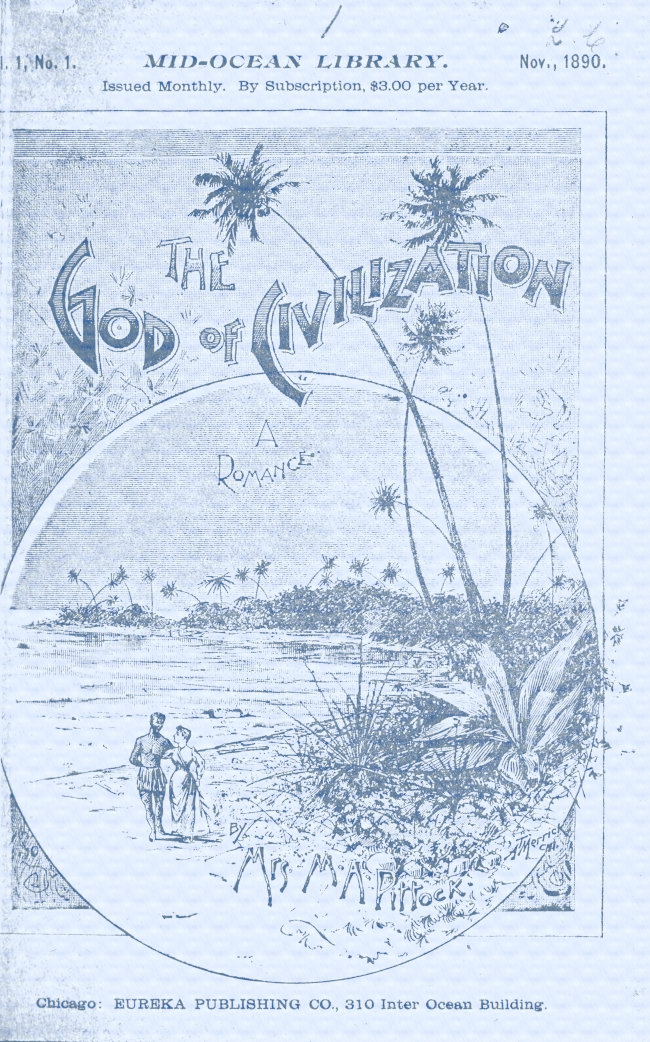
The cover image was created by the transcriber and is placed in the public domain.
I. 1, No. 1. MID-OCEAN LIBRARY. Nov., 1890.
Issued Monthly. By Subscription, $3.00 per Year.
Chicago: EUREKA PUBLISHING CO., 310 Inter Ocean Building.
WAS HE A LEPER?
A novel bearing the above title, written
by the author of “The God of Civilization,”
is now in press.
The story, the scene of which is laid
in Honolulu, deals with the dread
scourge leprosy.
Eureka Publishing Company,
PUBLISHERS.
310 Inter Ocean Building,
CHICAGO.
—BY—
MRS. M. A. PITTOCK,
AUTHOR OF “WAS HE A LEPER?” IN PRESS.
Copyright 1890. All rights reserved.
CHICAGO:
EUREKA PUBLISHING COMPANY.
TO
FRANCES M. BLUMAUER,
The valued friend who pointed out to me a pleasant path
wherein my feet might tread; and to whose loving advice I
shall owe whatever of success I may hereafter achieve.
The Author.
Chicago, Oct., 1890.
The God of Civilization.
3
“Oh! I have grown so tired of this continual
round of parties, calls, and theatre going; I do
wish something would happen to break the monotony
of my life.”
The foregoing remark was made by Mabel Miller,
who spoke in a very discontented manner.
“Why, Mabel, how can you talk of monotony?
There is not a girl in our acquaintance who has
more delightful changes of amusement than yourself.
What with your winters, a succession of
gaieties, your summers at Santa Cruz or Monterey,
I don’t see how you can be so discontented.” It
was Mabel’s cousin, Lucy Maynard, who spoke.
“Oh, I know that is what you always say, but
it does not alter the fact that I am sick of it all.”
“Well, well, what’s the trouble? What is this,
that my little girl is so sick of?” Mabel turned
hastily as these words of her father’s caught her
ear.
“Why, papa, I didn’t know you were here or I
might not have said what I did; I ought to be
contented, I know, after all you do for me.”
4“Come, come; this won’t do, little girl. If you
are unhappy why shouldn’t your old father know
all about it?”
“I am not unhappy, papa, only I am so tired of
everything. I was just saying I did wish something
out of the ordinary way might happen.”
“How would a trip to Australia do for novelty,
Mabel?”
“Oh, papa, do you mean it? I would like it
above all things. I have always wanted to go
there.”
“Well, Mabel, if you think you can be ready in
a week’s time you shall go. I met our old friend
Captain Gray to-day, and it seems he is bound for
Australia, and is going to take his wife and two
daughters along with him, and he has room for
one or two more on board; so there is a chance for
you to go, if you like.”
“Won’t that be splendid?” cried Mabel, clapping
her hands and dancing gleefully about the
room like a child.
“But, Mabel, you must remember it is a sailing
vessel, and not a steamer, that you are to go on,
and, aren’t you afraid that the number of weeks
it will take you to reach your destination, will
prove as monotonous as parties and calls do now.”
“I don’t mind the length of time that we shall
be in going. I shall find something amusing I feel
sure; will you go too, Lucy?”
“Oh no, thank you; you will have to excuse
me;” laughed Lucy. I like the present order of
5things very well and will try a little while longer
to find amusement in balls, and so on, and then
besides there is Harry, you know, I couldn’t leave
him.”
“No, indeed, I do not intend to spare both of
my dear girls at once; what in the world would I
do with you both away,” said Mr. Miller.
“But, papa, you don’t mean to say that you are
not going too,” asked Mabel.
“Why, of course, that is what I mean; did my
girlie think I could drop everything and trot off to
the antipodes with her at a moment’s notice? No,
Mabel, I can’t go; but you will be well cared for,
as Mrs. Gray, I know, will look after your welfare
as closely as would your own mother if she
were living. And her two daughters will prove
most delightful companions if they are half as
amiable as they are pretty.”
“They are lovely girls. I met them last summer
at Santa Cruz, and liked them ever so much.
I know we shall have a nice time.”
“All right, then; you had better begin your
preparations, as young ladies are not noted for
their ability to do things up well at short notice.”
“I could be ready to go to-morrow, but as long
as I have a week to get ready in I expect I shall
find every minute of the time taken up, so I am
off to make a beginning. Lucy, will you run
down to O’Brien’s with me? I shall want a dress
or so, and you are such an authority on such
things, I want you with me when I choose them.”
6“Yes, I will go to O’Brien’s with you; that is
much more to my taste than a disagreeable, tedious
voyage to Australia,” answered Lucy.
The two girls left the room to don hats and
wraps for their shopping tour; and as they left it
Mrs. Maynard, Lucy’s mother, who had entered
the room in time to catch a part of the conversation,
came toward Mr. Miller with rather a
troubled look on her face, saying, “James, how
can you propose such a thing as this trip for Mabel;
you really encourage her in her foolish notions of
dislike for conventionalities. She has no mother,
poor child, to explain to her, her duties and responsibilities,
and I’m sure I have tried my best, if ever
a woman tried, ever since I have been living here,
to make her see how foolish she is to be always
wishing for some new mode of life. She almost
drives me to despair with her whims and her notions.
You ought to help me in my efforts for her
good.”
“Come, come,” broke in Mr. Miller, “you don’t
mean to say I haven’t got the good of my only
child as much at heart as you have, do you? Why,
that girl and her happiness is my first care in life.”
“I know, you think you are doing what is best,
but James, don’t you see you have spoiled her by
always letting her have her own way in obtaining
what she calls happiness? You ought to realize
that Mabel is now twenty years old, and it is high
time she thought of marriage instead of such foolish
trips as this one.”
7“Oh, nonsense, she has plenty of time yet; and
if she don’t happen to get married I guess I’ve
got money enough to keep her here with me yet
awhile; hey, Kate?”
“I might almost as well talk to the girl herself
as to you. Now, why can’t she settle down to take
an interest in society, as Lucy does? In a few
months I shall see Lucy nicely settled in an
establishment of her own; and if Mr. Howard
is a little wild now he will settle down after he
and Lucy are married awhile, and I had hoped
that when she was married and all that, I should
then see Mabel as well suited.”
“I know, Kate, you are a great little matchmaker;
but you see Mabel don’t want to find a husband
just yet, and I don’t want to lose her yet
awhile, sister; so we will just let her alone.”
Perhaps Mrs. Maynard might have felt inclined
to carry the argument further, but at this moment
the two girls returned, and with them Harry
Howard, the young man to whom Lucy was betrothed.
Of course the subject was dropped, and
the few days that followed before Mabel’s departure
was so fully occupied with the arrangements
for her trip that the subject was not again referred
to. These last days at home were made lively by
a farewell afternoon tea and a round of calls, all
of which Mrs. Maynard thought necessary for
Mabel to make before her departure, although
Mabel tried to evade making them by putting forward
the plea that she was too busy; but her aunt
8was firm in her purpose, saying, “My dear Mabel,
you do not seem to realize what you owe to society.
You must make these calls or what will people in
our set say?”
“Oh, auntie, I don’t care even the least little bit
what people say. I don’t care for the people in
our set, which means three or four hundred people
that I don’t care the snap of my finger for, anyway;
and who do not care at all for me. Then,
what is the use of trying all the time to keep up
with society? I like my friends, and I hope I have
some friends who like me really in return; but I
don’t care for society, as you call it, at all.”
Mabel and her aunt were not all likely ever to
have the same ideas of society, as Mrs. Maynard
was one of those women who all her life had lived
for society, and struggled continually to be a
leader, but as yet her ambition was ungratified,
for, though she was a prominent figure socially,
she was by no means a leader; whereas, Mabel,
having lost her mother in early childhood, had
been the companion, more or less, of her father, a
man kindhearted and thoroughly good, but who
regarded social duties as rather a bore, and consequently
Mabel saw the world through his eyes and
had learned, very young, the bitter lesson of disenchantment
as far as the social system was concerned.
It was all a sham to her, and, as she
was eighteen when her aunt and cousin Lucy came
to form a part of their household, the ideas of the
two girls were very different.
CHAPTER II.
9
The day on which the bark sailed was one of
those clear, bright days that are so delightful in
San Francisco, when the brisk breeze blowing in
from the sea, bringing the color to the cheeks and
giving one an indescribable feeling of thankfulness
for the mere fact of being alive.
As Mabel stood on the deck, dressed in a jaunty
sailor suit, she made as pretty a picture as one
could wish to see, with the soft curly locks of
golden hair blown out from under a snug little cap
about her sweet face, and among the large party of
friends who had come down to see the vessel off
that was to carry Mabel on her eventful trip, there
was at least one young man, if not more, who
thought her by far, the handsomest as well as the
brightest girl he knew, and felt that he would like
very much to tell her so. But Mabel had a peculiar
way of her own of keeping young men at a
friendly distance, and the young man who looked
at her with such a longing in his heart had not
dared to speak of love to her, fearing to meet the
fate of more than one of his acquaintances, for
already she had had a number of offers of marriage,
for she was not only a girl of wonderful
beauty, but also exceedingly fascinating and entertaining.
10She had every accomplishment that
could be taught a woman of the present day.
Then another fact that may have had its influence
on some of her suitors was that her father was
what is commonly called a rich man and she an
only child.
At last all was ready and the staunch little tug
Relief, after much fuss and bustle and blowing of
whistles, had made fast to the bark. Mabel threw
herself into her father’s arms for a last good-bye.
Now she stands leaning over the rail, with one
hand raised to shade her eyes from the glare of the
sun, and with the other waved farewell to those
standing on the wharf watching the slow, majestic
progress of the vessel out towards the blue Pacific.
Mabel strained her eyes for a last glimpse of the
form of her father. It never entered her mind
that this is the last time she may ever see him, but
her heart is as gay and as light as a child’s as she
joined Mrs. Gray and her two daughters who are
talking with a man of perhaps thirty, who is
dressed in the pronounced English style.
As Mabel had already met Mr. Allen Thornton,
who was a fellow passenger, she fell quickly into
conversation with the group. Allen Thornton was
saying to Mrs. Gray, “Well, you know I had intended
to take the steamer for Melbourne, but
reached San Francisco a day too late for the
steamer, and as I should have to wait about a
month for the next one, then finding that your
vessel was to leave in a day or so with a pleasant
11little party on board, and as I have a fondness for
pleasant little parties rather than large ones, not
so agreeable, here I am. I do hope you ladies are
going to be awfully nice to me and try to do everything
in your power to make the trip a pleasant
one for me.”
At which the three girls laughed heartily, and
Etta, the younger of the Gray girls, answered him
with, “Oh, we’ll make it pleasant for you, if waiting
on us can make it so. I was just saying how
nice it was to have a young man along to wait upon
us all the time as you won’t have another thing
in the world to do, and we shall have to keep you
busy.”
“Oh, this is something simply fearful. I thought,
being the only man in this little party of idlers,
you would vie with each other in your efforts to
amuse me; but alas, instead of that, you intend to
use the advantage of your superior number to
reduce me to the level of a slave.”
“Don’t you wish you were safe on shore again,?”
laughed Etta.
“I do not dare to say I wish it or you may perhaps
throw me overboard and tell me to strike out
for the shore. No, I will try to bear your tyranny,”
saying which he settled himself comfortably in a
big bamboo chair, and after asking of the ladies
permission to smoke and being granted his request,
he lit his pipe. He certainly looked as if he were
going to make the best of his lot.
CHAPTER III.
12
The days passed more rapidly than Mabel had
any idea they would, and a delightful time they
had, too. Reading, card playing, and an occasional
old-fashioned candy making enlivened the
time. They really did not heed the passage of time
as the vessel, day after day, brought them farther
into that realm of delight—the tropics. All day
long they lie lazily on deck under an awning that
had been put up to protect them from the fervid
rays of the glorious king of day, and drink in the
fresh sea air so warm, yet so refreshing, so delicious.
The party had become so imbued with truly
tropical indolence, that now, even reading was abandoned
by them. They were having a desultory
conversation one afternoon when it occurred to
them that a pleasant diversion would be to relate
any strange events that had ever happened to any
of them, and then weave the whole into one
romance, drawing on their imaginations, of course,
to make the final story more thrilling.
“Now,” cried Mabel, “Mr. Thornton, as you
were the one to propose the scheme, you must be
the first to tell of the events in your life that are
worthy to be written in our crazy-patch story,
13which, I am sure, will astonish the whole world
when we allow it to read our wonderful
productions.”
“All right, Miss Miller; but as you are the one
to propose giving our story the honor of being
written I move that you be the one to write down
all the events that have, in the past, happened to
our party,” Mr. Thornton answered with a laugh,
as Mabel made a wry face at being picked out as
the one to do the only physical labor connected
with the plan.
“Wait until I run down and get a blank book
which I have in my cabin, and we shall be under
full sail,” saying which Mr. Thornton disappeared
down the companion way, returning with blank
book and pencil. “Now, Miss Mabel, to work.”
“But,” said she, “how can I write anything
until you have told me what to write.”
“By Jove, I forgot you were waiting for me to
begin. Let me see, to begin with I was born at a
very early age, and——”
“Now stop, Mr. Thornton, we won’t allow any
such old joke as that to go with our romance,”
cried Etta.
“Very well, then; I was born at Brighton, England.
Now, really, girls, I don’t see where I’m
going to find the romance or strange events in
my life. I’m in despair.”
“That isn’t fair, Mr. Thornton,” said Mabel,
“you’ve got to go on now. I warrant you have a
romance you don’t want us to know anything about.”
14“Well, here goes then. I was born at Brighton,
England, and lived there the first fifteen years of
my life. When I was about a year old my father,
who was a sea captain, left home in his ship for
the very port which we are bound for, but which
he never reached, as his vessel was lost with all on
board and was never heard from. I lived with my
widowed mother until I was fifteen, at which
time she died, leaving me alone in the world, as I
had no brother or sister and but one relative, an
uncle, who, at about the time I was born, had gone
to Australia, where he had large interests in some
of the gold mines in that region. After my uncle
learned of my mother’s death he sent me to school
and college, in the meantime putting a liberal
amount of money at my disposal, and when I left
college I had a letter from him saying that he now
wished me to come out to Australia and live with
him, to take an interest in his large business; in
fact to occupy the place of a son to him, as he was
childless. Now you would think of course I did
as he wished, but I did not, and why? All because
a pretty little girl, with rosy cheeks and roguish,
laughing eyes, had too strong an attraction for me;
but I should have known that those laughing eyes
could have looked as lovingly at other admirers as
myself. But I trusted my little darling, even when
with her arms around my neck she told me that
‘papa must not know of our engagement just yet.’
What difference did it make to me so long as I
knew she loved me, even if she did dance half the
15night and idle away half the day with that young
idiot Grayson, whose father is worth his millions.
I knew that she loved me, but one day I awoke
from my dream. What was this I held in my
hand—a card to a wedding? Was I going mad or
had my eyes played me false? No, my God, no;
it was there printed on the card I held in my hand—‘Helen
Jessup to Herbert Grayson.’ Yes,
it was my darling’s name. I dropped my head on
my hands and gave way to my agony. But finally
recovering myself I resolved to go to Helen and
ask her what it meant; so dashing out of the house
I was soon in a cab going rapidly toward her father’s
house. I hardly gave the cab time to stop
before I sprang out and rushed up the steps and
rang at the door. I asked for Helen. The servant
hesitated a moment and then said, ‘Miss Jessup is
at home, but I do not know whether she will see
anyone or not. I will ask, if you will step into the
parlor, sir.’ I went in, my head in a whirl. I
was hardly seated when Helen rushed in—a vision
of loveliness in white—and actually threw herself
in my arms, exclaiming, ‘You darling Allen; I
know what you are going to say, but don’t say it,
dearest, for my heart is broken, too.’
“‘What do you mean,’ I cried, ‘your heart broken?
Who has broken it, may I ask?’
“‘Allen dear, don’t look at me that way; I cannot
endure it. You look as if you blamed me for
what has happened.’
“‘And who, pray, is to blame?’ I found breath
16to ask. At which she melted into tears and cried,
‘You don’t love me any more.’
“I was almost dumb with astonishment. ‘You
don’t expect me to love you when you are going
to marry another man, do you,?’ I gasped.
“‘Don’t you see how it is; I love you and
always shall love you. Really, I could not marry
you after papa found that your income from your
mother’s estate was only four hundred pounds a
year. Now, dearest, you know I could not dress
decently on that. No, I had to marry Herbert,
but I do not love him and never shall.’
“‘Why, Helen,’ I cried, ‘why did you not say
it was money, not love, that you wanted, and I
could have told you I have an allowance of five
thousand pounds a year from my uncle, who is
one of the wealthiest men in Australia.’
“‘Why didn’t you tell me that before; it would
have made all the difference in the world. I don’t
see what I can do now, unless I get up an awful
quarrel with Herbert, and I will do that if I can.’
“I was shocked beyond all expression. This
grasping, money-loving woman, who did not hesitate
to say that she loved one man, when she was
on the eve of marrying another. Could it be my
Helen, whom I had thought the soul of innocence
and goodness, all girlish love and yielding tenderness?
“I turned from her with a feeling that was
almost loathing. I could not answer one word,
but took my hat and left her presence forever.
17“The next day found me with a ticket for New
York in my pocket, and a determination to spend the
rest of my life with my uncle, and, in a new country
begin a new life. Such, young ladies, is my story
so far; what will happen hereafter is a sealed book,
as yet. Now, Miss Etta, give us your story next.”
Scarcely had Allen Thornton uttered these words,
when they were suddenly aroused by the sharp ringing
of the ship’s bell, and, at the same moment
Mrs. Gray appeared on the deck, her face white and
her whole manner one of alarm. The young
people sprang to their feet and ran toward her,
crying out “what is it,”? “what has happened”?,
“what is the matter,?” all talking at once in
breathless excitement, presenting a strange contrast
to the picture they had formed a moment before, of
perfect comfort and contentment.
Mrs. Gray did not speak, but dropped into a chair
as if utterly helpless.
“What is it,” again cried Etta.
Mrs. Gray raised her head and uttered that one
word, so terrible to hear at sea: “Fire!!”
“O, mamma, is the ship on fire?”
By this time Mrs. Gray had recovered her composure,
and, answered, “yes, on fire. Do what you
can quickly to save what valuables you have. Your
father says there is considerable powder in the
vessel, and, that we shall probably have to take to
the boats to save our lives.”
Indeed, already while they had been speaking,
the men had been busy supplying the life boats
18with barrels of sea biscuit, and salt beef, and casks
of fresh water and other necessities; and the scene
which had so lately been one of placid enjoyment,
had, in a moment been turned into the wildest confusion.
Sailors running here and there, officers
shouting out orders, and above it all, the smoke
arising in dense clouds. The life boats were soon
ready for their precious human freight. Into one
boat Mrs. Gray, Allen Thornton, the three girls, the
captain and four sailors went, the rest of the crew
taking another boat. The men set the sails on the
captain’s boat, and, as there was a brisk breeze
blowing, together with the fact that the men bent
manfully to the oars, they were soon a safe distance
from the burning ship, and looking back could see
the flames bursting out all over her.
All at once there was a frightful noise, and as
they looked, they saw the vessel torn asunder, portions
of her being thrown high in the air. It was
as if she had lifted herself out of her watery bed in
one wild leap of joy, at no longer being under the
control of human hands, but left to the mad caprice,
of the wild elements—fire and water. As a portion
of the smoke cleared away the now shipwrecked
watchers could see that she has been completely
shattered by the terrible explosion, and, that what
had been so lately a noble vessel, breasting the
waves with majestic calm, was now gone from the
face of the waters; no more should she sail away
with her sails bellying in the breeze, her flag and
pennon floating gaily at her mastheads; no more
19should loving eyes gaze out over the harbor bar
with longing anxiety for her coming, bringing
loved ones home. No, she had gone, gone forever.
The day passed slowly enough to our friends.
All through the afternoon they kept in sight of the
other boat load of fellow sufferers. As the day advanced,
the breeze, which had been blowing all
day, was a strong gale by the time night had fallen,
with that suddenness, which seems, in a moment,
to envelop the sea and earth as with a dark shroud
dropped by mysterious hand from heaven.
There is in the tropics no gentle approach of
night, no soft shades of twilight, that time when
all heaven and earth is hushed in dreamy, restful
quiet; that time between the busy, gay and garish
day and the dark, gruesome night. The
darkness seemed to increase the uneasiness of all
on board the little craft as they were afraid the
high winds might drive them against some of the
large pieces of wreckage which, before nightfall they
had seen not far from them; and if such an accident
happened to them there would be little
chance of their escaping a most horrible death.
But their fears from that source were fortunately
not realized.
At last morning dawned, but bringing no abatement
of the storm; in fact, the southerly gale had
increased to almost a hurricane in violence.
All day long the wind and sea raged, the seas
breaking over the frail craft time and again. Not
a mouthful of food was taken by any of the
20wretched party, as they did not dare to relax their
hold on the boat to which they clung in the agony of
despair. After hours of this horrible battling with
the sea, Mrs. Gray feebly called out, “I can keep
my hold no longer. My strength is almost gone.
Good-bye my loved ones.”
Captain Gray made an effort to reach her but he
had been thrown from his feet to the bottom of the
boat a moment before, and his leg was now held by
a cask that had fallen on him, and before any one
could reach Mrs. Gray, another sea had swept the
unfortunate boat, and, tearing her from her feeble
hold had carried her far beyond the reach of assistance.
The storm continued but a short time
longer to vent its fury on the ill-fated occupants of
the life-boat, and shortly after Mrs. Gray was swept
away it passed on to the north in search of new
victims; but left behind it a long angry swell,
the vast bosom of the deep, heaving and swelling.
The grey and sullen skies, from which the rain
now came in a soft shower, like a child denied
some wished for toy, who cries and stamps its foot
in rage, then finally sobs itself to sleep. All
through the night the swells continued, but by
morning had almost disappeared and the sun shown
from a clear sky, with a genial warmth.
By noon, the clothes of the drenched party were
dry and they had set to work to find what was left
to them, after the storm, of their supply of provisions.
They found the barrel of beef all right,
the sea biscuit a little water-soaked, and set to
21work spreading the biscuit in the sun to dry. The
barrels had all been firmly lashed to the boat so
they had stood the stress of the storm with but little
damage, but, to their horror, they found when
they came to examine the water cask that was also
lashed to the boat, that during the storm its side
had been stove in, letting almost all the water escape,
so that now there remained but a few pints
of the precious liquid in the bottom of the cask.
It was realized by all that the danger they now
had most to fear was lack of water. After having
eaten heartily of the sea biscuit and beef, that to
satisfy their immediate thirst, would take all the
water remaining, but they contented themselves
with a mere sip, just enough to moisten their
parched lips.
Carrie Gray, who had always been a delicate
girl, was completely prostrated by the terror and
hardships which she had undergone the past few
days, and the loss of her mother preyed upon her
mind so constantly, that by the evening of the third
day she was raging with fever, and her father and
sister denied themselves of their share of water,
only dampening their lips and tongues with a few
drops, so that Carrie might have all to relieve her
sufferings as much as possible.
CHAPTER V.
22
“Captain Gray, have you any idea where we
are?” asked Allen Thornton, on the afternoon of
the third day.
It was not the first time that the query had been
on the lips of more than one of the unfortunates,
but each time they had dreaded to ask the question,
as they feared the answer.
“I can not say exactly, of course,” answered
Captain Gray, “but as the wind that has been
treating us so unmercifully, was from the southeast
we have been keeping, apparently, a course, more
or less, to the northwest, and I should say we are
considerably northwest of our position when we
left the ship.”
“Do we stand much chance of being picked up
by some passing ship, Captain?” asked Mabel.
“No, I’m afraid we do not,” answered the captain,
“as we are rather out of the line of ship
travel. You see, the winds had been quite light for
several days before we abandoned the vessel, and
what headway we made was entirely to the westward,
so that we were considerably farther west
than the usual course of vessels.”
“Then we may as well make up our minds to
die first as last, is that the way of it, Captain?”
asked Allen.
23“No, we will not give up yet by any means.
Do you remember, Etta, the day before we left
the ship, when I was marking our position on the
chart, you asked me what all those little black
dots, extending in a curved line almost ahead of
us, were?”
“Yes, papa, I do indeed, and you said they were
little islands, or reefs that had been sighted from
time to time by some vessel.”
“Well, there lies our chance for safety,” said
the captain. “We are now considerably nearer
them, I should judge, and we may be able to make
one of those islands.”
“How long will it take us to reach the islands,
do you suppose?” asked Mabel.
“Well, I can’t say that we will ever reach them,
my dear Mabel, I can only hope so; but even if
we do, we may be no better off, as some of them
are simply coral reefs, others barren and desolate,
being of recent volcanic origin, while still others are
inhabited by the fiercest tribes of cannibals. They
are, for the most part, unexplored, as they are in
latitudes where storms from the south, such as we
have passed through, are of frequent occurrence,
and the quantity of reefs make the approach to
them a matter of great peril.”
“Well, Mabel, we will keep up stout hearts and
hope for the best, won’t we?” said Allen.
Etta had sat listening to all her father had said,
saying but little until now, but as Carrie, whose
head was resting in Etta’s lap, moved restlessly
24and moaned, “Water, give me some water.”
It seemed that Etta could stand it no longer and
she cried, “Oh, papa, we must get there right
away. Can’t something be done to help us on?
Carrie can not endure this horrible heat much
longer, without shelter, and the water is all gone.”
“All gone?” the words seemed to be fairly
shrieked by the horrified group, for they knew that
under this burning sky they could none of them
exist long without water.
Her father was the first to ask where the supply
had gone, that an hour before he had thought sufficient,
at the rate they were using it, for at least
two days, and now it was all gone. “Who used
it,” Captain Gray asked sternly?
“I did,” said Etta, “don’t blame me, papa, I
could not help it, I have given it to Carrie. I
could not endure it any longer to see her suffering
so. I had to give it to her.”
Captain Gray bowed his head in his hands for a
moment, then taking Etta’s hand in his, asked in
a broken voice, “Do you know what you have done
my child? You have doomed us all to a horrible
death.”
“Don’t papa, don’t. I could not bear to see
her die, calling for water when there was still a
little that she might have.”
“But what can we do for her now, the water is
all gone, and her fever higher than ever. My God!
Must I see my loved ones die, and be powerless to
help them. My wife torn from me by the relentless
25waves, and now, my darling daughter dying
before my eyes. Would to God I could die; but,
to live on bereft of those dearest to me, I shudder
at the thought.”
The morning of the fourth day broke, hot, oh, so
hot. The air was like a breath from a furnace,
scorching, and parching the occupants of the boat.
Carrie was raving wildly, and calling constantly
for water, but not even a drop was to be had. Her
agonized father, and sister could do nothing for her,
and death came to release her from her horrible
sufferings about one o’clock, as near as they could
judge, as the watches of both the captain and Allen
had stopped during the storm and they had set them
by guess.
Knowing that they could not keep the body of
Carrie any length of time, and fully realizing the
fact that they were all fast losing strength, Allen
Thornton, assisted by two of the sailors, committed
the remains to the sea. It was horrible to think of
doing so, as sharks had been following the boat for
some time past, and, here and there the shining
dorsal fin of a sluggish, slow moving monster of the
deep could be seen glistening in the sunlight.
Etta was spared the torture of seeing her loved
sister’s body given up to such a fate, owing to the
fact that she was utterly unconscious of all that
passed, and sat in the bottom of the boat with a
vacant stare in her eyes. Both she and Mabel had
now almost succumbed to the heat, and their terrible
thirst. One of the sailors was raving wildly and
26throwing his arms above his head with heart-rending
shrieks, as the body of Carrie struck the water
with a slight splash, the sound seemed to madden
him still more, for he gave one wild cry and threw
himself over the side of the boat.
The sky which had been so clear at the beginning
of the day, had gradually become overcast
with clouds. At about three o’clock a few drops of
rain fell with a soft plash into the boat. It soon
increased to a hard shower. Captain Gray, Allen
and the sailors quickly unlashed the barrel containing
the sea biscuit, which they emptied into the
bottom of the boat and set the barrel to catch the
rain. They soon had caught enough to give each
of the girls a refreshing draught, moistening their
own parched throats as well. The rain continued to
fall for some time, enabling them to catch several
quarts of water.
For three days more they drifted on, with no
signs of land, or even a friendly sail in sight, but
about noon of the eighth day one of the sailors cried:
“Land! Land!” “Captain, isn’t that land ahead?”
“I have seen that line against the sky for some
time,” answered Captain Gray, “and I think you
are right in saying it is land, yet it may be only a
coral reef.”
What remnant of sail they had left was soon put
up, and fortunately what breeze there was, was
setting directly toward the island, if island it really
was.
“Can’t we do something to make sure of reaching
27it, papa, if it is land?” asked Etta, who had now
entirely revived.
“No my child, we must trust to luck to take us
there. We are almost helpless. But there seems
to be a current setting in towards shore, which, if
nothing, such as adverse winds, happens to change
our course, I think that sometime to-morrow we
shall reach the island or reef, whichever it is.”
“Are we not in danger of running on some hidden
reef?” said Allen.
“Yes, we do run some risk of that, but we must
do the best we can.”
As night came on, the weary wanderers over the
face of the waters, composed themselves to rest with
a feeling of almost security, so nearly ended seemed
their trials of the past week. The three sailors,
Allen and the captain went on watch by turns
throughout the night. By the early morning light
how anxiously all the party scanned the shore,
which could now be seen quite plainly. The waves
gently lifted the boat and each moment seemed to
carry it onward, in a manner that was meant to compensate
for the roughness with which the waves had
handled the staunch little craft a few days before.
“I think,” said Captain Gray, “that we are inside
of a large reef and that fact accounts for the
calmness of the sea.”
“We are lucky that the wind keeps favorable,”
said Allen. “What in the world should we do if
the wind should go down?”
“Well, Allen,” answered Mabel, “we must trust
28in providence. God has so far brought us out of
our perils, and we should not now, doubt His goodness,
or power to protect us.”
“I know Mabel, yet I cannot help feeling as if,
were we again to be driven out to sea, it would be
harder to bear than our trials of the last week
have been.”
“But see, Allen,” broke in Etta, “we can actually
see the shore and what is on it.”
“You mean, what is not on it, don’t you?” said
Allen. “I don’t see anything but a mass of reddish
brown rock.”
“I must say it is not a very promising looking
shore” answered Etta, “but I shall be thankful to
reach it, no matter what there is on it. I have
such a horror of this boat, from which my mother
and sister have been snatched by death.”
Nearer, and nearer they came to the shore. At
last a grating sound under the keel, was heard.
They had gone as far as possible. One of the sailors
sprang out, and found the water quite shallow, and
waded ashore. He soon came back, and, with
the help of the other sailors, carried ashore what
was left of the provisions. Going on shore a second
time they found that if they could move the boat
from its present position, they might get it into
deeper water, and by pushing it along with a pole
bring them a sort of little cove.
“But where are we to get the poles from?” asked
Allen.
29“We will take the remains of the mast. That
will do,” said Captain Gray.
Suiting the action to the word, and getting the
boat free once more, they began to push her slowly
up the little inlet. At last she was snugly alongside
the shore, and once more all the party felt the
firm earth under their feet. A feeling of thankfulness
filled every heart.
CHAPTER VI.
30
They were all very hungry, as they had been too
intently watching their approach to the island to
think of eating anything since the morning, and it
was now almost sunset. Going over to the place
where the sailors had first landed, where the beef
and biscuit had been deposited, they prepared to eat
their supper. They were all heartily tired of salt
beef and hard tack, but the country appeared to be
very barren, and there seemed little likelihood of
their finding much in the way of food on it.
“I think,” said Captain Gray, “that this is one
of the volcanic islands I spoke of, but still we may
have landed on the most desolate part of it. To-morrow
we will explore it in all directions, and find
out just what our position is.”
After supper they prepared for their first night
ashore, and yet it was not exactly ashore, either, as
the boat was more comfortable as a sleeping place,
than the rocky shore; so arranging the sail in the
bottom of the boat, they spent, by far, the most
comfortable night since the burning of the “Western
Shore.”
When the first light of morning made its appearance,
Allen and Harry (one of the sailors) set out to
see if they could find water, which they were again
31likely to suffer for, or any kind of food. They
followed the shore line until they had rounded a
sharp point which obscured the boat from their
view. As they rounded this point, an exclamation
of joy burst from Allen’s lips. “See Harry,” cried
he, “there is a large number of trees; they will
probably have fruit of some kind.”
“Yes, they have fruit,” answered Harry, “but
I’m afraid we can’t reach it. They are cocoanut
trees.”
“Well, what if they are? What’s to prevent
our getting the nuts; they would be a fine change
in our diet, and the milk, too, would be very
acceptable.”
“Yes, that’s true, sure enough, but we can’t get
them. Those trees are from fifty to seventy-five
feet high, and it takes a fellow that’s used to climbing
them, to reach the nuts. I can tell you that.”
“Why,” said Allen, “can’t you climb one of
those trees? You were nimble enough when you
had to go aloft to set a sail, and I think it must be
quite as hard to climb a mast as a tree.”
“No sir, that’s where you’re wrong. When a
fellow’s going up the rigging, don’t you see he has
all the ropes to help him, but to climb a cocoanut
tree it’s a sight different. You’ve got nothing to
lay hold of, and have got to trust to your feet and
hands having a good grip on the bark.”
“I think you could do it if you tried,” said
Allen.
“Well, I know as how I ain’t smart enough to do
32it, for I have tried it afore now. You see I’ve
been around a good bit in the South Seas, and
there ain’t no fellow but what’ll try his hand at
climbing a cocoanut tree if he thinks he can do
it.”
By this time they were in the midst of the graceful,
tall trees which held their plume-like heads
high against the sky, as if in proud defiance of all
such aspiring mortals as should wish to rob them of
their royal crown of fruit. But now that they had
reached the cocoanut grove, they found that there
were a number of other trees of much lower
growth in the neighborhood. On going up to
these trees they found them to have very broad
leaves that spread out from the top of the
trunk, each leaf being held in an almost horizontal
position by a thick, pulpy stem, from three to
five feet in length. The lower round of leaves
having the largest stems, and each row being somewhat
shorter than the one beneath, forming a most
agreeable shade, as its shape was that of an immense
umbrella. Clustered closely around the trunk, and
directly under the leaves, were about a dozen bright,
orange-colored fruits, resembling a quince somewhat
in shape, only larger. Allen was the first to
see these, and called to Harry, “What are those
trees ahead of us, do you know?”
“Yes, they are papiea trees, and the fruit is
mighty good to eat, too.”
They were not long in gathering a number of
these, and also some guavas, which they found
33in abundance. Now, as it was getting well on in
the morning, and they were beginning to feel as if
breakfast would be acceptable, they started back
to the boat. They were rather disappointed at
not having found any traces of fresh water, but
hoped that the captain and Ben, who had gone in
the opposite direction, had been more fortunate,
and so indeed they had. Not far from where the
boat was moored they came upon a little stream,
whose limpid water hurrying over its rock-brown
bed, was a joyful sight to the searchers. Passing
a little beyond the shining brooklet, on whose bank
they stopped a moment, both the captain and
Ben taking a long draught of the sweet water, they
came upon a lovely beach covered with bits of coral,
shining sands and bright shells. Ben, running
down to the water’s edge, soon turned with the exclamation,
“It’s just as you thought, captain,
when you said there should be plenty of crab, if we
could find a good beach. See, here is a fine one, I
have caught.” After working for some time they
managed to capture eight fine crabs.
“Now,” said the captain, “I think we had
better go back to camp with what we have, and
delay our expedition until after breakfast. It will
take some time to prepare these, even if Hans and
the girls have managed to get a fire.”
“All right, just as you say, captain,” came the
answer, “but if you will wait just a few minutes I
will get some of that sea-weed we have seen clinging
to the rocks. It makes first-rate eating.”
34“What, that black, slippery looking stuff?”
asked the captain.
“Yes, sir. The natives of several islands down
in these parts eat it, and I have tasted it and it’s
first rate.”
“That’s so,” said Captain Gray, “now I come
to think of it, I have seen the natives of the
Hawaiian Islands, and Samoa, eat it.”
So, gathering a quantity of the sea kale, they
also started back for the boat.
In the meantime the girls and Hans had not
been idle. They had searched in all directions for
material to build a fire. They succeeded in finding
a number of pieces of driftwood, which, during
some storm had been cast high and dry on this
rocky point. The captain had been fortunate enough
to have kept some matches perfectly dry, as his little
gold match-box, which he carried in an inner
pocket, shut so tightly that not a drop of water had
reached the now much needed and precious
matches. The girls had arranged a fire all ready
to light when any of the party came back, so that
if they found any game or fish they would be able
to cook it immediately. Consequently when
captain and Ben returned, the fire was soon going,
and the crabs put into the hot ashes to cook. Hans
had found a comfortable shade from the sun behind
some huge rocks which was very pleasant to the
captain and Ben, who had not found a particle of
shade during the time they were exploring and so
were very much heated, for, although the hour
35was early the heat of the sun was intense.
During the absence of captain and Ben, Hans
had busied himself making a bucket of the staves
of the broken water cask and needed only hoops to
complete it. The two girls started to the boat after
them. They had been gone but a few moments
when they rushed back, with their faces as
pale as death. Etta, throwing herself into her
father’s arms, cried: “Papa, what shall we do,
where can we hide? They have come, they have
seen us, I am sure they have. Oh, papa, papa,
what shall we do?”
Their fear soon communicated itself to the whole
group.
“What is it,” exclaimed Captain Gray, “who
has come?”
“The natives,” whispered Mabel, “don’t speak
so loud, perhaps they didn’t see us after all.”
The captain was busy, meanwhile, trying to
smother the fire by dragging a portion of the old
sail upon it.
“If the smoke does not attract their notice,”
said Captain Gray, “we may still be safe, if as
Mabel thinks, they did not see you.”
“But papa, I am sure they did see us and they
are cannibals, I know they are cannibals. What
shall we do?”
“Put your trust in the Lord, and fear not,”
said Mabel, drawing Etta close to her.
“Are you never frightened at anything Mabel,
you are so calm?”
36“Yes, I am afraid now, but I feel that what is
best for me will happen, and it is useless for me to
struggle against fate.”
“How many natives were they and how far
away?” inquired the captain.
“There was five,” replied Mabel, “and they were
just coming over the crest of the hill as we saw them.”
“Five,” mused Captain Gray. “They could
easily overpower us as we are but three men now.
Oh, if Allen and Harry were only here.”
Mabel raised her head with a startled little cry.
“Oh, captain, what if Allen is already in the hands of
those horrible natives; or perhaps he and Harry both
have been killed and these savages are searching
for further traces of our party.”
They now lay as closely as possible to the protecting
rocks and after Mabel’s last words, a deathlike
hush reigned. The moments seemed like
hours in the agonizing suspense, for they knew
not how close the dreaded savages might have
come by now, as their footfalls, they were aware,
could not be heard and they expected any moment
to see their malignant faces stealthily peering
around the corners of the rocks. They did not
dare to go to the edge of the rocky screen to see if
their foes were in sight, for fear of betraying their
hiding place; they had resolved to fight to the last
and not be taken alive if possible.
Perhaps Etta and Mabel dreaded capture more
than the three men; they also resolved to fight for
their lives, if necessary.
CHAPTER VII.
37
The moments had passed slowly until almost an
hour had gone by. Captain Gray was the first to
break the long silence with: “I begin to think,
that for this time we are safe,” but hardly had the
words left his lips when the murmur of voices were
heard. The hearts of every member of the little
party seemed to stop beating, so intense was their
terrible dread. In a moment more the form of a
strongly built young savage bounded over the lowest
part of the rocky barrier and stood before the
horrified group. He was quickly followed by four
other natives.
The captain and the rest of the little party
sprang to their feet ready to defend themselves,
their backs against the rocks, their drawn knives
in their hands. But instead of rushing upon them,
the young native smiled and pointed to something
he carried in his hand, which was a large conch
shell, having a curved piece of bright pearl shell
attached to it in a curious manner, the whole arrangement
being fastened to a long cord of braided
grass, and said in a kind voice:
“Fish! Ahleka, Fish! Have no fear of Ahleka.”
The surprise of the little group can be better imagined
than described, at hearing very fair English
spoken by this stalwart young native, whose skin
38was a rich nut-brown, and whose only clothing
consisted of a strip of braided grass wound about
his waist and hanging in a deep fringe half way to
the knees. The rest of his body was totally devoid
of covering or ornament, except a necklace of
claws that encircled his throat. He was a splendid
specimen of manhood; tall and straight as a young
tree, broad shouldered, muscular and supple.
The strangeness of hearing words they could
understand, flow from his lips, in a full musical
tone, when they had expected to hear only sounds
unintelligible to them, was so great as to make the
little party stare at the natives with open-eyed
wonder, as Ahleka continued:
“My people will do you no harm. We war not
with the children of the lands beyond the seas. But,
how came you here? We have found your large
waa (canoe) close under the rocks. Did you come
from lands beyond the rising of Ka La (pointing to
the sun) and, how did so few warriors bring so
large a waa so far?”
The natives were regarding curiously the group
before them.
Captain Gray answered, “No, we did not come
in so small a boat from our land, but our big ship
was burned at sea, and nine days have we drifted,
until we came upon your island.”
Mabel now broke in with: “Are there white
people on your island?”
“White people, daughter of mahina (the moon),
what are white people?”
39“Why, do you not know? and yet you speak
English; we are white people, not brown like yourself
and your friends.”
“Are all your people like you, daughter of mahina,
as if the light of Ka La shone forever on bright
pearls?”
Mabel was a little confused at his admiring
glance, but answered: “Yes, do you not see, all my
friends are white, also?”
“The two daughters are white, as you say, but
not so white are the warriors.”
There was a general laugh at this remark. Etta
spoke up for her bronzed father and the two sailors,
saying, “they are indeed darker than we, but the
rays of the sun made them so, while we live indoors.”
The sailors were indeed very much sun-burned,
while Captain Gray was naturally a very dark man.
There was no denying the fact that they presented
a strong contrast to the two girls, who were both
fair, with light hair, particularly Mabel, whose
complexion was extremely delicate. On attempting
to talk with the other natives, Captain Gray was
surprised to find that they understood but a word
or two of what was said to them.
“You have not told us yet: are there other of
our people living on your island?”
“No, not of your people. My father speaks your
tongue. He has taught me to speak it also, but he
is of our people.”
“But, if he speaks English he must be an American
or an Englishman,” cried Mabel.
40“No, said I, not, he is my father. How is he of
your people beyond the rising of Ka La. No waa,
in all my life before, ever came to our land, nor
heard I of any that ever came.”
“But is he dark, like you, or white like us?”
persists Mabel, feeling sure that his father must be
a white man, having noticed that all of the natives
with him were much darker than he.
“He is as thy father,” answered Ahleka, pointing
to Captain Gray.
“This is not my father, my father is beyond the
rising of the sun. This is the father of my friend,”
she said, pointing to Etta.
“Did not your father come from some far
country?” inquired the captain.
“Yes. It is said by the people of our village
that the fiku (fig) trees have been in blossom many,
many times, since my father and two other Alii
(chiefs) descended from pale mahina to dwell among
our people. They spoke not as our people spoke,
but soon learned our language. My father taught
me your strange tongue as a pastime, and when I
saw the faces of the mahina maidens I spoke it to
them. But come let me take you to my father.”
“Not yet,” answered Captain Gray, “we have
two more who belong to us and we must wait till
they come back, and, besides that we have not
eaten yet.”
On hearing this, Ahleka turned and spoke
a few words to one of the natives, who quickly
started in the direction of the boat. Another
41native set about rebuilding the fire. The native
who had gone to the boat soon returned, bringing
a bundle done up in large, green leaves. This
he laid upon the ground and proceeded to open,
having handed to one of the other natives a number
of fish which he had also brought, strung upon a
sharp stick. The fish were quickly dressed and
wrapped in several layers of the large leaves, when
they were placed in the hot ashes to cook, while
out of the bundle were produced some delicious
looking mangoes, some figs, a large bread fruit
which was already cooked, and some tamarinds.
These things were intended to be eaten by the
fishermen at midday. They also had a couple of
gourds to drink from. They quickly spread the
meal, using the broad leaves for plates. The
repast was almost prepared, when Allen and Harry
were seen coming around the point towards the camp.
Mabel and Etta ran forward to meet them, breathless
to tell them of the strange events that had
happened while they had been away. Allen could
hardly believe the wonderful story; it seemed incredible
that they should have found English-speaking
Aborigines. The idea was almost weird.
When he had reached Captain Gray and the rest of
the party, he found it indeed true.
“Now that we are all together again we had
best have something to eat. What have you there
Allen?” asked the captain.
Allen had now cut open a couple of the papiea
fruit and found them to be juicy and not unpleasant
42to the taste. They contained a large number
of little shot-like seeds, which, at first, he thought
to be the part of the fruit to be eaten, but soon
found his mistake.
“Take of our food to eat,” said Ahleka, “and
when you have eaten and rested, we will go to the
village.”
“But do not you and your friends need the food
for yourselves?” inquired the captain.
“No, not so, we shall not fish to-day, but shall
go with you to my father,” saying which, Ahleka
motioned to put the fish upon fresh leaves also,
which was deftly done by the native boy who had
been attending to the fire. The meal proved a delightful
one, the fish juicy and toothsome, the bread
fruit a pleasant change from hard tack, the fruits
delicious. The gourds had been filled with clear
water into which a number of tamarinds were dropped,
making a cool, refreshing drink, somewhat
acid to the taste.
After having done full justice to what had been
provided for them, they began to feel as if, after
all, their lot was not such a hard one; so reviving
are the effects of a dainty meal.
CHAPTER VIII.
43
They were soon on their way with Ahleka and
his friends, to the village, which they reached in
about two hours’ time. The village was built at
almost the other extreme of the island. After
having crossed the hill, where the girls had first
seen the natives, they went but a short distance before
they came to two canoes, into one of which
Ahleka stepped and held out his hand to assist
Mabel in. Etta, the captain and Allen were all
told to arrange themselves in the same canoe and
the three sailors were directed to get into the other,
which one of the native boys, whom Ahleka called
Kaluha, was directed to manage; the other three
natives pushing the canoes out into the water,
which seemed to be a long arm of the sea, which
extended far into the island, cutting it almost in
two.
Captain Gray, on seeing that the three natives were
to be left behind, exclaimed: “It is too bad for us
to eat their breakfast and then take their boats from
them. How will they get to the village?”
“Have no fear for them,” replied Ahleka, “the
village is on that side of the island. We often
walk from the village here; indeed it is the shortest
way, but by canoe, is the most pleasant.”
44The canoes seemed to fairly skim over the bright
water so rapidly did they go. They had gone
swiftly onward for an hour, when the canoes were
again headed for the shore.
After having landed, there was still quite a distance
to walk before reaching the village, but, at
last, it was espied embowered in trees of every description;
the stately cocoanut and the spreading
candlenut tree, with its delicate silver green
foliage, contending for supremacy. The houses
were built of grass, and were scattered here and
there, without any regard for regularity, but seeming
as if built wherever a large cluster of trees
offered their friendly shade; at the side of most of
the houses a sort of trellis had been arranged by
sticking one end of long poles in the ground and
leaning the other end against the roof of the house.
These trellises were covered by flowering vines of
great variety and brilliancy, the whole effect being
one of exceeding loveliness. Under these flowery
bowers, which were open at each end, were spread
mats of the finest workmanship, being braided of
lohala (a tree possessing a fibre of extreme fineness.)
Some had the appearance of goats fleece, so skillfully
were they woven, leaving fibres three or four
inches in length, loose on the top of the rug; others
were braided in a smooth, close surface.
Mabel exclaimed, on coming in sight of the
village: “How lovely! I never saw anything half
so beautiful; it seems like a vision of dreamland.”
“And is not your country, that has such beautiful
45maidens, far more lovely than our land?” broke in
Ahleka.
“Oh, no! Our country is not one half so enchanting,”
said she.
There seemed a strange quiet brooding over the
village as they drew near, and, on Etta speaking of
this, Ahleka said: “In my country we sleep at midday;
then each one who is in the village rests, so
that we tire not ourselves in the heat of the day.”
“What a delightful custom,” cried Mabel, smiling.
As they entered the village, all still remained
quiet. Ahleka led them to one of the largest and
most beautiful of the houses. After offering them
seats on the comfortable rugs under the trellis that
was a mass of fragrant bloom. “This,” said he,
“was my house. Now it is yours. I will leave
you now while I go to speak to my father, of you.
I will soon return. These boys,” pointing to the
one who had been in the canoe with the sailors,
and another, who had been lying asleep on a mat,
but had gotten up as they came in, “will wait upon
you while I am gone.” Speaking a few words to
the boys in his native tongue, he departed.
“That fellow looks like a prince, doesn’t he,”
said Allen, “in spite of his dark skin and lack of
clothing.”
“Indeed he does,” asserted Mabel, “and acts like
one, too. I have never seen a prince, but he comes
very near my ideal of one.”
“Look out Mabel,” laughed Etta, “and don’t let
him play the part of Prince Charming.”
46Allen cast a quick, keen glance at Mabel, who
colored angrily and answered quickly: “There is
no excuse for that remark.”
“Why, Mabel, you know I did not mean to annoy
you,” said Etta, really sorry she had made so hasty
a speech. “Do forgive me, it was only a joke.”
“That may be, but not a pleasant one. I do
admire him very much as a savage, but the idea of
putting myself on a level with a brown skinned
heathen is not agreeable.
“Come, come, girls, don’t get to quarreling over
our dusky friend,” exclaimed Captain Gray, “this
sort of thing won’t do at all.” In a moment’s time,
the girls had forgotten the little occurrence and all
went on pleasantly.
The two boys now came out of the house, one of
them carrying two peculiar looking water vessels.
They consisted of large gourds covered with a
curiously wrought net work of fine cord, the cords
being gathered around the top into half a dozen
handles by which to carry them conveniently.
These calabashes had been filled with cool water
from a little stream near by; into one of them a
number of very fragrant ginger flowers had been
thrown, giving to the water a delicate perfume.
The water from this calabash, the boy emptied into
a number of shallow gourds they had brought
with them. One of the calabashes of perfumed
water he sat before each of the party, putting beside
each, a piece of something that looked like the
finest cloth, but was in reality the bark of a tree,
47beaten to extreme thinness. It was so evident what
was intended by these attentions that the travellers
were not slow to avail themselves of this provision
for their comfort, and found themselves much refreshed.
The other boy had, in the meantime, been filling
small cups made of half a cocoanut, highly polished
and curiously carved, with the juice of
young cocoanuts. This proved very pleasant to
the taste.
Just as they had handed back the cups to the
boy, Ahleka returned, and with him his father,
whose appearance was in striking contrast to that
of his son, Ahleka; for, although he was browned
by many years of exposure to the tropical
sun, and the hot winds of this lovely island,
was unmistakably a white man. His long hair
hanging in soft silvery waves, half way down his
back, his grey beard falling low on his breast,
while his deep-set grey eyes looked out from under
brows that were almost as black as Ahleka’s own,
giving his face a most peculiar expression. He
was dressed in the same manner as his son, only
that over his shoulders was thrown a small cape
made of bright feathers. In his hand he carried a
long staff. As he came toward the house, in which
Captain Gray and his shipwrecked party were sitting,
they could see that the old man was strongly
affected by their presence; in fact, his agitation
was so great, that Ahleka was obliged to support
his trembling form.
48Captain Gray, followed by the rest, arose and
went forward to meet him. He stretched out his
hand toward them, dropping his staff. “Thank
God,” he cried, “once more do I speak to my countrymen!”
After having seated his father, Ahleka said, “I
have told him all your story, as far as I knew it,
but he wishes to hear much more.”
“Yes,” cried the old man, “tell me all. How
did you get here? All these weary years have I
prayed to God that before I died, he would let me
speak once more to men of my own country.”
Captain Gray told their story to him in all its
thrilling details. He listened attentively, now
and then shaking his head sadly. When the captain
had finished, the old man said, “You can not
hope for deliverance from this sea-bound land for
years, if ever. I have been here thirty years. For
years after I came I spent my time scanning, with
anxious eyes, the face of the ocean, but no sign of
sail did I ever see, except once, and then the fire,
which I placed on the highest hill on the island
failed to attract attention. You are the first sign of
life outside of this island I have seen for thirty
years.”
His words brought a feeling of horror to each
of his listeners. Must their fate be what his had
been?
“In time,” he continued, “I grew more contented
and ceased to look out to sea. About that
time I married, according to the native custom,
49a young and beautiful girl, the daughter of the
reigning queen of the island. Think not that I
was soon comforted for the loss of the wife I had
left at home, for that was not the case; but the
princess loved me and one day two of the warriors
came to tell me that I was expected to marry her,
and, as a refusal on my part would result in my
death, I consented to the proposal, thinking to
leave her behind me when I returned to my own
country; but the girl I married was so beautiful,
so gentle, so affectionate and devoted, that I
learned to love her deeply and mourned her loss
greatly when she was taken away from me by
death.”
“But you have not told us, as yet, how you came
here,” broke in Allen. “Will you not tell us
about it?”
“’Tis a tale soon told,” he replied. “I left
England thirty years ago. It was on the thirteenth
of January, 1857, and I shall never forget that day.
I think it is thirty years since then, am I
right?”
“Yes,” answered Allen, “you are right. Thirty
years, and a little over, as it is now March.”
“As I was saying, I left England, bound for
Australia, on that day. We had pleasant enough
passage until we had almost reached our destination,
when we encountered one of those horrors of the
sea—a cyclone. For days we were at the mercy of
the wind, our masts gone and a greater part of the
upper works washed away. Our ship began to leak
50so fast, that with the most desperate efforts we could
no longer keep her afloat and were driven to take
to the boats. One boat was smashed against the
vessel’s side; a second was swamped by the suction
produced by the sinking ship. We, in our boat,
alone escaped, but our sufferings were intense.
What with the stormy waves that dashed over us,
carrying away three of our number, the horrible
hunger we had to undergo, being without anything
to eat, and the frightful thirst that overtook
us before we reached this island, my sufferings
were so great, that, whereas my hair had been as
black as Ahleka’s there, when I sailed from home,
when I landed here it was as you see it now.
Finally we were thrown on the reef, that extends
almost around this island. Our boat quickly went
to pieces and we clung to portions of the wreckage,
hoping to be at last thrown on the island. Just as
we were almost exhausted, and about to give up,
we saw several canoes, containing natives, coming
rapidly toward us. They had been surf bathing,
and seeing our terrible position, and being kindly
natured, had come to our assistance. We were soon
in the canoes, but there were only three of us,
whereas, when the boat struck the reef, three had
been five, but they were nowhere to be seen. After
bringing us to this village they cared for us with
the greatest kindness. It was not long before one
of our number, a young doctor, was happily settled
in a little grass cottage with a lovely brown girl for
a wife. The other member of our party was the
51mate of the ship. He had a sweet little wife back
in England, so declined to marry a native women
who wished him as a husband. According to a
custom of this people, he was instantly put to death
by her relatives, who took this method of resenting
the insult to their kinswoman. If she had been
a beautiful young maiden, like the doctor’s bride,
it might have been different. Then I married my
lovely Lokie (a rose). We had three children,
this son and two daughters. I was happy and contented
as years went by, but when Ahleka was
twelve years old, a dreadful scourge of fever swept
over the island, and my wife, one of my daughters,
and the young doctor were among those who were
marked by the hand of death. Then I lived
on with my son and daughter. I received great
consideration from the people of the island, as my
son Ahleka is their head Alii or king. The line
of succession descending in this island, not from
father to son, but from the mother to her children,
thus keeping the royal blood pure. Now, you have
heard my story.”
“Yes, but not your name, or that of the vessel
in which you sailed,” said Captain Gray.
“The ship’s name was the ‘Castle Ayreshire.’”
At the mention of that name Allen Thornton made
a violent start. “And I,” continued he, “was her
captain—Allen Thornton.”
At the sound of that name a cry of astonishment
burst from the lips of each of the party.
Allen, throwing himself on his knees, in front
52of the old man, cried: “My father! My father!
Have I found you at last?”
The old man looked bewildered.
“You are my father,” continued Allen, “did
you not leave a boy, a few months old, as well as
a young wife, behind you at Brighton.”
“I did! I did!” sobbed the old man, “and
you are he. I thank God for his goodness. To
think that my other son should be sent to cheer
my declining days. Surely God moves in a mysterious
way, his wonders to perform. But your
mother, boy, your mother. Where is she, and
how? Why did you leave her?”
“Father she is happy and has no need of me.
She died when I was fifteen, after mourning you
as dead so many years.”
Captain Thornton, as we shall now call him,
pressed his hands tightly over his eyes to repress
his emotion, then clasped Allen to his breast.
While this scene was being enacted the others had
gone a little aside.
“Isn’t it all strange?” whispered Mabel to
Etta.
“Yes, and to think of Allen and Ahleka being
half brothers; did you think of that?” answered
Etta.
“Sure enough; I had not thought of that. I
wonder if Allen has, and how he will like it when
he realizes it.” Mabel spoke in a tone as if she
should not care for so dark a brother herself.
Presently Captain Thornton turned and said,
53“My son, Ahleka, has asked, that, in his name I
extend the hospitality and protection of the village
and island to you all, which I gladly do; he also
wishes to give to Captain Gray and the two young
ladies, this house and the one adjoining, which are
his own. He will provide for the sailors with you’
hereafter, and, as for my son Allen, his comfort
shall be my care.”
During this conversation the village had literally
awakened from its sleep, and from every little
grass house came streaming, dusky forms. They
clustered around Ahleka, listening with open-eyed
astonishment to the strange story he was telling
them in their own musical tongue, with many a
gesture. Presently a number of smiling girls darted
off, and soon returned with long leis (bands) of
flowers, made by braiding the brightest and sweetest
flowers with ferns, or, a sweet smelling vine,
into long garlands, with which they proceeded to
deck each of the strangers, putting them over one
shoulder and under the other arm like a military
sash, leaving long ends to fall almost to the ground.
More garlands were wound about their waists,
placed upon their heads and around their necks until
they were fairly clothed in flowers; the girls,
meantime, laughing gaily, and repeating in their
soft, musical voices, ah mie ha (you are welcome.)
CHAPTER IX.
54
The village of Nahua is in a great excitement
to-day. Everything wears an aspect of unusual
gaiety. The houses are bedecked with flowers,
and in the center of the village has been erected
two rows of high poles standing about twenty feet
apart and extending in a line almost two hundred
feet long. Garlands of flowers are stretched from
the top of these poles in all directions and are also
wound around the poles, the whole forming a canopied
avenue of exceeding beauty. Under this
canopy were placed two rows of straw mats; further
on were laid more mats in the form of a letter H.
On these mats was spread a banquet consisting of
raw fish with chili peppers, fish dried in the sun,
fish that had been wrapped in leaves and then
cooked, devil fish which had been salted and dried,
its long slender tentacles being regarded as an especial
dainty. Then there was lemu, or sea kale,
plantain, kalo, a vegetable resembling, somewhat,
the potato, there was kui, or candlenut, ground
to a coarse powder and salted, to be eaten
as a relish to the fish. There were mangoes,
guavas, oranges, dates, figs, pomegranates, papiea,
young cocoanuts, the meat of which was not yet
hard, but of a thick creamy appearance and had to
55be scooped out with little spoon-shaped pieces of
shell. Then there was a large number of small
cups made of wood curiously carved, containing a
peculiar, greyish looking mass of something that
would put one in mind of paste, if one were not
told it was a very much liked dish, in fact, being the
piece d’ resistance of the feast. Into these little
dishes of poi, as it is called, a native will daintily
dip the first finger, then giving it a quick twirl,
wrap a sufficient quantity on the finger, when it is
skillfully and gracefully conveyed to the mouth.
For drinking, we were provided small calabashes full
of the juice of the young cocoanut and large calabashes
containing awa awa, a drink very much esteemed
by them, being in its effects very much
like whisky.
The cause of all this preparation was the fact
that it was the yearly celebration of the maiden’s
feast. On this day the inhabitants of the four villages
on the island gathered at Nahua, the principal
village of the kingdom.
All the morning of this day, Mabel and Etta had
been very busy and now were resting under the
shade of the trellis of their cottage, when a native
girl, about sixteen years old, came toward the house,
followed by an older girl, each bearing in their
hands the fall dress of a native maiden; the younger
girl was Kaelea, the sister of Ahleka. She was
slender and graceful; her charms would have attracted
the notice of a sculptor at first glance; her
face was expressive; her features delicate; her eyes
56brown, large, soft and languorous; her hair hung
in a wavy mass far below her waist. She moved
with a peculiar grace seldom seen. But, if she was
beautiful, what was Maula, who came with her,
Maula was the maiden of the village, of Howcu, the
village on that part of the island, which was beyond
the arm of the sea; she was a vision of voluptuous
loveliness, tall and stately, grand in her proportions;
her eyes could melt in tenderest mood or flash in
the wildest anger or proudest defiance. She seemed
to bend every one to her will, so strong and passionate
was her nature. She was much darker than
Kaelea, being a full blooded native. In her bearing
she somehow made one think of a tigress; when in
a happy mood, moving with a sinuous grace, which
was fascinating, and when angry, one could but
admire her grandeur.
As these two girls were crossing the open space,
between the two houses, Etta was saying to Mabel,
“I can hardly believe that it is six months since we
landed here. Does it seem possible to you?”
“No, it does not, and yet it is strange that the
time should seem to pass quickly,” replied Mabel.
“I feel, whenever I think of my father, that I should
be unhappy, instead of contented, as I am. My
poor father, his heart, I know, is almost broken,
for I was his all; and long ’ere now he has given us
up as dead. My poor, poor father, I can picture in
my mind his grief.”
“Do not think of that Mabel. Above all not to-day
57when every one is expected to be happy and
make merry,” begged Etta.
Mabel, now seeing the two girls coming towards
them, got up to receive them, as did also Etta.
Kaelea and Maula entered the cottage, with the
adornments they held in their hands, extended
laughingly towards the two American girls.
Maula was the first to speak: “Your father and
your friend have long been wearing the dress of our
country; now we shall see how fair and beautiful you
will look when dressed in the costume which nature
teaches her children to wear. Your loveliness is obscured
by the ugly garments that are put upon you to
hinder your movements. When you are dressed
as we are, you will be free; you will never wish to
again put on those clothes which make you so uncomfortable.”
“Well, you see, they do not seem at all uncomfortable
to us,” laughed Mabel, “but, as our
clothes are completely worn out, we are obliged to
dress as you do, and I have no doubt we shall like
it, too,” this she added as she noticed a slight frown
on Maula’s face. Kaelea took Etta aside and soon
arrayed her in the costume. In the meantime,
Maula was showing Mabel the mysteries of a Nahua
maiden’s toilet. First she placed around her waist
a skirt which reached to the knees, being composed
of a series of fringes of grass; around her body was
wound a length of soft kapa, or tree fibre cloth, in
color bright blue, this being passed around the body
twice and tied at the side, had both a picturesque
58and modest effect. Around her neck was hung a
necklace of shells, pure white in color, and about
the size and shape of a grain of rice; this necklace
encircled her throat about twenty times. On her
arms were placed shell bracelets, on her ankles the
fringe of soft grass. Last of all a sort of chaplet,
made of the brightest feathers, which crowned her
head. When Maula had placed this upon her shining
hair, Mabel stood arrayed for the first time in
the native dress which she was hereafter to wear.
“I feel so oddly, Maula, with this short skirt,”
she said.
“You will like the dress, I am sure, when you
are used to it,” answered Maula. “There will be
no maiden at the feast half as beautiful as yourself,
and happy will he be, whom you choose to be your
husband.”
“Oh, do not think I intend to choose a husband,”
quickly answered Mabel, blushing a deep crimson,
“I shall not choose a husband.”
“No,” queried Maula, “then do you not love
your friend Allen?”
“No,” came the answer. It was not pleasant
to Mabel to be thus questioned, yet she could not
resent it, as it was not intended to displease her.
“I do not love Allen, and if I did I should not
choose him, for in my country the young girls
must not choose their husbands, but wait to be
asked in marriage by the young men.”
“Do you mean you do not love him?” exclaimed
Maula.
59“No, indeed, I do not. Why do you ask?”
“Ah, now is Maula happy. Maula loves Allen.
Oh, how she loves him. But she would have
waited until the moon maidens had chosen. Then,
if you had chosen him, Maula would have taken
her canoe far out beyond the reef and thrown herself
to the sharks.” As the girl spoke, a passionate
light shone in her eyes, forcing Mabel to
believe her. “But now he is Maula’s. How I
love him. I shall be so kind, so gentle, to him
that he shall love me in return. Maula shall be a
soft, cooing dove in his hands, a wild beast
of the hills to his enemies.”
“But what if he refuse you?”
“He will not when I look with love into his
eyes, open my arms and fold him to my breast, and
press my burning lips to his. I shall dance before
him. He shall see my strength, my ease of movement,
my grace; he will love me!”
She beat her heaving breast with her clenched
hands, and Mabel stood aghast at the intensity
of the girl’s love. She, too, could but think
that Allen would not be able to resist this beautiful
tigress.
The girl continued, “and if he scorns my love,
and says no, then he shall die. It is our country’s
custom. No man is fit to live who will refuse a
maiden’s love. But he shall not die at the hands
of our warriors, but I shall kill him! Maula has a
strong arm and can handle the spear with as sure
an aim as her brothers. Maula’s hand shall end his
60life. I have sworn it, if he refuses my love. But he
will not,” calming herself. “But you say that in
your country the maidens wait to be asked. There
must be many who have no husbands.”
“Yes, that is so,” answered Mabel, “but there
is one objection to your way; if the man does not
love the maiden whom he marries, he will be unhappy.
Have you no unhappy marriages?”
“No, they rarely occur. You see, on the day of
the maiden’s festival, each maiden chooses the one
she loves; from that moment they belong to each
other, but at the end of a year she is at liberty to go
back to her home and he, also, is permitted to take
her back to her father’s house if he finds she is not
lovable, kind, obedient and all that he desires in a
wife; so that all the time she tries to please him
and any maiden can make a man love her by her
affectionate gentleness, and when he learns to love
her he tries to please her so that, at the yearly
feast she shall not wish to leave him, and each year
they renew their vows.”
“Oh,” said Mabel, “a sort of yearly probation.
It is a good plan, for then they constantly strive to
please each other.”
Etta now advanced, accompanied by Kaelea,
towards the other two girls. She, too, was fully
dressed in the costume of the island. Her necklace
was a bright red coral, the strip of cloth
about her waist a delicate yellow; otherwise her
dress was the same as Mabel’s.
CHAPTER X.
61
The four girls now left the house, going toward
the canopy of flowers. As they drew near, a murmur
of gay voices greeted their ears, a scene of
dream-like beauty met their eyes. The rich and
varied color of the foliage; the fringed heads of the
cocoanuts waving like vast plumes against the sky;
the bronzed red of the mangoes hung in luxuriant
plenty on hundreds of trees; locust trees showering
their fragrant white blossoms all around; the delicate
accasia trembling in each breath of air in a
thousand feathery masses; the date palm with its
pendant shower of fruit; the lou-hale, whose slender
spear-like foliage and bright, orange colored
fruit lends it a subtle charm; the ohia lifting
high its mass of crimson ponpons, all growing in
tropical profusion; the ia-ia whose flame colored
tufts of bloom seemed to spring from every tree
as its parasitic arms spread in all directions; the
perfume of flowers was wafted like incense to
the god of love on the warm breeze that came softly
over the summer sea, whose wavelets touched by
the sun, shone like bright silver, and the soft
curves of creamy breakers could be seen through
this long vista of everlasting green.
Already the inhabitants had gathered at the place
62of festivity, for it was now after the hour of rest;
music, sweet, rythmic and weird, arose from tom
toms, gourds and a sort of musical rattle accompanied
by a hundred girlish voices. Mabel and
Etta stood entranced by the charm of it all.
Captain Gray and Allen, together with Captain
Thornton, or Alii Mahina (moon chief, as he was
called by the people of the island), also Ahleka,
were already seated on a large mat, watching the
gay scene. Allen had a leis of ginger flowers
bound around his head, also one about his neck.
It looked oddly enough to see these white men and
girls dressed in the costume of this strange people.
The girls found places on the mat beside Captain
Gray, and, when they had been seated about five
minutes, there arose a wild shout of joy from hundreds
of lips that sung a song of triumph and love. The
tom toms and gourds were beaten wildly by the
palms of the hands, of a score of players who were
arranged a little way off on each side of the avenue
or lanai, as it was called. As the weird strains increased
young men bounded with joyous leaps
toward the lanai where they arranged themselves
on one of the lines of mats. They were closely followed
by the maidens who quickly placed themselves
on the line opposite.
The young girls were a vision of grace and
beauty, the armlets and necklaces of white shells
and bright corals making a lovely contrast
to their rounded arms and shapely throats,
glistening like bronze, their faces aglow with
63animation and delight, their lithe limbs, firm,
rounded and supple, their every movement
grace. The ceremonies began by the young men
showing their strength and agility, by throwing
high in the air the heavy spears they carried and
catching them as they descended. After these feats
of prowess had been completed, amidst the wildest
excitement, there came a strange stillness over all
the participants and on-lookers, but in a moment
the strains of music, played in softest tones, seemed
to descend from the very heavens, so sweet was it.
One after another the maidens joined their fresh
voices to the strain until it seemed to fill ones very
soul with ecstasy. The chant grew louder and the
girls began to beat the air gently, with long feather
wands, which they carried in their hands; soon
their bodies began to sway in an undulating motion,
keeping time to the chant. Then, waving their
hands above their heads, they would advance toward
the young men and then retrace their steps, each
girlish form meanwhile waving to and fro like a
young tree bent in the wind. The music grew
faster and more intense, the girls no longer sang;
a languorous expression filled their eyes which
spoke only of love. A voluptuous smile was on each
lip, the hips moving gently to and fro, with a
peculiar motion, set every little fringe of grass in
their short skirts to quivering. Now and then
some quicker movement would float the light skirts
high in the air, revealing to the rapt eyes of the
beholders glimpses of rounded limbs above the
64knee. The wands were now placed on the mats,
unbinding from about their waist’s the strips of
cloth, and; holding it in both hands, they continued
the dance, waving the scarfs of bright-hued
cloth, first high above their heads, then passing it
beneath their feet, keeping up that peculiar serpent-like
motion, swaying, twisting and twirling in a
hundred ways. When this dance was finished the
girls took up their wands and each one advancing
toward the line of young men, touching lightly the
young man of her choice. Maula being the maiden
of highest rank was the first to advance, with unbound
waist, carrying her scarf on her arm. She
touched Allen softly with her wand, looking at
him with loving eyes the while. He stepped forward
as one bound by some strange sweet spell.
She quickly bound about his loins the strip of
bright yellow cloth that had lately encircled her
own waist, in token that he now belonged to her,
and as a warning to other maidens to choose elsewhere.
He also tied on her arm, high above the
elbow, a band of woven sea grass, on which was
strung two small conch shells in token that she
was his. This, with the unbound waist, being the
distinguishing mark of the unmarried woman.
Maula was followed in quick succession by other
maidens.
“My love, my own, let us not stay until all
have chosen,” whispered Maula, “let us go together
to the sea shore where none may hear our
words of love.” Allen moved as one in a dream,
65so strong was her charm for him. She held out
her warm arms to him and he was soon held to her
so closely that he could feel her heart beats. Her
ecstasy was shared in by him, and, twining his
arms about her, answered, “Yes, my queen, let us
go,” saying which, the pair disappeared down the
long vista of flowers and waving trees.
An hour later the tom toms were again heard,
this time calling all to the feast. The maidens
and the young men of their choice, took their seats
on the soft mats which were placed in the centre
piece of the letter H, the older ones of the company
sitting at the sides.
It was now evening and the banquet was lit by
means of kui-kui, or candle nuts, strung on cords
of braided sea-weed and hanging from tree to
tree, being lighted at the top and burning with a
blue light; the thousands of these little lamps made
it seem like fairyland. The feast lasted long and
high ran the merriment of these happy children
of nature on this isle of the blest. Presently the
moon arose, bathing the scene in a flood of silvery
light, making it, if possible, still more bewitching.
After supper dancing was resumed and lasted far into
the morning.
CHAPTER XI.
66
We will leave Mabel and her friends on the
Island of Kaahlanai (the isle of the sun ) and we
will return to the home of Mr. Miller.
After Mabel’s departure, the wedding of Lucy
Maynard, which was soon to take place, was hastened
by Harry Howard being sent by his firm to
Europe. Not wishing to go without his bride, the
preparations for the wedding were hurried, and six
weeks after Mabel had sailed for Australia Harry
and Lucy were married. Their wedding was a
grand affair, Mrs. Maynard’s ambition being satisfied
in the matter of display and expense, as her
brother, Mr. Miller made liberal provision for
Lucy in every respect. After the wedding the
bride and groom left for New York on their way to
Europe, and Mrs. Maynard was perfectly happy as
a wedding trip to Europe was the acme of refinement
and could only be indulged in by a select
few.
As the weeks dragged themselves wearily into
months and still no tidings came of the Western
Shore, or her ill-fated crew or passengers, Mr.
Miller gave up his loved daughter as lost. He no
longer took an interest in his business but would
sit with folded hands thinking of Mabel for hours
67at a time. Mrs. Maynard tried in every way to
have her brother throw off his grief. One day she
said to him, “Why don’t you try to arouse yourself
from this melancholy, James, and take some interest
in the life around you? You can’t bring Mabel
back by this ceaseless mourning.”
Mr. Miller’s face was pitiful as he looked up and
reiterated, “Interest in life. What interest have I
in life, now that she, my darling child, is gone?
What have I worked for all these years, but for her
sake? What did I care for money, but that she
might enjoy it? No, there is nothing left for me
to live for. Oh, why, why did I ever let her leave
me? Now in my old age she is gone, gone.” He
dropped his head in his hands and his whole frame
shook with emotion.
Mrs. Maynard’s face darkened. She had no
patience with such grief which after months could
show no signs of abatement. Her nature could
not comprehend it. Mr. Miller’s constant brooding
over his trouble soon told upon his health, and
rapidly developed a disease that had been lurking
in his system for years. So quickly did his health
fail that about ten months after Mabel left home,
he was no longer able to leave his bed. Day by
day he grew worse until six weeks later, when he
was laid to rest in Lone Mountain cemetery, and
Mabel was now an orphan.
The day after the funeral Mr. Faxon, Mr. Miller’s
lawyer, read the will to Mrs. Maynard.
“Why, Mr. Faxon, he could not have been in his
68right mind when he made such a will,” exclaimed
Mrs. Maynard.
“I think he was, my dear Mrs. Maynard. Why
do you doubt it?”
“Would any man in his right senses make such
an absurd will as that?”
“Why, Mrs. Maynard, I do not see anything
absurd in it. He has left you well cared for.”
“Well cared for? What do you mean Mr.
Faxon? Has he done right by his only sister to
simply give me the income of his estate? Don’t
you see I can’t sell or dispose of a single thing?
Do you think that is just?” she asked.
“Well, you surely would not wish to dispose of
this home would you?”
“Well, no, of course not, but I don’t like to feel
myself bound so strictly.”
“Then I am sure your income from the estate
will be a handsome one.”
“Yes I know, as an income, but it is not pleasant
to feel that I cannot sell anything if I wish to,
just because my brother happened to have a crazy
idea in his brain that his drowned daughter would
come from the dead some day and need it. I declare,
I lose all patience when I think of it.” She paced
angrily up and down the room as she said this; in
her heart was no feeling of sorrow for the loss of her
brother, but rather one of baffled ambition at having
all his wealth kept from her immediate possession.
“I do not know, Mrs. Maynard, but what if I
69had a daughter disappear as mysteriously as Mabel
has, I should feel as Mr. Miller did.”
“Oh, nonsense! As I said before, it is an absurd
idea that after all these months she should ever
come back. And even if he had felt so, why couldn’t
he have contented himself with putting the time at
five years, instead of twenty, that the estate is to be
held for her? I shall not want money then as I do
now. Why, Mr. Faxon, do you realize that I shall
be an old woman at the end of twenty years?”
“Not an old woman,” replied Mr. Faxon, for he
was something of a diplomat and would not make
so damaging an admission to any woman, much
less to one of Mrs. Maynard’s disposition, as that
such a thing were possible as for a lady to grow
old. “Not an old women surely, Mrs. Maynard,
but simply twenty years older, but you see it is
then to go to Lucy and her children if she should
have any. You, of course, will have your allowance.”
She made a quick dart, with her hand, toward
the will which lay on the table between them. Mr.
Faxon, however, saw her intention and coolly placed
his hand over the papers, then, gathering them
slowly up asked: “Did you wish to see that clause,
Mrs. Maynard?”
“No, I remember now you did read such a condition,
but it is unjust to rob me of what should
rightfully be mine, just for a whim, and then, after
waiting all those years, to see it slip through my
fingers.”
70She could no longer control her rage, but broke
forth in a torrent of angry words, in the midst of
which Mr. Faxon reached for his hat and bowed
himself out.
CHAPTER XII.
71
“I declare, Lucy, I never heard of a woman as unreasonable
as you are,” said Harry Howard to his
wife one evening just after dinner, “you expect me to
be at your beck and call every minute of the time.”
“No, Harry, I don’t, but I would like you to
stay at home once in a while in the evening; I get
so lonesome,” was the response.
“Lonesome? Why don’t you go out then?”
“Why Harry! How can I go out by myself?
You know very well I can’t do that.”
“Can’t you? There are plenty of women who
do. I don’t see what there is to prevent you from
going if you like. All you have to do is to order
the carriage and go.”
“Oh Harry, I don’t want to go any place without
you. Why can’t you go with me occasionally,
instead of going to the club every evening?”
“Thunder, I don’t care for your stupid balls and
parties. You know that very well, and I am not
going to be dragged about to so-called entertainments
by anybody.”
“But, I don’t care very much for balls and parties
myself, and really don’t care to go; but dear,
I would like to have you stay quietly at home with
baby and I once in a while.”
72“Quietly at home,” sneered the handsome Mr.
Howard, “oh, that is a pleasant prospect. And
then talk about quiet; I don’t suppose that fine
daughter of ours would air her lungs more than a
dozen times during this same quiet evening.”
“Harry, how can you speak so of baby Mae?
You know our darling has never been well and we
can not expect her to be as good as other babies
on that account, but if you will only stay home
this evening, I will send her up stairs with the
nurse, and then you will not hear her at all.”
“No, I might not hear her, but every five minutes
you would be running up stairs to see if she
had turned over in bed.”
“No, Harry, I promise you I will not go even
once,” answered Lucy, trying to smile, “and if
you will only stay we will have some music. I
will play for you and you shall sing, as you used
to before we were married.”
“Nonsense; that did well enough then but it
is rather stale now. Come, don’t be foolish, I hate
scenes, and if you knew how dreadful you look
when you put on that doleful face, and cry like a
baby, you wouldn’t do it.” This remark was
called forth by the fact that Lucy was trying hard
to repress the tears which would betray themselves.
“And besides that, I can’t stay at home
this evening if I wanted to, for I promised several
of the boys at the club that I would come down;
in fact, they would hardly let me come home to
dinner.” He did not add that his only reason for
73coming home was to put on a dress-suit, in which
he was already arrayed.
“I don’t believe there is another man who neglects
his wife as you do me,” sobbed Lucy.
“Bah! I don’t neglect you; you have all the
cash you need, don’t you, and you’ve got as swell
a house and as many servants as ought to satisfy
any woman. Then there isn’t a woman in the
city who can beat your turnout when you go for a
drive. Any one would think, to hear you talk,
that I was a brute of a husband, instead of one
who provides you with everything your heart could
wish and let you have your way in everything. I
declare I am sick and tired of women; you can
never do enough for them. I have seen enough of
women and I must say I am disgusted with the
whole lot.”
Lucy was too indignant to make any answer,
but hastily left the room. Mr. Howard surveyed
himself critically in the long pier glass, turning
himself this way and that. His appearance seemed
to please him as he turned with a satisfied air to the
door, through which he disappeared. Jumping
into a waiting coupe, he gave an order to the driver,
and was soon on his way, not to the club, but to the
florists, where he found a magnificent bouquet awaiting
him. He looked it over carefully; it proved
satisfactory, and, handing the man a crisp ten dollar
bill he drove rapidly away again, but still not
to the club. The driver did not seem to need any
instructions as to where to go, but soon drew up
74in front of a large, brilliantly-lighted house.
As Mr. Howard mounted the steps the door
opened and two women appeared. Both were
young and exceedingly good looking. They each
gave him a hand and a warm welcome. To the
taller of the two he handed the flowers, in which she
immediately buried her face, and after giving them
a little sniff, said: “You are a perfect jewel, Mr.
Howard, to bring me these lovely flowers. I never
saw anyone as delightfully thoughtful as you are.”
“If you are pleased with them I am happy, for
to please you, what would I not do.”
“You are just too sweet for anything, to say
such pretty things to me. But why are you so late?
I have been looking for you ever so long.”
“Oh, its my wife again. She has been treating
me to another lecture.”
“You poor fellow! So she is jealous? Well,
I can’t blame her. I should be horribly jealous if
I were your wife, you are so good looking, you know.”
Some way, this last remark of the gay Miss Rosie
Hastings did not please Mr. Howard, for, although
he cared really nothing for his wife, he did not like
the idea that Rosie Hastings should for a moment
imagine herself as his wife. For much as he frequented
that lively young person’s home he did not
like her to assume too much.
“But come,” she continued, “before the crowd
gets here, lets you and I have a little music. I
will play your accompaniments and you shall sing
to me. I do so love to hear you sing.”
75Could it be possible Harry Howard had forgotten
the conversation of not an hour previous, as he
replied, “that’s a capital idea. I am just in the
mood for a few songs.”
One gay song followed another until the spacious
rooms had begun to fill up with young men and
women. There was an air of freedom about the
young women which at once proclaimed them as
not of the social set who feel the need of a chaperone.
Dancing was soon begun and lasted well into the
morning hours. Mr. Howard was one of those who
seemed to enjoy the dancing immensely, notwithstanding
the fact that he had told his wife that he
cared nothing for that sort of thing.
After her husband had left the house, poor Lucy
went sadly into the room where her year old
baby was sleeping. Throwing herself on her knees,
she buried her face in the downy covering of the
little sleeper, sobbing, “oh baby, you do not know
how wretched I am. I wish I could die. Two
short years ago I was so happy, but now what have
I left in life besides you, my frail little pet.”
CHAPTER XIII.
76
How happily the day sped on, the weeks ran into
months bringing no change to this flower embowered
kingdom of the sea. Etta and Mabel spent
their time in learning to weave the beautiful, soft
mats, in the plaiting of which they grew very skillful.
They also made for themselves large hats of
delicate white bamboo. These drooping, broad
brimmed hats, when surrounded by wreaths of
natural flowers and placed upon their heads, gave
the girls an exceedingly quaint and picturesque
appearance. Their girl friends of darker color also
made hats for themselves, as women of whatever
land or clime, are ever ready to follow a caprice of
fashion which appeals to their ideas of the beautiful
or useful. The girls had also become interested in
teaching their language to a large number of the
young people of Nahua and learning in return, the
soft, poetic tongue of their entertainers. They
learned to sing the sweet songs of tender love that
seemed to float on the fragrant air, for there was
music and dancing continually, as this happy people
gave expression to their feelings without restraint.
One afternoon the two friends sat idly watching
the soft play of the waves on the beach when
Mabel suddenly said, “Do you know, Etta,
77if it were not for my father I believe I should never
wish to leave Kaahlanai, but as it is I long for
something to happen that I may once more see my
father.”
“I feel as you do, Mabel. It is so pleasant here
with these days of perpetual summer. There
seems a feeling of perfect contentment to steal over
one without one’s knowing why it is.”
“The reason is, I think,” replied Mabel, “that
we have constantly around us those who are contented
and happy, and there is nothing so contagious
as contentment. They live to enjoy the
beauties of God’s handiwork instead of striving
continually after empty honors. To satisfy their
eyes no painter’s skill is needed. They have but
to look about them at dawn, when the first warm
rays of sunlight bathe their home in a flood of beauty,
or watch the soft little rain clouds as they drift
slowly up from the south, and when it finally descends
upon the grateful land in a shower of radiance,
hanging glistening jewels on every branch and leaf,
tipping with diamonds every trembling blade
of grass, and watch the glorious hues of the rainbow,
that arches in its loveliness their fair land.
To watch the showers here fills my heart with a
feeling of surprise at the beauty of it all.”
“Do you feel that way, too, Mabel?” broke in
Etta, “I did not like to speak of it for fear you
would laugh at my foolish notions, but that is just
the way I have come to feel. And, do you know
I could never see anything pretty in rain before?
78I always hated to see it rain at home, but here it
is as you say, a shower of radiance.”
“Then,” continued Mabel, “the evenings! If
the days are filled with loveliness, how much more
the nights? Ah! At sunset to watch the sun,
slowly losing itself in the sea, and as it sinks, throwing
broad beams of shimmering crimson light far
over the gently dappling waves until it reaches the
shore line, as if it had stretched out a loving hand
to give a gentle good-night touch with warm fingers
to the land on which, all days in the year, the
sun smiles. And then, after the sun has sunk to
rest, to watch the pure cold moon appear, like a
silver cimeter laid against the background of dark,
rich plush of deepest blue, and see the twinkling
worlds wake up one after another. I never see the
stars appear here but what I think of that sweet
little couplet:
‘Silently, one by one, in the infinite meadows of heaven,
Blossomed the lovely stars, the forget-me-nots of the Angels.’
Then all is silent in a holy hush of expectancy.
My whole being seems changed by the strange
power of this hour of calm repose. Night! how
divine is thy beauty beneath these southern skies.
But we seldom have positive night; every time we
say what a beautiful night we speak of a rift in the
night through which comes to us more or less
light. Many a night is but a low, starry day, a
softened background against which shines the far-off
suns of millions of other days. The world lies
in a deep silence, and on fairy-like wings of sombre
79hue comes sleep to drug the world into happy
repose.”
“Why, Mabel, I had no idea you were so poetical.
Where did you get all your romantic ideas?
I feel what you say, but could not give utterance to
it as you do.”
“Well, my dear, there was a time when I would
have shrunk from giving voice to the deep, true
feelings of my heart, because I felt they would
have been ridiculed. But here, among this people,
I find that the best and most beautiful of their
thoughts are freely given expression to, and the
study of nature awakens the heart to beauty, truth
and love.”
The two girls were still talking in this strain
when a bevy of joyous, singing maidens broke in
upon them with the request that they should join
in a swimming contest. Gladly assenting to the
proposal, the two girls joined their darker friends
and soon all might be seen disporting themselves
gaily in the water.
CHAPTER XIV.
80
The village of Nahua is again decked for the
yearly festival of the maidens, but as yet no sounds
of gaiety are heard; but if we bend our steps toward
the shining beach we shall find it a scene for a
painter. Beautiful children lie on the sand, or in
childish play half bury themselves, heaping the
bright sand high on their little bodies. Older
children search for shells or bits of delicate coral.
Young men and maidens may be seen in the water,
some going far out to the reef on surf boards.
Among these latter are Ahleka and Mabel, Ahleka
guiding with skill the lightly floating board, while
Mabel lies almost her full length upon it. It is
not by any means the first time since her residence
on the island of Kaahlanai that she has been surf
riding, a pastime of which she is very fond, enjoying
the excitement of it as keenly as any native girl.
“See!” she cried at length, to Ahleka, “every
one has gone up to the village but ourselves. Shall
we not go back?”
“Yes we will go back,” came the reply, “but
only to the beach, not to the village.” He had
noticed before she spoke, that the happy throng had
left the beach while they were enjoying their ride,
but had said nothing as he was glad to be alone
81with her. They were swiftly carried in shore on the
crest of a rolling breaker which soon landed them
on the beach.
As Ahleka stopped to draw in the surf board,
Mabel started up to the beach in the direction of
the village, but Ahleka called after her: “Mabel,
will you not stay and walk in the sun until your
hair is once more dry, and like the rays of the
morning sun for brightness?” She returned, her
damp hair clinging about her shoulders and bosom.
They paced slowly up and down the silvery sand,
and continued to do so long after her skirts of sea
grass, and her hair were dry; but it was so pleasant
to walk there in the fresh balmy morning air.
Ahleka looked down at the little figure beside him,
his eyes filled with the tenderest love. Mabel,
glancing up, encountered his impassioned gaze,
“Ahleka, my Ahleka,” she softly murmured,
hardly knowing what she said.
In an instant, as his ear detected the tenderness
in her voice, he caught her in his arms, holding
her so closely as actually to hurt her.
“Ahleka,” she said, “I was going to ask why
you did not join the young men in the festival of
the maidens.”
“Oh, my love, could I join the young men to be
chosen in marriage when she, whom I adore, does
not join the maidens?”
“But I thought all unmarried men were obliged
to join the ranks.”
“That is true, but the chief of each village is an
82exception, so I need not join unless I wish.”
While they had been talking, they had found a
soft bank of deep moss under wide-spread trees.
On this bank they now reclined, Ahleka holding
Mabel’s hand in both of his.
“According to our custom I should have waited
until you declared your love for me, but my father
has explained the customs of your land to me, and
I—oh, my love, my fair white lily, my precious
moon maiden, can you love Ahleka?”
She raised her eyes to his, but before she could
answer him, he had showered warm kisses over her
face, neck and shoulders, in a transport of tenderness.
“Ah,” he cried, “if you say no; you love me not,
I have kissed you, and that is happiness.” Then,
as she lay passive in his arms, it filled him with a
horrible dread, and he exclaimed:
“How can I expect that you will love me, who
am only a savage at most, whose skin is black!
What do I think of?”
“Do not speak so Ahleka, I do love you,” she
whispered, putting her arm about his neck and
nestling closely in his embrace; “I do love you;
how could I help loving you after all your kindness
to us.”
“No, that is gratitude, not love, if you feel that
way,” he said, relaxing his hold of her form.
“No, no, Ahleka, I love you because I cannot
help myself.”
“Then you will be my own? Mine forever, my
83little one,” drawing her again close in his arms.
“Yes, I am yours,” she seemed to breathe her
reply.
“The yearly festival shall find us ever fond. We
will join in the festival to-day, shall we not?”
asked he.
“No, let us wait until the next festival. The
months between will be so sweet, filled as they
will be by our dream of happiness.”
“It shall be as you wish, but at least, we may
stand among the young men and maidens and
publicly acknowledge our choice.”
“Yes, my Ahleka, my prince among men, we
will not be ashamed to acknowledge our love. Is
it not strange that we two, born so far apart, having
no knowledge of each other, and even speaking
different languages, should now be held close in
the embrace of love?” said she.
“It is fate, Mabel,” he answered, “you were
born to be mine, you have braved unknown seas,
escaping wreck, defying fire, and, in the face of
death, been brought by the hands of fate safely to
this unknown shore to be mine. It was decreed
that you were to be mine, and no obstacle is too
great to be overcome by fate. I thank the fates
that have smiled upon us and brought us out of
the darkness of the unknown into the happy light
of love. Now I fear nothing that can happen
unless it be the taking of your love from me.”
“Nothing can alter that, Ahleka.”
“In your own land, did you never love?” he
84asked, holding her to him in an agony of suspense.
For he was not satisfied that she should love him
now, but wanted to feel that he had been her only
love.
“Never! Ahleka, never! The young men in
my land are not nature’s children as you are, living
pure and wholesome lives, but most of them
are dissipated, and vicious creatures to be abhorred,
rather than loved, or else, weak, worthless beings
that no noble woman could give herself to without
degrading herself. The men of my land do not
study nature in her wondrous, varying moods, as
you do. Nor do they make manly vigor and perfection
their first aim in life. They have no time
to give thought to these things; they are taken up
in the mad rush in the pursuit of money.”
“And is not love before money?”
“No, in my land men and women work for
money, beg for money, steal for money, marry for
money, love for money. No, in all my life you
are the only man, the purity of whose motives,
whose highness of aim, whose nobleness of nature,
has made him worthy of my devotion.”
He drew her yielding form closer, and stroked
her sunny hair softly as he said, “We are from
this moment consecrated to one another, and you
shall never have one moment when the sunlight of
happiness is dimmed, if Ahleka can keep the
shadow from falling on the heart of her, who is
dearer to him than life itself.”
How long the happy pair would have remained
85reclining under the fragrant trees, with the sweet
songs of bright, winged birds, and the soft plash of
the waves breaking at their feet, the only sounds
to reach their ears, we cannot tell, if at that moment
Etta and Kaelea had not come bounding
down the beach in the direction of their retreat,
Etta crying out to them:
“Oh, you idlers. Why are you not dressed for
the feast? The hour of rest is over and every one
is ready for the festival, except you two. What
in the world have you been about, that you are not
ready also?”
The pair of lovers were now on their feet and
Ahleka answered, “We shall soon be ready.
Come Mabel.”
Etta, full of mischief and realizing the situation,
having seen Ahleka’s arm clasped around Mabel,
called after them: “Mabel, don’t let him play
the part of prince charming.”
Mabel blushed, for she remembered how angry
that same remark had made her two years and a
half ago. She made no answer, but cast a merry
look back at the two girls who were following
them to the village.
The usual merriment of the festival was indeed
beginning as they reached the village, but it did
not take either Ahleka or Mabel long to array themselves
with fresh adornment for the feast, and take
their place amongst the rest of the young men and
maidens. Mabel had learned to dance the nui-nui,
or maidens dance, as well as any of the young girls.
86Ahleka thought her doubly entrancing as her delicate
proportions were so gracefully displayed by
the movements of the dance. They soon left the
ranks, returning to Ahleka’s father, and the rest
who sat upon the mats.
Captain Thornton took Mabel in his arms and
said: “May heaven bless you my child. I know
you will be happy with Ahleka, for he is lovable,
gentle and kind.”
Captain Gray looked at her, with a peculiar expression,
and said to Etta: “I would never allow
you to marry one of these black Apollo’s, so don’t
you fall in love with one of them.”
Captain Thornton overhearing this remark, spoke
up, “You make a mistake, my friend; if she loves
one of our young men it is far better that she marry
him, for she will not be happy otherwise, and you
surely do not wish to see her unhappy.”
“No, I don’t want to see her unhappy,” Captain
Gray answered, “but all the same, she shan’t marry
on this island with my consent.”
Etta heard these words with a sinking heart, as
there was a young man of the village of Howcu,
the son of the young doctor, who had landed on the
island with Captain Thornton’s party, with whom
she already had had many a pleasant meeting in the
lovely, shady groves that were so plentiful on the
way between the two villages.
CHAPTER XV.
87
The days passed to the young lovers as a dream.
All day long they would wander under the cool
shade of the fragrant trees, listening to the songs
of sweet-voiced birds, gathering flowers and weaving
them into wreaths with which to adorn each
other, or disporting themselves in the warm sea;
Mabel had become a very expert swimmer. Gay
groups of happy young people were constantly to
be seen enjoying the delights of surf riding and
swimming; our friends were often of the number.
So drifted on their happy life for three months,
with no thought of care entering their lives, no
idea of concealment of their pure love for one another,
until one day, about three months after the
festival, Ahleka came early to the cottage of the
girls, bringing fruits and flowers to them, as it was
his custom to do each morning. As Mabel met
him at the door her loving eyes soon saw that there
was something that troubled the heart of him whom
she loved. Running to him, she asked: “What is
it, Ahleka, what has happened?”
“My father,” he answered, “is sick. I know not
what he says. He speaks of strange things of
which I know nothing.”
“Oh, Ahleka, I will go to him. I am a good
88nurse and may be able to help Kaelea in caring for
him.” So saying, she started in the direction of
Captain Thornton’s cottage, Ahleka walking by
her side.
“Mabel,” he said, “should I not go to Howcu
to tell my father’s son, Allen, of his illness? and it
tears my heart to think of leaving him now, when,
perhaps, he may die at any moment, to go for the
son whom he has only had with him so short a
time. But he calls his name more often than mine,
which shows that he loves the son of his fair wife,
who died beyond the seas, better than he does the
son of the wife who rests beneath our warm sun.”
He spoke so tenderly, that Mabel was moved to
tears, but answered: “No, Ahleka, I am sure he
does not love Allen best, but he calls on Allen’s
name, because he is away, while you are by his
side. Can you not understand that?”
“Well, perhaps so, but at any rate I must go
after him, so good-bye, sweet one.”
“Stay a moment. I am sure Captain Gray would
be glad to go after Allen for you, and then you may
remain by the side of your father. There he comes
now.” Saying which she ran to the captain, who
was now close behind them and made the request
that he should go.
“Certainly, I will go, but first, Ahleka, I will see
your father,” saying which he entered the cottage
which they had reached while they were talking.
He found Captain Thornton indeed very ill. He
realized that if Allen was to see his father before he
89died that no time was to be lost. Captain Gray,
in company with two Nahua boys, left immediately
for Howcu to bring Allen to his father’s bedside.
Mabel was soon comforting Kaelea and trying to
sooth her grief by tender words.
It was some time before Allen had reached his
father’s bedside as the village of Howcu, as we
have already explained, was on the other side of
the arm of the sea which divided the island; so the
trip had to be made partly by canoe and in part by
land. The news of his father’s serious illness was
a great shock to Allen, who immediately started,
accompanied by Maula, for Nahua. On arriving
there he was met by Ahleka who conducted him
to their father. He saw at a glance that his father
was very near the dread valley of death. The
thought of losing his father was very hard to bear.
“Oh, father, why did you not send for me before!”
“My son, I was not ill until to-day, but now I
know my days among you all are numbered, and
before I die I want to talk to you of your future.
It is my wish that you should remain always here,
in this land of happiness.”
“Why, father, I am not likely to leave here.
There seems no possibility of such a thing.”
“But still, Allen, the day may come when you
will be given an opportunity to leave this heaven
blessed land, and return to your own country. It
is of that day I wish to speak. Think well, Allen,
90before you leave this paradise where all is happiness
and contentment, where strife and contention
are unknown, to return to the cold-hearted, calculating
world to meet, you know not what evils,
but remain here among a people who have their
every want provided for by nature, thus relieving
them of the drudgery of existence, where men live
as God intended men should live; where love is
love, not licentiousness; where each man is proud
to claim his own children; where no woman
blushes with shame when she beholds the fruits of
her unhappy love; where the tender life of no unfortunate
infant is taken that it may not be a
living shame to the authors of its being. Here, in
this land where money cannot buy man’s honesty
or woman’s love. Here, my dear son, is to be found
true happiness, and it is the dying request of your
father that you live among this gentle, lovable people
as your father has done.” The old man dropped
his head upon his breast exhausted by his effort.
“Do not think,” replied Allen, “that I shall
ever want to go back to a false state of civilization.
I learned to despise it long before I landed here
and now that I have lived here so long and have
learned to appreciate the honesty and truthfulness
of these people, I do not wish to leave them. And
then, is not my wife, whom I love more deeply
each day, one of these people? No, father, I
shall never leave this land of plenty, peace and
quiet. No, I am too happy, as I now live, to desire
any change.”
91Captain Thornton grew rapidly worse, and, ere
the dawn of another day he had left the island,
where he had passed so many peaceful years, for that
unknown land beyond the grave. All day long
could be heard the mournful wailing of the people
of Nahua who had gathered around the house to
mourn. The weird cries and the slow, measured
beat of the tom toms that accompanied this peculiar
chant was kept up all the day and night that
Captain Thornton’s body lay unburied. The
mourning was sincere, as the gentle old man had
been loved as a father by the people of the island
of Kaahlanai.
The next morning at daybreak, for in this hot
climate the body could be kept no longer, funeral
rites were held over the remains of Captain Thornton.
The body had been wrapped in many layers
of palm leaves and then placed in a slender, light
canoe; it was now resting on a bier formed of branches
of bamboo. The mourners are already gathered
around, Ahleka, Allen and Kaelea having each placed
a handful of lime on their heads as a token of their
grief, it being the outward mark of mourning bourn
by these peculiar people. The melancholy chant
was still kept up. Eight young men having lifted
the bier upon their shoulders, the funeral march
began. On each side of the bier walked eight
young girls, each having upon her head the customary
handful of lime, and bearing in her hand a long
wand of waving feathers; holding the wands so as
to form an arch over the canoe which contained the
92dead. After them came Ahleka and Kaelea, Allen
and Maula and next Mabel and Etta walking on
each side of Captain Gray; following these came
the chiefs and their families and the people of the
villages, each one carrying a stone in one hand and
branches of flowers in the other. The procession
moved slowly up the hill which was to be the burial
place. The broad disc of the rising sun was now
to be seen coming slowly above the sea, throwing
broad shafts of light over the water, dyeing the sky
coppery red which shaded into gold, then into the
softest tints of yellow as the rays ascended. It
was a sight never to be forgotten by any of the little
group who stood for the first time on this funeral
mountain, looking out over the grief bowed heads
of the throng of people, beyond the tree embowered
islands, beyond the reef with the surf glistening
and ever changing in the rays of the rising sun, far
out to the glorious ruler of day. The canoe was
now placed upon the ground, the company turned,
and raising their sprays of flowers toward the sun,
chanting an invocation to the source of light and
warmth. One after another they drew near the
canoe, beginning with Ahleka and Allen, placing
upon it the flowers held in their hands until it was
hidden from view beneath a fragrant mound. After
all the flowers were deposited, the stones were piled
high over them, making a rocky monument to
mark the resting place of Captain Thornton—the
Alii Mahina. Then slowly they retraced their
steps to the village.
CHAPTER XVI.
93
One morning, about a month after the death of
Captain Thornton, as Etta and Mabel were preparing
for their morning bath in the ocean, they grew
confidential, as girls are apt to do when arranging
their toilets together.
“Mabel,” said Etta, “I envy you the freedom
you enjoy in seeing Ahleka so often with none to
interfere. How I wish I were in your place for I
must meet Uala clandestinely, so that papa shall
not know of our love. I hate to deceive papa, I
am sure, but I don’t know what to do. Do you
think I do right to meet him as I do?”
“Yes indeed, I think you are right to meet him
if you love him. It would be far better if every
woman would cling to the one man she loves; but
you are not right in meeting him secretly. You
should not be ashamed to acknowledge your love
before all. When one is ashamed of their love it
is not the pure, strong unchangeable passion that
alone should be called by that name.” She spoke
warmly, for she did not like this concealment on the
part of her friend.
“But Mabel, you do not understand me at all.
I am not ashamed of my love for Uala, but papa
has said I should never marry any one on this island
with his consent. Now what am I to do?”
94“What are you to do? Be a true woman and
let your holy love for the man who has won your
heart, speak hereafter. Let it be his approval or
disapproval you abide by. When you were a child
you owed your obedience to your father, but now
you are a woman with a woman’s love in your
heart and you should obey that love, even if it is
in opposition to your father’s will.”
“Would you have me marry Uala without my
father’s consent?”
“Yes, by all means. You do not seem to realize
that you are teaching deception to Uala, and,
you know, deceit among this people is a thing unknown.
Can you be the first to teach them, by example,
that there are such things as deceit, untruth
and dishonesty?”
“No, Mabel. No, you know that I don’t,” exclaimed
Etta. “Do have some mercy on me.
You forget how I am placed.”
“No, I do not forget,” answered Mabel, “but
you do not belong to your father. You are not a
slave. Your heart, your mind, your will, are
yours and yours alone. When a father attempts to
govern the love in his daughter’s heart he undertakes
that which he has no right to; for nature has
placed the feeling of love strong in the breast of
every woman, and whoever tries to thwart that love,
should realize that they are responsible for whatever
of deceit, wrong doing and shame that may
follow. Half of the blighted, unhappy women of
the world are made so, either by the interference
95of others, in their love affairs, or by their
own weakness in not daring to marry a
man if his so-called social position is not
equal to their own, or whose purse is not long
enough to satisfy their soaring ambition. If
women married those they loved and none else, as
is done here, we should have no scandals in high
life to shock us, as is now constantly the case. Oh,
stop this deceit, Etta, it is unworthy of you! Be a
true woman. There is no virtue more to be admired
in woman than sincerity, and if you love
Uala, as you say——”
“Oh, Mabel! can you doubt my love?” broke in
Etta. “I love him with my whole heart, but I
did not realize how false my conduct was, until
now that you have shown me how wrong I have
been. I will tell papa everything at once, and if
he disapproves, as I know only too well that he
will, I shall do as you say, hold fast to my resolution,
as I know I shall always love Uala, and
should be wretchedly unhappy without him.”
“I am glad, Etta dear, that you have come to so
womanly a decision.”
“Do you suppose Mabel, that your father would
approve of your marriage with Ahleka if he know
of it?”
“Yes,” answered Mabel, “I am quite sure he
would. It was from his dear lips that I learned to
think on the subject of marriage as I do.”
After they had had their bath, Etta went directly
to her father to tell him of her love for Uala. It
96was a hard task, but she now saw her duty and was
determined to do it. After throwing her arms about
his neck, and kissing him, she dropped in a graceful
little heap upon the mat at his feet, and began:
“Papa, do you love me very much?”
“What a question, why child, you are all in the
world I have left to love. Of course I love you.”
“But, papa, do you love me lots and lots, as I
used to say when I was a little thing?”
“I love you more and more every day of your
life, my dear child.”
“Then you want me to be very happy, don’t you
papa dear?” An odd expression passed over the
face of Captain Gray, as he replied:
“Want you to be happy? of course I do, you little
kitten. If I were in America now, after all this
coaxing, I should expect a request to buy you a
seal skin jacket, but as this climate won’t do for
seal skins, and they are not to be had any way, I
don’t know what I am expected to give this little
tease to make her so wonderfully happy.” His tone
and words were light and playful, but his face was
stern, for he more than half guessed what she meant
to ask.
“Oh, papa,” she cried, “I know I am going to
make you angry but I cannot help it. I love Uala.
Will you give your consent to our union?”
“Never! How can you ask for my consent to
marry a black beggar?”
“Oh, papa! he is so manly and I love him with
my whole heart.”
97“Then the sooner you stop loving him the better,
is all I’ve got to say, for you shan’t marry
that black-skinned hound.”
“Papa,” said Etta, rising to her feet, her whole
manner changed in a moment, from girlish playfulness
to womanly dignity. She had been stung
by her father’s scornful words. “Papa, you have
always been a kind and affectionate father to me and
my love and respect for you could not be greater;
but from to-day my love and respect is also given
to another. His, I am in heart and his I shall
remain forever.”
“How dare you defy me!” he cried, “you shall
never marry him, even if I have to——” What
he would have said farther will never be known,
for the sentence was never finished.
CHAPTER XVII.
98
Mabel interrupted the conversation at this point
by rushing up to Captain Gray and Etta, exclaiming:
“What can be the matter! Listen, what is
it?” Listening a moment they could hear the
shouts of hundreds of voices, which before, they
had been too much occupied to notice. As they
looked, they saw Allen running in the direction of
the village, waving his arms wildly; he was closely
followed by hundreds of the inhabitants of Howcu,
all gesticulating and shouting. The sight filled
the hearts of Mabel, Etta and Captain Gray with
a horrible fear. Allen had, perhaps, done something
to anger the people of his village and
they were pursuing him that they might wreak
their vengeance upon him, and he, in his
extremity, had come to Nahua to seek protection
with them. The thought filled the heart of
each of the three, as they saw the mad rush onward
of the men and women who followed him. Mabel
ran to Ahleka, who was crossing toward the place
where the two frightened girls and Captain Gray
stood. Throwing herself into his arms she cried,
“Save us Ahleka, save us! Do not let them kill
your brother. Call on your young men to get
their spears in readiness to protect us from these
99people.” He held her closely in his arms but
laughed heartily at her fears. “Why, my precious
moonflower, it is a shout of joy, not a battle
cry you hear. There has happened some great thing
at Howcu and they are coming to tell us of it.”
By now, Allen had reached them and dropping,
almost exhausted, upon the ground, exclaimed:
“A ship! A ship!”
“What do you say, a ship? Do you mean that
you have seen a ship?” asked the listeners, in a
breath.
“Yes, a vessel of some description. I do not
know whether it is a ship, a barque or what. But
whatever she is, she is making for the island, I am
sure.”
The listeners could hardly believe their ears; they
quickly ascended the burial hill, which was the
highest point on the island. They could then
plainly see the vessel, which Captain Gray pronounced
to be a barque. She was some little distance
out, but it was evident that she meant, in
some manner, to reach the island. The anxious
group watched every movement of the men, who
could be seen lowering away a boat, which was
manned by eight sturdy sailors. They finally set
out for the island. Now, there was but one safe
approach to that side of the island, and that was at
the point where Captain Gray and his party had
come ashore three years before.
A party, consisting of Captain Gray, Allen Thornton
and four Nahua boys, had already left for the
100spot where their boat had remained since their landing
on the island, safely moored under a huge rock,
as it had been considered best to leave it there, its
size making it inconvenient to carry it across the
island to the village. It had been used occasionally
for fishing excursions. Having arrived where
the boat was lying, they quickly loosened her from
her moorings, set her afloat and were soon threading
the narrow channel between the treacherous coral
reefs, out to meet the boat that was seeking a landing
place.
The ship’s boat was now hid from their view by
projecting rocks but they were not long in getting
clear of most of the obstructions in their way, as
they were well used to this tortuous little channel.
When they appeared in full view of the approaching
crew the effect was startling. The sailors turned
suddenly, and with redoubled energy rowed toward
the vessel; they were fleeing in terror from what
they imagined to be hostile natives, come out to
capture them, and their only chance of safety seemed
to them to lie in reaching their vessel. Captain
Gray and Allen as soon as they discovered how
their party had frightened those to whom they were
so anxiously hurrying, began to halloo to them.
At first the fleeing crew paid no heed, except to renew
their efforts to reach their ship. Finally they
halted, and apparently listened; then, as if they had
assured themselves that it was really English that
they heard, they turned their boat a second time
toward the land.
101It was but a few moments before the two boats
were close together. Captain Gray addressed the
newcomers. He was answered by the mate of the
vessel who was in command of the boat. “We belong
to the Eliza Judd,” said he, “and such a
knocking about as we’ve had ain’t often come my
way, though I’ve been to sea off an on these twenty
odd years. I’ll tell ye now, we’ve had a tough
time of it.”
“Where do you come from?” asked Captain
Gray.
“We hail from New Zealand, and are bound for
San Francisco, but we have had such bad weather
and been delayed so long that our stock of fresh
water, which was not large at the start, has given
out and under this devilish hot sun we can’t stand
it long without water. So, sighting this island,
the captain made up his mind he would land in
search of fresh water and run the chance of meeting
with unfriendly natives, but by George, we didn’t
expect to find the island inhabited by whites.”
“Well, the island not exactly inhabited by
whites, as you suppose, for we are only a small
party of shipwrecked travellers. We have been
here for three years, and I can tell you we will be
glad enough to get a chance to leave.”
While this conversation was taking place the
two boats had reached the shore where a large
body of natives had collected. The two girls were
also there. The excitement was intense, as, of
course, all realized that the coming of this vessel
102furnished means of escape from the island.
“Where do you live?” inquired Mate Jenkins.
“This don’t look like the likeliest place in the
world to live in, now, does it?”
“I must say, this side of the island is not a
promising looking place,” replied the captain,
“but the other side is quite different, in fact, it is
a delightful place, if it were not that we are in exile
here.”
“How is the water supply on this side?”
“Fine; it couldn’t be better or handier. Right
beyond that next turn, is a stream of water as
sweet and pure as one could find in many a month’s
travel.”
“Now, I swan, that’s good. I didn’t know but
what we’d have to bring it over from the other
side.”
The work of filling casks which they had
brought with them, and conveying them to the
ship was soon begun.
CHAPTER XVIII.
103
The excitement caused by the arrival of the Eliza
Judd was intense, as she was the first craft the
islanders had ever seen, with the exception of the
life-boat in which Captain Gray and his companions
had come ashore. The water was soon dotted by
dozens of canoes, bearing them out to inspect this
wonder of man’s creation.
“Well, is your trunk all packed for the trip
home?” asked Captain Gray, with a laugh, of Mabel,
who stood near him.
“Well, I must say, our packing will not take us
long,” she replied, “but do you know, Captain
Gray, I hate to leave the island of Kaahlanai? I
have been so happy here.”
“Oh, nonsense, what do you find here to make
you forget the life of your own country, except it
may be, your handsome rascal Ahleka. There lies
the secret of your liking for this country, I expect.”
“Oh, of course, that has something to do with
it; but still there is so much more real enjoyment
in the lives of these people than at home, that I
cannot bear to leave it all.”
“By the way, when you get home again, what do
you think your father is going to say to your attachment
for Ahleka? I think myself, that he will soon
104put a stop to it. If he does not, he is not the
sensible man I take him to be.”
“He cannot put a stop to it,” said Mabel, firmly,
then turned to join Ahleka who stood a few steps
away. The two lovers, leaving the rest of the
party, walked on in silence for some time, the heart
of each too full for speech. Finally coming to a
clump of trees, under which the grass was thick
and long, they sat down.
Ahleka was the first to break the silence by saying:
“Are you going to leave Ahleka, my fair moon
flower? Are you going to leave fair Kaahlanai,
the isle of the sun, and once more return to your
own home far across the water? What shall I do,
my love, if you leave me?”
“Yes Ahleka, my prince. I must leave Kaahlanai
and return to my own land, for there my father
mourns for me. I was his only happiness and I
must go back to him; but the thought of being separated
from you is as bitter to me as it is to you.
But why cannot you go with me; then my father
may bless our union.”
“Do you wish me to go? You know that your
wish is my law. You have but to make a request
and it shall be granted, even if it costs my life.
Yes, if it is your wish I will go.”
“It is my wish, and you have made me so happy
by your consent. Now my heart shall not be so
sad at leaving Kaahlanai, where I have been so
content and happy, where I have learned so much
that is pure and true.”
105“But,” queried Ahleka, “will you still love me
when you have once more seen the difference between
myself and the men of your own nation?
Will your heart still beat alone for him whose
life is worthless without your love?”
As he spoke he suddenly caught her in his arms
and held her closely to him, looking into her eyes
with an expression almost fierce, so intense were
his feelings.
“Ah, Ahleka, I can never love any one but you.
You are the one man, in all the world to me. I
love you far better each day. I would do anything
to prove my love to you.”
“Would you? Suppose I were to try your love
in the shape of physical suffering?”
“Ask whatever proof you wish, I will give it
willingly,” was the answer to his strange question.
“In the olden times,” he began, “when the different
villages of Kaahlanai were unfriendly to
one another, they were continually at war, and
when the warriors left to fight for their village, it
was their custom to ask of their wives a proof of their
love and devotion. This proof consisted in cutting
from the arm of the wife a small piece of flesh and
a corresponding piece from the husband’s arm, and
transferring the flesh of one arm to the other. Can
your love stand so severe a test?”
Mabel looked at him a moment and then quietly
said, “I love you, Ahleka, there is my arm; do as
you please with it,” at the same time extending
her fair, round arm, which was bare, except that a
106number of shell bracelets adorned it. Ahleka
took her hand and covered the delicate arm with
his impassioned kisses.
“We will go,” he said, “to Kalui. He will
perform for us, the test of faith.” Kalui was an
old man of Howcu, who attended the sick, if there
were any on the island. Howcu was much nearer
the little cove where they were seated than was Nahua.
On reaching the house of Kalui, Ahleka quickly
made known to him the object of their visit. The
old man was surprised at the request, for it had
been many a year since he had been called upon to
assist a loving couple in making this painful avowal
of their devotion. Turning to Mabel, he asked,
“And can the maiden endure the pain? can she
stand the sight of the blood? If she is willing to
do this, she does indeed, love Ahleka.”
“Yes,” answered Mabel, “I am determined.”
The bronzed arm of Ahleka was now held firmly
in Kalui’s left hand, while in his right he held a
little instrument resembling a pair of scissors. He
quickly cut a piece of quivering flesh from the arm,
above the elbow. Ahleka instantly placed his
finger over the bleeding wound. Mabel then extended
her arm, at the same time averting her head.
In an instant the cruel cut was made, and the dark
hued circle from Ahleka’s arm was placed in the
wound on Mabel’s arm, which was quickly bound
about with soft fibre cloth; then, the little white
bit of skin was bound on Ahleka’s arm. Thanking
Kalui, they retraced their footsteps to the beach.
107“Now Ahleka, do you doubt my love?” enquired
Mabel, as they walked slowly back.
“No, I do not doubt you, how could I? but I
have a terrible dread of the difference you will see
between the young men of your country and myself.
They have the advantage of me in education,
refinement, in fact in everything.”
“Not in everything, and really, but in very few
things; not in refinement, surely, for no refinement
can be greater than true manliness. You have been
taught to be honest, generous, gentle and just, and
no amount of education could make you more fit
to be loved, trusted and honored than you are. In
the knowledge of books, and in the ways of the
world beyond your own beautiful island, you are,
to be sure, untaught. But that is a little matter;
you can soon learn all you need to know of that.”
“Is it true that you feel so? But still, I fear
that when you see me ridiculed and made light of,
on account of my ignorance, your heart will grow
cold toward me.”
“Never while I live, can that happen, Ahleka.
The woman is not worthy the name, who would let
the words or actions of others turn her against the
man she has promised to love.”
Ahleka bent over her and gently touched his
lips to her shining hair. “Ah,” said he, “could
any man have sweeter proof of woman’s love than
you have given to me!”
They had, by this time, reached the beach where
the sailors from the Eliza Judd and the inhabitants
108of Kaahlanai were collected. As they approached,
Captain Gray addressed them, “The task of supplying
the Judd with water is about completed.
The captain and part of the crew are going over
to the village to have dinner with us. Then before
sunset, we will return here, whence we will
take the boats for the Judd and at last be on our
way home.”
CHAPTER XIX.
109
“Now, that you have seen our island-home, what
do you think of it?” inquired Mabel of Captain
Harris, of the Eliza Judd. “Do you not think it a
most delightful place?”
“Well, I can’t say as I would like to live here
the rest of my days myself; but of course it’s all
right for them that like it,” answered Captain
Harris.
“Oh, it is so lovely here. I cannot imagine a
pleasanter place in the world.”
“Is that so, now? but all seem mighty glad to
go away from it all the same. How do you account
for that, young lady?”
“We are not all glad to leave. There are some
of our party who will not go, but will always
make their home on this island, and I should not
leave it, were it not for my father; but I feel it my
duty to go back to see him.”
“Come, girls,” said Captain Gray, “have you
said good-bye to all your friends? It’s about time
we left for the cove. Come, Ahleka, we may as
well start, for, to tell the truth, I am in something
of a hurry to get off.”
The party soon left for the other side of the
island, where the boats were waiting for them.
110On the way over to the boats Etta managed to
have a few private words with Uala. Arriving at
the beach, Uala went to Captain Gray and said,
“Captain Gray, your daughter and I have long
loved one another, but we have forborne to speak
until to-day, as we had hoped, in time, that you
would reverse your decision that she should not
marry on Kaahlanai. Now we beg your consent
to our union. I will go to America and will study
that I may be more her equal. Will you not consent?”
Captain Gray’s face was fairly purple with rage
as he answered, “No, you black rascal, I would
rather see her die before my eyes than have her
marry you.”
Etta clung closely to Uala, saying, “And I
would rather die than be parted from Uala.”
Uala’s manner quickly changed, and turning
again to Captain Gray, he said, “I bow to your
right, as a father, but if I must give up all thought
of Etta, may I at least ask a few moments conversation
with her, a few steps apart from the rest,
that I may say good-bye to her forever.”
Captain Gray could but grant this request, which
was so humbly made. The two walked a short
distance down the rocky side of the cove to a place
where there was a most curious cave, called by the
islanders ama wai, or spouting waters, on account
of its peculiar formation. The mouth lay deep
beneath the bed of the sea and there was an outlet
reaching up to where they stood. Through this
111outlet came the spray of the boiling, seething
waters, which rushed madly through the cave below.
As they stood on the brink of this cave, in full
view of Captain Gray, and the group gathered on
the beach, Uala, whose strong, wild nature was
moved by the distant sobbing and roaring of the
surf, bent over Etta, whispering in her ear: “You
said, a short time ago, you would rather die than
be separated from me; do you mean it?”
“I do,” came the response.
“Then, we shall go together to the bottom of
this cave where dwells the sea god,” saying which
he threw one strong, sinewy arm about her yielding
form, and, with one wild plunge both were lost
to view beneath the surging, seething mass of
water. They had hardly disappeared beneath the
engulfing waves before Captain Gray was at the
mouth of the cave, calling upon the name of his
daughter.
About an hour afterwards Captain Harris approached
Captain Gray and said: “Captain Gray,
if you are going with us, we will have to set out
for the vessel right away. I hate to intrude on
your sorrow for the loss of your daughter, but, if
we are going to get away from the island to-night,
we have got to weigh anchor right off, for I daren’t
stay long in this neighborhood, for, as you know
it’s a devilish place for storms and I’ll be mighty
glad to get clear of these coral reefs, which are
very pretty things to look at from the shore, with
the breakers dashing over them; but they are deucedly
112ugly things for a vessel to be too close to, and
you know how very treacherous the winds are in
these parts. If we stay much longer we may be
dashed, like a bit of drift wood, clean upon that
ragged reef. Will you come with us, or will you
stay that you may, perhaps, regain the body of your
daughter?”
Captain Gray turned toward him with a face
horribly changed in the last brief hour, and
answered in a dazed manner, “Yes, I will go. I
want to leave this place that has robbed me of my
child. Why, oh why have I been made to witness the
awful death of each member of my family? Yes,
I want to leave this accursed island,” saying which
he walked slowly away from the cave, where Etta
and Uala had sunk from sight, and accompanied
Captain Harris to the boat, in which Mabel was
already seated.
The farewells were loving and sorrowful between
the departing loved ones and those they were
leaving behind. About the necks, upon the heads
and around the waists of Ahleka and Mabel had
been placed many a fragrant leis, or wreath,
wrought by loving hands.
“Good-bye, Allen, my brother. May the sun of
happiness never be dimmed for you and Maula, my
sister. May your lives be as a day in the time of
the blossoming of the fiku-trees, which are so
perfect as to leave nothing to be longed for. May
your children be as straight as young palm-trees,
and as unchangeable in their devotion to their parents,
113as is the pearl, which, through life or death
clings to the oyster which produces it. Now that
I am leaving my people, you two will rule over
them. Govern them with love, and that love will
be returned to you a thousand fold. Our sister,
Kaelea, I give into your keeping until the next
festival, when she, under your guidance, shall rule
her people,” saying which, Ahleka embraced Allen
and Kaelea for the last time, then stepped into
the boat which was to bear him to new sensations
and strange experiences amidst civilization. As
the boat pulled off to the Eliza Judd, a sweet song
of sad regret was borne over the water to the travellers.
Of the seven who had landed on this happy
shore three years before, only three were now
leaving, Captain Gray, Mabel Miller and Hans who
was going back to his dear loving wife whom he
loved so devotedly, and to his fat, little cherub,
Katrina.
“Ah, Katrina, won’t she be glad to see her
papa again, though;” how often, during that happy
day, did this thought occur to Hans. The other
two sailors had found the ideal life of Kaahlanai
too pleasant to leave. Allen was true to his word
to his father and his love for his beautiful wife
Maula; in fact, he had not the slightest longing to
again visit the realms of civilization. Then Etta,
bright, happy Etta, was beneath the waves of the
ever changing sea.
When the Eliza Judd had received her new-found
passengers, she seemed to arouse herself from a
114summer day’s sleep, and give herself a shake to
see if she were really awake, for no sooner was the
boat hoisted to the davits then the sails were
swiftly unfurled, and, as they quickly filled with
the fresh breeze, the Eliza Judd stood out to sea,
like a bird that has been imprisoned, spreads its
wings and starts on its glad flight to freedom. This
majestic vessel, going noiselessly on her way, was
a sight that aroused the wonder and admiration of
the watchers on the beach.
CHAPTER XX.
115
After losing sight of Kaahlanai, the party
of travellers on the Eliza Judd turned their attention
to providing themselves with clothing, which
would at least be presentable for them to appear in
when they should reach America. It was easy
enough to fit out Captain Gray, Ahleka and Hans
from Captain Harris’ store of clothing, but Mabel,
what was she to do for wearing apparel? That was
the question. Sheets were made by her deft fingers
to serve as under garments, and some brown linen,
which had been used to cover chairs and a couple
of couches, was turned into a dress that was surprisingly
becoming, considering the material used
in its construction. Mabel’s preparations to step
ashore in San Francisco were completed the day
before arriving there.
“Now, Ahleka, how do you like my appearance?”
Mabel inquired, after having arrayed herself
in her simple garments.
“You always look charming in my eyes,” he replied,
“still, I cannot but think that the costume
of our country allows more freedom of movement,
and on that account it is much more graceful and
becoming.”
“Yes, what you say is true and I admit that I
116hate to put on again the uncomfortable clothes
which women wear in my own land.”
“What is that you say Mabel?” broke in Captain
Gray. “Do you mean to say that you like the
hideous dress of the heathens that we have lived
amongst for the past three years?”
“Captain Gray, they are not heathens. Their
religion is the true religion. They worship the
bestower of all good; they see the beautiful works
of God all about them and give him the glory.
Their religion is sincerity, purity and love. What
more can there be in any religion?”
“You talk it very nicely Mabel, and I presume
you believe what you say; it is as well that you do,
as you are going to marry Ahleka; but I said, and
I meant it too, that I would rather see Etta die
than have her marry one of those heathens, and,
mourning for my dead child as deeply as I do, I
still say that I would rather have her dead than
married to Uala or any other beggarly, black-skinned
rascal.”
“Captain Gray, your daughter is not dead,” broke
in Ahleka. “She has a much happier fate, for, in
all likelihood, she is, before this time, happily
united to the man of her choice, from whom she
would not part at the command of her father.”
“What do you mean, Etta not dead? Do you
mean to say that she was not drowned in the sea-cave?
Why didn’t you tell me before we left the
island, that she might still be alive?” exclaimed
Captain Gray.
117“Because,” replied Ahleka, “I knew that you
would part those two fond hearts which nature had
intended for each other.”
“You worthless wretch! how dared you keep it
from me, her father? But what better could I expect
from you, a fellow of no principle or education,
than, trickery or deception.”
“You wrong me, Captain Gray; you never asked
me of the possibility of Etta being still alive or I
should have felt that I must tell you the truth,
however much I disliked to do so. But, as you
asked no one the question, none felt called upon to
betray to you the probable safety of Etta and Uala,
as it would not be keeping faith with those whom
we had every reason to wish to aid in their plan of
escape.”
“You are an accursed lot and——”
“Captain Gray, how dare you speak so of the
people, who for three years, have done everything
possible for your comfort and happiness,” exclaimed
Mabel. “I left home in your vessel respecting
you as my father’s friend, but I never
wish to speak again to you, a man who has shown
himself dead to all feelings of gratitude, lost to all
sense of justice. How can you blame any one for
the fact that Etta obeyed the dictates of her conscience
and heart?” Having said which, Mabel
took Ahleka’s arm and walked rapidly to the other
end of the vessel. It was with a feeling
of relief that she realized that on the next
day they should in all probability reach San Francisco,
118then she would no longer be thrown in contact
with a man so repulsive to her as Captain
Gray had become.
It was indeed true, as Ahleka had said, Uala
and Etta were not dead. After the first wild
plunge into the rushing waters, Uala had pressed
on with Etta clasped by one arm, until they came
to a large, open space, where the floor of the cave
was smooth and raised so that no water reached it; it
was, in fact, an immense under-ground cave. After
carrying Etta to a place of safety, he threw himself
down beside her, showering frantic kisses upon her
upturned face. “My little sea queen, you have
braved the terrors of the deep, and faced death for
my sake. Now, when I feel sure that the vessel
has left, we will go back together, to life and happiness
See, here are things provided for you to eat,”
pointing to a liberal supply of food, which was
placed on a ledge of rocks, high out of the reach
of the waves, “and here is kapa to keep the delicate
limbs of my dear one warm,” saying which
he opened a water-tight calabash, from which he
took some fine fiber cloth and wrapped about her.
“I came here while the rest were at the village
at their supper, and brought these things, so that,
if my fair one came here with me, she should at
least not suffer from cold or hunger.”
The hours passed unheeded by the happy pair
until, finally, Etta dropped into a sweet sleep.
When she awoke, Uala, who had remained awake
that he might see that no harm befell Etta, said,
119“I think that, by this time, the sun shines again
above us. I will go to the opening of the cave
and learn if the ship is still here.”
“Oh Uala, do not leave me here. I was not
afraid to come with you, but I am so afraid to stay
for one moment without you,” cried Etta, clinging
to his arm.
“I shall not leave you for one moment, but do
you see those large leaves floating in the water over
there? On those leaves, in all likelihood, is a
message sent to me by friends above.”
“Do others know of this cave then? Will they
not tell my father?” she asked in some alarm.
“No, do not fear. None of my people would
betray a friend. But, let us see the message,” saying
which he advanced to a place where several
large leaves were revolving slowly in the water,
being carried about by the whirlpool. Catching
hold of a couple of these, he found that it was as
he had thought. They each bore a message, written
on their smooth surface with the point of a sharp
stick.
“See, Etta,” he exclaimed, “it is just as I
thought. We are free. Your father has gone.
Now we will return to our friends.”
Holding her tightly in his arms, he made a
spring into the center of the pool. Instantly they
were carried upward by the mad rush of water. In
a moment they stood breathless and safe on the
rocky beach once more.
“Look Etta, there are our friends who have
120waited here for our return.” A large body of young
people rushed toward them, singing and shouting.
They soon covered the dripping pair with garlands
of flowers, and bore them away to the village of
Howcu, to the home of Allen and Maula, where a
grand feast had been prepared for the returning
merry makers. The lives of these two were, from
that day forth, a dream of happiness.
CHAPTER XXI.
121
The morning was bright and beautiful on which
the Eliza Judd, with her returning wanderers, arrived
at the dock at San Francisco.
As they stepped ashore it seemed strange to
once more hear the commotion and bustle of a
large city, the cars rumbling, the blowing of the
whistles and a thousand and one noises which go
to form the city’s din. To Ahleka, it was not only
confusing, but also startling.
“What is that we hear,” he asked of Mabel, “is
there war in your land?”
Mabel laughed heartily as she replied, “No,
that is the noise made by the march of civilization.
It is no army of warriors that you hear, but the
vast army of workmen pursuing their daily vocations,
but I confess it does have a dreadful sound.
But come, let us take a carriage to my father’s
home;” at which they stepped into a carriage, and
after giving the address of her old home, they were
driven rapidly from the wharf. Ahleka was much
interested in the horses. As they were driving
along he remarked, “Who would have thought
how pleasant it is to be carried along in this manner,
without the slightest effort on one’s own part?
Those immense structures that lift their heads so
nearly to the sky, what are they?”
122“Oh, those? They are simply the buildings that
are considered necessary for the business of the
city.”
“Is that so? I thought, perhaps, they were
monuments to the dead, as you have told me that
your people erect such magnificent tributes to their
heroes.”
“They are, indeed, monuments to the dead, but
not raised in their honor as you suppose. Thousands
of the poor have worked, suffered and died,
that a few men might reap rich harvests of gold,
and it is that gold which has built these magnificent
buildings. For the thousandth part of the money
that it takes to build one of these structures, hundreds
of men have slaved out horrible existences,
and have died without one gleam of gladness ever
having come into their lives.”
“But why does your ruler permit this? Why
are not all alike, happy and equal as in my land?”
“Ah, Ahleka, this is civilization. It would
never do for every one to be happy in this enlightened
country. Equality is only to be found in
savage life. Such a thing as universal contentment
could not be allowed here. To keep the
thousands from making any attempt at equality, it
requires the foot of prosperity to be kept firmly
and constantly on the neck of adversity.”
“But, Mabel, I thought that your country was
different from other countries. I thought that
here, all men were free and equal, that one man
was as much respected as another, if he were honest
123and industrious. That is what my father used
to tell me. He has many times told me that your
country was the haven of refuge for the poor but
honest men of all other lands. Is this not true?”
“No, not in practice. It is the theory which
we hold, but, alas! we do not put into practice.
It is the man who has heaped up gold that is
honored. Wealth, not worth, is the standard by
which men are measured now-a-days.”
As Mabel finished this remark the carriage stopped
in front of a substantial looking dwelling.
Mabel sprang lightly out crying, “Come, Ahleka,
we are home.”
The bell sounded merrily, as she gave it a quick
ring. It was answered by her aunt, Mrs. Maynard,
who, upon opening the door, regarded the
pair standing in front of her with a look of bewilderment
for a moment, then exclaimed, “Good
heavens! Mabel, is it possible that you have come
back? But what a fright you do look in those
clothes. Where in the world did you get them?
You look as if you had just come out of the ark.
And what is this——”
Before she could say another word, Mabel interrupted
her with: “This is Ahleka, the king of the
island of Kaahlanai Aunt Kate, it is due to the
kindness of himself and his people that I am able
once more to see you; for it is they who have cared
for my every want since we were shipwrecked.
But where is my father? Why don’t you tell him
that I am at home?”
124As they had been talking, they had entered the
parlor, and Mrs. Maynard had seated herself as if
there was nothing further to do, than to hear all
about Mabel’s adventures.
“Poor girl,” exclaimed Mrs. Maynard, “how
thoughtless I am. I forgot that of course you could
not hear anything that had happened here at home,
when all this time we have not known where to
send any letters to you. Poor child, how lonesome
you must have felt. How could you stand it?”
“Oh aunt Kate, don’t talk of anything else, until
you have told me of my father. How is he and
where? Is he at home? I want to go to him this
very minute.” As Mabel said this she started
toward the door.
“Mabel, dear, come back and sit down,” said
Mrs. Maynard, putting a daintily embroidered
handkerchief to her eyes, which, to tell the truth,
bore no traces of tears. “Your father,” she continued
“is dead. He has been dead for two years
and over; he died—let me see, it was just ten
months after you left home. Of course we could
not send you word as we thought that you were
drowned; in fact, I may say your father just worried
himself to death thinking of you, although I told
him, time and again, it was so foolish of him, for,
if you were dead it couldn’t be helped, and if you
were alive, you would likely be taken care of someway,
as it really happened, you see. I never could
see the sense of worrying over things that way,
but, my poor, dear brother was different.” Mabel
125sat as if suddenly turned to stone, while her aunt
delivered this long diatribe. Slowly she seemed to
recover herself and turned to her aunt a face that
was ashy in its pallor, as she almost whispered:
“Dead! Aunt Kate, did you say dead? Oh! I
never thought of this. My father who was always
so strong, dead! I always thought of him as broken
hearted by the loss of his daughter. Oh, my
father, my father.” As these words passed her lips
her body swayed forward slowly and she would
have fallen to the floor, if Ahleka had not caught
her in his arms. He laid her gently on a couch,
which stood near a window, supporting her head
on his arm. Mrs. Maynard rushed here and there
about the room in a fruitless search for some
restorative, wringing her hands and crying: “Oh
dear, this is just like Mabel; she always did do such
unexpected things. I never saw any one like her.”
“Get some water,” said Ahleka, briefly, “and
call some one who can assist her.”
“I will get the water, but dear me I don’t want
any one to see her until she is properly dressed;
for, of course, as she has just heard of her father’s
death she must put on mourning, even if he has
been dead two years.” With this she left the room,
soon returning with the water Ahleka had asked
for.
Mabel slowly regained a sort of semi-consciousness,
but for hours she lay as motionless as one
dead, except that her eyes sometimes moved
slowly about the room. The physician who had
126been summoned, gravely shook his head as one
remedy after another failed to have the desired
effect. The next day he pronounced it a case of
brain fever.
For days Mabel hovered on the borders of the
shadowy land of death. Ahleka scarcely left her
bedside, night or day, not withstanding the fact that
Mrs. Maynard was horrified at the frightful impropriety
of such a proceeding; in spite of all she
would say or do, he would stay.
CHAPTER XXII.
127
Mabel’s convalescence was slow and tedious, and,
had it not been for the constant attendance of
Ahleka in the sick-room, Mabel would have found
it hard to endure the weary days. Mrs. Maynard
was glad to leave the care of Mabel to her daughter,
Lucy Howard, who was most devoted in the care
of the sick girl. Lucy had remained at her mother’s
house all through Mabel’s illness. She grew more
and more attached to the gentle invalid each day.
Mabel’s strong, self-reliant nature was so different
from her own. Lucy was one of those women to
whom love and kindly treatment seem a necessity
of life. She had looked for love from her mother,
but Mrs. Maynard was not a woman capable of
any really true, deep feeling, and when her daughter
had failed to be a social success she could only
meet Lucy’s longing for sympathy, with disappointed
repining, and complaints that Lucy was
herself responsible for her own unhappiness.
In Lucy Howard’s married life had been no
gleam of happiness, not even in the first few
months of wedded life did Mr. Harry Howard
think it necessary to defer to his wife’s wishes in
anything, for, he would say to himself, “She married
me for money and she has got what she married
128me for; while I married her because, well, just
because I thought she would make me a stunning
wife. But, bah! She is as insipid as stale champagne.
What man wants a wife who acts as she
does? If I’d had the least idea that she would
have fallen in love with me, her own husband, I
wouldn’t have married her, I swear I wouldn’t.
For, about the most unpleasant thing a man
can have happen to him is to have a woman fall
desperately in love with him. They’re so exacting.”
In this way the dashing Mr. Howard commiserated
himself. The fact that the heart of this charming
girl of eighteen, who possessed a sweet, affectionate
disposition, in spite of the false training given
her by her mother, should have turned to him
with a vast longing for his love in return, had
struck him as not a pleasant thing. During the
past three years he had shamelessly neglected her,
until now, Lucy felt only an intense loathing
when she thought of her husband, the father of
her little Mae.
During the time that Mabel was still confined to
her room, the most affectionate friendship had
sprung up between the two cousins. Lucy had
confided to Mabel the troubles with which her life
was so full. One evening the two had been sitting
for some time without speaking, when suddenly
Lucy exclaimed:
“Mabel, I wish I could take my little Mae away
from all this world of pretense and falsity, to some
place where she would grow up among those who
129are pure and true in their lives. I have thought
many times—but that was before you came home—that
I would take my little daughter and enter a
convent; there, in religious seclusion, to bring her
up free from the knowledge of the hollowness of
the world.”
“I am thankful if my coming has put that idea
out of your mind, for there is no religion so false
and corrupt as the Catholic; instead of taking her
away from the influence of corruption of all kinds,
you would only have exposed her to still worse
deceit.”
“Do not speak so bitterly of the Catholic faith,
for Mabel, it has been a great comfort to me in my
unhappiness.”
“That may well be, for you need some one to
whom you can unbosom your sorrows, but I still
say that I am thankful that I have saved my little
niece from so horrible a fate as being given, body
and soul, to that life so fascinating to contemplate,
but so terrible in reality.”
“But Mabel, think of it, when she is a little older,
she will realize that there is a dreadful gulf between
her father and myself. Then, if she should
ever come to know, as I do, in all its hideous truth,
the fact that her father not only openly defies every
supposed law of morality, but seems proud of the
fact that he does so. Think Mabel, of my position.
I know, and all my acquaintances know of his
avowed admiration for Rosie Hastings, and his
constant attendance upon her on all occasions. Oh
130Mabel, when I think of it all, it seems as if I
should go crazy. Does society shun him on account
of his glaring misdemeanors? No! No indeed. If
he were a woman he would not dare to speak to a
decent person, but he is a man, and a man with
lots of money, so every one closes their eyes to his
faults. He is received and made much of everywhere.
Men take him into their homes and present
him to their wives, without one thought of the
horrible fact that he is dead to every feeling of
respect for woman. Mothers allow him to dance
with, and to amuse their innocent young daughters.
Oh, Mabel, is it not terrible?”
“Yes, Lucy, it is, indeed, and, as you say, it is
because he has money. Money is the God of Civilization.”
At this moment there was a gentle knock at the
door which announced the entrance of Ahleka.
“Ah! you have returned from your jaunt, have
you? How did you enjoy it all?” asked Mabel,
as he sat down beside her. Ahleka had been seeing
the wonders of San Francisco, under the guidance
of Mr. Faxon, Mabel’s lawyer. They had
been gone all day and it was now late in the evening.
“Do you ask me how I like it all? All the
answer I can give, my moonflower, is Kaahlanai is
best. We will talk it all over to-morrow, but
now it is too late for you to be sitting up, so, with
wishes that only sweet thoughts may come to you
in the still hours of the darkness, I will say good-night
131to you both.” Bowing to the cousins, he left
the room. The conversation which Ahleka had
interrupted was not resumed, but both Lucy and
Mabel still thought of it as they prepared to retire.
CHAPTER XXIII.
132
The day after the arrival of the Eliza Judd, Captain
Gray left for New York, where his former
home had been. His long exile from his native
land and the loss of his family had embittered him.
He felt no desire to return to Kaahlanai, where his
daughter had defied his commands, following the
promptings of her own heart. Life seemed to
Captain Gray, a battle to be fought anew. He
was no longer young, and it was a hard trial, at
his age, to face the loss, not only of his family,
but also his vessel, and, with her almost all his
worldly possessions; therefore, we need not be surprised
that he appeared a broken old man, as he
boarded the train bound eastward.
“Lucy,” said Mabel one morning, about six
months after the arrival of the Eliza Judd at San
Francisco, “Ahleka and I have been talking over
our intended return to Kaahlanai. We, both of
us prefer the free life there, to that which is led
here. We have chartered the Eliza Judd for the
trip. Captain Harris says that he will be ready to
leave in about a week.”
“Oh! Mabel,” exclaimed Lucy, “how am I going
to exist without you? It seems dreadful to think
of your leaving me again; but Mabel, after all,
133why need you leave me behind? Cannot my little
Mae and I go with you? There, among those
people, whom you have already taught me to love,
I may still be happy; there I can bring my darling
child up according to the dictates of nature, and
need not follow the false ideas that are adhered to
among our own people. May we go with you?”
“Indeed you may; we will be only too glad to
take you to that paradise where all are so happy.
But your husband, will he not object? And will
not your mother place obstacles in your way?”
“My husband has passed out of my life entirely.
Why, do you know, it has been over two months
since I have seen him, or even heard from him. I
know he is travelling somewhere in the east accompanied
by that creature, Rosie Hastings. As to
my mother, I cannot help it, if she does not like it.
I shall not let pass this opportunity of securing
happiness for myself and Mae.”
“Lucy, you do not know how glad I am that
you have decided to accompany us. I did so want
to ask you to go, but thought it best to wait until
your own heart made you speak.”
That same afternoon Mabel had a long talk with
Mr. Faxon, her lawyer, in regard to money matters,
the result of which was, that Mabel set aside a
certain sum of money for the use of her aunt, Mrs.
Maynard. The residue of her property was to be
divided amongst deserving people of the middle
class; that class, whose whole existence is one
struggle to get on in life without letting outsiders
134know how hard the battle is, in which they fight.
“For theirs is the hardest lot of all,” said Mabel;
“they cannot ask help, and cannot take it without
lowering their self esteem. The very poor ask, and
receive help, but these, never; they must suffer in
silence.”
The money was to be sent to them in such a
manner, that none of the recipients should ever
know whose hand had relieved them of the heavy
burdens they had borne so long and patiently.
On Wednesday morning, the 16th of April, 1890,
there was a wedding at Mrs. Maynard’s home,
which was unique, to say the least of it. The few
friends who had assembled to witness the ceremony,
were astonished beyond expression, to see the bride
and groom enter the room clad, not in the conventional
bridal array, but simply wearing the grass
skirts, shell bracelets and necklaces belonging to
the native land of the groom. Mrs. Maynard felt
that she could never get over the disgrace of such
an unheard-of performance.
After the wedding, the happy pair, accompanied
by Lucy and little Mae, left for the Eliza Judd.
An hour later the Judd was towed clear of her
wharf, and Mabel looked for the last time on the
land of her birth. The departure was watched by
a curious crowd of acquaintances, who all wondered
if Mabel were not a little affected, mentally. Little
did the departing voyagers care what was thought
of them; they were content to know that they had
chosen the better part.
135The trip to Kaahlanai was uneventful. Day
after day being passed in the same lazy manner,
until one morning Captain Harris at the breakfast
table, said: “We shall see Kaahlanai to-day and, if
the wind keeps fair as it is now, we shall land
there to-night.”
His words proved true. It was not long before
they sighted the island. From that moment, until
they landed in the evening, the excitement of the
little party was intense. The ship had been seen by
the inhabitants of the island, so that by the time
they landed, there was an expectant crowd on the
beach. Imagine the delight of the assembled
throng, on beholding in the approaching boat,
Ahleka, their beloved king, and Mabel, whom
they loved almost as dearly. The meeting was
touching in the extreme; there was feasting and
merry making for days after their arrival. Mabel
and Ahleka tried in vain to induce Captain Harris
to remain for a few days with them, but he
answered, “No. As you know I came considerably
out of my way to bring you here, and now I must
be on my way to Australia. I hope I shall never
have to come into such a dangerous neighborhood
again.” So, bidding them good-bye, he departed,
leaving them happy and content, to be again
united with their loved ones on this isle of the sea,
and there we will leave them also.
THE END.
PRESS NOTICES.
137
The sketches of Hawaii and the Hawaiians, with illustrations,
which appeared last week and are completed
in this issue, were written by Mrs. M. A. Pittock, who
spent a year on the islands, and has recently become a
resident of Chicago—Graphic, Chicago, Sept. 27.
Mrs. M. A. Pittock, who has contributed a number of
bright, readable stories for the Inter-Ocean and leading
papers and magazines, has just written a clever little
book descriptive of tropical life, entitled “The God of
Civilization.”—Inter-Ocean, Chicago, Sept. 28.
“The God of Civilization” is the title of a romance, by
Mrs. M. A. Pittock, which is soon to be published. The
scene of the opening chapters is laid in San Francisco,
and the story is said to have a very tropical flavor. Mrs.
Pittock is well known on the Pacific Coast, and has written
much for the eastern magazines and papers.—Argonaut,
San Francisco, Oct. 6.
“The God of Civilization” is the odd title of a charming
story of adventure, which has just been issued by
the Eureka Publishing Company, Inter-Ocean building,
Chicago. The author is well known in Portland, being
the wife of G. W. Pittock, formerly of Portland, and the
daughter of R. Weeks, Esq. The favorable notice which
her writings have attracted of late from leading eastern
papers is very flattering.—Sunday Oregonian, Oct. 5.
One of the brightest books of the season has just made
its appearance, entitled “The God of Civilization.” The
author is Mrs. M. A. Pittock, whose writings in Chicago
and eastern papers have been favorably commented upon.
It is an extremely interesting novel, treating of life
in the mid-Pacific tropics in a style that shows that she
is both familiar with the people and the customs, and
loves the scenes which she describes so vividly.—New
York Journalist, Oct. 11.
139Chicago Opera House
COR. WASHINGTON AND CLARK STS.
Most Comfortable, Fire-Proof Theatre in the City. Supplied with the Latest Ventilating Devices.
DAVID HENDERSON, Manager.
The summer season of 1890, the most
successful in its history, during which was
given an extended run of the CRYSTAL
SLIPPER and a season of BLUEBEARD, Jr.
The fall and winter season will include,
among other attractions,
LAWRENCE BARRETT.
FRANCIS WILSON,
And his “MERRY MONARCH” Company.
CITY DIRECTORY COMPANY.
TRANSCRIBER’S NOTES
P. 55, changed “For drinking, were provided” to “For drinking, we were
provided”.
Silently corrected obvious typographical errors and variations in spelling.
Retained archaic, non-standard, uncertain spellings, and chapter numbers
as printed.