A FANTASTIC NARRATIVE
I.
Though rather early in the morning, the well-known
esplanade along the beautiful Traunsee at
Gmunden, surrounded by green-decked Saline
Mountains, was already thronged to overflowing
with eager-looking sightseers, watching excitedly
the completion of the grandstands which were
now being erected for the great event of the day.
Special trains arrived hourly from Ischel, Aussee,
Hallstadt, and other mountain resorts of
prominence, and the excitement seemed to increase
each moment more and more.
Humdrum life was thrown aside by young and old;
everyone looked on expectantly, reviewing the
grandstands, the tourists, and everything new
around them.
Fair-browed girls robed in spotless white muslin,
garlanded with flowers and bright with rosy badges
in honor of the occasion, were seen here and there,
while their eyes sparkled and their lips drank from
the cup of happiness, enjoying life and the blessing
of being young.
The constantly increasing throng of summer
visitors and tourists from all parts of the globe,
speaking different languages and wearing outlandish
clothes, made up a bewildering picture,
while the July sun beamed down upon them, and
over lake and green-decked mountain-tops.
The much talked of floral regatta of 1910 was
not to take place until five, but by one o'clock
the grandstands near the water, hardly completed,
began to fill rapidly with the elite of Viennese
society. These floral festivals, which had been
so popular in previous years, were to be surpassed
in artistic splendor and brilliant originality by
today's display of picturesque effects, and
symbolism of national life.
Members of the highest nobility had consented
to take leading parts in the regatta, which was
under the protectorate of the Archduke Victor.
Many celebrities of the musical world, living
there in their beautiful cottages, were seen quietly
taking their seats. The great bare mountain
"Traunstein" seemed to smile down on them
from his aerial height in friendly approval; they
were no strangers to him, these music giants, but
rather belonged to his enthusiastic admirers.
Every spring they came to him, seeking relaxation
for their over-strained nerves, and every
fall, when his bald head began to be covered with
a cap of snow, they went home full of elasticity
and creative power, often bringing along conceptions
of masterpieces which were later to fill the
entire musical world with admiration. No wonder
then, that the bald-headed old fellow up there
so high above his neighbors looked down so proudly
upon them.
Loud blasts of trumpets in the distance announced
to the patiently awaiting throng the approach
of a long line of richly decorated boats.
Archduke Victor, leading the procession, sat in
the stern of his boat, which was gorgeously arrayed
to represent a bower of field roses. He opened
the festival by throwing red carnations into
the water as far as his hand could reach. Next
came the customary exchange of greetings among
the Austrian nobility, whose elaborately decorated
boats were stationed on both sides of the lake.
At their approach, the orchestra on the esplanade
burst forth with the National anthem of Austria,
and the spectators applauded frantically.
Right and left, as far as the eye could see, the
shimmering surface of the lake, with its little,
gently splashing wavelets, was covered with
brightly colored crafts, every one an unique marvel
of its kind.
There came splashing along a huge Easter
egg, made up of lilies of the valley; here a pagoda
of large sunflowers called forth the admiration
of the delighted sightseers.
From the opposite shore there came floating a
half opened Nautilus, out of which a green-clad
naiad cast coquettishly her golden net, trying to
catch some inexperienced young fish in her golden
meshes. Nearby sailed a sleeping beauty (though
rather wide awake) embowered enchantingly in
clusters of American Beauties, looking in all
directions for her enchanted Prince to appear and
make ardent love to her.
Suddenly there came, as if by magic, a gondola
from the other side of the lake; it was gorgeously
decorated, shining brightly in the brilliant
afternoon sun. This floating work of art was
made of lotus flowers, over which a canopy of
glittering, diaphanous material was hanging,
presumably as a suitable background for a lady now
the cynosure of all eyes. She was of such entrancing
beauty that all who beheld her sat spellbound
and actually forgot to applaud, according
to the customary greeting to newcomers, scarcely
knowing which to admire first; the magnificent
craft, so artistically constructed, or the dazzling
apparition within.
Amazed and speechless, the distinguished
gathering gazed at her. "Who is she?" they
whispered to each other. Her name was not on
the list of nobilities. Nobody knew anything
about her, but she was gorgeously dressed, her
costume representing that of Cleopatra, made up
of pale green crepe de chine, covered with little
amorettes of silver pearls, which hung loosely in
artistic folds about the luxurious outlines of her
bewitching form. Long flaxen hair, artistically
arranged, set off with diamond sparks, fell about
her, and shone like molten gold in the setting sun.
It was supposed to be a real reproduction, according
to ancient pictures, of the flirtatious Queen of
Egypt, seen in the art galleries of Florence, Genoa
and Rome. Her large black eyes held a singular
fascination in their sparkling depths, which if
once looked into, fastened themselves upon the
imagination of man to be forgotten no more.
At the sight of all these splendors amid such
exclusive surroundings, she looked with a frightened
stare into space, as if she were a newcomer,
a stranger in this atmosphere of wealth and
distinction. Her features were rigid and white, and
she seemed fascinated, dumb with admiration at
the sight of the splendid surroundings. For this
reason, she had failed to notice the sensation her
beauty had aroused among the masculine sightseers.
A slender man, with deep set eyes, and thin and
bloodless lips tightly pressed together, sat in
an unpretentious little boat a short distance away,
murmuring grimly unintelligible words to himself.
She caught sight of him and sent him a friendly
glance and a smile similar to the greeting
of well-known friends. He did not lose sight
of her for a moment, but almost devoured her
with his eyes.
With feverish eagerness he followed her every
movement, knitting his brows threateningly when
any boat of the Viennese "Jeunesse doree" came
with admiring curiosity too near to her's. In
his jealous rage he felt like driving all of
them from the spot.
He began to reproach himself for having yielded
to her cajoling entreaty to be allowed to take
part in the festivity.
"Miserable fops," he murmured contemptuously,
as he contemplated the admiring men with
a scornful sneer. "I loathe the sight of all
these nobodies," he grumblingly soliloquized.
Many of them, in fact, had nothing to boast
about. Many of these so-called nobles in addition
to a noble name, combined magnificent poverty
and an abhorrence for honest work; they acquired
a heap of debts and their inherited estates were
often in the hands of unscrupulous usurers, or
mortgaged to the last cent, while the sneering
one had money in such abundance that he could
have purchased patents of nobility for an entire
regiment, and still have a reserve revenue from
his unfathomable gold mine in South Africa. His
finances would have allowed him the luxury of
such a woman—although it must be whispered he
had a wife in England, divorced some people asserted.
II.
It was seven o'clock; the great animated festival
drew near its end. At a given signal from the
master of ceremonies, the music on the esplanade
stopped; a hush fell on the distinguished gathering.
Archduke Victor, in his own exalted person,
was to award the stipulated prizes to the boats
of most artistic and original designs.
The fanfares sounded gayly over land and sea,
and all the boats small and large ranged themselves
in a semi-circle about the illustrious judge.
The first prize, a silver statuette of the Goddess
Hebe, was awarded to the fascinating princess of
Egypt.
With a flourish of trumpets, and amid shouts
of applause from the enthusiastic throng, all
looked around for the boat of the prize winner.
But there was no sign of it anywhere, nor was the
single boat of the slender Englishman to be seen
any more.
At a given signal from Mr. Ogden, the artistically
constructed little boat had quietly turned
about, and the two, availing themselves of the
general excitement over the awarding of prizes,
had quietly slipped away behind the neighboring
piers, where the palatial home of the unfortunate
Archduke Johann Salvatore is to be seen. He is
better known to the outer world under the pseudonym
"Johann Orth."
His sorrowing mother is still seen by passers-by
sitting near the window with expectant eyes
waiting for the lost son to return.
The brilliant floral festival enacted on the lake
was at an end. On the esplanade were still seen
groups of excited spectators discussing with great
animation once more, the singular disappearance
of the wonderful little boat that was fortunate
enough to win the first prize and whose occupants
disappeared without claiming that distinction.
Others lost no time in entering the brightly
illuminated cafes in the vicinity of the esplanade
to refresh themselves after the excitement of the
grand event.
On the eastern horizon a thin, fleecy scarf of
clouds was visible and the silvery moon with all
her sparkling companions had just come out to
beam upon the scene. The West was a single
shrine of beryl, whereon ruby flakes of vapor
seemed to float through the universe.
Meanwhile the much-admired boat was silently
gliding over the surface of the gently splashing
waves. The half reclining form of the fascinating
woman seemed in the amber moonlight to resemble
that of Aphrodite, as if risen from the waves
and in a wanton mood, anxious to make a trial
performance all by herself of her incontestable
power over the other sex.
"Am I really so fascinating? Did those admiring
glances tell the tale of my triumph?" she
murmured with a happy smile to herself, looking
askance at the boat alongside her's, where her
jealous admirer sat with gloomy eyes, consumed
by jealousy.
Mr. Ogden, to whom she owed all this splendor,
regarded with unconcealed displeasure the
day's proceedings. He reproached himself for
having yielded to her entreaty. She had begged
and coaxed him so much, until he gave his consent,
then he ordered the decoration of the boat.
Her costume was especially ordered from the most
expensive tailor according to ancient pictures of
the Egyptian Queen. Ogden undoubtedly wanted
her to be the most striking figure on the lake.
And now! Was he really jealous because she
was the most admired, the most beautiful? "Jealous?
Ho! ho!"
She shrugged her white shoulders with a contemptuous
smile.
Did he really think that she loved him?
"Phew!"
She had only accepted his ardent devotion to
learn what riches and luxury really meant, for
which she had an uncontrollable longing, a longing
that almost devoured her! Night and day she
thought of it, how to get rich.
The aggressive poverty in which she had passed
her earlier days, was too hideous to dwell upon;
she could not think of it without a shudder. The
idea of being poor again took her breath away.
How could she ever have consented to become the
wife of a man who was poor? "Handsome but
poor! What an anomaly!" she said in an undertone,
smiling sarcastically.
With bitter envy and scorn in her painfully
contracted heart, she saw the rich but most ugly
looking women rolling by in their elegant automobiles
disdainfully glancing at her and her poor outfit.
Often enough when she was working,—engaged in
the performance of her household duties in the
two small dark rooms of a tenement house, without
pure air, without light to brighten her beautiful
face, she cursed everything. This hovel her home!
And she had the priceless gift of beauty! She
made up her mind not to stand it any longer.
The day came when she was seized by such a
consuming desire to go in pursuit of pleasure, to
wear elegant, stylish clothes and feel the admiring
glances of the other sex resting upon her, that
meeting Mr. Ogden by accident and dazzled by his
wealth, captivated by his costly presents, she
accepted his proposal to go with him forgetting
everything, even the sacred duty of a mother.
III.
The much-admired little boat was now approaching
the narrow bay which is only two minutes
distance from Gmunden. There stood the
spick and span victoria of Mr. Ogden; the two
black horses attached to it struck out sparks of
fire with their impatient hoofs. The tall Englishman
who had distanced her, stood there waiting.
The moment he caught sight of her bewitching
face, his eyes sparkled and smiling sweetly
at her, helped her tenderly out of the boat.
The sun had just gone down behind a fleecy
cloud and kindled a volcano, from whose silver-rimmed
crater fiery rays of scarlet shot up almost
to the clear zenith. She looked fatigued and
closed her eyes for a moment. Now she caught
sight of him and smiled, allowing him to take her
away—
Tenderly kissing her hand, he led her to the
carriage, lifted her carefully in and wrapped a
costly cloak, which was laying there, around the
enchanting form he so adored.
She did not speak, but sat by his side in silence.
He gazed at her several times and then
gave the order to start. The carriage set off
at a rapid gait.
The light of day was rapidly failing. Day and
night seemed to join hands in a twilight mystery;
black clouds were now piling up threateningly on
the western horizon. A heavy gust scattered the
thick aggressive atmosphere. Flying leaves were
lifted up in the air as if by magic, and went
through the wildest dances to the piping and
howling of the storm, which now commenced to rage
in all its fury, while voices of sinister shadows
in the air, seemed to hold intercourse with
others in the distance.
In these high mountainous regions a few moments
suffice to turn a smiling landscape into a
cheerless dripping desert. Claps of thunder and
flashes of lightning followed each other at brief
intervals. The rain now fell in torrents and the
howling storm whipped the green lake whose
wavelets had been so gently splashing half an
hour ago.
IV.
During the events described in the preceding
chapter, a man still in the glow of youth was
walking through the valley surrounded by lofty
saline cliffs, in this howling storm, while clouds
of shrivelled leaves danced above his head. He did
not mind the dreary desolation around him.
His face, naturally strong with manly beauty,
was now pale and haggard, showing unmistakable
traces of a great sorrow. His large intelligent
eyes were now sunk deep in their sockets. A
nervous restlessness made him shiver, and his pale
cheeks gathered only a little color when an
obstinate cough threatened to rend his suffering
breast asunder.
His coat betrayed the elegant cut of the fashionable
tailor, but it was now old and worn, and
hung loosely about his emaciated form. He looked
like a teacher on whom fortune had persistently
turned her back.
He carried in his hands a thick book, carefully
wrapped up in a handkerchief, which he clasped
tightly almost tenderly to his breast, as if afraid
at any moment it might escape or drop out of his
hands. This idea made him tremble. It was indeed
his only source of income; by the aid of this
valuable book he had already earned many a gold
piece in the Tyrolian and Styrian mountains.
His humorous lectures had been received with
great approbation in different hotels frequented
by many foreign tourists. And still, his earnings
were not sufficient to support him and his
motherless child, pretty little Marie, whom he had
left in the meantime with a family of friends in
Dresden. Every silver groschen he had earned
was for the support of his child.
He had come all the way from Hallstadt, and this
long walk had exhausted his strength considerably;
and his heart was sick and heavy. Now he felt a
frightful nervousness, fearing not to be able to
reach in time the hotel where he was announced
to deliver his humorous lecture.
He walked as quickly as he could to the farther
end of the valley, where he expected to see
a clearing in the forest, and an open road to the
hotel. But on all sides he met high, unfamiliar
cliffs. Apprehension fell over him like an icy
rain.
"Can I have lost my way?" he murmured, breathing
heavily, while great beads of perspiration
broke out on his forehead.
In an hour's time he was supposed to be at the
Mountain View Hotel, and now.... He looked
helplessly around. Darkness began to fall,
contesting every inch of ground with retreating
daylight. His teeth were chattering with a cold
chill, when he set out to find another opening.
The continuous excitement of this wandering from
one hotel to another, the consuming sorrow, the
bleeding wound in his heart, had gradually
undermined his constitution, originally none too
strong, and now this wearing cough, the insidious
fever!... "How upset I feel; it's the peculiar
atmosphere," he said to himself. At the same time
he remembered that the entertainment he proposed
to offer this evening, was not sufficiently
furnished with witty epigrams and bons mots. So,
bowing and smiling to an imaginary audience of
cosmopolitan taste, he began to rehearse his
lecture as he walked on, sharpening the humour
and adding some popular Austrian witticisms in
vogue as trump cards.
Suddenly he looked up and saw a dark cloud
threatening down upon him. Heavy gusts of
wind commenced to bend the tops of the high,
impenetrable trees. The songs of the mocking
birds rang from the cedars in the distance in
his ear and startled him.
He stopped in alarm and looked distractedly
around him. Where was he? He could not make out.
In the marshy places the fireflies were seen,
wandering about and looking in the distance
like malicious eyes of wicked sprites.
There was no longer any doubt, he had taken
an entirely wrong direction.
Trembling with excitement, fearing delay, he
rushed back to look for the right path, while
his hot breath grated audibly on his weak lungs.
A fearful storm was gathering, whispering and
sobbing like complaining, frightened witches
now whirling the leaves into the air vehemently
as if driven by the furies of Hades.
A cold shudder ran through his fevered frame.
He gazed in helpless despair up and down, not
knowing where to turn, while the rain poured
down in torrents, soaking him from head to foot,
and the centuries old tree-tops groaned and moaned
like lost souls in Dante's Inferno. Now everything
began to swim around him. Nature was in an uproar
and bluster. Every little glowworm seemed to his
frightened eyes to grow to gigantic proportions
dancing wildly about.
Sharp flashes of lightning lit up the Traunstein
ever and anon and seemed to come nearer and nearer,
as if trying to march straight down upon him. He
wanted to retreat, but could not move; there was a
dark mist before his eyes. Uttering a piercing cry,
he fell to the ground in a heap because the big
monster kept on advancing.
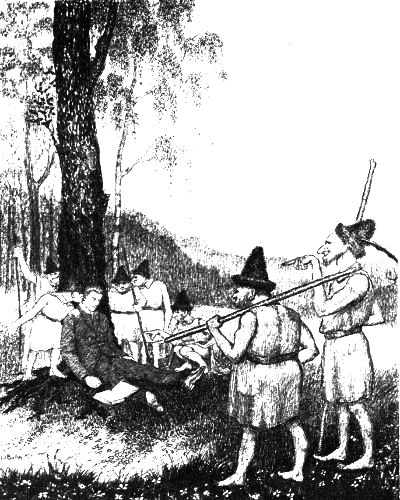
With a tremendous crash, the great mountain
burst apart and a whole troop of tiny, little mountain
gnomes came out, dancing grotesquely like
sprites of another world.
They were garbed in white vestments, like
fleecy vapors, with brazen girdles which seemed
to be sunbeams, and a cloudy stuff supposed to be
mantles hung loosely around their diminutive
forms. With bare feet they pattered down upon
him. As soon as they caught sight of him they
commenced to giggle, swarming around him in
great merriment. And then they put their ludicrous
little heads together and pointed at him with
contempt, whispering tales in falsetto tones
to each other, which he could not understand.
But he saw by the glare of their twinkling little
eyes that they meant him, that they touched on
something in his past life.
By and by they became bolder and touched his
wet clothes; some of the older ones bent down to
him and whispered malicious tales about his wife
into his ears. He groaned aloud. "It is a lie!
I don't believe a word of it!" he screamed, cursing
the whole deceitful band. In his indignation
he tried to rise several times in order to drive
them away—down into the foaming stream, or
back into their mountain riff; but he could not
move; his feet seemed to be fastened to the very
ground as if paralyzed or chained to earth. They
whispered once more the name of his wife with
scornful laughter, and passed on over hills and
valleys dancing merrily.
Suddenly a bright light shone about him,
illuminating the marshy waters; invisible choirs
were singing sweetly, as if angels were descending
from heaven. His eyes dilated as he saw a
procession of tiny elves passing him, carrying
little lighted tapers in their diminutive hands.
In their midst he saw his dear mother stretching
out her arms longingly towards him.
Tears came to his eyes. The dear face! He
wanted to run to her, embrace her, but could not
stir. A cry of horror broke from his trembling
lips when the fair Siren so fatal to his life stood
before him, intervening and trying to ensnare
him again with the fascination of her glittering
eyes, her bewitching smile, speaking to him of
love and devotion which he believed again.
He listened to her; and a ray of happiness and
delight filled his love-sick heart. She comes back
to him! She loves only him! And unheeding the
beseeching beckoning of his anxious mother,
whose tortured heart writhed and bled for her
suffering son, he hastened on with the enticing
Siren,—where to, he did not know.
Suddenly they stood before a deep precipice;
darkness surrounded them, and the old trees
commenced to sigh and moan and bend down upon
them. Six shadowy forms with blazing torches
appeared upon the scene carrying a coffin. Just
in front of him the lid opened and the pale waxen
face of his dead mother met his frightened eyes.
He screamed aloud with horror. He had broken
that noble heart, he had killed the best of mothers,
because he had followed this evil spirit of his life.
With a loud cry he threw himself upon the
lifeless form and wept, while the fair siren by his
side laughed and laughed. Beside himself with
indignation he panted, trying to strike her and
hurl words of hatred in her face; but his hands
fell helpless by his side; they had no power to
execute his will. He seemed rooted to the ground.
V.
"Get up from this wet ground, you fellow!
How did you ever come here in this beastly
weather?" He heard a deep sympathetic voice
by his side. Awakened from his swoon, soon he
looked amazed around him. What had happened?
He did not know at all. His limbs were
helpless and he lay on the ground where he must
have fallen. His treasured source of income, his
precious book, containing all his humorous
lectures, lay rain-soaked near his side. How long
he had been lying there unconscious, he did not
know himself. A slim well-dressed man stood
before him, doing his best to help him get up
and trying to comfort him as much as he could,
shaking his head wonderingly, and inquiring how
he ever happened to be lost in such a place.
The lecturer looked about him with great
relief. He did not see the gnomes anywhere.
So it was not true what they told him, what they
sneered at—
His heart rejoiced. It was only a hallucination,
nothing else. All he had seen and heard
must have been a stupid fancy of his tired brain.
The best proof was, that he found himself lying
helplessly on the ground, just awakening from a
swoon.
Yes, the condition of his brain was at fault;
that was as clear as daylight. "Thank God!" he
exclaimed, while a feeling of unspeakable joy
surged through his heart, now gladdened with
thankfulness.
"I came near believing all that stupid nonsense
of those wicked gnomes about my——"
"Hey! listen to me, poor fellow! What in
Heaven's name, are you doing here on that wet
ground?"
It was not until the stranger by his side had
repeated his question that he could pull himself
together and answer in a stammering voice, while
a cold shiver shook his emaciated frame.
He looked at the stranger with dilated eyes.
"Beg pardon sir. I—I must have lost my way.
I was to give a humorous lecture at a neighboring
hotel, and—and fell down," he said helplessly,
picking up his rain-soaked book, which he had
discovered within reach.
"Why, you are wet through and through, my
man. What can I do for you?" asked the stranger
with deep sympathy.
A strange look of wonder illuminated the face
of the downfallen man. He stammered: "If
you would have the great kindness to help bring
me to the Mountain View Hotel. You see, I am
expected there. I've got to earn some money
tonight yet." He paused to cough; his voice
seemed sepulchral.
"I have a motherless child to support." His
head was bent to hide his emotion. "My girlie
must have all she needs. I—I couldn't stand it if
they were to let her go hungry. God!" Again
a vehement cough shook his wasted frame.
"Well, well, this turns out all right. I'll bring
you there as we are staying in the same hotel."
"He's got fever, sir—better let's get him on
the box," he heard the coachman say who stood
by his side looking with obvious pity at the man
before him.
A few paces away, a closed carriage was standing
with two lighted lanterns in front of it.
The storm had relented for a while, and mysterious
silence fell upon the scene.
"Ogden!" now called out an excited woman's
voice from within the carriage. "To miss the table
d'hote on account of that wretched beggar. Why
it's just unpardonable!"
"That voice!... God have mercy!"
The man on the ground stammered as if struck by
lightning. His eyes dilated, starting out of
their sockets and staring horrified at the
carriage.
"That voice," he repeated. "Could it be possible?
Could she be there? Am I still under the
influence of that horrible hallucination?" he
moaned piteously. He could not and would not believe
a word of all they told him.
Again he seemed to hear the revolting chuckle
of the insolent gnomes, from the Traunstein, repeating
their malignant tales of the outrageous
conduct of his—
"Up with you quickly, for we'll have more
rain within a short time!" said Mr. Ogden, now in
a sympathetic voice, and at the same time heeding
the woman's command in the carriage, which he
would not have ignored for any consideration.
The coachman assisted the stranger to his seat
on the box, and then Mr. Ogden entered the carriage,
closing the door carefully.
Then the splendid team of horses set off like
the wind. "God have pity on me! that voice!"
He could never forget the voice of that alluring
siren who had goaded him on, until he saw
nothing but her seductive face, listened to nothing
but her deceitful declarations of love, without
thinking of his mother's grief and her death!
Could it be possible? She here in that closed
carriage with another man? No, no! It was
another hallucination of his feverish brain.
How could she ever have attained such wealth?
"Nonsense!" he murmured smilingly to himself,
drawing a long breath of relief. Ah! how he had
adored that faithless woman!
The smiling expression died out of his face, and
a mournful compassion for his deserted child stole
into his troubled countenance. Why did she bring so
much misery into his life? Every fibre of his noble
heart had been throbbing with uncontrollable love
for her! And now——the light of life, the hope of
future years, was blotted out, clouds of despair
and a grim night of an unbroken desolation fell like
a pall on his heart and brain. Nothing to look
forward to but misery!
VI.
He had wandered about like a soul condemned
and lost to eternity. But the one hope to meet
her again possessed him, kept him alive. And
then—she'll come back to him—he was convinced
of that; to his lonely little Mary. And after
all she might be touched by his devoted love
that knows how to pardon and overlook certain
occurrences in the life of a giddy-headed woman!
Unfortunately the cold, calculating coquette
had never felt a tinge of anything like love, and
had only an observing eye for the monthly allowances
he received from his well-to-do parents.
He had come to Dresden a young, inexperienced
student to pursue a course in literature and
jurisprudence. The handsome, dashing woman,
somewhere in the twenties, soon allured him with
her well tried arts. Within a short time he was
her devoted slave and did not see nor hear anything
else but her alluring voice, and after six
months' acquaintance he led her to the altar
without the knowledge of his parents.
When they found it out, through a friend living
in Dresden, they were in despair, in their
helpless anger. His mother never recovered
from the rude shock her ambition had received.
She did not know the woman, but when she heard
that she belonged to a different faith, she was
crushed, although the noble catholicity of spirit
that distinguished her character did not allow her
to show it. Her proudest hope to see that beloved
son some day a respected citizen and lawyer
in that little provincial town where his cradle
stood, was gone forever!
Years of wrestling with life's sorrows had set
upon her noble, benignant countenance, almost a
seal of holiness, and shed over her placid features
the mild, sweet life of a pure heart. Her white
hair, the snowy mass prematurely white, wonderfully
softened the outlines of her face.
Now deep lines commenced to furrow her
sweet, indulgent features, and she grieved so deeply
over the disgrace that she began to lose her
health. Silently, without a word to her husband
she performed her household duties, until one day
her enfeebled constitution gave way and she died,
praying for the only child she had ever had.
Her husband, Mr. Burge, under the double
stress of the sorrow, refused to hear anything of
the ungrateful son, for whom he had slaved and
worked all his life, and whose grievous mistake in
marrying an adventuress, had cost the mother's
life.
He had a large estate to look after, but he was
alone now. He needed the son, but what could he
do? He was ashamed of the daughter-in-law!
"No, not a cent of my money can she have," he
murmured constantly to himself with a flushed
face and dry lips, looking at his imposing estate,
where the beautiful Rhine rushed by and the tumbled
down castles of long-forgotten races were
seen in the distance.
The irate father dissolved all connection with
the son and stopped all payments, denying him
any assistance whatsoever in the future.
After the regular allowance from home had
entirely ceased, it was necessary for the young
husband to go and seek some profitable employment
to support his expensive wife.
He had never earned a cent, and racked his
brain now how to get money. The tantalizing
condition pressed upon him that he might not be
able to support his family. Finally, he got a
position with a meagre salary in a newspaper
office, but he was scarcely able to provide the
barest necessaries of life.
He commenced to write short stories. Although
he had no ambition to climb to such a lofty
niche in the temple of fame, he thought he might
at least earn a modest income. Short stories and
humorous lectures—that must make a hit. Everybody
said that he had a humorous vein. Now the
time had come to show his mettle, but the short
stories were generally returned. The irate
father had ceased to send money and no other
help was discoverable. And then—after all
that—she, his loving wife, dropped her mask and
showed herself in her true colors.
"I have had enough of this," she said with a
disgusted shrug of her white shoulders to her
horrified husband. "I don't intend to starve
here."
In vain he begged her to have a little patience
for the sake of their child. The last short story
must turn out to be a great success; he felt it and
was really convinced of it.
"Convinced," she sneered contemptuously
and turned away. No use of losing any breath
about it, she thought. I am through with him
anyway. Oh! How she longed to be rich, wear
stylish clothes and be admired.
The beautiful coquette became restless in her
little home; she looked about sick at heart, unable
to tolerate it any longer, only wishing to get the
opportunity to leave it forever. Her eyes were full
of scorn when looking at her husband, who could
not supply her with all that she longed for just
now, and for which she would have pledged the
salvation of her very soul. She commenced to
frequent public places in the absence of her husband.
How she loathed poverty! "Anything but
that," she murmured to herself, her face white
with disgust as she walked on, gazing in all
directions to see one of her former acquaintances,
with a strange unrest in her large eyes. Her
opportunity would come; she was sure of that, and
it came in meeting one day the rich Englishman
who was introduced to her by one of her former
friends and boon companions.
Shortly after this encounter, she received a
letter from the Englishman telling her of the deep
and lasting impression she had made on him and
how he longed to see her again. Her face flushed
with pleasure as she read all these, and then
perused an invitation to take an automobile ride
through the beautiful mountains.
For some time she sat dazzled, and then she
looked at the poorly furnished rooms; at her own
wretched outfit, and her eyes flashed indignantly.
"I am through with all this. Here is the
opportunity I was longing for," she said with a
contemptuous smile. "I'll show him—the young
inexperienced fool I have married—that beauty
counts for a whole lot and ... boldness even
more."
She stopped at the window and looked down
at the Englishman's automobile before her door.
"The opportunity—my opportunity has come."
These words rang ceaselessly in her ears and
filled her being with a strange endeavor to
avenge herself on the man who could not supply
her with all the luxuries she craved for, and
according to her ethics, was entitled to.
VII.
It was on Christmas eve, her husband had
come home with a radiant face. His short story
had been accepted, and the money was in his
pocket. Now he could buy a fitting present for
his wife. Of course it could not be too expensive,
but she certainly would enjoy it all the same;
he was sure of that, feeling that the opening of a
successful career was inaugurated.
On his way home he had also bought a little fir
tree to set up for the first Christmas celebration
in his own home. The recollections of similar
holidays in the house of his parents stirred him
to the depths. How his heart quivered when he
thought of his dear mother he loved so dearly.
If she only were alive how different everything
would be! He, who was brought up in luxury,
mother's pet, and now—
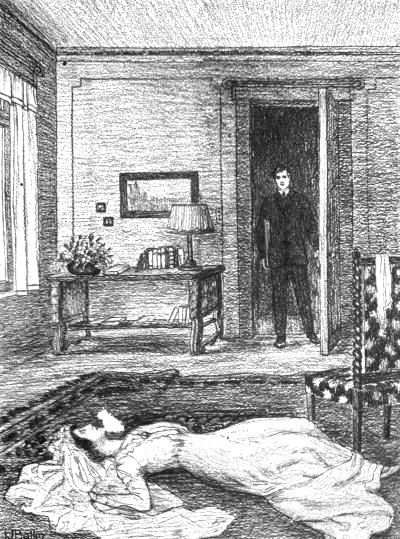
With deep emotion he entered the house. With a
brisk step he opened the door, looked around and
found it empty, the wife and all her belongings
gone!
The horror of that night was something he
could never forget as long as he lived. Holding
his ten months' old child in his trembling arms,
he wept burning tears for her, the mother of his
child. Could it be possible? A mother deserting
her child on this holiest of evenings? He
could not believe his eyes, but all she possessed
went with her. No, no, she was giddy-headed,
but not cruel. Motherhood must assert itself
and surely would. How he loved her, how he
longed to take her in his arms and feed his poor,
famished heart with a touch of her lips!
He sat there in the dark listening and waiting
for her to come back, to see the presents he had
bought for her, and the money he wanted to give
her. But one hour after another passed and nobody
came. In the streets a joyous throng of merry
makers pushed and jostled about wishing each
other a merry Christmas. His heart was shaken
to its depths by maddening grief; by bitter
disappointment.
The room was icy cold, there was no fire in
the stove, and the child half starved, screamed
weakly in his arms. In wild desperation he
trampled on the little Christmas tree he had
brought along to celebrate his first Christmas
in his own home! He could see nothing but
falsehood and treachery in this world. What
meaning was there for him in this life-redeeming
symbol?
Sick of everything he longed for death to
come and take him and his little child away.
Throughout that dreary night of agony he lay
in bed holding the child in his arms, pressing his
lips against her tender little hands, without
being able to close an eye.
The bell in the neighboring churches rang out
in the ears of the deserted man, sounding dismally
through his lonely house. But they brought
back pictures to his mind of his childhood's
happy days, when he went to church on
similar Christmas eves with his parents. One
tear after another stole into his desperate eyes.
"God have mercy on me and my child," he
murmured stammeringly. "I must, I will live for
her sake. I cannot leave her altogether an orphan,"
though the gaping wound in his own heart
kept on bleeding, bleeding incessantly.
VIII.
"There! Here we are at last, no weather for
a dog to be out," growled the angry coachman
sulkily, jumping down from the box and opening
the carriage door with a respectful bow, hat in
hand.
Mr. Ogden staggered quickly out and lifted
tenderly and carefully a woman's form to the wet
ground. Young Burge, the deserted husband,
had just come down with the help of the coachman
who growled something he could not understand.
He looked at the woman in the darkness and
a mist swam before his eyes; he leaned against
the coach and his knees shook so that he could
not make a single step. The night was black and
the wind sobbed down the street, while the rain
still fell in torrents.
He could not see clearly—but that voice—that
voice! God! "Could they have been right—these
wicked, malicious gnomes? Did they know all
about her and now, how?" he asked himself while
his hands clutched the book convulsively in his
helpless agony.
He thought he heard them again whispering,
with a derisive chuckle, the whole story of her
downfall into his terrified ears.
"How could she ever come to such magnificent
clothes?" he thought. "Nonsense! It is simply
a hallucination of a morbid, disordered brain.
I am sick and miserable and see things where
there is nothing to see." This he murmured
half aloud to himself, gazing at the retreating
form of the woman incredulously. He could not
distinguish her features and he made up his mind
forcibly, in order to quiet down his excited nerves,
that it was nothing else but a foolish trick of his
imagination, and the fever which shook him now
again was the obvious cause of it all. "Anyway,
how could she have obtained all this luxurious
outfit? His wife wealthy? Nonsense!"
He tried to laugh cheerfully about this foolishness,
but suddenly he felt as though a knife were
plunged into his heart. "The gnomes! the
gnomes! If that which they had said were true!"
He moaned to himself, leaning against the wall
in a faint condition. "Oh, anything but that ...
anything but that!" His whole frame shook as
from palsy. That voice haunted him. He knew
he had to go and look at her in order to convince
himself, otherwise he could not find any rest.
IX.
"Come, come! You must not lose your courage,
my good fellow," said Mr. Ogden good-naturedly,
coming out of the house at the same
time. "But before you do anything else, you
should go inside and get those wet clothes off;
yes, that you must do, my man, you look pale
enough indeed, and...."
"The deuce! If that is not our expected entertainer,
the humorous lecturer from Ishle!" cried the
stout, dignified hotelier, with a laugh as he
caught sight of the dripping form of the poor,
dazed lecturer.
"Lord, what a state he is in! Why he isn't
able to lecture!"
"Never mind, a hot grog, some dry clothes
from my wardrobe, and the rest will soon be managed,"
said Mr. Ogden good-naturedly with a sign to his
valet, greatly gratified in being able to help the
poor, miserable looking man with the pallor of
death on his emaciated face.
"And as for your entertainment being a great
success, well—leave that to me, my dear fellow
and don't worry; it will be all right," he went on,
clapping the dazed humorist on the shoulder with
an encouraging smile.
He bowed, without being able to utter a word
of thanks; he bit his trembling lips and followed
the valet with stumbling, shivering feet.
"Who could this benevolent stranger be?
And what was he to that woman? Was he mistaken
or not? If, after all she should be his—his—"
A hot wave flushed his face, distorted with
shame as he thought of the possibility; his sorely
tried heart was hammering mightily within him.
He could not get rid of this thought. "If she
should really be the mother of his poor child
... what, in the name of Heaven, was she
then to this man? God have mercy on me and
come to my aid!" he cried aloud, in great misery,
his teeth once more chattering audibly in a fresh
attack. "No, no! I can't and won't believe it!
She can't be so shameless as to disgrace me and
her innocent child!"
"Come, come quickly, sir," urged the valet
impatiently, "I'll help you as much as I can."
After he had provided him with all the necessary
clothes from the elaborately assorted wardrobe
of the rich Englishman, who was about the
same size, he made as careful a toilet as possible,
under the prevailing circumstances and under the
careful inspection of the helpful valet.
X.
The supper bell now rang through the vast
corridors of the Mountain View Hotel, crowded
with tourists from all parts of the continent.
Ladies, gorgeously dressed, commenced to take
their seats at the supper tables in the dining
room, escorted by elegantly garbed gentlemen;
some of them in full evening dress, others
again in black cutaway. The clatter of knives
and forks had already begun. The spacious
dining room was brightly illuminated. At the
further end a carpet-covered platform was
visible, whose edges were a bank of flowers.
Everything was tastefully arranged. A pianist
was already hammering away at a waltz of one
of the latest operatic successes, with
frightful execution, as an introduction to
the interesting program of the evening,
anxiously awaited by the patrons of the house.
The clatter, the bustling noise, had suddenly
stopped and all eyes were riveted expectantly on
the man who had just entered. Our humorist,
suffering in mind and body alike, pale and
haggard, with restless eyes, made his appearance
in the borrowed clothes which hung loosely about
his emaciated form, tossing back his long locks
with his right hand, while holding the cherished
book tightly in the other, he came down to the
very edge of the platform and smiled and bowed
in all directions.
He looked exhausted and weary, as he was.
But the room was crowded and he had to go on,
whether he wanted or not, so he commenced:
"Ladies and gentlemen."
He got no further. A mist swam suddenly
before his eyes. A shiver shook his emaciated
frame, his face became flushed and bloated and
he stared and stared.
A side door had been opened a few minutes
before and Mr. Ogden entered with the much
admired Cleopatra on his arm.
They passed through the crowded dining room,
close to the speaker's platform. She had changed
her dazzling costume for a simpler, but an extremely
stylish dress of blue silk. She still wore
some of the lilies in the marvelous golden hair,
which was now fastened with a gold comb into a
plain Greek knot. She was all aglow with
excitement. The triumph of the afternoon was still
lingering on her handsome face. She felt like
shouting it out to everybody. Such conquest does
not come often to a woman in the ordinary walks
of life.
She walked proudly, with a queenly step to her
seat, nodding to some casual acquaintances with
a charming smile. And then she took her seat
and turned a glance of curiosity upon the famished
face of the entertainer. Their eyes met—and for
a few seconds sank into each others' like sharp
daggers. A red tinge covered her startled face,
then she turned away, whiter than the lilies on her
breast. She trembled visibly and looked frightened,
casting down her eyes.
Mr. Ogden did not seem to have noticed any
change in her appearance and gazed with a shocked
countenance and great pity at the reduced exterior
of the poor humorist. Suddenly a great
excitement was noticeable among all the guests
sitting around the small tables. Several gentlemen
had left their seats, rushed towards the place
where the poor entertainer had collapsed after
recognizing his faithless wife garbed in that
splendor, so shamefully acquired, of which the
wicked gnomes were whispering so constantly into
his ears.
He still believed in her then; but now—the
dark, threatening expression in his livid face was
frightful to behold. He murmured something
about the gnomes that nobody could understand,
staring with hatred in his dilated eyes in the
direction where she sat—she, the mother of his
innocent child, now disgraced forever!
"God! What have I done to deserve such a
punishment?" he murmured once more, pressing
his bloodless lips tightly together as a cold
perspiration broke out on his deathlike face.
A vision of his mother's warning and sorrows
was presented to his benighted intelligence and
made him cry with terror and shame. The conflicting
emotions were too much for the sadly undermined
constitution.
"The wicked gnomes!" he whispered with audible
scorn and contempt in his blazing eyes, as
if sudden madness had seized on him, and then
tried to curse her, but not another word escaped
his tightly closed lips, though the blood began
to gush from them.
The truth, so cruelly thrust upon him, ended
his life's drama; his eyes closed, he fell in
a heap to the floor.
The pitying guests stood helplessly around
him and did not know what to do. Mr. Ogden was
the first one who had presence of mind to send to
the nearest village in search of a doctor.
The beautiful Cleopatra sat there as pale as
a ghost and was afraid to go near the prostrate
form of her unhappy husband, fearing that someone
might lift the veil and show the audience the
ugliness of her real self. A feeling of
restlessness rushed upon her as if the shameful
story were being written on her flushed face.
She could not endure it any longer and left the
dining room.
Mr. Ogden did not notice her departure, and
busied himself around the dying man, asking what
he could do for him. The poor man pointed to a
letter in his side pocket where the addresses of
his friends in Dresden were written down.
"The gnomes! ... the gnomes!" he stammered
once more as the shadow of death began to
close in upon him. The blood streamed out
incessantly, and before the aid of a doctor
could be secured, he was a corpse.
XI.
Mr. Ogden, deeply moved, went to his rooms.
She, the cause of it all, sat at the window with
a book in her hands without reading it. There
was a look in the woman's face that amazed him,
a hard, cold look, that he had never seen there
before while the sunbeams fell on her bewitching
features and on the green leaves still in her hair.
"I want to leave the place at once," she said
without looking at him.
"That poor man's face seems to haunt you,
dear tender-hearted girlie," he replied with an
outburst of tenderness, taking her in his arms and
kissing the handsome face he loved so dearly.
It was a fortunate thing that he was blissfully
ignorant of her relation to the dead man.
Gathering up courage—seeing that no suspicion
had entered his mind—she raised her beautiful
eyes to his languidly.
"Yes, you are right, dear, I cannot stand such
horrible things ... it shocks me," she answered
with her accustomed dissimulation in tone and
action.
Although she was a great adept in the art of
hypocrisy and dissimulation, she could not
altogether hide the uneasiness which had taken
possession of her. A strange expression came into
her eyes, an expression he had never seen there.
He looked at her and was puzzled. What was it?
What brought the change about? He could not
tell.
She turned suddenly and looked out of the
window with a stony face, in order to hide, to
subdue,—what? Did she conjure up a sinful vision
of her own life? No, she would not give in, but
she was startled to perceive something within her
she did not reckon with: a voice wanted to be
heard, no matter how hard she tried to subdue it.
It was the voice of motherhood—that feeling
seemed to be not quite dead in the heart of the
shameless woman. It was Nature's revenge!
She had to listen to the voice of Nature, or was
it conscience, slowly awakening to life?
Ah! Who would or could fathom the heart of
an unscrupulous coquette?
"Had he any family?" she asked, indifferently,
avoiding his inquisitive gaze.
"Yes, I think he has a child, here is the address,"
he replied. "I think it must be with someone
he knew, poor unfortunate man. And he gave
me this in order to look up his orphan child."
A mournful compassion soon stole into his eyes.
"He could not speak any more, but the pitiful
glance of the dying man's face told me as much,
and I am going to Dresden and see whether I can
do anything for his child," he added, looking
deeply moved out of the window. She gazed at him
with puzzled eyes. "God! if he had an inkling
whose child that is!" she thought, remorsefully
recoiling a step with downcast eyes and tightened
lips.
Finally summoning up courage enough, she
said, hesitatingly, as if fearing any comment:
"Yes, ... let us stop there on our way
to Switzerland."
He wanted to stay until the funeral of the poor
lecturer was over, but she would not hear of it.
She looked at him with frightened eyes when he
made the suggestion.
"I cannot stand such scenes," she replied with
quivering lips.
"Well, well! Then we'll go, my sensitive little
girlie. That accident seemed to have upset your
nervous system," he said with a smile, kissing her
tenderly and gazing fondly at her troubled face.
On the following morning they took their departure
for Dresden, leaving some money for the
funeral expenses in the hands of the hotel keeper.
Instinctively he felt like doing something for
the man he had robbed of his happiness without
knowing it.
But the unscrupulous coquette loved nobody but
herself, knew it, felt it, though without any
remorse, that she had betrayed his deep devotion
and undying love so shamefully, fearing, in her
deceitfulness, only one thing—detection.
The following day a simple hearse, containing
the corpse of the poor humorist whose life ended
so tragically, went up a lonely hill where the
grave diggers had just finished their gloomy work.
The coffin was lowered and the grave covered with
mother earth. No mourners stood around shedding
tears.
The song of a mocking-bird rang from the
downy cradle of myrtle blossoms—as a funeral
dirge—and a whip-poor-will answered from a
cedar in the neighboring woods.
When the night train going to Dresden, rushed
by, the little white cross indicating his resting
place, looked like a bleached hand of a skeleton
shining out with a ghostly radiance across the
silent, gloomy plain.
Through the fleecy vapors floating around the
lonely hill one with clairvoyant eye may see at
midnights the vacillating horde of the tiny gnomes
from the Traunstein with downcast torches repeating
whisperingly the sad tale, and pointing
at the grave, in which the body of the dead humorist,
betrayed of his life's happiness, crumbles to
dust.