In the previous chapter it has been suggested that the archæologist is,
to some extent, enamoured of the Past because it can add to the stock of
things which are likely to tickle the fancy. So humorous a man is he, so
fond of the fair things of life, so stirred by its adventures, so
touched by its sorrows, that he must needs go to the Past to augment the
supplies provided by the Present.
Here, then, is the place to give an example of the entertainment which
he is likely to find in this province of his; and if the reader can
detect any smell of dust or hear any creak of dead bones in the story
which follows, it will be a matter of surprise to me.
In the year 1891, at a small village in Upper Egypt named El Hibeh, some
natives unearthed a much-damaged roll of papyrus which appeared to them
to be very ancient. Since they had heard that antiquities have a market
value they did not burn it along with whatever other scraps of
inflammable material they had collected for their evening fire, but
preserved it, and finally took it to a dealer who gave them in exchange
for it a small sum of money. From the dealer’s hands it passed into the
possession of Monsieur Golenischeff, a Russian Egyptologist, who
happened to be travelling in Egypt; and by him it was carried to
Petrograd, or St. Petersburg, as it was then called, where it now
rests, if it has not been destroyed during the troubles there. This
savant presently published a translation of the document, which at
once caused a sensation in the Egyptological world; and during the next
few years four amended translations were made by different scholars. The
interest shown in this tattered roll was due to the fact that it had
been found to contain the actual report written by an official named
Wenamon to his chief, the High Priest of Amon-Ra, relating his
adventures in the Mediterranean while procuring cedar-wood from the
forests of Lebanon. The story which Wenamon tells is of the greatest
value to Egyptology, giving as it does a vivid account of the political
conditions obtaining in Syria and Egypt during the reign of the Pharaoh
Rameses XII; but it also has a very human interest, and the misfortunes
of the writer may excite one’s sympathy and amusement, after this lapse
of three thousand years, as though they had occurred at the present day.
In the time at which Wenamon wrote his report Egypt had fallen on evil
days. A long line of incapable descendants of the great Rameses II and
Rameses III had ruled the Nile valley; and now a wretched ghost of a
Pharaoh, Rameses XII, sat upon the throne, bereft of all power, a ruler
in name only. The government of the country lay in the hands of two
great nobles: in Upper Egypt, Herhor, High Priest of Amon-Ra, was
undisputed master; and in Lower Egypt, Nesubanebded, a prince of the
city of Tanis (the Zoan of the Bible), virtually ruled as king of the
Delta. Both these persons ultimately ascended the throne of the
Pharaohs; but at the time of Wenamon’s adventure the High Priest was
the more powerful of the two, and could command the obedience of the
northern ruler, at any rate in all sacerdotal matters. The priesthood of
Amon-Ra, was the greatest political factor in Egyptian life. That god’s
name was respected even in the courts of Syria, and though his power was
now on the wane, fifty years previously the great religious body which
bowed the knee to him was feared throughout all the countries
neighbouring to Egypt. The main cause of Wenamon’s troubles was the lack
of appreciation of this fact that the god’s influence in Syria was not
as great as it had been in the past; and this report would certainly not
have been worth recording here if he had realised that prestige is, of
all factors in international relations, the least reliable.
In the year 1113 B.C. the High Priest undertook the construction of a
ceremonial barge in which the image of the god might be floated upon the
sacred waters of the Nile during the great religious festivals at
Thebes; and for this purpose he found himself in need of a large amount
of cedar-wood of the best quality. He therefore sent for Wenamon, who
held the sacerdotal title of “Eldest of the Hall of the Temple of Amon,”
and instructed him to proceed to the Lebanon to procure the timber. It
is evident that Wenamon was no traveller, and we may perhaps be
permitted to picture him as a rather portly gentleman of middle age, not
wanting either in energy or pluck, but given, like some of his
countrymen, to a fluctuation of the emotions which would jump him from
smiles to tears, from hope to despair, in a manner amazing to any but an
Egyptian. To us he often appears as an overgrown baby, and his
misfortunes have a farcical nature which makes its appeal as much
through the medium of one’s love of the ludicrous as through that of
one’s interest in the romance of adventure. Those who are acquainted
with Egypt will see in him one of those types of naif, delightful
children of the Nile, whose decorous introduction into the parlour of
the nations of to-day is requiring such careful rehearsal.
For his journey the High Priest gave Wenamon a sum of money, and as
credentials he handed him a number of letters addressed to Egyptian and
Syrian princes, and entrusted to his care a particularly sacred little
image of Amon-Ra, known as Amon-of-the Road, which had probably
accompanied other envoys to the Kingdoms of the Sea in times past, and
would be recognised as a token of the official nature of any embassy
which carried it.
Thus armed Wenamon set out from El Hibeh—probably the ancient Hetbennu,
the capital of the Eighteenth Province of Upper Egypt—on the sixteenth
day of the eleventh month of the fifth year of the reign of Rameses XII
(1113 B.C.), and travelled down the Nile by boat to Tanis, a distance of
some 200 miles. On his arrival at this fair city of the Delta, whose
temples and palaces rose on the borders of the swamps at the edge of the
sea, Wenamon made his way to the palace of Nesubanebded, and handed to
him the letters which he had received from the High Priest. These were
caused to be read aloud; and Nesubanebded, hearing that Wenamon was
desirous of reaching the Lebanon as soon as possible, made the necessary
arrangements for his immediate despatch upon a vessel which happened
then to be lying at the quay under the command of a Syrian skipper named
Mengebet, who was about to set out for the Asiatic coast. On the first
day of the twelfth month, that is to say fourteen days after his
departure from his native town, Wenamon set sail from Tanis, crossing
the swamps and heading out into “the Great Syrian Sea.”
The voyage over the blue rippling Mediterranean was calm and prosperous
as the good ship sailed along the barren shores of the land of the
Shashu, along the more mountainous coast of Edom, and thence northwards
past the cities of Askalon and Ashdod. To Wenamon, however, the journey
was fraught with anxiety. He was full of fears as to his reception in
Syria, for the first of his misfortunes had befallen him. Although he
had with him both money and the image of Amon-of-the-Road, in the
excitement and hurry of his departure he had entirely forgotten to
obtain again the bundle of letters of introduction which he had given
Nesubanebded to read; and thus there were reasons for supposing that his
mission might prove a complete failure. Mengebet was evidently a stern
old salt who cared not a snap of the fingers for Amon or his envoy, and
whose one desire was to reach his destination as rapidly as wind and
oars would permit; and it is probable that he refused bluntly to return
to Tanis when Wenamon informed him of the oversight. This and the
inherent distrust of an Egyptian for a foreigner led Wenamon to regard
the captain and his men with suspicion; and one must imagine him seated
in the rough deck-cabin gloomily guarding the divine image and his store
of money. He had with him a secretary and probably two or three
servants; and one may picture these unfortunates anxiously watching the
Syrian crew as they slouched about the deck. It is further to be
remembered that, as a general rule, the Egyptians suffer excessively
from sea-sickness.
After some days the ship arrived at the little city of Dor, which
nestled at the foot of the Ridge of Carmel; and here they put in to
replenish their supplies. Wenamon states in his report that Dor was at
that time a city of the Thekel or Sicilians, some wandering band of
sea-rovers having left their native Sicily to settle here, at first
under the protection of the Egyptians, but now independent of them. The
King of Dor, by name Bedel, hearing that an envoy of the High Priest of
Amon-Ra had arrived in his harbour, very politely sent down to him a
joint of beef, some loaves of bread, and a jar of wine, upon which
Wenamon must have set to with an appetite, after subsisting upon the
scanty rations of the sea for so long a time.
It may be that the wine was more potent than that to which the Egyptian
was accustomed; or perhaps the white buildings of the city, glistening
in the sunlight, and the busy quays, engrossed his attention too
completely: anyhow, the second of his misfortunes now befell him. One of
the Syrian sailors seized the opportunity to slip into his cabin and to
steal the money which was hidden there. Before Wenamon had detected the
robbery the sailor had disappeared for ever amidst the houses of Dor.
That evening the distracted envoy, seated upon the floor of his cabin,
was obliged to chronicle the list of stolen money, which list was
afterwards incorporated in his report in the following manner:—
| One vessel containing gold amounting to | 5 debens |
| Four vessels containing silver amounting to | 20 debens |
| One wallet containing silver amounting to | 11 debens |
Total of what was stolen: gold, 5 debens; silver, 31 debens. A deben
weighed about 100 grammes, and thus the robber was richer by 500 grammes
of gold, which in those days would have the purchasing value of about
£600 in our money, and 3,100 grammes of silver, equal to about
£2,200.[1]
Wenamon must have slept little that night, and early on the following
morning he hastened to the palace of King Bedel to lay his case before
him. Fortunately Bedel did not ask him for his credentials but with the
utmost politeness gave his consideration to the affair. Wenamon’s words,
however, were by no means polite, and one finds in them a blustering
assurance which suggests that he considered himself a personage of
extreme consequence, and regarded a King of Dor as nothing in comparison
with an envoy of Amon-Ra.
“I have been robbed in your harbour,”[2] he cried, so he tells us in the
report, “and, since you are the king of this land, you must be regarded
as a party to the crime. You must search for my money. The money belongs
to Nesubanebded, and it belongs to Herhor, my lord” (no mention,
observe, of the wretched Rameses XII), “and to the other nobles of
Egypt. It belongs also to Weret, and to Mekmel, and to Zakar-Baal the
Prince of Byblos.” These latter were the persons to whom it was to be
paid.
The King of Dor listened to this outburst with Sicilian politeness, and
replied in the following very correct terms: “With all due respect to
your honour and excellency,” he said, “I know nothing of this complaint
which you have lodged with me. If the thief belonged to my land and went
on board your ship in order to steal your money, I would advance you the
sum from my treasury while they were finding the culprit. But the thief
who robbed you belonged to your ship. Tarry, however, a few days here
with me and I will seek him.”
Wenamon, therefore, strode back to the vessel, and there remained,
fuming and fretting, for nine long days. The skipper Mengebet, however,
had no reason to remain at Dor, and seems to have told Wenamon that he
could wait no longer. On the tenth day, therefore, Wenamon retraced his
steps to the palace, and addressed himself once more to Bedel. “Look,”
he said to the king, when he was ushered into the royal presence, “you
have not found my money, and therefore you had better let me go with my
ship’s captain and with those....” The rest of the interview is lost in
a lacuna, and practically the only words which the damaged condition of
the papyrus permits one now to read are, “He said, ‘Be silent!’” which
indicates that even the patience of a King of Dor could be exhausted.
When the narrative is able to be resumed one finds that Wenamon has set
sail from the city, and has travelled along the coast to the proud city
of Tyre, where he arrived one afternoon penniless and letterless, having
now nothing left but the little Amon-of-the-Road and his own audacity.
The charms of Tyre, then one of the great ports of the civilised world,
were of no consequence to the destitute Egyptian, nor do they seem to
have attracted the skipper of his ship, who, after his long delay at
Dor, was in no mood to linger. At dawn the next morning, therefore, the
journey was continued, and once more an unfortunate lacuna interrupts
the passage of the report. From the tattered fragments of the writing,
however, it seems that at the next port of call—perhaps the city of
Sidon—a party of inoffensive Sicilian merchants was encountered, and
immediately the desperate Wenamon hatched a daring plot. By this time he
had come to place some trust in Mengebet, the skipper, who, for the sake
of his own good standing in Egypt, had shown himself willing to help the
envoy of Amon-Ra in his troubles, although he would not go so far as to
delay his journey for him; and Wenamon therefore admitted him to his
councils. On some pretext or another a party led by the Egyptian paid a
visit to these merchants and entered into conversation with them. Then,
suddenly overpowering them, a rush was made for their cash-box, which
Wenamon at once burst open. To his disappointment he found it to contain
only thirty-one debens of silver, which happened to be precisely the
amount of silver, though not of gold, which he had lost. This sum he
pocketed, saying to the struggling merchants as he did so, “I will take
this money of yours, and will keep it until you find my money. Was it
not a Sicilian who stole it, and no thief of ours? I will take it.”
With these words the party raced back to the ship, scrambled on board,
and in a few moments had hoisted sail and were scudding northwards
towards Byblos, where Wenamon proposed to throw himself on the mercy of
Zakar-Baal, the prince of that city. Wenamon, it will be remembered, had
always considered that he had been robbed by a Sicilian of Dor,
notwithstanding the fact that only a sailor of his own
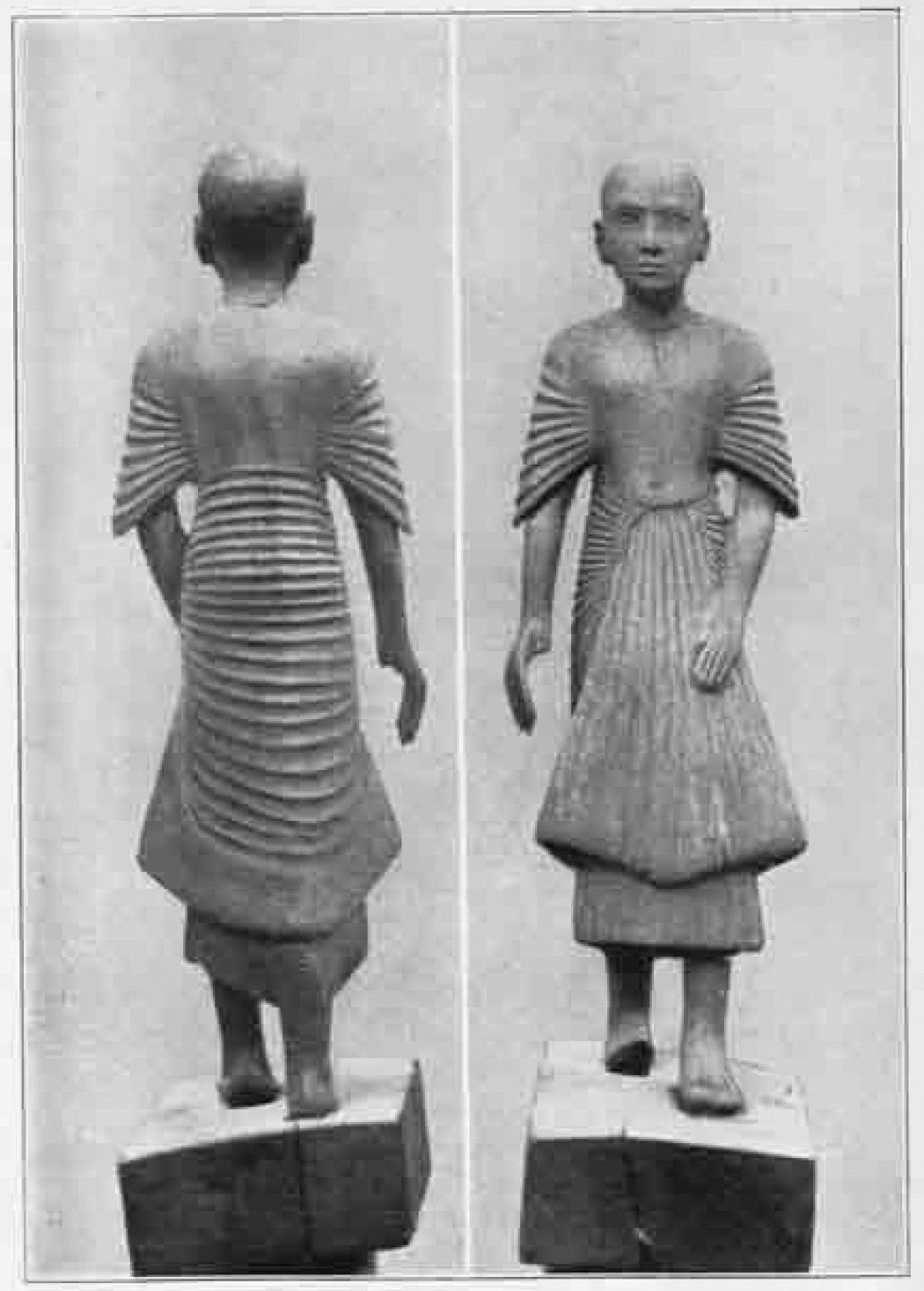
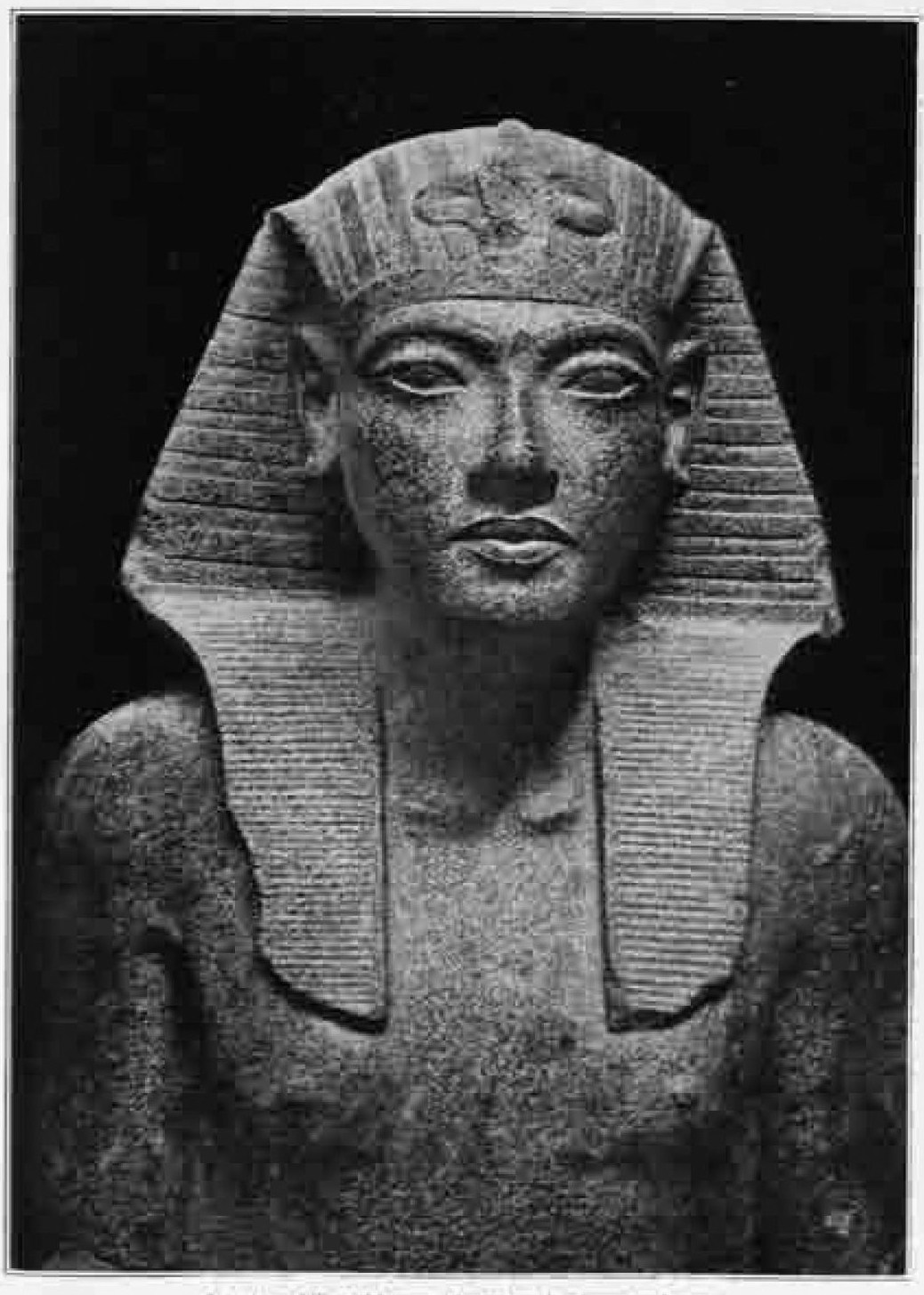
An Egyptian Priest or Religious Official
From a wooden statuette of about B.C. 1300, now in Cairo
ship could have known of the existence of the money, as King Bedel seems
to have pointed out to him. The Egyptian, therefore, did not regard this
forcible seizure of silver from these other Sicilians as a crime. It was
a perfectly just appropriation of a portion of the funds which belonged
to him by rights. Let us imagine ourselves robbed at our hotel by Hans
the German waiter: it would surely give us the most profound
satisfaction to take Herr Schnupfendorff, the piano-tuner, by the throat
when next he visited us, and go through his pockets. He and Hans, being
of the same nationality, must suffer for one another’s sins, and if the
magistrate thinks otherwise he must be regarded as prejudiced by too
much study of the law.
Byblos stood at the foot of the hills of Lebanon, in the very shadow of
the great cedars, and it was therefore Wenamon’s destination. Now,
however, as the ship dropped anchor in the harbour, the Egyptian
realised that his mission would probably be fruitless, and that he
himself would perhaps be flung into prison for illegally having in his
possession the famous image of the god to which he could show no written
right. Moreover, the news of the robbery of the merchants might well
have reached Byblos overland. His first action, therefore, was to
conceal the idol and the money; and this having been accomplished he sat
himself down in his cabin to await events.
The Prince of Byblos certainly had been advised of the robbery; and as
soon as the news of the ship’s arrival was reported to him he sent a
curt message to the captain saying simply “Get out of my harbour.” At
this Wenamon gave up all hope, and, hearing that there was then in port
a vessel which was about to sail for Egypt, he sent a pathetic message
to the Prince asking whether he might be allowed to travel by it back to
his own country.
No satisfactory answer was received, and for the best part of a month
Wenamon’s ship rode at anchor, while the distracted envoy paced the
deck, vainly pondering upon a fitting course of action. Each morning the
same brief order, “Get out of my harbour,” was delivered to him by the
harbour-master; but the indecision of the authorities as to how to treat
this Egyptian official prevented the order being backed by force.
Meanwhile Wenamon and Mengebet judiciously spread through the city the
report of the power of Amon-of-the-Road, and hinted darkly at the wrath
which would ultimately fall upon the heads of those who suffered the
image and its keeper to be turned away from the quays of Byblos. No
doubt, also, a portion of the stolen debens of silver was expended in
bribes to the priests of the city, for, as we shall presently see, one
of them took up Wenamon’s cause with the most unnatural vigour.
All, however, seemed to be of no avail, and Wenamon decided to get away
as best he could. His worldly goods were quietly transferred to the ship
which was bound for the Nile; and, when night had fallen, with
Amon-of-the-Road tucked under his arm, he hurried along the deserted
quay. Suddenly out of the darkness there appeared a group of figures,
and Wenamon found himself confronted by the stalwart harbour-master and
his police. Now, indeed, he gave himself up for lost. The image would be
taken from him, and no longer would he have the alternative of leaving
the harbour. He must have groaned aloud as he stood there in the black
night, with the cold sea wind threatening to tear the covers from the
treasure under his arm. His surprise, therefore, was unbounded when the
harbour-master addressed him in the following words: “Remain until
morning here near the prince.”
The Egyptian turned upon him fiercely. “Are you not the man who came to
me every day saying ‘Get out of my harbour?’” he cried. “And now are you
not saying ‘Remain in Byblos?’—your object being to let this ship which
I have found depart for Egypt without me, so that you may come to me
again and say ‘Go away.’”
The harbour-master in reality had been ordered to detain Wenamon for
quite another reason. On the previous day, while the prince was
sacrificing to his gods, one of the noble youths in his train, who had
probably seen the colour of Wenamon’s debens, suddenly broke into a
religious frenzy, and so continued all that day, and far into the night,
calling incessantly upon those around him to go and fetch the envoy of
Amon-Ra and the sacred image. Prince Zakar-Baal had considered it
prudent to obey this apparently divine command, and had sent the
harbour-master to prevent Wenamon’s departure. Finding, however, that
the Egyptian was determined to board the ship, the official sent a
messenger to the prince, who replied with an order to the skipper of the
vessel to remain that night in harbour.
Upon the following morning a deputation, evidently friendly, waited on
Wenamon, and urged him to come to the palace, which he finally did,
incidentally attending on his way the morning service which was being
celebrated upon the sea-shore. “I found the prince,” writes Wenamon in
his report, “sitting in his upper chamber, leaning his back against a
window, while the waves of the Great Syrian Sea beat against the wall
below. I said to him ‘The mercy of Amon be with you!’ He said to me ‘How
long is it from now since you left the abode of Amon?’ I replied ‘Five
months and one day from now.’”
The prince then said “Look now, if what you say is true, where is the
writing of Amon which should be in your hand? Where is the letter of the
High Priest of Amon which should be in your hand?”
“I gave them to Nesubanebded,” replied Wenamon.
“Then,” says Wenamon, “he was very wroth, and he said to me ‘Look here,
the writings and the letters are not in your hand. And where is the fine
ship which Nesubanebded would have given you, and where is its picked
Syrian crew? He would not put you and your affairs in charge of this
skipper of yours, who might have had you killed and thrown into the sea.
Whom would they have sought the god from then?—and you, whom would they
have sought you from then?’ So he said to me, and I replied to him
‘There are indeed Egyptian ships and Egyptian crews that sail under
Nesubanebded, but he had at the time no ship and no Syrian crew to give
me.’”
The prince did not accept this as a satisfactory answer, but pointed out
that there were ten thousand ships sailing between Egypt and Syria, of
which number there must have been one at Nesubanebded’s disposal.
“Then,” writes Wenamon, “I was silent in this great hour. At length he
said to me ‘On what business have you come here?’ I replied ‘I have come
to get wood for the great and august barge of Amon-Ra, king of the
Gods. Your father supplied it, your grandfather did so, and you too
shall do it.’ So spoke I to him.”
The prince admitted that his fathers had sent wood to Egypt, but he
pointed out that they had received proper remuneration for it. He then
told his servants to go and find the old ledger in which the
transactions were recorded, and this being done, it was found that a
thousand debens of silver had been paid for the wood. The prince now
argued that he was in no way the servant of Amon, for if he had been he
would have been obliged to supply the wood without remuneration. “I am,”
he proudly declared, “neither your servant nor the servant of him who
sent you here. If I cry out to the Lebanon the heavens open and the logs
lie here on the shore of the sea.” He went on to say that if, of his
condescension, he now procured the timber Wenamon would have to provide
the ships and all the tackle. “If I make the sails of the ships for
you,” said the prince, “they may be top-heavy and may break, and you
will perish in the sea when Amon thunders from heaven; for skilled
workmanship comes only from Egypt to reach my place of abode.” This
seems to have upset the composure of Wenamon to some extent, and the
prince took advantage of his uneasiness to say “Anyway, what is this
miserable expedition that they have had you make (without money or
equipment)?”
At this Wenamon appears to have lost his temper. “O guilty one!” he said
to the prince, “this is no miserable expedition on which I am engaged.
There is no ship upon the Nile which Amon does not own, and his is the
sea, and his this Lebanon of which you say ‘It is mine.’ Its forests
grow for the barge of Amon, the lord of every ship. Why Amon-Ra himself,
the king of the gods, said to Herhor, my lord, ‘Send me’; and Herhor
made me go bearing the statue of this great god. Yet see, you have
allowed this great god to wait twenty-nine days after he had arrived in
your harbour, although you certainly knew he was there. He is indeed
still what he once was: yes, now while you stand bargaining for the
Lebanon with Amon its Lord. As for Amon-Ra, the king of the gods, he is
the lord of life and health, and he was the lord of your fathers, who
spent their lifetime offering to him. You also, you are the servant of
Amon. If you will say to Amon ‘I will do this,’ and you execute his
command, you shall live and be prosperous and be healthy, and you shall
be popular with your whole country and people. Wish not for yourself a
thing belonging to Amon-Ra, king of the gods. Truly the lion loves his
own! Let my secretary be brought to me that I may send him to
Nesubanebded, and he will send you all that I shall ask him to send,
after which, when I return to the south, I will send you all, all your
trifles again.”
“So spake I to him,” says Wenamon in his report, as with a flourish of
his pen he brings this fine speech to an end. No doubt it would have
been more truthful in him to say “So would I have spoken to him had I
not been so flustered”; but of all types of lie this is probably the
most excusable. At all events, he said sufficient to induce the prince
to send his secretary to Egypt; and as a token of good faith Zakar-Baal
sent with him seven logs of cedar-wood. In forty-eight days’ time the
messenger returned, bringing with him five golden and five silver vases,
twenty garments of fine linen, 500 rolls of papyrus, 500 ox-hides, 500
coils of rope, twenty measures of lentils, and five measures of dried
fish. At this present the prince expressed himself most satisfied, and
immediately sent 300 men and 300 oxen with proper overseers to start the
work of felling the trees. Some eight months after leaving Tanis,
Wenamon’s delighted eyes gazed upon the complete number of logs lying at
the edge of the sea, ready for shipment to Egypt.
The task being finished, the prince walked down to the beach to inspect
the timber, and he called to Wenamon to come with him. When the Egyptian
had approached, the prince pointed to the logs, remarking that the work
had been carried through although the remuneration had not been nearly
so great as that which his fathers had received. Wenamon was about to
reply when inadvertently the shadow of the prince’s umbrella fell upon
his head. What memories or anticipations this trivial incident aroused
one cannot now tell with certainty. One of the gentlemen-in-waiting,
however, found cause in it to whisper to Wenamon “The shadow of Pharaoh,
your lord, falls upon you”—the remark, no doubt, being accompanied by a
sly dig in the ribs. The prince angrily snapped “Let him alone”; and
with the picture of Wenamon gloomily staring out to sea, we are left to
worry out the meaning of the occurrence. It may be that the prince
intended to keep Wenamon at Byblos until the uttermost farthing had been
extracted from Egypt in further payment for the wood, and that therefore
he was to be regarded henceforth as Wenamon’s king and master. This is
perhaps indicated by the following remarks of the prince.
“Do not thus contemplate the terrors of the sea,” he said to Wenamon.
“For if you do that you should also contemplate my own. Come, I have not
done to you what they did to certain former envoys. They spent seventeen
years in this land, and they died where they were.” Then, turning to an
attendant, “Take him,” he said, “and let him see the tomb in which they
lie.”
“Oh, don’t let me see it,” Wenamon tells us that he cried in anguish;
but, recovering his composure, he continued in a more valiant strain.
“Mere human beings,” he said, “were the envoys who were then sent. There
was no god among them (as there now is).”
The prince had recently ordered an engraver to write a commemorative
inscription upon a stone tablet recording the fact that the king of the
gods had sent Amon-of-the-Road to Byblos as his divine messenger and
Wenamon as his human messenger, that timber had been asked for and
supplied, and that in return Amon had promised him ten thousand years of
celestial life over and above that of ordinary persons. Wenamon now
reminded him of this, asking him why he should talk so slightingly of
the Egyptian envoys when the making of this tablet showed that in
reality he considered their presence an honour. Moreover, he pointed out
that when in future years an envoy from Egypt should read this tablet,
he would of course pronounce at once the magical prayers which would
procure for the prince, who would probably then be in hell after all, a
draught of water. This remark seems to have tickled the prince’s fancy,
for he gravely acknowledged its value, and spoke no more in his former
strain. Wenamon closed the interview by promising that the High Priest
of Amon-Ra would fully reward him for his various kindnesses.
Shortly after this the Egyptian paid another visit to the sea-shore to
feast his eyes upon the logs. He must have been almost unable to contain
himself in the delight and excitement of the ending of his task and his
approaching return in triumph to Egypt; and we may see him jauntily
walking over the sand, perhaps humming a tune to himself. Suddenly he
observed a fleet of eleven ships sailing towards the town, and the song
must have died upon his lips. As they drew nearer he saw to his horror
that they belonged to the Sicilians of Dor, and we must picture him
biting his nails in his anxiety as he stood amongst the logs. Presently
they were within hailing distance, and some one called to them asking
their business. The reply rang across the water, brief and terrible:
“Arrest Wenamon! Let not a ship of his pass to Egypt.” Hearing these
words the envoy of Amon-Ra, king of the gods, just now so proudly
boasting, threw himself upon the sand and burst into tears.
The sobs of the wretched man penetrated to a chamber in which the
prince’s secretary sat writing at the open window, and he hurried over
to the prostrate figure. “Whatever is the matter with you?” he said, so
we are told, tapping the man on the shoulder.
Wenamon raised his head. “Surely you see these birds which descend on
Egypt,” he groaned. “Look at them! They have come into the harbour, and
how long shall I be left forsaken here? Truly you see those who have
come to arrest me.”
With these words one must suppose that Wenamon returned to his weeping,
for he says in his report that the sympathetic secretary went off to
find the prince in order that some plan of action might be formulated.
When the news was reported to Zakar-Baal, he too began to lament; for
the whole affair was menacing and ugly. Looking out of the window he saw
the Sicilian ships anchored as a barrier across the mouth of the
harbour, he saw the logs of cedar-wood strewn over the beach, he saw the
writhing figure of Wenamon pouring sand and dust upon his head and
drumming feebly with his toes; and his royal heart was moved with pity
for the Egyptian.
Hastily speaking to his secretary, he told him to procure two large jars
of wine and a ram, and to give them to Wenamon on the chance that they
might stop the noise of his lamentations. The secretary and his servants
procured these things from the kitchen, and, tottering down with them to
the envoy, placed them by his side. Wenamon, however, merely glanced at
them in a sickly manner, and then buried his head once more. The failure
must have been observed from the window of the palace, for the prince
sent another servant flying off for a popular Egyptian lady of no
reputation, who happened to be living just then at Byblos in the
capacity of a dancing-girl. Presently she minced into the room, very
much elated, no doubt, at this indication of the royal favour. The
prince at once ordered her to hasten down on to the beach to comfort her
countryman. “Sing to him,” he said, “Don’t let his heart feel
apprehension.”
Wenamon seems to have waved the girl aside, and we may picture the
prince making urgent signs to the lady from his window to renew her
efforts. The moans of the miserable man, however, did not cease, and the
prince had recourse to a third device. This time he sent a servant to
Wenamon with a message of calm assurance. “Eat and drink,” he said, “and
let not your heart feel apprehension. You shall hear all that I have to
say in the morning.” At this Wenamon roused himself, and, wiping his
eyes, consented to be led back to his rooms, ever turning, no doubt, to
cast nervous glances in the direction of the silent ships of Dor.
On the following morning the prince sent for the leaders of the
Sicilians and asked them for what reason they had come to Byblos. They
replied that they had come in search of Wenamon, who had robbed some of
their countrymen of thirty-one debens of silver. The prince was placed
in a difficult position, for he was desirous to avoid giving offence
either to Dor or to Egypt from whence he now expected further payment;
but he managed to pass out on to clearer ground by means of a simple
stratagem.
“I cannot arrest the envoy of Amon in my territory,” he said to the men
of Dor. “But I will send him away, and you shall pursue him and arrest
him.”
The plan seems to have appealed to the sporting instincts of the
Sicilians, for it appears that they drew off from the harbour to await
their quarry. Wenamon was then informed of the scheme, and one may
suppose that he showed no relish for it. To be chased across a bilious
sea by sporting men of hardened stomach was surely a torture for the
damned; but it is to be presumed that Zakar-Baal left the Egyptian some
chance of escape. Hastily he was conveyed on board a ship, and his
misery must have been complete when he observed that outside the
harbour it was blowing a gale. Hardly had he set out into the “Great
Syrian Sea” before a terrific storm burst, and in the confusion which
ensued we lose sight of the waiting fleet. No doubt the Sicilians put
into Byblos once more for shelter, and deemed Wenamon at the bottom of
the ocean as the wind whistled through their own bare rigging.
The Egyptian had planned to avoid his enemies by beating northwards when
he left the harbour, instead of southwards towards Egypt; but the
tempest took the ship’s course into its own hands and drove the frail
craft north-westwards towards Cyprus, the wooded shores of which were,
in course of time, sighted. Wenamon was now indeed ’twixt the devil and
the deep sea, for behind him the waves raged furiously, and before him
he perceived a threatening group of Cypriots awaiting him upon the
wind-swept shore. Presently the vessel grounded upon the beach, and
immediately the ill-starred Egyptian and the entire crew were prisoners
in the hands of a hostile mob. Roughly they were dragged to the capital
of the island, which happened to be but a few miles distant, and with
ignominy they were hustled, wet and bedraggled, through the streets
towards the palace of Hetebe, the Queen of Cyprus.
As they neared the building the queen herself passed by, surrounded by a
brave company of nobles and soldiers. Wenamon burst away from his
captors, and bowed himself before the royal lady, crying as he did so,
“Surely there is somebody amongst this company who understands
Egyptian.” One of the nobles, to Wenamon’s joy, replied “Yes, I
understand it.”
“Say to my mistress,” cried the tattered envoy, “that I have heard even
in far-off Thebes, the abode of Amon, that in every city injustice is
done, but that justice obtains in the land of Cyprus. Yet see, injustice
is done here also this day.”
This was repeated to the queen, who replied “Indeed!—what is this that
you say?”
Through the interpreter Wenamon then addressed himself to Hetebe. “If
the sea raged,” he said, “and the wind drove me to the land where I now
am, will you let these people take advantage of it to murder me, I who
am an envoy of Amon? I am one for whom they will seek unceasingly? And
as for these sailors of the prince of Byblos, whom they also wish to
kill, their lord will undoubtedly capture ten crews of yours, and will
slay every man of them in revenge.”
This seems to have impressed the queen, for she ordered the mob to stand
on one side, and to Wenamon she said, “Pass the night....”
Here the torn writing comes to an abrupt end, and the remainder of
Wenamon’s adventures are for ever lost amidst the dust of El Hibeh. One
may suppose that Hetebe took the Egyptian under her protection, and that
ultimately he arrived once more in Egypt, whither Zakar-Baal had perhaps
already sent the timber. Returning to his native town, it seems that
Wenamon wrote his report, which for some reason or other was never
despatched to the High Priest. Perhaps the envoy was himself sent for,
and thus his report was rendered useless; or perhaps our text is one of
several copies.
There can be no question that he was a writer of great power, and this
tale of his adventures must be regarded as one of the jewels of the
ancient Egyptian language. The brief description of the Prince of
Byblos, seated with his back to the window, while the waves beat against
the wall below, brings vividly before one that far-off scene, and
reveals a lightness of touch most unusual in writers of that time. There
is surely, too, an appreciation of a delicate form of humour observable
in his account of some of his dealings with the prince. It is appalling
to think that the peasants who found this roll of papyrus might have
used it as fuel for their evening fire; and that, had not a drifting
rumour of the value of such articles reached their village, this little
tale of old Egypt and the long-lost Kingdoms of the Sea would have gone
up to empty heaven in a puff of smoke.