Six Years of Exploration in Colombia, Venezuela,
British Guiana, Peru, Bolivia, Argentina, Paraguay,
and Brazil. By LEO E. MILLER, of the American
Museum of Natural History. First Lieutenant in the
United States Aviation Corps. With 48 Full-page
Illustrations and with maps. Demy 8vo, cloth.
This volume represents a series of almost continuous explorations
hardly ever paralleled in the huge areas traversed. The
author is a distinguished field naturalist—one of those who
accompanied Colonel Roosevelt on his famous South American
expedition—and his first object in his wanderings over 150,000
miles of territory was the observation of wild life; but hardly
second was that of exploration. The result is a wonderfully
informative, impressive, and often thrilling narrative in which
savage peoples and all but unknown animals largely figure,
which forms an infinitely readable book and one of rare value
for geographers, naturalists, and other scientific men.
LONDON
T. FISHER UNWIN LTD.
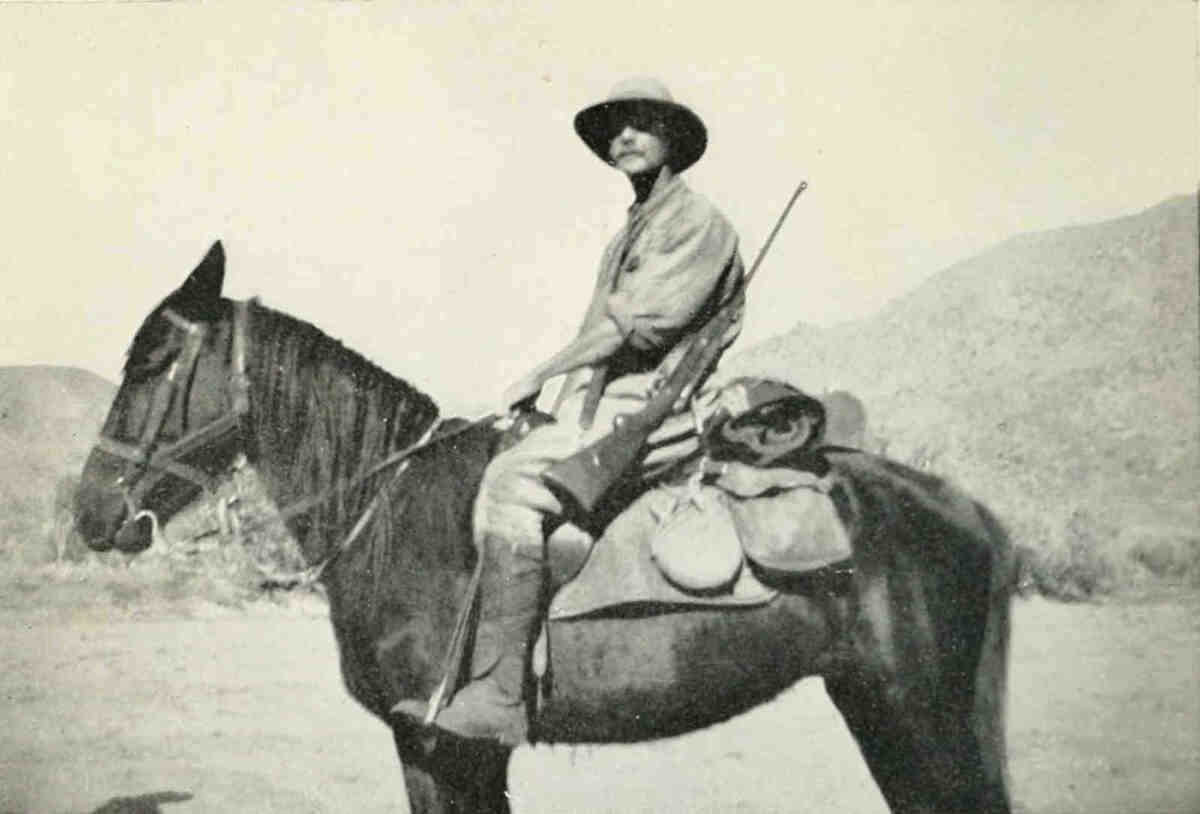
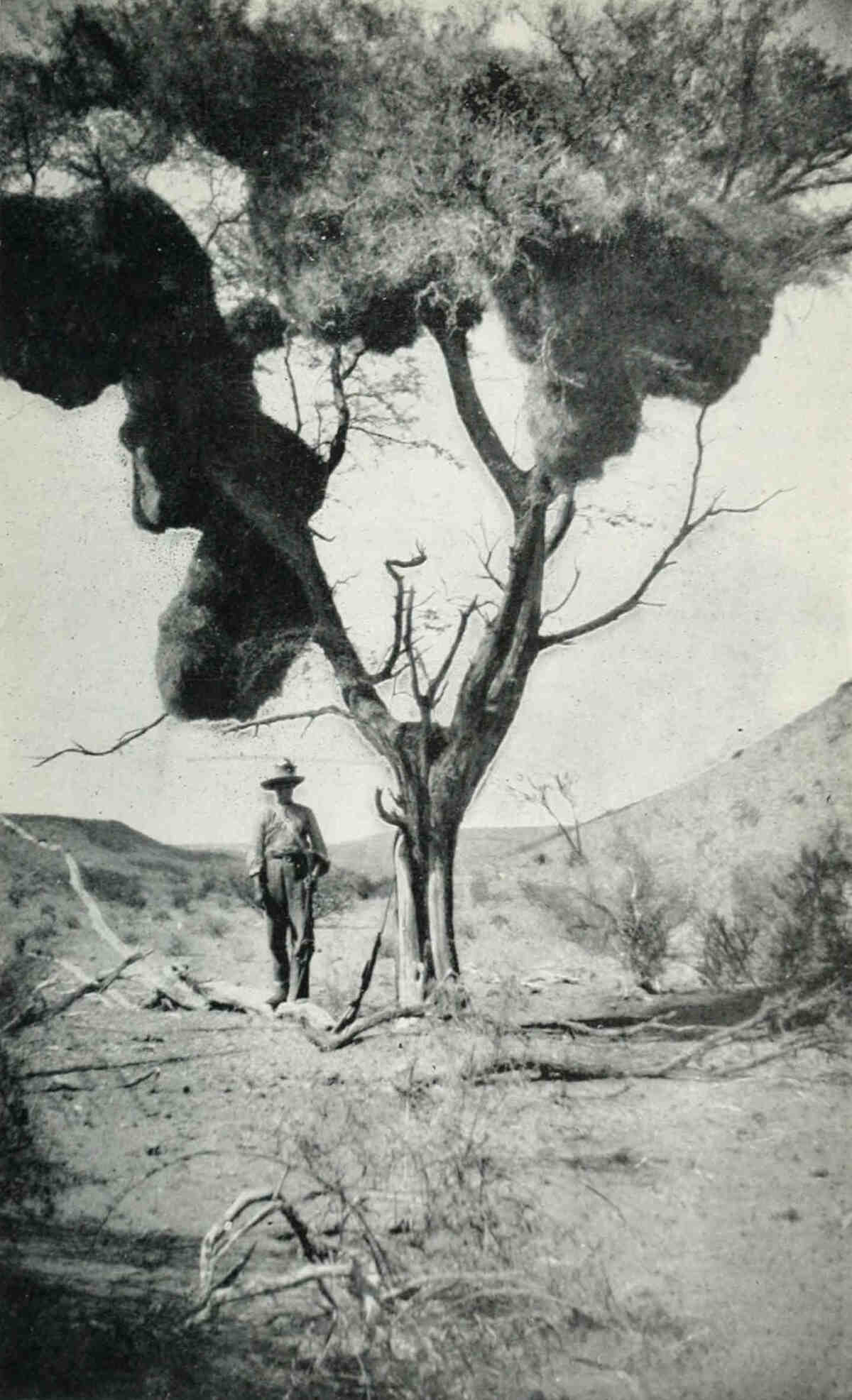
THE AUTHOR AT NAKOB, READY FOR A LONG TRIP.
Frontispiece.
THE GLAMOUR
OF PROSPECTING
WANDERINGS OF A SOUTH AFRICAN PROSPECTOR
IN SEARCH OF COPPER, GOLD, EMERALDS, AND
DIAMONDS
BY
LIEUT. FRED C. CORNELL, O.B.E.
AUTHOR OF “A RIP VAN WINKLE OF THE KALAHARI,” ETC.
WITH ILLUSTRATIONS AND A MAP
T. FISHER UNWIN LTD
LONDON: ADELPHI TERRACE
First published in 1920
(All rights reserved)
PREFACE
Most of this record of wanderings in wild parts of
South Africa had been written and was ready for
publication before the outbreak of war: and since
then there has been a radical alteration in much of
the country described; for, with the conquest of
German South-West by General Botha, the Union
Jack now floats over the huge tract of country between
the lower Orange River, the twentieth degree
of east longitude, Portuguese Angola, and the South
Atlantic.
As a result also of that campaign, new railway lines
have come into being, and with the linking-up of the
railway between Prieska, Upington, and the captured
German system at Kalkfontein, the traveller to-day
can ride in comfort in a saloon carriage from Cape Town
to the farthest extremities of the conquered territory.
And, incidentally, many of the wild spots I have
described have been brought within easy reach. For
instance, the lonely little police post at Nakob (described
in the closing chapters, and the scene of the
violation of Union territory by German troops) was,
at the outbreak of war, separated by 250 miles of
difficult, semi-desert country from the nearest British
railway at Prieska. To-day the line runs close by
where the post stood, and passes within sight of the
hill in British territory the Germans then occupied.
Upington, too, with a fine bridge spanning the
Orange, has been brought into touch with the rest of
South Africa; and, with the fertile oasis of the Orange
River stretching on either hand and giving marvellous
results in the growing of citrus and other fruits, cannot
fail to become an important and thriving centre.
There are rich mineral deposits in the vicinity, one
of which (the “Areachap” copper-mine, mentioned
in Chapter V) has, I believe, been reopened since
the railway at Upington has rendered 150 miles of
costly waggon transport unnecessary, and the marvellous
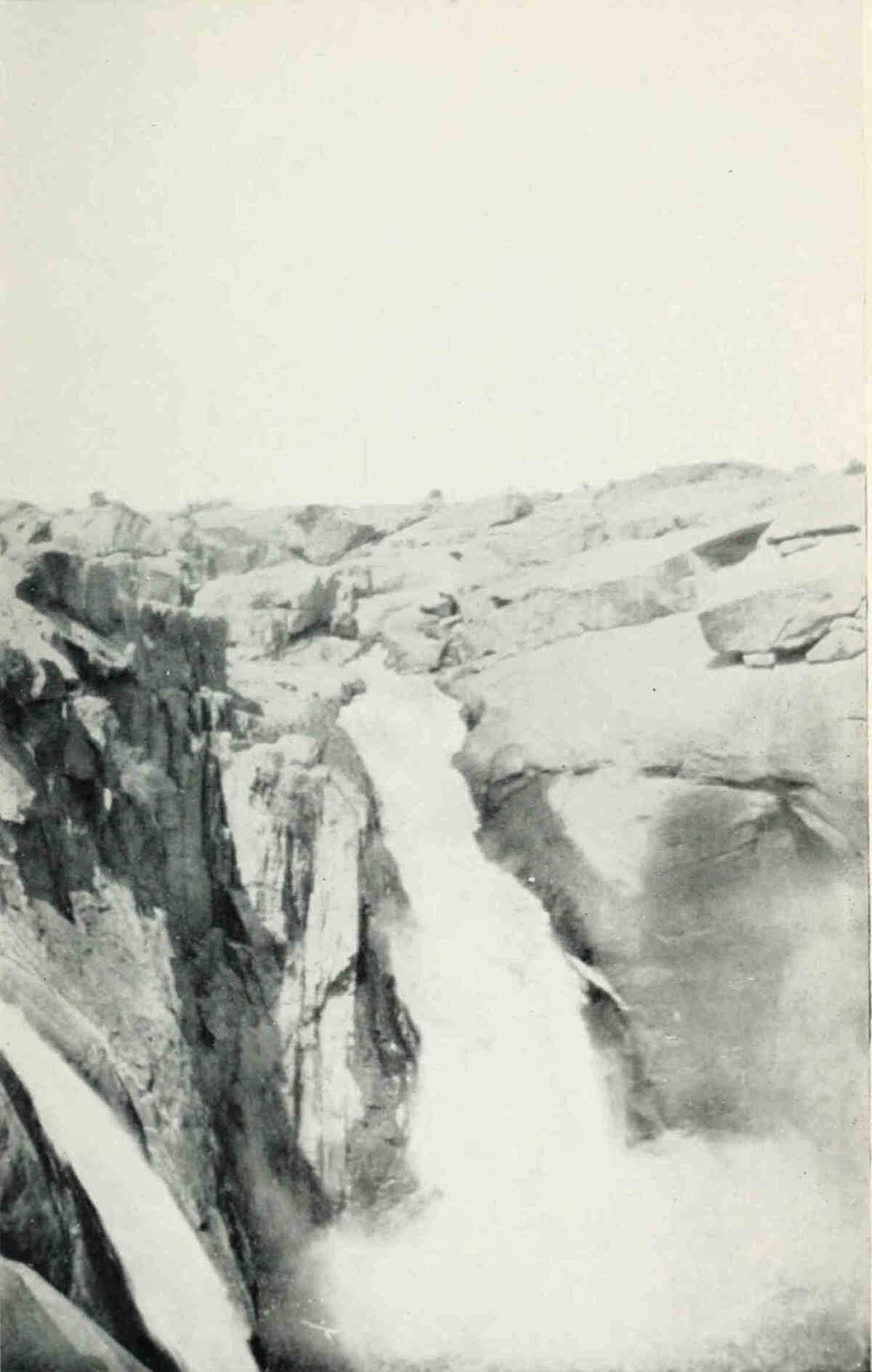
“Great Falls of the Orange River,” ranking,
with the Victoria Falls and Niagara, amongst the
world’s greatest cataracts, is now within a day’s
journey of the railway, and with the coming of peace,
will undoubtedly be visited by thousands of visitors,
and come to its own.
A railway has also been built to within easy distance
of Van Ryn’s Dorp (mentioned in Chapter IV), and
it is safe to predict that these new lines will be productive
of a great accession of mineral wealth to the
Union, wealth that has hitherto lain untouched and
unexploited owing to its great distance from a
railway.
These new lines, however, much as may be expected
of them, still leave untapped vast spaces of the
country I have described. Notably the mountainous
Richtersfeldt region of Northern Klein Namaqualand
(see Chapters VII to XI), with all its wealth of copper
and other minerals, and which lies to-day as solitary
and untrodden as when I left it. The Southern
Kalahari, with its fine ranching possibilities and its
remarkable “pans,” is still a huge “Royal Game
Reserve,” forbidden to the farmer and the prospector;
and though the dry Kuruman River (Chapter XVII)
was the route for the flying invasion of German
South-West (to the astonishment of the Germans, who
believed the desert impossible by troops), the desert
has long since claimed its own again: and the region
is once more given over to the vast herds of gemsbok
and a few wandering Bushmen.
To turn to the newly acquired territory of Great
Namaqualand and Damaraland, much of the latter
still remains practically unexplored, and although
concessions over vast tracts of country were granted
to various private companies by the German Administration,
few attempts have been made to develop
the great mineral wealth known to exist. There are
exceptions, notably the rich copper deposits of Otavi
and the Khan copper-mine, both having been worked
to great advantage prior to the war, whilst the remarkable
diamond discoveries on the coast have
added enormously to the wealth of the country. But
much of Northern Damaraland, Ovampoland, and
Amboland, etc., has scarcely been scratched, and this
is notably the case in the vast terra incognita of the
north-western portion known as the “Kokoa Veldt.”
Here but little prospecting has ever been allowed, but
copper abounds, tin and gold have been found, and
the former in abundance, and there are other valuable
minerals and precious stones waiting the day when
the territory in question is thrown open to individual
enterprise.
In conclusion, let me point out that this book,
though recording faithfully some of my own prospecting
trips, is in no wise intended to serve as a
handbook to the would-be prospector; indeed, he
should carefully avoid doing many of the things
herein recorded. But should he contemplate becoming
a prospector, let him at any rate not be discouraged
by reading of the few discomforts and hardships I have
experienced, for these, after all, were richly compensated
for by the glorious freedom and adventure of
the finest of outdoor lives, spent in one of the finest
countries and climates of the world. And far be it
from me to do anything to discourage the prospector.
He is, I maintain, the true pioneer; his pick and
hammer open up the wild places of the earth (usually
to the benefit of those who follow him more than to
his own), and, in the rush for “fresh scenes and pastures
new” which will inevitably follow the war, he
will be a factor of importance.
The ideal prospector is born, not made. He may
be versed in geology and mineralogy and excel with
the blow-pipe, but unless he has the love of wild
places in his bones he will never fulfil his purpose.
He must be an “adventurer” in the older and honourable
sense of the word; often, unfortunately, he
“fills the bill” in the more sordid sense. He should
be able to ride, shoot, walk, climb, and swim with
the best; indeed, if he still exists in the future, he
will probably also need to fly. And the wilds must
call him. “Something hid behind the ranges! Go
and look behind the ranges!” as Kipling has it.
That is the true spirit of the prospector; he must
love his work or he will never succeed in it. I have
had men out with me who were good enough theoretically,
but were quite useless to cope with the
misadventures they had to encounter, and soon gave
up the life for something easier. I have had others
to whom the glamour of a life spent in the wilds,
with the sand for a couch and the stars for a ceiling,
outweighed all its little disadvantages.
KLEIN NAMAQUALAND—RICHTERSFELDT—PORT NOLLOTH AND THE
“C.C.C.”—STEINKOPF—WONDERFUL NAMAQUALAND FLOWERS—TREKKING
TO RICHTERSFELDT—FLEAS!—MONOTONY OF THE COUNTRY—MOUNTAINS
IN SIGHTpp. 92-103
RICHTERSFELDT—ALEXANDER BAY—MOUTH OF THE ORANGE RIVER—“HADJE
AIBEEP”—HELL’S KLOOF—A DESERTED COPPER-MINE—ROUGH
GOING—A MAGNIFICENT VISTA OF PEAKS—AN OLD GOLD PROSPECTpp. 104-121
GOLD CAMP—THROUGH THE MOUNTAINS TO ARIEP—TATAS BERG AND
COPPER PROSPECTS—A “MOUNTAIN” OF COPPER—THE GREAT FISH
RIVER—THE “GROOT SLANG”—ZENDLING’S DRIFTpp. 122-144
ZENDLING’S DRIFT—JACKAL’S BERG—THE RESULT OF TOO MUCH
WHYMPER—HUGE NUGGET OF NATIVE COPPER—A DIFFICULT PASS—KUBOOS—DEGENERATE
NATIVES—BACK TO PORT NOLLOTHpp. 145-158
SECOND TRIP TO RICHTERSFELDT—SMASH-UP IN HELL’S KLOOF—CHRISTMAS
AT KUBOOS—TESTING THE “BANKET”—A NEAR THING IN
THE RAPIDS—AFTER A LEOPARD—NEW TRAILS—HOTTENTOT SUPERSTITION—STEWED
FLAMINGO AND OTHER WEIRD DISHES—END OF THE
TRIP pp. 159-184
PERMIT FOR THE FORBIDDEN GAME RESERVE—VAN REENEN AND THE
SCORPION—SECOND VISIT TO THE GREAT FALLS—OLD GERT, OUR GUIDE—BUSHMAN
ARROWS AND THEIR POISONS—BUSHMAN INOCULATION AGAINST
SNAKE-BITE—ANTIDOTE FOR SNAKE-BITE—TALES OF “THE GREAT
THIRST” pp. 224-236
FORMATION OF THE DUNES AND PANS—“KOBO-KOBO” PAN—RAIN IN
THE DESERT—SCORPIONS—AAR PAN—MIRAGE AND “SAND-DEVILS”—KOICHIE
KA—THE PIT AND THE PUFF-ADDER pp. 260-276
THE KURUMAN RIVER—WITDRAAI—AAR PAN AND EASTWARD—GEMSBOK
AND T’SAMMA—DRIELING PAN—WILD DOGS—THIRSTY CAMELS—SEARCH
FOR WOLVERDANSE—“NABA”!—BUSHMEN—END OF THE TRIP pp. 277-293
TRIP IN SEARCH OF “EMERALD VALLEY”—FEVER AND FAILURE—BACK
TO GORDONIA—SECOND TRIP TO BAK RIVER—“SOME GUN!”—THE
PACK-COW—SURLY NATIVES—“ROUGHING IT” pp. 294-307
RESULT OF KALAHARI TRIP—NAKOB—LACK OF POLICE ON FRONTIER—WORKING
A KIMBERLITE PIPE—UKAMAS—DRUNKEN GERMAN OFFICERS—SLOW
TREKKING—A BAD SMASH pp. 308-323
SOME WILD-GOOSE CHASES—DISCOVERY OF DIAMONDS IN GERMAN
SOUTH-WEST AFRICA—BRIEF HISTORY OF THE NEW MANDATORY,
LUDERITZBUCHT.
What gave me “diamond fever” I don’t pretend
to say. Certainly I have no love for the cut and
finished article, and nothing would induce me to wear
it; but for the rough stone, and for the rough life
entailed in searching for it, I have always had a
passion. Yet the luck attending many of my ventures
has been but bad, or at the best, indifferent. The first
tiny glittering crystal that I found at the bottom of
my wooden “batea” in Brazil, many years ago, had
cost me weeks of hard work and every penny I
possessed; and the months of hard digging and
perilous prospecting that followed that first “find,”
and that led me through the diamond-fields of Diamantina
and Minhas Geraes, left me none the richer
except in experience. But the memory of those
long-ago hardships is a faint thing compared with the
glamour that still clings to that time; and even here
in South Africa, the home of the diamond, not all
the vicissitudes of years spent on the Vaal River
Diggings, or of prospecting in far wilder spots, have
taken away the fascination that, to me, lies in this
most precarious of all professions. Still, the fruitless
searches have been many, and I have often
been called upon to make long and arduous trips
where the quest of precious stones has proved nothing
but a wild-goose chase.
A stray diamond, very possibly dropped by an
ostrich, and maybe the only one for a hundred
square miles, has often led to a rush to where it was
found, whilst, frequently, circumstantial tales of the
finding of “precious” stones have been founded on
the picking up of a beautiful but worthless quartz
crystal.
At no period of late years were rumours as to the
finding of diamonds more rife in South Africa than in
1907, when the sands of Luderitzbucht, in adjacent
German territory, were found to be full of them,
and when luck led me many hundreds of miles in
another direction, and spoilt my chance of being
one of the first in those new and wonderful fields.
Ever since the discovery of the first South African
diamond in the Hopetown District in 1867, a belief
has been prevalent among the thousands of diamond
seekers scattered along the Vaal River Diggings
that rich fields of a similar nature must exist far
lower downstream. Yet, although the theory is
logical enough, and many expeditions have from
time to time searched the banks far beyond the
confluence of Vaal and Orange, and a few have even
reached the little-known lower reaches of the latter
and located both promising gravel and even stray
diamonds, nothing of a payable nature has so far
been discovered in that direction.
In the latter part of 1907 I was shown an extremely
beautiful stone of about twenty carats, that had been
picked up by a transport rider some fifty miles below
Prieska; and the accompanying gravel that this
man brought in was so exactly a replica of the Vaal
River “wash” that I came to terms with the finder
and set about arranging a small expedition to accompany
him and test the spot.
Before completing my arrangements, I went into
Kimberley to try and find an old digger partner of
mine, who had always been particularly anxious to
explore the lower Orange River, and who, I thought,
would be just the man to accompany me.
After some trouble I found him, and before I
could even broach the subject of my visit he opened
fire on me. “The very man I wanted to see,” he
burst out; “in fact, I was just writing to you. Man,
I’ve just seen a whole lot of diamonds from a new
place entirely; they’re small, but the chap who
found them swears you can pick them up by the
handful where he got them.”
It appeared that the finder of these small stones
was again a transport rider, who had been working
in German South-West Africa, and had brought back
a small phial full of these tiny stones, which he said
could be had for the picking up anywhere in the sand
near a certain bay he knew of. An hour later my
friend had found him again, and I saw them for
myself—nearly fifty small, clean, and brilliantly
polished little diamonds, of good quality, astonishingly
alike in size, and quite different from either
“mine” or “river” stones in appearance.
The man’s story was circumstantial enough, and
March, my former partner, was most anxious to
accompany him back to German South-West, and
tried hard to induce me to join him.
Now, for years rumours had been current among
prospectors and diamond diggers, as to the existence
of the precious gems in abundance somewhere along
the desolate, wind-swept shores of the little-known
country lying north and west of the Orange; but
the region was too remote and too inhospitable to
encourage expeditions in that direction, and the
German régime of the country by no means added to
its attractiveness. So that, tempting as the little
“sandstones” were, I was not to be persuaded;
moreover, I had committed myself to the other venture
and consoled myself with the reflection that, after all,
my one big diamond from the Orange River was
worth more than the whole phialful brought from
German territory. And when I told my tale in
turn and spoke of the big twenty-carat beauty I had
seen, not only did March promptly decide to come
with me, but Du Toit, the discoverer of the German
stones, immediately threw in his lot with us, arguing,
doubtless, that it would be easier and quicker to fill
bottles with big diamonds than with little ones.
“Anyway,” he said, “the other place can wait;
we can go there afterwards if we think it worth while.”
And so it was agreed, and thereby we probably
missed a fortune, for the place where Du Toit had
found the diamonds is to-day one of the richest
diamond-fields in South-West Africa.
Anyway, the decision once arrived at, we lost no
time in getting under way, and a few days later we
were on our way towards the spot where the twenty-carat
stone had been found, and which we fondly
hoped would prove as rich in big stones as Du Toit
declared the sands of the German coast were in small.
Into the details of that disastrous trip I shall not
enter here. Suffice it to say that four months later,
ragged, footsore, broken in health and practically
penniless, we tramped back into Prieska, having
searched the southern bank of the river for nearly
three hundred miles without having found a single
diamond. Gravel there was in abundance, containing
all the so-called “indications”—agates, jasper, chalcedony,
banded ironstone—in fact, all the usual
accompaniments of the diamond as they are found
higher up the river, but never the diamond itself.
So good had these “indications” been that we
were eternally buoyed up by the hope that sooner
or later we must strike the right place, and so we had
wandered on till the fine outfit we had started with
had gone piecemeal to keep us in food; and it was
only when our small funds were absolutely exhausted,
and our tools and kit reduced to what we stood in
and could carry, that we gave up the quest of the
“Fata Morgana” that had led us on and on into
the wild country near the “Great Falls” below
Kakamas, and beyond all trace of civilisation.
For weeks we had had no news, and had not seen
a newspaper or received a letter for months, and I
well remember, when at long last we reached Prieska,
with what eagerness we hastened to the little post-office
for the budget we expected waiting for us.
And the very first letter I opened told me what this
particular wild-goose chase had cost us, for both it
and numerous wires and newspapers of long weeks
back told of the sensational discovery of diamonds
in the sands of German South-West, and the fabulous
finds that the lucky first-comers had made there.
Newspaper reports spoke of men picking them
up by the handful, filling their pockets with them
in an hour or two, of bucketsful lying in the Bank.
In fact, it was Sinbad’s wonderful “Valley of Diamonds”
over again; and, giving due allowance for
the exaggeration usual to such discoveries, there still
could be no doubt that we had missed a fortune
by not going there with Du Toit four months back,
instead of on our disastrous trip down the river.
I had always liked Du Toit, who was one of the
best Afrikanders I ever met, but never did he show
to such advantage as when he got this news; his
sun-flayed face went a shade pale as he read it, but
all he said was, “Ah, well, better luck next time,
boys.”
But we didn’t get it.
At De Aar the little party divided, March and our
guide of the last venture going back to the River
Diggings, whilst Du Toit and myself returned to
Cape Town, intent on getting up to German South-West
Africa as soon as possible.
And as German South-West Africa, now a Mandatory
of the Union of South Africa, will figure prominently
in these pages, it may be as well to give a
brief account of that extensive country, which, until
the discovery of diamonds already alluded to, was
very little known to the average man even in Cape
Colony, its next-door neighbour.
As early as 1867, owing to reports of rich mineral
deposits existing in the country then known as Great
Namaqualand and Damaraland, the Cape Government
proposed to the Imperial Government the
annexation of the whole of the West African coastline
from the Orange River to Portuguese Angola,
but no definite action ensued. And, in spite of
various “Resolutions” the Cape Government subsequently
made in favour of this extension of territory,
nothing happened till 1877, when a Special Commission
was sent to Damaraland, where they received
offers of submission from the principal chiefs of the
country.
The Imperial Government was, however, adverse
to taking over the whole of this vast coastline, with
its then unknown hinterland, but sanctioned the
hoisting of the British flag at Walfish Bay, the natural
port of a huge stretch of country; and this tiny
mouthful of territory, bitten as it were out of the
surrounding country that so soon afterwards became
German, has, much to the annoyance of Berlin,
remained British ever since.
At the time this annexation took place the hinterland
was well populated by various native tribes,
the Damaras (also known as Hereros), a people of
Bantu descent who came from the north, and the
Namaquas, a Hottentot race who had gradually
spread from the south.
The true aboriginals of the country were probably
what are known to-day as “Berg Damaras,” a little
people of Bushman characteristics, small in numbers,
but ethnologically of far greater interest than either
of the two invading races. On the irruption of the
Namaquas, these aboriginals were mostly conquered
and enslaved, but a few escaped to the mountains,
and retain their national characteristics to this day.
Herero and Namaqua eventually met somewhere
about the vicinity of where Windhuk now stands,
and for a time each treated the other with respect;
but about 1840 the Namaquas, strengthened by the
accession to their ranks of certain half-breed desperadoes
who had fled from Cape Colony and who were
well armed and mounted, attacked the Damaras to
such purpose that they were soon completely conquered
and enslaved, and Jager Afrikander, the
chief refugee and desperado, became their chief.
Between 1863 and 1870, however, the Damaras
again rose and waged a war of independence, being,
however, again crushed. Ten years later a rising
again occurred, and the whole country was plunged
in warfare. Meanwhile, however, the white man
had arrived upon the scene, the British at Walfish
Bay, and numerous white pioneers, including many
Germans, had penetrated the country beyond it.
Prominent among the pioneers were several missionaries
of the Rhenish Missionary Society, and upon
their heels followed the traders, so that when in
1880 the above-mentioned native trouble broke
out, a considerable number of white men were settled
in the interior.
As British responsibility was conterminous with
the boundaries of her Walfish Bay territory, these
venturesome settlers had but little protection
afforded them; and as German enterprise developed
farther south and trading ventures were started,
Germany asked the British Government for its
protection for these pioneers. Certain negotiations
followed, and by June 1884 Germany had made up
its mind to extend its own protection to its subjects
in Damaraland and Great Namaqualand, and incidentally
to afford the cover of its sovereignty to an
enormous concession of land near Angra Pequena
which had been obtained by a wealthy Bremen
merchant named Luderitz from certain native
chiefs.
This bay of Angra Pequena, so named by the
Portuguese who discovered it, is now known as
Luderitzbucht; it lies about two hundred and fifty
miles south of Walfish Bay, and, although vastly
inferior to the latter port, also affords good anchorage.
Here Luderitz started large trading stations; and in
1884, in pursuance of Bismarck’s scheme of colonial
expansion, a belt of land twenty miles in width along
the coast from the Orange River northward to Portuguese
territory (excluding, of course, Walfish Bay)
was placed under the protection of the German
Empire.
From that time German expansion marched quickly,
and in June 1885 the German dominion was extended
over the whole of the vast hinterland up to the 20th
parallel of east longitude, the Gordonia border of
the present day.
Late in the day, but luckily just in time, the
statesmen of Cape Colony realised that this was but
a step towards driving a German barrier across
South Africa from sea to sea; and as a counter-stroke,
in 1885, Bechuanaland (lying east of the
new territory) was annexed as far north as the
Molopo River, and declared under British protection
up to the northern confines of the Kalahari
Desert.
The Germans, foiled in their design of further
expansion, set about making the most they could
of Damaraland. But red tape, officialism, and their
harsh and overbearing methods, hampered them in
their attempt at colonisation; moreover much of
the land was practically desert and up to the time
of the discovery of diamonds at Luderitzbucht the
country had been run at a loss, and there had been
a determined attempt by the Socialists in the
Reichstag to force its abandonment.
The Herero and Hottentot rebellion in 1903
dragged on for years, and cost the Germans
much blood and treasure, for they found themselves
utterly unable to cope with the extraordinary mobility
of the native commandos. These, excelling in
guerilla warfare, harassed them incessantly, and,
although in vastly inferior numbers, gave the raw
German troops—fresh to the country—endless trouble
before they were subdued or captured.
Towards the end of this costly campaign the
warfare was waged with extreme bitterness, and
indeed it ended in the virtual extermination of the
Herero race.
With this slight, and, I hope, pardonable digression,
I will return to Cape Town, where Du Toit and I at
length embarked for Luderitzbucht.
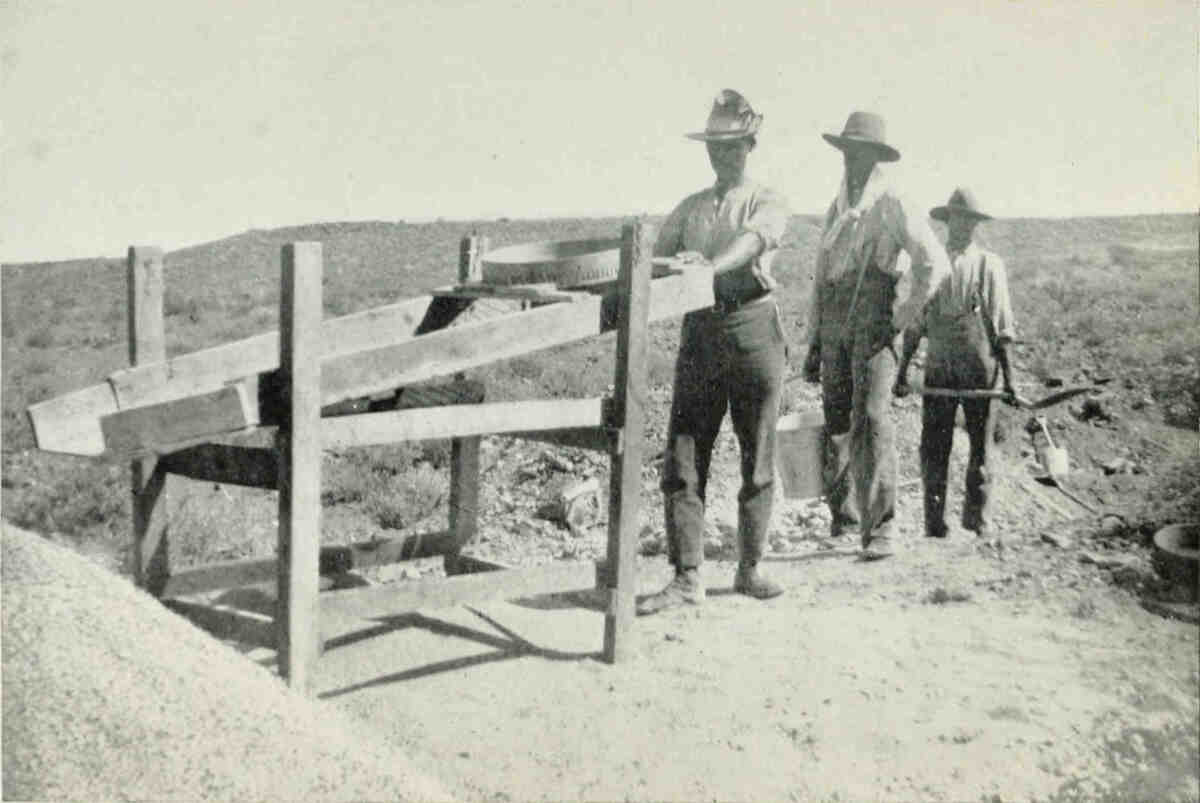
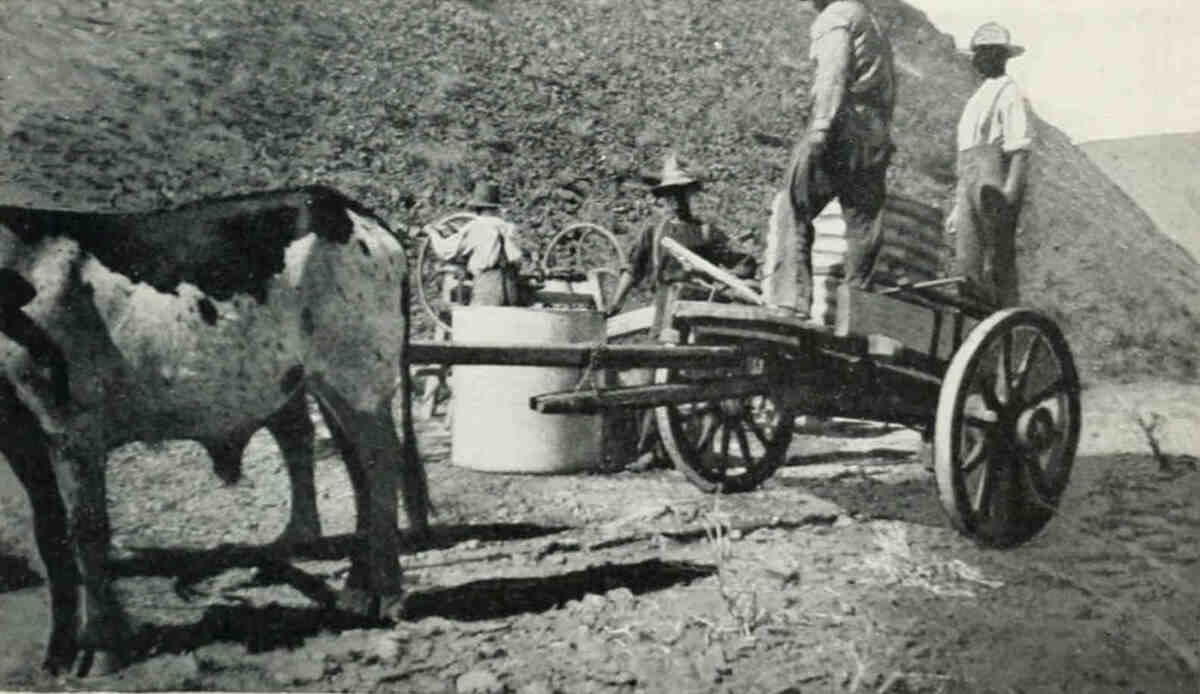
“BABYING” FOR DIAMONDS.
The machine is called a “baby” (or more correctly “bébé,” after the French digger who invented it), and is universally used by South
African diamond diggers.
The Frieda Woerman took us up the coast in
comfort. We passed Port Nolloth in a fog which
showed us nothing of the forlorn little northern
copper port, and fog clung to us till we reached
Luderitzbucht.
These sea-fogs are a feature of the South-West
African coasts, and on the British (Namaqualand)
coast they are beneficial, as they distribute a certain
amount of moisture to the scanty vegetation of the
coastal belt; but at Luderitzbucht there is no
vegetation for the fog to moisten.
For, north, south, and east of it there is nothing
but sand and barren rocks, and this description
applies to practically the whole of the coast belt for
hundreds of miles in either direction.
Luderitzbucht, at the time of which I write, was
little more than a forlorn collection of corrugated
iron huts clustering around one or two of the more
important buildings, dignified by the names of “hotel,”
store, and Customs House. The streets were ankle
deep in sand, and the first thing that struck me was
the enormous number of empty bottles that lay
piled and scattered about in all directions—principally
beer bottles, of course, but also thousands of
mineral-water bottles, for water was at that time
extremely scarce. The very little obtained locally
was of poor quality, had a vile alkaline taste, and
often alarming medicinal effects upon the new-comer;
moreover, it had never been sufficient even for the
scanty population existing here before the discovery
of diamonds. A large condensing plant had supplied
the deficiency in an intermittent manner, for it
frequently broke down or got out of order, and it
was the usual thing in the early days to have cargoes
of water brought by steamer from Cape Town.
With the discovery of diamonds came the influx
of “all sorts and conditions of men” usual to
“rushes” all over the world, and water rose to
famine prices. Washing in sea-water, when tried
by a few over-particular new-chums, was followed
by extremely painful results, for the brine aggravated
a hundredfold the painful sun-blisters inevitable in a
country where the blazing rays of a sub-tropical sun
beat back with redoubled fierceness from the glaring,
scorching, all-pervading sand. A helmet, whilst
absolutely essential, is after all but little protection
from a glare that comes from the sand all around
one as from a huge mirror. We soon found that, if
this glare was to be borne at all, it was by using
spectacles of smoked glass, and these, fitted with
wire gauze side-protectors, are also essential in the
blinding sand-storms that form a frequent variation
of Luderitzbucht weather conditions.
We found the place so crowded that it was almost
impossible to obtain even the roughest accommodation;
the hotels were full, the stores were full, every
shanty dignified by the name of a dwelling was
crammed, men “pigging it” four and six in tiny
rooms meant for a single occupant, and food, and
above all water, at famine prices.
So great had been the rush, for a time, that the
police had been quite unable to cope with it, and
when I came to see more of the motley crowd of
“fortune seekers” that had invaded the place, I
easily forgave the irascibility of the stout, overfed
and overheated German officials who had had to
deal with them all. What a lot they were! Only a
small minority were genuine prospectors, engineers,
or mining-men with a legitimate interest in the
diamond discoveries; the majority were shady
“company promoters,” bucket-shop experts, warned-off
bookmakers and betting-men (“brokers” they
usually styled themselves), and sharpers of all
sorts, on the lookout for prey in the shape of
lucky diggers or discoverers. Then, too, there
were a number of self-styled “prospectors,”
runaway ships’ cooks, stewards, stokers, and seamen,
the bulk of whom had never seen a rough
diamond in their lives, and of course a modicum
of genuine men of past experience—principally ex-“river-diggers”—men
whose small capital was
running away like water for bare necessities in this
miserable dust-hole of creation.
We soon found that most of the available land
in the vicinity of Luderitzbucht had been taken
up, and much of it had already changed hands
two or three times. Companies and syndicates
were being “floated” at a great rate, many of them
by unscrupulous scoundrels of promoters, acting
upon the “reports” of equally lying and unscrupulous
“prospectors.”
Schurfscheinen (prospecting licences) were at that
time transferable, and as they were daily becoming
more difficult to procure, they often changed hands
several times, and for quite large sums, before they
were even used for their legitimate purpose of enabling
the holder to locate and peg-off a claim. And often,
when, as a result of an expensive expedition, ground
was located and title secured, the diamonds shown
to back up the “discoverer’s” or “promoter’s”
highly coloured report would be the only ones ever
seen by the gullible purchaser or shareholder.
The conditions under which diamonds were found
made “salting” a very easy matter to carry out
and a very difficult one to detect. The small and
brightly polished little gems, usually running three
or four to the carat—that is to say, about the size
of hemp-seed—were generally found in the surface
deposit of loose sandy shingle spread over much of
the sand-belt near the coast, and differing from the
sand of the country only in being slightly coarser.
This loose deposit, in common with the sand, is
in many places heaped up into small, wave-like
ripples by the action of the prevailing wind, and
wherever the diamonds exist these little ridges are
exceptionally rich in them. The method of searching
for them was simply by crawling along almost flat upon
the ground, and turning over the shallow layer with
a knife-point, though on some of the claims hand-washing
in sea-water was being attempted. Most
of the diamonds so far had come from a place known
as “Kolman’s Kop,” a mile or two inland from the
bay, and on the railway to Aus—indeed, the line
ran right through this diamondiferous area—and it
was here that Du Toit had picked up his stones.
So plentiful were the little “crystals” that many a
little bottleful of them had been brought into
Luderitzbucht in the early days and given away as
curiosities, without the slightest notion as to what
they really were.
A few keen-eyed Kaffirs engaged in construction
work on the railway, and who had worked in the
Kimberley mines or on the Vaal River Diggings,
first realised what they really were, and several of
these “boys,” who afterwards came to Cape Town,
and there attempted to sell the stones, were convicted
and sentenced to various terms of imprisonment
under the provisions of the “I.D.B.” Act of Cape
Colony.
Few, if any, of those who read the report of their
trials believed their story that they had picked up
the stones in the sands of German South-West Africa,
but the few who did believe and made investigation
were amply repaid for their trouble, for the first-comers
picked up diamonds by the handful.
A few days tramping the surrounding district
soon convinced us that all the likely ground near
Luderitzbucht had been taken up—and indeed much
that was unlikely—and we decided to clear off to
an outlying district where distance and want of
water had thus far prevented “prospectors” from
penetrating.
A general examination of the gravel, sand, and
various deposits had shown to we old diggers the
significant fact that, whatever the origin of the
diamonds, there was some analogy between these
fields and those of the Vaal River Diggings, for
prominent everywhere were the familiar pebbles of
striped agate, chalcedony, jasper, etc., we knew
so well. Most of these pebbles were, however, very
much smaller than those of the Vaal River; moreover
the action of wind and water had “graded”
the loose deposits to such an extent that whole acres
appeared to have been worked by sieves of a uniform
mesh.
Now, this “grading” was also a feature of the
diamonds themselves, for they were of a remarkably
uniform size, and in this respect differed entirely
from those of any other known deposit; for at
Kimberley, or on the Vaal River Diggings, one of
the fascinations of the precarious profession of
diamond-digging lies in the fact that big and little
stones are found together, and the next spadeful of
ground may bring the digger a stone the size of a
pea, or one the size of a potato. Now, the general
theory as to how the diamonds came to be in the
Luderitzbucht sands was that they had come from
the sea, either from a rich pipe beneath it, or from a
huge deposit washed down the Vaal and Orange
Rivers during the course of countless ages, and out
to sea, whence the north-setting current had brought
the diamonds ashore. And we—pundits all—believed
that, as the sea had obviously done the
work of “grading” the stones, there must exist
vastly heavier deposits somewhere along the coast,
where, it should follow, we should also find vastly
bigger diamonds. And those were what we wanted,
the bigger the better.
CHAPTER II
RUMOUR OF “HOTTENTOTS’ PARADISE”—UP THE COAST ON A SEALING
CUTTER—WALFISH BAY.
At that time rumour was rife that, somewhere in the
terrible wilderness of sand-dunes stretching north-east
of Luderitzbucht, there existed an oasis where
not only water was plentiful, but where diamonds,
big ones, abounded. This fabled oasis was usually
called the “Hottentots’ Paradise,” and tradition
maintained that to this remote and inaccessible spot
the remnant of that poor degenerate race of natives
that had escaped extermination at the hands of the
Germans in the recent rebellion had retreated. It
was also rumoured that these men were well armed,
that they had cattle and food in abundance, and
that, cut off by a wilderness of waterless country,
the Germans had hesitated to attack them. There
were other versions; in fact, no two agreed exactly,
except that the oasis was situated somewhere between
Luderitzbucht, Walfish Bay, the high plateau of the
interior, and the sea, and that there the diamonds
were as big as they were abundant.
Already one or two abortive expeditions had started
with the intention of searching for this place, but none
of them had got far; thirst had in each instance conquered
them; and at least one had lost every animal
it started with.
One day, when we were looking round as to the
best direction in which to make our own attempt,
I was asked by a prospector to join an expedition
just being outfitted to search for this place, and he
put such a plausible tale before me that I hastened
to consult Du Toit. He shook his head when I told
him the way this expedition proposed travelling.
“No water,” he said; “they’ll be back within a
week, if they get back at all! There are only two
ways of searching for the place: from the coast,
having a boat with plenty of water waiting you, or
with camels. These fellows talk of mules—well,
let ’em go. I’ve heard of something better.”
Then he told me he had met a man he had known
on the River Diggings who had turned sealer, and
had for some years past plied his dangerous trade
along this wind-swept coast in a little ten-ton
cutter, and that this man had told him that north
of Sylvia Heights there existed a wonderful beach
where the pebbles were identical with those of the
Vaal River Diggings, but that they were very much
larger. He said they lay graded by the tide for
miles and miles along the beach—agates, chalcedonies,
jaspers, and banded ironstones (the bandtom of the
digger); and that, when he had come back from a
holiday in Europe and found all Luderitzbucht
diamond-mad, he had resolved to go to this beach,
where he believed he would find them lying thick,
but that he had been in some trouble with the police
and could not get a Schurfschein. As we both had
obtained these valuable documents, he was quite
prepared to run us up to this spot in his little cutter,
sharing expenses, and sharing in all claims we might
be able to peg.
Now, this seemed a perfectly God-sent opportunity
for locating the “big stones” we all felt certain
existed, and we set about getting in stores for the
trip at once. These consisted principally of hard
biscuit, “bully beef,” tea, coffee, and sugar, and
above all water. Of the latter we had two fairly
large breakers, and a miscellaneous collection of other
utensils, ranging from big oil-drums to canvas water-bottles—in
all, an ample supply for fifteen or twenty
days. We went on board that very evening. Besides
our pal the skipper, there were two other hands, men
who, had they chosen to wash themselves, would
probably have proved to be white, but who were so
coated with seal oil and the accumulated grime of
many voyages that it was impossible to say what
colour was underneath it all. They spoke a jargon
that they fondly imagined was English, but I believe
they were Scandinavians of sorts. The little half-decked
cutter barely held us and our belongings, and
would have been none too comfortable even for a
short trip such as we hoped for and anticipated.
And, unfortunately, our voyage was both long and
disagreeable, for we had scarcely got clear of Luderitz
Bay one fine evening than it came on to blow great
guns, and so heavy did the weather become that our
skipper had to run clean out to sea. Up to then I
had fondly imagined I knew something about the
sea, and was proof against such a very amateur
malady as sea-sickness; but alas! I had a lot to
learn. Indeed, I soon found that, in spite of a good
deal of knocking about the sea at various times, I
really knew nothing of bad weather. There was no
snuggling down in a cosy cabin or the soft cushions
of a big saloon about this experience, no looking at
big seas through the comforting protection of thick
plate-glass portholes. Here the huge waves were
towering, threatening, imminent; and nothing but
the coolest of heads, and strongest and steadiest of
hands at the helm, could have kept the little cockle-shell
from shipping a big sea and foundering. Portions
of big seas she shipped repeatedly, and little
seas in the intervals; in fact, for hours she appeared
to consider herself to be a sort of submarine of which
I suppose I must have been the periscope—for I
was continually endeavouring to stand erect in my
attempt to dodge the waves. Within an hour or two
of leaving the bay I was wet through, and continued
so till I got on shore again; and during that period
of three nights and two days I had ample reason to
know that sea-sickness is not nearly as laughable as
it looks! They gave me rum and water, and it made
me worse; they coaxed me with hard ship’s biscuit
and fat bully beef, and somehow it failed to entice
me. Once, in a comparatively dry interval, they
managed to light a stove and make some alleged
coffee. It tasted so of seal oil that it merely effected
the apparently impossible by making me feel worse
than I did before.
The skipper assured me that it was all my fancy
when I told him that the coffee-pot must have been
used for trying down seal, and offered to prove it by
making another brew in the legitimate utensil used
for that purpose, that I might taste the difference.
The only consolation I had during the whole memorable
sixty hours was that Du Toit was apparently
even worse than myself. He did not even attempt
to dodge the water as we shipped it, but lay with
closed eyes and hands mechanically clutching the
oily stays, just where the first spasm caught him,
and except for groans, nothing coherent passed his
lips but profanity during the whole voyage. We had
left Luderitzbucht at sunset on Tuesday evening, and
the gale that sprang up that night blew itself out
sufficiently by Thursday afternoon to enable them to
put the cutter about towards shore again. I did not
witness the operation, but I heard some cryptic
remarks thereto, and knew by the way the crew fell
over me they were hurrying about something. Then
the motion changed, and a wave went over me broadside
instead of lengthways. The sail flapped furiously,
and then she heeled over so that I rolled off my seat.
And then a quite new motion began, a bobbing,
jerking, wrenching movement that started fresh
trouble. However, by dark that night we were in
sight of land, and I began to have some faint hope
that, after all, we might survive.
I was aroused from a broken and uneasy slumber
by a chorus of quacks, and cackles, and grunts, sounding
as though the cutter had run clean into a farmyard,
and at this phenomenon I had just sufficient
curiosity in me to open my eyes and sit up. Dawn
was breaking and we were close to land, in comparatively
smooth water, to the leeward of a small island,
from which arose the hubbub I had heard. It was
not a farmyard, however, but an island covered
partly with big seals, and partly with penguins and
other sea-fowl in such incredible swarms that they
jostled each other for elbow-room. This was one of
the many guano and sealing islands lying off the
coast of German South-West Africa, all of which are
British possessions belonging to Cape Colony. On
several of them diamonds are supposed to exist, but
they are prohibited ground to prospectors. I believe
this to have been Hollam’s Bird Island, but had no
chance to inquire as my sitting position immediately
brought on the old trouble, and I had other urgent
matters to attend to.
However, our troubles were almost over, for less
than two hours later the cutter was deftly manœuvred
into a little indentation where the water was comparatively
smooth, and we got out the tiny dory
that had filled up most of the cutter’s foredeck
room and landed. And never were men more
pleased than Du Toit and I, and we there and then
agreed that one trip in that cutter was enough.
Once we had found the diamonds, we would send it
back to Luderitzbucht to charter a decent-sized boat
to go back in; but as for travelling back ourselves
in her—not much!
According to the skipper the beach he knew of lay
about three or four miles down the coast, but this
was the only safe landing-place and anchorage, and
here we must camp. So we got our water and provisions
ashore, and by the aid of a big bucksail and
some driftwood we made a shelter to live and sleep
in. This driftwood lay in abundance all along the
sandy, desolate shore, and served excellently for
fuel, though it was too dry and rotten to be of much
service for anything else. The landing even of our
few stores and belongings took up the best part of
the day, and we decided not to make our first trip
to our diamond beach till the morning; but just
before sunset Du Toit and I went a short distance
inland to where the first high dunes began, and
climbed a prominent one for a look-round. And
east, north, and south there was nothing but sand;
not a tree anywhere, only here and there a stunted
bush struggling forlornly against adversity; nothing
but bare waves, mounds, and ridges of desolate dunes
as far as the eye could reach, and to the west the
equally (but not more) desolate ocean. No sign of
life anywhere except a few gulls over the sea, though
on our way back a jackal followed but a few paces
behind, full of curiosity at the strange beings the like
of whom he had probably never seen before. We
saw several of these jackals during our stay there,
and they were all quite fearless. Their spoors and
those of the stronte woolfe, or brown hyena, were
numerous, and the only spoors of any kind to be seen
along the desolate shore, where these creatures
probably picked up a precarious living from the dead
fish occasionally stranded there. A short distance
up the coast we found a flat space where the sand
was comparatively hard, and where, apparently, in
the past a shallow lagoon had existed. Here there
were a few straggling bushes, thick-leaved and
resinous, and scanty clumps of a sort of strong, wiry
rush seemed to point to moisture at a short distance
below the surface. Here, too, we found huge heaps
of the shells of a species of large limpet, shell middens
showing that at one time a people existed in the
locality, probably the strand looper, the beach-roaming
forerunner of both Bushman and Hottentot. But
except for the shells, no vestige of him remained, nor
of the water that he at one time drank at, though
probably a few feet dug in the sand might have laid
that bare.
I wanted badly to sleep that night, but apparently
the others had different views. The sand was soft
and dry, and a shallow hole scooped in it for my hip
and a heap for my pillow, with a blanket spread over
all, made a couch fit for a Sybarite, especially after
the battering my bones had received on board the
cutter. Du Toit was already snoring when I snuggled
down, but I was far too used to his basso profondo
to let that keep me awake, and was just dropping off
when the skipper started an interminable argument
with one of the other men on some weird technicality
connected with the sealer’s craft, and kept it up
apparently for hours. I did not like to interrupt
them, but time after time, just as I got fairly under
way, their voices woke me. I saw the big camp fire
of driftwood sink and die down till nothing but a few
embers remained; I saw the late moon rise and
flood the wide solemn sea of dunes with mysterious
light, saw the shadowy slinking forms of two or three
jackals sneaking about, less than a stone’s throw
away; heard the soft, soothing swish of the waves
on the beach, and Du Toit’s solo; but above all
came this incessant wrangle.
At last I called out to the skipper, “Look here, Jim,
when are you fellows going to shut up? It must be
nearly morning, and I want to sleep!”
“Sleep?” said he. “Great Scott! why, I thought
you’d never want to sleep again! Why, man, you
slept all the way from Luderitzbucht here! Sleep?
Why, you never opened your eyes all the way!”
“That was sea-sickness,” I said, “not sleep—sea-sickness!”
“Must ha’ been sleeping-sickness,” he chuckled,
and the two other asses chuckled too, and repeated
his attempt at a witticism over and over again with
fresh chuckles till I got too ratty to do anything but
swear. And still they smoked, and talked, and
yarned; until at length, in sheer desperation, I grabbed
my blankets and, with a parting benediction that
must have kept them warm till morning, cleared away
out of earshot, scraped a fresh couch out with a swipe
of my foot, snuggled up in my blankets and went to
sleep instantly.
I awoke shivering, for as usual along the coast
the early morning had brought a dense sea-fog that
enveloped everything, and had soaked my blankets
through and through. It had been to guard against
this drenching “Scotch mist” of a fog that we had
erected the bucksail shelter, from which Jim and his
co-idiots had driven me, and under which I now found
them snoring in feeble opposition to Du Toit. They
were snug and dry, but the big sail above hung
bellying down with its soaking weight of accumulated
moisture, whilst the guy-ropes were stretched taut
for the same reason.
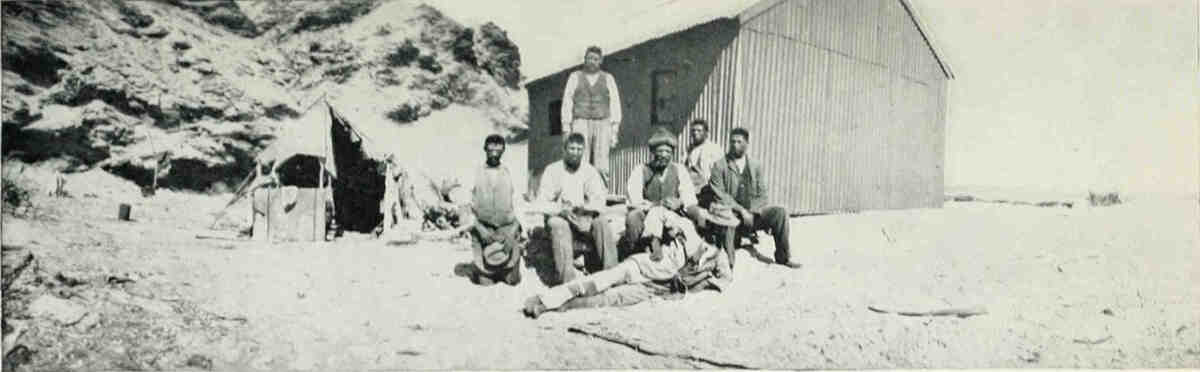
SEALERS AT OLIFANTS ROCKS.
The only white man (Irish) is the man standing behind.
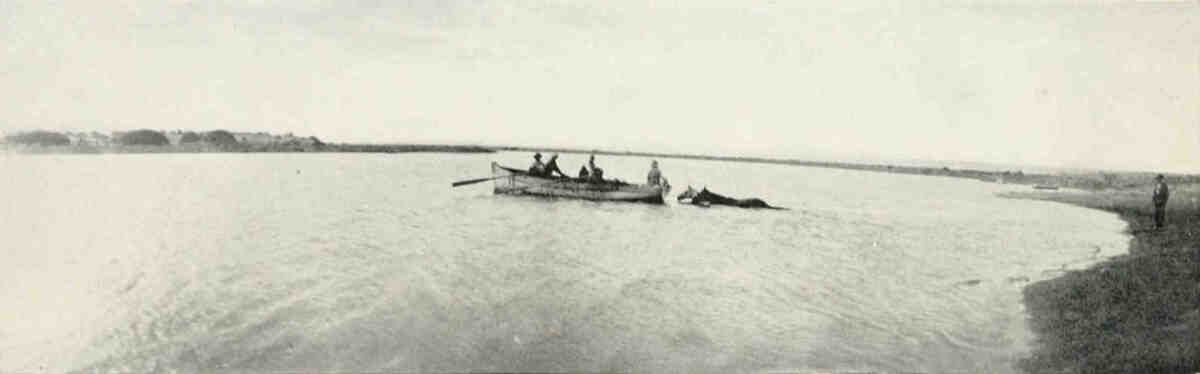
TAKING THE HORSES ACROSS OLIFANTS RIVER.
Of course I simply had to do it—they were too
snug and dry and warm, and I was too wet and cold,
to allow of any other course of action! So I just
snicked the guy-ropes slightly in a weak spot and
hurried back and turned in again in my wet blankets,
hoping for the best. It came soon—a muffled
squelch—followed by a perfect bedlam of polyglot
profanity. I heard someone get mixed up with the
pots and buckets and make disparaging remarks
about them; I heard another’s periods cut short by
a sound impossible to write, but that conveyed a
pleasant picture of an attempt to get rid of a full
mouthful of sand—in fact, though I could see nothing,
I could hear enough to conjure up a vivid picture of
what was happening under that extremely wet and
extremely heavy bucksail.
At length they struggled out, as I could visualise
by the storm of recrimination and accusations.
“You donder!” I heard Du Toit snort (I found
later his nose was badly bashed by a bucket). “I
knew you didn’t tie the verdomte touw properly!”
“Oh, blazes!” retorted Jim’s voice, “here’s a
slab-sided son of a zand-trapper, that don’t know a
rope from a reim, trying to tell a sailor-man how to
tie knots. H——! Why, you snored the blamed
thing down! Where’s your partner anyway?
Asleep, I s’pose, under all that. Well! what did I
say about sleeping-sickness?”
They then appeared to search for me; and then one
of the incoherent gentlemen made a remark to Jim.
“So he did,” I heard him agree; “cleared out
when we were talking. I’d clean forgotten. He’ll be
asleep somewhere. Sleep!”
Then they came and found me, and of course found
me asleep, and made fitting remarks.
I relate this little incident at full length because
it happened to be the only cheerful happening of that
disastrous trip.
Directly the fog lifted and we had re-erected the
tent and had some breakfast, we took a sieve and a
spade or two and started towards the beach, leaving
one of the crew to watch tent and cutter. It was
probably nearer four miles south than three—a long,
wearisome drag through heavy sand for the most
part, for the tide was high and we could not follow
the water’s edge.
At length we came to it, and I must confess that
when I first set eyes upon that beautiful stretch of
clean and polished gravel I felt that Jim had been
right, and that here, if anywhere in German South-West,
we should find the “big stones” in plenty.
For this mile-long beach looked like a vast débris
heap of all the fancy pebbles the “new-chum”
digger usually collects during his first month or so
on the River Diggings: striped agates of all shades,
jaspers, cornelians, chalcedonies, and above all the
yellow-and-black striped banded ironstone, band-toms
of the digger.
And along that most disappointing beach we
searched day after day, always hoping and expecting
to find, and always in vain. We tried the larger-graded
pebbles farther from the water first, hoping
for Cullinans or at least Koh-i-noors, and by degrees
we worked down to the water’s edge, where the grit
was but little coarser than that of Luderitzbucht;
but all to no avail.
We sank prospecting-pits 5 or 6 feet in depth at
regular intervals, always finding the same promising
material, always getting the same disappointing
result. We turned over the big stones by hand, we
“gravitated” the small stuff by sieve, as we had
learnt to do years before; there were no diamonds
there.
The sun flayed us, for the heat during the day was
terrific, and the nights were correspondingly cold
and damp with the heavy sea-fog, that came down
always towards morning. We grudged ourselves
time for food and sleep, so obsessed were we with
the idea that the diamonds must be there somewhere.
Moreover, the little food we did get was of bad
quality, and the water abominable. A good deal of
knocking about South Africa had inured me to
drinking bad water—alkaline, stagnant, full of
animalcules, etc.—but this stuff was different, and I
soon found that Jim had been right when he had
protested that the coffee-pot was not generally used
for seal oil. It was not the pot that the taste came
from, it was the water itself. Every beaker, every
cask, every drum, every utensil was impregnated
with oil, there was absolutely no getting away from
it. And yet so soaked in the same unctuous, all-pervading
liquid were the three sealers that they
could not taste it; in fact, they could not understand
my own and Du Toit’s repugnance to drinking it,
in the least! But to me, as water, this liquid was
quite undrinkable, as coffee I swallowed it with an
effort and kept it down with a greater one, and as
tea I never had the pluck to try it more than once.
One morning, after an exceptionally heavy fog, a
drop or two of water percolating through the bucksail
and falling on my nose not only awakened me, but
gave me a brilliant idea. “What an ass!” I thought,
as I jumped up there and then. “Why, I could
have had a pint or two of rain-water every day had
I thought of it!” I cleared out with a dipper and
pail, and sure enough there was quite a pint of water
caught in the slack of the sail. And I scooped it
out, and raked the embers together, and put my
own tin “billy” on to boil and promised myself a
cup of tea made with pure water, not oil! And I
went and woke Du Toit and told him, and he came
and sat by the fire to watch me brew it. Of course
we’d no milk, but we had sugar, and I poured out
two “beakers” (enamelled mugs) of it, and set them
to cool. Du Toit was in a hurry; he blew his.
“Smells good,” he said, and took a big gulp.
“Scalded you a bit, eh?” I asked, as I noticed
the tears come to his eyes in a valiant attempt to
swallow what he’d supped. He nodded, didn’t seem
to trust his voice somehow! Then I took mine, first
pouring it from cup to cup to cool it, and taking a
mighty draught “at one fell swoop.”... As soon
afterwards as I was able I went over to Jim and
roused him gently but firmly. “Jim,” I asked,
“how did you make this bucksail waterproof?”
“Oh!” he replied enthusiastically, “she’s a real
good ’un is that bucksail! I took a lot of trouble
with her. Soaked her in paraffin first of all, then
went over her with raw linseed oil. She still leaked
a bit, and a feller at the whaling-station at Saldanha
Bay gave me some whale oil for her, and I soaked that
into her. Then, when I heard what you fellows
wanted up here, I bunged some good old seal oil into
her, and now she’d take a lot of beating!”
And “she” would have—for she tasted of all the
lot—I haven’t forgotten that tea yet!
We spent ten days incessantly searching the gravel,
and at length gave it up in despair. Jim advised us
that we had only about water enough for six days,
and, bad as it was, we knew we could not do without
it, and the only question was whether to return to
Luderitzbucht, or to try our luck at another place a
lot farther up the coast. One of the Scandinavians
suggested the latter. He said he had been there but
once, but that the gravel was identical with that we
had been trying. Only there was much more of it.
It was a long way off, however, somewhere near
Cape Cross, north of Walfish Bay and Swakopmund,
and if we decided to go we should have to call at
Walfish Bay for water. But, Jim continued, we were
nearer the latter place than Luderitzbucht, the wind
would probably be more in our favour; and we
voted en masse for these fresh fields. Before sailing,
however, Du Toit and I went about four miles inland
into the dunes to an extremely high and prominent
one, a real sand-mountain about 200 feet high, from
which we hoped to get a view of the sandy wastes
generally, as we had still a lingering hope that we
might yet find a similar deposit to that of Kolman’s
Kop, with plenty of small stones, even though we
could not find the big ones.
From this huge, bare dune—the sand on the crest
of which lay piled for the crowning 10 feet in an
almost sheer wall—we had a fine panorama of the
terrible waterless waste surrounding us, treeless,
bare, and horrible in the glaring sun, awful in its
featureless monotony of huge wave after wave of
verdureless sand. Away south, in the far distance,
we could see higher land near the coast, probably
“Sylvia’s Heights,” and inland, faintest of faint
cobalt against the glare, the outline of a long range
of mountains, between which and the farthest distinguishable
sand-dunes danced a lake of shimmering
mirage, seldom absent in these wide spaces of the
desert. Here and there, among the long ridges of
the dunes, spaces could be noted which appeared to be
covered with low bush, and towards one of these
“pans” I made my way, whilst Du Toit struck out
for a similar one in an opposite direction. The going
was extremely difficult, for the dunes here lay in long
parallel lines, very close together, very high and
steep, and naturally with very deep corresponding
valleys between; and my way lay across them.
The distance appeared nothing, but each successive
dune I climbed seemed to bring me no nearer the
pan I was aiming for, and which was only visible for
a second or two as I reached the crest of each big
sand-wave. Anything more tedious than this crossing
of the bare dunes it is impossible to imagine, though
slower progress might conceivably be made in an
attempt to cross a closely built city by climbing up,
over and down the houses instead of using the streets.
However, I reached the pan at last and found it
to be an oval-shaped “floor,” strewn thickly with
water-worn pebbles and quite free from sand.
Scattered bush grew here and there upon it, and near
the centre I saw larger trees growing. These I found
to be tall thorn-trees, called locally cameel doorn,
a species of thorny acacia which is usually found in
or near watercourses; and at this time of the year
they were covered with little yellow balls of bloom,
scenting the air deliciously with the smell of cowslips.
And here, in the middle of this sea of dunes, they
lined a watercourse, and though it was bone-dry,
there was evidence that at one time a considerable
quantity of water had flowed there. Many of the
larger trees, the girth of a man, were dead, and much
larger blackened stumps were plentiful. This dry
watercourse disappeared under the sand-dunes at
either end of the pan, and a closer inspection of the
whole extent of the latter showed that it was the
remaining trace of what had at one time undoubtedly
been the wide bed of a river of considerable extent,
of which the narrow tree-lined watercourse in the
centre had been the last surviving trickle. Later, I
found many of these beds among the dunes, all
choked with sand and long dead and extinct, but
showing indisputably that this country was not
always the waterless desert it is to-day. In some
cases water still flows deep in their sand-choked beds,
and can be obtained by digging.
An hour or two spent in this spot convinced me
that there were no diamonds to be picked up, and I
turned back coastwards, after being rejoined by Du
Toit. He had been to a similar pan still farther
inland, and his conclusion had been that of myself,
that it formed part of an ancient river-bed overwhelmed
and choked by the dunes. He also said
that from a high dune there, through his glasses, he
had seen a very much wider expanse of country of a
similar nature through a break in the dunes inland,
and that it had appeared to be quite thickly wooded.
He had also seen moving objects in that direction,
but whether gemsbok or cattle he could not say. At
any rate it was apparently an oasis, and quite
possibly the “Hottentots’ Paradise” we had heard
so much about. At least, so thought Du Toit.
“But it’s a long way, and the dunes seem to get
worse in that direction. It would take us a day
and a half to reach it; that means we’d have to take
water for three days, for we could not depend on
finding water there. And if it is the place, there are
a lot of well armed Hottentots there, and we’ve no
rifles, and we’ve no trade goods to barter with.
No, it’s not worth the risk; but, man, if the yarns
we’ve heard are true, there must be piles of diamonds
there!”
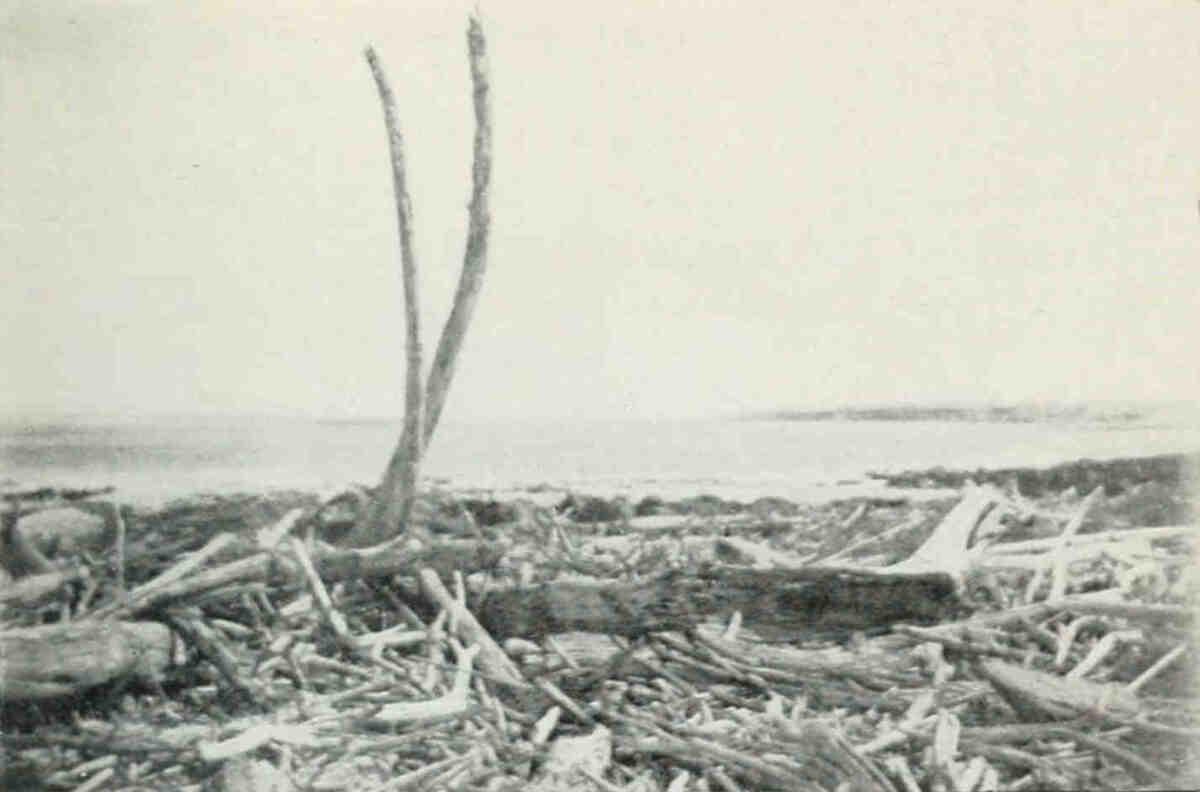
DRIFTWOOD ON THE DESOLATE BEACH NEAR CAPE VOLTAS.
The low point in the distance.
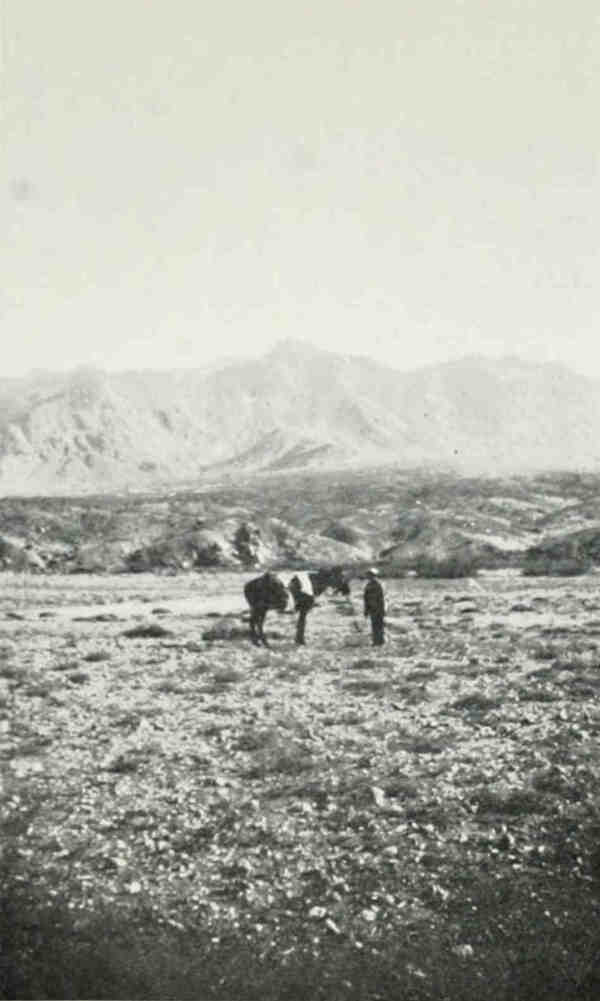
PROSPECTING PARTY NEARING THE MOUNTAIN OF RICHTERSFELDT,
NAMAQUALAND.
So we turned our backs reluctantly on that unknown
oasis—which may indeed have been no oasis at all,
and nothing more than a big pan similar to those
we had examined—and toiled back to the coast.
No matter how good a walker a man may be in the
ordinary way, he will find the first few days’ walking
in the dunes a most painful and exhausting experience.
Wading through loose sand up to the ankle,
climbing up it at a steep angle, and plunging down
it on the other side of the dune, only to repeat the
process, ad infinitum, exercise a terrific strain upon
muscles scarcely called into play in ordinary walking;
and ten miles a day across country like this is a severe
strain upon a new hand at the game. With practice,
of course, he can do double, and with experience he
falls into a peculiar shuffling gait which is the most
noticeable feature about the farmer and others
who dwell in these sandy districts and who are nicknamed
“Zand-trappers.” All of which Du Toit
imparted to me as we walked back to the coast.
“You lift your feet too high,” he said, “like these
blooming Germans do when they’re goose-stepping.
Walk like this.”
I told him I should be sorry to, and he appeared
annoyed; but I found that, though I could beat him
easily on the hard flat, I stood no chance with him
in the sand, and what I had always put down to
bunions or sore feet was really this “zand-trapping”
gait that he had acquired in his youth, and never
got rid of. Most men who live among the sand wear
low veldtschoens, without socks. These schoen are
easily kicked off and emptied of their accumulation
of sand periodically; whilst many adopt the practice
of cutting a small hole in the sole near the toe,
through which they occasionally shake out the dusty
contents. Ordinary boots last but very little time,
as the sand has an extraordinary abrading action
upon the leather, cutting the stitching holding sole
and upper together in a few days.
We got back and told Jim about what we had
seen, and he put finality to the matter by declaring
that if we were mad enough to try to reach the oasis
we could walk back to Luderitzbucht with the
diamonds, as he’d be “somethinged” if he’d wait for
us! Moreover, he’d packed everything on to the
cutter, and if we wanted to beat up to Walfish Bay
and Cape Cross we’d better get on board at once.
I had hoped for a good night’s rest that night, but
instead, like a lamb to the slaughter, I was led to that
wretched cutter, where again, to a modified extent,
what Jim called my “sleeping-sickness” floored me.
However, this time the weather was fine and the
breeze was fair, and two days later we ran into Walfish
Bay.
A magnificent stretch of water, perfectly protected
from the prevailing winds, and capable of accommodating
an enormous fleet, it is certainly the key of
the huge German hinterland; and it was a very far-seeing
policy on the part of England not only to
secure it for herself, but to hold tight to it against
all the wiles and blandishments of German diplomacy.
For had England given it up, the Germans would
have undoubtedly transformed it into a most powerful
naval base, which would have been not only a menace
to the Cape mail route, but to all British possessions
farther south, and would incidentally have forced
the maintenance of a powerful fleet at or near the
Cape.
Important as the place is strategically, however,
England (or rather Cape Colony, of which it forms
an integral part) has done little to develop this small
slice of territory. A fairly good pier and a few
forlorn-looking corrugated iron buildings looking as
though they had been dumped down, forgotten and
deserted, constitute the settlement, which stands
forlornly on the bare sand.
A resident magistrate, a few born-tired officials, a
“hotel”- and store-keeper—in all a handful of the
slackest white people I ever saw—constituted the
population. The condensing gear on which they
relied principally for water was out of repair, which
(according to Jim’s remarks about it) appeared to be
its normal state; and here we had to wait four days
before we could fill our miscellaneous collection of
water “tanks.”
CHAPTER III
THE NAMIEB DESERT, “SAM-PANS”—CAPE CROSS—SWAKOPMUND—WINDHUK.
Meanwhile a local acquaintance of Jim’s asked Du
Toit and me to go with him a day’s journey up the
Khuisiep River, to a place in the Namieb Desert,
where he believed that tin existed, and I jumped
at the opportunity. We had good horses and travelled
light, with a few roster-kooks and some biltong by
way of provisions, and a water-bottle each. Riding
south from the forlorn-looking settlement, we followed
the thin line of vegetation denoting the river-bed,
which, when it contains water, empties itself into
the lagoon terminating the southern extremity of
the bay. Thence, striking inland, the bed widens
till it becomes a long stretch of wooded country
offering the most striking contrast to the barren
desert and sandhills that hem it in on either side.
But, in spite of the thick verdure and fine trees,
there is no water to be met with along the whole
route, except immediately after rains, and at one
or two spots where pits have been sunk.
What a treat those trees were, though! The eye,
aching with the red-hot glare of a whole landscape
of bare, scorching sand, turned to their beautiful
greenery with a wonderful sense of rest and relief.
Most of them were varieties of acacia, cameel doorn,
such as I have described, and others covered with
huge, bean-like pods, and most striking among them
were fine, majestic trees resembling big oaks in outline,
and giving the whole well-wooded expanse a
beautiful park-like aspect.
There was plenty of welcome shade, especially
from a smaller but thicker-leaved tree of a variety
of wattle; grass and creeping plants made a verdant
carpet, butterflies flitted about among brilliant
flowers, and bright-plumaged birds called to each
other in the trees. In fact, to us, fresh from sand
and sea and “sleeping-sickness,” it was Paradise.
And I said so to Du Toit as we off-saddled for a bite
at midday, knee-haltering our ponies and taking our
snack under the shade of a big mimosa. I said to
him, “Let’s stop here! Anyway, if we find diamonds
or tin, let’s stop here! What can we want more?
Green trees, birds, flowers, grass, shade for the seeking,
water for the digging! This is Paradise, and it’s
good enough for me. I’m going to sleep.”
And I did, Du Toit, with unwonted consideration,
offering to keep an eye on the horses, and wake me
when it was time to trek again. But I did not sleep
long. I awoke with the pleasant sensation of being
stabbed all over with red-hot needles. One eye was
too swollen to work, but the other advised me of the
fact that it was not needles that were troubling me,
but a small yet most iniquitous insect that had
sampled me before in other sandy parts, but that,
in my delight at the beautiful trees and beautiful
shade, I had forgotten. This was the “sam-pan.” I
had seen him before, but this time I had evidently
found him at home, where he lived! He was all
over me—a small, pernicious infliction ranging in size
from a pin’s head to a shirt-button, flat, almost
circular in shape, and with legs all around his perimeter.
Entomology is not my strong point, but
that’s how he looks, and he feels as though he had a
mouth on each foot. And in this case he had caught
me just as he might have caught the most abject
greenhorn: lying asleep in the shade of a tree where
there were obvious signs that cattle, or big buck,
had been in the habit of standing.
These horrible little pests are one of the biggest
scourges of the desert. They are a species of tick
that breed in the droppings of animals, and burrow
in the sand of the immediate vicinity, lying low
till some juicy, full-blooded victim comes along for
them to perform upon. For this reason they are
always plentiful under certain shady trees, favoured
by oxen and big game as a resting-place in the heat
of the day. Choose one of these spots and sit down
in the pleasant shade and watch the sand around
you. Not a sign of insect life for the first few minutes—and
then! A tiny eruption in the sand near your
elbow, and there, scratching his way to daylight—and
you—comes the pioneer, followed by others till
the whole earth is alive with them. And bite! So
poisonous are they to some people that to be bitten
badly leads to blood-poisoning, and in any case the
intolerable itching from their bites spoils a man for
sleep or anything else but scratching and inventing
new profanity for days and days after he has been
victimised. All of which I had known, and still
Du Toit and his companion in crime had caught me
beautifully, with the enticing shade of that big tree.
They lay sleeping peacefully, a bare twenty yards
away, under a bush thick enough to shade them and
too small to have harboured oxen—or sam-pans.
We followed the Khuisiep till late that evening,
when we came to a water-hole where our horses drank,
and near which we slept that night, not too near, for
the immediate vicinity was literally buzzing with
mosquitoes. The stagnant water was also full of
their larvæ—so full that we strained it through a
handkerchief before boiling a billy of it for coffee,
and got a spoonful of larvæ to each billy. Still it
was quite drinkable as coffee, much better than
the oleaginous liquid Jim provided us with.
The following morning we left the Khuisiep and
turned up a tributary watercourse (dry) coming from
the desert eastward; a few miles up which we left
the sand behind and came into rocky, broken country,
sterile and quite without vegetation. Here there
were many outcrops of granite, and in certain parts
of the dry stream-bed garnets were lying by the
bucketful. They were a constituent of the granite,
but in many instances had been mistaken for ruby
tin. Black titaniferous iron-sand also abounded in
this stream-bed, and in many of the small quartz
reefs large crystals of jet-black tourmaline were to be
seen—some of them huge specimens as thick as one’s
wrist. Unfortunately, real prospecting was out of
the question, as we had neither tins nor tools; but the
country is a most interesting one, and it is quite
possible that some day a valuable discovery of tin
may be made there. Want of water—that great
handicap to prospecting in South Africa—prevented
us even “panning” the river-bed; but certain sand
and gravel, which I took back to the nearest water
that night and panned there, yielded both tin and
copper, and a fine “tail” of gold. This spot was
just over the border of British territory, but the
unnamed river apparently came from the mountains,
plainly visible in German territory eastward. Our
trip back was uneventful, and we arrived at Walfish
Bay the following evening, where we solved the
water question and found Jim ready to start.
Before doing so I indulged in the extravagance of
purchasing a small cask for water for my own use;
a procedure that called forth such an amount of
elaborate sarcasm from Jim and Co. that I soon
regretted it, more so as I found on broaching it that
the contents tasted as strongly of tar as the other
had done of oil.
Again the cutter had favourable winds, and this
time neither Du Toit nor myself was seasick, a fact
Jim commented upon most ungraciously, as he
said we took up less room and were far less in the
way when suffering from “sleeping-sickness” than
we were doing now we thought we were sailors.
There’s no pleasing some people!
We landed at a spot some seventy miles up the
coast, and not far distant from Cape Cross, where
Diego Cam, one of John of Portugal’s intrepid old
navigators, placed a padrâo, or stone cross, when
he first landed there in 1460 or thereabouts. This
cross, from which the Cape takes its name, has long
since disappeared, but according to Jim the sculptured
socket in which it was set can still be seen on
a prominent point of the rock. Probably it was the
only part of the monument that the early souvenir-hunters
could not take away with them.
However, much as I wished to see it, we did not
get to Cape Cross that journey. We landed in a little
cave within a short walk of the beach we were in
search of, a beach identical with that one we had
prospected lower down the coast, and which yielded
identical results. We searched it for a week and
found no diamonds.
Moreover we wandered inland, for the interior
here, though barren and inhospitable, did not present
the difficulties of the huge sand-dunes we had encountered
lower down. Flat sandy wastes there
were, devoid of vegetation, but easily traversed, and
these were also broken by frequent barren kopjes,
whilst but a few miles inland we saw high, flat-topped
mountains. In many of the dry watercourses
and on certain spots on the sand-flats we
found likely-looking gravel, but never any diamonds,
and at the end of ten days we decided to return to
Swakopmund, from whence we could pick up a
steamer to Luderitzbucht. Jim suggested this course
to us, whilst offering, if we so wished, to carry out
his original offer to land us there himself. “But,”
said he, “if you’re not keen on it, I’ll just drop
you at Swakopmund, where you’ll get a boat easier
than you would at Walfish Bay. We’ve got something
else on up here that might be worth our while—if
you really are not keen!” We quite fell in
with Jim’s view, for we neither of us relished beating
back against headwinds all the way to Luderitzbucht
in the cutter; besides, Jim had proved himself
a white man right through, and we didn’t want to
stand in the way of that mysterious “something
else” he had on. We never asked him what it was,
but some funny things could be told about those
sealing cutters’ doings along the coast in those days—when
none of them were particularly keen about
the German Customs regulations! Well, good luck
to Jim and his “crew” anyway—they were good sorts!
So they landed us at Swakopmund, and before
leaving again Jim told us that he expected to be back
in Luderitzbucht in about a month, and, if we were
still there and cared to do it, he would take us down
to a place not far north of the Orange River mouth
where he had heard diamonds had been picked up.
But our late experience had shaken our faith in
promising-looking gravel patches, and so we omitted
to follow up this clue, which, as events proved later,
might very probably have led us to discover the
famous and fabulously rich Pomona fields. So, with
a vague promise to meet again somewhere, we parted
from Jim, who cleared away up the coast—ostensibly
at least—on his mysterious errand, and whom I never
saw again.
The officials at Swakopmund were both surly and
suspicious, but luckily our papers were in order, and
we could show sufficient funds to satisfy the immigration
authorities; and as we found we should have to
wait ten days for a steamer, we decided to run up
to the capital, Windhuk, after first having a good
look round Swakopmund and the immediate vicinity.
Disappointed in their efforts to obtain the country’s
natural port at Walfish Bay, the Germans had done
their best to construct a harbour at Swakopmund,
which is really the mouth of the Swakop, or more
correctly “Tsoachaub” river. This river, in common
with all others of this country, only flows during the
summer months, but water can be obtained in abundance
almost all along its course by digging in the
sand. From a few miles inland its banks are covered
with vegetation, and indeed these long dry river
oases are a frequent and pleasant feature of this part
of the Protectorate.
Although large sums of money must have been
spent upon the attempt at a harbour at Swakopmund,
it appears to be a very qualified success. There is
a stone jetty that offers some protection to tugs in
fine weather, but ships have to lie in the roadstead,
and when the prevailing gales are blowing landing
is both difficult and dangerous. The township boasts
quite a number of good buildings, and is a credit to
the orderly ideas of German officialism. A good
deal of ore was being brought down by rail from Otavi,
a copper-mine some 250 miles north-west, connected
by a 2-feet gauge line. This and the landing of a
tremendous amount of army stores, waggons, and
artillery made the port quite a busy one. And an
Englishman whom we met at the hotel told us that
the amount of stores landed during the latter part
of the recent Hottentot and Herero rebellion had
been enormous, and that depôts were being built all
over the country inland to allow of their storage.
Considering that the two races were practically wiped
out at the time peace was declared, it is difficult to
understand what all these stores and munitions of
war are needed for.
We went to Windhuk on the third day, a slow
and tedious journey of 237 miles which took us over
twenty-four hours to accomplish.
At Swakopmund the coastal sand-belt is at its
narrowest, a short run of a few miles taking one clear
of the dune region; thence the country, though
sterile, is broken and hilly, and the line gradually
ascends towards the plateau that forms the interior.
Here the scenery—after the awful monotony of the
sandy wastes near the coast—was interesting and in
places not without beauty; hill and plain, mountain
and river-bed, succeeding each other, and the latter,
though dry, being in most cases extremely well
wooded. Many of the mountains are lofty, and
most of them are table-topped. Windhuk is a pretty
place. Lying nearly 5,000 feet above sea-level, it is
built in a rocky plain surrounded by hilly and
picturesque country. Vegetation is abundant, as
the rainfall is good; moreover, there is an abundance
of water, mostly obtained from thermal springs in
the hills to the north of the settlement. There are
five of these hot springs, ranging in temperature from
tepid up to nearly boiling-point, and many of the
houses have this water laid on in pipes. It is also
used when cold for irrigating gardens, etc., but in
addition there are cold springs that issue from the
limestone of the valley below.
THE TERRIBLE DESOLATION OF BARREN, RIVEN ROCK BELOW THE GREAT FALLS.
Boring has also produced water at no great depth
wherever it has been attempted, and as in the rainy
season (January to April) the rainfall varies from
15 to 20 inches, it can readily be seen that Windhuk,
and in fact most of the neighbouring portion of
Damaraland, is by no means badly off in that respect.
As in Swakopmund, the principal houses, public
buildings, etc., were all new and well built, and the
place was then rapidly growing; and with a good
climate, and green trees everywhere, Windhuk is
likely to become a most pleasant abiding-place.
Between the hills north of Windhuk there is a
smaller settlement known as Klein Windhuk, which
is situated in a very fertile valley, where vegetables
and fruit are grown in abundance. Should some
means be found for conserving the water which flows
away in such abundance during the summer months,
this and many similar valleys are well suited for the
growing of mealies and lucerne, for which there is
apparently a very great demand.
Windhuk was at that time an important military
station; in fact, the civilian population was insignificant,
and the hotel was crammed with officers.
Among these I met a Hauptmann, whom I will call
Müller, who was a most striking contrast to the
general run of overbearing, swashbuckling officers.
He spoke English well and was most courteous and
affable, especially when he learnt that I knew something
of geology. He had just returned from a trip
south to the Gibeon district, and he showed me some
samples of excellent “blue ground”—Kimberlite—he
had found there. He badly wanted me to return
with him and prospect the place, but as I had made
all arrangements to return to Luderitzbucht and
Cape Town, I could not do so. And much to my
regret, for his theory that these were the pipes from
which the coastal deposits of diamonds had come
originally was not as far-fetched as it appeared at
first; for he explained it by a theory of glacial
denudation of such pipes in the remote past, and
said there was abundant evidence everywhere that
such action had taken place, and that the glaciers
had travelled from north-east to south-west right
across the country to the sea.
As I could not go, I suggested to Du Toit to do so,
but this he would not do, as he got on with the
Germans worse than I did; in fact, if they treated
me with scant courtesy, they treated Du Toit with
none!
These Germans profess to despise the Boers, and
many of the latter who fled into German territory
rather than accept British rule after the Boer War
had been very glad to return to the protection of the
Union Jack.
Meanwhile Hauptmann Müller very kindly lent me
a horse and took me round the settlement, talking
incessantly the while of the future of the Protectorate,
of which he had a great opinion. He had been in
the Cape Colony and Transvaal, and spoke with
admiration not unmixed with envy of our rich mines
and splendid resources.
“We came late,” he said; “you English had all
the good land. But now we have diamonds and
copper here, and when the Protectorate pays we will
develop the country—that is, if we have not fought
you before then.” For this refreshing man made no
secret of his belief that war between England and
Germany was inevitable. “You English have the
pick of the world,” he said, “but you cannot keep
it! You have no army, and we are building a navy
that will equal your own. And when ‘The Day’
comes we shall smash you up and take what we
want, and you will decline into a little second-rate
Power. We must do so; you cannot confine us to
Europe and the waste places of the earth.”
He told me that a toast I had heard in the hotel
was being drunk all over the German Empire, and
that every officer longed for the war. “It means
their chance, it means promotion to them,” he explained;
“your Empire is declining, it has seen its
day; and now comes Germany’s.” We parted perfectly
good friends, and I certainly preferred his
impudent frankness to the scowls and surly demeanour
of most of his compatriots.
Returning to Swakopmund, we caught the Frieda
Woermann back to Luderitzbucht, and in that comfortable
little liner had a very different trip from
the one we had experienced in Jim’s cutter. At
that time the skipper of this well-known coast boat
was an enormously fat man, and his chief engineer
was built on the same lines, and it was a standing
joke, whenever they happened to appear on deck
together, for the passengers to rush in mock panic
to the opposite side of the ship, with the avowed
intention of balancing her and keeping her from
capsizing. But they were a very harmless, good-natured
old pair, and played scart interminably.
Luderitzbucht was still prospecting-mad, but apparently
no new discoveries had been made of any great
importance, and new regulations were being promulgated
at such a rate, and such restrictions were being
placed upon diggers and prospectors, that men were
beginning to leave the country. So frequent and so
contradictory had been these new regulations, that
it had often happened that men who had been absent
on a pegging expedition for a week or two would
return to find that the new laws rendered all their
work useless. In short, there appeared very little
scope for us there; and after one or two abortive trips
to spots we had heard of, and which we found to be
useless or already pegged, we decided to return to
British territory.
We were strengthened in this resolve by what we
heard from a relative of Du Toit’s: a certain Stuurmann,
who had been in German employ during the
whole of the Hottentot rebellion, and was one of the
many Dutch transport-drivers living in the Boer
camp just outside Luderitzbucht. This chap had
at one time followed the Orange River from its mouth
up to the Great Falls, and the account he gave of
certain spots on its banks, and notably of huge
stretches of gravel near the Great Fish River mouth,
made us all eagerness to get there as soon as possible.
The description of these gravels tallied, it is true,
with the blank patches we had gone so far after,
but in this case, we argued, they were near that
possible source, the Vaal River Diggings; and though
we had followed similar patches in vain from Prieska
down to below the Great Falls, there remained this
150 miles of the almost unknown lower reaches, and
they had always appealed to us!
Moreover, Stuurmann said that in places he had
noticed innumerable bright crystals sparkling in the
gravel there, and had never even picked them up,
as in those days he had had no thought of diamonds.
At any rate, here was a place where a prospecting
party would not be handicapped by being followed
by “claim-jumpers,” as was happening here at
Luderitzbucht, or have to contend with constantly
changing mining laws; besides, there were no Germans
there, and that appealed to us almost as much
as the diamonds! But a properly organised expedition
would be necessary, and to arrange this we
decided to return to Cape Town first.
This Stuurmann was a most interesting man to
talk to; he had been all through the Hottentot
campaign, and had the greatest contempt for the
fighting power of the Germans. Towards the latter
end of the campaign, he said, they had begun to
learn a little and adapt themselves to the conditions
the country demanded of them; but even so he
(Stuurmann) considered that with a good commando
of burghers he would take German South-West from
them any day! And this was the opinion of his
mates, between whom and the Germans there was
very little love lost; though to be but just, their
employers, the Government, paid these Boer transport-drivers
extremely well.
Stuurmann also gave me much interesting detail as
to the terrible treatment meted out to the unfortunate
natives, both Herero and Hottentot, who were
unlucky enough to fall into the hands of the Germans.
I had seen something of this myself, and had
heard more from ex-German soldiers themselves,
who with extraordinary callousness used to show
whole series of illustrated postcards, depicting wholesale
executions and similar gruesome doings to death
of these poor natives. One of these, that enjoyed
great vogue at the time, showed a line of ten Hottentots
dangling from a single gallows, some still standing
on the packing-cases with a noose round their necks,
waiting for the soldiers to kick their last standing-place
away; some kicking and writhing in the death
struggle, for the short drop did not break their necks,
but only strangled them slowly, and one having a
German soldier hanging on to his legs to finish the
work more quickly. And each and every German
soldier in the photo was striking an attitude and
smirking towards the camera in pleasurable anticipation
of the fine figure he would cut when the photo
was published. This, I repeat, was only one of
many that enjoyed a big sale in German South-West
for the delectation of admiring friends in the Fatherland.
Absolutely no mercy was shown to these
unfortunate creatures: they were made to dig big
graves, and were shot down by the hundreds beside
them, whilst practically the whole remnant of both
races who escaped this fate were exterminated in
the detention-camps at Luderitzbucht and Swakopmund.
Towards the end of the long, dragging war,
the Germans conceived the plan of sending Herero
prisoners captured in the north for internment to
Luderitzbucht, where they were strangers to the
country and where escape was hopeless, whilst the
Hottentots captured in the south were sent north
to Swakopmund.
There is a small low-lying promontory in Luderitz
Bay known as Shark Island, and here the Herero
prisoners were crowded in thousands, shelterless,
with no proper supply of food or water: and here,
huddled together like penguins, they died like flies.
Often on a blazing day, such as is common in
Luderitzbucht, they received no water whatever,
either having been forgotten, or the supply having
failed; the food(?) supplied them was never sufficient
for a tithe of them, and they often fought like
wild animals and killed each other to obtain it.
There were also a large number caged in a wire
enclosure on the beach; these were slightly better
off, as, although they received no rations from the
military in charge of them, a few of their number
were let out each morning and went ravenously
foraging in the refuse-buckets, bringing what offal
they could back to their starving fellow-prisoners.
Cold—for the nights are often bitterly cold there—hunger,
thirst, exposure, disease, and madness claimed
scores of victims every day, and cartloads of their
bodies were every day carted over to the back beach,
buried in a few inches of sand at low tide, and as the
tide came in the bodies went out, food for the sharks.
Now, Stuurmann and the other men who told me
these things were no negrophiles (a Boer as a rule
has an excellent idea as to how to keep a native in
his place as the white man’s inferior), but so terrible
had been the treatment of these natives by the
Germans that even these case-hardened transport-drivers
spoke of what they had seen with the utmost
horror and abhorrence. Yet these men are looked
down upon as an inferior race by the Germans, who
themselves, as far as the troops and officials in German
South-West are concerned, are utterly devoid of all
humanity when dealing with natives. I saw much
of the trait myself later; it is unpleasant and
distasteful, and bodes but ill for the future relations
of white and black in the German colonies.
I was by no means sorry to leave Luderitzbucht,
for during the whole of this brief stay it blew incessantly
and the air was a sort of semi-solid mixture
of whirling sand, that cut and stung, and choked
and blinded, and permeated every orifice and crevice,
and generally made life utterly unbearable. When
this prevailing wind reaches a certain violence, the
whole country practically gets up and walks, big
sand-dunes shift along and others come after them,
like the waves of a slowly moving sea; wide stretches
of hard land are denuded of every grain of sand,
and others buried deep in it, and it is a curious fact
that these storms actually blow diamonds! A
claim deep with diamondiferous sand has often been
swept clean of its contents in a few hours; sand,
gravel, and diamonds being lifted up and borne
away, to be deposited in some more favoured spot.
Even the big dunes of a hundred feet or so in height
are not stationary; though their movement is slower,
it is none the less sure. In many instances these
huge sand-waves have passed slowly but irresistibly
over strongly built dwellings and the like, burying
them completely for a time, and gradually passing
onward and re-disclosing them....
We came down the coast in the Hellopes, an alleged
passenger-boat that rolled like a hog and smelt like
its sty; and we were both very glad to see Cape
Town again.
CHAPTER IV
MORE DIAMOND RUMOURS—PROSPECTING IN A MOTOR-CAR—VAN
RYN’S DORP—PROSPECTING IN EARNEST—A PATRIARCH—NEWS OF
BUSHMAN’S PARADISE.
In Cape Town I found rumours of new diamond
deposits were as rife as they had been in German
territory, and had scarcely rubbed the Luderitzbucht
sand from my eyes before I was called upon to go
and verify a new “discovery,” this time much nearer
home.
By this time the craze had so spread that people
were arguing that, as diamonds were found in sand
at Luderitzbucht, the sands all up the coast might
be full of them, and wild and indiscriminate pegging
was going on all over the place.
Amongst other local syndicates, one had been
formed for the purpose of investigating certain
deposits alleged to still remain undiscovered on both
the German coast and our own, which spots were
only known to the promoter. The “plum” of these
spots was an alleged deposit of “blue ground”
which the discoverer claimed to have found many
years before at a wild part of our own coast, when
landing from a sealing cutter. The exact locality
was kept a dead secret, but when, one fine morning,
the papers blossomed forth with the alleged discovery
of diamonds near Lambert’s Bay, about 150 miles
north-west of Cape Town, the owner of the map
declared that it was near enough to his “discovery”
to render instant action necessary.
Within a few hours the syndicate had sent for me,
and the same day four of us were jammed into a
small motor-car en route for the spot. “Take nothing
but what you stand in,” ordered the owner (and
driver); “we shall be back in four days!”
Cars were few and primitive in those days, and the
roads we had to traverse were as primitive as the car.
For a long time the owner of the map would not show
it, or give more than a vague notion of where we were
bound; but eventually Malmesbury and Eendekuil,
then the terminus of the railway in that direction,
were left behind; we climbed the difficult pass of
“Pickaneer’s Kloof” and spent the first night dragging
the rudimentary car through the sand-drifts below
Macgregor’s Pass. We broke down hopelessly at
red-hot little Clanwilliam, hearing to our dismay
that there was another ahead on the same errand,
and after maddening delay splashed on again, in
pouring rain, through a terrible track leading to
Van Ryn’s Dorp, along the steep mountain slopes
skirting the Olifants River. The four days we
allotted for the whole trip were taken up in reaching
Van Ryn’s Dorp, a remote little village on the road to
Namaqualand, and where our car created a mild sensation,
for it was the first to be seen there. Away to the
right of the dorp towered a magnificent isolated table-mountain,
its reddish sides as sheer as gigantic walls.
The sun was just setting, and I shall never forget
the marvellous effect upon the huge buttresses of
“Matsie-Kamma,” as the mountain is called, for
the towering cliffs appeared as though turned into
golden molten fire, whilst over it hovered a peculiar
cloud, similar to the “Tablecloth” of Table Mountain.
Behind ran a long escarpment of similar flat-topped
mountains, and on them the glow was rapidly fading
through a whole gamut of exquisite shades between
crimson, mauve, heliotrope, and purple, till on them
the sun had completely set, and they stood out a cold
clear indigo against the cinnamon and green of the sky.
But we had other things to think of besides mountains
or sunsets: we wanted to get to our “diamonds.”
The car could go no farther towards the coast, but a
Cape cart could, and early next morning we were off
again, and, toiling through an awful track, we slept
that night at the “back of beyant,” the little mission
station on the dreary sand-flats of Ebenezer. By
this time we had forced the “discoverer” to disclose
his map, and found we had to go to the mouth of
the Olifants River, cross it to the barren, waterless,
almost unknown and uninhabited coast north of it
and find our way to a remote sealing-station some
distance up that coast.
I will not weary the reader with a recital of all the
asinine things that happened before we got to the
spot, but suffice it to say that at nightfall one evening,
footsore, hungry, ragged, and half dead with thirst,
we found the little hut where the sealers lived, a
most desolate spot many miles away from drinking-water.
The sealers—all coloured men—were oily
and grimy to a degree, but they looked askance at
us when we burst in upon them in the clothes we
had left Cape Town in! Tattered, torn, dusty, covered
in melkbosch-juice from the thickets we had traversed,
they took us for a shipwrecked crew. It was dark
by the time we had explained what we were after.
“Blue ground!” said the foreman, an European.
“Yes, it’s about half a mile up the coast! I’ll take
you to it first thing in the morning.”
“So it was right, then!” we agreed. We accepted
their hospitality, and, packed like sardines, tried to
sleep on the floor of the hut, in an atmosphere of
seal oil and rotten seals, whose huge carcasses
polluted the beach for miles.
By daylight I was on the spot, peering through
the raw sea-fog for the “blue ground” we had come
so far to find.
It was there, cliffs of it, millions of tons of it,
blue shale, utterly valueless, and, except in colour,
bearing no atom of resemblance to diamondiferous
“blue ground”!...
It took us best part of a week to get back to Cape
Town, and I swore that nothing would ever induce
me to try prospecting in a motor-car again!
Even our short absence had allowed of more stories
coming through as to rich finds in German West;
moreover, there were rumours as to the finding of
diamonds in Namaqualand at no great distance
from the spot we had just returned from; and a week
or two later I set out alone, with the intention of
properly prospecting the country in the vicinity of
Van Ryn’s Dorp, and, if needs be, northward
into Namaqualand. But this time I did not go
“as I stood,” but with a complete and compact
outfit of tent, tools, gear, and provisions for a prolonged
period. These I sent ahead by waggon to
Van Ryn’s Dorp, following myself by post cart
a fortnight later, and doing the journey in half the
time and with a tithe of the discomfort I had experienced
in the motor-car.
At Van Ryn’s Dorp I heard the encouraging (or
disquieting) news that a very finely equipped expedition
had passed through a few days before, going
north after diamonds, which they professed to have
found on a previous trip. I therefore obtained a
small donkey-waggon and team, with a coloured
driver and two boys, and pushed on to Zout River, a
stream running from the direction of Little Bushmanland
into the Olifants, and on the banks of
which some years previously a fine diamond had been
found. The exact spot was at the bridge over which
ran the lonely but important road to Namaqualand
and the north, and from this spot my actual prospecting
began. And from the first I had interest of the
most absorbing: for if there is any country in the
world where encouraging prospects may be found,
it is in that same north-west region. The stream
facilitated prospecting, it was crystal-clear, and
with abundant water; but unfortunately, as the
name implies, it was salt, salt as brine and undrinkable
even for the donkeys! All along its banks
there were “indications” of minerals, and all alike
proved to be but “indications.” Heavy gravel led
to my washing systematically all along its beds for
diamonds, and finding promising but baffling results
in the sieve. Using a prospecting-pan for possible
gold gave me similar results: here and there a tiny
yellow “tail” at the end of the pan showed that gold
had been there, but all efforts to trace it to its matrix
failed.
Copper there was in abundance, though in small
and isolated occurrences; here and there grains of
tin showed among the black titaniferous iron-sands
of the river: and iron and galena were everywhere.
In fact, so multitudinous were these various “indications,”
and so barren of tangible result was the
following-up of any and all of them, that I began to
realise that the description that had been applied
to the north-west as being the “Land of Mineral
Samples” was not much exaggerated! Still, day
after day I worked along towards the Olifants,
finding my results getting poorer and my water
getting shorter every day. The whole region was
most bewildering; it was as though the waste from
a big assayer’s laboratory had been dumped all
along that stream, and none of the “samples”
found led to anything but a big note of interrogation.
At last, in a tiny side-stream, I found some minute
nuggets of gold, and my hopes rose; moreover, a
native “herd” whom I chanced to come across told
me that a big white reef ran right across this same
stream a few miles up, and that he had always heard
there was “goud” in it. So I abandoned my laborious
panning and struck up the stream, and found
a wide quartz reef just as he had described, but no
trace was there of gold in it.
Lower down this “Zout” river I came into an
astonishing region of brilliantly coloured clays and
marls, ranging in colour right through the gamut
of reds, yellows, and blues, as also a fine deposit of
milk-white Kaolin; and these in turn gave place to
high banks of a sort of volcanic mud, or ash, of a
bright blue colour, through which the stream had
cut a deep bed. These high banks or mounds exactly
resemble the huge tailings of the Kimberley diamond-mines,
both in appearance and in substance: and,
indeed, this deposit is apparently analogous to Kimberlite
minus its various inclusions.
I should have much liked to explore this wild and
desolate part of the country farther, but water was
now our chief anxiety; moreover the land from
hereabouts was private property, upon which the
hampering restrictions of a prospecting licence did
not give me the right to prospect “without the
consent of the owner!” This owner, I found from
my boys, was nothing more than a coloured man
who leased the land from Government for a few
pounds per annum to run his goats on; moreover
he did not live on the property, but a good two days’
trek away, so I did not trouble to obtain his consent.
I merely mention this en passant to show by what
absurd conditions a prospector is bound. Here
was a man, absolutely ignorant of minerals, and
with absolutely no right to them (for they are Crown
property in such cases), and yet a miserable lease,
which only granted him surface rights, still made
him the arbiter as to whether a licensed prospector
should set foot on his 10,000 morgen or so of land!
Of course there was no one to stop my prospecting,
but had I done so and made any discovery I could
not have legalised it without his consent, and being
made to pay through the nose for it! The system
is utterly wrong. There are millions of acres of
land in the Cape Province held under such terms,
the owners or lessees of which will neither put a
pick in themselves nor allow the prospector to.
By this time the weather was getting bitterly cold,
hoar frost lying thick every morning, and the water
freezing even in my little patrol tent. And as there
was no firewood obtainable, and the two “boys” were
suffering badly at night, I decided to work upstream
toward Little Bushmanland, as I had heard that
the upper reaches of this little river had plenty of
wood. So we loaded up and trekked for a day
towards a “farm” rejoicing in the name of “Douse
the Glim.” In this direction I found wood in abundance,
and the “boys” built themselves a tiny
pondhoek of boughs and branches, and by keeping
a roaring fire going just outside of it all night they
managed to keep from freezing.
Here we had to send the donkeys a full day’s
journey away for water and grazing, and had to fill
our water-barrel periodically from the same place,
and here—although in a comfortable camp—my
luck was no better than lower down the river.
Samples of all sorts, “indications” in abundance,
and nothing more. Along these upper reaches,
however, I found many masses of a ferruginous
gravel hardened almost into conglomerate and containing
a small portion of gold, but in no case sufficient
to pay for working in such a remote region. These
gravels are in appearance identical with certain
Australian gravels which are both gold and gem
bearing, and may probably have been the source of
the diamond that had been found lower down, and
of the gold I saw traces of. During the three weeks
that I had been out, thus far, I had seen but one
solitary human being except my two “boys,” the herd
who had told me of the gold reef; for, although but
a day’s ride from Van Ryn’s Dorp, the region is
a very solitary and deserted one, much of the land
being brak (alkaline) and unfit for stock to run on.
So that the life, though not without interest, was
a very lonely as well as a very hard one; so cold
were the nights that the two blankets I had brought
utterly failed to keep me warm even when I turned
in “all standing,” and I soon abandoned my canvas
camp-stretcher for a warmer lair on the ground
itself. Then at daybreak, Sam, the elder of the
“boys,” would make coffee, and with a hurried
snack of food we would start off for the day, carrying
pick, shovel, sieve, and pan, and food and water for
midday. Thus I tried the whole of the adjacent
country systematically, sieving the grounds in the
stream-bed and “gravitating” them (a diamond-digger’s
trick) when water was sufficient, or using
the prospecting-pan for the purpose of finding traces
of gold or other metals.
When water failed, or the “indications” occurred
far from it, small portions of the concentrates of
sand and gravel would be bagged and tied up and
labelled separately, the same applying to samples
of rock taken from various parts or depths of a reef.
All these samples had in any case to be carried back
to water, and, in the case of rock, to camp, where
each portion had to be carefully pounded into the
finest powder by pestle and mortar before it could
be tested for the mineral it might contain—hard
and laborious work, varied by drilling holes in hard
rock for dynamite charges, or “gravitating” concentrates
in ice-cold water till the brine cracked the
hands and caused most painful sores. Then, the
day’s work over, sunset would often find us miles
from camp, and we would trudge back, and load
ourselves up with dry wood for the night’s fire, and
feel too tired to attempt to cook.
Boer meal was the staple food; a big three-legged
pot of it boiled into steaming “pap” made an
excellent breakfast, and every few days I would
bake a batch of “roster kookies,” little flat cakes
made of the same meal with a little baking-powder
to make them rise, and baked over the embers on a
“roster,” or gridiron. Or occasionally I allowed the
“boys” to make me a big loaf similar to their own,
the composition being the same, but in this case the
dough was massed into a loaf shaped like a flat Dutch
cheese: the embers were thrown aside and the loaf
buried in the ashes, and covered deep in them. Bread
thus baked is of course very hard and often burnt on
the outside, but when this is cut away it is excellent.
Of fresh meat we had none, and although I gave the
“boys” plenty of such luxuries as bully beef, sardines,
and golden syrup, they pined for the flesh-pots of
Egypt in the shape of their dearly loved sheep or
goat vleesch. But there were no sheep in the locality;
and although Sam spent the whole of a Sunday away
at a farm about ten miles off, he failed to bring any
meat back. The next Sunday, however, both of
them cleared off in the early morning and did not
return till nearly dark, when they brought in a big
goat between them. Within a few minutes the
head was off and buried in the ashes, and the knives
were at work cutting up a big pot of vleesch.
Then Sam cut off a leg and brought it to me. He
spoke English quite well, did Sam. “Baas,” he
said, “here is the geldt; I did not pay for this bok,
he was present!” “Present!” I said, in surprise,
for sheep-farmers do not usually refuse good money
for their small stock. “How was that, then, Sam?
Who gave you it?” “Nie,” he replied; “it was
an ou baas of mine, I work for him once. And this
bok he little sick, so the ou baas give him for present!
Baas like me cook some vleesch for him, now?”
“No,” I said, with feeling; “very good of you, Sam,
but I won’t deprive you of it. Little sick, was it?
Well, well!”
All that night the camp sizzled and smoked, and
certainly that “sick bok” smelt good! They ate
his head, baked in the ashes; they ate a big potful
of boiled vleesch, and promptly put in another;
they cut strips of him and broiled them on the embers,
his internal arrangements frizzled and smoked and
were devoured by the yard. I had my cold bully
beef to the accompaniment of a really most appetising
smell, smoked a pipe and turned in, and still
they ate on. Whether they ate all night I cannot
say, but certainly, when I woke again in the morning,
they still sat there eating, and the remains of the
“bok” looked very sick indeed.
At length I became convinced that, whatever
might exist in this wild district, diamonds certainly
did not, and I determined to make a flying trip to
the north-east, towards the long escarpment of mountains
that stretched all along the horizon in that
direction, and which was apparently the watershed
from which the various rivers and streams of the
country (now mostly dry) had had their source.
T’SAMMA IN THE DUNES.
IN THE HEART OF THE SOUTHERN KALAHARI.
There were no roads in the right direction, and
the country was too rugged to allow of using the
cart, so I determined to “hump my swag.” Leaving
one man in camp, I took Sam with me, and we carried
food for six days (kookies, biltong, and the like),
a small trenching tool, sieve and pan, a canvas bag
and water-bottle and a blanket. Even this minimum
of necessities meant at least 50 lb. weight for each
man, and was more than was comfortable for such
rough country and long distances as we were bent
on covering; but it was our only chance of visiting
a certain valley where again diamonds were supposed
to exist, and which I had set my heart on visiting.
We found, as is usual in such cases, that the mountains
seemed to recede as we progressed, and although we
did a good fifteen miles before night, we appeared
very little nearer them. During the whole day we
saw no human being, though we saw sheep once on
the flank of a kopje: nor did we find a drop of water
the whole distance, much of which was up the courses
of dried-up streams.
About sunset we were lucky enough to find a few
trees flanking one of these latter; and, making a
wind-break of bushes and a big fire, we tried to make
ourselves comfortable for the night. Luckily the
spot was sandy, and we scooped a sort of bed in it
that looked unpleasantly like a grave, and was
within roasting distance of the fire; and with plenty
of dry wood at arm’s reach, and my one blanket well
tucked round me, I fell asleep almost immediately.
I woke up about an hour later with my blanket
smouldering on one side of me, whilst my other side
was apparently frost-bitten. A wind had sprung
up and was blowing sparks and embers all over me,
whilst Sam snored peacefully and in safety on the
other side. Whilst I was making new arrangements,
I was startled by a man stepping into the firelight.
He was a poor tatterdemalion of a Hottentot,
clothed in nothing but a few rags, and literally blue
with cold and famished with hunger. I woke the
reluctant Sam, and he made a billy of coffee, part
of which warmed the poor shivering wretch enough
to enable him to talk. He spoke but a few words
of Dutch, but Sam understood his “click” language
and interpreted. He said he had been working
for a prospecting party a long day’s trek to the
north, but had “earned enough,” and was on his
way back to Calvinia, where he belonged. He had
expected to find trek boeren at some old water-pits
an hour or two north of where we were, but
found the “pits” dry and the place deserted. And
with the usual improvidence of a native, he had
eaten all his food and drunk all his water before he
got there, and would certainly have had a bad time
had he not seen our fire. I questioned him about
the prospecting party, who apparently were the
men I had heard of in Van Ryn’s Dorp. “Yes,”
he said, “they were looking for ‘blink klippers’
(bright stones) in a sand river, and finding them too,
lots of them.”
What with this piece of news, and the cold, and
the dodging of sparks and embers made necessary
by a change of wind about every half an hour, I
rested very little that night.
In the morning I gave the Hottentot a plug of
tobacco and a little of our precious water, for he
informed us we should find some about an hour
farther on in the direction we were going, and he set
out quite light-heartedly on his eighty-mile tramp
“home.” He was literally “as he stood,” an old
battered tin water-bottle appeared to be his only
possession; but he had some money tied up in his
rags, and offered to buy some more of my coveted
plug tabaki, which I could not spare him.
Few of these Ishmaelite Hottentots can be prevailed
upon to work for any length of time; a week
or two, and they want the few shillings due to them,
and away they trek to the nearest dorp, be it even
150 miles away, where mouth-organs, tobacco, golden
syrup, or other delicacies dear to the native soon
account for their little hard-earned cash. Seldom indeed
do they buy a blanket or make any provision for the
cold weather that they feel so bitterly. And pneumonia
and kindred chest troubles carry them off wholesale.
An hour farther on we found the water he had
spoken of. It was a small and nearly dry pit, and
the bucket or two of water left in it was filled with
squirming animalcules. But the little we carried
was getting perilously low, and we made a fire and
boiled a billy of it for coffee, straining it through a
handkerchief, and getting quite a tablespoonful of
mosquito larvæ and other weird things in the process.
Still, the coffee was drinkable in spite of a strong animal
taste, and all might have been well had I not had
the temerity to look at those animalcules through my
prospecting glass afterwards. I was sorry immediately,
but it was too late—the coffee had been drunk.
That evening, footsore and dog-tired, we straggled
into a narrow sandy valley between rocky kopjes,
the foothills of a big mountain behind and the spot
long reputed to be rich in diamonds. There was
not a scrap of wood, not a bush or a bit of vegetation
anywhere, nor could we find any of the dry cow-droppings
which can be used as an alternative fuel.
We had scarcely a pint of water between us, and
had to reserve that for the morrow, and long before
the end of a bitterly cold night I would have given
my chance of any diamonds I was likely to find for
an armful of firewood or a cup of hot coffee.
It is seldom very dark on the wide spaces of the
veldt, but the night was of inky blackness, and rain
threatened in all directions; and as we huddled up
under the shelter of a big rock the wind swept howling
round us, chilling us to the very bone. Occasionally
a few drops of rain fell, but luckily the threatened
storm kept off, and after an interminable period of
fitful naps, punctuated by an occasional tramp up
and down to warm our half frozen limbs, the bright
“morning star” that heralds the dawn rose and
showed cheerily through the lightening clouds. Still,
it seemed an endless time to daybreak, and all my
attempts to cheer myself with visions of a possible
Golconda to reward me brought me but scant comfort.
With morning, cold, bleak, and cheerless as
a bad November day in Europe, we started up the
sand river, finding almost immediately large masses
of rock garnet and countless quartz crystals, bright,
glittering, but of course quite valueless. And though
I put in a long, thirsty day, till well on in the
afternoon, searching and sieving, not a particle of
anything else did I find to warrant the “diamondiferous”
reputation of that wretched valley. Meanwhile
I had sent Sam with our water-bottles to a
kloof he knew of a couple of hours’ journey away,
where he had found water on a previous visit; and
late in the afternoon he returned with sufficient to
make a billy of coffee, for the fuel for which he
brought a small bundle of laboriously collected twigs.
As I had seen quite enough of this “Sindbad’s Valley”
by this time, we struck out for home, not following
our previous route, but striking straight across more
open country to the north-west. Except that we
found sufficient wood before dark to make a fire
that lasted only long enough to tantalise us (and
make us feel colder than ever, afterwards!), this
night was a replica of the previous one, and I determined
that, if I had to spend another night on the
veldt, I would at all costs make for a spot where
wood was to be found, if such were possible. However,
late that afternoon, and when we were still a
good ten miles or more of rough country from our
camp, Sam climbed one of the isolated granite kopjes
that form such a feature of that part of Klein Namaqualand
and Little Bushmanland, and yelled out
that he could see a “house.” It turned out to be
the canvas “house” of a trek Boer, who, with his
small flock of sheep and a few oxen, had pitched his
portable residence at some old abandoned pits that
a lucky shower had partly filled with water, and
near which, at the foot of a big kopje, we found
enough wood to keep us fairly warm that night.
He was a most naïve sort of old chap, typical of the
degenerate “poor white” trek Boer of these barren,
desolate and almost uninhabited wastes, appallingly
ignorant and indescribably dirty. His canvas
“house” was about 15 feet square, and in it he
and his enormous wife, two grown sons and three
strapping daughters lived, slept, and had their being.
He questioned me minutely as to who I was, where
I came from, whether I was married, how many
children I had, etc., and at each and all of my
answers in broken Dutch he and his whole tribe
laughed immoderately. He himself, as he proudly
told me, had seen an Engelsman before, often, but
not so his children. I gave him a little tobacco,
which he had not seen for some weeks, and offered to
buy a goat from him to kill for our general benefit,
but this he would not sell; in fact, I always found
it extremely difficult to get these “back-of-beyant”
farmers to sell any of their scanty small stock at any
price. They lived entirely upon milk and Boer meal,
which they ground themselves in a small flat stone
hand-mill, catching the meal in a goat-skin below.
In fact they were as primitive, practically, as the
Bushman of the desert; more primitive certainly
than the patriarch Abraham, after whom the old
man was named. I had sent Sam on to the spot
where he had seen the wood, to make a Scherm and
a big fire for the night, but the old man wanted badly
for me to sleep in his house! Seven adults—and
four of them women—all in a tiny room where there
were also several fowls, two big lurchers, and a sick
kid! The fact of there being any impropriety in
my sharing a room with all his womenfolk certainly
never entered his head, and he evidently thought me
quite mad to choose the cold night outside to the
“warmth” and comfort (?) of his huis. Thanks to
the roaring fire, we put in a fairly good night, and
afternoon of the next day saw us back in camp—none
too soon, for my stout boots had given in and
I was wellnigh barefooted.
Next day I struck camp and started back to Van
Ryn’s Dorp, disheartened with my fruitless search and
eager for news, for I had heard nothing for six weeks.
In the dorp I found letters from Cape Town,
telling me of still more marvellous finds in German
South-West, for now parties had struck south from
Luderitzbucht, and the fabulously rich Pomona fields
were upon everyone’s lips. There was talk of a
bucketful of diamonds having been impounded and
lying in the “Deutsche Bank” waiting for a decision
as to their rightful owner; of the first prospectors
picking up diamonds by the handful, filling their
pockets with them (which they literally did!). And
I thought of Jim and his offer to take us south, and
wept and would not be comforted!
The local news was startling, too; diamonds, and
prospecting for them, were on everybody’s lips, and
rumour was persistent that a large number of stones
had been found by the party who had gone north.
One of these prospectors, it appeared, had passed
through the dorp post-haste on his way back to
Cape Town, and had let drop many hints as to the
richness of his finds. One man solemnly assured
me that, although he had not seen the actual stones,
he had been shown a fragment of the rock with the
holes in it from which they had been picked, like
currants from a bun! “There was the shape of the
facets quite plain,” he concluded triumphantly, and
there were many other “confirmations” of a like
nature. But, absurd as most of these rumours
were, there appeared to be too much smoke to be
quite without fire, and I determined to try to reach
that prospecting party and see what truth there
might be in it. But its exact whereabouts was hard
to discover till by luck a waggon came in from a
distant part of the backveld within a few miles of
where this party were working. These waggoners
were bastards of a queer breed, German on the
father’s side with a Hottentot mother, and their
Dutch was worse than my own—which sweeping
assertion I make with all due consideration. And as
a result we got on very well together, and they
agreed to go as soon as they had had their burst out,
and got their provisions in.
Three days did this, and taking nothing but some
food and my sleeping gear, I turned back again with
these peculiar mongrels, who were still so full and
reeking of bad dop that I was afraid to smoke anywhere
near their breath. They were genial kind of
savages, however, and once the dop was finished we
got on very well together. We had to make a detour
by way of their dwelling, a canvas huis similar to
friend Abraham’s, but decidedly cleaner, and where I
slept cosily on the corn-sacks in the waggon; and three
days after leaving the dorp I came up to the prospecting
party, in very wild country, at a place called Davedas.
I heard them blasting long before I reached them,
and extending to them the prospector’s etiquette
learnt in an older country, I did not go near their
shaft, but sent one of the drivers to say that I should
like one of the “baases” to come over to my waggon.
He came back telling me that he had been told to
voetsack, and a few minutes afterwards a white man
came across to me and surlily told me to do the same.
I politely told him that all I wanted to know was
how far his ground extended and where his pegs
stood, and he explained that the whole earth was
his and that I could get to hell out of it. Altogether
he was a most polished and obliging kind of chap.
Meanwhile the men had outspanned, and here we
stayed the night. After dark several of the “boys”
came down to our fire, and to my astonishment and
delight I recognised one Jonas, a Cape boy who
had worked for me on the diggings some three years
before. He was as pleased as I was, and told me
all about it. He said that, as far as he knew, not a
single diamond had been found, nor had there been
any trace of diamondiferous ground or “wash,”
except in a sand river some miles back on the road.
As for where they were sinking a shaft, well, he thought
they might be after copper, for they had gone down
on green stains in a quartz reef in granite, but as for
diamonds——? As all this coincided with and
confirmed what I could see of the country itself, I
decided not to trouble about the matter, and get
back as soon as possible. So I gave Jonas enough
twist tobacco to make him happy, and having heard
how one of his “baases” had met me, he went back
with the avowed intention of “putting the wind up”
that same surly individual.
What peculiar variety of lie he used I don’t know,
but it was effective, for the next morning he turned
up with a broad grin, and a bottle of milk, and a
polite message as to where the pegs were.
Later I went round and looked at them; they
were all base mineral licences. And as I saw no use
for base minerals hundreds of miles from a railway,
and as the ground showed no trace of anything else,
I turned back towards Van Ryn’s Dorp. At the
sand river and at a weird-looking spot known as
“Dood Drenk” I found traces that the sand had
been worked, but as half a day’s sieving found
nothing, I gave up all hope of and all belief in
diamonds existing in that locality.
There was no chance of getting back to Cape Town
for a few days, and whilst waiting for the post cart
I heard something that again sent my hopes sky-high,
for a time!
I had bought a few stores on previous visits at a
small local store-keeper’s named C. He was a Jew,
and had all the curiosity and enterprise of his extraordinary
race. And one evening he came to me in
a most mysterious manner, and after a lot of circumlocution
he told me that if I liked to join him in a
trip he would show me a big diamond “as big as
the top of his thumb,” and take me to the place
where it had been found. And after a great deal
of talk he showed me a scrawl from a customer of
his in the district, which conveyed such intelligence.
This man, he explained, was an old coloured man who
had been granted a piece of land somewhere on the
northern bank of the Olifants River, on Government
ground there, and not far distant from gravels that
I had seen and thought well of on my previous trip.
C. had several messages to come out and see the
stone, and all his efforts to get the old man to bring
his precious treasure-trove in had failed, as the finder
had heard of the I.D.B. Act, and feared the police
would take both him and the stone. Well, it took
time to make C. understand the provisions of that Act,
but eventually he followed my advice and took out a
licence himself, and the pair of us set out for the scene
of the find, quite prepared to peg the whole country.
The weather had turned both wet and colder, and
the discomforts of that three days’ trip in an open
cart to Olifants Drift, Ebenezer, and thence in a boat
to a lonely part of the north bank of the river, I shall
never forget; but suffice to say that at length, cold,
wet, tired, and generally disgusted, we stood in a
native pondhoek before a frightened old nigger, who,
being repeatedly assured that I was not a policeman,
and only wanted to see the “diamond” and where
it came from, at length dug up from the floor of his
hut a tiny tobacco-bag from which, rolled in a
whole volume of rags, he eventually produced a big,
bright, but utterly worthless quartz crystal!
Disheartened and disillusioned, I turned back
towards Van Ryn’s Dorp, but my luck was dead
out, for scarcely had I passed Olifants Drift when
the cart got badly smashed up and I was forced to
bivouac for four days on the veldt.
It was a wild and lonely spot, and during the first
two days of my enforced wait I saw no one, but
on the third I woke to find the whole veldt alive with
a magnificent flock of beautiful fleecy Angora goats.
They were trekking north, and after 3,000-odd of
them had passed with their “herds,” a very fine
Cape cart hove in sight with their owner. He proved
to be a certain Mr. Brand, a nephew of the late
president of the O.R.F.S., who had for many years
been farming in the Gibeon District of German South-West
Africa. He had been to Cape Town to buy
these Angoras, with which he intended stocking his
farm experimentally, and was trekking with them
over the 800-odd miles of wild country between
Table Bay and his lonely home.
He had plenty of time, and stayed a whole day
with me, and when he heard what I had been after
he told me a tale that almost sent me back to the
wilds of German territory again. It was the tale of
the first discovery of diamonds in German South-West,
years before they were found in Luderitzbucht,
a tale of a German soldier on patrol, separated from
his comrades and lost in a blinding sand-storm. He
had struggled on for days, lost to all sense of direction,
and when at his last gasp had been found by
wandering Bushmen, and taken to an oasis in the
desert, where not only was there an abundance of
water, but diamonds by the thousand. Here he was
kept captive, but eventually escaped and got back
to Swakopmund, where he had been struck off the
rolls as dead. His one idea was to organise an
expedition to go to this spot for the diamonds, but
no one believed him; his tale was laughed at, and it
was thought that his sufferings in the desert had
driven him mad.
One fine day he was missing again, and it was found
he had taken mules and a considerable amount of
water, and no more was heard of him, until some
months later his body was found in the sands near
Swakopmund, bloated and swollen with the poison
of a Bushman’s arrow, that had pierced him through
and through. His rags of clothing had been rifled, but
in an old pocket-book near was found a rough diary
he had kept of his route, and four large rough diamonds.
This was the tale that Brand told me, and this
had been the origin of the belief of the existence of
the oasis usually known as “Hottentots’ (or Bushmen’s)
Paradise” to which I have previously alluded,
and the search for which from Luderitzbucht had
already cost several lives.
Well, Mr. Brand assured me that he was one of
the four men who had seen both the diamonds and
the pocket-book with the original map. And, seeing
I was keenly interested, he said, “Why not go after
it yourself? I will help find the money. But you
must take camels and work from the coast. And
you must land near Hollam’s Bird Island, at Strandlooper’s
Water, and go straight east.” And although
I had not told Brand so, this was close to the spot at
which we had searched the beach, and from the dunes
of which Du Toit has seen an oasis in the heart of
the dunes eastward. So that, although I abandoned
the Van Ryn’s Dorp district as a bad job, I had much
food for thought on my way back to Cape Town.
In Cape Town I heard that the prospecting craze
had reached Port Nolloth, that the whole of the
beach there had been pegged, and that parties of
prospectors had spread northward up the coast
towards the Orange River. Apparently, therefore,
Du Toit and myself were forestalled in our cherished
scheme of trying the gravels along the lower reaches
of that little-known stream; but I wrote immediately
to my old partner, telling him of all I had heard from
Brand, and asking him to join me in an organised
attempt to reach Bushmen’s Paradise. Unfortunately,
however, my letter crossed one of his announcing
his immediate sailing from Durban for Australia,
and I never heard from him again.
Such an expedition as I proposed would undoubtedly
have located the spot had it existed, but
whilst the scheme was yet in embryo I had an offer
which drove all thoughts of it out of my head for
some months.
One day I was asked to examine a small collection
of stones brought from a remote part of the Kalahari
Desert, and give an opinion as to what kind of deposit
they might denote. And I found this little “parcel”
to consist of an almost complete assortment of various
minerals usually found in or associated with diamondiferous
“blue ground”—or Kimberlite. Garnet,
olivine, chrome-diopside, ilmenite (often called “carbon”),
all were there, as well as one or two of the
rarer minerals generally found in the same company;
and although there were a few extraneous fragments
of other stones having no bearing on or connection
with the rest, I had no hesitation in saying that if
they had all been found together they certainly
denoted an occurrence of “blue ground” in the
immediate vicinity.
I was then told the romantic story of their discovery,
a tale of forty years back, of a time when diamonds
had but recently been discovered in Kimberley, and
little was known of the true nature of the pipes there.
At that time a traveller named Anderson, who had
seen the new mines, entered the Kalahari on an
exploring and shooting expedition—one of many he
made in that region—and somewhere in the vicinity
of Hachschein Vley he had come upon a valley
enclosed by rocks similar to those forming the walls
of the Kimberley mines, and a slight excavation he
had been able to make in the limestone capping had
produced not only these samples, but “hundreds of
garnets,” and certain green gem-stones that he had
afterwards sold in Cape Town. The hostility of a
native tribe in the vicinity had prevented his following
up his discovery, and he had been forced to leave
the spot, to which he had always intended to return,
but had never been able. He was now dead, and
certain of his papers, including a description of the
spot and how to reach it, a map and the samples,
were now in the possession of the gentleman who had
shown them to me.
The opinion expressed by me as to the probable
source of the stones was corroborated by several
well-known geologists; an expedition to endeavour
to locate the spot was finally decided upon, and I
was commissioned to undertake it.
Now, the Kalahari is practically what it was in
Anderson’s day (though since then the whole of it
has become British), and the Bushmen that were a
menace to the old traveller, though still existing, are
a dying and scattered race, too few and too timid to
be taken into consideration to-day.
And though an examination of the old map showed
the spot to be marked in close proximity to where
the most northern of our border camel police posts
has since Anderson’s day been established, the region
is still wild, remote, and very little known, so little,
indeed, that it was almost impossible to obtain any
exact information in Cape Town as to the best route
to follow to get there.
In those days, and indeed up till after the war
broke out, Prieska formed the railway terminus in
that direction; beyond it there stretched 150 miles
of very bad, almost waterless country, wellnigh
uninhabited, before Upington could be reached; and
even when this little border dorp on the Orange
River was arrived at, it was but the “kicking-off
place” for the Southern Kalahari, and a good 200
miles of the desert had to be traversed before the
truth of the traveller’s tale could be confirmed or
otherwise. So here was an adventure worth having;
a long trek through a little-known country, almost
untouched by the prospector, with sport and adventure
en route, and who knew what riches waiting to
be discovered at the end of it? And within forty-eight
hours of the decision to send us, my fellow-adventurer
and myself were ready for our long trip.
Except the lightest of prospecting-gear, arms and
ammunition, and a box of stores, we took but little
from Cape Town, for the trip was in no sense meant
to include a long stay at the spot—simply a verification
of its existence, and as rapid a return as
possible to the nearest base of communication to send
word of the result.
The few people in the concern who had ever been
farther than Upington warned us that we were mad
to attempt the journey at such a time, one of the
hottest months of the year, telling us awful yarns of
the thirst we were likely to suffer, and counselling a
wait of some months till the cooler season; but the
promoters were eager for the mine, and urged the
danger of delay, as at any time the place might be
stumbled on (after its forty years of waiting). And
we were as eager as were they!
So one fine summer’s day the north-bound mail
carried us 500 miles north-east to De Aar, whence
we pottered for half a day back at an obtuse angle,
east, about 100 miles to Prieska, when the train
journey ended and the trek began.
Few years ago as it was, at that time there was
not even a motor-car service to either Kenhardt,
Upington, Kakamas, or any of the far townships of
the German border. Twice a week a post-cart jogged
over the apology for a road, with letters to the
“backveld,” and occasionally a commercial traveller
followed the same path; but wayfarers of any description
other than local farmers or stock-buyers were
rare enough to make us the object of a considerable
amount of curiosity, and during the few hours we
stayed in the little “border” dorp the place was
humming with rumours as to who we were and where
we were bound for.
We had been warned that this kind of thing would
happen, and that if our true object leaked out we
should be followed—perhaps forestalled. And I
must say that for naïve and insatiable inquisitiveness
into the doings of strangers, the inhabitants of the
wild and neglected districts of the north-west are
very hard to beat. At the lonely and poverty-stricken
farmsteads all along the route we were
invariably subjected to a regular inquisition, as to
who we were, where we came from, where we were
going, and above all, why, why, why had we come
into those parts? Why? indeed! For there
appeared little or nothing to attract anyone to this
desolate and barren countryside, devastated by
drought, neglected and ignored, without any of the
conveniences of more favoured regions, a very
Cinderella among South African districts. The
advent of a rare stranger—especially if he looked a
townsman and an “Engelsman”—usually gave rise to
some faint hope that at length the spoorweg (railway)
was coming, or roads were to be made, or a mine
opened, or some kind of Gouvermentse werk to be
started to benefit the country at long last.
But after all, we had little to fear from these poor
chaps; the danger came from the townsmen we had
left, for our coming and our object were both known
in Upington before we got there, and all arrangements
had been made for our being followed. However,
I anticipate.
We succeeded in hiring a light spring-waggon with
six good horses, and the fourth day saw us at the
drift at Upington, having passed through one of the
most dreary and monotonous parts of South Africa
en route, a part calling for no special mention, as it is
utterly devoid of scenery or of any object of interest.
Dreary stretches of flat stony veldt, incredibly bare,
and denuded of even its modicum of straggling vegetation,
for miles on either side of the road, by the
crowds of donkeys that then hauled the heavy transport-waggons
from the railway to the far back-veldt,
and which crawled along at a snail’s pace over the
interminable distance, often taking three weeks to
accomplish the 150 miles between Prieska and
Upington.
Luckily we were in no such case, but trundled
comfortably along, doing our thirty-five or fifty miles
a day, outspanning at night and sleeping under the
cart, and getting seasoned for the real work of the
desert farther north. On our right hand, most of
the journey, ran a long line of barren hills; these
denoted the course of the Orange River, which we
left at Prieska and did not see again till we reached
Upington. Altogether a most dreary and monotonous
journey so far, and by no means the “joy-ride” we
anticipated, the only pleasurable incident being when
the surly driver sat on a scorpion by the camp fire
one evening. However, at last the dreary stretches
of sad-looking veldt, varied only by heavy sand,
became broken by a few prominent granite kopjes,
and eventually, on cresting a low stony ridge, we
came in sight of the long winding belt of vegetation
denoting the Orange River. On its far (northern)
bank, white houses were dotted along in a thin straggling
line; this was Upington. Beyond, as far as
the eye could reach, stretched a vast, slowly rising,
undulating expanse of sad, dun-coloured, featureless
country, the southern dunes of the Kalahari, the
“Great Thirst Land”—the land we were bound for,
and in the wilds of which we hoped to find a fortune.
Away to our left, westward and at a great distance,
rose a line of jagged fantastic peaks, pale cobalt
against the white glare of the sky; these peaks I
had cause to know only too intimately later. They
were the Noup Hills, an almost unexplored maze of
low mountains situated below the Great Falls of
the Orange and just on the border of German South-West,
some seventy miles distant from us. Before
reaching the very welcome river, however, we had to
toil through a terrible “drift” of the softest, most
powdery sand and silt that ever hampered a team
even in this country of sand-drifts; it was a sort of
sand-quagmire, in fact, if such a thing is imaginable,
and in it the waggon sank up to the hubs, and progress
was most maddeningly slow. This silt is really that
brought down and spread out on either side of the
river by successive floods, and is, wherever irrigated,
most astonishingly fertile. Once through it, and
amongst magnificent trees we came to the river,
this most welcome oasis between two deserts; for
the southern country is quite as well-deserving of the
name as the true Kalahari of the northern bank.
In flood-time it is a broad and noble stream with
some magnificent stretches of water, often 400 yards
or more in width, but at the time of our arrival
it was low, and we were able to drive through its
shallow drifts and climb out on the north bank
without recourse to the pontoon by which it is
usually crossed. Along its bank’s summit runs the
straggling street, knee-deep almost in Kalahari sand.
A “hotel,” post and telegraph office, a church or
two, and quite a number of large stores made the
one street; these stores I found wonderfully well
stocked considering their 150 miles’ distance from a
railway, and apparently far too numerous for the
inhabitants’ requirements. Many of them had
sprung into being during the German-Hottentot-Herrero
War, when Upington had flourished exceedingly
on the enormous amount of transport passing
through it on the way to the German border. Since
those palmy days things had slumped, most of the
store-keepers apparently living on each other and
all uniting in praying for a new war. They had
great hopes when Ferreira broke across the border
in his German-inspired, abortive raid, but unfortunately
for them it ended in smoke.
A FLOWER OF THE DESERT, SOUTHERN KALAHARI.
Flowering succulent, about 3 feet high.
THE CAMEL POST AT ZWARTMODDER, GORDONIA.
The proximity to the German border was rendered
noticeable in Upington principally on account of the
prevalence of German money there. Practically no
English silver was to be seen, and except at the post
office the cheap, trashy-looking mark passed for and
purchased the equivalent amount of a shilling’s-worth.
I have already alluded to the fertility of the silt
on the banks of the Orange River, but scarcely
believed the statements of some of the inhabitants
until, later, I saw with my own eyes the marvellous
crops that it is capable of producing. Oranges,
especially the variety known as the “Washington
Navel,” grow to a profusion, perfection, and abundance
truly wonderful, as do peaches, grapes, and in
fact almost every variety of fruit; though both soil
and climate seem to favour the various varieties of
citrus most of all.
Between the trees of the carefully cultivated groves
the farmers grow lucerne, which again thrives astonishingly,
crop following crop almost as fast as it is
cut, eight or nine times a year being quite common.
Unfortunately, the irrigable land consists of a comparatively
narrow strip averaging about half a mile
in width, though there are spots where it is much
wider, and in many places the river is split up into
numerous channels enclosing densely wooded islands,
which, wherever cleared and cultivated, give the
same abundant crops. Lower down the river a
certain amount of grain is grown, and it is claimed
that wheat has here yielded the wonderful harvest of
246 bushels for one of seed—surely a world’s record?
Altogether it needs no prophet to predict that the
time will come when this long, winding oasis through
the desert will be populated and utilised from end to
end, as it deserves to be. But except for a brief
drive or two we saw but little of this fertile belt on
this visit, for within twenty-four hours of our arrival
we were en route again, this time in a Cape cart drawn
by eight sturdy oxen, who are far better able to cope
with heavy sand than are horses or mules, and whose
steady, untiring walk or jog-trot gets them over
the ground at a far quicker rate than would appear.
As we were now entering a region where water is at
its scarcest, we carried a considerable quantity of
this prime necessity, a small cask, several tin cans,
and a big canvas water-bag and aluminium water-bottle
each. Our driver was a Boer who had been
in the camel police, and knew the road to the north
well, and for voorleir we had a diminutive Hottentot
Bushman boy with the most marvellous eyesight
imaginable. Often this queer, monkey-faced little
chap would call our attention to game far ahead of
us, the long neck of a paauw among the bushes, a
good 500 yards away, and which our field-glasses
hardly showed us, or a tiny steenbok standing motionless
among cover at double the distance; and his
dexterity at picking up a spoor and following it was
almost superhuman.
He knew each and every hoof-mark of his own
eight charges even when they were mixed up with
hundreds of others at the various water-holes, and he
often pointed out the spoor of animals in the hard
stony places that occasionally divided the dunes,
and where the closest scrutiny of my own fairly good
eyes showed me nothing. He was a source of
perpetual interest to me, and taught me a good deal
of veldt lore on that long trudge to the north. But
our driver was by no means a pleasant man; he was
a taciturn and bad-tempered individual who hated
and despised all Englishmen and took little pains to
conceal the fact, and within twenty-four hours of
leaving Upington I was hard at work trying to keep
the peace between him and my companion. The
latter was a young Englishman, an accountant from
Cape Town who had put in a good veldt apprenticeship
in the B.B.P. in Rhodesia, and who, finding our
driver would not be companionable, wanted to punch
him. This I would have been very pleased to let
him do thoroughly, but having left Upington, and
with no other team or teamster to replace him, it
would have been extremely bad policy. Moreover
in some cases he was not at fault! For instance, G.
was constantly accusing him of cruelty to his oxen,
but this was only apparent, or in some cases necessary.
G. wanted to push forward, as I did, and could not
understand the arbitrary manner in which we trekked,
outspanning in awful spots for hours in the sun
without an atom of shade, pushing on in the dark
when G. wanted to sleep, and above all stopping for
hours in the night to sleep, and keeping the oxen
tight-spanned in their heavy yokes. This “unnecessary
cruelty,” as G. termed it, annoyed him
so much that one night when we were all asleep he
quietly let them loose, “so that they could have a
good sleep, poor things,” as he put it. A few hours
later, when inspan time came, there was trouble,
for the “poor things” had cleared, some on the
back trail for home, two old hands straight ahead
to the next water-hole, and the rest due east into
the real dunes of the forbidden Game Reserve, where
there was an abundance of grass. The result was a
day’s delay in retrieving them, and in future G.
admitted the driver knew his own business best.
Indeed, trekking in these deserts is an art in itself,
bound by laws that are only known to men who
know the roads intimately; and to attempt to trek
a certain number of hours, and outspan a certain
number of regular times, is out of the question. In
the hottest time of the day, when the sand is almost
red-hot, the oxen cannot and will not trek; then,
whatever happens, at sunrise and sunset they must
be loosed and rested for a while, and the problem
is made more difficult by the necessity of finding
grazing for them en route, and, above all, watering
them. Much of our trekking was done at night,
when oxen travel well, but this was a great drawback
in many ways, as it left us ignorant of much of the
country travelled through. All up the border,
which, as I have before written, is the 20th degree
of east longitude, there stretches a narrow fringe of
desert “farms,” many of them huge blocks of 20,000
morgen (roughly 40,000 acres) each, mostly, too, of
barren, sandy, waterless land, “farms” indeed only
in name. Some of them have one or two water-holes,
some have none whatever. A few have so-called
“homesteads” on them, generally a forlorn
dwelling little better than a hovel, though there are
one or two exceptions of a better type. But wild
and desolate as are these stretches of land, many of
them are capable of sustaining large flocks of sheep,
goats, and cattle; indeed, the number of fat beasts
running on certain of these inhospitable-looking wastes
is surprising. And the “poverty” of the scattered
inhabitants is not nearly as bad as it appears, their
wretched homes and the squalor of their surroundings
being almost as inexcusable as their appalling filth.
This latter was the more noticeable at some of the
farms along the Molopo, the dry bed of which eventually
forms the route north, where water can
always be found on boring. Often there is an aeromotor
and a well-built stone dam full of water,
stagnant and filthy and full of animalcules for the
want of cleaning out; and from this filthy pestiferous
brew the owners would dip the drinking-water
for their needs, rather than take the two minutes’
trouble of unhitching the motor and getting a
splendid stream of crystal water, flowing pure and
fresh from the abundant supply below. Of course
there were exceptions, but the bulk of these degenerate
people apparently never dreamed of washing themselves,
except when they made their periodical visit
to nachtmaal at far-distant Upington. The vicinity
of one of these “farms” was usually heralded by an
appalling smell, for generally in the near vicinity
were to be seen several swollen, rotten carcasses of
goats, cattle, sheep, or horses, dead of lungziekte or
nieuwziekte or paardeziekte, or one of the many diseases
that had recently devastated the animals in these
parts.
No matter how near they might have died to house
or water, no attempt appeared ever to have been made
to drag the putrid carcass away or bury it, and the
offal of slain animals usually strewed the vicinity of
the house to the very doorstep. Quite recently an
epidemic of typhoid had devastated the whole of this
border region, and I believe many learned treatises
were written as to what peculiar form of fever it may
have been and how it originated—but surely the
cause was not far to seek!
However, we jogged steadily along, and after one
or two experiences gave these places as wide a berth
or as short a visit as we possibly could, and this
much to our driver’s disgust, for naturally he wished
to visit all of them, spend an hour or two in gossiping
at each, and whenever possible sleep in the ferret-hutch
atmosphere of their interiors at night, instead
of out under the stars as we did. Still, De gustibus
non disputandum holds good in Gordonia as elsewhere,
I suppose, and as long as he did not delay us
and kept his distance for a while afterwards, we did
not mind where he slept.
It is not my intention to turn this account into a
guide-book description of the journey, most of which
was absolutely featureless and uninteresting, but a
brief outline of the route followed might be of interest.
Trekking from Upington at 5 one evening, we kept
on steadily till 11, when we turned in on the cool
sand and slept comfortably till 4.30, when we started
again, and at 7 o’clock passed the deserted copper-mine
at Areachap, which had but recently been
closed down, and presented the sad sight of a beautifully
equipped and rich little mine being beaten in
its struggle for existence by the heavy handicap of
being situated 170 miles or so from the nearest
railway. Rich heaps of ore lay there ready to be
carted away, there was much valuable machinery
going to rack and ruin, and the buildings must have
cost a large sum to erect; and here it stood, alone
and deserted in the midst of the solitary waste of
veldt, guarded only by a couple of coloured “boys”—a
sad monument of man’s energy wasted in a hopeless
fight against adverse circumstances, or worse!
The tall yellow shaft was visible hours after we had
left it, a most prominent and incongruous landmark
in the wide expanse of desert.
A mile or so farther on we found that rain had
fallen, and at the pools of shallow water lying in the
road were Namaqua partridges by the thousand.
These little plump, pretty game-birds are really a
sand-grouse, and to such an extent do they abound
in these districts that at the rare water-holes and
at their drinking hours the air is literally full of
them. An hour or two after sunrise and again at
sunset they come to the water, huge coveys of them
whirring in from all directions, and swarming towards
the drinking-place in incredible numbers. In the
stone-strewn aars that are a feature of this
country these little birds take advantage of their
marvellous protective colouring, and I have often
actually kicked against them crouching amongst,
and absolutely indistinguishable from, the stones
around them until they moved, when a whole covey
would whirr up from beneath my feet. The driver
frequently killed them with his whip from his seat
on the cart, and we called down upon us his derision
by shooting a few single ones that we put up by the
path. He told us that was by no means the way,
and that with one cartridge he would fill the pot
for us, which of course he easily did by hiding behind
a bush near the water and firing into the thick of
them. Indeed, it is no uncommon thing to bag
fifty or more at a shot in this manner, and though
far from being “sport,” we soon found that on a long
trip where ammunition could not be replenished it
would scarcely pay to pot at single partridges; and
in future we kept our big Kaffir pot filled with them
by this most unsportsmanlike but profitable method.
A bit of bacon, an onion, a little pepper and salt,
and a potful of these little chaps, make a stew fit
for a king, and with plenty of Boer meal “pap” and
syrup and roster kook, G. and I sighed for nothing
better; but the driver turned up his nose at the
despised vogelkies and pined for his beloved
vleesch. Whenever he could get a chunk of
goat or sheep he filled a pot and ate to repletion of
the half-cooked, tough, and flavourless contents.
When he could not get it, and perforce had to eat
the birds, a dozen of them were but a sort of appetiser
to him. As a beverage we drank tea, quarts and
quarts of it, made in the kettle itself, without milk
and with an abundance of sugar, for this was a trip
de luxe, during which neither food nor water ran
short.
On the third day two white men overtook and
passed us, on horseback, not keeping the trail but
away to the right of us, and apparently anxious to
avoid us. This was peculiar, as in a country where
days may pass without seeing a soul by the way,
the custom is to seek the infrequent wayfarer rather
than to avoid him, and I began to think of all I had
been told about being followed. The driver, who
had seen them pass, said he was sure they were not
police, and Piet, the voorlooper of the telescopic eyes,
corroborated this. Again and again we caught
sight of them, sometimes ahead, sometimes behind
or on our flank, but they never came near us, and
it soon became pretty clear that we were being
“shepherded.” Once or twice we tried to signal
to them by waving a handkerchief and shouting,
but they took no notice, and G., exasperated at their
attitude, seriously suggested having a shot at them
with the rifle.
CHAPTER VI
ZWARTMODDER—THE MOLOPO—RIETFONTEIN—THE GAME RESERVE.
On the third day we reached Zwartmodder, a
tiny police post and store in the old dry bed of the
Molopo, whose course we were now to follow for
some days. The two policemen (C.M.P.) stationed
at this lonely little spot told us the horsemen had
gone straight through without coming near the
station, and confirmed us in our suspicion as to
what these sneaks were after. Zwartmodder is a
weird and desolate little place standing in a deep,
narrow, rock-walled valley, whose sandy floor was
the bed of the ancient river that once flowed right
across what is now the Kalahari Desert from near
Mafeking, westward, and then south, for many
hundreds of miles, till it joined the Orange below
the great falls of Aughrabies. In most places it is
sand-choked to the level of the surrounding desert.
In others, though still dry, it is filled with vegetation,
and indeed many stretches farther north are well
timbered, with fine mimosa and other thorn-trees.
But, with the exception of one or two melancholy
survivors, there are none of these trees left near
Zwartmodder, the channel being loose sand where
it is not the “black mud” from which the place
is named.
Made anxious by this particular “shadowing”
by men who kept ahead of us, I consulted the driver
as to whether we could leave the track and give them
the slip, and for the first time showed him the map
old Anderson had made.
Considering the time that had elapsed since it
was drawn, we had found it so far astonishingly
accurate. It showed the old traveller’s road from
Griquatown along the northern bank of the Orange
to “Klaas Lucas Kraal,” a native stadt in those
days, and now Upington; it gave the route northward
to the Hygap (the Hottentot name for the
Molopo) and Zwartmodder, and thence clearly to
Hachschein Vley and the spot we hoped to find a
fortune in. And the driver, after perusing it, told
us that, whatever we might do when we arrived at
the vley, we must follow the present road that far.
For eastward stretched the unknown, waterless,
and forbidden wastes of the Game Reserve, and
westward, and nearer to us each day of our trek,
was the frontier-line and German territory, to enter
which and trek north would mean endless red tape
and obstruction. So there was no help for it but
to keep on as we were going, up the dry bed of the
Molopo. The following day we struck an oasis in
the shape of a clean, comfortable, and well-furnished
dwelling, the farm “Bloemfontein,” whose then
owners were an object-lesson to their benighted
neighbours as to what comfort can be obtained
by a little trouble and expense, even here on the
fringe of the desert. Here I was shown some very
fine-looking “yellow ground” from an adjoining
farm near the German border which was being
worked for diamonds. It looked extremely promising,
and contained plenty of “carbon,” garnets, etc.,
but the other stones shown me in conjunction with
it were zircons and not diamonds, as had been believed.
This gentleman also told me of many strange “pans”
in the real desert eastward, where diamonds were
supposed to exist, but in which direction all prospecting
and even trekking was now forbidden, and
his experiences so interested me that I resolved
sooner or later to explore those “pans” myself.
At Witkop the following day I had further evidence
shown me of the abundance of diamondiferous
“indications” that are such a feature of Gordonia,
for here “yellow ground,” with all its usual inclusions,
was to be seen in close proximity to the road, and
indeed there is proof everywhere in this locality
that pipes, fissures, or other occurrences of Kimberlite
exist, and need but a little systematic prospecting
to locate. Whether they are diamondiferous can
only be proved by working them, but the fact that
at various times diamonds have been picked up here
and there in the vicinity certainly makes such a
supposition reasonable.
However, we had neither the time nor the right
to prospect these places and pushed steadily on,
hearing occasionally from the far-apart farms or an
infrequent wayfarer that our friends the would-be
“claim-jumpers” kept about an hour ahead of us.
Meanwhile we were getting deeper and deeper into the
dunes, and frequently these now vied with the biggest
I had ever seen in the sand-belt of German West.
These, however, were different. The sand was redder,
and only the crests of them were bare, the long
“valleys” between their regular wave-like lines,
and much of their slopes, being covered with low
bushes and tufts of Bushman grass. They lay right
athwart the path, and trekking over them was a most
tedious and slow operation. Their usual slope was
about 45 degrees up to within a short distance of the
summit, where the sand, loose, soft, and unbound
by vegetation, was often piled up by the prevailing
wind into an apex that fell away on the leeward
side almost perpendicularly. And after laboriously
straining at our light cart up the rise, the oxen would
go floundering down this declivity in a wild scramble,
slipping, falling, and dragging each other and the
cart in a jumble of confusion till they reached
firmer footing below. To ride was impossible; indeed
everything on the cart had to be made fast, or it
stood a great chance of being thrown out and lost.
In any case, however, we rode but seldom, ranging
out on either side of the path all day with gun and
rifle, hoping for the chance of a shot that seldom
came. Game there was, for we saw spoors in abundance,
but unfortunately these do not fill the pot,
and in spite of the solitariness of the region both
fur and feather were extremely wild. Paauw, that
most magnificent of bustards, was abundant but
almost unapproachable: klompjes of four or five
together rising repeatedly a few dunes ahead of us,
but always well out of gunshot. Indeed, except
at the hottest time of the day, when they, like the
steenbok, can occasionally be caught napping in
the shade of a bush, they are seldom obtainable with
a gun, stalking them and shooting them through
the head or neck with a rifle, at 200 yards or more,
being the sportsman’s only chance. The larger
variety, known as the gom paauw, often weighs
from 30 to 40 lb., and has been recorded up to 50 lb.
or more. One of the largest I ever saw must have
been well over that, for it stood quite five feet in
height, and I took it to be a young ostrich when, in
the grey light of morning, I one day came silently
upon it within 40 or 50 yards. I had a rifle, but
never dreamed of firing at an “ostrich,” and stood
staring open-mouthed when, after a run of a few
yards, the huge creature got up and sailed majestically
away.
Most frequent and most annoying among the
larger game-birds was the korhaan, whose irritating
croaking cackle could be heard on all sides, and
which seemed to take a mischievous delight in
disturbing other game of a less suspicious nature,
whenever we were engaged in attempting a stalk.
Occasionally a flock of wild ostriches would speed
across the path with enormous strides, covering the
ground at an incredible speed; occasionally a tiny
steenbok fell to the rifle, and once or twice a few
gemsbok would be seen for a moment floundering over
the crest of a distant dune, or, with heads thrown
back and long sabre-like horns sloped in splendid
attitude, would stand and gaze at us for a moment
before bounding away. Big blue hawks with bright
red beaks were plentiful, and I much regretted
having one day shot one, for I found its crop full of
snakes and lizards, and farmers have told me that
this same blaauw valk does infinitely more good in
this respect than the much-belauded secretary-bird.
We saw but few snakes, an occasional geel capel
(yellow cobra) or a lazy and bloated puff-adder failing
to get out of our way before we saw him, but scorpions
were an absolute pest. They came along with their
tails cocked up, rampant and vicious, and pining
for something to sting, walking straight at the camp
fire of an evening, and stinging at the embers till
they sizzled on them, when the cheerful smell that
arose would bring others by the dozen. At least,
the natives firmly believe this, and certainly our
experience confirmed it. In gathering firewood or
dry leaves one had to be especially careful of these
little pests, and it was no uncommon thing to find
three or four nestling between our blankets and the
sand in the morning. Often we amused ourselves
by catching them and putting two together in a
sieve on the ground, when after a little teasing they
would fight furiously till both were stung to death.
We passed the tiny police post at Abiqwas Pits,
where two forlorn camel police are marooned in a
desert of sand-dunes and have to guard (?) a district
as big as an English county and watch about forty
miles of the German frontier. The police force of
this long border of ours is grotesquely inadequate
and will be referred to later.
Thence we toiled through extremely heavy dunes,
alternating with broad, flat stretches of hard shale,
thickly strewn with stones that made our progress
both difficult and painful. These stony spaces are
known locally as aars, a name given to any feature
on the surface which is long compared to its breadth,
and the variety of water-worn stones with which
they were strewn was astonishing. Fragments of
igneous rock predominated, and conspicuous amongst
them were many rounded fragments of a peculiar
amygdaloid similar to that found near Pniel on the
Vaal River, but by no means identical, the tiny
steam-holes being filled with nodules of agate, chalcedony,
and other forms of silica, or occasionally
with a bright green mineral that I could not classify.
Prominent also were numerous lumps of bright
scarlet jasper, and the banded ironstone, usually
associated with the diamond in the gravels of the
River Diggings, was also here in abundance.
This débris, however, though it is found spread
over hundreds of miles of country, is usually a very
superficial layer thinly strewn over the shale. Where
it came from is difficult to imagine, as few of the
rocks of which it is composed are to be found locally;
but evidence seems to point to its having been
brought there by huge floods in the remote past,
and at a period prior to the advent of the enormous
accumulation of sand that now forms the dunes of
the desert and covers up the bulk of the “country
rock” of this wide, waterless region.
In the midst of these huge dunes, we one evening
met a waggon belonging to a Boer who had for some
time past been farming in German territory over the
border, and as it was near outspan time we camped
that night together. He had twenty-four sturdy
oxen yoked to his buck-waggon, on which were piled
his few household belongings and his numerous
family. He had been one of the many “irreconcilables”
who, having fought to the last in the Boer
War, had refused to live under British rule, and had
trekked to German West and there taken up land
and settled down. And now, after years of galling
and irksome submission to the German régime of
red tape and officialism, he had been exasperated
beyond all endurance by some sample of German
“justice,” and was trekking back, extremely thankful
to be once more under the once despised and hated
Union Jack, and full of the wrongs experienced at
the hands of the Duitsers.
I met a number of these sadder and wiser men at
various times along the border, and almost invariably
their experiences of German rule had had a most
salutary effect upon them, from a British point of view.
Eventually we emerged from these giant dunes
on to a fairly wide, level plain known as Saulstraat,
and here by the water-pits found six fine shady
thorn-trees that had been planted in a line by some
thoughtful old pioneer of the desert; and as we
had not seen anything bigger than a bush for some
days past, it was most natural that we should seek
their shade for our midday outspan. G. smoothed
away a place from the fallen thorns and threw himself
down, whilst I—much to his surprise—climbed
into the cart and prepared to take my siesta in its
very cramped space. “Why don’t you come down
here?” asked G. I told him there might be insects.
“Insects!” he said, in high disdain, “insects!
Well, I always thought you were a crank, but that
settles it! Here we’ve been roasting for days till
we smell like grilled steak, and when you get the
chance of a bit of comfort in the shade of nice trees,
you’re afraid of insects! Insects! Why, there
aren’t any, and if there were they wouldn’t keep me
from this! Insects!”
“Be warned in time,” I said solemnly. “These
are no common insects.”
“Oh, shut up,” he snorted; “you and your old
yarns! I’m going to sleep.” And he did; but not
for long. By my watch it took just four and a half
minutes before he began to squirm a bit; that meant
the first sam-pan had started prospecting. Soon
others evidently put their pegs in, and in seven and a
half minutes the big rush came. I had always
admired, indeed almost reverenced, G.’s ability to
sleep at any time, anywhere, and under any conditions,
but the way he withstood the combined
onslaught of that army corps of sam-pans for fully
another three minutes was an eye-opener as to what
he could do. At last a big one at work on his nose
must have struck it rich, for G. ceased his snores
and his squirming, and still half asleep struck himself
a violent blow right where the sam-pan was working.
He let off a violent yell, and for the next few minutes
his demeanour lacked dignity and repose. In the
middle of his bad language I told him so, also that
it was a pity to forget himself for the sake of a few
insects.
“Insects!” he snorted. “You call these blamed
calamities insects, do you? Right-oh, wait a bit,
my son—I’ll pay you for this.”
And he did, for the next thing I heard was a
splash, and there he was, clothes and all, in the water-pit—the
only water we had, mind, for drinking purposes
for the next twenty-four hours, for our cask
and bags were empty when we arrived and we had
not yet refilled them. I shall never forget those six
thorn-trees at Saulstraat, nor the heat when we left
the shade there, for I think that day was the hottest
I experienced during the trip. The heat of the sand
struck through our boot-soles as though we were
walking on red-hot embers, whilst the gait of the
poor oxen reminded me of the old saying, “like a
cat on hot bricks.” All round this flat plain between
the dunes the mirage glittered until it was difficult
to realise that we were not walking on the only dry
spot in the midst of a wide lake. So perfect was the
illusion that on looking back to the trees we saw
them faithfully mirrored in the placid “water”
beneath them, as were the high dunes and every
little prominence in sight. However, after toiling
through another barrier of high dunes we were cheered
by the sight of real water, a fairly wide, shallow vley,
with a number of oxen standing in it, showing where
recent rains had fallen at Middle Pits. Here there
was a substantially built house owned by a Bastard
farmer, one of the few remaining original owners
of these desert border farms. And here the sand-dunes
came to an end. Ahead stretched flat country
broken by one or two extraordinary black kopjes,
the first sign of any intrusive rock we had seen since
leaving Witkop. We had now for the first time an
opportunity of giving our advance agents the slip,
and turning abruptly from the path, we trekked all
night, and in the morning were close to Rietfontein
at the north-west corner of Hachschein Vley, and
near our destination.
The vley is such only in name, being a wide expanse
of flat country which has at one time been a shallow
lake or marsh, and into which several small rivers
formerly ran. Except after rain these are, of course,
dry, but in the “pan” itself water can be obtained
almost anywhere at a comparatively shallow depth.
In Anderson’s time this had been a noted place for
lions, but they do not come as far south nowadays,
and it was in this locality that the old traveller met
with hostile Bushmen. No such place as Rietfontein
then existed, but his map showed a native Kraal
called “Quassama,” and it appeared likely that the
post at Rietfontein had been built on the site of this
old Bushman village, which indeed proved to be
the case.
If only on account of its remoteness and isolation,
this tiny frontier post of ours merits description.
Separated by nearly 150 miles of sand-dunes from a
doctor or a telegraph station, or any of the conveniences
of life even to be found at Upington, and
almost double that distance from the nearest railway
at Prieska, it surely vies with the police posts of the
Canadian North-West border for loneliness and
inaccessibility. Its only connecting-link with the
Empire it belongs to is by this wearisome southern
route that we had followed, for north of it there is
no other post along the whole 600 miles of British-German
border where the Bechuanaland Protectorate
and German South-West march together to
the Caprivi belt and the Portuguese territory of
Angola. East stretches the whole breadth of the
Southern Kalahari, pathless, waterless, and a forbidden
land, between them and the Kuruman district,
whilst westward they are bounded by foreign
(German) territory.
A BEAUTIFUL GORGE OF THE ORANGE RIVER (NEAR “AUSENKEHR”)
The nucleus of this forlorn little settlement was the
old mission station belonging to the Rhenish Mission,
and dating from the days of the Bushman kraal old
Anderson had seen. It was a substantial stone-built
dwelling, flanked with a chapel and standing by the
all-important water-hole. There was the usual tiny
oasis in the shape of a small garden with a few fig-trees,
and half a dozen large cameel doorn in the sand
near showed where the “river” at one time flowed;
but other than this there was no sign of vegetation
and the surroundings were barren and desolate, even
for the desert. A small thatched building that
served for Court-house (for Rietfontein is the seat of
a magistracy), as well as residence for the magistrate
and officer in charge of the police, a fairly well stocked
store, and the few miserable hovels that housed the
Bastard and Hottentot community of the mission,
and the equally tumble-down quarters of the police
troopers, constituted the whole of the most important
police post along our whole frontier.
Of course the Rietfontein missionary was a German;
moreover, although he was a J.P. of the district he
had never taken the trouble to learn English, and
his flock of coloured ragamuffins were as nearly
Germanised as he had been able to make them. He
proved to be the possessor of a very old map of the
locality which gave all the old native names, and
which I covet to this day, and upon which we were
able to verify our idea as to Rietfontein and Quassama
being identical.
And cheered by this fresh proof of Anderson’s
accuracy, within an hour of our arrival we again set
out on foot, thinking to be able to walk straight to
the “valley of diamonds” we had come so far to
find. But alas! the map—so correct up to now—failed
lamentably upon this most vital point of all,
for certain physical features there laid down were
utterly lacking in the direction the chart pointed to,
and after spending the rest of the day in a vain
search we came back considerably discouraged. And
day after day the same thing happened. Having
failed to find the spot at once, I obtained the services
of one or two of the older Bastard inhabitants, as
also an old Bushman, and under their guidance I
wore out two pairs of strong boots in systematically
searching the locality, putting in eight or ten hours
of walking each day, and only giving up after ten
days of this wearisome search, when I had absolutely
convinced myself that no such place existed anywhere
upon the ground I was entitled to prospect,
or indeed anywhere within many miles of the position
marked so clearly upon the map. And so we had
come nearly a thousand miles, over three hundred of
which had been by trekking through a desert and
difficult country, for nothing, simply upon another
wild-goose chase!
I do not wish to say that no such spot ever existed.
In fact, I have no doubt that Anderson made the
discovery much as he described it; but my opinion
is that he did not make the map till many years after
his visit, and that the locality was wrongly marked
by many miles.
Yet Kimberlite existed in the vicinity; indeed, a
“blank” variety, containing but few inclusions, was
to be seen in many of the dry watercourses that
honeycombed the country, and I found garnets and
ilmenite in one or two places, but none of the other
minerals described and brought back by Anderson
and shown me in Cape Town.
The fact having been reluctantly forced upon me
that the map was wrong, I had at length no alternative
but to abandon the search, our one consolation
being that the two would-be “claim-jumpers”
who had turned up at a neighbouring farm a day or
two after our arrival, and who had laboriously followed
me about the wild country ever since, had also had
their trouble for nothing, besides being considerably
mystified into the bargain. In spite of my failure,
I should much have liked to put in a few months’
systematic prospecting in the locality, for there
were quite sufficient “indications” to warrant it,
and such work might well have led to valuable
discoveries.
But I had been instructed simply to verify the
existence or otherwise of the place mentioned in
Anderson’s map, and there was nothing for it but
to turn back on our long trek to civilisation.
During the short time we spent at Rietfontein we
were most hospitably entertained by the officer in
charge of the few camel police there, and found that
he, in common with his men, was perfectly contented
with the solitary life they were forced to lead. He
said that new-comers sometimes nearly go mad for
the first month or two of their lonely and monotonous
existence, but that they almost invariably get so
attached to the place and the life that they seldom
apply for a transfer, and the few who do so are
usually anxious to return to the desert within a very
short time. Yet the life is both hard and perilous,
for their long patrols take them many days’ distance
into the desert, and often, in the waterless tracks
near the Oup and Nosop “rivers” to the north or the
equally thirst-stricken wastes eastward, they are
faced with the danger of a death from thirst. With
a view to minimising the danger of getting lost in
these pathless dunes they usually patrol in couples,
and some of their adventures in tracking down
Bushman or Hottentot cattle-thieves in the heart
of the desert would make most excellent reading.
Most of these chaps pooh-poohed the idea of a
mine near their camp. “Pity you can’t go into the
Game Reserve,” they all said; “that’s where the
diamonds are, out towards Tilrey Pan.” But beyond
the assertion and their evident belief, they had no
data whatever to confirm what they said. They
had all heard vague rumours as to rich mines existing
there, tales, too, of Bushmen and Hottentots bringing
out diamonds and obtaining cattle and waggons for
them; but it was impossible to trace these stories
to their source or confirm them, and beyond a flying
trip or two when water had been too scarce to allow
of any delay, they had seen but little of this forbidden
ground themselves. A few of the nearer
“pans” in that region lay within their patrol, and
their description of the rocks and gravels to be seen
there excited my curiosity to an extraordinary
degree, whilst they were unanimous in saying that,
from the high dunes they had visited there, numerous
unknown and unvisited pans could be seen dotting
the desert eastward. But this mysterious region,
long coveted by prospectors, had for many years
been closed against all prospecting, a tract of country
half the size of England having been proclaimed a
Royal Game Reserve, to the exclusion even of
travellers.
The old Bushman who had been my guide knew this
district well; in the past he had hunted ostriches
there with the bow and poisoned arrow, bringing the
feathers in to the rare trading waggons to exchange
for tobacco and the like, and he asserted that Bushmen
still wandered there, independent of water and
living on the tsamma (or wild melon) in lieu thereof.
“Bright stones,” yes, some of the “pans” were full
of them, and he also had heard that men had obtained
many head of oxen and five waggons for these! But
which “pans” they came from he could not say;
there were many, many of such places. Yes, he
knew pans where the soil was blaauw (blue) and
crumbled in the hand, and where the rooi blink
klippers (bright red stones—garnets) lay by the
shovelful, and green stones too. Would he be able
to take me to these places? Yes! and to where
there was a “fontein” of good water too, but the
police would put him in tronk if he went there; no
one was there but schelm Bushmen, cattle thieves.
All of which made me more anxious than ever to
explore this forbidden stretch of country, and on
our way back I took every opportunity that offered
to question both natives and farmers as to whether
diamonds had ever been found there, and found that
the belief that mines existed there was universal.
Few of the farmers cared to acknowledge that they
had ever been more than a mile or two into the
Reserve (and then always after “strayed cattle”);
but as a matter of fact a great deal of poaching is
carried on by these dwellers on the border, and
many a waggon of gemsbok biltong finds a way to
dodge the rare patrols of the few police.
As we again approached the dry bed of the Molopo
(which practically forms the boundary-line between
the Reserve and the line of surveyed farms fringing
the German border), I took several opportunities of
penetrating for a few miles into the prohibited area,
to where, from a high dune, it is possible to scan the
huge expanse of pathless desert stretching eastward,
whilst from the rocky kopjes that here and there
rise near the ancient river I was once or twice able
to overlook it to even better advantage. And as far
as the eye could reach, to where sand and sky met
in the mirage and shimmer of the horizon, there was
nothing but serried lines of enormous dunes, except
where, here and there, flat open spaces, glimmering
like lakes with the sheen of the mirage, showed the
position of some of the larger “pans.” Near many
of these, I noted that the sand, reddish or dun-coloured
in general, was snow-white; a feature that
also struck me was that the position of each of these
sand-encircled spaces was invariably marked by the
proximity of an exceptionally high dune, towering
well above its neighbours. Seen at sunrise this vast
expanse presented a most extraordinary appearance,
the position of each “pan” being marked by a
dense low-lying cloud of mist, which of course dispersed
as the sun gained in power. Altogether it
was a most fascinating stretch of country, made
doubly so by its being forbidden ground, and by
repute a region of great mineral wealth.
And abundant evidence was forthcoming that
these stories of diamonds in the desert were not
without foundation, for in many places along our
more leisurely route homewards we came across
carbon, garnets, oblivine, and all the usual accompaniments
of the precious stones, whilst in more than
one instance well-defined “pipes” were pointed out
in which “yellow” and “blue” ground—practically
identical with that of the Premier Mine—was disclosed
in dry watercourses; and there can be no
doubt that a very large number of these Kimberlite
occurrences await systematic prospecting.
But as we approached Upington again, the few
inhabitants we questioned no longer referred to the
“Game Reserve” as being the whereabouts of
diamonds; instead, they universally spoke of a spot
in quite another direction.
As their tale ran, in substance, an enormously rich
mine was discovered many years ago in the wild
tangle of almost unknown mountains known as the
Noup Hills, which lie on the northern bank of the
Orange River below the Great Falls and the Molopo,
and which few white men have ever penetrated. In
the early days of Kimberley, a Hottentot had told
his master there that he knew of a place where the
diamonds lay thick, and eventually this digger had
undertaken the long trek, and after incredible hardships
had found the spot and made himself a rich
man in an hour or two. But he barely escaped with
the diamonds and his life, and so terrible had been
his experiences that nothing would induce him to
return.
The tale, though differing in detail, was always
substantially the same, and whether true or not it is
certainly believed in by the bulk of the inhabitants
of the southern part of Gordonia, and indeed I have
since had abundant reason myself for believing that
it has a foundation of fact. Now, some years ago,
Brydone, the well-known writer of South African
stories, wrote a most thrilling one around this incident,
which he published under the title of A Secret of the
Orange River, and which gives a most accurate
description of the little-known region in question; so
accurate, indeed, that the author had certainly either
visited the spot himself or taken the description
first-hand from one who had.
It has been maintained that the story had no
foundation of truth and originated solely in the
fertile brain of the writer; but this I can in no wise
credit, for there are men in the district who had
heard it long before Brydone wrote his book, and
indeed who had never heard of the latter.
And in Upington, when we arrived there, an enthusiastic
friend of mine declared that he could produce
a man who knew the actual spot, and who had long
expressed a wish to lead a properly equipped expedition
to it.
Unfortunately, this man was not to be found at
the time of my return; but even during the few days
that I remained in Upington I was able to gather a
lot of data that seemed to confirm the story, and my
desire to visit the Noup Hills now equalled my
longing to enter the Game Reserve.
However, nothing could be done till certain guides
were forthcoming and other matters satisfactorily
arranged, so, leaving my local friend to hunt up all
the information he could about diamonds in either
locality, I left Upington for Prieska on New Year’s
Day, 1910, consoling myself with the reflection that,
though Anderson had led me still another wild-goose
chase, it might not have been absolutely in
vain.
CHAPTER VII
KLEIN NAMAQUALAND—RICHTERSFELDT—PORT NOLLOTH AND THE
“C.C.C.”—STEINKOPF—WONDERFUL NAMAQUALAND FLOWERS—TREKKING
TO RICHTERSFELDT—FLEAS!—MONOTONY OF THE COUNTRY—MOUNTAINS
IN SIGHT.
Whilst discussing ways and means for investigating
the fascinating regions I have just described, something
occurred to set my thoughts entirely in another
direction. This was nothing less than an opportunity
of exploring the lower reaches of the Orange
River, and the miniature Switzerland of untraversed
mountains bordering them, known as the Richtersfeldt
Mountains. Over the vast mission-lands in
that region a syndicate had obtained certain rights,
and as the country was reported to be richly mineralised
I was sent up to examine it, and thus given the
chance I had so long desired.
For here, as I have already mentioned, Stuurmann,
whom we had met at Luderitzbucht, had seen such
wonderful gravels, full of “crystals” that might
well have been diamonds. Apart from its diamondiferous
possibilities, the northern position of Klein
Namaqualand immediately adjoining the Orange
River has long enjoyed the reputation of being very
highly mineralised; but owing to difficulty of transport
and various other reasons, its mineral wealth
has remained practically unexploited, and the region
only known to the very few.
As far back as 1838 Sir James Edward Alexander,
F.R.G.S., published an account of an Expedition of
Discovery into the Interior of Africa, which he had
carried out under the auspices of the British Government
and the Royal Geographical Society during
the previous year, and during which he had explored
the lands adjoining the southern bank of the Orange
River for some 200 miles from the mouth. He was
shown many rich deposits of copper by the natives,
and so struck was he by what he saw that a year or
two later, in London, he formed a company having
for its object the exploitation of this new source of
mineral wealth. Sir James’s scheme included the
utilisation of the Orange River during the flood
season for the floating down of ore, in flat-bottomed
barges, to a wharf near the mouth of the river, and
thence by waggon transport to one of the small bays
near for shipment oversea; or the alternative of
smelting furnaces near the river, fuel being obtainable
from the thick, luxuriant belt of timber on
either bank.
Definite information as to operations carried out
some seventy-odd years ago are hard to obtain,
but some attempt was certainly made to carry out
this scheme, ore being actually floated down the
river and shipped from Alexander Bay, Peacock Bay,
and Homewood Harbour; all within a few miles of
the Orange River mouth, and at all of which the
ruins of substantial buildings, boatslips, etc., standing
deserted to-day on the lonely shores, bear eloquent
testimony of this period of activity of a bygone day.
But the venture was premature. It was before the
days of steam; the ore had to be towed out by ship’s
boats; the prevailing wind, which blows with
extraordinary force all along this coast, must have
been a great obstacle to the rapid handling of ore,
and the consequent delay was probably one of the
principal reasons for the abandonment of the scheme.
However, the prospecting carried out had proved
many of the deposits to be extremely rich, and some
years later development work was started in several
places by different syndicates, with excellent results,
and a certain amount of ore was again shipped from
Alexander Bay; but by this time a formidable rival
had appeared upon the scene in the shape of the
Cape Copper Company, who, with their own line of
railway connecting their own copper-mine at O’okiep
with their own port at Port Nolloth, had already
begun to exercise that influence upon the affairs of
Namaqualand that has lasted up to the present day.
Adverse circumstances thus again proving too
strong for these budding copper ventures, the country
once more became deserted, the actual locality of
many of the abandoned workings remaining known
only to a few among the Hottentots who form the
scanty inhabitants.
It was with a view to locating and examining as
many of these mineral deposits as possible, as well
as keeping an eye on the prospects of the diamonds
that Alexander and his followers had never dreamed
of, and also to finding a route between them and
the bays near the Orange River mouth, that I landed
at Port Nolloth in August 1910, having made the
voyage in the S.S.Hellopes, and having arrived in a
thick fog the very twin brother of the one that hid
everything on my previous visit there. However, by
midday the sun had got the best of it, and we were
slung overside in a big basket, dumped into a waiting
lighter and towed ashore.
I was a bit curious to see Port Nolloth, for I had
heard a good deal about it, and the mournful sound
of the bell-buoy had engendered a somewhat mournful
anticipation, which I may say fell far short of the
reality.
A long row of low shanties, mostly of corrugated
iron, almost level with and facing the sea, on a
narrow path won from the desert of white powdery
sand stretching behind it; not a tree, bush, or sign
of vegetation except the bright hues of the cherished
pot plants adorning the tiny stoeps of some of the
dwellings on the “front,” whose owners doubtless
like to remind themselves that there are other things
on earth beside sand and sea and the Cape Copper
Company.
GRANITE RANGE BEHIND KUBOOS,
RICHTERSFELDT.
ENTRANCE TO A BAD PASS, RICHTERSFELDT.
Ransson in foreground.
A fog almost every morning, chilly, damp, and
all-pervading, mournful surroundings made more
mournful by the incessant tolling of the bell-buoy
rocking on the dangerous bar, the muffled crash of
surf on a sandy shore and the periodical boom of
the detonator from the signal-station. Then, when
Father Sol has vanquished mist and fog, an hour or
two of intense heat, and the glare from white sand
and burnished sea and sky sufficient to blind one;
this again followed by the uprising of the prevailing
wind, which, if kind, may for a time make life tolerable,
but which usually means a change infinitely for
the worse, a change to sand, whirling and driving in
all directions, penetrating every house, every room,
every orifice, choking and blinding one and making
the bathless “hotel” absolutely unendurable.
The daily event the departure of the miniature
train carrying coke to O’okiep for the smelting out
of the copper ore, which the return train brings back
in the shape of opulent “regulus” which, in pigs,
bars, trucks, and stacks, lies near the landing-stage
in hundreds of tons, ready for shipment to Europe
to help swell the profits of that great quasi monopoly,
the Cape Copper Company.
It is not my province to unduly criticise this important
corporation, from whose officials, moreover,
I have always received the greatest courtesy; at
the same time one cannot but deplore the fact that
the many millions profit it has made since its inception
some forty years ago have done so little towards
the general development of Namaqualand, and that
their railway-line of nearly 100 miles should have
tended so little to open up the surrounding country.
Indeed, but for the wharves, tugs, and primitive
facilities for shipping copper at Port Nolloth, the
mine at O’okiep, and the railway, Namaqualand
generally is little the richer for the “C.C.C.”[1]
[1] This was written in 1910, when the mines were in full swing.
To-day they are closed, the C.C.C. having ceased operations in June
1919. This closing down of the only industry in Namaqualand caused
endless suffering to the wretchedly poor inhabitants, and was followed
by a general exodus of the population.
In order to obtain the necessary Hottentot guides
for the expedition I had first to proceed to Steinkopf,
a tiny mission station some seventy-odd miles up the
C.C.C. line from Port Nolloth, and the headquarters
of the Steinkopf and Richtersfeldt Mission-lands,
upon which most of the copper deposits I wished to
locate were situated; and as soon as I possibly could
I finished my business in Port Nolloth and proceeded
thither. Leaving at 8.30 one morning when the
combination of fog, surf, and bell-buoy were more
unbearable than usual, the tiny little engine laboriously
hauled its long load of coke-laden trucks,
together with a few antiquated coupé carriages of
fearful and wonderful design and dilapidation, and
dignified locally by the name of “specials,” inland
across a monotonous and level belt of sand which,
arid and destitute of vegetation near the coast,
becomes eventually covered with low bush, scanty
at first, but after a few miles thick and luxuriant,
and apparently excellent for stock-raising purposes.
At “Five Miles,” where there is the Namaqualand
equivalent for a station, some iron tanks of goodly
dimensions show from whence Port Nolloth draws
its supply of fresh water, which is taken in in “water
cabins” by train, and distributed about the town
by a primitive system of water-barrels drawn by
mules.
The mountains dimly visible from Port Nolloth
are first reached at Oograbies, where abrupt sandstone
kopjes of considerable height extend north
and south from either side of the line. These,
however, are but outliers of the formidable mountain
range farther inland, which forms an abrupt barrier
at Anenous, some thirty-five miles farther on. This
place was for many years the terminus of the railway,
the copper having in those days been brought down
to it in waggons through difficult passes in the mountain.
Here, as at several other spots along the line,
there is a good supply of water; indeed, it appears
that practically wherever water has been bored for
in this so-called “waterless desert” it has been
found at a very moderate depth below the surface.
Thence the mountains rise abruptly, the track
ascending by tortuous curves and gradients far
exceeding in steepness those of the famous Hex
River Pass, and climbing some 2,000 feet within the
next few miles. The scenery is magnificent: mountain
after mountain on either side, peak after peak, and
range after range; near at hand the vivid splashes
of bright-coloured rocks showing up in brilliant
contrast to the green of the melk bosch (euphorbia)
clothing the less precipitous slopes, everything startlingly
clear and distinct in the brilliant sunshine and
clear air of the mountains, the tawny hues of the
peaks in the middle distance gradually changing to
a blue, which in the more remote ranges became
ethereal to a degree, till mountain and sky became
merged in the bright shimmer of the horizon. Around
Klipfontein are the corn-lands of the natives, and
on the occasion of my first visit these “lands”
presented a most beautiful and wonderful appearance.
For field after field of cleared plateau and mountain
slopes were ablaze with gorgeous colour, being
absolutely covered with the most brilliant-hued
flowers, not mingled in blurred and confused masses,
but in broad and clearly defined stretches of different
vivid colourings. Here, morgen after morgen of
glorious crimson; there, half a mountain-side of
mustard yellow, in startling contrast to the other
half of azure blue. Parterres of lovely heliotrope,
red-hot patches of scarlet and orange of every shade,
of pink, of mauve, salmon, a hundred tints, and all
so thickly clustered and luxuriant, so well-defined
and separated, that the general impression was that
of an enormous garden of wonderful carpet bedding.
The veldt flowers of South Africa are justly celebrated
for their wonderful beauty, but I doubt if at any
other part of the sub-continent they can be seen in
such gorgeous perfection as at Klipfontein on the
Port Nolloth-O’okiep line.
The season for them is, however, but a transient
one, and two months later, when I again passed the
spot, not a blossom was to be seen.
A few miles farther and Steinkopf is reached;
from thence the track winds on a down-grade across
a wide, barren, desolate plain, broken by queer-looking
granite kopje, to where a high, humped
mountain marks the position of the copper-mine
at O’okiep.
Steinkopf consists of a mission church and buildings
substantially built of stone by the natives themselves,
a post and telegraph office, a store or two, and a
scattered collection of miserable shanties and the
circular mat huts of the natives. Flimsy as these
latter are, they are infinitely preferable to the paraffin-tin
built abominations usual to the locations, for
they are not only more sightly, but they can easily
be moved when sickness or a prolonged stay upon
one spot has produced the usual awful state of
sanitary affairs.
The Hottentots are miserably poor; they depend
upon a few poor flocks and herds for a living, together
with a precarious harvest which want of rain cheats
them of. Year after year their scanty corn-lands
on the slopes of the mountain, where rain is most
likely to fall, have been ploughed and sown, and a
promising crop has again and again sprung up, only
to wither and die for want of rain long before reaching
maturity. This had happened time after time at
the period when I first visited the place, until no
corn remained for the people to sow, the seed having
been eaten to keep them from starving. There was
no work in the district, the supply being greatly in
excess of the only demand, namely that of the
C.C.C., and present conditions rendering it almost
impossible for “outside” mining ventures to work
the many known mineral deposits in the vicinity
at a profit.
The rain had evidently been widespread, and its
fall relieved me of the anxiety I had felt about the
scarcity of water on my coming trip, for which I
was now able to make final arrangements. My visit
had been timed to coincide with the missionary’s
periodical trip to the remote mission station of
Kuboos, in Richtersfeldt, where once a year the
nomad Hottentots forming that community gather
for nachtmaal, and this would be the most favourable
opportunity for meeting the guides I needed. All
being arranged, I returned to Port Nolloth, where I
met S. Ransson, my companion for the trip, a tough
and seasoned prospector whose recent two years
on the diamond-fields of German South-West had
turned him into a sort of salamander, with a hide
like biltong, and a positive liking for a diet largely
consisting of sand and “brak” water. With him
came the whole cargo of stores necessary for such a
long trip, for we had been warned that the country
we were going into was practically a land of famine.
The few inhabitants—Hottentots and Bastards of
the Richtersfeldt Mission-lands—are wretchedly poor,
practically existing upon the milk of their few cows
and goats; they very rarely slaughter an animal,
and are very reluctant even to sell one; they grow
nothing whatsoever except a few patches of corn
on the mountain-tops near Kuboos, the harvest of
which, when they are lucky enough to reap one,
is only sufficient to last them a few months; and
when milk fails and grain is finished they exist upon
a few edible roots and the gum of the thorn-trees
growing on the banks of the Orange River. And as
we expected to employ a fair number of these natives,
and would have to feed them, it came about that,
roomy as the waggon proved, its capacity was taxed
to the utmost, and its team of sixteen sturdy oxen
had plenty of collar-work before they got through
the belt of heavy sand that stretches for miles inland
from the sea.
The team, with its Hottentot driver and voorlooper,
had come three days’ long trek from Kuboos
to Port Nolloth to fetch us, and to our dismay we
learnt from them the grave fact that, contrary to
our expectation, the heavy rains that had recently
fallen in the Steinkopf district had not extended to
Richtersfeldt, whither we were bound, that the water-holes
were dry, and that the oxen had not tasted
water during the three days of intense heat that
the journey had lasted. Not that they appeared
inconvenienced; indeed, these Namaqualand cattle
run the camel close in their ability to go for long
periods without water, and their nomad owners
are thus able to “run” them over tracts of veldt
far distant from the precious fluid, caring little so
long as they can get them to water every third or
fourth day. To a minor degree this faculty is also
shared by the few ponies bred in the country and
called locally boschje kops, wiry little animals
with a good deal of Basuto blood in them, and
perfect marvels for endurance. I have on more
than one occasion ridden one of these ponies three
days without being able to give it a drop of water,
and have seen it, when grass failed, and every bush
was burnt dry with the awful sun, contentedly
chewing the sapless twigs from the bushes that an
ordinary goat would disdain, or apparently thriving
upon the dry fallen leaves beneath the trees in the
scorched-up river-beds.
The waggon track to Richtersfeldt leads north-east
from Port Nolloth, and after a few hours’ trek
the sand veldt becomes thickly bushed, melk bosch,
zout bosch, and many other fleshy-leaved aromatic
and resinous shrubs densely covering the long,
undulating slopes of heavy sand, the sad monotony
of dark grey-green being unbroken except by an
occasional lily-like flower of a brilliant scarlet;
no sign of life anywhere, the silence unbroken except
for the crack of the whip or the yell of the driver,
the sand effectually deadening the sound of the
wheels and the tread of the oxen. As we wished to
see the whole of the country we were travelling
through, we trekked only by day, quite contrary
to the general custom of the country in the hot
season; and as the intense heat made it impossible
to move during a considerable part of the day, our
progress was of necessity slow. The country was
quite uninhabited and we saw not a soul during the
first day; but towards evening we were overtaken
by some five or six Hottentot women with a perfect
mob of children, who, it appeared, were also bound
for Kuboos.
FEEDING THE HUNGRY AT THE STEINKOPF NATIVE MISSION STATION,
LITTLE NAMAQUALAND.
HARD PULLING IN THE HALGHAT RIVER KLEIN, NAMAQUALAND.
They were frowsy and filthy and poverty-stricken
to a degree, and in a weak moment, having pity on
one poor old bundle of rags who was carrying a baby
and seemed hardly able to get along, I motioned
her to get up on the waggon box, and later, when
two or three pot-bellied little imps clambered up
beside her, I hadn’t the heart to turn them off. Then—it
being late afternoon of a terrifically hot day,
and the waggon going smoothly through the soft
sand—I stretched out and fell asleep for a bit.
My dreams were interrupted by a terrific blow on
the nose, and I awoke with a yell to find a small
but extremely odoriferous youngster sprawling across
my face, having fallen from a perch which he had
evidently taken up on our piled-up belongings behind
us; each box or bag or sieve was occupied by others:
one of them had on my new pith helmet and nothing
else—the whole waggon, in fact, was filled and festooned
and overflowing with them. On the box-seat
now sat four frowsy old hags smoking, spitting,
and clucking like a barnyard full of hens, whilst the
atmosphere...! A sudden jolt of the waggon
threw another youngster across Ransson’s embonpoint—much
to my gratification—but he merely snored
a bit louder. I, however, felt myself quite unequal
to the occasion or the odour, and scrambling out of
the waggon, I gave them best and walked. We
outspanned in the middle of the track, the native
drivers on these lonely treks seldom troubling to
draw aside from the beaten path. Glorious are
these Namaqualand nights, the soft, velvety blackness
of the seemingly limitless veldt, above the
great solemn blinking stars, looking double the size
they appear through the denser atmosphere of the
South, and making one feel very small and wormlike.
There is an abundance of fuel in the shape of dry
bush almost everywhere in Namaqualand, and that
first night of our trek our fire blazed brightly nearly
the whole night, the natives huddling near it and
clucking and cackling in their extraordinary “click”
language, men, women, and quite small children
passing from mouth to mouth the native-made
soapstone pipes, filled with their loved tabaki.
These pipes are peculiarly shaped, being a straight
tube like a very large cigar-holder, and often the
more primitive natives simply use the hollow shin-bone
of buck or sheep.
We slept in the waggon, or rather tried to, and as
we turned in Ransson commented on the extraordinary
monotony and lifelessness of the country so
far. “No life,” said he, “no game, nothing to shoot
at, neither buck nor bird, no snakes, no insects
even!” He was still grumbling when I fell asleep—but
he was wrong! I have a sleeping-bag, and
usually, when I am once inside it, it needs a cyclone
to wake me before daybreak; but that night the
paucity of insect life in the surrounding country was
accounted for by the fact that they had all got
inside my bed, and appeared, moreover, to resent my
presence. For a few minutes I dreamed that I was
being used as a garden roller over a bed of stinging-nettles,
then I woke to find myself squirming and
writhing in an absolute bagful of fleas; not the decent
educated variety, mind, but Namaqualand fleas,
belonging to a land of famine and bent on making
up for it while the chance lasted. I was out of that
bag in quick time, but the whole waggon was phosphorescent
with fleas, and through it all the other
chap snored. He afterwards said that I was the
best man he’d ever been out with; whilst I was
around every flea in the vicinity left their homes to
follow me, and he could sleep in peace, but personally
I think they knew what they were up to when they
left him alone....
I finished the night outside, my only idea in sleeping
in the waggon having been to avoid the dew,
which on the coast-belt is often extremely heavy, and
which accounts for the dense belt of low bush. A
tramp through it in the early morning on the lookout
for a shot means being saturated, every bush
and plant being soaked with brilliant dew-drops.
Doubtless this helps the animals that feed there to
exist so long without water, sheep in particular;
indeed, I have been assured that in certain parts of
the veldt thereabouts lambs often go for the first six
months of their lives without ever seeing water, and
have no notion as to how to drink it when first
brought to a pool.
The end of the second day’s wearisome trek
brought us to Daberass, where, in a wild, rocky ravine
amongst rugged kopjes, we hoped to find water for
the oxen; but the deep hole scooped in the sand
was scarcely damp at the bottom, and we thanked
our lucky stars that our own water-barrels were
holding out well.
The hills bordering the ravine (which is the dry
bed of the Halghat River) were soon passed, and
another wide expanse of bush-covered plain came in
sight, on the far side of which, as far as the eye
could reach, extended a range of bold and fantastic
peaks.
There was no sign of the herds of springbok which
are at times found on Richtersfeldt, a few paauw—very
wild and quite unapproachable—being the only
signs of life; there was nothing to prospect but
sand, or an occasional outcrop of white, barren and
“hungry”-looking quartz, barely worth turning
aside to look at; and I sat on the waggon box and
looked at that distant line of blue peaks and wanted
those mountains bad! That was before I got to
them, mind....
CHAPTER VIII
RICHTERSFELDT—ALEXANDER BAY—MOUTH OF THE ORANGE RIVER—“HADJE
AIBEEP”—HELL’S KLOOF—A DESERTED COPPER-MINE—ROUGH
GOING—A MAGNIFICENT VISTA OF PEAKS—AN OLD GOLD PROSPECT.
The fourth day found us at Springklip, a solitary
hill near the mountain range, where, between two
outlying granite peaks, a few waggons, and here and
there a mat hut, marked the spot on which the
Hottentots were to assemble for their annual nachtmaal
(communion).
There was no sign of a permanent settlement;
indeed, with the exception of Kuboos, a day’s trek
farther on, where there is a tiny stone-built mission
church, these nomads have no fixed village, trekking
from place to place as water and grazing dictate.
During the whole of our four days’ slow trekking
we had not seen a solitary human being, but now
the natives could be seen coming in from all directions:
parties of two or three men mounted on wiry
little ponies, and followed by their women and
children on foot; others mounted on powerful-looking
riding oxen, saddled with horse-saddles of obviously
German make, and significant of the loot brought from
the farther side of the Orange River by the many
refugees who had followed those doughty Hottentot
fighters, Witbooi and Marengo, in the Hottentot
rebellion; rickety waggons and weird-looking carts
tied together with bits of riem and kept together
by a miracle; others driving ponies laden with
bloated and repellent-looking water-skins from the
nearest water-hole at Doornpoort, some ten miles
farther on among the mountains, to which spot our
poor oxen had to be driven before they could quench
their four days’ thirst. The natives soon came
flocking round our waggon. They seemed a dejected,
harmless, invertebrate lot of beings, with very little
character except an inveterate habit of cadging.
Tobacco was their great desideratum, but it was
noteworthy that, greedy as they were for it, they
invariably shared anything given to them. They
were all cleanly-looking, and though their clothing
was in many cases a miracle of patchwork, no rags
were to be seen.
Mr. Kling, the missionary, arrived that night, and
the following morning Ransson and I set out to visit
his waggon, about half a mile from our own. Although
waggons, carts, and huts had considerably increased
in numbers since our arrival, not a soul was to be
seen, and the missionary’s waggon was likewise deserted;
but from a huge erection of fresh bushes that
I took to be a sort of cattle kraal I could hear voices.
There appeared to be only two people speaking; first
would come a brief emphatic sentence in Dutch, then
a reply in clicking Hottentot. To my limited intelligence
it sounded as though Mr. Kling was sharply
interrogating a native on some point, but, on strolling
round the large and high enclosure to look for an
entrance, we came suddenly upon line after line of
kneeling Hottentots, silently and attentively listening.
The “kraal,” in fact, was a temporary chapel
hastily built of bushes and filled to overflowing with
devout natives, men on one side and women on the
other, whilst at the far end, by an extempore altar,
stood the missionary and a native in clerical attire,
who was rapidly translating Mr. Kling’s address
into the vernacular, sentence by sentence, and
apparently with force and effect.
I’ll own we tried to bolt, but Mr. Kling called us,
and we had perforce to walk up and sit by his side
in our shirt-sleeves, facing four or five hundred pairs
of curious eyes.
White men are a rarity in the Richtersfeldt, but
surely not sufficiently so to account for the intense
fixity with which these people regarded me?
Ransson, whom I consider much more of a natural
curiosity than I am myself, they appeared to ignore;
every pair of eyes seemed to be riveted on me! For
a moment I felt flattered, then I tumbled! They
had never seen a bald white man before. Ransson
told me afterwards that a ray of sunlight, filtering
through the bush roof, struck right on the top of my
cranium, and was reflected as though from a mirror;
he also said they probably thought it was a halo I
was wearing. But as he also spread the quite unfounded
yarn as to his having found a hen ostrich
sitting on my head one morning when we were
sleeping in the desert, and evidently taking it for
a long-lost egg, I think his statement can be
ignored.
Meanwhile, the sonorous sentences went on, then
came hymns sung with enormous fervour in the
extraordinary “click,” prayers and exhortations,
whilst the birds fluttered in the bush roof above us,
and the sun, now high in the heavens, flung broad
blotches of gold through the open spaces on to the
motley assembly facing us. And motley it was to a
degree: tall, thin, spare yellow men with rudimentary
noses, high cheek-bones, oblique eyes, and the
Tartar appearance of the true Hottentot, sardonic-looking
Bastards with aquiline noses and faces of a
pronounced Jewish type, here a blubber-lipped,
grinning Christy Minstrel, black as ebony, and all
rolling eyeballs and gleaming teeth; there a big
nondescript with red hair and a skin all piebald with
huge freckles; by his side, and equally devout, the
puckered physiognomy, all tattoo marks and wrinkles,
of a pigmy Bushman.
This extraordinary race-mixture to be found
amongst the so-called “Hottentots” of Richtersfeldt
is to be accounted for by the fact that the lower
reaches of the Orange River bordering their territory
was at one time, and to a minor degree is still to-day,
a sanctuary for refugees from every tribe in South
Africa. Flying from justice or persecution, they
sought this remote spot, intermarried with the
Hottentots, and have helped produce a tribe, or
community, as heterogeneous as it is possible to
conceive.
The following day Mr. Kling sorted out from among
his motley flock the guides who were to take us to
the many old prospects among the mountains, and
after consideration we decided to send these men
with the waggon and our heavy stores to Annisfontein,
a spot affording the best starting-place from which
to penetrate the tangle of mountains. Meanwhile,
with a light cart drawn by six oxen, we proposed to
visit the little-known bays on the coast near the
mouth of the Orange River, thence working our way
up the river-bank till we rejoined the waggon; and
as the pace of the latter with its heavy load would
be of necessity slow, we hoped by this arrangement
to save a lot of time.
We started that night. Meanwhile the Hottentot
encampment had broken up and the natives had
dispersed in all directions, leaving the empty and
deserted bush chapel alone marking the spot of
their meeting-place.
The cart was a featherweight to the sturdy
team, and trekking well into the night and again
before dawn, we were in sight of the sea when the
fog lifted in the morning; however, it was still far
distant, and it was then possible to realise to what
a height above sea-level the gently undulating plain
had brought us. All day long, with but brief spells
of rest, we trekked on, and the long glistening line
of sea seemed as far off as ever. Two strangely
shaped mountains, known as the “Buchu Bergen,”
were our objective, as we knew them to mark the
locality of the bays. That night we again trekked
late, and midnight found us under the black shadow
of “Buchu Berg,” with the thunder of the surf in
our ears and the sweet perfume of the buchu
bush making fragrant the cold night air. And cold
it was—one of the coldest nights I ever remember.
We had a bucksail with us, but the wind was so
strong that we spent most of the night trying to hold
it down over the cart we were “sleeping” under, and
I was very glad when morning came.
Directly below the steep face of Buchu Mountain
we came upon the most perfect little boat bay
imaginable, surrounded by high rocks and almost
circular, but with room only for a few lighters and
small craft; here the ruins of a substantial stone
house still stand, and little piles of copper ore scattered
here and there tell their tale of the past. South of
the cove runs a long, shallow depression known as
Homewood Harbour, little better, however, than an
open roadstead. The whole coast is indescribably
lonely and desolate, and, to add to its dreariness,
scattered along the beach far above high-water
mark lie piles of driftwood, the accumulation of
centuries, tree-trunk piled upon tree-trunk to a
height of 4 or 5 feet, and a belt of 10 to 15 yards
extending for many miles. Many of them are the
remains of big trunks 2 or 3 feet in diameter, and
all of them are bone-dry and like tinder.
Turning northward, we tramped, hot and thirsty,
around the long crescent-shaped indentation known
as “Peacock Roadstead,” the northern extremity of
which is Cape Voltas, so named by hardy old Bartholomew
Diaz, who landed there in 1486 and erected
a padrão—a stone pillar surmounted by a cross such
as these devout old adventurers usually hanked
round with them, tokens of a pledge to the Pope that
the salvation of the infidel was the principal object
of their quest.
The headland is low and insignificant, and, as at
Cape Cross, no vestige of the pillar remains, not even
the hole it stood in. It is highly probable that
Diaz landed at a small cove some distance from the
point, where there are more ruins of a much more
recent date, with a rude boatslip and many fragments
of copper ore.
Following a coastline is tedious work, especially
when one is extremely thirsty and when one feels
compelled to examine the gravel for possible diamonds
every few yards; and it was sunset when we reached
Alexander Bay, a nice little harbour with a good
beach, sheltered by high rocks on either side, the
entrance partly protected by a bar, and apparently
easily convertible into a very snug little anchorage
for the tugs, lighters and small craft necessary for
the shipment of ore on a large scale. The numerous
shell middens to be found on this uninhabited coast
probably mark the site of Bushman or Strandlooper
settlements of long ago, and it is likely that where
these huge mounds of shells, fragments of pottery,
etc., are to be found, water was at one time not far
distant, though to-day there is not a drop to be
found between the Orange River and the brak water-holes
at Rietfontein, some twenty miles south.
Just beyond Alexander Bay we found our cart,
the oxen outspanned and the natives as anxious
for mutton and coffee as we were ourselves, and
two hours’ trekking with a bitterly cold wind in our
teeth brought us to the ruined farm near the mouth
of the Orange, where we were thankful indeed to
get a drink again.
The mouth of the Orange River is simply a wide
expanse of mud flats, interspersed with low islands,
and here and there long, lagoon-like stretches of
water. Most of these latter are stagnant and isolated,
and it is only after tedious wading knee-deep in mud
and water that a channel is reached which still moves
almost imperceptibly towards the long sand-bar
closing the actual mouth from bank to bank, and
through (or under) which the river, in the dry season,
percolates into the sea. Upon this bar the white
Atlantic rollers were breaking, at high tide sending
the salt water surging up the river several miles.
There was wild fowl in abundance. The mud
flats were dotted with flamingoes standing in lines
and companies and looking absurdly like soldiers;
wild duck quacked till the whole place sounded
like a huge poultry farm, and the “honk-honk”
of beautifully plumaged wild geese made me regret
that, with a laudable anxiety to do nothing unlawful,
I had read up the list of protected game before
starting and knew I must not shoot them. Luckily,
however, Ransson had not read that list. Apart
from the wild fowl the spot is absolutely uninhabited,
though I believe the German bank was at that time
frequently patrolled. About two miles from the
mouth stands an old ruined farm, with a stone-built
kraal, whose walls of enormous thickness and
great height speak eloquently of the turbulent times,
less than seventy years back, when these lower
reaches of the Orange were infested with native
outlaws, who from their fastnesses on the many
islands used to sally forth to pillage and ravage the
neighbouring tribes in good old Border fashion.
Both pillagers and pillaged have long since vanished—unless,
indeed, my mutton-loving rascals from Kuboos
were lineal descendants of those bolder robbers of
the old days.
A few miles farther upstream we noticed a large
number of horses running on the low islands and
the river-bank; they were fine-looking animals,
and appeared to be quite wild and untended. I
afterwards found that they belonged to a Boer
farmer living at a solitary farm called “Groot Derm”
some distance from the river mouth, and who breeds
them extensively, finding a ready sale for them
among the Germans on the other side of the river.
For some distance upstream we found the river-bank
flat, barren, and uninteresting, whilst bordering
it extended a long flat stretch of coarse sand and
grit much resembling the diamondiferous sands of
the German South-West fields. Here, in common
with many a spot along the coast we had left, were
standing numerous old prospecting pegs, showing
where a few enterprising spirits had “rushed”
from Port Nolloth just after the discovery of diamonds
at Luderitzbucht, and had pegged anything
remotely resembling a “wash.” They were disappointed
in that they found no diamonds, but it is
doubtful if anything like a systematic search was
ever made by these “prospectors” except in one
or two chosen spots.
Before reaching Groot Derm the banks became
lined with a thick belt of vegetation, beautiful willows
of vivid green, graceful mimosa thorn, many of them
of great height, bastard ebony, and many other
varieties of trees and shrubs, forming in places an
almost impenetrable barrier to the water. Inland
the country was becoming more broken and hilly,
and from an abrupt bluff overhanging the water
we were able to obtain a fine view of the river in
both directions.
Westward stretched the long, flat lower reaches
to where the ribbon-like channel lost itself in the
numerous lagoons of the mouth; before us lay a
broad, placid sheet of calm, unruffled water with
a typical zee-coe-gat (hippo hole) mirroring the
abrupt cliff on which we were standing; upstream
the silver gleam of long lake-like stretches, broken
here and there by the darker water of the rapids,
and the whole extent in that direction fringed with
a thick belt of luxuriant vegetation on either bank;
bush doves fluttering and cooing in every tree,
small birds of brilliant plumage darting from branch
to branch and glistening like living sunbeams, beautiful
trees, beautiful water—in fact, a strip of Paradise
running through a desert.
For the land behind us and through which we
had passed, though bush-covered and capable of
supporting stock, could scarcely be called by any
other name, whilst on the other bank the enormous
sand-dunes of German South-West stretch back
from the belt of willows as far as the eye can reach,
dune piled upon dune, into veritable mountains of
glaring yellow, with not a vestige of vegetation to
relieve their awful desolation.
It is a peculiar fact that there are no dunes of this
description on the British side of the river; sand
of course there is, but it is covered in vegetation of
a sort, and is good land compared to the fearful
barren waste on the northern bank. A little higher
up we came to the tiny farm of Groot Derm, surely
one of the loneliest places in this land of loneliness!
For to reach a habitation upstream the farmer would
have to traverse at least 150 miles of desolation
bordering the tortuous winding of the river: west
of him lay the desolate beaches we had just left, and
the broad Atlantic; north spread the fearful thirst-dunes
of German South-West; and south, his “next-door
neighbour” at Port Nolloth was a good four
days’ waggon trek away.
The lonely little house was empty, its owner being
away on his periodical trip for stores, and we therefore
did not even outspan at this tiny frontier
homestead.
A mile or so above the farm the rough cart-track
left the river and we struck across sandy hills to
Aries Drift, which we found deserted even of the
few miserable Hottentots occasionally to be found
there, living in miserable pondhoeks of leaves and
branches, and existing on the milk of their goats,
the gum of the thorn-trees, the few small fish to be
found in the river, and the various weird odds and
ends that figure in their cuisine.
This drift, mentioned by Alexander as a permanent
Hottentot werf, we found to be a most deserted
and dreary expanse of flat, barren land, composed
of the extremely fine silt brought down by constantly
recurring floods; and this deep deposit of alluvial
soil has been worn into a labyrinth of channels in
all directions, with thousands of little “islands”
between them, which are covered with and partly
held together by the intertwined roots of dreary-looking
tamarisks. Each time I have been to the
drift it has been blowing hard, and on this first visit
the hurricane was carrying the powdery silt in swirling
clouds in all directions. There was no shelter anywhere,
for the Hottentots in the past have denuded
the spot of all the big trees, and our outspan that
night was a most miserable one. A temporary lull
led to our attempting to make a fire, which had
hardly got fairly going when a most fiendish blast
scattered it in all directions, taking with it our pots
and pans and half-burying us in clouds of silt. We
had to stick it somehow, however, as we had let the
cattle away in search of food; it was bitterly cold,
and what with being half buried in dust, as well as
being half frozen, I was extremely glad when morning
broke after a sleepless night and we could trek again.
This time we turned south-east, away from the river
and across a wide, undulating plain consisting principally
of granite débris from the mountains we could
now see, and where our waggon waited. Although
to all appearances this plain, stretching gently upwards
to the mountains, was unbroken, our attempt
to cross it soon proved it to be cut into many places
by deep, dry watercourses, the banks of which were
often so abrupt as to make them worthy of being
called cañons, and crossing them meant wide and
difficult detours. These watercourses, sand-choked
and dry, full of water-worn boulders of rocks foreign
to the surrounding country, and all showing the
enormous erosion by water that has taken place
in the past, go to strengthen the general impression
of the traveller that in the very remote past Namaqualand
enjoyed a rainfall vastly in excess of that of
to-day.
A MOUNTAIN OF LACMATITI NEAR ZENDLING’S DRIFT, RICHTERSFELDT.
At length and after many tedious detours we
reached some foothills of the huge granite mountains
of Kuboos which formed a barrier in front of us,
and here, by a tiny trickle of water beneath two
huge outcrops of white quartz, we found the waggon
awaiting us, and with it the full complement of “boys,”
guides, and oxen to take us into that same barrier.
Formidable these mountains looked now we were
close to them, so formidable that a careful inspection
of them from this “kicking-off” spot made us wonder
whether, instead of a waggon, we ought not to have
brought an aeroplane!
We spent a day in rest and preparation, during
which we visited the so-called “Cave of Hadje
Aibeep,” a natural wonder of which I had often heard,
and which was situated about half a mile from our
waggon at Annisfontein. By the few white men who
have visited it this queer hole is sometimes called
the “Bottomless Pit,” and the natives certainly
have some strange belief about it, and avoid it as
much as possible. It is a strange place, this Hadje
Aibeep, a deep shaft going down abruptly into the
bowels of the earth, about 15 feet in diameter,
almost circular and nearly vertical. I had expected
to find traces of volcanic origin, but there is nothing
of the kind near the spot, though in the valley below
there is a large amount of a sort of solidified mud,
which may have come from some such blow-hole,
which may probably have been the vent of a geyser.
The most intelligent Hottentot among our guides, a
man who spoke English well, told me that the literal
translation of the name “Hadje Aibeep” was
“The Unknown Place,” but whether he meant the
“unfathomable” place or the “mysterious” place
I could not determine. He said it was believed that,
long, long ago, men went down the hole and came out
on the bank of the Gariep (Orange) River many miles
away, and that, in one cavern they passed through,
they found many “bright stones.” Students of
the Hottentot language, however, give another
translation of the term “Hadje Aibeep,” which, they
say, relates to a form of ancestor-worship formerly
practised among the natives. When any notable
died, and was buried, each passer-by was obliged
to add to a heap of stones piled upon his resting-place,
and such tumuli certainly exist in many parts
of the country, but there is nothing of the kind near
this deep hole! Of course it may be that the ancestors
were thrown down the hole, and the stones on top of
them; in fact, this would be rather an obvious thing
to do; but in that case there is still plenty of room
for a lot more ancestors—and stones. Others believe
the shaft is the work of man, and that at some remote
period treasure was brought up from it, whilst still
another legend connects it with the fabulous dragon-like
monster, which the Hottentots still firmly believe
emerges from its underground lair at night to ravage
the land between the Gariep and Buffels rivers.
We sat round the rim of it and heard all these yarns,
and, of course, Ransson wanted to go down it at once.
He appeared to have had a lifelong pining to interview
a dragon; ancestors, again, had always been
his pet hobby. I told him he would probably become
an ancestor without undue loss of time, if he
insisted on being let down by the clothes-line we had
with us; and whilst he was pondering over this dark
saying, I quickly sent one of the men back to the
waggon, with instructions to hide it.
Returning to the waggon, we found that the horses
had arrived; they proved to be three dejected-looking
native mares, bosje kops, and were accompanied
by a foal and young colt. The whole cavalcade
looked more fitted for the knacker’s yard than for
hard work, and, knowing we should have to rely upon
them solely as a means of transport when once we
got among the mountains, I felt extremely dubious
about them. However, nothing else was available,
and we had to make the best of it; moreover, as
events proved, they turned out wonderful little
animals for the purpose we required.
Meanwhile the waggon was entirely repacked, for
we were now preparing to enter a very different
country from the one already traversed. Every
available water-barrel and utensil was filled, for
henceforth we should have nothing to rely upon but
a few precarious rain-water pools for our further
supply until the maze of mountains before us was
traversed and the Orange River again reached;
whilst everything that could fall off, or out, was
lashed, strapped, or otherwise secured to the waggon,
in view of the awful boulder-strewn stream-beds
and rocky tracks that would be our only roads. We
trekked next day at noon, straight up the dry boulder
bed of the Annis River, the sixteen mountain-bred
oxen pulling as one beast and keeping the trek-tow
taut in spite of the huge boulders that threatened to
overturn it every moment. Then a ravine opened
in the mountain flank, and we gladly turned up an
incline deep in sand. Up this gradient we trekked
for hours between high bare walls of sandstone,
shale, and other sedimentary rocks, with numerous
outcrops of barren-looking quartz. Winding steadily
upwards, we outspanned about sunset on an open
plateau covered with vegetation and studded with
many of the queer-looking aloes known as koker
boomen or “quiver-trees,” and so named from the
fact that the Hottentots and Bushmen at one time
used the hollow bark of the branches as quivers.
There were many kinds of euphorbia and fleshy-leaved
plants of varieties new to me. In fact, these
plateaux are in every way distinct from the plains
from which we had climbed.
Our driver was certainly bent on getting as much
as possible out of his oxen, for that night late we
trekked again across the plateau to where a gap in
the peaks pointed to a pass up a steep climb where
loose stones and boulders hurled the waggon from
side to side, till every loose article in it was jumbled
up in hopeless confusion, and it seemed that no
wheels ever made could stand the terrific jolting;
then over a nek, to plunge down a slope so steep
that the tightly screwed brake scarcely kept the
vehicle from taking charge and running over the oxen
in front of it.
Having been riding all day in an antiquated saddle
which was patched and cobbled past all belief, and
to enjoy sitting in which was a taste difficult to
acquire, I had thought to rest a bit by riding in the
waggon, and in spite of the jolting must have dozed
a bit just about the time we began on the down-grade.
Half dreaming, I heard the shouting and
jabbering of the “boys” as they screwed down the
brake, then I felt the waggon skidding and the back
part tilting up, then we struck a rock, and the whole
of the gear that the up-grade had collected astern
came “forrard” with a run. A prospecting-pan
ricochetted from my head with a bang, a rifle slipped
from its slings and smote me amidships, a kitbag
came lengthwise over my anatomy and pinned my
legs down, and before I could struggle free a perfect
avalanche of various other belongings overwhelmed me.
I tried to get free, I tried to yell loud enough for
the driver to hear, but he, and every other blamed
Hottentot, was yelling at the top of his voice, the big
whip was cracking like a lively rifle-fire, and the
skidding wheels were screeching and grinding and
banging against obstructions with such a din that
my feeble bleat stood no chance of being heard.
At last a lucky lurch threw me clear and I struggled
up beside the driver. It was pitch dark, but we
appeared to be going down a precipice full of loose
rocks that threatened destruction at every yard.
“Solomon,” I yelled in his ear, “you must be off
the path.”
“Nie, baas,” he jerked out between his yells to the
oxen.
“Then,” said I, as the front wheels rose over a big
boulder, and came down with a terrific crash on the
rock below it, “get off it!”
I’m not sure if he did, in fact I’m not sure of anything
that happened during that mad toboggan
except trying to hold in the avalanche of fallen gear
inside the waggon; but after an interminable but by
no means dull time, we hit bottom somewhere, and
outspanned in a dark gully, but on fairly level ground.
I wanted coffee badly, and, groping round, I soon had
plenty of dry bush for a fire. Then I couldn’t find
the matches, and I remembered that, as usual, I had
lent them to Ransson, who used to principally live
on them. But I couldn’t find him, and call as I could
there was no answer. The “boys” had outspanned
and gone off with the oxen; and though we had matches
by the gross, all my groping in the darkness and
devastation inside the waggon failed to find one.
After a while I got mad and commenced pulling
everything out and dumping it in the gully; it would
have to come out and be repacked, anyhow! And
at length I found the overturned “scoff-box” and in
it matches and a candle.
After that I found Ransson; he was quite at the
bottom of the pile, a tin of golden syrup had oozed
out of the scoff-box all over him, but he still slept
tranquilly and was considerably annoyed when I
woke him up. I wish I could sleep like Ransson!
We repacked that waggon at dawn, this time double-lashing
everything, for the driver warned us we
should soon be at the end of the good path!
Although we had passed over a formidable range
of mountains, and an open valley widening to a plain
lay to the left of us, we soon found that our mountaineering
was just beginning. For, emerging into
open ground, we turned abruptly to the right and
headed straight towards a precipitous range that
made the mountains we had lately crossed look like
excavations.
Northward the ranges opened out, and across open
country we could see through the shimmering heat
the long dark line of dense vegetation bordering the
Orange at Zendling’s Drift, and again, beyond, many
a lofty peak of faint, exquisite blue. And now, rough
as it was, we could see that the track we were following
had been worn by many a waggon-wheel, and our
guides explained that the copper ore from the
“Numees” mine in the mountains ahead of us had
been brought to the sea over this very road.
As our way led close to the deserted mine, we
resolved to visit it, knowing, however, that it was
still held under lease and could not be pegged. We
hoped to find water there too, but in this we were
disappointed, a few reeds growing in a hollow of hard-baked
mud being all that remained of the water-hole
from which the miners had once drawn their supply.
This was by no means encouraging, as it might well
be that the water-hole at the spot we were first
bound for would also prove a failure; and as we had
before us a particularly difficult pass known as
“Hell’s Kloof” before we reached that spot, it was
obvious that we had better push on without delay.
So the waggon was hurried forward and, keeping the
ponies back in charge of a “boy,” Ransson and I explored
the mine. A considerable amount of development
work has been carried out at Numees, adits
having been driven into an abrupt mountain of
quartzite in and around the dry ravine at its base.
The ore is principally bornite and “peacock ore,”
beautiful in its bright iridescent colouring, and
gorgeous samples were easily chipped off the walls
of the dark, cool drives. A great deal of rough ore
lies at the mouth of the principal drive. Numees
appears to be rich, and will probably add its quota
to the world’s copper-supply in the not far distant
future. Here I saw for the first time the strange
and extremely rare succulent Pachypodium namaquanum,
known to the Hottentots as half mense
(half men), which is peculiar to the country, and is
only found in a few of the more inaccessible parts of
the mountains. It attains a height of from 6 to 8
feet, its fleshy, branchless trunk being covered with
sharp thorns and surmounted by a crown of green
leaves about 9 inches in diameter. The native maintains
that this head always inclines to the east, but
the plant appears to be something of a girasole,
inclining to the sun as the sunflower does. The
trunk is often the girth of a man, and the effect of
these solitary, erect figures against the bare background
of rock is such as to render their Hottentot
name of “half men” very appropriate. The plant
was first discovered by Paterson, and described by
him in his Voyage into the Country of the Hottentots
about a century ago. I brought back two of these
rare plants on each of my trips. Two were given to
Dr. Marloth, the famous botanist, one of which, I
believe, he presented to Kew Gardens, and the other
to Professor Pearson of the South African Museum.
These were, I believe, the first live specimens ever
brought to Cape Town.
Having explored the mine, we started after the
waggon, and soon found ourselves in the formidable
ravine known as “Hell’s Kloof.” Our unshod little
native ponies made light of the rugged track, hemmed
in on either side by precipitous peaks, and until we
overtook the waggon we were inclined to think that
the difficulties of this particular part of the trek had
been much overrated. But when we came in sight
of the waggon we realised that what was fairly easy
going to lightly laden ponies which could climb like
goats was very heavy work for a long and weighty
waggon. In the distance at times the oxen looked
like flies crawling up a wall, then they disappeared
over a ridge, and shouts, yells, and a fusillade of whips
showed the kind of toboggan they had struck on the
other side.
In many places the rise was so steep that it had to
be taken literally at the run, for once having lost
momentum the whole outfit must have gone over
and over till it hit the bottom. Still, by great effort
and even more luck we managed to get to the top
of the Kloof, and I think the oxen and “boys” were
nearly as pleased as we were—not quite, perhaps, for
they did not know, as we did, that over a hundred
pounds of dynamite and box after box of detonators
were among the stores in that waggon!
Even at the summit the sun had sunk, but beyond
the pass we had just climbed the western sky was
still ablaze, and silhouetted against it were innumerable
peaks of every shade of mauve and violet grading
into deepest purple. It was magnificent, and I sat
down on a rock and gazed and gazed, and was still
gazing when Ransson, who has no soul, came along
and asked me what I was mooning at. I waved my
hand to the celestial pageant: “Drinking it in,” I
said shortly—I don’t like being talked to when I feel
like that. He said, “Yes, I’m thirsty too; but you
ought to be kicked for talking about drinking when
we’re 200 miles from any beer!” As I said before,
Ransson has no soul.
That night we put in three hours’ more hard
trekking, starting at moonrise, winding in and out
peaks and always keeping at a great height, skirting
deep gullies and precipices, floundering over stony
slopes where the wheels dislodged big boulders and
sent them bounding and leaping hundreds of feet
down into the black depths of the Krantzes below.
The need for haste was imperative, for the oxen were
thirsty, and should we find no water at our destination
they would barely get back. A cold outspan in
a cloud of driving mist, and we were glad to move
on again before sun-up. By eight o’clock we were
bumping and skidding down a mountain-slope to
where, far below, wound a tortuous silver ribbon of
dry sand that once had been a river. On every hand
rose mountains, and beyond these more mountains.
I don’t know how the waggon got down, for I took
the rifle and cleared on ahead on foot, and I was hard
put to it in places to keep my footing.
But get down it did, in a very short space of time,
and wonderfully little the worse for wear, considering
the battering it had had on Namaqualand “roads.”
An hour’s trek beside the sand and we came to our
destination, a few brilliantly green willows, rising
from the dry river-bed, marking a natural camping-place,
and the spot where gold had been found many
years before.
CHAPTER IX
GOLD CAMP—THROUGH THE MOUNTAINS TO ARIEP—TATAS BERG AND
COPPER PROSPECTS—A “MOUNTAIN” OF COPPER—THE GREAT FISH
RIVER—THE “GROOT SLANG”—ZENDLING’S DRIFT.
Here, if water allowed, we intended making a permanent
central camp from which to start our real
business of prospecting, but the question—and the
question above all others in these mountains—was
water. Anxiously we followed the guide as he
scrambled up over a ridge and into a ravine about
200 feet above our halting-place. To our consternation
we found the much-desired water-hole to consist
of nothing but a small pool of stagnant rain-water,
teeming with animalcules, and barely sufficient to
last ourselves and the “boys” a week, over and above
the scanty supply in our casks. Our guide had
described the place as a sort of lake(!) with banja
water, and he appeared hurt to think that this little
hip-bath full of alleged liquid did not come up to the
glowing description he had given us—so there was
no more to be said!
The position was serious. Our oxen and horses
had had no water since leaving Annisfontein, two
days before; they had worked terrifically, and their
flanks were hollow with thirst—for though they can
go for four days without great discomfort over an
easy trek, it is a different thing when they have been
called upon to achieve the wellnigh impossible. And
certainly they could not slake their thirst here. So
we hurried back to camp and decided at once that
they must be sent back to where they had last
drunk, though probably some of them would never
reach there.
But after a long and excited palaver among the
“boys,” one of them intimated that he knew of a water-hole
only a few hours away, and that it was a fontein
where there was plenty of water and grass for the
oxen. And so we sent him off with the poor thirsty
brutes, hoping he would prove less of a romancer
than the other chap, which luckily he did.
Evidently spurred by this good example, Klaas
Zwartbooi, the wildest of the lot, and almost a pure
Bushman, came clucking around us like a broody hen,
and led us to understand that he also knew of water
quite near us! We followed him, and sure enough,
in another rocky catchment amongst the wilderness
of peaks, we found a second tiny pool. Ransson was
pleased, and gave Klaas a plug of tobacco he had no
further use for, and this stimulated him to further
efforts; for after another severe scramble, and in
the most unlikely-looking spot imaginable, he brought
us to still another apology for a water-hole.
Klaas was not a witch-doctor for nothing, and I feel
sure that, if we had only had a pound of strong plug
tobacco to tempt him with, he would have found us
a nice little private bar and some iced lager-beer
in the next gully.
Anyway, there was clearly enough liquid in the
vicinity to keep us going for some time, and so we
scrambled back to camp, pitched our tent, unpacked
our waggon, had the first square meal for days, set
our roust-about to make bread, and got ready for
real prospecting.
Many years ago, in one of the gullies close to this
spot, a number of gold nuggets had been found.
These had been brought into Port Nolloth by a
Hottentot, and white men proceeded to the spot.
Still more nuggets were found, and eventually the
magistrate of the district, Mr. W. C. Scully, the well-known
writer, is said to have proceeded to the spot
and verified the discovery. But owing to its inaccessibility
and want of water it was never proclaimed
a gold-diggings; and though an occasional
white man had made an attempt to find gold there
since, no one had succeeded. Still, it was obvious
to us that nothing but the veriest fossicking had been
done there, and we had hopes.
So day after day we cleaned and scraped hole and
hole of the water-worn gully; carefully panning the
stuff in a bathful of our precious water, using the
latter over and over again, and losing not a drop;
and still we could not find even a “colour” of the
precious metal. In the mountain slopes above there
were outcrops of quartz in all directions; most of
these, however, were of white, glassy-looking stuff,
and showed no signs of being mineralised; but day
after day, after our failure in the gullies, we tested
these systematically, separating, going off in different
directions with a little food and a prospect-hammer,
and a boy carrying a bag, and bringing back heavy
loads of samples, to be laboriously pounded down to a
fine powder with pestle and mortar, and as laboriously
tested—and still no trace of gold. Minerals there
were in abundance—copper especially. In all directions
the rocks were discoloured blue or green with
it; here and there the quartz was speckled bright
with the silvery-looking crystal of molybdenite, in
more than one place we found rich galena; yet, though
these diverse minerals were to be seen almost everywhere,
in no case were they in sufficient bulk to
warrant extensive work being done on them. Samples,
samples, everywhere—though one or two huge
cappings of hæmatite were well worth going through
to see what kind of a pie their thick crust covered!
It was wearying work after a while, when the hope of
finding gold became less and less, hard work that
tore hands to pieces with the sharp razor-like splinters
of the quartz, the scorching sun turning the rocks so
hot that they blistered one, and all around a glare of
sun, sand, and barren mountain-sides that made
one’s eyeballs burn as though they were being slowly
roasted. And except for our few “boys” in the gullies
near the camp, an absolute silence, unbroken except
for the occasional scream of a dassie vanger, as the big
eagles are called that sweep round the slopes of the
peaks in search of an unwary rock-rabbit. Bird
life and animal life were very scarce; though on the
higher peaks the chamois-like klip bok was plentiful,
and would have afforded good sport had we been
there for that purpose; but we were after gold, and
contented ourselves with “cookies” and the tinned
food from our stores. Of human beings we saw
none; indeed, we had not seen a soul except a solitary
native at the little farm at Groot Derm since we had
left the nachtmaal meeting at Springklip.
At length, having failed utterly to find a single
trace of “pay dirt,” we decided to lay bare the whole
bed of the sand-choked “river,” below which the
reputedly rich gully emptied itself, by doing which,
if gold existed there in a free state, we should find a
trace of it. But the labour entailed would be considerable,
and as the water was none too plentiful,
we decided to leave the “boys” to do the rough part of
the work whilst we made a rapid trip to locate and
peg certain important copper deposits two days’ ride
away towards the Orange. We took two guides with
us, and this time carried everything we required on
our horses—food, water, sleeping kit, tools, dynamite,
gun, rifle, etc., being festooned about the little nags
in a most extraordinary manner. Ransson looked
exactly like the “White Knight” in Alice, and the
clatter of the frying-pan at his saddle-bow was martial
to a degree. I had just complimented him on this
when the tea-kettle at my crupper got loose and went
one better; then the prospecting-pan on the pack-horse
joined in, and for a time we sounded like a
whole troop of travelling tinkers. The baboons came
out on the rocky peaks and hooted us, and Ransson,
with fine repartee, hooted back.
The track led up and across bare rocky ridges and
along precipitous slopes where a goat could scarcely
have found foothold, and at times I felt much like
climbing off and leaving the ironmongery to the
pony’s mercy; but the little beasts were so careful,
so surefooted, that I soon realised I was safer in the
saddle than I should be on foot. They seemed quite
tireless too, and when, after four hours’ climbing and
clambering, we halted on a high grassy plateau, they
appeared as fresh as ever.
The wide open space was beautiful with flowers,
and there was plenty of food for the horses; but we
made only a very brief halt, as we had planned to
reach the Orange River that evening, and had only
brought the barest ration of water from our limited
supply at camp.
All the morning the heat had been great, and it was
now terrific; the bush on the plateau was too stunted
to afford any shade, and we were glad to get going
again. This plateau was really a divide—a small
tableland—about 3,000 feet high, and from it a
veritable Switzerland of mountains could be seen
stretching in all directions. We were accustomed to
mountains by this time, but those ahead of us were
so weird-looking as to appear absolutely unreal!
We had passed range after range already, but in most
cases the gullies, and even some of the slopes, had
been covered with vegetation of a sort—queer, fantastic
plants and cacti—but still vegetation! But
these queer peaks were stark and bare and of the
most startling colours. In serrated lines they
stretched out like the teeth of a saw, and their
crumbling slopes of rotten schist were of every shade
of red, of brick-red, of flaring vermilion, of bright
orange-red, in fact of every red-hot gradation of
colour. And across their flaming flanks, in startling
contrast, were drawn long broad bands of intense
black, sharply defined in huge zigzags, and looking
as though they had been scrawled across the scorching
landscape by an enormous pencil.
Between these strange peaks “ran” rivers of
glaring white and yellow sand, and riding through
this uncanny goblin-land the weird stories of huge
snakes and monsters told us by the Hottentots
seemed no longer impossible. The whole land seemed
dead, burnt up, absolutely devoid of life; not a bird
or other living creature was to be seen anywhere,
though the spoors of wilde paarde here and there in
the sand showed where mountain zebra occasionally
roamed. For hours we rode down and down the
slopes till at length we entered a wide stretch of bare
sand flanked by mountains; this also gradually
sloped and narrowed till it became a tortuous defile,
on either hand of which towered abrupt and red-hot
looking cliffs. The heat was appalling; it struck
back from glaring sand and rocks as from a furnace,
and I was soon parched with thirst. We knew there
was plenty of water a few hours ahead of us, and I
for one was thankful for the knowledge. For nothing
accentuates thirst like anxiety as to when it can be
quenched, and luckily we felt none.
There was not a sound, for the soft sand deadened
the footfalls of the horses as with drooping ears they
trudged dejectedly along, hour after hour, winding
and turning through narrow poorts where two
could not pass abreast, flanking mountains only to
find others barring our path, always descending and
always getting hotter and hotter. In places, scrambling
over huge masses of iron ore fallen from the
black zigzags above, or tempted to clamber up to
some bright deceiving outcrop of adamantine iron-glance,
or to where the numerous green stains on the
red rock showed the existence of copper; walking
as much as possible to save the poor nags’ unshod
hoofs, and only climbing to the saddle when our own
feet became unbearable, we plodded and shuffled
for five solid hours down that infernal ravine. I
asked Klaas if it had a name. He said, “No,” that
it was not a regular “path,” and that he had only
been through it once—many years ago, when he was
a boy. Time went on, and the course became so
tortuous that at times we appeared to be doubling
on our tracks; each of the peaks we passed looked
exactly like the others we had already passed, and I
began to think that Klaas was leading us in a vain
circle! By-and-by we came to a big rock of crushed-strawberry
colour with vermilion trimmings, and
Ransson called Klaas back. He said, “Look here,
Klaas; we’ve passed this blamed klip six times
already! Now, you may think this funny, but we
don’t, and I’m going to mark this pebble with my
hatchet, and if we pass it again—there’ll be trouble.”
Klaas must have seen that we were not to be trifled
with, for we didn’t pass the rock again after that,
and in about a week—Ransson says it was the same
evening, but I know better—we suddenly emerged
from a narrow gap in the rock ... and there, within
a hundred yards, lay a glorious shining stretch of
beautiful water bordered by a broad belt of luxuriant
trees; and a vivid lawn of velvet turf extended
almost to our very feet!
No transformation scene could have been more
dramatically sudden ... we had been riding through
an inferno and suddenly here was Paradise!
The poor nags spurted at the welcome sight, and
within a couple of minutes our scanty clothing was
off, and we were up to our necks in the water and
letting the whole of the Orange River run down our
thirsty throttles.
The place is called “!!Ariep!!” the notes of
exclamation representing the Hottentot “clicks”
that Klaas put into the alleged word. I told him I
was glad to hear it, and would take his word for it
sooner than go back. It really is a most beautiful
spot; the river is about a quarter of a mile wide,
and upstream takes a majestic bend. In that
direction it is dotted with islands covered with trees
and dense undergrowth, and is a favourite spot for
the few hippo still to be found in the Orange. Downstream
there are rapids which, though they look
very innocent, are not to be trifled with, as I found
later. Opposite, on the German bank, the mountains
are as bare and highly coloured as those we had
passed through. Indeed, “Red-hot Valley,” as we
called it, is but one of scores in this region, where,
strangely enough, the peaks near the river are all
devoid of vegetation. The schistose rock of which
they are principally composed seems to be suffering
from dry-rot, for it crumbles at the slightest touch,
and in climbing a whole avalanche is eternally clattering
down from underfoot.
Here and there a few ghostly-looking koker boomen,
or huge twisted Candelabra euphorbia, looking like
huge spiders, cling to a precarious footing, and that
is all.
The night of our arrival was a night of absolute
luxury, with soft green sward for a bed, the twinkling
stars above reflected in the long mirror-like stretches
of the river, and the murmur of the rapids for a
lullaby which we didn’t need.
Next morning we started upstream, for the best
part of the day skirting the narrow belt of vegetation,
clambering over huge piles of débris at the base of
abrupt cliffs, where the belt narrowed to a few
clinging bushes, and the river swirled directly below
us; at other times, when the bed widened, losing
sight of the river for miles and miles, and finding it
next to impossible to burst our way through the
tangled virgin growth. There was no vestige of a
path, though here and there we came across a fallen
and rotten trunk, or a lopped branch, showing
that an axe had once cut a way there. That day
we were shown three different spots where shafts had
been sunk on prospects many years ago: all within
a short distance of the river; indeed, it was obvious
that copper was to be found almost everywhere, the
blue and green stains showing up in all directions
on the rocks bordering the scorching sand-rivers.
A few days in the defiles of the “Tatas Bergen,”
and without going far from the water, satisfied us as
to the copper prospects, and we returned to !!Ariep!!
to locate a further spot which Klaas knew of, and of
which we had great expectations. The samples he
had shown us were of beautiful bornite, and if the
spot only came up to the sample, it would mean
something exceptionally good. Alas I we did not
then fully realise what a queer mixture of intelligence
and stupidity the average Hottentot or Bushman is!
For, leading us downstream for half a day’s hard
trek, Klaas ultimately landed us at a spot where the
mountains receded from the river-bed, and the latter
widened out into a boulder-strewn stretch of water-worn
débris a mile or more in width. And here, in a
patch of alluvial gravel, sand, and pebbles, he triumphantly
pointed out two or three small fragments
of bornite, the remnant of a water-borne fragment
that he had found there, and smashed up on the spot!
This was his copper-mine, and he seemed quite
satisfied with it. There was nothing to show where
it had come from: some bygone flood had brought
it down—the veriest bit of jetsam. Words failed,
for we had come all the way from Tatas Berg for this!
Indeed, it had been one of our principal reasons for
leaving the waggon. Meanwhile Klaas sat on his
haunches and grinned and clucked, and held his old
pipe out for tabaki, and was evidently quite pleased
with himself. I started to tell him a little of what I
thought of him, but realised that it was a bit beyond
me. Then I saw Ransson picking up the rest of the
“mine,” and I turned to him. “Oh, don’t be an
ass!” I said. “Throw the ... stuff away—throw
him away too! What are you going to do with it,
anyhow?”
“Make him eat it!” grunted Ransson—and judging
by Klaas’s appearance a little later, I believe he did.
“Ou Ezaak,” the other Hottentot with us, now
came forward with the information that he knew of
another spot where there was an abundance of copper.
It would mean a long day’s trek to the south, but we
could return to the waggon that way. He assured us
that it was a “mine” where, as a boy, he had worked
with white men.
With the awful example of what had happened to
Klaas well before him, he still persisted in his assurance
of what we should find if we followed him, and we
therefore turned back upstream without further
loss of time, for our stores were wellnigh exhausted.
There was a moon, and we trekked late, leaving the
river by a side-ravine, winding and twisting between
abrupt peaks, and always rising. By midnight we
were almost clear of the mountains, and off-saddled
for a few hours. There was not a vestige of food for
the horses, nor a twig or bush to make a fire with.
We were bitterly cold, and after vainly endeavouring
to sleep, were glad to be moving again. Crossing a
low rocky ridge, we emerged upon an almost level
sandy plateau, with a few isolated peaks here and
there, and made our way for some hours towards a
peculiar-looking kopje, jet black, and looking as
though made of shining anthracite coal. Around it
lay thousands of tons of titaniferous iron-sand, and,
turning its base, we found an entirely new panorama.
A wide sand-river stretched away to the south, and
the peaks beyond it were quite different in appearance
from those we had traversed. They appeared to be
tilted quartzite; in places the bedding was clearly
defined, in others tossed and contorted in a most
fantastic manner. Striking across the plateau, we
almost immediately came upon a small herd of
springbok, the first we had seen. We needed fresh
meat badly, and after about three hours of the chase,
in which the buck displayed considerably more
knowledge of the locality than we did, we still
needed it.
It was terrifically hot, we were dog-tired and thirsty,
and the mirage was so strong all around that we
could not always tell whether there was one buck or
twenty, or whether they were a hundred yards away
or five hundred. But that was not our reason for
abandoning the chase.
Ransson sat down on a red-hot rock and mopped
his brow. “Look here,” he said; “after all, these
poor little things have done us no harm—why should
we shoot them?”
I agreed, and explained that I had been merely
shooting near them, just to see their antics when
the bullet struck, and had not dreamed of hitting
them; also that we’d better leave off in case we did.
“Yes,” agreed Ransson, “we’ll chuck it—anyhow
we’ve no more cartridges!”
So we trudged on for three hours after the horses,
which were already miles ahead.
This country was almost as weird as that which we
had passed through on our way to the river. We
were apparently skirting the base of a mountain of
coal, jet black and glistening; the sands surrounding
it were also black, but they were not coal, but titaniferous
iron-sand, which I tried in vain for gold.
This queer-looking peak was principally composed
of hornblende, and here I also noticed huge crystals
of black tourmaline, as thick as one’s wrist. At
length, tired and footsore, we reached an ancient
river-bed actually rejoicing in a name. “Gauna
Gulip” old Ezaak called it, when we found him
waiting for us with the horses under the poor shade
of a few tamarisks—the first vegetation we had seen
all day. Here also there were a few clumps of rushes,
and the “boys” were busy scooping a hole in the sand
with their hands. At about three feet, the bottom
became moist, water began to ooze in, and we soon
had enough for a kettle of tea. Meanwhile the
horses had gone down the bed to a small open pool.
I went and looked at it, but it was a squirming mass
of animalcules, not fit even to boil; though, a month
later, I was glad to drink the little that was left of it.
We stayed at the sand-scooped hole, not to rest, for
it was too hot to sleep, but patiently collecting enough
water as it oozed in by the spoonful to fill our water-bottles,
for Ezaak told us we should get no more till
we reached the waggon, and we had two formidable
ranges to cross before then. As a matter of fact,
we could have drunk the whole supply as fast as it
became available, for the heat that day was phenomenal—it
seemed to be drying the very blood up in
our veins, and converting us into biltong. Not far
from this water-hole we came upon the first trace of
man we had seen for many days, a faint old waggon-spoor
in the sand. It led towards the fantastic peaks
to the south, and Klaas told us that the vehicle had
passed through some six months previously, on its
way to a mass of native copper which had been
discovered among the mountains there. We followed
it for a short distance only, and, turning up a branch-ravine,
came to the old prospect Ezaak had told us
of, and which, luckily for him, was far too big to eat!
THE DEEP GORGE, 500 FEET OR MORE IN DEPTH, IN WHICH THE
ORANGE RIVER IS PENNED BELOW THE GREAT FALLS.
By the time we had pegged the spot it was sunset,
and a debatable point whether we should camp
there and ride early next day, or try to cross the
mountains by moonlight. We had eaten our last
scrap of food at midday, and there was no vegetation
for the horses to nibble, so we decided on the latter,
though we knew we were taking risks, for Ezaak
seemed none too sure of the path, and crossing
pathless mountains by moonlight is scarcely a picnic.
Rummaging in our depleted saddle-bags, we found a
last pinch of tea, plentifully mixed with tobacco
dust, and with it we brewed a kettleful of the most
obnoxious fluid I have ever tasted. The water was
brak (alkaline) and thick and slimy, and we had
no sugar, but we got down a hot beakerful each, and
started on one of the coldest rides I have ever experienced.
For on the bare, sun-blistered uplands of
Namaqualand there is practically no intermediate
stage between intense heat and intense cold, and
less than an hour after sunset my teeth were chattering
and my hands so numbed I could scarcely hold the
reins. Naturally, the higher we climbed, the colder
it became, and I soon regretted that I had not decided
to wait hungry, and do that ride in the warm sunshine.
I had nothing on but a khaki shirt and pants, of the
thinnest—just enough to keep the sun from flaming
me—and though I had a blanket strapped on the
horse, it was useless trying to wrap that about me
in such a scramble as we were in for. It soon became
evident that Ezaak was relying on his sense of direction
to bring us to the waggon, and occasionally he was
absolutely at fault. In and out among the solemn
peaks we scrambled, here plunging into dark ravines,
where it was impossible to do more than grope one’s
way, then emerging into a blaze of white moonlight
that showed every pebble in the path as clear as
noonday. Once or twice, in the darker places, we
had to retrace our steps, as we found the way barred
by rock or precipice, and often the only warning
that we were on dangerous heights was the crash of
a dislodged stone or boulder falling into the depths
below. But “Ou Ezaak” still scrambled on, till,
after passing over two distinct ranges, we found
ourselves again amongst thick vegetation, and here
our experiences became even more variegated. For
most of the bush was of the wachteen-beitje
variety, full of hooked thorns, and as the little nags
wriggled through it, it ripped and tore skin and
clothing from us in the most impartial manner. It
blew great guns too, and but for sheer shame I would
have called a halt, lighted a fire, and waited for
morning. However, Ezaak was now fairly in his
stride, and after an interminable time, and when I
had resigned myself to being utterly lost, we suddenly
plunged down a dark ravine, and saw a fire twinkling
below us. It was the waggon, right enough. We
had been scrambling for seven hours. In the morning
we found that a dozen or more Hottentots had
pitched their mat pondhoeks close to the waggon.
They had a flock of goats with them, and appeared
to live entirely on the milk. We bought a little of it
later, giving tobacco and tea in return. They had a
great idea of the value of their commodity, and
doled it out very sparingly. Their fondness for
tobacco is extraordinary, the women and young
girls smoking quite as much as the men, and passing
the hollow leg-bone of a buck, which serves them
as a pipe, from lip to lip, as they squatted by the fire.
They had two riding-oxen with them, fine-looking
beasts with a rein passed through the nostril to guide
them by, and saddled with ordinary horse-saddles
of German military pattern. We used them on
several of our excursions later, finding them excellent,
both for pace, endurance and climbing powers, which
they possess to a remarkable degree.
With all this addition to the population, it was
clear that the water would last only a few days; in
fact, we were hard put to it to enable us to “pan”
the cleaning up on the section of river-bed which
the “boys” had bared for us. Still, we managed
somehow, the remains of the water in which we had
“panned” for gold all day serving us for making
coffee at night; but in spite of all our efforts, we found
no particle of gold, and reluctantly decided to abandon
the spot, coming to the conclusion, at the time,
that we had been shown the wrong spot, and that
the gold had never been found there.
Before leaving, however, we finished our exploration
of the surrounding peaks, finding numerous traces
of other metals, but no gold. As an instance of the
variety of minerals scattered through this region, I
may state that a single stick of dynamite in a faint
splash of carbonate of copper disclosed more than a
hundredweight of bornite, with galena, an essay of
which, in Cape Town, gave 38 per cent. of copper and
24 oz. of silver to the ton, whilst within a fifty yards
radius, fine samples of molybdenum, hæmatite, and
copper-glance were found, and the sand-rivers were
black with hundreds of tons of titaniferous iron-sand.
Many of the rarer and lesser-known metals are
undoubtedly present also in this region, tantallite
being frequently met with in the sands and amongst
the hæmatite débris, and the very large crystals
occasionally met with point to the probability of
large deposits of this valuable mineral awaiting
systematic search. The ravines of this wild and
remote spot were full of a beauty peculiarly their
own, being luxuriant with vegetation of strange
form and colour: Varias euphorbia, huge fleshy-trunked
succulents, with brilliant scarlet flowers,
aloes of different shapes and colours, and above all,
a most glorious copper-coloured bush, known locally
as the “Pride of Namaqualand,” all contrasting
vividly with the milk-white of the quartz, and the
brick-red of the red-hot-looking schist. Here of all
places, the strange Pachypodium namaquanum is
abundant, and reaches a size I saw nowhere else:
moreover, many of these giant succulents, of 10 feet
or more in height, were many-branched instead of
consisting of a single trunk, and may possibly be a
different variety. Of animal life there was but little.
On the higher peaks, the chamois-like klipbok could
occasionally be seen standing on an isolated point
and tempting a long shot, but in the valleys a few
leopards and wild-cat, a slinking hyæna or jackal,
were all that were ever seen.
Just before leaving, a Hottentot came in riding an
ox, and claimed through an interpreter that he knew
of the whereabouts of a “mountain” of copper,
rumours of which I had heard from various sources
before. A certain German prospector named Preuss—a
man whose word I absolutely believe—had told
me that some years back he had endeavoured to trek
through these mountains from the vicinity of the
Great Fish River—which runs through German South-West—into
the Orange. Some natives had guided
him; it had been an exceptionally dry season, and
they had nearly died of thirst, but in a remote spot
he had come upon a whole mountain of copper ore.
He wanted water more than copper, and had no
licence anyway, so he made no attempt to peg it,
but he told me of it in Cape Town, and gave me the
names of the Richtersfeldt natives who had brought
him through. I had made inquiries from the Mission,
and this chap was the first result. He gave us his
name, but I cannot reproduce it—it sounded like a
hungry man swallowing oysters. Anyway, he said
he could guide us to that mountain, and that it was
three days’ trek away, so we rationed him, and made
him happy with tobacco, and prepared to trek. A
man was sent away to bring in the oxen, which were
grazing some days away; the waggon was left in charge
of Peter, with instructions to meet us at Zendling’s
Drift fourteen days later; and with scant rations in
our saddle-bags, we started off again, under the
guidance of the ox-rider. His route led us back to the
Orange—a few miles above where we had struck it
before, but through quite a different series of ravines,
in which we again came upon numerous copper indications,
all of which we ignored, in view of the “whole
mountain” of it to which we were being guided.
But alas! our guide turned out to be a bigger
romancer than Klaas Zwartbooi, for after two days
of hard trekking, he landed us at a little patch of
green carbonate the size of a tea-tray, and solemnly
pronounced this to be the spot we were looking for!
We had passed at least a dozen better prospects
en route without taking the trouble to turn aside from
the path! This was heart-breaking, and I never
felt more homicidal in my life. We could get nothing
out of the brute: he spoke no word of any language
but the “click,” and old Ezaak’s (our other guide)
few words of English and Dutch were quite unequal
to the occasion.
So we retraced our steps to the river, with the
intention of following its tortuous course to Zendling’s
Drift, where we had been told Preuss’s guide was
living—for this man was plainly an impostor. That
night we spent by the solemn, lonely Orange, bathing
and revelling in the cool water to our hearts’ content.
We had brought but very little food with us, hoping
for game; but we came across nothing, and regretfully
resorted to the unsportsmanlike practice of
putting a stick of dynamite in one of the deep pools,
in the hope of getting some fish. About half a dozen
little chaps the size of small herrings (a variety of
springer) was the only result, and they were so
absolutely full of bones as to be quite uneatable. We
grilled them, and tried to imagine they were trout,
but the only thing good about them was the smell!
A moonlit river is always beautiful; the Orange
(possibly because of its contrast with the wilderness
of barren and forbidding mountains through which it
has burst a way) seems incomparably so.
Before turning in, I walked up the bank to a
beautiful grassy spot, where I could see for some
distance, and sat down, and looked at the majestic
sweep of the water upstream. There was not a
sound, for the nearest rapids were miles away, and not
a ripple disturbed the mirror-like surface of the water,
as the big volume of it swept slowly by, from the black,
towering portals of the Tatas Berg mountains in the
far distance. Above that gorge for at least a hundred
miles its course is almost unknown, as for miles it is
penned into a cañon between precipitous cliffs.
It was all very tranquil and lonely, and I lay on the
sweet turf and smoked, and pondered on the fact that,
with the exception of Ransson and the guides, there
was probably not a soul within many days’ journey.
It made me feel quite sentimental, and I thought of
the crowded towns I had known, and the crowded
bars ... and the beer.... Then I heard a
concertina ...! and I wondered if the sun had been
too much for me. A concertina! here, in the most
solitary spot imaginable!
It appeared sheer lunacy, but there was no doubt
about it, and I got up and cleared back to camp,
prepared for any old thing. Ransson was sitting by
the fire, smoking, and before him were capering two
little stark naked Hottentot “boys,” imitating the
antics of monkeys—in fact, dancing the so-called
“baboon dance” of the Bushmen.
But the musician! He was away ahead of the
gaudiest buck-nigger I had ever seen! On his head
was a German uniform “smasher” hat, about three
sizes too large for him, and covered with sweeping
ostrich plumes, a tight-waisted, wide-skirted uniform
coat was left open to show what had once been a very
décolleté white waistcoat, which in turn was finished
off with a broad athlete’s belt of red, white, and black.
Then his costume ended till you came to his feet, on
which he wore a brand-new pair of glaring yellow
elastic-sided boots, with spurs! Oh! he was a peach,
and he knew it. His concertina was also German,
spangled beyond belief, and quite new. He only
used about three notes of the considerable number
there appeared to be on it, but the Guards’ Drum
Major, Sarasate, Paderewski, and several other
virtuosi rolled into one could not have approached
that buck-nigger for style. After a while we got
him to stop his music and talk. He spoke a little
alleged English and Dutch, and several German cuss-words,
and led us to understand that he had been
working in German South-West some months, and
had now decided to retire and get married. We
wondered where the lady was, and gave him some
tabaki and wished him luck, and he cleared off.
But we had scarcely got to sleep when that infernal
concertina started again, and there was “His Nibs”
back again, with the two “coryphées” capering away
for all they were worth, and evidently prepared to
keep it up all night. The more tabaki I gave
them, the more energetic they became; the more I
swore, the more they seemed to think I appreciated
their efforts; and at last I had to turn out of my
blankets and go for them with a sjambok. Then
only did they quit, and I turned in again. But I had
got a big thorn in my foot, and when I had got that
out a scorpion got into my bed, and objected to my
being there. Altogether, a nice, quiet, idyllic night
by the river.
In the morning, the musician turned up with a tin
full of goat’s milk, and informed me that he knew a
magnificent copper-mine close at hand, and wanted us
to pay him for showing it. As he pointed in the
direction we were going, we took him along, and, as I
expected, he led us to an outcrop that we had pegged
on our previous visit.
He then danced about six steps, played a pæan of
joy on his infernal concertina, grinned from ear to
ear, and held out his hand. “’Undred pounds,” said
he. “Duizand pond, Zwanzig mark!” He got it.
We gave him a plug of tobacco, and a little tea for
his bride, and he stood on a peak and played us out
of sight. He was certainly the most cheerful and
original Christy Minstrel I ever met in a wild state,
and I remember him with gratitude.
We now made our way down the river towards
Zendling’s Drift, finding but little difficulty for the
first day or two. The banks were mostly densely
wooded; at places this belt of virgin vegetation was
half a mile or so in width, in others the abrupt flanking
peaks crowded in upon the stream, leaving but a
narrow belt of vegetation clinging to their base.
There was plenty of grass for the horses, pigeons for
the pot, and dassies (rock rabbits) for the “boys.”
Skinned, they looked like rabbits, and smelt very
nice when cooking, but I could not bring myself to
taste them. Though small birds were plentiful, and
there were wild duck and geese in abundance, and
monkeys and baboons galore, we saw no trace of
larger game here by these solitary reaches of the
Orange; if we except the splashes of some large
animals in the pools between some of the numerous
islands, which the “boys” assured me were hippo.
These latter, of which there are but a very few left
in the Orange, are usually found on the islands near
where the Great Fish River joins the larger stream,
after running for hundreds of miles through German
South-West.
We passed this spot on the second day, and here
saw the first sign of former habitation, two or three
abandoned pondhoeks made of branches, long since
dry and leafless. And here we came upon stretches
of fine sand and gravels which showed signs, here
and there, that they had been worked superficially,
doubtless for diamonds, for there were the gravels
that Stuurmann had told me of in Luderitzbucht,
and, as he had described them, they were sparkling
with “bright stones”—pretty but worthless crystals.
We found no diamonds, but we had not the means
for systematic sieving, and some of the old river
terraces near this spot looked very promising indeed.
The mouth of the Great Fish River, where it
debouches into the Orange, is choked with a huge
accumulation of sand, through which, after rain, the
water finds its way in various small channels to swell
the larger stream. There are numerous small, well-wooded
islands in the vicinity—these were the haunts
of the hippo already alluded to. The spot is one of
the wildest and most remote and difficult of access
of all spots in this deserted region; even on the German
bank there is neither settlement nor habitation
within many days’ trek in either direction.
Our leisurely and easy trek downstream now came
to an end, for just after passing the Great Fish, we
came to a bend where the mountain converged upon
the river, the course of which became tortuous in the
extreme; and at length an apparently impenetrable
barrier of peaks stretched before us, through which it
appeared impossible that the river could penetrate.
And then trouble began. In places we scrambled
for hours along precipitous slopes, cumbered with
fallen rocks, and with swirling rapids below us; a
mile or so of easier going where the country was more
open, and again a mountain spur would shoulder the
river aside. This time the abrupt slope would be
dense with high and tangled thorn-bush through
which we had to cut a way, whilst here and there a
huge fallen rock or a whole landslide from the cliffs
above would bar further progress, till we had crawled
round, over, or under them, at imminent risk of
breaking our ponies’ necks or legs, as well as our own.
At times we were obliged to descend into the actual
river-bed, and had the water not been low, these
traverses would, of course, have been impracticable,
and a sudden freshet upstream would certainly
have accounted for the lot of us, had the flood caught
us in one of these spots.
The worst going for the ponies was over these
places, for the huge rocks and boulders were rounded,
slimy, and slippery with mud, exactly like boulders on
a sea-beach at low tide.
But, to me, the biggest nightmare of a spot was
where, on the steep slopes of a mountain rising
abruptly from the water, a big drift of sand rested.
I do not know at what angle sand will rest, but
certainly it was steeper than 45 degrees, and dry and
loose. We could not get above it, for there the cliff
was vertical, and the men warned us that we must keep
going as fast as possible, as to stand still a minute
meant being half-buried, and slipping down with the
sand to the swirling water below. The ponies would
scarcely face it, and were plainly scared out of their
wits, and I did not like it myself.
But there was no alternative, and no time to stay
and think about it, for it was nearly dark, and we
could not stay where we were, whilst about a mile
ahead we could see open ground and grass. I don’t
know how we managed that mile; it was one wild
flounder and scramble, a case of plunging through
loose, shifting sand up to one’s knees almost, dragging
a frightened pony behind, and always climbing
upwards as well as forward, to compensate for the
slipping-down of the whole bank of sand.
I was heartily glad when it was over, and though
I have crossed that sand-slide twice since, I have
always funked it.
It was dark when we floundered out of it, and we
steered straight for a wide thicket of willows, made
a big fire, and were only too glad to turn in. It seemed
an excellent camp, with wood, water, and shelter
from the cold wind, but it was plain that the “boys”
were uneasy, and they crouched close to our fire
instead of building one apart as they usually did.
After some food Ezaak suggested that we might
perhaps trek on a little farther, and this, coming after
a most arduous day, was decidedly strange. We
asked him why, and after beating about the bush for
a bit he told me that in the middle of the river, and
exactly opposite where we were camped, was a big
rock in which the huge snake (the “Groot Slang,”
in which every Richtersfeldt Hottentot firmly believes)
had his home, and that it was not safe for us or for
our horses.
We had long heard of this snake; many reputable
Hottentots and a few white men claim to have seen
it, many more have seen its huge spoor in the sand
or mud—a foot and a half wide. It is believed to take
cattle from the banks, and the natives fear it mightily.
There are no crocodiles in the Orange, and, besides,
there are never any traces of feet with the spoor,
but it is a remarkable fact that the Hottentot name
for this huge python—or whatever it may be—is
“Ki-man,” which is very like the Eastern name for
an alligator.
Anyhow, we were far too tired to care for snakes,
and of course stayed where we were, the only thing
to annoy us being the huge long-legged tarantulas
that kept running with incredible swiftness into the
fire, where they sizzled, squirmed, and smelt unpleasantly.
In the morning we found that the river here was
a long, wide, still, and apparently very deep stretch
of water, and that a big rock rose from the centre, as
the guides had said. It appeared to be of granite,
and was riven in half by a big cleft. The steep mud
banks of the river should have shown a trace of
anything coming from the water, but we found no
spoor. So we made up some dynamite cartridges
with fuse and detonator, and flung them out as far
as we could, and stood by with the “arsenal” handy
in case the “Groot Slang” was at home and objected.
The dynamite made a big upheaval, but no snake
materialised; only a few small springers and barbel
flapped round in the muddy water.
Then I saw something moving in the crack in the
rock, and let drive with my rifle. I was in a hurry,
and I heard my bullet hit the landscape somewhere
in German territory; but Ransson had seen that
movement too, and was emptying his magazine into
the crack without undue loss of time. When we’d
finished a very flustered and indignant old wild duck
squatted out of that crack and went away unhurt
and quacking most derisively. No luck again with
our “big game” shooting.
A hard day’s trek again and we left the river,
climbed up a sandy incline between hills of black
hornblende schist where faint wheel-marks showed
that we were on an old beaten track, and cutting
across country, at about ten at night we again came
to the river at Zendling’s Drift. And the crowing of
a cock, and the barking of a dog from the other bank,
were as music in our ears, for the loneliness of this
deserted land was beginning to tell upon us.
Scarce was our camp fire blazing when we heard a
great shouting and splashing in the river below, and
three or four Hottentots came across to find out who
we were. They were working for the German police,
who had a post on the further bank. The splashing
and shouting is always done by these Hottentots
when crossing the river at night—for fear of the
“Groot Slang.” They have no boats, but at various
places along the banks long dry logs may be seen
lying with a peg driven in on one side. These poles
they use to help them in crossing, holding the peg
and pushing this primitive raft before them.
CHAPTER X
ZENDLING’S DRIFT—JACKAL’S BERG—THE RESULT OF TOO MUCH
WHYMPER—HUGE NUGGET OF NATIVE COPPER—A DIFFICULT
PASS—KUBOOS—DEGENERATE NATIVES—BACK TO PORT NOLLOTH.
Zendling’s (Missionary’s) Drift received its name
from the fact that the first missionaries to enter
Damaraland crossed the Orange at this spot. There
is no kind of settlement on the English side, and at
the time of this first visit of mine the Germans had
not commenced building the substantial police post
that now commands the drift, their few police being
encamped among the trees some distance from the
river. The whole river, by the by, has always
belonged to the British, whose territory extends
100 yards above high-water mark on the northern
bank.
Having seen no other white men since we left
Port Nolloth, and feeling sociable, Ransson and I
swam the river with an idea of paying the Germans a
visit, but I felt shy when I got out of the water, and
sat down well within British territory. Ransson,
however, had brought over clean pyjamas in a bundle
on his head, and clad in these he coolly sauntered off
to the camp, where, I believe, they turned out the
guard and signalled to Warmbad for reinforcements.
He turned up later with some nice biltong, and for
the rest of the day did nothing but brag about the
beer and schnapps he had been regaled with. He
also most considerately breathed upon me now and
then, and altogether I did not come off so badly.
The country near Zendling’s Drift is open and
sandy. Upstream and some distance away from the
river there are some extraordinary river-terraces of
great height, on the flat surfaces of which sun, wind,
and sand have combined to polish the beautifully
coloured pebbles of ironstone, jasper, agate, chalcedony,
and other stones in the most wonderful manner.
These ancient gravels gave great promise of being
diamondiferous, and here and there among the pebbles
a huge water-worn crystal would bring our hearts into
our mouths with its perfect resemblance to a rough
Koh-i-noor; but we had no means of working the
gravels with us and found no diamonds. We questioned
our “boys” about diamonds—they had heard
vague rumours of those at Luderitzbucht, and they
spoke of a big one that had been sold at Steinkopf
years ago for many cattle.
Just above the drift on the German side there is
a remarkable and beautiful mountain called by the
Germans the “Lorelei.” It is triple-peaked, like a
Bishop’s mitre, and affords a striking background to
the placid stretches of tree-fringed river below it.
Behind it, northward, the ranges are exceptionally
high and rugged. Southward, on our bank, there is
a tract of several miles of country covered with an
absolute maze of quartz outcrops, literally thousands
of them, but mostly hungry and barren; and in the
mountains behind them there are many old copper
workings, mostly dating from the time of Alexander’s
venture, but some, far more ancient, the work of
Hottentots, who used copper hammers and gads for
their work. But by far the most striking of all the
mineral outcrops that this sterile and desolate region
affords is to be seen about a mile below the drift,
where the river twists abruptly round a hog-backed,
precipitous hill some 800 feet high. This hill is known
as Jackal’s Berg, and from the southern spur of it
there outcrops a most wonderful reef of hæmatite.
Huge black blocks of it, each of many tons in weight,
have rolled down the slope into a valley of pure white
quartz adjoining it, and the effect of the glaring
contrast of colour in the strong sunshine is remarkable.
The reef extends for many miles, the ore is
extremely high-grade and with a very low percentage
of sulphur, and will some day be of great value.
Near this reef, and a few miles lower downstream,
there spreads a region of comparatively recent volcanic
activity, a gruesome wilderness of scorched
scoriæ, calcined shale, and schist, with innumerable
outcrops of iron ore, all absolutely barren of any
trace of verdure, dead and desolate as one imagines
the craters of the moon. And below this the tangle
of trees and bush bordering the river was an absolute
jungle that we tried in vain to break through, and
here in a patch of bare sand I saw more leopard spoors
than I had ever seen before.
Thus, riding out each day in a different direction,
we spent some time at the drift waiting for our waggon,
living on the few things that fell to our guns—bush
doves, a hare or two, and a still rarer klipbok, grilling
the flesh on the ashes and eating it without bread,
salt, or any other sauce but hunger to make it
palatable, for the few stores we had brought in our
saddle-bags were long since exhausted. Each evening
Hottentots came over from the German camp, but
we could get neither stores nor news from them of
the native we had hoped to find there—the guide to
the lost copper mountain.
Apart from our shortness of stores, our anxiety for
the arrival of the waggon was accentuated by the fact
that we were literally in rags, for we had nothing but
the clothes we stood in, and thorns and sharp rocks
had torn them to ribbons; moreover, the fierce heat
had played havoc with our veldtschoens, which had to
be cobbled every day with fragments of rimpi, and
which had assumed such dimensions that they
would no longer go through the stirrups. But at
length the waggon turned up, having had a terrific
time in Hell’s Kloof, and having been patched and
cobbled till it matched our boots.
I now learnt from Peter that the guide we were
looking for had gone to stay at Kuboos, and I therefore
sent a message in, with a spare horse to bring
him back.
Four days later he turned up; a tall, elderly
Hottentot of grave and important aspect, who
announced himself as being the one and only veritable
guide to my copper mountain. His manner was so
impressive that again I had great hopes that he
might be telling the truth. He kept aloof from the
other “boys,” expected—and obtained—better rations
than they did, and altogether appeared to be a pillar
of strength. But all our questioning was unavailing;
he would take us to the spot, but would tell us nothing
as to its whereabouts except that we should have to
return upstream.
We had been bitten badly before, and as he understood
Dutch we painstakingly explained to him that
it was our custom to make our guides eat all copper
mines or mountains that did not come up to expectations.
He smiled so superciliously, and was so
dignified withal, that we decided to turn back once
more under his guidance. So, changing our tatters,
and filling our saddle-bags anew, we sent the waggon
back to Kuboos, and, guided by the egregious Jacob
and with a diminutive little Namaqua as a fourth,
we retraced our steps along the river-bank, upstream.
We rested again at the “Ki-man Klip” and tried
to lure the big snake out by means of dynamite, but
without avail. We again negotiated without mishap
the various bad places, though my state of blue
funk whilst crossing the sand-slide was not lessened
by the fact that a big crowd of baboons kept pace
with us on the rocks above, hooting, barking, and
occasionally sending big stones down at us. But,
scratched, torn, ragged, and sun-flayed, but otherwise
sound, we at length found ourselves back in the Tatas
Bergen—where several of our pegs were already
standing. Soon we were on our old tracks, as our
guide stalked up a well-known ravine, and I could
see murder in Ransson’s eye as he chewed at his old
brier. But one by one we passed the ravines leading
to our other pegs, and when at length we had to
leave our horses and climb, it was up an entirely new
peak, and our hopes ran high.
At length, on a high ridge, Jacob halted and pointed
dramatically to an outcrop—and copper it was, and
a good deal of it. But under no stretch of the
imagination could it be called a “mountain” of
copper—in fact, in no single particular did it answer
to the place described by Preuss.
No! we had been fooled again—though this time
I felt our cicerone had been innocent of intent to
deceive, and therefore could not be shot out of hand—indeed,
he had shown us a very nice prospect!
So after we had pegged the spot we sat down and
gave him some tabaki, and I questioned him.
“Now, Jacob,” I said, “what sort of a man was
this Herr Preuss?”
“Wit man,” he said, promptly.
“Yes, I know he was white, but what was he like?
Tall? Short? Fair? Dark?—what?”
“Ja, Herr Kaptein.” (He always called me
“Kaptein” when I gave him tabaki.)
“Was he a big, tall, fair man—like Baas Ransson?”
“Ja, Herr Kaptein.” (Ransson’s about 5 feet, and
has the complexion of a sunburnt Zulu.)
“Lot of hair—big beard like me, eh?”
“Ja, Herr Kaptein.” (I’m bald—no beard.)
“Sure his name was Preuss?”
“Ja, Herr Kaptein.”
“Wasn’t it Smith?”
“Ja, Herr Kaptein.”
“Or Jones—or Brown—or Robinson?”
“Ja, ja, Herr Kaptein.”
“Right,” I said; “this must be the spot. This
Court acquits you. Any man who has been guide to
the white man you describe has my sincere sympathy.”
We spent a few days in the vicinity, finding
numerous copper prospects, and eventually decided
to try to reach Kuboos through the mountains instead
of going back by the Orange to Zendling’s Drift.
En route we hoped to be able to look at the “native”
copper we had heard so much about, the road to
which was known to both our guides. So we planned
to cross to our previous water-hole in the Gauna
Gulip River.
When we arrived at this conclusion we were at a
spot some miles from the Orange, up an unnamed
dry river that by compass bearings appeared to
trend in the direction of the Gauna Gulip, from which
low, but rugged and difficult, mountain ridges
separated us. So to avoid a detour of at least two
days, we decided to follow up this unknown ravine
instead of retracing our steps, hoping that it would
ultimately converge into the right river-bed, where
we should be near water, of which we had very little.
All the long afternoon we toiled up the defile, the
winding sand-bed rising until the encompassing
rocky walls were only a couple of hundred feet high,
but still too steep for horses. At length, just about
sunset, we came to the end of the crumbling schist
and a granite intrusion rose on either hand—huge
rounded boulders the size of cottages piled one upon
another and without a vestige of earth or sand in the
network of cavities between them. And after a few
hundred yards of these we were faced by a low connecting
granite nek, barring our progress, and abruptly
ending the ravine. Over this we were confident of
finding the Tatas River, from which we could easily
reach our destination. I was riding ahead, and found
the nek quite easy of ascent and scarce a hundred
feet high. Up this I rode, crossed a few yards of
ridge and looked down—and nearly fell from the pony
in sheer funk!
For I was at the edge of a sheer precipice of 600 or
700 feet in depth, its face of horrible, smooth, slippery-looking
granite, with scarce a crack or crevice in it
to offer foothold for a cat, and with but a few huge
rounded boulders clinging to its face as by a miracle.
It was almost dark, but in the depths below I
could see the sand-river we were bound for, and
could have almost dropped a stone into it—but to
attempt to get down to it—even without the horses—looked
sheer madness!
Ransson and the two guides came up, and the
latter shook their heads and clucked and said we must
go back—and go round—which would mean two days
to reach the spot below us! Ransson merely grunted
and, getting off his horse, he rummaged in his saddle-bags
and produced a small book.
Now, I had seen this volume before, and its title
was Rambles among the Alps, by Whymper, the great
Alpine and Himalayan climber. This pernicious
volume had had a most demoralising effect upon
Ransson. I had frequently noticed that whenever
we came to a particularly bad place, where there was
a choice of climbing or going round, he would climb
for preference; whilst I meandered round the base
of the peak, he would carefully pick out the most
precipitous part of it, where I would look up at him
and see him apparently hanging on by one eyebrow
and flourishing that infernal book. He talked of
“crevasses” and “couloirs” and “glaciers” and
other weird things in his sleep, and once, when I
caught him tobogganing down a sand-slope on his
only pants, and reproached him, he had said disdainfully,
“My dear chap, I’m simply practising ‘glissading.’”
So when he now got out that book, and got under
a rock and lit a bit of candle and began to peruse
it, I knew what to expect.
I said, “Look here, Ransson, I’m going back.”
He said, “I’m going down.”
I said, “Right! I’ll bury you when I get there in
three days’ time.”
“Rot,” he said; “you’ll never make a mountaineer.
Why, look what Whymper says——”
“Damn Whymper!” I said. “We don’t want
Whymper, we want Paulham and Santos Dumont,
and aeroplanes and a balloon or two, and a thousand
yards of rope. I’m going back!”
He said, “You’re not. I’m going to take you down—and
the horses.”... And he did.
We tried in either direction for about an hour;
but my way it only got worse, and I could only hold
on, and look over and feel giddy. At times Ransson
whooped at me from some awful perch, and I bleated
back; then he remembered Whymper again and
tried to “yodel.” Luckily, about then, little Samuel
shouted to me, and getting back to the horses I found
that he had discovered a place where a descent for
a man might be practicable, though for horses it
looked madness.
Samuel said we must wait for the nacht zon (night
sun), as he called the moon, and so in the dark we sat
and waited for it to rise, whilst the “boys” clucked
and muttered and Ransson sucked his empty pipe
and took intermittent counsel from Whymper by
matchlight, and I funked and worried and wondered
why I hadn’t the moral courage to take the whole
crowd back! At long last came the moon, and we
started, Sam in advance, then Ransson and his horse,
then Jacob and the pack-mule, whilst I led my horse,
and the expedition, strategically from the rear. For
two hours we clung and stumbled and slid diagonally
across and down that almost perpendicular face,
clinging to shrubs, following cracks where we actually
had to place the horses’ hoofs for them, urging them
to scramble over horrible little water-worn places
where, once they lost momentum or hesitated, they
must have gone to the bottom, and eventually striking
a very narrow ledge where there was sand and
a firmer footing. I hugged myself, for we surely
must be half-way down; in fact, I had just begun
to whistle from sheer relief when Sam—who had gone
on ahead—came back.
We must go back, he said; it was impossible to get
through that way; we must try back above the sand.
Then Ransson went and had a look, and at last
I did myself. The sand-gully ended in a fairly level
patch flanked by titanic granite boulders, and, creeping
between, we again looked down a sheer precipice—in
fact, this particular spot overhung the sand
about three hundred feet below. We were dog-tired,
and I refused flatly to go a step farther in the treacherous
moonlight. So we off-saddled and turned in,
the last straw being our discovery that the water-bags
on the pack-mule were empty, bone dry. The “boys”
had been helping themselves; and that night we
thirsted.
In the morning, parched and anxious, we started
back and tried another route, and after four hours
of nightmare, during which Ransson, who was now
ahead, absolutely built a path for the horses over
hundreds of feet, we came safely to the bottom.
A couple of hours’ hurried trek and we reached
Gauna Gulip, passing plenty of springbok on the
way and not even troubling to shoot at them—we
were too thirsty.
We found the water in the sand-hole practically
finished, and the trickle quite insufficient to satisfy
us, and had to be content with a kettleful of the
horrible stagnant liquid from the open pool, foul,
stinking, and full of animalcules. We strained it
through a handkerchief and made some coffee, and
after a brief rest again trekked up the river-bed,
coming at sunset to the base of an abrupt range of
fantastic peaks which appeared impassable. Here
we found a tiny pool of fairly good water, and as our
guides told us the huge nugget of native copper we
had come to see lay in the slope above us, we cried a
halt and slept there. In the morning, to my dismay,
I found that Ransson had fever, and though he
climbed up to look at the copper, he was manifestly
ill. Close by the tiny pool of water there stood an
old deserted hut of dry branches which offered some
little shade from the terrific heat, and into this he
crawled, having taken the last of our quinine, whilst
I took hammer and cold chisel and made my way
once more up to the big nugget. It is an enormous
mass of absolutely pure copper, 4 or 5 feet in length,
with a girth of 7 or 8 feet—and weighing several
tons.
I endeavoured to cut off a projecting point with
hammer and chisel, the big mass of metal giving
forth a most sonorous, bell-like sound at every stroke
I struck, and the effect of the loud ringing clang
echoing from peak to peak in this wild and desolate
spot was startling in the extreme. The mass has
been rolled down from the spot, some 40 feet above,
where it once formed an outcrop, and here a shaft
of about 8 feet has been sunk, disclosing a thin vein
of native copper leading down from it.
This big “nugget,” which is by far the largest
discovered in South Africa, and is only equalled in
size by the huge masses of Lake Superior, belongs to
Mr. Giffen, a Port Nolloth prospector.
I found Ransson still asleep, but when he awoke
he said that though he felt better he had been light-headed
a lot, imagining he’d heard a big church bell
ringing all the time! I told him about what I had
been doing with the copper, and he seemed much
relieved to find that the noise had been real instead
of imaginary, and would not hear of resting any
longer, though he was obviously unfit to ride.
The guide’s idea had been to cross from this spot
to the Gold Camp, and thence through Hell’s Kloof to
Kuboos, where we had sent the waggon; but this was
old ground to us, and we wished to try a new route.
At length Jacob said that he had once been through
a pass which would make a much shorter journey for
us, but it was very difficult on foot, and he doubted
if horses could be got through. But after our experience
of the day before anything might be possible,
and we decided to try it.
As it would be moonlight we did not start till the
cool of evening. Our track led across difficult foothills
of granite débris, broken by innumerable ravines,
to where a gap in the mountain barrier marked the
entrance to the pass. Long before reaching it we
struck a dry river-bed, pleasant with cameel-doorn,
mimosa, and other greenery, whilst here and there
thick beds of reeds showed that moisture was still
in the soil. Altogether a very pleasant valley, but
gradually the encircling peaks of tilted quartzite
narrowed in, and at dusk we entered a gloomy ravine
that led us to a narrow point. Through this, and we
were in an absolute cañon. On either hand the river
cliffs towered up hundreds of feet, in places absolutely
overhanging, whilst the narrow stream-bed up which
we struggled was a chaos of fallen rocks, débris, and
huge boulders.
Through this cramped Krantz the wind, concentrated
as though driven through the nozzle of a huge
bellows, tore with such force that we could scarcely
make headway even where the going was fair. But
hour after hour we blundered and stumbled and
fought our way through this hideous gorge, in almost
Cimmerian darkness, for we had been wrong in depending
upon the moon; her light could scarcely reach
us for hours after the open country had been made
almost as light as day. Ransson was delirious and
talking all sorts of rot, and yelling and singing
defiance to the wind, and I was thankful indeed
when at length the moon did appear overhead, and
light up our difficult path. Then, suddenly, the
profound gully ended, and we had to negotiate a
slope of quite 45 degrees with scarce foothold for
a cat, scrambling up, and up, breathlessly to a
great height. A brief rest on a saddle-back ridge, a
downward plunge into darkness again, through rocks,
thorn, and other impedimenta, and again we were
in the gorge. At length we emerged into a deep
crater-like valley surrounded by high peaks, where
we off-saddled and slept beside a tiny pool of water.
Morning showed us most surprising surroundings.
We were, in truth, in an actual crater, the huge
encircling walls of which were of a new and extremely
interesting formation. A huge upheaval had taken
place at some remote period, and the riven rocks
now reared aloft in abrupt peaks were of alternate
layers of quartzite and of a conglomerate of a similar
nature to the so-called banket of the Rand.
Enormous masses of this “pudding stone,” fallen
from the peaks above, now cumbered the slopes on
every side, and the beds of the ravines were full of
it. The peaks showed over a thousand feet of alternate
beds of this ferruginous conglomerate, and its
resemblance to the gold-bearing reef of Johannesburg
was so great that we thought we had stumbled on a
new El Dorado.
However, our first few eager pannings were disappointing,
for they showed no free gold; but we
had neither tools nor time for a proper test, for our
stores were exhausted, Ransson was still full of fever,
and the fact that a leopard had taken old Ezaak’s
dog, quite close to us, as we had lain sleeping the
sleep of exhaustion by the pool, and without a fire,
warned us that we should have dangerous neighbours
if we stayed.
Still, we should certainly return, so with the few
samples we could carry at our saddle-bows we climbed
by dangerous paths out of this strange abyss, passing
over ridge after ridge of the same sort of rock, till
late in the afternoon we could see, through a gap in
the mountains westward, yet another range whose
characteristic shape showed them to be granite, and
beyond the spur of them a wide, dim expanse of
plain. “Kuboos,” said Jacob, pointing to where
mountain and plain met, and late that night we rode
into a dry river-bed where, close to a beautiful trickle
of actually clean water, our waggon was waiting.
Kuboos is really the only “permanent” centre
for the Richtersfeldt Hottentots, for here they have a
tiny stone-built mission church, round which cluster
a variable number of mat pondhoeks. Practically
the whole of the population called on us the following
morning, bringing goat’s milk in various weird
receptacles, amongst them a number of women and
girls of all sizes, all chattering and laughing gaily, in
absolute contrast to the taciturnity of the men.
Many of the younger women were quite good-looking,
though their faces were mostly adorned with the
hideous smears of soot and ochre with which they
delight to paint themselves. Each woman carried at
her waist a small tortoise-shell as a “beauty box,”
in which was kept these “beautifiers,” together with
a hare’s tail, some sweet-smelling buchu leaves, and
other weird toilet essentials.
Kuboos itself is absolutely without interest. The
church, huts, etc., stand upon bare foothills of
decomposed granite without a sign of vegetation, for
the only “lands” the natives cultivate lie high up
on the top of the magnificent granite range that
towers above the settlement, the path to them being
so steep that the corn is brought down in sleds.
Prominent amongst the soaring peaks of this bold
granite barrier is a striking castellated cluster known
as “Kuboos Tower,” the pillars and buttresses of
which might well have been piled aloft by some
titanic builder.
These Hottentots of Kuboos are wretchedly poor,
for though nominally a tiny commonwealth sharing
equally their belongings, the fine herds of cattle and
flocks of sheep occasionally met with in the locality
do not belong to them, but to old Jasper Cloete, their
nominal chief, a fat, wily old chap, who could never
be cajoled into embracing Christianity when once he
had grasped the fact that to do so he should give up
all his goods and chattels to the common weal. He
could hardly be blamed! Indolent, shiftless, and
hopelessly degenerate, these Richtersfeldt Hottentots,
nominally Christians, have all the failings of their
savage forefathers, and of the white man whose
“faith” they have adopted, without the good
qualities of either. They have been taught to chant
a few hymns, parrot-fashion, and some of the outward
forms of “Christianity” as disseminated by the
Berlin Mission; but witchcraft, demonology, and all
the beliefs of their ancient and more robust savagery
still dominate them when once they are outside their
little stone church at Kuboos. Avowedly, they
believe in a resurrection—and they are devout
enough to forgather from far and wide to partake of
nachtmaal once a year. Really, they believe that
the soul of the newly departed takes possession of a
jackal—known to them as the K’nas Jackhals, and
many a time have I seen the ouderlings (elders) of
this Christian Mission crouching round a camp fire
in abject fear because an unusual-looking jackal had
been seen sniffing round the camp, and they imagined
one of the party was about to die and that the
uncanny animal was prowling round waiting for his
soul. A mass of superstition, a race of cadging,
whining beggars, the only qualities they ever possessed—hardihood,
courage, endurance—have been
emasculated by their newly acquired “religion,” and
they are the least likeable of any natives I have ever
had to suffer.
A few days of interesting prospecting in the vicinity,
and I received a mail with instructions to return
temporarily to Cape Town; so, paying off the “boys,”
we sent the waggon direct to Port Nolloth, whilst
Ransson and myself, with our horses and a pack-mule
in charge of little Samuel, took the circuitous route
down to the Orange, near Aries Drift, to look at
certain supposed nitrate deposits there, thence
striking across open country to the coast near Buchu
Bay, from whence we followed the coast down to
Port Nolloth.
And those last few days were crammed with more
discomfort than all the rest of the trip put together!
For a howling sand-storm battered and choked
and half blinded us by the river, and when, our
work finished there, we struck across to the coast
late at night, we were enveloped in a dense sea-fog
that drenched us to the skin. It was intensely cold,
too, and when we off-saddled and tried to sleep we
were soon half frozen. Then the sam-pans tackled us,
and I got up with both eyes swollen so that I could not
see out of them, and in a state of intolerable irritation.
The sand was very heavy going, and for two days we
rode along the coast against a wind that the ponies
could hardly stand up against, the sand blowing into
us at such a rate that I felt grateful to the sam-pans
for bunging my eyes up. Nothing but monotonous
scrub and sand the whole way made the ride seem
interminable, but at length the wind bore the tolling
of a bell to us—the bell-buoy of Port Nolloth—and
soon after we rode into that fag-end of creation itself.
We were in rags, and so frayed and blistered by
exposure that we were not recognised by people who
knew us well in the little dorp.
CHAPTER XI
SECOND TRIP TO RICHTERSFELDT—SMASH-UP IN HELL’S KLOOF—CHRISTMAS
AT KUBOOS—TESTING THE “BANKET”—A NEAR THING IN
THE RAPIDS—AFTER A LEOPARD—NEW TRAILS—HOTTENTOT SUPERSTITION—STEWED
FLAMINGO AND OTHER WEIRD DISHES—END OF THE
TRIP.
A month later I was again back in Port Nolloth,
accompanied by Ransson and L. Poulley, a Rhodesian
to whose imagination the huge beds of conglomerate
we had seen appealed very strongly. We came prepared
to test them thoroughly, and, if possible, to
explore the Tatas Berg and the eastern portion of
the district.
The wiseacres of Port Nolloth shook their heads
sagely and prophesied all sorts of dangers and difficulties.
“Prospect the Richtersfeldt in December! Madness ... no
water ... heat like H—— with the lid
off,” etc. etc.
But, as events proved, our troubles came from
neither of these sources, for though the heat really
merited the description given it, we were all used to
it, and though we suffered a bit from thirst at times,
we had rather too much water before the trip was
over.
We had difficulty over the transport, for it was
harvest-time and the natives were busy getting in
their corn, and it was only after several days’ delay
that we received an urgent message to the effect
that our waggon was waiting us at “15 miles” and
that there was no water for the oxen. They called
them “oxen,” but we found a most nondescript team
of cows, heifers, oxen, and young bulls had been got
together to take us part of the way; still, poor as
the team was, it served, and we were thankful for
small mercies. We did not follow our previous route,
this time skirting the mountains running almost
due north to Lekkersing and Brakfontein, at both of
which places there was water. At the latter spot our
troubles began. The waggon could take us no farther,
and its native owner had arranged for a conveyance
from Kuboos to meet us there and take us on. So
at a most dreary spot, not far from the pool of
brak water that gives the place its name, we were
dumped with all our belongings, and the rickety
waggon with its scratch team turned back hurriedly
to the harvesting. Later, our ponies turned up
from Kuboos, and with them, to our dismay, a small
cart for our belongings, which had taxed the capacity
of the departed waggon. It was obviously not half
big enough for the load, but to send for another meant
several days’ more delay, and so we turned to and
packed and loaded and overloaded that cart till it
looked a veritable work of art. It was piled aloft
like a haystack, and the load projected well over
the quarters of the oxen, overlapped the wheels on
either side, and stuck out behind like the stern of a
ship. And always we found something more to pile—or
tie—on, but at length, festooned like a tinker’s
waggon, we had it securely roped and were ready to
start.
The oxen were inspanned, the driver gave a yell
and a crack of his whip, and it moved in a swaying,
staggering manner across the veldt. Ransson and
Poulley mounted and followed hopefully, and even I
began to think it might possibly pull through, and
was climbing into my saddle when I heard a shout,
and turned to see the axle buckle as though made of
lead, the wheels spread till they could spread no
farther, and the whole caboodle collapse—crushed
flat by its load.... There was nothing to be done,
and all we said didn’t seem to help! It was hopeless
to attempt to mend it, and so we mounted a “boy”
on the fastest horse, gave him food and water, and
sent him off at a gallop to bring another vehicle from
Kuboos.
Meanwhile we pitched our tent and made ourselves
comfortable, and waited four long days. There was
literally nothing to do, no game to be found except
a few Namaquas partridges and a solitary hare, which
it seemed a shame to shoot.
At the pool known as “Brakfontein” there were
traces of an ancient settlement, with many of the
circular graves made by the Hottentots before they
became Christianised, and in the sandstone cliffs were
many small caves which showed signs of having been
inhabited; but I searched in vain for any trace of
Bushman paintings. These sandstones resembled
those of the Zwartmodder series; in places they are
interbedded with shales and quartzite, showing many
signs of earth movement and lateral pressure.
On the morning of the fifth day a light waggon
arrived and we lost no time in trekking. Three days
later we were at Kuboos, where we stored our heavy
gear with the native teacher, and began making
arrangements for our next move. Whilst delayed at
Port Nolloth we had gathered much more information
as to the old discovery of gold in “Dabee River,”
at which we had worked successfully on our previous
trip, and had arrived at the conclusion that we had
been taken to the wrong spot. Our informants told
us that at the right place nuggets could be picked up
in abundance, and it was obvious that they thought
little of us for not coming back with a load of gold!
More, there was forthcoming an intelligent coloured
man who had accompanied the first expedition, and
seen and helped pick up the first nuggets, and who
for a substantial consideration would come with us
and show us the real spot.
And as we did not like the idea that possibly an
El Dorado was all the time waiting near where we
had tried in vain, we decided to let this chap take
us there, and altered our plans accordingly.
We had no intention, however, of taking a waggon
through Hell’s Kloof again, and tried to obtain a
Scotch cart, but in vain. There were several waggons
at Kuboos, but the only cart available was the one
we had placed hors de combat. However, it had been
dragged in behind the waggon, and a close examination
showed that, although the axle had buckled to
a V-shape, the wheels and body were fairly sound,
and Poulley said we could mend it ourselves. There
was plenty of wood in the river-bed, and, turning to,
we soon had a big fire, and the axle was heated red-hot
and hammered straight, and the cart ready to
start again before the group of open-mouthed Hottentots
watching us knew what we were doing.
With a light load drawn by six oxen, our horses,
and a few “boys,” we started the following morning
down the long dry Annis River towards Hell’s Kloof.
To the right rose the formidable range through which
we must eventually find a way, on our left, towards
the sea, the rolling plain, covered with dark scrub,
stretched as far as the eye could reach, dreary, solitary,
uninhabited.
Far ahead, through the already shimmering heat,
lay the dark winding belt of trees bordering the
Orange, and faint against the glaring sky showed the
high, fantastic peaks in German territory.
We were accompanied by two of the Namaqualand
District Police, whose unenviable task it was to
search for the body of a Hottentot supposed to be
dead of thirst somewhere in the mountains beyond
Hell’s Kloof. He had been missing for some time,
and a relative—a guide who knew the mountains
well—had found his spoor in the Dabee River—close
to where we were returning to try for gold. They
are wonderful trackers, these Hottentots, and this
guide could tell that the missing man had been
staggering and in an exhausted condition when he
had left our old water-hole—which was long since
dry—and as he (the guide) knew of no water for a
full day’s trek in any direction, he concluded the man
was dead.
Neither of the police had been through Hell’s Kloof
before, and they did not care how soon their unpleasant
task was over. A long day’s ride brought
us to near the Numees mine, and early the following
day we started through Hell’s Kloof. The six sturdy
oxen were either of them individually capable of
dragging the light cart and its contents over the
greater part of the track—bad as it was—but unfortunately
they were not used to being yoked to anything
smaller than a waggon with a span of about
sixteen beasts, and the task of driving them was an
extremely difficult one, as often they were pulling
in different directions. But we successfully negotiated
bad spot after bad spot, and had arrived within sight
of the formidable ascent out of the Kloof which had
hung us up before, when, on going down a short but
very steep slope, the leaders jibbed and stopped,
the wheelers kept on and ran into them, and the
cart took charge. It side-skidded a yard or two,
and then went down with a run. Smash went the
disselboom, into a steep face of rock went the cart,
and bags, boxes, tools, dynamite, bottles of acid,
pestles and mortars went flying in all directions.
The detonators were in my pocket, but still the little
hair I have remaining rose as I saw the case of
dynamite describe the arc of a circle in the air a
few feet from me, and come down with a bang on a
rock, splitting it open and scattering the cartridges
in all directions. A large glass jar containing “aqua
regia” (a potent mixture of hydrochloric and nitric
acids) also came down on the stones, and, remarkably
enough, although the stopper was broken sheer off,
the jar was otherwise uninjured. And among the
débris of our belongings the six oxen plunged and
cavorted, and by the time we had cut them clear
everything was stamped flat.... But the cart! It
was a mass of splinters, the disselboom in fragments,
and the whole of the forepart wrecked, the ironwork
twisted and broken, and practically nothing intact
but the wheels. At first sight it appeared impossible
to ever make a cart of it again, even if we had a whole
waggon-builder’s staff and tools at our disposal; as for
doing it in Hell’s Kloof, the idea was preposterous.
So we called philosophy to our aid, and sat down
and had some grub by the ruins, our police friends
bidding us good-bye and riding on ahead to look for
the dead man. And looking at the melancholy
wreckage, we got vicious—that blessed cart had let
us down badly at Brakfontein, and again it had
chosen a remote spot to turn and rend us! And
Poulley, after some unpublishable remarks, said,
“I’m not going to be beat by that blamed one-horse
shay. I’m going to mend it, or bust!”
Ransson filled his pipe and grunted and waded in
to put the pieces together, and seeing that they
would not be disheartened, I got my pony and rode
back to the old deserted mine at Numees, where I
had noticed several old crowbars lying about at the
mouth of the adit. They were about 5 feet long,
and heavy and strong, and might serve to lash
together the splintered disselboom, for there was not
a stick of straight wood big enough to cut a new
one within days of us. And by dint of lashing,
screwing, nailing, and patching for hours, we at length
got the ruins to look something like a cart again, and
could chance trekking. The oxen rested all these
hours, and as the moon would be high and bright
we decided to trek all night, and being utterly reckless
now, we did the rest of the journey at top speed.
We took risk after risk, but our luck held, and also
the lashings, and towards morning we found ourselves
again in the sands of Dabee River. We were
dog-tired, but full of curiosity as to where our new
guide would take us. Would it be under the big
white reef in the ravine to the left, where I had
always wished to try, or in the gully a mile eastward,
where Ransson had always believed it to be?
On we went by the light of the now sinking moon,
over the white sand, where the waggon spoor of our
last trip lay distinct and fresh, between the dark
and solemn mountains, passing unexplored and
mysterious ravines we had never penetrated, on and
on over the old spoor, till at last our guide, who
was leading, held up his hand for us to stop.
It was the spot—the same spot we had worked
at before, after all!...
We were too tired even to swear, but flung off our
saddles and slept like logs, where we fell.
When we woke we found that Poulley’s head was
within a foot of a tiny bush in which lay coiled the
biggest puff-adder I have ever seen, so big indeed,
and so strangely marked, that I believe it to have
been a new variety.
Our guide smiled superiorly when we showed him
the work we had done on our previous visit, and said
he would find us nuggets in less than no time! So
we gave him all the “boys” and told him to go to work
and find them; but though we ourselves again
searched, washed, and prospected most thoroughly
for several days, neither he nor we could find the
slightest trace of gold! The day after our arrival,
the two police with their guide passed our camp on
their way back, having failed to find the body they
were searching for. They were surprised to see us,
as they had believed it impossible to mend the cart
and bring it over such a track. They were glad to
replenish their water-bottles, for they had found no
water and had anticipated a thirsty ride back. The
body of the unfortunate Hottentot was eventually
found within half a mile of where we were camped,
and the fact that he died of thirst brought home to
us very vividly the dangers of these terrible mountains.
Once lost in them without water, and death
is almost certain ... yet water exists here and there,
and, terribly enough, this poor native was within
half an hour of plenty of it when he died of thirst—had
he only known the spot.
We had been very short of water on our previous
visit here, and as the summer was now in full swing
and most of the water-holes dry, we had been anxious
on this point, but our guide to the gold (?) had also
assured us that he knew of a fine fountain of water
near the spot—and in this respect he was right. For
after the first day’s failure in gold-seeking we thought
we had better make sure of the far more important
question of water, and asked him to take us to it.
Riding up one of the tortuous ravines, he led us
higher and higher up the mountains, and I confess
that I became more sceptical at every yard. But
at length he brought us to a most curious and beautiful
spot. The gully leading to it gradually narrowed and
became more thickly bushed, and we were now near
the mountain-top. Suddenly, after an abrupt turn,
the ravine widened out into a brilliant patch of
luscious green grass surrounded by tall mimosa-thorns
full of fragrant yellow blossom, and hemmed
in by almost vertical rocks. At the far end some
disruption of nature had thrown a huge bed of conglomerate
across the gap; this mass was partly
overhanging, and from its under-part dripped beautiful
clear water, into a long dark pool below.
The whole of the rock face was a mass of beautiful
maidenhair ferns, from the fronds of which dripped
the water, ice-cool and as clear as crystals. The
spot would be wonderful and beautiful even in a
well-watered country; but here, amongst scorching
sands and blistering mountains, where men died of
thirst, it seemed little short of miraculous. So well
hidden is it that, unless shown the spot, one might
pass within a few yards of it and never dream that
water was near. Except our guide, none of the other
natives knew of the place. He called it Ki-Ka-Kam—“Great
Water” in Bushman.
A week of hard work having proved without a
doubt that there were no more nuggets left in Dabee
River, we put some more lashings on the cart, shod
our horses—which had been footsore from the blistering
heat of rock and sand—and started back towards
Kuboos a few days before Christmas.
The heat was very great, and as we had doubts
as to the cart’s safe passage back through Hell’s
Kloof, Ransson and I divided the dynamite, each
carrying about ten pounds on our saddles.
By noonday the sun beat down with such power
that it was impossible to bear one’s hand on the
rifle-barrel; and as the bag of dynamite hanging at
the saddle banged and flopped about in a very alarming
manner, I could not help remembering the instructions
on each cartridge—“Not to be exposed to the rays
of a tropical sun.”
Ransson and Poulley were miles ahead, and once
or twice, as the bag seemed to smoke, I felt inclined
to untie it and “forget” to bring it along, but I
knew Ransson wouldn’t do so, and so I decided to
wait and see if he blew up first. By the time we got
into Hell’s Kloof the air was simply sizzling, and I
rode with shut eyes, trying to keep myself cool by
thinking of the snow in England at Christmas, and
wishing I were sitting deep in it instead of in a red-hot
saddle there in Namaqualand. Just then there
came a terrific bang from ahead of me.
“Great Scott!” I thought, as my old nag shied
and nearly bucked me off, “that’s poor old Ransson
gone—and he’s got my pipe.”
My rifle-butt hit the dynamite an awful whack as
the pony pawed round trying to get rid of me; and
altogether I was by no means dull for a minute or
two. Then Poulley came running up the path
towards me.
“Ransson?” I gasped. “Has he bust?”
“Bust be hanged!” he snorted. “Wish he had!
Fired at a buck, a fine, fat, juicy klipbok, and missed
it clean, at twenty yards! It’s gone up this gully.
Get off, you fathead, and come on! We must get
him for our Christmas dinner!”
Behold me, then, forgetting snow, forgetting heat,
forgetting both dynamite and Fahrenheit—for we
did want buck-meat badly—and leaving the old nag
to wander at will and get itself blown to smithereens
if need be, I climbed down and chased after Poulley,
already panting his perspiring way up the steep
side-gully. What idiots we were, to be sure—that
buck simply laughed at us! We must have chased
him for fully two hours, but at length we had to give
him best. No roast buck for that Christmas, and,
sadder and thirstier men, we had to scramble our
way back into the alleged path where we had left our
horses. When we got down into the oven-like gully
again Ransson stood holding the two nags and
smoking ruminatingly. “It hasn’t gone off yet,” he
said—which was pretty obvious.
We got through the kloof at length and off-saddled,
gingerly removing the dynamite to some distance,
and covering it with melkbosch, for the only shade
within about twenty miles at that time was given
by a solitary Aloe dichotoma that stands at the
entrance to the pass, and under whose square yard of
shadow we all three had to squat.
The heat was so great that the oxen, when outspanned,
made no effort to move, but simply stood in
their tracks, lifting one foot after another from the
burning sand.
We arrived at Kuboos on Christmas Eve, and
decided to at least rest on Christmas Day before
starting again.
We wanted meat badly, but the natives would not
kill a sheep on Christmas Eve, and it began to look
like a Christmas dinner of sardines and bully beef.
But Christmas morning brought us luck, for the
granite rocks were covered with pigeons, and the
twenty-odd that Poulley shot saved the situation.
Of them, with a scrap of bacon and some tinned peas,
we made a gorgeous stew: we had raisins and currants
in the waggon, saved for this very occasion, and made
a very creditable pudding in a prospecting-pan; we
baked fresh roster-kook and later we feasted right
royally.
We had even a tot of brandy each from our
“medical stores,” and as we had what is much more
precious in Namaqualand—plenty of good water—and
a shady tree to lie under, we had a splendid time,
and altogether spent a far saner Christmas than we
should have done in civilisation. The dissipation of
Christmas over, we started for the conglomerates.
To reach there a cart was out of the question; indeed,
we were not at all sure that horses would be able to
get through with anything like a pack. So we
travelled light, walking most of the way, and striking
south-east into the valley between the T’Houms
Mountains. Huge granite boulders the size of
suburban villas choked the valley as we penetrated
farther, making progress extremely difficult and
tedious, and nightfall found us still struggling in
this unnamed ravine.
LAUNCH OF THE “OUTRIGGER.”
“OUTRIGGER” ON WHICH WE CROSSED TO THE GERMAN POST
AT ZENDLING’S DRIFT.
Only well on to midday the next day did we leave
it to clamber up a mountain slope as steep as a roof.
Then came half a day of incessant effort, without a
vestige of a path, to heights where a vast panorama
of peaks lay spread beneath us, all of them nameless,
untrodden, unknown. At length a game path was
struck which led us to a lovely little pool of water
surrounded by thick grass, and it would be hard to
say which of the two our ponies enjoyed the more.
Late in the day, and after severe clambering, we
reached a peak and looked down into a basin below,
completely surrounded by almost precipitous walls
of conglomerate. It was our “plum,” the place we
believed would make our fortunes; and plunging
down the precipitous slope at imminent risk of
breaking our necks, we found ourselves at the tiny
pool of water known as “Quagga,” where we intended
making our camp. There was a sufficiency of water,
though it was getting black and smelt bad, and by
it we rigged up a few bushes as a bivouac—for we
brought no tent.
Our hopes were high, for, as I have before mentioned
superficially, the conglomerates were identical with
the Rand banket; but again we were doomed to
disappointment, many days of most laborious work,
crushing and panning bed after bed, utterly failing
to find even a “colour.”
At length a nugget the size of a pin’s head rewarded
us, and we decided that Ransson should remain at
the spot and further test its possibilities, whilst
Poulley and I would take a rapid trip round our
former peggings.
As our stores were principally at Kuboos, from
whence we occasionally got a mule-load over the extremely
difficult mountain path, we travelled on the
scantiest of rations, each man carrying a little tea,
sugar, coffee, and meal on his saddle, and depending
on our guns for anything more substantial. The
difficult ravine which we had previously traversed by
moonlight was safely negotiated, though daylight
showed us that it was every whit as formidable as we
had imagined. We passed the night at the tiny pool
of water below the big copper nugget, and as we had
seen no sign of game, our supper was not a heavy one.
Next day we were off well before sun-up, anxious
to shoot something for the pot, but it was not till
late in the afternoon that Poulley spotted a klomp of
springbok on the sandy, kopje-studded plains over
which we were now travelling. The wavering mirage
made shooting difficult, but at length he bagged one,
and we slung it over the saddle and hurried on, for
we were belated, and wished to reach the Orange
before dark. We cut into a sand-river that looked
like bringing us out by the Tatas Berg, but it turned
out to be more than usually tortuous, and it was late
at night when we reached the welcome river. Too
tired to eat, we did not take the precaution to clean
the buck, with the result that, getting up ravenous
the next morning, and longing for a good buck steak,
we found our hard-earned quarry green, putrid, and
quite uneatable. Even Sam, the “boy” with us, could
not face it, and as we were extremely sharp-set, and
longing for something other than heavy roster-kook,
I suggested dynamiting a pool for fish.
So we stripped, and I threw a charge with a
short fuse and detonator into a deep-looking pool
near by. As usual, however, there was little to show
for such a splash—nothing, in fact, but half a dozen
springers, the size of herrings.
I was busily swimming about, catching these and
throwing them to Poulley on the bank. Suddenly
he crouched down.
“Hush!” he said. “Bob your head under, or
pretend to be a rock or something—there’s a wild
goose!” And he hopped off to the trees where the
guns lay, doing good time, considering he was Adam-naked
and the ground was covered in thorns.
Meanwhile I tried to look as much like a rock as
possible, for wild geese are the most wary of birds,
and I floated round with little but my nose above
the water, mentally cooking that goose, and eating
him without sage and onions. Then Poulley came
creeping back with the gun, and started out on a
spit of rock towards the rapids. Then I heard the
goose “get up and get,” and saw it going down beyond
a small island the wrong side of the rapids—within
easy range, if we could only get to the island.
Poulley beckoned me and said, “You swim better’n
I do—wade across and get it.” And, like an ass,
I thought I could. The rapids looked little more
than fifty yards of waist-deep water, though lower
down the whole width of the river was a mass of
broken foam, and I thought that, with a long pole
to steady me, I could get over easily. So I got a
stick and my hat, and started. I put the pole in,
and one leg up to the knee, and immediately found
the current much stronger than I expected; a second
step, and I was thigh-deep on a slippery rock, and
trying to lean upstream to counteract the force of
the water; a third—and I was engulfed in a whirling
torrent, and well on my way to the Atlantic. I kept
the gun above water instinctively, and spinning like
a top, my head also came above water, giving me a
glimpse of Poulley staring open-mouthed at me from
the bank, which was already well behind, whilst the
water dragged and buffeted me, striking me against
rock after rock. I was handicapped by the gun,
which I did not wish to lose; but realising that in a
few more seconds I should be in the main rapids,
and that it was better to lose the gun than my life, I
was just about to let it go, when I brought up violently
against a rock well out of water and was able to
grab a projecting point. I hung on and got the gun
out, and eventually dragged myself out of the swift
current on to the rock, whence I was able to make
my way to a point near enough the bank for Poulley
to throw me a rope and help me out again.
I was cut, scratched, and bruised very badly, but
thankful to be alive at all, for had I been swept but a
few inches farther from the rock, I must have lost
my life; as it was I lost my hat—no light loss in the
middle of summer in Namaqualand. It taught me a
lesson—never to attempt wading even the most
innocent-looking rapid in the Orange.
Meanwhile we also lost the goose, and for the next
few days our rations were extremely scanty, an
occasional dassie or small turtle-dove—as tough as
leather—being all we were able to shoot.
A week spent in the grand gorges and on the
precipitous peaks of the little-known Tatas Berg
found us an abundance of copper indications, but
never a buck, and we started our return journey to
Zendling’s Drift, by this time almost rationless, our
coffee and sugar gone, our tobacco likewise, and a
few handfuls of meal and a little tea our only standby.
And still the game fought shy of us. There
were numerous small birds in every tree, brilliant of
plumage and of infinite variety, but absolutely
nothing to warrant a charge of “No. 6.” Occasionally
a majestic fish-eagle would sail away from the top of
a dead tree to a similar perch across the river, and
dozens of grey monkeys chattered at us from the
topmost branches of cameel-doorn and willow; here
and there a huge leguaan (that monster of lizards,
6 or 7 feet in length), belonging to the monitor species,
would plunge from the bank into the water, and
baboons hooted at us the live-long day from the
rocks above; but none of these appealed to us—as
food.
One incandescent day, when we had bathed and
were lolling for a midday spell on a patch of emerald
sward near !!Ariep!!, we were lucky enough to witness
a scene I am never likely to forget, and would not
have missed for anything. Here the river is particularly
beautiful; there are numerous small islands,
covered with dense thickets of reeds, that are a
favourite feeding-place for the few hippo still left in
the Orange. Some of them are well wooded with
high willows of a particularly vivid green, and on
the overhanging branch of one of these I saw a
baboon appear, clamber out to the extremity, stand
up at full height, and dive into the deep pool beneath
just as a man would do. He was followed by another
and another, until there were at least a score of them
climbing, diving, swimming to the bank, and up the
tree again, in an endless chain, splashing each other,
and enjoying themselves exactly like a crowd of
schoolboys.
On the third day the sky became overcast, but we
had been so long without seeing rain that we disregarded
the signs of its coming. Late that evening
we arrived at our old camp beneath the willows,
opposite the “Ki-man” rock, the long stretch of
still water a pool of liquid fire from the reflection
of a most lurid and threatening sunset.
The finely powdered silt made a soft bed, and I
slept well, but I awoke to find the rain coming down
in sheets, and everything we had soaking wet. The
willows were useless as shelter, and the silt soon
became a peculiarly slimy and tenacious mud. Daylight
came and still it poured; our saddles were like
wet brown paper, and we decided to wait where we
were till the weather changed. To pass the time,
we again exploded a big charge of dynamite as near
to the “Ki-man” rock as we could throw it, but no
“Groot Slang” appeared. Utterly bored, and
already longing for the sun we had grumbled at for
months, we sent the “boy” for the horses, resolving to
trek, rain or no rain, when suddenly a big troop of
baboons appeared on the top of a precipitous kopje
above us, and commenced turning the stones over
for the scorpions on which they often feed. Almost
immediately came a terrific outburst of grunts, barks,
yells, and screams, and we saw them flying in all
directions, leaving one of the younger ones in the
clutch of a fine big leopard. It shook its prey for a
moment like a cat shakes a rat, and with a bound
disappeared behind a rock near the summit of the
peak.
Poulley grabbed the gun. “I’m going up to get
him,” he said, jamming in the cartridges.
“He’s more likely to get you,” I warned him, but
he was too wet and wild to take any notice of me, and of
course I could not let him go alone. So in the pouring
rain we two abject idiots started climbing up an
almost vertical precipice, the rocks slippery and
treacherous with the wet, and giving the most
precarious foothold in the best of places. Poulley
was ahead with the combination gun; I followed
with my heavy Webley revolver. How we got up I
hardly know; every time my leader dislodged a
stone it had to come my way, and once or twice big
ones weighing a hundredweight missed me by inches.
I would have given a good deal to turn back, but on
he kept till he reached the spot where the leopard had
taken his prey. What would have happened had
it still been there I am at a loss to say, for we could
not have used our weapons without imminent risk
of shooting each other, to say nothing of falling
several hundred feet. Luckily, however, he had
gone, and I, at any rate, was profoundly thankful.
So we came down and saddled up and started
again, and all that miserable day it rained, and all
that night and all the next day, making the difficulties
of the track double, for the rocks were so
slippery with the slimy silt that it was almost impossible
to stand on them, and the horses floundered as
though shod with roller-skates. We had nothing to
eat but mealie pap, for our meal was too sodden to
make the more comforting roster-kook, even when
we succeeded in making a fire. On the morning when
we arrived in sight of Zendling’s Drift there was a
gleam or two of sunshine, but the banking-up of
enormous thunder-clouds showed that we were in for
something worse than we had had, and we hurried
on to try, if possible, to get where the trees were thick
and we might rig up some kind of shelter.
I was ahead with the gun to try and get something
for the pot, and was within a mile of the drift when
the first big drops began to fall. Then came a flash
of lightning, and, though I galloped, by the time I
got to the drift I was in the midst of the most terrific
thunderstorm I have ever experienced. The rain
fell in sheets and the crash of the thunder was continuous,
whilst all around the forked lightning stabbed
and flickered and lit the murk with an incessant play
of flame. The trees were worse than useless, and the
water ran in at my shirt-collar and out of my boots,
as for two hours I stood by my frightened horse and
waited for the storm to abate, and hoped that we
should not get struck—but doubted!
Then Poulley came up half drowned, and with the
“boy” in a state of the most abject terror. As soon as
they reached me he threw himself on the ground
and hid his face, cringing and muttering at every
peal and flinching at every flash. Below, the river
was rising fast, and between the peals of thunder
the rush of the rapids could be heard joining with
the howling of the wind and the swish of the rain in
a monstrous symphony.
At length there was a slight abatement, the clouds
lifted somewhat and we could see Jackal’s Berg, a
mile or so away, and the play of the lightning on the
enormous iron reef that forms its “backbone” was
a sight never to be forgotten. The lull was but
temporary, and again the storm burst upon us with
awful force, and it was nearly sunset when the
heavy batteries moved slowly away towards the
distant mountains, leaving us like drowned rats, but
unhurt.
Our mealie meal was a mass of sodden pap, our
little remaining tea spoiled, and our sole ration a
solitary tin of sardines, not much amongst three
hungry men. Our matches, too, were sodden, and
but for the “boy’s” flint and steel we should have been
in a bad plight; but he soon recovered from his scare
and made us a roaring fire, for wood was plentiful.
With the lifting of the clouds we at once saw that
since my last visit the Germans had built quite an
imposing-looking station, with a good many rooms
in it, over which the German flag was trying to fly in
spite of its drenched condition. We slept as near
the huge fire as possible, but in the night it rained
again, and our discomfort was added to by the fact
that we were still hungry and had little hope of food
for the morrow.
In the morning we found a few miserable Hottentots
crouching in wet pondhoeks near the drift, and tried
to buy a goat from them, but they would not sell;
and we were just debating whether we should not
take one by force when a flock of pigeons saved the
situation—and the goat. Then a brace of “pheasants”
(the lesser bustard) came Poulley’s way, and we were
in clover.
Here Poulley left me to ride to Port Nolloth and
Cape Town, whilst I returned alone over the mountain
to Ransson. He had been unable to locate a
single speck of gold further than the one we had
found before leaving, and we reluctantly decided to
abandon the conglomerate—though I am still of the
opinion that some of the innumerable beds or reefs
there will eventually be found to be auriferous.
The water at “Quagga” was by this time almost
putrid, and as some Hottentots had now appeared
on the scene with a large flock of sheep and some
cattle which fouled and further diminished the
supply every day, we spent several days in exploring
the many deep ravines and kloofs in the hope of
finding other water-holes. One day, whilst thus
engaged, Ransson had an adventure which might
have proved very serious. He had descended a deep
and narrow defile leading down from an old watercourse
in the mountains. As he got deeper the gorge
narrowed until it became a veritable cañon, gloomy,
dark, and profound. The walls were in places barely
6 feet apart, and towered up on either hand perpendicularly
for many hundreds of feet, and the whole of
this deep rent or crack in the earth—for it was little
more—was worn ice-smooth by the action of water.
It was towards evening, and only a little light filtered
into the place. Here and there came a straight
drop of 8 or 10 feet, and it was after negotiating
several of these that Ransson, peering down, caught
sight of the tops of some rushes in a wider space
below, and knew he was near water. He swung
himself down another abrupt narrow place, and
suddenly became aware of a strong bestial smell.
He cocked his rifle, and peered into the gloom, and
his eyes, gradually becoming accustomed to it, showed
him that he was in the midst of a big troop of huge
baboons. They were absolutely motionless, watching
him; they were on every hand, on every projection of
rock, above him, below him, before him, and behind
him, for he had passed some of them without seeing
them, and so near were several that he could have
touched them with his rifle. And there they sat, as
still as statues, and glared at him; and Ransson
said that it was one of his most uncanny experiences
to see all those pairs of eyes glowering on him in the
gloom. To shoot would probably have meant being
torn limb from limb; to turn his back on them and
climb the slippery rock would have left him at their
mercy; to go on was impossible, as there was a sheer
drop of 20 feet into the water. In this dilemma he
did quite mechanically what he could not have
bettered by hours of thinking, for he pulled out his
matches and lit his pipe. And as the little flame
flickered up one of the big baboons—they are huge
fellows in these mountains—gave a hoarse, grunting
call, and away the whole troop fled, actually brushing
against Ransson as they did so, clambering up the
almost vertical rocks, and disappearing almost
instantly.
I went to the spot the following day, taking a rope
with me and a “boy,” whilst Ransson tried to reach
the other end of the gorge by a circuitous route.
Making fast the rope, I easily got down to the rushes,
and found an abundance of water in this hollow place,
which was circular and wider than the ravine, and
the walls of which overhung.
At the far extremity the ravine continued downward
in a cleft of about 8 feet wide, and I burst
through the reeds and looked down. Below was
another basin, nearly full of black water; it looked
very deep, and its overhanging sides were so smooth
that had a man fallen in he could never have got out.
Altogether it was a gruesome-looking spot, for the
sun at noonday only sent a few flickering rays into
the ravine above, and never reached the black, dead
water. Beyond the smooth lip of this big basin the
ravine fell sheer for two or three hundred feet, and
further progress was out of the question.
A day’s ride due east from Quagga, in country
quite unknown to any of our “boys,” we located another
fine water-hole. We wished to attempt to reach the
Orange in that direction, but the “boys” said we should
never get through the mountains. There was the
usual tale of no water, though one of them said his
father had told him of a spot in that direction where
there was a big fontein, but no one had been there
for years, and that it was verloren (lost). It was
useless taking the “boys,” so Ransson and I set out
with our ponies and two days’ water, to attempt to
find a way through.
Late in the afternoon we climbed the last rise
that hid our view to the east, and saw below us a
long valley widening in the distance and flanked by
abrupt and lofty peaks. The range to the left was
continuous and almost vertical, leading to the serried
peaks directly ahead that hid the Orange. We got
down a breakneck slope into this valley, and found
the usual sand-river that made fairly easy going.
As usual there was no vestige of a trail, the whole
land being apparently devoid even of animal life,
silent, deserted, melancholy. We followed the sand-river
till nightfall, and slept on its clean soft bed;
and we hoped by following it patiently we should
surely come to the Orange, but just after our start
in the morning it branched in several directions.
Whilst uncertain which to follow, we came upon the
spoor of a naked foot, old, but showing up clear and
fresh in the sand, and so unusual a find, in this
deserted country, that we gazed upon it with something
like the feelings of Robinson Crusoe on a like
occasion. As in all probability it would lead us to
the river or to other water, we decided to follow it.
It led us on for hours, up branch-ravines we should
never have thought of entering, and at length into a
narrow gap in the abrupt wall of mountains. At the
mouth of this gap we found the “Lost Water” that
Klaas had heard of, a beautiful little pool of clear
spring-water surrounded by reeds and a tree or two,
an ideal little oasis in the desert. But, with the
exception of the solitary and obviously old spoor
that led us to it, there was no sign that the place had
been visited for many years. The only indication
that man had ever been there before were a few
bleached and gnawed human bones under the biggest
tree—possibly those of him who had made the spoor!
The valley was full of good grass, there was sufficient
water for a good herd of cattle, but the whole land
lay deserted. Probably the fact that the valley is
hemmed in by mountains on all sides keeps the
Hottentots from visiting it, and there are many such
spots in this little-known region. Having found the
water, we pushed on for the Orange, though as we
approached the mountains that hemmed it in I began
to despair of ever getting through, so rugged and
precipitous were they. Our only hope was to follow
the principal dry river-bed, though these often end in a
cul-de-sac. But our luck held, and after interminable
twisting and turning in what was surely the most
tortuous ravine of all this labyrinth, getting gradually
into the heart of the mountains, and being confronted,
time after time, with a seemingly impassable barrier,
we suddenly found the narrow passage blocked by
a bank of dry silt 15 or more feet in height. Over
this a sheer precipice faced us, seemingly but a few
yards distant, and it appeared that the Orange must
be beyond it, and that we must seek another path.
But, scrambling up the silt, we saw dense trees immediately
below us and heard the song of birds again,
and within a few yards had burst through the undergrowth
and were on the bank of the river. The
precipice was on the farther side, in German territory,
a sheer mountain face rising abruptly from the
water, which at this spot was scarce a hundred yards
from bank to bank. The narrow belt of vegetation
on either bank had scarce clinging room, and above
rose the wall of mountains. Much of the rock was
crystalline limestone, beautiful marble, white and
pink, whole mountains of it. The narrow belt of
trees was extremely hard to break through, though
old blaze marks on certain big trees showed we were
not the first to visit the spot, as we well might have
been. There were leopard spoors everywhere, and
whole troops of baboons on the rocks above. We
made our horses fast on a patch of grass and worked
our way along the bank for a mile or so, but as far as
we could see no other outlet pierced the cliffs on our
side of the river, and upstream our way was soon
blocked by a place where vegetation ended and the
vertical cliff overhung the black water. The spot,
though beautiful, had something awe-inspiring about
it: the sight of this big body of water, silent, lonely,
and mysterious, flowing from unknown reaches, pent
in between these gigantic walls, and so hidden in this
land of thirst through which it flows that the wayfarer
might well die of thirst within a few hundred yards
of it, appealed strongly to the imagination of men
who, like ourselves, had the fear of thirst and the
anxiety of constantly searching for water always
before them.
We swam over to the German bank, where a bare
10 feet of soil clung to the base of the cliff. High up
on the latter the marks of ancient floods showed
that a rise of fully 40 feet above the present level
had more than once occurred; and, remembering that
heavy rainfall up-country might at any time bring
a repetition, we resolved to get out into the open
again as soon as possible. So we stayed but the one
night, in the middle of which Ransson’s horse was
cruelly mauled by a leopard, which meant that we
had to walk most of the way back to “Quagga,”
where we found the “boys” just organising a search-party
to look for us. A jackal had haunted the
camp every night we had been away, and they had
no doubt whatever that it was the K’nas, or spirit
jackal, and that one of the party was doomed. To
their horror Ransson said that for his part he believed
the jackal was the doomed party, and, sure enough,
that evening he shot the poor animal. Unfortunately,
he did not bring it into camp, but left it lying about
a hundred yards away, where he shot it, and in the
morning it was gone. Probably a hyena had taken
it, for both the stronte wolf and the tijger wolf are
common in these mountains; but we could see no
spoor, and of course this circumstance was a triumphal
vindication of our “boys’” belief in the supernatural
character of the visitor. They clucked and
jabbered more than ever they had done, and were
obviously scared out of their wits and likely to
desert.
Old Klaas told us that in addition to the “Ghost
Jackal,” these hills were the haunt of a big snake
with the head of a goat, which devoured men. Many
men had seen this snake, men he had known had
been taken by it, and every Richtersfeldt Hottentot
believed in it. According to Klaas, it had a playful
little peculiarity of being able to emit a blast of air
so strong that it would knock down a man whilst
still many yards distant from it. It is in no way to
be confounded with the Ki-man of the “Groot Rivier,”
which, as I have described, we had already sought
the acquaintance of unsuccessfully. I asked Klaas
if any trace of this goat-headed monstrosity had been
seen around our camp, and he said, “No,” but they
had heard it repeatedly for the last two days.
“Hark!” he said, a moment later; “there it is,”
and the other “boys” stood in strained, listening attitudes,
with fear written upon their faces. We
listened too ... all we could hear being the deep
cooing of the large speckled-breasted rock-pigeon.
At least so it seemed to us. But Klaas would have
none of our laughter; he said, in effect, that we were
deaf as all white men were, and could not tell one
sound from another; and truly deaf we were in
contrast to these Hottentots, whose sight and hearing
were marvellously acute. Anyhow, we got our guns
and tried to locate the sound, but could not; not a
“boy” would follow us and we saw no pigeons, and the
sound was so baffling that, though it never seemed
far away, we had to give up without discovering what
really made it. It is quite conceivable that very
large rock-pythons still exist in these mountains, but
we saw none, though some of the puff-adders were
so huge as to almost point to their belonging to
another species to the ordinary “puff.”
These and a large number of the small horned adder
(Cerastus) and an occasional cobra were the only
snakes, and all of these were greatly feared by our
“boys.” They all carried an antidote to snake-bite in
the shape of a few dried chips, twigs, and bark of a
small shrub they call gif houd (poison-wood). On
being bitten by snake or stung by spider or scorpion,
they chew some of this, immediately applying some
of the pulp to the wound, and swallowing the remainder.
Peculiarly enough, they dread in particular
the small sand-gecko, which is so numerous that at
sunset its cricket-like chirrup is heard everywhere,
and which all scientists assert to be harmless. But
the Hottentots believe it to be deadly, and quote
numerous cases of men being found dead with a sand-gecko
in their clothes or blankets.
But to return to our gold-seeking, which we did
day after day, whilst the water dwindled, as did our
hopes. Not another speck of gold did we find, nor
did any test that my small field laboratory allowed
me to carry out give me any encouragement. The
likeness to Rand banket was remarkable, the important
difference being that the gold was wanting. And
convinced of this at last, and with an additional
reason in the fact that we had lived for days on klipbok
flesh alone, without bread, and short rations
of nearly putrid water, we despondently packed up
our gear and returned over the mountains to Kuboos.
Here I got letters, including certain instructions
which sent me bucketing off again to Zendling’s
Drift, accompanied only by Klaas, whilst Ransson
and his henchman proceeded to a spot about twenty
miles lower downstream. My work at Zendling’s
concluded, I tried to rejoin him by following the
river-bank; but after two days of cutting and hewing
through densely tangled thorn scrub and fallen
trees, I found that, with a horse at any rate, it was
impossible to make a way through, and had reluctantly
to make a long detour through the mountains.
I was absolutely out of stores, and the last two days
Klaas and I lived on a tin of jam and a small tin of
rancid sardines, without bread or any substitute for
it. And I was therefore glad to find Ransson with a
steaming three-legged pot full of flamingo. He shot
these each day with a rifle as they strutted on a
sand-spit on the German side, for his stores were
finished too, and we had no chance of replenishing.
And there was still a good deal to be done. But good
as the flamingoes tasted, they soon got shy and we
were often extremely hard put to it, for there was
no game near this spot. And so I came to actually
enjoy dassie, and to forbear to turn my nose up at
roasted leguaan’s tail, and to be thankful for a good
many other weird dishes which I had, perhaps, better
not particularise.
Varied as was our diet, however, our work was
now monotonous, and, as it lay in ground already
described, would be of little interest to the reader;
and a few weeks later we returned to Port Nolloth
and Cape Town. Before proceeding to the latter I
travelled again to Steinkopf to endeavour to find
out more of a certain big diamond that a native had
once sold there for a waggon and a number of oxen,
but could get no definite information, as the man
had left the mission some time. Mr. Kling, however,
promised to get me full information later; meanwhile
he was confident upon one point: the stone had
come from somewhere above the Great Falls, and
my thoughts travelled back to Brydone’s story and
the “pans” of the Kalahari.
Meanwhile these two long trips in the least-known
part of Klein Namaqualand had made a profound
impression upon me. True, we had tried in vain for
gold, but we had been misled into frittering much
valuable time away, and, considering the size of the
region we had penetrated, we had, after all, barely
scratched it. There were hundreds of reefs we had
not even sampled, hundreds of gullies where the
most promising-looking gravels lay deep and undisturbed,
for we had been handicapped by the Namaqualander’s
greatest handicap—want of water.
Copper there was in bewildering abundance, galena,
iron, and the other base metals on all hands, and in
the few places where water had allowed of “panning”
the results had often been surprising. But widely
distributed as were these mineral riches, it was perfectly
obvious that to exploit them to any advantage
would mean a colossal scheme with a colossal
capital.
CHAPTER XII
BRYDONE’S DIAMONDS—THE GREAT FALLS OF THE ORANGE—MOUTH
OF THE MOLOPO—BAK RIVER—THE GERMAN SOUTH-WEST BORDER—KAKAMAS—LITTLE
BUSHMAN LAND.
In Cape Town I found a most encouraging budget of
news awaiting me from my energetic friend in Upington.
Ever since my return from Rietfontein through
that unsophisticated village (?) he had been collecting
and collating every scrap of intelligence he could
gather relating to the old legend of a rich diamond-mine
in the Noup Hills, below the Great Falls of the
Orange, and which for shortness I shall refer to as
“Brydone’s diamonds”; and he had come to the
conclusion that not only did the spot exist, but that
he had sufficient data to enable him to proceed directly
to it. The only doubt he expressed was whether the
spot would be found to be on British or German
territory, for everything pointed to its being just
about where the twentieth degree of east longitude
formed the boundary between the two. Probably,
had I been critical, I should have discovered that a
good many of his deductions were far from logical;
but his glowing accounts tallied greatly with my own
belief and with the vague stories I had heard from
both natives and whites, and any little hesitation I
felt was finally disposed of by still another urgent
letter and some wires conveying the satisfactory news
that a guide had been found who could take us to the
actual spot. That settled it, and I immediately set
about looking for a partner, and soon found a most
satisfactory one in the person of a German named
Paul, who had been a most successful diamond-digger
at Harrisdale and Bloemhof, and who wanted a few
more. In addition to his expert qualification as a
digger, I felt that I had been lucky in striking this
man, for he told me, as soon as I broached the subject
to him, that he had heard of this spot whilst in German
West, and had even made an attempt to reach it,
but had been prevented by the authorities. Here
then, apparently, was additional proof that this
Golconda existed; a bargain was struck, and we were
soon on our way to Upington. Except for the fact
that, during a bitterly cold night in a Cape cart on
the veldt between Prieska and our destination, I
contracted pneumonia, we reached our enthusiastic
partner in safety, and after a few days’ annoying
delay, during which I coughed and fumed and fretted
and feared that someone would forestall us, we started
off in the most overcrowded Cape cart I have ever
squeezed into. Paul was a big, hefty chap; de Wet,
our guide, at least a six-footer; Smidt, the driver,
bigger still; and Borcherds, the “cheerful optimist,”
weighed about as much as any two of them put
together. We had reduced stores to a minimum,
expecting to shoot for the pot; tools also were but
few; for were we not to be led straight to the spot
where we could pick the diamonds up? But even so,
there were certain essentials: guns, a pick and
shovel, a water-cask, emergency rations, sleeping-gear,
etc.; and when, after several readjustments,
I got all the foregoing jammed into, or tied on to,
the cart, we suddenly remembered that a place
had still to be found for me. However, a Cape cart
is a wonderful vehicle, and at last it was managed,
and we trotted out of Upington on September 13th,
1911, the observed of half its inhabitants—two of
whom again paid me the compliment of trying to
jump my claim by the Gordonian method of “following”
a mile or two ahead. We had six spanking
mules, and made good progress downstream, near
the bank of the river, which is here very beautiful;
smiling “lands” of wonderful fertility showing what
irrigation can do with the belt of silt brought down
by this Nile of South Africa: vineyards, orchards,
corn-lands, lucerne, oranges, fruit-trees—and all
flanked abruptly by stony sterile desert or red
sand-dunes, outliers of the Kalahari stretching to
the north. Into these dunes the “road” soon led,
and within a few miles of Upington the mules were
straining at a cart up to the hubs almost in heavy
sand.
At nightfall we were at Keimoes, a most fertile
little village, afterwards made famous as the scene
of a fight with the infamous Maritz, who was wounded
there. Here we slept, and getting away early and
pressing on the whole of the day, were at North
Furrow, opposite Kakamas, by nightfall, having done
a good fifty miles of extremely heavy going in a little
over a day and a half. Kakamas itself, the “Labour
Colony,” the pioneer irrigation settlement of the
Orange River, is on the southern bank and we were
on the northern, and I had no opportunity then of
seeing the actual village. We passed the night at
Krantz Kop, with a most hospitable store-keeper
named Miller, whose well-stocked little Winkel was
at that time a good 200 miles from the railway (at
Prieska), and the last store, indeed almost the last
dwelling, in British territory. Here a few well-disseminated
lies as to our destination had the effect
of ridding us of the claim-jumpers, who had kept in
sight of us from Upington, and who rode away
before daybreak the following morning in the wrong
direction entirely. From Krantz Kop downstream
towards the German border the roads are atrocious
for a few miles, and then cease altogether. The only
track leads away from the river, crossing stony kopjes
where every step tempts a smash-up, and leading
directly towards a formidable barrier of red-hot-looking
peaks. The surroundings become wilder at
every step, and the strange shapes of the peculiar-looking
vegetation, koker-boomen (Aloe dichotoma),
thorny candelabra euphorbia, and a variety of
melkbosch exactly like gigantic asparagus, lend a
weird aspect to the landscape. The prevailing
granite—pinkish and speckled with a profusion of
rock garnet—is broken by numerous quartz reefs
which, as one approaches the German border, gradually
change from pure white through every shade of
pink to the most beautiful of rose quartz, which in
numerous instances becomes amethystine and ranges
from heliotrope down to deep purple. Many of these
reefs are full of large crystals of jet-black tourmaline,
beautifully faceted, and often as thick as one’s
wrist.
On the horizon, westward, a jagged line of fantastic-looking
peaks show faintly blue in the shimmering
heat, prominent among them being the two pointed
spitz kopjes which mark the spot where the
Molopo joins the Orange. Away on the left, and
across the river, lies a long ridge of queer-looking
peaks outlined like a cockscomb, and especially
noticeable even in this land of violent colour contrasts,
for they are jet-black as though made of coal. There
is no sign of habitation or life, for with the exception
of the small farmhouse at “Omdraai” (“Turn back”),
the whole country is uninhabited, except for a few
nomad Bastards or Hottentots.
By midday we were at “Waterval,” where, in a
canvas hut, we found Oberholzer, a Dutch farmer
who probably knows more about the Great Falls
than anyone living, and who had acted as guide to
most of the rare visitors who have from time to time
made their way to that most marvellous natural
wonder. To reach the Falls, or a view of them, a
guide is absolutely necessary, for access to them from
the north bank is both difficult and dangerous, and
indeed can only be obtained when the river is low.
Above the actual cataract the river, split up by
numerous islands, is almost a mile in width, and to
reach the main channel where it takes its huge leap
several minor streams have to be first negotiated.
The first of these we waded through, following our
guide most carefully, for the water was up to our
waists, and the current strong and rapid; moreover,
we had to grope for footing on a narrow ridge of rock,
uneven and slippery, full of sharp points and pitfalls,
and with deep water on either side of it. Orange
River water is always turbid, and the treacherous
bottom was quite invisible; moreover, the ridge did
not run straight, but zigzagged, and altogether the
passage of this preliminary channel was by no means
pleasant. Another foot of water would have rendered
it perilous, two feet would have made it wellnigh
impossible for the strongest swimmer, for the rapids
immediately below lead to one of the side-falls.
Once across and we were on an island of sand and
silt, split up into deep channels by past floods, and
with plenty of big trees; then came more rapid
streams, which, however, were easily negotiable
over the huge granite boulders that encumbered
them. The last of these side-streams was running
in absolutely the contrary direction to the others and
the general course of the river, and, following it, we
came to an open, boulder-encumbered spot, where
it disappeared, but where we could still hear it
rushing swiftly deep beneath us. And then came
chaos: huge monoliths of riven rock, the size of
houses, strewn and heaped about in the wildest
confusion, piled on each other, balanced and tottering,
a maze of bare stone without a vestige of vegetation.
And now the dull murmur that had scarcely been
noticeable became a muttering thunder of appalling
depth: and emerging from a rift in the labyrinth of
granite, we stood suddenly on the edge of a profound
chasm, over the farther lip of which, a few hundred
yards upstream, the huge muddy volume of the
Orange was hurtling in one stupendous spout. The
scene was absolutely terrifying, for the dark precipice,
smooth as though chiselled, and dank and slippery
with the incessant spray, fell sheer away from our
very feet, and where it did not actually overhang,
offered no foothold even for a baboon, whilst clouds
of spray drove round us, and the solid rock trembled
with the monstrous music of the fall.
Rapidly converging from its width of a mile upstream,
the Orange at this spot becomes pent in a
deep channel, self-worn in the solid granite, until,
when it takes its final plunge, it is concentrated into
a terrific spout barely twenty yards in width, which
hurls itself with incredible velocity over the precipice
a sheer four hundred feet into the gloomy abyss
below. And with the plunge it practically disappears
into the unknown, for many miles penned in a gloomy
cañon, quite unapproachable and scarce to be
obtained a glimpse of, till it emerges into a slightly
wider bed close to the German border; thence it
winds a tortuous course through solitary, wellnigh
unknown and uninhabited country, for the last two
hundred miles of its course to the sea; surely the
most lonely and deserted of South African rivers?
For, with the exception of the tiny police posts at
Scuit’s Drift and Ramon’s Drift, not a habitation
stands on or near its banks, through all those tortuous
reaches that wellnigh encircle the mountains of
Richtersfeldt, whose solitary peaks and ravines I
have already made shift to describe.
Higher than the Victoria Falls, and more than
double the height of Niagara, the Great Falls of the
Orange lack the spectacular beauty of either of its
famous rivals. Impressive they are, but the impression
they leave is of terror rather than of pleasure,
of awe rather than of beauty. There is no “fern
forest” such as lends romance to the Zambesi fall; on
all sides nothing but riven, shattered rock, sheer
precipice, and giant buttress, a nightmare of barrenness,
of desolation so appalling that one might well
be standing in some other planet, some dead world
from which all sign of life had long since vanished.
The vegetation of the side-streams is hidden by the
chaos of rocks near the brink of the cañon, and
animal and bird life there is none, for all live things
seem to shun the spot. This absence of vegetation
and of life makes it additionally hard to realise the
stupendous height of the main fall; the enormous
smooth cliff opposite, the giant boulders, all confusing
one’s sense of proportion.
Discovered by the traveller George Thompson in
1824, they were named by him the “Falls of King
George,” but are generally known as the “Great
Falls”; whilst to the writer’s way of thinking, their
native name of “Aughrabies” is far more fitting
than either of the others.
Gloomy and terrifying as was the spot, it fascinated
us and we could not tear ourselves away, but sat and
watched the thunderous, ever-changing chaos of
falling foam, speculating on what sight it would
present in flood-time; and with the thought came
the reflection that the Orange often rises 20 feet or
so in an hour or two, and that we had been sitting
there some hours already, and that a couple of feet
would maroon us beyond all hope! I mentioned
this great thought to the others, and the “time” we
did back to the first and worst side-stream would,
I am sure, have done credit to any athletic meeting’s
records.
Some day, when civilisation shall have spread so
far, there will of course be safe bridges over these
side-channels, and mankind will be given an opportunity
of seeing what no man yet can possibly have
seen at close quarters and lived, the Orange River
in flood, filling not only its self-worn channel, but
spreading all over the lip of that nightmare of an
abyss in one appalling maelstrom. Anyway, we got
back safely, though sure enough the water had risen
a good 6 inches since we crossed it before, and it
was time to get going, for we were after better things
than waterfalls; and bidding good-bye to Oberholzer,
who prophesied our return, beaten, within a couple
of days, we started again towards the blue peaks that
beckoned to us from the German Border.
“You’ll maybe get as far as ‘Wag Brand,’” were
Oberholzer’s last words; “not that you’ll ever get
the cart there, but on foot you may do it: then
you’ll have to come back. There’s a bit of a footpath
that far, but it ends on the bank of the river, and you
can’t get farther that way. Good-bye, so-long; see
you back in a couple of days.”
However, we had long since learnt to take nothing
for granted, and so we struck across rough but still
negotiable country, away from the river, and hoped
for the best. And our luck held, for though we had
to zigzag in and out of huge boulders and round
granite kopjes that barred our way every few hundred
yards, we still managed to keep something of a course,
and made steady progress. At every step the country
grew wilder and more interesting; moreover, its
general characteristics resembled those narrated in
Brydone’s narrative so closely that our conviction
grew at every step that we were indeed on the path
of the man who, forty long years before, had penetrated
this wild country and brought out a fortune.
Rocks and ridges of startlingly vivid colours criss-crossed
with numerous quartz reefs, in which the
huge black crystals of tourmaline were exceptionally
prominent; bright red and yellow sandstones, bare,
clean, and looking red-hot in the bright sun, with
prominent serrated ridges, and kopjes of jet-black
and shining dolerites, amongst which the frequent
outcrops of beautiful rose quartz showed up in
startling contrast. Every dry stream-bed (and they
were many) was full of large water-worn blocks of
this lovely pink, translucent stone.
Now, Brydone had mentioned blocks and fragments
of “rock crystal” in his narrative, and we concluded,
much to our own satisfaction, that he must have
referred to this remarkable quantity of rose quartz,
and welcomed it as a proof that we were hot on the
scent. Late in the afternoon we entered a most
picturesque bit of country, where the fantastic kopjes
were standing in small but thickly grassed open
spaces, and where the usual sand-rivers were bordered
with thick vegetation, principally of cameel-doorn
trees, upon which the yellow bloom was thick, and
the air full of its fragrance. This pleasant spot, I
afterwards learnt, was known as “Knog Knieu” by
the Bushmen, who made almost their last stand here.
The only possible track trended downwards,
sometimes a faintly defined footpath, where it was
often necessary for the whole party to combine forces
and roll huge rocks aside to allow the wonderfully
mobile Cape cart to pass; at others a soft-bedded
sand-river, where the going was easy, except for
occasional rocky falls, which were negotiated with
brake on and sled-fashion. Now the way went
among peaks instead of low kopjes, and as it trended
rapidly downwards, these bordering heights became
veritable mountains, until late at night we were in a
deep defile flanked by lofty abrupt peaks, an apparent
cul-de-sac which ended on the bank of the Orange
again, where the latter emerged from the cañon
leading from the “Great Falls.”
HOTTENTOT REFUGEES FROM THE GERMANS AT MOUTH OF THE MOLOPO,
ORANGE RIVER.
INTERNATIONAL BEACON IN THE BAK RIVER, BORDER OF
GERMAN SOUTH-WEST.
Morning showed us that, though the Cape cart had
certainly performed miracles so far, it could go no
farther. For, though the Orange had emerged from
the narrow Falls cañon, it was still pent in by steep,
precipitous peaks on either bank, which in parts
went towering up skywards from the water with
scarce foothold for a goat. Just where we were
there was a dense belt of vegetation, for the side-ravine
through which we had reached the main
stream widened somewhat at the mouth. Among
the thick trees we found a deserted hut, but the
Hottentot guide we had hoped to find there had
gone. However, de Wet had been to this place
before, and he said we could get downstream to the
mouth of the Molopo, where we should find a few
Hottentots who might act as porters, for the cart
must go round. By going back to Waterval and
taking a circuitous route, it could get to a spot
near the German border, and there wait for us,
whilst on foot we explored the maze of unsurveyed
peaks between, and in which our goal was believed
to lie. So we unpacked sufficient food, arms, and
other necessaries for a week, and our driver turned
back to try to circumvent the mountains. We
were now absolutely “on our own,” each man having
from sixty to seventy pounds of impedimenta to
“hump,” and before we had gone a mile down the
difficult bank of the river we were fervently praying
that we should find Hottentots at the Molopo;
otherwise, once we really got amongst the mountains,
instead of skirting them, we should be terribly
handicapped by our loads.
In places the path was treacherous, smooth,
water-worn granite rocks sloping steeply, straight
into the swift, muddy current below; at others it
widened into a belt of thick and tangled wood, in
which pheasants and guinea-fowl were calling, and
grey monkeys chattered in the thick trees. At
length our way was barred by an exceptionally
formidable peak rising sheer from the water, and
we followed a faint and difficult spoor leading over
its steep flank inland. On cresting the ridge, we
saw that, though the country beneath us was still
broken and rugged in the extreme, it was comparatively
open, and that for some miles, at least, the river was
no longer pent between formidable walls of rock.
On the south bank loomed a huge red mountain,
flat-topped and striking-looking, even in this land
of strange-shaped mountains. This mountain—“Zee-coe-steek”—as
it is called, is the highest point in the
Kenhardt district, and during the Boer War a helio
station was established on its summit; but this had
long been abandoned, and the southern bank in its
vicinity is almost as unknown and deserted as the
wild hills in which we were searching.
Opposite this mountain, and near the mouth of the
Molopo, we found a few Hottentots, who made a
beeline for the hills the moment they saw us. Luckily
two ancient hags and some pot-bellied little kiddies
could not get away, and when they found who we
were, and that we gave them tobacco and sugar
instead of the sjambok, they hobbled off into the
rocks and soon brought the refugees back. They had
taken us for Germans, and their actions spoke
volumes as to how they fear the white men on the
other side of the border. They were all refugees
from Damaraland, who had fled after the brave
fight put up by Marengo against the Germans had
finally ended in their defeat. In this remote spot,
cut off by difficult mountains and uninhabited country
for many miles in all directions from even the nearest
dwelling, they had existed unmolested, seeing scarcely
a white man a year, yet always in fear lest their old
taskmasters should appear on the scene. They
existed chiefly on the milk of a few goats, honey from
the wild bees in the rocks, dassies (rock rabbits), and
barbel caught in the river. In a short time they were
chattering and clucking round us in high glee, but
though we promised them good pay (or its equivalent
in goods once we got to the cart) to guide us and
act as porters, they were most reluctant to do so.
They feared to go into the wild ravines we were
bound for, fearing thirst, the leopards with which
they said the mountains swarmed, and most of all
fearing the Germans, whose patrol parties were often
to be met with on our side of the border.
But at length our arguments prevailed, upon a
solemn promise that if we penetrated German territory,
as we fully expected to do, we should in nowise
force them to accompany us.
Having made the old women happy with tobacco
and tea, we once more started, this time in light
marching order with the Hottentots as porters,
towards a peculiar conical kopje a mile or so downstream,
which denoted the mouth of the Molopo.
We found the ancient river-bed (which can be
followed right through the Kalahari to Kuruman)
dry, and choked from bank to bank with huge mounds
of sand, but a little farther up its course, where the
banks were still exposed, there was ample evidence
to show that in the not far distant past a huge volume
of water had flowed. Even the miserable little
channel, worn deep in the débris that chokes the old
bed, and which shows where an occasional trickle
of water finds a way down after rain in the desert,
was now bone dry, and it was evident that once away
from the Orange we should have anxiety about water.
It was on the western bank of the Molopo, on a
ridge of abrupt kopjes leading to the higher land to
the north, that our guide, de Wet, had stumbled on
the old waggon in a recent trip, and from it we hoped
to be able to shape our course for the diamonds. We
found the remains of the vehicle as he had described
it. It was obviously very old, the natives knew
nothing of how it had come there, there was no
vestige of path or spoor anywhere near—in fact, it
seemed incredible that it should ever have been
dragged there at all. But there it was, and, taking
stock of the wild surroundings, we felt more certain
than ever that we were hot on the scent. A huge
ravine had been mentioned, deep-cut and profound.
There, less than a mile away up the Molopo bed,
showed the entrance to just such a place, deep and
clear-cut in the sheer rock as though split out by the
stroke of a giant axe. And the “strangely shaped
mountain” to which it led, in the narrative? We
turned as one man in the direction given in the book,
and there, its crest well clear of the intervening foothills,
was just such a hill. It appeared useless to
traverse the ravine, for it must lead to the hill,
and there was no need to follow the devious path
taken by the first man. From the height on which
we stood we could take compass bearings of that
hill, and cut straight across country to it.
The guides clucked and jabbered and intimated
that it couldn’t be done, but we knew better—or
thought we did; and it did not look more than five
or six miles.
Evening found us struggling in a perfect maze of
deep, tortuous ravines from which it was impossible
to see anything, and in which to keep even an approximate
course was out of the question, and as night
fell we were glad to “give it best” and turn in beside
a tiny pool of stagnant rain-water which we were
lucky enough to stumble upon. There was dead
wood enough for a fire, and the “boys” kept it up all
night, for a perfect path of leopard spoors encircled
the little puddle and the Hottentots were scared out
of their wits; for they credit the leopards of these
mountains with a ferocity above all others—and not
without reason.
We were afoot at early dawn and plunged again
into the labyrinth, here and there climbing a high
point to endeavour to obtain a glimpse of the peak
we sought, or of some tangible landmark or way out;
but it was high noon, and we were almost dead-beat,
before we at long last broke clear, and into a wide,
well-defined ravine that ran in the right direction.
The tourmaline crystals in the white quartz reefs
abounding in this ravine were the largest I have ever
seen, and there were abundant traces of tin everywhere;
but we were eager for diamonds, nothing
less, and pushed on, at length emerging into more
open country, with our elusive hill full in sight. But
alas! as we proceeded and broke clear of the surrounding
rocks, we saw that instead of one hill
there were three—four—five—all the same strange
shape, all alike as two peas! Truly an embarras de
richesses, for this multiplicity either meant we were on
the wrong scent, or that we should have to search all
of them before we could get the next landmark!
We sat down and had a meal of sorts before tackling
them, and very little was said, Borcherds’ cheery
remark that there would be a mine in each of them
being met with a cold silence. Not that anything,
even silence, could be “cold” in those ravines, be it
understood, for the rock was too hot even to sit upon
without an aroma as of fried steak arising, and the
fact that our water was nearly finished, and we had
no notion when or where we should find any more,
by no means added to our hilarity.
The next two days were productive of more climbing,
scrambling, and general discomfort and profanity,
than I ever remember concentrated in so short a
time. Not that we did not find the landmarks; on
the contrary, we found too many of them. For
from the five hills we could see others; from each
there were dozens of ravines, any one of which would
answer the meagre description of the narrative, and
as we plodded along from one to the other, doggedly
determined to find the right one, we were eternally
stumbling on something to raise our hopes to the
highest pitch, only to find them dashed down immediately
by some new obstacle.
We found enough rain-water to live on, though it
was vile and stinking, and every hour of daylight we
searched, and searched, in vain. Apparently no
human foot had ever trod these hills before, for no
spoor except those of baboon, leopard, and lynx showed
in the white sandbeds of the many dry river-beds;
in fact, the whole region was given up to these, its
only fit denizens. Except on the summits of some
of the flat-topped hills there was no vegetation; there
the queer-looking koker-boom clustered in miniature
forests.
The Hottentots apparently thought we were mad,
though in any case as long as they had enough to
eat and drink they cared little; but even their
curiosity was at length stirred, and it occurred to them
to ask us what we were looking for, anyway; and in
a queer mixture of Dutch, English, and Hottentot,
we told them. “Oh, that place,” said they, “where
the ‘bright stones’ come from? That place, by the
big mountain? Oh! that is not in these hills, that
place is a long day’s trek farther on; not near the
Molopo, but near the Bak River, right on the German
border, that place.” Words failed. So these poor
despised chaps knew the real place all the time, and
we had not even asked them!
Borcherds tore his battered remains of a hat off,
and jumped upon it in sheer exasperation.
“Which way?” he snorted, grabbing up his kit,
and preparing to make a beeline.
But the Hottentots apparently knew no way except
to get back to the Molopo, and thence follow the
Orange downstream, and we did not at all like the
idea of that; but patient inquiry elicited the information
that the place to which we had sent the
cart could not be more than half a day from where
we were, and from the cart the men could find the
way.
At great pains we reached an open valley that
night, where at some deserted water-pits the cart
should have been, but neither cart nor spoor could
be seen, and we spent an anxious night, for our food
was finished, and game had proved so scarce that
there was little chance of living by the rifle, should
any mishap have happened to the vehicle. In the
morning, however, we found it a few miles up the
valley, and had the first real square meal we had
had since it left us.
We consulted again as to the route, and the natives
soon demonstrated that, although the valley we were
in led eventually to the Orange, it was impassable in
that direction, for the lower end consisted of a series
of huge sheer precipices of polished granite which
led like gigantic steps to the river, and down which
this side-river had at one time poured in cascades
similar to that of Aughrabies. To go round upstream
would be possible, but it would mean about
three days with the cart, which we were reluctant
to leave again.
The alternative was to climb the almost vertical
mountains that barred our way, cross their flat tops
and descend on the far side, a distance, we judged,
of not more than ten miles as the crow flies. Time was
an object, and we decided not only to attempt this
path, but also to try to take a pack-horse over with
us. It looked impossible, but Paul had spent a few
hours in clambering the slopes and thought it could
be done. So Stoffel, one of the leaders, an old horse
who was used to pack-work, was chosen and packed
with a miscellaneous load of food, tools, blankets, etc.,
round which was wound the stout rope with which
we proposed to negotiate the crater in which were
the diamonds—should we find it. The Hottentots
were well loaded too, and altogether we had sufficient
in the shape of stores to make us independent of the
cart for a long time. The cart was to remain by the
water-place, which was nothing but a hole scraped
in the dry sand of the river-bed, but into which water
soaked as fast as we could use it.
That climb was a thing to be remembered. The
first hour was fairly easy, for the lower slopes, though
encumbered by huge blocks of rock, were negotiable
by cautious zigzagging; but steeper and steeper grew
the incline, till the “capping” of about two or three
hundred feet was reached, and this was almost
vertical. By working along the face, however, we
found here and there a steep gully where water had
worn a way, and in which there clung quite a lot of
thorn-bushes and other vegetation. Up one of these
we got the old nag, until it seemed impossible to get
him farther, and we unpacked him and sent the
“boys” on with his load to the top, where the others
had long since arrived. I was loth to abandon the
idea of getting him up, seeing how near the top was,
and therefore started making a path, pulling here
and there a rock away and making it possible for
him to scramble up, disturbing more scorpions in so
doing than I had ever seen before. Within 50 feet
of the top, and when I could hear the other chaps
laughing and talking above, I got tired of this road-making
and tried to pull the old horse up by his rein.
He had just reached up for a mouthful of dry grass
growing in a crack, and as I snatched him a bit he
reared, lost his balance, and went over with a crash.
Of course I thought he was finished, for the rock went
sheer down, but on looking over I found that he had
only fallen about 10 feet full into the middle of a
thick thorn-bush, and there he lay, on his back,
with his legs wildly pawing and the bunch of dry
grass still in his mouth, looking about as ludicrous
an object as it would be possible to imagine. My
yells soon brought the whole party down, and somehow
we managed to get him out and up to the top,
full of thorns, but with no bones broken, and still
munching the bunch of grass.
The tableland on which we now stood was remarkable.
Apparently it extended as far as the eye
could reach, for this was the true level of the country,
and the valleys from which we had emerged simply
water-worn by erosion towards the bed of the
Orange.
So sheer did these numerous valleys go down that
at a few yards from the brink it was impossible to
see that such depressions existed, the whole country
appearing as an unbroken flat. The vegetation was
entirely different to that of the lower levels, whole
forests of koker-boomen and other aloes, and thick-leaved
succulents and resinous plants abounding.
Reloading, we made our way across this flat due
west, and eventually came upon a descent as steep
as the face we had climbed, along the brink of which
we searched for an hour or more for a possible path,
which at length we found, and got Stoffel down to a
similar valley to the one we left the cart in. This,
however, trended due west; it was full of pleasant
vegetation too, and, better still, full of game. Here
we camped, and an hour’s trek in the morning
brought us among formidable peaks again, whence we
soon looked down into an ancient river-bed deep
worn in smooth granite, and seemingly quite inaccessible.
This was the Bak River, its steep walls at this
lower part of its course worn a good 500 feet in the
rock, and its farther bank German territory.
And the Hottentots knew a way down, though
they were already on the qui vive for a German patrol,
and ready to bolt back into the mountains every
time a dassie moved in the rocks. In this strange
river-bed we made our camp, choosing one of the
few spots where sand and soil had lodged and a
thicket of reeds had sprung up, through which ran
a trickle of water as clear as crystal, but very salt
to the taste. Both above and below this spot for
miles the actual bed of the river was worn so deep and
smooth in the living granite that it was almost impassable
for a man on foot, and out of the question
for horses. In no part of the mountains bordering
the Orange, where erosion has been so widespread
and enormous, have I seen anything to compare with
this polished granite river-bed, through which for
many thousands of years huge volumes of water must
have rushed from a region which to-day is one of the
dryest in the world.
From the spot where we camped a side-gully led
conveniently into the western bank and German
territory, which at this part is as wild and unknown
as the British. About a mile upstream we found the
first international beacon, standing in the actual
river-bed, a pile of rough rocks surmounted by an
iron plate bearing on one side the inscription “British
Territory,” and on the other “Deutsches Schutzgebeit.”
These beacons extend at irregular intervals
from the Orange River right up the twentieth degree
of east longitude for many hundreds of miles; many
of them are in almost inaccessible places, and have
probably been seen by few, if any, white men since
the International Boundary Commission first erected
them; some have been thrown down by animals or
the natives, and several that I have seen have been
used as targets, the iron plates being perforated
with bullet-holes. For this region formed a fastness
for the guerilla bands of Hottentots that put up
such a game fight against the overwhelming odds
of the Germans in the “Hottentot Rebellion” of
1903-6.
We soon found that, though this Bak River ravine
answered to the description of the place we were
after even better than the country near the Molopo,
the natives who had brought us to it could not, or
would not, show us the actual spot. They had all
heard of it, all said it was near where we were, but
there their knowledge ended.
Moreover, so scared were they at the proximity of
the dreaded Duitsters that they were practically
useless, except to gather firewood, look after the
camp, and steal every bit of tobacco, sugar, etc.,
they could lay hands on.
About a mile upstream a faint track showed where
the German patrol from Stolzenfels at rare intervals
took a turn round this remote portion of their frontier,
and it was interesting to note that for miles this path
of theirs ran well within British territory. However,
we saw nothing of them, and after days of fruitless
scrambling in the wild ravines and precipitous slopes
of our own side of the line, we made a systematic
search of all we could cover of theirs. Day after day
we started at daybreak, dividing our forces and
meeting at prearranged spots, each taking a little
food and water for the day and returning only at
nightfall.
THE MAIN FALL, GREAT FALLS OF THE ORANGE.
The cliff opposite is about 450 to 500 feet.
In German territory the mountains were higher
than upstream, their tops wide spaces of flat tableland
covered with koker-boomen.
From the riverwards edges of these plateaux a
vast panorama stretched on every side. Upstream
the winding Orange lay like a blue ribbon fallen
between a wilderness of bare and riven rocks, the
only vegetation visible being the thin dark line of
trees lining the actual river-banks, and this in many
places entirely disappearing where the cliffs that
pent in the water gave no footing for even a plant
to cling. For many miles the river was unapproachable,
and from these high mountain-tops from which
we viewed its course, a long and difficult detour would
be necessary before the thirsty traveller could reach
a drop of water. As far as the eye could reach in
any direction no sign of habitation or of life could be
seen; all was silent, desolate, and infinitely lonely.
Our food ran short, and awkwardly enough the only
game seemed to be on the German side, where we
were chary of shooting; for sound travels far in this
region, and the last thing we wished for was a visit
from a German patrol. Their nearest post was a
bare twenty miles east as the crow flies, but twenty
miles of as rough country as can be found in the
rough north-west, and therefore a good two days’
trek away. We found many things: copper, galena,
and more precious minerals; but search as we would,
we could not find the spot we were looking for. Yet
even to the last day our hopes ran high; for whatever
the origin of Brydone’s narrative may have been,
there was proof positive to be found in these gullies
that somewhere in the vicinity Kimberlite pipes
actually exist.
On one of the flat-topped mountains well within
German territory we came upon the remains of a
Hottentot bivouac, evidently dating from the time
when Marengo and Simon Cooper fought the Germans
here. Scattered about amongst the bushes were
odds and ends of clothing, German ration-tins, etc.,
and in one heap I found the gilt hilt of a German
sword, and a pair of binoculars which had been
battered and smashed to try and get at the prisms.
In one of the ravines where a thick bush known as
haak doorn (hook thorn) abounded we found more
gruesome relics in the shape of skeletons, firmly
entangled in the thickest part of the bush, where
they had apparently been thrown as living men.
The Hottentots claim that in this unhappy war of
reprisals the Germans, exasperated by the protracted
resistance of the natives, used to treat all wounded
men who fell into their hands with horrible severity;
breaking their bones, and throwing them bodily into
these thorn-bushes, from which a sound man could
scarcely escape, being a favourite method of disposing
of them.
I have had this told me by numbers of Hottentots
who fought in this war, and have seen the skeletons
in several places where fighting took place. The
Germans claim that German wounded were thus
treated by the Hottentots, but the rags of clothing
clinging to the bones I saw were not part of a German
uniform.
One of the most beautiful things in this wild
region was the wonderful outcrops of rose and
amethyst quartz to which I have already alluded,
but which in the vicinity of the Bak River reached a
profusion and a perfection I have seen nowhere else.
Huge kopjes of this beautiful stone, of the most
exquisite rose-colour, big reefs cropping out of the
mountain slopes and in places crowning them,
afforded a wonderful sight, especially when the early
sun shone into their translucent depths. Since I
first wandered there I have seen this beautiful semiprecious
stone cut into jewellery, and sold in shops
as “pink quartz,” but in the Noup Hills by the Bak
River there is sufficient of it to build a town.
A day or two before we abandoned the trip I had
an adventure which might have proved more unpleasant
than it did. Food was already very scarce,
and one afternoon I took a shot-gun and went down
the defile to where the Bak gorge ran into the Orange.
Here the river was very wide, placid, and beautiful,
and in the thick trees there were pheasants in plenty;
but so thick was the vegetation that to flush them
was next to impossible, and it was only after hours
of walking and creeping through thick thorn, and
the expenditure of the eight cartridges I had brought
with me, that I got three pheasants. Of the others
I had hit one or two hard, only to see them fall into
the high and unclimbable thorn-trees, or into the
river, and missed the rest. With my last shot I
began to think about getting back to camp, and
found that, absorbed in the pheasants, I had made
my way upstream much farther than I had imagined.
It was about sunset when I realised this, and night
falls very suddenly in this region, so, getting clear of
the thicket, I hurried campward. But the way was
not only long but difficult, cut up with huge mullahs
that had been worn in the deep silt of the banks,
impeded by rocks and thick bush; and by the time
I reached the Bak River gorge it was as near “pitch
dark” as it ever is in Gordonia.
Of course there was no mistaking the way, for once
in the ravine it is almost impossible to get out of it;
but the pitfalls and pot-holes in the ice-smooth
granite are bad enough even in the daytime, and I
blundered along through the thick bush of the lower
end of the valley, cursing myself for being so late,
and wondering how I should get on when I got to the
really difficult bare and rocky part.
Thought of any danger from leopards never entered
my head, for though there was abundant evidence
that the kloofs were full of them, and we knew that
they had killed lots of natives thereabouts, they kept
out of our way, and though we heard them all round
us at times, we had not seen them.
Now, on my way down, I had wasted a shot on a
splendid lammer vanger, a fine specimen of an eagle
that got up from a rock within shot and with a big
dassie in his claws, and that I had killed. I cut his
wings, beak, and talons off, and left them hanging
in a tall thorn-bush, and as I neared this spot I
thought of trying to locate the bush and taking my
trophy. I had just decided that I was quite near
it when, just in front of me, rose a chorus of yelps
and snarls, and it was evident that jackals were
quarrelling over the eagle’s carcass. I was feeling
around for a stone to shy at the small scavengers
when I heard a sound as of a soft but heavy body
landing amongst gravel and twigs, another stifled
yelp and then the snarling, coughing growl of a
leopard, or rather of two leopards, who appeared to
be carrying on a similar quarrel to the one they had
so summarily put a stop to.
I realised several things instantly. No cartridges,
no trees except unclimbable thorn-trees, and no
matches. A fire would have scared them immediately.
No way home except past them—well, I’d have to
go back! I did not like the idea of a night by the
river, but even that pis aller had to go by the board,
for as I turned to sneak back I heard the cough of
another leopard in that direction. Clearly this was
no place for me, but what on earth was I to do? The
pheasants had bled a good deal, and I was smothered
in the blood, which probably accounted for the
gentlemen on my trail.
Well, something had to be done, and having heard
that the human voice was feared by all animals, I
left off a yell that scared me so that I dropped the
gun. It echoed up among the rocks like the screech
of a steam-siren; it woke the baboons on the peaks
and they barked back in faint imitation; far up the
ravine a big owl took up the refrain and passed it
on farther. The snarling of the leopards stopped
instantly, and the shuffle of a displaced stone among
the rocks showed they had bounded away. So,
picking up the useless gun, I took my courage in both
hands and “lit out” for camp. Every few yards I
repeated the first yell, but when after a bit I stopped
for sheer want of breath and hoarseness I heard those
blamed leopards making remarks to each other
across the ravine; they were accompanying me on
either side. Long before I reached camp I was as
hoarse as a crow and my yell lacked vim. I fell
over rocks and into crevasses, and once glissaded
down a slope of slippery granite into about 3 feet of
extremely wet cold water. But at long length I
turned a corner of the defile and came in sight of the
welcome fire, and heard the leopards no more.
There seemed to me to be a lack of anxiety about
all of the home party. Paul was asleep and snoring
within a few inches of the fire, and Borcherds and
De Wet were smoking and swapping lies on the other
side of it.
“Hallo,” said Borcherds. “Bit pleased with
yourself, ain’t you?”
“What d’ye mean?” I asked, none too sweetly.
“Oh, we heard you singing for the last hour or
more,” he said. “Thought you might have struck
someone with some whisky.”
Singing!
We did not give up the search till our food absolutely
petered out. The Hottentots lived for days
on dassies, which none of us would eat, though they
are perfectly clean and good eating. They cooked
them by the simple process of throwing them in the
fire. The hair burnt off, but formed a sort of shell
round the carcass, and when it was sufficiently
roasted, they simply knocked the charred part off
and ate the rest. I never saw them make the least
attempt to clean one.
When we finally trekked, our rations for the
journey back to the cart consisted of two tins of
sardines, about four pounds of Boer meal, and a tin
of golden syrup.
We decided to attempt to get the old horse down
the Bak River, and thence up the Orange bank, to a
path that would get us back to the cart, and so, at
daybreak one morning, we reluctantly bade farewell
to our camp and took the back trail.
Most of the morning was spent in getting Stoffel
down smooth granite slopes by strewing sand over
them, and many a slip and scramble did the old
thing get, but at length we stood on the bank of the
Orange; where he gorged himself with grass, and
we turned to and made a big pot of “mealie pap,”
and divided the sardines and syrup amongst the
eight of us. And leaving the “Bak” behind us,
we reluctantly abandoned our first attempt after
Brydone’s diamonds. I say “reluctantly,” for every
man of us still believed that somewhere in the
immediate vicinity of our late camp lay a diamond-mine.
Our journey back to the cart was a hungry but
uneventful one. We found the driver on the point
of clearing for Upington with the news of our being
lost or captured by the Germans, for we were long
overdue, and he had consoled himself by eating
practically every bit of our remaining stores. Three
days later we were back at Kakamas North Bank,
where at the store Borcherds ransacked the whole
stock for a pair of pants large enough for his ample
proportions. For his only pair were in rags, our
boots were in shreds, and altogether a bigger lot of
ragamuffins rarely straggled over a frontier. Of
course, we had had no news from the outside world
since we left Kakamas on our way down, and our
first anxious inquiry disclosed the fact that a
messenger had been chasing me for days, with
telegrams which he had brought all the way from
Upington. We located him later, and one of the
telegrams brought me news that immediately sent
our despondent spirits up with a bound. Before
leaving for the trip, I had vainly endeavoured to
obtain the name of a certain individual who, years
before, had sold a very large diamond at Steinkopf,
which he said he had found somewhere near the
Great Falls, and who, after obtaining a considerable
sum for it, had gone back to Gordonia. And this
wire, which had been following me for weeks, conveyed
the welcome intelligence that he was a certain
Hendrick, living at Kakamas—the very place in
which the wire reached me! Here was luck with a
vengeance, luck which might atone for all our misfortunes—for
Steinkopf credited this man, above
all others, with knowing where there were plenty
more to be picked up!
Cautious inquiry elicited the fact that the man
was well known, and lived but a mile or two away.
And without loss of time, Paul and Borcherds set
out to find him. He was a sly-looking Bastard,
who at first strenuously denied that he had ever been
to Steinkopf, or knew what a diamond was; but
when he found we were not police, and that he had
nothing to fear, he owned up. Yes! he had found
three—big ones. One he had sold at Steinkopf,
the others he had buried beneath a tree close to
where he found them, for he believed that the police
were watching him, and had feared to go near the
spot again. We showed him our licences, and as he
assured us the spot was on Government ground,
we felt that all was indeed well in this best of all
possible worlds.
The wily old fox drove a hard bargain with us,
and in nowise would he tell us the whereabouts of
his discovery. It would take us three or four days
to reach it, that was all he said, and when, in trying
to pump him, we mentioned that we had been to
Bak River on a similar search, he smiled grimly and
said, “You were on the wrong side of the river
[Orange].”
This hint excited us more than ever. How if,
after all, we had been on the wrong side, and the
diamonds were lying within a mile or so of us, but
across the water? True, the narrative seemed to
apply to the north bank; but was it not possible
that some point of the journey had been omitted,
and the man who found the mine might have crossed
to the south bank to reach the spot? Anyway,
this remark of old Hendrick made us close with him.
We held a council of war, and within a few hours
had crossed the river into Kakamas, and were
arranging to leave at once for a flying trip—somewhere.
De Wet had reluctantly to return to Upington,
and our driver would in nowise consent to stay a
day longer with us, and so we gave him our blessing,
and let him go back likewise.
Kakamas, the celebrated “Labour Colony,” a
community of over 3,000 souls living in isolation,
five long days’ trek from a railway, is worthy of far
more space than I can afford it here. Its one long
straggling “street” extends for miles along the Orange
River bank, the broad, flat alluvial stretches having
by irrigation been connected into one of the most
fertile spots in South Africa; fruit, vegetables, and
cereals growing in a profusion unsurpassed.
There are numerous schools and churches, but
never a hotel or boarding-house, and the nearest
doctor for this populous place was at Kenhardt, full
two days’ ride away. As a result, Borcherds was in
demand immediately he was seen and recognised in
the village, and within an hour was being mobbed.
So clamorous, indeed, were the population for his
ministrations, that to us laymen it appeared quite
needless for him to go away again looking for diamond-mines,
with a gold-mine ready to his hand; but
somehow he seemed a bit dubious about the gold!
Meanwhile we were busy. A Cape cart and good-looking
team was engaged, stores were laid in, and
long before Borcherds had got through with his
patients we were ready. We gave him a little
grace, and he lost no time in emptying his little
travelling medicine-chest and joining us, and away
we went westward again, this time at a spanking
rate; for on the south bank there were at least some
alleged roads. For many miles we still passed the
straggling houses of the Kakamas colonists, which
became poorer and poorer until they gave place to
the hut, tent, waggon, or makeshift abode of the new-comers,
who had as yet had no time to build. On
through an even more remote outpost, the tiny little
hamlet of “Rhenosterkop,” where an enterprising
Hebrew had what was not to be found in all Kakamas,
a fully licensed “hotel.” And thence through
country scarcely less wild and but little less solitary
than that of the northern bank. Part of Little
Bushman Land, this northern extremity of Kenhardt,
and notoriously a waterless country. But here and
there a tiny farmhouse was to be found, at each of
which Borcherds was received with open arms, and
even we others basked in his reflected glory. Anyhow
we got milk, eggs, and fresh meat, and began to
realise that he was well worth his place in the cart.
This time we visited Brabies, Nous, and Onderste
Zwartmodder, whence a long waterless trek of
twenty-odd miles brought us again to the wild
country trending down to the Orange. We finally
landed on the bank of the latter again, at a place
called “Nourasiep,” considerably below Scuit’s Drift,
and many miles lower than we had reached on the
northern bank. Here we found a solitary inhabitant,
a Hottentot herd, who was supposed to be minding
cattle, but who had evidently heard of Borcherds’
being on the way, for he too was “sick.”
Hendrick now told us we were within half an hour
of the spot where he had picked up the stone he sold,
and two others which were still buried there, and
our impatience to go and fill our pockets was so great
that, without waiting for a meal (and we had had
none that day), we urged him to take us to it at once.
He led us away from the river, uphill, among a region
of wide, well-defined quartz reefs, which were here
and there very highly mineralised; and after a walk
of a couple of miles he brought us to what he pronounced
to be the actual spot where he had found
the stones.
It was a small gully between granite dykes, which
were seamed with quartz reefs, and a big outcrop of
hæmatite in the latter had strewn the slopes and
bottom of it with black crystals of that very widespread
and—in such a place—worthless metal.
And amongst all this débris of iron, he swore he had
found the stones. There was not the remotest
indication of any diamondiferous soil of any kind
anywhere near the spot, and unless the diamonds
had weathered out of the granite, or had been dropped
there by ostriches, they could never have been there
at all. Anyway, as Paul said, after we had searched
every inch of the locality for hours, “How about
those two that Hendrick had buried?”
The gentleman now said that the tree was no
longer there; which was true, in so far that nothing
but a couple of koker-boomen grew within a mile
of it. Nor was there any trace of any tree having
ever grown there; and reluctantly we were forced
to come to the conclusion that we had been fooled
again.
I am sure that, had Paul had the man on the
opposite bank of the river, in German territory, he
would have shot him, and I am not sure that we
should have tried to prevent him.
But there was nothing to be done—he stuck to
his tale, and we could not prove it a lie, and there
was nothing to be done except—go back! Later,
we found that, as the river was very low, the granite
bed was exposed in many of the channels into which
it was here divided, and in them there were many
extraordinary “pot-holes” worn in the hard stone,
deep and perfectly circular cavities varying in size
from a quart pot to a hogshead, or larger: and we
spent a day in emptying some of these, and washing
the gravel always found at their bottoms. But we
had no luck: garnets, iolite, water opal, and some
fine amethysts there were, but never a diamond.
And, sadder and poorer men, we made our slow way
back to Kakamas, Upington, Prieska, and civilisation.
Whilst on my way back, I again heard news as to
diamonds having been found by Bushmen in the
pans of the Southern Kalahari, and this time the
information was so precise that I made up my mind
to apply for a permit such as had hitherto never
been granted to a prospector, a permit from the
Government to search for diamonds in the vast,
forbidden “Game Reserve.”
CHAPTER XIII
GRAVEL TERRACES AT ZENDLING’S DRIFT—SECOND CHRISTMAS AT
RICHTERSFELDT—GERMAN POST AT ZENDLING’S—MAKING A RAFT—HIPPO
AT THE LORELEI MOUNTAIN.
It was obvious, however, that such a permit would
take a lot of time and patience to procure, and at
any rate would be of no use until the long drought
broke.
So I made no formal application immediately,
but contented myself with taking certain preliminary
steps, after which, calculating that at least three
months must elapse before I could get any “forrader,”
I determined to utilise that period in testing the
wonderful gravels near Zendling’s Drift, to which I
have already alluded.
They are ancient “terraces” of very large extent,
and at some distance from the present bed of the
Orange. Fully 50 feet above the open country
they stand on they are remarkable in many respects,
and their flat surfaces present a most beautiful
appearance: agates, jaspers, banded ironstones,
chalcedonies, and countless other beautiful pebbles
lying there by the thousand tons, and all so clean
and polished by the constantly blowing sand that
they present the appearance of a vast mosaic. Scarlet
and purple jasper, milk-white quartz, opalescent
chalcedonies, black and white agates, and, most
abundant of all, ironstone pebbles so beautifully
oxydised by Nature’s chemistry that their jet-black
surfaces exactly resembled the polished gun-metal
so much used for watches and other jewellery.
Except for being of a much larger grade, these
gravels resembled stone for stone the deposits found
at Pomona and other islands and beaches of German
South-West, where diamonds had been found so
plentifully, and I was of the opinion (and hold that
opinion still) that thorough prospecting would prove
them to be diamondiferous. I had had no time to
do any systematic work on my previous visit, but
having got a friend as enthusiastic as myself to join
me, an expedition was arranged, and we left Cape
Town early in December (1911). Finance was
extremely low, and we fully expected to have to
rough it even more than usual. Only actual necessities
were taken, but even the modicum of foodstuffs,
tent, tools, and the bulky and essential barrels for
“washing” the gravel taxed to the very utmost the
only vehicle we were able to procure. This vehicle
was a Scotch cart owned by a native missionary, and
it met us at “28 miles,” a water station on the
Cape Copper Company’s line from Port Nolloth. We
had expected a waggon, but as vehicles of any kind
are as rare as honest men in Namaqualand, we had
to put up with what we could get. Naturally the
load was far too much for such a cart, on such a
road (heavy sand), and before we were out of sight
of the lonely railway track we had stuck twice, and
finally broken down. The team was the usual
Hottentot mixture of cows, heifers, young bulls, and
a couple of oxen, and the drivers worse than the
team, and our progress was maddeningly slow.
Before leaving Port Nolloth we had heard a rumour
that there was some kind of trouble at Zendling’s
Drift between the Richtersfeldt Hottentots and a
German survey party which was about to cross into
British territory for survey purposes, and with the
permission of the Union Government. We could get
no details, but troopers of the C.M.P. were supposed
to be on their way to the spot, and these Hottentot
drivers were full of the news. They were inclined
to be surly and cheeky too, but as soon as we were
well on the road we showed them the error of their
ways in the only way a Hottentot can be taught
such things, and they became extremely civil. The
road was new to me, via Kalkfontein, Lekkersing,
and Chubiesses, but a description of it would only
weary the reader, almost as much as the journey did
us. Where it was not deep sand it was rough rocks,
and for the first two days we were incessantly sticking
or overturning, unpacking or repacking the cart.
On the fourth day, in the middle of a wide plain of
heavy sand, we ran into soft dunes in which the
wheels sank up to the hubs, and here we stuck hopelessly.
The oxen were suffering from thirst and
would pull no more, the heat was overpowering, and
our own water very short, so we decided to send half
the load on and dump the other till the oxen had
drunk and returned. Dittmer (my partner) and I
tossed to see who should remain with the dump, and
I lost, and during the rest of a boiling day I sat
under a white umbrella which the missionary had
forced on me, and which I was now extremely
grateful for.
The team turned up again next day, refreshed, and
we got through to Doornpoort, where there was
still a gallon or two of water that the oxen had left.
We had fully intended reaching Zendling’s Drift
by Christmas, but here we were, still a long distance
from Kuboos even, and it was Christmas Eve. At
any rate I determined to reach Kuboos for some
part of Christmas, for there at least would be clean
water and a pleasant tree, where Ransson, Poulley,
and I had spent our Christmas Day a year back.
Early in the morning, therefore, I struck out
ahead of the cart, on which Dittmer had now made
a perch, and by midday had skirted the big granite
range and was in sight of the tiny Hottentot church
and few pondhoeks of the little mission. Better, I
could see the water and my tree, and pressed forward
as men hasten homeward on such a day. Shade,
rest, and plenty of water—after all I should be able
to enjoy my Christmas! I reached the first little
pool amongst the granite boulders; it was crystal-clear
and ice-cold, and I drank deep, and did not
envy any man stronger Christmas tipple. Then I
made for the tree—almost as welcome as the water
in this barren land—and promised myself a pleasant
sleep till the cart came along.
But to my intense surprise, there under my tree
lay three big troopers of the C.M.P.
I nearly dropped with surprise, for I had never met
a white man near this spot before, and considered that
tree to be my own particular property. I felt hurt!
They never moved, so I said, “Hullo!”
The nearest one opened one eye—“Hullo!” he
echoed; to the others, “Here’s Rip van Winkle.”
Well, I suppose I looked something like it!—a
week’s beard, and the grime collected in hauling
empty oil-barrels about, greasing cart-wheels, sleeping
on Mother Earth, etc., being added to by the blood
of a steenbok that I had shot and carried slung
across my shoulders.
They turned out to be a party of mounted police
under Lieutenant Burgess, which had been hurried
through the wild country from Upington to Zendling’s
Drift on news of trouble there. They had
been to the Drift, found that the Germans had
decided not to venture across, and were returning to
“civilisation” when I found them under my tree.
They had a waggonful of stores, and we spent a
most enjoyable Christmas together.
We found the Kuboos natives extremely surly and
suspicious; it was evident that they resented the
visit of the police, and we could get no one to take
us farther till after Boxing Day, when at an exorbitant
price we succeeded in getting a waggon, and
reached the Drift on December 28th. Here we
pitched camp in a pleasant spot by some trees close
to the river, which was in flood and higher than I
had hitherto seen it. The waggon turned back to
Kuboos, and we were alone.
About a mile downstream, and opposite the German
police post, there was a tribe of Hottentots encamped,
and from them we expected to get a sufficiency of
labour, but we found that they had acquired the
Christmas habit and were all drunk, insolent, and
inclined to be dangerous.
At length, after a long powwow, I induced two of
them to join us for good wages and plenty of tobacco,
and we got the camp shipshape, hoping that their
spree would not last longer than the New Year.
Meanwhile the river rose rapidly, a brown swirling
torrent of some 300 yards separating us from the
German bank, whilst downstream the roar of the
rapids warned us when bathing to keep out of the
main current.
We had hoped to get a certain amount of game,
and an occasional sheep or goat from the natives,
but their crowd of mongrel dogs had caught or driven
away the former, and they demanded an exorbitant
price for the latter, so that we had for a time to
depend on our tinned stores.
Occasional Hottentots still crossed the swollen
river to and from the German camp by means of
their swimming-logs, and on New Year’s Eve we
received a courteous message from the Wachtmeister
in charge asking us to come over and join them.
I did not like to leave our belongings to the mercy of
the drunken Hottentots, so declined with thanks, but
there was no reason why both should remain, so
Dittmer sent an answer saying that, though a poor
swimmer, he would try. I tried to dissuade him when
I found he was a long way from being a strong
swimmer, for the water looked very ugly, but later
the messenger returned with a more urgent invitation
and—a life-belt! I had never expected to see
such a thing in Namaqualand, but the Germans are
nothing if not thorough, and I found later they had
about fifty of them at the post!
So Dittmer went, and I fell to cooking a fine wild
goose that I had shot, for he promised to return and
dine with me. But, alas! I had to eat it alone.
However, he turned up before midnight, in state,
accompanied by several natives with mouth-organs,
and having had a glorious time. So enthusiastic was
he, in fact, that I had great difficulty in preventing
him from blowing up the whole of our dynamite to
welcome in the New Year.
With its arrival we started work in earnest; a few
more natives joined us, and we began our testing of
the gravels.
We had hoped to get donkeys, oxen, or horses from
the natives, but these had been driven away into the
mountains when a rumour had spread that the
Germans intended crossing, and nothing would induce
them to bring them back. So that the large amount
of water necessary even for “hand-washing” diamondiferous
gravel had to be hand-dragged from the river
to the deposits nearly a mile away, and this handicapped
our operations considerably. Still, so promising
were the indications that we were full of hope and
enthusiasm, and worked from daylight to dark.
Meanwhile the Hottentots kept up their reputation
for laziness and deceit; our gang was never full—except
of honey beer—which they made from a big
haul of wild honey that they had made in the rocks
just before our arrival, and on which they got gloriously
drunk every day. They plundered our stores
in our absence from the camp, and we were obliged
to take turn about in remaining there; kind treatment
was taken advantage of, and when we simply
had to sjambok them they ran away. Moreover,
those who did work clamoured for fresh meat, and
this we could not obtain except from their drunken
old headman, Klaas Fredericks, who asked prices
out of all reason. Once or twice after a big drink
these thieving, poaching scoundrels came to the camp
in the evening and demanded tobacco, etc., and
became threatening when we refused, but the sight
of a couple of rifles always stopped them. Still, there
was very little chance of doing much under such
conditions, and so exasperated did we become that
we should have welcomed an open outbreak by the
brutes, which would have given us an opportunity
for a lesson in the shape of a few bullets. Our
nearest policeman was at least five days away—and
we had no horses. To add to our annoyance, the
river rose again with startling rapidity, until it
threatened to burst through an old channel behind
our tent and completely maroon us. That this had
happened before was amply evident, as many of the
larger thorn-trees showed traces of having been more
than once almost completely under water.
PACKING THE CART FOR THE JOURNEY.
DUMPED WITH MY BELONGINGS IN THE DESERT WHILST THE OXEN WERE
DRIVEN ON TO SAVE THEM FROM DYING OF THIRST.
Moreover, the intense heat, hard work, and hard
living had told on both of us, and on more than one
occasion we were down with fever at the same time;
and we were deaf and nearly blind with quinine and
mosquitoes.
Still, we did not like to strike camp, but one day,
after both of us had been queer with fever, it occurred
to us that we should be in a very bad plight indeed
if we got too ill to get about, for the Hottentots
would be more likely to rob us than help us! We
therefore attempted to make a raft, so that if need
be we could get across the river to the Germans, from
whence at intervals there was communication with
the outside world.
A boat would have been better, but that was out
of the question, so we contrived a curious arrangement
in the shape of a T of tree-trunks, at the three
extremities of which were lashed a couple of small
water-casks and an empty oil-drum. The whole
thing was tied together with rope, wire string, and
ruimpjes, and we also contrived a couple of crutches
as rowlocks and a pair of sculls. We found when it
was finished that the only way to float on it was with
our legs in the water, and the first time we ventured
across it appeared highly probable that the current
would take us into the rapids before we got to the
German bank; but we got across somehow, and felt
that we were no longer in danger of being marooned.
Afterwards we went across on several occasions,
and always received courtesy and civil treatment from
the German police. These police were a military
body and were all picked men, only soldiers who
had attained the rank of sergeant in the Imperial
Army being eligible. Their quarters were extremely
comfortable, and they were well and regularly
supplied with rations by camel transport from the
far-distant railway at Aus. They had all sorts of
queer pets—baboons, monkeys, and various kinds of
wild-cats caught in the dense bush of the river-bank.
The post, built well back from the river, commanded
a fine view of all the approaches to the Drift on the
British side; they had a deep well close at hand,
which made them independent of the latter, and a
pleasant feature was an experimental garden, where
all manner of plants, both African and European,
were being grown in the prolific Orange silt.
A fine fowl-run and an apiary gave additional
proof of their industry, and considering their distance
from civilisation, and the fact that the post was
barely eighteen months old, they had done wonders;
but any admiration I felt for them and their work
died a sudden death when I walked through that
same garden, and found that the work was being
done by Herero prisoners working in chains. Not
light chains, but heavy manacles on legs and arms,
and neck and waist, manacles that were never taken
off till they knocked them off when they died. These
men, as far as I could gather, were “prisoners of
war” only—not criminals in any sense of the word
as we understand it. I am no negrophile, but German
methods of treating natives are far too heartless for
“the likes of me.”
The day after our first visit to German territory,
the clan of Hottentots that had proved such a
nuisance flitted, taking with them most of our able-bodied
men, and we saw them no more. The few
that remained worked better without them; but as
Klaas Fredericks had taken every goat and sheep
with him, we could no longer give our labourers the
vleesch they insisted upon, except by going far afield
and bringing back an occasional buck.
Thus, with our difficulties always on the increase,
we spent a couple of most arduous months, only
deterred from throwing up the venture by a firm
belief that the diamonds were there somewhere;
often ill with fever, hard up for food, and quite cut
off from all news of the outside world. Our only
amusement was in trapping animals as the Germans
did, improvising traps from spare sieves, and baiting
them with small birds. Scarce a day passed but
that the traps were full, and in this manner we caught,
alive and unhurt, wild-cats, ratels, iguanas, and several
of the beautifully spotted “leopard cats”—or genets,
to give them their proper name. On more than one
occasion a muis-hond (the South African skunk)
got into the traps, and made its presence known by
the most appalling smell, and a tree leguaan (iguana)
once gave me an awful shock, for he lay so quiet
under the leaves covering the sieve that I thought it
was empty, and the dart of his head—so like that of
a snake—made me fall back in the thorn-bush, for
I thought I had bagged a huge puff-adder.
Towards the end of our stay provisions got so
low, and game so wild and scarce, that we had to
spend most of our time after it, and one day, whilst
looking for a square meal, I had rather a peculiar
experience.
About two miles above the Drift, and near the
Lorelei Mountain, we spotted a flock of ten or a
dozen wild geese floating near the German bank,
and Dittmer emptied his magazine at them, killing
three. The river was still in flood, and with the
perversity usual in such cases, the geese floated into
the German bank. We wanted them very badly,
and as Dittmer could swim but little, it was up to
me to go across and get them. Helped by the current,
I got across the muddy, turbulent water fairly easily
and got the geese, and as I had drifted a long way
downstream, I got out with the intention of walking
up the bank to opposite where my clothes lay. The
thicket on the north bank was dense and teeming
with monkeys, baboons, and all sorts of animal life;
it was thorny too, and I was as full of spikes as a
porcupine, as I picked my way gingerly along the
bank upstream, feeling horribly helpless—for,
naturally, I had nothing on but a hat—and looking
out carefully for snakes.
Seeing an open space with tall reeds, I decided to
cut across it, but had scarcely got among the bush
vegetation of this swampy place, when at my very
feet I saw a huge spoor in the black mud, so freshly
made that the water still oozed into it, and at the
same time heard an awful snoring grunt close to
me, answered by another, and realised that I was
right among a herd of hippo. I had seen traces of
this small herd before at their favourite haunt,
higher up near the Great Fish River. There were
but four or five of them, but remnants of the hundreds
that swarmed the Orange when Alexander first
crossed and described it.
As a rule, of course, hippo are harmless, but at
times the huge brutes are mischievous, and I did not
stay to inquire what kind of mood they were in, but
sprinted back across the river in a manner that left
little to be desired. But I brought the geese.
At length food and labour became so scarce that
we were compelled to give up; a messenger was sent
to Kuboos, and a few days later the waggon made an
appearance. We struck camp, filled in our prospecting-holes,
blew up our dynamite in a deep pool in the
river, as a parting salute to the Germans, and took
the home trail, feeling that we had put up a good
fight against sheer bad luck. Lack of natives and
other adverse circumstances had hampered our work
so that, in spite of our own hard labour, the few holes
we had been able to make had been no real test of
the huge beds of gravel, which, with proper appliances
and systematic testing, will very probably some day
yield very different results.
Our bad luck lasted us right to Cape Town. The
waggon got hopelessly stuck in the Holgat River, and
delayed us so that we missed the only decent boat
at that time running, had to kick our heels for an
interminable week in Port Nolloth, and finally were
obliged to take passage in a glorified tug, with several
other unfortunates, and take ten long days in coasting
round to Cape Town—a trip of 36 hours by the boat
we had missed! Moreover, we were loaded from
cut-water to taffrail with a cargo of guano, the
concentrated odour of which was the only thing we
tasted during the whole of the voyage. Dittmer
landed ill, and within a few days was down with
diphtheria, which was generally ascribed to the
rough living and bad water we had to put up with
during the trip, but which I put down to that over-generous
diet of guano.
CHAPTER XIV
PERMIT FOR THE FORBIDDEN GAME RESERVE—VAN REENEN AND THE
SCORPION—SECOND VISIT TO THE GREAT FALLS—OLD GERT, OUR GUIDE—BUSHMAN
ARROWS AND THEIR POISONS—BUSHMAN INOCULATION AGAINST
SNAKE-BITE—ANTIDOTE FOR SNAKE-BITE—TALES OF “THE GREAT
THIRST.”
The trip had given time for certain preliminary plans
to mature, and immediately on my return I made a
formal application to the Department of Mines for
permission to enter the Kalahari Game Reserve,
and bring out proof of the existence there of certain
diamond-mines.
I pointed out my reasons for holding the belief of
their existence, also that the country was badly in
need of revenue, and that the Premier Mine had that
year contributed no less than £600,000 to the Union’s
finances.
And, I argued, there might easily be several
“Premiers” awaiting discovery in the Kalahari,
and to find them would not cost the Government
one penny; for, given the desired permission, I
would find the necessary finances myself. All I
stipulated was “Discoverer’s Rights” (half the
mine) should I bring out the proof—so that the
Union Government stood to win half a diamond-mine
to nothing over the transaction. As I fully
anticipated, the Department of Mines didn’t see how
it could be done! The territory mentioned was
“forbidden” to prospectors, no one was allowed to
enter it, it was the breeding-place of Royal game,
no one had ever been granted such a permit, etc.—all
of which I had acknowledged in my application.
And finally—and best reason of all—the Mines
Department added that in any case the Reserve was
not under its jurisdiction, being still in the hands of
the Cape Provincial Council, and the Administrator;
Sir Frederick de Waal. This gentleman being unfortunately
absent on tour, I was again hung up;
but I made another formal application to him, and
strove to possess my soul in patience, what time
letters and wires from Upington urged me to “get a
move on,” for heavy thunder rain had fallen in the
desert, and t’samma would soon make the trip possible.
As I firmly believed in my ability to obtain the
permit sooner or later, I made arrangements for
waggons, stores, etc., to be in readiness, and retained
the guide I have previously mentioned, and another
one in Upington, whom my energetic friend there had
been months in tracing, and had finally secured.
But alas! “the best-laid plans of mice and men
gang oft agley!” as this one did; for after a long,
long wait I received a point-blank refusal from His
Honour the Administrator, who again informed me
that the Kalahari Game Reserve was “closed to
prospecting” as it was the “breeding-place of Royal
game.”
Now, I am as good a sportsman as the next man,
and a firm believer in game-preserving, but considering
that I did not propose to ever need more than a square
mile or so of the (approximately) ten thousand
square miles given over to the Reserve, this harping
on the rights of a few gemsbok to keep me from a
fortune only made me more determined to get it,
and I again went to the Department of Mines—this
time with more success.
At any rate I this time obtained a sympathetic
hearing, and finally, after many rebuffs and months
of delay, during which waggons, horses, oxen, and
guides were “eating their heads off,” I had the
supreme satisfaction of obtaining the desired permission.
In it the Honourable the Minister of Mines
agreed to allow me to enter the Reserve for a period
of three months, to start from the date I left Upington,
to search for the “supposed pipe,” conditional that
I undertook the work on behalf of the Government,
and at my own expense, etc. etc.; also that a policeman
should accompany me on the trip, and that
I paid half his salary during the period he was
with me.
The latter gratuitously humiliating condition was
afterwards withdrawn, as it was found impossible
to arrange for a camel police trooper to be spared
for the work, and I and my assistants were graciously
given permission to proceed without such escort.
By this time it was the end of September 1912;
over six months had been taken in obtaining the
permit, the t’samma season had come and gone,
and the torrid heat of a Kalahari summer was at
hand. It would therefore have been madness to
attempt the expedition until some months had elapsed
and young t’samma had again made its appearance—for
upon the precarious patches of these little wild
melons we should have to rely for a substitute for
water, in this wild stretch of parched sand-dunes.
Anxiously we therefore waited through the long
summer days of October, November, and December,
for news of the first rains, and it was not until January
1913 that news came from Gordonia that the first
t’samma was beginning to make its appearance,
and that it was considered safe for us to start.
One of our guides had most inconsiderately died
whilst waiting, but the other, with waggons and trek
animals, drivers, “boys,” etc., still awaited us, and on
January 26th, 1913, our little party left Cape Town
for Prieska and Upington, where lay our transport.
I had two partners, E. Telfer, a young and
enthusiastic Scotsman of many years’ Colonial experience,
and W. van Reenen, a still younger Cape Dutchman.
Both were seasoned men, and though the
desert would be new to them, they were both good
shots, good horsemen, and thoroughly versed in
farming, transport, and veldt craft, and I had little
fear as to their ability to see the thing through.
Our outfit was chosen with great care, for we knew
that, once away from Upington, our waggon would be
the only source of supplies—food, arms, ammunition,
clothing, tools, and above all, medicine. As we
hoped to establish a water depot within transport
distance of the nearest well, we had a number of
specially constructed tanks made—designed especially
to pack on camel or oxen—but these, unfortunately,
were of no use to us.
At Prieska all this paraphernalia was transferred
to transport-waggons, whilst with our lighter gear
we hurried on to Upington to prepare for the real
desert trek.
The monotony of the Prieska to Upington trail
has been referred to before in these pages, and a
description of it would be of little interest. The
drought had not broken here for many months;
in the tiny village of Marydale no shower had fallen
for two years, and hour after hour we trotted through
a brown, dreary, dusty, verdureless expanse, where
never a blade of grass or a green leaf could be seen
as far as the eye could reach.
Carcasses of horses, mules, oxen, and other animals
lay by the road every mile or so, and spoke rather
too eloquently of the toll the terrible drought was
taking upon the transport animals, and the flocks
and herds of the farmer. Our driver gave us gruesome
accounts of farms whose owners had neglected to
trek with their livestock whilst the veldt still held
good, but had waited, hoping for the ever-promising
rain, waited until their last drop of water had dried
in their vleys, wells, or pits, and every nibble of
herbage had been cleared off the face of the land,
and who had lost every head of stock they possessed.
Transport was almost unobtainable, for every pound
of forage for the animals for the long trek of 150
miles had to be carried on the waggons, leaving room
for little else! Water, even at the regular watering-places,
was so scarce that a heavy charge was made
for each animal drinking, and it seemed that, if the
drought did not break very soon, the route would
have to be utterly abandoned.
And day after day the heavy storm clouds gathered,
dark, lowering, and threatening (or rather promising)
torrents of the longed-for rain, a promise that seemed
never to be fulfilled. This gloomy state of affairs
was by no means encouraging, and our driver, when
he found out where we were bound for, laughed, and
told us that we were mad to make the attempt. He
said that the farmers between Upington and Rietfontein
had suffered worse than any others, and that
a bare week ago he had spoken to a camel policeman
from the north, who had told him that not a drop
of rain had yet fallen, and there would be no t’samma!
So we were most anxious to get to Upington, to find
out the truth, for this gloomy account was an entirely
different story from the cheery optimism of the
recent letters and wires we had received.
Apparently, however, whatever might have happened
in the Kalahari during the last few months,
it was certainly raining there now, for as we got
farther north, the whole horizon in that direction
appeared covered with a dense bank of clouds, from
which lightning frequently flashed. It seemed as
though a perfect deluge must be falling there, and
we took heart of grace, and even wished we had
brought our mackintoshes.
The evening before arriving at Upington van
Reenen had a nasty experience. We had outspanned
at a spot only a few hours from Upington, and had
made a large fire in order to roast a porcupine van
Reenen had shot earlier in the day. It was nearly
nightfall, and the sky was dark and lowering, whilst
distant thunder could be heard northward. As we
sat by the camp fire, a sudden gust of wind scattered
the embers in all directions, and this was but the
prelude to a furious gale that came tearing along at
whirlwind speed, bearing with it not only embers,
but hats, kettles, big flaming branches from the fire,
and almost blinding us with a thick cloud of dust.
The morsels of porcupine went flying into the cinders,
and thence all over the veldt, as the wind whisked
the heart of the fire away; through the blast of sand
and small stones came a few drops of rain, and a
vivid flash of lightning, with a simultaneous peal of
heavy thunder right over us, showed that we were in
for one of the sudden storms peculiar to the place
and season. In a few minutes it was pitch dark,
and we were scuttling all over the place, in a vain
endeavour to retrieve all sorts of belongings that the
wind had snatched away even from the shelter of
the waggon. In a quarter of an hour the worst was
over, though still the wind howled across the shelterless
veldt, and we began to collect the scattered firebrands,
and built another fire. Van Reenen, determined
to sup off porcupine, crouched down by the
embers, and began cooking fresh slivers of the rank-smelling
meat, when suddenly the driver yelled to
pas op (look out), for the scorpions were “trekking.”
Rain, or a heavy dust-storm, will always bring out
these little pests in swarms from the holes and crevices
in which they hide, and I knew that in such cases
they simply ran “amok,” travelling with tail erect,
looking for trouble, and lashing out at anything
living that came in their way. But I was hardly
prepared for what followed the driver’s warning,
for within a minute or two the veldt was literally
alive with the venomous little pests, numbers of
them walking straight into the fire, where they
squirmed and sizzled horribly. Van Reenen, intent
on his cooking, only swore a little as he brushed one
or two aside, and took them far too lightly, for
suddenly a big black specimen ran along his bare arm,
and stung him on the big vein on his wrist, causing
him to drop the second lot of porcupine steak, and
let off a yell that scared the whole camp.
There is nothing more painful than a bad scorpion-sting,
but as a rule they are not particularly dangerous.
This, however, was an exception, for the symptoms
that followed were alarming in the extreme. As
quickly as possible the sting was scarified and treated
with permanganate of potash, but within a few
minutes the arm had swollen to an enormous size;
and although I bound a ligature tightly above the
wound, the glands of the neck, arm-pit, and groin
became similarly affected, the jaw stiffened, and other
most alarming symptoms showed themselves. Van
Reenen was almost mad with pain, and, strong as he
was, he was soon in a state almost of collapse.
We had a small bottle of brandy, and this we
poured down him at once, without the least effect,
and for hours we walked him up and down, to prevent
him from falling into the deadly stupor that followed
the first effect.
For days afterwards his right arm was quite useless,
and the experience made him extremely nervous
whenever scorpions took a hand in our proceedings,
which was pretty often, for the desert swarms with
them, and scarcely a morning passed but we found
three or four of the venomous things snuggled in
between our blankets and the sand on which we had
lain.
We found the Orange at Upington extremely low,
and even the favoured river-lands not wholly free
from the effects of the drought.
News from the desert was very conflicting. The
farmers were suffering badly, and veldt for transport
animals along the route to Rietfontein was practically
non-existent, but most of them seemed to believe
that heavy rains had fallen in the actual reserve
eastward, to which we were bound.
Into this large tract of country no one ever went,
except an occasional camel trooper, and their infrequent
patrols did not extend farther than the
large pans known as “Aar Pan,” “Gunga Pan”
and “Betterstadt Pan,” which were said to lie about
twenty miles from the western edge of the desert.
A patrol had passed that way about a month
previously, and had seen no sign of rain having
fallen, but Bushmen had reported that t’samma was
flourishing farther east, and the only way to find
out if such was the case was to go in and find out
for ourselves.
“CANDELABRA EUPHORBIA.”
The Bushmen make arrow-poison from this.
“OLD GERT.”
My guide in the Kalahari, and for many years a
chief of Bushmen there.
In Upington we were lucky in finding Lieutenant
Geary, the officer in charge at Rietfontein, who was
down on a holiday, and who very kindly filled in the
approximate positions of the above-named pans on my
map, upon which the vast Game Reserve was simply
a huge blank space, marked “Unexplored.” These
pans he had visited himself on camel-back, and he
was sceptical of our being able to reach them in any
other manner. But camels, we found, were quite
unobtainable in Gordonia, the Rietfontein police
being the only people who had any, and they, it
appeared, being so short that to lend us any was
out of the question.
Meanwhile, as we had hopelessly out-distanced
our heavy transport, and could not start till its
arrival, we arranged a flying trip to the Great Falls,
hoping to obtain a successful film of the wonderful
cataract; for with an appreciation of the fact that
we should be visiting places where not even a photograph
had been taken before, we had obtained a
cinematograph camera and many thousand feet of
film.
Although the volume of water was not so great
as on our previous visit, I was more impressed than
ever with the solemn and desolate grandeur of the
place, and above all with the fact of so much potential
energy being absolutely unutilised, and the strange
anomaly of a huge body of water, in a land where it
is such a scarce and valuable commodity, running
absolutely to waste.
The views were obtained with considerable difficulty,
for, as I have before described, the Falls are
very difficult of access, and to obtain a frontal view
of them we had to operate the machine from a tiny
ledge of rock overhanging the abyss at a great height,
and so small that the third leg of the tripod-stand
could find no footing, but hung out over the precipice,
whilst the two of us operating hung on by our
eyebrows to it and to the trembling rock. I was
profoundly thankful when it was all over, and we
were back on firm ground again, with what we hoped
would prove a very fine and unique film.
This preliminary canter over, and once again
in Upington, we settled down to preparations for
the northward trek, for our heavy belongings had
arrived in our absence, and we were anxious for the
road. Both guide and waggon were ready, the latter
belonging to a young Dutchman named Gert du Toit,
who was familiar with the fringes of the Reserve,
and who was himself most anxious to accompany us;
for he, too, had heard of, and believed in, the diamond-mine.
And to give him his due at once, no better
sportsman or companion have I ever roughed it with
either in Africa or elsewhere.
Old Gert Louw, my guide, was a most remarkable
old chap. Full of veldt lore, and at one time famed
as a hunter, his knowledge of the Kalahari was unequalled.
For many years of his young manhood
he had been the chosen chief of all the Bushmen
that wandered there, and knew every “pan” in the
whole vast expanse.
He had no idea of his own age, but must have
been well over ninety; but he was still alert, keen-eyed,
and full of intelligence. But Bushman chief
as he had been, old Gert was not a Bushman born.
Son of a Boer father and a Hottentot mother, and
born in the Kenhardt district, he had, whilst still a
youth, wandered with other hunters into the Kalahari
in search of ostrich feathers and skins, and there,
joining a Bushman tribe, had eventually become
their chief—apparently by the simple process of
eliminating all his rivals by means of the flint-lock,
with which he had been an unerring shot, and against
which the poisoned arrows of the little Bush folk
had very little chance.
Not that he despised the arrows altogether, but
learned to shoot well with them, and had many a
tale to tell of the myriad head of game that the
little flint-pointed darts had brought down for him.
He told me of the poisons the Bushmen used, poisons
so virulent that a scratch from an arrow dipped in
either of them meant death to man or beast within a
few minutes. The huge “baviaan” spider provided
one of these. Caught at a certain season, these
venomous insects were pounded between stones,
and the resultant paste exposed to the light of the
moon for several nights before it was fit for the
arrow-tips. Another favourite poison was made
from the viscid juice of the Candelabra euphorbia,
and this also was prepared with certain rites and
observances in which the moon again figured. Both
these poisons were so rapid in effect that the
Bushmen, shooting at game with their arrows thus
poisoned, made little effort to do more than pierce
the animal’s skin, nor troubled to pursue their quarry,
leisurely following the spoor in the certainty that
the wounded animal would be found dead at no
great distance. Peculiarly enough, these poisons,
though so virulent, had no ill effect upon the flesh
of the animal slain. These arrow’s were never used
for war. For this the favourite poison was obtained
from certain portions of a putrefying corpse, and,
according to Old Gert, a man wounded with a war-shaft
poisoned with this awful venom died horribly
of lock-jaw almost immediately.
Even when iron was obtainable, it was rarely used
for arrow-heads, the Bushmen preferring those of
flint, agate, or bone, as the poisons were not so
effective on the iron barbs.
The old man’s gnarled and wrinkled body was
covered with scars, and he had a tale to tell of each.
The raised tattoo marks upon his chest were tribal
marks, given to him with weird ceremonies when
he was admitted to the “blood brotherhood,” whilst
directly over his heart was a circle of little cuts,
showing where he had been inoculated with snake-venom
and made immune from their bite. He
described this as a fearful ordeal, under which men
often died, but which, when they survived, “made
them snakes themselves,” as he expressed it. Neither
puff-adder, ringhals, cobra, or night-adder would
attempt to bite a man thus transformed; and he
claimed that, if he came near a snake, it would remain
rigid, and allow him to handle it with impunity.
Certainly he showed not the slightest fear of them,
though I noticed he invariably carried the Hottentot
antidote for snake-bite about with him. This antidote
is a small low bush with yellow flowers, found in the
Kalahari—but nowhere very plentiful—the parts used
being the dried roots and small twigs. The inoculation
is carried out with the venom of the cobra, which
is captured alive, and forced to bite the patient or
novitiate over the region of the heart. Meanwhile
he is held by two men, who watch him, and administer
the antidote only in small doses, and when the poison
seems likely to gain the mastery, they rub the perspiration
which pours from him into the bite. In
common with every Hottentot and Bushman ever
met, Old Gert believed the sand-gecko to be the most
deadly of all poisonous reptiles, though scientists
assert that it is absolutely harmless!
He showed us a bite on his knee, which he solemnly
asserted was made by one of these little lizards many
years before, and which had nearly killed him, his
whole body swelling, and his jaw being locked for
days!
For many years the old pagan had been virtually
King of the Kalahari Bushmen, with henchmen and
wives galore, hunting the ostrich for its plumes,
and the lynx, leopard, lion, and jackal for their
valuable pelts, bringing in his commodities twice a
year to the white men at Klaas Lucas Kraal, Kheis,
or Griquatown, and returning with his waggons full
of Manchester goods, sugar, coffee, and tobacco,
and above all with dop sufficient for a glorious
jamboree.
He told me many gruesome tales of the “Great
Thirst” (the Kalahari), where even the Bushman
is occasionally unwary enough to stray too far from
t’samma and dies hideously of thirst. He had wandered
northward to N’Gami, and westward to the wild
coast near Portuguese territory, where the Kunene
runs into the sea, and long before a German flag was
ever hoisted in that north-western part of Damaraland.
Once, after many days of trekking and half dead
with thirst, he shot and wounded a bull eland, and
following it, found water in a pit in a desert pan.
Drinking it, three of his four horses fell dead
almost at once. He and his companions got away,
but no less than 43 out of the party of 46 Bastards
following them were poisoned, the three who escaped
being young children.
Dop, Hottentots, Bastards, and white men between
them had long since wiped out his tribe of Bushmen,
and the old man had settled down at Upington with
a new tribe of children and grandchildren; but his
heart’s desire was the desert, and he was frantically
eager to be back among the dunes. He knew the
pan where the other Bushman had picked up the
diamonds; he knew also a pan where the garnets
and carbon lay thick in a soft yellow matrix, which,
by its description, could be nothing but “Kimberlite”;
and, more remote than any of them, he knew a
similar pan, where there was a big limestone capping,
in which were dotted bright green stones innumerable.
I showed Old Gert my collection of stones, and he
picked out my one tiny emerald unhesitatingly from
among half a dozen others—green gems, peridotes,
green garnets, chrysophrase, tourmalines, etc.—and
in addition described the precise crystallisation that
the emerald takes.
Anderson was credited with having found emeralds
in the Kalahari; I myself had picked up beryls—of
which they are a variety—in abundance in German
territory, west of where we were bound; and to add
to the likelihood of there being emeralds as well as
diamonds in this “Tom Tiddler’s Ground,” I heard
from Mr. H. S. Harger, a well-known Johannesburg
gem expert and geologist, who happened to be in
Upington at the time, that some years back no less
than £40,000 worth of fine rough emeralds had been
sold in Hatton Garden—and that it was believed
by all the cognoscenti that they came from the
Kalahari!
On Saturday, February 17th, all was at length
ready. We had discarded every bit of superfluous
gear, and our waggons were packed with all that we
expected to need during our long trip; our rifles and
shot-guns hung from straps, ready to hand for the
game we hoped to kill along the path, and we were
armed with an additional permit from the Resident
Magistrate, authorising us to take these weapons
into the Reserve—a permission which had been
omitted in the Government permit, and without
which the first police trooper we met would have
promptly hauled us back in ignominy.
CHAPTER XV
THE “PANS” OF THE KALAHARI DESERT—THE MOLOPO ROUTE—BOOMPLAATS—ENTERING
THE RESERVE—SPOORS—THE WATER CAMP—THIRST—THE
GREAT SALT PAN—LOST!
The first few days of our trek lay through the route
referred to in Chapter V—the post road to Rietfontein
and the north. Except that both grass and water
were even scarcer than on that occasion, everything
was exactly the same—the infrequent “homesteads,”
naturally somewhat dirtier and more dilapidated,
and the accumulation of dead animals and similar
horrors somewhat increased on account of the
drought. This latter, however, did not appear to be
as bad as we had been led to expect, as water was
still plentiful at the usual wells and water-pits. The
veldt was very bare, and Du Toit was often obliged
to drive his tired oxen many miles from the outspan
before he could get a mouthful of grass for them.
So our trekking was of necessity slow, and, on
account of the great heat, most of it was done at
night. Thus we crawled through Areachap, Steenkams
Puts, Grondneus, and Zwartmodder, into the
old bed of the Molopo, where there was water in the
deep wells, but fodder was non-existent, and the
oxen apparently lived on pebbles. We were now
skirting the south-west extremity of the Reserve,
which stretched east in a vast, dim, featureless, and
apparently boundless world of sand-dunes, but the
spot at which we intended entering it was still days
to the north. The few habitations became fewer
and wider apart, a long day’s journey of heavy sand-dunes
usually dividing “neighbours” in this lonely
fringe of huge desert farmlands on the Kalahari
border, and water being unobtainable in between
them. In fact, numbers of these vast surveyed desert
farms had neither permanent water nor habitation
on them.
Ten days of trekking, and our eyes were gladdened
by the most welcome of all sights in such a country,
a large vley of water, in which cattle stood knee-deep,
and over which flew Namaqua partridges in countless
thousands. This was “Abiqwas” Pits, close to
the tiny police post of “Obopogorop,” where two
unfortunate young police troopers were stationed,
within a mile or so of the equally desolate German
border. Here we shot partridges to our hearts’
content, browning the big coveys shamelessly, for
cartridges begin to be valued by the time one has
spent a few months in the veldt.
There were several waggons here, Boer families
trekking to Upington for their periodical nachtmaal
(communion), which festivity, if it may be termed
as such, appeared to be the one exciting event of
their dreary, monotonous existence. They were
incredulous as to our being allowed into the Reserve—with
rifles!
“Allemachtig!”—why, then, should we verdommte
uitlanders be allowed in the Reserve, when they,
who lived on its border, scarce dare follow a strayed
beast a day’s trek into it without the police being
after them?
But there—we should see! The police would
take but little notice of our precious permit, and we
had better look out! They were cantankerous and
surly, and evidently wished us all the bad luck they
prophesied. According to them, there was no t’samma
in the whole Reserve; we should die of thirst.
We asked them how they came to know this, considering
that they professed never to have been in
the forbidden area. They said they had “heard so.”
We had no dop to placate them with, though we
made coffee all day long for them. They were living
on mutton, or goat, rather, when their half-bred
greyhound lurchers failed to bring down a buck for
them, that is to say; for they were out of cartridges
too. And when I say “mutton”—I mean just
that—not with its attendant “fixings” of potatoes,
or carrots, or turnips, or caper sauce, or even bread,
but just vleesch along with every meal, every day!
They had been out of Boer meal for weeks, so
there was no bread, or even mealie pap, to accompany
it; the meat was hacked off in shapeless chunks,
and half-boiled in a Kaffir pot, or thrown in the embers,
and torn apart by the teeth as a native would tear it—cinders
and all! Coffee they had not seen for weeks,
using as a substitute a vile-smelling and vile-tasting
decoction made from the root of the wit boom
(carrion-tree). Yet these men had property, broad
farms (even though of poor land) and plenty of flocks
and herds, and undoubtedly a goodly number of
sovereigns tied up in a skin bag, and buried somewhere
in or near the hovel they called a “home.”
The only time they relaxed their sour visages was
when, after tobacco and coffee and the loan of all
the meal we could spare had failed to make them
more companionable, we had the happy idea of
inviting them to try our rifles. Then they became
quite jocose, and as we had plenty of rifle cartridges,
we had a regular Bisley of it there in the sand-dunes.
They were good shots, but only when they could
choose their own position—that is to say, lying down.
This, of course, not only gives them a better chance
at game, but is their normal posture. Stand and
shoot they could not, and their attempts at doing
so were weird and wonderful.
The abundance of water at Abiqwas Pits made
us careless, for the next day, after passing a most
desolate little homestead called Klip Aar, we discovered
that each man had left it to the other to see
to filling the water-casks, with the result that they
were all empty, and we were in the middle of a long
waterless stretch.
The driver said he knew of an old water-hole a
mile or two from the trail, and that evening late we
turned off towards it. Though we had only been
without water since morning we were parched, for
the heat had been at its very height. We found the
“pit” all right, a well of about 40 feet deep, covered
with a sheet of galvanised iron, and a splash from a
dropped stone showed we had come to the right
place for a cool, deep drink.
Hastily we lowered a bucket and heard the delightful
cool “splash, splash,” as we hauled it up with
thirsty anticipation. I had a tin beaker in my hand
to get first dip, but van Reenen, always the thirstiest,
was not standing on ceremony, but flung himself
down and tilted the whole bucket to his lips, and
simultaneously with the yell he gave as he emitted
that long draught came a SMELL! There are no
words to describe it!... Rotten eggs and black
powder principally, perhaps, and scientifically I
believe it was only sulphuretted hydrogen, and rather
healthy than otherwise; at the same time I quite
sympathised with the near-side leading ox, who
promptly kicked van Reenen severely when he
hopefully offered the innocent animal the remainder
of that bucketful. These aromatic wells are called
stink water or stink fonteins by the Boers, whose
language is both terse and expressive. Fourteen
days from our leaving Upington we arrived at
the farm from which we proposed to enter the Reserve,
a place called Boomplaats, where the dry Molopo—which
most of the journey had been bare of trees or
any vestige of vegetation—was scattered with magnificent
camel-thorn trees of great age and girth, and
shaped like a very symmetrical oak. Here there
was a small homestead and good water, the owner,
a well-to-do Boer named Rauchtenbach, had plenty
of trek animals and waggons, and we hoped to be able
to arrange for water transport to our first camp,
as far as practicable eastward in the Reserve.
Rauchtenbach assured us that there could be no
t’samma for months, as he had entered the Reserve
after strayed cattle a few days previously, and had
for a full day’s journey seen no sign of rain having
fallen, without which there would be no t’samma.
Old Gert had wished us to enter a day farther
south and make for “Aar Pan,” where he considered
it would be best to work from to locate the nearest
diamond pan, but we had feared to venture with the
waggons until we had spied out the land.
On hearing Rauchtenbach’s report as to the nonexistence
of t’samma, however, the old man again
strongly urged his plan, and now claimed that there
was a deep pit at Aar Pan, where water had never
failed in his day, and that there would be no danger
in trekking on. However, it would mean at least
two hard days’ trek to reach it with the waggons,
and should there be no water we should scarcely get
the oxen out alive, for though these Kalahari cattle can
go that time (four days) without great inconvenience
when simply ranging the veldt, it is quite another
matter when they are hauling heavy waggons through
deep sand and over veritable mountains of sand-dunes.
Were the water there, however, it would make
matters easy for us, so to make sure we decided to
send Du Toit in with a native on horseback to find
out how the land lay.
He was gone two days, and came back with the
horses absolutely exhausted. The pit was there,
but it was bone dry, there was not a drop of water
between the Molopo and the pan, and although
there was an abundance of grass, the horses had
suffered badly: for it too was dry. Of the various
succulent sorrels and other juicy plants and grasses
that spring up immediately after rain there was not
a vestige, nor of t’samma.
This was bad news, and we now for the first time
realised what the failure to obtain camels would
mean to us.
Our specially made water-tanks would be almost
useless, and our idea of pack-oxen as bad, for obviously
they could not carry water for their own consumption,
and could therefore only work within a very limited
radius of the water base. We were two months too
early, the reports as to t’samma in abundance that
we had received before leaving Cape Town were
without foundation; and as we could not afford to
wait, there was nothing else for it but to attempt to
arrange a water depot as far in as practicable, and
do our exploring on foot.
Rauchtenbach strongly advised us not to make for
Aar Pan, but to camp at a spot about eighteen hours’
trek due east of his farm, from which spot we should be
within a reasonable distance of the better-known
pans, and which would be the farthest distance to
which he would be able to convey water for our
actual need.
As Old Gert knew this spot and approved of the
plan, this was agreed to, and we trekked up to the
water-pits at the northern part of the farm, from
which we should in future draw our supplies. For
days past the clouds had hung heavily to the eastward,
and it appeared to be raining in that direction,
though so far no drop had fallen near us during the
whole journey; but as we now trekked towards
the well, a violent sand-storm came up behind us,
and within a few minutes of its overtaking us we
could scarcely see a yard. We were sitting in the
after-part of the waggon, talking to Du Toit, who was
holding on behind, when suddenly he gave a yell
and began dancing and kicking frantically.
“There’s a snake up my leg!” he shouted, and we
jumped down just as a frantic kick sent it squirming
and wriggling into the sand, whence it made off like
greased lightning. We killed it under the waggon.
It was a young geel capell (yellow cobra), about
2 feet long, quite big enough to have killed Du Toit,
who was very lucky not to have been bitten. All
kinds of reptiles and venomous insects seem to “trek”
and run amok during these sand-storms, probably
seeking for shelter from the rain that usually follows.
In this case the rain followed immediately, thunder-clouds
rolling up all around with incredible rapidity,
and before we could properly cover the forepart of
the waggon, the longed-for rain was pouring down in
sheets. In a few minutes it was pitch dark, except
for the vivid lightning, and we huddled in the waggon
under a big bucksail which covered and half
suffocated us—four white men and half a dozen
Hottentots. So heavy was the downpour, and so
near the almost incessant flashes of violet lightning,
that the driver himself crept under the sail, and his
weird screams at the frightened oxen, the roar of the
wind and thunder, the crash and bump of the waggon
as the scared animals scuttled along at their own
sweet will, the darkness, heat, and perfume of Araby
from the sweating natives, all combined to make
that little joy-ride a thing to be remembered.
ON THE GREAT SALT PAN, IN THE CENTRE OF THE SOUTHERN KALAHARI DESERT.
Eventually a big tree-stump brought the waggon
to an abrupt stop, and the storm ceasing as suddenly
as it had begun, we were able to get a light and
disentangle ourselves from the most appalling jumble
of gear imaginable. Guns had fallen from their
slings, clothing, boots, cartridges, food, and Lord
knows what, were piled all around and on top of us;
but all might have been well had it not been for
young van Reenen, who had taken advantage of
the darkness to abstract a tin of marmalade from
the “scoff-box” and was, as he confessed, making
good going, when the waggon hit a snag, and he lost
the run of the tin. Every blessed thing in the waggon
was sticky for days afterwards.
At the pits we left our reserve stores, every available
utensil was filled with water, and in addition two
hogsheads belonging to Rauchtenbach were lashed
upon a further waggon; the oxen drank their fill,
and we made our entry into the Reserve.
On leaving the Molopo, in which the well was
situated, we immediately entered the Reserve, the
huge sand-dunes here trending in the right direction,
and for a time making the going fairly easy. For
in the long valleys between the wave-like dunes the
sand was comparatively firm, being bound by various
stunted roots and grasses, mostly dry, and showing
but little signs of life, but capable of bursting forth
into luxuriant growth with astonishing rapidity
at the most meagre encouragement in the shape of a
passing thunderstorm.
The bare-looking little bushes were principally
the drie doorn and zout bosch common all over South
Africa, whilst here and there on the slopes of the
dunes were thick haak doorn bushes of vivid
green. These were covered with huge cocoons, the
size of one’s thumb and very firmly attached to the
twigs. This cocoon is of the consistency of very
tough, thick cardboard, and contains a large black
larvæ which is eaten by the Bushmen, who utilise
the strong case for snuffboxes, etc., also making
bracelets and anklets of them, stringing them together,
and placing small stones inside so that in their
favourite “baboon dance” they give forth a swishing,
rattling sound with each movement. They also
eat the huge white maggot which bores so freely
into the larger gum-trees, scorching them on hot
stones as they do their other bonne bouche, the locust.
As we got farther into the dunes, the going became
more and more difficult, for the long parallel waves
of sand, though trending at first south-east, soon
curved away from our course, and we were forced
to cross them, diagonally at first, but later they lay
right athwart our path. So high were they, so steep
and close together, and so soft the sand near their
summits, that our progress became slow to a degree,
and only possible at all by infinite labour and difficulty.
Often the second team had to be outspanned and
added to the leading waggon to haul it over the crest
of some sand-mountain, whence it plunged down a
perilous slope, to encounter a similar obstacle immediately.
In addition to this laborious crawling over
wall after wall of sand, the hollows between were
now frequently honeycombed with the huge holes
of the ant-bear, or the burrows of large colonies of
musk-rats, meer-cats, jackals, porcupine, and other
small animals, amongst which the oxen fell and
floundered, at imminent risk of breaking their legs,
and we were therefore often forced to make tedious
detours from our already difficult course.
Track or path, of course, there was none. We
were making our own waggon-path through country
where no waggon had ever ventured within the
memory of Rauchtenbach’s Hottentots who were
guiding us. No sign was there anywhere of a man’s
footprint, though the soft sand was as a closely
written page with the spoors of countless animals.
Dainty little slots of steinbok and duiker, quaint
little hand-like paw-marks of the porcupine, dog-like
pads of the jackal; here a wide swath of country
trampled and torn up by the sturdy hooves of a vast
troop of trotting gemsbok, proud monarch of these
desert wastes—there the fast trail of a pack of the
ferocious wild hunting-dog, most dangerous and
destructive of pests. Huge spoors of the ostrich,
like a grotesque, deformed human foot, and showing
by its gigantic strides where the big bird had flown
like the wind before us; tiny, dainty pads of wild-cat
and genet, larger ones of the rooi kat or
lynx, and, too frequently to be pleasant, the big
spoors of the treacherous sand-leopard, which, when
wounded, is more to be feared than the lion. The
queer-looking footprints of the tijger woolf (spotted
hyena), with two huge paws and two quite small
ones, were often to be seen covering these spoors
of the leopard, showing where the hulking, cowardly
beast had followed the bolder animal, content to
eat his leavings when he had killed and eaten his
fill. And prominent among all these signs of the
dune-dwellers were the huge claw-marks of the
giant gom paauw, a magnificent game bird of the
bustard family, which attains a weight of 50 lb.
or more, and which, superb in spread of wing, could
be seen getting up from the crest of the dunes well
in advance of the waggon. With the exception of
these fine and wary birds, and of the noisy korhaan,
whose harsh, warning cackle sounded from all quarters,
no game whatever could be seen, for the yells of our
drivers, the cracking of whips, and the creaking of
the waggon gave plenty of warning of our approach.
Moreover, here, deep in the dunes, our scope of
vision was extremely limited. In the hollows between
them nothing could be seen except the crest of the
sand-wave we had passed or were climbing, and the
long narrow straat on either hand, whilst from
the crest itself vision was bounded by the nearest
dune a few feet higher than its neighbours, and
rarely could a view be obtained of anything more
than a few hundred yards ahead. Occasionally we
climbed one of the most prominent dunes, and could
see an apparently limitless expanse of wave after
wave of dunes, covered with grey-green grass and
scrub, monotonous in form and colour, and with no
single distinctive feature, as far as the eye could see.
No landmarks, no paths, each dune the counterpart
of its neighbour, nothing to guide us, nothing to rely
upon but the sense of direction, this waterless wilderness
made it easy to understand the tales of men
who had wandered in a circle for days searching
vainly for t’samma or water or a way back, and
dying within a mile or so of safety.
With an occasional brief outspan, we trekked all
afternoon, evening, and throughout the night, for
the drivers were most anxious to reach our camping-place
before the sun gained power the following
morning, and with the exception of a precarious
perch now and again on the waggon, we walked the
whole time. Towards morning the steep and
difficult dunes came to an end, and we entered a
straat a hundred yards or more in width, and
trending in the right direction. Here the going,
after the switchbacking of the previous twelve hours,
was easy and pleasant, and we climbed thankfully
into the waggon, and had just fallen asleep, when a
chorus of yells and shrieks and the waggon coming
to a standstill woke us all up again. Rauchtenbach’s
waggon with the water-supply, which had been leading,
had crashed into a big ant-bear hole and overturned,
and one hogshead lay broached with all its precious
contents spilt in the thirsty sand, whilst several of
the smaller tanks were badly battered and leaking.
We lit fires of dry toa grass, outspanned the oxen,
and all hands had to turn to and worked hard till
daybreak before we salved the rest of our precious
water and were ready to trek again; and the sun
was high in the heavens, and both the oxen and
ourselves about played out, when, after negotiating
a few lines of extremely steep and difficult dunes,
we came upon a small pan from which stretched a
broad straight straat leading due east, and which
was the spot Rauchtenbach had recommended as a
camp. His judgment had not been at fault, for
the position was admirable. He had gauged the
capabilities of the oxen to a nicety, for it was quite
obvious that they could not have dragged the waggons
farther with a reasonable chance of getting back to
water; the straat was open and of firm sand, in
which tents could be pitched without fear of being
blown away; there was an abundance of dry firewood
in the shape of old tree-stumps all along the ridges
of the flanking dunes, and the small pan showed
traces of having held water, and in the event of rain
would hold it again. And, best of all, in the immediate
vicinity was an exceptionally high dune, from
which we were able to distinguish several of the
larger pans eastward, and which would form a most
useful landmark as to our camp’s whereabouts when
we wandered far afield.
There was grass in profusion—dry, but still good
food for the cattle, and barely three dunes’ distance
north we found a tract of sand where a heavy shower
had fallen some time before, and where the t’samma
was already beginning to bloom.
So that everything looked couleur-de-rose, and we
unpacked stores and tools, pitched our tents, and
prepared our camp with a light heart. In the evening
the water-waggon left for the return journey, and not
before it was time, for the hollow flanks and staring
eyes of the poor beasts showed that they were suffering
from thirst already. They were to return in a week
with a further supply, meanwhile, in spite of the loss
of one of the hogsheads, we should have sufficient.
The first two or three days were spent in exploring
our immediate neighbourhood. North and south,
the dunes were very formidable and close together,
and half a day’s toiling in either direction disclosed
nothing but the same endless succession of long
serried lines, ending in confused and broken country
eastward. This preliminary canter was to enable
us to get a general idea of our immediate surroundings,
and gradually we were able to add other landmarks
to our friendly big dune, a solitary wit boom tree,
scarcely 10 feet in height, but looming up like a
forest giant, and prominent for miles in this
treeless waste, a clump of haak doorn bush, or a
peculiarly bare patch of sand, all helping us to steer
a course without the tediousness of working by
compass, or of having to always follow the return
trail over own our spoor. Gradually, too, the seemingly
featureless contours of the dunes, each at first
appearing the counterpart of the adjoining one,
became distinguishable, and we began to gain the
faculty of acute and mechanical observation of
trifling differences essential for the long journeys we
were preparing for in this pathless and unexplored
waste.
From the “lookout” dune we studied the country
eastward. Almost due east, and apparently only
about ten miles distant, a line of pure white sand-ridges
showed the position of a big pan, which Old
Gert recognised as a famous hunting rendezvous of
the Bushmen in his day, and taking his bearings
from it, he showed us, several points south of it, a
long humped dune which apparently rose to a great
height above its surroundings, and which towards
evening loomed up like a mountain. This, he said,
was “Aar Pan,” and from it he could locate pan
after pan, including those which we were in search
of. But the time of all times to locate these distant
depressions was at daybreak, when for a short period
before the sun actually rose, a small, distinct, and
well-defined cloud could be seen floating low down
over each of the larger pans, due doubtless to the
moisture evaporating from their firmer soil, and
which was wanting in the loose sand of the surrounding
dunes.
The furnace-like heat continued, though each
afternoon storm-clouds gathered, and apparently
heavy rain was falling eastward, especially in the
direction of Aar Pan, where Old Gert assured us water
would now be found.
Our anxiety, however, was not now so much
about water, but about Old Gert himself, for he had
contracted rheumatism so badly that he could
scarcely hobble, and it soon became apparent that,
until water fell in the pans, or t’samma made it
possible to employ a riding-ox to carry him, we should
have to rely upon his instructions, and search out the
places for ourselves.
Aar Pan we could not miss, and thence the nearest
pan where diamonds had been found was but half a
day’s trek. The others were several days’ journey
distant, but this nearest pan appeared an easy task
to find. Gert tried to dissuade us, however, and
suggested that we had better first try to locate a
vast salt pan at one time well known to the natives,
and which should be, he considered, about six hours’
trek due east, and impossible to miss. The locating
of this pan would, he explained, help us greatly in
our further operations, and we accordingly set out
early one morning with the intention of finding it.
Du Toit, van Reenen, and myself made up the
party, as Telfer was indisposed. Each man carried
only a water-bottle, a little food, and a rifle, for we
fully expected to reach the pan by midday, and be
back by night.
Experienced as I thought myself in the desert,
that first walk eastward, so lightly undertaken, was
to provide a lesson never to be forgotten.
For an hour or so the almost straight straat
in which the camp stood led in the right direction,
due east. It ended in broken dunes, very high and
confused; still, we were able to keep the general
direction for another couple of hours, when we had
the “luck” to strike another series of dunes and
straats apparently in a beeline with our objective,
and we pushed on, congratulating ourselves that by
noon we should reach the Salt Pan. Unfortunately,
however, the rough country had thrown us a point
or two out of our bearings, and this easy, wide, and
seductive-looking straat fooled us nicely. For, as
we afterwards discovered, it not only started slightly
in the wrong direction, but curved so gradually as
to deceive us completely, and without even a glance
at the compass we toiled on till the terrific heat of
the blazing sun right overhead showed us that it
was noon, and our burning feet and aching calves
urged a halt. There was an abundance of low bush
and thick grass, but not a tree anywhere, and we
threw ourselves down and rested for a while in the
blazing sunshine. We had been walking about six
hours with scarcely a breather, and even allowing
for slow progress in the broken dunes, we had, we
calculated, come a distance of at least twelve miles,
and should be near the Salt Pan. But the crest of
the dunes showed us no break in either direction,
and with a brief rest we pushed on again for about
an hour, when the end of the straat came in sight,
barred by formidable dunes running right across it.
Evidently there was no salt pan in that direction,
and a tardy look at our compass showed us that we
had gradually been turning from our course, and
were heading north-east instead of east. Had we
been sensible, we should have turned back to camp,
whilst there was still time to get within sight of it
by nightfall, but we were so chagrined at having
neglected to steer a straight course that we wrong-headedly
determined not to return till we had found
the Salt Pan. It was a foolish decision. We had
brought only a little water, and most of it had gone
already, for there had apparently been no need to
economise, and we had even given a few precious
drops to the two wretched dogs belonging to Old
Gert, which had followed us in spite of all our attempts
to keep them back. The scorching sand had already
played havoc with their feet, and at every short
halt we made they scratched themselves frantically
into a hole in the sand.
It was about two o’clock, and there was therefore
about six hours’ daylight left to us as we left the
straat and plunged into a perfect chaos of broken
dunes, from the crests of which the whole of the
circumscribed expanse from horizon to horizon
revealed nothing but a featureless ocean of ridges.
In vain we swept it for some recognisable
landmarks, our big dune near the camp or the
vastly bigger one that marked Aar Pan; but either
they were hidden from view by intervening dunes,
or were no longer recognisable from our new viewpoint.
“Either straight back on our spoors or due south,”
said Du Toit, and as we thought of Old Gert’s sardonic
grin when we told him we had not found such a big
space as the Salt Pan, we unhesitatingly turned due
south.
Late in the afternoon, already nearly played out,
we crested a prominent rise, and saw an exceptionally
high dune a good deal east of us, and from its base
there seemed to stretch a white flat space, though
but little of it was visible. Evidently this must be
the Salt Pan, and we concluded that Old Gert had
been mistaken about the time needed to reach it,
and that we had not been so far out of the course
after all. So we headed for it, thankfully trying to
forget that we had scarcely any water, and that we
should have a long, thirsty day’s trek back on the
morrow. The dune was a great deal farther off
than it appeared, and seemed to recede from us;
but the pan at its foot showed more plainly from the
brow of every dune we toiled over, and at about
sunset we struggled clear of the sand and stood on
the edge of its flat surface. It was about a mile
in width, almost a perfect circle in shape, and across
its broad surface there trotted away from us a fine
troop of at least a hundred gemsbok, which halted
every now and then to stand like statues, gazing
back at the intruders. Then, again, a big bull
would give a toss of his four-foot horns, and a stamp,
and instantly the whole body would break into a
rapid trot, keeping line and pace, and wheeling
and changing direction as might a well-drilled regiment
of cavalry.
We stood for a minute entranced at the fine sight,
then, as they cantered off, I said, “Well, boys,
here’s the pan at last!”
“Yes,” croaked Du Toit, “but not the Salt Pan!”
Nor was it. The white sand which I had first
seen, and taken for granted as salt, only extended
round the slopes of the dunes encircling the pan,
which was mainly composed of hard-baked greenish
mud, covered with a glaze and as smooth as a billiard-table.
Here and there lay a few pebbles of jasper
and quartz similar to those found all over the north-west,
but there was nothing at all approaching the
“indications” we were in search of, and we had
evidently stumbled upon quite a different pan from
any of those described by Old Gert.
Meanwhile it was rapidly growing dark, and Du
Toit very sensibly suggested that, whilst there was
yet a little light, we should separate and search the
pan as much as possible, to see if by great luck there
might be a little water in any of the slight hollows.
But nothing but a little still moist mud rewarded us,
and we wearily sought a nook in the dunes and
threw ourselves down to sleep. We had biltong and
roster-kook enough, but scarcely a gill of water
between the three of us, and our mouths and throats
were already so parched and dry that it was difficult
to sleep.
“Straight back over our spoors, as soon as it’s
light enough to see them,” said Gert du Toit as we
discussed the situation. We were a full day from
water, and although in no danger, we could afford
to run no risks.
In the desert the nights are often extremely cold,
and before morning we were awake and shivering,
and as soon as the first peep of dawn appeared we
searched the vicinity for dry bush, and soon had a
fire, round which we crouched till daylight. And
then we did a sensible thing which, however, led to
our doing an extremely stupid one. For it struck
us to climb the big dune and spy out our surroundings,
instead of turning straight back before the cool of
the morning had gone. The dune towered a good
fifty feet above the surrounding ridges, and as we
reached the top, an extraordinary panorama stretched
out before us. For eastward there lay pan after pan,
looking exactly like little lakes left in the sand by
the receding tide, their white rims and dark blue
centres showing up clearly among the surrounding
wilderness of reddish dunes and grey-green scrub.
At least a dozen of them were in sight, and the little
clouds hanging low over the farther distance showed
where numerous others were situated. On more
than one large numbers of gemsbok could be seen,
and the thickness of the vegetation appeared to
prove that in that direction at least there would
be t’samma. Our resolution to return vanished
instantly. Probably these were the very pans of
which we were in search, and a few hours might fill
our pockets with diamonds! At any rate these pans
were entirely different in appearance from the one
beneath us, and the deep blue colour of several of
them, and their circular shape, were very suggestive.
Moreover there would probably be water!
“Wait a minute,” said Du Toit, as we were making
a beeline east towards them. “This is exactly
how men get lost and die of thirst. Suppose we
don’t find water or t’samma? It will take us half
a day to reach and search one or two of them, and
we shall never get back! We are thirsty now, and
by noon we shall be half mad. We’d better go
back.”
So far we had not looked in that direction at all,
but as we turned reluctantly westward an even
more wonderful sight met our eyes. For there,
apparently but an hour or two away and slightly to
the south, lay the Salt Pan, a wide expanse of snowy
white, apparently a frozen lake covered with untrodden
snow, and bounded on the far side by
gigantic dunes. And beyond it, unmistakable in
size and contour, rose the huge dune of “Aar Pan,”
whose long blue floor could be seen extending for
miles beneath it.
Apparently, then, we had passed within a mile
or two of the Salt Pan about noon of the previous
day, though the many dunes we had climbed had
given us no glimpse of it!
Anyway there it was at last, impossible to miss,
and we immediately decided to make for it, for it
appeared but a trifling detour from our homeward
track, and we had no fear of not finding our way
back that way.
Once down from the big dune, and naturally the
pan was lost sight of, but we were not taking any
more chances, and worked by compass. Terrible
work it was too, for we found no obliging straat
leading in the right direction, but had to toil over
ridge after ridge of extremely loose, bare sand,
which, as the day advanced, became so hot that the
hand could scarcely be borne upon it.
The dogs were now suffering greatly, for their
paws were cracked and bleeding, and they were
half dead with thirst. The few bushes that had
afforded them occasional shelter got farther and
farther apart as we entered country where apparently
rain had never fallen. This was indeed desert,
nothing but bare, scorching sand, with the blackened
stumps of the dead toa grass, and here and there
a shrivelled salt-bush, alone showing that vegetation
had ever existed there.
By noon we were in an extremely bad plight,
our tongues and lips cracked and parched, and we
were each sucking a small pebble to promote salivation.
The dogs dug feebly into each tiny patch of shade
from the far-apart bushes, and lay panting and
whining until we were almost out of sight over the
next dune, when, howling with pain from their
bleeding and burning feet, they would scuttle along
after and past us, frantically looking for a little
shade to lessen their torture.
ON THIS GREAT SALT PAN, SOUTHERN KALAHARI.
Dogs dying of thirst.
There seemed little hope of their getting through,
and I wished to shoot the unfortunate animals,
but Du Toit dissuaded me, saying that there was
just a chance that we should find fresh water near
the Salt Pan, for he had heard the Hottentots say
that in the old days, when they were allowed access
to it, they had pits dug in its margin, where they
got good fresh water quite near to the salt. He
said he hoped also to find traces of the old waggon-road,
which would help us get our bearings properly.
Still we could obtain no further glimpse of the
pan, for the dunes were all of the same dead level;
moreover the mirage was now dancing all round
the circumscribed horizon, which ended in every
direction in shimmering sheets of water, in which
clouds, dunes, and occasionally gemsbok and
animals were mirrored to perfection. Our feet
were blistered and bleeding, and van Reenen was
rapidly getting lame, but we dared not rest; moreover
there was no shade, and to sit or lie on the burning
sand was worse torture than staggering on.
At length the bare dunes ended abruptly, grass
and bushes appeared again, and here and there Du
Toit was able to pluck a tiny shoot of young sorrel
to chew, which gave us some small relief from what
was now torture. Then came a small gar boom
tree, its scanty greyish leaves full of long bean-like
pods on which buck feed greedily, and capable of
giving us a modicum of shade. We threw ourselves
down, panting and anxious. Du Toit, however,
made for the first prominent dune we had seen for
hours, and, climbing it, brought us the welcome
news that the Salt Pan was barely a mile away.
So we shuffled on again, and at three o’clock stood
on its margin. It was truly a wonderful sight—circular
in form, a mile or more in diameter, and
covered with salt as pure and white as the driven
snow. Across it, and adding to its striking resemblance
to a snow-clad Canadian lake, lay the spoors
of gemsbok and other large animals, the recent ones
showing as black as ink, for the salt is but a few
inches deep, and underlying it is a thick black mud.
Into this the poor tortured dogs dug their noses—it
was cool, but pure brine—and with their tails
between their legs and howling dismally they crawled
back to the sand and bush.
Meanwhile, in spite of our plight, the wide expanse
of clean salt had proved as irresistible to us as a
clean stretch of sea sand usually does to schoolboys
or “cheap trippers,” and we scraped our initials
deep into the black mud, till the lettering stood out
as clearly as black type upon white paper. Van
Reenen wished to cool his burning feet in the wet
brine, but was dissuaded, and, separating, we searched
the margin of the pan for a sign of the pits spoken
of by the Hottentots. But we found no vestige of
them, though on the southern margin we found the
old waggon-path, plainly visible owing to its thick
covering of toa grass, but useless to us, as it led
south-west towards “Aar Pan,” whilst our camp
and water lay north-west.
The big dune at Aar Pan loomed up temptingly;
it did not appear more than an hour’s walk, and
remembering the thunder-clouds and apparent rainfall
we had seen in that direction, we were for a
moment tempted to make for it, but sanity prevailed—for
to have gone there and found no water would
have meant death; as we afterwards found, the
distance between the Salt Pan and the water-pit
there took a good four hours to negotiate.
We therefore made for the north-west edge and
climbed the highest dune, whence we hoped to
distinguish the big dune near our camp, but could
not identify it. It was nearly sunset, we were utterly
worn out and tortured with thirst, and could only
talk in a whisper, but few words were necessary.
We had traversed one side and the base of an elongated
triangle, and to find our camp we must complete
it, steering so as to cut, if possible, our spoor of the
day before, and the long straat leading to our camp.
Had we been able to rest the night and look for it
by daylight, this would have been child’s play,
but we could not disguise the fact that we were
almost at the end of our tether, and unless we did
the journey in the cool of the night we should never
live through the heat of another day. It was now
nearly sundown, and we realised that at any rate
we could not hope to reach our old spoors before the
light failed. However, we had to push on, and,
marking our course very carefully, we started again.
One dog limped behind, the other poor brute lay
dying, and we gave it a merciful bullet. We calculated
that our camp lay about twelve miles north-east;
twelve miles—a trivial distance to a pedestrian on
a good road, but here in the dunes a difficult day’s
march, even if we could make our way to it direct,
which was extremely doubtful.
One thing buoyed us up somewhat, and that was
the belief that our non-arrival in camp would cause
them to light a beacon-fire on the high dune, and as
night fell, again and again, we were deceived by the
bright stars that came up over the horizon, twinkling
so brightly—even low down and directly over the
dunes—in the clear atmosphere, that for a time they
appeared exactly like a blazing fire.
The night was by no means dark, but even so we
stumbled terribly amongst the tufts of toa grass,
low salt-bushes, and the numerous meer-cat holes,
and by ten o’clock van Reenen, whose feet were
bleeding, and who was suffering worse than any of
us from thirst, threw himself down and said he would
go no farther. He was light-headed and raving for
water, and we could do nothing to help him. So,
after an anxious discussion, we decided to rest for
an hour or two and slept for awhile, dreaming of
cool, sparkling water. Du Toit roused me or I might
be sleeping there now. My head was throbbing
wildly, and my lips, tongue, and throat like the
dryest of leather; indeed, it seemed as though every
vital organ in me was drying up, and I felt that I
should soon go mad. I could make no articulate
sound till Du Toit gave me a few leaves of sorrel he
had found, and which moistened my tongue somewhat.
We had to kick resentment into van Reenen,
who lay like a log, and who was in a very bad way.
At last he staggered up, and, drawing his hunting-knife,
cut his boots off and threw them away. This
discarding of clothing is a bad sign with a man
suffering from thirst; many a dead man had been
found in the dunes, stark naked, his boots and
clothing scattered along his staggering trail. But
van Reenen had simply done it on account of his
bleeding, aching feet, and, in spite of thorns, got on
better without them.
Thus, painfully and with frequent rests, we toiled
on, till about midnight we came to a long straat
which led the right way, and which we fondly hoped
might have been the path of our outward journey.
But a patient search from side to side of it showed
no spoor; and now began a heart-breaking period,
for we found that a whole series of these straats lay
side by side in this direction, all of them unmarked
by human footprints. Tortured and anxious, we
began to doubt whether we were not out of the
track altogether, and whether we had not passed
it, and I remember that I at least was for making
due west towards the Molopo—a good eighteen hours’
trek for a strong man, and which we should never
have reached. But Du Toit persisted: we could
not be more than an hour or two from camp, and he
would yet find the spoor. Again and again we
fired our rifles and listened in vain for an answering
shot, again and again we climbed the highest dunes,
and gazed into the night for a fire that never shone
there; now one, now the other, would fall and lie
there till pulled up, but somehow we managed to
struggle on a bit farther.
And at length, when despair had absolutely seized
us, and van Reenen lagged behind me and I lagged
behind Du Toit, I saw him again light a match and
search the sand, and this time there came a hoarse
cry. He had found the spoor; and revived, and
with the terrible fear and anxiety lifted from us,
we threw ourselves down and rested, knowing that
we were saved. By daybreak our terrible thirst
had conquered fatigue and we moved on again,
and within an hour our rifle-shots were answered,
and our “boy,” Gert Louw, was on his way to meet
us with blessed, Heaven-sent nectar in the shape of
a canvas bag of muddy water.
The fire had been lit, but not on the big dune.
Now, we had only been forty-eight hours away
from camp and a bare thirty-six without water,
yet we were nearly dead, and without a shadow of a
doubt should have been dead of thirst before another
sunset without water. Yet I have read of men
living four or five days under like circumstances.
The experience taught us several things. In future
no broad, pleasant straat ever tempted us in the
wrong direction, we carried more water, even for
short trips, and took compass bearings more accurately.
Moreover we set the “boys” to work collecting
dry wood, and made them stack it on the summit
of the big dune, where a fire would have been seen
from the Salt Pan, and where their laziness had
prevented them from taking it before.
CHAPTER XVI
FORMATION OF THE DUNES AND PANS—“KOBO-KOBO” PAN—RAIN IN
THE DESERT—SCORPIONS—AAR PAN—MIRAGE AND “SAND-DEVILS”—KOICHIE
KA—THE PIT AND THE PUFF-ADDER.
The long, parallel, wave-like formation of the
sand-dunes of the Kalahari has been explained by
many scientists as the result of the action of the
prevailing wind, but this theory scarcely holds water.
For though the majority of the dunes trend between
west-north-west and east-south-east, this uniformity
is broken in the vicinity of each of the numerous
pans, around which the dunes are often formed in
concentric rings, whilst the dried-up river-beds are
usually flanked for some distance with dunes running
parallel to their devious courses. So prominent is
this concentric formation near many of the almost
circular pans, that it appears probable that volcanic
activity may have been the disturbing factor which
formed both “pan” and dunes. Certain it is that
no “prevailing wind” such as still blows, and still
moves sand, would have formed either “waves”
or rings as they lie to-day; and though science may
be able to refute my theory, it is that the former
were formed by successive and severe earth tremors
(or earth waves) passing in the same direction whilst
the sand was loose and without the binding vegetation
much of it bears to-day, whilst the upheaval
of volcanic magma similar to that of the Kimberley
mine had in many instances formed the latter.
Many ingenious theories have also been advanced
as to the origin of these pans, which, although such
a feature of the desert, are by no means confined to
it. They are generally believed to have also been
formed by the action of the prevailing wind (which
seems to have quite a lot to answer for!), and
doubtless in many places, where the sand is thin,
this had been the case. But it can scarcely have
been the case in these numerous pans of the “Game
Reserve,” where the sand is at its deepest, and where
many of the circular or oval pans are surrounded
and protected by dunes of well over 100 feet in height,
as with a wall. A learned German scientist (Passarge)
has suggested that pans have been formed through
vast herds of animals drinking and wallowing in
the mud at these spots, causing depressions in which
rain-water and sub-surface water collected, and I
believe this is generally given as an explanation of
the salt pans such as I have described.
But for animals to “wallow in mud” presupposes
water in these spots, and they must have been free
of sand in the first place to allow of water standing
there.
I have visited scores of these pans, and I have found
them to differ so greatly that it is hard to find a
theory that would account for them all. In many
the soil is what is known locally as brak alkaline,
spongy, powdery, into which the foot sinks deep at
every step; in others the surface is a hard, sun-baked
mud, red in colour and covered with a shining
glaze. Some are salt pans such as I have described,
in others I found several feet of blue or greenish
“pot clay,” under which was a sort of black volcanic
mud; still others were filled with a species of
Kimberlite (blue ground) almost identical with that
of the Premier Mine; and though the surface was
often the usual blue shale that underlies most of the
desert sand, in very many cases these depressions—on
which the surrounding sand never accumulates—marked
an entirely different “country rock” from
that of the region generally.
One useful peculiarity about these pans, and one
by which we were able eventually to locate them,
was that their position was invariably marked by
exceptionally high dunes in the immediate vicinity—usually
on the south side; those of Aar Pan,
the highest in the Reserve, being a good 300 feet
above the level of the pan they flank.
But to return to our own particular troubles.
Old Gert, when he had been given a very drastically
edited account of our trip, was able to describe
minutely how we could take our bearings from the
Salt Pan to find a large pan called “Kobo-Kobo,”
whence the locating of our first diamond pan would
be easy, and a day or two later Du Toit, Telfer, and
myself made an attempt to reach it; van Reenen,
with the “boys,” meanwhile testing a small pan about
a mile to the north, where volcanic action was unmistakable,
but where we found only pot-clay and
volcanic mud.
As we had a great distance to traverse, we this
time took the precaution to load ourselves well with
water, each man starting with several spare bottles,
which we buried at prominent spots along the route.
By midday we were at the Salt Pan, which we skirted,
and with a short rest pressed on, and by evening
had reached the big pan, “Kobo-Kobo.” It is one
of the most perfect pans in the desert, as true a circle
as though drawn by a compass, surmounted by
extremely high dunes, and with a perfectly level,
spongy, alkaline floor. In common with most of
the pans, it appears to have at some time contained
a large quantity of water, as the margin was covered
with a miniature beach of pebbles of jasper, banded
ironstone, etc., identical with the deposits found
along the Orange River. On one of the dunes near
it stood a solitary wit boom, a big tree for these
parts, about 10 feet high, and in the branches of
which was a Bushman’s sleeping place, composed
of a few sticks placed across each other, and on which
they take refuge at night, when leopards or wild
dogs are around and they do not wish to make a
fire. It was a very old nest, however, and the bird
had long since flown. Here we rested comfortably,
the dry sticks making a good fire. Towards morning
a cold, gusty wind got up and the morning broke
with a sky completely overcast. It had threatened
rain so often that we thought nothing of it, and leaving
our food, water, etc., in the tree, we set out towards
the highest dunes on the farther side of the pan,
from which we hoped to see the smaller one we
wanted so badly. Arrived there, however, we found
that this time at least the thunder-clouds were not
bluffing, for rain was coming across the desert in
that direction in a perfect sheet, and whilst we stood
discussing plans, the first big drops began to fall
amongst us.
We were totally unprepared for it, being dressed
in two garments only of the thinnest khaki: it was
quite useless for us to attempt to find the pan till
it was over, and with one accord we turned back
towards the tiny tree—the only bit of “shelter”
within a day of us. By the time we were half across
the pan the rain was coming down in sheets, punctuated
with flashes of lightning, and the spongy surface
of the pan was transformed into a quagmire in which
we struggled up to our ankles. So soft did the
brak become in a few minutes that I had serious
misgivings as to whether the whole place would not
dissolve into a sort of quicksand and engulf us,
and I was extremely glad to be again amongst the
dunes.
The rare phenomenon of heavy rain in this arid
spot, where it had probably not fallen for years,
was also responsible for an extraordinary sight
which we witnessed as soon as we had got out of
the mud on to the pebble “beach” and firm sand.
Scorpions were “trekking” in all directions. Driven
out of the cracks and holes in the surface of the pan
by the water, they swarmed in such numbers that
one could scarce walk without stepping on them,
and all with tail erect, rampant, ready to sting
anything that came along, or, failing that, each other
or themselves. And before we got to the tree, I
had killed more of them than ever I had seen,
besides several tarantulas and two snakes.
“The tree will be full of them!” shouted Telfer,
and he was right. Luckily the embers were still
alive, and there was a fair amount of dry wood still,
and by making a big fire we smoked and burnt them
out: though through all the hours of that storm,
and the whole night of dreary drizzle that succeeded
it, these dangerous, venomous little pests constantly
immolated themselves on the glowing embers of
the fire.
It rained all day, and a wit boom was never intended
by nature to do more than afford a modicum of
shade from the sun, certainly not to keep out even
a shower. Besides, this tree of ours was not much
bigger than a bush, and as it was impossible to keep
dry, we had to try at least to keep warm, and so
the whole tree was gradually burnt piecemeal.
Only a few days back we had nearly died for want
of water, and now, right here in the dryest part of the
desert, we were getting too much of it! Each man
had but a thin shirt and pants and a pith helmet,
which was soon a shapeless mass of pulp. Our
meal-bag had hung in the tree, and by the time we
remembered the fact most of its contents had run
away in thin paste. We cooked the rest and had a
hot meal with the rain pouring down on us, our
only anxiety being not to let the fire out. Towards
evening Gert said, “I never remember a rain like
this in the Kalahari! It looks like keeping on all
night. Come, we must search for more wood,
and if possible shoot a buck; if so we can eat all
night!”
So we gathered every dead bush within a mile—luckily
there were a fair amount of them—and Gert
shot a gemsbok, that stood quite still and seemed
quite stupefied with the rain; and all night long
we kept a fire going, and sizzled buck liver and
buck steaks on the embers, and ate, and shivered,
and grumbled, and steamed, as the hot flames drove
some of the moisture out of our dripping clothes.
Of course there was no chance of sleep, and indeed
we were too occupied in keeping the fire alight and
killing scorpions to think of it, and we were never
more thankful than when morning at length broke,
and we could see our way for an attempt to reach
our diamond pan.
By noon we had found the place, a small circular
pan about 100 yards in diameter, with a well-defined
“wall” of tilted shale showing at the base of the
dunes all round it, but alas! like us, it was full of
water, and we could do nothing. The water, though
freshly fallen, was almost like brine, and quite
undrinkable; and altogether our cup was full!
However, about noon the weather cleared and
the sun shone, and we slept for a couple of hours,
and then found a new camping-place, where wood
was abundant, made a big fire, and turned in for
the night.
Although so much rain had fallen, it had been of
no use to us, for all the pans in this particular vicinity
were, we found, either salt or very alkaline, and
whatever water they had caught was undrinkable.
We had therefore to return to camp, there to refit
for another trip, fully resolved that in future a
mackintosh would be included in our equipment.
Thunder-showers now became frequent, and in
some of the pans small pools of muddy but still
drinkable water could be found; but this supplement
to our supply of water was too precarious to be relied
upon, and we were forced to still keep our base
within reach of Rauchtenbach’s supply.
Meanwhile we tested several pans within easy
distance of the camp, but found they were not what
we required, and therefore decided to make a further
reconnaissance eastward, towards where Gert had
found the stones.
Van Reenen and I, therefore, one morning started
for Aar Pan, resolved to climb the extremely high
dune there, and from it chart out the position of as
many pans as we could see, and, should we find
a sufficiency of water in the pits described by Gert,
to remove part of our stores, etc., there, and make it
the starting place for further work. Van Reenen,
who had been snug in camp during our deluge at
“Kobo-Kobo,” would not hear of a waterproof,
and laughed so at mine that I unslung it and left
it behind again. In any case rain looked out of
the question, for it was one of the most incandescent
days of the trip. Starting at daybreak, we found
that, though the distance was not great, this direction
led absolutely athwart the dunes, and progress was
extremely slow and difficult. The dunes were mostly
covered with thick grasses, which the recent rain
had caused to sprout in an astonishing manner,
and which was every whit as troublesome to traverse
as loose sand. There was an abundance of game,
gemsbok in small clumps of four or six, or in pairs,
standing and watching us curiously till within a
stone’s throw; wild ostriches in flocks, and steenbok
and duiker everywhere. Leopard spoor was also
very prominent, and we had great hopes of getting
one; but they are the most wily of beasts, and
extremely hard to get at without dogs. By noon
we were in full sight of the pan, and a most extraordinary
sight it presented. Its perfectly level floor
of light blue shale, surrounded by hills of reddish
sand, gave it precisely the appearance of a lake,
and for some time after I first came in sight of it, I
felt confident that it was indeed full of water. Then
across this flat, unruffled surface came sweeping
what appeared to be a number of waterspouts, tall,
perfectly defined columns, travelling rapidly. But
they were not water, but sand-whorls, a common
enough phenomenon in these dry regions, and known
to the Boers as zand-duivels (sand-devils), and which,
beginning with a slight whorl of sand, gather force
and velocity as they travel, picking up small pebbles,
sticks, leaves, and every light article that comes in
their path, and bearing it aloft to a tremendous
height. Here on this perfectly flat floor there was
nothing to break their symmetry, and they were as
well-defined as the waterspouts I took them for.
From the high dunes from which we first obtained a
full view of the pan, the whole circuit of its flanking
dunes was plainly visible, but as we descended the
mirage hid these, and when we eventually stood on
the floor no sign of the far dunes could be seen:
we were apparently standing on the edge of a vast
unbroken lake, whose mirror-like surface reflected
the clouds as faithfully as a sheet of water would
have done. And when, after a few minutes, several
more “waterspouts” sprang up and went sailing
across the “water,” I had almost to pinch myself;
the whole thing was so real in its unreality. The
pan is about two miles wide by five miles long, but
by the time we were half-way the mirage had puzzled
us so that we began to wonder if ever we should find
the pits we were looking for. Occasionally a dune
on the far bank loomed up as though it might be a
solid reality, but a few steps in that direction would
see it melt away, dissolving into the hazy shimmer.
It was impossible to judge either distance or proportion;
on several occasions a big pile of rocks came
into view apparently as large as cottages and half a
mile away, and, on our making for them, proved
to be boulders the size of a bucket, and barely fifty
yards’ distance. Then a long line of gemsbok came
into sight following each other at perfectly regular
intervals. Suddenly they stopped as one, then they
all tossed their heads together, and then the line
began to waver and break up and float away, and
lo! there stood a solitary old bull staring at us,
quite alone—the rest had all been tricks of the
mirage. When we were within thirty yards he
turned and made off, and was soon up to his knees
in water, apparently, and followed by several of
his spectral attendants. Altogether the place seemed
absolutely uncanny, and in no part of the Kalahari
have I ever seen the mirage play such tricks as at
Aar Pan.
We found the pits at length, a shaft of about
15 feet in depth, and a shallower one of about 6 feet,
side by side, and sunk at the side of a dolerite
dyke (“Aar”) bisecting the Dwyka shale of the pan,
and from which it takes its name. There was nearly
a foot of muddy water in the shallow shaft, and a
very small pool at the bottom of the other, so we
had no anxiety as to water. Indeed, after having
drunk our fill from the shallow pit, we got fastidious:
it was certainly very muddy and alkaline, and with
at least ten mosquito larvæ to the spoonful, not to
mention smaller abominations.
So van Reenen prepared to go down the deeper
shaft, where a little water looked cleaner. An old
tree-trunk had been left in it as a ladder, probably
by natives, years before, and he swung himself over
the edge, trying to reach the top of this pole. As
he did so a big owl flew out, brushing past him,
and nearly scaring the life out of both of us. It
probably saved his life though, for looking down
carefully to see if there were others, and our sun-blinded
eyes getting accustomed to the gloom, we
made out, just gliding lazily away from the water,
a huge puff-adder, fully 4 feet long, and bloated
as they always are. It was so near the colour of
the dark rock that, had it not moved, we should
certainly not have seen it, and van Reenen would
almost assuredly have been bitten, and to have been
bitten would have meant death.
The horror of that sluggish, bloated, most deadly
of all snakes lurking there by that tiny pool of water,
in a spot where water is so precious and certain to be
sought by the rare wayfarer, and in a confined space
where escape from it would be impossible, appealed
to me most vividly, and we resolved that before we
left the desert we would make an end of that big
puff.
Meanwhile we decided that the other water was
quite good enough for us. We had been walking
about nine hours, and were dog-tired by the time we
had climbed to the top of the enormous dune, which
can be seen for so far in the Kalahari. It was nearly
sunset, the mirage had disappeared, and the big pan,
with a smaller one divided from it only by a narrow
isthmus of dunes southward, could be seen from end
to end, a distance of about eight or nine miles running
almost north and south, whilst eastward a vast
expanse of desert stretched to the far horizon, broken
here and there by the prominent dunes we had
learnt to associate with the pans.
In all directions the vast “sandscape” was unbroken
by a sign of life, and, used to the desert as
we were, somehow that highest dune to which we had
climbed appeared the loneliest spot in all the Kalahari,
and it was quite a relief, after we had lit a fire on the
very top, to see an answering flame shine out from
the signal dune at the camp some fifteen miles or
more away.
Though there was plenty of vegetation on the dune,
there was nothing in the shape of a tree, and later
we lay down back to back near the fire, for we had
no blankets, and the night was chilly as the day had
been hot. I woke with a soft rain coming down in
dense darkness, and was already soaked through,
thanks to my idiocy in again bringing no waterproof.
The fire was out and the wood hopelessly wet, and
after wasting half my matches in vain, I woke van
Reenen up so as to have someone to swear at.
He said, “That’s right—blame me! Why, you
Jonah, don’t you know that it’s you that brings all
these samples of weather we get! Wet through
in the middle of the Kalahari! Why, you’re the
sort of man who’d get sunstroke at the North
Pole!”
We walked round a bit in the drenching drizzle,
but got tired of kicking through the haak doorn
bushes and pulling out the thorns, and came back
to where the fire had been, kicked the ashes away,
and lay back to back again on the still warm sand.
We had seen numbers of big leopard spoors on this
dune, and when, a little later, van Reenen nudged
me violently in the ribs and gave a “Hist!” I listened
for all I was worth. Then I heard him cock his
rifle. All I could hear was a faint scratching, but
whether it was a big scratch some distance away,
or a small scratching close at hand, neither of us
could determine. And so we lay in the drizzle and
darkness, with the locks of our rifles huddled under
us as much as possible, waiting and expecting anything.
Then suddenly van Reenen said, “Machtig!
why, the damned thing is in my pocket!”
He had on a thin khaki jacket which had been
hung on a bush whilst he collected firewood early
in the evening, and there certainly was something
scratching in the pocket. Luckily he did not put
his hand in, but pulled the coat off. I struck a
match and he shook the pocket carefully, and out
dropped a big black scorpion, the very counterpart of
the one that had stung him so badly at the beginning
of the trip. Had he put his hand in that pocket...!
He killed it, and walked about most of the rest of
the night, though he came over and woke me up
once and said, “Jonah!” and I believe that to this
day he blames me for that scorpion and the puff-adder.
In the morning, however, we found that there had
been another visitor during the night, the wet sand
showing the spoor of an exceptionally big leopard,
that had evidently been circling round our bivouac
most of the night, his pad covering van Reenen’s
footprint in several places.
From this spot we worked a few days eastward,
locating a number of pans, in one of which we found
extremely promising yellow ground, and we determined
to bring tools, etc., to Aar Pan, and make an
effort to properly test some of these places, especially
as we found that more rain had fallen in this locality,
and that the t’samma, which would make us independent
of water, would soon be big enough to use. On
this part of the trip, to enable us to cover long distances,
we cut our equipment down to the very lowest:
a rifle, twenty-five cartridges, knife, compass, matches,
etc., and a quart water-bottle, carrying absolutely
no food or cooking utensils. We used to shoot a
steenbok, cook the liver and kidneys on sticks over
the fire, and the head in the ashes for breakfast,
and bury the legs in the embers till they were roasted
dry, and sling the meat on to our belt. No bread,
occasionally salt—from a pan—a big enough salt-cellar
for a glutton! Occasionally we found a few tiny
berries that the Bushmen eat, but mostly these are
aromatic and bitter, and as there are poisonous
varieties much resembling them, we usually left
them severely alone. Spiny cucumbers were also
beginning to appear, mostly intensely bitter, but
also eaten by the Bushmen. In this region, too, the
grass was very luxuriant, and would have provided
food for thousands of cattle, without deprivation
to the huge flocks of gemsbok that wandered over
it. Many of these wide “desert” stretches were
extremely beautiful, being covered for miles with
tall, thickly growing flowers, a species of campanula
something like a fox-glove, growing to a height of
three or four feet, and of beautiful and vivid colours
of great variety. The scent of these vast parterres
was faintly sweet in the daytime, but during the
night it became almost overpowering, and I was
told by Old Gert that Bushmen have a great objection
to sleeping among them, believing that to do
so means never to wake.
During the whole of our trip, so far, since we had
left the border and entered the Reserve, we had seen
no human being, nor even a spoor, but on the edge
of one of these eastern pans we now discovered the
remains of a recent Bushman camp, the small shelters
of interwoven branches being simply constructed to
afford a little shade during the hottest part of the
day. They had apparently been gone only a day
or two, trekking eastward, and the remains of full-grown
t’samma showed that the fruit was already
to be found in that direction. The little desert
Ishmaels had probably seen our fires, and scented
the presence of the white man, as I put it to van
Reenen. He looked me up and down and said,
“Well, yes! the wind’s been blowing from our
direction!”
It is quite true that you cannot have many baths
out of a quart of water a day, but I think he might
have put it differently.
After about a week of this we trekked back to
our camp, where we revelled in roster-kook and
coffee and sugar, and compared notes with Telfer,
who had tested several more pans north, as far as
possible, without water. We had expected a Scotch
cart with our next load of water, and the idea was
to endeavour to get the oxen over as far as Aar Pan
with a light load of stores, tools, etc.; but the waggon
turned up without the smaller vehicle, and van
Reenen and I decided to go back again, with as much
as we could carry, and try to locate a big pan known
by the Bushman name of “Koichie Ka,” near which
was one of the pans where several diamonds had
been picked up, whilst Telfer and Du Toit would
come on with the cart a week later.
I shall describe this trip somewhat in detail, as it
was typical of what happened almost daily afterwards.
We carried almost 60 lb., each taking flour,
coffee, tools, etc., and made very heavy going of it
to Aar Pan, where we made for a wit boom tree
we had discovered on the top of one of the big dunes,
and worked till late cutting branches, and making a
sort of shelter to which we added our waterproof
sheets—for this time we came prepared for rain,
and we got it. By ten at night it was coming down
in sheets, and a terrific thunderstorm burst over us,
keeping us busy till daylight trying to keep the
water out and the fire in, and being pestered the
whole time by van Reenen’s pet aversion, scorpions.
This continued well into the following morning, when,
as soon as it somewhat lifted, we made a cache of
our stores in the tree, and started towards the far-distant
pan Koichie Ka. About noon the sun
came out, and the whole desert steamed. We passed
for hours through nothing but miles of the beautiful
flowers I have described, and then came to a patch of
broken dunes where the vegetation was scantier,
and where we saw more snakes in an hour than I
had ever seen before. Presumably the rain had
disturbed them, and they were now drying themselves;
at any rate, there they were, almost at every step,
principally big yellow and brown cobras; but one
very striking and, to me, entirely new variety was a
very light yellow chap with round spots of a brilliant
scarlet speckled over him, exactly like spots of blood.
They were in every good-sized bush, in the meer-cat
burrows that honeycombed the hollows, coiled round
the tufts of toa grass—in fact, they swarmed.
We had hoped to reach the big pan by nightfall,
as there was a big krantz there where we could
shelter; but it became evident that we could not do
so, and we turned aside towards a small pan where
a few bushes gave promise of a fire at least, for it
became evident that we were in for rain again.
This rain was becoming monotonous, it seemed to
follow us about, and the annoying part of it was
that it did not relieve our anxiety as to water to
any appreciable extent: no matter how it poured,
the whole rainfall sank immediately into the sand
or, where it was caught in a pan, became undrinkable
brine almost immediately.
Moreover it meant that, to rest at all, we had to
encroach on the precious hours of daylight, to say
nothing of lying on the damp sand. And after
another miserable and rainy night, I found to my
consternation that I was in for a bout of fever, here,
a day’s march from our few stores at Aar Pan even,
and quite two from the camp! We started on
again as soon as possible, for I argued that, if I was
going to be ill, a krantz such as we expected to find
at Koichie Ka would be a better place to lie up
in than the dunes—more home-like, as it were.
Van Reenen was all right, but unfortunately one of
his shoes went wrong through being soaked, and
soon the sole began to part company with the upper.
And he had left his voorslaag at Aar Pan. Luckily
I had some fancy native wire-work in my belt which,
unravelled, served to keep sole and upper together,
but neither of us was doing Marathon time that
day. We found the pan about midday: one of the
largest, almost a perfect circle, and with the krantz
as Old Gert had described it. This rocky krantz
we found to consist of deep red and yellow sandstone,
apparently belonging to the Zwartmodder series. It
flanked the northern edge of the pan, rising abruptly
some 60 feet, and was capped with concretionary
limestone, which also covered the dunes behind it.
It was honeycombed with caves, and there was
evidence that it had swarmed with baboons, whose
absence was probably accounted for by the fact
that a pair of big leopards and their cubs were its
present occupants. Their spoors showed that they
were “at home,” and later we lighted a big fire and
tried to smoke them out, besides firing a few shots
into their cave; but luckily they did not respond
to the invitation.
After a few hours’ rest and some quinine I felt
better, but water was getting a pressing matter now,
for though the pan was soft mud all over, we could
find none, and our flasks were empty. At last we
found a little liquid mud, so full of lime that it curdled
into a sort of “curds and whey” when we tried to
boil it. However, van Reenen shot a duiker, and
we stewed some of its flesh in this semi-liquid,
and made a sort of broth which appeased both
hunger and thirst, and saved our little remaining
water.
As no more could be found, however, and I was
still groggy with fever and van Reenen had gone
lame, we decided to get back to Aar Pan, if we could,
and leave further exploration for a later day. So,
after a night in the rocks, we turned back, taking
the last of the liquid mud in our bottles, and chewing
sorrel and other grasses to allay our thirst. The
journey back was painful to a degree; we could
only go slowly, and as nightfall found us still a long
way off Aar Pan and water, we struggled on most
of the night by compass and the stars.
Then we slept an hour or so, but were too anxious
to sleep much, and were wide awake before sunrise,
waiting for daylight to show us if we had kept the
path. Luckily we had, and soon were climbing the
big dune at Aar Pan which separated us from water.
Suddenly van Reenen stopped and pointed.
“Camels!” he said.
There were two of them, hobbled, feeding close
to us, and at our tree we found quite a party—two
police troopers, Telfer, and several “boys.”
The police had been sent from Witdraai, their
post on the Kuruman River, to examine our permits,
and their coming was extremely welcome. Their
big shambling mounts carry a big load, besides the
rider, with ease, and their saddle-bags were full of
all kinds of luxuries. Soon we were feasting on
coffee and real bread and tinned salmon, and began
to realise that there was something in civilisation
after all.
After a few hours they left us to patrol towards
Tilrey Pan, through a country unknown to them,
and with them went Telfer, who hoped thus to be
enabled to reach a far-distant pan which Old Gert
called “Wolverdanse” (Wolf’s Dance), where lay
the green stones thought to be emeralds, and which
we feared we should never reach on foot.
The patrol dropped him a few miles away from us
about a week later. He had not succeeded in finding
the emeralds, but he had a finer collection of bruises
and blisters from sitting on and falling off the camels
than he ever possessed before.
Meanwhile we thoroughly explored Aar Pan and
several small pans near, finding more Kimberlite,
but being handicapped by the utter impossibility
of washing the ground. Our food ran short, and
we had a very rough time; but at length our
cart turned up with food and tools, and the first
post we had had since leaving Upington. The
newspapers contained the news of Scott’s death,
and the story of his heroism and sufferings made
us feel ashamed of having grumbled at our own few
privations.
Unfortunately, the water in the small pit had now
shrunk to a few bucketfuls of bad-smelling liquid,
so full of insects as to be almost undrinkable; and
as no rain fell in the pan, and t’samma was not yet
available, we had to make up our minds to abandon
the camp, and make an attempt to establish a new
water-base somewhere along the Kuruman River
till t’samma gave us a better opportunity of reaching
the farthest pans.
We therefore filled our bottles, gave the oxen the
rest of the liquid mud, and trekked due west, having
first sent a “boy” to the main camp to warn the water-waggon
to take back our belongings there.
Before leaving, van Reenen made up his mind
to shoot the big puff that lay in the deepest shaft
beside the little pool of water which we had not
touched—for we feared that some day a passer-by
might see the water and not the snake, and scramble
down to his death. So van Reenen lay peering
down the shaft for an hour, till at last the big brute
glided out of his hole to the water, and a bullet
cut him nearly in two.
“He’s finished, anyway,” said my pal, and so
he was; but that puff-adder was yet to revenge
himself on me in a very decided manner.
We trekked all day through a magnificent grass
country, the dunes being almost waist-high in it,
and I could understand the bitter complaints of
some of the border farmers that the gemsbok are
given the best part of the country.
We reached a well in the Molopo the following
morning, and at a border farm near we obtained
horses, and rode up to Witdraai, the nearest police
post on the Kuruman River, to get information as
to the prospects of t’samma, etc., eastward of that
place.
CHAPTER XVII
THE KURUMAN RIVER—WITDRAAI—AAR PAN AND EASTWARD—GEMSBOK
AND T’SAMMA—DRIELING PAN—WILD DOGS—THIRSTY CAMELS—SEARCH
FOR WOLVERDANSE—“NABA”!—BUSHMEN—END OF THE TRIP.
The old bed of the Molopo River, which farther
south has been long since denuded of timber, is, in
the vicinity of its junction with the Kuruman,
both well wooded and interesting. Long, park-like
stretches of grass with fine trees of a variety of
cameel-doorn, having huge, bean-like pods, delighted
the eye tired of sand and the monotony of the treeless
dunes we had just left, and when we eventually
turned into the Kuruman River the vegetation
became even more luxuriant.
Not only the dry and sand-choked bed of this
once important river, but for miles on either side
of it, was a vast field of luxuriant grass almost waist-high,
and as thick as a corn-field; indeed, this portion
of the Kalahari, and for a long distance into the
Reserve towards Kuruman, would form an ideal
ranching country.
In the fine trees were birds in great variety, hornbills
with huge grotesque beaks, and a most lovely
blue jay with a plumage of the most brilliant Oxford
and Cambridge blues, small scarlet finches, and a
number of others less conspicuous.
In many a little glade along this delightful oasis
we saw paauw in flocks of twenty or more, stalking
about just like turkeys, and, given water—which
is never wanting if sunk for—there are few pleasanter
places than this ancient river-bed. A feature of
the landscape was the extraordinary number of
dead, bare trees still standing, and showing that the
water, which sinks deeper in the sand every year,
no longer reaches their roots. Many of these trees
were loaded with the huge nests of the small “social
bird,” which builds in colonies of hundreds, constructing
nests the size of haystacks, and which often
accumulate to such a size that the huge branch on
which they rest breaks with the weight.
Witdraai consisted then of three small native huts
used as store, living, and sleeping rooms by the trio
of camel police stationed there, and which were
comfortable in comparison with the cave in the
limestone of the river-bank which was their only
“home” for some months when they were first
sent to establish a post at this out-of-the-way spot
in the desert. However, remote as was the post,
it compared very favourably with the other few
stations along the German South-West border. For
here was water in plenty, a borehole sunk deep in
the Kuruman River giving them a never-failing supply;
moreover they had trees, grass, flowers, and birds,
and a long oasis stretching for over a hundred miles
towards Kuruman in which to forget the desert.
They had been greatly pestered by troops of wild
dogs, which had on several occasions broken into
their kraal and killed and maimed numbers of their
sheep and goats.
As there were Bushmen near the camp at Witdraai,
we endeavoured to arrange a dance for the benefit
of the bioscope camera, but the spokesman of the
tribe, when he saw the machine, incontinently
bolted, and we could not get in touch with him again.
So far the camera had been of little use, as it had
proved far too heavy to take on the more distant
trips, and we had found it impossible to get it near
to big game in the desert on account of the want
of cover.
Whilst at Witdraai I succeeded in killing a snake
which I had seen once or twice in the vicinity, and
which I believe to be a new variety, as I have not
seen it described in any book, or a specimen in any
museum.
Old Gert called it a blaauw slang (blue snake),
and said it was peculiar to the Kalahari, and that
in killing it I must hit it hard, as it was very tough
and difficult to kill. The specimen I at length
obtained was about 6 feet long, and of a light
blue colour along its back and reddish underneath.
It was apparently a variety of cobra, as it extended
its hood and struck viciously when I tackled it, and
I found that Gert had been right, for the light stick
I picked up made very little impression on it, and
I had to finish it with my rifle-butt.
For some reason I could never get the Hottentots
or Bastards to skin a snake. Several of our “boys”
were expert hands at “braying” a skin, and steenbok,
duiker, jackal, lynx, leopard, or in fact any animals
we killed, were soon converted into beautifully soft
furs, but when it came to a snake I had to do it
myself.
At the end of a few days of this pleasant break
in desert life a Bushman messenger whom we had
sent out brought the news that he had found a patch
of mature t’samma between Aar Pan and a small
pan called “Koma,” where the indications were
promising; and as this meant that oxen could remain
in the desert, and we should be independent of water,
we hastened back southward to the waggon and reentered
the Reserve. We also took a light Scotch
cart, with which, from this new base, we hoped to be
able to make a flying trip eastward with sufficient
tools to test some of the pans properly.
About a day’s trek into the desert we found the
t’samma, a patch of about a morgen where a vagrant
thunderstorm had fallen in season, and in which the
little juicy insipid melons were just about the right
size—that of a cricket-ball.
On them we lived, quite independent of water,
eating them raw, or leaving them in the ashes overnight—in
which case they are full of a clear liquid
by morning. Coffee can be made or cooking carried
out with this, but though life can be sustained for
an indefinite period upon this substitute, the craving
for water is always present. Unfortunately, this
t’samma did not obviate the real difficulty of testing
the ground, for which an abundance of water was
needed, and after a few days Du Toit and myself,
leaving the rest of the party, inspanned six oxen
in the Scotch cart and started eastward. We had
with us a Bastard named John Louw, who knew
the desert in that part better than most men, and
believed that with moderate luck we should be able
to trek from pan to pan with a fair amount of tools,
etc., where hitherto we had barely been able to
reach as we stood.
Crossing the huge dunes at Aar Pan with a cart
was a fair criterion of what we should be able to do,
and by the following evening, so well had the oxen
pulled, that we stood at the big krantz at Koichie
Ka pan, where van Reenen and I had had such a
rough time a few weeks previously. There was no
mud in the pan now, however, much less water,
but John, who took the oxen farther east to feed,
brought back some t’samma and said there was
plenty in that direction. So our minds were at
ease and we had quite a jolly evening under the
krantz, where the leopards still resided, for traces
of fresh “kills” were everywhere. However, we
had a roaring fire, and I slept like a top by it till
Gert woke me at daybreak to witness a sight I
would not have missed for anything. The whole
pan was covered with gemsbok, many hundreds
of them, straggling at first, but eventually bunching
into a herd that suddenly thundered across the pan
like a regiment of charging cavalry, and disappeared
over the dunes westward. I was delighted at the
spectacle, but both Gert and the Bastard looked
anxious.
“If the t’samma east is not a very big patch,”
said Du Toit, “we shall find that what they have
not eaten they have trampled to bits!”
The oxen had been brought in and had slept in
their yokes all night, to prevent their straying, and
we lost no time in getting underway. Unfortunately,
Gert’s prognostications had been correct, for we found
the whole width of the t’samma zone trampled for
miles, and most of the few remaining t’samma
smashed and spoiled. However, the oxen were able
to get a feed that would keep them for a day or so,
and as we expected to find more, we pushed on.
During the three days that followed we had a
most anxious and wearying time, reaching several
pans where excellent Kimberlite was obtained within
a foot or so of the surface, but being constantly
worried and baffled by the absence of water to wash
it, or t’samma for ourselves and the oxen.
We were now in the heart of the desert, three long
days’ trek from our waggon and t’samma patch, and
simply living from hand to mouth on the few t’samma
we found here and there; and, realising that we were
risking rather too much, we made up our minds to
return before the oxen had begun to suffer from
thirst.
There was a small portion of the big t’samma
patch that the gemsbok had spoiled which had
escaped with slighter damage, and as the little melon
grows rapidly, we hoped to find refreshment at this
spot; but our bad luck held, for a troop of big baboons
cleared out of it as we drew near, and we found
that the destructive brutes had torn up and smashed
most of those they had not eaten, and so both man
and beast had to be content with very short commons.
By the time we reached the vicinity of Aar Pan
we were suffering rather badly; each stray melon
we found had to go to the oxen, and it appeared
doubtful whether we should be able to get them out
with the cart. Most of the heavier samples were
thrown away to lighten the load, but even so they
could scarcely be got to drag the cart, and when
we got to the huge dunes at Aar Pan we could get
them no farther.
We had seen thunder-showers falling in this
direction, and had hoped that there might be water
in the pits again, so Du Toit and myself took a billy-can
and some cord and hastened across the dunes,
leaving John to watch the exhausted cattle.
I said to Du Toit, “In any case there is bound
to be a little in the deep pit, enough for us! Animals
can’t reach it there.”
“But the puff-adder! Did van Reenen kill it
outright?”
“The bullet cut it nearly in half. It would be
sure to get into its hole in the rock to die!”
Du Toit thought otherwise. “If it could crawl
at all it would go to the water—and if it died in it,
the water will be giftig (poisonous).”
I stuck to the opinion that the snake would have
died in its hole—the wish being father to the thought—for
I was half dead with thirst. But it needed
no canful of water to show that I was wrong, for the
stench that rose from that pit was too awful for
words, and I could not face it long enough even
to peer down. But Gert told me that the bloated
body of the big snake lay almost wholly in the water,
of which, by a strange irony of fate, there was quite
a large pool in the pit, enough, had it been drinkable,
to have satisfied not only ourselves, but the oxen.
So that the puff-adder had a grim revenge for van
Reenen’s bullet. There was no water whatever in
the other pit, and there was nothing to do but to
struggle through to the waggon, which we did by
abandoning the cart and with the loss of two of the
oxen en route.
We found t’samma there almost exhausted, and
a day or two afterwards were forced to retreat again
to the Molopo.
Here, after revelling a day or two in good water,
we separated, van Reenen and Telfer to enter the
Reserve still farther south, whilst I made an attempt
to reach the far north-eastern pan known as “Wolverdanse,”
where emeralds were supposed to exist, and
which Telfer had searched for in vain. From the
heights of a pan known as “Kei Koorabie,” which
we had reached on our last trip, John the Bastard
had pointed out this “emerald pan” on the far
horizon to the north, a long blue ridge of a very
distinctive shape; but we had realised that the only
way to reach it was by striking south from the
Kuruman River.
TEACHING CAMELS TO EAT T’SAMMA.
BUSHMAN AT BOOMPLAATS, SOUTHERN KALAHARI.
With native musical instrument.
I had therefore arranged with a camel police
trooper, when on his next patrol in that direction,
to give me a lift as far as Tilrey Pan, which is the
extreme eastern limit of the patrol, and which is
very rarely visited even by them.
The meeting-place was to be at a small group of
pans known as “Drieling Pannen” (Triplet Pans),
a few hours’ journey east of the Molopo and south
of the Kuruman, but where I had never been. I was
told to bring nothing but what I stood in, not even
a rifle; but this latter stipulation I did not carry
out, as I could not quite risk ten days in the desert
without it, and before the camels reached me I had
come to be thankful I had brought it! I left Molopo
at a spot called Lentland’s Pan one Sunday afternoon,
alone, finding myself in an abundant grass country,
through which an old waggon track still showed,
though no vehicle appeared to have passed there for
years, and by sunset had reached what I supposed
to be the pan; but naturally there was no one to
ask, and I had an uncomfortable feeling that the
road had misled me, and that I might be at the wrong
spot. The pan was small and was literally covered
with a big flock of paauw, which cleared at my
approach. There was mud enough, but no water,
and I foresaw a thirsty walk back should it be the
wrong spot and the camels fail to turn up.
I found that there was a big pack of wild hunting-dogs
in the vicinity, for their fresh spoor lay everywhere,
and I was glad I had brought the rifle.
Somehow the conviction gained upon me that I was
in the wrong place, and as night was approaching,
I set about making a small scherm and gathering
wood for a fire. There was very little near the pan,
but on the crest of some high dunes near I saw some
big dead stumps, and as I should need a fire all night,
I went to try and get them. The biggest one was
very firmly rooted, and in my efforts to uproot it,
I fell and sprained my ankle so severely that I was
hard put to it to get back to the scherm. I immediately
realised that, should this prove to be the wrong
rendezvous, I would be in rather a serious predicament.
I had only a little water and a piece of biltong, and
although I had walked from the Molopo in an
afternoon, it would take me two days to drag myself
out with a badly-sprained ankle.
The sun was setting, and there was no sign of the
camels, but as I looked across the pan, I saw a dog
come down over the dune to the edge of it.
“Hooray!” I said to myself. “Police dog.”
And I whistled to it, expecting the camels to be just
behind it. It stood looking at me from about a
distance of a hundred yards, a tall brindled thing
almost the size of a mastiff, but with a queer long
neck, and as I looked others followed it till nine of
them stood there looking at me—a pack of wild dogs.
If ever man was thankful for a rifle it was I, at that
moment, for though they seldom attack an armed
man, they seem to have an uncanny sense which
tells them when a man is maimed or without weapons,
and have torn many a helpless traveller to pieces.
I fired a shot at them immediately, and they
made off for a time, but by dark they were back
again, apparently with reinforcements. I had only
a tiny fire which would certainly not last all night,
and altogether I did not exactly fancy my chances.
However, an occasional shot kept them from rushing
me, and about eleven o’clock, just as the moon rose
and I could see them plainly, to my intense relief
a rifle-shot answered my own, and my friend the
trooper and his Bushman with two camels came
upon the scene, and the dogs vanished.
Next day we turned eastward, passing a number
of pans I had not seen, and entering a region where
t’samma was now abundant. Here the dunes were
so steep and high that they resembled huge walls of
sand set close together, and crossing them on camel-back
was a thing to be remembered. The camel
is a bad climber, and after tediously toiling up the
steep slopes diagonally, and with a gait like a mule
with the staggers, my mount would make up for it
by taking giant plunging strides down the other
side at a frantic pace, each one of which would
threaten to throw me over the next dune, like a stone
from a sling. It is not only the great height of the
perch on a camel’s back that causes such a feeling
of insecurity, but rather the want of a sturdy crest
like that of a horse in front of one to cling to in case
of need. With the camel the place of the maned
crest is taken by an aching void, a deep gap falling
away from the pommel, on the far side of which,
and at a great distance, rises the long, sinuous neck,
apparently quite detached from the animal you are
riding on, and the thin reins, made fast to little pegs
in the nostril, have to be used so lightly that it is
no uncommon occurrence for the camel to turn his
supercilious face right round and gaze into your
own, emitting a veritable “breath of the tombs”
into your face as he does so.
Altogether camel-riding in the dunes is a queer
experience: at the same time it enables one to be
free of the haunting anxiety of thirst, and to reach
spots otherwise unapproachable. Unfortunately, my
mount met with a misadventure when but two
days out, as in trotting along a narrow straat between
the dunes, which were here waist-deep in magnificent
grasses, he put his foot into a hidden ant-bear hole
and came down, throwing me almost out of the
Kalahari. Luckily—in a way—he was too lame
to run away, and when I succeeded in getting my
head out of the sand he was still there. As the
other camel was several dunes ahead, my friend the
trooper saw nothing of my having dismounted, and
kept on; so that I had to walk the whole day and
lead the lame camel, who groaned and grunted in
a most astonishing manner the whole time. To
enable the animal to rest and replenish our water-tanks
we turned towards a place in the Kuruman
River known as “Visch-gat” (Fish-hole), where there
was usually water, but in this case our luck was dead
out. The pit was about 20 feet deep, sunk in hard
shale, and there was plenty of water, but it was
quite putrid and undrinkable even for the camels.
A bucketful that I drew was full of the decomposed
fragments of small birds—bones, feathers, etc.—and
there were a number of them still fluttering around
the surface of the water, apparently too stupid to
fly straight up and regain the open air. A contributory
cause to this phenomenon may have been
the owl that sat in a little niche about half-way
down, screwing his head round and blinking up at
us as we peered down. We had to stay here three
days till the camel was fit to carry me again, and as
time hung very heavily on our hands, we rigged up
a wire noose on the end of a branch and fished for
the owl in turns, making bets as to the time it took
to hook him and haul him out. Each time we
succeeded, he flew wildly round in the glaring sun
for a minute, and came right back to the pit.
There were traces of Bushmen in the vicinity,
and it transpired there were ladies amongst them,
with the result that our police-boy was always stealing
away, and had to be remonstrated with in the usual
manner. Two days later, when we were deep in
the dunes near Tilrey Pan, he retaliated by deserting,
and leaving us to tend the camels ourselves.
This region was a vast grass-field, in which gemsbok
swarmed in numbers incredible, troops of five and
six hundred together being met with every day.
Ostriches were also very abundant, but the short-legged
variety which I had heard rumours of as existing
in this part of the country was conspicuous by its
absence. None of the pans contained any water,
though many of them were still full of wet mud,
stirred and trampled up by the herds of gemsbok,
who appear to have a great partiality for the cool
mud, though it is doubtful if they ever drink. I also
noticed in this country that the duiker—which was
also extremely abundant—appeared to be a much
larger variety than usual, beside being of a bright
rufous colour, and the female as well as the male
being horned.
There were signs of the destruction caused by the
extremely numerous feræ: half-eaten bodies of
the smaller buck, and also of young gemsbok, being
found in great abundance amongst the dunes. On
several occasions we came across tiny gemsbok
kids, apparently only a week or two old, lying in
the dunes at some distance from the old ones, but,
although so young, capable of travelling at a great
pace.
We were soon short of water, but as t’samma was
now abundant, we were not worried on our own
account. Unfortunately, however, the camels were
recent importations from Arabia, and unused to
them, and at the end of a week they were beginning
to feel the thirst. As we had seen rain falling south
of us, we turned in that direction, and one evening
came into dunes where the vegetation was still
drenched with heavy rain. Here, to our joy, we at
length found an open space with a small pan full
of water. The camels grunted and chuckled, and
shuffled towards it eagerly, and we promised ourselves
a good long drink, and plenty of coffee, and a bath!
We got the last, but not the others.
The water, freshly fallen as it was, was salt as
brine and of a horribly putrid taste, and quite undrinkable
even for the camels.
We were a long way from any other water, and
it began to look serious, for they would not touch
the t’samma. At length, however, we hit upon a
plan which kept them alive and allowed us to search
a little longer. Making them “koos” (kneel, which
they are taught to do at the word of command),
we cut up a big waterproof sheetful of the melons,
crushed them into a pulp, and actually ladled it
into their mouths; and once having got a taste of it,
we found they would eat it when prepared in this
manner, though these particular camels would never
touch the fruit as it grew.
But, search as we would, “Wolverdanse,” the pan
of the “bright green stones,” eluded us. Pans in
the vicinity were many, and the peculiarly shaped
dune we had seen from the far south was not recognisable
from these new aspects.
My good friend the trooper had also to return
within a certain period, and so we had at length
reluctantly to turn towards Aar Pan, where I was
to be dropped to find my way south to rejoin my
comrades.
As the camels, as yet unused to their new substitute
for water, were still suffering from thirst, we trekked
through the night as we neared the big pan, for I
was now on ground I knew, and able to steer an
accurate course. Crossing the pan in the dark,
we found no rain had fallen there, and we off-saddled
in the western dunes, anxious for the morning to get
on again, for the camels were now in a bad plight,
and had still a long day’s journey before them
before they could drink. Usually they were hobbled
with huge straps and chains before letting them
loose to graze, but this night my friend said, “Let
’em loose to-night; they’re too tired to go far.”
We slept like logs, and in the morning the camels
had gone! We made tracks for the highest dune—no
sign of them. Then we separated and made for
two other dunes. Still no sign. At last we circled
to cut the spoors, and found they led north. After
an hour’s running and walking, and with the spoor
still making north, we stopped for breath.
I said, “They’re making for Witdraai!”
He said, “Not they. They’re making for Arabia!”
At last, when I had given up all hope of catching
them south of the Equator, the spoor turned off at
right-angles, and after a few more dunes, turned
directly back towards the camping-place of last
night, where we found them quietly feeding within
a hundred yards of their saddles, just hidden from
our sleeping-place by a small dune.
A few hours from Aar Pan my good Samaritan
dropped me, and turned towards his camp with the
two camels, having done everything in his power
to help me, and acting the man and the sportsman
in every way.
THE HUGE NESTS OF THE “SOCIAL BIRDS.”
These birds, although only the size of sparrows, build in colonies, and the resultant
nests are often so huge that the limbs break with their weight.
I was more than sorry to lose his cheery company,
and toiled on through the terrible loneliness of the
dunes, feeling rather down in the mouth. I had
about six hours’ walk before me, and knew the route,
and there was no hurry, so, finding a few t’samma,
I sat down and ate some and chewed a bit of biltong.
Now, for a long time I had been on the lookout for
a variety of “truffle” which grows in the Kalahari
after rain, and which not only the Bushmen eat,
but which white people esteem a great delicacy.
It is called by the Bushmen name naba, and
though I had never seen it, I had often had it
described to me. It does not appear above ground
at all, but is detected by a slight swelling and cracking
of the soil under which it is growing. Enthusiastic
friends had told me that it was not only a true truffle,
but that it knocked spots off anything ever produced
in Perigord. Well, as I sat in the dunes munching
t’samma and biltong of the consistency of an old
boot, and thinking of all the nice things I would
have when once I got into a town again, I noticed
that the earth quite close to me had several of these
little, gentle swellings, and, scraping away the sand,
I found about half a dozen little fungi about the size
of a small potato—which could be nothing but naba.
I had no means of cooking them then, and put them
in my haversack, resolving to test them the moment
I reached a frying-pan. However, about an hour
later, still trudging along, I took one out to have a
better look at it. It certainly smelt nice, just like
a young, fresh button mushroom. Perhaps it would
be nice raw? I nibbled a bit—it was! So I ate it,
and two others followed.... I got no farther, for
quite suddenly the dunes began to spin round, a
deadly nausea seized me, and I realised that I had
been poisoned. There was nothing to be done—I
could not even find a t’samma to eat, and within
a few yards the Kalahari seemed to get up and smite
me violently, and down I went, the whole universe
swaying round me in a most unpleasant manner.
However, after about an hour of excitement I
got the better of it, and was able to walk again,
though I felt like a chewed rag, and did not get out
of the desert and into the old Molopo till well after
dark. I have tasted naba since then, and enjoyed
it—but cooked!
Turning south, I plodded on till about nine, when
a tiny glimmer told me that I was again in the vicinity
of human beings. It proved to be a canvas huis
about 10 feet square, in which were living two white
men, a woman, and several children. They were
smoking and drinking coffee when I turned up out
of the desert half dead with fatigue, but they made
no offer of the coffee (usually proffered even by the
least hospitable in these lonely regions), and I had
to ask for water twice before I got a cup of even
that. They wanted to know whether I had found
diamonds, however, but feeling hipped at their
boorishness, I said “Good night” and walked
about another hour, when I struck a tiny border
farm called “Wit Puts,” belonging to a Boer named
Engelbrecht, where I found an elderly man and
a youth still awake and reading the Bible aloud.
Here I was given a very kind reception, plenty of
real bread and warm milk, and for the first time for
months slept under a roof.
I could get no horse, however, and the next day
had to walk on to Witkop, a distance of nearly thirty
miles, to rejoin my companions, who, I heard, were
anxiously awaiting me, as I was some days overdue.
I did not get in till almost midnight, thoroughly
knocked up.
Our time was now getting short, and we had still
a great desire to reach a pan in the southern portion
of the Reserve, where several diamonds had been
picked up, so after a bare breathing-space, we again
turned into the desert at a place called “Zwart
Puts,” this time with a strong Scotch cart and eight
oxen, and two Bastards who knew the district.
Two days’ trek eastward we struck both t’samma
in abundance, and most steep and difficult dunes,
amongst which we came upon a small tribe of
Bushmen, who had not time to get out of our way.
Their tiny shelters of branches were extremely
rudimentary, mere windbreaks without roof, and
they had seen no water for over eight weeks, living
entirely upon the abundant t’samma, roasting it
for water, mixing its pulp with the blood of animals
as a tit-bit, grinding the dried pips between two
stones and making a most palatable meal of them,
or parching them in the fire first, and making a
beverage not unlike coffee. With the exception of
a very highly prized and badly battered old oil-can,
their utensils were all of earthenware made by themselves,
their arrow-heads were of chipped flint and
agate, and their t’samma knives of the hard, ivory-like
shin-bone of the ostrich.
They had digging-sticks of fire-hardened wood,
near the point of which was fixed the kiwe, a heavy,
rounded, perforated stone, of which I had often
seen specimens in museums, and had myself found
in shell middens along the beach near Cape Voltas,
but had never before seen in actual use.
The men spent a good deal of their time in hunting,
which they did principally by pursuing the quarry—jackal,
wild-cat, and especially the rooi kat (lynx)—till
they got it surrounded or “cornered,” and killing
it with knobkerries. They “bray” these skins to
perfection, using the fat of the animal, and rubbing
and working it into the hide till it becomes as soft
as silk. These skins they bartered eagerly for
tobacco or coffee, for either of which they have an
inordinate liking. They are the most omniverous of
beings, for not only do they eat the flesh of every
animal they kill, cats, jackals, and baboons not
excepted, but lizards, locusts, ants’ eggs, larvæ, and
carrion and insects of the most loathsome description.
I have already referred to their stone implements,
etc., and indeed so little was metal of any kind
used by them that they might be classed as a survival
of the Palæolithic Age.
Except for our meeting with these primitive sons
of the desert, this latter part of our trip in the
Kalahari was tame and uninteresting. T’samma
was plentiful, and we moved from pan to pan in
comparative comfort, finding several spots where a
species of Kimberlite was exposed directly beneath the
superficial mud or sand of the surface, and at least
one incontestable “pipe,” where the “blue ground”
was almost identical with that of the “Premier
Mine.” But we were never able to obtain water for
the proper testing of these possibly rich mines, and
before we left the Reserve had arrived at the conclusion
that, if ever such a test was made, the first step
towards it would have to be the opening of a water-route.
This would entail no very great expense,
as there are numerous places in the desert where
water undoubtedly exists at no very great depth
below the surface, and a series of boreholes would
be almost certain to produce a plentiful supply.
Indeed, these Kimberlite occurrences, either pipes
or fissures, would themselves provide the likeliest
place for such boring, as it has long been a recognised
fact that shafts sunk in them rarely fail to obtain
satisfactory supplies. Up to the very last day in
the desert we had strong hopes of being able to
bring out diamonds wherewith to prove that ours
had been no wild-goose chase, but unfortunately
this luck was denied us. At the same time, so good
were the samples of Kimberlite we had obtained in
more than one spot, and so convincing our photographs
and other data as to these spots being undoubted
pipes, that we considered our “proof” as required
by the Government amply sufficient to allow us
further facilities; and with the knowledge that
finances would be readily forthcoming for the opening
up of a water-route such as we intended suggesting,
we came out of the Reserve at the end of our time
considering that we were made men. We were
ragged, burnt to the colour and consistency of biltong,
our boots patched and cobbled with voorslag past
all reasonable belief, half our teeth gone through
living on t’samma (its worst effect), and altogether
as desperate-looking a gang of tramps as ever graced
the north-west border; but we were happy, for
there was going to be an end of poverty—we had
found the pipes!
Moreover we had thousands of feet of entirely
novel bioscope films—the Great Falls of the Orange,
the actual pans in the heart of the desert, Bushmen
hunting, dancing, preparing t’samma; the huge nests
of the “social bird” with their swarming inhabitants:
in short, enough new “pictures” alone to repay us
for the trip, even without the diamonds. For not
one of the party was pessimistic enough to imagine
for a moment either that the Government would
refuse to allow us a chance of opening up a water-route
to the pipes, or that the intense heat of the
desert had—in spite of all precautions—utterly
spoilt every foot of our films.
CHAPTER XVIII
TRIP IN SEARCH OF “EMERALD VALLEY”—FEVER AND FAILURE—BACK
TO GORDONIA—SECOND TRIP TO BAK RIVER—“SOME GUN!”—THE
PACK-COW—SURLY NATIVES—“ROUGHING IT.”
One of our greatest disappointments in the Kalahari
had been our failure to reach the pan of “bright
green stones,” which we believed to be emeralds, and
when on my return to Cape Town I found a man
awaiting me who claimed to have found a rich deposit
of them in Portuguese East Africa, I decided to fill
in the time of waiting the Government’s decision as
to my desert discoveries by making a dash for
“Emerald Valley.”
Rumour as to the existence of this valley has for
many years been current amongst prospectors and
mining men in the Barberton district, and many a
man has heard the tale in Johannesburg. It is
alleged that a party of Boers, hunting on the Portuguese
side of the Lebombo Mountains, which form
the boundary between Portuguese territory and the
North-Eastern Transvaal, came upon some ancient
workings which they failed to penetrate, owing to
noxious gas; but that at the mouth of one they
found skeletons, and with the bones a small skin
bag full of rough emeralds. They got away with
the stones, which fetched a large sum in Europe,
but for some unexplained reason were never able
to reach the spot again.
My merchant, who had a small rough emerald
to help his tale, claimed to have found the spot
again, and wanted to make a dash for it from the
Transvaal side of the Sabi Game Reserve; but as it
was in Portuguese territory, I would only undertake
the trip with a proper licence from the Portuguese.
As the upshot of negotiations, within a month of
leaving the desert I was on my way to Delagoa Bay,
accompanied by Telfer, another white miner from
Johannesburg, and the “discoverer.” We had been
prepared for a certain amount of delay, as all must
expect in dealing with Portuguese officials, but it
was only after three most exasperating months of
expense and waiting that we eventually crossed
the Incomati River, a fully equipped expedition,
armed with a “Special Mining Licence” and all the
necessary permits for carrying out our purpose.
And two months later three of us staggered out of
the swamps more dead than alive, the fourth, the
“discoverer,” having utterly failed us early in the
search, and having made his way back into British
territory after a terrific carousal, and when he found
there would be no more liquor as long as he remained
with us.
We had been some months too late, and the rains
had caught us in the swamps, whence native women
eventually carried out the remnants of our once
fine equipment. We were full of fever, bitten nearly
to death by the swarms of mosquitoes, and practically
penniless; and altogether the trip was one long
disaster. Yet, though the man who took us there
was a drunkard and utterly unreliable, I still believe
that there was some foundation for his tale, and
that “Emerald Valley” may yet make the fortune
of a better planned and luckier expedition. Telfer,
who had had a rough time in the Kalahari, collapsed
with fever as soon as we reached Delagoa, and had
to remain there. Shadford, my other companion,
and I got back to Johannesburg, where he developed
blackwater fever, and lay in a hotel for days in a
desperate state, whilst I tramped from office to
office in an attempt to raise the necessary finances
for the opening of a water-route to the Kalahari
pans—when once Government had made up its
mind to allow of such a thing!
Meanwhile I found a large accumulation of letters
awaiting me—several of them months old—and
amongst them a number urging me to return to
Upington, where several options on supposed diamond
properties were now obtainable. More, a wire reporting
my return from Portuguese territory elicited
the news that a new and reliable guide to “Brydone’s
diamonds” had materialised at Upington, and that
if I did not secure him pretty quick, others would
do so, and “jump” the rich mine near the Bak
River, for which I had already had a try (see
Chapter XII).
Altogether there were a good many reasons why a
rapid return to the vicinity of the Kalahari was
desirable, for in spite of the delay in obtaining the
fruit of our desert trip, we could not conceive that
we should eventually be “turned down” by the
Government. Ministers and Secretaries were away
stumping or holiday-making, and I could not wait
in Johannesburg till their return. I had obtained
the promise of the requisite finances for the water-route
when the time came; meanwhile, however,
it would be better not to neglect new opportunities,
and, thanks to the help of certain staunch friends,
I was soon on my way once more to the region of
sand and t’samma.
This was on November 1st, 1913. Ever since
early in June I had been living a life of constant
worry, anxiety, and hardship which had made me
look back with regret to those lonely dunes of the
Kalahari, where at least there were no crocodiles,
few mosquitoes, and less fever, and where the absence
of water seemed rather an advantage when fresh
from the sodden, steaming marshes of the Incomati
and Lebombo.
Telfer was still down with fever at Delagoa Bay,
and Shadford, a wreck of the strong man he had been,
in a like case in Johannesburg, whilst even I, fever-salted
as I had considered myself, had turned yellow
to the whites of my eyes, shook periodically with
fits of ague that threatened to lose me all the teeth
the t’samma had left, and had to live principally
on quinine. A week later I was back in Gordonia,
where the dry air and glorious sunshine of the finest
climate in the world soon drove away the effect of
the “emerald picnic.”
At Upington I found that the “guide” who
claimed to know the way to the cave and hollow
mountain of Brydone’s story near the Bak River
was a certain trooper in the C.M.P. named Trollip,
a gigantic chap of about 6 ft. 3 ins., who had been
through the country in question at the latter end of
the Hottentot rebellion. Trekking back from German
territory, he had passed through a celebrated gorge
known as “Oorlogs Kloof” (Battle Kloof), and
thence through the wild hills I have described in
Chapter XII, and a Hottentot guide had pointed
out a certain mountain as being the place “where
the diamonds were.”
This was by no means the precise information I
had been led to expect from the wires and letters
I had received; still, I was convinced that I had
been hot upon the trail on my previous trip, and
jumped at the chance of following up this additional
clue.
The native who had showed Trollip the spot
could not be found, though we rode over half Gordonia
looking for him, but a Bastard who had been also
one of the party with Trollip in the mountains was
induced to accompany us; and, the police trooper
himself having obtained leave of absence, on
November 22nd I again set out for the Great Falls
and the German Border.
In addition to Trollip and the Bastard (Carl van
Rooy by name), I had with me a young half-breed
Hottentot named Gert, who had been with me in
the Kalahari, and a friend from Upington named
Ford-Smith, who wanted to see the Falls, try a new-fangled
American repeating shot-gun, which acted
like a pump and was almost as elegant, and incidentally
bring back a few diamonds himself.
By a variety of conveyances, horses, Cape cart,
ox-cart, etc., we got to the Great Falls, which I
looked at with more interest than ever since I had
heard that the Union Government intended utilising
their enormous power in the near future. We
stayed a day near the Great Cataract, partly to
further explore its terrific gorges, and partly because
our horses had got away in the night and gone into
the mountains to look for grass, and whilst waiting
for them, Carl, the guide, gave us an exhibition of
fancy shooting which I would not have missed for
anything. He first of all asked me if I had Martini
cartridges, which I had. He then produced from
the bottom of the cart the weirdest weapon I have
ever seen, which is saying a good deal; for in this
wild part of South Africa it is no uncommon thing
to find rifles and guns of ancient make that, having
been broken and patched and cobbled with raw
hide, nails, tacks, wire, and solder, in the most
extraordinary manner, are yet capable of doing
excellent work in the hands of their owners, who
know their little peculiarities.
But van Rooy’s was the limit! It had been a
Martini, one of the old, long, straight-stocked ones,
that kick like a mule; but one day it had fallen off
a waggon and a wheel had passed over it, breaking
the stock and bending the barrel almost double.
Thrown away as beyond repair, it had been rescued
by Carl, who had long coveted a rifle (as every man
on the Border does), and who had determined to
repair it. The stock he had carved from an old
ox-yoke, and the barrel was fastened to it with a
combination of all the home-made devices mentioned
above; but the crowning feat had been the straightening
of the barrel, which he had accomplished by
making it red-hot and hammering it.
The result was startling, for not only was it battered
and dented badly by the hammer, but the foresight
was a good eighth of an inch out of alignment with
the back; in fact it curved to such an extent that
it suggested an attempt at a weapon designed to
shoot round corners.
I could not conceive that anyone would have the
temerity to try and shoot with it, but Carl was
immediately on his dignity when I said so, and
wanted to know what was the matter with his gun.
He said, moreover, that the hills were full of tijgers,
and unless he could have cartridges for that gun
he wouldn’t go a step farther; moreover he wanted
some practice, as he had rarely tried the gun since
he “straightened” it.
It appeared like aiding and abetting suicide, but
at last I gave him them, and we scattered for cover,
whilst he lay down and let her go. There was a most
terrific bang, and I wondered what the coroner
would say, but Carl was still there, though at least
three yards back from where he had first fired,
rubbing his shoulder thoughtfully. But he was no
funk, and with half a dozen shots had found out
what allowance to make for the kink, and could
hit a bottle at a hundred yards. And Ford-Smith,
himself a “weapon fancier,” and usually festooned
with all sorts of weird shooting-irons, thereupon
recognised him as a kindred spirit, and was soon
swapping shooting yarns with this valiant gunner.
He told Smith, if I remember rightly, that at a hundred
yards he had to aim two yards to the right and two
feet below the object, and I wondered how he would
figure it out if a leopard charged him from a quarter
that distance!
Next day, at Wag Brand, we had again to abandon
our carts, packing sheer necessities upon two of the
horses, and carrying a heavy load ourselves as we
pushed forward along the pathless and precipitous
slopes of the gorge, through which ran the Orange,
and scarcely expecting to get the horses through.
Within a few hundred yards of the start we had
already come to grief, though luckily the accident
was more ludicrous than serious.
For in negotiating a granite shoulder smoothly
sloping into the water, the old white horse that was
leading missed his footing, scrambled wildly as
though on skates, reared up and fell with a terrible
splash into the muddy water. His pack had been
roped on with a long coil of Manila, and in his frantic
struggles this came loose and he was soon tangled
up like a fish in a net, and it looked like losing both
him and our precious pack. I jumped in with a
knife and slashed his pack away, and we got both
out farther down. And then we stood and laughed
till the baboons came out on the rocky peaks and
hooted us, for the poor old horse was the most
ridiculous-looking object imaginable. He had been
white before he fell in, now he looked like an equine
rainbow.
Part of his multitudinous load had been a bag of
yellow sugar from Upington. I do not pretend to
know what it was dyed with, or why it should have
been dyed at all, but all one side of him was a deep
mustard yellow; a box of permanganate of potash
crystals had tinted most of the rest of him from
rose pink to deep purple; and a ball of washing-blue,
which the only fastidious member of the party had
brought, to be able to wash his shirts a nice colour,
had completed the picture.
Of course a good deal of our scanty stores were
utterly spoiled, and it meant short commons for the
trip, but we were lucky to have saved anything,
and were thankful for small mercies.
With great caution we successfully negotiated
the rest of the bad places, and came to the mouth
of the Molopo, whence the going was easy. Lower
down, by a lovely stretch of placid water, and opposite
the huge red mountain known as “Zee-coe-stuk,”
we found a number of Hottentots and Beeste
Damaras with sheep, goats, and cattle, which
Trollip shrewdly suspected had been stolen, for the
few natives amongst these wild hills are vagrants
and thieves, mostly descendants of the old free-booters
who made this part of the Orange their
fastness during the last century, or fugitives from
justice. They were surly and suspicious, and would
undoubtedly have liked to plunder the lot of us,
but we were all well armed, and when they saw the
quick-firing section and heavy artillery of Smith
and Carl, they became quite civil. From them we
succeeded in hiring a pack-cow, which lightened
our load considerably, the old dear trotting along
ahead of us in the most willing manner, climbing
like a cat over rocks and stones, and with a half-grown
calf running behind her.
A BREAKDOWN ON THE ROAD FROM PRIESKA.
Showing washing-machine, sieves, stores, etc. Note the canvas water-bag.
WASHING FOR DIAMONDS AT THE BASE OF THE ESCARPMENT AT NAKOB.
The rotary washing-machine is in the background.
A day later we were in the deep gorge of the Bak
River, where we succeeded in getting both horses
and cow to our old camping-place of Chapter XII.
Apparently no human foot had trod those wild ravines
since last I had been there with Paul and Borcherds,
though higher up, where the German patrol-path
crossed into our territory, there were signs that
these gentlemen visited this remote part of the
border more frequently than of yore. And the
very next day we saw two troopers cross the ridge
a mile or so away from us, and a tiny watch-fire in
the mountains that night made us surmise that
we had been seen, and that Hottentot police
trackers had been left to watch us. So we did our
searching with great circumspection, though we
had often to penetrate German territory for some
distance.
It soon became evident that neither van Rooy
nor Trollip knew as much about the region as I did
myself, and the only result of bringing them was
to have a mountain pointed out that the other
native had said that he had heard was the place
where the diamonds were to be found (for here on the
spot the precise information of both of them boiled
down to that extent), and the identification of a
huge gorge leading north-west into German territory
as the famous “Oorlogs Kloof” of which I had
heard so much.
Meanwhile, I acknowledge, both men made up
for lack of knowledge by willingness to be of assistance,
and from daylight till dark we clambered precipitous
peaks, groped in caves and cañons, sifted the sand
of gullies and gorges, till our hands were torn almost
as badly as our boots and clothes. But still the
place we sought could not be found, although there
was proof forthcoming that somewhere in the vicinity
pipe Kimberlite existed. The complexity of the
ravines, and the sand-choked nature of many, made
the following-up of these indications extremely
tedious work, especially as many of the ravines led
into German territory, and we had to keep a sharp
lookout in case we were observed. My friend Smith,
whose feet gave in after a few excursions, usually
stayed about the camp with a gun handy; for one
day, when he had accompanied us along a sandy
ravine for some distance, he found, in turning back,
that a big leopard spoor had covered his own for
most of the distance, the wily animal having evidently
followed him, barely keeping out of sight! By the
number of spoors in some of the ravines, the place
fully merits its reputation for these tijgers, who are,
however, so wily, and whose tawny coats harmonise
so well with the red and yellow sandstone and deep
shadow of the rocks, that, when standing motionless
even a short distance away, it is almost impossible
to see them till they move. We were well off for
water, but soon ran short of supplies, and lived
principally on klip-springer and rock rabbits
(dassies).
At last Trollip’s leave was up and he had to return,
and with him went Ford-Smith and Carl, leaving the
boy Gert and myself alone. As the horses went
with them we sent most of our heavy stuff back,
and retained the barest necessities: but with rifles,
water, and a box of matches we were perfectly
independent of everybody. And then the search
really began, for we were both far more active than
the men who had left us, willing as they had been,
and we worked northward into what had once been
tributary streams for long distances, until I had
proof positive that at no very great distance higher
up a diamond pipe, probably a whole group of pipes,
did exist.
Whether the “long arm of coincidence” alone
was responsible for the writer Brydone having placed
a rich mine in these hills many years before, or
whether, as I still believe, the yarn had been founded
upon an actual happening, I still cannot say; but I
repeat there was now no doubt that in the near
vicinity there was a mine.
We were not sure whether it would prove to be on
British territory or German; certainly, however,
it would be perilously near dwellings and on private
property, and could only be searched for and located
by a further expedition having permission to search
such private lands.
When we arrived at this conclusion we were
absolutely at the end of our stores, a small tin of
Symington’s Pea Flour, a pot of jam, and two tins
of sardines being all that was left of the edibles.
However, there were rope, tools, pots, and various
gear, and Gert left me to go back to the Hottentots
up the river, to bring back the pack-cow that had
brought us there.
He brought it back a day or two later with the
owner, who was surly when he found our tobacco
and coffee were finished, and who wanted to clear
off again and leave us to hump the things ourselves.
However, he was “persuaded” not to do so, our
things were packed on the cow, and we started our
long walk back. My boots were literally in shreds,
and my feet badly cut and bleeding, and as nearly
the whole of the journey was over sharp rocks, I was
in a terrible state by the time I got to “Zee-coe-stuk,”
where the Hottentots’ encampment was. These
people were now insolent to a degree; they demanded
tobacco and coffee, and would not believe we had
none. Gert showed them our kit, and the cow was
unpacked and led away to rest and feed, but they
were still derisive, and as there were a round dozen
of them, and we were two, it looked as though there
might be trouble. We were on a high, well-wooded
bank, above a very deep part of the river, and Gert
(who of course spoke Hottentot) said that they were
openly discussing rushing us, and throwing us into
the turbulent, rushing torrent. On the opposite
bank, on the lower slopes of the mountain, which
came almost sheer into the water, were a troop of
big baboons, and this gave me an idea which probably
saved bloodshed.
They—the baboons—were about 300 yards away,
four of them on a big rock at the edge of the water,
and I gave them a magazineful in rapid succession.
The second shot hit the rock in the centre of the
group, and, “mushrooming,” flew into flinders,
which knocked all four of the big baviaans into the
river, but I sent the remaining bullets amongst the
others higher up, just for effect. I got the effect
all right, for turning, I saw Gert, who had my short
Martini carbine and was watching the Hottentots,
almost doubled up with laughter, and the Hottentots
running towards the rocks as fast as their legs would
carry them. And in the rocks they stayed, and when
the hour came for us to trek, there was neither
Hottentot nor pack-cow. Gert went and parleyed
with the women in the pondhoeks, but they could do
nothing except demand coffee and tabaki, and the
gentlemen up in the rocks evidently thought they
had the whip hand, as we could go no farther without
the cow. I got Gert to shout to them that if the
cow was not brought back, we would go, and they
merely laughed, doubtless thinking that the pack
we should have to abandon would fall into their
thieving hands. But I was determined otherwise.
We made all essentials into two packets of about
60 lb. each, principally samples of ammunition
and expensive prospecting gear, and the pots, tools,
cords, and heavy impedimenta we very reluctantly
but determinedly flung into the water.
As we were hidden by the thick trees, this procedure
could not be seen by the Hottentots, and humping
the remainder of our gear, we stole quietly away.
I suppose, with our rifles, etc., we had each about
60 lb. only, but the heat was very great, the silt beside
the river, where our path lay, was heavy and intersected
by numerous gullies, and within an hour I
was quite prepared to throw the remainder into the
Orange; but just as I had put the load down for
about the twentieth time we heard a shout, and the
old cow came lumbering along with several of our
late friends behind it. I ordered them back, except
the driver, and as they saw me ram a magazineful
of cartridges into my Mannlicher, they again performed
“Home to the Mountains.”
The rest of that day I walked as I had never walked
before, occasionally tearing up a fresh strip from my
scanty garments to bind afresh my feet, which were
jagged and torn by sharp stones and pricked with
thorns till every step was anguish. By night we
were at Wag Brand, the old cow having made light
of the bad rocks where our old horse had fallen in
on the outward journey.
We had hoped to find a few natives here, but the
pondhoek was empty, and we could not even borrow
a pot to make a little mealie pap from the tiny
remainder of our meal and pea-flour. We made a
few cakes on the embers, and slept like logs. In
the morning we were desperately hungry, and though
we had set night-lines, there were no fish on them.
We could hear guinea-fowl and pheasant calling
everywhere in the dense wood, but could not see
them. At last Gert put a bullet through a pheasant,
blowing it to bits, which we managed to roast on the
embers, and a very tough hors-d’œuvre it proved.
The Hottentot demanded food—not without reason;
and on our telling him he would get some at Waterfal
that night, if there happened to be any people there,
he demanded his money and proposed returning.
He had had more than his share of the pheasant,
including the liver wing, and as I did not wish to be
unjust, I gave him the only handful of meal left.
This left me with about a tea-cup of pea-flour
and a fragment of rusty bacon about 2 inches
square to last us two days’ hard trek to Miller’s
store at North Furrow, Kakamas, should we fail to
shoot anything en route. But that Hottentot was
a perfect Oliver Twist. He made asch-kook of the
meal and devoured it, whilst we sat and partook of
the smell. And then he demanded more! I told
him to pack the cow and trek, and if he were lucky
he would get something at Waterfal that night.
Then, being full of good hot meal, he got cheeky
and thrust his Mongol face in mine in a way that
could have but one ending. So I knocked him down,
three times to be exact, whereupon he became most
cheerful, and drove the old cow towards the Great
Falls in fine style. We were there by sunset, and I
took the boy Gert to see the Cataract, being a bit
dubious of the first stream, but traversing it quite
safely. The Great Fall itself was more awe-inspiring
than ever at sunset, and Gert was so impressed that I
had great difficulty in getting him to cross the stream
on our way back—he could not swim.
There was not a soul at the Falls, and we could
shoot nothing, and short as was the distance, what
with the heat and the state of my feet, it took us all
next day to get to the store at Krantz Kop, Kakamas
North Furrow. We had an alleged meal at midday
by the river, where Gert caught a small barbel the
size of a herring. It was full of bones and tasted
vilely, but with the aid of the pea-flour, and the
bacon frizzled on a prospecting shovel, we ate it,
bones and all.
We got to the store in the evening. I was literally
in rags, and with barely enough of my veldtschoen
uppers left to hold together the blood-stained rags
on my feet.
At the store I found friends, the magistrate, bank
manager, and lawyer from Upington, who were on
their way to the Great Falls; though I still believe
they had a sneaking idea of making a desperate dash
into the Noup Hills themselves to try and get hold
of my mine!
Anyhow, there they were, prepared for “roughing
it” in great style. They had a waggon crammed
with provisions, on the top of which they had stretched
several mattresses and at least one feather-bed.
They had several riding-horses as well, and the
capacious vehicle was overflowing with every kind
of eatable and drinkable. They had immaculate
white suits and big pith helmets, and altogether
quite put my poor old cow and myself in the
shade.
I was most anxious to get back to Upington,
but they inveigled me into returning with them
to the Falls, and so for a few days I played at “roughing
it” with them, and found it far from unpleasant
after so much of the real thing. I paid my cow-driver
exactly what I had agreed to, which astonished
him, and he there and then declared his willingness
to take my pack right on the 200-odd miles
to the railway at Prieska, or, for the matter of
that, to Cape Town if needs be! And he was quite
hurt when I refused, but soon recovered under the
stimulating effect of a visit to the store, where he
bought tobacco, and sugar, and coffee, and golden
syrup, and “Pain Killer” to his heart’s content,
leaving on the home track with a pack almost as
big as he had brought out.
CHAPTER XIX
RESULT OF KALAHARI TRIP—NAKOB—LACK OF POLICE ON FRONTIER—WORKING
A KIMBERLITE PIPE—UKAMAS—DRUNKEN GERMAN OFFICERS—SLOW
TREKKING—A BAD SMASH.
At Upington I took the preliminary steps for obtaining
the right to prospect the lands to which the
indications on the border had pointed, a task which
proved both long and tedious. And meanwhile,
whilst negotiations were still pending with the
scattered and absentee owners of these huge desert
farms, I at last received the Government’s decision
as to the Kalahari. And it was an adverse one:
admitting the interest of my report on this
“unexplored” region, and even of its scientific
value, but refusing to take my samples of Kimberlite,
etc., as proof of the existence of diamond pipes in
the Kalahari Game Reserve, and refusing me any
further facilities in that direction.
So we had risked our lives and our money in vain,
and all the castles we had built on those desert pipes
met the fate at any time likely to overtake such
edifices based upon the sand—of a Government
promise.
However, it was no good squealing, and as soon as
the right to prospect my newly found area was
forthcoming, I started again for the border. This
was on March 17th, 1914, when I left Cape Town
with a full equipment of diamond-washing gear,
to thoroughly test the region north of the Noup
Hills, and in the immediate vicinity of the German
South-West Border.
Handicapped by a heavy equipment, my progress
from the railhead at Prieska was maddeningly slow,
and it was not until April 8th that I at length reached
my destination, Nakob, a tiny police post on the
border, and the “port of entry” into German
territory.
In spite of its comparative importance as the
customs “port” for the southern trade-routes,
this post at Nakob was one of the loneliest, most
isolated habitations in South Africa.
It was simply a little shanty of corrugated iron
so small as to barely afford shelter for the three
troopers stationed there, and who, having no stable,
tethered their horses amongst the thorn-trees near
by. South of them stretched the wild country I
have described, the Noup Hills and Bak River, with
not a single inhabitant for the whole difficult day’s
ride to the Orange, and more days beyond it. North
of them, and wellnigh fifty miles away, was the
similar post of Obopogorop where two other troopers
were marooned, and thence a similar stretch of
awful dune country had to be crossed to reach
Rietfontein—the northern post of the camel police
which I have already described, and where there
were about a dozen men.
This represented the whole police force guarding (?)
the long desert frontier of Gordonia and German
South-West Africa—less than twenty men isolated
and separated from each other by great distances
of desert and difficult country, in many places
cumbered by huge dunes of loose sand, through
which transport was impossible, and which rendered
long detours necessary. And these difficult, devious,
and waterless paths were the only means of communication
between them, for neither telephone
nor telegraph-wire existed! Between them and
their headquarters at Upington stretched a good
eighty miles also of wellnigh uninhabited country,
whilst their nearest store was at Zwartmodder, a
tiny place in the bed of the Molopo, forty miles due
east, and therefore that distance from the border.
Except for a few miserable Hottentot pondhoeks
and the mud houses of a couple of Bastards, there
were no other inhabitants of this important boundary
post. They had got water in a well at a little distance
from the post, and I soon found that my sphere of
action would be limited to a radius within reach of
this water, for there was none other for a very great
distance in either direction.
A few days after my arrival I was snugly encamped
some miles north of the police post, and within a
stone’s throw of German territory, my tents being
pitched in a deep ravine running into an escarpment
of higher land. These deep, abrupt ravines honeycombed
the country in all directions, and in them
there was a certain amount of vegetation, though
the surface of the plateau or tableland above was
principally a stone-strewn wilderness over which
one could ride for days without seeing a human
being or the trace of one.
One of these ravines was, I found, the upper part
of the Bak River, in which I had discovered my
indications farther south; and within a few days
I had confirmed my original conviction that hereabouts
was the source of the Kimberlite I had found.
Much of the country was hidden by a huge accumulation
of sand, but on the higher land I soon found,
not one but a whole group of pipes.
On the most accessible of these I began work in
earnest, though even there the difficulties were
very great. First of all a road had to be made through
rock, bush, and débris over which to bring stores,
and, above all, the large quantity of water necessary
for a rotary washing machine; and part of this
track had to negotiate the almost perpendicular
part of the escarpment, for the pipe lay on the top
of the plateau. And at this rise, in spite of all
precautions, barrels, tanks, and every other water-utensil
I possessed were smashed in turn.
I soon gathered a miscellaneous gang of about a
dozen “boys,” Young Gert, who had stuck to me
in many a tight corner, “bossing” them very efficiently.
There were Hottentots, Bastards, Damaras,
and Ovampos from near the Kunene River in the
north of German territory, and two Bushmen.
Altogether a wild and polyglot lot, clad mostly in
rags and tatters, and most of them “wanted” by
the Germans over the border. However, they did
not work badly, though they took a lot of feeding.
Of course we were entirely self-supporting, for I
had brought a large supply of meal, coffee, sugar,
tobacco, and other necessities, dry wood was plentiful
in the ravines, and the camp, with huge fires burning
and a savoury smell of roasting buck or hot roster-kook,
was a most pleasant place to return to after
a long day in the pipe or the veldt. I had a terrier
for companion, and was far from lonely, and once
in a while rode down to the police camp and saw the
troopers, and heard the news brought in by the
rare waggons or wayfarers from Upington and the
far-distant world beyond. And day after day,
once the gang knew their work at the pipe, I explored
every gully and likely spot for many miles around,
generally on foot, but occasionally, for the longer
distances, taking an old nag who was as surefooted
as a goat and from whose back I could shoot without
fear of being bucked off. Much of this prospecting
was in German territory, which to the north was as
wild and pathless as our own, and where the rare
patrols could be avoided with ease. Buck and
the magnificent gom paauws were plentiful, and
kept the camp fairly well supplied with meat: any
little deficiency for the “boys” pot being usually
made up by giving Gert two cartridges (at most)
and my short Martini-Enfield carbine—his favourite
weapon—and telling him that his shooting must be
done in German territory. His weakness used to
be for ostrich meat, thick luscious steaks of it usually
forming the “boys’” Sunday dinner, looking exactly
like rump-steak and cooked in the thick breast-fat
of the huge bird, which swarmed in the locality.
The pipe I had chosen to test was peculiarly
situated, on the top of the plateau and right upon
the extreme edge of British territory; so close indeed
to German soil that the international beacon marking
the actual twentieth degree of east longitude (the
boundary-line) stood within a few yards of the
well-defined western wall of the pipe, and in full
view of the shafts we were sinking.
From the edge of the escarpment, a few hundred
yards from this beacon, a magnificent view could
be obtained of both British and German territory,
south-east, south, and south-west, the irregular
peaks that penned the lonely Orange River being
visible along the whole of the horizon in that direction.
Over the whole vast space, one tiny habitation
alone was visible, the little police post at Nakob,
at the foot of the escarpment, and barely two miles
away. From this beacon post the experienced
observer could pick up several of the other signposts
dotted here and there at irregular intervals amongst
wild bush and rock along the twentieth degree, the
actual boundary, which was, however, pathless and
difficult to follow.
The corresponding German police post, also usually
known as Nakob, was not built opposite our own
little post, but near a very prominent granite hill
some two miles south of it, where there was water
on the German side, and in the vicinity of which
our own post at one time stood. (These minute
and tedious particulars as to the position of the two
posts are necessary to enable the reader to follow
what happened at this spot a few months later,
at the outbreak of war.)
We saw little of the German police, who were
few, and on excellent terms with our own men along
the border, and whose lot, compared with that of
our men, was a fairly easy one. For they were
but eighteen miles from their base at Ukamas,
where a couple of hundred troops were stationed,
and from whence there was telephonic and telegraphic
communication all over German territory. There
was a doctor there, a “hotel” and store, and good
roads led to it; in short, compared to our own side
of the border, a measure of civilisation was within
easy reach. These German mounted police belonged
to a corps d’élite, each trooper having been a senior
non-commissioned officer in the Imperial German
Army, and they were for the most part well-educated
men, and especially expert in cartography. Part
of their duties lay in preparing exhaustive maps
of the localities in which they were stationed, and I
have been shown, by them, maps of our own side
of the border, showing minute and accurate detail
utterly wanting on our own charts.
For weeks I led a most strenuous life, never idle
enough to have a dull moment, in spite of the fact
that, except for my gang of natives, I was quite alone.
Besides the clearing of the sand and débris from the
pipe, the cartage of water and other routine work,
there were a thousand tasks to see to: trees to fell
for timbering shafts, or to be hewn into rough windlasses;
charcoal to burn for the sharpening of picks;
tanks to tinker and solder; the obtaining of fresh
meat for a ravenous family of a dozen or more,
each of whom, if left to himself, would eat half a
buck at a meal; and in short the whole gamut of
“jack-of-all-trades” tasks that have to be performed
by a prospector in such a spot.
There was an occasional break in the routine in
the shape of a longer trip in search of other prospects,
and more than one night spent far away on the
wide veldt, with the path lost; but by remembering
the cardinal fact that a line due south on the plateau
would always bring me to the escarpment which
could be followed “home,” I always got back with
no worse experience than being half frozen, for
the nights were now very cold, and the days glorious
with bright sunshine, and the air like dry champagne.
One day, in trying to make my own way to Zwartmodder,
across the veldt, I got badly out of the
path, and night found me in dunes as wild as any
I had seen in the Reserve, and in which a bitterly
cold wind froze me to the marrow as I crouched
under a bush till morning, clad in nothing but a thin
shirt and trousers.
I was, as I afterwards found, a bare ten miles
from Zwartmodder; but in these very same dunes,
only a few years back, a police trooper lost his way
and died of thirst.
One other trip that will never be forgotten was to
the Noup Hills again, and into the famous Oorlogs
Kloof, where, with Gert and a Bastard named Nicholas
Cloete, I made one more bid for “Brydone’s
diamonds,” and, failing them, for the tijgers that
infested the wild gullies there.
But that I have striven all through this narrative
to avoid all shooting yarns, I could let my pen run
on for a full chapter over that particular hunt and
the strange things I found there; but I must leave
all that, and pass on to the end of May, when, after
six weeks of systematic work and exhaustive search
in all directions, I was in possession of data that
made a trip to the nearest telegraph-station imperative.
This meant Ukamas, the German township
I have mentioned, and which so far I had avoided.
I therefore rode down to our own police post, and
reported that I was taking a horse over the border,
for which I had obtained the requisite permission
before leaving Upington; thence I rode on to the
German post, and had to give minute particulars
as to who and what I was, whence from, and whither
bound, to the little trooper in charge there. I had
had several chats with the little chap before; he
spoke French extremely well, and was, I believe,
an Alsatian. Anyway he was a very obliging chap,
and quite unlike the uncouth, brutal troopers of
the regiment stationed at Ukamas. This ordeal over,
and a full description of both myself and my horse
entered in the Ne Varietur kept for the purpose, I rode
the eighteen miles into the little frontier town over
good, well-defined roads laid out by the military,
and with a valuable aid to the traveller at every
cross-road in the shape of a stone signpost giving
distance and direction to inhabited places in the
locality.
Ukamas, although but a tiny village, and a very
long distance from the railway at Kalkfontein, was
certainly a credit to the Germans, the post-office,
houses, and barracks being attractive-looking, substantially
built edifices, most of them, I was given
to understand, having been built by the military
stationed there, many of whom were artisans.
There was one Englishman in the place, a Jew
store-keeper, who had at one time been in the British
Army, and who was on that account baited in the
most intolerable manner by the officers and soldiers
who were the principal customers of his bar. From
this little outpost I was able to send a cable to
Cape Town, the post-office operator being, like
every other official in the place, a soldier. Here
my horse had to be handed to the military vet,
for the mallin test, and I was kept kicking my heels
for some days in the forlorn little stores, where
every evening the rough troopers, in their long blue-grey
greatcoats, congregated to drink beer and play
scart, smoking the big cigars that form part of
their rations, and cracking alleged jokes at the
expense of the little Jew landlord and of the rough-looking
prospector sitting so quietly in a corner.
These men, however, rough and overbearing as
they were, were harmless compared with their
officers, who drank to excess in front of their men,
and whose intolerable treatment of the Englishman
behind the bar used to compel me to get out and
right away from them, lest I should be unable to
control myself and get into trouble.
They picked no quarrel with me personally, for
though I was roughly dressed, I had shown my
Foreign Office passport to their superior, and I suppose
they had been told to let me alone. But they talked
at me as I sat there quite quietly pretending to
read, talked about what a poor lot all “Englanders”
were, anyway, and how only the worst of them
ever came to Africa, and how they, the Germans,
the salt of the earth, were bound, sooner or later,
to take over the whole of it from the Cape to the
Zambesi, and a lot of other balderdash, all in front
of their admiring men. Then, as the beer began
to work, they would start on D. about the British
Army, what rank he held in it, if all the officers were
like him, and so on till they got the little man rattled.
Their crowning witticism would come when he
dived down beneath the counter for more beer for
them, when at a signal all four of them would bring
their riding-whips down on the rickety counter,
with a crash close to his head, to show their men
“how an English officer could stand fire”!
This never failed to bring down the house, and
send me flying out before I got into serious trouble.
How the man stood it beat me! It is true that
these officers were subalterns only, but in any other
army in the world they would have been cashiered,
for never a day passed but that they were vilely
and blatantly drunk in full sight of their men.
Especially was this the case on the Sunday when they
were celebrating the approaching departure of the
veterinary surgeon for Germany, and when, at
eleven o’clock in the morning, they reeled from
their quarters arm-in-arm and staggering drunk.
In the bar for the rest of the day they excelled
themselves, and I again heard the toast of “The
Day” being drunk, though I did not imagine, as I
sat there with my hands itching, how soon that
“Day” would come.
Altogether, with the exception of the doctor,
who was not so bad, they were a trio of contemptible,
bullying cads, and I thanked God when my horse
was at last pronounced to have passed the mallin
test, and I was at liberty to clear back over the
border, to bad roads and tumble-down shacks,
it is true, but to free air again, where a man could
go and come as he liked, free from anything even
remotely resembling the detestable junkerdom of
this “Kolonial” edition of Prussianised Germany.
Once back “home” in my gully I had to make
immediate plans for a trip to Cape Town, not only
to arrange for further development north, but to
make preparations for working in German territory
if needs be, which I believed could be managed
better through the German Consulate-General in
Cape Town than by a personal application in
Windhuk.
AN INTERNATIONAL BOUNDARY BEACON BETWEEN GERMAN (LATE) SOUTH-WEST AFRICA TERRITORY
AND BRITISH (GORDONIA).
Unfortunately, there were no travellers coming
through about this time, and as I had a large amount
of samples to take, my horse was useless; but a few
days later a donkey-waggon which had been to Ukamas
with oranges from Upington returned to British
territory on its way home, and I jumped at the
opportunity.
It took us eight days to cover the eighty-odd miles
to Upington, partly on account of the scarcity of
fodder en route, and partly because of the weak
and half-starved donkeys, but principally due to the
terrible sand-dunes that cumbered the path (?)
chosen by the driver.
This was an entirely new route to me, partly down
the wide sand-choked bed of the Bak River to an
old deserted house called Aries, thence across pathless,
boulder-strewn mountains into an absolute crater
called Noedap, where dwelt a few Hottentots, to
whom my driver wanted to sell the remainder of
his oranges, and thence into a weird and picturesque
spot in the Molopo bed known as Cnydas, where
there were fine water-pits sunk in the deeply silted
dry river-bed to a depth of about 40 feet, and
operated with a long pivoted pole with a weight at
one end, exactly like those in use in Egypt.
Meanwhile we were having a rough time of it for
food, for, relying on seeing plenty of game, and
knowing that I should easily keep pace with the
waggon even when ranging for miles on either side
of it, I had brought no food but a little meal, and
when for three solid days I hunted in vain without
pulling trigger, the meal had gone; and as Nicol
the driver was as badly off as myself, we had to live
on oranges! Then we fell in with a smouse (an
itinerant trader), whose small waggon reeked of the
illicit dop he had been selling to the Hottentots
and Bastards, but who had little left but the smell.
All he could do was to sell us a few dried apricots
full of sand and tough as leather, and with this
addition to our cuisine of oranges and an occasional
Namaqua partridge we “managed” till we got to
Upington. By this time motors had become a
regular means of conveyance between Upington
and Prieska, and in about the same time as it had
taken us to negotiate a mile or two of dunes, I had
been whisked to the line and Cape Town, where I
made the necessary arrangements for extending
my operations in both British and German territory,
and on June 23rd, 1914, I left Cape Town again for
the border.
At Prieska I met Maritz, then a Major, and Commandant
of the Defence Force in charge of the
North-West Districts. I had heard much of the
man, of his courage and strength, and his dare-devil
exploits when with the Boer forces during the
Anglo-Boer War, also of his doings in German South-West
Africa, whither he had migrated, like many
another “irreconcilable” after Vereeniging. There
he had been transport officer for the Germans
during the Hottentot and Herero Rebellion, and
had become far more Germanised than most of the
freedom-loving Boers who had tried to make a home
in that country, the majority of whom had soon
been extremely glad to get back once again to
British rule.
But the hectoring, bullying manners of the German
officers were apparently much to the taste of
“Maanie,” and when at the formation of the Union
Defence Force he returned to the Union and soon
blossomed forth as a Major in command of the
North-West District of the Cape Province (the wild
region bordering German territory), he soon showed
the jongen who came under his sway that the
days of the old, easy going commando system of
their fathers was a thing of the past, and that rigid
discipline had come in place of it. He soon became
a perfect terror to them, and many a tale had I heard
at Keimoos, where the Upington men had gone for
training, as to the shock he had given many a
young Boer who, fresh from the lonely farms of
the back-veldt, had thought to treat him as an
equal.
But, martinet as he had become, and feared as
he was by them, he undoubtedly won the respect
of these ignorant and impressionable young fellows,
many of whom had never seen a railway or heard
anything of the outside world, except from the
biased and embittered lips of the irreconcilables
and so-called “Hertzogites” (or Nationalists) who
formed the bulk of the scattered population in these
remote regions.
To his men his great argument was that by discipline
alone could they ever become a fighting force
worthy of the name, and that, had the Boer forces
been properly disciplined, the British could never
have won the war.
Whatever may have been his faults, Maritz was
no hypocrite; he never professed to have any other
feeling than that of hearty detestation for the English;
and though the Union Jack floated over his training-camp,
there can be no doubt that he hoped from the
first that in the Defence Force he was helping to forge
a weapon that would some day be turned against
the Uitlander whose hated symbol it was.
Maritz, then, was in command of the Defence Force
training-camp at Prieska when I arrived there,
and as I had some business with him re a motor-car
of his which had been burned in Namaqualand, I
went up to the camp to see him. Rebel and traitor
as he became, and probably was at heart then, it
would be useless for me to say that he gave me a
bad impression; on the contrary, he impressed me
most favourably during the hour or so I was in his
company. An alert, bluff, soldierly man, well
groomed and of medium height, he looked the officer
to perfection; but though sturdily built, he showed
little signs of the enormous strength he was known
to possess. His English was good, and his manner
that of an educated man—though I have often
heard him described as illiterate since his defection!
He was full of curiosity as to where I had been
in G.S.W., and what I knew of German doings there;
like every other Boer who had seen their troops in
the Herero and Hottentot rebellions, he expressed
unbounded contempt for their fighting methods,
and made the same assertion as most Boer leaders
used then to make, that with a commando of 500
Boers he would take the country, any day!
And I believe he meant it, for at that time the
contempt of the German for the Boer was only
equalled by the contempt of the Boer for the German.
I got through to Upington without mishap—it
was something of an undertaking even those few
short years ago—and then, as I was preparing for
great things, luck turned dead against me.
I fell ill, and was laid up for days at the little
hotel, and when at last I got under way again, worse
was to follow. I had taken my friend the orange
merchant for the return journey, as he had proved
a very good chap, and I needed a white man for
transport at the camp, and by his advice we had
taken the back trail through Cnydas (where Maritz
afterwards turned rebel) and through a mountain-encompassed
hollow called Noedap, where one of
the natives had a horse I greatly coveted. It was
nothing to look at, a shabby-looking little blue roan
(blaauw schimmel) pony of about 14.2, but a perfect
marvel for endurance up to forty or fifty miles a
day, in sand and over mountains, and capable
apparently of living on stones. I intended working
two gangs at least that distance apart, and this
pony, if I could get it, would enable me to run both
at once. We got into the crater—it merits the name—and
after a day’s delay I became the possessor of
the little nag.
So steep was the climb out of Noedap in the
direction we were going that the donkeys utterly
failed to get the waggon up the terrific slope, and
eventually a team of oxen had to be inspanned by
the Bastards to get it to the plateau above. Meanwhile
I rode on ahead, finding the pony all that
could be desired. A few hours later I came to the
steep descent into the Bak River near Aries, a most
lonely and desolate place, but with water in the
stream-bed. There was no path down the steep,
rock-strewn slope, and my pony was picking its
way down most gingerly when I suddenly spied an
old folding stool, strung with rimpi, and such as
the Boers use in their waggons, lying amongst the
boulders a few feet away. How long it had been
there it would be hard to surmise, for there was
no path and nothing to tempt a wayfarer that way,
and, feeling curious, I stopped the pony, and tried to
dismount and pick it up. I say “tried,” for my big
heavy boots had jammed in the small stirrups, and
as I struggled to clear them, the pony caught sight
of the stool, shied violently and threw me with a
sickening crash on to the sharp rocks. One foot
caught, and as the pony sprang forward, I struck
the pointed boulder with my full weight, right
beneath my outstretched left arm, smashing in three
of my ribs with a gruesome crunch, and for the time
knocking me senseless. Luckily the pony dragged
me only a yard or two and then stood stock-still
on the steep slope, whilst I hung with one foot
still jammed in the stirrup.
I came to still fixed in that fashion, my face and
shoulder badly cut and bruised, and blood running
from my mouth, and my broken ribs apparently
pressing into my lung, for my breath whistled like
a pair of broken bellows, and every breath was an
agony. I thought I was about finished, and certainly,
if the horse had started again, I should have been.
One arm was helpless, and for what seemed an eternity
I tried in vain to release my foot, fearing every fresh
effort would make the pony bolt. At last I got my
hunting-knife under the laces and ripped them and
got my foot free, and fainted. I was in a bad place,
the waggon was an hour or more behind, and would
not come within nearly half a mile of the spot; I was
so badly hurt that I could not stand, and might
easily lie there days before I should be searched
for. If the driver did not find me, no one would;
and if once he passed me and trekked on he would
conclude I had gone on to Nakob, and I should not
be missed till he got there a day or two later. Anyway
I was in such agony that I thought an hour or two
would finish me, but after a bit I remembered my
rifle, and tried to get it from where it had been flung
with me from the saddle. And at last I was able
to fire a shot, and felt all the better for the rifle,
for there were four or five vultures already on the
scene—though I afterwards found they had other
legitimate business on hand in the shape of a dead
ox about a hundred yards away.
At length, when I had given up hope, and was
wondering whether I could ever crawl to the water
about half a mile away, or whether I could live two or
three days where I was till they began to look for
me, I suddenly saw an angel in the shape of a “Bushman,”
the little black urchin of a voorlooper, who
came creeping through the rocks as though stalking
me. I found afterwards that, hearing the shot,
he had left the waggon and cleared to a high ridge to
see what game I had got, and from it had seen me
lying among the rocks a long distance away. Even
then he simply thought I was “creeping” a buck,
and it was only when he had waited a long time
that he came along to see what I was about.
However, there he was, and never was angel
more welcome. We had no brandy, but Nicol, my
driver, soon made me some tea, and after washing
me and making me as comfortable as possible amongst
the rocks, he rode off on the innocent cause of all the
trouble to see if any help could be obtained at Nakob.
The night was bitterly cold, and in spite of my
blankets I was about frozen by the time he returned
at midnight with a young trooper named Human.
Unfortunately, they had no bandages or first-aid
appliances, and could do little, but as my breathing
was terribly bad and I was in great pain, the young
trooper galloped off again with the promise that
he would ride into Ukamas, in German territory,
and try to get the doctor. For on our own side of
the border there was no medical man nearer than
Upington, and to send a wire there one had in any
case to cross the border to Ukamas.
As it happened, there was no doctor at the little
German post when Human got there, and he wired
to Upington, where my old pal and fellow-adventurer
Dr. Borcherds started out to look for me immediately,
and by commandeering cars, laying violent hands
on Cape carts and other vehicles, eventually got
to me, in a Scotch cart drawn by six bullocks and
driven by himself, after forty-eight hours of almost
incessant trekking.
So, after being within a few hours’ distance of
my mine, I had to be taken back to Upington by
slow degrees, for practically all one side of me was
badly smashed, and I was extremely lucky to have
escaped with my life.
Cooped up in a chair and swathed like a mummy,
I made extremely slow progress in Upington, and
feeling that I should never get better unless I got
once more on the veldt, I at length cajoled the
doctor into letting me start again, though I was
still bandaged, and so weak I had to be lifted into
the waggon and propped up in a chair. With me
came my old fellow-voyager of the Bak River, Mr.
Ford-Smith, anxious to try still another new gun,
and to add to the store of hunting yarns for which
he was already famed.
CHAPTER XX—AND LAST
WAR!—VIOLATION OF BRITISH TERRITORY AT NAKOB—THE END.
We left Upington on Thursday, July 30th, 1914.
The bi-weekly post had just arrived, and papers
from the outside world brought the news of the
ominous war-cloud gathering in Europe. It seemed
like looking for trouble to start for the border of
German territory at such a time; and half in jest,
I remarked as much to the polyglot gathering at
the door of the hotel who had gathered to see me
start.
“It’s quite likely by the time I get to the border
we shall be at war with Germany!” I remarked,
and there was a chorus of protest.
England might be—but they? What was it to
do with them? They were willing to make money
out of either side of the border, and for many reasons
preferred being British in name, but if it came to
fighting, that was quite another matter!
But in those days most of the “British” in
Upington were Russian Jews, and most of the
Dutchmen “Nationalists,” whose conception of their
duty to Empire was to take all they could get
and give nothing in return. There was also a large
German element in the village, and a large amount
of German money always en evidence; in fact, the
“mark” had the purchasing power of a shilling in
every store, and except in the bank or post-office
English silver was never seen. Anyway, I was
far too anxious to get back to my neglected prospects
to “wait and see,” for I had a number of men eating
their heads off at Nakob; and so away we went on
one of the bitterest trips I remember. It was an
open waggon, without cover of any kind, and a
bitterly cold wind and driving rain set in within a
few hours of our leaving the dorp; the jolting of
the springless vehicle over the rough track shook
my half-healed ribs till I was one big ache from
head to foot; it rained nearly all night as we crouched
over the blinding smoke of a cow-dung fire at the
bleak outspan, and altogether I began to think I had
been a fool to leave the shelter of a roof. However,
on the third day out the sun shone, and I climbed
into the saddle again. A few hours of trotting and
I was a different man; for there is no medicine
like the sunshine and a good horse. We were too
cold to linger by the way, and trekked at all hours
through the lonely and desolate wastes of Van Rooi’s
Vley, Rooi Dam, Lootz’s Pits, and Cnydas, wild and
remote places scarce known even in Upington, but
all of them to become prominent a month or two
later as the scene of Maritz’s first open treachery.
So cold was it at night that the hoar-frost gathered
thick on our blankets till it looked like snow, and
ice stood in the buckets beside us. I had not been
able to lie down since my accident, but at Longklip
I at length ventured to do so, and had the first real
rest for three weeks or more.
Late at night on Tuesday, August 4th, we arrived
at Nakob, and in the morning the police told us that
war had already been declared between Germany and
France, and that there had been heavy fighting on
the Belgian border. This news was from the German
police over the border, for we ourselves brought the
latest news from our own distant news centre.
Speculation was rife as to whether England would
be drawn in or not, and the three troopers at our
lonely little post, relying for news on a possible
enemy over the border, were anxious and uneasy
at what I was able to tell them.
However, war or no war, they had their routine
duty to do, and on the morning of August 6th,
Troopers Hall and Green left for Upington with a
prisoner, leaving young Human, a young Dutch
trooper from Kakamas, and quite a boy, in sole
charge of the lonely post. For they had no other
means of dealing with prisoners—no lock-up but
their own living and sleeping room, and as one man
alone could not guard a prisoner night and day
over the long journey to headquarters, the major
portion of the “garrison” had to escort him.
Meanwhile, having found my gang of “boys”
still in existence, I set them to work in earnest, for
I was too near German territory to feel comfortable,
and I this time pitched my camp at the base of the
escarpment about a mile only from the police post,
and in sight of it. Finding it impossible to properly
cope with the problem of dragging sufficient water
to the pipe to “wash” the blue ground there, I
adopted the plan of bringing the latter down to the
level; but on the 8th the young trooper rode up
to my camp to show me a “dispatch” which a
galloper had brought out the forty-odd miles from
Zwartmodder. It was to warn the police that war
with Germany was imminent, and that they must
be on their guard against “covert acts” against
their patrols. Poor boy, he spoke English well,
but scarcely understood the official language of the
document; as for the patrols—well, he was absolutely
alone! His nearest mate was at Zwartmodder,
over forty-odd miles of bad road away, and from
whence the message had been brought.
He had no other white man near him but ourselves,
and we knew that barely eighteen miles away there
was a garrison of two hundred Germans, not to
mention the police along the actual border. The
dispatch appeared to point to a possible raid on
him at any moment, and we offered to stand by
him till help arrived, as it surely would. Meanwhile
we were working on the very edge of German territory,
and our camp stood within a stone’s throw of it;
our horses and cattle were in the habit of ranging
over it at their sweet will, for there was no fence
or actual boundary, and as the news spread amongst
the “boys” I had hard work to keep them from
bolting. We worked feverishly all the next morning,
German patrols passing in full view of us, but
not molesting us. Meanwhile another trooper had
arrived from Kakamas with the news that war had
been declared on the previous Thursday. Fugitive
Hottentots were now stealing over the border, and
the news they brought appeared to point to a possible
raid by the Germans, who had now forced their own
farmers all along the border to drive their cattle
twenty kilometres inland. Our own “boys,” who had
gone to look for the strayed horses, were chased
for a couple of miles into our territory; and as we
now heard that the well-disposed German mounted
police who had been stationed along the border
had been withdrawn, and their place taken by
regular troops from Ukamas, we were more on the
qui vive than ever. Still, I kept the gang hard at it,
knowing that I could only work a few days unless
the strong reinforcements we naturally expected
were soon forthcoming. Meanwhile Hall and Green
returned from Upington, and a further man came in
from Kakamas, so the little garrison was now five
men strong.
They had scarcely enough rations to keep them
going, and were in hourly expectation of the arrival
of a force of some kind to hold the line. The position
of the little police hut could scarcely have been
worse, from a defensive point of view. It was
commanded on all sides by rocky, bush-clad ridges,
in which ten thousand Germans could have hidden,
and barely a quarter of a mile away, in German
territory, rose a formidable spitz kop (conical hill),
from the summit of which every approach to the
British post could have been commanded. The
place could have been rushed at any moment. The
trooper in charge told me that his orders were to do
nothing to provoke hostilities, and if attacked, to
make no attempt to hold the post, but to fall back
on Zwartmodder—forty miles away—where there
were two men! But he realised only too well that,
should such an attack be made, he would have no
earthly chance of getting away.
But we all fully expected a column to turn up
to garrison this important—though neglected—little
post; and day after day one of the men would
ride to the high hills eastward, from which the roads
to Upington could be seen for many miles, but there
came no sign—no news; in fact, Nakob seemed to
have been forgotten.
Meanwhile my friend Ford-Smith wandered round
with a Remington rifle, in the gullies along our side
of the border, practising at korhaan and dassies,
and wishing they were Germans. He borrowed
military buttons from the police, and put them on
his shirt, to save himself from being shot as a franctireur
should it come to a scrap; but—luckily for
us—he had no chance of an outlet for his martial
ardour, except one night when my old horse strayed
back into the camp from somewhere over the German
side at dead of night, and narrowly escaped annihilation
at his hands. Those nights were extremely
jumpy, for, as I have explained, we were within a
stone’s throw of enemy territory, an attack on the
police camp was believed to be imminent, and that
we should have shared in the trouble was beyond
question. However, each morning we were able
to flash “All’s Well” with a mirror to each other,
for the Germans still held their hand. Of course
all communication between the two territories had
ceased from the time that the outbreak of war was
notified, but news still filtered through by means
of natives, and spies were constantly coming amongst
the Bastard and Hottentot hangers-on of the police
post.
GRANITE MONOLITH AT “LANGKLEP.”
Afterwards the scene of a fight with Maritz.
WATER-PITS IN THE DRY MOLOPO
AT NAKOB.
Where Maritz broke into rebellion.
They could not be caught, but their constant
inquiry was as to when the “troops” would arrive,
though on this point they could have got scant
information, for we were as ignorant and anxious
as themselves! From a few legitimate stragglers
who succeeded in evading the German police and
getting over, we heard of the movements of troops,
and it seemed fairly certain that the border police
had been withdrawn from German Nakob, and that
an officer, with twenty-five men and a machine-gun,
had taken their place. The constant rumours of
an impending attack made it impossible to keep
the “boys” at their work, and as no news came of
reinforcements, I had at length no alternative but
to abandon the work and clear out.
On the morning of Saturday, August 15th, I washed
my last load, dismantled the windlasses, and brought
the light tools and gear down from the mine. As I
went up to take a last look round, two of the troopers
rode up from the post, and I took them to the international
beacon on the edge of the escarpment,
near where I had been working, and pointed out to
them the whole line of these infrequent boundary-posts
through the wild, solitary, pathless country
south, towards my old prospecting-ground in the
Noup Hills, near the Orange. They were new men,
and did not know where the actual boundary lay
in that direction. The day was scorching-hot and
clear, and I was able to pick out many of the actual
cairns, but on the whole vast expanse not a solitary
soul could be seen on either territory. We had
hoped to locate the German patrols, but unfortunately
their post at Nakob was hidden by low ranges, as
it lay in a sand-river below the general level of the
country, though its position was easily identified
by a prominent and abrupt granite kopje which
stood in close proximity to it, but on British territory—the
international beacons being plainly visible
slightly to the westward of its base.
This bold hill was indeed the most striking landmark
for many miles, and though I had never climbed
it, I had passed its base often on either side, and
believed that it must command a view of the German
police post. I therefore suggested that we should
make our way there that afternoon, when we could
not only find out the strength of the Germans at
the post, but possibly get some photos of them.
The troopers agreed, and later I rode down to the
camp with them, left my horse there, and as none of
them would accompany me I went on alone, promising
to flash a signal to them when I got on top.
Naturally I had nothing to fear, for I had no intention
of going into German territory or of letting the
Germans see me, and I took care to leave my arms
at the camp, so that, should their patrols catch me,
I had nothing more incriminating than a camera,
and a little shaving-mirror to signal with.
I had about two miles to go, making a slight
detour to keep in cover of the thick melk-bosch,
and aiming at keeping the hill between me and
the Germans. I again noted the beacons; there
was no doubt as to the whole hill being in our
territory.
Within about a hundred yards of its base the
bush ceased, and there was that distance of open
sand to cross before I could get cover again; so I lay
and watched, but there was no sign of a living being
anywhere, and I scooted across and got among
the big granite boulders, where I felt perfectly safe.
Working cautiously upwards, I got about half-way
to the top when, to my astonishment, I came upon
a well-beaten track where horses had been taken up
and down, and whilst I was still staring open-mouthed
at the fresh spoors, I found that I was within a yard
of a rough, loopholed schanz of rock, overlooking and
commanding our territory! I knew our men had
never been in the hill, and that it must have been
made by the Germans, and I stood stock-still,
expecting rifles to show through the loopholes at
any moment. However, there was neither sound
nor sign, and I crept on more carefully than ever,
finding that the whole place had been strengthened
with these schanzes, which were on British territory,
and which commanded British territory for miles.
At the top, surrounded by titanic boulders the size
of a four-roomed cottage, there was a Hat space
about 40 feet square, where there was every sign
of recent occupation—well-trampled paths, freshly
broken stones, tools, and the still smouldering embers
of a fire; whilst between the huge boulders schanzes
had been built or were nearing completion. There
had been a large number of men in the hill but
recently, and they would undoubtedly return—indeed,
there were probably some of them in the
hill then! I crept to the edge overlooking German
territory, and could see the top of the police post,
with the German flag flying, about 500 yards away
westward, and a number of men and horses passing
between a gap in that direction towards the water-pits,
which, however, were not visible. I had but
three films in my camera, and I took them as quickly
as possible, for I felt sure there was a sentry there
somewhere; and sure enough, as I peered over the
rocks down the western slope, I saw a solitary soldier
coming up between the rocks, turning and motioning
as though to others behind him. And I got down
and into the bush like a scared klip-springer; for
these men, who had violated our territory, and were
strengthening a position which commanded every
approach for miles, were scarcely likely to show
much ceremony to an Englishman found with a
camera in the middle of their schanzes!
And I had hardly got into the friendly melk-bosch
the other side of that awful bare hundred yards of
sand at the base of the hill, when I saw them moving
among the rocks at the top, where I had just left,
and the sunshine glinting on rifle-barrels. I got
back to the police camp as soon as I could, and told
the police what I had seen, which by no means
lessened their anxiety. They knew already that,
failing the arrival of a strong force, they were simply
like rats in a trap, and this violation of British
territory, this seizing and strengthening of what
was naturally the strongest position near Nakob,
boded ill for the forlorn little outpost of five men.
Moreover, should a force be on its way from either
Upington or Kakamas, it would be in sight of this
high kopje and the Germans for hours before we
knew anything about it, and might very possibly
choose the old route, which led within a few hundred
yards of the schanzes, and would thus walk right
into an ambuscade.
None of the troopers could be spared to take a
message, so it was decided, as soon as I could get
my waggon well on the road, I should ride on to
Upington and take the news myself. The garrison (?)
of five slept away from the post, leaving it after
dark and bivouacking in the hills.
On Sunday, there being still no sign of a relief
force and no news, I loaded my waggon and struck
camp, making up my mind to ride before daybreak
next day, so that the Germans should not see that a
messenger had left the camp.
That night there was an alarm amongst the
Bastards and Hottentots at the police camp, all
of them fleeing to the hills, for a spy who had been
in the camp had warned them an attack was imminent.
The troopers lay on their arms at my waggon all
night, but no attack came; though in the morning
the tell-tale sand showed where a patrol of the enemy
had stood awaiting the return of their spy within
fifty yards of our post, and by the spoors one of
them had stood listening at the window. Our
poor young troopers were in a most unenviable
position. Their stores were exhausted, the waggon
with their monthly supplies was many days overdue
and might probably never arrive at all, they had no
news or means of communication, they knew they
were at the mercy of the Germans whenever they
cared to attack, and yet they were bound to stick
to their post. I left them a few spare stores I had,
and in return they gave me the last few pounds of
oats they had for my horse; there would be no
time to look for food along the road.
And so we bade them good-bye, and lumbered
along with the heavy waggon till the hills hid us
from the watchful eyes of the Germans on that big
granite kopje in British territory, which should
have been held by British troops as soon as possible
after war was declared.
Behind the kopjes in Bak River I blew up all my
dynamite, just to give the Germans something to
think about, and leaving Ford-Smith and the remnant
of my gang to follow slowly with the waggon, I set
the old nag on the long lonely trail for Upington.
For the whole day I rode without seeing a solitary
wayfarer, and night surprised me near the Molopo
at Toeslan, where I had hoped to sleep; so I lay
amongst the thorn-trees by a big fire, roasting and
freezing by turns, for the night was bitterly cold, and
I rode light without coat or blanket. Next day I
met one or two people, but no one had heard of
troops for the border, and all I could hope was that,
if they had gone by another road, they would not
walk into an ambush at the big granite kopje.
Much of the journey of eighty-odd miles was
through heavy sand and rough, rocky country,
and it was nearly midnight of the second night
when I crawled into Upington, both myself and the
pony dead-beat, for he had eaten nothing but a
handful of oats all day, and the two days of hard
riding had again loosened my badly glued ribs.
I reported to the O.C. of the “S.A.M.R.,” but he
had no reinforcements to send, and knew no more
of what was to happen on the border than did the
poor little “garrison” at Nakob! Meanwhile my
sworn statement was wired to Pretoria, where they
took a serious view of the matter.
And so far, for a season, my prospecting ended,
for even my humble little bark, used to floating on
lonely seas or in placid backwaters, had been caught
in the maelstrom of the War.
Note.—The post at Nakob was never relieved—Maritz
and Beyers saw to that—and a full month
later the place was attacked by Andries de Wet
and 300 Germans with machine-guns, the hut riddled
with bullets, Corporal Spencer killed, young Human’s
jaw blown away, and the rest of the “garrison”
marched as prisoners into German territory. Rietfontein
and Obopogorop had to be abandoned, and
for a time the Gordonia border was left to the mercy
of Andries de Wet and his renegade and German
followers, until, a few weeks later, Maritz broke
into open rebellion at Cnydas, where amongst other
civilians he took my friend Ford-Smith a prisoner,
and sent him to a long captivity in German South-West.—F.
C. Cornell.
Printed in Great Britain by Hazell, Watson & Viney, Ltd.,
London and Aylesbury.
TRANSCRIBER’S NOTE
1. Spellings have been standardised only when a dominant version was found in the original.