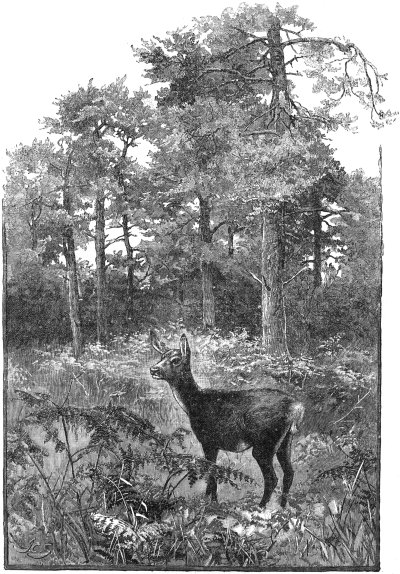
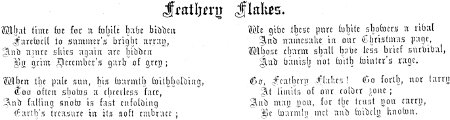
Where the sweet violets grew blue in the wild wood
With dewdrops all wet?
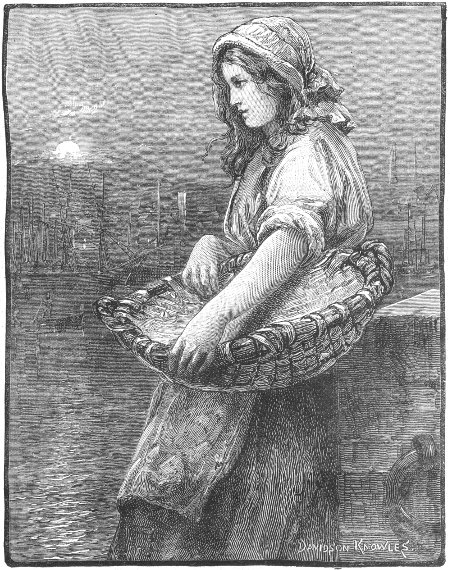
All the day long in the great crowded city—
Crowded, yet lonely to each in the crowd—
“Violets, sweet violets, a bunch for a penny!”
She has been crying, still crying aloud.
She has been merry at selling so many,
Merry and proud.
Now as she watches the sun that is setting,
Far o’er the roofs and the masts of the ships,
Does her mind turn to the sweet unsold flowers,
Gathered by baby hands, pressed by child-lips,
While in a day-dream, through wild woodland bowers
Once more she trips?
Is it the fragrance that clings to her basket—
Fragrance of violets that rich men have bought—
That takes her to woodlands away from the city,
Where with blue violets the moss is enwrought?
Surely the wings of God’s angel of pity
Shadow her thought.
A. M.
MERLE’S CRUSADE. — CHAPTER VIII.
By ROSA NOUCHETTE CAREY, Author of “Aunt Diana,” “For Lilias,” etc.
LABORARE EST ORARE.
y mistress (how I loved
to call her by that
name!) was beginning
to give me her
confidence. In a
little while I grew
quite at my ease
with her.
She would sit
down sometimes and
question me about the book
I was reading, or, if we
talked of the children, she
would ask my opinion of them in a way
that showed she respected it.
She told me more than once that her
husband was quite satisfied with me;
the children thrived under my care,
Reggie especially, for Joyce was somewhat
frail and delicate. It gratified me
to hear this, for a longer acquaintance
with Mr. Morton had not lessened my
sense of awe in his presence (I had had
to feel the pressure of his strong will
before I had been many weeks in his
house, and though I had submitted to his
enforced commands, they had cost me
my only tears of humiliation, and yet
all the time I knew he was perfectly
just in his demands). The occasion was
this.
It was a rule that when visitors asked
to see the children, a very frequent occurrence
when Mrs. Morton received at
home, that the head nurse should bring
them into the blue drawing-room, as it
was called. On two afternoons I had
shirked this duty. With all my boasted
courage, the idea of facing all those
strangers was singularly obnoxious; I
chose to consider myself privileged to
infringe this part of my office. I dressed
the children carefully, and bade Hannah
take them to their mother. I thought
the girl looked at me and hesitated a
moment, but her habitual respect kept
her silent.
My dereliction of duty escaped notice
on the first afternoon; Mr. Morton was
occupied with a committee, and Mrs.
Morton was too gentle and considerate
to hint that my presence was desired,
but on the second afternoon Hannah
came up looking a little flurried.
Master had not seemed pleased
somehow; he had spoken quite sharply
before the visitors, and asked where
nurse was that she had not brought the
children as usual, and the mistress had
looked uncomfortable, and had beckoned
him to her.
I took no notice of Hannah’s speech,
for I had a hasty tongue, and might
have said things that I should have regretted
afterwards, but my temper was
decidedly ruffled. I took Reggie as
quickly as possible from her arms, and
carried him off into the other room. I
wanted to be alone and recover myself.
I cried a good deal, much to Reggie’s
distress; he kept patting my cheeks
and calling to me to kiss him, that at
last I was obliged to leave off. I had
met with a difficulty at last. I could
hear the roaring of the chained lions
behind me, but I said to myself that I
would not be beaten; if my pride must
suffer I should get over the unpleasantness
in time. Why should I be afraid
of people just because they wore silks
and satins and were strangers to me?
My fears were undignified and absurd;
Mr. Morton was right; I had shirked
my duty.
I hoped that nothing more would be
said about it, and I determined that the
following Thursday I would face the
ordeal; but I was not to escape so
easily.
When Mrs. Morton came into the
nursery that evening to bid the children
good-night, I thought she looked a little
preoccupied. She kissed them, and
asked me, rather nervously, to follow her
into the night nursery.
“Merle,” she said, rather hurriedly,
“I hope you will not mind what I am
going to say. My husband has asked
me to speak to you. He seemed a little
put out this afternoon; it did not please
him that Hannah should take your place
with the children.”
“Hannah told me so when she came
up, Mrs. Morton.”
In spite of all my efforts to restrain
my temper, I am afraid my voice was a
little sullen. I had never answered her
in such a tone before. I would obey
Mr. Morton; I knew my own position
well enough for that, but they should
both see that this part of my duty was
distasteful to me.
To my intense surprise she took my
hand and held it gently.
“I was afraid you would feel it in
this way, Merle, but I want you to look
upon it in another point of view. You
know that my husband forewarned you
that your position would entail difficulties.
Hitherto things have been quite
smooth; now comes a duty which you
own by your manner to be bitterly distasteful.
I sympathise with you, but
my husband’s wishes are sacred; he is
very particular on this point. Do you
think for my sake that you could yield
in this?”
She still held my hand, and I own that
the foolish feeling crossed me that I was
glad that she should know my hand was
as soft as hers, but as she spoke to me
in that beseeching voice all sullenness
left me.
“There is very little that I would not do
for your sake, Mrs. Morton, when you
have been so good to me. Please do
not say another word about it. Mr.
Morton was right; I have been utterly
in the wrong; I feel that now. Next
Thursday I will bring down the children
into the drawing-room.”
She thanked me so warmly that she
made me feel still more ashamed of
myself; it seemed such a wonderful
thing that my mistress should stoop to
entreat where she could by right command,
but she was very tolerant of a
girl’s waywardness. She did not leave
me even then, but changed the subject.
She sat down and talked to me for a few
minutes about myself and Aunt Agatha.
I had not been home yet, and she wanted
me to fix some afternoon when Mrs.
Garnett or Travers could take my place.
“We must not let you get too dull,
Merle,” she said, gently. “Hannah is
a good girl, but she cannot be a companion
to you in any sense of the word.”
And perhaps in that she was right.
I woke the following Thursday with a
sense of uneasiness oppressing me, so
largely do our small fears magnify themselves
when indulged. As the afternoon
approached I grew quite pale with apprehension,
and Hannah, with unspoken
sympathy, but she had wonderful tact
for a girl, only hinted at the matter in
a roundabout way.
I had dressed Reggie in his turquoise
blue velvet, and was fastening my clean
frilled apron over my black gown, when
Hannah said quietly, “Well, it is no
wonder master likes to show people what
sort of nurse he has got. I don’t think
anyone could look so nice in a cap and
apron as you do, Miss Fenton. It is
just as though you were making believe
to be a servant like me, and it would
not do anyhow.”
I smiled a little at Hannah’s homely
compliment, but I confessed it pleased
me and gave me courage. I felt still
more like myself when my boy put his
dimpled arms round my neck, and hid
his dear face on my shoulder. I could
not persuade him to loosen his hold
until his mother spoke to him, and there
was Joyce holding tightly to my gown
all the time.
The room was so full that it almost
made me giddy. It was good of Mrs.
Morton to rise from her seat and meet
me, but all her coaxing speeches would
not make Reggie do more than raise
his head from my shoulder. He sat in
my arms like a baby prince, beating off
everyone with his little hands, and refusing
even to go to his father.
Everyone wanted to kiss him, and I
carried him from one to another. Joyce
had left me at once for her mother.
Some of the ladies questioned me about
the children. They spoke very civilly,
but their inquisitive glances made my
face burn, and it was with difficulty that
I made suitable replies. Once I looked
up, and saw that Mr. Morton was watching
me. His glance was critical, but not
unkindly. I had a feeling then that he
was subjecting me purposely to this
test. I must carry out my theory into
practice. I am convinced all this was
in his mind as he looked at me, and I no
longer bore a grudge against him.
Not long afterwards I had an opportunity
of learning that he could own himself
fallible on some points. He was
exceedingly just, and could bear a rebuke
even from an inferior, if it proved
him to be clearly in the wrong.
One afternoon he came into the nursery
to play with the children for a few minutes.
He would wind up their mechanical
toys to amuse them. Reggie was
unusually fretful, and nothing seemed
to please him. He scolded both his
father and his walking doll, and would
have nothing to say to the learned dog
who beat the timbrels and nodded his
head approvingly to his own music.
Presently he caught sight of his favourite
woolly lamb placed out of his reach on
the mantelpiece, and began screaming
and kicking.
“Naughty Reggie,” observed his
father, complacently, and he was taking
down the toy when I begged him respectfully
to replace it.
He looked at me in some little surprise.
“I thought he was crying for it,” he
said, somewhat perplexed at this.
“Reggie must not cry for things after
that fashion,” I returned, firmly, for I
felt a serious principle was involved here.
“He is only a baby, but he is very sensible,
and knows he is naughty when he
screams for a thing. I never give it to
him until he is good.”
“Indeed,” a little dryly. “Well, he
seems far off from goodness now. What
do you mean by making all that noise,
my boy?”
Reggie was in one of his passions,
it was easy to see that; the toy would
have been flung to the ground in his
present mood; so without looking at his
father or asking his permission, I resorted
to my usual method, and laid him
down screaming lustily in his little cot.
“There baby must stop until he is
good,” I remarked, quietly, and I took
my work and sat down at some little
distance, while Mr. Morton watched us
from the other room. I knew my plan
always answered with Reggie, and the
storm would soon be over.
In two or three minutes his screams
ceased, and I heard a penitent “Gargle
do;” then “Nur, nur.” I went to him
directly, and in a moment he held out
his arms to be lifted out of the cot.
“Is Reggie quite good?” I asked, as
I kissed him.
“Ood, ood,” was the triumphant reply,
and the next moment he was cuddling
his lamb.
“I own your method is the best,
nurse,” observed Mr. Morton, pleasantly.
“My boy will not be spoiled, I see that.
I confess I should have given him the
toy directly he screamed for it; you
showed greater wisdom than his father.”
It is impossible to say how much this
speech gratified me. From that moment
I liked as well as respected Mr. Morton.
My first holiday arrived somewhat unexpectedly.
A little before the nursery
dinner Travers brought a message from
Mrs. Morton that Joyce was to go out
with her in the carriage, and that if I
liked to have the afternoon and evening
to myself, Mrs. Garnett could take
charge of Reggie.
The offer was too tempting to be refused.
I do not think I ever knew the
meaning of the word holiday before. No
schoolgirl felt in greater spirits than I
did during dinner time.
It was a lovely April afternoon. I
took out of my wardrobe a soft grey
merino, my best dress, and a little grey
velvet bonnet that Aunt Agatha’s skilful
hands had made for me. I confess I
looked at myself with some complacency.
“No one would take me for a nurse,” I
thought.
In the hall I encountered Mr. Morton;
he was just going out. For the moment
he did not recognise me. He removed
his hat hurriedly; no doubt he thought
me a stranger.
I could not help smiling at his mistake,
and then he said, rather awkwardly,
“I did not know you, Miss Fenton. I
am glad you have such a lovely afternoon
for your holiday; there seems a
look of spring in the air,” all very civilly,
but with his keen eyes taking in every
particular of my dress.
I heard from Mrs. Garnett afterwards
that he very much approved of Miss
Fenton’s quiet, ladylike appearance,
and as he was a very fastidious man,
this was considered high praise. There
was more than a touch of spring in the
air; the delicious softness seemed to
promise opening buds. Down Exhibition-road
the flower-girls were busy with
their baskets of snowdrops and violets.
I bought a few for Aunt Agatha, then I
remembered that Uncle Keith had a
weakness for a particular sort of scone,
and I bought some and a slice of rich
Dundee seed cake. I felt like a schoolgirl
providing a little home feast, but
how pleasant it is to cater for those we
love. I was glad when my short journey
was over, and I could see the river shimmering
a steely blue in the spring sunshine.
The old church towers seemed
more venerable and picturesque. As I
walked down High-street I looked at
the well-known shops with an interest I
never felt before.
When I reached the cottage I rang
very softly, that Aunt Agatha should not
be disturbed. Patience uttered a pleased
exclamation when she caught sight of
me. “Is it really yourself, Miss Merle?
I could hardly believe my eyes. Mistress
is in there reading,” pointing to
the drawing-room. “She has not heard
the bell, I’ll be bound, so you can surprise
her finely.”
I acted on Patience’s hint, and opened
the door noiselessly. How cosy the room
looked in the firelight! and could any
sight be more pleasant to my eyes than
dear Aunt Agatha sitting in her favourite
low chair, in her well-worn black silk
and pretty lace cap. I shall never forget
her look of delight when she saw
me.
“Merle! Oh, you dear child, do you
mean it is really you? Come here and
let me look at you. I want to see what
seven weeks of hard work have done for
you.”
But Aunt Agatha’s eyes were very dim
as she looked.
“There, sit down, and get warm,”
giving me an energetic little push, “and
tell me all about it. Your letters never
do you justice, Merle. I must hear your
experience from your own lips.”
What a talk that was. It lasted all
the afternoon, until Patience came in to
set the tea-table, and we heard Uncle
Keith’s boots on the scraper; even that
sound was musical to me. When he
entered the room I gave him a good hug,
and had put some of my violets in his
button-hole long before he had left off
saying “Hir-rumph” in his surprise.
“She looks well, Agatha, does she
not?” he observed, as we gathered
round the tea-table. “So the scheme
has held out for seven weeks, eh? You
have not come to tell us you are tired of
being a nurse?”
“No, indeed,” I returned, indignantly.
“I am determined to prove to
you and the whole world that my theory
is a sensible one. I am quite happy in
my work—perfectly happy, Uncle Keith.
I would not part with my children for
worlds. Joyce is so amusing, and as for
Reggie, he is such a darling that I could
not live without him.”
“It is making a woman of Merle, I
can see that,” observed Aunt Agatha,
softly. “I confess I did not like the
plan at first, but if you make it answer,
child, you will have me for a convert.
You look just as nice and just as much
a lady as you did when you were leading
a useless life here. Never mind if in
time your hands grow a little less soft
and white; that is a small matter if your
heart expands and your conscience is
satisfied. You remember your favourite
motto, Merle?”
“Yes, indeed, Aunt Agatha, ‘Laborare
est orare.’ Now I must go, for
Uncle Keith is pulling out his watch,
which means I have to catch my
train.”
But as I trudged over the bridge beside
him in the starlight, and saw the
faint gleams lying on the dark, shadowy
river, a voice seemed to whisper to my
inner consciousness, “Courage, Merle,
a good beginning makes a glad ending.
Hold fast to your motto, ‘Laborare est
orare.’”
(To be continued.)
THE BROOK AND ITS BANKS. — CHAPTER III.
By the Rev. J. G. WOOD, M.A., Author of “The Handy Natural History.”
Enemies of the water-vole—The heron—The
death-stroke—Ways of the heron—Watching
for fish—A hint to naturalists—Observers in
the New Forest—Return to wild habits—The
fox, the cow, and the owl—The heron and the
eel—The cormorant and the conger—The
heron’s power of wing—How the heron settles—Its
resting-place—Power of the heron’s
beak—Heronry in Wanstead Park.
The water-vole has but few enemies whom it
need fear, and one of them is now so scarce
that the animal enjoys a practical immunity
from it. This is the heron (Ardea cinerea),
which has suffered great diminution of its
numbers since the spread of agriculture.
Even now, however, when the brook is far
away from the habitations of man, the heron
may be detected by a sharp eye standing
motionless in the stream, and looking out for
prey. Being as still as if cut out of stone,
neither fish nor water-vole sees it, and if the
latter should happen to approach within striking
distance, it will be instantly killed by a
sharp stroke on the back of the head.
The throat of the heron looks too small to
allow the bird to swallow any animal larger
than a very small mouse; but it is so dilatable
that the largest water-vole can be swallowed
with perfect ease.
The bird, in fact, is not at all fastidious
about its food, and will eat fish, frogs, toads,
or water-voles with perfect impartiality. It
has even been known to devour young waterhens,
swimming out to their nest, and snatching
up the unsuspecting brood. In fact, all is
fish that comes to its beak.
If the reader should be fortunate enough to
espy a heron while watching for prey, let him
make the most of the opportunity.
Although the heron is a large bird, it is not
easily seen. In the first place, there are few
birds which present so many different aspects.
When it stalks over the ground with erect
bearing and alert gestures it seems as conspicuous
a bird as can well be imagined. Still
more conspicuous does it appear when flying,
the ample wings spread, the head and neck
stretched forwards, and the long legs extending
backwards by way of balance.
But when it is on the look-out for the easily-startled
fish it must remain absolutely still.
So it stands as motionless as a stuffed bird, its
long neck sunk and hidden among the feathers
of the shoulders, and nothing but the glancing
eye denoting that it is alive.
This quiescence must be imitated by the
observer, should he wish to watch the proceedings
of the bird, as the least movement
will startle it. The reason why so many persons
fail to observe the habits of animals, and
then disbelieve those who have been more
successful, is that they have never mastered
the key to all observation, i.e., refraining
from the slightest motion. A movement of
the hand or foot, or even a turn of the head is
certain to give alarm; while many creatures
are so wary that when watching them it is as
well to droop the eyelids as much as possible,
and not even to turn the eyes quickly, lest the
reflection of the light from their surface should
attract the attention of the watchful creature.
One of the worst results of detection is that
when any animal is startled it conveys the
alarm to all others that happen to be within
sight or hearing. It is evident that all animals
of the same species have a language of their
own which they perfectly understand, though
it is not likely that an animal belonging to one
species can understand the language of another.
But there seems to be a sort of universal or
lingua-franca language which is common to
all the animals, whether they be beasts or
birds, and one of the best known phrases is
the cry of alarm, which is understood by all
alike.
I need hardly say that it is almost absolutely
necessary to be alone, as there is no
object in two observers going together unless
they can communicate with each other, and
there is nothing which is so alarming to the
beasts and birds as the sound of the human
voice.
Yet there is a mode by which two persons
who have learned to act in concert with each
other can manage to observe in company. It
was shown to me by an old African hunter,
when I was staying with him in the New
Forest.
In the forest, although even the snapping of
a dry twig will give the alarm, neither bird
nor beast seems to be disturbed by a whistle.
We therefore drew up a code of whistles, and
practised ourselves thoroughly in them.
Then, we went as quietly as we could to the
chosen spot, and sat down facing each other,
so that no creature could pass behind one of
us without being detected by the other. We
were both dressed in dark grey, and took the
precaution of sitting with our backs against a
tree or a bank, or any object which could perform
the double duty of giving us something
to lean against, and of breaking the outlines
of the human form.
Our whistled code was as low as was
possible consistent with being audible, and I
do not think that during our many experiments
we gave the alarm to a single creature.
When the observer is remaining without
movement, scarcely an animal will notice
him.
I remember that on one occasion my friend
and I were sitting opposite each other, one on
either side of a narrow forest path. The sun
had set, but at that time of the year there is
scarcely any real night, and objects could be
easily seen in the half light.
Presently a fox came stealthily along the
path. Now the cunning of the fox is
proverbial, and neither of us thought that he
would pass between us without detecting our
presence. Yet, he did so, passing so close,
that we could have touched him with a
stick.
Shortly afterwards, a cow came along the
same path, walking almost as noiselessly as
the fox had done. It is a remarkable fact
that domesticated animals, when allowed to
wander at liberty in the New Forest, soon
revert to the habits of their wild ancestors.
As the cow came along the path, neither of
us could conjecture the owner of the stealthy
footstep. We feared lest it might be that of
poachers, in which case things would have
gone hard with us, the poachers of the New
Forest being a truculent and dangerous set of
men, always provided with firearms and
bludgeons, having scarcely the very slightest
regard for the law, and almost out of reach of
the police.
They would certainly have considered
us as spies upon them, and as certainly would
have attacked and half, if not quite killed us,
we being unarmed.
But to our amusement as well as relief, the
step was only that of a solitary cow, the
animal lifting each foot high from the ground
before she made her step, and putting it down
as cautiously as she had raised it.
Then, a barn owl came drifting silently
between us, looking in the dusk as large and
white as if it had been the snowy owl itself.
Yet, neither the fox, nor the cow, nor the owl
detected us, although passing within a few
feet of us.
In the daytime the observer, however careful
he may be, is always liable to detection by
a stray magpie or crow.
The bird comes flying along overhead, its
keen eyes directed downwards, on the look-out
for the eggs of other birds. At first he may
not notice the motionless and silent observer,
but sooner or later he is sure to do so.
If it were not exasperating to have all one’s
precautions frustrated, the shriek of terrified
astonishment with which the bird announces
the unexpected presence of a human being
would be exceedingly ludicrous. As it is, a
feeling of wrath rather prevails over that of
amusement, for at least an hour will elapse
before the startled animals will have recovered
from the magpie’s alarm cry.
Supposing that we are stationed on the
banks of the brook on a fine summer evening,
while the long twilight endures, and have
been fortunate enough to escape the notice of
the magpie or other feathered spy, we may
have the opportunity of watching the heron
capture its prey.
The stroke of the beak is like lightning, and
in a moment the bird is holding a fish transversely
in its beak. The long, narrow bill
scarcely seems capable of retaining the slippery
prey; but if a heron’s beak be examined
carefully, it will be seen to possess a number
of slight serrations upon the edges, which
enable it to take a firm grasp of the fish.
Very little time is allowed the fish for struggling,
for almost as soon as captured it is flung
in the air, caught dexterously with its head
downwards, and swallowed.
It is astonishing how large a fish will
pass down the slender throat of a heron. As
has been already mentioned, the water-vole
is swallowed without difficulty. Now the
water-vole measures between eight and nine
inches in length from the nose to the root of
the tail, and is a very thickset animal, so that
it forms a large and inconvenient morsel.
It is seldom that the heron has, like the
kingfisher, to beat its prey against a stone or
any hard object before swallowing it, though
when it catches a rather large eel it is obliged
to avail itself of this device before it can get
the wriggling and active fish into a suitable
attitude. The eel has the strongest objection
to going down the heron’s throat, and has no
idea of allowing its head to pass into the
heron’s beak. The eel, therefore, must be
rendered insensible before it can be swallowed.
Generally it is enough to carry the refractory
prey to the bank, hold it down with the
foot, and peck it from one end to the other
until it is motionless. Should the eel be too
large to be held by the feet, it is rapidly battered
against a stone, just as a large snail is
treated by a thrush, and so rendered senseless.
If the feet of the heron be examined, a
remarkable comb-like appendage may be seen
on the inside of the claw of the hind foot.
What may be the precise office of this comb is
not satisfactorily decided. Some ornithologists
think that it is utilised in preening the plumage,
I cannot, however, believe that it performs
such an office. I have enjoyed exceptional
opportunities for watching the proceedings of
the heron when at liberty, as well as in captivity,
but never saw it preen its feathers with
its foot, nor have I heard of anyone who has
actually witnessed the proceeding.
IN WANSTEAD PARK.
It is not always fair to judge from a dead
bird what the living bird might have been able
to do. But I have tried to comb the plumage
of a dead heron with its foot-comb, and have
not succeeded.
Another suggestion is that the bird may use
it when it holds prey under its feet, as has
just been narrated. These suggestions, however,
are nothing more than conjectures, but,
as they have been the subject of much argument,
I have thought it best to mention them.
Sometimes it has happened that the heron
has miscalculated its powers, and seized a fish
which was too large and powerful to be mastered.
Anglers frequently capture fish which
bear the marks of the heron’s beak upon
their bodies, and in such cases neither the fish
nor the heron is any the worse for the struggle.
But when the unmanageable fish has been
an eel, the result has, more than once, been
disastrous for the bird. In Yarrell’s work on
the British birds, a case is recorded where a
heron and eel were both found dead, the partially
swallowed eel having twisted itself round
the neck of the heron in its struggles.
A very similar incident occurred off the
coast of Devonshire, the victim in this case
being a cormorant. The bird had attacked a
conger-eel, and had struck its hooked upper
mandible completely through the lower jaw of
the fish, the horny beak having entered under
the chin of the eel.
The bird could not shake the fish off its
beak, and the result was that both were found
lying dead on the shore, the powerful conger-eel
having coiled itself round the neck of the
cormorant and strangled it. The stuffed skins
of the bird and eel may be seen in the Truro
Museum, preserved in the position in which
they were found.
Having procured a sufficiency of prey, the
heron will take flight for its home, which will
probably be at a considerable distance from
its fishing ground. Twenty or thirty miles
are but an easy journey for the bird, which
measures more than five feet across the expanded
wings, and yet barely weighs three
pounds. Indeed, in proportion to its bulk, it
is believed to be the lightest bird known. The
Rev. C. A. Johns states that he has seen the
heron fishing at a spot fully fifty miles from
any heronry.
The peculiar flight of the heron is graphically
described in a letter published in the
Standard newspaper, Sept. 25th, 1883.
“One summer evening I was under a wood
by the Exe. The sun had set, and from over
the wooded hill above bars of golden and rosy
cloud stretched out across the sky. The rooks
came slowly home to roost, disappearing over
the wood, and at the same time the herons
approached in exactly the opposite direction,
flying from Devon into Somerset, and starting
out to feed as the rooks returned home.
“The first heron sailed on steadily at a
great height, uttering a loud “caak, caak” at
intervals. In a few minutes a second followed,
and “caak, caak” sounded again over the
river valley.
“The third was flying at a less height, and
as he came into sight over the line of the
wood, he suddenly wheeled round, and holding
his immense wings extended, dived, as a
rook will, downwards through the air. He
twisted from side to side like anything spun
round by the finger and thumb as he came
down, rushing through the air head first.
“The sound of his great vanes pressing
and dividing the air was distinctly audible.
He looked unable to manage his descent, but
at the right moment he recovered his balance,
and rose a little up into a tree on the summit,
drawing his long legs into the branches
behind him.
“The fourth heron fetched a wide circle, and
so descended into the wood. Two more
passed on over the valley—altogether six
herons in about a quarter of an hour. They
intended, no doubt, to wait in the trees till it
was dusky, and then to go down and fish in
the wood. Herons are here called cranes, and
heronries are craneries. (This confusion between
the heron and the crane exists in most
parts of Ireland.)
“A determined sportsman who used to eat
every heron he could shoot, in revenge for
their ravages among the trout, at last became
suspicious, and, examining one, found in it
the remains of a rat and of a toad, after
which he did not eat any more herons. Another
sportsman found a heron in the very
act of gulping down a good sized trout,
which stuck in the gullet. He shot the
heron and got the trout, which was not at
all injured, only marked at each side where
the beak had cut it. The fish was secured
and eaten.”
I can corroborate the accuracy as well as
the graphic wording of the above description.
When I was living at Belvedere, in Kent,
I used nearly every evening to see herons flying
northwards. I think that they were making
for the Essex marshes. They always flew at
a very great height, and might have escaped
observation but for the loud, harsh croak
which they uttered at intervals, and which
has been so well described by the monosyllable
“caak.”
As to their mode of settling on a tree, I
have often watched the herons of Walton
Hall, where they were so tame that they
would allow themselves to be approached
quite closely. When settling, they lower
themselves gently until their feet are upon the
branch. They then keep up a slight flapping
of the wings until they are fairly settled.
An idea is prevalent in many parts of England
that when the heron sits on its nest, its long
legs hang down on either side. Nothing can
be more absurd. The heron can double up
its legs as is usual among birds, and sits on
its nest as easily as if it were a rook, or any
other short-legged bird.
In many respects the heron much resembles
the rook in its manner of nesting. The nest
is placed in the topmost branches of a lofty
tree, and is little more than a mere platform
of small sticks. Being a larger bird than the
rook, the heron requires a larger nest, and
on an average the diameter of a nest is about
three feet.
Like the rook, the heron is gregarious in its
nesting, a solitary heron’s nest being unknown.
In their modes of feeding, however, the two
birds utterly differ from each other, the heron
seeking its food alone, while the rook feeds in
company, always placing a sentinel on some
elevated spot for the purpose of giving alarm
at the approach of danger.
The heron is curiously fastidious in its choice
of a nesting-place, and, like the rook, prefers
the neighbourhood of man, knowing instinctively
when it will be protected by its human
neighbours. Fortunately for the bird, the
possession of a heronry is a matter of pride
among landowners; so that even if the
owner of a trout-stream happened also to possess
a heronry, he would not think of destroying
the herons because they ate his trout.
In captivity the heron can be tamed; but it
is not to be recommended as a pet. It is
apt to bestow all its affections on one individual,
and to consider the rest of the human
race as enemies, whose eyes ought to be
pecked out.
I was for some time acquainted with such
a bird, but took care to keep well out of reach
of its terrible beak, which it would dart to an
unexpected distance through the bars of its cage.
It formerly ran loose in a garden, and was
almost slavishly affectionate to the gardener,
rubbing itself against his legs like a pet cat,
and trying in every way to attract his attention.
He had even taught it a few simple
tricks, and I have seen it take his hat off
his head, and then offer it to him.
But just in proportion as it became friendly
with the gardener it became cross-grained
with the rest of the world, attacking everyone
who came into the garden, and darting its
beak at their eyes. Its last performance
caused it to be placed in confinement.
An elderly gentleman had entered the
garden on business, when the bird instantly
assailed him. Knowing the habits of the
heron, he very wisely flung himself on his face
for the purpose of preserving his eyes, and
shouted for help.
Meanwhile the heron, wishing to make the
most of its opportunity, mounted upon his
prostrate victim, and succeeded in inflicting
several severe pecks upon his body and limbs
before the gardener could come to the rescue.
The peck of a heron’s beak is no trifle, the
mandibles being closed, and the blow delivered
with the full power of the long neck, so that each
blow from the beak is something like the stab
of a bayonet, and so strong and sharp is the
beak that in some foreign lands it is converted
into an effective spearhead.
Few people seem to be aware that a large
and populous heronry exists in Wanstead
Park, on the very outskirts of London.
At the end of summer, when the young
birds are fledged, the heronry is nearly deserted,
but during the early days of spring the
heronry is well worth a visit. The great birds
are all in full activity, as is demanded by the
many wants of the young, and on the ground
beneath may be seen fragments of the pale-blue
eggs. On an average there are three
young ones in each nest, so that the scene is
very lively and interesting, until the foliage
becomes so thick that it hides the birds and
their nests.
(To be continued.)
THE ROMANCE OF THE BANK OF ENGLAND; OR, THE OLD LADY OF THREADNEEDLE STREET. — CHAPTER II.
By EMMA BREWER.
Just for a little time I must leave my
personal history to inquire how England
managed to do without me so long, and what
the circumstances were which at length
rendered my existence imperative.
In the days following the Norman
Conquest, the Jews, whose one pursuit in life
was the commerce of money, were the compulsory
bankers of the country.
They were subject to much cruelty and
persecution, as you may see for yourselves in
your histories of the Kings of England.
It is not to be denied that their demands
for interest on money lent by them were most
extravagant. In 1264 the rate of interest
exceeded 40 per cent., and I believe that 500
Jews were slain by our London citizens
because one of them would have forced a
Christian to pay more than twopence for the
usury of 20s.[1] for one week, which sum they
were allowed by the king to take from the
Oxford students.
They were ill-treated and robbed from the
time they came over with the Conqueror until
the reign of Edward I., who distinguished
himself by robbing 15,000 Jews of their
wealth, and then banishing the whole of them
from the kingdom; and thus, as much sinned
against as sinning, the compulsory bankers of
the period departed.
There was no time to feel their loss, for
immediately after their expulsion the
Lombards (Longobards), or merchants of
Genoa, Florence, Lucca and Venice, came over
to England and established themselves in the
street which still bears their name.
There was no doubt as to their purpose, for
it was a well-known fact that in whatever
country or town they settled they engrossed
its trade and became masters of its cash, and
certainly they did not intend to make an
exception in favour of London.
I am not going to deny that they introduced
into our midst many of the arts and skill of
trade with which we in England were
previously unacquainted; and it is to these
Lombards or goldsmiths we owe the introduction
of bills of exchange, a wonderful invention,
and one which has served to connect
the whole world into one, as you will see when
the proper place arrives for their explanation.
These Lombards, immediately after their
arrival in London, may have been seen
regularly twice a day parading Lombard-street
with their wares, exposing for sale the most
attractive articles; and in a short time became
so successful that they were able to take shops
in which to carry on their business as goldsmiths.
These shops were not confined to the one
street which bears their name, but were continued
along the south row of Cheapside,
extending from the street called Old Change
into Bucklersbury, where they remained until
after the Great Fire, when they removed to
Lombard-street. There seems to be no street
in the world where a business of one special
character has been carried on so continuously
as in Lombard-street. In the time of Queen
Elizabeth it was the handsomest street in
London. In addition to the art of the goldsmith,
they added the business of money-changing,
the importance of which occupation
you will be able to estimate when we come to
the subject of the coins of the realm.
From money-changers they became money-lenders
and money-borrowers—money was the
commodity in which they dealt, and 20 per
cent. the modest interest they asked and
obtained for their money.
Of course they gave receipts for the money
lodged with them, and these circulated and
were known by the name of “goldsmiths’
notes,” and were, in fact, the first kind of
bank-notes issued in England.
The Lombards were a most industrious
class of people, and left no stone unturned by
which they could obtain wealth; and in an
incredibly short time we find them not only
wealthy, but powerful, and occupying a very
prominent position; and you may be quite
sure that under these circumstances they did
not escape persecution.
Under the pretext that the goldsmiths were
extortioners, Edward III. seized their property
and estates. Even this seemed but
slightly to affect them; for in the fifteenth
century we find them advancing large sums of
money for the service of the State on the
security of the Customs.
In the latter days, and, indeed, up to the
time of my birth, the banking was entirely
in the hands of the goldsmiths, but carried
on in a very rapacious spirit, as is frequently
the case when unrestrained by rivals.
I dare say you have all noticed the three
golden balls on the outside of pawnbrokers’
shops. Originally these were three pills, the
emblem of the Medici (physician) family; but
in some way they became associated with St.
Dunstan, the patron saint of the goldsmiths,
under the name of the three golden balls—an
emblem which the Lombards have retained.
Are you curious to know how the sign has
so degenerated as to be the inseparable companion
of the pawnbrokers of the land? Well,
listen.
Pawnbrokers’ shops, or loan banks, were
established from motives of charity in the
fifteenth century. Their object was to lend
money to the poor upon pledges and without
interest. Originally they were supported by
voluntary contributions, but as these proved
insufficient to pay expenses, it became necessary
to charge interest for the money lent.
These banks were first distinguished by the
name of montes pietatis. The word mont
at this period was applied to any pecuniary
fund, and it is probable that pietatis was added
by the promoters of the scheme, to give it an
air of religion, and thus procure larger subscriptions.
Well, these banks were not only called
mounts of piety, but were known also as Lombards,[2]
from the name of the original bankers
or money-lenders. Now you see how it is
pawnbrokers bear the sign of the goldsmiths.
You who know so well where to place your
money, both for interest and security, when you
have any to spare, can scarcely understand the
trouble and annoyance which our merchants
and wealthy people experienced at having
no place of security wherein they could deposit
their money. At one time they sent it to the
Mint in the Tower of London, which became
a sort of bank, where merchants left their
money when they had no need of it, and drew
it out only as they wanted it; but this soon
ceased to be a place of security. In 1640
Charles I., without leave asked or granted,
took possession of £200,000 of the money
lodged there. Great was the wrath of the
merchants, who were compelled, after this unkingly
act, to keep their surplus money at
home, guarded by their apprentices and
servants. Even here the money was not safe,
for on the breaking out of the war between
Charles and his Parliament, it was no uncommon
occurrence for the apprentices to rob
their masters and run away and join the army.
When the merchants found that neither the
public authorities nor their own servants were
to be trusted, they employed bankers, and
these bankers were goldsmiths.
Many a tale, however, has reached me of the
shifts and contrivances of people to secure
their savings and surplus money—people whose
experience had taught them to distrust both
authorities and places, and who would not,
under the new state of things, have anything
to do with the bankers. One I will relate
to you.
A man whose life had been one of hard
work and self-denial, and who had two or
three times lost his all through the untrustworthiness
of the people with whom he had
lodged it, determined to be their dupe no
more. Money began once more to accumulate,
and all things prospered with him; but no one
could imagine what he did with it; as far as
his household could tell, he did not deposit
it with anyone outside the house, neither could
they discover any place within where it was
possible to stow it away. No persuasion could
move the man to speak one word concerning
it.
At length he died, without having time or
consciousness to mention the whereabouts of
his money. Search was made in all directions,
but without success.
While living he had been a regular
attendant at one of our City churches, and,
occupying always the same corner in the old-fashioned
square pew, was well known to the
clergy and servants.
A few weeks after his death the pew-opener
told the rector, in a frightened voice,
that she could no longer keep the matter from
him, for as surely as she stood there, the
ghost of the man who died a week or two ago
haunted the church by night and by day.
Instead of ridiculing her for her foolish
fancy, the rector allowed her to tell her story
quietly, seeing that she was superstitious and
very nervous.
She related that several times during the
past weeks, when quite alone in the church for
the purpose of sweeping and dusting, she had
heard a peculiar noise proceeding from the
pew where the old man used to sit, and it
sounded to her exactly as though he were
counting out money, and she would be very
glad if he would look to it and verify her statement.
Accordingly the rector and his curate accompanied
the woman to the pew. At first all was
quiet, but as they listened, assuredly the sound
came exactly as described; they felt round
about the pew, and at length discovered a
movable panel near the flooring. It was
the work of a moment to remove it, and there,
in a good sized cavity, lay heaps of money
wrapped up in paper, which last had attracted
the mice, and it was their little pattering feet
among the coins which had caught the
woman’s ear. The man had evidently dropped
in his week’s savings on Sundays, believing
that it would be safer in the church than
elsewhere.
It seems that after the restoration of
Charles II., he being greatly in want of
money, the goldsmiths lent it, demanding ten
per cent. for the loan. Often, however, they
obtained thirty per cent. from him, and this
induced the goldsmiths to lend more and
more to the king, so that really the whole
revenue passed through their hands.
In 1672 a sad calamity befel the bankers,
and put a check on their prodigal lending.
King Charles, who owed them £1,328,526,
which he had borrowed at eight per cent., utterly
refused to pay either principal or interest, and
he remained firm to his resolution.
The way in which bankers transacted their
loans with the king, was in this manner:—As
soon as the Parliament had voted to the king
certain sums of money out of special taxes,
the goldsmith-bankers at once supplied the
king with the whole sum so voted, and were
repaid in weekly payments at the Exchequer[3]
as the taxes were received.
DRESS: IN SEASON AND IN REASON.
By A LADY DRESSMAKER.
We have had such a mild and delightful
autumn, that all kinds of winter garments
have been delayed in making an appearance.
This is especially the case with mantles and
the heavier class of jackets. However, there
is enough to show us that no great novelty has
been introduced. Mantles are all small and
short, and the majority have ends in front
more or less long. Black plush seems a
very favourite material, and is much overladen
with trimming. Plain plush is also used for
paletôts, and for large cloaks; but there is a
new-patterned plush, with ribs in layers, that
is much used also. Beaded shoulder-straps
and epaulettes are worn as well as ornaments
at the back, and sometimes beaded braces
round the join of the sleeve in the small
mantles, and a strip of the same may be used
to outline the seam at the back. These hints
may help some of my readers to do up a last
year’s mantle with some of the moderate
priced bead trimmings now in vogue.
Paletôts or cloaks are made both long and
medium in length. They are made in plush,
cloth, and rough cloths, but are not seen in
the finer fancy stuffs which are made use of for
mantles and jackets. These fancy cloths have
an appearance as if braid were sewn on to the
surface. The cloak paletôts, when long, close
in front to the feet, and the fronts are trimmed
with a border of fur, which is shaped on the
shoulders like a pointed old-fashioned
“Victorine.” No fur is placed at the lower
edge of the cloak; the cuffs are deep. Fur
trimmings on jackets that are tight-fitting
follow the same rule, and have no
trimming of fur at the edge. Fur
boas are very decidedly the fashion this winter,
and there seems no end to their popularity.
Some of them are flat at the neck, like a
collarette; and others are attached to the
mantle. The newest boas are rather shorter,
and some are nothing more than fur collars
that clasp round the throat; and these
collars, or “tippets,” will probably take the
place of the fur capes that have been worn so
long. Grey furs are more in fashion than brown
ones—such as chinchilla, grey fox, squirrel-lock,
and opossum, and I see that quantities
of American raccoon are also being prepared.
Of course, the best kind of furs, like sable,
marten-tail, mink, or blue fox, are not within
the ordinary range of purchasers, and few
people care to spend so much money on dress
as their acquirement entails. There is also a
new feeling to be taken into account; the
same feeling that makes thinking women and
girls decline to wear birds, and their heads and
wings, i.e., the feeling that the seal fishery as
hitherto conducted is cruel; and that one may
wear furs that are too costly in other ways. I
often think if mighty hunters—instead of
hunting down the buffalo, and the other
animals useful to the Indian in the North
West—would go to India and hunt the tigers
that so cruelly prey on the natives there, we
should wear those skins with much pleasure
as well as advantage. But the account
of the slaying of a mother-seal ought to
be enough for a tender-hearted woman. I
have never cordially liked sealskins since
I read of the devotion of one poor mother-seal
in particular to her young; and I have
never had a sealskin jacket since.
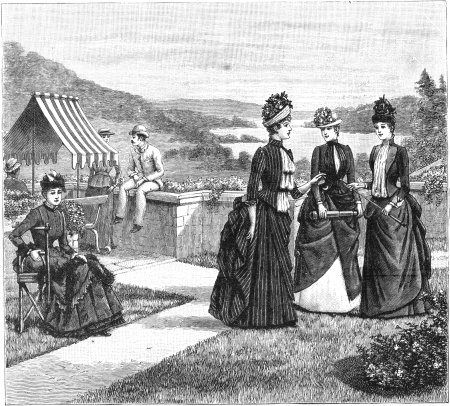
AT THE ENGLISH LAKES.—AUTUMN AND WINTER GOWNS.
There are numbers of jackets in every
style, but all are made of woollen materials,
not of silk nor of velvet. Most of them
are tight-fitting, and are smart looking and
stylish. Both single and double-breasted
ones are seen. Hoods are much worn,
but are by no means general. Coloured
linings are used to pale-coloured or
checked cloth jackets, but not to black
or brown ones. Small mantles and
cloaks are tied at the neck by a
quantity of ribbons to match the colour
of the cloth or plush. One of
the new ideas for mantles is that
of a semi-fitting jacket over a
long close-fitting cloak.
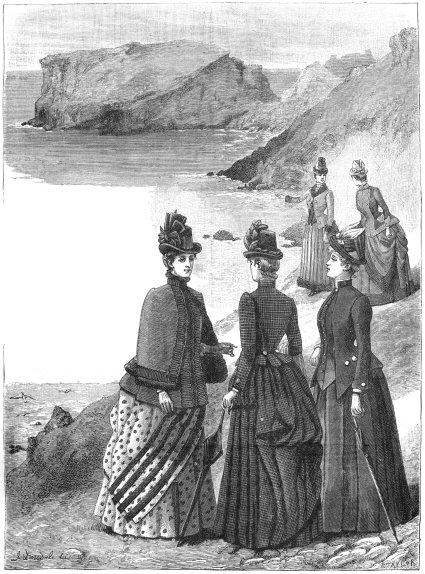
UNDER NORTHERN SKIES.—A STUDY OF COMFORT IN DRESS.
The new bonnets and hats are much smaller
and prettier now, and there are in consequence
many of these quieter hats to be seen worn by
well-dressed girls in the streets of London.
Formerly no girl who wished to be thought
somebody ever wore anything but a bonnet
in London.
The velvet trimmings of bonnets are put on
gathered, doubled and pleated, sometimes
with as many as three frills at the edge. Many
of the bonnets are without strings, and have
pointed fronts, and there is much jet trimming
used even on coloured velvet bonnets.
I am sorry to say that our fashionable caterers
continue to prey upon the feathered creation
all over the world. This winter the owl has
evidently fallen a victim, and there are besides
the tern, kingfisher, and the heron. How I wish
this wicked and cruel bird slaughter could be
prevented, and that my numberless girl-readers
would try to avoid giving it the least encouragement.
While we have the beautiful ostrich
feathers, we cannot need these other poor victims
offered up on the altar of feminine vanity
and unthinking cruelty.
Some of the felt hats for the season are very
pretty. They have high and sloping crowns,
the brims are often only bound with ribbon,
but if wide and turned up at the back, they
are lined with velvet, or rather only partly
lined, as half of the brim at least is left unlined.
Many of them have brims turned up all round,
like one of the old turban hats.
The ribbons in use at present are of all
kinds, satin and velvet reversible, as well as
moiré and velvet, or satin and moiré. These
have an edge of lacet, or one with tufts of silk,
in colour. Velvet ribbons with corded stripes
have one edge purled and the other fringed;
and the strings of bonnets are of narrow picot-edged
ribbon.
The number of white gowns that have been
worn during the past season and up to the
present moment has been remarkable, and
has quite justified the name of a “white
season.” Even as the weather became colder,
a charming mixture of materials was introduced,
viz., white corduroy, and some soft
woollen stuff, like serge or flannel. For the
winter white will be the special fashion for
young people for the evening, and any colour
can be given by trimming. It seems likely
that perfectly smooth cloths, of the nature of
habit-cloths, will be used for winter day
dresses, trimmed with bands of short dark-hued
fur, or with velvet to match the colour of
the cloth. The colours that will be worn in
these will be myrtle, a new shade of blue, a
tint like heliotrope, and a reddish violet.
Fancy materials in mixed colours abound,
the mixtures being green and ruby, brown
and red, sage and vermilion, and others of
the same unæsthetic nature. The new browns
are called Carmelite, chestnut, rosewood, hair,
and earth; the new reds are, Bordeaux,
Indian, currant, and clove. A new green is
called verdigris. Grey does not seem to be
popular, and brown and red violet are the
special colours of the season.
In the making of dresses there is but little
change. The skirts are still short, and the
draperies still long; while there is a fancy for
over-trimming bodices of all kinds. This will
be a blessing for the possessors of half-worn
and very ancient bodices. Bracers are one of
the novelties as a form of trimming for the
latter. They are also trimmed in imitation of
a Zouave jacket. Polonaises seem to be
returning to favour, and will be worn later on
over lace skirts for evening dress. Serge
seems to me to be the most favoured material
this winter, and it forms the ground work of
half the fancy cloths and mixtures. Stripes
and crossbars are in the highest favour, and
both alpaca and foulard are used, and with
poplin, chuddah cloth, velvet, and silk rep,
form the generality of the new dresses. There
are numbers of hairy-looking woollen materials,
but I should not think they would
wear as well as a good serge, which is always
a useful purchase.
The new petticoat materials in winceys are
very gay and pretty, and the pattern is usually
of stripes; but the materials are various, being
sometimes all wool, or wool and silk mixed,
and in the weaving there is usually a rough or
knotted stripe. Some of the new petticoats
have a few steels in them, and the addition
makes the dress hold out from the heels a little.
A small steel-wire dress-improver is, however,
quite enough for most people, and very little
crinolette is now worn—nothing ungraceful
nor immoderate in size. Other petticoats of
better quality are made of plain silk or satin,
and one of the new fashions is to line them
with chamois leather, so as to make them
warmer.
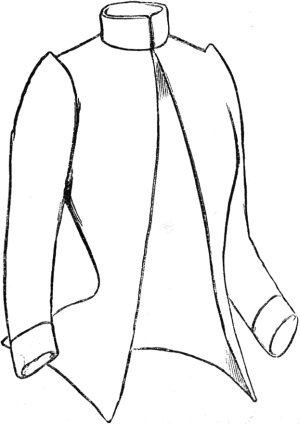
NEW WINTER JACKET BODICE.
Shoes are more worn in London than boots,
and laced shoes more than buttoned ones. The
same is the case with boots, which are considered
to fit better, and to look more stylish
when laced than buttoned. I have been very
glad to see that sensibly-shaped boots and
shoes are on the increase, having wider toes
and lower, broader heels. At the present
moment many of the best shops have them in
their windows, and have found it best and
wisest to keep them for their customers; in
fact, the knowledge of hygienic necessities,
and of all kinds of proper clothing, is being
so much extended and impressed on the public
mind on all sides, that I should not wonder
if we all became quite reformed characters,
and wore, ate, and drank only such things as
were good for us.
I must not forget to mention gloves and
their styles. Most people usually wear Swede
or kid gloves during the winter months; but
this year there are some such delightfully
warm and pretty gloves in wool and silk to
be seen in the shops, that many will no doubt
be tempted to purchase them. If the dress
be of a quiet colour, the gloves should match
it; but if red, or of a decided colour of any
kind, the proper gloves to wear would be tan-colour.
These latter are also used in the
evening, except when the dress is black, or
black and white, when the gloves should be
of grey Swede.
Our illustrations for the month are full of
suggestions for making new gowns and for altering
old ones. It will be seen that the gowns
are both simple and elegant, with long flowing
lines, and little or no fulness of drapery.
The prevailing fancy for jackets is shown,
and the newest model of a cape-like sleeve
is given in our large front picture of a seashore,
“Under Northern Skies.” Much
braiding is used, and it is shown in two ways—laid
on in flat bands, and also in a pattern
on the mantle. The new shapes of hats are
much more moderate, and most of the new
shapes are illustrated. Our paper pattern
for the month is represented as worn by a lady
in the centre of the smaller picture, “At the
English Lakes;” the centre figure shows its
pretty and jaunty outlines. It may be worn
with either a plain waistcoat or a full silk
plastron, divided into puffings as shown in our
sketch, which may be of a soft Indian silk.
It is of the last and new design, and will be
found a most useful winter bodice for usual
daily wear. The pattern consists of a collar,
cuff, front, half of back, side pieces, and two
sleeve pieces. About four yards of 30 inch
material are required, perhaps less, if very carefully
cut. All patterns are of a medium size,
viz., 36 inches round the chest, and only one
size is prepared for sale. Each of the patterns
may be had of “The Lady Dressmaker,” care
of Mr. H. G. Davis, 73, Ludgate Hill, E.C.,
price 1s. each. It is requested that the addresses
be clearly given, and that postal notes
crossed only to go through a bank may be
sent, as so many losses have recently occurred.
The patterns already issued may always be
obtained, as “The Lady Dressmaker” only
issues patterns likely to be of constant use in
home dressmaking and altering, and she is
particularly careful to give all the new patterns
of hygienic underclothing, both for children
and young and old ladies, so that her readers
may be aware of the best method of dressing.
The following is a list of those already
issued, price 1s. each. April—Braided, loose-fronted
jacket. May—Velvet bodice. June—Swiss
belt and full bodice, with plain
sleeves. July—Mantle. August—Norfolk or
pleated jacket. September—Housemaid’s or
plain skirt. October—Combination garment
(underlinen). November—Double-breasted
out-of-door jacket. December—Zouave
jacket and bodice. January—Princess underdress
(underlinen, underbodice, and underskirt
combined). February—Polonaise with
waterfall back. March—New spring bodice.
April—Divided skirt, and Bernhardt mantle
with sling sleeves. May—Early English
bodice and yoke bodice for summer dress.
June—Dressing jacket, princess frock, and
Normandy cap for a child of four years. July—Princess
of Wales’ jacket-bodice and waistcoat,
for tailor-made gown. August—Bodice
with guimpe. September—Mantle with stole
ends and hood. October—“Pyjama,” or
nightdress combination, with full back.—November—New
winter bodice.
THE BUILDERS OF THE BRIDGE. — CHAPTER II.
By Mrs. G. LINNÆUS BANKS, Author of “God’s Providence House,” “The Manchester Man,” “More than Coronets,” etc.
“But, Muse, return at last; attend the princely Trent,
Who, straining on in state, the north’s imperious flood,
The third of England called, with many a dainty wood
Being crowned, to Burton comes, to Needwood, where she shows
Herself in all her pomp, and as from thence she flows
She takes into her train rich Dove and Darwin[4] clear—
Darwin, whose font and fall are both in Derbyshire,
And of whose thirty floods that wait the Trent upon,
Doth stand without compare, the very paragon.”
So began England’s descriptive poet,
Michael Drayton, to sing the praises of the
glorious Trent in his “Polyolbion;” but
Milton was more terse in his invocation—
“Rivers, arise! whether thou be the son
Of utmost Tweed, or Ouse, or gulfy Don,
Or Trent, who, like some earth-born giant, spreads
His thirty arms along the indented meads.”
Thus much the poets; but in plain prose
be it told that the Trent needed no invocation
to “arise.” It had, and has, a tendency to
arise and flood the meadows in its course most
disastrously, as it did no later than last May.
The many arches of its bridges tell the tale.
But long before bridges were built or were
common, there was need to cross the river,
either by ford or ferry, and its treachery
must have been known in very ancient days,
since Swark—whoever he might be, and
whether he found a natural ford or made an
artificial one—set up on end an unwrought
monolith above the height of a man as a
guide for wayfarers to find the crossing-place
when the waters happened to be “out”;
since there the waste and meadow-land lay
low for many a broad mile.
There was scarcely a speck in the blue
vault of heaven when Earl Bellamont and his
friends, leaving a cloud of dust behind them,
crossed the shrunken, snake-like river that
mirrored their gleaming armour in its broken,
scale-like wavelets, as if it held their images
and would fain clasp them. And so the sun
had shone for weeks,
“All in a hot and copper sky,”
until the earth cried out for rain from its parched
and cracking lips. Only near the red, marly
banks of the river did the grass and herbage
retain its vivid tint of green. As the days
went by the air seemed to grow hotter; the
cooks in the kitchen, piling fresh logs upon
the fire, wished the guests gone and the
wedding over. The falconer out on the moor
in the glare with William Harpur and other
squires, or the anglers by the streams, had
scarcely the best of it, though Lady Bellamont
wearied of her many cares, and censured
the languor of her daughters and her maids.
Preparations had not ceased, they had only
renewed; and there had been unwonted doles
to the villagers of good things that would
have spoiled.
At length, when even the weaving of
tapestry or the twanging of the lute was a
toil, there rose a cloud in the north-western
sky. The cattle lowed, the leaves turned
themselves over to welcome it, the hawks
screamed in the mews. That was the morning
of the 14th, when the very hush in the
air was significant. The cloud spread,
darkened, blackened, but in the distance.
“There is a storm somewhere over our
northern hills!” exclaimed the prior, who had
been up on the battlements. “The clouds
hang black and low over Dovedale.”
“It seemeth such a day as heralded the
great storm three years ago,” cried Lady
Bellamont, in alarm. “And, ah! what a
flash was that!”
The younger ladies gathered together in
shrinking groups, as if the fears of the matron
were infectious. Only Idonea kept at her
word, and scorned to show timidity, whatever
she might feel, as the mutterings of thunder
rumbled over the hall.
It was high noon, but the sky was darkening
overhead. The horn at the great gates
was blown. A messenger in hot haste had
come spurring from the ford and up the hill,
glad to save himself a drenching, for the great
drops were pattering on the leaves and leads
like hail.
He had come at full speed from Oxford.
King Henry had ratified the great charter of
English liberty. His master, the earl, and his
friends would be home ere nightfall. The
bridal must be upon the morrow. He had,
moreover, private messages and tokens for
the ladies, Idonea and Avice, from their coming
bridegrooms.
The messages were not for general ears;
the love-tokens were a couple of golden crosses
richly wrought and set with gems. Five rubies
clustered in the centre of Sir Ralph’s gift to
Idonea, five pearls in Sir Gilbert’s to Avice.
They were dainty trinkets, but Avice took
hers shrinkingly. “They seem like crosses
set with tears and drops of blood,” she
whispered, with white lips, to Idonea, who
started, and, if she said “Tut, tut! they are
precious tokens,” was not altogether unaffected
by her sister’s superstitious dread.
In answer to inquiries, the messenger replied
that he “thought the Trent was rising.
It was higher than when his lord had left
Swarkstone.”
It had been still lower at sunrise that day.
Two hours later Friar John blew the horn
at the gate. He and his mule were pitiably
drenched.
The Dove was swollen when he crossed
the bridge near Egginton, he said, though the
downpour did not come until he had left it
five miles behind.
“Now, heaven forfend there be not such a
flood as swept Swark’s Stone away three
summers back. The passage of the ford
would be perilous to my lord now that is
gone,” cried Lady Bellamont, wringing her
hands, and it might seem with reason, for
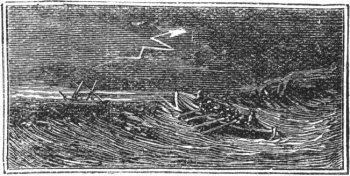
now the floodgates of the skies were loosed,
and heaven’s artillery waged war with earth.
“Storms and travellers are in Almighty
hands, good dame,” said Prior John, soberly.
“Tell your beads devoutly, and trust your all
to Him.”
Avice and Idonea, with other damsels and
dames, were already on their knees in prayer,
their hearts beating wildly.
William Harpur, pacing up and down,
glanced through the dim glass windows on
the scene without, and then from one to
other of the shuddering women within.
“I think, Prior John,” he observed, with a
slight curl of lip, “it will be a sorry welcome
for my noble kinsman and his friends when
they come in, wet and weary, if no board be
spread, no dry garments ready for their use.”
The taunt seemed to sting the good dame.
“Storm or no storm, Will, my lord shall
not find us unprepared. Maidens, attend
me.” And she swept from the tapestried
reception-room, followed by her daughters
and the noble maids who did probationary
service under her, and soon her silver whistle
might be heard, as one or other did her
bidding, and all below-stairs was speed and
bustle—and covert fear.
The hours sped. The storm seemed to
abate. The board was spread. The time for
the evening meal came and went.
There were no arrivals. There were
whisperings among hungry guests, for time
was flying.
Squire Harpur paced the rush-strewn floor
impatiently, biting his nails and cogitating.
The dark came down—the double dark of
storm and evening. The great time-candle
in its sheltering lanthorn burnt the quarters
down, and the hours.
Villagers came scurrying to the hall in
dismay. The meads were under water. Their
fresh-cut hay was floating down the stream,
with many a tree and bush from parts beyond
in the west.
The lovely sisters had busked themselves
afresh to receive their lovers; dark tresses and
fair were coiled in golden nets, and on each
bosom shone her token cross of gold.
But as the hours and minutes flew, dress
was disregarded, their lips quivered with
anxiety.
At length Avice whispered to her mother,
“Had we not best set a cresset burning on
the watch-tower, and send torch-bearers to
light the passage of the ford?”
“I have already given orders, child; I feared
to speak my alarm to you.”
But even torches will not keep alight in rain
and hurricane. The men, headed by Will
Harpur, returned to the hall drenched and
discomfited.
“The blazing sky will be their surest guide,”
said he; “we cannot keep a torch alight. But
do not give way to bootless terror, good aunt,
the storm will have kept our friends at Ashby,
or, at least, have driven them back. They
would never be so mad as to attempt the
passage of the ford.” Then, aside to the prior
he added, “The land is covered for more
than half a mile, and in mid-stream the marly
water runs like a torrent, bearing bushes, beams,
and haycocks swiftly out of sight. They must
have gone back.”
Almost as he spoke there was a rapid thud
of hoofs heard advancing up the hill.
There was the strong black charger of Earl
Bellamont, and close behind came the bay
mare of Sir Gilbert.
They were both riderless!
A moment of speechless horror, then
shrieks and wailing filled the air.
Mid the sobbing and lamentations of
women, and the clamour of men, fresh torches
were kindled, horn lanthorns lighted and
affixed to poles. Then, with the prior and
Will Harpur at their head, all the men about
the place rushed forthwith ropes and shepherds’
crooks, and aught that might save a
drowning man.
Alas! it was all too late.
Their bravest and best beloved were gone
for aye.
Too rashly impatient, and trusting the
leadership of impetuous Earl Bellamont, Sir
Ralph and Sir Gilbert had disregarded the
remonstrances of more cautious companions,
and dashed across the waste of waters, so low
at first as barely to cover their horses’ fetlocks.
Alas! some floating bush may have misled
the old man, for all at once they seemed to be
carried down stream and disappear, as if they
had missed the ford, or the current had been
too strong for men weighted with armour.
Sir Ralph had mounted his foot page behind
him, and the scion of another noble house was
lost.
Their esquires, following behind, had been
impotent to save, and only by turning sharply
round and fighting with the rising waters did
they manage to preserve their own lives.
Day by day as the thick waters subsided did
the search continue along the devastated banks
until the dark Derwent, rolling its great volume
of water into the Trent, barred further
passage, and made the quest hopeless.
A silken scarf caught in a bush, a broken
lance and pennon, a battered casque, a saddle-bow,
were all the relics found of father, bridegrooms,
page.
Lady Bellamont was borne down by the
shock. Avice drooped like a broken lily;
only Idonea seemed capable of thought or
action.
The subsidence of the flood brought spurring
in the more prudent party to comfort their own
wives and daughters, along with the downcast
esquires to tell the needless tale.
There was no consoling Lady Bellamont.
She seemed to take the triple loss to her own
heart, and grieve for her daughters as much as
for herself.
In vain the prior offered such consolation as
his faith afforded. She sat like a stone, rigid
and immovable; would take no sustenance
whatever.
The tears shed over her by Idonea and
Avice seemed to petrify as they fell rather
than melt. Their affliction but intensified her
own.
“If they had died in battle as brave men
should, we might have borne it bravely,” she
said, at last; “but to be slain by the cold,
cruel, treacherous waters in the height of joy
and hope, almost within hail of home, it is
too terrible, too terrible, prior; I cannot be
resigned. And for my crushed roses—orphaned,
widowed, ere they became wives—it is too
much; I cannot survive it.”
And before that month was out the twin-sisters
were left to weep out their tears in each
other’s arms, and bear the fresh blow as best
they might, with only the good prior to watch
and guard them in their orphanhood, and lead
them to bow meekly to the inscrutable decrees
of heaven.
There was William Harpur willing to do the
co-heiresses suit and service, and leave his
own estate, a mile or so away, to the care of
his reeve, whilst he administered affairs at the
hall, but neither the prior nor the sisters cared
for his interference, and when the old retainers,
with the seneschal at their head, came in a
body at the prior’s summons to swear fealty to
the ladies Bellamont, and Idonea accepted
their homage for herself and her sweet sister,
as one born to command, he turned away to
bite his nails in displeasure, and quitted the
hall before the sun went down.
But though Idonea could order the household,
and the seneschal could keep the retainers
in order, and the reeve overlook the villeins
and lands, nothing seemed to rouse the drooping
Avice, or remove the more rebellious
sorrow that mutely burned on the cheeks and
in the eyes of Idonea.
“My daughters,” said the prior, on the eve
of his departure, “duty calls me away to my
own flock. The bridge I built over the Dove
three years agone, after the great hurricane,
has, Friar Paul brings word, been shaken
sorely. I must needs see to its repair. The
safety of many lives depends on its stability.
Yet I would fain see you more submissive to
the divine will ere I depart. Think how many
sufferers there have been by the same calamity—how
many a hearth has been laid bare, how
many cry aloud for sustenance the flood has
swept away. Abandon not your hours to
selfish lamentations, but go abroad, see how
the poor hinds bear their sorrows, and endeavour,
by good and charitable deeds, to win
the favour of your offended Lord. Look on
the crosses that ye wear, and think of His
wounds and His tears, and remember that
His blood and His tears were shed for others,
not for self.”
Idonea’s eyes were fixed on him when he
began; they drooped as low as those of Avice
ere he ended.
“Father,” said she, “your rebuke is just.
We have thought the world was our own—in
joy and in sorrow. It shall not be so henceforth.
We ask your blessing ere you go.”
The benediction was spoken, and on the
morrow he was gone.
They, too, went forth in their mourning-weeds,
and saw what sorrow meant for the
very poor and for the class above them.
Tottering huts, bare fields, where the only
crop was dull red mud; mothers in rags
weeping over naked and famishing babes;
churls looking hopeless on desolation, or seeking
wearily to repair a fence or clear a garden.
And wherever they went they left hope behind,
as well as coin, or food, or raiment from
the hall. But some took their gifts and sympathy
with sullen thanklessness. They were
little better than serfs, and were more inclined
to resent the ability to bestow than feel grateful
to the willing bestowers.
Seneschal and reeve said they would spoil
the peasantry with their frequent alms; and
even the prior when he came suggested
moderation in doles, which destroyed honest
independence and fostered beggary.
But the sisters had found ease in helping
others, and ere long sought the prior’s advice
over a project to serve the people for generations
yet unborn.
They had discovered that sorrow and
calamity come to the poor as to the rich, and
they proposed to preserve others from losses
and heartaches such as theirs.
There was a general lamentation that
Swark’s Stone was gone and the ford less
readily found.
“Sister,” said Idonea, “had there been a
bridge over the Trent like the Monks’ Bridge
over the Dove, we had been happy wives, not
mourning maidens. Let us up and build one.
If we cannot restore our dead, we may preserve
life for the living.”
“Right gladly,” assented Avice. “We
may so make our sorrow a joy to thousands.”
The prior hailed their project as a divine
inspiration, hardly conscious he had struck the
keynote. They were rich. They would hear
nought of suitors. What better could they
do with their wealth?
He drew plans, he found them masons.
Stone was not far to seek for quarrying; but,
to be of service, the bridge must cover broad
lands as well as common current.
“Twenty-nine arches!” cried William
Harpur. “The cost will be enormous. It
will swallow up your whole possessions! You
must be mad; and the prior is worse to
sanction such a sacrifice.”
“The sacrifice was made when the river
robbed us of our dearest treasures. We must
save others a like sacrifice at any cost,” said
Avice, now as bold as her sister.
The work began and went on steadily.
Honest labour was paid for, and churls, who
had lived half on doles and housed like dogs,
were paid a penny[5] a day or a peck of meal,
and took heart to work with a will. There
were always loose stones and wood about,
and no one said nay when they began to
repair and improve their own dwellings. And
so industry came to Swarkstone with the
building of the bridge. Heaven, too, seemed
to smile upon the undertaking, for never a
disaster occurred to mar it.
But, as Squire Harpur had prophesied, the
cost was enormous. It was the work of years.
Woods were cut down to supply timber for
scaffolding; then lands were mortgaged or
sold, and who but William Harpur was chief
buyer? But still the work proceeded.
“Travellers who can cross the river dry-shod
will gladly pay a small toll for the
privilege,” said the sisters, as the last of their
possessions, the old hall, passed into their
cousin’s hands, and they took refuge in a
small house in a bye-way, which goes by the
name of “No Man’s-Lane” to this day.
It was a glad day for travellers on horse or
foot when Swarkstone Bridge, of twenty-nine
arches, was declared free for traffic, a bridge
which spanned the Trent and its low meads for
three-quarters of a mile, and the good Ladies
Bellamont, who built it, had a right to expect
those who could thus travel safely and dry-shod
at all seasons to be grateful for the inestimable
boon.
They had no charter to exact a toll to repay
the moneys they had expended; but there
was at the Swarkstone end a small chapel
erected and dedicated to St. James, in which
it was fondly hoped the users of the bridge
would pause to thank God and drop their
small thank-offerings in a box set there to
receive them.
At first, when they began to build, people
about called the sisters “the twin angels;”
but by the time the bridge was built it had
ceased to be a new thing. It was used as a
matter of course; but the thank-offerings
grew fewer and fewer as people ceased to
remember the danger and discomfort of the
passage by the ford.
They had impoverished themselves for the
security of strangers. The offerings of gratitude
would not keep life in the good sisters.
They began to spin flax for a livelihood. Avice
bore her lot meekly. Not so Idonea, into
whose soul the sense of ingratitude was eating
like a canker. But Avice said gently, “If we
gave our wealth to build a bridge expecting a
return, what answer can we make to our Lord
when we go to Him? Let us be content that
our individual losses will be the gain of thousands
after us.” And that put an end to
Idonea’s rebellion.
At length the aged prior, who had built
Monks’ Bridge between the counties of Stafford
and Derby for a people as ungrateful,
stirred up William Harpur to remember the
poor kinswomen on whose lands he was
flourishing, and he offered them a home at
Ticknall.
The offer came too late to save them. The
Ladies Bellamont died as they had lived,
together, and were buried with their two symbolic
crosses on their breasts. And then,
thanks chiefly to the prior, who reverenced
them, a marble monument could be erected
to their memories with their sleeping effigies
upon it. It was inscribed “The Builders of
the Bridge.” But the prior would fain have
added, “They built unseen another bridge
over the troubled waters of life—a bridge from
earth to heaven.”
By MYLES B. FOSTER, Organist of the Foundling Hospital.
lthough it is stated
that the ancient
Greeks intoned
their tragedies, and
introduced, besides,
some form of melody
(μέλος), the
whole question of
the existence of
opera at that period
of artistic prosperity,
when all forms of learning were
so powerfully nourished, is a matter for
speculation. Their authors certainly give
us wonderful accounts of the great effects
that this music had, and state that it
formed an essential part of their drama,
but beyond these records, in all probability
much exaggerated, we have no data.
Opera we must assume to be a comparatively
recent invention. To the end of the sixteenth
century, composers had written all their
finest work for the Church, and had, very
rightly, devoted their best efforts to the praise
and worship of the Giver of all musical ideas
and beauties.
Even that which was known as secular
music, and was intended for social occasions,
was written in ecclesiastical forms, and the
very folksongs had their freshness rubbed off
by contrapuntal developments to which they
were not suited, and were dragged in their
new and ill-fitting costume into the masses
and motetts of the day. The Church possessed
most of the art and learning of the age, and,
with that, a corresponding power over the
ignorant people. Thus music had been, so
far, choral music; all the secular forms,
villanellas, glees, madrigals, and lieder, being
in from three to six parts and more. The
expressive solo form (monodia), whether
recitativo or arioso, was as yet unknown. As
the people attained more knowledge, and
with it more freedom, secular music gradually
separated itself from the restraints of the
Church, and, as in other parallel cases, freedom
at length degenerated into licence.
At the end of the great Renaissance period,
when, after Suliman had taken Constantinople,
the great scholars there fled before the conquering
Turks into Italy and other new
homes, an impetus was given to the study of
Greek literature, and a desire to repossess the
Greek drama in all its original beauty and
perfection was the ambition of many an
Italian student. In Florence the poet Rinuccini,
the singer Caccini, Galilei, the father of
the astronomer, and, at a rather later date,
Jacopo Peri, used to hold meetings in which
they not only agreed that the existing musical
forms were inadequate for a true musical
drama, but they proceeded forthwith to compose
pieces for one voice on what they imagined
to be the Greek model.
Emilio del Cavalieri is one of the first composers
known to have tried to set music to
the new form of drama. The poetess Guidiccioni
(mentioned in the sketch “Oratorio”)
supplied the words. His first efforts were
“Il Satiro” and “La Disperazione di Fileno,”
and they were performed in Florence in 1590,
the poems being set to music throughout.
Peri followed with his “Daphne,” in
which aria parlante, a kind of recitation
in strict time, first appears. It is well described
by Ritter, in his “History of Music,”
as “something between well-formed melody
and speech.” It appears to have pleased the
Greek revivalists immensely, and they quite
believed it to be the discovery of the lost art.
Peri composed “Euridice” in the year 1600,
on the occasion of the marriage of Henry IV.
of France with Maria di Medicis, and in his
work we have a primitive version of all our
operatic forms.
Composers now occasionally used the arioso
style; but their Greek beliefs prevented them
from introducing a good broad melody form.
The principal numbers of “Euridice,” for
example, were choruses and declamatory recitatives.
The orchestra was hidden behind the
scenes, the only purely orchestral piece being
a little prelude (called “Zinfonia”) for three
flutes.
With such material and upon so simple a
basis was opera formed—an art construction
which, in its more modern garb, has played a
very important part in the history of European
society.
Of really great composers who advanced
this drama per musica, one of the earliest and
most important was Claudio Monteverde. He
imbued it with his musicianship and originality,
employing particular effects for each
scene and for each character, his object being
to unite the varying sentiment of the poem
with his music. In his operas, the first of
which was “Orfeo,” new and less cramped
forms of accompaniment, giving singers greater
freedom in dramatic action, followed such
reforms as a better use of rhythm and more
truthful illustration of sentiments, whilst an
increased orchestral force was added to other
means of expression.
The Italian Church writers began to compose
operas, and in the seventeenth century
we find the recitation form receiving new
vigour and truthfulness of detail at the
hands of, amongst others, Cavalli (whose real
name was Caletti-Bruni), Cesti, and Alessandro
Scarlatti, Carissimi’s greatest pupil.
Scarlatti did much for the opera. He is supposed
to have invented the short interludes
for instruments between the vocal phrases,
and he certainly introduced the first complete
form of aria, known as the “Scarlatti-form,”
which, however, with its tiresomely exact
repetitions, seems to us quite artificial, and
anything but dramatic. About his time
recitativo, as we know it, was separated
from the aria parlante.
Succeeding Scarlatti, came the pupils of his
Neapolitan school, amongst whom were
Durante, Buononcini, Porpora, Jomelli, and
others, and with them we reach a period
during which the opera-form sadly deteriorated.
Composers had broken away from the
ecclesiastical forms—nay, more, the chorus
had become of no importance, but, instead,
the new aria, which might have taken an
advantageous position as a means for occasional
soliloquy and meditation, without interference
with the dramatic story, now usurped
the place of the latter altogether, and an opera
meant nothing more than a string of arias in
set form, an excuse for showing off the best
voices to the greatest advantage, the most
successful work being that one which pandered
most to the vanity of the singers, who altered
and embellished the melodies of their mechanical
slave, the composer.
Dramatic significance was fast disappearing,
and a reformer was sadly needed, and that
reformer appeared early in the eighteenth
century in the person of Gluck, a Bohemian,
who, after studying in Italy and writing
several operas after the traditional Italian
models, settled in Vienna, and there worked
out his great ideas of regeneration and reform.
His “Orfeo,” produced in 1762, created a
great sensation, and in Alceste (1766) we
find him, to quote his own preface to it,
“avoiding the abuses which have been introduced
through the mistaken vanity of singers
and the excessive complaisance of composers,
and which, from the most splendid and
beautiful of all public exhibitions, has reduced
the opera to the most tiresome and ridiculous
of spectacles.”
He considered that music should second
poetry, by strengthening the expression of the
sentiments and the interest of the situations,
and adds, “I have therefore carefully avoided
interrupting a singer in the warmth of
dialogue, in order to wait for a tedious
ritornel; or stopping him during one of his
sentences to display the agility of his voice in
a large vocal passage.” He greatly increases
the importance of the introduction or overture,
making it foreshadow the nature of the coming
drama.
Composers were either too hardened or too
cowardly to at once follow and imitate his
excellent reforms, and great disputings and
much rancour ensued, Gluck being opposed by
the singers and the old school headed by
Piccini.
We will leave this opera seria for a moment,
restored to its high position in art, and glance
at a lighter form, the opera buffa, or comic
opera, which may be traced to the little
entr’actes, or intermezzi, given as a sort of
relaxation between the acts of plays, as early
as the sixteenth century. At first, madrigals,
or favourite instrumental solos, were used for
this purpose; later on, when operatic forms
appeared, you find scenas or duets, in which
the chief idea was to raise a laugh, very often
at the expense of good taste. Scarlatti’s
pupils developed these intermezzi, and gave
them such artistic importance that they grew
to be rivals to the grand opera, and eventually
held their own position as opera buffa.
Pergolesi was most successful in this style,
and his “La Serva Padrona” (1746), one of the
earliest specimens, was a great favourite.
The accompaniment was for string quartett
only, and there were but two dramatis personæ.
His fellow student, Leonardo Vinci, wrote
several comic operas, and further on, Nicolo
Piccini, whom we have just left opposing
Gluck in Paris, made many advances in opera
buffa, giving greater contrasts and more
elaborate and effective finales than his forerunners.
In fact, he was stronger in this sort
of composition than in opera seria, to which
latter we now return.
We find at the end of the eighteenth century
the brilliant and successful works of Paisiello, a
rival, at that time, of Mozart. At the same
period Sarti, Salieri, Cimarosa, Paër, Righini,
and others wrote operas.
The spirit of revolution, which was uprooting
all old traditions, good and bad, at
the end of the eighteenth century, forced even the
Italian composers to see that more was
required than they had ever given, to make
opera what it should be, and they were compelled
to acknowledge that, after Gluck’s
reforms and their still lasting effects, and after
Mozart’s influence and his noble examples,
they must take up higher ground if they
would succeed in other than the Italian cities.
They composed, therefore, in a more serious
manner for Paris or Vienna, and the Italian
opera gained a fresh importance by the slight
reforms thus adopted, and through the successful
power of Rossini it again held sway in
the principal European courts.
Rossini made a great many melodies and
much pecuniary profit, and finding the singers
ready to return to those abuses against which
Gluck had protested so strongly, rather than
permit them to play tricks with his music and
embellish his melodies, he made the trills and
embroideries so fulsome himself that there
was nothing left which they could add!
In the present century Mercadante, Bellini,
and Donizetti followed in his train; following
them comes Verdi, who is still living, and
whose later works are very fine, being a happy
combination of immense dramatic insight with
effective situations and great melodic charm.
We find in Boito the most decided attempt to
unite Italian traditions and the latest German
development. Thus much for the land in
which opera was born.
Opera soon spread, and travelled to the
various European courts, and became there
the amusement of noble and wealthy patrons.
Such prestige did it carry with it, that to be
successful in England or Germany, a composer
had to write in the Italian style.
France, whilst building upon the Italian
foundation, created an opera in many ways
differing from that form. Real French opera
was first written by Lulli at the end of the
seventeenth century. He will be ever remembered
as the inventor of the overture, which replaced
the small introduction of the Italians.
Another thing he did which was new: he
brought into his scheme the dance or ballet;
and a third point was, that in his operas the
chorus played a most important part.
Following Lulli, we see Rameau greatly
developing all these resources.
When Gluck migrated to Paris he found the
supporters of Italian opera backed by such
essayists as Rousseau and Baron von Grimm,
and named the “Bouffonists,” opposing the
“Anti-Bouffonists,” who adhered to Lulli
and Rameau. Also there were Philidor,
Gretry, and others trying to combine the new
and old styles. Gluck cut down the superabundance
of melody, adapted his own reforms
already referred to, gave the overture its
true connection with the poem, and, as it
were, out-Rameaued Rameau. With all his
works produced in Paris he made great successes,
notwithstanding his rival Piccini’s
powerful opposition.
We will again leave Gluck elevating, for
this time, the French stage also, and glance at
opera comique, a term used in France as early
as 1712.
I suppose that the equivalent of the Italian
intermezzo was the vaudeville. Claude Gilliers
appears to have written many about this
period.
In the latter half of the century Dauvergne
composed “Les Troqueurs,” in imitation of
the Italian intermezzi, and in this work the
dialogue, which in opera buffa would have
been sung, was spoken, a custom still adopted
in France. Duni, Philidor (a wonderful chess-player),
and Monsigny wrote many operas
comiques. Gretry also appeared at this time
as one of the superior composers—also Gaveaux,
Gossec, and J. J. Rousseau, followed
by D’Allayrac.
To return to grand opera, the man most influenced
by Gluck and his advances was
Mehul, whose “Joseph” and “Le Jeune
Henri” are well known, and who possessed
undoubted talent. In the present century I
may mention Catel, Isouard, Berton, and
Boildieu, the latter’s “Calife de Bagdad” and
“La Dame Blanche,” and other works having
been received at the time with enormous
enthusiasm.
Two composers, Italian by birth, Cherubini
and Spontini, wrote much in the style and
under the influence of the French opera. We
all know and like Cherubini’s “Les Deux
Journées,” “Medea,” and “Anacreon.”
Spontini is spoken of as “the composer who
embodied in his operas the life and spirit of
the Empire under the First Napoleon.”
Coming into this century, we notice, as important
French opera composers, Hérold, of
“Zampa” celebrity, Adolphe Adam, and
Auber, who studied under Cherubini, and
composed more comic operas than anything
else, and whose work always contains light
elegant melody and brilliant orchestration.
Halévy has earned a good name by such
operas as “La Juive” and “La Reine de
Chypre.”
An exceptionally great man was Hector
Berlioz, who strove in new paths, and in the
face of great opposition, to base his efforts
upon the study of Gluck, Weber, and Beethoven.
Meyerbeer, though born in Germany, wrote
as much for French opera as for any other.
He seems to have been a sort of musical turncoat,
and every turn brought golden success.
He became the greatest of French opera
writers; but, in addition, he wrote German
opera for Germans, Italian for Italians, and
ensured by this system of “all things to all
men” the applause which he so highly
coveted.
To conclude our French list, there is a composer,
whose “Faust” will live long; I allude
to Charles Gounod, who has written many
other operas containing great dramatic beauty,
richness of orchestration, and grace of melody.
Following him are Bizet, whose “Carmen”
has been so popular, Massenet, and Ambroise
Thomas.
In England there is but little history to give
you.
English music and drama were first connected
in a primitive way in the early miracle-plays
and mysteries performed at Chester and
Coventry and in other towns.
Shakespeare, in his plays, gives several directions
for musical interludes, and introduces
songs and choruses, more particularly in “As
You Like It,” “Twelfth Night,” and “A
Midsummer Night’s Dream.” In the first
half of the seventeenth century William
Lawes, and Henry, his brother, wrote music
to the masques, in which poetry, music,
scenery, and mechanical accessories were combined,
producing a decided advance in the
direction of real opera; but, notwithstanding
the patriotic championship of budding English
opera by these gentlemen of the Chapel Royal,
and notwithstanding the existence of the great
school of madrigal writers, they were never
encouraged to attempt dramatic work, as the
nobility already demanded Italian opera and
Italian composers and singers. During the
civil war, and until Charles II.’s restoration,
the theatres were closed by the Puritans, and
even from 1660 they were only opened for five
years with an occasional performance of a
masque by Sir William Davenant, the then
poet laureate, set to music by Locke, in one
of which, “The Siege of Rhodes,” we find
the recitative style used, and spoken of as new
to England, although well known on the Continent.
After those five years came the Plague, and
following it the Great Fire, so that it was not
until nearer the end of the century that a fair
start was made in opera, and that the powerful
and masterly works of Henry Purcell saw the
light. His genius was undoubtedly superior
to that of Lulli in France or Scarlatti in Italy,
and he became a power, not in England only,
but throughout Europe. Alas, that he should
have died so young! The form of opera
settled by him and his followers was similar
to the French and German, in that whilst the
important parts would be sung, the subordinate
dialogue was spoken, and there was
no accompanied recitative, excepting in some
of Dr. Boyce’s and Dr. Arne’s operas. Arne’s
“Artaxerxes” has the dialogue, à l’Italienne,
set entirely in recitative form.
But these were exceptions. Dibdin, Dr.
Arnold, William Jackson (of Exeter), Shield,
Storace, Attwood, Sir Henry Bishop, and
many others adhered to the spoken dialogue.
It should be quite understood that their music,
when it occurred, formed an integral portion
of the whole work, and, therefore, differed
from interpolated pieces, which could be withdrawn
without breaking a sequence.
In 1834 John Barnett produced his
“Mountain Sylph,” the first important
English opera in the strictly modern style of
that age, and one which introduced the
school typified by Balfe, Wallace, and
Macfarren. Italian influence was evident, and
has only lately been supplanted by the power
of Germany, and, in one or two noteworthy
instances, by the graceful delicacy of the
French school. But the time for English
opera is ripe; we have watched the dangers
into which other schools have fallen; we have
seen their heroes extricate them from those
dangers; we have learnt what reforms are
needful; the generous support and encouragement
which has assisted the Italian, French,
and German schools should now place all
mercenary consideration on one side, and
extend itself freely to those native artists who,
in a spirit of true patriotism, are striving for
the reputation and artistic honour of our
country.
To Handel we owe the final settlement of
Italian opera in London, for which end he
composed over forty operas, none of which
are remembered, but from whose pages the
good numbers were extracted and transferred
to his oratorios!
Comic opera, originating in Italy and
developing in France, had, and still has, some
footing in England. A very successful
specimen was “The Beggar’s Opera,” performed
in 1728 at Rich’s Theatre, in Lincoln’s
Inn, with a libretto by Gay. So enormous
was its success, that people said, “It made
Gay rich, and Rich gay!” From this and
following successes arose the ballad opera, a
form of comic opera taken up by the best
composers. “The Duenna,” music by Linley,
words by Sheridan (Linley’s son-in-law), may
be quoted as an excellent specimen. Finally
the wealth of England has been able to
procure and import the finest foreign works
and artists, and its riches have assisted in
impoverishing what little native art we
possessed.
For the last part of my sketch I have
reserved German opera.
Although Italian opera soon worked its way
into Germany, in fact, as early as the year
1627, when we reach the end of our story, we
shall find the Germans in possession of the
most advanced form of modern drama.
Heinrich Schütz set the first opera to music.
It was Rinuccini’s “Daphne,” already set
by Peri in Florence.
Italian style and Italian vocalists reigned
supreme until the time of Gluck, with such
exceptions as the Hamburg operas of Keiser
and Handel, which contained German characteristics,
and also the attempts on the part
of Hasse, Graun, and Naumann to combine
Italian and German qualities.
With Gluck came the great reforms in
Vienna, as elsewhere, and there, too, party
feeling ran high, Gluck being warmly opposed
by Hasse and his party. In Ritter’s admirable
“History of Music,” already largely
quoted from, whilst blaming the German
princes for obtaining Italian operas at extravagant
cost, he asks us to remember that these
same princes “prepared the road, however
unconsciously, for a Gluck, a Haydn, and a
Mozart; for all these masters’ early efforts
were rooted in the Italian school of music.”
Germany all this time had no national
opera, the Hamburg attempt failing for want
of encouragement.
As we have previously done in dealing with
the other countries, so now we will glance at
the lighter form of opera for a moment.
The German operette, or singspiel, was
brought into notice by Johann Adam Hiller
about the middle of the eighteenth century.
He produced numbers of these, full of charming
original melodies, and with spoken dialogue,
as in opera comique.
Amongst several writers of these light
works we may number Schweitzer, André,
and Benda, who introduced the melodrama, in
which dialogue is spoken during an undercurrent
of expressive and illustrative music. There
is also Johann Friedrich Reichardt, composing,
at the end of the seventeenth century, a
sort of vaudeville known as the “Liederspiel.”
Contemporary with these stand Dittersdorf
and Haydn, and, in Southern Germany,
Klauer, Schenk, and Müller.
These small operas at first rather imitated
the French school; but at the time of the
above composers the national life and sentiment,
in however insignificant a manner, had
crept in, and the germ of a national type
existed.
At such a critical moment came the great
genius who was to develop the elements of
both serious and comic opera, and raise them
to a lofty pedestal, and that genius was
Mozart.
Whilst accepting the forms of his day, he
gave to them new life and meaning, and his
illustration of each character, together with
his masterly ensembles and finales, in
which, whilst each singer maintains his
individuality, clearness is still pre-eminent,
will ever abide as marvellous examples of
dramatic scholarship and musical beauty.
Besides understanding exactly what the human
voice was capable of doing, he raised the
orchestral accompaniment to a very high
position.
Whilst Gluck attacked Italian opera, Mozart
moulded it in such a fashion that the old
stiff traditions were no longer possible in
Germany.
At the commencement of this century, I
must add to the list such names as Winter,
Hummel the pianist, Weigl, Himmel, and,
last and greatest, Beethoven, whose one
opera, “Fidelio,” will endure in its pure
nobility as long as music endures.
The romantic school of poetry now finding
its way into Germany, was soon aided by
appropriate musical settings by Spohr,
Marschner, and Weber—the greatest of them
all. Of his operas, “Der Freischütz” is the
finest, the most popular, and the most
thoroughly German.
Schumann wrote one opera, “Genoveva,”
and Mendelssohn, ever searching for a
libretto, commenced setting Geibel’s
“Loreley,” but death came before he could
finish it.
Meyerbeer, a Berliner by birth, and sometimes
German in work, we have already noticed
in connection with his French operas.
Richard Wagner, by his theories and his
great compositions, has caused opera once
more to become the field for dispute, research,
and speculative thought.
He maintains, to put it briefly, that the
real character and meaning of opera has been
all this time misunderstood. He carries into
practice what Gluck preached, viz., that music
should second poetry, in order to be in its
proper place. He says, “The error of the
operatic art-form consists in the fact that
music, which is really only a means of
expression, is turned into an aim; while the
real aim of expression, viz., the drama, is
made a mere means.”
It seemed to him that the chief hindrance to
the free action of drama was the concert aria,
so he drops it altogether, using a melodious
recitation in lieu of it, and calls his works
dramas, not operas. His orchestra illustrates
the emotions and thoughts of each character,
and the peculiar timbre of each instrument
supplies the individuality of the person represented—a
practice suggested first by Monteverde;
and he further binds together the
various episodes and scenes in the story, by
using short motovos or phrases which shall
recall to the audience previous situations and
events—a device used by Gluck, amongst
others. Wagner very happily combines in himself
the poet and musician. He rightly claims
that his music should not be heard apart from
its companions of equal value—the poem, the
scenery, and the action. He has met with as
much opposition as did Gluck, but the time
has come when his works receive due recognition,
and an appreciation increasing
yearly in proportion to our unbiassed study
of them.
However excessive we may feel the
reformer’s zeal to have been, these masterly
art-forms supply wholesome food for
meditation, and numberless suggestions for
action, to every earnest and unbigoted
student of this and coming generations.
ANSWERS TO CORRESPONDENTS. — MISCELLANEOUS.
Josephine.—Your symptoms point to tight-lacing—red
nose, spots, bad digestion, bad breath, etc. A
fine woman with a handsome figure (say five feet five
inches in height) should measure twenty-six inches
round the waist, and in later life twenty-eight. Of
course, a very small or very thin girl would naturally
measure less. You know which description applies
to yourself. The modern girl, with a waist like a
tobacco-pipe, and bulging out above and below like
a bloated-looking spider, may solace herself with the
assurance that her liver is cut in half, and that she
would make an admirable specimen for a lecturer to
descant upon. We advise her to bequeath her
remains to some hospital for the benefit of science
and the warning of others.
Seagull.—Beechy Head is not the highest cliff on
our coast-line; that at Holyhead is higher, and
measures 719 feet, while the former is only 564 above
the sealine. The Great Orme’s Head, in Wales, is
678 feet, and Braich-y-Pwll 584 in height; but St.
Catherine’s Cliff, on the south coast of the Isle of
Wight, is higher than all those before-named, and
rises to 830 feet.
Prudence Prim.—Do you know a small illustrated
book called “The Flowers of the Field”? Perhaps
that would suit you; published by the Society for
Promoting Christian Knowledge. After a certain
time, letters waiting till called for at a foreign post-office
are opened and directed back to the respective
writers. Your writing is too careless; some letters
well formed, others very nondescript.
Pat Ogal.—Send the nun’s veiling dress and white
kid gloves to a cleaner’s, and if you can make a bargain
about the dress, do. For gloves you pay 2d. a
pair.
S. L. W. W.—1. There is a little book called “Line
upon Line,” and another called “The Peep of Day,”
which are very suitable for children of such tender
years. 2. You should try to spell better. The word
“instruction” is not spelt “inscurction.”
Bertha.—Have you never heard of a little appliance
called a needle-threader? You would find it most
useful, and could procure one at a fancy-work
shop.
Joan R.—Try to forget yourself, and to help and be
polite to everyone else—busy for them even in the
smallest attentions. You will have no time for brooding
over your nervousness when you are married, so
there is probably “a good time coming” for you.
Try to prepare for it by studying nursing, cookery,
patching and darning, etc.
An Anxious One will find her question many times
answered if she takes the trouble to look through our
correspondence columns under “Miscellaneous.”
E. K.—If you cut off the worn finger ends and sew
them neatly at the seams, they would be of use in a
hospital for female patients in winter. We may
suggest the New Hospital for Women, 222, Marylebone-road,
N.W., of which we have given an illustrated
account. Any contributions in half-worn
clothing (or new articles) of use for wear would be
gratefully received there, books included.
Lover of the Sea.—1. The hair darkens as years roll
on, and the change begins to take place at three
years old, if not before. In middle life it is very
many shades darker than in youth. 2. The Bible does
not say that “it is never too late to repent.” We
are always told “to-day is the accepted time; to-day
is the day of salvation ... now, while it is called
to-day,” etc. No promise is made for to-morrow.
If you put off making your peace with God, He may
not bestow on you the grace of repentance and the
desire to turn to Him.
Jerry.—Your verses are very freely written, and give
a good deal of promise, though some little errors
need correction. Part of the small illustration with
pen and ink gives hope of better things to come, and
both do you credit; but it must be a matter of consideration
whether the verses can be inserted in the
G. O. P. You did not have them certified, which
is a strict rule of ours when selecting amateur contributions.
A Country Member of the G. F. S.—You appear
to be in a very sad state of health, and to need
change of air, good diet, and perhaps, when suffering
from an attack of neuralgia, a tonic; but the latter
should be prescribed by a doctor.
Alberta Roxley.—1. You do not give a sufficiently
explicit description of the “Hymn to Music” for us
to divine which you mean. 2. The “Wide, Wide
World” has no sequel. Why are all our girls so
crazy about sequels? There are very few written,
and a good thing too; a new story is better than an
old dish warmed up.
Little Puss should ask her mother or governess for
suitable books to read. Some on natural history
would be interesting, as well as necessary for her to
study.
One Anxious to Know.—Should a husband die intestate,
but leave a wife and a sister, half goes to the
wife and the other half to his sister, or his brother,
as the case may be. If the man had had children,
the wife would only have had a third instead of
half.
Wee Willy Wankie.—1. It depends on the age and
size of your boy companion. The less little girls of
fifteen walk in the London streets (the squares and
certain residential quarters excepted) the better, if
without a lady companion much older than themselves,
or a maid. 2. What a ridiculous question your second
is! “At what age should a girl become engaged?”
There is no “should” about the matter, and there
is no special age either. Any age after twenty-one,
up to seventy, provided the right man proposed and
no family duties stood in the way. All depends on
God’s good Providence. He may see fit that you
should never marry.
Scotch Lassie.—We do not see that you were rendered
more liable to the complaint you name on
account of having a bad digestion.
Topsy Turvey.—Yes, there are luminous plants,
which give a phosphorescent light. The root-stock
of a jungle orchid becomes luminous when wetted;
wrapped in a piece of damp cloth, in an hour’s time
it becomes very bright. A certain member of the
fungi family, which, if you have a damp cellar, may
be found growing on the walls, is known to emit so
much light as to enable you to read without other
means. The nasturtium, double marigold, and hairy
red poppy and potatoes, when in process of decomposition,
are all phosphorescent, more especially the
latter.
Misletoe.—If you wished to paint portraits or landscapes,
your first step would be to learn to draw
and study perspective; then the colours, and how to
produce others by blending them. So, if you have
any original thoughts, and beautiful similes occur to
you by which you could illustrate those thoughts,
you should study the art of metrical composition in
all its varieties, so that corresponding lines should
always correspond and the emphasis fall on the right
syllable. What you send us is not even good prose,
the mere construction is all wrong, and there is no
new idea in it; but the religious feelings expressed
are very good.
Jack.—If such an unfeminine name be selected by a
girl, we certainly advise her to wear gloves when
rowing. Perhaps thick washed-leather ones would
be the most suitable. We suppose you mean a sign
denoting a pause, only you make a straight line over
a dot instead of a curved one with the points downwards.
A pause leaves the duration of the note, or
the rest over which it is placed, to the performer’s
taste and musical feeling. Were there no dot beneath
the short curved line, it would be a “bind” or
“tie” connecting two notes, the first of which alone
is to be struck.
[2] The Lombards, or montes pietatis, lent on gold and
silver three-quarters of their value; on other metals
half of their value; and on jewels according to circumstances.
The rate of interest was determined in 1786 at
five per cent.
[3] Exchequer, so called because there was a building
with a square hole in the floor, through which they
used to drop the notes and gold on to a table beneath,
covered with a chequered cloth.