“Upon my head they placed a fruitless crown.”—Shakespeare.
“Farewell, a long farewell, to all my greatness.”—Shakespeare.
STRANGER than fiction are the facts of history; and
nowhere, among the imaginary characters of romance
and poetry, can be found a story of a life more marvellously
varied in experience, more weirdly strange in its
many thrilling scenes of unutterable misery or dazzlingly
triumphant splendor, than the history of the Empress
Josephine affords.
But remarkable as were the events of her life, her character
was still more remarkable. With no early advantages
of education, outside of the fashionable accomplishments
of music, drawing, and dancing; by her self-taught
acquirements, and diligent study, together with an intuitive
perception and aptitude, which enabled her mind to
grasp the gravest questions, she was in after-life a most
brilliant conversationalist; and by her comprehensive
genius and marvellous political foresight, she became the
safest, wisest, and most far-seeing of all Napoleon’s
advisers and counsellors. When influenced by her persuasive
voice, prompted by a heart incapable of any motive
but that of the sternest rectitude, and most exalted and
unselfish devotion, Napoleon’s acts were always to be
commended; and so highly did he prize her counsel, that
he called her his “Mentor.”
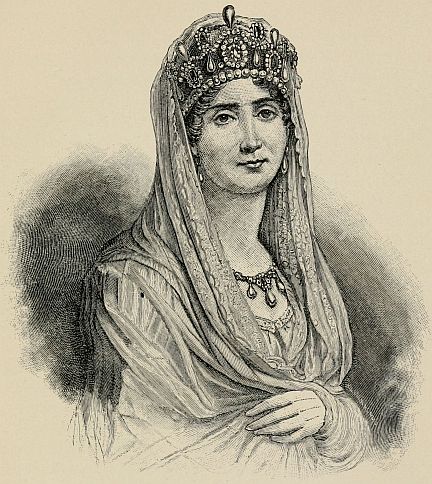
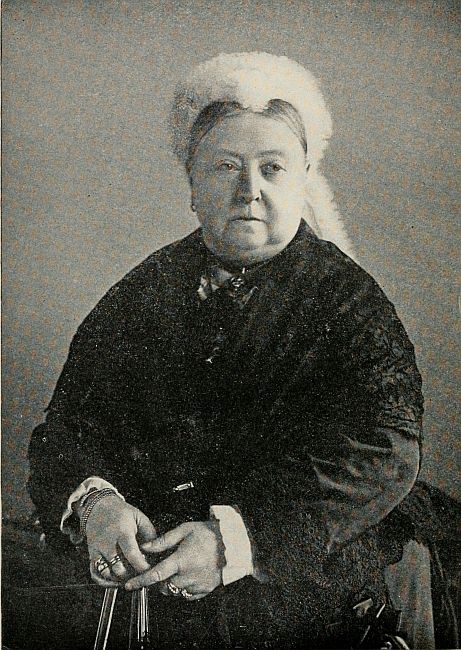
JOSÉPHINE.
EMPRESS OF FRANCE.
Never did she advise him to a false step; and history
has shown that, regarding those plans and deeds of
Napoleon, which results have proved to have been unwise
or grievous mistakes, the gentle voice of Josephine had
never failed to give prophetic warning.
As Napoleon stands forth pre-eminent amongst the
famous men of history, so does the name of Josephine
shine with undying lustre among those of the most celebrated
heroines of the world. We are dazzled by her
gorgeous state and magnificence as empress. We admire
her keen intellect and exquisite tact, which never
failed to suggest the most perfect and pleasing demeanor,
under every emergency, in a time of many unsettled
political opinions and tottering thrones. But we love the
gentle, unselfish woman, whose heart ever responded to
every call for sympathy; whose hand was ever open to
bestow benefits; and whose marvellous heroism could
support her in the midst of such terrible reverses and
peculiar trials as only a woman’s heart could suffer, and
only a woman’s love could endure.
In writing the history of Josephine, we are forced to
look upon the darker side of Napoleon’s character. From
the time he ceased to heed her loving voice,—the persuasive
sweetness of which, he himself acknowledged; declaring,
“that the first applause of the French people
sounded to my ear sweet as the voice of Josephine,”—from
that time, the hitherto invincible Napoleon made one
false step after another, allowing himself to be influenced
by ambitious flatterers and deceived by evil counsellors;
following the ignis fatuus of an overweening ambition
and thirst for power, which had taken the place of the
noble spirit of aspiring to the uplifting of his countrymen
and defending the sacred rights of the people, which
had actuated his former deeds, and covered his name with
the splendid glory and well-deserved honor which he had
before achieved.
But now even his transcendent genius and glorious
deeds of valor are to be tarnished by grievous mistakes,
and even crime.
The first false step taken, his downfall was as terrible
and rapid as his uprising had been sudden and glorious.
Already evil counsellors are whispering in his ear their
diabolical advice. Just here, with all our admiration for
Napoleon, we are amazed at him. That a man possessing
such great genius, and with such far-reaching intuitions,
should have allowed his mind and deeds to be
influenced by the base flatterers who surrounded him, is
strange indeed. That Napoleon should not have discovered
the Mephistopheles, in Fouché, is surprising; equally
amazing, that he should have become so blinded as to
turn from his truest friends and most unselfish advisers,
and have bared his breast to the poisonous fangs of the
wily serpents, who hissed around him like a nest of rattlesnakes.
That steadfastness of purpose which made Napoleon so
invincible in overcoming the most stupendous difficulties
when his cause was righteous, and which made him the
wonder of the world, became the greatest obstacle in his
way when his cause was wrong and his resolves pernicious.
The very element in his nature which made him transcendent
for good, rendered him also powerful for evil,
when his resolution had once been taken in a wrong direction.
His unconquerable will, which bore him upward
through the most overwhelming difficulties, and crowned
him with well-merited success, when his aspirations were
inspired by true patriotism and the laudable desire to
benefit his country,—that same unconquerable will became
his bane, and led him into the most lamentable
errors when his former high aspirations had been supplanted
by personal ambition and inordinate desire for
power.
We cannot give a consecutive history of Napoleon’s
errors and downfall in this sketch, but they will appear
from time to time, as we trace a short outline of the life
of Josephine. We do not pretend to say that Josephine
always consciously guided Napoleon’s career and moulded
the events of his life. His own genius raised him to his
exalted position, we admit; but we do contend that with
Josephine he prospered, and without her he fell.
And according to many authorities, it was Josephine’s
bridal gift to him that gave him the command of the
army of Italy; for it was Barras who recommended Bonaparte
to the convention; and it was Barras who assured
Madame de Beauharnais that if she married General Bonaparte
he would contrive to have him appointed to that
command.
We have space but to give two scenes in the life of
Josephine before she became Madame Bonaparte. The
former occurred upon the island of Martinique, when
Josephine was a young girl; the latter, after she had
become Vicomtesse de Beauharnais.
One day, when Josephine was about fifteen years of
age, she was walking through the spacious grounds of her
uncle’s West Indian plantation, in the island of Martinique,
when she observed a number of negro girls gathered
around an old woman who was engaged in telling their
fortunes. Josephine, with girlish curiosity, drew near;
whereupon, the old sibyl seized her hand, and, reading the
lines there, appeared to be greatly moved.
“What do you see?” inquired Josephine.
“You will not believe me if I speak,” answered the
fortune-teller.
“Speak on, good mother,” said Josephine; “what
have I to fear or hope?”
“On your own head be it then; listen,” said the old
sibyl.
“You will be married soon; that union will not be
happy; you will become a widow, and then,—you will be
queen of France! Some happy years will be yours; but
you will die in a hospital, amid civil commotion;” after
saying which, the old woman speedily disappeared.
Josephine thought little of this matter at the time, and
only laughed about it with her friends; and when she was
residing at Navarre, after the divorce, she thus commented
upon it:—
“On account of the seeming absurdity of this ridiculous
prediction, I thought little of the affair. But afterwards,
when my husband had perished on the scaffold, in spite
of my better judgment this prediction forcibly recurred
to my mind; and though I was then myself in prison,
the transaction assumed a less improbable character, and
when I, myself, had been also condemned to die, I comforted
my companions, who were weeping around me, by
smilingly exclaiming:—
“‘That not only should I not die, but that I should
become Queen of France’.
“‘Why then do you not appoint your household?’ asked
Madame d’Aiguillon, who was also one of the prisoners
of the Revolution.
“‘Ah! that is true,—I had forgotten. Well, my dear,
you shall be maid of honor; I promise you the situation.’
“Upon this the tears of those ladies flowed more abundantly;
for they thought, on seeing my coolness at such
a crisis, that misfortune had affected my reason. Such,
ladies, is the truth about this so celebrated prophecy.
The end gives me but little inquietude. I live here peacefully
in retirement; I have no concern with politics; I
endeavor to do all the good in my power; and thus I
hope to die calmly in my bed.”
After the death of the Vicomte de Beauharnais on the
scaffold, his wife Josephine, who had also been imprisoned
by the Jacobins, was at length condemned to die.
A few days before her terrible doom was to have been
sealed, Josephine and Madame de Fontenay, also a prisoner,
were standing together at the barred window of their
prison. M. Tallien, a man of much influence with the
rising power which was opposing the tyranny of Robespierre,
was in love with Madame de Fontenay, and daily
walked past the convent of the Carmelites, where Josephine
and the other ladies of high birth were imprisoned.
Observing M. Tallien, Madame de Fontenay made a
sign for him to draw near, and she then dropped from the
window a piece of cabbage-leaf, in which she had enclosed
the following note:—
“My trial is decreed; the result is certain. If you
love me as you say, urge every means to save France
and me.”
Roused by the danger of her whom he loved, M. Tallien
proceeded to the convention, and making an impassioned
and eloquent speech, denouncing Robespierre, he turned
the tide of popular opinion against the tyrant, and in a
short time Robespierre’s head fell under the bloody guillotine,
where he had already caused so many thousands to
perish.
The manner in which Josephine received the news of
her enemy’s death was strange and interesting. It was
the day before that upon which it had been decreed that
Madame de Beauharnais should be put to death. Josephine
was standing at the window of her prison, calmly
gazing upon the outward world, while her fellow-prisoners
were weeping around, overcome with the thought of the
terrible doom which awaited their loved friend. But
Josephine’s fortitude did not desert her, and she was endeavoring
to comfort her mourning companions, when her
attention was arrested by a woman in the street below,
who seemed trying to give her some information by various
strange signs.
At first the woman held up her robe, pointing to it
several times. Josephine called out through the grated
window, “Robe?” and the woman eagerly made a sign
of assent; and picking up a stone, which in French is
pierre, she held it up. Josephine cried out, “Pierre?”
and the woman joyfully nodded, and then pointed first to
her robe and then to the stone. Whereupon Josephine
wonderingly exclaimed, “Robespierre?” and the woman
again assented with every mark of delight, and continued
to draw her hand around her throat, making the signs of
cutting off a head. The glad cry soon resounded through
the prison, “Robespierre is dead!”
Thus was the axe lifted from the neck of Josephine,
and she soon walked forth free, saying smilingly to her
friends:—
“You see I am not guillotined; and I shall yet be queen
of France!”
Thus not only had the life of the future empress of
France, but the fate of that great kingdom itself, depended
at one time upon a tiny cabbage-leaf, thrown by
the hand of a feeble woman.
After Josephine de Beauharnais was betrothed to General
Bonaparte, on one occasion she requested him to
accompany her to the residence of M. Raguideau, an old
lawyer, who had long been her confidential friend and
adviser, that she might inform him of her coming marriage.
On arriving at the lawyer’s office, Josephine withdrew
her hand from the arm of Bonaparte, and requested
him to wait for her in the outer apartment until she had
spoken with her old friend alone. Neglecting, however,
to close the door which separated the two offices, Bonaparte
was able to overhear the conversation between his
intended bride and the old lawyer.
“M. Raguideau,” said Madame de Beauharnais, “I
have come to inform you of my approaching marriage.”
“And with whom, madame?” exclaimed the astonished
lawyer.
“I am about to marry General Bonaparte, sir.”
“General Bonaparte, do you say? Pshaw, madame! a
soldier of fortune, who has his way to make.”
“He will make it, my good friend!” replied Josephine,
with flushed cheeks.
“When, and how?” was the incredulous retort. “But
first, what is he worth at present?”
“Nothing, save his house in the Rue Chantereine.”
“A shed! A likely fortune, indeed! And so you are
really resolved to marry this adventurer?”
“I am.”
“So much the worse for you, madame.”
“Explain yourself, sir!” said Josephine, with offended
dignity.
“Because, madame, you had much better remain a
widow than marry a paltry general, without either name
or prospects. You must assuredly be mad! Will your
Bonaparte ever be a Dumouriez or a Pichegru? Will he
ever be the equal of our great republican generals? I
have a right to doubt it. Moreover, let me tell you that
the profession of arms is worthless now; and I would
much rather know that you were about to marry an army-contractor
than General Bonaparte.”
“Every one to his taste, monsieur,” disdainfully replied
Josephine, stung to the quick by the contemptuous
tone of the old man, who had always heretofore been
fatherly to her. “You, sir, it would appear, regard marriage
merely as an affair of finance;” and she rose with
queenly dignity to take her leave.
“And you, madame,” broke in the excited and angry
old man, “you see in it only a matter of sentiment, and
what you, no doubt, call love. Again I repeat, all the
worse for you, madame! all the worse for you! I had
given you more credit for good sense than to suspect that
you would allow yourself to be dazzled by a pair of gold
epaulets. Reflect before you make such a sacrifice;
for rest assured, that if you are rash enough to persist in
this foolish scheme, you will repent your folly all the
days of your life. Who ever heard of a rational woman
throwing herself away upon a man whose whole fortune
consists in his sword and his great-coat?”
General Bonaparte had listened to this extraordinary
conversation with rising excitement; and when he heard
the words “sword” and “great-coat” so contemptuously
uttered, he sprang from his chair, with blazing eyes, forgetting
the presence of the astonished clerks; but, recovering
himself instantly, he sat down again, determined
not to expose himself to ridicule.
Josephine soon appeared, looking highly annoyed and
indignant, followed by the irate old lawyer; but Bonaparte,
giving him no time for further insult, drew the
hand of his betrothed within his arm, and, making a
silent and contemptuous bow, withdrew.
Josephine had no idea that Bonaparte had been an
unwilling listener; but she noticed his marked increase
of kind and courtly attention on the way home; and not
until the day of the coronation did either Josephine or
Raguideau entertain the slightest suspicion that their conversation
had been overheard by Bonaparte. On the day
of the coronation, when the emperor and empress were
about to proceed to the palace of the archbishop, Napoleon
sent one of his chamberlains to M. Raguideau, with
the command that the emperor desired his immediate
presence at the Tuileries. The astonished lawyer, arriving
with breathless haste, overwhelmed with mingled feelings
of fear and hope at such unexpected summons, was
ushered into the grand salon, where Napoleon, attired in
his royal robes, was conversing with Josephine, who was
also arrayed in her gorgeous coronation costume.
“Ah! here you are at last, M. Raguideau!” said
Napoleon, with a quizzical smile upon his imposing countenance;
“I am very happy to see you!”
“Sire,” began the trembling old man, not knowing
whether that august smile betokened promotion or decapitation.
“My good sir,” continued the emperor, not giving him
time to reply, “do you remember a day in 1796, when I
accompanied to your house Madame de Beauharnais, now
empress of the French?”—emphasizing the word “empress”
with all the depth of his magnetic voice. “Do you
remember the eulogy which you uttered on the military
profession, and the personal panegyric of which I was
the object? Well, what say you now? Were you a true
prophet? You declared that my fortune would always
consist of my sword and my great-coat; that I should
never make a name nor position, like Dumouriez or
Pichegru; and that Madame de Beauharnais was insane
to sacrifice herself to a ‘mere general.’ I have made my
way, nevertheless, as you perceive, and in despite of your
sagacious predictions. Think you that the ‘army-contractor’
would have bestowed a brighter boon upon his
wife, after eight years of marriage, than a crown, and
that crown the imperial diadem of France?”
As he ceased speaking, Napoleon lovingly raised the
hand of Josephine to his lips, while she looked with
amazement upon this bewildering scene. The poor old
lawyer, overwhelmed with consternation, stood trembling
in dumb despair; his eyes were cast upon the floor, and
his limbs shook as with an ague fit; while the emperor
gazed upon him with an amused smile, highly enjoying
his discomfiture. At last the frightened man stammered:—
“Sire, I could not foresee. Sire, did you really overhear?”
“Every word, M. Raguideau. You are aware that
walls have ears, and I owe you a severe reprisal; for, if
my excellent Josephine had listened to your advice, it
would have cost her a throne, and me the best of wives.
You are a great culprit, M. Raguideau!”
At those terrible words “reprisal” and “culprit,” the
poor old man turned pale as a corpse; his tottering limbs
almost refused to support his agitated form.
“How could I tell? how could I imagine?” he gasped
out; “I thought only of her, of her fatherless children.
I had loved them for years. I was anxious to see them
once more restored to prosperity and happiness.”
“I believe you,” said the emperor, touched by the
emotion of the gray-haired old man, who had been a
friend to his wife in her days of need; “you could not
tell; you could not foresee;” and for a moment Napoleon
paused, and then continued in more solemn tones, “the
future is beyond the grasp of any living man.” Then, resuming
his bantering way: “So, now, we will return to
the present; and, as I cannot altogether overlook the
injury which you sought to inflict upon me, I condemn
you to go this day to Nôtre Dame, and to witness the
ceremony of my coronation. Not in a corner, not behind
a pillar, which will prevent my having ocular evidence of
your obedience, but in the seat that I shall cause to be
retained for you. Do you hear, sir? I must see you
both in the cathedral and in the line of the procession.”
Transported with the overwhelming relief and the ecstatic
joy of such an honor, the poor old lawyer was
hardly able to express his gratitude, and could scarcely
maintain his dignity as he bowed himself from the royal
presence, and hastened to prepare for the coming august
ceremony.
Napoleon having jested with his wife over the abject
terror of the trembling culprit, the emperor and empress
entered their carriage, and proceeded to the archbishopric.
As they left the cathedral after the magnificent ceremony
of the coronation, Napoleon recognized the old lawyer in
the crowd; and as their eyes met the Emperor smiled graciously
upon his former enemy. The smile was answered
by so profound a bow, that Napoleon afterwards laughingly
declared to Josephine, “that for several seconds he
was in doubt whether the sage prophet of 1796 would
ever be able again to assume the perpendicular.”
During Napoleon’s campaigns, Josephine was at all
times in receipt of news from the army, brought to her
by couriers from Bonaparte. No matter at what time the
despatches arrived, day or night, she always received them
with her own hands, and made inquiries of the courier of
all in the army whom she knew. She would always say
some pleasant thing to him, and reward him with a more
or less costly gift, according to the importance of the news
received.
At one time, when Bourrienne had remarked to Josephine,
“Madame, I really believe that in spite of yourself
you will be made queen or empress,” Josephine
exclaimed: “Bourrienne, such ambition is far from my
thoughts. That I may always continue the wife of the
First Consul, is all that I desire.”
During the Prussian campaign, nothing was talked of
throughout Germany but Napoleon’s generous conduct
with respect to Prince Hatzfeld. Among the letters
seized at Berlin, and delivered to Napoleon, was one
from the prince to the king of Prussia, in which he revealed
the condition and strength of the French army.
The prince was arrested, and tried as a spy, and condemned
to death. The remainder of the scene is described
in Napoleon’s letter to Josephine, which is as follows:—
“I have received your letter, in which you seem to
reproach me for speaking ill of women. It is true that
I dislike female intriguers above all things. I am used to
kind, gentle, and conciliatory women. I love them, and
if they have spoiled me, it is not my fault, but yours.
However, you will see that I have done an act of kindness
to one deserving woman. I allude to Madame de Hatzfeld.
When I showed her her husband’s letter, she stood
weeping, and in a tone of mingled grief and ingenuousness,
said, ‘It is indeed his writing!’ This went to my heart,
and I said: ‘Well, madame, throw the letter into the fire,
and then I shall have no proof against your husband.’ She
burned the letter, and was restored to happiness. Her
husband now is safe; two hours later, and he would have
been lost. You see, therefore, that I like women who are
simple, gentle, and amiable; because they alone resemble
you.”
Josephine’s kindness and consideration for the comfort
of every one in her household, even down to the lowest
menial, was proverbial. When travelling with Napoleon,
a picket-guard was appointed by the emperor for her service.
One cold night, in the early dawn, she heard
marching and coughing under her window. She wondered
who could be out so late in the chill of that hour; and
upon inquiry, she learned that it was the sentinel posted
there. She thereupon sent for the officer of the guard,
and said to him, “Sir, I have no need of a sentinel at
night; these brave men have endured enough in the army
when they followed it to the wars; they must rest while
in my service. I don’t want them to catch cold.” The
officer, smiling at the apprehensive solicitude of the empress,
and touched by her unexpected kindness, dismissed
the sentinel, and his place was not supplied.
Napoleon is said to have talked but little. When out
of his own house, if he chanced to stop and speak with
any one, it was considered of enough importance to be
remarked and reported. The following is Josephine’s
portrait of Napoleon at home: “He had a fine intellect,
a sensible and grateful heart, simple tastes, and the qualities
of an amiable man; to the sentiments of an honest
man, he united a prodigious local memory.”
When Josephine spoke of her husband, she always said,
“The emperor says,” “the emperor wishes,” “the emperor
orders,” etc. She very rarely called him by name
in public, and in private she called him Bonaparte; while
her tender name for him was mon ami. When speaking
of her, Napoleon usually called her the empress, or
he would say, “I am going to see my wife”; but in addressing
her he called her Josephine, unless he spoke with
severity or on some serious occasion, when he called her
Madame, without other title or name.
It cannot be denied that Josephine had a great weakness
for extravagant jewels and adornments; but as she
dressed always with perfect taste and elegance, and as
she was as lavish in her bounties as she was in her personal
expenditures, she may be pardoned this feminine
weakness. She at least never offended the eyes of
admirers of good taste, and her pleasing person, so
becomingly adorned, was one of the most charming sights
of the court of the empire.
This was another cause of the jealousy of her sisters-in-law;
and even Pauline, the Bonaparte beauty, was often
most sorely chagrined to find her own boasted charms
thrown in the shade by the refined elegance and queenly
bearing of the emperor’s wife.
An amusing story is told of the mortification of this
proud beauty upon one grand occasion, when she had
resolved for once to outshine her hated sister-in-law.
Pauline, Madame Le Clerc, after wearing her widow’s
weeds for as short a time as possible after the death of
her first husband, General Le Clerc, had wedded a real
prince, and was accordingly to make her début at court
as Princess Borghèse.
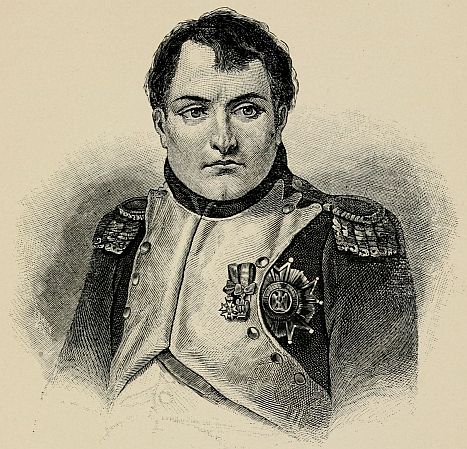
NAPOLÉON.
Pauline has kept her own counsel about her grande
toilette for that momentous occasion; but the rumor is
afloat that she intends to make a grand coup with her
gorgeous appearance, and quite extinguish her august
sister-in-law.
Josephine, having heard that she was to be crushed
into utter insignificance by the vain beauty, quietly determined
a little stratagem of her own. Confident of being
mistress in the art of dress, she accordingly resolved to
assume a costume which should delight by its very simplicity.
But a simplicity so artistically arranged that the
very splendor of her rival should but heighten the effect
of her own toilet. Her dress was of the finest Indian
muslin, bordered with gold and embroidery, and gracefully
draped to show the perfect elegance of her figure.
Her hair was dressed à la grecque, and banded with pearls,
while antique gems and pearls formed her sole ornaments.
“Ravissante!” exclaimed her ladies, as she entered
the salon; and even Napoleon’s usual gravity relents, as
he cries:—
“Josephine, je suis jaloux! Tu es divine!” and he
kisses her on the forehead, pinching her ear laughingly,
which was his favorite manner of bestowing a gracious
caress.
The time passes, but no princess. Napoleon impatiently
retires from the salon; his time is too precious to
wait longer the “official visit,” as he calls it, of the prince
and princess.
At length the clatter of horses’ hoofs is heard. A carriage
grand enough, with its gilding and emblazonry, to
have borne the Grand Monarque himself, dashes into the
Cour d’Honneur of St. Cloud.
Six gayly caparisoned horses are harnessed to this gorgeous
vehicle, and a large retinue of outriders surround
it, bearing torches. On the grand staircase are stationed
the entire staff of domestics to receive their princely
guests.
Presently the huissier opens the doors of the salon,
and announces with becoming grandiloquence:—
“Monseigneur le Prince, and Madame la Princesse
Borghèse.”
The grande entrée is made with imposing hauteur, and
Pauline sees with satisfaction that she has made a sensation.
But her vain heart is ruffled because she is obliged
to cross the room to Josephine, instead of being met by
her, as la grande princesse had of course expected.
But she comforted her wounded pride with the thought
that this promenade would give her the opportunity to
display her velvet train embroidered with diamonds.
Pauline was indeed magnificent. Her costume was a
pale green velvet embroidered with gold, and thickly
sprinkled with flashing brilliants. The front of her dress
was a tablier of diamonds, with diamond stomacher, and
the same glistening jewels upon her sleeves. Her handsome
head was adorned with a diadem of emeralds and
diamonds, and the same gems sparkled upon snowy arms,
wrists, and throat. In fact, she was loaded with the entire
wealth of diamonds possessed by the princely family
of Borghèse; and as it was reported that when she came
back from St. Domingo, where her former husband died,
she had guarded carefully a coffin, containing the supposed
remains of her late husband, but in reality filled
with diamonds and other precious stones. If this was
true, Pauline doubtless had diamonds of her own to add
to the vaunted store of the family of her second princely
husband.
Be that as it may, Pauline flashed in diamonds from
head to foot; nay more, even to the end of her gorgeous
train, where the same rich jewels also sparkled.
She was indeed dazzling!
Josephine and Pauline are at length seated side by
side. The proud princess is forced to acknowledge that
Josephine’s toilet is charming; and all beholders are confirmed
in their opinion that Madame Bonaparte’s taste is
faultless.
But horrors! What has happened? Pauline, la princesse,
has grown pale as death. Is she ill? Oh! worse
than that. Oh, awful catastrophe! Pauline, gazing into
a large mirror before her, expecting to be ravished with
her own beauty, perceives this dreadful fact. The furniture
and draperies of the newly furnished salon, while
giving full effect to Josephine’s costume, actually transform
herself into a hideous spectacle. Wearing a green
velvet gown, she has seated herself upon a blue velvet sofa!
It is positively too shocking for her nerves to endure.
Had her boasted triumph encountered such ignominious
defeat? Hastily rising, she made her adieus, and departed
to weep in mortified chagrin and baffled pride.
Poor Pauline! kind-hearted Josephine had not intended
to achieve such an unexpected triumph.
The Empress Josephine was very generous to her attendant
ladies, often making them costly presents. As
she frequently gave them handsome costumes and pretty
novelties which she had worn but once or twice, the
ladies at length entered into quite a trade with certain
Jews, who came to the court to display their merchandise.
As the robes of the empress were often too rich for the
ladies who received them to wear themselves, they exchanged
them for piece-goods, which the Jewish merchants
brought for sale. These garments of the empress became
quite the rage; and at one ball, Josephine might have
beheld the ladies in an entire quadrille, arrayed in her
cast-off robes. Even princesses were frequently the purchasers
of these gowns from the Jews, who had obtained
them in exchange for the merchandise with which they
had supplied the ladies of Josephine’s court.
At one time an ambassador arrived from Persia, bringing
very magnificent presents to the Emperor Napoleon
and costly cashmeres to Josephine. For some time his
Persian Excellency was all the rage, and the ladies of the
French court vied with each other in endeavoring to show
attention to these eastern guests. The parties given by
the Persian ambassador and his suite, at their residences,
were largely attended, and much curiosity was evinced to
partake of the foreign tea and queer cakes offered by
their Persian hosts.
The empress at length determined to attend one of
their parties incognito, being accompanied by several of
her ladies. On being introduced to the ambassador,
Josephine received a gracious smile, and the Persian presented
her with a small bottle of attar of roses, a kind of
present which, among the Persians, denoted a mark of
high honor and respect.
Josephine tasted several mysterious Persian dishes, and
expressed admiration of his Excellency’s pipe, which was
brought to him by two slaves, who kneeled when they
offered it to their august master. Josephine noticed that
the tips of his Excellency’s finger-nails were colored with
different tints.
The ambassador being impressed with the manner and
grace of the empress, invited her to be seated by his side
on his divan. She graciously declined the attention, saying
that such an honor belonged only to privileged persons,
fearing that her identity would be made known.
The Persian then asked, through his interpreter, if she
would be willing to go and reside with him in Persia,
promising that he would give her a high position.
Scarcely restraining her mirth, Josephine replied that
she was married and had two children, and that her duty
and interests would keep her in France. And with as
much haste as courtesy would allow, the empress and her
ladies retired from the presence of their Persian host.
On the day of the ambassador’s public presentation
at court, Josephine, arrayed in all her imperial magnificence,
received him with a gracious smile. The poor,
dumfounded Persian, who recognized in the empress
the woman whom he had vainly tried to captivate, was
completely amazed, and his manner and attitude expressed
his astonished mortification.
But Josephine, with winning smile, quickly relieved
him of his embarrassment, saying, in her sweet persuasive
tones:—
“You must admit, Monsieur l’Ambassadeur, that I had
good reason for telling you that I preferred to remain in
France. If you think well of me, you will remain faithful
to that beautiful wife of yours.” And with a sign of
respect, the humiliated Persian withdrew.
At Josephine’s early receptions as wife of the First
Consul, the costumes of the guests were very heterogeneous
in style. The fashions of the Republic had been copied
after ancient Greek and Roman styles; and the ladies of
the Republic flaunted their Grecian tunics and Roman
sandals with great pride. But after a time it was
remarked “that military boots and pantaloons, clanking
swords and cockades, were in a considerable minority,
and that silk stockings, shoes with buckles, dress swords,
and chapeaux sous le bras were the rule. Some of the
company had, however, endeavored to spare their feelings
too complete a shock, by an attempt to unite the past and
the present. While returning to powder and embroidery,
lace ruffles and cravats, they contrived to retain in their
costumes some reminiscence of the fast vanishing and
much regretted ‘sans-culottism’ of the Republic. This
resulted in amusing and startling incongruities.”
But during the empire, Napoleon was particular about
the etiquette of his court. He regarded it as the chief
barrier of the throne, and of great importance. He
caused an exact account of all the ceremonies in use at the
courts of Louis XIV. and Louis XV. to be drawn up, and
he directed the most scrupulous attention to be paid to their
performance. Josephine was sufficiently a daughter of
the Revolution to smile at too strict etiquette; she said:
“It was perhaps appropriate for princesses, born to the
throne and accustomed to the restraints it imposes; but
she, who had lived so many years as a private person,
ought, she considered, to be less exacting, less severely
punctilious in her intercourse with those who knew and
remembered the circumstances of her former life.” “And
although she learned to wear her crown and mantle of
state and to sit on her throne right royally, she was ever
unfailingly indulgent in the matter of etiquette, and always
pleased to throw aside its restraints.”
After the imperial decree had ennobled many to whom
the mysteries of the court had hitherto been sealed books,
very amusing incidents occurred. The Faubourg St. Germain
resented the indignity which had been offered to
their patrician prejudices; and the newly created nobles
were often treated with superb disdain by those entitled
to such rank from birth.
“The Duchesse de Chevreuse desired her waiting-woman
to inform her laundress that she should no longer
intrust her with her linen, until she became a countess;
and the Comte de Brissac addressed a note to his boot-maker
as follows:—
“‘My dear baron! do not fail to bring me my boots to-morrow.’
And when on the next day the astonished
tradesman assured him that he had been the recipient of
no such title, De Brissac exclaimed with elegant impertinence:
‘Can this be possible? You really astonish me!
Console yourself, however, Maizenat; for rest assured
that you will be included in the next baking.’”
But it was hardly to be wondered at, perhaps, that the
old nobles sneered at some of these new-titled persons,
whose own presumptuous pride made them fit subjects for
mirth. This throng of new courtiers, most of whom had
sworn eternal hatred to kings and royalty, now danced
attendance at the levées of the emperor, and vied with
each other to obtain a look or word from his imperial
highness, that they might repay him for it with the pompous
titles of “Sire,” and “Your Majesty,” which they did
with an air of self-gratulation, which appeared as if the
individual considered himself to be ennobled by the privilege
of merely uttering the magic words. Among the
strange actions related of some of these “newly baked
dignitaries,” one or two are quite amusing.
The wife of a marshal purchased several dresses of old
brocade, such as were worn at the Court of Louis XV.,
and kept them spread out upon chairs in the hall leading
to her bedroom, as if placed there to air. When her
curious visitors asked her what she was going to do with
them, she replied with apparent carelessness, under
which lurked much pompous pride: “Do with them?
Oh! nothing at all; but they belonged to my grandmother,
and I wish to keep them as long as I can for her
sake.”
Books on heraldry brought fabulous prices; and the
father behind his counter, and the mother at her wash-tub,
were entertained by their pretty daughters, endeavoring
to master the high-bred French titles of the ancien régime.
One soap-dealer, whose daughter had married an officer
in the army, and had embellished the panels of her carriage
with a gloved hand grasping a sword,—the military
crest of her husband,—innocently thanked his daughter
for having tried to copy the golden arm which figured
above his shop-door; though he regretted that she should
have had it painted to look like iron, and generously
stated that had he known of it, he would willingly have
paid the difference of cost himself.
The return to Paris of several grandes dames promised
a gradual reorganization of “la bonne compagnie,”
and several of the contractors’ wives were ambitious to be
received in the Faubourg St. Germain; and one of them,
Madame Privas, who was desirous of opening her salon to
the beau monde, having read Madame de Genlis’ work,
“Adèle et Théodore,” at once exclaimed to her husband:
“Privas! this is the lady for us.” Whereupon
Madame Privas arrayed herself in resplendent robes, and
attended by a negro servant in Moorish costume, she
entered her gorgeous carriage and proceeded to take
Madame de Genlis by storm.
She had not the least doubt of the success of her
errand, which was no less than the attempt to secure
Madame de Genlis, who had returned to Paris in pinched
circumstances, to come to her magnificent hotel in the Rue
St. Dominique, and as a lady, receive for her: in short,
put her in the way of learning the old etiquette with which
she should honor people who were quite comme il faut.
And so with pompous brusqueness she announces the
object of her visit to Madame de Genlis. She would give
her a salary of twelve thousand francs. She would promise
not to tyrannize over her, and even if she had a dear
friend she also would be welcome. What more could she
require?
“Madame, I thank you for your obliging offer, which I
have the honor to inform you it is not in my power to
accept,” replied Madame de Genlis, rising with the
courtly manner of a grande dame of the court of the
Grand Monarque.
“You refuse it!” cried Madame Privas in astonishment.
“Why, I offer much more than you can get for your
books. And besides, you would have friends in us;—friends
with a fortune of five millions. C’est beau, ca!
eh?”
“Madame,” replied Madame de Genlis, “I have
answered you. It is impossible.”
“Well, adieu then, my bonne dame. Privas and I
made sure you would jump at the offer. In case you
should change your mind, I’ll leave you my address.
Write me, if you think better of it.” And with her plumes
waving in ruffled pride, and her velvets and satins rustling
in their gorgeous costliness, Madame Privas bounced out
of the room, forgetting her assumed elegance of manner
at the affront offered to her darling dollars.
Josephine’s manners, “en representation,” were charming.
She appeared a very queen at the emperor’s public
receptions. Her air and attitude were dignified, graceful,
and yet natural. She conversed with ease and fluency,
employing the choicest terms of expression; and the spectator
could not resist a pleased astonishment at the gracious
bearing which charmed all classes of society, and
at her alluring tact which enabled her to address crowds
of persons in quick succession, and yet with a pleasing
and appropriate word to each, turning with equal ease
from a tradesman to a monarch.
The emperor was one day about to undertake some important
business, when Josephine besought him to put it
off for a time, remarking that it was Friday, which was
regarded as an unlucky day. Napoleon replied: “’Tis
so perhaps to you, Madame, but it is the most fortunate
in my life. I never shall forget that it was the day of
our marriage.” The empress was deeply touched at this
mark of devotion from her husband, and she ceased to
enforce her request.
The time for the coronation ceremony had arrived.
Josephine felt the solemnity as well as the grandeur of
the occasion, as is evinced from these few lines written to
Pope Pius VII. at this time:—
“Ah! truly do I feel, that in becoming empress of the
French, I ought also to become to them as a mother at
the same time. What would it avail to bear them in my
heart, if I proved my affections for them only by my intentions?
Deeds are what the people have a right to
demand from those who govern them.”
And truly, Josephine exemplified her words by her
actions.
On the 2d of December, 1804, all was stir in Paris and
the Tuileries from an early hour.
“On this morning, which was to witness the completion
of her greatness, Josephine rose about eight o’clock, and
immediately commenced her momentous grande toilette.
The body drapery of the empress was of white satin,
beautifully embroidered in gold, and ornamented on the
breast with diamonds. The mantle was of crimson velvet,
lined with satin and ermine, studded with golden
bees, and fastened by an aigrette of diamonds.
“The coronation jewels consisted of a crown, a diadem,
and a ceinture. The first used for the actual crowning,
and worn only on state occasions, consisted of eight
branches, four wrought in palm, and four in myrtle leaves
of gold, incrusted with diamonds; round the circlet ran a
corded fillet set with eight very large emeralds, and the
bandeau which immediately enclosed the head, shone with
resplendent amethysts.
“The diadem worn before the coronation, and on the
more ordinary state occasions, was composed of four rows
of the finest pearls interlaced with foliage of diamonds,
the workmanship of which equalled the materials; in
front were several brilliants, the largest weighing one
hundred and forty-nine grains. The ceinture was of gold,
so pure as to be quite elastic, enriched with thirty-nine
rose-colored diamonds.
“Napoleon’s coronation robes were equally magnificent.
His close dress was of white velvet, embroidered in gold,
with diamond buttons; his stockings of white silk, the
gussets wrought in gold, harmonized with the buskins of
white velvet laced and bordered with gold; his upper
garment, as also the short mantle, were of crimson velvet,
richly embroidered in gold, with diamond fastenings.
This mantle was similar to that of the empress, but much
heavier, weighing upwards of eighty pounds.
“‘All very fine, Monsieur le Drôle,’ said Napoleon, to
his favorite valet, playfully pinching his ear; ‘all very
fine; but we shall see the accounts.’
“At eleven precisely the cavalcade moved from the
Tuileries towards Nôtre Dame. The imperial carriage,
drawn by eight bays, had been constructed with the entire
panelling of glass, a circumstance which accounts for the
mistake made by their Majesties, who first seated themselves,
like criminals, with their backs to the horses.
Josephine was the first to discover this error, which she
instantly rectified by lightly assuming the proper position
saying at the same time to the emperor:—
“‘Mon ami, unless you prefer riding vis-à-vis, this is
your seat,’ pointing to the rich cushion on the right. Napoleon,
laughing heartily at his blunder, moved to the
place indicated.
“The procession advanced, attended by ten thousand
horsemen, the flower of ‘Gallic chivalry,’ who defiled
between double lines of infantry, selected from the bravest
soldiers, and extending above a mile and a half; while
more than four hundred thousand spectators filled up
every space whence a lance could be obtained.
“The thunders of innumerable artillery, the acclamations
of the assembled multitude, expressed the general enthusiasm;
and, as if to light up the gorgeous spectacle, the
sun suddenly broke through the mists which till then had
hung heavily over the city. The cortège stopped at the
archiepiscopal palace, whence a temporary covered gallery,
hung with the banners of the sixteen cohorts of the Legion
of Honor, conducted into the interior of the cathedral
and to the throne.
“To this latter was an ascent of twenty-two semicircular
steps, covered with blue cloth, gemmed with
golden bees, and crowded with the grand officers of the
empire.
“On the throne itself, hung with crimson velvet, under
a canopy of the same, appeared Napoleon, with Josephine
on his left, attended by the princesses of the empire, and
on his right his two brothers, with the archchancellor and
archtreasurer.
“The religious ceremony continued nearly four hours,
enlivened by music composed for the occasion, and sung
by more than three hundred performers. The martial
band was still more numerous, which executed in the intervals
marches afterwards adopted and still used in the
armies of France.
“Napoleon, in the midst of the ceremony, stood up and
laid his hand upon the imperial crown,—a simple diadem
of gold wrought into a chaplet of interwoven oak and
laurel,—and placed it on his own head. Afterward, Napoleon
took the crown destined for the empress, and, first
putting it for an instant on his own, placed it upon his
consort’s brow, as she knelt before him on the platform of
the throne.
“The appearance of Josephine was at this moment
most touching. Even then she had not forgotten that she
was once an ‘obscure woman’; tears of deep emotion
fell from her eyes; she remained for a moment kneeling,
with hands crossed upon her bosom, then, slowly and
gracefully rising, fixed upon her husband a look of gratitude
and tenderness. Napoleon returned the glance. It
was a silent but conscious interchange of the hopes, the
promises, and the memories of years.
“Cardinal Fesch, as grand almoner of France, now
placed the Gospels on the throne; Napoleon stood up,
laid his hand on the sacred volume, and in his deep and
solemn tones pronounced the oaths with such firmness
and elevation of voice, that each word was distinctly
heard by the vast assembly.
“Shouts of ‘Long live the emperor! God bless the
empress!’ resounded through the cathedral, and were
caught and repeated by the multitude without; the organ
pealed forth Te Deum, and the imposing ceremony was
over.
“The cortège re-entered the palace at half-past six in
the evening. Josephine retired to her closet to give vent
in secret to the fulness of her heart, and to implore the
protection of Him by whom kings reign.”
Josephine’s mode of life after she became empress is
thus described: “At the Tuileries, at St. Cloud, and during
the grand journeys of the court, her habit was to rise
at eight in the morning, and commence her toilet. While
her hair was being dressed, she would glance over half a
dozen journals, and receive her modistes, or such other
persons as she could not admit into the salon. When she
was fully dressed, which operation lasted ordinarily about
an hour, she would pass into the salon at ten or eleven
o’clock, where she found the dames de service and those
whom she had invited to breakfast with her. At noon
she sat at table at least an hour. Breakfast was in some
sort her only meal, for, on leaving her bed, she was in the
habit of taking nothing but a cup of tea with a little
citron. I do not speak of her breakfasting with the
emperor; for he was always so engaged that he scarcely
had time to eat. After breakfast, if the weather was
good, she would ride out in a calèche, and go to Malmaison
or on a hunting party.
“In case she did not go out, she received calls from all
such persons as had obtained the promise of a meeting, of
which she was advised either by the dame d’honneur, or
the chamberlain de service. These two functionaries could
introduce only such persons as the empress was unacquainted
with, or knew but slightly, whilst all the ladies
who were admitted to her court came whenever they
pleased, without a card of invitation, unless there was a
concert or a spectacle,—a matter appertaining to the emperor’s
chief chamberlain.
“From breakfast until four o’clock, Josephine would
receive two or three private visits in her separate apartment,
or repose upon a sofa; at four she retired to her
cabinet, undressed, went to reading, and took a little refreshment.
This lasted till five, when a second toilet
commenced. She rarely received a call at this time,
because it was the hour at which the emperor came, unless
engaged in council.”
M’lle Avrillion, femme de chambre of the Empress
Josephine, tells several amusing stories regarding these
visits of Napoleon while his wife was making her grande
toilette; and the many suggestions he made as to the becomingness
of certain attire, and his marked antipathy to
some styles. The poor femme de chambre dreaded these
visits as much as Josephine enjoyed them, for the emperor
would always turn the entire wardrobe topsy-turvy
in making the selections of his favorite costumes, and the
jewel-caskets would suffer equal disarrangement. On one
occasion, when Josephine had unconsciously donned an
attire displeasing to the taste of her husband, he ruthlessly
spattered ink upon the obnoxious gown, so that the amiable
empress was obliged to remove the offending robe,
and array herself to please her particular lord.
The emperor and empress usually dined together alone
at six o’clock, and afterwards Josephine again entered
the salon, where she found the dames de service. In the
evening, the ministers, marshals, generals, and others
made their calls. Josephine conversed with ease with
every one, now and then playing a game of backgammon
or whist. If the emperor came in, which was never
before nine o’clock, he remained only about a quarter of
an hour, unless he wished to form a party at play, and
then he would appoint the persons to compose it. His
party always consisted of ladies, never of gentlemen.
But woe betide his partner! for such was the preoccupation
of his mind that he paid no attention to the card he
was playing, and did not notice his mistakes. No one
dared to make any remark upon his mode of playing.
After going through with this kind of game, the emperor
left the apartment, Josephine meanwhile remaining in
the salon until it was time to retire.
At Malmaison, the only difference in her mode of life
was that she saw somewhat less company, and spent much
time in walking through the delightful grounds of this
rustic retreat. She had established at Malmaison a
botanical garden, a menagerie, and a school of agriculture.
Josephine preserved her simple tastes and her love
for rural life even after she became empress. One of her
greatest delights was the embellishment of her beautiful
gardens. She was well versed in botany and natural
history, and France and Europe are indebted to her for
the camellia. Napoleon’s happiest days were spent at
Malmaison; and after the divorce, he continued to visit
Josephine at this retreat. He would lead her into the
park, remain an hour or two, bring her back to the salon,
and then get into his carriage. She received him with
perfect politeness and dignity of manner, going forward
to meet him; and when he left, accompanying him to the
door of the vestibule.
The appearance of Josephine after she became empress,
is thus described: “Her features were small and finely
modelled, the curves tending rather to fulness and the
profile inclining to Grecian, but without any statue-like
coldness of outline. The habitual character of her countenance
was a placid sweetness, which perhaps would
have given at first an impression of lack of energy. But
this could have been for an instant only, for the real
charm of this mild countenance resided in its power of
varied expression, changing with each vicissitude of
thought and sentiment. ‘Never’ says a very honest
admirer, ‘did any woman better justify the saying, The
eyes are the mirror of the soul.’ Josephine’s were of
a deep blue, clear and brilliant, even imposing in their
expression when turned fully upon any one; but in her
usual manner they lay half concealed beneath their long
and silky eyelashes. She had a habit of looking thus
with a mild, subdued glance upon those she loved, throwing
into her regard such winning tenderness as might not
easily be resisted; and even in his darkest moods, Napoleon
confessed its tranquillizing power. Josephine’s long
hair ‘was glossy chestnut brown,’ whose sunny richness
harmonized delightfully with a clear and transparent complexion
and neck of almost dazzling whiteness. Her eyebrows
were a shade darker, arching regularly, and pencilled
with extreme delicacy. The perfect modulation of her
voice constituted one of her most pleasing attractions, and
rendered her conversation extremely captivating.”
It was difficult for Napoleon ever to resist the persuasive
voice of Josephine.
On the eve of Napoleon’s departure for Germany, in
April, 1809, having taken leave of Josephine, she had retired
to her apartment, and thrown herself upon her bed
in deep distress, because she could not obtain his consent
to allow her to accompany him to Strasburg.
The emperor, returning unexpectedly to her room at
the last moment, said to Josephine:—
“You have played the part of empress long enough;
you must now become again the wife of a general. I
leave immediately; you will accompany me to Strasburg.”
Josephine herself thus tells the story:—
“I was not at all prepared for the journey, for only a
few days before he had refused to permit me to accompany
him on the campaign. At three o’clock in the
morning we were travelling speedily on the Alsace road.
My husband scarcely gave me time to throw on a night-cloak,
and all my women had left the château en déshabillé;
so that when morning came, the officers who accompanied
us could scarcely preserve their gravity at seeing
us in such a plight. Napoleon was extreme in every
thing, and it was never until the decisive moment came
that he expressed his final resolution. I had been so long
accustomed to his singular character, that I ceased to be
astonished at the striking contrasts which it exhibited.
Our journey was full of gayety; we met sundry original
characters on the way, who furnished us abundance of
amusement. We arrived at Strasburg. My husband had
a secret presentiment that he should return victorious.
He said to me, on leaving me:—
“‘Josephine watches over all that I love, and my
guardian angel will never cease to utter her prayers for
the safety and success of her husband.’
“He knew me well, that mortal whose astonishing
destiny had opened to him the road to the most splendid
throne on earth. I cherished not a thought, I formed not
a wish, which was not directed to his glory. If certain
political drones have dared accuse me of levity in my
conduct, let those unjust censors remember that it was
under the mask of sincere friendship that I sought to
overawe certain powerful personages. Had I regarded
them with an eye of indifference, they might have surrounded
Napoleon with perils from which no human prudence
could have rescued him. Often did I, in concert
with him, carry on a correspondence. I flattered all parties,
for I love to do justice to all. When Napoleon supposed
he had grounds of complaint against any of his
military officers, I warmly pleaded their cause. He would
tell me:—
“‘It depends only on me whether I will be rid of that
officer. I have only to pronounce his doom.’
“‘You are right,’ I would reply; ‘you are right; but
such language does not become your generous and noble
nature.’
“‘And who can oppose me in it!’ was his quick reply.
“‘Yourself, Napoleon. ’Twould arm against your
person a multitude of brave men who are necessary to
you. Certainly, a great man should fear nothing; but
he captivates all hearts when he pardons. The first
function of kings and the firmest pillar of a throne is
justice.’”
Thus Josephine’s influence was always on the side of
mercy and justice. She possessed the most perfect tact,
which rendered her address irresistibly winning when
partisans were to be gained for Napoleon. She was entirely
engrossed in the welfare and glory of him to whom
her heart was most unselfishly devoted and loyal. She
gained for him friends on every side; as Napoleon himself
acknowledged, saying, “I conquer empires; but Josephine
wins hearts.” Bonaparte was never so prosperous,
so well-served, and so well-beloved, as during the years
when he was blessed with the counsels and aided by the
adoring love of the faithful woman, who was always his
best adviser and most constant friend.
When on one occasion Josephine warned Napoleon to
be on his guard against the advice which might be given
him by his flatterers, he replied:—
“You are right, Madame, I know how to guard myself
against all their influences. You are my wife and friend.
I want none other. Your lot is bound to mine forever;
and woe to that one of us who shall be the first to break
our oath.”
And yet in 1809, he could not guard himself against
the “bees” of his court, who hummed in his ears:—
“You must separate from the Empress Josephine. A
princess of the blood of the Cæsars will esteem it a glory
to give heirs to the great Napoleon. Then will his dynasty
be established forever.”
The divorce in 1809 was brought about by the joint
efforts of all the members of the Bonaparte family, aided
by some of Napoleon’s most confidential servants, whom
Josephine, either as Madame Bonaparte, or empress, had
failed to make her friends, notwithstanding her ceaseless
endeavors to harmonize all the hostile elements around
her. Even as early as the time when Napoleon was in
Egypt, these intriguers first tried to lay snares for the
unsuspicious and magnanimous Josephine, and various
scandals were originated and reported to the absent
Bonaparte.
Junot was made their tool either willingly or unwillingly,
and the evil whispers became louder and louder. During
the first months of the Egyptian expedition, Bonaparte’s
letters to his wife were affectionate and confiding. But
the poison was soon at work, and the rumors which Junot
had repeated to Bonaparte roused his jealous anger.
Poor Josephine knew naught of these dread scandals,
until the letters received from her husband, accusing her
of errors of which she was guiltless, stabbed her to the
heart. Her appeals against these injurious aspersions
were in accordance with her own noble nature. We can
only quote a few lines from her letter to Napoleon:—
“Can it be possible, my friend? Is the letter indeed
yours which I have just received? Scarcely can I give it
credence, on comparing the present with those now before
me, and to which your love gave so many charms! My
eyes cannot doubt that those pages which rend my heart
are too surely yours; but my soul refuses to admit that
yours could have dictated those lines, which to the ardent
joy experienced on hearing from you have caused to succeed
the mortal grief of reading the expressions of a displeasure,
the more afflicting to me that it must have
proved a source of fearful pain to you.
“I am entirely ignorant in what I have offended, to
create an enemy so determined to ruin my repose by interrupting
yours; but surely it must be a great reason
which can thus induce some one unceasingly to renew
against me calumnies of such a specious nature as to be
admitted, even for a moment, by one who hitherto has
deemed me worthy of his entire affection and confidence.
“Oh, my friend! in place of lending an ear to impostors,
who, from motives which I cannot explain, seek
to ruin our happiness, why do you not rather reduce them
to silence by the recital of your benefits to a woman
whose character has never incurred the suspicion of ingratitude?
On hearing what you have done for me and
for my children, my traducers would be silent. Your
conduct, admired as it has been throughout the whole of
Europe, has in my heart but awakened deeper adoration
of the husband who made choice of me, poor as I was,
and unhappy. Every step which you take adds to the
splendor of the name I bear—and is such a moment
seized to persuade you that I no longer love you? What
absurdity, or rather what vileness, on the part of your
companions, jealous as they are of your marked superiority!
I tremble when I think of the dangers which surround
you. God knows when or where this letter may
reach you. May it restore to you a repose which you
ought never to have foregone, and more than ever give you
an assurance, that while I live you will be dear to me as on
the day of our last separation. Farewell, my only friend!
Confide in me, love me, and receive a thousand tender
caresses.”
This touching letter, from which we have only quoted a
few lines, was probably not received by Bonaparte until
after his return to France. And Napoleon returning to
Paris found Josephine absent, for she had started to meet
him in wild impatience to welcome him; but missing him
on the road, he arrived home first and found his house
deserted: but his mother, sisters, and sisters-in-law, and
in short every member of his family, except Louis, who
had attended Madame Bonaparte to Lyons, came to him
immediately, and insinuated the basest scandals about his
devoted wife, who was only absent because she had flown
to meet him. But the impression made upon him by his
deserted home and the false accusations of his family
were profound and terrible; and nine years afterwards,
when the tie between himself and Josephine was broken,
he showed that he had not forgotten that time. From not
finding his wife with his family, he inferred that she felt
herself unworthy of his presence and feared to meet the
man she had wronged; and he considered her journey to
Lyons a mere pretence,—so cruelly had these evil slanderers
blackened her lovely and devoted character. After
the reconciliation which followed, Bonaparte seemed for
a time to have forgotten these evil lies; but his family
were intensely chagrined.
Madame Pauline Le Clerc was most vexed at the pardon
which Napoleon had granted his wife. Bonaparte’s
mother was also very ill-pleased, for she had never liked
Josephine. Madame Bacchiocchi gave free vent to her
ill-humor and disdain, and Bonaparte’s brothers were at
open war with Josephine. No wonder that with such a
host of evil-minded, envious relations, poor Josephine was
most terribly maligned! Bonaparte’s brothers, desirous
of obtaining entire dominion over Napoleon, strenuously
endeavored to lessen the influence which Josephine possessed
over him.
Napoleon would probably have adhered to his first idea
of adopting Eugène de Beauharnais as his successor, had it
not been for his own family, all eager for wealth and
honors, all jealous of any favors shown to Josephine or
her children, all of them constantly urging a divorce.
“Divorce her at once,” Joseph Bonaparte exclaimed;
“you are not married to her. The woman may die, and
it will then be said you have poisoned her,—that you
found it to your interest to do so.”
Napoleon was staggered at these monstrous suggestions.
His countenance became of a deathlike paleness as these
terrible insinuations fell upon his ear. After a moment or
two of silence he murmured:—
“You have forced on me an idea which would never
have occurred to me, and with it the possibility of a
divorce.”
Thus was the evil working, which should end in the cruel
blow to Josephine and the downfall of Napoleon. Years
elapsed before Napoleon was induced to act upon these
suggestions, but the tempters had begun their diabolical
work.
As Napoleon’s marriage with Josephine had at first
been only a civil ceremony,—the religious service having
been only performed at the time of the coronation, when
religious worship had been reinstated in France,—Joseph
Bonaparte basely insinuated that the tie between them was
not binding; and as by some mistake the necessary
witnesses had not been present at the after religious
ceremony, and a signature was said to be wanting to
make the certificate of marriage complete, these circumstances
were afterwards laid stress upon, in declaring that
their marriage had been irregular and could therefore be
annulled. And either by evil intent or inadvertence a
notice of the religious ceremony did not appear in the
Moniteur, which described the coronation at great
length. Thus was the web spun by the political spiders
closer and closer around their poor innocent victim, Josephine,
and she became the subject of their vilest plots.
Napoleon’s attachment to Josephine withstood all suggestions
during the period preceding the Empire, and Josephine
herself afterwards declared, “that unless urged by
others, he would not of himself have thought of a separation.”
But at length, instigated by Fouché and his own relations
and other evil advisers, Napoleon determined to
divorce Josephine. This same wily Fouché hinted to Josephine
her coming doom, and advised that she should first
broach the subject to the emperor; but Josephine indignantly
refused.
“It was on Sunday, on returning from church, that
Fouché, the minister of the police, leading Josephine to the
embrasure of a window in the château at Fontainebleau,
gave her the first shock on the subject of the divorce,
which did not take place until two years after.”
The family of Bonaparte became more openly hostile to
Josephine. One of the writers of her memoirs says:—
“Joseph could not endure her, while on the other hand,
his wife rendered her the fullest justice. As to Madame
Murat, she was by no means careful to conceal her thoughts,
and on many occasions sought to humiliate Napoleon’s
wife. Madame Bacchiocchi, Napoleon’s eldest sister, considered
Josephine as the earliest instrument of her brother’s
greatness. ‘But,’ said she, ‘the moment her power
becomes too great it must be broken down, and that without
pity.’ She was one of the first to advise that unrighteous
separation, which worked so much prejudice to
the emperor and his whole family. Madame Letitia,
Napoleon’s mother, occasioned real trouble and vexation
to her daughter-in-law. Their feelings were in perpetual
opposition. The one was remarkable for her acts of
benevolence; the other for her extreme parsimony. The
mother loudly disapproved of the luxury which reigned at
her son’s court, and charged the fault to Josephine.”
When Joseph Bonaparte became king of Naples, his
sister Caroline, then Grand Duchess of Berg, avoided as
much as possible her modest sister-in-law, the queen of
Naples. But finding herself obliged to give her the title
of “Your Majesty,” she dared at length to complain to
Napoleon that he had not yet given her a crown. Napoleon
replied: “Your complaint astonishes me, madame!
To hear you, one might suppose I had deprived you of
your right of succession to the throne of your ancestor.”
No one of Napoleon’s evil advisers was more crafty,
insidious, and unscrupulous than Fouché. Like a Mephistopheles,
with sardonic smile he held his fingers on
the keys which played the tune of politics. Through his
minions, the police, he entered even the closed doors of
his Majesty’s cabinet, and caught the rumors which
dropped in idle gossip from the rosy lips of the beauties
of the court.
After his cool affront to Josephine, in endeavoring to
persuade her that she should herself suggest to Napoleon
the divorce, she begged the emperor to remove Fouché
from his office of minister of police; but Bonaparte, with
strange blindness, kept the wily serpent near him, and
banished from his presence his own guardian angel. And
when at last he had been stung himself by the treacherous
fangs of the insidious viper, and Napoleon became at
length convinced that Fouché was maintaining a correspondence
with England, through his spies, the emperor
dismissed him; but it was too late.
The same Fouché who had thrust the dagger into the
heart of Josephine, afterwards proved to be one of the
chief instigators of the plots which caused the second abdication
of Napoleon. Bourrienne thus pithily describes
him:—
“Fouché had opinions, but he belonged to no party;
and his political success is explained by the readiness
with which he always served the party he knew must triumph,
and which he himself overthrew in its turn. He
maintained himself in favor, from the days of blood and
terror until the time of the second restoration, only by
abandoning and sacrificing those who were attached to
him. In all things he looked only to himself; and to this
egotism he sacrificed both subjects and governments.
“Such were the secret causes of the sway exercised by
Fouché during the Convention, the Directory, the Empire,
and after the return of the Bourbons. He helped to
found and to destroy every one of these successive
governments.”
Napoleon afterwards realized some of the treachery of
this archtraitor, and thus spoke of him at St. Helena:—
“Fouché is a miscreant of all colors;—a priest, a
Terrorist, and one who took an active part in many bloody
scenes of the Revolution. He is a man who can worm all
your secrets out of you with an air of calmness and of
unconcern.”
What wonder that poor unsuspicious Josephine was betrayed
by such a Judas!
This smiling Mephistopheles might thus have counselled
with his crafty soul:—
“And so her Majesty beseeches that I be dismissed!
We’ll see, my lady, whether you or I shall conquer in
this contest! You think you hold your husband’s heart;
but I hold the ear of his proud ambition. Which, think
you, will prevail? You are surrounded by his relations,
who hate you with envious and jealous hatred, than which
there is none more bitter. I am their confidant. Ha!
methinks my cards in hand shall win the game, even
against the Queen of Hearts!”
Bourrienne relates the following conversation with
Fouché, which bears upon this point:—
“I said a few words to him about Bonaparte’s regret
at not having children. My object was to learn Fouché’s
opinion on this subject; and it was not without a feeling
of indignation I heard him say, ‘It is to be hoped the
empress will soon die. Her death will remove many difficulties.
Sooner or later he must take a wife who will
bear him a child; for as long as he has no direct heir,
there is every chance that his death will be the signal for
a revolution. His brothers are perfectly incapable of
filling his place, and a new party would rise up in favor
of the Bourbons, which must be prevented above all
things.’”
And yet this same Fouché afterwards intrigued for the
return of the Bourbons.
Just before Napoleon signed his second abdication, a
provisional government was established with Fouché at
the head. This crafty schemer was at that time the agent
of Louis XVIII. and of the Duke of Wellington; and so
it was Fouché, who, as a leader in the Chamber of Deputies,
forced Napoleon to sign the second abdication. The
Marquis de Bonnay wrote concerning his intrigues:—
“I know for a certainty that M. de M., who was sent
to Vienna by Fouché, has taken part in a dialogue to the
following effect:—
“‘Do not go to war with us, and we will rid you of that
man.’
“‘Well, then; rid us of him at once.’
“‘Would you like the king of Rome, or a regency?’
“‘No!’
“‘The Duke of Orleans?’
“‘No!’
“‘Well, Louis XVIII.?—since it must be so. But no
nobility, no priestcraft, and above all, no Blacas.’
“‘Begin by ridding us of Bonaparte and all his race.’”
And rid them of Bonaparte, Fouché did; and again
this wily diplomat, or base traitor,—according as the
reader sides with one or the other party,—came once
more to the front, and received again the office of minister
of police under Louis XVIII. Thus Fouché had played
his cards and won, and Josephine and Napoleon had
lost. Surely the title which Lanfrey applies to Napoleon
would most fittingly describe Fouché,—“an incorrigible
gambler.”
During their private conferences, previous to the direct
announcement of his determination, Napoleon endeavored
to persuade Josephine of the political necessity of a separation;
veiling his real intentions, so that they should appear
only hints of the measure. Sometimes these vague
hints would be met by Josephine with tears and supplications;
at other times she would rise in calm dignity and
defend her claims with unanswerable facts and predictions.
There are several most interesting accounts given
of various conversations between them at different times,
before the final announcement. The following is perhaps
the most impressive.
On one occasion Josephine dared predict to him, that
the day he separated himself from her his bright star of
destiny should fade, and that their parting hour would be
the beginning of his downfall.
“You need,” she said, “a friend, and you have nothing
but flatterers. Do you believe that your generals are
truly attached to you? No! the most of them only wait
a propitious moment to turn their arms against you. Do
you think they will, with unconcern, see the Emperor
Napoleon searching for a wife among the daughters of
kings? No! they have been bred in the same school as
yourself; they have earned true nobility, at the price of
their blood; and the blazonry upon their armor, of which
they are so justly proud, is but the evidence of valor
which has given them the prodigious power they now
enjoy in Europe.
“But remember! in you they but behold their equal.
If they sustain the glory of your throne, it is only because
your elevation seems their work. They believe you great,
because the rays of your grandeur are reflected by themselves.
If they burn incense to you, they breathe with
delight the incense of a power which they share. But the
moment a foreign wife shall come and seat herself at
your side, the court will cease to be directed by the same
influence. You are too new a man to attach to your person
the ancient families. You may load them with favors;
you have it in your power, and it is your duty to make
them forget the wrongs inseparable from the Revolution.
But beware you do not humble the old generals who
served their country before you. Banish from your halls
that too severe etiquette which was not made for them.
Their wives and children ought not to be made to blush,
either in your presence or in that of your future companion.
The sword of the brave will ever be your surest
safeguard. I myself have ever been careful to conciliate
all parties, and to be indulgent to all opinions; so much
so, that, since your fortunes have become so wonderful,
I have in a manner taught your officers to forget the immense
distance which exists between General Bonaparte
and the Emperor Napoleon.”
Some days before the divorce, Josephine is reported to
have thus addressed Napoleon:—
“Bonaparte, even now you have no confidence in the
stability of your power. You want an ally; and the
very sovereign whom you have lately vanquished, the
sovereign who has just grounds to hate you, sees himself
flattered by the very man who has so lately overrun his
country. If such an enormous sacrifice as the giving his
daughter to you in marriage be necessary to give peace
to his subjects, you cannot but know that he will secretly
despise you, and say to himself:—
“‘The man who so lately made me tremble, who imposed
such cruel conditions upon me, is on the eve of
some dreadful catastrophe. Did he suppose himself
firmly seated upon his throne, he would not need to resort
to a foreign alliance; and the very circumstance that the
mighty conqueror is so anxious to obtain a companion of
illustrious birth, is evidence that he intends, should a
storm ever arise, to lean upon that foreign support.’”
It was indeed strange that the cry of the Revolution,
“Down with the Autrichienne!” did not warn Napoleon
that it would be an impolitic action to place another Austrian
woman upon the throne of France.
The Empress Josephine, after having long dreaded the
terrible misfortune which at length overwhelmed her, was
totally unprepared for the shock when it fell. She had
for a time been lulled into a fancied security, and had
regained tranquillity just as the blow came. Nothing had
been done to prepare her for it. Even when all Europe
was talking of this probable event, and after negotiations
had been entered into regarding her successor, still no
direct word had been spoken to the poor victim of this
atrocious cruelty and perfidious crime.
The letter in which Napoleon told her of his approaching
arrival at Fontainebleau still exists. Its tone is particularly
affectionate; and he thus wrote: “I am feasting
on the thought of seeing thee again;—I embrace thee.
Ever thine.” These were his words sent from Nymphenburg,
Oct. 21, 1809. When he arrived at Fontainebleau,
however, Josephine perceived that he was constrained
and cold, which alarmed her; and the triumphant airs of
her sworn enemies, his sisters and brothers and mother,
who hastened to greet him with officious homage, betokened
that some new effront would soon be offered her.
While she was obliged to conceal beneath a smiling
countenance her consuming anxieties, in the midst of the
brilliant fêtes of the court, she found that the communication
between her suite of apartments and those of the
emperor had been closed by his orders, which announced
to her that her dreaded doom was nigh.
The Duchesse D’Abrantes gives this account of a visit
to Josephine just previous to the public announcement of
the divorce: “I had an interview with the empress at
Malmaison. I had sent her a plant from the Pyrenees,
and she wished me to see it in the hot-house. But in vain
she attempted to employ herself with those objects which
pleased her the most; her eyes were frequently suffused
with tears; she was pale, and her whole manner marked
indisposition. ‘It is very cold!’ she said, drawing her
shawl about her; but, alas! it was the chill of grief creeping
about her heart, like the cold hand of death. ‘Madame
Junot,’ she said, ‘remember what I say to you this day
here, in this hot-house,—this place which is now a paradise,
but which may soon become a desert to me,—remember
that this separation will be my death, and it is they
who will have killed me! I shall be driven in disgrace
from him who has given me a crown! Yet God is my
witness that I love him more than my life, and much more
than that throne, that crown, which he has given me.’
The empress may have appeared more beautiful, but never
more attractive than at that moment. If Napoleon had
seen her then, surely he could never have divorced her.”
Lanfrey thus comments upon this event: “On the
evening of Nov. 30, the prefect of the palace was
on duty in an apartment adjoining the drawing-room
where the emperor and Josephine were sitting, when he
heard piercing cries, and with amazement recognized the
voice of the empress. A few moments afterwards the
door opened, and Napoleon having called him in, he
beheld the empress suffering from a violent nervous attack,
and uttering exclamations of distress and despair.
He then helped Napoleon to carry her into her own apartment.
In fact, the much-dreaded explosion had taken
place. The emperor had at first determined to await the
arrival of the Prince Eugène in Paris, in order that the
presence and consolations of the son whom Josephine so
tenderly loved might soften the bitterness of his intended
communication. When he announced the terrible news to
her who alone was ignorant of it,—to the woman who, by
having brought him among her wedding presents the chief
command of the army in Italy, had so eminently contributed
towards his exalted fortune,—eight days had already
elapsed since he had desired Champagny to ask for him
the hand of the Emperor Alexander’s sister. It was Russia,
his ally, not Austria, whom he thought it better to
address first.
“As the sad scene which had revealed the domestic
trouble in the imperial family was soon publicly known,
the divorce became the subject of conversation at the
court and throughout the nation. The unfortunate
Josephine was supported, it is true, by the affection of
her children, who felt the blow scarcely less keenly than
herself; but being convinced of the absolute futility of
resistance, she had, after the deepest anguish, submitted,
rather than resigned herself to that strong will which
henceforward became inflexible.
“In order to feign consent, it was necessary that she
should show herself in public. Hence she was dragged
about to all the grand official receptions, and the scandal-loving
public watched her closely, in order to note the extent
and progress of her misfortune. The echoes of the
palace more than once repeated her sobs and complaints;
but it was desirable that this victim of pride and policy
should appear content to sacrifice herself, and she was
not allowed the satisfaction even of a display of grief.
In the fêtes given at the commencement of December, to
celebrate the anniversary of the coronation, Paris beheld
her, with death in her heart and a smile on her lips, bearing
the despair which was a torture to her, with grace
playing her part of sovereign for the last time; surrounded
by her children, who, to use the expression of a contemporary,
were dancing at their mother’s funeral.”
Upon his arrival in Paris, after the blow had fallen
upon poor Josephine, Prince Eugène had a mournful interview
with his afflicted mother.
“’Tis not,” said that noble woman in the agony of her
heart, “’tis not that I regret the throne, my son, but I
feel that I am leaving the emperor a prey to the evil-minded
men who seek his ruin. I shall be no longer here
to warn him against their false-hearted counsels. The
task reserved for me henceforth will be to pity him, and
to pray for him and the French people whom I love. My
children will imitate my example.”
Bourrienne gives the following words of Josephine, regarding
her divorce:—
“I was ushered into the drawing-room at Malmaison,
where I found Josephine and Hortense. When I entered,
Josephine stretched out her hand to me, saying, ‘Ah,
my friend!’ These words she pronounced with deep
emotion, and tears prevented her from continuing. She
threw herself on the ottoman on the left of the fireplace,
and beckoned me to sit down beside her. Hortense stood
by the fireplace, endeavoring to conceal her tears. After
a struggle to overcome her feelings, Josephine said:—
“‘I have drained my cup of misery. He has cast me
off!—forsaken me! He conferred upon me the vain
title of empress only to render my fall the more marked.
Ah! I knew the destiny that awaited me; for what would
he not sacrifice to his ambition!’ As she finished these
words, one of Queen Hortense’s ladies entered with a
message to her; Hortense withdrew, so that I was left
alone with Josephine.
“She seemed to wish for the relief of disclosing her
sorrows. Josephine confirmed what Duroc had told me
respecting the two apartments at Fontainebleau; then,
coming to the period when Bonaparte had declared to her
the necessity of a separation, she said:—
“‘My dear Bourrienne, during all the years you were
with us you know I made you the confidant of my
thoughts, and kept you acquainted with my sad forebodings.
They are now cruelly fulfilled. I acted the
part of a good wife to the very last. I have suffered all,
and I am resigned!
“‘What fortitude did it require latterly to endure my
situation, when, though no longer his wife, I was obliged
to seem so in the eyes of the world! With what eyes do
courtiers look upon a repudiated wife! I was in a state
of vague uncertainty worse than death, until the fatal
day when he at length avowed to me what I had long
before read in his looks!
“‘On the 30th of November, 1809, we were dining
together as usual. I had not uttered a word during that
sad dinner, and he had broken silence only to ask one of
the servants what it was o’clock. As soon as Bonaparte
had taken his coffee, he dismissed all the attendants, and
I remained alone with him. I saw in the expression of
his countenance what was passing in his mind, and I
knew that my hour was come.
“‘He stepped up to me,—he was trembling, and I
shuddered; he took my hand, pressed it to his heart, and
after gazing at me a few moments in silence, he uttered
these fatal words:—
“‘“Josephine! my dear Josephine! You know how
I have loved you!... To you, to you alone, I owe the
only moments of happiness I have tasted in this world.
But, Josephine, my destiny is not to be controlled by my
will. My dearest affections must yield to the interests of
France.”
“‘“Say no more!” I exclaimed, “I understand you:
I expected this; but the blow is not the less mortal.”
“‘I could not say another word,’ continued Josephine.
‘I know not what happened after. I seemed to lose my
reason; I became insensible, and when I recovered I
found myself in my chamber. Your friend Corvisart and
my poor daughter were with me. Bonaparte came to see
me in the evening; and oh! Bourrienne, how can I describe
to you what I felt at sight of him! even the interest
he evinced for me seemed an additional cruelty. Alas! I
had good reason to fear ever becoming an empress!’”
The 15th of December, 1809, was the fatal day appointed
for the consummation of the divorce. The imperial
council of state was convened, and the official
announcements of the coming separation were made.
Napoleon’s address on this occasion is well known. The
prepared response which Josephine attempted to read in
acceptation of this cruel decree, was too much for even
her marvellous fortitude to endure; and Eugène was
obliged to take the paper from his weeping mother, and
finish for her the heart-breaking avowal which her quivering
lips refused to utter.
Upon the following day the council was again assembled
with the imperial family in the grand salon at the
Tuileries, to witness the legal consummation of the
divorce.
All were in court costume. Napoleon entered the
apartment, clothed in the imposing robes of state. Pale
as a corpse, he stood leaning against a pillar, with folded
arms, motionless as a statue.
Again the poor victim of this cruel sacrifice must appear.
The keen-edged knife of the political guillotine of
blind ambition must this day perform its final act of
political decapitation.
The door opens; a sad figure appears. Some reports
clothe this sorrowful, weeping woman in white muslin;
others in black satin. As the latter seems more fitting: to
this funereal scene, we incline to that supposition, which
would surely appear more appropriate than bridal white
for this moment of public repudiation.
The graceful woman, bending like a weeping-willow
before the storm of sorrow which is crushing her to the
earth, walks slowly to the seat prepared for her, followed
by her son and daughter. The pallor of death is upon her
brow. A coffin would have seemed less cruel than the
mocking chair of state waiting for her. Had she been
Marie Antoinette upon the scaffold, she could scarcely
have suffered more; for Marie Antoinette could at least
love her dead husband without reproach; while the living
husband of poor Josephine holds in his hand the cruel
dagger which is piercing her bleeding heart, and his
word tears from her brow her rightful royal diadem of
wifehood.
The iniquitous decree is read. The quivering victim
must pronounce her own sentence. Pressing her handkerchief
to her streaming eyes for a moment, she slowly
rises, and the oath of acceptance passes her pallid lips.
The pen is handed to her, and she signs her own death-warrant;
and then glides like a mournful spectre from
the grand salon of state, the imperial grandeur of which,
together with the presence of her triumphant foes, mock
her unutterable woe.
It is the evening of the same day. The weeping woman
has still another heart-rending duty to perform. She must
take her final farewell of the man who has stabbed her to
the heart; of the husband whom she still adores with
every heart-beat of her loyal, loving soul; of the emperor
who has crowned her, only to tear from her brow his royal
gift and bestow it upon another. Was ever woman’s soul
torn with such conflicting emotions? Pride and love have
fought a terrible battle within her heart, since the cruel
public sacrifice of the morning. But love has conquered;
yes, so royally conquered, that there is no place left in
her soul for aught but overpowering devotion to the adored
husband of her heart.
Napoleon had retired to his apartments. His valet was
about to be dismissed for the night when the door opens,
and upon the threshold stands Josephine!—more irresistible
in her infinite sorrow than in her most imperial robes
of dazzling splendor. Her tender eyes are glistening
through her tears; her hair falls in disordered locks around
her quivering face; her hands are clasped in agonizing
despair. For one moment she gazes upon the face of him
who has been her life and happiness;—then, forgetting
all but her overpowering love, she throws herself into his
arms, exclaiming, in tones of commingled tenderness and
heart-broken anguish,—“My husband!—My husband!”
Napoleon was overpowered at last. With streaming
eyes he beckoned to his valet to retire, and the husband and
wife were left alone for their last sad interview. When
an hour afterwards Josephine retired from the apartment,
still sobbing with irresistible emotion, the valet entered to
remove the lights, and found Napoleon with face buried
in the pillow and form convulsed with choking sobs.
The next morning, at eleven o’clock, Josephine was to
bid a last adieu to the Tuileries. At the appointed hour she
appeared, heavily veiled and leaning upon the arm of one
of her lady attendants. Silently she walked through the
spacious halls, where all the household had assembled to
take final leave of their loved mistress. Not a word was
spoken; and as Josephine entered the close carriage she
waved an adieu to the weeping friends around her, and
without another glance at the grand palace which had
witnessed her proud happiness and unutterable woe, she
was driven rapidly to her future sad retreat at Malmaison.
But the envious hate of the Bonaparte family received
its just reward on the occasion of the marriage of Napoleon
to Maria Louisa; and they were then obliged to
swallow a more bitter pill of mortified pride than any
which had been administered to them during the reign of
Josephine.
Madame Mère Bonaparte and the queens of Holland
and Naples, the princesses Eliza and Pauline, and the
kings Louis and Jerome, were gathered to discuss the
coming marriage ceremony of the future empress. Murat,
the handsome king of Naples, entered, attired in his rich
gala dress of fawn-colored satin embroidered with silver,
and wearing a purple mantle lined with ermine and clasped
with jewels. The hilt and sheath of his sword sparkled
with gems, and his belt was covered with rubies. He
wore a sort of cap, of purple, surrounded by an open
crown of precious stones, while his boots were of purple
velvet edged with fur, and his knee-breeches and vest
were of white satin. As he entered the apartment, so
proud and so handsome, all of his family exclaimed:
“What a handsome dress!”
“Yes, I flatter myself!” said Murat, gazing into the
long mirror before which la Princesse Borghèse was paying
court to her own beauty; “but do you know, fair ladies,
that you are about to be disgraced in the eyes of all
Europe?” continued Murat, holding up a printed paper.
“What is it?” exclaimed all in a breath.
“Read!—mesdames les reines!” replied Murat,
“and you will learn that all, queens as you are, you will
to-morrow, in the chapel of the Louvre, during the marriage
ceremony, have the honor of bearing the train of the
imperial mantle of your august sister-in-law.”
“Napoleon can never request of us such an insulting
office,” said one.
“It is no request,” said Jerome, “the emperor commands
it.”
“As for me,” cried la Princesse Borghèse, “I would
like to see myself touch her odious mantle!”
“Do not excite yourself, sister,” said the queen of
Naples, “this matter does not concern either you or the
grande duchesse; you are neither of you queens.”
“But I am more than a parvenue queen,” gasped
Pauline, between her sobs, “my husband was a noble
from birth.”
“I, for one, will not officiate as the waiting-woman of
my sister-in-law,” said the queen of Naples haughtily.
“I could not venture to hint at such a degradation to
my wife,—the daughter of the king of Wurtemberg,”
declared Jerome.
“Sons and daughters, son-in-law and daughter-in-law,”
said Madame Mère, “bear in mind that Napoléoné is
accustomed to be obeyed. He is entirely wrong in this
matter; but if he is resolved, you will obey.”
“The others may do as they like; but not I, Madame
Mère” said the spoiled beauty, Pauline.
“You, like the rest,” replied Madame Bonaparte,
with decision.
At that moment the doors were thrown open, and the
usher announced, “The Emperor!”
It was in vain that Pauline tried to conceal her tears of
rage; or that the queen of Naples endeavored to smooth
her ruffled brow; or that Murat hastily sheathed his splendid
sword, which he had just drawn in mock defiance to
the imperial command.
“Madame la Princesse Borghèse! explain what all this
means,” said Napoleon, with severity.
“My sisters and I do not think it proper to carry the
mantle of your wife,” Pauline exclaimed defiantly.
“What! do you all refuse?” asked the emperor.
“I cannot disgrace my crown,” sobbed Caroline
Murat.
“I will not publicly outrage my unhappy mother!”
bravely said Hortense.
“And you, Eliza?” remarked Napoleon; “you probably
dread the reproaches of your husband. Ladies, what
did I owe to you when I was called upon to reign over
France? I have placed you all on such a giddy elevation
that it has turned your heads. I have bestowed upon
your husbands and yourselves kingdoms, principalities,
and splendid establishments; I have overwhelmed you
with wealth and honors. What are you without me?
Which of you could sustain yourself, if I did not stretch
out my hand to support you? Oh! so this is the tone
that you assume! Your thrones belong to you by feudal
right? Mark me, ladies; the archchancellor of state
shall make to you, or rather to your husbands, an official
declaration; and whichever one among you ventures to
disobey my commands, shall be considered as a culprit,
and shall be put under the ban of the empire. And as
regards you, Madame Borghèse, who honor us by your
alliance, as soon as the marriage fêtes have terminated
you will leave Paris; and as you first gave the signal of
resistance, so you shall be the first to obey. It is my
express determination that the empress, archduchess of
Austria, shall receive all the homage due to her birth and
rank.”
The emperor then haughtily withdrew. The poor Princess
Borghèse fell upon the floor in violent hysterics; and
Napoleon, having been apprised of the fact, sent his physician
to attend her, bearing also the information to her,
that it was the command of the emperor that she should
be perfectly recovered before the next day. So Pauline
could not feign sickness, and was obliged to resign herself
to her fate. But even Napoleon himself could not conquer
women’s tears; and although his unwilling relations
were forced to obey his imperial command, that fatal
train of the empress, measuring twelve yards in length,
was borne by weeping queens and princesses, who did
not even try to conceal their tears of mortification; and
they doubtless then realized that an empress of royal
birth was not after all such a desirable acquisition to
their family as they had supposed. If poor Josephine
had not been too generous to be spiteful, and too sad to
note aught but her own humiliation and woe, she might
have felt herself somewhat avenged by her unconscious
successor. As the gorgeous spectacle passed through the
magnificent gallery which connected the Tuileries with the
Louvre, a child exclaimed to its mother:—
“Mamma, why does the queen of Holland cry? I
thought queens were always laughing.”
Poor Hortense! It was indeed cruel in the extreme,
that she should have been forced to bear the mantle
of the woman who was so unjustly supplanting her own
mother.
Whenever Josephine’s friends conversed in her presence
regarding the woman who had taken her place, she
was careful to avoid the slightest remark which could be
construed into a censure of Maria Louisa, though her
sorrow could not be concealed. “He will never love
her,” she exclaimed with deep feeling; “he has sacrificed
everything to his politics; but his first wife—yes, his
first wife, will forever possess his confidence.” And she
did not deceive herself in this belief, for the ex-empress
had reason upon many occasions to exult in the irresistible
ascendency she still exercised over Napoleon.
On hearing of the birth of the king of Rome, Josephine
evinced her generous sympathy by making a present to
the baby archduke of a little carriage drawn by two
superb merinos. The emperor was much pleased with
this kind attention, but when he spoke of it to Maria
Louisa, the Austrian was offended; for she could never
endure to hear a word of praise regarding the woman who
had preceded her, and she always tried to prevent Napoleon’s
visits to his former wife. But the emperor never
ceased to honor Josephine by frequent letters, hurried
visits, and constant delicate attentions. Josephine was
never forgotten by him, and he always spoke of her with
new and increasing interest. He was displeased with
certain of his courtiers who affected to forget the forsaken
Josephine. “Have you been to Malmaison?”
he would inquire of them. “How does the empress?”
and these fickle courtiers perceived that if they would
please the emperor, they must pay their respects to Josephine.
Often when returning from a hunt, Napoleon
would go and surprise Josephine at Malmaison with a visit,
and walk with her in the garden, conversing with the
greatest interest about all his affairs; she was still his most
intimate confidant. To Josephine alone could he confide
his inmost thoughts, sure of never being betrayed,
and always receiving her most devoted interest. The
emperor would often send word to the grand écuyer to
detain the Empress Maria Louisa at the riding-school;
and then took advantage of the moment of liberty to go
and surprise Josephine at Malmaison. It is said that
Napoleon was much displeased with Madame de la R.,
because, having been in Josephine’s service, she proposed
to fulfil the same duties for the Empress Maria Louisa.
“No,” said he with indignation; “she shall not. Although
I am charged with ingratitude towards my wife,
I will have no imitators, especially among the persons
whom she has honored with her confidence and loaded with
her favors.”
After her divorce, Josephine passed her time alternately
at Malmaison and the château of Navarre. She here dispensed
daily bounty to multitudes of poor families, who
were the recipients of her generous benevolence and the
objects of her personal care. The following touching incident
is said to have occurred just before Napoleon set
out on his fatal campaign to Russia.
The Empress Josephine was seated in her gallery of
paintings, when the emperor came upon her unawares,
and found her reading that passage in the life of Diocletian
relating to his abdication: “O ye, who have seen me
seated on a throne, come now and see the lettuce which I
have planted with my own hands!” Napoleon appeared
to be singularly impressed by these words, and said to
Josephine with unusual tenderness: “My wife” (for so
he continued to call her), “I shall, perhaps, terminate
my course in the same way, and take pride in showing
the beautiful fruits of your gardens, cultivated by my own
hands, to the envoys of the different nations who may
come to visit Napoleon the Philosopher.”
“So much the better,” answered Josephine; “then
should we be happy indeed.” But soon her eyes filled
with tears, and she said with inexpressible sadness: “My
friend, you have a new wife and a son; I desire henceforth
only to aid you by my counsels. But should you
ever be free, or should the blast of adversity ever deliver
you to your enemies, come, come, O Bonaparte, to my
cherished asylum!”
Josephine was very desirous to behold the young king
of Rome. Madame Montesquieu, by the order of the emperor,
went to Trianon with her august élève. Hither
Josephine went, and when she beheld the young prince,
she lavished her caresses upon his baby face, exclaiming
with streaming eyes: “I now pardon her freely for
the wrong she did me in coming to usurp my place. I am
now willing to overlook all my husband’s errors, and concern
myself solely about the happiness of a father.”
Napoleon’s overthrow was the result of political errors,
into which he was led by evil advisers. They were:—
“1. The unjust war in Spain; an almost insupportable
draught upon the blood and treasure of France, and
utterly unproductive of profit or glory.
“2. The divorce of his wife Josephine,—a matter of
cold-blooded calculation; a wrong determination as to the
results to arise from the respective positions of the objects
upon the political chessboard. It was discarding a French
woman for an Austrian princess. It offended France; it
shocked all hearts by an apparent indifference to the love
of a noble-minded, innocent, faithful, and beautiful woman.
“3. The unfortunate campaign to Russia, an effort
which France was not then strong enough to sustain;
though it was one of the grandest displays of military
power in the history of the world.”
And yet, with all Napoleon’s plans, it was not his son
who afterwards sat upon the French throne, but the grandson
of Josephine,—the son of Hortense and Louis Bonaparte
who subsequently reigned over France as Emperor
Napoleon III. What had the cruel and iniquitous divorce
availed after all? Thus a wise Providence seems to
declare to the sons of men through the sequences resulting
from such historical events, Ye shall not do evil, presuming
to imagine that thereby good may arise!
Napoleon’s unfortunate and unjust war with Spain
proved in the end to have been an enterprise regarding
which the keen intuitions of Josephine had not deceived
her. She was endowed with an instinct so perfect, which
enabled her to foresee the future with such marvellous
skill, that it amounted with her almost to a gift of genius;
and she was seldom deceived respecting the good or evil
tendency of any of Napoleon’s measures. When informed
that the emperor intended to place Joseph Bonaparte upon
the throne of Spain, she declared that “she was seized
with a feeling of indescribable alarm.”
“When Bonaparte separated from Josephine, he left
the woman who had exercised a great influence upon his
destinies. It was she who had in a manner launched him
upon fortune’s car, who knew how to uphold him in spite
of envy, who was the guardian angel sent by Providence
upon the earth to repair a thousand wrongs; and from
the moment he repudiated her, Napoleon, the invincible
Napoleon, began to be a prey to fearful forebodings.
This false step was a triumph to his enemies, and all
Europe was amazed that a man whose former achievements
had covered him with glory, should thus, with a
sort of ostentation, run after the daughter of a sovereign
whom he had subdued by force of arms. ‘From that
moment’ (such was the general exclamation) ‘that Napoleon
shall start this scandalous project of a divorce,
and, not content with severing the bonds which are for
him not less sacred than advantageous, shall dare aspire
to the hand of the august daughter of the Cæsars, Napoleon
is no longer anything of himself; he is but an ambitious
man. He will tremble for the result of the part he
is acting, for he will seek to sustain himself by force and
not by popular favor.’”
As the disasters of his last days gathered around Napoleon,
he said to Josephine on one occasion, when paying
her a visit at Malmaison:—
“Josephine, when my soul is filled with pain, I feel the
need of a true friend into whose bosom I may pour my
sorrows. What astonishes me is, that men should study
every other science except that of happiness. ’Tis only
in retirement that I have found it, and that I may, perhaps,
hereafter meet with it!”
Josephine said, regarding the taking of Paris by the
allied sovereigns:—
“My courtiers could not long conceal from me the
occupation of the capital. I found myself almost in the
sad condition of the family of Darius. Should I await
the orders of my husband’s conquerors, or should I go and
implore their generosity? The melancholy state to which
Bonaparte was reduced wholly engrossed my feelings
and my thoughts. I was resolved to share his death, or
to follow him into exile.”
“Noble-hearted woman! What a contrast does this
feeling present to that which actuated his second wife,
who abandoned him as readily and with as little compunction
or concern, as though her child had been the son
of a German boor, and not of one as great as Cæsar or
Alexander!”
While Josephine was at Navarre, and anxiously awaiting
the next news from the captured city, she received
word from the minister Talleyrand, inviting her to return
to Malmaison, to meet there the Emperor Alexander and
the king of Prussia, who had expressed a wish to see the
queen of that palace of enchantments. Of her interview
with these sovereigns, Josephine says:—
“I thanked those magnanimous princes for having had
the generosity to honor with their presence the forsaken
wife of Bonaparte; I recommended to their kind consideration
that brave army which had long displayed such
prodigies of valor; I pleaded the cause of those brave
soldiers who still formed a bulwark around the hero of
Austerlitz; and I claimed, earnestly claimed, the liberty
of the man whom I still loved. I forgot all his wrongs
towards me, and thought only of his misfortunes.”
The Emperor Alexander of Russia said to Josephine:
“I congratulate you on having reigned over the French,
a nation so worthy to be well governed; I congratulate
you on having known how to make friends while on the
throne, friends who have followed you into retirement.
’Tis to you, madame, that France is in a great measure
indebted for the tranquillity she enjoyed during the first
years of your husband’s reign. Had Napoleon continued
to listen to your advice, he would probably now have
reigned over a great and generous people. All the sovereigns
in Europe, and myself the first, would ultimately
have applauded the wisdom of his institutions and the
strength of his government.”
When Napoleon returned from Elba to Paris, and was
once more receiving the acclamations of his adherents at
the Tuileries, he is said to have fallen into a “melting
mood,” a few nights after his return thither, and he sent
for M. Horan, one of the physicians who had attended
Josephine in her last illness. After talking about his
former wife with much feeling, to whom he certainly was
attached even when he so cruelly abandoned her, he said
to the physician:—
“So, Monsieur Horan, you did not leave the empress
during her malady?”
“No, sire.”
“What was the cause of that malady?”
“Uneasiness of mind—grief.”
“You believe that?” and Napoleon laid a strong emphasis
on the word believe, looking steadfastly in the doctor’s
face. He then asked, “Was she long ill? Did
she suffer much?”
“She was ill a week, sire; her Majesty suffered little
pain.”
“Did she see that she was dying? Did she show
courage?”
“A sign her Majesty made when she could no longer
express herself, leaves me no doubt that she felt her end
approaching; she seemed to contemplate it without
fear.”
“Well!—well!” and then Napoleon, much affected,
drew close to M. Horan, and added, “You say that she
was in grief; from what did that arise?”
“From passing events, sire, from your Majesty’s position
last year.”
“Ah! she used to speak of me, then?”
“Often; very often.”
Here Napoleon drew his hand across his eyes, which
were filled with tears. He then said:—
“Good woman! My excellent Josephine! She loved
me truly, did she not? Ah! she was a Frenchwoman!”
“Oh yes, sire! she loved you, and she would have
proved it, had it not been for dread of displeasing you;
she had conceived an idea.”
“How? What would she have done?”
“She one day said that as empress of the French she
would drive through Paris, with eight horses to her coach,
and all her household in gala livery, to go and rejoin you
at Fontainebleau, and never quit you more.”
“She would have done it! She was capable of doing
it!” exclaimed Napoleon, with deep emotion and eyes
full of tears; and then he asked the physician the most
minute questions about the last hours of Josephine: the
nature of her disease, the friends and attendants who
were around her at the hour of her death, and the conduct
of her two children Eugène and Hortense.
How different was Josephine’s fidelity to the man who
had even cut her to the heart by his cruel desertion when
he was at the height of his glory, but whom in his dire
misfortunes she did not cease to love and desire to aid,
from the cold apathy of the woman who had taken her
rightful place!
After the fall of the emperor, and his departure to the
island of Elba, Josephine fell into a profound melancholy.
For several days she preferred to remain alone. Her
ladies noticed that she often perused a letter which the
emperor had written to her from Brienne, in which he
said:—
“Josephine, while revisiting the spot where I passed
my early childhood, and comparing the peaceful hours I
then enjoyed with the agitations which I now experience,
I am constrained to say to myself, I fear death no longer—to
me it would this day be a blessing,—but I would once
more see Josephine.”
Speaking of Napoleon at this time, she is reported to
have said: “I am the only one to whom he intrusted all
his secrets—all except the one which has caused his ruin;
and had he communicated that to me in season, I should
still have enjoyed his presence; and by means of my
counsels he would perhaps have escaped these new calamities.”
Among the last words uttered by the faithful Josephine,
were these, regarding Napoleon, whose loved portrait
she then gazed upon: “Banished to an island under a
foreign sky, torn from France, from a wife and a beloved
son, from all his friends; fallen from the palaces of kings,
among the hills of Elba, overcome by cares and fatigues,
sad and melancholy, alone amidst the dwellers upon that
island, there still remains to him one faithful Pylades,
and a few warriors who have voluntarily shared his exile.
Bonaparte can never find consolation in his deep misfortunes,
except in the reflection that there still remains to
him one true friend who hath never ceased to watch over
his precious life. But, alas! she is lost for him.”
“Josephine, Bonaparte’s last friend; Josephine, the
first object of his ambition, and the only woman whom he
truly loved. Bonaparte was fortunate while her lot was
connected with his. His after-life was less miserable
while she survived. Dying, she still wished to press his
hand; his name was the last word she uttered, and her
last tear fell upon his portrait.”
Time destroys great reputations, but that of Napoleon’s
first wife will be deathless while woman’s self-sacrificing
love remains.
“At least,” said Josephine, with dying breath; “at
least I shall carry with me some regrets. I have aimed
at the good of the French people; I have done all in my
power to promote it, and I may say with truth to all who
attend me in my last moments, that never, no, never, did
the first wife of Napoleon Bonaparte cause a tear to
flow.”
Beautiful May had already clothed the gardens of
Malmaison with verdure and adorned them with radiant
flowers. The sunset tints crimsoned the western horizon,
and tipped the white clouds with purple and gold. The
birds in the groves were softly carolling their vesper
songs, and the gentle breeze, swaying the delicate leaves,
fanned with caressing touch the fevered cheek of the
dying Josephine, who, with eyes fast dimming in death,
gazed once more through the open window upon the
loved beauties of her favorite Malmaison, which on this
29th of May, 1814, seemed to have put on new loveliness
to comfort the gentle spirit so soon to take a fond and
last farewell. As the shadows of twilight deepened, and
the dying empress looked once more on the portrait of
her idolized husband, the emperor, she exclaimed, “L’isle
d’Elbe——Napoleon!” and closed her eyes on earth, and
passed beyond the portals of mortal life.
“The death of Josephine threw all France into tears,
and even strangers shared in the general sorrow. They
witnessed the universal regrets her death occasioned, and
it may be truly said, to the praise of both the friends and
foes of Bonaparte, that, on this mournful occasion, all
united to scatter flowers upon the tomb of the woman who
had adorned the happy days of the illustrious exile.”
On the 2d of June, the funeral honors were paid to the
mortal remains of the Empress Josephine, in the parish
church at Ruel. Commissioners from the sovereigns of
Russia and Prussia headed the procession, which proceeded
from Malmaison to Ruel. Many foreign princes,
marshals, generals, and officers of the French and allied
armies escorted the renowned remains.
The military consisted of Russian Hussars and the
National Guards of France. The chief mourners were
Prince Eugène, the Grand Duke of Baden, Marquis
de Beauharnais (brother-in-law), Count de Tascher
(nephew), Count de Beauharnais (cousin), and the
grandchildren of the deceased empress.
The funeral oration was pronounced by the Archbishop
of Tours, while the bishops of Evreux and Versailles
assisted in the religious ceremonies. The body
of the empress was enclosed in a leaden coffin, which
was afterwards placed in one of sycamore wood covered
with black cloth. The casket was deposited in a vault
in the church at Ruel, over which was raised a chapelle
ardente formed of funeral hangings; the altar, richly
decorated in the form of a tomb, and the altar-piece,
representing a cross, were surmounted by a canopy. On
the right was placed a statue of Immortality, on the left
that of Religion. A sepulchral lamp was suspended in
the middle of the chapelle ardente.
Queen Hortense, who had been conveyed to the church
before the funeral obsequies, knelt for a long time beside
the tomb, with her brother, after the other mourners had
left the church.
The spot is now marked by a monument of white marble,
representing the empress kneeling in her coronation
robes, and bears this simple and touching inscription:—
EUGÈNE AND HORTENSE TO JOSEPHINE.
The widow and the orphan went daily to weep by her
tomb. Many of her faithful friends continued to make
visits to the last resting-place of her whose memory was
honored by universal respect and sincere mourning. The
poor and the rich alike honored her life and mourned her
death. “What now remains to Josephine is the recollection
of her good deeds,”—a more fitting memorial than
costly monument or marble sarcophagus of most elaborate
art.
As an empress, none can claim a more exalted place,
as the personification of grace, beauty, and queenly dignity.
But it is as a woman—as a wife and a mother—that
the brightest halo of glory crowns the pure brow of
Josephine; and as Love’s Martyr, she has gained the
highest place amongst the self-sacrificing women of historic
fame.