A SELECTION FROM HER MAJESTY’S
DIARIES BETWEEN THE YEARS
1832 and 1840
PUBLISHED BY AUTHORITY OF HIS MAJESTY THE KING
EDITED BY VISCOUNT ESHER, G.C.B., G.C.V.O.
IN TWO VOLUMES
VOL. I
LONDON
JOHN MURRAY, ALBEMARLE STREET, W.
1912
In the preparation of this book much is due to the ungrudging help
given to the Editor by the late Mr. Hugh Childers in the tedious and
complicated task of tracing the numerous references to persons and
places mentioned in the Queen’s Journals.
Mr. Hugh Childers rendered valuable service to the Editors of The
Letters of Queen Victoria, and in the preparation of this book
his labour and trouble were no less freely expended under trying
circumstances of failing health. His loss is deeply regretted by the
Editor.
All Rights Reserved
PREFACE
These extracts from the early Journals of Queen Victoria have been
edited by command of her son, King Edward VII., and under the gracious
auspices of her grandson, King George V.
The Editor feels bound to express his humble gratitude to the King, and
his deep obligation to the Queen, for the encouragement and assistance
he has received from their Majesties in the preparation of these
volumes.
Without the Queen’s help and exact historical knowledge of the period
covered by the Journals, many imperfections in the editing of them
would have passed unnoticed.
The Editor must also return his warmest thanks to H.R.H. Princess
Christian of Schleswig-Holstein, whose retentive memory of the persons
mentioned in the text has been unreservedly and generously brought to
bear upon the notes to these volumes, and to H.R.H. Princess Henry of
Battenberg, to whose pious regard for her Mother’s memory, as Executrix
of Queen Victoria’s Will, the publication of the Journals may be
ascribed.
Furthermore, he is anxious to thank Lord Rosebery for his friendly
co-operation in having read the proofs, and for many valuable
suggestions.
And, finally, he cannot sufficiently acknowledge the care
lavished upon the publication of this book by his friend John Murray,
junior, whose inherited gifts have been placed unreservedly at the
disposal of the Editor.
Journey by St. Albans, Dunstable, Coventry, and Birmingham
to Welshpool—Arrival at Powis Castle—At Beaumaris—Visit to Baron Hill—Sir Richard
and Lady Bulkeley—At Plas Newydd—Journey to Eaton—Visit to Lord and Lady Westminster—The
Grosvenor family—Visit to Chatsworth—The Cavendish family—Expedition to Haddon Hall—Visit
to Alton Towers—A hunting episode—Visit to Wytham Abbey—A day in Oxford—Back to
Kensington—Christmas presents
Arrival of “Dash”—Various lessons—At the Opera—Kenilworth
ballet—Life at Kensington—Recreations—Dinner party for the King; and the
guests—The Opera and Taglioni—Somerset House Exhibition—The Duke of Orleans—Fourteenth
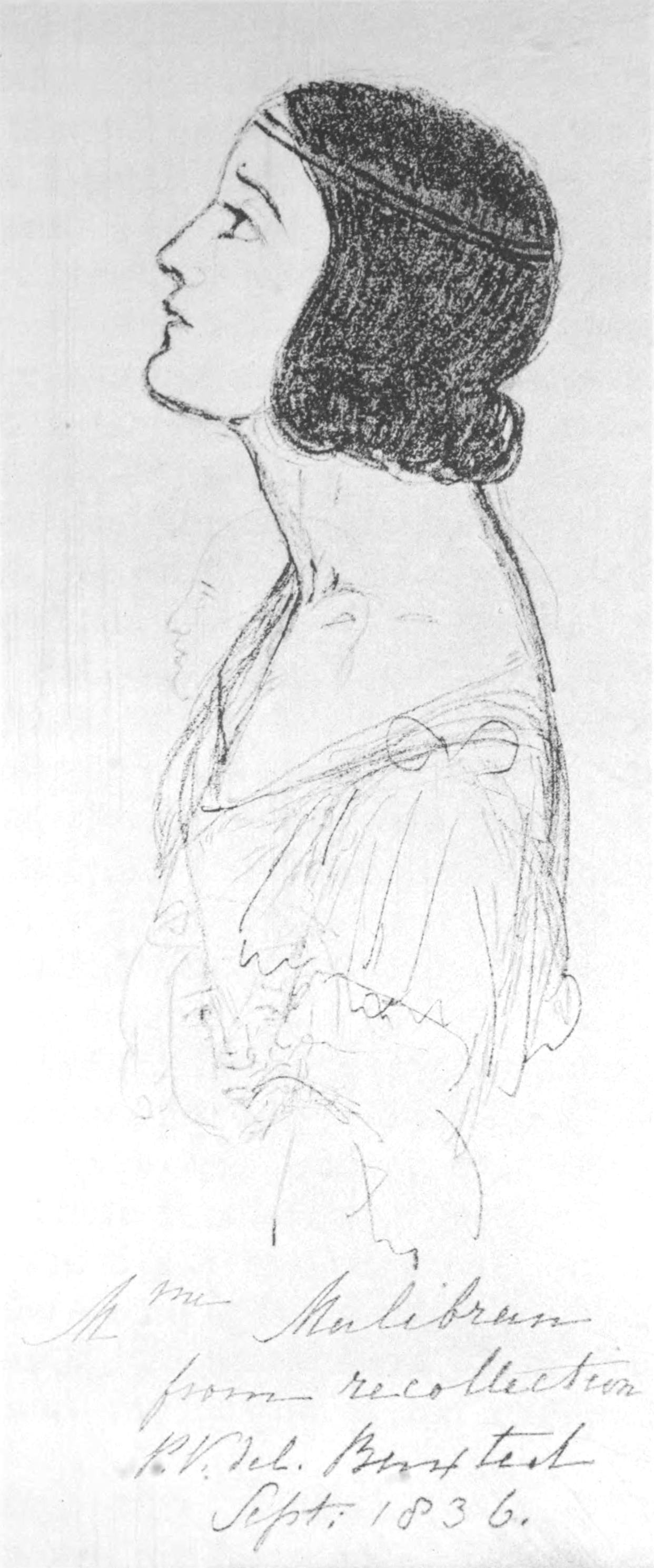
birthday—Presents—A birthday ball—Alexander and Ernest of Würtemberg—Paganini and Malibran—Journey
to Portsmouth—At Norris Castle—On board the Emerald—Visit to the Victory—Journey
to Plymouth—Presentation of Colours—The Queen of Portugal—Spanish affairs—At Drury
Lane—A lecture on physics
The Order of Maria Louisa—At the Opera—Anna
Boulena and Othello—Ferdinand of Saxe-Coburg—Feodore, Princess von Hohenlohe-Langenburg and
her children—Visit to Windsor—The King and Queen—Portuguese affairs—At St. Leonards—A
carriage accident—Death of the Duke of Gloucester—A fine sermon
At St. Leonards—A shipwreck—Lessons—Back to Kensington—Death
of the Duke of Leuchtenberg—Opera Otello—Visit to Windsor—A concert—Grisi,
Lablache, and Tamburini—Sixteenth birthday—Presents—Eton Montem—At the opera—Death
of Countess Mensdorff—Confirmation—Ceremony at St. James’s—First Communion—At Tunbridge
Wells—Races—Reading—Back to Kensington—Duc de Nemours—Journey to Bishopthorpe—Harcourt
family—York Minster—At Canterbury—Ramsgate—The King and Queen of the Belgians
At Ramsgate—Back to Kensington—Change of rooms—Marriage
of the Queen of Portugal—A dinner party—The theatre—Kemble and Macready—Helen
Faucit—Charles Mathews—Visit to Windsor—State ball—Princes Ferdinand and Augustus—King
Leopold’s Directions—Visit of Ernest and Albert of Saxe-Coburg—Their characteristics and
charms—Seventeenth birthday—The British Gallery—The Victoria Asylum—Lablache—At Claremont—Portuguese
revolution—Events in Lisbon—King
Leopold and Belgium—Death of Malibran—At Ramsgate—Books read—A dinner party—Louis
Napoleon at Strasburg—A stormy journey—Rochester—Back to Kensington—Claremont—A gipsy camp
Gipsies—M. Van de Weyer—Books read—Opera I
Puritani—Death of Lady de L’Isle—The Drawing-room—An address from Lincoln—Eighteenth
birthday—Ball at St. James’s—Stockmar—The King’s illness and death—News of the Accession—The
first Council—Lord Melbourne—The Proclamation—Official business—Visit to Windsor—Queen
Adelaide—Addresses—Audiences—Household appointments—The King’s funeral—Conferring Orders—Leaving
Kensington Palace—Settling into Buckingham Palace
Chapter of the Garter—Cabinet Council—Thalberg—State
visit to House of Lords—Order of St. Catherine—Anxiety about elections—Trying horses—Windsor—The
King of Würtemburg—Visit of King Leopold—Talks with Lord Melbourne—A game of
chess—Departure of the King and Queen of the Belgians—A review at Windsor—Queen Adelaide—Perasi
of Lord Melbourne—At Brighton—Unfortunate state of Portugal—Changes at Buckingham
Palace—Lord Mayor’s Dinner—Popularity with the crowd—The Queen’s Speech—State visit to the
House of Lords—Debates on the Address—Pensions—Lord Melbourne on Education—Landseer’s pictures—Conversations
with Lord Melbourne—Lord Brougham’s attacks—Magnetism—The Privy Purse—Character formation—Windsor
Lord Melbourne’s family—Riding—Canadian difficulties—The
Secretary at War—Lord Melbourne on music—Lord Durham and Canada—The State of Greece—Lord
Melbourne on various people—And on Wellington—Punishments—Army difficulties—The
Waverley Novels—Sir John Colborne—The Fitzclarence pensions—Lady Falkland—Lord Melbourne
on historics—Whig doctrine—Lord Melbourne on recommendations—Charles Kean in Hamlet—Dolls—English
Kings—Sheriff-pricking—Canada Government Bill—Shakespeare plays—Government difficulties—The
Ballot question and Lord J. Russell—Wellington’s manner—Lord Tavistock—Troops in
Canada—Lord Ellenborough—Peerage ceremonial—Princess Charlotte—Duchess of Sutherland—Public
School education—Enthusiasm—William IV.’s dislikes—Ballot Question—Anecdote of
George IV.—Children and relations—A Russian custom—A Levée—Pensions—Court etiquette—Lord
Howe and Queen Adelaide—The question of Marriage
Bulwer’s plays—Canadian prisoners—Jamaican slavery—An
Investiture—Commission on Promotions—Portuguese affairs—A long ride—Lord and Lady
Holland—Talk on railways—Lady Burghersh—Lord Byron—Duke and Duchess of Gloucester—Gallery
of Portraits—Madame de Staël—Brougham’s oddities—Death of Louis—The Royal Family—Soult—Lady
Charlotte Bury—The Hertford family—Carlton House and Court parties—Queen
Anne—George IV.’s favourites—Artists—A State ball—The Church of Ireland—Useless motions—The
Ponsonby family—Coronation preparations—Irish
affairs—Government difficulties—Singing of birds—The Fitzclarence pensions—Election Committee
Bill—Portugal and slavery—The Established Church—Parliamentary business—Audiences—Talleyrand’s
death—Twentieth birthday—A State ball—Royal marriages—Eton customs—Coronation honours
Thunderstorms—Lord Durham—Don Giovanni—New
Zealand—Eton Montem—Lord Barham—Miss Chaworth and Byron—Lord Melbourne’s household—Visit
to Eton—King Leopold’s position—Lord Melbourne’s reminiscences—Public School education—Irish
legal difficulties—O’Connell—Eton and Ascot—South Sea Co.—The Order of the Bath—Coronation
Honours—Lord Melbourne and the Garter—Marshal Soult—Coronation Day—Procession to Westminster—The
ceremony—The procession—After the Coronation—The peerage—Illuminations—Lord Melbourne
on the ceremony—Kings and usurpers—Review in Hyde Park—Popularity of enemies—Soult at
Eton—Family questions—Sir E. Lyons—Prince Royal of Bavaria—Dukedoms—The Sheridan family—Lady
Seymour—Lord Shelburne’s marriage—A dinner party and reception—George III.’s sons—And
his illnesses—Lady Sarah Lennox—Mehemet Ali—Lord Melbourne and King Leopold—Statues—The
Queen’s Speech—Lord Melbourne on Lord Brougham—Wellington—Belgium and Holland dispute—The
Irish—Persian affairs—Pozzo di Borgo—Lord Howick—Belgian affairs—Russian influence—Jewels—Duke
of Sussex—Lord North—Mexican affairs—Concerning books—Lady Holland—George
III.’s Prime Ministers—Colonial policy
336–398
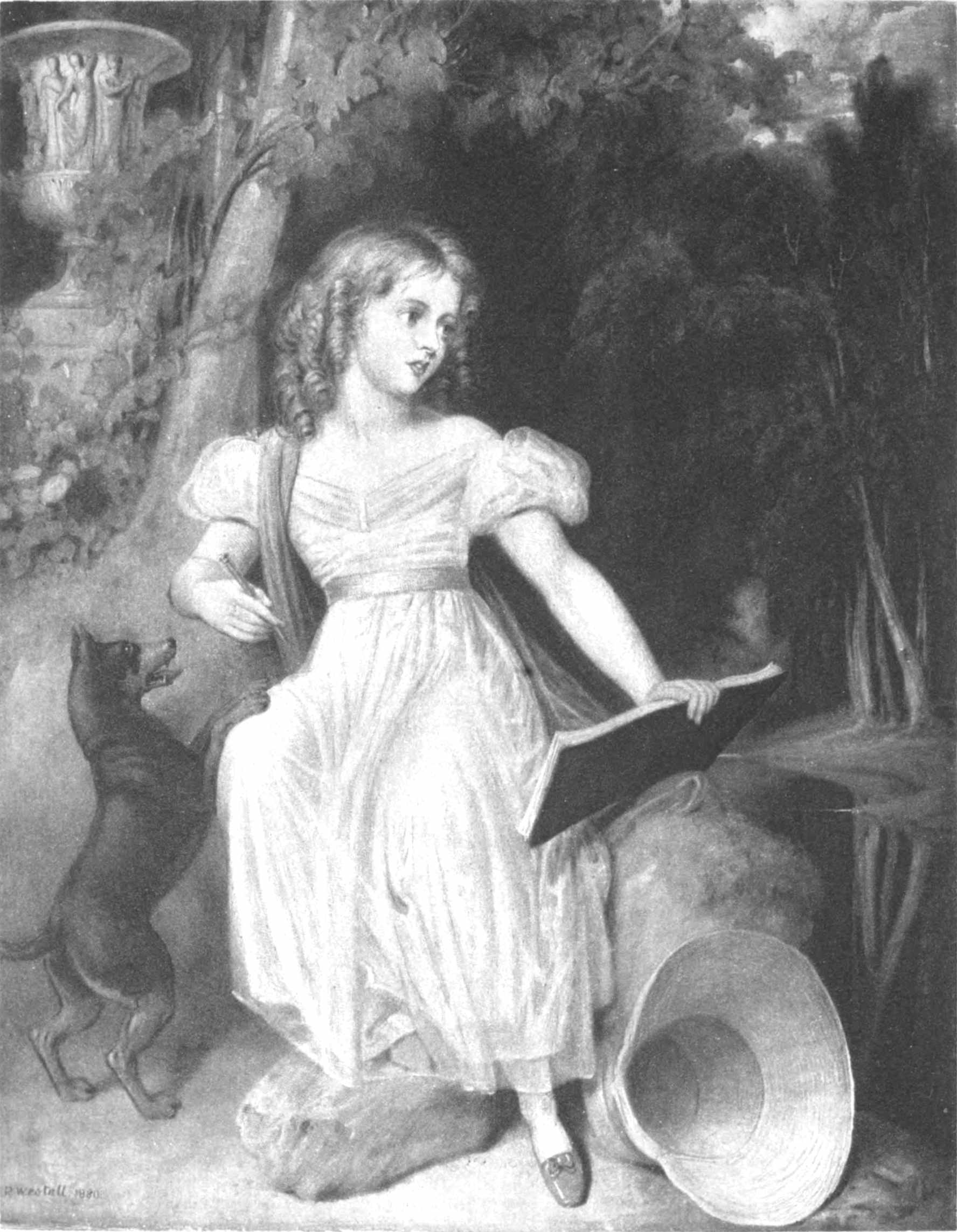
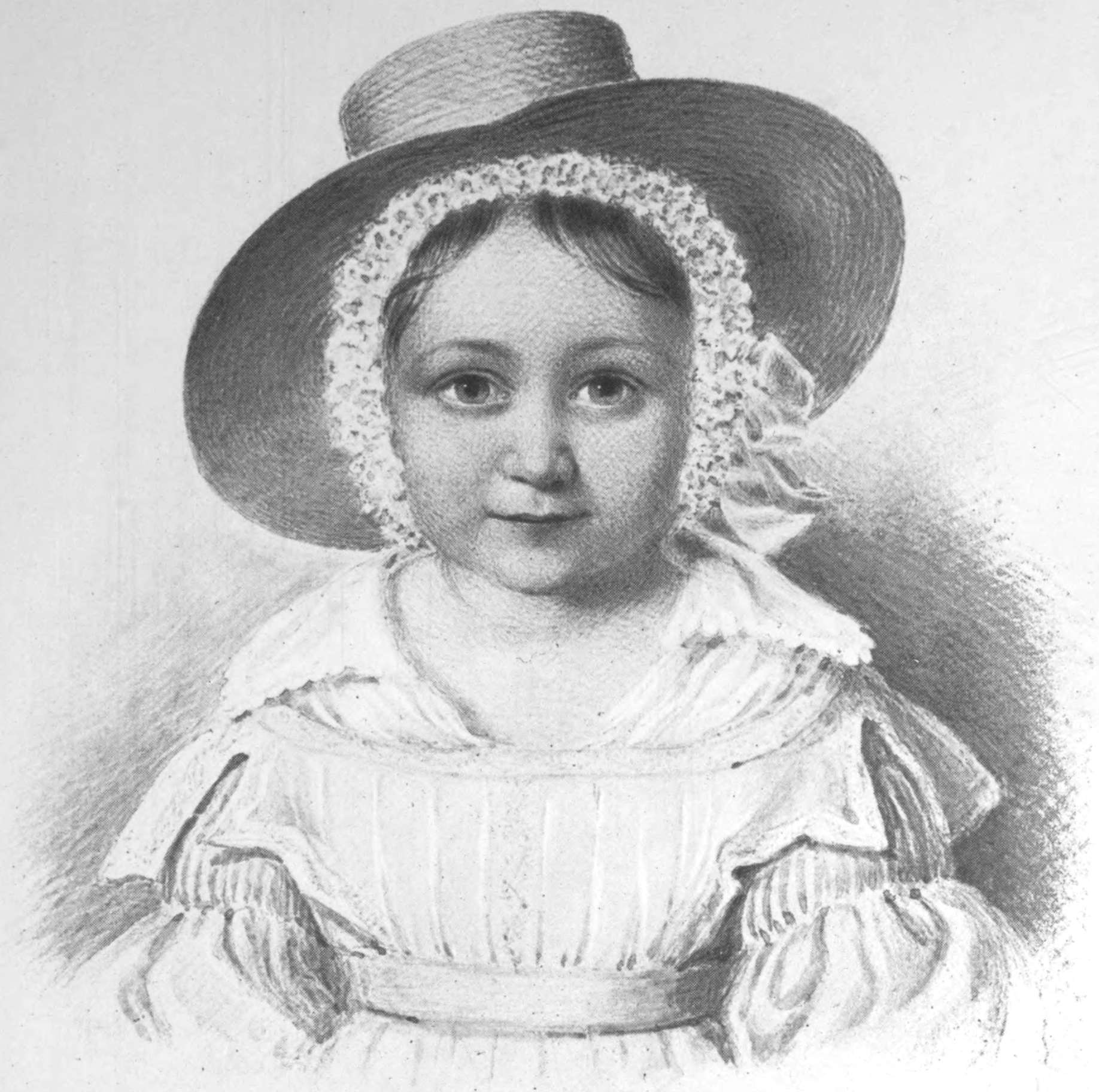
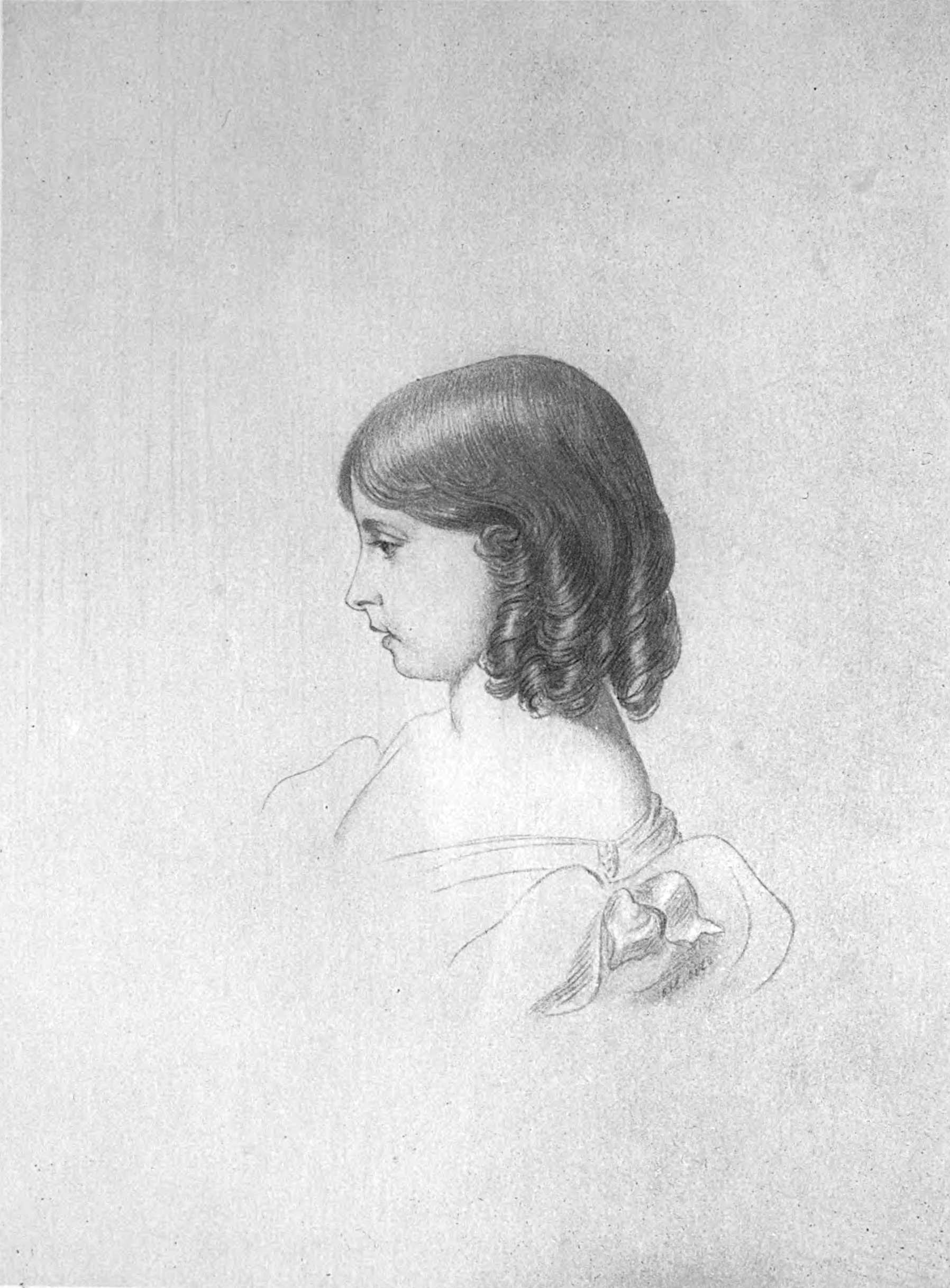
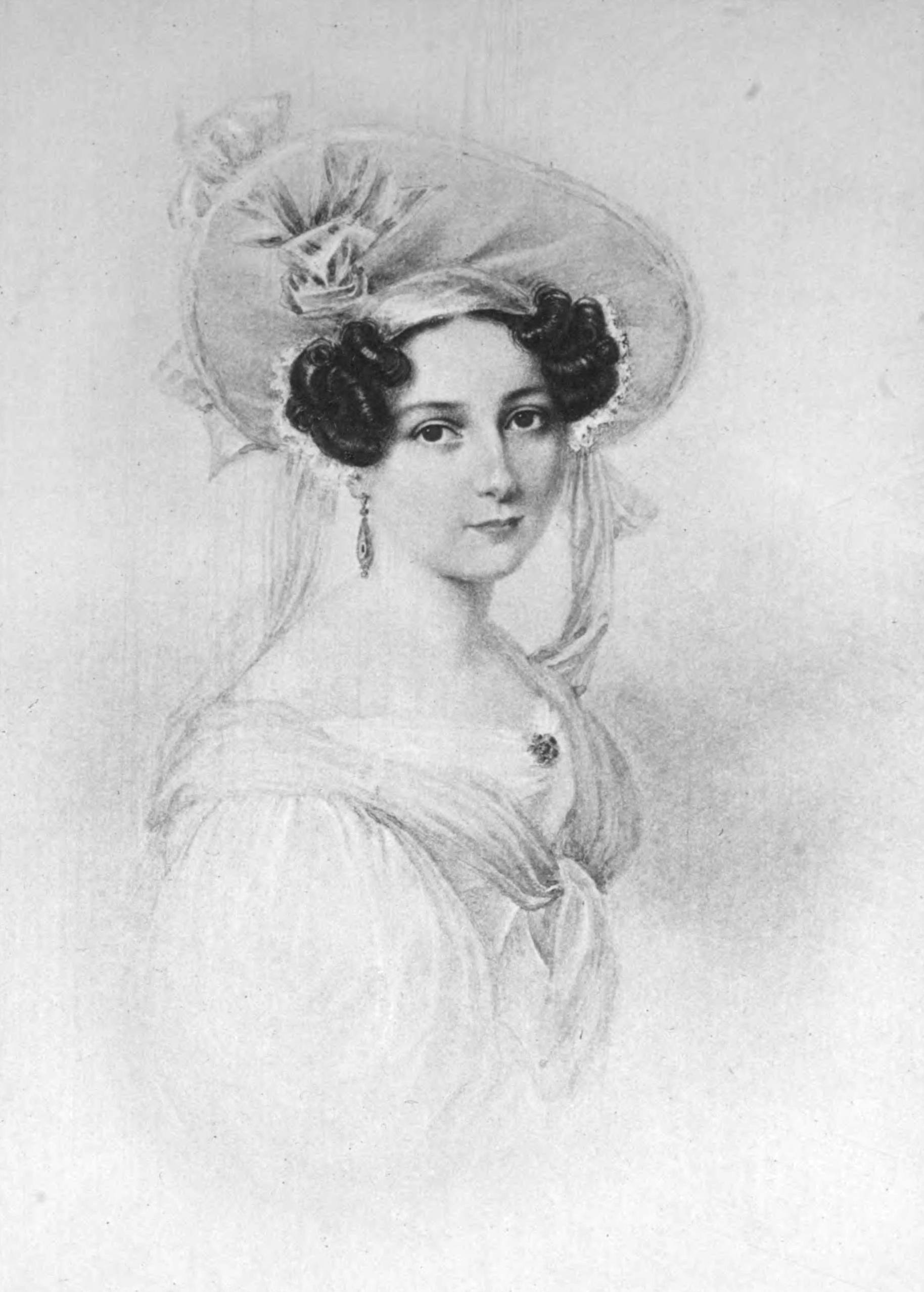
H.R.H. Princess Victoria & “Dashy” from a picture by R. Westall R. A. at Windsor Castle
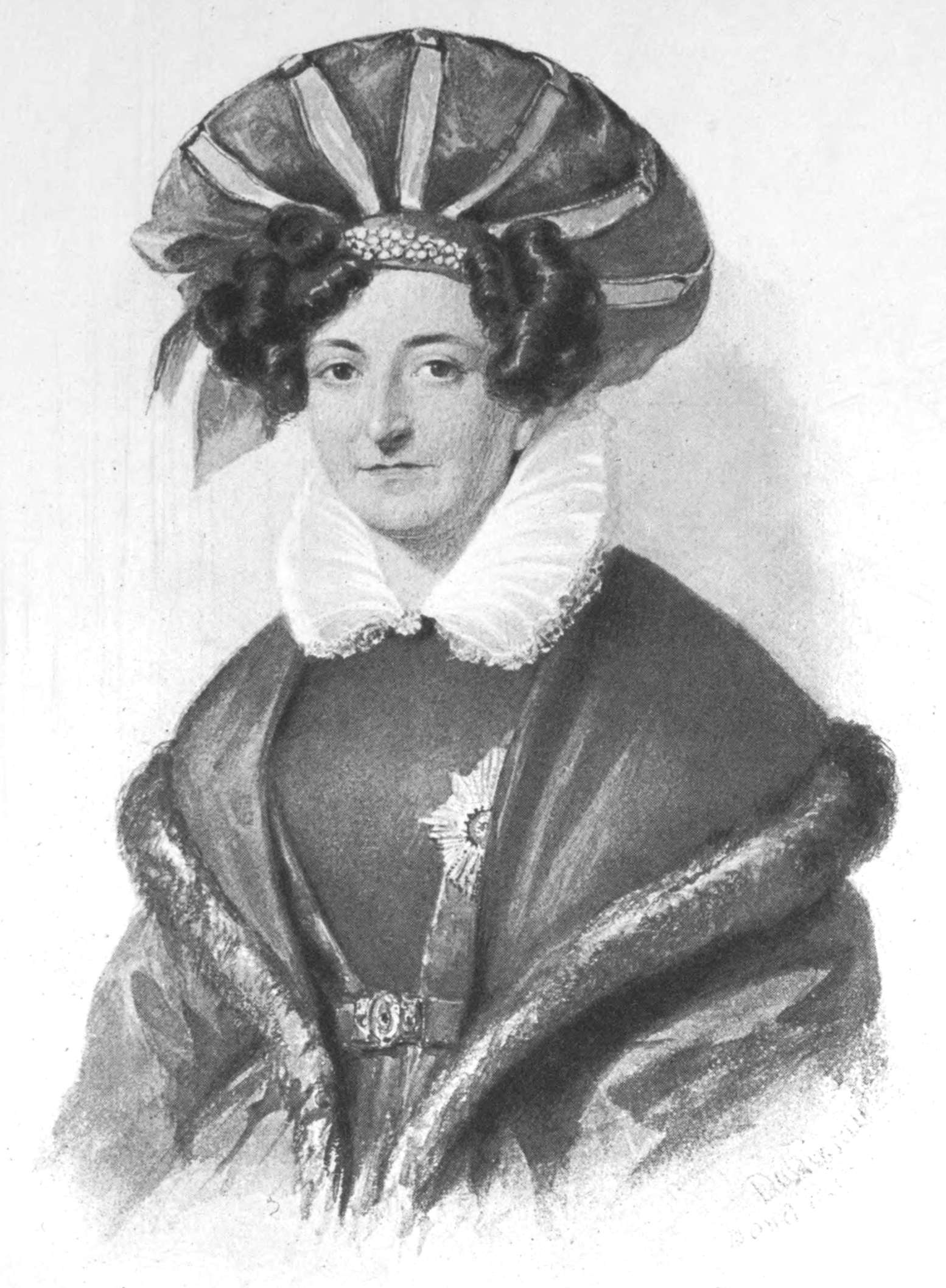
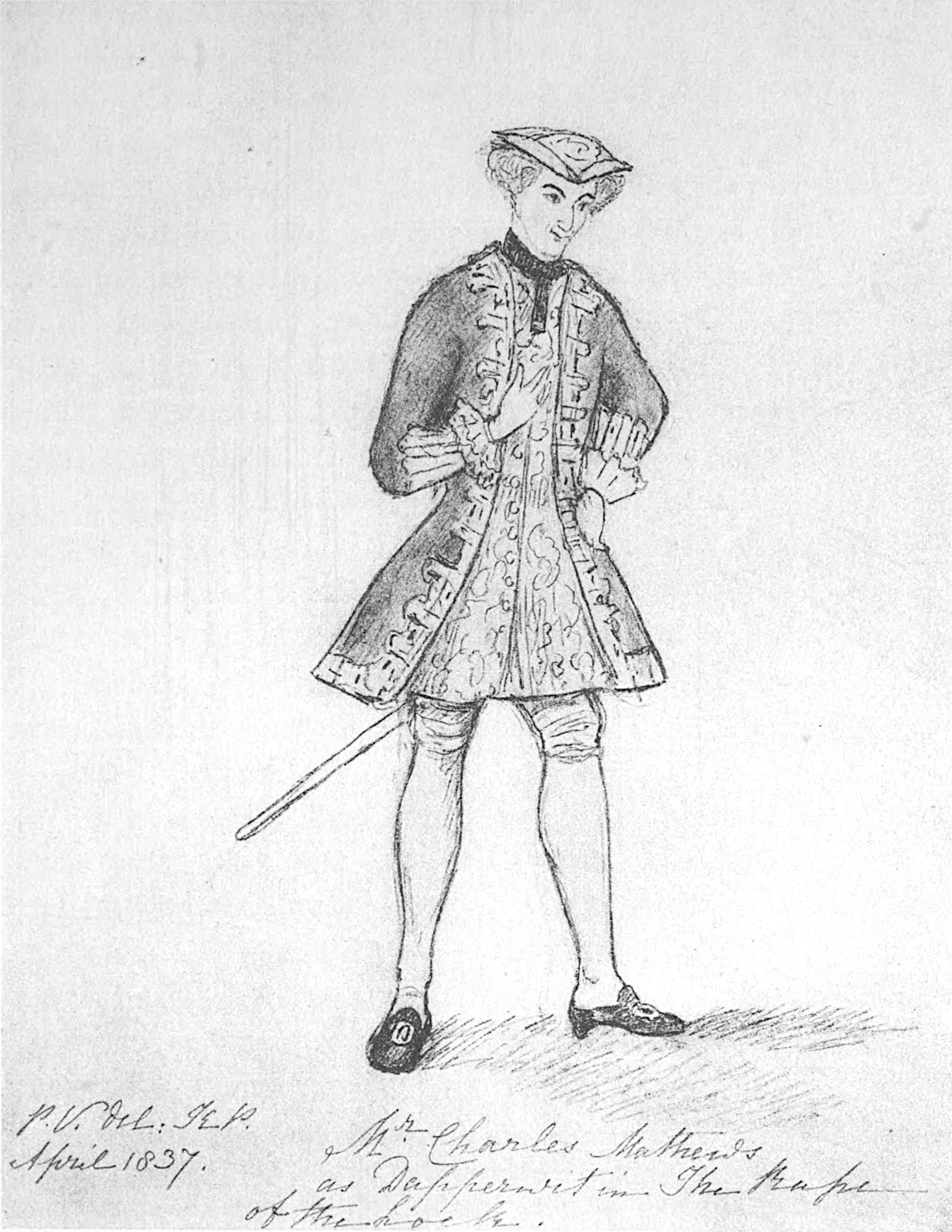
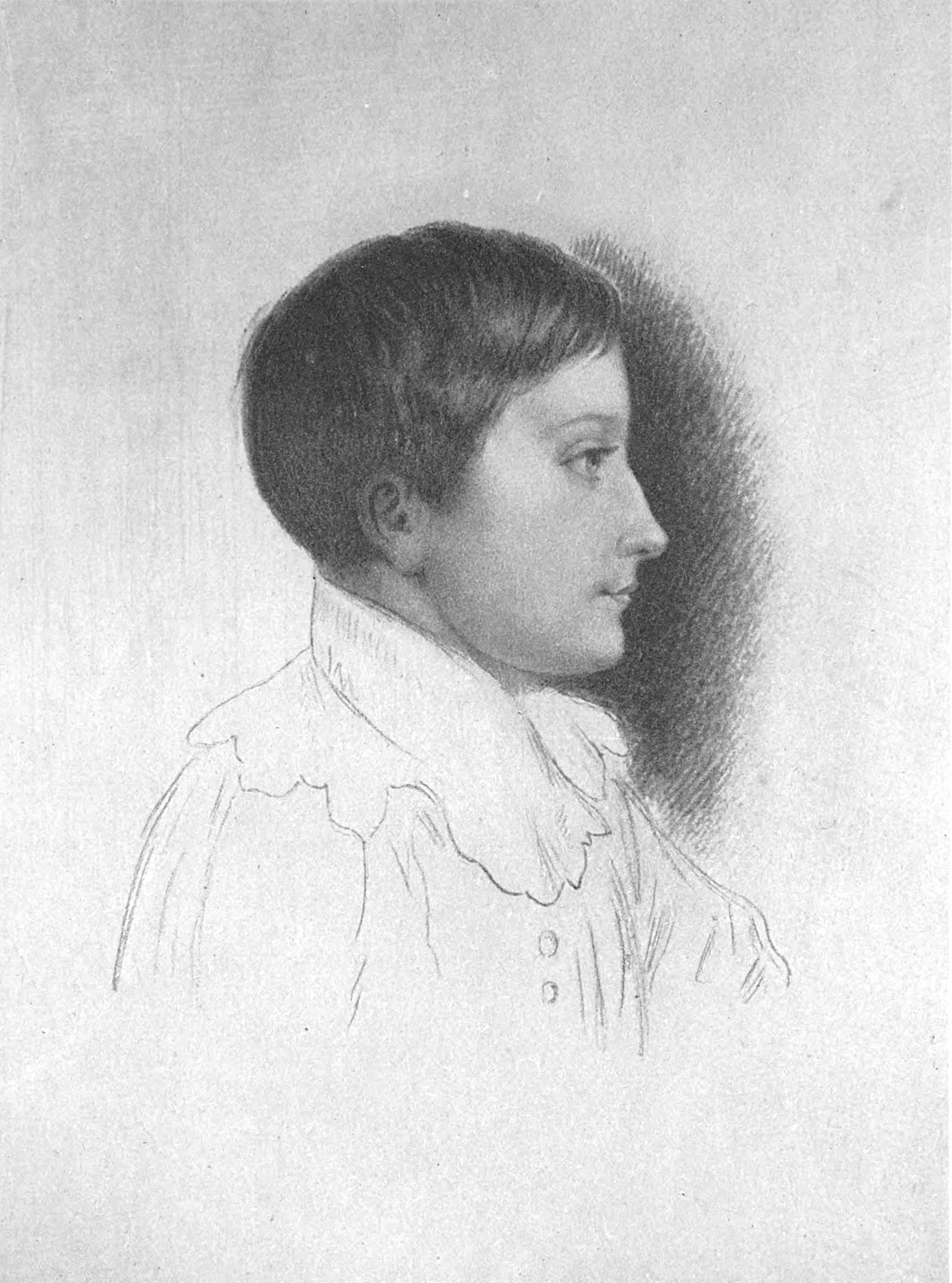
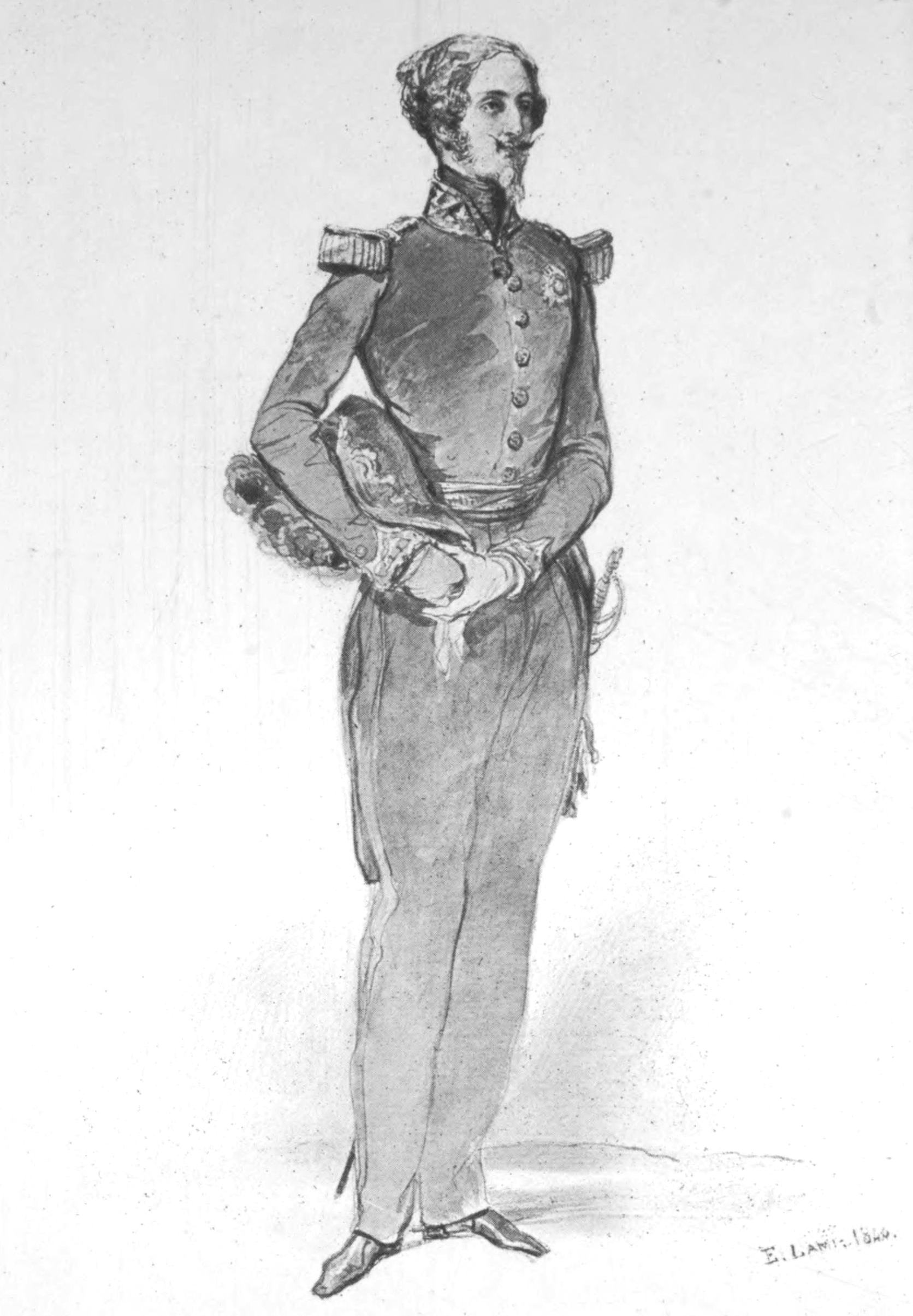
Note.—The illustrations marked * are taken from the
Queen’s private albums, in which she kept portraits of relations
and friends, specially painted for her.
INTRODUCTION — I — II — III — IV — V
Apart from the onward surge of Empire during both epochs, apart from
the flow of scientific thought and the breeze of literary enthusiasm
characterising them, there is much in the atmosphere of Victoria’s
advent to the Throne, and her long and glorious tenure of it, to remind
us of the central figure of the Elizabethan age.
Both princesses were reared and educated, although for very different
reasons, in the uncertain glory of succession to the Throne. Both
mounted the Throne early in life alone and unprotected, at a moment of
reaction against the abuses of monarchy. Under George III. as under
Henry VIII. this country had been subjected to violent commotion
consequent on the struggle for national freedom against a foreign
power. The Reformation in England and the Napoleonic wars owed their
successful issue to the persistent determination of the English people
to be free. The hated marriage of Mary and the matrimonial scandals
of George IV. had cast a gloom over the temper of the nation. Even
the triumph of the popular cause, due to the grudging support given
by William IV. to his Whig Ministers, had not restored the forfeited
prestige of the Monarchy.
Reaction was the corollary against the fear inspired by Philip in the
one case and the humiliating memories of Queen Caroline in the other.
That reaction came in the shape of the popular enthusiasm inspired by a
young and attractive Tudor princess, who at Hatfield on a late November
afternoon in 1558 heard from Cecil that she was Queen of England. Three
centuries later a similar outburst followed the accession of another
youthful princess only just eighteen years old, looking scarcely
more than a child, when she received the homage of Lord Melbourne at
Kensington Palace on a June morning of 1837.
It is tempting to follow this seductive pathway through the devious
alleys of historical comparison and contrasts. The troubles of
Elizabeth’s childhood at Hunsdon, the pitiful laments of her excellent
governess at the poverty of her ward’s surroundings, and the hostile
atmosphere surrounding her person were reflected in a minor degree
within the precincts of Kensington during the early years of Princess
Victoria’s life.
Our concern, however, is not with Elizabeth but with Victoria, with the
England into which she was born, and with the influences which helped
to give her character and bearing a certain strength and dignity,
and attuned her heart, not perhaps to deep tenderness, but to much
compassion.
The pen recoils from an attempt to tell again the story of Princess
Victoria’s birth and early life, or to describe once more the political
events of her first years upon the Throne. Moreover, these volumes tell
their own tale. They set forth in the young Princess’s own artless
words the daily facts of her existence at Kensington, or when making
some provincial royal progress in the company of her mother.
The reader can catch many a glimpse here and there of the soul of a
Princess, proud and headstrong, affectionate and sometimes perverse,
seated on the lonely heights of the Throne. The portrait is here,
within these pages. It is not unskilfully drawn, when the youth of the
artist is borne in mind. At the time when the first entries in these
Journals were made, the writer was thirteen years old. The last page
was written on the day of her marriage. She had been two years a Queen,
and she was in her twenty-first year.
Princess Victoria, the only child of the Duke and Duchess of Kent,
and the ultimate heiress in direct succession of George III., was
born on May 24, 1819. In 1819 the aspect of English country life
was not very different from that of to-day; if the roads were not
so well surfaced, and if woodlands were rather more plentiful, the
fields and hedgerows, the farmsteads with cottages grouped around
them, the Tudor manor-houses, the Georgian villas, the church spires,
and the village greens have remained unchanged. Except for lines of
railway and telegraph poles, the hop-fields of Kent and the Surrey
commons have kept their shape and contours. So that, in spite of the
miracles wrought by machinery in the minutiæ of life, any one of our
grandparents cruising in an airship at an elevation of some hundreds of
feet over the lands where he hunted and shot, or even the great town
in which he spent his summer months, would probably be unconscious of
much distinctive change.
Young people, however, think it odd when they read that when Princess
Victoria was taken from Kensington to Claremont—a journey now
accomplished with as little thought as would then have been given to
a drive between the Palace and Hyde Park—it was considered a “family
removal” of such moment as to require all the provision and precautions
associated to-day with an autumn holiday.
To those still young, but old enough to remember Queen Victoria, it
may seem hardly credible that she was born into a world devoid of
all the marvels of steam and electric contrivance that appear to us
the necessities, and not merely the luxuries, of life. How much more
difficult it must be for them to realise that when the young Princess
(whom they remember a great and mysterious figure, welcoming back
only the other day her soldiers from South Africa, and rejoicing in
their victories) was carried into the saloon of Kensington Palace to
be received by Archbishop Manners Sutton into the Church of Christ,
the mighty spirit of Napoleon brooded still behind the palisades of
Longwood, and George III.’s white and weary head could still be seen at
the window of his library at Windsor!
The Victorian era covers the period of the expansion of England into
the British Empire. The soldier, still young to-day, who put the
coping-stone on the Empire in Africa in 1900 is linked by the life of
the Queen to his forbears, who, when she was born, were still nursing
the wounds gloriously earned four years before in laying its foundation
in a Belgian cornfield.
That year 1819, however, was a year of deep despondency in England. In
Europe it was the “glorious year of Metternich,” then at the height
of his maleficent power. Europe was quit of Napoleon, but had got
Metternich in exchange, and was ill pleased with the bargain. Great
Britain, it is true, was free, but our people were overwrought by
poverty and suffering. The storm-swell of the great Napoleonic wars
still disturbed the surface of English life, and few realised that they
were better off than they had been during the past decade.
At Holland House, its coteries thinner but still talking, Lady
Holland—old Madagascar—was still debating what inscription should
record the merits of Mr. Fox upon his monument in the Abbey for
the edification of future ages. In St. James’s Place Sam Rogers’s
breakfasts had not lost their vogue. Tommy Moore was still dining with
Horace Twiss, and meeting Kean, and Mrs. Siddons, “cold and queenlike,”
on her way to view Caroline of Brunswick’s “things” shortly to be
sold at Christie’s, or to criticise Miss O’Neill’s dress rehearsals.
On the very day that Princess Victoria was born, Byron was writing to
John Murray from Venice “in the agonies of a sirocco,” and clamouring
for the proofs of the first canto of Don Juan. In that year
Ivanhoe was finished, and in the hands of eager readers;
whilst Scott was receiving at Abbotsford a certain Prince Leopold of
Saxe-Coburg, uncle of the baby at Kensington, destined thereafter
to play a large part in her early life. Keats had just published
Endymion. It was his last year in England before going south to
die. And it was Shelley’s annus mirabilis: the year in which he
wrote Prometheus and The Cenci—an achievement, some have
since said, unparalleled in English poetry since Shakespeare lived and
wrote.
The Excursion had been published five years before, but
Wordsworth was at Rydal Mount completing The White Doe of
Rylston. Southey was Poet Laureate. Three years before, in the
“wild and desolate neighbourhood amid great tracts of bleak land
enclosed by stone dykes sweeping up Clayton heights,” Charlotte
Brontë’s eyes had opened upon her sad world. Carlyle, then a young
teacher in Edinburgh, was passing through that stormy period of the
soul which comes sooner or later to every one whose manhood is worth
testing by God. And half-way between Horncastle and Spilsby, on the
lower slope of a Lincolnshire wold, Alfred Tennyson was reading
Pope’s Iliad and himself “writing an epic of 6,000 lines à
la Walter Scott.” At Shrewsbury School under Dr. Butler, Charles
Darwin, then a boy of ten, had already begun to develop a taste for
“collecting,” manifested in “franks” and seals and coins. Robert
Browning, a turbulent and destructive child of seven, had already
commenced making rhymes less complicated, but not less ambitious,
than those which puzzled his readers sixty years later. Goethe, who
had grown to manhood within earshot of Frederick the Great and of the
Empress Maria Theresa, was living at Weimar with many years of life
still before him, corresponding with the boy Mendelssohn, later to be a
welcome guest, at Windsor, of the little Princess, then in her cradle
in Kensington Palace. Mazzini, aged fourteen, was at the University in
Genoa, a rebellious lad, but already affecting the deep mourning dress
he never altered later in life. Cavour, aged nine, was at school in
Turin. Sir Thomas Lawrence was in that year engaged in finishing his
magnificent series of historical portraits afterwards to find a home at
Windsor Castle, illustrating for all time the Congress of Vienna and
the story of the Great Coalition against Napoleon.
Under this galaxy of stars, some slowly sinking below the horizon, and
others just rising above it, Princess Victoria was born.
In the year following, King George III. died. Historians, mostly
partisans of the Whig party, have not done this King justice. Of
all Sovereigns who have ever reigned in England, none so completely
represented the average man among his subjects. The King’s blameless
morals, his regular habits, his conservative instincts and narrow
obstinacy, were characteristics which he shared with the people he
ruled. Of the House of Hanover he was the first King born in England,
and he spoke his native tongue without a foreign accent. If he could
have reconciled it to the family tradition, he would have married an
English wife. He was essentially British in character and sentiment.
Had he not been overborne by his Ministers, he would have fought out
to a finish the war with America, and peace with Washington would not
have been concluded. He never for a moment contemplated abandoning the
struggle against Napoleon. No party whip could have taken more trouble
to keep his chief in office than did George III. to support Mr. Pitt
throughout that Minister’s first administration. He has been called
despotic, but that adjective can only be used, in speaking of him,
in the sense that he wished to see his views prevail. He was a good
partisan fighter, and this, in the main, his subjects never disliked.
A close and impartial examination of the character of George III.
discloses a temperament strongly resembling that which her Ministers
were destined in the middle and later years of her reign to find in
his granddaughter. Strong tenacity of view and of purpose, a vivid
sense of duty, a firm though unrevealed belief in the transcendental
right of the Sovereign to rule, a curious mingling of etiquette and
domestic simplicity, and a high standard of domestic virtue were marked
characteristics of George III. and of Queen Victoria. Both these
descendants of Princess Sophia had little in common with the Stewarts,
but, like Elizabeth and the Tudors, they had intense pride in England,
and they showed a firm resolve to cherish and keep intact their mighty
inheritance.
When George III. died at Windsor in 1820, and during the ten following
years, Princess Victoria’s uncle, George IV., reigned as King. For the
previous ten years he had reigned as Prince Regent. If his father has
been misjudged, this Sovereign too has been misrepresented by those
who have made it their business to write the political history of our
country. He is generally described as being wholly bad, and devoid of
any decent quality as a man and as a Sovereign. Decency perhaps was not
his strong point; but though it is not possible to esteem him as a man,
George IV. was not a bad King. In his youth, as Prince of Wales, in
spite of glaring follies and many vices, he possessed a certain charm.
When a boy he had broken loose from the over-strict and over-judicious
watchfulness of his parents. Kept in monotonous seclusion, cloistered
within the narrow confines of a Palace, fettered by an Oriental system
of domestic spies, cut off from intercourse with the intellectual
movement of the outer world, the royal children, warm-blooded and of
rebellious spirit, ran secret riot after a fashion which modern memoirs
have revealed in Borgian colours. It was a natural reaction of young
animal life against unnatural and unhealthy restraint. The Prince of
Wales, when he was eighteen years old, was unwillingly and perforce
liberated. It followed, simply enough, that he became a source of
constant grief and annoyance to his royal father. Not only were the
canons of morality violated by him with little regard for the outward
decorum due to his great position, but the young Prince plunged into a
turgid sea of politics, and it was not long before he stood forth as
the nominal head of a faction bitterly opposed to the King’s Ministers,
and the head and front of personal offence to the King himself.
In the eyes of high society he was a Prince Charming, vicious if you
will, a spendthrift and a rake, the embodiment of a reactionary spirit
against the dulness and monotonous respectability of the Court. He
was known to appreciate beautiful objects as well as beautiful faces.
He was not altogether without literary culture. He appeared to be
instinctively drawn to the arts and sciences with a full sense of the
joy of patronage, and he made it clear to every one that he welcomed
the free intercourse of men of all ranks, provided that they possessed
some originality of character or some distinction of mind. In Mr. Fox
he found a willing mentor and an irresistible boon companion. Among
that little group of Whigs, of whom Sheridan was the ornament and
the disgrace, he found precisely the atmosphere which suited him, so
completely was it the antithesis of that in which his boyhood had been
spent. As he grew older, the rose-tinted vices of his youth became grey
and unlovely, while the shortcomings of his mind and his heart were
more readily discerned; but much of his personal charm remained. In his
most degenerate days, in the years of his regency and kingship, when he
dragged into the public eye the indecencies of his domestic misfortunes
and paraded his mistresses before the world, he still managed to retain
a curious and genuine hold upon the affections of his Ministers.
Although he possessed none of their regard, he was not altogether
without some following among the people.
George IV.’s merits were a certain epicurean kindness of heart and a
not ungenerous desire to give pleasure, coupled with a true sense of
his constitutional position and a firm-drawn resolve to distinguish
between his private predilections and his public duty. The nation owes
him very little, but in any case it owes him this, that he was the
first Sovereign since Charles I. who showed a blundering reverence for
beautiful things. He enlarged and consolidated the artistic wealth of
the nation. A life-long patron of artists, he fostered the growth of
national art. He added largely to the splendid collections which now
adorn Windsor and the metropolis. Whatever the final judgment passed
upon him may be, both as a man and as a Sovereign, he must in strict
justice be spared the unqualified contempt with which superior spirits,
taking their cue from Thackeray, have treated him. It should weigh with
every man who reads The Four Georges that King George IV. was
certainly liked, and was certainly not despised, by Sir Walter Scott.
In his later years the old King displayed some little kindness to his
niece, the young Princess Victoria, who had succeeded his own daughter
as prospective heiress of England. If he saw her but rarely, he now
and again betrayed knowledge of her existence, and once took her for a
drive in his pony-carriage. There are still extant some short letters
which she wrote to him in a large baby hand. In 1830 he died, and was
succeeded by his brother the Duke of Clarence.
William IV. was the most fortunate of the children of George III.
Thanks to his profession as a sea-officer, he escaped early from the
stifling atmosphere of the Court, and had the glorious privilege of
serving under the command of Hood and of Nelson. His sea service ended
when he was only twenty-five years old. It left the usual dominant
sea-mark upon his character. Like so many gallant sailors, his mind was
untrained and ill-disciplined. His sense of duty was strong, though
undiscerning. He was courageous and truthful. He had ten children by
Mrs. Jordan born out of wedlock, but they were all well cared for and
never disowned. He realised his constitutional duty sufficiently to
see that he must yield to the expressed will of the nation, but he
yielded so clumsily that all men believed him to be coerced. Wisely
anxious to be well known and popular among his subjects, he chose the
curious method of walking down St. James’s Street dressed in long
boots and spurs during the most crowded hour of the afternoon. His
predecessor had lived the last years of his life in seclusion and
silence; he determined therefore to give full scope to his naturally
garrulous disposition. He talked in season and out of season with an
irresponsibility which savoured of the quarter-deck, but wholly without
the salt of the sea. By his Ministers he was regarded with kindliness,
although it cannot be said, in spite of Lord Grey’s panegyric, that
they held him in much respect. By the middle classes he was looked upon
with amused and not unfriendly amazement. In the eyes of the masses he
was “Billy,” their sailor-King, and among monarchical safeguards there
are few stronger than a nickname and the aureole of the Navy.
William IV. married late in life Princess Adelaide of
Saxe-Coburg-Meiningen, but the fates left him with no surviving
children when he ascended the Throne in 1830. During his reign of seven
years the King showed much kindness to the little niece who was clearly
designated as his successor. Her mother, however, contrived to irritate
him by giving too much prominence to the obvious fact of her daughter’s
heirship to the Throne. By “progresses” made on different occasions and
undertaken with considerable ceremonial, the Duchess of Kent excited
the wrath of the King, who made no attempt to conceal his annoyance,
and took evident pleasure in the display of it at embarrassing moments
in public. It was partly owing to the friction between her mother and
King William and to the unpleasant atmosphere created in consequence of
these quarrels, and partly to the presence in her mother’s household
of Sir John Conroy and his family—persons very distasteful to the
young Princess—that Queen Victoria was in the habit of saying that her
childhood had been a sad one. These Journals, begun in her fourteenth
year, betray no sense of childish sorrow, and no reader can glean
from them any confirmation of her statement that her early life was
unhappy. It must be remembered, however, that this Journal was not
a sealed book. It was not privately put away under lock and key and
reserved only for the eye of the writer. The young Princess’s Journals
were commenced in a volume given to her by her mother for the express
purpose that she should record the facts of her daily life, and that
this record of facts and impressions should be open to the inspection
of the child’s governess as well as of her mother. It is natural,
therefore, that the earlier volumes should contain very little beyond
the obvious and simple things which any girl would be likely to write
down if she were attempting to describe her life from day to day. When
the Princess ascended the Throne and assumed her queenly independence,
the tone of the Journals changes at once. It becomes immediately
clear to the reader that while the Princess’s Journal was written for
her mother, the Queen’s Journal was written for herself. One of her
earliest entries after her succession was to state her intention of
invariably seeing her Ministers alone; and she might have added, had
she thought it worth stating, that her Journal also would in future be
seen by her alone.
Journals are often said to be useful to the historian. This theory
is based on the assumption, hardly borne out by experience, that he
who writes a journal writes what is true. A journal is supposed to
record events, great or small, which are happening at the moment,
and to convey impressions about personages with whom the writer
comes in contact, or who loom sufficiently large to justify their
being mentioned. When, however, it is remembered how inaccurate our
information generally is, and how mistaken we often are about the
character and motives even of those we know intimately, it is not
surprising that the most brilliant diarist should frequently state
facts which cannot be verified from other sources, and colour the
personality of his contemporaries in a manner quite unjustifiable
unless truth be deliberately sacrificed to the picturesque. The
Journal of Charles Greville, perhaps the most famous of English modern
journals, is full of gross inaccuracies in matters of fact and still
grosser distortions of character. It is, nevertheless, a striking
picture of the political and social world haunted by that persistent
eavesdropper, and, like any well-written journal, throws a vivid and
interesting light upon the character of the writer.
Similar criticisms apply to most famous memoirs, like Saint-Simon’s
or Lord Hervey’s, written with a view to serving the historian of the
future, and with the distinct purpose of giving bias to history.
They do not apply to these diaries of Queen Victoria. The Queen makes
no attempt to analyse character or the meaning of events. She never
strives after effect. Her statements are just homely descriptions
of everyday life and plain references to the people she meets at
Kensington or at Windsor. If the young Princess sees a play that
pleases her or hears a song that touches her, she says so. If the Queen
hears something said that strikes her as original or quaint, the saying
is put on record. She is not writing for the historian. She writes for
her own pleasure and amusement, although there is always present to her
mind a vague idea, common enough at the time, that to “keep a journal”
is in some undefined way an act of grace.
The reader should not lose sight of the fact that these Journals are
the simple impressions of a young girl, not twenty years old, about her
own life and about the people she met. This constitutes their charm.
She writes of her daily movements, and of the men and happenings that
gave her pleasure. Either by nature or design, she avoided the mention
of disagreeable things, so that these early Journals give one a notion
of a life happily and simply led.
If they throw no new light on the history of the period, they will give
to future generations an insight, of never-failing interest, into the
character of the young Queen.
Princess Victoria’s first Journal was commenced on August 1, 1832.
She was thirteen years old. The first entry is made in a small octavo
volume half bound in red morocco, of a very unpretentious kind.[1]
On the first page there appear the words, “This book Mamma gave me,
that I might write the journal of my journey to Wales in it.—Victoria,
Kensington Palace, July 31.”
The Duchess of Kent was at this time forty-six years of age. She had
been a widow for twelve years. She was the fourth daughter of the
Duke of Saxe-Coburg-Saalfeld, and was first married to the Prince of
Leiningen-Dachburg-Hadenburg. He was twenty-three years her senior.
By him she had one son, Charles, often mentioned in these Journals,
and one daughter Feodorowna, subsequently married to Ernest, Prince of
Hohenlohe-Langenburg.
Two years after her second marriage, to the fourth son of George III.,
the Duchess of Kent was left a widow for the second time. Crippled by
the Duke’s debts, that she was quite unable to pay,[2] with three young
children on her hands, she was miserably poor. Her jointure yielded her
an income of under £300. Her brother Leopold, then living at Claremont,
came to her assistance, and made her an allowance of £3,000 a year.
In 1825, when it became evident that her daughter Princess Victoria
would in all probability succeed to the Throne of England, Parliament
voted an annuity of £6,000 to the Duchess, for the maintenance and
education of her child, and this was subsequently increased after the
accession of William IV.
The upbringing of her daughter became her absorbing occupation, and,
shutting herself up in Kensington Palace, she devoted herself to the
child’s education.
The lessons of Princess Victoria’s childhood were superintended by the
Dean of Chester. Her education, judged by the standards of to-day,
was not of an exceptionally high order. It would be interesting to
know what old Roger Ascham would have thought of the Dean of Chester’s
curriculum. So far as can be gathered from her own childish records
and from the correspondence and memoirs of those who had access to
Kensington, she was taught the ordinary things which children are
supposed to learn. Fortunately, perhaps, no effort of any special
kind was made to train her mind or mould her character, with a view
to the responsibilities which lay before her or to the position she
appeared destined to fill. When, at a later stage, the Bishops of
London and Lincoln were requested to draw up a report, for presentation
to Parliament, upon her moral and intellectual attainments, they
found no difficulty in giving credit to the Duchess of Kent for the
conscientious manner in which she had endeavoured to educate the
heiress to the Throne. We may, however, take leave to doubt whether
those entrusted with the Princess’s education were teachers endowed
with any special aptitudes; and it is certain that the outlook of
the Duchess herself, although practical and wise, was not of that
discerning character which enabled her to differentiate between a
commonplace education and its more subtle forms. It was precisely what
might have been expected from one whose youth had been spent in a small
German Court, and whose later opportunities had not brought her into
contact with highly trained and thoughtful minds.
A foreign observer and critic once suggested a doubt whether the Queen
could have maintained through life her admirable mental equilibrium if
education had developed in her high intellectual curiosity or fantastic
imagination. It is an interesting speculation. Soundness of judgment
possibly rests upon the receptive rather than upon the creative
faculties, and upon physical rather than upon intellectual activities.
It may, as has been said, require a rare type of intelligence—that of
Disraeli—to combine ideas and dreams with the realities of public life.
In the domain of learning, Queen Victoria had very little in common
with Elizabeth or with any Sovereign of the Renaissance. Her mother and
the worthy Dean, who watched over her youth, were content to foster the
quality of good sense, and to inculcate high standards of private and
public virtue. Her future subjects, could they have been consulted,
would have strongly approved. In after-years the English middle-class
recognised in the Queen a certain strain of German sentimentality which
they affectionately condoned, and a robust equilibrium of mind which
they thoroughly admired.
It is as well, therefore, that events took the shape they did, and
that the mind and character of the Princess were trained upon simple
lines in accordance with the practice of the average citizen families
subsequently to be her subjects. In years to come the Queen was perhaps
better able to look at events and persons from the point of view
of the majority of her people than would have been possible if her
education had given her a high place among the intellectuals. It was a
saving grace throughout her long reign that while she could recognise
intellect and capacity, her sympathies were with average people, whose
feelings and opinions she more readily understood and in reality
represented.
In these days, when Accomplishments, as they were called in the first
half of the nineteenth century, are no longer esteemed in young people,
and their place has been usurped by athletic exercises, it is difficult
to describe, in a way that appeals to the serious imagination, the
girlish tastes of Princess Victoria. Perhaps the world has not lost
much because young ladies to-day learn to play golf and have ceased to
sing duets.
In the thirties, music and painting and a knowledge of modern languages
were the necessary equipment of a girl destined to move in Society.
It mattered little how reedy and small the voice, she was expected to
vocalise like Grisi and to sing duets with Mario.
The Queen had been well trained musically, according to the lights
of those days. She could appreciate the simpler forms of melody,
especially Italian opera, while she could sing and play sufficiently
well to give much pleasure to herself and mild pleasure to others. As a
linguist, as a reader, and as a writer of letters and memoranda she had
no pretensions to pre-eminence; but she could speak modern languages as
well as any Queen is called upon to do, she could read and appreciate
high literature, although not without effort, and she could express
herself with pungency and vigour, although not with any marked literary
skill or distinction of style.
Her drawings and water-colour sketches were through life a constant
source of happiness to the Queen. There are at Windsor literally
hundreds of small sketch-books, containing reminiscences of her
journeys and sojournings in Scotland and in Italy, again not of high
artistic merit, but sufficiently vital to suggest the reflection that
a young lady of to-day is possibly no gainer by having substituted the
golf-club for the pencil.
The Queen’s teachers were excellent, commonplace people, and they
left precisely those traces on her mind that might have been expected.
Her character was another matter. They could not and did not influence
that, and it is the character of the Queen that places her in the small
category of rulers who have not only deserved well of their country,
but have left an indelible stamp upon the life of their people.
These Journals were commenced in the year 1832, a year memorable in our
history for the fruition of hopes deeply cherished by the political
party that had arisen, under the auspices of Canning, after the close
of the struggle with Napoleon.
During the year when the first Reform Bill became the law of the land,
the passions of men had been deeply stirred throughout Great Britain.
The political struggle, begun seventeen years before, had come to a
head. The classes still paramount had found themselves face to face
with the desires and aspirations of classes hitherto subordinate to
have a share in the government of the country. These feelings had grown
fiercer year by year, and, encouraged by the Whig party headed by
Earl Grey, had found ultimate expression in the Reform Bill of 1832,
framed under the ægis of that Minister. All over Europe the stream of
change and reform, loosed by the French Revolution and subsequently
checked by the Congress of Vienna, began once more to flow. During the
sixteen years that followed Princess Victoria’s first entry in these
Journals, the waters of Revolution had flooded Europe. Thrones and
institutions in every European country were shaken, many of them to
their foundations, and some with disastrous results. Fortunately for
Great Britain, her statesmen had anticipated the events of 1848, and
the Reform Bill had so far satisfied the aspirations of the hitherto
unenfranchised classes as to render innocuous the frothing of agitators
during that tragic year of revolution. In aptitude for anticipating
social and political change and avoiding violent manifestations of
popular will, the English race stands pre-eminent. Our people as well
as our statesmen have from the earliest times proved themselves to
be experts in the art of government, and the history of Europe is a
commentary upon that gift of the British nation.
There have, of course, been moments when the atmosphere of politics
has been highly charged with electricity. Such a moment occurred in
1832. A storm broke with unusual violence over the head of William IV.
The House of Lords was bitterly hostile to a Bill, accepted by the
House of Commons and supported with enthusiasm by the majority of his
subjects. There was no machinery existing under the Constitution for
adjusting these differences except that of creating a sufficient number
of Peers to ensure the passage of the Reform Bill through the House of
Lords. The King therefore found himself in the unpleasant position of
having to place his prerogative of creating peers in the hands of his
Ministers, or else by his own act to dispense with their services.
The choice found him undecided and left him baffled. He was not acute
enough to see that in the existing state of public opinion he had no
choice. If he had possessed wit to read the signs of the times, it is
doubtful whether he would have had sufficient single-minded courage to
take immediate action in accordance with the opinion he had formed.
Penetrating vision the King lacked, and responsibility was distasteful
to him. Consequently he was not only weak, but he showed weakness.
It was clear that the Government of Lord Grey held unimpaired the
confidence of the House of Commons and possessed the full approval of
the country. Every intelligent observer realised that the Reform Bill,
in spite of its aristocratic foes, in spite of the prophets of evil,
and in spite of its inherent defects, was bound to be passed into law.
King William, however, conceived it to be his duty to endeavour to
find an alternative Government. It was as certain as anything could
be in politics, that Sir Robert Peel would not, and that the Duke of
Wellington could not, come to his assistance. There was something
pitiful about the spectacle of the old sailor-King casting about for a
safe anchorage, and finding one cable parting after another. Security
was only to be found in the Ministers who had advised him, in the last
resort, to use his prerogative for the purpose of swamping a majority
in the House of Lords that hesitated to bow to the will of the people.
Ultimately he was constrained to accept their advice, but it was only
after a loss of personal dignity and a distinct weakening of the
authority of the Crown. The King, men said, had touted about to find
Ministers to serve him, and had failed to find them. This humiliation,
at least, King William might have avoided, had he possessed a clearer
vision of possibilities and greater firmness of character.
The political storms of 1832 appear to have broken noiselessly against
the walls of Kensington Palace, for in the little Princess’s Journals
there is no sign that she was aware of them. The King’s worries,
however, so affected his temper, that it was impossible for the
Princess and her mother not to feel its reflex action. In the Journals
no mention is made of the domestic troubles which have been described
elsewhere, and we know, from expressions of Queen Victoria’s in later
years, that she had purposely refrained, in compiling her Journals,
from referring to her mother’s worries and her own.
During the four years that immediately preceded Princess Victoria’s
accession to the Throne, from 1832 to 1836, these Journals give us
the picture of a young life passed amid the tranquil surroundings of
Kensington Palace, its educational monotony only varied by attendance
at the opera or the theatre, by autumnal trips into the provinces,
or by welcome visits from foreign cousins. These autumnal trips were
the “royal progresses,” as he called them, against which King William
was wont to protest in vehement language. They evidently gave intense
pleasure to the Princess. Her Journals contain records of them all.
Some examples have been given, in these extracts, of her method of
describing her visits to provincial cities and towns, to seaside
summer resorts, and to a few of the great homes of those who were
afterwards to be her Ministers or subjects.
It was during this period that she got her first glimpse of the Isle
of Wight, where so much of her life was afterwards to be spent. The
fact that Sir John Conroy, whom she disliked, lived for many years
at Osborne Lodge seems not to have prevented her from subsequently
becoming deeply attached to that quiet home amid beautiful surroundings
created by her and Prince Albert upon the site where Osborne Lodge had
stood. Whippingham Church, to be so closely connected with her and her
children, was first visited in the year 1833.
Enough has been included in these extracts to show her liking for the
opera and for the theatre, her pleasure in music, her devotion to the
pursuit of riding, and that love for animals which characterised her
through life.
When she was sixteen she went to Ascot for the first time, and
figured in the royal procession. It began to be recognised that the
young Princess had passed the threshold of girlhood. In that year
her Confirmation took place at the Chapel Royal, St. James’s, and
Archbishop Howley, believed to be the last prelate who wore a wig,
officiated. During the autumn she visited Yorkshire and stayed with
Archbishop Harcourt at Bishopthorpe and with Lord Fitzwilliam at
Wentworth. Coming south, she was the guest of the Duke of Rutland at
Belvoir, of Lord Exeter at Burghley, and of Lord Leicester at Holkham.
In the following year, 1836, she met for the first time her cousin
Prince Albert of Saxe-Coburg. He and his elder brother Ernest visited
Kensington Palace at the instance of her uncle Leopold. The fact that
Prince Albert had been thought of years before by the King of the
Belgians as a possible husband for Princess Victoria was sufficient
to set King William IV. against the match. The King, however, was not
uncivil to the brothers when they visited London, but he had ideas of
his own about the future of his niece, and he tried hard to lay the
foundations of an alliance between the young Princess and the younger
son of the Prince of Orange. Prince Albert on this occasion made no
deep impression upon Princess Victoria’s mind or heart, but her loyalty
to her uncle Leopold and her regard for his opinion led her to show
the graceful young Coburg Prince marked preference over the somewhat
ungainly candidate of King William. Her heart was clearly untouched,
but she was willing to be guided by the advice of that counsellor and
friend to whom in preference to every one she had already begun to
turn for help and guidance. As this became obvious to King William,
his jealousy and dislike for the Duchess of Kent increased; and in the
autumn of this year, 1836, having invited his sister-in-law to a state
banquet, he scandalised Society by delivering an after-dinner speech
charged with recrimination and insult to his guest.
This was the Princess’s penultimate year as a minor. King William had
for a long time been haunted with the fear that he would die before his
niece came of age, and that a regency would devolve upon his hated
sister-in-law. He was spared what he would have considered this final
humiliation, for on May 24, 1837, the young Princess came of age, just
a month before the King died at Windsor.
During the final years of her minority she was thrown freely into the
society of many of the eminent and distinguished persons soon to be her
subjects. The Duchess gave a series of entertainments at Kensington
Palace, and the Princess was brought into contact with her mother’s
guests. Accounts of these dinners and concerts, and full lists of the
guests, are all minutely recorded in the Journals. Comments, however,
beyond an occasional expression of delight at the music and admiration
for its performers, are excluded. Her life was still the life of a
child, and her days were mostly spent with her preceptors, under the
auspices of the Duchess of Northumberland, her official governess, and
of the Dean of Chester, her tutor.
She had been parted some years before from her half brother and sister
by the usual exigencies of time. Prince Charles of Leiningen had become
a sea-officer, and Princess Feodore was married. Into the inner orbit
of her young life there penetrated only Sir John Conroy, whose person
was odious to her, and Baroness Lehzen, the daughter of a Hanoverian
clergyman, who had been the Princess’s governess since 1824, and to
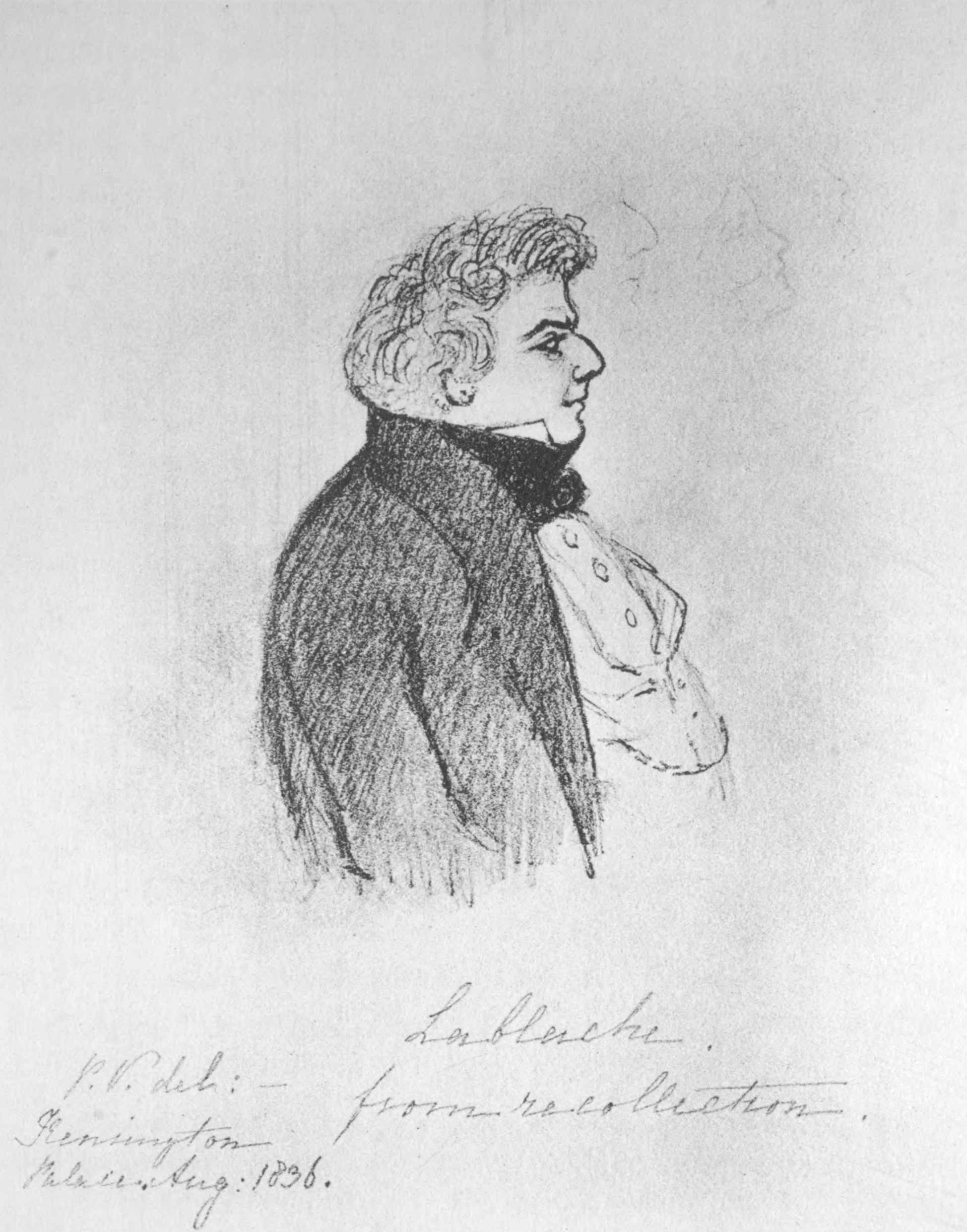
whom she was deeply attached. Lablache, her singing-master, a man of
some originality and charm, was a constant source of interest and
amusement to the young Princess, and she preferred his lessons to all
others.
It was during these last few years before her accession that the final
touches were given to her character by the subtle influences of her
environment. The position occupied by Sir John Conroy in her mother’s
house inspired and fortified her subsequent resolve to avoid intimacies
with members of her household. She became distant and reserved to
those about her, and her relations with her mother were chilled. Her
mind acquired an impression that family ties, however binding from the
point of view of duty, might be superseded by those of friendship. It
is undoubtedly the case that Baroness Lehzen occupied at this time
the first place in her pupil’s thoughts and affections; while the
dawning necessity felt by Princess Victoria for sympathy, and for those
intimate communings so attractive to sentimental natures, had a very
distinct influence upon the mind and conduct of the Queen in subsequent
years. Her Journals afford proof, if proof had been wanting, that, in
spite of the opinions of her attainments vouchsafed by eminent clerics,
the Princess had not been afforded an education specially designed to
fit her for the situation she was to occupy.
She was, at eighteen, as moderately and indifferently equipped as the
average girl of her age. If her conversation was not brilliant, her
heart was kindly and her judgment sound. She was shrewd and eminently
truthful. In spite of her small stature, she was curiously dignified
and impressive. Her voice was musical and carried far. And above all
things, her rectitude was unassailable, and her sense of duty so
keen and high that it supplied any lack of imagination or spiritual
deficiency. She was humble-minded, but not, perhaps, very tender. She
was passionate and imperious, but always faithful. She was supremely
conscious of the responsibilities and prerogatives of her calling,
which she was convinced, then and always, were her appanage by the gift
of God.
There is nothing in her Journals or elsewhere to show that before she
was eighteen years old she had ever talked seriously and at any length
to any man or woman of exceptional gifts. It was only when her uncle
King Leopold heard of the illness of William IV. that Stockmar was
instructed to speak with due gravity upon important matters to the
young girl whose accession to the Throne appeared imminent. Her mind
at that time was a blank page in so far as questions of high politics
or of administration were concerned. In point of fact, this was a
fortunate circumstance, and rendered easier the task of those who were
bound in the nature of things, and under the constitution of these
islands, to use this youthful Princess as one of the chief instruments
of government. Her mind was free from any political bias or complexion,
and ready to receive the impress of her constitutional Ministers. When,
within less than a month of her eighteenth birthday, King William
died, and when on June 20, 1837, the Queen found herself face to face
with those Whig statesmen in whose hands the destinies of the country
had been placed for the time being, their task was unhampered by
preconceived ideas or by foregone prejudice in their pupil. For the
Queen a new chapter of life was opened. She at once threw off the
trammels of pupilage. Not only was she able immediately and without
effort to shake herself clear of the domestic influences she had
resented and disliked, but for the first time she was enabled to meet
and to question distinguished men, with whose names she was familiar,
but whose standards of thought and conversation were far higher than
any to which she had been accustomed.
It was “in a palace in a garden, meet scene for youth and innocence,”
as one in later years to be her favoured Minister wrote, that Princess
Victoria received the news of her accession to a Throne overlooking
“every sea and nations in every zone.” The scene and the circumstances
in which her accession was announced to her by the Archbishop of
Canterbury and Lord Conynghame are described by the Queen in her
Journal. She has also recorded her impressions of what followed when
for the first time she met the Privy Council. What the Queen has not
described is the effect produced upon those present by her personality,
her youthful charm, her self-possession and perfect modesty, in such
strong contrast to everything which her Privy Councillors had been
accustomed to find in their former Sovereigns. The Queen was not
aware of the interest and curiosity she then excited in the minds of
her subjects. She had been brought up in such comparative seclusion,
that both to “Society” and to the great world outside her character
was an enigma and even her appearance very little known. Her sex and
youth rendered her personality exciting to a public satiated with the
elderly vagaries of her uncles. It was noticed at her first Council
that her manner was very graceful and engaging. It was particularly
observed that after she had read her speech in a clear and singularly
firm voice, when the two surviving sons of George III., the Dukes of
Cumberland and Sussex, knelt before her, swearing allegiance, she
blushed up to the eyes as if she felt the contrast between their public
and private relations, between their august age and her inexperienced
youth. It was also noticed that she spoke to no one, and that not the
smallest difference in her manner could be detected, even by sharp
watching eyes, between her attitude towards Lord Melbourne and the
Ministers on the one hand, and towards the Duke of Wellington and Sir
Robert Peel on the other. The Queen does not mention, for she was not
then aware of it, that Lord Melbourne was charmed and Sir Robert Peel
amazed at her demeanour. They spoke afterwards with emotion of her
modesty, firmness, and evident deep sense of her situation. She did not
know then, although she knew later, that the Duke of Wellington said
that had she been his own daughter he could not have desired to see her
perform her part better.
These Journals only accentuate what is already known from many
sources, that the Queen showed in difficult circumstances not only
good taste and good feeling, but admirable good sense. Her attention
to details, which some might consider trifles, but which differentiate
the careful from the thoughtless mind, was noticed with approval and
surprise by her Ministers. She exhibited caution in her treatment of
those persons who had been about her since childhood, and she made
no appeal to any of them for advice or guidance. Nor did she permit
advice to be proffered. Sir John Conroy was dismissed at once from
her surroundings. Baroness Lehzen she retained, as before, about
her person, and she speaks of her, throughout these Journals, with
deep feeling. It was noticed, whenever she was asked to decide some
difficult matter, her customary reply was that she would think it over,
and give her answer on the morrow. Onlookers, knowing that she relied
on the advice of Lord Melbourne, generally assumed that she referred
to him in the interval. He, however, declared that to many of his
questions a similar reply was given. In point of fact, she was obeying
one of the precepts of her uncle, the King of the Belgians.
It will be obvious to the readers of this book that a potent influence
over the mind and actions of the young Queen was exercised by Lord
Melbourne. It was the natural outcome of the business relation between
a very charming and experienced man of the world who happened to be
her Prime Minister and a very young girl isolated in the solitary
atmosphere of the Throne. From the Queen’s accession to the day of
her marriage the table-talk of Lord Melbourne fills the largest space
in her journals. Her description of their intercourse confirms what we
know from other sources, that Lord Melbourne became absorbed by the
novel and striking duty that had fallen to his lot. His temperament and
his antecedents rendered him peculiarly sensitive to the fascinating
influences of the strange relation in which he stood to this young
Queen. Lord Melbourne’s life had been chequered by curious experiences,
and his mind had been thoroughly well trained, for a man of his
station, according to the lights of those days. A classical education,
the privilege from youth upwards of free intercourse with every one
worth knowing, the best Whig connection, and an inherited capacity for
governing men under oligarchic institutions, had equipped his intellect
and judgment with everything that was necessary to enable him carefully
to watch and safeguard the blossoming of the character of the girl who
was both his pupil and his Sovereign.
He was no longer young, but he was not old. His person was attractive.
According to Leslie, no mean judge, his head was a truly noble one,
and he was a fine specimen of manly beauty in the meridian of life.
Not only were his features handsome, but his expression was in the
highest degree intellectual. His laugh was frequent and the most joyous
possible, his voice so deep and musical that to hear him say the most
ordinary thing was a pleasure; and his frankness, his freedom from
affectation, and his peculiar humour rendered almost everything he
said, however easy and natural, quite original. Chantrey’s bust and
the well-known portraits of Melbourne corroborate the descriptions
given by his contemporaries.
The Queen’s Journals afford us some illustrations of the extent of
his memory and reading. In his knowledge of political history he was
unsurpassed by any living Englishman, and among the statesmen of that
day there were none by age, character, and experience so well qualified
for the task of making the Queen acquainted with the art of government,
or better able to give her a correct interpretation of the laws and
spirit of the constitution. He understood perfectly the importance
of training her to work straightforwardly but secretly with that
small committee of active politicians, representing the parliamentary
majority of the day, which goes by the name of the Cabinet. Sir Robert
Peel and the Duke of Wellington, the Leaders of the Opposition, felt
and admitted that for her initiation into the mysteries of Kingcraft,
the Queen could not have been in wiser hands. It will be obvious from
these Journals that the Queen drifted into political partisanship.
She lived in dread of losing her Whig Ministers, and she got “to
hate” the Tories. This only meant—and under all the circumstances it
was natural—that she ardently desired to retain her mentor at her
side. It is to the credit of Lord Melbourne that he was constantly
discouraging his Sovereign’s bias towards the Whig Party, of which he
was the head, and that he never lost an opportunity of smoothing the
way for the advent of Sir Robert Peel which he knew to be inevitable.
He was, not inaptly, called a Regius Professor with no professorial
disqualifications, and it was precisely from this point of view that
the Tory leaders recognised the indispensable nature of his task, and
approved his manner of performing it. He was a Whig no doubt, says his
biographer, but at any rate he was an honest-hearted Englishman, and,
in no merely conventional sense, a gentleman on whose perfect honour no
one hesitated to place reliance.
He treated the Queen with unbounded consideration and respect, yet he
did not hesitate to administer reproof. He consulted her tastes and her
wishes, but he checked her inclination to be headstrong and arbitrary.
He knew well how to chide with parental firmness, but he did so with a
deference that could not fail to fascinate any young girl in a man of
his age and attainments. The Queen was completely under his charm. The
ease of his frank and natural manners, his quaint epigrams and humorous
paradox, his romantic bias and worldly shrewdness, were magnified by
her into the noblest manly virtues.
He saw her every day, but never appeared to weary of her society.
She certainly never tired of his. Yet he was fifty-eight years old,
a time-worn politician, and she was a girl of eighteen. He was her
confidential servant and at the same time her guardian. She was his
ward and at the same time his Sovereign. The situation was full of the
possibilities of drama, yet nothing can be more delightful than the
high comedy revealed in the passages of the Journals that refer to Lord
Melbourne. That he should have happened to be First Minister of the
Crown when King William died was a rare piece of good fortune for the
new Sovereign and for the country. With all the immense powers of head
and heart which the Queen came later to discover in Sir Robert Peel,
we may take leave to doubt if he could so lightly and so wisely have
assumed and fulfilled the duties imposed upon his predecessor.
It is impossible to exaggerate the effect produced upon the mind and
character of the Queen by the apostolic letters of her uncle. Even the
sound constitutional dogma of Stockmar might have failed to influence
one naturally inclined to be autocratic. Those, however, who were to
reap the profit in later years of the shrewd daily culture of the
Queen’s mind, of the skilful pruning away of ideas dangerous in a
British Sovereign, of the respectful explanation of her duties, of the
humorous rallying upon slight weaknesses which might have developed
into awkward habits, were deeply indebted, as these Journals show, to
the sagacity of Lord Melbourne.
Two Queens Regnant, Queen Mary and Queen Anne, both of Stewart blood,
lived much at Kensington Palace, and both died there. As a place of
residence it had no attractions for the Sovereigns of the House of
Hanover. Queen Victoria was fond of the old wing in which her youth had
been spent, and which was subsequently occupied for many years by the
Duchess of Teck and her children. Built on piles, those portions of the
Palace that were uninhabited, and therefore indifferently looked after,
had towards the end of the Queen’s reign fallen into such disrepair
that their demolition had been decided by the Treasury. The Queen
disliked intensely the idea of removing any part of the old building.
Ultimately a bargain was made with the Chancellor of the Exchequer of
the day. It involved a certain exchange of houses in the gift of the
Crown and some shifting of financial responsibility. Kensington Palace
was saved, and a considerable sum was voted by Parliament for its
restoration, on condition that the public should be admitted to certain
rooms of historic interest.
King George’s dream, and no one knows better its visionary character,
is to pull down Buckingham Palace, to round off St. James’s and the
Green Parks at Constitution Hill and Buckingham Gate, and then, with
the money obtained by the sale of the Gardens of Buckingham Palace, to
reconstruct Kensington Palace as the town residence of the Sovereign.
For Queen Mary the place is full of memories and, because of her keen
historic sense, full of interest.
Compared with most of the great European capitals, London is poor in
palaces. The homes of the Tudor Sovereigns in and near the metropolis,
Nonsuch, Greenwich, and Whitehall, have disappeared. London contains
no single palace residentially associated with our long line of
Sovereigns. The Court of St. James was housed, in the eighteenth
century, in the Palace of that name. It seems to have been adequate
for the needs of the Hanoverian Princes, who had none of the amplitude
of the Tudors or the fine taste of the Stewarts.
The memories of Windsor, however, are long memories. Although Queen
Victoria never liked Windsor, perhaps because she was never in good
health there, it is with Windsor Castle that the principal events
of her reign are associated. The thoughts of the few, the very few,
comparatively speaking, of her subjects who were admitted to the
seclusion of Court life during two-thirds of the Queen’s reign may
carry them back to quiet days at Balmoral or Osborne, but it was round
Windsor that the political interest of the Victorian era centred. There
the links of the chain have remained unsevered between the Sovereigns
of Great Britain to-day and their Plantagenet ancestors.
If the Queen’s attachment to Windsor was not deep, she was more
indifferent still to Buckingham Palace. There is not a word in her
Diaries or correspondence to show that she in any way looked upon it as
a home or even a residence in any degree interesting or attractive. No
attempt was made, after the death of the Prince Consort, to improve or
beautify it. The magnificent objects of art and the splendid collection
of pictures were badly displayed and quite unappreciated. Few, outside
the circle of the Court, knew of their existence. The Palace was judged
by its mean façade, and the nation was rather shamefaced about the home
of its Sovereign, and certainly took no credit for the really noble
rooms and their contents which Buckingham Palace contains.
Yet, through the picture-gallery of this Palace hung with masterpieces
of the Dutch School, through the throne-room and the drawing-room
resplendent with the royal portraits of Reynolds and Gainsborough, or
through the matchless corridor at Windsor, have passed nearly all the
great figures of the nineteenth century, practically the whole of which
was spanned by the life of the Queen.
It is an imposing array, worthy of its setting. Heroes and statesmen,
men of science and letters, artists and scholars, all moved, with
a feeling of awe, into the presence of the Queen whose girlhood is
recounted by herself in these pages.
To those accustomed to the easier manners of more recent times it is
difficult to convey a sense of the atmosphere of Windsor during the
reign of the Queen. Her extraordinary aloofness was its determining
cause, but the effect was that of a shrine. Grave men walked softly
through the rooms of the Castle, and no voice was ever raised. The
presence of the Sovereign brooded, so to speak, over the Palace and
its environment. The desire to be negligently at ease never entered
the mind. The air was rarefied by a feeling that somewhere, in a
region unvisited by any but the most highly privileged, was seated,
not in an ordinary arm-chair, but on a throne, the awe-inspiring
and ever-dignified figure of the Sovereign. The proud intellect of
Gladstone and the rugged self-sufficiency of Bright bent before the
small, homely figure in widow’s weeds. In spite of this homeliness of
appearance, notwithstanding her love of simplicity and her dislike of
tawdriness and display, her spirit never put aside the regal habit.
How rarely the Queen extended her hand! It was a great privilege, and
only on special occasions vouchsafed to her Ministers. Men and women
bent very low to kiss that hand. This was not due to her small stature,
but to the curious, indefinable awe that she undoubtedly inspired
during the later portion of her life in all who approached her. Will
the reader find, in these records of her girlhood, intimations of that
moral ascendency she afterwards acquired over her subjects?
It was unquestionably a triumph of character. Even now to attempt a
serious estimate of the intellectual capacity of Queen Victoria is a
difficult task. There are too many still among us the greater part of
whose lives were spent under her sway. It is a fault in nearly all
recent biographies that they attempt appreciations which only the lapse
of time can enable a writer to draw in true perspective.
A venerable Sovereign, in full possession of his great powers of
intellect and character, who was almost an exact contemporary, still
rules a European people as proud of him as were her subjects of the
Queen. At least one of her faithful servants, who was present at
her Coronation seventy-four years ago and at every great ceremonial
throughout her reign, is still alive and full of manly vigour. Her
children are in the prime of life, and her favourite grandson is the
beloved Sovereign of the people she governed. Unqualified praise is
always distasteful, and critical analysis may easily prove to be in
singularly bad taste. Queen Victoria’s womanly and royal virtues are
written in golden letters upon the face of the vast Empire over which
she reigned. Her faults may well lie buried, for some time yet, in her
grave under the shadow of Windsor.
In the muniment-room of the Castle are preserved the private records of
her life-work. Over a thousand bound volumes of letters, from and to
the Queen upon all subjects, public and domestic, are there; and over a
hundred volumes of her Journals written in her own hand.
It is a unique record. The private papers of George III. have
disappeared. Of those of George IV. and William IV., only a few are in
existence. Selections from the correspondence of the Queen up to 1861
were published by permission of King Edward. These selections from her
early Journals have been made by the gracious leave of King George. It
may be many years before it would be wise or prudent to make public
any more of the private history of Queen Victoria’s reign. Those who,
by good fortune, have had access to these records can, however, safely
predict that whatever hereafter leaps to light, the Queen never can be
shamed.
INTRODUCTORY NOTE TO CHAPTER I
When the Queen’s Journal opens she was thirteen years and two
months old. When she was four years younger Sir Walter Scott was
presented to the little Princess Victoria and noted that she was
“educating with much care.” At that time she was supposed not to
know that she was the “heir of England,” but Scott thought that
if the little heart could be dissected it would be found that
some little bird had carried the matter. According to Baroness
Lehzen, the truth was not revealed until a year before the Princess
commenced to write her first Journal. There was a picture painted
of her about this time, and it corroborates Lord Albemarle’s
description of the little girl of extreme fairness whom he watched
watering, at Kensington, a child’s garden, wearing a large straw
hat and a suit of white cotton, her only ornament being a coloured
fichu round the neck.
The Princess was guarded with extreme care. Leigh Hunt noticed that
she was invariably followed, when walking, by a footman in gorgeous
raiment. She told her daughters many years later that she was so
carefully tended until the day of her accession, that she had never
been permitted to walk downstairs without someone holding her hand.
The Princess’s journey commenced August 1, 1832, although the first
part of what her Uncle, King William, called her Royal Progresses
was not her first trip into the country. With her mother she paid
several visits to Ramsgate and Broadstairs. She had stayed with
Lord Winchelsea at Eastwell, near Ashford, and she had visited
George IV. at the Royal Lodge in Windsor Park. She had spent an
autumn at Norris Castle, Isle of Wight, and had been to Bath and
Malvern.
Sir Walter Scott expressed a hope that she would not retain the
name of Victoria, and when upon the accession of William IV. extra
provision was demanded of Parliament for the little Princess
Alexandrina Victoria of Kent, who then became heir-presumptive to
the Crown, Sir Matthew White Ridley and Sir Robert Inglis desired
to make the Parliamentary grant contingent upon the Princess, as
Queen, assuming the style of Elizabeth II., on the ground that the
name Victoria did not accord with the feelings of the people. The
name Victoria, however, was destined to acquire lustre not inferior
to that of Elizabeth.
The Princess’s first Progress is minutely described in the first
volume of her Journal. Before it ended, Robert Lowe, afterwards
her Chancellor of the Exchequer, caught a glimpse of the child as
she passed from the Bodleian to lunch with the Vice-Chancellor at
Oxford. Her foot was on the threshold of public life.
CHAPTER I 1832
Wednesday, August 1st. We left K.P.[3] at 6 minutes past 7 and
went through the Lower-field gate to the right. We went on, & turned
to the left by the new road to Regent’s Park. The road & scenery is
beautiful. 20 minutes to 9. We have just changed horses at Barnet, a
very pretty little town. 5 minutes past ½ past 9. We have just changed
horses at St. Albans. The situation is very pretty & there is a
beautiful old abbey there. 5 minutes past 10. The country is beautiful
here: they have began to cut the corn; it is so golden & fine that I
think they will have a very good harvest, at least here. There are also
pretty hills & trees. 20 minutes past ten. We have just passed a most
beautiful old house in a fine park with splendid trees. A ¼ to 11. We
have just changed horses at Dunstable; there was a fair there; the
booths filled with fruit, ribbons, &c. looked very pretty. The town
seems old & there is a fine abbey before it. The country is very bleak
& chalky. 12 minutes to 12. We have just changed horses at Brickhill.
The country is very beautiful about here. 19 minutes to 1. We have
just changed horses at Stony Stratford. The country is very pretty.
About ½ past 1 o’clock we arrived at Towcester & lunched there. At 14
minutes past two we left it. A ¼ past 3. We have just changed horses
at Daventry. The road continues to be very dusty. 1 minute past ½ past
3. We have just[4] passed through Braunston where there is a curious
spire. The Oxford canal is close to the town. 1 minute to 4. We have
just changed horses at Dunchurch & it is raining.
For some time past already, and now, our road is entirely up an avenue
of trees going on and on, it is quite delightful but it still rains.
Just now we go at a tremendous rate. 4 minutes to 5. We have
just changed horses at Coventry, a large town where there is a very old
church (in appearance at least). At ½ past 5 we arrived at Meridon; and
we are now going to dress for dinner. ½ past 8. I am undressing to go
to bed. Mamma is not well and is lying on the sofa in the next room. I
was asleep in a minute in my own little bed which travels always with
me.
Thursday, 2d August.—I got up after a very good night at 5
o’clock this morning. Mamma is much better I am happy to say, and I
am now dressing to go to breakfast. 6 minutes to ½ past 7. We have
just left Meridon, a very clean inn. It is a very bad day. 10 minutes
to 9. We have just changed horses at Birmingham where I was two years
ago and we visited the manufactories which are very curious. It rains
very hard. We just passed through a town where all coal mines are and
you see the fire glimmer at a distance in the engines in many places.
The men, women, children, country and houses are all black. But I can
not by any description give an idea of its strange and extraordinary
appearance. The country is very desolate every where; there are coals
about, and the grass is quite blasted and black. I just now see an
extraordinary building flaming with fire. The country continues black,
engines flaming, coals, in abundance, every where, smoking and burning
coal heaps, intermingled with wretched huts and carts and little ragged
children....
I received from the mayor an oaken box with a silver top and filled
with the famous Shrewsbury cakes. We lunched there. We left it at a ¼
to 3. As we passed along the streets a poor unhappy hen, frightened
by the noise flew on the carriage but she was taken off. We had our
horses watered half way. When we arrived at the outskirts of Welshpool
we were met by a troop of Yeomanry who escorted us for a long time and
the little town was ornamented with arches, flowers, branches, flags,
ribbons, &c., &c. The guns fired as we came up the park and the band
played before Powis Castle; Lord Powis[5] and Mr. Clive met us at the
door of his beautiful old Castle and Lady Lucy and Lady Harriet Clive
were in the gallery. The Castle is very old and beautiful; the little
old windows jutting in and out and a fine gallery with a dry-rubbed
floor and some beautiful busts. I am now dressing for dinner....
Thursday, 9th August.—I awoke at ½ past 6 and got up at 7.
I am now dressing. A little after 8 I went out in the garden, and
at about ¼ to 9 we took breakfast. I began to write a letter after
breakfast, and then dressed. At ½ past 10 Mamma received an address
from the Mayor and Corporation of Beaumaris, and another from the
gentlemen inhabitants, and visitors of the town. At ½ past 11 we got
into our carriages with my Cousins on the box of ours. In passing
the Menai-bridge, we received a salute, and on entering the town
of Carnarvon, we were met, not only by an immense crowd, who were
extremely kind, and pleased, but by the Corporation also, who walked
before the carriage, while a salute was firing. We then arrived at
the inn, where Mamma received an address. The address being over we
took luncheon, and after that was over, we went to see the ruins of
the Castle, which are beautiful, while a salute was fired, from the
rampart. We then got into the Emerald, where we were several
times saluted, at the last being nearly becalmed, we were towed by a
steam packet, called Paul Pry, which saluted us 4 times in the
day. We arrived at home at ¼ to 7, and dined at ½ past 7. We drank
Uncle Leopold’s health in honour of his marriage that day. I stayed up
till ½ past 9. I went to bed soon after, and was soon asleep....
Wednesday, 29th August.—I awoke at ½ past 6 and got up at 7.
It is now 6 minutes past 8 & I am quite ready dressed. I then played.
We breakfasted at ½ past 8 but without Lady Catherine[6] who is very
unwell. I then did my lessons & then played. At ½ past 12 I went
out walking. We lunched at 1. At ½ past 3 went to Baron Hill Sir R.
Bulkeley’s[7] place. We arrived there at a little after 4. We were
received at the door by Sir Richard & farther on by Lady Bulkeley whose
dress I shall describe. It was a white satin trimmed with blonde, short
sleeves & a necklace, ear-rings and sévigné of perridos & diamonds with
a wreath of orange-flowers in her hair. We then went upon the terrace
& the band of the Anglesea Militia played “God save the King.” We
then presented all the bards & poets with medals. We then [went] into
the drawing-room and remained there till dinner. In the drawing-room
there were a great many other people. At 5 we went to dinner, which
was in a temporary building which was lined in the inside with pink
and white linen. The dinner was splendidly served & the china was rich
and beautiful. The fruit was magnificent. After dessert was over Sir
Richard made a speech and brought out a toast in honor of Mamma & me.
We then left the room & went into the drawing-room. We went upstairs
into Lady Bulkeley’s pretty little dressing-room. Her toilet table was
pink with white muslin over it trimmed with beautiful lace & her things
on the toilet table were gold. We then went downstairs and took coffee
and the famous dog of Lady Williams,[8] Cabriolle, played tricks. At
about 7 we left Baron Hill & proceeded homewards. Poor Lady Catherine
who was not able to go was in the evening much better. We arrived at
home at about a ¼ past 8. I then went downstairs & stayed up till near
9. I was soon in bed and asleep....
Monday, 17th September.—I awoke at about 8, & got up at near
½ past 8. We breakfasted at 9 downstairs. I then played and did
other things. At 1 we lunched. I then played on the piano, & at a
little before 3 played at billiards downstairs, with Victoire,[9] &
then went out walking. When I came home I first worked & then we blew
soap-bubbles.
Sunday, 14th October.—I awoke at 7 and got up at ½ past 7. At ½
past 8 we breakfasted. I then wrote my Journal and some music and at 11
we went to chapel for the last time and the sailors likewise for the
last time. The service was performed as usual by Mr. W. Jones. It was
over at ¼ past 12. I then walked out with Lehzen[10] and Victoire. At 1
we lunched. At 3 we went out riding, and as we passed through the Park
gate the old woman at the lodge came out as usual, to open the gate and
she thanked Mamma for what she had given her. We galloped over a green
field which we had already done several times. Rosa went an enormous
rate; she literally flew. We then went on towards the Menai
bridge but turned back under the hill. We cantered a great deal and
Rosa went the whole time beautifully. It was a delightful ride. When
we came home Mamma got on Rosa and I got on Thomas and cantered him.
We came in at ½ past 4. Alas! it was our last ride at dear Plas
Newydd. I then walked on the terrace for a short time. At 7 we dined
and I stayed up till ½ past 8. I was soon in bed and asleep.
Monday, 15th October.—I awoke at ½ past 5 and got up at 6. At
7 we breakfasted with all the family; and a most beautiful falcon
which Sir John Williams[11] sent me was brought in that I might see it.
The sailors were so busy and so useful for I saw Kew and Sparks going
to and fro. At a ¼ to 8 we got into our carriages and drove out amidst
the shouts of the sailors of the Emerald, who were standing
on the rigging two by two on the rope-ladders, till the last man was
at the very top of all. I looked out of the carriage window that I
might get a last look of the dear Emerald and her excellent
crew. As we passed along the road we saw Mr. Griffith and Mr. W.
Jones and his family....
Miss Victoire Conroy, from nature.
VICTOIRE CONROY. From a sketch by Princess Victoria.
10 minutes to 4.—We have just passed through Northop. At about ½
past 4 we went through the Park of Mr. Granville up to his castle.
Lord Grosvenor met us there at the head of his Cavalry. And Lord
Westminster[12] sent his own fine horses, which were put to our
carriage. At about ½ past 5 we arrived at Eaton Hall. We were received
at the door by Lord and Lady Westminster, Lady Grosvenor and Lady
Wilton. The house is magnificent. You drive up to the door under a
lofty vaulted portico with a flight of steps under it, and it takes
you to the hall, which is beautiful. The floor is inlaid with various
marbles, and arches spring from the sides. Then you enter a beautiful
drawing-room; the ceiling joins in a round gilt, with great taste and
richness, while the sides arch towards the top. An organ on the right
as you enter the room and a large fireplace on the left with stained
glass windows. Then Lady Westminster after we had been downstairs a
little, showed us our apartments, which are indeed beautiful. I was in
bed at ½ past 8.
Tuesday, 16th October.—I awoke at 6 and got up at 7. I
then dressed and took some tea. At ½ past 9 we breakfasted. The
breakfast-room is magnificent. There are 4 fireplaces; and the windows
are of stained glass very beautifully done. A massive lustre of gold
with an eagle likewise in gold hangs from the ceiling in the middle
of the room. Pillars arching to the top and gilt in parts rise from
the sides. Several tables of oak and elm stand in the windows, and the
breakfast was served in handsome silver tea and coffee pots; a crown of
gold with precious stones contained the bread. Besides Lady Grosvenor
and Lady Wilton, there were also Lady Egerton,[13] Mrs. Lane and Miss
Bagot. After breakfast Lady Grosvenor brought her 4 children. We then
went into our own rooms and I wrote my journal. At 12 Mamma went into
the great saloon where all the ladies were and an address from the
mayor and corporation of Chester arrived and then another from the
gentlemen and inhabitants of Chester, presented by Lord Robert.[14]
After this we looked about the room which is indeed beautiful. The
ceiling is done in the same splendid manner and a magnificent lustre
of gold and glass with a coronet of velvet and pearls hung from the
ceiling in the room. Two windows of stained glass, very handsomely
done, are on different sides. A superb chimney-place with beautiful
furniture and rich carpets, complete the room. 4 beautiful pictures
painted by different artists are likewise in the room. We then walked
out with most of the people; I walking in front with the eldest and
third little girl, the second not being well. We walked about the
garden and looked at an aloe which flowers only once in 100 years. We
came in at ½ past 1, and lunched at 2. At ½ past 2 we went out driving;
Lady Westminster and little Elinor,[15] the eldest child, were in our
carriage; she is a delightful child. Lady Catherine and Lehzen followed
in another carriage. We drove about the park which is beautiful. When
we came home we walked in the kitchen gardens which are indeed very
pretty. At ½ past 4 we came home and I worked. At 7 we dined. The
dining-room is a fine room beautifully worked at the ceiling. Four
large statues of Maltese stone occupy 4 corners, very beautifully
executed; one with a helmet is Sir Gilbert le Grosvenor,[16] and the
lady[17] next by him is the heiress of Eaton; on the opposite side
the man is Sir Robert le Grosvenor, distinguished in the battle of
Cressy; the lady near him is a Miss Davis who by intermarrying brought
the possessions in town, as Grosvenor Square, Belgrave Square, etc.,
etc.[18] The window is stained glass with the figure of Hugh Lupus on
it. The dinner was served on plate, and the plateau was very handsome
with gilt cups on it. The side table was covered with gold plate.
After dinner we played at a game of letters and then I sang and Mamma
and Lady Catherine sang and afterwards Lady Westminster played on the
organ. I stayed up till 10....
Thursday, 18th October.—When we went out after luncheon we went
in the garden first and saw a Roman altar which had been dug up near
Chester. At 7 we dined. The breakfast-room had been arranged for this
purpose. A temporary floor had been arranged at the top of the room,
for our table (for all the company who had come to the bow-meeting
dined here), and the other four were lower. After the dinner (we being
still at table) was over some glee-singers from Chester came and sang
the grace in Latin. Then Lord Westminster gave out some toasts; amongst
others, “The King,” “The Queen,” Mamma and me; which were received
extremely well. After dinner was over, I gave the children, who had
come when dinner was over, a little remembrance. I then took leave of
the whole family and went to bed. I stayed up till 10.
Friday, 19th October.— ... ½ past 4. We have just changed horses
at Buxton, which is a pretty place. The houses are well built and form
a crescent. The country about here is very pretty, high rocks covered
with trees. There are all about here little rivulets and fountains,
rippling over stones. At ½ past 6 we arrived at Chatsworth, which is
a beautiful house. It was quite dark. It is built in the shape of a
square joined by an arch under which one must drive. We were met at the
door by the Duke of Devonshire[19] who conducted us up the staircase,
which is made of wood, to our apartments which are indeed beautiful. In
the corridor there are some beautiful statues. I dined by myself in my
own room with Lehzen. I stayed up till ½ past 8. I was soon in bed and
asleep.
Saturday, 20th October.—I awoke at ½ past 7 and got up at 8.
At a little past 9 we breakfasted, us 5 by ourselves in a lovely room
giving on the park and garden where one could see a cascade which
ran all the way down. The room is small; the ceiling is painted and
represents some mythology, with books round the room and a splendid
carpet. At about 11 we went over the house with the company, which
consisted of Lord and Lady Cavendish,[20] Lord and Lady Newburgh,[21]
Mr. and Lady Caroline Lascelles,[22] Count Karoly, Mrs. Arkwright,
Lady Clifford, Lord and Lady Wharncliffe,[23] Mrs. Talbot, Lord
Morpeth,[24] Mr. Cooper, Mr. Henry Greville, and Miss Fanny
Cavendish.[25] It would take me days, were I to describe minutely the
whole. We went all over the house, and the carving of the frame-work
of some looking-glasses was quite beautiful; they are carved in the
shape of birds, the plumage being so exquisite that if it was not
of the colour of wood one might take them for feathers. It not only
surrounds the mirrors but the ceilings of some of the rooms. We saw
Lady Cavendish’s little boy who is 10 months old, a beautiful child. We
likewise saw the kitchen which is superb for its size and cleanliness;
and the confectionary which is as pretty and neat. The Duke’s own
apartments contain some superb statues of Canova and others; likewise
a beautiful collection of minerals. We saw the library and dining-room
which are all beautiful. The library’s ceiling is painted in figures;
and the carpet is beautiful. The conservatory which leads from the
dining-room is very pretty. We then walked out in the garden, I went
into another conservatory which contains a rockery with water falling
from it. There are some curious plants there, amongst others two which
are worthy of remark; the one is called the pitcher-plant because at
the end of each leaf hangs a little bag or pitcher which fills with
the dew and supplies the plant when it wants water; the other is
called the fly-catcher plant, because whenever a fly touches it, it
closes. From the conservatory we went and looked at a monkey which is
in the garden, chained. We then went to the cascade and saw some other
fountains very curious and pretty. When we had come on the terrace
the Duke wished us to plant two trees down under the terrace. So we
did, I planted an oak and Mamma a Spanish chesnut. After that we went
upon the terrace again and went up a platform which had been arranged
with carpets, to view the cricket-match below; the Buxton band playing
“God save the King” and the people hurraying and others under tents
looked very pretty. From there we went to the stables where we saw some
pretty ponies and a Russian coachman in his full dress, and the only
Russian horse which remained reared at his command; there were 3 other
horses, English ones, but trained like the other. At about ½ past 1
we came home and lunched with the whole party. At ½ past 2 we went in
a carriage and 6 with the Duke and Mrs. Cavendish, to Haddon Hall, a
very old and singular place. The old tapestry still remaining and iron
hooks to keep it back. We then went to the Rookery, a small cottage
belonging to the Duke on the banks of the river Wye, very pretty and
cool. From there we walked to the Marble Mills and saw how they sawed
and polished the marble. There was a little cottage where they sold
Derbyshire spar in different little shapes and forms, and some pieces
of marble too. We then drove home after having bought a good many
things. We came in at 5. At 7 we dined and after dinner at about ½
past 9 we looked at the cascade illuminated, which looked very pretty,
and the fountains, blue lights, red lights, rockets, etc. At about
10 the charade began in 3 syllables and 4 scenes. The first act was
a scene out of Bluebeard; Lady Caroline Lascelles and Miss F.
Cavendish acting the ladies, and Count Karoly as Bluebeard, with Lord
Newburgh and Mr. Lascelles as their friends. The next act was a scene
of carrying offerings to Father Nile; Mrs. Talbot, Lady Cavendish,
Lady Clifford, Miss Cavendish, and the two Miss Smiths as the vestals;
and Lord Morpeth, Lord Newburgh, Count Karoly, Mr. Greville, Sir A.
Clifford,[26] Mr Cooper, and Mr. Lascelles as the men. Mr. Beaumont
was Father Nile. The third act was a scene of Tom Thumb; Lord
Morpeth as Tom Thumb, and Lord Newburgh as the nurse. The fourth act
was a scene out of Kenilworth (which was the word); Mrs. Talbot
as Queen Elizabeth, Lady Cavendish as Amy, Lady Caroline and Miss
Cavendish (who danced the menuet with Count Karoly) as her attendants;
little Georgina Lascelles[27] as page to bear the Queen’s train,
Lord Morpeth as Lord Leicester, Lord Newburgh as an attendant, Count
Karoly as Lord Shrewsbury, Mr. Cooper as Sir Walter Raleigh, and Lord
Waterpark[28] and Mr. Greville as two more men of the Queen’s, not to
omit Lady Clifford as the Queen’s lady, and Sir Augustus as a gentleman
of the Queen. They were all in regular costumes. When it was over,
which was at ¼ to 12, I went to bed....
Wednesday, 24th October.— ... At 1 we arrived at Alton Towers,
the seat of Lord Shrewsbury.[29] This is an extraordinary house. On
arriving one goes into a sort of gallery filled with armour, guns,
swords, pistols, models, flags, etc., etc., then into a gallery filled
with beautiful pictures and then into a conservatory with birds. We
lunched there and the luncheon was served on splendid gold plate. We
then walked in the gardens. At ½ past 2 we left it....
Wednesday, 31st October.—I awoke at 7 and got up at ½ past 7.
At ½ past 9 we breakfasted in the drawing-room, for the gentlemen who
were going to hunt breakfasted in the other room, all the ladies and
Sir John breakfasting with us. After breakfast at about ½ past 10 we
went into the room where they were, and they gave us a toast with many
cheers. After that we walked out to see the hunt. We saw them set off.
It was an immense field of horsemen, who in their red jackets and black
hats looked lively and gave an animating appearance to the whole. They
had a large pack of hounds and three huntsmen or Whippers-in. They drew
a covert near here in hopes of finding a fox, but as they did not they
returned and we got into the carriage with Lady Selina[30] and Lehzen
while all the huntsmen and the hounds followed. When we came to a
field, they drew another covert and succeeded; we saw the fox dash past
and all the people and hounds after him, the hounds in full cry. The
hounds killed him in a wood quite close by. The huntsman then brought
him out and cutting off the brush Sir Edward Smith (to whom the hounds
belong) brought it to me. Then the huntsmen cut off for themselves
the ears and 4 paws, and lastly they threw it to the dogs, who tore
it from side to side till there was nothing left. We then went home.
At 1 we lunched, and at 2, I, Lady Selina, Lady Louisa[31] and dear
Lehzen went out walking, towards a farm of Lord Liverpool’s, and when
we had passed the farm and were going to return by the village, we
heard the blast of a horn and we looked and saw the hounds and hunters
going full gallop along a field which was below the field in which we
were walking. They came and crossed the field in which we were and we
saw all the riders leap over a ditch. We went back the same way that
we might see them. When we came near home we saw them go home by the
house. At ½ past 3 we came home. At ½ past 6 we dined, and I received
my brush which had been fixed on a stick by the huntsman; it is a
beautiful one. Amongst the people who were here, those who remain are
Mr., Mrs., and Miss Corbett, Mr., Mrs., and Miss Child. After dinner
the young ladies played some pretty things from the Pirata and
from Fra Diavolo. I stayed up till near 10....
Wednesday, 7th November.— ... ¼ to 4. We have just changed
horses at Woodstock, and another detachment of Yeomanry commanded
by Lord Churchill[32] ride with us now. We passed through Oxford on
our way. At about a little past 5 we arrived at Wytham Abbey, the
seat of Lord Abingdon.[33] We were received at the door by Lord and
Lady Abingdon, Lady Charlotte Bertie and Lady Emily Bathurst, their
daughters. The house is very comfortable; in the drawing-room there is
a lovely picture by Angelica Kauffman, Penelope. After staying a few
minutes downstairs we went upstairs to our rooms which are very pretty
and comfortable. At a little past 7 we dined with several other people.
I stayed up till a little past 9.
Thursday, 8th November.—I awoke at a little to 8 and got up
at 8. At a little past 9 we breakfasted with the whole party. At 10
o’clock we set out for Oxford in a close carriage and 4 with Lord
Abingdon and Lady Charlotte Bertie; the other ladies going in carriages
before us. We got out first at the Divinity College, and walked from
thence to the theatre, which was built by Sir Christopher Wren.
The ceiling is painted with allegorical figures. The galleries are
ornamented with carving enriched with gold. It was filled to excess. We
were most warmly and enthusiastically received. They
hurrayed and applauded us immensely for there were all the students
there; all in their gowns and caps. Mamma received an address which
was presented by the Vice-Chancellor, Dr. Rowly, and Mamma answered it
as usual. Then Sir John[34] was made a Doctor of Civil Law. After that
was over, we returned through Divinity College and proceeded in our
carriages to the Council Chamber where Mamma received an address there,
from the corporation of Oxford, and Sir John the freedom of the City
of Oxford. We then went to Christ Church, which is very fine, viewed
the hall and chapel and library. Dr. Gaisford[35] is the Dean of Christ
Church and is at the head of that college. From there we went to the
Bodleian library which is immense. Amongst other curiosities there is
Queen Elizabeth’s Latin exercise book when she was of my age (13). We
went through Mr. Sneed’s house to our carriages. From there to All
Souls’ College where Mr. Sneed is the warden. It is not a college for
education, but after they have taken their degree. We saw the library
and chapel which is very beautiful. We then went to University College
of which the Vice-chancellor is the head. We lunched there and saw
the chapel which is very fine. From there we went to New College of
which Dr. Shuttleworth[36] is the head. We saw the chapel and hall.
From there to the Clarendon printing-press which is very amusing but
would take up too much space and time to describe. We then went home.
We arrived at home at ½ past 3. At 7 we dined with some other people
who were Lord Cantelupe,[37] Lord Folkestone,[38]
Lord Loftus,[39] Mr.
Gage,[40] Mr. Canning,[41]
Lord Thomas Clinton,[42] Mr. L. Gower,[43]
Lord Boscawen,[44] etc. etc. After dinner the young ladies sang to
the guitar which one of them played. We then sang and Lord Abingdon. I
stayed up till 10.
Friday, 9th November.— ... At about ½ past 5 we arrived at
Kensington Palace. We resumed our old rooms. At 7 we dined with Jane
and Victoire Conroy, Lord Liverpool and Sir John. My aunt Sophia[45]
came after dinner. I stayed up till a ¼ to 9.
Monday, 24th December.—I awoke at 7 and got up at 8. At 9 we
breakfasted. At ½ past 9 came the Dean,[46] and I gave him Mamma’s
and my Christmas box. He stayed till ½ past 11. In the course of the
morning I gave Mrs. Brock a Christmas box and all our people. At ½ past
1 we lunched. At ½ past 2 came Mr. Westall[47] till ½ past 3. At 4 came
Mr. Sale[48] till 5. At a ¼ to 7 we dined with the whole Conroy family
and Mr. Hore downstairs, as our Christmas tables were arranged in our
dining-room. After dinner we went upstairs. I then saw Flora, the dog
which Sir John was going to give Mamma. Aunt Sophia came also. We then
went into the drawing-room near the dining-room. After Mamma had rung
a bell three times we went in. There were two large round tables on
which were placed two trees hung with lights and sugar ornaments. All
the presents being placed round the tree. I had one table for myself
and the Conroy family had the other together. Lehzen had likewise a
little table. Mamma gave me a little lovely pink bag which she had
worked with a little sachet likewise done by her; a beautiful little
opal brooch and earrings, books, some lovely prints, a pink satin dress
and a cloak lined with fur. Aunt Sophia gave me a dress which she
worked herself, and Aunt Mary[49] a pair of amethyst earrings. Lehzen
a lovely music-book. Victoire a very pretty white bag worked by
herself, and Sir John a silver brush. I gave Lehzen some little things
and Mamma gave her a writing table. We then went to my room where I had
arranged Mamma’s table. I gave Mamma a white bag which I had worked,
a collar and a steel chain for Flora, and an Annual; Aunt Sophia a
pair of turquoise earrings; Lehzen a little white and gold pincushion
and a pin with two little gold hearts hanging to it; Sir John, Flora,
a book-holder and an Annual. Mamma then took me up into my bedroom
with all the ladies. There was my new toilet table with a white muslin
cover over pink, and all my silver things standing on it with a fine
new looking-glass. I stayed up till ½ past 9. The dog went away again
to the doctor for her leg. I saw good Louis[50] for an instant and she
gave me a lovely little wooden box with bottles.
H.R.H. PRINCESS SOPHIA. From a portrait by Sir W. Ross.
INTRODUCTORY NOTE TO CHAPTER II
When the Princess was fourteen years old she obtained her first
sight of Osborne, that future home in the Isle of Wight where
she was destined to spend so many happy years, and which was
associated with the closing scenes of her life. Osborne Lodge was
the residence of Sir John Conroy. It occupied the site of Osborne
Cottage, now the residence of the Queen’s youngest daughter,
Princess Henry of Battenberg. In spite of the changes made in the
appearance of Osborne by the erection of Osborne House and the
laying-out of the grounds round it, that portion of the estate
where Osborne Cottage stands, and Whippingham Church, with its
manifold associations, have much the same aspect as they had when
first explored by Princess Victoria in 1833.
On her birthday, King William gave a children’s party at St.
James’s in his niece’s honour, and the ball was opened by the
little Princess and her cousin Prince George of Cambridge, then a
boy of fourteen, who was afterwards to be the Commander-in-Chief of
her armies. The Princess speaks of the ball-room. It is difficult
to be sure which room is meant by this. The eastern end of St.
James’s Palace had been destroyed by fire in 1809, and had only
recently been rebuilt. The Palace was occupied by William IV. and
Queen Adelaide, the Queen’s rooms being in that portion which is
now called Clarence House, and the King’s apartments occupying
the western end of what is now St. James’s Palace proper. It was
probably the room hung with yellow silk, next but one to the
Throne-room, so familiar to those who attend the King’s Levées,
that the little Princess opened her first ball.
This was not her first introduction into Society. Three years
before she had been seen at Court, and in 1831 she had attended a
Drawing-room.
The Princess now acquired a habit (which she practised for many
years) of making sketches from memory of the artists and scenes
that struck her imagination during her visits to the theatre.
There are many volumes at Windsor Castle full of the Princess’s
recollections of the theatre, drawn in pencil or in water-colour.
Although the technique may be faulty, these sketches are full
of movement and quaintly descriptive. They indicate an absorbed
attention on her part, and a vivid memory. They suggest a power
of concentration upon the thing she was about, which became in
after-life a marked characteristic. From her journals and her
sketches as a child of fourteen, an inference might be drawn that
little escaped the acute observation of the little Princess. There
are many who remember how in later life very little escaped the
observation of the Queen.
CHAPTER II 1833
Tuesday, 15th January.—I awoke at 7 and got up at 8. At 10
minutes to 9 we breakfasted. At ½ past 9 came the Dean till ½ past
11. Just before we went out, Mamma’s little dog, a beautiful spaniel
of King Charles’s breed, called Dash, and which Sir John gave her
yesterday, came and will now remain here. At a ¼ past 12 Lehzen and I
went out walking in the park. We met Mrs. Talbot. When we came home I
fed dear Rosy who was so greedy. At ½ past 1 we lunched. At 3
came Mr. Steward[51] till 4. At 4 came Mons. Grandineau[52] till 5.
Little Dash is perfection, he is already much attached to Mamma
and lies always at her feet. At 7 we dined. Aunt Sophia came at 8. Sir
John dined here. I stayed up till ½ past 8....
Thursday, 31st January.—At 1 we lunched. At 2 I sat to Mr.
Hayter[53] till 10 minutes to 4. At 5 we dined. Sir John dined here.
At ½ past 6 we went with Lady Conroy, Jane and Victoire to the play to
Drury Lane. It was the opera of The Barber of Seville.
It is so well known that I need not describe it. The principal
characters were Count Almaviva, Mr. Wood, who looked, sang, and acted
extremely well; Rosina, Mrs. Wood; Figaro, Mr. Philipps, who
sung very well; Dr. Bartolo, Mr. Seguin, who acted very well. It was in
3 acts and I was very much amused. The after piece called The
Nervous Man is only amusing in parts, for Mr. Farren[54] and Mr.
Power, two excellent comic actors. We did not see the end of it. We
came home at 12....
Saturday, 9th February.—I awoke at 7 and got up at ½ past 7.
At ½ past 8 we breakfasted. At ½ past 9 came the Dean till 11. At ½
past 12 we lunched. At I we paid a visit to my aunt the Duchess of
Gloucester.[55] When we came home I fed dear little Rosa, and little
Isabell. At ½ past 2 came Mr. Westall[56] till ½ past 3. At a ¼ past
5 we dined. Sir John dined here. At ½ past 6 we went to the play
with Lady Conroy, Victoire and Lehzen as usual. It was the ballet of
Kenilworth. The subject is taken from the novel by Sir Walter
Scott, which being so well known I shall not describe. The principal
characters were, Lord Leicester, Mons. Theodore Guerinot, who danced
beautifully; Amy Robsart, Mdlle. Pauline Leroux, who danced and acted
beautifully and looked quite lovely; Jenny, Madame Proche
Giubilei, who acted very well and looked very pretty; Queen Elizabeth,
Mrs. Vining; Varney, Mr. W. H. Payne; Earl of Sussex, Signor Rossi;
Lord Shrewsbury, Mr. Bertram. Besides these, Mdlle. Adele and Mdlle.
Chavigny danced a pas de trois with Mons. Theodore Guerinot. They
danced very well. At 20 minutes past 9 we came home. I then took tea....
Friday, 5th April.—To-day is Good Friday. At 10 we went to
prayers. Jane and Victoire also. The service was performed by the
Dean, who gave us likewise a very good sermon. It was taken from the
8th chapter of the Acts of the Apostles, 30th verse. At a ¼ past 12
we went out walking. When we came home I fed sweet Rosy. At ½ past I
we lunched. At 3 came Victoire till 5. At 7 we dined. At 8 came Aunt
Sophia. I stayed up till ½ past 8....
Saturday, 13th April.—I awoke at 7 and got up at 8. At a ¼ to 9
we breakfasted. At ½ past 9 came the Dean till ½ past 11. The Duchess
of Northumberland[57] was present. At 12 we went out riding in the
park with Victoire, Lehzen and Sir John. It was a delightful
ride. We cantered a good deal. Sweet little Rosy went
beautifully!! We came home at a ¼ past 1. At ½ past 1 we
lunched. Neither of my masters came. At 6 we dined. The Duchess of
Northumberland, Lady Charlotte St. Maur,[58] and Sir John dined here.
At 20 minutes to 7 we went out with them to the Opera. We were very
much disappointed for Taglioni did not make her début, nor
Rubini. We had only one scene of Il Barbière di Siviglia, in
which Signor Tambourini, who is a beautiful singer and actor,
appeared, and Donizelli. After waiting for half an hour Laporte
(the manager) was called out, and he said that Mlle. Taglioni was
very unwell in bed, and Mad. Méric was likewise ill, so that Il
Pirato could not be performed, but that Rubini would be there
directly. After one act of Fidelio, which was shockingly
performed, Rubini came on and sang a song out of Anna Boulena
quite beautifully. After that there was the ballet of La
Somnambula. The principal characters were Mdlle. Pauline Leroux,
who looked quite lovely and acted prettily; Mdlle. Adele;
Madame Proche Giubelei who looked very pretty; Messrs. Albert
and Coulon. We only saw part of it. We came home at ½ past 11....
Tuesday, 23rd April.—I awoke at 7 and got up at ½ past 7.
At 9 we breakfasted. At ½ past 9 came the Dean till ½ past 11. The
Duchess of Northumberland was present. At a ¼ past 12 we went out
riding with Lady Conroy, Victoire, Lehzen, and Sir John. We rode a
little way in the park, but the fog was so thick that we turned round
and rode down by Gloucester Road, and turned up by Phillimore Place,
where it was very fine and not at all foggy. Dear Rosa went
beautifully. We came home at ½ past 1. At ½ past 1 we lunched.
At 3 came Mr. Steward till 4. At 4 came Mons. Grandineau till 5. At a ¼
to 7 we dined. Sir John dined here, and I dressed dear sweet little
Dash for the second time after dinner in a scarlet jacket and blue
trousers. At 20 minutes past 8 Mamma went with Jane and Sir John to the
Opera. I stayed up till ½ past 8.
Wednesday, 24th April.—I awoke at 7 and got up at 8. At 9 we
breakfasted. At ½ past 9 came the Dean till ½ past 11. At ½ past 1 we
lunched. At 3 came Mons. Grandineau till 4. Madame Bourdin[59] did not
come. At ½ past 6 Lehzen and I dined. At 7 I and Lehzen went into the
large saloon, for Mamma gave a dinner to the King. There dined here,
the King (the Queen being too unwell to come), the Duke of Cumberland,
the Duke of Gloucester, the Archbishop of Canterbury,[60] the Lord
Chancellor,[61] the Duke of Devonshire,[62]
the Duke of Norfolk,[63]
the Duke of Somerset,[64] the Duke and Duchess of Gordon,[65] the
Duke of Rutland,[66] the Duchess of Northumberland, the Duchess
of Sutherland,[67] the Duke of Cleveland,[68]
the Marchioness of
Westminster,[69] the Earl of Liverpool, the Earl and Countess Grey,[70]
Lord Hill,[71] Lady Dover,[72]
the Earl of Uxbridge,[73] the Earl
of Albemarle,[74] Lord Amherst,[75] Lady Charlotte St. Maur, Lady
Catherine Jenkinson, Lady Cust,[76] Lady Conroy, Sir George Anson,[77]
Sir Frederick Wetherall,[78] and Sir John. At about 8 I went to my room
with Lehzen. At 20 minutes past 9 I went into the saloon with her to
meet the company. The Grenadier Guards’ band played after dinner. I saw
all the company go. I stayed up till 11....
Saturday, 27th April.—I awoke at 7 and got up at a ¼ to 8. At a
¼ to 9 we breakfasted. At ½ past 9 came the Dean till 11. The Duchess
of Northumberland was present. At 12 we went out walking. When we came
home I fed dear little Rosa. At a ¼ past 1 we lunched. At ½ past 2 came
Mr. Westall till ½ past 3. At 20 minutes to 3 I sat to Mr. Wyon[79]
to have my profile taken for a medal, till 10 minutes to 5. At 6 we
dined. Sir John dined here. At a ¼ past 7 we went with Lady Conroy and
Lehzen, as usual, to the Opera. It was the opera of Cenerentola
by Rossini. The principal characters were the Prince, by Signor
Donizelli; the Prince’s servant, Signor Tambourini who sung quite
beautifully; the father of Cenerentola, Signor Zuchelli, who
acted uncommonly well; Cenerentola, Madame Cinti Damoreau;
she sang quite beautifully, so round, so softly, and so
correctly. It was her first appearance this season and she was called
out. The sisters were two frightful creatures. The ballet
which followed was Flore et Zephir. Mdlle. Taglioni[80] made
her first appearance this season. She is grown very thin, but danced
beautifully, so lightly and gracefully, and each step so
finished! She took the part of Flore, and was very prettily dressed in
a plain gauze dress, trimmed with flowers across her skirt; a wreath of
flowers round her head, and her hair quite flat. Pearls round her neck
and arms. She looked lovely, for she is all-ways smiling. We
went away soon. We came home at 12....
Friday, 3rd May.—At 12 we went with the Duchess of
Northumberland, Lady Charlotte St. Maur, Lady Catherine Jenkinson,
Lady Cust, Lady Conroy, Lehzen, Sir George Anson, and Sir John, to the
Exhibition at Somerset House. We were met there by Sir Martin Shee[81]
(the President), Mr. Westall, Mr. Howard[82] (the Treasurer), Mr.
Daniel, and Sir William Beechy.[83] It was a very good exhibition.
There were several very fine pictures by Sir Martin Shee. Seven by Mr.
Westall. They were 4 landscapes, a drawing of Christ in the arms of
Simeon in the temple; a sleeping Cupid, and the death of James 2nd.
All very fine. There were 5 of G. Hayter’s but I only saw 3, which
were my picture,[84] Lady Lichfield, and Mad. de Delmar’s. There were
3 of Wilkie’s, a portrait of the King, a very beautiful portrait of
the Duke of Sussex, and Spanish monks, a scene witnessed in a capuchin
convent at Toledo. There were several very fine ones of Howard,
Daniel, Eastlake,[85] Landseer,[86]
Calcott,[87] Pickersgill,[88]
Hilton,[89] etc., etc. We came home at ½ past 2. At ½ past 4 we went
out driving in the barouche, but we also walked. We came home at 5....
Wednesday, 8th May.—At ½ past 2 came Mons. Grandineau till ½
past 3. At a ¼ past 4 we walked through the gardens, and then drove in
the barouche in the park. We came home at 5. At ½ past 6 Lehzen and I
dined. At a little past 7 Lehzen and I went into the saloon, for Mamma
gave a dinner. There dined here, H.R.H. the Duke of Orleans,[90] who
I was very glad to see, for I had not seen him since nearly 4 years;
he brought Mamma a letter from his Mother, the Queen of the French,
with a beautiful déjeuner of Sévres china; a letter from Aunt
Louisa[91] (his sister), and a beautiful bracelet with her hair in
it; for me a letter from Aunt Louisa and a beautiful bracelet with
her picture. Prince Talleyrand,[92] the Duchess de Dino,[93] the Duc
de Valençay (her son), the Marquess and Marchioness of Lansdowne,[94]
the Marquess and Marchioness of Stafford,[95] the Earl and Countess
of Tankerville,[96] the
Earl and Countess of Sefton,[97] the Earl
and Countess Grosvenor,[98] the Earl of Lichfield,[99] the Earl and
Countess Granville,[100] Lord Palmerston,[101]
Lord Morpeth,[102]
Lord Duncannon,[103] Lord Ebrington,[104]
Mr. Van de Weyer,[105] Mr.
and Mrs. Stanley,[106] Mr. Ellice,[107]
Mr. Abercromby,[108] the
Aide-de-Camp in Waiting on H.R.H. the Duke of Orleans, Mr. Taylor,
Lady Charlotte St. Maur, Lady Conroy, Sir George Anson, and Sir John.
At about 8 I went with Lehzen away. The band of the Coldstream Guards
played at dinner as well as after dinner, as it had the preceding
night. At 20 minutes after 9 Lehzen and I went into the saloon. We met
Aunt Sophia there....
Saturday, 11th May.—At a ¼ to 7 we dined. Sir John dined here.
At a little after 8 we went to the Opera with Victoire, Lehzen, and
Charles. We came in at the end of the first act of Medea. Madame
Pasta sang, and acted beautifully, as did also Rubini and Donizelli.
The ballet was excessively pretty. It is called Nathalie. The
principal dancers were Mdlle. Taglioni, who danced and acted quite
beautifully!! She looked very pretty. Her dress was very
pretty. It was a sort of Swiss dress; she first appeared in a petticoat
of brown and yellow, with a blue and white apron, a body of black
velvet ornamented with silver, pointed upwards and downwards, over a
light tucker drawn to her neck, with a black ribbon round it, a pair
of small white sleeves, a little Swiss straw hat, with long plaits of
her hair hanging down, completed her first dress. Her second dress was
a petticoat of scarlet and yellow silk, with a white apron, the same
body and sleeves, with a wreath of flowers on her head. Mdlles. Thérèse
and Fanny Elsler; they are good dancers, but have neither grace nor
lightness. Messrs. Albert, Coulon, and Daumont. In the middle of the
ballet the Duke of Orleans came into our box for a little while. We saw
most of the ballet. I was very much amused....
Friday, 24th May.—To-day is my birthday. I am to-day fourteen
years old! How very old!! I awoke at ½ past 5 and got
up at ½ past 7. I received from Mamma a lovely hyacinth brooch and a
china pen tray. From Uncle Leopold a very kind letter, also one from
Aunt Louisa and sister Feodora. I gave Mamma a little ring. From Lehzen
I got a pretty little china figure, and a lovely little china basket.
I gave her a golden chain and Mamma gave her a pair of earrings to
match. From my maids, Frances and Caroline, I also got little trifles
of their own work. At ½ past 8 we breakfasted. After breakfast we went
into the room where my table was arranged. Mamma gave me a lovely bag
of her own work, a beautiful bracelet, two lovely féronières, one
of pink topaz, the other turquoises; two dresses, some prints, some
books, some handkerchiefs, and an apron. From Lehzen, a beautiful
print of the Russell Trial. From Späth,[109] a glass and plate of
Bohemian glass. From Sir Robert Gardiner,[110] a china plate with
fruit. From Victoria and Emily Gardiner, two screens and a drawing done
by them. From the Dean, some books. My brother Charles’s present was
not ready. At about ½ past 10 came Sir John and his three sons. From
Sir John I received a very pretty picture of Dash, very like, the
size of life. From Jane, Victoire, Edward, Stephen, and Henry, a very
pretty enamel watch-chain. From Lady Conroy a sandalwood pincushion
and needle-case. From Victoire alone, a pair of enamel earrings. The
Duchess of Gordon sent me a lovely little crown of precious stones,
which plays “God save the King,” and a china basket. At 12 came the
Duchess of Northumberland (who gave me an ivory basket filled with
the work of her nieces), Lady Charlotte St. Maur a beautiful album
with a painting on it; Lady Catherine Jenkinson a pretty night-lamp.
Lady Cust, a tray of Staffordshire china. Sir Frederick Wetherall,
two china vases from Paris. Doctor Maton,[111] a small cedar basket.
Lady Conroy, Jane, Victoire, Sir George Anson, Sir John, and the
Dean came also. Lady Conroy brought Bijou (her little dog) with her,
and she gave me a little sweet smelling box. They stayed till ½ past
12. Victoire remained with us. I gave her a portrait of Isabel, her
horse. At 1 we lunched. Victoire stayed till ½ past 2. At ½ past 2
came the Royal Family. The Queen gave me a pair of diamond earrings
from the King. She gave me herself a brooch of turquoises and gold in
the form of a bow. Aunt Augusta gave me a box of sandal-wood. From
Aunt Gloucester, Aunt Sophia, and Uncle Sussex, a féronière of pearls.
From Aunt Sophia alone, a bag worked by herself. From the Duke of
Gloucester, a gold inkstand. From the Duke and Duchess of Cumberland,
a bracelet of turquoise; and the Duchess brought me a turquoise pin
from my cousin George Cumberland. From Princess Sophia Mathilda, a blue
topaz watch-hook. From George Cambridge,[112] a brooch in the shape
of a lily of the valley. Lady Mayo,[113] who was in waiting on the
Queen, gave me a glass bottle. They stayed till ½ past 3 and then went
away. I had seen in the course of the day, Sarah, my former maid, and
Mrs. Brock. Ladies Emma and Georgiana Herbert[114] sent me a sachet
for handkerchiefs worked by themselves. Ladies Sarah and Clementina
Villiers[115] sent me some flowers as combs and a brooch. Mr. Collen
sent me a little painting for my album. At a ¼ to 6 we dined. At ½ past
7 we went with Charles, the Duchess of Northumberland, Lady Catherine
Jenkinson, Lehzen, Sir George Anson, and Sir John, to a Juvenile Ball
that was given in honour of my birthday at St. James’s by the King and
Queen. We went into the Closet. Soon after, the doors were opened, and
the King leading me went into the ball-room. Madame Bourdin was there
as dancing-mistress. Victoire was also there, as well as many
other children whom I knew. Dancing began soon after. I danced first
with my cousin George Cambridge, then with Prince George Lieven,[116]
then with Lord Brook,[117] then Lord
March,[118] then with Lord
Athlone,[119] then with Lord Fitzroy Lennox,[120] then with Lord
Emlyn.[121] We then went to supper. It was ½ past 11; the King leading
me again. I sat between the King and Queen. We left supper soon. My
health was drunk. I then danced one more quadrille with Lord Paget. I
danced in all 8 quadrilles. We came home at ½ past 12. I was
very much amused....
Sunday, 16th June.—I awoke at 7 and got up at ½ past 7. At a ¼
to 9 we breakfasted. At 10 we went to prayers. At 10 came Victoire and
went to prayers with us. The service was performed by Mr. Pittman, as
the poor Dean had the misfortune to lose his little girl Charlotte, of
the scarlet fever, which I was very sorry for. Mr. Pittman gave us a
beautiful sermon. It was taken from the 11th chapter of the Gospel of
St. Luke, 1st verse. At 1 we lunched. Victoire stayed till ½ past 2. At
3 arrived my two cousins, Princes Alexander and Ernst Würtemberg, sons
of Mamma’s sister, my Aunt Antoinette.[122] They are both extremely
tall. Alexander is very handsome and Ernst has a very
kind expression. They are both extremelyamiable.
At 4 we went out driving in the open carriage. We paid a visit to Aunt
Gloucester, and then drove home through the park. We came home at a ¼
to 6. At a ¼ past 7 we dined. Besides Alexander, Ernst and Charles,
Prince Reuss[123] and Sir John dined here....
Thursday, 27th June.—At ½ past 9 we went to the Exhibition of
the water-colours, with Alexander and Lehzen in our carriage, and
Sir John in another. We met the Duchess of Northumberland there.
It is a very fine exhibition. From there we went to the
British Gallery, where the works of Sir Joshua Reynolds, West, and
Sir Thomas Lawrence are exhibiting. We came home at ½ past 11. At
1 we lunched. At 2 came Lady Stafford with her two little girls,
Elizabeth[124] and Evelyn,[125]
and Lady Caroline[126] with her
little Georgiana. All beautiful children. At ½ past 4 we drove out
in the park, and walked home through the gardens. We came home at ½
past 5. At 7 we all dined. Sir John dined here. At a little after
9 we went, with Alexander and Lehzen in our carriage, and Ernst,
Charles and Sir John in another carriage following, to the Opera. We
came in at the beginning of the 2nd act of Norma, in which
Madame Pasta sung beautifully. After that Signor Paganini
played by himself some variations, most wonderfully; he is
himself a curiosity. After that was given the last act of
Otello; Desdemona, Madame Malibran,[127] who sang and acted
beautifully. After that was performed La Sylphide;
Taglioni danced beautifully and looked lovely. Fanny
Elsler danced also very well. We saw the whole of the 1st act
and half of the second. It was Laporte’s benefit. I was very much
amused. We came home at ½ past 1. I was soon in bed and asleep....
Monday, 1st July.—I awoke at ½ past 4 and got up at a ¼
past 5. At a ¼ past 6 we all breakfasted. At 7 o’clock we left
Kensington Palace, Sir John going in a post-chaise before us, then
our post-chaise, then Lehzen’s landau, then my Cousins’ carriage,
then Charles’s, then Lady Conroy’s, and then our maids’. It is a
lovely morning. 5 minutes past 8—we have just changed horses at Esher.
Lynedoch Gardiner[128] brought us a basket full of beautiful flowers.
10 o’clock; we have just changed horses at Guildford. Poor dear
little Dashy could not go with us as he was not quite well, so
he is gone with Mason with the horses. 4 minutes past 1; we have just
left Liphook where we took our luncheon. 5 minutes to 2, we have just
changed horses at Petersfield. 5 minutes to 3, we have just changed
horses at Horndean. At 4 we arrived at Portsmouth. The streets were
lined with soldiers, and Sir Colin Campbell[129] rode by the carriage.
Sir Thomas Williams,[130] the Admiral, took us in his barge, on board
the dear Emerald. The Admiral presented some of the officers
to us. We stayed about ½ an hour waiting for the baggage to be put on
board the steamer, which was to tow us. We then set off and arrived
at Cowes at about 7. We were most civilly received. Cowes Castle, the
yacht-club, yachts, &c., &c., saluting us. We saw Lord Durham[131] who
is staying at Cowes. We drove up in a fly to Norris Castle, where we
lodged two years ago, and where we are again living. My cousins and my
brother were delighted with it. At about ½ past 7 we all dined.
Lady Conroy and her family went to their cottage after dinner....
Monday, 8th July.—At about 10 we went on board the
Emerald with Alexander, Ernst, Lady Charlotte, Lady Conroy,
Jane, Victoire, Sir John and Henry. We were towed up to Southampton
by the Medina steam-packet. It rained several times very hard,
and we were obliged to go down into the cabin very often. When we
arrived at Southampton, Mamma received an address on board from the
Corporation. We then got into the barge and rowed up to the new pier.
The crowd was tremendous. We went into a tent erected on the pier, and
I was very much frightened for fear my cousins and the rest of our
party should get knocked about; however they at last got in. We then
got into our barge and went on board the Emerald where we took
our luncheon. We stayed a little while to see the regatta, which was
going on, and then sailed home. It was a very wet afternoon. We came
home at ½ past 5. At 7 we dined. Lady Conroy, Jane, Victoire, Sir John,
and Henry dined here....
Friday, 12th July.—I awoke at 6 and got up at ½ past 6. At 7
we breakfasted. It was a sad breakfast, for us indeed, as my
dear cousins were going so soon. At about a ¼ to 8 we walked down
our pier with them and there took leave of them, which made us both
very unhappy. We saw them get into the barge, and watched them
sailing away for some time on the beach. They were so amiable and so
pleasant to have in the house; they were always satisfied, always
good humoured; Alexander took such care of me in getting out of
the boat, and rode next to me; so did Ernst. They talked about such
interesting things, about their Turkish Campaign, about Russia,
&c., &c. We shall miss them at breakfast, at luncheon,
at dinner, riding, sailing, driving,
walking, in fact everywhere.
About two hours after my cousins had gone, Mamma received the
distressing news that my cousins’ father, the Duke Alexander of
Würtemberg,[132] who had been ill for some time, was dead. I was
extremely sorry for them. Mamma immediately dispatched an estafette
after them to Dover with the news. At 1 we lunched. It was a dull
luncheon. At 4 we went out riding with Lady Charlotte, Lady Conroy,
Jane, Victoire, Sir John and Henry. Victoire rode Alice, and Lehzen
Isabel. The ride would have appeared to me much pleasanter had
Alexander and Ernst been there. We came home at 6. We heard from a
servant of ours, who had crossed over with them to Portsmouth, that
they had had a very quick and good passage and that they had not been
at all sick. At 7 we dined. Lady Conroy, Jane, Victoire, Sir John,
Edward, and Henry dined here. Here again they were missing....
Thursday, 18th July.—At a ¼ to 10 we went on board the
Emerald with Lady Charlotte, Lady Conroy, Jane, Victoire,
Lehzen, and Sir John, and were towed by the Messenger
steam-packet up to Portsmouth. We then got into the Admiral’s barge,
and landed in the docks. We then saw from an elevation, the launch of
the Racer, a sloop of war. We then re-entered the Admiral’s
barge and went to the Victory, his flag-ship. We there received
the salute on board. We saw the spot where Nelson fell, and which
is covered up with a brazen plate and his motto is inscribed on it,
“Every Englishman is expected to do his duty.” We went down as low
as the tanks, and there tasted the water which had been in there
for two years, and which was excellent. We also saw the place where
Nelson died. The whole ship is remarkable for its neatness and order.
We tasted some of the men’s beef and potatoes, which were excellent,
and likewise some grog. The company consisted of Lady Williams, the
Admiral’s lady, Sir Graham and Lady Moore,[133] Mr. and Mrs. Ricardo,
Sir Frederick and Lady Maitland,[134] etc., etc. We then partook
of a luncheon at the Admiral’s House and then returned on board
the Emerald. We got home by 5. We both wished so much that
dear Alexander and dear Ernest had been there, I think
it would have amused them....
Friday, 2nd August.—I awoke at about a ¼ to 6 and got up at ½
past 7. At ½ past 8 we all breakfasted. We then saw several ladies
and gentlemen. At about ½ past 9 we went on board the dear little
Emerald. We were to be towed up to Plymouth. Mamma and Lehzen
were very sick, and I was sick for about ½ an hour. At 1 I had a hot
mutton chop on deck. We passed Dartmouth. At about 4 we approached
Plymouth Harbour. It is a magnificent place and the breakwater is
wonderful indeed. You pass Mount Edgecumbe, the seat of Lord Mount
Edgecumbe.[135] It is beautifully situated. The Admiral, Sir William
Hargood,[136] Captain Falkland his flag-captain, and Mr. Yorke[137]
came on board. Captain Brown, who is on board the Caledonia, and
Captain Macay, on board the Revenge, also came on board. As we
entered the harbour, our dear little Emerald ran foul of a hulk,
her mast broke and we were in the greatest danger. Thank God!
the mast did not fall and no one was hurt. But I was dreadfully
frightened for Mamma and for all. The poor dear
Emerald is very much hurt I fear. Saunders was not at all in
fault; he saved us by pulling the rope which fixed us to the steamer.
We arrived at Plymouth at 5. It is a beautiful town and we were very
well received. Sweet Dash was under Saunders’s arm the whole
time, but he never let him drop in all the danger. At 7 we dined. The
hotel is very fine indeed. After dinner Sir John saw Saunders, who said
that the mast of the Emerald was broken in two places, and that
we had had the narrowest escape possible; but that she would be
repaired and ready for us to go back in her on Tuesday.
Saturday, 3rd August.—At 10 came Sir John Cameron,[138] the
Governor, and his officers. At ½ past 10 came Sir William Hargood and
his officers and captains. Soon after came Lord Hill, who is over
here to inspect the troops, and Sir John Macdonald,[139] Sir Richard
Jackson, and Captain Hill. At ½ past 11 Mamma received an address from
the Mayor and Corporation of Plymouth, downstairs in a large room full
of people. At 12 we went with all our own party to a review of the
89th, the 22nd, and the 84th regiments. Mamma made a speech, and I then
gave the colours to the 89th regiment. The names of the two Ensigns
to whom I gave the colours are Miles and Egerton. We then saw them
march by in line. We then went to the Admiral’s house where we had our
luncheon, and then proceeded to the docks. We went in the Admiral’s
barge on board the Admiral’s flag-ship, the St. Joseph, taken
by Lord Nelson from the Spanish, in the battle of St. Vincent. We
received a salute on board. She is a magnificent vessel of 120 guns. We
saw her lower decks and cabins, which are extremely light, airy, roomy
and clean. We then returned in the Admiral’s barge, rowed round the
Caledonia 120 guns, and the Revenge 76 guns. We landed at
the Dockyard and went home. At 7 we dined....
End of my third Journal-book. Norris Castle, August 11th, 1833....
Monday, 16th September.—At 10 we went on board the
Emerald with Lady Catherine, Lady Conroy, Jane, Lehzen,
Victoire, and Sir John, and sailed to Portsmouth, where we were going
to pay a visit to their Majesties the Queen of Portugal[140] and the
Duchess of Braganza (her step-mother). We got there at ½ past 11. We
entered the Admiral’s barge with Lady Catherine, Lady Conroy, Lehzen,
and Sir John, and were rowed ashore. We landed at the stairs in the
dockyard. Mamma and I got into a close carriage, and our ladies
followed in an open carriage. The whole way from the dock-yard to the
Admiral’s house, where their Majesties reside, was lined with troops
and various bands were placed at different distances. We were received
at the door by the gentlemen and ladies of the court. Inside the hall
we were met by the Queen and the Duchess. The Queen led Mamma, and the
Duchess followed leading me into the room. The Queen was in England 4
years ago; she is only a month older than I am and is very kind to me.
She was then already very tall for her age, but had a very beautiful
figure; she is grown very tall but also very stout. She has a beautiful
complexion, and is very sweet and friendly. She wore her hair in two
large curls in front and a thick fine plait turned up behind. The
Empress (or Duchess as she is now called) was never before in England.
She is only 21 and is very pleasing. She has beautiful blue eyes, and
has a fine tall figure. She has black hair and wore ringlets in front
and a plait behind. She was simply dressed in a grey watered moire
trimmed with blonde. Their Majesties arrived at Portsmouth from Havre
on the morning of the 8th of September; and proceeded to Windsor on
the 10th, on a visit to the King and Queen, from whence they returned
last Saturday, and they intend leaving Portsmouth to-day at 2 o’clock
for Lisbon. The Queen and Duchess having desired us to sit down, talked
some time with us. The Duchess then went and fetched her little girl, a
child of 21 months old. We soon after went, the Queen leading Mamma and
the Duchess me in the same manner as before. We returned in the same
way. We lunched on board the Emerald and then were towed by the
Messenger home. We came home at 3....
Monday, 14th October.— ... Ferdinand the 7th of Spain[141] died
on the 29th of September, and his young and lovely Queen Christina
instantly became Regent for the infant Queen Isabella the 2nd, her
daughter, and who is only 3 years old. The Queen has a powerful enemy
in Don Carlos and his wife, but she is very courageous and very clever.
It is a singular coincidence that there should be a young Queen in
Spain as well as in Portugal. At 7 we 4 dined. I stayed up till 9....
Monday, 9th December.—At 5 we dined. Sir John dined here. At
½ past 6 we went to the play to Drury Lane with Lady Conroy, Lehzen,
and Sir John. It was Shakespear’s tragedy of King John. The
principal characters were: King John, Mr. Macready,[142] who acted
beautifully; Prince Arthur, Miss Poole, who acted delightfully;
Hubert, Mr. Bennett who acted well; Faulconbridge, Mr. Cooper, who also
acted well; Philip King of France, Mr. Diddear; Louis the Dauphin,
Mr. Brendal; Archduke of Austria, Mr. Thompson; Queen Elinor, Mrs.
Faucit[143]; the Lady Constance, Mrs. Sloman; Blanche of Castile, Miss
Murray. The second piece was the melo-drama of The Innkeeper’s
Daughter, which is very horrible but extremely interesting,
but it would take me too much time to relate the story of it. The
characters were: Richard, Mr. Cooper, who acted very well;
Frankland, Mr. Ayliffe; Monkton, Mr. Thompson; Langley, Mr. Tayleure;
Harrop, Mr. Webster,[144] who looked horrid but acted well;
he was one of the leading characters in the play; Edward Harrop, Mr.
Richardson; Wentworth, Mr. Baker; Hans Ketzler, Mr. T. P. Cooke, who
acted very well; Tricksey, Mr. Hughes; William, Mr. Howell; White, Mr.
East; Smith, Mr. Henry; Allsop, Mr. S. Jones; Mary, Miss Kelly,[145]
who acted quite beautifully; she is quite mature. Marian, Mrs.
Broad. We came to the very beginning and stayed to the very end. We
came home at 10 minutes past 12. I was very much amused....
Thursday, 26th December.—I awoke at 7 and got up at 8. At 9
we breakfasted. At 1 we lunched. At ½ past 2 came Captain Burnes who
has lately travelled over Northern East India. He gave us some very
interesting accounts. He likewise brought with him to show us, his
servant, a native of Cabul, dressed in his native dress. He is called
Gulam Hussein; is of a dark olive complexion and had a dress of real
Cashmere made in the beautiful valley of Cashmere.
Friday, 27th December.—At ½ past 2 came Mr. T. Griffiths to
lecture on Physics. The plan of the lecture was: Introductory—Objects
of Alchymy, viz. Transmutation of Metals, the Elixir of Life, and the
Universal Solvent;—Objects of Chemistry, viz. the investigation of
every substance in nature—Chemistry a science of experiment—Results of
chemical action—Arts and Manufactures dependent on chemistry—Importance
of Heat as a chemical agent—Its action on various substances—Conductors
and Non-conductors of Heat—Nature of Flame. All these different
subjects were illustrated by very curious and interesting experiments.
It was over at ½ past 3. Lehzen, Lady Conroy, Victoire, the Dean, and
Sir John were likewise present. I was very much amused....
Monday, 30th December.—I awoke at 7 and got up at 8. At 9
we breakfasted. At 1 we lunched. At ½ past 2 came Mr. Walker to
lecture. The plan of the lecture was: Properties of Matter—Particles
infinitely small, divisible, and hard—Cohesion—Capillary attraction,
Magnetic attraction, &c., &c.—Repulsion exhibited in various ways,
as counteracting the preceding influences—Recapitulation—Mechanics:
Gravity considered, its effects on descending and projected
bodies—National weights and measures—Vis inertia, momentum,
what—Mechanical Powers, explained by various machines, applications,
&c. &c.—Draft of horses—Defect of wheel carriages, road, &c. pointed
out—Some improvements suggested—Removal of Great Stone of St.
Petersburg. The lecture lasted till a ¼ to 4. Lehzen, Lady Conroy,
the Dean, and Sir John were present besides ourselves. At a ¼ to 7 we
dined. Sir John dined here. At a ¼ past 8 we went with Lehzen, Lady
Conroy, and Sir John to the play to Covent Garden. We came in for the
last scene of Gustavus, the Masqued Ball, and stayed the whole
of the pantomime, which is called “Old Mother Hubbard and her Dog;
or Harlequin and Tales of the Nursery.” The scenery was very pretty
and the principal characters were: Venus, Miss Lee; Cupid, Miss Poole
who appeared in three other dresses: as a peasant boy, as a drummer,
and as Mother Hubbard, and she looked very pretty and acted
very well indeed. Old Mother Hubbard, Mr. Wieland; Schock (her dog),
Master W. Mitchinson. The Duchess Griffinwinkle Blowsabella (afterwards
Pantaloon), Mr. Barnes. King Rundytundy O (afterwards Dandy Lover),
Mr. W. H. Payne. The Princess Graciosa (afterwards Columbine), a very
pretty person, Miss Foster. Prince Percineth (afterwards Harlequin) Mr.
Ellar. Head Cook (afterwards Clown) Mr. T. Mathews. The panorama at the
end was also pretty.
INTRODUCTORY NOTE TO CHAPTER III
The year 1834 was spent very quietly by Princess Victoria. Her
education progressed in simple and placid grooves, but her visits
to the opera and the theatre became more frequent. She became
devoted to Italian opera, and formed an attachment to music of the
Italian school from which even Prince Albert, steeped as he was in
German music, never contrived to wean her. She accepted then, and
ever afterwards, Giulia Grisi as the supreme singer and artist.
From the month of June, when she was present at a Festival in
Westminster Abbey, to the end of the autumn, she devoted herself,
at St. Leonards and at Tunbridge Wells, to the study of music and
singing and to practising upon the harp.
This year the Whig Ministry of Lord Grey tottered and fell. In July
King William, much to the surprise of politicians on both sides,
entrusted Lord Melbourne with the formation of a Government. The
King wanted a coalition and made a tentative effort to achieve it,
but he did not succeed in obtaining the co-operation of either
Party. It was not anticipated that Lord Melbourne’s Government
could last. In the month of November Lord Spencer died, and Lord
Althorp, his son, who was Chancellor of the Exchequer, seized with
unrestrained delight the opportunity to retire from public life.
Lord Melbourne thereupon resigned, and Sir Robert Peel, returning
hurriedly from Rome, formed an administration likewise destined to
be short-lived.
If King William had some difficulty in finding a stable Ministry,
his brother-monarch across the Channel was in no better plight.
The Parliamentary difficulties in France reached a stage of such
complexity, that it looked for a moment as if the French monarchy
itself might succumb to the vehemence of political and partisan
strife. The Citizen-King found it necessary to employ 100,000
troops to keep in awe the three cities of Paris, Marseilles, and
Lyons. At this moment died Lafayette, one of the last links between
the opening and concluding discords of the French Revolution. It
was during this year that two foreigners of eminence, long resident
in England, finally disappeared from London society. Princess
Lieven left the Russian, and Talleyrand the French Embassy.
This year, too, saw the destruction, by fire, of the old Houses
of Parliament, associated with so many historic memories. None of
these events, however, caused a ripple upon the surface of the
little Princess’s secluded life at Kensington.
CHAPTER III 1834
Thursday, 16th January.—About a fortnight or three weeks ago I
received the Order of Maria Louisa, accompanied by a very flattering
letter from Her Majesty the Queen Regent of Spain, in the name of her
daughter Queen Isabel the 2nd. Having some time ago asked for the
handwriting of Her Majesty for my collection, the Queen hearing of it,
sent me the Order accompanied by a very gracious letter. The Order is a
violet and white ribbon, to which is suspended (en négligé) an enamel
sort of star, and in high dress one superbly studded with diamonds.[146]
Sunday, 13th April.—At 10 we went to prayers with Lady
Theresa[147] and Lehzen. The service was performed by the Dean, who
gave us likewise a very good sermon. It was taken from the 3rd chapter
of Acts, 23rd verse: “For Moses truly said unto the fathers, a Prophet
shall the Lord your God raise up unto you of your brethren, like unto
me; him shall ye hear in all things whatsoever he shall say unto you.
And it shall come to pass, that every soul, which will not hear that
prophet, shall be destroyed from among the people.” At 1 we lunched.
At 7 we 3 and Lady Theresa also dined. After dinner came Aunt Sophia. I
stayed up till a ¼ to 9.
Monday, 14th April.—I awoke at 7 and got up at ½ past 7. At ½
past 8 we all breakfasted. As I am now about to return to my usual
studies, I must not omit to mention how very anxious my dear Mamma was
throughout my indisposition, and how unceasing dear Lehzen was
in her attentions and care to me....
Saturday, 19th April.—I awoke at 7 and got up at 8. At 9 we
breakfasted. At ½ past 9 came the Dean till ½ past 10. At 12 we
went out walking. At 1 we lunched. At ½ past 2 came the Duchess of
Northumberland. At 3 came Lady Robert Grosvenor[148] with her little
girl Victoria. She is a dear little child, so clever and intelligent.
At 4 came Mrs. Anderson till 5. At 6 we dined. At a ¼ past 7 we went
with Lady Conroy, Lehzen and Sir John to the Opera. We came in just
at the beginning of the Opera of Anna Boulena. The characters
were: Anna Boulena, Mdlle. Guiletta Grisi.[149] She is a most beautiful
singer and actress and is likewise very young and pretty. She sang
beautifully throughout but particularly in the last scene
when she is mad, which she acted likewise beautifully.
Giovanna Seymour, Mrs. E. Seguin, who sings very well. Enrico, Signor
Tambourini, who sang beautifully. Ricardo Percy, M. Ivanhoff, who sings
very well. He has a very pleasing though not a very strong voice.
Between the acts there was a divertissement, in which Mdlle. Theresa
Elsler danced a pas de deux with Mons. T. Guerinot, and Mdlle. Fanny
Elsler with M. Perrot. Mdlle. Fanny danced beautifully; she ran up
the stage on the tips of her toes in a most extraordinary manner. She
likewise made many other pretty little steps. M. Perrot (whom I had
never seen before) danced likewise quite beautifully. We went away as
soon as the 2nd act of the opera was over. We came home at 12. I was
very much amused indeed!...
Saturday, 26th April.—I awoke at 7 and got up at a ¼ to 8.
At 9 we breakfasted. At ½ past 9 came the Dean till 11. The Duchess
of Northumberland was present. At 12 we went to pay a visit to Aunt
Gloucester. At 1 we lunched. At 3 came Mr. Steward till 4. At 4 came
Mrs. Anderson till 5. At 6 we dined. Sir John dined here. At a ¼ past
7 we went with Lehzen and Sir John to the Opera. We came in just at
the beginning of the opera of Otello. The characters were:
Otello, Signor Rubini who sang quite beautifully and acted very well.
Iago, Signor Tambourini who sung likewise beautifully. Rodrigo,
M. Ivanhoff who sung very well.——Signor Zuchello. Desdemona,
Signora Giuletta Grisi. She sang and acted quite
beautifully! and looked lovely. She acted and sang most sweetly and
beautifully in the last scene; and also in the two trios in the 1st
and 2nd acts. When the opera was over she was called for, and she came
on, led by Rubini. At that moment a wreath of roses with a small roll
of paper inside was thrown on the stage; Rubini picked it up and placed
it on her head. They were very much applauded. We came away directly
after the opera. Lord Ilchester[150] and Lady Theresa joined us there.
We came home at a ¼ to 12. I was very much amused indeed!!!...
Monday, 28th April.—I awoke at 7 and got up at a ¼ to 8. At a ¼
to 9 we breakfasted. At ½ past 9 came the Dean till a ¼ past 11. The
Duchess of Northumberland was present. At 12 Lehzen and I drove out. At
1 we lunched. At 3 came Mr. Steward till 4. I then went to the painting
room. At 7 we dined. After dinner while we were playing on the piano,
arrived Uncle Ferdinand[151] and Charles.[152] Uncle Ferdinand is
Mamma’s second brother and she had not seen him for 16 years! I
have now seen all my uncles, except Uncle Mensdorff[153] (Aunt Sophie’s
husband), for Mamma’s eldest brother, Uncle Ernest,[154] was here 3
years ago, the same year Uncle Leopold went to Belgium. Charles is
looking very well and is grown much fatter. Uncle Ferdinand is not at
all like my other Uncles. He is fair. It is a great pleasure for me to
see both Uncle Ferdinand and Charles. I stayed up till 9....
Thursday, 5th June.—At 11 arrived my dearest sister
Feodora whom I had not seen for 6 years. She is accompanied by
Ernest, her husband, and her two eldest children Charles and Eliza.
Dear Feodora looks very well but is grown much stouter since I saw
her. She was married on the 18th of February 1828 and went away to
Germany a week after and she never came here again since. Hohenlohe
looks also very well. As for the children they are the dearest
little loves I ever saw. Charles is 4 years and a half old. He is very
tall and is a sweet good-tempered little fellow. He is not handsome
but he is a very nice-looking boy. He has light blue eyes and fair
hair. Eliza is 3 years and a half old; she is also very tall and is a
perfect little beauty. She has immense dark brown eyes and a
very small mouth and light brown hair. She is very clever and amusing.
We then showed her their rooms, and afterwards, at ½ past 12, we went
to see the dear children take their dinner. They took it with Mr.
Rol, Charles’s tutor. At 1 we all lunched, that is to say, Mamma,
dear Feodore, Ernst Hohenlohe, Charly, Lehzen, and I. After luncheon,
Feodore and the others went upstairs. At 2 Charles and Eliza came down
and stayed with us alone. They are dear sweet children; not at
all shy and so good; they never hurt or spoil anything. At a
little after 2 came Lady Westminster.[155] The dear children
behaved so well. They are so very sensible. They staid till
after 3. Eliza speaks German and French very nicely. She has a French
Swiss bonne called Louise who speaks French with her. At ½ past 4 we
went out driving with dear Feodore and Lehzen. We came home at
6. At 7 we dined. Besides dearest Feodore, Ernest, Charles and Lehzen,
Sir J. Conroy dined here. When the 2nd course was put on, Charles and
Eliza came in, and staid there. They were very funny and amusing and
talked immensely. They staid up till ½ past 8. At ½ past 9 we
went to the Opera with Ernst Hohenlohe, Charles, Lehzen, and Sir John
Conroy, poor dear Feodora being too tired to go. We came in at
about the middle of the 2nd act of Rossini’s Opera of L’Assiedo di
Corrinto. It is in 3 acts. The principal characters are: Mahomet
(Emperor of the Turks), Signor Tamburini, who sang beautifully and
looked very well. Cleomene (Governor of Corrinto), Mons.
Ivanoff who likewise sang very well. Nioclene, Signor Rubini who
also sang quite beautifully. Pamira, Mdlle. Giuletta Grisi, who sang
quite beautifully and acted and looked extremely well. It was
Laporte’s benefit, and the first time this opera was ever performed
in this country. Then followed the 2nd act of La Sylphide in
which Taglioni made her first appearance since an absence of some
months. She danced quite beautifully, quite as if she flew in the air,
so gracefully and lightly. She looked also very well. There was also
a Pas de Trois danced by Mdlles. Theresa and Fanny Elsler and Mons.
Theodore. Mdlle. Fanny danced beautifully. We came home at 10
minutes to 1. There is only one thing wanting to my happiness in being
with my dear sister and her children, that is that I cannot share
that happiness with one whom I love so very dearly but who is far far
away—that is my most dear Uncle Ferdinand....
H.S.H. Princess Adelaide of Hohenlohe-Langenburg from a portrait by Gutekunst
Wednesday, 11th June.—Dear little Eliza and Charles came
down to breakfast. Eliza came into my room and staid with me for some
time. She is a dear good little girl. At 1 we lunched. Eliza came again
into my room and staid with me for nearly an hour. At 3 we went with
Lady Flora Hastings[156] and Lehzen to Windsor on a visit to their
Majesties. We were very sorry to leave the dear children. At a ¼ past
5 we arrived at Windsor. The Queen, dear Feodore, Ernest and
several ladies and gentlemen of the court, received us at the door and
conducted us upstairs to the Queen’s room, where the King was. I was
very happy to see my dear sister again. Some time afterwards
the Queen conducted us to our rooms which are very handsome. At 7 we
dined. Besides the King and Queen, Feodore and Ernest, Mamma and I,
Lady Flora and Lehzen, there dined there: George Cambridge, the Duke
and Duchess of Richmond,[157] the Duchess of Northumberland, the Duke
of Grafton,[158] the Duke of Dorset,[159]
the Duke of Cleveland,[160]
the Marquis and Marchioness of Conyngham,[161] Lady Clinton (Lady of
the Bedchamber in Waiting), Lord and Lady Frederick Fitzclarence,[162]
Lord Denbigh,[163] Lady Sophia Sidney,[164]
Miss Eden,[165] Miss Hope
Johnston, Miss Wilson, Lord Albemarle,[166] Sir Frederick Watson,
Colonel Lygon,[167] Mr. Wood,[168]
&c., &c. The Queen went first with
Ernest, then came the King who led Mamma and I in, and then came
Feodore with the Duke of Richmond. The rest I do not recollect. I sat
between the King and the Duke of Dorset. I stayed up till ½ past 9.
Thursday, 12th June.—I awoke at 7 and got up at a ¼ to 8. At
½ past 9 we breakfasted, with the King, the Queen, Feodore, Ernest,
George Cambridge, the Duchess of Northumberland, and Lady Clinton. All
the other ladies breakfasted together. We then went into the Queen’s
room. At a ¼ past 12 we went to Ascot Races with the whole company in 9
carriages. In the first went the King, the Queen, Mamma and I. In the
second Feodore, the Duchess of Richmond, the Duchess of Northumberland
and Lady Clinton. In the third Lady Flora, Lady Sophia Sydney, the Duke
of Richmond, and the Duke of Cleveland. In the fourth Lehzen, Miss
Hope Johnston, the Duke of Grafton, and the Duke of Dorset. How all the
others went I do not know. At about 1 we arrived on the race course and
entered the King’s stand with all our party. The races were very good
and there was an immense concourse of people there of all ranks. At
about ½ past 2 we had luncheon. At a little after 6 we left the stand
and returned to the castle in the same way as we came except that, as
it rained very hard, we came home in shut carriages. At 7 we arrived at
the castle. At ½ past 7 we dined. The company at dinner were the same
as yesterday with the exception of Lord and Lady Conyngham not dining
here, and a few other gentlemen having dined here. We went in in the
same way. I sat between the King and the Duke of Cleveland. I stayed up
till a ¼ to 11. I was very much amused indeed at the races....
Sunday, 27th July.—At 9 we breakfasted. How sad I felt at
breakfast not to see the door open and dear Feodore come in
smiling and leading her dear little girl; and not to get the accustomed
morning kiss from her. At 11 we went to the chapel with Lehzen, Lady
Conroy, and Victoire. The Bishop of London preached a very fine sermon.
Victoire Conroy stayed till ½ past 2. At 1 we lunched. I missed dear
Feodore here again terribly. I miss her so much to-day. She used to
be with me so much on Sunday always. We used to talk together so
pleasantly. Last Sunday afternoon she painted in my room. At ½ past
3 we went with Lehzen to visit Aunt Gloucester, and then drove home
through the park. How dull that drive appeared to me without dear
Feodore. We came home at ½ past 5. At 7 we dined. After dinner came
Aunt Sophia. We passed a sad dull evening. I stayed up till a ¼ to 9....
Sunday, 5th October.— ... The news were received a few days
ago that Dom Pedro, Regent of Portugal,[169] was dead. He expired on
the 24th instant, at the age of 35. His daughter, Donna Maria, the
young Queen, though only 15, is declared of age and able to govern
by herself. The lovely young Empress is left a widow at the age of
22 only. It is a sad situation both for the young Queen and the poor
Empress, in whom both I take the greatest interest as I know them
personally. I saw Dom Pedro when he was in England about 3 years ago.
At 11 we went to church. At 1 we lunched. At ½ past 3 we went out
driving with Lady Flora and Lehzen, in the pony-carriage. We came home
in the large carriage at 6. At 7 we dined. Lady Conroy, Jane, Victoire,
Sir J., Messrs. E., S., and H. C. dined here. I stayed up till ½ past
9....
St. Leonards, Wednesday, 4th November.—I said in my
last journal book that I would describe in this book all what passed
yesterday. We reached Battle Abbey at about a ¼ to 1. We were received
at the door by Lady Webster.[170] Battle Abbey was built by King
William the Conqueror and stands on the site where the famous battle of
Hastings was fought. The place is still preserved where Harold fell.
She showed us first into a large hall supposed to be the highest in
England. There are portraits of King Charles the 2nd, King William the
3rd, and Queen Anne in it, &c. &c. There is also a very large picture
of the battle of Hastings. Some old suits of armour are also in the
hall. We saw also what were the cloisters now turned into a room. We
saw the Beggars’ Hall, a curious walk of the monks, and the garden.
We lastly partook of some refreshment in a very pretty room in which
there was a picture of the Emperor Napoleon, not full length, only to
the waist; which is said to be very like. The outside of the abbey
is very fine too. We left it again at ½ past 1. The tenants again
accompanied us till Broadeslowe. There some gentlemen from Hastings
met us and accompanied us to St. Leonards. We passed under an arch
formed of laurels and decorated with flowers and inscriptions. As soon
as we passed the 2nd arch the Mayor got out of his carriage and came
to our door asking leave to precede us in his carriage. An immense
concourse of people walking with the carriage. The mayor and aldermen
preceding us in carriages as also a band of music. Throughout Hastings
the houses were decorated with flowers, ribands and inscriptions, and
arches of flowers and laurels. Ladies and children waving handkerchiefs
and laurels on the balconies and at the windows. Cries of “Welcome,
welcome, Royal visitors,” were constantly heard. We reached Hastings at
½ past 2, and it was 4 o’clock before we arrived at our house at St.
Leonards. It was indeed a most splendid reception. We stepped out on
the balcony and were loudly cheered. One sight was extremely pretty.
Six fishermen in rough blue jackets, red caps and coarse white aprons,
preceded by a band, bore a basket ornamented with flowers, full of fish
as a present for us. We found dear Dashy in perfect health. Our
house is very comfortable. At 6 we dined. Lady Conroy, Jane, Victoire,
Messrs. E., S., H., and Sir J. C. dined here. After 8 the fireworks
began and lasted till 9. They were very fine. I stayed up till 9.
Thursday, 5th November.—I awoke this morning at 7 and got up at
½ past 7. At 9 we breakfasted. At 12 Mamma received an address from the
Mayor, Corporation, and Inhabitants of Hastings and St. Leonards. After
1 we lunched. At 7 we dined. Lady Conroy, Jane, Victoire, Messrs. E.,
S., and Sir J. C. dined here.
Tuesday, 11th November.— ... At ½ past 11 we went out driving
in the barouche with Lady Flora and Lehzen. We got out and walked and
sent the barouche home. We afterwards got into the close landau with
a postilion and horse in hand. As we came to the commencement of the
town where a seminary is to be built, the hand-horse kicked up and
getting entangled in the traces fell down, pulling the other with it;
the horse with the postilion however instantly recovered itself but the
other remained on the ground kicking and struggling most violently. Two
gentlemen very civilly came and held the horse’s head down while we
all got out as fast as possible. I called for poor dear little Dashy
who was in the rumble; Wood (our footman) took him down and I ran on
with him in my arms calling Mamma to follow, Lehzen and Lady Flora
followed us also. They then cut the traces, the horse still struggling
violently. The other horse which had been quite quiet, being frightened
by the other’s kicking, backed and fell over into a foundation pit,
while Wood held him, and he (Wood) with difficulty prevented himself
from falling; the horse recovering himself ran after us and we
instantly ran behind a low stone wall; but the horse went along the
road, and a workman took him and gave him to Wood. The other horse
had ceased kicking and got up. We ought to be most grateful to
Almighty God for His merciful providence in thus preserving us, for it
was a very narrow escape. Both Wood and Bacleberry behaved very
well indeed. The names of the two gentlemen who held the horse’s head
are Rev. Mr. Gould and Mr. Peckham Micklethwaite.[171] The latter I
am sorry to say was hurt, but not very materially. The poor horse is
cut from head to foot; but the other is not at all hurt only very much
frightened. We walked home....
Sunday, 30th November.— ... We went to church with Lady Flora
and Lehzen. Mr. Randolph preached a most beautiful sermon. It was taken
from the 6th chapter of St. Paul’s 2nd Epistle to the Corinthians, 1st
and 2nd verses. “We then, as workers together with Him, beseech you
also that ye receive not the grace of God in vain. For He saith, I
have heard thee in a time accepted, and in the day of salvation have I
succoured thee: behold, now is the accepted time; behold, now is the
day of salvation.” At 1 we lunched. At 3 came Victoire Conroy till a ¼
past 6. At 7 we dined. Jane, Victoire, Messrs. E., H., and Sir J. C.
dined here.
Tuesday, 2nd December.—I awoke at 7 and got up at ½ past 7.
We received this morning the news that my poor Uncle, the Duke of
Gloucester,[172] was dead. He expired on Sunday evening, the 30th
of November, 1834, at 20 minutes to 7. I am very sorry that we have
lost him as he was always a most affectionate and kind
Uncle to me. Aunt Mary, I hear, bears her loss wonderfully. Poor Aunt
Sophia Matilda, his only sister and who was excessively fond of him, is
dreadfully distressed at losing her only brother. But her piety will
enable her to bear this great loss. He was so kind to think of us the
morning before he died. Aunt S. Matilda told him that we had asked how
he was, upon which he answered, “Tell them that I say, God bless them,
and that I love them.” This kind message proved the quiet state of mind
he was in. He showed such piety, such peace and resignation, that that
proved a great comfort to his poor sister. He was in his 59th year....
Tuesday, 23rd December.— ... I received from dear Uncle
Leopold this morning some most interesting autographs which are: Louis
Seize’s, Marie Antoinette’s, Henri IV.’s, the Duke of Marlborough’s,
the Empress Maria Theresa’s and her husband’s, and Lafayette’s....
Sunday, 28th December.—I awoke at 7 and got up at 20 minutes to
8. At 9 we breakfasted. At 11 we went to church with Lady Flora and
Lehzen. Mr. Randolph preached a very fine sermon. It was taken from the
1st chapter of St. Matthew, 21st verse: “And she shall bring forth a
Son, and thou shalt call His name Jesus: for He shall save His people
from their sins.” At ½ past 1 we lunched. I forgot to mention that I
received this morning a very kind letter from dear Uncle Leopold,
accompanied by a beautiful shawl and the autographs of Louis XV., his
Queen, Marie Leczinska, and the Dauphin, father to Louis XVI. At ½ past
2 we went out with Lady Flora and Lehzen and came home after 3....
INTRODUCTORY NOTE TO CHAPTER IV
The Princess attached importance to this year of her life. It
appeared to her that she benefited more fully by her lessons,
and began to realise their importance. About a month after her
birthday she was confirmed at the Chapel Royal, St. James’s, by the
Archbishop of Canterbury. She was impressed by the solemnity of
the occasion and frightened by the austerity of Archbishop Howley.
This year marked an epoch in ways other than spiritual. She was
allowed more freely to mix with her mother’s guests. Personages of
distinction were asked to meet her, and she had an opportunity of
seeing some of the more eminent of those who were to be her future
subjects, although she had scant opportunity of getting to know
them well.
She went to Ascot this year in the Royal Procession, and then,
in the autumn, her mother arranged for her a Progress on the
lines of that which is recorded in her Journals of 1832. There
is nothing, however, to show that she was alive to the trend of
public events. The existence of Lord Melbourne’s second Ministry
was precarious. It was said that Lord Melbourne had against him the
King, the Church, the Bar, the Agricultural and Monied interest,
and a large minority in the House of Commons; whereas he only
had in his favour a small majority in the House of Commons, the
manufacturing towns, and a portion of the rabble. This was the Tory
analysis of the political situation in 1835. “Threatened men and
threatened Ministries enjoy a long life,” and Lord Melbourne’s was
no exception.
The Princess was in frequent communication by letter with her
Uncle, King Leopold. He sent her many interesting autographs for
the collection she at that time was forming. They corresponded
about books. It was he who recommended her Sully’s Memoirs,
which, as her Journals show, she assiduously read, and he now
and then referred in admonitory terms to her future regal
responsibilities and duties.
On one occasion he sent her an extract from a French Memoir
containing a severe criticism on the political character of Queen
Anne, to which she replied that as he had endeavoured to point out
to her what a Queen “ought not to be,” she hoped he would give her
some idea of what a Queen “ought to be.” Those who are familiar
with the character and disposition of King Leopold can imagine that
he responded willingly to the invitation. It was upon this note
that the year 1835 came to an end.
CHAPTER IV 1835
Monday, 5th January.—I quite forgot to mention that on the
morning of the 20th of November a ship laden with either coal or chalk
sank, but all the crew came off safe. Lieutenant Gilley and five men
put off in a boat from the 3rd Martello Tower, in hopes of being able
to save some of the goods of the sunken ship. The sea was very high,
the boat slight and over-loaded, and they had scarcely left the shore
when the boat was upset and they were all six drowned! The
poor sister of the Lieutenant is residing here. Three of the poor
men were married and left their poor widows (all young) plunged in
the greatest grief. The body of Weeks, one of the married men and
who had 3 children, was found two days after, at Pevensey. The poor
Lieutenant’s body was only found last Sunday, the 28th December, quite
near here; and one of the other married men, called Conely, who had 4
children, was found the next morning near Hastings; and Andrews, the
last married man, who had only been married a very short time, was
found on Wednesday night, the 31st December, in the same place. It was
a great gratification to the poor widows that their husbands’ bodies
have been found. We saw two of them at a distance the other day. They
are all very decent-looking, tidy and nice people. At a ¼ to 12 we
went out walking with Lehzen till 1. As we walked along by the towers
we met Mrs. Weeks, one of the widows, with her little girl. She had a
widow-cap and bonnet on, and a Scotch cloak. She looks as pale as death
but has a mild sweet expression....
Saturday, 24th January.—I awoke at 7 and got up at a ¼ past 8.
At ½ past 9 we breakfasted. At 10 came the Dean till 20 minutes to 11.
It was yesterday 15 years that it pleased God to take my most
beloved Papa from us. Alas! I was but 6 months when this
affliction came upon us; and I therefore never had the happiness to
know him....
Tuesday, 27th January.—I awoke at ½ past 7, got up at a ¼
past 8. At ½ past 9 we breakfasted. At 1 we lunched. I ought to have
mentioned that besides my lessons with the Dean (and also when my other
masters come) I have many occupations with Lehzen. And now, though we
are all in the bustle of packing, I am constantly employed by myself in
various ways; and I read French History to Lehzen, and one of Racine’s
tragedies with her in the afternoons which I delight in. I love
to be employed; I hate to be idle....
Thursday, 29th January.—I awoke at ½ past 5 and got up at
7. At 8 we all breakfasted. At a ¼ to 9 we left St. Leonards. Dear
Lehzen, Lady Flora, Lady Conroy &c. following in another carriage.
All our acquaintances were out to see us go (except Mr. and Lady Mary
Dundas).... For some reasons I am sorry we have left St. Leonards,
which are, the nice walks, the absence of fogs, and looking out of my
window and seeing the people walk on the esplanade, and seeing the sun
rise and set, which was quite beautiful. The rising began by the sky
being quite pink and blending softly into a bright blue, and the sun
rose by degrees from a little red streak to a ball of red copper. The
setting began by the whole horizon being orange, crimson and blue,
and the sun sunk down a ball of fiery gold dyeing the sands crimson.
But then again my reasons for not being sorry to go are, my
not sleeping well there, my not having been well, and the roaring of
the sea. We changed horses first at Battle, then at Stony Crouch,
then at Woodgate, which was quite near dear Tunbridge, then at
Sevenoaks, and lastly at Bromley. We reached Kensington Palace at 5.
My room is very prettily newly papered, newly furnished, and has a new
carpet, and looks very pretty indeed. Our bedroom also newly papered
and furnished and looks very nice and clean. Pedro and my dear little
wax-bills came quite safe. Dear Dashy was in our carriage and behaved
like a darling....
Monday, 6th April.—The melancholy news were received yesterday
of the death of the Prince Augustus, Duke of Leuchtenberg,[173] which
happened on the 28th of March. It is a most lamentable and
dreadful event. His Royal Highness was in his 25th year, and in the
flower of his age. Young, amiable, good and well-meaning; for since his
arrival at Lisbon he had won the hearts of many by his affability and
good-nature. He caught a cold, which he neglected and it ended in the
quinsy. It is really quite dreadful for the poor young Queen, who is
now left a widow at the early age of 16! Her Majesty completed her 16th
year on the 4th of this month. It is likewise dreadful for his amiable
and accomplished sister the young Empress-widow, who is still in
mourning for her husband, Dom Pedro; and also dreadful for his mother,
the Duchess of Leuchtenberg. Not two months ago he was seen leading his
young bride from the altar, and now all that prospect of happiness is
cut off!...
Saturday, 2nd May.— ... At 6 we dined. Lady Flora dined here.
At a ¼ past 7 we went to the opera with dear Lehzen and Lady Flora. It
was Rossini’s opera seria of Otello in 3 acts. The characters
were: Desdemona, Mdlle. Grisi, who looked beautiful and
sung most exquisitely and acted beautifully. She
personates the meek and ill-treated Desdemona in a most perfect
and touching manner. Elmiro (a Venetian patrician and father
to Desdemona), Signor Lablache who sang and acted beautifully.... The
finest parts are: the song which Otello sings in the 1st scene of the
1st act, and which Rubini sang beautifully. The duet between Iago and
Roderigo in the 1st act which Tamburini and Ivanoff sang beautifully
together. The song which Desdemona sings when she first comes on in
the first act, which begins “Stanca di più combattere,” and which
Grisi sung most exquisitely! (It is not by Rossini; it is
composed expressly for Grisi by Marliani.) The Finale to the 1st act
which commences with that beautiful trio, “Ti parli l’amore,” between
Elmiro, Roderigo, and Desdemona, which Lablache, Ivanoff and Grisi
sang most beautifully. It was enchored. And when Otello comes on and
declares her to be his wife and Elmiro in his rage exclaims: “Empia!
ti maledico!” and which Lablache did in a manner most splendid
while Desdemona falls at his feet. The Duet between Iago and Otello in
the 2nd act which Tamburini and Rubini sang most beautifully. The duet
between Roderigo and Otello which follows it and which was likewise
beautifully sung. When Desdemona enquires from the people if Otello
(who had fought with Roderigo) still lives, and when she exclaims in
delight: “Altro non chiede il cor,” and which Grisi did in a most
splendid manner; and when at the end of the 3rd act she kneels before
her father and says, “L’error d’un infelice pietoso in me perdona: Se
il padre m’abbandona, da chi sperar pieta?” which she did in a most
touching manner. The song in the 3rd act with the harp which Grisi
sung most beautifully, as also the prayer; and when Otello
comes on to stab her and she reproaches him exclaiming: “Uccidimi se
vuoi, perfido, ingrato”; which Grisi did in such a mild and pathetic
manner. He then stabs her and immediately afterwards himself. Grisi and
Rubini were called out and were loudly applauded. We came in before
the overture was begun and came away directly after the opera was
over. It is a beautiful opera and I like it much better than Anna
Boulena....
Wednesday, 6th May.—I awoke at 7 and got up at 8. At a ¼ past
9 we breakfasted. At 11 we set off with Lady Flora and Lehzen for
Windsor Castle, where we arrived at ½ past 1. At 2 we all lunched;
that is to say, besides the Queen, the Landgravine,[174] and us
two,—the Duchess of Northumberland, Lady Brownlow,[175] Lady Sophia
Cust, Lady De Lisle,[176]
Lady Falkland,[177] Lady Flora, Lehzen,
the Baroness de Stein, Miss Mitchel, Miss Hudson, Lord Howe,[178] and
Lord Denbigh.[179] At ½ past 2 we went out walking with the Queen, the
Duchess of Northumberland, Lady Flora, Lady Sophia Cust, Lehzen, Miss
Mitchel and Miss Hudson, Lord Howe, Lord Denbigh, Lord Brownlow, and
Sir Andrew Bernard. We walked to Adelaide Cottage[180] and all got into
carriages except the gentlemen who rode. The Queen, Mamma, the Duchess
and I were in one carriage, and all the rest followed in others. We
came home at 6. At ½ past 7 we dined....
Thursday, 7th May.— ... At 12 we went all over the Castle with
the King, the Queen, the Landgravine, the Duchess, Lady Brownlow, Lady
Flora, Lehzen, Miss Mitchel, Lord Howe, Lord Denbigh, Lord Brownlow,
and Sir Andrew Bernard....
Friday, 8th May.—I awoke at 7 and got up at 8. At ½ past 8 we
breakfasted. The Queen came and sat with us at breakfast. At ½ past 9
we left Windsor with Lady Flora and Lehzen. I was very much pleased
there, as both my Uncle and Aunt are so very kind to me....
Monday, 18th May.— ... At 7 we 3 dined. ½ past 9 we went into
the first large room (as in the preceding parties) and received the
company (the list of which is adjoined). The singers which were
Grisi, Rubini, Ivanoff, Tamburini, Lablache,[181] and Costa[182] for
the piano, had just arrived. Our people were the same as the other
day. When all the company had arrived which was at ½ past 10, we all
went into the other room which was arranged with chairs all across
the room for the people to sit on. We were in the first row with Aunt
Sophia and the Duchess of Cambridge and quite close to the piano.
Grisi is quite beautiful off the stage. She is not tall, and
rather pale; and she has such a lovely mild expression in her face.
Her face and neck has such a beautiful soft shape. She has such
beautiful dark eyes with fine long eyelashes, a fine nose, and very
sweet mouth. She was dressed in a white flowered silk, with blonde
trimmings about the body and sleeves which reached to the elbows. Her
beautiful dark hair was as usual quite flat in front with an amethyst
bandeau round it, and a fine plait at the very back of her head. She
is very quiet, ladylike and unaffected in her manners. I spoke to her,
and she answered in a very pleasing manner. She has a very pretty
expression when she speaks. Rubini is short and not good-looking.
Ivanoff is also very short and has a very singular Calmuck face.
Tamburini is short but very good-looking and gentlemanlike. Lablache
does not look so tall off the stage as he does on it, and is likewise
very gentlemanlike. The concert began with a trio from L’Assiedo
di Corrinto, “Destin terribile”; Grisi, Rubini and Ivanoff sang
beautifully. Then Tamburini sang “Sorgete” from L’Assiedo
beautifully. After this Lablache sang “Dove vai?” from Guillaume
Tell beautifully. Then Grisi sang “Tanti affetti,” an aria from
the Donna del Lago, most beautifully. Her lovely voice
sounds beautiful in a room. Lablache and Tamburini then sang “Il rival
salvar tu dei” most beautifully. It is from I Puritani. They
sing beautifully together. Their two fine voices go so well together.
Lablache’s voice is immensely powerful but not too much so (for my
taste), even in a room. Tamburini’s too is most splendid. He
is even a more skilful and finished singer than Lablache. Then came a
trio “Allor che Scorre” from Guillaume Tell, between Rubini,
Tamburini and Lablache, which they sang likewise extremely well. This
ended the 1st act. Near the end of the 1st act Mme. Malibran arrived.
She was dressed in white satin with a scarlet hat and feathers. She
is shorter than Grisi and not near so pretty. We went into the
refreshment room between the acts. We then sat down again and the 2nd
act began with a most lovely polonaise, “Son Vergin vezzosa”
from I Puritani, which Grisi sang most exquisitely, accompanied
by all the singers except Malibran. Then Grisi and Tamburini sang
“Che veggo oh Ciel,” from L’Assiedo most beautifully together.
Malibran then sang a song by Persiani very well. Her low notes are
beautiful, but her high notes are thick and not clear. I
like Grisi by far better than her. Then Grisi and Rubini sang
a beautiful duet “Artuor dove sai” from I Puritani by Bellini,
beautifully. His voice is delightful in a room. It is so
sweet and so full of expression. Malibran and Lablache then sang a
buffa duet “Con pazienza supportiamo,” by Fioravente, beautifully.
Lablache is so funny and so amusing. Lablache then sang a
Neapolitan air (a buffa song) of his own composition and accompanying
himself, delightfully. Then came a quartet “A te oh caro!” from
the Puritani, which Grisi, Rubini, Tamburini, and Lablache
sung beautifully. This ended the most delightful concert I ever
heard. Aunt Sophia, who had never heard any of these singers
before, was delighted; but no one could be more enchanted than
I was. I shall never forget it. It was Mamma’s birthday present
for me! Costa accompanied on the piano beautifully. I stayed up till 20
minutes past 1. I was most exceedingly delighted....
Sunday, 24th May.—Today is my 16th birthday! How
very old that sounds; but I feel that the two years to come till I
attain my 18th are the most important of any almost. I now only begin
to appreciate my lessons, and hope from this time on, to make great
progress. I awoke at ½ past 6. Mamma got up soon after and gave me a
lovely brooch made of her own hair, a letter from herself, one from
dearest Feodore with a nosegay, and a drawing and a pair of slippers
done by her. I gave her a drawing I had done. Dear Lehzen gave me a
lovely little leather box with knives, pencils &c. in it, two small
dictionaries and a very pretty print of Mdlle. Taglioni. Mamma gave her
a pair of amethyst earrings and I gave her a penholder and a drawing
done by myself. My maids Frances and Caroline gave me a pincushion done
by Frances and a portefolio done by Caroline. Anne Mason (Lehzen’s
maid) gave a small flower vase with flowers. Dashy gave an
ivory basket with barley-sugar and chocolate. At 9 we breakfasted.
I then received my table. From my dear Mamma I received a
lovely enamel bracelet with her hair, a pair of fine china vases,
a lovely shawl and some English and Italian books. From dearest
Feodore a lovely enamel bracelet with hers and the children’s hair;
from Charles some pretty prints; from Späth a very pretty case for
handkerchiefs embroidered in silver; from Sir Robert and Lady Gardiner
a very pretty sort of china vase; from Sir J. Conroy a writing-case;
from the whole Conroy family some prints; and from Mr. George Hayter a
beautiful drawing done by him. I quite forgot to say that I received
a beautiful pair of sapphire and diamond earrings from the King and
a beautiful prayer-book and very kind letter from the Queen. I also
received a prayer-book from a bookseller of the name of Hatchard. At
10 we went down to prayers with Lehzen and Charles. The service was
performed by the Dean who gave us likewise a very good sermon.
It was taken from the 24th chapter of Joshua, 15th verse: “And if
it seem evil unto you to serve the Lord, choose ye this day whom ye
will serve; but as for me and my house we will serve the Lord.” After
church, I received a Bible from Sir F. Trench[183] with a picture of
Norris Castle painted on the margin; and also two small oil pictures
from an old Mrs. Pakenham, done by a Mr. King. I also saw Mrs. Brock,
Sarah (my former maid), and Mrs. Fletcher (our former housekeeper).
At a ¼ to 1 came Aunt Sophia who gave me with Aunt Gloucester a very
pretty diamond brooch. At 1 we lunched. At ½ past 2 came the Duchess of
Northumberland, who gave me a very fine fillagree ornament in the shape
of a flower, and another little fillagree ornament from Miss Wynn.
Lady Flora, who gave me a pretty paper-knife and penholder of jasper
from Arthur’s Seat, the rock which overhangs Edinburgh. Lady Theresa,
who gave me a small pocket-book of her own work. Lady Catherine, who
gave me a very fine velvet Music-book. Lady Cust, who gave me a very
fine japanned box. Sir G. Anson who gave me a print; Sir Frederick
Wetherall, who gave me a little china scent-bottle. Lady Conroy, Jane,
and Victoire. At 3 came the Duke of Sussex, who gave me a gold bracelet
with turquoises; and soon after Lady Charlotte St. Maur who gave me a
purse of her own work. At a ¼ past 3 came the Landgravine who gave me a
head-ornament of emeralds, and Aunt Augusta, who gave me a chrisoprase
bracelet. At 4 came the Duchess of Cambridge,[184] who brought me a
lovely turquoise bracelet from Uncle Cambridge, and gave me a box with
sandal-wood instruments in it; Augusta who gave me a small turquoise
ring; and George who gave me an album with a drawing of his in it. At
20 minutes to 5 we drove out with Lehzen and Charles. At 7 we dined,
Lady Flora, Lady Conroy, Jane, Victoire, Messrs E. and H., and Sir J.
Conroy dined here. After dinner came Aunt Sophia. Mdlle. David (sister
to Mme. Dulcken) played on the piano. I stayed up till ½ past 9. My
dear Mamma’s great present was that delicious concert which I
shall never forget....
Tuesday, 9th June.—I awoke at ½ past 8 and got up soon after. At
½ past 9 we breakfasted with the King, the Queen, Charles, the Duchess
of Northumberland, Lady Brownlow, Lady Catherine, and Lehzen. At ½ past
10 we went with the whole party to Eton College to see Eton Montem.
In the first carriage were the King, the Duke of Cumberland, the Duke
of Cambridge, and George, who had all 3 just arrived; in the 2nd, the
Queen, Mamma, I, and Charles; in the 3rd, the Duke and Duchess of
Northumberland and Lady Brownlow; in the 4th Lord and Lady Denbigh; in
the 5th Lady Sophia Cust, Lady De Lisle, Miss Eden, and Mr. Schiffner;
in the 6th Lord and Lady Frederick Fitzclarence and their daughter; in
the 7th Lehzen, Miss Hudson, and Miss Wilson. All the other gentlemen
rode. This is as near as I can remember. We were received by the
Provost[185] and Dr. Hawtrey.[186]
We then went into the yard under a
sort of veranda and saw all the boys pass by which was a very pretty
sight. Some of the costumes were very pretty. Some were dressed like
Greeks, some like archers, others like Scotchmen, &c. We then went into
the Provost’s house, and from thence saw the boy wave the standard. We
also saw the Library which is very curious and old. Eton College was
founded by King Henry the Sixth. We then re-entered our carriages and
drove to Salt Hill where we again saw the standard waved by the boy.
We then drove home. The heat the whole time was tremendous.
We came home at ½ past 1. At 2 we lunched with the King, the Queen,
the Dukes of Cumberland and Cambridge, George, the Duke and Duchess
of Northumberland, Lord and Lady Brownlow, Lady Denbigh, Lady De
Lisle, Lady Sophia Cust, Lady Frederick Fitzclarence, Lord Howe, Lady
Catherine, and Lehzen. At 4 we went out driving. The Queen, Mamma,
I and Charles were in the first carriage; the Duke and Duchess of
Northumberland and Lord and Lady Brownlow in the 2nd; Lord Denbigh and
Miss Eden in the 3rd; and Lady Catherine and Lehzen in the 4th. We
drove to the Virginia Waters. We went on the water there, and at a ¼ to
6 re-entered the carriages and reached home at 7. We went on the steps
before the Castle and saw all the boys and many other people walking on
the terrace. They cheered the King and Queen very loudly, and me
also. At 8 we dined. We went in to dinner in the same way as yesterday
and the dinner-party was the same, only that Lord and Lady Frederick
were not there. The Dukes of Cumberland and Cambridge and George had
left the Castle after luncheon. I stayed up till a ¼ past 10....
Tuesday, 14th July.—At 11 came the Dean till 12. At 12 came Mr.
Westall till 1. At 1 we lunched. The Duchess of Northumberland was
present at the first lesson. At ½ past 2 I sat to Mr. Collen till ½
past 3. At a ¼ to 4 came the Dean till a ¼ past 4. At 5 we went out
with Lehzen and came home at 6. At a ¼ to 7 we dined. Lady Theresa
dined here. At 8 we went to the opera with Lady Theresa and Lehzen. It
was the dear Puritani. Grisi was in perfect voice and sang and
acted beautifully; but I must say that she shows her many fatigues in
her face, and she is certainly much thinner than when she arrived. It
is a great pity too that she now wears her front hair so much lower
than she did. It is no improvement to her appearance, though (do what
she may) spoil her face she never can, it is too lovely
for that. And besides, she forgot to change her dress when she came on
to sing the Polacca. In general she comes on to sing that as a bride,
attired in a white satin dress with a wreath of white roses round her
head; instead of which she remained in her first dress (likewise very
pretty) of blue satin with a little sort of handkerchief at the back
of her head. Lablache, Tamburini and Rubini were also all 3 in high
good voice. The exquisite quartet “A te o cara” and the lovely Polacca
“Son vergin vezzosa” were both encored as was also the splendid
duet “Il rival.” After the opera was over, Grisi, Rubini, Lablache,
and Tamburini came out and were loudly applauded. The two last always
make a separate bow to our box, which is very amusing to see. We
came away immediately after the opera was over, for the ballet is
not worth seeing since La Déesse de la Danse has flown back to Paris
again. She appeared for the last time on Saturday the 4th of this
month. We came home at 10 minutes to 12. I was highly amused and
pleased! We came in while Tamburini was singing his song, which
is just before the lovely duet between Grisi and Lablache....
H.S.H. Princess Sophia of Saxe-Coburg Countess Mensdorff Pouilly from a portrait by Dickinson.
Monday, 20th July.—I awoke at 7. Mamma told me this morning
that she had received the melancholy news last night of the death of
my dear Aunt Sophie, Countess Mensdorff,[187] who was here now nearly
two years ago. It is so sudden and unexpected that we were very much
shocked, surprised and distressed at the sad
news. My poor dear Aunt had been for many years in very bad health,
and when she visited us she was unable to walk alone almost; but as
we had not heard that she was unwell even, it startled and shocked us
very much. She went from Prague, already very unwell, in spite of Uncle
Mensdorff’s efforts to prevent her, to visit her youngest son Arthur
who was in his garrison in a wretched little village in Bohemia, and it
was there, far from her relations (except Uncle Mensdorff and Arthur),
without any of the comforts which she was accustomed to, in a poor sort
of cottage, that she breathed her last! My poor dear Aunt, I feel this
loss very deeply. The more so for having seen her here! At ½
past 9 we breakfasted. At 10 we walked out with Lehzen till ½ past 10.
The melancholy event happened on the 8th of this month! I feel the loss
of my dear Aunt very deeply! Though I should be equally sad at
losing her, had I not known her, because all Mamma’s relations
are dear to me; but having seen her, having lived with her
in the same house for more than a week, having been in her room and
seen her at her occupations, and having experienced her great kindness
to me personally, makes it more striking still, and makes me feel the
weight of the loss we have experienced more. At 1 we lunched. At 5 we
drove out in the country with Lehzen till 7. At ½ past 7 we dined. I
stayed up till a ¼ past 9. We passed a very sad evening....
Thursday, 23rd July.— ... Mamma received this afternoon a letter
from Uncle Ernest enclosing the copy of one written by dear Uncle
Mensdorff, giving all the sad details about my poor dear Aunt.
I fear her sufferings must have been very severe at first and during
her illness; but at the last she seems to have had no suffering, no
struggle. Her last moment was so quiet that Uncle Mensdorff thought she
slept, and when he rose at 4 o’clock in the morning, he was pleased
to see her sleep so quietly and said to his servant that he hoped the
danger was over. Alas! how different was it really! My Aunt’s maid went
into the room and perceiving she did not breathe, called my Uncle in,
who then saw the dreadful truth! She slept truly, but she slept never
more to wake! What dear Uncle’s feelings were at that moment, and what
they still are, may be well imagined! She has been placed temporarily
in the vault of the convent of the Elisabetherin Nuns, at Kaden in
Bohemia. The funeral was splendid. Thousands came from far and near and
all her former friends followed her to her last abode, where she will
suffer no more grief or pain! Two regiments with their bands playing
the funereal music followed and all the Nuns with burning tapers. They
strewed the coffin with flowers when it entered the convent, and
ornamented the vault in the same manner. It is a happiness to know that
she was so much beloved. My poor dear Aunt, I loved her dearly
and feel the loss deeply. Time may weaken, but it can never never
efface the recollection of this loss. I shall always try to do what I
can to please, and to contribute to the happiness of dear Uncle
Mensdorff and my four cousins. They say that a smile was imprinted on
her countenance when she died, and that she looked more friendly after
her death than she had done some time previous to it....
Thursday, 30th July.—I awoke at 7 and got up at 8. I gave Mamma
a little pin and drawing done by me in recollection of today. I gave
Lehzen a ring, also in recollection of today. I forgot to say that
Mamma gave me 3 little books yesterday, two of which I have quite read
through and the third in part. They are A Method of Preparation for
Confirmation, by William Hale Hale; An Address to the Candidates
for Confirmation, by Dr. John Kaye, Bishop of Lincoln; and An
Address to the Students of Eton College who are about to present
themselves for Confirmation in 1833. They are all 3 very nice
books. At a ¼ past 9 we breakfasted. I forgot to say that dear Lehzen
gave me 4 very pretty prints of religious subjects. At ½ past 11 we
went with Lady Flora, Lehzen, the Dean &c. to St. James’s where I was
to be confirmed. I felt that my confirmation was one of the most solemn
and important events and acts in my life; and that I trusted that it
might have a salutary effect on my mind. I felt deeply repentant for
all what I had done which was wrong and trusted in God Almighty to
strengthen my heart and mind; and to forsake all that is bad and follow
all that is virtuous and right. I went with the firm determination to
become a true Christian, to try and comfort my dear Mamma in all her
griefs, trials and anxieties, and to become a dutiful and affectionate
daughter to her. Also to be obedient to dear Lehzen who has done
so much for me. I was dressed in a white lace dress, with a white crape
bonnet with a wreath of white roses round it. I went in the chariot
with my dear Mamma and the others followed in another carriage. We
went into the King’s Closet with Lady Flora and Lehzen, where we were
received by the King and Queen. The Duke and Duchess of Cambridge,
Aunt Sophia, the Duke of Cumberland, the Duchess of Weimar,[188] the
Duchess of Northumberland, the Marquis of Conyngham, Earl Denbigh, Mr.
Ashley, the Duke of Northumberland &c., were also there. We then went
with all into the Royal Pew in the Chapel. The usual morning service
was performed; after which we all went down into the lower part of the
Chapel. The King went first leading me, the Queen followed leading
Mamma, and all the others followed after. I stood without the rail
before the Altar, between the King and my dear Mamma. The Queen and all
the rest went into pews on each side of the Altar. The Archbishop of
Canterbury and Bishop of London[189] stood on either side of the Altar.
I took off my bonnet. When the usual address had been read, I (as is
usual for all to do) replied “I do,” and then knelt down and received
the benediction from the Archbishop. The whole was performed by the
Archbishop who read also a very fine address to me, composed by him
expressly for the occasion. He did the whole very well, and I felt the
whole very deeply. My dear Mamma was very much affected by the
whole. We went away from the Altar in the same way as we came and then
went into the Closet again; where the King gave me a very handsome set
of emeralds, and the Queen a head-piece of the same kind. We then drove
home. We came home at a ¼ to 2. I was very much affected indeed when
we came home. My dear Mamma gave me a very lovely bracelet with her
hair in it, and a very pretty set of turquoises. She gave dear Lehzen a
very pretty bracelet. We received the joyful news this afternoon that
my dearest sister Feodore had been safely confined on the 20th instant
with a daughter[190] which is to be called Adelaide, Victoria, Mary,
Louisa, Amelia, Constance. I hope to God that both Mother and Child
will continue as well as they have hitherto been. At 6 we dined. At 7
we drove out with Lehzen till ½ past 8. The heat continues intense! I
stayed up till ½ past 9....
Sunday, 2nd August.—I awoke after 7 and got up at ½ past 8. At ½
past 9 Lehzen and I breakfasted. At 11 we went to the Chapel with Lady
Flora and Lehzen. The Dean performed the service; and the Archbishop of
Canterbury preached a very fine sermon. The text was taken from the 5th
chapter of the 2nd epistle of St. Paul to the Corinthians, 10th verse:
“For we must all appear before the judgement seat of Christ; that every
one may receive the things done in his body, according to that he
hath done, whether it be good or bad.” After the sermon was over we
took the holy sacrament with Lady Flora, dear Lehzen, and Sir J. C.
The Archbishop and the Dean administered it to us. It was the first
time of taking it. It is a very solemn and impressive ceremony and when
one recollects and thinks that we take it in remembrance of the death
of our blessed Saviour, one ought, nay must feel deeply
impressed with holy and pious feelings!...
Tunbridge Wells, Wednesday, 19th August.—Today is my
poor dear Aunt Sophie’s birthday.... I read to Lehzen out of
Sully’s Memoirs. It is wonderful when one considers how many years ago
they have been written. Upwards of 300 years, and how modern and pure
the style is! His account of the horrible massacre of St. Bartholomew
is highly interesting as coming from the pen of an eye-witness! I then
played on the piano with Mamma and by myself. At ½ past 12 we lunched.
At 1 we went to the races with Lady Flora, Lehzen, and Sir G. Anson.
It was very amusing. The day was beautiful and we sat under a sort of
covering of cloth decorated with flowers, in our carriage. The Manor
Stakes were won by a chesnut mare called Tirara belonging to a Mr.
James Bacon. The Give-and-Take plate as it was entitled, was won by
Mr. John Bacon’s chesnut mare Malibran, and the Kent and Sussex stakes
was won by Mr. Pegg’s horse Little-thought-of. Amongst the numbers of
beggars, itinerary musicians, actors etc. of all sorts and kinds, was a
boy of 14 years old who called himself the son of an actor Williamson,
very poorly dressed, who declaimed by heart a part of Marmion and of
Campbell’s poems with great feeling and talent. We came home at 5. At
a ¼ past 7 we dined. When we came home I played on the piano and wrote
my journal. Lady, the Misses, and M. S. Conroy, and Mr. Palmer dined
here. After dinner came Mme. Dulcken. I stayed up till a ¼ past 9....
Sunday, 23rd August.—I awoke at 7 and got up at 8. At a ¼ past
9 we breakfasted. After breakfast I wrote my journal and some extracts
from the Peerage. At 11 we went with Lady Flora and Lehzen to church.
Mr. Pope officiated and preached a sermon. The text was from the 6th
chapter of St. Matthew, 10th verse: “Thy kingdom come.” It was not one
of his best sermons and it was not according to my liking. He can and
has preached some very fine sermons. At 1 we lunched. After luncheon
I wrote extracts again. Lehzen then read to me out of the Sketch-book
while I worked. At ½ past 4 we drove out with Lady Flora and Lehzen and
came home at 6. I then wrote my journal. At a ¼ past 7 we dined. Sir
George, Mr. and Miss Anson, Lady and the Misses and Mr. S. Conroy dined
here. After dinner I took up Mrs. Butler’s Journal[191] and read a
little in it. It certainly is very pertly and oddly written. One would
imagine by the style that the authoress must be very pert, and not well
bred; for there are so many vulgar expressions in it. It is a great
pity that a person endowed with so much talent as Mrs. Butler really
is, should turn it to so little account and publish a book which is so
full of trash and nonsense which can only do her harm. I stayed up
till 20 minutes past 9....
Tuesday, 25th August.— ... At ½ past 2 sat to M. Collen for my
picture till ½ past 3, while Lehzen read to me in Mme. de Sévigné’s
Letters. How truly elegant and natural her style is! It is so full of
naïveté, cleverness and grace. Then I played on the piano. At 4 we
walked out with Lady Flora and Lehzen and came home at 5 minutes to 5.
In our walk we met a man with beautiful parrots. Amongst them was one
dear little paroquet of a green colour with a pale brown head and so
very tame that Mamma took it on her finger and it would hardly leave
her. It talks also, the man says. It is not so remarkable for its fine
plumage than for its great tameness. Mamma bought the dear little
thing. It is now in Mamma’s room....
Friday, 28th August.—At ½ past 11 came the Dean till 1. I read
first in the Old Testament, then in Clarendon, and finished with the
Spectator. At 1 we lunched. I read after luncheon in the Bishop
of Chester’s Exposition of the Gospel of St. Matthew. It is
a very fine book indeed. Just the sort of one I like; which is just
plain and comprehensible and full of truth and good feeling. It is not
one of those learned books in which you have to cavil at almost every
paragraph. Lehzen gave it me on the Sunday that I took the Sacrament.
I have given up reading Smith’s Theology. It is more a book to
refer to than to read all through....
Tuesday, 1st September.—I awoke at 7 and got up at ½ past 7.
At ½ past 8 we breakfasted. At ½ past 9 we left dear Tunbridge
Wells with Lady Flora and Lehzen. I am very sorry to leave the
dear place. I am so very fond of it. I liked Boyne House better a good
deal than old Mount Pleasant.... We changed horses first at Tunbridge
Town, then at Sevenoaks, and lastly at Bromley. We reached Kensington
Palace at 2. At a ¼ past 2 we lunched. Lady Flora went home after
luncheon to her own family. At 3 we went over to Aunt Sophia’s (all our
carpets being taken up), to receive the Duc de Nemours. Aunt Sophia of
course was not present. The Duc de Nemours is nearly 21. That
is to say His Royal Highness will complete his 21st year on the 25th
of October. He is Aunt Louisa’s 2nd brother. He is tall, has a very
fine slender figure, and is extremely fair. He is good-looking but not
so much so as his brother the Duke of Orleans. The Duc de Nemours is
extremely pleasing but rather timid. He brought Mamma a letter from his
Mother, the Queen of the French, and a beautiful set of instruments
made of French pebbles for me, from her. I wrote my journal then. We
then saw Lady Catherine Jenkinson, and afterwards my Uncle Sussex. I
then wrote my journal and did various other things. At a ¼ past 7 we
dined. Lord Liverpool and Lady Catherine dined here. After dinner came
Princess Sophia. I stayed up till ½ past 9....
Friday, 4th September.—I awoke at 7 and got up at ½ past 7. At
½ past 8 we all breakfasted. At ½ past 9 we left Wansford. It is a
very nice clean Inn. We passed through Stamford, a large and populous
town, after having changed horses at Witham Common. We changed horses
2ndly at Grantham, also a large town. These 3 are in Lincolnshire.
3rdly at Newark, also a large town, and lastly at Scarthing Moor. The
country from Wansford to Scarthing Moor was like yesterday, extremely
flat and ugly. From Scarthing Moor to Barnby Moor, where we arrived
at 5 o’clock, the country is rich and wooded, but very flat. This Inn
(Barnby Moor) is extremely clean and pretty. Newark, Scarthing Moor
and Barnby Moor are all in Nottinghamshire. I am struck by the number
of small villages in the counties which we passed through today, each
with their church. And what is likewise peculiar is, that the churches
have all steeples of a spiral shape. I read in the Alhambra
again in the carriage. Finished the 1st vol. and began the 2nd. We all
walked in the little garden behind the house for a short time. When
we came in I wrote my journal. At a ¼ to 7 we all dined. After dinner
Lady Catherine played on the piano, for there was one in the Inn. She
played a variation of Herz’s, one of Hünten’s, and the Polacca; and she
accompanied us while we sang “Il rival.” I stayed up till 9.
Saturday, 5th September.—I awoke at ½ past 6 and got up at 7.
Read in the Exposition of St. Matt.’s Gospel while my hair was
doing, and also in the Venetian History. Last night I also read in the
Gospel and in Mme. de Sévigné. At a ¼ to 8 we all breakfasted. At a ¼
to 9 we left Barnby Moor. It is a remarkably nice and clean Inn. We
changed horses 1st at Doncaster, a very pretty town, 2ndly at Ferry
bridge where there is a fine bridge, and lastly at Tadcaster. All these
towns are in Yorkshire. We reached Bishopthorpe (the Archbishop of
York’s Palace) at 2. It is 2 miles and a half from York. It is a very
large house and part of it is very old. Besides the Archbishop[192]
and Miss Harcourt (his daughter), the Duchess of Northumberland, Lady
Norreys,[193] Sir John and Lady Johnstone[194] (Lady Johnstone is the
Archbishop’s daughter), Mr. and Mrs. and Miss Granville Harcourt,[195]
Colonel Francis Harcourt,[5] Mr. Vernon, are staying in the house.
After half an hour we lunched in a large dining-room. We then went
to our rooms which are very nice. I finished the Alhambra.
It is a most entertaining book and has amused me very much. I wrote
my journal when I came into my room. Wrote a letter to Feodore and
read in the Venetian History. The country through which we travelled
today is very flat and ugly, but extremely rich. I find the air in
Yorkshire cooler than in Kent and the South of England. I read in Mrs.
Butler’s journal which amuses me. There are some very fine feelings
in it. At a ¼ to 7 we dined. Besides the people whom I mentioned,
Mr. Charles Harcourt,[196] Mr. William Harcourt, the Lord Mayor and
Lady Mayoress, Colonel York, Colonel[197] and Mrs. Wildman, &c. After
dinner Lady Norreys and her cousin Miss Vernon sang a duet from La
Gazza Ladra beautifully, and also “Suoni la tromba.” They are both
extremely pretty. They are pupils of Tamburini. We sang something
then. I like Miss Vernon’s voice the best of the two. We then went
to prayers. After that, I sang the Barcarola from Faliero,
frightened to death. I stayed up till a ¼ to 11....
Bishopthorpe, Wednesday, 9th September.—... At a ¼ past
11 we went to the York Minster with the same party as yesterday with
the exception of Lord and Lady Norreys and Mrs. Vernon, who remained
at home. The Minster was fuller than on the preceding day. It was
Handel’s Oratorio of The Messiah. It is considered very fine,
but I must say that, with the exception of a few Choruses and one or
two songs, it is very heavy and tiresome. It is in 3 parts. In the
1st part Grisi sang “Rejoice greatly” most beautifully. She
pronounces the English so very well, and sang the whole in such
excellent style.... The Hallelujah Chorus at the end of the 2nd part
and another at the end of the 3rd act are the finest things besides
“Rejoice greatly.” But I am not at all fond of Handel’s music, I like
the present Italian school such as Rossini, Bellini, Donizetti &c.,
much better....
Friday, 11th September.— ... Lablache and Rubini sang only
once each. Alas! it will be a long time before I shall hear their two
fine voices again. But time passes away quickly and April and the
dear Opera will soon return. I am to learn to sing next year. Mamma
promised I should; and I hope to learn of Lablache. What a delightful
master he would be to learn of! Grisi sang “Laudate Dominum,” by
Mozart, accompanied by Dr. Camidge[198] on the organ. She executed the
delicate passages in it beautifully. Between the two parts we
lunched at the Deanery with our party and many others. Grisi came in
with her uncle while we were at luncheon. She is extremely handsome,
near-by, by day-light. Her features are not small, but extremely fine,
and her eyes are beautiful as are also her teeth. She has such a sweet
amiable expression when she smiles, and has pleasing quiet manners. She
had an ugly dingy foulard dress on, with a large coloured handkerchief
under a large muslin collar. And she had a frightful little pink bonnet
on, but in spite of all her ugly attire she looked very handsome. She
is a most fascinating little creature.... Grisi sang the last air
“Sing ye to the Lord.” Never did I hear anything so beautiful. It was
a complete triumph! and was quite electrifying! Though a very little
bit and with very little accompaniment, the manner, the power with
which she sang it, and the emphasis which she put into it, was truly
splendid. I shall just write down the lines:
Sing ye to the Lord, for He hath triumphed gloriously:
The horse and his rider hath He thrown into the sea.
She pronounced it beautifully. When she had sung “The horse and his
rider hath He thrown” she paused a moment, and then came out most
emphatically with “into the sea!”...
Saturday, 12th September.— ... At 11 we left Bishopthorpe, but
not without regret. They are a very amiable family. Miss Harcourt is
a very nice person. She ought by rights to be called Miss Georgiana
Harcourt, the Archbishop’s eldest daughter being unmarried, but as she
never goes out and does not make the honneurs in the house,
Miss Georgiana is always called Miss Harcourt.[199] The Archbishop
has 10 sons, 5 of whom were at Bishopthorpe; 3 staying in the
house, Mr. Granville Harcourt, Colonel Harcourt,[200] and Mr. Egerton
Harcourt, and two out of the house, Mr. William Harcourt[201] and Mr.
Charles Harcourt,[202] staying at the residence. Mrs. William Harcourt
is a very nice person. We passed a pleasant time at Bishopthorpe in
spite of fatigues which were not slight and which I begin to
feel....
Canterbury, Thursday, 29th September.—I awoke at 6
and got up at ½ past 7. At ½ past 8 we all breakfasted. At ½ past 9
Mamma received an address from the Mayor and Corporation here. We then
saw some officers. After this we left Canterbury. It is a very clean
nice Inn. It was a fine day. We reached Ramsgate at ½ past 12. The
people received us in a most friendly and kind way. The whole was very
well conducted, and the people were very orderly. The streets were
ornamented with arches of flowers and flags. The open, free, boundless
(to the eye) ocean looked very refreshing. There is nothing between us
and France but the sea, here. We have got a small but very nice house,
overlooking the sea. At a ¼ past 2 we walked down to the Albion Hotel
to see the preparations made for dear Uncle Leopold and dear Aunt
Louisa. At a little past 4 we went down to the Hotel with Lady Flora,
Lehzen and Lady Conroy, as the steamer was in sight. With beating
hearts and longing eyes we sat at the window, anxiously watching the
steamer’s progress. There was an immense concourse of people on the
pier to see them arrive. After about half an hour’s time, the steamer
entered the Harbour, amidst loud cheering and the salute of guns from
the pier, with the Belgian flag on its mast. My dearest Uncle
Leopold, King of the Belgians, and dearest Aunt Louisa were
very warmly received. It was but the people’s duty to do so, as dear
Uncle has lived for so long in England and was so much beloved. After
another ¼ of an hour of anxious suspense, the waiter told us that
“Their Majesties were coming.” We hastened downstairs to receive them.
There was an immense crowd before the door. At length Uncle appeared,
having Aunt Louisa at his arm. What a happiness was it for me to throw
myself in the arms of that dearest of Uncles, who has always
been to me like a father, and whom I love so very dearly! I had
not seen him for 4 years and 2 months. I was also delighted to make the
acquaintance of that dear Aunt who is such a perfection and who has
been always so kind to me, without knowing me. We hastened upstairs,
where Uncle Leopold and Aunt Louisa showed themselves at the window
and were loudly cheered; as they ought to be. I do not find dear Uncle
at all changed. On the contrary I think he looks better than he did
when I last saw him. Aunt Louisa is not quite so tall as Mamma, and
has a very pretty slight figure. Her hair is of a lovely fair colour;
her nose is aquiline, her eyes are quite lovely; they are light blue
and have such a charming expression. She has such a sweet mouth and
smile too. She is delightful, and was so affectionate to me directly.
She pronounces English extremely well and speaks it very fluently.
She almost always speaks it with Uncle. She was very simply dressed
in a light brown silk dress, with a sky-blue silk bonnet and white
veil. Uncle and Aunt are accompanied by Comtesse Henri de Mérode (Dame
d’Honneur to Aunt Louisa), and General Goblet.[203] M. Van de Weyer is
also here. We then left them and Lehzen and I drove home and Mamma and
the rest walked home. At a little after 7 we dined. Dear Uncle Leopold,
dear Aunt Louisa, the Duc de Nemours (who had only arrived half an hour
ago), Comtesse H. de Mérode, General Goblet, General Baudrand,[204] M.
Van de Weyer, Dr. Clark,[205] Mr. and Miss V. Conroy, dined here. I sat
between Uncle Leopold and the Duc de Nemours; two delightful
neighbours. When I say next to a person, as for instance I said
the other day, and many days, “I sat next to the Duc de Nemours,” “I
sat next to the Duke of Norfolk,” &c., &c., I mean, as I did today,
that I sat between or next to them at dinner. The
Duc de Nemours, now that I see him and Aunt Louisa together, is not
like her. He has such a good kind expression in his face; and
Aunt Louisa has the most delightful sweet expression I ever saw.
She is quite delightful and charming. She is so gay and merry too. She
had a white moiré dress on, and her fine hair was so well done, in a
plait behind and curls in front with a row of pearls and three black
velvet bows in it. After dinner came two other gentlemen of the Duc
de Nemours, Colonel Boyer and Monsieur Larnac. We passed a most
delightful evening....
Thursday, 5th November.—I awoke at 7 and got up at 8. Dressed,
walked over to my room and breakfasted at 9. Read in the Exposition
of St. Matt.’s Gospel, and in the Venetian History while my hair
was doing. Dear good Lehzen takes such care of me, and is
so unceasing in her attentions to me, that I shall never be able
to repay her sufficiently for it but by my love and gratitude. I
never can sufficiently repay her for all she has borne and
done for me. She is the most affectionate, devoted, attached,
and disinterested friend I have, and I love her most
dearly....
Wednesday, 2nd December.— ... We walked on the Pier which was
very amusing. There are a number of foreign ships in the harbour;
Portuguese, Finland, and a number of French fishing-boats. The dress
of the French fishermen is very picturesque. There were some Spanish
sailors playing on the pier, who looked very singular. Amongst others
there was a little French fisher-boy playing with another boy with a
pulley. He had a funny round rosy face, and was dressed in a loose blue
woven woolen jacket, with huge boots which reached to his knees, and
a red cap. Mamma asked him what he was doing, upon which he answered
with naïveté, “Nous sommes à jouer un peu.” She asked him where he came
from; “De Dunkirk,” was his reply. He said this all, and some other
things, in such a funny naif way, and with such a sly arch smile, that
it was quite amusing. He asked for a “sou,” and we gave him 6 pence,
which pleased him very much....
INTRODUCTORY NOTE TO CHAPTER V
When the Princess was seventeen the shadow of coming events was
cast over her placid life. Her Journals contain evidence of
this. She became aware that her Uncle, King Leopold, had begun
to think with grave anticipation of the high position she might
before long have to occupy, and of the project of uniting her in
marriage to some Prince worthy to share with her the anxieties and
responsibilities of a Throne. She knew that he had fixed upon her
cousin, Prince Albert of Saxe-Coburg.
In May of this year she saw the Prince for the first time. William
IV. did not favour the views of King Leopold. His candidate was a
younger son of the Prince of Orange. Both Princes were invited to
London, and both were present at a ball given by the Duchess of
Kent in honour of her daughter attaining the age of seventeen.
The young Princess was not attracted by the Prince of Orange. It
would be an exaggeration to say that she felt more than a sisterly
affection for Prince Albert. She thought him good-looking and
charming, and they sketched and sang together. He found her very
amiable and astonishingly self-possessed. There is not a trace on
either side of deeper sentiment. When the Prince left England, she
wrote to her Uncle Leopold expressing anxiety to fall in with his
wishes in respect of her future marriage as in everything else,
but there is no indication that her heart was touched. The seed,
however, was sown which was to ripen later, and ultimately to bear
fruit, the sweetest she was destined to taste in her long life.
The plans of King Leopold were an open secret, and roused
considerable interest in all classes. On his return home Prince
Albert was entertained in Paris at an official dinner given by Lord
Granville, which was taken to mean that good progress had been made
with the scheme of the projected marriage.
In the course of this year the Princess resided at Claremont, then
the property of King Leopold. Her life there was one of great
simplicity. There were lately living a few old people in the
village of Esher who remembered the little Princess attending the
ancient church, now disused, dressed in spotted muslin with a large
poke bonnet.
Perhaps owing to the consciousness that his candidate had failed
to create a favourable impression, King William during this year
displayed more than usual hostility to his sister-in-law, the
Duchess of Kent. The King’s behaviour to her mother undoubtedly
saddened the life of the little Princess, more especially as it was
in somewhat strong contrast to the kindness with which she herself
was treated by King William and Queen Adelaide.
Meanwhile, the stream of public events rolled smoothly along.
CHAPTER V 1836
Monday, 11th January.— ... We went out walking at a ¼ to 2
with Lady Flora and Lehzen; it had cleared up and was quite mild and
bright. We walked on the pier and got into a boat. There was a good
deal of swell in the Harbour, and at the mouth of it our boat pitched
and rolled a good deal; Mamma began to look queerish, but I thought
it very pleasant. There were numbers of people on the pier. The 3
Portuguese vessels hoisted their Portuguese standards, as did also the
two Spaniards. We landed at the same stairs where we embarked. The
whole of Ramsgate seemed to be out on the pier. We walked to the head
of the pier and back again and got into the carriage. We drove to the
cliff where the stairs called “Jacob’s ladder” are. We got out there
and went down the stairs, and walked on the other side of the pier. We
took a parting look at the end of the pier, of all the ships, the pier
&c., for we go tomorrow. There were, I think, 7 French boats in the
Harbour; and there were numbers of little French boys on the pier; we
gave them something, but they (for the first time) proved dissatisfied
and rebellious. They quite attacked Lehzen, who always gives the money,
coming round her on all sides, stretching out their hands, saying
“Donnez-moi un sou,” “Je n’ai pas un,” “Madame, Madame, donnez-moi un
sou,” &c. Some little urchins were rusés enough to say “C’est
pour nos matelots, nous allons à bord dans l’instant.” Lehzen threw
them a shilling, whereupon they all fell on the ground in one heap,
scrambling after it. They were quiet for a little while, but a few
little determined fellows came again and followed us for sometime. They
at length got something, and went away. Cela était fort amusant et très
ridicule à voir....
Wednesday, 13th January.—I awoke at a little past 6 and got
up at 7. Dressed and had my hair done. We breakfasted at 8. We left
Sittingbourne at 9. It was a bitterly cold day, though bright and
clear. We changed horses at Rochester, 2ndly at Gravesend, and 3rdly
at Blackheath. We reached Kensington Palace at a little before 2. We
instantly went upstairs, that is to say, up two staircases,
to our new sleeping and sitting apartments which are very lofty and
handsome. To describe them minutely and accurately would be impossible.
Our bedroom[206] is very large and lofty, and is very nicely furnished,
then comes a little room for the maid, and a dressing-room for Mamma;
then comes the old gallery which is partitioned into 3 large, lofty,
fine and cheerful rooms.[207] One only of these (the one near Mamma’s
dressing-room) is ready furnished; it is my sitting-room and is
very prettily furnished indeed. My pictures are not yet in it.
The next is my study, and the last is an anteroom; this last has no
fireplace, but the two others have, and my sitting-room is very warm
and comfortable. There is another room, belonging to me, on another
side of the bed-room (Lehzen’s former bed-room) which is not freshly
furnished, but is a passage &c. Lehzen is now in our former bed-room.
When I went down into my poor former sitting-room,[208] I could not
help looking at it with affection, and pleasant recollections, having
passed so many days of my life and many very pleasant ones there; but
our new rooms are much more airy and roomy....
Thursday, 14th January.— ... Read out of Mme. de Sévigné while
my hair was doing to Lehzen. We all breakfasted at a ¼ past 9. Carried
things from my old room, upstairs to my new room, and put them into
the new presses. Wrote my journal. My pictures are being hung up and
my room is in a great confusion; the workmen in my study are making
a great noise, so that I am un peu confuse. Walked about. We
lunched at 1. Arranged things. Saw Dr. Clark at 2. Received a most kind
and long letter from dearest Aunt Louise in which she tells me that
Uncle Leopold and my little cousin are well, as also Uncle Ferdinand,
who is with them; and that the Duke of Orleans[209] (whom she calls
Chartres, as the whole family generally do) is better but not
quite well yet. She further adds, that the dear Queen of the French who
had a very bad cold, is better....
Wednesday, 3rd February.—I awoke at 7 and got up at a ¼ to
8. Read in the Irish History while my hair was doing. At 9 we
breakfasted. Pasted my name in some of my books. At 10 came the Dean
till 11. Read with him first in the Old Testament and then in Hume.
Pasted my name in some of my books. I have got all the same pictures I
had in my former room, hung up in my present room, with the exception
of some old prints and of the two ugly oil pictures of my Father and
Mother, and with the addition of Hayter’s drawing of Mamma and I. My
fine casts of the dear French family are also hung up in my
sitting-room; they only came home today as the frame had to be mended.
I am so fond of them. Various prints are also being hung up in my
study. Wrote my journal. Drew....
Saturday, 6th February.— ... I have quite forgotten to mention
that the young Queen of Portugal was married by proxy on the 1st of
January to—my Cousin Ferdinand, Uncle Ferdinand’s eldest son,
and who completed his 19th year on the 29th of last October.[210] The
negotiations to this purpose have been going on since last September,
and have only just now come to an end. Count Lavradio, whom we saw just
before we went to Ramsgate, went to Cobourg to meet Uncle Ferdinand and
my dear Cousins Ferdinand and Augustus, there. Dear Uncle Leopold has
managed a great deal of the business; he is ever ready and ever
most able to assist his family. Uncle Ferdinand has not long
left Brussels, where he came to settle and arrange about the marriage.
Dear Uncle Ferdinand is, of course, full of anxiety for the welfare
and happiness of his son. Ferdinand will soon come to Brussels with
Augustus on his way to Lisbon and they will also come here. I cannot
say how happy I am to become thus related to the Queen of Portugal, who
has always been so kind to me and for whom I have always had a great
affection. She is warm-hearted, honest and affectionate, and when she
talks, is very pleasing. We have known each other since our 8th year
(for there is only a month’s difference of age between us). She is far
from plain too; she has an exquisite complexion, a good nose and fine
hair. I hear that Ferdinand is full of good and excellent qualities,
has a pure and unsophisticated mind, and is very good-looking....
Saturday, 20th February.— ... At ½ past 3 came the Dean
till 4. Read with him in Milton’s Paradise Lost. Practised
on the piano for Mrs. Anderson.[211] Drew while Lehzen read to
me out of that Rapport about Fieschi.[212] Practised again on
the piano. At ½ past 7 we dined. Aunt Gloucester, the Prince of
Hesse-Philippsthal-Barchfeldt,[213] the Archbishop of York and Miss
Harcourt, the Duke of Wellington, Count[214] and Countess Charles
Pozzo di Borgo, the Earl and Countess of Lincoln,[215] Viscount and
Viscountess Beresford,[216] Lord Hill, Lady Caroline Legge,[217] Lady
Theresa Strangways, Sir Robert and Lady Peel, General Upton and Sir
Samuel Higgins dined here. I sat between the Duke of Wellington and
Count C. Pozzo di Borgo. The Count is a very agreeable man. His wife,
the dear little Countess, looked lovely; she is such a charming person;
she is the 3rd daughter of the Duc de Crillon and is called Valentina.
Lady Lincoln is also a very charming young person; she was so pretty
but she is very much changed as she was very ill all last summer and
is still very far from well. I sat a good deal with her and the little
Countess Pozzo, and found them very amiable and cheerful....
Saturday, 27th February.— ... It was Miss Joanna Baillie’s[218]
Tragedy of The Separation in 5 acts, performed for the 2nd
time. The principal characters are: Garcio (an Italian Count), Mr.
Charles Kemble,[219] who acted finely in parts but is dreadfully
changed; Rovani (his friend), G. Bennett who acted disagreeably and
affectedly; the Marquis of Tortona, Mr. Pritchard, a poor odd-looking
creature; Margaret (wife to Garcio), Miss Helen Faucit,[220] who acted
well in the pathetic quiet parts. I had not seen Charles Kemble since
5 years, and I did not quite recollect his countenance; those however
who had seen him in his good days, when he was an excellent actor and
a very handsome man, found the change very great. I, for
my part, like Macready by far better. Kemble whines so much and
drawls the words in such a slow peculiar manner; his actions too (to
me) are overdone and affected, and his voice is not pleasant to me; he
makes terrible faces also which spoils his countenance and he looks
old and does not carry himself well. He was very fine, however, at
the end of the 3rd act when he snatches the picture out of his wife’s
hand, and when he discovers it to be that of her brother Ulrico whom
he murdered,—the way in which he throws the picture on the ground and
sinks trembling and gasping against the bed, while his countenance
pourtrays the violent feelings of remorse, horror and conscience
this Kemble did very finely, and also when he takes leave of
Margaret. He was undoubtedly a very fine actor, nay, still
is, but he is not natural enough for my taste. I do
think Macready is so feeling and natural, particularly now; he was
perhaps formerly rather affected and violent at times. His voice too
I like so much and he does not drawl the words; I like him best after
Young, who was the most beautiful actor I ever saw, or who
perhaps ever existed in this country, except Garrick and John Kemble
(Charles K.’s elder brother). I only saw Young twice but I shall never
forget it. I saw him 1st in Macbeth and then I saw him take
his final leave of the stage in Hamlet. I must say a few words
about G. Bennett[221] and Miss Helen Faucit. Bennett, whom I have
seen act really extremely well in The Miller and His Men, in
Pizarro, in King John as Hubert, &c., &c., was extremely
disagreeable yesterday as Rovani; he twisted his arms, hands, legs,
back and even eyes in all directions, and drawled his words in speaking
most disagreeably. Miss Faucit is plain and thin, and her voice is
much against her, but when she is gentle and pathetic she is far from
disagreeable; she rants and screams[222] too much also, but as she is
very young, they say she may become a good actress. The Tragedy
though well written is rather unnatural and very heavy in parts; I must
say I greatly prefer The Provost of Bruges and think it
by far more natural. Kemble and Miss Faucit were called out and were
much applauded....
P.V. del. R.P. April 1837. Mr. Charles Mathews as Dapperwit in The Rape of the Lock
CHARLES MATHEWS. From a sketch by Princess Victoria.
Monday, 29th February.— ... At ½ past 7 we went to the play to
Mme. Vestris’s[223] Olympic, with Lehzen and Sir J. C. I had never been
there before; it is a very small but pretty, clean little theatre.
It was the burletta of One Hour or The Carnival Ball
in one act. The principal characters are: Mr. Charles Swiftly, Mr.
Charles Mathews,[224] a most delightful and charming
actor; he is son to the celebrated old Mathews who died last year.
He is quite a young man, I should say not more than five or six
and twenty.[225] His face is not good-looking, but very clever and
pleasing; he has a very slight, pretty figure, with very small feet
and is very graceful and immensely active; he skips and runs about the
stage in a most agile manner. He is so natural and amusing,
and never vulgar but always very gentlemanlike. He is a most charming
actor....
Charles Mathews is the most delightful and amusing actor possible. He
is the only child of his parents and was intended for an architect and
studied in Greece and Italy for that purpose; but having a penchant for
the stage, he abandoned his profession and had become an actor; we see
how it has succeeded—most perfectly!...
Wednesday, 2nd March.— ... Lady Burghersh[226] told me that she
knew Charles Mathews very well when she was in Florence, where he was
come for the purpose of studying architecture; she said she had often
acted with him in their private theatricals and that he always showed
a great talent for acting, and that he then performed as a gentleman;
he now acts quite like a gentleman, and looks so too; he is
a charming performer I think. Lady Burghersh also said that he looks
younger than he is, for that he must be 3 or 4 and thirty. He told her
when at Florence that he had a great passion for the stage, but, as his
father was greatly averse to his son becoming an actor, he refrained
from doing it during his father’s lifetime....
Thursday, 17th March.— ... We reached Windsor Castle at 6. We
went to the Queen’s room where Ferdinand and Augustus were presented
to the King. We then went to our rooms. At ½ past 7 we dined in St.
George’s Hall with an immense number of people. Ferdinand looked very
well. He wore the 3 Portuguese Orders in one ribbon, which he has the
right of doing as husband to the Queen of Portugal. Ferdinand led the
Queen in to dinner and the King led Mamma and I. I sat between the
King and George Cambridge and opposite dear Ferdinand. After dinner we
went into a beautiful new drawing-room[227] where we remained till the
gentlemen came from dinner. We then all went into the Waterloo Gallery
where the ball was. The King went in first, then the Queen and Mamma,
and then dear Ferdinand with me at his arm. I danced 3 quadrilles;
1st with dear Ferdinand, then with George Cambridge, and lastly with
dear Augustus. During the evening dear Ferdinand came and sat near me
and talked so dearly and so sensibly. I do so love him. Dear
Augustus also sat near me and talked with me and he is also a dear good
young man, and is very handsome. He is extremely quiet and silent, but
there is a great deal in him. I am so fond too of my Uncle Ferdinand.
I stayed up till 1. I was much amused and pleased. Uncle Ferdinand
brought me two kind notes from Uncle Leopold and Aunt Louise. Ferdinand
is so fond of Aunt Louise. He told me: “Oh, je l’aime tant!” Both he
and Augustus speak French extremely well. This dinner and ball were in
honour of dear Ferdinand.
Friday, 18th March.— ... At ½ past 9 we breakfasted with
the King, the Queen, dear Ferdinand (who came nearly at the end of
the breakfast, having slept a long while), dear Uncle Ferdinand,
Augustus, Charles, Prince Ernst of Hesse P.B.,[228] the Duchess of
Northumberland, George Cambridge, Lady Ely,[229] Lady Flora, and
Lehzen. After breakfast Mamma and I went into the Queen’s room and
looked at some of her many pretty things. Wrote my journal. At ½ past
11 we drove out with the Queen and dear Ferdinand in our carriage,
Ferdinand and I sitting on the back seat and the Queen and Mamma on the
front seat. Uncle Ferdinand, Augustus, Charles and Prince Ernest of
Hesse P.B. followed in another, and all the rest in other carriages.
We went to see a hunt and saw a stag let out of a cart and all the
horsemen followed in great numbers. It was a very pretty sight, and
a beautiful warm day. We were all in open carriages. I talked a good
deal with Ferdinand, and like him more and more; he is
so sensible, so natural, so unaffected, and unsophisticated and so
truly good. His tutor, who has been with him 13 years, M. Dietz,
and whom he told me he is very fond of, will go with him to Lisbon
as his “secrétaire intime,” he told me. He (M. Dietz)[230] came with
several other gentlemen to Kensington yesterday. Ferdinand is so fond
of Augustus; the separation will be dreadful for the two brothers; and
he is very fond of his sister Victoire. We came home at ½ past 1. Wrote
the brouillon of a French letter to Aunt Louise. At 2 we lunched
with the whole party. I sat between the King and Uncle Ferdinand. Wrote
my letter to Aunt Louise. Wrote my journal. Walked about. At about ½
past 5 dear Ferdinand, Uncle Ferdinand, and dear Augustus came into our
room for a little while. At ½ past 7 we dined; again in St. George’s
Hall and with the same large company as the day before. Ferdinand went
first (as he did also yesterday) with the Queen; then came the King
with us two. I sat between the King and George Cambridge, and opposite
dear Fernando. After dinner Uncle Ferdinand and my Cousins came and
sat near us every now and then. Dear Ferdinand has elicited universal
admiration from all parties; the King is very much pleased with him,
and the Queen is quite taken with him. He is so very unaffected, and
has such a distinguished appearance and carriage. They are both very
dear and charming young men; Augustus is very amiable too, and when
known, shows much good sense; he is very quiet and gentle. There is
such an innocence and simplicity in them, and such a childish gaiety,
and again they are very grown-up and nice in their manners, which are
very unaffected and pleasing. Stayed up till ½ past 11....
Friday, 1st April.—Today is Good Friday. At ½ past 9 we
breakfasted with dear Uncle Ferdinand, dear Augustus, Charles, Lady
Flora and Lehzen. I sat between dear Augustus and Charles. I stayed
downstairs till a ¼ past 10. Received the Order of Ste. Isabelle from
my Cousin Donna Maria. The ribbon is very pale pink and white. Went
up stairs, and wrote part of the brouillon of a French letter
to Aunt Louise. Dear good Augustus came up at ½ past 10 and stayed
till 11. These visits please me very much; he is so quiet, and
goes about looking at the things in the room, sits down and reads
the newspapers, and never is in the way. He is a dear boy, and is so
extremely good, kind and gentle; he has such a sweet expression and
kind smile. I think Ferdinand handsomer than Augustus, his eyes are so
beautiful, and he has such a lively, clever expression; both
have such a sweet expression; Ferdinand has something quite
beautiful in his expression when he speaks and smiles and he is
so good. They are both very handsome and very dear!
Ferdinand is superior to Augustus in various ways, and is by far more
forward for his age in his mind than the latter. They have both learnt,
and know, a great deal, and are both very orderly and tidy. At 11 we
went down to prayers with Charles, Lehzen, Lady Flora &c. &c. The
service was performed by the poor Dean who gave us likewise a sermon.
We saw him for an instant after the service was over. He is very
calm and resigned. We remained with Uncle a little while downstairs.
Finished my brouillon of my French letter. Began to copy it.
Went downstairs to see some paintings done by a Mr. Cowen.[231] They
are very well done indeed. Augustus came in also and looked at them for
a moment. Came up to my room and went on writing my letter to dear Aunt
Louise. Dearest Uncle Ferdinand came up to me for a few minutes and
then went down again. Augustus came up and stayed a little while, while
I was writing my letter and then went down. I gave him this morning a
seal and some prints which pleased him very much. Finished my letter
to Aunt Louise and wrote my journal. At 25 minutes to 4 dear
good Augustus came up and sat in my room looking at annuals till 4.
He assisted me in sealing my letters, and we both made a mess, and
he burnt a cover in sealing it, dear boy, for me, which made us both
laugh. He went down for 5 minutes, came up again, and Uncle, after
staying a few minutes, fetched him away to pay visits to the Duke of
Sussex and Princess Sophia. Played and sung. At 10 minutes to 6 came
Mrs. Wellesley[232] who is going tomorrow and will reach Stuttgardt on
Friday. Augustus came in and we stayed with Uncle and him a few minutes
downstairs. Oh! could I but have some more such days, with that dear
Uncle and dear Augustus, whom I love so much! I shall feel very lonely
and unhappy when they leave us....
Sunday, 10th April.— ... Read to Lehzen part of The
Directions and Advices which dearest Uncle Leopold has written
down for Ferdinand, most cleverly and beautifully done. They are
written in French and are divided into 3 parts. The part I have read
is Affaires Politiques, which is divided into headings of all
the departments of the Government. Dear Uncle has studied[233] the
Portuguese Constitution, Government, People, Country, &c., &c., so
completely since the intended marriage of Ferdinand with the Queen
of Portugal, that he is as familiar with the whole as though he were
in the country. Dear Uncle Leopold is so clever and so prudent and so
kind; he has taken so much pains and trouble about Ferdinand and I
must say he is repaid for his trouble by the affection and gratitude
Ferdinand has for him; and certainly he has not thrown away
his time in so doing, for Ferdinand is not only very good, but
clever, and therefore with Uncle’s advice he will succeed, I am
sure. Van de Weyer is a most trusty, clever person, and as he has also
copies of these papers, will be of the greatest use to Ferdinand. I
see by the part I have read, which contains most valuable, important
and sage advice, one thing which I am very glad of, which is, that the
Queen will associate Ferdinand with her in the Council, &c., that he is
always to be present at all her Councils. Uncle advises him to listen
and not to give his opinion until he has become acquainted with the
characters of the persons in the Council, and then, after having well
weighed what he means to say, to give his opinion. There is so much of
all the advice which I wish I could insert here, but which I have no
time to do.[234]
Monday, 11th April.—Lehzen read to me while I was dressing and I
read to her while my hair was doing, one of the parts of the Directions
for Ferdinand, called Observations Générales, and began the last
one called Note communiquée au Comte de Lavradio. Dear Uncle
Leopold is so clever and governs Belgium so beautifully, that he is a
model for every Sovereign and will contribute to the happiness and
re-organisation of Portugal, as he has done to Belgium; for that
country owes all its prosperity, happiness, everything, to
dearest Uncle Leopold; it was in a sad state when Uncle arrived, and by
his great prudence, sagacity, and extreme cleverness, Belgium is now
one of the most flourishing Kingdoms in Europe....
Tuesday, 3rd May.— ... At 10 minutes past 11 came
Lablache till 10 minutes past 12. He complained much of the cold
weather, and said “qu’ils étaient tous enrhumés” and that they had
all been very hoarse last night at a concert, except Rubini. I like
Lablache very much, he is such a nice, good-natured, good-humoured
man, and a very patient and excellent master; he is so merry too.[235]En profile he has a very fine countenance, I think, an aquiline
nose, dark arched eye-brows, and fine long eyelashes, and a very
clever expression. He has a profusion of hair, which is very grey,
and strangely mixed with some few black locks here and there. I sung
first the recitative of “Notte d’orrore,” from Marino Faliero,
several times over. Then Mamma and I sung “Mira oh! Norma” and “Si fine
al ore,” both twice over and “Qual cor tradesti” twice over. Then I
sang twice with Lablache “Io son ricco e tu sei bella,” a very pretty
little duo from L’Elisire d’Amore by Donizetti. He sang this
delightfully, he has such a fine voice and pronounces so distinctly
and so well. En conclusion I sang “Vivi tu.” I liked my lesson
extremely; I only wish I had one every day instead of one every
week....
Friday, 13th May.— ... Mme. Malibran de Bériot[236] (as she
now calls herself since her marriage with the eminent violinist de
Bériot) was in very fine voice and sang extremely well indeed, twice.
She sang first the prayer which Anna sings in her sleep in the 2nd
act of La Sonnambula, and “Ah! non giunge unam pensiero!” I
prefer Grisi’s singing of these very much to Malibran’s; there is a
sweetness, mildness and softness, accompanied with such beautifully
clear execution, in the former, which the latter does
not possess in the high notes. Malibran’s deep tones are
beautiful, touching and feeling, but her high notes are harsh, sharp
and voilée. The 2nd thing she sang was pretty and well adapted
to her voice....
Wednesday, 18th May.— ... At a ¼ to 2 we went down into the
Hall, to receive my Uncle Ernest, Duke of Saxe-Coburg-Gotha, and my
Cousins, Ernest and Albert, his sons. My Uncle was here, now 5 years
ago, and is looking extremely well. Ernest is as tall as Ferdinand and
Augustus; he has dark hair, and fine dark eyes and eyebrows, but the
nose and mouth are not good; he has a most kind, honest and intelligent
expression in his countenance, and has a very good figure. Albert, who
is just as tall as Ernest but stouter, is extremely handsome; his hair
is about the same colour as mine; his eyes are large and blue, and he
has a beautiful nose and a very sweet mouth with fine teeth; but the
charm of his countenance is his expression, which is most delightful;
c’est à la fois full of goodness and sweetness, and very clever
and intelligent. We went upstairs with them, and after staying a few
minutes with them, I went up to my room. Played and sang. Drew. At a
little after 4 Uncle Ernest and my Cousins came up to us and stayed in
my room till 10 minutes past 5. Both my Cousins are so kind and good;
they are much more formés and men of the world than Augustus;
they speak English very well, and I speak it with them. Ernest will
be 18 years old on the 21st of June and Albert 17 on the 26th of
August. Dear Uncle Ernest made me the present of a most delightful
Lory, which is so tame that it remains on your hand, and you may
put your finger into its beak, or do anything with it, without its ever
attempting to bite. It is larger than Mamma’s grey Parrot, and has a
most beautiful plumage; it is scarlet, blue, brown, yellow, and purple.
At 6 we went with Lehzen, Lady Flora &c., to dine at the Archbishop of
York’s, and I was very sorry to leave my dear Uncle and Cousins behind
us at home....
H.S.H. Prince Albert of Saxe Coburg aged nine from a portrait by Schneider, after Eckhart.
Thursday, 19th May.—Read in the Exposition while my hair
was doing. At 9 we breakfasted with Uncle Ernest, Ernest, Albert,
Lehzen and Charles. I sat between my dear Cousins. At ½ past 10 Lehzen
and I walked in the gardens and came home at ½ past 11. At a ¼ to 12
came the Dean till ½ past 12. Read with him in the New Testament and
in Clarendon. At ½ past 12 came Mr. Steward till ½ past 1. Played and
sung. At a ¼ past 2 came the Dean till 3. Read with him in Paley. At 3
came Mrs. Anderson till 4. At a ¼ to 5 we walked in the gardens with
Lehzen till ½ past 5. Wrote my journal. At 7 we dined. Besides us 3 and
Uncle, my Cousins and Charles,—Count Kolowrat (one of Uncle Ernest’s
gentlemen), Lady Flora and the Miss Conroys &c., dined here. I sat
between dear Ernest and dear Albert. After dinner came Aunt Sophia.
Received a very kind letter from dear Aunt Louise and some ribbons.
Stayed up till ½ past 10. I like my Cousins extremely, they are so
kind, so good, and so merry....
Saturday, 21st May.— ... At ½ past 7 we dined with Uncle Ernest,
Ernest, Albert, Charles, Lady Flora, Count Kolowrat, Baron Alvensleben,
&c. I sat between my dear Cousins. After dinner came Princess Sophia.
Baron de Hoggier, who had arrived from Lisbon the day before, came
after dinner, and took leave, on his way home. I sat between my dear
Cousins on the sofa and we looked at drawings. They both draw very
well, particularly Albert, and are both exceedingly fond of music;
they play very nicely on the piano. The more I see them the more I am
delighted with them, and the more I love them. They are so natural, so
kind, so very good and so well instructed and informed; they are
so well bred, so truly merry and quite like children and yet very grown
up in their manners and conversation. It is delightful to be with them;
they are so fond of being occupied too; they are quite an example for
any young person....
Sunday, 22nd May.—I awoke at 7 and got up at 8. Read in
Cornwallis on the Sacrament while my hair was doing. At a ¼ past
9 we all breakfasted. I sat between i miei carissimi cugini. At
a ¼ past 10 dear Lehzen and I walked out in the gardens and came home
at a ¼ to 11. Received the news of the death of my poor old Nurse,
Mrs. Brock, which took place the day before yesterday. She was not a
pleasant person, and undoubtedly had, as everybody has, her faults, but
she was extremely attached to and fond of me, having been with me from
my birth till my fifth year, therefore it is impossible, and it would
be very wrong, if I did not feel her death. My chief regret is, that
she did not live till I was my own mistress, and could make her quite
comfortable....[237]
Tuesday, 24th May.—I awoke at 7. Today I complete my 17th
year; a very old person I am indeed! I am most thankful that I was
brought through this year safely, and I beseech my heavenly Father to
extend His benediction and blessing over me for this year and for many
others....
Friday, 10th June.—At 9 we all breakfasted for the last
time together! It was our last happy happy breakfast, with
this dear Uncle and those dearest, beloved Cousins, whom I
do love so very very dearly; much more dearly
than any other Cousins in the world. Dearly as I love Ferdinand,
and also good Augustus, I love Ernest and Albert more than
them, oh yes, muchmore. Augustus was like a good,
affectionate child, quite unacquainted with the world, phlegmatic,
and talking but very little; but dearest Ernest and dearest Albert
are so grown-up in their manners, so gentle, so kind, so amiable, so
agreeable, so very sensible and reasonable, and so really and
truly good and kind-hearted. They have both learnt a good deal, and are
very clever, naturally clever, particularly Albert, who is the most
reflecting of the two, and they like very much talking about serious
and instructive things and yet are so very very merry and gay
and happy, like young people ought to be; Albert used always to have
some fun and some clever witty answer at breakfast and everywhere; he
used to play and fondle Dash so funnily too. Both he and Ernest are
extremely attentive to whatever they hear and see, and take
interest in everything they see. They were much interested with the
sight of St. Paul’s yesterday. We remained down with them till 10. I
then went up to my room and came down again at a little after 10. We
remained with them again, Uncle Ernest going in and out of the room. I
am so very fond of him too; now that I know him much better and
have talked with him, I love him as much as dear Uncle Ferdinand. He is
so mild, so kind and so good. Dearest Albert was playing on the piano
when I came down. At 11 dear Uncle, my dearest beloved Cousins,
and Charles, left us, accompanied by Count Kolowrat. I embraced both my
dearest Cousins most warmly, as also my dear Uncle. I cried bitterly,
very bitterly....
Sunday, 31st July.—Read in The Young Divine and began
to read in Ikon Basilike in one vol., a book which came out a
few days after poor Charles I. had been beheaded; while my hair was
doing. It is said to have been written by him during his captivity, and
contains meditations and prayers; but the Dean, who gave it me a few
days ago, told me that great disputes have arisen as to whether it was
really written by Charles, or whether some friend of his had collected
sayings and meditations he might have heard the King make, and put them
together and that this point has not been settled yet. Whatever it may
be, and by whomever it may have been written or compiled, one thing is
certain, that it is a very good and pious book and is authentic as to
its contents....
Wednesday, 3rd August.—Read in the Exposition and
in The Conquest of Granada while my hair was doing. At 9 we
breakfasted. At a ¼ to 10 we went to the British Gallery with Lehzen
to see the Exhibition by the ancient Masters (all private property).
Never did I see anything more beautiful than this collection of the
immortal Masters’ paintings, for so I must call them as their
names will never pass away. There were such numbers of beautiful
paintings, that I really know not which to name in preference. Upon
the whole, I think the finest were those by Murillo and Guido. The
finest by Murillo are “The Angels coming to Abraham,” “The return of
the Prodigal Son,” splendid both, belonging to the Duke of Sutherland.
“St. Joseph leading the infant Saviour who carries a basket of
carpenter’s tools,” quite in another style but beautiful; “Santa Rosa,
espousing the infant Saviour,” exquisite; and “Portrait of Don Andres
de Antrade and his favourite dog,” very fine. The finest by Guido are,
“The Assumption of the Virgin,” the expression of the Virgin’s face
is beautiful; two different heads of St. Peter, both very fine. “The
Magdalen,” beautiful. The finest by Vandyke are “The Virgin and Infant
Saviour,” very lovely.... At a ¼ to 4 we went with Lehzen and Lady
Flora to Chiswick, to the Victoria Asylum or Children’s Friend Society.
It is a most interesting and delightful establishment, and has been
founded almost entirely by Lady George[238] and Miss Murray. It is for
poor vagrant girls, who are received under the age of 15; and Miss
Murray says that they have never had a girl 6 months who did not become
a perfectly good child. I forget how young they receive children,
but there are—[unintelligible] girls in all, and they are divided, a
few being in an infant school upstairs. When they have become quite
good and can read, write and do work of all kinds necessary for a
house, they are sent abroad, mostly to the Cape of Good Hope, where
they are apprenticed and become excellent servants. Miss Murray told
us many curious stories of the depraved and wretched state in which
many arrive, and how soon they become reformed and good. There is one
little girl in particular, a very pretty black-eyed girl, 11 years old,
called Ellen Ford, who was received two months ago from Newgate,
and who boasted she could steal and tell lies better than anybody. She
had been but two or three days in the school, and she got over 3 high
walls, and stole a sheet; she was caught and brought back again. Miss
Murray spoke to her, and found that the poor girl had no idea whatever
of a God, and had a drunken father, a low Irishman; this man had
lost his 1st wife and married again, and this step-mother taught the
girl nothing but stealing and lying. Miss Murray told her of God, and
spoke to her very seriously; the girl was put in solitary confinement
for that night and was taken out the next morning; and ever since she
has been a perfectly good girl. There are many cases of the same sort
which Miss Murray said she could relate. Before I finish this chapter
I must mention the Matron, a most respectable excellent person, called
Mrs. Bowerhill; she is assisted by her two daughters, and by an old
woman for work; but besides this old woman, the children do all the
work themselves. We came home at ½ p. 6. I was very much pleased indeed
with all I saw. Miss Murray gave me a book into which she had copied
several of the letters of the children from abroad, and very nice
well-written letters they are. Miss Murray’s exertions are immense
and most praiseworthy for the Children’s Friend Society. There is a
Committee of Ladies who meet every other Tuesday I believe; but Lady
George and Miss Murray go down 3 times a week and oftener. At a ¼ p. 7
we dined. After dinner came Princess Sophia. Stayed up till 10 minutes
to 10....
Monday, 8th August.—I awoke at 7 and got up at 8. At a ¼ past 9
we breakfasted. At a ¼ to 10 Lehzen and I walked out till ½ past 10.
Arranged things for packing. At 11 came my good Lablache and stayed
till 20 minutes past 12. I sang 1st “Come per me sereno,” from La
Sonnambula. Then he sang with me “Claudio, Claudio, ritorna fra
le braccia paterne,” twice over; then he sang with me “Se un istante
all’ offerta d’un soglio,” also from Elisa e Claudio. The former
of these two was the one that I sang so very ill on Saturday, but
which Lablache did not mind at all. He thought it went better
today; but he is too indulgent. He was in delightful voice,
and sang beautifully. After this he sang “Non temer il mio bel
cadetto” from Il Posto abbandonato, by Mercadante, with me.
His volubility of tongue is wonderful; he can sing such quantities
of words and at such a rate. There are plenty in this Duo, and still
more in “Quand amore,” and in “Voglio dire,” both from L’Elisire
d’Amore. Then he sang my favourite “O amato zio” from my dear
Puritani, with me. After this he sang “O nume benefico” with us;
then “Ridiamo, cantiamo,” and then, alas! per finire, “Dopo due
lustri ahi! misero,” from Donna Caritea, by Mercadante. Lablache
told me that he likes Guillaume Tell the best of all
Rossini’s operas, Otello the best of his Operas Seria, and
Il Barbiere the best of his buffa operas. Ha ragione.
His son (Lablache’s) is gone, he told me; he went yesterday, as did
also Rubini. I asked him if any other of his 8 children sang, or were
musical. He replied, “Non, ils sont trop jeunes; l’aîné n’a que douze
ans.” And the youngest of all, he says, is only 2 years old.
There is an opera tomorrow, but the boxes &c., &c. are let, shocking to
say, at the play-house prices, and “C’est un pasticcio,” he said. It
is not in the regular number of nights. He said that I have improved
greatly in my singing since he has sung with me. After the last trio,
I took leave of il mio buon e caro Maestro with great
regret. I must repeat again that he is not only a most delightful,
patient, and agreeable master, but a most good-humoured, pleasing,
agreeable and honest man; his manners are very gentlemanly and quiet,
and he has something very frank, open and honest in his countenance;
everybody who knows him agrees in his being such a good man. I have had
26 lessons of Lablache and shall think back with great delight
on them; and shall look forward with equal delight to next April, when
I hope Lablache will be here, so that I can resume them again. It was
such a pleasure to hear his fine voice and to sing with him. Everything
that is pleasant, alas! passes so quickly in this “wide world of
troubles.” How often I have experienced that, in greater pleasures,
when my dear relations have left me! But then there are the pleasant
recollections of all that is past, and one must be happy one has
had them. I was exceedingly delighted with this my last lesson;
the time seemed to fly even faster than usual, for it always appeared
to me that these pleasant lessons were over in an instant. Lablache
accompanied really very fairly, and when he came to any difficult
parts, he put in “des accords,” which did just as well. I have already
mentioned how very obliging he is; he was always ready to sing anything
I like and to stay as long as I liked. He is extremely active for his
size, which really is very considerable. It amused me always to see him
come in and go out of my room; he walked so erect and made such a fine
dignified bow. So now all, all is over for this season, not only the
Opera but my favourite singing-lessons too....
Wednesday, 10th August.— ... A propos, I shall never forget
when, in my first singing-lesson, I was so frightened to sing before
Lablache, he said in his good-natured way, “Personne n’a jamais eu peur
de moi,” which I am sure nobody can ever be who knows him....
Claremont, Friday, 16th September.—At ½ past 9 we
breakfasted, that is to say, dearest Uncle, we two, Lehzen &c., Lady
Catherine not being well enough, and Uncle’s two gentlemen being gone
to town. Went up to my room and copied out music. At about a ¼ to 12
dearest Uncle came and sat with me till ½ p. 12. He talked over many
important things. He is so clever, so mild, and so
prudent; he alone can give me good advice on every thing.
His advice is perfect. He is indeed “il mio secondo padre” or rather
“solo padre”! for he is indeed like my real father, as I have
none, and he is so kind and so good to me, he has ever been so to me.
He has been and always is of such use to me and does so much
good....
Sunday, 18th September.—Baron Moncorvo brought yesterday the
distressing news that the same unfortunate revolution which took
place in Spain, has likewise taken place in Portugal, and that the
Queen was forced to proclaim the constitution of 1820 similar to the
one of 1812.[239] It happened between Friday the 9th and Saturday
the 10th, in the night. I do so feel for poor dear Ferdinand in this
trying moment, as also for the poor good Queen. The difference between
this and the one in Spain was: that in Portugal they behaved
respectfully towards dear Ferdinand and Donna Maria, and in Spain they
almost insulted the Queen Regent. In Portugal, thank God! no blood
has been shed. As soon as the Empress heard what had happened, or
rather what would happen, she hastened to the Palace de Necessidades,
where Ferdinand and the Queen were, arrived there at 3 o’clock in the
night, and remained there till all was over. The Princess Isabella,
the Queen’s Aunt (and the former Regent), also came and remained with
them. Uncle Leopold was much shocked and distressed when he heard it,
as were we also, I am sure.... Dear Uncle came up for a minute and
brought us 3 letters which Van de Weyer had written to him, giving a
detailed account of these horrid transactions at Lisbon. Van de Weyer’s
conduct throughout this dreadful business, when everybody else seems
to have lost their heads and senses, was most courageous, prudent and
judicious; and if his and Ferdinand’s advice had been followed, the
Queen would not have been obliged to sign the Promulgation of
the Constitution of 1820. Van de Weyer says that all
was given up “avec la plus affreuse lâcheté!” without a struggle or
attempt, when all might yet have been saved....
Wednesday, 21st September.— ... Dear Uncle came up and fetched
us down to breakfast, as he has done already once before, and twice
for dinner. He always accompanied us upstairs when we went to bed. It
was our last breakfast with him; I sat, as usual, near him and General
Goblet.[240] To hear dear Uncle speak on any subject is like reading
a highly instructive book; his conversation is so enlightened, so
clear. He is universally admitted to be one of the first politicians
now extant. He speaks so mildly, yet firmly and impartially, about
Politics. Uncle tells me that Belgium is quite a pattern for its
organisation, industry and prosperity; the finances are in the greatest
perfection. Uncle is so beloved and revered by his Belgian subjects,
that it must be a great compensation for all his extreme trouble. He is
so mild, gentle and kind, and so clever and firm....
Mme Malibran from recollection
P.V. del. Bentest[?] Sept. 1836.
MADAME MALIBRAN. From a sketch by Princess Victoria.
Monday, 26th September.— ... Read in the Morning Post of
today the melancholy and almost incredible news of the death
of—Malibran![241] which took place at Manchester on Friday
night at 12 o’clock, at the early age of 28. She had gone there for
the festival which took place the week before last, and only sang on
Tuesday the 13th instant, and tried to do so on the Wednesday but was
unable, after which she was taken so alarmingly ill that all singing
was over. On Saturday the account in the papers was that she was out of
danger, but the improvement was only transient and on Friday night
this wonderful singer and extraordinary person was no more. She will
be, and is, a very great loss indeed; for, though I liked and
admired Grisi by far more than Malibran, I admired many parts of the
latter’s singing very much, in particular those touching and splendid
low notes which gave one quite a thrill. In point of cleverness and
genius there is not a doubt that Malibran far surpassed Grisi; for she
was not proficient alone in singing and acting, she knew Spanish (her
own language), Italian, French, English, and German perfectly, as also
various Italian patois. She composed very prettily, drew well,
rode well on horseback, danced beautifully, and enfin climbed
well, as General Alava told us, who knew her very well; he said you
could speak with her on any subject and she was equally à son
aise. She was born in 1808 at Paris, and is the daughter of a
famous Spanish singer called Garcia; she married first an old
French merchant called Malibran, from whom she was divorced;
and secondly this spring the incomparable violinist De Bériot. Mamma
saw her make her debut as Maria Garcia, only 16 years old, in
Il Crociato, at the Italian Opera in London, as “un giovinetto
Cavalier.” There is something peculiarly awful and striking in the
death of this great Cantatrice, undoubtedly the second in the
world, (Grisi being the first in my opinion). To be
thus cut off in the bloom of her youth and the height of her career,
suddenly, is dreadful!...
Wednesday, 28th September.— ... The news from Lisbon are far
from good, I am sorry to say. Mamma received a letter from Van
de Weyer this morning, dated 11th Sept., in which he said that there
had been another émeute the afternoon before, which however had
been dissipated, and that both dearest Ferdinand and Donna Maria
showed great calmness and dignity. It is a great trial for poor dear
Ferdinand and for the good Queen. Van de Weyer says they are all in a
very uncomfortable situation....
Friday, 30th September.— ... Read in The Times last night
a distressing account of the details of poor Malibran’s illness and
death. Poor young creature! she seems to have been neglected at a time
when her life might perhaps still have been saved; for she complained
of head-ache and shivering the same afternoon she arrived (Sunday 11th
Sept.). On the Wednesday night after singing that fine but now
painful Duo “Vanne se alberghi in petto,” she was taken so very very
ill. Notwithstanding all this she got up on Thursday morning and
was dressed with the assistance of Mrs. Richardson, landlady of the
Mosely Arms Hotel at Manchester, for she had no female attendant, a
man-servant of De Bériot’s being (as is said in the newspapers, for all
what I have hitherto related about her illness and death is taken from
the newspapers) their only servant. In spite of every effort to prevent
her, the poor dying Malibran insisted upon going to the Oratorio that
morning, and was accordingly carried to her carriage; but being seized
with hysterics she was instantly taken back. She never left her room,
and scarcely her bed, from that time till her death. Dr. Belluomini,
her own Physician, only arrived on Sunday the 18th, though other
physicians had attended her (from Manchester) before. She was perfectly
insensible when she died; as also two or 3 days before her death. De
Bériot was distracted and overpowered on learning of her death, in
another room whither they had compelled him to retire when it was
drawing to a close. He never saw her afterwards, and left the place 2
hours after all was over. It is the most melancholy end that could be
imagined! To come to an inn in a foreign land with nobody to nurse her,
and die there! What a sad and tragical end to her bright career!
I can still hardly believe it possible that she, whom I can see before
me as she was at our own concert, dressed in white satin, so merry and
lively, and whose pathetic voice when speaking I can hear, is now in
the silent tomb; for the funeral was to take place at 10 o’clock this
morning with great splendour. And so today, all, all is over with poor
Malibran!...
Sunday, 9th October.— ... We went to the church at Ramsgate with
Lady Catherine and Lehzen. Mr. Harvey preached. The text was from the
5th chapter of the 2nd Epistle to Cor., 10th verse: “For we must all
appear before the judgment seat of Christ; that every man may receive
the things done in his body according to that he hath done, whether it
be good or bad.” Came home at 20 minutes to 1. Wrote my journal. Copied
out music. At a ¼ to 3 we went to the chapel with Lady Catherine and
dear Lehzen, &c. The service was read by Mr. Lewis, and Dr. Longley
(late Master of Harrow School) preached, and most beautifully;
so mildly and emphatically; his voice is very good, his pronunciation
very pure, his delivery calm and impressive, his language beautiful yet
simple, and his appearance very pleasing. He must be between 30 and 40,
I should say. The text was from the 3rd chapter of Daniel, 16th, 17th,
and 18th verses: “Shadrach, Meshech, and Abed-nego answered and said to
the King, O Nebuchadnezzar, we are not careful to answer thee in this
matter. If it be so, our God whom we serve is able to deliver us from
the burning fiery furnace, and He will deliver us out of thine hand, O
King. But if not, be it known unto thee, O King, that we will not serve
thy gods nor worship the golden image which thou hast set up.” It was a
most beautiful sermon in every way, and I was very much pleased
and impressed with it. Dr. Longley is to be Bishop of Ripon....[242]
Thursday, 27th October.— ... Read in The Conquest of
Granada while my hair was doing. At 9 we breakfasted. Wrote a
letter to my brother. At 10 came the Dean till ½ p. 11. Read with him
in the N.T., in The Life of Colonel Hutchinson, and in Paley.
The Life of Colonel Hutchinson is written by his wife, who wrote
it for her children after their father’s death. Colonel Hutchinson
lived in the time of Charles I., the Commonwealth, and even of Charles
II. He was on the Puritanical side, and though a very good man, signed
the King’s death-warrant, being very strong on his side, which
is to be seen by Mrs. Hutchinson’s writings; his and her feelings being
totally opposite to Clarendon’s, render it interesting, though it is
more a private account of his life than any public History of the
Times, but of course a good deal of history will be mixed up in it as
Col. Hutchinson had a good deal to do in the wars. Mrs. Hutchinson’s
style is remarkably quaint and ancient, indeed in some parts so much so
as to render it almost ridiculous, but there are again some very pretty
feeling parts in it (indeed feeling and pious throughout it), one of
which, in which she speaks of her husband and herself I shall quote;
before I do so, however, I must say that the editor, a descendant
of the family, has left the orthography just as she wrote it, which
is very antiquated and imperfect: “The greatest excellence she (Mrs.
Hutchinson) had was the power of apprehending and the vertue of loving
his (Col. H.’s) soe as his shadow, she waited on him every where,
till he was taken into that region of light, which admits of none,
and then she vanisht into nothing.” There is likewise another passage
speaking of a son she lost: “... call’d by his owne name John, who
liv’d scarce six yeares, and was a very hopefull child, full of his
father’s vigor and spiritt, but death soone nipt that blossome.” Lehzen
of course still continues reading to me while I dress, the delightful
letters of Mme. de Sévigné; we are now in the middle of the 10th vol.,
and I like them more and more, they are so beautiful, so easy, they
show the character of the person who wrote them so perfectly, you
become acquainted with her and hers, and there are such tender and
beautiful feelings expressed in them, towards that daughter who was
her all & all; and the style is so elegant and so beautiful. I shall
quote a passage relating to a vexation she had about not procuring the
“députation” for her son M. de Sévigné: “Ne faut-il point être juste
et se mettre à la place des gens? c’est ce qu’on ne fait jamais.” How
true this is. Then how pretty this is, in writing to Mme. de Grignan:
“Vous me louez trop de la douce retraite que je fais ici; rien n’y est
pénible que votre absence.” There is certainly nothing so beautiful
of the kind, in any language as these letters. I shall just quote two
passages from the extracts in The Edinburgh Review of Sir James
Mackintosh’s life, about Mme. de Sévigné: “In the midst of all the
rage felt at Paris against King William, the admirable good-sense and
natural moderation of Mme. de Sévigné catches a glimpse of his real
character, through the mists of Rome and Versailles: ‘Le prince n’a
pas songé à faire périr son beau-père. Il est à Londres, à la place
du Roi, sans en prendre le nom, ne voulant que rétablir une religion
qu’il croit bonne, et maintenir les loix du pays sans qu’il en coûte
une goutte de sang.... Pour le Roi d’Angleterre il y (St. Germains)
parait content,—et c’est pour cela qu’il est là.’ Observe the perfect
good-sense of the last remark, and the ease and liveliness with which
it is made. Tacitus and Machiavel could have said nothing better; but
a superficial reader will think no more of it than the writer herself
seems to do.”—Again, further on: “The style of Mme. de Sévigné is
evidently copied not only by her worshipper Walpole, but even by Gray;
who notwithstanding the extraordinary merits of his matter, has the
double stiffness of an imitator and of a college recluse....”
Friday, 28th October.—I awoke at 7 and got up at 20 minutes to
8. Read in the Exposition while my hair was doing. Received a
most kind dear and pretty letter from dearest Aunt Louise, from which
I will copy a passage: “I have today not much to say. It is my brother
Nemours’ birthday; and in the same time, the anniversary of the death
of my dear governess” (Mme. de Mallet, who died when Aunt Louise was at
Paris last year) “of the best and truest friend I had for twenty years,
to make me melancholy. In her was broken the first link of the chain of
my strong and youthful affections. How many more shall I live perhaps
to see destroyed?” How pretty and feeling this is; it comes straight
from her dear good heart. I can well say of my precious Lehzen
what she says of Mme. de Mallet, that she is my “best and truest
friend” I have had for nearly 17 years and I trust I shall have for 30
or 40 and many more!...
Tuesday, 1st November.— ... Read in The Conquest of
Granada, and wrote my journal. There are two lines in Rokeby
(which is so full of beauty that I could copy the whole and not find
one part which is not full of loveliness, sweetness, grace, elegance,
and feeling, for the immortal bard who wrote these beautiful poems
never could write an ugly line in my opinion)
which struck me, as well as the Dean, who is, s’il est permis de le
dire, poetry-mad, as most splendid.... Oh! Walter Scott is my beau
idéal of a Poet; I do so admire him both in Poetry and Prose!...
Thursday, 3rd November.— ... After 7 we dined. The Duke
of Wellington, the Countess of Ashburnham,[243] and Lady Elinor
Ashburnham,[244] Lord and Lady Radstock,[245] Lord and Lady
Barham,[246] Colonel Stopford,[247] Colonel Barnard, Mr. Sicklemore,
and Mr. Mayhew dined here. I sat between the Duke of Wellington and
Lord Radstock. The Duke looked remarkably well and was in very good
spirits. Lady Barham looked very handsome; she had a reddish brown
velvet turban and a dark velvet dress. She is a likeness of the
Duchess of Sutherland in dark, but the Duchess is handsomer, in figure
and all together handsomer, having a finer nose and mouth than Lady
Barham. Lady Barham has a beautiful brow and fine dark expressive
eyes with a fine pale complexion, but the lower part of her face,
particularly the mouth and chin, are not at all good. She looks 28 and
is only 22....
Sunday, 6th November.— ... We walked home at 1. Read in
Astoria. Added a few lines to my letter to Feodore. Wrote one to
Aunt Sophia and my journal. At ½ p. 2 we went out with dearest
Lehzen and came home at a little before 4. Received a most kind
letter from dearest Uncle Leopold accompanied by a “supplément
extraordinaire” to the Moniteur Universel, giving an account of
the “échauffourée” which took place at Strasburg on the 30th October,
headed by Louis Napoleon Buonaparte,[248] a young man of 28 years old,
son of the Duchesse de St. Leu (Hortense), and who tried to make the
Troops rise in his favour, but the latter proved faithful to their
King (Louis Philippe) and country, as they ought; and the Prince and
Rebels have been put in prison. The Queen of the French sent Uncle the
paper....
Sunday, 20th November.— ... Read a letter of Lord Palmerston’s
to Mamma relative to the late unfortunate affairs at Lisbon, which
is very consolatory. Marshal Saldanha was charged to bring about the
reaction, which was to spread first in the provinces and then to the
capital and the Queen was not to give the first impulse.[249]
Unfortunately poor Donna Maria was hurried into this step by the
jealousy of those about her. The friends of the Duke of Terceira,
unwilling that Marshal Saldanha should have the credit of the reaction,
snatched it out of his hands and brought on all this confusion.
However, Lord Palmerston concludes with this: “The result of the whole
is, that the Queen’s position is better than it was, not
so bad as it might have been after such a failure, but
much less good than if she had waited patiently till the proper
time for action had arrived. The Prince behaved throughout with spirit,
courage and firmness and has acquired by his conduct the respect of
both parties.” That our beloved and precious Ferdinand has behaved
in such a way is most delightful for me, who love him
like the dearest of Brothers. It could not be otherwise, I was
sure....
Tuesday, 29th November.— ... At 8 we left poor West Cliff
House.... We reached Canterbury in safety in spite of the rain and
some wind, but not very long after we left it, it began to blow so
dreadfully, accompanied by floods of rain at intervals, that our
carriage swung and the post-boys could scarcely keep on their horses.
As we approached Sittingbourne, the hurricane, for I cannot
call it by any other name, became quite frightful and even alarming;
corn stacks were flying about, trees torn up by their roots, and
chimneys blown to atoms. We got out, or rather were blown out,
at Sittingbourne. After staying there for a short while we got into the
carriage where Lady Theresa and Lehzen were, with them, which being
larger and heavier than our post-chaise, would not shake so much. For
the first 4 or 5 miles all went on more smoothly and I began to hope
our difficulties were at an end. Alas! far from it. The wind blew
worse than before and in going down the hill just before Chatham, the
hurricane was so tremendous that the horses stopped for a minute, and
I thought that we were undone, but by dint of whipping and very good
management of the post-boys we reached Rochester in safety. Here we
got out, and here it was determined that we must pass the night. Here
we are therefore, and here we must remain, greatly to my annoyance,
for I am totally unprepared, Lehzen’s and my wardrobe maid are gone
on to Claremont, and I hate sleeping at an Inn. I had been so glad at
the thought of not doing so this time, mais “l’homme propose et Dieu
dispose,” and it would have been temerity to proceed, for a coach had
been upset on the bridge just before we arrived, and the battlements of
the bridge itself were totally blown in....
Sunday, 18th December.— ... I sat between Mr. Croker[250] and
Col. Wemyss.[251] Der erste ist ein kluger, aber nach meiner Meinung,
nicht angenehmer Mann; er spricht zu viel. He has a very excellent
memory and tells anecdotes cleverly but with a peculiar pronunciation
of the r. He said that the Duke of Wellington had told him that
the character of the 3 nations, the English, Scotch, and Irish, was
very apparent in the army. He said (the Duke), “It may seem like a joke
what I am going to say, but it is quite true; the Scotch were
pleased when the money arrived, the Irish when they got
into a wine country, and the English when the roast
beef came up.” He told many anecdotes and made many remarks upon
the various nations, ein wenig sehr stark. Il aime trop à étaler, il
n’a pas de tacte; il prend trop le ton supérieur....
Claremont, Saturday, 24th December (Xmas Eve).—I awoke
after 7 and got up at 8. After 9 we breakfasted. At a little after 10
we left Kensington with dearest Lehzen, Lady Conroy and—Dashy!
and reached Claremont at a ¼ to 12. Played and sang. At 2 dearest
Lehzen, Victoire and I [? went out] and came home at 20 minutes p. 3.
No one was stirring about the Gipsy encampment except George, which
I was sorry for, as I was anxious to know how our poor friends were
after this bitterly cold night. Played and sang. Received from dearest
best Lehzen as a Christmas box: 2 lovely little Dresden china figures,
2 pair of lovely little chased gold buttons, a small lovely button
with an angel’s head which she used to wear herself, and a pretty
music book; from good Louis a beautiful piece of Persian stuff for
an album; and from Victoire and Emily Gardiner a small box worked by
themselves. Wrote my journal. Went down to arrange Mamma’s table for
her. At 6 we dined. Mr. Edmund Byng[252] and Mr. Conroy dined here.
Mr. Byng is going to stay here a night or two. Very soon after dinner
Mamma sent for us into the Gallery, where all the things were arranged
on different tables. From my dear Mamma I received a beautiful massive
gold buckle in the shape of two serpents; a lovely little delicate gold
chain with a turquoise clasp; a lovely coloured sketch of dearest Aunt
Louise by Partridge, copied from the picture he brought, and so like
her; 3 beautiful drawings by Munn, one lovely sea view by Purser, and
one beautiful cattle piece by Cooper (all coloured), 3 prints, a book
called Finden’s Tableaux, Heath’s Picturesque Annual for
1837, Ireland; both these are very pretty; Friendship’s
Offering, and The English Annual for 1837, The Holy
Land illustrated beautifully, two handkerchiefs, a very pretty
black satin apron trimmed with red velvet, and two almanacks. I am very
thankful to my dear Mamma for all these very pretty things. From dear
Uncle Leopold, a beautiful turquoise ring; from the Queen a fine piece
of Indian gold tissue; and from Sir J. Conroy a print. I gave my dear
Lehzen a green morocco jewel case, and the Picturesque Annual;
Mamma gave her a shawl, a dress, a pair of turquoise earrings, an
annual, and handkerchiefs. I then took Mamma to the Library where my
humble table was arranged. I gave her a bracelet made of my hair,
the clasp of which contains Charles’, Feodore’s and my hair; and the
Keepsake and Oriental Annual. Lehzen gave her two pair of
little buttons just like mine. I danced a little with Victoire. Stayed
up till 11.
Sunday, 25th December (Xmas day).—At 9 we all breakfasted.
Mamma, Lehzen and I read prayers. Arranged my new drawings. At a little
before 2 dearest Lehzen, Victoire and I went out and came home at 3. As
we were approaching the camp,[253] we met Rea coming from it,
who had been sent there by Mamma to enquire into the story of these
poor wanderers. He told us (what I was quite sure of before) that all
was quite true, that the poor young woman and baby were doing very
well, though very weak and miserable and that what they wanted chiefly
was fuel and nourishment. Mamma has ordered broth and fuel to be sent
tonight, as also 2 blankets; and several of our people have sent old
flannel things for them. Mamma has ordered that the broth and fuel is
to be sent each day till the woman is recovered. Lehzen sent them by
our footmen a little worsted knit jacket for the poor baby, and when we
drove by, Aunt Sarah,[254] the old woman and the Husband all looked out
and bowed most gratefully. Rea gave them directly a sovereign. I cannot
say how happy I am that these poor creatures are assisted, for they are
such a nice set of Gipsies, so quiet, so affectionate to one another,
so discreet, not at all forward or importunate, and so grateful;
so unlike the gossiping, fortune-telling race-gipsies; and this is such
a peculiar and touching case. Their being assisted makes me quite merry
and happy today, for yesterday night when I was safe and happy at home
in that cold night and today when it snowed so and everything looked
white, I felt quite unhappy and grieved to think that our poor gipsy
friends should perish and shiver for want; and now today I shall go to
bed happy, knowing they are better off and more comfortable....
Thursday, 29th December.— ... At 12 we went out with dear Lehzen
and came home at 2. Everything still looked very white and the ground
rather slippery but not so much as yesterday. It snowed part of the
time we were walking. I saw Aunt Sarah and the least pretty of the two
sisters-in-law, who has returned, in a shop at Esher. How I do
wish I could do something for their spiritual and mental
benefit and for the education of their children and in particular for
the poor little baby who I have known since its birth, in the admirable
manner Mr. Crabbe in his Gipsies’ Advocate so strongly urges; he
beseeches and urges those who have kind hearts and Christian feelings
to think of these poor wanderers, who have many good qualities and
who have many good people amongst them. He says, and alas! I too
well know its truth, from experience, that whenever any poor
Gipsies are encamped anywhere and crimes and robberies &c. occur, it
is invariably laid to their account, which is shocking; and if they
are always looked upon as vagabonds, how can they become good
people? I trust in Heaven that the day may come when I may do
something for these poor people, and for this particular family! I am
sure that the little kindness which they have experienced from us will
have a good and lasting effect on them!...
GYPSY WOMEN. From a sketch by Princess Victoria.
INTRODUCTORY NOTE TO CHAPTER VI
This was her annus mirabilis, her wonder-year. The earlier
months passed much as usual. On 24th May she was eighteen years
old. The entry in her Journal shows some presentiment of what was
to come. In less than a month she had stepped from out of the
precincts of that quiet, ill-furnished palace in Kensington Gardens
into the full glare of the Throne. The 20th June was her most
wonderful day, but although keenly alive to its significance and
glory, she never lost her self-control. The hidden forces which
even her Journals failed to reveal, appear so to have moulded her
character that she was enabled to appreciate and yet resist the
glamours of this supreme moment. There is not a trace of doubt or
misgiving. She was conscious of a mysterious duty imposed upon
her by Divine Providence, and although she obviously felt her
inexperience, she never for a moment doubted her fitness for her
task. King William died at Windsor soon after two in the morning,
and three hours later the Archbishop and Lord Conyngham were at
Kensington Palace. The Princess received them in a dressing-gown
hastily thrown over her nightdress, her feet in slippers, and her
fair hair loose about her head. Four hours later she received for
the first time Lord Melbourne, the Prime Minister, who was destined
until the day of her marriage to exercise a potent influence
over her thoughts and actions. Her caution in the selection of
confidantes, her wariness in granting her approval, and her care to
safeguard the regal tradition, are clearly apparent from the day of
her accession. Although she accepted advice, she never appeared to
yield. There is nothing in these Journals that displays the inner
thoughts of the Queen, in a light differing from that in which her
conduct appeared both to her Ministers and to her courtiers. Then,
as in after-years, she fulfilled the hope publicly expressed by
Lord John Russell, that she would prove to be an Elizabeth without
her tyranny and an Anne without her weakness.
It must be remembered that from the day of her accession the Crowns
of Great Britain and Hanover were divided. Her uncle, Ernest, Duke
of Cumberland, succeeded to the Throne of Hanover. The fear that
he might succeed to the Throne of Great Britain had always haunted
the minds of the people, and added to the feeling of gladness with
which they welcomed the young Queen. On the second day of her reign
the name Alexandrina was dropped for ever, and she was thenceforth
known, as she desired to be, by the name of Victoria.
CHAPTER VI 1837
Sunday, 8th January.— ... The service was performed by the Dean,
who gave us likewise a sermon. The text was from the 1st Chapter of
Isaiah,—verse:—“Wash you, make you clean.” At 12 dear Lehzen and I went
out and came home at 10 minutes p. 1. It is today a week that we took
leave of our poor good friends the Gipsies, and I am quite sorry when
I pass the spot so long enlivened by their little camp, and behold it
empty and deserted, and with almost no trace to be seen of their ever
having been there. They had been there more than a month, for they
encamped there about 5 days after we arrived here and have been there
ever since until last Wednesday or Thursday. To my feeling, the
chief ornament of the Portsmouth Road is gone since their departure.
But this is their life; they are happy and grateful and we have done
them some good. The place and spot may be forgotten, but the Gipsy
family Cooper will never be obliterated from my memory!...
Tuesday, 10th January.— ... At a ¼ p. 3 came M. Van de Weyer,
who arrived in London last night from Lisbon. He gave us most
interesting and most valuable information about Portugal; praised our
dearest Ferdinand to the skies, said he showed cleverness,
firmness, and character which no other young man of his age hardly
ever showed; said the poor Queen was totally indifferent to whatever
happened, but was extremely obedient to Ferdinand who had great power
over her. He told us much to distress us, but said that the present
ministers were ready to do anything that was right. He is a most
clever, clear-sighted, sensible little man, Van de Weyer himself. He
looks much careworn and fatigued, and no wonder at it....
Tuesday, 7th February.—Read in Bajazet. Read to Lehzen
out of Polyeucte and finished it; it is certainly very
beautiful and full of most beautiful and highminded feelings, but the
end is, to my feelings, rather unnatural. Lehzen dictated to me some
passages from Polyeucte....
Thursday, 9th February.— ... Read to dear Lehzen out
of the newspapers Lord John Russell’s very able and judicious
speech on bringing in the Irish Corporation bill; and out of the
Irish History.... Read in Bajazet and wrote my journal.
Lehzen dictated French to me. Played and sang. Read in Raumer’s
Königinnen. Read in Clive’s life[255] while my hair was doing.
At 6 we dined. Read in Bajazet. Sang, and Mamma also. Stayed up
till 10. Read in School Shakespeare while my hair was undoing.
Saturday, 8th April.—At 10 came the Dean till 11. Read with
him in the N.T. and in Boswell’s Life of Johnson. At ½ p. 11 I
went down and sat to Mr. Lane[256] till a ¼ to 1. He showed me 4 very
beautiful coloured drawings by Chalon, 3 portraits,—Mrs. Ashley, very
like; Miss Fanny Wyndham as Contino in Scaramuccia, ridiculously
like; and Bellini as Figaro; the 4th is a very beautiful head and hands
of Juliet asleep after she has taken the draught. Mr. Lane likewise
showed me a very beautiful miniature of Lady Blessington[257] painted
by Chalon about 15 years ago; and a beautiful drawing of C. Kemble as
Falstaff, done by himself. He is a great friend of Kemble’s and admires
him beyond everything. He is also very intimate with Mr. Macready, and
says he is such an excellent father and husband. Charles Mathews, he
says, speaks Italian as well as he does French.... At 20 minutes p.
7 we went with dear Lehzen, Lady Theresa, Charles and Lord Ilchester
&c. to the Opera. It was my dear I Puritani, and they were
singing the opening Chorus when we came in. Grisi, Rubini, Lablache,
and Tamburini made their first appearance this season, and were all
enthusiastically cheered on their appearance, in particular my worthy
Master and Rubini. There is not a word of truth in what was said about
Grisi, for I never saw anything look more lovely that she did, and
she sang deliciously, as did also Rubini whose voice seems to get if
possible finer each year. It is useless to add that the singing of
these 4 incomparable and unequalled artistes was, as always,
perfection! with the exception perhaps of Lablache’s being a little
hoarse at times; he did not look well and was not in his usual spirits
I thought. The Quartet “Ah! te o cara,” the Polacca, “Suoni la tromba,”
and “Ella è tremante” were all loudly encored. After the Opera was over
the 4 cantanti were called out and loudly cheered....
Tuesday, 11th April.—Heard that poor Lady De L’Isle,[258] the
King’s eldest daughter, had expired at 10 o’clock the night before.
On the death of old Mrs. Strode last February, the King made Lady De
L’Isle housekeeper of Kensington Palace; and she arrived here about 2
or 3 days after we came from Claremont, was confined with a daughter
about a month ago, and was going on very well, when she was taken so
alarmingly ill, I think on Sunday. It is very awful and very dreadful
for her 4 poor children.
After 9 we breakfasted. At a little before 10 came the Dean till 12
minutes to 11. Read with him in the N.T. and in Hume. At 11 came my
good Lablache and stayed till 6 minutes to 12. He was as good-humoured,
kind, ready, and gentlemanlike as ever; there never is any difference
in his manners or ways, may he be ill, well, tired or not tired, he is
always in the same ready good-humour. He is perhaps a little greyer,
mais voilà tout. He was in splendid voice and sang beautifully.
It was quite a delight for me to hear his fine and unique voice
again and to sing with him; it is such a support to my voice and he
accompanies so agreeably. I sang first with him the favourite duo of
mine: “Voglio dire,” from L’Elisire d’Amore; then “Una furtiva
lagrima,” a pretty little Aria from the same opera, which I repeated
and which Catone used to sing so nicely, as also “Quanto è bella quanto
è cara” from L’Elisir, which I also sung. After this Lablache
sang with Mamma and me “Se il fratel stringere” from Belisario,
which he had never seen or even heard before!...
Thursday, 20th April.—I got up at 8. Read in the
Exposition while my hair was doing. After 9 we breakfasted.
Played and sang; practised for Lablache. Drew. At 20 minutes to 2 we
went to the Drawing Room with dear Lehzen, Lady Mary Stopford,[259]
Sir George Anson &c. The poor Queen not being well, the King held the
Drawing-room, and (strange to say) Princess Augusta represented her.
There were several young ladies presented, amongst whom were Lady
Wilhelmina Stanhope (daughter to the Earl and Countess Stanhope),[260]
a beautiful girl; Lady Fanny Cowper[261] (daughter to the Earl and
Countess Cowper), also pretty; Lady Mary Grimston,[262] Miss Louisa
Percy,[263] Miss Wynn (niece to the Duchess of Northumberland),
Victoire Conroy, &c. The poor Duchess of Northumberland was unable to
attend me, having a bad cold. We came home at 20 minutes p. 3....
Friday, 19th May.—Got up at 8. Wrote the brouillon of a
French letter to dearest Aunt Louise while my hair was doing. After
9 we breakfasted. The children played in the room. At 10 Mary,[264]
Lehzen, I and the children went out walking and came home at 10 minutes
to 11. Wrote my letter to dearest Aunt Louise. At ½ p. 11 came M.
Guazzaroni till 12. Received a letter from the King by Lord
Conyngham....
Read in W. Scott’s Life. Received an address from the Mayor and City of
Lincoln, which was presented by Colonel Sibthorp[265] and Mr. Edward
Lytton Bulwer,[266] the two Members. I was attended by my dearest
Lehzen, and Mamma by Lady Flora. Played and sung &c. Wrote my journal.
Drew. Felt very miserable and agitated. Did not go down to dinner, but
dined in my own room at 8 o’clock. Stayed up till 10.
Saturday, 20th May.—Got up after 8. After 9 we breakfasted. The
dear children were in the room and played very merrily. Wrote a letter
to the King, which Mamma had previously written for me. At 3 minutes
past 11 came my buon Maestro Lablache, looking pale and coughing, and
complaining he was still unwell and feared he would remain so till the
weather became warmer....
Lablache
from recollection.
P.V. del:—
Kensington
Palace Aug. 1836.
LUIGI LABLACHE. From a sketch by Princess Victoria.
Wednesday, 24th May.—Today is my 18th birthday! How old! and yet
how far am I from being what I should be. I shall from this day take
the firm resolution to study with renewed assiduity, to keep my
attention always well fixed on whatever I am about, and to strive to
become every day less trifling and more fit for what, if Heaven wills
it, I’m some day to be!... At ½ p. 3 we drove out with Mary and dear
Lehzen and came home at 5. The demonstrations of loyalty and affection
from all the people were highly gratifying. The parks and streets
were thronged and everything looked like a Gala day. Numbers
of people put down their names and amongst others good old Lablache
inscribed his.... At ½ p. 10 we went to the ball at St. James’s with
the Duchess of Northumberland, dear Lehzen, Lady Flora and Lady Conroy
&c. The King though much better was unable of course to be there, and
the Queen neither, so that, strange to say, Princess Augusta made the
honneurs! I danced first with Lord Fitzalan,[267] 2ndly with
Prince Nicholas Esterhazy,[268] who is a very amiable, agreeable,
gentlemanly young man; 3rdly with the Marquis of Granby[269]; 4thly
with the Marquis of Douro[270] who is very odd and amusing; and 5thly
and lastly with the Earl of Sandwich[271] who is an agreeable young
man. I wished to dance with Count Waldstein who is such an amiable man,
but he replied that he could not dance quadrilles, and as in my station
I unfortunately cannot valse and gallop, I could not dance with him.
The beauties there were (in my opinion) the Duchess of Sutherland,
Lady Frances (or Fanny) Cowper, who is very pleasing, natural and
clever-looking.... The Courtyard and the streets were crammed when we
went to the Ball, and the anxiety of the people to see poor stupid me
was very great, and I must say I am quite touched by it, and feel proud
which I always have done of my country and of the English Nation. I
forgot to say that before we went to dinner we saw the dear children. I
gave my beloved Lehzen a small brooch of my hair.
Friday, 26th May.— ... Wrote a letter to dear Uncle Leopold,
to dearest Albert from whom I received a most kind and affectionate
letter for my birthday yesterday, and to Ernest Hohenlohe. Finished
my brouillon of Aunt’s letter and began to write it. At 2 we
went with dear Lehzen and I received two more Addresses, one from
Kidderminster presented (not read) by Lord Foley[272]; the other
from the Borough of Louth by ——. First of all the Sheriffs of the
City came and wished to know when we should be pleased to receive the
Address from the Mayor and Corporation of London....
Monday, 29th May.—At ½ p. 1 we went to the Drawing-Room with
the Duchess of Northumberland, dear Lehzen, Lady Mary Stopford, Lady
Catherine Jenkinson, Lady Flora Hastings, Lady Cust, Sir George
Anson, &c. The King and Queen being both unwell, though better, the
Drawing-room was held by the Princess Augusta!! It was an immensely
full one—2000 people, and we did not get home till a ¼ p. 5. The
handsomest people there were: the Duchess of Sutherland, Lady Fanny
Cowper, the Marchioness of Abercorn,[273] Lady Seymour,[274] Mrs.
Blackwood, &c., &c. Countess Emanuel Zichy (Miss Strachan that was)
and who was also at our Concert, was presented. Count Zichy is very
good-looking in uniform, but not in plain clothes. Count Waldstein
looks remarkably well in his pretty Hungarian uniform....
Tuesday, 30th May.—At ½ p. 2 we went into the saloon with Mary
and Princess Sophia, I being attended by the Duchess of Northumberland
and dear Lehzen, and Mamma by all her ladies and gentlemen. The Lord
Mayor, Aldermen and Commons of the City of London presented Mamma 1st
with an Address to which she read an answer, and then me with a very
kind one. I only answered the following words, from my own accord: “I
am very thankful for your kindness and my Mother has expressed all my
feelings.” The Addresses were read by the Recorder of London (Mr. Law).
There were all together 150 who came up with the Lord Mayor....
Sunday, 4th June.—Read in the Exposition while my hair
was doing. At ½ p. 9 we breakfasted. The children played in the room.
Wrote a letter to dear Feodore. Drew. At 11 we went to Chapel with
dear Lehzen. The whole service was performed by Mr. Jackson. Wrote
my journal. Wrote. Drew. At a little after 3 came my good and honest
friend, Stockmar,[275] and stayed with me till ½ p. 3. He had
a very pleasant and useful conversation with me; he is one of those
few people who tell plain honest truth, don’t flatter, give wholesome
necessary advice, and strive to do good and smooth all dissensions.
He is Uncle Leopold’s greatest and most confidential attached and
disinterested friend, and I hope he is the same to me, at least, I feel
so towards him; Lehzen being of course the greatest friend I
have....
Thursday, 15th June.—After 9 we breakfasted. The children played
in the room. At 10 Mary, dear Lehzen and I drove out and came home at
10 minutes to 11. Wrote!! The news of the King are so very bad
that all my lessons save the Dean’s are put off, including Lablache’s,
Mrs. Anderson’s, Guazzaroni’s, &c., &c., and we see nobody. I
regret rather my singing-lesson, though it is only for a short period,
but duty and proper feeling go before all pleasures.—10
minutes to 1,—I just hear that the Doctors think my poor Uncle the
King cannot last more than 48 hours! Poor man! he was always kind to
me, and he meant it well I know; I am grateful for it, and
shall ever remember his kindness with gratitude. He was odd, very odd
and singular, but his intentions were often ill interpreted!—Wrote
my journal. At about a ¼ p. 2 came Lord Liverpool and I had a highly
important conversation with him—alone....
Friday, 16th June.— ... Began and read to Lehzen out of De
Lolme, On the English Constitution. I forgot to mention that
Lehzen finished reading to me on the 16th of May the delightful letters
of Mme. de Sévigné, and began on the following day Les Mémoires de
l’Impératrice Joséphine, par Mdlle. Le Normand, en 2 tomes, which
is written in a very affected and flourished style, but is amusing. The
news of the poor King were a shade better. At a little after 5 we drove
out with Mary and Lehzen and came home at a ¼ to 7. At ½ p. 7 we dined.
Saw the children before dinner. Sang un poco. Stayed up till ½
p. 10.
Saturday, 17th June.—Read in the Exposition while my hair
was doing. After 9 we breakfasted. The children played in the room. At
10 Mary, dear Lehzen, the dear children and I drove out and came home
at 11. I like Mary very much; she is a very honest, warm-hearted, good
soul, and very susceptible of kindness shown to her; she is extremely
discreet and retiring too. The news of the King are worse again today.
Wrote my journal &c. Arranged some prints &c. At a little after 2 came
Baron Stockmar and stayed till near 3. The news of the poor King were
very bad! Drew. At a ¼ to 5 we drove out with Mary, Lehzen and
dear little Edward, who was very funny and amusing. We came home at
6....
Sunday, 18th June.—Got up at 8. After 9 we breakfasted. The
children played in the room. At 10 we went down to prayers with dear
Lehzen. The Dean read and preached. The text was from the 2nd Chapter
of St. John’s epistle, 5th verse. Drew and painted. Mary came up with
Edward and stayed some time. Edward also remained alone with me for a ¼
of an hour. Painted. Saw Stockmar, who brought me a letter from Uncle
Leopold!!—Painted. The poor King, they say, can live but a few hours
more!—Wrote my journal....
Monday, 19th June.—Got up at a ¼ p. 8. Read in Les Veillées
du Château while my hair was doing. After 9 we breakfasted. The
children played in the room. At a ¼ p. 10 Mary, Lehzen, the children
and I drove out and came home at a little after 11. Read in Les
Veillées du Château. Wrote my journal. Saw Dr. Clark. Saw Ernest
Hohenlohe who brought me the news from Windsor that the poor King was
so ill that he could hardly live through the day. He likewise
brought me a very kind message from the poor Queen, and also one from
the poor old King. After 7 we dined. Saw the children before dinner for
a minute. Stayed up till a ¼ p. 10. Read in W. Scott’s life while my
hair was undoing.
Tuesday, 20th June.—I was awoke at 6 o’clock by Mamma, who
told me that the Archbishop of Canterbury[276] and Lord Conyngham[277]
were here, and wished to see me. I got out of bed and went into my
sitting-room (only in my dressing-gown), and alone, and saw
them. Lord Conyngham (the Lord Chamberlain) then acquainted me that my
poor Uncle, the King, was no more, and had expired at 12 minutes p. 2
this morning, and consequently that I am Queen. Lord Conyngham
knelt down and kissed my hand, at the same time delivering to me the
official announcement of the poor King’s demise. The Archbishop then
told me that the Queen was desirous that he should come and tell me the
details of the last moments of my poor, good Uncle; he said that he had
directed his mind to religion, and had died in a perfectly happy, quiet
state of mind, and was quite prepared for his death. He added that the
King’s sufferings at the last were not very great but that there was a
good deal of uneasiness. Lord Conyngham, whom I charged to express my
feelings of condolence and sorrow to the poor Queen, returned directly
to Windsor. I then went to my room and dressed.
Since it has pleased Providence to place me in this station, I shall
do my utmost to fulfil my duty towards my country; I am very young and
perhaps in many, though not in all things, inexperienced, but I am
sure, that very few have more real good will and more real desire to do
what is fit and right than I have.
Breakfasted, during which time good faithful Stockmar[278] came and
talked to me. Wrote a letter to dear Uncle Leopold and a few words to
dear good Feodore. Received a letter from Lord Melbourne[279] in which
he said he would wait upon me at a little before 9. At 9 came Lord
Melbourne, whom I saw in my room, and of coursequitealone as I shall always do all my Ministers. He kissed
my hand and I then acquainted him that it had long been my intention
to retain him and the rest of the present Ministry at the head of
affairs, and that it could not be in better hands than his. He then
again kissed my hand. He then read to me the Declaration which I was to
read to the Council, which he wrote himself and which is a very fine
one. I then talked with him some little longer time after which he left
me. He was in full dress. I like him very much and feel confidence
in him. He is a very straightforward, honest, clever and good man.
I then wrote a letter to the Queen. At about 11 Lord Melbourne came
again to me and spoke to me upon various subjects. At about ½ p. 11
I went downstairs and held a Council in the red saloon. I went in of
course quite alone, and remained seated the whole time. My two Uncles,
the Dukes of Cumberland[280] and Sussex,[281]
and Lord Melbourne
conducted me. The declaration, the various forms, the swearing in of
the Privy Councillors of which there were a great number present, and
the reception of some of the Lords of Council, previous to the Council
in an adjacent room (likewise alone) I subjoin here. I was not at all
nervous and had the satisfaction of hearing that people were satisfied
with what I had done and how I had done it. Receiving after this,
Audiences of Lord Melbourne, Lord John Russell, Lord Albemarle (Master
of the Horse), and the Archbishop of Canterbury, all in my room and
alone. Saw Stockmar. Saw Clark, whom I named my Physician. Saw Mary.
Wrote to Uncle Ernest. Saw Ernest Hohenlohe who brought me a kind and
very feeling letter from the poor Queen. I feel very much for her, and
really feel that the poor good King was always so kind personally to
me, that I should be ungrateful were I not to recollect it and feel
grieved at his death. The poor Queen is wonderfully composed now, I
hear. Wrote my journal. Took my dinner upstairs alone. Went downstairs.
Saw Stockmar. At about 20 minutes to 9 came Lord Melbourne and remained
till near 10. I had a very important and a very comfortable
conversation with him. Each time I see him I feel more confidence
in him; I find him very kind in his manner too. Saw Stockmar. Went
down and said good-night to Mamma &c. My dear Lehzen will
always remain with me as my friend but will take no situation
about me, and I think she is right.
Wednesday, 21st June.—Got up at 8. At 9 we all breakfasted. At
½ p. 9 I went to St. James’s in state. Mamma and Lady Mary Stopford
were in my carriage, and Lord Albemarle, Col. Cavendish, Lady Flora
Hastings, and Col. Harcourt in the others.... After the Proclamation
Mamma and the ladies repaired to an adjoining room and left me in
the Closet. I gave audiences to Lord Melbourne (a long one), the
Earl Marshal (Duke of Norfolk), and Garter King at Arms (Sir John
Woods), relative to the funeral of my poor Uncle the late King; to
Lord Albemarle, Lord Hill, Lord Melbourne (again for some time), and
the Lord President (Lord Lansdowne). I then held a Privy Council in
the Throne Room. It was not fully attended and was not the third
part so full as it had been on the preceding day. The Marquis of
Anglesey,[282] the Chancellor of the Exchequer (Mr. Spring Rice),[283]
Lords Wharncliffe,[284] Ashburton,[285]
and Wynford,[286] Sir Hussey
Vivian,[287] and some Judges were sworn in as Privy Councillors and
kissed hands. After the Council I gave audiences to Lord Melbourne, the
Archbishop of Canterbury, and all the Bishops except one or two, the
Lord Chancellor and all the Judges; Sir Hussey Vivian (Master General
of the Ordnance), Lord John Russell, Lord Glenelg,[288] Mr. Poulett
Thomson,[289] Lord Howick,[290]
Lord Palmerston, and Lord Minto.[291]
I then returned home at 1. I must say it was quite like a dream and
a sad one, when I was seated in the Closet where but barely 5 weeks
ago I beheld for the last time my poor Uncle. At 2 came Stockmar till
after 3. Wrote to the Duchess of Gloucester and Princess Augusta.[292]
Walked. Saw the Duke of Norfolk. Wrote my journal. At 7 we dined. At 10
minutes to 9 came Lord Melbourne and stayed with me till 10. I had an
agreeable and important and satisfactory conversation with him. Stayed
up till a ¼ p. 10. Lord Hill told me a curious coincidence which is
that the 21st of June, the day on which I was proclaimed, is likewise
the anniversary of the Battle of Vittoria!
Thursday, 22nd June.—Got up after 8. After 9 we breakfasted.
The children played in the room. At a ¼ p. 10 I walked out with Mary,
Lehzen, Charles and Edward, and came home at 20 minutes to 11. Wrote
to the Duchess of Gloucester. Wrote my journal. At 12 came the Judge
Advocate General (Mr. Cutlar Ferguson)[293] to submit various sentences
of Court Martial to me. He is a very clever intelligent man and
explained all the cases very clearly to me. I, of course, saw
him alone....
Friday, 23rd June.—Got up at ½ p. 8. After 9 we breakfasted.
The children played in the room. I do not mention the veryfrequent communications I have with Lord Melbourne, Lord John
Russell,[294] &c., &c., &c., as also the other official letters I
have to write and receive, for want of time and space. Saw good
Stockmar, who remained in my room for some time. Saw the Marquis of
Conyngham, then Lord Hill, who explained to me finally about the
Court Martials, then Sir Henry Wheatley[295] and Col. Wood, who as
Executors of the late King, brought me his Will. At ½ p. 12 arrived
Lady Catherine[296] who remained in one of my sitting-rooms till now
and still remains (4 o’clock) answering letters, &c., &c. Saw the Duke
of Argyll (Lord Steward) at ½ p. 2. I wrote a letter to the Marchioness
of Tavistock[297] while Stockmar was here, asking her to become one
of my Ladies of the Bedchamber. Lay down. Wrote to the Marchioness of
Lansdowne,[298] asking her to become my first Lady of the Bedchamber.
At ½ p. 5 I drove out with Mary and Lehzen, and came home at ½ p. 6.
After 7 we all dined. I had a great deal of business to do
after dinner. Saw Stockmar. Received a very kind letter from Lady
Lansdowne accepting the situation. After dinner came Princess Sophia.
Stayed up till after 10.
Saturday, 24th June.—Got up after 8. At ½ p. 9 we all
breakfasted. The children played in the room. Wrote a letter to the
Duke of Sussex, and to good Späth. At 11 came Lord Melbourne and stayed
till 12. He is a very honest, good and kind-hearted, as well as very
clever man. He told me that Lady Tavistock had accepted the situation.
And he read to me the answer which I was to give to the address from
the House of Lords. He told me that the Duke of Argyll would bring
the Address but would not read it; and consequently I was not to read
mine. Wrote. At 12 came Lady Catherine Jenkinson and remained in my
room till near 3. Saw Stockmar at a little after 12. Saw Sir Frederick
Wetherall.[299] Saw Lord John Russell. Wrote.—I really have
immensely to do; I receive so many communications from my Ministers but
I like it very much....
Sunday, 25th June.—Got up at 8. At ½ p. 9 we breakfasted.
The children played in the room. At 10 I went down to prayers with
Mamma, Mary, Lehzen, and Charles. The service was read by the Dean who
was much affected when he read the prayers in which my name is now
mentioned in the place of my poor Uncle, the late King. He preached a
very good and appropriate sermon; the text of which was from the 3rd
chapter of the Epistle General of St. Peter, 13th and 14th verses....
At a few minutes p. 12 came the Chancellor of the Exchequer (Mr. Spring
Rice) and stayed some time. He is a very clever and good man.... At
about 20 minutes p. 4 came Lord Melbourne till 20 minutes p. 5. He is a
good, honest, kind-hearted and clever man, and I like to talk to him....
Monday, 26th June.—Got up at 8. Before 9 we breakfasted. At ½
p. 9 went with Mamma to Windsor. I was attended by Lady Tavistock and
Colonel Cavendish,[300] and Mamma by Lady Flora Hastings. We arrived
at the Castle, which looked very mournful and melancholy with the flag
half mast high, at about a ¼ p. 11. We went instantly to the poor
Queen’s apartments.[301] She received me most kindly but was at
first much affected. She however soon regained her self-possession
and was wonderfully calm and composed. She gave us many painfully
interesting details of the illness and last moments of my poor Uncle
the late King. He bore his dreadful sufferings with the most exemplary
patience and always thanked Heaven when these sufferings were but
slightly and momentarily alleviated. He was in the happiest state
of mind possible and his death was worthy his high station. He felt
so composed and seemed to find so much consolation in Religion. The
Queen is really a most estimable and excellent person and she bears
the prospect of the great change she must soon go through in leaving
Windsor and changing her position in a most admirable, strong and
high-minded manner. I do not think her looking ill and the widow’s
cap and weeds rather become her. I saw Ernest Hohenlohe, Gustav and
Prince Ernest of Hesse P.B. We left Windsor at ½ p. 12. It gave me a
very painful feeling to think that the remains of my poor Uncle were
in the Castle. Altogether the whole rather upset me. We came at ½ p.
2. I forgot to say that Lord Melbourne told me that the Duchess of
Sutherland[302] has accepted the office of Mistress of the Robes, and
the Countess of Charlemont[303] of one of my ladies of the Bedchamber.
At ½ p. 2 came the Duchess of Sutherland, whom I am delighted to have
as my Mistress of the Robes; she was looking so handsome and nice. At
about 10 minutes to 4 came Lord Melbourne and stayed till ½ p. 4. I
talked with him as usual on Political affairs, about my Household, and
various other Confidential affairs....
H.M. Queen Adelaide from a portrait by Sir W. Ross
Tuesday, 27th June.—Got up at ½ p. 8. At a ¼ to 10 we
breakfasted. The children played in the room. Wrote my journal. At
about 20 minutes p. 11 came Lord Melbourne and stayed till ½ p. 12. At
a little after ½ p. 12 came Lord Palmerston and stayed till a little
p. 1. He is a clever and agreeable man. Saw Lord John Russell and
Lord Melbourne for a minute. At a few minutes p. 2 I went down into
the saloon with Lady Lansdowne; Col. Cavendish, the Vice-Chamberlain
(Lord Charles Fitzroy),[304] and the Comptroller of the Household (Mr.
Byng)[305] were in waiting. Lord Melbourne then came in and announced
that the Addresses from the House of Commons were ready to come in.
They were read by Lord John Russell and I read an answer to both. Lord
Melbourne stood on my left hand and Lady Lansdowne behind me. Most
of the Privy Councillors of the House of Commons were present. After
this Lord Palmerston brought in the Earl of Durham,[306] who is just
returned from St. Petersburg. I conferred on him the Grand Cross of the
Bath. I knighted him with the Sword of State which is so enormously
heavy that Lord Melbourne was obliged to hold it for me, and I only
inclined it. I then put the ribbon over his shoulder. After this the
foreign Ambassadors and Ministers were severally introduced to me by
Lord Palmerston. I then went upstairs and gave audiences to the Earl
of Mulgrave[307] and to the Earl of Durham. The latter gave a long
account of Russia. Did various things. Saw Stockmar. As I did not feel
well I did not come down to dinner, but dined upstairs. I went down
after dinner. Stayed up till 10. I wore the blue Ribbon and Star of the
Garter in the afternoon....
Saturday, 1st July.—Got up after 8. At ½ p. 9 we breakfasted.
Edward played in the room only, Ernest not being good. Wrote. I repeat
what I said before that I have so many communications from
the Ministers, and from me to them, and I get so many papers to sign
every day, that I have always a very great deal to do;
but for want of time and space I do not write these things down. I
delight in this work. Saw Lord Melbourne. At about ½ p. 11 or
a ¼ to 12 came Mr. Spring Rice. Saw Lord John Russell. Wrote &c. At 2
came Sir Henry Wheatley to kiss hands upon being appointed my Privy
Purse. At a little after 2 I saw Stockmar for a minute. At 10 minutes
p. 2 came Lord Palmerston and stayed till 6 minutes p. 3. We talked
about Russia and Turkey a good deal &c. He is very agreeable, and
clear in what he says. Saw Stockmar for some time afterwards. Wrote
my journal. I forgot to mention that I received a letter from dearest
Aunt Louise in the morning. The children played in my room for a little
while. At ½ past 5 I drove out with Mamma and dear Lehzen and came home
at 20 minutes to 7. At ½ p. 7 we dined. Stayed up till a ¼ p. 10.
Sunday, 2nd July.—Got up at ½ p. 8. At ½ p. 9 we breakfasted.
The children played in the room. At 10 I went to prayers with Mamma,
Mary, and dear Lehzen. The service was performed by the Dean who gave
us also a very good sermon. The text was from the 6th chapter of St.
Matthew, 9th and 10th verses. Wrote, signed, &c. Wrote to dear Feodore.
Received a kind long letter from dear Uncle Leopold. At 10 minutes to 2
came Lord Melbourne till a few minutes p. 3. Talked with him about many
important things. He is indeed a most truly honest, straightforward and
noble-minded man and I esteem myself most fortunate to have such
a man at the head of the Government; a man in whom I can safely place
confidence. There are not many like him in this world of deceit!
Mary and the children came up for a few minutes. At a little before 4
came Stockmar and stayed till a little before 5. He is a most honest,
excellent, disinterested and straightforward man, and most exceedingly
attached and devoted to me; he has been, and is, of the greatest use to
me....
Saturday, 8th July.—Got up at a little after 8. At ½ p. 9 we
breakfasted. The children played in the room. Signed, &c. Sat to Mr.
Lane for a few minutes. Wrote to the poor Queen from whom I received
a very kind letter last night; &c., &c. Saw good Stockmar for
some time. Saw Lord John Russell. At a few minutes p. 12 came my good
and honest friend Lord Melbourne and stayed till 20 minutes p. 1.
Talked over many important things. Saw Mr. Spring Rice.... I forgot
to say that Lord Melbourne wrote me word yesterday evening that Lady
Mulgrave[308] I was very desirous to become one of my Ladies of the
Bedchamber, and I told Lord Melbourne this morning that I would make
her one of my ladies. Wrote to Lady Lyttelton[309] to ask her to
become one of my ladies of the Bedchamber (in a year), for she
is still in widow’s weeds.... At a ¼ p. 7 I, Mamma, Mary and Lehzen
dined, Charles having gone at 5 o’clock to Windsor to attend the
funeral of my poor Uncle, the late King. It was very very sad to hear
from ½ p. 8 till nearly 10 o’clock, those dreadful minute guns! Alas!
my poor Uncle, he now reposes in quiet and peace! As Lord Melbourne
said to me, the first morning when I became Queen, that the poor King
“had his faults as we all have, but that he possessed many valuable
qualities.” I have heard from all sides that he was really very fond of
me, and I shall ever retain a grateful sense of his kindness to
me and shall never forget him. Life is short and uncertain, and I am
determined to employ my time well, so that when I am called away from
this world my end may be a peaceful and a happy one!...
Tuesday, 11th July.—Got up at 8. At ½ p. 9 we breakfasted. The
children played in the room. At a little after 10, sat to Mr. Lane for
a few minutes. Saw Col. Cavendish. Wrote, &c., &c. At ½ p. 11. came
Stockmar who brought me the unwelcome news of poor Lord Melbourne’s
continued indisposition and total incapability of coming to see me
to-day, which I regret for two reasons: first because I have many
things to ask him, 2ndly because I like very much to talk to him, as he
is so quiet in what he says....
Wednesday, 12th July.—Got up at 8. At ½ p. 9 we breakfasted.
Did various things. At ½ p. 10 came Stockmar and stayed for some time.
At ½ p. 11 came Lord Melbourne and stayed till ½ p. 12. He looked and
said he was better, but not quite well. Dressed. At a little before
2 I went with Mamma and the Duchess of Sutherland (in my carriage),
Charles and Mary and Lady Tavistock and Lord Albemarle (in the next
carriage), and Lady Mary Stopford and Colonel Cavendish in another. I
was in full dress and wore the Order of the Bath. I went in state with
a large escort. I was received at the door by the Lord Chamberlain,
the Lord Steward, &c., &c., and was by them conducted into the Closet,
where some people kissed hands. I then went into the Throne Room, Lord
Conyngham handing me in, and a Page of Honour (Master Ellice) bearing
my train. I sat on the Throne. Mamma and Mary stood on the steps of the
Throne on one side, and the Duchess of Sutherland and Lady Tavistock
stood near me (behind). I then received the two Addresses (of which, as
also of all the other things, I subjoin an account), and read Answers
to both. I then returned to the Closet; and went into another room to
put on the Mantle of the Bath[310] (of crimson satin lined with white
silk); I then saw Lord Melbourne in the Closet for a few minutes.
After this I went again into the Throne-room, and seated myself on the
Throne. I then conferred the Order of the Bath (not sitting of
course) upon Prince Esterhazy. After this I again went into the Closet.
Mamma, Mary, Charles and Lady Mary Stopford then went home; it was 3
o’clock. I then took off my Mantle. Received two Deputations from the
Sheriffs &c., to ask when I would receive two more Addresses from the
City. My two Ladies attended me, but after this they went into another
room, where they remained till I went. I then gave an Audience to Lord
Lansdowne. After this I held a Privy Council. After the Council I gave
audiences to the Earl of Yarborough[311] (who thanked me very much for
having appointed his amiable daughter, Lady Charlotte Copley, one of my
Bedchamber Women); to Lord Melbourne, Lord John Russell, Lord Mulgrave,
and Lord Hill. I then left the Palace, the Duchess of Sutherland (who
looked lovely, as she always does), and Lady Tavistock, going with me
in my carriage, in the same way as I came, and got home at a ¼ to 5....
Thursday, 13th July.—Got up at 8. At ½ p. 9 we breakfasted. It
was the last time that I slept in this poor old Palace,[312]
as I go into Buckingham Palace today. Though I rejoice to go
into B.P. for many reasons, it is not without feelings of regret that
I shall bid adieu for ever (that is to say for ever
as a dwelling), to this my birth-place, where I have been
born and bred, and to which I am really attached! I have seen my dear
sister married here, I have seen many of my dear relations here, I
have had pleasant balls and delicious concerts here, my present
rooms upstairs are really very pleasant, comfortable and pretty, and
enfin I like this poor Palace. I have held my first Council here
too! I have gone through painful and disagreeable scenes here, ’tis
true, but still I am fond of the poor old Palace. Lord Melbourne told
me yesterday that the Hon. Miss Dillon[313] (to whom I had offered
it), has accepted the situation of Maid of Honour. I always saw Lord
Melbourne and also Stockmar in my Private Sitting-room (the first of
the three), but all the other Ministers &c. &c. I saw in the further
room (the farthest of the 3). Did various things. Saw Stockmar for some
time. The poor rooms look so sad and deserted, everything being taken
away. Wrote my journal. At a little after 2 I went with Mamma and Lady
Lansdowne (in my carriage), Lehzen, and Col. Cavendish (in the next)
to Buckingham Palace. I am much pleased with my rooms.[314] They are
high, pleasant and cheerful. Arranged things. At a little after 4 Lady
Lansdowne brought Miss Pitt[315] and Miss Spring Rice[316] (the two
Maids of Honour in Waiting, and who lodge here) to kiss hands. Miss
Pitt is a very pretty, elegant, nice girl, and Miss Spring Rice
is a nice, clever-looking girl. Saw Stockmar. Lady Lansdowne afterwards
brought Miss Davys to kiss hands, who is a very nice girl (though not
at all pretty). I then walked round the garden (which is large and very
pretty) with Mamma. Dear Dashy was quite happy in it....
H.R.H. Princess Victoria from a portrait by R. J. Lane 1829.
INTRODUCTORY NOTE TO CHAPTER VII
The break between the life of Princess Victoria and that of the
young Queen was now complete. Changes came innumerable and fast.
Her Household was formed, and it reflected the complexion of Lord
Melbourne’s Ministry, which had been established in power after
the General Election by a majority of thirty-eight. The Queen left
the home of her childhood for ever. She was the first Sovereign to
occupy Buckingham Palace. The building had been begun by George
IV., and although finished by William IV., had never been prepared
for occupation. It remained an inconvenient house until it was
added to in after-years by Prince Albert. Although Baron Stockmar,
the old medical attendant of King Leopold, who had been domiciled
in England by command of his master, was reputed to be acting as
the Queen’s Private Secretary, that post was in reality occupied
by Lord Melbourne himself. He was both Private Secretary and Tutor
to the young Queen at this stage of her career. Her political
education proceeded fast, and she learned with avidity. Her good
sense and composure were indeed remarkable. It was noted by all
that she was considerate and thoughtful to her elderly relatives,
and to the friends and servants of her predecessor. Her girlish
charm was attractive to those who were privileged to be about her,
and its influence over her subjects was soon widespread. When
within a month of her accession she appeared in the House of Lords
to dissolve Parliament in accordance with the Law, she read her
Speech, said Fanny Kemble, who was present, with splendid effect.
This well-qualified judge observed that the Queen’s voice was
exquisite, that her enunciation was as perfect as the intonation
was melodious, and that it was impossible to hear more excellent
utterance than that of the Queen’s English by the English Queen.
It is difficult always to remember that the writer of these
Journals was at this epoch little more than a child, that she
had been educated almost exclusively by women, and that she had
lived on the whole a very solitary life, hampered by the unhappy
conditions attached to a girl who possesses no brothers and
sisters, and is in addition heir to a Throne. She was now suddenly
thrown almost entirely among men, grave and old, all of whom were
engaged in administering the complicated affairs of that Kingdom of
which she was Queen. It is difficult to imagine a greater contrast.
How rapidly the youthful Princess became a woman under the pressure
of these extraordinary circumstances becomes clear from her
Journals. They indicate a curious maturity, through which, however,
there peeps occasionally the face and figure of a child.
CHAPTER VII 1837
Friday, 14th July.—Got up after 8. At ½ p. 9 I, Mamma, Lehzen,
and Lady Flora breakfasted upstairs. Wrote, signed, &c. Saw Sir F.
Watson, Col. Cavendish, Sir H. Wheatley, Stockmar. At a little after 11
saw Sir John Hobhouse[317] for a little while. He is a very clever and
agreeable man. I saw him (where I shall see all the Ministers &c.) in
the small room[318] which opens into my sitting-room. Wrote my journal.
Dressed. At a few minutes to 2 I went with Mamma and the Duchess of
Sutherland (in my carriage), Lady Charlemont and Lord Albemarle (in the
next carriage), and Charles, Mary, and Lady Flora (in the other) to St.
James’s. I was in full dress and wore the blue ribbon and star of the
Garter, and the Garter round my arm. I was received in the same way as
before. I went into the Throne Room, sat on the Throne, and received
three Addresses in the same way as on Friday. Two of the Addresses were
very fully attended and the room became intensely hot. I then
put on the Mantle and Collar of the Garter (of dark blue velvet lined
with white silk). Gave a few minutes audience to Lord Melbourne. I then
went into the Throne Room (did not sit on the Throne), held a Chapter
of the Garter and conferred that Order on Charles. Mamma, Charles and
Mary went away immediately after this, but I remained and gave a long
audience to Lord Melbourne, who read to me the Speech which I am to
deliver when I prorogue Parliament. He reads so well and with so
much good feeling. I am sorry to see him still looking ill. I then saw
the Duke of Devonshire.[319] Came home with my two Ladies at ½ p. 4.
Saturday, 15th July.—At a few minutes p. 2 I went into one of
the large drawing-rooms and held a Cabinet Council, at which were
present all the Ministers. The Council lasted but a very short while. I
then went into my Closet and received Lord Melbourne there. He stayed
with me till 20 minutes to 4. He seemed and said he was better. He has
such an honest, frank, and yet gentle manner. He talks so quietly. I
always feel peculiarly satisfied when I have talked with him. I have
great confidence in him. Saw the Duke of Argyll[320] and Lord
Albemarle. At 10 minutes to 4 came Lord Palmerston and stayed about
20 minutes. He is a very clever and agreeable man. I then saw Lord
Glenelg for a short while. Played and sang. Wrote my journal. At a ¼
to 8 I dined. Mamma being unwell did not come to dinner. Besides the
people in the House which made with me 6,—Charles, Mary, the Duke of
Sussex, Princess Sophia, the Duke of Norfolk, the Earl and Countess of
Mulgrave, the Earl and Countess of Durham, the Earl of Liverpool and
the Ladies Jenkinson, the Lord and the Equerry in Waiting, and Lord
John Churchill[321] dined here. I sat between Uncle Sussex and the Duke
of Norfolk. After dinner, at 10 o’clock came Thalberg,[322] the
most famous pianist in the world! He played four things, all by heart.
They were all Fantasias by him; (1) on The Preghiera of Mosé,
(2) on “God save the King” and “Rule Britannia,” (3) on Norma,
(4) on Les Huguenots. Never, never did I hear anything at
all like him! He combines the most exquisite, delicate
and touching feeling with the most wonderful and powerful execution!
He is unique and I am quite in ecstasies and raptures with him. I sat
quite near the piano and it is quite extraordinary to watch his hands,
which are large, but fine and graceful. He draws tones and sounds from
the piano which no one else can do. He is unique. He is quite
young, about 25, small, delicate-looking, a very pleasing countenance,
and extremely gentlemanlike. He is modest to a degree and very
agreeable to talk to. J’étais en extase!...
Monday, 17th July.—Got up at 8. At ½ p. 9 we breakfasted. Saw
Sir F. Watson and Col. Cavendish. Saw Stockmar. At ½ p. 1 I went
in state to the House of Lords, with the Duchess of Sutherland and
the Master of the Horse in my carriage, and Lady Lansdowne and Lady
Mulgrave in another. Had I time I would give a very minute account
of the whole, but as I have very little, I will only say what
I feel I wish particularly to name. I went first to the Robing-room,
but as there were so many people there I went to a Dressing-room where
I put on the Robe which is enormously heavy. After this I entered
the House of Lords preceded by all the Officers of State and Lord
Melbourne bearing the Sword of State walking just before me. He stood
quite close to me on the left-hand of the Throne, and I feel always a
satisfaction to have him near me on such occasions, as he is such an
honest, good, kind-hearted man and is my friend, I know it. The
Lord Chancellor stood on my left. The house was very full and I felt
somewhat (but very little) nervous before I read my speech, but it
did very well, and I was happy to hear people were satisfied. I then
unrobed in the Library and came home as I went, at 20 minutes p. 3....
Wednesday, 19th July.—Got up at ½ p. 8. At ½ p. 9 we
breakfasted. Saw Sir F. Watson, Col. Cavendish, and Stockmar. At 20
minutes p. 11 came Lord Melbourne till a ¼ p. 12. Talked over many
things. Dressed. At a ¼ p. 1 I went with the Duchess of Sutherland and
Lady Portman in my carriage, to St. James’s. I received two addresses
on the Throne and read answers to them. After that Col. Buckley[323]
and Col. Wemyss kissed hands on being appointed Equerries, as also the
Hon. William Cowper (nephew to Lord Melbourne) as Groom in Waiting.
Also many others. I gave audiences to various foreign Ambassadors,
amongst which were Count Orloff,[324] sent by the Emperor of Russia
to compliment me. He presented me with a letter from the Empress of
Russia accompanied by the Order of St. Catherine all set in diamonds.
(I, of course, as I generally do every evening, wore the Garter.) The
Levee began immediately after this and lasted till ½ p. 4 without one
minute’s interruption. I had my hand kissed nearly 3000 times!
I then held a Council, at which were present almost all the Ministers.
After this I saw Lord Melbourne for a little while, and then Lord
Palmerston....
Wednesday, 2nd August.— ... After dinner I sat on the sofa
with the pretty amiable little Countess C. Pozzo di Borgo and Lady
Salisbury,[325] and Count Pozzo di Borgo and Prince Auersperg[326]
sat near us. Prince Auersperg is a very nice, good-looking young man,
very quiet, good-humoured and retiring. Lady Seymour is certainly
exceedingly beautiful; she has not the splendid eyes and
fine expression of her sister Mrs. Norton, but altogether she is
handsomest, and there is a sweetness and gentleness about her which
neither Mrs. Norton nor Mrs. Blackwood have.[327] Stayed up till ½ p.
10....
Wednesday, 9th August.—Got up at a little after 8 and
breakfasted at ½ p. 9. Saw Sir Frederic Watson and Col. Buckley.
Began a letter to dear Uncle Leopold. Saw Stockmar. Finished my
letter to Uncle Leopold and wrote my journal. At 7 minutes to 12 came
Lord Melbourne and stayed till a ¼ to 2. Talked over many serious
subjects. I’m somewhat anxious about the Elections but I trust in
Heaven that we shall have a Majority for us, and that the present
Government may remain firm for long. Lord Melbourne spoke so
candidly, so disinterestedly, and so calmly about all this. Wrote my
journal. Drew. At 3 came the Queen Adelaide’s sister, Ida, Duchess of
Saxe-Weimar,[328] with 3 of her children. Her 2nd son, Edward, 14 years
old, who was born here[329] and consequently is my subject, and her
little girls, Anna and Amalie, 9 and 7 years old. Edward is a very nice
boy. I stayed some time with them and then went down and drew in my
room while Mamma took them into the garden....
Tuesday, 15th August.—Got up at ½ p. 8, and breakfasted in my
own room at a ¼ to 10. Put on my habit and went with dear Lehzen,
Miss Cavendish,[330] Lord Albemarle, Col. Cavendish, Col. Buckley and
Stockmar, to the Mews, which are in the garden. The Riding-house is
very large. Sir George Quentin and Mr. Fozard (who has a situation in
my Stables) &c., were there. I had not ridden for 2 years! I first
rode a bay horse, a delightful one called Ottoman, and cantered about
a good while. I then tried for a minute another horse which I did not
like so well. I then remounted Ottoman. After him I mounted a beautiful
and very powerful but delightful grey horse, a Hanoverian, called
Fearon. Miss Cavendish rode also the whole time; she rides very nicely.
Came home at 20 minutes to 12. Mamma came into the School when I had
been riding a little while....
Wednesday, 16th August.—Got up at ½ p. 8, and breakfasted before
10 in my own room. At ½ p. 10 I went to the Riding House with Mamma,
Miss Cocks,[331] Miss Cavendish, dearest Lehzen, Col. Cavendish, and
Col. Buckley. I rode 1st a horse called Rosa (not my poor little Rosa),
then Monarch, rather a nice horse, then Emma, not a bad horse, then
Fearon, my favourite, and lastly Emperor, a very nice chestnut
horse. Mamma and my Maids of Honour also rode. Came home at 12. At 7
minutes past 1 came Lord Melbourne and stayed till a ¼ to 3....
Windsor Castle, Tuesday, 22nd August.—Got up at a ¼ to
9 and breakfasted at 10. Saw Col. Buckley. Wrote to the Grand Duchess
of Oldenbourg.[332] Arranged various things. At 20 minutes to 12 came
my kind, good friend Lord Melbourne and stayed till ½ p. 1. I am quite
sorry to think I shall not see him till next Monday, when he comes down
to me at Windsor, for I am so fond of him, and his conversations do
me much good; he is such a thoroughly straightforward, disinterested,
excellent and kindhearted man. He goes down to Brocket Hall tonight
with his sister Lady Cowper, Lady Fanny, and Mr. Cowper (my Groom), and
the younger brother, Spencer Cowper. I hope the country air and rest
will do him good. Saw Sir H. Wheatley, and Stockmar. Wrote my journal.
Saw Sir F. Wetherall,[333] and Prince Ernest of Hesse P.B.[334] At ½
p. 2 I went with Mamma, Lady Charlotte Copley, and Lady Flora in my
carriage; dear Lehzen, Miss Cocks, Miss Cavendish, and Col. Buckley
going in the other, to Windsor Castle, where I arrived at ½ p. 5. I had
escort of Lancers. All along the road the people were very loyal and
civil, and my poor native place, Kensington, particularly so. When we
reached the Long Walk at Windsor a larger escort of the 1st Life Guards
met me; the Walk was thronged with people, where a dinner was given to
them in honour of my arrival. The people were remarkably friendly and
civil. Unfortunately it began to rain before we reached the Long Walk.
Windsor looked somewhat gloomy and I cannot help feeling as though
I was not the Mistress of the House and as if I was to see the
poor King and Queen. There is sadness about the whole which I must say
I feel. Lady Tavistock, who is in waiting for 4 weeks, Lord Conyngham,
and the Lord Steward received me at the door. I inhabit the Queen’s
rooms, though not in the same way as she did. At ½ p. 7 we dined....
Saturday, 26th August.—Got up at a ¼ to 9 and at 10 we
breakfasted with all the Ladies including Lady Charlemont and Lady
Barham. To-day is my dearest cousin Albert’s 18th birthday, and
I pray Heaven to pour its choicest blessings on his beloved head! Took
leave of Lady Barham as both she and he go away....
Sunday, 27th August.— ... At ½ p. 2 we all went into the
drawing-room and received the King of Würtemburg[335] who came to take
leave. He was accompanied by Count Mandelsloh, Baron Spitzemberg, and
General Fleischmann. He took luncheon with us and the whole party
including Lord Glenelg, whom I asked to stay another night. By some
mistake Lord Tavistock did not come to luncheon. I sat between the King
and Count Mandelsloh. After luncheon I showed the King the State Rooms
&c. and at 4 he took leave and went away. He leaves England on Tuesday
and is much pleased with what he has seen....
Monday, 28th August.— ... I hope Lord Melbourne will stay here
for some days. At 4 I rode out with Mamma, Lady Charlotte Copley, Lady
Mary Stopford (who got into the carriage and drove), Miss Cavendish,
Miss Cocks, Lord Melbourne, Lord Conyngham, Lord Torrington,[336]
Col. Cavendish, Col. Buckley, and Mr. Rich. As Sir George Quentin and
Mr. Fozard always ride out with us, I shall not mention them
any more. Lady Tavistock and Lehzen followed in a pony carriage. I
rode Duchess, a nice bay horse, but rather too quiet and not near so
pleasant as Monarch. Mamma rode Barbara. Lord Melbourne rode his own
horse, a very fine black mare which came down from London this day. It
was a very pleasant ride and we came home at a ¼ p. 6.... Tuesday,
29th August.—Got up at ½ p. 8 and at ½ p. 9 we breakfasted with
all the ladies. Wrote my journal. At ½ p. 11 or rather at a ¼ to 12
came Lord Melbourne and stayed till a ¼ to 2. At 3 I walked over the
House with Mamma and most of the ladies, and Lord Conyngham, Col.
Buckley, Col. Cavendish, &c. The offices are not good. We then walked
a little while on the Terrace. Played on the piano or rather more
sang with Mamma. At 7 o’clock arrived my dearest most beloved
Uncle Leopold and my dearest most beloved Aunt Louise. They
are both, and look both, very well; dearest Aunt
Louise is looking so well and is grown quite fat. I and Mamma
as well as my whole court were all at the door to receive them. It is
an inexpressible happiness and joy to me, to have these
dearest beloved relations with me and in my own house. I took
them to their rooms, and then hastened to dress for dinner. At 8 we
dined.... Dearest Aunt Louise went in first with Lord Lansdowne, then
I with dear Uncle, and Mamma with M. Van de Weyer. I sat between dear
Uncle and my good Lord Melbourne; two delightful neighbours. Dear Aunt
Louise sat opposite. After dinner I sat on the sofa with dearest Aunt
Louise, who is really an angel, and Lord Melbourne sat near me.
Uncle talked with Lord Palmerston. It was a most delightful evening....
Friday, 1st September.— ... I rode Monarch who went
delightfully, and Aunt Louise and Mamma the same horses as the
preceding day. The weather looked lowering when we went out. When
we were about the middle of Queen Anne’s Walk, there came a most
unexpected and violent flash of lightning which was followed
instantaneously by a tremendous clap of thunder. My horse jumped a
little, but very little, but Aunt Louise’s being very much alarmed by
the thunder, ran away, full gallop, to our great horror, and
poor dear Aunt lost her hat; thank God! the horse stopped after 100
yards at the foot of a hill and was led back. We had meanwhile got into
a close carriage with the three ladies, and dear Aunt Louise who was
not the least frightened but only “quite ashamed” as she said,
also got in, and we drove home (all six) in a tremendous thunderstorm
and deluge of rain. We reached home in perfect safety at 5 o’clock....
Friday, 8th September.—Got up at a ¼ to 9 and at a little before
10 I breakfasted with dearest Uncle Leopold, dearest Aunt Louise,
Mamma and the Duke of Sussex. Talked with Uncle Leopold for some time.
How I wish I had time to take minutes of the very interesting
and highly important conversations I have with my Uncle and with Lord
Melbourne; the sound observations they make, and the impartial advice
they give me would make a most interesting book. At 11 Lord Melbourne
came to me and stayed with me till 20 minutes to 1. He is a most
excellent, kindhearted, honest and upright man, and my beloved Uncle
is delighted with him, which makes me very happy, as I am so fond of
Lord Melbourne, and he has been and is such a kind
friend to me. Uncle and he perfectly agree in Politics too, which
are the best there are. Lord Melbourne goes to town, I’m
sorry to say, today, but will be back here tomorrow. Saw dearest Uncle
Leopold. Talked with him. Signed. Wrote my journal....
Tuesday, 12th September.— ... After dinner I sat part of the
evening on the sofa with Lady Tavistock, dearest Uncle Leopold and Lord
Melbourne sitting near me; they talked very interestingly together.
The rest of the evening I sat on the sofa with dearest Aunt Louise, who
played a game at chess with me, to teach me, and Lord Melbourne
sat near me. Lord Tavistock, Lord Palmerston, Mrs. Cavendish, Sir J.
Hobhouse and Mme. de Mérode,[337] sat round the table. Lord Melbourne,
Lord Palmerston, Sir J. Hobhouse, and later too Lord Conyngham, all
gave me advice, and all different advice, about my playing at
chess, and all got so eager that it was very amusing;
in particular Lord Palmerston and Sir J. Hobhouse,[338] who differed
totally and got quite excited and serious about it. Between them
all, I got quite beat, and Aunt Louise triumphed over my Council of
Ministers!...
Monday, 18th September.— ... After dinner I sat on the sofa
part of the evening with Lady Tavistock, Lord Melbourne sitting near
me, and the rest with my dearest Aunt Louise, with whom I
played a game at chess, and beat her; Lord Palmerston, Lord
Melbourne, and Lord Conyngham sat near me advising me. At 11, our
last happy evening broke up, and Aunt Louise took leave in
the kindest way imaginable of the whole party except my gentlemen;
and good Lord Melbourne was touched to tears by this leave-taking.
I cannot say how I shall miss my dearest Aunt Louise; she
combines with great cleverness and learning, so much merriment,
and has all the liveliness and fun of a girl of 16, with all the
sense and deep thought of one of 30 and much older even.
And I think she is so lovely, so graceful, she has such an
angelic expression in her clear eyes; and she dresses so well,
morning and evening. And then my beloved Uncle whom I look up to and
love as a father, how I shall miss his protection
out riding, and his conversation!...
Thursday, 28th September.—Got up at ½ p. 8 and breakfasted
with Mamma at a ¼ to 10. Wrote to the Duchess of Gloucester. Saw Sir
Jeffrey Wyattville.[339] Wrote to the Queen and my journal. At 12 Lord
Melbourne came to me and stayed with me till 10 m. p. 1. Dressed, in a
habit of dark blue with red collar and cuffs (the Windsor Uniform which
all my gentlemen wear), a military cap, and my Order of the Garter, as
I was going to review the Troops. At 2 I mounted Leopold, who was very
handsomely harnessed; all the gentlemen were in uniform, that is to say
Lord Hill, Lord Alfred Paget[340] (who looked remarkably handsome in
his uniform of the Blues), Prince Lichtenstein,[341] Baron Reisehach,
&c., and my other gentlemen wore the Windsor uniform with cocked hats.
Mamma and Miss Cavendish rode, as did also my pretty little page,
George Cavendish, who looked so pretty in his uniform, mounted on a
little pony all harnessed like a large horse. Lord Palmerston also
rode. All the other ladies and gentlemen, including Lord Melbourne,
drove in carriages after us. The Lancers escorted us. When we came upon
the ground, which is in the Home Park, I rode up with the whole party
to where a Sergeant was stationed with the colours, and there stopped,
and the regiments saluted me. I saluted them by putting my hand to my
cap like the officers do, and was much admired for my manner of doing
so. I then cantered up to the Lines with all the gentlemen and rode
along them. Leopold behaved most beautifully, so quietly, the Bands
really playing in his face. I then cantered back to my first
position and there remained while the Troops marched by in slow and
quick time, and when they manœuvred, which they did beautifully. The
Troops consisted of the 1st Regiment of Life Guards who are beautiful,
of the Grenadier Guards, and of some of the Lancers. They fired and
skirmished a good deal, and near us, and Leopold never moved. The whole
went off beautifully; and I felt for the first time like a man, as if
I could fight myself at the head of my Troops. We rode back to the
Castle at ½ p. 4, and I mounted Barbara and rode out with Mamma, Prince
Lichtenstein, Lord Melbourne, Lord Palmerston, Baron Reisehach, Lord
Torrington, Lord Alfred Paget, Miss Cavendish, Lady Mary, Mr. Murray
and Miss Murray, and came home at 7 m. to 6. Lord Melbourne rode near me.
Friday, 29th September.—Got up at a ¼ to 9 and breakfasted at 10
with Mamma. Wrote to dear Ferdinand and to the good Queen of Portugal
while my hair was doing before breakfast. Wrote to dearest Aunt Louise
and my journal. At 12 Lord Melbourne came to me and stayed with me till
½ p. 1. He read to me a Paper about the Civil List, and explained it
to me, and so clearly and well he explained it; he reads
very well too, so distinctly and with so much good emphasis....
Saturday, 30th September.—Got up at a ¼ to 9 and breakfasted at
10 with Mamma. Saw Lord Albemarle. Wrote my journal. At a ¼ p. 11 Lord
Melbourne came to me and stayed with me till a ¼ to 12. At a ¼ to 12
came the Queen with her sister the Duchess of Saxe-Weimar and stayed
with me till 1 o’clock. The poor Queen was very much composed, though
it must have been a very painful and severe trial for her, considering
she had not been here since she left the Castle, the night after the
poor King’s funeral. I showed her all my rooms with which she was much
pleased; and she went by herself to see the room where the King died. I
sang a little and Mamma also, while they were there....
Tuesday, 3rd October.—Got up at a ¼ to 9 and at a ¼ p. 10 I
breakfasted with Mamma. Wrote to dearest Uncle Leopold and my journal.
Saw Sir H. Wheatley. At ½ p. 12 Lord Melbourne came to me and stayed
with me till 5 m. to 2. He read to me some Despatches from Canada
which are not very satisfactory. Saw Princess Augusta. At ½ p. 3 I
rode out with Mamma, Lord Melbourne, Lord Palmerston, Lady Mary, Lord
Torrington, Mr. Murray, Mr. Brand, Col., Mrs. and Miss Cavendish, and
Miss Murray, and came home at 6. We rode all round Virginia Water, a
beautiful ride, and cantered almost the whole way home. It was the
hottest summer evening that can be imagined, not a breath of air, and
hotter coming home than going out. Alas! it was our last ride here! I
am very sorry indeed to go! I passed such a very pleasant time
here; the pleasantest summer I ever passed in my life,
and I shall never forget this first summer of my Reign. I have had the
great happiness of having my beloved Uncle and Aunt here with
me, I have had very pleasant people and kind friends staying with me,
and I have had delicious rides which have done me a world of
good. Lord Melbourne rode near me the whole time. The more I see of him
and the more I know of him, the more I like and appreciate his fine and
honest character. I have seen a great deal of him, every day, these
last 5 weeks, and I have always found him in good humour, kind, good,
and most agreeable; I have seen him in my Closet for Political Affairs,
I have ridden out with him (every day), I have sat near him constantly
at and after dinner, and talked about all sorts of things, and have
always found him a kind and most excellent and very agreeable man. I am
very fond of him. Wrote my journal....
Brighton, Wednesday, 4th October.—... I constantly
regret I cannot write down many of the pleasant and instructive
conversations I have with clever people, such as Lord Melbourne, Lord
Palmerston, Lord Holland, &c., &c. And many of the Foreign Despatches
which I read, in particular some of the Private letters of the
Ambassadors and Ministers to Lord Palmerston, are so interesting
and well written that I wish I could note them down. I read one of Mr.
Villiers’[342] from Madrid to-day, which is remarkably well written....
Tuesday, 24th October.—Got up at 25 m. p. 8 and breakfasted at
a ¼ to 10 with Mamma, having signed &c. before breakfast. Wrote my
journal &c. At 3 m. to 11 Lord Melbourne came to me and stayed with
me till ½ p. 12. Talked over many things and gave him a letter I had
received this morning from Uncle Leopold, to read; he took it with him.
Sat to Sir David Wilkie. Before I left the painting room, I sent for
Lord Melbourne to see the Picture, with which he was much pleased. It
is to be my First Council,[343] and a great many Portraits will
be introduced into the picture; Lord Melbourne will be painted standing
near me. Wrote my journal....
Sunday, 29th October.— ... At a little after 3 I tried
to drive out with Lady Mulgrave, Lady Gardiner and Miss Paget[344]
following, but we were obliged to come home again almost directly as it
rained the whole time. It is really most provoking weather. Finished
my letter to Feodore, and wrote one to my Cousin Marie.[345]
Saw Stockmar for one instant. At 7 we dined....
Wednesday, 1st November.—Got up at a ¼ to 9 and breakfasted at 10 with Mamma.
Received before breakfast a letter from Ferdinand and one from Mary
with a very pretty little ring in it. At ½ p. 10 my excellent, kind
friend Lord Melbourne came to me and stayed with me till 12. Talked
over many things; and talked over some disagreeable business
about which Lord Melbourne is very kind (as he is about
everything, for he is the best-hearted, kindest and most feeling
man in the world) and very anxious. Showed him dear Ferdinand’s letter.
Poor Ferdinand’s position and the unfortunate state of Portuguese
affairs distress him much; he takes everything so much to heart,
which is generally not the case with a Statesman. I observed to Lord
Melbourne that there were not many very good preachers to be found; he
replied in the affirmative and added, “But there are not many very
good anything,” which is very true.... I then took leave
of him, told him I was very sorry he went, to which he replied he was
also very sorry. I shall see him again however on Saturday when I go
to town. I am very sorry to lose his agreeable company (as I
always like to have those who are kind to me, and my friends,
with me) these last days here. And I am very sorry to think that the
summer and autumn (the pleasantest Iever passed) are
over! How time flies when pleasantly spent!! Lord Melbourne also was
much better for this quiet life and liked it too. He is a great friend
of Lehzen’s which makes me more fond of him still. I always saw
Lord Melbourne in my little sitting-room; I being seated on a sofa, and
he in an armchair near or close opposite me; the other ministers and
visitors I saw in another little room just the same size as this one,
where Lehzen always sits; it is close to the other, one little room
only being between the two....
Buckingham Palace, Saturday, 4th November.—Got up at ½
p. 7. Wrote my journal while my hair was doing. Received a few lines
from Lord Melbourne. At 9 I breakfasted with Mama. Saw Stockmar. At 10
minutes to 10 I left Brighton with Mama and Lady Mulgrave; Miss Dillon,
Lady Mary Stopford, dearest Lehzen and Col. Cavendish following in
another carriage. Lady Gardiner went in her own carriage. I took leave
of Miss Paget before I went; both her and Miss Dillon’s waitings were
out on Thursday, but I did not wish to give the other Maids of Honour
the trouble of coming down only for two days and then going back again.
Miss Paget is a very good, quiet, nice, unaffected girl. We changed
horses first at Hickstead, 2ndly at Crawley, 3rdly at Redhill, and
lastly at Croydon, and reached Buckingham Palace at 3. It is a journey
of 52 miles.... I have changed my rooms, that is to say, I sit in my
dressing-room, and make it both my sitting and dressing-room, which is
much more comfortable and cheerful than the other rooms on the other
side; and I shall see all my Ministers &c. in the former breakfast
room,[346] next my dressing-room, which is now very prettily furnished
and looks very nice and cheerful. Lehzen’s little sitting-room is next
this room. At a few m. p. 4 came my good Lord Melbourne, whom I was
happy to see well and in good spirits, though a little tired with the
deal he has to do; he stayed with me till 10 m. p. 5, and we talked
over various important things. I, of course, saw him in the new
Ministerial Room....
Thursday, 9th November.—Got up at ½ p. 9 and breakfasted by
myself in my room at ½ p. 10. Played on the piano and sang. Wrote my
journal. Dressed for the Lord Mayor’s dinner, in all my finery.
At 2 I went in the state carriage and 8 horses with the Duchess
of Sutherland and Lord Albemarle; all my suite, the Royal Family,
&c., went before me. I reached the Guildhall at a little before 4.
Throughout my progress to the city, I met with the most
gratifying, affectionate, hearty and brilliant reception from the
greatest concourse of people I ever witnessed; the streets being
immensely crowded as were also the windows, houses, churches,
balconies, every where. I was then conducted by the Lord Chamberlain,
the Lord Mayor and Lady Mayoress preceding me, and my whole suite
following me,—to a private drawing-room, where I found Mamma, the
Duchess of Gloucester, the Duchess of Cambridge, and Augusta, and all
their Ladies. All my Ladies came in there. After waiting some little
time, I sent for Lord Melbourne and Lord John Russell, to ask them some
questions, and they came in for a minute or two, and then went away.
After waiting a little longer, I was conducted by Lord Conyngham in
the same way as before, the Royal Family and my Ladies &c. following,
to the Council Room, where were the Dukes of Sussex and Cambridge and
George,—all my Ministers, all the Foreign Ambassadors and Ministers
&c., &c., the Lord Mayor, all the Aldermen, the Lady Mayoress and
all the Aldermen’s wives. I was seated in a large arm-chair, all the
others standing. The Recorder then read an Address, to which I read an
answer; when the Lord Mayor was presented I said to Lord John Russell
(what I had previously been told to do), “I desire you to take proper
measures for conferring the dignity of Baronet on the Lord Mayor.” I
then knighted the Sheriffs, one of whom was Mr. Montefiore, a Jew, an
excellent man[347]; and I was very glad that I was the first to do what
I think quite right, as it should be. The Lady Mayoress and all
the Aldermen’s wives were then presented. After this we returned, as
before, to the Private Drawing room and remained there till a ¼ p. 5
when we went to dinner.... I drank a glass of wine with the Lord Mayor
(John Cowan) and the late Lord Mayor. The Lord Mayor is a quiet little
old man of 70 (they say). When my health was given out, there was
great cheering and applause. I left dinner in the same way I came in
at about ½ p. 7; and we went as before into the Private Drawing room
and waited there till the carriages were ready. All the Royal Family
went away before me. I went at ½ p. 8 in a usual carriage (not a state
carriage) with the Duchess of Sutherland and Lord Albemarle as before.
We came back just in the same way as we went, only that each carriage
had only a pair of horses, and there were no people on foot walking by
the carriage. The crowd was, if possible, greater than it had been when
I went in the day; and they cheered me excessively as I came along. The
streets were beautifully illuminated on all sides, and looked very
brilliant and gay. I got home by 20 m. to 10, and quite safely; I trust
there have been no accidents. I cannot say how gratified, and
howtouched I am by the very brilliant, affectionate,
cordial, enthusiastic and unanimous reception I met with in
this the greatest Metropolis in the World; there was not
a discontented look, not a sign of displeasure—all loyalty, affection
and loud greeting from the immense multitude I passed through; and no
disorder whatever. I feel deeply grateful for this display of
affection and unfeigned loyalty and attachment from my good
people. It is much more than I deserve, and I shall do my utmost to
render myself worthy of all this love and affection. I had a very bad
headache in the morning, but it went off during all the ceremonies; it
was somewhat bad when I came home, but I went to bed immediately after
I had signed a few papers....
Sunday, 12th November.— ... Saw Stockmar. Walked. Signed. Wrote
my journal. Read Despatches. At a little after 7 we dined. Our whole
party made only 12 in number, which were, us 10 (for Miss Davys and
Col. Cavendish had gone home and Lady Mary was ill), Lord Melbourne
and Mr. Cowper. Lord Melbourne led me in and I sat between him and Mr.
Cowper. I was happy to see Lord Melbourne in very good spirits; he was
very amusing about Theatricals and has peculiar tastes of his own about
actors. He has such an honest, blunt, and amusing manner of coming out
with his remarks and observations. After dinner I sat on the sofa with
Mamma, and Lord Melbourne sat near me the whole evening. Mr. Cowper
(who, as usual, was very amusing), and Lady Mulgrave sat near the
table. Lord Melbourne does not, I think, look quite as well as he used
to do when at Windsor and Brighton; he looks paler and tired often; and
he says he feels the want of exercise. I fear since I have come to the
throne he has still more to do than he had before; but he is always
ready to assist me in every way, and will not admit that I trouble him.
Stayed up till 11. It was a very pleasant evening.
Monday, 13th November.— ... I do not mention when I get
communications from Lord Melbourne and when I write to him, for that
occurs every day and generally 2 or 3 times a day, so
that it would take up too much time; I also receive communications
from all the other Ministers; the one with whom I communicate
oftenest after Lord Melbourne is Lord Palmerston....
Thursday, 16th November.— ... At a ¼ p. 2 Lord Melbourne came
to me and stayed with me till 12 m. p. 3. He read me the Speech again,
as it is settled to be now; and became touched to tears in reading the
concluding part which alludes to my youth and reliance on the Loyalty
of my People—kind, excellent, good man. Talked over various things....
Friday, 17th November.— ... After dinner I went at ½ p. 6 with
all the dinner party, except Lehzen (who again went with Mr. Rich to
the play in a box opposite), Miss Davys (who did not go), and Lord
Alfred Paget (who was on the escort and rode by the carriage), to the
play to Covent Garden, the Duchess of Sutherland and Lord Albemarle
going with me in the carriage. I met with the same brilliant reception,
the house being so full that there was a great piece of work
for want of room, and many people had to be pulled out of the
Pit by their wrists and arms into the Dress Circle. I never saw such
an exhibition; it was the oddest thing I ever saw. My Ladies took it
by turns, (their standing behind me, I mean). Mamma sat near me, and
Lady Mary stood behind her. The performances were the fine but dreadful
tragedy of Werner by Lord Byron, and the 1st act of Fra
Diavolo....
Monday, 20th November.—Got up at a ¼ to 9 and breakfasted
by myself at a ¼ p. 10. Played on the piano. Saw Mr. Spring Rice.
Dressed for going to the House of Lords, exactly in the same costume
as last July. When I was dressed I saw the Duchess of Gloucester,
the Duchess of Cambridge, and Augusta[348] and little Mary.[349] At
½ p. 1 I went in the State Carriage with the Duchess of Sutherland
and Lord Albemarle; Lady Lansdowne, Lady Barham, and all my gentlemen
(except Lord Conyngham who went as a Peer and not in my suite), and
3 Pages, going in 6 other carriages, to the House of Lords to open
Parliament. I arrived there at 2, and was conducted to the Library—all
the Great Officers of State, the Lord Chancellor, the Lord President,
the Lord Privy Seal, preceding me—Lord Melbourne walking quite close
before me bearing the sword of state. I robed in the Library, all the
above-mentioned people, my ladies and gentlemen, being there, and then
proceeded into the House of Lords—the manner of going in being the same
as before—and seated myself on the Throne; Lord Melbourne standing
quite close to me on my left; I feel a satisfaction in having this
excellent man near me on such important public occasions. I read the
Declaration about Transubstantiation, or rather repeated it after the
Chancellor—the Commons having been summoned to the Bar. After this I
read the Speech (which I think an excellent one) and which people were
pleased to say I read well. The House was very full. I then returned
to the Library and unrobed. Good, kind Melbourne was quite touched to
tears after I read the Speech. I could only say a very few words to
him. I came home, as I went, at a ¼ p. 3. Lehzen was at the House,
which I am very glad of, and she was pleased with my manner....
The Duke of Sussex was the mover of the Address in the House of Lords,
and made a very able and judicious speech, Lord Melbourne wrote me
word. I got Lord Melbourne’s despatch while I was at dinner, and I left
the table for a minute to read it. Lord Melbourne likewise informed me
that “the Address was voted without a dissentient voice”; and that the
Duke of Wellington spoke fairly; adhering to his declaration of last
Session, and saying that the manner in which the Measures for Ireland
were mentioned in the Speech would facilitate his intention to support
Ministers in their measures. None of the Ministers spoke. I hail this
bright and unanimous beginning as an auspicious augury of the coming
Session and I trust that all will do well....
Friday, 24th November.— ... Saw Lord Conyngham and Edwin
Landseer, who brought a beautiful little sketch which he has done this
morning, of a picture he is to paint for me of Hector and Dash. He is
an unassuming, pleasing and very young-looking man, with fair hair. At
1 Lord Melbourne came to me and stayed with me till a ¼ to 2. Talked
over various things....
Tuesday, 28th November.— ... At 20 m. to 1 came Lord Melbourne
and stayed with me till 2. I was glad to see him looking well and in
high spirits. He said it was “a very good debate” in the House of
Lords; that the Duke of Wellington had been somewhat eager but had
been put down. The House sat till p. 11, and Lord Melbourne only got
his dinner then. I showed him Lord John’s account of the Debate in
the H. of Commons. He said there was a good deal in this large
majority as the Opposition had made rather a point of it to carry
it. Lord Melbourne was quite touched in saying this, as he knows
how anxious I am the Government should be firm for the peace
of the Country and for my own peace and happiness; as also when he
spoke of the readiness with which the Civil List would be voted. He
is so kind to me; I have the greatest confidence in
him. He is so truly excellent. I cannot say how happy I am at
this good beginning! Lord Melbourne even said, everything went
much better than they expected. I trust most fervently that all will
continue thus well....
Wednesday, 29th November.— ... At 20 m. p. 12 Lord Melbourne
came to me and stayed with me till 2. He told me there had been a very
short debate upon the Duke of Newcastle’s[350] bringing in a Bill for
the Repeal of the Catholic Emancipation Act (a most absurd idea). He
(the Duke of Newcastle) was only supported by Lord Lorton[351] and
Lord Winchilsea. Lord Melbourne and Lord Brougham spoke. I read the
speech of the former (Lord Melbourne) in the papers; it is, as all
his speeches and sayings are, remarkably judicious and clever....
At ½ p. 7 we dined.... I sat between the Duke of Wellington and the
Marquis Conyngham. The former I thought looking very old, and silent
and out of spirits. I think he does not feel à son aise dans sa
position; he fears to displease his friends and does not wish to
oppose the Ministry violently.... I sat on the sofa with Lady Mulgrave
and Lady Barham; Lady Wilhelmina Stanhope[352] and Lady Caroline
Strangways[353] sitting near me. Lady Wilhelmina is not so handsome as
she was; she is not to be compared, in my opinion, to Lady Fanny
Cowper, whose great charm, besides her lovely face, fine complexion
and beautiful figure is her great quietness, and unaffected manners,
and unconsciousness of her beauty. Lady Wilhelmina is nevertheless an
agreeable, clever girl....
Monday, 4th December.—Got up at ½ p. 9.... At about 10 m. to
1 came Lord Melbourne and stayed with me till 2. Talked about many
things, and amongst others about the Pensions which give so much
trouble. Lord Melbourne said he thought it “quite an abomination to
meddle with the pensions” which people now had; that upon the whole,
hereafter, he was rather against giving pensions, for he said, “if
people know that you have the power to grant them, they apply without
end, and it is very difficult to refuse”; “it requires,” he added,
“nerves of iron to refuse,” and “if you have none to give away,
why there is an end of it.” I think this is all very true....
Wednesday, 6th December.—At 1 came Lord Melbourne and stayed
with me till a ¼ p. 2. He told me that there was a good deal of
speaking in the House of Lords yesterday, upon the 2nd reading of the
Imprisonment for Debt Bill, and that they sat till 10 o’clock. The
bill, though opposed in detail, by some, was read a 2nd time, and
was referred to a Committee. In the House of Commons, the Municipal
Corporation Bill for Ireland was introduced without opposition. There
was some debate upon an affair of the dismissal of a Col. Verner in
Ireland (which was done, as Lord Melbourne told me at Windsor, against
his (Lord M.’s) wish, and which he still dislikes, but which cannot be
helped now), on account of a toast he gave at a public dinner. Lord
Morpeth quite put him (Col. Verner) down, by “a triumphant speech,”
as Lord John wrote me word; I always shew these reports of Lord John
to Lord Melbourne.... Lord Melbourne led me in, and I sat between
him and Lord Canning, who is exceedingly shy. Lord Melbourne was in
good spirits and we talked a good deal upon various subjects; I made
him laugh very much by telling him what the Duchess of Sutherland
told me he had told her about Lord Brougham’s speech
on education, which was: “That it was tiresome to hear, tiresome to
educate, and tiresome to be educated.” He said, “I think it is very
true....”
Thursday, 7th December.—Went into the Drawing room where Mr.
Landseer showed me two most beautiful pictures, done by himself,
one large, the other small, which he had brought for me to see; the
figures and animals are all most beautifully painted and grouped;
and most exquisitely finished, so that I looked at them through a
magnifying glass; I never saw anything so exquisite in every
way. He also showed me a sketch in oils (small) of Lord Melbourne which
is like, but too fat, and though flattered is not in my opinion half
pleasing enough. It is very well done; he also showed me a sketch of
Mrs. Lister done in one sitting, and exceedingly pretty. He had
only had two sittings of Lord Melbourne. He certainly is the cleverest
artist there is. Sat to Mr. Hayter for a long while. Showed him some
of my drawings which he praised and told me where they were in fault.
Drew. Tried to sketch little Mary Barrington while her mother amused
her....
Friday, 8th December.— ... After dinner I sat on the sofa with
Lady Ashley,[354] who was very agreeable and talked to me of her
children &c. One of her charms is her being so natural. Lord Melbourne
sat near me the whole evening. He talked to me about the play, about
Joan of Arc, whom he admires, and said, “It is clearly proved that
what she did is not to be attributed to any impropriety of conduct.”
Many historians have chosen to blemish the character of this poor,
innocent maid, who was so great. He asked me if I had ever read
Barante’s History of the Princes of the House of Burgundy, in
8 vols., which gives a whole account of Joan; which I have not. M. de
Barente is French Ambassador at St. Petersburg. Lord Melbourne also
spoke to me of Lord Ashley, who he says is a very good man; and less
eager in Politics than he was; Lord Ashley is a high Tory. He “adores”
Lady Ashley, Lord Melbourne says. Lord Melbourne also told me that
when I first came to the Throne, Lord Ashley “wrote to Emily” (Lady
Cowper) “and said, ‘Why, it’s shocking that Lord Melbourne has only put
Whig ladies about the Queen’; upon which Lady Cowper said, ‘Why, Lady
Barham is not such a great Whig’; ‘Oh!’ said Ashley, ‘she is
quite terrible, she is the worst of all.’” This amused me much.
There is no end to the amusing anecdotes and stories Lord Melbourne
tells, and he tells them all in such an amusing funny way. Spoke to me
about horses; he told me his pretty black mare is rather crippled by
his having travelled her about so much, and that she must get rest.
Lady Ashley says that Lady Cowper dotes upon her grandchildren and
would give them and let them do anything. Stayed up till 11. It was a
very pleasant evening.
Saturday, 9th December.— ... I forgot to say that Lord Melbourne
got a letter after dinner from Mr. Cowper (which he showed me) from
the House of Commons, in which he said, “The Debate is going in our
favour.” Lord Melbourne spoke to me about several of the speakers in
the House of Commons; spoke of Sir E. Sugden[355] whom he says is a
very clever lawyer, and said, “His father was a hair-cutter; he cut
my hair very often.” This is a singular thing. Told me of an affront
which the “Demagogue Hunt”[356] offered William Peel one day, in
the House of Commons, on the latter’s attacking him. William Peel
said something derogatory about Hunt’s extraction, upon which Hunt
replied: “If my father was the first gentleman of his
family, your father was the last gentleman of his
family....”
Tuesday, 12th December.— ... Lord Melbourne, though looking
pale, I was happy to see in very good spirits. A few minutes after
we had sat down, he turned to me and said, “We have had a great
set-to in the House of Lords.” He added that Lord Brougham[357]
had made an unexpected opposition against the Message which Lord
Melbourne read in my name the day before, pressing my increase of
income for my Mother. Lord Duncannon told me that Lord Brougham had
lately taken to making cutting attacks against my Ministers, and that
he had most unhandsomely attacked my excellent Lord Melbourne, called
him “a Courtier,” &c., &c., which, no wonder, roused Lord Melbourne’s
temper, and that he returned it Lord Brougham most admirably. He
always speaks well, but particularly well this time, Lord Duncannon
said. I turned to Lord Melbourne and said I had heard he had spoken so
well, “as you always do,” I added. But he is so modest and backward
about his own extraordinary merits. He said to me, there might be a
like difficulty in the H. of Commons upon this Message. Spoke to me
about many other things and about boys at school, and told me a very
amusing anecdote about himself. He and Lady Mulgrave were saying how
imprudent it was to tell children things which they might not repeat.
So he said, “When I was a boy of ten, and came home, my Mother was
asking me about the boys at school, and I mentioned who were there, and
amongst others the present Lord Boston.[358] My Mother said ‘Oh! every
Irby is a fool,’ which is very true; so, when I went back to school,
I told this, and said, ‘My Mother says every Irby is a fool.’ This
was repeated, and written back to Lord Boston,[359] and created most
dreadful offence.” We then spoke about Magnetism, which every body is
mad about now; and I said it was very disagreeable to be magnetised,
as people got to say such odd things in this magnetic state.
“Why,” said Lord Melbourne, “people say odd enough things without being
magnetised....” Spoke of Lord and Lady Ashley, their happiness and
fondness for each other. I spoke to him of Lady C. Barrington’s[360]
gratitude to me, at which his eyes filled with tears. He is the
kindest, best, and tenderest hearted man I know; he is so truly
excellent, and moral, and has such a strong feeling against immorality
and wickedness; and he is so truly kind to me....
Friday, 22nd December.— ... Lord Melbourne spoke to me a good
deal about the Privy Purse, about its expenses, the Pensions on it,
&c., &c. About the Household Expenditure; about many other things
concerning expenditure; about the late Kings, George 4th and William
4th’s fancies, &c., &c. His ideas about all these things are so
reasonable and so excellent.... I sat between Lord Melbourne (who
led me in) and Lord Palmerston. I was delighted to see Lord Melbourne
in excellent spirits, and looking much better. He was very clever and
funny about education, at dinner; his ideas are excellent about it,
I think. He said that he thought almost every body’s character was
formed by their Mother, and that if the children did not turn out well,
the mothers should be punished for it. I daresay his noble,
fine and excellent character was formed by his mother,[361] for she
was a remarkably clever and sensible woman. He told me that the Civil
List Bill was read a third time that evening, without any opposition.
The news are, I grieve to say, very bad from Canada[362]; that is to
say rumours and reports by the Papers, though we have no Official
Reports. But Lord Melbourne hopes that it may not be so bad as it is
rumoured. There certainly is open Rebellion. This makes it expedient
that Parliament should meet again on the 16th January and not adjourn
till the 1st Feb. as was at first intended....
Tuesday, 26th December.— ... At 3 I left Buckingham Palace (with
regret, as I had passed a pleasant time there), with Mamma and Lady
Mulgrave; Lady Mary, Miss Cocks, Mrs. Campbell, Col. Grey,[363] Lehzen,
Miss Dillon, and Miss Davys following in 2 other carriages. We arrived
at Windsor Castle at ½ p. 5. It was quite dark. The Castle looked very
cheerful and comfortable, and I cannot say how much it put me in
mind of last summer and of the very very happy days I spent
there....
Wednesday, 27th December.— ... Besides our party of yesterday,
the Duke and Duchess of Sutherland and the Duke of Argyll (who all
stay here till Monday, 1st Jan.) dined here. The Duchess was looking
so well; neither she nor the Duke have ever been staying at Windsor
before and are delighted with the Castle. I sat between the Duke of
Sutherland and Mr. Cowper. I talked a great deal with the latter, and a
great deal about Lord Melbourne. He says that all the people who have
never seen Lord Melbourne and come to have interviews with him, and
those Members of the H. of Commons who dine with him and have not seen
or known him before and expect to find the Prime Minister a very proud,
stiff person, are quite delighted with his very kind, unaffected,
merry and open, frank manner, which I think everybody must and
ought to be. He told me some amusing anecdotes about him, &c.,
&c., and many other funny things. Lord Melbourne is very absent when in
company, often, and talks to himself every now and then, loud enough to
be heard but never loud enough to be understood. I am now, from habit,
quite accustomed to it, but at first I turned round sometimes, thinking
he was talking to me. Mr. Cowper says he does not think his uncle is
aware of it; he says he is much less absent than he used to be....
H.S.H. Charles Prince of Leiningen from a portrait by R. J. Lane
INTRODUCTORY NOTE TO CHAPTER VIII
The impression produced by the Queen at this time is vividly
described by Princess Lieven in a letter to Lord Aberdeen. “I have
seen the Queen twice,” she writes; “I have seen her alone, and I
have seen her in Society with her Prime Minister. She possesses
a composure, an air of command, and of dignity, which with her
childlike face, her tiny figure, and her pretty smile, create
one of the most extraordinary impressions that it is possible to
imagine. She is extremely reserved in conversation. It is said that
prudence is one of her highest qualities. Lord Melbourne adopts,
when he is near her, an attitude of affection, of content, of
self-consciousness mingled with a great deal of respect, which with
his easy manners, the obvious habit of holding the first place amid
her surroundings, his dreaminess at one moment, and his gaiety at
another, make a picture you can easily realise. The Queen is full
of amiability towards him.”
That is a glimpse of the external setting in which these Journals
were composed. Lord Melbourne never forgot, from the outset, that
the girl to whom he was acting as guardian and tutor was the
Sovereign of these Realms. His letters from the first are written
in the conventional form of a Minister addressing the Sovereign.
Although he obviously tried in conversation to amuse the Queen, and
to impart to her youthful intelligence some knowledge of Society,
and of the world of Affairs in which she was about to take part,
he did not shrink from the graver topics of statecraft, and did
not spare her the details of public matters that must have been
difficult for her to grasp and comprehend.
There is a passage in one of his letters, written about this time,
in which he is explaining to the Queen the powers and duties which
it was intended to transfer from the Secretary of State, who
combined at that time the administration of Colonial and Military
affairs, to a new Secretary of State for War. Lord Melbourne adds
these words: “Your Majesty will not suppose that Lord Melbourne by
laying before you the whole case has an idea of throwing the weight
of such a decision entirely upon Your Majesty. Lord Melbourne will
deem it his duty to offer to Your Majesty a decided opinion upon
the subject.” This passage illuminates, if taken in conjunction
with Princess Lieven’s descriptive passage, the atmosphere in
which Lord Melbourne and the Queen were living at this time. To
this young Queen he was Roger Ascham and Burleigh in one and in
petto.
CHAPTER VIII 1838
Monday, 1st January.— ... The Duke of Sutherland told me the
other night, that Lord Melbourne’s mother (whom he knew) was a very
agreeable, sensible, clever woman, and that Lord Melbourne was very
like her as to features; Lady Melbourne was very large latterly. Lord
Melbourne’s father, on the contrary, the Duke said, was very far from
agreeable or clever; he was a short fat man and not like any of his
children. He died at the age of 80. The Duchess of Sutherland spoke to
me last night about Lady Caroline Lamb,[364] Lord Melbourne’s wife;
she was Lord Duncannon’s only sister, and the strangest person that
ever lived, really half crazy, and quite so when she died; she was not
good-looking, but very clever, and could be very amusing. She teazed
that excellent Lord Melbourne in every way, dreadfully, and quite
embittered his life, which it ought to have been her pride to study
to render a happy one; he was the kindest of husbands to her, and
bore it most admirably; any other man would have separated from such
a wife. He has now the greatest horror of any woman who is in any
way eccentric or extravagant, which shows how very much he must have
suffered from such a wife. The Duchess told me the strangest stories
about her....
Tuesday, 2nd January.— ... I rode a new horse, a most
delightful creature, called Tartar; he is taller than Barbara,
excessively pretty, and of a very dark brown colour; he has a very
springy charming canter and action, is full of spirit, and yet as quiet
as a lamb, never shies and is the best-tempered creature possible; to
crown all these valuable qualities, Tartar is exceedingly sure-footed.
It was a delightful ride and we cantered a great deal coming home; the
roads were so dirty that my habit was quite heavy with mud. Changed my
dress and walked out with Lady Mulgrave and Lehzen and came home at ½
p. 3. Read Despatches from Canada which are very interesting....
Thursday, 4th January.— ... At ½ p. 5 came my excellent, kind
friend, Lord Melbourne, whom I was quite delighted to see again after
such a long absence, the longest that has taken place since I came
to the Throne. I thought him in very good spirits, and looking well,
though pale, and as kind, amiable and mild as ever; never do I find
any difference in this excellent man, may he be very tired, or not
tired, he is always equally kind and gentle, though he may at times be
low. I was agreeably surprised to find him in good spirits, for from
his letters and all the troubles and difficulties he has had of late,
I feared it might not be so. He spoke to me first a good deal about
Canada; said they were all agreed as to what was to be done, namely
to repeal a Statute (which, I cannot say), and for
the present, govern as Canada had been governed before; but that
Lord Howick was of a different opinion and thought that these strong
measures ought to be accompanied by conciliatory measures, which Lord
Melbourne said would not answer the purpose and have a bad effect; Lord
Howick, he said, was excessively eager about this, for various reasons
which Lord Melbourne explained to me; “if Lord Howick was to resign,”
he added, “I do not think that would affect the Government; it would
be a bad thing for there is a good deal of strength in him.” The other
question, about the Army, he considered a more difficult one; the five
Ministers who signed the Report relative to the changes meditated
in the office of the Secretary of War, are, Lord John Russell, Lord
Howick, Lord Palmerston, Sir J. Hobhouse, and Mr. Spring Rice. Lord
Howick and Lord John, he said, are the only two who are eager about it;
the others he believed signed it reluctantly, particularly Mr. Rice.
We spoke a good deal about this difficult question; there is, in my
opinion, a good deal for and a good deal against it. It is, as Lord
Melbourne says, creating a new Minister with new powers, by giving the
Secretary at War great power over the Army. There have been, as Lord
Melbourne says, great abuses which it would be desirable to remedy.
Spoke about the Troops to be sent to Canada; about Mr. Rice’s wish to
take the Chair; about his reasons for doing so; how to replace
him; about the present Speaker; about the quarrel in Belgium
relative to the cutting of timber in the Grünewald; about the King of
Hanover’s foolish proceedings; how they are viewed in Germany; about
some despatches from Sir Frederick Lamb,[365] saying that Metternich
was much displeased at the expulsion of the Archbishop of Cologne, at
the manner of doing it, and at the impolicy of the act. Lord Melbourne
said he had dined once or twice at Lord Holland’s[366] since I had
seen him. I was quite happy to talk to him again, as there were many
subjects on which I wanted explanation and he explains so well
and so clearly and agreeably.... My good Lord Melbourne led me in and I
sat between him and Lord Torrington. He (Ld. M.) spoke to me about many
things; about riding and horses; about bad ears for Music; said
that everybody would suppose from Scott’s writings that he was very
fond of and understood music very well; whereas Lord Melbourne said,
he said: “In music I don’t know high from low!”...
Tuesday, 9th January.— ... At 22 m. to 12 came my excellent
Lord Melbourne and stayed with me till 27 m. p. 12. He had informed
me by a note in the morning, that he should be obliged to go to
London which I am extremely sorry for; Lord Glenelg wrote to him
wishing to see him, and both he and Lord Glenelg were to see Lord
Durham at four about this Canadian business. I shall
say more of this hereafter. Lord Melbourne said: “It will be a long
interview, I dare say; probably last 2 hours, and there would be no
time to be back,”—meaning for dinner tonight, so he will only come
back at 4 tomorrow; I am very sorry to lose him even for
one night. Spoke a good while about this. Spoke about this army
business, upon which Lord Melbourne will see Lord Howick. He said,
“It would be madness to propose at this moment a complete change in
the Administration of the Army, when we have got all these affairs of
Canada.” He spoke of this a good deal; and seemed to hope Lord Howick
would give it up; he said the others would be ready to do so if he
did.... Though I think Lord Duncannon agreeable and amusing, I cannot
find in him or in any of the other Ministers, that kindness, mildness,
and open frankness, and agreeability (to use a word of Lady
Mary Stopford’s) which I find in my kind friend Lord Melbourne; he
alone inspires me with that feeling of great confidence and I may
say security, for I feel so safe when he speaks to me and
is with me; what he says is all so kind and good, and he never says
anything which could alarm or hurt me. But I should not wish to
be on the same confidential footing with any of my other Ministers as I
am with this truly excellent friend....
Wednesday, 10th January.— ... Lord Melbourne said that he
had seen Lord Durham who seemed very much inclined to accept the
Proposition of going to Canada; he (Ld. D.) was not quite satisfied
with all the plans proposed by Government, and particularly with a
Council of 17, which he said was too many; that he could not manage
more than 4 or 5. Lord Durham requires, Lord Melbourne added, a large
outfit, as he would not spend any of his private fortune; and he
would not go till the Navigation was open. Lord Melbourne then told
me that he had seen Lord Howick who seemed “disposed to reconsider”
the question of the army, and said he would not press parts of it, and
would give way on some points. This is a great satisfaction and I think
Lord Melbourne seemed quite happy about it....
Wednesday, 17th January.— ... My excellent Lord Melbourne led me
in, and I sat between him and Lord Glenelg. Lord Melbourne said
he was, and I was happy to see he looked, better. He said, as
he led me in, that the Majority in the House of Commons of the night
before was very favourable. He spoke to me about Greece; said he had
heard from his brother that they were very uneasy at Vienna about the
state of Greece; said that the only person who showed any sense or
character there was the Queen of Greece,[367] but that she was very
young and was placed in rather a rougher situation than suited her;
that the Archduke John[368] had told Sir Frederic (on his return from
Greece) “that she was like a Brazillian Paraquite in a wood of firs
covered with snow,” meaning that she was in a position not suited to
her; I said to Lord Melbourne that I had heard in the Summer that there
were hopes of there being an heir in some time; he said, “I am
afraid not.” He told me that the Archduke John had likewise told his
brother that the Emperor of Russia[369] was beginning to sink under
the immense weight and fatigue of governing such an empire as Russia;
we spoke about him some time; and also a good deal about the Austrian
Royal Family; Lord Melbourne told me that the Emperor of Austria[370]
was worse, and hardly able to do anything; but, that as his mental
faculties decreased, his bodily strength increased. Spoke
of Aunt Louise; of the Queen of Portugal; of Clementine, Augustus,
&c., of Feodore, her happiness, her not being rich; he spoke of the
poverty of the younger branches in high families in England, and
of their being often obliged to gain their livelihood in inferior
situations; he said that he thought his nephew Lord Cowper was cleverer
and had “a sounder understanding” than William Cowper.... Spoke about
Shakespear’s plays; Hamlet, Macbeth, Lear, &c.,
&c.; he thinks the 2 first named the finest; he said: “I think the
German critics understand Shakespear better than we do here”; mentioned
Goethe’s Wilhelm Meister, and Schlegel’s book upon Shakespear,
which he thinks very good; he knew, or at least saw, Schlegel here;
he knew Mme. de Staël; spoke of her, of her daughter, the Duchess de
Broglie; spoke of actresses; of their marrying out of their sphere;
of its often not answering; of Lady Harrington,[371] Lady Craven[372]
(the Dowager), Lady Derby (the late),[373] Mrs. Butler; of marriages in
general, and most cleverly and sensibly; of their often being
broken off—the reasons why. Lord Melbourne said, “Why, you see, a
gentleman hardly knows a girl till he has proposed, and then when he
has an unrestrained intercourse with her he sees something and says,
‘This I don’t quite like....’”
Friday, 19th January.— ... The cold increases, the snow is
getting deep, and I hear the Thames is frozen over very nearly, which
has not happened since 1814. At ½ p. 1 came my excellent friend Lord
Melbourne and stayed with me till 3. He looked well, I was very happy
to see, and said he was not at all tired. He said that they had got
through this Canada business very well; that Lord Brougham made a good
though very violent speech; that the Duke of Wellington’s was very
fair; in fact very friendly; that he (Lord Melbourne) thought the only
difficult part to defend was the not having sent more troops; “but,” he
added, “there the Duke of Wellington came to our assistance, and said
there were not too few troops.” Spoke about Canada for some time....
In speaking of the Duke of Wellington he said: “He has no oratorical
powers; he attempts no ornament, but speaks generally very much to the
point; he cannot always express what he feels and understands.” He
added that people sometimes who were great in action could not express
well in words what they meant and conceived; spoke of all the Duke’s
family, and said he thought the Duke was the cleverest; asked me if I
had ever read the Duke’s Despatches, and said they were worth looking
at, to see the way he did them.... Lord Melbourne told me, in speaking
of the Duke of Wellington, “His people are very angry with him; they
think he is leaving them.” How wrong of these people! I told Lord
Melbourne what my Uncle Leopold had written to me about him (Ld M.),
which seemed to please him. Talked of other things. Talked for some
time with him and Lord Palmerston, about education, punishments, &c.,
Lord Melbourne was amazingly funny and amusing about this. I said I
thought solitary confinement a good punishment: Lord Melbourne replied,
“I think it’s a very stupefying punishment.” I mentioned the system of
silence as a very good one and quoted myself as a proof of its
having answered, which made them laugh very much. Lord Melbourne said,
“It may do very well with a lively child; but with one of a sulky,
grumpy disposition it would not answer....” I said I thought it
cruel to punish children by depriving them of their meals and saying
they should go without their supper, &c. Lord Melbourne replied, “Why,
when I was a child, they had contrived to annoy me so, and had made me
cry so much, that I had lost all appetite.”
Saturday, 20th January.— ... At ½ p. 12 Lord Glenelg presented
Lord Durham to me on his appointment; Lord Glenelg then left the room
and Lord Durham remained with me for about ½ an hour, I should say.
He spoke entirely about Canada which subject he seems to understand
thoroughly; said he considered the task he was about to undertake, a
most difficult one; and he might not succeed; but that he would
do his utmost to restore tranquillity in Canada; said he wished to
have my authority, when the rebellion was quelled, to conciliate these
deluded people and to hold out mercy to them. He spoke at much length
about all this,—about what he intended to do,—the difficulty of the
task, &c., &c. At ½ p. 1 came Lord Melbourne and stayed with me till
20 m. p. 2. He seemed well. He said, “I am sorry to say I received a
letter from Lord Howick this morning and that he makes a great demur
about this Army affair.” Lord Melbourne then added that as it was such
a difficult question and as it could be done “as it were by one blow,”
and as the Army disliked it so much and altogether it was such a bad
time for it, and he thought it such a difficult question, that he could
not give way to him upon it, and could not advise me to do it; he added
he would not mind it near so much if it were brought before Parliament
and there fairly discussed, for then if it passed, it would be done
by the authority of Parliament; but in this way, it was so entirely
to be done by me, as it were, that he really could not agree to it;
moreover that if even it were a very good thing in itself (which he
does not think it), this would not be the moment for doing it; none
of the other Ministers he thought were eager for it; but if it were
proposed in the Cabinet and carried by a majority against Lord Howick,
he (Ld. H.) might resign (which Lord M. says would be a bad thing, but
would not affect the Government), and Lord Melbourne did not know what
Lord John Russell might then do, if Lord Howick held out on it;
which would then affect the Government. I told Lord Melbourne that if
it could be of any use, he might say that I quite agreed with
him (Lord Melbourne) and that he might rely upon me; which assurance
pleased him, though I think he must long be aware of my firm resolution
to support this kind and true friend of mine, as he truly and really
is, in every way.... Got a few lines (when I went to my room) from Lord
Melbourne (I generally hear from him and write to him
every day, and very often two or three times a day), in
which he said that great difference had prevailed and did prevail in
the Cabinet respecting the Details about Canada. A Cabinet had been
held immediately after he left me. I am very sorry to hear this.
Sunday, 21st January.— ... After dinner before we sat down,
I talked to Lord Melbourne about some important things; I asked him
the cause of the differences in the Cabinet; he said that he wished,
and also most of the others, that the Legislative Council in Canada
should be chosen from those which composed the present Legislative
Assembly,—whereas Lord Howick and some others wished the Council should
be chosen from the Country at large, and not from the Assembly; Lord
Melbourne was against this and for this reason; we should probably
lose by such an Election many of the English party, now in the
Legislative Assembly, and get a good many of the French party
who would be hostile to us; and consequently diminish our influence;
none of the other Ministers were as obstinately for this as Lord
Howick—but he at length gave way.... He was very funny about a word
which Lady Mary gave me to find out; she gave me the ivory letters
and I was to find out the word; she gave me “thermometer,” and she
spelt it with an “a” instead of an “e,” and laughed very much at her
bad spelling; upon which Lord Melbourne said, “It is a very good way
to spell it, but not the way,” which made us laugh. I said to
him I was reading the first novel I had ever read—The Bride of
Lammermoor; he said it was a very melancholy—a terrible story—but
admires it; he mentioned Old Mortality, Quentin Durward,
The Fair Maid of Perth, and Kenilworth, as Scott’s best
novels; he said there was “a great deal of good” and “a great deal of
bad” in his novels; said he admired his poems very much, though most
people said his novels were greatly superior in their way to his poems;
spoke of Richard Cœur de Lion whom we both rather admire; of Henry IV.
and Sully; Lord Melbourne said that Sully was a clever and good man,
and greatly superior to those Ministers who followed him; Richelieu and
Mazarin; “They were shocking fellows,” he added....
Tuesday, 23rd January.— ... He spoke of what had just taken
place in Canada; said Sir John Colborne[374] was an excellent officer.
“A good officer,” he added, “can generally effect with a small force,
what a bad officer with a large force would fail in.” Spoke about this
question of the Army. Said that Lord Francis Egerton[375] had said in
the House, “That the troops had done remarkably well and that he hoped
nothing would be done to tamper with the management of the Army,”
evidently alluding, Lord Melbourne observed, to the intended changes
in the Army. I told Lord Melbourne that Lord Adolphus Fitzclarence, on
being told that I would continue to him and his brothers and sisters
the same annual allowance they enjoyed from the late King, burst into
tears, and said it was unexpected, for they did not dare to hope for
anything....
Wednesday, 24th January.— ... Lady Falkland,[376] whom I had not
yet seen, was of course presented to me by Lady Portman.[377] I (as
usual to all Peeresses and Ladies by courtesy) wished to kiss her, but
she insisted on kissing my hand first and then only received her kiss
from me.... I observed to Lord Melbourne that it must be a great trial
for poor Lady Falkland dining here.... Lady Falkland must have felt
very low, and it must have been a sad trial for her to see me for the
1st time in the place of her poor father, but she behaved uncommonly
well; she is a very nice person. She looked pale and thin, but still
very pretty. I sat on the sofa with her; Lord Melbourne sitting near me
the whole evening; and all the other ladies sitting round the table.
Spoke with Lord Melbourne about Lady Falkland &c. Asked him what he
thought was the best History of the last 60 or 70 years. He said there
was no History of that time only, but that it must be got
from different books; that the Annual Register was as good a
book as any, if I wanted to look for any particular event in any one
year. That the beginning was written by Burke, and followed up by Dr.
Laurence &c. Said that being written at the time, it was tinctured
with party spirit. He said Adolphus’s History of George III.
was curious as he had got a good deal of information, and that the
anecdotes told in it were true, though the names of the people
were sometimes wrong. Said that Hume’s History of England was
undoubtedly the best, in spite of his party prejudices, and that he
thought I would like it much better now than when I read it before.
Spoke of Clarendon’s History of the Rebellion (which I told him
I had read), which he thought curious, but likes his (Clarendon’s)
Memoirs better. Spoke of Mrs. Hutchinson’s book, said I had
been reading it; he thinks that “a nice book” and “very curious”; he
knew the Editor of it; spoke of Charles the First, whom I thought
much to blame.... Spoke of Sismondi, whom he thinks a dull writer;
he recommends Barante’s History of the House of Burgundy; and
Daru’s History of Venice; spoke of Voltaire’s Histories; of
O’Driscol’s Ireland which he likes and whom he knew; of Scott’s
History of Scotland which he has not read, &c. &c....
Thursday, 25th January.— ... At ½ p. 3 came my excellent Lord
Melbourne and stayed with me till ½ p. 4. He said, “I think we have
patched this up,” meaning the affair about the bill relating to Canada.
“We mean to stand by the bill,” he added, “and take our chance of a
division.” Lord John, he said, was very much for leaving the Preamble
out, and was not at all pleased at being obliged to stand by it; and
Lord Melbourne said it was a bad thing “to force a man to do what he
dislikes when he has a principal part to act in it,” which is very
true. He added something more about Canada and what was meant to be
done, if they were beat about this clause. He said that Lord Howick’s
great violence irritated the others on the other side (in the Cabinet);
Mr. Thomson was very eager against Lord Howick’s ideas about Canada.
I asked him if Mr. Poulett Thomson was eager; he replied that he was,
but that he could control himself, which Lord Howick could not, and
was excessively cross, and kept saying he would resign and would not
be party to this and that, which offended the others.... Spoke of Sir
Robert Peel, who I observed I thought was more eager than the Duke
of Wellington. Lord Melbourne replied he was not acquainted with Sir
Robert Peel’s character, could not judge of his feelings, did “not know
if he was desirous of office or not.” Said he believed that his (the
Duke’s) party were very angry with him for what he had said in the
House of Lords, and therefore that Sir Robert was obliged to be more
violent in order to keep his party together. “This I believe to be the
truth,” Lord Melbourne observed....
Friday, 26th January.— ... He told me that they had settled the
matter about Canada. “We have settled to leave out the Preamble; Lord
Howick has given way, and owned he was in the wrong.” He added: “It
will be a triumph to the other party, but I don’t much mind that.” I
said that I was surprised Lord Howick had given way. Lord Melbourne
replied: “He is not devoid of candour,” but that his opinions were so
very strong that he did not feel able to “surrender them.” Said that
Sir Robert Peel had justly observed that: “what was the necessity of
asking Parliament about what they were going to do”; “we don’t
mean to oppose you; we won’t fetter you.” “Why therefore ask our
approbation of what you are going to do?” “Act like any other Ministers
and then afterwards we will approve or disapprove what has been
done.”[378] “Now,” Lord Melbourne said, “this is almost unanswerable.”
He is the fairest person about his opponents I ever knew; so
frank, so noble! so candid!... Spoke of the Combinations of the workmen
in Scotland and Ireland and England, which he says are quite frightful.
This led him to speak of servants, of their combinations with
tradespeople, their being bribed, &c. He observed how disagreeable it
was to recommend tradespeople or servants; he said that his coachmaker
had come to him this morning and begged him to write a letter to
the Bishop of Ely to recommend him to him. “Very well,” said Lord
Melbourne, “I will write a letter if you wish which I will show you.”
“So I wrote to the Bishop of Ely,” continued Lord Melbourne; “‘My dear
Lord,—Mr. Robson has been my coachmaker for many years, and I believe
him to be a very good one, but so he ought, for I must say he is a
very dear one.’ ‘Now,’ I said to the man, ‘here is the letter, you may
read it if you like....’” At 7 I went to Drury Lane with the Duchess
of Sutherland, Lady Portman, Miss Cavendish, Lady Mary Stopford, Lord
Conyngham, Lord Headfort, and Col. Buckley (who this day replaced
Col. Grey). It was Shakespear’s tragedy of Hamlet, and we came
in at the beginning of it. Mr. Charles Kean (son of old Kean) acted
the part of Hamlet and I must say beautifully. His conception of this
very difficult and I may almost say incomprehensible character, is
admirable; his delivery of all the fine long speeches quite beautiful;
he is excessively graceful and all his actions and attitudes are
good, though not at all good-looking in face; the two finest scenes
I thought were the Play-scene, which he acts, they say, quite
differently to any other actor who has performed Hamlet; and the scene
with his mother, the Queen; it was quite beautiful when he rushed out
after having killed Polonius, exclaiming, “Is it the King?” He fights
uncommonly well too. All the other characters were very badly acted.
I came away just as Hamlet was over. They would recognise me
between the 2nd and 3rd acts,—I was compelled to come forward, curtsey,
and hear “God save the Queen” sung. The house was amazingly crowded and
they received me admirably. Came home at ½ p. 10.
Saturday, 27th January.— ... Told Lord M. I had been much
pleased with Hamlet last night; observed it was a very hard
play to understand, which he agreed in; he said he thought the end of
it “awkward” and horrid; said he thought Hamlet was supposed to be
mad, of a philosophical mind, and urged to do something which he did
not like to do. He added that Mr. Fox always said that Hamlet
possessed more of Shakespear’s faults than almost any other play
of Shakespear, &c., &c.—Saw Lord Palmerston who introduced Baron
Munchausen, Minister from the Court of Hanover.... I told Ld. M. of
my last recollection of Baron Munchausen,[379] namely, my giving him
a commission to send me some wax dolls from Berlin, which made Lord
Melbourne laugh excessively. He spoke of children’s love for dolls,
and that they sometimes think they are alive. Spoke of my former great
love for dolls....[380] After dinner, talked (before I sat down) with
all the gentlemen, &c. Spoke about Kean with Lord Melbourne; about
Landseer and the sketches which Lord Melbourne saw and none of which he
“thought like,” he said, though very clever.... Lord Melbourne
said that Richard III. by Shakespear was a very fine play; I
observed that Richard was a very bad man; Lord Melbourne also thinks
he was a horrid man; he believes him to have been deformed (which some
people deny), and thinks “there is no doubt that he murdered those
two young Princes.” I was delighted to hear Lord Melbourne say he
thought Henry 7th a very bad man, and reckless of blood; spoke of the
inhuman murder, I may call it, of the young Earl of Warwick; he
said that Ferdinand of Spain would not give his daughter Catherine to
Arthur unless this poor Warwick was got rid of; that Catherine
felt this all along and observed that it dwelt upon her and “that it
did not go well with her in the world” for this reason. He spoke of
Henry VIII.; said he was not so bad at first and had begun with good
intentions; spoke of Catherine of Arragon, &c., &c.; that when Henry
VIII. took a liking to somebody else, he only sought to get rid of the
other in the quickest way. Spoke of the wars in Flanders.... He fell
asleep for a little while in the evening, which is always a proof that
he is not quite well....
Tuesday, 30th January.— ... I asked Lord M. what Lord
Palmerston’s Politics were at the time when he stood against Lord
Lansdowne and Lord Althorp. Lord Melbourne said that Lord Palmerston
then belonged to the high Tory Party! Spoke of the change of
opinions &c., &c. Spoke of the salaries &c. of my people, and spoke of
Names, Christian names, for a long while; said that Lady Vivian’s[381]
little girl was called Lalage, from Horace; he thought the name
rather pretty on account of the lines which he repeated and which are,
I think, “Dulce ridentem, Lalagen amabo, Dulce loquentem.” Told
him of the intention there once was of changing my name, which he was
surprised at, and could not think how it could have been done.
Thursday, 1st February.—The curious old form of pricking the
Sheriffs was gone through; and I had to prick them all, with a huge
pin. This was the first Council that I have yet held at which Lord
Melbourne was not present, and I must say I felt sad not to see him
in his place as I feel a peculiar satisfaction, nay I must own almost
security, at seeing him present at these formal proceedings, as
I know and feel that I have a friend near me, when I am as it
were alone among so many strangers. This may sound almost childish, but
it is not so. Saw Lord John Russell....
Saturday, 3rd February.—Received a communication from Lord
Melbourne which I shall transcribe: “Lord Melbourne presents his humble
duty to Your Majesty and acquaints Y.M. that the Canada Government
Bill was read a second time in the House of Lords, with the single
dissentient voice of Lord Brougham. Lord Melbourne sends the returns
of the attendance and the speeches. Lord Brougham made a long and
able speech, not over-violent for him. The Duke of Wellington made
a moderate speech and concluded with some very able views” (I think)
“of the subject. Lord Aberdeen and Lord Wharncliffe also spoke, both
strongly condemning the conduct of Government.” This note was dated
from last night. Heard also from Lord John Russell that they had
proceeded in the House of Commons with the Irish Corporation Bill and
the Pluralities Bill.... Lord M. said they sat till near 12 o’clock
last night. Said “it was a very good Debate.” “The Duke of Wellington,”
he added, “again made a very fair speech”; and that the Duke’s remarks
were very good about Canada, for that there was a great deal to say
about it; and that the Duke observed, “that each Mail brought the
account of some new and very important event.” He (Ld. Melbourne) said
that Lord Aberdeen and Lord Wharncliffe “were very severe.” I asked him
if Lord Aberdeen was not rather a dull and heavy speaker; he replied
in the affirmative; and said (in reply to my question as to whether he
were a good speaker) that Lord Wharncliffe was a good speaker and spoke
“very clearly.” I asked him about Lord Brougham’s speech which he said
“was more bitter than violent; very bitter, but a fine speech.” Lord
Melbourne told me: “We have not yet settled this Army Question; but I
am more and more convinced it would be madness to propose it; and after
this affair of Canada too.” He seemed, however, I thought, sanguine
about its being ultimately settled.
Sunday, 4th February.—Lord Melbourne asked if I had seen King
Lear (which I had half intended to do last week); I said I had
not. He said (alluding to the manner in which it is being performed at
Covent Garden), “It is King Lear as Shakespear wrote it; and
which has not been performed so, since the time of Queen Anne.” As it
is generally acted, Lord Melbourne told me, it is altered by Cibber,
who “put in a deal of stuff” of his own; that it was a much finer play
as Shakespear wrote it, but “most dreadfully tragic.” That Dr. Johnson
had seen it performed in that way, and that “it made such an impression
on him that he never forgot it.” I observed to him that I feared that,
and did not like all that madness on the stage. Lord Melbourne said,
“I can’t bear that, but still it is a very fine play, and many think
Shakespear’s best.” Spoke of the play of Richard III., which I
said I was going to see. Lord Melbourne said it was “a fine striking
play.” He observed that that scene where Richard makes love to Anne,
at the funeral of Henry VI., did not belong to the play, but was taken
from Henry VI.; he said, “That is a very foolish scene; I always
thought it a most ridiculous scene; and there is not the slightest
foundation in History for it; he married her 8 years afterwards.” He
added that Shakespear constantly mixed up events, in his Historical
plays, without minding when they happened, and how far asunder.
Monday, 5th February.—Lord M. showed me a letter he had got
this morning, from Lord Ebrington,[382] saying that Lord Tavistock
(who, Lord Melbourne tells me, has great influence over Lord John,
and was sent for) had prevailed on Lord John to put off the Army
Question till June or July; so that Lord Melbourne says they will
get over it this Session; and when a thing is put off, he added, it
is often forgotten or the moment not found suitable for it. “But,”
continued Lord Melbourne, “when one gets over one difficulty, there
always comes another; and there is now another question of great
difficulty, which is the Ballot.” He then explained to me, that not
only several of their supporters but even some of the Government had
pledged themselves to the Ballot, and consequently after Lord John
made that very decided declaration against the Ballot, these people
said they must go against this; amongst others Sir Hussey Vivian who
has pledged himself to it; and Lord Melbourne says if they should vote
for it after Lord John’s declaration, either they or perhaps Lord
John will resign, and this “would make such gaps in the Government as
would make it very difficult to fill up; and Sir Hussey Vivian has
written to Lord John this morning, and he to me, saying I shall have
to choose whether I will accept Sir Hussey’s or his resignation.” Lord
Melbourne however said he would see if he could manage it, which I
fervently hope and trust he will; but he is sadly teazed and plagued.
He said, “There is a succession of difficulties in a Government....” At
20 m. to 7 I went with Lady Portman, Lady Tavistock, Miss Cavendish,
Miss Pitt, Lord Conyngham, Lord Headfort, and Col. Buckley to Drury
Lane theatre. We came in before the performance had commenced. It
was Shakespear’s tragedy of Richard III., and Charles Kean’s
first appearance (in London) as Richard. The house was crammed to the
ceiling; and the applause was tremendous when Kean came on; he was
unable to make himself heard for at least five minutes I should say. He
was dressed exactly like his father, and all those who were with me,
and who had seen his father, were struck with the great resemblance
to his father both in appearance and voice. It would be impossible
for me to attempt to describe the admirable manner in which
Kean delineated the ferocious and fiend-like Richard. It was quite a
triumph and the latter part particularly so; he was applauded
throughout in the most enthusiastic manner. He acted with such spirit
too! One of the best scenes was the one when the Lord Mayor urges him
to accept the regal Dignity, which Kean did uncommonly well. As also
the disagreeable and absurd scene with Lady Anne. The manner in which
he gave: “So much for Buckingham,” was truly splendid, and
called down thunders of applause, as also many other of the scenes
where he gets very much excited; he fought and died beautifully. He was
uncommonly well disguised, and looked very deformed and wicked. All the
other parts were very badly acted, and the three women were quite
detestable. It is a fine, heart-stirring play, and there are some
beautiful passages in it. I but just escaped being recognised, for
as the curtain was dropping and I left the box, they called out “the
Queen.”
Tuesday, 6th February.—At 17 m. p. 2 came my kind friend Lord
Melbourne who said he was better, and stayed with me till 20 m. p. 3.
He spoke to me about Mr. Roebuck’s[383] speech of last night; said “it
was a very bitter speech.” I told him what Lord John had written to
me of what took place in the House of Commons last night. He spoke to
me about this Parliamentary Elections Bill; said it would he thought
not pass the House of Lords. Gave me an explanation about it, and
about people’s being unable to vote unless they had paid the rates
up to the very day; and that many people wanted to get rid of this;
but the Lords did not like that as they thought it was “meddling with
the Reform Bill.” I asked him if he had done anything more about the
Ballot. He replied that he had heard from Lord John this morning, who
said they had best wait the decision; he added that Lord John thinks
he must resign if any of the others vote for the Ballot, as after his
very strong declaration against it, he would consider their voting
for it as “passing a censure upon him”; Lord Melbourne said he did
not quite think that, and that he thought Lord John took it rather
too seriously; but he added: “Lord John does.” Lord Melbourne said he
thinks it better not to take much notice of who vote for or against
it; and he added “we took no notice of it when Lord Charles Fitzroy
voted for it (Ballot) last year; he is a very foolish man, I think.”
I said to him that I believed the Cabinet were all agreed upon
this question; he replied they were; “that is to say either to vote
against its being made an open question, or not to vote at all.” He
added that Sir John Hobhouse and Mr. Poulett Thomson did not vote at
all, having he believed pledged themselves before they came into the
Ministry.... Lord Melbourne told me he had dined at home the night
before. Spoke to him about the play of Richard III., and of
Kean; spoke of Richard III. himself, who he (Ld. M.) believes to
have been crooked and deformed, and to have murdered the two young
Princes; though, he said, that great pains had been taken to trace it
all in the Historical Doubts by Horace Walpole and to prove
the contrary. He also mentioned the well-known old story of the old
Countess of Desmond,[384] who “said she had danced with him” (Richard)
“the night of his Coronation and that he was a very handsome man.”
Spoke of the Duke of Wellington; he said “The Duke of Wellington is
amazingly sensible to attention; nothing pleases him so much as if one
asks him his opinion about anything.” He added that many people were
offended with the Duke’s abrupt manner of speaking; I observed that I
thought that was only a manner, and that he did not mean it so. “No
more do I,” replied Lord Melbourne. Spoke of Lord Ebrington, who Lord
Melbourne has known a long while and says is a clever man and possesses
a considerable influence over Lord John; Lord Tavistock also he added,
has influence over his brother John; “but,” said Lord Melbourne,
“Lord Tavistock has also got some strange notions; he lives a great
deal in the country; and people who live a great deal in the country
pick up strange ideas.” I asked him if he thought there would be much
opposition to the Irish Poor Laws in the House of Lords. “I think there
will be none,” he said. “I don’t think there will be any difficulty
about any of the Questions—it’s only this Ballot.” I asked him
if he had seen Lord John about it. He replied that others had, but that
“I don’t like to speak to him about it; I feel rather awkward about
speaking to him about it, as last year he wanted me to make it an open
question and I refused; and now that I want him to relax he would say,
‘Why, what have you to say?’” He said Lord John was “very unbendable”
about it. Lord Melbourne wanted him not to be so very particular
about it, and let them vote for or against it (its being an open
question) and not take much notice of it; but Lord John said that after
his declaration that would affect him. I asked
who were the others who wanted to vote for it. “Why, Sir Hussey Vivian
is the one of the greatest consequence, and Parnell,”[385] he replied.
“The fact is, Vivian should not have pledged himself; he carried his
election in a way he should not have done.”
Wednesday, 7th February.—Lord Melbourne said he had just been
to see Lord Durham “who wants more force.” He (Ld. D.) said that
the Duke of Wellington had told him he ought to have 75,000 men in
Canada, to put it down. Lord Melbourne further told me that the Duke
of Wellington had been to see Lord Durham on Friday, he thinks; stayed
with him for an hour and a half; had gone with him through the whole
thing, had told him how to manage the troops by sending them from one
place to another, and told him all his ideas of doing the thing. Lord
Melbourne seemed quite pleased about it.[386] I showed Lord Melbourne
a letter I had got from Stockmar, about which Lord Melbourne said he
would write to Stockmar. Spoke about my asking Sir Robert Peel &c. to
dinner, which led us to speak about Lady Ashley, who, Lord Melbourne
says, is decided in her politics, though not violent; she is a Tory;
Lord Melbourne says she does not talk about it much; but he thinks she
has at one time discussed it with her mother, who of course is a Whig;
I said I supposed Lady Fanny had no ideas of her own about Politics; he
replied, “Why I think she is a Tory.” I was surprised; said laughing I
thought it very wrong, and very odd, as all her brothers were Whigs.
Spoke to him at dinner about various things; he told me Mr. Roebuck
is a small man with “small finely cut features,” and that he speaks
well—“plainly, without ornament.”
Thursday, 8th February.—He said he thought there would be some
debate in the H. of Lords about the third reading of the Canada bill
tonight; he thinks Lord Ellenborough[387] will speak. I asked him if he
(Ld. E.) was a clever man; he replied, “He is a disagreeable, conceited
man, but a clever man....” Lord Melbourne told me today that when he
was as young as Lord Canning is now, he “was very shy”; “I think I was
about as shy as anybody could be,” he said.
Friday, 9th February.—Got the following communication from
Lord Melbourne. “The Canada Bill was read a third time yesterday
evening without division, but after a Debate which lasted until ten
o’clock. Lord Ashburton[388] made a speech generally upon the subject
of Colonies, Lord Mansfield[389] made an elaborate attack upon the
Government and in some measure complained of the Duke of Wellington
and Sir Robert Peel for not having taken more active measures in
opposition, and Lord Brougham repeated the observations which he had
before made, with no diminution of vehemence. The speakers were Lord
Ellenborough, Lord Glenelg, Lord Ashburton, Lord Mansfield, Lord
Lansdowne, Lord Brougham, Lord Melbourne, Lord Fitzwilliam,[390]
who spoke with great kindness of the Government, but declared his
disapprobation of the Bill.” I asked Lord Melbourne the other day how
many Peers could constitute a House of Lords and be considered able to
sit; he said three; and in the House of Commons 40 Members must
be present to make a House of Commons. I likewise asked him if there
was any particular form when a Peer takes his seat; he said on his
creation there was a great deal of form; but on taking it in a new
Parliament or upon succeeding to the Title there was hardly any. “You
go up to the table,” he added, “take the oaths, pay the fees, and shake
hands with the Chancellor.” Lord Melbourne also told me that any Peer
may bring in any bill and lay it upon the table, and it is generally
read a first time; whereas “in the H. of Commons, they must always move
for leave to bring in a bill.” He said that Lord Ashburton had got that
“fashionable theory” that it was better to give up the Colonies at
once when they became at all unquiet; which Lord Melbourne observed
with great justice, would be just the way to encourage them to revolt;
for they would then say, “Why, we have nothing to do but to revolt to
get rid of our masters.” And “a very dangerous thing to declare,” Lord
Melbourne observed. Spoke a long time about all this; then about George
IV., who he said was not at all unhappy at Princess Charlotte’s death,
on the contrary, he was rather glad; spoke of her—of Uncle Leopold—her
happiness with him—her death—that she might have been saved if she
had not been so much weakened. I was delighted to see Lord Melbourne
in very good spirits, and very talkative, and so agreeable!
Spoke of many things; of M. de Barante, the French Ambassador at St.
Petersburg who Lady Durham said she knew, as also his daughter who was
separated from her husband and excited pity as he was known or supposed
to have beat her. Upon this Lord Melbourne said: “Why, it is almost
worth while for a woman to be beat, considering the exceeding pity she
excites,” which made us laugh. Spoke of the dinner next day at the
Lord Mayor’s, which Lord Melbourne said was called a private dinner of
about 50 or 60 persons, and which was generally very dull. He spoke
of the Duke of Wellington, and, with tears in his eyes at the Duke’s
friendliness to Lord Durham, about Canada. I asked him if it would do
well if I asked Lord and Lady Francis Egerton[391] the same day as the
Duke of Wellington dined here; he replied extremely well, and that it
would “be very agreeable to both.” I told him that I was very thankful
to him when he told me who I should invite; he said, “I am
afraid I don’t attend enough to that; I am rather neglectful about it,”
which I would not allow. Spoke about the Emperor of Austria—the Duchess
of Sutherland—her family; Lord Melbourne said she was naturally very
proud; spoke about her house[392]; the lease of which she wishes to
buy, but which as it is Crown property Lord Melbourne said she could
not do; he dreaded the time when the Duchess should learn she could
not do so; that he was afraid of writing to her before she received
the formal answer from the Treasury; I told him, however, it would
be better if he did so, upon which he said: “Then it shall be done.”
Spoke of Lady Ashley—Lady Hardwicke[393]—Lady Fanny; I asked him how
she came to be a Tory—and who could have made her so. He said, “Why, I
think her Nurse; people generally get their ideas in that way.” He told
me he went to Eton when he was nine years old; he went there at Xmas
in the year 1788, and stayed there till Midsummer 1796. Lord Holland
left Eton about 3 months after Lord Melbourne went there. He spoke
most cleverly and sensibly about Public Schools; said “I am not at all
bigotted about a Public School”; said he was very happy at Eton; spoke
of the many disadvantages and dangers of a Public School; amongst which
he mentioned the great habit of telling falsehoods which boys get to
do with impunity in order to save themselves from punishment; and the
disagreeable, bad, blackguard boys you were obliged to meet at such
schools; and if a boy is weak, the liability of being led and governed
by such boys; Lady Durham likewise entered into the conversation, and
she and Lord Melbourne and I went on discussing the subject for some
time; Lady Durham observed that it was a constant War between
boy and master at school, which however Lord Melbourne thought the same
with a Tutor; we all agreed that it was very bad that no French was
taught at the Public Schools, for that boys never learnt it afterwards.
Lady Durham said that Lord Durham had had a great mind that their boy
should learn no Latin at all, which however Lord Melbourne said he
thought was a bad thing, for that he thought a man could not get on
well in the world without Latin in the present state of society.[394]
I told Lord Melbourne that though Lehzen had often said that she had
never seen such a passionate and naughty child as I was, still
that I had never told a falsehood, though I knew I would be punished;
Lord Melbourne said: “That is a fine character”; and I added that
Lehzen entrusted me with things which I knew she would not like me to
tell again, and that when I was ever so naughty, I never threatened
to tell, or ever did tell them. Lord Melbourne observed: “That is a
fine trait.” I felt quite ashamed, on hearing this praise, that I had
said so much about myself. I asked him if his sister’s children had
not been passionate when little. “Minny and Fanny were dreadfully
passionate,” he said, “and now they have both very sweet tempers and
are very calm.” I observed to him that I was sure he had never
been so; he answered, “dreadfully passionate, and so I am now,” which
I would not and cannot believe....
Tuesday, 13th February.—Lord M. spoke of the apparent cruelty, when a person is
dying and is suffering dreadfully, and anything to hasten the end would
be mercy and relief, that that is not allowed, and is considered
unjustifiable by law. I mentioned to Lord Melbourne a case in which
it had been done; he told me an anecdote of Napoleon respecting this;
when his great favourite and friend Duroc was so frightfully wounded,
the lower part of his body being carried away—Napoleon came to him, and
Duroc implored him to give him laudanum to alleviate his sufferings
and hasten his end, but Napoleon would not do it, and said he could
not sanction such a thing. Lord Melbourne observed, “If they get the
habit of doing such a thing” (hastening the end) “when a person is in a
hopeless state, why, they may do it when a person is not
in a hopeless state.” Spoke of Lord Leveson[395] who is such a very
odd-looking young man; Lord Melbourne said that Lady Granville “was
always very ugly,” and that “she is now better looking than
she used to be.” Spoke of large dogs, which Lord Melbourne thinks
dangerous pets, as you are always so completely at their mercy if
they choose to do you harm. Spoke of Lady Lilford,[396] Lord and Lady
Holland; the latter, Lord Melbourne says, always thinks first
of herself and then of Lord Holland, who quite obeys her. I asked Lord
Melbourne if Lord Glenelg was at all obstinate; he said not now, but
that he had been, and had given great trouble in ’30 or ’31, when he
alone opposed in the Cabinet £25,000 being proposed as an outfit for
the Queen Dowager; and that Lord Grey had been obliged to go and tell
the King that he could not propose it, as Lord Glenelg was so much
against it; Lord Melbourne said that neither the King or Queen ever
forgave this and that the King could not bear Lord Glenelg; he
could neither bear Lord John Russell, who, Lord Melbourne said, he
always called “that young man”; he also disliked Sir John Hobhouse,
and Mr. Poulett Thomson, and latterly Lord Palmerston, though in the
beginning he liked him very much; Mr. S. Rice he liked pretty well; the
Lord Chancellor[397] very much, and always told Lord Melbourne that
the Lord Chancellor was “a kind good man”; Lord Dunraven[398] thought
the King liked him (Ld. D.), but Lord Melbourne said he thought the
King disliked him “at bottom,” though he was confidential with him. I
asked Lord Melbourne if he did not see the King often? Lord Melbourne
replied not often, and never at Windsor latterly; that he was always
very civil to him, though not very open, and always very short. He
said (that by the paper which Taylor wrote and gave me, and which Lord
Melbourne has read) that the King had intended, in case the Ministry
had resigned (which Lord Melbourne said they had declared they would,
about the Irish Corporation Bill) to send a paper round to the Duke of
Wellington, Sir Robert Peel and Lord Melbourne calling upon them to
form a Ministry. Lord Melbourne added: “He” (the late King) “was not at
all a clever man; he was a very timid man; very easily frightened; in
fact he was quite in Taylor’s hands; Taylor could turn him any way.”
This I observed was a wrong thing; Lord Melbourne said certainly it
was, “but considering the King’s character, and how difficult it was
for him to take a resolution, one cannot say it was an unfortunate
thing.” I observed that Taylor turned the King to the Tory side; Lord
Melbourne said: “The Tories don’t at all consider Taylor a friend.”
I spoke of the unfortunate day in August ’36, when the King came to
Windsor (after having prorogued Parliament) in a great passion. Lord
Melbourne said this was caused by the King having set his mind upon
having a Marine executed who was recommended to mercy; Lord Minto (whom
the King neither liked) came to Lord Melbourne in great distress and
said: “The King will have this man hanged.” The King hated the Speaker,
and told Lord Melbourne that all the time the Speaker was addressing
him in the House of Lords: “Shocking voice he has.”
Wednesday, 14th February.—Lord M. told me that Lord John had
written to him that he would be unable to attend the House of Commons
next day, when this anxious Ballot Question comes on. Lord
Melbourne said he did not think it quite a bad thing that Lord John
would be away when this Ballot Question came on, as he thinks there
will be less irritation if he is absent, and as Lord John is unwell
and “worried about the child,” Lord Melbourne observed he “might say
something imprudent.” I think this all very true. Lord Melbourne was
very funny about caps and bonnets; he looked round the table and said,
“There is an amazing cargo of bonnets and things come from Paris, I
fancy,” which made us laugh; and he observed Lady Caroline’s hat and
said he imagined that was something quite new. He spoke of Mdlle.
Laure; we (Lady Durham and I) laughed very much and asked him how he
knew about her; “They tell me of her,” he added, “and I fancy she has
beautiful things.” The Duke of Wellington was in very good spirits, but
it strikes me he is a good deal aged, particularly in appearance. Lady
Francis Egerton[399] is a clever, agreeable little person; and, though
much altered, is still very pretty. I sat on the sofa with Lady Francis
and Lady Durham[400]; Lord Melbourne sitting near me the whole evening;
and Lord Francis not far from him; the other ladies were seated round
the table. We (Lord Melbourne, Lord Francis and I) spoke about German
literature—the weather—fires, the fire at Paris, &c., &c. Lord Francis
is rather a silent person and it is not easy de le mettre en train
de parler. I asked Lord Melbourne what the Duke of Wellington had
told him that made him (Ld. M.) laugh so much; Lord Melbourne then told
me the following anecdote of George IV., which caused the laughter.
When George IV. returned from Ireland, he was very sick and suffered a
good deal; and he stopped and rested at Badminton; upon this the Judge,
who was sitting at the Assizes at Gloucester, imagined that he could
not have a man executed when the King was in the County without asking
him about it, came over to Badminton and wished the King to hear the
case, which put the King into the greatest passion and he exclaimed,
“What! am I to be followed all over the country with the Recorder’s
report?...” Spoke to Lord Melbourne about Lord John’s child, and the
anxiety of having one child only. I observed to him however that I did
not think having more than one child lessened the anxiety about them;
for if persons loved their children, they would be just as anxious if
one of the many was ill, and would feel the loss of one
as much as if he or she had but that one. Lord Melbourne said he
thought quite so too; but that somehow or other “if there are many,
they have seldom anything the matter with them.” He added “it is not
the right affection for a child, if they love them only as being their
heir, or for keeping up their name.” He said he was going home after he
had left the Palace, as he had a great deal to do. He thinks his sister
had better go out of town, as she is not well, and out of spirits
since she is in London. I spoke of sons-in-law and daughters-in-law
and observed that I thought daughters-in-law seldom got on well with
their mothers-in-law, in which Lord Melbourne quite agreed; whereas the
sons-in-law they generally were fond of. I asked him how his sister
agreed with the young Lady Cowper. “Pretty well,” he replied, “but
I don’t think she forms any exception to the rule.” Lady Ashley and
Lady Fanny, he said, liked their sister-in-law, but had also a certain
feeling about it; “they don’t like to see her in the same place where
they used to see their mother.” Spoke of the very strange custom in
Russia that on Easter Sunday everybody who chooses is allowed to
kiss the Empress, saying at the same time “Christ is risen.”
Lord Melbourne told me an anecdote of the Emperor of Russia. “He said
to a sentinel, ‘Christ is risen,’ and the man answered, ‘No, he is
not’; the Emperor started and repeated, ‘Christ is risen’; the man
again said, ‘No, he is not, for I am a Jew.’ The Emperor said, ‘You are
quite right.’” I was quite happy to see the very amicable and friendly
terms on which the Duke and my excellent friend were; it is impossible
for Lord Melbourne to be otherwise almost with anybody, and the Duke
having behaved very well lately, and being likewise an open, frank man,
it renders it easy for them to be so....
Thursday, 15th February.—I sat on the sofa with the Duchess
of Sutherland, the Duke of Sutherland and Lord Durham sitting
near us. Lord Durham spoke of the King of Greece[401]; says he is
remarkably plain and mean-looking, very shy and awkward
in society, and en fin unable to do anything. The
Sultan,[402] whom he also saw, he describes as a fine-looking but not
“thorough-bred” looking man; short and dark, with an expression of
treachery in his eyes....
Wednesday, 21st February.—At about a ¼ p. 2 I went into the
Throne room for the Levee with my Ladies &c., and all the Household
and the Ministers being in the room. The only person who I was very
anxious to see and whom I was much interested to have seen, was
O’Connell, who was presented, and of course, as everybody does
when they are presented, kissed hands. He was in a full wig as one of
the Queen’s Councillors in Ireland, and not in the brown Brutus wig
he generally wears. He is very tall, rather large, has a remarkably
good-humoured countenance, small features, small clever blue eyes, and
very like his caricatures; there were likewise two of his sons, Morgan
and John O’Connell; his son-in-law, Mr. Fitzsimon, and his nephew John
Morgan O’Connell. Lord Melbourne told me that one of my pensioners, a
Sir John Lade,[403] one of George IV.’s associates, was dead; spoke of
him, of another called George Lee; of old Mrs. Fox, who Lord Melbourne
knew formerly; he said of Mr. Fox, “he took great notice of me.” Mr.
Fox died on the 13th of September 1806. Spoke of Nelson, &c., &c. He
spoke of the Committee on the Pensions which was going on; that it was
a very fair Committee, and that there had only been a difficulty about
one case, which was a curious one, and which is a pension given to two
French ladies, Madame de Rohan and Madame de Longueville, daughters
of the Duc de Biron. Lord Melbourne told me how they came to get it,
which is as follows, and in telling which he became quite affected
and his eyes filled with tears. When Lord Rodney went to Paris just
before he obtained his great victory, he was arrested for debt, as
(Lord Melbourne said) he was always without a shilling in the world;
and the Duc de Biron said, “Though we are enemies, still it is too bad
that a great English officer should be arrested for debt here,” and he
paid his debts for him. Afterwards when the Duc de Biron’s daughters,
Mmes. de Rohan and Longueville, who are the first nobility in France,
got into distress, they sent a statement to George III. of what their
father had done for Lord Rodney, and George III. gave them a pension.
Spoke of O’Connell, and George IV., to whose Levee in Dublin he
(O’Connell) went; Lord Melbourne said that O’Connell declared he heard
George IV. distinctly say (when he passed) to some one, “God damn him.”
Lord Melbourne said that George IV. was in a very awkward position
when he was in Ireland, for that the whole country was in a ferment
of enthusiasm believing the King to be for the Catholic Emancipation,
whereas in his heart he was against it. I said to Lord Melbourne that
there was rather a disagreeable business about Lord Durham’s wishing
me to receive Lady —— at Court, which, if she had been refused at
the late Court, it would, I feared, be impossible for me to do. Lord
Melbourne said, “It will not do for you to reverse a sentence passed
by the late Court in the beginning of your reign; I quite agree with
you that you cannot do this.” He said that in general with respect
to receiving people it was better to go according to what had been
determined by a Court of Justice and if there was nothing against them
there, to receive them and not to inquire into what their early lives
had been[404]....
Friday, 23rd February.—I lamented my being so short,
which Lord M. smiled at and thought no misfortune. Spoke to him of the
Levée, the place where I stood which some people objected to, which led
him to speak of the old Court in the time of George III., when a Levee
and also a Drawing-room was like an Assembly; the King and Queen used
to come into the room where the people were already assembled, and to
walk round and speak to the people; they did not speak to everybody,
and it was considered no offence, he said, if they did not. He said
Queen Charlotte spoke English with a little accent, but that it was
rather pretty. I asked him when he first went to Court; he said in the
year 1803, he thought; it was at the time when everybody volunteered
their services and when he was in a Volunteer Corps. Spoke of Lord
Howe, his remaining about the Queen[405]; and when he was made to
resign. Lord Melbourne said he (Ld. H.) seldom voted but that when he
voted against the Reform Bill, Lord Grey was urged by an outcry from
“his people” to press his (Ld. Howe’s) removal, which Lord Melbourne
said was very unwise; Lord Grey went down to Windsor, and told the King
of it, which alarmed the King a good deal; they (the King and Lord
Grey) discussed with Taylor how it should be done; Lord Grey proposed
his seeing the Queen upon it, which Taylor said never would do, and
that the only way was to send for Lord Howe and make him resign, which
he (Ld. H.) said he would do. Lord Melbourne said that the Queen had
just come home from riding and was half undressed when Lord Howe sent
to say he must see the Queen; she said she would see him when she was
dressed; whereupon Lord Howe sent again to her saying the affair was
so urgent that he must see her immediately; she buttoned up her habit
again and saw him; he gave her the key and said he must resign, which
Lord Melbourne said made the Queen very angry and rendered her still
more hostile to Lord Grey’s Government than she already was....
Tuesday, 27th February.—I said to Lord Melbourne that Uncle
Leopold was amazingly frightened when the Prince of Orange came over
with his sons, as he always imagined that the late King had some
intentions about that; (meaning a marriage between me and one of
the young Princes.) “And so he had,” said Lord Melbourne decidedly.
“He sounded me about it,” and Lord Melbourne wrote to him (the late
King) to say that in a political point of view, he did not think it
a desirable thing; that the country would not like a connection with
Holland; the King was much disappointed at this, Lord Melbourne said;
he (the King) had always a fear about a marriage; he was afraid Mamma
had intentions, which I observed she certainly had; and that the King
therefore thought “he must dévancer her”; that Lord Melbourne
told him, if he wished such a thing he had better be sure first if the
Parties themselves liked it; for that he never could force such
a thing; of which Lord Melbourne said the King never seemed sensible;
at which I laughed. He said that the Prince of Orange also came to him
(Ld. M.) from the King, and asked him if he or the Government had any
objection to such a connection. “Personally,” Lord Melbourne said to
him, “there could be no objection; no more than to any other Prince in
Europe”; but at the same time he must tell him that his (the Prince’s)
country was so situated that it would be constantly involved in war if
any war was to break out; “I told him as much as that,” Lord Melbourne
said, “and that I could not say anything until we saw it in some sort
of shape or other.” This was all very curious and interesting for me to
hear.
H.R.H. The Duchess of Kent from a portrait by Stone
INTRODUCTORY NOTE TO CHAPTER IX
The early months of the year 1838 found Lord Melbourne’s Government
in considerable difficulties. For legislative purposes the
Parliamentary majority was impotent. It was just able to keep the
Ministry afloat. “The Queen,” wrote Lord Palmerston, “is as steady
to us as ever, and was in the depth of despair when she thought we
were in danger of being turned out.”
This was a year of grave trouble in Canada, but, as it turned out,
a year full of promise for the subsequent welfare of that great
Dominion, and for her connection with the Mother-country. The Queen
was undoubtedly attracted by Lord Durham, the Governor-General,
who, although impulsive and impatient of restraint, possessed
charms of manner and appearance, together with intellectual gifts,
which rendered his personality agreeable to those with whom he was
brought in contact. The Queen showed great kindness to him and Lady
Durham before their departure for Canada. She regretted his return,
and was grieved by the quarrel between him and her Ministers.
Although during this year the Queen was in the habit of taking long
rides into the country, which were found to be very beneficial to
her health, she worked hard, and she laboriously read, under Lord
Melbourne’s guidance, masses of despatches and correspondence. At
no time during her reign was she more persistent in following the
course of public business.
She was now brought a good deal into contact with Lord Palmerston,
and was undoubtedly attracted by his great gifts, although at
a later period of her reign his administrative methods and
high-handed independence occasioned her much anxiety and led to
strong remonstrance.
In the month of April, King Leopold was engaged in suggesting to
the Queen the possibility of a union between her and Prince Albert
of Saxe-Coburg. He wrote constantly to her upon this topic, laying
stress upon the young Prince’s goodness and distinction, and upon
his great anxiety to see his intellectual and moral training
perfected under the auspices of Baron Stockmar.
In the course of the spring the preparations for the Queen’s
Coronation were commenced, and she took keen interest in the detail
of that ceremonial. It was a somewhat delicate matter to avoid
having to invite her Uncle King Leopold and Queen Louise, but a
hint having been dropped to the King of the Belgians, he speedily
realised that the custom of not including crowned heads in the
invitations to a Coronation was sound and worth preserving. “On
mature reflection,” he wrote, “I think that a King and Queen at
your dear Coronation might perhaps be a hors d’œuvre.” To
this view the Queen graciously assented.
CHAPTER IX 1838
Tuesday, 6th March.—It was Mr. Bulwer’s play of The Lady of
Lyons; and we came in very soon after the beginning. I think the
play acts well, and I like it. Macready acted well as Claude Melnotte,
Bartley[406] was very good as Damas; and Meadows[407] as Glavis. Mr.
Elton[408] acted fairly enough as the wicked Beauséant.
Wednesday, 7th March.—Dressed for riding. At a few m. p. 12
I rode out with Lord Conyngham, Lord Uxbridge, dear Lehzen,
Miss Cavendish, Col. Cavendish, and Sir G. Quentin and Mr. Fozard.
I mounted in the garden just under the terrace in order that nobody
should know I was going to ride out. I rode my dear favourite Tartar
who went perfectly and most delightfully, never shying,
never starting through all the very noisy streets, rattling
omnibuses—carts—carriages, &c., &c. I quite love him. We rode
out through the garden, through the gate on Constitution Hill; round
the park by the water, out at the new gate, by Lord Hill’s former
villa, a good way on the Harrow Road, I should say within 4 or 5 miles
of Harrow—then down a pretty narrow lane where one could fancy oneself
2 or 300 miles from London, out by Willesden Field (where I had never
been), and Kilburn, down the Edgware Road—Connaught Place, through
omnibuses, carts, &c., &c., in at Cumberland Gate, galloped up to Hyde
Park Corner—and in at the same garden gate at Constitution Hill, and
safely to the Palace at 10 m. to 3. It was a lovely day, a beautiful
and delicious ride, and I have come home quite charmed and delighted.
I rode between Lord Conyngham and Col. Cavendish the whole way.
Dearest Lehzen rode Rosa and felt all the better for the ride. Wrote
my journal. Signed. Walked about. At ½ p. 4 came my kind and excellent
Lord Melbourne and stayed with me till 20 m. p. 5. He spoke to me about
my ride; said he had just come from the Cabinet, which was about these
Canadian prisoners[409]; viz. what is to be done with them; the revolt
being put down they cannot be tried by Martial Law, and there is great
difficulty as to what is to be done with them. I said to Lord Melbourne
I hoped he was not tired from last night; he said not at all. He said:
“I am not quite so sure of to-night; I think we shall carry it, but
you must not be surprised if it should be the other way.” I coloured
very much at this honest, frank avowal of our fears, from this best
and kindest of friends; and tears were nearer than words to me at that
moment....
Tuesday, 13th March.—I asked Lord Melbourne what was to take
place concerning Slavery to-night.[410] Lord Melbourne then pulled out
of his pocket the Bill or Act which is to be read to-night; he read to
me the principal Heads of it explaining to me each part in the most
clear and agreeable manner possible. I shall not have time or
space to explain or name each head here, but before I do any, I
must just observe that the necessity of this Act shows how shockingly
cruel and cheating the Masters of the Slaves are, attempting to evade
in every possible way what they are told to do, and what, as the Laws
cannot be enforced on the spot, must be done by an Act of Parliament
here.
Wednesday, 14th March.— ... I asked Lord Melbourne how he liked
my dress. He said he thought it “very pretty” and that “it did very
well.” He is so natural and funny and nice about toilette and
has a very good taste I think....
Saturday, 17th March.—Spoke of the Cabinet, which was just
over; he said that they had been speaking about the Coronation in the
Cabinet; and they all thought that it would be best to have it about
the 25th or 26th of June, as it would end the Parliament well and make
a good break; that it would be best to have it like William IV.’s,
which would be less long. I of course agreed to this....
Wednesday, 21st March.—Heard from Lord Melbourne that “the
House sat till ½ past eleven last night. Lord Stanhope made a long
declamatory speech, very violent, but having in it nothing defined
or specific, and was answered by Lord Brougham in a most able and
triumphant defence and maintenance of the late Act for amending the
laws for the relief of the Poor. Lord Melbourne was very sorry to be
prevented from waiting upon Your Majesty. He is very grateful for
Your Majesty’s enquiries and feels very well this morning....” Spoke
of Portugal; Lord Melbourne was very much pleased with the good news,
and with the Queen’s conduct.[411] I then saw Lord Palmerston, who
was in high spirits at the good news from Portugal. The Levée was
over at 3. I then went for a moment to the dressing-room to ease my
head, as my diadem (which Lord Melbourne thought “very handsome”)
hurt me so dreadfully. After this I invested (in the Closet) the
Marquis of Breadalbane[412] with the Order of the Thistle; Sir Thomas
Bradford[413] with the Grand Cross of the Bath; and Lord Burghersh[414]
and General Donald McLeod were made Knights Commanders of the Order of
the Bath. My Ladies, my whole Household and all the Ministers were
present at this ceremony.
Thursday, 22nd March.—Lord Melbourne said he had been to see
the Duke of Wellington this morning about asking him to be at the head
of a Commission to be appointed to inquire into the promotions in the
Army and in the Marines, which were so very slow in the time of peace
and about which they were being attacked in the House of Commons. Lord
Melbourne said the Duke had consented to it; and that his being at the
head of it “will give it authority”; the Duke wished to know who was
to be in the Commission; Lord Melbourne named them to him and he was
very well satisfied with them. Lord Melbourne told me some of them,
which are: Lord Hill, Sir Hussey Vivian, Sir Alexander Dickson,[415]
Sir Thomas Hardy,[416] the First Lord of the Admiralty,[417] and the
Secretary at War.[418] Lord Melbourne said, with the tears in his eyes
(kind, excellent man), that the Duke was in very good humour, and “a
very pleasant man to do business with, I think; he is so plain and
speaks to the point.” The Duke had been reviewing the Battalions which
are going to Canada, and praised them very much, and said “particularly
my regiment.” The Duke said that Lord Brougham’s speech on the Poor
Laws was the best he ever heard him make. I told Lord Melbourne that
Diet was the best physician for him; he said laughing, he drank
too much champagne, and I added, mixed too many wines; at which
he laughed a good deal. Spoke of the Queen Dowager who he is going to
see at ½ p. 1 on Saturday; spoke of my calling her Queen Adelaide and
not Queen Dowager, as it was painful to people to receive that name.
Spoke of all changes of that kind; of the Queen Dowager’s having signed
“Subject” to me the day after the King died.[419]
Friday, 23rd March.—Lord Cowper is very shy and reserved and
speaks but little. He really is the image of his mother,[420] and has
exactly the same voice and manner of speaking. The cut of the features
is so exactly his mother’s—he looks delicate and is very thin; he has
a mild and pleasing countenance. Lord Melbourne spoke to me of these
Portuguese despatches which he had not yet seen. He said: “I am very
glad the Queen has shown courage; it gives confidence....”
Sunday, 25th March.—I said I had heard from Uncle Leopold,
who seems a good deal vexed at this recommencement of this Belgian
Question; we spoke of this and Lord Melbourne said: “I don’t like it
at all; I think we shall get into a quarrel somehow or other, which
is a bad thing.” He said Uncle Leopold had written to Lord Palmerston
about this and about this Portuguese Affair; Lord Melbourne said that
Uncle wrote that people complained and with truth that Ferdinand did
not show himself; upon which Dietz[421] wrote that a King should not
show himself when his subjects are spilling their blood. Whereupon
Uncle observed: that was a very fine German sentiment, but that if
Louis Philippe had followed that principle, he would have lost his head
like Louis xvi.... Of the late hurricane in Ireland; Lord Melbourne
said trees never grew so well in Ireland and were all a little bent
from the wind blowing across the Atlantic. He dislikes trees near a
house, and he is very fond of thinning trees. Spoke of Claremont and
the trees there. We then spoke of names (Xtian names) for a long
while, about which Lord Melbourne was very amusing and very funny. He
said Lady Ashley was always called Minny. He said: “I think
Mary beautiful.” We spoke of Molly; “Molly is beautiful; it’s such
a soft word, there are more liquids in it than in almost any word.”
Then Bess he thinks “quite beautiful,” as also Jane, and
Kate, and Alice; “Jane and Joan,” he said, “are John.”
“Louisa,” he says, “is a fastidious name....”
Tuesday, 27th March.—At ½ p. 12 I rode out with Lord Conyngham,
Lord Uxbridge, Lord Byron,[422] Lady Mary, dearest Lehzen, Miss
Cavendish, Miss Quentin, Sir F. Stovin and Col. Cavendish, and came
home at ½ p. 3, having ridden 22 miles!!! We rode very hard
and Tartar went most delightfully, never was there
such a dear horse. We rode to Richmond, through part of the
Richmond Park, out at Robin Hood Gate, and home over Wimbledon Common
and Vauxhall Bridge. It was as hot as summer, and going I
thought I should have melted; coming over Wimbledon Common there was
some delicious air. It was a heavenly day. At 6 m. p. 4 came Lord
Melbourne and stayed with me till 20 m. to 5. He seemed well. Spoke
a good deal of my ride. The Debate lasted till 11 last night, and he
dined and stayed at home. Spoke of the Archbishop’s having made a long
speech last night about the Indian Worship; spoke of that. Spoke of
the Duke of Sussex and what he told me about the rank a Prime Minister
should have, viz. that of Lord High Treasurer; Lord Melbourne said: “I
think it had better remain as it is.”[423]
Wednesday, 28th March.—Spoke of my ride; of Mr. Bulwer’s novels,
none of which Lord Melbourne has read. Lady Durham said it
was very odd that so clever a man should be vain about his personal
appearance. Lord Melbourne replied: “I think clever people generally
have more of those weaknesses than others.” Lord Melbourne said: “I
always predicted he would be a genius when he was a boy; and I was sure
he would make a figure; he used to come over to Brocket when he was
17, and show me his poetry.” I asked Lord Melbourne if he was fond of
novels; he said “very fond,” but that he had no time to read them now.
Spoke of Lady Wilhelmina, who Lord Melbourne says is certainly much
grown since last year. I said “Everybody grows but me.” He laughed and
said, “I think you are grown....”
Thursday, 29th March.—I showed Lord Melbourne a bracelet with my
portrait by Ross in it, which I’m going to give Lady Durham, which he
thought very like.
Friday, 30th March.—Got up at 10 m. to 10, and breakfasted at
a ¼ to 11. Heard from Lord John before breakfast, that Sir George
Strickland[424] brought on this Motion for emancipating the Apprentices
this year, last night, and was seconded by Mr. Pease[425] (the Quaker).
Sir George Grey[426] made a speech of 2 hours and fifty minutes, and
completely exhausted the subject. The speech was a very able one and
Lord John thinks will change many Votes.
Sunday, 1st April.—I told him of the Duke of Cambridge and
what he had said about his wish of going to the Emperor of Austria’s
Coronation; and also that he said he could not dine with me on Tuesday,
but invited himself to dine with me another day without
the Duchess; Lord Melbourne laughed and said, “That’s very odd; Your
Majesty should have said ‘That’s not right.’” Spoke of Little Holland
House, which Lord Melbourne says is quite near Holland House and a
very nice place, with a very pretty garden; spoke of Miss Fox, Lord
Holland’s sister, who is such an amiable person; we were not sure of
her age; Lord Melbourne said she was grown up when he was a boy at
school; spoke of Lady Holland, who has been very handsome though he
always remembers her very large; and she has a vulgar mouth and used
always to say, “A vulgar ordinary mouth I have.” Spoke of her and Lady
Lilford, who, Lord Melbourne said laughing, “never had the use of her
legs.” Lady Holland is about 68, he thinks; she was married in 1786 to
her 1st husband, Sir Godfrey Webster, when she was only 16. Spoke of
Portugal &c....
Monday, 2nd April.—I said to Lord Melbourne I was so stupid
that I must beg him to explain to me about Sir William Follett[427]
again; he answered very kindly, “It is not stupid, but I daresay you
can’t understand it,” and he explained it to me like a kind
father would do to his child; he has something so fatherly, and so
affectionate and kind in him, that one must love him.... I rode Lord
Uxbridge’s little horse, which I have Christened Uxbridge, and
which is the most charming, delightful, quiet horse possible. It has a
most beautiful little head, is of a dark chestnut colour, if possible
quieter than Tartar, for it never takes notice of anything; full of
spirit, and very easy and pleasant in its canter which is faster than
Tartar’s. It is delightful to have two such horses as Tartar and
Uxbridge. It was a very warm, bright, clear, pleasant day. We rode to
Hanwell through Acton; home by Castle Hill, Acton again, and in at the
Victoria Gate, and home by the garden gate; we rode about 19 or 20
miles. When we were near Notting Hill, or rather more at Brookgreen,
I sent on a groom to inform Lord Melbourne (who told me last night
he would come to me at four today), that I should be at home
in a few minutes; but when I came home, they said Lord Melbourne had
been at the gate a few minutes before, and on hearing I was still
out, said “Very well,” and walked his horse away. I waited in my habit
till 5, the hour for the House of Lords, when I felt that my good Lord
Melbourne could not come, and I wrote to him. It is my own fault....
Wednesday, 4th April.—Spoke of the Coronation, and the fuss the
Princesses were in about their robes; I told Lord Melbourne that the
Duchess of Gloucester had offered to hold the tip of my train when
I was being crowned, as the Duchess of Brunswick had done for Queen
Charlotte, and that I thought this very kind of the Duchess; which
quite touched my good friend. Spoke of Hanwell, and rail-roads; I said
I feared there were so many rail-roads that they could not all answer;
Lord Melbourne said he feared they would not, but that he was sorry for
it, as he was engaged in one. “I was fool enough to engage in one and
to take 50 shares; I have already paid £1,000, and have lately had a
call for £500 more,” he added. This rail-road is in Nottingham and he
engaged in it about 4 years ago. I asked him if he liked rail-roads in
general; he replied, “I don’t care about them,” which made me laugh;
and he added that they were bad for the country as they brought such a
shocking set of people “who commit every horror.” “They are picked men,
who mind neither Lord nor laws, and commit every species of violence;
nothing is safe,” he added; and “it’s more like a country in time of
war” than peace. He spoke of Dorsetshire to Lady Portman, and she said
it was so poor; he replied, “That’s because you don’t give enough
wages.”
Thursday, 5th April.—Spoke of Lady Burghersh[428]; Lord
Melbourne said, “She is of a great deal of use to us, in a quiet way”;
for if he wished to communicate with the Duke of Wellington, he did it
through her; he, of course, does not wish me to mention this; but I
hope I am discreet and tell but little of what he tells to me.
Lady Burghersh is a sensible, clever woman, and has great influence
over the Duke.
Friday, 6th April.—Spoke of my ride; rail-roads; that the
Steam-Carriage could not be stopped under 150 yards’ distance of an
object; I observed that these Steam-Carriages are very dangerous; Lord
Melbourne said, “Oh! none of these modern inventions consider human
life.” Spoke of Col. Cavendish and Sir George Quentin; of horses;
Lord Melbourne said his mare would not be well enough to come down
to Windsor, but that he could get a horse from me there, to ride. I
observed that Mr. Cowper complained he (Ld. M.) never rode the horses
he should ride; “I don’t know, he never got me a horse I liked; I
don’t think he is a very good hand at horses.” Lord Melbourne said Mr.
Fred Byng[429] got him his present black mare; he hears a horse-dealer
has got a horse which he thinks will do for him; the price is 160
guineas, which he says is nothing if the horse is a good one; but a
good deal if it is a bad one.... Spoke of Byron, who Lord Melbourne
said would not be 50 if he were alive[430]; he said he was extremely
handsome; had dark hair, was very lame and limped very much; I asked
if the expression of his countenance was agreeable; he said not; “he
had a sarcastic, sardonic expression; a contemptuous expression.” I
asked if he was not agreeable; he said “He could be excessively so”;
“he had a pretty smile”; “treacherous beyond conception; I believe he
was fond of treachery.” Lord Melbourne added, “he dazzled everybody,”
and deceived them; “for he could tell his story very well....” Lord
Melbourne said, “The old King (George III.) had that hurried manner;
but he was a shrewd, acute man, and most scrupulously civil.” He added
that the King was rather tall, red in the face, large though not a
corpulent man; prejudiced and obstinate beyond conception; spoke of
the old Duke of Gloucester who, he said, was not a clever man but a
good-natured man, though very proud; of the Duchess of Gloucester
his wife; Lord Melbourne said that Horace Walpole tells that one day
he (I think) gave the Duke of Gloucester a fête at Strawberry
Hill; and the Duchess came over before to see that all was right; and
when she came there she saw that the host had put up her arms with the
Duke’s; she said, “God bless me! this will never do; you must take this
down directly, this will never do; the Duke would be extremely angry
were he to see this.” The Duchess was a Walpole by birth[431]; she was
first married to Lord Waldegrave; her children by that marriage were
beautiful; they were Elizabeth, Lady Waldegrave,[432] Lady Euston,[433]
and Lady Hugh Seymour, who was mother to Sir Horace Seymour.[434]
“People were very fond of her,” Lord Melbourne said....
Sunday, 8th April.—Lord Melbourne looked over one of the
Volumes (the sixth) of a Work called “Lodge’s Portraits”; there are
portraits of all sorts of famous people in it, with short Memoirs
of them annexed to them. Lord Melbourne looked carefully over each,
reading the accounts of the people and admiring the prints. I wish
I had time to write down all the clever observations he made about
all. It is quite a delight for me to hear him speak
about all these things; he has such stores of knowledge; such a
wonderful memory; he knows about everybody and everything; who
they were, and what they did; and he imparts all his knowledge
in such a kind and agreeable manner; it does me a world
of good; and his conversations always improve one greatly. I
shall just name a few of the people he observed upon:—Raleigh,
which he thought a very handsome head; Hobbes, who was “an
infidel philosopher”; he had been tutor to one of the Earls of
Devonshire,[435] he said; Knox—Lord Melbourne observed that
those Scotch Reformers were very violent people; but that Knox denied
having been so harsh to Mary of Scots as she said he had been; Lord
Mansfield, who, he said, “was great-uncle” to the present Lord;
Melanchthon, whose name means Black Earth in Greek, and whose
head he admired; Pitt, whose print Lord Melbourne said was very
like; “he died in 1806 when I came into Parliament.” He (Ld. M.) came
in for Leominster. Wesley; Lord Melbourne said the greatest
number of Dissenters were Wesleyans; he read from the book that there
were (at his death) 135,000 of his followers; Porson,—Lord
Melbourne said, “I knew him; he was a great Greek scholar,” and looking
at the print, “it’s very like him.” Leibnitz, a great German
philosopher, and a correspondent of Queen Caroline, wife to George II.;
spoke of her being so learned and her whole court too; “the Tories
laughed at it very much”; and Swift ridiculing the Maids of Honour
wrote, “Since they talk to Dr. Clark, They now venture in the Dark.”
Addison; Lord Melbourne admires his “Spectator,” his “Cato” he
also admires, but says it’s not like a Roman tragedy; “there is so
much love in it.” Addison died at Holland House; he disagreed very
much with his wife, Lady Warwick. Holland House was built, he said,
by Rich, Lord Holland, in the reign of Charles 1st.[436]Madame de
Staël, whose print he thought very like; “she had good eyes, she
was very vain of her arms.” She was over here in ’15, and died in ’17,
aged 51; she disliked dying very much; Lord Melbourne also knew her
daughter the Duchesse de Broglie; he said, “Louis Philippe dislikes
her as much as Napoleon did her Mother.” Lord Melbourne
saw Madame de Broglie for a moment when he was at Paris for the last
time in 1825. He read from the book, with great emphasis, the following
passage, what Napoleon said of Madame de Staël: “They pretend that
she neither talks politics nor mentions me; but I know not how it
happens that people seem to like me less after visiting her.” Queen
Elizabeth; spoke of her, and that her Mother must have been very
handsome. Lady Holland, he told me, has the greatest fear of dying;
spoke of pictures; Lord Melbourne does not admire Murillo much, nor
Rubens; he so greatly prefers the Italian Masters to any others; spoke
of subjects for painting; of the Holy Family being constantly painted;
“After all,” he said, “a woman and child is the most beautiful subject
one can have.” He is going down alone to Brocket; I told him his sister
thought Brocket so cold, and that she wanted him to put up stoves,
which he said would “burn down the house.” “I reduced the grates,” he
continued, “because I thought they gave heat enough; and so they do, if
they make large fires; but they don’t know how to make fires.” He can’t
bear Brocket in winter. He was going home and did not feel tired any
more. He spoke of my riding very kindly. Stayed up till a ¼ p. 11. It
was a most delightful evening.
Monday, 9th April.—I showed him letters of thanks from Lords
Fitzwilliam and Dundas and Captain Sykes, relative to my having repaid
to the two first-named the debt incurred by my poor father and owing
to their late fathers; and to the latter the debt owing to himself,
accompanied by gifts. Lord Melbourne observed my sleeves (which were
very long) with astonishment, and said “Amazing sleeves!...”
Monday, 16th April.—Lord Melbourne told me that there were
very strange accounts of Lord Brougham and all he was saying
and doing at Paris; his having gone to see Louis Philippe at
11 o’clock at night, when the Swiss Guard were (as they always are)
asleep on the staircase; they stopped him (Brougham), saying the King
was gone to bed; upon which Brougham observed that their King had
“very rustic habits.” Spoke of him, his visiting Lady Fitzharris[437];
Lord Melbourne spoke of Brougham and his oddities; of this Review
which he (B.) has written and which Lord Melbourne thinks “well
done.” He thinks Queen Charlotte and George III. very harshly handled
in it, and Queen Caroline amazingly puffed up; the Duke of York’s
character he thinks the best done; he says there is a great deal which
Brougham seems not to know; spoke of George IV.’s character, not being
understood; of Sir William Knighton’s Memoirs which are just published,
and which Lord Melbourne thinks it very wrong in Lady Knighton[438]
to have published; of George IV. being so completely in the hands of
Knighton, &c., &c. I felt very unhappy at dinner, in spite of my being
gay when I spoke, and I could have cried almost at every moment; so
much so, that when I got into bed, my nerves (which had been more
shaken by the loss of dearest Louis,[439] than I can express,
and by the struggle when in company to overcome grief which I
felt so acutely) could resist no longer, and more than half an hour
elapsed, in tears, before I fell asleep. And before I was asleep I saw
her, in my imagination, before me, dressed in her neat white morning
gown, sitting at her breakfast in her room at Claremont; again,
standing in my room of an evening, dressed in her best, holding herself
so erect, as she always did, and making the low dignified curtsey so
peculiar to herself; and lastly on her death-bed, pale and emaciated,
but the expression the same, and the mind vigorous and firm as ever!
These were the images I beheld as I lay in bed! Yet, mingled with my
grief were feelings of thankfulness that her end was so peaceful—so
happy!...
Saturday, 21st April.—I showed Lord Melbourne the plans for
changing the Slopes and making a new walk, and we looked over them for
some time together. We then spoke of what might have happened
when the Duke of York married; for who could foretell, Lord Melbourne
observed, that the Duchess of York would have no children?—and that
the late King should lose the two he had? This led us to speak of the
whole Royal Family, their characters, of the Princesses marrying so
late; of George III.’s dislike to their marrying, which Lord Melbourne
did not know; of their beauty; he always thought Princess Sophia (when
young) very pretty, though very like a Gipsy; spoke of the singular
instance of both George III.’s and Queen Charlotte’s being very plain
and all their children very handsome; spoke of all the Princes and
Princesses, of the two little Princes, Octavius and Alfred, who died;
Lord Melbourne said, George III. said when he felt he was to be unwell
(which he always forefelt) he dreamt and thought of Octavius. Lord
Melbourne said Queen Charlotte had fine hands and feet, a good bust,
and a pretty figure.
Sunday, 22nd April.—I spoke to him of what I was to write to
Uncle relative to Soult’s nomination[440]; Soult, he told me, is a
large, tall man; looks more “like the Purser of a ship” than an
officer; a very distinguished officer risen from the ranks, and a
man of great abilities besides. Lord Melbourne knew him when he was
in Paris. I asked Lord Melbourne when he was first at Paris; in 1815
he said, which was the first time he was ever on the Continent. “We
went,” he said (which “we” implies himself and Lady Caroline, his wife)
“to Brussels immediately after the Battle of Waterloo, to see Fred.
Ponsonby[441] who was desperately wounded.” This was in June 1815, and
he went to Paris in August, and stayed there September and October and
came back in November. He saw Uncle Leopold there then, and said he was
extremely handsome.
Monday, 23rd April.—Lord Melbourne looked into the newspapers
and said there was nothing in them; he read (in the papers) a denial
from Lady Charlotte Bury[442] of her having written the book called
Diary of the Reign (I think) of George IV.; Lord
Melbourne spoke of Lady Hertford, though he of course could not
remember her in her great beauty; he said, “My nurse nursed Lord
Hertford,[443] so that I used to hear a great deal about her.” The
present Lord Hertford’s wife, he said, was a natural daughter of the
Duke of Queensberry, called Mmé. Fagniani[444]; she is still alive
at Paris, but Lord Hertford has long been separated from her; Lord
Yarmouth, he said, is very clever, but always lives abroad....[445]
Wednesday, 25th April.—In speaking before of Mrs. Baring,[446]
who, I said, from having been the most affectionate of mothers,
latterly never asked after her children,—Lord Melbourne said with the
tears in his eyes, “That’s a sure sign that all is over; when people
intermit what they have been in the habit of doing.” He mentioned
that when William III. was dying they brought him some good news from
abroad, but he took no notice of it whatever, and said, “Je tire à ma
fin....”
Friday, 27th April.—I showed Lord Melbourne two pictures of
Lord Durham’s children; spoke of the beautiful boy Lord Durham lost,
who would now be 20. Lord Melbourne said, that boy’s death was the
cause of a dreadful scene between Durham and Lord Grey in one of the
Cabinets. Spoke of this Flahaut[447] business, and of the wish at Paris
to throw the blame of the whole on Uncle Leopold; spoke of Flahaut;
Lord Melbourne said he (Flahaut) was first noticed by Napoleon, in the
Russian Retreat, when in all that cold and misery he heard a young
officer singing, and appearing quite gay; that was Flahaut; Napoleon
said, “That is a fine young fellow,” and placed him on his Staff....
Spoke of Lady Campbell[448] (Pamela Fitzgerald) who Lord Melbourne has
not seen again, but from whom he has had a long letter....
Saturday, 28th April.—Lord Melbourne continued, that those who
were about the Prince of Wales[449] were not liked at Court “and vice
versa.” And he said his family quite belonged to Carlton House;
still, he added, the King and Queen were very civil to him. Speaking
of George IV. he said, “He expected those he was fond of to go quite
with him; to dislike those he disliked, and to like those he liked, and
to turn with him.” He then mentioned what he told me before, that his
(Ld. M.’s) father and mother got into disgrace, for I think 3 years,
when Mrs. Fitzherbert was banished, and they continued seeing her; and
when George IV. came back to Mrs. Fitzherbert he came to dine with them
(Lord Melbourne was there the first day he came) as if nothing had
happened, and as if he had been there the day before. Lord Melbourne
said, before all this, that “the only thing one learns at a public
school” is punctuality, and the value of time; that he never had
a clock in his room, and always called to somebody to tell him what
o’clock it was, which he owned was bad, as it put you in the power of
the man to make you late. He “never carried a watch about him” in his
life, and yet he thinks he generally knows what o’clock it is....
Monday, 30th April.—I then showed him a little book relating to
the Coronations of various of my Ancestors, and amongst others Queen
Anne; he looked over parts of it, and glanced at one part which states
that Queen Anne said in her first speech to Parliament that “her
heart was entirely English.” Upon which Lord Melbourne told me
that when she concluded the Peace of Utrecht, which was supposed to be
rather favourable to the French, a Sir Samuel Garth[450] wrote a poem
in which he said of Queen Anne: “The Queen this year has lost a part,
Of her entirely English heart,”—which is very funny; Lord Melbourne
did not remember what followed. Speaking of Prince George of Denmark,
who Lord Melbourne said “was a very stupid fellow,” he added that he
(G. of Denmark) was always saying, “Est-il possible?” to everything,
and was always saying so whenever he was told of another Lord having
left James II. So when James heard that George of Denmark had left
him, he said, “So Est-il possible is gone at last!” I spoke
of the Duchess of Ancaster[451] having been Queen Charlotte’s first
Mistress of the Robes; the title of Duke of Ancaster became extinct,
Lord Melbourne told me, and the Dowager Lady Cholmondeley[452] and
Lord Willoughby’s mother[453] were her co-heiresses. I asked him
who was now Lord Fauconberg; he said the title was extinct[454]; he
was a descendant of Oliver Cromwell’s by Cromwell’s daughter Lady
Fauconberg; Lady Charlotte Bellasyse married a person called Thomas
Wynne, a Welshman.[455] Sir Ed. Desborow, Lord Melbourne told me, is
also a descendant of Cromwell’s by one of his daughters. I told Lord
Melbourne what the Duke of Sussex had told me, viz. that none of his
family “could hold their tongue,” which is very true; which made Lord
Melbourne laugh, and still more so when I told him that the Duke, in
speaking of the King of Hanover, called him “that other man.” After
dinner I sat on the sofa with Lady Isabella and Lady Augusta, Lord
Melbourne sitting near me the whole evening, and some of the other
ladies being seated round the table. Spoke of Lady Isabella; Henry
Fox,[456] of the Apartments at Hampton Court &c.; of this Review of
Brougham’s of Lady C. Bury’s book. Lord Melbourne said again, what he
told me the other day, that there was much which Brougham seemed to
know nothing about; he (B.) states that Mrs. Fitzherbert did not know
when she married the King that a marriage with a Catholic could not be
valid; Lord Melbourne says she must have known that, and that, by what
he has heard, she was against the marriage; he said Lord Holland knows
a good deal about it, and that it is known where the marriage
took place and by whom it was celebrated. Lord Melbourne thinks it
took place in 1784 or 5[457]; the King left her in 1795, when Lady
Jersey got into favour, whom he put about the Princess of Wales; he
came back to Mrs. Fitzherbert in 1802, then left her for Lady Hertford,
quarrelled with her, and then Lady Conyngham followed; the last-named,
I observed, was very good-natured; Lord Melbourne said, “She was the
most good-natured, but the most rapacious; she got the most money from
him.” Spoke of Lady Augusta Fox; Lord Melbourne said her mother, Lady
Coventry, was Lady Mary Beauclerc, daughter of a Duke of St. Albans
(uncle to the present Duke). Her (Lady Coventry’s) mother was a Miss
Moses, a Jewess. Lady Holland, Lord Melbourne says, does not like
Lady Augusta Fox. Lord Melbourne told me that the Irish Poor Law Bill
would come up to the House of Lords next day, and that there would be
probably a good deal next week, in the Committee about it; a great deal
of difference of opinion; but he thinks they’ll pass it....
Friday, 4th May.—Lord Melbourne told me on Wednesday evening
that Landseer said of McLise[458]: “He is beating us all; his
imagination, grouping, and drawing is wonderful; he must soften his
colouring perhaps a little.” Two very clever ones of Grant; a portrait
of Lord Cowper by Lucas which is excessively like; Lord Melbourne,
by Hayter, and my dogs by Landseer looked very well. The latter is
too beautiful. There were also two very clever pictures by Landseer’s
brother; there was also a very good picture by Sir Martin Shee of the
late King; it is the likest I’ve seen; it’s so like his figure.
Saturday, 5th May.—We then spoke of my sitting one day to Sir
Martin Shee; of Lord Melbourne’s having seen an Academician this
morning who said the reason why Hayter was not elected one of their
Members was because his character was not good; Lord Melbourne asked me
about it; I said I did not know much about it, but that I believed he
had quarrelled with his wife and had separated from her. “And did he
get another?” said Lord M. I laughed and said I was not sure of that....
Monday, 7th May.—We (that is Lord Melbourne, Lord Holland and I)
spoke about the Exhibition, Landseer’s picture of my dogs, the origin
of the dog in the Arms of the Seal of the Duchy of Lancaster, which
Lord Holland said came originally from John of Gaunt, was adopted by
Henry VII., abolished by James I., and restored by William IV.; spoke
of Macaws, and he offered me one which belongs to Lady Holland.
Spoke of Nightingales; Lord Melbourne said he could not distinguish
its song from that of another bird’s; that it could be mistaken for a
wood-lark’s, which Lord Holland denied, and they went on discussing
the different songs of birds; we then spoke of various birds; of
nightingales migrating; of how wonderful the migration of birds was;
Lord Melbourne did not think it so incredible; they first went to
France, he said, and “then they slide along the country....”
Wednesday, 9th May.—Lord Melbourne said he was kept in the House
of Lords till 8, the night before; that Lord Shrewsbury[459] made
rather a good speech, but that his (Ld. M.’s) fear was that some of the
Roman Catholic Peers might refuse to take the Oath on account of all
this; and then “we should have all this question” (the Roman Catholic)
“over again.”
Thursday, 10th May.—At ½ p. 10 the doors were opened and I went
through the Saloon into the other Ball-room next the Dining-room in
which was Strauss’s band. I felt a little shy in going in, but soon
got over it and went and talked to the people. The rooms I must say
looked beautiful, were so well lit up, and everything so well done;
and all done in one day. There was no crowd at all; indeed, there
might have been more people. The dining-room looked also very handsome
as the supper-room. The Throne-room was arranged for the tea-room. I
danced (a Quadrille of course, as I only dance quadrilles) first (in
the large ball-room) with George[460]; and 2ndly with Prince Nicholas
Esterhazy; there was a valse between each quadrille; I never heard
anything so beautiful in my life as Strauss’s band. We then
went into the other ball-room where I danced two other quadrilles
with Lord Jocelyn[461] and Lord Fitzalan[462]; the first named is
very merry and funny. When I did not dance (which was only the case
when valzing went on) I sat with Mamma and my Aunts, on a seat
raised one step above the floor. Lady Fanny Cowper was my vis-à-vis
when I danced with Lord Jocelyn. At 1 (after my quadrille with Lord
Fitzalan) we went into the Supper-room. After supper we went into
the large Ball-room where we remained till the last quadrille which
I danced in Weippert’s room. I danced with Lord Cowper (who was much
less shy and very agreeable); Lord Uxbridge (who dances remarkably
well); Lord Douro; Lord Folkestone[463] (a great ally of mine); Lord
Suffield[464]; and lastly with Lord Morpeth. There was a great deal
of beauty there, amongst which were Lady Ashley, Lady Fanny Cowper,
Lady Wilhelmina Stanhope, Lady Seymour,[465] Lady Clanricarde,[466]
Lady Mary Vyner,[467] Lady Norreys,[468]
Lady Emma Herbert,[469] Lady
Clanwilliam,[470]
Lady Mary Grimston,[471] Lady Powerscourt,[472] Miss
Maude,[473] Miss Elphinstone.[474] Lady Fanny was twice my vis-à-vis,
as was also Lady Adelaide Paget.[475] I did not leave the ball-room
till 10 m. to four!! and was in bed by ½ p. 4,—the sun shining.
It was a lovely ball, so gay, so nice,—and I felt so happy and so
merry; I had not danced for so long and was so glad to do so
again! One only regret I had,—and that was, that my excellent,
kind, good friend, Lord Melbourne was not there. I missed him much at
this my first ball; he would have been pleased I think!
Friday, 11th May.—Got up at 20 m. p. 10 and breakfasted at
½ p. 11. Heard from my good Lord Melbourne that he was “extremely
concerned” at not having been able to come to the Ball, but that “he
felt so unwell and so disturbed” that he was afraid to venture; which
was right of him, though I regret it so much. Heard from Lord
John that “Sir Thomas Acland[476] gave notice yesterday that he should
move on Monday to rescind the resolution of 1835 respecting the Church
of Ireland. The Debate on this Question must lead to one of the most
severe struggles of the session both in discussion and in the Division.
Both parties have nearly all their strength in London. But a majority
for Ministers, though a small one, is tolerably certain.” This gave
me a pang which somewhat damped my very light and high spirits. We
spoke for a long time about my Ball—who I danced with, the beauties,
and the different persons there; I said to Lord Melbourne the moment
I saw him, how very sorry I was that he had not come last night. We
spoke of all this for some time, and he was so kind about it all, and
seemed to take quite an interest in it all. He then said, “They are
going to make another attack upon us on Monday; Sir Thomas Acland has
given notice that he means to make a motion to rescind the Resolutions
about the Irish Church passed in 1835, upon which we came in.” I then
added that Lord John seemed certain about a majority, though a small
one; Lord Melbourne said Sir Thomas Acland was a conscientious and
not very violent man, and consequently well chosen in that respect to
make a good effect. There is to be a Cabinet upon it tomorrow at 1;
and Lord John is going to have a Meeting of the Members at 4. All this
distresses me much; would to God! none of these Motions, which are so
useless, were brought on. I fervently trust however that all
will do well. Spoke of my ball, and the different people, the rooms;
he asked if I was not tired; I said not the least, for though I had
danced a great deal I did not valze, as I did not think it would do
for me to valze. Lord Melbourne said eagerly, “I think you are quite
right; that’s quite right.” Lord Melbourne dines with me tonight, I’m
happy to say. I showed him the letter I meant to write to the King of
Hanover, which he quite approved of. Spoke of several people at the
Ball and several other things concerning it; of Lord Duncannon who is
rather better but still very poorly; Lord Melbourne does not like his
being so long ill, and suffering with so many different things; there
is a disease in the sockets of his teeth which become quite loose, the
teeth themselves being quite sound. Lord Melbourne said the Ponsonbys
were generally strong, and lived to a great age; that the present Lord
Bessborough’s father lived to a very great age; Lord Melbourne said he
was the man of whom the following anecdote is told:—he (that
Lord Bessborough) was playing at cards, at Picquet, Lord Melbourne
thinks, when his partner dropped down dead; and he said to the Waiter,
“Remember, if the gentleman recovers, that I’ve got such and such
a thing in my hand....” Spoke to him of the Coronation, and of the
different people who were to bear the Swords (which he had already
spoken to me of, in the morning; for he showed me then a letter from
the Duke of Grafton declining to take any part in it, as he only meant
to attend as a Peer). He (Ld. Melbourne) will carry the Sword of State;
the Duke of Hamilton[477] he thinks of proposing to carry the
Crown; the Duke of Somerset[478] the Orb; the Dukes of Devonshire and
Sutherland the other swords; and the Duke of Roxburgh,[479] something
else. But nothing is as yet settled with respect to all this. Spoke of
my reading the Despatches, of which there were so many.
Saturday, 12th May.—At a ¼ p. 1 came Lord Melbourne and stayed
with me till 10 m. to 2. He said he was, and seemed, much better.
He first read me a Petition from the Society of British Artists,
wishing me to go to their Exhibition, which however he said was quite
unnecessary. He then said they were going to have a Cabinet upon this
motion,[480] which is to take place on Monday, and to see what can
be done upon it. Lord Melbourne then explained to me in the clearest
manner possible all about it. He told me that:—In 1835, Sir Robert
Peel found himself several times in minorities about various things
which I forget; but he said he would not resign until he was beat
upon a Question relative to the Irish Church; when he brought in his
Bill for Irish Tithes, the resolution, to appropriate the surplus for
the benefit of Moral Education, was carried against him by 37,—and he
resigned; well, the present Government came in, and Lord Melbourne
said, found this resolution an awkward one, and that there was less
surplus than they had imagined; they however brought forward several
Acts, and also awkward ones, Lord Melbourne said, which were each year
rejected by the House of Lords. Well, this year the following Bill was
brought in (which Lord Melbourne thinks a very good one, as do I, but
which he hears will meet with a great deal of opposition), which is,
leaving out the Appropriation Clause, and doing away with the surplus,
but proposing to pay the Irish Church out of the funds of the Empire,
which is separating the Irish Church from the Land, and keeping it
up, not for the people, as they are almost all Catholics, but
for the Protestant feeling in the country. Now, Lord Melbourne says,
the Church don’t like it, as they think it’s making the Church
Stipendiary and is separating it too much from the Land, and the
violent democrats dislike it as they think it is giving the
Church too much support. Lord Melbourne observes that the opposition
will be so considerable from these two Parties that he thinks it will
hardly be possible for us to carry this measure. Now,
it is upon this measure being proposed on Monday that this Motion or
amendment is to be made: “to rescind the resolution of ’35”; “that is,”
as Lord Melbourne said, “to do away with it, to scratch it out of the
Journals.” Lord Melbourne said that if this should be carried
against us, it will be almost fatal to the Government; he added that it
is one of those awkward sort of questions in Politics, which it is very
difficult to get over, and at the same time hardly possible to resign
upon; “it is not good ground to resign upon,” he said, “it would not
be understood by the people, they would not sympathise with you.” He
continued—but that Lord John might consider his honour at stake,
and might resign upon it, which Lord Melbourne said he almost thought
he would, but that he would hear that at the Cabinet today. He added,
“If we have a Majority, why then it’s all well.” I observed that Lord
John seemed to think that likely. Lord Melbourne said he certainly
thought we should; but from the nature of the House it made it
“ticklish” and “nervous”; which, God knows! it does. He says the Irish
Poor Law Bill will not meet with much opposition in the House of Lords,
except from the Irish Peers; Lord Londonderry[481] means to oppose it
very violently. Sir Robert Peel has a great dinner today, given to
him by his followers. Lord Melbourne said he would let me know what
took place at the Cabinet; and if there was anything very particular
he would come himself. He dines at the Speaker’s tonight. I cannot
say (though I feel confident of oursuccess)
howlow, howsad I feel, when I think
of the possibility of this excellent and truly kind man (Lord
Melbourne) not remaining my Minister! Yet I trust fervently that
He who has so wonderfully protected me through such manifold
difficulties will not now desert me! I should have liked to have
expressed to Lord Melbourne my anxiety, but the tears were nearer than
words throughout the time I saw him, and I felt I should have choked,
had I attempted to say anything.
Sunday, 13th May.—In speaking of the singing of birds, which
Lord Melbourne said he never could make out one from another, he said,
“I never can admire the singing of birds; there’s no melody in it; it’s
so shrill; that’s all humbug; it’s mere Poetry; it is not pretty.” This
made us laugh; he likes the Blackbird’s singing best. He said that
people say there is no difference between the song of a ground-lark and
the nightingale. I observed that Lord Holland said there was. “Oh!”
he said, “I don’t think Lord Holland knows anything about it.” “It’s
very odd,” he continued, “Mr. Fox, and Lord Holland the same, like the
singing of birds, and can’t bear music, nor the Human Voice....”
Tuesday, 15th May.— ... Heard from Lord John “that he yesterday
brought forward the question of Irish Tithes in a speech of two hours,
in which he endeavoured to review the whole subject. Sir Thomas Acland
then moved to rescind the resolution of 1835. He spoke temperately and
well. Lord Stanley made a short speech professing a desire to settle
the Question; Lord Morpeth finished the debate for the night with a
very vigorous and very effective speech. The division will probably
take place tonight, and may be rather early.” Lord Melbourne told
me yesterday that he thought Sir Robert Peel’s speech at the dinner
on Saturday very moderate; but that the whole thing seemed to have
been “rather flat....” Lord Melbourne said he did not know what the
Council (today) was to be about; I said neither did I know, but that
it was Lord Glenelg who wished for it. “They always run everything so
very late in that Colonial Office,” he said; that they never thought
when they would want a Council, and when they did, they said
they wanted it immediately, and always upon the most inconvenient
days; that to-day was a most inconvenient day for the Members of the
House of Commons.... Lord Melbourne said that Lord Munster had been
to see him this morning, about their (the Fitzclarences’) Pensions,
on the Civil List, which there was some fear the Committee might make
some difficulty about, which Lord Melbourne said would be very hard;
Lord Munster came to show Lord Melbourne the letter he meant to write
(to Mr. Rice, I think) about it. This pension was granted them by
George IV. Lord Munster told Lord Melbourne that the late King always
imagined that Lord Egremont[482] would leave Lord Munster a great deal;
and whenever he gave Lord Munster anything, he used to write to Lord
Egremont to tell him he had done so, which Lord Egremont did not at all
like and said, “This is a scheme from the beginning,” meaning that
the King promoted the match on account of the money. Lord Melbourne
said, “Lord Egremont was a very good man but rather suspicious”; from
always having had a very large fortune he fancied people wanted to get
it from him. He gave Lord Munster £5,000 about a fortnight before he
died. Spoke of this new Election Committee Bill which Sir Robert Peel
asked for leave to bring in. He proposes that at the beginning of each
session the Speaker should name 6 or 4 Members who should then choose
the Committees to try the Elections. Formerly, as Lord Melbourne told
me once before, the Elections used to be tried by the whole House, and
it was considered such a mark of want of confidence in the Ministers if
their Member was unseated, that Sir Robert Walpole resigned when the
Member for Chippenham was unseated. When this became “too flagrant”
Lord Melbourne said, George Grenville, great-grandfather to the present
Duke of Buckingham, made what is called “the Grenville Act,” which is
as they are tried now; viz. the Speaker draws 40 names from glasses,
with which Lists the different parties retire and strike off names from
each list until they get it down to 15; and that’s the Committee. Now
this, Lord Melbourne said, is found to be partial,[483] and a new mode
must be devised.
Don Fernando Prince of Portugal from recollection
P.V. del. Ken. Palace. April, 1836.
H.S.H. PRINCE FERDINAND OF SAXE-COBURG, AFTERWARDS KING CONSORT OF PORTUGAL. From a sketch by Princess Victoria.
Lord Melbourne said Lord Redesdale[484] brought him the Duke of
Wellington’s letter yesterday. Lord Melbourne had seen Lord John this
morning, who thinks we shall only have a majority of 11 to-night, and
that Mr. Hobhouse said we should have more in order to delude us into
security.
Wednesday, 16th May.—Got up at 10 and heard from Lord John that
on a Division we had a majority of 19, which he said was more
than he expected. How thankful I am and feel! Lord Melbourne said
he heard that Ferdinand was annoyed at our pressing the Portuguese
Government about the Slave Trade; and that it would be well, if I were
to state to Ferdinand that the feeling was so strong in this country
about Slavery, and we were so pressed about it, that it was impossible
for us to do otherwise. I spoke to Lord Melbourne of these Resolutions
relative to the Irish Tithe Bill, which I thought excellent, but
which he said a very great number of people were against. I observed
that Lord John had told me at Windsor that he thought we should not
carry it, but that it might be compromised. Lord Melbourne then again
repeated that the Established Church was generally kept up for
the Poor, as the rich could afford that themselves; whereas in Ireland,
700,000 are Roman Catholics, and the Established Church is only
kept up for the Protestant feeling in the United Kingdom, and not for
the Poor who are almost all Roman Catholics. I then asked about who
should stand Sponsor in my place at the Christening of Col. and Lady
Catharine Buckley’s[485] little boy, who is to be christened down in
the New Forest where they lived. I said the child was to be called
Victor, which I thought an ugly name; he did not, and said
laughing that “Sir Victor Buckley” would sound very well....
Friday, 18th May.—We spoke of various things; I asked him if he
liked my headdress which was done in plaits round my ears,[486] for
I know in general he only likes the hair in front crêpé in 2
puffs. He said, looking at me and making one of his funny faces, “It’s
pretty; isn’t it rather curious—something new?”
Saturday, 19th May.—At a little after 2 I rode out with Mamma,
Lord Uxbridge, Lord Torrington, Lady Forbes, dearest Lehzen, Lord
Alfred, Miss Dillon, Mr. Murray, Lord Headfort, Lady Flora, Miss
Quentin, and Col. Cavendish, and came home at 6 m. to 5. I rode dear
little Uxbridge who went perfectly. We met Lord Melbourne in
going out, who was riding his pony. We rode out by the Harrow Road
and home by the Uxbridge Road and Park. Heard from Lord John that
“he yesterday stated to the House of Commons the course respecting
the Irish Bills, which he had the honour to explain to Your Majesty
yesterday. Sir Robert Peel asked for a delay till Friday, and appeared
much agitated; but what afterwards fell from him gives every reason
to suppose that the Municipal Corporations Bill will not be opposed.
Nor is it probable that the Irish Tithe Bill will meet with resistance
from the Radical party in the House of Commons. The Chancellor of the
Exchequer made a very clear financial statement, and the deficiency
of the Revenue being before known, no disappointment was caused by
the announcement. Should matters proceed smoothly another fortnight
will end the chief party questions in the House of Commons.” This was
delightful news.... “Very nice party” (my Concert), Lord M.
said, “and everybody very much pleased.” I smiled and said I feared I
had done it very ill; that I was quite angry with myself and thought
I had done it so ill; and was not civil enough. He said most kindly,
“Oh! no, quite the contrary, for I should have told you if it had been
otherwise.” I then said I had felt so nervous and shy. “That wasn’t at
all observed,” he said. I said that I often stood before a person not
knowing what to say; and Lord Melbourne said that the longer one stood
thinking the worse it was; and he really thought the best thing to do
was to say anything commonplace and foolish, better than to say nothing.
Sunday, 20th May.—Lord Melbourne was in delightful spirits and
so talkative and so kind and so very agreeable
throughout the evening. I almost fear therefore (in consequence of our
having talked so much) that I may have forgotten some of the things
we talked about. I asked him if he had dined at Lord Shrewsbury’s the
night before; he said no, that it was all a mistake; he went there, was
shown upstairs, where he found Lord Shrewsbury alone with his books
and papers, who said that all his family were gone to the Opera; Lord
Melbourne said, “I came to dine here”; upon which Lord S. told him that
it was next Saturday; Lord Melbourne said it was very stupid
of himself to forget it, as Lord Shrewsbury had put off the dinner
on account of him. He walked home, found his people at home, got his
dinner in ½ an hour, and went to his sister’s. Spoke of the Preachers
being so badly appointed at the Chapel Royal, which Lord Melbourne said
was a great pity, as it would have been such “an instrument of good”
if it had been the contrary. We looked at some prints, and amongst
others there was a very clever one of Capt. Macheath with Polly and
Lucy in The Beggar’s Opera; Lord Melbourne said that The
Beggar’s Opera was written by Gay, and was used by the Tory Party
in order to show up Lord Townshend[487] and Sir Robert Walpole; was
very clever, and had an immense run; but is coarse beyond conception;
it was likewise performed with great success when Lord Sandwich
brought forward an indictment against Mr. Wilkes for immorality. Of
Lord Teynham[488] wanting to have a Private Audience of me, which Lord
Melbourne stopped; he said Peers are only allowed to have these Private
Audiences to speak on Public Affairs, and not on Private concerns; that
when the Regent wanted to prevent Lady Jersey going so often to see
Princess Charlotte, Lord Jersey asked for a Private audience; and the
Regent said to him, “Of course you come to speak of Public matters,
for if you come to speak about your wife, I cannot speak to you,” and
he spoke to him upon ordinary matters and dismissed him. Talleyrand is
dead—at last!
Monday, 21st May.—Spoke of Talleyrand’s death, which Lord
Melbourne said he heard was quite like that of the former French
Ministers—like Mazarin—the house full of people to see him die. He (Ld.
Melbourne) said he had heard that Louis Philippe and Mme. Adelaide
had been to see Talleyrand. Spoke of his fear of dying, which Lord
Melbourne said people always said of persons whose feelings on religion
were rather loose. Lord Melbourne said he heard that Talleyrand had
signed a sort of recantation to the Pope, for something he had done, at
the time of the Revolution—for having performed Mass upon some occasion
or other....[489]
Thursday, 24th May.—I this day enter my 20th year, which I think
very old! In looking back on the past year, I feel more grateful
than I can express for all the very great blessings
I have received since my last birthday. I have only one very
dear affectionate friend less—dearest Louis! Oh! if she could but
be still with us!! Though I have lost a dear friend,
I can never be thankful enough for the true, faithful,
honest, kind one I’ve gained since last year, which is my
excellent Lord Melbourne, who is so kind and good to me!!... At
25 m. p. 10 I went with the whole Royal Family into the other Ball-room
through the Saloon which was full of people; after speaking to a good
many I went to my seat (without sitting down) and then opened the Ball
in a Quadrille with George.[490] There were about the same number of
people there as at the 1st Ball, and a great number of Foreigners
there. My good Lord Melbourne came up to me after my 1st Quadrille,
but only stopped one minute, and though I saw him looking on at 3 of
the Quadrilles I danced afterwards, he never came near me again, which
I was very sorry for; and when I sent for him after supper, he was
gone.... After supper I danced 4 Quadrilles in Strauss’s room; he
was playing most beautifully. I danced with Lord George Paget,[491]
Lord Cantelupe,[492] Lord Milton,[493] and Lord Leveson. Count Eugene
Zichy (cousin to Countess Zichy’s husband) wore a most beautiful
uniform all covered with splendid turquoises; he is a handsome man,
with a very good-natured expression, as he is too, very unaffected and
good-humoured, and a beautiful valzer. We then went into the other
room, and danced a regular old English Country Dance of 72 couple,
which lasted 1 hour, from 3 till 4! I danced with Lord Uxbridge, Lord
Cantelupe and Lady Cowper being next, and the Duke of Devonshire
and Lady Lothian[494] on the other side. It was the merriest, most
delightful thing possible. I left the Ball room at 10 m. p. 4, and was
in bed at 5—broad daylight. It was a delightful Ball, and the
pleasantest birthday I’ve spent for many years!...
Monday, 28th May.—Spoke of writing to George of Hanover,[495]
which he said I should do; and also to the King of Hanover for his
birthday; spoke of the report of poor George’s marrying a Russian
Princess. He then continued saying it would raise a curious question,
“his marrying a Greek” (of the Greek religion it is); for he believed
that only marrying Roman Catholics was forbidden by
law here (George being in the succession here). I said I thought
it was said, all who were not of the Reformed Religion,
without naming specifically (Greek, he says, he supposes is included
under Roman Catholics) Roman Catholic. Lord Melbourne said I
might be right, for that he had not looked at the Act for some time. He
said he believed also that George could not marry without my leave.[496]
Tuesday, 29th May.—I told him that Lord Glenelg had made me a
present of a Black Swan; Lord Melbourne said that a Black Swan
was not a Swan; “It’s a Goose.” Lady Mulgrave said the Ancients
had Black Swans, and to prove it began quoting the lines from the Latin
Grammar, which Lord Melbourne then repeated, and which I used to learn:
“Rara avis in terris, nigroque simillima cygno.” Lord Melbourne said,
that meant to describe something very rare, and which did
not exist. I said to Lord Melbourne I was very glad to hear that
he would come down to Windsor for the Eton Montem. He said, “It’s
quite right to go, but I don’t think it’s a very pleasant thing, the
Montem; rather foolish”; and we spoke of the Regatta on the 4th of
June, to which I’m not going. “The Regatta as you call it,” he said to
Lady Mulgrave; “The Boats” it used always to be called. That is
in fact done without the consent of the Masters, and all the
boys were generally flogged next day. Lord Melbourne has not been to
a Montem since 1809. In speaking of the head Colleger who generally
is made the Captain, he said he was usually a big boy about 19; “More
foolish than a boy,” Lord Melbourne said laughing; and that the
expenses were generally so great, and the boy so extravagant for some
time before, that he seldom cleared anything. I said the Montem
generally ended in the boys’ being sick and drunk; Lord Melbourne
said in his funny manner, he thought in these days of education, no
boys ever got drunk or sick—which I fear is not the case. He
said all this eating and drinking, “all the chocolate and tea and
coffee” for breakfast, had got up since his time; that when he was at
Eton, they used to cut a roll in half and put a pat of butter inside
it and give it to you, and that you then might drink a glass of milk
and water (for breakfast); “I never could take milk, and therefore I
always took water,” he said, “and we did very well”; much better he
thinks than they do now. He said that he remembered people always gave
children what they disliked most; he used (before he went to school) to
have every day boiled mutton and rice pudding, which he hated;
“Children’s stomachs are rather squeamish,” he said; and boiled mutton
is particularly nauseous to a child, he observed; and he hated rice
pudding. “Somehow or other,” he said, “they found out you disliked
it, and there it was every day”; this, he thinks (and everybody else
almost, I think, ought to do so), a bad system. He added, “Children’s
stomachs are rather delicate and queasy”; which made us all
laugh.
Thursday, 31st May.—He said that Lord Mulgrave was very anxious
about being made a Marquis at the Coronation, and that he supposed it
must be done, but that it would offend other Earls; he added that there
was great difficulty about making these Peers,—but that he must soon
lay the list before me. “I shall advise Your Majesty to make as few as
possible,” he added. It would not do, he said, to make any Members of
the House of Commons Peers, on account of vacating their seats. Lord
Dundas wishes to be made an Earl, he says, which he supposes should be
granted; and Lord Barham wishes to be made Earl of Gainsborough.[497]
William IV. made 16 Peers and 24 Baronets at his Coronation; and George
IV. 15 Peers; “he was so clogged with promises,” Lord Melbourne said,
“he had made such heaps of promises.”
INTRODUCTORY NOTE TO CHAPTER X
The three summer months of 1838 were eventful in the life of the
young Queen. It is not only that she attended an Eton Montem (that
quaint ceremony so graphically described in Coningsby
by one who was in future years to be her Prime Minister), and
not only that she held her first Review in Hyde Park (which was
somewhat of a disappointment to her owing to Lord Melbourne having
dissuaded her from riding on horseback), but on the 28th June she
was crowned in Westminster Abbey. There have been many accounts
from eye-witnesses of the Coronation of British Sovereigns. Volumes
have been written on the subject from the earliest times. Even the
immortal pen of Shakespeare has touched upon this great ceremonial.
Queen Victoria’s description, however, is unique in this, that the
writer is the Sovereign herself, and that the Coronation is painted
from the point of view of the central figure in the picture. Owing
to the extreme youth of the Queen, her childlike appearance, her
fairness and fragility, and the romance attaching to her sex, owing
also to her dignity, simplicity, and composure amid that vast
concourse in the setting of the great Abbey, surrounded as she was
by every circumstance of pomp and splendour, and overweighted, as
it seemed, by the tremendous and glittering responsibility of St.
Edward’s Crown, the ceremony appeared to onlookers extraordinarily
moving. The Queen noticed that Lord Melbourne was deeply stirred.
He was one of the many who were in tears.
To the thousands who saw her on this occasion for the first time
and to the millions who read the story of the Coronation, the 28th
June, 1838, appeared to be the opening day of Queen Victoria’s
reign. Who, among those present in the Abbey or in the streets of
the metropolis, could foresee what her reign was to bring forth,
and who could measure with any degree of accuracy the progress of
the country she was about to rule, or the growth of the Empire over
which she was destined to preside, between the day when the Crown
was placed upon her head, and the day when it was borne away by her
sorrowing servants from the Mausoleum at Frogmore sixty-three years
afterwards?
“The guns are just announcing,” wrote Queen Adelaide to her niece,
“your approach to the Abbey, and as I am not near you, and cannot
take part in the sacred ceremony of your Coronation, I must address
you in writing to assure you that my thoughts and my whole heart
are with you, and my prayers are offered up to heaven for your
happiness and the prosperity and glory of your reign.” The answer
to this prayer for the young Queen is to be found in the story of
her reign, and it is written large in golden letters across the
face of her Empire.
CHAPTER X 1838 (continued)
Friday, 1st June.—I also told Lord Melbourne that I quite
approved of what he had written to me (also in the afternoon) about
the Homage at the Coronation; namely, that the Peers should kiss
my hand; Lord Melbourne smiled when I said this. Lord Melbourne
had left Lady Holland in a great fright, fearing there would be
a thunderstorm, of which she is dreadfully afraid. We spoke of
thunderstorms, of people being afraid of them, of there being always
a certain degree of danger; of the danger of standing under a tree. I
told Lord Melbourne I never could forgive him for having stood under a
tree in that violent thunderstorm at Windsor last year; he said, “It’s
a hundred to one that you’re not struck,” and then added smiling: “It’s
a sublime death.” Spoke ... of Lord Durham for some time, of whose
arrival we think we must soon hear. Lord Melbourne said, “I’ll bet
you he’ll go by Bermuda,” which would be a good deal out of his way;
I asked Lord Melbourne what could make Lord Durham wish to go there.
He replied, “I’m sure I don’t know why he’s got it into his head, but
I’ll bet you he’ll go there.” Spoke of my fear that Lord Melbourne was
right in what he said about Lady Mary Lambton’s[498] great regret at
leaving England, the other day; namely, her being attached to John
Ponsonby,[499] which we think seems likely, as he (J. Ponsonby) is
the only person to whom Lady Mary has written since she left
England. Spoke of Epsom, and Lord Melbourne said there was scarcely
ever “a Derby without somebody killing himself; generally somebody
kills himself; it is not perfect without that,” he said laughing. Spoke
of Don Giovanni, and the Statue having laughed so much the other
night (about which Lablache told him he was so distressed), and Lord
Melbourne said the original Piece and Music was very old; and on
my observing that I thought this music by Mozart old-fashioned,
he clasped his hands and looked up in astonishment....
Sunday, 3rd June.—We spoke of Music; of Lord Melbourne’s going
to sleep when Thomas Moore was singing, which he would hardly allow.
Lord Melbourne quoted some lines to prove that Lydian music used to
put people to sleep; and of Phrygian music, which made people fight.
I showed Lord Melbourne the 1st number of a work called, Portraits
of the Female Aristocracy. Then he, and also I, looked at a new
Work called Sketches of the People and Country of the Island
of Zealand, which are very well done. Lord Melbourne said, in
opening it, “These are a fine race, but they eat men, and they say
it’s almost impossible to break them of it.” He farther added, “There
are no animals whatever there, and therefore they are obliged
to eat men.” Lady Mulgrave observed that she thought they only eat
their enemies; Lord Melbourne said, “I fancy they eat them pretty
promiscuously.” Lord Melbourne was in excellent spirits, and very funny
in his remarks about the different drawings; it’s always my delight to
make him look at these sorts of things, as his remarks are always so
clever and funny. He again said that it was so difficult to break them
(the New Zealanders) of eating men; “for they say it’s the very best
thing,” which made us laugh. He added, “There was an old woman who was
sick, and they asked her what she would like to have; and she said, ‘I
think I could eat a little piece of the small bone of a boy’s head,’”
and he pointed laughing to his own head, explaining what part
of the head that small bone was.... Lord Melbourne went on speaking of
New Zealand, &c., and said, “The English eat up everything wherever
they go; they exterminate everything”; and Lady Mulgrave and Mr.
Murray[500] also said that wherever the English went, they always would
have everything their own way, and never would accommodate themselves
to other countries. “A person in a public situation should write as few
private letters as possible”....
Monday, 4th June.—Spoke of the Eton Montem, and I told Lord
Melbourne I was going to the Provost’s house, which he said he was
very glad of. There were two Montems while he was at Eton; he said no
one knows the origin of the Eton Montem. Formerly there used to be, he
said, a Mock Sermon at Salt Hill; a boy dressed like a clergyman and
another like a clerk delivered a sort of sermon, and in the middle of
it the other boys kicked them down the hill; George III. put a stop
to it, as he thought it very improper. We spoke of the Montem, and
of giving money, and Lord Melbourne said he thought he should give
£20. I asked Lord Melbourne what he did when Lady Holland goes down
to Brocket. “Oh! I give up the whole house to her,” he replied. And
he says she twists everything about; not only in her own room but in
other rooms downstairs. Then she swears she has too much light, and
puts out all the candles; then too little, and sends for more candles;
then she shuts up first one window, then another. I showed him in the
Genealogy of Lodge’s Peerage how Lord Barham came to his title
and how he was related to the Earl of Gainsborough. In looking over it,
Lord Melbourne began to speak of Sir Charles Midleton, First Lord of
the Admiralty, made 1st Lord Barham, and maternal grandfather to Lord
Barham. He said he was a most distinguished and clever man. He told me,
with the tears in his eyes, an anecdote of what he (Sir C. Midleton)
did at the time of the Mutiny.[501] He was very much for those people
and said, “I used always to think those poor fellows very hardly
treated”; but when he heard of the Mutiny, he ordered two 74-gun ships
to be put broadside of the ship in which the Mutineers were, and desire
her to surrender, and if she did not, to send her to the bottom. So
they said to him, “But if the men should disobey?” “Why, then we shall
be in a scrape; but give your orders steadily and they won’t disobey.”
“That was very fine,” said Lord Melbourne. Spoke of clothes, about
which Lord Melbourne was very funny; said the fewer you had the better,
and that he was certain it was very bad to keep things in store,
at which we laughed much, and said it would be impossible for ladies
to keep dresses in store, as the fashions always changed; and he was
against keeping furs, as he said “The moth doth corrupt.” Spoke of Miss
Chaworth, Byron’s first admiration, about whom Lord Melbourne told a
story on Sunday, which I did not quite understand, and I begged him
to repeat it which he did. It was as follows:—Miss Chaworth was told
that she would like Lord Byron very much (she did admire him)
and would in fact marry him. She said, No, she never would; for that
if ever she married, it should be a man with two straight legs (Byron
having one leg and foot quite deformed[502] from his birth, which made
him limp very much); this was told to Byron, whom it shocked most
exceedingly, as he was extremely unhappy and conscious of his lameness,
and made him quite indignant. He went to her, made her copy a piece
of music for him (they had been in the habit of singing together) in
order to have a remembrance of her, took it, left the house, and never
saw her again. Lord Melbourne told me there was an awkwardness between
the two families; as in George II.’s reign Miss Chaworth’s ancestor
was killed in a duel by a Lord Byron; they quarrelled at a Club, went
upstairs, fought and Chaworth was killed[503]; Lord Melbourne said it
was always suspected that he had been killed unfairly, as Chaworth
was known to be the best fencer there was, and it was thought that
Byron passed his sword through him before they fought. Miss Chaworth
married afterwards a Mr. Musters and was very unhappy; lived on bad
terms with her husband, and at last died deranged. Lord Melbourne said
he saw her once, he went over to her place, Annesley, when he was
staying in Nottinghamshire in 1813, and stayed there two days. She was
then living on very bad terms with her husband, and everything was in
a very uncomfortable state; but she was very kind to Lord Melbourne.
I asked Lord Melbourne where Lord Byron made the acquaintance of his
cousin, Miss Milbanke, now the Dowager Lady Byron; he said at his
house, at Whitehall, where Byron used to come. Spoke of Irish and
Italian servants, who Lord Melbourne says are very uncertain and not to
be trusted. I asked Lord Melbourne if he had good servants; he said,
“Not very”; he added, “I’m told that great drunkenness prevails in my
house,” but that he never saw it, and as long as that was the
case, he could not much complain; he, of course, can’t look
after them. The man he always takes about with him, when he comes here,
he says is a very steady, exact man, and always ready; he has risen
from being a steward’s boy in his house. He told me that he has but
few servants; a butler, this man, an under butler, and one footman;
that’s all. He’s likewise told that his expenses in comparison to other
people’s are very great; that the profuseness in his country house was
beyond everything, people told him; he does not think the
expense very great, in fact he says it cannot be, as he is so
little at home.
Tuesday, 5th June.—At a ¼ to 11 we got into our carriages for
Montem. Mamma and Lady Mulgrave were with me; Lord Melbourne, Miss
Paget, Lord Albemarle and Lady Flora were in the next carriage to mine;
then Lady Theresa, Miss Dillon, Lord Conyngham, and Miss Davys; and
lastly Lord Lilford, Mr. Murray; Colonel Wemyss and Col. Cavendish.
These carriages preceded us in going to Eton. We were stopped
on the Bridge for “Salt.” When we reached Eton College we were received
there by the Provost,[504] Dr. Hawtrey,[505] and the other Fellows;
we went under the Cloisters and saw all the boys march by, 3 times,
which is a pretty sight; some of the boys were beautifully dressed.
We then all went up to one of the rooms in the Provost’s house, where
we looked out of the window and saw the flag flourished; we then took
some luncheon at the Provost’s, I sitting between the Provost and
Lord Melbourne. The only people besides our own party there, were,
Mrs. Goodall (the Provost’s wife), Lady Braybrooke,[506] Edward of
Saxe-Weimar,[507] Mr. Wood,[508] and two nieces of the Provost’s. The
room in which we lunched is hung round with many portraits of the
young men (now mostly, if indeed not all, old) who had been at Eton;
amongst which were Lord Grey’s, Lord Holland’s, Lord Wellesley’s, Mr.
Canning’s.[509] Lord Melbourne’s was not there, which it ought
to have been. Lord Melbourne, said he had been painted by Hoppner,
for Dr. Langford (his Master, but not the Head Master, who was
then Dr. Heath), and had been sold at the sale of his things when he
died.[510] Lord Melbourne said that Lord Holland had a fine countenance
when young, but always lame, there being some ossification in
one of his legs; he was “very slim” when young!! After luncheon we got
into our carriages again (the other carriages following mine),
and drove to Salt Hill, where we saw the boy again flourish the flag.
The heat was quite intense, and the crowd enormous! We
got back to the Castle at 20 m. to 2. I saw Lord Melbourne from 7 m. to
2 till 7 m. p. 2, in my room on my return. He said he was not tired,
and was very anxious I should not be so. Spoke of the Montem, the fine
boys; he thought they looked “very sheepish” and shy as they marched
by; and the boy (a great big boy) who held up the bag for “Salt,” very
shy, on the bridge. Lord Melbourne gave £10; and I £100. Lord Melbourne
thought that the Provost and Mrs. Goodall, knew nobody, for she took
Lord Melbourne for Lord Ebrington. It is 69 years, Lord Melbourne told
me (the Provost had said) since he (the Provost) walked in a Montem!
Lord Melbourne was going to dine at Lord Anglesey’s. He said he was
going away directly. He had neither slept well. At ½ p. 2 I left
Windsor (as I came the day before), and reached Buckingham Palace at ½
p. 4 or 20 m. to 5....
Wednesday, 6th June.—I showed him the letter from Uncle
Leopold which I got yesterday, and in which he touches upon these
unhappy Affairs, wishing me to prevent my Government from
taking the lead in these Affairs, &c., &c.; and saying his position
is des plus embarassantes. Lord Melbourne read it over with
great attention, and then spoke of it all most kindly and
sensibly; said he did not see how we could get out of this Territorial
Arrangement; said he felt that Uncle’s position was not an agreeable
one, for that he was made to do what his people disliked and what was
extremely unpopular; “and people and countries never make allowances
for the difficulties Kings are placed in; the King is made the
Instrument of an Act which is extremely unpopular; and all the blame
will fall upon him.” All this is most true; we spoke of this, and of
its being rather hard of Uncle appealing to my feelings of affection
for him. I told him what Uncle had said of Stockmar to Van de Weyer,
and that Stockmar said he did not fear all this, and was sure that
Uncle would give way in a little time. Lord Melbourne said, “He always
says that the pressure of circumstances will make him give way, but I
think he trusts everything to that power”; which Lord Melbourne does
not think always is the case. He was going to show the letter to Lord
Palmerston. I showed him another letter from Ferdinand in answer to
mine to him about the Slave Trade; he seems very anxious to do what we
wish, but stated the difficulties are so great; which Lord Melbourne
said was true.... Before this, Lord Melbourne said, “Immense crowd at
the Montem; my servant told me he never saw such a number of people.”
Lord Melbourne was in sight of us, in coming to London, already before
Datchet. His servant also told him that there were 72 pair
of Post-horses sent down the road yesterday, and he (Ld. M.) paid 8
guineas for going; whereas in general he only pays 4. Spoke of the
Montem; and of the boys there; the Collegers generally stay longer
than the others; they must stay till there is a vacancy at King’s,
unless they are past 19; he says there are much fewer little boys than
there used to be; the Provost told him “they had only 20 in the lower
form.” “People don’t send their children as early as they used to do.”
We spoke of the Montem; the deal of money said to have been collected,
more than ever was known. Lord Melbourne spoke of the boy who held the
bag and looked so sheepish; of the Provost, who Lord Melbourne said was
an excellent Master; that nobody could make a lesson so pleasant to the
boys; and that he was “a beautiful scholar” and “a good-natured man.”
Lord Melbourne said that “A Master should have great spirits; better
spirits than all the boys.” He went on saying, “It’s now 42 years ago
since I left Eton, and I should like very much to be put back to that
time.” He would not like, he said, to go through all he had
gone through; but to go back to that time, with his present
experience; “I should manage them all so much better,” he said
laughing. He spoke of the extreme love of contradiction children have;
of the great deal of disputing there used to be formerly in private
Society. Lord Egremont used to say, that Society was not near so
amusing as it used to be; people were all so well educated, that there
were no more any originals to be seen. Lord Melbourne said the love
of arguing was at an amazing height when he was born; “People used
to argue till they got into a passion and swore at each other.” That
people always would find the other in the wrong....
Sunday, 10th June.—I told Lord Melbourne that the Queen Dowager
had come to me the day before, and had told me that Chambers[511] had
told her that she must not pass another winter in England, and wished
her to go to Madeira, which she declared was too far off; he then named
Malta, to which she assented, and asked my leave to go, and to have
a frigate to go in; about which Lord Melbourne said there could not
be the slightest difficulty. I said she told me she preferred Malta,
as being still in my dominions.... Lady Mulgrave began saying
how much mischief the Eton boys committed after the Montem, hacking
and cutting things all to pieces. Of the Montem, its origin; the wish
of some to abolish it; the Provost’s declaring he never would. The
Provost, he told us, is the son of the butler of Lord Lichfield’s
grandfather. Spoke of Dr. Hawtrey’s introducing much new learning,
which the Provost disliked. Spoke of what the boys learn, and many
coming away amazingly ignorant. What makes the school one, Lord
Melbourne said, is that the most gentlemanly boys are sent there. Lord
Melbourne told us that Talleyrand said, “La meilleure éducation,
c’est l’éducation Publique Anglaise; et c’est détestable!” There
is one Head Master and an Under Master, and eight other Masters at
Eton, Lord Melbourne said. The Masters, he says, who are quite young
men, often require more keeping in order and are more irregular than
the boys. “My opinion is,” said Lord Melbourne, “that it does
not much signify what is taught, if what’s taught is well
taught.” Then he added, “People too often confound learning and
knowledge with talent and abilities”; for that the two former could
not make the two latter. Lord Melbourne was sent to Eton at 9 years
old, but had been with a clergyman before, who taught him on quite a
different principle, but very well; made him work very hard, with a
dictionary, by himself, and at Eton they construe it to you first;
“so that when I came to Eton I was infinitely superior to most of the
other boys, and I could do my lessons and theirs too.” That’s because
he always was cleverer than most other people. He said, “I never
was so surprised as when I came there; I did not know what to do. It
was perhaps 12 o’clock, and they said that I might stay out till two.
I said, ‘What can I do? Who is to stay with me now?’ I thought it then
very odd, for I had been accustomed to have 2 or 3 nursery-maids after
me, not allowing me to wet my heels near the water; and here you are
let into a field alone, with a river running through it, which is 10
feet deep at the bank; and if you make a false step you’re drowned to a
certainty.” Then he said his father gave him a great deal of money, and
he ate such a quantity of tarts, made himself so sick, though he was
only there three weeks when he first went—that he was very ill when he
went home, with eruptions and spots over his face. This made us laugh
much. Spoke of the fighting there, and that the Masters should never
allow it to go on long. “I always yielded directly,” he said, “if I
found the boy too much for me; after the first round if I found I could
not lick the fellow, I gave it up, and said, ‘Come, this won’t do, I’ll
go away, it’s no use standing to be knocked to pieces.’” All this and a
great deal more Lord Melbourne told us in the funniest, most delightful
way possible; he is so amusing about himself, and so clever and
sensible about education.
Monday, 11th June.—At 20 m. to 2
Lord Palmerston introduced the Prince de Ligne to me, Uncle Leopold’s
Ambassador to me for the Coronation; I then went into the Drawing-room
where the Prince de Ligne (who is a gentlemanlike and rather young man)
introduced five other Belgian gentlemen, who have accompanied him. I
hear he came in the most splendid equipage, with four grey horses. At
7 m. to 2 came my good Lord Melbourne and stayed with me till 5 m. to
3. He said he was well, and we spoke of the weather. He then told me
of the difficulty of replacing the Chief Baron of Ireland (Joy, of
whose death he had told me last Friday), and he said it was wished, and
he thought it was best, to make O’Loghlen, now Master of the Rolls,
Chief Baron, and to offer the Mastership of the Rolls to O’Connell; he
said O’Connell might possibly refuse it, but that it might likewise
satisfy him and his party; on the other hand, the difficulties are,
that O’Connell might not give up his agitation, and that “we,”
as Lord Melbourne says, may be attacked for it by the other party. He
then asked me twice over, “Have you any particular feeling about it?” I
said none whatever, and therefore it is left to Ministers to offer it,
or not, as they may think fit.[512]
Wednesday, 13th June.—I made Lady Mary Paget[513] sing after
dinner which she did beautifully, two songs before the gentlemen came
in, the pretty one from The Ambassadrice, and one by Alari;
Lady Adelaide[514] accompanying her in the last. The gentlemen then
came in; after this Lady Mary sang the other song by Alari which she
sang at Buckingham Palace; and then “Ah! non giunge” (Lady Adelaide
accompanying her), most beautifully, with all Persiani’s
ornaments. They, particularly Lord Anglesey, then insisted on my
singing; which I did, but literally shaking with fear and fright. I
sang “Il superbo vinctor” from Il Giuramento. Lord Melbourne
stood opposite me, listening, which really is marvellous,
considering he does not care the least about music. Lady Mary sang a
very pretty little thing from Beatrice; and I then sang “Sogno
talor.” We then sat down (at a ¼ p. 10), I sitting on the sofa with
Lady Surrey, Lord Melbourne sitting near me the whole evening, and
several of the other ladies sitting round the table. I observed to Lord
Melbourne how dreadfully frightened I had been; and he smiled and said
“I can quite understand it.” Talked of Ascot Races; Lord Melbourne said
he had not been to Ascot Races since he left Eton, 42 years
ago!! The Eton boys are now not allowed to go to Ascot, but in Lord
Melbourne’s days they were much less severe than they are now. “My
brother” (Pen Lamb) “was a great man on the Turf. I used always to go
to him; I always got leave all the week, and used to go all the week,
and very good fun it used to be,” Lord Melbourne said.
Thursday, 14th June.—Spoke of Miss Pitt, and of our fearing she
was attached to her brother-in-law; Lord Melbourne said such a marriage
could not take place now[515]; that the Law preventing it was
only made last year. Till then such a marriage could take place; but
was void, if any of the parties made objections to such marriage. This
Bill made good all such marriages which had taken place (like the Duke
of Beaufort’s[516]) but prevented any others being made. Lord Melbourne
said he did not know if it was right or wrong; we spoke of it for a
little while.[517] I then asked him if he thought it would be well, if,
on occasions like the Races, I should wear my Star and Ribbon; he said
yes.[518] I said to him also, that, if he did not dislike it, I should
be so very happy if he would wear the Windsor Uniform when he came down
to Windsor; he replied kindly, “I shall be very happy,” and I added I
hoped he would often be at Windsor.[519]
Friday, 15th June.—I told him that I had been reading in
the morning in Coxe’s Life of Walpole; which I found very
interesting, but that I had got a good deal puzzled with the South Sea
Company, and the Redeemable and Irredeemable debt; and
that it was very difficult and puzzling, which he said it was, and that
I should not trouble or puzzle myself with that part of the book, which
is not clearly written; and he explained to me in a few words and in
his clear delightful way, like a father to his child, this difficult
South Sea Scheme. We spoke of that strange proposition, the Peerage
Bill,[520] which is curiously told in Coxe’s Life. “That was all
a party scheme,” said Lord Melbourne; “and done with a view to cripple
George II.” “If that had been done,” he continued, “there would be
hardly any peerages left now.” Lord Melbourne was speaking of how many
peerages, of that time, were extinct; and that there were now
20 peers in the House of Lords without heirs. I likewise told him that
the Duke of Wellington had let me know that George IV. and William IV.
always wore the Order of the Bath on that day—Waterloo Day—as
also on the anniversary of the battle of Trafalgar; and I asked Lord
Melbourne if he thought I should do so, or not. He said he thought I
should. I observed I did not like giving up my Blue Ribbon,
even for one night; but if he wished it I would do so. He
said, “If you don’t dislike it, I think you should do it; it will be
considered a compliment to the Army....”[521]
Monday, 18th June.—Lord Melbourne then gave me a list of the
Creations and Advancements which are to take place, which are as
follows:
The Earl of Mulgrave
Marquis of Normanby
Lord Dundas
Earl of Zetland
The Earl of Kintore (Scotch)
Baron Kintore
The Viscount Lismore (Irish)
Baron Lismore of Shanbally Castle in the County of Tipperary
The Lord Rossmore (Irish)
Baron Rossmore of the County of Monaghan
The Lord Carew (Irish)
Baron Carew of Castle Boro in the County of Wexford
The Hon. Wm. S. C. Ponsonby
Baron de Mauley
Sir John Wrottesley, Bart.
Baron Wrottesley of Wrottesley in the County of Stafford
Charles Hanbury Tracy, Esq.
Baron Sudeley
Paul Methuen, Esq., of Corsham in the County of Wilts
Baron Methuen of Corsham.
Lord Melbourne said he wished to add two more,[522] with my consent,
namely, Lord King,[523] an Earl; and to call up Lord Carmarthen[524] to
the House of Lords. I of course consented to both. Before I say another
word, I must not omit to mention that I wrote a letter to Stockmar
begging him to mention to Lord Melbourne my anxious wish to give him
the Blue Ribbon (which I offered to him through Stockmar already
last year, immediately upon my accession, and which he refused in the
most noble manner), as I said I felt I owed him so much; and he had
been and was so very kind to me that it would grieve me to be giving
other people honours whom I cared not about, and him nothing. Stockmar
told me this morning he had shown Lord Melbourne my letter and that
Lord Melbourne would speak to me on the subject. Accordingly Lord
Melbourne said to me, “The Baron showed me your letter, and I feel very
grateful, I am very sensible of Your Majesty’s kindness”; upon which I
assured him he was quite right (having previously heard from Stockmar
that he would decline it); “I hope,” he continued, “you don’t think
I’ve any contempt for these things, but it gives me such a command”;
which is most true; “and therefore you’ll allow me to decline it.”[525]
I added I thought him quite right but that I could not do less.
This is a fine noble disinterested act, and worthy of Lord Melbourne,
and I honour, esteem and admire him the more for it; it only increases
my fondness of him....[526] [**F1: no anchor apparent in text]
Friday, 22nd June.—At a ¼ p. 2 came Marshal Soult, Due de
Dalmatie, who was introduced by Lord Glenelg. I was very curious to see
him; he is not tall, but very broad, and one leg quite crooked from
having been severely wounded; his complexion is dark, and he has the
appearance of great age; his features are hard, and he speaks slowly
and indistinctly. His eyes are piercing; he seemed much embarrassed.
I then went into the outer room, where he presented his 12 (I think)
Attachés to me, amongst whom were the Marquis de Dalmatie (his son),
and his son-in-law. Wrote to Aunt Louise. At 3 came Lord Melbourne,
and stayed with me till 4. He asked how I was, and was sorry to hear I
had so much to do. I told him I had just seen Soult, who was so much
embarrassed; which Lord Melbourne said he was also when he came to him;
and that he never would understand anything, and that he made Lord
Melbourne repeat the things over 20 times. He gave me a list of the
names to be made Baronets on the occasion of the Coronation; there are
30; amongst whom are Mr. E. Lytton Bulwer and Mr. Micklethwait,[527]
which last I must say Lord Melbourne has been most exceedingly kind
about. I then begged him to add (to write down) the two following names
to the list of Peers which he gave me the other day, and which he did;
Lord King to be Earl of Lovelace, and Viscount Ockham in the County of
Surrey; and the Marquis of Carmarthen to be called up by the title of
Baron Osborne....
Wednesday, 27th June.—At 20 m. p. 4 I went with Lady Lansdowne
and Lady Barham (the Duchess of Sutherland going in her own carriage,
as she feared an open one), and Lord Conyngham and Col. Wemyss to
Westminster Abbey to see all the Preparations for to-morrow. The
streets were full of people, and preparations of all kinds. I was
received at the Abbey by Lord Melbourne, the Duke of Norfolk, Sir
William Woods,[528] and Sir Benjamin Stevenson. The whole thing
is beautifully and splendidly and very conveniently done; Lord
Melbourne made me try the various thrones (that is, two) which was
very fortunate, as they were both too low. I came home again as I
went (crowds in the streets and all so friendly) at 5. The
preparations for Fairs, Balloons, &c. in the Parks, quite changes all,
and the encampments of the Artillery, with all their white tents, has a
very pretty effect. I did not think Lord Melbourne looking well, though
he said he was better. I’m very glad I went to the Abbey, as I shall
now know exactly where I’m to go, and be. The Duchess of Sutherland
came to ask for further Orders a few minutes after I had got home, and
said she had taken Lord Melbourne in her carriage to Downing Street
which is only one step from the Abbey. He walked to the Abbey.
Wrote my journal. At ½ p. 7 we dined.
Thursday, 28th June!—I was awoke at four o’clock by the guns
in the Park, and could not get much sleep afterwards on account of
the noise of the people, bands, &c., &c. Got up at 7 feeling strong
and well; the Park presented a curious spectacle; crowds of people up
to Constitution Hill, soldiers, bands, &c. I dressed, having taken a
little breakfast before I dressed, and a little after. At ½ p. 9 I
went into the next room dressed exactly in my House of Lords costume;
and met Uncle Ernest, Charles and Feodore (who had come a few minutes
before into my dressing-room), Lady Lansdowne, Lady Normanby, the
Duchess of Sutherland, and Lady Barham, all in their robes. At 10 I
got into the State Coach with the Duchess of Sutherland and Lord
Albemarle, and we began our Progress. It was a fine day, and the crowds
of people exceeded what I have ever seen; many as there were the day
I went to the City, it was nothing—nothing to the multitudes, the
millions of my loyal subjects who were assembled in every spot
to witness the Procession. Their good-humour and excessive loyalty was
beyond everything, and I really cannot say how proud I feel to
be the Queen of such a Nation. I was alarmed at times for
fear that the people would be crushed and squeezed on account of the
tremendous rush and pressure. I reached the Abbey amid deafening cheers
at a little after ½ p. 11; I first went into a robing-room quite close
to the entrance, where I found my eight Train-bearers: Lady Caroline
Lennox, Lady Adelaide Paget, Lady Mary Talbot, Lady Fanny Cowper, Lady
Wilhelmina Stanhope, Lady Anne Fitzwilliam, Lady Mary Grimston, and
Lady Louisa Jenkinson,—all dressed alike and beautifully, in white
satin and silver tissue, with wreaths of silver corn-ears in front,
and a small one of pink roses round the plait behind, and pink roses
in the trimming of the dresses. After putting on my Mantle, and the
young ladies having properly got hold of it, and Lord Conyngham holding
the end of it, I left the robing-room and the Procession began. The
sight was splendid; the bank of Peeresses quite beautiful, all in their
robes, and the Peers on the other side. My young Train-bearers were
always near me, and helped me whenever I wanted anything. The Bishop of
Durham[529] stood on one side near me. At the beginning of the Anthem
where I’ve made a mark, I retired to St. Edward’s Chapel, a small dark
place immediately behind the Altar, with my Ladies and Train-bearers;
took off my crimson robe and kirtle and put on the Supertunica of Cloth
of Gold, also in the shape of a kirtle, which was put over a singular
sort of little gown of linen trimmed with lace; I also took off my
circlet of diamonds, and then proceeded bare-headed into the Abbey; I
was then seated upon St. Edward’s chair where the Dalmatic robe was
clasped round me by the Lord Great Chamberlain. Then followed all the
various things; and last (of those things) the Crown being placed on
my head;—which was, I must own, a most beautiful impressive moment;
all the Peers and Peeresses put on their Coronets at the same
instant. My excellent Lord Melbourne, who stood very close to me
throughout the whole ceremony, was completely overcome at this
moment, and very much affected; he gave me such a kind, and I
may say fatherly look. The shouts, which were very great, the
drums, the trumpets, the firing of the guns, all at the same instant,
rendered the spectacle most imposing. The Enthronization and the Homage
of, 1st all the Bishops, then my Uncles, and lastly of all the Peers,
in their respective order, was very fine. The Duke of Norfolk (holding
for me the Sceptre with a Cross) with Lord Melbourne, stood close to
me on my right, and the Duke of Richmond with the other Sceptre on my
left. All my Train-bearers standing behind the Throne. Poor old Lord
Rolle, who is 82 and dreadfully infirm, in attempting to ascend the
steps, fell and rolled quite down, but was not the least hurt; when
he attempted to reascend them I got up and advanced to the end of the
steps, in order to prevent another fall. When Lord Melbourne’s turn to
do Homage came, there was loud cheering; they also cheered Lord Grey
and the Duke of Wellington; it’s a pretty ceremony; they first all
touch the Crown; and then kiss my hand. When my good Lord Melbourne
knelt down and kissed my hand, he pressed my hand and I grasped his
with all my heart, at which he looked up with his eyes filled with
tears and seemed much touched, as he was, I observed, throughout the
whole ceremony. After the Homage was concluded I left the Throne,
took off my Crown and received the Sacrament; I then put on my Crown
again, and re-ascended the Throne, leaning on Lord Melbourne’s arm;
at the commencement of the Anthem I descended from the Throne, and
went into St. Edward’s Chapel with my Ladies, Train-bearers, and Lord
Willoughby, where I took off the Dalmatic robe, Supertunica, and put
on the Purple Velvet Kirtle and Mantle, and proceeded again to the
Throne, which I ascended leaning on Lord Melbourne’s hand. There was
another present at this ceremony, in the box immediately above the
Royal Box, and who witnessed all; it was Lehzen, whose eyes I caught
when on the Throne, and we exchanged smiles. She and Späth, Lady John
Russell and Mr. Murray saw me leave the Palace, arrive at the Abbey,
leave the Abbey and again return to the Palace!! I then again descended
from the Throne, and repaired with all the Peers bearing the Regalia,
my Ladies and Train-bearers, to St. Edward’s Chapel, as it is called;
but which, as Lord Melbourne said, was more unlike a Chapel than
anything he had ever seen; for, what was called an Altar
was covered with sandwiches, bottles of wine, &c. The Archbishop came
in and ought to have delivered the Orb to me, but I had already
got it. There we waited for some minutes; Lord Melbourne took a glass
of wine, for he seemed completely tired; the Procession being formed, I
replaced my Crown (which I had taken off for a few minutes), took the
Orb in my left hand and the Sceptre in my right, and thus loaded
proceeded through the Abbey, which resounded with cheers, to the first
Robing-room, where I found the Duchess of Gloucester, Mamma, and the
Duchess of Cambridge with their ladies. And here we waited for at least
an hour, with all my ladies and Train-bearers; the Princesses
went away about half an hour before I did; the Archbishop had put
the ring on the wrong finger, and the consequence was that I had the
greatest difficulty to take it off again,—which I at last did with
great pain. Lady Fanny, Lady Wilhelmina, and Lady Mary Grimston looked
quite beautiful. At about ½ p. 4 I re-entered my carriage, the Crown
on my head and Sceptre and Orb in my hand, and we proceeded the same
way as we came—the crowds if possible having increased. The enthusiasm,
affection and loyalty was really touching, and I shall ever remember
this day as the proudest of my life. I came home at a little
after 6,—really not feeling tired.[530]
At 8 we dined. Besides we 13, Lord Melbourne and Lord Surrey[531] dined
here. Lord Melbourne came up to me and said, “I must congratulate you
on this most brilliant day,” and that all had gone off so
well. He said he was not tired, and was in high spirits. I sat between
Uncle Ernest and Lord Melbourne, and Lord Melbourne between me and
Feodore, whom he had led in. My kind Lord Melbourne was much affected
in speaking of the whole ceremony. He asked kindly if I was tired; said
the Sword he carried (the 1st, the Sword of State) was excessively
heavy. I said that the Crown hurt me a good deal. He was much amused at
Uncle Ernest’s being astonished at our still having the Litany[532];
we agreed that the whole thing was a very fine sight. He thought the
robes,[533] and particularly the Dalmatic, “looked remarkably well.”
“And you did it all so well; excellent!” said he with the tears in his
eyes. He said he thought I looked rather pale, and “moved by all the
people” when I arrived; “and that’s natural.” The Archbishop’s and
Dean’s Copes (which were remarkably handsome) were from James the 1st’s
time; the very same that were worn at his Coronation, Lord Melbourne
told me. Spoke of the Duc de Nemours[534] being like his father in
face; of the young ladies’ (Train-bearers’) dresses which he thought
beautiful; and he said he thought the Duchess of Richmond (who had
ordered the make of the dresses, and had been much condemned by some
of the young ladies for it) quite right. She said to him, “One thing I
was determined about; that I would have no discussion with their Mammas
about it.” Spoke of Talleyrand and Soult having been much struck by
the ceremony of the Coronation; of the English being far too generous
not to be kind to Soult. Lord Melbourne went home the night
before, and slept very deeply till he was woke at 6 in the morning.
I said I did not sleep well. Spoke of the Illuminations and Uncle
Ernest’s wish to see them.
H.S.H. Feodora Princess of Hohenlohe-Langenburg from a portrait by Gutekunst 1830
After dinner, before we sat down, we—that is, Charles, Lord Melbourne
and I—spoke of the numbers of Peers at the Coronation, which Lord
Melbourne said was unprecedented. I observed that there were very few
Viscounts; he said, “There are very few Viscounts”[535]; that they
were an odd sort of title, and not really English; that they came from
Vice-Comités; that Dukes and Barons were the only real English
titles; that Marquises were likewise not English; and that they made
people Marquises when they did not wish to make them Dukes. Spoke of
Lord Audley who came as the 1st Baron, and who Lord Melbourne said was
of a very old family; his ancestor was a Sir Something Audley[536]
in the time of the Black Prince, who with Chandos gained the Battle
of Poitiers. I then sat on the sofa for a little while with Lady
Barham and then with Charles; Lord Melbourne sitting near me the whole
evening. Mamma and Feodore remained to see the Illuminations, and only
came in later, and Mamma went away before I did. Uncle Ernest drove
out to see the Illuminations. I said to Lord Melbourne when I
first sat down, I felt a little tired on my feet; “You must be very
tired,” he said. Spoke of the weight of the robes, &c.; the Coronets;
and he turned round to me, and said so kindly, “And you did it
beautifully,—every part of it, with so much taste; it’s a thing that
you can’t give a person advice upon; it must be left to a person.” To
hear this, from this kind impartial friend, gave me great and real
pleasure. Mamma and Feodore came back just after he said this. Spoke
of these Bishops’ Copes, about which he was very funny; of the Pages,
who were such a nice set of boys and who were so handy, Lord Melbourne
said, that they kept them near them the whole time. Little Lord
Stafford[537] and Slane (Lord Mountcharles)[538] were Pages to their
fathers and looked lovely; Lord Paget[539] was Lord Melbourne’s Page
and remarkably handy, he said. Spoke again of the young ladies’ dress
about which he was very amusing; he waited for his carriage with Lady
Mary Talbot and Lady Wilhelmina; he thinks Lady Fanny does not make as
much show as other girls, which I would not allow. He set off for the
Abbey from his house at ½ p. 8, and was there long before anybody else;
he only got home at ½ p. 6, and had to go round by Kensington. He said
there was a large breakfast in the Jerusalem Chamber, where they met
before all began; he said laughing that whenever the clergy or
a Dean and Chapter had anything to do with anything, there’s sure to
be plenty to eat. Spoke of my intending to go to bed; he said, “You
may depend upon it, you are more tired than you think you are.” I said
I had slept badly the night before; he said that was my mind, and that
nothing kept people more awake than any consciousness of a great event
going to take place and being agitated. He was not sure if he was not
going to the Duke of Wellington’s.
Stayed in the drawing-room till 20 m. p. 11, but remained till 12
o’clock on Mamma’s balcony looking at the fireworks in Green Park,
which were quite beautiful.
Friday, 29th June.—I told Lord M. that I had been quarrelling
with Feodore about Louis Philippe, whom she called a Usurper, and
that I told her he was not, and that we disagreed amazingly about it;
he smiled. That she called our William III. and Mary Usurpers; Lord
Melbourne said it was that strong feeling of the divine right of Kings
which some people have; that many people would not be convinced that
Louis Philippe had not organised that Revolution; but that
it did not do, he said, to wish well to the Family and not to Louis
Philippe as Feodore did; for that the happiness of the one
depended on the other....
Sunday, 8th July.—Got up at 20 m. to 10 and breakfasted at 11.
Signed. Heard from Lord Melbourne that, “He finds himself much better
this morning and will wait upon Your Majesty about three or a little
after.” At ½ p. 3 came my excellent Lord Melbourne and stayed with me
till a ¼ p. 4. He looks very thin and pulled as I think, but was in
excellent spirits and as kind as ever. He said he felt much better
today, but that his knee was still stiff and had been very painful
yesterday. It’s the same leg (the left) which was first bad, but the
foot was nearly well; he wore large loose shoes and no straps
to his trousers. I showed Lord Melbourne a letter from Lord Glenelg
I had got about Lord Durham and a letter from Lady Durham. And Lord
Melbourne showed me one from Lord Palmerston about Van de Weyer’s being
asked, and about the Ladies of the Ambassadors having some seat at the
Balls....
Monday, 9th July.—At a ¼ p. 11 I went with Mamma and the Duchess
of Sutherland, Feodore, Lady Barham, Lord Conyngham, Lord Albemarle,
Miss Pitt, Lady Flora, Späth, Lord Fingall, Miss Spring Rice, and Miss
Davys, Lady Harriet Clive and Mr. Murray to a Review in Hyde Park,
of which I subjoin an account. I could have cried almost not to have
ridden and been in my right place as I ought; but Lord
Melbourne and Lord Hill thought it more prudent on account of the great
crowd that I should not this time do so,[540] which however now
they all see I might have done, and Lord Anglesey (who had the command
of the day, looked so handsome, and did it beautifully and gracefully)
regretted much I did not ride. I drove down the lines. All the Foreign
Princes and Ambassadors were there, and the various uniforms looked
very pretty. The troops never looked handsomer or did better; and I
heard their praises from all the Foreigners and particularly from
Soult. There was an immense crowd and all so friendly and kind to me....
Wednesday, 11th July.—Spoke of Soult, and that Uncle Ernest
said that the Duc de Nemours told him that Soult was in excellent
humour here, in better humour than he had ever seen him. Lord Melbourne
seemed pleased. He said he was not at all surprised at the manner in
which the English received Soult; as they were always curious to see
distinguished foreigners. During the War, at the Peace of Amiens when
Marshal Orison[541] came over, they took the horses out of his carriage
and dragged him through the streets; “and that was in the midst of
war,” he continued. “Many people were rather annoyed at that; but
that was from mere curiosity.” I spoke of Feodore, and asked him if
he saw any likeness between us; he said, “I see the likeness, though
not perhaps very strong.” I spoke of her children and of Charles (her
eldest) being her favourite, as he was so much the fondest of her.
Lord Melbourne said smiling that one must not judge according to that,
and to the manner in which children showed their love;
“Children are great dissemblers; remember how Lear was deceived by
that. They learn to be the greatest hypocrites,” he said.
Thursday, 12th July.—Lord Melbourne said that they were going to
have a Cabinet upon what O’Connell and Sir Robert Peel declared in the
House of Commons, the day before yesterday, upon the Irish Tithes. They
proposed that the sum left from the sum which was voted in 1833 for the
distressed Clergy, should be employed to pay the arrears of Tithes
due. I asked Lord Melbourne if he thought this a good plan; he said it
would have the effect of quieting the people, but that it was “rather a
lavish way of bestowing the Public Money.” In general, Lord Melbourne
said, when any sum of the kind is voted for a certain class of people,
many miss it who ought to get it, and many get it who ought not to get
anything.
Friday, 13th July.—Lord Melbourne said Ellice had told him that
they cheered Soult amazingly when he went to Eton (that day), and
Ellice told him he must ask for a Holiday, which he did, upon which the
Boys cheered him much more; he shook hands with some of the Boys, and
then they all wished to shake hands with him, so he shook hands with
the whole school....
Tuesday, 17th July.—He (Ld. M.) said that the Sutherlands had
a large family; and asked if the last was a boy or girl, at which I
laughed very much, as I said he ought to know; he said boys were
much more expensive than girls; there was only the girl’s dress that
could be expensive and perhaps Masters; but nothing to what boys’ going
to school cost. I said that younger sons were always so poor, and that
girls married; he said certainly that was so, and even if girls did not
marry they wanted less money. I said Feodore at one time liked having
boys much better than girls, but she did not now, as she thought that
boys got into more difficulties and scrapes than girls. “Men certainly
get into more scrapes than girls,” said Lord Melbourne; “but there is
risk in both.” We spoke of other things; and he said Lord Ebrington
had come to him and spoken to him about its being reported that I had
so many French things, and that the lace of the Servants’ coats came
from France; which I said I knew nothing about, and I assured him I had
quantities of English things, but must sometimes have French things.
He said he knew quite well it was so, and that it was impossible not
to have French things, if one wished to be well dressed. That it was
not so much the material, but the make which we English could not do;
he said they never could make a cap or a bonnet; and that the English
women dressed so ill....
Monday, 24th July.—We spoke of Sir Edmund Lyons,[542] who writes
such long despatches; and who Lord Melbourne has never seen before;
he was a Naval Officer and never employed before in the Diplomatic
Service. He was the Captain who took out Otho. I then went over to
the Closet, where the Prince Royal of Bavaria was introduced by Lord
Palmerston and Baron Cetto. Having neither attendants nor uniform,
he came in morning attire. He is not quite good-looking, but nearly
so,—slim, not very tall, but very gentlemanlike and agreeable and
lively. I made him sit down, and he was completely à son aise
and consequently put me at ease. I showed Lord Melbourne
Hayter’s sketch for his great picture of the Coronation; which Lord
Melbourne liked very much, and which was very generally admired; Lord
Melbourne looked at it for some time observing upon each part; he
said that Hayter would never get it as good in the large picture as
he had got it here. I then said to Lord Melbourne that I thought the
Coronation made him ill, and all the worry of it; he said he thought
he would have been ill without it; “It wasn’t the Coronation,”
he said, “it was all these Peerages; but I think that’s subsiding a
little now.” I asked if Lord Derby expected being made a Duke; Lord
Melbourne replied, “No, I don’t think he did; I told him at once
that could not be, and that generally satisfies people.” Lord Derby
has a very good claim for it, Lord Melbourne said, for the following
reasons:—George III. declared he never would make any Dukes, and wished
to reserve that Title only for the Royal Family; and he only
made 2, Lord Melbourne thinks—the Duke of Northumberland and the Duke
of Montagu[543]; Mr. Fox told the late Lord Derby that if he could
ever make the King waive his objections, he should be made a
Duke; and this, Lord Melbourne said, certainly was a strong
pledge for a Whig Government; but Lord Grey passed him over (Ld. M.
doesn’t know why) and made the Duke of Sutherland and the Duke of
Cleveland; and Lord Derby said in his letter to Lord Melbourne, “he
did not see why the names of Vane (D. of Cleveland), Grenville (Duke
of Buckingham), and Grosvenor (Ld. Westminster), should be preferred
before him.”[544] He did not mention Gower, Lord Melbourne
thinks from civility, but that he feels the same respecting
him. I asked what Duke he wished to be; Lord Melbourne said
he supposed Duke of Derby, which was formerly a Royal title, having
belonged to the Dukes of Lancaster; he takes his title from Derby, a
Hundred of Lancashire—not from the Co. of Derby. He thinks,
Lord Melbourne continued, that he has a right to be Duke of Hamilton,
through his mother, Lady Elizabeth Hamilton, who was daughter to
James, 6th Duke of Hamilton, and a very handsome person; I asked who
she married afterwards; Lord Melbourne replied, “It was a very awkward
business; she married nobody; she had a great attachment for
the Duke of Dorset” (father to the late), “Lord Derby parted from her,
but would not divorce her, in order that she might not marry the Duke
of Dorset.” “The Duke of Dorset,” Lord Melbourne continued, “was a
very handsome and agreeable man; with a great deal of gallantry....”
I asked Lord Melbourne what sort of person Charles Sheridan was; he
said an agreeable lively young man; but rather wild. We then spoke for
a long time about all the Sheridans. C. Sheridan was in the Admiralty
and rose to get £300 a year; but they fancied, he said, that he was in
bad health, and made him give it up. There are three sons, Brinsley,
Frank (who is with Lord Normanby), and Charles; “They are, like all the
Sheridans, clever but careless, and have no application,” he said. They
plagued Lord Melbourne constantly to give Charles a place; and Lord
Melbourne offered him a Clerkship in the Audit Office; but he would
not have that, and said it was less than he had had. George Anson[545]
told Lord Melbourne it would be quite nonsense to give it to him, as
he would never come, and there would be a complaint of him the first
month. Lord Melbourne said that a person who leaves the situation he
has, must not expect to be put in again in the same place he had. This
is a £100 a year, “which is better than nothing.” I observed that a
person who does not wish to submit to that cannot be very anxious to
do much, in which Lord Melbourne agreed. This Charles Sheridan lives
a good deal with the Chesterfields, and positively has nothing.[546]
Lord Melbourne said, “I know they’ll get ruined, and we shall have to
provide for them.” “They all have £60 a year.” There is one Charles
Sheridan, an excessively ugly man, who is Uncle to all these people;
he is Brinsley Sheridan’s son by his 2nd wife; his 1st wife was a
professional singer, a Miss Linley, whom Lord Melbourne remembers when
he was a boy; she died in 1794; she was excessively handsome[547]; “The
women” (Lady Seymour) “are very like her; some of them,” he said. Spoke
of young Brinsley Sheridan running away with his wife; of Lady Seymour,
who, Lord Melbourne said, “is the most posée of them all.” “She
says those odd things,” Lord Melbourne continued, “as if they were
quite natural.” They (the Seymours) are always teazing Lord Melbourne
about Titles, and are so vexed at their boy’s having no title;
and they never will call him anything else but the Baby[548]; I
said that was foolish; “Very foolish; and I’ve told them so,” replied
Lord Melbourne, “but I can’t convince them.” The Sheridan[549] who
wrote the Dictionary was Great-Grandfather to all these; his Wife was a
very clever woman, Lord Melbourne said, and wrote some very good books;
“they have been a very distinguished family for a long time,” he added.
Tuesday, 25th July.—At a ¼ to 4 I rode out with Lady
Portman, Lord Uxbridge, Lord Lilford, Lord Portman, Col. Buckley,
Col. Cavendish, and Miss Quentin, &c., and came home at 6. I rode
dear Tartar who went most beautifully; it was a delightful
ride; we rode to Acton, and round by East Acton home. We never rode
harder. We cantered almost the whole way going out, but coming
home we galloped at least for 3 miles without once
pulling up. We came home through the Park and in at the front entrance
of the Palace. It was a charming ride. At 7 we dined. Besides we 13
(Lady Charlemont, Lord Headfort, Lady Caroline Barrington, and Wm.
Cowper replacing Lord Byron, Lady Tavistock, Mrs. Campbell, and Sir H.
Seton), Lord Conyngham dined here. I sat between Lord Conyngham and
Lord Headfort. At a ¼ p. 8 I went to the Opera with Mamma, dear Feo,
Lady Charlemont, Lady Caroline, Miss Cavendish, Lord Conyngham, Lord
Headfort, Mr. Cowper, Col. Buckley, Col. Cavendish, and Lady Flora.
It was I Puritani, and Lablache and Grisi were singing their
Duo when we came in. Unfortunately poor Grisi was taken ill, quite at
the end of the 1st act, and was unable consequently to sing her fine
Scene in the 2nd act. Fanny Elsler danced the Chachucha (at my desire)
between the 2nd and 3rd acts.
Wednesday, 26th July.—Lord Melbourne said, “Lord Duncannon
tells me he thinks that marriage of Lord Shelburne’s[550] is quite
off.” Lord Melbourne said that somebody said to him (Ld. Shelburne)
how handsome Miss Elphinstone was; upon which he replied, “I don’t
think so; but beauty is not the thing to look to in a Wife.” Now this
may have been repeated to her, Lord Melbourne says, and of course
could not please her; and the young lady may have said, Lord Melbourne
continued, “Why, you don’t seem to show that fondness for me you ought
to have, and therefore I think we’d better break it off altogether.”
Lady Kerry,[551] he said, had told Lord Duncannon that she believed it
was all off; I observed, Why then had Lord Lansdowne announced
it to me, if it was not quite settled?—Lord Melbourne said, “The same
thing happened to Lord Duncannon that happened to you”; Lord Lansdowne
announced it to him—said it gave him great pleasure—that it was very
nearly settled but they did not wish to speak of it for the present;
“and two hours afterwards he got a letter from Lansdowne, saying it
was not at all settled,” and that he should not mention it.[552] Lord
Melbourne then asked if I had got the letter he sent me, from the
Duchess of Sutherland to him, saying her sister Lady Burlington[553]
gladly accepted the situation of Lady of the Bedchamber; and Lord
Melbourne said, “That may now be considered as settled”; and that Lady
Lansdowne had best be spoken to about it all; which I begged him to
be kind enough to do, which he said he would. I told Lord Melbourne
that Conyngham had told me that he heard from Frederic Byng, that Lord
Essex[554] was so excessively pleased at my having called up
Lady Essex (Miss Stephens, the Singer that was, and married about 2 or
3 months ago to Lord Essex) at the Ball, and having spoken to her; this
touched Lord Melbourne; we both agreed she was a very nice person.[555]
Wrote my journal. At a ¼ to 8 I went into the Throne room with my
Ladies and Gentlemen, Feo and Mamma, where I found the Duchess of
Gloucester, the Duke of Sussex, the Duke and Duchess of Cambridge, and
Augusta and George. After waiting a little while we went into the green
drawing-room, which looked very handsome lit up, and was full of people
all in uniform. I subjoin an account of all the arrangements
and all the people. After remaining for about five minutes in that
room, talking to several people, amongst others to good Lord Melbourne,
we went in to dinner, which was served in the Gallery, and looked, I
must say, most brilliant and beautiful. We sat down 103, and
might have been more. The display of plate at one end of the
room was really very handsome. I sat between Uncle Sussex and Prince
Esterhazy. The music was in a small Orchestra in the Saloon, and
sounded extremely well. Uncle Sussex seemed in very good spirits, and
Esterhazy in high force, and full of fun, and talking so loud. I drank
a glass of stein-wein with Lord Melbourne who sat a good way
down on my left between the Duke of Devonshire and Lord Holland. After
dinner we went into the Yellow drawing-room. Princesse Schwartzenberg
looked very pretty but tired; and Mme. Zavadowsky beautiful, and so
sweet and placid. About 20 m. after we ladies came in, the gentlemen
joined us. I spoke to almost everybody; Lord Grey looked well[556];
the Duke of Wellington ill but cheerful and in good spirits. I spoke
for some time also with Lord Melbourne, who thought the Gallery looked
very handsome, and that the whole “did very well”; “I don’t see how
it could do better,” he said. He admired the large diadem I had on.
At about 11 came some people who (as the Gallery was full of dinner
&c.) were obliged to come through the Closet, and of whom I annex a
List. Lady Clanricarde I did not think looked very well; Lady Ashley,
Lady Fanny, Lady Wilhelmina, and Lady Mary Grimston looked extremely
pretty. Strauss played delightfully the whole evening in the Saloon.
After staying a little while in the Saloon, we went and sat down in the
further drawing-room, next to the dining-room. I sat on a sofa between
Princesse Schwartzenberg and Mme. Stroganoff[557]; Lord Melbourne
sitting next Mme. Stroganoff, and in a little while Esterhazy near
him, and Furstenberg (who talked amazingly to Lord Melbourne, and made
us laugh a good deal) behind him. The Duchess of Sutherland and the
Duchess of Northumberland sat near Princess Schwartzenberg, and a good
many of the other Ambassadors and Ambassadresses were seated near them.
The Duchess of Cambridge and Mamma were opposite to us; and all the
others in different parts of the room. Several gentlemen, foreigners,
came up behind the sofa to speak to me. We talked and laughed a
good deal together. I stayed up till a ¼ to 1. It was a successful
evening....
Wednesday, 1st August.—I asked Lord Melbourne if he saw any
likeness in me to the Duke of Gloucester; he said none whatever; for
that when formerly they wished to make me angry, they always said I
was like him. I asked if Lord Melbourne remembered the Duke’s father;
he said he did; that he was a very good man, but also very dull and
tiresome. His two brothers were Edward, Duke of York, who died long
before Lord Melbourne was born, and Henry, the Duke of Cumberland.
“The Duke of Gloucester and the Duke of Cumberland always remained
Whigs,” Lord Melbourne said, “and never could understand the King’s
(George III.) change; they said the Whigs brought their Family to
this country; they went with the King but could not understand it.”
Lord Melbourne said, “Whenever George IV. took offence at the church,
he used to say, ‘By God, my Uncle the Duke of Cumberland was right
when he told me, The people you must be apprehensive of, are those
black-legged gentlemen.’” I said to Lord Melbourne that Princess Sophia
Matilda told me that George III. had four illnesses. Lord Melbourne
said they were not all declared illnesses. The 1st, he said, was in
1788; the 2nd in 1800, then in 1804, which was not exactly allowed to
be so; and the last in ’10, when he never got well again; it is said,
Lord Melbourne told me, that he had been ill in the early part of his
reign; as early as 63 or 4, but no one knows exactly; he had a very
bad fever then. I observed that the Cheltenham Waters, it was said,
brought it on the first time. Lord Melbourne said, so it was said,
but that he did very odd things when he first went down there.... He
used to give, Lord Melbourne said, all the orders before his being
ill with perfect composure. Whenever he was going to be ill, the King
heard—Lord Melbourne continued—perpetually ringing in his ears, one of
Handel’s oratorios; and was constantly thinking of Octavius[558] who
died, “of whom he (the King) said, ‘Heaven will be no Heaven to me if
my Octavius isn’t there.’” But his “master delusion,” as Lord Melbourne
expressed it, was thinking that he was married to Lady Pembroke (Lady
Elizabeth Spencer that was, and Mother to the late Lord Pembroke, and
who only died 7 or 8 years ago), with whom he had been very much in
love in his young days, and very near marrying. I told Lord Melbourne
I remembered going to see her when she was ninety, and she was very
handsome even then. Lord Melbourne then told me how very near George
III. was marrying Lady Sarah Lennox,[559] sister to the late Duke of
Richmond, who was excessively handsome. Lord Melbourne said he was
only prevented from marrying her “by her levity.” This was quite early
in his reign. He told Lady Susan Strangways, Lord Ilchester’s Aunt,
“Don’t you think I ought to marry a Subject? I think I ought; and that
must be your friend” (meaning Lady Sarah Lennox); “and you may tell
her so from me.” “Then,” Lord Melbourne continued, “she” (Lady Sarah)
“committed every sort of folly; she entered into a flirtation with the
Marquis of Lothian, rode out with him after a masquerade quite early in
the morning; this was represented to the King, and détournée’d
His Majesty a little,” said Lord Melbourne laughing. Nothing could
equal the beauty of the Women at that time, said Lord Melbourne, from
all the accounts he heard, the Duchess of Argyll and Lady Coventry,
sisters,[560] &c....
Sunday, 5th August.—Spoke of Lord Alfred’s[561] having gone to
see his father’s leg, which is buried at Waterloo, and of 100 old
women having come to see him get into his carriage when they heard
whose son he was. We spoke of all this; of Sir H. Vivian’s suffering
much now, Lord Melbourne said, in consequence of a severe blow he
got at Waterloo “by a spent grape shot.” Lord Melbourne went over to
Brussels almost immediately after the battle of Waterloo, to
see Sir Frederic Ponsonby[562] who was dreadfully wounded, stabbed
through and through; Lord Melbourne said, though he lived for 20 years
afterwards, he certainly died in consequence of these wounds. I asked
Lord Melbourne if he didn’t think Johnson’s Poetry very hard; he said
he did, and that Garrick said, “Hang it, it’s as hard as Greek.” His
Prose he admires, though he said pedantry was to be observed throughout
it; and Lord Melbourne thinks what he said superior to what he
wrote. In spite of all that pedantry, Lord Melbourne said, “a
deep feeling and a great knowledge of human nature” pervaded all he
said and wrote....
Tuesday, 7th August.—I asked him if he had seen Pozzo, which
he told me in the evening he was going to do; he said he had, and it
was about the Pasha of Egypt[563]; and he said Russia would go quite
with England in the whole affair and quite approved of England’s
intention of sending a Fleet there; at the same time, Lord Melbourne
said, he stated distinctly, that if we didn’t send a Fleet, they
would be obliged to march an Army into Turkey for its protection;
but, Lord Melbourne said he hoped, from what he saw by the last
despatches, that the Pasha had given up the idea of declaring his
Independence. “I think he only tried it,” Lord Melbourne said, “to
see what effect it would make!” Lord Melbourne said he had also seen
Lord Palmerston, and had spoken to him about these Belgian Affairs,
which they still hope, in spite of many difficulties, to settle; and
they have now satisfied Sebastiani,[564] who, Lord Melbourne said, was
of a jealous disposition and thought they were going on without him
with Bülow[565]; Lord Palmerston had only got from Van de Weyer a
statement of this Debt,[566] Lord Melbourne said; but that it would be
impossible to alter; I expressed a fear of the Belgians resisting. Lord
Melbourne said (which is quite true) that it would be very awkward if
Uncle Leopold came over just in the midst of these Conferences, which
would have the effect, as if he came for that purpose, and which Lord
Melbourne said would prevent their acting as much for his interests
as they otherwise might do. I said I quite felt it; but that Lord
Melbourne had best send for Stockmar and get him to settle it with the
King....
Sunday, 12th August.—Saw Stockmar for a little while, and then
took leave of this good and kind friend, which I was really sorry to
do. He told me he had been to see Lord Melbourne, and he said I should
have (what I have always had) the greatest confidence
in Lord Melbourne, and ask his advice, not only in Political Matters,
but in domestic affairs,—and ask his advice just like a Father,
which are quite my feelings. Lord Melbourne was very funny about the
Statue of the Duke of Wellington which is put up (in wood) only as a
Trial, on the Archway on Constitution Hill,[567] and which we think
looks dreadful and much too large; but Lord Melbourne said he thought
a statue would look well there, and that it should be as large. We then
observed what a pity Wyatt should do the statue, as we thought he did
them so ill; and we mentioned George III.’s; but Lord Melbourne does
not dislike that, and says it’s exactly like George III., and like his
way of bowing.[568] He continued, “I never will have anything to do
with Artists; I wished to keep out of it all; for they’re a waspish set
of people....”
Tuesday, 14th August.—I went and fetched the Speech, and he read
it to me, in his beautiful, clear manner, and with that fine voice
of his, and full of fine expression. I always feel that I can
read it better when I have heard him read it. The Speech is, as Lord
Melbourne said, “not long and safe.”
Wednesday, 15th August.—Lady Normanby then practised putting
on my crown, for to-morrow. After this I read my Speech twice over,
in my crown. Played and sang. Wrote. Wrote my journal. I forgot to
say that I got in the morning, 2 notes from Lord Melbourne in which
it seemed almost certain that the Prorogation could only take place
on Friday; but at a little before 2 I got another note from him,
in which he said that he heard from Lord John, it could take place
next day, and therefore, that there would be a Council. I asked Lord
Melbourne if it ever had been usual for the Sovereign to read
the Speech after the Prime Minister had done so at the Council,
as Lord Lansdowne had twice asked that question. Lord Melbourne said,
never; but that the late King had done it once, when he was in a great
state of irritation, and had said, “I will read it myself, paragraph
by paragraph.” This was the last time the late King ever prorogued
Parliament in person. I asked if Brougham was in the House; he said no,
he was gone. I told him I heard Brougham had asked Lady Cowper down
to Brougham Hall; but that she wouldn’t go; I asked if she knew him
(Brougham) well; Lord Melbourne said very well, and “I’ve known him
all my life; he can’t bear me now; he won’t speak to me; I’ve tried to
speak to him on ordinary subjects in the House of Lords, but he won’t
answer, and looks very stern”; Lord Melbourne said, laughing, “Why,
we’ve had several severe set-to’s, and I’ve hit him very hard.” I asked
if he (B.) didn’t still sit on the same bench with Lord Melbourne.
“Quite on the gangway; only one between,” replied Lord Melbourne. Lord
Melbourne and I both agreed that it was since the King’s death
that Brougham was so enraged with Lord Melbourne; for, till then, he
would have it that it was the King’s dislike to him (and the
King made no objection whatever to him, Lord Melbourne told me) and
not Lord Melbourne; “he wouldn’t believe me,” Lord M. said; and
now he’s undeceived. Brougham always, he said, used to make a
great many speeches. I observed that I thought if his daughter was to
die, he would go mad; but Lord Melbourne doesn’t think so; and said, “A
man who is always very odd never goes really mad.”
Thursday, 16th August.—“You were rather nervous,”[569] said
Lord Melbourne; to which I replied, dreadfully so; “More so than any
time,” he continued. I asked if it was observed; he said, “I don’t
think anyone else would have observed it, but I could see you were.”
Spoke of my fear of reading it too low, or too loud, or too quick; “I
thought you read it very well,” he said kindly. I spoke of my great
nervousness, which I said I feared I never would get over. “I won’t
flatter Your Majesty that you ever will; for I think people scarcely
ever get over it; it belongs to a peculiar temperament, sensitive
and susceptible; that shyness generally accompanies high and right
feelings,” said Lord Melbourne most kindly; he was so kind and paternal
to me. He spoke of my riding, which he thought a very good thing. “It
gives a feeling of ease the day one has done with Parliament,” said
Lord Melbourne. He spoke of the people in the Park when I went to the
House; and I said how very civil the people were—always—to me;
which touched him; he said it was a very good thing; it didn’t do to
rely too much on those things, but that it was well it was there. I
observed to Lord Melbourne how ill and out of spirits the Duke of
Sussex was; “I have ended the Session in great charity,” said Lord
Melbourne, “with the Duke of Wellington, but I don’t end it in charity
with those who didn’t vote with the Duke when he voted with us”; we
spoke of all that; “The Duke is a very great and able man,” said Lord
Melbourne, “but he is more often wrong than right.” Lord Holland
wouldn’t allow this; “Well, let’s throw the balance the other way,”
continued Lord Melbourne, “but when he is wrong he is very
wrong.”
Friday, 17th August.—I then told Lord Melbourne that I had so
much to do, I didn’t think I possibly could go to Windsor on Monday;
he said if I put off going once for that reason, I should have to
put it off again, which I wouldn’t allow; I said there were so many
things to go, and to pack,—and so many useless things; “I wouldn’t
take those useless things,” said Lord Melbourne laughing. I then
added that he couldn’t have an idea of the number of things women had
to pack and take; he said many men had quite as much,—which I said
couldn’t be, and he continued that Lord Anglesey had 36 trunks;
and that many men had 30 or 40 different waistcoats, and neck-cloths,
to choose from; which made me laugh; I said a man couldn’t
really want more than 3 or 4 coats for some months. He said in fact 6
were enough for a year,—but that people had often fancies for more.
I said our dresses required such smooth packing; “Coats ought to be
packed smooth,” replied Lord Melbourne. I asked Lord Melbourne if
Pozzo had spoken at all about the Belgian affairs. He said he told him
he wouldn’t meddle with them at all. Spoke of Pozzo’s disliking Lord
Palmerston, who didn’t, he fancied, treat him with enough égard;
and Lord Melbourne said Palmerston keeps them waiting sometimes for a
long while,—which, though they say they don’t mind it, they do mind;
and we both agreed that he was a little apt to sneer sometimes, and to
make it appear absurd what people said. I said, independent of Uncle’s
coming—hurting his interests in the Conferences—his own country was in
too disturbed a state to do so[570]; Lord Melbourne said whatever would
be done would be attributed to Uncle’s presence; that justice must be
done to Belgium; but that there was such a desire in the Cabinet to
settle the affair, that they wouldn’t be disposed to listen to any
unreasonable demands of Belgium; I said one felt less anxious reading
the Speech at the close than at the beginning of the Session. Lord
Melbourne said he didn’t know; “The responsibility is so much greater
during the Vacations; when Parliament is sitting one comes at once to
Parliament; one has that to go to, and hears the worst at once....”
Sunday, 19th August.—Spoke of the Phœnix Park being
considered unwholesome; of its being drained by what they call the
Sub-soil-plough. He repeated the anecdote about Lord Talbot; the
present Lord Talbot—(I believe I have already noted down the anecdote
as he told it me twice before, but am not quite sure)—asked someone
why they had never thought of draining the Phœnix Park, and they
replied, “Why, your Ancestors were so much employed in draining
the Country, that they had no time to think of draining the
Park.” He said Talleyrand told an anecdote of a lady in the time of
the Revolution who was speaking of what she would be, and she said,
“Paysanne, oui; mais Bourgeoise, jamais.” I said to Lord Melbourne
I was afraid he disliked the Germans, as he was always laughing at
them, which he wouldn’t allow at all and laughed much. He said, “I’ve
a great opinion of their talents, but not of their beauty.” He asked
if I had seen Mr. MacNeill’s[571] despatches giving an account of his
going into Herat at night; I replied, I had not; Lord Melbourne
said it was a very curious and even fearful account, his going through
these Barbaric Armies at night, 9 o’clock, all the Persians without,
prepared for the Attack, and all those within, for Defence; and he gave
an interesting account of one of the principal persons in Herat; Mr.
MacNeill said he found them quite disposed to negotiate, but when he
returned to the Shah’s camp, he found the Russian Ambassador there,
and the Shah would listen to nothing; so Mr. MacNeill came away. Spoke
of not liking the Cathedral Service and all that singing, and Lord
Melbourne said, “It is inconsistent with a calm and right devotion;
it’s papistical, and theatrical.”[572]
Monday, 20th August.—Spoke of Pozzo’s being very civil to Lord
Melbourne; Lord Melbourne said, “He’s very fond of me,” upon which
I said, “I don’t wonder at that,” which made Lord Melbourne smile.
He continued, that Lord Palmerston gave Pozzo rather unnecessary
offence by not treating him with respect and égard, which those
sensitive Corsicans and Italians expect. I said to Lord Melbourne,
I felt often ashamed at being so ignorant about many things, and at
being obliged to ask him about so many things. He replied most
kindly, “Oh! no, you know everything very well; it’s impossible
for anybody to know everything that it is right for them to know.”
We spoke of the Archduke Charles, who, as Mr. Macgregor told Lord
Melbourne, “and as we know,” he said, was a most able man, but wouldn’t
take the slightest part in public affairs. We spoke of how many
brothers there are still alive: Archduke Charles, Archduke Palatine,
Archduke John, Archduke Rainer, and Archduke Louis. Spoke of Hayter’s
Picture, and of his having made the Duchess of Sutherland so like
already. Spoke of the Duchess of Sutherland’s features being large,
which he agreed in; but that he liked large features, for that people
with small features and “Squeeny noses” never did anything.
Spoke of the business of the Army, which Lord Melbourne said he was
afraid Lord Howick would bring on, and that there would be a good deal
of difficulty about it. Lord Howick, he says, has pledged himself about
it, and is displeased with the Horse-Guards. He (Lord Howick) is very
indiscreet in the House of Commons, Lord Melbourne said. He has written
Lord Melbourne a letter about this Army business, which Lord Melbourne
told him he would answer; but he begged Lord Melbourne not to write to
him, as long as he was at Spa,—as the letter would be read. I said I
hoped Lord Melbourne had never found me indiscreet, or that I had ever
repeated things which I ought not to have done. He said, “Not at all;
no one is so discreet,” and that it was impossible sometimes to help
letting out things. I then also begged him always to tell me, when he
heard anything, might it be agreeable or disagreeable, and that he
should never be afraid of telling me so; which he promised to do.[573]
Tuesday, 21st August.—Lord Melbourne said he had seen Lord
Palmerston, who told him he hoped to be able soon to bring this Belgian
business[574] to a sort of conclusion; that he had had several
conversations with Bülow, and Senfft,[575] “who seems a very fair
man”; and that they think they may settle this Debt, and satisfy the
Belgians by this slight change. “Then I talked to him,” continued Lord
Melbourne, “about the King’s coming, and that it would be more for the
disadvantage of his Interests.” I then spoke of my having received such
an odd present of a Kitten in the morning, which made him laugh. (I
got a basket, which they said came from Sir Henry Wheatley, and which
I thought was full of flowers, and when my Maid opened it, we found a
pretty little Kitten in it—which some poor people sent me as a
present.)
Monday, 27th August.—Of Uncle Leopold; when he married Princess
Charlotte; Lord Melbourne hadn’t the slightest acquaintance with her,
and never had spoken to her. She never came to her father at that time.
Lord M. said he never went near the Princess of Wales, for he said
considering that he opposed the Regent so much in Parliament, he didn’t
wish to oppose him in his quarrels with his Wife; for, he said, he had
been so much with the Prince of Wales, and was so much attached to him,
that he thought that would have been wrong.
Tuesday, 28th August.—Lord Melbourne then read me a letter
from Lord John about all this Belgian business; he says that he
won’t support Belgium in its new claims. Lord Melbourne said, “It’s
very well of John saying he won’t support,” and so forth, but that
it would be impossible for us not to take one side; our interests
would compel us to do so; they lay so much with the Low Countries;
England, he said, could never permit France to have possession of
Antwerp, which was such a great Maritime place. He then read me a
letter from Lord Minto relative to an alarm which prevails, and which
was caused, Lord Melbourne says, by a speech the Duke of Wellington
made in the House, about the weakness of our Naval force; which Lord
Minto quite disclaims. Lord Melbourne sent him a paper of Sir Robert
Inglis’s[576] about the Russian, French, and American Fleets; which
Lord Minto says is quite erroneous; Lord Minto states that in a
very few weeks, he could be quite ready for war; Lord M. says, what
countries generally ruin themselves with, is, keeping up their Naval
and Military Establishments during the time of peace; and he said,
“Better be at War then.”[577] He owned that the Russians sending their
fleet to the Black Sea “certainly is far from pleasant.” Then I spoke
of Lord Ponsonby’s great alarm about Russian Influence, which Lord
Melbourne said always was the case. Spoke of Queen Charlotte’s having
been supposed to have had a great many presents which she was fond of,
from Mrs. Hastings[578]; and Lord Melbourne said the King was thought
rather to go with Hastings, who was accused and tried for misdemeanours
in India. There was an ivory bed-stead Queen Charlotte got, which
Lord M. believed was at Frogmore now. Spoke of Queen Adelaide’s having
got all those Shawls which the King of Oude sent. This led us to speak
of the Crown Jewels; of there not being many, yet more than I ever
wished to wear, of my not liking those sort of things. Lord M. said he
didn’t like a profusion of them, but thought a few fine ones the best.
Spoke of the Jewels which Queen Charlotte left to her daughters. Lord
Melbourne said the Queen Consort can do with her own things what
she pleases; can make her own Will, and “is a femme seule,” for
no other woman can—all is her husband’s. Lord Melbourne (in reply to
my question when he first knew George IV.) said, as soon as he could
remember any one; he was 4 when the King was 21, in ’83, when Lord
Melbourne’s father was first put about the Prince of Wales. “He used
to be at Whitehall, or Piccadilly[579] where we then lived, morning,
noon and night,” Lord Melbourne said; and he used to come down to
Brocket; he always was fond of children and took notice of them; I
said he took notice of me; I observed how much more submissive we
were to him than to the late King; Lord Melbourne said George IV. had
more power. Lord Melbourne said none of the Royal Family could
marry without the Sovereign’s leave since the Marriage Act, passed
early in George III.’s reign, in consequence, Lord Melbourne believes,
of the Duke of Cumberland’s marrying a Mrs. Luttrell[580] which was
very much disliked; else the Duke of Sussex might have married Lady
Augusta, and the late King Mrs. Jordan, Lord Melbourne said. The member
of the Royal Family, Lord Melbourne continued, gives notice to the
Privy Council of his intention to marry, and if they don’t disapprove,
it’s supposed the King will consent. Lord Melbourne said it was a
difficult subject the marriage of the Royal Family; marrying a subject
was inconvenient, and there was inconvenience in foreigners; “It was
very often done” (marrying subjects); “Kings did it; and I don’t know
there was any harm in it,” said Lord Melbourne. Anne Hyde was the last
who married a Prince who became King, and that was considered
a dreadful thing. Lord M. said he had been looking at some of those
letters [George III.’s] to Lord North which seemed to him very ill
written,[581] both as to hand and style, and in bad English. Lord North
was a great favourite of George IV.’s, Lord Melbourne said; “Lord North
was a very easy, good-natured man,” and the King knew him “when he
first came in to life.” Lord Thurlow, whom Mr. Pitt beat and turned out
in ’93,[582] turned to George IV. and became also a great favourite of
his. He was clever but ill-tempered, Lord Melbourne said.
Wednesday, 29th August.—Lord Melbourne said he had been looking
at those letters to Lord North, and found on closer examination that
they were written with much more practical knowledge and knowledge of
men than he had at first thought. The letters he has been reading
are relative to a Negotiation which the King entered into, with the
Opposition, in order to strengthen the Government; and Lord Melbourne
related several parts of it, which made him smile and which he said
were true enough. Lord Melbourne said he (George III.) couldn’t bear
Mr. Fox, for that he says in one of these letters that he (Lord North)
might offer him any situation which did not bring him in immediate
contact with the King, or into the Closet; and as he (Mr. Fox) never
had any principles, he wouldn’t have any difficulty in changing. These
letters prove, Lord Melbourne said, what strong personal dislikes the
King had. These letters to Lord North, Lord M. thinks, were returned
to George IV. by Mrs. Douglas on the death of her husband, who was
the son of Lady Glenbervie, Lord North’s daughter; Lord North had
three daughters, Lady Glenbervie, Lady Sheffield, and Lady Charlotte
Lindsay (whom I know); all very clever, Lord M. says. He had 3 sons,
George (who was a very pleasant, lively man and a great bon-vivant,
Lord M. says), Frederic, and Frank; who were all in succession Earls
of Guilford. The present Lord is son to Lord North’s brother[583] who
was a Bishop, Lord M. told me. Lord North died in ’93, and Lord M.
remembers seeing him (when Lord M. was a boy) led into the House of
Lords, quite blind, at Hastings’ trial; he was Lord Guilford for a very
short time.
Lord M. does not think that George III. was very fond of Mr. Pitt.
Spoke of the violent dislikes George III. and George IV. had; William
IV. had them also, but Lord M. said they were easily got over.
Spoke of George III.’s hand-writing; of mine, which Lord M. thinks
very legible and generally very good; of my inclination to imitate
hand-writings, and people,—which Lord M. said, showed quickness, and
was in the Family; of George IV.’s mimickry. I said I kept a journal,
which, as Lord Melbourne said, is very laborious, but a very good
thing; for that it was astonishing in transacting business, how much
one forgot, and how one forgot why one did the things.
Thursday, 30th August.— ... I gave Lord M. this Pamphlet of Sir
H. Taylor’s which Mamma lent me. We talked about many things, and in
going home I asked Lord M. how long Lord North had been Prime Minister
to George III.; “From ’70 till ’82,” he told me. “The Duke of Grafton”
(who preceded him, and was the present Duke of Grafton’s father) “went
away,” Lord M. continued, “without telling any body and without telling
the King; they were difficult times, and he went away; I know why he
went away, people are always doing those foolish things; and the King
didn’t know what to do; he sent for Lord Gower”[584] (I forget what
he was), who, I think Lord M. said, refused it; “and then he sent for
his Chancellor of the Exchequer” (Lord North) “and made him his Prime
Minister.” Lord M. spoke of Dr. Keate, and told me an anecdote of him
and George III.; and then he said that Dr. Keate couldn’t bear to be
reminded of his boyish days at Eton; somebody, who Lord M. knows,
reminded Keate when he was walking across the School-Yard with him, of
the window, pointing at it, out of which they had often jumped, upon
which Dr. Keate said, “Don’t mention it; it’s a very foolish remark.”
Friday, 31st August.—Lord M. then said, that the French were
going to send out a fleet to Mexico, with which State they have been
in a quarrel for some time,—and that they meant to send the Prince
de Joinville with it, to ask for reparation, and if not, to attack
the fort of Aloa which commands the river, and which it would not be
agreeable for us if the French were to possess; and Lord Palmerston
proposes we should send a swift sailing Vessel to Mexico to apprize
the Mexicans of what was to take place and to advise them to make
reparation. And also, Lord P. proposes sending a Vessel to Guiana,
where the French are making great encroachments, and to see what they
are about.
H.R.H. The Duc de Nemours from a portrait by Eugene Lami
Lady Cork[585] is 92, a very strange old woman; Lord M. knows her; she
was clever, a great favourite of George III. and Queen Charlotte. She
was a Miss Monckton, sister to Lord Galway, he said. Lord M. said in
returning Dr. Hook’s sermon (which I sent him to read) when he came in,
that it was eager, but nothing very particular, and able. Lady Holland
seems “very fond of Senfft,” Lord M. observed; “she would settle that
Embassy too, as she does every thing else,” he said laughing. Lord M.
said, in speaking of Taylor’s pamphlet,[586] “There is no force in it;
it isn’t pointed.” Taylor is very fond of writing, he says, and fancies
he writes well. Spoke of Lady C. Bury’s book.[587] Lord M. says these
things make less impression than people fancy; they “make a day’s
noise; but nobody minds them much.” Spoke of Lady Anne Hamilton,[588]
who attended Queen Caroline at her Trial; Lady Charlotte Lindsay
gave evidence. “Lord Egremont said,” continued Lord M., “‘As for
Guilford,[589] he twaddled like a waiting maid when he gave evidence;
but his Sister lied like a man,’” which made us both laugh very much.
Spoke of Kenney,[590] who is Author (Lord M. told me) of Love, Law,
and Physic, and Raising the Wind, and is at Holland House.
Spoke of my knowing Rogers and Moore; having seen Scott and Southey.
Lord M. rather admires Southey’s works, and thinks his Life of
Nelson very pretty. Spoke of his Life of Cowper. Spoke of a
new book lying on the table, sent to me by Granville Penn,[591] which
Lord M. looked at and said he thought might be curious; it is the
Life of Sir William Penn, Admiral in Cromwell’s time, and who,
with Venables, took Jamaica. Spoke of Mrs. Hutchinson’s Memoirs of
Colonel Hutchinson, which Lord M. thinks very curious; spoke of
her violence; spoke of Clarendon’s book which Lord M. said “is a fine
book.” I observed there were few books on the Parliamentary side; he
replied few at the time, but a good many since. He mentioned one by
Brodie, a Scotchman; Bishop Burnet’s Memoirs of his own time, during
Charles II.’s reign; and he said, “There is a book which I think would
amuse Your Majesty, and would be of use to you, and which isn’t long,
which is Guizot’s account of the Revolution.” It’s only in 2 vols., and
is a summary of whole thing, he said.
Lord M. said Lady Holland was a great friend of Pozzo’s, and that his
first acquaintance with Pozzo was at Holland House. I asked if she knew
Sebastiani; he said she did, but didn’t like him much, except from his
connection with Napoleon “whom she adored.” She never knew Napoleon,
Lord Melbourne added, but saw him at Paris at the Peace of Amiens. She
used to send him things she knew he liked, said Lord M.; when he was
at St. Helena she sent him gâteaux and chocolate, &c. “She was
half on his side,” Lord M. continued, “if not more.” Spoke of Lady
E. Wortley’s[592] admiration for Napoleon. Soult was no friend of
Napoleon, Lord M. said; none of them, he continued, were to be compared
to Napoleon himself; the two best after Napoleon, Lord M. said, were
Dessaix who was killed at Marengo, and Kleber who was murdered in Egypt.
I asked Lord M. what Lord Gower, whom he mentioned to me before, was;
that Lord Gower, he said, was the Duke of Sutherland’s grandfather; he
was “Lord Privy Seal” when the King sent for him.[593] “He did not
think himself equal to it” (being Prime Minister); “he was a man who
took great part in politics.” Lord M. also told me that he believes
the present Lord Bute to be the great-grandson of the Minister of
George III. “George III. found the Duke of Newcastle and Mr. Pitt, and
everything was going on very well, when he was advised to change; he
couldn’t bear Mr. Pitt; who was afterwards Lord Chatham; and he took
Lord Bute in his place; and then followed all that unpopularity.” I
asked if these letters of George III. showed great confidence in Lord
North; Lord M. said “they show a great liking for him, more than a
great confidence.” That the King never seemed to think him strong
enough; Lord North, all along, Lord M. continued, was pursuing a
Policy contrary to what he himself approved, but which he was urged
to by the King: and Lord North remonstrated very much with the King.
The difference, Lord M. observed before, between George IV. and his
father, was, that the former (which Knighton’s Memoirs show, Lord M.
said) always required somebody to lean upon, whereas the latter always
wished to act for himself, and only yielded, but said at the same time
he disliked doing it. He never would have yielded on the Catholic
Question, Lord M. continued, nor would the Duke of York; the late King
was for it; but George IV. did it very unwillingly. George III. was
deeply hurt at the loss of the American provinces, which I observed was
no wonder; I said I thought it was his fault. Lord M. said most
likely it was; but that it was impossible any longer to keep up the
great Colonial Policy, namely that they should exclusively trade with
England and make nothing for themselves; even Lord Chatham, Lord M.
said, who all along advocated their cause, “said they shouldn’t drive
one hob-nail for themselves.” The Separation was easily done, they
had nothing to do but to declare it. Lord M. continued that the first
settlers were composed of people who left England in discontent,—of
dissenters &c., and consequently no loyal people could spring from
them. Spoke of the people whom William III. ennobled, which I’ve no
time to enumerate. He told a most absurd anecdote of a very fat little
porter at Lansdowne House. “He is a leading man in all the Parish
Debates,” said Lord M.; “and somebody told Albemarle, ‘He speaks very
well; to tell you the truth he speaks very like my lord.’”
END OF VOL. I
Printed by Hazell, Watson & Viney, Ld., London and Aylesbury.
FOOTNOTES
[1] In later years the volumes of the Queen’s Journals were
of larger size, but they were always simply bound in half calf or half
morocco.
[2] They were ultimately paid by the Queen immediately after
her accession.
[4] The Journal was written in pencil and inked over
afterwards.
[5] Edward, first Earl of Powis (1754–1839), was the eldest
son of the great Lord Clive; his eldest son, afterwards second Earl,
married Lucy, daughter of the third Duke of Montrose; his second son,
Robert Clive, M.P., married Harriet, younger daughter of the fifth Earl
of Plymouth: these are the ladies referred to in the text. The barony
of Windsor, which had fallen into abeyance, was afterwards terminated
in favour of Lady Harriet Clive.
[6] Lady Catherine Jenkinson, elder daughter of the third Earl
of Liverpool, was married later to Colonel Francis Vernon Harcourt, son
of the Archbishop of York and Equerry to the Duchess of Kent.
[7] Sir Richard Bulkeley, tenth Baronet, M.P. for Anglesey,
afterwards Lord Lieutenant of Carnarvonshire. He had just married Maria
Frances, daughter of Sir Thomas Stanley-Massy-Stanley.
[8] Lady Williams, wife of Sir John Williams of Bodelwyddan,
first Baronet.
[9] Daughter of Sir John Conroy, Comptroller to the Duchess of
Kent.
[10] Louise Lehzen became Governess to Princess Victoria in
1824. In 1827 George IV. created her a Hanoverian Baroness. When in
1830 the Duchess of Northumberland was made the Princess’ Governess,
her “faithful Lehzen” remained on as Lady in Waiting. She stayed at
Court till 1842, when she returned to Germany.
[11] Sir John Williams, afterwards Sir John Williams-Hay,
second Baronet, of Bodelwyddan.
[12] Robert, Earl Grosvenor (1767–1845), had in 1831 been
created Marquess of Westminster; he had married Eleanor, only daughter
of Thomas, first Earl of Wilton. Richard, Lord Grosvenor, their eldest
son, married Elizabeth Mary, daughter of the first Duke of Sutherland;
Thomas, the second son, inherited, under a special remainder, his
grandfather’s Earldom of Wilton, and married Mary Margaret, daughter of
Edward, twelfth Earl of Derby.
[13] Wife of Sir Philip Grey Egerton, and daughter of George
John Legh, of High Legh, Cheshire.
[14] Robert, third son of Lord Westminster, at this time M.P.
for Chester and afterwards for Middlesex, was created in 1857 Lord
Ebury.
[15] Elinor, afterwards Duchess of Northumberland.
[16] Gilbert le Grosvenator, nephew of Hugh Lupus, Earl of
Chester.
[17] Joan (temp. Henry VI.), only daughter and heiress
of John Eton of Eton (now Eaton), married Raufe le Grosvenor, Lord of
Hulme.
[18] Sir Thomas Grosvenor, third Baronet, M.P. for Chester,
married Mary, only daughter and heiress of Alexander Davis, of Ebury,
Middlesex. She died in 1730.
[19] William Spencer, sixth Duke of Devonshire. His mother
was Georgiana, famous for her beauty and its influence over George
IV. and Lord Grey. The sixth Duke inherited from his mother his Whig
proclivities. He was a patron of arts and letters. Devonshire House
under his bachelor rule was a centre of hospitality. That the Duke
never married, notwithstanding his admiration of the fair sex, gave
rise to much speculation and gossip.
[20] William, Lord Cavendish, grandson of George Augustus
Henry, first Earl of Burlington, and great-grandson of the fourth Duke
of Devonshire. In 1858 he became the seventh Duke, and died in 1891.
He married in 1829 Blanche Georgiana, daughter of the sixth Earl of
Carlisle. He was beloved and respected by all who were privileged to
know him. In the spheres of education and science his quiet activities
were not unremarked. He was an admirable landlord and a most efficient
man of affairs. For his careful education of his eldest son, the
Marquess of Hartington, the nation owes him a large debt of gratitude.
[21] Thomas, seventh Earl of Newburgh, married 1817 Margaret,
daughter of the Marquess of Ailsa. Died 1833.
[22] Rt. Hon. William S. S. Lascelles, M.P., third son of the
second Earl of Harewood, married Caroline Georgiana, eldest daughter of
the sixth Earl of Carlisle.
[23] James Archibald (1776–1845), first Lord Wharncliffe, and
his wife Elizabeth, daughter of John, first Earl of Erne.
[24] George William, Lord Morpeth, afterwards seventh Earl of
Carlisle, a prominent but comparatively undistinguished member of every
Whig Administration from 1835 to 1864.
[25] Sister of Lord Cavendish (afterwards seventh Duke of
Devonshire) referred to above. She became the wife of F. J. Howard,
M.P. for Youghal.
[26] Sir Augustus Clifford, formerly Usher of the Black Rod,
married Elizabeth Frances, sister of the fourth Marquess Townshend.
[27] Afterwards wife of Charles William Grenfell, M.P.
[35] Thomas Gaisford, Dean of Christ Church, 1831–1855.
[36] Philip Nicholas Shuttleworth, afterwards (1840–1842)
Bishop of Chichester.
[37] George, Viscount Cantelupe (1814–1850), died in the
lifetime of his father, the fifth Earl de la Warr.
[38] Jacob, afterwards fourth Earl of Radnor (1815–1889).
[39] John Henry, afterwards third Marquess of Ely (1814–1857).
His wife was in after-years Lady of the Bedchamber to Queen Victoria,
and perhaps the most widely known of her ladies.
[40] Probably Henry Edward Hall Gage (1814–1875), eldest son
of the fourth Viscount Gage, in whose lifetime he died.
[41] Charles Canning (1812–1862), afterwards Viscount Canning
and Governor-General of India.
[42] Lord Thomas Clinton (1813–1882), third son of Henry,
fourth Duke of Newcastle, K.G.
[43] Mr. Granville Leveson-Gower, afterwards second Earl
Granville (1815–1891), well known as Secretary of State for Foreign
Affairs in Mr. Gladstone’s Administration.
[44] George Henry, afterwards second Earl of Falmouth
(1811–1852).
[45] Princess Sophia (1777–1848) was a daughter of George
III., and younger sister of Princess Augusta Sophia (1768–1840). See p.
200.
[46] The Very Rev. George Davys, the Princess’s instructor, at
this time Dean of Chester, subsequently Bishop of Peterborough.
[47] Richard Westall (1765–1836), an R.A. since 1794 and
painter of many historical pictures.
[48] John Bernard Sale (1779–1856), organist of St.
Margaret’s, Westminster, and afterwards of the Chapel Royal.
[50] An attached attendant, to whose memory, after her death,
the Queen erected a tablet in St. Martin’s-in-the-Fields. She was
dresser to Princess Charlotte.
[51] Thomas Steward, teacher of writing and arithmetic.
[53] Mr. (afterwards Sir) George Hayter (1792–1871), a
ceremonial painter of some merit. He was the official limner of two
Royal heiresses—i.e. Princess Charlotte and Princess Victoria.
He was designated, somewhat equivocally, Painter in Ordinary to the
Queen.
[54] William Farren (1786–1861), an actor of distinction
himself, and a member of a histrionic family of unusual merit.
[55] Mary, fourth daughter of George III., who married her
cousin William Frederick, Duke of Gloucester. She died in 1867. The
Queen looked upon her “as a sort of grandmother,” and described her as
full of kindness, amiability, and unselfishness.
[60] William Howley (1766–1848), Bishop of London 1813–28,
Primate 1828–48. In the opinion of Lord Grey and the Whigs “a poor,
miserable creature,” but in reality a worthy, conscientious prelate.
[63] Bernard Edward, twelfth Duke of Norfolk (1765–1842).
He was given the Garter in 1834—the only K.G. of the Roman faith. He
subsequently became a Protestant.
[64] Edward Adolphus, eleventh Duke of Somerset (1775–1855). A
personage of no importance.
[65] George, fifth and last Duke of Gordon. A soldier. He
fought in Ireland (1798) and at Walcheren (1809). A friend of the
Prince Regent and a hard liver, but a high-minded, honourable man.
Three of his sisters married the Dukes of Richmond, Manchester, and
Bedford. The fourth married the Marquis Cornwallis. These achievements
were due to the talents of the old Duchess of Gordon, a Scottish lady
of strong character and accent.
[66] John Henry, fifth Duke of Rutland, K.G. (1778–1857),
chiefly remarkable as the father of “Henry Sidney,” one of Disraeli’s
well-known sketches of contemporary potentates.
[67] Elizabeth, Countess of Sutherland in her own right
(1765–1839), married George Granville, Viscount Trentham, afterwards
second Marquess of Stafford. He was created Duke of Sutherland in
January 1833. She was habitually called the “Duchess-Countess” in the
family, and is still so called.
[68] William Harry, third Earl of Darlington and first Duke of
Cleveland, K.G. See post, p. 98.
[70] Charles, second Earl Grey, Prime Minister. Lady Grey was
Mary Elizabeth, daughter of the first Lord Ponsonby of Imskilly.
[71] Rowland, first Viscount Hill, Commander-in-Chief from
1828 to 1842—an office upon which he left no mark.
[72] Georgiana, second daughter of George, sixth Earl of
Carlisle, wife of the Rt. Hon. George James Welbore, first Lord Dover.
[73] Henry, Earl of Uxbridge, afterwards second Marquess
of Anglesey, a cavalier of spirit, and possessed of all the dashing
qualities of the Paget family.
[74] William Charles, fourth Earl of Albemarle, Master of the
Horse. A few days after her accession the Queen sent for him and said,
“My Lord, you will immediately provide for me six chargers to review my
troops.”
[75] William Pitt, first Earl Amherst, quite inconspicuous as
Ambassador to China 1816–17, and Governor-General of India 1823–28.
[76] Mary Anne, wife of Sir Edward Cust, afterwards Master of
the Ceremonies to Queen Victoria.
[77] General Sir George Anson, G.C.B., Equerry to the Duchess
of Kent, afterwards Groom of the Bedchamber to Prince Albert.
[78] General Sir Frederick Wetherall served on the staff of
the Duke of Kent, and was subsequently his equerry and one of the
executors of his will.
[79] William Wyon, chief engraver at the Mint, afterwards R.A.
[80] Marie Taglioni (1809–84). Until the invasion of Europe by
Russian ballet, Taglioni’s name was the most famous in the annals of
classical operatic dancing.
[81] He was President from 1830 to 1850. By his contemporaries
he was as much esteemed as Lawrence. America, however, has not yet
discovered him.
[82] Henry Howard, appointed Professor of Painting to the
Academy in 1833.
[83] Sir William Beechey, R.A. Formerly Portrait Painter to
Queen Charlotte, and finely represented at Windsor by a series of
charming portraits of Royal children.
[85] Sir Charles Eastlake (P.R.A., 1850–65). He was appointed
by Sir R. Peel secretary to the Fine Arts Commission, and later still
Director of the National Gallery. A typical and meritorious P.R.A.
[86] Sir Edwin Landseer (1802–73). The most popular of British
painters.
[87] Sir Augustus Wall Callcott (1779–1844). A chorister of
Westminster Abbey; subsequently a painter. Elected R.A. 1810, and
knighted 1837.
[88] Henry William Pickersgill, R.A. (1782–75), a fashionable
portrait painter, patronised by famous men and women; he exhibited at
the Academy for over sixty years. He is now quite forgotten.
[89] William Hilton, R.A., (1786–1839). His work was refined,
but, owing to the pigment he used, has practically vanished.
[90] The Duke, who was the eldest son of King Louis Philippe,
was born at Palermo in 1810, and in July 1842 was thrown from his
phaeton near the Porte Maillot in Paris, and died on the spot.
His youth and popularity, his love of art and literature, and his
professional efficiency as a soldier might, had he lived, have served
to give the events of 1848 a different turn. He was, however, a
Bourbon.
[92] The veteran Prince Talleyrand (1754–1838), once Bishop of
Autun, Republican, Bonapartist, Legitimist, and cynic; everything by
turns and everything remarkably long. See p. 331, and Vol. II.
p. 61.
[93] The Duchesse de Dino (Princesse de Sagan), niece of
Prince Talleyrand. Her own memoirs have preserved her memory.
[94] Henry, third Marquess of Lansdowne (1780–1863). A typical
and most eminent Whig. He twice refused to be Prime Minister, but
held office in every Whig Administration from 1830 to 1858. He was
Chancellor of the Exchequer in the Ministry of “All the Talents.” He
was a fine judge of art. No statesman of his time was more universally
trusted.
[95] George Granville succeeded his father, the first Duke
of Sutherland (see ante, p. 68, n.), in July 1833. His wife,
Harriet Elizabeth Georgiana, third daughter of the sixth Earl of
Carlisle, was the first Mistress of the Robes selected by Queen
Victoria.
[96] Charles Augustus (1776–1859), fifth Earl of Tankerville,
married Corisande, daughter of Antoine, Duc de Gramont: she possessed
great charm of manner and a fine turn of wit. She had many attached
friends of both sexes. See Vol. II. p. 221.
[97] William Philip (1772–1838), second Earl of Sefton,
married Maria Margaret, daughter of William, sixth Lord Craven.
[99] Thomas William (1795–1854), second Viscount Anson, had
been created in 1831 Earl of Lichfield. He married Louisa Catherine,
daughter of Nathaniel Philips, of Slebech Hall, co. Pembroke.
[100] First Earl Granville, youngest son of first Marquess of
Stafford (1773–1846), Ambassador to St. Petersburg 1804, and afterwards
for many years at Paris. He married the daughter of the fifth Duke of
Devonshire.
[101] Lord Palmerston, born 1781, died Prime Minister 1865.
Lord Palmerston was now fifty-two years old. In years to come, this
child of thirteen was destined to overthrow him, when at the height of
his popularity, to receive him again as her Prime Minister, and to turn
to him in the great crisis of her life twenty-eight years after their
first meeting.
[103] John William, Lord Duncannon. A Whig placeman. As Earl
of Bessborough (1846) he became Lord Lieutenant of Ireland, and died in
office in 1847.
[104] Hugh, Lord Ebrington, afterwards second Earl Fortescue.
Lord Lieutenant of Ireland, 1839–41.
[105] Sylvain Van de Weyer (1802–74), Belgian Minister at the
Court of St. James’s, a trusted friend of King Leopold and of Queen
Victoria. He had been a prominent leader of the Revolution in Belgium,
1830, and a protagonist of the separation of Belgium and Holland. His
wit and charming personality gave him a prominent place in London
society. He married the daughter of Joshua Bates, senior partner in
Barings.
[106] Edward Geoffrey Stanley (1799–1869), the Rupert of
debate, at this time Secretary for the Colonies, afterwards (as Earl
of Derby) three times Prime Minister. Mrs. Stanley was Emma Caroline,
daughter of Edward, first Lord Skelmersdale.
[107] Mr. Ellice (1781–1863), born at Montreal, M.P. for
Coventry and Secretary at War. He had been a very successful Government
Whip; nick-named “Bear” Ellice from his connection with the Hudson Bay
Company. He married a sister of Earl Grey.
[108] James Abercromby (1776–1858), son of the gallant Sir
Ralph Abercromby, who died in the moment of victory at Alexandria in
1801. At this time M.P. for Edinburgh. Became Speaker of the House of
Commons in 1835, and was created Lord Dunfermline four years later.
[109] The Baroness Späth, Lady-in-Waiting to the Duchess of
Kent.
[110] General Sir Robert Gardiner was Principal Equerry to
Prince Leopold of Saxe-Coburg at his marriage with Princess Charlotte.
In later life he was Governor and Commander-in-Chief at Gibraltar.
[111] William George Maton, M.D., Physician Extraordinary to
the Duchess of Kent and Princess Victoria.
[112] George (1819–1904), afterwards Duke of Cambridge and
Commander-in-Chief. He was two months older than the Princess, so that
he was now fourteen years old.
[113] Arabella, wife of the fourth Earl, a Lady-in-waiting to
Queen Adelaide. She was a Miss Mackworth Praed.
[114] Daughters of the eleventh Earl of Pembroke. Lady Emma
afterwards married the third Viscount de Vesci, and Lady Georgiana the
fourth Marquess of Lansdowne.
[115] Daughters of the fifth Earl of Jersey. Lady Sarah
afterwards married Prince Nicholas Esterhazy (see p. 190), eldest son
of the famous diplomatist. Lady Clementina died unmarried in 1858.
[116] Younger son of Prince and Princess de Lieven. The Prince
had been for over twenty years Russian Minister or Ambassador in
London; the Princess was the inveterate correspondent of Earl Grey.
[117] George Guy, afterwards fourth Earl of Warwick, and an
A.D.C. to Queen Victoria. Died 1893. At this time he was fifteen years
of age.
[118] Charles Henry, Earl of March, afterwards sixth Duke of
Richmond and first Duke of Gordon of a new creation. He held several
high offices in Conservative Administrations, being Lord President of
the Council 1874–80, and Secretary for Scotland 1885–6. He, like Lord
Brooke, was about fifteen at this time; and was at Westminster School.
In after-years the Queen relied much upon his excellent political
judgment.
[119] George, eighth Earl of Athlone (1820–43). The first Earl
was Godert de Ginkell, the well-known General of William III.
[120] A younger brother of Lord March; drowned in the
President steamer in 1841. He was at this time thirteen years
old.
[121] John Frederick, afterwards M.P. for Pembrokeshire and
second Earl Cawdor.
[122] Their father was Alexander, Duke of Würtemberg. Prince
Alexander afterwards married Princess Marie, daughter of King Louis
Philippe; she died in 1839, less than two years after their marriage.
[123] A cousin of the Princess Victoria and of Princes
Alexander and Ernst, the mother of the Duchess of Kent, having been a
Princess of Reuss-Ebersdorff.
[126] Lady Caroline Lascelles, and her daughter, afterwards
Mrs. Grenfell.
[127] Madame Malibran was now about twenty-five years of age.
See post, p. 168.
[128] Henry Lynedoch Gardiner, son of General Sir Robert
Gardiner. He was afterwards Equerry in Ordinary to Queen Victoria.
[129] Sir Colin Campbell (1792–1863), afterwards F.-M. Lord
Clyde, Commander-in-Chief in India. He saw more active service than any
British Field-Marshal before or since. No soldier was ever braver, more
merciful, and more modest.
[130] Admiral Williams had rendered valuable services in
conjunction with the army in the Low Counties, 1794–5; he was knighted
in 1796, and became G.C.B. in 1831.
[131] John George Lambton (1792–1840), the first Baron (and
afterwards first Earl of) Durham, son-in-law of Lord Grey, had been
Ambassador to St. Petersburg, and was now Lord Privy Seal. Lord
Melbourne sent him subsequently to Canada at a critical juncture in
the history of British North America. The Ministry afterwards recalled
him, but the report which he presented on Canadian affairs is regarded
as having laid the foundations of all colonial self-government. He
was a statesman of noble, unstained character; but his high-strung
temperament made life difficult both for him and his colleagues.
[132] He was sixty-two years of age. See ante, p. 78.
[133] Vice-Admiral Sir Graham Moore (1764–1843), G.C.M.G.,
afterwards Commander-in-Chief at Plymouth. He had been ordered in
1807–8 to escort the Royal Family of Portugal to Brazil; he married
Dora, daughter of Thomas Eden.
[134] Rear-Admiral Sir Frederick Lewis Maitland (1776–1839).
He commanded the Bellerophon when Napoleon surrendered after
Waterloo.
[135] Richard (1764–1839), second Earl, Lord Lieutenant of
Cornwall.
[136] Sir William Hargood had commanded the Belleisle
under Nelson at Trafalgar, becoming an Admiral and G.C.B. in 1831.
[137] Captain Charles Philip Yorke, R.N., then M.P. for
Cambs., afterwards fourth Earl of Hardwicke.
[138] Sir John Cameron had had a distinguished record in the
Peninsula. From 1823 to 1833 he commanded the Western District.
[140] Donna Maria da Gloria, then aged about fourteen. She was
the daughter of Dom Pedro, who had been proclaimed Emperor of Brazil
in the lifetime of his father, John VI., and abdicated the throne of
Portugal in favour of Donna Maria. Dom Miguel, a younger brother of
Pedro, claimed the throne. Pedro had designed a marriage between Donna
Maria and Miguel, who in 1827 had been appointed Regent, but, having
been himself driven from Brazil by a revolution, Pedro endeavoured to
gain the throne decisively for his daughter. His second wife, now known
as Duchess of Braganza, was sister to Augustus, Duke of Leuchtenberg,
who at the age of twenty-five had married Donna Maria, then barely
sixteen, and died two months later. See p. 110.
[141] The death of Ferdinand without male issue caused a
disputed succession in Spain. His brother Don Carlos relied on the
Salic Law as established by the Pragmatic Sanction of 1711, which
Ferdinand had revoked. Don Carlos and Dom Miguel subsequently entered
into an alliance, while the young Queens Maria and Isabella mutually
recognised each other, and were supported by England and France.
[142] William Charles Macready (1793–1851), afterwards
successively manager of Covent Garden and Drury Lane Theatres.
[144] Benjamin Webster, an excellent and humorous comedian
from about 1819 to 1874.
[145] Frances Maria Kelly (1790–1882), for many years a
popular favourite at Drury Lane, and a friend of Charles and Mary Lamb.
[146] This was the first of many Foreign Orders received by
Queen Victoria. They have been carefully collected and arranged by King
George and Queen Mary, and are displayed in Queen Mary’s audience room
in Windsor Castle.
[147] Lady Theresa Fox-Strangways, elder daughter of the third
Earl of Ilchester, afterwards wife of the ninth Lord Digby.
[148] Afterwards Lady Ebury. Sister of the first Earl Cowley.
See p. 50.
[149] Giulia Grisi (1815–69) made her début at Florence, aged
fourteen. Théophile Gautier said of her that under her spell what was
only an opera became a tragedy and a poem. She first appeared in London
in 1834. She was afterwards married to the Count of Candia (Mario).
[151] Prince Ferdinand of Saxe-Coburg (1786–1851), uncle of
the Prince Consort.
[152] Charles Emich, Prince Leiningen, son of the Duchess of
Kent by her first husband, and half-brother of Princess Victoria.
[153] Emmanuel, Count Mensdorff-Pouilly (1777–1862), husband
of Princess Sophia, eldest sister of the Prince Consort’s father and of
the Duchess of Kent. An emigrant from France in 1793, he attained high
rank in the Austrian service. His sons were intimate companions of the
Prince Consort.
[154] Ernest, Duke of Saxe-Coburg (1784–1844), father of the
Prince Consort.
[156] Eldest daughter of Francis, first Marquess of Hastings,
Lady of the Bedchamber to the Duchess of Kent. This unfortunate lady
died in 1839.
[157] Charles, fifth Duke (1791–1860). As Lord March he is
often mentioned in the Duke of Wellington’s correspondence. He was one
of the very few male human beings ever alluded to by the Iron Duke in
terms of affection. The Duchess was Caroline, daughter of the Marquess
of Anglesey.
[158] George Henry (1760–1844), fourth Duke. An obscure Whig
potentate.
[159] Charles, fifth Duke, but fourteenth Earl of Dorset, K.G.
Master of the Horse in various Tory Administrations. On his death,
unmarried, in 1843, his honours (including the Earldom of Middlesex)
became extinct. A favourite of George IV. One of the first gentlemen
jockeys. He and his brother Germaine were famous at Newmarket as race
riders. He established Bibury races. He was of tiny physique, but
smart, and a great favourite with ladies.
[160] William Harry, first Duke of Cleveland, of a new
creation, a great-grandson in the male line of a daughter of Barbara
Palmer, Duchess of Cleveland. He died in 1842, and his income was
computed at £110,000 per annum. See ante, p. 68.
[161] Francis, second Marquess (1797–1876), who, three years
later, brought to the Princess at Kensington the news of her accession.
Lady Conyngham was a daughter of Lord Anglesey.
[162] Second son of William IV. and Mrs. Jordan. The eldest
son was created Earl of Munster, 1831; the younger children (except
those who had attained higher rank by marriage) were granted the style
of younger children of a marquess. Lady Frederick was a daughter of the
Earl of Glasgow.
[163] William Basil Percy (1796–1865), seventh Earl of
Denbigh, Chamberlain to Queen Adelaide.
[164] Lady Sophia Fitzclarence, daughter of William IV. She
married Sir Philip Sidney, afterwards created Lord De l’Isle and Dudley
of Penshurst.
[167] Edward, fourth son of the first Earl Beauchamp.
[168] Afterwards Sir Charles Wood (1800–85) and first Viscount
Halifax. Married the daughter of Charles, Earl Grey. He served in many
administrations; finally as Secretary of State for India and Lord Privy
Seal. A typical Whig statesman of high probity and wisdom.
[170] Charlotte, daughter of Robert Adamson of Westmeath and
wife of Sir Godfrey Vassal Webster, of Battle Abbey, formerly M.P. for
Sussex. Sir Godfrey’s mother, Elizabeth Vassal, eloped from her husband
with Lord Holland, and was the famous “Old Madagascar” of Holland House
coteries.
[171] He was made a baronet in 1838 for this act. See
post, p. 355.
[172] William Frederick (1776–1834), second Duke, was
the son of William Henry, first Duke, by Maria, Countess-Dowager
Waldegrave, illegitimate daughter of Edward Walpole, a younger son of
the great Minister. The Duke was an inoffensive man of quiet and mild
disposition, familiarly known as “Silly Billy.” He married his cousin,
Princess Mary, daughter of George III. He was proud of his rank, but of
little else. See ante, p. 65.
[173] Brother of the Duchess of Braganza. See ante, p.
86.
[174] Princess Elizabeth (1770–1840), daughter of George
III., widow of Frederick, Landgrave of Hesse-Homburg. This Princess
settled down into an atmosphere of venerated old age at Homburg. A
statue was recently erected there and unveiled by the German Emperor to
commemorate her virtues.
[175] Emma Sophia, daughter of the second Earl of Mount
Edgecumbe, second wife of John, first Earl Brownlow.
[176] Daughter of William IV. Her husband had been raised to
the Peerage in Jan. 1835. See ante, p. 99.
[177] Another daughter of William IV., wife of Lucius, tenth
Viscount Falkland.
[178] Richard William Penn (1796–1870), first Earl Howe,
Chamberlain to Queen Adelaide. He was believed to have encouraged her
in inciting the King against the Ministry of Lord Grey.
[179] William Basil Percy, seventh Earl of Denbigh. See
ante, p. 99.
[180] Adelaide Cottage, built for Queen Adelaide, but never
occupied by her except as a tea-house. It has been used ever since
by successive Sovereigns for a similar purpose. The Cottage stands
surrounded by charming gardens in the eastern corner of the private
grounds of Windsor Castle.
[181] Luigi Lablache (1794–1858), a first-rate comedian and
the finest bass singer of his time. He made his début in London in
1830, in Cimarosa’s opera Il Matrimonio Segreto. He taught
Princess Victoria singing, and of all her teachers he was the
favourite.
[182] Michael (afterwards Sir Michael) Costa, for many years
the conductor of the orchestra at Covent Garden. His musical taste was
considerable, but he was famous for his dominating personality, the
hauteur of his demeanour, and above all for the perfect fit of his
spotless white gloves.
[183] General Sir Frederick Trench had served in Sicily and
in the Walcheren expedition, and was afterwards Aide-de-Camp to George
IV. He was M.P. for Scarborough at this time. A man of discernment and
taste. He advocated a scheme for making an embankment along the Thames
from Charing Cross to Blackfriars. He was half a century ahead of his
contemporaries!
[184] Augusta, youngest daughter of the Landgrave Frederick of
Hesse. She was married to H.R.H. the Duke of Cambridge in 1818. “I am
the happiest of men,” wrote the Duke to Lady Harcourt from Cassel, soon
after his engagement, and he added, “The Princess is really everything
both as to heart, mind and person that I could wish.” There never was
a happier marriage. This Princess was the mother of George, Duke of
Cambridge, Commander-in-Chief of the British Armies, of the Dowager
Grand Duchess of Mecklenburg-Strelitz, and of Princess Mary, Duchess
of Teck. She was the grandmother of Queen Mary, and died, regretted by
all, in 1889.
[185] Joseph Goodall (1760–1840), Provost of Eton for
thirty-one years. An excellent but obscure scholar. It was his
misfortune to be the nominal superior of Dr. Keate. He had the temerity
on one occasion at Windsor, in the presence of William IV., to tell
Sir Henry Halford, who was vain of his scholarship and fond of quoting
Latin, that he ought to be whipped for having made a false quantity.
[186] Dr. Hawtrey (1789–1862), Headmaster of Eton for 18
years, he then presided over the college as Provost for another 10. A
profound and elegant scholar, a man of lofty ideals, intrepid soul and
warm heart, he raised the tone of masters and boys by sheer force of
his delightful personality. He doubled the numbers of the school as
well as its efficiency and influence.
[187] Countess Mensdorff was the sister of the Duchess of
Kent, a Princess of Saxe-Coburg. See ante, p. 95.
[188] Grand Duchess Marie, daughter of the Emperor Paul I. of
Russia, married Charles Frederick, Grand Duke of Saxe-Weimar-Eisenach,
in 1804.
[189] Dr. Charles James Blomfield (1786–1857), a fine scholar,
and a Bishop of unusual administrative capacity. His influence in the
Church of England, both as Bishop of Chester and Bishop of London, was
second to none, until the day of his retirement in 1856. He died at
Fulham Palace in August 1857.
[190] She married in 1856 Duke Frederick of
Schleswig-Holstein, and was the mother of the present German Empress.
[191] Fanny Kemble, daughter of Charles Kemble, the actor,
after attaining considerable success on the stage in England, went to
America, and in 1834 married Pierce Butler. In 1835 she published an
indiscreet journal which had considerable success.
[192] Edward Vernon-Harcourt (1757–1847), Archbishop of York,
was the third son of the first Lord Vernon. He assumed his mother’s
name of Harcourt on succeeding to the family estates of Stanton
Harcourt and Nuneham Courtenay. He married Anne, third daughter of
first Marquess of Stafford. A most sumptuous prelate. He was the
grandfather of Sir William Vernon Harcourt, M.P.
[193] Daughter of Mr. and Mrs. Granville Harcourt, and wife of
Montagu, Lord Norreys, M.P. for Oxfordshire, afterwards sixth Earl of
Abingdon.
[194] Sir John, second Baronet (1799–1869), father of Lord
Derwent. His wife was Louise, second daughter of Archbishop Harcourt.
[195] George Granville Harcourt, M.P. for Oxfordshire and
eldest son of the Archbishop. His first wife was Elizabeth, daughter of
the second Earl of Lucan. She died in 1838, and in 1847 Mr. Harcourt
married Lady Waldegrave, the well-known and much-liked chatelaine of
Strawberry Hill. The last of the great Ladies (she was the daughter of
John Braham, the singer) who knew how to combine hospitality with fine
political and social discernment.
[197] Owner of Newstead Abbey, bought from Lord Byron in 1818.
[198] Matthew Camidge, organist at York Minster 1799–1842. For
five generations the family of Camidge supplied organists in the county
of York.
[199] She afterwards married Major-General George A. Malcolm,
C.B.
[200] At Nuneham there is a snuff-box, inset with diamonds,
given by Queen Victoria to Col. Francis Harcourt, and engraved “for
services rendered to her while still at Kensington.”
[201] Rev. William Harcourt (1789–1871), Canon of York. He
inherited the Harcourt estates and was the father of Sir William Vernon
Harcourt, M.P. His wife was Matilda Mary, daughter of Col. W. Gooch.
[203] Albert Joseph Goblet, Count d’Alviella, a Belgian
officer of distinction much esteemed by King Leopold. He was often a
guest of M. Van de Weyer, and was well known in London Society. When
sent as Belgian Minister to Berlin, the King of Prussia refused to
receive him on the ground that he had deserted the King of Holland.
[204] General Comte Baudrand (1774–1848). Originally intended
for the Bar, he became, by choice, a soldier, and served with
distinction in Italy under the Republic, and under Napoleon at Waterloo
he was Chief of Staff of the Army of the North. After the Restoration
he was appointed Governor of the Prince Royal, with whom he paid many
visits to England.
[205] Afterwards Sir James Clark (1788–1870). He was
physician to Princess Charlotte and Prince Leopold of Saxe-Coburg, and
afterwards to the Duchess of Kent and Princess Victoria. He was not
only the Queen’s most trusted physician, but an adviser and friend.
He recommended Balmoral to the Queen and the Prince as their Highland
home. He attended the Prince during his last hours.
[206] This room was in later years the room of Princess
Mary, now H.M. the Queen. It forms part of the Palace temporarily
appropriated to the London Museum, and is dedicated to the relics of
Queen Victoria’s childhood. In this room Queen Mary was born.
[207] The partitions were taken down after the accession of
King Edward, and the great gallery restored to the condition in which
it was left by William III.
[208] Now occupied as a sitting-room by Princess Henry of
Battenberg.
[209] When King Louis Philippe was Duc d’Orléans his eldest
son was Duc de Chartres, and the earlier name survived. In later years
the Comte de Paris’ younger brother became Duc de Chartres. See p. 72.
[210] Prince Ferdinand was nephew of the Duchess of Kent (the
son of her brother Ferdinand), and was married to Maria da Gloria,
Queen of Portugal. Their sons Pedro V. and Luis both succeeded to
the Throne. Count Lavradio had been sent to Coburg to negotiate the
alliance.
[211] Mrs. Anderson was Princess Victoria’s music-mistress.
She was a pupil of Felix Mendelssohn’s, and a most beautiful musician.
She taught music to all the Queen’s children and died between 1870 and
1880. Her husband was for many years “Master of the Queen’s Musick,”
i.e. Private Band.
[212] Fieschi had attempted to assassinate King Louis
Philippe.
[213] Ernest (born 1789), brother of the reigning Landgrave.
[214] Son of Count Pozzo di Borgo, Russian Ambassador. This
diplomatist was born in Corsica in 1768, and he began life as a
Corsican Deputy to the National Assembly. Agent of the Holy Alliance
in Europe, he was the most ardent advocate of the Legitimist cause
in France. His talents were remarkable, and his causerie was much
appreciated in London society.
[215] Henry, Earl of Lincoln (1811–64), afterwards fifth Duke
of Newcastle, a Peelite and Secretary for War during the campaign in
the Crimea. He was a holder of other high posts in the Government. An
able man, but no one except Mr. Gladstone ever thought him capable of
holding the highest. His father returned Mr. Gladstone for his close
borough of Newark. Lady Lincoln was a daughter of the tenth Duke of
Hamilton, and was divorced in 1850.
[216] William Carr Beresford (1770–1854), better known as
Marshal Beresford, so called from his supreme command of Portuguese
troops in the Peninsula, the hero of Albuera, the bloodiest battle of
the war. Created Baron Beresford of Albuera and Dungarvan 1814, and
Viscount in 1823. He married Louisa, widow of Thomas Hope of Deepdene.
[218] Miss Joanna Baillie (1762–1851), a writer of many
plays, now forgotten. She is remembered as a lady to whom Sir Walter
Scott wrote freely. She resided at Hampstead, and was visited by many
distinguished men of letters. Sir Walter edited, and Kemble acted, one
of her plays.
[219] Charles Kemble (1775–1854), the youngest of the family
whose chief ornament was Mrs. Siddons. A meritorious comedian.
[220] Helen Faucit was now nineteen, and had just made her
debut as Julia in The Hunchback. The “Margaret” of the present
occasion was her first original part. She married Mr. (afterwards Sir)
Theodore Martin in 1851, and was as much esteemed by Queen Victoria
for her womanly qualities as by the public for her impersonation of
Rosalind. She died in 1898.
[221] George John Bennett, an actor never in the front rank.
He was associated with Phelps throughout his long management of
Sadler’s Wells, and played respectable parts.
[222] When, as Lady Martin, forty years later, she appeared
as Rosalind on a special occasion, in the interests of charity, these
characteristics were found to be unimpaired.
[223] Madame Vestris (1797–1856), daughter of Bartolozzi the
engraver. She married at sixteen Armand Vestris, and secondly Charles
Mathews. Her histrionic powers were not remarkable, but her reputation
as a singer and producer of extravaganza stood high.
[224] Charles Mathews (1803–78), one of the most delightful
comedians of all time. Destined for the Church, educated as an
architect, he did not make his debut on the stage until he was
thirty-two years old. He married Madame Vestris, and his Autobiography
and Letters were edited by Charles Dickens.
[226] Priscilla, daughter of William, first Lord Maryborough
and afterwards third Earl of Mornington, was the Duke of Wellington’s
niece. Her husband, Lord Burghersh, was afterwards eleventh Earl of
Westmorland.
[227] This room is now known as “the State Drawing-room.”
[228] Prince Ernest of Hesse-Philippsthal-Barchfeldt. See p.
145.
[229] Anna Maria, wife of second Marquess of Ely. She was the
daughter of Sir H. W. Dashwood, Bart. She died in 1857.
[232] Olivia Cecilia, daughter of Charlotte, Baroness de Ros.
She married (1833) Henry Richard Wellesley, afterwards first Earl
Cowley and British Ambassador at Paris. She died in 1885.
[233] King Leopold used Stockmar for the purpose of educating
Prince Ferdinand very much as he used him to train Prince Albert and
Princess Victoria in the duties of a Sovereign. King Leopold believed
that he had reduced the rules of Sovereignty to a science. See p. 196.
[234] In later years Queen Victoria used similar language
about the Prince Consort. In her case it was not an altogether accurate
description of the facts. Her dominant character occasionally asserted
itself.
[235] His portrait by Winterhalter hangs among Queen
Victoria’s “friends” in the ante-room to the Corridor at Windsor. See
p. 114.
[237] This is the first indication in the Journals that
Princess Victoria realised her future position. It is known that
for many years knowledge of her possible accession to the Throne
was withheld from her. When it was determined that she should be
enlightened, a Family Tree was inserted by her governess between the
pages of an English history. The child examined it minutely for some
time, and turning to Baroness Lehzen said, “Then I shall be Queen.”
[238] Daughter of Lieut.-General Francis Grant and widow of
Lord George Murray, Bishop of St. David’s and second son of the second
Duke of Atholl.
[239] The mutiny and riots in Portugal were, it was
contended, the outcome of the appointment of Prince Ferdinand as
Commander-in-Chief. This appointment had been made on the advice of the
Duc de Terceira, the Prime Minister. See ante, p. 144.
[241] Madame Malibran (1808–36), daughter of Manuel Garcia.
She was a distinguished singer and a woman of considerable talent. Her
first husband was a French merchant, M. Malibran. At the time of her
death she was married to M. de Bériot.
[242] He was translated to Durham in 1856. In 1860 he became
Archbishop of York and in 1862 Primate of All England.
[243] Charlotte, daughter of the fifth Duke of Northumberland,
widow of the third Earl of Ashburnham.
[244] Afterwards wife of the Rev. Algernon Wodehouse.
[245] Granville George (1786–1857), second Lord Radstock,
Vice-Admiral of the Red.
[246] Charles Noel (1781–1866) had succeeded in his father’s
lifetime to his mother’s barony of Barham. He was created Earl of
Gainsborough in 1841. In 1833 he married his fourth wife, Frances,
daughter of the third Earl of Roden, afterwards a Lady of the
Bedchamber to Queen Victoria.
[247] Hon. Edward Stopford, second son of third Earl of
Courtown.
[249] The Queen had been led to believe that a
counter-revolution would be popular, but the movement was a failure.
[250] The Rt. Hon. John Wilson Croker (1780–1857), M.P.
for Downpatrick and Secretary to the Admiralty. Immortalised in
Coningsby as “Mr. Rigby,” he has remained the type of malignant
and meddling politician that Disraeli desired to expose. His title
to respect is that he was one of the earliest contributors to The
Quarterly Review, which was founded by John Murray in 1809.
[251] William Wemyss, afterwards Lieut.-General and Equerry to
Queen Victoria.
[252] Second son of fifth Viscount Torrington, sometime a
Commissioner in the Colonial Audit Office.
[255] Sir John Malcolm’s Life of Clive, a biography
now unreadable, but made famous by Macaulay, who took it as a peg upon
which to hang his Essay.
[256] Richard James Lane (1800–72) had in 1829 made a
well-known portrait of the Princess at ten years old. He was afterwards
distinguished for his skill in lithography, reproducing many works of
well-known artists. The portrait he was painting at this time now hangs
in the Corridor at Windsor.
[257] Lady Blessington (1789–1849) was at the zenith of her
career, editing Books of Beauty, writing novels, and entertaining
celebrities at Gore House, Kensington. She was married when young
and beautiful to Lord Blessington, an elderly and easy-going Peer,
whose daughter by his first wife was the wife of Count d’Orsay. This
unfortunate young woman was eclipsed in the affections of d’Orsay
by her stepmother. After Lord Blessington’s death, d’Orsay and Lady
Blessington presided over a brilliant salon at Kensington Gore,
principally attended by the male sex. Lady Blessington recorded in
several volumes her conversations with Byron. Disraeli, as a young man,
flaunted his most elaborate waistcoats at Gore House.
[260] Philip Henry, fourth Earl, and Lucy Catherine, daughter
of Robert Low Carrington. Lady Wilhelmina married in 1843 Lord Dalmeny,
by whom she had a son (the present Lord Rosebery) and three other
children. After Lord Dalmeny’s death in 1851, she married in 1854 the
fourth Duke of Cleveland. She was one of the Queen’s train-bearers at
her Coronation. She died in May 1901.
[261] Daughter of the fifth Earl Cowper, and niece to Lord
Melbourne. She afterwards married Lord Jocelyn. She was a great
favourite with Queen Victoria. After the Queen’s marriage and her own
marriage she became one of the Queen’s Ladies of the Bedchamber, and
held that post till shortly before her (Lady Jocelyn’s) death.
[262] Third daughter of the first Earl of Verulam, and
afterwards wife of the fourth Earl of Radnor. The three young ladies
mentioned here were afterwards train-bearers elsewhere to Queen
Victoria at her coronation.
[263] Daughter of Vice-Admiral Josceline Percy, and afterwards
wife of Colonel Charles Bagot.
[264] Marie, Countess of Blebelsberg, born 1806, married
Prince Charles of Leiningen (see p. 95). She died 1880.
[265] Colonel Sibthorp, the eccentric member for Lincoln,
whose personal appearance was much satirised in Punch.
[266] Afterwards Sir Edward Bulwer Lytton and Lord Lytton of
Knebworth. He was distinguished as a writer of novels that enjoyed a
great vogue, and as a genuine man of letters. His abilities were of
a far higher order than his writing. His ability was his own, but he
wrote for the public. He earned a considerable fortune by his pen. For
a time he chose to be a politician, and was Secretary for the Colonies
in Lord Derby’s Government. His marriage was famous for its failure.
His son Robert was Viceroy of India, Ambassador in Paris, and a poet of
more than average merit.
[267] Grandson of the twelfth Duke of Norfolk who died in
1842. He succeeded as fourteenth Duke and died in 1860.
[268] Son of Prince Paul Esterhazy, Austrian Ambassador. See
p. 77.
[269] Charles (1815–88), afterwards sixth Duke of Rutland,
K.G.; he died unmarried. A man of grim manners but not unkindly heart.
[270] Arthur Richard (1807–84), afterwards second Duke of
Wellington, K.G. Almost better known by his courtesy title of Lord
Douro. Had he not been the son of the Great Duke, his uncommon talents
might have earned for him a career of distinction. In appearance
he singularly resembled his august father, and late in life he was
addicted to a style of costume which led people to say that he wore his
father’s old clothes. He, however, possessed a pretty wit.
[271] John William (1811–84), seventh Earl of Sandwich,
afterwards Master of the Buckhounds.
[273] Louisa, a daughter of the sixth Duke of Bedford, married
James, second Marquess and first Duke of Abercorn. This Duke and his
Duchess are generally thought to have been meant by the “Duke” and
“Duchess” in Lord Beaconsfield’s novel Lothair.
[274] The three remarkable Sheridan sisters (granddaughters of
R. B. Sheridan, the dramatist) were Lady Seymour (afterwards Duchess
of Somerset and Queen of Beauty at the Eglinton Tournament), Lady
Dufferin (the Mrs. Blackwood mentioned above), and Mrs. Norton. They
possessed in an uncommon degree the gift of beauty inherited from Miss
Linley, their grandmother, and gifts of mind inherited from Sheridan.
Not only Mrs. Norton, but also Lady Dufferin, wrote verse and prose
with distinction. Stuart of Dunleath, a novel by Mrs. Norton,
was much and justly admired. She inspired George Meredith with the
conception of Diana of the Crossways.
[278] Baron Christian Stockmar (1787–1863), physician to
Prince Leopold, and subsequently his confidential agent. He abandoned
medicine for statecraft, in which he became an expert. He was entrusted
by King Leopold to superintend the education of Prince Albert and guide
Queen Victoria, both of which services he performed with consummate
tact and integrity. He was their devoted friend and counsellor to the
end of his life. See ante, p. 154.
[279] William Lamb, Viscount Melbourne (1779–1848), was at
this time Prime Minister and fifty-eight years old.
[280] Ernest Augustus (1771–1851), fifth son of George III.
He was considered unscrupulous, and was certainly most unpopular in
this country. He now succeeded William IV. as King of Hanover. Although
of autocratic temperament, he granted his subjects a democratic
constitution, much to their surprise.
[281] Augustus Frederick (1773–1843), sixth son of George III.
His marriage to Lady Augusta Murray was declared void under the Royal
Marriages Act. He had by her two children, Sir Augustus d’Este and
Mlle. d’Este (afterwards wife of Lord Chancellor Truro). He married,
secondly, Lady Cecilia Buggin (née Gore, daughter of the Earl of
Arran), and to her was granted the title of Duchess of Inverness.
[282] Henry William Paget, first Marquess of Anglesey
(1768–1854). Commanded the Cavalry at Waterloo. When a round shot tore
between him and the Duke of Wellington, he turned to the Duke and said,
“By God! I have lost my leg,” and the Duke replied, “By God! I believe
you have.” This conversation sums up the two men. Lord Anglesey was a
Field-Marshal and Viceroy of Ireland, where he displayed a tendency
to liberal ideas that were not considered in accordance with his
profession or station. There was never a more gallant soldier, and he
“had not a fold in his character.”
[283] Chancellor of the Exchequer. An intelligent politician
and responsible for the adoption of the penny post. He was anxious for
the Speakership, but failed to win the fancy of the House of Commons.
He passed to the House of Lords as Lord Monteagle in 1839 and died in
1866.
[284] James, first Lord Wharncliffe. A Yorkshire magnate and
Member of Parliament. Created a Peer 1826. See ante, p. 54.
[285] Alexander Baring, first Lord Ashburton (1774–1848).
President of the Board of Trade in Lord Grey’s Administration.
[286] Sir William Draper Best (1767–1845), first Lord Wynford,
formerly Chief Justice of the Common Pleas.
[287] A distinguished soldier, at this time Lieut.-General
and Master of the Ordnance. M.P. for Windsor. Afterwards created Lord
Vivian (1841).
[288] Charles Grant, first and only Lord Glenelg (1778–1866),
at this time Secretary for the Colonies. Three years before he had been
proposed as Governor-General of India, but his nomination was rejected
by the Board of Directors.
[289] Afterwards Lord Sydenham (1799–1841). At this
time President of the Board of Trade. In 1839 he was appointed
Governor-General of Canada. He died there, aged forty-one, from a fall
from his horse.
[290] Henry George, afterwards third Earl Grey (1802–94),
at this time Secretary-at-War and Colonial Secretary. An honest and
fearless statesman, but a difficult colleague.
[291] Gilbert, second Earl of Minto (1782–1859), First Lord of
the Admiralty. In 1832 he had been sent on a special mission to Berlin
“to mollify the King of Prussia.” This type of mission has always been
popular with the Whigs.
[292] Daughter of George III. She lived at Frogmore and at
Clarence House. See ante, p. 61.
[293] Robert Cutlar Ferguson had been counsel for one of the
defendants in the trial of Arthur O’Connor and others for treason at
Maidstone in 1798. O’Connor was acquitted, but the presence in Court
of Bow Street runners to arrest him on a second charge caused a scene
of much confusion, one consequence being the prosecution of Cutlar
Ferguson, Lord Thanet, and others for an attempted rescue. Ferguson was
imprisoned for a year and fined £100. Upon his liberation he went to
Calcutta, where he established himself in large and lucrative practice.
He died in 1838.
[294] Lord John Russell (1792–1878) was at this time
forty-five years old. Home Secretary and Leader of the House
of Commons. He was at the height of his combative powers as a
Parliamentarian, and his zeal for Whig doctrine at home and Liberal
statesmanship abroad was undiminished.
[296] Lady C. Jenkinson, daughter of the Earl of Liverpool.
See p. 46.
[297] Anna Maria, daughter of the third Earl of Harrington.
[298] Louisa Fox-Strangways, daughter of the second Earl of
Ilchester.
[299] He had been executor to the Queen’s father. One of her
first acts was to discharge the debts contracted by the Duke of Kent,
which the Duchess had never been able to pay off. See ante, p.
69.
[300] Colonel the Hon. H. F. C. Cavendish (1789–1873), son of
Lord Burlington. Clerk-Marshal to the Queen. Married as his second wife
Frances Susan, sister of Lord Durham.
[301] Queen Adelaide, the Queen Dowager, a Princess of the
House of Saxe-Meiningen. Her attitude towards the young Queen was
absolutely perfect, in its simple dignity and freedom from every taint
of envy.
[302] Georgina Howard, daughter of the sixth Earl of Carlisle.
[303] Anne, wife of Francis William, second Earl of
Charlemont.
[305] George Byng, afterwards second Earl of Strafford.
[306] Lord Durham, by his charming manners, had overcome
certain prejudice which had been felt in St. Petersburg on his
appointment. He was exceedingly popular with the Emperor. He returned
to England, it was said, “a greater aristocrat than ever.” See
ante, p. 81.
[307] Lord Mulgrave was created Marquess of Normanby in 1838.
A member of Lord Melbourne’s Administration in 1834, he was sent to
Ireland as Viceroy, and then returned to the Cabinet as Secretary of
State. While the Whigs were in office he was never without a place.
He was subsequently Ambassador in Paris, and under Lord Palmerston
supported Napoleon III. through the stormy days of the coup
d’état.
[308] Lady Mulgrave was Maria Liddell, eldest daughter of the
first Lord Ravensworth. She had married, in 1818, the second Earl of
Mulgrave, who was created Marquess of Normanby in 1838. See p. 205.
[309] Sarah, daughter of the second Earl Spencer and widow
of the third Lord Lyttelton. Afterwards Lady Superintendent to the
Princess Royal and the Prince of Wales and the other Princes and
Princesses. A shrewd observer and a woman of fine judgment and high
ideals.
[310] There is no record of any previous Sovereign wearing the
robes of the Bath on such an occasion. Certainly they have never been
worn since. A little later in her reign the Queen was always reluctant
to exchange the red ribbon of the Bath for the blue ribbon of the
Garter. By the advice of Lord Melbourne, however, she was in the habit
of wearing the red ribbon when holding an investiture of the Order.
[311] He had just been created Earl of Yarborough. Lady
Charlotte was the wife of Sir Joseph Copley. He died in 1846.
[312] The Queen always retained a strong sentiment for
Kensington Palace. Part of the old building had been condemned by the
Office of Works to be pulled down, but the Queen refused her sanction.
During the last year of her reign the Queen made an arrangement with
Lord Salisbury and Sir M. Hicks-Beach that, in consideration of Her
Majesty giving up the use of Bushey House and the Ranger’s House at
Greenwich, the Government should purchase and place at her disposal
Schomberg House, and should restore Kensington Palace. Parliament voted
£36,000 for this purpose, on the understanding that the State Rooms
should be opened to the public.
[313] Louisa, daughter of the thirteenth Viscount Dillon,
afterwards wife of Sir Spencer Ponsonby Fane.
[314] These are the rooms now occupied by Queen Mary. The
“audience” room opened out of the sitting-room.
[315] Hon. Harriet Elizabeth Pitt, younger daughter of the
third Lord Rivers. She married in 1841 Charles Dashwood Bruce, nephew
of the Earl of Elgin.
[316] Mary Alicia Spring Rice, eldest daughter of the
Chancellor of the Exchequer. She afterwards married James Garth
Marshall of Headingley and Monk Coniston.
[317] President of the Board of Control. He had enjoyed the
friendship of Byron, travelled with him, and was one of his executors.
He was created Lord Broughton in 1851. His Recollections of a Long
Life, edited by his daughter, Lady Dorchester, throw much light
on the political events of his time. He was so strong a partisan that
his judgments of statesmen and political events have to be treated
with reservations; but he was a type of politician, cultivated,
independent, conscientious, and high-minded, that is becoming rarer as
constituencies become less fastidious.
[318] The Queen invariably saw her Ministers in an “audience”
room and never in her private sitting-room. An exception was made in
the case of Lord Melbourne, the Prime Minister.
[320] George William, sixth Duke of Argyll, son of John fifth
Duke, and his wife, one of the beautiful Gunning sisters, Elizabeth,
widow of the sixth Duke of Hamilton. This lady was created Baroness
Hamilton in her own right, and her husband was also accorded a barony
of Great Britain, thus entitling him to a seat in Parliament.
[321] Fourth son of the fourth Duke of Marlborough; a Captain,
R.N. Died at Macao in 1840.
[322] Sigismund Thalberg (1812–71) was now in the full flood
of success. He wrote many fantasias on operatic themes, e.g. on
Robert le Diable, Zampa, etc. In 1845 he married a widow,
the daughter of Lablache. As a composer he never succeeded in emulating
his success as a pianist. Later in life he abandoned music, and became
a professional vine-grower.
[323] Edward Pery Buckley, afterwards General and M.P. See p.
327.
[324] Alexis, Count Orloff, famous both as general and
diplomatist. He had fought in the war of 1829 against Turkey, and
signed the Treaty of Adrianople in 1829. He had been sent to enlist
English sympathies for Holland as against Belgium in 1832. He also was
a signatory of the important treaty of Unkiar Skelessi, and represented
Russia in the Congress of Paris in 1856.
[325] Lady Salisbury was Frances Mary, daughter and heir of
Bamber Gascoyne, grandson of Sir Crisp Gascoyne, Lord Mayor of London
1752. He was the first Lord Mayor who occupied the Mansion House.
[326] Afterwards an intimate counsellor of the Emperor of
Austria, Hereditary Great Chamberlain, and President of the Council.
[327] See ante, p. 192: note on the Sheridan sisters.
[328] Wife of Duke Bernard of Saxe-Weimar-Eisenach, younger
brother of Grand Duke Charles Frederick. See p. 125.
[330] Caroline Fanny, daughter of Colonel Cavendish.
Maid-of-honour, and Extra Woman of the Bedchamber.
[331] Caroline Margaret, Maid-of-honour, eldest daughter of
John, afterwards second Earl Somers. She subsequently married Canon
Courtenay, one of the Queen’s chaplains.
[332] Princess Cecile of Sweden, third wife of Grand Duke
Augustus of Oldenbourg.
[335] King William I., who succeeded his father, Frederic, in
1816.
[336] George, seventh Viscount, a Lord-in-waiting.
[337] Wife of M. de Mérode, who was First Minister in Belgium
and a faithful friend to King Leopold.
[338] Lord Broughton (Sir John Hobhouse), in his
Reminiscences, refers to this game of chess, and to the slight
confusion there was between “the two Queens on the board and the two
Queens at the table.”
[339] Sir Jeffrey Wyatt (1766–1840), the architect, whose most
important work was the transformation of Windsor Castle, including the
addition of thirty feet to the height of the Round Tower. The principal
feature of this work is the solid and “fortress-like” appearance, which
is conspicuous in the Castle. His name had been originally Wyatt,
but George IV., after laying the foundation-stone of the new work,
sanctioned the curious addition of “ville” to the surname. Although
he was an architect of considerable technical skill, his powers of
destructiveness were quite remarkable. He hardly left a stone of
Windsor Castle unturned.
[340] Equerry to the Queen, son of the first Marquess of
Anglesey by his second marriage with Lady Charlotte Cadogan. Sometime
M.P. for Lichfield and Clerk-Marshal of the Royal Household. Lord
Broughton described him as “a handsome Calmuck-looking young fellow.”
[341] Prince Aloysius Joseph de Lichtenstein succeeded his
father, Jean Joseph, in 1836.
[342] George Villiers (1800–70), British Plenipotentiary at
Madrid. In 1838 he became fourth Earl of Clarendon, was Lord Lieutenant
of Ireland in critical times, 1847–52, and afterwards, with great
distinction, Secretary of State for Foreign Affairs in 1853, again in
1865 and in 1868. He was not a statesman of very original mind, or of
great initiative, but he was honest and prudent and highly regardful
of his country’s interests. His manners were delightful and his
conversation varied with anecdotes and punctuated by wit. He was one of
the principal attractions in London society during the first half of
the nineteenth century.
[343] This picture hangs in the Corridor at Windsor Castle.
The likenesses are excellent, but the artist has painted the Queen in a
white dress, whereas she wore black. The actual dress worn by the Queen
is now exhibited in the London Museum at Kensington.
[344] Matilda Susannah, daughter of Hon. Berkeley Paget, fifth
son of the first Earl of Uxbridge. She was a Maid of Honour to the
Queen, and died in 1871.
[345] Princess Marie of Orleans, daughter of King Louis
Philippe. See ante, p. 78.
[346] These rooms, partly remodelled and redecorated, are now
occupied by Queen Mary. Up to the death of Queen Victoria no material
change was made in them. In 1901 they were much altered, although the
main features remain as before.
[347] Sir Moses Montefiore (1784–1885), created a baronet in
1846. His life, prolonged for over a hundred years, was one of flawless
generosity and personal kindness to the poor and afflicted of his own
race, especially in the eastern provinces of Russia and in Turkey.
He obtained consideration for poor Jews from the Russian and Turkish
Governments, and his seven pilgrimages to Jerusalem were all undertaken
with a view to improving the questionable lot of the Chosen People.
[348] Princess Augusta of Cambridge. See Vol. II., p. 150.
[350] Henry, fourth Duke. He had been so strenuous an opponent
of the Reform Bill, that, after its rejection, a mob set fire to
Nottingham Castle, his property. Mr. Gladstone was M.P. for Newark
owing to the Duke’s influence, which was withdrawn in 1845 when Mr.
Gladstone supported Peel on the Corn Laws.
[351] Robert Edward, second son of the second Earl of
Kingston, born 1773. He was a Lieut.-General and was created Viscount
Lorton in the Irish peerage in 1806. He was a Representative Peer.
[353] Second daughter of Lord Ilchester, afterwards wife of
Sir Edward Clarence Kerrison.
[354] Lady Emily Cowper. She married Lord Ashley, afterwards
Earl of Shaftesbury. She, her sister Lady Fanny, and her brothers
Spencer Cowper and William Cowper (afterwards Cowper-Temple), were
children of the fifth Earl Cowper, whose wife, a sister of Lord
Melbourne, married, secondly, Lord Palmerston in 1839. Spencer
Cowper married the widow of Count d’Orsay, the step-daughter of Lady
Blessington.
[355] Edward Sugden (1781–1875). Afterwards Lord St. Leonards,
and Lord Chancellor in the Derby Administration of 1852. A dry but
efficient lawyer, an excellent interpreter of any man’s Will but his
own, which was disputed.
[356] Henry Hunt had been a great agitator, notably in the
years 1816–20. He was elected for Preston in 1830.
[357] Lord Brougham, not having been included in the second
Administration of Lord Melbourne, was unsparing in his criticisms of
his old colleagues. As Lord Melbourne once pointed out in reply to
one of Brougham’s brilliant attacks, the reasons for excluding Lord
Brougham from any Ministry must have been very grave, if measured by
the obvious reasons for including him.
[360] Daughter of the second Earl of Chichester; married in
October 1837 to the Rev. and Hon. L. J. Barrington.
[361] Lady Melbourne was a daughter of Sir Ralph Milbanke,
and William Lamb was her favourite son. When Peniston, her eldest son,
died, she encouraged William to devote himself to politics and to
abandon the Bar.
[362] The Canadian question was one of the most difficult
of the early years of the Queen’s reign. Upper and Lower Canada
were totally dissimilar in race, tradition, and natural position.
Lower Canada was peopled mainly by French Roman Catholics, Upper
Canada by Scottish Protestants, and the mode of Government in both
was as cumbrous and inappropriate as it could well be, and afforded
unquestionable ground for grievance on the part of the inhabitants. In
1836 a rebellion broke out in the Lower Province headed by Papineau,
who had been Speaker of the Assembly. This was followed by an
insurrection in the Upper Province, which was quelled in a striking
and almost quixotic manner by Sir Francis Head, the Governor, who,
dismissing all his regular troops to the Lower Province, trusted to
the people to put down the malcontents, and succeeded. Lord Durham was
sent out in 1838 as High Commissioner and Governor-General. His report
on the proper method of administering the Colony is historical, and
ultimately formed the basis of settlement. His acts were not approved
by the Whig Government and were annulled by them. He anticipated his
recall by resigning and coming home before the end of 1838.
[363] Charles, second son of Lord Grey, the ex-Premier. He was
Equerry to the Queen, and had a year or two earlier defeated Disraeli
at the High Wycombe election. He became Private Secretary to Prince
Albert and later to the Queen. He spent all the years of his life in
the Queen’s service, and was always helpful, wise, and unbiassed in the
advice he tendered her. The present Earl Grey, Lady Victoria Dawnay,
Lady Antrim, and Lady Minto are his surviving children. Many good
judges considered his abilities of a higher order than those of his
father.
[364] Lady Caroline Ponsonby, daughter of the third Earl of
Bessborough, a lady of eccentric mind and habits. She was thrown off
her mental and moral balance by her acquaintance with Lord Byron, not
perhaps so surprising as the fact that she never recovered either even
after Byron’s death.
[365] Lord Melbourne’s brother, afterwards Lord Beauvale,
Ambassador Extraordinary at Vienna. As a diplomatist he was
irreproachable, handsome, agreeable, and adroit. In private life he
was not altogether sans reproche. Without his brother William’s
literary acquirements, and with less sarcasm and pungent wit, he yet
had a vigorous understanding, much information, and no little capacity
for affairs. At sixty years of age, and in broken health, he married a
very young lady, the daughter of Count Maltzahn, the Prussian Minister
at Vienna.
[366] Henry Richard, third Lord Holland of the 1762 creation,
was Chancellor of the Duchy of Lancaster. Under the auspices of his
wife, Holland House, Kensington, was for many years the Zoar of weary
Whig politicians. See ante, p. 101, note.
[367] Amelia, daughter of the Grand Duke of Oldenbourg,
married to Otho I., King of Greece.
[370] Ferdinand I., born in 1793, succeeded his father,
Francis I., in 1835. He was brother to Napoleon’s second wife, Marie
Louise.
[371] Charles, fourth Earl of Harrington, married Maria,
daughter of Samuel Foote the actor.
[372] William, first Earl of Craven, married Louisa, an
undistinguished actress, daughter of John Brunton of Norwich.
[373] Edward, twelfth Earl of Derby, married Elizabeth Farren,
a Haymarket actress of considerable beauty and charm.
[374] Afterwards Field-Marshal and first Lord Seaton. He was
one of Wellington’s generals in the Peninsula and at Waterloo. He was
Lieutenant-Governor of Upper Canada, and on Lord Durham’s recall was
nominated to succeed him.
[375] Lord Francis Egerton was the second son of George
Granville, first Duke of Sutherland. The immense fortune of Francis,
third and last Duke of Bridgewater (the father of English inland
navigation and, in conjunction with Brindley, constructor of the canal
which bears his name) was devised to the first Duke of Sutherland for
life, and thereafter to Lord Francis, who on attaining possession
assumed the surname of Egerton, in lieu of Leveson-Gower. A “condition
subsequent” tending to divest the property in a certain event was
decided to be opposed to “public policy.” Lord Francis was created Earl
of Ellesmere in 1846.
[376] Lady Falkland. Amelia Fitzclarence, daughter of William
IV. See ante, p. 113.
[377] Edward Berkeley Portman, representative of an old
Dorsetshire and Somersetshire family, was created Baron Portman in
1837. In 1827 he married Emma, third daughter of the Earl of Harewood,
who was at this time one of the Ladies of the Bedchamber to Queen
Victoria.
[378] This high Constitutional doctrine was certain to meet
with the approval of a Whig like Lord Melbourne. It has been the
secret of ministerial responsibility and of executive power in the
Constitution of this country, and its working has been admired by many
foreign observers.
[379] Baron Alexander von Munchausen, a Hanoverian
diplomatist, was then about twenty-five. He was not the hero of
a celebrated romance.
[380] That the Queen always retained a sentiment for her dolls
may be realised from the care with which they were preserved. They are
exhibited in the London Museum at Kensington, arranged and ticketed
with the names given to them by Princess Victoria.
[381] Letitia, wife of Sir Hussey (afterwards Lord) Vivian.
The child Lalage married, in 1857, Henry Hyde Nugent Bankes, son of the
Right Hon. George Bankes.
[383] Mr. (afterwards Rt. Hon.) John Arthur Roebuck. A Liberal
“free lance,” who earned the sobriquet of “Tear-’em.” Lord
John Russell had brought in a Bill for suspending the Constitution of
Canada, and Mr. Roebuck, who was not at the time in Parliament, claimed
to be heard at the bar of both Houses as agent for the Lower Province.
He made a very able but bitter speech.
[384] Catherine, widow of the twelfth Earl of Desmond, died in
1604, having survived her husband seventy years. There seems much doubt
about the principal dates of her life, e.g. those of her birth
and marriage, but she is said to have attained the remarkable
age of 140 years, and to have died by a fall from a cherry-tree. Sir
Walter Raleigh records that he knew her and that she “was married in
Edward IV.’s time.”
[385] Henry Brooke Parnell had been member for Maryborough in
the Irish House of Commons, and was now member for Dundee. He was made
Paymaster-General on that office being constituted in 1838. Afterwards
created Lord Congleton.
[386] The Duke never allowed political feeling to interfere
with what he considered public duty. As a politician he was a Tory; but
as a soldier he had no politics.
[387] Lord Ellenborough (1790–1871) was a son of the
Chief Justice, and sat in several Conservative Cabinets. He was
Governor-General of India in 1844, and recalled from his post by the
directors of the East India Company in opposition to the wish of
the Cabinet, who at once recommended him for an earldom. He was too
imaginative and daring for the post of Governor-General at this period
of Indian administrative history; but his memory was often revived in
the person of a more daring and more brilliant successor in that high
office.
[388] Alexander, first Lord Ashburton, had been President
of the Board of Trade in the brief Peel Administration of 1834–5. He
married Miss Bingham of Philadelphia. See ante, p. 199.
[389] David William, third Earl of Mansfield (1777–1840).
[391] See ante, p. 261. Lady Francis was Harriet,
eldest daughter of Charles Greville, the father of the diarist.
[392] Stafford House was built by the Duke of York. It is
Crown property vested in the Commission of Woods and Forests. The
present (1912) Duke of Sutherland obtained an extension of the Crown
lease a few years ago.
[393] Charles Philip, fourth Earl of Hardwicke, had married
Susan, daughter of the first Lord Ravensworth. See ante, p. 84,
n.
[395] At the opening of the Queen’s first Parliament in 1837
Lord Leveson [afterwards Lord Granville and Foreign Secretary] had
moved in the House of Commons the address in reply to her speech,
looking, wrote Disraeli, himself also a new member, “like a child.”
Lord Leveson was twenty-two years old, and the Queen had met him
a few years earlier at Christ Church. See ante, p. 60. His
mother, Lady Granville, was Henrietta, daughter of the fifth Duke of
Devonshire.
[396] Lady Lilford was a daughter of Lord and Lady Holland.
[397] Charles Christopher, first Lord Cottenham. On Lord
Melbourne forming his second Ministry, the Great Seal was not offered
to Brougham, but at first put into Commission. Pepys, Master of
the Rolls, was one of the Commissioners, and became a little later
Chancellor.
[398] William Henry, second Earl of Dunraven (1782–1850).
[400] She was Louisa Elizabeth, daughter of Lord Grey the
ex-Premier, mother of the “Master Lambton” of Lawrence’s portrait, who
died, aged fourteen, and grandmother of the present Earl of Durham,
K.G.
[401] King Otho had accepted the throne of Greece in October
1832, and ascended it three months later. This was done in virtue of a
request from Greece to Great Britain, France, and Russia.
[402] Mahmud II., Sultan (1808–39), succeeded in the latter
year by Abdul-Medjid.
[403] Of some fame, but little merit. He managed the stables
of George IV., when Prince of Wales.
[404] This rule was followed with invariable and prudent
strictness by the Queen throughout her reign. She was never swayed in
action by gossip, however subtle or ill-natured—she required proof;
and this rule governed her decision in regard to disputes as to the
eligibility of all persons to be invited to Court.
[405] Lord Howe’s attitude was one of hostility to the
Government. See ante, p. 113.
[406] George Bartley (died in 1858), a Shakespearean actor who
could play Orlando as well as Falstaff. For a time stage-manager at
Covent Garden.
[407] Drinkwater Meadows (1799–1869), an excellent performer
in comedy of the more eccentric type.
[408] Edgar William Elton (1794–1843) created this part of
Beauséant; he also played Romeo, and (with much success) Edgar in
Lear.
[409] The disposal of these prisoners was a difficult matter
which became acute in the interregnum between the departure
of Lord Gosford and the arrival of Lord Durham. Sir John Colborne
postponed a decision of the matter, and ultimately the prisoners were
dealt with according to the gravity of the case, some being merely
bound over, others deported to Bermuda.
[410] Great complaints were being made of the cruelty of
the Jamaica planters to their negro apprentices, and Brougham had
put himself at the head of an agitation in favour of immediate
emancipation. Accordingly the Government introduced a Bill regulating
the hours of labour, erecting arbitration tribunals for appraising the
value of apprentices desiring a discharge, and forbidding the whipping
or cutting the hair of female apprentices, or their being placed on a
treadmill, or in the chair of a penal gang.
[411] Street riots had broken out at Lisbon, but the Queen
behaved with great courage, and, after Costa Cabral had been installed
as Civil Governor of the city, the insurgent forces were dispersed. The
occurrence of Donna Maria’s nineteenth birthday on 4th April was marked
by an amnesty, purporting to blot out the revolutionary actions of the
last eighteen months.
[412] John, second Marquess and fifth Earl of Breadalbane,
F.R.S. (1796–1862).
[413] A distinguished Peninsular officer, who had commanded
the Portuguese division at Vittoria; Commander-in-chief at Bombay
1825–9.
[414] John, afterwards eleventh Earl of Westmorland, son of
John, tenth Earl and Sarah Anne his wife, only daughter and heir of
Robert Child of Osterley Park. His sister, Lady Jersey (who died in
1867), succeeded to the banker’s great fortune. See ante, p.
149.
[415] Major-General Sir A. Dickson, R.A., had been
Superintendent of Artillery Operations in the Peninsula, and fought at
Waterloo, and was Director-General of the Field-train Department.
[416] Vice-Admiral Sir Thomas Hardy (1769–1839), Captain of
the Victory at Trafalgar. In 1830 he was First Sea Lord, and,
later, Governor of Greenwich Hospital, a post he was holding at this
time.
[425] Joseph Pease, M.P. for South Durham, had been a pioneer
of railway construction, and had assisted his father in forming (upon
the persuasion of George Stephenson) the Stockton and Darlington line.
[426] Sir George Grey of Falloden, Northumberland, second
Baronet (1799–1882), Under-Secretary for the Colonies. Appointed Judge
Advocate-General in 1839, and in 1846 Home Secretary under Lord John
Russell, an office which he held for nearly twenty years. He was a
man of fine presence and great social charm. His high moral qualities
and freedom from personal ambition gained for him the esteem of both
political parties and the confidence of his countrymen. He has been
worthily succeeded in his title and all else by his grandson, Sir
Edward Grey, K.G.
[427] This brilliant advocate, who died at the age
of forty-seven, had been Peel’s Solicitor-General, and became
Attorney-General in 1841. He appeared for Norton in his action for
crim. con. against Melbourne, without any success, for the
charge was triumphantly refuted.
[431] She was an illegitimate daughter of Edward Walpole
(second son of Sir Robert) by Mary Clement, a sempstress in Pall Mall.
Their two other daughters became Countess of Albemarle and Countess of
Dysart respectively.
[432] Married her cousin George, seventh Earl Waldegrave.
[434] Father of the Admiral, Sir Beauchamp Seymour, Lord
Alcester.
[435] To William, second Earl, when Lord Cavendish.
[436] Holland House was built by Sir Walter Cope in 1607. His
daughter and co-heiress married Henry Rich, first Earl of Holland.
[437] Wife of James Howard, afterwards third Earl of
Malmesbury.
[438] Sir William Knighton had been physician to George IV.,
when Prince of Wales, and was private secretary and Keeper of his Privy
Purse when King. The King employed him in various confidential matters.
[439] Queen Victoria in 1872 wrote of Louis as “the former
faithful and devoted friend of Princess Charlotte—beloved and respected
by all who knew her—and who doted on the little Princess who was too
much an idol in the House. This dear old lady was visited by every one,
and was the only really devoted attendant of the poor Princess, whose
governesses paid little real attention to her, and who never left her,
and was with her when she died.” See p. 62.
[440] Marshal Soult, Duke of Dalmatia, was appointed
Ambassador of the King of the French at Queen Victoria’s Coronation. He
had been Wellington’s antagonist in the Peninsula, and this added to
his popularity with the masses of the London streets.
[441] General Sir Frederick Cavendish Ponsonby, K.C.B.,
G.C.M.G., second son of the third Earl of Bessborough, and brother of
Lady Caroline Lamb. He was the father of the late Sir Henry Ponsonby,
Queen Victoria’s private secretary and Keeper of her Privy Purse.
[442] Lady Charlotte Campbell, daughter of the fifth Duke
of Argyll, married, first, Colonel Campbell, and second, Rev. E. J.
Bury; was Lady-in-Waiting to Caroline, Princess of Wales. She was a
friend and patroness of Sir W. Scott, and wrote several novels. In 1838
appeared A Diary illustrative of the Times of George IV., which
was attributed to her by Lord Brougham—a charge which was never denied.
The work was severely criticised.
[443] Francis Charles, third Marquess (1777–1842), the “Lord
Monmouth” of Coningsby. His son, here called Lord Yarmouth,
succeeded him and died unmarried in 1870. The fourth Marquess was the
founder of the magnificent collections now the property of the nation
at Hertford House.
[444] Her paternity was in dispute between the Duke of
Queensberry and George Selwyn.
[445] Lord Yarmouth, afterwards fourth Marquess, and his
brother Lord Henry Seymour always lived in Paris. Lord Hertford
possessed a fine apartment at the corner of the Rue Lafite and a
country place called “Bagatelle” in the Bois de Boulogne. Subsequently
they passed to Sir R. Wallace and later to Sir John Murray Scott.
Bagatelle is now the property of the Municipality of Paris.
[446] Hortense Eugenie Claire, daughter of Duc de Bassano,
Minister of Napoleon I., married 1833 to Francis Baring, afterwards
third Lord Ashburton.
[447] Comte de Flahaut, son of Comtesse de Flahaut Adele,
who was afterwards Baronne de Souza, had once been French Ambassador
in London, as Sebastiani now was, but there was a competition between
Flahaut and Soult as to which should be specially appointed to
represent the King of the French at the Coronation. His likeness to
Napoleon III. was considered remarkable and significant.
[448] Wife of Major-General Sir Guy Campbell, Bart., and
daughter of Lord Edward Fitzgerald and his wife Pamela, daughter of
Madame de Genlis.
[450] Garth was an eminent physician in the time of William
III. and Queen Anne. He wrote occasional verses fluently, and his poem
“The Dispensary” had a great vogue for fifty years.
[451] Elizabeth, wife of Peregrine, third Duke of Ancaster.
[452] Georgiana, daughter of the third Duke of Ancaster, and
widow of the first Marquess of Cholmondeley.
[453] Priscilla, also daughter of the third Duke of Ancaster.
On the death of their brother unmarried, the barony of Willoughby de
Eresby fell into abeyance between the sisters, which was terminated by
the Crown in favour of Priscilla, the elder, in 1780.
[454] The barony of Fauconberg, of an earlier creation, was
revived in 1903 in favour of the present (1912) Countess of Yarborough,
daughter and co-heir of the twelfth Lord Conyers.
[455] Cromwell’s son-in-law was promoted from Viscount to be
Earl Fauconberg. He left no child. His great-nephew was again created
Earl, and married a sister of Peniston, first Viscount Melbourne. Their
daughters married as follows: Lady Charlotte Bellasyse to Thomas Edward
Wynn, Anne to Sir George Wombwell, Elizabeth successively to the Duke
of Norfolk and Lord Lucan.
[456] Henry Fox (afterwards fourth and last Lord Holland)
married Lady Augusta Coventry; at her death in 1889, Holland House,
Kensington, became the property of Lord Ilchester.
[458] Daniel Maclise (1806–70). His first success was a sketch
of Sir Walter Scott drawn by him unobserved. His best-known works are
the two cartoons in the Royal Gallery of the House of Lords. He was
elected to the Royal Academy in 1840.
[459] John, sixteenth Earl of Shrewsbury, Premier Earl of
England. This question of the oath to be taken by Roman Catholic peers
and members had been repeatedly brought forward by the Bishop of
Exeter. It pledged the jurant to do nothing to “disturb or weaken the
Protestant Religion or Protestant Government, or to subvert the Church
establishment.” A gentleman wrote to the Bishop to say that he could
not take the oath, as his wish was to upset the Church establishment,
and he was therefore excluded from Parliament. See ante, p. 56.
[460] Prince George of Cambridge. See ante, p. 77.
[461] Eldest son of the third Earl of Roden, and died in
his father’s lifetime. In 1841 he married Lady Fanny Cowper. See
ante, p. 188.
[462] Grandson of the Duke of Norfolk. See ante, p.
190.
[463] Afterwards fourth Earl of Radnor. See ante, p.
60.
[464] Edward Vernon, fourth Lord Suffield (1813–53).
[465] Georgiana, Lady Seymour, Queen of Beauty at the Eglinton
Tournament. One of the Sheridan sisters. See ante, p. 192.
[466] Daughter of Mr. Canning, the Prime Minister, and wife of
the first Marquess of Clanricarde. See Vol. II. pp. 75 and 261.
[467] Daughter of the second Earl de Grey, K.G., and sister of
Lady Cowper. She was married to Mr. Henry Vyner.
[468] Daughter of G. G. Vernon Harcourt, M.P. Lord Norreys
succeeded in 1854 to the earldom of Abingdon. See ante, p. 132.
[469] Daughter of the eleventh Earl of Pembroke, afterwards
wife of Viscount de Vesci. See ante, p. 77.
[470] Sister of Lady Emma Herbert, and wife of the third Earl
of Clanwilliam.
[471] Daughter of the first Earl of Verulam. She married Lord
Folkestone (see preceding page) in 1840. See ante, p. 189.
[472] Sister of Lord Jocelyn (see preceding page) and wife of
the sixth Viscount Powerscourt.
[480] To rescind the Irish Church resolution of 1835.
[481] Charles William, third Marquess, half-brother of
the eminent statesman, better remembered as Lord Castlereagh. Lord
Londonderry was a soldier and diplomatist.
[482] George O’Brien, third Earl of Egremont, died unmarried
in November 1837, aged eighty-six. Lady Munster was his illegitimate
daughter, but his estates in Sussex and Cumberland were devised to
other adopted heirs.
[483] An extreme instance of this partiality is described in
Warren’s Ten Thousand a Year. In 1868 the jurisdiction to decide
disputed elections was transferred to the Court of Common Pleas.
[484] John Thomas, first and only Earl of Redesdale (1805–86),
Chairman of Committees in the House of Lords, 1851–86. Lord Redesdale
was one of the last men in England who wore habitually in the daytime
the old-fashioned “tail-coat.”
[485] Lady Catharine was daughter of the third Earl of Radnor,
and Victor was her fifth son. See ante, p. 219.
[486] There is a portrait of the Queen by John Partridge in
King George’s room at Buckingham Palace showing the hair done in this
fashion.
[487] Charles, second Viscount Townshend, K.G., married
Dorothy, sister of Sir Robert Walpole. Townshend was President of the
Council 1720, and afterwards Secretary of State. There was jealousy
between the brothers-in-law, and Horace Walpole sarcastically observed
that things went well or ill according as the style of the firm was
Townshend and Walpole or Walpole and Townshend.
[488] Henry Francis, fourteenth Baron Teynham (1768–1842).
[489] At the festival of the 14th July, 1790, held in the
Champ de Mars he officiated at the altar. It was his last celebration
of the Mass.
[491] Sixth son of Lord Anglesey. He was second in command,
to Lord Cardigan, of the Light Cavalry Brigade in the Crimea; he
subsequently became Inspector of Cavalry, and later M.P. for Beaumaris.
[492] Eldest son of the fifth Earl de la Warr. See
ante, p. 60.
[493] Afterwards sixth Earl Fitzwilliam, K.G., and A.D.C. to
the Queen.
[494] She was younger daughter of the second Earl Talbot, and
wife of the seventh Marquess of Lothian.
[495] Prince George, born 1819, succeeded his father on the
throne of Hanover in 1851. He ultimately suffered from total blindness,
caused by swinging a bunch of keys attached to a chain, that struck
accidentally one of his eyes. He sided with Austria in 1866 against
Prussia, and after Sadowa his kingdom was annexed to Prussia by decree.
King George was a Knight of the Garter and Duke of Cumberland. He was a
Prince of amiable disposition and simple manners. At his death he was
succeeded in the dukedom by his eldest son, who married the younger
sister of Queen Alexandra.
[496] According to the Royal Marriages Act, none of the Royal
Family can marry without the Sovereign’s consent. See post, p.
390.
[497] Lord Mulgrave and Lord Dundas were created respectively
Marquis of Normanby and Earl of Zetland, but Lord Barham was not made
Earl of Gainsborough till 1841.
[498] Afterwards wife of the eighth Earl of Elgin, Viceroy of
India.
[499] Son of Lord Duncannon, and grandson of the Earl of
Bessborough.
[500] Hon. Charles Augustus Murray. See Vol. II., p. 94.
[502] This is now proved not to have been the case. He
suffered from infantile paralysis of one leg which was badly treated
and developed into permanent lameness. Miss Chaworth’s words, which
were either overheard by or repeated to Byron, were, “Do you think I
could care anything for that lame boy?” He did see her on more than one
occasion in later years.
[503] Her grand-uncle was killed as described by William,
fifth Lord Byron, in 1765.
[506] She was Jane, daughter of the second Marquess Cornwallis
and wife of the third Lord Braybrooke.
[507] Son of Duke Charles Bernard and Duchess Ida (a sister of
Queen Adelaide). Prince Edward was A.D.C. to Lord Raglan in the Crimea,
and ultimately Commander of the Forces in Ireland.
[508] Charles Wood (afterwards Lord Halifax). At this time
Secretary to the Admiralty. See ante, p. 99.
[509] These portraits were among those which by custom were
presented to the Headmaster of Eton by certain distinguished Etonians
on leaving school. The gift of a portrait was usually made by request.
A boy was considered honoured by being asked to leave his portrait to
the school. The custom lapsed about forty years since. This collection
was recently overhauled by Mr. Lionel Cust. It is now in fine order,
carefully arranged in the Provost’s Lodge at Eton. The portraits have
been engraved and collected in the form of a sumptuous volume.
[510] This may be the portrait now in the Corridor at Windsor
Castle.
[511] W. F. Chambers, Physician-in-Ordinary to King William
and Queen Adelaide, and afterwards to Queen Victoria and the Duchess of
Kent.
[512] Sir Michael O’Loghlen did not, however, leave the Rolls.
The new Chief Baron was Mr. Stephen Woulfe, the Irish Attorney-General.
[513] She married Lord Sandwich (see p. 191) in the following
September.
[514] Lady Adelaide Paget (afterwards Lady Adelaide Cadogan).
See ante, p. 319.
[515] The Marriage Act of 1835 made null and void all
marriages within the prohibited degrees of consanguinity or affinity.
Before they had only been voidable.
[516] In this case the two wives were half sisters,
daughters of the Duke of Wellington’s sister by different husbands.
[517] The Prince Consort was strongly in favour of legalising
these marriages, and King Edward (then Prince of Wales) always voted in
favour of the Bills introduced for the purpose of amending the law.
[518] This custom has now unfortunately fallen into disuse.
[519] No one has a prescriptive or ex officio right to
wear the “Windsor uniform.” It is an honour conferred personally by the
Sovereign. Of recent Prime Ministers, this privilege has been enjoyed
by Lord Salisbury, Lord Rosebery, and Mr. Balfour.
[520] Sunderland’s Ministry in 1718 introduced a measure to
limit the creation of peers, the object being to prevent the Prince
of Wales (when King) from swamping the Lords with his partisans.
Walpole spoke and wrote vigorously against the Bill, and organised the
opposition to it in anticipation of the time when it should reach the
Commons. He succeeded in altering the public attitude to the Bill, and
it was rejected by a large majority.
[521] After this date, that is to say, the early part of the
Queen’s reign, the Order of the Bath began to be somewhat neglected.
It was partly owing to the creation of new Orders, such as the Star of
India and the St. Michael and George. It has, however, recently been
ordained by King George V. that the annual service for the Order of the
Bath in Westminster Abbey shall be revived, and the banners and shields
of the Knights Grand Cross be affixed to their stalls in Henry VIIth.’s
chapel.
[523] Sir Peter King, who became Lord Chancellor, was created
Lord King of Ockham in 1725. The present baron (eighth holder of the
title) had married in 1835, Ada, the only child of Lord Byron. Lord
King now became Earl of Lovelace.
[524] Eldest son of the Duke of Leeds, who died in the
following month.
[525] In 1847, when the offer was repeated, Lord Melbourne
wrote to the Queen that “for a long time he had found himself much
straitened in his circumstances” and that “he knows that the expense
of accepting the ribbon amounts to £1,000, and there has been of late
years no period at which it would not have been seriously inconvenient
to him to pay down such a sum.”
[526] With the exception of Lord Beaconsfield and Lord
Palmerston, no Prime Minister, as such, has accepted the Garter in
recent times.
[527] Sir Sotherton Peckham-Micklethwait, of Iridge Place,
Sussex. Created a baronet “for a personal service rendered to Her
Majesty and the Duchess of Kent at St. Leonards in Nov. 1834.” See
ante, p. 104.
[529] Edward Maltby (1770–1859), Bishop of Durham, to which he
had been recently translated from Chichester.
[530] The ceremonial as described by the Queen does not
compare favourably with those of King Edward or King George, when
hardly a mistake was made by any of those officiating. The ritual at
the Coronation of King Edward was especially difficult, owing to the
age and infirmities of Archbishop Temple.
[531] Lord Surrey was son and heir of the Earl Marshal,
the twelfth Duke of Norfolk, whom he succeeded in 1842. He married
Charlotte Sophia, daughter of the first Duke of Sutherland.
[532] The Litany was omitted at the Coronation of King Edward
VII., and reintroduced at the Coronation of King George V.
[533] The robe is exhibited in the London Museum at Kensington
Palace.
[534] Second son of Louis Philippe. He was offered two
thrones, Belgium in 1831 and Greece in 1832, but declined both. See
ante, p. 130.
[535] This has been remedied by the recent custom of giving a
Viscountcy to any Secretary of State who is raised to the Peerage.
[536] Nicholas, third Baron Audley by writ and tenth by
tenure, fought in the wars with France 1359 and 1372. His sister Joan
married Sir John Tuchet, killed at Rochelle, 1371, and her grandson
succeeded to the title. On the death, in 1872, of the twenty-first
Baron (son of George Edward Thicknesse Touchet, twentieth Baron, whom
the Queen and Lord Melbourne were discussing), the barony fell into
abeyance between his daughters.
[537] Eldest son of the Duke of Sutherland, and nine years
old. He succeeded his father as third Duke in 1861.
[538] Eldest son of Lord Conyngham, and thirteen years old.
Succeeded as third Marquess in 1876, and died in 1882.
[539] Eldest son of Lord Uxbridge, seventeen years old. Died
in 1880.
[540] This was certainly an error of judgment on the part of
Lord Melbourne. The Queen’s appearance on horseback, in the uniform
still to be seen in the London Museum at Kensington Palace, was
extraordinarily fascinating, and added greatly to the interest of any
Review at which she appeared.
[541] The Queen evidently did not grasp a name unfamiliar
to her. The ratification of the Treaty of Amiens was sent over by
Napoleon in charge of Colonel Lauriston, his A.D.C. When this officer
left the house of M. Otto in London to deliver his credentials to Lord
Hawkesbury, the scene occurred which the Queen here describes. The
carriage was accompanied to Downing Street by a guard of honour of the
Household Cavalry.
[542] Afterwards first Baron Lyons of Christchurch
(1790–1858). At this time Minister Plenipotentiary at Athens. In
1853, war with Russia being imminent, he was appointed second in
command of the fleet in the Mediterranean, and displayed boldness and
initiative in the attack on the sea defences of Sebastopol. He became
Commander-in-Chief in 1855, and, on the termination of the war, a Peer.
[543] The dukedom of Montagu, created in 1766, become extinct
at the death of the first Duke in 1790.
[544] In later years Edward Geoffrey, fourteenth Earl of
Derby, three times Prime Minister, was reported to have refused a
dukedom, on the ground that he would not exchange his Earl’s coronet,
which dated from the fifteenth century, for a set of new strawberry
leaves.
[545] Lord Melbourne’s private secretary. He afterwards served
Prince Albert in a similar capacity. See Vol. II. p. 37.
[546] He was for a time Attaché to the British Embassy
in Paris, and died in 1847.
[547] A lovely portrait of her by Gainsborough is the property
of Lord Rothschild at Tring Park.
[548] Lord Seymour bore, by courtesy, the only other title
of his father, the Duke of Somerset. So there was not a third title
available for the grandson, as is the case in other families of ducal
rank.
[549] Thomas Sheridan, actor and lecturer on elocution.
Published in 1780 a General Dictionary of the English Language with a
special view to teaching pronunciation. A work of phonetic rather than
philological value.
[550] Eldest surviving son of the third Marquess of Lansdowne,
and afterwards fourth Marquess. The elder brother (Lord Kerry) had died
without male issue.
[551] Aunt of Lord Shelburne. She was a daughter of the fourth
Earl of Bessborough.
[552] Lord Shelburne married in 1840 Lady Georgina Herbert,
daughter of the eleventh Earl of Pembroke. She died in the following
year. In 1843 he married the Hon. Emily Elphinstone-de-Flahaut, in her
own right Baroness Nairne.
[553] Formerly Lady Cavendish. Her husband had succeeded as
second Earl of Burlington in 1834. See ante, p. 53. She died in
1840.
[559] Lady Sarah Lennox, who was a daughter of the second Duke
of Richmond, married first, Sir Thomas Charles Bunbury, secondly the
Hon. George Napier. George III. was undoubtedly much attracted by this
lady. By her second marriage she became the “Mother of the Napiers,” a
designation almost as famous in the British history of the Napoleonic
Wars as the “Mother of the Gracchi” in Republican Rome.
[560] Daughters of John Gunning, of Castle Coote. See
ante, p. 215.
[563] Mehemet Ali, the Pasha, having announced his
intention to pay no more tribute to the Porte (an action equivalent
to a declaration of independence), great efforts were made by the
representatives of the Powers to induce him to reconsider his decision.
[565] Baron Heinrich von Bülow, many years Prussian
representative in London, afterwards Prussian Minister for Foreign
Affairs.
[566] The adjustment of the debt between Holland and Belgium.
[567] The equestrian statue of the Duke of Wellington stood
on the arch at Hyde Park Corner from 1846 to 1883. It excited much
ridicule at the time of its erection. There was a question of its
removal, but the Duke of Wellington strongly opposed the suggestion. He
said that he never wished his statue to be put upon the Arch, but once
there, there it should remain. It was removed nearly forty years later
to Aldershot. Recently some prancing horses and a chariot have taken
the place of old Copenhagen and the Duke.
[568] As an illustration of the vagaries of “taste” in Art,
it may be mentioned that this statue is now considered one of the most
successful in London.
[569] This refers to the reading by the Queen of her “Speech.”
[570] All this paragraph refers to the disputes between
Belgium and Holland over their respective financial responsibilities.
[571] Afterwards Sir John MacNeill. He had been sent as Envoy
to Teheran to try to prevent the Shah attacking the Afghans.
[572] Lord Melbourne was a “low Churchman and an Erastian,”
like so many of the Whigs of that day.
[573] This love of straight dealing and dislike of flattery
were lifelong characteristics of the Queen.
[574] In 1815 Belgium and Holland were, by the action of the
European Powers at the Congress of Vienna, united into one Kingdom.
This led to constant friction and even to open hostilities between
the two nations, and in 1831 a Conference of the Powers decreed a
dissolution of the Union, and drew up a Treaty, but the division
of territory again led to a war which is chiefly notable for the
siege of Antwerp in 1832. In 1838 Holland announced for the first
time her readiness to accede to the provisions of the Treaty of
1832. The Belgians claimed that this acquiescence came too late, but
under pressure of the Powers she had in the end to give her assent.
During this excitement the failure of the Bank of Brussels produced a
financial crisis which caused great distress among the people.
[575] Count von Senfft Pilsach was Austrian Minister at The
Hague, and came to England in 1838 as Austrian Plenipotentiary at the
Conference which took place in London to settle the Separation of
Holland and Belgium. He signed the Treaty of 1839 on behalf of Austria.
[576] Member for Oxford University. He had displaced Sir
Robert Peel at the time of the Tory split on Catholic Emancipation.
[577] This was common Whig doctrine up to the Crimean War,
when the unreadiness of the Military Authorities caused a reaction,
which indirectly led to the fall of the Aberdeen Government.
[579] Melbourne House stood on the site of the Albany. See
Vol. II., p. 96.
[580] In 1771 the Duke of Cumberland secretly married Anne,
daughter of Lord Irnham (afterwards Earl of Carhampton) and widow
of Andrew Horton. Her brother was Colonel Luttrell, the opponent of
Wilkes. Not long afterwards, the Duke of Gloucester made public the
fact of his marriage to the Dowager Countess Waldegrave. These two
marriages led to the passing of the Royal Marriage Act, which governs
(with certain exceptions) the marriages of all descendants of George
II. See ante, p. 333, and Vol. II., p. 43.
[581] Lord Melbourne modified this opinion next day.
[582] Partly in consequence of his intrigues with the Prince
of Wales against Pitt in the matter of the Regency Bill.
[583] Brownlow North, Bishop successively of Lichfield,
Worcester, and Winchester.
[585] Mary, daughter of the first Viscount Galway, married, as
his second wife, Edmund, seventh Earl of Cork. She died in 1840.
[586] Remarks on an Article for the “Edinburgh Review” on
the Times of George III. and George IV., by General Sir Herbert
Taylor, who had been Secretary successively to the Duke of York, George
III., Queen Charlotte, and William IV.
[587] A Diary illustrative of the Times of George IV.,
published in 1838. See ante, p. 310.
[588] Lady Anne Hamilton was a lady-in-waiting of Caroline,
wife of George IV., whom she accompanied to England in 1820. The
Secret History of the Court was published without her name, but the
authorship was never disputed.
[589] Lord Guilford was the son of Lord North, George III.’s
Minister, and his sister, here mentioned, was Lady Charlotte Lindsay,
wife of Lieut.-Col. Hon. John Lindsay. See ante, p. 392.
[590] James Kenney (1780–1849), a successful dramatist. He was
the original Jeremy Diddler in his own Raising the Wind, when it
was acted by amateurs. The play was subsequently performed at Covent
Garden.
[591] Granville Penn (1761–1844), grandson of William Penn,
the founder of Pennsylvania.
[592] Lady Emmeline Wortley, daughter of the fifth Duke of
Rutland, wife of Charles Stuart Wortley. Her daughter, Victoria,
goddaughter of the Duchess of Kent, afterwards Lady Welby-Gregory, was
sometime a maid-of-honour to the Queen.
[593] Granville, Earl Gower (1721–1803), had sat for
Westminster before his accession to the Peerage. Thereafter he was
Lord Privy Seal, Lord Chamberlain and President of the Council. He was
created Marquess of Stafford, and K.G. He married Lady Louisa Egerton,
daughter and co-heiress of Scrope, first Duke of Bridgwater.
Transcriber’s Notes:
Obvious typographical errors have been silently corrected.