Three little girls sat in a row on the top step of
a beautiful home in Louisville. At the right was
a dark-haired, fairylike child on whose docked hair
a velvet berét, or French officer’s cap, sat jauntily.
Her dark eyes were round and thoughtful as she
gazed into space. There was a little wrinkle between
her curved black brows.
Beside her, busily knitting on a long red scarf,
sat a sparkling little girl whose hazel eyes danced
under a fringe of blond curls. Her dainty motions
and her pretty way of tossing back her beautiful
hair caused people to stop and look at her as they
passed, but Elise was all unconscious of their admiration.
Indeed, she was almost too shy, and few
knew how full of fun and laughter she could be.
The third girl wore a businesslike beaver hat over
her blond docked hair, and her great eyes, blue and
steady, were levelled across Elise, who knitted on
in silence, to the dark girl in the velvet cap.
Helen Culver spoke at last. “Well, Rosanna,
2
what are you thinking? Have you any plan at
all?”
The dark child spoke. “No, Helen, I can’t think
of a thing. It makes me so provoked!”
“Tell me, will you not?” asked Elise in her
pretty broken English. She was trying so hard to
speak like Rosanna and Helen that she could
scarcely be prevailed upon to say anything in
French.
Many months had passed since Elise, in the care
of the kind ladies of the American Red Cross, had
come over from France to her adopted guardian,
young Mr. Horton. She had grown to be quite
American during that time, and was very proud
of her attainments. The dark and dreadful past
was indeed far behind, and while she sometimes
wept for her dear grandmother, who had died in
Mr. Horton’s tender arms in the old château at
home, she loved her foster mother, Mrs. Hargrave,
with all her heart. And with Elise laughing and
dancing through it, the great old Hargrave house
was changed indeed. While Elise was crossing the
ocean, Mrs. Hargrave had fitted up three rooms
for her. There was a sitting-room, that was like
the sunny outdoors, with its dainty flowered
chintzes, its ivory wicker furniture, its plants and
canaries singing in wicker cages. Then there was
a bedroom that simply put you to sleep just to look
at it: all blue and silver, like a summer evening.
Nothing sang here, but there was a big music box,
3
old as Mrs. Hargrave herself, that tinkled Elise to
sleep if she so wished. And the bathroom was
papered so that you didn’t look at uninteresting
tiles set like blocks when you splashed around in
the tub. No; there seemed to be miles and miles
of sunny sea-beach with little shells lying on the
wet sand and sea gulls swinging overhead.
Mrs. Hargrave was so delighted with all this
when it was finished that it made her discontented
with her own sitting-room with its dim old hangings
and walnut furniture.
“No wonder I was beginning to grow old,” she
said to her life-long friend, Mrs. Horton. “No
wonder at all! All this dismal old stuff is going
up in the attic. I shall bring down my great great-grandmother’s
mahogany and have all my wicker
furniture cushioned with parrots and roses.”
“It sounds dreadful,” said Mrs. Horton.
“It won’t be,” retorted her friend. “It will be
perfectly lovely. Did you know that I can play
the piano? I can, and well. I had forgotten it.
I am going to have birds too—not canaries, but
four cunning little green love-birds. They are going
to have all that bay window for themselves.
And I shall have a quarter grand piano put right
there.”
“I do think you are foolish,” said Mrs. Horton,
who was a cautious person. “What if this child
turns out to be a failure? All you have is my son’s
word for it, and what does a boy twenty-four years
4
old know about little girls? You ought to wait
and see what sort of a child she is.”
“I have faith, my dear,” said her friend. “I
have been so lonely for so many long years that I
feel sure that at last the good Lord is going to send
me a real little daughter.”
“Cross-eyed perhaps and with a frightful disposition,”
said Mrs. Horton. “All children look
like angels to Robert.”
Mrs. Hargrave was plucky. “Very well, then;
I can afford to have her eyes straightened, and I
will see what I can do about the temper.”
“I won’t tease you any more,” said Mrs. Horton.
“Robert says the child is charming and good as
gold. I know you will be happy with her, and if
you find that she is too much of a care for you, you
can simply throw her right back on Robert’s hands.
I don’t like to have him feel that he has no responsibility
in the matter.”
Elise proved to be all that Mrs. Hargrave had
dreamed, and more. She sang like a bird and Mrs.
Hargrave found her old skill returning as she
played accompaniments or taught Elise to play on
the pretty piano. And the little girl, who was
perfectly happy, repaid her over and over in love
and a thousand sweet and pretty attentions. Dear
Mrs. Hargrave, who had been so lonely that she
had not cared particularly whether she lived or
died, found herself wishing for many years of
life.
The three little girls, Elise, Rosanna, of whom
you have perhaps read, and her friend Helen Culver
were great friends.
They went to school and studied and played together,
and Rosanna and Helen were both Girl
Scouts. Elise was to join too, as soon as she could
qualify. At present, as Uncle Robert said slangily,
she was “stuck on pie.” She could not make a
crust that could be cut or even sawed apart although
she tried to do so with all the earnestness in
the world.
Perhaps you girls who are reading this remember
Rosanna. If so, you will be glad to know that she
grew well and strong again after her accident and
continued to be a very happy little girl who was
devoted to her grandmother, who in turn was devoted
to Rosanna. The beautiful hair that Rosanna
had cut off was allowed to stay docked, and
that was a great relief to Rosanna, who was always
worried by the weight of the long curls that hung
over her shoulders like a dark glistening cape. It
seemed such fun to be able to shake her head like
a pony and send the short, thick mane flying now
that it was cut off.
There were three people in Rosanna’s home: her
stately grandmother Mrs. Horton, Uncle Robert,
of whom you have heard, and Rosanna herself.
Rosanna had had a maid, of whom she was very
fond, but Minnie was at home preparing to marry
the young man to whom she had been engaged all
6
through the war. He was at home again, and together
they were fitting out a cunning little bungalow
in the Highlands. As soon as everything was
arranged quite to their satisfaction, they were going
to be married, and Minnie vowed that she could
never get married unless she could have a real
wedding with bridesmaids and all, and she had a
scheme! By the way she rolled her eyes and her
young man chuckled, it seemed as though it must
be a very wonderful scheme indeed, but although
all three girls hung around her neck and teased,
not another word would she say. Minnie had two
little sisters who were about the ages of Rosanna
and Elise and Helen, but they did not know what
the scheme was either. It was very trying.
Helen Culver no longer lived over Mrs. Horton’s
garage and her father no longer drove the Horton
cars, but her home was very near in a dear little
apartment as sweet and clean and dainty as it
could be. Mr. Culver and Uncle Robert were often
together and did a good deal of figuring and drawing
but other than guessing that it was something
to do with Uncle Robert’s business, the children did
not trouble their heads.
Helen was ahead of Rosanna in school. She had
had a better chance to start with, as Rosanna had
only had private teachers and so had had no reason
to strive to forge ahead. There had been no
one to get ahead of! Now, however, she was studying
to such good purpose that she hoped soon to
7
overtake Helen. But it was a hard task, because
Helen was a very bright little girl who could and
would and did put her best effort in everything
she did.
These, then, were the three little girls who sat
on Rosanna’s doorstep and smelled the burning
leaves and enjoyed the beautiful fall day.
“Rosanna is so good at making plans,” said
Helen, smiling over at her friend.
“What shall your good plan be for?” asked
Elise.
“Don’t you remember, Elise, our telling you
about the picnic we had once, and the children who
took supper with us?”
“Oh, oui—yess, yess!” said Elise, correcting
herself hastily.
“And we told you how we took them home and
saw poor Gwenny, their sister, who is so lame that
she cannot walk at all, and is so good and patient
about it? We mean to take you over to see her,
now that you can speak English so nicely. She
wants to see you so much.”
“I would be charm to go,” declared Elise, nodding
her curly head.
“Well,” continued Rosanna, “Gwenny’s mother
says that Gwenny could be cured, but that it would
cost more than she could ever pay, and it is
nothing that she could get done at the free dispensaries.
Those are places where very, very
poor people can go and get good doctors and nurses
8
and advice without paying anything at all, but
Gwenny could not go there.
“She would have to go to a big hospital in Cincinnati
and stay for a long while. I thought about
asking my grandmother if she would like to send
Gwenny there, but just as I was going to speak
of it last night, she commenced to talk to Uncle
Robert about money, and I heard her tell him that
she was never so hard up in her life, and what with
the Liberty Loan drives taking all her surplus out
of the banks, and the high rate of taxes, she didn’t
know what she was going to do. So I couldn’t say
a thing.”
“The same with ma maman,” said Elise. “She
calls those same taxes robbers. So you make the
plan?”
“That’s just it: I don’t,” said Rosanna ruefully.
“I wish I could think up some way to earn
money, a lot of it ourselves.”
“Let’s do it!” said Helen in her brisk, decided
way.
“But how?” questioned Rosanna. “It will take
such a lot of money, Helen. Hundreds and hundreds
of dollars, maybe thousands.”
“I should think the thing to do would be to ask
a doctor exactly how much it would cost, first of
all,” said the practical Helen.
“Another thing,” said Rosanna, “Gwenny’s
family is very proud. They don’t like to feel that
people are taking care of them. The Associated
9
Charities gave Gwenny a chair once, so she could
wheel herself around, but it made them feel badly,
although Gwenny’s mother said she knew that it
was the right thing to accept it.”
“She will feel that it is the thing to do if we
can pay to have Gwenny cured too,” said Helen.
“You know how sensible she is, Rosanna. She
must realize that everybody knows that she does
all she can in this world for her family. I heard
mother say she never saw any woman work so hard
to keep a home for her children.
“Mother says she never rests. And she is not
trained, you know, to do special work like typewriting,
or anything that is well paid, so she has
to be a practical nurse and things like that.”
“Aren’t all nurses practical?” asked Rosanna,
a frown of perplexity on her brow.
“Trained nurses are not,” replied Helen.
“Trained nurses get thirty and forty dollars a week
and a practical nurse gets seven or eight, and works
harder. But you see she never had a chance to
get trained. It takes a long time, like going to
school and graduating, only you go to the hospital
instead.”
“I know,” said Rosanna. “There were what
they called undergraduate nurses at the Norton
Infirmary and they wore a different uniform. But
they were all pretty, and so good to me.”
“Well, you can’t do much on what Gwenny’s
mother makes,” said Helen.
Elise sighed. “It is so sad,” she declared. “Do
the robber taxes attack her also?”
“No; she has nothing to attack,” laughed Helen.
“Is Mees Gwenny a Girl Scout?” asked Elise.
“No, but her sister Mary is. She went in about
the time Rosanna joined, but she does not belong
to our group. They live in another part of the
city.”
“Will my allowance help?” asked Elise. “I
will give it so gladly. Ma maman is so good, so generous!
I never can spend the half. I save it to
help a little French child, but surely if Mees
Gwenny is your dear friend and she suffers——”
“She suffers all right,” declared Helen. “Oh,
Rosanna, we have got to think up some way to help
her! I am going to ask mother.”
“Helen, do you remember what our Captain said
at the very last meeting? No, you were not there;
I remember now. She said that we must learn to
act for ourselves and not forever be asking help
from our families. She said that we should always
consult them before we made any important move,
but she wanted us to learn to use our own brains.
Now it does look to me as though this was a time
to use all the brains we have. Think how wonderful
it would be if we could only do this ourselves!”
“What do you mean by we? Just us three, or
the Girl Scouts in our group?” asked Helen.
“I don’t know,” said Rosanna dismally. “I
really haven’t the first idea! Let’s all think.”
Three in a row, they sat and thought while the
leaf piles smouldered and the afternoon went by.
Plan after plan was offered and discussed and cast
aside. At last Elise glanced at her little silver
wrist watch, and wound up her scarf.
“Time for maman to come home,” she said.
“She likes it when I meet her at the door with my
love, and myself likes it too.”
“Of course you do, you dear!” said Helen.
“Good-bye! We will keep on thinking and perhaps
tomorrow we will be able to get hold of some
plan that will be worth acting on. I must go too,
Rosanna.”
“I will walk around the block with you,” said
Rosanna, rising and calling a gay good-bye after
Elise. She went with Helen almost to the door
of her apartment and then returned very slowly.
How she did long to help Gwenny! There must
be some way. Poor patient, uncomplaining
Gwenny! Rosanna could not think of her at all
without an ache in her heart. She was so thin and
her young face had so many, many lines of pain.
She was so thoughtful at dinner time that her
Uncle Robert teased her about it. He wanted to
12
know if she had robbed a bank or had decided to
run off and get married and so many silly things
that his mother told him to leave Rosanna alone.
Rosanna smiled and simply went on thinking.
After dinner she slipped away and went up to her
own sitting-room. Then Uncle Robert commenced
to worry in earnest. He had his hat in his hand
ready to go over and see Mr. Culver, but he put it
down again and went up to Rosanna’s room, three
steps at a time.
Rosanna called “Come,” in answer to his knock
in quite her usual tone of voice, and Uncle Robert
heaved a sigh of relief.
He stuck his head in the door, and said in a meek
tone: “I thought I would come up to call on you,
Princess. Mother is expecting a bridge party, and
it is no place for me.”
“That is what I thought,” said Rosanna. “Besides
I wanted to think.”
“Well, I am known as a hard thinker myself,”
said Uncle Robert. “If you will invite the part
of me that is out here in the hall to follow my head,
I will be glad to help you if I can.”
“I don’t see why I shouldn’t tell you about things
anyway,” mused Rosanna. “You are not a parent,
are you?”
“No, ma’am, I am not,” said Uncle Robert.
“Nary a parent! Why?”
He came in without a further invitation and sat
down in Rosanna’s biggest chair. At that it
13
squeaked in an alarming manner, and Uncle Robert
made remarks about furniture that wouldn’t hold
up a growing boy like himself. When he appeared
to be all settled and comfortable, and Rosanna had
shoved an ash tray over in a manner that Uncle
Robert said made him feel like an old married man,
he said, “Now fire ahead!” and Rosanna did.
She told him all about Gwenny and her family—her
mother and Mary and selfish Tommy, and good
little Myron, and Luella and the heavy baby, and
the story was so well told that Uncle Robert had
hard work holding himself down. He felt as
though the check book in his pocket was all full
of prickers which were sticking into him, and in
another pocket a bank book with a big, big deposit,
put in it that very day, kept shouting, “Take care
of Gwenny yourself!” so loudly that he was sure
Rosanna must hear.
But Uncle Robert knew that that was not the
thing for him to do. He could not take all the
beauty and generosity out of their effort when
their dear little hearts were so eagerly trying to
find a way to help.
He hushed the bank book up as best he could and
said to Rosanna, “I don’t worry a minute about
this thing, Rosanna. I know perfectly well that
you will think up some wonderful plan that will
bring you wads of money, and as long as I am not
a parent, I don’t see why I can’t be your councillor.
There might be things that I could attend to. I
14
could take the tickets at the door or something
like that.”
“Tickets!” said Rosanna, quite horrified.
“Why, Uncle Bob, we can’t give a show!”
“I don’t see why not, if you know what you want
to show,” answered Uncle Robert. “You see benefit
performances given all the time for singers and
pianists and actors who want to retire with a good
income. Some of them have one every year, but
you couldn’t do that for Gwenny. However I’ll
stand by whenever you want me, you may feel sure
of that, and if I can advance anything in the way of
a little money—” he tapped the bank book, which
jumped with joy.
“Oh, thank you!” said Rosanna. “We will be
sure to tell you as soon as we can hit on a plan, and
we will have you to go to for advice, and that will
be such a help!”
After Uncle Bob had taken himself off, Rosanna
went slowly to bed. She thought while she was
undressing and after she had put out the light
and was waiting for her grandmother to come in
and kiss her good-night. And the last thing before
she dropped off to sleep her mind was whirling
with all sorts of wild ideas, but not one seemed to
be just what was wanted. One thing seemed to
grow clearer and bigger and stronger, and that was
the feeling that Gwenny must be helped.
The first thing that she and Helen asked each
other the next day when they met on the way to
15
school was like a chorus. They both said, “Did
you think of anything?” and neither one had.
Sad to relate, neither Rosanna nor Helen made
brilliant recitations that day, and coming home
from school Helen said gravely, “What marks did
you get today, Rosanna?”
“Seventy,” answered Rosanna with a flush.
“I got seventy-two, and it was a review. Oh
dear, this won’t do at all! I was thinking about
Gwenny, and trying to work up a plan so hard that
I just couldn’t study. Either we have positively
got to think up something right away, or else we
will have to make up our minds that we must do
our thinking on Saturdays only. Can’t you think
of a single thing?”
“I seem to have glimmers of an idea,” said
Rosanna, “but not very bright ones.”
“All I can think of is to get all the girls in our
group to make fancy things and have a fair.”
“That is not bad,” said Rosanna, “but would
we make enough to count for much? Even if all
the girls in our group should go to work and work
every single night after school we would not be
able to make enough fancy articles to make a whole
sale.”
“I suppose not,” sighed Helen. “This is Thursday.
If we can’t think of something between now
and Saturday afternoon, let’s tell the girls about
it at the meeting and see what they suggest, and
ask if they would like to help Gwenny. But oh,
16
I wish we could be the ones to think up something!
You see Gwenny sort of belongs to us, and I feel
as though we ought to do the most of the work.”
That night at dinner there was a guest at
Rosanna’s house, young Doctor MacLaren, who had
been in service with Uncle Robert. Rosanna quite
lost her heart to him, he was so quiet and so gentle
and smiled so sweetly at her grandmother. She
sat still as a mouse all through the meal, listening
and thinking.
After dinner when they had all wandered into
the lovely old library that smelled of books, she
sat on the arm of her Uncle Robert’s chair, and
while her grandmother was showing some pictures
to the doctor, she whispered to her uncle, “Don’t
you suppose the doctor could tell us how much it
would cost to cure Gwenny?”
“You tickle my ear!” he said, and bit Rosanna’s.
“Behave!” said Rosanna sternly. “Don’t you
suppose he could?”
“I am sure he could, sweetness, but I sort o’
think he would have to see Gwenny first. Shall
we ask him about it?”
“Oh, please let’s!” begged Rosanna.
“Th’ deed is did!” said Uncle Robert, and as
soon as he could break into the conversation, he
said: “Rick, Rosanna and I want to consult you.”
Rosanna squeezed his hand for that; it was so
much nicer than to put it all off on her.
Doctor MacLaren laughed his nice, friendly
17
laugh. “Well, if you are both in some scheme, I
should say it was time for honest fellows like me
to be careful. Let’s hear what it is.”
“You tell, Rosanna,” said Uncle Robert. “I
can’t talk and smoke all at the same time.”
So Rosanna, very brave because of Uncle Robert’s
strong arm around her, commenced at the beginning
and told all about Gwenny and her family,
and her bravery in bearing the burden of her lameness
and ill health. And she went on to tell him
about the Girl Scouts and all the good they do,
and that she was sure that they would help, but
they (she and Helen) hated to put it before the
meeting unless they had some idea of the amount
of money it would be necessary for them to earn.
And another thing; what if they should start to
get the money, and couldn’t? What a dreadful
disappointment it would be for Gwenny and indeed
all the family down to Baby Christopher!
The two young men heard her out. Then Uncle
Robert said:
“I don’t know the exact reason, but it seems
that you cannot work with these Girl Scouts if
you are a parent. Are you a parent, Rick?”
“Please don’t tease, Uncle Bobby,” said Rosanna
pleadingly. “It is only that we Scout girls are
supposed to try to do things ourselves without expecting
all sorts of help from our mothers and
fathers—and grandmothers and uncles,” she
added rather pitifully.
Robert patted her hand. Rosanna was an
orphan.
“I see now how it is,” he said. “Tell us, Rick,
what you think about this.”
“I think that Saturday morning, when there is
no school, Rosanna might take me to call on Miss
Gwenny and we will see about what the trouble is.
And I think as she does, that it would be very wise
to say nothing at all about this plan until we know
something about the case. It would be cruel to
get the child’s hopes up for nothing. If there is
anything that I dare do, I will promise you now
that I will gladly do it, but I cannot tell until I
see her.”
“Thank you ever and ever so much!” said
Rosanna. “We won’t tell anyone a thing about
it!”
“Can you drive over to Gwenny’s tomorrow and
tell her mother that a doctor friend of mine is coming
to see her?” asked Uncle Robert.
“Indeed I can if grandmother is willing!” said
Rosanna. “Oh, I do feel as though we will think
up some way of earning the money!”
Rosanna was so happy that she overslept next
morning and was nearly late getting to school, so
she did not see Helen until they were dismissed.
They walked slowly home and sat down on their favorite
place on the top step. They had been sitting
quietly, watching a group of children playing in the
19
leaves, when Rosanna jumped to her feet and commenced
to dance up and down.
“Oh, Helen, Helen,” she cried. “I believe I
have it! I believe I have it! Oh, I am so excited!”
“Well, do tell me!” exclaimed Helen.
“That is just what I am going to do,” said
Rosanna, still dancing. “Let’s go around in the
garden and sit in the rose arbor where no one will
disturb us.”
“That is the thing to do,” agreed Helen, and
together they went skipping through the iron gateway
that led into the lovely old garden. Once upon
a time that gate had been kept locked and little
Rosanna had been almost a prisoner among the
flowers and trees that made the garden so lovely.
But now the gate swung on well-oiled hinges and
all the little Girl Scouts were welcome to come
and play with Rosanna in her playhouse or ride
her fat little pony around the gravelled paths.
The children banged the gate shut behind them
and went to the most sheltered spot in the garden,
the rose arbor, where they were hidden from
view. They threw their school books on the rustic
table and settled themselves in two big chairs.
“Now do go on,” said Helen with a little thrill
in her voice. “Oh, I do feel that you have thought
up something splendid!”
“I have been thinking and thinking,” said Rosanna,
“and not an idea have I had until just now.
Here is what I just thought up.
“You know Uncle Bob was telling me about
benefit performances that actors and musicians
have. I think they get them up themselves mostly,
when they want some money, but I was talking to
Minnie about it yesterday when she came in for a
minute and she says in her church they have benefits
all the time. People sing and play and recite
poetry, and it is lovely. And I thought up something
better still.
“What if you and I, Helen, could make up a
sort of play all about the Girl Scouts and give it?”
“Write it out of our heads?” said Helen, quite
aghast.
“Yes,” said Rosanna. “It is easy. Before
grandmother used to let me have little girls to
play with, I used to make up plays, oh lots of
times!”
“With conversations?” pressed Helen.
“Yes, made up of conversations and coming on
the stage and going off again, and people dying,
and everything.”
“Dear me!” said Helen with the air of one who
never suspected such a thing of a friend. “Dear
me!” she said again. “I am sure I could never
do it. You will have to do it yourself. What
is it going to be about?”
“Why, I have to have time to think,” said
Rosanna. “You have to think a long time when
you are going to be an author. It is very difficult.”
“You don’t suppose you are all out of practice,
do you?” asked Helen anxiously. “Why, Rosanna,
that would be too perfectly splendid! A
real play! Where could we give it? We couldn’t
rent a real theatre.”
“Oh, my, no!” said Rosanna, beginning to be
rather frightened at the picture Helen was conjuring
up. “We won’t have that sort of a play.
We will have a little one that we can give in grandmother’s
parlor, or over at Mrs. Hargrave’s.”
“I wouldn’t,” said Helen stoutly. “I just know
you can write a beautiful play, Rosanna, and I
think we ought to give it in some big place where
a lot of people can come, and we will have tickets,
and chairs all in rows and a curtain and everything.”
“Oh, I don’t believe I could write a good enough
play for all that,” cried Rosanna.
“Well, just do the best you can and I know it
will be perfectly lovely.”
“I tell you what,” said Rosanna, beginning to
be sorry that she had spoken. “Please don’t tell
22
Elise or anyone about it until I see what I can
write, and then after you and I have read it, if it
is good enough, we will show it to Uncle Robert
and see what he says.”
“It will be good enough,” said Helen positively.
“Just think of the piece of poetry you wrote to
read at the Girl Scout meeting. It was so lovely
that I ’most cried. All that part about the new
moon, and how you felt when you died. It sounded
so true, and yet I don’t see how you know how you
are going to feel when you die. I can’t feel it at
all. I suppose that is because you are a poet.
Mother says it is a great and beautiful thing to
be a poet, but that you must look out for your
digestion.”
“My digestion is all right so far,” said Rosanna.
“I am glad to know that, though, because if your
mother says so, it must be so.”
“Of course!” said Helen proudly. “When
will you begin your play, Rosanna?”
“Right away after dinner,” said Rosanna.
“That is, if Uncle Robert goes out. If he stays
at home I will have to play cribbage with him.
If I go off to my own room, he comes right up.
He says he is afraid that I will get to nursing a
secret sorrow.”
“What is a secret sorrow?” asked Helen.
“I don’t know exactly,” said Rosanna. “Uncle
Robert looked sort of funny when I asked him, and
perhaps he made it up because he just said,
23
‘Why—er, why—er, a secret sorrow is—don’t you
know what it is, Rosanna?’”
“Sometimes I wonder if your Uncle Robert
really means all he says,” said Helen suspiciously.
“I wonder too,” agreed Rosanna, nodding, “but
he is a perfect dear, anyway, even if he is old. He
is twenty-four, and grandmother is always saying
that Robert is old enough to know better.”
“I know he will be all sorts of help about our
play, anyway,” said Helen.
“I know he will too,” said Rosanna. “We will
show him the play the minute I finish it.”
Rosanna went right to work on her play whenever
she had any time to spare.
When Saturday morning came she went with
Doctor MacLaren to see Gwenny, and after she
had introduced him to Gwenny’s mother she went
and sat in the automobile with Mary and Luella
and Myron and Baby Christopher to talk to. But
she scarcely knew what she was saying because she
was so busy wondering what the doctor would do
to poor Gwenny, whose back nearly killed her if
anyone so much as touched it.
The doctor stayed a long, long time, and when
he came out he stood and talked and talked with
Gwenny’s mother. He smiled his kind, grave smile
at her very often, but when he turned away and
came down the little walk Rosanna fancied that he
looked graver than usual.
“Is she very bad?” Rosanna asked when the
machine was started.
“Pretty bad, Rosanna dear,” said the doctor.
“She will need a very serious operation that cannot
be done here. She will have to go to a hospital
in Cincinnati where there is a wonderful surgeon,
Doctor Branshaw, who specializes in troubles of the
spine. He will help her if anyone can. She is
in a poor condition anyway, and we will have to
look after her pretty sharply to get her in as good
a shape physically as we can. If she goes, I will
take her myself, and will have her given the best
care she can have. What a dear, patient, sweet
little girl she is.”
“Yes, she is!” agreed Rosanna absently.
“Well, if she is as sick as you think, I don’t see
but what we will just have to earn the money
some way or other!” Rosanna was very silent
all the way home, and that afternoon she retired
to the rose arbor and worked as hard as ever she
could on the play. It was really taking shape.
Rosanna would not show the paper to Helen or to
Elise, who had been told the great secret. She
wanted to finish it and surprise them.
By four o’clock she was so tired that she could
write no longer. She put her tablet away and
started to the telephone to call Helen. As she
went down the hall the door bell rang. She could
see a familiar figure dancing up and down outside
the glass door. It was Elise, apparently in a great
25
state of excitement. Rosanna ran and opened the
door.
Elise danced in. She caught Rosanna around
the waist and whirled her round and round.
“Behold I have arrive, I have arrive!” she sang.
“Of course you have arrived!” said Rosanna.
“What makes you feel like this about it?”
“Behold!” said Elise again with a sweeping
gesture toward the front door.
Mrs. Hargrave’s house-boy, grinning from ear to
ear, was coming slowly up the steps bearing a large
covered tray. Elise took it from him with the
greatest care and set it carefully on a table.
“Approach!” she commanded, and Rosanna,
really curious, drew near the mysterious article.
Slowly Elise drew off the cover. Under it in all
the glory of a golden brown crust, little crinkles
all about the edge, sat a pie looking not only good
enough to eat, but almost too good.
“Peench off a tiny, tiny bit of ze frill,” said Elise,
pointing to the scallopy edge. “A very tiny
peench, and you will see how good. Now I can
be the Girl Scout because all the other things I
can so well do.”
Rosanna took a careful pinch and found the crust
light and very flaky and dry.
“Perfectly delicious, Elise!” she pronounced it.
“Did you do it all yourself?”
“Of a certainty!” said Elise proudly. “I would
not do the which otherwise than as it is so required
26
by the Girl Scouts. And now I am most proud.
If you will so kindly take me when you go to the
meeting this afternoon, I will offer this to the most
adorable little Captain as one more reason the why
I should be allowed to join.”
“Of course I will take you,” said Rosanna. “I
was just going to telephone for Helen. If she is
ready we will start at once.”
“I will go for my hat,” said Elise. Then anxiously,
“Will the beautiful pie rest here in safety?”
“Yes, indeed; it will be perfectly safe,” laughed
Rosanna.
Elise was the happiest little girl in all the room
at the meeting. Everyone fell in love with her at
once, her manners were so gentle and pretty and she
was so full of life. Her curls danced and her eyes,
and her red lips smiled, and it seemed as though
her feet wanted to dance instead of going in a humdrum
walk. The Scout Captain and the committee
on pie decided that Elise had made the most delicious
of its kind.
At the close of the business part of the meeting,
the Captain asked as usual if anyone had any news
of interest to offer or any requests or questions
to ask. It was all Rosanna could do to keep from
telling them all about Gwenny and asking for advice
and help, but she decided to keep it all to herself
until she had finished the play. Then if it
turned out to be any good (and it would be easy
to tell that by showing it to Uncle Bob) she would
27
take it to the Captain, and if she approved, Rosanna
would bring the whole thing up before the next
meeting.
On the way home, Helen said to Rosanna, “How
are you getting on with your play, Rosanna? Did
you work on it this afternoon as you expected to?”
“Yes, I did, and it seems to be coming along
beautifully,” said Rosanna. “I wanted to ask you
about it. Don’t you think it would be nice to put
in a couple of songs about the Girl Scouts, and
perhaps a dance?”
“Simply splendid!” said Helen. “Oh, Rosanna,
do hurry! I can scarcely wait for you to finish
it. Girl Scout songs and a Girl Scout dance! Do
you know the Webster twins can dance beautifully?
Their mother used to be a dancer on the stage before
she married their father, and she has taught them
the prettiest dances. They do them together.
They are awfully poor, and I don’t know if they
could afford to get pretty dancing dresses to wear,
but I should think we could manage somehow.”
“Oh, we will,” said Rosanna. “I do wish we
could have our families help us!”
“Think how surprised they will be if we do this
all by ourselves except what Uncle Bob does, and
our Scout Captain.”
“I don’t see that Uncle Bob can do very much,”
rejoined Rosanna. “But he is real interested and
wants to help.”
“We ought to let him do whatever he can,” said
28
Helen. “Father often tells mother that he hopes
she notices how much she depends on his superior
intellect, but she just laughs and says ‘Nonsense!
Helen, don’t listen to that man at all!’ But we
must depend on our own superior intellects
now.”
“It won’t take me long to finish the play,” said
Rosanna. “It is only going to be a one-act play,
and if it isn’t long enough to make a whole entertainment,
we will have to have some recitations
and songs before and after it.”
“I do think you might let me see what you have
written,” coaxed Helen.
“I would rather not,” pleaded Rosanna.
“Somehow I feel as though I couldn’t finish it if
I should show it to anyone before it is done. I
will show it to you the very first one, Helen. Here
is one thing you can hear.”
She took a crumpled piece of paper from her
pocket, and while Helen walked very close beside
her commenced: “This is a song sung by two
sisters named Elsie and Allis. And you will see
what it is all about.”
“Is there a tune for it too?” said Helen in great
wonder.
“No, I can’t make up music,” said Rosanna regretfully,
“and, anyhow, I think it would come
easier to use a tune everybody knows. This goes
to the tune of Reuben, Reuben, I’ve been Thinking.
You know that?”
“Of course,” said Helen. “Now let’s hear the
poetry.”
Rosanna had written:
“Two girls come on the stage, one from the right
and one from the left. One is dressed in beautiful
clothes, and the other very neat and clean, but in
awfully poor things. She has on a thin shawl.
She is Elsie. The rich child is Allis. Allis sees
Elsie, and sings:
SONG
Air, Reuben, Reuben, I’ve Been Thinking.
Allis.
Elsie, Elsie, I’ve been thinking
What a pleasure it would be,
If we had some friends or sisters
Just to play with you and me.
All our time we spend in study
There is no place nice to go.
After school an hour of practice
Oh, I get to hate it so!
Chorus
Just an hour or two of practice,
One and two and three and four;
Add, subtract, or find the tangent;
Everything is just a bore!
Elsie.
Then, dear Allis, when we finish,
We can go and take a walk;
That, unless the day is rainy,
Then we just sit down and talk.
And there’s not a thing to talk of,
Not a scheme or plan to make,
Not a deed of gentle loving,
Nothing done for Someone’s sake.
Chorus
Not a thing for us to aim for—
Not a height for us to climb!
Just the stupid task of living;
Just the bore of passing time!
Enter Girl Scout with many Merit Badges on her sleeve.
Girl Scout.
Did I hear you wish for friendships?
Mates to join in work and play?
Someone true and good and loving
You would chum with every day?
See this uniform? It tells you
You can wear it; be a Scout!
See the sleeve with all the “Merits”?
You could win without a doubt.
Chorus
All—
Oh, what fun we’ll have together!
Oh, what work and jolly play!
Walks and talks and happy study
With the Girl Scouts every day.
When Rosanna finished, Helen gave a sigh of
delight.
“Rosanna,” she said, “it is perfectly beautiful;
perfectly beautiful! Shall you have the Webster
girls sing that?”
“I had not thought of them,” confessed Rosanna.
“I thought it would be nice for Elise and you,
Helen. You both sing so sweetly and you can both
dance too.”
“I shall be frightened to death,” said Helen,
trying to imagine herself on a real little stage; at
least on a make-believe stage with a curtain
stretched across Mrs. Horton’s or Mrs. Hargrave’s
parlor. But frightened or not, she was more than
pleased that Rosanna had thought of her, and she
had no intention of giving up the part.
She and Elise commenced to practice on the song,
and between them made up the prettiest little
dance. Mrs. Culver and Mrs. Hargrave were delighted
to play their accompaniments and suggest
steps. Of course they had to be told something of
what was going on, but they were very nice and
asked no questions.
A week later Rosanna’s little play was finished
32
and ready to show Uncle Robert. Rosanna was as
nervous as a real playwright when he has to read
his lines to a scowly, faultfinding manager. She
invited Helen over to spend the night with her so
she could attend the meeting.
Her grandmother was out to a dinner-bridge
party, so Rosanna and Helen and Uncle Robert
went up to Rosanna’s sitting-room and prepared to
read her play. And if the truth must be told,
Uncle Robert prepared to be a little bored. But
as Rosanna read on and on in her pleasant voice,
stopping once in awhile to explain things, Uncle
Robert’s expression changed from a look of patient
listening to one of amusement and then to admiration.
By the time Rosanna had finished he was
sitting leaning forward in his chair and listening
with all his might. He clapped his hands.
“Well done, Rosanna!” he said heartily. “I
am certainly proud of you! Why, if you can do
things of this sort at your age, Rosanna, we will
have to give you a little help and instruction once
in awhile. Well, well, that is a play as is a play!
Don’t you think so, Helen?”
“It’s just too beautiful!” said Helen with a
sigh of rapture. “Just too beautiful! Which is
my part, Rosanna?”
“I thought you could be the little girl who discovers
the lost paper so the other little Girl Scout’s
brother will not have to go to prison. That is, if
you like that part.”
“It is the nicest part of all,” sighed Helen.
“What part are you going to take?”
“I didn’t think I would take any,” said Rosanna.
“Oh, you must be in it!” cried Helen.
“No, Rosanna is right,” declared Uncle Robert.
“It is her play, you see, and she will have to be
sitting out front at all the rehearsals to see that it
is being done as she wants it.”
“That is what I thought,” said Rosanna. “But
you are going to help with everything, are you not,
Uncle Robert?”
“Surest thing in the world!” declared Uncle
Robert heartily. “But as long as this is all about
the Girl Scouts, won’t you have to show it to your
Girl Scout Captain, or leader, before you go on
with it?”
“Of course,” said Rosanna.
“Who is she?” asked Uncle Robert carelessly.
“Why, you saw her, Uncle Robert,” replied
Rosanna. “Have you forgotten the dear sweet
little lady who called when I was sick when we
were looking for someone very fierce and large?”
“Sure enough!” said Uncle Robert after some
thought. If Rosanna had noticed she would have
seen a very queer look in his eyes. He had liked
the looks of that young lady himself. “Well, what
are you going to do about it?”
“I suppose I will have to go around to her house,
and tell her all about it and read it to her.”
“Is it written so I can read it?” said Uncle
34
Robert, glancing over the pages. “Very neat indeed.
Now I will do something for you, if you
want me to save you the bother. Just to be obliging,
I will take your play and will go around and
tell Miss Hooker that I am Rosanna’s uncle, and
read it to her myself.”
“Why, you know her name!” said Rosanna.
“Um—yes,” said Uncle Robert. “I must have
heard it somewhere. For goodness’ sake, Rosanna,
this place is like an oven!”
“You are red,” admitted Rosanna. “Well, I
wish you would do that, please, because it makes
me feel so queer to read it myself. It won’t take
you long so we will wait up for you to tell us what
she thinks.”
“I wouldn’t wait up,” advised Uncle Robert,
getting up. “If she likes me, it may take some
time.”
“Likes you?” said Rosanna.
“I mean likes the way I read it, and likes the
play, and likes the idea, and likes everything about
it,” said Uncle Robert. He said good-bye and hurried
off, bearing the precious paper.
The girls sat and planned for awhile, when the
doorbell rang. Rosanna could hear the distant
tinkle, and saying “Perhaps he is back,” ran into
the hall to look over the banisters.
She returned with a surprised look on her face.
“What do you suppose?” she demanded of Helen
who sat drawing a plan of a stage. “It is Uncle
35
Robert, and Miss Hooker is with him. Oh, dear
me, I feel so fussed!”
“Come down!” called Uncle Robert, dashing in
the door. “I have a surprise for you both.”
“No, you haven’t! I looked over the banisters,”
said Rosanna, as the three went down the broad
stairs.
Miss Hooker thought the play was so good and
she was so proud to think that one of her girls had
written it that she was anxious to talk it over at
once, and had asked Uncle Robert to bring her right
around to see Rosanna and Helen.
They all drew up around the big library table,
and Uncle Robert sat next Miss Hooker where
he could make suggestions. And Miss Hooker and
the girls made a list of characters, and fitted them
to different girls in their group. Finally Miss
Hooker said there were several places that needed
a little changing and would Rosanna trust her to
do it with Mr. Horton’s help? At this Uncle Robert
looked most beseechingly at Rosanna, who, of
course, said yes.
“Where will we give it?” asked Helen. “As
long as it is a benefit we want a place large enough
for lots of people to come. All our families will
want to come, and all the Girl Scouts’ families,
and perhaps some other people besides.”
“We will give it here, won’t we, Uncle Robert?
Grandmother will let us, I’m sure. In the big
drawing-room, you know.”
“Not big enough,” declared Uncle Robert, while
both girls exclaimed. “Now this is the part I can
help about and I have just had a great idea. You
all know that big barn of Mrs. Hargrave’s? We
boys used to play there on rainy days when we were
little. The whole top floor is one immense room.
We can give our entertainment there. Mrs. Hargrave
will give the barn, I know. And for my
contribution or part of it, I will see that you have
a stage and a curtain and all that.”
“How dear of you, Mr. Horton!” said Miss
Hooker.
“Oh, Uncle Robert, a curtain that goes up and
down?”
“Of course,” said Uncle Robert, “and footlights
and everything.”
“O-o-o-o-h!” sighed both girls, and Miss Hooker
looked at Uncle Robert and smiled and he seemed
real pleased.
“I think I must go if you will be kind enough
to take me home,” said Miss Hooker. “Rosanna,
you must tell the Girl Scouts about Gwenny at
the next meeting, and read your play. Then we
will get right to work, for the sooner this is staged,
the better. We don’t want to interfere with the
Christmas work.”
After Mr. Horton had taken the tiny little lady
home, the girls raced upstairs and went to bed, but
it was a long, long time before they could get to
sleep. They finally went off, however, and did not
37
hear Uncle Robert when he came home whistling
gaily. They dreamed, however, both of them, of
acting before vast audiences that applauded all
their speeches. And at last Rosanna woke up with
a start to find that Helen was clapping her hands
furiously and stamping her feet against the footboard.
After Rosanna succeeded in awakening
her, they had a good laugh before they went to
sleep again.
At breakfast Uncle Robert was full of plans for
the Benefit. “Miss Hooker and I went all over
your play last night, Rosanna,” he said, “and
smoothed out the rough places. You know every
manuscript has to be corrected. It is on the table
in my room. You had better read it over after
school, and if it suits your highness I will have it
typewritten for you, and you can go ahead. I am
going to see about the barn now, on my way down
town, and if Mrs. Hargrave is willing—and I am
sure she will be—I will get a carpenter to measure
for the staging. I suppose,” he added, “I ought to
ask Miss Hooker to look at the place and get some
suggestions from her?”
“Oh, I wouldn’t bother to wait for her,” said
Rosanna, who was wild to see the stage built.
“She won’t care what you do. If you like, I will
tell her how busy you are and that you won’t bother
to come around to her house any more because you
can attend to things just as well yourself.”
Uncle Robert looked hard at Rosanna. It was
38
a queer look; sort of the look you would expect
from a cannibal uncle who has a little niece that
he wants to eat. Rosanna, catching the look, was
surprised and quite disturbed. But when Uncle
Robert spoke, he merely said, “Thank you, Rosanna;
but you see I do need Miss Hooker’s advice
very much indeed. The fact is I will never be
able to put this thing through as well as I want
to put it through unless I can consult with her
every day or so. In fact, if I cannot consult as
often as I need to, I will certainly have to give it
up. And that would be awful, wouldn’t it?”
“Of course it would, Uncle Robert,” answered
Rosanna. “I just hated to have you bothered.”
“I will stagger along under the burden,” said
Uncle Robert, trying to look like a martyr. “The
thing for you to do is to forget how hard I am
working and how much help I have to have doing
this, and get your girls to studying on their parts.”
“Miss Hooker says I am to read it at the Scout
meeting next week and then we will give out the
parts and let them be learning them.”
“All right, sweetness; get after them,” said
Uncle Robert, kissing Rosanna, and Helen, too,
“for luck” he said, and going off whistling.
“I think the play is making Uncle Robert very
happy,” said Rosanna as the front door slammed
and she heard a merry whistle outside. “He is
a changed person these last few days.”
“That is what often happens,” said Helen.
39
“Probably he did not have anything to occupy his
mind after business hours, so he was unhappy.
Mother says it is a serious condition to allow oneself
to be in. Now that he has our play to think
about, he feels altogether different. I do myself.
Do you know it is time to start for school? Let’s
be off so we won’t have to hurry, and we will have
time to stop for Elise.”
Elise was ready and the three girls sauntered
down the street together.
As they passed a great imposing stone house,
Elise said, “It is a château—what you call castle,
isn’t it?”
“Yes,” said Rosanna, “and a cross old ogre lives
in it. He and his sister live there all alone, with
lots of maids and men to serve them, and he is so
growly-wowly that Minnie says even the grocer
boys are afraid of him. That is his car in front
of the door. Did you ever see anything so large?”
“Or so lovely?” added Elise. “If he was not
so ze what you just call growlee-wowlee, he might
carry us to school; not?”
“There he comes,” said Rosanna. “Does he look
as though he would carry any little girls anywhere
unless he carried them off to eat?”
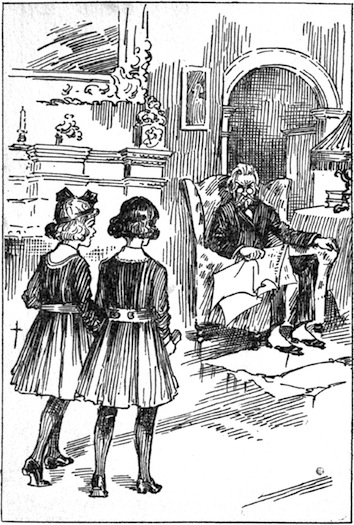
The great carved door opened and an old gentleman
came down the steps. He walked with a cane
and to the children he seemed very old indeed with
his snow-white hair and fierce mustache. He
scowled as he came and stopped to switch with his
40
cane at a vine that had straggled up the step. He
noticed the three girls approaching, and scowled
at them so fiercely that they involuntarily stopped
to let him pass. But he was in no hurry to do
so. When he had looked them over sufficiently, he
looked past them and snorted loudly at something
he saw up the street, but when the girls looked
around to see what was the matter, there was only
a little baby girl playing with a little woolly dog;
so they all looked back again at the old gentleman.
He seemed to fascinate them.
Three pair of round eyes fixed on him caught
the old gentleman’s attention.
“Well, well, well!” he said testily. “What do
you see? Come, come, speak out!”
Elise drew back but the other two stood their
ground, and Rosanna, who had seen him all her life
and was at least accustomed to him, said gently:
“We see you, sir.”
“Ha hum!” sputtered the old gentleman, drawing
his fierce white eyebrows together. “What
about me, young woman, what about me to stare
at?”
Rosanna was distressed. There seemed nothing
to do but tell him the truth and that was almost
too awful. She smoothed it down as well as she
could.
“If you will excuse me for saying so, you looked
a little cross,” she said, “and—and something
must be making you very unhappy.”
“It is,” said the ogre. “It makes me unhappy
to see what a silly no-account world this is; full
of small children, and woolly dogs, and things.
Kittens! Babies! Chickens! Bah! All making
noises! All getting up at daybreak to play and
meow and crow. Bah! Of course I am unhappy!”
He crossed the walk, waved the footman back
with his cane, stepped painfully into the car, and
with his own hand slammed the door shut. But
his anger blinded him. He did not take his hand
away soon enough, and the heavy door caught it.
With a cry of pain, he dropped back on the cushions.
The middle finger was crushed and bleeding
profusely.
“Heaven protect us!” cried Elise.
The old gentleman was almost fainting. Rosanna
did not hesitate. The Girl Scouts had to
understand First Aid. She ran up to the car and
entered it, tearing up her handkerchief as she did
so. Helen, close behind her, was doing the same
thing with hers.
Gently but firmly taking the bleeding finger in
her little hand, Rosanna bound it up in the strips
of linen, folding them back and forth in quite a
professional manner. Helen helped her to tie the
bandages. Not until they had finished did they
take time to glance up at the old gentleman. He
was deathly white and leaned heavily against the
cushions.
“Now, sir,” said Rosanna, “if you will have
your man drive you to a doctor, he will treat it
with an antiseptic and it will soon be all right.”
The old gentleman commenced to brace up as
he saw that the bleeding at least was checked. The
girls got out of the car, and the old gentleman with
a muttered, “Thank you, thank you,” gave an order
and the chauffeur drove rapidly away.
“He said thank you once for each of us anyway,”
said Helen.
Elise shuddered. “Your dress!” she said, pointing
to Rosanna. Sure enough, Rosanna was spattered
with blood.
“Oh, dear, I will have to be late,” she said.
“Just look at me! I will have to go back and put
on a clean dress.” She turned reluctantly and
43
ran back home, while the others went on to school
and the automobile carried the old gentleman rapidly
to the office of his doctor.
While the physician was attending to the hand,
the old gentleman, whose name was Harriman,
sat and sputtered:
“First time I ever saw any children with a grain
of common sense!” he declared. “Little girl acted
in a fairly intelligent manner. Suppose it wouldn’t
happen again. Children never know anything,
especially girls. Bah!”
“Oh, yes, they do, Mr. Harriman,” said Doctor
Greene soothingly. “Oh, yes, they do! Now I
have two little girls of my own, and I can tell
you—”
“Don’t!” said Mr. Harriman. “I make it a
point never to listen to fond parents. I am sure
the two girls who fixed me up were unusual—very
unusual.”
“Yes, they were,” said the doctor. “You will
have an easier time with this hand of yours, thanks
to their skill.”
“Queer!” said Mr. Harriman. “Seemed to
know just what to do.”
“Must have been Girl Scouts,” said the doctor
musingly.
“Girl Scouts? What foolishness is that?” said
Mr. Harriman.
The doctor smiled. He thought of his own two
daughters.
“Ask them about it,” he said, rising, and would
say no more.
Mr. Harriman limped out.
“What are Girl Scouts?” Mr. Harriman asked
his chauffeur as they drove to his office.
“I dunno, sah,” said the colored man, starting.
He always jumped when Mr. Harriman spoke.
Everyone wanted to.
“Idiot!” said Mr. Harriman.
“Yes, sah,” said the chauffeur cheerfully.
There seemed nothing else to say.
Mr. Harriman’s hand healed very quickly for so
old a man, and the doctor stubbornly gave all the
credit to Rosanna’s first-aid treatment. Mr. Harriman
could say “Stuff and nonsense!” as many
times as he liked, but it made no difference to the
doctor, who smiled and refused to discuss the matter.
Mr. Harriman commenced to have a troublesome
conscience. He felt as though he should call
and thank the little girl who had befriended him
to such good purpose, especially as he had known
Rosanna’s grandmother all her life, but he could
not bring himself to do it and contented himself
with sending two immense wax dolls and a huge
box of candy to Rosanna’s house addressed to “The
two girls who recently bound up my hand.” Rosanna
and Helen were quite embarrassed, but Mrs.
Horton, who was immensely amused, told them that
all that was necessary was a note of thanks, which
they wrote and sent off in a great hurry. They
45
didn’t want to keep Mr. Harriman waiting. No
one did. But he couldn’t find out anything about
the Girl Scouts because the only persons he asked
were the very persons who would never know anything
much about anything that had to do with
girls or good times or youth or happiness. He
asked his old friends at the club, when he felt like
talking at all, and so the time went on.
In the meantime, at a Scout meeting Rosanna
found herself telling the girls all about Gwenny
and the play and the plans for sending the poor
little cripple to Cincinnati for the operation which
might make her well. It was only might. Doctor
MacLaren and the other doctors whom he had taken
to see Gwenny would only say that it could be tried.
And the great surgeon, Dr. Branshaw, had written
Dr. MacLaren that as soon as the child was in a fit
condition she could be brought to him and he would
do what he could. He said nothing about the cost,
Rosanna noticed, when she read his letter, so she
could not tell the girls what the operation would
cost. They were all as interested as they could
be and promised to work as hard as they could
selling tickets, and the ones who were chosen to
take parts in the play were very happy about it.
As a matter of fact, all of them were to come on
the stage, for those who had no speaking parts came
on and marched and so had a share in the glory.
And the way they learned their parts! They almost
mastered them over night. Rehearsals went
46
on, and the day was set for the entertainment.
There was a great deal of hammering up in Mrs.
Hargrave’s barn. Mrs. Hargrave and Miss Hooker
and Uncle Robert spent a good deal of time up
there, but they would not let anyone else in. Even
Elise was barred out, and although she wrung her
little hands and talked a funny mixture of French
and English in her pretty coaxing way, not one of
the three would relent and let her peek in. “Wait
until it comes time for the dress rehearsals,” was
all they would say.
A week before the play, a big box came for Uncle
Robert. He opened it in Rosanna’s room. It was
full of tickets nicely printed on yellow pasteboard.
Rosanna read them with rapture: the name of the
play, her play, and at the top in large print,
“You have not said anything about what the
performance is to be a benefit for.” said Rosanna.
“That’s all right,” said her uncle.
“And you have forgotten to say the price of the
tickets,” wailed Helen, who was again spending
the night.
“Well,” said Mr. Horton, “when I went to order
those tickets for you, I had an idea. And it was
this. I thought as long as this was a benefit performance,
why not let it benefit everybody present?”
“How can it do that?” asked Rosanna.
“In this way,” said Uncle Robert. “There will
47
be all sorts of people there, because some of the
Girl Scouts, Miss Hooker says, are very poor indeed,
and some of them belong to families who
have plenty of money. So Miss Hooker suggested
a very good scheme. Tell the girls when they sell
tickets to say that as it is a benefit and so forth
and so forth, that the tickets are simply to let the
people into the hall. As they go out they are to
pay whatever they think it is worth, from five cents
up.”
“Perfectly splendid!” said Helen, catching the
idea at once.
“I don’t know,” answered Rosanna. “They will
have seen the performance and suppose everybody
will feel as though it is worth only a nickel?”
“Oh, they won’t feel like that at all, Rosanna,”
said Helen. “I think every single person will
think it is worth a quarter. Think if they would
all pay twenty-five cents!”
“I know several who expect to pay a dollar,”
said Uncle Robert.
“If they only will,” cried Rosanna, almost sobbing,
“Gwenny can go to Cincinnati this very
winter! I think it is a good idea, Uncle Robert.
After all, it is a good thing that you did consult
with Miss Hooker, even if it has taken a lot of your
time. I think you have been so kind.”
“Oh, I haven’t minded,” said Uncle Robert in a
generous way.
“Why, you must have minded,” went on
48
Rosanna. “I have kept track all I could, because I
was so much obliged to you, and you have been
over there at Miss Hooker’s house consulting—well,
you had to go over five nights last week, and
Miss Hooker is always saying, ‘I had a telephone
today from your uncle.’ You must be tired to
death. I nearly told Miss Hooker so, but I thought
it might sound rude.”
“You are right about that, Rosanna; it would
have been very rude indeed, excessively rude I may
say,” said Mr. Horton with some haste. “I can
scarcely think of anything worse for you to say.
My sainted Maria!”
“I didn’t say it,” Rosanna assured him, “and the
thing is so nearly over now, only a week more, that
it really doesn’t matter.”
“Not a particle!” said Mr. Horton. “But I
wish you would promise me that you won’t say anything
of the sort. Not that it matters, but I seem
to feel nervous.”
“Of course I will promise,” agreed Rosanna.
“I love Miss Hooker but of course I love you more,
and I just do hate to have you bothered.”
“It is mighty nice of you, sweetness, but you
must not worry about me at all. Now to change
the conversation, as the man said when he had
nearly been hanged by mistake, you give these
tickets out to your Girl Scouts and tell them to
offer them to the people who would be most likely
to give more than a nickel. It ought to be easy.
49
They are to say that the benefit will cost them five
cents or up as they leave the hall. With your
permission, I will make a few remarks and tell
them about Gwenny. But we will not mention
her by name, because if there should be a newspaper
reporter lurking around he would put it in the
papers and that would be very embarrassing.”
After Uncle Robert had gone out the girls made
the tickets up in little bundles, one for each girl
in the group. Their own they spread out on the
table, planning how they would dispose of them.
“Whom shall you sell to first?” asked Helen.
“Mr. Harriman,” said Rosanna quietly.
Helen dropped her tickets. “Dear me, Rosanna!”
she cried. “I would be too afraid to offer
him a ticket.”
“I am not,” said Rosanna. “I would do more
than that for Gwenny, and I am not afraid of him
at all. Not even if he roars. And he has lots and
lots of money. I shouldn’t wonder at all that he
will be one of the dollar ones if he comes. And he
has got to come if I go after him.”
“Dear me!” said Helen again, quite awed.
“You are brave. Shall I come with you?”
“If you like,” replied Rosanna. “We will go
right after school tomorrow.”
The interview with Mr. Harriman took place as
planned the first thing after school. School let
out at two o’clock, and it was half-past when the
girls mounted the steps of the grim old fortress in
50
which Mr. Harriman lived. Now it happened that
half past two was a very dark hour for Mr. Harriman
because at about that time he was always in
the clutch of a bad attack of indigestion brought
on daily because he would not mind his doctor and
omit pickles and sweets from his bill of fare. At
this time he read the morning paper and reviled
the world at large. His sister always left him
with the excuse that she wanted to lie down, and he
was alone with his abused stomach and his pepsin
tablets and his thoughts.
The two girls entered the room and waited for
him to speak.
Mr. Harriman looked up from his reading with
a dark scowl. Most of the newspaper was on the
floor where he had thrown it to stamp on. He
always felt better when he stamped on the editorials
that displeased him most. It seemed to soothe his
feelings. He managed to grunt, “’Dafternoon!
’Dafternoon!” when he saw the two girls advance
across his library, and then he waited, looking over
the tops of a very grubby pair of glasses for them
to state their errands. It was Rosanna who spoke
first, although generally Helen was the spokesman.
But Helen was frankly afraid of the grouchy old
gentleman, while Rosanna was too anxious to help
Gwenny to be afraid of anyone. So she said,
“Please excuse us, Mr. Harriman, if we have interrupted
your reading.”
“Well, you have!” said Mr. Harriman gruffly.
51
“Whadder you want? Sell me chances on a doll’s
carriage or sofy pillow? Who’s getting up your
fair? Meth’dist, ’Piscopal? Here’s a dime.”
He held out the money, which Rosanna took
gently and laid on the table beside him.
“Thank you,” she said. “We don’t want any
money today. We have come to tell you about an
entertainment we are going to give. First if you
don’t mind I think I will just shine up your glasses.
You can’t see to think through them the way they
are,” and as Helen looked on, expecting to see Rosanna
snapped in two any second, she held out her
hand for the glasses, shaking out a clean pocket
handkerchief as she did so. No one was more surprised
than Mr. Harriman himself when he took
off the smeary spectacles and handed them to Rosanna,
who silently polished them and handed them
back. They were better; Mr. Harriman acknowledged
it with a grunt.
“Girls are real handy,” said Rosanna with her
sweet smile.
“Grrrrrr!” from Mr. Harriman. “Whadded
you want to tell me?” but his voice certainly
seemed a shade less gruff.
Rosanna, speaking distinctly and as carefully as
though she was explaining to a small child, told the
old man about Gwenny and the benefit and after
that, as he sat perfectly still looking at her through
unnaturally shiny glasses, she went on to tell him
about the Girl Scouts. You couldn’t tell whether
52
he cared a snap about it, but at all events he listened,
and Helen and Rosanna both thought it was
a good sign. They did not dare to glance at each
other, but Rosanna went on talking until she felt
that she had told him all that he would want to
know if he had been a regular sort of a human
being instead of a grouchy, cross old man who
seemed to delight in scaring everyone away from
him.
“That’s all,” said Rosanna finally, smiling up
into the scowling old face.
There was a long silence,
“Grrrrrr!” said Mr. Harriman again. “So you
want me to come to your show, do you? Haven’t
been to a show for forty years! No good! Silly!”
“Ours isn’t,” declared Helen, suddenly finding
her voice. “Our entertainment is perfectly splendid!”
“Perfectly splendid!” mimicked Mr. Harriman.
“Sounds just like a woman! All alike, regardless
of age. Grrrrrr!”
“You will come, won’t you?” asked Rosanna.
“Please do! You see it is only a nickel if you do
not think it is worth more.”
“A great many persons are going to pay a quarter,”
hinted Helen.
“All right, all right!” said Mr. Harriman.
“You are less objectionable than most children.
I will come if I can remember it.”
“Suppose I come after you?” suggested Rosanna,
remembering what she had said to Helen about
getting Mr. Harriman if she had to come after him.
“All right, all right! Let it go at that! I know
your sex! You will forget all about your agreement
by the time you reach the next corner. If
you come after me, I will go to your show. In
the Hargrave barn, eh? Anything to sit on, or
shall I bring a chair?”
“No, sir; Uncle Robert has fixed seats and everything.
And I will come for you quite early because
I have to be there doing my part.”
“That’s nuff!” grunted Mr. Harriman, nodding
curtly. “’Dafternoon!” He resumed his paper,
and as he caught the opening sentences of the article
before him, there came a sound like the grating
of teeth and the noise of a large boiler that
is about to explode.
The girls said, “Good afternoon!” in two small
voices and went out as quickly as they could.
Helen breathed a sigh of relief when she reached
the outer air.
“Rosanna, you are certainly a very brave girl,”
she said. “I am glad to get out alive. Every
minute I expected to hear him say, ‘Fee-fi-fo-fum,
I smell the breath of an English-mun!’”
Rosanna laughed.
“He is pretty awful,” she granted. “But I
mean to make him come. I think it will do him
54
good to see that play, and I shall certainly go after
him. If he thinks I am going to forget about him,
he is greatly mistaken.”
“Let’s try to get rid of all our tickets this afternoon.
You know we are to meet Uncle Robert at
the barn at five o’clock to see the theatre he has
fixed up. Oh, Helen, I am so excited!”
For a couple of hours the girls repeated the story
of Gwenny and the benefit until they could say
it by heart. The tickets went so fast that they
were sorry that they did not have twice as many.
At a quarter of five they hurried back to Mrs. Hargrave’s,
where Elise was waiting for them and
Uncle Robert soon joined them. There was a short
wait then, because he refused to unlock the door
before Miss Hooker arrived although the girls
begged and begged, assuring him that she wouldn’t
mind.
Finally they heard the tap, tap, tap of her tiny
shoes on the old brick walk, and round the corner
she came, looking more dimply and dainty and altogether
beautiful than ever. Uncle Robert looked
as though he could eat her, but somehow it was
not the sort of look he had given Rosanna that other
time. Not at all! Rosanna noticed it.
The stairs were broad and easy, and the girls
ran up after Uncle Robert who proceeded to fit
a large key in the lock of the big door at the head
of the stairs. It was a very fine stable, built many,
many years ago, and finished outside and inside
with great care. The walls were all sealed or finished
with narrow strips of varnished wood. As
the door swung open, the three girls stood dumb
with amazement. Then “Oh, darling Uncle Robert!”
cried Rosanna, and threw herself into his
arms.
Uncle Robert looked over her head at Miss
Hooker and smiled.
“Glad if you like it, kiddie,” he said. “It is
my contribution to little Gwenny. And Doctor
Rick told me to tell you that he would send some
music for his share.”
“Oh, Helen, Helen, isn’t that splendid?” cried
Rosanna. “Now we won’t have to have a Victrola!
It will be like a real theatre.”
“Just exactly,” said Helen absently. She could
not give very much thought to the orchestra when
the little theatre claimed her attention.
There was a real stage, and before it a long green
tin that the girls knew concealed the footlights.
56
A splendid curtain hung before them, painted in a
splashy way with a landscape. To the girls it
seemed a rare work of art. Well, the sign painter
who had done it was rather proud of himself, so
it must have been all right.
They walked down the aisle between rows of
nice new benches, made with comfortable backs.
Mr. Horton left them and went around back of the
stage. Immediately there was a sound of ropes
squeaking, and the curtain rose as majestically as
though it was the curtain of a real theatre. And
there was the stage! The same accommodating
sign painter had painted a back drop and “flies”
as they are called. It was a woodland scene.
Trees were the thing that accommodating sign
painter could do best, and he had made lots of them,
as green as green! He had also painted two canvas
covered boxes so that you could scarcely tell
them from real rocks.
“Isn’t that pretty nifty looking scenery?” asked
Uncle Robert proudly. “It only goes to show that
there is a lot of kindness floating around loose in
this work-a-day old world. The man who painted
all this knew Gwenny’s mother when she was a girl,
and when I asked for his bill he said he had done
it all Sundays and nights and it was his contribution.
He wouldn’t take a cent. Doing it nights is
why some of the trees look sort of bluish but I
don’t think it hurts, do you?”
“What a nice, nice man!” exclaimed Miss
57
Hooker. “I should say it doesn’t hurt! To think
of his working nights after painting all day long.
I should admire those trees if they were a bright
purple!”
“Of course you would,” said Uncle Robert softly.
“You are like that.”
Rosanna was hurt. “Why, Uncle Robert! She
doesn’t mean that she would just as soon like a
purple tree as a green one. She means how nice
it was of the man.”
“Thank you, Rosanna; it is all perfectly clear to
me now,” smiled Uncle Robert. “Perfectly clear.”
He looked again at Miss Hooker and she smothered
a little smile behind her little handkerchief.
They hated to go out of the theatre and see Uncle
Robert lock the door. Then they separated. Elise
danced off to the house. Miss Hooker and Helen
went down the street together, and Uncle Robert
and Rosanna cut across the garden. Rosanna’s
heart was full. She wanted everybody to be happy.
“Uncle Robert,” she said, “sometimes I wish
that you were going to get married after awhile.
If you were only going to marry Miss Hooker or
some young lady just like her, so little and sweet!”
“Well, it is worth considering,” said Uncle Robert.
“I wonder now, just for the sake of argument,
that is, if I should do it to accommodate you,
I wonder if Miss Hooker would marry me.”
“Oh, no,” said Rosanna. “She wouldn’t think
of it.”
“Ugh!” said Uncle Robert. It sounded as
though someone had knocked all the air out of him.
“No,” continued Rosanna. “We were talking
about Minnie getting married one day, and I said
it was the only wedding I was ever apt to have
anything to do with because I had heard you say
many times that you were not a marrying man.”
“What did she say?” asked Uncle Robert in a
sort of strangled voice which Rosanna, skipping
along at his side, failed to notice.
“Oh, she said, ‘How interesting!’ and I said,
‘Isn’t it? Because he is nicer than anyone I know,
but he says that girls never cut any figure in his
young life except to play with.’”
“What did she say then?” demanded Mr. Horton.
“Nothing at all,” answered Rosanna, “but she
is sensible too, because the next time I was there,
she asked more about Minnie, and then she said she
had decided never to marry. She said she liked to
be polite to men and help them pass the time, and
to assist them in worthy works, but further than
that she despised the whole lot of them, especially
blonds.” Rosanna looked up to see what color hair
Uncle Robert had, and noticed a very queer look
on his face.
“You look so queer, Uncle Robert,” she said
tenderly. “Don’t you feel well?”
“No, I don’t,” said Uncle Robert. “I think if
you will excuse me I will take a walk.”
“How do you feel?” persisted Rosanna.
“I feel—I feel queer,” said Uncle Robert. “I
feel sort of as though I had been gassed.”
He turned abruptly and went down the walk,
leaving Rosanna staring after him. At dinner,
however, Uncle Robert declared that he was all
right, so Rosanna stopped worrying.
Everything went rushing along. And everything
went beautifully, thanks to the energy everybody
put into their work. A couple of days before the
day of the entertainment Uncle Robert appeared
with a copy of the programs that he had had
printed. All the Girl Scouts, when Rosanna
brought it to the rehearsal, read it until the paper
was quite worn out. At the bottom of the page,
after the program part, was printed plainly, Given
by the Girl Scouts of Group II. Whoever saw the
program at all could not fail to see that they were
all in it, one as much as another.
At last the great day came! It was Saturday,
of course. No other day would be possible for busy
school girls. Directly after supper, the Scouts
commenced to file into the theatre by ones and
twos and threes. They gathered in the dressing-rooms
back of the stage, where they sat or stood
in solemn groups. Helen and Elise had arrived,
and as Rosanna started across the garden she happened
to think of Mr. Harriman. She could not
suppress a groan of dismay as she remembered her
promise to go after him. There was no time to get
60
Helen or Elise to go. She looked wildly up and
down for some other Girl Scout, but there was not
one in sight. If she did not go, Mr. Harriman
would indeed think that all women were alike. So
she flitted down the street looking like a good fairy
in her shimmering blue dress, with the tiny wreath
of forget-me-nots banding her dark hair. She had
not taken time to put on her blue evening coat, with
its broad bands of white fox fur, but held it round
her shoulders with both hands as she ran.
Mr. Harriman was at home, the footman said, but
he was engaged; had company for dinner, and they
had not quite finished. Would she wait?
Rosanna said she was sorry but she would have
to go right in and speak to Mr. Harriman. So
she passed the pompous servant and at the dining-room
door a still more pompous butler, and stepped
into the presence of Mr. Harriman and his guests.
Miss Harriman, a thin, scared little old lady, sat
at the head of the table. Opposite her, busy with
a large dish of plum pudding, sat Mr. Harriman.
His two guests sat on either side of him. They
were old too, so three white-haired old gentlemen
turned and looked at Rosanna as she entered and
dropped a curtsey.
“’Devening! There you are again! Grrrrrr!
Didn’t forget, did you? Bah! Want I should go
to show?” said Mr. Harriman, partly to Rosanna
and partly to the others.
“Yes, sir; this is the night,” said Rosanna.
“What’s this?” asked one of the gentlemen, who
looked as though he could not have said grrrrrr
or bah to save his life.
“That’s a Girl Scout,” said Mr. Harriman.
“Told you at the club that I would find out about
’em. Here’s a live one. Caught her myself.” He
acted quite pleased.
“Shall I wait and walk over with you, Mr. Harriman,”
asked Rosanna, “or will you come as soon
as you can? You see I must be over there very
early.”
“I will come m’self,” said Mr. Harriman.
“Want piece puddin’? No? S’good! I will
come later. Won’t break my word. Didn’t break
yours. Bring these fellows along if they have any
money.”
“How much will we need?” said the third old
gentleman, laughing.
“Anything from a nickel up,” replied Rosanna.
“Cost you a quarter,” said Mr. Harriman.
“Cosgrove, here, will have to pay thirty-five cents.
Based on income tax!”
Rosanna, watching him, thought she saw a real
twinkle in Mr. Harriman’s eye. She warned them
to be on time and promised to save three seats for
them in the front row. Then she went skipping
happily off. Three instead of one to come to the
play, two quarters, and thirty-five cents made
eighty-five cents right there! It was enough to
make anyone skip. When she reached the barn
62
people were filing up the broad stairs, and the room
was already half full. Uncle Robert stood near
the door nodding and smiling and telling the Girl
Scout ushers where to seat one and another. Rosanna
hurriedly wrote “Taken” on the backs of
three tickets, and laid them on three spaces on the
bench nearest the stage. As people kept coming,
she commenced to wonder if there would be seats
enough. She whispered her fear to Uncle Robert.
“That’s all right,” he said. “I have one of the
box stalls downstairs full of camp chairs, and the
sign painter is here to help me bring them up if
they are needed.”
“You think of everything,” said Rosanna fondly,
then set herself to watch the door for Mr. Harriman.
It was not long before she heard the clump,
clump, clump of his cane and the heavy footsteps
of his two friends. She escorted them proudly to
their seats, and left them nodding appreciatively
at the bright curtain and all the fittings of the little
theatre. Then she hurried around back of the
stage.
“They came, eighty-five cents’ worth!” she whispered
to Helen.
“What do you mean?”
“Mr. Harriman is here and two of his friends,”
said Rosanna. “And Mr. Harriman and one
friend will give twenty-five cents, and the other
will give thirty-five.”
“Good!” said Helen. “How do I look? Is the
63
place filling up? Have you seen the music Doctor
Rick sent? Five pieces! They have just come.
They are down in the feed room getting their instruments
out. Oh, I am so excited! And it is
all to make Gwenny well.”
“I am going out now,” said Rosanna. “I wish
you could all sit out in front. It does not seem
fair for me to do so.”
“It is fair,” Helen assured her. “Didn’t you
write the whole play? Of course you must see
that it is played right.”
When Rosanna appeared she glanced at Mr.
Harriman and was surprised to have him beckon
her to him.
“Sit here,” he said, making a small but sufficient
space between himself and one of his friends—the
thirty-five cent one, Rosanna noticed. She sat
down, and as she did so the music started off with
a flourish. How splendidly it sounded! It quite
drowned the sound of people entering. Uncle Robert,
and the sign painter, and a couple of brothers
belonging to one of the girls were busy bringing
camp chairs and placing them in the wide aisle and
along the sides. Two bright red spots burned on
Rosanna’s cheeks.
She looked at her wrist watch. In five minutes
it would begin. And it did.
A row of Girl Scouts in crisp, natty looking
uniforms, marching according to size, so that the
large girls were in the center of the stage, came
64
out before the curtain and sang one of their best
Girl Scout songs. Their voices were so sweet and
they sang so well that they had to return and give
an encore. Mr. Harriman pounded with his cane.
Then the Webster girls, dressed as fairies, came
out and danced what the program called the Moonbeam
Dance, and behold, Uncle Robert had fixed
a spot light so they looked pink and white and
purple and blue by turns and it was like a real
theatre.
There was so much applause after this that Rosanna
could not help wondering if it was a good
strong barn!
Then there was a short pause while the orchestra
played.
As it ended, Uncle Robert appeared before the
curtain. He looked so beautiful to Rosanna in his
evening dress with his merry eyes and pleasant
smile, that her eyes filled with tears of pride. And
he made a beautiful simple little speech. He told
the audience a great deal about the Girl Scouts
and all the good the organization was doing for
the girls and others as well, and then he told of
the little lame girl, suffering so hopelessly and so
patiently, and how these Girl Scouts had determined
to help her. He told them there was no
price set on the tickets, because some might feel
like giving ten cents or even a quarter or so but
that no one was asked to leave more than a nickel.
And then he called their attention to the beautiful
65
curtain and told them that that and the scenery was
the gift of a friend who was a sign painter, who
had done it Sundays and nights after work as his
contribution to the benefit, and everybody clapped
furiously, and Mr. Harriman and the thirty-five
cent gentleman commenced to nudge each other
behind Rosanna. She was sitting on the very front
edge of the bench.
Then Uncle Robert said:
“After another short selection by the orchestra
there will be a play written by one of the Girl
Scouts. We hope that you will enjoy it.” He
bowed, and stepped behind the curtain, while everybody
clapped and Mr. Harriman thumped with his
cane.
As the orchestra struck up, the thirty-five cent
gentleman leaned over to Mr. Harriman and said,
“What are you going to do about it, Dick?”
“Do ’swell’s you do,” said Mr. Harriman.
“Just as much?” questioned the thirty-five cent
gentleman.
“Yes,” said Mr. Harriman, snorting. “And
fifty over!”
“I will break even with you both,” said the third
gentleman, leaning across.
Mr. Cosgrove took out a check book and a fountain
pen and commenced to write. Mr. Harriman
leaned behind Rosanna and watched.
“Poh! Hum! Grrrrrr! Piker!” he said, and
Mr. Cosgrove, laughing, tore up his check and wrote
66
another which he handed to Mr. Harriman. Rosanna
did not think it would be polite to look, but
wondered what in the world they were doing when
they should have been listening to the music.
“S’all right,” said Mr. Harriman. “Girl’s
pretty lame, isn’t she, Rosanna?”
“Gwenny can’t walk at all,” replied Rosanna,
“and even at night her back hurts so she can’t
sleep.”
“Poor little broken pot,” said the third gentleman
softly. “A pity that the hand of the Potter
slipped.”
“Save your poetry, Bristol!” grunted Mr. Harriman.
“This talks better.” He struck the check
book with his pen, and Mr. Bristol, borrowing a
page, wrote busily as the curtain rose.
Rosanna, hoping they would forget business for
a while, bent her eyes on the stage.
As the play progressed Rosanna commenced to
doubt her own senses. It did not seem possible
that she could have written anything so good and
so interesting.
When the act ended, there was a louder burst
of applause than at any other time, and to Rosanna’s
horror some one in the back of the room
commenced to cry, “Author, author!” Rosanna
did not realize at first that they meant her and was
looking around the room with a great deal of interest
when she felt both Mr. Harriman and Mr.
Cosgrove pushing her to her feet. She stood up
because they shoved her up, and she did not know
what to do next.
Then the most amazing thing of all happened.
Mr. Harriman rose to his feet and taking Rosanna
firmly by the arm as though she might dash
off any instant, he started toward the three little
steps at one side of the stage. Up these steps he
sternly piloted Rosanna, while everyone in the room
clapped and clapped again. All of Louisville knew
Mr. Harriman, and when everybody saw that he
was escorting the little girl who had written the
play, they sat quite still to see what would happen
68
next. When they reached the stage and stood facing
the audience, someone called, “Speech,
speech!” but that was ’way, ’way beyond Rosanna,
who was perfectly overcome anyway. She looked
pleadingly at Mr. Harriman, who knew what she
meant, and took pity on her.
“Hum, grrrrrr,” he commenced. “Ladies and
gentlemen, this little lady, who is the author and
producer of the play you have just seen, asks me
to speak for her. She thanks you for your appreciation,
and for the help you are giving to herself
and these other generous Girl Scouts in their efforts
to assist a girl less fortunate than themselves.
You have heard about the little cripple who is to
be benefited by the work of these girls, and I think
we, the audience fortunate enough to be present
at this memorable occasion, will esteem it a pleasure
to do what we can toward making it possible for
this little sufferer to obtain a possible cure through
a very serious and expensive operation. We thank
you. Grrrrrr!” He glared at Mr. Cosgrove and
Mr. Bristol, and bowed. Rosanna dipped a hasty
curtsey, and they went off the stage again as everybody
clapped and the music struck up the jolliest
piece they knew. The entertainment was over!
Back with Mr. Cosgrove and Mr. Bristol, each
old gentleman shook hands with Rosanna and
started for the door, where Uncle Robert, intent
on the most important part of all, sat at the table
on which was a shoe box with a slot cut in the
69
cover. He was smiling and beaming and saying,
“Thank you!” over and over as people congratulated
him on Rosanna’s play. Miss Hooker stood
beside him looking so sweet and true and pretty
that when Mr. Harriman came up and looked at
her, and started to say “Grrrrrr,” it actually
sounded like a purr! He hastily shoved something
white through the slot, and Mr. Cosgrove and Mr.
Bristol followed him, looking very guilty.
Then Mr. Harriman turned back.
“Absolutely confidential, Horton! No newspapers!”
he said.
“Absolutely, sir, and thank you,” said Uncle Robert,
bowing to the three. He commenced to suspect
something!
Miss Hooker stooped to whisper something to
Robert. As soon as the last person had left the
hall, he obeyed the whisper, and taking the precious
box, which was sealed with red sealing wax where
the cover went on, he went behind the scenes. All
the girls were there, as well as the sign painter
and the two brothers. These three looked immensely
relieved when a fourth member of their
sex appeared. Mrs. Hargrave was there too, and
she was inviting everyone to walk over to her house
and have something to eat. She said she believed
it was customary after the first presentation of a
play.
When some of the girls said they would have to
go home with their folks on account of getting home
70
with escort, Mrs. Hargrave at once added that she
had arranged with Mrs. Horton to send the girls
home in their automobiles.
So very soon they were all in Mrs. Hargrave’s immense
dining-room, sitting in chairs ranged round
the room and being served chicken bouillon and
sandwiches, and fruit salad, and olives, and cocoa,
and ice-cream with whipped cream on top. All
they could eat of each thing too!
“I can’t wait to see the inside of that box,” said
Mrs. Hargrave after all the Girl Scouts and the
sign painter and the two brothers had said good
night and thank you, and had gone. “What if
these children of ours do have to sleep half the
day tomorrow? Telephone your mother, Miss
Hooker, that you are here with me, and that you
will be home presently, and we will go into the
library and watch Robert count the money. And
whatever is lacking, when it comes to settling for
that operation, Mrs. Horton and I intend to make
up.”
Robert Horton laughed.
“I have an idea that you are on the safe side
of the bargain, dear lady,” he said. “I think this
box will surprise us.”
“How much do you suppose is in it?” asked
Miss Hooker as she started for the telephone. “A
hundred dollars?”
“Five hundred at the least,” answered Uncle
Robert.
Everybody started to hurry for the library at
that as though the money in the box would have
to be counted as rapidly as possible for fear it might
fly away.
Uncle Robert happened to sit beside Miss Hooker
again, but Rosanna sat on the other side. He cut
the sealing wax and opened the box. There was
all sorts of silver money there except nickels!
There was not one nickel. Dimes, quarters, fifty-cent
pieces, and silver dollars, but not a nickel.
Uncle Robert placed the coins in neat piles, then
he commenced to stack the paper money. After he
had done this, he sorted out five checks, which he
laid by themselves quite respectfully, face down.
Then he drew out a pencil and paper and commenced
to count. No one spoke. At the last, still
keeping the faces of the five checks out of sight, he
added them in, covered the paper with his hand,
and looked up. He seemed dazed.
“How much do you think?” he demanded.
“Don’t make us guess, Robert,” said his mother.
“Two thousand, two hundred and thirty-four dollars
and twenty-five cents,” he said slowly.
“Impossible!” exclaimed Mrs. Hargrave sharply.
Miss Hooker gave a gasp. The girls, perfectly
round-eyed, sat silent.
“There it is!” said Mr. Horton. “Mr. Bristol
and Mr. Cosgrove each gave a check for five hundred
dollars, and Mr. Harriman wrote his for five
hundred and fifty.”
Mrs. Horton sniffed.
“Dick Harriman never gave twenty-five dollars
to anything like this in his life,” she said.
“Well, here is his check,” declared her son.
“So that is where the fifty came in,” said Rosanna,
finding her voice. She repeated the conversation
she had heard. Everybody laughed.
“Poor Dick!” said Mrs. Hargrave. “He doesn’t
feel well, and his bark is so bad that I doubt if
anyone ever before stopped to see what his bite was
like until Rosanna tried. I reckon he is happier
tonight than he has been for a long while. He
would think it was a great joke, too, to cajole Henry
Bristol and Clinton Cosgrove into giving that
money. Well, they can afford it many times over,
so it will do them all good.”
“Too bad Rick MacLaren isn’t here,” said Uncle
Robert. “He has a sick patient on hand, and
couldn’t come. I will tell him the first thing in
the morning.”
“And these girls must go to bed,” said Mrs. Horton.
“Are you going to stay with Rosanna,
Helen?”
“I think I will just have to go home and tell
mother and father about it if there is any way for
me to get there,” replied Helen.
“If Miss Hooker feels like the extra walk, we
will take you on our way to her house,” said Uncle
Robert eagerly.
“I would love it,” said Miss Hooker obligingly.
Rosanna marvelled.
Miss Hooker lived blocks away from Helen, in
the opposite direction, but as the older people said
nothing, Rosanna kept silence. At all events the
benefit was over, and her Uncle Robert would no
longer feel obliged to spend all his time with a mere
girl, because no matter how lovely, Rosanna knew
that he didn’t care for girls.
A number of girls ranging in age from twelve
to sixteen were busy repeating in a number of
homes that night just how they had felt at different
times during the evening, and explaining to less
fortunate brothers and sisters how good everything
had tasted afterwards. And Sunday morning, a
great many mothers had a difficult time getting
their Girl Scout daughters awake.
Rosanna had a long talk with Uncle Bob. She
wanted to know what was going to be done about
the money.
“I have been thinking about that,” said Uncle
Robert. “I will put it in the bank the first thing
tomorrow morning. I shall put it in the office bank
for safe keeping until then.”
“Do you suppose it will take all of it for
Gwenny’s operation?” asked Rosanna.
“No, I do not,” Robert replied, “but of course
Doctor Branshaw is a very high priced specialist,
and he sets his own fees.”
“If he knew that Gwenny was a poor little girl
and that the Girl Scouts were taking care of her,
I wonder if it would make any difference?”
Uncle Robert shook his head. “I don’t believe
I would ask a favor of anyone, now that you have
earned such a lot of money. Just go ahead and
pay her way like good sports. At that, with the
hospital charges and nurses paid, I think you may
have a little left over. If we have, we will have
to find the best way to spend it for Gwenny. I
want to consult with Miss Hooker about it later
if she is not too tired.”
“Consult again! Oh, poor Uncle Robert!” said
Rosanna compassionately. “I thought that was
all over with.”
“It is not as painful as you seem to think,” said
Uncle Robert dryly. “At all events, my health is
not breaking under the strain. I never knew you
to fuss so, Rosanna. Just what have you up your
sleeve anyhow? Don’t you like your Captain after
all?”
“Oh, I perfectly love her,” cried Rosanna
warmly. “You don’t know how sweet she is, Uncle
Robert! And she is such a good Captain. Every
girl in the patrol loves her and will do anything
in the world for her.”
Seeing that Uncle Robert appeared to be listening,
Rosanna went on warming to her subject.
“At the Rally, I heard one of the ladies say that
our Captain was considered the best one in all the
75
city. And she looks so young; just like one of the
girls when she gets into her Scout uniform. When
we are on hikes, she runs around and plays with
us and joins all our games. Oh, yes, Uncle Robert,
I do love her dearly!”
“I don’t know but what I do myself,” admitted
Uncle Robert unexpectedly.
“Why, Uncle Robert!” said Rosanna in a
shocked tone. “What a thing for you to say!”
Uncle Robert wondered if he had made a mistake.
It was not the sort of a remark he would want
repeated. So he made another mistake.
“Wasn’t it? A joke, Rosanna; just a merry
jest. Thought you would laugh over it. Ha ha!
Ha ha!”
“Ha ha!” repeated Rosanna to be agreeable.
Sometimes Uncle Robert was rather disappointing.
“But she is lovely anyway, and has loads and
loads of friends, and, Uncle Robert, I think she
has a sweetheart because boxes and boxes of flowers
come to her, and she just keeps a little one to wear,
and sends all the rest to the hospital. And lovely
books come by mail and the fattest letters! One
had poetry in it, too. I could tell by the shape of
the writing down the page.”
“Don’t snoop, Rosanna,” said Uncle Robert
sharply.
“I didn’t, Uncle Robert,” said Rosanna in a hurt
tone. “She was sitting close to me on the sofa,
and I couldn’t help seeing. She liked it too,
76
because she smiled so sweetly and showed all her
dimples, even the one that almost never comes out.”
“What a little ray of sunshine you are, Rosanna!”
said her uncle strangely.
“Thank you; a Girl Scout ought to be,” replied
Rosanna.
“Well, you are, all right, sweetness,” said Uncle
Robert. He sighed deeply almost as though the
ray of sunshine had not come his way at all. He
kissed Rosanna and then sat her down rather hard
in a deep chair. “I don’t know when I have felt
so cheered up. And now, if you would like to call
the garage and order the little car for me, I will
go around to see Doctor MacLaren and tell him
the good news of our fortune. And on second
thoughts, I don’t believe I will have to consult with
Miss Hooker at all. I think perhaps you are right.
I have bothered her enough.”
“She has been very polite and kind about it all,
hasn’t she?” asked Rosanna.
“Most polite and kind,” Mr. Horton agreed.
“But we don’t want to wear her kindness out, do
we, Rosanna? I will go see Rick, and in a day
or two my part of this affair will be finished. And
I won’t have to bother anybody. I am thinking
of a little trip out West, Rosanna. I wish you
could go with me.”
“I wish I could!” said Rosanna, “but grandmother
wouldn’t want me to leave school, and
77
besides I couldn’t leave the Scouts just now. Where
do you think of going, Uncle Robert?”
“Nowhere in particular, unless—” he thought
a moment. “It might be fun to look up some place
where they had never heard of the Girl Scouts.”
“Perfectly splendid!” said Rosanna. “That
would be doing a good deed. You could tell the
people about us, and start a patrol. I must tell
Miss Hooker about this; she will think it is so nice
of you. She appreciates kind acts, even if she
doesn’t like men.”
“It is not worth mentioning, Rosanna,” answered
Uncle Robert. “Besides, I didn’t have just that
in mind. However, I hear the car and will leave
you before—before I do anything I regret.”
He went off, and Rosanna watched him through
the window as he started his car. He was real
jerky with it, and it sputtered and missed, and went
off with a leap.
“He is all tired out,” thought Rosanna.
Time passed, a great many things happening.
Gwenny, accompanied by her mother (there being
plenty of money for everything), was taken away
to the place of her great trial. When the question
arose as to what should be done with Mary and
Tommy and Myron and Luella and Baby Christopher,
Rosanna thought of Minnie, always so good
and kind. She went to see her, and the result was
that Minnie volunteered to stay at Gwenny’s and
run the little house and take care of the children
as long as Mrs. Harter was needed in Cincinnati.
Both Doctor MacLaren and Mr. Horton went with
Mrs. Harter and Gwenny, and made the journey
as comfortable as they possibly could. The great
Doctor Branshaw, after seeing his patient, said that
she must have at least a week of rest under his
own eye before he would be willing to try the operation.
So Gwenny was settled in a sunny room
at the hospital where she at once became the pet
of the ward and Doctor MacLaren and Mr. Horton
came home.
Late in the afternoon, the very next Sunday,
Mr. Horton came into the house looking the picture
of gloom. He scarcely spoke to his mother and
79
Rosanna but rushed up to his room and immediately
there was a sound of things being dragged
around, and many footsteps. And the door opened
and shut a great many times. Mrs. Horton wondered
what that boy was up to now and went on
reading. But Rosanna listened with a black suspicion
growing in her mind.
And, sure enough, Mr. Horton came down presently
to announce that he was going away for a
few weeks. He was getting stale, he said, and
needed a little change. When he saw Rosanna’s
round eyes fixed on him, he looked away but repeated
that he felt stale.
“It is that War,” said his mother, as though
the war should be severely reprimanded. “Before
you went into that war, you were always contented.
Now nothing contents you for long.”
“Perhaps you are right,” admitted Robert absently.
“At all events I can be spared from the
office just now better than at any other time, and
I am going to go away.”
And go he did an hour later. Mrs. Hargrave
and Elise came in presently to take Sunday night
luncheon.
“Where is Robert?” asked Mrs. Hargrave, seeing
that no place was set for him.
“Gone off for a vacation,” said his mother.
“Dear me, isn’t he well?” asked Mrs. Hargrave.
“Perfectly, but he just took one of his notions
and went.”
“Anything—er—happened, do you suppose?”
questioned Mrs. Hargrave. “Anything—er, you
know. Misunderstanding?”
“Possibly,” answered Mrs. Horton. “That is
what I suspect. But I don’t know anything.”
“Oh dear, oh dear!” cried Mrs. Hargrave, folding
her fine old hands together. “It is too bad!
Can’t something be done? Why, Robert is the
finest boy in this world! He is just what I dream
my son would have been if I had had one. Do
you suppose one could say anything to the other
person?”
“No, indeed,” said Mrs. Horton. “I don’t know,
you see. I only suspect.”
So Uncle Robert went away, and Gwenny was
off at the hospital, and Rosanna and Helen spent
all their time drilling Elise in the requirements
of the Tenderfoot examination. Elise was quick
to learn, but she found more difficulty in learning
this because her knowledge of English was of course
limited. The girls were anxious to make a brilliant
showing with their recruit.
Over and over they drilled her in the Tenderfoot
examination, at the last requiring her to write the
answers to the examination paper which read as
follows:
| TENDERFOOT EXAMINATION, |
| WRITTEN |
| 1 | a | Give the Scout promise. |
| | b | What does the Scout motto mean? |
| |
| 2 | | Give the Scout laws in order. |
| |
| 3 | a | What is the purpose of the Scout movement? |
| | b | What does a Scout’s honor mean? |
| | c | Give the meaning of one law. |
| | d | How and when should the Scout salute be given? |
| | e | Explain the Scout badge. |
| |
| 4 | a | Who made the American flag? |
| | b | Why was a flag needed? |
| | c | In what city was it made? What year? |
| | d | Name the committee appointed to design it. |
| |
| 5 | a | Quote General Washington’s words about the flag. |
| | b | When was the flag officially adopted? |
| | c | Describe the first official flag of the stars and stripes. |
| |
| 6 | a | What do the stars represent? The stripes? |
| | b | For what do the colors, red, white and blue stand? |
| | c | How many stars has the flag now? What day is Flag day? |
| | d | When is a new star added and why? |
| |
| 7 | | Give fully the respect due the flag. |
| |
| 8 | a | What should Scouts do when the National Anthem is played? |
| | b | What should Civilians do at Retreat? Scouts? |
| |
| 9 | a | What is the United States Government? |
| | b | Who is at its head? |
| | c | Name the Commissioners of the District of Columbia. |
| |
| 10 | a | Write America. |
| | b | Write The Star Spangled Banner (omitting 3rd stanza). |
Then followed the demonstration of knots and
knot tying. Over and over they drilled her, and
Elise was an apt pupil. Her delicate little fingers
seemed to know of themselves what to do.
“I am glad she is to write that examination,”
sighed Helen the day before Elise was to go to
82
Captain Hooker and take her examination formally.
She was to be examined on Friday afternoon,
and at the meeting Saturday night she was to
become a Tenderfoot Scout member of their
patrol.
“What difference does it make whether she
writes the exam, or recites her answers?” returned
Rosanna. “She speaks brokenly, of course, but
that does not matter.”
“All it matters is that no one could hear her
speak of General Washington the way she does in
her funny broken English, without wanting to
scream. It is so funny.”
Funny or not, Elise went through her examination
most successfully and Saturday night accompanied
Helen and Rosanna to the meeting at Miss
Hooker’s house. Their little Captain had fitted up
a room specially for her girls, where they could
keep their various documents and where the seats,
the neat desk for the secretary, and the standard
for the big silk flag did not need to be disturbed
in the intervals between meetings.
Elise was thrilled beyond words.
As they entered the room she saw that the two
girls saluted their little Captain. Not knowing if
she was expected to salute before becoming a Scout,
Elise dropped a shy curtsey and followed Rosanna
to a seat where they awaited the full number of
Scouts and the shrill whistle from the Lieutenant
which brought the meeting to order.
“The first whistle means Attention,” whispered
Helen.
Once again it sounded.
“That is for Assembly,” whispered Rosanna on
the other side, as all the girls rose.
Leaving Elise in her seat, the Scouts formed in
double ranks at a distance of forty inches between
ranks and an interval of sixty inches between
patrols.
The eight girls who formed a patrol took their
places in groups as signified by the crosses.
| Patrol | Patrol | Patrol |
| ×××× | ×××× | ×××× |
| ×××× | ×××× | ×××× |
| Captain | × × | Lieutenant |
Elise found out afterward that number one in
the front rank of each patrol is the Patrol leader,
and number four the Corporal.
At the command “Company, attention!” from
the little Captain, now standing so straight and so
stern that Elise scarcely recognized her, the Company
as a whole stiffened to attention.
The Lieutenant, a tall, pretty girl of nineteen,
then commanded, “Corporals from Patrols!” and
the three Corporals stepped forward two paces,
made two right turns, and stood facing the center of
the patrol. The Corporals then snapped out together,
“Attention! Right Dress!” after which
84
they faced left, took two paces, made right turn,
right face, and looked critically down the line to see
that it was perfectly straight. After two short left
steps to straighten the rear line, they faced right,
took four paces forward, and with two right turns
got back in position facing patrol and called the
command “Front! Count off!”
The Corporals then one after the other called
the roll of her Patrol, and finishing that, turned
and reported to the Lieutenant that the Patrol
was formed, after which they returned to their
places in the ranks, and the Lieutenant, saluting
the Captain, reported, “Captain, the Company is
formed.”
Inspection then followed. Each girl, saluting,
stepped forward and her hair, teeth, hands, nails,
shoes and general appearance was scrutinized.
Elise watched all this with great interest, interest
which deepened as the Captain commanded “Color
guard, march!” and three girls stepped from the
ranks and stood side by side for a moment, then at
a word of command marched to the flag. There
they saluted and marched back; when the Captain
and the Lieutenant faced about, and the Captain
in her silvery voice said:
“The Flag of your Country; pledge allegiance!”
With one voice the girls united in the beautiful
pledge to the flag, “I pledge allegiance to the flag,
and to the republic for which it stands; one nation
indivisible, with liberty and justice for all.”
Elise looked at the silken folds of the glorious
red, white and blue with tears in her eyes. How
glad she was to make that pledge! Had not that
flag, the flag that was now her own, floated over
the shell-racked fields of France? Oh, she loved
it!
The color guard returned, and the fresh young
voices rose in the first verse of America.
“Scouts, your promise!” said the Captain.
“To do my duty to God and to my country.
To help other people at all times.
To obey the laws of the Scouts.”
the voices rang out.
“The laws!” said the Captain.
Again the chorus of girls repeated:
A Girl Scout’s honor is to be trusted.
A Girl Scout is loyal.
A Girl Scout’s duty is to be useful, and help others.
A Girl Scout is a friend to all, and a sister to every other Girl Scout.
A Girl Scout is courteous.
A Girl Scout keeps herself pure.
A Girl Scout is a friend to animals.
A Girl Scout obeys orders.
A Girl Scout is cheerful.
A Girl Scout is thrifty.
“Dismissed!” said the little Captain and, breaking
ranks, the girls went to their seats where they
sat talking in low tones until the sharp sound of
86
the Lieutenant’s whistle called them to attention
again.
“Now I do come,” said Elise to herself, and her
heart commenced to hammer in quite an alarming
fashion. But it was not quite time for her to rise.
Looking at Rosanna, she saw her give a slight shake
of the head, and Elise leaned back in her seat while
all the business of the meeting was settled and
plans made for some aid for a poor family living
near.
One thing Elise noticed particularly. The girls
present were widely different in looks, and Elise
with her delicate perceptions saw plainly that they
belonged in widely differing classes, so called. A
few of the girls, Rosanna among them, had the
carefully cared for and delicately nurtured look
of the very rich. More were like Helen, clean,
carefully groomed and almost precise in her dress
and accessories. Others were very evidently poor,
with rough little hands that already told the story
of hard work and few toilet creams. But whoever
they were, they saw no difference in each other.
They were Girl Scouts in the fullest and best sense
of the word: sisters pledged to each other, and living
up to that pledge in all earnestness and honor.
Elise, waiting for her summons to go forward,
and understanding nothing of the business that was
going on, threw her thoughts backward. She saw
herself the idolized child of the gay, rich young
couple in the great château, where long painted
87
lines of powdered and frilled and armor-clad ancestors
looked down at her from the long galleries,
and where dozens of willing servants danced to
do her bidding. Then the picture changed, and
with the roll of drums and the thunder of cannon
she saw the hated foe march across her land, destroying
as they came. Father, mother, grandmother,
home, riches; all went down as under a
devouring tide. Then the promises of her Monsieur
Bob, and after long, long weary days spent with
the ladies of the Red Cross came the journey into
the Unknown, that trip across an ocean that was
to forever separate her from a past that was too
terrible for a little girl to have known.
To have found refuge in Mrs. Hargrave’s tender
arms, to have won such love and such friends—to
be able to be a Girl Scout—
Elise turned her eyes, brimming with sudden
tears, to the flag.
“Never, never will I zem disappoint!” she whispered
tenderly, using as best she could the unfamiliar
words of her adopted tongue.
At last Elise saw the Captain glance in her
direction as the whistle blew once more for attention
and the Captain commanded, “Fall in!” A
look of serious interest appeared on the faces of
the girls as they formed in a horseshoe, the Captain
and the Lieutenant standing in the gap and the
American flag spread out before them.
Elise, with Helen beside her, walked to a place
just inside the circle and stood facing the Captain.
In the Lieutenant’s hands were the staff and hat,
the shoulder knot, badge and neckerchief of the
Tenderfoot Elise.
She could not refrain from a glance at them.
How she had longed to wear all those things; the
insignia of everything she had learned to admire
and look up to in the girls of America!
“Salute!” said the Captain.
All saluted Elise, who stood waiting for some
order, she did not know what.
“Forward!” said the Captain to Helen, and the
two girls stepped to the center.
Regarding Elise with a long, careful glance, and
speaking carefully, so the little French girl should
miss nothing of the full meaning of her words, the
Captain asked:
“Do you know what your honor means?”
“Yess,” said Elise, finding her voice after what
seemed to her an endless time. “Yess, it does mean
that always I shall be trusted to be faithful and
true and honorable.”
“Can I trust you,” asked the Captain, “on your
honor, to be loyal to God and your country, to help
other people at all times, and to obey the Scout
Law?”
Elise, coached by Helen and Rosanna, made the
half salute in unison with the whole company, as
she answered, “I do promise on my honor to be
loyal to God and my country, to help other people
at all times and to obey the Scout Law.”
“I trust you on your honor to keep this promise,”
answered the Captain.
The circle of girls listened with respectful and
solemn interest. Well they realized that the vow
being given was not an empty or idle one. They
knew that it entailed hard work, self-denial, and
many hardships. Yet they gloried in it, and
silently renewed their own vows as they heard the
Tenderfoot make her promises.
“Invest!” came the Captain’s next order.
Stepping forward, the Lieutenant gave Elise her
staff, and put the hat, handkerchief and knot on
her, and smiled as Elise said, “I thank you!” in
her pretty way.
Then, at a whispered word, she marched up the
line to the Captain who pinned on her trefoil badge
90
and explained that it was an emblem of her Scout
“life.” If for any misbehavior, the trefoil or
“life” must be taken away from her, she would
become a dead Scout for the time the Captain ordered
and for that time in disgrace.
The new Scout was then initiated into all the
secret passwords, a proceeding which filled Elise
with despair; she felt that she would never be able
to remember the queer words and phrases.
Then with the ceremony of marching back to
their proper patrols the ceremony was over, and in
a moment the formal meeting was dismissed.
The girls crowded around, all anxious to meet
the new Tenderfoot and welcome her. They talked
to her so hard that Elise felt her head whirl. She
was glad to hear the voice of the little Captain
suggesting a song. She handed a leaflet to Elise,
but the girls knew the songs, and gathering in a
circle they wanted to know which one to sing.
“Sing The Long, Long Line,” suggested the Captain,
and the girls sang:
THE LONG, LONG LINE
(Tune: The Long, Long Trail)
Recruiting song.
Do you feel a little lonely?
Are your friends too few?
Would you like to join some jolly girls
In the things you think and do?
Don’t you know your Country’s waiting?
91
Have you heard her call?
See, the Scouts are crowding, crowding in,
Where there’s room for one and all!
Chorus
There’s a long, long line a-growing,
From north to south, east to west,
There’s a place awaiting in it, too, that you’ll fill best.
We are sure you’d like to join us
If you knew what we can do
And we’d like, O how we’d like to make a good Girl Scout of you.
It certainly sounded sweet as the fresh young
voices blended, and Elise thrilled as she listened.
She was having such a good time! All the girls
seemed so friendly and so sweet, with the exception
of one girl who hung back and on whose face
there rested the shadow of discontent and dissatisfaction.
Elise found herself wondering about
her; she seemed so out of place in that happy, merry
throng. But none of the other girls appeared to
notice that one of their number sat apart and occupied
herself rather ostentatiously over a book.
They were all so busy making the evening pass
pleasantly for the charming new Tenderfoot who
responded so prettily to their advances that no one
spoke or looked at the silent Scout, but presently
Elise noticed that the little Captain sat down beside
her and compelled her attention. Even then the
girl looked as though she preferred to be let alone.
For a long while, the girls sat and told Elise
92
about their work and play and the camping in summer
and the delightful hikes all the year. Finally
it came time to go home and some one called for
another song.
“Which shall it be, Elise?” asked Helen. “You
choose one of the songs.”
“I see one follows the air of the Old Colored
Joe,” said Elise. “I do know that loving song.
Please to sing that; and if I may, I will try to sing
it also.”
“Of course we will sing that, you dear,” laughed
the tall young Lieutenant, and together they sang:
WE’RE COMING
(Tune: Old Black Joe)
Camping Song.
I
Come where the lake lies gleaming in the sun;
Come where the days are filled with work and fun.
Come where the moon hangs out her evening lamp;
The Scouts are trooping, trooping, trooping back to camp.
Chorus
We’re coming! We’re coming! To the lakes, the hills, the sea!
Old Mother Nature calls her children—you and me.
II
Come where we learn the wisdom of the wood;
Come where we prove that simple things are good,
93
Come where we pledge allegiance to our land;
America, you’ve called your daughters—here we stand.
Chorus
We’re coming! We’re coming! ’Til we spread from sea to sea,
Our country needs us—wants us—calls us—you and me!
“That is so most lovely,” said Elise as the song
was finished, never for a moment realizing that her
own pure and bell-like voice had added richness and
beauty to the song.
The other girls looked at each other and smiled.
Here was indeed a find. Never had there come a
Scout to the council with such a wonderful voice.
They felt that the pretty young Tenderfoot was a
great acquisition to their number. So they all
crowded around and said good night,—all but the
silent Scout who had not joined in the jollity.
Elise and Rosanna and Helen filled the two automobiles
that were waiting for them with the girls.
Never, never had those big cars been so crowded.
Certainly they had never held happier passengers.
But there was no noise or boisterousness, no singing
or whistling. The girls chatted in tones that
were agreeably low and as each one reached her
destination, she thanked Rosanna or Elise. When
the last passenger in the Hargrave car had been
set down, Elise leaned back in a corner and thought
deeply. She was happy beyond words.
To do good to someone every day; that was part
94
of her pledge. Such an easy part! But it was
hard not to be good when everyone was so good
to her. Then suddenly she thought of the sulky
face of the girl at the meeting.
All the time she was telling Mrs. Hargrave about
the installation and the songs, and trying them
over for her, she saw the dark, discontented face
before her. She could not feel perfectly happy
because somehow the face seemed to send her a
message. “Help me; help me!” Elise heard in
her soul. But what could she, a stranger, a girl
who could scarcely speak the new language, what
could she do for that girl? And besides, why did
she need help? Elise, whose bright eyes saw everything,
had noted the beautiful silk stockings, the
texture of the black hair ribbon, and at the last,
the expensive fur that edged her coat. Also a car
had come for her, in which she went off alone. It
was not poverty, at all events, decided Elise. She
could walk; she was not lame like the poor little
blond in the corner. As Elise thought it over, she
puzzled more and more. She decided to ask Rosanna
or Helen next day; then a better decision
came to her. She would find out for herself. No
one should tell her. Then if she made any mistake,
why, the mistake would be hers.
But the next day but one the plot thickened.
She went over with Rosanna to see Miss Hooker
about some Scout work, and as they stood on the
steps waiting for the door to open, it did open with
95
a jerk, and the girl Elise had been worrying about
dashed down the steps and into her limousine.
Her face was disfigured with tears.
“Dear me!” said Rosanna. “What do you suppose
has happened to Lucy Breen? She has been
crying.”
“Assuredly. The petite pauvre one!” answered
Elise sadly.
Rosanna with her usual directness asked Miss
Hooker the moment they entered what was the matter
with Lucy.
Miss Hooker hesitated. “You really ought not
ask a question like that, Rosanna,” she said finally,
“but perhaps I ought to tell you. You will all
have to know.”
“Please don’t tell me, Miss Hooker,” Rosanna
begged with a deep flush. “I thought perhaps
someone had died or something like that.”
“No, but for a week Lucy must be a dead Scout
herself.”
“How awful!” cried both girls, and then were
silent.
“I prefer not to tell you why just now, but of
course this will not make you shun her. You must
show all the kindness and consideration that you
can for her, and be with her all you can.” More
than that Miss Hooker did not seem to want to
say, and the girls, saddened and quiet, finished their
errand and left.
A day or two later, going with Mrs. Hargrave
96
to the Red Cross rooms down town, Elise thought
she saw Lucy Breen shrink out of sight behind some
portières at the back of the store that the Red Cross
used as a sales room.
Elise acted on a generous impulse. She went
back through the store looking at one thing and
another until she in turn came to the portières.
Behind them was a space used for a sort of store-room
for articles brought into the shop, and as
Elise looked curiously through the curtains as
though wondering what lay beyond, she saw Lucy
standing in a corner, crowded against the wall.
Elise nodded gaily.
“Are you what they call making the sort of
things in here, Lucy?” she cried. “Is it not fun
to see what the good kind people give away?”
She stepped into the store-room as she spoke,
smiling and nodding. “Yes, it is droll, some of the
things,” she chattered on, as though Lucy was doing
her share in the conversation. Finally, however,
like a little clock, Elise ran down. She could
not think of a single thing to say further, and
she trailed off, looking shyly into Lucy’s dark
face.
Lucy was smiling a set and bitter smile.
“Don’t you think you had better get out of this
and leave me?” she asked. “Perhaps you don’t
know that I have lost my badge. I shall be a dead
Scout for a week, and I don’t care in the least
whether I ever wear it again or not.”
Elise came close and laid a hand on Lucy’s shoulder,
but the girl shook it off.
“Don’t!” she said pettishly.
“I knew that you had resigned your badge for
the so small time of a week,” said Elise gently,
“but one week soon passes.”
“Do you know why I lost it?” asked Lucy
harshly.
“No,” said Elise, “and I do not so much care.
That is for you to know, and our dear Captain. I
am just so so sorry that you are unhappy. But
you will be happy again. Always unhappiness goes
away. We do not forget, but it ceases to wound.
And if the fault makes you so unhappy, why, certainly
you will never, never so do again; will you,
dear Lucy?”
To her surprise and dismay, Lucy turned and,
hiding her face in her arms, leaned against the
cracked old wall and sobbed.
“Oh, I am unhappy!” she cried. “I am unhappy,
and I don’t know what to do! Sometimes
I think I will run away!”
“Oh, don’t do that; don’t do that!” cried Elise.
“Think of your dear mama and your father. Oh,
you could never have a fault that would make you
need to do anything that would make them so unhappy!”
Lucy laughed her bitter little laugh.
“I think I will tell you what has happened,”
she said, “and then you can see just how I feel.”
“Can you not tell to someone more wise than
I?” asked Elise, her dismay growing. “I will be
so glad to listen, but for advice, I am so ignorant,
so what you call it? I speak your English so
poorly, that maybe I say to you the wrong thing.”
“You needn’t say anything,” said Lucy. “You
were so good to come and speak to me, and I want
to talk to someone. I had advice from Miss Hooker
but I shall not take it.”
“Was it not good advice?” asked Elise, who
thought every word that Miss Hooker uttered was
a pearl of wisdom.
“I suppose so,” said Lucy with a sneer, “but
she does not understand. Oh, Elise, I shall die,
I am so unhappy.”
“No,” said Elise softly, “you will not die so.
If it could be, I would be dead long since but I
am not, and I am happy—so very, very happy
just as my most dear ones who are dead would
wish me to be. So it will be with you.”
“I want to talk to you,” said Lucy.
“Let us sit here then,” said Elise, “where no
one comes. There is a what you call ‘meeting’
which my maman is here to attend. It goes on
in the upstairs, and she told me it would meet
for an hour or two. Tell me all your woe.”
She pulled Lucy down on a pile of velvet curtains
and patting her hot little hand, said softly,
“I wait.”
“When I was only two years old, my real
mamma died,” Lucy commenced, “and papa’s sister,
who was a great deal older than papa, came to
take care of us. I had a brother five years older
than I. Aunt Mabel was so kind to us, and let us
do just as we pleased about everything. I don’t
see why things could not have gone on like that
always, because as soon as I grew up I intended
to take charge of the house and run it for papa.
I am thirteen now so it wouldn’t have been long
before I could have done it. But when I was ten
years old, my brother died, and after that, papa
stayed away from the house all he could, although
Auntie Mabel was always talking to him about his
duty to me.
“Well, one day, when I was eleven years old,
papa came home, and the very minute I saw his
face I knew something had happened.
“‘Goodness, papa,’ I said, ‘you look as though
you had had good news!’ ‘I have, my dear,’ he
said, and then somehow as I looked at him I had
such a funny feeling. All at once I didn’t want
to know what made him look so glad. So I just
sat there and said nothing.
“‘Don’t you want to know what it is?’ he said,
and I said, ‘I don’t know whether I do or not.’
“Papa came over and put his head down on my
shoulder the way he used to when he called me his
little comforter, and said, ‘Oh, yes, Lucy, you want
to know! Please say you want to know what your
daddy has to tell you.’
“So I said, ‘All right,’ and Elise, he was going
to get married! Oh, I just hated it! He told me
lots about the lady. She was from Boston, and
that was why I had never seen her, and had never
heard about it. She had never been in Louisville.
He said she was beautiful, and she did look nice
in the picture he had in his pocket case, and he
said she was just as lovely as she could be. I just
sat there and let him talk, and finally he said,
‘Well, chicken, what do you think about it?’ I
don’t know what made me say what I did. Somehow
it popped out before I thought. I said, ‘Are
you sure she isn’t marrying you for your money?’
“And papa sort of stiffened up and looked hard
at me, and finally he said in a queer voice, ‘Good
Lord, how old are you?’ I said, ‘I am eleven,’ and
he said, ‘Well, you sound like Mrs. Worldly Wiseman,
aged fifty. I suppose you will feel better
if I say that the lady has more money than I have,
and that I will be lucky if people do not claim that
I have been the fortune hunter.’
“‘Well, what is she going to marry you for?’
I asked. ‘She says she loves me,’ papa said. I
101
said, ‘We don’t want her here! We are getting
along all right.’ Oh, I didn’t mean to be so ugly,
but somehow I hated to have papa marry anyone,
and I didn’t know this lady. So papa went off
awfully cross at me and the next person was Auntie
Mabel. Papa had told me first; he thought he
ought to, and then he went up and told Aunt Mabel.
She came down pretty soon. I was right there in
the big chair, trying to imagine what it would be
like to have a stranger in the house.
“Auntie said, ‘Well, Lucy, what do you think
of the news?’ I said, ‘It is nothing to us; we can
keep in our rooms most of the time.’
“‘I can’t,’ said Aunt Mabel, ‘because I shall
leave when she comes. Not that I have the slightest
objection, but all the same off I go. I knew it
would happen sooner or later, but Henry waited so
long that I hoped he was going to let well enough
alone. But men are all alike!’ And she did go,
Elise, the very day before papa brought the lady
home. And I couldn’t go because there was no
place for me to go and Auntie wouldn’t take me
with her because she said it would make papa
angry. So I had to stay whether I wanted to or
not. It was perfectly awful!”
“Poor, poor Lucee!” murmured Elise, patting
the hand she held.
“I was expecting to see a lady ’most as old as
Auntie, and papa came up the steps with somebody
young. Why, she was awfully young, and had as
102
much powder on her nose as anybody. I was looking
through the curtains, and when I saw them
coming, I ran upstairs and hid. Papa hunted and
called, but I wouldn’t answer, and I heard him
getting angry, and then she said, ‘Don’t mind,
Henry; it is the most natural thing in the world.
Let me find her, I know just where to look,’ and
papa said in the silliest way, ‘Go ahead, darling,
the house is yours, and the child too if you will have
such a bad one.’
“Well, Elise, she came up those stairs and
straight to the table I was under, as though someone
had told her! The cover went down to the
floor, and she lifted it up, and said ‘Coop!’ but
I came out crosser than ever, and we had a horrid
time.
“So that is the way it went. Worse and worse
all the time. Papa was not cross with me because
she wouldn’t let him be, and I felt pretty mean
to think a stranger had to tell my own father how
to treat me. At first she tried to act so sweet to
me, and used to want to play with me. I told her
I thought it was silly, but she said she had lots
of brothers and sisters, and they always romped
around together and had a fine time, and she said
if I would only be friends we could have such larks.
I told her I hoped I was polite and all she said
was to wonder where I got my disposition.
“At first they used to make me stay down with
them at night after dinner, but by and by I was
103
allowed to go upstairs. I said I wanted to study.
I always kept a study book open on the table, and
would go to reading it as soon as they came up.
Papa used to come in once in awhile, and she
was always asking me if she could help me with
my lessons. She said she used to help her
brothers.
“After a year, one of the brothers came to visit.
He was a real nice boy, and I would have liked
him only he was so silly about her; used to want
to be with her all the time, and put his arm around
her and all that! We had a real good time though,
and I thought that I had been real nice to her
before him until the day he went home. I was in
the library, and he came in. I was just going to
ask him to put his autograph in my album when
he said: ‘Gee, you are a disagreeable little mutt!
My sister would half kill me for saying it, but honest,
I don’t see how she stands you!’
“Of course I just walked out of the room. I
knew then that she had been telling things about
me. And I knew that must be the reason why
papa was so different to me.”
“But was he?” asked Elise wonderingly.
“Yes, he was, and Miss Hooker says it is all my
fault. I had been coldly polite to her for a good
while before that. I read about a girl who was
abused by a stepmother and the girl was too noble
to abuse her in return. She was just ‘coldly
polite,’ the book said, and so was I. But after that
104
horrid boy went home I let myself be as mean as I
could.”
Elise nodded. “I saw it in your face,” she said.
“And the more I thought of it, the more I was
able to act ugly. It is so funny, Elise, the way she
makes everybody like her. Papa just gets worse all
the time, and the servants adore her, and she is so
popular with all the people who come to the house.
She makes them all like her—all but me.”
“We will talk about that later,” said Elise.
Lucy sighed. “Well, things have been getting
worse and worse, but I think we have both tried
to keep it from papa. We hate each other, but we
don’t want him to know how bad things are in the
house. Papa is not happy, though. Oh, he has
talked and talked to me and threatened to send me
to school, and I always tell him I wish he would.
But the other day the worst happened. Papa had
gone to the office, and I was reading in the library,
and she was walking around and around, fussing
and singing under her breath and sort of acting
happy. It made me so mad. Presently she saw me
looking at her, and she said, ‘Don’t you wonder
why I am singing?’ and I said, ‘No, I had not noticed.’
She went right on: ‘I have had some good
news, wonderful news, and I wonder if you would
like to hear it, Lucy?’
“I said, ‘I am not at all interested,’ and went
right on looking at my book. She came over and
leaned down on the table close to my face, and
105
stared and stared at me. She said, ‘Look at me,
you bad, difficult, cruel child, look at me and tell
me why you are bound to hate me so!’ I never
saw anyone look so angry. Then her face changed
and got pleasant again, and she said, ‘What have
I done? Your own mother, if she can see this
house and its unhappy inmates, knows that I have
tried to make friends with you.’
“I remembered how furious the girl in the book
was when her stepmother spoke of her mother, and
I raised my hand and slapped her.”
“Oh, oh, oh!” cried Elise, covering her eyes.
“The poor, poor lady!”
Lucy went doggedly on.
“Of course I had no business to do that. She
went to her room, and stayed there all day, and
when papa came home he went right up. I was
on my way to my room, and I heard him say, ‘I
don’t believe it is a headache at all. I think Lucy
must have been annoying you,’ and she said, ‘No,’
and papa said, ‘I shall send that child away to
school.’ And she said, ‘No, give us one more
chance. I am going to see Miss Hooker, her Scout
Captain, and see if her influence is strong enough
to make Lucy see things in the right way.’ As
soon as I heard that I made up my mind to see the
Captain first, so I went over and that was the day
I saw you on the steps. We had had a long, long
talk and she said I was all wrong and took away
my trefoil. So here I am a dead Scout, and I am
106
so unhappy that I don’t know what to do and I
am going to run away. I want you to have my
pony. I am going to send it over to your house
tomorrow.”
“No, no, no!” cried Elise. “Everything is
wrong; so wrong! Oh, let me think! That poor,
poor lady! I am so, so sorry for her.”
“Sorry for her!” cried Lucy. “There is no
need to be sorry for her! I am the one to be sorry
for. She has everything.”
“Why has she?” asked Elise. “She has nothing
that you have not. She has your most dear
papa; so have you. You both have a most lovely
home, everything beautiful, friends, comfort. You
are safe in a great land, where no enemy may come
and keel all you love. You have both the same
things. You share them.” She sat thinking.
“Yes, she is the one to be sorry for, because she is
so disappoint. When she go to marry your père,
she have something promised that she never gets
and so she is full of mournsomeness.”
“She has everything papa can get for her,” said
Lucy bitterly. “I wish you could see the pearls
he gave her the other day.”
“Pearls!” said Elise scornfully. “What are
pearls? He promised her something only you could
give her, and now she has it not, and she is sad,
and you are sad; everybody sad. What do you
call her?”
“I don’t call her anything,” said Lucy
107
stubbornly. “I wait until she looks at me and then
I say what I want to say.”
“Foolish, foolish one,” said Elise, “That is
what no one likes. Besides, it is what you call
rude not to speak the name. Most rude!” She
saw a frown deepen on Lucy’s brow and gently
pressed her hand.
“You wanted to tell me, did you not?” she said
softly. “Now I want to tell you what I have not
so many times told because I cannot speak of it
unless my heart feels like it does bleed. I have
had such sorrows, and have seen such dreadfulness;
I have been so cold, and hongry, and frightened.
I have lived in the wet underground for so long
time that all this makes a differentness in me from
you. Something in me feels most old and weary.
I keep it shut up because my darling Maman Hargrave
wants me a happy child, and I want it for
myself, but I do feel the oldness when I see others
unhappy when they could so easily be full of joy.
No, let me talk!” she added, as Lucy tried to speak.
“I must say this, I feel it on me, to save that
poor lady her happiness. I shall be sorry for you
some other day, but now I am most sad for her.
When she marry your papa, she think all the time
that she is going to have a most sweet daughter
because that is how your dear papa would tell her
of you, and then what happens? You know.
“Oh, Lucee, dear, dear Lucee, there is one thing
you must give to her, right now today quick.”
“What is that?” said Lucy, startled by Elise’s
vehemence.
“LOVE!” cried Elise, her sweet voice thrilling.
“Love! So easy, so sweet! Please, my Lucee,
do not turn away. I know I am right on account
of the oldness in my heart. That tells me. Think
how most glad your own mother is to have the
pretty one taking such good care of your papa and
of you. Does she select your clothes?”
“Yes,” said Lucy.
“They are always the prettiest,” said Elise.
“No other girl is so chic—what you call stunning.
And so modest, so quiet. And you yourself say
everyone but you loves her. You too must love
her, and the best of all. You must! You are a
Scout, and so you do always the right thing.
Where is she now?”
“Home, I suppose. I came down to bring some
of my last winter’s dresses. Oh, Elise, even if I
could, it is too late. I can’t go back to the beginning
again and start over.”
“Of course not,” said Elise wisely. “It is a
most bad waste of time when we try going back to
beginnings. It is better to start right from here.
Anywhere is the best place to start. When you
go home you start then! You start here by making
some new sweet thoughts in your heart. Dear
Lucee, please try! Please, for the sake of your
Elise who also has to try to be always happy and
not remember those blackness behind her. Won’t
109
you, please? I know I am right. Will you try
to give her love?”
Lucy, the tears pouring down her cheeks, leaned
her head against the shoulder near her.
“I don’t see how I can,” she said huskily. “But
I will try. I am so sick of everything the way it
is.”
“Of course you are!” said Elise. “One is always
seek of wrong. It makes a blackness over
everything.”
“What will I do? How will I begin?”
“I cannot tell you,” said Elise. “You will know
what to do. Something will tell you. Something
always tells. I think it is le bon Dieu. Just trust
and you will know what to do and to say. Come,
let us go. I hear the meeting talking itself down
the stairs. Is your car waiting?”
“Yes,” said Lucy dully as she allowed Elise to
lead her through the store. “Oh, Elise, I don’t
love her, and I don’t know what to do!”
“It is because of the hatefulness you put in your
heart long ago that you do not love her,” said the
wise, sad little girl who had suffered beyond her
years. She stood at the door of the limousine and
smiled at the little girl who sank back so wearily.
“Don’t forget it is now we make those beginnings.
And you owe her what your dear papa
promised her, your love.” She stepped back with
a wave of her hand as the machine started away.
Lucy’s heart throbbed violently as she
110
approached her home. Her one hope was that Mrs.
Breen was out, so the moment might be delayed.
But as she passed the door of the library she saw
Mrs. Breen lying in a low lounging chair. How
pale she looked! Lucy was quite startled to see
the look of suffering and weakness on the beautiful
young face. She had been too blind to notice what
had been worrying her father of late. Was it her
fault? Had her actions brought her self-made
enemy so low? Lucy was shocked.
She went up and put away her wraps. Still she
did not know what to do or what to say. Twice
she passed the library door. No thought came to
her. She went in, not speaking, and selected a book
at random from the nearest shelf. Mrs. Breen did
not speak but her great blue eyes seemed to follow
Lucy appealingly. Then Lucy found her courage.
What she said was rough and crude but it came
from the heart—an honest statement and appeal
for tolerance and understanding. She came,
clutching her book, and stood facing Mrs. Breen.
Her voice sounded so husky and shaken that
she did not know it for hers.
“Mamma,” she said, stumbling over the unfamiliar
word. “Mamma, you know I do not like
you, but I am going to try to love you!”
And then, clasping her book with both hands,
she fled.
Years had passed before Mrs. Breen and Lucy
ever found the courage to speak of that day when
Lucy had hurried from the room, leaving Mrs.
Breen too surprised to follow her, or even speak.
She sat thinking, so glad and so happy and so proud
of the courage shown by Lucy. She heard the front
door close softly and was not surprised, a little
later, to have one of the maids come and tell her
that Miss Lucy had telephoned that she was at
Mrs. Hargrave’s, and would stay for supper with
Elise.
Mrs. Breen sat thinking for an hour, then the
right thought came to her. She hastened to the
telephone and had a long talk with her husband,
and after a good deal of argument, she went to
her room, packed a small trunk, ordered the car,
had a talk with the housekeeper, and went out.
She drove to her husband’s office, and he ushered
her into his private room.
“Now what is all this?” he demanded.
“I told you over the telephone what happened
in the library,” Mrs. Breen said. “My dear, I
am so happy and so proud of Lucy! But there
will be the most distressing awkwardness for a
little, unless something out of the ordinary happens
112
to help her out. Now I have never been away without
you since we were married. So I have decided
to give the child a chance to regain her poise
and strengthen her new resolutions. Something
has changed her, and I am contented to accept
it without question until the time comes when
she will tell me of her own accord. I will go home
for a week, and you must spend all the time you
can with Lucy. And when you feel like it, speak
well of me.”
“That will be a hard job,” said her husband,
smiling.
“I suppose so,” said Mrs. Breen. “Another
thing, to keep her interest in me, if you should decide
to repaper my room and want to surprise me,
I would be perfectly satisfied with Lucy’s taste.”
So when Lucy came in that night, dreading the
next step toward the right, she found only her
father reading under the library light.
“Hello, Donna Lucia,” he said, looking up.
“Did you know that we are orphans?”
“No,” said Lucy. “What has happened?”
“Mamma decided very suddenly that she had to
go home to Boston to attend to some matters, and
she did not have time to telephone you or call
around at Mrs. Hargrave’s. But she managed to
stop in at the office, and she has left me in your
charge.”
Lucy heaved a sigh of relief. Thank goodness,
she would have a little time to herself anyway.
A couple of days later Mr. Breen approached
the subject of the new wall-paper. He merely approached
it, because at the first mention Lucy
fairly flung herself on it and appropriated it. The
very thing, she decided. She thought that room
was about as shabby as it could be. Could she
select the paper? Of course she could! She knew
exactly what mamma would like.
At her use of the word mamma, Mr. Breen’s
heart leaped. He had been a patient, but very unhappy
man, and the thought that his little household
might become united was the greatest happiness
he could imagine. So he grumbled out that
he was glad of that, because he never could tell
the least thing about the silly strips of paper they
showed in the stores, and Lucy could go ahead and
get whatever she wanted.
But the following morning, when a van backed
up to the door and a couple of men commenced to
take away all the prettiest wicker furniture in the
house he demanded some explanation.
“Why, they have to be painted for mamma’s new
room,” said the practical Miss Breen. “You said
I could go ahead, and I have gone!”
“All our furniture has gone too, I should say,”
said Mr. Breen.
“Just the best of the wicker,” answered Lucy.
“I thought and thought all last night, and I have
decided just what would be the loveliest thing in
the world for her, with her violet blue eyes and
114
golden hair. So when you were shaving I telephoned
for the men to come and take the chairs
and tables and that chaise-longue and they are all
going to be painted.
“And today you had better write her that you
think it would be a good thing, as long as she is
there, to stay another week. Don’t let her suspect,
but don’t let her come home.”
“Very well,” said Mr. Breen with a twinkle in
his eye, but outwardly very meek. “Just as you
say. Send the bills to me.”
“Oh, I was going to,” said Lucy with the happiest
laugh he had heard from her for months.
Mr. Breen did not come home for luncheon, and
every day Lucy managed to have Elise or Rosanna
or Helen take that meal with her.
Lucy worked like mad and nearly wore the workmen
out, she hurried them so. Mrs. Breen decided
to make a longer stay, but even then there was but
little time, because Lucy had decided that all the
woodwork must be re-enameled. When that was
done and the paper on, she cast aside the old rug
with scorn, and took the three girls downtown to
buy others. As the days went on, Lucy found that
her point of view was wholly changed. She was
so intent on the beautiful surprise she was planning
that it seemed to sweep her mind clean of all the
dark and unworthy feelings that had filled it. She
even wrote to Mrs. Breen at a suggestion from
115
Elise, a pleasant friendly letter, ending, “With
love, Lucy.”
And to her surprise Mrs. Breen answered the letter
at once, with a long one all about her visit, and
enclosing funny little cartoons of each one of the
family, including the boy who had spoken his mind
to Lucy. Strange to say, Lucy was able to acknowledge
the truth of the young man’s remark.
“Some day,” said Lucy to herself, “if this turns
out all right, I will tell him that he was perfectly
right.”
Lucy was coming to think, with a sense of deep
chagrin, that she herself had been the one in the
wrong. And being an honest girl and wanting very
humbly and deeply to live up to the pledge of the
Girl Scouts, she was growing most anxious to make
good her faults.
So she drove the painters and paperhangers and
upholsterers almost wild, and had the happiness
of seeing the beautiful room all settled and in order
two days before Mrs. Breen was expected. It
had a hard time staying settled however, because
Lucy spent all her time after school trying things
in new places to see if they looked any better. Her
father vowed that he would go up and nail the
things down, but he was just as proud and pleased
as Lucy.
With all the planning and plotting, and various
jaunts to the shops together, and to some movies
116
and once to the theatre, Lucy and her father had
entered a new epoch in their lives. They too
seemed to have forgotten the past.
As Elise said, they found that they could make
a beginning anywhere. And once begun, they
found that it was like a door that had opened into
a beautiful place full of happiness and sunshine—a
door that closed softly behind them and shut
out all the despair and gloom on the other side.
When the day came for Mrs. Breen’s return, Mr.
Breen insisted on Lucy coming to meet her, and
Lucy, in whom some of the old dread seemed struggling
to awake, went silently. But when she was
suddenly caught in a warm embrace, before even
her father was greeted, and when a sweet voice said,
“Oh, what a long two weeks it has been, Lucy!
Do say you have missed me!” Lucy felt that all
was indeed well with her world.
Mrs. Breen had brought another brother with
her: a shy, awkward boy, evidently frightened to
death of Lucy, a fact which of course set her completely
at her ease. They drove home, and Lucy
and her father dogged Mrs. Breen’s footsteps up
the stairs when she said she would go and take off
her things. Not for worlds would they have missed
seeing her first look at the newly decorated room.
And it was worth all the trouble to witness her
delight and appreciation.
So Happiness and Love and Understanding came
into the Breen home. Lucy wore her trefoil with
117
a new gratitude and a new understanding. Elise
felt a happiness that she had thought she could
never feel, for she had helped a sister Scout through
a dark and dreadful place in her life. Mrs. Breen
was so happy that she sang and sang all the day
long, and when one day a baby boy set up a lusty
roar in the beautiful room that Lucy had made,
it was Lucy who named him, and Lucy who assumed
such airs of superiority in speaking of “my baby
brother” that the girls grew to avoid the subject
of children in general as it was sure to bring from
Lucy some anecdote to prove the vast superiority
and beauty of the Breen baby.
Rosanna was happy too. Uncle Robert had been
away longer than Rosanna liked. She was surprised
to find how much she missed Uncle Robert.
And much as she loved him, and wanted him to
be happy, she decided that it was really a good
thing that he did not care for girls. The various
uncles who did like girls she noticed had a way of
marrying one of them and leaving home for good.
That was a poor plan, thought Rosanna, as she felt
the silence in the big old house. No number of
girls could make the whistly noises Uncle Robert
could when he ran upstairs three steps at a time
or dashed down again. No one but Uncle Robert
could tootle so entrancingly on the flute, or pick out
such funny records for the Victrola. No one in the
world would think to bring one a box of candy
and leave it hidden in his hat, or just outside the
118
door for one to find after dinner. No other Uncle
would remember a little girl’s birthday once a
month with a new dollar bill.
Rosanna, driven by a real loneliness to confide
in someone, spent much time with Miss Hooker and
while Rosanna honestly thought she was attending
strictly to Scout business, the conversation was
sure to slip around to Uncle Robert. Miss Hooker
never appeared to join Rosanna in her talk, but it
was surprising what a good listener she proved to
be. The only time she said anything was when
Rosanna would enlarge on the way Uncle Robert
felt about girls. Then Miss Hooker would always
assert that she thought he was perfectly right, because
she herself thought very little of men. Silly
creatures she said they were, at which loyal Rosanna
would always declare, “But Uncle Robert
isn’t.”
Miss Hooker would answer, “Possibly not,” in a
manner that insinuated that perhaps he wasn’t, and
perhaps he was, but Rosanna let it go.
However, Rosanna was happy because Uncle Robert
had written her that he was coming home in a
day or two, and that she might get ready to look
in the left hand pocket of his overcoat, and whatever
was there she could have. When she told Miss
Hooker she was grieved to hear her say that she
was not sure that she would be around to see the
surprise, because she was planning to go away herself,
and wasn’t it too bad?
“I should say it was!” said Rosanna. “Why,
then you won’t see Uncle Robert either!”
“No,” said Miss Hooker, “but it really doesn’t
make any difference. I don’t suppose I am any
more anxious to see him than he is to see me.”
When Uncle Robert appeared and came up the
front steps three at a time as usual, Rosanna was
at the door to meet him. She jumped into his
arms and hugged him until he begged for mercy.
As she let him go, she happened to think of the
left hand pocket, and had to think which was the
left. While she was deciding, she heard a funny
noise, and there in the pocket was a fuzzy head.
The most adorable little head! It was a tiny baby
collie, looking like a small bear. Rosanna had
him out in a second, and Uncle Robert left her with
her new pet while he went to speak to his mother.
That night he came up to show Rosanna how to
put her puppy to bed for the night, and when the
little fellow at last snuggled down in his basket,
and went to sleep, Uncle Robert settled down in
his favorite chair and lighted a cigarette and
wanted to hear all the news.
“What shall I start with?” asked Rosanna, listening
to the soft breathing of the little collie.
“Oh, it doesn’t matter,” said Uncle Robert.
“Begin with Miss—er Gwenny.”
“Why, you needn’t call her Miss,” said Rosanna.
“You never used to! I thought first you were
going to say begin with Miss Hooker.”
“Ridiculous!” laughed Uncle Robert, cocking
his eye up at the ceiling. “Begin with Gwenny,
of course.”
“Well,” said Rosanna, “we have only had two
letters from her mother. One was soon after you
went away, and said that Gwenny was very comfortable
indeed, and had a fine room, and was making
a great many friends. The doctor couldn’t tell
when he would operate, because he would have to
take Gwenny any time she happened to be at her
best. That was about all of that letter. The next
one was just the other day. And Uncle Robert,
they have operated! They telegraphed for Doctor
Rick, and he is there now. But Mrs. Harter wrote
that the operation was over and Doctor Branshaw
thinks it will be perfectly successful.”
“Well, that is perfectly splendid!” said Uncle
Robert. “Did she tell you how Gwenny stood it?”
“Yes. She said for a couple of hours they were
afraid her heart was going to stop, but that Doctor
Branshaw stood right over her, and had everything
ready to start it again if they could. He stayed
with her all night. You ought to hear the way
Mrs. Harter talks about him. She thinks he is a
saint, as well as the greatest doctor in the whole
world.”
“He assays pretty well toward solid gold,” said
Uncle Robert.
“Mrs. Harter says they don’t know when they
will be able to get home, but already Gwenny sleeps
121
better and is beginning to want to eat. She never
did, you know.”
“That is certainly fine news,” said Uncle Robert.
“Anything else happened while I was away?”
“You know that Lucy Breen?” asked Rosanna.
Uncle Robert shook his head.
“She has turned out to be a real nice girl, and
Helen and Elise and I go over there a lot. And
her mother (it’s really her stepmother, only Lucy
is mad if you call her that) is perfectly lovely.
If you could only marry her, Uncle Robert!”
“Thank you, Rosanna, but Mr. Breen looks husky
and he might object.”
“Oh, that was a joke,” said Rosanna. “Like
the time you said you pretty near loved Miss
Hooker. I wish you could have heard her laugh
when I told her that.”
“Oh, you told her, did you?” said Uncle Robert.
“It was so funny I had to.”
“What did she say?” asked Uncle Robert, sitting
up suddenly.
“She said she thought you were the most amusing
person she had ever met and that no one could
possibly take you seriously. I agreed with her.”
“I’ll bet you did!” said Uncle Robert.
“She has gone away,” said Rosanna as an afterthought.
“She went today. I told her I was
sorry she wouldn’t be able to see what you brought
me, and wouldn’t see you either, but she said it
didn’t make any difference as she wasn’t any more
122
anxious to see you than she supposed you were to
see her.”
Uncle Robert laughed a short, queer laugh.
“Well, Rosanna, just you watch what happens
now! I will just pay her up for that.”
“What do you care?” asked Rosanna. “I don’t
see what difference it makes. She likes you all
right; she thinks you are so funny.”
“I will show her how funny I can be,” said Uncle
Robert. “Where has she gone?”
“To Atlantic City,” said Rosanna.
“I may see her there,” said Uncle Robert. “The
doctor says the sea air would be great for me.”
“What ails you?” said Rosanna anxiously.
“You look perfectly well.”
“A little trouble with my heart,” said Uncle
Robert soberly. “It acts like the very deuce, Rosanna.
Part of the time it feels sort of—sort of,
well, sort of empty, and then it has spells when
I get to thinking hard and beats as fast as it can.
It is awful, Rosanna.”
“I should say it was!” said Rosanna, “Oh,
Uncle Robert, do try to get it well! If anything
should happen to you, I would think it was that
benefit. You had to work so hard.”
“I think myself that had something to do with
it,” said Robert, “but of course I only did my duty,
and I don’t blame a soul.”
There was a long silence during which Rosanna
studied her uncle closely. She even forgot the
puppy. What if anything should happen to Uncle
Robert? As she looked at him it flashed over her
that she cared for him with all her heart. She
would not know what to do without him. She felt
very sad, and when Uncle Robert looked up and
surprised the worried expression on her face he
laughed, and said:
“Cheer up, sweetness! I am all right, and I
want you to promise me that you won’t tell mother
what I have just told you. I don’t want to worry
her.”
“I promise, Uncle Robert; and I always keep
my promises,” said Rosanna.
“That is a good thing,” said Uncle Robert. “I
wish I had known that before. I would have had
you make me some.” But he wouldn’t explain that
remark, and soon went out, not seeming to care
for the rest of the news which, being all about the
Scouts, Rosanna had left until the last as the most
important.
The Girl Scouts were very busy now getting ready
for Christmas. There was a cast-iron rule in that
124
particular troop that all Christmas presents should
be finished and wrapped up three weeks before
Christmas.
So with all their own work well out of the way,
they were busy as bees making tarleton stockings
and collecting toys and dolls for the particular
orphanage they had assumed the care of. Louisville
is full of orphanages, and every year the girls
were in the habit of choosing one of them for their
attention. They dressed a tree, and secured presents
for each of the children. These presents were
often dolls and toys that had been cast aside by
more fortunate children, but the girls took them
and mended and painted and dressed them until
you would have been surprised at the result. At
least they never offered anything that looked
shabby. The stockings were filled with popcorn
and candy, and a big golden orange gladdened each
little heart.
Rosanna worked harder than anyone. School
went right on as it always does whether or not
Girl Scouts are busy at other things, and every
spare moment was spent with the dear little puppy
that her uncle had brought her. Mr. Horton still
complained to Rosanna about his heart, but was
unable to go east as he had planned. He often
asked Rosanna if Miss Hooker had returned, although
Rosanna had told him a good many times
that she did not expect to come back before spring.
But news came from Gwenny. She was so much
125
better that she could come back. As Miss Hooker
was away, and Uncle Robert always seemed to
have time to do things, the Girl Scouts made him
a committee to go and pay the doctor and the hospital
bills, and see that Gwenny and her mother
reached home safely.
Uncle Robert dashed off to Cincinnati that very
night. The next day he returned without Gwenny,
and with a queer look on his face asked Rosanna
to ask their Lieutenant, who was in charge of the
troop, to call a meeting that very afternoon or evening.
Rosanna called Miss Jamieson up, and between
them they were able to get word to all the
girls. Rosanna was as excited as any of them,
because Uncle Robert would not tell her what the
matter was. When the girls all gathered in Rosanna’s
sitting-room, he came in, looking very mysterious
and important.
“I have news for you girls—quite remarkable
news, I think. To begin, I went down to Cincinnati
and found Gwenny so improved that I actually
did not know her. Of course she is still in a wheel
chair, and will have to stay there most of the time
for the next year but every day she goes through
certain exercises, and soon will begin to take a few
steps. Doctor Branshaw assured me that she will
some day be as well as any of you. They have
taught Mrs. Harter just how to rub her, and help
her with her exercises.
“After I had seen Gwenny I went down and paid
126
the hospital bill. It came to a little over two
hundred dollars. I have the items in my pocket.
Then I went to Doctor Branshaw’s office, and asked
him for his bill. He said, ‘Sit down. I want to
have a talk with you.’ Well, girls, he wanted to
know all about you, and the work you are doing,
and how many there are of you in the troop that is
taking care of Gwenny. I told him about the benefit,
and he said he had heard about that from
Gwenny, and her mother as well.
“I didn’t want to bore him, so after we had
talked you pretty well out, and over, I asked him
again for his bill, and he said, ‘Horton, there is
no bill.’ I said, ‘Well, sir, whenever you will have
it made out, I will give a check for it. The money
the girls made is banked in my name for the sake
of convenience.’
“‘How much is there?’ asked the doctor. I
thought he didn’t want to charge over the amount
we have so I told him. He fiddled with a pencil
for awhile, then he said:
“‘Horton, I make the rich pay, and pay well,
but I do not intend to ask those girls of yours a
cent for this operation.’”
A great “O-o-o-o-h!” went up from the girls.
Uncle Robert went on.
“Then the doctor said, before I could thank him,
‘I wonder if the girls would mind if I make a suggestion,’
and I assured him that you would like it
very much.
“‘Well then,’ said the doctor, ‘here it is.
Gwenny will require a great deal of care for many
months to come, rubbing and so forth. Why don’t
those good girls take the money and buy a little
house somewhere on the edge of the city, or on a
quiet street, where the Harters could live and where
Mrs. Harter would not have to work so hard to earn
the rent? From what she says, the boys earn
nearly enough to feed the family. What do you
think of that?’
“I told him that I thought it was a splendid idea,
and would see what could be done about it. Then
he made the finest suggestion of all. He said that
another week in the hospital would be of great
benefit to Gwenny, and why didn’t I come home
and see you and if you all approve, we can buy a
small house and settle it and Gwenny can be moved
right there.”
A shriek of delight went up, and everyone commenced
to talk at once.
“Order, order!” cried Mr. Horton. He could
scarcely make himself heard.
At last after much talking, it was settled that Mr.
Horton should look at a number of houses, and
when he had seen them he was to select the three
that seemed most promising and take all the girls
to see them. But he stipulated that a couple of
older ladies should look them over with him, and
Mrs. Breen and Mrs. Hargrave were chosen by
unanimous vote.
“Now, girls, how are you going to thank the
Doctor?” he asked.
No one knew and finally Rosanna suggested that
it would be well to think it over. So they all
trooped home, Uncle Robert promising to make a
report at the end of three days.
It was a long three days, but it passed finally, and
Uncle Robert appeared with an account of three
little bungalows that seemed all that he had hoped
for, and more. One of them he thought was the
one for them to take, as it was right on a good
part of Preston Street where the children could
easily get to school. It was brand new, and had
never been occupied. Indeed it was not finished
but would be within two or three days. After the
girls had seen the three houses, Mr. Horton said he
would tell them which one Mrs. Hargrave and Mrs.
Breen liked the best. Of course all the girls piled
into the automobiles of the girls who had them, and
made the rounds, and equally of course they all
decided on the Preston Street house which was
the very one that Mrs. Hargrave and Mrs. Breen
had liked. It was all done except the plumbing
in the kitchen, so Mr. Horton went right over to
see Minnie who was still keeping house for the
Harter children. Minnie heard all about the new
plan, and Mr. Horton asked:
“Now, Minnie, do you feel like moving these
people all over there, before Mrs. Harter and
Gwenny come home, or is it too much to ask you?”
“Just you fetch me a moving van the day you
want we should move,” said Minnie, “and I will
do the rest.” She cast an eye around the dilapidated,
shabby room. “My, my! What a piece of
good luck for the deservingest woman! I tell you,
Mr. Robert, the time I’ve been here has been a
lesson to me. The way she has scrimped, and
saved, and patched, and turned, and mended, and
went without! My young man and me on his wages
ought to put away fifty dollars every month of our
lives. And so I told him we was going to do. Of
course I will move ’em! And Mr. Robert, if it
was so I could go around and see the house, perhaps
I could tell better how to pack.”
“That’s right, Minnie. Suppose we go over
now,” said Mr. Horton.
Minnie was overjoyed when she saw the little
house, and at once picked out a room for Gwenny.
The other children could double up, but Gwenny
should have a room to herself. Minnie seemed
thoughtful all the way home, and finally said, “Mr.
Horton, up in your garret, there is a pile of window
curtains that don’t fit anywhere, and they will
never be used. I have handled ’em a million times
while I worked for your mother. And there’s a
square table with a marble top that your mother
can’t abide the sight of, and a couple of brass beds
put up there when they went out of date. If your
mother would spare any of those things I could fix
that house so tasty.”
“I don’t suppose she wants any of them,” said
Robert heartily. “I will speak to her about them
when I go home, and after supper Rosanna and I
will take a joy ride over here and tell you what
her answer is.”
The answer was that Mrs. Horton was only too
glad to get rid of the things Minnie had mentioned,
and suggested that before settling the house Minnie
might go through the attic and see if there was
anything else that she thought would be of service.
Mrs. Horton, knowing that Minnie would know
better than she could, just what the Harters would
appreciate, refrained from making any suggestions;
and Minnie found many treasures in the attic.
There were portières, and a soft low couch, the very
thing for Gwenny to rest on in the pleasant sitting-room,
and the beds, and a table and two bureaus.
And she found two carpet rugs.
She set Mary and Myron to work with a pot of
cream colored paint, and in two days the shabby
old dining-room table and shabbier chairs were all
wearing bright new coats.
As soon as ever she could, she called on Mr. Robert
for the moving van, and moved everything over
to the new house. Settling was a joy, there were
so many to help. All the Girl Scouts wanted to
do something, and between them they outfitted
Gwenny’s dresser (a walnut one that was put
through the paint test and came out pretty as could
be). The two carpet rugs were laid down in the
131
living-room and the dining-room, and looked
scarcely worn at all after Minnie had finished
scrubbing, and Tommy and Myron had whipped
them. The dining-room rug was dark blue, and
how that table and those chairs did show up on it.
The springs were broken down in the couch Minnie
had picked out, but she turned it over and her
young man nailed a new piece of webbing underneath,
and in five minutes it was as good as new.
Rosanna helped her as much as she could. When
they were busy putting up the curtains Minnie said,
“Rosanna dear, I think your Uncle Robert looks
thin.”
“I think he does too,” said Rosanna, but remembering
her promise would say no more.
“In love,” said Minnie, wisely nodding her head.
“Of course not,” said Rosanna. “He doesn’t
like girls.”
“No, he doesn’t. Oh no!” said Minnie. “Of
course he is in love! Do you mean to tell me,
Rosanna, that you don’t know that he is in love
with little Miss Hooker? Don’t tell me that!”
“I do tell you,” said Rosanna. “He doesn’t
even like her, sweet as she is.”
“My good land, hear the child!” said Minnie,
sitting down on the top step of the ladder, and
letting the stiffly starched curtain trail to the floor.
“Do you remember the day she came to see you
when you were sick after your accident, and your
grandmother had said you could be a Girl Scout?
132
Do you remember that your Uncle Robert was
there when she came in? Well, believe me, Rosanna,
your Uncle Robert fell in love with her that
very day and hour and minute, and that’s the
truth.”
“I wish it was,” sighed Rosanna. “I do wish
it was, but he truly does not like her. I don’t
know why.”
“Well, that beats me!” said Minnie, picking up
the slack of the curtain again, and sadly hanging
it. “I certainly am disappointed, for she is the
sweetest little bit I ever hope to see, and it would
be a mercy to see that good, kind, nice actin’ young
man get the likes of her rather than some high
nosed madam, who would look down on all his
humble friends (as friends we are, Rosanna, as
you may well believe).”
Rosanna did not answer. She was too low in
her mind. She knew that Uncle Robert did not
care for anyone, but what if someone should grab
him anyhow? Rosanna felt that life was full of
perils.
Two days later the little house was in perfect
order, and Uncle Robert went again to Cincinnati
after Gwenny. It was decided that no one should
meet them on account of tiring Gwenny after her
journey, so Uncle Robert carried Gwenny to the
automobile and took her home to the little new
house, her mother looking back with her sweet,
anxious smile from the front seat of the automobile.
133
When they reached the Preston Street house, and
Mary and Myron and boisterous Tommy and little
Luella all filed out quite quiet, but brimming with
happiness, Mrs. Harter could only stare.
“This is Gwenny’s house, Mrs. Harter, deeded
to her. Come in!” said Mr. Horton, as Minnie
rushed out and led the dazed woman into all the
glories of the new home.
Mr. Horton carried Gwenny straight to her own
room, and laid her down on the sparkling, gleaming
brass bed, where he left her listening to Mary’s
rapid explanations. When he went downstairs he
found Mrs. Harter in the kitchen, crying silently.
“Now, now, Mrs. Harter, you must not do that!”
he said. “Brace up like a good woman! Gwenny
will need a lot of care for a few days, and you will
need all your strength.”
“Oh, but I am so thankful that my heart feels
as though it would break!” said Mrs. Harter.
Mr. Horton laughed. “It won’t break,” he said.
“Minnie, shall I take you home?”
“Thank you, sir, but my Tom is coming over a
little later. I have supper all fixed, so we will
have a small feast to celebrate, after Gwenny is
attended to and safe in bed, so I will get home
nicely, thank you.”
“Good night then,” said Mr. Horton. “Don’t
let those Girl Scouts run over you, Mrs. Harter.”
He raised his hat and ran down the steps whistling.
“There goes one good man,” said Minnie
134
solemnly. “Come, dear, and take off your hat in your
own house, and see the ducky closet under the stairs
to keep it in.”
And so it was that Gwenny came home.
Mr. Horton sped to his own home as fast as he
dared drive the car, the chauffeur sitting silently
beside him. Robert was too happy to let anyone
else handle the wheel. Once more he dashed up
the steps three at a time, whistling. Rosanna was
at the door.
“Be careful of your heart, Uncle Robert,” she
whispered, looking around to see that her grandmother
was not within hearing. “Were they
pleased?”
“Were they?” said Uncle Robert. “I should
say they were! Everybody perfectly happy!
Gwenny staring around her pretty room, and Mrs.
Harter crying in the sink. Yes, everybody is
happy. Teedle-ee, teedle-oo!” warbled Uncle Robert.
“How good and kind you are, dear Uncle Robert!”
said Rosanna tenderly.
“Yes, ain’t I?” said Uncle Robert, deliberately
ungrammatical. “Oh, yes, I be!” he went on
chanting, as he sat down and fished out a cigarette.
Then changing to a sober tone, “Rosanna, whom
do you think I found in Cincinnati? Up there
at that Hospital as large as life?”
“I don’t know,” said Rosanna.
“Well, if you will believe me, there was that bad
135
little bit of a Miss Hooker, who had come back
from Atlantic City to see that Gwenny was all
right. She helped me bring them home. And
Rosanna, perhaps I didn’t get even with her, for
what she said about my being funny! You know
I told you I would. I did! It was hard, hard
work but I done it, I done it! Tra-la-de-lu-de-lu-de-i-i-i-i-i!”
yodeled Uncle Robert, whisking the ash
off his cigarette.
“What did you do to her?” asked Rosanna in
a small, fearful voice.
Uncle Robert looked very sternly at Rosanna.
“What did I do?” he asked. “What did I do?
Well, I made her promise to marry me; that’s what
I did! Pretty smart uncle, hey, Rosanna?”
Rosanna sank feebly down on the hall bench,
and to her own surprise and Uncle Robert’s dismay
burst into tears.
“Well, who next?” said Uncle Robert. “Mrs.
Harter crying in the sink, and you weeping all over
our nice hall. Oh dear, what a wet, wet world!”
“Oh, don’t mind me,” said Rosanna, choking
back her sobs. “I am perfectly happy, only everything
turns out so differently from everything
else!”
“I suppose you are right,” granted Uncle Robert.
“You must be if you know what you mean.”
“I am not sure what I mean,” said Rosanna,
“but I am so glad, glad, glad that you are going
to marry that dear darling Miss Hooker instead
of that high nosed madam!”
“What are you talking about?” demanded Robert.
“High nosed? Who is she?”
“I think it is someone Minnie made up,” said
Rosanna. “She said what a shame if she married
you.”
“Well, she didn’t and won’t,” declared Uncle
Robert with conviction. “And as far as nose goes,
my girl has only enough nose so that one knows
it is a nose. Get that, Rosanna?”
Rosanna giggled. “Have you told grandmother?”
she asked.
Uncle Robert looked suddenly sobered.
“No, I didn’t, and I should have done so first
and I meant to, and it is all your fault, Rosanna.”
“How so?” asked Rosanna in surprise.
“Well, if it hadn’t been for you I would never
have been traipsing over the country on errands
for the Girl Scouts and you wouldn’t have been
waiting for me in the hall, and I wouldn’t have
been so fussed at seeing you that I would forget
to tell my mamma first. And she won’t like it
unless she gets told right quick,” added Uncle Robert,
getting up. Rosanna wiped her eyes, whereupon
Uncle Robert sang:
“There, little girlie, don’t you cry,
We’ll have a wedding by and by,”
and ran up the stairs, three at a time, whistling
as he went in search of his mother.
Uncle Robert was not one to take chances. After
seeing his mother, who was truly pleased and had
the good sense to show it, he started to Mrs. Hargrave’s,
and after a short visit left that dear old
lady busy at the telephone. The result was a wonderful
announcement luncheon a week later, given
by Mrs. Hargrave, at which the little Captain
looked dimplier and sweeter than ever. After the
luncheon she went over to Rosanna’s house, where
138
she found all her Girl Scouts ready to congratulate
her.
“You won’t give us up, will you?” they all asked
anxiously, and she assured them that she would
not. Seeing that they were really anxious, she
made them all sit down close around her, and one
by one they sang the Scout songs. They were happier
after that, and only Rosanna was just a little
lonely when she thought of the days when Uncle
Robert was away, and reflected that all the days
would be like that by-and-by. Just her grandmother
and herself in the great stately old house,
not occupying half of the rooms, and making so
little noise that it made her lonely just to think
of it. However, she put it out of her mind as
bravely as she could.
Miss Hooker stayed to dinner, and Mrs. Horton
was so charming that Rosanna could not help
thinking what a very lovely young lady she must
have been. After dinner, Mrs. Horton calmly carried
her little guest away to her own sitting-room
for what she called a consultation, and Rosanna
and Uncle Robert who had nothing whatever to
consult about now, sat and read. Upstairs, Mrs.
Horton sat down opposite her son’s sweetheart, and
said smilingly:
“I want to say something to you that Robert
does not dream I am going to say, and if you do
not approve, I want you to be frank enough and
brave enough to tell me. Will you?”
“Yes, indeed I will,” Miss Hooker promised.
“I am an old woman, my dear, and silent. Sometimes
I fear I am not very agreeable. It is a hard
and unchildlike life that our little Rosanna leads
here with me. I want you to ask yourself if for
her sake you could bring yourself to live here for
a few years. I know how dear a new little house is
to a bride’s heart, and I tremble to ask you such
a favor. But Rosanna has a lonely life at best,
and with you here this house could be made gay
indeed.
“I would never ask it for myself, but I do for
Rosanna. I would gladly do anything I could for
her, but I cannot fill the house with the sort of
joy and gayety that she should have. She loves
you deeply, and her Uncle Robert is her ideal.
“Wait a moment, dear,” she added as she saw
her guest was about to speak. “I want to tell you
what we could do. There are nine large rooms on
this floor. You could select what you want for a
suite, and you and Robert could decorate and furnish
and arrange them to suit yourselves. I would
be so glad to do this just as you wish, and then of
course, my dear, the house is all yours besides.
Could you consider it?”
“I don’t have to consider it,” said the little Captain.
“I have already thought about it, and was
worried about Rosanna, but I knew that she could
not come to us and leave you all alone here. I
am sure Bob will be glad to arrange it as you
140
suggest, for he is very devoted to his mother and to
Rosanna as well.”
Mrs. Horton gave a sigh of relief. “I can’t
thank you enough, my dearest girl,” she said. “No
one wants to make your life as happy as I do, and
if there is anything I can ever do for you, you have
only to tell me. Now we must have everything
new in the rooms you want, so we will go down
and tell Robert and Rosanna. How glad that child
will be!”
Rosanna was tired and very nervous, and when
Mrs. Horton and Miss Hooker came down with
their great plan, Rosanna once more, to her own
horror, commenced to cry.
“Well, for goodness’ sake,” her uncle cried, “I
never did see anything like this! What ails the
child? This certainly settles me! I shall never,
never plan to get married again. Rosanna is turning
into a regular founting; yes, ma’am, a regular
founting!”
“Oh, I am so sorry—no, I mean I am so glad,”
said Rosanna.
“You mean you are all tired out, and ought to
go to bed,” said her grandmother.
“And if I am to come here to live,” said Robert’s
sweetheart, dimpling, “I may as well see how I
shall like putting a girl in her little bed.”
Rosanna, nearly as tall as the little lady, laughed
through her tears. She went over and kissed her
uncle good-night.
“I am sorry I was so silly,” she whispered. “I
was so lonely when I thought you were going away
that somehow when I found you were not, why, I
just couldn’t help myself.”
“I know how you felt. It is all right, sweetness,”
Uncle Robert whispered back. Rosanna’s
clasp tightened round his neck.
“Uncle Robert, shall I—do you suppose—will
I be your sweetness just the same even after you
are married?”
Uncle Robert kissed her hard. “Before and
after, and forever and ever more!” he said. “Just
as soon as I get to be a sober married man, I shall
be your uncle and your daddy too, and you are
going to be the happiest little girl in the world.”
“Oh, Uncle Robert!” was all Rosanna could
say, but her look thanked him and tears were very
near his own eyes as he watched the little orphaned
girl skipping off with her arm around the shoulders
of his future wife. But they were tears of
happiness.
“Don’t you love this room, Captain?” asked Rosanna,
as she switched on the soft flood of light.
“Indeed I do!” said Miss Hooker. “I expect
to spend a great deal of my time here. Between
us, Rosanna, we ought to be able to plan the most
wonderful things for our Scout troop. And next
summer Bob says he will find a place for us to
camp, and fit us out with tents and all that, so
we will not have to go to a boarding-house or hotel,
142
but stay right in the open. Won’t that be splendid?”
“Think of it!” said Rosanna. “Won’t the girls
be wild when they hear about it? Oh, dear, I wish
I was eighteen so I could be a lieutenant!”
“I don’t wish you were eighteen,” said Miss
Hooker. “I like you just as you are.”
“Oh, Miss Hooker, you are so sweet!” said Rosanna.
Miss Hooker dimpled. “One thing we had better
settle right now,” she said. “What are you
going to call me?”
Rosanna looked blank. “I hadn’t thought about
that at all. Of course I can’t go on calling you
Miss Hooker, and then Mrs. Horton. And you are
too little and too young to be anybody’s aunt.”
Miss Hooker watched her with a smile.
“What are you going to do about it then? I
want you to call me just what you like. You are
to choose.”
“Then I will tell you what,” said Rosanna
brightly. “I was reading the sweetest little story
the other day about a Spanish family, and they
called each other Cita. It means dear.”
“Cita,” repeated Miss Hooker. “Why, I think
that is just as sweet as it can be, and I should love
to have you call me that.”
“Then that is what you are, little Cita,” said
Rosanna with a kiss. And to her devoted household,
Cita she remains to this very day.
Cita and Uncle Robert did not seem able to agree
on a date for their wedding. Cita declared that it
would take at least six or eight months to get
what she mysteriously called her “things” together.
Uncle Robert declared with equal fervor
that she had everything she needed, and that they
were not going to go off and live on a desert isle
where there were no shops.
Finally Uncle Robert had an inspiration. “I
tell you what let’s do,” he said after a long argument.
“Let’s leave this to an outsider: someone
with no special interest in the affair. And as a
business man, I will name the agent.”
“Very well,” said Cita. “See that you play
fair.”
“I name and nominate Miss Rosanna Horton,
and as her aids and assistants I name and nominate
Miss Helen Culver and Miss Elise Hargrave.”
“That is not playing fair at all!” cried Cita.
“You know perfectly well that they want us to be
married soon.”
Robert shook his head. “Not at all! Our marriage
is detrimental to those persons named, insomuch
as I shall take you off on a wedding trip, and
by so doing shall interfere with the routine of work
in your Scout troop. That is a good committee,
and I shall trust them. I shall now call them in.”
The three girls were working in the Scout room
on the tarleton stockings, filling and tying them.
Robert stepped to the door and summoned them.
144
Putting the question before them in the most serious
manner, he told them that they were to decide.
“I should think I ought to decide my own wedding
day!” cried Cita.
“You don’t seem able to do it,” said Robert.
“You have been trying to decide for the last ten
days. You see it is a business proposition with
me. Perhaps if these good, kind young ladies succeed
in fixing a wedding day, say before Christmas,
I won’t have to buy you any Christmas
present.”
“I don’t want to be married before Christmas,”
wailed Cita, looking appealingly at the girls.
Rosanna nodded her head understandingly, and
the three girls left the room.
“When will we set it?” asked Helen. “Do they
really mean that we are to do so?”
“Tell him we have decided on the fifteenth of
February,” said Rosanna. “That is the date she
has fixed, but he is such a tease that she has been
teasing him in return. That will give her all the
time she needs, and she won’t be all tired out.
Everyone loves her, and wants to do things for her
and, besides, it is going to take weeks to get those
rooms fixed. I never saw grandmother so fussy
over anything before. She is going clear to New
York and is going to take Cita to select hangings,
and she has an artist friend selecting pictures; that
is, a list for Cita to look over. Grandmother wants
every last thing to be Cita’s own selection. And,
145
girls, it is going to be too lovely. What do you
think? You know those ceilings are about twenty
feet high, and grandmother has had them all lowered
with plaster board and beams, so it looks so
much cozier. Grandmother is really splendid. I
never loved her so much.”
“Are you almost ready to report?” demanded
Uncle Robert at the door.
“All ready!” said Helen as the committee went
skipping in.
“Well, let’s hear the verdict,” said Uncle Robert.
“If this committee is as sensible as it looks, I expect
to hear them say that the date is set for next
week Tuesday.”
“The fifteenth of February,” said Rosanna
firmly.
A look of relief spread over Cita’s face.
“Wha-a-a-t?” said Uncle Robert. “Impossible!
Why, I named this committee and by all the rules
of politics you should have brought in the report
I want.”
“But it wouldn’t have been fair,” said Rosanna.
“What has that to do with politics?” groaned
Uncle Robert. “All right! I have been done up;
sold out, and by my own constituents. The fifteenth
of February it is. But don’t you dare to
make it a day later, young ladies!” He rose.
“Where are you going?” asked Rosanna.
“Where?” said Uncle Robert, with a twinkle
in his eye. “You ask me where? Well, I am
146
going to drag myself downtown to get that Christmas
present.”
“And now,” said Cita after he had gone, “now
don’t let’s think of weddings or anything else but
our Scout work. Things have been dragging lately,
and I think it is my fault. If we do not do better
and snappier work right away, I will know it is
my fault, and I shall give the troop over to someone
else. Engaged girls have no business trying to run
a troop.”
“Don’t say that, Cita,” said Rosanna. “We
have all been working so hard for Christmas that
I think we have no energy left.”
“Possibly,” said Cita, “but we must put things
pretty well in order at the next meeting, and before
then I want all these Christmas things marked
and in their proper baskets. That meeting, the
last before the holidays, will be an important one.”
“Then let us go to work merrilee,” said Elise,
picking up a stocking, and letting a gumdrop slide
down into the toe.
After the usual formalities of a meeting, Captain
Hooker desired the girls’ full attention. She held
a formidable sheaf of notes in her hand, and it
looked to the Scouts as though there was going
to be a good deal of work parcelled out to them.
“In the first place,” said their Captain, “I have
asked the approval of the National Headquarters,
and you are at liberty to send a Thanks badge to
Doctor Branshaw. Now you have not yet sent him
any formal thanks for what he did for Gwenny and
I wonder if any of you have an idea of some attractive
way of expressing your gratitude.”
“I thought of something, Captain,” said Lucy
Breen, “but perhaps it wouldn’t do.”
“Let us hear it,” said the Captain.
“How would it be to write him, each of us, a
short letter of thanks, just a few words, and at the
top of each letter paste a snapshot of the girl who
has written it? Then bind them all in a sort of
cover or folder with our motto and a print of our
flower on the outside.”
“I think that is simply a splendid idea,” cried
the Captain. “Don’t you think so, girls?”
Of course everyone did, and it was settled that
Rosanna should go and buy the paper for the letters
148
so they should all be alike. As for the cover, Miss
Hooker, who was an artist of more than ordinary
talent and skill, offered to illuminate the cover
with the cornflower as the motif; and she decided
to illuminate it on parchment, with the deep blue
of the flowers and dull gold lettering. The girls
who had no snapshot of themselves promised to
have one taken at once. Before they finished, the
“Thanks Book” as they called it, promised to become
a beautiful and very attractive affair. Miss
Hooker warned them all to write natural and
simple letters.
“How many of you have been over to see Gwenny
in her new home?” asked the Captain. “After
the holidays, I think it would be a very kind thing
for you to each give up an afternoon once in so
often (you can decide how often you can spare the
time), and go spend the afternoon with Gwenny.
Her mother feels that she should do a little work
now and that faithful little Mary is taking care
of a couple of children over here on Third Street
every afternoon, to earn her share of the household
expenses. So Gwenny is left very much alone.”
“My mother has been in the Norton Infirmary
for a month,” said one of the girls, “and she said
the nurse told her that it would mean a great deal
to some of these patients if we girls would only
come in once in awhile, and talk to some of the
patients who get so lonely. Mother said there was
a boy there with a broken hip, and he was always
149
going to be lame, and he grieved so about it all the
time that it kept him from getting well. And there
was another patient, a girl about my age, with
something wrong with her back. She is in a plaster
cast, and her only relative is a father who
travels, and he is in California.”
“Now there is an idea for you all,” said Miss
Hooker. “I want to talk all these things over
today, because if I am away at any time I want to
feel that I know just about what you are doing.
I should think that it would do a lot of good to
visit those poor young people. There is just one
thing to remember if you want to be popular with
the nurses and helpful to the patients: always stay
just a little shorter time than you are expected
to. Then the nurses feel that you are wise enough
to be trusted without tiring the patients, and the
patients are left with the desire to see you soon
again.”
“That is just what my mother said,” said the
girl who had spoken. “She says so many people
come who just stay and stay and if the nurse does
not get around in time to send them home, why,
they have the patient in a fever.”
“Perfectly true,” said Miss Hooker. “Make
your visits short—and often. Next,” said the
Captain, “I want to tell you that Lucy Breen has
passed the examinations successfully in two subjects.
She is now entitled to wear the merit badge
for Horsemanship and Clerk.”
All the girls clapped.
“Bon bon, dear Lucee!” whispered Elise.
Lucy smiled back at the dear girl who had befriended
her at a moment when she needed a friend
so badly.
“I want to ask how many of you girls are taking
regular exercises every morning?” asked Captain
Hooker. “It does not seem as though you had as
good color as you should have. I want my girls to
be the finest looking troop at the great meeting
in the spring. It is to be in Washington; did I
tell you? And I want every one of you to go. Now,
there is an incentive to work. The rally is in June
just after school is over, and I want you to earn
the money for your railroad tickets. Of course we
will all get special rates, and it will not cost us
anything after we arrive there, as we will be the
guests of the Washington Scouts, or some of the
women’s organizations. But you should all of you
be able to earn ten dollars before that time. It
will take that much, but no more. If any of you
girls belong to families who could send you, you
are at liberty to help some other girl who is less
fortunate, but you must each one of you earn the
sum I have mentioned.”
“What if we earn more?” asked Lucy Breen.
“I am sure you will be glad to have a little spending
money when you get to Washington,” said Miss
Hooker.
“Some of us will earn more and some less,” said
151
Helen. “After we earn the ten dollars, why
couldn’t we put everything else we earn in your
hands, and then it could be evenly divided at the
end, and we would each have the same amount to
spend, and when we come home we can each tell
what we spent it for.”
“Splendid!” exclaimed Miss Hooker. “What
do you girls think of that? I think it would be
quite a test of your ability to get a good deal of
pleasure or profit out of a stated amount.”
Again everybody clapped, and with a little more
discussion the subject was left settled.
One of the Webster girls raised a hand.
“What would you suggest that we could do to
earn money?” she said. “All we can do is dance,
and mamma won’t let us dance in public until we
are grown up. We don’t know how to do anything
else.”
“Marian, I get awfully cross with you sometimes,”
laughed Miss Hooker. “What are those
two merit badges on your sleeve?”
“Oh, those!” said Marian in a helpless voice.
“The gridiron for Cooking and the palm leaf for
Invalid Cooking. But I can’t go out and cook.”
“What can you make best?” asked Miss Hooker.
Another girl spoke up. “She makes the loveliest
jellies you ever tasted and they always stand
right up, never slump over at all.”
“And you, Evelyn Webster, what is that on your
sleeve?”
“The palette,” said Evelyn.
“There you are!” said Miss Hooker. “What
is the good of earning these badges if you are never
going to make use of the things they stand for?”
She picked up the Girl Scouts Hand Book that was
lying on her lap, and turning over the pages said,
“Listen to this:
“Employment.
“‘Stick to it,’ the thrush sings. One of the
worst weaknesses of many people is that they do
not have the perseverance to stick to what they have
to do. They are always wanting to change. Whatever
you do, take up with all your might and stick
to it. Besides the professions of nursing, teaching,
stenography and typewriting and clerking, there
are many less crowded employments, such as hairdressing,
making flowers, coloring photographs,
and assisting dentists, and gardening. There are
many occupations for women, but before any new
employment can be taken up, one must begin while
young to make plans and begin collecting information.
‘Luck is like a street car, the only way to
get it, is to look out for every chance and seize it—run
at it, and jump on; don’t sit down and wait
for it to pass. Opportunity is a street car which
has few stopping places.’
“Now there you are, Marian and Evelyn, with
your jelly and your beautiful lettering. Make
some of that jelly, and put it in the prettiest glasses
you can find, and tie the tops on with a little ribbon
153
from the five-and-ten-cent store, and illuminate
some sample cards for window displays, and take
them down to the Women’s Exchange. You,
Evelyn, take your cards to the manager of one of
the big stores, and ask him if he could use such
work. He will probably want a thousand of them.
I am glad this came up. If you are all as helpless
as Evelyn and Marian when it comes to using your
knowledge, why, there is really not much use in
earning merit badges.
“I think we will talk this over for ten minutes
informally, and then we will call the roll, and see
what each one thinks she can do.”
The Captain turned to the Lieutenant and commenced
to talk to her in a low tone, and for ten
minutes the room buzzed. Then at the sharp command
of the Lieutenant’s whistle silence fell, and
the roll was called, and each girl’s chosen task was
jotted down beside her name. The outlook was
rather black for some of the girls who had chosen
to try for merits in unusual rather than in available
subjects. For instance, one girl wore badges
for proficiency in Swimming, Signaling, Pioneer,
Pathfinder, and Marksmanship.
None of these seemed to offer an opening for
moneymaking, especially during the winter months.
But she was plucky, and merely said that she would
find a way to earn the money. And she did it by
going to the Y. W. C. A. and assisting the swimming
mistress for a couple of hours every
154
afternoon. So well did she do that when the money
was turned in, she had twenty-five dollars to put
in the general fund for spending money.
Another girl had a merit badge for Aviation,
but she went to work in her workshop and built box
kites that no boy could resist, and sold them by the
dozen.
As Miss Hooker told them, the trick was to make
use of what they had learned. Of course a good
deal of this worked itself out later, but when they
had finished their discussion, and Miss Hooker
had urged them to get to work as soon as they
possibly could, she changed the subject by saying,
with just a little hesitation:
“I wonder how many of you know that I am to be
married?”
Every hand rose and a voice said, “But we don’t
know when.”
“That is what I want to talk to you about,”
smiled Miss Hooker. “We are going to be married
on the fifteenth of February, and I shall not
have bridesmaids and all that girls usually have;
I want my own Scout girls as attendants—all
of you. Will you all come?”
There was a series of exclamations of “Oh, Miss
Hooker!” and “Indeed we will!”
“Thank you!” said Miss Hooker, quite as though
she was asking a favor instead of conferring one.
“Then I will depend on all of you, and a little later
I will tell you the plan I have for the wedding.
155
Of course you are to arrange to attend the reception
afterwards, and we will have automobiles to
take you all home.”
“Oh, thank you, thank you!” chorused the girls.
Miss Hooker found that after her invitation it
was impossible to interest the girls in anything in
the nature of routine work, so she soon dismissed
the meeting, and the girls as usual piling into the
automobiles belonging to Rosanna and Elise and
Lucy and one or two others, were driven home in
a great state of excitement.
A Girl Scout wedding! That was what it
amounted to. Miss Hooker,—their dear Captain,
thought so much of them that she had chosen them
to attend her rather than her own friends. It was
thrilling in the extreme.
It struck about twenty of them about the same
time later, that there had been nothing said about
clothes. This was an awful thought. Rosanna
seemed likely to know more than any of the others,
on account of the distinction of having Miss Hooker
marry her uncle, so the twenty anxious maidens
rushed to as many telephones and gave central a
very bad time for about an hour, saying “Line’s
busy,” while Rosanna talked to each one as she
secured a clear line, and assured her that she knew
nothing at all about it.
The fifteenth of February sparkled all day long.
Not half of the Scouts were able to sleep, and they
saw the round bright sun bounce out of the east
and start blazing up in a cloudless sky. All day
it was the same. Not a cloud in the sky, not a
shadow on the earth. Automobile horns seemed
to take on a joyous toot. The heavy “ding, dong,
ding, dong,” of the locomotive bell as it crossed
Third Street lost its mournful tone and sounded
sweetly solemn like a wedding bell.
All day relays of restless Scouts belonging to
Captain Hooker’s troop drifted in at the open door
of the beautiful old cathedral and watched the
silent workmen setting the palms and flowers under
the direction of a bevy of young ladies who were
Miss Hooker’s schoolmates and life-long friends.
They had claimed the right to decorate the church
since they were not included in the wedding other
than as spectators.
On twenty-four beds twenty-four Girl Scout uniforms
in a terrifying condition of starch and cleanliness
lay stiffly out, with hats and staffs beside
them. And at about three in the afternoon twenty-four
Girl Scouts lay down on other beds, so they
157
would be “fresh” for the wedding. All the shades
were pulled down, but not one of the twenty-four
managed to get to sleep. It was awful! Actually
painful! Each one lay wondering what the others
were doing, and what Miss Hooker was doing.
Wondered what she would wear, wondered if she
was frightened. The two Websters had refused to
rest in separate rooms, so they talked in a cautious
undertone, while their mother in the next room
pressed imaginary creases out of their tunics.
The whole troop had beautiful new hair ribbons
from Miss Hooker and from Mr. Horton a beautiful
gold bangle bracelet. A messenger boy had delivered
them all around just at noon, and while
they rested twenty-four left arms were held up to
catch the light on the gleaming band. The idea
of anyone sleeping!
At six o’clock sharp the Lieutenant, Miss Jamieson,
hurried up the steps of the Hargrave house
where the girls were to meet, and ten minutes later
three patrols marched nervously along and turned
in. Then for endless ages, too nervous to talk, they
sat waiting for the automobiles that were to carry
them to the old cathedral. They were torn with
fears. What if Mr. Horton and his best man, Doctor
MacLaren, had forgotten to order the cars at
all? What if they should be late, and the wedding
go on without them? The voice of Mrs. Hargrave’s
house boy announcing “De cahs is heah, ma’am,”
sounded like music.
The cathedral, down in the oldest part of the city,
seemed a million miles away, and the cars crawled.
Not a traffic policeman but stopped them as they
approached—but at last they arrived and entered
the church. How beautiful it was, softly yet brilliantly
lighted through its high arches. White
satin with heavy gold embroideries draping altar
and desk, tall candles burning at either side of the
Cross. And somewhere softly, thrillingly out of
space, spoke the most entrancing music.
People went down the aisles in gaily clad groups,
the delicate perfumes of the flowers worn by beautiful
women wafting to the girls as they passed.
Mrs. Breen’s two brothers and the brothers of the
two Girl Scouts who had helped at the benefit
were all acting as ushers and they were certainly
busy.
Standing just inside the door, the girls were
aware of a little stir, and a group entered, walking
more slowly and carefully than the others. Even
the girls were surprised as they stared. For first
of all came Gwenny, Gwenny leaning heavily on
the arm of the kindly sign painter, but Gwenny was
walking!
Behind, looking very shiny and quite agonized,
followed Mary and Tommy and little Myron firmly
clutching the still littler Luella, who looked on
the verge of tears. After them, to close all avenue
of escape, walked Mrs. Harter, and Minnie and
Tom. Very slowly, in Gwenny’s halting footsteps,
159
they went down the aisle—down and down until
they came to the satin ribbon that fenced off a
portion of the seats for Miss Hooker’s most particular
friends. And even then they did not stop, for
Doctor MacLaren, who was with them, led them
to the fourth seat from the front. It had evidently
been saved for them, for in the corner next the
aisle was a big pillow for Gwenny’s back. Cita’s
girl friends kept drifting in, lovely, colorful creatures
in dancing frocks, and the girls reflected with
joy that they too were asked to the reception afterwards.
Then came the group of the bride’s relatives, and
close behind, Mrs. Horton, walking with her hand
on the arm of the older Breen boy, and looking
like a queen in her pale gray satin robe, brocaded
with silver.
And then the Lieutenant, who had been standing
outside all this time, returned, looking quite pale,
and gave an order in a tone so low that half of the
girls did not hear at all, but they were so keyed
up that they knew just what to do and formed a
double line facing the chancel.
The music burst suddenly, joyously into the Wedding
March, and the girls started slowly down the
broad aisle, keeping step to the music. So smoothly
and so quickly had it been done that they had not
had a glimpse of the bride, who was following
them on her father’s arm, with Rosanna all in
white before her as maid of honor.
Down the aisle, straight and trim, marched the
Guard of Honor. When the first two girls reached
the foot of the chancel steps, they stopped and
turned to face each other, taking two steps backward.
As the line all formed, the staffs were raised
until the tips met, and under this arch, all misty
tulle and gleaming satin, her cheeks faintly flushed,
her lips softly smiling, passed their little Captain.
Mr. Robert who had been waiting just beyond came
forward and took her hand, and the Dean stepped
down to meet them, while the Bishop waited before
the altar.
The music muted. And in the place of the march
came faint sighs of melody. Then in a pause of the
ceremony, from somewhere silvery chimes rang out.
The little bride stood motionless, her tulle train
seeming to melt into the whiteness of the marble
on which she stood.
And then, almost at once it seemed, it was all
over. The little Captain had made her new vows,
the ring was on her hand, the blessing on her bowed
head. Quite solemnly Mr. Robert kissed her, then
the organ broke out with a burst that filled the
great church, and fairly beat down the rising
throngs, as the married couple, passing under the
crossed staves, passed down the aisle and out into
their new life.
The Guard of Honor, in their automobiles once
more and whirling after the bridal car to the reception,
found their tongues and all talked at once.
161
No one listened; no one cared. They went through
a canopied, carpeted tunnel across the sidewalk
to the house, and there were firmly handled by a
bevy of colored maids who took their staffs and
hats and sent them forth with nothing to do with
their hands. But Mr. Robert shook all the hands
they had, and the little Captain kissed them each
and every one. And then she asked them to form
just back of her until she had greeted all the guests.
This took a long time, but was such fun, because
they saw everyone and all the dresses, and everything.
But finally the line thinned out, the congratulations
were over, and the little Captain, taking her
filmy train over her arm, drifted out among the
guests and the girls broke up into groups. A little
later Rosanna came hurrying around to tell the
girls to come to the library. They found the Captain
and her husband there, talking to a chubby,
smiling, altogether kindly and delightful little
gentleman, who stared beamingly at them through
immense horn-rimmed spectacles.
“I want to present you to Doctor Branshaw,
girls,” said Mrs. Horton. “He came all the way
from Cincinnati to attend our wedding and to meet
you.”
The girls stepped up one by one to be presented
to the great man.
“I didn’t see any other way of meeting you all,”
he said. “My time is always so broken, and they
162
keep me so busy down there that I actually didn’t
have time to write and tell you how greatly I appreciated
that book you sent me. I think it was quite
the nicest thing in the world. I shall always keep
it.”
“It was poor thanks for what you did for
Gwenny,” said Miss Jamieson, finding that someone
had to answer.
“I was glad to do it,” said the Doctor, “after
you had led the way. It is an honor to work with
the Girl Scouts. When you are twice as old, yes,
three times as old as you are now, you will realize
what a wonderful work you are doing in the world.
I come across evidences of it every day. This
Gwenny, for instance. Did you see the way she
went down that long aisle tonight? Why, that girl
is going to be well, perfectly well! Think of the
years of pain and misery you have saved her, the
agonizing nights and the untimely death. Whose
plan was it, anyway?”
“Rosanna Horton’s,” said half a dozen voices.
Rosanna flushed. “No, don’t say that!” she objected.
“It is just as the doctor says. If I
thought of it it was because I am a Scout. Call
it the Girl Scouts’ Plan.”
“Yours or theirs, Miss Rosanna; it was a divine
thought and should make you all happy. You have
given the three greatest boons to a fellow creature: life,
health, and happiness, and all because your
163
splendid order teaches you to watch for just such
opportunities. Now I will give you an opportunity
to do a good deed tonight,” and he laughed the
jolliest laugh. “There are a couple of very wise
gentlemen here tonight, who would like to talk to
me, and they would want to talk about operations
and anesthetics and all those things that I left
locked up in my office at home. But I can’t tell
them that, so I wish you could just look after me
for the next hour, and sort of beau me around, you
know, and if you see any bald heads or spectacles
bearing down on us, just close in and protect me.”
“Oh, we will!” chorused the girls, greatly
pleased.
So the great Dr. Branshaw, quite the greatest
and most eminent man present, passed happily
from room to room surrounded and tagged by a
chatting, smiling throng of uniformed girls.
When a cheering looking line of waiters appeared
with plates and napkins, the great man and his
little court settled in a cozy nook and proceeded
to fly in the face of all the best health experts.
And to see the Doctor shamelessly send for more
bouillon, and consume sandwiches, and sliced turkey,
and candied sweet potato and salad, and oh,
dear, all sorts of things, was enough to make any
Scout hungry, and they just feasted and feasted.
Although the doctor refused to talk to the wise
men, he did talk to the girls, getting on the
164
subject dearest to him, as all professional men will,
and telling them many an amusing story and pathetic
incident.
Finally he rose. “I must go, girls,” he said.
“I said good-bye to Mrs. Horton when I came in, so
I could just slip out a little side door there is here.”
He shook hands all around and patted each
straight shoulder. “Don’t forget me,” he said,
“and remember if there is anything I can do to
help, we are all working together. See this?” He
smiled and pulled aside his coat. There on his
waistcoat was the Thanks Badge they had sent him.
“I always wear it,” he said, and with a merry good-bye
hurried through the little door, and was gone.
Rosanna went to the hall and looked out.
“Hurry, hurry!” she called. “Here she comes!
We nearly missed her!”
The bride, in her travelling dress, was coming
down the stairs. She paused on the landing and
looked down at the sea of smiling faces below.
Then suddenly she tossed her bouquet out. A
dozen hands reached for it, and the girl who caught
it danced up and down. Everyone laughed.
“What did she do that for?” asked one of the
Websters.
“The one who catches the bride’s bouquet,” said
Miss Jamieson, “will be the next one married.”
“Quick!” cried Elise. “Let us all form the
guard-line for her. Never mind those staves!”
Slipping through the throng and out the door, the
165
girls formed a double line to the automobile waiting
at the curb. A great white bow was tied on
the back, and Rosanna quickly took it off and hid it.
“Cita wouldn’t like that,” she explained. Then
she stood with her hand on the door. The house
door opened and in a blaze of light, confetti and
rice showering about her, rose leaves floating above
her, the little bride and her tall young husband
ran down the steps and through the double line
of Scouts, who closed solidly before the door of
the limousine as she entered it. The other guests
were shut out. For that moment she was again
their little Captain and belonged to them alone.
Forming in a solid group, they suddenly shouted
the Girl Scout yell, threw her a shower of kisses,
and crying good-bye over and over, watched her
little hand wave a farewell as the car sprang forward.
Helen and Elise were Rosanna’s guests for the
night. A couch had been prepared so the three
girls could sleep in the same room. They rolled
themselves up in bathrobes, and sat on the edge
of the couch just as they had sat on the top step
so many months ago, only this time Elise did not
knit. She too sat with her chin in her hands, staring
out of the window. Rosanna had snapped off
the light. A million stars in a deep frosty sky
looked down on them. The night sparkled. It was
very, very late, but Mrs. Horton with surpassing
166
wisdom had not asked them to go right to bed.
She too was awake, dreaming long dreams.
Presently Elise spoke. “So much of happiness
makes me sad,” she said.
“Well, it is all over,” sighed Rosanna.
“Not at all!” cried Elise. “What could be
over? Not Meeses Horton, who is just beginning.
Not us, who have so many, many works to do. Not
Gwenny who steps into a new life. Just see all
those stars. They shine and sparkle always, no
matter what goes on down here.”
“You sound like a little sermon, Elise dear,”
said Helen, smiling.
“I don’t know just yet what it is you call sermon,
but I hope it is nice,” replied Elise.
“Yours is, anyway,” said Rosanna, kissing the
fair face beside her.
“All I meant was that this is over, the wedding
and all that. Oh, of course I didn’t mean that
everything was over. It is just as though a beautiful
day had ended, as it has,” Rosanna continued.
“Others will come, many, many other busy, beautiful
days, and on my honor, I will try to do my duty
to God and my country, to help other people at
all times and to obey the Scout laws,” said Rosanna
softly, lifting her eyes to the eternal stars.
THE END