As soon as they had concluded their breakfast,
Kirk, Marjorie and Daisy started back for camp.
(Page 200) (The Girl Scouts on the Ranch.)
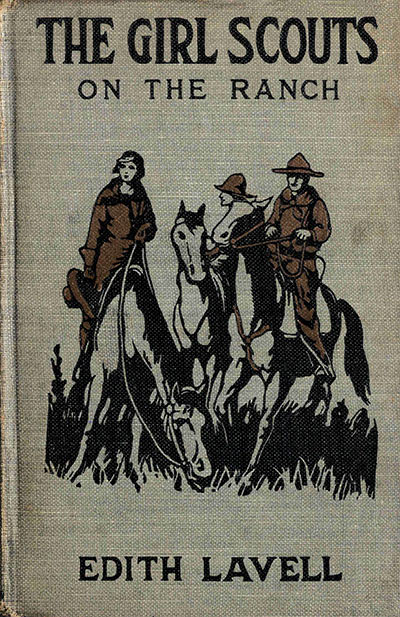
THE GIRL SCOUTS
ON THE RANCH
By EDITH LAVELL
Author of
“The Girl Scouts at Miss Allen’s School,” “The Girl
Scouts’ Good Turn,” “The Girl Scouts’ Canoe Trip,”
“The Girl Scouts’ Rivals,” “The Girl Scouts at Camp.”
A. L. BURT COMPANY Publishers New York
THE
GIRL SCOUTS SERIES
A Series of Stories for Girl Scouts
By EDITH LAVELL
The Girl Scouts at Miss Allen’s School
The Girl Scouts at Camp
The Girl Scouts’ Good Turn
The Girl Scouts’ Canoe Trip
The Girl Scouts’ Rivals
The Girl Scouts on the Ranch
Copyright, 1923
By A. L. BURT COMPANY
THE GIRL SCOUTS ON THE RANCH
Made in “U. S. A.”
CHAPTER I. COMMENCEMENT WEEK.
THE GIRL SCOUTS
ON THE RANCH.
Every door and every window of Miss Allen’s
Boarding School stood wide open in hospitality to
welcome the guests of the graduating class. For
it was Commencement Week, and visitors were coming
from far and wide to see the exercises.
Upstairs in the dormitories, confusion reigned
everywhere. Trunks, half-packed, their lids wide
open and their trays on the floor, lined the hallways;
dresses were lying about in profusion on
chairs and beds; great bunches of flowers filled the
vases and pitchers; and rooms were bereft of their
hangings and furnishings. Girls, girls everywhere!
In party dresses or
kimonos they rushed about their
rooms or bent over their trunks in the hall. Everybody
seemed in mad haste to accomplish the impossible.
Marjorie Wilkinson and Lily Andrews were no
less excited than the other seniors. They not only
shared in the mad whirl of social events and class
activities, but as officers they were responsible for
their success. When dances and picnics were to be
arranged, studying and packing were out of the
question for them.
But that afternoon there had been a slight lull in
their program, and both girls were in their room,
trying to make up for lost time. Marjorie, who had
been struggling for half an hour with a buckle and
a satin pump, finally put it aside in disgust.
“Lil, I can’t sew that thing on, so as to have it
look right! Every needle breaks, and the stitches
show besides!”
“Couldn’t you wear them without the buckles?”
suggested her room-mate, looking up from the floor,
where she was kneeling over a bureau drawer.
“No, the marks would show where the buckles
were before,” replied Marjorie, in the most mournful
tone.
“Then don’t bother!” returned Lily, cheerfully.
“Wear your silver slippers and stockings.”
“With pink georgette? Do you think it would
look all right?”
“Yes—it would be stunning!”
“Just as you say,” agreed Marjorie, much relieved
to have the matter disposed of. “I wish I
had thought of that before—and not wasted a precious
half hour with those old slippers!”
Lily stood up, holding a pile of clothing over her
arm. She started for the trunk in the hall, but
paused at the door.
“Marj, you better ‘waste’ another half hour in
a nap, or you’ll be dead. You know as well as I
do that tonight’s the biggest thing of the year for
us.”
Marjorie smiled contentedly at this reference to
the senior dance, which, as Lily had said, was the
crowning event of their social career at Miss Allen’s.
Later in life, Commencement itself would stand out
most clearly in their memory; but now, at the age
of eighteen, nothing could exceed the dance in importance.
And yet Marjorie was conscious of an
indefinable regret about the whole affair, as if already
she knew that the realization could not equal
the anticipation. The cause of this feeling could be
traced to her partner. A month ago, on the spur
of the moment, she had invited Griffith Hunter, a
Harvard man whom she had met several years before
at Silvertown, and whose acquaintance she had
kept. But she was sorry not to have asked John
Hadley, an older and truer friend.
“Tonight will be wonderful!” she said; “only,
do you know, Lil, I do wish I had asked John instead
of Griffith.”
“I knew you’d be sorry, Marj!” said Lily. “I
never could understand why you asked Griffith.”
“I guess it’s because he’s so stunning looking, and
I knew he would make a hit with the girls.”
“But John Hadley is good looking, too!”
“But not in the same way Griffith is. And you
have so few dances with your partner!”
Smilingly, she threw herself down upon the bed
and closed her eyes. Lily was right; she must be
fresh for the dance. The class president could not
afford to look weary and tired out. In a few
minutes she was fast asleep.
The rest, which Marjorie so sadly needed, was
the best beautifier the girl could have employed. Had
her mind been on such things, her mirror would
have told her, as she dressed, that she looked better.
Her color was as fresh and pink as the roses she
wore at her waist, and her eyes sparkled with greater
brilliancy than ever.
Marjorie, modest as she always was, could not but
be conscious that the eyes of everyone were turned
approvingly towards her as she entered the dance hall
on the arm of her handsome partner. When the
music of the first dance began, and she started off
with Griffith, she felt a thrill of pride at the grace of
his dancing. Momentarily, she was glad that she
had not invited John; no other young man of her
acquaintance possessed all the social requisites to
such an extent as Griffith. And, as she had remarked
to Lily, they had only three dances together,
and practically no intermissions, for as class president,
it was her duty and her privilege to act as
chief hostess. She tripped around from one group to
another, introducing people, talking to everybody,
sometimes taking Griffith with her, sometimes leaving
him with Doris Sands or Mae Van Horn or
Lily—wherever there seemed to be an interesting
group. She had no time for strolls in the moonlight
between dances, or intimate little tete-a-tetes
on the porch; she used every minute of her evening
for somebody else. When the last waltz finally
started, Griffith declared that he had seen nothing
of her during the evening.
“But you haven’t been bored?” she asked, with
concern.
“No, indeed!” he replied, with sincerity. “Your
friends are all charming!”
It was when they were strolling back to the school
that Griffith asked,
“What do you intend to do this summer, Marjorie?”
“I really don’t know,” she replied. “I want to get
away somewhere, and get good and strong for college
next year.”
“Why not come to Maine?” suggested the young
man.
“Yes, I’d like that—but I don’t know what papa
is planning. It all depends upon him. But he won’t
tell me a word.”
“Aren’t the Girl Scouts going camping?” asked
Griffith.
“No; the captain, Mrs. Remington, couldn’t go,
and at present we have no lieutenant, so we let the
whole matter drop. I’m sorry, too, for I know I’m
going to miss it all dreadfully.”
“And when do you expect to know your father’s
plan?”
“Tomorrow, I hope,” she answered.
They had reached the school now, and they paused
at the doorway. Marjorie put out her hand.
“You can’t come tomorrow?” she asked.
“No, I’m sorry,” said Griffith. “I’d love to, but
we have a frat meeting. You’ll write?”
“Yes, if you write first. Well, goodnight!”
The young man pressed her hand.
“Goodnight—and thanks for a wonderful evening,”
he said.
Marjorie turned about and hurried up the stairs.
In spite of the rush and excitement, she was not
tired. She wanted to talk it all over, to discuss the
girls’ partners and dresses, the music, the flowers,
the refreshments. To her joy she found Lily already
in their room. She threw her arms about her
in ecstasy.
“Oh, wasn’t it all wonderful, Lil!” she cried.
“Come, let’s sit down and talk it over.”
But, to her astonishment, she found Lily’s mood
totally different from her own. The other girl
seemed quiet, subdued, happy, but in a dreamy sort
of way. And although she agreed with everything
Marjorie said, she volunteered very little conversation
on her own part. Apparently absorbed in her
own thoughts, she began mechanically to undress.
Marjorie contemplated her in amusement.
“Lil, I bet you don’t even know what color Doris’s
dress was!” she said laughingly. “You’re so in the
clouds.”
Lily flushed in admission of the accusation, making
no attempt to deny it.
“How many dances did you have with Dick?”
pursued Marjorie, teasingly. “More than the law
allows, I’ll wager!”
“Why—five or six,” replied Lily. “Really, I
didn’t count them.”
“No, I guess you didn’t! Well, suppose we get
into bed. I won’t bother you any more—I’ll leave
you to your dreams.”
“It isn’t that, Marj,” replied Lily. “But we do
need the sleep. Tomorrow’s Commencement, you
know.”
Marjorie’s parents were among the first guests to
arrive for the exercises. Although too busy to meet
each train, the girl kept a constant watch for them
from the window of her room. She saw them as
soon as they entered the school grounds, and bounded
down the stairs, so that she might meet them before
they reached the door.
“Jack is waiting for us at the out-door auditorium,”
said Mrs. Wilkinson, after they had kissed
each other. “He thought that he had better go and
reserve seats.”
As Marjorie was all ready for the exercises, except
for getting the bouquet of American beauties which
John Hadley had sent her, she accompanied her
parents across the campus. When they were within
sight of the amphitheatre, she recognized her
brother Jack, facing her, talking with a man and a
woman whose backs were turned in her direction.
Something in the manner in which the young man
stood, and held his shoulders, gave Marjorie a thrill.
It must be—it was—John Hadley!
Jack waved to her across the lawn, and instantly
John Hadley turned around and greeted her cordially.
In another minute the party was together.
“Perhaps we better get some seats,” suggested
Jack. “At least for the ladies.”
The older people sat down, and Marjorie and the
two young men stood near them. The former had
only a few minutes at her disposal.
“Was your dance dress all right?” asked Mrs.
Wilkinson, with motherly concern. At a glance,
her experienced eye had taken in every detail of
her daughter’s appearance, and she was thoroughly
satisfied.
“Lovely! Perfect!” answered the girl, appreciatively.
“And so were all the others. I’ll have to go
somewhere very gay this summer,” she remarked
with a sly, questioning look at her father, “to wear
such lovely clothes!”
“Would you prefer Newport or Bar Harbor?” he
asked, mischievously.
“Neither, papa, thanks. I’ve had a wonderful
time this week, and, in fact all this year; but I’d
be perfectly willing not to go to another party all
summer. I’ve been gay enough to last a life-time.”
“Well, it certainly hasn’t seemed to hurt you,”
observed Mrs. Hadley, looking approvingly at the
girl’s pink cheeks.
“No; but too much of it would,” said her father.
“Well, perhaps you will like my plans for your summer,
then!”
Marjorie seized her father’s arm, and looked
pleadingly into his eyes.
“Please tell me, papa! Please!”
“No, I can’t! It wouldn’t be fair to the rest!”
“The rest of whom?” she demanded.
“The rest of the Girl Scouts!”
Marjorie uttered a little gasp of pleasure; it was
just what she wanted most of all. How she had
dreaded the thought of the separation from her best
friends, and the dissolution of that wonderful senior
patrol of theirs which had gone together to Canada
to represent the Girl Scouts of the whole United
States!
“If you’re sure there are scouts in it,” she said,
“I won’t ask any more. I’m perfectly satisfied!”
She turned to go, and John asked for permission
to stroll back to the building with her. It was the
first time he had seen her since the Spring vacation.
“I suppose you are still working hard?” she asked,
casually.
“Yes—so—so,” he replied, lightly dismissing her
question. He was more interested in the subject
she had been discussing with her father.
“Marj, don’t you really know where you are going
this summer?” he inquired.
“I haven’t the faintest idea,” replied the girl. “I
know only just what papa said, which you heard:
somewhere with the Girl Scouts.”
“Well, whenever you do go, I wish I could spend
my two weeks vacation at the same place!”
“Probably you can, for I don’t think we are going
to any girls’ camp, or anything like that.”
“But you might be going to Europe, or California,”
he observed.
“No, I wouldn’t want to travel this summer—I’m
too tired. And I’m sure mother realizes that, if
papa doesn’t.”
John looked at her seriously.
“I wouldn’t be in your way, Marjorie?”
“No indeed!” she replied, heartily. “Let’s make
it a bargain! We’ll have our
vacation together—provided,
of course, your mother is well enough
to go.”
“Oh thanks!” he said, fervently.
They had reached the main building now, and
Marjorie stopped at the door-step.
“Come see me next Sunday!” she said, cordially.
“Lily will be there, and perhaps some more young
people.”
“I’d be delighted!” said John, turning to leave her.
But he would have preferred to have an invitation
for a time when he might see her alone.
Marjorie entered the building, and made her way
to the room where the rest of the graduating class
were gathered. With a sharp pang of regret she
realized that this was the last time they would ever
be together as students of Miss Allen’s school. No
doubt they would often meet later as alumnae, but
it would never be the same. It seemed such a short
time since they had entered as freshmen—when she
and Ruth Henry had ridden up from their home
town together, wondering what it would all be like.
She was so thankful that Ruth had not dared to
come back to the school after her expulsion from
the Girl Scouts the preceding summer; her absence
had made the year singularly pleasant and peaceful.
Yes, Marjorie Wilkinson had been happy during
those four years of boarding school life, and she was
sorry that it was all over.
As soon as she had entered the room, Lily rushed
forward with her bouquet.
“Marj! You forgot your flowers!”
“Oh, thanks, Lil!” cried the other, gratefully.
“And I forgot to thank John, too. But I’ll see him
again.”
She arranged the American beauties on her arm,
and fell into her place in the procession of girls who
were to walk, two by two, to that pretty stage in
the wooded part of the campus.
During the first part of the exercises, she kept her
eyes steadfastly in front of her, listening with rapt
attention to the speaker, as he droned through his
dry address. But it did not seem long to her; somehow
she wished that he might go on forever, thus,
by his act, keeping her a student at Miss Allen’s.
But, like everything else, it was over at last, and
the principal gave the signal for the singing of the
Alma Mater, which was to mark the conclusion of
the exercises.
It was then that Marjorie looked about the audience,
and allowed her eyes to rest upon John Hadley’s.
Dropping them for a moment, she looked at
him again, mutely trying to make up for her omission
in thanking him.
The young man understood her meaning, and
was happy.
CHAPTER II. GOODBYES.
Marjorie saw her parents and the Hadleys only
for a few minutes after the exercises were over, for
almost immediately Mae and Lily came to drag her
off to a luncheon, which was to be followed by the
last class meeting.
As president, Marjorie naturally took the chair.
Calling the meeting to order, she put through the
necessary details, that the girls might return to their
visitors as soon as possible. It was only when she
mentioned the formation of some sort of permanent
organization, whose purpose it would be to arrange
for reunions and other activities, that she realized
that the girls were in no hurry to adjourn.
“Is it your pleasure to elect officers, and frame a
constitution?” she asked.
Immediately several girls rose to their feet in
hearty approval of the suggestion. Discussion followed,
and a unanimous acceptance of the proposition.
Almost before she realized it, Marjorie was
re-elected president for the coming year.
It was after three o’clock when the meeting broke
up, and Marjorie and Lily decided to go straight
to their room. Lily’s parents had gone home immediately
after the exercises were over, and Mr.
and Mrs. Wilkinson had invited the girls to supper
at the inn with them that evening, so they had
not planned to be with Marjorie in the afternoon.
Both girls, therefore, felt that they were free for
the remainder of the time.
Marjorie opened the door rather listlessly, picturing
to herself the confusion of the room, and wishing
to keep away from it as long as possible. But
the packing had to be done, and there would be no
opportunity so good as this one.
“Lil!” she exclaimed, as soon as they were both
inside the door, “What are those suit-boxes on our
beds?”
“I don’t know,” replied the other girl, going over
to examine them. “They don’t belong to me—”
she paused, and looked at one of them closely—“yes,
this one does, too! It has my name on it!”
“And the other has my name on it!” cried Marjorie.
“They must be Commencement presents!”
With trembling fingers the girls pulled at the
string and succeeded in loosening it. In a moment
each had made her discovery. A brand new riding-habit
of the most fashionable cut lay folded in each
box.
“How wonderful!” cried Marjorie. “Yes, here’s
a card—from mother. But when are we supposed
to wear them? I haven’t any horse—”
“It must have something to do with our vacation
this summer,” surmised Lily. “Or maybe our parents
are going to let us go riding every day.”
“Let’s put them on!” suggested Marjorie, holding
hers up for a closer examination.
“No, we better not, Marj. Let’s pack first, and
get our work all done. I simply can’t rest in all
this mess.”
“Righto!” agreed her room-mate.
The girls substituted middy blouses and bloomers
for the Commencement dresses, and then fell to
work with a will. Order began to come from chaos,
and the room took on that bare appearance of the
deserted dormitory in summer time. As they surveyed
the results of their labor, both Marjorie and
Lily grew increasingly cheerful; they began to forget
that this day was their last at Miss Allen’s,
among so many dear friends, and their thoughts instead
were of the future.
“Don’t you wish we knew what we were going
to do this summer?” asked Marjorie, for perhaps
the tenth time that week.
“Yes, but I do love a mystery. Remember last
summer—how we didn’t know whether we were going
to the training camp or not—and then later when
we hardly dared dream that Pansy Girl Scouts would
be the ones to go to Canada.”
“Yes,” said Marjorie; “and everything always
seems more thrilling in reality than we ever hoped it
would be. So perhaps, this summer will be, too.”
“Your father said something about Girl Scouts—oh,
don’t you wish the whole senior patrol could be
together?”
“It is my dearest wish,” replied Marjorie,
earnestly.
The appearance of a maid at the door to remind
them that the man would call for their trunks in ten
minutes put an abrupt end to this pleasant conversation.
Without another word, both girls set themselves
to finish their task.
“There’s just time for a nap before we dress for
supper,” said Lily, dropping on the bed.
“Of course I wouldn’t have said anything to
mother or papa,” said Marjorie thoughtfully, “but
I do wish we didn’t have to go to the inn tonight.
It’s our last supper here, so I care more about the
companionship with the girls than about having good
food. I want to be with our best friends—Alice,
and Doris, and the rest.”
“Cheer up, you’ll have breakfast with them tomorrow,”
reminded Lily. “And we can come back
early this evening, and maybe wear our riding-habits
to visit them.”
Marjorie’s face brightened at the suggestion.
“It’s Friday night, Lil!” she exclaimed, suddenly.
“Oh, if our senior patrol could only get together for
one last meeting! Just think—is it possible we’re
out of active membership of the Girl Scouts forever?”
Her voice became disconsolate, and she
uttered the last word almost in a whisper.
“But we won’t be,” said Lily, reassuringly.
“We’re both going to start troops of our own in the
fall. And besides, I shan’t give up hopes for this
summer until I hear what your father tells you tonight.”
Both girls were in their kimonos, ready for their
brief nap. Almost as soon as they stopped talking
and closed their eyes, they fell asleep, exhausted
from the strain and excitement of the week.
Neither realized how long she had been asleep;
each sat up at the same moment, awakened by a continuous
knocking. Someone was at the door.
“My gracious, what’s that?” cried Lily. “It must
be late, Marj! How long do you suppose we have
slept?”
Mechanically, patiently, the knocking persisted.
Whoever the visitor was, she evidently did not intend
to give up until she received an answer.
“We’ve got to open the door, though, goodness
knows, we haven’t any time for callers,” said Marjorie,
pulling on her slippers.
Before she reached the door there came another
volley of knocks, then a whisper, followed by sounds
of smothered laughter. The visitors were evidently
in high good humor. Sleepily, and with an excuse
half-formed on her lips, Marjorie opened the door.
To her immense surprise, not one, but five girls confronted
her—her five best friends in the Girl Scout
troop. She burst into laughter.
“Do come in!” she exclaimed.
“We were sure you were dead!” said Alice Endicott,
one of the most vivacious girls in the troop.
“We’ve been knocking for hours!”
“Not really?” asked Marjorie, seriously. “Oh,
what time is it?”
“Quarter of six!” answered Doris Sands, consulting
her watch.
“And we’re to be at the inn at quarter past for
dinner with your father and mother!” cried Lily, in
alarm. “Marj, we certainly will have to rush!”
“Yes,” announced Alice, “we’re all going—that’s
the reason we are here. I’ve heard of parties where
nobody came but the hostess, but a party without
the hostess would be rather odd!”
She seated herself comfortably on the couch, and
the others followed her example. Marjorie listened
incredulously to what she had told them.
“You’re invited too? Why, that’s perfect! But
why didn’t papa tells us?”
“Oh, you know he’s always strong on surprises,”
remarked Lily. “I think this is a dandy. But don’t
stand there like a bump on a log, Marj! We’ve got
to dress.”
In less than ten minutes the girls announced their
readiness to start. Florence Evans reminded them
both, however, not to forget their flowers.
“Flowers?” repeated Lily. “Oh, yes, I’d forgotten.
Of course we seniors all have them.”
“Seniors?” questioned Marjorie, a trifle regretfully.
“We’re graduates now, Lil. Florence and
Alice and Daisy are the seniors now.”
But in spite of the imminence of the separation,
Marjorie became gay again. The evening promised
to be very enjoyable, almost, it would seem, a repetition
of old good times. Mae Van Horn, Doris
Sands, Alice Endicott, Florence Evans, Daisy Gravers,
Lily, and herself—with the exception of Ethel
Todd, all of the dear old senior patrol that shared
the wonderful experiences of last summer would be
together. Surely it was no time for regrets!
Linking arms, and humming the Girl Scout
Marching-song, they proceeded across the campus to
the village. All the girls wore dainty summer
dresses, with light wraps or silk sweaters, and went
without hats. There were no bobbed heads now
among the group; the style was considered passé,
and the girls with short locks disguised them with
nets.
They reached the inn just in time, and found Mr.
and Mrs. Wilkinson waiting for them on the porch.
Two tall white benches on either side of the door
seemed to invite them hospitably to be seated. The
girls gratefully dropped into seats.
“Why is the door closed?” asked Marjorie, after
she had expressed to her parents her appreciation
of the delightful surprise party.
“I guess it’s cold inside,” replied Mr. Wilkinson,
with a twinkle in his merry brown eyes.
“Oh it isn’t, papa! You’re hiding something!”
cried his delighted daughter. “I know you!”
“You aren’t satisfied, then?” he asked. “You
want something more? Some young men, I suppose?”
“No I don’t!” protested Marjorie, emphatically.
“I hope John and Jack went home, as they expected,
for I’d rather have the girls all to myself tonight!”
“Well then, what is it you do want?” he pursued.
“Nothing, papa. I’m perfectly happy. But I just
asked a simple question: why, on such a warm night
as this, should the door be closed, when there is a
perfectly good screen-door in front of it?”
“Don’t tease her any more, dear!” remonstrated
Mrs. Wilkinson. “There is a reason for having it
closed, Marjorie, and it is another surprise for all
of you. Two more guests are waiting for you inside,
but they’re of the feminine gender, as you seem
to desire.”
“Oh, who?” demanded all the girls at once.
“What two people would you most rather have
with you tonight?” asked the older woman.
“Ethel Todd, for one!” cried Marjorie.
“And Mrs. Remington!” put in Lily and Alice,
both in the same breath.
At this dramatic moment, Mr. Wilkinson threw
open the door, revealing the very two people desired,
smiling at the girls’ surprised expressions. The
scouts all jumped up and rushed forward, and a
great confusion of embracing followed. Before they
had calmed down, the landlady appeared to announce
supper.
Following her into a private dining-room beyond
the main tea-room, they found a charming table set
for ten. A big bowl of purple pansies stood in the
center, surrounded by candles of the same color;
and at the four corners of the table there were bows
of purple ribbon. The place-cards represented hand-painted
scout hats, decorated with wreaths of the
same troop flower.
“It’s lovely! I feel just as if it were a real scout
party again!” cried Marjorie, joyfully.
“That’s exactly what we’ve tried to make it,” explained
her father, gratified at her obvious pleasure.
“And so many surprises in one day,” continued
the girl, after everyone was seated. “Our riding-habits—you
must see them, girls—and this party,
and Ethel and Mrs. Remington—”
“And flowers from John,” teased Alice.
“Well, I simply couldn’t stand anything more!”
concluded Marjorie. “I’d just die!”
“And here I was just about to tell you about the
best one of all!” interrupted her father. “But now
I guess it wouldn’t be safe.”
“Oh, you simply must now!” urged Marjorie. “It
isn’t fair to keep us all in suspense!”
“But you said you couldn’t stand any more!”
“I could stand that one!” laughed Marjorie.
“Well, I’m going to let Mrs. Remington tell you
this one,” he said. “But wouldn’t it be better, perhaps,
to have some dinner first?”
The girls acquiesced, and gave their attention to
the inviting fruit-cups before them. In the conversation
that ensued the graduates, who had been the
recipients of all the attention for the past week, were
glad to retire to the background, to give Ethel Todd
and Mrs. Remington the center of the stage. They
talked about college, and the future of Pansy troop
without its distinguished leaders. Almost every possible
subject was discussed except the one in which
the girls were most interested: namely, their captain’s
plans for their vacation.
When they had finally finished their ice-cream,
served in such beautiful pansy-forms that they hated
to eat them, and the candies and nuts were being
passed, Mr. Wilkinson called upon Mrs. Remington
for her announcement. Eight eager pairs of eyes
turned hopefully towards their captain, for somehow
all the girls felt that in some way their own fate was
connected with the surprise Mr. Wilkinson had
planned for his daughter.
“Well, girls,” she began, as she looked from one
to another of the expectant faces about the table,
“Mr. Wilkinson asked me what he thought Marjorie
would like to do best this summer, and I replied,
without the least hesitation: something with the Girl
Scouts—and particularly with the members of the
senior patrol. Was I right, Marjorie?” she asked,
turning to the girl.
“Yes, yes,” cried Marjorie. “Go on, please!”
“So you see that naturally necessitated my working
out a plan and consulting the other girls’ parents.
I thought of a great many places to go, but I wanted
something entirely different, and yet, at the same
time, some out-door vacation. So finally I hit upon
a plan which I hope will suit you all. At least, it
suits your parents; I have their consent for every
girl here—including Ethel.”
“And it is—” cried two or three scouts at once.
“Something to do with horseback-riding!” ventured
Lily, thinking of her own and Marjorie’s latest
graduating presents.
“Yes. You are all to spend July and August on
a ranch in Wyoming!” said Mrs. Remington.
“July and August?” repeated Marjorie, jumping
out of her seat, and rushing toward her father’s
chair. “Two whole months?”
“It isn’t too long, is it?” he asked.
“It’s heaven!” she cried, throwing her arms about
his neck.
The candles were burning low now, so Mrs. Wilkinson
suggested that the party adjourn to the porch
to enjoy the moonlight, while they discussed the
proposition to their hearts’ content. The girls asked
innumerable questions, many of which, however,
Mrs. Remington could only partially answer.
“I’m sorry, girls, that I shall not be able to go
with you,” she said, “but I couldn’t possibly leave
home that long. But you will get along all right.
The ranch is almost like a private place, and Mrs.
Hilton, the proprietor’s wife, will act as chaperone.
And you only need one in name.”
“And when do we start?” asked Lily.
“The very first day of July,” replied the captain.
The girls fell to discussing what clothing they
should take, and Mrs. Remington told them, to their
surprise, that they would live almost entirely in
riding breeches. Warm, sensible clothing, and
undergarments that could be easily laundered, were
necessities; and perhaps a silk dress to wear on the
trains. But they would find no use for fancy summer
costumes, she said.
“Suppose all our Commencement dresses are out
of style when we get home!” wailed Lily. “Won’t
it be a shame!”
“Well, you can still go to Newport, if you prefer!”
teased Mr. Wilkinson; but Lily was horrified
at the thought.
“But what I like best,” said Marjorie, as the girls
made a move to go, “is the fact that we’ll be together
for two months—the longest vacation we have
ever had!”
“Do you suppose you can stand it all that time
away from John Hadley?” asked Mae, in a low
voice, at her side. “That will be too far for him to
visit you, you know.”
Marjorie frowned; the remark recalled her
promise to John that very morning to go to a place
where he and his mother might join her. A wave
of regret spread over her; she hated to go back on
her promise, but of course it was too late to change
the plans now, even if she had wanted to. Anyone
would be foolish to give up a whole summer for the
sake of a two weeks’ vacation.
“Oh, I guess we’ll meet lots of Western boys,” she
answered, carelessly. “I don’t expect to pine away.”
Mr. Wilkinson accompanied the girls back to the
school, and although it was nearly half past ten,
Marjorie and Lily insisted that he wait down stairs
while they put on their riding-habits and returned,
proudly, to show themselves to him. Then they
made the round of the scouts.
CHAPTER III. THE WEEK-END AT THE SHORE.
Commencement was over, and Miss Allen’s
Boarding School had been closed for a week. Marjorie
Wilkinson was home again.
For the last few days everything seemed strangely
quiet and unnatural. No bells rang in the morning
to arouse Marjorie from her much needed rest; there
were no classes or meetings to attend; no gay functions
at night that kept her up till the small hours.
She accomplished her unpacking in less than an hour
and arranged her room so that it seemed as if she
had never been gone. Her old favorite books were
back in her secretary-desk; her pictures were in their
former places on the walls; her school pillows were
again on the wide window-seat, and her monogrammed
ivory set on the bureau. As far as outward appearance
went, the girl was perfectly at home.
And yet the strangeness of the life, in spite of
the familiarity of her surroundings, impressed her
as it had never done before during a summer vacation.
Her old friends had vanished, and her new
ones were too far away to take their places. Ruth
Henry, her chum from childhood, who had afterward
proved herself to be such a traitor, had moved
to New York to finish at a fashionable boarding
school. Harold Mason was spending his summer at
a young men’s camp, and her brother Jack had taken
a vacation position at a hotel in Atlantic City. There
was no one left in town whom she knew intimately.
For a while, however, Marjorie was too tired to
deplore this absence of friends and excitement. She
was glad of the chance to sleep, to read, and to visit
with her mother. She went over her college catalogues,
marking the studies she intended to take in
the Fall, and she examined her wardrobe with the
view of selecting the things she would like to take
with her to the ranch.
But when the week had finally passed, and Lily
Andrews arrived for the promised visit, she knew
she was thankful for the companionship.
The girls greeted each other as effusively as if it
had been a month, instead of a week, that had separated
them.
“But I’m afraid it will be pretty slow for you, till
the week end, at least,” said Marjorie, apologetically,
as she started the motor. “There isn’t a thing doing—the
town’s practically dead.”
“Why, isn’t there tennis—and driving—and
canoeing, an—?” asked Lily.
“Oh, certainly!” interrupted Marjorie. “But I
mean no dances or parties, or even young men to
call!”
“I don’t believe that will worry me much,”
laughed the other. “But say, Marj, couldn’t we go
horseback riding—just to practice up a little, you
know?”
“Yes, we can hire horses, of course. That’s a
dandy idea!”
Marjorie said nothing more about the week-end
until they were comfortably established on the porch
after Lily’s things had been disposed of. Then she
mentioned it again.
“You don’t seem a bit excited about the week-end,”
she remarked. “We’re going away!”
“Why, of course I’m thrilled!” Lily hastened to
assure her. “Where are we going?”
“To Atlantic City—the hotel where Jack is clerking.
And mother has invited Mrs. Hadley and
John.”
“That’s great!” cried Lily, rapturously. She had
loved the seashore from childhood. Then, at the
mention of John Hadley, she asked whether Marjorie
had told him of her plans for the summer.
“No, I haven’t,” replied her companion. “I tried
to when I wrote to thank him for the roses. But
somehow I didn’t know how to tell him, because
you know we had partly arranged to go to the same
place this summer. It seems sort of like going back
on my promise!”
“Well, you couldn’t help that,” returned Lily, consolingly.
“But I’m sure he won’t be angry.”
“No, maybe not angry, but hurt, perhaps. Still—scouts
have to come first, don’t they, Lil?”
“You bet they do! Particularly as this is probably
the last thing you and I shall ever do as members
of Pansy troop!”
“And that reminds me,” said Marjorie, “I wanted
to ask you whether you thought we couldn’t keep
our organization, and have regular scout meetings
at the ranch. And we could wear our uniforms once
in a while, just for old time’s sake, you know.”
“Indeed I do approve of that idea!” cried Lily,
with spirit. “Let’s keep our senior patrol as long
as we possibly can.”
“I sort of hesitated to suggest it,” continued Marjorie,
“because I am senior patrol leader, and I was
afraid it might look as if I were trying to keep all
the power I could get.”
As Lily listened to these words, a new thought
came into her mind. She seized upon it immediately;
it was a veritable inspiration.
“Marj! I have it! You’re eighteen now—let’s
get you commissioned as lieutenant!”
“Lieutenant—of—Pansy—troop?” repeated Marjorie,
overcome by the wonder of such a proposal.
When the older girls had received their commissions,
she had looked upon them with awe and admiration,
but it never seemed possible to her that she could
hold the same office as Edith Evans and Frances
Wright. She had always dreamed of becoming an
officer—perhaps, in time, a captain—over a troop
of little girls. But to be first lieutenant of her own
troop—that seemed utterly out of the question.
“Certainly,” replied Lily. “I’ll write to Mrs. Remington
this very minute, and she’ll get your examination
papers.” She was on her feet now, starting
towards the door. “We have ten days yet,” she
added, “we can easily put it through.”
But Marjorie still seemed reluctant.
“It wouldn’t be fair, Lil—without consulting the
other girls.”
“Nonsense! Would they have elected you senior
patrol leader, two years in succession, if they didn’t
want you? Would you have been made class president
and first alumnae president, if you weren’t
popular? Why, they’ll be tickled to death! And
won’t it be fun to spring a surprise on them!”
“You mean not say a word about it to them, till
everything is settled?” Marjorie showed plainly
that she disapproved of the suggestion.
“Of course! Tell them that Mrs. Remington
wouldn’t let us go without an officer, and that some
awful stick of an old maid has been made our lieutenant,
and will join us somewhere on our trip out.
Oh, I can just see Alice’s expression now! Won’t
she be furious!”
The humor of such a situation dawned upon Marjorie,
and she joined in Lily’s amusement. Then,
after a little more persuasion, she consented to the
writing of the letter.
The girls did not have to wait long for the answer;
indeed, they were surprised at the rapidity with
which it came. But then Mrs. Remington always
attended to matters promptly, and this all the more
so because she approved so heartily of the proposal.
Marjorie was delighted to find that the examination
was comparatively easy; after the more difficult
merit-badge tests she had taken the previous summer
at training camp, this one seemed almost like
child’s play. She took it into the library, signed
the pledge of honor to answer the questions without
assistance, and set immediately to work. Inside
of an hour the paper was finished, sealed in an
envelope, and dropped into the mail-box.
On Friday afternoon the whole family went in
the automobile to Atlantic City. Marjorie and Lily
occupied the front seat, with the former at the
wheel, while Mr. and Mrs. Wilkinson rode in the
tonneau.
The girls were not very talkative; both were absorbed
in their own thoughts. Marjorie went over
and over in her own mind the best way to tell John
her plans for the summer. Probably it would make
no difference to him, and yet she wished the ordeal
were over. She would hate so to offend him.
A slight accident to the motor delayed them for
a couple of hours at a garage, bringing them to the
hotel in Atlantic City at something after five o’clock.
Jack met them and informed them that the Hadleys
had already arrived, and had gone to their rooms.
They would meet in the lobby at six o’clock to go
into the dining-room together.
“Don’t say a word about our trip to the ranch,
Lil,” pleaded Marjorie, as the girls were unpacking
their suit-case. “I want to break it to him gently—in
case he should be peeved.”
“I know he’s going to be terribly disappointed,”
said Lily. “But I’ll be very careful, Marj.”
Reassured by her chum’s promise, Marjorie went
gaily down to the lobby at the appointed time. John’s
first words, however, took her somewhat aback; he
had not forgotten her promise.
“This certainly is jolly of your mother,” he said.
“And more than I ever dreamed of. An extra week-end
with you—besides our two weeks in August.”
Marjorie winced at the reference, and closed her
lips tightly. She could not tell him now, before all
those people, that her plans were changed. So she
merely smiled, and turned to Mrs. Hadley.
Having secured permission for extra time off,
Jack felt particularly gay, and acted as host of the
party. Mr. Wilkinson noticed with what genuine
courtesy he carried the thing off, and judiciously
retired to the background. Indeed, it seemed as if
the boy even regarded his father and mother as
guests.
The others of the party responded to his mood,
and the meal was a jolly one. It was only when he
announced that he had procured seats for Keith’s
theatre that evening, that the girls found their spirits
sinking. For Lily would have preferred to spend
the time looking at the ocean, and Marjorie longed
for the opportunity to have a tete-a-tete with John.
But if the girls were disappointed at this announcement,
they were dismayed at the young man’s
next remark. All unconscious of the situation, he
blurted out to John’s surprised ears the unwelcome
news of the girls’ project.
“What do you think of these wild girls, Hadley?”
he asked, while they were all waiting for their dessert.
“Imagine them strutting around in trousers
all summer, on a ranch in Wyoming! I’ll bet they
join the cowboys, and never come back!”
“What? What?” demanded John, in a most perplexed
tone. Marjorie had said nothing about any
such plans.
“Oh—haven’t the girls told you yet? Well, there
hasn’t been much time. Still—I thought you and
Marj kept up a steady correspondence!”
“The steadiness is all on my side,” replied the
young man, quietly. Then, louder, “No, I didn’t
know a word about it. Tell me!”
Marjorie hastened to relate all there was to tell:
her father’s desire to plan something particularly
nice for her for this vacation, Mrs. Remington’s
suggestion, and the Girl Scout party. John said
nothing about his shattered hopes, but Marjorie saw
that the slight had cut deeply. If only she had
written to him! But it was too late now for regrets.
She did not find an opportunity until the following
afternoon to apologize for her failure to explain
the project to John. The party, which had stayed
together all morning on the beach and in the ocean,
decided to go their separate ways after luncheon.
Mr. Wilkinson joined a fishing excursion, and Lily
and the two older women planned to take naps. Jack
found it his duty to be in the office if he wanted
the evening off, so John seized the chance to ask
Marjorie to go walking. She was only too glad to
accept.
Taking the car as far as Ventnor, so that they
might avoid the crowd and the shops, they started
their walk in the prettier part of the town. Marjorie
plunged immediately into the subject that was
uppermost in both minds.
“John,” she began, “I didn’t mean to go back on
my promise, and I wanted to tell you all about it
before anybody else did. But you see papa and Mrs.
Remington planned everything; I had practically no
say in the matter.”
John regarded her intently, wishing that he might
believe that she was as keenly disappointed as he
was because they were not to be able to spend the
vacation together. But no; she certainly did not
appear heart-broken.
“You’re not sorry, though,” he said, somewhat
bitterly. “The whole thing suits you exactly.”
“It would be a lie to say it didn’t,” laughed Marjorie,
good-naturedly. “You know how I adore that
sort of thing.”
“Marjorie,” he pursued, “do you think that—that—”
he hesitated, as if he did not know how to put
his thought—“that sports, and Girl Scouts, and
things like that, will always come first with you?”
Marjorie seemed hurt at his words; he was accusing
her of being cold and unfeeling.
“I don’t know what you mean!” she returned,
sharply. “Do you imply that I care more for things
like that than for people? That I like
horseback-riding
and hiking better than mother and father
and Lily—”
“No, no! I didn’t mean that. Of course I know
your family and Lily come first. But men, for instance?
It seems to me you’d always rather go off
with a pack of girls on some escapade than see any
of your men friends.”
“Maybe I would,” laughed the girl, heartlessly.
“But,” she added, “perhaps I’ll wake up some time!”
“When?” he asked, seriously.
“Maybe when I fall in love!” she returned, teasingly.
John knew that now she had adopted this frivolous
manner, it would be useless to pursue the subject
further. So he put the thing out of his mind
temporarily, forcing himself to talk of other things.
But when, an hour later, he was alone in his room,
he made a new resolution. Marjorie had treated
him shamefully by not writing to him of her plans,
by allowing his hopes to be dashed so rudely to the
ground by a third person. It was evident that she
did not care for him—that she had never cared,
and it was foolish of him to pursue her. In the
future, therefore, he meant to treat her with the same
polite indifference with which he accorded the other
members of her sex; if he was nothing to her, he
would show her that she was nothing to him!
That evening and the following day, he shared
his attentions equally with both girls, and although
nothing was said, when Marjorie drove away in the
car, she felt that something was wrong. She feared
she had lost the friendship of a young man for whom
she had the utmost regard and respect. And she
was sorry—but not sorry enough to make an effort
to re-establish it on the old footing.
Resolutely, she thought of the ranch and the Girl
Scouts, and talked volubly to Lily on both subjects.
She was rewarded, it seemed; for when she reached
her home, she found her lieutenant’s commission
waiting in the mail-box!
CHAPTER IV. DAISY’S SISTER.
The eight Girl Scouts who were going to the
ranch met at the Grand Central Station of New
York. Although there were to be only eight travellers,
there seemed to be about thirty or forty people
in the party, so many friends and relatives had come
to see them off.
Luckily, the girls’ luggage was all cared for by
someone else, for there was not a scout in the party
who was not laden down with baskets of fruit or
boxes of candy. Doris Sands and Marjorie Wilkinson
each wore bunches of roses—those of the latter
however were a gift, not from John Hadley, but
from Griffith Hunter.
The girls themselves seemed almost too excited
to give much thought to their presents. They tried
to listen to innumerable admonitions and messages
at the last minute, and finally got into the train with
only a hazy idea of what everyone had said. But
they all looked supremely happy.
As soon as they were comfortably settled, and
the excitement had died down so that normal conversation
was in order again, Marjorie began to
wish she might tell the others about her commission.
It was only with the greatest effort that she restrained
herself.
Neither had Lily forgotten the all important subject;
so as soon as she found a chance, she blurted
out her announcement.
“Girls!” she said. “I have the most exciting news
to tell you! Guess what it is!”
“What? What?” demanded two or three at once.
“Marj is engaged?” suggested Alice, always anxious
for romance.
“Don’t be silly!” said Marjorie, frigidly.
“Well, you’ll never guess, so I might as well tell
you,” said Lily, amused at Marjorie’s indignation.
“We are to have a scout lieutenant to chaperone us
this summer.”
“Who?” demanded Florence Evans, excitedly.
“Not my sister Edith?”
“No—nobody like her. You couldn’t imagine
two people more different; in fact this woman is
different from anybody else we ever had in the troop.
She is really an awful old maid—about seventy, I
guess—and wears spectacles, and thinks girls of
seventeen or eighteen are mere infants. She—”
Lily rejoiced to see the girls all growing furiously
angry. How did such a thing ever happen? Was
this Mrs. Remington’s doing? Ethel interrupted
Lily by demanding, sharply,
“What’s this dreadful person’s name?”
Lily had not thought of a name for her. So,
under the necessity of inventing one on the spur of
the moment, it sounded perhaps a trifle too prim.
“Miss Prudence Proctor!” she announced, avoiding
Marjorie’s eyes.
Florence let out a soft whistle. The others looked
equally dismayed. It was Alice who demanded a full
explanation.
“Mrs. Remington wrote for us to keep a watch
for her, that she might join us anywhere from New
York to the ranch.”
“How are we to know her?” asked Ethel.
“I’ll know her,” answered Lily. “I met her once.”
“And is she really so awful?” asked Alice, a little
more hopefully.
“She’s dreadful!”
“Marj,” said Ethel, suddenly suspicious, “why
aren’t you saying anything? What do you know
about her?”
Marjorie could hardly keep from laughing; in her
struggle with the corners of her mouth, the tears
came into her eyes.
“She’s—she’s impossible!” she stammered, hiding
behind her handkerchief. “She’s really the most disagreeable
person I know.”
“Worse than Ruth Henry?” asked Alice.
“Yes,” murmured Marjorie, again almost losing
control of herself.
“Girls,” said Doris, who was always sensitive to
another’s discomfort, “let’s change the subject. I
don’t understand it, but Mrs. Remington must have
had a reason for putting this woman over us. Anyway,
we can’t make it any better by talking about
it.”
“It looks like one of Ruth Henry’s tricks to me,”
said Alice, bitterly.
All this finally became too much for Lily; she was
choking now, and she feared that if she stayed another
minute she would give way entirely. Rising
hastily, she made some excuse about getting a glass
of water, and disappeared into her own compartment.
By making their reservations early all the Girl
Scouts had managed to travel in the same car. Lily
and Marjorie had one compartment together, and
Ethel and Doris another; the rest of the party had
been satisfied to travel in berths.
Although Doris, Alice and Lily had all been to
the coast before, they had taken the trip during their
childhood, with their parents, and had forgotten
most of the details. Everything, therefore, seemed
new and fascinating to them all; they were in no
hurry for the days to pass which would be spent so
enjoyably before they even reached the ranch. They
would read and play cards to their hearts’ content;
and then, when they were tired of everything else,
they could always talk with each other.
To many people much older than these Girl Scouts
the novelty of eating on a train has never lost its
charm, so it is little wonder that they looked forward
to each occasion with a keen sense of pleasure.
They were thankful, too, as they entered the diner
for their first meal, that there were eight in their
party; it would mean that they might always eat
by themselves, if they were fortunate enough to
secure two tables. They were careful to keep their
voices low, and to avoid drawing any undue attention
to themselves; but, in spite of this, more than
one fellow-passenger looked enviously at the happy
party.
When supper was over that first night, the girls,
by general consent, congregated in Marjorie’s compartment.
It was the larger, more comfortable of
the two, and afforded a lovely private sitting-room.
“Shall we play bridge?” asked Doris.
“No, let’s just talk,” replied Marjorie, who sensed
the prevailing sentiment of the group. “Only—not
about the lieutenant! I couldn’t bear that!”
“We’ll never mention her till she appears!” exclaimed
Alice, loyally. “There—will that be a relief
to you?”
Lily looked distressed. Was all her fun going to
be denied her in this fashion? But Marjorie good-naturedly
came to her rescue.
“No, Alice, I’d rather get used to talking about
her now, so that I won’t make a fool of myself when
she does appear. You can say whatever you like;
it really doesn’t matter to me!”
“Well, don’t let’s talk about her, anyway,” said
Doris. “I’m sure we can find a more agreeable topic
of conversation. Let’s everybody tell what she is
going to do next year!”
“That will be interesting!” cried Lily, enthusiastically.
“Where shall we begin?”
“With the oldest,” answered Doris. “That’s you,
Ethel.”
“Well, you all know about me,” said the girl. “I’ll
be a sophomore at Bryn Mawr.”
“And I’m going to a finishing school outside of
Boston,” volunteered Doris, briefly. “Who’s next—Marj
or Lil?”
“I am,” said Lily. “I’m not sure what I am going
to do. I’d like to go to college, but I’m the only
child in my family, you know, and mother wants me
home—papa travels so much.”
“I’m entered at Turner College,” said Marjorie.
“And if I have anything to say about it, Lily will
go too!”
“But how about her mother?” asked Mae.
“Her mother can have her all the rest of her life!”
“It’s likely,” laughed Mae. “She’d be married
the week after college closed!”
“Mae!” remonstrated Lily, “don’t judge others
by yourself! Now—what are you going to do?”
“I’m going to business college, and I hope to take
a position by the first of the year.”
“That certainly sounds interesting,” said Doris.
“Well, I suppose there isn’t any use asking our
seniors. You three are all going back to Miss
Allen’s, aren’t you?” she asked, turning to the
youngest girls in the party.
Florence and Alice both nodded assent; but Daisy
sat still, staring into space. It was evident from
her attitude that something was troubling her.
“I’m sorry,” she said, quietly, after the short
pause, “but I can’t go back.”
“Why not?” demanded two or three of the girls
at once. Mae was just about to make some teasing
remark about getting married, when, catching sight
of the girl’s expression, she took the warning to
be careful.
“We can’t afford it,” said Daisy, sadly. “Mother
had to choose between this trip and my last year
at school, and, for the sake of my health, she chose
this. I’m really glad, for my best friends are here,
and I can get my diploma later at night school.”
The girls were absolutely silent for a moment,
nonplussed at their chum’s announcement. No one
had had the slightest idea of the change in her circumstances,
and, although Marjorie and Alice had
both remarked about something strange in Daisy’s
manner, both had attributed it to ill health.
And while no one asked any questions, Daisy was
started now, and meant to go on with the whole
story.
“You see, our family have been under tremendous
expense lately,” she explained, fingering the tatting
on her handkerchief, and avoiding the girls’ eyes.
“My sister—she’s only twenty—always was very excitable,
and we sort of expected her to do something
crazy. Well, she did! Last Easter she went to the
seashore with another girl, but she didn’t come back
with her. Instead, she ran off and married a man
she had known only three days!”
“My gracious!” cried Alice, who was now sitting
on the edge of her chair, “How thrilling!”
“And did your father have to support him?”
asked Florence, jumping to the natural conclusion.
Daisy shook her head sadly. How she wished
their problem were as simple as that!
“No, he turned out to be a splendid young man—papa
met him afterwards, though of course I never
saw him. Well, to get back to the story, Olive—that’s
my sister, you know—sent a telegram to say
they were married, giving the man’s name. But
unfortunately it was Smith—a Thomas Smith!”
“Why unfortunately?” asked Alice. She could
see no dishonor in marrying a man of that name.
“Because, as you’ll see later, we had to trace her,
and the name is too common. It was in April that
we received this telegram; in May, Thomas Smith
came to see the family alone. Olive had disappeared,
and he didn’t know where.”
“But why did she run away?” asked Alice, incredulously.
“Was he cruel to her?”
“No; as I said before, papa said he was lovely.
Of course, I was at school myself, and didn’t meet
him, but I’d trust papa’s judgment any day. And
he said he had never seen anybody look so sad. The
poor young man seemed to take all the blame on
himself.”
“I wonder why!” exclaimed Doris, with pity.
“Well, it seems that he had teased her about a
poorly cooked dinner, and it turned out that she
was really very sick, with a fever. She took his
teasing to heart, and ran out without any coat or
hat. He naturally thought she would come right
back, but she didn’t. Then he began to phone to
all her friends, and to us, but nobody has seen her
since. We don’t know whether she’s dead or not!”
“How dreadful!” whispered several of the girls,
sympathetically.
“And so, ever since then, papa and Mr. Smith
have both spent a great deal of money in trying to
trace her; but no detectives have ever found a clue.
Mr. Smith finally became discouraged, and went
away, giving her up as dead. But we have never
given up hope.”
“Surely she’ll turn up,” said Doris, consolingly.
“Why, if she had died, somebody, somehow, would
have sent word.”
“Except that there was no way to identify her.
Well, papa has another theory. He thinks her exposure
while she was so sick made her temporarily
lose her mind, and probably even now she is an
amnesia victim, wandering around trying to find
out who she is.”
“Wouldn’t it be great if we’d find her!” cried
Alice, who was always looking for adventure.
“We’d never find her this far away,” said Daisy,
sadly. “If Olive’s alive, she’s somewhere in the
East. Mr. Smith said she couldn’t have had more
than ten or fifteen dollars in her purse.”
“Anyway, I’m going to watch for her all the
time!” declared Alice. “I’d rather watch for her
than for that old stick of a lieutenant!”
“Tell us what she looks like!” begged Marjorie.
“She’s very striking looking. You couldn’t
miss
her. She has dark, wavy hair, and very pink cheeks.
Her eyes are blue, and she has a dimple in her right
cheek. She’s medium height, and slender.”
“Have you a picture of her?” asked Lily.
“I’m afraid I haven’t,” sighed Daisy. “I didn’t
bring any pictures at all with me. I thought we
might live in tents, and wouldn’t want anything that
wasn’t absolutely necessary.”
“Well, let’s look at every girl we see, every time
the train slows down. And we can go in the diner
in relays tomorrow, and look over everybody on the
train!” said Alice.
“Now Alice, that’s too foolish!” cried practical
Florence Evans. “Imagine finding her right on
this train! You sound like a dime novel!”
“But she must be somewhere!” persisted Alice,
stubbornly.
This discussion was interrupted by Marjorie’s asking
Daisy what she was planning to do next year.
“I’ve been studying stenography,” replied the
girl, “and I have a position waiting for me at home
in the principal’s office of the public school. I’m
very lucky, because that will allow me to be with
mother, and help a little besides.”
“I think you’re wonderful to be so cheerful!”
said Marjorie, admiringly. “And think of keeping
it from us all this time!”
“Well, I always hoped the thing would solve itself,
and that there would be no need of explanations.
But now I’m getting pretty hopeless too.”
“Whom do you bet we find first?” asked Alice, in
spite of Florence’s rebuke, “Daisy’s sister, or the
lieutenant?”
“Daisy’s sister, I hope,” replied Doris, with a
yawn. “Come girls, let’s go away and let these
people go to bed!”
CHAPTER V. THE TWO LIEUTENANTS.
Nine hundred miles of their journey were over.
The Girl Scouts had reached Chicago.
It was a little after two o’clock in the afternoon,
and the train was to lay over until five. With more
eagerness than any of the other passengers displayed,
the girls hurried out to make the most of
their time.
“Let’s go to a movie, and then have afternoon
tea at a big hotel,” suggested Lily, as soon as they
were in the station. “I’d love to treat.”
“No, thanks, Lil—that would really be too
much,” objected Alice. “Suppose we take one of
those sight-seeing busses, and ‘do the town.’ I’ve
never been in Chicago before. Besides, we’d see so
many people, maybe we would run some chance of
finding Olive.”
“Yes, and run more risk of running into that
awful lieutenant,” said Lily, mischievously. She
winked slyly at Marjorie, although of late the latter
had grown somewhat tired of the joke. As a new
officer, she longed to wear her lieutenant’s shield
upon her coat, instead of keeping it hidden in the
depths of her trunk.
“Now, Lily, you know that’s nonsense!” protested
Ethel. “If the old lieutenant is going to find
us, she knows what train we’re on, and all about us.
We simply couldn’t hide from her! No, let’s take
the bus—we can go to a movie anywhere. And
maybe, if you really want to, there would be time
to take us for tea afterward.”
The girls all chimed in approvingly at Ethel’s
suggestions, and inquired for the nearest bus.
The experience of seeing a city in this ordinary
way was a novel one for most of them. Perched
high up in the air, amid a crowd of noisy people,
they listened with great amusement to the remarks
of their fellow passengers, and the cut-and-dried
descriptions and ancient jokes of the guide. They
hardly opened their mouths during the ride, and
when they did volunteer an observation to one of
their comrades, it was in a whisper. It required
most of their efforts to keep themselves from laughing
out loud.
They stopped at one of the big hotels near the
station, and, as it was only four o’clock, they looked
forward to a delightful hour in the tea-room. They
were entering the lobby when Alice suddenly grasped
Daisy’s arm.
“Look! look! Daisy! Could that be Olive?”
she whispered, breathlessly. “See—over there—by
the elevator!”
Daisy’s eyes followed the direction indicated by
her companion. The young woman was about her
sister’s age, and she had dark hair; but in no other
way did she resemble Olive. The girl shook her
head sadly.
“Well, I’m going to keep right on watching,” said
Alice, as the girls entered the dining-room. “There,
let’s ask the waiter to let us sit over there by the
window—then we can see everybody who comes into
the room.”
When they were finally established at one of the
larger tables to the side, Florence expressed herself
frankly in regard to Alice’s attitude.
“Alice,” she said, “I think you’re really silly for
a grown-up girl. Daisy said herself that there isn’t
a chance that her sister could be out West, and yet
you continually keep looking for her, and talking
about her, till Daisy can never hope to get her mind
away from the thing for a minute.”
Alice flushed painfully at Florence’s severe criticism.
She was very sorry for Daisy, and was only
trying to help her solve the mystery. It seemed
cruel of Florence to intimate that she was only making
it harder for the girl.
Daisy, however, took a different view of the situation.
“Florence is mistaken, Alice,” she said, kindly. “It
doesn’t make me feel badly to have you so interested;
instead it gives me more hope. Before, when I never
told anybody about it, I thought I’d go crazy—but
now Alice’s enthusiasm makes me feel as if Olive
really must be alive, and maybe everything will come
out all right in the end.”
Alice flashed Daisy a grateful look; but before
anything further could be said, the waiter appeared
with their sandwiches and iced-drinks, and the girls
gave all their attention to them.
“This lime-ade is wonderful, Lil,” observed Doris,
appreciatively, as she slowly sipped the dainty beverage.
“Let’s take as long as we can here—it’s so delightfully
cool.”
On this hot July day it would have been hard to
find any other spot in the city so pleasant. The big,
airy dining-room, with all its windows wide open,
was artificially cooled by electric-fans and a cool-air
system. The pale green curtains and green shaded
lamps, the glistening white linen, and the fresh
flowers on each table heightened this effect. The
girls thought of the stuffy train, and agreed with
Doris that it would be nice to stay here as long as
possible.
“And yet the journey hasn’t seemed a bit long,
or tiresome,” said Marjorie. “I’ve really enjoyed
it a lot.”
“Well, you see you and Alice are blessed with
beaux,” teased Mae. “Those Brooks youths certainly
are devoted.”
Marjorie and Alice both laughed.
“You better say Brooks children,” corrected Alice.
“They do both wear long trousers, but I declare
Walter’s voice hasn’t changed yet!”
“Well, they’re better than the old bachelor who
was talking to Ethel last night,” said Marjorie. “I
honestly pitied you, Ethel!”
“He wasn’t so bad, though,” said Ethel. “Did
you know he and his sister—that middle-aged woman
who travels with him—are actors? Well, he was
telling me about some of his experiences and it really
was quite interesting. Still, I wasn’t sorry when you
rescued me, Marj.”
“Come, girls!” said Lily, consulting her watch.
“I hate to break up the party, but we simply must
go!”
The journey from Chicago to St. Paul was uneventful,
but after they had passed through the latter,
the girls began to notice real indications of the
West. Now and then, at stations, they caught sight
of a broad-brimmed hat with a leather strap for a
band; they saw many riders over the prairies, and
innumerable cattle. And here, too the girls noticed
a change in the air. Just as one becomes conscious
of the damp, salt air of the seaside some miles before
the ocean is even in view, so the pure, dry air
of the mountains began to make itself felt. The sun
was clear and bright, casting sharp black shadows
from objects like those cast by electric lights.
The girls were so impressed with the vastness of
the landscape that they often sat gazing out of the
window for a long time without saying anything.
The scarcity of trees, the rarity of houses, and the
total absence of fences seemed strange; then the
appearance of a small town, twenty or thirty miles
from the last, would again attract their attention.
When they had finally reached Dakota, they had
their first good view of the cowboys. Their large
felt hats with the broad brims, their fancy “chaps,”
or overalls made of calves’ skin or of hair, their
boots with high heels, and big red handkerchiefs
about their necks made them appear most picturesque.
When Marjorie actually spied one with
a fancy pistol with a carved ivory handle and gold
mountings, she burst into laughter.
“Imagine being that vain!” she remarked to
Walter Brooks. “I always said men were worse
than women!”
“Well, maybe they are,” laughed the young man,
good-naturedly. He was thinking of something else,
and willingly agreed to anything.
“Time for dinner!” called Alice, opening the door
of the sitting-room compartment. “Come on, everybody!”
“Miss Wilkinson,” asked Walter, “may I request
a favor? Could I sit here to finish a letter while you
girls eat? I can’t find a private place, away from
that infernal brother of mine, in the whole train!”
“Certainly!” laughed Marjorie. “But when you
go out, pull the door to, and I’ll take my key.”
When they had reached the diner, Ethel reproved
her slightly for her confidence.
“Of course I trust Walter,” she said; “but he’s
awfully careless, and ten chances to one he’ll get so
absorbed in his puppy-love-letter that he’ll forget all
about the door. And almost anybody might get in.”
“Oh, I guess not,” said Marjorie, carelessly.
“Anyway, I’ll take a chance.”
But when the girls all returned to their compartment,
they found, to their amazement, that somebody
not only had been there, but was still occupying
the best chair in the room—somebody so totally unlike
anyone they had ever seen that they felt as if
they must be dreaming. An old woman, so powdered
and rouged as to conceal her real age, dressed in an
ill-fitting, long, black dress and gray bonnet, gazed
at them as they entered. Doris, who was the first
to enter the room, immediately jumped to the conclusion
that this was the new lieutenant. But Marjorie
and Lily, who knew that this was not the case,
were at their wits end for an explanation.
“How do you do!” said Doris, politely.
The woman eyed her critically, with a scowl on
her face.
“You the Girl Scouts?” she asked, in a shrill, unpleasant
voice. “I’m Miss Proctor, your new lieutenant.”
The other girls had all pressed into the compartment,
and stood with wide open eyes, listening with
horror to the woman’s announcement. Doris continued
as spokesman for the party.
“Yes,” she said, “Mrs. Remington wrote that we
might expect you.”
“Well, here I am! And look here—you’re all going
to walk the chalk-line! No more foolin’ with
boys, as long as I’m your boss! And no card-playing!
To bed every night at nine o’clock!”
The girls heard these words with increasing
anger; inwardly they all felt a rising hostility. It
was Alice, however, who impulsively voiced the
sentiment of the group.
“And you actually expect to go to the ranch with
us?” she blurted out, in an insolent tone. “You!”
“Those are your captain’s orders!” replied Miss
Proctor.
“The captain has gone mad!” cried the girl, completely
losing control of herself.
Marjorie and Lily, however, who knew that no
such person as Miss Proctor existed, began to guess
that someone was playing a practical joke on them.
Marjorie decided to find out, if possible, while still
keeping the other girls in the dark as to the real
situation. So she struck upon a bold plan.
“Are you sure,” she began sarcastically, “that you
are old enough to be a lieutenant, Miss Proctor?”
The other scouts opened their mouths in speechless
amazement at the audacity of such a speech from
Marjorie Wilkinson. Could this be the same girl
who was always so courteous and polite, especially
with older people? But if they were surprised at
the girl’s question, they were dumbfounded at the
old woman’s reply.
“Don’t get fresh!” she snapped, in a voice suspiciously
youthful.
“And have you passed your examination?” continued
Marjorie, calmly.
“Certainly I have! The captain gave it to me herself!”
“Can you do the semaphore alphabet?”
“Watch me!” cried the old lady, springing quickly
to her feet, and displaying for a second two very
mannish shoes.
“A—B—C—” she began, waving her arms in illustration.
Marjorie held up her hand.
“I believe you—that will do,” she said, suppressing
a smile. Then, with a sly wink at Lily,
“Won’t you shake hands with all the girls, Miss
Proctor?” she suggested.
Doris advanced a trembling hand, but Alice put
hers behind her stubbornly. She had no intention of
accepting this freak, except under pressure.
“Oh, take off your glove, and give the scout handshake,”
commanded Marjorie.
As the woman complied with her request, both
Marjorie and Lily noticed the large, boyish hand she
put forth. But the other scouts were all too nervous
or too angry to observe this.
“I’m not going to shake hands!” said Alice, firmly.
“I’ll get out of the scouts first!”
Marjorie looked dismayed; this was just what
the joker, whoever she was, wanted. She sighed
wearily; then a sudden idea came to her.
“Go ahead, Alice,” she whispered, “we’ll make
her life pretty hot for her once we get her on the
ranch. We’ll make her change her attitude, and
wish that she had never seen the members of Pansy
troop! One poor old lady hasn’t much chance with
eight scouts!”
Alice’s face brightened at the suggestion, and she
hastened to do as Marjorie wished.
“And now, Doris, will you get the flag out of my
trunk, and we’ll salute it with our new officer. But
you must take your hat off, Miss Proctor.”
Marjorie had been standing beside the stranger’s
chair, and with a sudden movement, she reached over
for her hat, and, as if by accident, pulled off her
wig. The short, black hair of a young man was
visible underneath.
“Now, Walter Brooks!” she cried, triumphantly,
“suppose you ’fess up!”
The boy, who had encountered difficulty all along
in controlling his laughter, now let himself go, and
burst into hysterical mirth. The girls, too, dropped
into chairs, holding their sides, and wiping the tears
from their eyes.
“I was trying so desperately to get away,” he said,
“before Miss Wilkinson was sure of her suspicion.
But she was too quick for me!”
“What ever made you guess, Marj?” asked Alice.
“I was too mad to think of anything like that.”
“I guessed,” replied Marjorie, slowly, “because
Lily and I knew there was no real Miss Proctor, so
somebody must be playing a joke on us.”
“No real Miss Proctor?” repeated Ethel, in the
most relieved tone. “Then we have no awful lieutenant—”
“Yes, you have a lieutenant, and she’s pretty awful,”
interrupted Marjorie, her eyes twinkling mysteriously.
“Who? Tell us quick, Marj!” demanded Alice.
“Well, she’s just passed her eighteenth birthday,”
said Marjorie,—“and—and—oh, you tell them, Lil!”
Lily stepped forward, and proudly put her arm
about her chum.
“The long and the short of it is, girls,” she said,
“that Marj is our new lieutenant!”
The gasps of happiness, together with the congratulations
that followed this announcement removed
any doubts which Marjorie might have entertained
as to the approval of the other girls. Amid
the confusion Walter Brooks made an effort to escape
unnoticed. But Marjorie detained him.
“Not without your punishment!” she said. “Doris,
lock the door! Now, tell us how you worked this
clever little trick!”
The young man flushed, and looked helplessly
from one girl to another. He made such a ridiculous
picture in his long black dress, and his short hair,
bereft of the wig, that the girls again broke into
laughter.
“I know it was partly my fault,” volunteered
Lily, coming to Walter’s rescue. “I told him about
the fake lieutenant.”
“But where did you get the clothing?” demanded
Alice. “No woman on this train would have a rig
like that!”
“Yes, and the wig, and rouge, and—”
“Why, they belong to the actress, of course!”
answered Walter. “And she was awfully nice about
lending them to me!”
“Girls,” said Marjorie, thoughtfully, “how do you
suggest that we punish him?”
The scouts were silent for a moment; then the resourceful
Alice hit upon a happy plan.
“Let him wear my Girl Scout uniform to dinner
tonight!” she said. “And if he makes any resistance,
I think we can round up his brother and one or two
other boys on the train to use physical force!”
The girls shrieked with joy at the brilliancy of the
penalty, but the young man winced at the idea.
“I’d rather go without dinner,” he said.
“Oh, you’ll go to the dining-room!” said Marjorie.
“We’ll see to that!”
“Please be merciful!” he pleaded. “That’s such
an awful punishment.”
“But you seem to enjoy wearing women’s clothing,”
said Alice, pleased with herself for thinking
up the plan.
“It will be put through,” said Marjorie, with a
finality that made Walter know that she meant what
she said. “Alice, will you go get your uniform?”
And so, aided by three of the boys, the Girl
Scouts made the poor youth go through with the
punishment, much to his discomfort and embarrassment,
but much to the others’ amusement. He made
the resolution, however, that never again in his life
would he attempt to play a joke upon Girl Scouts.
“For they’re sure to get the best of you,” he remarked
mournfully to his brother, after the affair
was all over.
CHAPTER VI. THE RANCH.
The next day the girls packed their things and
said goodbye to their fellow passengers. Walter
Brooks still showed signs of resentment, but Marjorie
insisted upon parting good friends.
When they left the train at the little town of
Bailey, which was nearest to their ranch, they were
surprised at seeing so few houses. But upon inquiry,
the station-master told them that they would
find more in the other end of the place, where the
hotel was situated, and the yearly “stampede” held.
“What’s a stampede?” asked Doris. “Doesn’t it
have something to do with run-away cattle?”
“Oh, yes, a real stampede,” replied the man, laughing.
“But out here we have a big time once a year
with horse-races, and rough-riding, and all sorts of
exciting things. We’ve had ours already—but maybe
you’ll get to see one somewhere else.”
“I hope so,” said Marjorie. “And by the way,
have you seen anything of the people who are supposed
to come to meet us?”
The station-master walked across the platform,
and gazed up the hill. Two Ford cars were making
their way towards them; and a minute or two later,
stopped at the platform. Their drivers—two young
men of about eighteen and twenty—both wore the
broad-brimmed hats and bright colored shirts and
handkerchiefs similar to those which the girls had
noticed on the cowboys they had seen from the train
windows. Daisy shrunk back at the sight of them,
for they did seem a little wild to the Eastern girl,
accustomed to the conventional dress of city men;
but as soon as they spoke, she was reassured by their
voices. They were soft and cultivated, and could
not have belonged to an uncouth person.
“Are you the Girl Scouts?” asked the older of
the two.
“Yes,” replied Marjorie. “And we’re all here!”
“Good! Pack yourselves in, then!”
The girls proceeded to do as they were told, four
of them climbing into each car. They began almost
immediately to ask questions.
“How big is the ranch?” inquired Ethel.
“In acres, you mean? Why—”
“No, I don’t care about the number of acres—that
means nothing to a girl. I mean how many
buildings and how many people?”
“Oh, well, there is one big central cabin, and about
eight small living cabins. And there are twelve
dudes there now—”
“Twelve dudes?” repeated Alice. “What in the
world do dudes want to do on a ranch?”
Bob—as the young man had informed them his
name was—laughed unrestrainedly. “Why, you’re
all dudes, or dudeens, on this ranch,” he said, “unless
you’re horse-wranglers or cooks. Anybody
who boards on a ranch is a dude.”
The girls were relieved at the explanation; they
had not particularly enjoyed the prospect of spending
the summer with twelve dudes of the conventional
type which one sees on the stage.
They were going up a steep incline, with a sharp
embankment on one side, and several of the girls
felt rather nervous. Marjorie noticed this, and
thought it would be better to refrain from asking
questions, so that the driver might devote all his
attention to his task.
“Just see how barren the country seems,” she said,
“no trees at all. Doesn’t it seem funny after being
used to Pennsylvania and New York!”
“Yes, we couldn’t find enough dry leaves to fill
our bed-sacks if we were camping out all night,” said
Lily. “Remember how we used to do on the canoe
trip?”
“And shall we ever sleep out all night?” asked
Doris, as if she were not in love with the idea.
“Yes, if you want to go on the pack-trips,” replied
Bob, who had turned his car into a more level
space now, and felt free to talk again.
“And if we want to go to Yellowstone, do we have
to sleep out for a week or so at a time?” continued
Doris.
“No, because they have regular camps and hotels
there, and we don’t bother to take our own equipment,”
he answered.
The road gradually became more level and less
dangerous, and for a time Doris felt relieved. But
just as they came within sight of the ranch, she was
frightened by the sound of eight pistol shots, fired
one right after the other. Several of the girls put
their fingers in their ears, and all looked questioningly
at their drivers.
“That’s to announce your arrival,” Bob explained;
“and to send you greetings. There was a shot for
each of you.”
“I’m afraid I’d just as soon not be welcomed so
boisterously,” sighed Doris. “It certainly did startle
me.”
“You’ll soon get used to it,” replied the young
man. “They’re only blanks, and they fire them off
all the time.”
The girls now had a good view of the ranch, with
the one big cabin in the center, as Bob had described,
and the smaller ones a short distance away in somewhat
of a semicircle. Beyond were the fields, in
which they could catch glimpses of the horses, and
of a few cows.
“Isn’t it great!” exclaimed Ethel, rapturously.
“Yes; and it sort of reminds me of the training
camp last year,” said Marjorie.
Lily looked a little dubious.
“Doris,” she whispered, “do you suppose they
have bath-rooms, and hot water?”
Bob, who had overheard the question, laughingly
answered it.
“You have all the modern conveniences,” he said.
“You’ll find as nice showers as in any hotel in Denver!”
The girls got out of the machine and followed
their guides to the main cabin. Mr. and Mrs. Hilton,
the rancher and his wife, were waiting for them.
“Bob and Art found you all right, did they?”
asked Mrs. Hilton, cordially. Her smile was so
frank and her manner so engaging that the girls
felt immediately at home.
“Yes, indeed; everything was fine!” replied Ethel.
The Hiltons showed them the buildings, assigning
to them their two cabins. Each contained four
cots—quarters for four girls.
“And now I’ll leave you to get settled,” said Mrs.
Hilton. “Supper is at six o’clock, but if you are
ready early, come over to the cabin and meet the
other people.”
When she had withdrawn, the scouts began to
discuss how they should divide. Since it did not
seem to make any particular difference to any of
them, they finally decided to draw lots. Marjorie,
Lily, Daisy and Alice were to be together in one
cabin; Ethel, Mae, Florence and Doris in the other.
Accustomed to doing things quickly after their
long training at boarding school, they soon had their
suit-cases unpacked, and their things in order. Lily,
as usual, was the slowest in dressing, and long before
she had finished, the others had all gathered
in her cabin.
“I certainly am anxious to see the dudes, as Bob
called them,” said Ethel, seating herself on one end
of a cot. “Do you suppose they are men and girls
both?”
“I don’t know,” replied Marjorie. “Bob didn’t
say, did he?”
“No, he just said there were twelve of them,” put
in Alice.
“Girls,” interrupted Daisy, who had not been listening
to the conversation, “how often do you think
there are mails here?”
“Not very often, I’m afraid,” said Marjorie, wondering
at the same time whether she might hope to
hear from John Hadley soon. “But don’t you worry,
Daisy, if there were any news you’d get it by wire.”
“I suppose that’s true,” said the girl, thoughtfully.
“And that reminds me, I wanted to ask you
girls not to say anything about my sister out here.
Of course I knew you wouldn’t intentionally, but
something might slip out—like it did about that
fake lieutenant—if you weren’t on your guard.”
The girls laughed at the reference to the joke
the boy had tried to play upon them, and assured
Daisy that they would be very careful of her confidence.
It was half-past five when they finally strolled over
to the porch of the big cabin. A large, roomy
veranda, with plenty of benches and chairs, it looked
most inviting and homelike. The girls approached
it with a sensation of pleasure that almost seemed
like adventure.
All the scouts had put on simple summer dresses,
and yet as they saw the only other two girls of the
ranch in riding breeches and flannel shirts, they
experienced that uncomfortable feeling which comes
to a woman when she realizes that she is not appropriately
clothed. As they approached the porch
Bob Hilton came out of the cabin to introduce them
to the others. He did it clumsily, but so informally
that they felt immediately at ease.
“That bunch in the corner playing fan-tan is the
Grimes Academy bunch,” he said, indicating five
boys ranging from thirteen to sixteen years of age.
“And that’s Pop Welsh, their keeper!”
The boys looked up and grinned, and the girls
smiled back in return.
“Irene and Maud Judson,” continued Bob, nodding
in the direction of the two young ladies.
“Mike and Tom Melville, here”—he indicated
two young men in their early twenties. “And that’s
all of us, except Kirk Smith, who happens to be taking
a swim. And, of course, Art and me—; now
you know where you stand.”
“No we don’t!” objected Alice, laughingly. “I
don’t remember a single name besides yours and
the two young ladies.”
“Well, you soon will. And we call each other by
our first names entirely. So if you people had any
idea of getting ‘Miss,’ you’ll be left!”
“We hadn’t—we wouldn’t like it a bit!” Lily reassured
them.
The girls declined an invitation to join in the
games with the boys in the corner of the porch, and
seated themselves near the two young women. They
were attractive girls, of twenty and twenty-two,
of the healthy, athletic type. Their clear complexions
and bright eyes proclaimed them living exponents
of this simple, out-door life.
“We’re awfully glad to have some other girls,”
said Irene, the older of the two. “Although it has
been fun to be the only ones, in a way, too.”
“You’ll love it here!” said Maud. “We wish we
could stay the whole summer, but we’ve been here
since the first of June, and we have to leave the beginning
of August, to join our parents.”
“If they could only come here!” sighed Irene. “I’d
rather be here than anywhere else in the world!”
“That sounds good!” cried Marjorie, happily.
She loved to be with people who were contented.
“Is horseback-riding really so wonderful?” asked
Doris, who was still a little doubtful about the
pleasures of a whole summer on the ranch. She
had been eager to be with the girls once more during
the vacation, but, had she been consulted, she would
have chosen some more civilized resort.
“It isn’t entirely the exercise!” laughed Maud.
“Irene has other reasons for being so crazy about
the place.”
“Maud!” said her older sister, reprovingly.
“Oh, do tell us the rest!” cried Alice. “It isn’t
fair to stop in the middle of something interesting.”
“There’s really nothing to tell,” said Irene, coldly.
Maud winked at Alice.
“I’ll see you in private,” she said, “though I
won’t tell any names, Irene!”
“Oh, go ahead—I don’t care! It isn’t serious,
girls; it’s only silly. But maybe the warning will
help some of you. I sort of lost my head about
Kirk—he’s terribly good-looking, you know—and
he treated me like ice. Don’t any of you show him
that he makes the slightest impression on you!”
“I should say we won’t!” cried Alice, with true
loyalty to another member of her own sex. “Oh,
girls, let’s don’t pay any attention at all to him! I
hate conceited men! Let’s—”
“Sh! Alice! Do be careful!” warned Ethel.
“You don’t want the boys to hear you, do you?”
“No, of course not, but—”
“Why, here he comes!” interrupted Maud. “Now
girls, don’t seem impressed by his looks!”
“I’m not!” said Alice, stoutly, forcing herself to
believe the truth of her assertion.
The man who came toward them was dressed in
a gray riding suit, so conservative in color and cut,
that it presented a decided contrast to the flashy costumes
of the younger boys. He was tall, a perfect
figure, with big square shoulders. His face would
have been handsome had his expression been less
disagreeable. Alice immediately marked him for
a cynic.
When he had come within a few yards of the
porch, however, he seemed to change his mind about
going any further, for, hesitating only a moment,
he abruptly turned about and retraced his steps to
his cabin.
Bob Hilton, who was already standing in order
to make him acquainted with the new arrivals,
whistled softly, and dropped again into his seat.
“He evidently didn’t like our looks!” remarked
Alice.
“That’s just the sort of queer, rude thing he is
always doing,” said Maud. “What Rene sees in
him—”
“Oh, I guess I sort of like him just because of
his indifference,” returned the other girl. “Come,
let’s change the subject! I really think we had better
give you girls some instructions about clothes.
Those dainty dresses you have on are entirely too
good for here. They wouldn’t last two days!”
Like most girls, the scouts were all interested
in the topic of dress, and discussed it with animation
until the supper bell interrupted them.
It was not until everyone was seated in the dining-room
that the young man who had been the cause
of so much talk finally put in his appearance. He
acknowledged the introduction to the girls with a
brief bow, and took his place next to Mrs. Hilton.
“He is stunning!” whispered Marjorie to Ethel,
as he took his seat.
“Yes, rather. But I like those Melville boys’
looks, too.”
Doris, who sat next to Bob Hilton, was already
deep in a conversation; while the other scouts, who
were grouped together, talked among themselves.
They were glad, however, when Mrs. Hilton told
them that their places would be changed the following
day.
“Tomorrow,” she said, “we are going to draw
lots for seats at the table, so that you girls can become
acquainted with the rest of us. But tonight
I thought I’d let you be together.”
“Both plans suit beautifully,” said Marjorie, well
pleased with her surroundings.
“And what do you do in the evenings?” asked
Daisy, as casually as she could, although in reality
she was dreading the strangeness of this first night
on the ranch.
“We usually sit on the porch as long as it’s
light,” replied Irene. “Some of the boys go for
a walk, and some of us play games. Of course, if
it is cold we have a fire in the fire-place.”
“What games do you play?” asked Lily, brightening.
“Bridge?”
“Mike and Tom are the only ones who know
how,” replied Bob. “But they have both been dying
for a game.”
At these words the Melville boys became interested.
“Do you girls play?” asked Tom, with a broad
smile. “That will be great!”
“Some of us do,” replied Lily. “I guess I’m the
craziest about it. It always bores Marj and Alice.”
“I simply can’t sit still that long,” laughed Alice.
“And I talk so much it makes everybody furious.”
“Well, nobody keeps quiet here!” remarked Bob.
“And nobody intends to, either!” he added, emphatically.
“I say we have a game after supper!” urged
Michael, who was as anxious as his brother to play.
“Delighted!” said Lily. “I’ll see that we get another
girl. Who volunteers?”
“Not I!” said Daisy; “I have to write home.”
“And I’m such a poor player,” sighed Doris. “I’d
rather join in fan-tan.”
“Well, I’d love to, if nobody else cares!” put in
Mae.
The big porch was indeed a cheery looking place:
even Daisy could hardly be homesick amid such a
homelike, friendly crowd of people. Here and there
groups were playing games; others were reading or
writing; and some were just chatting and joking
together. Marjorie went inside to the book-shelves,
and looked mechanically at the books; but in reality
she was trying to decide whether or not to write to
John Hadley. Suddenly she had missed him; she
found herself wishing that he were one of the young
men among that pleasant gathering. She was sorry
for the careless way she had dismissed the whole
matter of their vacation as a mutual affair, and for
the indifferent manner in which she had said goodbye.
She would indeed regret the loss of his friendship;
there were no other young men among her
acquaintanceship whom she so thoroughly admired.
“I’ll let him wait a couple of weeks anyhow,” she
thought. “It will do him good to wait a while. I
might as well read tonight.” So she selected a book
and returned to the porch.
But she found she could not read long; in a few
minutes Bob was at her side.
“All ready for tomorrow’s ride, Lieutenant?” he
asked, giving her a mock salute.
Marjorie looked up laughingly.
“How did you know?” she asked.
“Doris told me.”
“Well, I certainly am ready—I can hardly wait!
When do you go?”
“I don’t go at all; I have to work at home. I get
up early and bring in the horses—”
“Oh, that must be heaps of fun! I love to ride
early in the morning!”
“All right, you can come along and help. The
more the merrier!”
“Good! What time?”
“Six sharp!”
“I’ll be there!” returned Marjorie.
CHAPTER VII. MARJORIE’S RIVAL.
Although John Hadley had resolutely put his
own feelings aside, and outwardly was as light-hearted
as the rest on the week-end party, he felt
far from cheerful. It was not that he was foolish
enough to resent Marjorie’s change of plans, for
after all that had been accidental on her part. He
and she had planned nothing definite, and it was
only natural that her father should have the final
decision. The latter had not even known of their
little vacation project; probably if he had, he would
hardly have considered it of sufficient consequence
to change his larger plans for his daughter’s entire
summer.
But John felt wretched because Marjorie had not
displayed the slightest regret at giving up their vacation.
The prospect, which had filled all his dreams
for the past month, meant nothing to her; she could
relinquish it as easily as she might cancel one theatre
engagement for another. John came suddenly face
to face with the fact that Marjorie did not care in
the least for him in the way in which he cared for
her.
He went over some of his past experiences with
her, recalling bitterly the fact that her pleasure had
not been because of his presence, but rather for some
more practical reason. She had seemed to enjoy the
dance at Princeton two years ago; but her joy was
nothing in comparison with that which she displayed
when she found her friend, Frieda Hammer.
Then, too, at camp the preceding summer, she was
wild with delight at his visit; but was it not more
because of the present—the wireless—which he had
taken to her, than for himself?
John knew that Marjorie had invited Griffith
Hunter to the senior dance. Griffith Hunter, a college
man of wealth and position, with everything
that a young girl might wish to find in her future
husband! What a contrast to himself!
He was working in Philadelphia now, and spending
the week-ends with his mother at Cape May.
She was not well enough to be in the hot city during
the summer, so he had obtained a comfortable
little cottage where she could keep house and entertain
her old friends modestly.
After the week-end at Atlantic City with the Wilkinsons,
the days seemed interminable to John. Each
evening he would walk home from work, through
an open square, to his cheap boarding house; for he
was living very frugally this summer, in order that
his mother might have every comfort she needed.
It was July now, and the evenings were hot and
stifling; rejected figures sprawled on the square
benches, fanning themselves with newspapers, and
mopping their brows now and again with their handkerchiefs.
Only the children seemed to possess any
energy. A great longing seized the young man for
the rest and coolness of the seashore. He was thankful
it was Thursday; he would have only one more
day to wait.
Cheered by this prospect, he hastened his steps to
his house. When he reached the hall-way, he looked
eagerly for mail. Yes, there was a letter for him—but
not from Marjorie! It was in his mother’s handwriting.
Once in his own room, he sat down on his bed
to read it. But he did not find the news pleasing;
his mother was asking him not to come down over
the week-end!
“I am taking care of a sick girl, whom I found
one day on the beach, and have given her your
room,” she wrote. “She has been delirious, and is
very nervous now, so that I think it would be better
for her not to see anyone this week.
“She seems to be a lovely girl—I like her immensely.
She is eager to go to work immediately,
but I want her to get well first.
“So I should rather you did not come down until
next week, much as I should like to see you—”
John felt a wild surge of disappointment rush over
him. What business had this stranger to come in
and take his place—keeping him in the hot city,
away from his mother! Then he laughed at himself—why
he was as jealous as a school girl! How
absurd it was to resent his mother’s helping a sick,
friendless girl! He began to be glad to be able to
do his part, to help her by sacrificing his own week-end.
But the time dragged on heavily, and he longed
for his mother’s next letter which would tell him
whether or not he might pay his accustomed visit on
Friday. It was not until Thursday night that he
finally received it.
“Miss Snyder is better now,” she wrote, “and I
think it will be all right for you to come. She has
insisted upon moving out of your room and taking
the little attic one. She says she is going to find
work next week.
“She is a nice little girl, and I am sure you will
like her. But be very careful not to remind her of
her trouble. She has lost someone very dear—but
I do not know whether it is a parent, or a fiancé,
or some very dear friend. But she almost goes into
hysterics whenever I start to ask questions, so that
I have resolved to say nothing. Perhaps she will
tell us some time.”
John felt himself growing strangely interested
in this mysterious girl. And, having resolutely
decided to put Marjorie Wilkinson so far as possible
from his thoughts, he did all in his power to encourage
this new fancy. It had been a long time
since he had felt an attraction for any other girl
but Marjorie; the sensation therefore was novel.
Spurred on by this emotion, he displayed more
eagerness than usual in leaving his desk promptly
on Friday afternoon to take the train to Cape May.
He tried to attribute his excitement to the desire
for fresh air and rest, after a week in the hot city,
but he knew that this was not all. For when his
mother, alone, met the train, he experienced a decided
feeling of disappointment.
“How’s Miss Snyder?” he asked, as soon as he
had satisfied himself as to his mother’s health.
“Much better, thank you. She’s gone to bed
early, so you won’t see her tonight. She needs all
her strength.”
Another disappointment! John managed to conceal
his feelings.
“She—she doesn’t mind my coming?” he faltered.
“Not a bit. She hardly listened when I told her.”
This piece of information was not particularly
pleasant to a young man who was hoping to forget
his infatuation for one girl by becoming interested in
a new one. Suppose she were as indifferent as
Marjorie!
“What’s she like?” asked John.
“Quite pretty—and of rather a refined type, I
should say. She comes of a cultured family, for
she has a charming voice, and lovely manners.”
“Does she seem to have recovered from her illness?”
“Yes, except that she is very pale, and awfully
nervous. But I think she will soon come around all
right.”
“And how old a girl do you think she is?”
“I hardly know. Let’s see—Marjorie Wilkinson
is eighteen, isn’t she?”
John flushed at the mention of the girl’s name,
and nodded assent.
“Well, Miss Snyder must be two or three years
older,” continued Mrs. Hadley; “although you can’t
tell, because her illness has pulled her down so.”
John was afraid to ask any more questions, lest
his mother might think his interest too pointed, and
decided to restrain his curiosity until the following
day.
“Have you heard anything from Marjorie?”
asked Mrs. Hadley, when they were inside the attractive
little cottage.
“Not a word!” replied her son.
“Have you written?”
“No—not lately. I didn’t think it was worth
while. Marjorie’s having too good a time to care
for letters from me.”
“That’s just where you’re mistaken, John,” said
Mrs. Hadley, kindly. “If I were you I’d write.
Girls love to get letters when they are far away
from home.”
“But Marjorie has always seemed rather indifferent.
I guess it’s because she’s so sure of me. If
I could only make her jealous by being interested
in some other girl! But it just seems as if I can’t!”
“Well, you have plenty of time, John, so I
wouldn’t worry if I were you,” answered his mother,
consolingly. “But I would write to her once in a
while.”
Early the next morning John was up, anxious
not to lose any more of his visit than necessary in
sleep. He could sleep in the city, where he had
nothing else to do in the evenings; but here he
wanted to enjoy the fresh air as much as possible.
He was surprised to find his mother’s guest in
the dining-room when he came down stairs. She
was setting the table, and, as she bent over the
blue and white breakfast dishes, she made a pretty
picture. She smiled slightly when Mrs. Hadley
presented her son.
“And now I think breakfast is ready,” she said.
“Dorothy, you and John sit down, and I’ll bring
the things in.”
“You’ll do nothing of the sort!” objected John.
“I’ll bring them in, myself! It will be great sport
to be waiter. What comes first?”
“Cantaloupes,” replied Mrs. Hadley, obediently
submitting to his orders.
Although John did his best to be lively and entertaining
during the meal, he found his efforts falling
strangely flat. Miss Snyder seemed unconscious of
his conversation, and only came out of her reverie
when he addressed to her a direct question. Finally
he gave it up, and talked entirely to his mother.
“Are you young people going in bathing?” asked
Mrs. Hadley, at the conclusion of the meal.
“No, I’m not,” replied the girl, without raising
her eyes from her plate. “I’m going to look for
a job.”
“Oh, wait till Monday!” urged Mrs. Hadley.
“Why don’t you and John amuse each other today?”
Miss Snyder shook her head decidedly.
“No,” she said, “I bought the paper, and I want
to answer some ads in person.”
John saw that she had no intention of including
him in any of her plans, so he decided to go his
own way, just as if she were not present. He would
look up some of the fellows and join their bathing
party, and in the afternoon he would take his mother
to the beach.
When he and his mother returned from their walk
late in the afternoon, they found Miss Snyder in
high good spirits. Her eyes were sparkling, and
there was some color in her formerly pale cheeks.
She had obtained a position.
She told them all she knew about it at supper.
“It’s only selling embroidery in a fancy-work
shop on the boardwalk,” she explained; “but during
my spare time I am to embroider, and I get
paid extra for my work. I’m really awfully lucky!”
“I think they’re lucky!” cried John, with sincere
admiration. The girl looked capable.
“No, I am, because you see I have never worked
before, and I couldn’t give any references.”
John was quiet for a moment; he was trying to
imagine what her life had been. Evidently she came
of a well-to-do family; as Mrs. Hadley had said,
she was not an ordinary girl. If she had been, he
knew his mother would have made some effort to
help her, but she would not have brought her into
her own home.
“But surely you could give some personal friends
as references?” suggested John.
“No, I couldn’t!”
“Heavens! You sound as if you had been serving
a term in prison!” He laughed as he said this;
the remark sounded too absurd. But to his amazement,
the girl’s eyes filled with tears.
“No! No! Not that!” she protested, and John
took the warning, realizing that his remark had been
tactless.
“I say,” said the young man hastily, “let’s celebrate
by going to a show tonight! What do you
say?” He looked eagerly at Dorothy.
“If—if your mother wants to,” said the girl, shyly.
“Yes, all right,” said Mrs. Hadley; “but I am
tired. John and I had quite a long walk this afternoon.
Why don’t you young people go alone?”
“No, I won’t go without you, Mrs. Hadley,” replied
Dorothy, quietly.
“All right then, I’ll go,” consented the older
woman. “Where do you want to go?”
“Wherever there’s dancing afterward,” said John.
“At least, if Miss Snyder cares to dance.”
“I love it!” cried Dorothy, with more genuine,
youthful animation than she had heretofore expressed
over anything.
Saturday night is, of course, the biggest night
at any of the seashore resorts, and as it was well on
to the height of the season, all the walks were so
crowded that they could hardly go three abreast;
sometimes John would find himself alone, and at
other times he would be with one of the women.
Unconsciously he pressed Dorothy’s arm whenever
they were in the thickest part of the crowd; it
seemed as if she were a girl so greatly in need of
protection.
The evening passed pleasantly, although the girl
talked little, and when they began to dance, John
felt scarcely better acquainted with her than when
he first met her. But as the dancing progressed,
her cheeks flushed with the exercise and her eyes
became bright and happy; she looked as if she were
having a good time.
Already John was congratulating himself upon his
growing interest in the girl. Suppose Marjorie could
see him now! What would she think?
The thought was just passing through his mind,
when he looked around and caught sight of a
familiar face. He looked again—was it possible that
he had been right the first time? Yes, for the other
had recognized him; a second later Jack Wilkinson
nodded pleasantly.
“One of your friends?” asked Dorothy.
“Yes,” answered John, slowly. “Yes, indeed.”
“Do you want to look for him after this dance?”
“Yes, I suppose so,” said the young man, wearily.
Somehow, he seemed to have lost interest in everything.
At the conclusion of the dance, the young men
found each other, and the girls were introduced.
Jack explained that he had simply run over from
Atlantic City for the evening, and that even now
he must hurry back.
“Well, I’m glad to see you’re not grieving much!”
he added, as he left them. He winked significantly
at John.
John flushed, and turned away, suggesting to
Dorothy that they find his mother and start for
home. For now, whether he liked it or not, Marjorie
would hear about Dorothy Snyder.
CHAPTER VIII. THE STAMPEDE.
Marjorie and Ethel were awake the next morning
long before the other scouts opened their eyes.
Dressing cautiously in their riding breeches and
flannel shirts, they hurried out to meet the Hilton
boys at the appointed place.
“I have a horse for each of you,” said Bob, “as
you see. But if you don’t like them, you don’t need
to keep them. There are certainly plenty of horses.”
“I think they are fine!” remarked Ethel, stepping
up to stroke them. “Come, let’s mount them, Marj!”
“My, what long stirrups!” said Marjorie, as she
got up on her horse.
“Yes, they all ride that way out here,” said Bob.
“It’s more comfortable than the English fashion—if
you are riding a long distance.”
“Oh, we’ll have to learn to ride all over again, I
guess,” said Marjorie. “But please be sure to tell
us any little pointers you can. We want to ride
like Westerners, don’t we, Ethel?”
“Indeed we do!” agreed the other girl.
“Well, I think you both ride remarkably well,”
said Bob, who had been watching them with admiration.
“There are a lot of Eastern girls who come
out here who hardly have an idea how to sit on a
horse.”
The day was clear and beautiful, and the girls
breathed in the pure, dry air with a feeling of exhilaration
that they never experienced in the East.
How good it was to be on a horse again, away from
every care in the world! The blood tingled in their
veins; it was joy just to be alive! Marjorie decided
that she could not have given this up for a whole
summer with John Hadley at a poky little seashore
or mountain resort.
As they rode along, the girls kept their eyes alert
to see everything. The elevation of the land, the
clearness of the atmosphere, and the absence of
trees made it possible for them to get a good view
of the country for miles around. The vastness of it
all impressed them, as nothing had ever done in the
East.
“We’ll ride out and encircle the farthest horse,”
explained Bob, “and gradually drive them towards
the ranch.”
“I should think you’d lose your horses all the
time,” remarked Ethel; “when there are no fences
to keep them in. They might so easily wander to
another ranch, and get mixed up with the horses
there.”
“Yes, but all horses out here are branded,” explained
Arthur; “so if they do get lost, they usually
are sent back. Of course we do have horse-thieves
here, just the same as anywhere else.”
“What I’d like to see,” said Marjorie, after a few
minutes of silence, “is some genuine horse-breaking.
Just imagine making animals that have never been
used to anything like that, learn to obey the reins!”
“That is an interesting sight,” said Bob; “and
you’ll surely see some of it before you go home.”
The girls stayed out until after eight o’clock, enjoying
the exercise and the novelty of the adventure
exceedingly. If it had not been for their ever
increasing hunger, they would willingly have kept
on riding all morning.
When they entered the dining-room, they found
the rest of the party already seated, most of them
half through their meal. The girls stood upon no
ceremony, but plunged immediately into the business
of the moment.
“Did you have a good time?” asked Alice, enviously.
She wished that she had had the moral
courage to get up so early in the morning to go with
them.
“Fine!” cried Marjorie, her eyes sparkling.
“But you haven’t heard the news yet!” exclaimed
Florence. “We’re all going to a Stampede!”
“Where? When?” demanded both girls in the
same breath.
“We drive over to Crider—a distance of about
forty miles—this afternoon,” said Mr. Hilton, “and
get our rooms at the hotel. The Stampede begins
there tomorrow, and lasts three days.”
“Oh, how thrilling!” cried Marjorie. “I’m so
glad we’re going to see one.”
“Is there anything on the program for this morning?”
asked Florence, rising from the table.
“Yes, a ride for anybody who wants to go, and a
swim afterwards.”
Marjorie and Ethel, who felt a little stiff from
their strenuous exercise that morning, decided to
remain at home, although all the rest of the scouts
wanted to go. Marjorie went into her cabin, and
selected some scout literature which she had received
from headquarters, to take over with her to the
porch, where she would examine it at her leisure.
Ethel followed her with some writing materials,
and both girls spent their time quietly and profitably
until the party returned.
“Come on now! Cut out the study!” cried Bob
Hilton, riding right up to the porch. “Time for a
swim!”
“Is the water deep?” asked Alice, whose horse
was just behind his.
“No, it really isn’t any wonderful swimming
hole,” replied the young man. “So don’t get your
hopes up too high.”
“Well, just as long as it’s nice and cool,” said
Florence. “This sun is getting pretty hot.”
“Oh, it will cool you off, all right!” said Arthur,
with a sly wink at his brother.
The girls found to their dismay that the water
was much colder than they had expected. Doris
and Alice jumped in and out again in a flash, but
the others decided to brave it a little longer, and get
warmed up by the exercise of swimming. All five
of the Academy boys, the Hiltons, and the Melvilles
were among the party; but Kirk Smith and the Judson
girls were absent.
“I thought you said Kirk Smith liked swimming,”
remarked Marjorie to Bob Hilton, after she began
to feel a little more comfortable. “Why isn’t he in?”
“Oh, he goes in every day, but never with the
crowd. He prefers his own company.”
“Well, I’m sure nobody’s grieving,” replied the
girl. “Come, let’s start a game, Bob. We’ve got
to do something to keep warm.”
But none of the girls wanted to stay long, and
in a few minutes they were all on their way back
to their cabins.
“That’s my first out-door bath this summer,” announced
Doris, “and my last!” She shivered, and
drew her poncho about her shoulders. “I don’t
want to be as cold as that again!”
“Oh, you’ll go in again!” laughed Bob. “We always
force the girls to go in once in a while. If
they refuse, we carry ’em in!”
“Oh, but you surely wouldn’t be so cruel to me!”
pleaded Doris, in a tone so serious that Bob burst
out laughing.
“And often when you’re riding, the horse has to
go through pretty deep water,” he added, in the effort
to tease her still further. “Of course you can
tuck your feet up under you, but still you have to
get wet!”
“I see there is no help for me!” sighed the girl.
“By the way,” asked Marjorie, “what time do we
start this afternoon?”
“Right after dinner!” replied the young man.
The cars were ready at two o’clock, and the whole
party got in. Marjorie was surprised to see that
Kirk was going; she thought he would not care to
accompany the crowd, since he was so exclusive.
To her amazement, she saw him making for the
car in which she and Lily and Daisy were already
seated, with Bob Hilton at the wheel. But not caring
for his society, she hastily called to Alice to
come occupy the vacant seat.
The long ride was interesting, if it was dangerous.
The cars wound around narrow roads, up
steep, rocky inclines, and beside precipices which
made the girls giddy to contemplate. No one talked
much, for the drivers were completely absorbed in
their tasks, and the rest of the party were too much
thrilled with the scenery to think of ordinary conversation.
It was six o’clock when they finally drove
into Crider, and saw everywhere the big posters announcing
the Stampede.
“This is quite a large place, isn’t it?” observed
Marjorie, surprised at the number of houses in the
streets through which they passed.
“And those stores look rather prosperous,” added
Alice. “Perhaps we can come over here before we
go home and buy some presents for our families.”
They drove up to the hotel, and Mr. Hilton
gathered the party about him for directions. He
and most of the boys were to sleep in tents, but
Mrs. Hilton and the girls, he decided, had better
occupy rooms in the hotel.
“Leave your things as soon as possible,” he said,
“and come down to the dining-room. We don’t
want to miss any of the fun.”
“What sort of fun?” asked Doris, apprehensively.
But, as if for an answer, before Mr. Hilton had
time to reply, three loud shots were heard.
“Oh, shooting and riding, and lots of excitement,”
replied the man, carelessly. “Now do hurry, girls.
Be back inside of five minutes.”
The girls ran off as he directed. They were to
have two large rooms, each equipped with two
double beds, and with a communicating door between.
“Well, some people may like it,” said Doris,
nervously, as she took off her hat and arranged her
hair-net, “but I wouldn’t want to live in the West!”
“Then you had better not fall in love with any
man out here,” admonished Mae.
“Yes,” added Alice, “you must not allow yourself
to be so crazy about Kirk, Doris. He—”
“I—crazy about Kirk Smith!” repeated Doris, in
a puzzled tone. Then, catching sight of the gleam
in Alice’s eye, she joined in the general laughter at
the absurdity of the idea.
“He is hopeless,” said Lily. “Funny what Irene
sees in him!”
“Yes, none of us feel much love for him,” put
in Florence.
“Girls, I don’t think he’s so awful,” said Daisy.
“At least, if you leave him alone. He’s always been
very courteous to me.”
“Oh, you like everybody!” remarked Doris, putting
her arm through Daisy’s. “Come, girls, that’s
enough prinking. Let’s go down before they fire
off any more pistols.”
But hardly were they seated at their tables with
the rest of the party, when they received a greater
surprise than before. Right through the hall doorway,
and down the center aisle of the dining-room,
a cowboy came riding on his horse, past their very
table! And no sooner had he gone than another,
and then a third, followed. Doris said that she
never had time to draw her breath between.
“Oh!” she gasped, when there was quiet again,
“are we to expect this at all our meals—just like we
have orchestras in the East?”
“No, they probably won’t do it again,” replied
Bob. “It would be tame the second time. But I
must admit that you are getting a good initiation
into our life.”
Although the boys wanted to go out and see the
town that night, the girls all felt it would be nicer
to stay at the hotel. But they were warned that it
would be no use to go to bed early; they might expect
pistol shots any time until midnight. And when
they did finally turn in, a little before twelve, they
soon heard a cowboy ride about the lower floor, firing
off blanks at each door.
All this, however, was tame when compared with
the Stampede itself. None of the girls had ever seen
a travelling Wild West show, so they had no conception
of what was about to take place. The town
of Crider had expended every effort to make the
event a memorable one; and among the many spectators,
at least not one of the Girl Scouts was likely
to forget what she saw that day. The streets were
thronged with people and the scene of the festivities
was already crowded when the girls arrived.
Through the efforts of Mr. Hilton they were fortunate
in securing places from which they could command
a view of the entire arena; and each scout—even
Doris—had the determined air of intending
not to miss a thing. While waiting for the fun to
begin, they watched with interest the ever-increasing
crowd of spectators, a happy, care-free crowd, over
which the spirit of holiday-making seemed to prevail.
The show started by all the participants riding
about the big arena in a procession. They were
mostly cowboys, ranchers, and cavalrymen of the
United States Army; but there were also a number
of real Indians who were there to take a special part
in the performance. After they had all passed in
review, heartily applauded by the spectators, they
retired; and the especially prepared events took place,
reviewing the early history and the making of the
West. A group on horse-back and in covered
wagons representing the early pioneers crossing the
plains, appeared; and one of the many dangers which
were frequently encountered on such journeys was
graphically illustrated by an attack from Indians,
hideously painted, who came suddenly upon them
uttering blood-curdling war-whoops, and who rode
wildly in a circle firing upon the travellers. And
just as the deadly circle was closing in, and the
whites were getting the worst of the fight, the crisp
notes of a bugle sounding “Charge” were heard in
the distance, and a troop of United States cavalrymen
dashed gallantly to the rescue and drove off the
Redskins.
Among other scenes there was given also the life
of Pony Express Rider, that courageous servant of
the government who, before the days of trains, delivered
the mails on horseback, riding at top speed
from station to station, stopping only long enough
to change to a fresh horse, his path beset by all
kinds of dangers from Indians and outlaws.
Then there were all sorts of contests in riding,
shooting, roping, and horse-racing, for which prizes
were offered. With the prospect of so much riding
before them, it was natural for the girls to display
a greater interest in the feats of horsemanship which
they witnessed, than in anything else. And they
never would have believed such riding possible had
they not seen it with their own eyes. The cavalrymen
gave an exhibition of what is known as the
monkey-drill, or trick riding, which, as one of the
boys afterwards said, was better than a circus. They
ran beside their horses, and, with a leap, mounted
without touching the stirrups; dismounted, still holding
to the rein with one hand, and the saddle with
the other, vaulted clear over the horses to the other
side, ran a short distance, and leaped to the saddle
again. Clinging to the sides of their mounts, they
even crawled beneath their necks while at a gallop,
without ever touching the ground, and scrambled
up the other side and into the saddle again. One
thrilling feature was when the men stood upon their
horses’ backs; next upon two horses, with a foot
upon each; then a third horse was placed between
the two; and finally when another was added, and
the rider galloped them around the arena four
abreast, the spectators went wild with excitement,
and thundered their applause.
At the end, after a wild steer was led forth,
saddled, and ridden for the amusement of everybody,
Marjorie had an opportunity to gratify her
desire to see real bronco-busting, or the riding of
horses which had never been broken. This was not
done by the gradual method followed in breaking
highly-bred animals; the broncos were simply roped,
saddled and mounted. Of course, to make the contest
more exciting, the most vicious horses procurable
had been obtained; and many would not submit to
being saddled until they were thrown and blindfolded.
Then the animal, when he felt a man upon
his back for the first time, used every ruse in his
repertoire to throw him. The buck-jumpers, with
their heads between their fore-legs, their backs
arched, sprung straight into the air and came down
again with their legs as rigid as iron bars, striking
the ground with such force that many of the riders—men
who had practically lived in the saddle—were
sometimes shot like rockets into the air, to land
sprawling upon the ground. Even wilder than these
were the “weavers,” or horses which bucked with
a peculiar writhing motion, the forelegs at an angle
to one side and the hind-legs to the other side, and
alternating them so quickly that unless the rider were
properly relaxed above the hips, he was in danger
of having his back-bone snapped by such quick,
snake-like contortions. Only those of the spectators
who had ridden could fully appreciate how difficult
it was for the rider to keep his seat.
For some time Marjorie had been watching the
business-like manner of a tall, black-haired young
man with very long legs, who sat as limp as a rag
in the saddle and appeared able to ride anything.
Though hot, flushed, and covered with dust from his
exertions, his boyish face looked familiar to the girl,
and she turned to inquire about him of Mr. Hilton,
who had also been watching him intently.
“You’ve picked the prize-winner this time, Marjorie,”
replied the man. “Of course you remember
him; he is Jonnie Owens, a professional horse-breaker
who works on my ranch. ‘Fly-paper Jonnie’
the boys call him.”
“Oh, I’ve heard Bob speak of Flypaper, and I
didn’t know what he meant,” laughed Marjorie.
“But why the name?”
“Because he can stick on any cayuse that ever
drew a breath,” answered Mr. Hilton, proudly.
“Never saw anything that boy couldn’t ride; so I’m
betting on him today.”
And it certainly looked as though the rancher
stood a good chance of winning his bet. Horses
were conquered and riders were thrown until, by
the process of elimination, there remained to fight it
out between them Jonnie Owens and a vicious buckskin
horse, with wicked, blood-shot eyes, who had
thrown every man who attempted to ride him.
And fight they did! It was now a question of
whether the horse or the man should be the winner
of the contest. From the moment that the man
touched the saddle, that horse reared, plunged,
kicked, and bucked in every way he knew; and finding
that nothing he could do would unseat the rider,
he even tried rolling over upon him. But Jonnie
leaped in time, and avoiding the flying hoofs, was
in the saddle again the instant the horse regained
his feet.
Meanwhile, the audience watched in breathless excitement,
or else cheered madly, depending on the
way they were affected. Marjorie was among the
breathless ones, expecting every moment to see the
man thrown. Once, for a brief instant, it did look
as though the horse had actually won; for the rider
was seen to leave his back; but the next moment,
with a gasp of amazement, the spectators were aware
that the cinch had broken, and Jonnie was sailing
through the air, still seated firmly in the saddle.
Badly shaken, but undaunted, the man called for
another saddle, and the fight was resumed. But,
true to his nickname, Jonnie continued to stick like
fly-paper in the saddle, until even the horse began
to realize that here at last was a rider whom it was
beyond his power to throw. Fagged, breathing
hard, he came to a stand with wide-spread, trembling
legs. While the crowd was cheering madly,
“Fly-paper” put the spurs to him, and went tearing
around the arena, the master.
“Oh!” sighed Marjorie; “I wish I could ride like
that!”
“So say we all!” replied Lily.
CHAPTER IX. THE PICNIC.
In spite of all the excitement, it was good to be
home again. It was wonderful, thought Marjorie,
and some of the others who went with her, to get
up early in the morning and help bring the horses
in; to have the free and easy companionship of these
friendly people all day long; to go on beautiful
rides, and see the mountains in all their glory; and,
at the close of the day, to join in the games on the
porch; or, later, to go for a stroll in the moonlight.
It was only when the mail came in that Marjorie
and Daisy felt a tinge of unhappiness. Unconsciously,
all the girls expected that in some way
the mystery about Daisy’s sister would be solved,
and that the news of it would come by letter. Unless,
as Alice kept reminding them, they, the Girl
Scouts, should have a hand in unravelling it. If
only they might, Marjorie felt that it would be the
crowning good turn to the troop’s history.
Marjorie felt disconcerted, too, that she had heard
nothing from John Hadley. No doubt it was her
own fault; the young man had written courteously
to her mother after the week-end at the seashore,
and probably expected her to regard that as a letter
to herself. She admitted that she missed him, but
she could not make up her mind to write immediately.
When the first Sunday of the scouts’ visit arrived,
Mr. Hilton announced that there would be
no riding; but instead the whole party would go
in boats or canoes up the modest little stream not
far from the ranch, and have dinner and supper
out-doors.
“A canoe trip!” cried Marjorie, her mind turning
immediately to the memories of the scouts’ own
canoe trip two years previous. “How wonderful!”
“Don’t you wish you had The Scout here, Marj?”
asked Lily, referring to the first prize that had been
awarded to Pansy troop, and which had been won
by Marjorie.
“Indeed I do!” replied the girl, heartily.
“But I’m sorry to have to tell you that it won’t
be a canoe trip for everybody,” said Mr. Hilton.
“Unfortunately we have only five small canoes, and
the rest of the party will therefore have to go in
row-boats.”
“Is everybody going?” asked Bob.
“Naturally,” replied Kirk, in a matter-of-fact
tone.
“So you think you’re everybody!” remarked Alice,
turning to the young man.
“Kirk’s right,” explained Bob. “Everybody else
always goes to everything, so if he decides to join
the party, he knows everybody will be there. But
I say, Art, it’s pretty tough about ‘the rest’ going
in row-boats. I bet I know who the rest are!”
“Oh, it’s always punk to be the rancher’s son,”
said Arthur, carelessly. “You just have to lose out
on everything, whether it’s a matter of canoes, or
pies, or girls—”
“Thank you!” interrupted Ethel. “Suppose we
cancel that date for a walk tonight!”
“Now Ethel!” pleaded Arthur. “My one stroke
of luck—”
“Hush!” said Mr. Hilton. “We must begin to
make arrangements for our party. There are
twenty-three of us, and places for ten in the canoes.
I’ll put some marks on papers, and everybody except
our family can draw to find out the name of
their row-boat or canoe.”
Everyone seemed pleased with this idea except
Marjorie, Alice and Irene. Marjorie and Alice were
each afraid that their lot might be cast with Kirk
Smith, and Irene was afraid that hers would not.
As luck had it, Marjorie drew the unpopular man.
Irene, on the other hand, was coupled with Clayton
Jones, one of the Academy boys.
Marjorie frowned when the announcement was
made, and Irene looked tremendously disappointed.
But neither girl said anything; each started for her
own cabin.
“Poor Marj!” sympathized Alice, as she took the
girl’s arm; “I’m glad I’m not in your boots!”
“It is hard luck,” said Marjorie. “But then,
somebody had to draw him. And I guess any of
the girls would have been peeved.”
“Don’t forget Irene Judson!” said Alice. “She
would probably have been tickled to death.”
The idea brought Marjorie an inspiration: why
should she not exchange places with Irene, if it
could be managed, and if the girl were willing?
She did not remember with whom the other girl
was coupled, but she knew she would prefer anyone
else on the ranch to Kirk.
Accordingly she watched for her opportunity,
and slipped over to Irene’s cabin. Luckily she found
the girl alone, but in low spirits. She was sitting
on her cot, looking most dejected, and making no
attempt to dress. She raised her head as Marjorie
entered, wondering resentfully what had brought her
there. But before her visitor had a chance to state
her errand, she gave vent to her own feelings.
“You certainly are lucky!” she exclaimed, petulantly.
“I don’t think it’s fair! But if you’re mean
enough to make a date with him to come home—”
Although she was amazed at the girl’s words and
manner, Marjorie was delighted to learn so quickly
that Irene would probably fall in with her plans.
She therefore hastened to put the proposition before
her, choosing to ignore the remark she had made.
“I came over, Irene,” she said, quietly, “to ask
you whether you would be willing to change partners
with me, if it could be managed. I don’t know
whom you are going with, but—”
“One of those Academy babies!” interrupted the
other girl. “Clayton Jones! I don’t suppose you’d
exactly enjoy his company.”
“I’d much prefer it to Kirk’s,” Marjorie assured
her.
Irene sat up straight at these words, hardly able
to believe that she had heard correctly. It seemed
incredible to her that any normal girl could prefer
the society of a boy like Clayton Jones to that of
such a distinguished-looking young man.
“Do you really mean it?” she cried. “You will
actually swap?”
“I’d love to. Now—as to the method. Suppose
I go down to the stream early, and run off with
Clayton. Then you’ll simply have to go with Kirk
because there won’t be any other place!”
“Wonderful!” exclaimed Irene. She jumped up
impulsively. “Oh, Marj, how can you be so generous?”
“But it isn’t generosity a bit! I’m just as well
pleased as you are!”
“Well, I think it’s perfect—it will change my
whole day for me. Now—will you go and arrange
it with Clayton?”
Marjorie turned about, and hurried to where the
boys were still standing. Drawing Clayton aside,
she begged him to fall in with her plans.
“But I don’t understand!” insisted the boy. “Girls
always admire Kirk Smith!”
“Well, I don’t!” said Marjorie, with conviction.
“I can’t stand him, and I’d love to get out of going
with him. And Irene doesn’t mind.”
“But I bet Kirk will!” muttered the boy. “All
right, I’m flattered. I’ll be ready before ten.”
And so Marjorie found the excursion more delightful
than she had anticipated, with this pleasant
companion. Clayton was a Boy Scout, and he had
spent several of his summers camping. It was surprising
the amount of knowledge he had of nature
and her ways. They talked of many things, delighted
to discover that they had so much in common.
For the first mile of their trip, Marjorie kept turning
around every few minutes and looking back,
fearful lest the party would catch her and punish
her—perhaps by a dipping—for running away from
Kirk. But none of the canoes appeared, and she
hoped that they had forgotten what partner she had
drawn. And Kirk would never tell; he was probably
too indifferent to notice the change of canoe-mates.
But Marjorie was mistaken in this supposition.
No sooner had the Girl Scouts put in an appearance
than Kirk began to ask everyone for Marjorie.
Irene watched his disturbance with annoyance, but
she said nothing. Instead, she began to look for
Clayton.
“You’re sure Marjorie isn’t in her cabin?” Kirk
asked Lily.
“No, she left quite early—it must have been nearly
half an hour ago.”
“Oh, I saw her!” cried Bob, suddenly. “I saw
a canoe go off about twenty minutes ago, with a
boy and a girl in it. Now that I think of it, it must
have been Marjorie and Clayton!”
“The scamp!” exclaimed Kirk, with more animation
than usual. “She evidently ran away from me.”
“You can’t blame her!” muttered Alice, to herself.
“No, I think there was something special Clayton
wanted to show her about handling a canoe,” said
Lily, loyally coming to her chum’s rescue. “I heard
her talking to him last night.”
Irene shot Lily a grateful look, for which the
latter could see no reason. All the while she was
edging up towards Kirk, in order to give him the
opportunity to ask her to go with him. The others
were getting into their boats; it would be too embarrassing
if he did not ask her soon.
“Well, Irene,” he said, to her immense relief,
“we’re both deserted, so we may as well patch it
up together. What do you say?”
“Oh, thank you for coming to my rescue, Kirk,”
she replied, gratefully. “It’s so much worse for a
girl to be left in the lurch than for a man. But I’m
afraid old ladies like me can’t expect to hold young
men like Clayton Jones.”
“But you’re no older than Marjorie!” protested
Kirk.
“No, that’s true,” she admitted.
She stepped happily into the canoe, well pleased
at the success of the plan, and at the good-humored
attitude of her companion. She resolved to keep
up his good spirits as long as possible. He seemed
in a talkative mood.
“Tell me what you think of this Marjorie Wilkinson,”
he began.
Irene did not care to talk about other girls, but
she felt she would have to satisfy him as best she
could.
“Why, she seems lovely to me,” she replied. “She
is a very athletic girl—lieutenant of the scout troop,
and all that—and she doesn’t appear to care much
about men. Last night she told me she would
rather go with any of the Academy boys than anybody
else, because they knew so much about nature!”
Irene studied Kirk’s face, as she added her final
remark: “I really think it was she who arranged
to run away with Clayton. She seems to like him
a lot!”
“She’s not showing bad taste at that,” remarked
her companion. “I wouldn’t be adverse to a little
trip with the kid myself.”
“Clayton, you mean?”
“Yes.”
“Not Marjorie? Are you—are you so awfully
sorry you missed her company?”
“Certainly not!” returned the young man, coolly.
“She’s nothing to me!”
Irene felt relieved, but she was sorry not to evoke
some warmer expression of sentiment from her companion.
She was sitting in the bow of the boat,
so she could not see him without turning around,
and she could not do that too often. So she hardly
knew how to interpret his last remark, or to know
how much he was in earnest.
She tried other subjects, but Kirk made his answers
so monosyllabic that she finally abandoned all
attempt at conversation, and gave herself up to the
enjoyment of the scenery, and of paddling. Kirk
was an experienced canoeist, and in spite of the
fact that they were going against the current, he
made good headway. When they reached the picnic
spot, they found Marjorie and Clayton already there.
They were seated on the edge of the bank with
their lines in the water. Two good sized fish lay
on the ground beside them.
“Marj can fish!” cried Clayton, triumphantly. He
seemed proud to exhibit her as his especial property.
“My brother taught me something about it, but
I want to learn lots more,” she explained.
Kirk threw himself upon the ground beside her,
and watched her with amusement. He, who was so
indifferent to girls himself, was not used to finding
them indifferent to him.
“If you hadn’t run away from me,” he remarked,
“I’d have been glad to ask you to go fishing with
me.”
Marjorie shot him a withering glance. He certainly
seemed pleased with himself!
“Clayton is perfectly willing to help me, and he
says Pop Welsh, who knows more about fishing than
anybody else on the ranch, will be glad to give me
some instructions. So you see, Mr. Smith, I shall
hardly need your services!”
The rest of the party arrived, and soon everyone
was busy with their preparations for lunch. The
boys made a fire, while Mrs. Hilton, assisted by the
girls, unpacked the food and spread it out on the
ground.
It was not until they were seated, and the meal
in progress, that the young people began to question
Marjorie about her disappearance. Clayton laughed,
and Marjorie dismissed the matter with a shrug of
the shoulders. She had decided that in the presence
of both Kirk and Irene she would be absolutely
non-committal.
“And are you going back the same way?” asked
Lily.
“If Mr. Hilton will give us the permission,” replied
Marjorie.
“But suppose I don’t agree!” put in Kirk.
Irene cast Marjorie an imploring look; surely
she would not say anything compromising.
“I’ll do whatever the most people want,” she answered,
sweetly.
“Then I demand my rights!” said Kirk, and Marjorie
nodded in silence.
That afternoon the whole party went fishing, and
returned not only with enough for supper, but with
a supply to take home for breakfast as well. Mrs.
Hilton was more than pleased with the results.
As they gathered around the fire again for supper,
Alice suddenly noticed that Marjorie was missing.
“And so is Clayton!” cried Kirk, jumping to
his feet. “If they’ve made another escape—”
“Which they have!” announced Bob, from the
bank of the stream. “One canoe is gone!”
“Then I’m going to follow them!” said Kirk,
starting for the boats.
“Without your supper?” demanded Mrs. Hilton.
“Yes—may I have a piece of bread? But come,
somebody must go with me, on account of the number
of places in the boats. Daisy, would you—”
“Yes, indeed!” cried the girl, jumping up immediately.
“Something might have happened to them,
and we really ought to trace them before it gets
dark.”
Mrs. Hilton thrust some bread and dried fruit
into their hands, and they were gone. The others
turned their attention to supper.
“I do believe Kirk is crazy about Marjorie!” remarked
Bob Hilton, when the canoe was out of
sight.
“No, I think it’s Daisy,” said his mother. “Marjorie
has just got the best of him, and he wants to
conquer her.”
“Well, anyway,” concluded Tom Melville, “he
takes more interest in those two girls than in anything
or anybody since he’s been out here. And,
by George, I’m glad to see it!”
Irene said nothing; she was too disappointed to
think of anyone but herself. But she no longer
blamed Marjorie, or felt any resentment against her;
she only wished that she might adopt the same attitude
toward men that the other girl maintained. It
seemed to be so entirely successful.
When the party finally reached the ranch in the
late dusk of the evening, they found Kirk and Clayton
on the porch. But the girls, they said, had gone
to bed.
“And did you catch Marjorie?” asked Alice,
laughingly.
“No,” replied Kirk. “It takes someone as clever
as Clayton to catch her. Not that I really wanted
to,” he yawned, “but I did enjoy the chase.”
These last words sent Irene to bed a happier girl.
CHAPTER X. THE SCOUT MEETING.
The days that followed were packed full of interesting
activities. Long rides over the mountains,
swimming, camp fires and restful evenings in the big
cabin with the other members of the ranch family.
The girls felt perfectly at home; even Daisy put
aside her worries and entered into the full enjoyment
like the rest.
After the day of the canoe picnic, Kirk Smith
had not paid the slightest attention to Marjorie, or
in fact to any of the girls, in spite of Irene Judson’s
repeated efforts to draw his interest to herself. He
was quiet, almost sullen, again, and rarely spoke unless
he was directly addressed. It seemed to be his
greatest desire to be left alone.
None of the scouts, however, paid much attention
to him, except now and then to wonder what
sort of person he really was. Marjorie had so many
other things to think about that she was glad that
he had not continued to seek her company, as he had
done for the canoe trip.
The arrival of the mail twice a week was always
an occasion for excitement among the scouts, as
well as among the other members of the party. Marjorie
always was fortunate enough to receive two
or three letters; but thus far she had heard nothing
from John Hadley, and she had been away over
two weeks now.
That afternoon’s mail brought her two letters,
one from Griffith Hunter, inviting her to a dance
early in September, and the other from Mrs. Remington,
asking all about the scouts. What had they
done thus far? Did they wear their uniforms often?
Had they kept to their regular meeting-night? What
new merit-badges would they be eligible for when
they came back?
Marjorie read these questions with an increasing
sense of shame. How could she write to the captain
and tell her that the scouts had done nothing,
had not even had one meeting since their arrival?
The only time they had attempted anything was the
occasion on the train, when Walter Brooks had
tried to play a joke on them. And what a farce
that had been!
Thinking over it all, Marjorie was overcome with
remorse when she realized that the troop had been
more inactive during these two weeks since she had
been lieutenant, than it had ever been before. She
could not write this to Mrs. Remington; no, she
must plan and act immediately. So she decided to
stay home from the ride that afternoon to prepare
for a meeting. While the girls were dressing she
told them of her intention.
“Please set aside Friday evening for scouts,”
she said, as she dived into the bottom of her trunk
for her scout book. “And I want the whole evening,
too.”
“But what can we do with a whole evening?”
asked Mae, who hated to sacrifice bridge, even for
one time.
“I’m not sure—but something!” replied Marjorie.
“I can tell you better after this afternoon.
Two hours didn’t used to seem too long for you!”
“Ah, but there was no Tom Melville then!”
teased Alice.
“Marj,” said Mae, “you ought to get a bad crush
on some man. It would make you more human!”
“How about John Hadley?” suggested Doris.
“Oh, that’s too much on his side,” returned Mae.
“Marj doesn’t even take the trouble to answer his
letters.”
“I never get any to answer!” muttered Marjorie.
“Probably because you already owe him one,”
laughed Lily. “Well, Marj, we’ll give up our game
of bridge for once, since you insist!”
“Once!” repeated Marjorie. “We’re going to
have a scout meeting every single week, and we’re
going to do some definite work—”
“I thought our good times couldn’t last long!”
sighed Alice. “But look out Marj, or you’ll get to
resemble that lieutenant Walter Brooks and Lily
prepared for our benefit!”
Marjorie laughed good-naturedly.
“Girls, you know I won’t force you to do anything
you don’t want to,” she assured them. “But
we must have our meeting tomorrow night—and
then we’ll put everything to a vote. Be sure to
come at seven-thirty sharp—right here in our cabin.”
“We’ll all be there!” said Doris.
Although the girls pretended not to be enthusiastic
about their meeting, there was not one of them
who did not really want it. The Girl Scout troop
had grown to be a part of their lives, and they
dreaded the time when they would have to give it
up. So, without a single exception, they all appeared
on time the following evening.
Marjorie opened the meeting with the usual
formality. Alice was elected secretary, and the
business was conducted in an orderly manner.
“I have a number of plans to talk over this evening,”
said Marjorie, “and I want your opinions
and suggestions.
“First of all, I would like our troop to do something
for the ranch—something to make the people
realize that the Girl Scouts are a worth-while body.
I wish it could be something permanent, so that
everybody who comes here every year might benefit
by it!”
Most of the girls approved the idea, but Ethel
shook her head discouragingly.
“I’m sorry not to fall in with your plans,” she
said, “but I am afraid there isn’t much that a group
of girls can do around a ranch. Mr. Hilton and
the help would probably resent it—and besides, we
don’t know enough about anything. I—really—I
hate to say it, Marj,—but I’m afraid they would
think it was presumptuous.”
Marjorie was too sensible to be hurt at Ethel’s
words; instead, she made an effort to see the proposition
from the other angle.
“Yes, I agree with you, Ethel. I had thought
we might dam the stream in the meadow for the
cows, but, as you say, Mr. Hilton probably wouldn’t
want it done, or he would have done it before. He
isn’t the kind of man to let things slide. But don’t
you suppose there is something, girls, that we could
do? Please think hard.”
“I know what you mean, Marj,” said Florence,
after a moment’s silence. “But why not do something
for the other guests—?”
“Alice!” said Marjorie, reprovingly. “Do let
Flos finish. I think she has the right idea.”
“Well,” continued Florence, “I’m not sure that I
have much of any idea. But I thought if we could
buy a victrola, or a pool table, or fix the tennis court,
or—”
“Yes! Yes!” exclaimed two or three of the girls.
“That’s the idea!”
“How about a radio!” suggested Marjorie,
happily.
“Just the thing!” cried Ethel.
“But how could we ever install a radio way out
here?” inquired Alice. “They would never send a
man so far, and none of us could possibly do it
correctly!”
“Maybe Marj could,” suggested Lily. “Didn’t
you help Jack a lot with his?”
“Yes, but that was only a very small one,” replied
Marjorie. “No, I really don’t know much about
it. But don’t you think there is somebody among
all the boys and men on the ranch whom we might
let into the secret, and who could help us?”
“Possibly,” said Ethel. “We could sort of hint
around till we found out.”
They fell to discussing the amount they wanted
to pay for the instrument, and the best place from
which to order it. No one, however, seemed to
know much about it except Marjorie; so Florence
finally put an end to the discussion by moving that
their lieutenant be made chairman of a committee
to look into the matter.
“Now, another thing that has occurred to me,”
said Marjorie. “I know there isn’t much chance
around the ranch to do the daily good-turn, but I
wish you would all keep it in mind. That really
isn’t child’s play, you know, but a principle we ought
to practice all our lives. You know how seriously
Mrs. Remington always regarded it—well, I think
we should think just as much about it as if she were
with us to remind us of it. And, along with this
same idea is the troop good-turn. Wouldn’t it be
great if the whole patrol could do something like
the sort of thing we did for Frieda Hammer? Of
course I don’t know what, but let’s keep our eyes
open.”
“You mean the ‘knights of old’ idea,—helping
people in distress, don’t you, Marj?” asked Alice,
a trifle teasingly.
Marjorie laughed and admitted that this, roughly,
was her thought. Then, reaching for her scout
handbook, she turned the pages until she found the
place she had marked, and began to talk about actual
scout work.
“You know Mrs. Remington expects us to have
something definite to show her along this line when
the summer is over, and we don’t want to disappoint
her. So I have worked out two plans for this, and
I want to hear what you think of them.
“First, do you suppose it would be possible for
you six girls who haven’t won the Golden Eaglet
to prepare for the badges you still lack before you
return in the Fall, so that you could pass the examinations
then? Ethel and I could help you, and
maybe some of the men on the ranch are specialists
along certain lines.”
“We’ll be begging favors of Kirk Smith yet!”
remarked Alice.
“You might do worse!” said Daisy, quietly.
“Well—we needn’t beg anybody,” replied Marjorie.
“But if we asked them, I imagine some
people, like Bob or Pop Welsh, would be only too
tickled to help. But seriously, what do you think
of it, girls?”
“I think the idea is splendid, Marjorie,” said
Florence. “Only last night I was deciding that we
seniors ought to make it our object to become Golden
Eaglet scouts before we graduate from Miss Allen’s,
and I told Alice about it. We intended to start in
the Fall, when we got back. But this would be
better yet.”
Several other girls expressed their approbation
of the plan, and Marjorie began to feel very happy.
How pleasant it was to have the whole-hearted co-operation
of the patrol, without any dissenting voice
of envy, such as Ruth Henry had always brought.
“Then, there’s one more thing,” she concluded,
“according to our present expectations, all the scouts
here except two will be out of Pansy troop and
active scout membership in the Fall. Could we not,
therefore, take some time every Friday evening to
train ourselves a little bit for leadership, so that
we can start new troops among younger girls, when
we get back East? I wrote for some books, and
really, I have the most wonderful instructions here
from headquarters. They’re simply fascinating!
But I don’t want to make anybody take the course
who doesn’t want to; so I thought we could have
our scout meeting first, from seven to eight o’clock
and then have the class afterward, for everyone who
wants to stay. So—think it over!”
Naturally, the girls all felt anxious to do as Marjorie
suggested, and all signed the enrollment paper
to be returned to headquarters.
“Maybe Irene and Maud would like to take it
too,” suggested Alice.
“Not they!” returned Ethel. “They’re too glad
of a chance to get rid of us, so they can have the boys
to themselves!”
Marjorie laughed; Ethel always saw through
people, fearlessly pointing out their weaknesses.
Still she was equally fair in crediting them with their
virtues.
“Has anybody else anything to bring up?” asked
Marjorie, consulting her watch.
“No, I move we adjourn!” said Lily, evidently in
haste to get away.
“Why, Lil!” remarked Alice, looking at her suspiciously,
“it certainly sounds as if you had a date!”
“I have!” replied the other mysteriously.
“Then I move we don’t adjourn!” said Alice,
maliciously. “It’s only half-past eight—let’s stay
and study scout work!”
“There’s a motion on the floor, Miss Endicott!”
said Lily, haughtily. “Yours is not in order!”
“And for that matter,” put in Marjorie, “Alice
has a date too, only she doesn’t know it.”
“I have? What?”
“Well, Lily and I have a little surprise for you
all. We wrote home for some food, and it came;
so we’ve invited all the dudes to a party in the dining-room.
Mr. and Mrs. Hilton are there already,
and something tells me the rest of the people suspect
something.”
The scouts waited for no formal adjournment
now, but one and all jumped up, embracing Marjorie
and Lily as they passed in their rush for the
dining-room. The news had travelled already, and
the guests were there before their hostesses.
Mrs. Hilton had arranged the refreshments on
the table while the scouts were at their meeting.
The prospect of eating those wonderful apples and
oranges that formed such an attractive center-piece
of tasting the daintiest bon-bons and chocolates,
and having plenty of more substantial things like
crackers and cheese and olives, seemed thrilling to
these people to whom fresh fruit and candies were
such rarities.
The young people grouped themselves about the
table and began to pass the food. It seemed as if
everything that could possibly be sent two-thirds of
the way across the continent had been thought of
and included. Figs, fruit-cake, nuts, pickles, olives,
raisins, crackers of all kinds—so much that there
would be no need for breakfast the following day.
“I hope,” remarked Mrs. Hilton apprehensively,
“that you girls didn’t write home and say that you
were being starved here, did you?”
“Oh no!” replied Marjorie, with assurance. “We
just said we wanted a party.”
“And you certainly got it!” laughed Mr. Hilton.
“Does anybody feel like dancing?” asked Bob,
after almost everyone had finished eating.
“Yes—always!” answered Doris, without the
slightest hesitation.
The party moved into the front room now, and
soon everyone was stepping to the music the old
talking-machine was playing. Marjorie looked about
the room and saw that everybody was taking part
in the gaiety; even Kirk Smith, who was dancing
with Daisy, seemed to be enjoying himself.
The party lasted until nearly eleven o’clock, when
Lily suggested that they wind it up with the latest
scout song. Gathering into a close circle, the eight
girls put their heads together and sang:
“There are Girl Scouts in the cities,
There are Girl Scouts East and West;
But of all the scouts in khaki,
Hilton Ranch Scouts are The Best!”
Marjorie went to bed that night happy over the
success of the troop meeting and the party that had
followed. Her first official duties as lieutenant had
been performed to her satisfaction.
CHAPTER XI. DOROTHY’S ADVICE.
For days after John Hadley had seen Marjorie’s
brother at the dance, he could think of little else.
Marjorie would have heard about it by now he reasoned,
and he wondered what she would think.
It was not that he considered himself bound in
any way to Marjorie; he certainly was not in a position
to consider such a thing, even if the girl herself
were willing; but he hated to have her hear through
a third person that he had been spending an evening
with another girl, after their little misunderstanding.
She had always known that he was not the sort of
man to go about much with a number of girls, for
the simple reason that he hated to waste time with
persons for whom he did not sincerely care. With
the exception of Marjorie Wilkinson, he seldom paid
any attention to the members of the opposite sex,
in order that he might give all the more time to his
work.
In the last year John Hadley had made rapid
progress. Entering the company as a “man of all
jobs,” he had steadily climbed his way up, until now,
as an expert on radio outfits, he was often sent to
inspect or install some of the larger, more expensive
ones. The expansion of the plant, due to the increased
demand for this new modern invention, had
created a splendid opportunity for the ambitious
young man to rise; and he had been one of the first
among the company’s employes to benefit by it.
Although he regretted the circumstances under
which he had seen Jack Wilkinson, he did not regret
the growing friendship between himself and Dorothy
Snyder. When he visited his mother on the following
week-end, and found the girl happily going about
her work, she seemed more friendly than before,
more like a normal human-being. There was something
very appealing about her blue eyes, with the
dark shadows under them, and her wistful way of
keeping the conversation away from herself. Her
voice, her manner, her very walk, proclaimed her
well-bred; her gratitude to his mother was pleasant
to see. John watched her as she moved about the
house or sat in the living room with her fancy-work,
so unobtrusive in her quiet way; and he wished
that he might do something to help her, to take her
out of her loneliness, just as his mother had helped
her.
Dorothy would be busy all of Saturday afternoon
and evening; but John succeeded in engaging her
time for himself on Sunday afternoon, and he went
to bed pleased with the turn affairs had taken. If
the girl did not actually like him, at least she did not
dislike him, and the prospect of her companionship
at the end of each week was something to look forward
to.
Soon after dinner the next day the couple set
out for the beach. The sky was a deep blue, and
there was a delightful sea-breeze; the water was
just rough enough to be pretty. The quiet of the
Sunday afternoon, interrupted only by the monotonous
breaking of the waves near the shore, seemed
very restful to Dorothy. She sighed peacefully.
John had resolved, if possible, to make the girl
talk about herself. It would not only be interesting,
but it would serve to keep his own thoughts away
from Marjorie. But he realized that he must be
very tactful.
“And do you like your work, Miss Snyder?” he
asked, casually.
“Yes—and no,” she replied, thoughtfully. “I
want to earn some money to pay my debts, but I shall
be dreadfully sorry to leave your mother.”
John started; he had not considered this possibility.
He had taken it for granted that the girl would
remain with his mother as long as she had the cottage.
“Leave mother?” he repeated. “But why should
you?”
“Why, I don’t know. I never thought of anything
else.”
“But you’re such company for her!” objected the
young man. “And you needn’t be under any obligations
to her—you can pay board, if you wish.”
“Yes, of course. But she might need the room—”
“Nonsense!” interrupted John. “Nobody wants
an attic room! Mother couldn’t offer it to anybody
her own age, and she never has young guests. And
you probably couldn’t get another so cheaply anywhere
else.”
“Yes, that’s true. But do you suppose she wants
me?”
“Of course she does! And so do I!” he added,
with sincerity.
Dorothy gave a little gasp, and looked sideways
at her companion. Then, dropping her eyes, she
remarked, quietly,
“Then I can’t stay.”
“You can’t stay—because we want you!” John
repeated, in astonishment.
“No! I mustn’t have young men friends. I’m—I’m
not free!”
“You mean you’re—engaged—or—married?”
“No, not that!” she cried, hastily. “I—I—” her
eyes filled with tears—“I can’t explain, but I’m—well—I’m
just not free, that’s all!”
John feared a return of her nervousness, and
hated himself for making her cry. He tried to be
reassuring.
“My dear girl,” he said, in an almost fatherly
fashion, “for that matter, I’m not really free myself.
I’ve cared for one girl ever since I was in
high school, and I don’t believe I’ll ever care in that
way for anybody else. She doesn’t seem to think
much of me; but that doesn’t matter—my feelings
won’t change. So couldn’t you just sort of adopt
me as a big brother, and tell me your troubles when
you want to? I promise not to bother you one bit!”
Dorothy looked up gratefully, and put her hand
on John’s arm. She was thankful to be away from
the dangerous topic of herself, and glad of the chance
to accept this friendship so frankly offered.
“Oh, I do thank you!” she said. “And it will
mean so much to be able to go on living with your
mother. But will you promise not to talk about
my affairs to anybody? I’m just a girl your mother
is helping!”
“Why, certainly,” replied John. “Just as you
wish.” Nevertheless he was mystified by her desire
to hide from the world.
They walked along silently for awhile; then John
talked of indifferent things until Dorothy seemed
quite in control of herself again. At last she said,
“Can’t you tell me more about this girl? I’m so
interested.”
“Why, yes, of course,” replied the young man.
“Only I’d rather not tell you her name.”
“Naturally,” agreed Dorothy.
It was an interesting subject to John, and he
spoke glowingly of the girl’s courage, her sincerity,
her integrity. He told of her career as a Girl Scout,
of the prizes and merit-badges she had won, of her
distinction in being selected patrol leader of the
troop which represented the United States scouts at
the World Conference in Canada. Her record would
not be complete, he thought, if he did not mention
some of the difficulties and trials she had encountered
during her boarding school life, and so he told
Dorothy about Ruth Henry, and her mean actions
against Marjorie; and as he related these incidents,
he noticed that his companion listened with blazing
eyes. Probably the story would do her good; in
her interest in the other girl, she could forget her
own troubles for a time.
“Why, she’s wonderful!” she cried, admiringly,
when John had finished. “And she’s a Girl Scout
officer now?”
“Yes, a Girl Scout lieutenant!” said John, proudly.
Dorothy seemed to be lost in thought.
“I used to know some Girl Scouts,” she said,
more as if she were talking to herself than to her
companion, “but I can’t remember their names now.
If they come to me, I’ll tell them to you, so you can
ask your friend, when you write, whether she knows
them.”
“But I never write to her,” said John, softly.
“Why not?” asked Dorothy, in amazement.
“Well, she promised to spend part of her vacation
at some resort with mother and me, and she suddenly
changed her mind, left me out of the question,
and went out on a ranch instead. But it wasn’t just
that—I didn’t blame her a bit for liking that better—only
she didn’t take the trouble to explain, even after
her plans were made. She simply waited for me to
find out through somebody else—and then she practically
laughed at my chagrin!”
“Oh, no!” protested Dorothy. “You misunderstood
her! If she’s the kind of girl you’ve been telling
me about, she couldn’t do that. She was waiting
for a special opportunity to tell you all about it.”
“I wonder!” mused John. “I wish I believed that.
But she has never written!”
“Naturally—if you haven’t! Girls don’t write
first.”
John was silent for a moment; that aspect of the
situation had never occurred to him.
“Perhaps you’re right,” he admitted, finally. “Do
you think I ought to write, Dorothy?”
“I do!” replied the girl emphatically, so absorbed
in her thought that she had not noticed his use of
her first name.
“Then I will!” he said.
That night he wrote a friendly, but impersonal letter
to Marjorie, ignoring their silence. But in spite
of the fact that he knew Jack had told about the
dance, he never mentioned Dorothy Snyder’s name,
or alluded to her in any way.
CHAPTER XII. THE PACK TRIP.
Before Marjorie had time to carry out her resolution
to write to John Hadley, the mail came in,
bringing her Jack’s letter.
“And guess whom I met at a dance at Cape May?”
he wrote. “John Hadley! With the prettiest little
girl you ever saw! He didn’t notice me at first, he
seemed so absorbed in her.
“I kidded him about not grieving much, and you
ought to have seen him blush. Just the same I’m
glad he has pluck enough to find somebody else,
for you don’t always give him a square deal. Not
only about the vacation, but your senior dance, and
a lot of little things. It would serve you right if
you lost him. You can play with a serious chap
like him once too often!”
“Play with him!” repeated Marjorie, to herself.
Did it seem to others that that was what she had
been doing? She had never intended to do so. A
sudden wave of loneliness spread over her; she felt
that if she lost John’s regard, she would be deprived
of one of her truest friends. She hoped Jack had
attached more importance to the simple episode than
it deserved; and yet John had stopped writing to
her. Was he so much interested in this new girl
that he had forgotten all about her?
If that were the case, she decided she would not
think any more about him. She was having a wonderful
time on the ranch, living this out-door life and
learning to be a more accomplished horsewoman.
What more could any girl want?
And so she abandoned her idea of writing to John
and gave her whole-hearted attention to the life she
was living. To her great joy, a pack trip had been
planned for the following day, a pack trip that would
last five whole days, and take them up into the
mountains. At last the scouts were to have a taste
of real Western out-door life; they would ride all day
long, make camp in the afternoon, and sleep under
the stars at night.
To most of the girls, who were at the age when
every new experience brings delight, the prospect
was thrilling. From the time when the trip was
announced until the hour of starting, they talked of
little else.
“We aren’t allowed to take very much along with
us, are we?” asked Alice, when the girls were collecting
their necessary articles and wrapping them in
their blankets and ponchos.
“No, for the poor pack-horses have plenty to
carry as it is,” replied Marjorie. “Just think of the
good time we are going to have, while they, poor
things, have to do all the hard work!”
“I wonder how many pack-horses they will take,”
remarked Alice.
“There will be six, Bob said,” answered Marjorie.
“He is to be horse-wrangler, and Mr. Hilton
and Art are going to help with the packing and
putting up tents.”
“The Academy boys aren’t going, are they?” said
Mae.
“No,” replied Marjorie again, for she had taken
pains to find out all about the trip. “They want to
save money, and they have been on some of the
trips before we arrived. And the Judson girls aren’t
going either.”
“Well, one thing good, we’re going to sleep in
tents,” said Mae. “I made sure of that before I
consented to go.”
“But we may freeze to death at night!” remarked
Doris, who was the least enthusiastic of the scouts
over the trip. “And suppose we are attacked by
wild animals!”
“Oh, no one worries about that!” laughed Marjorie.
“The men would take care of them, and it
would only make a little excitement.”
“I’m afraid I don’t care about that kind of excitement,”
said Doris.
Marjorie put her arm around the timid girl; she
honestly felt sorry for her, for she knew that she
could not overcome her fears.
“Doris, don’t you worry—Bob Hilton will take
care of you. He’s used to the mountains, and sleeping
out, and wild animals, and everything like that.
But if you really don’t like the idea, why don’t you
stay home with the Judson girls, and Mrs. Hilton’s
sister? They’d probably be only too delighted to
have more company.”
“No,” said Doris, resolutely, “I want to try it
once, but if I don’t like it, I won’t ever go again.
I’d never forgive myself if I found I really didn’t
mind it, and that I had missed all that wonderful
scenery just because of my silly fears.”
When the girls were ready, they went over to
the cabin where the rest of the party was assembling
on the porch. Besides the eight scouts and Mrs.
Hilton, there were seven men—the three Hiltons,
the two Melvilles, Kirk Smith, and a cook. It was
what Mr. Hilton considered a large party for a pack
trip.
The girls sat on the porch talking with the others
while the horses were being loaded. The Judson
girls seemed bent upon telling them all the discouraging
points about such a trip.
“I suppose that this is you girls’ first experience
in sleeping out,” remarked Maud, with a somewhat
superior air. “I wonder how you’ll like it.”
Marjorie laughed, but she left it to Ethel to correct
the girl’s supposition.
“Not exactly!” replied Ethel. “Three summers
ago we camped for two weeks, and two summers ago
we took a canoe trip and slept out every night for
ten days—in all sorts of weather. And we have
had various shorter trips. Don’t suppose that Girl
Scouts—even Eastern Girl Scouts—are mere tenderfeet!”
“Then you’re quite used to sleeping on the ground,
with your clothing on?” pursued Irene.
“We’re used to everything except the trousers!”
laughed Marjorie. “And we’re certainly getting
used to them now.”
A few minutes later the party were on their way.
The weather was clear and warm, and the prospect
for a fair week promising; the horses were fresh,
and the riding smooth and easy. It was Mr. Hilton
who first introduced a discordant note.
“I don’t want to scare you,” he said, “for there
is really no danger if you follow in our tracks, but
we are going to pass over some mines in a few
minutes. The riding won’t be so easy for a while,
but after that part of our journey is over, the rest
is fine.”
“Oh, we don’t mind anything!” said Marjorie,
cheerfully. “I think it’s all wonderful. Walt Whitman
sang the glories of the open road, but he only
spoke about tramping. Following a trail on horseback
seems infinitely more alluring to me.”
“There’s another point we have in common,” remarked
Kirk Smith, who had been riding behind
Marjorie.
“Another?” repeated the girl, unaware that she
had anything in common with this strange young
man.
“Yes, you seem to share my desire in trying to
avoid the members of the opposite sex.”
Marjorie laughed.
“I don’t try to avoid anybody,” she said. “But
I also don’t run after anybody.”
“A very good rule,” observed the young man, approvingly.
They were going over the mines now, and saw a
group of deserted cabins, inhabited only by pack-rats.
Nearby were the mine shafts, and all about
were pine trees, shutting out the light and making
the place appear gloomy and forbidding. Involuntarily
the girls shuddered.
“Marj,” whispered Lily, thinking of the troop
good turn the other had talked about at scout meeting,
“do you think we ought to get off our horses
and search those cabins to see whether there are any
people in them in need of help? I once saw a movie
where everybody in the house was dead except a tiny
baby, and if some people hadn’t happened in by
chance, it would have died of starvation.”
Marjorie saw that Lily was more than half in
earnest, and she was too considerate to laugh at the
suggestion. But she shook her head decidedly.
“No, Lil, I guess there’s nothing in there. And
we mustn’t go anywhere that Mr. Hilton doesn’t
go, because it might cave in, and if we’d fall—”
“Oh, look at this cliff, Marj!” interrupted Lily.
Ahead of them was a steep, rocky ascent, so narrow
that the horses scarcely had room to go along
in single file. To the right was a sharp bank, with
a deep ravine below. Involuntarily the scouts
gasped at the danger; for if their horses should slip,
there would be no chance for their lives. But no
one said anything until the worst was past; then
Doris heaved a sigh of relief.
“Is there anything worse than that?” asked Florence,
a few minutes later.
“Not on this trip,” replied Mr. Hilton. “But I
will say that Girl Scouts are plucky!”
“They certainly are!” added Kirk, admiringly.
The rest of the ride was comparatively easy. At
three o’clock the party came to a stop in a pleasant
place where a few pine trees afforded a little protection.
The men began to unpack, and to make a
fire, while the cook prepared dinner. Everyone was
hungry; except for some chocolate and crackers, the
girls had not tasted food since breakfast.
Later in the day the whole party except Mr. Hilton
and Arthur walked up to a higher level to see
the sunset and the surrounding country. To the
scouts, who were used to such entirely different
scenery in the East, it was a magnificent spectacle.
They could see for miles in almost every direction.
The flowers too were wonderful, so bright and so
beautiful, seeming to grow right up against the snow
drifts.
Marjorie and Daisy stood together with linked
arms. Both had the same thoughts—how vast the
great heavens were, how great the mountains, and
how small and insignificant each individual was.
Both naturally thought of Olive, and wondered
whether they would ever find her.
Mr. and Mrs. Hilton had decided that it would
be best for the whole party to go to bed early that
night; so soon after the girls returned to the camp,
they began to make their preparations. They had a
big climb before them on the morrow, and they
would need all the rest they could get.
The fire, which had been replenished, was burning
brightly, and the girls were glad to note that
their tents were nearest to it, for already the air was
growing cold. Marjorie was a little lame and sore
from the riding, and she too was glad to go to bed.
But if possible, she meant to get up early the next
day, in time to do a little fishing before breakfast.
She fell asleep almost immediately in spite of her
hard bed, and slept soundly all night. Awakening
before five o’clock, she got up quietly, put on her
boots, and hurried off to wash. In five minutes she
had her line, and had started for the fishing hole.
Everything seemed strange and silent in the early
morning; no one else was stirring, not even the cook.
The sun, which was just appearing in all its glory
over the distant mountain peaks, shone upon the
snow and made it glisten like the tinsel on a Christmas
tree. Marjorie watched the spectacle in speechless
wonder.
After she had dropped her line into the water,
she waited patiently for perhaps a quarter of an
hour, but without any success. Suddenly she felt
lonely. Why had she not asked Ethel or Alice to
come with her? They were always anxious for
adventure, and they would have loved the sunrise.
The minutes dragged on, and she began to grow
weary. Perhaps it would be best for her to give up
her plan, if she could get back to the camp without
being seen, so long as she did not seem able to catch
any fish. But, glancing at the sun, she decided it
would be too late now to hope to avoid the cook,
and of course he would tell of her failure.
So she decided to remain on the bank a little
longer, and hope for better luck. She sat still for
a long time, allowing her thoughts to wander in
many directions. She thought of the scout troop,
and her plans for the summer, of the radio, of John
Hadley and their misunderstanding, and most of all
of Daisy’s sister.
Probably an hour had passed, when she was suddenly
aroused by the sound of footsteps behind her.
She looked up hopefully, but was only disappointed.
It was the one person in camp whom she did not
care to see: it was Kirk Smith!
“Good morning, Marjorie,” said the young man,
pleasantly. “Caught anything?”
“Not yet!” replied Marjorie, dully.
“May I join you?” he asked.
“If you care to,” replied the girl, indifferently.
Kirk sat down and cast his line into the stream.
It was only a minute later that he brought up a
beautiful fish.
“How pretty!” cried Marjorie, with true admiration
in her tone. He was subtly flattered, and in a
little while succeeded in repeating his achievement.
“Please show me,” said the girl, humbly, handing
her line to him.
Kirk put down his line and placed a stone upon
it to hold it in place, and, taking Marjorie’s, examined
the hook.
“I guess you’ve been dreaming, young lady; your
hook is empty,” he announced, laughing.
Baiting it for her from his own supply, he cast
it in again, and handed the line back to her.
Kirk seemed in a talkative mood. He commenced
a conversation on the art of angling, giving Marjorie
brief pointers here and there, to which she listened
with eager attention. So rapt was she in the subject
that she temporarily forgot all about her former
dislike for the man.
Before very long, Marjorie was more successful,
landing four big trout, one after another. Her eyes
shone with happiness; she felt very grateful to Kirk.
They were picking up their fish when it suddenly
occurred to Marjorie to ask whether her companion
knew anything about radio.
“A little—and I’m tremendously interested in the
subject,” he replied.
“Well, if I’d tell you a secret,” said Marjorie,
“would you promise not to laugh at me, or tell anybody?”
“Certainly,” replied the young man gravely.
Marjorie then proceeded to unfold the Girl
Scouts’ plan in regard to providing one for the ranch.
She wanted advice in buying it, and help in putting
it up when it arrived.
“I know one young man who is employed by a
firm that manufactures outfits,” she said, “but I
don’t know the name of the firm, and I’d rather
not write to him personally.”
“Well, I will write to the best firm I know if you
want me to,” he said, “if you will tell me about what
you want to spend.”
Marjorie named the price.
“And you would help us?” she asked, eagerly.
“I’d be delighted!” replied the young man, and
they strolled back to camp together.
CHAPTER XIII. NIGHT FEARS.
When Marjorie and Kirk reached the camp
again, they found the rest of the party already eating
breakfast. Too hungry to wait for the wanderers,
they had begun as soon as the cook announced
that he was ready.
“See what we have!” cried Marjorie, gleefully,
holding up her catch.
“Great!” commended Bob, thinking of the pleasant
addition to his breakfast. The scouts, however,
were too much surprised to see Marjorie and Kirk
together to think much about the fish.
“When did you get up?” questioned Alice.
“Oh, pretty early!” replied Marjorie, seating herself
upon the ground beside Lily, and helping herself
to a biscuit.
“Why didn’t you let some of us in on your fun?”
demanded Ethel.
“Two’s a company—three’s a crowd!” teased
Alice. “I should think you’d know that by this
time, Ethel!”
Marjorie flushed angrily, but hid her embarrassment
with a smile.
“I went by myself,” she said, calmly. “And Kirk
came down later, and happened to find me there.
It was a good thing for us all, too, that he did, because
I didn’t catch a single fish till he came!”
“And what magic does he use?” asked Alice,
sarcastically.
“Oh, Kirk and Pop Welsh are the best fishermen
on the ranch!” put in Bob. “I know that from
experience. It’s handy to have people like them on
a pack trip.”
“Well,” said Marjorie, returning to Ethel’s previous
question, “I certainly did want to waken somebody
to go with me, but you all seemed to be sleeping
so peacefully, I just didn’t have the heart. So
I went alone.”
“And did you all sleep well last night?” asked Mrs.
Hilton. “Was everybody warm enough?”
“Yes, indeed!” cried several of the girls promptly.
“And how soon are we off?” asked Marjorie. She
was always anxious to be on the go.
“Just as soon as the tents are down,” replied Bob,
“and the horses packed. Probably in an hour or
two.”
“It seems to me it takes an awfully long time to
put up the tents and take them down every day,”
remarked Ethel. “Why couldn’t we do without
them, when it is clear?”
“No, it’s better to have them,” said Mr. Hilton;
“but you girls really might learn to take down your
own. It would save us a lot of time.”
“We will! We will!” cried several; and Kirk and
Tom offered to give them instructions.
Doris and Mae were not, however, particularly
ambitious. They were tired from the long ride of
the preceding day, and their muscles were horribly
stiff. Neither said anything, but neither made any
move to help with the tents.
“What’s the matter, Doris?” asked Marjorie.
“All in?”
“Yes, my knees hurt so,” she replied.
“Well, I’ll take down your tent,” offered Marjorie.
Then, turning to Kirk, “I really don’t think
we need much instruction, because you see we’ve
done it before, with tents very much like these. We
didn’t have any young men to help us on our canoe
trip.”
This little assistance to the men saved quite a
considerable amount of time, and the whole party
were on their way again almost an hour sooner
than they had expected.
Everyone seemed quieter than they were on the
day before; as they rode along they talked little,
and did not sing at all. Perhaps this was because
the girls who were usually the merriest were the
most tired. Lily, Mae, and Doris all began to wish
in their hearts that they were back at the ranch.
Somehow Mr. Hilton sensed this feeling, and ordered
that an early stop be made for dinner. After
all, it was a pleasure trip, and there was no reason
for undue hurry. Tomorrow, undoubtedly they
would reach the goal of their journey.
“Just wait till we come to our stopping-place tomorrow!”
he said, by way of cheering their spirits,
as they were eating dinner. “It is one of the prettiest
scenes around here—really almost as wonderful
as the Park itself. It’s way up on a mountain,
where there is the most astonishing view. And the
place itself looks like a carefully cared-for garden.
There are acres of smooth, velvety grass, and tiny
lakes and waterfalls. And the flowers! You never
saw anything like their colors in the East! Here
and there, too, you’ll see pine trees, and sometimes
beautiful herds of elk. It would be a perfect place
to take photographs.”
In spite of the vividness of the picture Mr.
Hilton gave them, Doris sighed wearily. She wished
that she might take a warm bath, sleep in a bed under
a roof, and not have this eternal climb, climb, climb,
while her knees ached so dreadfully.
“Oh!” shrieked Alice, suddenly terrified. “What
is the matter with Bob’s horse? Do look at him!”
The horse was repeatedly jumping several feet into
the air, waving his head about wildly, and acting
as if he had gone mad. The girls watched him in
terror, but Bob laughed reassuringly.
“He only smells a bear!” he explained. “That’s
the way he always acts!”
This explanation, however, did not serve the
desired purpose, for the girls were even more afraid
of a bear than of a crazy horse. To quiet their fears,
Mr. Hilton stood up and looked searchingly in the
direction in which the horses were sniffing at the
air. Several of the boys followed his example, but
apparently there was no animal within sight.
“There’s really no need to worry,” said Bob. “He
probably won’t come around here.”
“But suppose he does!” said Doris, who felt so
nervous that she did not want to eat any more dinner.
“What shall we do?”
“We’ll shoot, of course,” said Mr. Hilton, calmly.
“Wouldn’t it be thrilling to take a bear skin back
with you?”
But Doris continued to shiver, unappeased by the
man’s confidence. She resolved to stick pretty close
to camp that afternoon.
“And what is the program for this afternoon?”
asked Kirk, as he lighted his pipe after dinner.
“Swimming and washing for those who want to,”
answered Mr. Hilton. “We men will give the girls
first chance at the swimming hole; then after they
are through, we will take ours. How does that
suit everybody?”
“Fine!” exclaimed Marjorie, who had decided that
morning to wash her extra things.
All the girls decided to take advantage of this
opportunity, and even Doris found a great deal of
pleasure in swimming about in the cool delightful
water. It was early in the afternoon that they went
in, and the sun was still hot, so that they found the
exercise refreshing. Fortunately, the temperature
was not so low as that of the stream on the ranch.
“I wonder if bears can swim!” remarked Doris,
who could not get away from her fears. “If they
can’t, we could jump into the water if one of them
attacked us.”
“I don’t know—I think they can,” said Marjorie.
“But I do wish you would stop worrying about it
so much.”
“Yes,” said Alice, a little sharply, for she never
could sympathize with a person of Doris’s nature;
“if you had some real worry like Daisy has, perhaps
you’d have some reason to complain. But look how
self-controlled she is!”
The words which sounded harsh were really just
what Doris needed, for she had been thinking entirely
too much about herself. Alice was right:
Daisy Gravers was certainly a girl to be admired.
She bore her trouble bravely; she had never even
mentioned it to anyone but Marjorie since that first
day at the ranch.
“You are right, Alice,” Doris admitted, accepting
the rebuke meekly. “I guess I am a baby.”
“Oh, I have no need to preach,” replied Alice,
repenting of her harshness. “But we all have to
acknowledge that Daisy is a wonder. Even Kirk
Smith treats her differently from the other girls.”
The swim and the clean clothing had a refreshing
effect upon all the girls; they returned to the
camp in brighter spirits. Marjorie felt positively
exhilarated.
Supper that night was perhaps the gayest meal
of the trip; everyone seemed to have some joke to
tell, or some story to add to the enjoyment of the
occasion. It was not until long afterward when the
whole party was sitting around the camp fire that
Arthur Hilton introduced the first unlucky stroke.
He could not resist the opportunity to tell a harrowing
story of an attack by a bear.
The men listened with the keenest relish to this
exciting adventure, but the girls began to edge up
closer and closer to each other, breathing a sigh of
relief when Arthur finished.
Mrs. Hilton, as usual, made the first move to go
to bed. The girls were only too glad to follow her
example.
Still impressed by Alice’s rebuke of the afternoon,
Doris had resolutely succeeded in keeping her
fears to herself. Now she crept hastily into bed,
pulling her blanket up tight about her, as if to shut
out the darkness and the sounds of the night.
She was almost dropping to sleep, when her senses
were suddenly aroused by a queer howl—the
weirdest noise she had ever heard, she thought. She
listened, terrified, too much afraid even to sit up in
bed.
“Marjorie!” she called to her nearest tent-mate,
“do you hear that howl?”
Marjorie sat up in bed. She had heard it, but had
not thought much about it.
“Yes, I do,” she replied. “But I don’t know what
it is. Listen again!”
They were perfectly still, and the sound was repeated.
It was not like anything they had ever
heard before.
“It’s a bear!” wailed Doris. “I just know it is!”
“I don’t honestly think so,” replied Marjorie.
“Then what is it?”
“I don’t know.”
They were quiet for a few minutes, and the sound
kept recurring.
“Marj!” whispered Doris, “I can’t stand it! I’m
going to call the men!”
“I wouldn’t, Doris.”
“I’ve got to—I’m so scared, I’d never live through
the night.”
Immediately she let out a piercing shriek.
“Mr. Hilton! Bob!... Bears!”
Instantly the men were awake, and had pulled on
their boots, and seized their guns.
“Where? Where?” demanded Bob.
“We can’t see them—only hear them!” answered
Doris. “Listen!”
During the silence that followed, the weird howling
could be heard again. Both Bob and Mr. Hilton
burst out laughing.
“That isn’t a bear! It’s a coyote!” said Mr. Hilton.
“And far off too. It won’t hurt you!”
Doris breathed a sigh of relief.
“Are you sure?” she demanded.
“Positive.”
“I’m awfully sorry I wakened you,” she said,
apologetically.
“Oh, that’s all right,” replied Mr. Hilton pleasantly.
“Now go back to sleep.”
One by one the girls’ heads disappeared inside the
tents, but not before their owners had addressed
some laughing remark at Doris, teasing her for her
fears. Nor could the girls go immediately to sleep
again; for a long while tent-mates lay there whispering
to each other, and from the suppressed giggles
that were heard from time to time, they were evidently
enjoying the situation immensely.
After they had quieted down, an idea occurred to
Mae.
“Doris!” she called. “Hello, Doris!”
“Well, what now?” demanded Doris.
“If you hear anything more, you just scream like
that again, and you’ll scare all the bears within fifty
miles.”
“I don’t care!” responded Doris; “if there are
bears around here, I won’t stay.”
This sally caused another chorus of giggles, and
the chiding was resumed again until Marjorie put
a sudden stop to it by calling sharply,
“That’s enough, girls! It’s mean to tease Doris
so—especially when none of you are a bit braver
than she is, but only less nervous. Now go to
sleep!”
After this rebuke, all was quiet.
But although there was no more talking, not all
of the girls went to sleep right away. Marjorie was
right; they were not braver than Doris; and as they
lay there thinking about her remark, wondering what
they would do if a bear really did appear, they began
to realize that they did not at all relish the possibility.
In the end, the fatigues of the day and the good
health of the girls asserted themselves, and they fell
into a sound sleep.
It was sometime later that Marjorie awoke. She
felt strangely wide-awake as she lay there staring
about her in the gloom of her tent; it seemed as if
she had not been asleep at all. The moon had risen;
she could see that by the bar of pale light slanting
across the ground from where the flaps of the tent
were loosely joined. She could hear the stamping
of the horses, hobbled over beyond the tents of the
men. She wanted to get up, but she knew that she
would surely waken her tent-mates if she moved
about; so she resolutely forced herself to lie there,
while her thoughts wandered from one thing to another—scouting,
John Hadley, the strange disappearance
of Daisy’s sister—until she finally dozed
off.
Suddenly she came wide-awake again, and found
herself sitting upright on her bedsack. Then she
knew that something had wakened her. Could it be
overwrought nerves, she wondered? She was as
bad as Doris, who now slumbered peacefully a few
feet away from her. Surely, it could not be nerves,
since she felt no fear.
The night air had become chilly, almost cold; and
she pulled her blankets about her shoulders and prepared
to listen and to wait for something to happen.
But as she sat straining her ears for the slightest
sound, she could hear nothing but the regular breathing
of her companions. The silence was becoming
almost unbearable, and she was about to give up and
lie down again, when she heard, just outside her
tent, a strange sniffing noise such as her dog at
home often made when he had something up his nose.
Bears! It was her first thought. For an instant
she felt too terrified to move, even to breathe. But
no; it could not be a bear; the thought flashed across
her brain that the horses would smell it and be
alarmed. What was it then? She waited for a
repetition of the sound. When it came again it was
accompanied by a scuffling noise that seemed to approach
to the very canvas wall which separated her
from the outside world. Now she was sure it was
a bear—it was just the sort of noise a bear would
make. Perhaps those horses had run away. The
girl was now terrified indeed, and pressed both hands
tightly against her mouth to prevent herself from
crying out, expecting every moment to have the thing
outside break through the wall of her tent and tramp
over her.
But whatever it was, it had paused, and all was
quiet again; except once or twice she heard a slight
swishing sound against the canvas, as if a branch
containing dead leaves had been brushed against it.
Marjorie was determined not to utter a sound,
though she was so frightened she could feel first hot
and then cold chills passing over her body. There
came a muffled tramp of steps receding to a short
distance away.
As she waited, trembling, and nothing more occurred,
her courage slowly returned and her active
brain commenced to plan. The danger, at least, was
no longer imminent. Should she arouse the men?
And how? The thing was still out there somewheres,
she reflected; if she attempted to leave her tent she
would call its attention to herself; if she cried for
help, she would not only frighten the rest of the girls
out of their wits, but would bring forth the men—perhaps
unprepared—face to face with the unknown
danger. She had read somewhere that bears, when
cornered, were extremely ferocious. Perhaps she had
better remain quiet; there was always the possibility
that it would go away.
Then the thought occurred to her that she might
safely raise the lower edge of the tent without being
heard, and make observations. Rolling over, with
her head to the ground, slowly she stretched forth a
cold, shaking hand to the cover, fumbled with her
fingers beneath the edge, and raised it sufficiently
to look out. But she kept her eyes tightly closed for
fear of what she was about to see.
When she opened them she thought she must have
been dreaming. After the darkness of the tent, the
world without appeared remarkably bright in the soft
light of the moon. Glancing quickly about, Marjorie
beheld, to her utter amazement—not a bear, but a
horse! It stood clearly outlined against the wall of
Mr. Hilton’s tent, about fifteen yards away and was
apparently dozing; for it was motionless, with drooping
head. Marjorie felt so provoked that she risked
waking the other girls by putting her head outside
her tent to utter a sharp hiss. The horse raised its
head with a jerk, and with a loud snort trotted back
to its companions.
Marjorie threw herself back upon her bed, and
pulled the blankets over her. She was undecided
whether to laugh or to cry. But she did neither.
Now that she was relaxed she felt limp and
worn out. She again told herself that she
was worse than Doris; but she was glad that
she had not aroused the men and alarmed the
girls unnecessarily; that she had had sufficient
courage to sit there quietly in spite of her fears.
She resolved to say nothing about it, not because of
the joking which would be sure to ensue at her expense,
but for the sakes of the more timid of the girls;
and she determined to go through with the rest of
the journey even though she were the only girl to
remain in the party.
“I decided last night to go back,” announced Doris
at breakfast. “At least if anybody will take me.”
“Of course somebody will,” said Marjorie sympathetically.
“And I shouldn’t be surprised if some
of the other girls wouldn’t like to go, too.”
“Yes, I’d be glad to,” said Mae.
“And I, too,” put in Lily.
“But you’ll miss today’s trip to that wonderful
place!” cried Alice, in amazement. “How could
you?”
“The ranch is good enough for me,” said Doris.
The subject was discussed at greater length, and
the plans made. The Melville boys agreed to conduct
the girls across to a little town where they could
hire a Ford to take them back to the ranch.
“I suppose you can go without a chaperone,” said
Mrs. Hilton, “because you will surely reach the
ranch by afternoon. So I had better stay here.”
“May Daisy and I ride a little piece with them?”
asked Marjorie, who was not in the least tired or
stiff. Somehow she dreaded a whole morning of
inactivity; for the party had promised to wait there
until after lunch for the boys to return.
They started early, the girls in high good spirits
at the prospect of reaching the ranch without encountering
the dangers of the steep descent of the
trail they had just climbed. They all talked and
laughed so much that Marjorie and Daisy wished
they might accompany them to the place where they
were to get the automobile; but Tom persuaded them
that this would be foolish, that they would tire themselves
so that they would not be fit for the afternoon’s
ride.
“You better turn back now,” he said, consulting
his watch; “but do be careful not to get lost.”
“Oh, I’m sure we know the way,” replied Marjorie.
“We’ll see you later.”
Reluctantly, they said goodbye to the other girls,
and turned their horses in the direction from which
they had come. But they were quiet now, missing
the gay chatter of their companions, and thinking
how hard it would be to be separated from them during
the next three days.
“Well, I’m glad we’ll be back with the rest of the
girls for lunch,” said Marjorie.
Little did she think, as she said this, that they had
taken the wrong trail, and if they continued in the
direction for which they were headed, they stood
not a chance in the world of reaching their camp
by noon.
But they rode on, blissfully ignorant of their
plight.
CHAPTER XIV. THE SEARCH.
The morning passed uneventfully for those at
camp. With seven of the party gone, the place
seemed almost deserted. Alice and Ethel insisted
upon working off their energy by taking a walk;
but the rest were content to remain inactive, except
for the slight assistance they rendered to the men
in taking down their own tents.
“We ought to be able to start by one o’clock,” remarked
Mr. Hilton, consulting his watch. “At least,
if we get lunch over at twelve, and Tom and Mike
are back again.”
Mrs. Hilton, too, looked at her watch, and a
worried look came into her face as she did so.
“Do you realize that it’s a quarter of twelve now,
and Marjorie and Daisy aren’t back yet?” she asked.
Her husband dispelled her fears with a reassuring
suggestion.
“They’ve probably decided to go all the way, and
share the boys’ meal. There would be enough. We
had better go right on with our own lunch.”
“Yes, for we want to get started early,” said
Bob. “It’s going to rain before night, I think, and
it would be nice if we could reach the top of the
mountain and get our tents up before it starts in.”
“I’m afraid you’re right,” agreed his father,
glancing at the sky.
They were counting on a long climb with a rather
late supper that night, and for this reason, the cook
had prepared an especially large meal for the middle
of the day. Ethel, Alice and Florence sat down to
it rather reluctantly, for they hated to think of Marjorie
and Daisy missing it, and sharing only a frugal
repast with the Melville boys.
They were just finishing their usual dessert of
stewed fruit, when they heard welcome pistol shots
in the distance. The wanderers were coming back,
and there was plenty of good, substantial dinner
left for them to make up for their slim rations.
Alice jumped up joyfully, letting out a wild war
whoop, and Arthur fired off a couple of blanks.
But as they rode into view, everyone’s heart sank
at the sight of them. The boys were alone!
“Where are the girls?” demanded Alice, frantically,
as soon as they were within earshot.
“In the flivver,” replied Tom, smiling. “And you
never saw anybody so happy as they all were!”
“Did they all go back?” asked Mrs. Hilton, grasping
at this possibility, “Even Marjorie and Daisy?”
“Marj and Daisy!” repeated Tom, in consternation.
“Why, they left us hours ago!”
“You’re teasing us!” cried Alice, with the vain
hope that he might be. “Oh, please don’t be mean.
We’re so worried!”
But the alarm in both boys’ faces immediately
assured her that she was wrong. Something had
happened.
Kirk Smith was the first to propose action. Jumping
to his feet, he announced that he was going immediately
in search of the missing girls.
“There can be no thought of leaving this spot
today,” he said.
“So the rest of you might just as well unpack
and put up your tents again. Mr. Hilton, have we
provisions for an extra day?”
“Yes, plenty,” replied the older man; “especially
since three of the party have gone home.”
“Well, then I’d like to take some food with me for
the girls when I find them,” continued Kirk. “And
I want a companion. Who volunteers?”
“I do!” cried Bob, promptly. “If somebody will
look after the horses for me while I’m gone.”
“I will!” offered Arthur, who preferred staying
with Ethel to going off on such a chase.
The young men lost no time in their preparations,
and by two o’clock they were on their horses, following
the trail which the party had taken in the
morning. They kept their eyes intently fixed on
the ground, watching for horses’ tracks. Luckily
they both knew the mountains well; it was unlikely
that they too might get lost.
Whenever they came to a precipice or a dangerous
cliff, they forced themselves to look over, dreading
lest they might see the lifeless forms of the girls—or
the horses—below. Every fifteen minutes or so
they fired off blanks, in the hope of getting some
response. But none came, and at five o’clock they
were still hopelessly riding on.
Both men had been so intent upon their search,
that they had scarcely noticed the gradual darkening
of the sky, warning them of an approaching storm.
It was not until they actually felt the drops upon
their faces that they were aware that it was raining.
“There isn’t a chance of any shelter, I’m afraid,”
said Bob, gloomily. “And it will soon be too dark
to see anything. Hadn’t we better turn back? The
girls may be safe at camp now.”
“No, I don’t mean to give up till our food’s all
gone,” replied Kirk, firmly. “Think if they should
be out here alone all night—without a bite to eat!
No, you can turn back if you want to, but I’m going
on.”
Unwilling to desert his companion, Bob too
pressed steadily onward, but with little hope of success
in his heart. It was only when they suddenly
spied a little cabin through the increasing grayness,
that he began to feel more cheerful.
“Perhaps they have found shelter there!” he
cried. “At any rate we can stay there till the worst
of the storm is over.”
Upon examination, the small, wooden building
proved to be as deserted as those near the mine
shafts which they had passed on the first day of
their trip. A rough fire-place, a wooden bench, and
a shelf on one side were its only furnishings.
Both boys sat down wearily upon the bench, for
they were worn out with worry and with the severity
of the climb. Both were hungry, too; but it seemed
awful to them to think of eating when Marjorie
and Daisy were probably almost starving.
“One thing good,” remarked Bob, as he looked
about the cabin, “both these girls are good sports.
They’re not the kind to wring their hands and go
into hysterics. And they’re both good horsewomen.”
“Yes, that’s certainly true,” said Kirk.
“You like them both pretty well, don’t you Kirk?”
asked Bob, in a lighter tone. “Especially Marj?”
“Yes, I like them both, as well as any girls,” answered
his companion, wearily. “But I can’t say
I like either better than the other.”
The conversation was abruptly interrupted by a
continued knocking at the heavy wooden door of
the cabin. The sound was not loud, but regular.
“What’s that?” demanded Bob. “Funny, if, it’s
a person, that he doesn’t walk in!”
“He probably expects to find the cabin inhabited,”
remarked Kirk.
“Well, I’ll open the door, anyhow, and see!”
Bob jumped up and started for the door.
“Wait!” commanded Kirk, quietly. “Let’s be
prepared! This intruder might be an unpleasant
sort of person—might even be Indians.” He drew
his revolver from the holster on his hip. “Now I’m
ready! Go ahead, but get back of the door when you
open it.”
Bob touched the bolt cautiously, half hoping that
some thrilling adventure might ensue. It would
at least take their minds temporarily away from the
worry which they felt for the lost girls.
With a sudden, sharp, jerk, he pulled the door
wide open, casting a swift glance at the visitors before
he followed the precaution of stepping behind
it. To his amazement, however, no rough, masculine
characters confronted him; but two very forlorn
wet girls. Daisy and Marjorie were standing at the
door, holding on to their horses’ bridles!
The girls’ expressions changed quickly from apprehension
and hostility to joy and thankfulness.
Dropping the horses’ bridles, they both rushed into
the cabin, almost embracing Kirk and Bob at the
pleasure of seeing their familiar faces.
“But how did you ever get here?” demanded
Marjorie, as soon as she could get her breath. “Are
we anywhere near camp?”
“No—miles away!” laughed Kirk. “But how did
you girls ever get here? We’ve been out hunting
for you!”
“I think I had better go out and put your horses
with ours,” interrupted Bob. “It’s a sort of shelter,
behind the cabin. I’ll be right back.”
While he was gone, the girls took off their hats,
whose brims were still dripping pools of water, and
made an attempt to get dry. Kirk went to his bag
and drew out some bread for them, which he told
them to eat at once. When Bob returned, their first
pangs of hunger were somewhat satisfied, and Marjorie
started to explain their plight as well as she
could.
“We didn’t even know we were off the trail,”
she said, “until we suddenly began to get hungry. I
looked at my watch, and was surprised to find that
it was almost noon. So we turned about, and went
back until we found another trail.
“We kept on that for a long time without success,
and then we knew we were hopelessly lost. We
hadn’t an idea what to do.
“And just as we were trying to map out some sort
of scheme, it began to rain. Of course you know
how hard it rained, too, and we naturally looked
for shelter.
“Suddenly we spied a big rock, hanging over a
hollow in the ground. At least, we decided, this
would protect us on one side, and we know there
was no use of wandering about wildly in the rain.
So we got off our horses and tied them to the only
tree in sight. Then we went under our rock.”
“And it was a real good shelter, too,” put in
Daisy. “The rain seemed to be coming the other
direction, and we were quite dry.”
“We must have sat there for half an hour, when
as you remember, the storm began to abate a little.
Then we resolved to go out again. But we had
ridden for only about fifteen minutes when it began
again, harder than ever. And we couldn’t find our
rock!”
“Je-rusalem!” exclaimed Bob. “That was tough!”
“Well, we just about despaired,” said Marjorie.
“Then we thought if we could get higher up, maybe
we could see where we were. So we made for this
spot. Imagine our joy when we found this cabin!”
“And our greater joy in finding you two!” added
Daisy. “Now tell us how you happened to be here.”
Briefly the young men related their adventures,
stating, of course, that they—the two girls—were
the object of their search.
“And now what to do?” asked Bob.
Kirk thought seriously for a moment; then he
came forth with a plan.
“Let’s have supper now, and then Bob can ride
right back to the camp, and tell them the good news.
It would be too late for you girls to go, after your
hard day, and besides, it may rain. So we’ll stay
here—you girls can have the cabin, and I’ll sleep
somewhere near outside. Then tomorrow we’ll start
early for camp.”
After the boys made a fire in the fire-place, the
girls cooked supper, glad of the opportunity to get
warm and dry. In spite of the bread they had already
eaten, both Marjorie and Daisy were still
very hungry. With the exception of what they were
saving for breakfast, they ate everything in sight.
When the meal was finally concluded, Bob rose
reluctantly to go. The rain had stopped, and there
was a beautiful sunset over the hills. Marjorie and
Daisy and Kirk went out doors to see it, and to wave
goodbye to their messenger.
“My, but we were lucky!” breathed Marjorie, as
she turned into the cabin, to clear away the supper.
“I’ll say we were!” added Daisy, fervently.
CHAPTER XV. REVELATIONS.
While the girls busied themselves in the cabin,
Kirk went to look after the horses, and to find himself
a place for the night. The ground was still wet,
but he felt that with the protection of his poncho he
could manage for one night.
“It does seem selfish to keep this cabin,” remarked
Marjorie, when they were alone, “when the ground
will be so wet for Kirk. Still, there are two of us,
and only one of him. And,” she added, “besides,
we’re girls.”
“I don’t really think Kirk minds,” said Daisy.
“He isn’t one bit selfish.”
“No, he isn’t! And by the way, Daisy, don’t you
like him a whole lot better than you did at first?”
“Yes, only that I always did like him. And I
never blamed him in the least for running away
from Irene Judson so persistently.”
“Well, he’s been awfully nice to me lately,” said
Marjorie. “When we were fishing together yesterday
morning, I told him about the radio, and he is
going to order it for me when we get back to camp,
and will help put it up when it comes.”
“That’s great!” exclaimed Daisy. “Do you know,
Marj, I was hoping he would be the one you would
ask. He seems so capable. But don’t you hope we
get it soon?”
“I certainly do!” replied Marjorie. “But I guess
we will, for everything seems to be going so well
with the troop. Only—we haven’t found another
troop good-turn!”
“No, but we soon will, somehow,” said her companion,
cheerfully. “We always do. I’ll leave it
to you. You’ll find a forest fire to stop, or a doctor’s
life to save, or—”
“That will do!” commanded Marjorie, sternly.
She was too modest to listen indefinitely to an account
of her previous good deeds. “Come, let’s go
sit in the doorway, and watch for Kirk.”
They sat for a short time, watching the fading
light in the sky, and talking little. At last the young
man returned, bringing his folding cup filled with
water for them.
“There’s a spring not far away,” he said, as he
handed Marjorie the cup. “Everything’s very convenient,
and we’re lucky! After a good night’s
sleep, we ought to get to the camp in fair time
tomorrow.”
“Well, I hope we don’t see any bears tonight,”
remarked Daisy. “Although Marj and I would be
pretty safe. But you must be careful, Kirk!”
“Oh, I’m a light sleeper,” he replied, carelessly.
“But I believe I would like a fire. Suppose I make
one now, and we can sit around it till time to turn
in? Then we wouldn’t have to go into that stuffy
cabin.”
The girls agreed heartily with the plan, and
Daisy went into the cabin to bring out the remaining
dry wood. Before long a bright cheerful blaze was
crackling in front of them.
For some time no one said anything. Each was
absorbed in his or her own thoughts.
Still gazing into the fire, Kirk suddenly broke the
silence by speaking about himself.
“Girls,” he began, “you have been wondering
about me, I know, and thinking I am rather queer.
Well, I guess I am! When I came to the ranch
early in the summer, I felt as if I would never want
to talk to anybody, or make friends with anybody
again. But lately—through the influence of several
of the boys, and of you two Girl Scouts, I’ve begun
to feel more like a human-being again. And so now
that you are under my care tonight, dependent as
it were upon me, I want to tell you a little bit about
myself. In fact, I just can’t keep it any longer:
I am Olive’s husband!”
“What? What?” cried Daisy, staring at Kirk as
if she thought he was crazy.
The young man had not meant to blurt out his
announcement so bluntly; he was sorry to have
startled the girls as he must have done.
“Yes,” he went on to explain, “you see my name
is Smith—Thomas Kirk Smith—and when I came
out here I began to use the middle name instead of
the first, so that I might forget a little bit. But it
didn’t do any good. I’ve just been bitter—I hated
everybody. Then when I met you, Daisy, and saw
how self-controlled you were, with the same trouble
as mine, I began to be ashamed.”
As he spoke of his sorrow in his quiet voice, without
even looking at the girls, both were even more
impressed by his suffering than by the strangeness
of the fact that he was the man who, on account of
Daisy’s sister, was so often in their thoughts. The
whole thing was incredible: that here on this lonely
ranch in Wyoming, they should find, not the girl
whom they were seeking, but her husband! They
knew now that Kirk was speaking the truth, and
yet it seemed miraculous.
“Yes,” said Daisy, after the first excitement of
the revelation was over, “of course I noticed that
your name was Smith—for no matter how often I
hear it, it always startles me. But, knowing that
your first name was different, I never gave it a
second thought. For who would ever think of finding
you here?”
“It was a coincidence,” he said. “I was so run
down last Spring that I just had to go somewhere.
And I’d been out here before, not on this ranch, but
in the same country, so I thought this would be the
best place. Now I’m glad I did.”
“And you have heard nothing?” asked Daisy,
softly.
“Nothing,” replied Kirk, disconsolately. “Daisy,
we must face the facts: there is nothing to hear!
For if Olive were alive, she would surely have come
back to me.” His voice broke, and he added another
sentence almost to himself. “It was such a little
quarrel.”
“Yes, I know,” whispered Daisy, the tears running
down her cheeks.
Marjorie, who had always shared Daisy’s trouble
as her very own, now seemed to enter more sympathetically
than ever into the grief of these two
people, whom she admired so much. Desperately,
she searched her heart for some words of comfort
to utter, but in vain. She could not express what
she felt.
“I wish you would tell me more about Olive,”
said Kirk, gently. “You know that I had known
her for such a short time—only a week at a summer
resort—before we were married. And then it was
only a little over a month later that—that—Olive
wasn’t the sort of girl to harbor resentment, was
she?”
“No indeed!” exclaimed Daisy. “She always had
a fiery temper, but she was over it in a minute when
she got angry. And she’s very forgiving.”
“I’m thankful to hear you say that, Daisy. Now
I want to ask you a question—you must forgive me
for putting it, but it worries me so—do you suppose
that Olive could have committed suicide?”
Daisy winced at the question—the idea was so
horrible. How could her sister think of such a thing,
with the prospect of such a happy life before her!
Daisy glanced at Kirk; now that she understood
him, he seemed to possess all the qualities that the
normal girl would desire in a husband. And Olive
was the sort of girl to appreciate this. No, the
thing was inconceivable; whatever fate Olive had
met, it could not have been a suicidal death; of this
her sister was sure.
“No, Kirk; she isn’t that kind of a girl. She
wouldn’t really want to, either. I think you can be
satisfied about that.”
“Really?” cried the young man, hopefully. “Anything
but that! For then I should feel that I had
killed her, and that it was all my fault.”
“No, if she is dead, it’s from some cause beyond
either your or her power.”
“Yes, I suppose so,” said Kirk, slowly. “You
know she told me as she went out of the door she
was ill. And to rush out to exposure, without
proper protection—that would probably kill her.”
“But if she were dead, we would be so likely to
have heard about it,” objected Daisy, returning to
her former hopeful attitude.
“I think the same thing would apply if she were
alive,” said Kirk, sadly. “She could have died in
some lonely place, or have fallen into the river, and
perhaps nobody would know a thing about it. I
watch the papers for accidents to unidentified people,
but I have never found any description at all like
her.”
Although Marjorie had taken practically no part
in the conversation, the strain of it all was telling
upon her as well as upon the other two. She fidgeted
uneasily; the growing darkness, the loneliness, the
gloominess of the subject depressed her so that she
feared that she too might burst out crying. Kirk
noticed her nervousness, and knew that it would
be best to talk of something else.
Skillfully turning the conversation to scout topics,
he drew both girls’ thoughts back to happier channels.
He went into details about the radio, making
it seem so fascinating that they could hardly wait
for their own instrument to arrive. Finally, both
Marjorie and Daisy realized that they were sleepy,
and that even the prospect of a hard bed did not
keep them from looking forward to their night’s rest.
“You’re sure they’ll wait for us to go up that
mountain tomorrow?” she asked Kirk, as she and
Daisy prepared to go into the cabin.
“Positive!” replied the young man. “But we
must start early in the morning!”
“We will!” said Marjorie.
“And it’s going to be a glorious day,” added
Daisy, gazing in admiration at the stars.
CHAPTER XVI. JOHN’S MISSION.
It was the first of August, and as yet John Hadley
had received no answer to the letter he had written
some time ago to Marjorie. He watched anxiously
for a letter from her, which would reassure him as
the continuation of their friendship. But it did not
come.
He mentioned the fact to Dorothy Snyder when
he next saw her at Cape May. She had advised him
to write to Marjorie, and had attributed the girl’s
silence to his failure to start the correspondence
again; now he was proving that she was wrong.
Evidently Marjorie did not care anything about him
after all.
“She probably has a good many interests,” said
Dorothy, consolingly.
“She always has a lot of interests,” he admitted,
grudgingly. “And probably they’re in the form of
young men at the ranch now!”
“Not necessarily,” said Dorothy. “Didn’t you
say she is a Girl Scout? Well, they always have
lots to do. And if she is thinking about graduating,
and going to college—”
“She did graduate from Miss Allen’s Boarding
School this summer,” interrupted John. “And I believe
she is planning to go to college in the Fall.”
“Miss Allen’s Boarding School!” repeated Dorothy,
almost to herself. “Where have I heard of
that school before?”
“You probably knew somebody who went there,”
suggested John, glancing critically at the girl. She
seemed exactly the type of young woman that one
usually found at Miss Allen’s.
“Yes, yes, perhaps,” she replied hastily, growing
very red and embarrassed. Always, John noticed,
when the conversation showed signs of becoming
personal, she grew alarmed, and instantly she was
on her guard. He had observed this so many times
that he resolved to question his mother more in
detail about her. Who was Dorothy Snyder, and
what was it she feared? Perhaps they were unwittingly
harboring a criminal in their home.
As soon as he found an opportunity, he put the
question to Mrs. Hadley.
“Mother,” he said, when they were alone that
evening, “what do you make of Dorothy?”
“What do you mean, John?” asked Mrs. Hadley,
looking up from her sewing.
“You know what I mean—who she is, and where
does she come from?”
“She comes from a little town in New York state,
and her people are all dead.”
“But what happened that made her so ill, and so
penniless? And yet she said she had never worked
before.”
Mrs. Hadley shook her head; she could not answer
that question.
“I know nothing, except what she had volunteered
to tell me. I never ask her about herself.”
“But how did you find her? You never told me
the whole story.”
“She was sitting in a pavilion, her face buried in
her hands, and sobbing very quietly. I went up
and asked her if I could help her.”
“And she accepted?”
“No, not right away. She said she was very ill,
and had lost her money, and would be grateful if
I could take her in for a night. Naturally I took
her home. She gave her name as Dorothy Snyder,
of Edgetown, New York.”
“As you know, I took care of her till she got
better. She never talked much, except to tell me
how grateful she was for my kindness. Once she
told me that she had been through an awful experience,
and begged me not to ask her any questions.
Of course I promised.”
“Don’t you suppose she will ever tell us about
herself?”
“Yes, but I think she is trying to shield somebody
or hide something, and will not tell till everything
is cleared up.”
“Do you—did you ever think she had done anything
wrong herself?” John asked the question fearfully,
as if he dreaded lest the answer might be in
the affirmative.
“No,” replied his mother, decidedly. “I am sure
of the girl’s innocence. I don’t know how or why,
but I am.”
The young man breathed a sigh of relief, and
yet he was not entirely satisfied. He longed to go
to the bottom of the matter, to tear aside the veil,
as it were, from Dorothy’s obscurity, and have her
for a friend as he might have any other normal girl.
He was glad, however, that she never avoided
him now, that since he had told her about Marjorie,
she raised no barrier to their continuous companionship
during his visits to his mother. Accordingly,
when he asked her to go for a walk with him on
Sunday afternoon, she willingly agreed.
She seemed preoccupied at first, and they walked
along in silence for a quarter of an hour. It was
Dorothy who spoke first, surprising him by her
remark.
“I am going to ask you to do me a great favor,
John,” she began. “I don’t want you to think I am
forward or pushing, but I do want very much to
meet those Girl Scouts from Miss Allen’s school.
I have a good reason, though it is a strange one; but
I can’t tell it to you now. Do you suppose that when
they come back from the ranch in the Fall, it could
possibly be arranged?”
John wrinkled his brow. What, he wondered,
could have prompted this strange request? Dorothy
could not possibly be jealous of Marjorie—she had
never cared for him in that way—nor did she seem
like a social climber who wanted to meet all the
people who were in good circumstances. Like all
the other mysteries about this girl, he had to give
this one up unsolved.
“Perhaps,” he said, slowly. “But it would be
hard to have any sort of party, for they will be so
scattered. Five or six of them have graduated from
Miss Allen’s, and probably they will all be at different
places. But I’ll think about it. Is it—” he
hesitated for a moment—“is it any one girl in particular
that you want to meet?”
“No, indeed,” she hastened to reassure him. “And
you never need tell me which is the girl you care for.
But I would love to see them together.”
John was turning over in his mind how the thing
could possibly be carried out. Dorothy so seldom
asked him for anything that he hated to refuse her.
Suddenly his eyes lighted up with inspiration. He
had it—the very thing! His mother might invite
all eight of the girls for a week-end at Cape May,
as a sort of return for the Wilkinson hospitality
earlier in the summer. He told Dorothy of the idea.
“That’s wonderful!” she cried. “But wouldn’t
it be too much work for your mother?”
“We could both turn in and help,” said John.
“Of course we would. But—would the house be
big enough for eight girls, besides us?”
“Yes, they enjoy sleeping in a bunch. We could
get in some extra cots, and fit them up four in a
room.”
“Let’s hurry back and ask your mother right
away,” suggested Dorothy.
More mystified than ever at this unusual display
of enthusiasm, he complied with the girl’s request.
All the way back they talked of nothing else. He
too was thrilled with the plan; he said he would
take a room at the hotel and come in only for meals,
so that the house would be freer for the girls.
As soon as they were home, they lost no time in
putting the project before Mrs. Hadley. Always
glad to comply with the young people’s wishes, she
readily fell in with the scheme, and seemed as pleased
as they were. She suggested that they make a tour
of inspection of the house with her, so that she might
assure herself of the plan’s practicality. They began
with the attic.
“These rooms are small,” she said, throwing open
the two doors and displaying the conventional attic
rooms, with the slanting roofs besides the windows.
“But they really aren’t bad.”
“They’re very comfortable!” said Dorothy. “At
least I find mine so.”
“Well, then, that disposes of four girls, and there
are two bedrooms besides mine on the second floor.
Yes—” she was noting two or three things to attend
to, as she talked—“we can put eight girls up, if John
will move out.”
“Of course I will!” he replied, readily.
“Then really the only thing that worries me is the
dining room,” she concluded. “Do you suppose we
could get eleven people around our small table?”
“I’d just as soon be waitress,” offered Dorothy;
“and that would bring the number down to ten.”
“Indeed you won’t!” protested Mrs. Hadley.
“When the party is given in your honor!”
“Suppose Dorothy and I both be ‘waitresses’?”
suggested John. “That would be only fair, if you
do the cooking.”
“I thought I’d get Eliza in to cook,” said his
mother.
“That’s a good idea!” commented John. “Still,
I stick to the waitress plan. I think I’d make a hit in
a cap and apron.”
Dorothy laughed at the picture of John in a
waitress’s costume, and she too urged Mrs. Hadley
to let them adopt the plan.
“Well, whatever you like,” said the older woman.
“And now since it’s all settled, I guess I had better
go write the letter.”
But before she had reached her desk, the door-bell
rang, and she went to answer it. A telegraph messenger
asked whether Mr. John Hadley lived there.
“Yes,” replied Mrs. Hadley, mechanically taking
the envelope and signing the paper. Then, closing
the door she handed the telegram to her son.
“I suppose your firm want you to go to New York
or Boston, or some such place again,” she said with
resignation. “They seem to expect to send you all
over the globe.”
John smiled, and tore open the telegram.
“By George, I’ve got a real trip this time!” he
exclaimed. “Two places in California, and a stop
in Wyoming on the way back!”
Neither Mrs. Hadley nor Dorothy shared the
young man’s enthusiasm; they were both thinking
how lonely it would be for them, with him away for
such a long time.
“And how long will you be gone?” asked Mrs.
Hadley, making a supreme effort to hide her dismay.
“I don’t know. This says a letter follows.”
“I wonder whether you start right from here.”
“Probably,” answered John, “or they would hardly
have telegraphed.”
“Will this—” began Dorothy, hesitating for a
second—“will this mean that our house-party has
to be given up?”
“Certainly not!” replied John. “I’ll surely be
back by September, and even if I weren’t, it would
be all right to have it without me.”
Neither woman said anything further; but Dorothy
noticed that Mrs. Hadley gave up all idea of
writing the invitation, for the time being, at least.
Somehow, the house-party would seem flat without
the presence of its originator, and neither of the
others cared to press it. They busied themselves
with the supper, and with the inspection of John’s
clothing, to be in readiness for the hasty summons
that would probably come late that night.
Mrs. Hadley had already gone to bed when John
received his special delivery letter. He and Dorothy
had been sitting in the little parlor, reading a story
aloud, when the messenger arrived. The girl
watched him quietly as he perused its contents. First
she noticed a slight frown on his face; but a moment
later this was replaced by an ecstatic smile. John
Hadley had wonderful news!
“By George!” he cried, handing the letter to his
companion, “I’m to see her! To go to California
first, and stop on my way back at the Hilton ranch,
near Bailey, Wyoming, to deliver a radio to the
Girl Scouts, and set it up. Oh, did you ever hear
of such luck? It sounds like the Arabian Nights!”
Dorothy tried to enter whole-heartedly into his
joy.
“It is wonderful, of course. And the Girl Scouts
ordered their outfit from you?”
John examined the order, and nodded his head,
smilingly.
“Then it must be all right with—with—you know,
I don’t know her name!” she added.
“I guess you are right,” agreed John. “And now
I must go wake mother, and tell her, for I start
early in the morning.”
“And when do you get back?”
“I don’t know. My vacation comes the last two
weeks in August, so—well—I might spend it on the
ranch!”
“With the Girl Scouts!” added Dorothy. “I envy
you, John!”
“Yes, it would be nice,” he said. “And I could
give them mother’s invitation in person.”
“And I do so hope they accept,” said the girl,
fervently. “Somehow, I feel as if my whole fate
rested upon their decision.”
John forgot for a moment his own affairs, in his
surprise at what Dorothy was saying. Why, he
asked himself again, did she care so much about the
house-party, and in what way was her future dependent
upon it? He looked at her questioningly;
his eyes held the interrogation his lips dared not
utter.
As Dorothy watched him, and noted his eager
interest, she came to the sudden decision to tell him
all that she knew of her past. Perhaps he would
be able to help her; at any rate, he was too good a
friend to betray her confidence.
“John,” she said, in reply to his silent question, “I
want to talk to you about myself. Have you time?”
“I certainly have,” replied the young man.
For the next five minutes he listened to one of the
strangest experiences he had ever heard. Dorothy’s
explanation was different from anything he had
imagined, and more pitiful. Never in his life had
he so longed to help anyone, and never, he thought,
had he been so powerless.
“And may I tell mother?” he asked, when she had
finished her story.
“I believe I would rather tell her myself—tomorrow,”
replied Dorothy. “For you will want to
go and tell her your own news now.”
“That is true,” he said, rising, and extending his
hand. “And now goodnight, Dorothy, and goodbye;
for I leave early in the morning.”
“Goodbye,” she answered, taking his hand. “And
please don’t tell my secret to anyone except ‘the girl,’
will you?”
“I promise,” he said, with sincerity.
CHAPTER XVII. THE SCOUT PARTY.
Marjorie and Daisy slept well that night in the
cabin, in spite of the hardness of their beds. They
were too tired to dream about the strange revelation
which they had just heard. When they awoke, they
both felt cheerful; even Daisy had shaken off the
unhappiness which Kirk’s despair had caused her
the night before. In the bright sunlight of this
fresh, beautiful day she was ready to believe that her
sister was still alive.
“Daisy,” said Marjorie, as they were dressing,
“do you know I feel more than ever as if I would
like to give up everything else to find your sister.
It seems as if something could be done. What do
you think?”
“Yes, I think something more could. In the first
place, we haven’t told any of our friends, or Olive’s
friends, for fear of notoriety. But I think that’s a
mistake. Lots of people might see Olive somewhere
and not think to mention the fact to us.”
“And is that your mother’s wish?” asked Marjorie.
“Yes, to keep it all as quiet as possible. I have
been begging her to make the thing public—even to
come out in the newspapers with a statement—and
she has promised to do it in September if nothing
happens before then.”
“Kirk doesn’t seem to want to do anything either,
does he?”
“No, he certainly has surrendered to despair.
Well, Marj, I’m glad to know about him, for we
can maybe do something to make his life brighter
during the rest of the visit. And—speaking of that—suppose
we go out now, and see whether we can
get his breakfast.”
But much to their surprise, the girls found their
breakfast all prepared for them. Kirk laughed good-naturedly
at their amazement in finding the work all
done.
As soon as they had concluded their meal of bacon
and bread, they started back for camp. This time
there was no dread of getting lost, no fear of a storm.
They reached the camp in good time, and were
greeted with joyous war whoops and numerous
pistol shots; even the cook was waiting to see with
his own eyes that the girls were safe.
Early in the afternoon the whole party started
out again. Riding steadily upward to the top of the
mountain, they found the scenery even more wonderful
than Mr. Hilton had depicted. Making their
camp, they stayed there over night, and early the
next morning started on the return trip to the ranch.
This time the journey was less eventful; nothing
occurred to prevent them from reaching home on
scheduled time.
The five scouts who had taken the trip were now
thoroughly accustomed to living out of doors, and
would have been sorry indeed to return to civilization,
had it not been for the prospect of seeing the
other scouts. It seemed much longer than three days
to Marjorie since she had said goodbye to Lily; she
longed for the time when they were to see each other
again.
And then, there was the mail. It had been almost
a week since she had been away; surely there
must be some letters for her. The last one she had
received before her departure was from her brother
Jack, telling her about having seen John Hadley with
another girl at Cape May. Perhaps now she would
get a letter from John, telling her about his new
friend.
She found Lily and Doris and Mae sitting on the
porch, watching for their return. In their hands they
held the girls’ mail, so that they might have it the
minute they arrived.
Marjorie saw in a flash that among her letters
there was one from John Hadley. Her cheeks
flushed, and her eyes lighted up with anticipation;
it had been so long since she had heard from him.
But when she read the letter—a cool, impersonal
sort of thing that seemed as if it had been written
with an effort, she was conscious of a feeling of disappointment.
Reluctantly she opened her other
letters.
“What’s John doing with himself?” asked Lily,
who could not help noticing and recognizing the
handwriting on the envelope.
“Working hard, going to Cape May every week-end
with his mother. He gets his vacation the last
two weeks in August.” Marjorie answered mechanically,
without raising her eyes from the letter she
was reading.
“And that will be the end of ours, too!” sighed
Lily. “It doesn’t seem possible that it will soon be
the first of August does it?”
“No, it doesn’t. The Judson girls are going home
then.”
“So they are. I guess Kirk won’t be sorry,” said
Lily. “By the way, do you like him any better since
he did the rescue act, which Tom just told us about?”
Marjorie smiled half to herself. It was so hard
to keep anything from Lily—to refrain from telling
her the whole story. And yet Kirk had exacted the
promise, and she knew that she could not go back
on it.
“Yes, he seemed awfully nice. You’ll like him
better, too, after the Judsons go home.”
As soon as Marjorie had an opportunity she
glanced slyly at Daisy, and found her smiling also.
But neither girl said anything further.
“Did John say anything about the girl Jack saw
him with?” asked Lily; for Marjorie had read her
brother’s letter aloud to her.
“No, he didn’t” answered the other girl.
“Bad sign!” said Lily, jokingly.
“He can marry her for all of me,” returned Marjorie,
indifferently.
“Why, Marj! Are you in love with Kirk?” asked
Lily.
“Mercy, no!” replied Marjorie, so emphatically
that Lily wondered whether she had said anything
awful.
When the girls took their places at the next meal,
Marjorie found Kirk sitting beside her.
“I have written my letter,” he said. “And if they
are the up-to-date company that I think they are,
they will probably reply by telegram.”
“That would be great!” said Marjorie, realizing,
of course, that Kirk referred to the radio, although
he had not mentioned it.
“Do you suppose,” asked Marjorie, “that there is
any chance of its arriving by the fifteenth? You
know the trip to Yellowstone comes during the last
two weeks in August, so we thought we should like
to give a scout party the fifteenth, and present the
radio to Mrs. Hilton. Do you think it would be
safe to plan it for then?”
“Yes, I think so,” replied Kirk, still keeping his
voice to the undertone they had adopted for safety’s
sake. “Anyway, I can hurry them up with a telegram,”
he added.
“Then we’ll go right ahead with the party,” said
Marjorie.
The next three weeks were filled with busy days
for the scouts. Marjorie showed them that she was
just as zealous about carrying out her plans as she
was in making them; and the classes and study went
on, in conjunction with the rides and walks and
other regular activities on the ranch. Before the
fifteenth of August had arrived, every single scout
had sent in an examination paper to headquarters
which would allow her, when she had passed her
eighteenth birthday if she had not already done so,
to be commissioned as a lieutenant. Alice, Daisy
and Florence were fully prepared to pass the remaining
tests to win their Golden Eaglet badges in the
Fall; and although the other three girls were not yet
quite ready, they had made good advancement. The
radio was ordered and paid for; the scout party was
well organized. With one exception, Marjorie had
carried out every project she had started, and she
was nearly satisfied. If only the troop could in some
way do its good-turn, then she would feel that her
summer—her last one as an active member of Pansy
troop—would be as profitable as it had been pleasant.
“Only three more days!” said Marjorie, folding
the letter from her mother which promised a box
of good things for the party, “Suppose the radio
doesn’t come!”
“Well, we’ll have a good time anyhow!” returned
Doris, cheerfully. “Think of all the wonderful food
we’re going to get. Has everybody heard from her
mother?”
“Yes! Yes!” cried several of the girls at once.
“I haven’t,” said Daisy, after a pause. “I never
even wrote!”
“Well, of course nobody wanted you to!” said
Marjorie, with assurance. “Your mother certainly
has enough to worry about.”
“I thought no one would mind,” replied the other
girl, quietly.
Marjorie passed the next three days in feverish
excitement, always on the alert to spy a messenger
the minute he should arrive with the radio. But no
one came, and she found it difficult not only to restrain
her own impatience, but to keep the girls from
blurting out the secret. On the morning of the party,
she gathered the scouts together in her cabin.
“We must go about our preparations for the party
just the same,” she told them, “and maybe it will
come during the day. Mrs. Hilton is going to shut
off the living room, and make the people use the
back door all afternoon, so that we can decorate.
So, if anybody wants to go riding, she had better
go this morning!”
The girls accepted their lieutenant’s advice as they
accepted everything else she said and did—without
question; and fell to work at their appointed tasks.
Florence and Alice made the ice cream; Lily and
Mae decorated the room with flowers, and crêpe
paper which Mrs. Andrews had sent from New
York; Ethel and Doris unpacked boxes of food, and
Marjorie and Daisy arranged the dishes on the refreshment
table at the side.
“Let’s see how many of us there are,” said Marjorie,
as she was putting the silver on the table—“eight
of us scouts, Mr. and Mrs. Hilton and Bob
and Art, the two Melvilles, and Kirk—that makes
fifteen. Why,” she continued, as if the idea had
just struck her, “that means eight girls and only five
boys! That’s hard on the dancing!”
“I’ll tell you how we can fix that!” exclaimed
Alice, who had finished making her ice cream, “I’ll
wear my breeches and be a man. Who wants me
for a partner?”
“I’d be charmed,” said Florence, laughingly.
“Good work!” commented Marjorie. “Now there
will be only one extra girl, and I will be that one,
and play chaperone.”
“Oh, everybody will dance with everybody else!”
said Doris, lightly. “Even Alice needn’t think she’ll
be able to keep the men away by wearing trousers!”
“Marj!” said Alice, abruptly, “what does Kirk
have to say about the radio. Oh, if it doesn’t come,
I’ll never forgive him!”
“But it wouldn’t be his fault!” protested Daisy,
who made it a point to defend the young man. “He
certainly did his part.”
“I bet he ordered it from some poor, one-horsepower
company that delivers once in ten years,” returned
Alice.
“No, he didn’t either!” said Marjorie, positively.
“He ordered it from one of the best companies in
the East!”
When supper was over, the scouts disappeared into
their cabins to put on their uniforms. With the exception
of Alice, who still insisted upon playing man,
they all wore khaki dresses and black ties. In addition
to their merit-badges, which covered the sleeves
of all the girls in the patrol, Marjorie and Ethel wore
the Golden Eaglets they had won at the national
training camp the preceding summer.
The party began at half-past seven, when the enclosure
shutting off the living room from the dining
room was removed, and the victrola began to play.
All the guests arrived at once, and immediately the
dancing began.
Marjorie took up her place at the victrola and
resolutely remained there during three dances, refusing
all invitations to dance on the plea of her
duty. But at the end of that time, Mrs. Hilton insisted
upon relieving her, and she yielded to Kirk’s
invitation.
Up to that time she had never danced with him—in
fact, she had never seen him dance with any girl
at all during her whole visit at the ranch, and she
was both surprised and delighted to find him so accomplished.
Half closing her eyes, she surrendered
herself to the rhythm of the motion, talking little, and
dreamily gliding about the big room under her partner’s
skillful direction. She had almost lost the sense
of where she was, when a sharp knock at the screen
door rudely brought her back to the real world.
Abruptly the music ceased, and everyone stopped
dancing. With an effort, Marjorie recalled the
probable reason of the interruption: The Radio! Her
heart beat wildly with excitement.
She was still standing with her arm resting on
Kirk’s shoulder, as Bob Hilton opened the door to
admit the stranger. With a gasp of astonishment,
the girl’s arm dropped to her side, and she gazed
open-eyed at the visitor. It was John Hadley! Not
the radio messenger, after all—but John Hadley, all
the way from Cape May!
Instantly her face darkened, and a cold fear took
possession of her. Was something wrong at home,
and had they sent him to break the news to her
gently? In her terror she gripped Kirk’s hand tightly,
her face showing anything but the welcome John
had hoped for. Then, as if in a dream, she heard
him speak.
“I would like to speak to the lieutenant of the
Scout Troop,” and, as she dropped Kirk’s hand and
stepped forward, he added in a lower tone, “I have
your outfit from our company.”
“Oh!” cried Marjorie, suddenly realizing what his
presence meant, and smiling in intense relief. But
what a strange coincidence that he—John Hadley—should
bring it, and without her knowledge, too!
But without waiting to give expression to her own
thoughts, she turned quickly to the rancher’s wife.
“Mrs. Hilton,” she began, speaking so that everyone
in the room might hear, “we Girl Scouts have
had such a wonderful time this summer that we
wanted to present the ranch with something as a
token of our appreciation. We had hoped that this
gift would come earlier, so that more of this summer’s
guests could enjoy it. But at least it will be
here for next year.”
“I therefore present you, in the name of the Girl
Scouts of Pansy Troop, this radio set, which Mr.
Hadley, the representative of the company from
which it was ordered, will put up tomorrow.”
Mr. and Mrs. Hilton were both so taken by surprise
by the generosity and unusualness of the gift,
that neither could find words with which to accept
it. Marjorie and the other scouts saw their amazement
and pleasure, and felt rewarded; and before
Mrs. Hilton could even stammer out her thanks, both
her sons had raised a noisy cry of approval. Their
informality put the party into an uproar. As there
were no more speeches to be made, someone started
the music, and the dancing began again.
Marjorie, however, made no motion towards summoning
her partner, but remained standing where
she was, near the doorway, talking to John.
“I was so surprised to see you!” she said. “And
right away I was scared, for fear something was
wrong with my family!”
To John the remark seemed rather odd. Was she
not expecting someone from his company—so why
not him?
“Of course you couldn’t know I would be the one
to come,” he said, “but then there was a chance. And
after you ordered the outfit from our company——”
“I didn’t order it from anybody!” objected the
girl. “I left that entirely to Kirk Smith—the young
man with whom I was dancing when you came in!”
“It certainly was a coincidence!” he remarked,
bitterly.
“Not at all!” replied Marjorie, graciously. “It
just shows that yours is the best company in the
market.”
“Thanks,” replied John, rather stiffly. Then, feeling
it his duty to allow her to return to her partner,
he asked her whether she did not want to finish her
dance.
“Yes, I suppose so,” answered Marjorie, with
more indifference than John would have expected
her to display. Then, turning to go, she added. “I’ll
see you later.”
But John found no further opportunity to speak
with Marjorie, for after a Paul Jones, refreshments
were served, and there was no more dancing. He
joined gaily in the general cheerfulness of his companions,
pinning all his hopes upon the opportunities
of the following day.
“Tomorrow!” he thought, as he sought his cabin
at midnight. “Tomorrow! But I won’t spend my
vacation here if she doesn’t want me!”
CHAPTER XVIII. THE TRIP TO YELLOWSTONE.
Everyone was up early the following day to
watch the installing of the radio. With the exception
of Bob and Arthur, who were always obliged
to go out for the horses, no one did any riding that
day.
Kirk and John did most of the work, while the
others stood around, longing to be of some assistance
and asking innumerable questions.
“Will it last till next summer if we should come
back?” inquired Mae.
“You mean when you come back!” corrected Tom
Melville. “For, of course, you’re coming.”
“I hope so,” answered John, smiling.
“How far do you think we can hear?” asked Bob.
“San Francisco?”
“Probably. But surely Denver.”
“Not New York?” said Lily, in a disappointed
tone. She had thought that once you possessed the
instrument you could hear any sending station in
the world.
“Hardly,” replied John. “It has to be a larger,
more sensitive instrument to hear such distances.
But I am sure you will listen in on lots of interesting
things.”
All this time Marjorie said nothing, for she knew
that John preferred to work unmolested, if possible.
But although she was quiet, he was by no means
unaware of her presence, and before he had finished,
he secured her promise to go for a little walk with
him before supper.
When the young men had finally completed their
work, and John had made his test to his own satisfaction,
they listened eagerly for the first message.
To the delight of everyone, it came soon—a weather
report from Denver. After that there was a most entertaining
concert.
“It certainly is nice that more than one person
can hear at one time,” remarked Arthur. “It was
clever of you Girl Scouts to think of ordering this
kind.”
“Clever of Kirk!” corrected Marjorie, always desirous
of giving credit where credit was due.
John glanced hastily at the young man whom Marjorie
had praised, trying to ascertain whether he
cared much about the tribute. But apparently Kirk
had paid little or no attention to it, for he was explaining
something to Arthur.
Shortly after five o’clock John met Marjorie in
front of the cabin, and they started for their walk.
Both were secretly excited; there was so much to
talk about, to clear up, before they could get back
to their old intimate terms. But both hesitated to
make the conversation personal, and for ten minutes
or more they discussed the radio, the ranch, and the
Girl Scout troop. At last Marjorie spoke of themselves.
“I got your letter, John,” she said. “And I was
going to answer it, but——”
“But you had a good many other things to think
about. Well, I understand!” His tone was a trifle
bitter.
Marjorie looked at him resentfully. What right
had he to tease her, even thus subtly, about other
men, when he had spent his summer dancing and
flirting with another girl? She was about to make
a retort, when she stopped suddenly, and asked instead
how long he intended to stay.
“I don’t know,” he answered; “that depends upon—circumstances.”
“What do you mean?” asked Marjorie, in a puzzled
tone.
“Just that! I honestly don’t know.”
“Well, if you possibly can, you ought to stay for
the Yellowstone trip. We’re leaving tomorrow for
a nine-day trip, and from what I understand, it is to
be the experience of a life-time.”
“But you know I can’t ride, and wouldn’t dare
start off for such a long trip without any experience!”
he protested.
“Oh, it isn’t riding. We go in big cars. But don’t
let me persuade you if—if you are so anxious to get
back to Cape May!”
John flushed at the taunt; for he knew now that
Jack had told her about the dance. He wished he
might explain everything—especially his last conversation
with Dorothy Snyder before he left for the
West. But this was neither the time nor the place
for that. Instead, he took up Marjorie’s challenge.
“Just to show you how wild I am to get back
East, I’ll stay here as long as you say—till you girls
go back, if you are willing! Now what do you think
of that?”
Marjorie regarded him coolly. He was saying
these words for effect, she surmised.
“You know I wouldn’t let you, for the sake of
your job!”
“Oh, my job’s all right; don’t you worry about
that. What do you say?”
“I dare you to stay!” flashed Marjorie, smiling at
the childishness of it all.
“And I won’t take your dare!” he replied. “But
wait! Won’t I be in the way—between you and Mr.
Smith?”
It was Marjorie’s turn to blush.
“No, there’s nothing serious there, John. Kirk
has cared for only one girl in all his life, and he has
lost her. I don’t think anyone will ever interest him
again. He’s rather nice, but he seems awfully old,
and sad.”
“Poor fellow!” said John, sympathetically. All
his jealousy vanished in that moment.
Marjorie longed to say something more about the
Cape May girl, but she hated to pry. Rather, she
would wait until John mentioned her casually; and
if he avoided her in his conversation, she would know
that there was something serious between them. So
she began again to talk on general topics, until it was
time to go in to supper.
The interest in the radio was temporarily set aside
by the imminence of the Yellowstone trip. Everyone
on the ranch was planning to go, so the talk at supper
was of little else.
“You’re quite sure no bears will attack us?” asked
Doris for perhaps the fifth time.
“No, I’m not sure,” replied Mr. Hilton. “You
may be very much annoyed by some tame bears who
try to steal your food.”
“I’d let them have it,” said the girl, laughingly.
“You won’t be the boss!” returned Arthur. “You
see, on this trip we don’t do our own cooking; we
stop at regular organized camps for our food and
beds.”
“But if the bears are so tame, I should think it
would be a good place to ride,” she said.
“Lots of people do take horseback trips through
the Park,” said Kirk, “but it requires from about
twenty to twenty-five days, and it’s hardly worth
while for anyone who has only two months to spend
in the West. Now if you were like me, with a year
or so before you——”
“Kirk!” cried Daisy. “Are you going to stay
here next winter?”
“I have a job, haven’t I, Mr. Hilton?” answered
the young man. “I’m hired to take Bob’s and Art’s
places, while they go to college.”
“You must think you’re good—taking the place of
two men!” retorted Alice, always glad of an
opportunity to get in a little dig at Kirk.
But Marjorie was thinking of his decision, and
wondering at it. How could he, with such an unhappy
memory to haunt him, wish to live so comparatively
alone, so far away from civilization?
Surely he had abandoned all hope!
Everyone at the ranch was delighted with John
Hadley’s decision to stay and join the party. Kirk
Smith’s satisfaction was as evident as that of anyone
else, so that John finally forgot whatever jealousy
he might have entertained at the beginning of
his visit, and believed Marjorie implicitly.
Early the next morning they started out with their
simple luggage, in Ford cars, to drive to the entrance
of the Park where they would change into the larger
sight-seeing conveyances at the convenience of the
public. To the girls, and to John Hadley, who had
never been over this part of the country before, every
detail was interesting. They watched for buffalo
trails, for Indian graves, for extinct volcanoes, and
for the queer little prairie-dog towns—barren wastes
with tiny mounds every few feet apart, into which
the small animals disappeared when the machine approached.
They passed huge ranches; saw lofty
mountains in the distance, whose summits were
streaked with snow. Once it seemed to be raining
on a distant hill, but overhead the sky was bright and
clear.
The girls talked little during this ride, so interested
were they in the strangeness of the scenery. Mr.
Hilton noticed this, and smiled to himself; if they
found this country fascinating, what would they
think of the Yellowstone?
Mr. Hilton had planned for the party to enter the
Park by way of Mammoth Springs, for by so doing,
the girls would see the small geysers first, and gradually
work up to the great ones. He wanted to impress
upon their youthful minds a wonderful picture
that would never be forgotten.
They stopped at a large hotel outside the Park for
supper, planning to remain there over night. Everyone
was tired and in no mood for sight-seeing; a
good night’s rest would prepare them for the marvels
they were about to behold on the morrow.
Marjorie settled herself comfortably on the porch
after the meal was over, thinking happily of the
pleasant time to come. She was to have nine days
of rare pleasure, seeing beautiful sights, among people
that she loved. And she had to admit to herself
that John Hadley’s presence added not a little to the
joy of her anticipation. She believed she was having
the time of her life.
In the days that followed, all the young people’s
wishes seemed to be gratified. They saw the Mammoth
Hot Springs, larger than Niagara, but instead
of being a single waterfall, it parted into a series of
cascades, white as snow in some places, in others a
dingy yellow. They discovered the craters of several
extinct geysers, and marvelled at the exquisite
pools of clear water, covering strangely colored rock
formations. They saw the Constant Geyser, throwing
up its jets of hot water in the center of a narrow,
barren valley called the Norris Basin; and Old Faithful,
with the clock not far off announcing the time of
next hourly performance. They climbed up the
steep, almost perpendicular cliff to get the view of
Gibbon Falls, and they were impressed most of all
by the Great Canyon, with all its marvellous colors.
Once, to the extreme delight of the Girl Scouts, they
went swimming in a warm pool formed from the
water of a geyser; but as the temperature was about
ninety degrees, they did not care to remain in it long.
Every night they stopped at one of the camps, had
their supper, and attended the little entertainment
the place provided for the guests’ enjoyment; in the
morning they went refreshed upon their way.
One of the funniest incidents of the whole trip was
their first encounter with a bear. Luckily, Doris
thought, they were in the bus; but afterward she
laughed at her fears. They had not been long in
the Park when a huge bear suddenly came out from
behind some pine trees and planted himself directly
in the way of the conveyance. It was impossible for
the driver to go around him; so he put on the brakes.
Doris and Mae both shrieked at the same time.
“Is he going to attack us?” asked Lily, rather
frightened at his size.
The driver laughed.
“No—this is the highway robber,” he replied.
“He won’t let our automobile pass until he has his
ransom. He wants some food!”
Greatly amused, the different members of the party
who had eatables with them offered them to the bear,
and he accepted them greedily. When he was satisfied,
he stepped aside and let them go on.
The little incident was enough to prove to Doris
and the other more timid girls that they need not
be afraid of the bears; and from that time on, they
laughed whenever they saw one, for they were reminded
of this incident.
The trip was satisfactory in every detail; the
weather had been excellent all along, the food and
beds at the camps splendid, and the party in the best
of spirits. Even Daisy had resolutely put aside her
worry, entering fully into the enjoyment of those
perfect days.
Marjorie and John had been much together during
the trip, but seldom alone together. They were back
on the old friendly basis again, but each was looking
forward to the return to the ranch, when they could
have some good quiet talks. For as yet John had
said nothing about Dorothy, but something in his
manner made Marjorie feel that the explanation
would come later.
The whole party returned to the ranch on the
twenty-sixth of August, five days before the scouts
were scheduled to start for home.
CHAPTER XIX. THE INVITATION.
The five remaining days at the ranch seemed all
too short to the Girl Scouts. Never had a summer
passed so quickly; never did the approaching conclusion
of a vacation bring so much unhappiness. It
was to be the breaking up of the dear old senior
patrol of Pansy troop, the severing of all their dearest
ties, the beginning of a new life.
All the girls seemed anxious to pack these last
five days as full as possible. In spite of the fact that
they were rather tired from their strenuous trip, they
insisted upon riding the very first day they were
back.
“Please give me this afternoon!” begged John of
Marjorie; for he had been looking forward to some
time alone with the girl. “Just once?”
But Marjorie shook her head.
“No, John; I’m sorry, but I’m dying to get on
my dear old horse again. You’ve no idea how I’ve
missed her! Just think, I haven’t seen her for ten
whole days!”
“You didn’t see me for almost ten weeks, but I
didn’t notice you grieving much!” argued the young
man, gloomily.
“But you’re not a horse—or rather, my horse!”
she retorted.
John knew by the sparkle of her eyes that she was
teasing him, that there was no use to expect her to
give up her ride. Instead, he begged her to take a
walk with him after supper.
“I can’t do that either,” she replied. “I have to
write home.”
“But that won’t take all evening!”
“No, but I have other letters to write besides. And
what about you—don’t you have to write to your
mother, and to your friends in Cape May?”
John smiled at the insinuation. How he wished
Marjorie would give him an opportunity to tell
Dorothy’s story. But she seemed determined to
avoid seeing him alone.
“No, I expect to write to mother this afternoon
while you are out riding, and I have no other letters
that need answering.”
“Then why don’t you join our party?” inquired
Marjorie.
“You know why!” he replied, as if he were rather
ashamed of his reason. “Because I can’t ride well
enough!”
“But you have to learn some time!”
“I expect to learn—I am going out with Bob this
afternoon. But I don’t feel ready to join your party
yet.”
“Nothing but pride!” teased Marjorie. “Still,
have it your own way. If you don’t like our society—”
“Marjorie!” he exclaimed. “You know as well
as I do—oh, of course you’re only joking! But do
let’s be serious! You have got to promise me one
afternoon—a whole day, if possible—before we leave.
May I have tomorrow?”
“No, that’s a special Girl Scout celebration—our
last one alone with each other. We’re going to take
our lunches, and our horses, and go off for the whole
day—without a single man to mar our pleasure!”
“Marjorie, you’re cruel! Are you going to invent
some excuse for every day? I wanted to have
a good talk with you alone, to tell you about Dorothy
Snyder—”
“About whom?” interrupted Marjorie, although
she was sure this was the girl whom Jack had mentioned
in his letter.
“Dorothy Snyder—my friend at Cape May. Did
you ever meet her?”
“No. Why?”
“Nothing, except that she thought she had met
some girls from Miss Allen’s school.”
Marjorie sighed wearily; after all, she was not so
much interested in this rival of hers since John had
shown by his willingness to remain at the ranch,
where his greatest interest lay. However, she did
not intend to refuse his request; she meant to give
him one afternoon before they left for the East.
“Well, if you really want to set a time,” she said;
“let’s make it for the day after tomorrow.”
“Fine!” cried John. “And what do you prefer to
do?”
“I like canoeing best after riding,” she said.
“Canoeing it shall be, then!” he agreed.
The next day John saw practically nothing of Marjorie.
As she had told him, all the Girl Scouts left
the ranch about nine o’clock in the morning with
their lunches packed in their knapsacks, and started
for their ride. Mrs. Hilton had given her consent
rather grudgingly to such a venture, without the protection
of anyone who was really familiar with the
country. But the girls had begged so hard that she
had seen what it meant to them to have this last
excursion alone, and had finally given in. Marjorie
assured her that after her own and Daisy’s experience
on the pack trip, she would be very careful not
to encounter a similar disaster. So they rode off
happily, unaware of the fact that both Kirk and
John were fully prepared to go after them, in case
they did not return at the appointed time.
“It certainly is sad to think this is the last time
the dear old patrol will be alone together,” observed
Doris, regretfully.
“Why!” exclaimed Marjorie, “you forget the trip
home. We’ll have all that time, and I’m even planning
a last scout meeting for then.”
“Just like you, Marj!” laughed Mae. “But we
won’t be entirely alone, because the Melville boys are
going back on the same train, and their parents are
going to join them at St. Paul.”
“And how about John Hadley?” put in Lily.
“Surely you didn’t forget him?”
“No, I didn’t forget him,” replied Marjorie; “but
I simply thought we wouldn’t have to bother much
with him!”
“Listen to the indifferent woman!” exclaimed
Alice. “But you needn’t put that on with us, Marj.
It won’t go.”
All this time Marjorie was paying strict attention
to the trail. She was leading the girls to a familiar
spot, the destination of many a previous ride; for
it was one which possessed the unusual attraction of
trees. There they would eat their luncheon rest,
and talk until it was time to come back.
Marjorie had planned no formal meeting for the
day, but the conversation dwelt chiefly upon scout
topics. She and Ethel and Doris took a solemn oath
to start new troops in the Fall, and Daisy half
promised to do the same. It was Marjorie’s dream
that the great scout ideals, which the members of
Pansy troop had learned to follow under the leadership
of their captain, Mrs. Remington, should be
passed on to other young girls.
The group sat for a long time among those few
pine trees, discussing their past and their future; but
it was their future that interested them most. It
seemed as if they all dreaded to stop talking and
mount their horses to return to the ranch. Marjorie,
however, felt responsible, and was watching
the time. At four o’clock she made the move to go.
“If we could only have one more reunion!” sighed
Alice. “Marj, you always know how to manage
things, won’t you see if you can do something?”
“It would be great!” murmured Marjorie, without
entertaining the slightest hope of such a possibility.
When the girls were within a mile of the ranch,
they met Kirk and John, coming towards them, on
horseback. Little did they know that these two
young men had come out for the very purpose of
finding them. Both of them, however, had too much
tact to tell this to the girls, for they knew that Marjorie
would have insisted that they were perfectly
able to take care of themselves. Instead, John made
some excuse of learning how to ride, and turned
back to the ranch with the party. He made no attempt
to ride beside Marjorie; he was content to
remember that tomorrow was to be his day.
Although Marjorie would scarcely have confessed
it to herself, she was looking forward to the following
day with almost as much pleasure as John. When
the time came, she met him on the porch as she had
promised. Instead of the usual riding breeches and
flannel shirt, she had substituted a simple summer
dress, and the change made her seem even more
attractive to the young man.
They left the ranch immediately after lunch, walking
slowly, and talking about their recent trip as they
went. John seemed as sorry as Marjorie that the
vacation was almost over.
When they reached the water, Marjorie stepped
into the canoe, intending to take her place in the
bow; but John surprised her by asking her to sit in
the middle.
“You can rest for one afternoon, can’t you?” he
pleaded. “It’s so hard to talk when I have only
your back to look at!”
Laughingly, Marjorie agreed, and seated herself
upon a cushion on the bottom. She, too, wanted to
have a confidential little chat.
It was not until they had gone for some distance,
away from the shallow water, that John plunged
into the subject in which he was so interested. He
began by telling about his mother’s invitation.
“Marjorie,” he said,—“or rather, Lieutenant Marjorie,
for I am asking you now as I would consult
the officer of Pansy troop, do you think your patrol
would like to have a little week-end house party soon
after we get back home?”
Before Marjorie answered, John knew by the
sparkle of her eyes that the idea appealed to her.
Had not the girls all expressed such a desire only the
day before, and had not Alice put it up to her to
provide the means? Naturally, she answered readily
in the affirmative.
“We’d all love it!” she cried.
“That’s bully! Well, you know mother has a cottage
at Cape May—nothing gorgeous, you understand,
but quite comfortable—and she would like to
entertain the whole patrol before you separate. How
about the week-end after we get home?”
“That would be perfectly heavenly!” she replied.
“Oh, if you could know how much we wanted one
more reunion; but we simply didn’t see how we could
manage it.”
“Then that’s settled. Will you invite the others
for mother? She’d have written, but she thought
it would be better to have me ask you privately first.”
Marjorie dipped her hand into the water, forgetting
for a moment the young man’s presence in
her joy at the thought of what was in store for the
patrol. The scout good times were not over, then;
she could still look forward to one more party with
the members of the senior patrol. She would have
one more pleasant memory to store away for the
time when she would be among strangers at college.
How good Mrs. Hadley was to suggest such a thing!
She was very happy.
But John abruptly interrupted her reverie.
“I want to tell you about Dorothy Snyder,” he
said.
“Yes?” she answered, without raising her eyes
from the water.
“It was she who suggested the house party. She
is so anxious to meet you Girl Scouts.”
“Oh!” remarked Marjorie, a trifle coolly. “So
she will be there?”
“You don’t object, do you?” A cloud passed over
John’s face. “You see she lives with my mother.”
“With your mother? Why? Is she a nurse? Is
your mother so ill—?”
“No, no, not at all!” he replied, hastily. “I want
to tell you her story—of the strange way she came
to us. Mother found her alone and sick, in a
pavilion.”
In a few brief words he summed up the facts of
Dorothy’s case as he knew it, up to the time he
received his telegram to go to the West. He recounted
her strange desire to meet the Girl Scouts
of Miss Allen’s School, which at the time seemed to
him unaccountable.
“But when I found out her real reason for wanting
to meet you, as she told it to me that last night
at home, I was very glad I had promised to do all
in my power to grant her request. It seems that she
had lost her memory, and could recall nothing except
her escape from a hospital, when she wandered into
the pavilion where mother found her. She does not
even know her real name, but adopted Dorothy
Snyder as the first one that came into her head.
“And then when she heard Miss Allen’s School
mentioned, she said something sounded strangely
familiar; and when I mentioned Girl Scouts, she
grew even more interested. So perhaps—”
But Marjorie, who had been leaning forward
tensely, listening breathlessly to every word, interrupted
him with a wild cry of delight. Perhaps—it
was possible—that this girl might be Daisy’s sister!
“Did she wear a wedding ring?” she demanded,
seizing both of John’s knees, as if she would like
to shake the answer out of him, in order to get it
more quickly.
John thoughtfully shook his head.
“No, she didn’t. Why?”
“Oh!” she sighed, limply dropping back in the
canoe. “I thought maybe she was Daisy’s sister!”
“Daisy’s sister?” repeated John, in perplexity.
“Daisy who?”
“Daisy Gravers, of course. Was she pretty?”
“Yes, very. But—?”
“With a high color?” continued Marjorie, ignoring
his desire for an explanation.
“No, she seemed rather pale to me.”
Again Marjorie experienced disappointment. After
all, it was a comparatively common thing for
people to lose their memories temporarily, and it
was too much to expect that the girl might be Olive.
A tear crept into her eye, but she made no attempt
to brush it away.
“Do tell me why you hoped Dorothy might be
Daisy Gravers’ sister!” persisted John, still in the
dark about the situation.
Marjorie told her story, without mentioning Kirk’s
name; she recounted the strange disappearance, the
search, and last of all, Pansy troop’s resolution to
do all in their power to find her. John listened in
amazement, allowing himself to express the hope
that Dorothy might after all be the girl they were
seeking.
“For she could have thrown away her wedding
ring, or left it at home, and she may have lost her
color through her illness,” he suggested.
Marjorie brightened a little at the words of hope.
“Have you a picture of her?” she asked.
“No, I haven’t,” he replied. “Has Daisy?”
“No, she hasn’t one with her, and if she had, I
wouldn’t want to ask her, and probably raise her
hopes for nothing. No, let’s wait until we get back,
and find out for ourselves.”
“And if it should be—”
“And if it should be! The joy, the happiness to
Daisy, and her family, and the Girl Scouts—and
Kirk!”
“Kirk?” repeated John, in surprise. “Kirk
Smith?”
“Yes,” replied Marjorie. “Kirk is Olive’s husband!”
CHAPTER XX. MARJORIE’S GOOD TURN.
After her talk with John, Marjorie felt as if she
could not endure the days of waiting, until she
would have a chance to put her hopes to the test.
Three days previous she had wished that the summer,
with its glorious days of riding, might never
come to an end; now, it could not pass quickly
enough. She was restless and excited, unable to
carry on a connected conversation with any of the
girls. Several times she found herself on the point
of confiding her hopes to Lily or Daisy; but, recalling
how small were the chances of the girl’s proving
to be Olive, she resolutely restrained herself. The
other scouts noticed her preoccupation and smiled
knowingly; they attributed her absent-mindedness to
the presence of John Hadley.
She lost no time, however, in telling them of Mrs.
Hadley’s invitation. Alice and Lily were wild with
delight, and most of the others seemed pleased. Only
Daisy was doubtful about accepting it.
“I hardly see how I could, Marj,” she said. “You
know public school begins the eighth of September,
and I have to be on the job at the very start. Now
we don’t get home till the fourth, and you know how
much there always is to do. I’m afraid I can’t very
well arrange it, much as I should like to.”
Marjorie showed her disappointment plainly. Was
her whole plan to fall through, then, and was she
not to know with certainty whether her expectancy
was to be fulfilled? She resolved to try in every
way to persuade Daisy to reconsider her decision.
“But you won’t be working over the week-end!”
she pleaded.
“No, but it’s pretty far from where we live to
Cape May. I mean, that after this summer’s vacation,
I really can’t afford the expense.”
Marjorie searched her mind for a method of persuasion.
“Would you consider coming as my treat?” she
said. “It would make my good time so much greater
to have you. Please!”
But Daisy shook her head firmly.
“It’s impossible, Marj, thank you just the same!
Even if it weren’t for the expense, I really oughtn’t
to leave mother. It’s been hard enough for her already.”
Reluctantly, Marjorie accepted her refusal, for
she could not help seeing that Daisy was right. As
she said, it would be selfish of her to leave her mother
again; and Daisy was never selfish. Perhaps, too,
it might be better. If the girl were not Olive, there
would be no use in dragging Daisy away from her
home; and if she should turn out to be the missing
sister, it might even be wiser to break the news to
both girls less abruptly. Such a shock might prove
disastrous to either or both of them, coming as it
would, after the long strain.
So the rest of the scouts discussed the invitation
and decided that the first week-end after they had
returned to the East would be most suitable. Accordingly,
Marjorie wrote to Mrs. Hadley immediately.
The evening before the scouts were to leave, Kirk
Smith asked Marjorie and Daisy to go out with him
to see the moon. Marjorie surmised that he wanted
a little last talk with them privately.
“Daisy,” he began, as soon as they were away
from the cabin, “suppose we don’t write to each
other? It would be too much—I couldn’t bear the
excitement of getting a letter from you and finding
no news of Olive. And I’m sure you would feel the
same, if you heard from me. So, let’s agree not to
write, unless we have something definite to communicate.
Is it a bargain?”
“Yes,” murmured Daisy, sadly.
Kirk turned to Marjorie.
“On the contrary, Marjorie, I should be glad to
hear from you about the scouts, and whatever news
you can find for a lonely man here on the ranch.
When you decide to announce your engagement—”
his eyes twinkled mischievously for a moment—“be
sure to tell me about it. And by the way, I think
he’s mighty fine!”
Marjorie blushed in embarrassment.
“Don’t, Kirk—there’s nothing to it—now, at any
rate. I’ll be at college four years, and all sorts of
things can happen during that time.”
It was all Marjorie could do to keep from telling
them both of her hopes, but again she resolutely
suppressed the desire. Both Daisy and Kirk realized
that she was unusually happy, but both supposed it
was because of her own joyful existence. Neither
realized that it took something deeper than that to
stir the very depths of the girl’s nature. So she managed
to talk of indifferent things, and soon suggested
that they go in, to spend the rest of their time with
the Hiltons.
With the exception of the latter and Kirk Smith,
everyone was leaving the ranch on the morrow. The
Melville boys were going East to college, and their
parents were to board their train at St. Paul. So
the scouts were assured of a chaperone.
With the additional members to the party, the
journey proved even more delightful to the girls than
the trip out. Only Daisy and Marjorie were particularly
anxious to reach home.
They arrived at New York on Tuesday, and were
to separate until the following Saturday, when they
were to go to Cape May.
“Are you going to tell your mother about our secret?”
whispered Marjorie, as she said goodbye to
John.
“Yes, I would if I saw her, but I won’t see her
before you do—on Saturday. Because I don’t feel
as if it were the sort of thing to communicate in a
letter,” he added.
“No, neither do I,” agreed Marjorie.
“And after all, we have only four days to wait!”
Four days! Marjorie kept repeating the words
over and over to herself, as if in some way she might
learn patience from them. Hardly was she in her
own house when she told her mother the whole story,
and would talk of nothing else. It seemed as if the
ranch and the summer’s pleasures were forgotten;
her only thought was to solve this mystery about
Olive, and to render this inestimable good turn to
Kirk and the members of Daisy’s family. She displayed
no interest at all in shopping, or in preparing
for college. After one day passed, she decided that
she could not possibly wait until Saturday to know
the best—or the worst. She must go to Cape May,
immediately; she could not sleep until she had found
out.
“I’m going to telegraph Mrs. Hadley,” she told
her mother on Thursday morning. “I hardly slept
at all last night, and I am so restless I can’t do anything
in the day time.”
“But my dear,” remonstrated her mother, “there
really isn’t one chance in a hundred of this girl’s
being Olive Gravers. There are so many of these
amnesia victims—you read about them every day in
the papers. Or this Snyder girl might be an escaped
criminal, hiding under some such pretence.”
Marjorie looked hurt at her mother’s words.
“And besides—there’s the dressmaker. It’s very
important for you to be here to get your new clothes
ready for college.”
“Bother clothes!” cried the girl, with her usual indifference.
“I’m going to Cape May—this very
afternoon—unless you forbid it!”
“Do as you like,” sighed Mrs. Wilkinson with
resignation.
Mrs. Hadley received Marjorie’s telegram while
she was at luncheon. She read it and handed it to
Dorothy.
Dorothy scanned it, frowned, and half closed her
eyes. The name sounded strangely familiar.
“Marjorie Wilkinson?” she repeated. “Where
have I heard that name before?”
“You’ve probably heard John and me speak of
her,” said Mrs. Hadley. “Now what do you suppose
she wants? I wonder if John proposed—”
But Dorothy was not listening.
“I’ve heard you speak of a Marjorie, but you
never mentioned her last name. What school did
she go to?”
“She graduated from Miss Allen’s Boarding
School last June,” replied Mrs. Hadley.
“Yes, yes, of course. That is familiar too. Somebody
I knew went there—some relative of mine—”
“Yes?” said Mrs. Hadley, now giving the girl her
undivided attention. Perhaps the presence of Marjorie
Wilkinson would help to make her remember
who she was. “Can’t you recall the name of the
relative?”
“No, but she was a near one. Oh, I wish—” But
Dorothy’s voice trailed off sadly; her mind had come
up against a blank wall.
“Well, cheer up!” said the other, encouragingly.
“Marjorie can probably tell you the name of every
girl in the school—for I believe it isn’t a very large
one. And then surely you will know.”
Dorothy’s eyes gleamed with excitement.
“I believe I’ll stay home from work, and go to meet
Miss Wilkinson, if you will let me,” she said.
“Of course, dear,” replied Mrs. Hadley, kindly.
It would indeed have been hard to tell which was
more eager to have that train reach its destination—Marjorie
or Dorothy. Both girls felt that so much
depended upon the meeting; both girls so dreaded the
possibility of a disappointment.
Marjorie sat in the first car, and was the first
person to get out of the train. Spying Mrs. Hadley
almost immediately, she rushed excitedly forward.
To her joy, the girl was with her; a girl who, though
without the high color Daisy had described, fitted
well to the description of Olive. Mrs. Hadley introduced
the girls, and they began to walk towards the
cottage.
“I was awfully glad you could come,” remarked
Mrs. Hadley, just as if she, instead of Marjorie, had
done the inviting. “Can you stay until the house
party?”
“Oh, thanks, but I’m afraid not. I’m having the
dressmaker, but I was so bored and tired that I
longed for a breath of sea air. Mother wouldn’t let
me go alone to a hotel, so I just begged to descend
on you. Mother thought it was an awful imposition.”
Thus she explained her visit.
“Not at all,” said Mrs. Hadley. “I am only too
delighted to have you. It’s so quiet here now, that
if it weren’t for Dorothy, I simply couldn’t stay.”
When Marjorie went to her room, she asked the
other girl to go with her. Dorothy was only too
thankful to accept the invitation.
At first Marjorie talked of the seashore, the ranch,
and the Girl Scouts, tactfully leading up to the mention
of the name of the girl whom she hoped to be
Dorothy’s sister.
“I just graduated from Miss Allen’s this summer,
and I was so tired,” she explained. “By the way,
that reminds me—did you ever know a girl named
Daisy Gravers?”
Marjorie pretended to say this casually, as she unfastened
the strap of her pump, but really her hand
was trembling so that she could hardly accomplish
it. To her joy, Dorothy jumped suddenly to her
feet, and, glancing up, Marjorie saw that her face
was deathly white.
“Daisy Gravers—my sister!” she gasped. “And
I’m Olive!”
Overcome by the realization, she sank to the floor
in a dead faint.
Overjoyed as Marjorie was at the discovery, she
was terrified at the effect on Olive. Suppose she
became sick again, and lost her memory after this
brief moment of recollection? She shuddered at the
idea; such a thing would be ghastly! But at least
it would be something to have found her. Then,
suddenly, Marjorie pulled herself together; there was
no time now for the indulgence of such feelings. She
must act, and act quickly.
Summoning Mrs. Hadley to her aid, she succeeded
in getting Olive in bed. Then, while the older
woman called a doctor, Marjorie sat at the bedside,
watching her patient gradually regain consciousness.
When at last she opened her eyes, she smiled faintly
at Marjorie, but she made no attempt to talk.
After the doctor had gone, and the patient had
slipped into a peaceful sleep, Marjorie told Mrs. Hadley
the whole story.
“And now,” she concluded, “it will remain to be
seen whether she retains her memory, and pieces
together her former life. What do you think would
be the best course for us?”
“Wait, I should advise,” replied Mrs. Hadley,
“until she refers to it herself. Then draw her out
very carefully.”
Fortunately, Marjorie did not have to wait long
for her opportunity. Early the next morning, when
she carried Olive’s tray up to her, the girl herself
opened the conversation.
“Tell me about Daisy,” she said, as she unfolded
her napkin. “What has she been doing all summer?”
“She was with our patrol of scouts on the ranch
this summer,” replied Marjorie. “But she was so
worried about you; for none of the family knew
where you were.” She hesitated a moment, as if
she did not wish to be too abrupt. “Won’t you please,
Olive, tell me what you can remember about the last
five months?”
“Well,” answered the girl, slowly, “I got into a
temper with somebody—” she thought hard for a
minute—“a man—I guess it was dad—and flew out
of the house. My head was aching terribly—but I
walked—and walked. I—I spent a night on the
ground—my, but it was cold and damp—and the
next thing I knew I wakened up—in a ward—in a
hospital—and the nurse told me I was getting better.
They asked me my name, and I said Dorothy
Snyder—I don’t know why—and they looked as if
they didn’t believe me—because I didn’t believe it
myself, I guess. So, as soon as I was well enough,
I ran away. I found I had been in Cape May. I
wandered down to the ocean, and sat down in a
pavilion. But I felt very weak and ill; I guess I
cried. Then Mrs. Hadley found me, and you know
the rest.”
“But this man you quarreled with—you think it
was your father—didn’t you love him very much?”
Again Olive thought hard.
“Yes, I did.... No, it wasn’t dad.... He was
young, and handsome. Could I—could I have been
engaged?”
“Or married?” suggested Marjorie, fearfully, in
a whisper.
“Tommy!” cried Olive, triumphantly. “Tommy!
My husband!” She seized Marjorie’s hand in her
ecstasy. “Oh, I’m so happy—so thankful to you!”
“Then—then shall I telegraph Mr. Smith, and
your family, to come?” asked Marjorie.
“Yes! Yes! If you know where they are!”
“I do!” replied Marjorie, almost beside herself
with joy.
Then, quietly, she went out to perform the greatest
good-turn of her scout career.
CHAPTER XXI. THE SCOUT’S SURPRISE.
As soon as Marjorie had sent her telegram, and
had stopped in the kitchen to tell Mrs. Hadley the
good news, she ran upstairs again to Olive. She
knew that the other girl would be even more eager
than she was to talk things over, and to learn of
everything that had happened.
“I’m really not a bit sick,” said Olive. “I don’t
see why I should stay in bed.”
“Well, you might as well rest until supper and
then get up. Because tomorrow will be a strenuous
day, with all the scouts and your own family here.”
“And how about Tommy?” asked Olive. “Does
he have to come from Ohio?”
“Worse than that!” replied Marjorie. “Wyoming!
And the funny part of it was that he was on
the ranch with us all summer.”
“Oh, tell me all about him—everything!” cried
the girl, and Marjorie spent most of the morning
relating even the minutest details about Kirk Smith.
Daisy, with her mother and father, arrived that
night, almost wild in their joy, after those dreadful
months of uncertainty and fear. Their happiness in
the reunion was wonderful to see; Marjorie and
Mrs. Hadley both wiped tears from their eyes as
they beheld it.
“And so you will be here for our house party after
all!” said Marjorie, squeezing Daisy’s hand.
“Yes,” replied the girl, smiling. “And it is going
to be the very nicest one I ever attended.”
“What I am waiting for, is to see the other girls’
surprise,” continued Marjorie. “Shall we ask your
mother and father to withdraw and have some fun
teasing them?”
“I’d love it!” agreed Daisy, who was in for anything
now.
The other six scouts, accompanied by John Hadley,
arrived about noon on Saturday. Marjorie and
Daisy met them at the train.
“Daisy!” they all exclaimed at once. “You here!”
“Yes,” replied the girl, making a vain effort to
disguise her happiness.
“You certainly look happy!” remarked Alice.
“What has happened?”
“I’m going back to Miss Allen’s in the Fall,” she
answered.
“Girls,” said Marjorie, interrupting the conversation,
“we have a guest with us. Somebody you’ll
no doubt be delighted to meet: Kirk Smith’s wife!”
“Kirk Smith’s wife!” repeated Alice. “When did
he get married?”
“Last April,” said Marjorie.
“And is he separated from her?” asked Ethel,
breathlessly.
“Naturally! He wasn’t with her this summer,
was he?”
“I thought there was something queer about him,”
observed Alice. “Is she nice?”
“Charming.”
“And does she love him?”
“She seems to.”
“Well, where did you ever find her?” asked
Florence.
“She is a friend of Mrs. Hadley’s,” answered
Marjorie.
It was John’s first knowledge of the fact that the
mysterious girl whom his mother had been sheltering
was really Daisy’s sister, and he uttered a cry of
joy. The girls all looked at him suspiciously.
“You’re fooling us, like you and Lily did about
the lieutenant!” was Alice’s conclusion.
“I’m not—am I, John?”
“No, on my word of honor!”
Very shortly after, Marjorie proved to them that
she had been telling the truth. She introduced them
all to Mrs. Kirk Smith, a charming young woman
of about twenty-two.
It was Ethel Todd’s clever mind which put two
and two together, and first made the discovery. This
girl was a Mrs. Smith; she answered to Olive’s
description; moreover, Daisy’s presence, her joy,
her statement that she would return to Miss Allen’s
all led to the solution.
“Aren’t you Daisy’s sister?” she asked suddenly.
Marjorie and Daisy burst into laughter, as the
realization dawned upon the other girls. Explanations
followed, and Mr. and Mrs. Gravers appeared
on the scene, to join in the merry-making.
The celebration that night was the happiest that
Marjorie had ever attended. And, at the back of her
mind, was always the thought of the reunion of husband
and wife, which would take place the following
week, and which would be the crowning event of all.
But when Daisy’s family tried to put all the credit
upon Marjorie, she modestly disclaimed it.
“It was really Mrs. Hadley’s good-turn,” she said.
“And I couldn’t have done it without John,” replied
the older woman.
“But I couldn’t have done anything without Marjorie,”
he said.
“Let’s call it ‘The Good-turn of the Senior Patrol,’”
suggested Marjorie. “The senior patrol, and their
loyal friends.”
THE END
SAVE THE WRAPPER!
If you have enjoyed reading about the
adventures of the new friends you have
made in this book and would like to read
more clean, wholesome stories of their entertaining
experiences, turn to the book
jacket—on the inside of it, a comprehensive
list of Burt’s fine series of carefully selected
books for young people has been placed for
your convenience.
Orders for these books, placed with your
bookstore or sent to the Publishers, will
receive prompt attention.
The
Girl Scouts
Series
BY EDITH LAVELL
A new copyright series of Girl Scouts stories by
an author of wide experience in Scouts’ craft, as
Director of Girl Scouts of Philadelphia.
Clothbound, with Attractive Color Designs.
PRICE, 50 CENTS EACH
POSTAGE 10c EXTRA
THE GIRL SCOUTS AT MISS ALLEN’S SCHOOL
THE GIRL SCOUTS AT CAMP
THE GIRL SCOUTS’ GOOD TURN
THE GIRL SCOUTS’ CANOE TRIP
THE GIRL SCOUTS’ RIVALS
THE GIRL SCOUTS ON THE RANCH
THE GIRL SCOUTS’ VACATION ADVENTURES
THE GIRL SCOUTS’ MOTOR TRIP
THE GIRL SCOUTS’ CAPTAIN
THE GIRL SCOUTS’ DIRECTOR
For sale by all booksellers, or sent on receipt
of price by the Publishers
A. L. BURT COMPANY, 114–120 E. 23d St., NEW YORK
THE
Ann Sterling Series
By HARRIET PYNE GROVE
Stories of Ranch and College Life
For Girls 12 to 16 Years
Handsome Cloth Binding with
Attractive Jackets in Color
ANN STERLING
The strange gift of Old Never-Run, an Indian whom
she has befriended, brings exciting events into Ann’s
life.
THE COURAGE OF ANN
Ann makes many new, worthwhile friends during her
first year at Forest Hill College.
ANN AND THE JOLLY SIX
At the close of their Freshman year Ann and the Jolly
Six enjoy a house party at the Sterling’s mountain
ranch.
ANN CROSSES A SECRET TRAIL
The Sterling family, with a group of friends, spend a
thrilling vacation under the southern Pines of Florida.
ANN’S SEARCH REWARDED
In solving the disappearance of her father, Ann finds
exciting adventures, Indians and bandits in the West.
ANN’S AMBITIONS
The end of her Senior year at Forest Hill brings a
whirl of new events into the career of “Ann of the
Singing Fingers.”
ANN’S STERLING HEART
Ann returns home, after completing a busy year of
musical study abroad.
A. L. BURT COMPANY, Publishers,
114–120 EAST 23rd STREET NEW YORK
The
Virginia Davis
Series
By GRACE MAY NORTH
Clean, Wholesome Stories of Ranch Life.
For Girls 12 to 16 Years.
All Clothbound.
With Individual Jackets in Colors.
PRICE, 75 CENTS EACH
POSTAGE 10c EXTRA
VIRGINIA OF V. M. RANCH
VIRGINIA AT VINE HAVEN
VIRGINIA’S ADVENTURE CLUB
VIRGINIA’S RANCH NEIGHBORS
VIRGINIA’S ROMANCE
For sale by all booksellers, or sent on receipt of price by the Publishers
A. L. BURT COMPANY, 114–120 E. 23d St., NEW YORK
The Camp Fire
Girls Series
By HILDEGARD G. FREY
A Series of Outdoor Stories for
Girls 12 to 16 Years.
All Cloth Bound
Copyright Titles
PRICE 50 CENTS EACH
Postage 10c Extra.
THE CAMP FIRE GIRLS IN THE MAINE WOODS;
or, The Winnebagos go Camping.
THE CAMP FIRE GIRLS AT SCHOOL; or, The
Wohelo Weavers.
THE CAMP FIRE GIRLS AT ONOWAY HOUSE; or,
The Magic Garden.
THE CAMP FIRE GIRLS GO MOTORING; or, Along
the Road That Leads the Way.
THE CAMP FIRE GIRLS’ LARKS AND PRANKS; or,
The House of the Open Door.
THE CAMP FIRE GIRLS ON ELLEN’S ISLE; or, The
Trail of the Seven Cedars.
THE CAMP FIRE GIRLS ON THE OPEN ROAD;
or, Glorify Work.
THE CAMP FIRE GIRLS DO THEIR BIT; or, Over
the Top with the Winnebagos.
THE CAMP FIRE GIRLS SOLVE A MYSTERY; or,
The Christmas Adventure at Carver House.
THE CAMP FIRE GIRLS AT CAMP KEEWAYDIN;
or, Down Paddles.
For sale by all booksellers, or sent on receipt of price by the Publishers
A. L. BURT COMPANY, 114–120 E. 23d St., NEW YORK
Marjorie Dean
College
Series
BY PAULINE LESTER.
Author of the Famous Marjorie Dean High School Series
Those who have read the Marjorie Dean High
School Series will be eager to read this new series,
as Marjorie Dean continues to be the heroine in
these stories.
All Clothbound. Copyright Titles.
PRICE, 50 CENTS EACH
POSTAGE 10c EXTRA
MARJORIE DEAN, COLLEGE FRESHMAN
MARJORIE DEAN, COLLEGE SOPHOMORE
MARJORIE DEAN, COLLEGE JUNIOR
MARJORIE DEAN, COLLEGE SENIOR
For sale by all booksellers, or sent on receipt
of price by the Publishers
A. L. BURT COMPANY, 114–120 E. 23d St., NEW YORK
Transcriber’s Note:
The Contents has been added by the transcriber.
Punctuation has been standardised. Spelling and hyphenation
have been retained as in the original publication except as
follows:
Page 3
party dresses or kimonas changed to
party dresses or kimonos
Page 8
about her in ecstacy changed to
about her in ecstasy
Page 13
often meet later as almunae changed to
often meet later as alumnae
have your vacation together changed to
have our vacation together
Page 14
listening with wrapt changed to
listening with rapt
Page 20
girls were in their kimonas changed to
girls were in their kimonos
Page 25
girls acquiesed, and gave their changed to
girls acquiesced, and gave their
Page 30
and her monogramed ivory set changed to
and her monogrammed ivory set
Page 39
I like horseback-ridding and hiking changed to
I like horseback-riding and hiking
Page 52
You coudn’t miss her changed to
You couldn’t miss her
Page 77
loyality to another member changed to loyalty to another member
don’t seem impessed by his looks changed to
don’t seem impressed by his looks
Page 80
and some were just chating and joking changed to
and some were just chatting and joking
Page 119
she would be absolutely non-commital changed to
she would be absolutely non-committal
Page 125
pretended not to be enthuiastic changed to
pretended not to be enthusiastic
Page 126
think it was presumptious changed to
think it was presumptuous
Page 135
so unobstrusive in her quiet way changed to
so unobtrusive in her quiet way
Page 152
wrapt was she in the subject changed to rapt was she in the subject
Page 157
while her knees ached so dreadfuly changed to
while her knees ached so dreadfully
Page 158
waving his head about widly changed to
waving his head about wildly
“He only smells a bear!” be explained changed to
“He only smells a bear!” he explained
Page 169
they would not a chance in the world changed to
they stood not a chance in the world
Page 178
and to wave boodbye to their messenger changed to
and to wave goodbye to their messenger
Page 230
With you mother? changed to
With your mother?
Page 244
seized Marjorie’s hand in her ecstacy changed to
seized Marjorie’s hand in her ecstasy