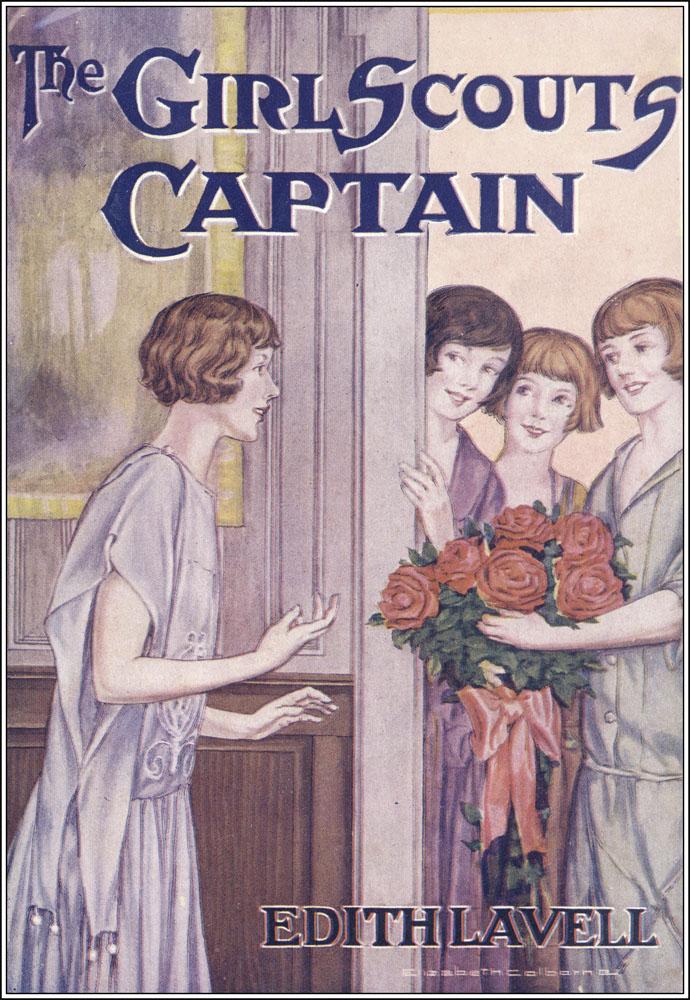
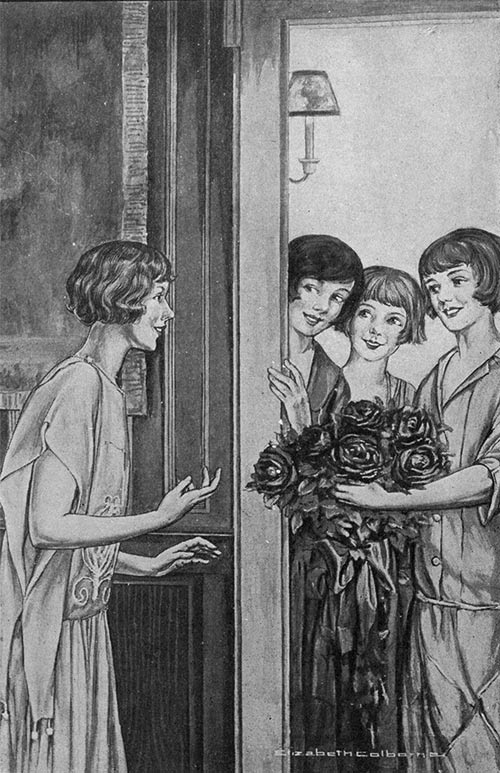
Stella stepped forward and presented her with a
huge bunch of American Beauty Roses.
(Page 239)
(The Girl Scouts’ Captain.)
THE GIRL SCOUTS’
CAPTAIN
By EDITH LAVELL
Author of
“The Girl Scouts at Miss Allen’s School,” “The Girl
Scouts at Camp,” “The Girl Scouts’ Good Turn,”
“The Girl Scouts’ Canoe Trip,” “The Girl Scouts’
Rivals,” “The Girl Scouts on the Ranch,”
“The Girl Scouts’ Vacation Adventures,”
“The Girl Scouts’ Motor Trip.”
A. L. BURT COMPANY Publishers New York
Printed in U. S. A.
The Girl Scouts Series
A SERIES OF STORIES FOR GIRL SCOUTS
By EDITH LAVELL
THE GIRL SCOUTS AT MISS ALLEN’S SCHOOL
THE GIRL SCOUTS AT CAMP
THE GIRL SCOUTS’ GOOD TURN
THE GIRL SCOUTS’ CANOE TRIP
THE GIRL SCOUTS’ RIVALS
THE GIRL SCOUTS ON THE RANCH
THE GIRL SCOUTS’ VACATION ADVENTURES
THE GIRL SCOUTS’ MOTOR TRIP
THE GIRL SCOUTS’ CAPTAIN
Copyright, 1925
By A. L. BURT COMPANY
THE GIRL SCOUTS’ CAPTAIN
Made in “U. S. A.”
CHAPTER I. CANDIDATES.
THE GIRL SCOUTS’ CAPTAIN
Five spick-and-span roadsters, of the same model,
of the same year, were parked in a line to the side
of the main entrance to Turner College, awaiting
their owners’ wishes. It was almost dark, and
their lights had not been turned on, but the illumination
from the college windows made them clearly
visible. The days were growing so short that soon
the girls would be obliged to put the cars away before
supper.
Out of the wide open doorway five figures suddenly
appeared, and with arms linked together
slowly descended the steps. They wore light summer
dresses and gay sweaters; their heads were still
bobbed; only one of them displayed a “shingle.”
It was the one time of the day that these girls still
saved for each other, “in memory,” as Alice Endicott
put it, “of the senior patrol of Pansy Troop
of Girl Scouts.”
“Without any prejudice,” remarked Florence
Evans, a junior at the college, “wouldn’t you pick
out my car for the one in the best condition?”
“Not at all!” returned Lily Andrews, the senior
who rejoiced in the “shingle bob”; “mine’s had the
best care of any of them—and it looks it!”
“Don’t forget I spent all last Saturday with
mine!” put in Florence proudly.
“Then you must have been running it pretty
hard, if it needed so much attention!” returned Lily.
“Really, I think they’re all splendid!” cried Daisy
Gravers, as she fumbled for her key, and inserted
it in the lock. “And there’s never a day goes past,
Alice, that I don’t feel grateful to your Aunt Emeline
for such marvellous presents.”
“Well, we earned ’em!” remarked Florence, who
was never inclined to be sentimental.
“Do you ever hear from Aunt Emeline?” inquired
Daisy. “Or,” she added laughingly, “the
nephews?”
“Yes, Aunt Emeline’s disappointed that we’re
not doing something to continue our troop. She
says she never saw such a plucky set of girls.”
“Well, we certainly had fun!” observed Marjorie
Wilkinson reminiscently. “I consider my Girl Scout
experience the best part of my life!”
“You mean, so far,” her roommate corrected her.
“The poet says, ‘The best is yet to be * * *’, and
I believe it. Well, girls, everybody ready to hit the
trail?”
They fell into line in the road, passed through
the college gate, and descended the hill to the
garage. It was not until after they had left their
cars that conversation was resumed.
“You all going to the dance in the gym tonight?”
asked Daisy.
“I am,” replied Florence, without any hesitation;
“and so is Alice. How about you two reverend
seniors?”
Marjorie shook her head.
“No, I’m too tired; I’m going to stay home. And
I’m hoping that maybe Lil is going to keep me company.”
Lily, however, looked doubtful.
“I really don’t approve, Marj; I think you ought
to be mingling with the girls as much as possible
now—they expect it and they want to see you.
Don’t forget that you’re a candidate for senior presidency.”
“Bosh!” exclaimed Marjorie, lightly. “You
know I won’t play politics, Lil!”
“That isn’t playing politics, my dear. But naturally
the girls want a leader who is sociable. And
really, you’re just the one for the office.”
“It’s awfully nice of you to say that, Lil, but I
guess you’re prejudiced. And I honestly don’t care
a lot about having it, so I’m not going to work for
it.” Her tone grew pleading, “Lil, be nice and stay
home with me!”
“She will, Marj, don’t worry!” remarked Alice.
“She always does what you want.”
“Yes, and Marj does what I want, too,” added
Lily, squeezing her arm affectionately. “So I’m
not going to urge her if she’s tired.” Then, with
a sly glance at the others, “She’ll be elected, anyhow!”
When they were alone, they dropped comfortably
into their favorite seats, smiling across at each
other in content. Both had been hiking all afternoon,
through the lovely autumn woods, and both
appreciated the chance to rest. There were so few
such chances in a busy senior’s life!
“Lil,” began Marjorie, dreamily, as she let her
gaze wander about the familiar sitting room which
had been so dear to them both for three years, “Lil,
I would like to do something this year.”
“Do something!” repeated the other, in amazement,
“why you have so much to do now that you
don’t know which way to turn! And then if you
are elected, as you probably will be——”
“No, no!” interrupted Marjorie. “I don’t mean
that, Lil. Of course it’s all very well to be class
president, but after all I’m not the only girl for that
job. Anybody else could do that as well. What I
mean is to do something that is really worth while—something
that nobody else has time to do!”
“But why, Marjorie? You mustn’t try to do too
much!”
Marjorie paused in search of words, to express
the sense of responsibility that had taken possession
of her. “It must be because I’m twenty-one years
old,” she said, slowly, “for somehow I feel different—as
if my time for frivolity were over—as if I
really ought to do something to justify my existence
now.”
“But you always have, Marj!”
“Yes, in a way, but more of a child’s way. Something
different now—and bigger!”
“For instance?”
Marjorie’s eyes lighted up with a brilliant smile;
she was back to her favorite subject.
“The Girl Scouts!” she announced, joyfully, for
the mere mention of the subject reminded her of so
many past pleasures. “Something for the Girl
Scouts—to make other girls as happy as I’ve always
been!”
“Marj, you’re wonderful!” cried her roommate,
with genuine regard in her tone, regard which had
never ceased to increase with the friendship of so
many years. “But please don’t try to do anything
till you see whether you’re elected president,” she
cautioned. “That’s an honor you could remember
all your life!”
The other girl was silent, thoughtful for a few
moments as if she were weighing both possibilities.
“I don’t believe an honor means so much to me
as a responsibility,” she answered slowly. “Honors
are things it is better for one to forget. Don’t you
honestly think so, Lil?”
Again Lily looked at her chum in admiration; she
was invariably impervious to flattery.
“But what do you mean to do, Marj?” she inquired.
“Go on with our little troop in the village?”
Marjorie shook her head again.
“No, that isn’t enough. One of the juniors—Daisy,
or Florence, or Alice—can take charge of that
without any trouble. I want to give something more
of myself to the Girl Scouts.”
“But how? Do you mean re-organize our old
patrol, as Aunt Emeline suggested? It would be
awfully hard to get the girls together, with Ethel
teaching, and Doris and Mae both married——”
“No, no, Lil, not that! I agree with you that it
would be out of the question, no matter how much
fun it would be. Everybody’s too busy—we’ll have
to wait till we’re all grandmothers, and then we can
have regular reunions. But what I am thinking of
is a troop with an entirely new set of girls—girls
that have nothing in their lives. Perhaps I might
find such a group in the city.”
“You’d wear yourself out going back and forth.”
“Don’t forget I have my little car! Now, Lil,
don’t jump on me, but I have another idea: I want
you to help me!”
But Lily did not continue to object as Marjorie
had expected. Instead, she began to show interest
in the plan and they fell to discussing its possibilities
until a knock at the door interrupted them. The
visitor was Jeannette Killough, a rival candidate for
the class presidency.
“Do sit down, Jennie,” invited Marjorie, cordially
for she was always glad to see the other girl,
of whom she was a sincere admirer. “It’s so nice
to see you.”
“Thank you,” replied Jeannette, accepting the invitation.
Then, “I am lucky to find you both at
home, though you really ought not to be, Marj!”
Marjorie shrugged her shoulders.
“Why, Jeannette?”
“Because you ought to be over at the dance,
courting popularity. The election comes off tomorrow
night!”
Marjorie dismissed the remark with a smile.
“I’m trying to get all my friends to vote for you,
Jennie,” she informed her.
“Don’t do that, Marj!” cried the other girl, in
concern. “In fact—I’ve decided to withdraw my
name from the list.”
“What?” gasped Lily, in amazement. Such a
stupendous honor as senior presidency was hardly
to be turned down lightly.
“Yes, because I want Marj to get it, and I don’t
want our vote to be divided. We have about the
same friends, while Delia has an entirely different
following. And you know that I don’t think Delia
would make a good president.”
Marjorie considered the matter thoughtfully from
this angle; it was certainly a fact that Delia Humphreys,
conceited, over-bearing, almost bold in her
manner, would not lead the class to its highest advantage.
Yet she had certain supporters—perhaps
enough to elect her if the vote were divided.
“I agree with you, Jeannette,” she decided, finally;
“but your solution doesn’t meet with my approval.
Let me withdraw, for I honestly want to.
I mean to devote myself to the Girl Scouts this year.”
“What Girl Scouts?”
“I don’t know,” replied Marjorie, blushingly.
“That’s only an excuse!” cried Jeannette, jumping
up impulsively. “I thought of it first—and I’m
going to be the one to do it!”
“No, no! I am!”
“If you do, I will too!” announced Jeanette, defiantly.
“And then if you do, I will too!” repeated Marjorie,
with a challenge.
“Stop fighting, children!” put in Lily, laughingly.
“Don’t both withdraw—you’d only ruin your own
object.”
“Then what shall we do?” asked Marjorie,
humbly.
“It was my idea——,” began Jeannette.
“Wait!” interposed Lily. “Don’t begin all over
again. I’ll settle it—by simply tossing a penny!”
Both girls agreed to Lily’s terms, and promised
to abide by the result.
“If it’s heads,” she said, “Marj withdraws; tails—Jeannette.”
“Play fair!” cautioned the latter suspiciously.
“As if I didn’t always!” returned Lily. “A Girl
Scout’s honor——”
She selected a penny from her purse, and heightened
the suspense by looking it over carefully, noting
its date. Then she tossed it high up in the
air; so high that it hit the ceiling and bounded off
to the side. An instant later it fell like a shot to
the window-sill.
“Oh, catch it, quick!” cried Marjorie, rushing
across the room towards the open window. “Suppose
it goes out——”
But she was too late. Already the penny had
rolled over the edge, down into the soft grass beneath.
The girls regarded each other in consternation.
“Shall we toss another?” asked Jeannette.
“Or go hunt for that one?” suggested Marjorie.
“In the dark?” demanded Lily, scornfully. “We’d
hardly find it—and tomorrow would be too late for
either of you to resign. And as for tossing another,
that wouldn’t be playing fair, and I won’t do it!
This is as good as any other sign that neither one
of you is to withdraw!”
“Besides,” remarked Marjorie, thoughtfully,
“they’d probably only put another candidate in our
place. Doesn’t the constitution say there must be
three?”
“I never thought of that,” admitted Jeannette.
“Well, I guess Lil’s right; we better be good
sports and both run, Jennie.”
“All right, I will. But I hope you’re elected.
And if I thought that I had spoiled your
chances——”
“You won’t spoil each other’s chances!” declared
Lily. “One of you is bound to be elected. Delia
isn’t popular, and she hasn’t any executive ability.
Everybody knows it, even her own little crowd.
And either one of you will be good. And, as you
said before, you didn’t want to use any politics——”
“Of course you’re right, Lil—you always are,”
Marjorie conceded loyally. “And I’m game, unless
a real opportunity for scout work comes up and
makes the office out of the question for me. I’m a
Girl Scout first, and a college senior second.”
“But is that loyal?” asked Jeannette.
“Yes!” cried Lily. “Girl Scouts came first to
Marjorie; it’s only right that they should remain
first.”
“And I had to fight to get in—and keep on,”
murmured the girl reminiscently.
Jeannette rose to go; there was nothing left to
be said. She opened the door and saw the girls
returning to their rooms from the gym dance. In
the thickest of the crowd, vivacious, talkative,
elated, walked the rival candidate, Delia Humpheys!
CHAPTER II. A PROPOSITION.
A college election of any kind is always supremely
interesting to the students; for the time
being studies, social affairs, even athletics are forgotten
in the suspense that surrounds the outcome.
The candidates are discussed from every angle,
their respective eligibility decided upon over and
over again by every group that gathers in the dining
room, in the reception parlors, in the dormitory,
until the girls in question fairly ache to have the
thing settled one way or the other.
With the exception of student-government president,
no office brings to its recipient the honor and
prestige of the senior presidency. From the time
that the freshmen enter the college until the fall
of their last year, the question retains its importance.
Who, of all their number, will be best qualified
to lead the class, socially, politically and finally,
during that greatest week of a senior’s life—at the
commencement time?
Marjorie Wilkinson’s three years at Turner College
had already been filled with positions of honor
and responsibility; she had held class offices, the
athletic association presidency, and, during the latter
part of her junior year, had found herself at the
head of the student-government. From the point of
view of experience and popularity, she was the only
girl for the class to choose.
So sure were Marjorie’s friends in the outcome
of the election that, when the actual day came, they
found the excitement dying. Lily Andrews seemed
to be the only girl who was really concerned.
“Marj isn’t interested enough in the election,”
she complained to Alice Endicott, after lunch on
the eventful day. “I think in her heart she really
hopes that she won’t get it, and she is still trying to
induce the girls to vote for Jeannette. I wish she
could be made to see its real importance.”
“There’s no use trying to influence Marj,” returned
Alice. “She usually has her mind made up—and
her reasons are always so good that nobody
can argue with her. Remember the time we all
tried to keep her from spending the night at the
tea room? Now she’s probably interested in something
else.”
“She is,” the other admitted. “It’s the same old
story—Girl Scouts. Just because she’s twenty-one,
she feels that she must rush into a captaincy.”
“But anybody can be a Girl Scout captain—I
mean anybody with ordinary intelligence; but it
takes an unusual girl to be senior president.”
“Marjorie has no idea of being an ordinary captain—she’ll
work until she’s an extraordinary one,
just as she does everything else. Still, I think if
we get her really elected, she’ll have so much to do
that she won’t have time to think about anything
else. Girl Scouts will have to be forgotten, until
next year.”
Had Lily been with her roommate at that moment,
however, she might not have spoken so optimistically.
Marjorie was stretched on the couch in
her sitting room, in the act of reading the Girl
Scouts’ magazine from cover to cover. She was
searching eagerly for any notices of troops in need
of captains, in the hope of finding a place where
her services could be used to real advantage. In
her mind’s eye she pictured a very poor troop, whose
members could hardly assemble the necessary money
to pay their dues, to whom uniforms were out of
the question; girls who knew nothing of parties or
camping trips; girls who had never had a chance
to get away from the ugly slum district and learn
the rapture of the woods. How thrilling it would
be to open their eyes to beauty, to fill their starved
minds with knowledge, to imbue their spirits with
the great scout ideal! In comparison with the glory
of such leadership, the honor of class presidency
seemed insignificant.
Unfortunately, however, she found no such troop
mentioned in the pages of the magazine. There was
a call for leaders in one of the country districts, and
an opportunity offered for camp councillors, but the
cities evidently were well provided. Or perhaps,
as she feared, no one had taken the trouble to look
up any such groups of girls.
When Daisy Gravers dropped in a few minutes
later, she was still deep in her problem.
“You’re welcome, Dais’,” she said, rising and
offering her visitor a chair, “if you are not here to
talk about the election. I’m bored to death with it.”
Daisy laughed good-naturedly; it was the same
old, modest Marjorie, who had been sort of an idol
to her ever since she had succeeded in finding her
sister Olive and reuniting her with her husband,
and later when she had sympathized with Daisy’s
plea for the little slum-baby and its sick mother.
Other people might prove disappointing, but Marjorie
Wilkinson had never failed her.
“I’ll talk about anything you like, or keep absolutely
quiet,” she replied amiably.
“You’re a dear!” exclaimed her hostess, with
sincerity. “Well, then—I want to talk about the
Girl Scouts.”
“All right; what Girl Scouts?”
Marjorie outlined something of her plan to the
other girl, explained that she wanted Daisy or either
of the other juniors to take charge of the little troop
in the village, so that she might devote her time to
a more difficult group. Her voice grew animated as
she spoke of her hopes and her dreams for the troop
that was to be hers.
“But I don’t know how to find such a troop,”
she concluded, pathetically. “You can’t exactly go
into the streets in the poor districts and gather the
children up. They might question your motive.”
“Naturally,” agreed Daisy.
“Can’t you think of any way, Dais’?” she persisted.
“I’m afraid I can’t—unless you’d take a job I
have off my hands. I’m supposed to go to the
Community House tonight, and supervise a dance.
I don’t know what the girls are like, but they might
be interested in starting a troop.”
Marjorie brightened at the idea.
“Do you suppose they’re poor?”
“Well, I’m afraid not so very poor, or they
wouldn’t have dance dresses and be able to pay for
a party. But I’m quite sure they’re not rich.”
“How do you happen to be doing this?” Marjorie
inquired.
“You’ve heard me speak of Miss Winthrop—that
friend of Mother’s, who is head of the Community
Settlement in Philadelphia? Well, it seems that
she had promised these girls, who meet there one
evening a week as a little club, that they might have
a dance. Then she was suddenly called to a conference
in New York, so she asked me to bring another
girl and chaperone them, in her place.”
“But college girls aren’t usually accepted as official
chaperones,” objected Marjorie.
“Oh, there’s a Mrs. Morgan—the matron of the
settlement—who will be there to keep up appearances.
But Miss Winthrop says she’s an easy-going
sort of woman, who never sees anything wrong with
anybody or anything, and who would never be able
to give her any sort of report of the party. Naturally,
Miss Winthrop’s very keen to know just
how the girls do behave.”
“Yes, of course. But Daisy, there’s no use of my
going to a party like that. I can just picture those
girls—regular flappers, of the younger set. They’d
never make Girl Scouts in the world.”
Daisy made no effort to hide her disappointment.
“They might have younger sisters, Marjorie, who
would be interested in scouting,” she offered feebly.
Marjorie shook her head.
“Can you imagine girls of that age and that type
caring much about their younger sisters’ pastimes?
I’m afraid not, Daisy, and besides, what real chance
would we get to talk to them—at a dance? They’ll
be much more interested in their partners.”
Daisy sighed; there was no doubt that Marjorie
was correct in her surmise.
“Then you won’t go?”
“I don’t see that it would be of much use.”
“I really oughtn’t to have asked you—when this
is your big night,” said Daisy, contritely. “I honestly
forgot all about the class election.”
“Oh, the class election!” There was contempt in
Marjorie’s tone, mingled with indifference. “You
know that it isn’t that, Daisy! And I don’t want
you to think that scouting is the only thing in the
world I’m interested in. If I really thought I could
be of use to you, I’d go.”
Daisy jumped up in delight.
“You honestly mean it, Marj? Oh, I am sure
you can do a whole lot! You know you’re a born
leader, and the girls will just naturally have to do
the right thing, because you’re there. They’d never
notice me—I’m always so shy—but you——”
“Now, Daisy, that’s quite enough——” she began
tipping her over on the couch to enforce order,
when she was abruptly interrupted by the arrival of
Alice and Lily.
The latter looked immensely pleased with herself,
as if she had just arranged some matter entirely to
her satisfaction.
“Marj, the victory’s a sure thing!” she flung out.
“Get out the pennants! Before this time tomorrow,
you’ll be our class president!”
“Yes,” cried Alice; “nobody doubts it for a minute!
All glory to the old senior patrol of Pansy
troop!”
Marjorie and Daisy exchanged amused glances,
but neither said anything.
“Jeannette and I have been planning the grandest
celebration for tonight,” Lily continued. “We’re
going to have a regular parade—music and all! We
have permission from the dean to march down to
the tea-room, and make a regular lion out of our
heroine!”
“Suppose I’m not elected?” the potential heroine
suggested.
“Then we’ll do it for Jeannette, of course. But
there’s no doubt that you will be.”
“Well,” remarked Marjorie casually, “suppose
I’m not here?”
Her roommate looked alarmed.
“Marj, you wouldn’t do a trick like that on us,
would you?”
“You know I don’t like so much publicity, Lil.
But I really wouldn’t be mean enough to stay away
purposely, just to spoil your pleasure. However, it
just happens that I have a very pressing engagement.”
“An engagement!” repeated the astonished girl.
“On senior election night?”
“It’s the truth!”
“But what? Has John Hadley——? I’ll never
forgive him if——”
Daisy spoke up.
“Don’t blame poor John, Lily. It’s all my fault.
I needed Marj’s help tonight at the Community
Settlement, and she volunteered to go.”
“A new scout troop?” asked Alice.
“No, just a party, that the head worker wanted
me to supervise, in her absence. But I don’t want
to be selfish—if you need her more, Lily, I’ll resign
my claims.”
“No, indeed, Daisy, I’m not willing!” cried Marjorie.
“I’m very much interested in the dance now,
and I want to see the girls. Besides, you can’t
possibly go alone, and you’ve given your word to
Miss Winthrop.” Then, turning to her roommate,
“Lily, I’d love very much to have you go with me.”
“Me!” exclaimed Lily. “Why you know I want
to be on the spot to vote for you!”
“Even when you know I don’t want to be
elected?”
“Just the same I want you to be. I want you to
do great things this year, Marj.”
“And I want to do greater things. This is my
beginning, Lily, and it may prove my opportunity.
Please come with me!”
Lily hedged; she remembered how deeply in earnest
her roommate had been during their talk on the
previous evening, and she could not bear to desert
her. Already she saw her own little plan vanishing.
“How would we get home?”
“We could have John and Dick come for us at
the settlement, and go to Mrs. Hadley’s to spend
the night.”
“Three of us?” persisted Lily. “Wouldn’t that
be too many, on such short notice?”
“I wouldn’t have to go, Lily, if you went,” put in
Daisy. “Marjorie could make a much better report
to Miss Winthrop, and besides, it’s much easier for
seniors to get permission to be away from college
than for juniors. And both of you would be infinitely
better than I would.”
“You just want to get out of it, Daisy!” teased
Lily.
“Maybe I do,” the younger girl admitted. “Anyway,
Marj, you go call up Mrs. Hadley now.”
Marjorie flashed a triumphant smile.
“I will,” she agreed; “and while I’m doing that,
you, Lil, go call Dick.”
Lily made a face, but started towards the door.
“I guess I better go tell Jeannette first,” she
said.
CHAPTER III. THE JAZZ PARTY.
“Whatdo you think we ought to wear, Marj?”
inquired Lily, as she began to dress for the evening.
“Dance frocks?”
“No, I don’t think so,” replied Marjorie thoughtfully.
“We want to look like chaperones, so we
ought to appear matronly. Let’s wear dark dresses,
and put nets over our hair.”
“You’ll be suggesting that we borrow horn-rimmed
spectacles next,” joked the other.
“Anyway, I believe that I’ll put on my dark blue
velvet. It has chiffon sleeves, you know, so it would
pass for an evening dress. We’re going to drive,
aren’t we?”
“Certainly. Which car?”
“Oh, use mine; you don’t care, do you, Lil?”
“It’s immaterial to me; mine’s put away, anyhow.”
They had plenty of time after supper, so they
drove leisurely into the city, arriving at the settlement
at exactly half past eight. Harsh sounds from
a jazz orchestra greeted them from the basement
windows as they stopped at the curb. Evidently the
dance had begun.
“Better lock your car securely,” Lily warned her
companion. “The neighborhood doesn’t seem to be
any too good.”
“No, it isn’t,” agreed Marjorie, glancing around
at the disreputable looking houses on either side of
the street. “John was furious when I told him
where we were coming.”
“So was Dick. He said they’d be along before
eleven o’clock, as I suggested, because he’d be worried
all evening. Aren’t men silly?”
“Sometimes,” Marjorie admitted.
They opened the heavy door of the settlement,
and passed down the hall, glancing to right and left
at the empty rooms and offices. Concluding that
every one must be at the party in the basement, they
descended the stairway which led to the gymnasium.
Never, in all their boarding school or college days,
had they seen a hall so elaborately, so profusely decorated.
Great sheaves of wheat were banked all
around the room; enormous branches of trees covered
the apparatus; paper streamers in every color
of the rainbow hung from the lights, and confetti
was scattered around the floor near the chairs, and
upon the seats. The room appeared small, although
in reality it was the standard size for a gymnasium.
“It looks crowded,” remarked Marjorie; “and yet
when you count them there really aren’t many
couples dancing.”
Keeping close to the wall and carefully steering
their way between the dancers, the girls reached
some seats in the corner.
“Such elaborate dresses!” Lily exclaimed, after a
hasty glance from one girl to another. “Marj, I
don’t believe that one of them has sleeves in her
gown!”
“The girls certainly aren’t poor,” returned Marjorie,
thinking in amusement of the conversation
she had had with Daisy that afternoon. “And they
seem to know all the latest tricks in dancing.”
“They need spanking!” denounced her companion
irritably. “Look at the way that girl is resting
her head—right on her partner’s shoulder! Dare
me to stop her and advise her that if she’s tired
she better go to bed?”
“Oh, Lil, do be careful!” warned Marjorie, fearful
lest she might antagonize the girls at the very
beginning. “Of course, they haven’t had any home-training,
and you can’t expect them to have our
standards.”
“Well, they couldn’t possibly hear me above all
this awful noise,” returned Lily. “Did you ever
hear such an apology for music in your life?”
Marjorie, however, was not interested in the orchestra;
she was there to chaperone the girls, and
if she failed in doing that, at least to turn in a reliable
report upon the evening’s entertainment. She
did not mean to waste a minute; if possible she intended
to size up the character of every girl present.
With a loud clang the jazz piece abruptly came to
an end, the dancers stopped impatiently and began
to applaud uproariously. During the brief pause before
the encore, Mrs. Morgan, a stout, motherly
sort of woman, edged her way towards the visitors.
“How do you do, Ladies!” she said breezily.
“Miss Winthrop’s friends, aren’t you?”
“Yes,” replied Marjorie, rising. “Miss Gravers
asked us to come to help you chaperone the dance.”
“Well, we’re only too glad to have you,” beamed
Mrs. Morgan, “and I hope you’ll have a good time,
for I can’t see as these girls need much chaperoning.
They’re pretty well behaved, as girls go, and I like
to see everybody enjoying themselves.”
“I’m sure we will,” murmured Marjorie graciously
deciding, however, that Mrs. Morgan was
as near-sighted mentally as her glasses proved her
to be physically.
“Come into the office and take off your things,”
she urged. “Then you can go back and dance a
bit yourselves.”
“Oh, we really don’t care to dance,” answered
Lily, a trifle scornfully. “We’re here to observe.
But it will be nice to get our things off. It’s rather
warm in there.”
Marjorie hoped that Mrs. Morgan would return
to the hall with them and introduce them to the
girls; such a formality would have rendered the situation
less awkward. But she conducted them only
as far as the doorway, excusing herself on the plea
of duties in the kitchen.
As Marjorie and Lily re-entered the room, they
felt every eye turned piercingly towards them. The
first intermission was on, and the hall seemed
strangely quiet after so much noise. The couples
arranged singly, or in groups of twos and threes
about the walls, abruptly stopped talking, and
blandly stared at the newcomers. Marjorie felt as
if she had never been so embarrassed in all her life.
In her confusion she turned to Lily.
“Let’s go over to that group and try to get acquainted,”
she whispered.
“All right,” agreed Lily indifferently.
As they crossed the floor they heard, to their relief,
the buzz of conversation begin again, and Marjorie
made a valiant effort to get herself in hand.
To her chagrin, however, as she approached the
group in question, a coarse laugh broke out among
the young men.
“Here come the Janes for some dances!” muttered
an eighteen-year-old “sport” of the neighborhood,
in an audible undertone. “Look out, Aggie,
you’re goin’ a lose your little Charlie!”
Instead of admonishing the youth for his rudeness,
as Marjorie hoped she would, the young lady
only giggled.
“Classmate of your grandmother’s, Charlie!” tittered
another boy, breaking into hilarious laughter
at his own exquisite wit.
Covered with confusion, Marjorie slipped her
arm through Lily’s and staggered to a seat at the
side. It was not until the music had started again
that she regained courage to look about her.
“Don’t take it so hard, Marj!” pleaded Lily.
“They don’t faze
me—only fill me with disgust.”
“Poor Daisy—it certainly is a lucky thing she
didn’t come; she’s so sensitive that she would be
in tears by now! But Lil, please don’t say ‘I told
you so!’” begged Marjorie penitently. “You were
right—I admit it now—a class election is infinitely
preferable to this!”
Her roommate smiled indulgently; Marjorie was
always so willing to admit it when she was wrong.
“But what are we going to do—all evening?” she
inquired. “It’s silly to sit here uselessly, and evidently
these young flappers have no intention of
speaking to us.”
Marjorie resolutely assumed a look of defiance.
“I’m going to stay here until I have watched
every single girl through a whole dance. During
each intermission I’m going out to make my notes.”
Lily sighed; the prospect was not alluring.
“Miss Winthrop surely will get a thorough report,”
she remarked. “Which girl are you going
to begin with?”
“The one they called Aggie. I’m trying to think
of a word to describe her. ‘Mushy’ doesn’t seem
soft enough!”
“You’re cruel, Marj! How old do you think
she is?”
“About sixteen. I don’t think any girl on the
floor is more than seventeen.”
She was quiet for a few minutes, and Lily
watched her shift her attention to another dancer.
Evidently she felt that she had succeeded in summing
up Aggie’s character to perfection.
Their entrances and exits were not especially
noticed after that, and Marjorie began to feel at the
end of the sixth dance that their presence had been
entirely forgotten, when a conversation floated towards
her ears which changed her opinion. She
and Lily were seated on one side of a great
sheaf
of wheat; evidently directly behind it, two girls
were consulting each other in regard to the identity
of their visitors.
“Who are those dames, anyway?” demanded one
voice, in a hoarse whisper. “They’ve got their noive—pullin’
the high spy act on us!”
“I’ll bet they’re here to tattle to Miss Winthrop,
if they find any dirt,” returned the other. “Queenie,
you’re the boss, why don’t you put ’em out?”
“How can I? It ain’t our room.”
“It’s ours fer t’night.”
“Aw, my opinion is, they’re only two birds from
the country, who dropped in to see the city, and
took this fer a dance hall.”
“That’s a laugh. Let’s see if we can razz ’em
a bit!”
“How, Clara?”
“Pretend we’ve got flasks in our pockets, and
cigarettes.”
“No,” replied Queenie, authoritatively; “then
we’d be out of luck for a place to meet the rest of
the year. Miss Winthrop’d never stand for that.”
“If we told her it was only a joke——”
“All wrong, Clara. You’ve got a head, but it’s
only good to keep your hat on. Fire something
else——”
“Can’t think of nuthin’——”
But Marjorie and Lily had listened to enough;
they rose and crossed the gymnasium to the door-way.
“I really have hopes of Queenie,” remarked Marjorie,
“she seemed to show a glimmer of intelligence.”
“Pretty faint,” corrected Lily scornfully. Then,
catching a glimpse of two young men at the top of
the staircase, her eyes lighted up, and she exclaimed
joyfully, “They’re here, Marj! The boys, I mean.
Oh, I was never so glad to see anybody in my life!”
John Hadley and Dick Roberts, two old friends
of the girls, smiled back at them, and hurried down
the steps. Never had they seemed so fine looking,
so admirable, so strong to Lily and Marjorie, as at
that moment, after their weary evening of watching
the insipid, smirking, conceited faces of the young
men at the dance, and listening to their inane chatter
and coarse laughter. Marjorie breathed an
audible sigh of relief.
“Don’t tell them how awful it has been, Lil,” she
cautioned. “They’d only rave—and it’s all over
now.”
“We can’t keep it from them, you know we can’t,”
replied her companion.
The boys were beside them now.
“How’s the party going?” John inquired pleasantly.
“Fine,” answered Marjorie, “but I guess it will
be all right for us to leave.”
“Not till I get a look at the flappers!” Dick declared.
“I want to see what kind of a job you and
Lily made of it.”
The girls exchanged glances.
“What’s the matter?” demanded John.
So Marjorie told them the story, thinking that
she could make it sound a little better than Lily
might.
“We’re going in to see for ourselves!” announced
Dick, at the conclusion of the recital, “and Lily, I
want you to promise me that you’ll never come here
again!”
“I’ll be only too glad to promise that,” replied
the girl, with emotion. “I’ve never gone through
such an evening in my life.”
“You’d better make Marj promise the same
thing, John,” Dick suggested.
“He knows better,” laughed Marjorie. “But I
don’t think there’s much danger of my ever wanting
to.”
Fortified by the presence of their escorts, Marjorie
and Lily assumed a nonchalant air as they
re-entered the gymnasium, and seated themselves
again upon the chairs by the wall. Instinctively
they felt the atmosphere change; it was almost as
if the dancers regarded their visitors with a real
respect. The girls themselves had to conceal their
amusement.
But if the dancers were hoping that their visitors
would join in the party, they were disappointed,
for, as soon as the music ceased, John suggested
that they go home.
“Mother will be waiting for us,” he said. “She
said to come home early.”
He took the wheel of Marjorie’s car, while Lily
climbed into Dick’s. Side by side, they made their
way to the suburbs.
It was Lily, however, who wondered whether
Marjorie had been elected to the class presidency.
CHAPTER IV. THE INVITATION.
Dick’s exuberant sense of humor in making
light of the whole situation, and John’s genuine
pleasure in seeing Marjorie again, acted as a veritable
tonic to the girl’s drooping spirits; by the time
the cars had stopped in front of Mrs. Hadley’s door,
she was able to laugh and joke with the others. By
common consent the young people decided to dismiss
the matter from their minds, for the time being, at
least.
“Come right in!” greeted their hostess, flinging
the door wide open in welcome. “I have hot chocolate
all ready for you!”
“With whipped cream, I’ll wager!” cried Lily.
“Mrs. Hadley, don’t you care how fat I get?”
“My dear, you’re not fat——”
“Yes, I know what you’re going to say! Everybody
politely says the same thing! But I used to
be awfully fat, didn’t I, Marj? And if I don’t
count my calories——”
“Nonsense!” contradicted Mrs. Hadley. “She’s
just right, isn’t she, Dick?”
“I’ll say so!” agreed the young man, without the
least hesitation.
“Anyway, Mrs. Hadley, I’ll do justice to the
chocolate!” put in Marjorie. “I’m just about
starved!”
The girls removed their wraps, while John busied
himself with the tea-wagon. Sandwiches were piled
invitingly on the plates, the cocoa steamed in its pot,
and a cozy fire burned in the hearth; everything
seemed in harmony to make Marjorie forget her
unpleasant experience. These informal parties were
among the happiest occasions of Mrs. Hadley’s
peaceful life, and her guests always found them
equally charming.
“How was the dance?” she inquired, after the
girls had been served.
“So—so,” replied Lily indifferently. “The big
interest of tonight, Mrs. Hadley, is not the dance,
but our senior class election. Marj is up for president!”
“She’s elected by now!” prophesied Dick jovially.
Then, getting up and extending his hand, “Allow
me to be the first to congratulate you, Madame
President!”
“No, no!” protested Lily, almost overturning her
cup in her eagerness to brush Dick aside. “I’m her
roommate! It’s my right!” And she pressed a resounding
kiss upon Marjorie’s cheek.
“You’re both silly gooses,” exclaimed the heroine,
herself, laughing heartily. “Of course, it isn’t
true! And just think, if I’m not elected——” Her
voice assumed a tragic tone, “just think how much
greater you are making my disappointment!”
“You old hypocrite!” denounced Lily. “She
doesn’t care a snap of her fingers for the highest
honor a girl can get in college! Just think of it,
Mrs. Hadley, she’s done nothing but try to get out
of it, ever since she was nominated!”
“Couldn’t we call Daisy, or somebody, and learn
the outcome?” suggested John, consulting his watch.
“It’s only quarter of eleven.”
“Certainly—I am as much interested as any of
you. I almost feel as if I couldn’t go to sleep tonight,
if I didn’t know the returns.”
“Of course, there really isn’t any doubt,” Lily
repeated. “But still——”
“Well, if you think so, why not let me have one
more good night’s sleep?” interrupted Marjorie.
“Mrs. Hadley, may I have another sandwich?”
She gave herself up to the enjoyment of the refreshments
while the others waited in suspense as
John dialed his number. At last they were relieved
by his, “Hello, Daisy, that you?”
“This is John Hadley. Can you give me the election
returns?”
Lily could sit still no longer; she rushed up to
the instrument.
“Marj is elected!” he repeated. “Of course!
‘Overwhelming majority,’ you say? We knew it!
Thanks. Hurrah! Good-bye! What did you say?
Oh, yes, the dance? All right, I guess—Marj will
tell you about it tomorrow. Good-bye!”
The mention of the unfortunate circumstance of
the evening at the settlement, directed Marjorie’s
thoughts back to unpleasant channels, so that amid
the congratulations and rejoicing that followed, she
was almost an outsider. She had not thought before
of Daisy’s disappointment because of their failure,
she had pictured only Miss Winthrop’s. Yet the
tender-hearted girls would probably be more deeply
affected than the other.
Noticing Marjorie’s evident fatigue, Mrs. Hadley
suggested that the party break up in order that
the girls might go to bed.
The morning, however, failed to bring Marjorie
a fresh point of view. All the way out she brooded
over her experience, seeking, if possible, to consider
it from the girls’ angle. She felt sure that it was
not personal insult to her companion and herself
that troubled her, but the effect of such conduct
upon the offenders themselves. What kind of
homes could they come from, in which such blatant
rudeness would be overlooked or tolerated? Did
their parents know what they did with their spare
time, had they met their associates and friends?
How would it be possible ever to hope to touch
them, to influence them to something better?
Then her thoughts strayed to other girls of their
type, and she fell to wondering how they too passed
their time. Perhaps this little group was on a
slightly higher plane, protected as they were by the
settlement, and supervised by Miss Winthrop.
She had intended to go straight to Daisy with
her story, but she found all her plans interrupted
by her class-mates. They crowded her rooms, anxious
to congratulate her and to express their good-will,
and insisted upon giving her at least part of
the celebration which Lily and Jeannette had arranged
in her honor. It was evening before she
found herself alone; then she sat down to write her
report for Miss Winthrop.
She presented her facts as strongly as she knew
how, denouncing the girls’ conduct with all the ardor
she felt, and yet keeping the personal element out
of it. She sketched every girl’s behavior with a
definiteness and a truthfulness that bore the impressive
stamp of thoroughness. Then, before she had
a chance to lose her courage, she posted the letter
herself.
She was planning a visit to Daisy on Monday
afternoon when a summons to the reception room
interrupted her project. To her surprise she found
both Lily and Daisy already there, talking with a
middle-aged, efficient-looking woman whom she immediately
judged to be Miss Winthrop.
“This is Miss Wilkinson, Miss Winthrop,” said
Daisy, as Marjorie advanced towards the little
group. “She thinks your report was splendid, Marjorie.”
Miss Winthrop’s keen gray eyes seemed to be
taking the girl in from head to foot, and, not only
that, but to be piercing into her mind as well. Marjorie
shifted nervously.
“I want to talk it all over, Miss Wilkinson,” declared
the older woman. “Your report was most
illuminating, most thorough. In fact, it read more
like one from a trained worker than from an inexperienced
college girl.”
This statement aroused Lily’s ire.
“Marj isn’t inexperienced!” she cried, resentfully.
“She’s been all over the country, and always been
a leader, no matter where she went, or what she was
doing!”
“Only inexperienced among girls of that type,”
explained Miss Winthrop, with a smile. She was
secretly pleased by the girl’s loyalty.
“Yes,” murmured Marjorie, “I know what you
mean. Miss Andrews and I both felt so dreadfully
inexperienced. It seems as if somebody else would
have been able to do something. All we did was
sit back and listen and watch in amazement.”
“Didn’t any one speak to you?” inquired Miss
Winthrop.
Marjorie flushed; she had not meant to mention
the personal insults.
“Not to us—but at us!” supplied Lily.
“Of course, Mrs. Morgan did,” Marjorie hastened
to add.
Miss Winthrop eyed Marjorie searchingly.
“Do you think that the girls are worth doing anything
for?” she asked.
Marjorie remained silent for a moment; as yet
she had not been able to settle that question to her
own satisfaction.
“Yes, I think—maybe,” she replied slowly, “for
the very reason that they are so young. Their characters
surely aren’t fully developed yet, so I should
judge somebody might do something with them.
But I can’t imagine who the somebody might be.”
“It would have to be somebody whom they liked
and admired,” mused Lily.
Miss Winthrop’s grey eyes flashed. “Yes, that’s
just it, Miss Andrews. You have hit the nail on
the head. That is the very reason I came out here
to college this afternoon. The girls took a fancy
to you and Miss Wilkinson!”
“What?” gasped Marjorie incredulously. “Surely
you are mistaken, Miss Winthrop! If you could
have been there, and have seen and heard for yourself——”
“I know—I know what you mean,” she interrupted
to explain. “But that is only their way.
Don’t you know that ignorant people always ridicule
what they can’t understand? But, I repeat it,
the girls liked you. They told me so last night!”
“Really?” cried the girl, still in doubt as to the
possibility of such a fact. “Please tell me about it,
Miss Winthrop. What did they say?”
“Well,” began Miss Winthrop, “it all happened
last night, when I returned from New York. I
went immediately to my office and began to open my
mail, when Mrs. Morgan interrupted me by bringing
in her report of the work during my absence.”
“What did she say about the party?” asked Lily
with interest.
“Merely that it went nicely and that every one had
a good time,” replied the settlement worker in
amusement.
“I thought she would say as much,” remarked
Marjorie. “I wish I could have been so easily satisfied!”
“No, no, Miss Wilkinson—that very attitude is
what makes you so valuable. Mrs. Morgan is a
splendid matron, and a very agreeable person, but
she will never make a social worker.”
“To continue: when Mrs. Morgan had left, two
of the girls from that group entered my office. Remember,
I had not yet received your report, and
had no reason to believe anything had been other
than it should have. But these girls looked a little
bit ashamed of themselves.
“‘Have you heard anything about our jazz party,
Miss Winthrop?’ Queenie Brazier—who by the
way seems to be the leader of the group—asked.
“‘Yes, Mrs. Morgan just told me it went off
beautifully,’ I answered, without any hesitation.
“‘But what did the’—let me see, what did they
call you?—‘the two swell Janes,’ I believe—‘have
to say about us?’ she asked almost fearfully.
“For a minute I could not think what she meant.
Then I recalled the fact that Daisy had promised to
try to get another girl from college to help me out,
and I presumed she referred to them.
“‘Nothing,’ I replied. ‘I haven’t seen or heard
from them since.’
“Both girls breathed a sigh of relief. Then
Queenie began, somewhat apologetically, to tell me
that they hadn’t given you a square deal, that, as
she put it, ‘We shot a lot of how do you get that
way stuff at ’em,’ and you never made any move
to retaliate. Then, when your two friends, whom
the girls evidently admired immensely, for she called
them, ‘two swell fellers,’ came in and took you home,
they grew remorseful.
“‘What do you want to do about it?’ I inquired,
with curiosity.
“‘Just get the word to them we ain’t as bad as
we look. And if they’ll condescend to come again,
we’ll give ’em a serenade.’”
“Of all things!” cried Marjorie in astonishment,
her eyes lighting up with pleasure. “So it was
really John and Dick who made the hit!”
“Well,” returned Miss Winthrop, “it wakened
them up to the fact that you aren’t old maids—like
myself. And they couldn’t help admiring your dignity,
though they did not realize it.”
“Was that all they said?” asked Lily, who by
now was immensely amused at the whole affair.
“Not quite. I began to tell them something of
your record in scouting—I knew it from Daisy—and
I could see that they were impressed. It was
Queenie who actually proposed that they turn their
club into a scout troop and elect Miss Wilkinson
captain and Miss Andrews lieutenant.”
Marjorie and Lily received this piece of information
with bursts of laughter.
“Imagine those girls being Girl Scouts!” the
former exclaimed. “The idea is absolutely ridiculous!
They couldn’t have meant it!”
“But they did!” Miss Winthrop assured them.
“Have they any idea what the organization stands
for?”
“Not much, but they have seen pictures in the
papers. They know that Mrs. Hoover is president,
and that the first lady of the land is honorary president.”
“I am afraid I couldn’t do anything with them,
much as I want a troop of my own,” sighed Marjorie.
“It would require somebody older——”
“No! No!” protested Miss Winthrop. “Somebody
older wouldn’t have half the hold on them
that you would—will you do it?”
Again Marjorie hesitated and Lily shook her head
decidedly.
“Miss Wilkinson is our new class president, Miss
Winthrop, and she’ll be terribly busy this year.”
“And that’s too great an honor to resign,” put in
Daisy.
“No, it isn’t,” said Marjorie, “not, at least, for
something worth while. But I don’t feel as if I could
do much with these girls.”
“Try!” urged Miss Winthrop. “Meet with them
next Saturday night—and decide then!”
“All right,” agreed Marjorie, “as you say.”
But Marjorie Wilkinson never did things by
halves; in spite of Lily’s vigorous protests, she
handed in her resignation that night as president of
the senior class.
CHAPTER V. THE FIRST MEETING.
After Marjorie had made her decision to meet
the girls again, she spent the spare time of her entire
week trying to persuade Lily to adopt her view of
the matter. But Lily positively refused to be persuaded.
She was not going down to that place
again to be ridiculed—her time was too valuable. If
Marjorie chose to do such foolish things, she must
do them alone.
Her roommate’s opposition made it a little hard
for Marjorie, but did not deter her from keeping
her promise to Miss Winthrop. Lily was always
cautious, not nearly so prone to run into new undertakings
as her chum; but she was usually willing
to follow later on. In reality Marjorie had no
doubt of Lily; if she won the girls, she would certainly
win her.
Yet she was still dubious in her own heart as to
the wisdom of the venture. She could not picture
those girls as ever becoming interested in a subject
so serious as scouting. Nevertheless, it would not
be her fault if she failed, for she resolved to present
it in all its dramatic highlights, to try to get the
thrill of the open life into their blood.
She selected her costume with great care for her
first meeting with the girls. Good clothing appealed
to them; style was an essential in their life. She
decided upon her new brown suit, tailored in the
latest fashion, emphasizing its beauty by a fawn-colored
overblouse, with stockings of the same hue.
Her hat, a chic little velvet toque, carried out the
same motif and completed the charming effect she
desired.
It would be interesting, she thought, as she drove
into the city, to meet these girls under such circumstances;
to go to them at their invitation; to talk
to them without interference from members of the
opposite sex, whose opinions were so worthless, and
yet so weighty with the girls; to observe them under
the more normal condition of every-day affairs.
Perhaps she had been harsh, after all, in her judgment
of them; it really was not fair to watch them
at a single social function and to pass upon their
characters with so little knowledge of the conditions
under which they lived and worked. She had known
several college girls whose heads had been turned
by popularity and flattery, yet, in comparison with
them, these girls were mere children. It was, therefore,
with a very forgiving spirit that she drew up
to the settlement at eight o’clock and parked her
car before its entrance.
Queenie Brazier threw open the door and rushed
down the steps as Marjorie drew her key from the
lock.
“Hello, Miss Wilkinson!” she cried. “Right on
the dot of eight!”
Marjorie smilingly extended her hand, realizing
now that Miss Winthrop had not exaggerated her
story.
“Your car’s awful cute,” commented the girl,
slipping her arm through Marjorie’s and conducting
her up the steps. “Wouldn’t mind if I was rich
myself!”
“Oh, but I didn’t buy that!” Marjorie hastened
to inform her. “I earned it—as a reward which
was offered to our Girl Scout troop.”
“Gee, do they give things like that in the Scouts!”
exclaimed Queenie. “Me for the scouts, every
time!”
“There are all sorts of honors and rewards for
the girl who works,” Marjorie replied cautiously.
“But they do not always take such material form
as this one happened to.” She was anxious to dispel
Queenie’s false hope that scouting was an easy
path to quick riches.
“Tell me how you won it!” pleaded the other, as
she directed Marjorie into the room where the rest
of the girls were gathered.
“All right—later on,” agreed Marjorie. “But
now I want to meet the others.”
The club room was a small one, furnished in the
usual plain but cozy style adapted by most of the
up-to-date settlement houses. Miss Winthrop occupied
a chair beside a substantial mission-table, and
two of the girls were perched on top of it, talking
in animated tones with the leader. Two or three
of the others were apparently listening to the conversation,
while over on the window sill, an exceedingly
stout young lady was giggling and whispering
with a tall slender one. Marjorie took them all
in at a glance, and with some difficulty identified
them with the elaborately dressed maidens of the
dance. They all looked different, she decided, but
undoubtedly better.
“Well, Miss Wilkinson, we’re all here—and all
glad to see you,” said Miss Winthrop cordially. “I
think Queenie had better do the introducing, however,
for she is more sure of the names than I am.”
“Oh, she can’t remember them all, anyhow,” protested
Queenie, rather embarrassed by the formality
of an introduction. “So I won’t have to repeat
them—girls—meet Miss Wilkinson!”
“I’m awfully glad to meet you,” said Marjorie
graciously. “But Miss Brazier is wrong about my
not remembering the names; I want to know them,
and I don’t mean to forget them.”
“All right, then—just as you wish, Miss Wilkinson.
You know that I’m Queenie Brazier, and—this
here girl is Aggie Smithers, this beet-top is
Clara Abrams, the tall skinny one at the window is
Annie Marshall, this is Stella Cox on the table,
with our little mascot beside her—Dottie Williams.
And, oh yes, I forgot Fattie Reed—her real name’s
Gertie. Now you got ’em all.”
“Yes, I believe I have,” replied Marjorie, trying
to hide a smile at the method of introduction. “And
I don’t intend to forget them, either.”
“I suppose you will want to get started at once,”
put in Miss Winthrop. “Miss Wilkinson is a very
busy lady, so I know she can’t stay long.”
“We ain’t goin’ to treat her rough this time,”
muttered Aggie Smithers, but the remark was lost
to Miss Winthrop. Nevertheless Marjorie heard
it, and took it as a good sign.
The leader withdrew, and Queenie escorted Marjorie
to the seat at the table. The other girls brought
chairs from the corners of the room and arranged
them in front of her.
“I’d just like to talk tonight,” began Marjorie
nervously. “If we——”
“Oh, it’s a lecture, is it?” giggled Gertie Reed.
“If it’s goin’ to be like prayer-meetin’——”
“I didn’t mean that I was going to do the talking,”
the latter hastened to explain. “I meant we’d
all talk things over, instead of trying to organize.
Queenie, will you tell me what made you think that
you would like to form a Girl Scout troop?”
“Miss Winthrop, I guess,” replied the youthful
leader. “She said if we wanted a club here any
more, we’d have to have a leader, and we all liked
your looks, so we asked for you. And then she told
us how you were a Girl Scout, and we thought we’d
like to try that.”
“But some of us,” put in Annie Marshall, the
tallest and oldest girl in the group, “thought we
was too old—that it was only something fer kids.
I’m goin’ on seventeen myself.”
“Gracious!” laughed Marjorie, “we had lots of
active scouts in our troop who were eighteen, and
we older ones do scout work yet, as a senior patrol.
There are plenty of things in it for older girls.”
“We like the uniform,” continued Queenie, “and
we’re crazy about goin’ camping sometime. And
that’s about all there is to it, isn’t it? Except of
course meetin’ here once a week—and we could do
as we please at our own meetin’s.”
“I’m sorry,” said Marjorie, kindly, but firmly,
“but you couldn’t. Once you’re scouts, you have to
follow the scout law, and do the scout work. And
it is work, too, though it’s mighty interesting work.
If you want to win the honors, the merit-badges and
the medals, you have to go in for it hard. So it
must be all or nothing.”
“Sounds too strenuous to me!” yawned Gertie.
“We ain’t ladies of leisure, Mrs. Wilkinson. We
all work.”
“Neither am I, for that matter,” said Marjorie.
“What do you do?” asked Stella Cox, in surprise.
“I go to college. I finish this year.”
“You still in school!” repeated Queenie in amazement.
“You must ’ave started awful late!”
Marjorie smiled at the bluntness of the remark.
“I started at six,” she explained. “But it’s eight
years at grammar school, four at high, and four at
college.”
“Then you must be twenty-one!” calculated
Queenie.
“Exactly!” replied Marjorie. “If I weren’t, I
couldn’t be your captain.”
“Tell us more about what the scouts do, and how
you earned your car, Miss Wilkinson,” urged
Queenie.
Marjorie noticed a revival of interest when this
question was asked; almost subconsciously she realized
that pleasure in one form or another was these
girls’ idol. Yet how could she give them the kind
they wanted, and, if she could, would she be willing?
Was it not rather her duty to create a new
ideal for them?
“Winning that car was only a side-line for us,”
she told them finally. “A wealthy old lady had
read some accounts of our troop’s doings in the
newspapers, and wanted to prove our mettle. So
she wrote to us that if we would motor to California
without accepting any assistance of any kind from
men along the road, and if we would make the trip
in six weeks’ time, and not spend more than a certain
amount of money, she’d give each girl a new
roadster as a reward.”
“Phew!” whistled Queenie in admiration. “And
you really did it?”
“Yes, we did, though lots of times we thought
we had lost out. Once we got stuck in the mud,
and some men offered to pull us out, and two or
three times we were held up and robbed. One car
was stolen from us, too. It certainly was exciting.
But girls, you
mustn’t
bank on things like that happening.
We had been scouts for five years then,
and had been working terribly hard. And perhaps
ours is the only troop in the country that had such
an experience.”
“Then tell us about some of the good times you
had your first year,” suggested Stella Cox.
“Our first year was a good deal like any other
troop’s first year. We had hikes, worked to pass
our tenderfoot, second-class, and first-class tests,
met some other troops, had contests, and finally went
camping the first summer. Of course that was the
best of all.”
“How soon can we go camping?” asked Queenie.
“After you pass your second-class tests, and
prove by your hikes that you have some knowledge
of the out-of-doors. We’ll have to arrange some
Saturday afternoon hikes to learn the essentials of
camp life——”
“Now, girls, are you ready to vote on the question?
Do you, or do you not want to organize as
a scout troop?”
Looking about the group, she saw hesitation
written on several of their countenances; only their
youthful leader seemed to sustain the enthusiasm.
As usual, she was the spokesman.
“Shall we take a vote on it?” repeated Marjorie.
“Yea—all right,” assented Queenie. “Only first
tell me: if we have just an ordinary club, would you
be our leader?”
“No—I’m very sorry. But I want to devote my
spare time in the interests of scouting.”
“Could we dance?” inquired Aggie, with a giggle.
“Certainly,” responded Marjorie—“that is, subject
to supervision—Now, if you’re ready, let’s vote.
All in favor of forming a scout troop, say ‘Aye.’”
“Aye!” answered Queenie loudly with a faint
echo from the others.
“Opposed, ‘No.’”
There was silence.
“But you must be sure of yourselves, girls,” Marjorie
insisted. “There have to be at least eight girls
to form a troop—and there are only eight here tonight—so
if one dropped out, it would be impossible
to organize. Please don’t be afraid to speak
out frankly: if there are any who do not care to
join, now is the time to say so!”
“Sure they all want to, Miss Wilkinson!” asserted
Queenie, with conviction. “Besides, if they didn’t
they could drop out of our crowd, and I’d soon
bring somebody else in to fill their place. You can
count on me to have eight skirts here every Saturday
night regular, if that’s goin’ to be our time for
the meeting.”
“It suits me,” approved Marjorie, smiling at the
high-handed way in which Queenie managed her
followers. “Then I will give you these hand-books
tonight, and ask you to read them before next week.
And two things more: we need to choose a flower
name and a patrol leader.”
Briefly she explained the functions of the non-commissioned
officer; hardly had she finished before
the girls demanded Queenie.
“No use electin’—it’s unanimous!” declared
Aggie.
“And the flower?” continued Marjorie.
The girls looked at Queenie.
“Sunflower!” she announced in a matter-of-fact
tone, as if she had previously settled the matter. “It’s
so bright and noisy-like—just like us!”
“Yea—Sunflower!” repeated the others, all at
once.
“Sunflower it is,” concluded Marjorie, rising.
“Have it blooming next Saturday night—and I’ll
see you then.”
Almost before they knew it, she was gone—delighted
to find patient John Hadley at the wheel in
her little roadster.
CHAPTER VI. THE HIKE.
Although Marjorie knew that her project was
a success as far as it had gone, she was nevertheless
deeply worried about the future. How would she
ever be able to keep such girls amused? They would
certainly be bored by such activities as knot-tying
and first-aid, yet they were not equipped to enter
the more exciting scout contests or prepared to engage
in camping trips. One dull meeting, she felt,
would kill what ambition they had.
Accordingly, she spent a great deal of time upon
her preparations for the second meeting, and hit
upon a program that she was sure would appeal to
the girls. Her brother had a friend who had for
many years been interested in scouting, first as a
member himself, then as a scout-master, and now
as District Manager. Not only was Walter Richards
an authority on the subject, but he possessed
a splendid personality, was a forceful speaker—and,
what would appeal most to the girls—he was unmarried.
She resolved to write to ask him to give
the troop a fifteen minute talk on the meaning and
the ideals of the twin organizations.
As she had anticipated, she found that with the
exception of Queenie and one or two others, the
girls had scarcely looked into their handbooks. If,
however, they expected to be scolded, they received
a surprise.
“I hoped you would,” she said, as she removed
her hat, “but I didn’t count on it. So I have invited
a young man, who is a Boy Scout leader, to come
and tell you about it.”
The inevitable question followed. It was Aggie
who voiced it.
“Is he married?”
“No.”
“Engaged?”
“I think not.”
“Keep steady company?”
“I think that scouting is his ‘steady company.’
If you want to make a hit with him, show yourselves
in earnest about passing your tests.”
At this moment the door was opened, and Miss
Winthrop preceded a tall, splendid looking man in
a khaki uniform into the room. A sense of triumph
came over Marjorie as she realized that here was
the very human embodiment of the great scout ideal;
the sound mind and the sound body. Although over
six feet tall, he was as straight as an arrow; his
clothing showed all the neatness of an army officer’s;
his blue eyes looked fearlessly into the girls’, proclaiming
his honesty, his good-will, his kindliness.
Marjorie felt indeed that she had made a wise
choice.
Nor was she the least disappointed; for the first
time perhaps in their lives the girls listened to a
serious talk with
rapt
attention. Mr. Richards
seemed to know just when to joke and when to get
back to his theme, when to generalize, and when to
go into detail; when to dip into slang, and when
to return to the purest English. He was wise
enough, too, to stop while they still wanted more.
“I am sorry that I must go, Miss Wilkinson,”
he concluded. “But first let me congratulate you
all on your fine enthusiasm and interest. It has
been more than a pleasure to meet you.”
Queenie could not restrain a deep sigh; it literally
pained her to see him go.
“When will you come again?” she demanded
eagerly.
“When Miss Wilkinson tells me that you are all
ready for your tenderfoot test. Then, if it is agreeable
to her, I will be glad to come and give it.”
“I’d be delighted!” exclaimed Marjorie, only too
grateful for the assistance.
“Next week, then!” urged Queenie.
Mr. Richards shook his head smilingly.
“You won’t be ready by next week,” he said.
“But suppose we make it a month from today. I’ll
put it down on my calendar.”
As he departed, Marjorie saw from the interested
expressions on the girls’ faces that they were
in earnest, for the time being, at least. She had
scored one point towards ultimate success.
Yet when they actually got down to work, she
found that the time was dragging. The girls
thought the questions about the flag silly, and believed
they were too old to bother with tying pieces
of string together. Finally Marjorie suggested that
they hold their meeting in the afternoon the following
week, and have a hike.
“Sure!” they all cried enthusiastically, and Aggie
Smithers added, “Can we bring our fellers?”
“Not this time, Aggie,” returned Marjorie.
“Maybe next, if this hike is a success.”
“Let’s talk over what we’ll bring,” suggested
Queenie.
“All right,” agreed their captain, “but let’s make
it something we can cook. We might as well learn
outdoor cooking while we’re about it.”
“Cooking makes me sick!” yawned Clara. “Ma’s
always after me to help her with it, and I just hate
it. What’s the use, when you can get such good
stuff at the delicatessen?”
“But that sort of thing isn’t good for you to eat
often,” objected Marjorie; “and besides, when we
go camping, we won’t have any stores handy, and
then we’ll have to depend upon ourselves.”
“We should worry!” laughed Gertie Reed.
“Then let’s make it dogs, if we have to cook,”
said Queenie.
“All right,” approved Marjorie. “Hot dogs——”
“Hot dog!” snickered Clara, laughing at what
she chose to consider Marjorie’s slang. The latter,
however, paid no attention to the interruption.
“Cocoa and rolls, too—and apples or bananas for
dessert?”
“Apples!” repeated Queenie, in disgust. “That
sounds more like a fast than a feast!”
“Well, then, what?”
“Pie—or chocolate layer-cake!” ventured Aggie.
“Or cream puffs——” said another.
“Fudge and lady-locks,” offered a third.
“How about everybody bringing what they
want?” asked Queenie.
“All right,” answered Marjorie. “Bring your
own dessert, and I’ll supply the substantials.”
The selection of a place for the hike was another
subject for contention. Most of the girls wanted to
turn the hike into a boat-ride and go up the river
on a steamer, and dance during the ride. Some of
them desired to sojourn to one of the nearby amusement
parks. It was only after the greatest persuasion
that they were finally won over to the Wissahickon.
“But what can we do there?” demanded Aggie,
in a grieved tone.
“Hike!” exclaimed Marjorie. “The scenery’s
beautiful.”
Gertie and Clara groaned.
“All right, we’ll do just as you want this time,”
concluded Queenie. And whatever Queenie decided
was always adopted.
But Marjorie left the settlement house that night
with anything but pleasurable anticipation for the
event of the coming week. In the eyes of these experienced
girls a mere hike into the woods was insipid.
They knew nothing of birds or flowers; beautiful
scenery had no attraction for them if the opposite
sex were not present, and cooking of any sort
was a bore. They were missing so much of the best
of life, Marjorie thought, yet she had no idea how
she was to open their eyes. However, she decided
not to worry; perhaps the affair would turn out far
better than she dared hope.
The weather itself proved in her favor; the sun
shone brightly, the sky was a clear, deep blue, and
the colors of the autumn leaves the most brilliant
imaginable. The air was bracing, but not cold. How
the members of Pansy troop had revelled in such
weather, and such excursions; Marjorie experienced
a little pang of homesickness as she left the
girls of her own class at college on their way to a
picnic, and hastened off to meet her new troop.
She was disappointed at the outset to find only
four of the girls at the appointed place. Aggie and
Clara had succumbed to “dates”; Gertie had pronounced
the undertaking too strenuous; and Mame
had gone to the movies. So only the four remained—the
languid Annie Marshall, bright-eyed Stella
Cox, attractive little Dottie Williams, and Queenie.
Marjorie felt her spirits suddenly sink; numbers
were almost always indicative of success on these
outdoor excursions, and it would be hard to arouse
the lively spirit of adventure she so desired.
She had brought enough food for nine, so her
basket was heavy; yet no one offered to relieve her.
Indeed, the girls grumbled about the weight of their
own packages and hand-bags, the latter of which
they had deemed indispensable.
“Where do we go from here, girls?” asked
Queenie, as the small party alighted from the trolley
car.
“Through this big arch, up the drive till we come
to a path,” replied Marjorie shifting her load.
“Look at all them cars!” exclaimed Stella enviously.
“What do you say we git a lift?”
“Wait till some fellows come along,” advised
Annie.
“Nothin’ doin’!” squelched Queenie, noting the
look of disapproval in Marjorie’s countenance.
“We’re hikin’, kids—don’t you fergit it!”
“My feet ain’t likely to, anyway,” sighed Annie,
glancing down at her high-heeled slippers.
Marjorie shot a grateful look at the patrol leader,
and Queenie, appreciating it, started up a song, to
make the way seem shorter.
But in spite of both their efforts, interest flagged,
the girls grumbled, jealously watching the motorists
that passed, and wishing aloud that they had
been as sensible as Mame, and were comfortably
watching the pictures. In vain Marjorie tried to
interest them in conversation—about themselves,
their work, their families, and their friends, but the
girls only giggled and answered her questions in a
perfunctory manner. By the time they arrived at
the bridle path, where the hiking was really to begin,
they one and all flung themselves upon a bench and
announced that they were exhausted.
“Let’s eat!” suggested Queenie.
Marjorie would have been only too glad to comply
with the request, even though it was only a little
after four, but they were within the park limits,
and fires were forbidden.
“We’ll have to cross over above the hills,” she
explained, “and find a spot where we are allowed to
make a fire. It’s against the law here.”
“What do we want a fire for?” demanded Stella.
“To cook our supper,” responded Marjorie wearily.
“I’ve got half a dozen doughnuts and a chocolate
éclair,” remarked Annie. “That ought to see me
through.”
“But we must have something substantial,” protested
Marjorie. “And sausages aren’t good cold.”
“Sure, we can eat ’em, anyhow!” put in Queenie
more cheerfully.
“But I wanted to teach you something about making
a fire in the open,” sighed Marjorie.
“Oh, that’ll keep. Let’s eat and get home!”
A sense of the
futility
of her effort seized Marjorie,
and she resolved desperately that she would
give it all up. Lily was right; she was wasting her
time, when she might be doing something worth
while. Far better to turn in and help her classmates
in their round of social and class duties, than to
strive for something she could never attain. For
she felt now absolutely certain that she could never
reach these girls to influence them in any way.
“All right,” she agreed listlessly. “Let’s eat—and
go.”
“Hike too much for you, too, Miss Wilkinson?”
inquired Queenie.
“I guess so,” murmured Marjorie, beginning to
unpack her basket.
The supper was a dismal affair, in no way resembling
the happy campfire meals of her old troop.
The girls ate little of Marjorie’s food and talked
not at all. But they all consumed their bag of
sweets.
“Oh, for a drink!” exclaimed Queenie, a few
minutes later.
“Let’s go and get one,” suggested Marjorie.
“There’s a spring back there on the drive.”
“You stay here, Miss Wilkinson, and we’ll bring
you one. Tell us which way.”
Marjorie indicated the direction and began to
pack the remains of the food into a basket, to leave
for some wanderer less fortunately supplied. Then
she gave her attention to picking up the papers
which the girls had carelessly scattered, for she was
too discouraged to insist upon their doing it. Finally
she sat down to wait for their return.
Half an hour passed and they did not come;
finally an hour. She began to be very cold. Could
they be lost? A feeling of uneasiness took possession
of her and she resolved to go in search of
them. She hurried along the road which led back
to the main driveway and found her way to the
spring. But they were nowhere in sight.
“I’ll go ask the park guard,” she decided.
“They’re always so noisy, one couldn’t miss them.”
When he was not occupied with the traffic, she
ventured her inquiry.
“Yes, I do recall them,” he replied, “for they
stopped and joked with me. And then they went
over and got a drink, and stood around, watching
the cars for awhile. First thing I knew they were
making friends with a couple of fellows in a big
Packard and evidently picked up a ride. They
haven’t passed back yet.”
“Oh, thank you!” murmured Marjorie, her eyes
swimming with tears.
Tired and disconsolate, she trudged home to Mrs.
Hadley.
CHAPTER VII. DISCOURAGEMENT.
“Come in, Marjorie!” cried Mrs. Hadley, with a
cheery smile. “Anna is just putting dinner on the
table—and I’m so glad to have company. John’s
away.”
She looked at the girl keenly, hoping that she
would detect a shadow of disappointment on her
face, at the knowledge of her son’s absence. But
it seemed as if Marjorie hardly took in what she
was saying.
“I’ve had my supper,” she replied listlessly. “But
I’m so thankful to be here. I’m—all in.”
“What is it, dear?” inquired the older woman, solicitously.
“You’re tired and cold—not sick?”
“Only sick at heart.”
Marjorie dropped into a chair before the open
fire, and, withdrawing her gloves, spread her hands
gratefully toward the warmth. “My hike with the
new troop was a dismal failure.”
“Tell me about it!” urged Mrs. Hadley sympathetically.
In a few words the disheartened captain told her
story, without interruption. Her hostess made no
comment until they had answered the summons to
dinner.
“Do have some hot coffee, dear,” she said. “You’ll
feel better.”
“Thank, you, yes.”
She stirred it moodily, silently. Again Mrs. Hadley
did not interrupt.
“Now tell me what you would advise me to do,”
Marjorie finally asked.
“Give them up, of course!” replied the other,
emphatically. “They are not worth your effort,
your unhappiness. The trouble lies too deep for
you to reach, Marjorie. Their families, the free lawless
spirit of the age in which we live, are to blame.
They are young in years, but they are old in experience—much
older than you. If you could take
them away from their homes, their pleasures, their
environments, your personality might conquer
theirs. But at the most they see you only three or
four hours a week; and what mark can you hope
to leave in so short a time? There are too many
things against you.”
“I guess you are right, Mrs. Hadley,” admitted
the girl, wearily. “But it seems dreadful to give
them up—to accept defeat so soon. I like to win if
the cause is worth it, no matter what the odds are
against me.”
“I know you do—and you always have. Your
courage is marvellous, Marjorie. But this is something
different from anything you have ever attempted;
it is almost beyond human power.”
“And yet,” interposed the girl, “I am sure that
Mr. Richards thinks it could be done.”
“Mr. Richards?”
“Yes—the Boy Scout master who came to talk
to the girls last week.”
Mrs. Hadley shut her lips tightly; she remembered
that John had mentioned the young man, and
had hinted that he had captivated Marjorie.
“He isn’t thinking of you, dear. You must not
sacrifice yourself.”
“But that’s the whole spirit of scouting!” flashed
Marjorie. “If I thought that were all that is hindering
me, I wouldn’t give it up. Mrs. Hadley, will
you let me talk to him on the telephone, and—and—tell
him my troubles?”
“Certainly,” acceded her hostess graciously. “But
wouldn’t John do? He’ll be home about nine
o’clock.”
“I’d like to have the opinion of both,” answered
Marjorie, smiling for the first time. Something of
her usual spirit was returning.
They talked of other things, of college, of Mrs.
Hadley’s varied interests, of John’s work, until
Margaret felt that she might try her luck at the
telephone.
“This is Marjorie Wilkinson,” she said, in answer
to Mr. Richards’ cheery “Hello!” “And I
want to tell you my troubles.”
“Of course,” returned the other. “We all have
’em, you know; even the leaders of the so-called
model troops. And you couldn’t hope to escape.”
“You know how pleased I was with your talk
the other night, as I told you over the phone, but
how discouraged I was with the rest of the meeting,
when I tried to teach some of the practical things.”
“Yes, and I reminded you that that was to be
expected.”
“I realized that,” admitted Marjorie. “But today
I had a real disappointment. My girls actually got
so bored with me on our hike that they ran away!”
Mr. Richards burst out laughing.
“Then girls are as hard to manage as boys?” he
demanded. “I never realized it before, but I believe
it now!”
“Did boys ever do that to you?”
“Yes, and sometimes when six or eight promised
to show up for some shindig, nobody came at all!
It’s all in the day’s work.”
“But what would you do? Give them up?”
“No, unless they wanted you to. Leave it entirely
up to them.”
“I was thinking maybe I’d just write my resignation
to the settlement.”
Mr. Richards was silent for a moment; indeed
Marjorie began to wonder whether he were still on
the wire.
“Of course you must do just as you think best,”
he concluded. “And I wouldn’t let it worry me too
much. After all, there are plenty of troops.”
“Thank you,” she replied slowly, “I’ll think it
over.”
“And do let me hear from you soon,” he added.
Marjorie, however, was not satisfied; the conversation
had not convinced her one way or the other.
In fact, Mr. Richards’ arguments on the one side had
not been so conclusive as Mrs. Hadley’s, on the
other.
Turning around, she saw John enter the living
room. Mechanically she got up to greet him.
“Marjorie!” he exclaimed, warmly, his eyes lighting
up with happiness. “This is a joyous surprise!”
“A surprise,” repeated the girl, “but as your
mother will tell you, not so joyful for you people.
I’m afraid that I’m not very good company.”
“You’re always good company,” he protested.
“But——” his face grew sympathetic—“what is
wrong?”
“I have failed—again!” she murmured.
“Not again! It must be for the first time!” John
refused to take part in her depression.
“Marjorie was chaperoning her troop on a hike,”
his mother explained, “and the girls ran away. Naturally
she is discouraged.”
“Ran away!” repeated John, in amazement. “Tell
me about it—all of it!”
Marjorie settled herself to tell the story once
more in detail, and while she was talking, Mrs. Hadley
slipped out. She knew that she had failed to
comfort her, and she wanted to give her son his
opportunity.
“And so I am just about ready to give up!” she
concluded desperately. “I don’t think I can ever
win those girls.”
“You’re right, Marjorie!” exclaimed John ardently.
“It’s so much better to expend your energy and
time on people who will appreciate it. It’s ‘pearls
before swine!’ Oh, my dear, why throw all that
love and devotion on girls like that, when some of
the rest of us are starving for it? Forget them—and—and—think
about me for a little while. I
want you so much! I—I——”
He stopped because he saw that his appeal had
met with no answer. Marjorie only looked disturbed.
“Yes, John, I do want to think about other people—you
and your mother, and everybody else that is
good to me. But I can’t just now.”
“When will you?” he asked desperately.
“When college is over and I have this Girl Scout
matter and my future definitely settled.”
“But I want to settle your future!” he cried, leaning
forward and laying his hand over hers. “I
want you to promise to marry me—and then you
can take charge of all the scout troops you want to!”
Marjorie did not take her hand away, but looked
at him tenderly. She admired him more than any
man she knew, perhaps she loved him—she was not
sure—but she was not ready to surrender her future
into his keeping. She had other plans for herself.
“I can’t promise, John, dear, because my mind is
just filled with other things—work, I mean, a career,
if you want to call it that. You wouldn’t want me
half-heartedly. And I’d never be satisfied if I didn’t
give my ideas a try.”
John’s hand dropped listlessly over the arm of the
chair, and he gazed into the fire in silence. There
was nothing more to be said; he knew Marjorie
too well to attempt to dissuade her from her purposes.
“Tell me what you have been doing, John,” she
said, with forced cheerfulness.
“Oh, the same old thing. Had a raise in salary—but—oh,
what’s the use!”
Marjorie laughed good-naturedly, and both felt
that the tension had suddenly been relieved.
“Do you suppose your mother would chaperone
me back to college?” she asked. “I really want to
see Lil tonight.”
“Certainly!” he answered. “I’ll call her and
bring the car around to the door.”
It was not until they reached the college that the
cause of Marjorie’s visit was referred to again.
Then Mrs. Hadley tried to make her promise to
give up the troop.
“I can’t promise till I talk it over with Lily,” she
said finally. “But I think I shall, now.”
“That’s right, dear!” returned the older woman
waving good-bye to her as she entered the doorway.
She rushed up to her room, unable to control her
emotion any longer. At least it would be a relief to
cry.
But to her dismay she found that Lily had company.
Jeannette Killough was there.
“Marj!” cried both girls joyfully.
“We were hoping that you’d be back to hear about
our thrilling party,” Lily explained. “We’re going
to have a class dance next Saturday night.”
“And you simply have to come!” ordered Jeannette.
“We won’t take ‘No’ for an answer.”
Marjorie dropped wearily into a chair, keeping
back her tears with difficulty.
“That old scout troop can go for once——” pursued
Lily. “Why, what’s the matter, Marj?”
“Nothing much—except that my hike didn’t come
off as I had hoped.”
“Well, don’t think about it!” advised Jeannette.
“We’ll give you something more pleasant to consider.
Bee Tullige’s father has arranged to get us
the Country Club—think of that, Marj! Such an
expensive place, too! And everybody’s going to get
a new dress and invite her very best beau!”
“You’ll go, won’t you, Marj?” persisted Lily.
“Oh, I guess,” replied Marjorie, half-heartedly.
Nothing seemed worth while now.
“Write to Miss Winthrop now and tell her you
won’t be at the settlement on Saturday,” suggested
Jeannette.
“All right—only I’m too tired tonight. I’ll promise
to do it tomorrow.”
“Daisy will probably take the troop for you,”
added the other. “So, since you’ve promised, I
think I better go, because you ought to go to bed.
Good-night!”
But as soon as she was gone, Lily forgot the
dance in her anxiety to hear all about the hike. Marjorie
was undoubtedly very unhappy; it was her
chum’s privilege to share her burden.
“Tell me, Marj,” she begged sympathetically.
To her surprise, Marjorie burst into tears.
“Don’t say, ‘I told you so,’ Lil! Please don’t! I
couldn’t bear it now.”
Lily came over and sat upon the arm of her chair.
“Of course I won’t honey. You know I believe
in you! Tell me about it!”
With her head in her roommate’s lap, Marjorie
sobbed out her story of the dismal afternoon which
had ended in her own chagrin. Lily listened carefully,
making a great effort to bring an unbiased
mind to the problem.
“I don’t think it’s as serious as you think, Marj,”
she finally answered. “The girls weren’t really intentionally
rude, as they were at the dance, only
thoughtless. And you succeeded before, so I think
you will again—for this, after all, is only a temporary
slip on their part.”
But Marjorie was not convinced.
“I’m afraid the odds are too much against me,”
she objected.
“But think of the other perfectly hopeless propositions
you have attacked and conquered,” Lily reminded
her. “Ruth Henry’s deceit, those ghosts at
the tea house, the motor bandits——”
“Yes, yes, I know; but they were all different.
I didn’t have to win them over to myself.”
“Still—this is worth trying!”
Marjorie regarded Lily in amazement, wondering
what had caused the change in her point of
view. Had she been more conceited, she would have
known that Lily’s faith in her was so great that
she believed she could surmount all obstacles.
“You really wouldn’t resign, then?” she ventured.
“No, I’d hate to see you give up now. And if
you think it’s because you need some help, I’ll go
in it with you. After all, Marj, it isn’t so unreasonable
for girls of that type to be bored with a hike.
Probably all their picnics have been at pleasure parks
where there are plenty of amusements. You’ve got
to have something inside of you to appreciate a
hike, you know you have. And there simply isn’t
anything there.”
A bright smile spread over Marjorie’s countenance;
somehow she felt that if her roommate were
on her side, she could tackle the job with new energy.
“Lil, if you’ll help me, I’ll try anything!” she
cried.
“I will—I will—I’ll go with you Saturday week,
if you want me. At least,” she added, “if you go to
the class dance this Saturday!”
“You know,” answered Marjorie solemnly, “I
promised that I would.”
CHAPTER VIII. THE PROMISE.
Early after breakfast on Sunday morning Marjorie
sat down to write her letter to Miss Winthrop.
She intended to tell her all about the hike, and the
girls’ desertion, and to conclude by saying that she
would not be present at the next meeting, but would
wait until she heard from the girls.
Yet somehow, as she tried to write, she found her
desire diminishing. It seemed like a mean trick to
run to Miss Winthrop with tales; after all, would
it not be better to write to Queenie herself? Yet she
was thoroughly disgusted with the latter; she held
a position of responsibility in the troop, and she
had failed at the crucial moment.
After fifteen minutes of fruitless effort, she put
down her pen in disgust.
“I’m simply at sea, Lil!” she announced. “I don’t
know what I want to do, or how I ought to go
about it.”
Her roommate laid her book aside to give the
matter her consideration.
“Do you know what I think would be best—if
Daisy will do it, I mean? Not write either to Miss
Winthrop or Queenie, but just send Daisy next
week, with the instructions that she teach scouting
if the girls want it, but that she disband the troop
if they are not going into it for all they’re worth.
That ought to wake ’em up, if anything will!”
“Pretty hard on Daisy!” commented Marjorie.
“But after all, Daisy’s at the bottom of the whole
thing—it was she who sent you in the first place.”
“Very true—I guess you’re right, Lil. I’ll go
ask Daisy to go walking with me this afternoon,
and tell her the story then, and put it up to her.”
“That would be a good idea, if you didn’t have
an engagement with John Hadley. You remember
he and Dick are coming out on that two o’clock
train.”
A look of annoyance passed over Marjorie’s face;
she had no desire to see John at the present time.
“Maybe I’ll call him up——” she murmured, half
to herself.
“Maybe you won’t! No, Marj, that isn’t fair.
Poor John always has to play second fiddle to the
Girl Scouts. And he isn’t going to do it today.”
Marjorie smiled at Lily’s sisterly interest in the
young man.
“Then what shall I do?”
“Go for a walk now and invite Daisy to the tea
room for lunch. That would give you a dandy
chance to talk.”
“I’ll do it!” agreed Marjorie, rising to carry out
her plan. But at the door she encountered one of
the maids. There was a lady in the reception room
to see her, the woman told her.
“She didn’t give her name,” the
latter
added.
“How tiresome!” exclaimed Marjorie, in annoyance.
“I hope it isn’t somebody who has come to
spend the day. If this scout business isn’t settled
one way or the other before evening, I know I won’t
be able to close my eyes tonight.”
“Just tell her that you have an important engagement
for luncheon,” suggested her roommate.
“But suppose that it is an aunt, or a fond
cousin——”
“Do it just the same!”
“I’ll try,” Marjorie promised. “Though I’d hate
to be rude.”
“You won’t be,” returned Lily, smiling.
It was somewhat reluctantly therefore that the
girl turned about and descended the stairway, trying
to imagine who could be calling at such an early
hour. Surely, she surmised, it must be a relative;
no one else would dare to be so informal.
She was all the more startled, then, upon entering
the big pleasant room, to see Queenie Brazier rush
towards her. In fact, Marjorie was so taken aback
that she actually forgot to speak.
“Miss Wilkinson, dear Miss Wilkinson!” cried
the girl, anxiously. “Are you too mad to speak
to me?”
“No, of course not, Queenie,” replied Marjorie,
amused by the frankness of her greeting. “But—but—I
was so surprised. I never thought of you!”
“Finished with the bunch of us, huh? Well, I
don’t blame you one bit. After the way we stood
you up——”
“Oh, no,” Marjorie hastened to reassure her.
“Quite the other way about. I was sure that you
had finished with me.”
“I know we treated you dirt,” she admitted. “And
I’m here to tell you——”
“Won’t you sit down, Queenie,” Marjorie interrupted,
politely. “Let’s talk it all over.”
The girls walked over toward the window, and
sat down on a wide divan that was turned towards
it. This afforded them a view of the lovely campus,
and at the same time assured them of a sort of
privacy that would admit of confidences. Queenie
immediately assumed the lead.
“It was an awful thing to do,” she began, “and
I knew it—in fact, it’s all my fault because the rest
of the bunch play follow the leader to whatever I
tell ’em. You know yourself that the hike wasn’t
what we all hoped—it was deader than a cemetery
in winter—and we were all pretty down and out. I’d
have given my next three dates to pull off some sort
of a ringer.
“So after we got to the drive we stood there,
drinkin’ our water and kiddin’ the cop along, when
the swellest car drew up and stopped to fill up. None
of our bunch ever miss nuthin’; in a minute we all
sized up the good lookers on the front seat.
“‘How about tappin’ ’em for a ride?’ Stella says
to me, sidewise.
“‘Nuthin’ doin’!’ I orders, military like. ‘Miss
Wilkinson never wants us to pick up fellers!’
“But I wasn’t figurin’ on them askin’ us first.
Somehow that seemed different. And first thing
you know, they was both chewin’ the rag with Stella,
and she was kiddin’ ’em back. And maybe she
wasn’t rollin’ her flash-lights around!”
Marjorie smiled at this graphic portrayal of little
Stella Cox. If ever there was a born flirt, she certainly
was one.
“‘Which way you babies headed?’ asks the one
at the wheel.
“‘Your way!’ smirks Stella.
“I was still tryin’ to get up courage to give ’em
the razz, when out jumps the other feller and holds
open the door in the back for the girls, and in piles
Stella and Annie. Dottie puts one foot on the step
and gives me the once-over, but by that time I
had argued to myself that my feet was too tired for
more ploddin’, and I creeps into the front seat. In
a minute we was off.”
“What kind of men were they, Queenie?” inquired
Marjorie, eyeing the girl narrowly, and wondering
whether, in spite of her youth, she were a
judge of character.
“College fellers,” returned the other. “Said they
were Penn boys—football players, of course. We
couldn’t be dead certain of that—every feller wants
to be a hero, and he makes it up if he ain’t.”
“Did you get their names?”
“Sure—and we give ’em ours. Sam MacDonald
and Charlie Ingersoll. Pretty nifty handles, huh?”
“Oh, you can’t tell by names,” Marjorie replied,
mentally making note of them, and resolving to
have John look them up in the college catalogue.
“And what did you do?” she pursued.
“Why, just went for a little spin and then they
brought us all back to our house. There wasn’t
nuthin’ rough about the party—not even any pettin’,
for there wasn’t enough fellers to go round, and
one of them was drivin’. They didn’t even brag
about their hip-pockets, so I guess they’re about as
straight as they come. They wouldn’t come inside,
and I was just as glad, because my friends usually
get in like burglars when Ma’s home, and she don’t
know just who their parents are, and what church
they go to. But they treated us to a sundae apiece,
and let it go at that. Really, there was nuthin’ to
it!”
“Do you expect to see them again?” asked Marjorie
directly.
“That’s up to you, Miss Wilkinson. If you’ll keep
on with our troop, we’ll do just what you tell us.
If you say to can ’em, we’ll put the lid on tight and
stand ’em up for a date we made for tonight.”
Marjorie was silent, totally at a loss as to her
correct course of action. If she advised the girls
not to see the young men, they might do it in secret;
on the other hand if she did not protest, would not
that be approving their conduct? If only she were
experienced; if only she had some one to advise
her!
“Do you really want to go on with the troop?”
she asked, waiving the question for the moment.
“Are you serious?”
“Yes, why not?”
“But the hike bored you, you think that the tests
are silly——”
“But you don’t bore us, Miss Wilkinson! We
want you, and so long as you’re for the scouts, we’re
for scouts. Get me?”
Marjorie could not but be pleased at such frank,
such sincere admiration. She never doubted the
girl for a moment.
“I’d have to have a solemn pledge from you all,”
she finally replied firmly.
“A pledge for what? That we wouldn’t see those
fellows again?”
“Oh, no, that doesn’t matter so much, if they are
all right. But I mean a promise that you won’t do
that sort of thing again; that if you decide for scouting,
you will go in for it for all it is worth. I will
not have a half-hearted troop.”
“I don’t blame you a bit, Miss Wilkinson.”
“Do you want me under those conditions?”
“Absolutely!” cried Queenie, suddenly flinging
her arms around Marjorie’s neck. “You’ve got the
goods—we’ll all do what you tell us!”
“All right!” agreed Marjorie, returning the embrace.
“Then that’s settled. But I have some news
for you, Queenie.”
“Goin’ a be married?” demanded the other, dropping
her arms into her lap.
“No,” laughed Marjorie. “Nothing so serious.
Only that I’ve promised to go to a class dance next
Saturday evening, and so I can’t come to the scout
meeting.”
“That’s all right—we’ll work just the same.”
“You really mean it?”
“Certainly. Just watch us!”
“Would you like me to send somebody in my
place—one of the girls of my own old troop?”
Queenie considered the suggestion thoughtfully.
“No, I think we better not risk it. The girls like
you, but it might be pretty hard to break anybody
else in. I’ll learn ’em myself about that flag stuff,
and threaten ’em that if they don’t get it, you won’t
come back.”
“You’re sure that they’d care?”
“Positive.”
“All right, then, that’s settled. Now—will you
stay to dinner with me, Queenie?”
“To dinner—me—here at college?” she repeated,
incredulously. “I’d disgrace you, Miss Wilkinson.
They’d all laugh at me!”
“No, they wouldn’t, Queenie. Well-bred people
don’t laugh at others—besides there would be no
occasion to. You know how to be a lady.”
“Do you honest to goodness mean that?” she
cried, rapturously.
“I do,” affirmed Marjorie.
“I’m glad you think so—I’m awful glad. But I
won’t risk it, Miss Wilkinson. I’d rather go now.
Maybe, if I get more like you——”
Marjorie laughed good-naturedly; she felt suddenly
at peace with all the world. She had not
dreamed of such an easy victory.
“All right, Queenie; as you wish. But I want to
ask you something before you go. Would you like
to have my room-mate, Miss Andrews, act as lieutenant
of your troop?”
“You bet!” cried the girl. “If she’s a friend of
yours, she’s the cat’s pajamas!”
Then, with another resounding kiss upon Marjorie’s
cheek, she skipped out of the room, leaving
the young captain dazed by the whole interview.
CHAPTER IX. THE NEW PLAN.
Although Marjorie felt elated at the girls’ evident
desire to go on with the troop, she was too
clever to be deceived by Queenie’s enthusiasm, too
far-seeing to expect miracles from her repentance.
Queenie herself was sincere in her promise, there
was no doubt about that; but the others would probably
be only half-hearted. She realized that a tremendous
amount of work lay before her.
She resolved, therefore, to make a fresh start.
Mr. Richards had told her to let him hear from her;
she meant to accept his offer. Calling him upon the
telephone, she asked him whether he could spare an
evening from his already busy program to talk the
matter over and advise her. His answer was cordiality
itself; he would be delighted to give her his
only free evening that week—which happened to be
Wednesday.
Marjorie hesitated a moment; Wednesday was
John’s night, and she knew that he was not in sympathy
with her work for this troop, and might resent
her excuse. Nevertheless, the opportunity was
too worth-while to turn down, so she thanked Mr.
Richards for his kindness and planned to see him at
eight o’clock.
As usual, however, Lily took John’s part.
“I’m afraid this Mr. Richards is becoming interested
in you, Marj,” she remarked. “And that
simply won’t do. It isn’t fair to John——”
“Nonsense, Lil! He has something else to think
about! You’re getting as bad as my girls—thinking
every man you see has matrimonial intentions.
But Mr. Richards is just unselfishly interested in
scouting, and glad to offer a helping hand to a beginner
like me.”
“We’ll see,” muttered Lily,
significantly.
“I believe
I’ll be on hand Wednesday night, since I’ve
been made lieutenant of the troop. We’ll watch
whether he is pleased with my presence or not.”
“I’ll be delighted to have you, Lil, honestly—though
not for that reason. Two heads are always
better than one, and three than two—we may be able
to draw up a very interesting program for those
girls——But why do you think that I oughtn’t
to see any other man but John? You know we’re
not engaged——”
“No, but it’s high time you were!”
“Maybe he hasn’t asked me!”
“Maybe he has!”
Marjorie blushed faintly; she never could deceive
anyone successfully. But she felt that it would not
be fair to John to tell anyone, not even Lily. So
instead she turned the discussion to the other girl.
“Lil, when are you going to tell me about your
engagement?”
It was Lily’s turn to blush.
“How do you know that there’s anything to
tell?”
“Because I just do. And—you know you can
trust me!”
Lily smiled contentedly; she could count upon
Marjorie to keep her secret. And it would be such
a satisfaction to share her happiness with her chum.
“Well, so long as you have guessed it, I’ll tell
you, if you promise not to breathe to any of the
others. Dick and I are going to announce it at
Christmas time. Mother is planning a luncheon
for me.”
Marjorie put her arms around Lily and kissed her
joyfully. Her happiness meant almost as much to
her as her own.
“Dick Roberts is the luckiest man in the world!”
she exclaimed, with sincerity. “And,” she added,
“it certainly will be fun to have a wedding. Nothing
exciting has happened in our old senior patrol since
Mae Van Horn’s wedding—and our trip to the
coast.”
“Don’t forget Doris’s baby!” Lily reminded her.
“Oh, yes, of course—and Ethel has been doing
wonderful things, too, with that teaching job of
hers. And I really think Daisy’s in line for a fellowship,
next year.”
“So you see we really have been pretty much
alive,” Lily concluded.
“Everybody but Alice, and Florence—and me!”
sighed the other.
“I won’t agree about the last one,” objected her
room-mate, her eyes filled with admiration. “You’re
always doing marvellous things.”
“I’m afraid not, Lil!” An unsatisfied look crept
over her face. At present Marjorie’s powers did
not stand high in her own estimation.
“The trouble with me is, I can’t get my scouts’
point of view,” she remarked, harping back to the
old subject. “I can’t seem to realize that they aren’t
our dear old senior patrol, who got a thrill out of
anything connected with scouting. In one way they
know so much more than we ever did—they’re so
experienced—but in another they’re ignorant and
blind, and deaf besides. One thing I learned at the
hike—they are bored to death with nature. I might
just as well cross hiking and camping off of my
program.”
“Until later, perhaps,” amended Lily. “But it all
has to be very gradual. In the meantime, we’ve got
to find something else to interest them, and keep
tests in the back-ground. Then maybe when they
get out with other scouts, they’ll catch the fever.”
Marjorie’s eyes brightened; it meant so much to
have some help in this weighty problem.
“Can you think of anything that they would be
interested in?”
“How about basket-ball?”
“The very thing! That’s exciting enough. And
if we played around, and visited other teams——”
“Let’s talk it over with Mr. Richards on Wednesday.
Maybe he’ll have something even better
to suggest.”
As the intervening days passed, Marjorie found
herself banking more and more upon this interview.
She even made little notes in her book, anxious not
to forget anything, or to waste too much of the
man’s valuable time.
Yet when the hour came, and she and Lily walked
down to the reception-room, she was conscious of
a strange little feeling of loneliness. This was John’s
night, and she was not to see him, might even not
see him on Saturday, and she missed him more than
she had expected. Suddenly she wondered whether
she were not being foolish to allow such an uncertain
undertaking to usurp her time and monopolize
her interest. Was she right in putting John aside
for this new fancy, John, who had meant so much
to her all the years of her school life?
She aroused herself sharply from her reverie to
answer a question which Lily was asking her, and
managed to stammer some sort of reply. In another
moment they recognized their visitor, entering the
wide door-way, and advanced, smiling, to greet him.
Lily was agreeably surprised by Mr. Richards’
charming manner and appearance, and immediately
took a liking to him. They shook hands cordially,
and sat down by the fire-place.
“I have decided to keep the troop,” Marjorie announced,
at the outset. “But I’m not sure what I
shall do with them. So that’s where we need your
advice—I say ‘we,’ for Miss Andrews has promised
to be my lieutenant.”
“You have recovered from your disappointment
over the hike?” he asked. “What decided you in
favor of the troop?”
“The patrol leader. She came out to see me Sunday
morning, and apologized. She was so frank,
so sincere, that I couldn’t help but forgive her.”
Mr. Richards nodded, reminiscently.
“I remember her. She seemed like an exceptionally
fine girl to me——. I think, Miss Wilkinson, it
would be worth-while going on with the work for
her sake alone. If I am not mistaken, that girl will
amount to something.”
“If she weren’t so flighty!” sighed Lily. “You
simply can’t depend on her. She does the wildest
things, on impulse.”
“Remember,” advised the scout-master, “that she
is very young. Once she develops poise——”
“I am glad to hear you say that, Mr. Richards,”
put in Marjorie. “And if you don’t mind, I’ll tell
her, for your regard would count for a good deal in
her eyes——. Now tell me how I could keep a hold
on these girls, granted that I once have obtained it!”
“Look at life from their point of view, first of all.
Evidently amusement is their aim—but their pleasures
are not yours.”
“What, for instance, do you think their pleasures
might be—except dancing and getting motor rides?”
Mr. Richards was silent for a moment, trying to
adapt his own experiences with boys of that type
to girls.
“I always start boys with some sort of athletics,
then work them into the gang spirit of scouting, and
last of all interest them in something serious.”
“Just what I suggested!” cried Lily. “How about
basket-ball?”
“Fine! If you could get a floor, and a coach.”
“Yes, the settlement has a floor, and—and—” a
sudden inspiration struck her—“my brother Jack
would coach us!”
“That’s the idea,” agreed Mr. Richards. “They’d
do more for a man than for a woman.”
Marjorie was started now; her brain was working
with its old-time rapidity. Somehow when Jack
entered into the scheme and Lily, everything became
clearer. Vaguely she wished that she might
win John over to this new cause.
“And then—and then,” she cried, “start a Girl
Scout League, and admit only scouts in good standing—and—and
make our troop win the championship!”
Her eyes fairly shone with fire. “Then on
to something serious!”
“You have it, Miss Wilkinson! Go ahead, and
you’ll win!”
At last Marjorie believed that she would.
CHAPTER X. MARJORIE’S ESCORT.
When Marjorie called John Hadley on the telephone
to cancel her engagement for Wednesday
night, and to invite him to the class dance, she was
surprised to find him appear indifferent.
“I had expected to be out of town this week-end,”
he told her. “On business.”
“Oh, very well,” replied Marjorie, coolly. “It
doesn’t matter—you might be bored anyhow.”
“Hardly that. But—the fact is, the firm wanted
me to go on Wednesday, and I begged off. I myself
suggested Saturday. But if it means that you
will have to stay home——”
“Certainly not!” flashed Marjorie, resentfully.
“It happens that I do have two or three other
friends——”
“Marjorie, you know I didn’t imply that,” he
apologized.
“Well, I’ll find somebody else!” she retorted,
cutting him off.
“No—please——”
But the connection was broken.
Marjorie walked away, with a strange sensation
at her heart. It was really the first time that she
and John had actually quarreled, and she suddenly
felt ashamed of herself. How childish it was to be
angry because he had a business engagement! If
anyone should have been resentful, it was his right,
not hers.
The more that she thought about the conversation,
the more reluctant she was to tell Lily. Yet
sooner or later her room-mate would know that John
was not to be her escort at the dance.
She postponed the news until after Mr. Richards’
visit, and her scout program was settled to her satisfaction.
Then, on Thursday evening, when the girls
were dressing for dinner, she informed her.
“I haven’t any partner for Saturday night, Lil,”
she mentioned, casually.
“What!” exclaimed the other, turning about from
the mirror, and facing her in consternation.
“John can’t go—he’ll be out of town over the
week-end on business.”
Lily crossed the room, and, tilting Marjorie’s chin
with her hand, looked her straight in the eyes.
“You never asked him!” was the accusation she
hurled.
“I did—on my scout word of honor!”
Lily shook her head, incredulously.
“If I know John Hadley, he’d manipulate his engagements,
even if they were important, so that he
could go with you. What’s wrong?”
“Nothing. Only of course I didn’t get down on
my knees to beg him to.”
“Oh, I’m so sorry,” murmured Lily, regretfully.
“I thought that it was going to be such a wonderful
party—with John and Dick both there.”
“It can still be wonderful without John,” returned
Marjorie, lightly. “But tell me, Lil, whom shall I
invite?”
On Friday morning she told Lily that she was
not going at all.
“I think that I’ll drop in on my scout troop, instead,”
she remarked.
Lily knitted her brows.
“I don’t believe I would, Marj,” she advised.
“Why not?” demanded the other.
“Because—it might look funny. I forgot to tell
you last night because I was asleep when you came
home, that Queenie Brazier called up and asked for
one of us. Naturally I answered, since you were at
the athletic association. She wanted to know Mr.
Richards’ address, and whether she might invite him
to the scout meeting on Saturday night.”
“Well, of all things!” cried Marjorie, bursting out
laughing.
“So you see it would look rather queer if you
went after all,” Lily concluded.
“Yes, it would——. Well, there’s only one thing
left for me to do at this late date—and that is invite
Jack.”
“Great! Go to it, Marj!”
Marjorie used all her powers of persuasion upon
her brother, and finally prevailed upon him to promise
to break another engagement in her interest. So
long as John could not go, she knew that she preferred
Jack to anyone else.
Though not wildly excited about the event herself,
she could not help catching some of Lily’s contagious
spirits.
“Do your hair nicely, Marj!” the latter commanded.
“You want to ask Mr. Richards, don’t you?” The
question was fired like a shot, and it startled Marjorie,
all the more because the idea had never entered
her head.
“I never thought of him, Lil. I don’t believe that
he dances.”
“Still, you could call him up and find out.”
“I wouldn’t have the nerve. I wouldn’t admit to
him that I was planning to go to a dance on a scout
night. He might not think I was in earnest about
my troop, and I don’t want to antagonize him—I
may need his help again.”
“Well, then, you’ll have to dig up some of your
old friends. You’re suffering now because you’ve
neglected them for the scouts.”
“I’m not actually suffering!” denied Marjorie.
“Because I won’t feel so dreadful if I do have to
stay home.”
“Naturally,—without John——”
“Stop it, Lil! I positively won’t stand any more
teasing without revenge! I’ll
pay
you back!”
“You wouldn’t dare!” laughed Lily. “Now I’m
going into the other room, to leave you alone to
think. You’ll have to decide upon somebody tonight.”
But the more Marjorie thought about it, the less
she liked the idea. It had been several years since
she had attended a class affair without John Hadley,
and she knew that a change would cause comment.
Moreover, she admitted it to herself, though she
would not have to anyone else,—she really did not
care to go without him. “Brothers are more critical
than anyone else.”
“Only they never look at their sisters,” remarked
Marjorie. “Still, I don’t want to disgrace you.”
“You won’t—but do hurry. The boys must be
downstairs waiting for us now.”
“Are they coming together?” inquired her roommate,
in surprise. “They don’t come from the same
place—the same city.”
“I guess your escort was in Philadelphia today,”
returned Lily, unable to conceal a mischievous little
twinkle.
“Come on—I’m ready now,” announced Marjorie.
“Do I look all right?”
“Perfectly sweet.”
Lily did not trust herself to say anything further,
for fear that she might disclose the secret at the
last minute, and spoil the fun. Marjorie, however,
was totally unconscious of any by-play; when she
walked into the reception room and saw John Hadley
standing there with Dick Roberts, she was absolutely
non-plussed.
“Your brother couldn’t come, and sent a substitute,”
Dick began solemnly. “Allow me to present——”
“Don’t be so crazy, Dick!” laughed Marjorie,
seizing John’s hand impulsively. “The substitute’s
perfectly satisfactory.”
Lily looked away contentedly; she felt that she
might dismiss Marjorie from her mind for that
evening. She was right, too, for before the little
party had reached the country club, the girl had
made her apologies, and she and John were established
again in the old pleasant friendly relationship.
CHAPTER XI. TENDERFOOT SCOUTS.
Marjorie could not help being amused by the
reception with which she was greeted by her troop
the next Saturday evening. All of the girls except
Queenie appeared subdued, almost ashamed to
look their captain in the face; Queenie herself presented
a forced gaiety.
“We’re all here, Miss Wilkinson!” cried Queenie,
meeting Marjorie and Lily at the door, and slipping
her arm through that of her captain. “And we
mean to work tonight—to do whatever you say!”
Under her eyelashes Marjorie perceived the sidewise,
sheepish glances of the others. It was evident
that they fully expected a severe reprimand.
But she had no intention of making any mention
of the hike. She felt that the matter had been
settled between herself and Queenie; any further
reference to it would do more harm than good.
Instead she immediately introduced Lily, and said
that if the others were willing, she would serve as
lieutenant of the troop. As usual, the patrol leader
answered for the rest, in an enthusiastic affirmative.
She went through the usual formal opening of
the meeting, proceeding, after the pledge to the flag
and the repetition of the scout oath and laws, to the
regular business. She could hardly restrain her
smile as she called for the report of the minutes of
the secretary upon the hike.
“I—haven’t—any report,” stammered Stella, in
embarrassment.
“Then please write one up for our next meeting,”
answered the captain. “Is there any old business
to come before the troop?”
There was a moment of intense silence; then
Queenie’s better nature took possession of her, and
she rose to her feet bravely.
“I want to apologize to the captain for my own
and my patrol’s behaviour on the hike!” she blurted
out. “And I’d like to have this go in the minutes.”
“Your apology is accepted,” replied Marjorie, in
a matter-of-fact tone.
“Now,” she continued, “we shall proceed to new
business. I have been to the scout headquarters this
week, and have learned that there
is
a small basket-ball
league in the city organization—small because
only second-class scouts are eligible to enter. There
are already four teams in the league—which begins
its schedule in December. A cup is offered to the
winning team. I should like to know how my troop
would like to qualify.”
“Basket-ball!” exclaimed Queenie. “Oh, boy!”
“But we ain’t players,” objected Gertie.
“You could learn the game,” explained Marjorie.
“There is a splendid floor here, and I could play with
you—and Miss Andrews, too. Officers aren’t barred
out, unless they’re professionals.”
Marjorie had noted the stir of interest on the
girls’ faces and knew that she had hit at least one
cherished dream among her members. The girls all
read the sporting pages of the papers, and talked
athletics with the boys. Besides, they knew that it
was no child’s game.
“Could you play and coach both?” asked Queenie.
“No, not very well. I’d rather have a man to
coach. If you are willing, I think my brother would
do it.”
“Your brother?” cried somebody.
“Is he married?” whispered another girl, perfectly
audibly.
Marjorie laughed good-naturedly.
“No, he isn’t married or engaged. As far as I
know, he’s never even been in love.”
“He isn’t one-eyed, or anything, is he?” questioned
Stella.
“No, he’s quite normal and respectable,” replied
Marjorie. “But you don’t have to decide upon a
coach until you see him. The question is: are you
interested?”
“I’ll say we are!” declared Queenie, warmly, and
of course the troop acquiesced.
“It means hard work—both in basket-ball itself,
and in scouting. There are six girls on a team, so
at least four of you would have to qualify,
and
pass
your second-class tests by November fifteenth, to
register.”
“We’ll do it!” announced Queenie. “No more
parties, nuthin’ but work, work, work! We’ll show
’em who’s top in the scouts. We’ll be the pussy’s
meow——”
“And win that there cup!” concluded Stella, herself
now thoroughly won over to the proposition.
When Marjorie turned to the scout work, she
found them all eager to begin. A genuine surprise
awaited her when she mentioned the tenderfoot tests.
“We’re ready to pass ’em tonight!” Queenie informed
her.
“Pass them!” Marjorie and Lily both cried in
one breath. “You mean that you can answer all the
questions?” the former demanded.
“That’s the song I’m tryin’ to sing!”
“But—I thought—that Mr. Richards was coming
to give them next week.”
She looked at the girls inquiringly. His name
had not been mentioned before, nor did she know
whether he had been present the preceding week.
“He came and taught us last week,” Queenie
faltered. “And believe me, we worked. He’s a
live one!”
Marjorie smiled brightly.
“I’m awfully glad, girls—I congratulate you!
Then we may as well proceed to the tests.”
The prospective members went through with them
with such facility that the young captain’s delight
increased with every successive girl. When they had
finished, all but Gertie Reed and Mame Collins had
passed to her satisfaction. Then, with the regular
investiture ceremony, she presented them with their
pins.
The meeting was just about to break up, when
Lily came forward with another surprise for the
girls, as well as Marjorie.
“I hope,” she began, “that the new scouts will
accept a present which has been offered by a friend
of the troop. My mother has asked for the privilege
of giving each girl her uniform as she passes
the tenderfoot test. These are to be made by her
tailor, and are to include riding-breeches, which we
can adopt as our basket-ball costume.”
Wild cries of joy came from all the girls at once.
Secretly they had all been dreading the ready-made
suits that the scouts wore, but this offer would make
their troop the smartest in the city. Before they
could even express their thanks, Lily took out six
order blanks, signed by her mother, and gave them
to the girls. Even Gertie and Mame, who had heretofore
shown little interest in the proceedings, looked
on in frank envy.
Then, while the excitement was still high, they
adjourned to the gymnasium, to receive their first
instructions in basket-ball.
CHAPTER XII. ETHEL’S ADVICE.
Marjorie and Lily did not go back to college
after the meeting. Instead they boarded the train
for New York, and were met at the terminal by Mr.
Andrews and Dick Roberts.
“My, it’s good to see you, dear!” exclaimed the
former, kissing his daughter affectionately, while
the poor young man had to be content to let his
sentiments go unuttered. Marjorie, who shared the
secret of their engagement, smiled at the feeling
which he could not suppress in his eyes.
“You’re really going to give us a Sunday, baby?”
continued Lily’s father, jokingly. “Why couldn’t
you have made it a week-end?”
“Marj and I have serious duties now,” began the
girl, as she stepped into the machine, whose door
was held open by a uniformed chauffeur. “We have
a regular Saturday night engagement——” She
paused while they seated themselves, and Dick, the
last one to get in, pulled up one of the small seats.
“Oh, I ought to know by this time how busy college
seniors are!” remarked Mr. Andrews.
“But it isn’t college that keeps us busy Saturday
nights,” Marjorie informed him. “It’s Girl Scouts!”
“A brand new
occurrence!”
exclaimed Dick, mockingly.
“Reviving that old patrol?” inquired Mr. Andrews.
“That’s nice! Summer plans, and all?” He
looked questioningly at Dick and Lily. As far as
he knew the wedding was set for June.
“Oh, no!” returned Lily, with a blush. “I’m
afraid we’re too old for any more wild camping or
motor trips——”
Her father burst out laughing.
“Your mother and I are planning a camping trip
for this very summer, while you young people are
on your honey-moon.”
Dick, who grew slightly embarrassed at the personal
turn which the conversation had taken, began
to inquire about the prospective trip.
“Now tell us what we are doing tomorrow,” entreated
Lily, after her father had outlined his own
plans.
“Your mother will tell you all about that,” he
answered for already the car was stopping at the
fashionable apartment house in which their home was
located.
Mrs. Andrews was just as delighted to see the
girls as ever, indeed the addition of Marjorie always
made her daughter’s home-coming doubly enjoyable.
Before she had removed her things, Marjorie was
thanking her for her wonderful interest in the new
troop.
“What’s all this about?” asked Mr. Andrews
again. “Your mother never told me.”
Marjorie would have been glad then and there
to repeat the entire story, but a sigh from Lily reminded
her that it was late, and that as yet they had
not heard their plans for the morrow.
“First have something to eat,” invited Mrs. Andrews.
“I know that Dick is starved if you girls
aren’t.”
“Now tell us who are coming!” begged Lily, after
the refreshments had been served. “Did you hear
from Ethel Todd?”
“Yes, she expects to be here—and Jack is coming
too, and John Hadley.”
Marjorie’s eyes sparkled.
“It will be thrilling to see Ethel again,” she said.
“How about John?” teased Dick.
“Well, he isn’t quite such a stranger, you know,”
returned Marjorie.
In view of the pleasant day that was before them,
the girls excused themselves early, and retired almost
immediately. Breakfast in bed, however,
promised to restore all their usual vivacity.
Long before they were up the following day, the
young men of the party had all three arrived, and
were patiently awaiting their appearance in the
drawing-room. It was not until Ethel came, and
literally dragged them out of bed that they proclaimed
themselves wide-awake, and promised to be
on hand within ten minutes’ time.
As soon as the young people were assembled, and
the usual questions and answers exchanged, the girls
both turned to Ethel for news of herself.
“Tell us all about how it feels to be a schoolmarm,”
urged Marjorie.
“Fine!” responded the young teacher, glowing
with pride. “You’d love it, Marj—you really must
take the exams!”
“Not a chance in the world,” muttered Jack,
chuckling.
Ethel immediately took the hint.
“Marj, what are you keeping from us?” she demanded.
“If you are engaged——” Then, turning
to John, “Is she?”
“Not to me!” he replied, sadly.
Ethel’s brow clouded; after all these years could
someone else have stepped in, and usurped John’s
place?
“I’m not engaged to anybody!” replied the girl
herself, emphatically. “Jack doesn’t mean that. He
means that there isn’t a chance of my teaching because
I’m headed straight for social-service work.
A scout official, if I can get a job!”
“No!” cried Ethel, incredulously. “You mean
besides being a captain——?”
“I mean being a paid worker, so I can devote all
of my time to the Girl Scouts!”
“As if you didn’t always!” muttered Jack.
“That reminds me,” remarked Marjorie, “I have
a job for you, Jack.”
“With pay, I take it?”
“No—gratis. But the girls are charming.”
“Out with it, Sis!” commanded the young man.
Marjorie launched upon her story eagerly, painting
it in all its brilliant coloring. The young people
all laughed hilariously at her descriptions.
“The flapper troop!” Jack christened it.
“Call it that if you like,” agreed Marjorie. “But
the question is, will you help?”
“Did you ever know me to fail you?”
“Oh, Jack, you’re a brick!” she cried, jumping up
and throwing her arms about her brother’s neck.
“Now,” she added, releasing him, “I’ll forgive you
for that trick you played on me at the dance.”
John looked guilty, but Jack laughed uproariously.
“What’s the joke?” demanded Ethel.
“Marj and John had a tiff,” Jack explained, in
spite of the evident embarrassment of both concerned,
“and so Sis was hard up for a partner for
her class dance, and took out her spite by picking
on me!”
“You mean thing!” denounced his sister. “That’s
all you think of a perfectly good invitation——”
“So I just fixed it up, and sent John anyway. I
don’t think either of them minded much.”
“The tiff’s all fixed up, then?” inquired Ethel.
“Dinner is served,” announced the butler, before
the question could be answered.
All through the meal, however, Ethel kept wondering
whether there were anything wrong between
John and Marjorie. The latter failed to show her
usual interest in him, and as the conversation dwelt
often upon the new troop, she almost seemed to exclude
John in her descriptions of the girls and their
doings.
Ethel was still wondering over this idea when the
young people started for a walk after dinner. Again
it seemed to her that Marjorie was avoiding him,
on the pretence of wishing to talk over her plans
with her brother. So almost casually Ethel fell into
step with John, and tactfully steered the conversation
to himself and Marjorie. Before long he confessed
that although the tiff, as Jack had called it,
was entirely patched up, still something seemed to
be amiss between them.
“Want my advice?” asked Ethel.
“I’d be only too grateful.”
“Then interest yourself in what Marjorie is doing—and
even offer to help her. She’s still heart
and soul in the Girl Scouts.”
“And always will be,” he muttered, darkly.
“No; I think you’re wrong there. Sometime she
will grow up, and then scouts will have to take a
second place. But you must not try to hurry her;
you must let her follow her dream.”
John pondered this idea for a long time.
“I guess you’re right, Ethel,” he admitted, at
last. “And—thanks awfully.... Yes ... I’m going
to act on your advice, as quickly as possible.”
“Then that’s settled,” concluded the girl. “Let’s
join the others again.”
The young people walked almost all afternoon;
it was only when Lily began to notice pangs of
hunger that she realized that it must be late.
“Shall we have tea somewhere, and go back in
a taxi?” she suggested.
“All right about the taxi—but we mustn’t wait
for tea,” Marjorie reminded her. “Remember, we
still have to get back to college tonight.”
“As you say! Just as you say, Captain!” agreed
her room-mate, docibly.
When the girls were finally on the train, and had
waved their last good-byes to the others, Lily turned
expectantly to Marjorie.
“Let’s have a good gossip, Marj,” she began.
“What about?” inquired the other languidly.
“Why, the week-end—the boys—and Ethel—”
“Oh, I can say all that in one sentence: We had a
perfectly marvellous time, and I love them all.”
“Is that all?” asked Lily, in a disappointed tone.
Her companion stared out of the window, but it
was too dark for her to see anything except her own
reflection.
“Lil,” she said, after a moment, “my chief worry
is shoes. I hate to ask all those girls to buy sneakers,
when they don’t even know whether they’re going
to like basket-ball or not.”
Lily burst out laughing.
“You’re hopeless, Marj, positively hopeless! Here
I am talking about our party, while your single-track
mind leads you straight back to the Girl Scouts!
Some day they’ll have to build a Girl Scout insane
asylum for people like you!”
Marjorie smiled, and promised to reform. With
a great effort she managed to keep away from the
subject during the remainder of the ride.
Yet the less she talked about her problem, the
more she thought about it. She was still engrossed
in it on Wednesday night when John Hadley made
his usual visit.
“I guess I’d better take Lil’s advice, and not mention
scouts to John,” she thought, regretfully, as
she went down stairs. “I mustn’t lose all my friends
by boring them to death!”
There was almost an added warmth to her greeting,
which the young man was quick to notice.
“You really are glad to see me?” he inquired,
searchingly.
“Of course I am!”
They seated themselves in their accustomed corner
of the reception room.
“You—you—really wouldn’t rather see somebody
else—a scoutmaster—or somebody like that?” he
stammered.
“No, no, John,” laughed Marjorie. “And I’m not
going to bore you with scouts tonight, either!”
“But I want to talk about scouts,” he insisted.
“You mustn’t think I’m not interested, though I admit
I do get jealous once in a while. And I’ll be
jealous of Jack if you let him help, and don’t find
something I can do!”
Marjorie was immensely pleased; as Ethel had
surmised no other method of reconciliation could
have been half so effective.
“Our immediate problem is basket-ball,” she
stated. “I want to get our team started.”
“What do you need? You have a floor and a
coach—how about a ball?”
“The settlement house is lending us theirs.”
“Bad guess! You suggest something else.”
“You really mean that you want to give us something?”
Her tone grew eager.
“Yes, I do! Please tell me what you want most!”
“Shoes!” she cried, laughingly. “Gym shoes—above
everything else in the world.”
“Great!” exclaimed John. “I’ll outfit the troop!”
Marjorie’s eyes shone; ever since Queenie’s visit
that Sunday, she had progressed far beyond her
wildest dreams. It seemed almost as if she were
getting everything that she desired most: Girl
Scouts, athletics,—and finally the help of Lily and
Jack and John. Surely with all this assistance she
could make her new girls her own!
“I’ll tell you what I’ll do,” John was saying, “I’ll
have one of the Spaulding salesmen take over a
bunch of the usual sizes next Saturday night, and
your scouts can take their pick.”
“Marvellous!” she exclaimed. “And John, will
you drop into the gymnasium, and see our first practice?”
“I’ll say I will!” he promised, happily, grateful to
have her want him.
CHAPTER XIII. THE FIRST PRACTICE.
Six weeks had passed since the first meeting of
Sunflower Troop, and Marjorie felt more than encouraged
with the progress she had made. For the
first time since its organization, she looked forward
to the meeting with real anticipation. Six of her
eight girls were registered scouts, and would soon
appear in uniform; all of them were apparently interested
in basket-ball. Moreover, she brought news
to them of the League, and would have a surprise
for them in the gift of the gymnasium shoes. On
the whole, the evening promised to be delightful.
She had learned by this time never to count events
certainties until they were past; therefore, though
she was disappointed to meet Queenie and Stella
with frowns on their faces, she was not wholly surprised.
“Anything wrong?” she asked, immediately.
“I’ll say there is!” stormed the patrol leader.
“Gertie and Mame are bagging tonight!”
“Gertie and Mame,” repeated Marjorie, with a
feeling of relief. “Well, I’m sorry, but after all I
didn’t expect them to do much with basket-ball, and
we really have enough without them.”
“Knock again, Queenie—nobody home!” laughed
the girl, touching her captain upon the forehead.
“Don’t you understand, Miss Wilkinson—we have
to have eight scouts to register our troop at Headquarters,
and we need them two quitters? How can
we get in the League if we ain’t—I mean are not—registered?”
Marjorie groaned.
“You’re right, Queenie. And we must register
soon! It’s almost the middle of November, and we
have to be in by December first! What shall we do?”
“I’ve a good mind to drop ’em, and get the Ernsberg
twins.”
“Who are they?” demanded Marjorie, eagerly.
“Two kids that live on our street. They’ve never
really been in our gang, but they’re dyin’ to. Only
thing is, they’re kind a young.”
“How young?”
“School kids—in Dot’s class at High. Only
fifteen, I guess.”
“Do they seem interested in scouts?”
Queenie shrugged her shoulders.
“I guess they’d like to do anything I did. And
they’d fall hard for you and Miss Andrews.”
“Couldn’t we get them without dropping the
others?” suggested Marjorie, ignoring the compliment.
“We could—but I’m beginnin’ to feel Mame and
Gertie is dead ones. Sunflower Troop just naturally
has to be up and kickin’!”
“Yes, that’s my idea too,” agreed the captain, although
she would have expressed it in different language.
“Well, I’ll leave it up to you, Queenie—I
know you will think of whatever is best. It wouldn’t
be putting Gertie and Mame out, because they haven’t
shown enough interest to get in yet. And I do think
it’s pretty mean not to make an effort to pass the
tenderfoot test. They’re keeping the whole troop
from appearing in uniform.”
Queenie’s eyes blazed angrily; she had not thought
of this outcome before.
“That decides it, Miss Wilkinson!” she exclaimed.
“I’m goin’ a get the kids on the phone this minute,
if you’ll hold up the meetin’ for me.”
Marjorie acquiesced, and when Queenie was gone,
she and Lily regarded each other in amusement.
“She’s a typical political boss!” remarked Lily.
“But you can’t help admiring her.”
“No, you certainly can’t. Do you remember what
Mr. Richards said about her—that he thought she
would make something of herself. Now I wonder
what Jack’s opinion will be.”
“That will be interesting—he usually sizes people
up pretty correctly. I don’t think Dick or John ever
gave her a thought.”
“Except to be angry at her, that first night,” commented
Marjorie. “Come, Lil, let’s go get ready
for the meeting; we have a lot to do tonight.”
In a few minutes the patrol leader returned, wearing
a smile of satisfaction on her face that told
the officers her quest had been successful, and the
troop went through with its usual ceremonies. After
the business meeting, Lily took charge of signalling
in preparation for the passing of second class tests,
and Marjorie turned to her notes about the League.
“Do you want to hear about the teams that have
entered?” she asked. “I went up to Headquarters
today to find out about them, and noted them down
so that I could tell you.”
“Sure we want to hear!” cried Queenie, excitedly.
“Reel ’em off!”
“Well,” began Marjorie, checking off the troops
as she mentioned them, “there is Troop Six, from
one of the playgrounds. They have a very good
coach, I believe, and practice two or three nights a
week, outside of scout meeting.”
“So that’s two troops sure of the cup!” observed
Queenie.
“Two? Which two?” demanded Lily.
“Theirs, and ours!” replied the other, coolly.
The girls all laughed, and Marjorie continued.
“Troops Eighteen and Thirty-five, both from
churches. I think they’re rather new at the game——”
“Whitewash them!” commented Stella, adopting
her patrol leader’s attitude.
“Troop Ninety-seven, from one of the suburbs.
I understand they’re older girls—farmerettes, I believe.”
“Regular Huskies!” was Queenie’s definition of
them. “But we’ve got brains, besides muscle!”
“And last of all, Troop One-sixty-one, from down
in your district, Dottie——”
“That’s the High School Troop!” cried the latter,
with unmistakable awe in her tone. “They really
going into the League?”
“Yes, why not?” asked Marjorie.
“Then we might as well lie down and die!” the
younger girl informed her. “We’d have about as
much chance as a Ford against a Rolls Royce.
They’ve been playing together two or three years,
and beat every team they play!”
This piece of news was received with a groan
from the members of the troop. Queenie, however,
was still undaunted.
“Now we know who we got a beat!” she said,
with the same assurance. “How ’bout an extra practice
a week, Miss Wilkinson?”
“I’m afraid Miss Andrews and I couldn’t come,
much as we should like to,” answered Marjorie,
regretfully. “And as yet there aren’t enough girls
to get along without us. Maybe later——”
The appearance of two freckle-faced girls, dressed
exactly alike, and accompanied by a dapper young
man put an abrupt end to the discussion.
“Here comes the twins!” announced Queenie,
dashing out of her seat. “And darned if they haven’t
got a feller!”
All eyes turned upon the young man, who blushed
painfully.
“You ought a be ashamed to rob the cradle——”
Queenie began, mockingly, when a sharp pinch from
one of the twins stopped her.
“He ain’t with us, Queenie—so shut up!” she
whispered perfectly audibly.
“Oh, beg your pardon,” the patrol leader faltered,
humbly.
At this moment Marjorie decided that it was time
to take things into her own hands.
“Did you wish to speak to anyone in particular?”
she asked the stranger, courteously.
“Yes—er—I’m from Spaulding’s,” he told her,
rather timidly. “I have brought the gymnasium shoes
that were ordered.”
“Certainly!” replied Marjorie. “I remember—and
I’m sorry that the girls misunderstood. Won’t
you have a seat?”
Briefly she explained his errand to the troop, taking
care, however, not to mention the name of the
donor.
Queenie, who was the first to be fitted, established
herself at the door to keep a sharp watch out for
Jack. It was her secret desire to be the first to see
“what he was like.”
Long before the young salesman, who by this time
felt quite at home with the girls, had finished, both
Jack and John swung cheerfully down the hall, and
stopped at the open door. Queenie greeted them
with the utmost hospitality.
“At home to all our friends tonight!” she welcomed
them, joyfully. “But I pity you, Mr. Wilkinson,
when you try to get basket-ball through our
thick heads. We’re nuthin’ but dumb-bells.”
“Just what I like best,” he grinned. “People that
don’t think they know it all. They’re much easier
to teach.”
Marjorie, who had been watching her brother
closely, sensed his immediate liking for Queenie, and
felt pleased. She was so anxious for others to
back up her judgment, to consider these girls worth-while.
Smilingly she came over to the boys.
“Hello, Jack and John!” she exclaimed. “So glad
to see you—both. I think we’re about through now——”
She allowed her eyes to rest for a second
upon John’s, with understanding. “And everybody’s
delighted. So shall we adjourn to the floor?”
“Yes, indeed!” agreed her brother. “By the way,
isn’t that Sautter over there, tying up those boxes?”
“Yes, it is,” John answered for her. “Nice chap—do
you know him?”
“Several years. Let’s go speak to him.”
The young men sauntered over to speak to their
friend, and concluded, with Marjorie’s consent, by
inviting him down to the gymnasium. The party
was growing so large that John had a sudden inspiration
to make it a festive occasion, and asked
the young captain whether he might not go out and
buy ice-cream for the crowd.
“If you want to,” answered the girl, smilingly.
“I don’t see how anybody could fail to appreciate it,
especially after basket-ball.”
While he was gone, Jack threw himself seriously
into his task, and carefully explained to the girls
the fundamentals of the game, concluding with
demonstrations and practice. Annie Marshall and
Stella Cox seemed to take to it as if they had been
playing for weeks; they learned how to make their
passes swift and straight, and in a short time, got
the knack of shooting baskets.
“Let’s have a little game now,” suggested Jack,
after the drilling. “Suppose I line you up: Sis,
jumping-center, Miss Williams—oh, bosh! I’m going
to call you by your first names, if nobody objects——”
“That’s what we like!” shouted Queenie, from the
other end of the floor.
“All right, then: Dot, side-center; Stella and—and—I
forget your name——?”
“Annie,” supplied Queenie, who by this time was
standing beside him.
“Yes, Stella and Annie, forwards; Miss Andrews
and Queenie, guards. For the time being, we’ll
call that our first team.”
“Ain’t we just the cat’s whiskers?” demanded
Queenie, pulling her shoulders up proudly, and
strutting around like a peacock. “Stars—in one
night, too!”
Jack almost shook with laughter, regretting that
John had not returned from his errand, to enjoy the
fun with him.
“Now then, opposing team—you won’t mind if I
call you scrubs?”
“So long as we don’t have to scrub floors,” returned
Clara, in the spirit of the occasion.
“Well, the twins for forwards; Clara, you and—Aggie—guards—and—”
turning to their visitor over
near the wall—“Sautter, you play side-center, and
I’ll jump center, against Sis. Now, all we need’s
a referee!”
“Here he comes!” cried Marjorie, exultantly,
thinking that it was John coming down the steps;
but to her amazement, she recognized Mr. Richards.
He was dropping in to see the troop on his way
home from a meeting, and immediately agreed to
take his part in the game.
For five minutes there was a jolly, rough-and-tumble
sort of game, until the new players declared
that they were exhausted. Marjorie, too, was willing
to stop, for she saw John beckoning to her in
her doorway.
“Ice-cream’s ready!” he announced, and was greeted
with shouts of joy from all members of the party.
The girls flopped to the floor of the gymnasium,
while the young men trotted back and forth with
the paper plates of ice-cream and the bags of cakes
John had procured with some difficulty, after a good
deal of search for a clean bakery in the vicinity.
Miss Winthrop looked in upon the party and nodded
approvingly, but she was too busy to stay.
“By the way,” said Mr. Richards, after an interval,
“I really came to offer my services for next
Wednesday evening.” Apparently he was addressing
Queenie, rather than Marjorie. “I have a night
off, and I know that you’re all anxious to pass that
second class test——”
“It would be great!” exclaimed the patrol leader,
with obvious delight. “You don’t mind, do you,
Captain?”
“No, I heartily approve,” returned Marjorie.
“But I’m sorry I can’t come myself—I—er—have
an important engagement——”
“We know all about that, Miss Wilkinson!”
teased Queenie, noticing the grateful look that John
Hadley flashed to Marjorie; “but I take it Mr.
Richards meant to save your time.”
“That’s just the idea,” he explained.
“Then it’s all settled——” She looked up, sharply.
“Who’s that banging at the door?”
Mr. Sautter hastened to unfasten it; and, to the
amazement of the girls, Gertie Reed and Mame Collins
faced them with angry countenances.
“A party—with fellers! And kep’ it from us!”
Gertie blurted out, resentfully. “All right! We’ll
show you——”
“Come in, girls!” Marjorie invited, pleasantly, in
an attempt to overlook their discourtesy. “And have
some cakes——”
“Nuthin’ doin’!” thundered Queenie. “You’re
canned, both of you! You stood us up for registerin’
the troop, by baggin’ scouts for dates! You’re
out of! Get out, before we fire you!”
“No, no!” protested Marjorie, in alarm, jumping
up and rushing forward. “Let me explain, girls——”
But the furious girls were not listening to her.
They were still looking at Queenie.
“We’ll pay you back, Queenie Brazier!” threatened
Gertie, slamming the door again, and racing up
the steps.
The young people looked at each other in consternation;
but before anything could be said, the
gong sounded to warn them of the building’s closing.
Silently they obeyed its summons, leaving all
discussion until the officers had gone.
CHAPTER XIV. GOSSIP.
Marjorie was behind in her studies; college
athletics, class affairs, and most of all, Girl Scouts,
had crowded them out temporarily. But she was not
a girl to let them slide indefinitely; to have to report
“unprepared” more than once at a recitation
troubled her conscience. So, contrary to her custom,
she decided to devote Sunday to work.
She had mentioned this fact to John Hadley as
they left the scout meeting the previous evening,
and he had willingly fallen in with her plans, knowing
that Wednesday evening would be his.
“Just so long as you promise not to worry over
this unpleasantness,” he agreed. “It isn’t worth it.”
Marjorie laughed lightly; she had learned to be
a philosopher.
“They certainly do get provoked easily,” she remarked.
“But I think Queenie was in the right——those
girls never exerted themselves in the least way
to pass that tenderfoot test.”
“Then you mean to uphold her in keeping them
out of the troop?”
“I don’t think there will be any effort attached
to it. They probably never would bother to study
to get into it.”
John looked relieved; he had feared that the little
scene would mean anxiety for Marjorie.
“Then I’ll leave you to your studies all day tomorrow,”
he concluded, as he left her.
Marjorie intended to be as good as her word.
While the other girls loitered in the dining-room
over their breakfast on Sunday morning, or strolled
into the library to look over the magazines and
papers on the tables, she went directly to her own
room, and assembled her Latin books. It was thus
employed that Lily found her, after church.
“Going to spend the afternoon with John, Marj?”
she inquired, dropping down upon the couch.
“No,” replied her room-mate, without raising her
eyes from the dictionary she was consulting—“with
Horace.”
“Horace!” repeated Lily, failing to catch the
significance of the remark. “His name isn’t Horace.
It’s Walter.”
“Wrong again, Lil! I haven’t any engagement
with Mr. Richards, if that’s whom you’re referring
to. I mean this ‘Horace’—” She held up her Latin
book—“Shall I introduce you?”
“No, thank you,” returned Lily. “I’ve met him
quite often enough—I think I can easily do without
him for today. Do you honestly mean that you’re
going to stay inside all this beautiful afternoon and
dig?”
“If I don’t have any interruptions. Of course I
may go out for a little air, if I get caught up in
what I am doing. But please don’t tempt me, Lil!”
“I won’t, if you’ve made up your mind. I’m
sincerely sorry for you, but I’ll leave you to your
lonely fate.”
“Thanks, you’re a dear. And Lil, will you tell
the other girls that might want to include me?”
“Oh, nobody would think of expecting you for
Sunday afternoon. It’s a foregone conclusion that
you’ll spend it with John.”
“Very kind of them, I’m sure,” muttered Marjorie.
The girls of her troop, however, were not so considerate.
Early in the afternoon Gertie Reed and
Mame Collins put in an appearance, and, in spite of
her unwillingness to see anyone, and especially those
two girls, she put her work aside and went down
stairs.
“I am glad to see you, girls,” she said, with a
certain reserve in her tone. “It will be better to clear
up last night’s misunderstanding as soon as possible.”
“Yea—that’s why we come,” Gertie told her.
“Of course. Shall we sit down—or would you
rather go for a walk?”
“Oh, let’s sit down. We can hash things over
easier that way.”
“Maybe,” suggested Marjorie, “it would be nicer
up in my sitting-room. My room-mate’s out, so we’d
be alone.”
“All right! Suits us,” agreed Gertie. “One place
is as good as another.”
They ascended the stairway, Marjorie all the while
racking her brains to decide upon the best manner
in which to treat the subject. Gertie, however, was
evidently not worried about such a detail, for she
was too much concerned with the effort it required
to ascend the steps.
“Should have thought you’d have an elevator,”
she sneered. “If I’d a known what a climb it was,
I’d just as soon stayed where we was.”
“I’m sorry,” apologized Marjorie, “but we never
think of it—we’re so used to it. Of course there is
an elevator, but nobody ever remembers to use it
unless they’re sick or hurt.”
“Guess I’ll survive!” rejoined the other, more
cheerfully.
Once they were in the room, Gertie plunged into
a harangue against her patrol leader.
“Queenie Brazier thinks she’s some punkins to
pull the wool over your eyes like she’s doin’, Miss
Wilkinson. But I’m here to tell you that she ain’t
a goin’ a get away with it, long as I’m around and
she treats me like she done last night.
“She pretends to be the sweet, innocent babe, that
does just what the teacher tells her, but she’s as
hard-boiled as the rest of us. If you knew what
I do about her and this here Sam she picked up at
the park, you wouldn’t be treatin’ her so fine.”
Marjorie’s brow clouded; above everything else
she hated gossip. Was this the reason that Gertie
had come to see her, just to tell tales on Queenie,
and not to apologize for her own conduct the previous
evening? How differently Queenie had acted,
when she was in the wrong!
“She’s a goin’ it pretty strong—every night in the
week, ’cept Saturday,” Gertie continued. “And—”
she lowered her tone to a whisper—“her family ain’t
on to it, neither!”
“But Gertie,” Marjorie interrupted, irritably, “I
didn’t think you came out here to talk about Queenie.
I want to talk about you—and Mame.” She nodded
toward the other girl, who up to this time had taken
no part in the conversation.
“What’s there to say about us?” demanded the
latter, in surprise.
Marjorie came directly to her point.
“Why—lots! Do you intend to go on with the
scouts, or don’t you?”
Mame only coughed, and Gertie attempted to
hedge at the question.
“How could we belong to the scouts when Queenie
put us out? She’s the boss, ain’t she?”
“No,” replied Marjorie, firmly; “I am the captain,
and I intend to control the affairs of my troop
as long as I hold that office. I repeat now what I
said last night: If you and Mame show that you are
in earnest, and pass the tenderfoot test, I’ll be only
too delighted to register you, regardless of
Queenie’s opinion!”
“She’d bust up the troop!” Mame warned her.
“No, I don’t think that she would,” answered
Marjorie. “It would not be a scout-like thing to
do, and I think Queenie is a real Girl Scout. But
I would rather she did, than expect me to be captain
of a troop like that. I must have real Girl
Scouts—or nobody!”
“Nuthin’ doubtful about you, is there?” remarked
Gertie.
“No; and I don’t want to leave any doubts about
my troop. Once more I ask you both: Do you or
do you not intend to join the scouts?”
“I guess not, Miss Wilkinson,” replied Gertie,
speaking for both herself and Mame. “It seems
sort of foolish to me.”
“Besides, there’s a grand serial runnin’ Saturday
nights at the ‘White Palace’,” added Mame, “and
it’s a shame to miss it, now we’ve begun it.”
“Very well, then, that’s settled. But don’t either
of you say that we put you out, for we didn’t. You
were expected last night at the meeting, and it wasn’t
our fault that you stayed away, and missed what
turned out to be a very good time....
“Now—may I make you some tea?”
“All right, I don’t mind,” accepted Gertie. “We
got a good ride ahead of us.”
A moment later, however Marjorie realized that
her hospitable invitation was a mistake on her part.
The informality of the little party gave Gertie a
further chance for gossip.
“Ever met this Sam of Queenie’s, Miss Wilkinson?”
questioned Gertie. “Sized him up for yourself
yet?”
“No, I haven’t,” answered Marjorie, as she poured
the tea. “Now—you’ll excuse paper napkins, won’t
you? And Mame, will you pass the cake?”
Gertie’s eyes shone at the sight of the chocolate
fudge cake, and she helped herself plentifully. Marjorie,
noticing her pleasure, seized the opportunity
to direct the conversation away from Queenie.
“Mother made the cake,” she explained. “She
usually sends me a box from home every week-end.”
“It’s swell!” exclaimed Gertie, relapsing into silence
while she consumed it.
“Did you come out by train or trolley?” inquired
Marjorie.
“Trolley,” answered Mame, briefly. “We’re goin’
back the same way.”
Gertie, who had finished the refreshment, sought
to revive the gossip.
“You sure ought a meet Sam, Miss Wilkinson,”
she observed again. “You’d get a jolt, all right.”
“What’s the matter with him, Gertie?” Marjorie
demanded, in exasperation. “I can’t see that it’s
any affair of ours who Queenie’s friends are!”
“I should of thought you’d be the last person in
the world to want any scout of yours, let alone the
patrol leader, to keep steady company with a feller
her family put the lid on!” challenged Gertie.
Marjorie’s eyes flashed; she was genuinely angry
now.
“What do you mean?” she cried.
“I mean Queenie sees him ’most every night without
her ma knowin’ it. If he was all right, she’d be
only too glad to bring him home!”
“Maybe they think she’s too young to have company,”
Marjorie ventured.
“Maybe they don’t! She’d had lots of dates before—even
had fellers to supper Sunday nights.”
Gertie grinned maliciously; at last she was
thoroughly enjoying herself.
“Well, I wouldn’t let it concern me, if I were
you,” concluded Marjorie, with a clear note of dismissal
in her voice. “Queenie has too much good
sense to do anything rash.”
“That’s just where you make your mistake!” retorted
the other, rising. “The real dope is—” she
paused to give emphasis to the final shot she was
about to fire—“the real dope is: she’s got it into
her head to elope! You can take that from me!”
“What?”
Marjorie was startled, in spite of herself.
“Thought that would nail you!” smirked Gertie....
“Well, guess we better beat it.”
Silently Marjorie accompanied them down the
stairs to the college door, disturbed by their visit
more than she would admit even to herself.
When she returned to her room, she did not take
up her books again, but sat very still, lost in meditation.
She assured herself that there was very
little basis of truth in Gertie’s last supposition, yet
she could not dismiss it entirely from her mind.
Queenie was so impulsive, so young, the glamour of
the thing might get the better of her judgment.
What a tragedy that would be, if the young man
were, as Gertie suggested, far from what he should
be!
She could not make up her mind whether to tell
Lily or not, but finally she decided that it would
hardly be fair to Queenie. Undoubtedly the story was
an exaggeration, if not an absolute lie, and it would
only do harm to repeat it. She rejected also the
idea of consulting the girl’s parents, for the same
reason; the only remaining solution was to investigate
for herself. She must meet the man, and form
her own judgment of him; then, if she found cause
for worry, she could plead with the girl herself.
“I must plan it like a party,” she thought, “so
that Queenie won’t suspect anything. But how can
I arrange it? Two girls and one man would seem
so one-sided——”
In a flash the answer came to her.
“I’ll consult John!” she decided. “Thank goodness
he’s in sympathy with my work!”
CHAPTER XV. THE SUPPER PARTY.
The following Wednesday Marjorie repeated the
story of Gertie’s visit to her, just as it had happened,
reserving not the slightest detail, in order that her
listener might judge for himself. To her relief, he
expressed only amusement.
“I wouldn’t give it a thought, you conscientious
little captain!” he said smilingly. “It was just
Gertie’s way of getting back at Queenie—as she
threatened her the other night.”
“Then you don’t think she really is seeing this
young man every night in the week?”
“She may be; but you remember that she didn’t
hesitate a single moment when Mr. Richards suggested
a scout meeting for tonight?”
Marjorie had not thought of that before; it reassured
her.
“Still, you know she admires Mr. Richards an
awful lot,” she remarked.
“But would she, if, as Gertie suggests, she were
planning to elope with the other man?”
“I guess you’re right, John—I’m convinced,” admitted
Marjorie happily. “Then,” she continued
after a moment, “you don’t think I would better
do anything—plan to meet Sam, or something like
that?”
“Oh, I think that’s a very good idea, just on general
principles, though, and not because you take
anything that Gertie said seriously. How would it
do for me to entertain the couple with you for dinner
some night?”
“At home, you mean?” faltered Marjorie. The
combination of Queenie and Mrs. Hadley did not
seem particularly good to her.
“No—at one of these little tea-houses, where we
sometimes stop. We could drive somewhere in the
car.”
“Oh, John! You’re wonderful! That’s the very
thing!” Her eyes rested upon his admiringly, gratefully.
“You are always helping me.”
“That’s what makes me happiest.”
“I wish I could do something for you,” she murmured
wistfully.
“You could.”
She looked up sharply, hoping that he was not
going to repeat his proposal of marriage.
“I’d do anything that wouldn’t interfere with my
plans for next year,” she told him.
“It’s only that I want you to promise not to take
a job too far away—in the west or south, for instance—where
I could never see you. Stay in Pennsylvania,
or one of the nearby states!”
“All right!” returned Marjorie immediately. “I
promise.”
They fell to discussing the little supper party
they were to have for Queenie, and Marjorie decided
that it would be best to wait another week,
lest Gertie had told the girl of her visit, and had
aroused her suspicions. It must be a nice, sociable
little party; above all, Queenie must enjoy it.
At the next troop meeting, however, she made no
mention of Gertie’s and Mame’s visit, but simply informed
the troop that she had been notified of their
withdrawal.
She found the Ernsberg twins a vast improvement
over the members whose places they had taken; at
that very meeting they both passed their tenderfoot
test, and Marjorie prepared the list for registration.
“Sunflower Troop, Number—I wonder what?”
she surmised aloud, as she folded the paper.
“And may we wear our uniforms next week, those
that are finished?” asked Queenie, her face bright
with anticipation.
“You certainly may,” replied the captain proudly.
“And I hope you are going to pass that second-class
test then.”
“Some of us are ready now!” Queenie announced.
“We worked awfully hard on Wednesday night,
when Mr. Richards was here. Stella, Dot and me.
If Annie passes next week, we can register the team
in the League.”
“I’m a goin’ a pass it!” put in the latter, with
more resolution than Marjorie had ever given her
credit for.
There was no difficulty now in keeping the troop’s
interest during the scout meetings; all of the girls
seemed united in trying to learn as much as possible
in as little time, in order that they might get
down to the gymnasium at an early hour. Jack,
too, found them delightful to instruct, for they were
quick, apt and enthusiastic. Such rapid progress
did they make at that meeting and the next, that
he declared himself ready to match them against
any team in the League.
“Oh, no! Not yet!” gasped Queenie, suddenly
growing modest.
“Well, we may play a few outside teams first.
What would you all say to a game next Saturday
night?”
“Swell!” cried Queenie, as usual speaking for the
troop.
“Yes,” agreed Marjorie. “Only I do wish that
some more girls would pass that second-class test,
as Annie did tonight. We haven’t one, single, registered
substitute.”
Queenie looked worried.
“You twins has got t’ get to work!” she commanded
seriously.
Both girls saluted respectfully.
“We’ll do that little thing for you, Queenie!”
It was not until after the practice that Marjorie
made an opportunity to extend her invitation to
Queenie. Since nothing had been said about
Gertie’s visit at either meeting, she felt comparatively
sure that the patrol leader had heard nothing
of it. Evidently she was right, for Queenie was
delighted with the invitation.
“Sure we’ll go!” she cried excitedly. “I’ve been
wantin’ you to meet Sam, so you can tell my mother
that you like him. Somehow, they can’t see him.”
“Why not?” asked Marjorie shrewdly.
“I guess because he never comes to the house.
It’s always somethin’ doin with him—a ride or a
show, or somethin’. They haven’t had a good look
at
him
yet.”
“Do you see him often, Queenie?”
“Not as often as he wants,” laughed the other.
They set the date for the following Friday evening,
arranging to meet at the settlement house, and
drive off in John’s car.
As the time approached, Marjorie felt herself
growing more and more nervous, as if she dreaded
to meet this young man, lest she should find out
that Gertie was right in her estimate of his character.
John, noticing this as they drove to the settlement,
reminded her that she was not to allow herself
to be prejudiced.
She was impressed neither one way nor the other
by MacDonald’s appearance; he was not handsome,
or even striking looking, but on the other hand, he
was not badly or flashily dressed. The only thing
that Marjorie realized immediately was that he was
older than he made himself to be—much older than
the usual college student. In fact, she decided almost
instantly that he was not a college student at
all.
Queenie and Sam sat in the back seat, so there
was little opportunity for general conversation during
the ride. Once, when John overheard them
discussing basketball, he joined in.
“Go in for sports yourself, MacDonald?” he asked
apparently idly, though Marjorie sensed the fact that
he was leading up to his purpose—namely to extract
information from the young man whom Gertie
termed questionable.
“No, only as a fan. I watch the sporting page
in the paper.”
“Go in for any college athletics?” pursued John.
“Miss Brazier said you were a Penn man.”
“Was—I quit last year,” replied the other hastily.
“You a college man?”
“Yes, Princeton. But I didn’t graduate either.”
They drew up in front of the little inn which John
had decided upon, and the men helped the girls to
get out. Marjorie could not but be pleased with
MacDonald’s manner; he seemed perfectly at ease,
familiar with the accepted social code. She found
herself wondering at Queenie’s attraction for him,
for, whatever the girl’s good points were, she was
undoubtedly crude, her manners were often rough
and boisterous, and her English was frightful. And
although pretty, she was scarcely above the average
American girl of her own age and class. Her strong
point, Marjorie thought, was her genuineness, and
that quality was seldom attractive to men of MacDonald’s
type. Yet she had personality, too; or
how else could she be such a pronounced leader in
her own little group?
They selected a little table with a prettily shaded
lamp, and John ordered a tempting dinner. It was
all so pleasant that Marjorie felt just as if she were
accompanied by any of her college friends.
She watched John wonderingly, as he
led
the conversation, seeming perfectly content to let it remain
upon general topics, except now and then, when
it returned to the always interesting subject of the
troop and the team. He apparently made no progress
at all with MacDonald as far as personalities
were concerned, yet he did not seem disturbed.
Probably he was learning more than Marjorie had
any idea of.
“May I smoke, Miss Wilkinson?” asked Queenie,
when the meal was over.
“That’s up to you,” replied Marjorie indifferently.
“It’s permitted here, I believe.”
“Well, why shouldn’t I?” flashed the younger
girl challengingly, as if Marjorie had actually expressed
disapproval. “Can you tell me any reason
why a girl shouldn’t smoke as well as a fellow?”
“None,” replied Marjorie with provoking calmness.
“Then you don’t object—I mean the Girl Scouts
don’t?”
“It is a generally accepted rule of both the Boy
and Girl Scout organizations alike that their members
do not smoke at least until they are twenty-one
years of age. All athletes keep this up as long as
they are in training—men and women alike. So if
you are really interested in becoming a fast basket-ball
player, I want to warn you that it cuts your
wind.”
“Oh!” exclaimed Queenie in surprise, “I felt sure
you would think it was an awful sin!”
“And you liked the idea of shocking me!” Marjorie
remarked. “Well, I don’t consider it a sin
at all; I think the same moral laws apply to girls as
to men, and instead of being a moral issue at all,
it’s a physical one that concerns your health.”
This was an entirely new aspect to Queenie, and
she pondered it thoughtfully.
“I believe you’re right, Miss Wilkinson, and I
wish that you’d give the troop this same line of talk.
Because we need to work up every advantage we
can get for our team. Then you don’t smoke?”
“No, nor eat candy when I’m in training. I happen
to play on both the ’Varsity basketball and
hockey teams for my college.”
“Whew!” exclaimed Queenie admiringly. “No
wonder you’re a whiz on our team!”
The men listened in amusement to this conversation,
and could not help admiring Marjorie as she
drove her point home. MacDonald, however, began
to grow restless, as if he wanted to break up the
party, and suggested that they go out in the air
again.
“I’ve had a marvellous time, Mr. Hadley!” said
Queenie, as if to indicate that it was over.
“Glad you enjoyed it,” returned John heartily.
“We must do it again. Shan’t we take in a movie?”
“No, thanks,” replied the girl graciously. “Mr.
MacDonald has an engagement. So just drop us
anywhere.”
“Can’t we take you home, Queenie?” inquired
Marjorie. “Or we could drive Mr. MacDonald to
wherever he wants to go.”
“Oh, no, don’t bother,” replied the young man
hastily. “I’m leaving town tonight, and have a few
errands before I go.”
“Very well,” replied Marjorie, seeing that it was
useless to insist.
After their guests had left them, Marjorie turned
to John expectantly.
“What do you make of him, John?” she asked.
“Probably a travelling salesman—from nowhere.
He’ll probably disappear, and Queenie won’t see him
again.”
“Do you think he’s all right?”
“Possibly.”
“You seem doubtful.”
“I am. I couldn’t get a thing out of him, as you
probably noticed. He said he wasn’t from Philadelphia,
but when I asked him where he was from
he said I’d probably never heard of the place—some
spot in Kansas. I didn’t even find out what his line
was, and can’t say I tried hard. I thought I could
size him up from his general line of conversation.”
“Yet he seemed courteous and well-bred.”
“Only a veneer. No, to be frank, I don’t like him.
I’d rather have Queenie pick out a man with the
worst grammar in the world than one of these
smooth birds. But I don’t think we need to worry
about her—she doesn’t seem serious.”
“Can you find out whether he ever did go to
Penn—look it up, I mean?” Marjorie pursued.
“I don’t have to, my dear. He never went.”
Marjorie sighed; but it was not a sigh of great
discontent. As John said, there was probably no
real cause for worry, and nothing to do about it.
She resolved simply to keep in touch with Queenie’s
engagements, and learn if she saw him again. If
she were in love, she had certainly been successful
in concealing the fact from both of them. And one
of her strongest characteristics was her frankness!
CHAPTER XVI. THE FIRST GAME.
Marjorie felt so reassured by the party that she
decided to tell Lily all about it, including Gertie’s
visit two weeks previous. It was probably true, as
John had surmised, that Sam MacDonald had never
seen the inside of a college, that he was only a cheap
sort of sport who had acquired a smooth manner
with girls; but these facts were in no way alarming
since Queenie herself showed no signs of being in
love with him. It was too much to ask, Marjorie
supposed, that the kind of man she admired would
be interesting to Queenie. She must expect to be
disappointed in her friends; but there was time
enough to worry about them when the girl actually
became engaged.
Lily listened to the incident in much the same
mood as John had displayed, regarding it all as
rather a joke.
“I think it’s a good thing it happened,” she remarked.
“Because it was a harmless way for Gertie
Reed to take out her spite. And she was awfully
mad that night, you know.”
“Yes, she was—and I’m thankful that she’s out
of the troop. I saw from the beginning that I could
never have any influence over her, or Mame either,
for that matter.”
“Well, you’re certainly doing wonders with the
others,” observed her chum admiringly. “It seems
almost like a miracle—in such a short time!”
“If it only lasts!” sighed Marjorie.
“Why shouldn’t it?” demanded Lily. “Look at
the enthusiasm over that practice game on Saturday
night! Every single scout out, all in uniform, and
proud as Punch. I think Jack was tickled to death
with them, even though we did get beaten.”
“Oh, he expected us to get beaten,” returned her
roommate. “But what pleases me more than the
interest in basketball is the actual scout progress
we’re making. Four second-class scouts out of eight
is pretty promising, and if I’m not mistaken, Sophia
Ernsberg is going to pass the test before the first
League game, so that we’ll have at least one substitute.”
“I wish that game didn’t come before Christmas,”
said Lily. “So many things going on here at college—and
I’m actually tired.”
“Yes, but I consider it a good thing for the troop.
Remember you and I will be away for ten days,
and the girls might lose interest if they didn’t have
something like that to think about.”
“You have the schedule, haven’t you, Marj? What
team do we play?”
Marjorie frowned, as if the prospect were not
quite to her liking.
“That’s the worst of it,” she answered, “we play
that out-of-town troop—Number Ninety-seven. I
understand that they’ve been playing a good while but
by boys’ rules. They just organized into a
scout troop this fall, and adopted girls’ rules. We
are both new troops, you see, but they are experienced
players.”
“And you think it would go very hard with our
girls if they were defeated in their first game?”
“Yes, especially if their opponents played rough.
But I understand that Miss Ainsworth is very
strict.”
“Miss Ainsworth?”
“The official referee of the League.”
“Well, then don’t worry about it, Marj. We
have one more practice, anyway, before the game.”
The night of the game arrived—the last scout
meeting before the Christmas holidays. The troop
had arranged to gather at the settlement at half
past seven and go in a body to the appointed place,
one of the Y. W. C. A. gymnasiums in the upper
part of the city. Jack, using his privilege as official
coach, decided to go with the girls; but Marjorie
instructed all other outsiders to go straight to the
hall. She did not want to risk any unnecessary
confusion or excitement.
“I never saw a better looking troop!” she cried
proudly, when they were all assembled. “Honestly
you girls look wonderful!”
“We have to live up to our officers and coach,”
returned Queenie, with more sincerity than her bantering
tone betrayed.
“Six players, one sub, three rooters,” counted
Jack, with satisfaction. “Of course the last are the
most important. Don’t forget to make lots of
noise!”
“We’ll make it sound like thirty instead of three!”
boasted Clara.
When they entered the building they met uniformed
scouts on every side. Boys and girls alike
were rushing about excitedly, as if the management
of the whole match were upon their shoulders.
“Here comes the other team!” cried a husky girl
in middy and bloomers, who in spite of her sneakers,
looked at least six feet tall. “Welcome, worthy
opponents!”
Marjorie’s entire troop stood still, rooted to the
spot.
“Are you all that size?” gasped Queenie in awe.
The other girl laughed uproariously.
“We’ve got some height—and muscle, too!” she
replied with assurance. “We’re going to give you
a fight, even if we are from the country!”
“That’s what we like,” nodded Marjorie, with
true sportsmanship.
“Anyway,” whispered Stella to her captain, “their
uniforms can’t touch ours!”
“And we have two college ’Varsity players on
our team,” Queenie reminded her.
“And a whale of a coach!” added Dot enthusiastically.
The girls found the gymnasium as crowded and
as confused as the halls. Evidently, they surmised,
this was the usual custom at important games, but
Marjorie sensed that something was amiss. Leaving
her girls in the dressing room, she went in search
of Miss Ainsworth.
“She hasn’t come yet,” one of the secretaries in
the office informed her.
“Hasn’t come!” repeated Marjorie in alarm.
“Well, what could have happened?”
“There has been a train wreck on her branch,”
replied the other, “and we suppose that is the reason
for the delay.”
“Then what shall we do? Have you someone else
who can referee?”
At that moment the city director of the Girl
Scouts entered the room. Apparently she was disturbed
over the situation as Marjorie.
“I don’t know what to do, Miss Wilkinson,” she
said, “unless we let your coach referee one-half of
the game and Troop Ninety-seven’s the other half.”
“But our coach is a man,” objected Marjorie.
“And I never consider men strict enough.”
“So is Troop Ninety-seven’s coach a man—but as
far as I can see there is nothing else to do. I don’t
know enough about the game myself, or I’d be glad
to do it. If you can suggest anything else——”
“Only postpone the game,” offered Marjorie.
“No, that wouldn’t do—it would mix up the
schedule. So I suppose we shall have to leave it at
that—Mr. Bridges is willing to serve the first half.
Will you ask your brother to serve the second?”
“He hasn’t gym shoes,” replied Marjorie doubtfully.
“Besides, I don’t think he would want
to——”
“Well, find out and let me know; if he isn’t willing,
the other man can go through with the entire
game.”
Marjorie hurried out in search of her brother for
the clock informed her that the game was about to
begin. As she had thought, he absolutely refused
to act, on the plea of lack of knowledge.
“I don’t know the fine points of girls’ rules,” he
said. “I wouldn’t want to make a mistake in front
of all these people.”
Marjorie sighed; the very worst had happened,
she felt. But again she made up her mind not to
let the girls see that she was disturbed; she would
show them only confidence and determination to
win.
She noticed that the girls, usually so self-possessed
in any circumstance, were exceedingly nervous
as they stepped out on the floor to warm up;
indeed, Stella and Queenie were actually trembling.
They chewed gum continuously, and rushed back
and forth from one player to another, grasping the
ball, shooting at the baskets, darting over to Jack
now and again for a last word of encouragement or
advice. She smiled over at Lily, who, like herself,
was absolutely calm and unaffected by the excitement.
It seemed hardly possible to her that these
were the same girls who had ridiculed them so nonchalantly
not three months ago on the same floor.
Fortunately for her team, all of the opponents
were not so tall or so heavy as the girl they had
met in the hall, and Marjorie was thankful to learn
that this girl played in the center. Without being
conceited about her own skill, she nevertheless felt
entirely confident that she would outjump and outrun
the other. Suddenly she felt her spirits rising;
if her own team remembered the signals and the
passing that Jack had drilled them with, they had a
good chance of victory.
At last the referee’s whistle blew and the girls
scrambled for their places, Marjorie within the circle
alert for the toss-up. The ball whizzed into the
air; quick as a flash Marjorie jumped high, and, in
spite of her opponent’s advantage, touched it and
tapped it back. Dot, true to her instructions, dashed
back to receive it, secured it, and threw it swiftly
over the heads of the opposing guards right into the
hands of tall Annie Marshall. As had been pre-arranged,
Annie passed it to Queenie, who was
at that very moment cutting for the basket. She
caught it deftly and tossed it into the basket, scoring
for her team two points.
Loud shouts of applause rose from the balcony,
admiration for the team play, the clever, swift passing,
the assurance of the girls of this new troop.
Jack Wilkinson rubbed his hands in delight; they
were carrying out his instructions to the very letter.
The opposing team, however, displayed no admiration,
only consternation and anger at the dexterity
of their rivals. The captain glanced anxiously at
the coach, who was frowning, but she received no
encouragement. The whistle blew again; the game
continued in much the same manner, with Marjorie’s
team scoring six more points to the other’s
none. Then, ever so cautiously, when the referee’s
back was turned, the center winked at her side-center
and forwards, and began to play rough,
using her body to guard, waving her arms, pushing
and elbowing her opponent until she obtained possession
of the ball. The side-center took the hint,
employing her greater weight against Dot, shoving
her rudely aside in their mad scramble for the ball
after the toss-up. To the amazement of Marjorie’s
team this conduct went by unnoticed; whether the
referee did not see it, or whether he did not consider
it wrong, they could not tell, but he called no
foul. Marjorie’s team stopped scoring; the ball
somehow travelled down to the opponent’s basket,
and the forwards, imitating their centers, began to
fight for their goals. They scored point after point;
Marjorie’s players were powerless to use their passing;
even if they did secure the ball, and apparently
held it fast in their hands, their opponents knocked
it out, and tossed it, or even kicked it in the opposite
direction. Marjorie stood it as long as she could;
finally she called time-out.
“I am sorry to seem to protest,” she said apologetically,
turning to the referee, “but really we are
not playing girls’ rules at all. You have not called
a single foul!”
The man colored.
“I have to admit that I don’t know much about
girls’ rules,” he replied. “I’m not refereeing from
choice, you know. Nobody would be more thankful
than I to see Miss Ainsworth appear.”
“Well,” explained Marjorie, relenting a little at
his humility, “it is a foul to charge or attack a player
with the ball, and two hands on it give possession.
Our team won’t play this kind of game.”
“I’ll be as careful as I can,” the other agreed.
“But you know—fellows’ rules—and fellows’
games——”
“Yes, I understand,” smiled Marjorie. “But do
your best!”
She walked across to her own little group, who
were taking advantage of the time-out to talk with
each other in animated and angry tones about their
opponents.
“Let’s get in and fight!” cried Queenie. “Do
them like they’re doin’ us! Kick ’em and trip
’em——”
Marjorie shook her head sadly.
“No, girls, that’s a contemptible way to play, and
I am surprised that any Girl Scouts would stoop to
it. I would be mortally ashamed of my team if
they would do such a thing. Better a thousand
times to lose the game.”
“But our team has them cinched a mile!” protested
Stella, who was very eager to win.
“I wish we could consult Mr. Wilkinson!” exclaimed
Queenie. “He’d let us play rough.”
“No, he wouldn’t, either,” answered Marjorie.
“He’s too good a sport for that—and that kind of
playing is the poorest kind of sportsmanship. We
can consult him between halves, but not on a time-out.
There’s the whistle—remember now, girls—good,
clean playing!”
The girls sulked a little, but Marjorie knew that
they would do as she asked.
The game proceeded with very little difference.
The referee eased his conscience by calling one personal
foul when the opposing side-center actually
knocked little Dot Williams down in an attempt to
secure the ball; but after that he subsided into the
same slip-shod manner. At last the whistle blew
for the half, with Troop Ninety-Seven in the lead
at a score of 14–10.
Marjorie’s team was absolutely worn out, besides
being angry and disgusted. They rushed over to
Jack, repeating their plea to use the same kind of
tactics their opponents were employing. But Jack
was as firm as Marjorie in his refusal; in fact, he
went farther and said that if they tried it in spite
of his orders, he would sever his connections with
the team. This was the deciding factor; the girls
all liked and admired their coach, and had no desire
to lose him.
To Marjorie’s amazement, however, she saw the
opposing team return to the floor with a sullen sort
of dejection in their countenances. What, she wondered,
could be the cause of this, in the light of their
probable victory? The captain shuffled towards her.
“You the Captain?” she asked Marjorie somewhat
gruffly.
“Yes,” she replied, still at a loss because of her
manner.
“Well, Miss Ainsworth has been here ever since
that time-out, and says that if our team doesn’t
apologize for its playing, we are out of the Girl
Scout League. So—I apologize.”
“I accept in the name of the team,” answered
Marjorie, greatly relieved.
Then, to her delight, Miss Ainsworth took her
place in the center of the floor, and the teams began
playing again, much as they had started off at the
beginning. Again Marjorie’s team worked its signal
plays, its passing, and all the manoeuvers which
Jack had taught them. The new referee performed
her task in silent approval, and she was frankly delighted
to witness their victory.
The final score was 36–16 in the favor of Marjorie’s
team.
CHAPTER XVII. LILY’S ENGAGEMENT.
So busy had the girls been with their basketball
practice, and so elated were they over their first
victory, that they seemed to have no time or inclination
to plan a Christmas party. Marjorie, tired
though she was, had suggested a dance, but to her
relief they had vetoed the proposition.
So the night of the game had been the final event
of the year for Troop Two Hundred, as their group
was now designated. Two two-pound boxes of
chocolates, tied with gay red and green ribbons,
presented to Marjorie and Lily by Queenie in the
name of her patrol were the only reminders of
Christmas in the occasion.
Both officers were surprised and delighted with
the gifts, and exclaimed appreciatively. It was
characteristic of Queenie that she had to explain the
truth of the matter.
“Clara works in a candy factory,” she said, “and
she got ’em cheap, so it didn’t set us back as much
as you’d think.”
Marjorie laughed, really pleased by the girl’s
frankness. It meant a great deal to her to have the
scouts want to give her something.
“Well, I thank you a thousand times,” she said;
“and I hope you all have a very merry Christmas.
Don’t forget scout meeting—the first Saturday night
in January!”
“We’ll all be there!” Queenie promised.
She climbed into John’s car and literally dropped
into her seat. She thought she had never been so
tired in her life before.
“Thank goodness that’s over!” she breathed at
last. “And only three more days of college!”
“Are you really so worn-out, Marjorie?” inquired
John solicitously. “You oughtn’t to have played
tonight!”
“And lost the chance of that victory—with what
it means to the scouts? Oh, John, I’d have played
till I dropped!”
“I believe you would!”
“But when I get home I certainly am going to
take things easy. Breakfast in bed every day, afternoon
nap, retire at half past nine. It’s going to be
the simple life for me after the next ten days.”
“Then mayn’t I come up and see you?” he asked,
a trifle pensively.
“Yes, indeed—whenever you like, if you don’t
demand entertainment. You will probably be bored
to death; I don’t even feel as if I’ll be able to talk
about anything—not even my scout troop!”
John’s eyes lighted up; it would be a pleasant
occurrence
to have Marjorie all to himself, not even
disturbed by her own seething plans.
As soon as she reached her home town and was
met by her family, she outlined the same program
to them. Her parents were astonished at the idea
of such a vacation, so different from the busy social
whirl she usually lived in. Mrs. Wilkinson was
actually worried.
“You don’t feel sick, do you dear?” she asked.
“No, only tired,” her daughter assured her.
“And you haven’t made any engagements at all?”
“Only one—Lil is giving a luncheon to announce
her engagement. So I’m going over to New York
on Tuesday.”
“Good for her!” cried Jack in approval. “I don’t
need to ask who the lucky fellow is.”
“No, I don’t think anybody will be very much
surprised,” his sister rejoined.
“Sis, you better hurry up!” teased the other.
“You’ll be the old maid of the troop!”
“I don’t care!” retorted Marjorie defiantly.
“There are worse fates!”
“Marjorie,” asked her mother seriously, “have
you made up your mind yet what you are going to
do next year?”
“Stay home with her old daddy, aren’t you,
dear?” put in Mr. Wilkinson hopefully.
“No, papa—I’m sorry I can’t. I’ve made up my
mind to do scout work.”
“That’s a great idea!” he exclaimed joyfully.
“Start a troop right here, in your own home town!”
But Marjorie shook her head.
“No, papa, not a troop. I mean to become a
scout director. I have enrolled for a six weeks’
training course this summer.”
“Marjorie!”
“And we won’t even have you this vacation,
then?” questioned her mother wistfully.
“Part of the time I’ll be with you. The camp
doesn’t open until July first, and closes the fifteenth
of August. Even if I get a position I wouldn’t begin
before the first of September.”
“Oh, dear!” sighed Mrs. Wilkinson. “Well, if
it will make you happy, that’s all I care about—Now,
tell me about your troop, the new one, I
mean.”
Marjorie was willing to talk about it for a while,
but soon she pronounced herself weary of it, and
went off to take a nap.
It was not until the next day that Mrs. Wilkinson
began to realize how very tired her daughter
was and she did not disturb her until long after
noon. Then she suggested that she see no callers.
“Yes, it’s funny—but—I sort of rest better when
he’s around. I guess that’s silly——”
“Not a bit, dear! He sent you some flowers this
morning, but I didn’t bring them up because you
were asleep. Do you want them now?”
“Yes, indeed! What are they?”
“Violets.”
“I knew they would be. He knows they’re my
favorite.”
In honor of the gift Marjorie selected a violet-grey
voile from among her simpler dinner dresses
and waited for her visitor in her own little private
sitting room. He came in eagerly, seeming to bring
freshness and health with him as he entered.
“It’s good to see you with so much pep, John,”
she said, admirably. “I’ve been so lazy all day.”
“It’s just what you needed to be, my dear,” he
answered tenderly. “You think of everybody else
but yourself. Your classmates—and those Girl
Scouts!”
“John, don’t let’s talk about scouts tonight. Your
flowers—they’re so wonderful—my lazy mood—everything
makes me feel like poetry. Let’s read.”
“I’d love to!”
Marjorie drew down one of her favorite volumes—a
collection of Alfred Noyes’ poems—and gave it
to him to read aloud. She curled up in her big chair
and watched him dreamily.
It was a charming evening for both of them, too
charming for John to risk spoiling by chancing the
refusal a repeated proposal would probably bring. A
few more evenings like this, he told himself, would
only serve to bind her more closely to him.
He inquired about her plans for Christmas day,
and she invited him to spend it with her. But he
refused, for he did not want to leave his mother
alone.
Marjorie told him about Lily’s luncheon.
“I think it’s a surprise to most of the girls,” she
explained. “Probably not to Ethel—she’s such a
wise old owl. But I’m certain Daisy and Floss and
Alice haven’t an inkling.”
“Who else will be there?” he asked.
“Everybody’s coming—even Doris and the baby.
Mae and Tom are running on from Ohio.”
“Is Tom to be at the luncheon?” John demanded
jealously.
“Oh, no—only girls. He’ll have to look up somebody—some
of his frat brothers, I guess.”
“You mean the ones that trailed your car to the
coast?” laughed John. “Did you ever hear anything
of them again?”
“No, never.”
“I thought one of them was quite smitten with
Daisy.”
“So he seemed, but I guess he was ashamed of
himself.”
Reluctantly John decided to go; Marjorie needed
the rest.
“Marjorie, I am leaving your Christmas present
with your mother, since I won’t see you on Christmas.
And may I come up the day after?”
“That’s the luncheon.”
“Well, I want to hear all about it.”
“I thought maybe I’d stay over night at Lil’s.”
“Then let me come there—Lily will have Dick,
and you know that ‘three’s a crowd.’”
“Right, John! You’ll be more than welcome.”
Almost wistfully Marjorie watched him go; she
had enjoyed the evening even more than she would
admit to herself. She took her flowers, absently
pressing them to her lips, and half closed her eyes
dreamily. After all, Girl Scouts were not the only
thing in the world.
The next day she felt less tired, less depressed by
the invisible weight she had seemed to be carrying,
and by
Christmas
her old spirits had returned, she
was quite herself again. John’s present turned out
to be books; knowing her taste he had selected just
what she liked best, yet in her heart she was a trifle
disappointed. Why couldn’t it have been jewelry—not
a ring, of course, but a pin, perhaps—it would
have been so much more personal. Yet she knew
that she had said nothing to tempt him to risk taking
such a liberty, and she could not but admire him for
his tact.
Her strength was so restored by the rest and quiet
of the last few days that she decided to drive to New
York in her car. Daisy and Florence would undoubtedly
bring theirs, and perhaps Alice; it would
be fun to display them together to Mae and Doris.
The weather was cold, but clear, and the roads
were hard and dry. Wrapped snugly in her fur coat,
she felt that the drive would be exhilarating; she
jumped into her car with as keen a sense of anticipation
as if it had been May instead of
December.
She did not regret in the least the fact that she was
to go alone; her own thoughts would be as pleasant
company as she could desire. At that moment Marjorie
Wilkinson was perfectly happy.
She found four cars exactly alike parked in front
of Lily’s apartment house, and for a second she
wondered whether Ethel could have scorned the distance
and driven all the way from school in hers.
An instant later, however, she recognized Lily’s
licence number, and laughed at her roommate’s evident
desire to be represented in the display. Lily
was prouder of her little roadster than she had ever
been of her Rolls-Royce.
She found four of the girls—Daisy, Alice, Ethel
and Florence in a circle about Lily, admiring her
engagement ring—a solitaire in a
filigree
platinum
setting. Lily had discarded her other rings for the
time being, so the new jewel shone out in undisputed
splendor on her pretty hand.
“We’re not a bit surprised,” said Alice teasingly.
“We’ve known it for a long time!”
Lily turned indignantly towards her roommate.
“Marj!” she flared. “If you told on me——”
For a moment Marjorie looked hurt; then Lily
burst out laughing.
“I know you didn’t, you old peach!” she declared.
“But I guess after all I couldn’t expect it to be much
of a secret. Girls, where do you suppose Doris and
Mae are?”
“Coming now!” cried Ethel, rushing into the hall
as the butler opened the door.
Lily’s engagement was forgotten; everything,
everybody faded into the background at the entrance
of the young mother with her baby. Little Doris
was four months old now, and they all pronounced
her the very cunningest baby they had ever seen.
She was not in the least frightened by the girls, but
went from one to another of her admirers with the
sweetest smile.
“Our youngest Girl Scout!” Alice nicknamed her
as she dropped on her knees to play with her. “It
was so thoughtful of you to have a girl, Doris.”
Doris beamed in happiness, and her daughter imitated
her with a smile.
“Who’ll hold her during luncheon?” asked Marjorie
eager for her turn to come.
“No one, of course!” answered the mother sternly.
“Well brought-up babies aren’t held during meals.
They lie on a bed with their bottles.”
“Oh,” replied Marjorie humbly, “I guess I don’t
know much.”
“You couldn’t know less than I did,” Doris assured
her. “But it’s very easy to learn—it sort of
comes natural.”
She carried the baby into one of the bedrooms
and the girls answered the summons to luncheon.
Although the table was elaborately decorated, and
the courses beautifully served, Lily explained that
she had not planned any special feature to announce
her engagement in a novel way, “because,” she concluded,
“it has to be a complete surprise to pull off
a stunt like that.”
“And yours wasn’t,” added Ethel. “I supposed
it was a fact ever since last summer, but when I
visited you that Sunday I was positive of it.”
“And I knew it all along, too!” Alice boasted.
“Well,” returned Lily, “since you’re all such
clever guessers, tell me which girl in the patrol is
engaged—besides me!”
The girls all opened their eyes wide in interest and
stopped eating to look around the group and study
the expressions of the others. No one, apparently,
betrayed any guilt.
“Who?” demanded Alice excitedly. “Tell us
quick, Lil!”
Her hostess laughed softly.
“Oh, you’re so wise that I don’t have to tell
you!”
“Well, let’s figure it out,” began Ethel. “Doris
and Mae are married—you’re not either of you contemplating
a divorce, are you?”
Both girls shook their heads emphatically.
“Lily has announced her engagement, and I know
I’m not the one. That leaves Daisy, Floss, Alice
and Marj.”
“It’s Marj, of course!” cried Alice.
Marjorie smiled enigmatically; it would be fun
to tease them.
“Are you the one, Marj?” Alice persisted.
“She is!” exclaimed Daisy. “Look how guilty
she looks!”
“No, girls, she isn’t,” Lily answered for her.
“I give you my scout word of honor, unless something
has happened since we left college. But I
won’t hold you in suspense any more: I was only
teasing you!”
“Then nobody is?” Alice inferred, a trifle disappointed.
“Goodness, isn’t one engagement enough for you
in one day?” asked Ethel.
“Aren’t you really keeping anything from us,
Marj?” Alice repeated.
“No,” laughed Marjorie. “Absolutely nothing.
I have taken a solemn vow not even to think of marriage
until I get my Girl Scout troop firmly established.”
“Good gracious, Marj! You’ll never get them
‘established,’ as you say!” remarked Florence. “If
you succeed in holding them together for a whole
week after the basketball season is over, I’ll treat
you to a dinner at the Ritz!”
“Thanks,” replied Marjorie confidently. “Better
start to save your money. And, to go back to the
old subject, I mean to train for more scout work.
I’m going to take a six weeks’ course at the national
Leaders’ Camp this summer and hope to land a job
next year.”
“Poor John!” muttered Daisy.
“Marj has had too much attention at this luncheon,”
Ethel abruptly announced. “We must concentrate
on the bride-to-be. Tell us about your
plans, Lil.”
“Well, we expect to live in Philadelphia,” replied
the latter, “for Dick is permanently located there.
We hope to get a house somewhere near Doris and
Roger.”
“And when are you going to be married?”
“In June—after graduation.”
“Think of getting an A.B. and a MRS. both in
one month!” remarked Daisy, almost enviously, it
seemed.
“It will be lovely to have you in Philadelphia,”
Doris assured her. “Wouldn’t it be grand if all
eight of us were married and
lived
near together!”
“You are domestic, Doris!” teased Ethel.
“Girls, that reminds me,” put in Lily, “I invited
Mrs. Remington to this luncheon, but she couldn’t
come. So she sent her love, and asked that we start
a round-robin, to keep us informed with what everybody
is doing.”
“Great idea!” approved Ethel, who was least in
touch with the others. “I’ll start it this very week.”
A gentle coo from the baby in the adjoining room
drew them away from their coffee cups, and the remainder
of the afternoon was spent in admiration of
Lily’s hope-chest, and little Doris Harris.
CHAPTER XVIII. DOLLS.
The luncheon guests had all gone home; Marjorie
and Lily were resting before dinner. Neither,
however, seemed inclined to sleep; both were occupied
with their own thoughts.
“Marj,” began Lily, dreamily, after she had reassured
herself that her companion was awake,
“would you care an awful lot if I didn’t come to
scout meeting every Saturday night?”
The other girl regarded her tenderly.
“Of course not, Lil—I understand. You have
so much to plan for to think about, if you’re going
to be married right after Commencement. I know
I’d feel the same way.”
“You won’t think me a quitter, then?” she asked,
anxiously. “It isn’t as if I weren’t interested in
the troop—but I’m so sure it’s going to keep on
going splendidly that I don’t believe you really need
me. Sophia can take my place on the team. If it
were any other night but Saturday——”
“Yes, of course, Lil,” repeated Marjorie sympathetically.
“I really think you are right. After all,
Dick has some claims. And he ought to have your
week-ends.”
“I’m so glad you see it that way, Marj! I do
want to come home, too, whenever I can, for mother
and dad’s sake as much as for my own. She even
insists on a New York dressmaker for my trousseau,
though I’d rather just find somebody in Philadelphia.
You know I haven’t any classes on Saturday, so I
could leave college sometimes on Fridays.”
“The scouts will agree, I am sure,” continued
Marjorie, “especially when they see your ring.
They won’t think it’s because you’re tired of them.”
“Do you think that you ought to get another lieutenant?”
Lily inquired. “Daisy or Floss?”
“All three of the juniors are busy with that troop
in the village,” Marjorie reminded her. “So I’d
hate to take them away, for they’re doing good work
there. And I’m sure I don’t want an outsider. No,
I think I can manage myself, if you’ll drop in whenever
you can.”
“Indeed I will!” the other girl promised.
Marjorie closed her eyes and tried to sleep, but
she found it impossible. Although up to this time
she had been quite successful in dismissing her scout
troop from her mind during the vacation, she found
her old perplexing problems returning. It was Florence
who had stirred up this questioning, Florence
who had suggested that she did not have a firm hold
on the troop, that they would be interested only as
long as the basketball season lasted.
When the girls began to dress for dinner, she
sought Lily’s advice.
“I don’t want to bother you, Lil, but I must talk
scout affairs over with you once in a while. Floss’
remark that the girls are only interested in basket-ball
sort of worries me. Couldn’t you suggest some
new interest, like you did this one?”
Her chum, who at that moment was trying to
decide whether to wear a heliotrope georgette or a
black velvet dinner dress, brought her attention with
difficulty to Marjorie’s question.
“What—er—yes,” she answered absently.
“Think of something, Lil!” Marjorie pleaded.
Lily looked at her companion in amusement.
“I think, Marj, for your own sake, you ought to
forget that troop for a while. You promised you
would during the holidays, you know. And everything’s
going beautifully—remember the game, and
our boxes of chocolates!”
“I know—but who was it who said, ‘In time of
peace prepare for war?’ That’s my idea—just keep
things going every minute, so that the girls haven’t
time to wonder whether they are bored.”
“But my dear, you can’t expect this to keep up
all your life! You probably wouldn’t have time for
them next year, anyway.”
“All the more reason why I must make a desperate
attempt to secure a really firm hold, so I could
be as sure of them as I am of our senior patrol.”
“You’ll never be able to do that, Marj. That
would be almost a miracle. But I do think you’ve
done remarkably; why not be content?”
“Oh, I can’t! If that is all, then I shall have
failed!”
“Better fail, as you call it, than give your life to
such a tremendous struggle. Marj, do be normal!
Just enjoy things while you’re young! Don’t be
everlastingly aiming at the impossible.”
Marjorie laughed, but it was without heart. There
was no use appealing to Lily now, indeed she ought
to be thankful that her roommate had already given
her so much assistance.
She knew that she had made the same promise to
John—not to refer to the troop during the vacation—yet
she decided to risk breaking it. If there was
a possibility of his helping her, he would not want
her to worry over her problem alone. So, as soon
as the young men had arrived, and had heard all the
details of the luncheon, and John had presented his
best wishes to the couple, Marjorie sought an opportunity
to talk with him in confidence. As she had
hoped, she found him eager to listen.
“I have been expecting this—though I didn’t
think you would see it until nearer the close of the
basketball season,” he said quietly. “And I have been
doing some thinking along lines of my own. I have a
suggestion to offer, although you may not consider
it very good. Don’t hesitate to tell me if you don’t
approve.”
“Oh, thank you, John!” cried the girl, with a
feeling of deep gratitude in her heart.
“Well, one day last week our wash-woman’s little
girl was run over and was taken to the Children’s
Hospital. She is getting along all right, fortunately,
but Mother wanted me to go see her and take her
some flowers and fruit. I found her in the children’s
ward—the most pathetic, and yet the most
marvellous place in the world.”
“Yes?” breathed Marjorie sympathetically.
“I just wish you could have seen the brave little
patients there, some of them the most dreadful
cases, but all trying to be so courageous. I admit
I could scarcely keep back my tears, and when I
got home and told Mother all about it, she had a
good cry. I don’t think I ever have been more
deeply touched.
“I felt as if I must do something—send more
money, more toys, more nurses. I wanted to go
out and preach children’s hospitals from morning
till night, I wanted to get every girl I knew to enroll
as a nurse. If you could see the way the little
things depend upon those nurses! They adore them,
they wait patiently till they have time to attend to
them. Oh, they are wonderful!”
Marjorie herself felt near to tears, so realistic was
John’s description of the little sufferers. She did
not trust herself to say anything.
“And then I thought of your girl scouts, girls
who have no definite aim in life, who are not preparing
for anything special, and I wondered whether
we couldn’t turn at least part of their interest there.
Perhaps we have been thinking too much of what
we could do for them; maybe if we realized that the
greatest thing would be for them to do something
for others, we might succeed further.”
“Well, I would begin by taking them to see the
children. There are about fifteen little girls in that
ward; suppose I bought a doll for each child—would
your girls dress them? That would give them a
chance to see the hospital from the inside, and they
might be interested. You may even be able to start
a course in home-nursing or first-aid, as a result.”
Marjorie was silent for a long while, pondering
the idea. Was it possible, she wondered, to touch
these girls, to take them outside of themselves and
their own little worlds, to see someone else’s point
of view? Was not John correct in thinking she
had given too much attention to the good she might
do them, rather than the good they might do to
others? The idea was so much bigger than any
she had ever conceived for them that she was almost
terrified at its seriousness.
“It certainly is worth a try, John. It would be
great if we could interest them, but I am not going
to count on it, or expect a miracle. At least the
visit to the hospital with the dolls would be worth-while,
if nothing finally came of it.”
“Then you will let me send the dolls?”
“I’d love to—but you better wait till I ask the
scouts. There is a chance they may turn me down.”
“But you do like the suggestion?”
“Immensely, John—and—thank you so much.”
She lowered her voice almost to a whisper. “Other
people may fail me in emergencies, but it seems to
me you are always there.”
Nor did Marjorie’s words express the real depth
to which she was touched. If this scheme worked,
she might be able to reach the girls whom she still
felt to be outside of her influence. About Stella and
Annie she was no longer concerned; they not only
took basketball seriously, but athletics had really
opened up a new life for them. They had told her
that they were going regularly to the Y. W. C. A.
for swimming instruction; their nights were so
crowded now that there was little time for frivolity.
Moreover, both girls were enlarging their circles of
friends to include those more interested in the real
things in life. It was almost as if they had received
a fresh start; she felt satisfied that they
would no longer drift.
She next thought of the school girls—Dot Williams
and the twins; they were apparently headed
in the right direction; but what about Queenie and
Clara and Aggie? Of all the patrol these were the
most pleasure-loving, the most flighty, and, with
the exception of Queenie, the most irresponsible.
Could she possibly hope to interest them in charitable
work of any kind? Would they turn in disgust
from contact with suffering in any form? Perhaps
they might be bored by it, but at least they
could not ridicule it. Only someone less than a
human being could fail to be affected by a sight so
pathetic as the one John had described.
The remainder of Marjorie’s vacation passed all
too quickly; there were shopping expeditions, rides
with her mother in her own little car, evenings with
John at home. Almost before she realized it, she
was back at college, sharing in pleasant little celebrations
in her roommate’s honor.
She could not fight off an intangible sense of loneliness
as she drove into the city to her first scout
meeting of the new year. It was not so much that
she missed Lily on this one particular occasion, but
that she felt it to be symbolic of her days to come.
In the eight years of her school life away from
home, no one had been so close to her as this girl.
At last she was to be separated from her; she sighed,
but she would not alter the situation if she could.
It was lovely for Lily to be so happy.
Her spirits rose, however, as she drew up to the
settlement and found Queenie and Stella waiting
for her just inside the door. Regardless of the fact
that they wore neither hats nor coats, they both
rushed out in the cold to greet her.
“You didn’t elope, then, did you, Miss Wilkinson?”
demanded Queenie. “We were almost afraid
you’d give us the slip!”
“Nothing like that, Queenie,” Marjorie replied
laughingly. “How about you?”
“Her sweetie’s out of town,” Stella answered for
her. “Slipped off without even coming across with
a Christmas present.”
Inwardly Marjorie breathed a sigh of thanksgiving.
She hoped fervently that “Sam” was gone for
good.
All the rest of the troop were already assembled
in the scout room, and Marjorie felt something of
the joyousness of homecoming in her welcome. There
was no doubt about their genuine pleasure in her
return. She felt hopeful about launching her new
plans.
The girls, however, were eager to talk of basket-ball;
they wanted to hear Marjorie’s opinion of the
match game, and Jack’s; they demanded the rest of
their League schedule, and they insisted upon discussing
their opponents.
“The whole thing is arranged very fortunately for
us,” remarked Marjorie. “We have two easy teams
to play next—at least I hope they’ll be easy—from
Troop Thirty-five, and Troop Eighteen. Then in
February we meet Troop Six, and the very last
League game of the season is our team against One-Sixty
One!”
“Hooray!” shouted Queenie gleefully. “Lady
Luck sure is with us! Remember I said we’d whitewash
Sixteen and Thirty-five? Well, there’s no
doubt about it now, after we trimmed Ninety-seven
so neat!”
“I have one sad piece of news for our troop,
though,” interrupted Marjorie: “Miss Andrews
has announced her engagement to Mr. Roberts, and
feels that she hasn’t time enough to play on our team
any longer. She wants to be with her fiancé on
Saturday evenings.”
“Good night!” cried Stella in dismay. “What
did she have to go and get engaged for—just when
our team was pullin’ together so good!”
“Anyway we can be glad it ain’t—isn’t—you,
Miss Wilkinson!” observed Queenie.
“Or you!” returned Marjorie meaningly.
“And it’s a good thing we got Sophia. But say,
we’ve got a get another sub. Any of you kids
done any work over Christmas?”
All three of the tenderfoot scouts shook their
heads guiltily.
“Let’s make it a race,” suggested Marjorie, “and
see who can be ready first. I’ll telephone Mr. Richards.”
“That’ll fix ’em—they’ll get to work!” Queenie
assured her jokingly. “Specially Goldie—she’s entirely
gone on him.”
Reluctantly Marjorie put aside the subject of
basketball and steeled herself to put forward her
new proposition.
“Girls,” she began, “would you be willing to
dress some dolls for some children in a hospital
ward?”
“I can’t sew!” announced Annie Marshall immediately.
“And I hate it!” volunteered Aggie.
Marjorie’s spirits fell. But remembering the
hike, she decided not to insist.
“All right, then—that’s all about that,” she said
as cheerfully as she could.
But when the girls were adjourning their meeting
to the basketball floor, she was surprised to hear
Goldie and Dot bring the subject up again.
“Miss Wilkinson,” whispered Dot, “Goldie and
I would love to dress some dolls for sick children.
Will you tell us about it?”
Marjorie’s heart warmed towards these girls—almost
children themselves in comparison to herself.
She told them gladly of her idea—that the troop
dress some and take them to the hospital in person.
“Bring them next week!” Goldie pleaded, “and
we’ll make all the others envious. Just you watch!”
Marjorie was only too delighted to promise that
she would. Her one regret was that it was not
Queenie who offered.
CHAPTER XIX. THE EXHIBITION.
Marjorie did not bring the dolls to the next
scout meeting as she had promised, for it was a
scheduled game with Troop Eighteen. She knew
that the girls who had offered to dress them would
be too excited to think about it. She was correct;
for both Dot and Goldie were already on the floor
practicing when she arrived. She sauntered over
towards them.
“Goldie,” she began, “how would you like to play
this game instead of me?”
The girl fairly gasped in amazement.
“Oh, I never could, Miss Wilkinson!”
“Why not? You passed your second-class test
on Wednesday night, and you are registered with
the League.”
“You don’t get me, Captain. I’m not a good
enough player, and besides, I couldn’t jump center.
I’m not tall enough.”
“Oh, that’s all right,” Marjorie assured her.
“You would play forward, as you have been practicing.
Queenie would jump; you know Jack has
been training her to substitute that position.”
Goldie’s eyes sparkled; there was nothing she
would like better.
“But what would your brother say?”
“It was he who suggested it.”
“Then it’s up to you. You’re the captain!”
“Very well, then, you play forward with Annie.
Queenie and Dot will take care of the center, and
your sister and Stella can guard. I think a line-up
like that can give any team a good fight.”
Nor was she mistaken in her confidence; the girls,
who now played with more assurance and less nervousness
because of their recent victory, went into
the game with all their energy, again trying to follow
their coach’s instructions to the letter. This
time there was no confusion, no foul play; the opposing
troop played a clean game, but Troop Two
Hundred carried off the honors because of their
superior skill. Marjorie felt elated; all the more so
because the girls had been able to accomplish it unaided
by officers.
It was after the game was over, when they were
together in the dressing room that Goldie suddenly
thought of the dolls, and asked her captain whether
she had brought them.
“No,” replied Marjorie, “for two reasons. First,
I didn’t think that tonight would be a good time to
distribute them, on account of carrying them home,
but principally because there are fifteen little girls
in the ward, and I wouldn’t want to take them for
some and not
for
all. And you and Dot and I
couldn’t possibly dress five dolls apiece.”
“Oh, I’ll help!” cried Sophia, who was in the
mood to agree to anything anyone asked.
“We’ll all do it, Miss Wilkinson,” muttered
Queenie, not too pleasantly.
“Not unless you really want to,” Marjorie stipulated.
“All right, we want to, then. Bring ’em next
week.”
As soon as Marjorie was with John again, she
told him of their expressions of willingness, which,
she had to admit, seemed rather reluctant.
“All right—I didn’t expect they’d enthuse over
sewing. Most girls don’t. Look at the jokes in
the paper about the married men who have to sew
their own buttons on!”
“I never cared for it much myself,” remarked
Marjorie.
“Trying to scare me?” he inquired jokingly, but
was rewarded with a withering look.
“I had no idea that they would be interested,” he
continued, “until they actually pay a visit to the
hospital. Only, by the way—mother had a suggestion
to offer. She wants to supply the goods—what
do you call ’em?—remnants?—and lace and ribbons
to make the dresses, and said she’d be glad to
offer a prize—a handbag, or something—to the girl
who dresses the prettiest one.”
“That’s a great idea, John!” exclaimed Marjorie.
“My word, you are a help to our troop!”
“As much as Mr. Richards?” he asked slyly.
“Almost,” Marjorie conceded.
At the very next meeting she made an opportunity
to put his plans into action and found them
more successful then she had dared to hope. The
dolls were little French toys; their pretty faces made
a decided appeal to all of the girls. Moreover, the
materials which Mrs. Hadley had sent were so
dainty and charming, that it made them actually
want to sew.
While they were thus busily engaged, talking at
the same time about the prize that was offered, Mr.
Richards dropped in.
“No interest in second-class tests tonight, I can
see that!” he joked in his pleasant, breezy manner,
which was so attractive to the girls. “I guess this
is no place for a mere man!”
“Then we’ll quit!” announced Queenie, glad in
her heart of an excuse to stop. “We can practice
signalling——”
The scout master raised his hand forbiddingly.
“Nothing doing!” he asserted. “When I get
married I want a girl who can sew—it’s lots more
use than being able to signal. And I guess all the
other fellows are about alike. So you go right on!”
He addressed the troop in general, but he was
looking at Marjorie.
“He’s crazy about her!” Queenie thought, watching
him jealously. “Of course, he couldn’t see me—when
she’s around.” Her eyes narrowed. “What
do I care?” she decided, with an unconscious toss of
her head. “Didn’t I get a letter from Sam this
morning?” She put her hand against her dress and
distinguished the outline of the envelope against her
clothing.
“We’re all working for a prize,” Marjorie was
telling Mr. Richards. Then she repeated the story
of the children in the hospital, and mentioned the
scouts’ proposed visit.
The young man was more than interested, and
asked that he be allowed to accompany them on
their expedition.
“Plannin’ to see her oftener,” Queenie mused with
tightened lips.
“And that reminds me,” he continued, when he
had been assured by the captain that he was welcome,
“how would you girls like to study first-aid
and follow it with home nursing? I could give you
the first-aid, and I know a cracker-jack of a nurse
who’d give the other.”
Queenie knew that this time he kept his eyes fixed
upon her, expecting her to accept with enthusiasm.
Just to baffle him, she turned to Marjorie.
“What do you say, Captain?”
“Splendid!” cried Marjorie eagerly.
“I think so, too!” put in Stella, not waiting to
be asked.
“All in favor say, ‘Aye,’” suggested Mr. Richards.
“Aye!” voted every scout present.
“All right, then, that’s settled—Miss Wilkinson
can let me know when you want to begin. Now I
won’t bother you any more. But tell me the date
of the doll exhibition, so I can be on hand. I’d like
to bring a bunch of flowers to the mother of the
doll-baby I like best.”
Queenie felt a sudden thrill pass through her.
How wonderful it would be to wear a gift from
him! Then she glanced at her own sewing and
realized that her doll would never win a prize. Unless
perhaps he might have a personal interest in
her, and would identify her doll, and give her the
flowers simply as a gift, in that guise. That possibility
buoyed her up; she resolved not to answer
Sam’s letter until after the exhibition, for, after all,
the latter could not compare in any way with Mr.
Richards.
The scout master’s share in the affair seemed to
give it an added attraction, for after his visit the
girls worked willingly, stopping only when it was
time for basketball practice. Only twice was the
sewing excluded, on the occasions of the two
League games, and as these both resulted in victories
for their team, they did not feel that they
had been robbing their basketball time. About the
middle of March, just one week before the final deciding
game of the League, they gave their little
exhibition.
As John had originally planned, there were fifteen
dolls in all. Most of the girls had dressed two;
Queenie and Aggie and Annie had been satisfied
with one. They arranged them to advantage in
Miss Winthrop’s office, and awaited their guests.
Only a small number had been invited—Mrs.
Hadley and John, Mr. Richards, Jack, Lily and
Miss Winthrop. They were to vote by ballot for
their favorite, and the prize was to be awarded to
the girl who received the most votes. Mr. Richards,
however, reserved the right to control the sole
vote upon his own prize.
Queenie, who entertained no hope of winning
Mrs. Hadley’s prize, watched Mr. Richards furtively
as he strolled from doll to doll, picking them
up now and then, apparently inspecting them carefully.
She actually trembled when she recognized
her own doll in his hand.
The balloting was concluded; Marjorie collected
the votes and counted them, while the girls busied
themselves by serving the lemonade and cakes they
had provided in honor of their guests. In a few
moments the captain returned, a bright smile on
her face. It was evident that she was well satisfied
with the result of the election.
She went over to the table and selected the winning
dolls, holding them up for the others to see.
With a gasp Queenie realized that hers had not been
chosen!
“Mrs. Hadley’s prize—the first prize—goes to
this cute little doll in pink,” she announced—“which
was dressed by Dot Williams. And the second prize
goes to the baby doll, whose clothing was made by
Goldie Ernsberg.”
Every one but Queenie clapped approvingly; she
sat silent, lost in remorse. Then suddenly realizing
that her attitude might be noticed, she added her applause
to the rest.
But when the party met to pay their proposed
visit to the children’s ward, Marjorie found, to her
amazement and dismay, that Queenie Brazier was
not among them. Nor could any member of the
troop explain the cause of her absence.
CHAPTER XX. THE CHAMPIONSHIP.
Although Marjorie had been disappointed in
Queenie’s failure to participate in the troop’s visit
to the hospital, she was not deeply concerned. Of
all the girls in the patrol she had shown the least
interest in the event; from the beginning she had
tried to discourage it. Her doll had been the most
carelessly dressed in the exhibition, and she had left
almost immediately after the affair itself was over.
But Marjorie felt so sure of Queenie that this indifference
scarcely troubled her; it was enough to find
the others so enthusiastic. Moreover she had not
the slightest doubt that Sam MacDonald had passed
out of Queenie’s life, so she dismissed the matter
from her mind, believing that her absence had been
due to a whim. After all she could not be expected
to go in for everything.
She wished, however, that she might hear from
her before Saturday—the night of the big basket-ball
game that was to decide the League championship.
She wanted every one of her players to be
on hand, in trim for her position, and she was
counting on Queenie to jump center. It would be
a wonderful honor for her troop if the team would
win; it would give them a standing among the
other troops in the city that no other one act could
accomplish so quickly; it would go a long way in
establishing them for next year. But Marjorie was
well aware that victory was very doubtful; like
themselves, Troop One Sixty-one had beaten every
team that they had met thus far in the League, but
in almost every instance by a greater advantage.
She had watched some of their games, and had
admired the dexterity of their players. Her one
hope lay in Jack’s ability as a coach; he, too, had
observed them keenly, and had trained his own
team to cope with their tactics.
Marjorie herself would have been glad to play
on the team if she had felt that she was needed.
But during the last few weeks, she had experienced
an increasing sense of fatigue, a decided reduction
in energy. Always, she remembered, she had felt
a certain weariness of both mind and body as the
spring holiday approached, but this year she noticed
it to a marked degree. John had perceived it, and
had urged her not to play on the team if any one
else were available; Lily had remarked about it,
even to the extent of begging her to take a week-end
off and go home. But she had steadfastly refused
to let down; she was confident that she could
stick it out to the end.
The evening of the game arrived, and she drove
into the city with Lily. Both girls were keyed to
the highest pitch of excitement and anticipation.
“I wish you wouldn’t even take your basketball
suit,” Lily remarked, as they stepped into the car.
“Because if your team is losing, you may be tempted
to play.”
“I shall leave it entirely up to Jack,” her companion
replied. “If he advises me to play, I’ll do
it.”
“Well, I’ll take good care to see him and tell him
how you’ve been feeling lately! I’ll fix you!”
“Don’t be mean, Lil!”
“It’s for your own good.”
“We must think of the good of the team tonight—after
this match is over, I’ll have all the rest of
my life to consider my own good.”
“Much chance!” muttered Lily sarcastically.
“Well, I don’t honestly think you need worry,”
Marjorie assured her. “It’s Queenie who has been
practicing with the team, Queenie who has been
coached on the signals—she’s the one Jack is depending
on.”
“I’m mighty glad of it!” replied the other, letting
out her throttle, and giving her attention to
the road, as if the matter were concluded.
When the girls reached the hall where the game
was to be played, they found it brilliantly lighted
in honor of the occasion. From the wide open windows
a confusion of laughter and talking floated
out; scouts and other visitors could be seen in all
the front rooms of the building. It was evident
that this was to be a big event for the Girl Scouts
of Philadelphia.
Marjorie and Lily found Dick and John waiting
for them at the entrance, and made their way
through the crowd to the gymnasium. There they
saw not only bright lights, but festive decorations as
well. The balcony had been divided into two sections;
one of which was draped with wide streamers
of yellow cheesecloth, with a huge artificial sunflower
in the center, the other in blue, with a big
cornflower ornamenting it. It was evident that the
visitors were expected to express their preference for
either team by sitting in the seats marked by their
respective flowers.
“Why, we have a splendid showing!” cried Marjorie
gaily, as she looked up and saw half of their
section already filled with spectators. “Look, Lil—we
have more rooters than the other troop! Do you
really suppose we’re so popular?”
“Looks that way!” returned Lily, as much pleased
as Marjorie.
“But why, I wonder—when hardly anybody
knows us?”
“I think we must have won a lot of friends that
first night when you made the girls stick to their
principle. Everybody admires good sportsmanship.”
“Well, it’s lovely, anyhow, whatever the reason
is. But it means that you people better hurry up and
get some seats, or there won’t be any left. Save
a place for me, and I’ll be up as soon as I find Jack
and get the team lined up.”
Hardly was she outside the door when Goldie and
Dot, obviously in a panic, literally bumped into her.
“Captain!” Dot flung out breathlessly. “Queenie
hasn’t shown up!”
Marjorie grasped the excited girl’s arm in sudden
alarm.
“Queenie!” she repeated. Then, realizing that
she must not allow the girls to lose control of themselves
at so decisive a time, she added, “But it’s
only ten minutes of eight. She’ll surely come—she
always does.”
“But she didn’t go to the hospital with us,” Goldie
reminded her.
“Oh, that was different! That wasn’t basket-ball!”
“But suppose she doesn’t come?” demanded
Goldie. “What shall we do?”
“Why, I’ll play, of course. The others are all
here, aren’t they?”
“Yes, but that leaves us without a single sub.
Suppose something happens—five personal fouls on
a player, or somebody gets knocked out——”
“We shan’t worry about that till the time comes,”
replied Marjorie coolly. “Let’s go into the dressing
room, while I get ready. Above all, girls, don’t lose
your nerve. We must win tonight!”
They found the other members of the team—Stella,
Annie and Sophia gathered together on one
of the low benches in a corner of the room, talking
with the same nervous rapidity as the others had
displayed. Marjorie immediately set about her task
of reassuring them; in a few minutes she had restored
their natural good spirits.
Yet for all her own words to the contrary, she
was actually alarmed herself at the event which in
her heart she believed would prove a catastrophe, not
so much for the team, as for the troop. If she put
forth a tremendous effort by sacrificing herself, she
could probably play as good a game that night as
Queenie, for what she lacked in energy, she would
offset by superior knowledge and experience. But
the effect upon the troop in general would be far
more disastrous; if, as she now really believed,
Queenie had lost interest in the scouts, the patrol
would be without a leader, the girls would be at
loose ends.
Eight o’clock struck and both teams assembled on
the floor to “warm up.” A reassuring cheer from
the balcony greeted their own arrival, and caused the
girls to glance up with pride at their well-filled section
of the balcony. Marjorie caught Lily’s eye,
gazing at her in questioning disapproval, but she
only nodded and smiled as if nothing had happened.
Mr. Richards slipped into the seat that John had
saved for her, and waved to her in encouragement.
The whistle blew, the captains shook hands, the
players fell into their places. A sudden silence took
possession of the spectators as the referee tossed
the ball into the air.
Tense with determination, Marjorie jumped high
into the air; but perhaps because she was out of
practice, or possibly because she was so tired, she
had not timed her jump with the accuracy of her
opponent. The other girl was too quick for her;
she tapped the ball back to her side-center, who,
with the
agility
of a tigress, had slipped it into the
right position, caught it, and tossed it over to her
forward. Marjorie cast a desperate appeal to her
guards, hoping that they would intercept the pass.
Perhaps they might have succeeded, if Cornflower
Troop had not done the unexpected. Instead of the
forward’s passing it to her companion under the
basket, who was well covered by Stella, she slipped
it back to the side-center, got free herself again,
and almost too quickly for the spectators to follow,
received it back and shot for the goal. The ball
dropped neatly through the basket, scoring two
points in Troop One Hundred Sixty-one’s favor.
Marjorie did not trust herself to look at her
players during the applause which followed, but
added her own expression of appreciation to that
of the others. The trouble was entirely with her,
she believed; if she could only succeed in getting
the jump, everything would be different.
But she was no more fortunate the second time
than the first, and the ball took the same course
down the floor. Its progress, however, was halted
this time by Sophia; with almost a superhuman effort
she jumped high into the air and intercepted
the pass before the forward could secure the ball.
Instantly both Marjorie and Dot got free; Sophia
chose Dot as her recipient, the latter sent the ball
straight into Stella’s hands.
“Now for a goal!” thought Marjorie, her heart
beating wildly. “Oh, if it only does go in——”
But Stella’s shot missed its mark; Goldie obtained
possession of the ball, and tried also in vain; then
the guards asserted themselves, and took it away.
With lightning rapidity, it passed down the floor
to the opponent’s basket.
Marjorie felt her knees actually shaking; there
seemed to be no doubt that the other team was superior,
that they were going to beat them by a big
score. It was maddening to have to stand still and
watch her guards do all the work, but for several
minutes the ball neither came over the line nor went
into the basket. Sophia and Stella were certainly
fighting courageously.
At last, however, the ball whizzed back to Dot,
and passed on to the other end of the floor, once
again giving Goldie and Annie a chance to shoot.
But they found it no easy task. Without overguarding
a sixteenth of an inch, their opponents seemed
able to prevent their making a clear shot; finally
Annie made use of her height, and aimed for a one-point
shot. The ball fell through the basket; the
wild cheering that followed seemed to tell them that
now they were started, and nothing should prevent
their going on to victory.
The rest of her team resumed their positions with
an unconscious air of confidence, but Marjorie herself
returned to her circle with the same
apprehension
in her heart. They had scored, to be sure,
but the other team was ahead; worst of all, she
had not yet outwitted her opponent in the toss-up.
As long as she failed at the jump, her own team
would be at an enormous disadvantage.
She made another valiant attempt, but failed
again; her own team, remembering their coach’s instructions,
seemed suddenly, one and all, to throw
themselves into a defensive game. For seven minutes
they held their opponents without a single
point being scored. Then, just before the conclusion
of the first half, one of the forwards made a
one-point shot. The whistle blew, leaving the score
at 3–1, in Troop One Sixty-one’s favor.
Marjorie’s whole team hurried immediately over
to Jack, who was sitting in a corner of the gymnasium.
What, they all demanded in confusion,
must they do to conquer their opponents?
Jack looked from one to the other in silence, waiting
for them to calm down before he answered.
“Every girl is playing her position splendidly,”
he said slowly, “with the exception of the jumping-center.”
“I know it!” cried Marjorie with sincere humility.
“You’re playing wild, Sis,” he continued. “You
haven’t landed the jump once—and after the ball
is in play the rest of the team can’t depend on you.
Poor little Dot is being overworked!”
“I don’t mind it!” exclaimed the latter, her eyes
shining with excitement.
“But that won’t do!” objected the coach. “Every
girl has got to play her position, if you want to
win.”
“What can I do, Jack?” asked Marjorie desperately.
“Why, this is what I’m going to try: You know
you used to be a pretty good shot as a forward, so
I’m going to move you up, and put Annie in the
center. She’s quick and tall; I believe that she can
get the ball.”
“That’s a great idea!” exclaimed his sister, in obvious
relief. She believed that her own nervousness
before each toss-up was actually rendering her
helpless. If this were removed, she might be able
to get into the game with her old time speed.
The coach took Annie aside and began to give
her some further instruction regarding her new
position, while Marjorie dashed up to the balcony
to see Lily and John. To her amazement she found
the latter gone.
“Where is he?” she demanded instantly.
Lily smiled at her chum’s frank distress.
“He had to go on an errand,” she replied; “but
he’ll be back. You’re doing splendidly, Marj,” she
added. “Do you feel all right?”
“Yes—yes, of course,” answered the other girl,
who was on too great a tension to know how she
actually felt. Then she told Lily of the change Jack
was effecting for the second half.
“I know that you’re going to win!” Lily assured
her gaily.
“Lil—has Mr. Richards gone, too?” inquired
Marjorie, suddenly growing suspicious lest something
had happened.
“Yes, I believe he had some sort of work to do.”
“Seems funny,” muttered Marjorie. “I can’t
understand John’s leaving, since he never mentioned
any engagement to me, or errand of any sort. Well,
I guess I better go practice shooting baskets till the
whistle blows.”
She went back to the floor, feeling something of
her old confidence returning. She was an experienced
forward, having played the position almost
as often as that of center; moreover, she was
sure that her aim was good. The practicing, too,
only served to confirm this assurance, for time after
time the ball fell through the basket. When the second
half was about to begin, she was all eagerness
to try her skill.
The change which Jack had suggested proved his
wisdom immediately; at the very first toss-up, Annie
tapped the ball right into her side-center’s hands.
Loyal little scout that she was, Dot was only too
anxious to give Marjorie a chance to make good,
and selected her, rather than Goldie, as the recipient
of her pass. Marjorie jumped higher than she
had jumped in the center to catch it, and with perfect
sureness of aim, tossed it right into the basket.
In less than a minute’s time, Sunflower team had
tied the score.
Marjorie’s joy knew no bounds; during the applause
that followed, her eyes sought John’s, but he
was still absent; in Lily’s however, she read encouragement
and approval.
It was Cornflower Troop’s turn to play the defensive
game, and with a mighty effort they threw
themselves into the task. But the advantage remained
with Marjorie’s players, for Annie Marshall
continued to land the jump.
Both teams were too strong on the defensive to
allow their opponents to run up high scores; nevertheless,
slowly, but surely, Sunflower steadily gained.
Not only did Annie prove a better center than Marjorie,
but Marjorie proved a better forward than
Annie. It was almost a foregone conclusion that
whenever she secured the ball she would make a
goal. At last the time was up; the whistle blew,
and the game was over. Troop Two Hundred had
conquered their opponents by a score of 16–7; the
League championship was theirs.
Hardly waiting to congratulate her girls, Marjorie
dashed off to find John and Lily.
“It was marvellous!” cried her chum delightedly.
“You make a wonderful forward——”
“Lil, where’s John?” interrupted Marjorie, in
perplexity.
“He had to go, dear,” replied Lily. “But Dick
will take us home.”
“Thanks, but I guess Jack’s willing——”
“Jack had to hurry off, too; he just waved to me
from the door.”
“Jack!” repeated Marjorie. “Why in the world?
And Mr. Richards?”
“I told you before that he had to go.”
Marjorie seized Lily’s shoulder.
“Something’s wrong, Lil! I know it! Tell me
quick! Is it Mother—or Dad?”
“No, Marj—it’s—Queenie. But you mustn’t
worry. The boys are going to do whatever can be
done.”
“What’s the matter with her?” demanded Marjorie,
her face pale with fatigue and alarm.
“We’re afraid she has eloped—or has run away
to meet that man and elope. But luckily John
guessed something of the sort, and is going to follow
on her trail. I have every hope he’ll catch
her.”
Marjorie dropped wearily into the seat behind
her, too disheartened, too tired for words. The
League championship was forgotten; nothing mattered
now if Queenie was gone!
CHAPTER XXI. THE PURSUIT.
When John Hadley came to the basket-ball game
on Saturday, he brought with him some illuminating
facts about Sam MacDonald’s history for Marjorie’s
consideration. But the absence of Queenie Brazier
from the team decided him in favor of silence—for
the time being at least.
It was after Marjorie had actually started to play
that he concluded that there might be a good reason
for Queenie’s failure to put in an appearance—a
reason connected with the young man whose record
he had just traced, and which he had found to be
so precarious. Without giving much attention to
the game, he went over the whole situation in his
own mind, deciding finally to take Mr. Richards into
his confidence.
“I have found out about MacDonald—that friend
of Queenie’s,” he whispered to the scout-master,
“and know that he isn’t any good. That’s an assumed
name—his real one is George Hinds—and he
has served a term in an Ohio prison.”
Mr. Richards, however, was inclined to give the
man the benefit of the doubt.
“Maybe he’s reformed—you couldn’t blame him
for changing his name to get a clean start,” he suggested.
“But he hasn’t made a clean start—that’s just the
difficulty. They are after him now for a contemptible
crime—and they have his picture on record at
City Hall. That’s how I identified him.”
“They haven’t caught him, then?”
“No; he’s sneaked out of the city, of course. Now,
what worries me, naturally, is that he may have
tried to lure Queenie after him. He does that sort
of thing.”
“Then we’ve got to locate Queenie!” cried Richards,
alert for action.
“Yes, for even supposing he were honest in his
desire to marry her, he’s no sort of man for her to
throw herself away on.”
“Obviously not. What shall we do first?”
“Go to the girl’s home. I’ll give Lily an inkling
of the situation, and get Queenie’s address. Marjorie
mustn’t hear a word about it until the game
is over—then Lily can use her own discretion.”
“Right!” agreed the other, in admiration of John’s
direct reasoning and well calculated plan.
They lost no time in securing the desired information
and hurried off in John’s car to the girl’s
home. If only they might find her there—and thus
end all their fears!
But Mrs. Brazier’s reply immediately dashed all
their hopes to the ground.
“Why no—she ain’t here. She left about half-past
seven for the basket-ball game,” the woman
told them cheerfully. She identified Mr. Richards
by his uniform, for she had often heard her daughter
speak of him. “Did you look in on the game?”
“Perhaps she is there by now,” answered the
scout-master, unwilling to arouse the mother’s suspicions.
“Did she carry a suit-case?”
“Yes, she always does—a bag for her shoes and
bloomers. She must ’ave went there, because I
noticed the bag. I picks it up, and I says to her,
‘It’s heavier than usual,’ and she says it had oranges
in it—they was goin’ to have eats after the game.”
“Yes, yes, of course,” said John, drawing his own
conclusions. “Well, I guess she’s there by now.
We’ll go back. Thank you, Mrs. Brazier.”
No sooner were they in the car than they both
blurted out the same solution.
“She’s going off to elope with Hinds!”
“Which station shall we go to first?” demanded
Richards.
“The Pennsylvania—I think it’s most likely he’d
strike out for the west. Probably a Pittsburg train.”
“If we can only catch her in time!” cried the
other. “Speed up, Hadley!”
“I’m feeding her to the limit, for the city traffic
laws,” John assured him. “And then some!”
They reached the station and dashed to the information
booth. A local for Pittsburg had just
left, but there was an express due in fifteen minutes.
“Think one of us better take that?” asked
Richards.
“Seems sort of wild,” replied John. “Let’s search
the station first. You take the down-stairs, and the
platform, and I’ll go upstairs.”
They separated; John going first to the Traveller’s
Aid Agent, in the hope that Queenie might have
consulted her. After all the girl was very young
and inexperienced in travelling. In a few words
he described the girl to the woman, telling her that
they feared she might have eloped with a questionable
man.
“I don’t recall any couple of that description during
the last hour,” she said.
“Oh, I don’t mean a couple—the girl was probably
alone. The man is not in the city, I’m sure of that.”
Then he went on to give a minute description of
Queenie. Suddenly the woman recalled her.
“Yes—she did come ask me, about the difference
between the local and the express, and which she
ought to take to get to Wilmington at nine o’clock.
I advised the express, but she didn’t want to wait
around the station, and took the local.”
“Wilmington!” repeated John. “So that’s where
she went!”
“Yes; she showed me her ticket.”
John thanked her, and hurried off to the ticket
booth. But the express had already gone; there
was not another train for over an hour. Looking
up, he saw Richards, still busily searching the station.
He called him over, and told him his news.
“The best thing we can do,” he said, “is to drive
with all speed to Wilmington, and catch her at the
station, before she meets the man. Luckily it’s a
good road—we may be able to beat the train.”
In the meantime Marjorie and Lily had gone back
to college, and were making an attempt to sleep. So
utterly weary was Marjorie that her room-mate insisted
upon undressing her, comforting her with the
assurance that all would be right on the morrow.
For, she reminded her, whenever Jack and John
undertook anything, they succeeded.
The full reaction set in on Sunday; when Marjorie
opened her eyes the next morning she realized
that something was vitally wrong with her. Her
head swam and her limbs ached; she wondered
whether she could ever summon sufficient courage
to get up. The thought of food was abhorrent to
her; she absolutely refused to allow Lily to bring
her any breakfast, and turned back on her pillow
again in despair.
Neither she nor her room-mate mentioned the
name of Queenie, yet Lily knew that in spite of her
own aches and pains, Marjorie must be worrying
about her. It was only when Daisy Gravers came
in to congratulate her upon the winning of the
championship, that the episode was mentioned.
“What’s the matter, Marj?” inquired Daisy, with
concern. “You ought to be the happiest, gayest
girl in the world, and instead you look all in.”
“I’m afraid that I over-did it,” replied Marjorie,
sitting up in bed, and wearily brushing her hair. “I
had no business to play last night——”
“Then why did you?”
“One of our girls didn’t show up, and we hadn’t
any other substitute. So I had to—or forfeit the
game.”
“Why can’t those girls take responsibility?” exclaimed
Daisy, irritably. “You never seem able to
count on them! What happened to her—who was
it?”
“Queenie Brazier,” Marjorie admitted, reluctantly.
“I don’t know what happened to her. We
haven’t heard yet.”
“Well, I’m sorry that I ever got you into it, Marj,
especially since you’re so tired out. Please don’t
go and get sick.”
“I don’t feel very well, but it isn’t your fault,
Dais, or the Girl Scouts, either. It’s just everything,
all at once. But spring vacation will be here
a day after tomorrow!”
“Drop the old troop!” urged the other.
“The troop may drop me—for Queenie’s the
leader, you know. And I’m not sure just how secure
my hold on the others would be without her.”
Against the advice of both girls, she insisted upon
making the attempt to dress. She had not progressed
very far, when she was summoned to the
telephone in the hall.
“Let me answer for you, Marj!” begged Daisy.
“No—it might be about Queenie—I better go,”
she said, slipping on her kimona. “But you can
come with me.”
She was correct in her surmise. “Sis, this is
Jack,” came the welcome voice over the wire. “John
and Richards have succeeded in waylaying Queenie.
John is bringing her to college this afternoon. Can
you look after her?”
“Of course,” answered Marjorie, forgetting her
own weakened condition for the time being. “Is
she all right?”
“Absolutely!” her brother assured her. “She’ll
tell you the whole story when she comes.”
“Thank heavens!” cried the girl leaning back upon
Daisy. “Now I know I will soon feel better.”
Obedient to Lily’s request she consented to go back
to bed and to attempt to eat some of the dinner
which was brought to her on a tray from the infirmary.
At last Queenie arrived and, leaving John
in his car, came right up to Marjorie’s room.
Both Lily and Marjorie were startled at her appearance;
never had Queenie looked so pathetic, so
crest-fallen, so utterly dejected. Instinctively Marjorie
forgot her anger, and felt only sympathy towards
the sufferer.
“Miss Wilkinson!” exclaimed the girl, bursting into
tears as soon as she was inside the door. “I’ve
run away from home!”
“Sit down, Queenie,” said Marjorie, in a soft
voice; “and tell us all about it.”
“To begin with, I’m almost afraid to come to
you, because I guess I got in like a burglar when
I stood you up at the big game.”
“We were rather put out about it,” Marjorie admitted.
“But I supposed there was some good reason——”
“There was. I was elopin’!”
Marjorie gasped; it was, then, as bad as she had
feared. Although Lily had told her of Queenie’s
disappearance, she never mentioned the fact that
they thought she was joining MacDonald. But Marjorie
had kept it at the back of her mind, yet not
caring to speak of it.
“But I take it that you didn’t succeed!”
“No, I didn’t—and I guess I was lucky at that.
Just as I was steppin’ off the train at Wilmington,
and lookin’ about for Sam—and by the way, his
name ain’t Sam at all—two men rushed up to me.
Maybe I wasn’t surprised to see Mr. Hadley and
Mr. Richards!”
“But how did they know where to find you?”
asked Marjorie incredulously.
“Search me! I never told anybody but Sam—and
the ticket agent—wait, I did ask the Traveller’s
Aid woman a question—maybe they found out from
her.”
“Didn’t your mother know?”
Queenie laughed. “Much chance of me going if
she’d found out!” she remarked.
“But what about Mr. MacDonald—didn’t you
meet him?”
“No; he must have given those men one look, and
sneaked off in the other direction. Then they told
me about him being a criminal, and I believed every
word of it. You know I always had a soft spot in
my heart for Mr. Richards, and I’m sure Mr. Hadley
wouldn’t tell anything but the truth. So I just
got into their car as they told me, and we drove
home.”
“What did your mother say?” asked Marjorie.
“What didn’t she say? The fellows didn’t go in,
and I was just fool enough to blurt out the whole
song and dance. It might have been all right, if
Aunt Tillie hadn’t been in the room. It just seemed
like she couldn’t keep her hand out of the pie.”
“Did she scold you?”
Queenie’s eyes flashed with anger.
“She sure did butt in with her say. ‘The city’s
no place for a wild ’un like her,’ she says, lookin’
daggers at me. ‘But I tell you what ’ud fix her—let
me take her back to the country with me. I’ll
keep her away from the fellows!’”
“Then you can believe I flared up. ‘Be buried
on that farm, in the wilds of nowhere!’ I yells. ‘I
should say not!’”
“Well, the family kep’ on arguin’ for a while,
and at last I went to bed. And today before they
were up, I slipped out. I went straight to Mr. Hadley—he
gave me his address last night. His mother
made me eat a nice breakfast, and pretty soon your
brother showed up. Then he said he’d call you.”
She paused, hardly daring to look at Marjorie.
She expected to receive another scolding, milder perhaps
than the one her parents had given her but just
as serious. But Marjorie merely asked her what she
intended to do.
“I don’t know—I only make ten dollars a week
at my job, and there’s not much chance of a raise.
I’ll have to get along somehow till I can get a better
job.”
“Suppose you stay here until I go home,” suggested
Marjorie, laying her head wearily against
the pillow, “and then go home with me for a vacation.
You can find a new position when you come
back.”
“You really mean it, Miss Wilkinson?” cried
Queenie, gratefully.
“Yes, of course. Now will you go down and tell
Mr. Hadley that I’m sick, and can’t see him. And
ask him to stop and tell your mother you’re with
me for several days?”
Queenie obeyed immediately, thankful to find forgiveness
so easily.
CHAPTER XXII. QUEENIE’S CALLER.
Marjorie realized at last that her strength was
completely exhausted; she was only too willing to
remain in bed, and to allow Lily to call up her
parents and inform them of her condition. She
even promised to go home as soon as her family
sent for her.
A change came over Queenie as she grew fully
aware of the seriousness of Marjorie’s condition.
Now that she herself was safe, her own troubles
were forgotten; all her anxiety was directed towards
her captain.
“Your father is going to drive out for you tomorrow,
Marj,” Lily informed her as she returned
from the telephone booth. “And Miss Hawes is
coming right away to take you to the infirmary.”
“Then I can’t be with you?” asked Queenie, almost
pathetically.
“I’m afraid not,” replied Lily. “But I’ll look
out for you. I’ll take you down to dinner with
me tonight.”
“Oh, I couldn’t! I have nuthin’ to wear that’s
decent. I’d disgrace you sure!”
“Wear one of my dresses,” murmured Marjorie
languidly as if the effort to talk were too much for
her.
Lily beckoned to her visitor to follow her out of
the room.
“We won’t bother her, Queenie. I’m sure she’ll
be all right if we leave her alone.”
“I’m afraid she’s going to be sick!” wailed
Queenie stifling her sobs.
All during dinner she was very quiet, as she sat
beside Lily in Marjorie’s demure little gray dress,
no one would have thought her to be any different
from the college girls about her—only younger. Except
for a short walk after the meal was over, she
remained in the girls’ sitting room all evening, anxiously
awaiting news of her captain.
The next morning she learned to her relief that
Marjorie was better, that the fever with which she
had been afflicted during the night had subsided,
and that the doctor thought it would be safe for her
to go home in a closed car. This news brought
Queenie not only hope but occupation; for the next
hour she busied herself by packing Marjorie’s
things. At eleven o’clock the machine arrived.
In a few words Lily explained the situation about
Queenie to Mrs. Wilkinson, and the latter gladly
consented to take her along. Then she gave her
attention to Marjorie.
The girl lay listlessly against her mother during
the long ride, her head pillowed on her shoulder,
her eyes closed. Mrs. Wilkinson was more worried
than she would admit even to herself.
She found Queenie very useful when they reached
home; the girl did not spare herself in any way
when she found that she could really help. She
knew, too, that Marjorie’s mother was grateful; as
long as she could be of service to her captain she
was content.
Yet, after the patient had been put to bed, and a
doctor summoned, she found time suddenly very
heavy on her hands. Jack was not at home; Mr.
and Mrs. Wilkinson were too pre-occupied to talk
to her, and she began to feel lonely. Dinner had
been gloomy and tiring; she wondered how she
would get through the evening.
She tiptoed into Marjorie’s room, and sat down
by her bedside. The sick girl looked up and smiled,
assuring her that she felt better.
“You ought to go out somewhere this evening,
Queenie,” she whispered. “Put on my violet-gray
voile that you like so much, and go to the movies.”
“Oh, Miss Wilkinson, I couldn’t enjoy a show
with you home here sick!” she protested.
“But if I insist?” asked Marjorie.
Before she could reply, Mrs. Wilkinson entered
the room softly, making sure that her daughter was
awake before she ventured to speak.
“Mr. Richards is here, Marjorie, asking for you.
I told him Queenie was with you, and that she
would come down if he liked. He seemed very
much pleased—so run along, dear. You need a
change!”
“Why, I’d love to,” admitted Queenie, trying not
to appear too eager. “If—if—Miss Wilkinson
wants me to.”
“By all means,” replied Marjorie. “And slip on
my dress, Queenie—and take my gray cloak, so you
can go out if you want to.”
“Thanks ever so much!” said Queenie, stooping
to kiss Marjorie’s finger tips. “If anybody sees me,
they’ll think it’s you—revived in short order.”
Within five minutes she was down in the living
room greeting her caller.
“Mrs. Wilkinson suggested that I come down and
see you—if you can stand me!” she blurted out.
Mr. Richards beamed; he had always admired
Queenie’s frankness.
“Maybe that is the very reason I came,” he retorted.
“You know I could have inquired Miss
Wilkinson’s condition over the telephone.”
The girl’s eyes lighted up with happiness; once
more she was glad that she had been rescued from
her silly adventure. If she were to see more of him—and
of men like him——
But he was asking her to go to the movies.
“No, don’t let’s go yet,” she aroused herself to
reply. “I want to talk to you for a while——” She
hesitated, as if she did not know exactly how to
begin. “It’s this, Mr. Richards: I sort of want to
take a new start. Your rescuing me from that
lemon made me wake up. My, wasn’t it funny the
way Sam ran when he seen—saw—you two? Guilty
conscience, I bet!”
“We certainly were lucky to beat that train,” remarked
the young man. “Hadley’s a good driver.”
Queenie was silent for a moment; she wanted to
express her gratitude and yet she could not find
the right words.
“I guess I’ll be thankful to you two for the rest
of my life—and Miss Wilkinson, too,” she said
finally. “And there’s one thing I want to ask, did
you and Mr. Hadley think of it yourself, or did she
put you up to it?”
“No, we did. But the credit of most of it goes
to Mr. Hadley.”
“But you were interested enough to help him.
I wonder why?”
“Because,” answered the scout-master seriously,
“I think you are too fine a girl to waste her life
on such a fellow as that man is. I believe you
could make something worth while of your life.”
“What?” demanded Queenie eagerly. “That’s
just what I want to talk about. You know I quit
my old job, to come here with Miss Wilkinson.”
“What do you think you would like to do?” he
inquired.
“I don’t know yet. But not sell stockings at a
basement counter.”
“Would you like to study stenography?”
“I don’t think so. Clara Abrams is doin’ that—don’t
let on to Miss Wilkinson, for she’s plannin’ to
surprise her when she lands her first job—but it
doesn’t look good to me. I’d like to do somethin’
with people. I’m awful sociable.”
“Yet you don’t like selling?”
“No, I don’t.”
“Well, I’d like to think about it, if you are willing
to take me on as an advisor. I can keep my
eyes open and try to hunt up something for you.”
“Will you really?” Queenie beamed in appreciation.
“I will—if you’ll let me come to see you and tell
you all about anything I find.”
She blushed in genuine surprise.
“You mean you actually want to see me, when
you could be spending your time with girls like
Miss Wilkinson?”
The young man laughed heartily.
“I can like you both, can’t I?” he suggested.
“Of course, unless you was—I mean were—plannin’
to go steady with her.”
Again he laughed.
“I’m not planning to go steady as you say with
anybody at present. I’m too busy and too poor!”
Queenie looked at him timidly. “I want to ask
you something,” she faltered, “What would you
say instead of ‘goin’ steady’ with a girl? It seemed
to strike you funny.”
“I guess I’d say ‘engaged’—become engaged, I
mean. Why?”
“Because I want to get to talk like Miss Wilkinson—and
you. Will you correct me?”
“Certainly,” he agreed. Then, rising, “Now let’s
go to a show—I think you need an outing.”
“All right—only—one thing more. Will you
make me out a list of books to read?”
“Yes, I’ll send you one. I’ll write to you tomorrow.
Now, run and get your coat.”
He put the gray cloak around her shoulders and
they descended the steps together, arm in arm. At
the same moment a car drew up in front of the
house, and its occupant gazed at the couple in amazement.
Could it be possible, thought John Hadley,
that Marjorie was well enough to go out with Walter
Richards?
“There’s no reason why I should be angry,” he
mused, “for she hadn’t any engagement with me.
But it does seem funny. Guess I’ll stop in and ask
about her, as if I hadn’t seen a thing.”
Stepping out of his car, he assumed an air of
indifference as he mounted the steps and rang the
door-bell.
“Is Miss Marjorie in?” he asked of the maid.
“Yes, sir, but she’s ill,” came the surprising, the
unbelievable reply, for had he not just seen her, in
her gray cloak and dress, that he liked so well?
He forgot to say that he was sorry; he only bit
his lip in chagrin.
“Will you come in?” invited the maid.
“Is Mr. Jack home?”
“No, sir.”
“Then I won’t come in, thank you,” he replied.
“Shall I tell Miss Marjorie that you called, Mr.
Hadley?”
“Yes, I wish you would,” he answered grimly.
CHAPTER XXIII. THE CRISIS.
Marjorie, however, did not hear of John’s visit
the next day, for all night long she tossed in a fever,
and towards morning she relaxed into a sort of
stupor. The whole family were seriously alarmed;
Jack was sent for, and the physician summoned earlier
than he was expected.
The man, an old friend of the family, re-examined
her most thoroughly, and noted the symptoms
again. Mrs. Wilkinson watched anxiously at the
bedside, and Queenie, in the doorway, was very
near to tears.
“Pleurisy!” he muttered finally. “I feared it yesterday.”
Then he gave Mrs. Wilkinson some directions,
and went down stairs in search of her husband.
Stealthily Queenie followed, pausing in the
hall, to hear if possible the real verdict.
“It looks pretty serious to me, Wilkinson,” she
heard the doctor say; “Marjorie’s condition is poor—she
is completely run down. I should advise a
nurse.”
Queenie stifled a sob, not only at the gravity of
her illness, but at the idea of bringing in some one
strange to do for her what Queenie herself longed
to do. If she were only a nurse!
“Certainly—by all means,” Mr. Wilkinson was
saying. “Will you arrange for it, Doctor?”
“Yes; I’ll get the most capable one I know of—and
hope to have her here by noon. In the meantime,
Mrs. Wilkinson has directions.”
Queenie could restrain herself no longer; she burst
into the room and took hold of the doctor’s coat
lapels.
“You—you don’t think that she will die, do
you?” she blurted out hysterically.
“Oh, no,” answered the doctor gravely; “she has
a good chance. Marjorie has always been healthy.”
“It’s her first real sickness since childhood,” supplied
Mr. Wilkinson, with an effort towards cheerfulness.
“And that ought to help.”
“No doubt it will,” came the doctor’s reassuring
reply.
“But please tell me what I can do!” begged the
girl tremulously.
“Just whatever Mrs. Wilkinson tells you,” answered
the physician. “And try to keep your spirits
up,” he added, as he picked up his case.
After he had gone, Queenie looked desperately at
Mr. Wilkinson, and repeated her question.
“Well, I should think that you could wait on Mrs.
Wilkinson, as the doctor said, and answer the telephone
when friends inquire about Marjorie, and
write notes if she receives flowers, and help with
the housework and marketing——”
“Oh, I can! I’m sure I can!” she cried, in relief
to find that she could actually be of some service.
The hours dragged wearily by; Marjorie almost
a ghost of her former self, lay on the bed, motionless
and almost lifeless while the hideous disease
worked its calamity in her system. Queenie tiptoed
in and out of the room at Mrs. Wilkinson’s
call, but Marjorie was totally unaware of her presence.
At noon the nurse, a splendidly capable young
woman, arrived and relieved the tired mother, who
consented to go to bed. Queenie was thankful to
go out and do the marketing; for a while at least
she would be too busy to think.
Early in the evening Mr. Richards came to inquire
after Marjorie, and, seeing how tired and nervous
Queenie was, offered to take her out for a
ride in the car. Queenie assented indifferently, unable
to find much interest in anything.
“Isn’t she the least bit better?” he asked, as they
started. “Not the tiniest bit?”
“No,” returned Queenie dismally. “If anything,
she’s worse. The doctor’s afraid of pneumonia now.
A night-nurse is coming on to-morrow.”
“I wish that I could do something,” said Mr.
Richards.
To his amazement, Queenie suddenly burst out
crying.
“That’s the dreadful thing, Mr. Richards—we
can’t do anything! Those strange nurses, who
mean nothing to her, can do everything, and all we
can do is sit back and hope. Oh, it makes me feel
terrible! Suppose she dies!—I can’t help thinkin’
of all the mean things I’ve done to her, and said
to her—Oh!—Oh!——” Suddenly she drooped her
head upon the back of the seat and sobbed miserably.
“Don’t—please don’t take it so hard, little girl,”
the young man pleaded, surprised and affected by
the depth of the girl’s feeling. “I don’t think Miss
Wilkinson ever thinks of anything like that.”
“Yes, yes, she must!” Queenie protested. “The
first night she saw us we were so awful, made fun
of her, and laughed at her—and then that hike,
when we picked up those fellows—Gee! How I
wish I’d never seen them! And then the time I
left her in the lurch at the game on account of that
worthless Sam MacDonald and forced her to play!
Oh, Mr. Richards, do you s’pose that’s what made
her sick? If it’s my fault—and she dies——” She
ended in another volley of weeping.
Mr. Richards slowed down and laid a sympathetic
hand upon her shoulder.
“Please don’t blame yourself so, Queenie,” he
said softly. “Of course it wasn’t your fault. And
you were young and thoughtless then—and didn’t
know any better. Now you’re a young woman—and
a very admirable young woman; Miss Wilkinson
must be proud and happy to know how splendidly
you have developed. Six months ago you
didn’t have the capacity to feel in this way. And
surely your captain isn’t going to die; she’s going
to live, and rejoice in your friendship. Your duty
is not to dwell on the past, and what you have been
but to think of what you can still do to make her
proud of you!”
Queenie grew calmer at these reassuring words
and the sympathetic manner and sat up and dried
her eyes. At that moment, Mr. Richards seemed
like the most wonderful man in the world to her.
“I’m going to live in that belief,” she announced
resolutely. “Now drive me home, so that I can
write some notes to the scouts. All of the girls in
the troop will want to hear just how Miss Wilkinson
is.”
“All right, and I’ll help you if I may,” he rejoined.
“I can drop your notes into the post office
tonight.”
As soon as he was gone she crept noiselessly to
bed—half happy and half sad. This new friendship
seemed wonderful to her, yet if she was to have it
at the cost of Marjorie’s illness, it was not worth it.
The next day brought little change in the patient’s
condition. Flowers and notes and messages continued
to arrive, but Marjorie was oblivious to all
that was going on. Queenie took charge of everything,
and presently fell into a routine of duties
which at least kept her calm.
To her surprise, however, she found no word
from John Hadley, no expression of concern from
the one person who she expected would be most solicitous.
This seemed so strange to her that she mentioned
the fact to Jack at dinner, and he replied that
he had heard that he had gone out of town.
“But he knows she is sick,” continued Queenie;
“because I told him the day he brought me to college.”
“I believe he was here that first night to inquire,”
remarked Jack. “Are you sure he hasn’t telephoned?”
“Not when I was at home,” answered the girl.
The day nurse entered the room softly and stood
in the doorway, a mute appeal in her eyes. Mrs.
Wilkinson rose anxiously.
“I’m afraid Miss Marjorie’s worse,” she whispered.
“I think we had better call the doctor—and
suggest a consultation. I expect the crisis tonight.”
“Oh!” gasped Queenie, choking over the food she
had put into her mouth, but with a great effort summoning
her control. She had already learned the
necessity of self-restraint.
Mr. Wilkinson went to the telephone, and Mrs.
Wilkinson returned to the sick room with the nurse.
Queenie turned to her supper and tried to eat.
In half an hour the doctors were there, and the
young people retired to the library, to await the result
of the consultation. The minutes dragged by;
neither Jack nor Queenie made any attempt to talk;
both sat listlessly staring at the newspapers in their
hands, without making any pretense at reading them.
At last the doctors left, but it was some time before
they could get any information.
Finally the nurse came down to telephone a prescription
and Jack seized upon her eagerly.
“We don’t know anything more,” she replied
quietly; “only that if your sister lives through tonight,
she is likely to get well.”
Jack swallowed hard and Queenie began to sob.
“Do—you expect her to?” he finally managed to
inquire.
“We hope so,” was the unassuring reply. “She
is asleep now, under a drug. When she wakens
up——”
“About what time?” demanded Queenie.
“Probably about midnight. The doctor is coming
back to spend the night here.”
Queenie watched the nurse go back to the sick
room and she sat still, pondering.
“I tell you what I’m going to do, Jack,” she said
slowly: “I’m going to bed now and set my alarm
for about two o’clock.” She began to weep again.
“Oh, Jack! She must live!”
“Sure—she’s going to!” he managed to say, with
forced cheerfulness.
Queenie went sound asleep the minute her head
touched the pillow, fortified by the belief that she
would be awake at the crucial moment. But so tired
was she from the exhaustion and strain of the last
three or four days, that she slept more soundly than
she had expected. The alarm went off unheeded;
it was not until the morning sun streamed into the
room that she finally opened her eyes. Then she
jumped up in horror and remorse at her error. Suppose—suppose—that
Marjorie had died!
She rushed out into the hall, flinging a kimona
around her shoulders as she went, and almost
bumped into Mrs. Wilkinson in the passageway.
The mother’s face was haggard, but a great look of
peace flooded it.
“Tell me! Tell me!” whispered the girl, clutching
her arm.
“The crisis is past—and Marjorie’s alive!” replied
Mrs. Wilkinson. “But so weak! She spoke once
to me—calling ‘Mother,’ but she doesn’t seem to
know anybody else.”
“Thank God!” breathed Queenie devoutly.
She went back into her room, and dressed. A
deep feeling of thankfulness filled her heart; she
made tremendous resolves as she went about her
task, pledging herself to a veritable life of service.
She would do anything, anything at all, that Marjorie
asked, in the future.
The morning brought many visitors, inquiring
for the sick girl, and many boxes of flowers. Queenie
received them all, happier than she had ever been
in her life before.
In the evening Mr. Richards came again, and
took her for a ride. To him, too, she seemed like
a totally different girl.
“You are ready to think about your own future
now?” he asked, smiling at her gaiety.
“I guess so—when I’m sure Miss Wilkinson’s
better. Oh, Mr. Richards, do you think she will
be able to graduate?”
“I should think so. Spring vacation isn’t over
yet—she really hasn’t been ill long.”
“No, it only seems long.”
Again he made an effort to induce Queenie to
talk about herself.
“I have something in mind for you, Queenie,” he
said. “Are you interested?”
“Yes, if it will wait until next week. I have a
lot to do here, now.”
He saw that it was indeed useless, for when they
returned to the house, they found that the night
nurse had been called away and Queenie was swift
to offer her services.
“Please try me tonight, Mrs. Wilkinson!” she
urged. “I’ll be ever so careful!”
“You are sure you want to?” asked the mother.
“I will sleep in the next room, and the day nurse
on the other side.”
“Oh, yes, please!” She put her whole soul into
her pleading.
“All right then—and promise to call me if anything
happens.”
“I promise!” breathed Queenie, thankful to be
considered so responsible.
CHAPTER XXIV. QUEENIE’S DAY OFF.
The bright morning sunlight streamed into Marjorie’s
room, as she sat up in bed, a week later,
finishing her dainty breakfast, and watching expectantly
for Queenie. The girl’s first visit in the
morning was the most pleasant event of her quiet
days during her convalescence; Queenie always
seemed radiant as she entered, bearing interesting
news of the outside world.
This morning she ran up the stairs two steps at
a time, her hands filled with letters and flowers.
Darting over to the bed, she piled them all on top
of Marjorie, while she stooped over to kiss her hair.
“Just look how much everybody loves you, Cap!”
she exclaimed. “I think there must be a dozen letters—and
two new boxes of flowers!”
Marjorie’s eyes shone with happiness; it was
worth while to be ill, to find out how much every
one cared.
“You open the flowers, Queenie,” she said, “and
I’ll begin on the letters. Let’s go slowly—I like
to make them last as long as I can.”
“Maybe you’ll have some real visitors today,”
observed the younger girl. “The doctor said you
might have two, you know.”
“I wonder,” mused Marjorie. She was thinking
of John, and trying to understand why he had sent
no message.
“Which two would you choose, if you could have
anybody you wanted, Cap?” ventured Queenie.
“Lil, of course, first of all!” she answered emphatically.
“Lilies
of the valley from her!” cried Queenie,
delighted at the coincidence of the donor’s name with
the flowers she had just opened. “Why, she sends
you flowers every other day, doesn’t she?”
“I guess she has—even when I was too ill to
realize it. Her roses are still fresh.”
Marjorie turned to her mail, and read three lively
letters from college friends. Then she could restrain
her curiosity no longer concerning the other
box of flowers.
“It’s a man’s card,” observed Queenie, as she
handed Marjorie the tiny envelope accompanying a
huge bunch of snapdragon. “I can tell by the
shape.”
Marjorie’s fingers trembled as she pulled open
the flap; but upon reading the name a sharp look of
disappointment spread over her countenance.
“Walter Richards,” she repeated mechanically.
“How very nice.”
Queenie raised her eyes quickly, recalling her
own jealousy on a former occasion when she had
thought the scout master infatuated with her pretty
captain. But there could be no doubt now that if
the young man did entertain any such hopes, they
would not be encouraged. Marjorie could not conceal
her disappointment.
“Now read the rest of your letters,” Queenie advised
her tenderly.
“They’re all from college girls,” she said, “except
one—from Ethel Todd, one of our old scouts. I
recognize their handwriting.”
Queenie busied herself with the flowers, changing
the water in the old ones, filling other vases for
the new bouquets that had just arrived. When she
had finished, Marjorie tossed her letters aside and
settled back in her pillows.
“Queenie, here’s one for you—I found it under
the quilt,” she remarked. “Looks like a man’s handwriting!”
The girl blushed and took the letter with feigned
indifference.
“It’s from Mr. Richards,” she said calmly. “He
often sends me lists of books—and things like that.”
“Oh, I see!” nodded the other girl, restraining
a smile.
Queenie opened the letter deliberately, but as she
started to read it, a look of happiness crept over her
face.
“He wants me to meet him in town tomorrow,”
she announced, as she read on, “and take lunch
with him—and—and——Miss Wilkinson, may I
go?”
“You certainly may! And what’s more, you can
pick out the best looking suit and hat I own to
wear! Why, it’ll be almost like going out myself
to have my clothes get an airing.”
Queenie threw her arms about Marjorie, overcome
by her sense of gratitude.
“I don’t deserve that you should be so good to
me, Cap! I don’t—really!”
“You certainly do! Nobody needs a holiday
more than you. Just look how you sat up with
me those nights after the night nurse was called
away! I want you to go and have the best time
ever!”
For the next half hour both girls thoroughly enjoyed
themselves while Queenie tried on all of Marjorie’s
street costumes. At last they both agreed
upon a trim little dark blue serge, made with straight
lines and a cunning taffeta toque to match.
“I’m going to pull the hat way down over my
eyes,” she remarked, “and see if I can fool any of
your friends, if I meet them. It would be such fun
to have somebody rush up and kiss me, and call
me ‘Marjorie.’”
“You flatter me, Queenie. You know I’m a lot
older than you.”
“But you don’t look it!” flashed the other immediately.
She was not to leave for the city until the eleven
o’clock train the following morning, so the girls had
plenty of time for their hour together after breakfast.
Queenie had a share in the excitement this
time, for the florist’s messenger brought her a box
of flowers in addition to Marjorie’s gifts.
“Violets!” she exclaimed, “from Mr. Richards.
He wants me to wear them today.”
Marjorie looked on a trifle enviously; she was
missing her violets more each day. For somehow,
with her, violets were always associated with John
Hadley.
Queenie was off at last, looking sweeter than
Marjorie had ever seen her look. Perhaps the girl
herself was aware of it, or perhaps it was merely
the beauty of the April day and the flowers in her
belt; but whatever it was she smiled quietly to herself
all the way into the city. She found Mr. Richards
on the platform, watching for her amid the
stream of people that poured out of the suburban
train.
“My, it’s good to see you!” he cried recognizing
her from a distance by the violets, rather than by
her general appearance. “You didn’t breathe a
word of it to Miss Wilkinson?”
“Not a word—though I almost made a slip the
very first thing. I was reading your letter in her
room, and told her you wanted to meet me in town—and
I almost told her why!”
“You’re sure you didn’t?” he inquired, searchingly.
Like most men he did not believe that girls
could keep secrets.
“No—honor bright! Besides, it may all come to
nothing. And I wouldn’t want to disappoint Miss
Wilkinson.”
“I think it’s going to pan out all right,” the
young man replied with assurance. “Your consent
was all that was needed and since you think you’ll
like it——”
“Sh!” warned Queenie. “Don’t even let’s talk
about it in public, till it’s a sure thing. We might
see somebody we know.”
They were making their way along a crowded
street now, so crowded that Richards felt obliged
to take Queenie’s arm, to keep from being separated.
Neither had been paying much attention to the
passers-by, but hardly were the words out of the
girl’s mouth, than they came face to face with John
Hadley!
“Marjor—I beg your pardon,” he stammered,
realizing his mistake, “I am very sorry, but I
thought——”
Queenie’s laugh rang out clearly, in spite of the
publicity of the place.
“Mr. Hadley!” she exclaimed, seizing his hand,
and dragging him aside from the crowd. “It’s Miss
Wilkinson’s clothes, that’s why you thought it was
her. But now I’ve got you, I want to ask you why
you’ve been such a quitter? You, of all people!”
John tried to be angry, but he felt his resentment
melting at the girl’s earnestness.
“What do you mean?” he asked.
“What do I mean? Miss Wilkinson at death’s
door, so hundreds of her friends were telephonin’
and sendin’ flowers day and night, and not even
the price of a two-cent stamp would you spend to
find out how she was! Even if you had been mad
at her, common decency ought to have made you ask
after her, when she’s been that sick!”
In spite of the force of her words, Queenie kept
her voice lowered, so soft, indeed, that Mr. Richards
did not catch the portent of the conversation. Instead
of being angry now, John was intensely
alarmed. Had Marjorie really been ill, then, and
he had not taken the trouble to find out! His face
turned deathly pale at the thought of what might
have happened.
It was his turn to clutch Queenie’s arm.
“Is she all right now? Tell me quick, Queenie!”
“She’s sitting up in bed,” replied the girl stiffly.
“But far from well.”
“Do you suppose I could see her?”
“Yes, if your ‘business’ lets you,” she replied sarcastically.
“I understand it took you out of town
the very day she was the worst!”
“I didn’t know it. I swear I didn’t!”
“But you called at the house the night before—and
the hired girl told you.”
“I didn’t believe her,” John admitted sheepishly.
“I was sure I saw her go out with—Richards.”
The corners of Queenie’s mouth drooped in a
smirk, as she suddenly understood the cause of
John’s absence. He must have mistaken her for
Marjorie, the night that she wore her gray dress
and cloak! In a word she explained the situation.
“But you’re a big boob, just the same, Mr. Hadley,
and you ought to be ashamed of yourself for
havin’ so little faith. Now run along, and make
up for lost time. We got a date ourselves.”
They hurried off to their mysterious engagement,
which resulted entirely to their satisfaction, and
proceeded leisurely to a hotel for luncheon. They
lingered over it as long as they could, Richards expressing
his regret that he could not devote the rest
of the afternoon to Queenie’s amusement.
“You’ve done enough for me today, Mr. Richards,”
she replied appreciatively. “It’s been the happiest
day of my life.”
“You deserve it,” he returned, “you spent a good
part of it in making three other people happy.”
“Three?” she repeated in perplexity.
“John Hadley, Marjorie Wilkinson—and——”
he helped her into the train—“and me!”
The next moment he had disappeared.
CHAPTER XXV. CONCLUSION.
Another week had passed by, and Marjorie was
to be allowed to come down stairs for dinner. Gradually
she was growing stronger; the color was returning
to her cheeks, the vivacity to her voice.
Perhaps it was John’s visit, with its apologies and
explanations that had given her a renewed interest
in life, or perhaps it was the bunch of violets that
arrived each day from the florist, or the letter that
came punctually with each morning’s mail. At any
rate, it seemed so to Queenie, for the very day after
her trip to the city, the doctor pronounced Marjorie
able to get up for a while, and to repeat this
program for an increasing length of time each day,
until he considered her strong enough to go down
stairs. The added exertion seemed not to hurt her
in the least; indeed, after three days he agreed that
the nurse’s services were no longer necessary.
All this time Queenie had safely guarded her
secret, going about her duties with a smile on her
lips and a suppressed light in her eyes. Half the
pleasure would be lost if she divulged it before the
appointed moment.
Marjorie, however, was not too deeply engrossed
in her own affairs to notice that Queenie was unusually
happy, and she longed to be able to share
her joy with her. Once or twice she ventured to
ask her about it, but Queenie had only laughed, and
replied that it was only because Marjorie was getting
better that she felt like dancing with every
step.
On the very morning that Marjorie was to celebrate
her recovery by a little dinner party down
stairs, she made one more attempt to fathom the
younger girl’s secret.
“Queenie,” she began, as she folded John’s letter
and replaced it in the envelope, “You’re keeping
something from me. Please tell me! You’re not
engaged, or anything, are you?”
The other girl burst out laughing.
“Miss Wilkinson! Of course I’m not! Why,
who would I be engaged to? You know I haven’t
seen any of my old fellows—or heard from them,
either——”
“Well, you might be engaged to Jack, or Mr.
Richards. You’ve certainly seen a good deal of
both of them.”
“You can put your mind at rest on that point,
Cap! Neither one has asked me—and I wouldn’t
have them if they did. I’m not ready to get married
yet—I’m mighty thankful to be single. Besides—don’t
forget I’m only seventeen!”
“Yes, I know—and I’m glad you feel that way
about it. You’re much too young.”
“I know it,” answered Queenie decisively. “Besides—I’ve
got other plans.”
“What, Queenie?” demanded Marjorie eagerly,
believing that she was getting at the reason at last.
“Did you go and get a job?”
“I’m not tellin’ yet. My job is right here—till
you’re well enough to go back to college.”
“Yes, but what then?” asked Marjorie anxiously.
“I meant to help you to find something during
spring vacation, and here I went and got sick.”
“Don’t you bother your head about that, Miss
Wilkinson. I’ll be all right.”
“Will you go back home? Have you heard from
your mother?”
“Yes, I’ve heard from her and she’s still pretty
mad, but she says I can come back whenever I want
and she won’t send me off to Aunt Tillie. But I’m
not goin’ to stay—maybe once in a while to visit.”
“Where are you going to live, then?” persisted
Marjorie. “Not at some cheap room——”
“Oh, no! But really you needn’t worry, Cap.
Your mother has invited me to stay here till I get
settled, and I promise you I will if you don’t approve
of where I will be living. Now, your mother wants
you please to tell me what you’d most rather have
for dinner tonight. It’s your party, you know.”
“Anything but chicken,” returned Marjorie
laughingly. “I’m so tired of chicken broth, and
spring chicken, that I feel as if I never wanted to
taste another. Let’s see. Roast beef, I guess—and
a real fancy salad!”
“Ice cream and birthday cake for dessert?” concluded
Queenie.
“Birthday cake? It isn’t my birthday!”
“It’s just like it, though.”
It seemed indeed to Marjorie that Queenie’s
words were true, for all day long she continued to
be treated as if it were her birthday. Her wishes
were consulted upon every detail of the dinner, and
her comfort looked out for. She received more
flowers than she usually did on her real birthday,
and, when John Hadley arrived just before dinner,
he capped the climax by presenting her with a tiny
jeweler’s box.
“Marjorie,” he began, “I ventured to bring you a
pin—a friendship pin, in honor of the occasion. Will
you accept it?”
“Of course I will, John!” she replied radiantly,
taking the box and opening it. It was a narrow
circle, bordered on both edges with the finest, the
daintiest, carving.
“It’s beautiful!” she exclaimed, pinning it upon
her dress. “And,” she added softly, “I will always
wear it.”
Before the young man could express just how
much this promise meant to him, Lily and Dick
entered the room. The former had been out to see
Marjorie several times during her illness, but not
since college had re-opened, and she had a great
deal to tell her.
“When are you really coming back, Marj?” she
inquired finally, as they went into the dining room.
“I’ll die of loneliness if you don’t come soon.”
“I don’t know,” replied her roommate, casting
meek glances at Queenie and her mother. “Those
two are such tyrants.”
“The last day of April, I believe—if she is strong
enough,” answered Mrs. Wilkinson for her, with a
sidelong look at Queenie.
“Yes, that’s right,” nodded the younger girl.
“I’m beginning to be worried about my lessons—the
classes I’m missing,” said Marjorie. “And my
troop, too. But Queenie says that will be all
right——”
“Yes, she and I will take care of that, won’t we,
Queenie?” Lily assured her.
“But suppose the girls are all scattered by this
time—it’s been so long——”
“You’ll see them soon, Miss Wilkinson,” put in
Queenie, with another meaning glance at her captain’s
mother. “Just mark my words.”
“Yes, I think so,” smiled the older woman.
Marjorie shrugged her shoulders, and turned to
John in the hope of gaining some explanation of the
mysterious messages that seemed to be flashing between
Queenie and her mother, but was not rewarded
with any information. So she gave it up,
and entered light heartedly into the joyousness of
the occasion.
When they had finished the salad course, Mrs.
Wilkinson surprised Marjorie by announcing that
dessert would be served in the living room.
“How funny, Mother!” commented Marjorie. “I
know it’s quite the thing to serve coffee in another
room, but I never heard of doing it with dessert.
Has that become the fashion, since I was sick?”
“We’re starting the fashion tonight!” came the
joking reply. “You lead the way, Marjorie.”
“But it’s all dark!” she exclaimed as she peeped
through the curtains.
“Oh, so it is! Jack, run and make a light!”
He flashed on the electricity; to Marjorie’s amazement
she beheld her whole scout troop, with the exception
of Queenie, standing to receive her. An
exclamation of delight and surprise burst from her
lips; but before she could say anything
Stella stepped
forward and presented her with a huge bunch of
American Beauty roses.
“Oh, this is wonderful!” she cried, sinking limply
into the nearest chair. “I never had such a thrill
in all my life!”
The maids began to bring in the ice cream and
cake and after a minute or two of questions and
explanations, the party proceeded more calmly. It
was only after Mr. Richards’ arrival, a little later,
that the real surprises began.
Queenie took charge of the ceremony. She began
by rising and saluting her captain, in real scout
fashion.
“Captain Wilkinson,” she said, “this was a little
surprise party that your mother and I planned for
you tonight, and I hope the shock won’t be too much
for you, because a bigger one yet is comin’. But
you seem pretty strong now, so I guess you’ll survive.”
Marjorie’s eyes shone with anticipation; Queenie
was always doing something unusual, something delightful.
“Well,” she continued, “you said tonight at dinner
you were afraid we might not stick to you, and
be scouts. We’re here tonight to tell you we’re
goin’ to, and by way of showin’ our colors, we
want to tell you just how serious we are. We all
have our little story. Clara, you first!”
All eyes immediately shifted to the girl in question,
but undaunted, she followed her cue.
“I’ve been studyin’ stenography, and I’ve landed
a job with the Curtis’. It was scouts started me
thinkin’ about my old job, and not bein’ satisfied.”
“Good work!” approved Marjorie with a genuine
pleasure.
“You next, Stella and Annie.”
“Miss Wilkinson knows we’re takin’ up swimmin’
at the Y. W.”, answered Stella for both of them,
“but she don’t know we’ve been takin’ the normal
course. And we’ve been appointed swimmin’ teachers
at a girls’ camp for the summer.”
“Great!” exclaimed Marjorie absolutely bewildered
by the actual realization of her own dreams
for her scouts. “I certainly do congratulate you
both!”
“And of course you know Dot and the twins are
makin’ good at school,” added Queenie, “and Aggie
always was a plugger.” She paid no attention to
the giggles that greeted this last remark, but proceeded
right on to her climax—the thing, as she
told Mr. Richards, “that would knock Miss Wilkinson’s
eye out.”
“And now about my job—and why you won’t
need to worry about our scout troop—at least if I
make good. You know I’m so sociable I always
said I wished I could get a job where I’d meet a
lot of people in a social way, and Mr. Richards has
found me one. I start in May first as Miss Winthrop’s
assistant at the community house!”
“Miss Winthrop’s assistant!” Marjorie repeated,
almost unable to believe
her
ears. “Why, Queenie,
that is marvellous!”
“I think so, too,” agreed the girl. “I’m to have
charge of the girls’ clubs, under her direction, and
have my mornings off to study. So naturally, Troop
Two Hundred will get the choicest care!”
Marjorie leaned back in her chair, pressing her
roses to her face, and letting her eyes wander from
one scout to another, and finally to John. At last
she heaved a sigh of content.
“This,” she whispered so low that hardly any one
could hear her, “is the happiest day of my life!”
But Queenie and John, on either side of her, heard
and understood—and smiled.
The End.
Transcriber’s Note:
The Contents was added by the transcriber. Punctuation
has been standardised. Hyphenation has been retained as published in the
original book.
Known changes have been made as follows:
Title page
THT GIRL SCOUTS’ CAPTAIN changed to THE GIRL SCOUTS’ CAPTAIN
Page 29
They don’t phase me changed to
They don’t faze me
Page 30
a great sheath of wheat changed to
a great sheaf of wheat
Page 52
But girls, you musn’t bank changed to
But girls, you mustn’t bank
Page 57
talk with wrapt attention changed to
talk with rapt attention
Page 62
the futilty of her effort changed to
the futility of her effort
Page 78
the later added changed to
the latter added
Page 86
muttered Lily, signficantly changed to
muttered Lily, significantly
Page 96
I’ll play you back changed to
I’ll pay you back
Page 99
that there in a small changed to
that there is a small
Page 100
have to qualify, ahd pass changed to
have to qualify, and pass
Page 104
A brand new occurance changed to
A brand new occurrence