MERLE’S CRUSADE. — CHAPTER XIII.
By ROSA NOUCHETTE CAREY, Author of “Aunt Diana,” “For Lilias,” etc.
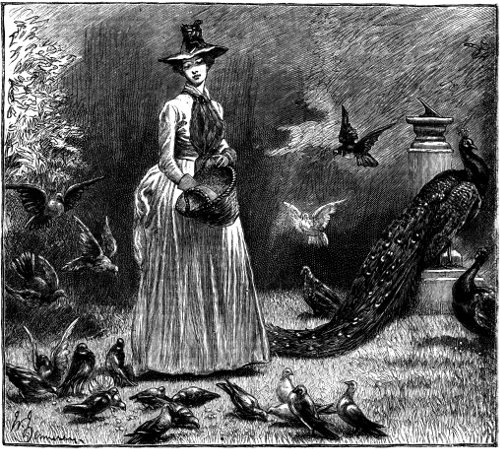
“IN A MOMENT THERE WAS A FLUTTERING OF WINGS IN THE AIR.”
All rights reserved.]
THE LITTLE WORKERS IN BROWN.
ow delicious it is
when one is young
to wake up in a
fresh place on a
summer’s morning.
It was my belief
that the birds woke
me, there was such a
twittering under the
eaves where the house-martins
had built their
nests, such a warbling
of thrushes breakfasting
on the dewy
lawn, such a cawing of
rooks under the elm trees; such a
joyous bird-symphony altogether, while
I lay in my old-fashioned blue bed,
looking round the quaint old room and
trying to decipher the meaning of the
curious prints in their black frames.
When I was tired of this I rose and
went to the window. The kitchen
garden, with its row of beehives, was
just under the window, and beyond were
Cherrytree-lane and Squire Hawtry’s
cornfield, and then a vague blue line,
and a brown sail shimmering in the sunlight.
The sweet peacefulness of the
scene seemed to sink into my heart,
and I could have sung my Te Deum
with the birds.
When the children were dressed and
we had finished our early breakfast, I
went to the window with Reggie while
Hannah was clearing the table. Joyce
had already climbed up on the window
seat; she was wild to go into the
garden and see auntie’s pets, and I
thought it would be no harm to humour
her fancy and defer our walk to the
shore.
As we stood there Miss Cheriton came
out on the terrace. She wore a broad
brimmed hat, and long gardening
gloves, and carried a basket. She gave
a low, peculiar call, and in a moment
there was a fluttering of wings in the air,
and a crowd of pigeons came round her
feet to pick up the grain she had
scattered; the pheasants and peacocks
joined them.
I thought what a pretty picture it
would have made; the old red brick
house with its ivy-covered gables in the
background; the terrace with its sundial
and antique vases; the girl in her white
gown with her beautiful pets round her,
her favourite blue pigeons eating out of
her hand.
“Oh, auntie, may we come?” pleaded
Joyce; and Miss Cheriton looked up at
us and smiled and nodded, and Joyce
snatched her sun-bonnet and in a few
minutes we had joined her on the
terrace.
She greeted us with evident pleasure,
and playfully held up her finger to
silence Joyce.
“Don’t make a noise, my pet,
or Rolf will hear you and want to come
out; he is having his breakfast with
Aunt Adelaide; and he is so rough and
tiresome that I do not care to have him
with me just now; you shall go with me
into the poultry yard and feed the little
yellow chicks yourself.”
Joyce was highly delighted at this
prospect, and trotted along in her big
white sun-bonnet, chattering as fast as
her tongue would go. When we arrived
at the poultry yard, Miss Cheriton filled
her pinafore with grain and showed her
where to throw it, and then picked up
one of the downy yellow chicks for
Reggie to kiss and hug; but he was so
unwilling to part with it that we had
some trouble to rescue the warm struggling
thing; only the speckled hen was
in such a fuss, clacking loudly in the
midst of her brood. When we had exhausted
the grain and had fed some
grey rabbits, and had peeped in at the
stables, and had bestowed a passing
attention on the big St. Bernard in his
kennel—Miss Cheriton’s chief favourite
next to her brown mare, Bonnie—we sat
down on a bench in the orchard, at some
little distance from the beehives, while
the children gathered daisies and buttercups.
“I am so fond of this old orchard,”
observed Miss Cheriton, as she threw
down her empty basket and removed
her gloves, showing a pair of small
brown hands that looked very strong
and capable; “when I have nothing
else to do, I and my pets come here and
enjoy the quiet. Do you know, the peacocks
and pheasants will follow me all
over the place as closely as a dog? They
don’t mind Lion a bit; and he is as
gentle as a lamb. On Sunday afternoon
I have all the creatures round me.
Adelaide declares I waste my time
dreadfully with the beasties.”
“They must give you plenty of occupation,
Miss Cheriton,” for I have
come to the conclusion that this girl
was far from idle. The care of that extensive
poultry-yard could be no sinecure’s
office, besides which the beehives
were her exclusive charge, though
I heard afterwards the gardener’s son,
Jim, was her under helper. All the live
things about the place looked to her
for food and comfort. She had a cage
full of canaries in the conservatory, and
a large grey parrot as well.
“Oh, I am always with my pets and
flowers until luncheon-time,” she remarked,
carelessly; “Jim is a very
handy boy, and helps me with the rough
work. I was up at six this morning, and
we had moved half the pots in the conservatory
before breakfast. I am always
up early, except in the winter; the
world is not half awake at that time of
the year, and certainly not well lighted.”
“Those beehives must be a very profitable
investment,” I observed, for I
had heard before now that people had
added largely to their incomes by keeping
bees.
“You would be surprised how much
I make by my hives,” she returned. “I
have only a limited interest in the poultry
yard, and have to find chickens and
eggs for the household, but the beehives
are my own. I succeeded so well with
them last year, and I believe I shall do
just as well this autumn. I am very
proud of my bees.”
“It would not be a bad plan——” I
began, and then I stopped, for I had
spoken hastily, and how could I know
if my words would be well received?
“Well,” she said, with a pretty air
of impatience, “why do you stop? You
have got something dreadfully sensible
in your head, and I should like to hear
it.”
“I am rather too quick with my
words,” I answered, somewhat hesitating.
“I was only thinking of what
you said last night; you were condemning
yourself very needlessly, as I think,
and comparing your means of usefulness
with Mrs. Morton’s.”
“With Violet’s many-sided duties.
Well, I do not retract my words. I said
I was always amusing myself; so I am;
my bees are my playthings.”
“You could make them work for you
if you chose,” I returned, quickly; “if
one of these hives, for example, were
devoted to some good purpose, if the
money you got for the honey were given
to one of those institutions in which your
sister takes such interest.”
“Oh, what a nice idea,” she exclaimed,
with a bright look. “I wonder
what put that into your head. I was
rather uncomfortable having all that
money to spend on myself; I thought of
giving some to Adelaide for Rolf, only
I cannot get up an interest in that boy.
I have more than I want, for one does
not need so many dresses in the country,
and nothing will induce me to go through
a London season again. I tried it once,”
with a merry laugh, “just to please
Violet, but it nearly killed me, so I
wrote to father to take me away. I
should have liked the balls very well,
only I got so dreadfully sleepy before
they were over, and the rides in the
Row were nice, if only they would have
let me gallop, but I was nearly taken up
for furious riding once when I could not
get Bonnie to stop, and after that Alick
lectured me, and I got sick of it.”
“You would not like your sister’s life,
then?”
Gay shrugged her shoulders with a
gesture of disgust.
“It is not life at all; it is a daily
round of harassing duties. Look what
it has done for Violet—robbed her of
spirits and bloom; she will be an old
woman before her time. The fun is
very well, but there is too much of it.
I pined for fresh air, for the garden, and
the bees, and my other pets. I am
afraid my partners thought me dreadfully
rustic; I seemed to amuse them. I
do not care for the young men in ball-rooms,
they are so vapid, and, for all
their politeness, they seemed to be laughing
at one.”
I could not help smiling at this; it
was very odd she should be so frank with
me. She must have forgotten that I had
no experience of ball-rooms, and had
never danced except at school-parties,
when the girls were allowed to bring
their brothers.
“You are looking satirical, Miss Fenton.
Oh, of course, I see what you
mean; but never mind, there are better
things than balls in life. For my part,
I prefer a solitary gallop on Bonnie to
Strauss’s best waltz, though I do love
dancing too, but, you see, neither Violet
nor I have been trained to a fashionable
life. We have lived in the country, have
risen early, and been in the open air
from morning to night, and now poor
Violet never goes to bed in time to get
a beauty sleep, and she drives instead
of taking a good walk, so no wonder her
cheeks get pale and thin.”
“It is a grievous pity,” I began, but
Gay interrupted me.
“Oh, it is no use talking about Violet,
I have given her up long ago; Alick has
robbed me of her entirely. Now about
your benevolent project; I mean to carry
it out. Do you know the Children’s Incurable
Hospital, Maida Vale? Violet
is always working for that. There is to
be a ‘Muriel Cot,’ in memory of the
dear little baby she lost. Now why
should I not have a ‘Children’s Hive,’
and make those special bees gather
honey for those little incurable children.
I call that a lovely idea. Look, that
end hive under the apple tree shall be
the one. Miss Fenton, you have emancipated
me; I feel a philanthropist
already; the world will be the better for
me and my workers.”
I looked at her admiringly; such a
lovely colour had come to her face, and her
eyes looked so bright and happy. I felt
I understood Gay Cheriton from that
moment. She was one of those guileless,
innocent natures that are long in throwing
off childhood. She was full of generous
impulses, frank and outspoken to a
fault; the yoke of life pressed lightly on
her; she was like an unbridled colt, that
had never felt the curb or the spur;
gentle guidance, a word from those she
loved, was sufficient to restrain her. I
knew now why Joyce had called her the
little auntie; there was an air of extreme
youth about her; she was so very lovable
that diminutiveness suited her, and
I thought her father’s pet name of humming
bird suited her exactly; she was so
quick and bright and restless, her vitality
and energy demanded constant movement.
“How I am chattering!” she said at
last, “and I have all the vases to fill
before luncheon, but, as I told you last
night, I am fond of talking if I can
get anyone to listen to me. Adelaide
never will listen to me patiently; she
says I am such a chatterbox. Goodbye
for the present, Miss Fenton.” And
she tripped away, singing in such a
fresh young voice as she went down the
orchard that I did not wonder when a
little brown linnet perched on a rose-bush
answered her. I think the birds
must have loved to hear her.
I sat for some time contemplating the
low white gate and the row of beehives.
I was rather pleased with the idea I had
started; a word in season sometimes
brings a rich harvest. I thought some
time of the tiny workers in their brown
livery bringing in their rich stores for
the afflicted children; and it seemed to
me that the offering would be a sweet
savour to the Master who loved
children.
I fell into a reverie over it; I thought
how much might be done for others
with little cost if people would only
think; it is want of thought that clogs
usefulness. Great sacrifices are so
seldom demanded from us; we are not
now called upon to forsake all that we
hold dear and follow the Christ—little
daily duties, small hourly renunciations,
pleasures given up for some cheerful
loving service: these are the free-will
offerings that all may yield, only the
people must “give willingly.”
The morning passed pleasantly in the
sunny orchard; when the children tired
of their play we went back to the house
that they might have their noonday
sleep. I was sitting alone in the
nursery, mending Reggie’s pinafore,
when I heard the clatter of noisy footsteps
in the corridor, and a moment
after the nursery latch was lifted without
ceremony, and Rolf peeped in. He had
a droll, half-ashamed expression on his
face, but it bore no trace of yesterday’s
ill-humour.
“May I come in, if you please, Mrs.
New Nurse?”
“My name is Miss Fenton, as I told
you yesterday; or, you may call me
Nurse if you choose. Yes; you may
come in and talk to me if you like,
Master Rolf; but you must be very quiet,
as your little cousins are asleep.”
“What precious babies they must be
to sleep in the day!” he observed, disdainfully,
as he planted himself without
ceremony on the window seat. “I sit
up until ten o’clock every night; sometimes
I will not go to bed until mother
goes.”
“‘Early to bed and early to rise,
Makes a man healthy, wealthy, and wise,’
Master Rolf.”
“Wealthy means rich, doesn’t it?
Well, Juddy said I shall be a rich man
some day. I have got father’s watch
and sword now, only mother locks them
up until I am bigger. You are not rich,
eh, Miss Fenton?” peeping into my
face rather maliciously.
“No, Master Rolf,” I returned, quietly.
“Oh, I knew that you are only a
nurse; I heard mother and Aunt Gay
talking about you last night. Mother
said you were a poor sort, and she wondered
at Violet’s infatuation. She
thought you stuck up and disagreeable,
and not much to look at; a plain young
woman, and very disrespectful. There,
now!”
“Master Rolf,” I observed, calmly,
and suppressing my inward wrath, “you
call yourself a gentleman, but I assure
you a savage shows more gentlemanly
feeling than you. Don’t you know your
mother’s words should be sacred, and
you are bound in honour not to repeat
them?” And then, as he seemed rather
impressed at this, I told him how, even
among savages and wild and uncultured
nations, the sense of hospitality and
gratitude was so strong that, when a
man had partaken of bread and salt,
broken the bread of fellowship, he was
bound in honour not to betray or injure
his host in any way; and I related to
him an anecdote of an Armenian servant,
who had long been faithful to his
master, and had defended him in many
dangers in his travels through a lawless
country.
“The master,” I continued, “had
vast treasures under his care, and he
was greatly troubled when his servant
said he must leave him. Judge what
his feelings must have been when the
man coolly told him that he had entered
into a league with some banditti to rob
him of his money; that it would be
mean to remain in his service under
these circumstances, and that he had
given him warning of his intention, that
he might defend himself, and that now
they were equal.
“Even this lawless robber had some
notions of honour, Master Rolf; while
he ate his master’s bread and salt he
was bound by his service not to injure
him. Now you are only a little boy,
but you ought to understand that you
also are bound not to betray your mother
or repeat her words, as long as you eat
her bread and salt; that is the way
people do so much mischief in the world,
repeating things they know are not
meant to be heard.”
Rolf’s eyes sparkled.
“I like that story awfully. Yes,”
and looking at me critically, “I like
you too, though you are a plain young
woman. No, I did not mean to say
that,” interrupting himself in a hurry;
“bread and salt, you know; I shall
always think of that when I am going
to tell Juddy things that mother says.
She is an old stupid, you know, and she
never has time to make a tail to my
kite, and mother says she has no patience
with her, she is such an——Oh,
oh, Miss Fenton, bread and salt! How
ever shall I remember when I want to
put Juddy in a rage?”
“I daresay I shall be able to help
you with your kite,” I returned, changing
the subject, “but we shall want
plenty of string and paper.”
“Oh, you nice old thing,” replied
Rolf, ecstatically. “You are not a bit
plain, not a bit; I shall tell mother I
think you lovely, and that I mean to
marry you when I grow up. Won’t she
stare at that? May I bring my kite
here this afternoon?”
“No, no, my dear, not this afternoon;
we are going to the shore.”
“Oh, then I will come with you.
Mother,” as Mrs. Markham appeared
at the door, and looked at us with unfeigned
surprise, “I can’t drive with
you this afternoon; I am going on the
beach with Miss Fenton and the children.”
(To be continued.)
THE HISTORY OF HOME OR DOMESTIC WAYS SINCE THE TIMES OF HENRY VIII. — PART I.
By NANETTE MASON.
THE REIGNS OF HENRY VIII., EDWARD VI., AND
MARY I.
n the following
articles
we propose
to treat of
home life in
bygone days.
That being
the case, our
net will be
spread wide
enough to
catch a very
miscellaneous
collection
of facts.
Nothing will
come amiss
to us that in
any way illustrates
the domestic
existence
of our
ancestors, and every reader, whatever her turn
of mind, will be sure to find something worth
taking note of.
It will be a different sort of narrative from
the history of great men, or a tale of battles,
sieges, and such-like imposing circumstances.
We shall speak of houses and furniture, food
and clothing, etiquette and good manners,
wages and prices, education and superstition,
household industries and household amusements,
old recipes and domestic medicines,
the ways of the poor and the ways of the rich.
We shall make as much of needles and pins as
ordinary history-books do of swords and guns,
and a girl singing an old song will have more
attention than they give to an ambassador
negotiating a foreign treaty.
The worst of it is that the subject is long,
whilst our space is of necessity short. We shall
try, however, to change that disadvantage into
an advantage, by giving only those facts that
appear most interesting. There is a pleasure,
too, when reading about a subject, to know
that the half has not been told, and that to
all who care to pursue it on their own account
a rich harvest remains yet unreaped.
We are not going to begin with the time
“when wild in woods the noble savage ran,”
and homes were in caves and under the shade
of green trees; our starting-point is to be the
reign of Henry VIII., and our first article will
embrace that reign and the reigns of Edward
VI. and Queen Mary—in other words,
from 1509 to 1558.
In those far-back days many things were
different from what they are now. There has
been a great advance in material comfort. Our
forefathers, no doubt, had just as much wit
and wisdom as we have; but we can boast an
advantage over them in possessing more of
the conveniences of life. In that respect, at
least, we are lucky to have been born so late.
Let us not imagine, however, that they had
a bad time of it, or were discontented or
miserable because they had not everything
just like us. People do not sigh after what
they have never either seen or heard of. We
really find happiness in our affections—not
in our material surroundings, which are of
secondary importance; and it is not unreasonable
to conclude that, as human nature is always
the same, these ancestors of ours enjoyed
life in their way quite as much as we do.
We start with the subject of houses and
furniture. When Henry VIII. began to reign,
well-to-do people in towns lived, as a rule, in
houses built principally of timber, the fronts
being often ornamented with rich carvings of
fanciful and grotesque objects. The upper
storeys projected; so much so, indeed, that in
a street people in the attics on either side
could almost shake hands. There was a reason
for building in this way. As the houses were
of perishable material, each storey gave protection
from the weather to the storey beneath
it.
Such a quantity of timber being used, there
was a great danger of fire, and the warning of
the bellmen who proclaimed the hours of the
night in London was certainly needed, when,
to their instructions to “be charitable to the
poor, and pray for the dead,” they added,
“Take care of your fire and candle.”
The labouring people in the country lived
in houses constructed of the first things that
came to hand—often nothing but wattle and
mud or clay. When the mud or clay cracked,
under the influence of summer’s heat or
winter’s frost, it was a simple matter with the
same material to “stop a hole to keep the
wind away.” Ventilation was very defective,
and Erasmus attributes the frequent sicknesses
with which England was then visited in a great
measure to the want of fresh air in the dwelling-houses.
The ideas that regulated the furnishing and
decoration of the houses of the upper classes
form a marked contrast to those prevailing
nowadays. The furniture was more
massive, and there was less of it. The bedchamber
of Henry VIII. contained only a
couple of joint cupboards, a joint stool,
two hand-irons, a fire-fork, a pair of tongs, a
fire-pan, and a steel mirror covered with
yellow velvet.
Carpets came into use before the reign of
Henry VIII. was far advanced, though in the
reign of Queen Mary rushes still strewed the
floor of the presence-chamber. Feather beds
were used in Henry VIII.’s reign by the upper
classes. When they went travelling, they
were no longer content with the floor or a
hard bench at halting-places, but generally
carried portable beds (packed in leather cases)
with them on horseback. In the lower ranks
of life straw pallets, or rough mats with a
round log for a pillow, formed the ordinary
provision for sleeping.
Ladies’ dresses amongst the nobility in
Henry VIII.’s reign had a certain formality,
but in many points were elegant and becoming.
Early in the sixteenth century they
were made low and cut square about the neck:
the sleeves were tight at the shoulder, but
suddenly became very large and open, showing
the puffed sleeves of the under-dress. The long
skirts were worn open in front to the waist,
showing the kirtle or petticoat. Sometimes,
however, dresses were worn high, with short
waists and a small falling collar.
At a little later date the sleeves of dresses
were puffed at the shoulders, and when the
dress was made open above the girdle, what
was called a “partlet”—a kind of habit-shirt—was
worn beneath it, and carried up to the
throat.
Sleeves were one of the strong points of the
ladies of those times. They were independent
articles of clothing, and were attached at
pleasure to the rest of the costume. “Much
splendour,” says Mr. J. R. Planché, “was
lavished on this part of the dress, and its
various fashions were singularly quaint and
elegant.” Amongst the inventories of Henry
VIII.’s reign we find “three pair of purple
satin sleeves for women; one pair of linen
sleeves, paned with gold over the arm, quilted
with black silk, and wrought with flowers
between the panes and at the hands; one
pair of sleeves of purple gold tissue damask
wire, each sleeve tied with aglets of gold;
one pair of crimson satin sleeves, four buttons
of gold being set on each sleeve, and in every
button nine pearls.”
Necklaces and other ornaments of jewellery
were much worn. No dress was complete
without a girdle, and from the girdle was
suspended by means of chains such articles as
tablets, knives and purses. Sometimes, in
place of the chains, the girdles themselves had
a long pendant, which was elaborately
decorated.
We get a glimpse of the style of dress
amongst commoner folk, in the history of a
famous clothier known as “Jack of Newbury.”
When Jack was married, the bride, in her
wedding costume, must have cut quite a
picturesque figure. “The bride,” we read,
“being dressed in a gown of sheep’s russet
and a kirtle of fine worsted, her head attired
in a billiment (habiliment) of gold, and her
hair, as yellow as gold, hanging down behind
her, which was curiously combed and plaited,
according to the manner of those days, was
led to church by two boys with bride laces,
and rosemary tied about their silken sleeves.”
Mrs. Jack became a widow, and after she
had laid aside her weeds she is described as
coming one day out of the kitchen “in a fair
train gown stuck full of silver pins, having a
white cap on her head, with cuts of curious
needlework under the same, and an apron
before her as white as driven snow.”
The ordinary costume for men of the upper
ranks in the time of Henry VIII. was a full-skirted
jacket or doublet, with large sleeves to
the wrists, over which was hung a short cloak
or coat, with loose hanging sleeves and a
broad, rolling collar of fur. To these articles
of dress was added a brimmed cap, jewelled
and bordered with ostrich feathers; stockings
and square-toed shoes.
A sumptuary law was passed in 1533,
limiting the use of certain expensive stuffs and
valuable personal ornaments to certain
classes. Common people and serving men, for
example, were confined to the use of cloth of a
fixed price, and lamb’s fur only, and they were
forbidden to wear any ornaments or even
buttons of gold, silver, or gilt work, excepting
the badge of their lord or master.
The apprentices of London wore blue
cloaks in summer, and in winter gowns of the
same colour. Blue cloaks or gowns were a
mark of servitude.
Fourteen years before the beginning of
Henry VIII.’s reign wages were settled by
Act of Parliament. A free mason, master
carpenter, rough mason, bricklayer, master
tiler, plumber, glazier, carver or joiner, was
allowed from Easter to Michaelmas to take
6d. a day, without meat or drink. Suppose
he had meat and drink, he could only
charge 4d. A master having under him six
men was allowed a penny a day extra. From
Michaelmas to Easter a penny a day was
taken off these prices. Wages, however,
gradually rose all through the sixteenth
century.
In 1511, in the household of the Earl of
Northumberland, the principal priest of the
chapel had £5 a year; a chaplain graduate
£3 6s. 8d.; a chaplain not a graduate, £2;
a minstrel, £4; a serving boy, 13s. 4d. These
payments were over and above food and
lodging.
When wages and salaries were so low, compared
with those of our own day, we must
expect to find a corresponding difference in
prices. In 1541 a hundred eggs sold for
1s. 2d., a dozen pigeons cost 10d., a good fat
goose cost 8d., and you could buy a fat sheep
for from 2s. 4d. to 4s., and an ox for about £2.
In 1533 an Act was passed by which the price
of beef and pork was fixed at ½d. a pound,
and veal at ¾d.
Of the state of learning, in the houses at any
rate of the upper classes, much is to be said
that reflects credit on our ancestors. The
royal court of Henry VIII., whatever might be
its faults, did not neglect study. In the case
of Prince Edward, afterwards Edward VI.,
devotion to his books no doubt had an injurious
effect on his health, and there is no saying
what might have been the result to England
had he had less learning and more exercise.
Bishop Burnet tells us that he was so forward
in his education that “before he was eight
years old he wrote Latin letters to his father,
who was a prince of that stern severity that
one can hardly think that those about his
son durst cheat him by making letters for
him.”
Mary had a good knowledge of classic
authors, and wrote good Latin letters. Elizabeth
began every day with an hour’s reading
in the Greek Testament, the tragedies of
Sophocles, and the orations of Isocrates and
Demosthenes. She also was a good Latin
scholar, spoke French and Italian as fluently
as English, had a smattering of Dutch and
German, and was a devourer of works on
history.
These two princesses were the highest in
station of the accomplished women of the time,
but there were many who equalled, and some
who surpassed, them in learning. The most
remarkable of all for accomplishments was
certainly Lady Jane Grey, afterwards the
unfortunate queen of a ten-days’ reign. Lady
Jane took so kindly to study that she became
the marvel of the age for her acquirements.
She excelled in needlework and in music, and,
aided by her tutor, Dr. Elmer, or Aylmer,
afterwards Bishop of London, had thoroughly
mastered Latin, Greek, French, and Italian,
and knew something of at least three Oriental
tongues—Hebrew, Chaldee, and Arabic.
One of the most interesting passages—and
a touching one it is, too—in the writings of
Roger Ascham is that in “The Schoolmaster,”
in which he describes a visit he paid to the
home of Lady Jane’s parents in Leicestershire
in 1550. She was then little over thirteen
years old. It gives us a glimpse of the girl-life
of the period in a high rank of society,
and deserves to be quoted in full.
“Before I went into Germany,” says Ascham,
“I came to Broadgate, in Leicestershire, to
take my leave of that noble Lady Jane Grey, to
whom I was exceeding much beholden. Her
parents, the Duke and Duchess, with all the
household, gentlemen and gentlewomen, were
hunting in the park. I found her in her
chamber, reading Phædon Platonis, in Greek,
and that with as much delight as some gentlemen
would read a merry tale in Boccaccio.
“After salutation and duty done with some
other talk, I asked her why she would leave
such pastime in the park?
“Smiling, she answered me, ‘I wis all their
sport in the park is but a shadow to that
pleasure that I find in Plato. Alas, good
folk! they never felt what true pleasure
meant.’
“‘And how came you, madam,’ quoth I,
‘to this deep knowledge of pleasure, and what
did chiefly allure you unto it, seeing not many
women but very few men have attained thereunto?’
“‘I will tell you,’ quoth she, ‘and tell you
a truth which perchance you will marvel at.
One of the greatest benefits that God ever
gave me is that He sent me so sharp and
severe parents, and so gentle a schoolmaster.
For when I am in presence either of father or
mother, whether I speak, keep silence, sit,
stand or go, eat, drink, be merry or sad, be
sewing, playing, dancing, or doing anything
else, I must do it as it were in such weight,
measure, and number—even so perfectly as
God made the world—or else I am so sharply
taunted, so cruelly threatened, yea, presently,
sometimes, with pinches, nips, and bobs, and
other ways which I will not name for the
honour I bear them; so without measure misordered
that I think myself in hell, till time
come that I must go to Mr. Elmer, who
teacheth me so gently, so pleasantly, with
such fair allurements to learning, that I think
all the time nothing whiles I am with him.
And when I am called from him I fall on
weeping, because whatsoever I do else but
learning is full of grief, trouble, fear, and
whole misliking unto me. And thus my book
hath been so much my pleasure, and bringeth
daily to me more pleasure and more, that in
respect of it all other pleasures in very deed
be but trifles and troubles unto me.’
“I remember this talk gladly,” Ascham
adds, “both because it is so worthy of
memory, and because, also, it was the last talk
that ever I had and the last time that ever I
saw that noble and worthy lady.”
However learning might flourish in the
upper circles of society, it seems to have
languished in the schools and among the
people. But efforts were made in the direction
of popular education, and more grammar
schools it is said were founded in the latter
part of Henry VIII.’s reign than in the three
hundred years preceding.
Music was practised by all classes. Erasmus,
who saw much of England in the beginning
of the sixteenth century, speaks of the English
as the most accomplished in the skill of
music of any people. “It is certain,” says
Mr. Chappell, “that the beginning of the
sixteenth century produced in England a race
of musicians equal to the best in foreign
countries, and in point of secular music
decidedly in advance of them.”
Henry VIII. was a great patron of music,
and, more than that, he was himself a composer
and performer. He played well on both
the virginals and the lute, and could sing at
sight. But to sing at sight was a common
accomplishment amongst gentlemen; so common,
indeed, that inability to do so was looked
on as a serious drawback to success in life.
Homes were rendered cheerful by the singing
of madrigals and other part music. The first
collection of songs in parts that was printed
in England belongs to the year 1530.
Besides music, many other recreations were
indulged in. These were the days of archery,
casting of the bar, wrestling, and such martial
sports as fighting with swords and battle-axes.
For rural pastimes there were hunting and
hawking—and in these the ladies were often
as enthusiastic as the gentlemen. Card-playing
was highly popular, and in the reign of
Henry VIII. a prohibitory statute was found
necessary to prevent apprentices from using
cards, except in the Christmas holidays, and
then only in their masters’ houses. The same
statute forbade any householder to permit
card-playing in his house, under the penalty of
six shillings and eightpence for every offence.
May Day was a general holiday, and Maypoles
were set up in every town and village.
The observance of May Day differed no doubt
in minor particulars in different places, but in
general it consisted in people of all ranks
going out early in the morning into the
“sweet meadows and green woods,” where
they broke down branches from the trees, and
adorned them with nosegays and crowns of
flowers. “This done, they returned homewards
with their booty, and made their doors and
windows triumph in the flowery spoil.” The
Maypole was set up, and the rest of the day
was spent in dancing round it, and in sports of
different kinds. When evening came, bonfires
were lighted in the streets. Even the reigning
sovereign joined in these amusements. On
May Day, 1515, Henry VIII. and Queen
Katherine, his wife, rode a-Maying from
Greenwich to the high ground of Shooter’s-hill,
accompanied by many lords and ladies.
There was a famous London Maypole in
Cornhill before the parish church of St. Andrew,
which thus got the name of St. Andrew
Undershaft. The pole or shaft, Stow tells
us, was set up by the citizens “every year,
on May Day, in the morning, in the midst of
the street, before the south door of the said
church; which shaft, when it was set on end
and fixed in the ground, was higher than the
church steeple.” When its annual day of usefulness
was over, the pole was taken down
again and hung on iron hooks above the doors
of the neighbouring houses.
This pole was destroyed in 1550, the fourth
year of Edward VI.’s reign, in an outburst of
Puritanism, after a sermon preached at St.
Paul’s Cross against May games. The inhabitants
of the houses against whose wall the
pole had found shelter sawed it in pieces, and
every man took a bit and made use of it to
light his fire.
Mingled with the festivities of May Day there
was a distinct set of sports, very popular in
the early part of the sixteenth century, intended
to represent the adventures of the
renowned woodland hero, Robin Hood. The
enthusiasm with which the common people
entered into these sports may be seen from
the reception Bishop Latimer met with when
he once proposed to preach in a town on the
1st of May. He tells the incident himself in
a sermon he preached in 1549 before Edward
VI.
“I came once myself,” he says, “to a
place, riding on a journey homeward from
London, and I sent word overnight into
the town that I would preach there in the
morning because it was holy day, and methought
it was an holy day’s work.” (It was
the Feast of the Apostles Philip and James.)
“The church stood in my way, and I took my
horse and my company and went thither. I
thought I should have found a great company
in the church, and when I came there the
church door was fast locked.
“I tarried there half an hour and more.
At last the key was found, and one of the
parish comes to me and says, ‘Sir, this is a
busy day with us. We cannot hear you. It
is Robin Hood’s Day. The parish are gone
abroad to gather for Robin Hood. I pray you
forbid them not.’
“I was fain there to give place to Robin
Hood. I thought my rochet”—or bishop’s
surplice—“should have been regarded, though
I were not; but it would not serve; it was
fain to give place to Robin Hood.”
How did stay-at-home people amuse themselves
then in the long winter evenings?
No doubt they either made time seem short by
going to sleep, or they sat by the fireside
singing songs or telling oft-told stories, or
exercising their wits by asking each other
riddles or conundrums. Some of their fireside
riddles are preserved in a little book called
“Demands Joyous”—in modern English
Merry Questions—which was printed by
Wynkyn de Worde in 1511.
The following are a few of the conundrums
contained in this work, and at some of them
the reader, who is well acquainted with the
conundrums of the present day, will be
tempted to exclaim with Solomon, that there is
nothing new under the sun.
“What is it that never freezeth?—Boiling
water.
“What is it that never was and never will
be?—A mouse’s nest in a cat’s ear.
“How many straws go to a goose’s nest?—Not
one, for straws, not having feet, cannot
go anywhere.
“How many calves’ tails would it take to
reach from the earth to the sky?—No more
than one, if it be long enough.
“What man getteth his living backwards?—A
ropemaker.
“Why doth a dog turn round three times
before he lieth down?—Because he knoweth
not his bed’s head from the foot thereof.
“Why do men make an oven in a town?
Because they cannot make a town in an oven.
“How may a man discern a cow in a flock
of sheep?—By his eyesight.
“What is the worst bestowed charity that
one can give?—Alms to a blind man; for he
would be glad to see the person hanged that
gave it to him.”
An industry of considerable interest from a
domestic point of view came to the front in
1542; this was the manufacture of pins.
These useful articles were originally made
abroad, but the English pinners took to
making them, and on their engaging to keep
the public well supplied at reasonable prices,
an Act of Parliament was passed in the year
just named, forbidding the sale of any sort of
pins excepting “only such as shall be double-headed,
and have the heads soldered fast to
the shank of the pin, well smoothed, the
shank well shaven, the point well and round
filed, canted and sharped.”
The English pinmakers, however, either
proved unable or unwilling to keep their part
of the bargain, and complaints were so loudly
made that the pins were not what they should
be, that in 1545 the Act was declared
“frustrate and annihilated, and to be repealed
for ever.” Pins of good quality were of brass,
but unscrupulous makers made pins of iron
wire, blanched, and passed them off as brass
ones.
People who went from home then had no
choice—they must either ride or walk. Kings,
queens, and gentlefolk all mounted to the
saddle, the ladies being accustomed to ride on
pillions fixed on the horse, and generally
behind some relative or serving-man. Rude
carriages, however, made their appearance in
England in 1555.
Before the Reformation there were no poor’s
rates. The poor had their wants supplied by
charitable doles given at religious houses, and
by contributions placed in the poor man’s
box which stood in every church. In all
parishes there was a church house supplied
with dishes and cooking utensils. “Here,”
says John Aubrey, “the housekeepers met,
and were merry and gave their charity.”
Begging, under certain conditions, was regulated
by an Act of Parliament passed in
1530. By this Act justices of the peace were
required to give licences under their seals to
such poor, aged, and impotent persons to beg
within a certain precinct as they thought had
most need. If anyone begged out of the
district assigned to him he was to be set in
the stocks two days and two nights; and if
anyone begged without first obtaining a
licence he was to be put in the stocks
three days and three nights, and be fed with
bread and water only.
Vagrants were very sternly dealt with; but
in this Act, and in subsequent legislation on
the same subject, we see that our sixteenth-century
forefathers had an honest desire to do
their duty in relieving such as were in “unfeigned
misery.” In an Act passed in the
first year of Edward VI.’s reign we find the
curate of every parish required, “on every
Sunday and holiday, after reading the Gospel of
the day, to make (according to such talent as
God hath given him) a godly and brief exhortation
to his parishioners, moving and
exciting them to remember the poor people,
and the duty of Christian charity in relieving
of them which be their brethren in Christ,
born in the same parish and needing their
help.”
One of the interesting households of the
period was that of Sir Thomas More, the
famous Lord Chancellor who was executed in
1535. More lived at Chelsea, and of his happy
home there Erasmus, who knew him well, has
given the following charming account:—“More,”
he says, “has built, near London,
upon the Thames, a modest yet commodious
mansion. There he lives, surrounded by his
numerous family, including his wife, his son,
and his son’s wife, his three daughters and
their husbands, with eleven grandchildren.
There is not any man living so affectionate to
his children as he, and he loveth his old wife
as if she were a girl of fifteen. Such is the
excellence of his disposition, that whatsoever
happeneth that could not be helped, he is
as cheerful and as well pleased as though the
best thing possible had been done.
“In More’s house you would say that
Plato’s Academy was revived again, only
whereas in the Academy the discussion turned
upon geometry and the power of numbers,
the house at Chelsea is a veritable school of
Christian religion. In it is none, man or
woman, but readeth or studieth the liberal
arts; yet is their chief care of piety. There
is never any seen idle. The head of the house
governs it, not by a lofty carriage and oft rebukes,
but by gentleness and amiable manners.
Every member is busy in his place,
performing his duty with alacrity; nor is sober
mirth wanting.”
Speaking of More’s home life in his “Short
History of the English People,” Mr. J. R.
Green says:—“The reserve which the age
exacted from parents was thrown to the winds
in More’s intercourse with his children. He
loved teaching them, and lured them to their
deeper studies by the coins and curiosities he
had gathered in his cabinet. He was as fond
of their pets and their games as the children
themselves, and would take grave scholars and
statesmen into the garden to see his girls’
rabbit-hutches or to watch the gambols of
their favourite monkey.”
(To be continued.)