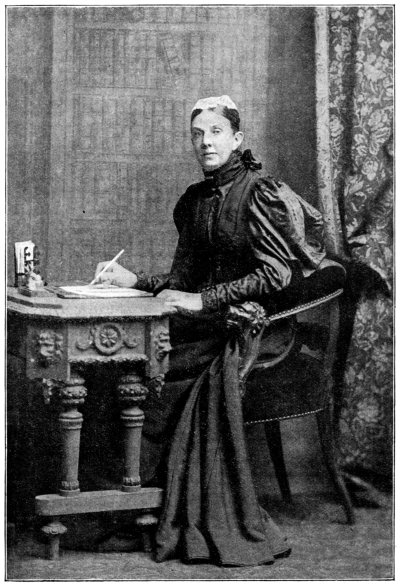
In an age when many books on every sort
of subject and vexed question are being daily
launched into the world, it is a relief to turn to
the pure, wholesome novels of Rosa Nouchette
Carey, the popular authoress, who has steadily
held her ground with her public since the production
of her first book, Nellie’s Memories,
composed and related verbally to her sister,
while yet in her teens, though not actually
written until some few years later.
The youngest girl but one of a family of
seven, and in her girlhood delicate in health,
which caused her education to be somewhat
desultory, Rosa Carey soon displayed an aptitude
for composing fiction and little plays
which she and her sister acted, one of her
chief amusements being to select favourite
characters from history and from fiction, and
trying to personify them, while her greatest
pleasure was to relate short stories to this
same younger sister over their needlework. It
is a strange fact that, during her simple, happy,
uneventful girlhood, chiefly spent in reading,
in writing poetry, and in other girlish occupations,
Rosa Carey, who was of a somewhat
dreamy and romantic disposition, feeling the
impossibility of combining her favourite pursuits
with a useful domestic life, and discouraged
by her failures in this respect, made
a deliberate and, as it afterwards proved, a
fruitless attempt to quench her longing to
write. This unnatural repression, however, of
a strong instinct could not be conquered, and
after some years she yielded to it.
She was born in London, near old Bow
Church, but has no very distinct remembrances
of the house and place. Later, the
family moved to Hackney, into what was then
a veritable country residence, and there many
happy years were spent. Her mother was a
strict disciplinarian, and very practical and
clever, while her father was a man universally
beloved and respected, by reason of his singularly
amiable character, his integrity, and his
many virtues.
The next move was to Hampstead, where
the young girl’s schooldays began, and it was
then that she met and formed a strong friendship
with the late Mathilde Blind, the talented
author of The Descent of Man, and translator of
Marie Bashkirtseff’s Journal and other works.
This attachment, mutually enthusiastic and
full of interest, was only interrupted by a
divergence of religious opinions. Rosa Carey,
adhering to the simple faith of her childhood,
could not follow Mathilde Blind, who was
educated in the extreme school of modern
free-thought, and the friends, with sorrow but
with yet unabated affection on each side,
drifted apart.
Meanwhile, the large and happy family was
being gradually broken up. First the beloved
father passed away. On the same day that,
three years before, had witnessed his death,
their mother, too, was taken to her rest, and
shortly after, the two sisters went to Croydon,
to superintend their widowed brother’s home.
Miss Carey’s real vocation in life seemed to
spring up, and the literary work was but fitfully
carried on, for, on the marriage of her
sister to the Rev. Canon Simpson, vicar of
Kirkby Stephen, Westmoreland, and the subsequent
death of her brother, the sole charge
of the young orphans devolved upon her.
As the years rolled by, circumstances tended
to break up that home also. The young
people grew up and scattered, and out of Miss
Carey’s four charges three are now married.
Then, her pleasurable duties being accomplished,
the partially disused pen was resumed,
and the author found leisure to return to
literary pursuits. She has for the last twelve
years made her home in the ancient and
historic village of Putney, which, although it
has lost much of its quaint and picturesque
environment since the destruction of the toll-house
and the old bridge of 1729, with its
twenty narrow openings—erstwhile the delight
of artists—has yet a few “bits” left that have
escaped the hands of the Philistines.
Miss Carey’s pretty red-brick house of the
Queen Anne style of architecture, and into
which she has only more recently moved, is
situated near the bend of the road. A broad
gravelled path, running the whole length of
the house in front, is bordered with shrubs and
flowering plants. The spacious hall opens on
the right and front into the chief living-rooms,
the long French windows of which lead into
the conservatory. One of the great attractions
of the commodious and artistic residence is
the pleasant garden at the back, at once the
pride and delight of the author, where countless
blackbirds, thrushes, and other singing-birds,
are wont to congregate, and where in
summer, under the gigantic chestnut tree
with its widely-spreading branches, she and
her home-mates spend many a happy hour.
The home party consists likewise of her
widowed sister, Mrs. Simpson, and of her
friend, Helen Marion Burnside, the well-known
poet and author of The Deaf Girl
Next Door, and of a lately-published volume
entitled Driftweed.
The drawing-room is bright and cheerful
with its wide, lofty window, and pretty side
windows, its parquet floor liberally strewn
with Persian rugs, and its cosy corner hung
with Oriental tapestries. Miss Carey’s own
study is upstairs, half-way up the wide staircase,
and overlooks the garden. There is an
oak knee-hole writing-table, with raised blotting-pad.
On one side well-filled bookcases,
here a low spring couch, there lounging-chairs,
big and little, and a cabinet covered
with photographs, together with vases of
flowers, and many little odds and ends of china.
The whole is restful to the eye, thoroughly
comfortable and attractive. Amid these
peaceful surroundings Miss Carey writes her
novels. She recalls to mind a little anecdote
connected with her earliest effort—Nellie’s
Memories. With no introduction, and quite
unacquainted then with any publishers, she
took the MSS., with much trepidation, to
Mr. Tinsley, who refused to read it. This
was a great disappointment, and some months
later, she mentioned the matter to Mrs.
Westerton, of Westerton’s Library. This
kindly woman volunteered to induce him to
change his mind, and did so with such good
effect that, on hearing at a wedding-party the
reader’s opinion was distinctly favourable, she
hastened away from the festive gathering to
impart the good news to the young author, a
kindness that Miss Carey declares she “shall
always remember with gratitude, and the very
dress that the good-natured messenger wore
on the occasion is stamped upon her recollection
for evermore.”
This pretty domestic story of English home-life
found favour with the public from the
outset. It became widely known, and has
been constantly republished up to the present
date. The girl-author’s name and fame were
made at once, at which no one seemed surprised
but she. Old and young alike “took
to” the charming tale, free from any dramatic
incidents or mystery, owing to the unflagging
interest, and the high tone of the work,
not to speak of the striking individuality
of the characters. Wee Wifie followed, and
the author, who alone pronounced it to be a
failure, actually refused at first to allow it to
be brought out again when demanded lately,
as she feared it might not add to her literary
reputation, but upon being pressed, she re-wrote
and lengthened it, without, however, altering
the plot, and it has passed into a new edition.
Among her succeeding novels, which are too
well known to need more than a passing comment,
may be noted Barbara Heathcote’s
Trial, Robert Ord’s Atonement, Wooed and
Married, Heriot’s Choice, and Mary St. John.
Ever anxious to do good and not harm, and to
write books that any mother can give her girls
to read, Rosa Carey’s works are characterised
by a tendency to elevate to lofty aspirations,
to noble ideas, and to purity of thought.
During her residence at Putney she has also
written Lover or Friend, Only the Governess,
The Search for Basil Lyndhurst, Sir Godfrey’s
Grand-daughters, The Old, Old Story,
The Mistress of Brae Farm, and Other
People’s Lives—a collection of short stories—while
her latest book is entitled Mollie’s
Prince. In The Girl’s Own Paper her
short stories, which run serially for six months,
are well known and eagerly looked for. In these,
alike as in her longer works, the descriptive
power, the fertility of resource and originality,
prove that unceasing interest can be maintained
while dwelling in a thoroughly healthy literary
atmosphere. The first chapters of a new story
will appear in our next monthly part.
It is clearly noticeable that while some of
Rosa Carey’s earlier books indicate a tone of
sadness running through them—a circumstance
that she is somewhat inclined to regret, but
they were tinged with many years of sorrow—the
healing hand of time has done its merciful
work, and she now writes in a more cheerful
vein. Nor is there wanting a strong sense of
quiet fun and humour which especially permeates
her delightful novel Not Like Other
Girls, a book that should surely stimulate
many young women to follow the example of
the three plucky heroines therein depicted
with so much spirit.
While never exactly forming plots, when
Miss Carey is about to begin a story, she
thinks of one character, and works around
that, meditating well the while over the others
to be introduced. Then she starts writing, and
soon gets so completely to live in and with her
creations, that she feels a sense of loss and
blank when the book is coming to an end, and
while she has to wait until another grows in
her mind. But, after all, her writing—the
real work of her life—has often to be made a
secondary consideration, for in her strong
sense of family duty and devotion, and being
the pivot round which its many members turn
in sorrow or in sickness, the most important
professional work is apt to be laid aside if she
can do aught to comfort or to relieve them.
Nor have her sympathies been exclusively
limited to her own people. Ever fond of
girls, and keenly interested in their welfare,
Miss Carey conducted for many years a
weekly class that had been formed in connection
with the Fulham Sunday School for
young girls and servants over fifteen years of
age, many of whom have had good reason to
remember with gratitude the kindly encouragement
and the wise counsel bestowed upon
them by the gentle and sympathetic author,
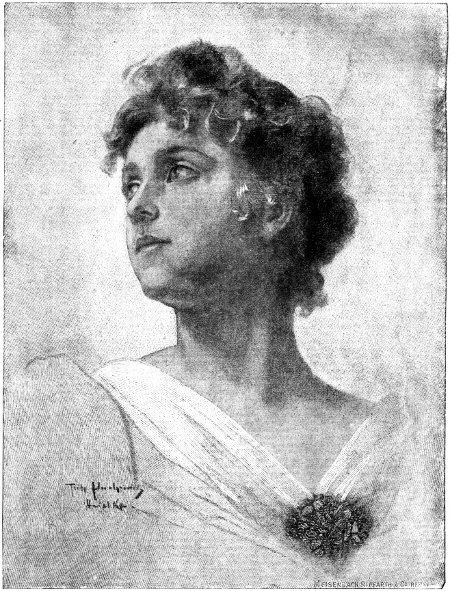
Rosa Nouchette Carey.
Helen C. Black.
VARIETIES.
Mansions.
“I am glad that His house hath mansions,
For I shall be tired at first,
And I’m glad He hath bread and water of life,
For I shall be hungry and thirst.
I am glad that the house is His, not mine,
For He will be in it, and near,
To take from me the grief I have brought,
And to wipe away every tear.”
T. O. Paine.
Death the Gate of Life.—Plato, the
great Athenian philosopher, who was born
427 years before Christ, recognised the doctrine
that death is but the gate of life. “My body,”
he says, “must descend to the place ordained,
but my soul will not descend. Being a thing
immortal it will ascend on high, where it will
enter a heavenly abode. Death does not differ
at all from life.”
Useless Trouble.
“Why lose we life in anxious cares,
To lay in hoards for future years?
Can these, when tortured by disease,
Cheer our sick heart, or purchase ease?
Can these prolong one gasp of breath,
Or calm the troubled hour of death?”
Gay.
Women in Burma.—In Burma women
are probably more free and happy than they
are anywhere else in the world. Though
Burma is bounded on one side by China, where
women are held in contempt, and on the other
by India, where they are kept in the strictest
seclusion, Burmese women have achieved for
themselves, and have been permitted by the
men to attain, a freedom of life and action that
has no parallel amongst Oriental peoples.
Perhaps the secret lies in the fact that the
Burmese woman is active and industrious,
whilst the Burmese man is indolent and often
a recluse.
She knew Nothing of Cycles.
Here is a story for cyclists. At a party on
the Scottish Border last autumn, to which
many guests rode on their cycles, the hostess
made elaborate arrangements for the care of
the machines, and a system of ticketing similar
to that in use at hotel cloak-rooms was adopted,
each cyclist being provided with a check ticket.
The housekeeper was entrusted with the
care of the machines and the issuing of the
tickets, and as they arrived the machines were
carefully stored and labelled so that there should
be no difficulty when they were required again.
But the housekeeper was not a cyclist and
did not understand the mysteries of the
pneumatic tyre. She pinned the labels on to
the front tyres of the machines, where they
could best be seen, and took good care that
the pins were stuck well into the tyres.
The language that was heard when the
guests came to take their machines away, was,
as may well be supposed, more emphatic than
polite.
THE HOUSE WITH THE VERANDAH. — CHAPTER XXV.
By ISABELLA FYVIE MAYO, Author of “Other People’s Stairs,” “Her Object in Life,” etc.
THE NEWS THAT CAME AT LAST.
rs. Bray’s end
did not prove so
imminent as her
faithful Rachel had
feared. She lingered
on, though
still unable to leave
Bath for return to
her desolated home.
So Florence Brand
came back to London,
but she and Jem
still often took “a week’s
end” to run westward and
visit the old lady. They never offered to
take Lucy with them, and if “Jem” could
not go Florence went alone. As for Lucy,
she often yearned for those associations
with her old easy girlish life which she
would have found in Mrs. Bray’s presence.
Such associations help to uphold
our sense of identity, and often comfort
us by revealing our own growth.
They keep us tender, too, and tolerant,
reviving the consciousness of what we
were ourselves before we learned bitter
lessons which may not yet have come
to others. Also they strengthen us by
revealing that not even to regain our
old careless joys could we willingly
be again our old careless selves. It is
the “look backward” which best spurs
us to go forward.
But Lucy could not afford any “unnecessaries”
of leisure or railway travel.
She turned at once to her life of steady
labour, knowing that she must be henceforth
a working woman, not for any
temporary exigency, but as part of the
natural and persistent order of things.
Even thus she had problems to solve.
Her earned income, more or less uncertain,
was not adequate for the reliable
upkeep of the home of her married life.
Nor could the demands upon it grow
less, since Hugh’s education and start
in life had to be taken into account.
Lucy could not yet give up all hope
of her husband’s return. But her sweet,
sane nature speedily realised that whatever
hopes she might secretly cherish,
she must nevertheless act as though
Charlie had indeed “sailed for that other
shore” whence he “could not come back
to her.”
Yet these secret hopes made it very
hard to contemplate the surrender of the
home Charlie and she had made together—the
sale of the leasehold, the dispersion
and shrinkage of the household gods.
These seemed almost sacred now when
they might be all that remained of the
old life.
The Brands warmly advocated giving
up the house and selling off the furniture.
“It may not bring in much,” Florence
said airily, “but what it does Jem will
get well invested in some paying concern.
Then you and the boy can board
with somebody. You may do that
moderately enough, for people who are
glad to take boarders can often be
screwed down to low terms. Then apart
from that definite outlay, you’ll have
whatever you can earn for yourself, and
you’ll have no more worry with housekeeping.
Many would envy such a lot.
You see there are compensations in all
things.”
Then it struck Florence that Lucy’s
hesitancy might arise from reluctance to
give up all hope of Charlie’s return, so
she added hastily—
“And if what we all hope for should
really happen, why, you would still have
your capital, and you could buy another
leasehold and get new furniture; it
would just make a lovely new beginning!”
Lucy shook her head.
“I don’t want to do this if I can find
some other way,” she said. “No other
house could be to us what this one is,
nor any new furniture that which Charlie
and I bought bit by bit in our courting
days. Practically speaking, too, breakings-up
and sales, and buyings again, all
mean loss in cash as well as in feelings.”
“Then, too, if you and the boy were
boarding,” Florence went on hurriedly,
“your wants would be drawn within
narrow and defined limits, so that if
there was any sort of misfortune, it
would not be difficult for us to help you.
We are not really rich, Lucy. We live
as we do and spend as we do only that
we may go on getting more. That is
the way with one-half of the people in
society. It’s trying. It tells upon Jem,
it’s that which makes him take so much
wine,” she whispered. “I should not
like my family to heap any burdens on
Jem.”
“I shall not do that, Florence,”
replied Lucy, cool and quiet now, where
once she would have been indignant
and stung. “I shall certainly not
allow myself to get into debt. I will
look well ahead. If we have to go to
the workhouse, I will make our own
arrangements for going there!”
Other people took counsel with Lucy
in a far different spirit. Miss Latimer
said Lucy might rely on her remaining
with her as long as they could possibly
share a common home. That added her
little income to the household funds.
“Little indeed,” she said, but Lucy
answered—
“Every little helps. And the greatest
help is in the knowledge that one does
not bear one’s burden alone.”
“Ay, two are better than one,” rejoined
the old governess, “and a threefold
cord is not quickly broken.”
“I’d like to be the third cord, but I’m
only a bit of twine,” said Tom.
Another and stouter strand was soon
to be woven into the household coil for
that “long pull and strong pull” which
Lucy was determined to make. The
death of his old landlord had broken up
the house where Mr. Somerset had
hitherto lived. Diffidently, as if he
were asking a great favour, he inquired
if Lucy could entertain the idea of allowing
him to rent her first floor, for which
he was willing to pay a rent which at
once made a substantial addition to the
household finance.
As for poor Tom Black, he was distressed
to think how small his payments
were. “If he went away,” he said,
“somebody more profitable might
occupy his place.” Lucy had to reassure
him by her own words and by
the sight of Hugh’s tears at the bare
thought of “Tom’s going away.”
Three months later Tom got a rise
in his salary, and then he insisted on
raising his monthly board fee. Lucy
was slightly reluctant and almost aggrieved,
but when she saw the lad’s
face beaming with the power of his new
prosperity, she let him have his own
way in the matter.
So life settled down. Florence resented
that her sister had chosen “to
turn into a lodging-house keeper.”
Lucy marvelled to note how strangely
it “comes natural” to some women to
belittle and contemn those ways of
honest industry which lie nearest to
woman’s true nature—housekeeping,
house-serving, the care of the aged,
and the young, and the solitary. And,
oh, the pity of it! if such belittlement
and contempt tend to relegate these
high womanly functions only to unworthy
“eye-servants”!
Months passed, yet the silence of the
seas remained unbroken. Now and
then Lucy and the captain’s wife wrote
and asked how each fared. There
came no day when either drew a line
across life and forbade that hope should
cross it. They did not put on widow’s
mourning, yet when Lucy had to buy
a new dress or ribbon, Miss Latimer
noticed that she bought it of black or
of soberest grey.
Months of such waiting had gone by
ere Lucy wonderingly observed that there
came to her no more her old nightmare
vision of herself struggling lonely between
a wild heath and a dead wall
against a midnight storm. There was a
sense in which the allegory of that vision
was converted into fact—the silence as
of death on one hand, the great rough
world on the other, the storm of sorrow
beating on herself. Yet now she realised
that God Himself was with her on the
dark wild way—she was not alone—and
that made all the difference. God does
not promise to uphold us in our fears
and forebodings. These ought not to
be. He has promised to be with us and
to comfort us when the dark days shall
really come.
Lucy never gave voice to many of her
deepest experiences at that time—that
secret speech which the Father keeps
for each of His children. Sometimes it
seemed to her as if shafts of light
penetrated her very being, revealing or
illuminating the most solemn mysteries
of life. Sometimes she thought of Paul’s
allusion to being “caught up into the
third heaven” and “hearing unspeakable
words which it is not lawful for a
man to utter.”
This fleeting glory would fade out of
Lucy’s soul even as sunshine fades off
the earth. Yet Lucy felt that those
“hours of insight” left her seeing “all
things new.”
Lucy began to understand how martyrs
can smile and speak cheerfully at their
stake, because from that standpoint their
developed spiritual stature lifts them to
wider horizons than others know. What
a message the blue sky must have had
for the white depths of the Colosseum!
Yet these things can never be told or
written. Whoever would know them
must learn them for themselves, though
it be but “in part.” But it is because
of these things that faith and hope and
love have never died out of the world,
since all the forces of unfaith and
despair and cruelty end only in producing
them afresh, because they are of the
eternal life of God.
Lucy’s picture-dealer felt kindly towards
the quiet client who gave so little
trouble, showed so little self-conceit,
and, while steadily business-like, was
never exacting or suspicious. He
thought “it would do Mrs. Challoner
no harm” if he told her that one or
two purchasers had said, “There is
something in that lady’s sketches which
we miss in many greater artists,” one
old lady adding that “when she looked
at Lucy’s pictures, she felt as if there
was a soft voice beside her whispering
something pleasant.”
That brought the tears to Lucy’s eyes
and made her feel very humble, possibly
because she could not deny to herself
that there was truth in the gracious
words. Oh, to have Charlie again, and
yet to be all that she had grown into
since he had gone away—since this
awful silence! And an inner voice
bade her take cheer, for was not this
what was sure to happen here or there—sooner
or later?
“What a pitiful bliss we should make
for ourselves if we were left to do it
without God!” Lucy cried, thinking
even of the sweetest dreams of courting
days, the best aspirations of married
life. For after one taste of “the peace
which passeth understanding,” one
vision of the joy which has absorbed
the strength of sorrow into it, mere
“happiness” looks but a poor thing,
even as a child’s cheap, pretty toy shows
beside a masterpiece of genius.
Lucy’s slumbers now were deep and
calm. Almost every morning she awoke
with a sense of refreshment, as when
one returns to labour after being among
kind hearts in lovely places. Sometimes
she knew she had dreamed, and such
dream memories as lingered, elusive,
for a few waking moments, were always
bright and cheering. Visions of Charlie
had come during the first nights after
the great blow. He never seemed to
speak, but he was always smiling,
always confident that all was well and
would be well. His dream form always
appeared in positions and in scenes
which Lucy could recall as having
figured in peculiarly happy times. And
yet these scenes had been at the time so
slight and evanescent that Lucy had
quite forgotten them till the dream
revived the remembrance. It was as if,
in her sleep, her soul was drawn so near
the light and warmth of love that even
the invisible records of memory started
into view.
After those first few occasions Charlie
came no more into any dream which she
could recall even at the instant of
waking. But the soothing spirit of
hope and reassurance remained. If she
dreamed of Florence, Florence wore the
simple frocks of her girlhood and spoke
as she used to do. Jem Brand, too,
appeared only on his kind and helpful
side. Once she had a curious dream
of seeing two Jem Brands exactly alike,
save that one was fresh and smiling and
friendly, and inclined to nudge his
strange dissipated-looking twin, and to
ask why he was so grumpy and heavy.
In her sleep, too, she saw Mrs. Morison,
and Jane Smith, and Clementina, and
each was back in her old place and
doing well. Lucy could never remember
what passed between them and
her in the land of sleep, but somehow
she knew it was something that explained
things, something which made
them feel that the past could not have
ended otherwise than it had, but which
also made her feel that it was quite
natural that they should begin again
and do better.
She thought to herself once as she
awoke—
“I feel as if wherever Charlie is I am
in his every thought, and that his every
thought is a prayer always ascending
on every way by which it can bring back
blessing.”
It was about this time that it struck
Lucy that strangers very often spoke to
her. She scarcely ever entered an
omnibus or a railway carriage without
somebody appealing to her for some
trifling assistance, or confiding to her
some little difficulty which they seemed
to think might grow clearer if it were
talked over. Once or twice she noticed
that old folks or little children let ever
so many people pass them by and then
asked her to ring a stiff bell for them or
to decipher an address.
Sometimes she caught herself softly
repeating Adelaide Proctor’s lines—
“Who is the angel that cometh?
Pain!
Let us arise and go forth to greet him.
Not in vain
Is the summons gone for us to meet him;
He will stay and darken our sun;
He will stay
A desolate night, a weary day.
Since in that shadow our work is done,
And in that shadow our crowns are won,
Let us say still, while his bitter chalice
Slowly into our heart is poured—
‘Blessed is he that cometh
In the name of the Lord!’”
Of course beneath all this high experience
ran the undercurrent of simple
daily living. Lucy was in no danger of
losing hold of the practical. She had
her regular duties at the Institute, and
many little opportunities for the exercise
of tact and common sense at home.
The little household had a real organic
unity in its common service of true
friendship, but that did not rub off all
the little human angles. Sometimes
Pollie would say that “Mrs. May was
more particular than a real mistress.”
Sometimes Miss Latimer found a trial
in the romps of Hugh and Tom Black.
Mr. Somerset adopted vegetarianism
and puzzled Mrs. May by desiring her
to concoct dishes which seemed to her
unsatisfactory and uncanny. But each
trusted the other. Everybody knew that
everybody meant well. If a sharp word
were spoken unwarily, a kind word
followed hard upon it. Each understood
that all joys and trials were
common property; shares therein might
differ, but everybody had a share.
So the weeks grew into months, and
the months completed a year. One
evening Lucy was sitting in the dining-room
glancing over her completed
balance sheet with its tiny “surplus,”
when suddenly it seemed to her that
there was a new sound in the very
rumble of the cab which was depositing
Mr. Somerset as usual at the door, after
his day’s study at the British Museum.
She looked up, her pen in her hand
listening.
Mr. Somerset generally went straight
to his own apartments. Occasionally,
however, when he had any news to
tell or any request to make, he looked
in upon the little party in the dining-room.
He did so now.
He sat down on the sofa and said
abruptly—
“Mrs. Challoner, do you think joy
ever hurts anybody?”
“Surely not,” she said, looking up
with wide eyes. “The Bible says that
hope deferred maketh the heart sick,
but that when the desire cometh, it is a
tree of life.”
“Do you feel sure, dear friend, that
you could bear——”
She had risen from her seat with
clasped hands.
“Mr. Somerset, Mr. Somerset!” she
gasped.
He rose too.
“Trust me,” he said, gently leading
her mind to its new attitude. “I would
not stir expectation ever so lightly for
nothing. To-day I have received a
message from the shipping office to
deliver to you. Listen! The long
looked-for word has come at last.
Charlie lives! Charlie is quite well!
Charlie is coming home! He is on his
way!”
Lucy did not faint. She did not cry
out. She sat quite quiet for a moment,
and then broke into a peal of low happy
laughter, which died away in a flood of
soft healing tears, from which she looked
up and said—
“Is it all true? Is it quite true? I
can scarcely believe it!”
(To be continued.)
THE PLEASURES OF BEE-KEEPING. — PART V.
By F. W. L. SLADEN.
ugust is the month we most
associate with all the active
interests of the height of
summer, but the bees in the
hive are already quieting
down and making preparations
for their long winter
sleep. The duty of the bee-keeper
will be to make sure
that these preparations are properly carried
out by assisting them if necessary. One
reason for their diminished activity is the
disappearance of several honey-producing
flowers on which the bees depend for their
main crop. Breeding is not kept up so
largely—the brood nest growing smaller; and
many cells that contained brood last month
will now be filled up with honey and pollen.
Most of the bees now in the hive are to survive
the coming winter, and they must preserve
their energies as much as possible, because
the colony will stand in great need of their
services in the following spring. The drones,
who gather no honey, and are of no further
use in the hive are now attacked and killed,
or turned out of the hive to perish from
exposure. The ejection of the drones is
rather a gruesome proceeding, but it is one
that should give satisfaction to the bee-keeper,
because it shows that the colony possesses a
healthy and vigorous queen, and this, of course,
is an essential condition for its well-being.
All through this month robbing will have
to be guarded against, as, now that honey is
scarce, it is easily induced, especially where
there are a number of hives. To prevent
robbing, the hives should not be opened too
often, and then only late in the afternoon,
and the work done as speedily as possible.
No drops of honey or syrup should be left
about, and if feeding is going on, care should
be taken to prevent any bees from outside
getting to the feeder.
When robbing and fighting are found to be
in progress, the best means of checking the
trouble will be to reduce the entrance of the
hive with perforated zinc, so as to allow only
one bee to pass in or out at a time. A rag
soaked in a weak solution of Calvert’s No. 5
carbolic acid, wrung out nearly dry, and spread
out on the alighting board will also help to
keep the robbers off.
These measures need not be taken unless
there is considerable excitement around the
hive entrance. At this time of year there will
often be a few strangers on the alighting
board, which get pulled about rather roughly
by little groups of over-zealous sentinels, but
no notice need be taken of this.
The middle or end of August will be time
enough to think about getting the bees into
condition for the winter. A careful inspection
of all the hives should now be made, and the
following points carefully noted:
(1.) Every colony should have a good laying
queen. The appearance of worker brood in
all stages will be sufficient evidence of her
presence without our taking the trouble to
hunt her up.
(2.) The colony must be strong, the bees
crowding on at least six standard frames.
(3.) The combs must contain not less than
twenty pounds of good honey for food during
the winter.
These three conditions being fulfilled, we
may be satisfied that the colony is in good
condition to withstand the rigours of winter
without further attention, and only requires
to be wrapped up warmly later on before the
advent of cold weather.
If, however, the colony should happen to
be queenless, or weak (that is, covering less
than six standard frames), it will have to be
united to another colony. Thus, two colonies,
neither of which, alone, would be strong
enough to stand the winter, can be united
together to form one strong colony, which, if
properly looked after, will almost certainly
turn out strong in the spring and do well the
following year.
The colonies which are to be united should
stand near to one another; by this I mean
within a yard or two of one another. If they
are further apart or have several other hives
standing between them, they will have to be
brought together, the moving being done by
degrees, a yard or two at a time, and only on
fine days during which the bees fly freely,
otherwise many bees will be lost.
For the operation of uniting a flour-dredger
will be required, containing about
half-a-pint of flour. Also a goose-wing for
brushing the bees off the combs. The dome
queen-cage is an appliance that may come in
useful. It is made of tinned wire-cloth, and
shaped like the strainer that is sometimes
hung from the spout of a tea-pot to retain the
leaves. Such tea-strainers make very good
queen-cages. To use the queen-cage it is
pressed into the comb with the queen inside.
The hive to contain the united colonies
should be placed midway between the two
old stands. The alighting-boards should be
extended by means of the hiving-board which
was used in hiving the swarm.
A bright calm afternoon will be the best
time to do the uniting. We have already
seen that bees belonging to different colonies
when mixed will not, under ordinary circumstances,
agree. If, however, they are prevented
from recognising one another they will unite
together quite peaceably, and this condition
may be brought about by dusting them over
with flour. Every comb must therefore be
lifted out of both hives and the bees on them
well powdered with flour from the dredger.
In replacing the combs, one from one hive
should be put next to another from the other
hive, thus ensuring the better mixing of the
bees. Combs containing brood should be
placed together in the middle of the hive. The
bees on the lightest of the outside combs may
be shaken off on to the hiving-board, where
they should receive a sprinkling of flour, the
combs being then taken indoors at once.
During the operation a sharp look out
should be kept for the queens on the brood
combs, and if one of them should be preferred
for heading the new colony she should be caged
by herself on a comb in the manner described
above to prevent any hostile workers from
attacking her. The other queen must then be
found and removed, and the bee-keeper must
remember to liberate the caged queen on the
following day. If left to themselves, however,
the workers soon learn to recognise one of the
queens as their mother, so that the trouble of
finding and caging the queen is not really
necessary in uniting, but it is an additional
safeguard which the practised bee-keeper is
glad to be able to take advantage of.
It was stated just now that the presence of
worker-brood in the hive was sufficient evidence
of the presence of a good queen. In
some cases where there is a bad queen or no
queen at all, drone-brood may be found in the
hive. Usually the bees build a special comb
with cells of a larger pattern for raising drone-brood
in, but a bad queen will often lay drone
eggs in worker-cells. In either case drone-brood
may be known from worker-brood by
its raised convex cappings, the capping over
the worker-brood being almost flat. The best
thing to do with a drone-raising colony is to
unite it to another good colony without delay
in the manner described above.
Having settled the question of strength, the
next thing to see about will be the food
supply. If each hive does not possess the
minimum weight of 20 lb. of stored honey,
combs containing food must be given from
another hive that can spare them, or syrup
must be supplied through the feeder.
Syrup for winter use must be made thicker
than that used for stimulating in the summer,
10 lbs. of cane sugar being dissolved in only
5 pints of water. The syrup must be given
quickly (5 or 6 lb. every day), otherwise much
of it may be used for raising brood. For
this purpose special rapid feeders, made to
hold 6 lb. of syrup, are made.
If the stock-box contains more than 30 lb.
of honey, we may take and extract the surplus
from the outside combs, or one of these combs
might with advantage be given to a colony
that stands in need of it.
Bee-keepers who live in the heather districts
of Scotland and the north of England will
now be reaping the late honey harvest that
this plant affords, getting their supers filled
with the delicious heather-honey, which is so
highly esteemed for its fine flavour. Persons
keeping a few colonies a little distance from
the moors find it worth their while to send
their bees there while the heather is in bloom.
Heather-honey has a deep colour. It is so
thick that it is extremely difficult to remove it
from the comb by means of the honey extractor.
It should therefore be stored in sections,
as these do not require extracting. Sections
of heather-honey should fetch about threepence
more than ordinary sections.
What to do with the honey obtained from
their bees is a question, I expect, that will
not trouble many of my readers. Still it will
be a good thing to know some of the uses
of honey. In the first place it is delicious
eaten with bread and butter. It contains
grape sugar, which makes it wholesome and
easily digested, and particularly good for
children in moderate quantities. Honey-vinegar
and mead when well made are
acknowledged to be excellent. As an ingredient
in cakes and confectionary, honey greatly
improves them. A delicious flavour is
imparted to tea or coffee if sweetened with
honey instead of sugar. “My son, eat thou
honey, because it is good” (Proverbs xxiv. 13)
is the recommendation the wise King Solomon
gave honey.
Honey is also valuable as a medicine.
Mixed with the juice of lemons it is universally
acknowledged to be one of the best
remedies for sore throat and cough. It has
been proved to be beneficial in cases of
rheumatism, hoarseness, and affections of the
chest.
(To be concluded.)
THREE GIRL-CHUMS, AND THEIR LIFE IN LONDON ROOMS. — CHAPTER X.
arion’s wedding-day
was near at
hand. Mrs.
Grant, her
cousin, who
lived in
Norfolk
Square,
had very
kindly offered
to
have the
wedding from her house, and this arrangement
was the most convenient for everybody
concerned. It had been at first intended that
she should be married from her own home in
Northamptonshire, but there would have been
such a difficulty in putting up all the wedding
guests, and Dr. Thomas’s house was already
a very full one. So when Mrs. Grant offered
the loan of her house for the occasion it was
thankfully accepted.
Marion was glad to be in London for a
week or two beforehand as she was so busy
with her trousseau, and it made the shopping
and trying on of dresses so much more easy.
Her mother came up to town to stay in
Norfolk Square for a fortnight before the
wedding to help her with her purchases. The
rest of the family were coming up for the
wedding on the day and were going back to
the country as soon as it was over.
Marion was disappointed at not being
married from her own home, but she saw
plainly that the present arrangement would
save her mother a great deal of fatigue and
inconvenience, and as Mrs. Thomas was not at
all strong now, that was a great point gained.
Anybody who has experienced the difficulties
of making ready for a party, added to the
planning and contriving necessary to the
disposal of guests in an already over-full house,
will heartily appreciate the benefits of Mrs.
Grant’s plan.
Jane wrote to Mrs. Grant, whom she knew
very well, and offered help for the wedding
breakfast. As the cook in Norfolk Square
had not been in her place very long and was
rather inexperienced, Mrs. Grant was very
glad to agree to Jane’s suggestion. The
wedding was to be on a Saturday. Fortunately
the day before was a free day for Jane, and so
she would be able to devote it to making
ready for the wedding.
There was to be a sit-down breakfast in the
old-fashioned style, for the guests were limited
to the relations and very old friends of the
bride and bridegroom, and as several of these
would be coming up from the country for the
day, they would be glad of a substantial repast.
The bride was to be married in a travelling
dress, and was only to have one bridesmaid—her
sister Lily.
As the weather was already crisp and cold
this was a very sensible plan, for nothing is
more unbecoming than the utterly unseasonable
attire in which brides and bridesmaids are
sometimes seen shivering. Fortunately Marion
was not to go straight to a very hot climate,
as Mr. Scott had work at Ootacamund for the
next year. She received many delightful
presents. A very useful one from one of her
pupils was a cookery-book for Anglo-Indians,
which she treasured very much, as she knew
how very useful it would be to her in her new
home.
Mrs. Holden gave her several presents,
amongst which was some very beautiful lace
which Marion had made up on a white silk
dinner dress.
The enterprising Jane made the wedding-cake
with Ada’s help. She had to buy a
special tin to bake it in as she had not one big
enough. It was cooked with the greatest care
in the gas oven in which Marion had prepared
so many meals in the days of their joint housekeeping.
The preparations took some days, for Jane
had not very much time just then. She
prepared half the fruit one evening and half
the next. On the next afternoon she got
home early, made the cake, and got it into the
oven by six o’clock, and had it baked before
they went to bed. The next evening she put
on the almond icing and the plain royal icing,
and on the next she ornamented it. It was
allowed two or three days to set quite firm,
and then the cake was wrapped in wadding,
packed in a box and taken over to Norfolk
Square in a cab, where it was kept under a
glass case until the wedding. Our readers
must have the recipe of this wonderful cake
in case they may wish to emulate Jane’s industry
for the benefit of their friends. Mrs.
Oldham sent up a special box of eggs for its
concoction.
Marion’s Wedding Cake.
Ingredients.—Two pounds of Vienna flour,
one pound of French plums, one pound of
sultanas, one pound of currants, one pound of
citron peel, one and three-quarter pounds of
fresh butter, one and a half pounds of castor
sugar, ten eggs, one pound of sweet almonds,
and vanilla essence.
For the Almond Icing.—Two pounds of
ground almonds, three pounds of castor sugar,
almond flavouring, enough beaten egg to bind.
Royal Icing.—Three pounds of icing sugar,
whites of egg to mix, lemon juice.
Method.—Rub the flour through a hair
sieve, stone the French plums and chop them
finely, wash and dry the currants, and pick
and flour the sultanas; cut up the peel, sift
the sugar, blanch and chop the almonds. Beat
the butter to a cream, and then add the sugar
and work together until very light; add the
eggs one by one, flour the fruit well, and stir
it in gradually, the almonds also: lastly, stir
in the flour, the essence, and the brandy. Line
a tin with paper that has been brushed with
clarified butter; pour in the mixture, and bake
in a moderate oven.
Almond Icing.—Mix the ground almonds
and castor sugar together and then work in
enough beaten white of egg to bind; knead
and roll out, lay over the cake and put near
the fire to dry.
Royal Icing.—Rub the icing sugar through
a sieve and work in with a wooden spoon
enough white of egg to make the icing of the
right consistency to spread over the cake; add
a little lemon juice. Dry the icing in a cool
oven, taking care it does not colour. Ornament
the cake the next day, using royal icing mixed
rather more stiffly than that which was spread
over first. Put it on with a forcer.
Jane declared that she only breathed freely
when she had deposited the cake in Mrs.
Grant’s house, and saw it waiting for the
wedding under a large glass globe!
Here we have the menu for the wedding
breakfast.
MENU DU DÉJEUNER.
Ox-tail Soup.
Oyster Patties.
Glazed Pheasants.
Pigeon Pie.
Tongue.
Pistachio Cream.
Claret Jelly.
Fruits.
Coffee.
The cook at Norfolk Square and Jane both
worked hard all the day before and everything
turned out very well. To ensure the pheasants
and the tongue being well glazed and looking
nice, Jane made some good glaze and brought
it with her. This she did by making a pint of
good beef-tea and boiling it rapidly down to a
thick syrup. The pheasants and the tongue
had each two coats brushed on and were
then suitably ornamented, the tongue with a
pretty design in creamed butter put on with
a forcer and slices of notched cucumber laid
round the dish. The tongue was a smoked
one and was soaked for twenty-four hours
before being cooked. Jane made all the puff
pastry for the patties and the pigeon pie; the
cook made the soup, cooked the pheasants
and the tongue and prepared the inside of the
pie under her supervision. She also prepared
the moulds for the creams and jellies. Here
are the recipes for the soup, patties, creams,
and jellies. The quantity made consisted of
two quarts of soup, two dozen patties, two
creams (quart moulds), two jellies (ditto), and
two pies.
Ox-Tail Soup.
Ingredients.—One ox-tail, one carrot, one
turnip, two onions, two sticks of celery, two
tomatoes, four mushrooms, bay-leaf, blade of
mace, a bunch of herbs, twelve peppercorns,
two teaspoonfuls of salt, two quarts of stock,
two ounces of butter, three ounces of brown
thickening.
Method.—Cut the ox-tail into joints and
blanch it. Fry it well in the butter, add the
vegetables washed and sliced, the mace, herbs,
salt, and the stock, and simmer four hours.
Strain and pick out the pieces of meat;
take off the fat and return to the saucepan.
Thicken with three ounces of brown thickening.
Put in the pieces of ox-tail and the
soup is ready.
Puff Pastry.
Ingredients.—Two pounds of Vienna flour,
two pounds of butter, lemon juice, water to
mix, two yolks of eggs.
Method.—Rub the flour through a hair
sieve; wash the butter and rub one-third into
the flour. Turn this on to the paste-board
and make a well in the middle. Beat the
yolks of two eggs with a gill of water and a
little lemon juice and mix into the flour,
adding more water if necessary until you have
a flexible dough. Roll out to a strip, shape
the butter to a third the size of the dough and
lay it on; fold the dough over and roll out;
repeat this and put it away to cool. Roll out
again and repeat this four times. Roll out,
cut as required, and use. For patties, cut into
rounds with a cutter about the size of a wine-glass
and mark it at the top with a smaller
cutter. Bake in a very hot oven a pale golden
brown, and when baked lift off the lid and
scoop out the inside; fill with the required
mixture and put on the lid again.
Mixture for Oyster Patties.—Strain the
liquor from two dozen oysters and put it to
boil for ten minutes with a blade of mace,
three peppercorns, a little lemon rind, and
some salt; strain and mix with a gill of cream.
Work half an ounce of butter with as much
cornflour as it will take up, stir it into the
liquor and boil up over the fire; cut the oysters
in small pieces, put them into the sauce and
heat gently for a few minutes without letting
it boil again.
Pistachio Cream.
Ingredients.—One pint of double cream,
the whites of two fresh eggs, four ounces
of castor sugar, a quarter of a pound of
pistachios (chopped and blanched), one ounce
of leaf gelatine, two tablespoonfuls of water,
a half-pint packet of lemon jelly.
Method.—Take a plain round cake-mould
that will hold a quart, and line the sides of it
with lemon jelly. Sprinkle the bottom over
with chopped pistachio, using a little melted
jelly to set it. Whip a pint of double cream
to a stiff froth, and mix it lightly with the
stiffly beaten whites of two fresh eggs and the
castor sugar (sifted). Pound the pistachios in
a mortar, and add the sweetened cream to this.
Have ready the gelatine, and when it is lukewarm
stir it quickly into the cream. Pour at
once into the prepared mould.
Before the wedding-day, Jane, Ada, and
Marion had a little tea-party at “The
Rowans,” at which it must be confessed they
talked a great deal and ate very little.
“Well, we have had a very happy year at
all events,” said Ada, “and if circumstances
had not upset our previous arrangements, I
should have been quite content to go on in the
same way for a long time.”
“As circumstances, named Tom Scott and
Jack Redfern, intervened, our housekeeping is
at an end,” said Jane decisively. “I think I
am the one to whom all apologies should be
made. Of course, with you two gone, I could
not bear starting the same sort of thing again
with anyone else, but it has certainly been a
most successful experiment. Has your dress
come home yet, Marion?”
“Yes; and fits very well.”
“It is the prettiest dress you can imagine,”
said Jane to Ada. “A grey Sicilienne skirt,
with a grey glacé silk bodice, and cherry-coloured
velvet at the throat and waist. A
dear little cherry-coloured toque to wear with
it, and a smart grey velvet cape with a delicate
design in steel on it. I can’t help talking like
a fashion plate when I think of it! Our
dresses are sent back at last, and there is
nothing that needs alteration.”
Jane and Ada were to wear their new winter
dresses of green cashmere and brown velvet;
big brown “picture” hats with rowans under
the brim. Marion’s wedding-day dawned
bright and sunny. The wedding was to be at
two o’clock.
Jane had arranged to go over to Norfolk
Square early to superintend the laying of the
breakfast before the party went to church.
The table was decorated with white flowers
in specimen vases. Azaleas, chrysanthemums,
and orange-blossoms, and sprigs of rowan-berries
were laid on the pretty white satin
table-centre which Ada had worked for her
friend.
And now they are off to church.
Marion makes a charmingly pretty but very
nervous bride. Everybody is bright and cheerful
and there are no tears. Soon they come
back and sit down to the breakfast, prepared
with so much care. And now the time has
come for us to bid farewell to our young
housekeepers, whose plans and contrivances
our readers have followed for so long. If
their example will induce any to try the
experiment for themselves, Mrs. Scott, Mrs.
Redfern, and Miss Jane Orlingbury will feel
that they have not worked in vain.
[THE END.]
LETTERS FROM A LAWYER. — PART XI.
The Temple.
My dear Dorothy,—As you are one of the
members of the committee for the bazaar in
aid of the Nursing Home for Old People,
I may be able to give you a few useful hints
to avoid certain illegalities which beset the
path of the unwary promoters of such charitable
entertainments.
The great feature of a big bazaar should
consist in having as many side shows as
possible, so that people may be able, by the
expenditure of a shilling or two, to escape
from the importunities of the stall-holders
into a concert-room, waxwork show, or other
attraction, and not be driven out of the bazaar
altogether.
If you want to have anything in the nature
of a farce, operetta or comedietta played in the
building, you ought to inquire if the hall
which you are going to hire for the bazaar has
a licence for stage-plays. If it has not such a
licence, the performers and those responsible for
the entertainment will render themselves liable
to a fine, unless the proper licence is secured.
Fish-ponds, bran-pies, lucky tubs, and similar
contrivances, are doubtless, strictly speaking,
illegal, but are always tolerated at bazaars,
where people do not expect to get the value of
their money; but it is advisable to draw the line
at roulette tables or anything in the nature of
a real gamble or a lottery.
On the last day of the bazaar, it is often the
custom to sell off the undisposed-of stock of the
stalls by auction. The person who holds
the auction should be a person having an
auctioneer’s licence to sell by auction, otherwise
trouble may ensue, as the auctioneers have
recently made a determined stand against unqualified
persons acting as auctioneers.
I think that these are the principal errors
into which people who get up bazaars are
liable to fall; but perhaps I ought to enlarge
a little more upon stage-plays and the
necessity for having a licence for their performance.
It is almost impossible to give any kind of a
variety concert without unwittingly performing
what is the legal equivalent of a stage-play;
any song with dramatic action is a stage-play,
and so are duologues and monologues, as distinguished
from recitations.
Some people have an idea that so long as
they do not take any money at the doors, they
are quite safe and within the law in giving a
performance in the cause of charity, but such
is not the case. When money or other reward
is taken or charged, directly or indirectly,
or when the purchase of any article is made a
condition for admission, the performers and
the owner or occupier of the building render
themselves liable to a fine.
This may sound very alarming, and would,
no doubt, considerably startle those good
ladies who lend their houses for performances
for charitable objects in the season; but every
time they do so, and anything in the nature of
a stage-play is performed, they may be prosecuted
and fined, although personally they
take no benefit from such performances. The
fact that they frequently do so with impunity
does not affect the law on the matter, which is
perfectly clear. Why it has not been altered
before now, I am unable to say; hardly a day
passes without its being broken, exemplifying
the old proverb that “one man may steal a
horse from a stable, and another may not look
over the hedge.”
I know of a case where a gentleman who
had turned part of his house into the Theatre
Royal back drawing-room, and who permitted
a performance of a play to be given on two
occasions, to which admission was by ticket
only, which could be obtained beforehand on
payment of a fixed sum, in aid of the funds
of a charity, was convicted and fined under
the Act. The gentleman appealed against
the conviction, but without success; the conviction
was confirmed by the Court of the
Queen’s Bench. So be warned, my dear
Dorothy, and do not allow your friends to
disregard my advice, and be assured that it is
much better to avoid these risky entertainments
altogether.
Your affectionate cousin, Bob Briefless.
OUR LILY GARDEN.
PRACTICAL AIDS TO THE CULTURE OF LILIES.
By CHARLES PETERS.
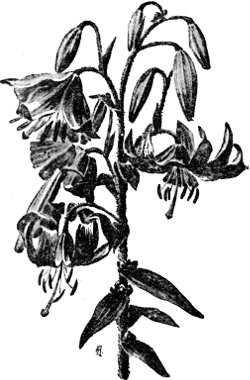
Lilium Tigrinum (var. Fortunei).
We will conclude our remarks on the noble
family of lilies by some notes and tables,
which will be found of great value to those
who wish to cultivate these beautiful flowers.
We told you in the first part of this book
that we kept a note-book—a kind of diary—in
which we kept a record of our work among
the lilies. We advise everyone who intends
to grow these plants to follow our example,
and get a large manuscript book to put down
the “proceedings” of her lilies. The following
points should be noted. (1.) The name
of the species and variety. (2.) The name
of the person from whom you obtained the
bulb. (3.) The day on which the bulb was
planted, with a note as to the condition of the
weather at the time. (4.) The circumference
of the bulb, and a brief description of it,
stating whether the flower-spike had begun to
grow, or the new roots had appeared, or if
any scales were mouldy or diseased. (5.) The
soil in which the lily was planted. (6.) The
date of the appearance of the shoot. (7.) The
date of flowering. (8.) A brief description of
the full-grown plant and its individual members.
(9.) The condition of the bulb when
exhumed.
Here is an example of the record of a bulb
of L. Auratum.
“Lilium Auratum, var. Platyphyllum,
bought from Mr. ——. Potted on the 3rd of
November, 1897; a warm, dry day. Bulb
seven inches in circumference; new roots
just appearing. A sound, heavy bulb. One
mouldy scale removed. Washed in lime-water;
sprinkled with charcoal and potted in
an eight-inch pot in a mixture of fine peat
(one part), rich leaf-mould (two parts), a large
handful of sand and a few small lumps of clay.
Shoot appeared March 17th, 1898; grew
rapidly. No disease. Flowered September
4th, 1898; five blossoms, all perfect, largest
eleven and a half inches across. No rain
when in flower. Lasted in blossom till September
20th, 1898. Bulb when exhumed
quite healthy, showing two crowns nine and
a quarter inches in diameter. Exhumed and
replanted October 21st, 1898.”
If you have a record like this of every lily,
you possess a most valuable book on the
culture of lilies; and, as we said at first, the
cultivation of these plants is little understood.
A thoroughly authentic, practical record
will help you more to become proficient
in the art of lily-growing than any amount
of impracticable theory.
Now some words to those who are
growing lilies in pots. As we have seen,
most species grow well in pots. All do
well except the following, which are unsuitable
for pot culture. The reason why they are
suitable is also given.
L. Cordifolium (too straggling).
All the Isolirions, because they are not sufficiently
ornamental for pot culture.
L. Humboldti. This lily does not do well
in pots; why we do not know.
L. Martagon, L. Pomponium, L. Pyrenaicum,
L. Chalcedonicum, L. Monodelphum,
L. Testaceum.
The last six lilies are unsuitable for pot
culture because they require to become established
before they will condescend to flower.
Most lilies grown in pots can be kept in the
open air or in a room, or anywhere you please,
but the following require protection of some
sort:—
Half-hardy species. These should not be
put out in frosty weather; otherwise they may
be grown out of doors. If you have planted
them in the ground at a sufficient depth, they
will stand all but a very severe winter. L.
Giganteum, L. Cordifolium, L. Formosanum,
L. Wallichianum, L. Washingtonianum, L.
Catesbæi, L. Polyphyllum, L. Roseum, L.
Hookeri, L. Oxypetalum, L. Alexandræ.
The following usually need a greenhouse to
grow them well:—L. Philippinense, L. Neilgherrense,
L. Nepaulense, L. Lowi.
Would you like to have lilies in pots in
your room? You can have them even if you
do not possess a greenhouse. You can grow
the lilies in the ground and transfer them to
pots just before they begin to flower. For
this purpose plant the bulbs in the open
ground in rather lighter soil than you would
if the lilies were to flower in the open. Place
the bulbs about four inches deep. You need
not remove the plant until the flower-buds are
nearly fully developed. Then take up the lily
with the surrounding earth, place it in a big
pot, drench it with water, and leave it in a
cool, shady place for three days. Then give
it a good dose of liquid manure. You may
then take it into your room, and it will flower
as though nothing had troubled the tranquillity
of its existence.
Not all lilies are suitable for this treatment;
only those species which will grow in light
soils should be used for this purpose. L.
Longiflorum, L. Auratum, L. Speciosum, and
L. Rubellum are most suitable for this form
of culture.
About the beginning of November all your
lilies in pots will have flowered and died down.
What are you to do with them now?
Shake the bulbs out of the pots; examine
them; remove any off-shoots; do not cut off
the roots; wash them in lime-water and re-pot
without delay.
Lilies do not rest during the winter. The
pots should be kept in a place which is not too
wet. The pots must not be kept too dry, but
an occasional watering should be administered.
We append a list of the lilies, giving the
exact composition of the soil in which we have
grown them best, both in the open air and
in pots. An asterisk is affixed to the most
desirable species.
Grown in a mixture of one part peat, two
parts leaf-mould, and a good sprinkling of
sand:
*1.
L. Longiflorum.
2.
L. Formosanum.
*3.
L. Auratum.
*4.
L. Speciosum.
*5.
L. Krameri.
6.
L. Rubellum.
7.
L. Henryi.
8.
L. Medeoloides.
Grown in a mixture of equal parts of peat
and leaf-mould, with plenty of sand:
*9.
L. Leichtlini.
10.
L. Maximowiczi.
11.
L. Catesbæi.
12.
L. Wallacei.
*13.
L. Canadense.
*14.
L. Parvum.
*15.
L. Maritimum.
*16.
L. Superbum.
*17.
L. Roezlii.
*18.
L. Pardalinum.
19.
L. Californicum.
Grown in equal parts of rich loam and leaf-mould,
enriched with the contents of an old
hot-bed, but with no peat and very little sand:
*20.
L. Candidum.
21.
L. Washingtonianum.
*22.
L. Humboldti.
*23.
L. Pomponium.
*24.
L. Martagon.
*25.
L. Pyrenaicum.
26.
L. Callosum.
27.
L. Carniolicum.
*28.
L. Chalcedonicum.
*29.
L. Monodelphum.
Grown in soil like the last, but with a fair
admixture of peat:
*30.
L. Giganteum.
31.
L. Cordifolium.
*32.
L. Wallichianum.
*33.
L. Parryi.
*34.
L. Japonicum Odorum.
*35.
L. Brownii.
*36.
L. Tigrinum.
37.
L. Bulbiferum.
*38.
L. Batmanniæ.
39.
L. Elegans.
*40.
L. Croceum.
41.
L. Davuricum.
*42.
L. Columbianum.
43.
L. Tenuifolium.
44.
L. Concolor.
45.
L. Hansoni.
The following species have never been grown
by us:—
*46.
L. Philippinense.
*47.
L. Neilgherrense.
*48.
L. Nepaulense.
*49.
L. Lowi.
*50.
L. Polyphyllum.
51.
L. Davidii.
52.
L. Oxypetalum.
53.
L. Roseum.
54.
L. Hookeri.
55.
L. Avenaceum.
During the greater part of the year you can
have lilies in flower in your garden. If you
possess a greenhouse you can have lilies in
flower throughout the year.
ASPIRATION.
Naturally the lilies flower in the open
ground from April till October. If you wish
to have lilies in your garden in November you
can do so, but mind you, if the weather is
unfavourable the blossoms will not be worth
much.
The lilies which will flower in the open
ground in November are L. Speciosum and
L. Auratum. For very late flowering the
bulbs should be planted in May. Last Lord
Mayor’s day we gathered a small bunch of
L. Speciosum, and one very fair example of
L. Auratum. The tiger lilies were also in
blossom at that date.
But this late crop of lilies is worth very
little; and, unless you have a greenhouse, we
advise you to be contented with six months of
lily flowers.
In a greenhouse it is easy to have lilies
throughout the year. L. Longiflorum will
flower from April to January, and L. Speciosum
will flower from August to February if
the bulbs are potted at intervals, and very
gently forced when necessary. In the month
of March you can have L. Rubellum in flower.
Doubtless some of our readers will wish to
grow lilies for show purposes. Indeed, for
this purpose few flowers are more satisfactory,
for lilies are extremely showy, they last very
well in flower, and are by no means impatient
of removal.
As a matter of fact, growing lilies for show
purposes can be conducted on two separate
systems; either you can grow show plants or
show flowers.
For the former purpose the stem, the leaves,
the shape of the inflorescence, and the number,
shape, size and colour of the blossoms
must be above the average. For “show
flowers” all your attention must be concentrated
upon one single blossom.
For growing show plants choose a very big
bulb. In our former articles we warned you
against these mammoth bulbs, because they
are so often unsatisfactory. But for show
plants you must choose these big bulbs; but
do not imagine that from every “mammoth
bulb” you will get a fine spike. You will
rarely get more than one really excellent plant
out of six bulbs.
For prize plants pot the bulbs in large pots
and keep them in a cold, dark place for a
fortnight. When the shoots appear, grow
them on as quickly as you can, but give no
artificial heat. Keep the plants in a place
where they are not likely to be injured by the
wind, and where there is plenty of shade. As
the flowering time arrives give plenty of liquid
manure.
Of all manures, “Ichthumic guano” is the
most satisfactory for show lilies.
You must turn your pots round every day,
so as to keep the stems straight. Lilies always
bend towards the sun, and unless the pots are
carefully turned round every day the stems
become twisted or bowed.
For growing prize blossoms choose a small
bulb. Grow it as you did for a prize plant,
but when the buds begin to turn colour, remove
every one except one—the finest. Cut
the flower with as long a stem as possible, and
send it to the exhibition while it is opening,
and before the pollen has become free.
Grow your show plants as carefully as you
will, you will often find that many uncared-for
plants in the garden beat the pampered one
in the form and delicacy of their blossoms!
Like all other flowers, the lilies possess
many more names than they desire, and in
many cases even the slightest variation from
the type has been labelled with a new name.
You must therefore beware of paying high
prices for cheap lilies with a new name—a fate
which will damp the ardour of most amateurs.
Our work among the lilies is done. If our
admiration for them has been great, it has
never been excessive. The lilies are the loveliest
of all flowers, and the study of them is
wrought with delight.
“Consider the lilies of the field, how they
grow; they toil not, neither do they spin:
and yet I say unto you that even Solomon in
all his glory was not arrayed like one of these.”
“UPS AND DOWNS.” — CHAPTER III.
A TRUE STORY OF NEW YORK LIFE.
By N. O. LORIMER.
f you had peeped into the
big attic bedroom
the three girls occupied
at the top
of the high New
York boarding-house,
you would
have seen Ada
Nicoli in her
pretty white dressing-gown—such
a
pitiful reminder of
her former luxury—putting
little
Sadie’s hair into
curl-papers. In
her lonely life she
had grown passionately attached
to her two little sisters who were
so dependent on her, and the
thing that hurt her most about
her poverty was seeing little
Sadie look careless and neglected.
Often at night she was
so tired and weary that it took
all her courage to brush and dress
their two heads of hair, and see that their
clothes were in proper order for going to
school the next day. A hat-box full of
Southern bank-notes, which had been Marjorie’s
and Sadie’s amusement for many a day
in their old home for playing at store-keeping,
came in handy for curling Sadie’s hair, and
the child always wanted Ada to tell her the
same story, how her mother’s mother had
saved up the bank-notes during the great war,
believing that the South would be victorious,
and how she had made some of the notes
during the war by making slippers out of the
felt carpets and selling them.
“If they were all real good dollars now,
Ada,” the child said, “we needn’t live in
this hen-roost any longer, need we?”
Ada took the child in her arms. “Poor
little Sadie,” she said. “While we three are
together, it doesn’t so much matter, does it?
We can have a little fun sometimes, can’t we?”
“It isn’t so bad, siss,” the child answered,
“but I do want to go to Barnum’s, and I wish
the girls at school wouldn’t say, ‘When’s
your father coming back? He’s been visiting
for a long time.’”
Then Marjorie chimed in with—“I passed
two of the girls I used to go to school with
to-day, Ada, and they both looked in at a
shop window when I passed.”
“Never mind,” Ada said, with her heart
growing sadder every minute. “It’s a good
thing not to be at school with girls who
are so vulgar.” Ada’s own rich friends had
also disappeared in a marvellous fashion. It
is true she had left her old home so suddenly,
and had to avoid seeing people whom
it would be painful to meet in her altered
circumstances, so much that, perhaps, they
were not altogether to blame. She had
been working for some months at Madame
Maude’s now, and she had found that she had
very little time in her busy life for musing over
the faithlessness of her rich friends. Her
mother’s mental condition had not improved,
and she had not had a single line from her
father. He had left the country to avoid disgrace
as well as ruin. The cold weather had
come, and Ada was feeling the hardship of
walking every morning and evening to her
business. It was a long way, and the girl’s
constitution was not suited to the strain made
upon it. The people in the boarding-house
had watched her growing slighter and paler as
the weeks passed, and her eyes had grown
feverishly bright. Marjory was a selfish,
peevish child, who did not do what she could
to help her sister.
“She’s not worth Ada’s little finger!” the
fat boarder would exclaim, when the child
deceived her sister by making friends with
girls that Ada had asked her not to know,
and had spent Ada’s hardly-earned money on
candies, and iced-cream sodas. “She’s her
father’s own child, that’s what she is, and
Ada Nicoli’s too fine a girl to kill herself for
that saucy brat.”
But Ada could see no fault in Marjory, for
Marjory was clever enough to deceive her.
And so while Ada was toiling night and day
to bring her up as a refined and cultivated
child, Marjory was hankering after the society
of vulgar companions, and paying little attention
to her lessons. But little Sadie was a
sweet and loving child, and her devotion to
Ada was touching. At the boarding-house
dinner-table it was a pretty sight to see Ada
Nicoli with a little sister on each side of her.
She was the prettiest, daintiest creature herself,
and it was her greatest joy to see people
look with admiration at her two children, as
she called them. They were always wonderfully
clean and freshly dressed.
“How long can she keep it up?” the fat
boarder said. “She fairly amazes me, that
girl. She had never even brushed her own
hair a year and a half ago, and now she’s
keeping these two children so sweet and
fresh, and bringing them up so well, too.
They are a deal nicer children than when they
first came, but it’s wearing her out—that light
burning up in her room till past twelve at
night, and she’s up by seven o’clock in the
morning.”
Beside the people in the boarding-house
there was someone else who had been watching
Ada working the soft curves of her face
into sharper lines, and seeing the deeper
shadows come below her bright eyes. It was
an old man who drove to business every day
on the Fifth Avenue stage-coach. He always
knew that, if it was a wet day, Ada would be
waiting at 20, East 32nd Street for the coach
to pass, but if it was fine, she would save her
twenty-five cents and walk. He was an observant
old man, and somewhat of a character.
He was supposed to be a miser, and very
wealthy, though he lived in a small tenement
house, and kept no servant. While he sat
huddled up in the corner of the coach, which
rattled and shook over the stones of Fifth
Avenue like a relic from the last century, he
had noticed every detail of the girl’s dress, he
had seen the once pretty frocks become almost
threadbare, and the dainty shoes lose their
freshness. He had made inquiries, and found
out her story. One day she had given the
conductor a five-dollar bill to pay for her fare.
The man gave her back a quarter too much
change. The old man watched her count the
money, and look at the extra quarter. It was
bitterly cold weather, and he knew that that
quarter would pay for her journey there and
back for another two days. The girl’s expression
said it as plainly as words could have
done. “You’ve given me a quarter too
much,” she said, with a little tremble in her
voice. The man did not even say “Thank
you,” but snatched the money out of her hand
roughly. The old man smiled; he had long
ago lost his belief in human nature, and this
little act of honesty on the girl’s part did him
good. If was like going near a fire on a cold
winter day. The meeting of Ada coming and
going from her work grew to be the one
interest in the old hermit’s life. He had
watched her so carefully that he had gained
a knowledge of her life of which she was
wholly unconscious. He had seen her tenderness
to her little sisters when he met them out
together on a Saturday afternoon. Often he
had wandered over Central Park with his keen
eyes looking out eagerly for the graceful figure
of Ada Nicoli laced arm-in-arm with the two
young children, and when they stopped to
feed the swans on the lake, or rest in some
summer-house, the old man seated himself
where he could feast his eyes on his adopted
family unseen.
Two or three times he had seen something
very like tears in Ada’s eyes when a carriage
with some beautifully-dressed women in it
would pass the girl, and they would give her
a stiff little bow of recognition.
It was one of the coldest winters New York
had experienced for many years, but the old
man’s shrivelled-up heart was, day by day,
stretching and expanding towards the girl,
who was always gentle. She had many times
helped him as he got in and out of the Fifth
Avenue stage-coach, and she had often offered
to give up her seat in the snug top corner in
exchange for his draughty one near the door,
but beyond these natural, kindly little attentions,
Ada Nicoli had thought little about the
old man, whom so many people laughed and
poked fun at. He had even taken the trouble
to follow her to the private asylum where her
mother lived, and would wait there until she
came out with her sweet blue eyes filled with
sadness. He had heard of her father’s cruel
desertion, and many a time the old man could
feel his fingers close upon the villain’s neck in
his longing to thrash him.
On this particular day, when everything was
a world of snow, and the temperature was
twenty degrees below zero, the old man had
been slowly following Ada to her mother’s
home. He had long since learnt that Wednesdays
were the visiting days in this house of
sorrow, and that Ada Nicoli never failed to be
there in her lunch hour. The house was in a
quiet street, where there was little traffic or
noise, and Ada hurried along as fast as her
numbed feet would carry her. In the old
man’s eyes she had never looked so beautiful,
for the cold, crisp air had brought a lovely
colour to her cheeks, and her hair was bright
gold in the winter sunlight. Suddenly he saw
her stop, and bend over something that had
fallen in the snow on the side-walk. It was
the figure of a man, and from his position it
looked as if he was intoxicated, rather than
overcome with the cold. There was no one
in sight but the old man who was following
her. Ada touched the man, and spoke to
him, but he could give no coherent answer.
He was too drunk to tell her even what his
name was. When the old man came up to
her she was searching the road with a troubled
look.
“There is no sleigh in sight,” she said,
“and he must not lie here, he will freeze to
death.”
“Perhaps he ain’t of much account living,”
the old man said; “folks like that are better
dead.”
“Oh, don’t say that,” Ada cried, in a reproachful
voice; “he may have a wife and
family dependent upon him.”
“A mighty poor thing to depend on, lying
drunk on the side-walk at midday. Don’t
you waste your pity on the likes of him.”
The old man knew that he would have been
grievously disappointed if his pretty young
lady with the sweet blue eyes had gone on her
way and left a fellow creature to freeze to
death.
“It may be hours before a policeman passes
this way,” Ada said. “It’s sheer murder to
leave him. I will run down this side street
and see if I can find a cab.” The old man
waited for the girl’s return, walking up and
down the side-walk where the drunken man
lay in an unconscious sleep. Soon he heard
the sound of sleigh-bells, and in another instant
one appeared round the corner with
Ada seated in it. She jumped out when she
reached the spot where the man lay, and told
the hackman to get down and lift him into
the cab. “Take him to the nearest police-station,”
she said, “and keep him there until
he is himself again.”
“And who’s going to pay me?” the man
asked sullenly.
“I will,” Ada replied proudly, “if you do
not care to do it for charity.”
“If I was plying round the city looking out
for driving acts of charity, I guess my wife
and young ’uns would be as badly off as these
drunken brutes are.”
Ada took her thin little purse from her
pocket. “Will you do it for a dollar?” she
said; “it is all I have to give you. Will you
help the hackman to lift him in,” she said,
turning to the old man. But as she looked at
his shrivelled old figure, in his badly-fitting
clothes, she seemed to regret what she had
said, and stooped down to take the man by
the shoulders, while the hackman took his
feet; but the old man quickly put her aside,
with almost a cry in his cracked old voice, as
he said, “Don’t touch him, don’t touch him.
To think of you defiling your pretty fingers on
a drunken brute.”
Ada looked at him in mild surprise, and
gave up her place. When the hackman
drove off she turned and thanked the old
man.
“If the friendless and poor aren’t kind to
each other,” she said sadly, “where can we
look for help?” She thought that he did
not understand that she was placing herself
amongst the list of the poor and friendless.
She, his daintily-reared lady, standing there,
a slight, proud figure, with her queenly little
head thrown back, and her cheeks as delicate
as the pink apple-blossom in his old garden at
home. In all the big city of New York where
he had worked and toiled for forty years, this
girl was the one glad and beautiful thing for
him; he felt his time-worn heart beat young
again when he looked at her.
(To be concluded.)
SELF-CULTURE FOR GIRLS. — PART VIII.
FICTION AND ROMANCE.
Self-culture by the reading of stories!
One can imagine some pedant of a generation
or two ago shaking his head over such a
suggestion. As well write of education by
the playing of games! And yet it has come
to be recognised that neither connection of
ideas is, in itself, at all absurd or preposterous.
The influence of fiction is a force to be
reckoned with in the formation of character—a
force, indeed, of no small magnitude; for
there are an enormous number of girls whose
reading begins and ends with the story.
This is, of course, a mistake. In an earlier
chapter of this series we have sought to
explain why fiction, even of the very best type,
should not form the staple of reading for
anybody. But it will probably always constitute
a very large proportion of the mental food
of young people, and it is better to look the
fact in the face than to bewail it and preach!
The first form in which literature appeals,
with any charm or interest, to the child is as the
story; and children of larger growth love the
story still. What would those do, whose
lives are dull, sordid, or depressing, without
the power to transport themselves into the
lives of other people? It is an actual necessity
to exchange their own experience, even for a
brief time, for the experience of others. The
novel, the imaginative work, appeals more
perhaps to girls than to any other section of
the community. If they are lonely, ill, unhappy
from any cause, they find their solace,
companion, anodyne, here. If they are happy,
they seek the reflection of their own light-heartedness,
and greater happiness yet to
come, in the story pages.
The imagination is a factor too little understood
in the training of character. It is of the
utmost importance to give this faculty something
good wherewith to nourish it, or it will
prey upon itself. Silly, vapid, or morbid girls
might perchance have been made different if
they had been provided with books that were
at once strong and artistically beautiful, instead
of the sentimental novelette.
We hold a high opinion of the value of
fairy-tales of the best kind for children, and
are always stirred to wrath by the superior
infant who says: “There are no such things
as fairies.” Fortunately there are not many
children who cannot, for instance, enjoy the
charm and pathos of such a story as The
Little Sea Maiden or The Snow Queen,
by Hans Christian Andersen, with many
others by that great author too numerous to
mention. There are also the exquisite creations
of the Countess d’Aulnoy and Perrault, not
forgetting two French authors who were the
delight of our own childhood—Madame la
Comtesse de Ségur and Léon de Laujon.
Those delicious volumes, the “Blue,” the
“Green,” and the “Red” fairy-book, by
Andrew Lang, are a real treasure-store of
delight. And it must not be forgotten that
some of the fairy-legends they contain are of
wonderful antiquity, being found, under different
forms, in the early literature of many lands.
Girls, who are elder sisters, and possibly
past the fairy-tale stage, be gracious in the
telling of stories to the little ones who cannot
read! It may be a trouble to hunt in your
memory for these stories and put them into
words, but it is really worth while to do it,
and do it well, avoiding what is gruesome and
fearful, but choosing all that is charming and
attractive. Even in the way of “self-culture”
the task will be good for you, and still better
if you can succeed in telling a story “out of
your own head.” The present writer began
her work in this way when a child, writing
fairy-tales, and recounting one by word of
mouth, entitled, The Precipice Passage,
which continued from day to day during many
months, and was of the most thrilling description,
as well as of superhuman length.
A most beautiful book, though not exactly
a fairy-tale, for children is The Story without
an End, translated by Sarah Austin from the
German of Carové (Sampson Low & Marston).
The child who possesses this book, with the
original coloured illustrations, to pore over,
will have a foundation of graceful and tender
fancies for the “culture” of riper years.
“But,” you may object, “this paper is for
girls, not for children, and we have outgrown
fairy-tales.”
There is one fairy-tale which you ought to
read whatever your age, if it is not already
familiar to you—Undine, by De la Motte
Fouqué. If you can understand German, you
should certainly read it in the original. If not,
an English translation is to be obtained. It
is, perhaps, the sweetest and most pathetic
legend of all romance.
Romance! The charm of that word! One
loves, even in middle age, to linger regretfully
upon it, and dream over the poet’s vision of—
“Magic casements opening on the foam
Of perilous seas in fairy lands forlorn.”
We do not envy the youth or maiden whose
pulse is not thrilled by those immortal lines;
yet who can give a reason for their charm and
spell?
The present generation, it is to be feared, do
not read the prose works of Longfellow as
they should. Hyperion and Kavanagh are
tender mystical romances, full of charm.
It is, however, an impossible task to stand
at the door of this vast library of the world’s
fiction, and point you to the volumes you may
take down from the shelves. One general
observation may be made, seeing that our
title is “Self-Culture.”
The best novels will aid you indirectly in
“self-culture.” The worst will not leave you
where they found you, but will do you actual
harm. You will be just one little bit farther
removed from “self-culture”—will be nearer
that which is vulgar and paltry, and poor and
mean, to go no farther—for the reading of a
“trashy” novel.
It is, therefore, not the indifferent matter
you may think it, to take up the silly sentimental
story for the sake of an hour’s amusement.
Find your amusement where there is
no need of repentance.
How ashamed one feels, even if quite alone,
while reading a really foolish book! and the
feeling of shame is a right and healthy one.
Perhaps the type of story which does most
harm to girls of the middle and lower classes,
is that in which a titled lover of fabulous wealth
appears suddenly like a “god out of a machine”
to wed the heroine, who is remarkable only
for her beauty. He has a great deal to answer
for, that young aristocrat, whom we have not
met outside the pages of such literature.
No girl would deliberately reflect: “I am
going to read such and such a novel to improve
my mind.” If she did, she would show she
had not much mind to improve. But she may
bear in mind one or two general principles and
suggestions.
It is very desirable to read the best historical
novels. For example, The Last Days of
Pompeii, by Bulwer Lytton, and Hypatia, by
Charles Kingsley, will help you to realise the
early centuries of the Christian era. Hereward
the Wake, by Kingsley, and The Last of the
Barons, by Bulwer Lytton, may be read in
connection with Freeman’s History of the
Norman Conquest. The Cloister and the
Hearth, a magnificent historical novel by
Charles Reade, throws light upon the fifteenth
century, and Romola, by George Eliot, does
the same so far as Italy is concerned.
Westward Ho! by Charles Kingsley, is a
stirring tale of the sixteenth century. John
Inglesant, by Shorthouse, will do more to
explain the Stuart period than any number
of dry “Outlines,” while Thackeray’s Esmond
and The Virginians may follow on. The
Tale of Two Cities, by Charles Dickens, will
help you to realise the terror of the French
Revolution, and The Shadow of the
Sword, by Robert Buchanan, gives a forcible
picture of the days of Napoleon.
There are many other good historical novels;
but, as Scott is always regarded as facile
princeps in such work, it may be useful to
arrange his novels in chronological order.
Before the end of the fourteenth century
come Ivanhoe, Count Robert of Paris, The
Betrothed, The Talisman, and The Fair Maid
of Perth. After 1400—Quentin Durward,
and Anne of Geierstein: 1500, Kenilworth,
The Abbot, The Monastery, Marmion (poem):
1600, Fortunes of Nigel, Legend of Montrose,
Woodstock, Old Mortality, The Bride of
Lammermoor, Peveril of the Peak: 1700,
The Antiquary, Guy Mannering, Waverley,
Rob Roy, and Heart of Midlothian.
That history should be made real is a matter
of no small importance. After all, it is the
story of men and women like ourselves, and
Professor Seeley’s remark in The Expansion
of England (a valuable book) is worth
remembering—
“When I meet a person who does not find
history interesting, it does not occur to me to
alter history—I try to alter him!”
There has, during the last few years, been a
decided increase in the writing of romances and
tales of adventure, pure and simple, removed
from everyday experience, and one need only
suggest the names of Robert Louis Stevenson,
Anthony Hope, Max Pemberton, to illustrate
the class of story which much delights the
author, and probably also her young friends.
For the general run of fiction, here are a few
names: Scott, Thackeray, Dickens, Charles
Kingsley and his brother, George Eliot, Mrs.
Gaskell, R. D. Blackmore (be sure you read
Lorna Doone), George Macdonald, Sir
Walter Besant, Mrs. Oliphant, Charlotte
Brontë—that wonderful, fiery, lonely genius—you
will read her Shirley and Villette, whether
we advise you to do so or not. And, indeed, the
list of writers of good fiction is so enormous
that it is absurd to attempt to give it. As
soon as a few names are written down, others
press for mention. Therefore, we will renounce
the task; first, perhaps, reminding you not to
omit Mrs. Oliphant’s Little Pilgrim in the
Unseen. All the stories of this writer which
have a tinge of the atmosphere of the spiritual
borderland, are deeply suggestive.
Do not read a novel only because it has a
startling title and “everybody” is talking about
it. In these days that is no proof of excellence.
A story shoots up like a rocket, and its swift
trail of brilliance dies down as suddenly.
Do not read books which leave the impression
that life is after all rather a hopeless
struggle, not worth the trouble. There are a
great many such stories in the present day,
whose motto is Despair. Let them alone.
They may be works of art, beautiful and
pathetic in their tragedy; but you have to live,
and make the best of your life; therefore it
is unwise to let yourself be paralysed by discouragement
near the outset. Some books
have a way of arranging a perfectly impossible
combination of circumstances, and then calling
upon the universe at large to bewail the result.
This is hardly fair. Choose rather what makes
you better able to live and to act, and inspires
you with a feeling that to do and to be your
best, even in a world of sorrow, is very much
worth while indeed.
There are, broadly speaking, two ways of
viewing art and literature: one from the point
of the “Realist,” and one from the point of
the “Idealist.” In our day the Realists have
come much into prominence, especially in
France; but they are known in England too.
The Realist school in fiction cries out for
“Life,” by which we understand the visible,
the material, that which can be seen, heard,
touched, handled. A realistic novel, for
instance, may be made a mass of information
upon obscure and out-of-the-way subjects.
Nothing comes amiss—“Life, life above everything”
its exponents cry. “You Idealists
have long enough been teaching men to dream
with their heads in the clouds. We lead
them along a plain path and show them the
world as it really is. In our way lies safety.”
The Idealist school, on the contrary, has
an absolute standard of excellence to which it
refers; it loves the hero or heroine in fiction,
the beautiful in art, and it sets itself to find
out the “reality” which underlies appearances.
To give a simple example. A “realistic”
novel of poor life would depict the bareness
and misery of the cottage, the unlovely faces
and clothing of its inmates, the toil for daily
bread; not one depressing item would be
spared, and one would rise from the story
feeling as if one had indeed looked for a
moment into the poor household and shared
in its meagreness.
A novel written from the idealist standpoint,
while not inventing untrue and therefore
inartistic details, would look below the
surface and bring out, besides the poverty,
the beauty and the pathos that are sure to exist
wherever the human affections are found.
As an illustration of our meaning we
may quote A Window in Thrums, by J. M.
Barrie, which, while sacrificing no vestige of
truth, is the work of an artist who is an
idealist. Set in the humble interior of a Scotch
cottage, a lame homely mother, a workingman
the father, a daughter of whom we are
not told she is startlingly lovely, or indeed
startlingly anything—this is the simple little
company that, for the main part, act out a drama
of such pathos, and beauty, and charm, that the
heart is full of “thoughts too deep for tears”
after reading some of the inimitable chapters.
This is Life, and life seen in the true way—the
idealist’s way—by the artist who has
imagination.
For imagination is the faculty, not of inventing
falsehoods, but of revealing a deeper truth
than that which lies upon the surface of things.
Are we straying into reflections that are too
obscure? It is better to suggest some means
by which really artistic work shall be detected
than to string together a list of books which
might not appeal to many of our readers at all,
and which might prove unsuitable for others.
Whatever is lovely, noble, and pure in
fiction—whether it be the telling of heroic
deeds, or the discerning of significance in the
“commonplace,” the homely and trivial—choose
and delight in it. Avoid what makes
you listless and dissatisfied with your daily
life; choose what helps you to live and to
work, and to do and be the very best that is
in you; not forgetting that what is beautiful
and exalted will purify your taste, charm your
mind, and remain with you as an abiding
power for good.
Lily Watson.
SHEILA’S COUSIN EFFIE. — CHAPTER XXIV.
A STORY FOR GIRLS.
By EVELYN EVERETT-GREEN, Author of “Greyfriars,” “Half-a-dozen Sisters,” etc.
AT COSSART PLACE.
ffie, how well
you look!
You are quite
brown. How
glad I am to
see you
again!”
“I think
you have got
thinner, but
you look well,
Sheila. Oh,
yes, I’m ever
so much
better! I’ve
said good-bye
to doctors. I
mean to go my
own way now
and not take
care anymore.
I don’t believe
in coddling.
I’m going to
be my own
doctor in the
future. I’m not sure that any of them
really understood me. Anyhow, I’ve had
enough of them, and now I shall go my
own way. Mamma can have Oscar to
coddle. I’m sure he looks as though
he wanted it.”
“He’s getting into the rebellious
stage now,” answered Sheila. “I shall
be glad of your assistance in keeping
him in order. Isn’t everything looking
lovely, Effie? Are you glad to be
home again? And how is dear Madeira
and all the people there? Did you leave
any there whom I knew?”
“Not many. Mrs. Reid sent you a
lot of messages, and I’ve got a pen-tray
for you from her too. We came back
in the same boat as Ella and Grace
Murchison; but you never knew them
well, did you? All the Dumaresq party
had been gone some time. I suppose
you heard that from May Lawrence.”
“She told me they had gone on to
Oratava when Sir Guy was so much
better, but Miss Adene did not write
very often.”
Effie had got her arm linked into
Sheila’s by this time, and had walked
her out upon the terrace, leaving Mrs.
Cossart with Oscar in the drawing-room.
She was all eagerness to learn
the home news from him, but Effie
wanted Sheila’s attention for herself.
“You know it was all a great mistake
of mother’s packing you off home in one
of her tantrums. I told her so at the
time. I know things were a little
uncomfortable, but I was against it. I
can generally get my way with mother,
but I couldn’t that time. But you
hadn’t been gone three days before she
found out what a mistake it was.”
“What do you mean?” asked Sheila
with a subdued eagerness in her
voice.
“Why, you know,” answered Effie,
with her curious mixture of frankness
and self-consciousness, “it didn’t seem
to answer a bit. Mother thought Mr.
Dumaresq was going to make love to
me or something—as though I wanted
him! I liked him all right, but I was
never particularly taken by him. He
has not brains enough for me, and he
never understood me. I always felt
that when we were talking together. I
was always above his head somehow.
Besides, she might have seen that the
Dumaresqs had taken a fancy to you,
and that packing you off would vex
them. They never were a bit the same
afterwards. They sat at a different
table, and we hardly saw them. And
people talked so. I got it out of Mrs.
Reid. They all said you had been sent
away because I was jealous—or mother.
I don’t care what people think. It
makes no difference to me. I never
care a bit about gossip. But mother
was terribly put about, and papa was
very vexed too. It seemed to spoil
things very much. I do believe, if it
hadn’t been for Oscar’s illness, they
would have had you back!”
Sheila made no immediate reply; she
was thinking how, but for Oscar’s illness,
many things might have been
vastly different, and with what sort of
feelings she would have regarded a
summons back to Madeira.
“As for the Dumaresqs,” pursued
Effie, “I never made any attempts to
make up to them. That isn’t my way.
I can have plenty of friends of my own
sort; and some really very interesting
people came who had travelled a lot,
and were not just society people like
the Dumaresqs. We thought them a
little rough at first, but we got to like
them very much. One of them admired
me very much. I think he rather hoped—but
I’m not that sort of girl, and he
was going back to the Cape, so it was
quite out of the question. I never was
one for having a man always dangling
after me. It bores me to death! But
they talked so much of things they’d
done and places they had seen or were
going to see that papa got quite a
travelling mania on, and so he sent for
Cyril.”
“And they have gone off together?”
“Yes. It was very nice having
Cyril, and we stayed a fortnight longer
than we had meant, and took some
excursions. After all, when I got Cyril
again, I found I liked him a great deal
better than all the rest of them put
together. Don’t you think he has a
very distinguished air?”
Sheila’s admiration for Cyril was a
thing quite of the past; she had regarded
him of late with aversion and
contempt. But she was learning to
curb her tongue, and to try and rule her
thoughts also, so after a little pause she
said—
“I think university men always have
an air about them; but, of course, you
know—about Cyril—and that it is not
quite easy for me to admire him very
much just now.”
Effie flushed up a little.
“Yes, of course, I know,” she
answered. “Cyril told me himself. If
he hadn’t, I don’t think I should have
heard. Papa knows, but he has not
told even mother. He thought it would
be better put aside and forgotten.”
“And Cyril told you himself?”
“Yes. I think Cyril found it a great
comfort to find somebody sympathetic
and understanding. I’ve never set up
for being a saint, and I have plenty of
sympathy for sinners. I’ve always got
on with Cyril. He knows more about
me, I think, than anybody else. I
don’t think him perfect—I’m not so
silly. I’ve too much insight into character
to make mistakes like that. But
I can sympathise with him, and understand
how he feels when other people
don’t seem able to see anything but the
other side of the question. I think
healthy, robust people are often rather
dull and dense. I’ve had lots of time
to think. Cyril said I was so different
from the rest of the world. I believe I
was a great comfort to him.”
“Well, Aunt Tom will be very glad
of that, for she was very miserable, and
was afraid he would go on being miserable
too. He went away feeling pretty
bad, I think, though I did not see him.
I was at Monckton Manor with Oscar.
I was surprised he didn’t come over to
say good-bye to us. Once I rather
thought that he was falling in love with
May.”
“Oh, dear, no!” answered Effie
quickly. “That I am sure he was
not!”
She spoke almost irritably, and Sheila
answered at once—
“Perhaps not, but he used to go
there very often. May never liked him,
so perhaps she got bored and gave him
a hint. Anyway, he stopped going
rather suddenly, and did not even say
good-bye.”
“I suspect he found May a very
empty-headed girl. I daresay he was
thinking of her when he told me how
difficult it had been, when I was away,
to find anyone with whom he could
exchange ideas with any sense of satisfaction.
Girls were all so selfish and
empty-headed, he said. I thought he
was rather severe, but that was his
idea. I told him that he mustn’t be
hard on them, for perhaps they had
never had the time to read and think
as I have.”
“Well, May is not empty-headed!”
answered Sheila warmly; “but Oscar
may have been mistaken in thinking
Cyril admired her and went often.
Perhaps it was only for the boys he
went. I know May has never cared
for him.”
“No, I don’t think she would have
the mind to appreciate him. Cyril does
not wear his heart upon his sleeve.”
“May is engaged to North,” said
Sheila, with a little smile dimpling the
corners of her lips.
Effie gave a slight toss of her head and
laughed.
“A very suitable match! I should
think they would just suit one another!”
“I think they do,” answered Sheila,
laughing. “I have never seen two
people more thoroughly happy together.”
“I almost wonder Mr. Lawrence approved,
though,” added Effie. “North
is so thoroughly commercial in all his
views.”
“His views seem to suit May, at any
rate, and he can give her a comfortable
home away from the town. But she is
too much interested in the works to care
about being far away. She wants to
understand everything and help in everything.
I think she will be splendid
when she gets her chance.”
Effie listened with some wonder to the
sort of thing which commanded May’s
enthusiasm, and then said with a little
shrug—
“Well, I hope they will be very happy.
All that sort of thing is very estimable,
and people without nerves and keen
senses may be able to do it, but I
don’t think I could.”
“Nobody would expect it of you,
Effie,” answered Sheila, with a sarcasm
of which neither was conscious.
Cossart Place was a more comfortable
home for Sheila just now than it had
ever been before. Her aunt met her
like one who wished to efface an unpleasing
impression, and never was
there any slightest allusion to the
stormy scene at Madeira. Poor Mrs.
Cossart had learned a lesson, and was
really humiliated by the failure she had
made. Sheila was gentler, more considerate,
more tractable than ever before,
and Oscar’s presence was a certain
element of tranquillity and accord.
Effie was so much stronger, and was
so resolved to manage her case in her
own way, that Mrs. Cossart felt rather
like a hen taken from her chicks, and
was delighted to have Oscar to coddle.
And Oscar needed care for a long while.
He had thoroughly run down in health
since his father’s death, and this wasting
fever had left him very delicate and frail.
There was no reason to think that he
would not in time be as strong as ever,
but it would be a long business, and
during this period it was Mrs. Cossart’s
great pleasure to nurse him up, cosset
him and care for him, much as she had
cosseted and cared for Effie whilst the
girl had been so much out of health.
Sheila could not but love her aunt
for all her goodness to Oscar, and he
began to take almost a son’s place in
that house, advising her, in the absence
of the master, on all points connected
with the property, and showing so much
knowledge and insight that Mrs. Cossart
would often exclaim—
“I can’t think how you come to know
all these things!”
“I was brought up to them, you see,”
Oscar would answer with a smile and a
sigh. “I used to help my father, and
I have been used to land from babyhood.
I am much more at home still with a
steward’s books than with the office
accounts!”
“Well, I wish your uncle would make
you his man of business when he comes
back,” said Mrs. Cossart one day, after
Oscar had helped her through some
accounts which had often been a source of
bewilderment to herself and her husband.
“I believe we get imposed upon right
and left through ignorance. And I don’t
like the thought of your going back to
that nasty stuffy office. You would be
much better for an open-air life, and I
always do say that John is getting too
old to look after all the land he buys,
and that he ought to have a regular
agent.”
Oscar laughed and stroked his aunt’s
hand caressingly.
“Quite too halcyon an idea to work,”
he said, “but I like to think that I am
helping you in his absence.”
“You are more than helping—you are
doing everything, and I’m sure I’m
thankful for it, for I never could understand
the rights of things between landlord
and tenant, and we want to do
what is right and just without being
imposed upon. Well, you will stay on,
at any rate, till your uncle comes back,
and he seems in no hurry to do so. I
wonder he wasn’t as glad to come home
as I was; but perhaps he knew there’d
be a lot of worries waiting for him. He
will be very glad to find them all
straightened out like this.”
It seemed as though some idea was
fermenting in Mrs. Cossart’s brain, for
once when she was sitting alone with
Sheila in the drawing-room she said
suddenly—
“Do you ever hear from the Dumaresqs
now?”
“Lady Dumaresq wrote once, and
Miss Adene once. They are soon
coming back to England.”
“Do you think you will see any more
of them when they do?”
“I don’t know,” answered Sheila in
a low voice, with crimsoning cheeks.
“Well, I was going to say I hope you
won’t,” said her aunt, “for I don’t
know what I should do if I were to lose
you both.”
“I don’t understand,” said Sheila,
bewildered.
“Well, I was only thinking that Mr.
Dumaresq seemed very much attracted
by you once. It may be only a passing
fancy, but if it came to anything and I
lost you, and Effie were to go too, why,
where should I be?”
Sheila looked up suddenly; a number
of hints that Effie had let drop flashed
back into her mind.
“But do you mean that Effie—that
Effie—is going——”
“Well, my dear, we don’t talk of it
yet, and being cousins, of course, it is
not exactly what we should have chosen,
and we want to make sure that her
health is really restored. But you
know she and Cyril have never really
cared for any but each other all their
lives, and in Madeira it seemed to come
to a crisis with them. Nothing is
actually settled. Her father would
not have an engagement, but I believe
it will come to that sooner or later, and
then they will certainly live in London,
though they will always have a second
home here. But they are both so intellectual—however,
we need not talk of
that yet. Only if I lose Effie, I do not
want to lose you too.”
Sheila laughed and blushed a little.
“You are very kind to want me, for
I have not always behaved well; but I
do not think you will get rid of me if you
want to keep me.”
“Well, I do. I am used to young
people about, and the house would not
be itself without them. Still, of course,
I shouldn’t wish to stand in the way of
anybody’s happiness. If I do have to
lose you girls, I shall adopt Oscar. He,
at any rate, will not want to marry yet
awhile, and he is a very dear boy. I
should like to keep him altogether, and
not let him go back to River Street at
all. I don’t care how they have improved
the town, I always do say the country is
healthier.”
“I am sure of it!” cried Sheila
eagerly. “Oh, how delightful it would
be if Oscar could always live here!”
Mrs. Cossart nodded her head with
some emphasis.
“We must wait till your uncle comes
back to settle things, but stranger things
than that have happened before now.”
(To be continued.)
ANSWERS TO CORRESPONDENTS. — MEDICAL. — STUDY AND STUDIO. — OUR OPEN LETTER BOX. — MISCELLANEOUS.
Naiad.—Sea-sickness cannot be considered as a
disease of the stomach. It is caused by the motion
acting in some way upon the brain. How it
acts is not quite certain; possibly it is by interfering
with the blood supply of the brain, or
it might be due to a succession of slight “concussions.”
An exactly similar form of sickness
occurs in some persons from swinging, or who have
been patronising the “giddy-go-round.” Also
any injury to the head may be followed by sickness.
How to prevent sea-sickness is a question which
is confessedly a puzzle to all. The peculiarity of
this form of vomiting is that it bears no relation to
food. It is no more common after than before
meals, and the vomiting produces little or no
relief. We think everybody has her own little
specific for sea-sickness, and it is as useless as her
neighbour’s. Obviously, from what has been said
above, no remedy which acts upon the stomach can
prevent sickness, because it is a nervous and not
a gastric symptom. We may hope one day to
discover how to prevent sea-sickness; at present we
cannot do so by any means.
An Anxious Girl.—Read our answer to “A Gaiety
Girl.” The question of infection and epidemics is
a most puzzling one for the public to understand.
And yet it is of vast importance that it should
understand it, for with the public, and not with the
medical profession, lies the power of stamping out
infectious diseases. As you only desire information
about influenza, we will leave all other fevers
out of court and confine our remarks to influenza
alone. Influenza is an epidemic, possibly infectious,
disease, chiefly characterised by inflammation of
the mucous membranes, and by the exceedingly
formidable list of its sequelæ and complications.
It is due to the multiplication within the body of a
definite germ. The disease never occurs without
this germ, nor is the germ ever found in the human
body except in those who are suffering from, or
who have lately recovered from, influenza. The
great question of its causation is, “How does the
germ gain entrance into the body?” And this
unfortunately we cannot answer. It is not commonly
an infectious disease in the usual meaning
of the term—that is, it is not commonly caught
directly from person to person; but we feel
certain that one person can inoculate her
fellow. The disease is epidemic, and spreads in
waves which have usually swept from the east
westwards. For this reason it has been suggested
that the germs are conveyed from place to place by
the east wind—an utterly untenable theory. Most
probably the disease is spread by water, or by dust
infected with the dried spittle of persons suffering
from the disease. It is by no means a modern
disease. There were epidemics of it in 1833, 1847,
1848, and 1888. Nearly all the epidemics have
started in Russia, and hence the disease has been
called Russian fever. When a person has had
pneumonia following influenza, it imports that she
has had a large dose, and probably a very virulent
dose of the poison. Such a person would be more
likely to directly inoculate another. Up to the
present it has not been customary to isolate
influenza patients, but we think that isolation is
unquestionably advisable wherever this is possible.
To disinfect the room afterwards there are no
measures to be compared with fresh air, and a pail
of water, and a scrubbing brush. Thoroughly clean
out the room in which an infectious case has been
“warded”—use plenty of water, plenty of soap,
and plenty of time. You may use chloride of lime
or carbolic acid if you like. Afterwards, let the
room get as much air and sunshine as possible, for
both fresh air and sunshine are fatal to injurious
germs. We do not know what is the incubation
period of the disease, nor can we say for how long
after recovery the patient remains capable of
conveying infection.
Lily.—When you have removed the redness—which
is inflammation—of the eyebrows, the hairs will grow
dark again. Apply a little zinc ointment to the
place every morning and evening.
Peggy.—We think you would find the comic song
you mention by going to any good music-seller’s
and giving the extract. Unless we are mistaken,
it has been sung by some popular entertainer, and
is well known.
Winton.—1. We have already recommended the
“York Road Sketching Club,” and “Copying
Club;” address, Miss H. E. Grace, 54, York Road,
Brighton, W.—2. The three staves in Grieg’s music
are used simply because there is not space in one
set of five lines to clearly show the complicated air
and accompaniment which fall to the lot of the
treble.
Miss Munn, Sandhurst, Hawkhurst, wishes to
announce that a new year of her Sketching Club
began in June, but members may join at any time.
The subscription is 2s. 6d. the year.
Brenda.—There are plenty of such scholarships as
you describe. You had better write to The Secretary,
Technical Education Board, St. Martin’s
Lane, W.C., or consult Mrs. Watson’s article on
“What is the London County Council doing for
Girls?” (The Girl’s Own Paper, March, 1897).
Rita (New Zealand).—1. Your question from In
Memoriam is a very thoughtful one. The poet is
describing a man who, being troubled by religious
doubts, does not try to stifle them by simply resting
on the authority of a Church and telling himself,
“I must not doubt, for it is wicked.” He looks
these doubts—“the spectres of the mind”—fully in
the face, searches for the answer, and, as Truth
does not fear investigation, he succeeds in dispersing
them; even as a fabled ghost can usually
be disproved by someone who will bravely face
the supposed apparition and find out what it really
amounts to. The man who fights this battle
honestly, and conquers, wins in the end a stronger
faith than the man who merely asserts, without
thought; and in the temporary darkness of his
perplexity God is with him still—for God is the
God both of the light and of the darkness. This
magnificent passage you must understand as applying
only to those who really seek in an earnest
and reverent spirit after Truth, not to the flippant
scoffer.—2. We answered this question in July,
1897, and must refer you to the volume Twilight
Hours (Messrs. Isbister & Co.) containing the
poems of Sarah Williams (Sadie).
A Merry Sunbeam (Belgium).—1. Certainly a young
girl of 15½ may wear long skirts and put up her
hair if she is unusually tall “without looking
ridiculous.” She will be taken to be older than
she really is, which may be a disadvantage to her.—2.
The expression “teens” is taken from the
termination of the numbers thirteen to nineteen
inclusive, and “hazel” is brown, like the brown of
the hazel nut. We go to press long before you
receive your magazine, and we are sorry you have
to wait so long for replies. You write English
very well, considering it is not your native language,
but we have no objection at all to receiving
letters in French from any of our subscribers.
Beatrice Cenci.—The heroine whose name you
adopt lived in Rome during the sixteenth century,
and a very touching and beautiful portrait of her
by Guido exists in the Barberini Palace there.
Her father was a monster of cruelty and wickedness,
and she was driven at length to plot with her
step-mother and brother to murder him, in order
to escape from his tyranny. The deed was discovered,
and Beatrice with the other criminals
was put to death by order of the Pope. Her
father had constantly bought his pardon from the
Pope for the murders he had committed on his
own account, and the infamy of his life, combined
with the natural gentleness of Beatrice, awoke a
widespread feeling of compassion for her doom, in
spite of the nature of her act.
Erica.—Your quotation is from the first verse of a
song by Thomas Linley (1798-1865), written and
composed by him for Mr. Augustus Braham. The
whole verse runs as follows:—
“Tho’ lost to sight, to memory dear
Thou ever wilt remain;
One only hope my heart can cheer—
The hope to meet again.”
We go to press long before you receive your
magazine, so it would be quite impossible for you
ever to see an answer in “next week.”
Pilgrim.—1. We should think a good history for
your purpose would be an illustrated abridgment
by G. Masson of F. P. G. Guizot’s History of
France from its Earliest Times (Low), published
price 5s.; or W. H. Jervis’s Student’s History of
France, with maps and illustrations (Murray),
published price 7s. 6d.—2. The only satisfactory
general history of Russia is said to be Alfred
Rambaud’s, illustrated and well translated (Low),
but it is expensive—21s. There is a popular
History of Russia in the “Story of the Nations
Series” (Unwin) by W. R. Morfill, published at 5s.
We hope these are neither “dry” nor “childish.”
Florentia.—We have searched through Charles
Kingsley’s poems in vain for the lines beginning—
“In music there is no self-will.”
Are you sure he is the author? Perhaps some
reader may observe this reply and come to your
help.
Snowdrop.—We think your best way is to write to
Messrs. Hachette & Co., 18, King William Street,
Charing Cross, London, W.C., for a list of French
magazines, and choose one that seems suitable.
We do not know of one exactly answering to The
Girl’s Own Paper.
“Winton” again has answers, from “An Old
Subscriber” and an anonymous writer, referring
the hymn, “Come ye yourselves apart and rest
awhile,” to the Hymnal Companion and Sacred
Songs and Solos.
Cleopatra II.—The term or nickname of a British
soldier, i.e., “Tommy Atkins,” had its origin in the
little pocket-ledgers, at one time supplied to them,
in which all the necessary memoranda connected
with them—their name, age, date of enlistment,
length of service, wounds, or medals, received, etc.,
were entered. With this the War Office gave a
form to be filled in; the hypothetical name of
“Thomas Atkins” was entered, just as “John Doe
and Richard Roe” are employed by lawyers; “M.
or N.” by the Church, and “Jack Tar” to designate
a sailor. The books at once were called by the
name, which was afterwards applied as a comprehensive
name for the men themselves. We thank
you for your good wishes for the continued success
of our magazine.
S. A.—There are five Homes for Aged Poor People
in the suburbs of town, respecting which you must
write to the Misses Harrison, 5, Grandacre Terrace,
Anerley, S.E. There is also the “Aged Pilgrims’
Friend Society,” which grants annual pensions to
aged Christians of both sexes, and of all Protestant
denominations. This institution has homes at
Camberwell, Hornsey Rise, Stamford Hill, and
Brighton. Pensions are granted to some not
received into the homes. The Secretary is Mr.
J. E. Hazelton, office, 82, Finsbury Pavement, E.C.
F. W.—We do not undertake to return answers in
the next magazine after hearing from correspondents.
Boil sufficient milk for the amount of wholemeal
you wish to knead, adding a piece of butter
of the size of an egg (for a small cake), and melt
it in the milk. Mix some bread-soda with the
meal; and then knead the milk with the latter,
and roll out on a paste-board. Make a round flat
cake, and cut across, to make four divisions, and
bake on a girdle, putting dry flour on the girdle, or
a sufficient space on a hot oven. Butter-milk is
much used for the purpose in Ireland. Of course
yeast may be had, instead of the soda, from any
baker.
O’Hara.—The Celts were the first Aryan settlers in
Europe. This fact is placed beyond all doubt by
their language, which bears a close resemblance
to Sanscrit, alike in grammatical structure and
vocables. Herodotus speaks of them (B.C. 450)
under the name Keltai, as mingling with the
Iberians, who dwelt round the river Ebro. The
Romans called them Galli. It is maintained by
many that these Aryans in Spain, the French
Pyrenees, and in Britain, found before them a
Turanian people, the descendants of whom are to
be seen in the Lapps and Finns, and the Basques
of Spain and Portugal. The Aryans’ original home
was the plateau of Central Asia, from whence they
spread south-westward; and the Eastern tribes
took possession of India and Persia.
Puzzled One.—Adults do not need sponsors at their
baptism, as in the case of infants; but witnesses are
essential; because the persons baptised make
thereby a public profession of their faith. Special
“witnesses” usually accompany adults; but you
will observe (in the last Rubric), that the baptised
“answer for themselves,” and only the godly counsel
of “their chosen witnesses” is required, whose
duty it is to “put them in mind” of the “vow,
promise, and profession they have made.” Should
there be no desirably religious and God-fearing
friends to present the adult, she should communicate
this difficulty to the rector or vicar of
her parish, and he will, doubtless, provide for this
lack, as well as see to her preparation for the rite
himself.
Marcia.—We are certainly of opinion that in earlier
times the term “Merry (or Merrie) England” was
justly so applied, as distinguished from its general
condition in these days of strikes. It was enough
for the little educated to have their Maypole
festivities, their Christmas and Easter entertainments;
and so they enjoyed a greater light-heartedness,
simpler recreations and brighter views of life;
and the people were united more closely together
in a boyish camaraderie. But, as the Anglo-Saxon
word mæra signifies “famous, great and
mighty,” and mer in the old Teutonic means “illustrious,”
the original signification is probably not
“mirthful.”
Dot.—A nice little cake for home use is made with
1 pint of wholemeal, 1 teacupful of milk, a piece of
butter of about the size of a walnut, and a teaspoonful
of baking powder. Mix well and bake for
about half an hour.
Hope.—The correct pronunciation of the Italian
phrase, Dolce far niente (Sweet do nothing) is,
“Dole-che far ne-ente.” We are glad that our
magazine gives you so much satisfaction.
Dix-huit.—There is no way of improving your hand
but the daily copying of the copper-plate examples,
or of some hand you admire. The pronunciation
of surnames is often very arbitrary. The name
“Besant” ought to be pronounced as having a
double “s,” and the accent laid on the first
syllable, “Bes.” But its present owner, Sir Walter,
pronounces it “Besant,” and of course he has the
right to do so.
Carnation.—If you are a daughter of a younger
brother, no matter how old you may be, the eldest
daughter of the eldest brother has precedence of
you. Should your father and uncle have a sister
living, neither of you could claim precedence of her.
She is Miss —— so long as she remains single; and
she takes precedence, moreover, of all her younger
brothers and their wives.
Miss H. Mason’s “Holiday Home, and Home of
Rest” we always have pleasure in naming for
the benefit of our readers, who are engaged in either
teaching or business, or are clerks. Charge for
board and lodging 15s. a week; for a short visit,
from Saturday afternoon till Monday morning, 5s.;
and till Tuesday, 7s. 6d. Oakwood Lodge, Ide Hill,
Sevenoaks.
Marguerite.—There is a society for milliners and
dressmakers, the “Provident and Benevolent Institution,”
32, Sackville Street, for members within
twelve miles of the General Post Office, and
which gives grants in illness, and pensions from
£25 to £35. You do not give an address, therefore
we are unable to tell you whether you be
eligible.
DIAPER DESIGNS FOR EMBROIDERY.
A.—Sixteenth century sprig.
Most of the patterns here given were suggested
by sketches from the celebrated 15th
century painted screen in Ranworth Church,
Norfolk, which I made on the occasion of a
visit there some time ago, and are excellent
specimens of diapers suitable for embroidery.
It is a class of design almost peculiar to the
period and may be termed “conceits,” for
although nature is suggested in these diapers,
the arrangement is purely arbitrary, and the
ornament is not necessarily developed out of
a particular plant, but is imported into it,
wilfully. Thus you get in A a sort of conventionalised
leafage with flowers and berries,
and in B an ornamentalised fruit with flowers.
This latter pattern I have developed in C,
the growth of the pine-apple having suggested
the design. The thistle, globe artichoke
and many other plants could be
treated in this way. Always go to nature for
your motifs, but remember that you only take
suggestions from nature, as design is not
transcribing nature, but the result of imagination,
stimulated by reference to nature,
playing around the subject. Ingenuity is
called into play, and a good design may be
likened to an interweaving of pleasantly contrasted
lines nicely balanced.
B.—Sixteenth century sprig, suggestive
of a fruit.
So many amateurs think that a representation
of a particular plant or animal arranged
symmetrically is designing, whereas designing
is as much an effort of the imagination as
poetry or music. It is a good exercise to
start with some design as I did in B and do
something original on the same lines. Even
if you are not very original in your efforts, it
is a good exercise of your skill. If you are
content to merely reproduce what others have
originated, your mental faculties are not
brought into play at all, and you can never
hope to make any advance in original work.
The growth of stem in C, going as it does
over and under the main stem, was suggested
by the growth of the sprig in D, which is a
characteristic example of a “conceit.”
C.—Sprig founded upon the pine-apple, in
the style of sixteenth century German
work shown inB.
Such diapers as A, B and C can be used
to “powder” over a curtain. Portions of
them might be appliquéd, the “fruit” in C
for instance, while the leaves could be in outline.
The diapers can be disposed over the
curtain in some sort of order, and you might
work diagonal lines, and put a sprig in each
lozenge formed by the diagonal lines crossing
each other at right angles, as in Fig. 1 in a
former article on “Curtain Embroidery,” to
which I must refer the reader. The running
border E would be effective worked in two
colours, a light and a dark, and could be used
to border a curtain in which the other diapers
are used.
D.—Sprig suggested by sixteenth century
German work.
The patterns on the screen in Ranworth
Church were stencilled, and these given in this
article could be cut as stencils. It would
be a good way of transferring the designs to
the material to lightly stencil them on and
then work over the impressions.
Fred Miller.
E.—Continuous border design for two colours.
[Transcriber’s Note—the following changes have been made to this text.
Page 803: comtemplate to contemplate—“contemplate the surrender”.
Page 812: Repeated word “the” removed—“The Shadow of the Sword”.]