“UPS AND DOWNS.” — CHAPTER II.
A TRUE STORY OF NEW YORK LIFE.
By N. O. LORIMER.
In the luxurious house Marjorie and Sadie
did not miss their mother as Ada did; indeed
it was a delightful change for them to have so
much of their sister’s society. She was more
amusing than their mother, and understood
their games better. When they heard that
their mother had gone away to a hospital to
be taken care of and made well again they
said they were “dreadfully sorry,” but that was
partly because sister Ada looked so sad, and
partly because it was polite to say so. About
a week after her mother had left her home
Ada was startled one evening by the old
butler, an Englishman, coming up to her
while she was waiting for her father to come
down to dinner, and saying in a hushed voice,
“Will you wait any longer, miss? I don’t
think the master will come home to dinner.”
“Then serve it at once,” Ada said; “but
why do you think he will not return?”
“He left the house last night, miss, after
you had gone to bed, and he has not been
seen since.”
Ada’s heart stood still. “Not been seen
since! What do you mean? Has he not been
at his office? Perhaps he is with my
mother?”
“I don’t think so, miss. Have you not
seen the evening papers?” The man held a
copy behind his back, Ada heard it rustle.
“Give it me,” she cried, as she put one
hand on the handsomely carved pedestal
which held a statue of the dancing fawn to
steady herself.
“I’m sorry, miss, to be the one to hand it
to you, but the whole city knows it by this
time. It can’t be hid from you much longer.”
The girl looked at him with a kindly pity
in her eyes. She was sorrier for him at that
moment than for herself. He was a faithful
old servant who had been with them since
she was a baby. He handed her the paper
and went softly from the room, having the
delicacy to feel that it was not the place even
of an old servant to see his young mistress’s
sorrow.
“He’s a low skunking hound,” he said to
himself, “if he is my master, to leave the
pretty bit of a creature like that with those
two children on her hands. Whatever will
happen to them, I don’t know. There’s
about enough money in the house to pay off
all these miserable servants, and not much
more. It’s the dirtiest trick I ever saw played.
It was the disgrace and shock that sent his
poor wife off her head, him living like a prince
while he’s been defrauding poor widows and
children.”
About a month from that day pretty Ada
Nicoli, who had been brought up to look upon
herself as an heiress, started out through the
city of New York to try and find some means
of livelihood for herself and her two little
sisters. Her mother’s little fortune brought
in just enough money to pay for her residence
in the comfortable asylum to which she had
gone before the terrible exposure of Mr.
Nicoli’s failure had been made public, and to
pay the weekly board for Ada and her two
sisters at a plain middle-class boarding-house
in East Thirty-second Street.
Ada had tried offering herself as a music
teacher, for she played well and liked music,
but wherever she went she was asked whom
she had studied under, and if she had been
taught in Germany. So to-day she was bent
on another mission. She had put her pride
still further down in her pocket, but unconsciously
her pretty chin was tilted a little
higher. She had to walk now—her tender
feet were tired and weary—where she had once
dashed along in a smart carriage. When she
arrived at a part of the town which was little
occupied by shops her steps slackened. She
was thinking what she would say when she
reached Madame Maude’s, the fashionable
milliner from whom she had been accustomed
to buy her hats. Madame Maude had only
one window to her shop, which was curtained
and lined with red velvet. The simple sailor
hat, one black toque, and a white feather boa
displayed in it gave the ignorant public little
idea of the fact that almost every time the
door bell rang to admit a customer, it meant
that Madame Maude was fifty dollars the
richer. Ada stopped a moment and looked
at the window. How often she had gone
with her mother to the shop and come away
with some pretty flowery hat without even
asking the price of it. And now she sighed,
for the price of one of those hats would pay
for a term of Marjorie’s lessons at school.
They must be educated, the girl cried in her
heart, and they must be brought up as her
mother’s children ought to be, even if they
had to work afterwards. She would not let
them grow up as shop-girls from childhood.
She opened the door and found herself inside
the shop with no words ready to meet the
question of the young girl who came forward.
“Can I see Madame Maude?” she asked
nervously. “I wish to speak to her alone.”
The girl stared at Ada’s perfectly-fitting
dress, robbed of all its luxurious trimmings, as
being unsuitable for her present position.
Madame Maude came forward and told the girl
to retire.
“What can I do for you?” she said kindly;
she knew that the large bill still standing in
Mrs. Nicoli’s name would never be paid, but
Mrs. Nicoli had been a good customer in the
days gone by, and for once a woman was
grateful for favours past.
“You have heard of our sad trouble,” Ada
began, “the world has painted it even blacker
than it is, so there is no need for me to tell
you what a terrible position I am in. I must
make money somehow. I have tried in so
many ways and failed. I came to ask you
if you knew of any position in a business
house that I could fill. I would not mind
how hard I worked.” She looked so unlike
hard work that Madame Maude’s heart
was touched by her appeal which was so
pathetically ignorant.
“What can you do?” she said, wondering
what the girl called “hard work.”
“I don’t know,” Ada replied in a shamefaced
way, “for I have never tried, but I think
I could learn millinery very quickly.”
“My dear child,” the elder woman said,
“you don’t know what you are saying. Do
you know that my best hand was apprenticed
for three years before she received a dollar;
the next year she got a little more than a
dollar a week, the fifth year she went to Paris
and studied for a year and a half. She is not
only a milliner but an artist; it takes years
to acquire the knowledge, and I pay her accordingly.
My hats are not made by girls
who have trimmed up their old hats at home.”
Ada looked crestfallen. “I never thought
of all that; I only know that your hats are
always in perfect taste.”
Madame Maude had been looking at her
while she spoke. “If you won’t be offended,
I’ll make you an offer,” she said.
Ada bent her head in answer. She was
willing to sweep the floors if she had been
asked. She had spent her last dollar, and the
washing-bill was not paid for last week, and
Sadie had started a bad cough which demanded
a tonic, and tonics have to be paid for.
“If you will come here and act as saleswoman,”
Madame Maude said, “I will pay you
well.”
“Oh, how kind of you!” the girl cried.
“Of course I can’t be offended.” It was
such a nice, quiet little shop, quite a private
house; there was nothing to shock her in the
suggestion.
“Stop a bit,” Madame Maude said, “till
you hear what that means. I won’t pay you
fifteen dollars a week for merely handing a
customer a hat, and telling her the price—you’ve
got to make her buy it.”
“How can I?” Ada said, in a mystified
voice.
“I’ll tell you,” Madame Maude explained;
and she took a lovely hat from a drawer, and
put it on her own head. Her face was broad
and homely, and the hat did not suit her
either well or badly.
“Look at me in this hat,” she said, “and
imagine I am the customer.”
Ada looked.
“Now look at yourself in it,” and she
placed the hat on Ada’s head of shining
hair.
Ada smiled, a half-pleased, half-bashful
smile.
“Now when the customer says she does not
think the hat will do—she is afraid it does not
suit her—and you have seen that it is the hat
she is hankering after, say quite casually, ‘I’m
sorry, madam, you don’t like it,’ and put it
on your own head. Move about the room in
it, and let her see how charming it is. In a
few moments she will have forgotten how she
herself looked in it, and will fondly imagine
that she will look like you, and the hat is sold.”
Ada’s face had fallen.
“Will you do it?” Madame Maude said.
“It will be money easily earned; my saleswoman
is leaving next week.”
“I am to make money by my face,” Ada
cried, with a choking voice; “it’s so horrible.”
But something was saying to her, “You must
have money; you have spent your last dollar,
except what will pay for your bare board.
The children must go to school, and Sadie
wants a tonic. She has a cough because she
has been denied the luxuries she has been
used to, and has had to walk to school in all
sorts of weather.”
“Yes, I will come,” she said; “but what
if I do not sell them as you expect?”
“I will risk that,” the woman said kindly,
“for I know the value of a pretty face below
a forty-dollar hat.”
When Ada found herself once again on
Fifth Avenue, she could scarcely believe she
was the same girl who had lived in the magnificent
mansion at the other end of the town
a few months ago, and had spent all her days
in light-hearted amusement. She felt tired
and depressed, and afraid of the position she
had undertaken to fill.
When she reached home she found that
Sadie and Marjorie had not yet come back
from school. She was anxious about their
delay, and stood on the doorstep looking up
the street to try and catch a sight of them.
“Why do you fret yourself about those two
children, bless your dear heart. They’re a
deal better able to look after themselves than
you are.”
One of the boarders was addressing Ada
from the hall.
“They’re so young to be out alone,” Ada
said. “They’ve always had someone to bring
and take them from school.”
“Time they learnt to come and go alone, I
guess. How long do you suppose you can go
on working yourself to pieces, anyhow? If
you want to do the best you can for these two
young ’uns, bring them up to look after themselves.
You were brought up like a sugar-plum,
and you’re feeling it mighty bad now, I
reckon, to be treated like pig-iron.”
“I know you mean kindly,” Ada said, “but
at least I have had the benefit of refined surroundings
in my youth. I can’t let little
Sadie knock about like a street child.”
“Much like a street child she is, with her
white starched petticoats, and dainty pinafores.
It’s just killing you, child, that’s what
it is, and coloured things are just as comfortable.”
“But we have only white things,” Ada said
apologetically, “and I’m afraid I can’t buy
any more just yet.”
“To be sure. I never thought of that,”
the fat, good-natured boarder said laughingly.
“What’s going to happen to you, child, when
these fine things wear out. It does me good
to look at your pretty figure in these well-cut
gowns. But they won’t stand rough wear.”
Then Ada told her she was going to earn
fifteen dollars a week at Madame Maude’s.
“You’ll have all the young men in the town
coming to choose their sisters’ hats,” the
boarder said, “and men are a deal more easily
taken in than women folk. Madame Maude
is a clever woman.”
(To be continued.)
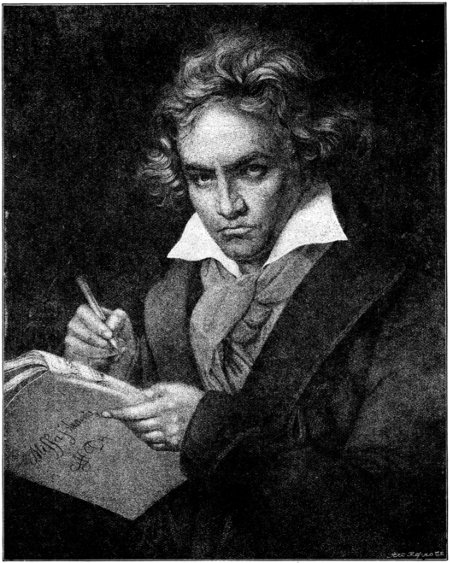
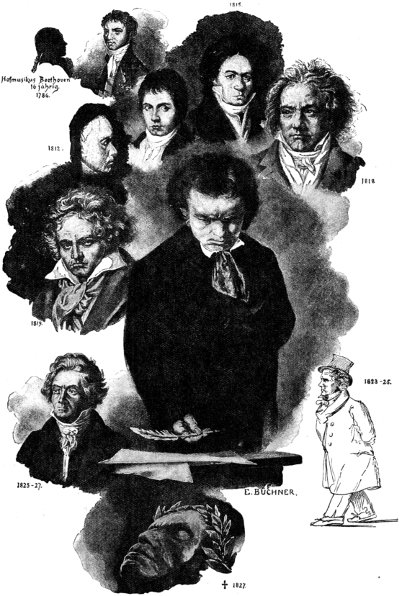
THE ROMANTICISM OF BEETHOVEN.
By ELEONORE D’ESTERRE-KEELING.
The title of this paper will probably surprise
many of my readers who have been accustomed
to regard Beethoven solely as the king
of classic music.
I have not set myself so foolish a task as
the attempt to prove that this is not his true
position. Undoubtedly Beethoven is king of
classic music, but—how much more than that
he is!
It must have struck everyone that there is a
certain quality in Beethoven’s music which is
absent from that of every other classic composer,
a quality which appeals to each one of
us personally, and which does not appeal in
vain.
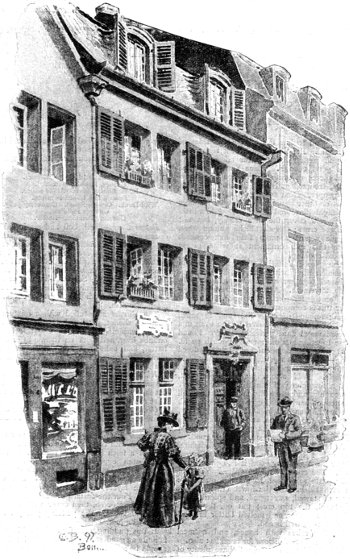
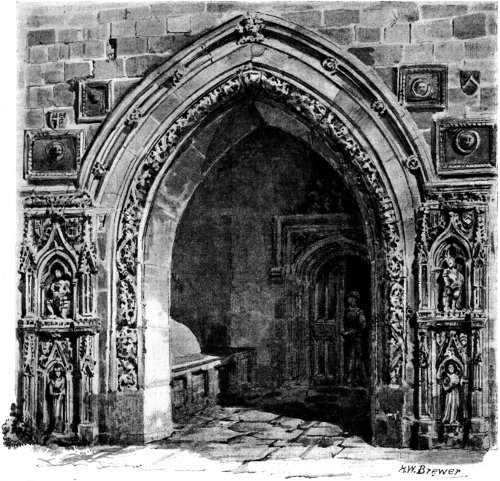
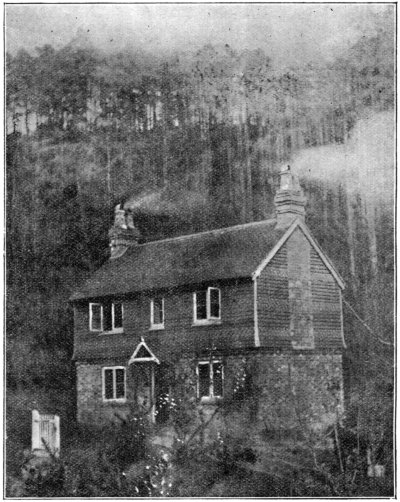
THE HOUSE WHERE BEETHOVEN WAS BORN.
If we play consecutively three or four
Sonates by Haydn or by Mozart, what is
almost invariably the result?
In each case we like the first one and
probably the second one; at the third we
begin to feel bored, and at the fourth we shut
up the book. And yet how lovely they all
are! Haydn takes us to play with the
children; Mozart introduces us to the ballroom.
But Haydn did not spend his life’s
days on a merry-go-round, and Mozart was
not perpetually paying compliments. Quite
the contrary. Haydn, as we know, never had
any children, and that disagreeable wife of
his left little happiness for his home. As
for Mozart—well, Mozart had a charming
wife, but he was so pitifully poor that one
winter’s morning, when the snow lay thick on
the ground outside, a friendly neighbour,
calling in to see how the young couple were
getting on, found them dancing a waltz on
the bare boards of their scantily furnished
room. They had no fire, and this was the
only means that they could devise for keeping
themselves warm.
When Mozart went on a journey, he wrote
the prettiest love-letters to his Stanzerl.
Here is a bit of one of them:—“Dear little
wife! If I only had a letter from you! If I
were to tell you all that I do with your dear
likeness, how you would laugh! For instance,
when I take it out of its case, I say ‘God
greet thee, Stanzerl, God greet thee, thou
rascal, shuttlecock, pointy-nose, nick-nack,
bit and sup!’ And when I put it back, I let
it slip in very slowly, saying, with each little
push, ‘Now—now—now!’ and at the last,
quickly—‘Good night, little mouse, sleep
well!’” There is nothing in all Mozart’s
music the least little bit like that. And
why?
Mozart’s music is strictly classical and
anti-romantic. His character is stamped upon
it, as the character of Haydn is stamped upon
his music, but his circumstances, the events of
his daily life, have no part in it, and whether
he had been rich or poor, successful or
despairing, his music would have been exactly
the same.
With Beethoven quite the reverse is the
case. If it were possible to play the whole
volume of Beethoven’s Sonates at one sitting,
the last thing player or listener could complain
of would be the monotony which culminates
in boredom.
There would be Beethoven tender, Beethoven
sublime, Beethoven ferocious, Beethoven
serene, and as many more Beethovens as
there are adjectives in the dictionary. And
this is the secret of Beethoven’s popularity.
For the musician there is the perfect form,
the exquisite mode of expression; for the
amateur there is the man, with all the hopes
and fears and aspirations which he shares with
his fellow man.
Beethoven wrote the most meagre of letters,
but every emotion that swayed him found
utterance in his music, and this it is which
gives to his music the quality known as
Romanticism.
Many definitions have been given of the
terms classical and romantic, but the clearest
and cleverest definition that I have met is
that given by the French writer, Monsieur
Brunetière,—“Classicism makes the impersonality
of a work of art one of the conditions
of its perfection, while Romanticism means
Individualism.” In other words, classicism
confines itself to the thing done; romanticism
is more interested in the doer of that thing.
Beethoven’s earliest works in each branch
of his art are purely classical. During their
composition he was leaning on Haydn and
Mozart. Life had not yet become to him a
matter of absorbing interest, for he still
regarded it from the standpoint of the
student.
The Fantasie Sonate, Op. 27, No. 2
(ignorantly called the “Moonlight Sonata”),
opens to us the first page of the tone-poet’s
life. It was written in 1801, when Beethoven
was thirty-one.
Thirty-one! At this age a man feels life at
its best; it is then that his pulse beats strongest,
that, his powers being fully developed,
he sees the years stretch smiling before
him, like the vision of a promised land. All
this Beethoven felt, and he was fully
conscious of his power. “The Eroica,” the
great ‘C Minor,’ “The Choral Symphony,”
“Fidelio,” locked within that mighty brain,
awaited only the master’s bidding to come
forth and delight a world.
But between him and this glorious future
there fell a shadow which was destined to rob
life of all that made life dear. He plainly
saw that shadow.
In a letter to a friend, written at this time,
he says, “How sadly must I live! All that I
love I must avoid. The years will pass
without bringing that which my talent and
my art had promised. Mournful resignation,
in which alone I can find refuge!”
Already the gates of his ears were closing,
and deafness was shutting him out from the
world which he had just begun to love.
Then he met the beautiful Countess Julie
Guicciardi. She was sixteen, she was poor,
and he gave her music lessons without payment,
accepting only in return
linen which her pretty
fingers had stitched.
She was flattered by his
homage (what girl would not
be flattered by the homage
of a Beethoven!) and she encouraged
his attentions. Perhaps
even she really loved
him.
Again he wrote to a friend:
“Somewhat more agreeably
I live now, going more among
people. This change has been
wrought by a dear, bewitching
girl, who loves me and whom
I love. At last after two
years’ misery, some happy
moments have come, and I
feel for the first time that
marriage could make me
happy.”
Poor Beethoven! Countess
Julie’s father had other
plans for his young daughter,
and her music master was
scornfully dismissed.
The mental conflict of this
period found expression in the
“Fantasie Sonate.” The
mournful resignation of the
first movement contrasts
vividly with the thunder of
the finale.
In a letter to his friend
Wegeler, Beethoven now
wrote:—“If nothing else is
possible I will defy my fate,
though moments will always
come in which I shall be the
wretchedest of men.”
He spoke so much more
eloquently in music than he
did in words, that I should
like to take my readers to
the piano and tell his story
there. But let us beware of
playing the Sonate romantically.
In interpreting an
emotional work this is a danger
which must always be carefully
avoided. We should
not repeat the poet’s story as
it affects us, but as it affected
him.
The resignation of the first
movement must be the resignation
of a strong nature—there
is fire beneath it. A
Beethoven does not shed
tears.
In the second movement
the poet conjures up before
his mind the memory of
happy hours, gone for ever. His child-love
appears before him in all her grace and
witchery. There must be something phantom-like
about it, something very tender, almost
intangible.
The last movement is a song of anguish
and despair. The proud spirit “defies its
fate,” but there are moments in which we
recognise “the wretchedest of men.”
Thus ended Beethoven’s first love-story.
There was no tender parting between him and
Julie; the “Fantasie-Sonate,” dedicated to
her, was his last love-letter, and with it he
dismissed her from his mind. “Strength,”
he said proudly, “is the characteristic of men
who distinguish themselves above others, and
it is mine!” It was his.
All Europe was now ringing with the fame
of Napoleon, the only person on earth—except
Goethe—whom Beethoven regarded as
his equal, while of him, even, he said, when,
in 1806, news of Napoleon’s victory at Jena
was brought, “What a pity that I don’t
understand war as I understand music. I
would conquer him!”
In this mood the Eroica Symphony was
written. It is a chapter of history.
But I have not space to follow the great
Romanticist through all his moods and their
outpourings. I must confine myself to a few
of them.
In October 1802 Beethoven was sent by his
doctors to Heiligenstadt, a quiet village not
far from Vienna. He was in a state of the
deepest despondency. The shadows were
closing round him, and the voices of the world
reached him but faintly.
In the stillness of the country he found
peace, the exquisite Sonate in D minor,
op. 31, no. 2, was written there. Let us
take it to the piano too, and listen to its
tragic story.
The long drawn out arpeggios with which
it opens are the longings of his heart. (He
was still only thirty-two!) Joy dances fantastically
round him and vanishes. Another sigh,
another vision of joy, and then heaven opens
and he looks in.
I do not think that even Beethoven ever
wrote anything more wonderful, more full of
the ecstasy of being, than that glorious first
movement.
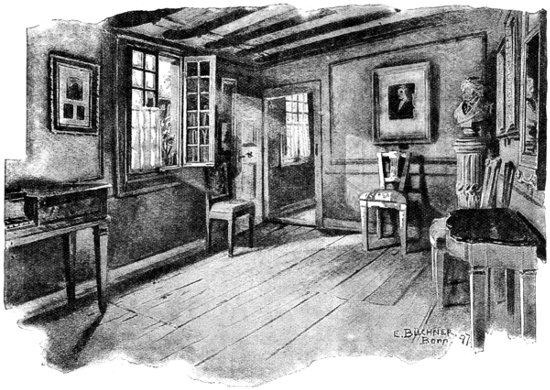
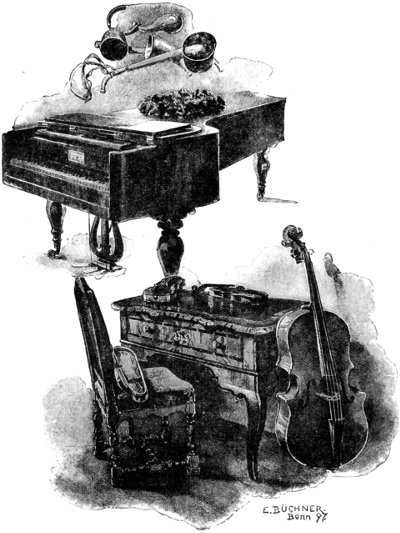
ROOM IN BEETHOVEN’S HOUSE.
The second part of the Sonate is very slow,
and at first it seems to promise peace for the
troubled soul. It is in B flat major, which
should and does suggest rest. But after such
a struggle as the first movement indicated,
peace does not come at once; listen to the
throbbing, shuddering triplets in the bass; they
begin at the seventeenth bar, and every time
that they occur they are followed by a lament
in the minor. They accompany that lament.
Further on, we find a lovely song-like passage
in F major (bar 31), and now see how beautifully
Beethoven arrives at that song. Laying
a gentle hand on his triplets (bar 27) he
smoothes them into even notes, changes the
sad C minor for C major, and then brings in
his song. But that song is only a rift in the
clouds; the storm comes on again, always
heralded by the triplets, and note the curious
accompaniment given later on to the left
hand. Right up at the top of the key-board
it begins and slowly it creeps down, always
down. Hope would ascend—that passage
marks despair. Once again comes the song
of comfort, this time in B flat major, and the
movement closes calmly in the same key.
The last part of the Sonate had a curious
origin. Seated in his silent room, which
looked out upon the little-frequented high road
leading to the village, the composer became
conscious of the trab-trab of a horse whose
rider was passing by. The rhythmic movements
of the animal’s hoofs, heard as they
were but faintly by the half deaf musician,
resolved themselves into a phrase in his mind
which he jotted down mechanically, and this
phrase persistently reiterated, formed the conclusion
to the Sonate which was then filling
heart and brain.
Only Beethoven would have conceived
psychology so good as that. How often in
the most crucial moments some trifling,
quite irrelevant detail forces itself upon our
notice, and absorbs attention which we should
be unwilling to acknowledge.
The portrait of the great composer’s soul,
which he painted for us in the D minor Sonate,
would have been less perfect had he withheld
the trivial circumstance which awoke him
from his dreams, and gave him again to the
world.
At this country retreat the famous Heiligenstadt
will was also written.
It shows us another side of Beethoven’s
character, and leads to another phase of his
Romanticism.
The will begins thus: “Oh, you men, you
who have thought of me as defiant, stubborn,
misanthropic, what wrong you have done me!
Bethink you that for six years an incurable
condition has befallen me, made worse by
foolish doctors who from year to year deceived
me with hopes of improvement. Though
born with a fiery temperament, and even susceptible
to the charms of society, I have had
to separate myself from everyone, and pass
my years in loneliness.
“What mortification when someone, standing
beside me, caught from afar the sound of
a flute and I heard nothing!
“Such incidents brought me to the verge of
madness, and little more was wanted to make
me put an end to my existence.
“Only my art held me back. Ah, I felt
that it was impossible to leave the world
before I had accomplished my mission!
“Great God, Thou who lookest down upon
me, Thou seest my heart and Thou knowest
that love and goodwill abide there.”
Immediately after this will, the six sacred
songs, to words by Gellert (op. 48), were
composed.
There is something infinitely pathetic in
the thought of this great, lonely man, so profoundly
ashamed of his bodily infirmity, and
so conscious that he was misunderstood by all
his fellow-men, turning thus in the hour of his
sorest need to the One whom he could trust.
The first of the six songs is a Prayer, the last
a Song of Repentance. They are all very
simple, as such songs should be, and through
them the strong, personal note is unmistakable.
The quiet life at Heiligenstadt had another
beneficial effect upon Beethoven. Both the
Pastoral Symphony and the Pastoral Sonate
trace the source of their inspiration to the
pine forests, the rustic surroundings and
Sabbath stillness of this picturesque village.
The Symphony of
course was a later
work, but it was
also composed at
this, Beethoven’s
favourite holiday
resort.
But ardent
lover of Nature
though he was,
he was not the
sort of man who
could pass his
days in sylvan
solitude. He was
extremely sociable,
even, in his
way, extremely
domestic.
Probably if he
had secured the
happy home life
for which he so
often longed, we
should have been the losers, for he might
truly have said, with Heine—
“Out of my great sorrows I make the little
songs.”
When he made his will at Heiligenstadt he
believed himself to be dying. At the close of
it came this prayer—
“O Providence, let once a day of pure
happiness shine upon me!”
That prayer was granted, and he found
many days of pure happiness by the side of
the Countess Therese of Brunswick, the aunt
of the faithless Julie.
Countess Therese was the right woman for
him, and nobody knows why their marriage
did not take place. They were certainly
betrothed, and Therese’s brother Franz was
Beethoven’s most intimate friend. To him
the Sonate Appassionata was dedicated, surely
the grandest tribute that could be paid to any
friendship. It was written during the composer’s
visit to the Brunswicks’ estate in
Hungary in the summer of 1806, and probably
was intended as a message for Therese, which
her lover could not trust himself to deliver.
Soon after leaving the Brunswicks Beethoven
wrote to the Count—
“Dear, dear Franz! Only a line to tell you
that I have made good terms with Clementi.
Two hundred pounds I am to get, and over
and above I can sell the same works again in
Germany and France. Further, he has given
me other orders, so that I may reasonably
hope to attain the dignity of a true artist in
early years. Kiss thy sister Therese, and tell
her that I am afraid I shall become famous
before she has erected a monument to me.”
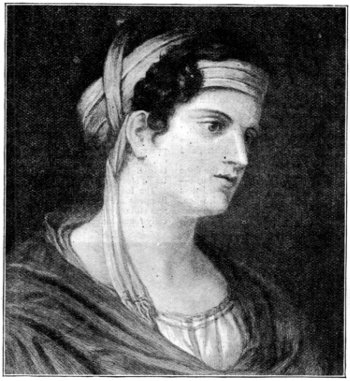
At the same time, July, 1806, the much-discussed
love-letter was written. This letter
was found, after his death, among Beethoven’s
papers, with the portrait of the Countess
Therese, which is reproduced in this number
of The Girl’s Own Paper. The original is
an oil-painting, and on the back of it is written
(in German of course):—
“To the rare genius, the great artist, the
good man, from T. B.”
Every biographer of Beethoven has had a
different theory as to the love-letter, but it is
now generally granted that it must have been
addressed to the Countess Therese, whom
Beethoven in it calls “meine unsterbliche Geliebte.”
(My immortal love). The letter
begins:[1] “Mein Leben, mein Alles, mein ich”
(My life, my all, my self), and the exquisite
Sonate in F sharp, op. 78, which is
so seldom played, translates those
words into music. This Sonate was
written in the autumn of 1809, when
Beethoven was again with the Brunswicks
in Hungary, and it is dedicated
to the Countess Therese.
Rather an amusing incident in
connection with it is related in a
conversation between Beethoven and
his pupil Czerny, at the end of which
the composer exclaimed irritably—
“People always talk of the C sharp
minor Sonate as if I hadn’t composed
much better things. The F sharp
Sonate is something very different!”
The C sharp minor Sonate was Julie
Guicciardi’s, and it did not please
Therese Brunswick’s lover to be reminded
so often of that old love-story.
But he was quite right. The F
sharp Sonate undoubtedly is a very
different thing. It is less passionate,
but it is much more finished. There
is a sweet serenity about it which
suits the noble face of the gracious
lady who inspired it. My readers
will need no guidance through it;
one glance at Therese’s portrait will help them
more than anything I could say. “Mein
Leben, mein Alles, mein besseres ich” sings
the little prelude, and then the piece glides
along like a boat on a sunny sea. Lucky
Beethoven and lucky Therese, the day of pure
happiness has come!
There is one more phase of Beethoven’s
character upon which I want briefly to touch.
Everyone knows that during his last years he
was often in great straits for want of money.
Perhaps you, my readers, will not think that
money troubles are a feature of Romanticism,
but money troubles, like others, may be the
cause of anxiety, heart-burning or disappointment,
and when these feelings are expressed
in any work, the personal element, with them
introduced, is the source of Romanticism.
Amongst Beethoven’s MSS. there was
found after his death a Rondo inscribed in
his own handwriting—
“The rage over a lost penny, worked off in
a Rondo.”
That Rondo is one of the prettiest and the
wittiest things in music.
The average Englishman will scarcely be
able to realise that a man like Beethoven, a
genius, could make such a fuss over a lost
penny, but those who know Germans will be
less incredulous.
Perhaps, too, it was not just the penny; it
may have been the principle!
At all times Beethoven was suspicious, and he
always thought that he was being cheated. He
very often was cheated, and when we remember
that by this time he was stone-deaf, and that
he had no sympathetic friend to whom he
could confide his troubles, we shall begin to
understand why he put his rage over a lost
penny into his music, with all his other
emotions.
The piece (op. 129) is not easy to play, for
it requires a reckless self-abandonment which
is only possible to those players to whom
it offers no technical difficulties. Bülow’s
edition of it, published by Cotta, is the best.
In one of his notes the editor says, “You can
see the papers fly from the table, while the
furious hunt proceeds,” and he declares that
the man who wrote this brilliant Rondo
could have written an opera bouffe if he had
tried.
Much more might be said about Beethoven’s
Romanticism. I have not touched at all
upon his more exalted phases of feeling, the
patriotism which was so wonderfully expressed
in the seventh Symphony, the philosophy of
life which culminated in the Choral Symphony
with its impossible “Ode to Joy,” telling in
tones what Goethe tried to tell in words at
the end of the second part of Faust.
My object had been to show that musical
form, or perfect classicism, was the beautiful
vessel which Beethoven made use of to carry
his own human thoughts and emotions, and
that, as Maurice Hewlett says in his book,
Pan and the Young Shepherd—
“Life goes to a tune, according as a man
is tuneful, hath music.”