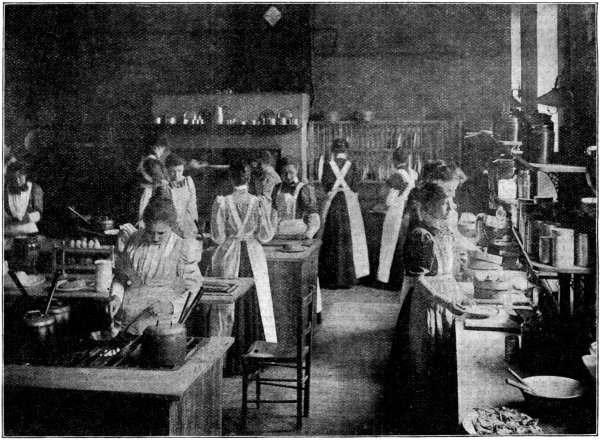
If one stands at the entrance of a large Board
school either at dinner or tea-time and watches
the pupils trooping out, one often wonders
what will become of all these lively children in
a few years’ time, what they will make of their
lives, and how enough work is to be found for
them all. Has it ever struck any of my
readers that, whatever the boys may do in
the way of work, sooner or later that of the
girls is certain? They are going to be the
wives or housekeepers of these or other boys.
They will be dressmakers, tailoresses, servants,
factory girls or what not for a time,
but their final business will be housekeeping,
and housekeeping too on small means, so that
a great deal of skill, care and knowledge will
be needed if they are to do it well.
How are the girls to be trained for this very
important work of theirs? Their school life
is very short; the time they will have to spare
after leaving school will be very little, their
leisure hours in the evening being wanted for
rest and recreation as well as for learning; it
will be small wonder if many of them marry
without any knowledge of household management
and if the comfort and happiness of their
home is ruined in consequence.
The question is so serious that people interested
in education have given it a great deal
of thought. There is little doubt that, if it
were possible, the best plan would be to give
a year’s training in housekeeping to every girl
when she leaves school; but alas! since most
girls from elementary schools are obliged to
earn money as early as possible, this plan cannot
be carried out. The only thing that can
be done by the managers of elementary schools
is to proceed on the principle that “half a loaf
is better than no bread,” to give the girls, while
still at school, weekly lessons for a certain
number of weeks each year, in cookery and
laundry-work, and sometimes in housewifery
generally, and to encourage them to attend
evening classes after they have left school. A
great deal of good has been done in this way,
but the children are so young and the lessons
necessarily so few, so far between and so fragmentary,
that the result is very far from being
all that could be wished.
Seeing this, the Technical Education Board
of the London County Council five years ago
began to establish, one after another, Schools
of Domestic Economy to which girls should go
for five months at a time after leaving the
ordinary schools, and where they should be
occupied for the whole school hours five days
a week in household work, thus giving them
an opportunity of really understanding their
future duties as housewives. The question of
enabling poor people to afford this five months’
extra teaching for their girls was a difficult one
to meet, but as far as it could be done it has
been done by giving free scholarships at these
schools and by providing the scholars with
their dinner and tea free of cost, and providing
also the material required by each girl for
making herself a dress, an apron and some
under-garment during her time at the school.
With only two exceptions, these schools, which
are nine in number, are held in the polytechnics
or in technical institutes, a capital arrangement
whereby the rooms needed for evening
classes for adults are used also during the day-time.
Let us look in at one of the schools and see
of what a day’s work consists. We will choose
the school at the Battersea Polytechnic, because
a Training School for Teachers is held
there as well as a school for girls, and we shall
have a double interest in the work. The Polytechnic
is a great building standing back from
Battersea Park Road, and at about nine
o’clock in the morning we shall find a stream
of teachers and pupils hurrying into it, masters
and mistresses of the Science School, the
Domestic Economy School, and the Training
School for Teachers of Domestic Economy;
boys and girls of the Science School; girls
and women students of the two Domestic
Economy Schools; and a few minutes later
we shall find these all gathered in a large hall
for “call over” and prayers, and then filing off
to their separate departments.
Let us ask Miss Mitchell, the head of the
Domestic Economy Schools, to spare us a
little of her time and explain the work to us.
We follow the women and girls to a separate
wing of the building, and as they divide off
into the different class-rooms we enter the
large cookery school and watch the students
in training settling down to their morning’s
work, fetching their pots and pans from cupboards
and shelves, looking up the list of their
work on the blackboard, weighing out ingredients,
and so on. We look round the
room, a little confused at first with all the
movement, and see that it is large and well
lighted with coal-stoves at one end and gas-stoves
fixed into two large tables in the centre,
with a lift, up which provisions for the day are
still being sent, and down which, as we find
later, the dinner is to go to the dining-room
punctually at one o’clock; large sinks and
plate-racks are fitted in one corner, low cupboards
with shelves over them run far along
the walls, and at the end of the room opposite
the stoves is a stepped gallery, where forty or
fifty pupils can sit for demonstration lessons.
The head cookery teacher is busily engaged
inspecting the food materials bought in by the
student-housekeeper, criticising the quality and
hearing the prices given, and Miss Mitchell
explains to us that the students take it in turns
to be housekeepers, and have to buy in materials
for dinners for some sixty people every
day; they are given lists of what will be wanted
by the teachers, but the whole responsibility
of choosing and buying the food rests with
them, and so out they go every day into the
neighbouring streets, taking with them two or
three girls from the Domestic Economy School,
to choose fish, meat and vegetables from the
shops and stalls of the neighbourhood, for they
are to learn how to choose and make the best
of such provisions as the working people of the
neighbourhood are accustomed to buy, and
capital training this is for them.
“Do the students here cook dinners for sixty
people?” we ask in wonder; and in answer,
Miss Mitchell takes us next door into a smaller
cookery room, where fifteen girls are at work
under the charge of a teacher and a student,
also busy on dishes which are to be ready
by dinner-time. Everything left from one
day’s dinner, we are told, is brought up
to the cookery schools again by the “housekeeper”
to be re-cooked and made into
dainty dishes—no waste of any kind is
allowed.
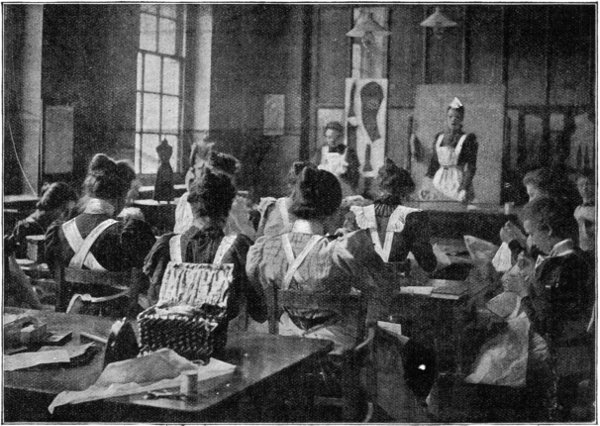
Crossing the corridor we find two rooms
given up to dressmaking and needlework;
here again both students-in-training and girls
are working in separate classes. One of the
students, who has nearly completed her course
of training, is helping a teacher with a class
of girls (fifteen in number again we notice),
and the other students, under the head dressmaking
teacher, are busy on their own work—this
morning they are drafting bodice patterns
for various types of figures, but that their
work is not confined to pattern-making is
evident when the cupboards are opened and
dresses taken out for our inspection—dresses
made by each student to fit herself, funds
being provided as in the case of the girls by
the Technical Education Board. Very neatly
made the dresses are, and proud the students
seem to be of them, though their pride is
tempered by anxiety as to what the examiner’s
opinion of them may be when the time of
examination for their diplomas comes. Each
student has to make two dresses, that is,
sample garments to show her plain needlework,
and to learn to patch and mend old
dresses and under-garments, her pride culminating
in a sampler of patches, darns, and
drawnthread work, such as that hanging in a
show cupboard on the wall. The girls, we
are told, in their shorter course make themselves
one dress, one apron, and an under-garment
each, and spend one lesson of two
hours each week in practical mending of worn
garments.
We ask why it is that every class we have
seen consists of fifteen pupils only, and are
told that in all classes for practical work for
which funds are supplied by the Technical
Education Board the number of pupils is
limited to fifteen, so that the teacher may be
able to attend thoroughly to the practical work
of each pupil, instead of having to teach her
class somewhat in the manner of a drill sergeant,
as must inevitably be the case when
dealing with large numbers.
But the morning is getting on, and we hurry
downstairs to the laundry, perhaps the most
striking of all the class-rooms, a glass partition
shutting off the washing-room, with its large
teak troughs where a busy set of girls are at
work, from the ironing-room, fitted with long
solid tables on which blouses of many shapes
and colours are being ironed into crisp freshness.
A special feature of the room is the
white-tiled screen keeping the heat of the
ironing stove, with its dozens of irons, from
the rest of the room, while the height and
good ventilation keep the room fresh and
pleasant even in hot weather. We turn away
from this vision of dainty whiteness to be in
time to see the last class we are to visit this
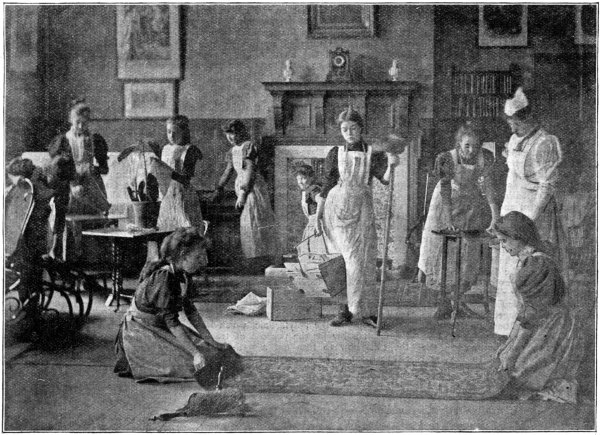
morning, the “housewifery” class, which is
conducting a “spring-cleaning” in one of the
social rooms of the polytechnic, which lends
itself admirably for the purpose of teaching
the girls how to turn out a well-furnished
sitting-room. The housewifery lessons are a
great feature of the Domestic Economy Schools,
we hear, and include the whole routine of
household work apart from actual cooking,
washing, and dressmaking, these being, as we
have seen, taught separately, so that girls who
have gone through the course ought not to
find themselves at a loss in any department of
housekeeping, the whole series of lessons in
each department being made to dovetail one
into the other.
It is nearly one o’clock now, and Miss
Mitchell asks us to come into the dining-room,
where the tables are just laid for dinner,
and we find the housekeeping-student in
charge, lifting dishes on to “hot-plates” as they
come down from the cookery schools, with the
group of girls who are told off to help her
giving final touches to the tables, these being
laid with pretty blue and white crockery, and
with here and there bunches of flowers which
have been brought by one or other of the
pupils. The teachers aim at having the
tables laid as nicely as possible and at giving
the girls a high standard of neatness and
daintiness to take back with them to their
own homes.
Presently a bell rings and the girls file in
and take their places at three long tables, with
a teacher and a student at the head and foot
of each, the other students-in-training having
a table to themselves. We feel rather intrusive
as we watch them take their places,
and, turning out of the room, ask Miss
Mitchell to spare us yet a few minutes to
answer some of the questions that are in our
minds.
“How many of such schools are there?
Where are the others, and how do the girls
get their scholarships? Can we help girls we
know to get such a chance, and specially how
are the scholarships for training teachers to be
obtained, and what chance is there for these
teachers at the end of their two years’ training?”
Miss Mitchell tells us laughingly that
to answer all this fully would take much more
than a few minutes, but this much she can say:
that at present, though the number of schools
is far from enough to give as many scholarships
as are needed for all London, they are steadily
increasing in number; there are such schools
at the Borough, Chelsea, Woolwich, Clerkenwell,
St. John’s Wood, Bloomsbury, Wandsworth
and Norwood, while others will be
opened in Holloway, at Globe Road, Bow,
and at Deptford next term: that the girls’
scholarships are given on their being nominated
by their school mistresses for the approval of
the Technical Education Board, and that therefore
anyone interested in getting such a scholarship
for a working girl should write to the
offices of the Technical Education Board of the
London County Council for information, and
then get the girl to apply to her mistress for a
nomination for next term. As regards the
training scholarships, they have to be won by
passing an examination, not in itself very stiff,
but sufficient to ensure that the teachers of
domestic economy trained in the school shall
possess a fairly good general education. All
particulars can be obtained from the offices of
the Technical Education Board. As to the
chance of employment, the experience of
teachers holding good diplomas from the
Battersea Training School has been very
happy, few of them having had to wait long
for work. And so she wishes us good-bye, and
we leave the building feeling that we have had
a glance into a new world, one full of energy
and hopefulness, and giving promise of happier
conditions of life for future generations of
citizens in our great city.
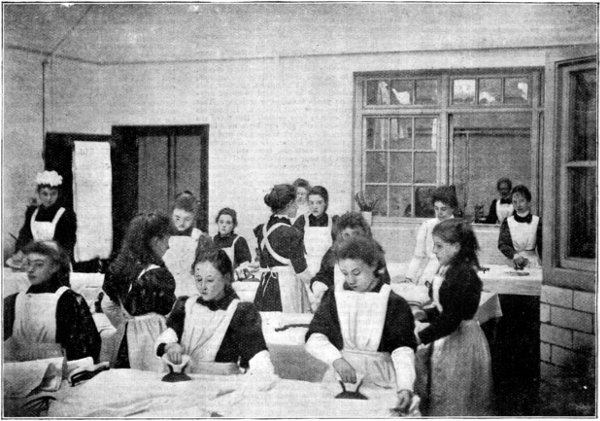
A NEEDLEWORK CLASS, BATTERSEA POLYTECHNIC.
THE HOUSE WITH THE VERANDAH. — CHAPTER XXI.
By ISABELLA FYVIE MAYO, Author of “Other People’s Stairs,” “Her Object in Life,” etc.
THE TELEGRAM FROM THE NORTH.
The days went on: the mysterious
“knocks” did not recur, and as the
police inspector made no more inquiries,
and the Marvels attempted no further
intercourse with the little house with the
verandah, the very memory of them
readily faded from the minds of the little
household there, and especially from
that of its mistress, ever becoming more
pre-occupied with the prolonged delay
of letters from Charlie, or indeed of any
news from the Slains Castle.
Lucy’s brother-in-law, Mr. Brand,
went down to Bath to attend Mr. Bray’s
funeral, and his wife Florence accompanied
him “to be with the dear old
lady in her sorrow.” Indeed, Mr. Brand
left his wife with the widow while he
went to and fro between Bath and
London, looking after his own business
and winding up Mr. Bray’s affairs. Lucy
would have liked to visit the old lady in
the early days of bereavement, but, of
course, in her circumstances any such
expression of sympathy was out of the
question. Still, every evening, no matter
how tired and despondent she felt she
wrote a loving little note to her mother’s
old friend, so that every morning she
might find it on her breakfast-table.
Also, Lucy copied a little picture of the
Surrey village where she knew Mrs. Bray
had first met her dead husband, and she
sent it to the widow as a tender sign of
sympathy. Lucy did not wonder that
Mrs. Bray herself never acknowledged
these tokens of love, for she knew the
lady was old and feeble, and that deep
grief is sometimes very silent. She
knew that Mrs. Bray received all her
remembrances, for Florence wrote
delivering the old lady’s “thanks for all
kindnesses,” and adding how grateful
she also was for Florence’s companionship,
and for all the arrangements
“Jem” was making for her welfare.
“There is not so much property left
as one might have supposed, considering
that Mr. Bray has earned such a
large income for so many years,” wrote
Florence. “But then the Brays have
always lived among people of rank and
wealth, and naturally they got into the
habit of spending as their friends did.”
“Ah,” said Miss Latimer, as Lucy
read the letter to her. “In that way,
earned incomes, however big, soon break
up and vanish, as did the clay jar in the
fable, when it raced with the iron pot!”
Lucy resumed her reading. “Florence
goes on: ‘Never mind; they have both
enjoyed the best of everything, and have
had many advantages which they might
not have had, if people had not believed
them to be rich. Jem is always saying
that there’s nothing so expensive as
poverty. Therefore, though there is not
much property left, it won’t matter
much, for in many ways Mrs. Bray’s
spending days are necessarily over. Jem
is managing so cleverly that she will
scarcely know she is poorer than she
used to be. She will even be able to
afford to go on living in the same house,
when she returns to London. It would
be a great trial to her if she could not
hope to do that—and it can be managed,
for, you see, she is old and can’t live long.
She trusts Jem implicitly and leaves
everything to him. She always says, “I
don’t want to know anything about
money matters; I never have known and
I don’t wish to begin now. I ask for
nothing but my little comforts and
Rachel to look after me.” And then
Jem assures her that is quite easy, and
so she is satisfied. I can’t think what
Mrs. Bray would do without Rachel.
She is more devoted to her mistress than
ninety-nine daughters out of a hundred
are to their mothers. I don’t anticipate
that my girls will be half so kind to me
when my dismal days come—and of
course, I hope they’ll be married and
gone off long before I’m an old woman.
I should not like to be the mother of
ungathered wall-flowers! But where
am I likely to find a Rachel? I’ll just
have to go and stay at an ”hydropathic“
when I’m an old woman. But old age is
a long way off yet—and I devoutly trust
that I’ll be dead before it comes.’”
Those last words struck Lucy. She
had heard them before—the very same
words—spoken by a humble working
woman, whose strenuous labours could
not provide for more than the wants of
each day.
All that woman’s year’s work for a
certain company had actually brought
her in less than Jem Brand got as
annual dividend upon each hundred
pounds he had invested in its shares.
Lucy had heard that woman say, “I’ve
only one chance to escape the workhouse.
I hope I’ll die before I am old.”
The poor overworked woman had felt
thus for one reason, and now the wealthy
idle woman felt so for another. What
did it all mean? Where had life gone
wrong? Of these two women, one had
all that the other lacked, yet it did not
suffice to save her from the worst bitterness
of that other life. Lucy remembered
having read somewhere that Lazarus
does not perish for lack of aught that is
good for Dives, but for lack of that
excess by which Dives destroys himself.
But in these days Lucy did not think
over theories and practices as she had
been wont to do. She hardly dared to
think at all, for the moment thought got
a-working, it seized on the terrible
reality that still neither word nor sign
came from Charlie!
A delay so prolonged must mean
something. If it meant some rearrangement
of plan, or unexpected detention at
the port of some Pacific Island, then
surely a letter would have come. Nay,
Lucy felt certain that if Charlie knew
that any suspense were likely to arise,
then a telegram would have arrived.
Charlie and she had made their thrifty
little pre-arrangements on that score.
His firm had a code name, and they had
agreed that this, with the name “Challoner”—the
word “saw” to stand for
“safe and well”—was to suffice for Lucy
in case of any unforeseen contingencies.
But no letter came and no such
telegram came!
Alarm had now a wider basis than
anxiety for Charlie’s health. An inquiry
sent to Mrs. Grant in Peterhead
promptly brought back a quite remarkably
brief answer that she too had
heard nothing. Inquiries made at the
London office of the shipping firm concerned
with the Slains Castle elicited
that they too had no tidings, though
they made light of the fact, and dwelt
on the many delays to which sailing-vessels
were subject.
Lucy’s anxiety swamped all her other
worries, though unconsciously to herself
those worries might still prey on the
nerve and fortitude which endurance of
the great trial demanded.
What did it matter now when the
little china tea-set which had been one of
her birthday gifts to Charlie was dashed
to the ground and almost every piece of
it shivered to fragments? It grieved
her once; now it did not affect her at all,
save as a type of the general wreckage
into which life seemed breaking up.
She did not give much attention to
Clementina’s eagerly-tendered defence
concerning the accident, given thus—
“I had nothing to do with it, ma’am.
I was in the back kitchen at the time,
and I’d left it sitting safely on the
dresser. Then all of a sudden I heard
the crash, and when I looked in, there
it was—all in fragments on the floor.”
“You must have placed it too near
the edge of the dresser, Clementina,”
urged Miss Latimer, “and the slight
oscillation caused by some heavy
vehicle passing by must have caused it
to tilt over.”
It was strange that Clementina
repudiated this explanation.
“I didn’t hear any heavy traffic,”
she answered. “There’s never much
of it near here, anyway. No, ma’am,
such things will happen sometimes, and
there’s no accounting for them and
there’s no use in trying to do it.”
If Lucy’s attention could have been
directed towards anything but the
terrible fear which absorbed all her soul,
she might have noticed that at this time
Miss Latimer became rather anxious
and observant concerning Clementina.
The old lady was aware that the servant
was growing restless and uneasy. Her
superstitions seemed all astir. She
began to see omens on every side. The
tense atmosphere of the household mind
evidently affected her very much. Miss
Latimer could only hope that it would
not affect her so much as to cause her
to “give notice.” For in many ways
the old lady’s experience told her that
Clementina was a treasure not to be
found every day, since she was scrupulously
honest, clean and industrious,
and the very last person likely to have
questionable “followers.”
So the dreary days went on in the
shadow of the storm-cloud, now so
lowering that it became too much to
hope that it would pass over harmlessly.
The monotony was broken at last by
a telegram which came in late one
evening. But it did not come to end
Lucy’s agony of suspense, either by joy
or sorrow. It was simply a telegram
from Mrs. Grant of Peterhead, announcing
that by the time it reached
Lucy she would be on her way to
London, as she had despatched the
message just as her train was starting.
She might be expected by the first train
reaching London in the morning.
“What does this mean?” asked
Lucy with white lips.
Miss Latimer and Tom strove to
soothe her by assuring her that
naturally Mrs. Grant was as anxious
as herself. Perhaps she wanted to seek
further information about the Slains
Castle, or possibly to consult with
Lucy as to whether there were joint
steps that they might take in search of
news. Lucy was not readily pacified.
Her first fear had been that Mrs. Grant
had had private word of the loss of the
ship and her passenger and crew, and
that she kindly wished to communicate
this news to Lucy personally. It was
comparatively easy to persuade her that
this was most unlikely. Her next misgiving
was more difficult to dislodge.
It was that Mrs. Grant had at last
heard from her husband with some bad
news of Charlie—a private matter with
which, of course, owners and underwriters
could have nothing to do. This
foreboding could only be allayed by
Mrs. Grant herself.
The north train arrived so early at the
terminus not far from Pelham Street
that Mrs. Challoner and Tom were able
to go and meet the traveller before they
were respectively due at the Institute
and the office. They had breakfast (as
indeed they often did) by gaslight, and
then hurried off, Lucy taking Hugh
with them. Lucy could not bear him
to be out of her sight now for one
moment more than was necessary, and
Hugh himself begged to be taken.
Miss Latimer had not yet come downstairs
when they departed, but Clementina
protested that “the precious
darling” might well be left with her—her
work was so well in hand that she
need do nothing but amuse him—it was
a pity he had even been roused up when
he might have had another hour’s sweet
sleep, and she wondered his ma wasn’t
afraid to take him out when the morning
was so dull and raw, an argument
which would have overcome Lucy but
for Hugh’s plucking at her gown and
pleading, “Take me with you, mamma,
take me with you.”
It was no distracted weeping woman
who descended from the through train.
Mrs. Grant came out briskly, and looking
round at once recognised the group
awaiting her, though she had never
before seen more of them than a photograph
of Lucy. The worthy lady had
travelled with plenty of comfortable
wraps and a hamper of home-made
food. It gave Lucy some reassurance
to note this practical attention to
creature necessities. She could scarcely
realise that the sailor’s wife, a resident
in a seaport town, had already stood so
often, for herself and for others, in
catastrophes of life and death, hope and
despair, that she had learned that our
bodies require adequate support and
consolation if they are, ably and long,
to serve and second our spiritual nature,
above all our powers of endurance and
initiative.
“I’ve got no news for you, neither
good nor bad,” she said promptly. “If
aught has happened to your husband it
has happened to my good man too.
But it’s my private belief that the office
folks here know a little more than they
will admit. I got a letter from them
yesterday afternoon saying that they
know nothing at all, and I disbelieve
that so much that it was this very letter
which made me start off here straightway.
If they do know anything I’ll
manage to get it out of them.
“I don’t imagine they know much,”
she hurried on, noting the whiteness of
Lucy’s face. “If they knew much we
should hear fast enough, never you fear.
But whatever they know, little or much,
I’ll know too, before I go home!”
As she spoke, the cab drew up at the
Challoners’ house. In the dining-room
the lamps were still alight, revealing
the bounteous breakfast-table which
Clementina had spread after removing
the impromptu cups of tea which Lucy and
Tom had hastily snatched before going
out. But as Tom opened the hall door
with his latchkey he was met by a pungent
odour not given off by toast and ham.
“An escape of gas!” he cried.
(To be continued.)
CHRONICLES OF AN ANGLO-CALIFORNIAN RANCH. — CHAPTER XI.
By MARGARET INNES.
HARD WORK FOR THE MEN—HARDER WORK STILL FOR
THE WOMEN—THE CISTERN—RATTLESNAKES—THE
GARDEN—HOMESICKNESS—PIPE-LAYING.
The ordinary business man at home in England
would think it rather a mad suggestion if his
friend were to prophesy that some day he
would have to set to and make his own roads,
the drive up to his house, lay his own water-pipes
from the main, build his own rain-water
cistern and cesspool, dig and plant his own
garden, and fence that in too.
I think he would be equally surprised if he
could realise how quickly and easily he would
adapt himself to such unaccustomed work, and
how well he could accomplish it.
To the man who loves an outdoor life, and
is clever with his hands, and has ingenuity,
too, and some skill in creating something out
of nothing, “making history,” there is much
zest and enjoyment in all this. But, of course,
it is very hard work; and when the sun is
fierce (which it usually is), the glare and heat
are most trying, out on the perfectly shadeless
stretches of land.
The body does not accustom itself easily to
these new labours, and the new burden must not
be laid upon it too heavily; all the health-giving
power of ranch life depends largely upon this
precaution. Therefore the question of being
able to pay for necessary help is a very important
one. It is pitiful to see the weary,
broken struggles of men untrained and unaccustomed
to the heavy physical work of a
ranch, and unable to pay for help. A breakdown,
more or less serious, is almost certain,
when the work all falls behind, and things
become more and more hopeless. It is a great
mistake for a delicate man, who has broken
down at his office work at home in England,
to come out here to ranch, thinking to recover
his health in the open-air life, but not having
at the same time the means to pay for help,
nor the capital to be able to wait the necessary
years till his ranch can yield an income.
Of course, I am not speaking of the man
born and bred to such work at home; he will
find a true land of promise here; the pay he
can command (one dollar a day and his board),
will soon enable him, if he is a thrifty fellow,
to buy a bit of land and build a home of his
own, such as he could not dream of in the old
country; and the work is what he has always
been accustomed to, and for which his body
has been trained for generations.
But for the man of gentle birth and breeding
it is a very different story. He would be
better shut up in an office at home.
The life is splendidly healthy so long as one
is not overdriven; the physical exercise of the
different occupations, and all in the open air,
is like the training of an athlete. Hoeing
round the lemon trees is as good for the chest
and arms of the labourer as for the roots of
the lemon trees; but only always if the worker
be not overtaxed. Indeed, from our experience
it is only by carrying on sure regular
active work in the open air that one gets the
real benefit from this climate.
With thirty-one acres planted, we have
found the help of one ranchman with Larry,
our eldest son, and his father to be sufficient;
so all our digging and piping and road-making
went forward without too heavy a strain. The
accepted theory is that one man can manage ten
acres of planted land, and do justice to it; and
a ranchman costs from twenty to thirty dollars
a month, and his keep.
If the rough work and life are hard for men
to accustom themselves to, it is much harder
still for the women, especially, of course, for
delicate women, who are supposed to have
been brought out “for their health.” And
here is the place to point out what a farce it is
to suppose that any frail woman could possibly
get any benefit out of the finest climate in the
world if, in addition to the burden of her illness,
she has to take upon herself the onerous
duties of cook and housemaid and charwoman,
and everything combined. Again the important
question is whether the rancher has money
enough to pay the very high wage demanded
for even the simplest household help during at
least five years, while he is waiting for his
ranch to yield an income. Even then the wife
must be prepared to work much harder than
she was ever accustomed to at home, since one
pair of hands, even if they are the most talented
Chinese hands, necessarily leave a very great
deal to be done. In our case, for instance, the
Chinaman never touches the bedrooms or
drawing-room, except to turn them out once
a fortnight, when he leaves them fairly clean,
but all topsy-turvy.
But this is as nothing, when one sees so
many ranchers’ wives doing without any help
at all. That is a cruel life for any man to bring
his wife to, unless he has absolutely no other
choice; it is to my mind quite unforgivable.
Let such men come without womenfolk.
We had a wearisome long piece of work—building
the rain-water cistern and the cesspool,
for they had to be dug out of the hard
granite. The cistern was finished, however, in
time to catch part of the winter’s rain, and
though we feared it would become stagnant,
this danger was quite overcome by the simple
little pump used, which is made almost exactly
after the pattern of the old Egyptian pumps,
and consists of a chain of small buckets, which
revolves, and as one half come up and empty
themselves through the pump spout, the other
half go down into the water full of air; and
thus the contents of the cistern are in this way
constantly revitalised.
We have never done congratulating ourselves
on possessing this cistern, for the water is
always cool and sweet, and as our roof is very
large, it soon fills the cistern, which holds three
hundred barrels, and lasts all the year. The
flume water, which we use in irrigation, and
which is also laid on in the house for the
boiler, etc., comes from the mountains in an
open aqueduct or flume. It is at times full of
moss and impurities, and is besides quite tepid
in the summer.
We had many discussions, standing on our
front verandah, and looking down the rough
hill slope, as to how the drive should be laid
out. We meant to have an avenue of pepper
trees on each side, and once these were
planted, the road could not well be altered.
Meanwhile, sixteen more acres had been cleared
of roots and brush, ploughed and harrowed for
more lemon trees. In the spring we planted
seven hundred young trees, which made in all
one thousand five hundred.
The kitchen garden was set in order, and
fenced in to keep out the squirrels and rabbits.
They were a great nuisance that first year, but
have now retired to their own wild part of the
land, which certainly is roomy enough. The
rattlesnakes, too, though we were constantly
coming across them in the beginning, have
now quietly withdrawn to the stony mountain
tops.
That first year I was haunted with the fear
of those hideous creatures, and the dread of an
accident to one of my dear ranchers.
But all the same, it was a thrilling excitement
when each one was caught and brought
down to the barn to be gloated over; and
though it was dead, it would still wriggle its
ugly body, and snap its terrible jaws at anything
that might touch it, and with the power still of
deadly effect.
One of the boys brought down from the hill
a particularly large fellow, hanging on a forked
stick, its frightful mouth gaping so wide open
that the whole head seemed split in two, and
big amber-coloured drops of the terrible poison
hanging to its fangs.
One certainly gets accustomed to anything;
and here even the little children think nothing
of killing a rattlesnake on their way to school.
It is true they are easily killed, and are always
in a hurry to get away. The danger is, of
course, that one may tread on them unawares,
for their skin is so like the colour of the ground.
But on the road they are easily seen, and in
walking through the brush one keeps a sharp
look-out.
The house looked terribly bare, perched on
the hill-top, without a touch of green about it
and no single patch of shade far or near, so we
were in a great hurry to make the garden,
which was to surround the house, but was only
to be a small one, as when once we had made
it, we should, of course, have to keep it in
order ourselves. When it was finished, we
could not but laugh at our cypress hedge of
baby trees about ten inches high, standing
round so valiantly, and through which the
smallest chicken walked with easy dignity.
However, now it is a thick green wall, six or
eight feet high, and there is a fence as well to
keep out barn-yard intruders.
Shade trees were planted, perhaps too profusely,
in our eagerness for the shade and the
dear green for which our eyes so hungered.
Among the many different pangs of homesickness,
a longing for the trees, and the
beautiful green of England, is almost as
painful as the sehnsucht that pinches one so
surely at times, for the sight of an old friend’s
face.
We are unusually fortunate in having within
reach exceptionally charming cultivated people;
and their kindliness to the newcomers, has
made all the difference to us in the happiness
of our social life.
But old friends grow ever dearer to the
exiled ones, and I often think that if those at
home who have friends in “foreign parts”
knew with what joy and gratitude each simple
sign is received, which proves that still they
are remembered, then, indeed, many an odd
paper, or little book, would be dropped into
the post, when time or inclination for letter-writing
failed. The paper has tenfold its
value, because of the unwritten message it
conveys from friend to friend.
After the garden was finished, we cleared a
piece of land on the hilltop, at the back of the
ranch, about one acre in size, and made a
small plantation there of eucalyptus, for firewood;
it grows very fast and needs little
attention. Also six acres on the hill-slopes,
that lay too high for irrigation, and therefore
would not do for lemons, we cleared, and
planted with peaches.
In April we worked hard, laying more
piping. Pipe-laying is the pain and crucifixion
of a rancher’s life. No part of the work
is so detested; it is very back-breaking work
to begin with, and there are frantic half hours
spent over screws that will not screw, where
the thread of the pipe has been broken or injured
in the transit, or faultily made; and
there are the bends in the land, which the pipe
has to be coaxed round, and there are “elbows,”
and “tees,” and “unions,” and “crosses,”
and “hydrants,” each of which has its own
separate way of being exasperating.
(To be continued.)
DIET IN REASON AND IN MODERATION. — PART II.
By “THE NEW DOCTOR.”
THE MIDDAY MEAL.
Englishmen fall
into two classes as regards their diet; those
that take a small lunch and their chief meal in
the evening, and those who make the midday
meal the chief and take a small supper before
retiring.
Social position is the chief agent which
determines to which class an individual belongs.
The working classes usually dine in
the middle of the day, and the professional
and upper classes dine in the evening.
We will continue our remarks on the diet of
the richer classes, not because it is better or
more suitable than the plainer diet of the
working classes, but because the rich naturally
keep a more varied table, and so will
give us more material to criticise.
Luncheon is a desultory sort of meal, and
though most people eat something, many
do so only because they think that it is the
thing to do, and not because they are really
hungry.
If you will accompany us, we will go to see
the luncheon given by Lord X. at his Surrey
home. But we cannot go as guests, for not
only have we not been invited, but we are
going to criticise many things about the table
and the meal. We must, therefore, remain
invisible and inaudible, for it is unpardonable
to make remarks at the table, even if those
remarks would save a whole company from
indigestion and a sleepless night.
Before the meal is served, our eyes are
offended by something on the sideboard which
is sufficient to destroy the appetite of any
extra delicately-minded person if she only knew
its secrets.
The object is nothing less than a cold
pheasant pie ornamented by the head or
feathers of the bird whose flesh the pie is
supposed to contain. We want you to examine
that ornament, and we feel pretty
certain that if you do, you will never again
eat meat pies.
In order that the carcases of dead animals
should not encumber the earth, it has been
ordained that when an animal dies, its body
rapidly decomposes and becomes dissolved
into simple gases. The agents that bring
about the dissolution of the body are various.
The chief agents which cause the decomposition
of organic matter are microbes. The majority
of these do not produce diseases in man, but
some of them do, and some of these you
might find on that pheasant pie if you could
see it through a microscope.
Similarly offensive, but to a less degree, is
the practice of putting pigeons’ feet sticking
outside a steak pie to suggest that the remainder
of the birds is inside, and putting
feathers into the tails of roast pheasants.
One of the chief values of cooking is to
sterilise food, so why foul the food you have
so carefully sterilised by sticking decaying
matter into it?
The first item of the luncheon consists of
oysters, and we notice that only three out of
the company of twelve partake of them. As
nearly everybody who can afford them likes
oysters, there is probably some special reason
why nine out of twelve persons refuse them.
Doubtless it is the typhoid scare, and we are
much pleased to see that some persons, at all
events, do occasionally give a side thought to
preventive medicine.
The question of the causation of typhoid
fever by oysters is one of great importance,
and one that should be clearly understood by
everyone. That oysters are one of the means
by which some recent epidemics of typhoid
fever have been spread is undoubted, but the
exact part that they have played is not so easy
to understand, for the latest commission upon
the question found that the typhoid bacillus is
killed by immersion in sea-water, that it did
not occur in any oysters that they opened,
and when it was injected into the oyster, it
was promptly killed.
This seems to say emphatically that oysters
cannot harbour the typhoid bacillus, and
therefore cannot produce typhoid fever. But
medicine is not as easy as that. That the
oysters they examined could not produce
typhoid fever is certain, but their remarks do
not by any means prove that typhoid is not
spread by any oysters.
At one time there was very great excitement
about this question, and a tremendous lot of
nonsense was talked about it. Some persons
maintained the typhoid bacillus only occurred
in bad oysters. We suppose a bad oyster is
eaten occasionally, but Lord X.’s guests are
not likely to be troubled with bad oysters.
Oysters cannot cause typhoid fever unless
they contain this bacillus, and they only
obtain it from sewers opening into the sea.
Therefore it is only those oysters which have
come from places where sewers open into the
sea that can cause typhoid fever.
Of course, as soon as the oyster scare was
started, everybody who caught typhoid fever
attributed it to oysters she had eaten the day,
the week, month, or year before. But the
incubation period of typhoid fever is from one
to three weeks; that means that when the
bacilli get into the body they do not produce
the disease till from one to three weeks after
infection. Therefore it is only oysters eaten
from one to three weeks before the onset of
the fever that could possibly have caused the
disease. As a matter of fact, oysters are a
real, but not very common, method by which
typhoid is spread.
We notice that one of the three guests who
have taken oysters discards one because it is
green. He is quite right to do so, for though
it may be quite wholesome, it may be coloured
with copper. Doubtless it would do no harm,
but he is quite right not to risk the possibility
of sickness for an oyster!
Amongst the other items of the luncheon
we notice cold beef and salad. These will
furnish us with material for discussion, for
there are several very important medical points
in connection with both.
Cold meat is a very good food in its way,
but like all meat it is a strong food, that is, it
is readily digested and furnishes a very large
amount of nourishment. If you make a meal
entirely of beef, you will not suffer from
indigestion, because beef is very digestible,
but you will eat too much, you will throw too
much nourishment into the blood, and you
will give your organs, especially the liver and
kidneys, great trouble to dispose of the
superfluous nourishment.
Although a cold joint of beef seems so
much less rich and strong than the same joint
hot, it is really very much the same in the
amount of nourishment that it contains.
People very rarely serve hot meat without
vegetables and surroundings, but it is the
fashion to serve cold meat by itself, with
nothing but bread, and most persons eat very
little bread indeed with their meals.
Meat should never be served alone. Vegetables
of some sort must be served with both
hot and cold meat, and far more vegetable and
less meat than is usually served should be
your aim.
Salad is of course a vegetable or vegetables,
and if properly prepared and selected, it is not
at all a bad form of food.
We do not suppose many of you know
much of the mysteries of agriculture, for if
you did, such a thing as an unwashed salad
would never appear upon your tables. Salads
are not washed half enough, and an unwashed
salad is a most dangerous article of food. All
vegetables are best when rapidly grown, and
to grow vegetables rapidly it is necessary to
supply them with strong manures.
You must thoroughly wash and dry any
vegetables that you eat raw, for, excluding
such harmless creatures as slugs and caterpillars,
they may contain germs of disease.
Typhoid fever is frequently caused by eating
unwashed salads, especially watercress. This
is a far more common method of getting
typhoid than is eating infected oysters.
Another disease almost invariably due to
eating infected vegetables is hydatid disease, a
somewhat uncommon affection in England,
but one of the most formidable plagues in
Iceland and Australia.
There are few salads which are not difficult
to digest. Corn salad, French lettuce, endive,
beetroot, and watercresses, are the least
indigestible, then come in order, Cos lettuce,
chicory, mustard and cress, cucumber, and
radishes. Spring onions usually agree with
most persons, but some people cannot stand
onions in any form. Onions always produce
the peculiar and decidedly unpleasant odour
of the breath, and not, as is usually supposed,
only in those who cannot digest them. For
the smell is due to the excretion of the volatile
oil of onions by the breath.
Two excellent salads are potato salad and
cold vegetable salad. This morning we read
a recipe for the latter in one of the back
numbers of this paper, and it struck us as
being a particularly inviting and desirable
addition to a dinner of cold meat.
The lunch is finished off with a savoury of
herrings’ roes on toast. These were probably
tinned roes, or we will presume they were, so
as to introduce the discussion of the values
and dangers of tinned meat.
The dangers of eating tinned meats have been
grossly exaggerated, and if you pay a reasonable
price for tinned provisions, it is extremely
unlikely that they will do you any harm.
Unfortunately, many thousands of “blown”
tins of putrid provisions are still sold in
London yearly in spite of the care and close
scrutiny of the law. But if you pay a reasonable
sum for your tinned provisions, you will
not get these bad tins. Of course, if you
pay fourpence a dozen for tins of milk or
sardines, you cannot expect to get good stuff,
and you should always avoid tins reduced in
price, for it usually means that they are very
stale.
There are two ways in which tinned things
may become poisonous, either the contents
may become contaminated with the metal of
the cans, or the meats themselves may undergo
alkaloidal degeneration. The former, the
lesser evil, can only occur in tinned meats.
The latter, by far the greater evil, may occur
in any preserved provisions, and is perhaps
more common in stores preserved in skins or
glasses than in those in tins.
Nowadays meats do not often become
poisoned by the tins in which they have been
kept. It used to be not uncommon for the
solder of the tin to be dissolved by acid juices
in the contents. This was especially frequent
with tinned Morella cherries and other acid
tart-fruits. But now acid fruits are nearly
always sold in bottles, and only fruits which
are sweet and not acid are sold in tins.
The tinned fruits that we get from California
are most excellent, and we have never
heard of ill-effects of any kind following their
use. The canning is carried on entirely by
girls on the Californian ranches. The tins are
rather dear, but they are much the best things
of the kind that have come beneath our
notice.
The second method by which tinned meats
may become poisoned is a degeneration, or
decomposition if you like, by which the
wholesome albumen of the contents is changed
into intensely poisonous animal alkaloids.
Alkaloids are very powerful bodies, and the
vegetable alkaloids, such as strychnine, quinine,
and morphine, are much used in medicine.
But these animal alkaloids are far more
powerful for harm than even the most deadly
of the vegetable poisons. So powerful are
they that a quantity of one of them found in
canned fish, which killed two adults who
had partaken of it, was insufficient to demonstrate
by our most delicate chemical tests. If
these drugs are so powerful for harm, is it not
possible that they may be equally powerful
for good, when their actions and doses are
worked out?
What causes this curious decomposition of
preserved provisions is not known. In tinned
meats, at all events, it cannot be ordinary
putrefaction, for this cannot occur without
air, and the tins are air-tight. It is probably
due to organisms, but this is uncertain.
This form of decomposition of meat cannot
be told by the flavour of the provisions; and
its deleterious effects cannot be destroyed by
boiling. There is no way to prevent it save
by buying preserved provisions which have
not been kept for long.
AN AFTERNOON “BOOK PARTY.”
hough book
parties are
not very new,
they are not,
I think, so
general but
that the idea
may be a new
one to some
readers of
The Girl’s
Own Paper,
and if they
have not yet
been at one,
they may be
glad to have
some suggestions
on the subject. I think these book
afternoons certainly give a good deal of amusement
to the participants without trouble or
appreciable expense to the giver. For the
benefit of such as may feel inclined to entertain
their friends in this way, here is the
account of an afternoon party to which I was
invited a few weeks back. These gatherings
are, I might say, most suitable for young
people; but though it is a long time since I
could class myself amongst the young, I really
enjoyed the merry afternoon we had. Our
invitations were for afternoon tea at 4.30, but
in the corner was written, “Book Party.” By
this it was understood that every guest should
symbolise some book, not necessarily by dress,
but by wearing some emblem or motto that
would give the name of the book selected.
The hostess provided as many cards and
pencils as there were guests. These were
plain correspondence cards which had been
decorated with pretty or comic designs at the
top by the daughter of the house. Each
visitor had a card with pencil given to him or
to her on arrival which was to have the titles
and names of the other “books” present
written on it. It need hardly be said that
many mistakes are always made, while in some
cases the emblems chosen are so remote that
it is hardly possible to divine the meaning.
A few of the books represented, and the
symbols used, will best explain this, and may
also help any girls who are inclined to inaugurate
an entertainment of this kind.
On the occasion of which I am writing the
host and hostess said they, together, named a
book, though they wore no badge or mark.
Of course, nearly all guessed that they were
Wilkie Collins’s Man and Wife. A young
lady came in white to represent The Woman
in White, while a lady in a silk dress and hat
was meant for Black’s In Silk Attire. Then
a gentleman wore the hostess’s visiting-card
for Our Mutual Friend. A lady wore the
sign “Gemini” in her hat for Sarah Grand’s
Heavenly Twins. A lucky penny fastened on
the shoulder showing the head with “I win”
below it, and a second penny showing the
reverse side, and under that “you lose,” stood
for Bound to Win. Then 1o0n0e0, written
on a card, and worn in a hat, was to be read
One in a Thousand, while some coins on a
string signified Hard Cash. A bow of orange
and green ribbon gave Henty’s book Orange
and Green. A neat-looking girl wore a cravat
with a piece of the lace hanging from it for
Never too Late to Mend, while another young
girl had the word “stood” stuck in her hat
for Misunderstood. Some large white wings
in a hat gave Black’s novel of that name. A
little sketch of a child with eyes shut and
mouth wide open was for Great Expectations.
A lad with N & S on the side of his jacket
meant to represent A Tale of Two Cities. The
word wedding, written in red ink, was for
Jephson’s Pink Wedding, and the musical
notation of a chime stood for The Lay of the
Bell. The queen of hearts out of a pack of
cards was worn by a gentleman to represent
Wilkie Collins’s novel of that name, while
“no credit,” stuck in a hat, was meant for
James Payn’s For Cash Only. A girl wore
her mother’s photograph for Grace Aguilar’s
Home Influence. Heartsease, yellow aster,
and other flowers that name books, also small
pictures of “Pair of Blue Eyes,” “Windsor
Castle,” “Old St. Paul’s,” and others. There
were also some books of more serious character,
such as the Times Encyclopædia; the
twenty-five volumes were marked on a belt.
Sir J. Lubbock’s Ants, Bees, and Wasps also
found a representative. It is easy to find an
endless variety of book names that one can
symbolise in one way or another, but works of
fiction lend themselves the most easily.
On the particular afternoon of which I am
writing we were all occupied with our cards
while tea was being handed. When all seemed
to have finished writing, the hostess took all
the cards, and amidst much laughter the
names of the books were read out from each
card, and a prize awarded to the owner of the
card with the most correct guesses on it, and a
second prize was given to the one who was
least successful—the “duffer’s prize” it was
called. This was a wooden spoon, which,
however, was received with great good
humour, the recipient declaring he had never
in his life guessed anything!
The first prize was a box of sweets, which
the winner handed round to the unsuccessful
competitors.
TO NIGHT.
Come, solemn Night, and spread thy pall
Wide o’er the slumbering shore and sea,
And hang along thy vaulted hall
The star-lights of eternity;
Thy beacons, beautiful and bright—
Isles in the ocean of the blest—
That guide the parted spirit’s flight
Unto the land of rest.
Come—for the evening glories fade,
Quenched in the ocean’s depths profound;
Come with thy solitude and shade,
Thy silence and thy sound;
Awake the deep and lonely lay
From wood and stream, of saddening tone;
The harmonies unheard by day,
The music all thine own!
And with thy starry eyes that weep
Their silent dews on flower and tree,
My heart shall solemn vigils keep—
My thoughts converse with thee;
Upon whose glowing page expand
The revelations of the sky;
Which knowledge teach to every land,
Of man’s high destiny.
For while the mighty orbs of fire
(So “wildly bright” they seem to live)
Feel not the beauty they inspire,
Nor see the light they give;
Even I, an atom of the earth—
Itself an atom ’midst the frame
Of nature—can inquire their birth,
And ask them whence they came.
OUR LILY GARDEN.
PRACTICAL AIDS TO THE CULTURE OF LILIES.
By CHARLES PETERS.
There are but few lilies left for us to describe,
and these are of very little importance
to the flower-grower.
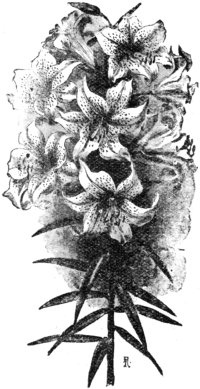
Lilium Auratum.
Lilium Concolor and Lilium Davidii are
usually considered under the Isolirion group,
but they present such numerous deviations
from that group of lilies that we have decided
to make a group of them alone.
Lilium Concolor is a pretty, little, very
variable lily. It is more suitable for a button-hole
decoration than for anything else, but it
has a pleasing effect when grown in great
masses. This species has a very small bulb
with few, acute, oblong scales. The plant
grows to about a foot high, and bears from
one to three flowers about an inch and a half
across, and of a deep crimson colour spotted
with black. The flowers open very wide, and
the filaments are shorter than in any other
lily. Of the great number of varieties of this
lily we will describe two. The first, named
Buschianum, or Sinicum, grows taller, has
larger leaves, and larger and more numerous
blossoms, which are of a fine crimson.
The second variety, Coridion, is by far
the handsomest of the group, bearing large
flowers of a bright yellow spotted with brown.
Concolor is a native of Western Asia. Its
culture is very simple, and it is perfectly hardy.
Of Lilium Davidii, we only know that it
was discovered by David in Thibet; that it
grows about two feet high, and bears bright
yellow flowers spotted with brown. We also
know that there is a plate of this species in
Elwes’s Monograph. The plant is practically
unknown to everybody.
The last group of lilies, Notholirion, contains
two or, as we have it, three species
which are not very well known, and it is a
little doubtful whether they are lilies at all.
Formerly they were considered to be fritillaries,
and certainly they bear more superficial
resemblance to those plants than they do
to the lilies.
Most authors include Lilium Oxypetalum
among the Archelirions, because its flowers
are widely expanded. But as in every other
particular it differs completely from that
group of lilies, we have separated it from
L. Auratum and L. Speciosum, and placed it
among the Notholirions, to which it bears
considerable resemblance.
This little-known lily was formerly called
Fritillaria oxypetala, and bears more resemblance
to the fritillaries than it does to the
lilies. The bulb is oblong, with but few
lance-shaped scales. The stem grows to the
height of about fifteen inches, and bears about
twenty or thirty leaves, resembling those of
our native snake’s-head fritillary in every
particular. One or two blossoms are borne
on each stem. They are pale lilac, star-like
blossoms, with numerous little hairs on the
bases of the segments. The petals are acutely
pointed. The anthers are scarlet.
This plant is a native of the Western
Himalayas. It is very uncommon in gardens.
We have never possessed it, and know nothing
of its culture.
The two lilies Lilium Roseum and Lilium
Hookeri are now included in this genus, but
they have been referred first to the lilies, then
to the fritillaries, then back again to the lilies,
and so on. And it is very doubtful if they are
even now in their last resting-place.
The bulbs of these lilies are invested in
dense membranous tunics like those of the
daffodil. Lilium Roseum grows to about two
feet high; L. Hookeri rarely reaches half this
height. The leaves are said to bear bulblets
in their axils. Six to thirty little nodding
bell-like blossoms of a deep lilac colour are
produced by L. Roseum, but L. Hookeri
rarely produces more than eight blossoms.
But little is known of these lilies. They are
both natives of the Himalayas, and are said to
be somewhat tender. They may be grown in
a mixture of rubble, old bricks, sand, and leaf
mould.
We have never grown them ourselves, as it
is practically impossible to obtain bulbs. We
have seen L. Roseum in blossom, and were
not particularly impressed by it.
Had we been describing roses, chrysanthemums,
hyacinths, or any other flowers which
are highly cultivated, we would have dismissed
the natural species with a very brief description,
and turned our chief attention to the
artificial varieties and hybrids.
But with lilies it is different. As we have
seen, there are very many natural species.
Indeed, the species almost outnumber the
varieties, and these latter are rarely very
different from the parent species. As regards
double-flowered varieties, we have seen that
only four lilies bear them, whereas nine-tenths
of the cultivated varieties of roses and chrysanthemums
are double.
[Photo by F. Hanfstaengl.
NIGHT.
(From the painting by Gabriel Max.)
And when we pass on to consider the
hybrid lilies, we are likewise astonished at
their paucity. Why are hybrid lilies so uncommon?
Let us see if we can fathom the
mystery.
One reason is that the majority of lilies
never bear seed in England. Many, even in
their native climes, bear seed but rarely, the
natural method of increase being by bulblets.
Another reason with us is the exceeding difficulty
of raising lily-seed. They take so long
to germinate that most seeds are destroyed
before they show any sign of life.
Still, we believe that there is a great future
for the hybridisation on lilies. Perhaps you
would like to try it yourself. Then proceed
as follows.
Let us cross Lilium Auratum with Lilium
Speciosum. Choose well-grown specimens of
each lily. Let the buds develop till they
begin to change colour. Then remove every
bud except one—the best—from each plant.
The remaining bud of the L. Auratum must
then be slipped open, and the anthers removed.
It may then be allowed to open
naturally, but it must be carefully protected
from insects of any kind, lest one of these
should bring to it a pollen grain from another
blossom of its own species. When the
L. Speciosum has matured its pollen, cut off
the anthers, and rub the pollen upon the style
of the L. Auratum.
Three things may now happen. The first,
the most likely, is that the flower will die, and
will not produce seed. The second is that the
plant will produce seed, but these, when they
have been grown into flowering bulbs, will
reproduce unaltered L. Auratum. The third—last
and least likely possibility—is that the
plant will produce seed which, when grown
and flowered, will produce blossoms which
partake of the characters of its two parents.
In other words, these last are genuine
hybrids.
It is extremely unlikely that more than one
per cent. of the seeds will produce a blossom
which bears the marks of both parents. The
majority will either die, or else be simple
L. Auratum, without anything to show that
they are hybrids.
Even with those rare plants which definitely
show their hybrid origin, a great diversity of
colouring may be observed. But the colour of
the parents is very variable, and after a few
years the hybrid lily looses the characteristics
of the L. Speciosum and becomes merely a
reddish variety of L. Auratum.
But there are two hybrid lilies which are
quite constant, and as they are two of the
finest of the whole group, they are well worth
growing.
Lilium Alexandræ, the Japanese “Uki
Ure” or “Hill Lily,” is in all probability a
hybrid between Lilium Auratum and Lilium
Longiflorum. We say “in all probability,”
for we are not quite certain that it is not a true
species.
There are some persons who think that one
white lily is much like another. But put side
by side L. Alexandræ, L. Longiflorum, and
L. Candidum. Are they alike? Could anyone
mistake one for another? Surely not!
They differ in every detail—even in colour.
The long trumpet of L. Longiflorum is
delicate greenish-white. The Madonna lily
is like porcelain; and the hill lily possesses
a rich milky hue, somewhat resembling the
colour of L. Brownii, which we so much
admired.
And in shape how different they are. One
is a long and regular trumpet, another is a
shallow cup, and the lily we are specially considering
is widely opened with its segments
slightly curved, the whole blossom resembling
a gigantic white star.
Lilium Alexandræ is not a big lily. It
grows about two feet high and bears from one
to four blossoms. These blossoms are very
large, of a rich milky white, resembling in
shape those of L. Auratum. The pollen is
chocolate colour. The fragrance of this lily is
very great. On the evening of a hot day in
the middle of August last year we could
detect the scent of a bed of these lilies, then
in full bloom, at the distance of over one
hundred yards. Its scent is rich and full,
something between that of jasmine and
vanilla.
The culture of this hybrid is not difficult.
It is best grown in pots, for it is very sensitive
to rain at its flowering period. In rigorous
districts this lily should be grown in a cool
greenhouse, but in the south of England it
will grow to perfection out of doors. The
soil should consist of equal parts of peat, very
finely broken, leaf-mould, and sharp sand. It
wants a very large quantity of water.
Few lilies have given us greater pleasure
than L. Alexandræ. It is one of those plants
which are so striking that it is impossible to
forget them when you have once seen them.
It is so very delicate, so pure and so fragrant.
Doubtless most of our readers are acquainted
with the old Nankeen lily. This is a very old
favourite, and is usually thought to be a true
species, but for all that it is almost for certain
a hybrid between L. Candidum and L. Chalcedoniam.
This plant rejoices in a goodly
number of names, of which L. Testaceum,
L. Isabellinum, and L. Excelsum are the
commonest.
This lily is unknown in the wild state, and
its origin is very obscure. It is an English
garden hybrid, but who first raised it or
possessed it is unknown.
Yet it is a very striking lily, growing to the
height of four or five feet and producing a
great cluster of buff-coloured blossoms. In
general features it resembles its parent L. Candidum,
but the flower shows a distinct connection
with the Martagons. Its colour
certainly is not derived from either of its
parents. A mixture of scarlet and pure white
should give pink; but L. Testaceum is of a
yellowish-buff colour. The lily which it most
nearly resembles is L. Monodelphum; but
though very fine, it is nothing like so splendid
as that queen of the Martagons.
This lily is distinctly a cottage-garden
flower. Except in that situation it is never
seen. Yet it is common enough in old
cottage-gardens, and a more befitting flower
can scarcely be imagined. It looks old—in
keeping with the place which it enhances by
its presence.
The cultivation of this lily is the same as
that of L. Candidum. It does not do well
until it is well established, and it has a
particular objection to growing in modern
gardens.
Lilium Parkmanni is the hybrid between
L. Auratum and L. Speciosum. Genuine
specimens bear blossoms somewhat intermediate
between the parent species.
There is also a hybrid between L. Hansoni
and L. Martagon Dalmaticum, called Lilium
Dalhansoni.
These four hybrids are the only ones which
deserve to be mentioned, and of these only the
first two are worth a place in the flower-garden.
(To be concluded.)
CHOCOLATE DATES.
Have you ever tasted chocolate dates? If so,
these directions will be almost needless to you,
for I fancy that you will not have stopped at a
taste, but will have tried and found out a way
to manufacture them for yourself. But so far
as I know, these dates are, as yet, quite a
home-made sweet, and they are so delicious
and so wholesome that they ought to be more
widely known. Here then is the recipe. Any
sort of dates and any sort of chocolate may be
used, but the best results are got from the best
materials in confectionary even more than in
other work. Take then a pound of Tunis
dates, either bought in the familiar oblong
boxes or by the pound. Leave out any which
are not perfectly ripe; the soapy taste of one
of these paler, firmer dates is enough to disgust
anyone with dates for ever. Wipe the
others very gently with a damp cloth (dates
are not gathered by the Dutch!), slit them
lengthwise with a silver knife, but only so far
as to enable you to extract the kernel without
bruising the fruit. Then prepare the chocolate.
Grate a quarter of a pound of best French
chocolate, add an equal weight of fresh icing
sugar, two tablespoonfuls of boiling water, and
mix in a small brass or earthenware saucepan
over the fire until quite smooth, only it must
not boil; last of all add a few drops of vanilla.
Then put your small saucepan inside a larger
one half filled with boiling water, just to keep
the chocolate fluid until all the dates are filled.
Take up a little of the mixture in a teaspoon,
press open the date, and pour it neatly in.
There must be no smears or threads of
chocolate if your confectionary is to look
dainty. When about a dozen are filled, gently
press the sides together, and the chocolate
should just show a shiny brown ridge in the
middle of the date. Place on a board in a
cool place to harden; they may be packed up
next day.
Almost as nice as chocolate dates are nougat
dates. The foundation for the nougat is the
same as for American candies: the white of
one egg and an equal quantity of cold water to
half a pound of sifted icing sugar, all mixed
perfectly smoothly together. Then chop equal
quantities of blanched walnuts, almonds, Brazils,
and hazel nuts together, mix with the sugar in
the proportion of two thirds of nut to one of
the sugar mixture, and leave until next day in
the cellar. By that time the nougat will be
firm enough to form into kernels by gently
rolling between the hands; if it sticks, your
hands are too warm. It is best to do this part
of the work in the cellar. Having stoned and
first wiped your dates, put in the nougat
kernels, gently pressing the sides together;
they will harden in a short time, and very
pretty they look packed alternately with the
chocolate dates in fancy boxes. Tunis dates
do not keep good much longer than two
months, the grocer tells me; we have never
been able to keep them half that time to try!
Of course, you can use the commoner dates,
which are very good to eat, but hardly so nice
to look at as the others, because on account of
their more sugary consistency it is impossible to
fill them so neatly as the moister Tunis dates.
Tafilat dates are somehow too dry and solid to
combine well either with nuts or chocolate.
HOW WE MANAGED WITHOUT SERVANTS. — CHAPTER III.
By Mrs. FRANK W. W. TOPHAM, Author of “The Alibi,” “The Fateful Number,” etc.
he hot July days brought us
such good news from Cannes
that our hearts were all light
with the hope of soon welcoming
our parents back,
and Cecilly was especially
happy at being promised
several more pupils after the
summer holidays were over. Mrs. Moore, the
old lady to whom I read, had hinted that
she might require more of my time in the
autumn, so we had every reason to be light-hearted
and to forget the hardness of our
work with so much to be thankful for. Only
poor old Jack looked graver as the days went
by, and my heart ached for him with his secret
trouble.
It was nearly the end of July that one
morning Cynthia came tapping at the kitchen
door, where I was surrounded with materials
for dinner.
“Where is Cecilly?” she asked, and on
my telling her Cecilly was out, giving music
lessons, she told me she had tickets for a
concert that afternoon, and she knew how
much she would like to go.
I knew so too, and at once said I would
leave my cooking till the afternoon and finish
a smart blouse Cecilly had been making for
herself.
“Do let me do the cooking while you
sew,” Cynthia asked, but I said she had
better not as the dinner was to be what the
boys called a triumph of “mind over matter,”
meaning a dinner was to be made out of
scraps, which was always tiring work. But
Cynthia insisted on being cook.
I had already sent Beatrice Ethel, the little
boot-girl, out for a quart of skimmed or
separated milk which Cecilly made into Sago
Soup: Take three or four onions and boil
them in the milk till soft enough to run
through a sieve. Boil six large potatoes and
rub through sieve. Put all back into milk
with pepper and salt. Add a teacup of sago,
tapioca, rice, or some macaroni. But sago is
best. Send up fried bread with this.
Our meat course was to be breakfast pies,
and as there were some scraps over, Cynthia
made a mulligatawny pâté, which would
come in for breakfast.
Our pudding was a German Pudding:
1 lb. flour, 1 teaspoonful of carbonate of soda
rubbed into the flour, 6 oz. of scraped fat,
½ lb. treacle melted in milk. To be boiled
for three hours. This would have been
sufficient for our dinner, but Cynthia begged
to make a few jam tarts, as she “loved making
pastry.” Whey they were finished, she had
a piece of pastry over, which she turned into
Cheese Puffs. She rolled out her paste,
sprinkled it thickly with cheese and “Paisley
Flour,” repeating the process several times.
She brushed them over with a little egg, and
baked them at once. I suggested, as we were
well off for milk, she might make a custard
to eat with our pudding, with “Bird’s Custard
Powder,” but only on condition that she asked
leave to come back with Cecilly to help us
eat such a grand dinner. Lately I had
noticed that she had been allowed to accept
our invitations for the evening, and although
it seemed a mistake for Jack to be in her
company too often, it was such a delight for
him to find her with us when he returned
home, I could not resist asking her.
Cecilly had of course accepted Cynthia’s
invitation to the concert with much delight,
and I, having locked up the house, had spent
a pleasant afternoon with dear Aunt Jane,
who had given me a great bunch of beautiful
white lilies, and a basket of gooseberries for
the boys.
I was only just back when I heard Cecilly’s
knock, and finding her alone I asked if Cynthia
were not coming to dinner.
“Yes, indeed she is,” answered Cecilly,
“and what do you think? Mr. Marriott has
invited himself also!”
“Oh, Cecilly,” I cried. “You must go
at once and get some fish and some fruit,”
but Cecilly interrupted me, saying—
“No, he stipulates that we make no change.
He is coming to eat Cynthia’s cooking, and I
promised him we would have nothing extra,
except some coffee.”
Of course I brought out our best table linen
and china, rubbed up our silver and glass, and
with Aunt Jane’s lilies for decoration our
dinner-table looked as nice as possible.
Cecilly ran up the road to meet Jack to tell
him the news as soon as she saw him, and
we had to be quite determined not to be
over-ruled, so anxious was he for various
additions to our meal.
“Could you not run to Aunt Jane and ask
her to lend us her maid,” he asked, but I
insisted on no change being made.
“Mr. Marriott is coming to see how clever
Cynthia is, and not to quiz us,” I replied, so
Jack had to be content. The soup was a
great success. We turned the Mulligatawny
pie into an entrée, and added the jam tarts to
the pudding course. Cecilly and Bob fetched
and carried the dishes, though I slipped out
during the cheese course to make the coffee
for dessert.
We were a very merry party at dinner, and
Cynthia had many congratulations from us
all. Jack and Mr. Marriott were a long time
before they joined us in the drawing-room,
but when they came the evening was one of
the pleasantest we had spent since dear
father’s illness. Jack was so much more like
his old self, and Mr. Marriott so positive of
father’s recovery that every doubt and perplexity
of life fled, and it seemed to me that
all the pain of separation and the grave
anxieties of the past were now fled for ever.
Cecilly and the boys had gone up to bed
while I waited for Jack to return from walking
back with Cynthia and her father, and when
he came in I saw at once he had good news
for me.
“Oh, Kitty,” he cried, in his old boyish
manner, “you can never guess what Mr.
Marriott has said to me this evening. He
said he always knew a good son would make
a good husband, but that he felt his little girl
would never make a good wife for a poor
man. But, Kitty Mavourneen, he says you
and Cecilly have shown her the way, and if,
when she is twenty-one, I like to ask her to
be my wife, he won’t send me away.”
I was obliged to run upstairs to call Cecilly
to hear these good tidings, and Cecilly in her
dressing-gown, with her hair streaming down
her back, rushed down the stairs at a bound
to hug Jack in a way she had not dared to do
since he had grown “so cross and old.”
It was but a few weeks afterwards that we
were welcoming father and mother back once
more—father, older-looking certainly than
before his illness, but no longer an invalid,
while mother looked stronger and rosier than
any of us could remember her. They were both
surprised to find how well we could manage
the housework, though father insisted on our
keeping Beatrice Ethel all day to do the
heaviest work.
“As soon as I am in work again,” he said,
“we must find a strong servant once more,”
and on our protesting he answered, “My
darlings, you were perfectly right in doing
without servants as you have done. Now
there is really no necessity, and it is wiser for
Cecilly to spend her time over her music, to
enable her to teach others. You, dear Kitty,
we will gladly spare to Mrs. Moore, knowing
you can help her in her infirmity. This work
you are both fitted to undertake, and you can
then conscientiously leave the housework to
those other girls, who, not having had the
education God has permitted you to have, can
only labour with their hands and hearts.
Your experience will make you better mistresses,
I am convinced. You will be more
competent to teach and more sympathetic
over failures and shortcomings, and will never
in all your life regret that all these months
you have managed without servants.”
VARIETIES.
Some Gaelic Proverbs.
Most shallow—most noisy.
The eye of a friend is an unerring mirror.
Oft has the wise advice proceeded from the
mouth of folly.
As a man’s own life, so is his judgment of
the lives of others.
God cometh in the time of distress, and it
is no longer distress when He comes.
The fortunate man awaits and he shall
arrive in peace; the unlucky hastens and evil
shall be his fate.
Life and Death.
I live, and yet I know not why,
Unless it be I live to die:
I die—and dying live in vain,
Unless I die to live again.
An Absolute Certainty.—Amid the
mysteries which become the more mysterious
the more they are thought about, there will
remain the one absolute certainty that man is
ever in presence of an Infinite and Eternal
Energy from which all things proceed.
Passing an Examination.
Here is how Professor William James of Harvard,
in his student days, passed an examination
before the late Dr. Oliver Wendell Holmes.
The first question put to him was as to the
nerves at the base of the brain. It so happened
that Mr. James was well up in the subject, and
he promptly gave an exhaustive reply.
“Oh, well, if you know that you know
everything,” said Dr. Holmes cheerfully.
“Let’s talk about something else. How are all
your people at home?”
SHEILA’S COUSIN EFFIE. — CHAPTER XX.
A STORY FOR GIRLS.
By EVELYN EVERETT-GREEN, Author of “Greyfriars,” “Half-a-dozen Sisters,” etc.
THE STORM BREAKS.
“It is simply disgraceful. You have
made yourself the talk of the hotel. I
am ashamed that you belong to my
party; and you shall go home on
Monday in the mail. I will not have
the responsibility any longer of a girl
who has no sense of obedience or of the
fitness of things. Back you shall go at
once. Your uncle will telegraph, and
somebody shall meet you at the other
end. But stay here any longer to behave
in this way you most certainly shall not!”
Sheila stood white-faced and almost
terrified before her aunt. She was still
in her riding-habit. She had come in
so happily from her scramble with
Ronald down by the shore; and with
never a misgiving had run upstairs and
entered the sitting-room before going to
dress for dinner.
There she found her aunt alone, waiting
for her as it now seemed; and without
warning the tempest had broken
over her head. She scarcely knew even
now of what she stood accused. It
seemed as though every sin of every sort
had been laid at her door. She could
at first scarcely get at the gist of what
her angry aunt could mean; but as Mrs.
Cossart proceeded it gradually dawned
upon Sheila that she was being accused
of having carried on a bare-faced flirtation
with Ronald Dumaresq, and of
having made herself the talk of the hotel
in so doing.
It was like a stinging blow in the
face to the sensitive girl. She was
almost stunned by the rush of feeling
that came over her. A few weeks ago
she could have borne it better—she would
have been more angry, but less overwhelmed
with pain and shame.
The wakening womanhood within her
made the accusation almost intolerable.
The very looks and words which had
passed between them that day seemed
to rise up before her in a bewildering
mist. Could it possibly be true what
her aunt was saying? Had she been
forward, unwomanly, fast? Had she
made people remark upon her—got
herself talked of as a flirt?—hateful title
that Sheila recoiled from as from a blow.
She had liked to be with Ronald, she
had thought he liked being with her.
But her aunt had said it was she who
was always entrapping him—those were
the very words. Oh, how cruel, how
cruel and unjust! But it was not true,
no, it was not! Only if such things were
being said, she could never, never, never
see Ronald again all her life!
A wave of sudden desolation seemed
to sweep over Sheila. A rush of hot
tears flooded her eyes. She burst into
sobs and flung herself down on the sofa,
crying—
“Oh, how can you say such cruel
things? How can you?”
“I say them for your good—because
they are true,” answered Mrs. Cossart,
her anger in no way appeased by the
sight of Sheila’s grief; “and there is
the less excuse for you, because you have
always had Effie’s example before you.
You will never find her lowering herself
by running after young men as you have
been doing; and I tell you, Sheila, that
nothing so disgusts those very young
men as seeing girls do this. They
humour them at the time for their amusement,
and because their vanity is
flattered; but in the end they despise
them. Mr. Dumaresq has been very
kind to you, but he must know perfectly
well that you are trying to get him for a
husband.”
Sheila suddenly started up, her face
suddenly grown white.
“Aunt Cossart, you shall not say that
again! I will not bear it from you.
Yes, I will go away. I would not stay
after this. Where is my uncle? Let
me talk to him, but please do not say
another word. I cannot bear it!”
There was something in the girl’s
sudden change of manner that half
frightened Mrs. Cossart. She did not
particularly want Sheila and her uncle
to meet just now.
“Your uncle has gone downstairs,”
she answered uneasily, “you can see
him after dinner.”
“I shall not go down to dinner,” said
Sheila, putting up her hand to her head
in a dazed way. “My head aches. I
shall go to bed. If I am going away on
Monday, I think I won’t come down to
meals any more.”
“Well, I think you had better go to
bed,” said Mrs. Cossart. “You have
had a tiring day, and you don’t look
yourself. I don’t mean to be unkind,
Sheila, but you have no mother, and it
is my duty to speak plainly sometimes.”
“Then I am sure you have done your
duty, Aunt Cossart,” said Sheila, giving
one direct look at her aunt, and then the
wave of bitterness surged over her once
more. The tears rushed to her eyes;
she felt as though she were choking, and
in a blind sort of way she darted from
the room, dashed into the one she shared
with Effie, and flinging herself upon her
bed broke into wild weeping.
Effie had just finished her toilet, her
face was rather flushed, and she looked
uncomfortable and displeased. The
maid was putting the room to rights,
and cast a compassionate glance at the
prone figure on the bed. She had
received orders to pack up Sheila’s things
in readiness for the mail on Monday,
and as this was Saturday evening
and no word had been spoken previously
of such a thing, she divined that there
had been a “row.” Probably she had
a shrewd guess as to the cause, but of
course she made no remark, finished her
task and went away.
Effie came and stood by Sheila.
“Don’t cry so,” she said. “It’s a
pity it has happened, but nobody will
remember anything about it when you
are gone. The Barretts are going in
the mail on Monday. They will take
care of you, and be pleased to have you.
You always get on with people. And
it’s better to go than to have bothers all
the time.”
Effie was half glad, half sorry to be
rid of Sheila. In a way she was fond of
her cousin, but she had become rather
jealous of her too. And then her foolish
mother had fostered in her the belief
that Ronald Dumaresq would certainly
pay his addresses to her if only Sheila
would let him alone, and not be perpetually
attracting him off to herself.
Effie had been taken by Ronald from the
first, and was flattered at being told of
his preference. She had begun to fancy
herself more or less in love with him, as
girls with nothing better to think about
are rather disposed to do. She liked to
picture herself the mistress of an establishment,
with a handsome young
husband to take her about. If it were
true that Ronald admired her, it was a
thousand pities he should not have a fair
field. Effie did not pause to consider
that he had an excellent opportunity
as it was for prosecuting his wooing,
and that if he let himself be turned from
his purpose by Sheila’s “machinations”—as
her mother called it—his love could
not be very deep or true. She was
accustomed to be led by her mother’s
opinions; and she had become very
jealous of the way in which people
“took up” Sheila, and left her out in
the cold.
As Sheila made no answer, Effie
moved away, and joining her mother in
the next room remarked—
“You have upset her very much, but
I suppose she will get over it. I think
she won’t come down to-night, her face
will be all red and swollen. What shall
we say to people? Shall you tell them
she is going to be sent home?”
Mrs. Cossart looked a little taken
aback. She had overlooked the fact
that some explanation would have to be
given of this exceedingly sudden arrangement.
She looked at her daughter, and
then said slowly—
“Well, we won’t say anything to-night,
only that Sheila has a headache
and cannot come down. You will have
a chance of talking to Mr. Dumaresq
at table now, Effie. I am quite tired
of the sound of Sheila’s laugh, and
her way of getting his notice all for
herself.”
But Effie found Ronald rather abstracted,
and she did not make much
way with him. After he heard that
Sheila was not coming down he seemed
to go off into a brown study; and it was
only when Mr. Cossart suddenly seemed
to drop a bomb in their midst that he
took note of what was passing.
“Yes, she is to go home on Monday,
my wife has decided,” Mr. Cossart
remarked to Miss Adene, all unconscious
of his wife’s warning looks.
“We brought her out for a little
holiday and amusement; and now she
will go back home to another uncle of
hers. Oh, yes, we shall all miss her.
She is a merry little puss. But we think
she has been here long enough. Mrs.
Barrett has kindly promised to take
care of her on the voyage home.”
Ronald’s eyes had fixed themselves
upon Mr. Cossart’s face.
“Are you speaking of Miss Cholmondeley?
Surely it has been arranged
rather suddenly?”
“Well, we have talked of it often,”
said Mrs. Cossart interposing. “Sheila
only came out for a time, not for the
whole season. It is the chance of
sending her back with such a good
escort that has settled the matter. She
will be very happy with the Barretts.
They have made such friends, she and
the girls.”
“It is strange she said nothing all
day, when we were making all sorts of
plans for the future,” said Ronald; and
both Mr. and Mrs. Cossart looked so
uncomfortable that Lady Dumaresq
changed the subject.
There was no walking up and down
the corridor or verandah with Ronald
that evening, for he followed his party
direct into their private sitting-room at
the end of the ground-floor passage,
and appeared no more that night.
“What does it mean?” he asked,
with a note of indignation in his voice.
Miss Adene and Lady Dumaresq
exchanged glances. They had seen
perfectly through the clumsy manœuvre.
Their eyes had been observing the turn
affairs were taking for some while.
They were not altogether unprepared
for some such development.
“Now, Ronald,” said Lady Dumaresq
quietly, “it is no use your putting yourself
into a fume and fret about this. It
is very evident that Mrs. Cossart is
jealous of Sheila, because she so
entirely eclipses Effie. It is not a very
surprising thing that it should be so.
We must allow for a mother’s weakness.
Perhaps you have yourself helped to
bring about the crisis by a rather too
visible admiration for the little girl.
You were not quite wise to-day, for
instance; and she is too much the child
to be on her guard; and if people do
talk——”
“Let them,” answered Ronald rather
proudly. “I am not afraid of having
my name coupled with that of the girl I
intend to make my wife!”
They all smiled at him. They were
all in sympathy with his bold declaration.
Lady Dumaresq held out her hand, and
Sir Guy laid an affectionate arm over
his shoulder.
“So it has come to that, has it,
Ronald? Well, I am glad to hear it.
But a little patience will not hurt either
of you; and you will know better after a
separation whether she cares for you in
the way you wish.”
“After a separation!” repeated
Ronald rather blankly. “But I mean
to come to an understanding before they
send her away. I may even be able to
stop it if she is my——”
But Lady Dumaresq laid a gentle
hand upon his lips.
“Ronald,” she said, “that would not
be wise. Indeed it would scarcely be
fair and right to her.”
“What do you mean?” he questioned
quickly.
“I mean that the question you have
to ask Sheila is too solemn and serious
a one to be put when she is in a mist of
bewilderment, sorrow, and indignation,
which is sure to be the case. You
would come to her then as a sort of
champion and deliverer, and she would
very likely accept you in that impulse of
gratitude, whether or no her heart be
deeply stirred. Do not win her in that
impetuous way, Ronald. It will not
hurt either of you to bear the yoke for
awhile—to learn what patience has to
teach. Her character will develop in
the school of life’s discipline, as it has
not done when all has been sunshine.
Let her go now, Ronald. Prove your
own heart first, then if you find it unchanged,
seek her out later, and win her
if you can. Believe me, it will be best
so. I do not know what has passed
between Sheila and her aunt, but whatever
it is, I would not have you seek an
interview now.”
And indeed, had Ronald desired it,
it is doubtful if he could have obtained
sight of Sheila. She remained in bed
most of Sunday with a violent headache.
Miss Adene and Lady Dumaresq stole
up to see her, to whisper a few kind
words and then retire. And when
Monday came she was nothing but a
little white-faced, woe-begone creature,
so unlike the Sheila of the past weeks
that her friends would scarcely have
known her.
She would not say good-bye to anybody.
She shrank from the thought of
what they might have been told as to
her sudden departure. Every nerve was
tingling with pain, and shame, and
misery.
The boat was in early, and whilst the
rest of the people were at lunch, Sheila
got her uncle to take her down to the
quay and see her on board, for she felt
she would sink into the ground if
Ronald were to come out and see her,
and say good-bye before the rest of the
people.
“Well, I am thankful she went off so
quietly,” said Mrs. Cossart, as they
discussed the matter together before
descending to dinner. “I was afraid
there might be a scene, but there is no
accounting for Sheila. She did not
even want to say good-bye to the
Dumaresq party, and if some of them
hadn’t come up here, she would have
gone off without even that. Girls are
the queerest, most capricious creatures!
Well, it’s all happily over; and, Effie,
you will have Sheila’s place now at table,
and nobody to interfere with you. Mr.
Dumaresq——”
But Effie tossed her head rather
defiantly. She had not got much
change out of Mr. Dumaresq these last
few table d’hôte meals.
“I don’t care for Mr. Dumaresq so
mighty much. I’m not going to put
myself out of the way for him. I don’t
think I care so particularly for fashionable
young men. I don’t mind him,
but I’m not going to put myself out of
the way just to amuse him. I think he’s
very dull sometimes. I don’t know what
you all see in him to make such a fuss!”
Mrs. Cossart rather felt as though she
had taken an infinity of trouble for a
chimera of her own brain, and when she
reached the dining-room her jaw almost
dropped. She had pictured the amalgamation
which would take place between
Effie and the Dumaresqs now that
Sheila had gone; but what did she see?
The whole Dumaresq party had
moved bodily to the side table, hitherto
occupied by the Barretts, who had left
to-day. Some new arrivals from the
Cape had been given the seats next to
the Cossarts—loud-voiced colonials with
rather bad manners, who talked amongst
themselves and seemed not to desire the
acquaintance of their neighbours.
Mrs. Cossart sat in dismayed silence
through the meal, and when she went
into the drawing-room afterwards, she
fancied that all the people looked coldly
at her. Nobody spoke either to her or
to Effie, and they soon retired to their
own rooms.
Was this a sample of what would
result from her laborious attempt to
promote her daughter’s popularity?
(To be continued.)
THINGS IN SEASON, IN MARKET AND KITCHEN. — MENU FOR SEPTEMBER.
By LA MÉNAGERE.
September, the hunter’s moon, brings us such
an abundance in our markets that it is difficult
to say just what is peculiar to the month.
Undoubtedly the most prominent feature is
moor game, and now is the time when even
moderate purses may safely indulge in this.
Hares, rabbits, grouse, partridges, and wild
duck give an excellent choice, and poultry
also is prime and not dear.
Fresh-water fish come in this month, and
are often most useful to country hostesses, as
well as affording sport to her guests. The
orchards are laden now with fast-ripening fruit,
and if this harvest is a fairly plentiful one we
may indeed be glad. Nuts will find an excuse
for many delightful nutting parties among the
children, and the storing of fruits and vegetables
from the garden will keep the housekeeper
busy. Damsons should be plentiful towards
the end of this month, and will want making
into jam and cheese, and we expect also to
gather blackberries—another excuse for picnicking—nor
must we leave mushrooms out of the
list. Indeed, September is the harvest-month
in many senses, for we have the wild crops
ready for garnering, as well as the cultivated
ones of garden and field.
The poorest country-dweller may make a
profit now who has the wit and the energy to
seek for nature’s bounty, as these wild things
invariably meet with a ready sale in towns.
Besides these we have other things provided
by a bountiful providence which we ought to
appreciate better than we do. See the glorious
colouring that the leaves of the hedgerow trees
take on; note the rushes swaying in the brook,
the berries of the mountain-ash, as well as of
the dog-rose; all these are profitable to town
florists, who will generally pay a fair price for
such things. To the home decorator all these
are very valuable—or will be in the days that
will come all too soon, when no flowers are to
be had for the table. If slightly dried and
brushed over with a very weak solution of gum
arabic, then dried again, these will keep for a
long time without losing their colour. Some
of the very prettiest table decorations ever
seen have been made with coloured leaves and
berries. For tall jars in the corners of rooms,
purple thistles, white honesty, brown bulrushes,
copper beech boughs, and scarlet ash-berries
combined, make a truly lovely show.
In the garden we have dahlias and sunflowers
defying the wane that seems to make everything
else look dreary, and by and by we shall
have chrysanthemums in all their brave glory
to brighten house and greenhouse. What a
glory do these give to the last days of the
dying year.
But the year is far from ending in September;
we have many things yet to enjoy,
and possibly many guests to entertain, and
always much to see to, as prudent housewives.
A plentiful crop of wild mushrooms proves
a great help to us now, and we are glad to
remind ourselves of different ways of using
them. For instance, with bacon or eggs at
breakfast, au gratin at dinner, on toast at all
times, they are acceptable. With field mushrooms
we have need to be very careful lest we
inadvertently give ourselves some that are
poisonous and unfit for food. Dr. Badham,
author of the Esculent Funguses of England,
enumerates no less than forty-eight species
of edible fungi, all of which are good
to eat. According to him the majority of
fungi are harmless, but his account of the
effects of the poisonous minority is enough to
alarm the most trustful.
The easiest way to detect whether fungi are
wholesome or not is to insert a silver spoon
into the stew in which they are present, and if
poisonous it will quickly turn black; a peeled
onion will also turn blue or bluish-black, and
is an even easier test. If either of these on
being withdrawn shows their own natural
colour, the mushrooms may be regarded as
harmless.
Mushroom ketchup is regarded by all housewives
as one of the treasures of the store-cupboard,
and that which is home-made is
generally better than any that can be bought.
It is best when made of the large flap
mushrooms, fresh, but fully ripe. They must
be gathered during very dry weather, if the
ketchup is to keep properly. Do not wash or
peel them but wipe them clean, and remove all
decayed pieces and part of the stalks. Put
them into a gallon stone jar, and strew salt
liberally over them. Let them remain a night,
and the next day stir them up, and repeat this
for two or three days. At the end of the
third day put the jar into the oven and let
them stew a short time, then gently pour off
the liquid, but do not squeeze them at all.
To every quart put an ounce of Jamaica and
black peppercorns, two or three pieces of rase
ginger, and a blade of mace. Boil again for
perhaps half an hour, let it stand aside until
cold, then put into dry bottles, and cork it up
tightly. It is well to use small bottles, so
that when one has been opened it may be used
up before it has time to lose its virtues.
Rabbit Pie.
Cold Roast Goose.
Salmi of Partridges (hot).
Fillets of Beef with Mushrooms (also hot).
Cold Pressed Beef.
Potato, Beetroot, Tomato and Endive Salads.
Hot Potatoes.
Quince Jelly. Damson Cheese.
Apple and Blackberry Tart. Cream.
Cheddar and Gorgonzola Cheese.
Oatcake and Butter.
Our menu this month might be one suited
for a luncheon party, where the chief dishes
would be required cold, with two or three hot
ones as a set-off, and all others placed on the
table at the same time. Luncheon parties are
generally very common during this month in
the country, and the guests who come to
partake of them are not noted for their small
appetites.
Salmi of Partridges.—Put the birds into the
oven as for roasting, and partially cook them.
When about half done cut them into neat
pieces, and remove the skin and sinews, and
place them in a clean saucepan. In another
pan put a quarter of a pound of uncooked ham
minced finely, with a good piece of butter;
add a dozen small mushrooms, three or four
minced shallots, a grated carrot, a spoonful of
chopped parsley, a few sprigs of savoury herbs
and some pepper and salt. Cover closely and
let them cook on the top of the stove, shaking
the pan to prevent burning; when cooked
dredge a little flour over them, let it brown a
little, and pour in about a pint of good brown
stock. Add also a glassful of sherry. Stir
until the gravy has thickened nicely, then put
in the pieces of the birds, and let them slowly
simmer, but not boil, for at least half an hour.
Dish the game in a pile on a hot dish, strain
the sauce, and see that it is well seasoned and
of a nice brown colour, then pour over all.
Garnish with fried sippets of bread.
Fillets of Beef with Mushrooms.—These
should be cut from the undercut or fillet of
beef, and be neatly shaped. Fry them quickly
on both sides, but only enough to slightly
brown them, then place in a stewpan and
cover with peeled mushrooms, one or two
shallots, some pepper and a glassful of red
wine with also a small lump of butter. Stew
these for quite an hour in a rather slow oven,
then lift out the meat and the mushrooms, and
thicken the gravy with fécule, also add salt
and a tablespoonful of sharp sauce, then pour
boiling hot over the dish.
Quince Jelly and Damson Cheese are both
preserves that should be found in readiness in
the store cupboard. For the first, take a
quart of quince juice obtained by boiling the
fruit with a very little water and then straining
it through a bag; add a pound of lump sugar
to every quart, and then an ounce of gum
arabic previously soaked in water. Boil well
for quite half an hour, then put into moulds.
Damson Cheese.—Put several pounds of
freshly-gathered damsons into a stone jar with
a very little water. Stand this on the top of
the stove to stew gently for some hours, or
until the fruit is perfectly soft. While still
warm turn out the damsons into a wide-meshed
sieve or colander, rub until nothing but skins
and stones are left. Put half a pound of loaf
sugar to every pound of pulp, and boil together
into a stiff paste. Some of the stones should
be cracked and the kernels taken out, as these
give a very pleasant flavour to the cheese.
Put into shallow dishes or moulds, and cover
with brandied papers. This cheese is usually
cut into fancy shapes and put into glass dishes
to serve at dessert.
ANSWERS TO CORRESPONDENTS. — STUDY AND STUDIO. — INTERNATIONAL CORRESPONDENCE. — GIRLS’ EMPLOYMENTS. — MISCELLANEOUS.
Irene Foy, 32, Osborne Terrace, Clapham Road,
wishes to sell “Onyx” a Greek grammar, written
by Irene’s father in English and Greek. Will
“Onyx” please write?
Lem.—You will find the poem from which you quote
an extract in Ezekiel and Other Poems, by B. M.
(Nelson and Sons). It is there entitled “The Sea
of Sorrow.”
Constance.—1. “Auf Wiedersehn,” means “till we
meet again,” like the French “Au revoir.”—2. We
always recommend Dr. Lemmi’s Italian Grammar,
published at 5s. by Messrs. Oliver & Boyd, Edinburgh;
and Messrs. Simpkin, Marshall & Co.,
London. It is quite simple enough to be studied
alone.
Soror.—We are sorry you have had to wait so long
for a reply, but owing to the time at which we go
to press, we cannot promise an answer speedily.
Nurse Petra.—The Jugend-Gartenlaube, 5s. a
year, might suit you; but we advise you to write
for a full list of German periodicals to Hachette
& Co., 18, King William Street, Charing Cross,
London.
F. E. Bartram.—Books on entomology appear rather
costly; but you might begin with British Butterflies,
Moths and Beetles, by W. F. Kirby, published at
1s.; or Sir John Lubbock’s Origin and Metamorphoses
of Insects, 3s. 6d. Order at any bookseller’s.
Nydia.—It is not wonderful that a “first attempt,”
especially as you have “never learnt how to set
down music,” and are only sixteen, should be full
of mistakes, too many to specify. It is absolutely
impossible for you to hope to succeed without
seriously studying the rules of harmony. At the
same time we should judge from your pleasant and
modest letter that such study would be by no means
thrown away.
A correspondent directs our attention to the fact that
“foolscap,” concerning which a question was lately
answered in “Study and Studio,” is a corruption
of the Italian foglio-capo, a folio-sized sheet. The
error is an ancient one, for from the thirteenth to
the seventeenth century the water mark of this
size paper was a fool’s head with cap and bells.
B. E. M.—1. We are constantly mentioning Reading
Societies in this column. Try the National Home
Reading Union, Surrey House, Victoria Embankment,
London, or write to Mrs. Walker, Litlington
Rectory, Berwick, Sussex.—2. Do not try or wish
to “become pale.” Sufficient exercise, and strict
attention to clothing and diet, are the best cure for
a faulty circulation.
A Lincolnshire Girl.—1. The lines you quote,
“Howe’er it be, it seems to me
’Tis only noble to be good,”
are certainly by Tennyson, from the poem “Lady
Clara Vere de Vere.”—2. The allusion,
“Her who clasped in her last trance
Her murdered father’s head,”
is to Margaret Roper, the daughter of Sir Thomas
More. This devoted daughter obtained possession
of her father’s head after his execution, kept it in
a leaden casket, and left directions that it should
be buried with her. For the whole story, see The
Girl’s Own Paper for February, 1898, where we
answered the question at length.
Bluebottle.—The reference you quote is probably
Professor E. Curtius, a distinguished German
authority on etymology.
A. N. D.—1. The lines (which you misquote) are as
follows—
“Oh, wad some power the giftie gie us
To see oursel’s as others see us!
It wad frae monie a blunder free us
And foolish notion.”
They are by Robert Burns, and you will find them
in any edition of his poems.—2. Write to the office of
The Boy’s Own Paper, in which magazine “The
Bishop and the Caterpiller” first appeared.
Florence is very sorry, but circumstances have
occurred which unfortunately prevent her from
opening a correspondence with a little girl reader
of the “G. O. P.” as she wished. Among the
many readers of our paper, perhaps someone else
will kindly volunteer.
“Madge,” who lives in the country, and works with
her hands, would very much like to correspond
with “Nellie,” so would Robina J. Gibson,
Ferneycleuch, Lochmaben, Dumfriesshire (a farmer’s
daughter), and B. E. M., The Rectory,
Barnow, Co. Wexford.
M. D. Lewis, Sabia, near Smyrna, Asia Minor, would
be very glad to write to any of our readers who
would like to hear a little about the remote and
uncivilised region where she lives, and the curious
superstitions and customs that prevail. She adds,
“If any of your readers wish to correspond with me
in Greek, I shall be very much pleased.”
Miss Frances White, Yaverland Manor, Brading,
Isle of Wight, would be pleased to exchange stamps
with girls living abroad; she would send twenty
British stamps in exchange for the same number of
the nationality of her correspondent.
Maud M. Baughan, Vernon Villa, James Street,
Oxford, would like to correspond in English with
Miss Ruby Tizarel and Miss Nelly Pollak.
As Miss Baughan is a teacher, she would also like
to correspond with any teachers across the sea.
Miss R. M. Cooke, Oxford Villa, Gordon Road,
Southend-on-Sea, wishes to correspond with some
girls of her own age (20) living abroad. She is an
enthusiastic collector of view post-cards, and would
like to exchange English cards for those of other
countries.
Will O Mimosa San exchange illustrated post-cards
with Madame Gaston Cantin, Rue de Saujon,
La Tremblade, Charente Inférieure, France, whom
we thank for her pleasant words, describing the
delight of her correspondence with an English reader
of the “G. O. P.”
“Bertram,” a girl fond of out-door exercise, would
like to correspond with a French girl about sixteen
years of age.
Miss Sofie Abelsberg, Budapesth, Hungary (11,
Nagy János Street), wishes for a well-educated
English or American girl correspondent of her own
age (18) who would write in German or English,
Miss Abelsberg in English.
Florida would like to correspond with a Spanish,
Dutch, Norwegian, Swedish or Russian girl of good
family about 20 years of age. She would help them
in English if they would help her in their languages.
Will any girls of these nationalities send addresses
here?
A Farmer’s Daughter (Choice of Employment).—Are
there not rather many kinds of work which you
dislike? You “would not think of entering into
domestic service at all.” You “would not care for
shop business either.” You think, however, that
you might like to act as a clerk, or a lady’s companion.
Now, we are obliged to tell you that
companions are very little wanted, and that clerks,
if they are to receive moderately good salaries,
must be well educated. You tell us, however, that
your parents would not be disposed to spend anything
further on your education or training. This
makes the position somewhat difficult. It compels
you to regard home as your school. But there are
many useful things that a girl can learn on a farm.
You might learn dairy-work thoroughly and earn
something by the sale of butter. Later, if you could
master the newest methods, from studying the
appliances used by your most successful farming
friends, you could seek a position as superintendent
of some gentleman’s private dairy. People who can
make butter and cheese well never go a-begging.
Then you should also study the best and most
remunerative methods of rearing poultry and of
marketing eggs. Something, even, might be earned
from your garden, if you have one, and the soil is
favourable for bulbs—as in many parts of Ireland it
is. The secret of comfort in farmers’ households is
for the family to remain together, and for each
member—father and mother, sons and daughters,
to contribute their share of work. But where
families break up, the trouble comes, for each
person then wants a separate house, and consequently
larger earnings.
Twentieth Volume (Art Teachership).—Your
friends have unfortunately been only too well
acquainted with the facts, when they told you that
it would be extremely difficult to obtain a situation
as teacher of art in a school. Drawing is taught
in a good many girls’ schools, but by no means in
all. The head-mistresses of many High Schools are
disposed to give most of the time allowed to general
English subjects and languages, which count in
examinations, and to leave girls of artistic tastes
to study drawing later at a regular school of art.
Evidently you draw well, or you could not have
obtained so much success in the South Kensington
examinations. But the question arises, can you
not earn something by your own drawings? Could
you not draw illustrations for stories, or make
designs for some commercial or advertising purpose?
In all directions of this kind there is much work to
be done and money to be earned. Or have you
thought of trying some handicraft such as lace-making,
silk-weaving, or cane basket-making?
Perhaps, as you live in the Midlands, you could
some day visit the Birmingham Municipal School
of Arts and Crafts and observe the many kinds of
beautiful work done by girls there. Such a visit
might give you useful ideas. In chromo-lithography,
too, there is constantly a demand for good
designs. There are some large chromo-lithographic
firms in Birmingham. The other matter you speak
of is not one in which we can help directly, but
you might make the cottage known to the railway
authorities so that they could include it in the lists
of country lodgings which they publish.
F. W. G. (Hospital Nurse).—You would not be
required to know much arithmetic in order to be
admitted to a hospital; but at the same time you
ought to know something of the subject, otherwise
your notions of the portions of drugs to administer,
and other such matters in which an accurate mind
is essential, will be very hazy. During the period
which must yet elapse before your admission you
had better be trying to improve your arithmetic.
Your writing, about which you ask our opinion, is
sufficiently legible and clear, but it would be improved
with practice. There is a slight disposition
to make the letters slope too much.
Independence (Nurse-Companion, etc.).—A nurse-companion
is usually expected to have been trained
at a hospital. The training need not have been
sufficient to qualify a woman for regular hospital
employment, but it ought to have covered a period
of six months at all events. You do not mention
that you have been in any hospital, and we therefore
think you had better give up the idea of
becoming a nurse-companion. Perhaps, as music
appears to be your best accomplishment, you would
do most wisely to seek employment as nursery
governess. Your general education we judge by
your letter to be fairly good. But try to improve
yourself by every means within your power, as you
cannot long remain a nursery governess; and you
must either advance so as to become a fully qualified
governess, when you are older, or devote your
attention to the practical duties of looking after
young children. In the latter case you would, of
course, term yourself a children’s nurse. It is
possible that you might be well advised to advertise
yourself as a children’s nurse from the first, seeking
a subordinate position to begin with, in order to
gain experience. Your handwriting is satisfactory.
A Clydesdale Lassie (Hospital Nursing).—Paying
probationers are received commonly for a period of
three months at a time, for which thirteen guineas
is paid in advance. You could not enter a general
hospital on these terms just at present. Twenty-two
is customarily the lowest age for admission.
Wee Wifie (Fancy Work).—It is almost impossible
to obtain a sale for fancy articles which are only
made at home and in small quantities. Little
novelties which can be produced cheaply and in
large numbers may often be sold direct to wholesale
and retail dealers in bazaar and fancy articles. We
should recommend a lady who must live at home
either to do work on these lines and treat her home
as a small manufactory, or else devote her time to
the making of fine underclothing, which she could
sell to the drapers and outfitters. Shops where
embroidery is sold usually keep their own workers
on the premises, for the simple reason that orders
have to be executed promptly and in exact obedience
to the demand of the moment. It is not possible
for work of this kind to be sent to workers who can
only be reached by correspondence.
Fruit Farmer.—No, strawberries are not indigenous
to England, according to Haydn, in his
Dictionary of Dates, where he says that they were
brought to this country from Flanders in 1530.
Against this date, we refer to Shakespeare’s
Richard III., in which we find them spoken of as
growing in the Bishop of Ely’s garden in Holborn,
which shows it was cultivated as early as the latter
part of the fifteenth century. A hundred years
subsequently four kinds of this fruit were cultivated
in the garden of a barber-surgeon, Gerard by name,
also in Holborn.
Deaf.—Had you not better consult some missionary,
or the friend whom you have out in China, so as to
find out what the children in China may be likely
to want? Have you seen the small scrap-books
made of old post-cards, or of cards the same size,
and tied together at the side, so as to form a small
long book? Pictures are pasted on the back and
front of each card. Perhaps you could make these;
but we think you will do well to inquire about it.
W. M. B. D., Heather, Lauria, etc.—We have
seen several copies of this snow-ball letter from New
South Wales. The addresses in each are rather
different, and we, like you, cannot imagine what
the philanthropist wants with so many stamps, nor
do we understand why the Government should give
an endorsement. We should let it alone, and return
the letters. The address seems insufficient, and we
have failed to find any one of the places mentioned
in the most recent Gazetteer. These philanthropic
people who require a million of stamps are often
difficult to find; and they might as well give the
money at once.
C. Brown.—To fix prints upon wood, and remove
the paper, care must be taken that the surface of
the latter be perfectly smooth. Then moisten a
piece of thick drawing-paper, and apply a layer of
thin glue on its surface; leave it to dry; give it
two or three more coats, leaving each to dry separately.
Coat the paper then with several layers of
spirit varnish, and prepare the wood in the same
way; and then apply the print. We should have
said that the wood must be previously prepared by
a slight coat of glue, and when dry, rubbed with
glass-paper, and a white alcoholic varnish applied.
When dry, about five or six more coats of the same
will be required. Cut the edge of the print closely
round, lay it on a table face downwards, and
moisten the back with a wet sponge, and then place
between two leaves of blotting-paper. Apply
another coat of varnish to the wood, and, before it is
dry, lay the face of the print down upon it, wiping
the back in such a way as to drive out the air so as
to form no blisters. Lay a sheet of dry paper upon
it, and pass a soft linen cloth over it to press it
firmly down. Then leave it to dry, and when
thoroughly so, moisten it with a sponge, and roll off
the paper with your fingers. Great care must be
taken in this process not to remove any part of the
paper upon which the impression is taken. After
this rubbing it must be left to dry. When dry, one
more coat of varnish must be given over the delicate
film of paper left, and it will be left perfectly transparent.
When quite dry, polish with Dutch rushes,
steeped for three or four days in olive oil, which
latter must be removed with a fine linen cloth, and
then sprinkle with starch or hair-powder. Rub
this off with the hand, and apply three or four more
coats of varnish, leaving each to dry as before, and
in three or four days polish with a fine woollen
cloth with whiting of the finest kind.
Mercy B.—The names of the hospitals for which you
ask are as follows:—Newcastle Hospital, Hull
Royal Infirmary, Leeds General Infirmary, Leeds
Fever Hospital, and Lincoln County Hospital.
For the last-named, over four hundred applications
are refused yearly, and about fourteen are accepted.
Address the matron in all cases. We could not
give any idea of the time you would have to wait,
of course.
Unhappy Maude.—We think you will be really unhappy
if you do not take your father’s and brother’s
advice, and give up a foolish attachment. Do you
think that any man who drinks could love you
dearly and devotedly? Would he not love drink
far better? Gather all your strength together and
go away for a change, and try to turn your thoughts
to some other subject. If you managed to break
off with your lover once, you can do so again, and
at twenty-one you will soon forget.
THE LAUNDRY, BATTERSEA POLYTECHNIC.
THE COOKERY SCHOOL, POLYTECHNIC. STUDENTS AT WORK.
[Transcriber’s Note—the following changes have been made to this text.
Page 750: flower to flour—“dredge a little flour”.]