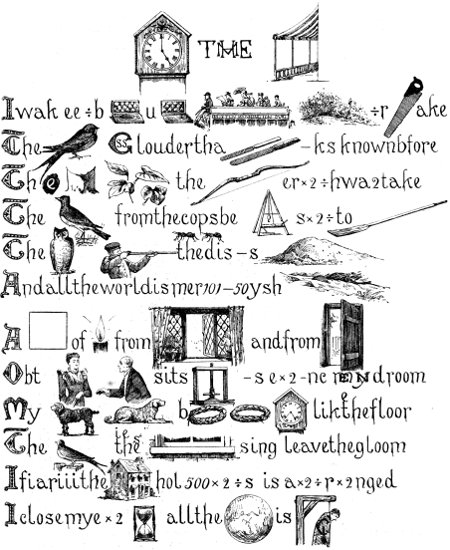
By ISABELLA FYVIE MAYO, Author of “Other People’s Stairs,” “Her Object in Life,” etc.
CLEMENTINA GILLESPIE.
ucy could
not honestly
say
to Miss
Latimer
that she had
enjoyed herself
at the
Brands’
dinner, but
she could
frankly say
that Miss
Latimer had
been right,
and that her
visit had
“done her
good.” For though she had not returned
refreshed and re-invigorated, yet she
felt a wonderful thankfulness to be once
more enfolded in her own home-life.
Somehow, too, she could see her own
trials in a truer and brighter light. She
herself might indeed be worn and
nervous, but there was good reason,
and a grand purpose to be fulfilled by
the labours and endurance which made
her so. Florence seemed not less worn
and nervous, and why? For no end but
vanity and irritating emulation. There
floated through Lucy’s mind some lines
she had learned in childhood:—
“Idler, why lie down to die?
Better rub than rust!”
But was rubbing really better than rusting,
if it were but a voluntary and needless
friction? Lucy realised now that the
deeper agonies and anxieties and the more
strenuous efforts of the past few months
had given her new standpoints, and had
separated her from much which she would
once have tolerated without question.
She remembered having read the utterance
of a certain writer, somewhat to this
effect—“I have been through the
furnace, and I have passed out too
scorched to mingle freely with those who
are not even singed.” Lucy could not
quite see the matter in that aspect.
Rather she would have expressed herself—“I
have been out on God’s wolds,
under His open sky with its storms and
its starlight, and I cannot again relish
close, artificially-lit rooms, sickly with
manufactured perfumes.” Oh, when
once Charlie was at home again, how
much they would have to be thankful
for, in their life grown at once wider
and deeper! What a new meaning
was given to the old words, “The Lord
drew me out of many waters.... He
brought me forth also into a large
place.”
So Lucy’s long holiday from her classes
at the Institute proved both restful and
delightful. Nor were they barren of
practical results. She found many
picturesque “bits” to sketch near
London. Work of this kind was such
pure joy to Lucy that she was apt to
forget that nevertheless it remained a
strain upon the nerves. She might have
been wiser, ay, and thriftier too, had she
indulged herself in a little sheer idleness,
in lying among the clover making daisy
chains or cowslip balls for Hugh. As it
was, when he grew tired of playing
alone, he would nestle down beside
mamma, watching her busy fingers and
begging for “a story,” for which he
never begged in vain.
Oh, those were happy days, peaceful
in their present calm, radiant with big
hopes dawning! Then the evening
coming-home was always cheery, with
Miss Latimer hovering over the teacups,
Tom’s merry welcome, and the sighing
Clementina’s conscientious preparations
for their creature-comforts. If Lucy’s
ceaseless industry did not permit her to
gather up all the physical benefit she
might have got, at least her nightly rest
grew sweet and calm, and the troubled
haunting visions vanished.
She herself found much satisfaction
in regaining her healthy moral poise.
It did not fret her now when Jane Smith
openly gibed at her in the street. It
did not worry her when Jessie Morison’s
mysterious female ally was seen passing
the house, and lingering in front of the
gate, as if half inclined to call. Nay,
she bore herself with courage and resolution
when the policeman rang the bell
in the middle of the night, and roused
all the household to hear that a man
was lying in the area, having evidently
climbed over the locked gate and
descended the stairs.
She and Miss Latimer and Tom went
downstairs together, Tom being an incalculable
blessing in such circumstances.
The invader was intoxicated,
not hurt, as Lucy at first suggested, to
the policeman’s great amusement.
“He’s not been so bad when he was
so spry getting over; he thought he’d
got a nice corner to sleep himself square
in,” said that functionary, as, with Tom’s
disgusted assistance, he pulled the man
nearer the wall and tried to make him
“sit up.” Horrors! Where did Lucy
know the smooth white face and red
head thus revealed to view? Why, this
was no other than the carpenter whom
she had accredited as Jane Smith’s
lawful “young man.”
“You come out of this, my man,”
said the policeman. “You’re where
you’ve no call to be. And if you don’t
stir your stumps pretty quick, it’ll be
the worse for you.”
The man had nearly “slept himself
square.” He stared wildly around, and
muttered something about “coming to
visit one as had called herself a friend”—“a-wanting
to give her a bit of his
mind.”
“Take him away and let him go,”
Lucy pleaded with the policeman. “I
know who he is—he’s been employed at
Shand’s works—he used to visit a
servant of mine who is not with me now.
I don’t think she behaved very well to
him.”
The policeman looked up knowingly.
“Is it that there woman that lives——”
he paused, with a significant glance
towards the closed windows of the
Marvels’ house. “A bad lot she is.
She behaves best to any fellow she treats
badly. Come, come, young man, as the
lady speaks for you, I’ll let you go this
time. Your young ’ooman ain’t here
now, d’ye understand? And if you take
my advice, you’ll give her a wide berth,
wherever she may be.”
The wretched youth rose, picking up
his cap, and dashing it against the iron
balustrade to beat off the dust.
“Thank you kindly, mum,” he
mumbled thickly. “I begs your pardon.
I did not know she’d left here. I on’y
knew she gave me the go-by directly my
back was turned, a-earnin’ money to
make a home for her.”
“Well, well,” rejoined the policeman,
pushing the shambling figure before him.
“You be thankful she did give you the
go-by, though you don’t deserve a
better woman, if you ain’t more of a man
than to let the likes of her get you into
the mess you’re in to-night—or this
morning, rather,” he added, looking up
at the whitening sky. “Good day,
mum, I’m sorry I had to disturb you.”
On their way back to their rooms,
they met Clementina, who had been
aroused by the movements within the
house. Clementina, as she herself expressed
it, “was trembling so that one
could knock her down with a feather.”
She had not descended below the first
floor. Her breathless question was—
“Is he dead? Has it been a murder?”
She seemed so alarmed and agitated
that Lucy, reminded that any such night
disturbance, if occurring on Clementina’s
Highland hills, would have meant something
of tragic importance, proposed
that they should all adjourn to the
kitchen together and fortify themselves
with cups of coffee. Dawn was already so
bright that gas was a ghastly superfluity.
Clementina, usually almost obsequious
in her methods of attendance, was so
shaken that she sat down and allowed
the two ladies to make all the little
preparations. Yet she suddenly became
more communicative than she had ever
been before, and also wonderfully interesting.
She told of other night alarms
of her life—of a wild shriek that went
sounding over the moor in one black
midnight hour, and was never explained
till months afterwards, when a few
whitened bones and wasted rags had
been found among the heather. She
whispered of the heavy knock which fell
on her father’s cottage door one bright
moonlit evening, though no step was
heard on the footpath, and nobody was
in sight when they looked forth. “But
on the afternoon of that day my brother
Niel was killed in India,” she went on
in her monotonous mysterious voice,
“and when we heard that, we knew
what the knock had been. That’s Niel’s
memorial,” she added, pointing to the
melancholy little framed card. “It
tells the date—June 25—and the moon
was at the full. It was Rachel’s sweetheart
who wrote and told us all about
it,” she went on. “It was the year
after Rachel had been up seeing her
sweetheart’s mother and visiting us.
And I mind, wicked sinner as I was,
that I grudged that our lad should be
taken and hers left. But after all, she
was never to see hers again, for as long
after as he lived. Eh, but life is short
for any of us, whatever!”
“Was your house quite lonely?” Tom
asked in an awed whisper.
“Yes,” she said, “that house was.
When my father first went there, there
was only a one-roomed place, and he
had to pick up the stones off the fields
before he could plant. He said my
mother put her life into that bit of land.
That was why she died so young. I’ve
heard him say he could never see a hayrick
or a sheaf of ours without thinking
her very heart was inside it. In time
he built two rooms more, putting stone
upon stone himself, and Niel helping
him. And when, the summer after Niel
was dead, the factor’s letter came,
saying the rent was to be raised, I
thought my father was struck for a dead
man. I mind I lay waking through the
night. I slept in the old part of the
house that had been there from the
beginning, and just when the light was
peeping in, I heard a strange sound, like
a spade howking in hard earth. I lay
and listened, and I thought it was like
the digging of a grave, and that it was a
sign sent that my father’s time had
come. I kept still, for it’s ill to pry
where a sign is set. Then I heard
something like a very heavy sigh and a
cough. I thought ‘that’s human,’ and
I ventured to peep. There was my old
father himself, howking down the stones
that he’d built up, one by one! And all
that day he did it, and by nightfall no
human creature could find a place there
to lay its head. And it was the room
where my mother had died, and where
Niel had sat in the chimney corner. My
father never said one word,” she concluded,
“but I knew what was in his
heart. And next day he took the rubble,
and threw it over the fields. ‘And
now,’ said he, ‘let the laird come and
take his own again.’”
A fierce vindictive exultation thrilled
through her wailing Celtic voice.
“But he that quarrels with the gentry
is a miserable man,” she went on.
“Trouble came of it. The ford is as
deep as the pool. Yet we got another
cot and croft close by, on another laird’s
land. It was but a one-roomed place
with a stony field. But my father did
nothing to it this time. Weak is the
grasp of the downcast! He was an old
man, and I think he left the soul of his
soul in the other place where his children
had been born and his wife had died.
My father never spoke out about the
hardship he’d had, but he went about,
muttering, and though he had been a
godly man, it was the sound o’ curses
that I heard. One was, ‘May he die
in the poors’ house.’ I knew he meant
the laird. And just one week after
father himself was taken away, his
prayer came true,” she added in a
strange, hissing tone, which sent a
shiver over her listeners.
They all bent forward, eagerly attentive.
A strange light in her eyes seemed
to draw their souls towards hers.
“It came true!” she said. “The
laird was visiting the poors’ house; they
say he had just been calling something—I
think it was a cup of tea—an
‘unnecessary luxury,’ when he was
struck down in a fit, and there, on a
pauper bed, he died quickly, and never
saw face of his own folk again. All
the strath was talking of it. But father
did not live to see it,” she went on,
“so it did him no good. And naught
but false hearts and evil tongues had
been with us in that last place, and I
couldn’t bide there.”
She added that with strong excitement.
Lucy remembered Mrs. Bray’s
hint about the unhappy love affair and
the hated sister-in-law.
“You must find it a great change
from the heather hills to muddy London
streets,” said Mrs. Challoner, hoping to
divert Clementina’s moody mind into
gentler channels.
“You can’t give luck to a luckless
man,” she answered rather enigmatically.
Just then, the white dawn brightened
into a sunbeam, and the little
group arose, feeling that though still
early, it was time they should separate
and begin the tasks of the ordinary
day.
“She’s an uncanny creature, that,”
whispered Tom to Lucy, as they left the
kitchen. “Sometimes, while she was
talking, I could not believe it was our
Clementina. It was like another person
taking possession of her.”
“I noticed that, too,” was Lucy’s
whispered reply. “And her story about
the curse was awful!”
“You don’t believe it was the curse
which did the thing, do you?” asked
Tom.
Lucy hesitated. “No,” she answered,
“not as the curse. But without that
curse and the general impression that it
was deserved, nobody would have seen
any significance in the laird’s dying
where he did. Had he been a kindly,
good man, it would have been felt that
his Master took him to Himself while
he was doing his Master’s business
among the poor. We must not forget
that some terrible curses stand recorded
in the Bible, possibly to let the evil and
unjust see the feelings which they stir,
and the fate they are making for themselves,
and how it will be interpreted.”
Clementina really seemed so much
more communicative and even cheerful
after those untimely confidences that
Lucy, fearing that she had not been considerate
enough to a lonely and possibly
land-sick woman, tried more persistently
than ever to draw her into some conversation.
But Lucy was careful that the
name of Charlie—Clementina’s unknown
master—should never get into the talk.
She dreaded associating it with Clementina’s
sighs and shakings of the head.
She had a nervous horror lest Clementina
should make it a point about which
visions and dreams and omens should
crystallise. If this should happen, Lucy
felt that she herself was not now strong
enough to shake off the gloomy impressions.
Tom, too, was evidently struck by the
general bent of Clementina’s remarks,
generally made when she was setting
out the supper-table or removing it. He
used to ask her why “second sight”
could not foresee marriages as well as
deaths, comings home as well as goings
away, future occasions for joy as clearly
as future woes?
Lucy was rather afraid Clementina
might be hurt by Tom’s questions, but
though she sighed and shook her head
over his words, she smiled indulgently
on the speaker.
Clementina seemed so unwilling to go
out to take exercise in the open air that
Lucy determined to suspend her usual
orders to her tradespeople, and to send
her servant out to shop in the evening,
when she herself could keep guard at
home.
She told Clementina why she made
this new arrangement, remarking that
she could not understand how one who
had lived all her life in pure bracing
mountain air could persist in being so
much confined in a London kitchen.
Clementina answered, shrewdly enough,
“There’s little bracing air to be had
here, ma’am, however much one may go
out for it, and on our hills we didn’t need
to go out for the air, it came to us at our
doors. That is why our people can live
in such low, dismal houses. They have
but to go to the threshold, and God
Almighty’s glory meets them spread
over earth and sky.”
Since Clementina had been with
Mrs. Challoner she had not seen much
of Rachel. For Mr. Bray was seriously
ill, and he and his wife and their faithful
attendant had gone to Bath, and communication
between the two women was
limited to one or two brief notes.
Clementina showed Rachel’s notes to
Mrs. Challoner, because they had tidings
of the mistress’s friends. Clementina
once opened one of her prim little
screeds to add a message from Lucy in
the postscript. Clementina was very
lugubrious over her old acquaintance’s
master. Perhaps it was this which first
warned Lucy to give her no encouragement
to weave fateful spells round the
absent Charlie. That “the master”
would be at home about Christmas time
was all Clementina knew from Lucy
herself. Of course Rachel might have
made confidences, but the Highland
woman was too well-bred either to trade
on these or to ask any questions.
Probably she but thought the more.
Lucy posted her own letters, but
Clementina saw her writing them, saw
them lying addressed on the hall-table,
waiting for Lucy’s out-going. And as
Clementina took in all the letters, she
must have known that no trans-Atlantic
letters came. Undoubtedly she puzzled
herself over this mystery, for once she
ventured to say to Lucy—
“It’s sore, ma’am, to see you writing
so much and so often. Sending letters
across the world seems so like writing to
the dead.”
“Oh, no, Clementina,” Lucy answered,
“for we get answers.” And
Clementina smiled an inscrutable smile.
“You don’t believe we get answers
from the dead, ma’am?” she asked.
“No,” said Lucy, “certainly not!
Not in that way. The dead have cast
off their bodies, and if they do hold any
communication with us, it must be as if
we too were out of the flesh.”
“My father always said we had no
call to have any dealings with the
blessed dead,” remarked Clementina.
“We never had any portrait of Niel.
But after he was killed, Rachel’s sweetheart
sent us home a little one in a case.
It had been taken after Niel was in
India. But when my father saw what
it was, he wouldn’t take a second
look. After the neighbours had been
told about the death, my father never
named Niel again. He never spoke of
our mother.” And Clementina sighed
and went about her business.
Lucy drew a long breath. The mere
thought of such suppressed existence
seemed to choke her. There may be
danger of righteous indignation or
strong emotion merely frittering itself
away in the “soft luxurious flow” of
too copious expression. A deep thinker
has cautioned us.
“Prune thou thy words, the thoughts control
That o’er thee swell and throng:
They will condense within thy soul
And change to purpose strong.”
But merely to smother and bury is not
to control and direct. It is rather to
deprive healthful force of its lawful
function, and to screen fevered force
from wholesome cure. Surely speech is
to the mind as an opened window is to
a chamber. If the chamber be fresh
already, then its freshness but meets
newer freshness. If it be filled with
noxious vapours, they escape and fresh
air enters.
It struck Lucy, too, as singular how
this Highland father and daughter, unlike
the Brands in every other respect, yet
resembled them in one particular.
These Gillespies had clearly been
gloomy people, narrow of creed, strict
in life, staunch alike in love and in
hatred. The Brands were frivolous,
practically creedless, moving at the
breath of every social wind, their
emotions floating like bubbles on the
surface.
Yet both the Brands and the Gillespies
kept silence over “the dead.”
They shut up their names and their
memories in the tomb. It had often
pained Lucy to realise that in her sister’s
silence her own recollections of her
early home were fading. When we so
inevitably soon pass out of hearing of
those who have shared a common past,
Lucy felt much should be made of that
treasury, while two remain to turn it
over. Apart from the attractions of Mrs.
Bray’s quaintness and elfishness, the old
lady had for Lucy the supreme attraction
that she remembered Lucy’s parents,
and seldom saw her without making
bright reference to some saying or
doing of “your father” or “your
mother.” But when Florence was forced
to mention these parents, it was always
in a whisper—such as Lucy would have
used in naming a painful subject. And
she invariably said “poor papa,” “poor
mamma,” as if Death—as universal
as birth—can, in itself, be a misfortune.
Winter was drawing on, as Clementina
poetically expressed it, “fast as a
stone rolls down the hillside.” No
Pacific Island letter had ever come from
Mr. Challoner, but Lucy said to herself
that possibly his American letter would
but come the sooner. Every morning
she woke with the thought “Charlie’s
letter may come to-day!” She knew
the hope was still premature. So when
she did not find Charlie’s letter, she
always opened her other letters cheerily
and read aloud any items of news which
she thought might amuse the little
breakfast party, Hugh generally having
an interest in most of his mother’s
friends, since those who cared for her
did not forget to send a message to
him, and one or two even added a bit
of paper “all for himself,” covered with
“O’s” for kisses.
One morning towards the end of
November three letters lay by Lucy’s
breakfast plate. The top one was a note
from the picture dealer, the under one
was but a type-written circular. But
Lucy paused over the centre missive.
“Here is a funny-looking epistle,”
she said, holding it up. The envelope
was thin and poor and dirty, and the
writing seemed to have been done by a
pin-like pen wielded by a very heavy
hand, which must have wrought sore
damage on its instrument before it laid
it down.
“I know what that is,” said Tom
confidently; “it’s the bricklayer’s bill.”
A few days earlier a bricklayer had
been employed to relay a stone in the
scullery floor, and Tom and Hugh
had superintended the performance with
great delight.
“Well, I don’t think he makes out
many bills,” remarked Lucy, rather
daintily tearing open the filthy wrapper
and unfolding its contents.
As she did so, her contented smile
changed to a look of bewilderment.
(To be continued.)
ABOUT PERGOLAS, AND MISS JEKYLL’S “WOOD AND GARDEN.”
Miss Gertrude Jekyll’sWood and Garden:
Notes and Thoughts Practical and
Critical by a Working Amateur (Longmans)
would be welcome if it were only for the convincing
way in which she preaches the true
gospel of gardening—that there is no hard
and fast line between wood and garden, wild
and cultivated. She makes her garden melt
into her strip of woodland; she plants her
wood as well as her garden with flowers. The
twelve calendar chapters with which her book
opens detail the operations month by month
of nature as well as of the gardener. These
are followed by chapters on large and small
gardens; beginning and learning; the flower-border
and the pergola; the primrose garden;
the colours of flowers; the scents of the garden;
the worship of false gods; novelty and
variety; weeds and pests; the bedding fashion
and its influence; and masters and men—all
of them delightfully illustrated from photographs
taken by the author.
For most readers of The Girl’s Own Paper
certain parts of the book have less value than
others. Much of it is taken up with the
gardens of the wealthy. Miss Jekyll’s own
garden, which furnishes the backbone of the
book, entails considerable expenditure, and is
the ideal garden for a moderate-sized manor-house.
But she treats her garden as a cottage
garden is treated. She buys every plant herself,
and puts it into the ground with her own
hands, and she keeps her eye on every plant
as if it were a child, doctoring it when it is
weakly, and removing it when it is obviously
unsuited to thrive under those conditions.
She pays special attention to the cottage
gardens in her neighbourhood, knowing that
in them she will get her best object lessons in
the survival of the fittest. A cottage wife, to
be successful with her garden, has to use
the flowers which experience shows will do
best in the neighbourhood. Her space is
limited; she cannot afford expensive protection
against weather, or expensive manures;
she cannot afford to renew her plants often.
By paying special attention to the gardens of
her poor neighbours, Miss Jekyll has secured
some of the most luxuriant massings of blossom
in her own.
Invaluable advice will be found in the book
upon such ordinary subjects as flower-borders,
villa gardens, and small town gardens, and
Miss Jekyll complements her generalisations
on the subject by descriptions of actual gardens
of exceptional success and beauty. But I
prefer to take for my example of her book
something a little more out of the ordinary,
which yet is within the reach of families of
limited means—the formation of a pergola,
especially since it is quite possible to make a
pergola in the narrow strip of garden with
which Londoners have to be content. What
is a pergola? people will ask. Webster, in his
great dictionary, defines it thus: “Pergola,
n. (It.), Pergula, n. (Lat.) (ancient architecture),
a sort of gallery or balcony in a house. Some
suppose it to be an arbour in a garden or a
terrace overhanging one.” Webster, severe
New Englander, had not before his mind the
kind of pergola which haunts the memory of
the lover of Italy when he is back in
prosaic London. To such, a pergola is part
not of a house, but of a garden, the framework
for an avenue-arbour covered usually with
vines, but occasionally with gourds. This
framework consists of a long colonnade of
snow-white plaster columns which support the
cross-rafters over which the vines are trained.
And the prettiest ones are those which crown
overhanging terraces. For pergolas a single
row of columns and a wall are perhaps better
suited to our more tempestuous climate. The
Italians prefer a double row of columns.
Nearly every monastery in the South of Italy
has its pergola, as, for example, the often-pictured
convent of the Cappuccini at Amalfi.
In the winter, when their leaves are off, these
pergolas give the effect of a peristyle in
Pompeii. Here is Miss Jekyll’s recipe for a
pergola.
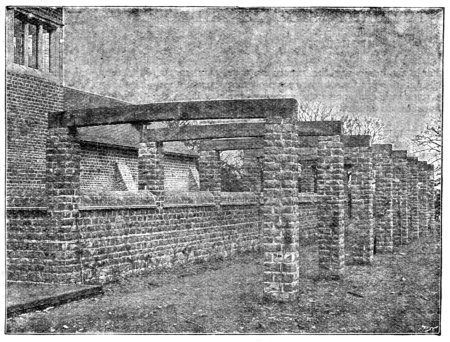
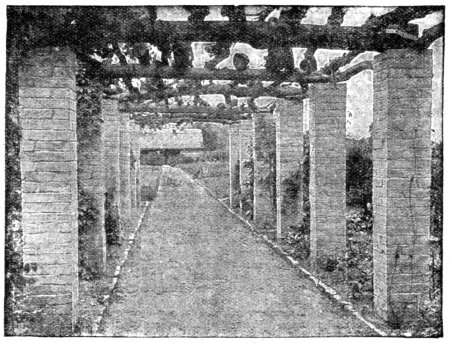
STONE-BUILT PERGOLA WITH WROUGHT OAK BEAMS.
“I do not like a mean pergola, made of
stuff as thin as hop-poles. If means or
materials do not admit of having anything
better, it is far better to use these in some
other simple way, of which there may be
many to choose from—such as uprights at
even intervals, braced together with a continuous
rail at about four feet from the ground,
and another rail just clear of the ground, and
some simple trellis of the smaller stuff between
these two rails. This is always pretty at the
back of a flower-border in any modest garden.
But a pergola should be more seriously treated,
and the piers at any rate should be of something
rather large—either oak stems ten inches
thick, or, better still, of fourteen-inch brickwork
painted with limewash to a quiet stone
colour. In Italy the piers are often of rubble
masonry, either round or square in section,
coated with very coarse plaster, and limewashed
white. For a pergola of moderate
size the piers should stand in pairs across
the path, eight feet clear between. Ten feet
from pier to pier along the path is a good
proportion, or anything from eight to ten
feet, and they should stand seven feet two
inches out of the ground. Each pair should
be tied across the top with a strong beam of
oak, either of the natural shape, or roughly
adzed on the four faces; but in any case, the
ends of the beams, where they rest on the top
of the piers, should be adzed flat to give them
a firm seat. If the beams are slightly curved
or cambered, as most trunks of oak are, so
much the better, but they must always be
placed camber side up. The pieces that run
along the top, with the length of the path,
may be of any branching tops of oak, or of
larch poles. These can easily be replaced as
they decay; but the replacing of a beam is a
more difficult matter, so that it is well to let
them be fairly durable from the beginning.”
Miss Jekyll gives illustrations which are
reproduced. She says that the climbers
which she finds best are Vines, Jasmine,
Aristolochia, Virginia Creeper, and Wistaria,
and that Roses are about the worst, for they
soon run up leggy, and only flower at the top
out of sight. I am not familiar with the
Aristolochia, but Vines, Jasmine, Virginia
Creeper, and Wistaria, all of them grow well
in the inner London suburbs such as Chelsea
and Kensington much better than Roses.
Nearly every London garden has its flower
bed, two or three feet wide, running along
its wall, and its gravel path, two or three
feet wide, running outside that. All that
remains therefore is to have brick piers
seven feet high built on the outside edge of
the gravel path and to have the roof framework
carried across from them to the wall.
With this a hideous London back garden can
be converted into a thing of beauty.
Readers, who are fortunate enough to live
in the country and have a strip of woodland
adjoining their gardens, should read with
great care Miss Jekyll’s admirable advice as
to the exotic irises and other flowers which
can be made to grow in English woods. A
wood garden full of daffodils and irises,
anemones and primroses, in their due seasons,
is one of the most beautiful things in the
world.
Douglas Sladen.
PERGOLA WITH BRICK PIERS AND BEAMS OF ROUGH OAK.
OUR PUZZLE POEMS: AN ACCIDENTAL CYCLE.
COMBINED SERIES.
First Prize (Three Guineas).
Helen B. Younger, Edinburgh.
Second and Third Prizes Divided.
(One Guinea and a Half Each.)
Ethel Dickson, Preston.
Ellie Hanlon, Sandycove, Dublin.
These competitors also gained prizes in
Series II. and III., and, according to the
rules, we have made a further award of the
amounts so won.
SERIES II.—Seventeen Shillings to
Award.
Winners (Six Shillings Each).
Miss E. J. Friend, Woodford Green.
Mrs. G. W. Smith, North Walsham.
Mrs. A. J. Wilson, Croydon.
SERIES III.—Nineteen Shillings and
Sixpence to Award.
Winners (Four Shillings Each).
Rev. Joseph Corkey, Armagh.
Edith E. Grundy, Leicester.
Rev. V. Odom, Sheffield.
C. Thompson, Minchinhampton.
Frederick W. Southey, Newcastle-on-Tyne.
Correction—Series I.
The solution sent by M. A. C. Crabb was
entirely overlooked. It was perfect, and
entitled to a prize of ten shillings, which has
now been sent. No complaint was received
from the solver.
IN THE TWILIGHT SIDE BY SIDE. — PART X.
By RUTH LAMB.
AN ALL-IMPORTANT SUBJECT CONCLUDED.
“Her price is far above rubies.”—Proverbs
xxxi. 10.
want to begin our
evening talk, once
more, by asking a
somewhat searching
question. I know I
shall not offend my
dear girl friends by
so doing.
When you are
looking forward to
meeting the one on
whose good opinion you place the greatest
value, on what do you bestow most care
and attention? Your higher nature, or your
outward appearance? Is it not generally
the latter? Do you not study what colour
best suits your complexion, what style sets off
your figure to the greatest advantage, or
whether you have heard him express approval
of one dress above all others?
To use the common phrase, you “want to
look nice” in the eyes of that one who has
done all but tell you that you occupy the first
place in his heart, and to whom you have
virtually given your own.
Do I blame you for wishing to be externally
attractive? Assuredly not. It is your duty
to try and be so at all times and under all
circumstances.
Only, do not be too anxious about outside
adornment. Let your life commend you,
rather than your good looks or your tasteful
dress. These may attract in the first instance,
but they will not keep what is best worth
having.
A friend once spoke to the mother of a
large family of girls in regard to the anxiety
she must feel about their future settlement in
life.
She answered with a bright smile, which
suggested anything but anxiety, “I try so to
train my girls that they will be fit for the
sacred duties that wives and mothers have to
fulfil, and I leave the rest to God.”
One would like to see all girls actuated by
the same spirit, that, without undervaluing
anything that helps to make them externally
attractive, they should cultivate every quality
that will place them on a level with the best
man in the best things.
In speaking to you, dear girl members of
my Twilight circle, I assume that you desire in
all your ways to acknowledge God, and pray
that He will direct your paths. Can there be
a more important matter on which you need
guidance than that on which the happiness of
your future life depends? And yet, how
common it is for girls to be so carried away by
flattering words and delicate attentions, which
make them the envy of others, that they do
not pause to think how small a part these
things play in most married lives.
Are you accustomed to lay bare your heart
to God in prayer, and to seek His aid in all
things? If so, have you asked yourself
whether the one to whose keeping you think
of committing your future, will be likely to
kneel by your side and join heart to heart with
you in making your joint requests known to
God?
Believe me, if husband and wife never pray
together, they never taste the sweetest portion
possible in the cup of wedded happiness.
If their ways diverge when the path leads to
the House of God; if they neither worship
together in the home nor the sanctuary, they
are without the precious bond of union that
makes their lives truly one here, and gives the
assurance of an eternal reunion beyond the
grave.
There are many indications of character
which may seem trivial in the eyes of some of
you, but which ought to be deemed danger
signals in regard to married life in the future.
For instance, an occasional giving way to
intemperance. Jesting about sacred things or
passages from the Bible. Breaches of faith in
minor matters. Disregard of truth, duplicity
or evasion. Lavish expenditure and indifference
about incurring debts. Carelessness as to
the comfort and convenience of other members
of the family, and want of respect towards
parents.
These are but a few of the tendencies
which are almost certain to develop into habits
later in life, and to bring anxiety and sorrow
with them.
A girl can make no greater mistake than
to think that, after marriage, her influence
alone will suffice to conquer all such tendencies.
A man naturally tries to present the
best side of his character to the girl he seeks
to win, and if the best is disfigured by serious
blemishes, believe me, these will be more
likely to grow than to disappear after marriage.
Not that I would underrate the possible
influence of a good woman. But to a good
girl I would say, “Let your suitor, who is
ready to promise anything if you will say ‘yes’
to his suit, begin his work of reformation now.
Tell him frankly that your heart inclines to
favour him, but conscience warns you not to
link your life with his until you feel that the
habits which threaten your future happiness
have been overcome by God-given strength.
Say that you will wait, prayerfully and
patiently, during the testing-time, but that
you dare not consent to an unequal yoke. If
he truly loves you he will receive your answer
in a right spirit, and will value and respect
you the more for it.”
If, on the contrary, he should prove
unwilling to turn from the sin which so
easily besets him, be assured that the test
has been wisely applied, and thank God that
you had the courage to use it. If we do
right at all costs to our own inclinations, we
may with confidence leave our future in God’s
hands, and be sure that He will have some
better thing in store for us in His own good
time.
You, my dear ones, must, however, look
within, as well as at all that can be discerned
in the characters of those who come to woo
you. A true heart should have its counterpart
in exchange. If one is offered, see that
you give an equivalent, and do not dare to
accept that for which you can give no fair
return.
To accept true affection only because of the
money or position that comes with it, and to
feign the love you do not feel in order to
secure a share of the wealth you covet, is to
commit a fraud of the worst and most contemptible
kind. You cannot, it is true, be
called to account before an earthly tribunal,
but you will assuredly pay the penalty of
deceit and selfishness in one way or another.
There are some girls, dear good girls too,
who get a little carried away by the sense of
power and proprietorship that comes with an
engagement.
Does it not seem delightful to look up at
the fine, strong sample of humanity, whom
love has made your captive, and to think to
yourself, “He is ready to give his strength,
his means, his time, all that he has, to
promote my happiness”?
Does the thought of such honest devotion
make you proud or humble; anxious to
display your power or to repay and deserve
such devotion?
Who has not heard such words as these
from girlish lips? “I can twist him round
my little finger.” “He almost worships the
ground I tread on.” And forthwith the
speaker proceeds to prove the truth of her
assertion by little, teasing, coquettish ways
that are unworthy to have a place where true
love is concerned. These airs and graces and
tantalising ways are only like pin pricks, but
they wound and leave scars which do not
easily wear away.
The more tender and sincere is the nature
with which you have to do, the more likely is
it to retain the painful impression produced
by such methods. I am not going to describe
them exactly. You all know what I mean,
and, in your hearts, acknowledge that they
are unworthy accompaniments even to your
self-respect, to say nothing of the esteem
which should always go with love for your
future mate.
If you believe in your fiancé’s truth, be
content without compelling him to make a
perpetual show of his devotion for the gratification
of your vanity. Good men are pained
by such experiments; men of lower natures
are apt to retaliate, though, it may be, not
immediately.
A husband of many years’ standing once
told me that a few words, half jesting, half
taunting, from the girl to whom he was
engaged, had nearly caused a final parting.
They did not, for the girl, finding that she
had gone too far, expressed her regret and
was forgiven. But the effect of her stinging
words did not soon pass away. The girl
forgot them. The man’s memory was too
faithful, and after a long married life he could
not think of them without a renewal of the
old pain. “I would give anything to blot
out the memory of that girlish taunt,” he said,
“but I cannot, and it hurts me after all these
years!”
A good man I knew said to the girl who
had just promised to be his wife, “I have
asked you to share my home and my life
because you are dearer to me than all the
world besides. Your consent has made me
very happy. Now, dear, I want you to trust
me fully, and never to stoop to test my
affection, as I have seen some girls do, in
order to display their power over a man. I
have perfect confidence in you, and, though
we shall be parted for some months to come,
I shall be cheered by the thought that at the
end of them our real life union will begin. If
at any time you should not receive a letter
just when you look for it, or my coming
should be delayed, be sure that I have not
willingly disappointed you. Wait patiently,
and trust me under all circumstances, as I
trust you.”
The girl promised. The quiet, simple
words and the look of love and faith in the
speaker’s face went to her heart. “Come
what may, I shall always trust you,” she said,
“whether in great or little things.”
Circumstances followed—quite unforeseen
at the time the pair became engaged—which
tested to the utmost the affection and trust of
both. But they stood the test, and when at
length difficulties were overcome, their union
was not the less happy, because, if they had
trodden a somewhat thorny road before
reaching the bright home they shared together,
neither doubt nor waning affection had helped
to darken the way.
Sweethearts and wives have such grand
opportunities for showing their power that
they need not stoop from the high standpoint,
at which every truly noble-minded woman
aims, in order to gratify petty vanity.
The girl fiancée and the wife are alike
unequal to lover or husband in mere physical
strength. That is natural, and therefore right.
But in time of trouble many a man, ready to
sink under the weight of it, has gained new
strength and courage from her whom he has
hitherto deemed the weaker vessel. Her
words may have been few, but they have
always been suggestive of hope and cheer,
and said at the right moment.
There has been no “I told you how it
would be,” no allusion to mistakes made or
the ignoring of advice which would have
prevented them, but pity for him who is only
too acutely conscious of all that has been
wrong. Yet, when gloom and despair were
about the man’s path and in his heart, both
have fled before a wife’s devoted ministry and
the light of love on her face. Perhaps she
has told him that she knows their changed
circumstances trouble him more on her account
than on his own, but that, with him, she is
strong to face them, and she proves it by
patient endurance and by making the best of
all things. He sees that she resolutely turns
her face to the bright side—and I truly
believe there always is a bright side—and
thus she induces him to open his despairing
eyes to the light, though as yet it may be
only a distant glimmer hard to discern.
A man with such a helper to cheer him on
will be heartened to try again, though he had
given up hope. Her courage will make him
a coward in his own eyes, so he will raise his
listless hands and shoulder his load anew for
her dear sake. He has felt that it would be
impossible for him to hold up his head again
amongst his fellows, but with the knowledge
that a good girl or woman loves and trusts
him, despair is impossible. She believes that
the one defeat has taught him to mistrust
himself, and that he will seek strength from
God to fight again and to conquer.
Can you not, my dear girls, imagine a man
ready to face, dare, or do anything in order
to prove himself worthy of such whole-hearted
affection and trust?
I have been asked whether the early or
later years of married life are the happier. I
think, nay, I am sure the later ones ought to
be, if the union was first founded on love,
faith, and respect. All these feelings should
grow stronger as time goes on, and, just like
the fair flowers that need the gardener’s care
to perfect them, they should be carefully
cultivated.
We show our love far more by the little
things that go to make up the sum of happiness
in everyday life, than by occasional great
sacrifices.
The engaged girl carefully notes the likings
and dislikes of her intended husband. She
ministers to the one and will not provoke a
manifestation of the other. She watches for
a chance of doing something for him and
giving him pleasure. Does she ever leave
him abruptly, or allow him to leave her
without an affectionate farewell?
Ah, no! We all know that the farewells
of an affianced pair are apt to be long drawn
out. The girl thinks that nothing can be too
good for him who is dearest of all. No
effort seems too great when it is seasoned by
love.
If such is the case before marriage, how
much more should the practice of all sweet
observances and courteous habits, care in
little things to avoid giving pain and to
minister pleasure, be in constant evidence
after marriage!
Little things are often the means of drawing
people together in the first instance. It is
much easier to win affection than to keep it,
and, better still, to be conscious that it has
grown and strengthened through the long
years of married life. And it is only in the
sanctuary of their home that husband and
wife learn truly to know each other, and to
grow into that perfect unity so rarely attained
even by those whom we call happy couples.
It so often happens that people who are
most scrupulous as to their “society manners,”
forget to render ordinary courtesy to their
own belongings. They seem to think anything
is good enough for the home circle.
Can there be a greater mistake? Those who
are joined to us by the dearest of ties are
surely the ones to whom everything we have
of the best should be scrupulously rendered.
I was charmed a while ago, when I was
talking with a mother of grown-up sons about
her father. I had known her from her early
teens, and we have been great friends always.
It was beautiful to see her face light with
pleasure as she said, “I was telling him only
the other day that I never receive from anyone
such perfect courtesy and attention as I
do from my own dear father, and now he is
eighty years old. But he has always, everywhere,
and to every person, been the same.”
And I, who had long experienced this, could
endorse her words.
So, dear ones, keep your very best manners
for home, and they will not fail you in other
circles.
Dear girl wives, be as thoughtful for your
husbands as you were for your lovers—and
more. Do not let them miss the loving
farewell when they go out to their daily battle
with the world, whether it be in the field of
commerce, the learned professions, art, or
behind the counter.
In the humbler but no less useful fields of
toil, the farm or the mill, the man will be
cheered by the memory of loving words and
the prospect of your welcoming face and kiss
when he comes home weary, toil-worn,
perchance downhearted.
And knowing how you will meet him, he
will quicken his tired feet, that he may the
sooner receive the greeting for which his heart
longs. If he has good news to bring, the way
will seem doubly long because of his eagerness
to share it with you.
There are times when the best of men are
almost too sad and weary to bear sympathy of
the demonstrative sort, when everything
seems to have gone wrong, and all they want
is just to be left in peace for a while.
Real sympathy is many-sided, as you all
know. It may be of the fussy sort, which
cannot be satisfied without incessant expression,
either in word or deed. Kindly meant,
it is apt to jar on its object.
There may be more wisdom and no less
sympathy shown by silence than by words.
Thoughtful loving actions will not be lost on
the weary, worried man of business, who has
found it impossible to leave all his cares
outside the threshold of home. I knew a
man who used to say to his almost too
sympathetic wife, “Let me be quiet a little,
my dear, I want to think things out. I shall
be all right by and by.”
Then the wife knew that kind words or the
touch of a loving hand was better withheld,
and possessed her soul in patience until the
thinking out was done, and her husband was
his bright self again.
The wife’s character should be great enough
to grasp the greatest things that come within
her province, yet comprehensive enough to
stoop to the least. Do you wish to look upon
a picture which represents a perfect wife?
There is one drawn in words by an inspired
writer. Turn to Proverbs xxxi., and read
from the tenth verse to the end.
Note, first, her value. “Her price is far
above rubies.” Her faithfulness. “The
heart of her husband doth safely trust in her.”
Her devotion is of no fitful sort. “She will
do him good and not evil all the days of her
life.”
She is clever and far-seeing, and able to
turn the means with which she has been
entrusted to good account in her purchases of
land and of goods.
She is industrious. “She riseth also while
it is yet night.” “She layeth her hands to
the spindle, and her hands hold the distaff.”
She thinks and cares for those she rules for.
“She giveth meat to her household, and a
portion to her maidens.” “She is not afraid
of the snow for her household: for all ... are
clothed with scarlet.”
In the midst of wealth and abundance she
seeks out, and blesses by her bounty, those
who are less favoured. Note the expression.
“She stretcheth out her hand to the poor; yea,
she reacheth forth her hands to the needy.”
No niggardly giving here. She seeks rather
than is sought by the poor. She is the cheerful
giver whom God loveth.
She does not despise rich and beautiful
clothing, becoming to her position. “Her
clothing is silk and purple,” which she may
well wear with satisfaction, seeing that she has
cared for the needs of others both near and
afar off. But she has better garments than the
silk and purple, for “strength and honour are
her clothing” also.
With all her strength, riches, commercial
shrewdness and industry, she combines wisdom
and kindness in deed and word. “In her
tongue is the law of kindness.”
Good mistress! Good wife! Good
mother! “She looketh well to the ways of
her household.” “Her children arise up, and
call her blessed; her husband also, and he
praiseth her.”
Note the summing up of the whole matter.
“Favour is deceitful, and beauty is vain; but a
woman that feareth the Lord, she shall be
praised.... Let her own works praise her.”
What, save a life spent in the faith and fear
of God, could furnish such a picture? What,
save the grace of God and the guidance of the
Holy Spirit, could be sufficient for such
things?
And these must have been sought by
prayer, and God’s blessing on the study of His
Word.
I have said much to you, dear girl friends,
of my own happy married life. Shall I tell
you what made it so?
It was the being of one heart and one
mind in the highest and best things. We
knelt, prayed, worshipped, and worked as one,
and love, trust, and true respect were the
foundation of our union which grew ever closer
and dearer with the years we spent together.
Of all the precious memories I retain of my
wedded life, one stands out beyond the rest.
It was on the last day of it that he bade me
lie down by his side. Drawing me close to
him, he held me in those dear, worn arms, as
if he could not bear to loose the clasp, kissing
me tenderly and repeatedly. Then, when he
could no longer hold me for very weakness, he
said, “Oh, my darling, my darling! Even you
do not know how much I have loved you.”
Have I done right in drawing aside the veil,
and showing to you, my dear girl friends, this
picture of what was truly his farewell?
I hope it will not have been done in vain.
People may talk as they will about the first
whispered words of love and their sweetness.
I can recall such to mind.
Think you that any or all of them are
worth naming in comparison with those
precious last words from dying lips, after so
many years of wedded life and happiness
together?
(To be continued.)
FROCKS FOR TO-MORROW.
By “THE LADY DRESSMAKER.”
One sign of high summer in London is an odd
one, and that is the presence of handsome furs
in the West-End shop-windows, where they
may be seen any day after June has once begun.
I used to think people bought them, even
when the thermometer was registering 68° in
the shade; but I have found cause to think
that they are simply displayed in the window
as a measure of safety, for light, sunshine, air,
and dryness are the chief enemies of the moth,
and both May and June are the worst of
months in which they do their deadly work on
the costliest of our raiment. In the shops
where furs are kept, they are beaten with tiny
canes, and exposed as much to the air and
light as possible. So we may take a leaf from
this open book, and perhaps save ourselves
loss and disappointment. Of course, I do not
mean that furs should be faded by exposure to
the sun; but if they were really good and undyed,
a little sunshine would not hurt them,
though too much may do them harm.
This year furs were used up to June, as the
weather remained cold till then; but there
was not enough sun to do them harm. Nevertheless,
I lean to the idea that they are best left
off early, both for the health of the furs and of
ourselves, many people being inclined to wear
them too long. In the present month they
will need attention—shaking, airing, and
beating, and a general careful looking-over.
THREE NEW GOWNS.
One of the most frequently remarked
peculiarities of the present day is the kind of
wobbling way adopted by many women and
girls when they walk. They go from one foot
to the other just like a duck. Now, I know I
have said this before, but I am desirous of
saying it again, because I am told that the
matter is even more serious than I fancied, and
that there are many more operations in the
hospitals now than there were for various foot
troubles. Also I have been informed that the
number of chiropodists has trebled in London
during the past three or four years—really since
the pointed-toe shoes came into fashion.
There is no doubt, as we look at one of these
ungraceful walkers, that the reason lies either
in their present or their past foot-gear. One of
the most usual sources of trouble is our
universal fashion of wearing too heavy shoes or
boots, with too thick soles. In fact, they are
altogether too thick and heavy for warm
weather. A lighter shoe would be equally
good and serviceable, and even if it did get
damp and need changing, we could manage
this easily on our return home. Follow two
rules in the choice of your shoes. Choose
those which do not compress nor curl your
toes under when wearing them, and remember
that a shoe is as bad when too large as when too
small. A thin stocking is better than a thick
one; and I have seen many people recently
who have obtained ease and comfort by dismissing
merino, wool, and spun silk, and
adopting cotton for winter, and thread for
summer. I think a thick cotton stocking
quite as warm as a thick woollen one.
TWO LONG TUNICS.
The linen collar is far less used this season
with blouses than it was last year. Instead
we see lace ties, and lace and silk scarfs. It
is wonderful how pretty an effect is produced
by using a lace scarf and one or two paste
brooches or pins, which look so well in the
filmy folds of the lace. The lace has a far
softer effect than the plain severe collar, and
this is a question that every girl must consider
for herself. An easy way is to have a long
lace scarf, not more than five inches wide,
and to put it on from the front to the back,
crossing it there, and bringing the ends to
the front, where they should be long enough
to be tied under the chin in a lightly-knotted
bow, in which may be placed some paste
pins, or the tiny brooches so much used at
present.
A POINTED TUNIC.
If I were asked what was the favourite
colour, I should very certainly respond “Blue”
to that question. But there are blues and
blues; and I have seen so many that it is
difficult to say which is the ruling hue. A
very bright shade is certainly much liked,
which is quite of the old Royal-blue description.
Plaids and stripes are much on the
increase, and I should not be surprised if we
were to see a winter of them. These very
narrow skirts are well suited to the cutting of
striped materials, which are arranged with a
seam in front and one at the back, the stripes
meeting in points like arrow-heads at both
these seams. There are also many spotted
materials, and any number of ribbed and
smooth cloths, of varying degrees of thickness.
Serge, too, is much in evidence, and is
as popular as ever, and so is woollen poplin
and Venetian cloth. Satin is as much used,
and as fashionable as it was; but fancy
silks of all kinds seem to have been less liked
than muslins were during the warmest days
of the summer; while the satin-faced foulards
were very pretty, but were not so popular as
they promised to be.
The shoe most worn this season has been
the Cromwell shoe, having a buckle for
ordinary daily use with afternoon
attire. But where evening dress
is concerned, there has been a
great development in luxury, and
they are now made of brocade
and velvet; and as to the buckles,
you may expend any amount you
like upon them, for they are
sometimes set with precious
stones, and are really beautiful.
As yet, these shoes are exotics,
and only worn by a few, but no
doubt the brocaded ones have
been copied from those of the
time of Elizabeth, which have
been shown at the various exhibitions
held of late years.
There has been rather a revival
in the fashion of cycling, which
has recently suffered rather
an eclipse, and there is a very
great improvement in the style
and cut of skirts for this exercise,
and also in the general appearance
of women a-wheel. The
new method is to sit high and
straight, with the handle-bars
within easy reach; and there
seems much less exertion in the
management of the machine
than when the seat was lower.
The cut of the new skirts is so
good that they hang down on
either side of the machine quite
straight, and there is plenty of
room for pedalling without any
of that ungraceful drawing up
of the knees and of the skirt as
well that used to be seen and
is noticeable even yet when
some careless rider passes us by.
We have all, I suppose, read
the Prime Minister’s speech
about the ungracefulness of the
attire used in wheeling, and I
for one feel quite grateful to him
for his plain speaking. So far
as in each of us lies, we should
strive to be graceful, and as
pretty as possible, while on our
favourite iron steed. The pattern
of these skirts is sold at
several paper pattern depôts, so
they can be cut and made at
home.
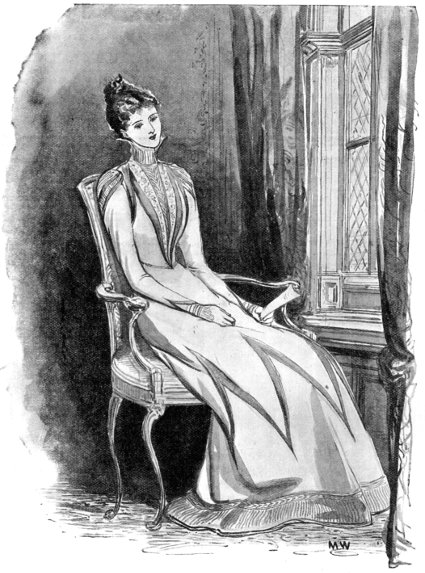
The seated figure in our illustration,
which shows a simulated
tunic trimming on the skirt,
wears a pretty gown of pale
grey summer-cloth, the bands
on the skirt and on the gown
bodice being of embroidered
purple silk, while the vest in
front is of pale green silk, and
bands of cream-coloured silk
embroidery on cream silk. The
same embroidery heads the
flounce at the bottom of the
skirt. The lining of this gown is of purple
silk; and it has a grey hat and grey and
purple ostrich feathers to wear with it.
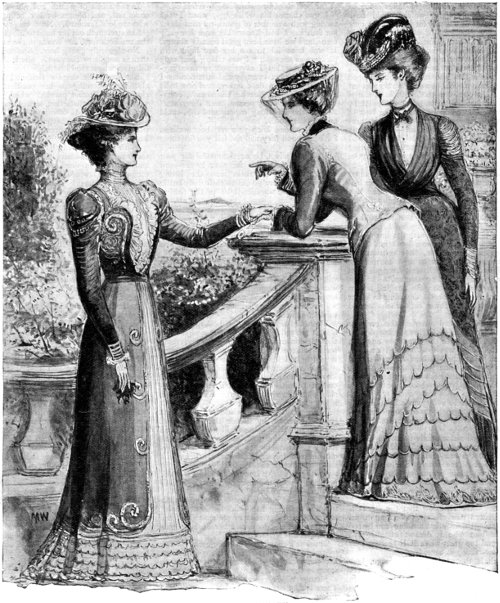
The group of “Three New Gowns” begins
to show some slight evidences of autumnal
styles, especially the lady in the centre, who
wears a light fawn-coloured braided jacket,
with a skirt of light brown cloth, which is
scalloped with velvet of a darker shade, the
lower flounce being embroidered also in silks
of a darker brown. This is a charming
autumnal costume for short visits and journeys
in England. The hat is a sailor one, trimmed
as these hats generally are at present, with
more or less elaboration. The present one
has trimmings of yellow chiffon, with wheatears
laid over it.
The figure on the left hand wears an embroidered
and ribbon-trimmed gown of black
satin, the front of the skirt and vest being of
pale lemon-coloured silk, with chiffon of the
same hue, and bands of ribbon. The hat is of
the new burnt straw, and is trimmed with
white chiffon, with poppies and bunches of
oats arranged amongst it. The right-hand
figure wears one of the new scarf bodices,
crossed over in front, a shirt-front of white
silk, and a light green tie. The dress is of
figured poplin, with bands of green silk on
the skirt. The toque is of crinoline, with
green and black chiffon, and black ostrich
feathers.
The newest style is to have a neck and
waist-band of a different colour from the rest
of the dress. For instance, if the gown be
mauve, the velvet at the neck or waist may be
of pale blue or pale green, and with a black
gown orange is much worn. There has been
a great feeling towards mixed colours, and it
is quite wonderful how we have got over the
old idea that it was both vulgar and ugly to
wear many colours, or to mix two incongruous
materials in one gown.
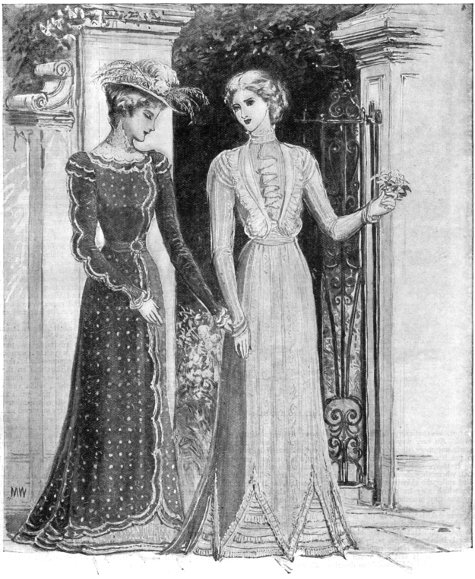
The third illustration shows two charming
gowns. The one on the extreme right wears
one of the new satin foulards of dark blue,
with a small white pattern on it. It is trimmed
with light blue ribbon in scallops round the
skirt and up the side, the sleeves, and the
yoke. The last-named is of white silk, and
so is the under-skirt. The second figure wears
a dress of white figured muslin, the bodice
trimmed with ruffles, and the vest is of tucked
muslin. Straps of ribbon are on the top of
the sleeve and round the points of the tunic
and waist. The under-skirt is of muslin
flounced, and with folds of muslin between
each. This model would be suitable for a
coloured muslin, as well as a white one.
The bolero has retained its popularity
throughout the whole of the season, and has
quite superseded the longer jacket for afternoon
and dress wear. There are also revers to nearly
all dresses. But I am assured that our autumn
novelties will be minus both these items, and
that the long three-quarter coat is likely to be
the garment of the winter.
THE COURTSHIP OF CATHERINE WEST. — CHAPTER IV. — CHAPTER V.
Granville Gray was sitting in the library
of Lord Mayne’s town house. He was very
busy, for though it was the recess, and his
lordship was away shooting in Scotland, and
all the political and fashionable world was
dispersed in different directions, this was just the
time that he could devote to his own pursuits,
and to certain important investigations regarding
the industrial life of the country by
which he hoped some day to make his name.
But his attention was not as undivided as
usual. He would suddenly interrupt his work
to walk up and down the room, or to gaze
absently out of the window at the dusty
lime trees that shaded the iron railing. For
his work at the present moment was not an
aim, but a distraction. Catherine’s sudden
flight and the simultaneous appearance of
Lady Blanche had made him realise how
strong and genuine was his passion for the
former. How precise, and commonplace, and
conventional did the heiress appear beside the
glorified recollection of the girl he loved, as
she had stood trembling and clinging to him
on the hillside. So when he read her little
note, with its tender farewell, which convinced
him of her affection for him at the same time
as he became fully conscious of his own
devotion, he resolved that no other woman
should be his wife, and determined to set out
in search of her at once. In spite, therefore,
of Margaret’s remonstrances, he excused himself
to Lady Blanche on the plea of urgent
business, but he did not attempt to conceal
the real state of the case from his sister.
Margaret was really very much disappointed,
and blamed herself exceedingly. She knew
her brother well enough to realise that when
he had once made up his mind, persuasion
was useless; she was obliged to acquiesce, and
to console herself with the thought that if she
had been unwise in bringing her brother and
friend together, Catherine was a very charming
girl who could do him no possible discredit.
So leaving the two women at the hotel,
Granville had set out for the address given on
Catherine’s card. He hardly hoped to find
her in so obvious a retreat, yet supposed that
he would at least be able to learn something
about her movements there. Great was his
disappointment, therefore, when he discovered
that though the object of his pursuit had been
there only two days before, nothing was
known of her present address. The landlady,
who scented a romance the moment this
interesting-looking gentleman inquired for
Miss West, advised him to write to the
head-mistress of the High School. Granville
had at once acted on this, but as this lady
was abroad, and her exact address was
doubtful, he was not surprised that he had
not yet received an answer. Three weeks had
passed away in suspense and fruitless inquiry.
He had traced Catherine to Euston, where
she had changed for Victoria, on her way to
St. John’s, but all further effort had been
useless. Even now, he thought, she might
be within a few miles of him, somewhere in
this vast city; for what better hiding-place
than London could anyone want?
His musings were interrupted by a sudden
sound of wheels, and the shrill ringing of the
electric bell. Presently the door opened, and
a man brought in a card.
“A lady to see you, sir. She asked for his
lordship’s address, but when she heard you
were in, she said she would like to see
you.”
Granville was annoyed; he did not feel in
the least inclined for an interview with an
unknown lady. Why should the man be so
officious? Then as he looked at the card his
heart gave a sudden bound. Had Catherine
sought him out? But what an unlikely idea;
West is not an uncommon name. Nevertheless,
it was with a quickened step that he
crossed the hall to the room where the visitor
was waiting.
His heart sank when the little old lady,
almost old enough to be his grandmother,
rose to meet him.
“I must explain my business,” she said,
looking at him with a keen scrutiny that
would have confused a less self-possessed
person. “I asked for Lord Mayne, but I
have come on a matter connected with
yourself.”
“With me? I am afraid——”
“Of course, you do not know me. Now
will you tell me why I have had the good
fortune to find you in London at this unseasonable
time?”
Granville felt more and more astonished,
and began to think that his visitor was mad,
and must be humoured.
“I have come here on urgent private
business,” he answered. “But you wished to
see Lord Mayne; is it on any matter that I
can answer?”
“As I said before, you can probably satisfy
me better than anyone else. But before I
put any more questions, let me tell you a
story.”
And forthwith she poured out to him all
the history of her quarrel with Catherine’s
father, and of her reconciliation with his
daughter, carefully avoiding the mention of
the latter’s name. But Granville, listening
attentively, soon solved the enigma. He
could hardly wait with patience till she
concluded, saying—
“I am naturally anxious about my niece’s
future. She will inherit a larger fortune than
she has any idea of. I may die at any
moment, and she will be left alone in the
world, a prey to fortune-hunters, and quite
unprepared to grapple with such difficulties as
are sure to meet her.”
“But why have you told me this?” he
asked. “I cannot pretend not to understand
to whom you refer. But has Miss West——”
“Catherine, who, as you have guessed, is
my niece, has told me very little. But,
apparently, you are almost the only man she
knows. I believe that I can trust you, for in
a long life my powers of intuition have seldom
played me false. What I want to know is
whether you would be prepared to be one of
the executors of my will, and to look after her
interests when I am gone?”
“You place me in a very difficult position,”
answered he. “Whatever may be Miss
West’s feeling towards me, I tell you plainly
that no other woman shall ever be my wife.
But though I am glad for her sake that she
has found you, your news is a personal
disappointment to me. I have spent the last
three weeks in a ceaseless search for her. I
had hoped in a few days to go to her and
offer all I have—which, if not much, would at
least have been something. How can I do
so now? And if I accept the executorship I
shall be placed in the painful position of
seeing her continually without feeling at
liberty to declare my affection.”
“But why should you not declare it?
Catherine may return your affection, and she
is quite without fortune at present. If you
honestly care for her now, why not follow up
your acquaintance. Come and see her as my
visitor, and win her by a gradual courtship?”
“I cannot do it,” he said. “Simply
because I love her, I will not owe anything to
her. I will not expose myself to the imputation
of interested motives, nor her to the
humiliating suspicion of having been sought
for her money.”
“Really! Were ever two people more
contrary?” exclaimed Aunt Cicely. “But
suppose she already——”
“Stop, I beg of you,” he interrupted.
“You have no right to betray your niece’s
confidences.”
“Well,” said his visitor, standing up, “I
see that you are unmanageable. I will give
you a week to think it over. You say you
love her, and you have the opportunity of
doing her a great service. Will you not sink
these quixotic ideas in the desire to help
her?”
And with these words she departed, congratulating
herself on having discovered the
state of Granville’s mind without hopelessly
compromising Catherine, or doing anything at
the discovery of which her niece need blush.
She drove off in high spirits to her lawyer,
planning a scheme which would inevitably
bring the two lovers together without sacrificing
the pride of either. And after spending
some time with her solicitor, she took the last
train home, feeling very tired, but with the
pleasant consciousness of having performed a
good day’s work.
Meanwhile Catherine had spent a miserable
day. She had lain awake most of the previous
night, planning a reconciliation with her
aunt; but towards morning she had fallen
asleep, and did not wake till the maid entered
her room at nine o’clock. Her aunt had gone,
had taken the 7.30 train to London, they
said. At first Catherine had wild thoughts of
following her thither; she was not in a fit
state of health to travel alone, but ignorance
of her destination was a hopeless obstacle.
So after spending the morning in vain attempts
to read and practise, the girl set out for the
station, where she met every down train that
afternoon. Her patience was at length rewarded
by the appearance of her aunt, looking
so pale and tired that Catherine was seized
with sudden alarm. She saw that Miss West
was almost too much exhausted to speak, so,
hurrying her into the carriage, she drove quickly
home, and persuaded her to go to bed at once.
Little was said on either side, but the kisses
that were exchanged as her niece left her for
the night satisfied Catherine that she was
forgiven.
But the exertion and excitement had been
too much for Aunt Cicely. There was a
sudden alarm in the night, the sound of
hushed and hasty footsteps on the stairs, a
hurried consultation between Catherine and
the housekeeper. The former stood by the
bedside, holding her aunt’s hand, and feeling
as if her last earthly support were slipping
from her. Then came the doctor, only to
pronounce that the sufferer was past his skill;
even if he had come earlier he could not have
helped her. The grey September dawn found
Catherine once more alone in the world, and
feeling more desolate than ever.
Catherine and her aunt’s lawyer were sitting
together in the vast drawing-room with
the big bay windows. He was an elderly
man, with daughters of his own, and felt sorry
for this girl, who had apparently no relations
to look after her interests. And he shrank,
too, from telling her the state of affairs. She
had every reason to suppose that she was an
heiress; if her aunt had died a day sooner
that anticipation would have been realised;
but now she had to be informed that she was
left with only a small income, while the bulk
of the property had gone to an entire stranger.
“Your aunt,” said Mr. Cheadle, “was—er—a
lady of some eccentricity. On your
father’s death she made a will in your favour,
and this remained unaltered till the day before
her decease. But last Wednesday she called
on me and made another in favour of this
strange gentleman. Your legacy consists of
various investments, which altogether produce
an annual income of £150, enough to ensure
your comfort, but a mere trifle compared to
what you might have expected.”
Catherine brought her mind with an effort
to the business before her.
“It is very good of you—of her, I mean,”
she answered. “The last time my aunt spoke
about the matter, she threatened to leave me
without anything. I had displeased her, and
this is far more than I had any right to
expect.”
Mr. Cheadle rose. “I am glad that you
are satisfied,” he said, with an air of relief.
“You will let me know your further movements,
and if I can do anything for you?”
“Thank you,” she answered. “I am quite
undecided at present, but I am sure that I
shall settle down quite well. But I will let
you know.”
The lawyer departed, and Catherine, putting
on her hat and cape, went out to walk
along the shore. The autumn evening, with
its chilly wind, and the grey sea, flecked with
white patches of foam, seemed to harmonise
curiously with her sad thoughts. The shore
was quite deserted, and she hurried on, striving
to overpower by physical fatigue the restless
pain at her heart.
All at once, amidst the sighing of the wind
and waves, she heard footsteps behind her;
the smooth track that led over the beach was
only wide enough for one, and standing aside
to let this other pedestrian pass, she found
herself face to face with Granville Gray.
She uttered a little involuntary exclamation
of joy, which she instantly smothered. His
face was worn and grey, and reflected none of
her own pleasure.
“I have come to see you on business,” he
said. “May I walk a little way with you?”
Catherine turned, and led the way from the
beach to the carriage road that ran above it.
“It is connected with your aunt’s will,” he
said. “The whole affair is preposterous.”
“Preposterous?” said Catherine. “How
do you mean? She has left me what seems
almost a fortune, and I certainly had no right
to expect more.”
“You were her natural heiress, and she has
robbed you to give the money to me—me,
whom she only saw once in her life—practically
an utter stranger to her.”
“To you!” cried Catherine in delight.
“Oh, I am so glad!”
“Please do not congratulate me. I have no
intention of keeping it. The money is yours
by right, and shall be yours in fact.”
“But I do not want it!” exclaimed
Catherine. “Do you know how rich I am
already? £150 a year! £30 more than
my salary used to be!”
“A fortune, indeed,” he replied. “But I beg
of you to listen to me. Last Wednesday your
aunt called on me and told me definitely that
she had left all her property to you. She even
asked me to act as her executor. Yet immediately
afterwards she went to her lawyer and
made this absurd will. Does it not show that
she was not quite responsible?”
“But she also distinctly told me that she
would leave me nothing. I am perfectly
certain that she realised what she was doing.
Why will you refuse the good fortune at your
hand?”
“Because it is not mine, but yours.” Then
suddenly lowering his tone, he added, “Catherine,
why did she come to me that day?”
The girl’s pulses leapt at his voice, and then
a flood of shame swept over her, as enlightenment
came to her in a flash. Aunt Cicely
had taken this means of forcing him into a
proposal!
“I cannot tell,” she said impatiently.
“But the money is yours. I do not want to
hear anything more about it.”
“I will not touch a farthing of it,” he answered.
“If you will not have it, neither
will I.”
Thus they argued, neither of them showing
any sign of yielding in the conflict of generous
intention. In their excitement they had stood
still; the wind raged round them, blowing
Catherine’s hair and cape about her; but she
did not heed it.
“I cannot help it,” she said at length. “It
is nothing to do with me. But,” she added,
“it is time for me to go in. I suppose you
are returning to London this evening?”
“Stop!” he cried. “You shall not go
yet. For a month I have had no thought unconnected
with you. I have searched for you
everywhere, and have I found you only to lose
you? Why should this wretched money come
between us? It is yours, but Heaven knows
I have not sought you for it. Catherine, do
you believe me?”
“Yes,” she answered simply, while his arm
went round her. “But the money is yours.
Take it, but take me too.”
[THE END.]
SHEILA’S COUSIN EFFIE. — CHAPTER XVII.
A STORY FOR GIRLS.
By EVELYN EVERETT-GREEN, Author of “Greyfriars,” “Half-a-dozen Sisters,” etc.
CYRIL’S WOOING.
“Then, mother, you think I can
depend upon my father’s doing something
handsome for me if I were to get
her?”
“Yes, my boy. I had a long talk
with him last evening after you had
spoken with me about it. He has taken
a great fancy to May Lawrence, and he
was very pleased indeed with her visit
to the works the other day, and her
promise to come and sing at the club
some evening. He seemed just a little
surprised when I spoke of your hope of
winning her for a wife; but he said
there was nobody he should prefer more
for a daughter-in-law, and I am sure he
spoke the truth.”
“Yes, yes, that is all very well; but
what sort of establishment would he
give me? She has a little fortune of
her own. I know that, and, of course,
she will come in for more when her
father dies; but that may be years off
still. I can’t ask a woman to marry me
without having a home to offer her!”
“No, and your father will give you
that. He said he would establish you
comfortably in London, and allow you
six hundred a year, and that, with your
own earnings at the Bar, since you
have now finally decided upon the law as
your profession, will enable you to get
along nicely. You have great talents,
you know, Cyril, and we expect great
things of you!”
Cyril kissed his mother, but looked a
little doubtful.
“Six hundred is not a large income
in London; but I think May has two or
three on her marriage. We might get
along in a flat. Of course I shall do all
I can, but it’s precious slow work at the
Bar in these days. Some clever fellows
never make their way at all. I’m not
sure I sha’n’t take to literature instead.
If one can get into the swim it pays
better.”
“With your talents and with your
education and presence you are sure to
get on,” said his mother, with serene
confidence, and for once in his life
Cyril found this complaisant admiration
a little trying. He knew that money
was a hard commodity to make, and he
did not like it to be assumed that he
would soon be making a fine income for
himself and his wife.
“Well, at any rate, I can tell the old
boy that I am in a position to marry;
that is, if he doesn’t look for great
beginnings,” remarked Cyril, after a
pause; “and the Lawrences have come
down in the world themselves, and have
no very grand ideas, which is a comfort.
May is a bit of a Radical herself, but
she’ll mend of that in time. It does all
very well when you’re young to be
enthusiastic and sentimental over the
working classes; but one grows out of
that fast enough, except fellows like
North, who never have an idea beyond
the shop all their lives!”
“North is a very good son, and a
great help to his father. It is not his
fault that he has not your talents,
Cyril, dear.”
“No, we can’t all be alike! I say,
mater, I’m awfully hard up for loose cash
just now. This London business costs
more than one fancies, and I don’t like
always asking the governor. A man
can’t go wooing with empty pockets.
Can’t you give me a little just to go on
with, from the housekeeping or something?”
“Well, I’ll see what I can do this
time; but you’ve had all I have had to
spare for some time, Cyril. Your father
was rather vexed at my not getting a
new winter mantle, but I managed to
pacify him. You mustn’t keep me too
short or there will be a fuss.”
“Oh, no, it’s only for a few trifles for
May; there will be the ring, you know,
and flowers, and that sort of thing.
Thanks awfully, mother, you are real
good sort! I daresay the governor will
stump up handsome when I tell him the
news, and then I’ll pay you back.”
Cyril went away well pleased with
himself, and resolved to lose no more
time in his wooing. It had occurred to
him that it was about time he had an
independent home of his own. Something
in the home atmosphere had
become uncongenial to him. North was
cool, and rather avoided his society,
and Cyril had very uneasy moments
sometimes when his brother occasionally
came to him with certain rather pointed
questions, the drift of which he seldom
altogether understood. Ray had been
rather off-hand with him ever since that
luckless fire, the memory of which still
made his cheeks tingle, and he often
fancied that his prestige in his native
place had considerably gone down.
Oscar’s face was a continual reproach
to him. He was tired of his life in
Isingford, anxious for a sphere of his
own.
But a sphere implied a centre and a
home, and a home meant a wife. Cyril
turned matters over in his mind a few
times whether or not to go out to
Madeira and propose to Effie with her
rich dowry, or to content himself with
the much more attractive May and her
smaller fortune.
In the end he decided upon the latter
course. Effie’s money was certain to
be tied up very tight. He had more
hopes of getting things more to his
liking in dealing with May’s parents.
They were not business people. They
would probably have easier ideas, and
May was out and away a more attractive
girl than Effie; besides, a delicate ailing
wife would be a nuisance. Cyril wanted
to be the centre of attraction in his own
home, not to have to spend his time
fussing after his wife.
So dressing himself very carefully in
a riding suit which he greatly fancied,
he ordered the best horse to be obtained
at the livery stables, and rode gaily off
towards Monckton Manor.
May was in the garden. The sun
was shining brightly, and the birds were
singing with that kind of eager rapture
which is only heard in the spring.
February was waning, and though the
March winds were still to come, the
present warmth was all the more
welcome. Celandines lifted their golden
cups to the caress of the sunshine, and
primroses were to be found gemming the
banks, whilst in garden borders crocuses
made a joyous blaze, and the daffodils
began to push up their bloom buds as
though eager to show that they would
not be much behind.
A servant came out to her from her
house.
“Mr. Cossart has called and would
like to see you, miss.”
May’s eyes lighted and a little flush
stole into her cheek. It was not
Saturday, so there must be something
special in this visit. Perhaps the very
fact that it was unusual helped to induce
that wave of subdued excitement.
Something special must have occurred.
He must be wanting something from
her. May turned at once and went
eagerly towards the house.
A tall figure came out into the sunshine
of the terrace, and suddenly all
the light faded out of May’s face. She
turned to the servant almost sharply.
“You said it was Mr. Cossart,” she
said.
“That is the name the gentleman
gave,” answered the footman, who was
new to the place.
“That is Mr. Cyril Cossart. You
must remember the difference in future,”
said May, trying to control the irritation
she felt. “I don’t believe I’d have gone
in for him,” she muttered to herself.
“He had no business to ask for me
with mother out. But he has seen me
now, so I suppose I must go for a little
while. I hope he won’t stay long. I’ve
such lots of things I want to do.”
Cyril came down the steps to meet
her, too much self-engrossed to observe
the coolness of her greeting.
“Don’t let us go in this lovely day,
Miss Lawrence. These sweet spring
days are too precious to lose! May I
not join you in your ramble?”
“I was not rambling, I was gardening,”
answered May, but she could not
exactly refuse his request, though she
did not altogether approve the suggestion.
She thought he was taking too
much the airs of an intimate friend,
and of late he had not been encouraged
to intimacy at the Manor.
“I am sorry my mother is not at
home,” she said, as they walked down
the wide nut avenue, where she had so
often paced with North, asking eager
questions about his work, and forgetting
everything in her interest at his replies.
“Well, it is you that I came especially
to see, May,” he answered; and as she
started at the sound of her name spoken
thus for the first time by him, and
flashed an indignant glance at him,
Cyril plunged into the carefully-prepared
speech he had made, faltering a little at
first, but getting the thread quickly,
and then going rapidly forward with
gathering courage and assurance.
For the first few minutes May was
simply too much astonished to speak a
single word, and then a wave of hot
indignation surged over her, and she
was afraid to speak lest she should say
something she might regret afterwards.
After all, when a man proposed
to a girl, he was supposed to be
paying her the highest honour in his
power to offer. She sought to remember
this, and to curb her angry impulses;
and during this time Cyril had got a
long way in his speech, so that there
could be no possible doubt as to his
meaning.
“Oh, please stop! Please do not
say any more!” cried May at length,
when she felt that she could master her
emotions and speak quietly. “What
you want is quite out of the question!
Please say no more. We had better
say good-bye”—and she stopped, facing
him, and held out her hand.
Cyril stood dumfoundered. He
simply could not believe his ears. This
was probably some girlish wile to lead
him on to more impassioned declarations.
He was quite ready for that,
and, taking her hand in his, recommenced
his protestations, but May
pulled it from him, and her eyes flashed.
“Mr. Cossart, please to understand
me, once and for all. What you wish is
quite impossible!”
“Impossible that you should be my
wife, May?”
“Quite impossible, and please not to
call me that again! You have no right
to do so.”
“May—Miss Lawrence—what does
all this mean? Why cannot you be my
wife?”
She looked him steadily in the face;
her composure was coming back to her.
The desire to speak the truth was upon
her.
“We have always been friends,” he
urged, desiring this thing the more
urgently from the unexpected opposition.
His pride and vanity were working hard
on the same side as his affections.
May looked very handsome standing
there confronting him, a flush on her
cheek, a light in her eyes. It was
impossible for Cyril to believe her
indifferent to him. He had always
regarded himself as irresistible.
Once again he began to plead; once
again she let him have a certain licence,
and then she cut him short.
“Mr. Cossart, you have said a great
deal now, let me say a very little.
Perhaps you do not know what a woman
most desires in the man she makes her
husband. One thing is, I think, a
perfect trust in him—his love, his
courage, his honour!”
She spoke the last words very distinctly;
Cyril’s glance wavered for a
moment, then he broke out—
“I love you with all my heart, May!”
“I do not think so,” she answered,
“though, perhaps, you think it yourself.
Forgive me if I pain you, but you want
to know the truth, you say. A woman
would not like to feel that in a moment
of danger her husband would lose his
head, leave her, and think only of
saving himself!”
“You are ungenerous,” said Cyril,
with a dark flush; “I have refuted that
charge once. I shall not repeat my
defence.”
“No, don’t,” said May quietly; “not
to someone who was there and saw and
heard all!”
In the deep silence which followed,
his quick angry breathing could be
heard; then May spoke again in the
same calm way.
“A woman wants also perfect confidence
in her husband’s honour. It
would not be pleasant to hear searching
inquiries as to how bank-notes, for
instance, which he had passed on to
other people had come into his
possession.”
The flush on Cyril’s face faded, and a
grey pallor took its place. He took a
backward step and almost gasped out—
“Miss Lawrence, what do you
mean?”
“Nothing very much. Of course, no
man of honour would mind such
inquiries. But it seems that there is a
hue and cry of some sort over a bank-note
which my brother cashed some
time ago. That note he changed for a
friend of his who happened to be short
of gold one day and asked him for it.
It is rather wonderful he remembered
the circumstance, but he did. As he
said to me, that sort of thing was not
quite pleasant, though no doubt everything
could be satisfactorily explained.”
Cyril’s face was livid.
“I never asked your brother for
change.”
“Did I say that you did?”
“It was implied in your speech.”
“I will not imply any more then. I
tell you in plain words that it was you
who asked Frank for change for the
note and got it. You may have forgotten,
but he has not.”
“And who has been making inquiries?”
asked Cyril, with stiff pale lips.
“Never mind. It is really no affair
of mine. If it is anything to you, you
will hear all in good time. I think I
must be going now. I have a number
of things to do. Good-bye, Mr.
Cossart. I will tell them to bring your
horse to the door.”
She turned and left him—left him
standing like a man half-stunned. That
was a pretty outcome of his day’s
wooing. Fear and rage wrestled for
mastery in his heart as he rode away
from the house, resolved never to cross
that threshold again.
He had been so confident that all the
trouble had blown over by this time,
that nobody, not even Oscar, had been
much the worse, that no strict inquiry
had ever been set on foot. His face
was still pale, and he felt shaken and
nervous as he walked from the livery
stables home. He was half afraid to
enter the drawing-room lest his appearance
should excite comment.
But as it happened there was another
excitement on foot which quite shielded
him from notice. Voices were speaking
in rapid eager tones.
“What can it be? How very
strange!”
“Alone too, or she would not want
meeting.”
“Oscar must go, of course, but it is
all very odd.”
“What’s the matter?” asked Cyril,
in as easy a tone as he could master.
“Why, look there,” cried Ray, putting
a telegram into his hand, “that has just
come from Uncle Cossart in Madeira.”
The message ran as follows—
“Sheila returns by Dunraven Castle.
Have her met.”
(To be continued.)
WILL SHE GROW OUT OF IT?
By Dr. GORDON STABLES, M.D., C.M., R.N. (“MEDICUS”).
The first part of this paper at all events may
be supposed to be addressed to young mothers,
rather than to young girls, but I have no
doubt that the latter will have a peep at it just
to see if there is anything in it which concerns
them. I shall not tell them whether there is
or not. Let them read on and see.
My main difficulty in writing it I feel will be
one of condensation. The subject of inherited
ailments and congenital malformation is one
of such importance that it is a book thereon
I should publish, and not a single paper.
However, if it leads young parents to think,
thinking is sure to lead to action, and with the
hints I shall give, and of course the help of
their family doctor, many a young life may not
only be saved, but children may grow up
strong and bonnie, who through neglect or
ignorance might have anything but happy
futures, and lives so weary that their brevity
might well be looked upon as a blessing.
I must say a few words at the outset on the
terrible scourge of these islands, which most
people call consumption, and the medical
profession phthisis. The question “Is it
hereditary?” stares us in the face at once
whenever we think of it, and it is a somewhat
difficult one to answer. I myself do not
believe in heredity in the ordinary sense of
the word as applied to disease. A beautiful
young shoot of wood may spring from a fast-decaying
tree, and if this be transplanted into
good soil, it will grow as well as any other.
What holds good as regards vegetable life
cannot of course be shown to be quite true as
regards animal, nevertheless there is a certain
analogy. Consumption we believe to be
infectious; if so, it is caused by a disease germ.
Now your old-school hereditists would tell us
that this germ descends from mother to child.
In some cases it does or may, but the child
very soon succumbs to tabes mesenterica, or
some other terrible infantile disease. A germ
will do one of two things: it will either assert
itself very speedily, or be killed in the system.
Nature sets about at once getting rid of these
disease germs, supposing them to exist at the
time of birth. She brings, among other organs
of relief, the absorbents and glands into play;
there is a struggle for life, in which nature
often fails, because those very glands become
overladen and diseased, tubercle being formed
and multiplied within them. Nature does her
best, but she is beaten—another proof of the
struggle betwixt what we call evil and good,
which is constantly going on in this world.
Well, on the other hand, if the child is born
of delicate parents, but free from germs, it has,
if carefully fed, nursed, and tended, a very
excellent chance of growing up well. It is
difficult to conceive of a child having germs of,
say, consumption in its system and these lying
latent or dormant until she is a certain age,
and then springing suddenly into life after she
has suffered from some exposure and caught
cold in the chest. There are easier theories
than this by far and away to account for the
children of consumptive parents dying of the
same disease in their later teens. Besides,
that word “latent” may be convenient, but it
is a shockingly unmeaning one. I remember
my father buying for a good round sum a few
grains of wheat that were said to have been in
the grasp of a mummy for a thousand years.
The wheat when sown grew most certainly.
It may never have been in the hands of a
mummy at all, but it may have been. If so, it
was surrounded by dead matter, it was
hermetically sealed against any influence that
could cause it to germinate. Life was latent
or asleep. But in the human body germs
have no chance of dorminating, for so constant
are the changes, that everything is constantly
getting shifted, and by the time a man or
woman is fifty he or she may have used up a
score of bodies.
However, there is this to be said concerning
the children of consumptive parents: they are
born delicate, and therefore far more likely to
fall victims to the scourge than others.
May they grow out of this delicacy of
constitution? Yes, and that is the question I
am going to consider, but I must answer
another one, and it is one, too, that strikes at
the very root of sociality: should consumptive
people, or those suffering from other so-called
hereditary ailments, marry? I say, “No.”
They are, if they do so, guilty of as great a
crime as many a felon who leaves the dock
with the dread sentence of the judge ringing
in his ears. It is sad to have to answer the
question in such seemingly cruel words, but
nevertheless I believe I am doing my duty in
giving that reply.
There are two ways in which a young
woman can give herself to God in this world,
and both are honourable. One is by marrying
the man she loves if he be healthy in body and
pure in mind—not else—and thus becoming
Heaven’s own servant for the happy propagation
of healthful species and the progress of the
world; the other is by—if weakly—remaining
celibate and devoting her time, her talents
and energies to doing good to her fellow
beings without hope of reward in this world.
There is a charm about a woman like this
(though foolish people may sneer at her as an
old maid) that it is difficult to describe.
I have met many such, and seem to have
seen a halo already around their heads. I am
a physician, naturalist, scientist, if you will, and
something of an astronomer, and being so of
course—to some extent—a doubter, but I do
most sincerely believe that the good in this
weary wicked world will ultimately prevail, and
those who help it onwards will not go unrewarded
in a future life whatever that life
may be.
Now to lay down a few simple rules for the
treatment of weakly children whether born of
delicate parents or not. Will she grow out
of it? The answer to this question is a hopeful
one or the reverse just as you choose to
make it, young mother.
There is one stumbling-block of which I
bid you beware at the very outset of your girl-child’s
life. It is the bogey “cold.” That
young children need warmth is very true.
They are for the time being little hot-house
plants, but the sooner you recognise the
truth that they are not intended to remain so,
the better it will be for yourself, and for the
child as well. Those wee things have to be
hardened off because the world isn’t a hot-house,
and they have got to live hardy, healthy,
and therefore happy lives, in spite of the many
and daily changes of this changeable climate
of ours.
If you desire the wee lassie to grow up as
tender as a mushroom and perhaps die just as
soon, comparatively, then all you’ve got to do
is to permit her to sleep night after night in a
badly-ventilated stuffy room and to plot her.
The verb “to plot” is essentially Scotch, but
as applied to over-coddled children or young
canaries or pigeons in a nest that the nervous
mother is sweating to death, it is exceedingly
expressive. Many of the Scotch words are
derived from the French as, in olden times,
the two nations were great allies. It would
be going a little out of the way perhaps to seek
its derivation from sur le plat, on the plate, as
an egg when poached. A pig is plotted when
boiling water is poured over it in order to get
off the bristles easily, the cook plots herself
when she gets a splash of hot water over her
hands, a boy or man is said to be plotting
himself when he wears more clothes than is
wanted as a guard against the weather, and
babies are all too often plotted in bed or
bassinette. The single word “plotted” means
sweated, blanched (faire pâlir), poached, all in
one. Well, however nice a poached egg may
be, poached baby looked at from a doctor’s
point of view is very unsatisfactory.
Now just think of the folly, not to say the
iniquity, of treating a tender infant as many
do. Here lies the mite at the mercy of a
mother who may be wise, but who may be
otherwise. It is already struggling with the
arch-enemy, death. Pray do not misunderstand
me: I do not mean to say it is dying,
only from the very day we begin to live we
begin to die, as it were, at least, to struggle
against all that is inimical to life. And life is
change, you know, merely that. “I live,
therefore I must die.” But we want to keep
the spark in this little body, and what is more
we want to fan it into health that shall fill
every vein and nerve in its body, and produce
future health, happiness, and strength. In
order to do this, in order to give the child a
chance to grow out of its inherited weakness
(I do not say “disease,” for that is an
ugly word, and quite unnecessary), we must
place it under conditions most favourable to
existence.
I think this is the proper place in which to
mention a very injurious fallacy as regards
what are called infantile ailments. It is a fact
that children of tender years are more likely
to be attacked by certain ailments, of which
measles is as good an illustration as any,
simply because they are weak, and these, in
certain states of the atmosphere, especially in
villages where sanitation is utterly neglected,
are apt to become epidemic, carrying away to
their little graves victims that are not strong
enough to fight against the trouble, for
Nature’s law that the fittest shall survive is
fixed and immutable. But it is a great
mistake to believe that children must have
such ailments, and the sooner such an error of
belief is written down and eradicated the
better. Scarlatina is another ailment which
often breaks out in villages, especially in
Board schools; and remembering the utter
want of fresh air and cleanliness which prevails
in these seminaries, one cannot wonder.
During an epidemic of this sort the school is
closed, and the children, sick or well, go to
their squalid dens and unhealthy huts to live
or die, as the case may be, for they “break
up” at school only to hatch out the seeds of
illness already sown in their systems. But
your well-fed, well-cared-for children, and
such as sleep at night in fresh air without
more than sufficient bed-clothing, do not
succumb to these disorders, be they ever so
rife.
Surely, then, prevention is better than cure.
I shall now mention one or two of these
so-called infantile troubles that some young
mothers who read this brief paper may know
a little more about them and their causes. I
advise everyone who has the care of children
to keep in the house in its little case a
clinical thermometer. The family doctor
will be very pleased, I am sure, to show
parents how to use it, and whenever the
temperature mounts over a hundred the
physician should be called in.
Measles.—The ailment is ushered in somewhat
similarly to a bad cold, and often passes
at first for a touch of influenza. But the girl
is feverish with loss of appetite, and no heart
for play. Then about the third day come out
the rose-coloured spots, first on the brow.
They are so close together as to almost coalesce.
The fever now gets worse, and the case is one
for the doctor to superintend; but the parents
ask the question: “Will she get over it?” I
am glad to answer in the affirmative, only that
nasty wee word “if” comes in—if the case
does not become complicated, for bronchitis
may ensue, or inflammation of the lungs itself,
and then there is great danger. And bear
this in mind; the child that has been treated
while in health in a common-sense way, not
“plotted,” over-coddled, or over-crammed as
to food, has by far and away the greatest
chance of getting over this ailment or
scarlatina either.
Scarlatina.—When this becomes epidemic
in small towns and badly-drained villages, the
Angel of Death has indeed spread his wings
on the blast.
If there is scarlet fever or scarlatina (the
milder sort) about, and your little girl begins
to ail from no apparent cause, suffering from
loss of appetite and cheerfulness, if she has
chills alternating with flushing, hot skin and
uneasy sleep, with a little headache and maybe
sore throat, with a high temperature and furred
tongue, having little red papillæ showing
through—the “strawberry tongue”—then in
all probability she has an attack of scarlatina.
We shall hope it is to be a simple one. Cure
it you can’t; but the little patient may be
guided through it.
The doctor is the man to trust. But there
is one thing you can assist him in most
materially, and that is in seeing that the
patient is completely isolated from the rest of
the house, for the simplest cases in one child
may generate the worst in others. It is a
more dangerous disorder than measles, and
mind that, until the doctor gives a clean bill
of health, and the skin has entirely peeled, no
other child should be allowed into the room.
Indeed, the success in any one case depends
on careful nursing, and isolation will prevent
it spreading. Disinfectants must of course be
used—but the doctor will tell you all this—and
food taken from the room must not even be
given to the cat or dog. She will pull through
if scientifically treated, and soon grow out of
any little weaknesses that may remain.
St. Vitus’s Dance.—Will she grow out of
this? I do really think that the medical
profession has a good deal to learn even yet
concerning this strange ailment. But its
symptoms are unmistakable. The uncontrollable,
fidgety movements may be slight or
very great; they may be on one side of the
body or both. She will grow out of it,
however, if the treatment is most skilful.
The health must be properly attended to, and
all rules obeyed which the doctor shall lay
down. The digestion and the teeth must be
seen to, with abundance of fresh air and
non-exciting exercise and recreation. The
bath often does wonders—tepid, of course—given
in a warm room. There are certain
kinds of methodical drill which, moreover, do
good, and many kinds of tonics. But cod-liver
oil or marrol is perhaps one of the best,
as it is a food. The doctor will for each case
prescribe the necessary tonic. Dear me!
what thousands of thousands of lives might be
saved if we could only act up to the physician’s
instructions. I must bid the young mother
beware of quack medicines, and of all such
dangerous drugs as chloral, bromides, and
phenaticin, etc. In the hands of the physician
these are useful; in those of the uninitiated
they are verily like razors grasped by infant
fingers.
There are three ailments or more which
I hope to treat of in papers succeeding this.
One is incipient consumption and its fresh air
cure, another rickets and bandy legs, and a
third scrofula, a disease of the glands, but, of
course, from constitutional causes. Scrofula
used to be called King’s Evil; and, although
one suffering therefrom may do much good
by strict adherence to the laws of health,
medical advice should in all cases be sought
for.
ANSWERS TO CORRESPONDENTS. — STUDY AND STUDIO. — OUR OPEN LETTER BOX.
Rosemary.—1. We have sent your quotation to
“Our Open Letter Box.”—2. For icing, consult
the February number of The Girl’s Own Paper,
p. 264. You will find many receipts for cakes there
and elsewhere in our magazine. This is not
literary! but we cannot divide a letter. It is
better, if possible, for our correspondents to send
separate letters for questions on cookery, health,
toilet, etc.
A. Dawson.—We should think Twenty Minutes, by
Harriet L. Childe-Pemberton might suit you, or
The Witch’s Curse, and Other Plays, by Meg, Jo,
Beth and Amy (Miss Alcott). French’s catalogue
(Covent Garden, Strand, London) contains all sorts
of plays for young and old, and might prove a help.
Ida.—We should advise you to get Chambers’s Book-keeping
by Single and Double Entry, published at
1s. 6d. You might also take correspondence
lessons in the subject. Apply to King’s College,
London (Ladies’ Department), the University
Correspondence College, 32, Red Lion Square,
W.C., or to one of the private addresses occasionally
given here.
Blackberry.—Your lines in their beginning recall
the hymn—
“There’s a Friend for little children
Above the bright blue sky”;
but they are not written in any metre, and do not
rhyme, so they can scarcely be called verse. The
writing of lines of different lengths below each other
does not constitute metrical composition.
Sofie Abelsberg.—You write a good English letter.
You should not say “Since three years I study,”
but “I have studied for three years”; and you use
“yet” wrongly. You should say “I still make
mistakes.” These are common errors for a foreigner,
and we congratulate you on expressing yourself so
well. We insert your request.
Nil Desperandum.—We are very sorry for you, as
it is quite true that the profession of teaching
music is overstocked in London. We are sure it is
far wiser to go into the provinces, but we cannot
tell you of any special town where you would find
an opening. It is best to inquire among friends if
possible, or your late teachers might be able to
suggest something. Perhaps some reader may help
you. We should think that in a case like yours
the Teachers’ Guild, 74, Gower Street, might be
useful. The High Schools all over England employ
visiting music-mistresses.
Jecko (Constantinople).—We are sorry we do not
recognise your quotation, but we have placed it in
“Our Open Letter Box.” In any case, you could
not have received a reply in our next number. The
magazine goes to press long before it reaches the
hands of our readers.
I. F. N.—We are willing to ask our readers at your
wish if they can suggest four suitable mottoes for embroidering
on a bed-spread. We should recommend
Coleridge’s couplet, divided as you like—
“O sleep! it is a gentle thing
Beloved from pole to pole.”
Ancient Mariner.
Mignonette.—Many thanks for your kind and appreciative
verses—“As Sweet as Spring”—about The
Girl’s Own Paper.
Ballochmyle.—1. Unless we are mistaken, a full
account of “The House of Education” at Ambleside
appeared in this magazine a year or two ago.
Write to the Secretary for details of the training if
you would like to undergo it. Your age would be
all right.—2. Chromo-lithography is a process of
reproducing paintings in colours.
Se Saren Rose.—The poem “Divided” is by Jean
Ingelow, the well-known poetess who died not long
ago. You will find it in the first volume of her
poems, which you should be able to procure from
any good library. You are quite justified in your
admiration. The title of the book is, Poems: Jean
Ingelow: Longmans, Green, & Co.
⁂ We are greatly impressed by the kindness and
courtesy of our readers who, for the sake of
absolute strangers, copy out and forward to us
long pieces of poetry. It is, however, only right
for us to warn them that it is most uncertain whether
these copies ever reach the persons for whom they
are intended. We keep no register of addresses,
and cannot undertake to forward MSS., while,
even if we did so, the numbers of each copy would
probably be far in excess of the demand. If no
address, or request for a copy, is given by the
inquirer in this column, it is quite sufficient to
answer the question by simply mentioning the book
or magazine where the desired extract can be found.
We say this with full appreciation of the goodwill
shown by our subscribers in the matter.
“Winton” has answers (in some cases copies) from
Old Bournemouthian, Miss Edith Williamson,
C. A. H., R. E. M. James, M. M., G. Shaw,
M. J. P. M., “Azzie,” Dorothy Shove, Louie
Francis, Lavinia Metcalfe, Ellen, Bertha L.
Wright, Miss James, D. Morrish, A. G., Annie
Nicholls, Edith H., B. Mountifield, Miss Hanly,
and Daisy. The hymn is referred to Sankey’s Songs
and Solos (732), the Christian Endeavour Hymnal,
the Union Mission Hymnal, and the Hymnal
Companion (No. 597).
“Doubtful” has answers, and in some cases copies,
from M. M. Harris, Mrs. E. Bürck, Sophia,
Evelyn Clare, Annie S. Hardy, Bertha Parks,
Miss Kneeshaw, referring “The Noble Boy,” alias
“Somebody’s Mother,” to Blackie’s Fourth Reader,
Chambers’s Expressive Reader (price 9d.), and
Nelson’s Royal Reader, No. 2.
Hope has replies from M. L. Spackman, “A Lover
of Music,” “Midget,” and “Pansy.” “Trouble
in Amen Corner” is by T. C. Harbaugh, and
may be found in the Thousand Best Poems in
the World (Hutchinson & Co.), and Chambers’s
Elocution, new edition.
Rosemary wishes for the words of a song beginning—
“Mary and John, down in the distant old village.”
“Gowan” has a copy of “The Women of Mumbles
Head,” sent by M. J. P. M. The poem is by
Clement Scott, and may be found in Forsyth’s
Practical Elocutionist (Blackie & Son).
Can anyone tell “Jecko” (Constantinople) the source
of the following quotation?—
“In that hour of deep contrition
He beheld with clearer vision
Justice the Avenger rise.”
OUR NEW PUZZLE POEM.
⁂ Prizes to the amount of six guineas (one of which will be reserved for competitors
living abroad) are offered for the best solutions of the above Puzzle Poem. The following
conditions must be observed:—
1. Solutions to be written on one side of the paper only.
2. Each paper to be headed with the name and address of the competitor.
3. Attention must be paid to spelling, punctuation, and neatness.
4. Send by post to Editor, Girl’s Own Paper, 56, Paternoster Row, London. “Puzzle
Poem” to be written on the top left-hand corner of the envelope.
5. The last day for receiving solutions from Great Britain and Ireland will be September 16,
1899; from Abroad, November 16, 1899.
The competition is open to all without any restrictions as to sex or age.
[Transcriber’s Note—the following changes have been made to this text.
Page 692: he to be—“have to be content”.
be to he—“when he is back”.
Cappucini to Cappuccini—“Cappuccini at Amalfi”.
Page 701: primoses to primroses—“primroses were to be found”.]