By ISABELLA FYVIE MAYO, Author of “Other People’s Stairs,” “Her Object in Life,” etc.
A GLINT OF SUNSHINE.
r. Black,” said
Lucy, speaking
rather suddenly
after her pause,
“Miss Latimer
and I are keeping
house together
just now,
and we are
hopeful of securing
the services
of a highly
respectable elderly woman, who will keep
things neat and punctual. Would you
care to come and live here for the present,
paying me precisely what you have
paid Mrs. Mott?”
“Oh, Mrs. Challoner,” cried the lad,
“how can you propose such a delightful
thing! It is far too good to be true! To
come to a house like this, so near the
office too, and your home! It would be
a real kindness in you to do such a
thing: but it would not be fair—you
oughtn’t to think of it!”
“Mr. Black,” said Lucy, “I think it
may suit you very well indeed; but
the kindness and the service will not be
all on my side. In the event of all
manner of evil chances—burglaries or
chimney fires, for instance,” she interpolated
with a smile, “we shall have a
reliable and friendly house-mate. See
how useful you were to me, and how you
kept up our spirits on that terrible
Christmas Day! But most especially,
Mr. Black, there will be somebody else
besides me for Hughie to talk to, and
perhaps play with sometimes.” Her
lip trembled as she spoke. It was hard
to think she herself could not suffice for
her own child. But she was too true a
mother to limit her little boy’s enjoyments
to her own failing powers, no
longer equal to provide them.
“I come home so tired sometimes,”
she said, “that I fear I may put a
damper on Hugh’s prattle, or fail him
in his romps. Miss Latimer, too, is
very tired, and she is growing old. It
would be such a comfort to feel I had a
young friend’s help to fall back upon at
a pinch. It might not happen often.
It may not happen at all, because it will
be such a restful relief to know there is
somebody to fall back on. I shall take
no mean advantage of your presence in
this matter,” she added, with an April
smile. “I think you may trust me for
that!”
“Oh, Mrs. Challoner,” said Tom,
“that’s just what a fellow misses when he
isn’t at home; there’s nobody expects
anything from him, and he gets like a
working and feeding and eating machine.
I’m sure I’ll be only too delighted to be
of any use I can. As for playing with
Hugh, we’ll have drill and all sorts of
larks. And he can go for a run with
me in the evenings, whenever you don’t
want to walk! To think of getting into
a home such as this! How thankful
mother will be! She’s beginning to
worry about the matter, for though I’ve
made light of it to her, she seemed to
guess how it would be.”
So it was settled. Then Clementina
Gillespie duly kept the appointment Mrs.
Challoner made with her. Her appearance
well supported her introduction by
Mrs. Bray’s faithful Rachel. Certainly
she had not the sonsie charm of the
delusive Mrs. Morison. Quite the
reverse. Clementina’s face had no resemblance
to a winter apple lying in the
frost. She was pale and thin, almost
cadaverous-looking, with a well-marked
aquiline nose and a long jaw. In place
of Mrs. Morison’s white frills and cosy
wraps, she was clad in what she called
her “mournings,” without a dash of
white about her. Lucy at once noticed
the soft Highland voice, with its strange
Celtic wailing. But Clementina Gillespie’s
manner and appearance were alike
“superior.” Indeed, there was a kind
of severe, decayed high-breeding and
elegance about her.
“Four people instead of three,
ma’am,” she said, when Lucy told her
that her household was to be joined by
a youth of seventeen. “It will make no
differ to me, whatever. I shall have
nothing to do but to try to do my best
for you all. And, indeed, the young
gentleman will be a blessing and a safeguard
in the house, for I do think this
Babylon has terrible risks for a household
of lone women.”
“There is not so much danger as
people from country places are apt to
imagine,” Lucy hastened to reassure
her, fearful lest terrors of “Babylon”
should drive her back to her native fastnesses.
“The young gentleman will
sleep in the little room behind the dining-room,
Miss Latimer, I and my little
boy are on the first floor, and your bedroom
is in the attic, so you see burglars
will have to pass us all before they can
get to you,” she added playfully.
Clementina Gillespie did not smile.
“They might come in by the roof,” she
said. “I hear they often do. What is
fated will happen. But I am not afraid,
whatever.”
“Of course not,” Lucy replied. “If
you have lived in a lonely house on a
hillside, you are sure to be a brave
woman. It must be rather eerie in such
places on wild, dark, winter nights.”
“The winds and the darkness are the
servants of the Almighty,” returned the
Highland woman. “But wherever there
be peoples, there be bad peoples.”
“Ay, but good ones also,” said
Lucy. “And all people are in God’s
hand, as well as all forces of nature.”
Clementina Gillespie did not answer,
and Lucy somehow felt that she did
not quite agree. It struck her, however,
that conversation having taken
such a turn was a sufficient proof
that this person was on a different
intellectual level from all the other
servants she had seen lately. It was
equally clear that if Clementina were
never to be more cheerful than she was
at present, she might be a little depressing.
Yet Lucy recollected that she
had come from a father’s grave and a
broken-up home, and was a stranger in
surroundings utterly alien to her previous
ways and thoughts. Besides there would
be Tom to keep the house alive with
mirth and laughter.
Lucy was not sorry to be able to ask
Jane Smith whether it would put her to
any inconvenience to leave before her
“notice month” had expired, or whether
she would like to do so. Of course, in
either case she would get her wage
the same, but badly as the girl had
behaved, Lucy was reluctant to evict
her if the home was of any importance
to her.
“Oh, no, mum, I’ll go to-morrow if
you like, mum,” was Jane’s answer.
“I’ve got a place waiting for me the
minute you can do without me. They’ll
be glad to have me so soon.”
Lucy allowed herself to ask no question
then. Nobody had inquired about
Jane’s character. But if she had taken
a place in the country it might be in her
own village, and might have been secured
by some other line of introduction. But
when the day of departure came, Lucy
felt it to be her duty as a mistress to
know where the girl was going. So she
inquired gently—
“Have you far to go, Jane?”
“No, mum,” was the curt answer,
with no information vouchsafed.
“Shall you want a cab? Or are your
boxes to be called for by the railway
people?” Lucy persisted.
“I don’t want no cab, mum. A friend
of mine’s coming to give me a hand.
You needn’t trouble about me, mum.”
Lucy and Hugh were seated at their
tea, when the black-bearded man came
whistling up the street and descended
the area steps. Jane was waiting for
him. One or two loud laughs were
heard, followed by bumping sounds.
He had laden himself with Jane’s big
trunk, and she followed with a tin box
and a brown paper parcel. She had not
relented, nor come to the parlour even
for a civil “Good evening.” As she
followed her trunk and its bearer, she
turned and looked in at the dining-room
window with a mocking smile.
The group crossed the street, but
paused a few yards lower down. There
was a house whose door was open, and
there they went in. That was where
Jane had found a place! That was the
“country situation” in favour of which
she had given her abrupt notice! It was
Mrs. Challoner’s own neighbours who
had received her servant without the
slightest reference to her. Lucy felt
stung. She knew nothing of these
people, except that their name was
Marvel, and that the family seemed to
consist of father, mother, and two or
three daughters. She had constantly
seen them going out, in evening dress,
in cabs. But how discourteous was
their present action! If, as it seemed,
they had made up their minds to take
Jane under any circumstances, they
might at least have made formal recognition
of her last employer’s existence.
The only inference Lucy could draw was
that her late servant had managed to put
her so thoroughly in the wrong that the
Marvels believed hers to be no standard
to which they need refer, and herself a
person to whom no civility was due.
It vexed Lucy to find how this thought
hurt her. She knew that, in ordinary
parlance, she “ought to be above feeling
such things.” Once upon a time she
would have laughed at such a matter
as affecting herself, though she might
have recognised its significance socially.
She could not understand her greater
weakness now. She said to herself that
often in her life she had found pleasure
in setting herself harder tasks than any
she was now accomplishing; for she had
taken youth’s athletic joy in pedestrian
feats and in working against time. She
was still unable to realise that it is one
thing to court fatigue and excitement
with unimpaired vigour and high-strung
nerves, and quite another matter to
accept these when one is already worn
out with anxieties and fears. Also that
it is one thing to live even the most
laborious days in at atmosphere of love
and appreciation, and another to toil in
so much risk of carping and misunderstanding
that one is thankful if one can
but escape notice altogether. There is
repose and refreshment beforehand in
the very consciousness that there exists
somebody who will say presently, “You
must rest; you must have a holiday;”
and who possesses both the will and the
power to enforce the words, just as we
often feel so much assurance in an
outstretched helping hand, that we can
jump safely, without availing ourself
of its help.
Fond mother Lucy could not be expected
to understand that there had
been a perpetual strain in having for so
long had no household companionship
but that of her little laddie. If it is
tiring to stretch ever upwards to minds
above our own, speaking of things we
do not understand, and in a language
we scarcely know, it is equally exhausting
to the mind to be for ever stooping,
and never able fully to express its deepest
thoughts and feelings.
There was a strain, too, in Lucy’s
terror lest Hugh should lack something
in being thrown wholly upon her failing
resources; she would not rest if she
thought he wanted a game; she would
not even relapse into brief silences such
as she often craved. No, she had
goaded herself on to chatter, and make
fun, and tell stories!
Then there had been nobody to remember
and provide the little dainties—the
pleasant table-surprises which do so
much to stimulate a failing appetite.
Until Miss Latimer had come to stay,
all that Lucy cared for was that Hugh
should get his milk, and his puddings,
and his fruit. And somehow she herself
turned from all these. And there was
nothing tempting in their stead.
Also Lucy had started on her new
laborious, lonely life after the agony of
Charlie’s illness and the supreme effort
made for his departure. She had been
at the very bottom of her physical powers
and nervous energy. For six months
she had been steadily giving out and
taking nothing in; nothing but nameless
little worries had filled in the interstices
of work and anxiety.
Looking in her glass, she could see
her face was thin and wan; she noticed
one or two silver threads in her hair.
Anybody else looking so, she would
know to be ill, but she would not own
any breakdown in herself. Ill! Was not
her task already half accomplished, and
had not Charlie’s journey prospered
beyond their hopes?
If only she had been able to enjoy
one week of the bracing breezes off
Deal, and of the wholesome presence of
Mrs. May! If only the Brands’ house
had been one where she was sure to find
hearty welcome, and where she could
have spoken out all the imaginings and
horrors that began to haunt her. But
from nobody in the world was it more
necessary to hide her trembling spirits
and collapsing forces than from her
sister Florence, who would have seen
in them only an occasion for criticism
and censure, and for counsels for
whose carrying out she would offer no
furtherance.
It was at this time that Lucy first had
a dream—which she often had afterwards—and
which, worse still, became
a sort of waking vision, which would
open before her if ever she dared to remain
for one moment without active
occupation for brain or hand.
In that sleeping dream, and in that
waking “vision,” she saw herself walking
on a dreary road, between a dead
wall and an open wold. Night was
falling fast; wind and rain were beating
upon her; her limbs were failing, and
still she struggled on, and as she went,
she seemed to wail, “Alone! Alone!
Alone!”
The dream always broke off there;
the vision went no further. She never
knew how it ended.
Two days after Jane Smith’s exit and
Clementina’s in-coming, Tom Black
arrived. Miss Latimer and Lucy welcomed
his cheery presence. Clementina
certainly seemed highly respectable, and
set about her work as one who wished
to do her duty conscientiously. But her
very presence was depressing. Her
necessary sentences always ended with
a sigh, and the depth of her mourning-raiment
was never alleviated while she
went about her household tasks. Indeed,
one could scarcely fancy her in a cheerful
lilac print. Of course, she had not worn
caps on her father’s croft, and Lucy did
not dream of suggesting them to her,
though she could not help feeling that
it would have been a joyful relief to see
a white lace butterfly crowning the
smooth black hair which seemed as
much in mourning as all the rest of
Clementina.
The only little personalities which
Clementina contributed to the kitchen
furniture were three memorial cards:
one yellow and almost undecipherable
with age, the other in commemoration of
the piper, Niel Gillespie, the friend of
Rachel’s dead lover; the newest, a
tribute to the recently deceased father;
also she possessed a piece of quaint and
heavy pottery, the figures of two children
kneeling beside a grave under a weeping
willow, and a dim old print, “The Death
of Abel,” in a thick black frame.
Tom brought quite a different order of
things into the house. The pictures he
hung up in his bedroom were of Skye
terriers hopelessly watching butterflies,
kittens playing with a ball, a group of
cricketers on the green of his native
place. He had his mother’s portrait,
too, set up in a dainty little frame, on
which he had evidently lavished some
pocket-money. He brought it into the
dining-room to show Lucy, and Lucy,
with one moment’s reflection, asked him
whether he would not like to keep it
there, where he would pass his waking
hours. “Oh, yes, certainly, Tom would
like it, only wouldn’t Mrs. Challoner
feel——” but while he was yet speaking,
Lucy had taken it from his hand, and
had found room for it on the mantelshelf.
Her own father’s portrait and Charlie’s
were there already. There had been
one of herself and little Hugh, but her
husband had taken that away with him.
Lucy slipped Mrs. Black’s picture into
the empty place. Clementina crooned
eerie Gaelic songs in the kitchen. Tom
went about the house singing—
“For a-hunting we will go!”
It is, perhaps, needless to say in
which song Hugh learned to join.
Indeed, the oddest thing about Clementina
was that Hugh did not seem to
like her—no, not though she always
sent up a special little pie-cake for him
whenever there was a pie, and though
if her face ever wore a smile, that smile
was put on for him. Alas, little Hugh
had been so fond of the ill-starred Jessie
Morison! It seemed a pity that such
proven moral instability should have
charms which this manifold respectability
had not!
Lucy had not seen or heard from the
Brands for some time. Such silences
were not unusual between the two
households, unless something special
was going forward. Lucy knew that her
sister had been paying some country-house
visits, and felt sure she should
hear from her when she came home to
make her preparations for the annual
family migration to the seaside.
The summer holidays began at the
Institute. Of course, it was impossible
for Lucy or Miss Latimer to think of
leaving home when they had just
received a strange servant and a guest.
Still, the holidays meant considerable
relaxation. Hugh had his holidays, too,
and he and his mother, and sometimes
Miss Latimer, too, used to go off
together to Hampstead or Highgate
or Greenwich, where he could gather
wild flowers and play about, while she
found quaint or pretty “bits” for
sketches. Then, when they came home,
there was Tom with funny stories about
people and events at the office, or the
“latest news” of the evening. The
domestic group, with their varied ages
and developments, made, as it were,
a pretty household chime—the child’s
exuberant inconsequence melting into
Tom’s boyish enthusiasms, and those
rising towards Lucy’s serious ideals
and soberer outlook on life, and Miss
Latimer’s gentle pathos. Of course, to
old household loves and loyalties bred
from years of mutual experience, this
was but as a sketch is to a masterpiece.
But it was good so far as it went.
And every masterpiece has been but a
sketch once!
It was certainly a lovely gleam of
peace and content, but Lucy knew that
for her its brightness was derived from
her consciousness that Charlie, in all
the elation of renewed health, might
now be considered fairly on his homeward
way! His last letter, which had
arrived three days after Tom Black’s
in-coming, had come from Hong Kong,
whither Captain Grant had unexpectedly
steered his course, owing to the unforeseen
demands of a promising branch of
business. They would leave that port
a day or two after the letter was posted,
and might reasonably expect to arrive
at Vancouver well within the year of
Charlie’s proposed absence. But the
Slains Castle herself, after despatching
her business at the Canadian port, would
have to return home all round by Cape
Horn, thus not only unconscionably
prolonging her voyage, but doing this
through stormy seas at an inclement
season. Captain Grant, however, had
declared that he had never had such
a fortunate voyage, that Charlie had
been such a “luck” passenger, and
that as circumstances had broken his
own promise that his ship would not be
away more than a year, so on his side
he would release Charlie at Vancouver,
rebating from the hundred guinea fee
enough to pay for Charlie’s land
journey by the Pacific Railway and the
short Atlantic voyage by a liner from
New York.
“I begin to feel that we may expect
to keep our next Christmas together,”
wrote Charlie, “and I dared hardly
form that hope while my return within
that time lay wholly with a sailing-vessel,
on which I find two or three
weeks ‘more or less’ are matters of no
account whatever. Now, little woman,
you and I must prepare for one more
long silence. We may touch at some
of the islands of the North Pacific, and
then you shall get a missive; but again
we may not, and then your next letter
will hail from Vancouver, and I myself
shall arrive on the back of it—like a
postscript! I don’t need to ask you to
let me have letters waiting at Vancouver.
Write there regularly whenever you feel
inclined to have a chat with your old
man, and then, whether I arrive sooner
or later, I shall have a nice sequence of
sweet letters to keep me company on my
lonely rush across North America and
the Atlantic. Remember, my wifie,
that before you receive this, the distance
between us will be actually lessening
day by day. Here’s to our happy
meeting hour! And God bless my
brave little wife!”
Of course Lucy’s heart rose high.
The worst was now over, and in the glow
of renewed joy she began to think it had
not been so very bad. As by magic the
weariness and weight dropped from her
feet, her voice recovered its full, rich
timbre, her eyes shone with fresh light.
She said to herself that she had not
been overworn or ill after all—“only
anxious and depressed.” And now
what she had to do was to banish the
thin wanness of her face before Charlie
came home. As for the silvery hairs—they
must stay. But she said to herself
that there is beauty in silvery hairs, and
she was not at all sorry to stand proven
as no longer girl or bride, but as
woman and matron, with every right to
think and to act for herself and for
others.
She was still going cheerily in the
light cast by Charlie’s letter, and
though she had already eagerly written
to Vancouver, she had not begun to feel
the damping effect of the inevitable
silence of the North Pacific, when an
epistle came from Florence.
“Dearest Lu,—I am home from my
visits, and am very busy packing us all
off for Scarborough. Can’t get round to
see you at any hours I am likely to find
you in Pelham Street.” (She had quite
forgotten the holidays!) “Won’t you
come over to me here? Please, do!
Come to-morrow, as early as you can in
the afternoon, and stay to dinner and for
the evening. Please wire reply. We
expect only one or two friends. The
change will do you good. I don’t invite
Hugh too, because I want you to stay,
and I know you wouldn’t keep him out
in the night air. Surely you can leave
him at home for once! And do
remember I’m your only sister, and
have got such a lot of things to show
you. I’ve told Jem I’m writing to you;
don’t let him say you pay no attention
to my invitations! (He has said that—Jem
can be nasty sometimes, though he’s
always so polite to you!) Do come!
“From your loving sister,
“Flo Brand.
“P.S.—I suppose you are always
getting the best of good news from the
other side of the sea?”
That palpable “afterthought” nearly
made Lucy flatly decline the appeal.
Yet she hesitated. This was only
“Florence’s way,” and she might have
done just the same had the original
motive of her letter been inquiry
after her brother-in-law and not a mere
invitation to her sister. Lucy wanted
to cherish family affection, so far as it
was possible; and then she could well
believe that Jem “could be nasty.”
Poor Flo!
So she got as far as to mention her
invitation to her little household at tea-time.
“Of course you’ll go,” said Miss
Latimer. “It will do you a world of
good.”
“Hugh and I will get on grandly
while you are away,” said Tom. “We’ve
got a plan laid out already for some
evening ‘when mamma is busy,’ but
now it shall be when ‘mamma is gone
to a party.’”
“I can’t go very early,” observed
Lucy, hesitating, “for I sha’n’t leave
home before you come from the office.”
“It’s a slack time, and I’ll get away
sharp,” returned Tom, while Hugh’s
face, which had clouded, cleared, and he
danced to and fro between his mother
and his friend.
So Lucy wrote to Florence, and told
her she might expect to see her between
five and six next evening.
(To be continued.)
OUR LILY GARDEN.
PRACTICAL AIDS TO THE CULTURE OF LILIES.
By CHARLES PETERS.
A visit to the royal gardens at Kew is always
a pleasant holiday. There is so much to see
and admire, and so very much of what is quite
new and unexpected, that all lovers of flowers
must look both forward to and backwards
at their visits to England’s greatest garden.
We remember strolling into the gardens on
a June day last year. The weather was
fine and warm, and the gardens were at their
very best. We had been into the various
greenhouses; had duly admired the airy
lightness of the filmy ferns; had marvelled
at the stalky palm or the ridiculous cactus (one
of the latter we can never forget, for it bore a
great pink blossom on what might have been
mistaken for a savage’s club!) We had seen
the great leaves of the Victoria lily, with its
huge flower-bud not yet open; we had viewed
with interest the curious sacred bean, and had
been half-stifled in the dense atmosphere of
the tropical orchid house. But it was not
among the rare productions of the tropics;
it was not in the greenhouse in which the
choicest of flowers are exhibited in tasteful
combination; it was not among the curious
and beautiful orchids that the finest flower of
June was to be seen.
No! The finest plant which flowered in
Kew in that June was to be found in
an open bed behind the great palm-house.
On turning towards the rosery when leaving
the tropical palm-house, our attention was
arrested by a sheet of dazzling gold. We
approached the spot and found that the object
which had brought us thither was a bed of the
great Caucasian lily or Lilium Monodelphum.
There was nothing in any part of the
gardens to equal this bed of homely, hardy
lilies. It was perfectly lovely! The great
yellow bells hanging in pyramidal masses
were as elegant as they were gorgeous, and
had the plant been growing in a hot-house it
would have been looked upon as one of the
choicest productions of the tropics.
It was by no means the first time that we
had seen this lily; but never before had we
seen it in such perfection. Each flower-spike
was perfect and bore from two to thirty
blossoms.
Of all the Martagons, L. Monodelphum and
its varieties is unquestionably the finest.
Indeed, in none of the groups of lilies will you
find more than two or three which will beat
this species for splendour.
It is in the higher reaches of the Caucasus
and the western parts of Persia that this lily is
at home. And surely there can be but few
finer sights in nature than a great mass of these
lilies growing on a hill-side.
Lilium Monodelphum is one
of the most characteristic of
all the lilies. It grows to the
height of four or five feet and
bears a great pyramid of large,
bright, canary-coloured blossoms,
tinged with purple at the
base and slightly spotted with
black. The pollen is yellow.
Though this lily is placed with
the Martagons, it has but little
in common with the lilies
we considered last month.
The flowers strongly recall
Lilium Nepaulense. They are
very long and but slightly
recurved, hanging downwards
like yellow bells and swaying
gently in the breeze. This
plant has a very strong scent,
which, though pleasant in the
open ground, is intolerable in
a room.
This is one of the few lilies
which bear seed freely in
England. In some seasons
every blossom will be succeeded
by a long six-sided pod. The
seed, however, takes very long
to grow.
In many ways L. Monodelphum
resembles L. Auratum.
One of these ways is the
extreme variability to which
both are subject.
The colour of this species is
usually of a bright canary yellow;
but we have seen specimens
of a very pale lemon
colour with very few spots.
Another not uncommon variety
has deep almost saffron-coloured
blossoms.
Then there is great variety
in the size and number of the
spots. One variety, called
Szovitzianum, is very freely
spotted, while the type is often
quite free from spots.
The colour of the pollen is
also variable. In Szovitzianum it is chocolate
colour, whilst in the other varieties it is
yellow.
Even the shape of the flowers is variable,
some varieties having blossoms far more
recurved than others.
It is usual to divide the various varieties of
L. Monodelphum under two heads. The first
contains the typical or monodelphous forms.
Here the blossoms are but little recurved, of
a deep yellow, with yellow anthers. These
varieties are said to flower two or three weeks
before the second group; but we have not
observed any difference in this respect.
The second or Szovitzianum group produces
fewer flowers of very variable colour, but
richly spotted with black. The pollen is
chocolate colour, and the blossoms are more
recurved. The flower buds are also visible as
soon as the shoot is above ground, whereas in
the former group the buds are enclosed till the
lily is two or three feet high.
Unless the soil of your garden is exactly
suited to it, you will find that L. Monodelphum
is by no means an easy flower to grow. But
surely its extreme beauty is sufficient inducement
to give a considerable amount of trouble
to establish this fine plant. And when you
have once succeeded in making it at home, it
will not give you much further trouble, for it
is perfectly hardy and increases moderately
when it once gets a fair start.
A PRESENT FOR FRIENDS.
Rarely, if ever, does this lily do well during
the first and second years after it has been
shifted into new surroundings. It will come
up right enough the first years, but the whole
shoot will suddenly die down about the middle
of May. What causes this queer behaviour
we really cannot say.
L. Monodelphum wants a very heavy loam
with a little clay in it. The loam must be of
great depth, and should, if possible, rest on a
chalky base. A little lime should be added
to the soil, but peat should be excluded and
sand should only be placed round the bulb.
When the flower-buds show, a good thick
top-dressing of old stable manure may be
applied with advantage.
This lily should never be disturbed when once
it has done well. It is better to place the bulbs
very deep, say eighteen inches or so below the
surface, and then the supernatant soil can be
thoroughly dug and enriched every winter.
As a pot plant, this lily rarely does well, for
it is almost impossible to give it sufficient
depth of earth in a pot.
The nearest ally to L. Monodelphum is
the very rare L. Polyphyllum. This lily is
extremely beautiful, but is so uncommon
that but few of our readers are likely to
have seen it. We have only once seen it
ourselves, and have never been able to obtain
a bulb.
The bulb of this species is totally different
from any other. It is long and thin, being
composed of numerous long lance-shaped
scales. As far as we know, the bulb is always
pure white.
In growth this lily resembles the last, but it
rarely reaches a greater height than three
feet.
The flowers are longer but more reflexed
than are those of L. Monodelphum.
They are of a beautiful
creamy-white colour,
curiously streaked with dark
purple markings.
It was formerly grown under
the name of Fritillaria Polyphylla,
but that it is truly a
lily is unquestionable. It is
a native of the Himalayas, and
we should think that its culture
ought to be similar to that of
L. Giganteum from the same
region. It is said to be perfectly
hardy.
The North American Continent
has given us many
species of lilies. Up to the
present we have only described
three: L. Washingtonianum,
L. Parryi, and L. Philadelphicum.
These three lilies
are certainly very different from
any that the Old Continent
has given us. But we now
meet with ten species, very
nearly allied, and yet in no
way resembling any others.
These are the swamp lilies,
a sub-section of the Martagons,
the ten members of which are
all confined to North America.
And they are a very characteristic
group of lilies.
In most of these species the
bulb is annual, being produced
at the extremity of a thick
perennial rhizome. Why all
the American lilies (except
three) should bear rhizomes
and annual bulbs, while all the
Old World species bear perennial
bulbs without rhizomes
we cannot say, but there must
be some important reason to
account for it.
There is only one American
lily which bears a globose bulb
in any way like the ordinary
bulbs of the Eastern species.
This lily is Lilium Columbianum,
a perfect little gem in its way.
In all the swamp lilies, the leaves are
arranged in whorls, the stems are tall and
slender, and the blossoms are nodding, only
slightly recurved, and of a yellow or orange
colour, usually spotted more or less thickly
with black or purple.
The following are the ten species of swamp
lilies, together with the districts from which
they hail:—
1. Canadense, North-East America.
2. Superbum, Canada to Georgia.
3. Parvum, Western United States.
4. Maritimum, Coast of California.
5. Roezlii, Rocky Mountains.
6. Grayi, (?)
7. Pardalinum, California.
8. Californicum, California.
9. Columbianum, Oregon.
10. Humboldti, Sierra Nevada, Cal.
By some authorities L. Parvum, L. Maritimum,
L. Roezlii and L. Grayi are considered
to be merely varieties of L. Canadense; and
L. Californicum is said to be only a variation
from L. Pardalinum, but we prefer to consider
them as separate species.
And there are some authors who consider
Lilium Bolanderi, L. Pardalinum Michauxi,
L. Pardalinum Warei and others, which we
consider to be merely varieties, to be distinct
species.
The culture of the swamp lilies is perfectly
simple, and if attention is paid to one or two
details, failure is extremely improbable.
The swamp lilies want peat; they will grow
in a mixture of peat and sand. But to
thoroughly establish them a compost of peat,
leaf-mould and sand should be used. If to
this can be added the dried mud from the
bottom of a ditch, so much the better. These
lilies are always thirsty, and can never get too
much water. They like a shady swampy spot,
some of them preferring the drier banks of
streams. The bulb must be handled with
great care, for both the bulb itself and the
rhizome are very tender, and the numerous
thick fleshy scales which compose them are
readily detached by rough handling.
To all the above rules for growing the
swamp lilies, L. Humboldti and L. Columbianum
are exceptions.
By far the best known of this group of lilies
is Lilium Canadense, the Canada Lily. This
is the only one of the group which can be
considered as an old garden plant. It has
been grown in England now for a long time,
and was the fifth lily to be cultivated in our
island.
This lily is a very pretty flower, not gorgeous
nor pretentious as are so many of the genus,
but quiet and homely. It grows about four
feet high; the stem is very slender, and the
leaves are whorled. In the middle of summer
it bears from three to fifteen blossoms like
small stars. They are bright orange in colour,
thickly spotted with deep purple, and about
an inch and a half across. Their chief beauty
lies in the way they hang, for they are very
gracefully swung. The segments are not
reflexed, and the plant more nearly resembles
the Eulirions than it does the typical
Martagons.
The lily is subject to great variety, especially
in the colour of the blossoms, which vary from
lemon yellow to brick red. There is a great
number of named varieties, but they are all
more or less inconstant. By some authorities
nearly all the other swamp lilies are considered
to be merely variations from Lilium
Canadense.
Although, as we have said, the Canada lily
has long been cultivated in England, it does
not always take kindly to our soil, and very
often it speedily degenerates, and in a few years
disappears. But if the soil is really to its
liking, it will often flourish in England. Like
so many of its congeners, it is very impatient
of removal, and when once established it
should be left alone.
A fitting companion to the last, but of
greater vigour and considerably superior
dimensions is the Lilium Superbum of the
United States of America.
This species is often confused with the last,
but it can readily be distinguished by the form
of its bulb and rhizome; its greater vigour
and more robust growth; the shape of the
flower buds, which is triangular in L.
Canadense, and rounded in L. Superbum;
and by the blossoms themselves, which are far
larger, very revolute and marked with a green
star formed by the green ribs of the segments.
In this respect L. Superbum resembles L.
Speciosum. It also produces more blossoms
than does L. Canadense, and flowers later in
the season.
The root of this lily is typical of those
species which bear annual bulbs and perennial
rhizomes. The bulb is small, about as large
as a walnut, composed of thick, short, fleshy
scales, very closely packed together, but easily
detached by a rough hand. It closely resembles
a young fir-cone, but is more
spherical. The rhizome or sucker is about as
thick as a man’s little finger, and from one to
four inches long. It is hard, but brittle, and
regularly dotted with small scales.
As far as we have been able to follow the
life history of the underground portions of
rhizome rooted lilies, we have come to the
conclusion that in all the bulbs are annual
and are produced in the early autumn when
the flower spike is dying. It is usually stated
that in some species, i.e., L. Canadense, the
bulbs are annual; but in other species,
such as L. Superbum, the bulbs are perennial.
Perhaps this is usually the case, but it certainly
is not so with our lilies. We do not
say that the old bulb is entirely destroyed
when once it has flowered; a little nucleus is
left which sometimes develops afresh into a
new bulb. But the tendency of all the
American lilies is to run along under the
ground, shifting their position every year.
The flowers of L. Superbum are numerous.
They much resemble those of L. Canadense,
but are larger, more recurved, and less graceful.
They also have the curious green star
above referred to. This alone is quite sufficient
to distinguish the species from the other
swamp lilies.
It is a fine lily, and of course a fine plant,
but it is not superb, anymore than L. Elegans
is elegant.
The culture is the same as that of L. Canadense.
It is, however, a much more satisfactory
species to grow.
Lilium Parvum, the little lily, is a graceful
plant bearing numerous small blossoms of a
full orange, spotted with black.
Lilium Parvum is another misnamed lily,
for it often grows five feet high, which is far
taller than most lilies. It sometimes bears as
many as fifty blossoms.
Lilium Maritimum resembles the last, but
the blossoms are far fewer, and are of a brick-red
colour. Both these lilies resemble
L. Canadense in their growth and habits.
The bulb of L. Parvum resembles that of
Lilium Pardalinum on a small scale.
Lilium Roezlii, another similar species,
bears yellow flowers richly spotted with
purple. The bulb is rhizomatous. We
figured the bulb of this lily in our October part.
L. Grayi we know little or nothing of. We
possess a root, but it seems reluctant to
flower.
The panther lily, or Lilium Pardalinum, is
the finest of the swamp lilies, Humboldt’s
lily perhaps excepted. This lily has so much
in its favour that it should be grown by
everyone who possesses a soil suitable to its
culture.
The bulb of this lily is very long, and the
rhizome is covered with scales, so that it is
impossible to say where the bulb ends and
the rhizome begins. It is yellowish in colour,
often suffused with pink.
In growth it resembles L. Superbum, but
the inflorescence is quite distinct. The
flowers are large; the segments deep red
for their outer half and bright orange at their
base, thickly spotted with black. In the
centre of the red portion of the segment is a
large black spot bordered with yellow, which
gives the whole flower a very attractive
appearance. The petioles, or stalks which
support the blossoms, are very gracefully
curved, a characteristic very well portrayed in
the accompanying drawing. Each stem will
produce from three to eight blossoms, each
about two and a half inches across.
This is another very variable lily, and a
large number of its varieties have received
special names. The variety Augustifolium,
figured in our illustration, is the one commonly
grown. L. Pardalinum Warei has flowers of
an unspotted apricot colour. It is extremely
rare and expensive. L. Bourgoei and L. Pallidifolium
are varieties which our knowledge of
lilies is insufficient to differentiate.
Perhaps a variety of L. Pardalinum, but
more probably a distinct species, Lilium
Californicum is distinguished from the last
lily by the fewness, but large size, of its
blossoms, the greater brilliance of its colour,
the abrupt transition from the red to the
orange portions of the perianth, and the
browner colour of its spots.
L. Pardalinum and L. Californicum
require the same treatment as the other
swamp lilies except that they must have more
leaf mould, more of the mud from the ditch,
if you can get it, and less peat and less water.
The last two of the swamp lilies of North
America stand apart from those which we have
just considered, as they differ very greatly in
almost every particular.
Lilium Humboldti, by far the finest of the
swamp lilies, is a plant which every lover of
gorgeous flowers should grow if he can. We
said “if he can,” for we cannot grow it! The
plants do very well till the blossoming season
approaches, and then they die suddenly. Yet
the bulbs are not diseased, and the roots are
chiefly normal.
The bulb of this species is long, oblique,
and perennial. It does not bear a rhizome,
but it much resembles that of L. Washingtonianum.
In its growth and in its leaves this species
resembles L. Washingtonianum, but its
blossoms would surprise anybody who had
never seen them. They are so different from
any other flower in nature except the little
lily which is described below. Ten, twenty,
forty, even fifty blossoms may be borne by
one stalk. These flowers are about four
inches long, completely recurved, but the tips
of the segments stand away from their bases
on a pedicel of four or five inches length. In
colour they are a flaming orange-yellow,
quite a different kind of yellow from that of
Monodelphum, spotted and splashed with a
rich purple brown.
We wish we could grow this lily, but
unfortunately this is one of our failures. It
cannot be helped, we must try again; perhaps
we shall discover how to grow it in
time.
From the last paragraph it follows that our
opinion upon the cultivation of this lily is
not worth much. But we can tell you what
not to do and what we intend to do next
year.
Do not grow this lily in peat. We
imagined that the same treatment as we gave
the other swamp lilies would suit this one;
but it did not. We believe that it will do
best if treated as we advised for L. Washingtonianum
or L. Monodelphum. Still, we
cannot grow the lily ourselves, and we are
not the only people who have difficulty with
it. If you want to know how to cultivate
this lily, you must discover the way yourself.
If you look at L. Humboldti through the
wrong end of a telescope, you will get a very
fair idea of Lilium Columbianum, the last of
this group of lilies. It will not, however, be
a perfect resemblance, for the flowers of the
smaller species are more revolute and not
nearly so richly spotted. The bulb of this
lily is ovoidal in shape. Indeed, it is the
only lily found in America which possesses
an egg-shaped bulb.
This lily is not difficult to cultivate, a rich
peaty soil with plenty of ditch mud suiting it
admirably. It flowers in the middle of June,
and is altogether a most satisfactory and
beautiful plant.
(To be continued.)
SELF-CULTURE FOR GIRLS. — PART VI.
In the preceding chapters we have dealt with
the subject of reading in general, and have
mentioned many books of the olden world
that must not be ignored, besides some
histories, with historical fiction side by side,
which may serve as stepping-stones down
through the centuries to the present day, or
up through the centuries to the dawn of
history, whichever way you prefer to take
your journey. As to whether you should read
history backwards or forwards, much depends
on your present stock of knowledge. If
circumstances have unfortunately left you
ignorant, even of the history of your own
country, you would be scarcely fitted to begin
a Greek history, but should choose, in the first
place, an English history, or historical
primer, that you can understand.
The majority of girls who read this page
will, however, possess a fair knowledge of
English history, and may at once begin their
study of ancient civilisations, which will help
them in no small degree to understand the
present. Or they may, with advantage, consult
Professor Freeman’s General Sketch of
History, with maps, published at 3s. 6d. by
Macmillan. The constant aim of this admirable
little book is to show the connection in
history, and it is the best introductory book
for the general reader.
No cultivated person can live in an easy
conviction that modern civilisation is all that
needs attention, and that “the old heathen”
is a suitable description of sages and philosophers
of yore.
We must not omit to say that the advanced
student in history will need some good history
of the Renaissance—Walter Pater’s or John
Addington Symonds’—to enlighten her as
to the great awakening of the human intellect
in the fifteenth century.
Biography is an admirable channel for the
learning of history. Herodotus, the “Father
of history,” showed us that history is really
only a series of stories about people, and if any
reader can glance at Rawlinson’s translation,
she will become aware of this. Unfortunately
history is so long that these “stories” have,
as a rule, to be compressed, and so lose their
living interest.
Perhaps the present generation cannot recall
the charm of the First History of Rome, and
the First History of Greece, by the author of
Amy Herbert, used as school-books, in contrast
to the ordinary English history. The
present writer used to wonder why Roman
history was so delightful, English history so
dull, and why the former could always be
remembered—the latter, never! It was just
because those elementary manuals of Greek
and Roman history—as to whose intrinsic value
we are expressing no opinion whatever—used
the “story” method of dealing with their
subject.
Plutarch’s Lives have already been
mentioned. Dean Farrar’s Seekers after God
should not be omitted. It tells the story
of some of the greatest men who lived just
before and after the Christian era.
When we turn to English history we may
learn much from the series of Twelve English
Statesmen, published at 2s. 6d. a volume by
Macmillan. An excellent specimen of these
is Mrs. J. R. Green’s Henry II., a delightful
book from which the history of the twelfth
century may be better understood.
For the fifteenth century, read the Life of
Savonarola, by Pasquale Villari; an essay on
Joan of Arc, by De Quincey. For the sixteenth
century consult “The Great Artists
Series” for lives of Michael Angelo, Raphael,
Titian, and others, and read some Life of
Martin Luther, or Froude’s essay on Erasmus
and Luther, in his Short Studies. Also read
Sidney Lee’s Life of Shakespeare.
For the seventeenth century Lord Macaulay’s
essays on John Milton and John Bunyan will be
interesting. For the eighteenth century again
Lord Macaulay has an essay on Frederick the
Great, which is valuable, and Boswell’s Life
of Johnson is a delightful book for all times.
Lord Macaulay’s Critical and Historical
Essays from which the above are selected
are published at 2s. 6d. Sarah Tytler’s
Life of Marie Antoinette, published at 2s. 6d.
(“New Plutarch Series”), may be useful.
Emerson’s book Representative Men is published
in many editions from 6d. upwards.
For the nineteenth century, there are many
biographies of interest; every great man has
his life written and published, and many men
who are not great, so that it requires discretion
to choose among them. Read the Life of
Mazzini, by E. A. V., whatever else you omit.
The Eulogy of Richard Jeffries, by Walter
Besant, is a charming and suggestive book for
lovers of nature, though it has nothing to do
with “history” so called.
The Life of Michael Faraday, by Professor
Sylvanus Thompson, will give you an insight
into the progress of science, and how much it
can be aided by one single man. But it is
vain to ramble on in this way. You will
probably have heroes or authors specially dear
to you, and will wish to know about them all
that you can learn. Some of the most fascinating
biographies are those of authors: e.g.,
the Life of Charlotte Brontë, by Mrs. Gaskell.
You may also consult with advantage the
“Eminent Women Series,” published at
3s. 6d. each volume.
So much for indications—they are nothing
else—to guide you in your study of history and
biography. This chapter is fated to dwell on
what is generally called “solid reading,”
though some of the books we have mentioned
are as interesting as any novel.
Before we quit the regions of “solid
reading” for those of poetry and romance,
which we hope to visit in the next chapter, a
word may be said for reading societies. Of
these, undoubtedly the best is the National
Home Reading Union.
Amateur societies may be good, or may be
extremely futile. The benefit of the reading
society is this: it helps people how to read,
and teaches them what to read; supplies lists of
books for the different sections, and criticisms
on those books. A letter to the secretary,
Miss Mondy, Home Reading Union, Surrey
House, Victoria Embankment, London, W.C.,
will bring a reply with all details of the society,
which we commend to our readers.
There is much to be said as to the charming
fields for exploration that lie open to the
reader of “essays.” The first writer in this
vein whom we should recommend to girls and
women is Mr. Ruskin. Possibly it may be a
mistake on our part, but it seems to us that
there is in some quarters a tendency to detract
from the fame of this illustrious writer, who,
perhaps more than any other, has helped to
shape the thought of his time. The prevailing
taste for “restraint,” “literary reserve,”
and repression, is opposed to the freedom of
his lofty flights of eloquence and impassioned
poetic prose. Yet this will be only a
temporary phase of opinion among a few; for
as long as the English language lasts, John
Ruskin’s passages of nature-painting and of
artistic criticism, based as they are on truth,
will endure. He is also a teacher in the region
of morality, and his advice is fitted in no small
degree for those about to enter upon life.
For a long time the advice to “read
Ruskin” was rather tantalising, as his books
were so costly as to be beyond the reach of
the ordinary reader. But there is now an
edition of many of them published at 5s. the
volume, by Mr. George Allen, Orpington,
Kent. From this series you might select
Ethics of the Dust, Sesame and Lilies, and A
Crown of Wild Olive. Modern Painters is a
treasury of priceless value as to its contents,
and still costly; but Frondes Agrestes, containing
readings from it, is published at 3s.
What will Ruskin as a teacher do for you,
provided, of course, you have a mind open to
receive and appreciate his teaching?
He will inculcate upon you the beauty of
absolute truth, uprightness, charity towards
and care for your fellows.
He will teach you, with many a charming
hint and allurement by the way, the duty of
storing, by the study of literature, your mind
with the very best that has been thought and
said in the world.
He will open your eyes to the beauty that
lies around you; for instance, to the changing
pageant of the skies, at morn, at sunset, and
at night—to the conformation of the tiny leaf,
twig, or crystal as well as to the majesty of the
everlasting hills, and the might of the torrent
and the storm.
He will guide you into sound ways of thinking,
with regard to painting and architecture.
He will show you something of the capacity
of the English language as a vehicle of
expression, and he cannot fail to add refinement
and grace to your mode of thought. He will
make the world a more beautiful place to you;
and will make you more fit to live and work in
the world.
So much for this great “Master,” as he is
still called by those who love and revere him.
Two indispensable authors in the field of
essays and criticism, are the Americans, Ralph
Waldo Emerson and Oliver Wendell Holmes.
Emerson is a “prophet.” To many readers
he puts into words what they may have long
thought or felt, and they start to see their own
unexpressed vague idea alive before them.
“Trust thyself” is his counsel.
The Autocrat, Professor, and Poet of the
Breakfast Table, by Oliver Wendell Holmes,
are graceful and charming books which must
always be loved by the thoughtful reader.
They can be obtained in the “Camelot Series”
at 1s. each.
Mazzini’s Essays, dealing chiefly with political
and social questions, should be read by
thoughtful young men and women.
Thomas Carlyle has had much to do with
the development of a feeling of individual
responsibility. The essays of Charles Lamb,
and the dialogues of Walter Savage Landor;
the essays of Leigh Hunt, Augustine Birrell,
Mrs. Meynell, and many others, will charm in
one way and another, and repay reading.
There are certain writers whose province it
seems to inspire and stimulate. Such, to those
on the threshold of life, are teachers of
priceless worth. Ruskin, Emerson, Mazzini,
Carlyle, all belong to this category.
They make us feel that life is worth living,
ideals are worth toil and aspiration; and recall
the words of Matthew Arnold in Rugby Chapel:
“Ye alight in our van! at your voice,
Panic, despair, flee away.
Ye move through the ranks, recall
The stragglers, refresh the outworn,
Praise, re-inspire the brave!
Order, courage, return.
Eyes rekindling, and prayers,
Follow your steps as ye go.
Ye fill up the gaps in our files,
Strengthen the wavering line,
Stablish, continue our march,
On, to the bound of the waste,
On, to the City of God.”
Lily Watson.
(To be continued.)
THE NEW GAME OF CROQUET,
WITH A FEW HINTS TO BEGINNERS, BY ONE OF THEM.
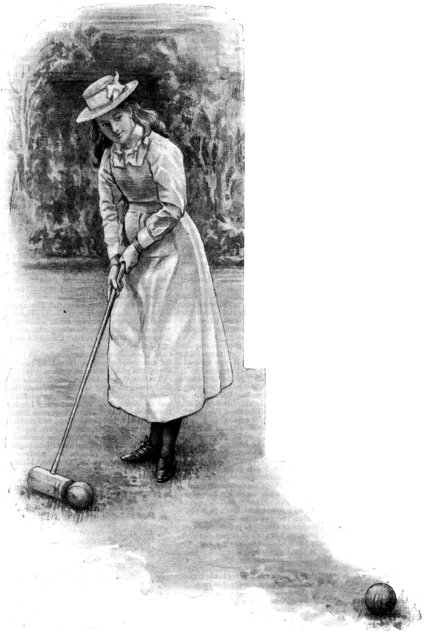
FIG. 1.—GOOD FORM.
Your editor, always with an eye to his readers’ pleasure and profit, asked me
to make a few drawings illustrative of the new way of playing croquet, a game
that has recently been revived with astonishing success all over the country;
and also to write a short description of the game with a few general hints that
may be of help to those taking up croquet for the first
time. I am old enough to remember the introduction
of the game, as played in the old way with
wide hoops, light mallets, and light balls. Croquet
became the rage, and for a few years
monopolised the attention of lovers of outdoor
recreation; then lawn tennis came
in, and croquet was allowed to well-nigh
drop out of existence. As
played now it is certainly a far
better game, and though more
difficult is correspondingly the
more interesting. It might
be called lawn billiards,
and with practice and
some natural aptitude a
player can become as
certain of his strokes as in billiards, provided,
of course, the lawn be a good one.
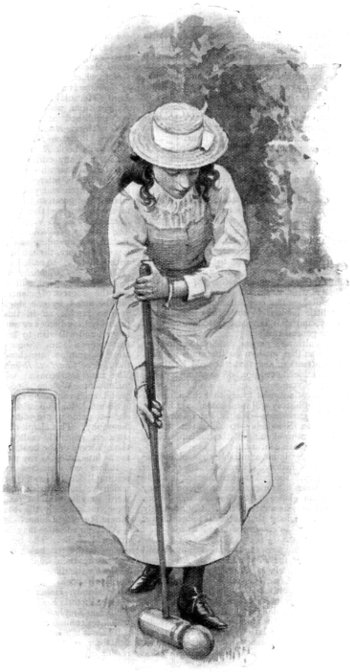
FIG. 2.—BAD FORM.
The chief differences in the new game as
compared with the old are bigger and heavier
mallets, heavier balls, narrower hoops placed
much further apart, and therefore more difficult
to negotiate, no croqueting with the foot,
i.e., your own ball has to be placed against
the ball you have hit, and the player strikes
his own ball according to the distance and
direction he wishes his own and the other
ball to go, instead of keeping his foot on his
own ball while he hits it. Those who have
played the old game will realise what a
difference this “loose” instead of tight
croqueting makes to the play. Another
important point in taking croquet is that if
your own or the other ball is driven off the
boundary line, the player loses the remainder
of his turn. This law was introduced to
prevent a player from running completely
away from his opponent, which was likely to
happen when a good player was well set.
The best game is that played between four
players in partnership, as matters become
more equalised as the play proceeds than in
single games between two opponents, though
where two players are fairly matched the
single game allows of a greater exhibition of
skill. Games frequently last a couple of hours
and even longer in the four-handed game, and
from an hour to an hour and a half in singles,
and it is important that players should not
feel “hung up” for time, for nothing is so
calculated to put a player off than the feeling
that he must hurry to catch a train. Good
players proceed in a quiet determined fashion,
well on the alert, but never in a hurry. On
the other hand, too much calculation and
deliberateness will often make a player fail to
get through a hoop or roquet. You must
sight your ball and get the direction, and then
play boldly and with decision; hesitating
play is fatal to good strokes. Brisk play is
undoubtedly the thing both for the player
and the others of the party, for if a game is
dragged out it becomes tedious. I confess
that I am by no means a good player, but an
indifferent player can get a lot of enjoyment
out of the game provided he gets players of
about his own calibre to play with and against
him. There is no doubt that to play well
necessitates pretty constant practice, for without
that one cannot be sure of either the
direction and, what is of equal importance,
the strength of his stroke. This latter is one
of the great difficulties of the game, for upon
hitting your ball the right distance depends
your chance of a second stroke either by
getting through a hoop or when you roquet.
The distance a ball will travel will depend
upon the nature of the lawn as well as upon
the strength of your stroke.
A good lawn well drained, of closely
cropped turf in good condition and true, will
play faster than where the grass is poor and
dampish. Weeds, like plantains and daisies,
will quite spoil a stroke if the ball happens to
slide upon them, and obviously holes or bare
places are still worse. An ordinary lawn can
be improved by sifting over it sandy road
scrapings, and hollows filled in in this way
early in the year and well rolled will become
turf later on as the grass will grow through
the soil. A poor lawn can be helped by
sowing on this top dressing some good lawn
seed, which can be had at any good seedsman’s.
Birds are partial to it, and it is
necessary to either net the lawn or stretch
across it black thread at intervals.
A lawn which is weedy can only be improved
with trouble and labour. Plantains, the worst
pest, must be got up by their roots; there is a
lawn weeder sold for the purpose. Dandelions
must be carefully extracted or they will spring
up again, as will docks. Daisies are a nuisance,
and can only be got rid of by weeding; the
lawn sand will do something to eradicate
them. Constant rolling and cutting with a
good lawn mower, provided with a hood to
collect the cut grass, is necessary to preserve
a lawn in good condition. An impoverished
lawn should be dressed with road sweepings
and bone dust, and moss in a lawn is a sure
indication that this treatment is necessary.
A lawn grown from seed will take some two
or three years to form a turf; to hasten
matters turfs should be put down, as if this
be done in the autumn, and the lawn thus
formed be top-dressed with sifted road-scrapings
in the spring, it will be playable in
the summer. If a lawn be damp there is only
one cure—drainage, which means having pipes
laid some two feet below the surface. A well
drained lawn can be played on soon after a
shower of rain, whereas a badly drained lawn
is nearly always boggy. I give these few
details about the lawn itself because, though
many of us have to put up with what we have,
we might as well make the best of it, and a
little care and attention will do much to
improve our turf, and the game is so much
more enjoyable if the lawn we play upon is
fairly good. Nothing is so annoying as
having a good stroke spoilt because the ball
is given a wrong bias by a weed or hole.
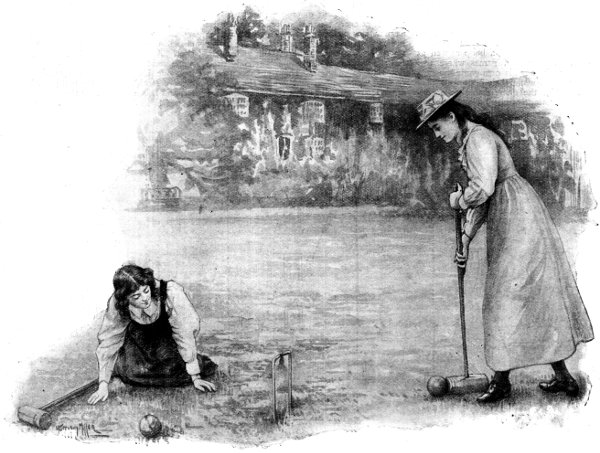
FIG. 3.—SIGHTING THE BALL.
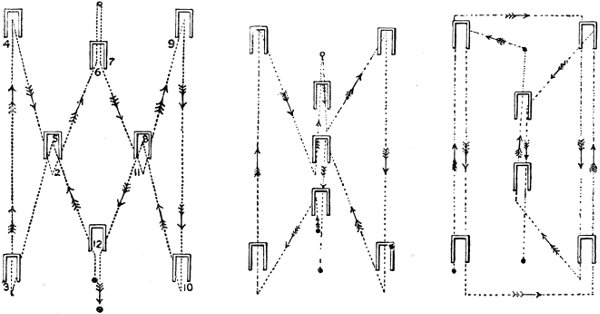
It is not my purpose to give the rules of the
game, as a capital shilling handbook by Mr. J.
Jeffery is published by Dean and Son, Fleet
Street, from which I take the three methods of
arranging the hoops, and to which I refer the
reader; but a few general hints which come
to me through having played the game may
not be de trop. It is useless playing a much
better player on equal terms, and here comes
in the question of handicapping. This can
be done by giving the weaker player the start
of a hoop or two, or by “bisques,” or extra
strokes which can be taken at any period of
the game. These extra strokes should be
given by an umpire, and where one is not
available hoops should be taken, though the
weaker player can play to a certain hoop
while the stronger player has to go right
round the course. This latter arrangement is
perhaps preferable. For single games a third
ball called a “Jack” can be used, each player
having the right of using this extra ball. The
Jack can also be used by a player who elects
to play two others in partnership. Three
players generally play enemies, and can use a
“Jack” or not as agreed upon. Where one
player plays against two others, he should be
the better player, and should play first, as it
is an advantage for a weaker player to come
after. In a four game the last player is
manifestly in a better position than the others,
as he has the three other balls to roquet.
But there can be no question that double
games, i.e., with four players in partnership,
is the ideal game; the two stronger players
should each take a weaker partner. In the
double game generalship is most important,
the chief rule to be observed being for the
partners to play each other’s game, which
means coming to each other’s rescue quite
irrespective of getting through hoops. To
make this clear, a player should go to the
assistance of his partner at all costs, for if
partners do not play together their chances
of winning are much lessened. This may
sound an arbitrary law, but experience will
convince anyone that it is founded upon a
knowledge of the game, as it is of the greatest
help to have your partner’s ball to roquet, and
you not only help yourself, but you can often
put your partner’s through a hoop as well as
your own. I have seen games where two
players will each play his own game irrespective
of the other, while their opponents play
together, and as the game draws to a conclusion
the advantage of playing in partnership
in deed as well as in name is most marked.
It is sometimes worth the while of a stronger
player to become a “rover” when a game is
well advanced, especially if his partner is a
weak player, as then the rover can give
more assistance to the partner than he could
if he had to trouble about points himself.
Another tactic which must not be lost sight
of is, when you cannot come to your partner’s
assistance, to make for the hoop your partner
will go for next, which will materially assist
him, as he can roquet your ball and “take
two turns off.”
Six players can take part in a game, but it
makes it long drawn out and tedious.
There is another point to be observed, and
that is to carry the war into the enemies’
camp, especially if your two opponents are
getting much ahead. By croqueting them out
of position instead of getting through your
own hoop you thwart them, thereby giving
yourselves a chance. Some players carry this
too far, never troubling to make points themselves,
and as it is only by making points, that
is, getting through hoops, that wins the game,
the chief concern should be to make points,
at the same time doing your best as occasion
serves to prevent your opponents getting ahead.
Always notice where the ball of the player
following you is before you make your final
stroke, for it is certainly better to hit yourself
out of his way (and if possible, to where your
partner’s ball is) even at the loss of position
than to give your opponent an easy roquet.
All these matters come under the head of
generalship, and it is well for partners to agree
as to the course to be pursued, instead of each
asserting his or her ego, and so bringing about
divided councils, which can only end in
disaster if your opponents play well together.
It is to be feared—that is, on this subject of
tactics—so much bad temper is shown, but
that is not the fault of croquet, for there are
players at every game who lose their temper
as play goes against them. Play with all the
keenness and persistence possible, never giving
up trying while the issue is still undecided,
but the “rigour of the game” certainly need
not lead to ructions. There are days when
one is “off” play, and when the easiest
strokes are muffed. This is aggravating, of
course, and if it annoys you much retire
gracefully, but the old hand knows that there
are times when one’s play is better than usual,
and these occasions should make up for those
other days when you are “off.” All match-games
and tournaments are apt to try one by
inducing a state of nervousness, which makes
good play impossible. One knows that this
comes from over-desire to win, by playing up
to one’s best form. Any counsel is one of
perfection on such a matter, but if one could
only realise that more is done by quiet steady
play, hanging on to your opponent’s heels and
realising that the game is not lost until the
last point is scored, some of this feverish
excitement might be allayed.
I must just say a few words with regard to
strokes, and here the illustrations, drawn from
some photographs I took of a girl who is a
particularly good player, may be helpful.
There are two classes of players, those who
score points and pay little heed to the way
they do this, and those who study “form,”
that is, the way they play: a good style comes
partly by practice and partly by an aptitude
for the game. It is good form to hold your
mallet somewhat like a cricket bat as in
Fig. 1, and hit your ball with freedom and
from the elbow, but beginners find it difficult
to be certain of the direction the ball will
travel, and prefer to hold the mallet in front of
them as in Fig. 2, letting it swing like a pendulum.
This sort of stroke enables the player to
gauge the direction with greater certainty, but
you can get no force into it, and the tyro
should cultivate the freer stroke, if she wish to
become a strong instead of a timid player.
In estimating direction, it is a good plan to
look along the top of your mallet across to
the object you aim at, and your partner can
be of help here by looking from the object
aimed at, on to your mallet, as the girl is doing
in Fig. 3, to see that the direction is the right
one. This I consider a very good hint, and
one that I profited by myself, and it is of great
assistance to one to have your partner’s
criticism, especially when making a long
shot. As regards strength of stroke, practice
alone can gauge this. The modern mallets
have one side faced with rubber for a particular
class of strokes, where the ball is not to travel
far, and it is important for the player to learn
to use this side as well as the wooden one.
Pushing or spooning is rigorously barred, and
a hit to count must be heard distinctly.
No. 1. Eight-Hoop Setting.
No. 3. Six-Hoop Setting. Used in Public Tournaments.
No. 2. Seven-Hoop Setting.
Clips are used by some, as by attaching one
to the hoop that has next to be negotiated
all discussion is avoided as to the play, as will
sometimes happen in the middle of a game,
but many players do not trouble to use them.
I give three diagrams as to the placing of the
hoops marked with the distances taken from the
book published by Dean and Son before referred
to. A good game can be played on any fair-sized
ground, but if too small the strokes become
too easy, and the game suffers. The proper
size is 40 yards long and 30 yards wide, and
should not be less than 20 yards by 15 yards.
The “dead boundary” should be marked all
round with whiting, as in lawn tennis.
These are the three chief settings with the
distances measured on a full-sized ground.
Where the lawn is smaller the necessary
allowances must be made. The eight hoop
setting is a good one for beginners, as the
distances to be negotiated are not so great as
in the six hoop, which is the most difficult of
the three.
No. 1.—Eight hoop.
Pegs 3 yards from boundary.
First and sixth hoops 4 yards from pegs.
Middle hoops midway and 4 yards from
each other.
Corner hoops 5 yards from end of ground
and 4 yards from side.
Starting spot opposite centre of same, and
2 feet in front.
No. 2.—Seven hoop.
Pegs in centre line of ground, 7 yards from
nearest boundary.
Hoops up centre of ground, 5 yards from
peg, and 5¼ yards apart.
Corner hoops 7 yards from centre, and in a
line with pegs.
Starting spot 1½ yards from first hoop in
centre line.
No. 3.—Six hoop.
As in No. 2, except that the middle-line
hoops are 7 yards apart, and 7 yards from
peg.
Starting spot opposite centre of left-hand
corner hoop, and 1 foot from same. Corner
hoops in a line with pegs.
SHEILA’S COUSIN EFFIE. — CHAPTER XV.
A STORY FOR GIRLS.
By EVELYN EVERETT-GREEN, Author of “Greyfriars,” “Half-a-dozen Sisters,” etc.
SNOWY ENGLAND.
Oscar sat alone in the office. It was
Saturday afternoon, and the other clerks
had already taken their departure. He
had undertaken to finish what work still
remained; and a pile of letters lay upon
the desk before him. Outside the snow
was lazily falling, and he had no disposition
for the football match in the
town ground, which had attracted his
comrades. He scarcely felt inclined to
leave the hot little fire, and face the cold
walk to River Street.
Oscar was not looking well just now,
and he was feeling a little depressed.
The winter had been rather a dreary
season for him. He missed Sheila and
the pleasant Sundays spent with her at
Cossart Place. The monotony of his
present work oppressed him more than
it had done at first. He had braced
himself at the outset to bear their reverse
of fortune bravely, and he knew that
they were lucky in having relations who
had come forward to help them at that
crisis in their affairs. He had resolved
not to disappoint them, and had thrown
himself with as much interest and energy
as possible into his new tasks.
But we all know that it is easier to
bring enthusiasm and energy to the
commencement of a new routine than to
maintain it day after day and week
after week. Oscar had never liked the
routine work of the office, and latterly
he had had a good deal of it. The
senior clerk had died rather suddenly in
September, and his place had not been
filled. Oscar had been given a part of
his work, and North had lent his energies
to filling the gap. It had made the
office work heavier than had been the
case at first, though Oscar had been glad
to help his uncle in the emergency, and
even Cyril had sometimes come down
and offered his services.
Gradually Oscar had come to be looked
upon as head of the office under North.
The other clerks, if not younger, were
less responsible, and looked to him as
being a relative of Mr. Cossart’s. This
was pleasant in a way, but it kept Oscar
more to his desk than he had expected,
and the contrast to his old life of freedom
was sometimes keenly felt.
He was not very robust, and the cold
damp winter tried him. There had been
little severe frost, but a wet, dank fog
had hung about, with drizzling rain or
sleety snow. He had to turn out in all
weathers, and had not time or energy for
exercise of a more exhilarating character
than the daily walk to the office. So
that he drooped somewhat as the winter
wore away, and felt little spring for
anything beyond his daily round.
However, the week’s work was now
finished, and he was just contemplating
closing the office when his uncle came
quickly in, a look of vexation upon his
face.
He had some papers in his hand, and
one of these he threw down upon the
desk before the young man, saying in a
vexed tone—
“Look there, Oscar! What does
this mean? Here is that bill come in a
second time from Jones and Wright,
and I gave you the money to pay it with
in October. They are a small firm, and
I never keep them waiting for payment.
What does it mean?”
Oscar looked at the bill, pondered
a moment, for many bills went through
his hands now, and his memory was not
very strong for detail; then a flash of
enlightenment seemed to come upon
him, and he exclaimed—
“Oh, I remember now. You gave
me the money in cash. But, uncle, the
bill was paid, and I have the receipt,
and it’s all checked off in the books. I
will show you.”
Oscar got down the file and ledger,
found the place in the latter, where the
entry had been made, and produced the
former bill duly receipted.
Mr. Tom looked at it, and compared
it with the paper on the desk.
“A singular mistake for Jones and
Wright to make,” he observed. “However,
I will see them myself. It is close
by, and I daresay they will not have
closed already.”
He went off, and Oscar, without thinking
more of the matter, shut up the
desks and such places as were under his
care, gave out the letters for the post,
and went home.
He wished there had been something
else to do than to go to the River Street
house. Had Sheila only been there, he
would have spent the Sunday at Cossart
Place, for he was a favourite in that
house, Effie having taken one of her rather
capricious fancies to him. But it was
no use thinking of that now; and he
went home in the snow, glad to find
himself under shelter, although there
was nobody to give him a welcome.
The Bensons were always “at home”
on Saturday afternoons, and it was the
fashion now for the Cossarts to be there
pretty regularly. The two families had
always been intimate, now they were
almost like one. Raby’s marriage was
being talked of for the coming summer.
Her mind was already very full of the
trousseau and wedding finery.
Oscar established himself in the
library and commenced his weekly
journal letter to Sheila. He had posted
one for the mail yesterday, but he had
not been able to tell her of several small
items of interest which had occurred
during the past week. He was still
writing when his uncle came in with a
very grave look upon his face.
Oscar felt at once that something
must be amiss, but it did not occur to
him that the matter would affect him
personally. He looked up with a question
in his eyes, and was perplexed at the
grave unbending glance that met his.
“I have been to Jones and Wright
about that bill, Oscar,” he said, in very
measured tones, and then came to a full
stop.
“Yes, uncle?” said Oscar, with a note
of interrogation in his voice, and then
came to a deadlock himself, feeling
uncomfortable without knowing why.
“Just that, Oscar. I have been to
them. They tell me that bill was never
paid. That receipt was not made by
any of their people. They invariably
use their stamp; they do not write
across the postage stamp with a pen.
I verified this by going back to the office
and looking up former receipts. See
here, I have brought the bills to show
you. No, Oscar, do not speak yet, I do
not wish you to do so. Take time. I will
leave the papers here with you now.
Later on I will come for your explanation.
Remember, my boy, that all I
look for is a free and candid explanation
and confession, whatever the fault may
be. You are my sister’s son, and I
shall not forget that.”
And Mr. Tom walked rather hastily
from the room, leaving Oscar sitting
with the bills before him, and a dazed
expression upon his face.
It took him a little time to collect
himself and gather all the significance
of this thing. Bit by bit it came to him
that a deed had been done by some
person which was nothing more or less
than the theft of forty pounds; for that
was the amount of the bill. The money
had been given to him in cash—he
remembered that. Usually debts were
paid by cheque, but now and then, when
there was a good deal of cash in the
office, payments were made in this way;
but when this method was employed, it
was always North or himself who
was entrusted with the money.
A burning flush rose to Oscar’s cheek.
He strove to recall what he had done
with that forty odd pounds. He had no
recollection of going to that place himself
with the money. He must have
entrusted it to somebody else, in that
easy-going way of which North had
warned him more than once.
Oscar thrust his hands through his
hair, and racked his brains desperately.
He saw at once what a terrible temptation
he had put in somebody’s way. It
had hardly occurred to him as yet that he
might fall under suspicion himself; but
he realised that through his easy-going
carelessness—his way of trusting the
other clerks with business given him to
do, and doing theirs in exchange—he had
been the cause of a serious monetary
loss to his uncle, and had enabled somebody
to embezzle money and perhaps lay
the foundation of a career of crime.
It was a terrible thought. But who—who
was the culprit? Careless as Oscar
knew himself to be, it did not yet seem
to him that he would readily have put
so large a sum of cash into the hands of
a young clerk, and yet he had never
suspected one of them of the smallest
deflection from rectitude, and certainly
he had given it to somebody.
He looked at the date of the false
receipt. It was just after the death of
Curtis, when the office was in some confusion
and the pressure of work heavy.
He might well have overlooked the
memory of the transaction. And yet he
did seem to have some floating impression
of a talk with somebody about the
payment of the bill, and he distinctly
remembered filing the receipt and
making the entry in the ledger.
But to whom had he given the money?
He pulled out the tiny pocket diary he
carried, where he just dotted down notes
of things to be told to Sheila. He
found the day in question, and noted
the initial C. in one corner.
That meant that Cyril had been helping
them. He remembered he had told
Sheila of the condescension of the great
’Varsity man! And then with a start it
came over him. Could it have been
Cyril who had paid the bill? Or at
least who had taken the money to do so,
and brought back the supposed receipt?
Oscar’s heart beat thick and fast.
He buried his face in his hands and
thought. Slowly there seemed to come
to him some such recollection, but was
it only imagination? He remembered
the pressure of that day. He remembered
his uncle coming in and out with
various orders. He remembered the
money being given him with instructions
to pay the bill at once; but there
absolute memory failed him. Yet Oscar
thought he would remember had he
entrusted another with the task, though
had Cyril offered in his easy way to go
and pay the bill, most likely he would
have agreed without a second thought.
As he pondered the matter over and
over, it seemed to grow clearer in his
mind that Cyril had taken the matter
into his own hands; but the very
thought of this struck him with a sort of
terror. Cyril was a son of the house.
He was still the favourite of his parents.
They would never, never believe such a
thing of him. It would be almost
impossible even to suggest it. And
then Oscar could not be certain that he
remembered the circumstance, only
fleeting visions passed before his mind’s
eye, together with the conviction that he
would not have so easily forgotten the
matter had not Cyril or North been his
substitute. If he had made over the
money to a brother clerk, he felt certain
he would have recollected the matter.
And whilst he was in the midst of
these troubled cogitations, who should
come in but Cyril himself.
Oscar looked up eagerly.
“You are the very person I was
wanting,” he said, not pausing to
consider whether or not open speech
were the most diplomatic way of treating
this problem. “Cyril, do you remember
those days after Curtis died when you
came and helped in the office?”
Suddenly Cyril’s eyes narrowed
slightly; if Oscar had not been so
absorbed himself, he might have noticed
the indefinable change that passed over
Cyril’s face, but his voice was quite gay
and easy.
“I remember coming and writing a
lot of very dry letters, but I hope you
don’t expect me to quote you their
contents after three months!”—and he
laughed.
“Do you remember your father bringing
in some money and giving it to me
to pay a bill of Jones and Wright?”
Cyril turned to poke the fire, and
seemed to be pausing to refresh his
memory.
“I think I have a vague recollection
of something of the sort, though what
firm it was I should be sorry to say. I
remember his putting some money on
your desk, and I think I advised you to
lock it up.”
Oscar gave a little start; those words
brought back a fresh wave of recollection,
but his heart beat heavily and seemed
to fall within him. He had not a very
high opinion of Cyril’s moral courage.
If indeed he had been guilty—but Oscar
would not pursue the thought farther
lest he should lose his self-control.
“Cyril, didn’t you take the money to
pay the bill? Don’t you remember
saying you had written enough, and
would like a breath of fresh air? We
thought it would get rid of the money
lying about. Didn’t you take it and
bring back the receipt?”
“I?” questioned Cyril lightly, leaning
forward and making another vigorous
onslaught at the fire. “I don’t
recollect ever paying a firm’s bill in
my life! But suppose I did, what
then?”
“Well, there has been a mistake
about this bill,” said Oscar. “Either
it was not paid, and the person who had
the money receipted it; or else it was
paid to some unauthorised person in
Jones and Wright’s who pocketed the
money and receipted the bill without
using the firm’s stamp. Anyway the
money has never got into the right
hands, and I am very uneasy about it,
because I can’t be sure who it was that
took the money from me. And it is such
a dreadful thing to think of anybody’s
being a thief. I wondered if you had
given it afterwards to some other person.
I can’t help having a vague impression
that you had something to do with it,
Cyril.”
Oscar looked up appealingly.
Stronger and more strong was the
notion coming to him that Cyril was the
responsible person. But how would it be
possible to bring it home to him if he
denied? Oscar did not think either of the
younger clerks had been present when the
talk between them passed. He seemed
to remember Cyril’s saying it had better
be paid, and his taking the money away
before the lads came back from their
dinner. Yes, he felt more and more
certain every minute. But Cyril lay
back in his chair and laughed.
“My dear fellow, you are quite
making a mare’s nest for yourself. I
had nothing whatever to do with the
matter. I recollect my father’s bringing
you the money and telling you to pay,
and I recommended you to lock it up
out of sight. That is all I know of the
matter, and I’m afraid I can’t help you
out of your difficulty——”
And there Cyril suddenly stopped
short for North had entered the room,
and it was plain from his face that he
knew the story and had come to talk the
matter over with Oscar.
“I’ll leave you to have it out
together,” said Cyril rather hastily,
rising and walking away. “I wish I
could help you to a better memory,
Oscar; but, perhaps, if you and North
talk it over together you’ll get some
light on the subject.”
He walked off whistling, closing the
door behind him. North looked after
him with the same rather stern
expression on his face that it had worn
on entering.
“Oscar,” he said slowly, “do you
mean that Cyril is in any way mixed up
in this wretched business?”
Oscar dropped his eyes and spoke in
a very low tone.
“I don’t know, North.”
(To be continued.)
THE COURTSHIP OF CATHERINE WEST. — CHAPTER II.
hat day was
the beginning
of a
week of pure
delight to
Catherine.
In proportion
as her
body drank
in the pure
sweet air, so
her mind and
outlook developed
and
expanded.
It was much
for her to
have the constant
companionship
of a woman
like Margaret
Gray,
a woman
whose generous
nature
viewed the
girl’s beauty without jealousy, and delighted
in setting it off to the best advantage. At
first, indeed, she had had a qualm. Suppose
that Granville, in spite of his apparent indifference,
should take a fancy to this penniless
teacher. What would become of all his
sister’s ambitious schemes for his promotion by
a marriage with Lord Mayne’s sister, a scheme
not utterly absurd in the face of that lady’s
marked esteem for him? That, indeed,
would be a disastrous ending to Margaret’s
benevolent plans, and she determined to avert
it by a little talk with her new friend. She
read Catherine through and through, and
knew that she was one of those women who
take a highly idealistic view of love and
marriage; who conceive that even a suspected
preference of a man for a particular woman
makes him sacred to her, and who would
shrink from desiring another girl’s lover as
they would shrink from a robbery. If she
could convey to Catherine that Granville’s
affections were already engaged, she knew
that she would have little to fear.
They were sitting out on the verandah after
dinner, reviewing the delightful experiences of
the day, spent in the ascent of a neighbouring
hill.
“And to-morrow we will go into the valley
for a change. Wouldn’t it be nice to go on
the lake? Granville rows splendidly; he was
in his college boat the last year at Oxford,”
said Margaret.
“Don’t you think you two had better go
alone?” asked Catherine. “I am sure you
would enjoy it more, and I can easily find
something else to do.”
“Oh, but you must come,” urged Margaret.
“You would be frightfully dull alone, and I
want you.”
“It’s awfully good of you, but——”
“But what?”
“I don’t think your brother likes the trouble
of always having another person to look after.”
Margaret laughed.
“Oh, you mustn’t think that; he really likes
you very much, but you are rather incomprehensible
to him. He would be so distressed
if he thought that you stayed away on that
account.” Secretly Margaret thought,
“Rather a dangerous symptom, that she
should be so sensitive to his indifference.”
“Granville is not quite an ordinary person,
you know,” added his sister, speaking very
fast, in order to cover Catherine’s confusion.
“It takes a long time for him to get to like
people, but when he has once formed a friendship
no one could be more loyal. I envy
Lady Blanche.”
“Lady Blanche?” asked Catherine.
“Who is she?”
“Oh, she is Lord Mayne’s sister. Long
ago, before our father died, Granville and
Maurice—Lord Mayne, you know—were at
Oxford together. They were great chums,
and Granville used to spend most of his
vacations at Grimshaw. He and Lady
Blanche were certainly very good friends, and
I think there might have been an engagement
had not my father died suddenly, leaving his
affairs in an inextricable muddle. He was overwhelmed
with debt; and instead of inheriting
a large fortune, as we had imagined would be
the case, Granville and I found ourselves with
only a comparatively small capital. The
interest on that is still going to pay off the
debts. Of course, Granville couldn’t speak
then, and it was fortunate for him that Lord
Mayne entered Parliament at that time, and
insisted on his becoming his secretary.
Between ourselves it was quite equally
fortunate for Lord Mayne, because Granville
is ten times as clever as he is; and when
people praise his speeches, and talk of him as
the ‘most brilliant of our younger politicians,’
I hug myself and think that he is inspired by
my brother.”
“But how sad!” cried Catherine sympathetically.
“And did Lady Blanche care for
him all the time?”
“That I can’t tell, but though all this is
seven years ago, she is still unmarried, and if
Granville ever recovered any of our fortune I
am sure he would ask her. It would be a
splendid thing for him, for Blanche has heaps
of money of her own. Think—he could go into
Parliament and make quite as great a figure as
Lord Mayne.”
“That would be splendid,” cried the girl
enthusiastically, “but if she loves him, surely
she would be glad to marry him without the
money.”
“No doubt; but he can’t ask her, at least,
not yet. But sometimes I hope that by some
lucky chance they may come to an understanding,
and the difficulty may be solved.
Come, we must say ‘Good night’ now, if we
are to start early to-morrow.”
Margaret’s stratagem had quite succeeded
in one way, and the girl looked on Granville
henceforth as an engaged man. But this
made an enormous difference to her. Absurdly
conscious of her lack of means, and fearful
lest anyone should think that she looked
forward to matrimony as a deliverance from
her daily toil, her manner to the few men she
had met had been almost repellant. But if
Mr. Gray were engaged, he could not (she
thought, in the innocence of her heart)
imagine that she had any designs on him.
And so the constraint which had hitherto
affected her manner to him wore off; she met
him as frankly and as unaffectedly as she did
his sister.
Margaret had given him a hint to persuade
Catherine to come with them the next day,
and as she came downstairs, she found him
waiting in the hall.
“Why, are you not ready yet?” he asked,
seeing that she was without her hat.
“I—did not think of coming to-day,” she
said, hesitating, and smiling to conceal the
disappointment in her tone.
“Oh, but you must, please! Margaret will
be so disappointed—we shall both be disappointed
if you don’t. Look outside; can
you resist it?”
The sun was shining on the twin peaks at
the head of the valley, the sky was a brilliant
blue, the air dry and clear with that sweet
freshness peculiar to mountainous places.
Catherine wavered in her decision.
“Come,” said Granville decidedly, “run
up and get your hat, and I will have coffee
for you by the time you come down. We
have only ten minutes before we must start.”
The girl, feeling half ashamed of her own
weakness, yet, at the same time, happy and
pleased, returned in a minute, equipped for
the day. Margaret’s confidences and Granville’s
own cordiality had broken down the
barrier. Catherine soon found herself talking
quite easily and naturally to the brother of her
friend, while he, on his part, realised that his
early prejudices were fast disappearing. How
fresh and unaffected the girl was, and how
simplicity and wisdom mingled in her conversation!
They talked of books, and he was
surprised to find how apt and sympathetic her
criticisms were, though they betrayed at every
moment the speaker’s ignorance of the world,
and her extravagantly ideal view of human
nature. Margaret, walking beside them,
would listen quietly, now and then putting in
some shrewd comment or witty parenthesis,
which set them all laughing, and relieved the
strain of a too intense conversation.
So five days passed, the intimacy deepening
hourly, while every evening brought its gift of
quiet converse on the starlit verandah, and
every morning its glad summons to another
day of enthusiastic activity. Catherine counted
these days as a miser counts his gold. The
High School, and all the premature anxieties
and responsibilities that poverty had laid
upon her seemed so far away. Now, for the
first time, she realised what life might mean,
what for some few it did mean.
“Only seven days more!” she sighed, as
she bound her hair before the looking-glass,
just a week after her arrival. “What a
glorious week it has been! If only the next
is as good!”
Brilliant weather still smiled upon them.
They were to go that day for a longer excursion
than any they had as yet undertaken, a
long climb, which involved the aid of guides,
and which was to be shared by some of the
other visitors.
Margaret was waiting for Catherine on the
verandah.
“How lovely you are!” she exclaimed, in a
sudden burst of admiration, as the sun caught
the girl’s bright brown hair, and bathed her
figure in a kind of golden glory. “Do you
know, if you were not you, I might be
afraid”—she added in a whisper, looking
significantly at Granville who was some yards
away, talking to the guide.
Catherine’s face crimsoned. “Oh, how can
you say such things?” she asked indignantly.
“Forgive me, dear, it was too bad. But I
never knew a girl less conscious of her own
power, or less of a coquette than you. I
would trust you not only with my brother,
but with my lover, if by any possibility one
should fall to my share.”
“Margaret! When everyone loves you!”
cried her friend.
“Now we are getting sentimental, and we
had better join the others,” laughed Margaret.
And so at last they started, a merry chattering
party, up the steep ascent to the mountains.
Catherine never forgot that day; the first
few miles of shady forest, where ferns and
bilberries nestled by quiet springs of water,
and the shy inhabitants of the pine-trees fled
away with a rustling of branches and nimble
feet at their approach. And then the gradual
cool emergence on wide green fields, in whose
hollows lay the quiet blue lakes, troubled only
by the gentle hoofs of the dainty bell-adorned
cattle. Here they found, by bubbling springs,
bright patches of blue gentian, that outrivalled
the sky in brilliancy, and bade defiance
to the vanishing mantle of half-melted snow
that lay around them. All these things
Catherine seemed to see in a kind of glorified
vision, and though Granville was beside her,
neither spoke much; the rest of the party
had hastened on with mirth and laughter;
Margaret especially had discovered that one
of the guides was a most interesting companion,
and was chattering gaily to him in
German.
“Are you enjoying yourself?” asked
Catherine’s companion suddenly, and there
was a new accent in his voice, that was an
imperative summons to her subdued emotions.
“Immensely!” she replied, sighing.
“Then why sigh?” he asked, laughing;
and then, looking down, he saw that her eyes
were full of tears.
“I believe you are tired!” he exclaimed
remorsefully. “Suppose we sit down and
have a little rest.”
“No, really, I am not at all tired; only
everything is so perfect.”
“Then let us prolong perfection,” he
answered. “We are nearly at the top now,
and we shall soon find the others again.
Here is a comfortable place; you can lean
against this rock, and I will put a stone for
your feet.”
But at that moment, there was a sudden
sound of falling rock, a rush of loosened
stones and gravel, and just within an ace of
her shoulder a huge fragment of rock broke
away, and was hurled down the slope beneath
them, followed by a mass of mingled snow
and débris.
His arm went quickly round her, and drew
her from the spot.
“My darling! What an escape! And
you didn’t even scream!” he said, not withdrawing
his arm. “There, don’t tremble;
it’s all right,” he continued, soothing her as
he would a frightened child, and for a moment
his lips rested on hers.
This recalled Catherine to her senses.
“Oh, you mustn’t,” she cried, breaking
from him in an agony of shame. One clear
thought possessed her mind; either that kiss
was treason to Lady Blanche, or he had taken
advantage of her defenceless position to insult
her. To her intense relief, as she hurried forwards
round the turning of the path, she came
upon all the others, who had stopped to drink
at a little wayside spring.
“Oh, did you hear that noise?” asked
Margaret. “I suppose it was a miniature
avalanche.”
“Not a very insignificant one,” said Granville,
who was close behind. “It nearly
knocked us over. However, all’s well that
ends well,” he added gaily. “Miss West,
do you want a drink?”
His light, conversational tone struck on
Catherine’s overstrained emotions with a
sudden chill. How could he manage such a
sudden transition? But she summoned all
her self-control, and took the cup in as
matter-of-fact a way as he handed it to her.
For the rest of the day she clung close to
Margaret. She felt that to let Granville
approach her would be treason to the friend
who had reposed so much confidence in her.
Suppose Margaret should think that she had
been trying to attract her brother’s attention!
And then, again, with a sudden pang came
the cruel thought that his conduct might
imply no real attachment to her; that he had
merely given way to the impulse of the
moment, or, worse still, was a deliberate flirt.
And yet she could not believe this; all that
she knew of him militated against such a
view; she could not think that she had been
so greatly mistaken in her estimate of his
character, nor that he could thus belie the
traditions of a gentleman. Her heart confirmed
her faith in him, and amidst the tumultuous
emotions of the moment, she was surprised
and ashamed to recognise an irrepressible
elation, and a strange absence of that feeling
of angry humiliation which she supposed to
be the correct state of mind under the circumstances.
Notwithstanding this, when the
hotel was again reached, she pleaded fatigue,
and slipping away to her own room, did not
reappear that evening.
Granville was walking up and down the
verandah in a state of suppressed excitement,
longing to see the flutter of her skirt in the
doorway, yet conscious that her manner to
him since the episode of the avalanche had
been a tacit reproof. How stupid he had
been to frighten her so; and yet, although he
was not a vain man, he could not pretend to
think that she had been very angry with him.
She had permitted his embrace, and that from
a girl of her stamp was a sufficient avowal of
the state of her feelings. His honour as well
as his inclination required that he should
make a definite claim to her affection, and if
Catherine had ventured to come down that
evening he would have done so. But her
absence gave him time for reflection, and as
the wave of emotion subsided, he realised how
fatal such a step would be to his career. He
was an extremely ambitious man, and success
to him would involve either a long celibacy,
or a rich marriage. Hitherto his intellect had
been developed at the expense of his affections,
and except for his warm attachment to
his sister, and a loyal friendship for Lord
Mayne, his heart had remained untouched.
He had dallied with the idea of a marriage with
Blanche, but had not regarded it with much
seriousness; from a worldly point of view it
would certainly be advantageous, but, on the
whole, he preferred the independence of the
bachelor state. He remained on cordial terms
with the heiress, and awaited the development
of affairs without the least impatience, only
laughing at his sister’s frequent hints as to
Lady Blanche’s inclination for him. Perhaps,
little as he suspected it, he was all the while
guided by his own nobility of heart, which
withheld him from the sacrilege of a loveless
marriage. And would his heart now vindicate
its authority over his intellect and triumph
over the closely-laid schemes, the absorbing
aims, the ceaseless industry of years? Supposing
that Catherine should confirm her
unspoken confession, was he prepared to
relinquish for her his long-cherished ambitions,
and resign himself to a life of insignificance
and dependence?
But in the midst of the conflict something
happened which revealed to him the strength
of his passion, and brought him to a swift
decision. His sister at this moment came
running to him, her face flushed with excitement,
holding a letter and telegram in her
hand.
“What do you think?” she cried. “A
letter from Blanche! Actually, she is at
Interlaken, and wants to meet us there. She
has been travelling with the Brookes, but they
are going back through Paris, which she hates.
The telegram has just come, too. She would
like us to go there to-morrow, and bring her
back with us.”
Secretly Margaret was thinking, “What a
stroke of luck! Could anything be more
favourable to an explanation than all these
circumstances?” But Granville’s first exclamation
was not promising.
“What a nuisance!” he cried.
Margaret looked at him with mingled dismay
and surprise, and his next words were
not reassuring.
“What is to become of Miss West if we
go away? She will be all alone.”
“Nonsense, Granville, what absurd objections
you do make! We need not be away
more than two days, and Catherine is quite
able to take care of herself.”
“Poor little girl!” he began, and then bit
his lip at his own indiscretion. “Very well,
I suppose we must go. I’ll find the time-table.”
But how unwelcome to him at this moment
was the thought of the new arrival! Though
his conscience was quite clear with regard to
her, he felt that Blanche would prove a discordant
element. He did not for a moment
suppose that his engagement would be the
least trouble to her; but he would have preferred
to conduct his wooing under less vigilant
eyes; besides, if he did not speedily acquaint
Margaret with the true state of affairs, he
knew that she would be continually planning
to leave him and Blanche together, and the
opportunities for seeing Catherine by herself
would be rendered much fewer. After much
thought he determined that as soon as he saw
the latter he would come to some definite
understanding with her; but this could not be
till after their return from Interlaken, as they
would have to start early the next morning,
probably before she was up. He would therefore
send her a note explaining his absence,
and expressed in such a manner as to leave no
doubt as to his attachment; and having
written this, and seen about its safe delivery,
he turned in, prepared to bear the vexations
of the morrow with as good a grace as
possible.
Margaret had meanwhile run up to Catherine’s
room and tapped gently at the door.
The girl opened it with trembling hands.
“Oh, you mustn’t get up, dear,” said
Margaret. “I only came to tell you something.
I can’t tell you how sorry I am, but
Granville and I are obliged to go to Interlaken
to-morrow. We shall be away all day, and I
don’t want you to get up to see us off, so I
thought I would come and say good-bye
now.”
Catherine, whom she had forced down
on the couch again, raised herself on one
elbow, and looked at her in some bewilderment.
“Going away? I don’t quite understand.
Do you mean that you are going
home?”
“My dear child! What an idea! Haven’t
we promised to look after you, and take you
with us when that unhappy day does arrive?
No, but Lady Blanche has telegraphed to us
to meet her at Interlaken; she wants to join
us here. Now, congratulate me, dear. She
is evidently not averse to my pet scheme; and
what could be more favourable to an understanding
than these romantic surroundings?
Oh, I hope very much that the engagement
will be definitely announced as soon as we get
back.”
“You think it would be a good thing for
your brother?” asked Catherine, glad that the
darkening room hid her face.
“What a question to ask! It would be his
making. Blanche is just the wife for him—a
tall, clever girl, who would make a capital
hostess, and help him in his political career.
If it hadn’t been for his horrid pride, which
makes him dread the mere suspicion of interested
motives, the thing would have come off
long ago. And now I think I may promise
you a ticket for the Ladies’ Gallery when he
makes his maiden speech.”
“Is he so very proud? Does he really
care for her?” faltered Catherine.
“Well, I don’t pretend that he is passionately
in love. He is so reserved and so self-controlled,
and all his interests are intellectual;
love would never play an absorbing part in his
life, though, if he once made up his mind, no
one would be more loyal. Oh, I think Lady
Blanche will be very happy, and if I didn’t
think the main advantage would be with her,
I wouldn’t try so hard to bring it about.
Now, good-bye, dear; only for a day, you
know. And mind you have a good rest while
we are away.”
Margaret disappeared, and Catherine did
the obvious and feminine thing under the
circumstances; she buried her face in the sofa
cushion and burst into tears. Till then, she
felt, she had never known what grief was.
“But it is much better for him,” she sobbed.
“How could I help him, or ever do anything
for him? It was all a mistake—and how
silly I am!”
Presently she dried her tears, and carefully
bathing her eyes and brushing her hair, she
exchanged her dressing-gown for the dress she
had travelled in. Then she dragged out her
portmanteau, and began to fold her clothes,
preparatory to packing them in it. In the
midst of these preparations, there came another
knock at the door. This time it was the
chambermaid with a note.
Catherine took it with a feeling that almost
amounted to dread, and tore it open.
“Dearest,” it ran, “I am obliged to be
away to-morrow, and shall not be able to see
you before I start. I shall try to be back in
the evening. Good-bye for a little while.
“G. G.”
This was the signal for a fresh burst of tears.
She held the letter to her lips for a minute,
and then folded it away in the bosom of her
dress. Then she went on with her packing.
In another hour it was all done.
Ten o’clock. She wondered whether Margaret
and Granville were still up. Even
tourists go to bed early in Switzerland, and,
considering their plans for the next day, she
thought it doubtful. So she slipped downstairs,
and told the porter that she was
obliged to go away suddenly, and would like
to leave by the first train in the morning.
Which was it?
“Ah, there is one at sigs o’clock, mees,”
he said. “There is a party leaving at five to
catch it. Ze young lady will perhaps like to
travel with them?”
On further inquiry Catherine found that the
train she would go by left the station half an
hour after the one by which the Grays would
travel. She determined to remain in her
room till they had started, and thus manage
her departure unobserved. She went upstairs
again, and wrote two little notes, one to
Margaret and one to Granville.
“Dearest Margaret,” said the first, “please
don’t think me ungrateful for going away like
this. I shall never forget you or your kindness.
Perhaps some day I shall be able to
thank you, but for the present I implore you
not to try to find out where I am gone.”
The other was more difficult of composition;
but after two or three attempts she produced
the following—
“Please do not think me unkind if I say
that I think it better for both of us not to
meet again. I cannot explain why, but I am
sure that I am right. Good-bye, my dear.”
She could not refrain from the little touch
of tenderness at the end, though afterwards
she would have given worlds to recall it.
“After all,” she argued, “he must know that
I do care; and I would rather he thought
that than that he should believe I let him
behave so, without loving him.”
And so it happened that the next morning
she was on her way back to England, a week
before she had anticipated; certainly her
holiday had not failed to bring her adventures.
(To be continued.)
ANSWERS TO CORRESPONDENTS. — STUDY AND STUDIO. — MEDICAL.
Rachel M. Westlake (New Zealand).—Many
thanks for your pleasant letter.—1. The joyous keeping
of Christmas itself (for which see Chambers’s
Book of Days) is responsible for the sending of
Christmas cards. Just as we send birthday cards
to greet our friends on their birthdays, so we send
cards to greet those to whom we cannot personally
wish “A happy Christmas.” We do not think
there is any ancient origin of the custom.—2. Boys
at public schools are “taught so much about the
heathen gods and goddesses” because to understand
Greek and Latin literature it is necessary to
understand mythology. Homer, for instance, cannot
be understood without knowing about Zeus,
Pallas Athênê, and the other inhabitants of
Olympus “who hold the wide heaven.” The whole
subject of the value of classical education is far too
vast to enter upon here.
St. Patrick.—1. We will consider your request as
to the article on “Burnt Wood Work.”—2. We
are afraid there is no way of restoring the colour in
question; but careful washing will do much to
prevent its conversion into green in the first
instance.
An Ignorant Musician.—1. There is no royal road
to success in reading music at sight. The only way
is to practise constantly reading new music. A
distinguished professor, whom we know, advises also
reading the notes by the eye, without the piano.—2.
Both your methods of treating the bass chords
are equally correct, but you should beware of consecutive
octaves.
If “Country Lass” were to write to Mrs. Sole,
Crudwell Rectory, Malmesbury, she might receive
help of a practical kind.
A Reader Abroad (New Zealand).—We are glad to
tell you something of what we know about Berry
Pomeroy Castle. It is said to have been founded
by Ralph de la Pomeroie, one of William the Conqueror’s
knights, who received from his sovereign
fifty-eight manors in all, among them that of Berry,
in Devonshire. The castle remained in the possession
of the Pomeroy family until the middle of
the sixteenth century, when Sir Thomas Pomeroy,
who had been a ringleader in the Rising in the
West, and had as a punishment for rebellion been
deprived of many of his estates, sold it to Lord
Seymour. The Seymour family built an imposing
structure within the older part of the castle, but
never brought it to perfection. A fire, caused by
lightning, so injured the building in the early part
of the eighteenth century that it was abandoned to
decay. Prince, the author of The Worthies of
Devon, describes the castle as very magnificent,
and so vast “that it was a good day’s work for a
servant but to open and shut the casements.” It is
now, owing to the luxuriant setting of thick foliage
and ivy and its beautiful situation, one of the most
picturesque of English ruins; and it is interesting
to observe the difference in architecture of its composite
parts. We advise you to apply for a photograph
to Crauford’s Library, Dartmouth; or
Westley’s Library, Torquay.
Ellen.—The sentence, “There is sorrow on the sea,”
occurs in a verse of the Bible—Jeremiah xlix. 23.
G. R. and Mary Priscilla Cunningham.—G. R.
inquires for a “Practising Society,” and Miss
Cunningham writes at the same time to mention
one, so we commend our correspondents to each
other. The “Honour Bright” Practising Society
encourages regular practice, awards prizes, and
levies fines. Address, for a copy of rules, the
Secretary, Miss Cunningham, 1, Bloemfontein Villas,
Dalling Road, Hammersmith, W. We may add
for G. R.’s benefit that she will see other Practising
Societies mentioned if she scans this column
for the past few months, e.g., Mrs. Walker’s,
Litlington Rectory, Berwick, Sussex, and Miss
Isabella Kent’s, Lay Rectory, Abington, Cambridge.
Opal.—1. Your quotation is not correctly given.
The verse—
“It is the little rift within the lute
That by and by will make the music mute,
And ever widening, slowly silence all,”
will be found in Tennyson’s “Merlin and Vivien,”
Idylls of the King.—2. Eugene Field’s poems are
published by Scribner’s Sons, New York, and John
Lane, London.
Anne Weinhäupt (Innspruck).—1. We have a great
many subscribers in Austria, but must not give
the exact numbers.—2. A “gooseberry-picker”
gathers a very thorny fruit for others to eat, having
only the trouble for his share. So a third person
who accompanies a pair of lovers for propriety’s
sake has all the trouble and none of the pleasure
of the expedition. This at least is the explanation
we have read of the phrase, “to play goose-berry.”
We may add that the expression is
seldom used nowadays. Many thanks for your
kind letter.
K. K.—Your poems are far above the average of
those we receive for criticism. In the first verse
of “Only” we should demur to the use of the
present tense “ends” for the sake of rhyme, in
one instance. The tense should be kept the same
throughout one statement. In “Happiness,”
“best” and “happiness” do not rhyme. We
thoroughly agree with the sentiment of your concluding
verse. We can quite understand that
your work has found acceptance for publication,
but we have our own staff of writers, and should not
at present have use for your poems. Many thanks
for your good wishes.
“A Dutch Girl.”—As the author you admire is
still living, there is no biography published of her.
Biographies, as a rule, are not compiled until
people are dead. Write to her publishers for any
information you desire, and they will give it to
you if it is in accordance with her wishes.
Mildred.—You do not give us your address, so all
we can advise you to do is to write to the Secretary,
Technical Education Board, St. Martin’s Lane,
London, W.C., inquiring for the nearest school
where you can study “black and white.” As to
the length of the time it would take you to learn
to illustrate books, all depends on your previous
knowledge of drawing and natural capacity.
Winton writes to tell Cherea of an Early Rising
Society; secretary, Mrs. Eastes, 2, Church Hill,
Walthamstow, Essex.
Pink.—We applaud your courage in wishing to learn
Spanish, if your hours of work are from 8 A.M. to
8.30 P.M. The First Spanish Book, by A. M.
Bower, is published at 2s. (actual cost, 1s. 6d.).
There are also Hossfield’s New Method of
Spanish, and Sauer’s Spanish Grammar, published
at 3s. and 5s. (4s.) respectively. At
any large second-hand book-shop you would
probably pick up a Spanish grammar for a few
pence.
Mab.—An excellent book on the subject you name
is Woman’s Work and Woman’s Culture,
edited by Mrs. Josephine Butler, and published by
Macmillan, but it is not new. Modern books are,
Pursuits of Women, by Frances Power Cobbe;
The Duties of Women, by the same author;
The Woman Question of Europe, edited by
Theodore Stanton; Women in English Life,
from Mediæval to Modern Times, by Georgina
Hill, 2 vols.
Jeanne Müller (France).—1. We can only advise
you to write to some registry office of good standing,
saying what you wish to do. Address,
Société des Professeurs de Français en Angleterre,
20, Bedford Street, Strand, London, W.C., or the
Agency for Foreign Governesses and Home,
3, Colville Houses, Talbot Road, London, N.,
superintended by M. le pasteur du Pontet de la
Harpe, French Parsonage, Bayswater. It would
be very wise of you to come to England to perfect
your knowledge of English.—2. Apply to any
English bookseller, e.g., Messrs. Sotheran, Strand,
London, for the books in question.
Hilde (Geneva).—1. We advise you also to write to
a good agency; for instance, Association of German
Governesses in England, 16, Wyndham Place,
Bryanston Square, London, or Miss Hug’s
Registry for Foreign Governesses, 21, Baker Street,
London, W., or the Army and Navy Auxiliary,
Francis Street, Westminster. You might also
advertise in the Morning Post. Have you no
friends in England? Private inquiry is by far the
best way of finding a home on reciprocal terms.
Can any reader suggest one?—2. We are willing to
tell Sybil that you advise her to eat three oranges
a day, and La Petite that you recommend her to
place her pressed flowers in cotton wadding to
preserve the colour.
A Lover of Music.—As you truly observe, we
cannot, without hearing you play, judge as to
the chances of your passing an examination.
We advise you to write to the Secretary, Trinity
College, Mandeville Place, Manchester Square,
W., for details as to the standard of proficiency
required, etc. The fee is from 10s. 6d. upwards.
We commend your perseverance in practising
without lessons.
Azzie.—Thanks also for your reply to “Winton.”
We know of no cure for the trouble you speak of
but time, patience, and attention to the general
health.
Midget.—Your writing is too “scratchy,” and looks
as though you wrote with the edge of your pen, or
too fine a nib. Try to form your letters more
accurately. We think it would do you good to
practise copying some model of handwriting.
Thanks for your information.
Geisha.—You had better consult Mrs. Watson’s
articles on “Self-Culture for Girls.” We will
certainly criticise anything you send in six months’
time. Have you ever thought of joining an essay
club? We occasionally mention such in our
columns.
Helen (A Constant Reader).—The inability to
talk often arises from shyness and nervousness, or
fatigue after a hard day’s work may cause you to
relapse into silence. You can do a great deal to
overcome the habit by forcing yourself to express
your thoughts. You must have many things pass
through your mind—recollections of the past,
hopes for the future—that people who care for you
would be interested to hear; then put them into
language. Or take some special book or subject
in which you are interested, and talk about it. Do
not be discouraged; it is better to be quiet than to
talk nonsense; and above all, never try to talk
brilliantly. Simple and natural conversation will
“come of itself” in time.
Daffodil (Cork).—1. Your version of Wordsworth’s
couplet—
“The proud heart flashing through the eyes,
At sound of Rob Roy’s name,”
is found in the best edition, Dr. Knight’s, in eight
volumes, and in Moxon’s 6-vol. edition. But in
the small 1-vol. edition we read—
“And kindle like a fire new stirred,
At sound of Rob Roy’s name.”
Poets occasionally change the form of their work,
but you can certainly consider the first quoted is
the more correct of the two renderings.—2. Your
writing is too large and childish for your age.
Keep a regular space between your lines; do not
make the downstrokes black, and try to reduce it
all to a smaller uniform size. Some letters now
are much larger than others.
Hawthorn.—The various fruit salts, effervescing
salines, effervescing citrate of magnesia, etc., are
all pleasant modifications of seidlitz powders.
You could make one for yourself by mixing together
bicarbonate of soda, citric acid, tartaric acid,
oxide of magnesia, and sugar. Heat these ingredients
carefully in an earthenware pot and stir
until the mass assumes a granular appearance.
But why make it yourself? You can buy it ready-made
cheaply enough. It is only the patent
preparations which are expensive, for they have to
pay for the stamp and advertisements.
Dark Despair.—We think most probably you did
dislocate your jaw. Such an accident always leaves
behind it some stiffness and pain on movement,
but by exercising the joint these gradually disappear.
A small blister over the joint, occasionally,
will help to relieve the stiffness. Friction
over the joint will also do good. But it is exercise
that is most essential and movement to the point
of pain, for the object of the movement is to break
down adhesion within the joint, and it is these
adhesions that cause the pain and stiffness.
Porcupine.—1. Errors of the refraction of the eyes
more often cause squint than every other of its
causes put together. And very frequently, if the
squint is slight or fairly recent, wearing glasses
will cure it. If it has gone further than this, an
operation is necessary.—2. Go to the dentist at
once; your teeth want to be thoroughly overhauled.
A Factory Girl.—Phossy-jaw is a rare disease now,
and we cannot recollect ever having seen a case.
It used to be fairly common, but the stringent laws
relating to match-workers have done much to stop
the disease. It is said that the phosphorus affects
the jaw through decayed teeth, and that if the teeth
are perfect phossy-jaw does not occur.
Alabama.—Decidedly girls can suffer from gout.
But recently we saw a girl of seventeen who
had typical acute gout in her great toe joint.
It certainly is not very common for it to show
itself before middle life, but it is not so uncommon
as is usually supposed. Gout is far more frequent
in England than in any other country, but it is less
common than it used to be, possibly because port
wine is drunk less than it was formerly. A curious
fact in connection with the heredity of gout is,
that gout and rheumatism often alternate in
families; one generation suffers from gout, the next
from rheumatism, the third from gout, etc. But
more commonly gout is regularly hereditary. It is
considerably more common in men than in women.
A Perplexed Girl.—Most probably your troubles
are due to anæmia; the stoutness and puffiness of
the face, the flushings and high colour of the
cheeks, are very commonly met with in that condition.
It by no means follows that because the
blood is deficient the cheeks will be pale. The
whites of the eyes, the inside of the lips, etc., will
be pale in anæmia, but it is almost as frequent to
find the face ruddy as pale. We therefore feel
pretty confident that anæmia causes your trouble;
but whether that condition is simply the ordinary
“green-sickness” or due to some other cause we
cannot say without examining you. It is unnecessary
for us to describe the treatment for anæmia
as we have done so, so frequently before.
Inquirer.—There has just been another inquiry into
the question of the spread of infectious disease by
oysters; and the very question you ask us was
discussed at length. Green oysters apparently
belong to three classes: firstly, those that are free
from disease or from metallic salts—these are
perfectly healthy; secondly, those that owe their
green colour to salts of copper. It used to be
thought that the green colour of some oysters was
due to iron salts, but the present inquiry has
proved beyond question that copper, and not iron,
salts cause the green colour. Thirdly, the most
important group of all from the medical standpoint,
there are green oysters which owe their colour to
some disease of the blood. What disease is not
known; nor do we know if eating these oysters
would injure the human body. Still, it is safer to
avoid eating green oysters at all. A very significant
fact is that in no single instance was the
typhoid germ found in the oyster; and if by chance
the germ did get into the oyster it was speedily
destroyed, because it appears that fresh sea-water
kills the bacillus altogether. This last fact
certainly is rather upsetting to the commonly-held
view that oysters can only become infected with
typhoid germs by means of sewers; indeed, the
whole investigation casts doubt upon the opinion
that oysters can convey typhoid fever at all, but it
by no means disproves it.
Anxious Inquirer.—Discharge of matter from the
ear is a condition which requires very careful treatment,
for it is one of those simple, everyday affairs
which not uncommonly lead to the most terrible
diseases. It is not in itself very dangerous, and if
properly treated scarcely ever ends in trouble, but
the danger lies in neglect. Discharge from the
ear is always a very chronic affair, and though a
person may rigorously wash out her ears for a month
or so, she begins to doubt whether the syringing
does any good. She gets careless, misses a day or
so, and eventually gives up treatment altogether.
And then may begin, by slow and insidious steps, or
suddenly, in the course of a few hours, one of those
fearful diseases of which only a physician can conceive
the malignancy, diseases which, if unrelieved
by prompt surgery, end fatally without fail in a few
days. But as we said before, if the discharge from
the ears is treated, the dangers of these calamities
is practically nothing. The treatment for the condition
is to syringe out the ears twice a day with a
weak antiseptic. Condy’s fluid diluted with warm
water to the tint of pink blotting-paper will do very
well. It is also advisable to have your throat
examined, for chronic throat trouble is particularly
likely to cause chronic discharge from the ears.
[From photo: By C. Read, Wishaw.
WE FOUR!
[Transcriber’s Note—the following changes have been made to this text:
Page 661: Mondodelphum to Monodelphum—“ally to L. Monodelphum”.
Page 668: kimself to himself—“knew himself to be”.
lone to tone—“a very low tone.”
Page 669: musn’t to mustn’t—“mustn’t think that”.]