By ROSA NOUCHETTE CAREY, Author of “Aunt Diana,” “For Lilias,” etc.
GAY CHERITON.
was afraid Mrs.
Markham did not
understand children.
Nothing
would induce
Reggie to let her
kiss him; he beat
her off in his usual
fashion, with a
sulky “go, go,”
and hid his face on
my shoulder. I could see this vexed her
immensely, for she had praised his
beauty in most extravagant terms.
Joyce listened with a perplexed expression
on her face.
“Have you ever seed an angel, Aunt
Adda?” this being her childish abbreviation
of Adelaide.
“Dear me, nurse! how badly the
child speaks. She is more than six
years old, you say. Why my Rolf is only
seven, and speaks beautifully! What
did you say, Joyce?”—very sharply—“seen
an angel? What unhealthy
nonsense to put into a child’s head! This
comes of new-fangled ideas on your
mother’s part”—with a glance in my
direction. “No, child! of course not.
No one has seen an angel.”
Joyce looked so shocked at this that
I hastened to interpret Mrs. Markham’s
speech.
“No one sees angels now, Joyce;
not as the good people in the Bible used
to see them; perhaps we are not good
enough. But what put angels into your
head, my dear?”
“Only Aunt Adda said Reggie was
like an angel, and I thought she had
seed one. What is a cherub, nurse,
dear? Something good to eat?”
I saw a smile hovering on Mrs. Markham’s
thin lips. Evidently she found
Joyce amusing, but just then a loud
peevish voice was distinctly audible in
the passage.
“Mother, mother, I say! Go away,
Juddy, I tell you. You are a nasty
disagreeable old cat—and I will go to
mother”—this accompanied by ominous
kicks.
I signed to Hannah to take the children
into the adjoining room. It was
Reggie’s bedtime, and Joyce was tired
with her journey. The door was scarcely
closed upon them before the same violent
kicking was heard against the nursery
door.
“It is only Rolf. I am afraid he is
very cross,” observed Mrs. Markham,
placidly, shivering a little after the
fashion of people who have lived in
India, as she moved away from the open
window, and drew a lace scarf round
her. “Judson is such a bad manager.
She never does contrive to amuse him,
or keep him quiet.”
“He will frighten Reggie,” I remonstrated,
for she did not offer to stop
the noise, and I went quickly to the
door.
There was a regular scuffle going on in
the passage. A little boy in Highland
dress was endeavouring to escape from
a young woman, who was holding him
back from the door with some difficulty.
“Master Rolf—Master Rolf, what
will your mamma say? You will make
her head ache, and then you will be
sorry.”
“I shan’t be a bit sorry, Juddy, I tell
you! I will go in, and——” Here he
stopped and stared up in my face. He
was a pale, sickly-looking child, rather
plain, as Miss Cheriton had said, but he
had beautiful grey eyes, only they were
sparkling with anger. The young
woman who held him by the arm had a
thin, careworn face—probably her post
was a harassing one, with an exacting
mistress and that spoilt boy.
“Who are you?” demanded the boy,
rudely.
“I am Miss Fenton, the nurse,” I
returned. “Your little cousins are just
going to bed, and I cannot have that
noise to disturb them.”
“I shall kick again, unless you let me
come in and see them.”
“For shame, Master Rolf. Whatever
makes you so naughty to-night?”
“I mean to be naughty. Hold your
stupid old tongue, Juddy. You are a
silly woman. That is what mother calls
you. I am a gentleman, and shall be
naughty if I like. Now then, Mrs.
Nurse, may I come in?”
“Not to-night, Master Rolf. To-morrow,
if you are good.”
“Nurse,” interrupted Mrs. Markham’s
voice, behind me, “I do not know
what right you have to exclude my boy.
Let him come in and bid good-night to
his cousins. You will behave prettily,
Rolf, will you not?”
One look at the surly face before me
made me incredulous of any pretty behaviour
on Rolf’s part. I knew Joyce
was a nervous child, and easily frightened,
and already the loud voices were
upsetting Reggie. I could hear him
crying, in spite of Hannah’s coaxing. I
felt I must be firm. The nursery was my
private domain. I was determined Rolf
should not cross the threshold to-night.
“Excuse me, Mrs. Markham,” I returned
quickly, “I cannot have the children
disturbed at bedtime; it is against
Mrs. Morton’s rules. Master Rolf may
pay us a visit to-morrow, if he be good”—laying
a stress on good—“but I cannot
admit him to-night.”
She looked at me with haughty incredulity.
“I consider this very impertinent,”
she muttered, half to herself. But Judson
must have heard her.
“Come with me, Rolf darling.
Never mind about your cousins. I daresay
we shall find something nice downstairs,”
and she held out her hand to
him, but he pushed it away.
“Bring him to the drawing-room,
Judson,” she said, coolly, not at all
discomposed by his rudeness; but I
could see my firmness had offended her.
She would not soon forgive my excluding
Rolf.
Rolf waited till she was out of sight,
and then he recommenced his kicks. I
exchanged a glance with Judson; her
harassed face seemed to appeal to me
for help.
“Master Rolf,” I said, indignantly,
“you call yourself a gentleman, but you
are acting like an ill-tempered baby, and
I shall treat you like one,” and to his
intense astonishment I lifted him off the
ground, and, being pretty strong, managed
to carry him, in spite of his kicks
and pinches, down to the hall, followed
by Judson. Probably he had never
been so summarily dealt with, for his
kicks diminished as we descended the
stairs; and I left him on the hall mat,
looking rather subdued and ashamed of
himself.
I had gained my point, but I felt out
of heart as I went back to the nursery.
I had entered the house prejudiced
against Mrs. Markham, and our first
interview had ended badly. My conscience
justified me in my refusal to
admit Rolf; but all the same, I felt I
had made Mrs. Markham my enemy.
Her cold eyes had measured me superciliously
from the first moment. Very
probably she disapproved of my appearance.
With women of this calibre—cold,
critical, and domineering—poor
gentlewomen would have a chance of
being sent to the wall.
When the children were asleep I
seated myself rather disconsolately by
the low nursery window. Hannah had
been summoned to the housekeeper’s
room to see her sister Molly, and had
left me alone.
I felt too tired and dispirited to settle
to my work or book; besides, it was
a shame to shut out the moonlight.
The garden seemed transformed into a
fairy scene. A broad silvery pathway
stretched across the park; curious
shadows lurked under the elms; an indescribable
stillness and peace seemed
to pervade everything; the flowers and
birds were asleep; nothing stirred but a
night moth, stretching its dusky wings
in the scented air, and in the distance
the soft wash of waves against the
shore.
I laid my head against the window
frame, and let the summer breeze blow
over my face, and soon forgot my
worries in a long, delicious day-dream.
Were my thoughts foolish, I wonder!—mere
cobwebs of girls’ fancies woven
together with moonbeams and rose
scents!
“A girl’s imagination,” as Aunt Agatha
once said, “resembles an unbroken colt,
that must be disciplined and trained, or
it will run away with her.” I have a
notion that my Pegasus soared pretty
high and far that night. I imagined
myself an old woman with wrinkles and
grey hair, and cap border that seemed
to touch my face, and I was sitting
alone by a fire reviewing my past life.
“It has not been so long, after all,” I
thought; “with the day’s work came the
day’s strength. The manna pot was
never empty, and never overflowed. Who
is it said, ‘Life is just a patchwork?’
I have read it somewhere. I like that
idea. ‘How badly the children sew in
their little bits—a square here and a
star there. We work better as we go on.’
Yes, that queer comparison is true. The
beauty and intricacy of the pattern seem
to engross our interest as the years go
on. When rest-time comes we fold up
our work. Well done or badly done,
there will be no time for unpicking false
stitches then. Shall I be satisfied with
my life’s work, I wonder? Will death
be to me only the merciful nurse that
call us to rest?”
“Why, Miss Fenton, are you asleep?
I have knocked and knocked until I was
tired.”
I started up in some confusion. Had
I fallen asleep, I wonder? for there
was Miss Cheriton standing near me,
with an oddly-shaped Roman lamp in her
hand, and there was a gleam of fun in
her eyes, as though she were pleased to
catch me napping.
“You must have been tired,” she said,
smiling. “The room looked quite
eerie as I entered it, with streaks of
moonlight everywhere. Dinner is just
over, and I slipped away to see if you
are comfortable. I am afraid you are
rather dull.”
But I would not allow that, for what
business has a nurse to be subject to
moods like idle people? but I could not
deny that it was very pleasant to see
Miss Cheriton. She was certainly very
pretty—a good type of a fresh, healthy,
happy English girl, and there is nothing
in the world to equal that. The creamy
Indian muslin gown suited her perfectly,
and so did the knot of crimson roses and
maidenhair, against the full white
throat; and the small head, with its coil
of dark shiny hair, was almost classical
in its simplicity. A curious idea came
to me as I looked at her. She reminded
me of a picture I had seen of one of the
ten virgins—ready or unready, I wonder
which! The bright-speaking face, the
festive garb, the quaint lamp, recalled
to me the figure in the foreground, but
in a moment the vague image faded
away.
“How I wonder what you do with
yourself in the evening, when the children
are asleep!” observed Gay, glancing
at me curiously. Then, as I looked surprised
at that, she continued, sitting
down beside me in the window-seat, in
the most friendly way imaginable:
“Oh, Violet has told me all about you.
I am quite interested, I assure you. I
know you are not just an ordinary nurse,
but have taken up the work from terribly
good motives. Now I like that; it interests
me dreadfully to see people in
earnest, and yet I am never in earnest
myself.”
“I shall find it difficult to believe that,
Miss Cheriton.”
“Oh, please don’t call me Miss
Cheriton; I am Miss Gay to everyone.
People never think me quite grown-up,
in spite of my nineteen years. Adelaide
treats me like a child, and father makes
a pet of me. By the bye, you have contrived
to offend Adelaide. Now, don’t
look shocked—I think you were quite
right. Rolf is insufferable; but you see
no one has mastered him before.”
“I was very sorry to contradict Mrs.
Markham, but I am obliged to be so
careful of Joyce—she is so nervous and
excitable; I should not have liked her to
see Rolf in that passion.”
“Of course you were quite right; I
am glad you acted as you did; but you
see Rolf is his mother’s idol—her
‘golden image,’ and she expects us all
to bow down to him. Rolf can be a
nice little fellow when he is not in his
tantrums; but he is fearfully mismanaged,
and so he is more of a plague
than a pleasure to us.”
“What a pity!” I observed; but
Gay broke into a laugh at my grave
face.
“Yes, but it cannot be helped, and
his mother will have to answer for it.
He will be a horribly disagreeable man
when he grows up, as I tell Adelaide
when I want to make her cross. Don’t
trouble yourself about Rolf, Miss Fenton;
we shall all forgive you if you do box his
ears.”
“But I should not forgive myself,” I
returned, smiling; “the blow would do
Rolf more harm than good.” But she
shrugged her shoulders and changed
the subject, chattering to me a little
while about the house and the garden,
and her several pets, treating me just as
though she felt I was a girl of her own
age.
“It is nice to have someone in the
house to whom one can talk,” she said
at last, very frankly; “Adelaide is so
much older, and our tastes do not agree.
Now, though you are so dreadfully sensible
and matter-of-fact, I like what I
have heard of you from Violet, and I
mean to come and talk to you very often.
I told Adelaide that it was an awfully
plucky thing of you to do; for of course
we can see in a moment you have not
been used to this sort of thing.”
“All dependent positions have their
peculiar trials,” I replied. “I am beginning
to think that in some ways my
lot is superior to many governesses.
Perhaps I am more isolated, but I gain
largely in independence. I live alone,
perhaps, but then no one interferes with
me.”
“Don’t be too sure of that when
Adelaide is in the house.”
“The work is full of interest,” I continued,
warming to my subject, as Gay’s
face wore an expression of intelligent
curiosity and sympathy. “The children
grow, and one’s love grows also. It is
beautiful to watch the baby natures
developing, like seedlings, in the early
summer; it is not only ministering to
their physical wants, a nurse has higher
work than that. Forgive me if I am
wearying you,” breaking off from my
subject with manifest effort, “one must
not ride a hobby to death, and this is my
hobby.”
“You are a strange girl,” she said,
slowly, looking at me with large puzzled
eyes. “I did not know before that girls
could be so dreadfully in earnest, but I
like to listen to you. I am afraid my
life will shock you, Miss Fenton; not
that I do any harm—oh, no harm at all—only
I am always amusing myself. Life
is such a delicious thing, you see, and
we cannot be young for ever.”
“Surely it is not wrong to amuse yourself.”
“Not wrong, perhaps,” with a little
laugh; “but I lead a butterfly existence,
and yet I am always busy, too. How is
one to find time for reading and improving
oneself or working for the poor, when
there are all my pets to feed, and the
flower vases to fill, and the bees and the
garden; and in the afternoon I ride
with father; and there is tennis, or
archery or boating; and in the evening if
I did not sing to him—well, he would be
so dull, for Adelaide always reads to
herself; and if I do not sing I talk to
him, or play at chess; and then there
is no time for anything; and so the days
go on.”
“Miss Gay, I do not consider you are
leading a perfectly useless life,” I
observed, when she had finished.
“Not useless; but look at Violet’s life
beside mine.”
“In my opinion your sister works too
much; she is using up health and energy
most recklessly. Perhaps you might do
more with your time, but it cannot be a
useless life if you are your father’s companion.
By your own account you ride
with him, sing to him, and talk to him.
This may be your work as much as being
a nurse is mine.”
“You are very merciful in your judgment,”
she said, with a crisp laugh, as
she rose from the window-seat. “What
a strange conversation we have had!
What would Adelaide have thought of it!
She is always scolding me for being irresponsible
and wasting time, and even
father calls me his ‘humming bird.’
You have comforted me a little, though
I must confess my conscience endorses
their opinion. Good night, Miss Fenton.
Violet calls you Merle, does she
not? and it is such a pretty name. The
other sounds dreadfully stiff.” And she
took up her lamp and left the room,
humming a Scotch ballad as she went,
leaving me to take up my neglected
work, and ponder over our conversation.
“Were they right in condemning her
as a frivolous idler?” I wondered; but I
knew too little of Gay Cheriton to answer
that question. Only in creation one sees
beautiful butterflies and humming birds
as well as working bees. All are not
called upon to labour. A happy few
live in the sunshine, like gauzy-winged
insects in the ambient air. Surely to
cultivate cheerfulness; to be happy with
innocent happiness; to love and minister
to those we love, may be work of another
grade. We must be careful not to point
out our own narrow groove as the general
footway. The All-Father has diversity
of work for us to do, and all is not of the
same pattern.
(To be continued.)
HERALDRY, HISTORICALLY AND PRACTICALLY CONSIDERED.
The world-wide existence
and remote antiquity of
heraldic insignia—before
heraldry emerged from its
infancy, and developed
into a science—is an established
fact. To enter
exhaustively into this
branch of my subject, its
historic and artistic interest,
and valuable practical
uses; its institution by
Divine ordinance; together
with its various
accessories—comprising
war-cries, badges, mottoes,
seals, and devices—would
demand far more
space than could be allocated
in a weekly magazine.
Some of my readers,
it may be, will inquire,
“What is Heraldry?”
and lest this should be
the case, I must commence
by stating that it is the
practice, art, or science of
recording genealogies, the
blazoning of arms or ensigns
armorial, and all
that relates to the marshalling
of state ceremonies,
processions, and
cavalcades; the devising,
also, of suitable arms and
badges for families, guilds, cities, and regiments.
This brief explanation supplied to the
uninitiated, we may enter at once on the
historical department.
The antiquity of distinctive badges and
ensigns dates back, as I have premised, to
long-ago ages of the world. No exact period
can be assigned to their first adoption by
Eastern nations; from whence the custom
spread to the West. It would appear that in
the first instance only nations, or tribes of one
and the same people, distinguished themselves
by special emblems displayed on their banners;
although certain princes and warriors adopted
personal devices. In later times, such distinctions
were granted to families likewise, as
hereditary honours, in reward for chivalrous
service rendered to their country. Such
rewards were more esteemed by many than
gifts of money or lands, as they sacrificed life
or limb as patriots, and needed no pecuniary
compensation.
And here I must draw attention to the fact
that the granting of such rewards for distinguished
service as should commemorate
that service for all generations, and confer
hereditary honour on the hero’s descendants,
was, in its character, in accordance with the
just and liberal dispensations of the All-wise
Himself. He is “a rewarder of them that do
well;” and while visiting the sins of the
fathers upon the children, unto the third and
fourth generation, He “shows mercy unto
thousands in them that love Him.” To
such He says: “The promises are to you, and
to your children” (Acts ii. 39), because “they
are the seed of the blessed of the Lord; and
their offspring with them” (Isa. lxv. 23)—a
clear case of hereditary blessing; for, “as touching
election,” we are told “they are beloved
for the fathers’ sakes.” Duly considering the
Divine example, it seems to me that ample
precedent exists for the reward of well-doing in
a man’s descendants; more especially as, in
most cases, those commemorative rewards
exist in a title only, or an escutcheon on his
seal.
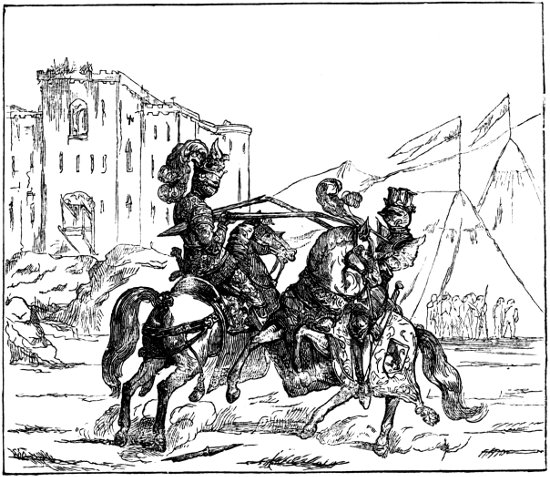
A TOURNAMENT.
We return now to our historical data, in
reference to the infancy of the art in question.
Those who are acquainted with the classics
will find many references to the use of heraldic
emblems before that use was reduced to a
complete and perfect science. According to
Herodotus, the Carians were the first who put
crests upon their helmets and sculptured devices
on their shields. These Carians inhabited
a country in the south-west angle of
Asia Minor, of which Halicarnassus was the
capital and Miletus its rival—both famous
cities of antiquity. The princes of Caria
reigned under Persian protection, but the
kingdom was annexed to Rome about 129
years before Christ. Herodotus further observes
that Sophanes “bare on his shield, as
a device, an anchor,” and Tacitus speaks of
the standard, eagles, and other ensigns in use
of the Romans. Xenophon, also, says that
the Median kings bore on their shields the
representation of a golden eagle. The Greeks
adopted crests from the Carians, and had flags
adorned with images of animals, or other
devices bearing a peculiar and distinctive
relation to the cities to which they belonged.
For instance, the Athenians chose an owl,
that bird being sacred to the goddess Minerva,
the patron and protector of their city, while
the Thebans were represented by a sphinx, in
memory of the monster overcome by Œdipus.
The emblem of Persia was the sun, of the
Romans an eagle; the Teutonic invaders of
England bore a horse on their standards, and
the Norsemen a raven.
The figure-heads on the prows of our
own ships owe their origin to the times
of the Phœnicians and Bœtians, who distinguished
theirs by a figure of one of their
gods, being thenceforth the tutelar god and
protector of the vessel. Thebes was the
principal city of Bœtia; and their tutelar
divinity, Cadmus, having been the founder of
that city, was represented on their flags,
having a dragon in his hand. They also used
flags to distinguish one ship from another,
which were placed in the prow or stern; and
these were sometimes
painted to represent a
flower, tree, or mountain;
and the names of the vessels
were taken from the
devices respectively portrayed
upon them.
Before our system of
heraldry was organised,
even in a yet imperfect
degree, we read that the
ancient British kings,
Brute, Lud, Bladud, and
others, all assumed their
respective insignia. Brute
bore on a golden shield a
“Lion rampant gules,
charged on the neck and
shoulder with three crowns
in pale.” Camber, another
British monarch, bore on
a silver shield two lions
passant gardant, gules.
Even to this day, the
descendants of the British
Prince Cadogan-ap-Elystan
bear the arms of their
warrior ancestors—“gules,
a lion rampant
regardant or,” and combined
with them the badge
of the three Saxon chiefs
(brothers), i.e. “three
boars’ heads couped sable,
on a silver field”—which
chiefs he slew in battle
with his own hand.
In the same way, the Saxons, who succeeded,
and partially exterminated our ancient
British ancestors, are still memorialised by
the badges of their thanes; and later on, the
Normans—so reputed in the annals of
chivalry—were all individually distinguished by
their armorial bearings.
As time went on, ripening all arts and
sciences—or is supposed to do so—heraldry
began to develop, and to be regulated by
certain rules under State control, and the spirit
of chivalry, that grew with the institution of
the crusades, jousts, and tournaments, may be
credited with that development. The English
knights under Cœur de Lion, and the French
under Philip Augustus, wore emblazoned
shields; and such of my readers who may
visit the Museum at Versailles may see a fine
collection of those worn by the crusaders,
arranged in proper order. There are (or were
some thirty years ago) no less than 74 of these
“écussons,” which belonged to “seigneurs les
plus illustrés et les plus puissants,” including
those of our lion-hearted king, and Philip
Augustus, before named. These all date from
the first Crusade, in 1095, down to the time of
Philip “le Hardi,” 1270. But, over and
above these emblazoned shields, once used by
the grandest examples of Middle Age chivalry,
the visitor to this museum will find some 240
others, bearing heraldic insignia worn by
crusaders of less exalted rank than the
illustrious personages better known to fame
comprised in the seventy-four first-named.
The better to appreciate such an exhibition,
the student should previously acquaint herself
with the curious and charming “Chronicles of
Froissart,” than which no romance could ever
prove half as interesting, and certainly not as
desirable for study, being a faithful and
graphic history of those warlike times.
To obtain an appreciable idea of a field
prepared for a tournament, we refer the
reader to the eighth chapter of Sir Walter
Scott’s “Ivanhoe.” The picture he gives of
the scene is worth notice. Imagine the gay
pavilions ranged side by side, and the arms of
the several knights, emblazoned on their
shields, suspended before the entrance of each
and guarded by their squires, the latter being
curiously attired, according to his lord’s particular
fancy. Then picture to yourselves the
knights, armed cap-à-pie, mounted on splendidly
caparisoned chargers, and riding up and
down the lines, and the whole field glittering
with arms and bright with gorgeous banners.
But perhaps some reader may say, “Cui
bono? What a vain exhibition and useless
expenditure of money!” Nay, such condemnation
is scarcely just. In those half-civilised,
warlike times danger threatened the country
on every side, at home and abroad, and at any
unexpected moment; and such practice in the
science of arms and reviews of the efficiency
of the knights and leaders of our armies were
absolutely essential. Even in our own day it is
a thoroughly well recognised fact that such a
terrible service as that of arms needs all the
external attraction with which it can possibly
be invested to induce volunteers to enter its
ranks. Were there no band, no uniform, no
decorations nor rewards for gallantry in prospect,
thousands who, when face to face with
the enemy, would give their lives for their
country without a moment’s hesitation, would
be revolted if, in the first instance and in cold
blood, they were invited to dress in a butcher’s
apron, and were presented with a mallet or
cleaver. But these few reflections may suffice
in reply to objectors, and we will return to
the history under review.
It was not until the latter end of the twelfth
century, about the time of Philip le Hardi,
that the science of mediæval armory developed
into a system. In the thirteenth century
it had gained in growth and in favour,
the uses of the art being more fully recognised.
Thus, under the reign of Henry III. a regular
system, classification, and technical language
of its own were devised and organised.
The earliest heraldic roll of arms actually
still existing is dated at the time of Henry III.
It is a copy, of which the original was compiled
(according to Sir Harris Nicholas) between
the years 1240 and 1249, and the
regular armorial bearings of the king, princes
of the blood, chief barons, and knights of
England were correctly blazoned. Moreover,
most of the principal terms in use in the
present perfected state of the art are to be
found on this roll. A second of the same
period still exists, comprising nearly seven
hundred coats of arms, besides other and
similar heraldic records, which are likewise
preserved to this day, belonging to the several
reigns of the first, second, and third Edwards
and of Richard II. It appears that the right
to bear arms was inaugurated at some time in
or about the reign of Henry II.
In the reign of Henry V. a registry of
armorial bearings was inaugurated, rendered
essential for the avoidance of confusion and
the just settlement of disputations; but the
incorporation of the officers of this College of
Arms by royal charter was granted in 1483 by
Richard III. The several titles and duties of
these officers shall be duly recorded in another
part of this series; for to the apparent origin
and antiquity of heraldic insignia, and the
gradual development of their use into a science,
I must for the present confine my attention.
Cold Harbour was the name of the mansion
allocated to the heralds as soon as incorporated
into a college. It was erected between
Blackfriars and St. Paul’s Wharf by Sir John
Poulteney, who was four times elected Lord
Mayor of London. This mansion was successively
known as York Inn, Poulteney’s Inn,
and thirdly as Cold Harbour. In the reign of
Mary I. she removed the college to Derby
House, previously the palace of the Stanleys,
and bestowed it on them by charter, Dethick
being Garter King-of-Arms at that time.
This ancient building stood on St. Benet’s
Hill, and was destroyed in the Great Fire of
London, A.D. 1666; but the valuable records
were all saved and conveyed to Whitehall,
Charles II. sending his private carriages for
the purpose. Thither also the heralds removed
and continued to reside until upon the
original site the present college was erected.
Of this building Sir Christopher Wren was
the architect, the north-western portion having
been built at his own expense by Dugdale.
It was constructed in the form of a quadrangle,
but the formation of a new street caused the
removal of the southern side, and the form
was changed. To obtain further particulars
respecting this interesting institution and all
its treasures we recommend a visit to the college,
if the means of admission can be procured
through acquaintance with some one of the
officers connected with it.
So far I have given a brief account of the
remote origin and growth of heraldry. I now
proceed to name a few of the leading uses
claimed for armorial insignia, and still further
for the institution of a regularly organised
system in connection with them under the
authority of the State.
In the first place, when a knight was encased
in armour and wore (as the hand-to-hand
warfare of the times necessitated) a visor
to protect the face, it became equally essential
that some external sign should identify him as
a friend or foe and distinguish him as a
leader and the lord of his special retainers and
squires. Thus the rewards granted in the
form of heraldic escutcheons emblazoned on
his shield, and the crest that surmounted his
helmet identified him, and even in the thick of
a close encounter, when the shield might be
hidden from view, the crest could be seen and
his identity recognised.
Thus, likewise, the standards used by the conflicting
hosts served to distinguish at a distant
point of view the friendly or hostile forces one
from the other, whence the shields and crests
would have been indistinguishable. To those
individually engaged in mortal combat, and to
the countries whose woe or weal hung on the
issue of a battle, the usefulness of employing
emblazoned standards and shields and the
wearing of crests was sufficiently self-evident.
Again, amongst the uses of heraldry, as at
present existing and developed into a science,
I may name the service rendered to private
families by the records preserved, the investigation
of claims to property, the identification
of relationships, and finding of next of kin;
the distinguishing between one branch of a
family from another, proved by some trifling
differences in the arms they respectively bear,
or in the crests or mottoes; usurpation of
arms and titles, and unjust pretensions to the
privileges due only to legitimacy, to the injury
of real heirs—all these are rights or evils
which the College of Heralds alone is in a
position to investigate, prove and maintain,
or expose and frustrate, respectively. Such
public services as these, not confined to the
titled or untitled aristocracy, nor even to the
upper commoners of the country, but available
to all classes when seeking relationships, and
through relationships property, or when
searching for registries of births, deaths, or
marriages—such public services as these, I say,
ought surely to be duly recognised by all.
Lastly, so long as public pageants and processions
continue to exist—no less interesting
and attractive to the poorer spectator than to
the great personages that are fêted—so long
as there are royal presentations, investitures
with orders of knighthood, coronations, and
grand State ceremonies to be conducted, and
processions marshalled in suitable order—just
so long the offices of the College of
Heralds will be essential to the requirements of
the State and country.
And now I have reached the last part of my
subject with which this, my first chapter, has
to deal, i.e., that in its broad features heraldry
is supported by the highest possible authority.
The formation of pedigrees, the use of
emblematic signs and figures, and of
emblazoned standards, as distinctive badges,
was not merely permitted, but was Divinely
ordained. To many customs of the world
around them the “elect people of God”
were forbidden to conform. In the case in
question it was otherwise.
In proof of this assertion, let me refer the
reader to the Book of Numbers, chap. i.,
2, 18, 52. There we read as follows:
“Take ye the sum of all the congregations of
the children of Israel, after their families, by
the house of their father, with the number of
their names.” “And they declared their
pedigrees, after their families, by the house of
their fathers, according to the number of the
names.” “And the children of Israel shall
pitch their tents, every man by his own camp,
and every man by his own standard, throughout
their hosts.” Again, in the same book,
chap. ii., 2, 34, we read thus: “Every
man of the children of Israel shall pitch by his
own standard, with the ensign of their father’s
house.” “And the children of Israel did according
to all that the Lord commanded Moses;
so they pitched by their standards, and so they
set forward; everyone after their families, according
to the house of their fathers.”
What some of these several standards represented,
so as to distinguish one tribe from
another, we have not far to seek, although we
have no data whereby to determine the devices
of the several families they each comprised.
Jacob, the patriarch and father of
these elect tribes, allocates to each its fitting
symbol. To ascertain what these were I refer
the reader to the blessing he gave them
when his pilgrimage was rapidly drawing to
its close. (See Gen. xlix. 10, 13, 14, 17, 19,
20, 21, 22, 27.) Some of the tribes had two
emblems, as in the case of Judah—a lion and
a sceptre (or kingly crown)—and Joseph—a
bunch of grapes and a bow—these two sons
of the patriarch inheriting respectively the
birthright and the blessing. Other emblems
of a representative character were attributed
to these Hebrew tribes by Moses also, for
which I refer the reader to Deut. xxxiii.
In my next chapter I propose to enter on
what is designated the “grammar of heraldry,”
and without further taxing the reader’s patience,
I now take my leave.
(To be continued.)
THE BRIDE’S FIRST DINNER PARTY.
By PHILLIS BROWNE, Author of “The Girl’s Own Cookery Book.”
A certain young lady, a member of The
Girl’s Own Cookery Class (in other words, an
individual who has educated herself in cookery,
with the assistance of articles published in this
journal), was married a few weeks ago. Her
husband is an exceedingly good fellow, and
holds a salaried position in a mercantile establishment.
He has plenty of common sense
and energy, and, if all goes well, he will make
his way; but at the present moment he is not
very well off. He has, however, managed to
save enough to furnish the small home very
prettily and very well, while his wife has
received from her father a handsome trousseau,
a good supply of house linen of every sort
and kind, and a good many odds and ends of
things. Besides this, the young couple, having
a large circle of friends, have been presented
with a considerable number of wedding
presents.
Young beginners in these days are really
very fortunate; for they get so much friendly
help in starting life. It very much simplifies
matters if, just as one has arrived at the conclusion
that a dinner service is imperatively
required, but that the money for purchasing
the same is not immediately forthcoming, a
knock is heard at the door, and a box is
brought in containing a handsome dinner service
of the newest pattern and latest fashion,
as a small proof of the affection of a friend.
The young people now referred to have
been most lucky in this way. They must have
received scores of presents, all useful, all judiciously
chosen, and with only two duplicates,
which were speedily exchanged for something
else. That delightful Parcel Post has been
a messenger of good fortune to them. Pretty
things for the table have arrived in profusion;
ornaments, pictures, silver, glass, china, cutlery
have appeared upon the scene as if by
magic; and the result of it all is that the
home of this newly-wedded pair is as thoroughly
well appointed all the way through as
anyone need wish a home to be.
The routine of married life in these days is
first the wedding day, then the honeymoon,
and then any amount of visiting—dinner parties
and supper parties without limit. Old-fashioned
individuals may disapprove of this,
and say that it would be better for the newly-wedded
to settle down quietly, look at life
from a serious standpoint, read improving
books aloud to each other in the evenings,
and save up every available halfpenny for a
future rainy day. Without doubt, the old-fashioned
individuals are right; but, unfortunately,
few young married people see as they
do. Experience is the great teacher, and its
lessons can never be learnt by proxy. These
young people have not yet been to that school.
They have their charming home, their many
friends, their limited income, and their pretty
table appliances; and the question has now
arisen—How shall they entertain their friends?
They plume themselves on being prudent; they
have no wish to run into extravagance, and
they have no thought of entertaining everyone
whom they know; but they are hospitably
inclined, and they have deliberately arrived at
the conclusion that there are one or two
special friends whom they must invite, and
whom they must make a little fuss over. The
result of it all has been the bride’s first dinner
party.
When first the subject of an entertainment
was mooted, the young bride, whom we will call
Mabel, was much exercised as to whether it
would be wiser to have high tea or dinner.
There was much to be said in favour of both.
With high tea it was possible to have everything
cold, and put on the table all at once,
and this would enable the mistress to see the
table laid, and be sure that everything was
right before the guests arrived, a consideration
not to be disregarded where there was only one
little maid, and that one only eighteen, though
clever for her age. The bride thought of the
anxiety which she would have to go through
if there were to be an awful pause between
the courses, and then Emma were to come to
her side and say, “Please, mum, the pudding
won’t turn out!” What should she do?
Then too, high tea was quieter, and less pretentious,
and the young housekeeper had no
desire to make a display beyond her means.
On the other hand, dinner would be
pleasanter; and, best of all, it would furnish
an occasion for bringing out all the pretty
presents, the bright silver, the exquisite glass,
the artistic table ornaments, the elegant dinner
and dessert services. Where was the good of
being possessed of all these treasures if they
were always to be kept locked up in a cupboard?
With these presents a dinner-table
could be laid out so effectively that the food
would be quite a minor detail. Besides, “the
master” preferred dinner. In his bachelor
days he had been accustomed to dine on
leaving business, and had learnt to regard high
tea as a nondescript sort of meal, only to be
accepted as a painful discipline when it could
not well be avoided. Of course, the master’s
likes and dislikes counted for a good deal with
the mistress, and dinner was almost decided
upon. But then came the question, “Which
meal would be the more expensive of the
two?” Expense was the chief consideration
after all. Everything had to be paid for with
ready money, and a committee of two of ways
and means had decided that a sovereign must
cover all expenses apart from beverages.
There were to be six guests, eight in all with
master and mistress; could the thing be done
for £1 sterling? The young lady was doubtful.
At this stage of the cogitation, a double
knock was heard, and in a minute or two the
maid, young but clever for her age, came up and
announced that Mrs. Jones had called to see Mrs.
Smith. Amy Jones! exactly the person to
consult. Amy was an old school-mate of the
bride’s, had been married a couple of years
ago, enjoyed almost the same yearly income,
and deserved the reputation of having arrived
at Dora Greenwell’s idea of perfection; that is,
she had, up to this point, not merely made
both ends meet, but made them tie over in a
handsome bow. Yet she had been hospitable,
too. A person of such abundant experience
would be sure to know what was best.
“Amy, if you were in my place, which
should you decide upon, a high tea or a small
dinner?”
“You have begun to consider the claims of
hospitality, have you, Mabel! What is your
maid like?”
“She is a very good little girl, and she does
her best, but she is very slow. If all goes on
quietly, she manages excellently, but if she
were to be flurried, I do not know what would
happen.”
“That’s bad,” remarked experienced Amy
Jones.
“Yet she means well, and really does her
best,” continued the young mistress,
anxiously eager to defend her first domestic.
“She can cook plain dishes fairly, and is
interested in her work. If I tell her a thing,
she never forgets.”
“That’s good; almost good enough to
make up for the slowness. Can she wait?”
“Not properly. She can bring dishes and
plates into the room and take them out again
quickly, but that is almost the extent of her
power; she could not hand round dishes or
remain in the room during a dinner to be a
credit or help. If we were to decide on dinner,
don’t you think you would hire a waitress if
you were me?”
“If you want my advice, dear, I should say,
decidedly, do nothing of the kind. It would
be an exhibition of effort which would involve
pretence, and the slightest pretence would be
a mistake. Whatever you do, don’t go beyond
the resources of your own modest establishment.
At present, all your friends know
exactly what your position is; they will respect
you if you make the best of it, but if
you seem to wish to go beyond it they will
begin to criticise, while the people you care
for most will blame you.”
“Then you would give up all thought of
dinner?”
“I don’t say so. Why should you not have
a small dinner? Prepare everything yourself,
altogether dispense with regular waiting, show
Emma exactly what she has to do, and let her
do her best. Supposing there should be a
little contretemps, never mind; laugh at it,
and your friends will laugh with you. They
will only say that you are inexperienced. If
all should go well, how pleased your husband
will be! You are sure you don’t mind the
trouble?”
“Mind the trouble! I like it. I think it
is fun. I am only uneasy about the expense.”
“Well, dear, I should say that high tea,
though less troublesome, is quite as expensive
as dinner. We can easily ascertain the truth,
however. Let us take paper and pencil, and
draw up a statement of the cost of both. We
will begin with the high tea. I suppose we
are to take it for granted that you must have
something extra? It would not do to have a
thoroughly simple meal.”
“Oh, no. If we ask six people on such
an occasion, we must make a sort of feast.
Let me think. You put the items down as
I decide on them. We might have a lobster
salad, a couple of boiled fowls with egg
sauce, a beefsteak and oyster pie, a strawberry
cream, a jelly of some sort, a few tarts
and cheesecakes, some fruit and fancy biscuits.
Then, of course, tea and coffee and
thin bread and butter, brown and white.
That would do well enough. We could not
well have less.”
“A very excellent menu, indeed,” said
Amy, while a rather amused look passed over
her face. “What do you suppose it will
cost?”
“I don’t know,” said Mabel. “You cast
it out and see. You understand prices better
than I do.”
For a while there was silence, and nothing
was heard but the scratching of a pencil.
Then Amy read aloud:—“Lobster salad,
3s. 3d.; boiled fowls and egg sauce, 7s. 11d.”
“Oh, dear!” said Mabel.
“Well, you see, it is spring, and fowls are
dear in the spring. I do not suppose you
could get a fine pair for less than 3s. 6d. each.
Beefsteak and oyster pie, 5s.; strawberry
cream (made with your own jam), 1s. 8d.;
orange jelly, 1s. 4d.; tarts and cheesecakes we
will calculate roughly at 1s. 4d.; a little fruit,
2s.; tea and coffee (say 2d. per person),
1s. 4d.; bread and butter, 2s. Altogether say
£1 5s. 10d.”
“That will never do,” said Mabel. “We
must take something away.”
“For one thing, you might take the tarts
and cheesecakes. Surely they are not necessary.”
“One wants a little trifle of the sort to conclude
the meal,” said Mabel.
“Then make jam sandwich. I can give
you a simple recipe, by following which you
can produce a dishful for less than sixpence.”
“Thanks. But that will not make matters
right. We must reduce much more than
that.”
“Suppose that before doing so we draw
up a dinner, and see what we can make of
that. I will furnish the menu this time.”
“Very good. Only remember to take into
consideration Emma’s limited capacity,” said
Mabel.
Again there was silence. After a few
minutes Amy read aloud once more:—
Mabel was silent for a moment from amazement.
Then she said—
“That is very extraordinary. I would not
have believed it.”
“Yes, dear. But you must take into account
that you drew up rather a luxurious tea;
and my dinner is a very simple and homely
one. Therefore you were scarcely fair to yourself.”
“I only described the sort of high tea we
should have had at home before I was married.”
“And you forgot that your mother did
not need to make a sovereign cover all expenses.”
“And yet your dinner sounds more satisfactory
than my tea, and I am sure it would
look more. I wonder if Emma could manage
a dinner like that; she is not entirely ignorant.
She can roast a joint, and boil potatoes very
well, and she can bake a pudding——”
“Then I am sure she could manage, for
everything else you could yourself prepare
beforehand. Of course, if she were more of a
cook, you might have a little fish, or perhaps
a trifle of game after the mutton, and still
keep within the sovereign.”
“I feel that I should be wiser to experiment
first in a small way,” said Mabel.
“Very well. The potato soup you know
well. It is good, and cheap; you can get it
ready beforehand, so that Emma will only
have to make it hot. The mutton you can
get the butcher to bone, and then stuff it with
veal forcemeat, and roll it early in the day,
leaving Emma to roast it. The gravy, also,
you can make ready, and put, nicely seasoned
and free from fat, in a cup, so that Emma will
need only to put it in a saucepan to get hot
when she begins to dish the meat. The
tomatoes you can prepare. The celery and
potatoes you may leave with her, I should
think.”
“Decidedly; she boils vegetables very well,
and she can mash potatoes, and put browned
potatoes round quite easily. I had better
make the sauce for the celery, though.”
“You might make it, and put it in a gallipot
in a saucepan with boiling water round, to
keep hot. Then surely if you make the soup,
if you prepare the meat, and make the gravy,
make the sauce, get the tomatoes ready, make
the jelly, mix the pudding, three parts cook the
macaroni, dish the dessert, and altogether
make the coffee, there can be no danger.”
“I shall be rather tired by the time our
friends arrive,” said Amy, looking a little
grave as she realised the responsibilities which
she was proposing to take upon herself.
“Oh, yes; you will have to be very quick,
and to do all the head-work. But you said
you did not mind the trouble. And besides,
remember this, if once you can succeed in
your attempt you will find that you are not at
all more tired with providing dinner than you
are with providing high tea. But there are
just two things you would do well to try for, in
my opinion.”
“What are they?”
“One is to make Emma well acquainted with
every dish beforehand. Let her understand
how things ought to be and to look when properly
cooked; on no account let the final touches be
the product of her imagination as exercised in
carrying out your descriptive order.”
“No, that would scarcely do,” said Mabel,
laughing.
“Well, the only way to prevent it is to
make the most of the time between now and
the important day. Have potato soup one
day, rolled mutton another, tomatoes farcies,
and ready-made pudding a third, and macaroni
cheese a fourth, and so make her familiar with
what is coming.”
“And the second point?”
“I was going to suggest that if you have
anything served in a style superior to your
ordinary mode, you should try to keep Emma
up to the better way as a regular thing. This
will really be a great kindness to her. It will
make her more skilful, and fit her for taking a
better situation afterwards, and, strange to
say, she will be all the happier for it. Right-minded
girls (and I should quite think Emma
is one) are glad to be shown refined ways, and
they respect a mistress who understands and
insists upon the best modes of doing things far
more than they respect a mistress who lets
things go, and puts up with slipshod fashions
just for the sake of peace and quiet. And
really you will find that when Emma knows
what ought to be, all you will need to impress
upon her is the time required for the various
dishes.”
“That is it precisely,” said Mabel, who had
been listening very quietly to her friend’s
remarks, but who was evidently giving all her
thoughts to the subject in hand. “I can see
now exactly what I shall have to do. I shall
make out a list of every ingredient, and have
everything where it will be close to my hand,
the day but one before the dinner. The day
before I shall make the jelly and, with Emma’s
help, brighten all the glass and silver, and look
out any pretty ornaments and services. Then
quite early on the eventful morning I shall
make the soup, and put it ready for making
hot; yes, I shall even fry and dish the sippets
and chop the parsley, which will have to be
sprinkled in at the last moment. I shall stuff
and roll the mutton, dish the sour plums (those
delightful sour plums! they were there without
needing to be in the estimate; how good it
was of Frau Bergmann to give them to me).
I shall stuff the tomatoes, turn out the jelly,
dish the dessert, arrange the coffee cups and
saucers—but, oh, the coffee, what shall I do
for that? Emma never makes it properly.”
“Few servants do; and if I were you I
should look after it yourself in this case. The
coffee is so very important. Really good
coffee, served at the close even of an unsuccessful
dinner, almost atones for disaster,
while inferior coffee spoils the most recherché
repast. Why should you not steal away for a
minute or two when your friends leave the
dining-room, make the coffee, and send Emma
in with it. Then all is sure to be right.”
“Yes, that will be best. Well, as I was
saying, I must be as busy as possible before
luncheon. Then, after luncheon——”
“After luncheon I should lie down for an
hour,” said Amy.
“Oh!” said Mabel, dubiously.
“Yes. It would be unfortunate if the dinner
were a success, and the hostess laid up
next day through fatigue.”
“May be. Yes, I will certainly rest awhile
after luncheon. Then, while Emma prepares
her vegetables, tidies the kitchen, and attends
to the roast, I will lay the table; and I know
I can make it beautiful.”
“What shall you do for flowers? We did
not allow for them in our estimate.”
“I planted some corn a week ago in a large
fancy bowl, and it will be lovely. Have you
never done that? You get a few ears of corn,
pack them in a bowl full of water, so that the
ears are close together and are partially covered
with the water. Put the bowl in a warm
room, and in about a fortnight the delicate
blades will peep out and grow to be very
pretty. There could not be anything more
effective for the middle of the table, and the
grass lasts five or six weeks, and it is a most
convenient decoration when flowers are scarce.
We always used to provide ourselves with corn
in harvest time for this purpose.”
“I will remember to do the same,” said
Amy. “I never heard of growing corn in a
bowl.”
“I can give you a little meanwhile to experiment
with. Then, when the table is laid, I
will dress, and when I come down will present
Emma first with a written menu, giving a list
of what is to go in with each course, and a
few notes of reminder—something of this
sort:—
“Remember—
“To put the pudding and tomatoes in the
oven, also to pour the sauce over the macaroni
and set it to brown, as soon as the last
guest arrives.
“To put the plates for soup, meat, tomatoes,
ready-made pudding, and cheese to heat
half an hour before the dinner hour.
“To make the milk boil before stirring it
into the boiling soup, and to sprinkle in the
chopped parsley at the last moment.
“To shut the dining-room door after taking
in or removing dishes, &c., and to move about
as quietly as possible.
“To begin to dish the meat and vegetables
and make the gravy hot the moment soup is
in, so that everything may be quite ready when
the bell rings.
“To put the coffee (left ready ground on
the dresser) into the oven, to get hot, as soon
as dessert is in, and at the same time to set a
jug of milk in a saucepan of boiling water.”
“What is that for?” said Amy.
“It is to scald the milk. Coffee tastes so
much more delicious when the milk is scalded,
not boiled. There, I think that is all. I will
write the notes early, and then, if anything
else occurs to me, I can put it down. But,
Amy, for safety’s sake would you mind giving
me the recipes for the dishes in your menu. I
have one or two, but they may be mislaid, and
I should not like there to be a mistake.”
“There is not much fear of a mistake, if
you take all that trouble. But I will give you
the recipes with pleasure. In return, will you
give me the recipe for the sour plums? I should
like to have it, for I intend to make some
when plums are in season.”
The arrangements thus laid down were implicitly
carried out, and the “Bride’s First
Dinner Party” was a great success—so much
so that every guest remarked, when the evening
was over, “What a clever little woman
Mrs. Smith is! How fortunate her husband
is to have a wife thus domesticated.” Then,
in a moment, “What lovely wedding presents!”
For the benefit of those who may care to
have them, I subjoin a copy of the recipes
which were exchanged between Amy and
Mabel.
Potato Soup.—Melt a piece of butter the
size of an egg in a stewpan. Throw in two
pounds of potatoes, weighed after they have
been peeled, the white parts of two leeks, and
a stick of celery, all cut up. Sweat for a few
minutes without browning. Pour on a quart
of cold stock or water; boil gently till the
vegetables are tender, and pass through a
sieve. When wanted, make hot in a clean
stewpan, and add salt and pepper. Boil
separately half a pint of milk; stir this into
the boiling soup. At the last moment sprinkle
on the top of the soup a dessertspoonful of
chopped parsley. If cream is allowed, the
soup will be greatly improved.
Tomatoes Farcies.—Take eight smooth red
tomatoes; cut the stalks off evenly, and slice
off the part that adheres to them; scoop out
the seeds from the centre without breaking
the sides. Melt an ounce of butter in a stewpan.
Put in two tablespoonfuls of cooked
ham chopped, two tablespoonfuls of chopped
mushrooms, two shalots, two teaspoonfuls
of chopped parsley, pepper and salt, and two
ounces of grated Parmesan. Mix thoroughly
over the fire, fill the tomatoes with the mixture,
and bake on a greased baking tin in a
moderate oven for ten or fifteen minutes. The
tomatoes should be tender, but not broken.
If the ingredients for this forcemeat are not at
hand, a little ordinary veal forcemeat may be
used, but the taste will be inferior.
Rolled Loin of Mutton.—Get the butcher
from whom the meat is bought to bone the
loin; spread veal stuffing inside, roll it up,
bind it with tape, and bake in the usual way.
Thick, smooth gravy should be served with it.
This may be made of the bones.
Mashed and Browned Potatoes.—Mash
potatoes in the usual way. Prepare beforehand
six or eight good sized potatoes of
uniform size. Parboil them, then put them
into the dripping-tin round the meat for about
three-quarters of an hour—less, if small—and
baste them every now and then till brown.
Pile the mashed potatoes in the middle of the
tureen, put browned potatoes round, and
sprinkle chopped parsley on the white
centre.
Stewed Celery.—Wash the celery carefully,
and boil it till tender in milk and water, to
which salt and a little butter have been added.
The time required will depend on the quality.
Young, tender portions will be ready in half
an hour or less; the coarse outer stalks will
need to boil a long time. Drain thoroughly,
dish on toast, and pour white sauce over.
Sour Plums (a substitute for red currant
jelly served with meat; to be made in the
autumn).—Take three pounds of the long,
blue autumn plums, almost the last to come
into the market, called in Germany zwetschen.
Rub off the bloom and prick each one with a
needle. Boil a pint of vinegar for a quarter of
an hour with a pound and a-half of sugar, a
teaspoonful of cloves, three blades of mace,
and half an ounce of cinnamon. Pour the
vinegar through a strainer over the plums, and
let them stand for twenty-four hours. Next
day boil the vinegar, and again pour it over
the fruit. Put all over the fire together to
simmer for a few minutes until the plums are
tender and cracked without falling to pieces.
Tie down while hot.
Ready-Made Pudding.—Mix two tablespoonfuls
of flour, an ounce of sugar, and a
very little grated nutmeg, with a spoonful of
cold milk to make a smooth paste, then add
boiling milk to make a pint. When cold,
beat two eggs with a glass of sherry, mix and
bake in a buttered dish for half an hour.
Orange Jelly.—Soak an ounce of gelatine
in water to cover it for an hour, and put with
the gelatine the very thin rind of three oranges.
Squeeze the juice from some sweet oranges to
make half a pint, then add the juice of two
lemons, and strain to get out all pips, etc.
Take as much water as there is fruit juice, put
this into a stewpan with the gelatine, and a
quarter of a pound of loaf sugar, and simmer
for a few minutes till the gelatine is entirely
dissolved. Remove any scum that may rise,
then add the juice; boil up once, and strain into
a damp mould. This jelly has a delicious
taste, and is not supposed to be clear.
Macaroni Cheese.—Wash half a pound of
Naples macaroni, break it up and throw it
into boiling water with a lump of butter in it,
and boil it for about half an hour, till the
macaroni is tender. Drain it well. Melt an
ounce of butter in a stewpan, stir in one ounce
of flour, and, when smooth, half a pint of cold
milk. Stir the sauce till it boils, add salt and
pepper, an ounce of grated Parmesan, and the
macaroni drained dry. Pour all upon a dish,
sprinkle an ounce of macaroni over, and brown
in the oven or before the fire.
Simple Jam Sandwich.—Beat three eggs,
and add a breakfastcupful of flour, to which
has been added a teaspoonful of cream of
tartar. Beat the mixture till it bubbles. Add
a scant breakfastcupful of sifted sugar. Beat
again, and add half a teaspoonful of carbonate
of soda. Turn into a shallow baking tin,
greased, and bake for a few minutes in a quick
oven. With the oven ready, this cake can be
made and baked in half an hour.
GIRTON GIRL.
By CATHERINE GRANT FURLEY.
“Why, sir, should you seem so startled
When you chance to come on me
Talking silly baby-language
To the child upon my knee—
To this happy, crowing urchin,
While his peasant mother stands
Watching us, while she is wiping
Thick-flaked soapsuds from her hands?
“When you met me first, at dinner,
At the Hall the other night,
You were seated on my left hand,
The professor on my right;
And you saw I cared to listen—
Saw it with a scornful mirth—
To the facts that he was telling
Of the strata of the earth.
“And again, when of the Iliad
My companion chanced to speak,
You were less pleased than astounded
That I quoted Homer’s Greek.
And beneath my half-closed eyelids
I observed your covert smile,
When our hostess spoke of Ruskin,
And I answered with Carlyle.
“Then you thought you read me fully—
‘Woman in her latest phase,
Following with feebler footsteps
In far-reaching manhood’s ways.
A half-taught, conceited creature,
Something neither wise nor good;
Losing for a vain chimera
All the grace of womanhood.
“‘Failing in her mad endeavour,
Though in every languid vein
Love-warmed heart-blood she replaces
With cold ichor from the brain.
Woman striving to be manlike,
Making him her enemy,
Fighting where she best had yielded’—
This was what you saw in me.
“Sir, I claim to be a woman:
Nothing less and nothing more;
Laughing when my heart is joyful,
Weeping when my heart is sore;
Loving all things good and tender,
Nor so coldly over-wise
As to scorn a lover’s kisses,
Or the light of children’s eyes.
“Over-wise! Nay, it were folly
If I cherished in my mind
One poor fancy, one ambition
That could part me from my kind—
From the maiden’s hopes and longings,
From the mother’s joy and care,
From the gladness, labour, sorrow,
That is every woman’s share.
“Not for all life’s garb of duty
In the self-same tint is dyed;
I must walk alone, another
Shelters at a husband’s side.
Yet I claim her for my sister,
While—though I must stand apart—
All her hopes, her fears, her wishes
Find an echo in my heart.
A GIRTON GIRL.
“True it is I love to study
Every page of nature’s lore.
Must that make my soul less gentle?
Nay, it softens me the more.
True it is I love the story
Of the old heroic age,
True I love the aspirations
Of the poet and the sage;
“But if poet, artist, thinker,
Lend me some inspiring thought,
Must it follow that the duty
Of the woman is forgot?
No; ’tis you who err, believe me,
Thinking, as perchance you do,
That because her brain is empty,
Woman’s heart must beat more true.
“’Tis not learning that unsexes,
’Tis not thought will make us cold,
Nor at sight of heavy volumes
Love on us relax his hold.
Woman is for ever woman;
O’er her life love rules supreme,
Though his kingdom be but fancy,
And the bliss he gives a dream.
“Nought besides, however worthy,
In her heart can take his place—
But enough! The child is frightened
At the graveness of my face.
I must bring him back to laughter.
Pray you, leave us for a time,
Or you’ll hear a Girton student
Teaching him a nursery rhyme.”
THE SHEPHERD’S FAIRY. — CHAPTER XIII.
A PASTORALE.
By DARLEY DALE, Author of “Fair Katherine,” etc.
HOPE AND FEAR.
s soon as the
shearing company
was gone,
John Shelley
went into the
house to watch by
Charlie’s couch,
and to take counsel
with his wife
as to what must
be done about Jack, as to whose safety
he was as anxious as about Charlie’s,
for if the latter died Jack would inevitably
be tried for manslaughter, though
the shepherd felt sure the fall on the
stone gate-post was a far more serious
matter than the blow Jack had dealt,
and which had accidentally, and quite
unintentionally, caused the fall.
All Jack had meant to do, as the
shepherd and his wife knew well enough,
was to give Charlie a good bang across
the shoulders, but if the boy died it
might be a difficult matter to persuade
a coroner’s jury that no more was intended,
especially as Jack, by keeping
himself aloof, as he did, from his own
class, was by no means popular in the
neighbourhood.
Mrs. Shelley was even more keenly
alive to the danger which threatened
Jack than her husband, and was for
sending him away at once to her brother,
who lived at Liverpool, but John Shelley
never acted hastily or on impulse, and
he suggested taking counsel with the
doctor and Mr. Leslie, both of whom
were good friends of Jack’s, before they
decided on any course of action.
“We’ll send Jack round to the rectory
as soon as he comes back; he will be
glad of something to do, tired and
hungry as he must be, for I see he has
not had his supper yet,” said the shepherd.
“No, he won’t touch anything till
there is some hope of Charlie, I daresay.
He has been unconscious nearly an hour
now, John. Do you think there is any
hope?”
“Yes, I do; while there is life there
is hope. I expect it is concussion of the
brain, and if so, people are often unconscious
for hours. He is breathing, you
see. But where is Fairy? Why does
not the child come in? Is she frightened?”
“I don’t know, I am sure; I had forgotten
all about her. Just see, John,
will you? She has had no supper
either,” replied Mrs. Shelley.
John went to the door to look for
Fairy just as Jack and Dr. Bates came
up together. The shepherd brought
the doctor in, and sent Jack to the
rectory, and then went to talk to Fairy,
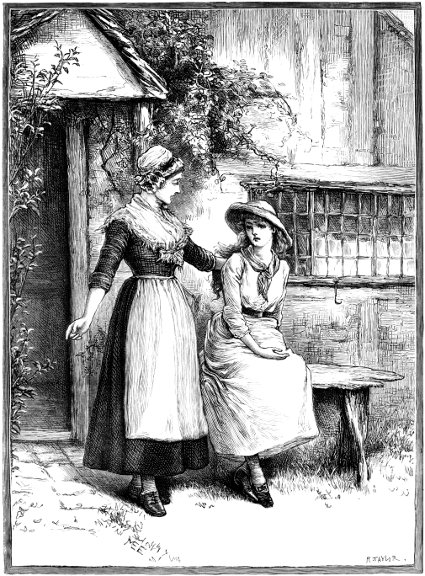
who was still sitting on the bench outside.
“Why have you sent for Mr. Leslie?
Is Charlie worse?” asked Fairy, anxiously,
as she beckoned to the shepherd
to sit by her side.
“No, he is just the same, but I want
to ask Mr. Leslie’s advice about Jack;
I am afraid we shall have to send poor
Jack away. Shall you be sorry, Fairy?”
“Sorry! Of course I shall; but, John,
why must Jack go as well as I? Mother
says it is all my fault, and I am to go
away, and I don’t know where to go, so
I was waiting till you came, to ask you;
but if Mr. Leslie is coming, I daresay
he’ll take me in for a little while,” said
Fairy, with a little sob at the end of each
sentence.
“Mr. Leslie take my Fairy in. Why,
child, you would not leave us now in our
hour of trouble, when we most want you
to comfort us, would you?”
“I don’t want ever to leave you,
unless, of course, I find my own parents;
but mother says I am to go, and she is
sorry she ever took me in, because it is
all my fault. So you see, John, of course
I must go away after that,” said Fairy,
gently.
“I can’t spare my little Fairy now.
Mother did not mean what she said;
she was so upset at seeing poor Charlie
insensible, I expect she hardly knew
what she was doing, so you must forgive
her—will you, little one?—and stay
and cheer us in our sorrow,” said John.
“Of course I will, if you are quite
sure mother didn’t mean it, but she
should not have said it was my fault,
should she? For she knows as well as
you do, John, how fond I am of both the
boys, and how I never let them quarrel;
only this was done in such a minute I
could not stop it; it really was more an
accident than anything else. Poor
Jack didn’t mean to knock Charlie
down, or to hurt him really, only he was
so angry about that lamb that he lost
his temper. How grave you look, John;
you don’t think it was my fault, do
you?”
Now the shepherd understood perfectly
what his wife had meant by saying it
was Fairy’s fault; but it was evident the
child had not the remotest suspicion of
Mrs. Shelley’s meaning; she was too
childlike and innocent (children of that
day were less precocious and more like
children than they are now), too free from
vanity and self-consciousness to be
aware that Jack had any other feeling
for her than a brotherly affection, and it
was equally evident that at present, at
any rate, Fairy’s affection for Jack was
of precisely the same character as her
sisterly love for her foster-brother.
Seeing this, the shepherd felt his
wife was right in saying it would be far
better for many reasons that Jack should
go away; but he was so lost in thought
that he forgot to reply to Fairy’s
question, which, after waiting a minute
or two, for she was accustomed to John’s
slowness of speech, she repeated.
“No, my child, no, I am sure it was
no fault of yours; don’t think any more
about it. Here comes Jack with Mr.
Leslie; I will go in and hear what the
doctor says. Ask Mr. Leslie to wait in
the kitchen for a minute, if he does not
mind,” and the shepherd went indoors
to hear the doctor’s report just as Jack
and Mr. Leslie appeared.
They both looked very grave, for Jack
was a great pet of the rector’s, and he
had already told him exactly how the
accident had occurred; and Mr. Leslie
was almost as anxious as Jack to hear
the doctor’s report, for Jack seemed so
absorbed in his anxiety about Charlie
as to be unconscious of his own danger.
“How is he?” they exclaimed in a
breath.
“I don’t know; Dr. Bates is still with
him,” said Fairy; but a minute or two
later John Shelley came out with the
doctor’s report.
“Well, what news?” asked Mr.
Leslie.
“He is still unconscious, and the
doctor can’t say how it will go with
him,” replied the shepherd.
“Is there no hope, father?” asked
Jack, turning very white and speaking
very low.
“Yes, lad, yes, there is hope, thank
God; he may rally; it is the fall on the
gate-post that has done the mischief.
He struck the back of his head against
the stone; the place on the temple is a
mere trifle. But will you walk in, Mr.
Leslie? Dr. Bates wants to speak to
you, and you too, Jack.”
Accordingly these four went into the
kitchen and shut themselves up to discuss
the matter, leaving Fairy feeling
very miserable and in the way, for she
did not know where to go, on the bench
outside. But a few minutes later Mrs.
Shelley came to the door to look for her,
wondering what had become of her,
having forgotten her hasty speech on
seeing Charlie lying prostrate on the
ground.
“Why, Fairy, where have you been
all this time? Come, child, you have
had no supper yet. How pale you look;
and your hands are quite cold. You are
not frightened, are you?” said Mrs.
Shelley, as Fairy reluctantly followed
her into the house.
“No, I am not frightened, but it is
all so miserable,” said Fairy, sobbing,
as she looked at the unconscious
Charlie, who was breathing almost imperceptibly
on the sofa.
“Come, this won’t do; I shall have
you ill next; why, the child has cried
more to-night than she ever cried all the
sixteen years she has been here,” said
Mrs. Shelley, taking Fairy in her arms.
“You were never unkind to me before,”
sobbed Fairy.
Suddenly Mrs. Shelley remembered
how she had turned on Fairy in her
anxiety and pity for Jack.
“There, child, don’t cry any more; I
don’t know what I said; but at any rate
I can’t let you quarrel with me when I
may lose one, if not both, of my sons;
for I am sure they will decide to send
Jack away—indeed, I hope they will,”
said Mrs. Shelley.
“You hope so, mother?” asked
Fairy, in astonishment.
“Yes; if anything happened to poor
Charlie, Jack might get into terrible
trouble, so, for his sake, I hope Mr.
Leslie will let him go; besides, he is not
fit for a shepherd; he never has liked the
work, and he may get on far better at
something else.”
Just as Mrs. Shelley said this, the
kitchen door opened, and John Shelley
asked his wife to come in to the discussion
which was being held in the
kitchen, and Fairy was left to watch by
Charlie. It seemed an interminable time
to Fairy, though it was not really half
an hour before the door opened and they
all came out. Mr. Leslie went home;
the doctor came in to look at Charlie
again; Mrs. Shelley went upstairs with
Jack; and the shepherd called Fairy
into the kitchen to tell her what had been
decided.
“Jack is going away to-night; he is
going to America.”
“To America!” exclaimed Fairy, for
in those days going to America was
indeed going to another world.
“Yes, for two years; perhaps for
longer if he likes it. Mr. Leslie has
friends out there, and he knows of something
he thinks will do for Jack. There
is a ship sails on Monday from Liverpool,
so he is to go to Brighton to-night with
Mr. Leslie, and be off by the London
coach at five to-morrow morning. Mr.
Leslie will go to Liverpool with him and
see him off if he can get anyone to take
his duty here on Sunday; anyhow, he
will go to London and put him into the
Liverpool coach.”
John had not time to enter into
further details as to what had passed
at the meeting in the kitchen; but, in
truth, both Dr. Bates and Mr. Leslie
had strongly urged getting Jack out of
the way as quickly as possible. Dr.
Bates because he was very anxious and
by no means hopeful about Charlie; Mr.
Leslie partly on the same account, but
also because he knew the state of Jack’s
feelings with regard to Fairy, and had long
wished to see the boy in a position where
he would have some opportunity of using
the talents he possessed, and, by dint of
his own abilities and exertions, rising in
the world. It so happened that he had
friends in New York, and a relation of
his; a banker there had, in answer to his
inquiries whether he had an opening
for a clever, self-educated young man,
lately written to say he had a vacancy
for a clerk which he would keep for Mr.
Leslie’s young protégé. Mr. Leslie had
only been waiting till the shearing
season was over to offer this post to
Jack, knowing that he could not very
well be spared till it was finished.
Jack was delighted at the idea; a
salary of fifty pounds a year seemed to
him untold wealth, and to have all the
rest of the day from five in the afternoon
till ten the next morning to himself, a
perpetual holiday; and then to go to
America, to him who had never been
much farther than Brighton, would,
under any other circumstances, have
been all that he could have wished for,
except Fairy to accompany him. The
post was offered him for two years, and
the option of remaining, if he liked the
work, at the end of the two years. The
only difficulty was the money for his
passage, but, to the surprise of Jack,
his father said he had plenty in the
savings bank for that and to get him a
few necessaries as well.
But leaving as he was leaving, took
all pleasure out of Jack’s good fortune;
if he felt any pleasure at all it was only
from the excitement of the journey, and
the occupation of both mind and body,
which prevented him from dwelling on
the sorrow he had brought on them all,
and diverted his mind from the terrible
anxiety Charlie’s state caused him.
If it had not been for Dr. Bates, Jack
would have remained at home for the
night, and walked over to Brighton at
daybreak to catch the coach, but the
doctor was rather a nervous man, and
knowing that it was quite possible
Charlie might not live till the morning,
he urged Mr. Leslie to take Jack to
Brighton that evening, adding in an
undertone that if anything happened
Jack had better learn it in America.
Perhaps it was as well for all parties that
the doctor’s advice was acted upon, for
it prevented any prolonged leave-takings,
and gave no one time to fret over
Jack’s departure; indeed, an hour after
the council held in the kitchen, Jack
was standing already to start, folding
his mother in his arms as he bade her
good-bye. Then he went to the sitting-room,
in which Charlie was lying, and
took a long, long look at him as he lay
with closed eyes, just breathing, all the
colour gone from his usually rosy cheeks.
What would not Jack have given to see
those merry blue eyes open once more
before he went away, perhaps never to
see them again? But no, the eyelids
remained firmly closed, and Jack waited
in vain for any hopeful sign. He was
alone in the room, and before he left he
knelt down by the side of the sofa and
prayed until a footstep outside startled
him, and he rose hastily, for, proud and
reserved as he was, he would have hated
even his mother to have seen him on his
knees, for, like many young men of his
age, he had a great deal more religion
than the world gave him credit for.
The footstep was Mrs. Shelley’s; she
was come to warn her darling son that
it was time he started or he would keep
Mr. Leslie waiting.
“Mother, may I have a lock of his
hair?” asked Jack. And Mrs. Shelley
cut one of Charlie’s fair curls for him;
and then Jack stooped, and, for the first
time for many years, kissed the boy’s
pale cheeks, and then, once more embracing
his mother, he left the room.
But there was another person to say
good-bye to—Fairy—who was waiting in
the passage, and now came forward,
putting both her hands in Jack’s and
lifting up her sweet, delicate little face
to be kissed as naturally as though Jack
was her own brother; and though poor
Jack blushed crimson as he stooped and
kissed her, Fairy, if she changed colour
at all, grew paler, for she felt very sad
and lonely at the loss of her favourite
companion.
“You will think of me sometimes, Fairy,
won’t you?” whispered Jack, holding
her hands.
“Yes, often, Jack; and mind you
write to us directly you get to America;
we shall be longing to know how you are
getting on.”
“Jack, my boy, it is time to start,”
cried John Shelley, who was waiting
outside to walk to the rectory with his
son, and the next moment they were off.
(To be continued.)
THE ROMANCE OF THE BANK OF ENGLAND; OR, THE OLD LADY OF THREADNEEDLE STREET. — CHAPTER IV.
By EMMA BREWER.
After having tided over my difficulties, which
had been brought about partly by the ill-feeling
and envy of the Land Bank, and partly
by another matter to be explained later, I
went on successfully in my old home, gradually
increasing my powers and responsibilities, and,
if I may be allowed to add, daily growing
more attractive.
Everybody courted my smiles, and were
wretched if they failed to find favour. Among
those who paid me attention were members of
the royal family, bishops, clergy, ministers of
state, merchants, and philosophers; and,
strange to say, I was as great a favourite with
the women as with the men, and I think I
influenced their lives not a little, for if a girl
were known to be on my visiting list, even
though she were very plain, she found no
difficulty in marrying well. Did a mother hold
in her arms her first-born, she was more
restful and content concerning its future if it
had an opportunity of being placed in my good
books; and, certainly if a person died who had
during his life stood well with me, he was
buried with more pomp and ceremony for the
fact.
It seems wonderful, does it not, that I
should have kept my head amid so much
flattery and attention, and I very much
doubt if I should have done so but for the
healthy tone of my home and the constant
care of my people.
Every now and then I got a fright, which
prevented my becoming frivolous, and which,
but for my good constitution, would have
gone far to shake the life out of me. One I
remember well.
It occurred in 1707, when I was but thirteen
years old. It came in the form of a “run,”
and certainly, but for timely help, I should
have been torn to pieces.
The word run may be suggestive to you
merely of a race between me and another
bank; but in bank language it has a most
terrifying and disagreeable meaning.
It is a sudden demand from everybody to
whom you owe money to pay up on the spot,
and without hesitation.
Your office is filled and refilled with people
angrily and defiantly demanding their money.
Such was the case with me, and in my one
room in the Grocers’ Hall, at the date I
mentioned.
I tried to console myself with the thought
that if the people would but give me time I
would pay everyone to the full, but, alas! I was
old enough to know that this was not sufficient—my
existence depended upon the whole
world believing me to be safe and worthy of
confidence, and their test of my trustworthiness
was that I should pay everyone in full at a
moment’s notice.
I was nearly wild, and, for the moment,
utterly powerless. To me confidence was
money, and by money I lived and breathed.
It was no use disguising the fact—I had not
sufficient in my chests to pay the reckless
demands.
Not that I had misused the money
entrusted to me, but that I had lent it out
again, that it might work and earn for me the
means to pay interest to the depositors and
afford me something for my trouble; all this
was quite honourable and above board, and
yet how frightened I was! Had I wished it I
could not have run away, for you know I had
but one room, without private doors and
staircases; I was, therefore, compelled to stand
and face the excited and unreasonable crowd.
In the case of a run, it is absolutely necessary
to find the money somewhere, in order to
meet the demand made by the public; for if
once payment is suspended credit is gone,
career blasted, and business at an end.
When a person asks me in confidence my
definition of a run, I always answer, “A reckless,
senseless attack on a bank—one in which
self-interest is so overpowering as utterly to
cover and blot out reason for the time being.”
Of course the news spread like wildfire that
I was surrounded by a clamorous people whom
more than likely I should not be able to satisfy,
and who, in that case, would not hesitate to
take my life.
This roused my friends, who without loss of
time came to my assistance with the only
commodity that could save me.
Godolphin (the Lord Treasurer in the reign
of Queen Anne) declared that the credit of
the country was bound up together with mine,
and that help must be at once offered, for
which phrase, when I had time to think of it,
I was thankful; but, better than words, my
friends, the Dukes of Marlborough and Newcastle,
and others of the nobility, at once came
to my rescue with large sums of money, and
gentlemen of all ranks came with their offering
of such cash as they had in hand.
One incident deeply touched me. A poor
man, hearing of my trouble, came to me with
£500 which he had saved, and placed them
absolutely at my disposal. On my mentioning
this to the Queen when next I saw her, she
was so pleased that she sent him a present of
£100 and an order on the Treasury to pay at
once the £500 which had been lent to me.
You may be very sure that I did not forget
such a friend.
You see, therefore, how the ill effects of the
run were averted by the kindness of private
and powerful friends.
The next fright I had was of another character,
and occurred on the 28th of February,
1709, just two years after the run.
You who have studied the history of this
country know that in the reign of Queen Anne
a certain Dr. Sacheverell caused a great deal
of trouble to those in authority, and roused
the people to acts of riot and rebellion.
On this particular day the people were mad
with triumph. They had set fire to chapels
and meeting-houses; they had made bonfires
of Bibles and other books and materials in
Lincoln’s Inn Fields without let or hindrance,
and while these were blazing the mob, which
had been joined by persons of the very lowest
class, began to entertain the thought of attacking
me in Grocers’ Hall and relieving me
of my wealth.
So on they came, as you know mobs will
when they think themselves masters, and there
stood I and my whole household, determined
to guard our home and its treasures with our
lives.
Thanks to the Earl of Sunderland, who
rushed into the Queen’s presence with an
account of the mob’s proceedings, help was
sent before harm could reach us. The Queen,
on hearing of the danger which threatened me,
turned pale from fear, but quickly regaining
her courage, bade her secretary “send her foot
and horse guards forthwith and disperse the
rioters.” Thus peril was once again warded
off from me and my home.
I know that you will think I had enough to
do without dabbling in politics, but in all
your criticisms of me and my doings you must
take into consideration my education, my
position, and my responsibilities. Of course,
I had daily dealings with every class of politicians,
and became acquainted with every
shade of politics.
There is no knowing on which side I should
have ranged myself—whether among the
Whigs or among the Tories—had I been
allowed a choice; but circumstances decided
for me, and made me, and kept me for several
generations, a determined Whig.
My friend Joseph Addison[1] fully realised
my position, and in a pretty allegory set forth
the calamity which would fall upon me should
I by chance favour the Tories.
It is very elegantly written, and, as it is not
long, I will relate it to you.
You will see that he speaks of me as a
queen—by name “Public Credit.”
“I saw Public Credit on her throne in
Grocers’ Hall, the Great Charter overhead, the
Act of Settlement full in her view. Her touch
turned everything to gold.
“Behind her seat bags filled with coin were
piled up to the ceiling. On her right and on
her left the floor was hidden by pyramids of
guineas.
“On a sudden the door flies open, the Pretender
rushes in, a sponge in one hand, in the
other a sword, which he shakes at the Act of
Settlement.
“The beautiful queen sinks down fainting;
the spell by which she has turned all things
around her into treasure is broken; the
money-bags shrink like pricked bladders; the
piles of gold pieces are turned into bundles of
rags, or faggots of wooden tallies.”[2]
The truth which this picture was meant to
convey was never absent from my mind or
from my governors’.
We were perfectly aware of how very closely
our interest was bound up with that of the
Government, and the greater the public danger
the more ready were we—that is, I and my
people—to go to their rescue.
I mentioned in an earlier portion of my
story that I gained part of my income by discounting
bills of exchange.
It has been suggested to me that I should
make clear to you the meaning of bills of
exchange, their origin and purpose, and how
I could have gained money by my dealings
with them. I will do so as well as I can, and
in as few words as possible.
Originally, a bill of exchange was nothing
more than a letter from a person in one
country to his debtor in another, begging him
to pay the debt to the person who would
deliver the letter to him.
This way of proceeding was a saving of
trouble to everybody. To the creditor certainly;
to the debtor, who could pay the
money owing without the danger and expense
of sending it abroad; and to the third person,
or bearer of the letter, who, travelling in a
foreign land, found himself in funds of the
country without the great inconvenience of
carrying much money from home.
For example, Madame Rotina, dwelling in
Constantinople, has sent goods to Mrs. James,
of Cheapside, London, to the amount of £300,
to be paid on a certain date some twelve
months hence. Well, a friend of Madame
Rotina’s intends spending a few weeks in
London, and asks if she can do anything for
her friend while there. “Oh, yes,” says
madame; “I shall be glad if you will take a
letter to Mrs. James, who owes me money,
and receive it for me.”
It might so happen that the friend would
wish to leave London before the time has
arrived for Mrs. James to pay. She would,
therefore, take the letter, which would be
open, to a fourth person—to me, perhaps—and
say, “This bill is not due for a month.
The debtor is reliable. Will you be good
enough to discount it for me?” Under the
circumstances, this is what I should do:
take the bill for £300, and give the bearer
£298 19s. 6d. Four per cent. interest for one
month would be £1, which would be mine for
the trouble and risk of discounting, as well as
payment for the loss of my money for that
time. The odd sixpence would be for the
stamp. At the end of the month I should get
the full £300. Now do you see how I increased
my income by discounting bills of
exchange, especially if some hundreds passed
through my hands in one day?
These letters or bills, which were representatives
of debts, became by degrees articles
of traffic. They were simple instruments,
transferring value from place to place, at home
or abroad, and by their means accounts were
balanced without the transmission of money.
At this present time the net produce of stamps
alone in Great Britain is enormous.
I hope I have made it clear to you; because
I want you to become thoroughly acquainted
with all my daily work.
And now to proceed with my story.
There is no knowing how long I should
have gone on content in my one room at the
Grocers’ Hall, had not some unpleasantness
occurred about the renewal of the lease.
My governors and directors met me in
council on the 20th of January, 1732, and we
decided that, if we could find a suitable site,
we would build a house of our own.
We were fortunate enough to find a house
and garden for sale, the property of a former
director of mine, Sir John Houblon. It was
situate in Threadneedle-street, in the parish
of St. Christopher-le-Stocks.
We employed a first-rate firm of builders,
Dunn and Townshend, very well known at
that time, and the first stone of the Bank of
England was laid on August 3rd, 1732.
It was a great day for me and a very
imposing ceremony, in which my governors
and directors took a prominent part. I
gave away twenty guineas to be distributed
among the workmen, that they too might have
cause for rejoicing on such a memorable day.
In less than two years the building was
complete, and on June 5th, 1734, I took up
my abode there, and have lived in Threadneedle-street
from that day to this; so that I
am, of course, the oldest inhabitant. One
after another I have seen my neighbours pass
away, and their houses pulled down to make
room for other and more stately buildings.
The friends of my youth, too, are all gone,
and there remain none who can sympathise
with me in my high position, because there
are none old enough to remember my early
struggles, which led up to it.
A very lonely old woman I feel sometimes
when I have leisure to sit in my grand but
comfortless parlour and think, with only the
shadows of past friends for companions.
There is no one with whom I care to speak
of them; for, alas! the present generation
remember only their faults, and none of their
greatness.
It was but the other day, when some one
was abusing one of my former governors,
Thomas Guy,[3] I reminded him that my friend
had built and endowed Guy’s Hospital at a
cost of £18,793 for the first, and £219,499 for
the last, and that he should be spoken of
with respect and gratitude. “Oh, yes, I
know,” was the careless answer, “Charity
covereth a multitude of sins.”
I think this is the first time I have been
able personally to express my feelings about
people and things in my life, and for the opportunity
I am indebted to you, the girls of
the world, who have expressed the desire to
make my acquaintance.
The house in Threadneedle-street, into
which I moved all my effects, and in which
I took up my abode in 1734, was small and
insignificant compared with its present size
and appearance. It consisted only of the present
centre, courtyard, hall, and bullion-court,
and was scarcely visible to passers-by.
It was almost enclosed by the Church of
St. Christopher-le-Stocks, three taverns, and
about twenty houses.
This house was at first sufficiently large for
me to carry on my business comfortably; but
as the work became more complicated we
found it necessary to add to it, and in 1770
built the eastern wing. Thirty years later
the western wing, together with the Lothbury
front, was built. From time to time there
have been additions and alterations, which
account for the variety in the style of architecture.
I ought to have mentioned that part of my
residence stands on marshy soil, in the course
of the ancient stream of Walbrook, and,
that I might suffer no ill effect from this, the
foundation was strengthened by means of
piles and counter-arches. And here, being
settled in my new home, I will pause to put
all things in order before going on with my
story.
(To be continued.)
THE OLD BANK.
GIRLS’ FRIENDSHIPS. — CHAPTER III.
By the Author of “Flowering Thorns.”
HOW THEY ARE BROKEN.
n all friendships
which ultimately
cease to exist
there comes the
point of departure
as in the capital
letter Y;
the point where
the two before united
friends separate and continue
their lives in different
directions.
At first the division between
them is a very narrow
one, but it widens
and stretches out till the
two wholly lose sight of
each other. Of this I
have already spoken as
the drifting apart of friends; the gradual
cooling of once warm friendship.
But it has another kind of conclusion as
abrupt and final as the termination of the
capital letter I, of which no continuance is
possible.
It was difficult in the first instance to say
just where the separation between the friends
began, but here there can be no mistake, and
very often not only the girls themselves but
their relations and acquaintances know that
there has been a quarrel.
The letters and meetings do not become
shorter and fewer, they cease; or if circumstances
do not allow of this—for their respective
families do not necessarily quarrel too—they
become noticeably forced and frigid, and,
if possible, avoided. There is a sore feeling
on both sides which those who tranquilly
drifted apart never experienced. The friendship
has broken off short, as it were, there
has been no period of preparation for this
sudden issue, and both girls are wounded;
though whether it be in their affection, dignity,
or self-love, the cause of estrangement and
character of each must determine.
It is impossible to sever all at once the many
links which bind friend and friend; and the
consciousness that it is so, and that for many
a day after their quarrel they must stand connected,
often adds to the pain and bitterness
they feel.
Now, what are the causes of these complete
separations, or, to put it more correctly, complete
alienations?
Death is, of course, a final interruption to
friendship, but does not mean alienation. Our
dear dead friend is ours still, in a sense. We
know that the dead in Christ have a conscious
existence, and feel convinced they do not
forget, but continue to love us; and looking
forward to a reunion some day, we cannot feel
that our friendship is broken. A friendship
interrupted by death seems to me to be only
purified and elevated, and when the thought
arises, as it often will: “What would she say
to this? how would she advise on that?”
the certainty that her opinions must now be
always ranged on the side of what conscience
tells us is right must tend to draw us upward
and onward.
Yes, the severance of death is not complete,
but what are we to say of the severance
of pride or jealousy?
It is, unfortunately, true that many a girl, as
well as her elders, cannot bear to feel herself
second, and because her friend is prettier,
cleverer, or it may be more fortunate, then
she manages to quarrel with her.
She does not acknowledge that such is the
reason, of course; even if she be conscious
that it is so, she does not give it the true
name, but, “I am not always going to dance
attendance on Louisa”—“Louisa comes to me
when she can get no one else, and I won’t
put up with it”—“I don’t see why Louisa
should expect me always to go to her, and
never come to me,” and so on, until an
irritated feeling against Louisa is produced;
and the two come to an open rupture.
If Louisa is indeed the superior of the two
she has probably taken the first place unconsciously,
and a slight to her friend is the last
thing she dreams of. She feels the reproaches
are unmerited, replies hotly, or contemptuously,
and the breach is made.
The friendship was, of course, a very imperfect
one, or it could not have been so easily
broken. I don’t think the girl who felt herself
slighted and aggrieved could have given
her friend much help or sympathy for some
time before the quarrel began.
“Ah, but,” someone exclaims, “perhaps
she could not help and sympathise with such
a superior creature as Louisa.”
“Then,” I reply, “the friendship was too
unequal to last long.” Not that I mean for
a moment to insist that two friends ought to
be on a level in every particular, but each
should be superior in turn. It won’t do for
one always to be able to look down. If the
other is meek and submissive it creates a one-sided
friendship; if she happens to be high-spirited
or mean-spirited, a quarrel. So that
if your friend either is, or considers herself,
your superior in everything, or if you will not
allow that she is superior to you in anything,
look out for the breach that is sure to
come.
And these breaches are not such as can be
healed. The one most in fault is sure to be
the one who thinks herself injured, so that the
necessary first step is never taken. The
friendship may indeed be patched up for
awhile, but it is never reliable again, for the
simple reason that girls who can quarrel once
for such causes are quite certain to do so
again.
Friends are alienated, too, by a misunderstanding,
and the beginnings of these are often
so far in the past that it is almost impossible
to find them. What very slight things
occasion a misunderstanding which in course
of time may kill a friendship! A trifling
neglect, an explanation given too late, a carelessly
worded speech or letter, and, above all,
perhaps, conversation incorrectly repeated.
Probably the remarks made are not of
sufficient importance to deserve that we ask
an explanation of them, and in nine cases out
of ten we don’t stop to inquire whether it is
not likely they have been inaccurately reported—often
by mistake—or, even if the words be
right, what a difference do look and tone
make!
“You wretch,” is quite a term of endearment
from some people, for example; and
“how mean of her to tell you,” does not sound
very severe from laughing lips.
“Clara said it was very mean of you to say
anything to Maria about the way she spoilt
that dress of hers,” says the tale-bearer (and
tale-bearers do not generally understand a
joke, but take all they hear au grand sérieux).
Harriet is vexed, for she thought Clara
considered the spoilt dress quite a laughing
matter, and would not betray her friend’s confidence
for the world; still, it is not worth
while to make a fuss about it, but she can’t
forget it, and the next time she and Clara have
a “difference” it comes out.
“You told Maria that I was mean and
didn’t keep your secrets,” says Harriet.
“I did not do any such thing,” cries Clara,
who has forgotten all about her careless
speech, and to whom the spoilt dress had
never seemed a secret.
“Well, somebody heard you.”
“Nobody could have heard what I did not
say.”
“You must have said it, or it would not
have been heard,” etc., etc.
And even if the two make it up now there
remains a feeling of distrust of each other
which is almost sure to ripen into alienation.
Misunderstandings may also be occasioned
by a letter so heedlessly worded that it makes
a misrepresentation.
If such a statement as that the body of the
late Prince Leopold was to be “burned” at
Frogmore can pass the proof-readers and
appear, as it did, in a public paper, it is not
much wonder if girls, in their hasty, thoughtless
letters to one another, often say things
quite as untrue without the smallest intention
of misleading. Girls do not always write
their meaning very clearly (nor other people
either, for that matter), and even the omission
of a comma, to say nothing of a “not”
or a “sometimes,” may make all the difference
in the world to a sentence.
Separations caused by misunderstandings
are hard to bridge, because it is so impossible
to trace them to their beginnings. We have
forgotten ourselves what it was that first
aroused the feeling of distrust, and because
we cannot give a reason for the feeling it is
probably the stronger. “I feel because I feel”
is, after all, a position of great strength.
But we have lost each other as in a maze
whose complications are too numerous to
permit of return or even exit, and here there
is no man in the middle to point out the way
backwards or forwards.
Interference from without, tale-bearing, and
meddling generally are such obvious modes of
dividing friends that I need hardly allude to
them except to say that outsiders rather overlook
the fact that the “third body” is nearly
as much in the way between friends as between
lovers. Both resent having their quarrels
made up from without; the would-be
healing hand is in most cases changed into
that thumb about which we so often hear, and
which makes a small breach a large one.
I will only now speak of one more way in
which friends part utterly, and that is the
parting of determined purpose for some
clearly-defined reason. This is not to be done
lightly, and will only—can only—be done by
girls of decided character.
The reasons for such partings must lie deep,
and in light, unthinking characters there is
no depth to contain them. Earnest differences
will often spring up on religious questions,
and if their convictions or fanaticism
lead them to believe such differences vital,
girls will sometimes mutually agree, either
tacitly or in words, to bring their friendship to
a close and be in future mere acquaintances.
When two friends disagree in matters of
religion, the subject is generally altogether
dropped between them; and can there be a
true friendship, do you think, when what is of
vital interest and importance to both is entirely
left out of conversation?
Minor religious differences are of no consequence;
but let there be agreement in what
an old woman aptly called “the fundamentals,”
and this Christians of different sects
can certainly manage to do.
Again, if one of the two friends pursues a
line of conduct of which the other strongly
disapproves, either on religious or moral
grounds (not upon some strained question of
ceremonial or class etiquette, remember), a
total estrangement is likely to take place. I
have a case of this sort in my mind at the
present moment, the cause of disagreement
being certain books, the reading of which one
considered would injure her moral purity. A
hot dispute ensued, and the girls parted. It
was best they should part; they could never
have been lasting friends.
Let me add but one word to this chapter
of broken friendships.
Girls must remember that even a dead
friendship is a sacred thing, and that its death
does not loose them from the responsibility
laid on them by that friendship while still
alive. The secrets your friend confided in
you while your friend are secrets still. You
have no right to make them common property
because she is no longer your friend. All she
told you must be as if it were under the seal
of confession. There is nothing I think more
contemptible than a girl who makes use of
the knowledge she acquired of another while
they were friends to show her up to ridicule
or scorn. It somehow reminds me of a decoy-duck.
It is some satisfaction, however, to
feel that such a creature gets more than all
the contempt and disgust she intended for her
sometime friend.
I am afraid girls lose sight of these responsibilities
of friendship, and think when the last
handclasp is loosened they are freed from the
burden of the other’s confidence. But this is
emphatically not the case. A dead friendship
is a sacred thing.
Nurse and Housemaid should apply to the secretary,
St. Mary’s Hospital, Paddington, W., stating full
particulars.
L. Martin will obtain information on schools, etc., by
getting “The Englishwoman’s Year Book” from
Messrs. Hatchards and Co., Piccadilly, W. Her
question is too vague.
One of the Girls (Belfast).—The openings in India
at present are generally in connection with medical
missions, and good governess situations are not easy
to get. You are far too young to think of it yet.
A Cornish Lassie.—We recommend you to study
Dr. Angus’s “Handbook of the English Tongue”
(Mr. Tarn, 56, Paternoster-row, E.C.). You must
not end any sentence with a preposition such as
with, for, by, to, in, or of. Transpose the phrase
so as to avoid it or alter it. “What did he do it for?”
is incorrect. You should say, “Why did he do it?”
or “For what reason did he do it?”
Schoolgirl (Toronto).—Backboards and stocks were
both used. The former are to be seen now in many
schoolrooms in England, and when one sees the
rounded shoulders and poor carriage of so many of
the present generation of girls, one wishes that the
backboard régime could be restored.
E. M. H.—The name Abram meant “a high father.”
This was afterwards changed to Abraham, which
means the “father of a great multitude.” See the
promises of God to him in the Book of Genesis.
H. Y. M.—We must request you to read all that we
have recently said to other correspondents desiring
to become governesses, and reckoning on salaries in
accordance with the amount of their certificated
acquirements, but overlooking the circumstances of
youth and inexperience. In your own case, your
hand is not formed, and you are incapable of teaching
that essential branch of education—writing; nor do
you express yourself properly—i.e., you should not
say “for teaching same as above.” This is a very
commercial style of abbreviating a sentence. Also,
you should not say “over seventeen,” but “upwards
of.” We point out such little inelegancies only in
kindness, because your style of letter-writing might
obtain or lose you a good situation, and we wish you
well. A visiting governess is generally better paid
than a resident one.
A Constant Reader.—We recommend you to procure
a small “Directory of Girls’ Clubs,” published
by Griffith and Farran, corner of St. Paul’s-churchyard,
E.C.
Miss A. S.—We are glad to bring the Parkinson
Society of Lovers of Hardy Flowers into the notice
of our readers, and regret that, although not specially
designed for our girls, it was not until too late for
publication brought before the compiler of the shilling
manual of girls’ clubs above-named. It was founded
by the late Juliana H. Ewing, and had its origin in
her story of “Mary’s Meadow,” in reference to the
cultivation, study, and preservation of hardy wild
flowers. The name was given in commemoration of
the old herbalist, John Parkinson. Members of this
society receive a parcel of MSS. and books on
gardening every month, from April 1st to November
30th. For rules and other particulars, apply to the
hon. secretary, Miss A. Sargant, 7, Belsize-grove,
London, N.W.
Mimica.—The remains of Turner, the painter, are
buried in the crypt of St. Paul’s Cathedral, close to
those of Sir Joshua Reynolds.
Cotaghaleurin.—We do not usually give addresses.
You may procure cheap unmounted photos in all
London bazaars and at many art shops, and the
prices range from four pence to half-a-crown. Your
handwriting is good. We are obliged for your kind
offer of a fern, which we are unable to accept.
Celandine.—1. We consider milk and water a good
preparation for setting pencil drawings. 2. Probably
you have forgotten to dip your mould in cold water,
and so wet it before pouring in your lemon sponge.
K. A.—For setting a smoked picture, see answer on
page 399, vol. iii., to “Charing Cross.”
Two Schoolberries.—To preserve holly berries, dip
them in a solution of sealing-wax and spirits of wine,
such as you employ for colouring soiled baskets.
An Interested Reader.—An annual exhibition of
china paintings is held by Messrs. Howell and James,
and they will take any articles for it if fairly well
executed. The price is attached to each piece, for
which if sold a small commission is charged.
Elise.—To remove the gloss on the surface of a photo,
apply the tongue to the paper, for no preparation is
as safe as this natural one.
Violent.—We cannot make promises as to competitions.
Read our replies on this subject to other
inquirers. They can only be of rare occurrence, and
are so planned as to suit the majority of our
girls.
Daphne.—It is difficult to paint without a few lessons
at the commencement. Bad habits are formed,
which have to be abandoned. Green’s three shilling
volumes on painting from nature, sold by Messrs.
Rowney, might assist you. Study them carefully,
and copy the examples given after having enlarged
them.
Sag.—A “cold shadow” in painting is one that runs
from a blue-grey to black, and a “warm shadow” is
a grey tint inclining to crimson or purple. The
shadows are effected by the amount of sunlight at the
time the picture is taken. Megilp is mixed with oil
colours and other mediums, but not to any great
extent. Make your capital letters more distinct.
We cannot tell whether you call yourself Sag, Say,
Tag, Lag, or Lay.
Howell and Emmeline (Barbadoes).—For an article
on waxwork, see vol. i., page 355. It is sufficient
for a beginner. We are surprised that you should
select such a field of art in so warm a climate. Surely
it would be very unsuitable? To model in clay or
carve in wood or ivory would, we should fancy, be
much more practicable.
Judy.—The cashmere skirt with the beaded bodice
would be quite suitable for a quiet evening at home.
Gertrude.—The only way is to procure orders for the
things you make by going round with a collection of
them to the shops, and showing what you can do;
but it would be a very precarious way of living.
Grannie must send the cloth to a good French cleaner.
We fear the crimson spot is a dye, not a stain.
Daisy Randolph.—Alas! so many of our correspondents
write to us about “a little work they
could do at home to add to their incomes.” Such
work is the most difficult to get; but dressmakers
are always in request. Why cannot “Daisy” try
dressmaking or millinery, and make a small home
business?
E. Gemmell writes in behalf of the Decorative Needlework
Society, 45, Baker-street, W., to say that
scientific or other dressmaking is not taught at their
institution. The art of decorative needlework, including
church embroidery, is taught, and all desiring
such instruction should address the hon. secretary,
Miss Mary Haworth. The promoters of this society
were formerly engaged in that of the Royal School
of Art Needlework.
Seventeen, minus the Sweetness.—Nun’s-cloth,
cashmere, or fine alpaca, are all suitable for inexpensive
evening gowns for young girls. We should
think that a crimson or ruby-coloured material would
suit you, though as a rule youth looks best in white.
Black lace over a red foundation is also used by
young girls at present, and is not expensive.
Thermometer.—Steam the plush on the wrong side
and shake it well. Curl the feather with a blunt
penknife, drawing each filament separately and
gently between your thumb and the blade.
Miss Rendell.—Inquiries being perpetually made
by our correspondents as to any method of disposing
of their needlework, we are glad to have found one
at last in a society for the aid of girls and young
women. To those who live by their work, the yearly
subscription is 2s. 6d., and Miss Rendell’s depôt is at
12, Shawfield-street, King’s-road, Chelsea, S.W. The
names of all lady workers are kept quite private.
The depôt is open from 10 a.m. to 3 p.m., Saturdays
excepted. A commission of 2d. in the shilling is
charged on all work sold, the rent of the house, etc.,
having to be met.
Miss E. Radcliffe.—The Pinafore Society is one
conducted by this lady, to which each member subscribes
one shilling annually, and must contribute,
as we understand, two pinafores a year likewise.
For further particulars write to the hon. secretary,
Balmore, Caversham, Oxon.
Amy W.—To make a handsome sermon-case, embroider
an ecclesiastical design upon strong linen
with floss silk and gold threads. Transfer this to
good dark velvet, and hide the linen edges by couching
a gold cord round them, lining the velvet with
rep silk of same shade of colour.
F. L. C. W. (Leicester).—A verse of four lines suitable
to embroider on a needlebook is not easy to find,
especially as you give no particulars as to the receiver
of your gift.
Edith C. Jarvis.—Your little poem gives promise of
better to come. There is considerable freedom, but
no original ideas. Had the writer been younger, we
might have tried to find space for it.
Daisy should read our series of articles on good breeding
and etiquette under every circumstance of life.
Possibly these may be published in separate form,
and if so, it may be shortly; but, in any case, we
advise you to read them in their present form.
Doris.—See our articles on the meaning of “Girls’
Christian Names,” in vol. iv., pages 39, 134, 235, and
381.
Rothsay Bay.—Of course, you should say grace
before breakfast and dinner. A very usual form is,
“For these, and all Thy mercies, we give Thee
thanks, O Lord!” or, “O Lord! relieve the wants
of others, and make us truly thankful.” It is certainly
to be regretted that people who recognise the
duty of returning thanks to God for the “daily
bread” for which they pray, should mutter them
hurriedly over, as if ashamed of them!
Bessie.—1. Cousins of any degree of nearness may be
legally married. 2. May 27th, 1868, was a Wednesday.
Horseshoe inquires “why some people have different
coloured eyes.” We will tell her if she can inform
us why some people’s noses turn up and some turn
down. Such peculiarities may be hereditary, but
what the ancient origin of the distinctive features of
various races may be we do not propose to investigate
for our correspondents.
Heliotrope and Mary’s Lamb.—The word “marmalade”
is of Greek origin, composed of two words,
“apple” and “honey.” From the same source the
French derive their kindred word marmelade, the
Spaniards their mermelada, and the Portuguese their
marmelo. The term is not merely applied to an
orange confection, but likewise to one of apples
and of quinces.
An Old Friend at Aachen.—We read your letter
with much interest. We are not certain whether
you intend to say you are earning £30 in English
money and have also £30 income. If so, and you
are now in a situation, you should dress on £20 and
save the rest.
Vanity.—We have pleasure in directing attention to
the opening of a home for destitute children of the
upper classes at Tunbridge Wells. So much is done
for the lower orders, and so very little for poor
gentry, that we sincerely wish this little institution
will meet with abundant support. Address Mrs.
Ladds, hon. secretary, 11, South-grove, Tunbridge
Wells. The objects are twofold—to provide a home
for the children till able to earn a livelihood, and to
offer temporary change of air to those whose parents
(military, naval, or professional) can only make a
small payment for it.
Jo.—1. We recommend you to go or write to the New
Zealand Emigration Office in Victoria-street, Westminster,
S.W., where you will obtain all the information
you need. 2. The 14th of September, 1864,
was a Wednesday.
Fauvette.—To fasten small shells on boxes, strong
glue is used, or cement such as you buy at a chemist’s
for mending china. We are much pleased that you
value our paper. Of course, you are one of “our
girls.”
Venture.—The poem is prose badly rhymed. How
can you make a “thankoffering of a friend”? Your
thoughts are confused, and your metaphors nonsense.
Alice Cann.—Your duty is to serve the Lord
faithfully, relying on His grace and aid
in whatever situation His Providence has
placed you; but if one of special temptation,
you may seek a less trying one
when able. On no account, however,
neglect your obedience to
His command, and give up
your attendance on His divine
ordinances, especially that
of Holy Communion. It
would be the first step in a
downward direction. We have
a battle to fight, the “fight of
faith,” and must “overcome
evil with good.” You write
a very pretty hand. Accept
our best wishes.
Mabelle.—There is no sequel
to either book, nor has the
“Mystery of Edwin Drood”
been finished by anyone bearing
authority from the Dickens
family.
Just Eighteen.—The mutual
opening of each
other’s letters should be
made from the beginning
a matter of distinct agreement
between a husband
and wife. However great
the mutual confidence
may be, expediency may
often render the indiscriminate
opening of letters
undesirable as a regular
rule. In fact, it
would be better, in our
opinion, that each should
open their own and respect
those of the other,
thereby showing the
greater confidence in that
respect. Voluntarily to
read aloud the ordinary
letters to each other is
certainly desirable.
Troublesome Flo.—We
do not think the lines
original enough to get
into print, but they show
a very sweet and tender-hearted
disposition,
and no doubt it gave you
pleasure to write them,
and relieved your heart
at the time; so be satisfied
with that, and cherish
the good and loving
thoughts, and seek ever
what is best.
Tulliallan.—Christmas
Day, 1860, was a Tuesday.
Bobtail.—January 4th,
1874, was a Sunday.
Jeanette.—You would be both rash and imprudent
in marrying so unreliable a man. His saying that
he “could do so much with you” is mere talk,
when every act has contradicted the assertion.
Besides, he has no right to reckon upon leaning
on you. You have a right to expect to lean upon
him. He is a broken reed to depend upon, and
would drag you down to poverty, and then, when
failures and want have tried his weak nature, who
knows the result? Drink might follow. It is unmanly
and dishonourable in a man who has no
home nor money to ask any woman to marry him,
and you are fully justified in withdrawing from the
engagement without asking his permission, having
already excused his failures so often. Ask your
parents to dismiss him if troublesome.
Margaret.—What is called house-leek, or, vulgarly,
“hen and chickens,” is a very good plant for bordering
a garden bed.
A Young Mother (New Zealand).—Your very gratifying
letter has been long unanswered, but we greatly
appreciate the opinion you express respecting this
paper, and thank you for it sincerely, the more so
as your sole object in writing is to encourage us in
our work by a few gracious words. Accept our best
wishes for you and yours.
Rogator.—We read in Notes and Queries that whenever
the German knights headed an infamous Jew
hunt in the Middle Ages they shouted “Hip-hip!”
equivalent to saying “Jerusalem is destroyed!”
“Hip” is said to be a notarica of the letters Hierosolima
est perdita. The authority given is Henri
van Laun. The word “hurrah!” is taken from the
word Huraj, “to Paradise,” and the two words
thus connected would seem to mean “Jerusalem is
lost to the Infidel” (or unbelieving Jew or Saracen),
“and we are on the way to Paradise.”
Mumbles.—“There is a tide in the affairs of men,” is
taken from Shakespeare’s Julius Cæsar, act iv.,
scene 3.
“FREEZE, FREEZE, THOU BITTER SKY,
THOU DOST NOT BITE SO NIGH
AS BENEFITS FORGOT.”
A Constant Reader tells us that she became so deaf
from a severe cold, that she could not hear the clock
strike when close to it. For this deafness she tried
the following prescription, for which, she says, a lady
paid a physician three guineas. She moistened a
little wool with the fat of uncooked bacon, and put it
in her ears, changing it every second day. The
weather being cold, she tied a lace lappet over her
ears, and when out of doors covered them with her
bonnet strings. In less than a fortnight her hearing
was restored, and she has had no return of deafness.
Another lady recovered her hearing by means of
taking a strong tonic, taking also nourishing food,
and so strengthening the entire system, and with
equally satisfactory results.
S. Mearer.—We do not recommend the profession
you name. It is one of such great temptation, and
such a hindrance to spiritual life and progress. It is
also exceedingly trying to the health.
Helen Ada.—All games of ball are of very remote
origin. The Greeks played them assiduously, and
gave a statue to Aristonicus for his wonderful play.
Tennis is thought, from the terms used in the game,
to have originated in France prior to the fifteenth
century. There is a book called “Annals of Tennis,”
by Julian Marshall, which would interest you.
Awkward Sixteen.—Ask a surgeon. We could not
give an opinion without seeing them. It is always
a risky thing to carry bottles full of any liquid in a
trunk; it is better to put them in the handbag, if
there be room.
Note of Interrogation.—A widow can claim a
third of her husband’s property, and the remaining
two-thirds are divided in equal shares between his
children, by whichever wife. The marriage settlements,
if any exist, are apart from this. You may
have money from this source.
A. B. C.—Always consult your rector as to the decorations
of his church. Your writing is fairly good and
legible.
Persis.—It would be better to consult your doctor
about your fits of sneezing, as there are several causes,
and, independently of outward irritation of the air
passages, some affections of the stomach are said to
produce them.
Sara Amelia.—The Mishna of the Jews was the
oral law, and the Gemara was the commentary
upon it, and these two united form the Talmud.
The Masora is the true reading of
the Scriptures, while the before-named
Mishna and Gemara combined gave
the true interpretation. The commencement
of the Masoretic Notes
is dated by some as far back as
the time of Ezra, the inspired
writer of the book bearing his
name in the Old Testament.
Violet and Sunflower.—The
St. Bernard puppies could be
disposed of by advertising them.
Of course, a pedigree would
make them more valuable. We
should think that the fowls
wanted a much warmer fowl-house.
Ella must put her name on her
mother’s card. Young ladies of
twenty-one do not have separate
cards.
Ariel.—Leave the steel
brooch in oil for a day or
two, and then rub it well
with chamois leather.
Should that prove ineffectual
in removing the rust,
send it to a silversmith to
be cleaned.
E. M. H. must let her
friends know that she has
returned, and the best
way to do that is to call
and see them.
Ernestine.—The name
De Lesseps is pronounced
as in English, excepting
that the final “s” is
mute. The name Sodor
is derived from Sodor
Eys, or South Isles—i.e.,
the Hebrides, the Orkneys
being known as the
North Isles. These
Southern or Western
Isles were made an Episcopal
diocese by Magnus,
King of Norway, in 1098,
and were united as one
diocese to the Isle of Man
in 1113.
John’s Kitten.—May
6th, 1853, was a Friday,
and July 21st, 1867, was
a Sunday. We are glad
to hear that our answers
have helped you.
Janie Shaw.—Miss Ellman,
The Rectory, Berwich,
Sussex, is secretary
of an early rising
society, as well as of other
societies.
F. E. S.—There is always a table for finding dates in
every “Whitaker’s Almanack.”
Miss Moore Smith wishes it to be known that her
Home Workers’ Missionary Union passed from her
hands into those of Miss Chute, 25, Longford-terrace,
Monkstown, co. Dublin, and thence again into other
management. Perhaps Miss Chute might give any
information desired.
Daisy A. (Moor-street).—The “Old Maid’s Story”
is not without merit. The language flows very
easily, and, with more experience and plenty of
perseverance, we think the writer might do something
worth reading later on.
Forget-me-not, Maggie Davies, and Little Dot.—Write
to our publisher about the index, “Crown of
Flowers,” etc. The 13th November, 1833, was a
Wednesday, and the 12th October, 1833, a Saturday.
It is pleasant to hear of your appreciation of the
G. O. P.
FOOTNOTES:
[1] Joseph Addison, an elegant writer and a Secretary
of State in Queen Anne’s reign. He was born in Wiltshire,
1672, and died in 1719 at the age of forty-seven.
[2] Try and keep the meaning of tallies in your mind.
[3] Thomas Guy was the son of a lighterman in Horselydown,
Southwark. He was born in 1643, and died
in 1724. He was apprenticed to a bookseller, and
afterwards began the world with £200, which, by good
business habits and extreme parsimony, became an
immense fortune.
[Transcriber’s Note—the following changes have been made to this text.
Page 211: dreadfuly to dreadfully—“dreadfully sensible”.]