Those loved and lost ones whom we call “Our dead.”
So vast our heritage, we claim all these,
For Jesus bought them, made our title clear;
Yet, blessed thought! for heaven we need not want—
Our Lord is with us, and our heaven is here.
No night, no fear, if Christ within us dwell;
Above where Jesus reigns can be no night.
Heaven here with Jesus, and His hand shall lead
O’er Death’s dark threshold into life and light.
“ABOVE WHERE JESUS REIGNS CAN BE NO NIGHT.”
All rights reserved.]
THE SHEPHERD’S FAIRY. — CHAPTER XII.
A PASTORALE.
By DARLEY DALE, Author of “Fair Katherine,” etc.
ohn Shelley’s
White Ram was a
great success; up
to Friday everything
had gone
well; the puddings
and cakes
had been pronounced
excellent,
the beer first
rate; and though there had been no stint,
John had kept his word, and no one had
as yet been any the worse for it. The
tent, too, was voted a great improvement
on a close kitchen, and there, when
supper was over, the men sat smoking
and singing their sheep-shearing songs,
while Jack and Fairy listened outside,
Jack having hitherto resisted all his
father’s invitations to sup with the other
shearers, in which Fairy, knowing his
feelings, assisted him, and, to please her,
John did not press it.
On Friday evening, when Jack and the
other shearers came back earlier than
usual, it was found that Charlie had
forgotten to bring home a lamb that was
ailing and required nursing, so, as John
Shelley could not be spared from the
supper, and Charlie by no means inclined
to go, Jack, tired as he was, set
off to fetch it. While he was gone, the
last of the series of suppers went on in
the tent, and was over and the singing
begun before he returned. Fairy wandered
out into the field to listen to the
men’s voices as they sang their favourite
song.[1]
“Here the rosebuds in June and the violets are blowing,
The small birds they warble from every green bough;
Here’s the pink and the lily,
And the daffydowndilly
To adorn and perfume the sweet meadows in June.
’Tis all before the plough the fat oxen go slow,
But the lads and the lasses to the sheep-shearing go.
“Our shepherds rejoice in their fine heavy fleeces,
And frisky young lambs which their flocks do increase.
Each lad takes his lass
All on the green grass,
Where the pink and the lily,
And the daffydowndilly
Do adorn and perfume the sweet meadows in June.
’Tis all before the plough the fat oxen go slow,
But the lads and the lasses to the sheep-shearing go.
“Here stands our brown jug, and ’tis filled with good ale,
Our table, our table shall increase and not fail.
We’ll joke and we’ll sing,
And dance in a ring,
Where the pink and the lily,
And the daffydowndilly
Do adorn and perfume the sweet meadows in June.
’Tis all before the plough the fat oxen go slow,
And the lads and the lasses to the sheep-shearing go.”
As the men sung these verses to a
swinging tune, which if not very high
musical art, at any rate had plenty of
go in it, and suited the occasion, Fairy
strolled across the meadow into the road
by which she knew Jack would come, to
meet him. She had not gone very far
before she saw him coming, with his
crook in one hand, and what looked like
a dead lamb dangling in the other. As
he got closer she saw this was the case,
and there was a frown on Jack’s handsome
face; though vexed and tired as he
was, he smiled when he saw Fairy, and
Jack’s smile was a singularly sweet one,
which lighted up his whole face.
“Is it dead, Jack?” asked Fairy,
sympathetically.
“Yes, and all for the sake of a little
care. If Charlie had only had the
sense to bring it home with him we
might have saved it; he must have seen
it was dying when he came away, but
all he thinks of is getting home to the
White Ram. I wish there weren’t such
a thing, for if I had not been forced to
leave my sheep to that boy for the sake
of the shearing it would not have died,
I am sure.”
“Poor little lamb. I am very sorry
for you, Jack; but it is the first you have
ever lost, isn’t it?”
“Yes, and if I had my way, I would
give Charlie such a thrashing that he
would take pretty good care it was the
last. Lazy, careless young scamp!” said
Jack.
“Never mind, Jack, he will always be
lazy; it is his nature, just as it is yours to
be always poring over books; but come
home and have some supper; you look
tired out; mother has saved some for you.
What are you going to do with that
lamb?”
“Bury it; but I will have some supper
first,” said Jack, leaving the lamb just
inside the gate of the field, which they
had now reached.
Unfortunately, just at that moment
Charlie came rushing out of the tent from
which the chorus “of the pink and the
lily and the daffydowndilly” was still
rolling, shouting for Fairy at the top of
his voice. He was flushed and excited,
his blue eyes sparkled, and he looked
just what he was—a healthy, happy, lazy,
labouring boy of sixteen, fresh and
clean, but in thick shoes and corduroys,
and not the least pretension in manner
or appearance to be anything but a
shepherd’s lad, thoroughly enjoying his
first shearing-feast. As soon as he saw
Fairy he ran up to her, and seizing her
by the waist, cried—
“Come along, Fairy, let us have a
dance.”
“Don’t, Charlie, I don’t want to dance;
I am going to give Jack his supper,”
said Fairy, pushing him away.
“Nonsense! let Jack get his own
supper. Come along.
‘Each lad takes his lass,
All on the green grass,’”
sung Charlie again, seizing Fairy by the
waist; but before the words were out of
his mouth, Jack, in an ungovernable fit
of temper, had raised his crook, intending
to give his brother a good stroke across
the shoulders with it, but Charlie, turning
his head suddenly round to see what
was coming, met the blow, which fell
heavily across his right temple. He
staggered backwards half-stunned, and
fell to the ground, striking the back of
his head in his fall against the stone
gate-post.
There he lay insensible, and for the
moment both Jack and Fairy thought he
was killed on the spot. Down on their
knees beside him they both knelt. All
Jack’s anger vanished, and only a terrible
fear, too terrible for words, taking
possession of his heart.
“Oh, Jack, Jack, what shall we do?
what shall we do? Charlie, Charlie, do
open your eyes! Oh, Jack, has he
fainted? What is it?”
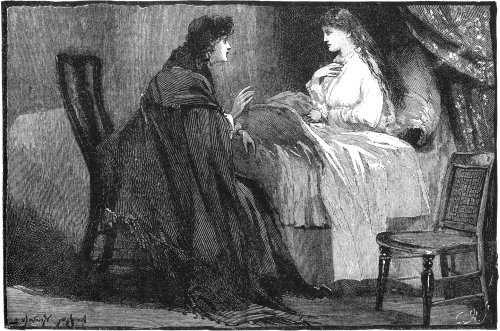
“I don’t know, Fairy. Fetch mother,
will you? We must carry him into the
house,” said Jack, trying to feel if
Charlie’s heart were still beating.
Fairy flew rather than ran into the
kitchen, where Mrs. Shelley was sitting
resting after her hard week’s work,
listening to the shearing songs, and
watching lest Jack’s supper should burn.
In spite of the hard work, perhaps partly
because of it, it had been a very happy
week to her, for she was very proud of
John’s position as captain of the company,
and up to the present nothing had
occurred to spoil the feast; it had been
as merry as any “White Ram” ever
was, but no excess, no coarse jokes, no
irreverent jests had ever been attempted,
and Mrs. Shelley knew, if her husband
did not, that his presence was in itself
enough to prevent their occurrence.
And now what an ending it was to
have.
“Mother! mother! come and help
Jack! Charlie is dead, we are afraid,”
cried Fairy, standing on the threshold,
her great eyes open wider than ever,
and her pale cheeks testifying there was
at any rate some truth in her words.
Mrs. Shelley was not a nervous woman,
and she did not for a moment believe
Charlie was killed, though she rose
immediately to go and see what was the
matter.
“Killed; nonsense, he has fainted, I
suppose. Where is he? What has
happened?” she asked, as she followed
Fairy.
“By the gate. Jack wants you to
help to carry him indoors; he is insensible.”
“Insensible! What has made him
insensible? How did it all happen?”
“I don’t know, it was all so quick.
Charlie wanted me to dance with him,
and Jack was angry because his lamb
is dead, and he hit Charlie with his
crook, and somehow Charlie fell and
knocked his head against the stone
gate-post,” said Fairy.
They were close to Charlie and Jack,
and Mrs. Shelley saw at a glance it was
a more serious matter than she had at
first supposed, and having, like Jack, a
quick imagination, as well as a quick
temper, she guessed what had prompted
Jack to raise his hand against his
brother, and, for the first time in her life,
she turned and spoke unkindly to Fairy.
“Go out of my sight; it is all your
fault; but for you there would never have
been strife between my boys. Fool that I
was to take you in, when something
warned me, even then, it would lead to
no good. Oh! Jack, Jack, my son,
my son, what are we to do?”
Even then, in the first flow of her grief,
Mrs. Shelley’s sympathy seemed to be
for her darling son who had struck the
unlucky blow, and not for the poor boy
stretched lifeless, to all appearance, on
the ground.
“Get him indoors first, mother, and
then I will run to Lewes for the doctor.
If you will take his feet, we can easily
manage him.”
“Yes, yes, to be sure; we don’t want
all those men to know what has happened.
Your father will be out in a few minutes
for some more ale, and then we can tell
him,” said Mrs. Shelley, helping Jack
to carry Charlie to the house.
Again Mrs. Shelley was thinking of
her eldest boy. If, indeed, Charlie were
killed, she knew it would be a terrible
thing for Jack, and in any case she did
not want all this shearing company to
know what had happened, and gossip
about it.
As she and Jack carried Charlie to
the house, Fairy followed, trembling, and
wondering what Mrs. Shelley’s cruel
words meant. Why was it her fault?
What had she done? When had she
wilfully stirred up strife between the
boys? And where was she to go out
of Mrs. Shelley’s sight? Was she to be
turned out of the house because poor
Charlie was dangerously hurt? Frightened
and grieved for Charlie and Jack,
cut to the quick by Mrs. Shelley’s words,
Fairy threw herself on the bench outside
the door, and burst into tears.
A minute or two later, John Shelley,
coming out of the tent to fetch some
more beer from the house, saw the unwonted
sight of Fairy crying as if
her heart would break.
“Fairy! Why, my pet, what is it? Crying
at my White Ram. What is the matter?”
he asked, laying his hand on the
bowed golden head.
“Oh John, John!” sobbed Fairy,
clinging to him, “poor Charlie is dreadfully
hurt; it was partly an accident and
partly Jack hit him, and he fell, and he
is insensible. Go in and see. I mustn’t
come.”
John had not time to stop and ask
why Fairy must not come, but went in to
the little sitting-room, where Jack and
Mrs. Shelley were applying restoratives
to the still insensible Charlie.
“What is this?” said the shepherd,
glancing sternly from the prostrate
Charlie to Jack, who dared not meet his
father’s glance.
“Hush, John! it is a terrible business—listen.”
And in a few words Mrs.
Shelley, who had heard from Jack exactly
how it occurred, told her husband the
story, and what prompted the unfortunate
blow.
“Poor boys, poor boys! Jack, Jack,
what were you thinking of?” cried John
Shelley, stooping over Charlie to try and
see where he was hurt.
“He is alive, thank God; perhaps he
is only stunned; we must go for Dr.
Bates at once,” said John, after a brief
examination of Charlie.
Here a stifled sob broke from Jack,
who was standing with his head buried
on his elbow which he was leaning on
the corner of the chimney-piece, and
caused the shepherd to turn to the son
who was suffering far the most acutely.
John crossed the room to his eldest son,
and put his arm round his neck. He
did not say a word, but as Jack grasped
his father’s hand, he knew that he not
only forgave him, but sympathised with
him also. If they had never understood
each other before they understood each
other now, these two, as they stood half
broken-hearted by the chimney-piece.
Jack understood that whatever trouble
might be in store for him in consequence
of his hasty act, his father would be his
friend and do his best to help him; he
knew, too, that he would never hear a
word of blame from his lips, for as
children, the shepherd had ever been
wont to forgive them directly they
showed any signs of repentance, and it
did not require much penetration to see
that Jack already bitterly regretted his
hasty temper. And the shepherd understood
what it was that had roused Jack’s
anger; in fact, at any rate, he could
quite sympathise with his vexation and
annoyance at the death of the lamb, and
he guessed at his jealousy with regard
to Fairy, for Jack’s love for her was no
secret to his father.
“Jack, some one must go for the
doctor at once. Will you, or shall I?”
asked the shepherd.
“Oh! I will, I can go quicker; besides,
you can’t leave the men yet,” said
Jack, rising and seizing his hat.
“That is the best plan; I can’t dismiss
these men yet, but I will tell them
we have had a bad accident, so I can’t ask
them to stay late, and I’ll come in every
few minutes, Polly, to see how you are
going on,” said the shepherd, as Jack
left the house.
All this happened much quicker than
it has taken to tell, and ten minutes
after the blow was struck Jack was
running across the fields to Lewes like a
madman, knowing that his brother’s life
hung in the balance. While he was
gone John Shelley told the men in the
tent his youngest boy had met with a
serious accident, and was lying between
life and death, and, to their credit, the
men unanimously stopped singing and
took their departure before Jack returned
with the doctor.
So ended John Shelley’s first White
Ram.
(To be continued.)
A VEXED “WOMAN’S QUESTION.”
By ISABELLA FYVIE MAYO.
There is no more vexed “woman’s
question” than that of “clothes.” It has
been said that if we see how a man regards
money and deals with it, we see the whole
character of the man; and we think it is
equally true that if we find out how a woman
or girl feels and acts about clothes, we should
have an excellent key to her nature and
history.
There is the woman to whom “clothes”
are the object of life. This does not
necessarily mean that she is a rich woman,
who can spend much money, nor does it mean
that she succeeds in being a well-dressed
woman. She may be one of those who
indulge in what the poet Crabbe called “The
piteous patchwork of the needy vain,” and
who send “one poor robe through fifty
fashions”; or she may be a millionaire, always
on the alert to catch up the latest fashionable
outrage on good taste and good sense. Only
in either case, dress is always foremost in her
thoughts. The first question she asks about
any public event is, “What did the ladies
wear?” Her first anxiety concerning any
crisis in her own life is, “What shall I put
on?” At church she remembers the
bonnets and not the text; and the moment she
enters an evening party she appraises all the
toilets present, and is unhappy unless hers is
the most modish and costly, whether it be
with the costliness of Worth’s latest whim
from the Continent, or of the last box of
frippery received at the village shop.
If she feels that any reflection is cast on her
waste of time and expenditure of money in the
matter of dress, she defends herself in the
following manner—that she owes it to society
to look nice; that it is everybody’s duty to
make the most pleasant appearance; that it is
well to employ labour and to put money into
circulation, etc., etc. If she has “gone in”
for “culture,” perhaps she may quote
Browning—
“Be thy beauty
Thy sole duty,” etc.
On the other extreme there is the woman
who does not care a bit for dress; who says
she wishes we were born covered with black
fur, or that we might cut holes in a sack for
our feet and arms, and tie it up round our
necks! She carries out her words so far as
generally to appear in garments specially unsuitable
to the occasion on which they are
worn, and seems arrayed in remnants and oddments,
chosen without any regard to her
age, complexion, or circumstances; she thinks
getting up a lace fichu is “a waste of time,”
and finds it too much “bother” to wear the
little ornaments with which family affection
may have provided her. She defends herself
from any charge of slovenliness by pointing to
the swamp of petty frivolity in which too
many female lives are sunk, and avers that she
scorns any regard which would be influenced
by what she wore or did not wear. It may be
said in her favour that she generally grows
tidier and trimmer as she advances in life, and,
proving much more amenable to the criticisms
of “her young people” than she was to the
raillery of school friends and cousins, is often
a matron of comely and attractive appearance.
Then there remains the great multitude between
these extremes—a multitude who does
not quite know its own mind, and cannot find any
principle whereby to regulate its movements;
who wants to look pretty and to please, yet
is afflicted in its conscience when it reflects on
the sin of personal vanity, and on our responsibility
for the souls and bodies which are
perishing at our gates; a multitude who is
sadly tossed between the conflicting arguments
of the more strongly-biassed ladies whom we
have just described, with the demoralising
result that it generally leans in practice towards
the former, and in theory towards the latter.
It is this great multitude of girls and women
whom we would like to help by offering a few
broad principles for their consideration; for
principles underlie everything. And it is only
by our grasp on principles that we can guide
ourselves through the ever-varying details of
duty.
Let us say at once that it is the right of all
to be well dressed, because that means to be
dressed suitably to the climate and circumstances
in which they live, and to their occupation,
age, and appearance. A woman may
be quite as well dressed in print and serge as
in velvet and satin. When you hear people
complaining that “nowadays everybody will
go so well dressed,” you hear a misuse of
language; and language loosely used is a
dangerous thing; because it leads to looseness
of idea. Nobody has any right to complain of
anybody’s being well dressed. What they
really mean is that these are unsuitably dressed.
And there is a great deal of unsuitable dress in
the world of the kind, more or less in degree,
of that seen in the daughter of a parvenu
millionaire of the Western States, who, when
she went to a sensible New England seminary,
where the young ladies were expected to wait
on themselves, descended to the scullery in a
velvet robe and diamond earrings!
Anybody, therefore, is not well dressed whose
attire unfits her for the performance of those
actions which ought to be her duty. The
tight-laced, be-flounced be-trained damsel
proclaims to the world her utter unwomanliness.
The nursery would soon make havoc
in her finery. Let us hope she would never
carry it into a sick room, and in the kitchen it
would be a nuisance and a bad example. But
then “Isn’t it pretty for wearing in the parlour
during those hours when we are doing nothing?”
Let us reply with other questions: “Ought
there to be hours when we are doing nothing?”
And “In providing ourselves with clothes only
fit for such occasions, are we not falling into
the error we often smile at in working men
who will buy stiff, uncomely Sunday garments
of broadcloth and silk hats, instead of providing
themselves with gala suits of the sensible
tweed that will serve afterwards for
work-a-day wear?”
We began by saying that everybody has a
right to be well dressed in the true meaning
of the phrase. But, as Ruskin says in his
grand “Letter to Young Girls,” “Although
in a truly Christian land every young girl
would be dressed beautifully and delightfully:
in this entirely heathen and Baal-worshipping
land of ours, not one girl in ten has either
decent or healthy clothing, and you have no
business, till this be amended, to wear anything
fine yourself.” And Jean Ingelow, a
writer with whose works you cannot too soon
make acquaintance, brings this indictment
against our sex—“For them mainly are the
gorgeous pageants, are the costly clothes, the
gold lace, the carpets of velvet pile, the
diamonds and the splendours of life. The
pride of life is in their souls, and mainly for
them. It is luxury that stands in the way of
the civilised world, so that men cannot marry
young and be happy. For the earth does not
produce unbounded riches for a few while yet
the many can have enough. Equality is a
word without meaning or possibility; but notwithstanding,
squalor and destitution might
be things outside our experience, as should be
luxury and waste.”
This brings us to the principle that should
guide our expenditure, whether the sum at
our command be large or small. Of material
we should buy the best and most durable
within reach of our purse. We have no right
to keep people employed in weaving and
making up useless and perishable shoddy
articles. It is a dishonour to them to do such
work, and if they are forced to do it that they
may get bread to eat, we are keeping them in
the worst kind of slavery. That we pay them
for it does not make it any better, any more
than if we paid them for any other degrading
and wasteful service. We insult them by
taking their industry and trampling it under
foot, as if they had no concern in their work,
but only in their wages. How can the industrial
classes retain self-respect under such circumstances?
And when self-respect is lost, respect
for others always goes also. Quite
lately we saw a lady sitting in a dressmaker’s
room watching the “setting-up” of what was
considered a very grand garment. Its materials
were certainly of the costliest, but it had
yards of delicate silk trailing on the ground to
an extent that must have ensured their speedy
destruction, even on the most ceremonious
occasion, and over the short front skirt hung
masses of tulle, festooned by elaborate iridescent
glass drops, worthy of the decoration of
a South Sea Island god! Seeing our friend’s
grave face, we asked her what she was thinking
of, and she replied, “I am thinking of
the men who wove that silk to be trodden on,
and the girls who sewed those beads to be
smashed. Poor things! I would rather be
the grimiest maid-of-all-work toiling for real
human needs, or the roughest tailor or cobbler,
working to cover honest human nakedness.”
Let all dress, therefore, always be as durable
as can be, both in material and mode. As to
“fashion,” even that has a root of necessity
and common sense, because dress must change
as social habits and customs change. Ruskin
advises that no garment should ever be thrown
aside because unfashionable, and that no costly
fashion should ever be followed. Think what
that word “costly” involves. Tight lacing,
heavy flouncing, open bodices, high heels,
and so forth, costly of health; dead birds’
wings, and everything else costly of suffering;
complicated trimmings, costly of time and
human energy in a world where there are
thousands of little children growing up ill
taught, thousands of sick people dying ill
tended, thousands of industrious folk slaving
to death for a paltry pittance.
It seems to us that when a lady has once
discovered the dress best suited to her age,
appearance, and condition—the ideal robe in
which she would wish to be painted for the
eyes of unborn generations—her future study
will be, not how much she can “follow the
fashion,” but how little she need follow it to
escape singularity. Fashion has nothing to
do with a desire to be pleasant in the sight
of others. Let any of our readers turn to the
graceful studies of girl-life with which M. E. E.
makes us so familiar, and then to the figures
in any fashion-plate, and ask themselves candidly
which are most likely to commend themselves
to the eye of artistic taste or of domestic
affection?
And here we come to the matter of making
ourselves “fair to see.” This is a decided
duty. We have to make ourselves attractive
to those whose love we desire, and to those
from whose wisdom we wish approval. But
we imagine that the desire to be loved and
approved has a very small share in extravagance
and fantasticalness in dress. Let us
speak out plainly. We seldom befrill and
bedeck ourselves, and waste time and money,
to please our parents or friends, but rather
to spite and outshine our “dearest enemies”
among our female acquaintances. Suitability
of style, dainty freshness, and tasteful variety
will always satisfy love; and good sense, combined
with a little industry and taste, will
easily secure these desirable objects. I remember
the approving notice bestowed by a great
divine and philanthropist on the appearance
of a young literary woman, who, travelling
under difficult and troublesome conditions, was
provided with a very few dresses of the plainest
quality and style, but who by artfully varied
arrangements of muslin or lace and coquettish
little additions of tasteful ribbon, managed to
give her friends’ eyes an ever-new surprise and
pleasure. Can there be a prettier picture than
that of a modest little maiden trying how a
rose-coloured bow will brighten her sober
dress, to please papa—or perhaps somebody
else?
And now we come to the consideration of
“luxury.” If we are always to remember the
ignorant and the starving, are we never to
have anything whose price might have paid
teachers or bought bread? Let us hear
Ruskin again:—“What of fine dress your
people insist upon your wearing, take and
wear proudly and prettily for their sakes.”
Let us never seek luxury of any sort—let us
rather avoid it; but let us still accept it with
delight when it comes to us by the hands of
genuine love. The diamond in a girl’s engagement
ring, the gold locket enclosing her
mother’s portrait, the dainty filigree bracelet
sent by her brother abroad, the exquisite lace
set worked by her dearest friends, are on
quite a different line from the fashionable
jewellery and ornaments which she buys for
herself or teases her relatives to buy for her—as
different (with all reverence be it written)
as the gift of the alabaster box of precious
ointment tendered by a loving woman to her
Master is different from the cases of Rimmel’s
perfume which are squandered at every
ball.
And thus we see that the great principle
which underlies this vexed “woman’s question”
of clothes is the great principle of love
itself—love, serving others, considering others;
love bestowing, love receiving. Such love
needs no law, being itself the highest law.
THE ROMANCE OF THE BANK OF ENGLAND; OR, THE OLD LADY OF THREADNEEDLE STREET. — CHAPTER III.
By EMMA BREWER.
ou want to know where
they obtained the money
in order to lend it?
Well, from all those who
had money to deposit—the
merchants, the widows and
orphans whose small incomes
were derived from
money lodged with the
bankers; these all received
a small interest from the
goldsmiths, who lent their
money again at a much
larger interest; so you can
see that when the king refused
to pay, it was not possible
either to return the principal
or pay the interest to those of whom they
had borrowed. Great was the distress, therefore,
not only among the merchants, but among all
who had lodged their money with the goldsmiths.
The voice of the people grew so loud
and angry, that at length Charles found himself
compelled to pay the interest, though he
never paid back the capital. In 1625 King
Charles sent the Duke of Buckingham to
Holland to borrow £300,000 on the pledge of
the Crown jewels.
You can see by what I have told you how
difficult it was for the people to find secure
places wherein to deposit their money, and
how ruinous was the interest demanded if, on
the other hand, they desired to borrow.
Great, indeed, was the need of some establishment
capable of advancing money at a reasonable
rate on the security of Parliamentary
grants. One or two private bankers of high
repute strove to improve matters. Especially
may I mention Child and Hoare. To the
former by common consent belongs the celebrity
of having the first banking house, which was
established in 1620 on the site of the present
building; and I am proud to bear testimony
to the fact that from that year to the present
day, all through the troublous times of banking,
it has maintained the high position and
respectability in which Mr. Francis Child left
it.[2] Hoare’s bank was established in 1680.
These men did something towards steadying
the money market; but it was left to me
to clear the country of the insecurity and
rapacity which had so long obtained.
Before proceeding with my personal history,
I should like to explain a certain method
of keeping accounts before I came into power,
which accounts I strictly paid up as they fell
due. It was known by the name of tallies,[3]
or tally.
“The word ‘tallies’ is derived from the
French, and signifies cutting. The tallies
were pieces of wood cut in a peculiar manner
to correspond or tally. For example, a stick
of hazel or some other wood, well dried and
seasoned, was cut square and uniform at each
end. The sum of money which it bore was
cut in notches (a notch signifying so much,
according to the size) in the wood by the
cutter of the tallies, and likewise written upon
two sides of it by the writer of the tallies.
The tally was cleft in the middle by the
deputy chamberlain with a knife and mallet,
whereby it made two halves, each half having
a superscription and a half-part of the notch
or notches. Thus cut, one part was called a
tally, the other a counter-tally. When these
two parts came afterwards to be joined, if they
were genuine they fitted so exactly as to be
parts one of the other.”[4]
You will understand, therefore, “that the
notches corresponded to the sum for which it
was an acknowledgment; the writing on the
other sides containing the date and the payer.
The rod was so cut that each half contained
one written side and half of every notch. One
part was kept in the Exchequer and the other
was circulated.
“When the time of payment arrived, the two
parts were compared, and if they tallied or
corresponded all was right; if not, there was
some fraud, and payment was refused. Tallies
were not finally abandoned in the Exchequer
till 1834.”
Having thus cleared the ground, I will proceed
with my story.
You already know of the sensation which my
appearance in the world caused, but I have
not yet told you that I started in life with the
sanction and support of the Government, and
that I received my Charter of Incorporation, as
it was called, on the day I was born.
Those who had the charge of me found it
no easy matter to fulfil all that was demanded
of them by the Government for my safety.
For, by Act of Parliament, passed especially
for my benefit, they were authorised and commanded
to raise the sum of £1,200,000 within
a given time by voluntary subscriptions, and
in case of their failing to do this, I was to lose
my charter.
This was a most difficult undertaking, and
under the circumstances its success was
doubtful; for, as you may suppose, I had
many enemies among the money-lenders and
people opposed to the Government, who, from
self-interest, did all in their power to ruin me.
Happily, however, the subscriptions came
pouring in from individuals, both native and
foreign, and from bodies political and bodies
corporate, and that so rapidly that within
ten days the whole sum was obtained and my
charter secured; and thus, bound together
with the subscribers, I became a corporate
body, under the name of the Governor and
Company of the Bank of England.
And now I must tell you that with this
£1,200,000, my original capital, I did my first
stroke of business, which was to lend it to the
Government, who were in want of money to
prosecute the war, and who for the loan of it
paid me interest at the rate of 8 per cent.,
with a further allowance of £4,000 a year for
management, which, if you reckon up, you
will find afforded me an income of £100,000
per annum—a nice little sum to start in life
with.
To understand my position, you must hear
something of my household and my housekeeping.
It was deemed needful and proper that I
should have a governor, sub-governor, and
twenty-four directors, all of whom, it was decided,
must be either natural-born subjects or
have been naturalised; and further to render
them eligible for my service, they must have a
certain sum of my stock—Bank of England
Stock—standing in their names and for their
use. The governor must possess £4,000 of it,
the sub-governor £3,000, and each director
£2,000, at least.
Regarding my position at this present time,
you will scarcely believe how simple and
economical was my way of living originally.
I occupied only one room in the hall of the
Grocers’ Company, and employed but fifty-four
assistants, whose united salaries did not
exceed £4,350.
I must here state that my governors and
directors were no expense to me, but served
me without proposing any advantage to themselves,
save and except the interest they
would receive from their contributions to the
capital stock of £1,200,000, and the position
they would derive from being of my household.
It was in this one room, with almost
primitive simplicity, we lived and performed
the duties of our household. I have a letter
in my pocket, yellow with age and almost
crumbling to pieces, written by a gentleman
who paid me a visit in the days of my youth.
He writes: “I looked into the great hall
where the bank is kept, and was not a little
pleased to see the directors, secretaries, and
clerks, with all the other members of that
wealthy corporation, ranged in their several
stations, according to the parts they held in
that just and regular economy.”
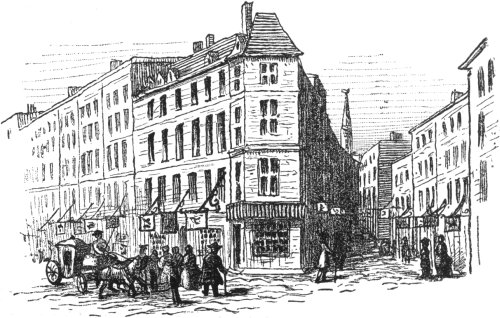
GOLDSMITHS’ ROW.
It is a pleasant picture which he draws, and
one that I love to look back upon. I think we
all derived benefit from working together in
that intimate and kindly manner; it made us
strong and of one mind. Of course, I have
grown quite accustomed to a much grander
way of living; it is a sign of my prosperity and
my usefulness, and I am thankful, but I am
afraid if you came upon me unawares in my
grand parlour you would find me with a sad
sort of yearning for the early primitive
simplicity and kindly feeling.
Many were the rules and regulations I was
subject to in those early days, and even now,
all powerful as I feel myself to be, I am still
governed by them. They were irksome, but
I never thought of rebelling, for I knew that
their object was to give me a high position
and keep me out of the way of temptation to
meanness and dishonour.
One was that I must never trade in any
wares, goods, or merchandise whatever.
Another, that I was never to borrow or owe
more than the amount of my capital, and that
if I ventured to disregard this command I
should bring down punishment on the heads
of those whose money had endowed me with
my fortune.
Again, I was strictly forbidden to pay any
dividend at any time save only out of this same
capital or stock.
Yet one more, I was to lend no money to
the Government without the consent of the
Parliament, under a penalty of three times the
sum lent, one-fifth of which was to go to the
informer.
How little I thought that a strict adherence
and submission to this early discipline would
pave the way to a future in which my movements
would influence the whole body of the
public, my opinions and determinations affect
all the markets of the world, and in which my
one room would have extended itself beyond
three acres of ground; but I must not get on
too fast—you will see all this for yourselves as
the years of my history roll on.
My early life was not without its cares and
struggles which strained to the utmost the
talents and energy of my household. I was
but three years old when I was first attacked,
not as you may think, by scarlet fever or
measles, but by ill-treatment and cruel
sarcasm.
A child, by name Land Bank, living at
Exeter Change, not very far distant from
Grocers’ Hall, was ridiculous enough to set up
as my rival. Had she confined herself to fair
play while striving to win from me public
favour, I think I should rather have enjoyed
it, but believing that all things were allowable
in love and war, she descended to be spiteful,
and being gifted with humour and wit she
used them against me without mercy.
Papers were circulated in all directions with
the one view of injuring me. You will be
able to see them, as I have preserved copies—
Here is one—“The trial and condemnation
of the Land Bank at Exeter Change, for
murdering the Bank of England at Grocers’
Hall.”
Another, which had a wide circulation, was
one supposed to be my last will and testament,
in which “I bequeathed my obstinacy
and blunders, my self-conceit, my blindness,
my fears,” and in which “I commanded my
body to be burned lest my creditors should
arrest my corpse.”
A third contained an epitaph—
“Here lies the body of the Bank of England,
who was born in the year 1694—died
May 5th, 1696, in the third year of her age.
“They had issue legitimate by their common
seal £1,200,000 called bank bills, and by their
cashier two million sons—called Speed’s notes.”
These papers, so widely circulated, were not
without their effect, and for some time I and
my people were in no enviable position. We
had to struggle for a precarious existence—in
fact, we had a difficulty to make the two ends
meet.
My notes were at a heavy discount, and I
had not always the money to meet the demands
of my creditors. And, just as it always
happens when one is short of money, everybody
wanted to borrow of me, amongst others
the Government sadly pressed me for a loan.
Oh dear, that was a troubled period of my
life, but help came and prevented disaster by
tiding me over the difficulty.
It was very long before I found myself in a
like dilemma, for I soon learned that to be
short of money or, in fact, any difficulty in
money matters, would deprive me of the confidence
of the public, and that would never do;
for to me, more than to anyone, confidence
was money.
It was cruel behaviour of the Land Bank,
but fortunately, except that it gave me a
period of great anxiety, it did me no permanent
harm. Indeed, now that I look back
upon it from this distance of time, I think it
was clever of the Land Bank to handicap me,
a young beginner, with her weight of merciless
wit, a thing very hard to deal with, or even to
trace, when once it has issued from mouth or
pen.
This little trouble being over, we went about
our daily work in the one room as usual;
work, which was gradually increasing both in
quantity and responsibility, occupied us from
morning till night, and the way in which we
performed it called forth many a word of
praise. I remember seeing the following in a
journal which encouraged and pleased me
greatly—
“There never was a body that contributed
more to the public safety than the Bank of
England, and who upon every emergency has
cheerfully and readily supplied the necessities
of the nation, and in many important conjunctions
has relieved the nation out of the
greatest difficulties, if not absolutely saved it
from ruin.”
I may be excused for feeling proud, for I
began to see that not only was I fulfilling my
mission, but that the world was aware of it.
The work which occupied my early days
was very complicated, although it fell far short
of what I now perform. I will try and give
you a little idea of how I spent my days.
Picture to yourselves my one room, with its
directors, clerks, and secretaries each at his
table or desk and ready for the special work
allotted to him.
You want to know where I sat, I, the young
and handsome girl. Well, I was everywhere,
infusing life and energy and cheerfulness into
all.
With clear head and accurate mind, I
watched and verified every transaction,
encouraging and helping all who came to me
as far as it was possible, and giving my
warnings gently where no help could be
extended.
All is ready for business—it is early
morning—and soon the door opens to admit a
few at first who bring in their hands the
peculiar sticks notched and written on, which
were called tallies, and which I have explained
to you in a previous part of my story. These
people make their way up to a certain table
and ask that money may be given them in
exchange for the tallies.
This is readily granted for a certain consideration,
provided the tally be correct—or
may be, they desired to lodge the sticks with
me. In any case I obliged them, and by my
action I made tallies current payment in the
land which, as my friend, Michael Godfrey,
stated in his quaint pamphlet, “The country
had long wish’t for,” and which certainly
could not have been effected without me.
If you watch, you will see others passing
into the room, bringing securities of many
kinds and asking to borrow money upon
them, which was readily granted, at much less
interest than had ever been demanded before.
Others, who had confidence in me, came to
ask that their money might be lodged
with me, to which I assented, telling them
that not only would we give them interest for
the money so lodged with me, but that it
would be as much at their disposal as though
kept in their cash-box at home, and very much
safer.
No. 1 is an exact copy of a section of an Exchequer Tally acknowledging the receipt of £236 4s. 3½d. on Oct. 25, 1739, from Edward Ironside
Esq., as a loan to the King on Three per Cent. Annuities.
No. 2.—Each large notch represents £100, and a single cut of the notch signifies half the amount. Thus the upper line of No. 2
represents £250.
It was to the interest of all concerned in my
establishment to reduce the interest of money,
otherwise we could not have used it to advantage.
We were receiving only 8 per cent. for
my stock; the lower, therefore, we brought
all other interest, the more valuable was my
stock.
Previous to my starting in life, the nation
had been paying from 12 to 20 per cent.
interest for money, which, if it had continued,
must have ruined the kingdom; and as, by
the way I did my work, this would be no
longer necessary or possible, those who had
been, up to this time, making money in this
fashion, were compelled to spend it on land
or lend it at a moderate rate.
Others came in during the day to have their
foreign bills of exchange discounted, which I
did at the rate of 3 per cent. per annum,
undertaking the inland bills and notes for
debts at 4½ per cent. per annum.
This was the kind of work which I performed
in my early days, and upon which has
been built up that wonderful fabric of money
transactions associated with my name in this
the nineteenth century. I am afraid the very
relation of my day’s work two hundred years
ago has wearied you; if so, forgive me. I felt
it necessary to my character to show you that
the work undertaken by me from the very first
was good and honourable, conscientious and
helpful, and that wherever my household did
a good stroke of business for itself it was not
at the expense of others’ ruin; on the contrary,
we could not help ourselves to riches without
extending the benefit all round.
(To be continued.)
CHRISTMAS IN ITALY.
e were spending a
winter on the Riviera,
and, after
trying various hotels
in town and
country, had
finally established
ourselves in a
pretty little Italian
villa, palazzino, as
the peasants called
it, not many miles from
Genoa.
From the terraced garden
there was a wide and splendid
view. On our left, as we
looked seawards, was the city
herself, her marble palaces
and churches rising crescent-wise
behind the bay, which on the eastern side
is bounded by the headland of Porto Fino.
Facing us was the shining sweep of the Mediterranean;
while to the right hand the Alpes
Maritimes trended away into the far distance,
their giant peaks and hollows an ever-present,
ever-changing feast of colour—whether seen at
early dawn, a glory of rose and gold; or at sunset,
a gorgeous vision of amber and crimson, and
softest, tenderest violet; or under the southern
moonlight, a study in oxydised silver.
For me mountains have always had a peculiar
fascination, and no landscape ever seems
complete without them. I could spend, and,
indeed, did spend, when in Italy, many
an hour in watching their changing hues.
But to-day none of our party had time for
indulging in mere sentiment. Throughout
the week we had been rambling among the
hills and valleys in quest of mosses, ferns, and
other greenery wherewith to decorate the
house; for this was Christmas week, and the
day after to-morrow would be Christmas Day
itself.
How difficult it was, even as we worked at
the familiar mottoes and rejoiced over the
holly, which, after a seemingly hopeless search,
we had at last found in a remote corner of the
Doria woods—how difficult it was, I say, to
realise the fact that this was the 23rd of December.
Why, the garden was full of roses,
camellias, and heliotrope; the air was as soft
as upon a summer’s day in England; and we
were out of doors in thin woollen dresses and
large, shady hats, rejoicing in the brilliant
sunshine.
We had to give up our pleasant work early
that afternoon, as we had engaged to help at
a children’s party given by a kindly English
doctor in the neighbouring village. He had
hired a large room at the hotel, and invited
about forty children to a sumptuous tea; and,
though wintering abroad for health’s sake, and
with doubtless many an anxious thought for
wife and little ones at home, he most unselfishly
catered upon this evening for the amusement
of “other folks’ children.”
The long table was covered with dainties
such as little folks love, while assiduous waiters
handed round cups of delicious-looking coffee
and chocolate.
Tea over, there was an adjournment to
another room in which all kinds of merry romps
were carried on for an hour or two, a general
distribution of presents took place, a hearty
cheer was raised for the kind doctor, and the
young flock trooped gaily home.
Christmas Eve we spent in really hard work
over our decorations. The dining-room was
made festive with mottoes in pine sprays
and trophies of orange-boughs laden with fruit,
while the drawing-room was adorned with
maidenhair fern, lycopodium moss, arbutus-berries,
and the much-prized holly before mentioned.
Then, about six p.m. we started to
spend the evening with some charming neighbours.
The host was German, his wife English, and
their two children spoke both languages with
equal facility, adding thereto no mean proficiency
in Italian. An Italian marquis and
his younger brother, a married sister of our
hostess, with her husband and little girl, a
German composer, with our own quartet,
made up the party. We were at once ushered
into the room in which the Christmas tree had
been placed; for the children, at least, were
on the tiptoe of excitement as to their gifts;
and thence, after due distribution thereof, we
adjourned to the dining-room for high tea.
The table was a picture, with its bowls
of crimson or pale-pink china roses. Each
couvert had its own bouquet of heliotrope,
fern, and camellia; while the profusion of handsome
silver and of ancient Nuremberg glass
combined still further to set off the tasteful
appearance of the whole. What with the many
German dishes, and the chatter of the German
tongue all around me, I seemed to be transferred
bodily from the shores of the Mediterranean
to the dear and well-remembered
Fatherland—an illusion which was not dispelled
until an hour or so later on, when we
found ourselves walking homewards under the
brilliant, starlit sky of the south. On this
particular night, too, the stars were shining
with a radiancy which in England would betoken
a hard frost; only that in this case the
stars themselves looked so much larger, and
in many instances shone with such intensity
as to make themselves the centre of a distinct
halo.
We met numbers of people on their way to
midnight mass, either at the various shrines in
the mountains or at favourite churches in
Genoa, and at about eleven p.m. the bells
began to ring, and went on at intervals for
four hours, when they ceased for a time, to
recommence at five a.m., and summon the
worshippers to early mass.
I inaugurated Christmas in Italy by dressing
with open windows, then joined the younger
members of our party in carol-singing outside
our hostess’s bedroom door; after which we
all descended to the dining-room—not, as it
would have been, in England, to spread out
icy hands and feet to the welcome blaze of a
roaring fire, but to open the long French windows
and to stand awhile upon the balcony
watching the lizards flitting swiftly in and out
among the crevices of the marble, and the
green frogs jumping about the boughs of the
orange-trees.
Breakfast in Italy was never a heavy meal;
but to-day, in honour of the day, polenta cake
and chestnut bread were added to the usual
omelette and roll, to which due attention
having been paid, we returned to the balcony
and eagerly awaited the postman.
He brought a goodly supply of letters for
each of us, and with thankful hearts we set
out for morning service.
The church was full of roses—red, white, and
yellow. Arbutus and fern wreathed the east
window and the chancel arch; and designs of
roses upon a mossy ground filled in the panels
of lectern and reading desk and the wide
window-sills. There was, of course, a good
attendance, and all joined with spirit in the
service; but our clergyman rather damped the
conclusion of it by preaching a very long and
exceedingly dolorous sermon, in which he
harped upon “vacant chairs,” “absent friends,”
“broken circles,” and “dear invalids,” until
he had reduced two-thirds of the congregation
to tears.
Our dinner-party included a few English
friends staying at the hotel, and one or two
Italians, the latter being as much interested in
our national customs as we were in theirs. It
was certainly quaint enough to find that the
Eastern Counties doggerel had its counterpart
among the shepherds of Sardinia, with whom
it is generally used as a cradle song.
“Lu letto meo est de battor cantones,
Et battor anghelos si bei ponem,
Duos in pes, et duos in cabitta.
Nostre Segnora a costazu m’istu.
Ea mie narat: Dormi e reposa,
No hapas paura de mala cosa.”
In Upper Italy they sing—
“Dormi, dormi, O bel Bambin,
Rè divin.
Dormi, dormi, O fantolin,
Fa la nanna, O caro giglio,
Rè de Ciel.”
And a gentleman who joined us later on
wound up our charming evening by singing
to a strange old chant the following Burgundian
carol, written, as my readers will perceive,
in alternate lines of French and Latin:—
“Voici la Roi des Nations,
Natus ex sacra Virgine:
Ce fils de bénédiction,
Ortus de David seminæ;
Voici l’Etoile de Jacob,
Quam prædixerat Balaam:
Ce Dieu qui détruisit Jéricho,
In clara terra Chanaam.”
DRESS: IN SEASON AND IN REASON.
By A LADY DRESSMAKER.
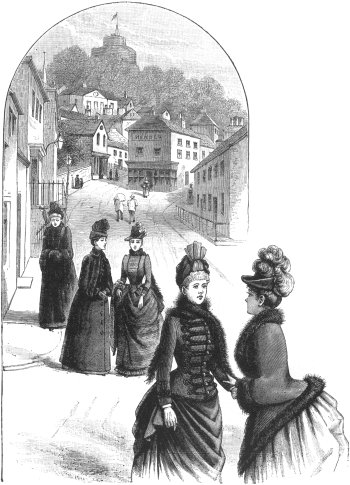
BELOW LAUNSTOWN CASTLE.
The advent of new ideas in clothing has
been later this year than usual, and we
were well into the middle of November
before we recognised many things as
novelties in the shops, even though they
were well filled with new dress manufactures
as usual. Stripes are a great deal
worn in all materials, but checked stuffs
show signs of being rather more popular,
and the fine-lined checks with which we
began the autumn have grown into greater
squares as the time has gone on. But
these new checks are not at all in the
direction of Scotch plaids, nor do they
show any tendency to such garish colouring.
Their hues are singularly well chosen,
and even when the plaid is large it is
neither ugly nor aggressively visible.
They are never produced in more than
two shades of colour, and they are mostly
made up with velvet of a dark shade,
nearly akin to that of the darkest shade of
the plaid. These woollen materials are
coarse and heavy-looking, and nothing
seems more popular than serge and serge
grounds to woollens of all kinds. Angola
wools, with their long, untidy-looking,
hairy surfaces, are also much liked; nor
must I forget the new woollens, with
stripes of braid in high relief on them.
There are great numbers of fancy silk
materials to mix with fine woollens, such
as chess-board designs in velvet and plush
on a satin ground; plain and fancy stripes
in plush and velvet; velvet,
with crossbar designs
in terry; brocaded
silks, the brocade being
in velvet, terry, or plush;
and silks with stripes in
imitation of lace. All
these may be called trimming
materials, and are
used for underskirts for
woollen materials as well.
There are several
things in the winter
fashions which are quite
fixed. First, that there
are no trains to any
dresses, whatever people
may say—save and except
to court dresses and
the evening gowns worn
by a few dowagers who
fancy old ways the best. The general idea
with reference to all draperies, overskirts,
panels, and skirts is to give length and height;
therefore, those of my readers who are very
tall will have to use some judgment in choosing
a skirt that shall not make them look too
gigantic. Most of the morning dresses are
made of two woollen materials, a better kind
of walking or afternoon dress with a woollen
and silk material, such as I have described.
There do not appear to be any really short
tunics, but some dresses have the long overskirt
more raised and bunched-up at one side
than they have been. The skirts are generally
rather wider, but are not distended, except by
a moderate tournure. The collar, cuffs, and
revers are of the same material as the underskirt,
and bands of this material are put round
the edge of the overskirt. When this is a
plaid it is cut on the bias, and with plaids folds
are very much used everywhere that they can
be introduced.
The chief changes that one has to chronicle
are to be seen in the sleeves of dresses, which,
after remaining quite stationary and unaltered
for a long time, have now quite blossomed
out into new beauty of form, much of which,
I think, is derived from Venetian
portraiture. The sleeves
of evening gowns are all of
this class, and have puffs of
thin material from the shoulders
to the elbow; ending in
a plain band of velvet, or a
puff of transparent material at
the elbow. Some sleeves
have puffs inside the arm at
the elbow, and end in a plain
band or cuff round the arm.
In the daytime deep cuffs are
much worn; they are cut so
as to stand away from the
arm like the deep cuffs
of a cavalier glove. Then
there are puffs at the
shoulder; and there is
also a new sleeve that has no seam at the back
of the arm. Shoulder-straps and epaulettes are
very popular additions to the bodice; and we
find shoulder-straps without epaulettes, and
epaulettes without shoulder-straps, or both
together. Some of the shoulder-straps to
woollen dresses are of the material of the
dress, which may be braided or embroidered.
One bodice which I have lately seen struck
me as being both ugly and peculiar, and it
must, I am sure, be a faithful copy of a railway
porter’s waistcoat—with its front of
corduroy, and its back of linen. In the copy,
the fronts are of velvet, fancy or plain plush,
and the backs are of plain silk to match it in
colour, the sleeves being also of silk. One of
the new fancies is to make the dress-sleeves
like the waistcoat or plastron, the bodice being
of a different stuff, and having a small
epaulette on the shoulder. I have been careful
to give all these changes in detail, as they
will, I know, be very valuable to the home
dressmaker, and to those on whom the burden
rests of “doing up” half-worn dresses, and
making themselves look well and ladylike on
small means.
Bodices are a great deal trimmed at present.
Waistcoats, plastrons, and full or plain plastrons
with long revers that extend from
shoulder to the point of the bodice, as well as
braces, are all forms of trimming. The latter
are now put on much higher than they were,
and are carried close to the band at the neck,
and they sometimes meet in the centre of the
back. The sleeves are often trimmed round
the shoulder-seams on the bodice—a very
useful fashion indeed, as the sides, which are
too well worn by the friction of the arms, can
be made quite respectable for a longer term of
service.
There is no change in the way of making
dress bodices. The basques are all cut very
short on the hips, and are generally ended in
a square-cut tail at the back, with a fan of
pleats, or even plain, and not with ornaments
at all. The darts in front are cut very high,
and are straight in form; and there are two
side pieces—one quite below the arm; and the
seam of the side piece at the back is as
straightly cut as possible. The great fancy is
still for a narrow and flat back, and all methods
of cutting out tried to produce this effect.
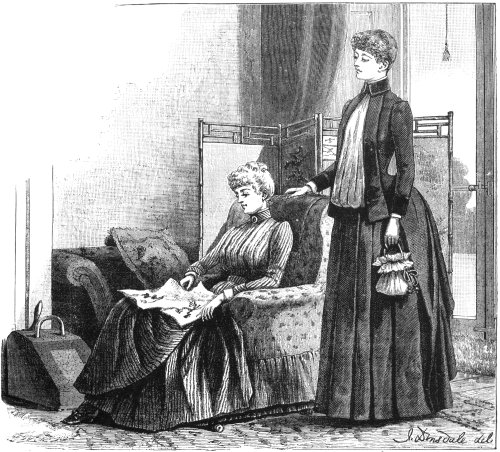
IN A CORNER OF THE DRAWING-ROOM.
There is not very much to relate about
mantles this month. They all seem to be
short at the back and long in front, the ends
being either square or pointed. In the latter
case many of them are tied with ribbon bows,
or have other ornaments of braid, beads, or
chenille. Striped materials are used for
making up handsome cloaks; and ulsters are
usually made of checked woollens, though
they are by no means “loud” in tone. The
small mantles of plush, brocade, and velvet
are very much trimmed and ornamented; and
in this way—as the beaded trimmings and fur
bands are moderate in price—mantles that
have already seen service may be helped over
another winter. The long jackets will be
found to cut into shape very well; and I
have recently helped to alter a paletôt which
had been dyed, by cutting it up nearly to
the waist, at the back, and into deep square
ends in front. The trimming then laid on
was black astrachan, about two and a half
inches deep all round, and in a V shaped
point on the back, with cuffs and a tiny
epaulette on the sleeves, making it quite a
new garment at a very small expense, viz.,
2s. 6d. for the dyeing and about 6s. for the
five and a half yards of astrachan.
Instead of the almost forgotten sets of
linen collars and cuffs, many ladies are wearing
pleated satin, the pleats
being very close and small.
The satin is used in various
colours, and appears also in
the necks and sleeves of
evening dresses, especially in
black ones, where the bright
hues of the satin look refreshing.
A velvet bow may
finish it at the neck.
These are certainly halcyon
days for the home milliner,
for so little trimming
is placed on bonnets that it
is quite worth while to manufacture
them at home, after a
look at the many shown in
the windows. Care must be
taken to set the bows in
front up well, and, if a soft
material, a long bit of wire
will form a support.
The flower of the day is
the white chrysanthemum,
and one sees it everywhere—on
dinner tables, as button holes, and forming
bouquets. Very few flowers, however, are
seen in millinery, and ribbons seem in greater
favour. A new idea in the way of dress
pockets is to have the pocket made as a little
gathered bag or reticule, which hangs at the
side for the handkerchief.
The stockings produced for wearing this
winter are quiet and ladylike-looking, being
self-coloured, to match any dress with which
they may be worn; or, if embroidered, the
patterns are small, or the stripes are merely
fine lines of colours. The newest shoes all
appear to lace, not button; and this will
probably keep them in all the better shape, as
they can be pulled tightly together or loosened,
as desired. Laced boots are also returning to
favour, for the same reason; but I do hope
my girl-readers will not neglect their laces,
and always try to keep a spare lace in the
house, in case of breakages, as nothing looks
so bad, or is really so wretched in wear, as a
broken or an untidy, unevenly pulled-up lace.
For skating, of course, laced boots are a
necessity.
The new winter muffs of fur are not large,
and nearly all of them are supplied with a
purse or pocket of some kind, and also have
handles of fur, which are more convenient than
the purse; for the muff can be slung over the
arm when shopping, or when it is necessary to
keep the hands free; a style that seems more
sensible than the long cord round the neck for
grown-up people. Long boas are not quite
so long as they were, and are now more used
with one long tail hanging down than two,
the other end being the head of some furry
creature—mink, marten, or squirrel; and so
far does this idea go, that the legs are often
seen as well, which is a painfully suggestive
idea.
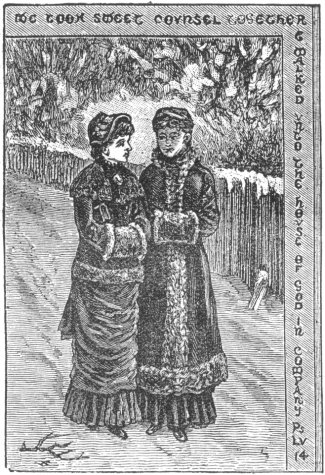
Our illustrations for this month are
peculiarly successful in showing the prettiest of
the winter styles, especially in the larger
picture of out-of-door gear. The long cloaks
are shown with two different styles of trimming,
and a short jacket braided with thick
cord—which is very girlish and graceful.
So, also, is the short mantle trimmed with
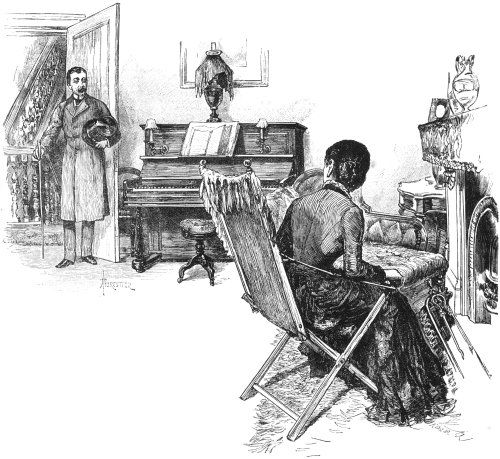
bands of fur. In the corner of the drawing-room—which
serves as a warm and cosy refuge
to two of our girls—we have our paper
pattern of last month illustrated, with a
plastron of soft silk added to it, for wearing
in the house; while a waistcoat is used for the
out-of-doors dress. The young girl in the
armchair wears a “Norfolk,” or pleated
jacket, like her dress, which has an air of
simplicity and elegance. These “Norfolk
jackets” we propose to adopt for our paper
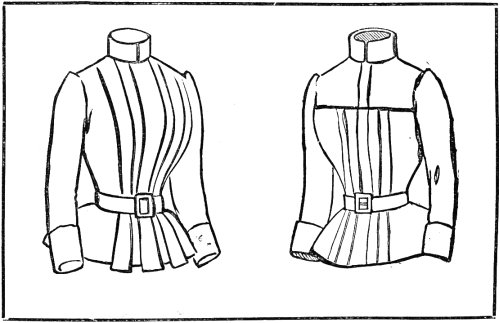
patterns for this month. The first is really a
repetition of that we have already given,
which, however, is as much worn as ever; and
the second is rather a new form, with a yoked
top, which is sometimes made pointed both
in front and behind. The first of the “Norfolk
jackets,” or blouses, is that without a yoke,
and for this I will repeat the directions given
very carefully, for it is a pattern that can be
cut out and made-up by anyone, however inexperienced
they may be. It consists of seven
pieces: the front, back, collar, belt, two halves
of a sleeve, and a cuff. The back should be
cut double, as there is no join down the centre;
a deep hem must be allowed on each side
the front where the buttons are placed; the
pleats turn forward, and the position of the
notches should be very carefully observed.
The edges may be finished by a row of
machine stitching, which should be even and
good.
NORFOLK JACKETS.
No lining is needed, as a general rule, to this
bodice. The pleats are run down, like the
breast of a shirt, or may be stitched with a
machine. The quantity of material required
for either of these bodices would be about
three yards and a half of thirty-six inches in
width. No seams are allowed in the pattern.
The other blouse is made with a yoke, and has
nine pieces, viz., front, back, two sleeve pieces,
collar, cuff, belt, and two yoke pieces, back
and front. In cutting out, the back must be
cut double, and in making up the yoke should
be stitched flatly on the pleated portions with
the machine before joining the bodice together.
Both the belts should be lined with
buckram, and machine-stitched at each edge,
to render them firm and useful. These blouses
are worn both out of doors and in, and are
made and worn at present in blue, crimson,
and all shades of red, in black and white, and
may be worn with differently-coloured skirts.
They are very suitable for young girls, and
may well form the first experiment in their
own home dressmaking for the inexperienced.
The materials used are elastic cloth, serge,
diagonal, blue linen, cashmere, and, of
course, any dress material which may be in
fashion.
All paper patterns supplied by “The Lady
Dressmaker” are of medium size, viz.,
thirty-six inches round the chest, and only
one size is prepared for sale.
No turnings are allowed in
any of them. Each pattern
may be had of “The Lady
Dressmaker,” care of Mr. H.
G. Davis, 73, Ludgate-hill,
E.C.; price 1s. each. It is
requested that the addresses
be clearly given, and that
postal notes may be crossed
“& Co.” to go through a
bank, as so many losses have
recently occurred. The patterns
already issued are always
kept in stock, as “The
Lady Dressmaker” only issues
patterns likely to be of
constant use in home-dressmaking
and altering; and
she is particularly careful to
give all the new patterns of
hygienic underclothing, both
for children and old and
young ladies, so that no
reader of the G.O.P. may be
ignorant of the best methods of dressing.
The following is a list of the patterns
already issued, price 1s. each:—
April, braided loose fronted jacket; May,
velvet bodice; June, Swiss belt and full
bodice, with plain sleeves; July, mantle;
August, Norfolk, or pleated jacket; September,
housemaid’s or plain skirt; October,
combination garment (underlinen) with long
sleeves; November, double-breasted jacket;
December, Zouave jacket and bodice;
January, princess underdress (underlinen,
underbodice, and underskirt combined);
February, polonaise, with waterfall back;
March, new spring bodice; April, divided
skirt, and Bernhardt mantle with sling
sleeves; May, Early English bodice and
yoke bodice for summer dress; June,
dressing jacket, and princess frock, with
Normandy bonnet for a child of four years
old; July, Princess of Wales’ jacket,
bodice and waistcoat, for tailor-made gown;
August, bodice with guimpe; September,
mantle with stole ends; October, pyjama,
or nightdress combination, with full back;
November, new winter bodice; December,
patterns of Norfolk blouses, one with a yoke
and one with pleats only.
NOTICES OF NEW MUSIC. — Edwin Ashdown. — Patey and Willis. — Robert Cocks and Co. — J. Curwen and Sons. — F. Pitman and Co.
Vanished Years. Song. By Seymour Smith.—A
sympathetic, easy setting of the sad
words by Helen M. Waitman. It is published
in F and A flat.
The Violet and the Snowdrop. Song. By
Ethel Harraden, with words by Gertrude Harraden.—A
simple story, simply illustrated.
The violin accompaniment, charming as it is,
would have been much more so, had it been
broken up a little more. There is no rest for
it, and this destroys much of its effect. The
same part has been transposed an octave for
a violoncello. The song is within the compass
of most singers—C to D, and not higher.
Two Melodies for violin and piano, by the
same composer, Miss Harraden, meet all the
requirements of the youthful amateur violinist.
They are simple, effective, and melodious.
As they are so evidently intended for young
people, we are surprised that the violin part is
neither fingered nor bowed.
Six Romances. For the pianoforte. By
Sir George Macfarren.—If the others are as
delightful as Nos. 4 (Lullaby) and 5 (Welcome),
which we have before us, these romances
are the most graceful and sympathetic
works for the piano which this great theoretical
master has given us.
Tarantella. In G minor. For pianoforte.
By J. Hoffmann.—A very characteristic specimen
of this phrenzied dance. The excitement
is well sustained to the close.
Violanté. A Spanish Waltz. For piano.
By Michael Watson.—Containing what Mr.
Corder would call “distinct local colouring,”
and developing a graceful subject. Is it because
the melody is in Spanish that the title-page
is in French?
Gavotte. In D. By Ariosti (1660-1730).
Arranged by Edwin M. Lott for the piano.—An
interesting relic by a man who, like
Buononcini, was at the commencement of the
eighteenth century a powerful rival to Handel
in opera production, and who, like Buononcini,
is now almost entirely forgotten.
Arpeggios.—An extremely useful collection
of these technical passages. By Edwin M.
Lott.—The arrangement of the arpeggios is
founded on the well-known work of Charles
Chaulieu, who taught the piano in London
1840-9.
Two Andantes, for the organ, by Walter
Porter, are mild, harmless movements, containing
many signs of the youthful amateur about
them. Amongst others is the fact that the
pedals are used without intermission from
beginning to end, augmenting a want of contrast
and variety already too apparent in both
pieces.
Yellow Roses we can recommend as a pretty
ballad by Michael Watson. It is published
in every necessary key.
Biondina, a ballad of a rather better order,
by Weatherly, has been set to music by F.
N. Löhr.
No other Dream. Song, for mezzo-soprano
voice. By Joseph L. Roeckel.—Is also of the
modern ballad type, and hardly attains to the
usual merit of this composer’s songs.
Clairette. By Ernst J. Reiter.—A
fascinating little dance for piano. The
delicacy of subject and treatment suggests a
lady’s composition in every page.
Bouquets de Mélodies. Pour violon, avec
accompagnement de piano. Par Gustav
Merkel.—We have received No. 1, a gavotte
in C, a well-written trifle by this scholarly
German organist and composer.
While we Dream. A song of moderate
compass, possessing much musical feeling, and
the originality that we are now led to expect
from Mr. Addison. A curious, not very vocal,
effect is produced by the diminished fourth, in
the line, “At our feet long shadows lie.”
The Old See-Saw is a song of the conventional
“Swing, swing” type, but brightly
written, and likely to add to Miss Annie
Armstrong’s reputation as a popular writer of
small things.
A most important addition to the large
number of teaching manuals already published
is the Child Pianist, divided into grades and
steps, and combining in a thoughtful and
systematic way a little theory and a little
practice, never forcing a child, and never
letting the head get in front of the hands or
vice versâ. Accompanying these steps with
their capital duets for pupil and teacher, by
J. Kinross, written after the manner of Lebert
and Stark’s book, we have a Teacher’s Guide
to the Child Pianist, an assistance to young
teachers, and an essential explanation to the
exercises and method. We cannot too highly
estimate the care and management displayed
by Mrs. J. S. Curwen, the authoress of these
valuable works.
We do not generally notice dance music,
but must mention with praise two compositions
of this class by Evelyn Hastings,
really charming and graceful as piano pieces,
for little entr’actes at readings, or between
charades; they are the Onda Waltz and the
Postscript Polka, the latter being especially
happy in its construction.
AN APPEAL.
should very much
like to interest
the readers of
The Girl’s Own
Paper in the little
Hindu school
girls and native
ladies in India,
with the hope that I may
receive occasional supplies
of dolls, scrapbooks, and
old Christmas cards for
distribution. Several
times a year I pack a
large case with toys and
other attractive things,
and it is sent to English
ladies at Calcutta or
Madras, or elsewhere.
These ladies give away the contents on
prize days and other occasions, when it is
delightful to witness the pleasure of the happy
recipients. Presents from England are particularly
liked, not only because they are
novel and different from Indian toys, but also
because the school-children are glad to be
thought of by friends at such a distance.
Though their ideas of our country are very
vague, they value these tangible expressions of
sympathy in their good conduct and progress,
which have come to them from the other side
of the world.
One of the ladies to whom I send cases of
presents and prizes is Mrs. Brander, Inspectress
of Girls’ Schools in Madras. During the
last six years her constant occupation has
been to examine and report on schools, and
she has often to travel a long way for the
purpose. Though there are some railways in
the Madras Presidency, they do not reach the
out-of-the-way places that Mrs. Brander has
to visit, so she makes a part of her journey in
what is called a bullock bandy. This is a sort
of small private omnibus, drawn by two
patient bullocks, at the rate of two miles an
hour. It is sent forward to meet her at some
distant station. Besides the bullock bandy
for the inspectress, there are several other
vehicles, forming quite a procession. One is for
the deputy inspector, who has the long name of
Miss Govindarajulu; another for the writers (or
clerks), and some for the luggage of the party.
Two Government peons, or attendants, rather
like commissionaires, guard and manage the
cavalcade, if so it may be called. The roads
are often very rough and dusty, and for part of
the day it is extremely hot. Sometimes a
river has to be forded, for there are not many
bridges. The native drivers are ready to say
that the stream is too strong, but Mrs.
Brander does not listen to their objections
unless there seems to be real danger, so down
the bank the bullocks are made to go, and
across the water. At night the travellers
halt at a rest house, which is provided at
certain places by Government, but does not
give very good accommodation. At last a
village is arrived at, where there is a school,
and some of the native gentlemen of the place
who are the managers, receive the inspectress.
It is often located in a dark, close room, or,
more pleasantly, in a verandah, under an overhanging
roof. Mrs. Brander then examines
the pupils in reading and writing, arithmetic
and needlework. She is not hard upon them,
for the teachers themselves have had little
opportunity of learning. The children are
generally bright and quick, very gentle and
graceful, and with a winning but shy manner.
It is true they are apt to be idle, but then it is
trying to learn lessons when the heat is so
intense, and they are not taught very intelligently.
Often the mothers of the little scholars
crowd to the school, and talk to Mrs. Brander.
At one place several of these women begged
her to give them a lesson in needlework, and
she did so; but they all pressed so closely
round her that she had to insist on two or
three only looking on at a time.
Altogether, the arrival of an inspectress at
a village is an event of much interest. Now
she usually carries with her luggage a number
of dolls, pictures, small boxes, and Christmas
cards, out of her English store. If it is the
time for a prize-giving at any particular school,
she chooses some suitable things, which are
placed on a table and distributed with the
usual ceremony, including speeches. And
how pleased the children are! They hug their
dolls as eagerly as English children do, and
their dark eyes sparkle with pleasure. Whether
or not it is a prize occasion, Mrs. Brander gives
Christmas cards to the scholars that have
attended for a month with regularity, and she
likes to leave a packet with the schoolmaster
as future rewards. One school had become
almost empty for some reason, but on hearing
of the Christmas cards the children all came
back. These journeys of the inspectress last
often three or four weeks, because there are
many schools to visit. At the end of each
tour she returns to Madras. There she has
to inspect a number of larger and more important
schools, but for these, too, she is glad
to have prizes ready.
I must not occupy too much space, but I
want to mention that when Mrs. Brander is at
Madras she gives an afternoon party to native
ladies on one Saturday in the month. Some
English ladies also attend, and there are
various amusements, such as parlour croquet,
chess, solitaire, puzzles, music, and for the
little ones, games—as several of the ladies
bring their children. If Mrs. Brander has
just received a box from England, she displays
the pretty things, and they are eagerly and
minutely examined by the guests. The party
is always much enjoyed, and on going away
the children are often presented with a toy.
Other English ladies at Madras also give
occasional parties of the same kind. Last
January there was one at which a beautiful
Christmas tree added greatly to the entertainment.
Now I shall be very glad to take charge of
dolls or other toys, and old Christmas cards
(with or without writing upon them) for sending
to India. I need presents not only for
Madras but for other places, only I cannot
refer to those now. The dolls should be of
composition or china, not of very soft wax.
It is not necessary that their clothes should
take off and on, though for large dolls this is
an advantage. The Indian children are very
pleased to have small boxes with lock and key,
to keep their bangles in, and they like bags
too. At Calcutta many of the ladies read
English, so that interesting books are of use,
if not very difficult. I shall be able to inform
the donors of the way in which their kind
gifts are applied, for Mrs. Brander and my
other correspondents tell me particulars about
the children who receive them. I give my
address, and I shall be very grateful on behalf
of the little Indian children if my appeal is
responded to.
E. A. Manning,
35, Blomfield Road, Maida Hill, W.
“NO.” — CHAPTER IV.
By MARY E. HULLAH.
oon after Easter Mrs.
Rakely paid a visit to
London. She was a
person with a chronic
grievance; and though
she had done her utmost
to bring about
Joan’s marriage, she
considered it necessary
to feel ill-used, because
her favourite
companion was not at
hand to amuse her.
She called on Embrance,
and carried her off—almost
without asking her
consent—to spend a long
afternoon.
“I wish I had had you yesterday,
my dear. Horace Meade came to
dinner. Joan begged me to ask him; and
as I met him in Bond Street, I did; otherwise,
I think it would have escaped my
memory. I took a fancy to him at one time;
but he was always eccentric, and he looks
more so than ever since he has been in Italy.”
“I did not know that he had been in
Italy.”
“Yes. He has only just returned. It was
a foolish thing to do, flinging away his chance
of getting his picture into the Royal Academy.
Joan told me about it. But that’s
my objection to young men taking to art—they
are so eccentric. Now he is going
abroad again—I have forgotten where, my
memory is not what it used to be; but he did
tell me.”
As long as Mrs. Rakely had someone
to listen to her she was quite satisfied.
She took Embrance to a picture gallery;
trotted her through four or five milliners’
shops in search of an ideal bonnet; asked her
advice about umbrellas, and then bought the
one she liked best herself; and finally left her,
thoroughly exhausted, at the corner of her
own street.
A foreign letter was awaiting Embrance’s
arrival. Mrs. Clemon was not a regular correspondent,
but when she did write she sent
a good budget of news, pouring out a complete
history of her experiences for the benefit
of the niece who had been to her as a
daughter. She was happy; her son was
doing well. Now and then there came a
hint that Embrance would be heartily welcome,
if she could make up her mind to come
out. In the next page, much blotted and
smudged, came the tidings that William
was engaged to be married to a neighbour’s
daughter, a pretty girl and well brought up;
but, ah! it might have been so different!
Still, she would not complain, only now would
Embrance come? There was room, and to
spare. William and his wife would rejoice
to see her. Let her think over the proposal,
and not decide in haste. Then the letter went
on to tell of preparations for the wedding.
There were little bits of information concerning
the bride’s family, and there was a great
deal about an Irish help who had run away
and left them at a moment’s notice without
rhyme or reason. At the very end of the
page came another suggestion, in William’s
hand, “Come for a year, and try how you
like us”; after which his mother had taken
up her pen again to say, “Bless you in all
your doings, my child, whatever course you
decide upon.”
Embrance kissed the letter and put it away
carefully. There was no time to read it again
to-night, or to think if she should follow her
aunt’s wishes. She was wofully behindhand
with her work, and to-morrow morning she had
an extra lesson to give to a backward pupil
who lived at South Kensington. The long
day with Mrs. Rakely had tried her newly-gained
strength to its utmost limits, and her
ankle was very painful. She limped towards
the chiffonier in search of a book; in the glass
over the mantelpiece she saw the door open
with the familiar jerk that always preluded
Annie’s knock.
“Come in,” said Embrance; but the words
died away on her lips as she recognised the
figure in the doorway, whose shoulders towered
above the little handmaiden.
“Mr. Horace Meade.”
There was no sign of eccentricity in Horace’s
appearance; even Mrs. Rakely might have
been satisfied. He wore a dark, grey coat, and
in his hand he carried a hat which was
scrupulously glossy and well brushed. When
he spoke his manner and voice were very quiet,
much of the fun seemed to have died out of
him during his sojourn in Italy, and his first
remark was commonplace to the last degree.
“I heard from Mrs. Rakely that you had
met with an accident. I am exceedingly sorry;
I called to inquire how you were before I leave
town.”
“You are going away for some time, I suppose?”
asked Embrance, when she had invited
her visitor to sit down. He took a chair by
the window, and seemed interested in the
growth of some ferns that Joan had sent from
her garden.
“I hardly know. I have several portraits
on hand that must be finished as soon as
possible. But my studio is not habitable yet;
it is being painted, and the workpeople are
lamentably slow. When these commissions
are disposed of, I may go away for several
months, perhaps I shall get as far as Constantinople.”
“I have often thought that Constantinople
must be a most interesting city to visit.”
“Oh, very; it is so beautifully situated;
there is no other place quite like it.”
“No, I have never seen any place like it.”
(“I suppose,” Embrance was thinking while
she uttered her brilliant remark, “that he was
offended at my writing to him.”)
“I was a fool to come at all,” said Horace
to himself, “but I wanted to see her once
more; she looks horribly ill.”
“I am sorry to see that you are still lame,”
he said, aloud, as Embrance subsided into
silence after her last attempt at light conversation.
“I am much better,” she said, quickly;
“I’m only a little tired this afternoon. Are
you looking at the ferns? Joan sent them;
she is very well and happy. I often hear from
her.”
“I am glad of that; I only heard of her
marriage by chance, about a fortnight after it
took place. Well, I hope it is a happy ending
to her many troubles.”
“Yes,” said Embrance, quietly, “I hope
so.”
“You were in her confidence all along, of
course, Miss Clemon?”
“No, I did not know of her engagement.”
“That was really heartless of Joan! I hope
you were angry with her?”
“No,” said Embrance again, “but I miss
her very much.”
“I hope that you mean to go and stay with
her shortly; the change would do you good.”
“I don’t know. I must say good-bye to
her, of course, if I go to New Zealand.”
It had not seemed so clear to her a quarter
of an hour ago that she would accept her
aunt’s invitation as it did now.
“You would go to your relations—to Mrs.
Clemon?”
“She wishes it very much,” explained
Embrance, remembering how he had once
before made a similar question; “if I don’t
like it, I am to come back again.”
“I think,” said Horace, with a desperate
effort to speak naturally, “that the voyage
would be an admirable thing for your health.
I hope that you will be very happy there. If
I can be of any assistance to you in arranging
about your passage—in fact, in any way, pray
make use of my services.”
Painfully conscious that he had delivered
this speech very much after the manner of a
stage father in a heavy melodrama, he rose to
take his leave. Embrance sank back into her
chair as he left the room. Five minutes by
the clock, his visit had lasted, he had been
most kind and considerate, but—she wished
that she had never written that letter.
Horace met a friend at his club, with whom
he dined. It was late when he got back to
his own rooms. He opened the door of the
studio to see what progress the workmen had
made. The room presented a forlorn appearance.
The carpets were up, and the furniture
was covered with sheets; all about the floor
were paint-pots, shavings, and workmen’s
tools. A writing-table stood apart in the
window; Horace bethought himself of a
sketch-book which he had left somewhere
about, perhaps in one of the drawers. The
top drawer was unlocked, and as he pulled it
open he saw a heap of letters and advertisements
which had accumulated during his
absence. He had opened a great many of
them, leaving the rest to a more favourable
opportunity. It occurred to him now that
the opportunity had arrived. He lighted a
cigarette, dragged a chair from a corner of
the room, and began tearing up circulars and
invitations to parties that had taken place
weeks ago; they would have to be answered
some day, not now. At last he came upon
some bills, and underneath these a grey
envelope. He opened it leisurely. The letter
was dated, “February 2nd”—the day before
he had gone abroad. “Dear Mr. Meade,—Please
come and see me. I have made a
mistake.—Yours truly, Embrance Clemon.”
He read it over and over again, turned it
backwards and forwards, then he put it down
with a sigh. It must have been written shortly
after that conversation in the park that he had
been trying to forget. It was an apology—a
direct appeal to him—and he had taken no
notice of it! Nay, worse than that! With
a groan, he pushed away the candle and
rested his head on his hands, exclaiming,
“And I have been advising her to go to New
Zealand!”
Never had the backward pupil seemed so
backward as she did that day. She had made
twelve mistakes in a simple dictation; she
had written an essay on Catherine of Arragon,
whom she persistently confused with Catherine
of Medici; and she had worked her sums on
a method of her own, involving one direct
certainty—that the answers could not by any
possibility be correct.
Embrance
succeeded in concealing
her vexation,
and the two
hours’ lesson
ended more happily
than might
have been expected.
The girl
(who was good as
gold, though not
gifted with a taste
for study) helped
her dear Miss
Clemon into her
ulster, and let her
out of the hall-door,
with many
injunctions that she was to take a cab if she
got tired, or if it rained too fast.
Embrance pined for a little air, and was
determined to walk, in spite of the wet. It
was a long way; her umbrella was dripping
and her ankle was aching sadly before she
reached the corner of the street. In the distance
a policeman was slowly pacing along,
the pavement was slippery, and the road was
shining with puddles. There was not a break
in the leaden-coloured sky or a breath of wind
to interfere with the steady downpour. Embrance’s
umbrella had seen hard work; the
rain pattered through the little holes in the
silk; she had the greatest difficulty in keeping
the book she carried out of the wet.
Well, it was not far now, though the street
was long. Number 11, number 12, number
13; that was the house with the door-knocker
that Joan had made a sketch of (she said it
was like her grandfather). Number 14. There
was a quick step behind her, and another
umbrella was walking side by side with her.
“MR. HORACE MEADE.”
“Good morning. I have been waiting to
speak to you. I am so glad that you are come
at last.”
The owner of the umbrella looked excited;
his artistic eccentricity was to the fore; he
held a scrap of grey paper in his left hand;
his gaze was fixed on Embrance.
She said no word of greeting, but dropped
the dictionary that she had been guarding
with such care.
He picked it up for her. “Let me carry
it.”
“Thank you. I do not like to trouble you”—and
the rain trickled down on to her gloves
and cuffs as she held out her hand towards
him.
“Not at all,” said Horace, politely, as he
pocketed the book, regardless of the mud.
“The fact is, if you don’t mind listening, I’ve
come to make an apology.”
Embrance glanced at the piece of paper
that he was beginning to unfold, and the
blood rushed to her cheeks.
“You see,” explained Horace, speaking
very fast, “I don’t want to be a worry to
you, only I should like you to know that this
got put away with a heap of papers, and I
only opened it last night. I hadn’t a notion
yesterday that you had written to me. I wish
I had. You are getting so wet. Will you let
me hold my umbrella over you? It will be
better so. Thank you,” as she murmured
something that was not a refusal.
She had nothing now to carry; she clasped
her hands, and looked straight in front of her
down the rainy street.
“Why didn’t you tell me that you had
written to me?”
“I thought you had had the letter, and
would rather not answer it.”
“Why did you write at all?”
“To explain my mistake,” said Embrance,
confusedly.
“Then you did make a mistake, and I was
the sufferer?”
With a flash, her dark eyes turned to his.
The look of joy on his face brought peace and
comfort to her.
“I am sorry,” she began.
“Are you?” he asked, tenderly. “Don’t
be sorry on my account. If I had come to see
you at once, would you have sent me away a
second time, Embrance?”
They had passed number 25, and were walking
towards the City, unmindful of the rain.
In their hearts was the brightest sunshine.
“Would you, Embrance?”
She unclasped her hands; for a second she
rested her fingers on his arm, as she answered,
“No!”
[THE END.]
OUR TRACTARIAN MOVEMENT.
By ANNE BEALE.
s the Religious
Tract
Society never
wearies
of publishing
wholesome
literature,
so
tract distributors
should never
flag in
spreading
it abroad.
Since our
first sketch
of work accomplished, we have had some
experience, and are thankful to be able to
say that religious books are now gladly accepted,
where some years ago they would
have been scornfully rejected. They are particularly
welcomed on Sunday, when policemen,
cabmen, firemen, and other public servants
who cannot attend a place of worship,
say they like to have something to read when
they are off duty. Of course, the magazine or
book is more acceptable than the mere
tract, and when regularly supplied is often
eagerly accepted and expected.
“I have had this before,” said a policeman,
looking at a picture of The Cottager and
Artisan. “I haven’t seen you for some
weeks, and I thought you’d forgotten me.”
The oversight was soon remedied. “You
would be surprised if you knew how many of
the Force will read this,” said another.
“Perhaps a dozen of us. We pass it on, and
it does us all good.”
“That’s just what I do,” said a cabman,
who chanced to be near. “Perhaps, ma’am,
you will read this which was given to me.”
He took a well-thumbed book from his
pocket, which we subsequently read and
“passed on” also.
The railway officials welcome us gladly as
they stand or sit at their enforced Sunday
work.
“It is better than the papers,” said a
young porter, whom we heard with some
companions singing hymns below ground.
Even the newsboys, with the Sunday
papers under their arms, like to have something
profitable for Sunday reading. One
ragged, pale little fellow was in the habit of
telling us one Sunday what were the contents
of the small book he received the previous
Sabbath; and another youth of larger growth
emphatically demanded “A big’un. I likes a
big book, please.” These and sundry others
are the hawkers of newspapers. Oh! why
cannot people wait till Monday morning for
such secular reading, and why are our ears to
be deafened with cries of the ‘paipers’?
Cannot we give one day in seven to the
service of Him who said, “Remember the
Sabbath-day to keep it holy,” and who
added, “I am not come to destroy the law,
but to fulfil”?
I wish all those who will not remember it
had heard an undeserved rebuke administered
to us on a weekday by a railway official;
undeserved, because we do not travel on
Sunday, either to hear popular preachers or
otherwise amuse ourselves.
“I shall be happy to take your book to-day,
ma’am; but I never accept one on Sundays,”
he said. “Why?” we inquired. “Because
you know we have to work all day Sunday for
the public, and I don’t think people who
travel on Sundays, and break the law themselves,
have any right to give us books to
teach us how to keep it.” Let Sabbath-breakers
take this to heart.
It is very rarely that we meet with a rebuff.
On one occasion, however, when distributing
illustrated leaflets to a party of scavengers, we
were arrested by the words, “No, thankee.
I don’t want one.”
“Why?”
“Because I hate cant, and it’s all cant.”
“I am sorry. Do I look like a cant?”
“No; I can’t say as you do.”
“He’s a bad’un, and al’ays rude to the
ladies,” whispered a neighbour confidentially.
We often encounter gangs of navvies, who
have their own ideas on most subjects, and
like to air them.
“I don’t want tracts; I have heaps
of books at home, and read all Sunday
and every evening,” said one. “I’ll
warrant me I have some you haven’t.
Have you got ‘Heaven is my Home’? and
‘Paradise Lost’?” He enumerated many
others, after which he poured forth his feelings
on political matters, inveighing against the
Poor Law, the School Board, the distraint system,
and saying what he would do if he were in
power. When we ventured to suggest that
he would not mend matters if he went the
lengths he proposed, he began an argument
that we were obliged to cut short both for his
employer’s sake and our own; but he was a
fair example of “The British Workman.”
The navvy is a shrewd discriminator.
“Is that in favour of Bradlaugh?” asked
one; “because, if it is, I must decline it.
“Oh, if it isn’t I’ll read it with pleasure.”
Another stood considering his small offering,
and volunteered, “This don’t tell us to
throw away one’s pipe and backy; somebody
gave me a tract as did. They’ve kept many a
man from doing a rash act. If I was without
my backy I should sometimes be inclined to
destroy myself. It calms one down, somehow,
and makes one more contented. ’Tis all very
well to preach against drinking, but as to
backy, that’s different.”
A fine, stalwart-looking young man lamented
that he had had scarcely any schooling,
and feared that the reading we offered him
might be too abstruse for him. He had
taught himself to write a little by copying
letters, and could spell out easy sentences;
but his education had ceased when he was six
years old. His home was in Devonshire, but
his navvy work had taken him far afield. We
recommended him to go to a night-school,
and he was well inclined to do so. We fell
in with him several times afterwards, and
found that he had followed our advice, and
went three times a week. He said the teacher
would not let him rest after he had spoken to
him, but made him go at once.
All young men are not so amenable, and
sometimes make a jest of what is meant to
help them.
“Have you anything to suit me? I am an
atheist,” asked one, glancing at our wares.
“They are sure to suit you; take which you
like,” we replied.
He chose one haphazard, and the title was
“Cross-bearing.”
“What’s an atheist?” asked a burly looking
bystander of his mate.
“Oh, one of them Bradlaughites,” was
the answer, as they both came forward for a
book.
On another occasion a flippant young mason
inquired if “it was about love.”
“Yes, the best kind of love; about Jesus,”
we replied.
“Oh! I don’t know Him. I only love
those I know,” he said, but he took the
book.
It is melancholy to see how many youths
seem to know little of Him who died to save
them. One Easter Sunday we ventured to
attack a knot of them who were holiday-making.
The pictures always attract, so they
were soon engaged in contemplating them.
“Is it about Jesus?” asked one.
“Yes.”
“Ah! He was a good man,” he continued.
“He was your Saviour, and mine,” we
added.
“Do you believe it?” he inquired, with
real earnestness.
“Yes; the little book will tell you so.”
What was the result? Who shall say?
We are sometimes astonished at the eagerness
of the men and boys, working in scores
or even fifties, to secure the tract, leaflet, or
magazine. The supply rarely answers the
demand, for even from the tops of high houses
in process of being built, we hear a shout of
“Don’t forget us, please,” while the workmen
on terra firma volunteer to distribute as many
as we can spare. All seize with avidity on
The Child’s Companion, for all, or most, have
families at home, and “something for the
little ones” is a boon.
“I read them out while my wife sees to the
house,” said one. “I can’t afford to buy
them, but I carry home all I can get.”
“I read it to father, and father reads it to
mother, and mother reads it to me,” was the
satisfactory acknowledgment of a little girl
who came in for one.
“Here are two young gentlemen who would
like to study them, I am sure,” said a master
mason, indicating his juvenile aids, he having
accepted one himself.
The other day we were arrested by an old
man, a scavenger, who said we couldn’t give
him too many good books, for he loved them.
“I was fifty-two years without entering a place
of worship,” he added. “I was guard to a
travelling wagon, and worked Sundays and
weekdays. Four years ago I had a bad illness,
and a lady converted me. I promised God, if
He was pleased to restore me, that I would
serve Him for the rest of my days. I thought
I was dying, but I got better, thanks be to
Him; and I have kept my word ever since.
I have been to church three times a Sunday,
and to mission-hall twice a week. I have
been on my knees night and morning for
twenty minutes, and I thank and praise the
Lord.”
It is this Sunday working which is the
cause of so much irreligion. Turn where you
will, those employed have the same tale to tell.
They all say that if only they could be ensured
every other Sunday they would be satisfied,
but to have no Day of Rest was bad both for
body and soul. Indeed, one of them argued
that the soul perished with the body, and that
he could prove it from Scripture. Here and
there we find men brave enough to refuse all
Sunday work, and they say they have not lost
by it.
“I never turn a wheel on Sunday,” said a
cabman. “Many of us stand out against it,
and all who do say they are better off than
those who work.”
He was certainly a good specimen. His
cab was his own; he was well dressed, and
his horse as brisk as himself. It was evident
that “the one day in seven” agreed with
them. It is well known that the life both of
man and beast is shortened by the breach of
the fourth commandment, and it is clear
that the Great Legislator blesses its observance.
We have occasionally fallen in with the
regular colporteurs, and been convinced of the
good done by the sale of their religious literature.
Once at a coffee-stall we were greeted by an
emphatic “God bless you and your work,”
and the gratuitous contribution did not seem
to interfere with the monetary. The holders
of these stalls are always glad of something to
read, and are willing to distribute wholesome
reading to their customers. Strange incidents
sometimes occur when you take a poor,
wearied, out-of-work yet respectable fellow-creature,
for a cup of coffee and a plate of
cake or bread and butter, to one of these wayside
restaurants. One evening at dusk we
encountered a glazier, who, having received
the tract, said he had not tasted food since
daybreak. He was a foreigner, a Pole, who
had been in England ever since the Polish
insurrection of some thirty years ago. His
father was a gentleman. He had a wife and
children, and had been looking for work all
the day. A trifle for them and refreshment
for him opened his heart, and he gave his
address. Subsequently a district visitor found
it, and discovered that he was a Polish Jew.
He was not in, but his wife said that it was
contrary to their faith to receive relief from
one not of their own religion; but in his
hunger food was heaven-sent through “a
sister,” and he could not refuse it. Neither
did she reject a shilling. The family were
subsequently placed under the protection of a
charitable Jewish lady, who said, with truth,
“That her people took such care of their own
poor, that they had no need to apply to the
Christian.” Still, it is well that Jew and
Gentile should meet, as they now do, happily,
in works of general benevolence. The reign
of Christ will begin when universal love takes
the place of sectarian hate, and religious
persecution ceases.
Time and space would fail us to tell how
the men of the Fire Brigade love reading, and
how they showed us with pride a number of
The British Workman, sent to them monthly
by Miss Weston—for are not the brave fellows
mostly sailors? Or how other public servants
speak gratefully of monthly gifts of religious
books sent by friends interested in them, and
circulated amongst them. Let no one imagine
that either tract, magazine, or book is thrown
away, though a kindly discretion, and, perhaps,
a cheerful manner are needed for their
distribution. We have made an inroad into
one of the great laundries, and find that both
men and women employed rejoice at “something
to read” during their brief leisure.
Text cards are always welcomed.
“I shall have this framed. It just suits
me,” said one.
“I wonder that ladies do not visit our large
laundries,” remarked the superintendent.
This visitation has been begun by members
of the Y.W.C.A. May it prosper! These
workers in the steam laundries have a hard
life of it, and stand for long, long hours over
their laborious toil. Here are elderly women
and young girls, ready to welcome anyone
who will say a kind word to them, and, perhaps,
benefit them thereby.
“I like a whole story that I can read all
through,” said one of the latter, and the
cheap reprints of good stories published by
the Religious Tract Society are invaluable.
Moreover, they can be lent from one to
another.
It is strange that one still meets with people
comparatively young who cannot read. Much
of their religious knowledge is often due to
hymns. A man said he liked the old hymns
best, and had known “Glory to Thee” by
heart ever since he was a boy. Others are
proud of the fact that their children will read
to them whatever we are pleased to give them,
and sometimes even beg for a book apiece for all
the olive branches—“For fear one should be
jealous of the other,” said a cabman. To
which we replied that “jealousy was expensive.”
The other day we fell in with a gipsy encampment:
vans and tents settled on a bit of
waste land, having been turned out of a neighbouring
holding for building purposes. In
one of the tents we found a young man and
woman, a lovely three-year-old child, and an
infant not yet a fortnight old. The father of
the family, aged twenty-two, had been to
night-school once upon a time, but his learning
was nil; the mother, seated on the ground,
baby in arms, could not read; but a ragged
urchin who had crept in was going to school
the following Monday. The young couple
were strangely handsome, and rejoiced in the
gipsy name of Loveridge. The woman said
she had prayed to the Lord when she was ill.
“What else was there to do? I have never
been a great sinner; you know what I mean,
ma’am. A gentleman comes here to preach
on Sunday.”
She did not seem fully to apprehend her
need of a Saviour, but acknowledged that we
were all sinners. It was a strange, sad scene.
She, seated on her bed of rags at one end of
the small, dark, smoky, stifling tent; her husband
also on the ground making skewers at
the other, and apologising for untidiness; the
infant apparently dying, the little girl affectionately
stroking our garments. The mother
said she had had no food that day, for the
times were bad; and the trifle we offered was
instantly despatched to a shop at some distance
for “a little oatmeal and arrowroot,” the husband
being the joyful messenger. Still, she
said she liked tent-life better than she should
life within stone walls. “I have been used to
it, and I suppose it is what we are brought up
in that we like best,” she added, simply, and
in perfect English.
Thanks to Mr. George Smith, tent and
barge are becoming alive to the teaching of the
Gospel; and soon, we hope, the Testament or
tract will be legible by all their long-neglected
inmates. At present, comparatively few, of
the seniors especially, can read them. Nevertheless,
we will scatter the seed far and wide,
convinced that it will bring forth fruit if sown
to enlarge and to sustain the kingdom of our
Lord and Master, Jesus Christ.
ANSWERS TO CORRESPONDENTS. — EDUCATIONAL. — MISCELLANEOUS.
Maud Belin.—You do not say whether you have
been trained as a nurse. Write to the secretary,
Nightingale Fund, H. B. Carter, Esq., 5, Hyde
Park-square, W., or to the secretary of St. Mary’s
Hospital, Paddington, giving full information.
B. K. I. O.—We never heard of lady clerks being employed
at the Law Courts, but in America we hear
that women are in full practice as lawyers.
Motherless Jean’s writing shows her to be very
young, and so do her questions. 2. Where does she
live? How could we give her the information she
requires about the Kindergarten, not knowing that,
when she says, “she cannot leave home”?
Psyche.—If you be going in for “hard reading,” as
you say, you had better look out for a Lemprière’s
Classical Dictionary to teach you something about
mythology. Your questions are too many and
long.
Qui posse videtur potest.—Copying is only to be
obtained by the personal inquiry and exertions of
those who require it. Your writing does not appear
good enough.
Complex.—We recommend you to apply direct to the
secretary or matron of the Holloway College for the
prospectus, and ask for any further information you
require as to Government clerkships. Look through
our answers under the heading “Educational,” and
you will soon find the particulars you require.
Annie B.—We have read your thoughtful and well-expressed
letter with much interest, and we think as
long as you are of use at home you are where God
needs you, for in our service we do His will the best.
But, as your education has been a little neglected, a
certificate will be valuable to you, and you will be
happier in the feeling that you are doing something
to improve yourself for future work. We should
advise you to go in for the examination of the College
of Preceptors, fee 10s.; secretary, 42, Bloomsbury-square,
W.C.
Copy Cat.—We mention with pleasure the correspondence
class conducted by Miss Pearce, Ledwell
House, Steeple Aston, Oxon, for English history and
literature. We regret that it is little known, or would
have been named in the manual of girls’ clubs of an
educational character and otherwise, just published
(Messrs. Griffith and Farran, St. Paul’s-churchyard,
E.C.), compiled by one of our writers for the benefit
of a large number of our girls who are inquiring
about them.
Nan and Nancy.—The letters are nicely made, and
a little box full of them, with plenty of duplicates,
might sell at a bazaar for the purpose of guessing the
words to be produced by a given number of letters.
But you would not get very much for a box. We
thank you for your kind letter. Your wise friends
deserve to be complimented on their powers of discrimination,
really above their tender years. We
hope the parents of these phenomenal geniuses are
prudent and do not press them in their studies.
One in Trouble.—Your good or plain looks were
given you by your Maker, and you are only responsible
for the expression you wear. Nothing could be
more unjust and unkind than to let a plain girl see
that she is neglected or set aside on that account.
But some plain girls are touchy, and see slights
where none are intended, and show discontent and
resentment, which are met with ill-feeling in return.
Beware of falling into this error, and bear the cross
laid upon you as you should, who owe so great a
debt of gratitude to Him who made you what you
are. You are not fit for heaven in your present state
of mind!
Sapere Aude tells us that her friends have written to
us on about every subject “under the globe.” Pray
explain what the subjects are that are connected
with that locality? Have they to do with Atlas, the
giant, or the big turtle on which our globe is said,
in fable, to be supported? 2. If the German parents
you name were naturalised in France, their children
are French. The latter, we suppose, have been
registered as such at their birth, in any case.
Clarice E. A. inquires, “What is the meaning of
Mount Moriah and Mount Ararat?” The former
was a hill to the north-east of Jerusalem, and
formed a part of the cultivated ground of Araunah,
the Jebusite, from whom David bought it, and on
this spot Solomon built the temple (2 Chron. iii. 1).
The latter is situated in Armenia, consisting of two
peaks about seven miles apart, the point of the
highest being 17,000 feet above the level of the sea.
It has been generally believed that upon one of these
mountains the ark rested after the Flood, but this
fact is scarcely sufficiently proved. 2. Berlin black,
or artist’s black, is preferable to brunswick black for
application to grates.
One of Eight.—Your verses show good religious
feeling, and, as you are so young, you may write
better by-and-by.
Unica.—“God save the mark” is a phrase found in
Shakespeare’s Henry IV. i. 3. Hotspur, speaking
of the messenger, calls him a “popinjay” who
talked of guns, drums, and wounds in an unmanly
way, and it would be sad if “his mark,” who has
been in battle, were displaced by this court butterfly.
In archery, when a good arrow was sent, it was
usual to cry out “God save the mark,” meaning,
“prevent anyone following to displace my arrow”
in the “gold.”
Tootsie.—There are homes for invalids and convalescents
at 7s., and from 8s. to 12s. 6d. a
week. You might get into the Female Convalescent
Home, Crescent House, Marine Parade,
Brighton. For this home no letter or nomination
is required, but the charge is 8s. a week, paid in
advance, and you may remain there for a month.
Address Mrs. Marshman, 4, Ladbroke-square, W.
If you take 5s. previously to going there, to Mrs.
Marshman, she will give you a voucher, which must
be shown to the ticket clerk at the station, and he
will give you a third-class free ticket to and from
Brighton. Mrs. Marshman is at home every day
till noon to see candidates for admission.
M. Schwartzenberg.—Write to our publisher, Mr.
Tarn, for the index, frontispiece, and title-page,
enclosing thirteenpence for the same and for
postage.
Old-Fashioned.—If your mother approve of your
engagement at so early an age, and to a lad yet in
his teens and younger than yourself, we have nothing
to say against it. Still, you should remember that it
would not be to his discredit if he were to change his
mind when he became a man and knew his own mind
and character. But in this special case it may be
otherwise. You have our best wishes, and we thank
you for your kind letter.
Princess Louise.—No, the lines are not poetry, but
rhymed prose, and not very good as that.
Agate.—The case you name is indeed a very sad one;
but within our own experience we have known two
or three exactly such. They were persons of undoubted
piety. Yet God’s ways are often inscrutable
and “past finding out,” and why He permits His
people to be visited with such a terrible affliction,
terminating thus their usefulness to others, we cannot
explain. Possibly it may be for the trial of the
faith and submission of others. “When one member
suffers, all the other members suffer with it.”
Those that have been deprived of reason are no
longer responsible for their words or acts; those that
retain their reason are fully responsible for rebellion
against the calamity laid upon them, and for any
consequent shipwreck of faith. Your afflicted relative
is now, without doubt, at peace, and enjoying the
presence of the Saviour whom she loved and served
so long as He preserved her senses.
Hope.—Pronounce Mendelssohn as “Mendle-soan”;
Gluck, as spelt; “Bach,” guttural “ch”; Gounod, as
“Goo-no”; Schubert, as “Shoo-bert”; Franz Liszt
as “Frantz List”; and Maupréty as “Mo-pray-te.”
Gracie.—The schoolroom-maid cleans the schoolroom
and the grate, attends to the fire, lays the table,
brings up the meals, and waits and attends to
the bell, making herself generally useful to the
governess.
Sara.—You might obtain information about a home
of rest near the sea during vacation, at about 10s.
weekly, if you applied to the Governesses’ Benevolent
Institution; secretary, Charles W. Klugh, Esq., 32,
Sackville-street, London, W. Inquire about a home
of rest at Ramsgate. We have heard of one there
which might suit you. There is also a home of rest
at Sunninghill, Staines, about which inquire also.
Inquisitive Girl.—Your quotation is not correct. It
is, “One touch of nature makes the whole world
kin,” which places the spectator in sympathy with the
actor, since we all have the same feelings, weaknesses,
and emotions, one as the other, in greater or less
degrees. If you saw a mother parting in great grief
with a child, you, as a mother, would experience a
kindred feeling. 1. The great composer, Karl Maria
Baron von Weber, did not die in prison; he was
found dead in his bed when on a visit to Sir George
Smart, who had entertained him during his stay in
England, June 3rd, 1826.
Sydney.—The Early English style in architecture
dates from 1190 to 1245; the Perpendicular from
1360 to 1550. There are three varieties under the
name Romanesque, and four known as Gothic. The
former comprises the Saxon, Norman, and Transition;
the latter comprises the Early English, Geometrical,
Decorated, and Perpendicular. All churches subsequently
built are true or debased imitations of these,
excepting in cases where Byzantine or Greek models
have been adopted.
Winnie.—An apology should be received graciously,
and there should be no reference thereafter made to
the quarrel; but everything must depend on the
cause which produced it, so far as your future
relations with each other are concerned. The
character of the offender might have been exhibited
in a new and unsatisfactory light, rendering confidence
misplaced and dangerous. Thus, your relations
one with the other might be very materially
and wisely changed, notwithstanding the full forgiveness
accorded and the apology rendered.
Evelyn wants to know how to make the whites of
her eyes white. They become yellow in cases of
jaundice, or bilious disturbance, and they become
red from a cold or blast in them, or from crying,
over-work, or intemperance in drink. She must be
the best judge as to which of these causes her yellow
or red eyes owe their colour, and deal with the
trouble accordingly. If from a cold in the eye, hold
it in an eggcup of as hot water as can be borne without
scalding, and this will force back the red particles
in the blood vessels, which should not be present in
the eyeballs. If Evelyn be a girl of colour, of course,
the balls of the eyes, that should be of a blue-white
in white people, are naturally yellow, and nothing
will change it.
Buttercup.—You should have mentioned the book
you were reading, as we think the word is a manufactured
one, alma being “soul,” and cinere “ashes,”
in Italian. Perhaps it has something to do with
Ash Wednesday and Lent. There seems no other
clue.
E. B. B. should read Sir John Lubbock’s recent
account of teaching his dog to read cards, with
certain words on them indicating “out,” “food,” etc.
2. Lilith is fabled by the Talmudist as having been
the first wife of Adam, but, refusing to obey him,
she left Paradise for the regions of the air.
Isolde.—The meaning of the word nehustan (2 Kings
xviii. 4) is given by Bishop Hall as “a piece of
brass,” and by Dr. Hales as “a brazen bauble,”
designed to be a term of contempt. The brazen
serpent was made an idol, and was worshipped, and
Hezekiah spoke of it in its real character as a mere
piece of metal. We acknowledge your kind letter
with many thanks.
Miss Malaprop, Five Toes, X. Y. Z.—At sixteen
you should be attending to your lessons. If wise,
you would not be in such a hurry to begin the
troubles and anxieties of life.
May.—Even if the brigade of artillery had been
moved from Bellary, all letters and papers would be
forwarded to the troops, wherever they were. We
can find no mention of anything recent.
M. L. W. A.—The great diamond called the Koh-i-noor,
or “mountain of light,” was found in the
Mines of Golconda in 1550, and is said to have
belonged in turn to Shah Jehan Aurungzebe, the
Afghan rulers, and afterwards to the Sikh Chief
Runjeet Singh. Upon the abdication of Dhuleep
Singh, the last ruler of the Punjab, and the annexation
of his dominions in 1849, the Koh-i-noor was
surrendered to the Queen, and was brought over and
presented to her, July 3rd, 1850. Its original weight
was nearly 800 carats, but it was reduced, by the
unskilfulness of the artist, to 279 carats. Its shape
and size was like the pointed end of a small hen’s
egg. The value is hardly to be computed, but
appraising it at two millions has been considered
reasonable, if calculated on a trade scale. It was
re-cut in 1852, and was reduced to 102½ carats. It
is worn by Her Majesty as a brooch on all State
occasions.
Laura.—Of course, your pale semi-opaque amber will
turn darker and lose its beauty if exposed to light
and heat. Whenever taken off, wipe your necklace
and earrings carefully with a soft handkerchief to
remove any greasiness, and put them by in a cool,
dark place.
R. E. F.—A woman married after the 1st of January,
1883, is qualified to dispose by will of all property
belonging to her at the time of her marriage, and of all
property acquired thereafter, in all respects as if she
were an unmarried woman. If married previously to
the date above named, she must obtain her husband’s
consent to any will she may desire to make, and all
property accruing to her after marriage, unless by
settlement, becomes his to surrender to her or to
retain, as his perceptions of honour or feeling of
generosity may dictate.
Awkward Sixteen would make a very awkward mistake
if she burned her face with aquafortis on
account of a few moles! Methylated spirits should
not be packed into a trunk. Better to place it in a
basket; and still wiser to buy what is required on
arrival.
Helen Ada.—The game of tennis, as all others with
a ball, is of very remote origin. The Greeks played
such. Tennis seems to have originated in or before
1300 in France, and in Charles II.’s reign it was
very fashionable. The game of lawn tennis has
been evolved out of the old game. A statue was
erected to Aristonicus, in commemoration of his
superior skill in playing with a ball.
England, Scotland, and Wales.—St. Mary Magdalene
was not the sinner you name, but one
afflicted with devil possession, seven of which were
cast out of her by our Lord.
Father’s Pride and Mother’s Joy.—You cannot
show your dislike to anyone in a more innocent and
godly manner, especially if they be proved enemies
to you, than by kindness and love. If you can do
any kindness towards them, you must look for and
seize the occasion to do it. This is Christ’s way, and
would be your way and all our ways if we were only
like Him.
Gertrude’s question is too wide for our space. There
are dozens of pretty watering-places in England. But
where does she live, and what does she require in a
watering-place—quiet or noise? It would be impossible
even to suggest a residence unless we had more
data to guide us.
FOOTNOTES:
[1] Taken from the Sussex Archæological Collections
(out of print).