GREEK AND ROMAN ART AT THE BRITISH MUSEUM. — PART II.
By E. F. BRIDELL-FOX.
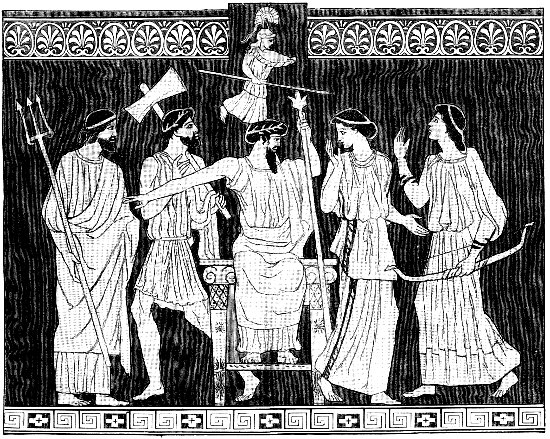
THE BIRTH OF ATHÉNÉ.
(From a Vase in the British Museum.)
All rights reserved.]
THE ELGIN MARBLES.
“Abode of gods whose shrines no longer
burn.”
I have now to complete my account of the
sculptures of the Parthenon, that wonderfully
beautiful temple to Athéné (or Minerva), at
Athens, which has never ceased to be the
centre of attraction for all visitors to Greece
from the time it was first built—namely,
about 435 years B.C.—even till the present
moment, when it stands a shattered wreck on
its rocky height.
My first article dealt chiefly with the long,
sculptured frieze that ran continuously the
whole length of the walls of the building (protected
by the outer colonnade), and the ceremonials
which that frieze represented. The
present article will be devoted chiefly to the
fragments of the external frieze, and to the
figures of the eastern and western pediments,
which represented the chief legends connected
with the goddess.
I will, before proceeding, here pause a
moment to account for the shattered condition
in which those fragments now are.
In 630 A.D. the Parthenon was consecrated
for use as a Christian church. Like the
famous church at Constantinople, it was dedicated
to Santa Sophia, the Divine Wisdom.
The older temple, that stood near the Parthenon,
called the Erecthium, which had been
far more venerated by the early Athenians
than the Parthenon itself, was about the same
time also consecrated. This latter was dedicated
to the Virgin Mary.
Long before this date, Christianity had
happily become the religion of the Roman
Empire by law established—that is to say, of
the whole civilised world. It is evident that
in adapting the Pagan temple for Christian
worship it was impossible to allow the fables
of Paganism to remain depicted over the chief
entrance, however splendid as works of art.
Accordingly, we find that the entire centre
group in the pediment facing the east was
completely done away with, a plain surface of
blank wall filling the space whereon, in all
probability, the inscription of the Christian
dedication was placed. The subordinate figures
at the two extremities were left, as, without
the central group to explain their object, they
could have had no intelligible meaning.
Our business for the moment is to show
what means exist for restoring the lost central
group, which was the key of the subject. The
evidence is two-fold. There is, first, the
Homeric hymn which gives the legend of the
birth of Athéné; and, secondly, there is the
description given of the Parthenon by the
ancient author, Pausanias.
Pausanias was a Greek gentleman, native of
Lydia, in Asia Minor, a geographer and
traveller, who visited noted sites in Greece
with the express purpose of seeing and describing
all that was most beautiful and
interesting in Greek art. He lived about
one hundred and fifty years after the Christian
era. His travels or “Itinerary” has come
down to us, and a most curious and interesting
work it is. He saw and described the
Parthenon with much enthusiasm, with all its
beautiful statues and works of art, as “still
perfect,” though they were, even in his day,
already considered as ancient art. He refers
to the Homeric hymn as suggesting the subject
of the group on the eastern pediment over the
principal entrance to the temple.
This Homeric hymn to Athéné gives the
account of her fabled birth, full grown and
fully armed, from the head of her father, Zeus
(or Jupiter). It describes her, first as the
goddess of war, and afterwards, when she has
thrown off her arms, as the goddess of the
peaceful arts. I give the hymn in full.
Whom Jove brought forth, in warlike armour dressed,
Golden, all radiant! Wonder strange possessed
The everlasting gods that shape to see,
Shaking a javelin keen, impetuously
Rush from the crest of Ægis-bearing Jove.
Fearfully Heaven was shaken, and did move
Beneath the might of the cerulean-eyed;
Earth dreadfully resounded far and wide;
And lifted from its depths, the sea swelled high
In purple billows; the tide suddenly
Stood still, and great Hyperion’s son long time
Checked his swift steeds, till, where she stood sublime,
Pallas from her immortal shoulders threw
The arms divine; wise Jove rejoiced to view.
Child of the Ægis-bearer, hail to thee!
Nor thine, nor others’ praise shall unremembered be.”
Such is the famous hymn. And from
Pausanias we learn that it afforded to the
sculptor, Pheidias, the subject for his chief
group on the eastern pediment. But, exactly
how he treated it we have no precise or
definite knowledge.
The Eastern Pediment.—“Doubtless,
in this composition, Jupiter (Zeus) occupied
the centre, and was represented in all his
majesty, wielding the thunderbolt in one
hand, holding his sceptre in the other; seated
on his throne, and as if in the centre of the
universe, between day and night, the beginning
and the end, as denoted by the rising
and the setting sun.
“It is probable that the figures on his right
hand represented those deities who were connected
with the progress of facts and rising
life—the deities who preside over birth, over
the produce of the earth, over love—the rising
sun; whilst those on the left of Zeus related
to the consummation or decline of things—the
god of war, the goddess of the family hearth,
the Fates, and lastly the setting sun, or night.
Whilst the divine Athéné rose from behind
the central figure in all the effulgence of the
most brilliant armour, the golden crest of her
helmet filling the apex of the pediment.”
I quote this glowing description from Sir
Richard Westmacott’s “Lectures on Sculpture.”
This, however, is all conjecture, for the
space is a mere blank. As some little aid to
the imagination to help to fill the blank, I
give a sketch of the same subject, viz., the
birth of Athéné, copied from a painting on a
vase now in the British Museum. The artist
may have probably seen the Parthenon, and
may have taken a free version of the subject,
from memory, to decorate his vase. We find
the same subject repeated, with variations, on
other vases. Zeus (Jupiter) occupies the centre,
a small Athéné springs forth from his head,
Hephaestos (Vulcan) stands by with his axe
(with which he has split open the thunderer’s
head to let forth the infant deity), Poseidon
(Neptune), with his trident, behind him; and
Artemis (Diana), with her bow, and a nymph,
on the other side, look on. The figures on the
vases are so extremely stiff and formal as compared
to the grand, life-like statues of the
pediments, that I hesitate to give my illustration.
But it shows the probable arrangement
of the group. The figures on the vase are red
on a black ground, treated perfectly flat, without
the slightest modelling.
To return to the pediment of the Parthenon
itself, the space immediately surrounding the
blank, on each hand, is filled with different
gods, who appear to look with wonder and
admiration towards the central group. At
the extreme end on the left the rising sun,
Phœbus-Apollo, drives the car of day out of
the ocean; while Seléné, goddess of night,
plunges downward with her team of steeds,
into the waves, at the end on the right.
Of the figures referred to, we may identify
the following fragments:—First, we note a
fragment of the sun-god, his powerful throat
and extended arms emerging from the waves,
as he shakes the reins to urge on his prancing
steeds; before him, a splendid head of one of
the horses of his car, the head flung back, as
if he tossed his mane in eager movement to
rush up into the daylight. Next comes a
recumbent figure, of heroic manly proportions,
the most perfect of the Elgin collection. A
lion’s skin on which he reposes, leaves little
doubt but that it was intended to represent
the youthful Hercules, the god of strength.
It is popularly, but erroneously, known as
Theseus. Then come two grand, matronly,
seated personages. The attitude and beauty
of proportion in these two stately figures is
considered no less admirable than the subtle
arrangement of their flowing draperies. They
probably represent Demeter and her daughter,
Persephone (the Ceres and Proserpine of the
Roman mythology). The younger one leans
her arm lovingly on the shoulder of her
mother. The mother, Demeter, raises her
arm, as if in astonishment at the news communicated
by the next figure, who comes
rushing towards them, her drapery flying far
out behind her, from the rapidity of her movements.
This is doubtless Iris, the messenger
of the gods, sent to announce the wonderful
events transacting in the central group. Three
fine dignified female figures, on the further side
of the pediment, equally distant from the centre,
appear to have balanced this last group of Iris,
Ceres, and Proserpine. These were the three
Fates, who spun the thread of human life,
named by the Greeks, Clotho, Lachesis, and
Atropus. Two are seated, a little apart; the
third reclines, half leaning on the lap of the
second. These three figures are equally well
preserved, and equally noble and beautiful with
the group to which they correspond on the
further side.
The subject of this eastern pediment is evidently
supposed to have taken place on Mount
Olympus, the highest mountain in Greece, the
fabled home of the gods, and the figures were
intended to represent a conclave of the gods.
The Western Pediment.—The subject
of the west end, on the contrary, may be supposed
to have taken place in Athens itself, on
the Acropolis. The subject here was the
contest between Athéné and Poseidon (or
Neptune) for supremacy in Athens. Here we
find local personages, such as the river deities
(the rivers personified), and the legendary kings
and heroes of Athens. These statues, with
the exception of Athéné and Poseidon, are a
size smaller than those on the eastern pediment,
being not at all more than life size.
The object for which this assembly has met
is to see which of the two deities could present
the best gift to the Athenians. Poseidon
struck the earth; the horse appeared, so the
story runs. Athéné did the same; the olive
tree grew before them. Both were most useful
gifts; but the olive tree, on account of its
fruit and the oil which it yields, was considered
to have the higher claim.
Athéné was proclaimed the victor. The
gods bestowed the city upon the goddess,
after whom it was named Athens; and Poseidon
was so enraged, continues the legend,
that he let loose the waters of the angry sea
(which, as monarch of the waves, of course
obeyed his behests), and straightway it overflowed
its banks and deluged the plain round
Athens.
Such is the story, and in the times of Pausanias
were shown the three great dents on the
rock, the marks of the trident of Poseidon,
where he had struck the earth, as well as a
small pool of salt water. The Greek traveller
mentions having seen these things.
Strangely enough, these two same old-world
curiosities were re-discovered not many years
ago when excavations were being made on the
Acropolis, in the very centre of the older
temple, near to the Parthenon, where Athéné
and Poseidon were once jointly worshipped.
Athéné and Poseidon were the two central
figures in the midst of their assembled votaries,
the legendary kings and heroes of Athens,
and the local nymphs and river gods.
This group is terminated at each end by recumbent
figures, supposed to represent the
two streams that water the plain round
Athens—the Illissus and the Cephissus. The
figure of Illissus is scarcely second to the so-called
Theseus for beauty of manly proportions;
it is perhaps more graceful and less
vigorous. “Half reclined, he seems, by a
sudden movement, to raise himself with impetuosity,
being overcome with joy at the
agreeable news of the victory of Athéné.
The momentary attitude which this movement
occasions is one of the boldest and
most difficult to be expressed that can possibly
be imagined. The undulating flow given to
every part of the drapery which accompanies
the figure is happily suggestive of flowing
water.” Next to the Illissus is a broken fragment
of the nymph Callirrhoë, who represents
the only spring of fresh water in Athens;
while next to the Cephissus, on the other
side, sits King Cecrops, the mythical first
king of Attica, with his wife, Agranlos
(her name means a “dweller in the fields”),
and his daughter Pandrosus (whose name
means “the dew”).
Of the two heroic figures in the centre,
Athéné and Poseidon, whose contest is the
subject of this western pediment, the only
fragment now existing is the muscular, finely-developed
back and chest of the sea-god; and
of Athéné, the upper half of the face (the
sockets of the eyes intentionally hollow, that
they might be filled in with precious stones),
also one of her feet, and the stem of the
famous olive tree.
A careful model of the Parthenon in its
present condition is placed in the Elgin
Room, and by reference to that we can
identify the fragments on the pediments, and
can also see the position of the various
sculptures. The sculptured figures on it are
copied from drawings made from the
Parthenon itself at Athens in 1674, by a
French artist, Jacques Carey by name, before
Lord Elgin had removed those which we now
possess, and when many of the figures were
far less damaged than they now are. The
Parthenon had been used as a powder
magazine by the Turks when they conquered
the city in 1687. It was during the siege that
a bomb from the enemy fell into the edifice,
igniting the stored gunpowder, and the whole
centre part of the ancient temple, with a part
of its lovely frieze, was blown into the air.
Again, a similar misfortune occurred in the
Greek struggle for independence and
freedom in 1827. Yet, in spite of the
terrible gap, enough of the building is still left
for us to admire the wonderful beauty of proportion,
and simple, yet grand, lines of the
outline; and more than enough to recognise
the general plan and places of most of the
sculptures that adorned its walls.
The Metopes.—These are panels in alto,
or high-relief, in the frieze which ran above
the colonnade of the Parthenon. They
pourtray the struggle between the youth of
Athens and the centaurs—monstrous creatures,
half horse, half man. This struggle is
supposed to have been intended to typify the
contest between intelligence and moral order
on the one hand, against the power of lawlessness
and brute force, as represented by the
monsters, on the other—a contest, the result
of which was in that day acutely realised.
There were originally ninety-two of these
Metopes, fourteen on each end, and thirty-two
along each side wall. We possess seventeen
out of the ninety-two. So many having been
destroyed, it is impossible to judge with any
greater certainty of the subject.
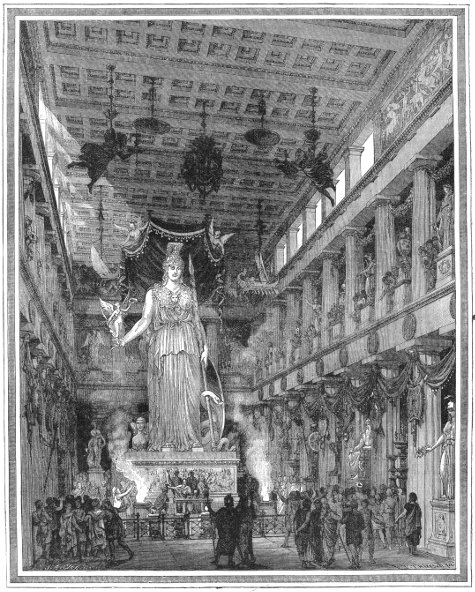
The Statue.—My account would be incomplete
did I not add a few words descriptive
of the beautiful statue of Athéné that originally
stood within the temple, facing the east. For,
although all trace of the statue itself has long
vanished, we know its form by copies in
marble in several of the museums and galleries
in Europe. The one at Naples is considered
the best. We have also, in the Elgin Room,
two small rough copies of it.
The grand original, which Pausanias saw
and describes as “perfect,” “a thing to wonder
at,” was of gold and ivory. Its robes were of
gold, its flesh was of delicately cream-coloured
ivory, its eyes flashed with precious stones.
“Lovely, serene, and grand,” its gigantic
form filled the centre of the temple, and the
golden griffins on its helmet reared themselves
against the very roof.
This statue, with that of the Olympian Jove,
was undoubtedly the exclusive work of the
master, Pheidias, who, though he may have
allowed his pupils to assist him in some of the
labours of the other figures of the Parthenon,
assuredly hoped that his fame would be
secured by these works. Their fame now,
alas! rests solely upon copies and description.
I give a sketch of the best of the two small
rough copies in the Elgin Room. Like the
grand original, she holds the figure of Victory
in her extended right hand, and grasps the
spear in the left, while her shield, together
with the snake (type of the native soil of
Athens) lie at her feet.
The art of presenting figures in gold and
ivory, for which Pheidias is peculiarly famous,
is a lost art. A special name was given to these
statues. They were called Chrys-elephantine.[2]
The combined richness of the gold with the
soft hue of the ivory must have produced a
wonderfully fine and mysterious effect when
seen in the recesses of a dimly-illumined
temple. The golden robes of the goddess
were considered as part of the State treasury,
and were between the times of the great
festivals unfixed from the statue, and stored
in the treasure house at the back part of the
temple. They were from time to time carefully
weighed, and were looked upon in the
light of national wealth, which might, in time
of need, be drawn upon for the country’s requirement.
The gold of the robes was said
to have been worth as much as £100,000. It
is supposed that this part of the goddess was
melted down, and finally reduced to Byzantine
coin about the time of the Roman Emperor
Julian—viz., about A.D. 360.
As Athens sunk from her high position
among the Greek States, her processions and
ceremonies fell into decay; but while she
flourished, none were more brilliant.
Other festivals there were in Greece besides
the one at Athens in honour of Athéné, where
similar athletic games and feats of skill were
performed before the altars of other tutelary
gods. There were the far-famed Olympic
games in honour of Zeus (Jupiter), in which all
the Greek States competed. The Odes of
Pindar have immortalised the Olympic
chariot races. There were also the Delphic
games in honour of Apollo, the sun god, the
god of poetry. The practice of these games
lasted in Greece, and were in use in Rome, till
long after Christian times. How popular they
were in those times we may infer from the
many references to them in the Epistles and
Acts of the Apostles.
Professor Jebb observes, in one of the
admirable series of Shilling Primers now publishing,
the one on “Greek Literature:” “The
Greeks were not the first people who found
out how to till the earth well, or to fashion
metals, or to build splendid houses and
temples. But they were the first people who
tried to make reason the guide of their social
life. Greek literature has an interest such
as belongs to no other literature. It shows us
how men first set about systematic thinking.”
And, he proceeds, “neither the history of
Christian doctrine, nor the outer history of the
Christian Church, can be fully understood
without reference to the character and work
of the Greek mind. Under the influence of
Christianity, two principal elements have
entered into the spiritual life of the modern
world. One of these has been Hebrew; the
other has been Greek.”
Of all the many beautiful things which the
Greeks produced, the Greek language itself is
considered to have been the first and most
wonderful; and “no one,” continues the
professor, “who is a stranger to Greek literature,
has seen how perfect an instrument it is
possible for human speech to be.”
We may remember that the whole of the
New Testament was given to the world in
this beautiful and expressive language; that
St. Paul was well versed in Greek philosophy,
and that many of his Epistles were to
Greek cities, and many of his first disciples
among the Gentiles were Greeks.
We can also be sure that he must often have
been present at Greek games such as we have
been describing. The frequent references and
metaphors referring to them prove this. In
the first Epistle to the Corinthians the references
to the foot-races run in the Isthmean
games, celebrated at Corinth, occur again and
again. “Know ye not that they which run
in a race run all, but one receiveth the prize?
So run that ye may obtain” (ch. ix. 24); and
in the following verse, “They strive for a corruptible”
(or perishable) “crown, but we an incorruptible”—referring
to the fragile crowns
or garlands of fresh leaves awarded to the
victors in the games we have been describing.
And again, in the Epistle to the Philippians,
iii. 14, “I press towards the mark” (or goal)
“for the prize.” In the first Epistle to Timothy,
vi. 12, “Fight the good fight before many
witnesses.”
The first preaching to the Gentiles was to
Greek-speaking peoples, either noted Greek
cities, as Athens itself and Corinth, or Greek
colonies in Asia Minor. We find (Acts xii.)
how St. Paul actually visited this same beautiful
City of Athens, whose early legends, like
quaint fairy stories, we have been describing;
how he stood on the Areopagus (the Hill of
Mars) facing the Parthenon, and must have
seen all its lovely statues and grand monuments
still perfect; and how he “thought it
good to be left at Athens alone,” when he
there preached to her wise men and philosophers,
and found followers and disciples from
among them, whose hearts were opened to a
higher wisdom than any that the worshippers
of the famed Athenian goddess knew.
THE INTERIOR OF THE PARTHENON.
(The Giving of the Prizes. Conjectural Arrangement.)
MERLE’S CRUSADE. — CHAPTER X.
By ROSA NOUCHETTE CAREY, Author of “Aunt Diana,” “For Lilias,” etc.
“I TRUST THEM TO YOU, MERLE.”
ith the early
summer came a
new anxiety;
Joyce was growing
very fast,
and, like other
children of her
age, looked thin
and delicate.
She lost her
appetite, grew
captious and irritable,
had crying fits if she
were contradicted,
and tired of all her
playthings. It was
hard work to amuse
her; and as Reggie was rather fretful
with the heat, I found my charge decidedly
onerous, especially as it was the
height of the season, and Mrs. Morton’s
daily visits to the nursery barely lasted
ten minutes.
Dr. Myrtle was called in and recommended
change for both the children.
There was a want of tone about Joyce:
she was growing too fast, and there was
slight irritability of the brain, a not uncommon
thing, he remarked, with
nervous, delicately organised children.
He recommended sea air and bathing.
She must be out on the shore all day,
and run wild. Fresh air, new milk,
and country diet would be her best
medicine; and, as Dr. Myrtle was an
oracle in our household, Mr. Morton at
once decided that his advice must be
followed.
There was a long, anxious deliberation
between the parents, and the next morning
I was summoned to Mrs. Morton’s
dressing-room. I found her lying on the
couch; the blinds were lowered, and the
smelling salts were in her hand. She
said at once that she had had a restless
night, and had one of her bad headaches.
I thought she looked wretchedly
ill, and, for the first time, the fear
crossed me that her life was killing her
by inches. Hers was not a robust constitution,
and, like Joyce, she was most
delicately organised. Late hours and
excitement are fatal to these nervous
constitutions, if only I dared hint at this
to Dr. Myrtle, but I felt, in my position,
it would be an act of presumption. She
would not let me speak of herself; at my
first word of sympathy she stopped me.
“Never mind about me, I am used to
these headaches; sit down a moment; I
want to speak to you about the children.
Dr. Myrtle has made us very anxious
about Joyce; he says she must have
change at once.”
“He said the same to me, Mrs.
Morton.”
“My husband and I have talked the
matter over; if I could only go with you
and the children—but no, it is impossible.
How could I leave just now, when our
ball is coming off on the eighteenth, and
we have two dinners as well? Besides,
I could not leave my husband; he is far
from well. This late session tries him
dreadfully. I have never left him yet,
not even for a day.”
“And yet you require the change as
much as the children.” I could not help
saying this, but she took no notice of my
remark.
“We have decided to send them to
my father’s. Do you know Netherton,
Merle? It is a pretty village about a mile
from Orton-on-Sea. Netherton is by the
sea, and the air is nearly as fine as
Orton. Marshlands, that is my father’s
place, is about half a mile from the
shore.”
I heard this with some trepidation. In
my secret heart I had hoped that we
should have taken lodgings at some
watering-place, and I thought, with
Hannah’s help, I should have got on
nicely; but to go amongst strangers! I
was perfectly unaware of Mr. Morton’s
horror of lodgings, and it would have
seemed absurd to him to take a house
just for me and the children.
“I have written to my sister, Merle,”
she continued, “to make all arrangements.
My father never interferes in
domestic matters. I have told her that
I hold you responsible for my children,
and that you will have the sole charge of
them. I laid a stress on this, because I
know my sister’s ideas of management
differ entirely from mine. I can trust
you as I trust myself, Merle, and it is my
wish to secure you from interference of
any kind.” It was nice to hear this, but
her speech made me a little nervous;
she evidently dreaded interference for
me.
“Is your sister younger than yourself?”
I faltered.
“I have two sisters,” she returned,
quickly; “Gay is much younger; she
was not grown up when I married; my
eldest sister, Mrs. Markham, was then in
India. Two years ago she came back a
widow, with her only remaining child,
and at my father’s request remained
with him to manage his household.
Domestic matters were not either in his
or Gay’s line, and Mrs. Markham is one
who loves to rule.”
I confess this slight sketch of Mrs.
Markham did not impress me in her
favour. I conceived the idea of a masculine,
bustling woman, very different to
my beloved mistress. I could not well
express these sentiments, but I think
Mrs. Morton must have read them in my
face.
“I am going to be very frank with
you, Merle,” she said, after a moment’s
thought, “and I do not think I shall
repent my confidence. I know my sister
Adelaide’s faults. She has had many
troubles with which to contend in her
married life, and they have made her a
little hard. She lost two dear little girls
in India, and, as Rolf is her only child,
she spoils him dreadfully; in fact,
young as he is, he has completely
mastered her. He is a very delicate,
wilful child, and needs firm management;
in spite of his faults he is a dear little
fellow, and I am very sorry for Rolf.”
“Will he be with us in the nursery?”
I asked, anxiously.
“No, indeed: Rolf is always with his
mother in the drawing-room, to the no
small discomfort of his mother’s visitors.
Sometimes he is with her maid Judson,
but that is only when even Mrs. Markham
finds him unbearable. A spoilt
child is greatly to be pitied, Merle; he
has his own way nine times out of ten,
and on the tenth he meets with undesirable
severity. Adelaide either will not
punish him at all, or punishes him too
severely. Children suffer as much from
their parent’s temper as from over-indulgence.”
“I am afraid Rolf’s example will be
bad for Joyce.”
“That is my fear,” she replied, with
a sigh. “I wish the children could be
kept apart, but Rolf will have his own
way in that. There is one thing of
which I must warn you, Merle. Mrs.
Markham may be disposed to interfere
in your department; remember, you are
responsible to me and not to her. I
look to you to follow my rules and
wishes with regard to my children.”
“Oh, Mrs. Morton,” I burst out,
“you are putting me in a very difficult
position. If any unpleasantness should
arise, I cannot refer to you. How am I
to help it if Mrs. Markham interferes
with the children?”
“You must be firm, Merle; you must
act in any difficulty in the way you think
will please me. Be true to me, and you
may be sure I shall listen to no idle
complaints of you. I wish I had not to
say all this; it is very painful to hint
this of a sister, but Mrs. Markham is
not always judicious with regard to
children.”
“Will it be good for them to go to
Netherton under these circumstances?”
“There is nowhere else where they
can go,” she returned, rather sadly;
“my husband has such a horror of lodgings,
and he will not take a house for us
this year—he thinks it an unnecessary
expense, as later on we are going to
Scotland that he may have some shooting.
All the doctors speak so well of
Netherton; the air is very fine and
bracing, and my father’s garden will be
a Paradise to the children.”
We were interrupted here by Mr.
Morton.
“Oh, are you there, Miss Fenton?”
he said, pleasantly (he so often called
me Miss Fenton now); “I was just in
search of you. Violet, your sister has
telegraphed as you wished, and the
rooms will be quite ready for the children
to-morrow.”
“To-morrow!” I gasped.
“Yes,” he returned, in his quick,
decided voice; “you and Hannah will
have plenty of work to-day. You are
looking pale, Miss Fenton; sea air will
be good for you as well as Joyce. I do
not like people to grow pale in my
service.”
“I have been telling Merle,” observed
his wife, anxiously, “that she is to have
the sole responsibility of our children.
Adelaide must not interfere, must she,
Alick?”
“Of course not,” with a frown. “My
dear Violet, we all know what your
sister’s management means; Rolf is a
fine little fellow, but she is utterly ruining
him. Remember, Miss Fenton, no
unwholesome sweets and delicacies for
the children; you know our rules. She
may stuff her own boy if she likes, but
not my children,” and with this he dismissed
me, and sat down beside his wife
with some open letters in his hand.
I returned to the nursery with a heavy
heart. How little we know as we open
our eyes on the new day, what that
day’s work may bring us! I think one’s
waking prayer should be, “Lead me in a
plain path because of mine enemies.”
I was utterly cast down and disheartened
at the thought of leaving my
mistress. The responsibility terrified
me. I should be at the tender mercies
of strangers, who would not recognise
my position. Ah! I had got to the Hill
Difficulty at last, and yet surely the confidence
reposed in me ought to have
made me glad. “I trust you as myself.”
Were not those sweet words to hear
from my mistress’s lips? Well, I was
only a girl. Human nature, and especially
girl nature, is subject to
hot and cold fits. At one moment
we are star-gazing, and the majesty
of the universe, with its undeviating
laws, seems to lift us out of ourselves
with admiration and wonder; and
the next hour we are grovelling in the
dust, and the grasshopper is a burthen,
and we see nothing save the hard
stones of the highway and the walls
that shut us in on every side. “Lead us
in a plain path.” Oh, that is just what
we want; a Divine Hand to lift us up
and clear the dust from our eyes, and to
lead us on as little children are led.
These salutary thoughts checked my
nervous fears and restored calmness.
I remembered a passage that Aunt
Agatha had once read to me—a quotation
from a favourite book of hers; I had
copied it out for myself.
“Do as the little children do—little
children who with one hand hold fast by
their father, and with the other gather
strawberries or blackberries along the
hedges. Do you, while gathering and
managing the goods of this world with
one hand, with the other always hold fast
the hand of your heavenly Father, turning
to Him from time to time to see if
your actions or occupations are pleasing
to Him; but take care, above all things,
that you never let go His hand, thinking
to gather more, for, should He let
you go, you will not be able to take
another step without falling.”
Just then Hannah came to me for the
day’s orders, and I told her as briefly as
possible of the plans for the morrow.
To my astonishment, directly I mentioned
Netherton, she turned very red,
and uttered an exclamation.
“Netherton—we are to go to Netherton—Squire
Cheriton’s place! Why,
miss, it is not more than a mile and
a half from there to Dorlecote and
Wheeler’s Farm.”
“Do you mean the farm where your
father and your sister Molly live?” I
returned, quite taken aback at this, for
the girl’s eyes were sparkling, and she
seemed almost beside herself with joy.
“Truly it is an ill wind that blows no one
any good.”
“Yes, indeed, miss, you have told me
a piece of good news. I was just thinking
of asking mistress for a week’s
holiday, only Master Reggie seemed so
fretful and Miss Joyce so weakly, that I
hardly knew how I could be spared
without putting too much work upon you;
but now I shall be near them all for a
month or more. Molly had been writing
to me the other day to tell me that
they were longing for a sight of me.”
“I am very glad for your sake,
Hannah, that we shall be so near your
old home; but now we must see to the
children’s things, and I must get Rhoda
to send a note to the laundress. I had
put a stop to the conversation purposely,
for I wanted to know my mistress’s
opinion before I encouraged Hannah in
speaking about her own people. How
did I know what Mrs. Morton would
wish? I took the opportunity of speaking
to her when she came up to the
nursery in the course of the evening.
Hannah was still packing, and I was
collecting some of the children’s toys.
Mrs. Morton listened to me with great
attention; I thought she seemed interested.
“Of course I know Wheeler’s Farm,”
she replied at once; “Michael Sowerby,
Hannah’s father, is a very respectable
man; indeed, they are all most respectable,
and I know Mrs. Garnett thinks
highly of them. I shall have no objection
to my children visiting the farm if
you think proper to take them, Merle;
but of course they will go nowhere without
you. If you can spare Hannah for
a day now and then I should be glad for
her to have the holiday, for she is a good
girl, and has always done her duty.”
“I will willingly spare her,” was my
answer, for Hannah’s sweet temper and
obliging ways had made me her friend.
“I was only anxious to know your
wishes on this point, in case my conduct
or Hannah’s should be questioned.”
“You are nervous about going to
Netherton, Merle,” she returned, at
once, looking at me more keenly than
usual. “You are quite pale this evening.
Put down those toys; Hannah can pack
them, with Rhoda’s help; I will not have
you tire yourself any more to-night.”
“I am not tired,” I faltered, but the
foolish tears rushed to my eyes. Did
she have an idea, I wonder, how hard I
felt it would be to leave her the next day.
As the thought passed through my mind
she took the chair beside me.
“The carriage has not come yet,
Anderson will let me know when my
husband is ready for me; we shall have
time for a talk. You are a little down-hearted
to-night, Merle; you are dreading
leaving us to-morrow.”
“I am sorry to leave you,” I returned,
and now I could not keep the tears
back.
“I shall miss you, too,” she replied,
kindly; “I am getting to know you so
well, Merle. I think we understand each
other, and then I am so grateful to you
for loving my children; no one has ever
been so good to them before.”
“I am only doing my duty to them
and you.”
“Perhaps so; but then how few do
their duty? How few try to act up to so
high a standard. I am dull myself to-night,
Merle. No one knows how I feel
parting with my children; I try not to
indulge in nervous fancies, but I cannot
feel happy and at rest when they are
away from me.”
“It is very hard for you,” was my
answer to this.
“It is not quite so hard this time,”
she returned, hastily; “I feel they will be
safe with you, Merle, that you will watch
over them as though they were your
own. I know you will justify my trust.”
“You may be assured that I will do
my best for them.”
“I know that,” returned my mistress,
gently. “You will write to me, will you
not, and give me full particulars about
my darlings. I think you will like
Marshlands; my sister Gay is very
bright and winning, and my father is
always kind.”
“Mrs. Markham?” I stammered.
“Oh, my sister Adelaide; she will be
too much occupied with her own boy
and her own affairs to trouble you much.
If you are in any difficulty write to me
and I will help you. Now I must say
good-night. Have I done you any good,
Merle? Have the fears lessened?”
“You always do me good,” I answered,
gratefully, as she put out her
slim hand to me; and, indeed, her few
sympathising words had lifted a little of
the weight. When she had left the
nursery I sat down and wrote a long
letter to Aunt Agatha, bidding her good-bye,
and speaking cheerfully of our
intended flitting. When the next day
came I woke far more cheerful. The
bright sunshine, Joyce’s excitement, and
Hannah’s happy looks stimulated me to
courage. There was little time for
thought, for there was still much to be
done before the carriage came round for
us. Mrs. Morton accompanied us to
the station, and did not quit the platform
until our train moved off.
“Remember, Merle, I trust them to
you,” were her last words before we left
her there alone in the summer sunshine.
(To be continued.)
CHRISTMAS IN A FRENCH BOARDING-SCHOOL.
Christmas morning of
more than twenty years
ago is breaking over a
picturesque old town of
fair France. The cold wintry sun touches
upon the masts of the ships in her harbour
and upon the crowded houses of the Lower
Town, creeps up to the leafless trees upon the
ramparts, and glints upon the steep roofs and
stately cathedral of the Upper Town.
From the dormitory windows of a large
boarding-school some dozen or more of girlish
heads are peering into the feeble light, in the
hope of seeing across the narrow “silver
streak” the white cliffs of their English home.
In vain. A cold, grey fog is rising from the
sea, and baffles even their strong young eyes.
The casements are closed, and as the big
school-bell sends forth its summons, the English
boarders hasten into the class-room below.
It does not look very inviting at this early
hour; there is no fire and little light, while
the empty benches and the absence of the
usual chattering throng of schoolgirls serve
only to make those of them who remain the
more depressed. They gather, from force of
habit, round the fireless stove, and wish one
another a “Merry Christmas”; but they
neither look nor feel as if a merry Christmas
could be theirs. With hands swollen with
chilblains and faces blue with cold, they stand,
a shivering group, comparing this with former
anniversaries, and increasing their discomfort
by reminding one another of the warm firesides,
the ample Christmas cheer, and the
lavish gifts with which the day is being
ushered in at home.
At length the welcome sound of the breakfast-bell
is heard, and our small party descends
to the réfectoire. Here excellent hot coffee
and omelettes, with the best of bread and
butter, somewhat reconcile us to our hard
lot, while the different mistresses are really
very kind to les petites désolées, and do
their best to enliven the meal. We are told
that during the ten days’ holiday now begun
we shall be entirely exempted from the necessity
of talking French, and shall be allowed
to get up and go to bed an hour later than
during the school terms; moreover, that after
service in our own church that morning (for,
to their credit be it said, these ladies, devout
Catholics themselves, never tampered with our
belief), we should have a good fire lighted in
the small class-room, where we could amuse
ourselves as we pleased for the rest of the
day.
After such good news we set off, under the
escort of the English governess, in revived
spirits for church. It was a plain little building,
but we always liked to go; it seemed a
bit of old England transplanted into this
foreign town; and to-day the holly and
flowers, the familiar hymns, and our pastor’s
short and telling address, made the service
particularly bright and cheery.
We were very fond of our good, gentle little
clergyman, and always lingered a while after
the services in the hope that he would speak
to us, as he often did, especially upon any
Church festivals; and to-day we had quite a
long talk with him before, with many and
hearty good wishes, we parted in the church
porch.
As usual, after service, we went for a walk
on the ramparts which encircle the Upper
Town. The view was very fine, comprising
on one side the Lower Town, the shining
waters of the Channel, and, on very clear
days, the houses as well as the cliffs of Dover;
on the other, the hills and valleys, watered by
the Liane; if we went further still, and
passed the gloomy old château—now a prison—we
could trace the roads leading to Calais
and St. Omer; while on a bleak hill to the
left rose Napoleon’s Column.
This rampart walk was a great favourite
with us all, and we generally liked to make
two or three turns. To-day, however, we were
to have an early luncheon, and, besides, were
yearning for our letters; so we contented
ourselves with le petit tour, and hurried home.
Here we found an ample mail awaiting us,
whilst among the pile each girl found a neat
little French billet from mademoiselle, inviting
us formally to dinner and a little dance
that evening. Of course we sat down at
once to write our acceptances, then, with
a cheer for mademoiselle, turned our
thoughts to the absorbing topic of what we
should wear. Dinner was fixed for 5 p.m.,
so that after luncheon there was really not
very much time left, especially as each girl,
besides the difficulty of choosing and arranging
her most becoming costume, had also to
have her hair “done.”
Hair-dressing was an elaborate science in
those days, puffs and frisettes, curls and plaits,
being all brought into requisition on state
occasions, and if this—a dinner and a dance
given by mademoiselle, the rather awe-inspiring
though extremely kind mademoiselle, who
reigned an undisputed autocrat in our little
school-world—if this, I say, was not a state
occasion, I appeal to every schoolgirl throughout
the kingdom to tell me what was.
The dortoir was a gay and animated scene
as we English girls repaired thither after
luncheon to “lay out” (rather a dismal phrase,
but one we always used) our best frocks and
sashes, our open-worked stockings and evening
shoes, and our black or white silk mittens.
One of the girls was a capital hairdresser, as
everyone else allowed, and as her services were
eagerly entreated by the less skilful in the art,
I can tell you her powers and her patience
were put to the test that afternoon.
Oh, the plaiting and waving, the padding
and puffing, the crimping and curling, that we
gladly underwent on that memorable occasion!
How openly we admired one another, and—more
secretly—ourselves; and then how very funny
it seemed to be walking into the drawing-room
as mademoiselle’s visitors!
Kind mademoiselle! how handsome she
looked in her dark satin dress, with a little old
French lace at her throat and wrists! How
pleasantly she welcomed us all, while she gave
extra care to the one child amongst us, who
could only wear black ribbons even for Christmas
Day.
Of course, all the under-mistresses were
there, and one or two of the non-resident ones.
I particularly remember the pretty singing
mistress, and the head music mistress, whose
brother I hear of nowadays as the first organist
of Europe; whilst last of all to arrive was
Monsieur l’Abbé, who was a frequent and
honoured guest, and for whose coming we
had all been waiting.
The dinner bell rang a few minutes after
this important arrival, and we all descended
to the réfectoire. How good that dinner was!
A soup such as one never tastes anywhere but
in France; the bouilli, which we were too
English to care for; the turkey stuffed with
chestnuts—delicious, but so unlike an English
turkey; the plum pudding, very good again,
but still with a foreign element about it somehow;
and, as a winding up delicacy, the delicious
tourte à la crême, a real triumph of gastronomy.
Then our glasses were filled with claret, and
we drank the “health of parents and relations,”
a rather perilous toast for some of us, whose
hearts were still tender from a recent parting;
and finally coffee was served—not the coffee of
everyday life, but the real café noir, which we
girls drank with an extra dose of sugar, but
which to seniors was served with a little
cognac. Then, as we sat over our fruit and
galette, mademoiselle and her mother, a
charming old lady, with bright, dark eyes, and
soft, silver hair, combined with Monsieur
l’Abbé to keep us merry with a succession of
amusing stories of French life and adventure,
until the repeated ringing of the hall bell
announced the arrival of some of the old
pupils, who had been asked to join our dance.
Tables were quickly cleared, superfluous chairs
and benches removed, violin and piano set up
a gay tune, and then we danced and danced
away until nearly midnight, when the appearance
of eau sucrée and lemonade, with a tray
of tempting cakes, concluded the fun, and gave
the signal for retiring.
LACE-MAKING IN THE ERZGEBIRGE; [3] OR, THE RESULT OF A WOMAN’S HOSPITALITY.
By EMMA BREWER.
Annaberg is a bright, thriving little town in Saxony, and, from
its pleasant situation, is known to the people round about as the
Queen of the Erz Mountains.
Its attractions are enhanced by the character of its population,
whose kindness, cleanliness, and industry are known to all.
Like many another old town, it has a history, and boasts of
chronicles which record many memorable facts concerning it, one
of which is peculiarly interesting to us, viz., that a great service
was rendered by a woman, in return for which a great benefit was
received, and in its turn given out again to women, among whom
it brought forth fruit a hundredfold; but this we will explain
presently.
This cheery little town is surrounded by pine forests, to which
many of the poor inhabitants of the upper mountains come in the
hot summer months to pick berries and gather mushrooms, and so
add to their scant means. The highest point of the Erzgebirge is
only two hours distant, or about six miles, and it is quite worth while
to climb to it, for from it you get a view which does your heart good.
Not that the character of these mountains is either romantic or wild,
like that of the rugged rocks in the Bavarian Highlands; on the contrary,
it is soft and gently undulating, conveying rest and peace to
the heart.
And what of
the inhabitants?
Are they as attractive
as the
mountains? I
cannot be quite
sure. Of one
thing, however,
I am certain, that
they would interest
you. They
are simple-hearted
and good
tempered. By
incessant industry
they manage,
as a rule, to gain
a scant livelihood,
although
there are bad
times when, in
spite of constant
toil, many suffer
hunger.
Potatoes, and
a suspicious kind
of drink which
these people call
by the name of
coffee, form the
chief means of
support. Those
dwelling high up
in the mountains
consider themselves
quite
happy if they are
able to place a
dish of steaming
potatoes on their
well-scrubbed
pinewood table.
If, however,
night frosts and
long rains spoil
these, they have
little else to live
on than the clear
water from the
spring and the fresh air of the mountains. The result of this is that
about Christmas, which should be a happy time, the ghost of Typhus
may be seen stalking abroad over the mountains, pausing here and
there to knock at one or other of the little snowed-up huts of the
weaver, the toy-maker, or the lace-worker, and the gravedigger finds
more than enough to do digging graves down through the ice and
snow.
Necessity has taught these simple people not only to live sparingly
and to exercise
self-denial, but it
has given them a
wonderful cleverness
and readiness
in taking up any
new industry.
Just as in great
towns the fashions
are continually
changing, so the
demands of the
markets of the
world create new
trades, and give a
variety to the
occupations of
even these remote
dwellers of the
mountains. In
the very poor huts,
with shingle roofs
scattered about in
out-of-the-way
corners of this
mountain district,
you would scarcely
expect to see the
inhabitants working
a thousand
various and tasteful
patterns of
glistening, sparkling
pearl articles,
which, when
finished, go forth
out of those poor
huts to adorn the
dresses of grand
ladies in Berlin,
Paris, and London;
yet this is
the fact.
In like manner
and in like houses
you may see the inhabitants busy
with the beautiful art-industry of
pillow lace-making, which brings
us to the interesting fact recorded
in the chronicles of Annaberg—interesting
to us because it refers
to woman and woman’s work.
The middle of the sixteenth century
was a hard time for the people
of the Erz Mountains. Yearly the
population increased, and yearly the
means of support grew less; for the
productiveness of the mines, which
up to that time had been great, fell
off to such an extent that even the
new tin industry failed to make up
the loss.
It was just when the need was
greatest that the good Frau Barbara
Uttman, a rich patrician lady of
Annaberg, came to the rescue of
the inhabitants by teaching the poor
women and girls[4] an entirely new
industry—one that had never been
known in Germany. It was the rare
art of making exquisitely soft and
costly texture with the hand by
means of dexterously intertwining
and knotting single threads of silk
or cotton; in fact, to make what is
known as bobbin or pillow lace.
Barbara Uttman (born in 1514,
died in 1575), as the story goes,
learnt it from a fugitive Brabantine
whom she hospitably received into
her house. If this be so, then was
her hospitality rich in good fruit.
Although pillow lace does not
hold so high a place in fashion at
the present time as in the good old
days, yet the memory of Frau Barbara
is kept in affectionate and
pious remembrance by the good and
simple people of the Erz Mountains.
A venerable avenue of lime-trees
leads to her tomb in the “Gottesacre”
of Annaberg. It is one of
the most simple in style and execution.
It points her out as the
founder of the bobbin art,
seated at a lace cushion.
A good action is the most
beautiful memorial, just as
gratitude is the highest of
virtues.
Past neglect has been in a
manner atoned for by erecting
a worthy memorial of her
exactly opposite the ancient
grey town-hall in the market-place
of Annaberg.
There is a possibility that
this memorial may be the
means of reviving the industry
which has been so good a
friend to the inhabitants; and
yet it is scarcely possible that
it can ever compete with the machine-made
lace of Nottingham, which is comparatively
cheap, and, to the uneducated eye, scarcely to
be distinguished from the hand-made cushion
lace. During the last thirty years the poor
bobbin villages would have starved on the
ever-decreasing profits had not other industries
sprung up to give them work.
Many attempts have been made to give the
pillow lace a fresh start, a new life; but without
any permanent good result. Standing
out from among many noble ladies who have
made the attempt, is the Queen Carola of
Saxony, who has done her utmost to keep it
going.
She maintains model bobbin schools,
wherein children are taught the industry under
skilful supervision. It was she who gave
the order to the poor lace-makers for the
bridal veil of the Princess Maria Josepha, as
well as for the lace dress.
It is the object in all the schools to ward off
the threatened downfall of the hand-made lace
industry, by the production of patterns full of
taste and style; but this only goes a short way,
the markets of the world must do the rest.
Ladies might do much for the industry if
they resolved to wear real lace instead of cheap
machine lace.
A committee of ladies in Vienna have
already determined to do this, which may be
the beginning of better things.
Quite apart from its practical purpose of
maintaining for the poor mountaineers a
branch of business peculiarly theirs, we
must remember that, should the cushion
lace-making fail, an ancient and noble house
industry will have its fall—an industry
which is even now able to turn out beautiful
works of art, worthy of high praise,
one for whose success three centuries have
laboured.
The effect of this industry among the people
who earn their bread by it is to make them
scrupulously clean; their huts have, as a rule,
but one floor, but the boards are always freshly
scrubbed, the walls are spotlessly whitewashed.
The kitchen utensils, which are hung on the
walls, are like looking-glasses, so bright are
they, and you would look in vain for dust on
the poor furniture of the little room.
The costly lace requires the most particular
cleanliness, as well in the lace-maker herself
as in her surroundings.
The manners of these people are those
bequeathed them by their forefathers, and
their work is carried on as in former days.
Even little children of four years old earn a
few pence weekly at the cushion towards the
housekeeping, by making common wool lace.
To produce tasteful hand lace requires not only
great patience, but also such a high perfection
in the art that it must be regularly practised
from childhood, and this explains the reason
of such young children being placed at the
cushion.
The bobbin lace-making industry has never
brought even a moderate competency to the
cleverest and most industrious worker. How
could it, when, if she work from early morning
till late at night, the highest she can
possibly earn is 5s. a week, and in less busy
times not more than two to three shillings?
In the hard winter days no morsel of meat
is seen on the table; and if the potatoes are
all consumed, then dry bread, and not much
of it, is all the nourishment they get.
How does it happen that such valuable
work fails to give a fair return? This, with
a little knowledge, is easy to answer. It
takes a very long time indeed to produce the
most simple lace, and as to costly patterns of
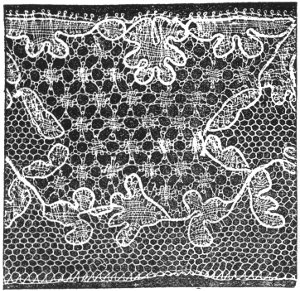
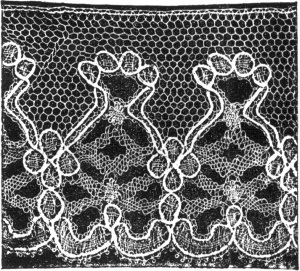
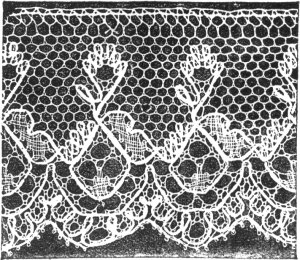
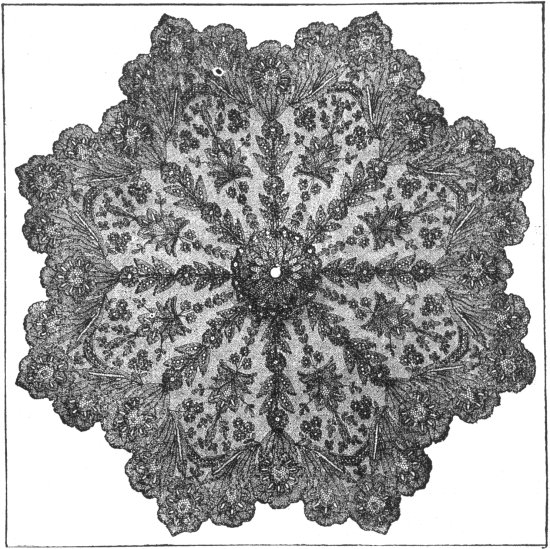
rich and tasteful designs, such as we give here
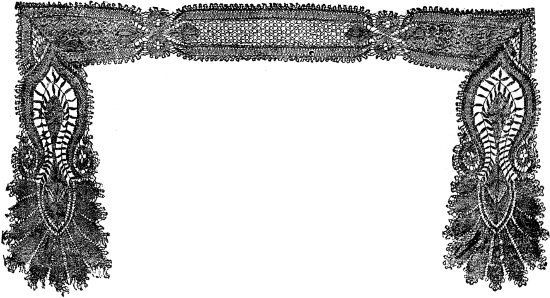
as a cover to a lady’s sunshade—well, it would
require for its production six to twelve months,
or even longer, according to the pattern and
the ability of the worker. This lace-cover is
bought in the shops of our great towns for the
ridiculously cheap sum of £5—perhaps £7 10s.—or,
at the very highest, £15.
If you take into consideration the high duty
on these articles, the worth of the raw material,
which is generally the best silk, and the fee to
the middle-man, you will see how much
remains for the industrious artist at her
cushion—never more than 2s. 1d. a day.
Supposing that a yard of pillow lace cost
7½d. in the shops, you must take off quite 2½d.
for the purchase of material and the fee for the
middle-man, which leaves the worker 5d. as
the price of a day’s hard work, for she cannot
make more than a yard a day.
The poverty of the pillow lace-maker is no
doubt due also to the low market price of the
lace, and this cannot be remedied, for lace
being not an article of necessity, but only of
luxury, the desire to buy will decrease with
every rise in price, especially as the machine-made
lace is produced so easily and in such
perfection that it is difficult often to tell the
true from the false.
For the last ten years it has seemed useless
to think of bettering the position of the lace-maker,
male or female. Any effort made is
rather to prevent an excellent and artistic
industry from dying out. The population has
turned itself to other industries which pay
somewhat better, merely taking up the lace-work
when others fail.
For example, men who in summer seek
their bread on the plains, either as bricklayers,
labourers, or artisans, join the family
circle in the winter in making lace, and it
is wonderful to see what soft and delicate
work is turned out by those hard hands. It
is pleasant to see the wooden stools drawn
round the table behind the glass globe filled
with water, through which the lamplight falls
sharp and clear on the spotless work, and
watch the family, from the aged grandmother
down to the toddling grandchild, take their
places at their cushions or pillows. For those
who have never seen pillow lace made, we
will give a few words.
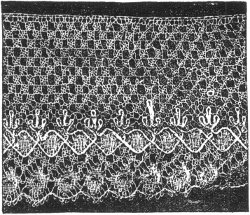
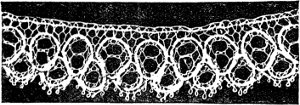
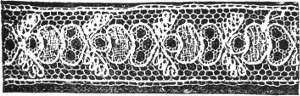
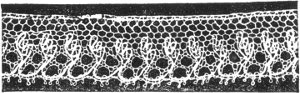
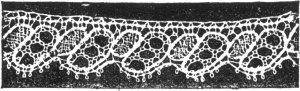
The pillow or cushion is of cylindrical
form, and tightly stuffed. On this a number
of pins are stuck, according to the pattern to
be worked. The threads, fastened to small
bobbins, are thrown across the cushion and
placed round these pins; the threads, traversing
from left to right, or vice versâ, often weave
at once the pattern and the ground. There is
a line in one of the Volkslied which runs—
“That bobbin lace may prosper ever.”
We echo the wish, but fear it will never be
realised.
“NO.” — CHAPTER II.
By MARY E. HULLAH.
o you like this part of
London?” asked Horace,
by-and-by.
Embrance had taken
off her bonnet and ulster,
and was sitting by the
side of the fire. It was
one of her characteristics,
owing, perhaps, to the need
of rest after long hours’ work,
that she could remain perfectly
still for a considerable
length of time. She had no desire to busy
herself with fancy work or to twirl her watch-chain;
she did not throw herself into picturesque
attitudes, but sat with clasped hands,
listening to her visitor’s easy flow of conversation.
A curl of her dark hair had escaped
from the stiff plait, and her lips were
parted with a smile.
“Not half so alarming as I imagined she
would be,” was Horace Meade’s thought, as
he pursued his inquiries as to her liking for
Bloomsbury, “but why, in the name of all
that’s wonderful, does she wear such a frightful
garment? It requires beauty to carry off a
Cinderella garb of that kind.”
“I find it convenient to live here,” explained
Embrance, while her visitor’s fancy
had soared far away, and was drawing her
hair high on the top of her head, putting
pearls in her ears, and a mass of crimson roses
in the lace round her throat. “She would
make a good study for the ‘ugly princess,’”
he thought.
“I know that you are one of the busy folk,”
he said, “Joan has told me about you and
your hard work. I only hope—” with a
certain kindliness that went straight to her
heart—“that you are not overdoing it. Joan
ought to look after you.”
Just for a second, Embrance’s dark eyes
looked up at him with a flash of inquiry:
could it be that this polite, soft-voiced man
was making fun of Joan and of her? As if
ashamed of her suspicion, she replied gently—
“It is a great pleasure to me to have Joan’s
company; we have been friends for a great
many years, ever since we were little schoolgirls.”
“And you helped her with her sums after
hours,” said Horace, twisting the end of his
moustache. “I have heard a great deal about
you and your doings, Miss Clemon, but
seriously, I should be glad to talk to you
about my cousin, if you will let me.”
“Please do; she has been so looking
forward to your coming; will you be able to
suggest any line for her to take up? She
doesn’t much like teaching; she was not very
happy at home, and (with a slight hesitation)
her grandfather makes her no allowance while
she is here.”
“Poor girl!” exclaimed Mr. Meade, “I
expected how it would be; he is a regular old
miser. As for Joan, with all her talent, she’s
had no proper teaching herself, and hasn’t an
idea what real work means. What has she
been doing lately?”
Embrance, conscious that Joan had been
spending the last fortnight in making herself a
charming terra-cotta walking dress, looked
towards the window, and said that there had
been so many fogs, it was bad weather for
artists. Mr. Meade nodded, then marched up
to the easel, and examined the drawing—a
study of roses, white and pink—that Joan had
begun a month ago; but even before the
roses (which had cost as much as a week’s
rent) withered, she had got tired of the
drawing, and had put it on one side for a
copy of a landscape, intended for the good of
her pupil, and also left unfinished.
For some minutes he stood there in
silence, took the drawings nearer to the light,
and carefully replaced them on the easel.
“Well?” asked Embrance, anxiously.
“What do you think of them?”
“I am not a judge; I know so little about
it.”
“Very likely, but look here” (she came
closer to the easel), “you are accustomed to
observe. Do you see the grouping of the
roses is pretty enough, but there, look, that is
quite out of drawing, and the stalk is an
absurdity.”
Embrance could not stay there any longer in
mute acquiescence: “But she is so quick,” she
remonstrated, “and has a real love”—for
painting, she was about to say, but her sense
of truth turned the sentence into: “for anything
that is beautiful!”
He turned away from the window with a
sigh. “As an amateur, it is all very well, but
otherwise, I don’t see what is to be done.
Poor little Joan! It’s a bad business; how is
she looking, Miss Clemon?”
“Prettier than ever, I think.”
“I am glad to hear it. She is a charming
companion, and I am very glad that you like
her. It is a comfort to know that she has got
such a good friend in you.”
Embrance blushed, feeling very uncomfortable,
and half inclined to resent his remarks.
It was rather late in the day for a complete
stranger to interfere in such an old friendship
as hers and Joan’s. “However,” she
reflected, “I am sure he is very fond of her; I
wish she would come in.”
“Perhaps,” continued Horace Meade, “you
think that I have no business to say this; but
the fact is, that I had expected to find, at
least I had not expected to find—that is to
say——”
He stopped abruptly, and Embrance could
not refrain from laughing: “You had
imagined that Joan had set up housekeeping
with a strong-minded woman of the most
extreme type, who didn’t care what became of
her.”
“No, no, indeed!” began Horace, but she
would go on.
“Please let me explain to you that I would
do anything, anything in the world to make
Joan happy. I have been looking forward to
your visit; I hoped that between us we could
find some way of helping her.”
It occurred to Horace that this would be an
advantageous moment to say something complimentary,
and get himself out of an awkward
predicament, but he did not avail himself of
the opportunity. He was a person who
believed in his own insight of character, and
Miss Clemon (who was so widely different
from his preconceived notion of Joan’s
learned friend) interested him very much;
he was quite sure that she was open and
honest as the day. Better be straightforward,
too.
“Thank you very much,” he said, almost
as if she had conferred a favour on him
personally, “I will think over what you have
said; we will try and help her; and may I
come again soon?”
Embrance answered that she would be very
glad to see him, and when, after a little more
chat, he took his leave, she went singing into
the next room, feeling lighter of heart than
she had done for days. She liked Horace
Meade very much, and how pleased Joan
would be to hear of his arrival!
Joan was, indeed, delighted to welcome her
cousin; Mrs. Rakely invited him to the hotel,
and there were many happy days spent in his
society. His own rooms and studio were in a
distant suburb, but he found time to make
himself very agreeable to the ladies, and to
show them the sights of London. Joan was
in her element, but too soon there came a
period of reaction. Mrs. Rakely went back
to the country, and Horace began to work
regularly; he was slowly making his way as a
portrait painter. Joan fell into low spirits
again, she wrote a great many letters, and
received bulky communications from Mrs.
Rakely, about which she maintained a silence,
strangely unlike her usual talkativeness. Now
and then she would turn wistful glances on
Embrance, as if longing for sympathy, but she
made no confidences. And Embrance treated
her with great tenderness, believing that some
slight squabble with Horace was the cause of
her despondency. “Better not to worry her
with too many questions,” she thought, “she
will tell me in her own good time.”
Horace came to the little second floor parlour,
generally timing his visits so as to arrive
about seven o’clock. He had dined at his
club. If he might be allowed, it suited him
best to drop in at this time. He hoped he
wasn’t in the way. Embrance bade him
heartily welcome, while Joan would forget her
melancholy, and brighten into fresh beauty
under the influence of her cousin’s pleasant
talk. More than once Embrance, busy as
she was, had attempted to leave the cousins
to themselves, while she laboured at a side
table; but Horace had a knack of coaxing her
back to the fireside, asking her opinion on
some interesting topic, or referring to her
laughingly as a competent authority. And
she had been enticed away to listen to his account
of his travels, or description of his
housekeeping failures in his own rooms. He
set Joan hard at work painting menu cards
and photograph frames, saying that he knew
a man who would dispose of them at a fair
price, and now and then he brought a drawing
for her to copy, but he showed no sign of
being impressed with the progress that she
made.
“Do you expect your cousin this evening?”
asked Embrance, one afternoon, about
a month after Christmas; “he has not been to
see you for some time.”
“No,” said Joan, wearily. She was lying
full length on the hearthrug, with her head
on a pillow, while Embrance arranged the
ornaments on the mantelpiece to her better
satisfaction; “but I have heard from him.”
“What did he say?” asked Embrance,
fancying that in Joan’s manner she could trace
a desire to be further questioned; “is it a
secret, Joan, or may I know all about it?”
Joan fixed her great eyes upon Embrance,
and raised herself from the ground with one
arm: “I have got a secret, but I am not to
tell you. Did you guess that I had?”
Embrance nodded. She had finished putting
the ornaments to rights, and now came
and sat on a low chair by the fire. “You
would rather not tell me about it just yet,
Joan?”
“Not yet,” said Joan, excitedly. “You
will know soon. Mrs. Rakely knows. But,
but”—she hesitated, “I don’t know when
Horace will come here again; he is very inconsiderate
sometimes. What do you think he
proposed I should do? I met him one day
and asked his advice—you are so busy, Embrance,
there seems to be no time to talk to
you. He says that I had better go back to
Doveton!”
“He wants to take her away from me,”
thought Embrance, with a pang; “perhaps he
is right, and I ought never to have kept her.”
She took Joan’s hand and patted it softly.
“There is no occasion to fret about it,” she
said. “Would you like to go back, Joan?”
“I don’t know,” said Joan, half crying.
“I’m sorry I quarrelled with Horace. I was
very disagreeable to him. He doesn’t think
I ought to stay with you much longer.”
“I am sorry,” began Embrance, humbly;
but Joan was too much taken up with her own
grievance to listen. She went on: “He
offered to speak to the head of a firm he knows
where they make furniture and employ people
(artists, Horace calls them) to decorate rooms
and paint panels. He said I should have to
be taught to do it; and, oh! Embrance, I
should hate to be shut up all day; I should
feel as if I were in a prison; so I said I
wouldn’t go and see his friend—that I would
rather go on the stage. And then he advised
me to go back to Doveton.” Joan was sitting
bolt upright now, and her eyes were sparkling.
“Do you think I behaved badly?”
“It was very hard for you, my poor dear;
but I dare say you were not so disagreeable as
you imagine. He would make allowance for
your not being accustomed to keep such
regular hours.”
“It’s you who make allowance,” cried
Joan. “You are very good, Embrance; and
I am keeping so much back from you. But
don’t think hardly of me; promise me you
won’t. Have patience with me, whatever I
do.”
A sharp east wind was blowing across the
park; the chestnut-trees stretched their bare
branches grimly towards the sky. Embrance
Clemon was walking home after her day’s
work; the dead leaves swept rustling and
dancing towards her. A party of noisy children
were racing after their hoops a few yards
in front of her. She had just been told by
the mother of a pupil, with many expressions
of regret, that her services would not be required
any more after Easter. Her head was
full of plans, by which she could contrive to
manage her slender resources, so that Joan
should not be made to feel that she was in
any way increasing the household difficulties.
In truth, she could ill afford to lose a lesson
just now. She had heard no more of Joan’s
quarrel with Horace Meade; she imagined
that that was made up long ago; the two
had met more than once, she knew, at a friend’s
house, but he had left off coming to call.
Embrance missed his visits; it was clear to
her now, looking back to the last few months,
that Horace Meade had brought a great deal
of happiness into their quiet lives—hers as
well as Joan’s. And yet, try as she would,
she could not but feel hurt that he should be
so anxious to remove Joan from her influence.
“It doesn’t matter, after all,” she reflected,
walking faster and faster in the grey twilight,
“what he thinks of me.” Nevertheless, it
mattered so much, that Embrance grew sad
at heart; there came over her a great longing
to throw up the present occupation and go
away, anywhere, and begin again; to shut up her
past life tight and firm and to start afresh. And
Joan? She almost smiled at her own folly, as
she recollected how impossible it would be to
leave Joan in such an unceremonious fashion.
(To be continued.)
THE SHEPHERD’S FAIRY. —
A PASTORALE.
By DARLEY DALE, Author of “Fair Katherine,” etc.
If it had not been for his anxiety about Fairy, this would
have been an excursion quite after Jack’s own heart.
He delighted in anything unusual which varied the
monotony of his daily life, and if it partook of the nature
of an adventure he was all the better pleased. As he
and his father tramped along the Oatham-road, one
walking on the extreme right, the other on the left hand
side, it was natural that John should beguile the way
with reminiscences of other fogs.
“The worst fog I ever remember was when I was
courting your mother, Jack. It was just after Lewes
sheep fair, and a Saturday night, and it came on quite
suddenly, so that I saw it was impossible to attempt to
get the sheep home that night, for I was on Mount
Caburn, and I did not know the mount so well then as
I do now. But I always spent Saturday evening and the
best part of Sunday with your mother, and I did not feel
inclined to be done out of my weekly treat by the fog,
so, though I could not get the sheep into fold, I thought
I would leave them to take their chance till the fog
lifted, and then come after them; I knew I should soon
find them by the help of the bell-wethers and Rover, so
I left the sheep, and set off to try and find my way
home through the fog. I knew there were one or two
nasty places where I might fall and break my neck, so
I went pretty carefully, you may be sure. I had no
lantern with me, and it was a darker night than to-night,
and I think I must have wandered round and round the top of Mount Caburn for three or four
hours before I even began to descend. At last I found I was actually on a downward track,
though I had not the least idea which side of the hill I was, and I think if I had not been
in love I should have remained where I was till the morning, or at least till the fog cleared.
As it was, I determined, at all hazards, to go on, though I guessed I should get a scolding
from your mother for my pains; so on I went, on my hands and knees, feeling my way before
me, for I was afraid to walk upright lest I should step over a precipice, and at last I reached
the bottom in safety. Then I had no idea where I was till, luckily for me, I met a man with a
lantern, and he put me in the road, but it was too late to go to your mother’s that night, and
the greater part of Sunday was spent in looking after the sheep, who had wandered for miles.
But this fog won’t last much longer, Jack; the wind is rising,” said the shepherd.
“Yes,” said Jack. “I wish it would blow those children home safely. I do hope nothing
has happened to them; but Charlie is so careless, he leads Fairy into danger without
thinking.”
“She does not want much leading into danger; she is apt enough at running into that,
I am thinking, Jack. But what is become of Rover?” said the shepherd, stopping and
whistling.
“Bow-wow-wow,” replied Rover, in an excited tone, from the depths of the fog.
“Where are you, sir? Come here,” cried the shepherd.
“Bow-wow-wow-wow,” answered Rover, in a still sharper key.
“Come here, sir; what are you at?” cried John Shelley.
“I hope he has not found the children in that chalk-pit. See, we are near the first one,”
said Jack, crossing over to his father, and moving with him to the chalk-pit, which was at
the side of the road.
“I trust not, Jack. Here is Rover; he has found something, that is clear. All right, I
am coming, good dog,” said the shepherd, as Rover now emerged from the fog, and, by dint
of many barks and wagging of his tail, gave his master to understand that he had discovered
something.
The shepherd throwing the light of the lantern in the direction the dog indicated, followed
him, while Jack, with his heart in his
throat, dreading at every step that the
next would bring him face to face with
Fairy stretched lifeless at his feet—a
picture his quick imagination had but
little difficulty in conjuring up—brought
up the rear.
They were at the mouth of a large
chalk-pit, but, owing to the density of
the fog, the lantern did not enable them
to see more than a yard before them;
moreover, they were obliged to go very
carefully, as huge pieces of chalk were
scattered over the centre of the pit. Suddenly
Jack kicked against something,
and stooping, picked up a large gingham
umbrella, which, to his joy, he saw at a
glance did not belong to Fairy.
“See, father, an umbrella; can this
be what Rover is making all this fuss
about?” asked Jack, handing the huge
thing to his father to examine.
“I doubt not; I am afraid we shall
find the owner of the umbrella next,
Jack, by Rover’s ways. But look, there
is a name cut on the handle, and it
looks as if it had been cut quite recently,
too. See if you can make it out, I can’t;
seems a foreign name to me,” said John
Shelley, holding the umbrella close to his
lantern for Jack to read.
“D-e-t—No, it is a capital t; De
Thorens, that is the name, plain enough.
A foreign one, too, as you said. It must
belong to some stranger, then; perhaps
someone has lost his or her way and taken
shelter in this pit. Let us shout, father,
they may hear us,” and Jack shouted,
but in vain.
Rover now became more excited than
ever, and seizing John Shelley by the
skirts of his smock-frock, dragged him
forward, until suddenly he came to a
standstill, and loosing his hold of his
master, sniffed round and round something
which was lying a step or two
further on. John Shelley stooped, and,
lowering his lantern, turned the light on
the object, and saw to his horror the
apparently lifeless body of an old woman,
which was lying huddled together
in a shapeless mass. Gently and
reverently the shepherd straightened the
limbs, which were already getting cold
and stiff, and then looking at the face,
which was not disfigured by the fall, the
old woman having fallen on her back,
he recognised his old acquaintance Dame
Hursey.
“Is she dead, father?” asked Jack,
in an awe-stricken voice, as he clutched
his father’s arm, for it was a ghastly
sight these two were gazing on in the
cold, dark, foggy night, by the weird
gleams of their lanterns.
“Yes, Jack, yes; do you see who it
is? Poor old Dame Hursey, the last
person I ever thought to find here, for if
anyone knew the Downs it was she. She
is dressed in her best, too; she was not
out wool-gathering, that is clear,” said
the shepherd, slowly.
“But what are we to do, father? We
can’t leave her here, and we have not
found Fairy and Charlie yet.”
“We must leave her here for the present,
Jack; she is dead, and must have
been killed on the spot; I expect Rover
will watch by her till we come back.
We must separate; you go back to the
police station for a stretcher and some
men, while I go on and look for these
children. I hope and trust they won’t
come across this sight; it would give
Fairy a terrible fright. Be as quick as
you can, Jack, for if the children are not
on the Race Hill we shall have to go in
another direction. I’ll meet you at the
police-station; I shall be back there by
the time you have got the poor old dame
carried there. Rover, stay here till Jack
comes back.”
No need to tell Rover twice; he laid
down by the body at once, and there he
would have remained till doomsday if
Jack or his master had not returned
before; and Jack, though he by no
means liked his task, and would far
rather have gone on to look for Fairy,
obeyed as promptly as Rover.
And where were Fairy and Charlie on
this cold, dark November evening in
this thick fog? They had not gone to
Mount Harry after all, though they had
set out with that intention, for as soon as
they reached the Brighton-road Fairy
had suggested they should go to Brighton
instead, and though Charlie, who
was rather lazily disposed, hesitated and
raised objections, Fairy overthrew them
all, and finally succeeded in persuading
him to take her.
The object of their walk was to pay a
visit to a bird-stuffer in Brighton, and
find out the price of an eared-grebe
which had lately been shot in the neighbourhood,
and which this man, as Jack,
who had been over two or three times to
look at the bird, had told Fairy, was
stuffing and mounting. If only the price
were reasonable, a better Christmas
present for Jack could not be thought
of. He would be wild with joy at
possessing this bird, which Fairy described
to Charlie from a picture Mr.
Leslie had of it. Charlie did not care
much what the price was, but he was
curious to see this wonderful grebe with
the ruff round its neck, so he consented
to take Fairy.
“How much do you think it will be,
Charlie?” asked Fairy, as they trudged
along the muddy road in the mist.
“I don’t know; Gibbons will let us
have it ever so much cheaper than anyone
else, because Jack so often gives
him birds and eggs, and all manner of
curiosities. How much can you afford,
that is the question?”
“Well, mother will give me something,
and John and Mr. Leslie will give
me five or ten shillings, and I have got
seven myself; I think I can afford a
sovereign altogether. You must give
something, too, Charlie, you know.”
“That’s all the money I have,” said
Charlie, putting his hands into his
pockets and producing twopence halfpenny.
“That won’t go far,” he added,
ruefully.
“Never mind, it will help. I do hope
Gibbons will let us have it for a pound,”
answered Fairy; and buoyed up with
this hope, she walked into Brighton, a
good eight miles, without once complaining
of being tired.
The bird-stuffer, who knew Charlie
well, showed them the grebe with pride;
but, alas! Fairy soon learnt that the
price was far beyond her means, and
feeling very much disappointed, for
Jack’s sake, she half repented having
taken such a long walk, especially as by
the time they left the shop the fog had
come on very thick, and the short November
day was coming to a close. In
spite of this, Charlie insisted on going to
the beach to look at the sea for a few
minutes, though it was quite out of their
way, and Fairy, tired as she was, could
not refuse to oblige him when he had
come so far to oblige her. Happily a
very brief peep at the dull, grey sea in
this deepening fog satisfied Charlie, but,
nevertheless, it was five o’clock before
they started on their eight miles walk
back to Lewes, and by the time they
were quite clear of the town, which in
those days was very much smaller than
at present, and on the Lewes-road it was
so dark they could not see the road
before them, and were obliged to walk
slowly in consequence; moreover, Fairy
was so tired she hardly knew how to
drag one leg before the other.
“There is one comfort,” said Charlie,
“it is a straight road; we can’t lose
our way, and perhaps we shall meet
someone who will give us a lift.”
“I wish we could. How dark it is,
Charlie. Are we half way yet, do you
think?” asked poor Fairy, whose little
feet were so sore she could not keep up
with Charlie.
“Half-way? No, not a quarter yet. You
are tired, I know, though you won’t own
it. I told you it was too far for you;
here, take hold of my arm, and I’ll help
you along,” said Charlie.
Thus encouraged, Fairy plodded on
for another mile or so, during which
time one or two carts passed them, but
either could not or would not hear their
requests for a lift, and one so nearly ran
over them in the darkness that they
ceased to wish for any more to pass.
But before they were half-way home
Fairy declared she must stop and rest a
little, and Charlie, who knew if anything
happened to her he would get all the
blame, began to get frightened lest she
should faint or be taken ill on the
road, far away as they were from any
village.
“Will you let me try and carry you,
Fairy?” he asked.
“You?” laughed Fairy, in spite of
her fatigue; “you carry me? Why, I
doubt if Jack could, even. No, thank
you; let me rest a little on this tree I
nearly fell over, and then I’ll go on
again.”
“Very well, but you must not rest
long, or you’ll catch cold; besides, we
shan’t get home to-night at this rate.
Now, when I have counted up to a hundred,
I shall haul you up,” said Charlie,
beginning to assert a little gentle authority
under the circumstances.
Thus they went on, Fairy walking
about half-a-mile at first, and then stopping
to rest, but each rest grew longer
and each walk shorter, and Charlie, who
had never had a very high opinion of
girls in general, much as he admired
Fairy in particular, came to the conclusion
that they were all pretty much
alike, and that there was not much to
choose between them. Poor, weak
things, they got tired directly, and
could not even walk sixteen miles without
making a fuss!
At last, when they were about a mile
and a half from the shepherd’s house,
and Fairy now could only walk if Charlie
supported and led her, they saw a lantern
coming towards them, and to their
joy found it was John Shelley.
“Oh, John, I am so glad,” cried
Fairy, as the shepherd turned the lantern
full on her.
“Fairy! Why, my pretty one, where
have you been?” cried John.
“To Brighton; and, oh! John, I am
so tired; I shall never get home.”
“To Brighton? Charlie, what do you
mean by taking her to Brighton? But
we will get home first, and talk about
that afterwards. Take the lantern,
Charlie, and lead the way. The child is
dead beat; I must carry her.” And
without another word the shepherd took
Fairy up in his strong arms and carried
her home, stopping now and then to
rest, but declaring he was not tired, as
she was so light, and he was used to
carrying lambs; and was not she his pet
lamb?
This was one of his names for Fairy,
and finding he did not seem to mind
carrying her, she submitted gratefully,
for she was so tired she did not care how
she got home, as long as she got there
somehow.
Mrs. Shelley was at the gate wrapped
up in a shawl, and feeling dreadfully
nervous about them, although John had
not told her of Dame Hursey’s terrible
end when he came in an hour ago to
say, just as Jack had started off to
Mount Caburn to look for the children,
he had heard they had been seen in
Brighton that afternoon.
“Here they are, Polly, quite safe, only
Fairy is tired out,” said John, as he
carried Fairy into the house, and placed
her in his own chair before the fire.
“Thank God! Children, children,
where have you been? But I must tell
Jack first; he has just come in, and was
going to have some supper and then
start off after you, John. Jack, where are
you? They are safe,” cried Mrs. Shelley
to Jack, who was upstairs.
Down rushed Jack to see for himself
that it was true. He looked pale and
anxious, for besides the shock of Dame
Hursey’s death, he was tired out with
his search for Fairy after his day’s work
on the downs.
“Well, a pretty chase you have given
father and me, Mr. Charlie, dragging
Fairy to Brighton in this cheerful
weather. If you are not ashamed of
yourself, you ought to be.”
“I did not drag her there; I dragged
her home, and a pretty tough job it was,
I can tell you,” said Charlie.
“It was my fault, Jack, not Charlie’s;
I won’t have him scolded; and we had
all our walk for nothing, and as John is
not angry, I don’t mean to be scolded
either,” said Fairy.
“No, John never is angry with you;
if he were sometimes you would not be
half so much trouble; but come, it is no
use making a fuss about it; they are
home safely, thank God, so let us have
supper,” said Mrs. Shelley.
But somehow, in spite of their fatigue
and long fast, no one was hungry except
Charlie, whose appetite seldom failed
him. Fairy was much too tired to eat,
and Mrs. Shelley too glad and thankful
to have them all safe around her, while
the shepherd and Jack could not forget
poor Dame Hursey’s fate, which they
were only waiting till Fairy and Charlie
were gone to bed to discuss with Mrs.
Shelley.
Fairy soon asked to be excused,
as she was so tired, and Charlie, having
been sent off with a huge piece of bread
and cheese to consume at his leisure,
John and Jack told Mrs. Shelley of the
accident.
“Oh dear! oh dear! and to think it
might have been that child, Fairy, or
Charlie, instead of poor old Dame
Hursey! I shall tell them both to-morrow,
and I hope it will be a lesson to
them to be more careful in the future.
Poor old woman! there will have to
be an inquest, of course,” said Mrs.
Shelley.
“Yes, the inquest is to-morrow, but
there is no one to give evidence except
father and me,” said Jack.
However, when Fairy was told the
next morning what had happened, it
was found she was able to throw a little
light on the matter, knowing, as she did,
that Dame Hursey had gone to meet her
son George the day her death occurred.
She had evidently lost her way in the
fog after leaving him, and the coroner’s
jury brought in a verdict of accidental
death without any hesitation. Some
little discussion was raised as to the umbrella
with the name De Thorens cut on
the handle, but as it was remembered
the last time George Hursey was heard
of in Lewes he was living in France, the
coroner suggested the umbrella was his,
and that he had perhaps given it to his
mother to help her home. This theory
satisfied everyone but Jack, and he, for
reasons of his own, kept his ideas on the
subject to himself. He always had
thought Dame Hursey knew more about
Fairy than anyone, and somehow he
could not help thinking this word De
Thorens had something to do with the
child. He was certain the coroner’s
theory was untrue, because he had seen
Dame Hursey with this identical umbrella
over and over again; moreover,
the name was recently cut, and as he
knew the old woman could not have done
it herself, he guessed her son George
did, but why or wherefore he could not
determine; only he suspected it had
something to do with Fairy. But though
he turned the subject over in his own
mind again and again as he followed his
sheep on the lonely downs, he could
make nothing of it, though he felt sure
he held the key to the solution of the
mystery of Fairy’s origin in his hand, if
he only knew how to use it. On the
whole, curious as he was about it, he
was not sorry to be unable to solve the
puzzle since he feared its solution would
lead to his separation from Fairy.
If he could have known how that one
false step of poor old Dame Hursey’s
prevented Fairy from being restored to
her parents, shocked as he had been at
her terrible death, it is doubtful if he
could have regretted her sad end as
sincerely as he did.
(To be continued.)
VARIETIES.
A Word to Pride.
Say to thy pride, “’Tis all but ashes for the urn;
Come, let us own our dust, before to dust we turn.”
The Silent Lover.
Silence in love bewrays more woe
Than words, though ne’er so witty;
A beggar that is dumb, you know,
May challenge double pity.
—Raleigh.
Musical Criticism.—There are two kinds
of people who ought to give their opinions
about music; those who know enough about
it to give an opinion which is really valuable,
and those who simply say what they like and
what they don’t like, and no more.
A Strengthening Medicine.
A Parisian chemist recently advertised his
strengthening medicine for delicate people in
the following terms:—
“Madame S. was so weak at the time of
her marriage that she could hardly stand
upright at the altar. Now, after using
several bottles of my medicine, she is capable
of throwing the smoothing iron at her husband
without missing him once.”
A Generous Nature.—Generosity is in
nothing more seen than in a candid estimation
of other men’s virtues and good qualities.—Barrow.
Saving Habits.—Take care to be an
economist in prosperity; there is no fear of not
being one in adversity.
The Mind’s Sweetness.
Let thy mind’s sweetness have his operation
Upon thy body, clothes, and habitation.
—George Herbert.
By Fits and Starts.
The rogue and fool by fits is fair and wise,
And even the best by fits what they despise.
—Pope.
What is Wit?
True wit is nature to advantage dressed,
What oft was thought but ne’er so expressed.
—Pope.
Self-knowledge.—It is not until we have
passed through the furnace that we are made
to know how much dross is in our composition.
Fluent Speech.—The common fluency of
speech in most men and most women, says
Dean Swift, is owing to a scarcity of matter
and scarcity of words; for whoever is a master
of language, and hath a mind full of ideas, will
be apt, in speaking, to hesitate upon the
choice of both; whereas common speakers
have only one set of ideas and one set of
words to clothe them in, and these are always
ready at the mouth. So people come faster
out of church when it is almost empty than
when a crowd is at the door.
An Objection to Hatred.—Plutarch says,
very finely, that a man should not allow himself
to hate even his enemies; for if you indulge
this passion on some occasions it will
rise of itself on others.—Addison.
Amusement for the Wise.
Amusement is not an end, but a means—a
means of refreshing the mind and replenishing
the strength of the body; when it begins to
be the principal thing for which one lives, or
when, in pursuing it, the mental powers are
enfeebled, and the bodily health impaired,
it falls under just condemnation.
Amusements that consume the hours which
ought to be sacred to sleep, are, therefore,
censurable.
Amusements that call us away from work
which we are bound to do are pernicious, just
to the extent to which they cause us to be
neglectful or unfaithful.
Amusements that rouse or stimulate morbid
appetites or unlawful passions, or that cause us
to be restless or discontented, are always to be
avoided.
Any indulgence in amusement which has a
tendency to weaken our respect for the great
interests of character, or to loosen our hold on
the eternal verities of the spiritual realm, is so
far an injury to us.
Fish against Fry.
The following jeu d’esprit was suggested by
an action at law some years ago, in which the
parties were a Mr. Fry and a Mr. Fish:—
“The Queen’s Bench Reports have cooked up an odd dish,
In action for damages Fry versus Fish;
But sure, if for damages action could lie,
It certainly must have been Fish against Fry.”
Wise Words on Reading.
One of the common errors of the day is
indulgence in indiscriminate reading. The
greater the number of books the more careful
readers ought to be in the choice of them, and
as a guide to their value nothing could be
better than the following wise words of
Southey:—
“Young readers, you whose hearts are
open, whose understandings are not yet
hardened, and whose feelings are neither
exhausted nor encrusted with the world, take
from me a better rule than any professors of
criticism will teach you.
“Would you know whether the tendency
of a book is good or evil, examine in what
state of mind you lay it down. Has it induced
you to suspect that what you have
been accustomed to think unlawful may after
all be innocent, and that that may be harmless
which you have hitherto been taught to
think dangerous? Has it tended to make
you dissatisfied and impatient under the control
of others, and disposed you to relax in
that self-government without which both the
laws of God and man tell us there can be no
virtue, and consequently no happiness? Has
it attempted to abate your admiration and
reverence for what is great and good, and to
diminish in you a love of your country and of
your fellow creatures? Has it addressed itself
to your pride, your vanity, your selfishness,
or any of your evil propensities? Has
it defiled the imagination with what is loathsome,
and shocked the heart with what is
monstrous? Has it distracted the sense of
right and wrong which the Creator has implanted
in the human soul?
“If so—if you have felt that such were the
effects it was intended to produce—throw the
book into the fire, whatever name it may bear
upon the title-page. Throw it into the fire,
young man, though it should have been the
gift of a friend; young lady, away with the
whole set, though it should be the prominent
furniture in the rosewood bookcase.”
Taught by a Robin.—I am sent to the
ant to learn industry, to the dove to learn
innocence, to the serpent to learn wisdom,
and why not to the robin redbreast, who
chants as delightfully in winter as in summer,
to learn equanimity and patience?
Hands and Feet.
Hands are no more beautiful for being small
than eyes are for being big; but many a
modern girl would ask her fairy godmother, if
she had one, to give her eyes as big as saucers
and hands as small as those of a doll, believing
that the first cannot be too large nor the last
too small. Tiny hands and feet are terms constantly
used by poets and novelists in a most
misleading manner. It cannot be possible
that they are intended by the writers to express
anything but general delicacy and refinement;
but a notion is encouraged that results
in the destruction of one of the most beautiful
of natural objects—the human foot.
This unfortunate notion, that the beauty of
the foot depends upon its smallness, leads to
the crippling of it, till it becomes in many
cases a bunch of deformity. It is a most
reprehensible practice, alike revolting to good
taste and good sense, to put the foot of a
growing girl into a shoe that is not only too
short, crumpling the toes into a bunch, but,
being pointed, turns the great toe inwards,
producing deformity of general shape, and, in
course of time, inevitable bunions, the only
wonder being that steadiness in standing or
any grace of movement at all is left.
Girls and their Mothers.—A writer in
a contemporary calls attention to the very
objectionable sharpness with which some girls
speak to their mothers. “In a railway
carriage on our journey north,” she says,
“the window seats at one end were occupied
by two ladies, evidently mother and daughter.
The latter appeared to be out of temper. The
former mildly remarked, ‘Do you not think we
had better have the window up?’ the reply
was, ‘Most certainly not,’ delivered in F
sharp key. If I were a modern Cœlebs in
search of a wife, I should very carefully
observe the young lady’s manner to her mother
before asking the momentous question, for a
girl must be vixenish at heart and unamiable
indeed, when she can address her own mother
with such careless rudeness as one too often
hears.”
Modesty.—Modesty is the appendage of
sobriety, and is to chastity, to temperance,
and to humility, as the fringes are to a garment.—Jeremy
Taylor.
ANSWERS TO CORRESPONDENTS. — EDUCATIONAL. — MUSIC. — MISCELLANEOUS.
Macaco and F. S. D.—“Macaco” recommends a
correspondence class, conducted by a Miss Macarthur,
4, Buckingham-street, Hillhead, Glasgow.
We have before drawn attention to a little useful
shilling manual called “A Directory of Girls’ Clubs,”
chiefly educational, and including religious studies
and unions for prayer (Messrs. Griffith and Farran,
St. Paul’s-churchyard, E.C.). By procuring this a
choice can be made, as the rules and terms of most
of them are given. “F. S. D.” had better try again,
by all means, when we give another competition.
It will be found, as you say, to do good, even to
those who do not prove winners.
Ella.—You might find the first instruction books in
history, geography, and grammar at a secondhand
bookstall for a mere trifle. Later on, you may have
the means to obtain the more advanced.
Alta.—See our answers under the above heading, so
continually repeated in reference to your questions.
You are too young to be received as a nurse. See
our reply to “L. N.,” page 31, vol. vi. (part for
October, 1884).
Iciple.—We do not recommend teachers and Board-school
mistresses to look for engagements in the
colonies, however well supplied with certificates.
Nevertheless, to render the matter more certain you
had better obtain information and advice at the
Women’s Emigration office, in Dorset-street, Portman-square,
W.
Jemima.—1. We can only say to you what we have had
to say to many—you must accept what terms you
can get as a governess, your youth being against
you: a “fault that will mend.” The trainer and
caretaker, morally and physically, of children and
young people under age is paid for her experience
and extensive knowledge of many kinds, not merely
for her acquirements in science and art. 2. “The
Flowers of the Field,” by the Rev. C. A. Johns, is a
nice book of the kind you require (43, Piccadilly, W.).
S. B. O. F. W.—We think your writing would pass for
the examination you name; but if rounded a little it
would be prettier. If you wish to know how you
may serve Christ, read His own words (in the four
gospels) and those of His apostles. Be much in
prayer for the aid of the Holy Spirit, and try to
perform the daily duties of life as in His sight.
Deny yourself for others, control your temper, and
set a good example.
Dinah begs us to give her “a great ‘hunch’ of
advice” as to the kind of instrument she may purchase
for ten shillings, because, having rather limited
means, amounting to “tenpence per week,” she
“could not give a high price.” She thinks “a bango
would suit her, because much like a nigger,” etc.
We advise her to go to a musical instrument shop
and see what she can get for the price she names.
Rob Roy.—One of the largest organs in the world is, we
believe, that which you may see in the Royal Albert
Hall, South Kensington. It is by Willis. It contains
111 sounding stops, and nearly 8,000 pipes.
Next to it is the organ in St. George’s Hall, Liverpool,
which has 5,739 pipes; and the Crystal Palace
organ has 4,568 pipes. The organ may be splendidly
played by a woman, but, on account of the foot
pedals, it is by no means suitable for her. The strain
upon the back and lower part of the frame is very
apt to result in physical injury.
Mary Bird.—There is no reason why you should not
play the flute, if you have one, excepting that it
distorts the shape of the mouth—at least, for the
time—and it is, we suppose, on this account unusual
as an instrument for female culture. The clarionette
would be equally objectionable for some faces, yet it
is not unfrequently adopted by women. The oldest
tune or piece of music in existence is of Hebrew
origin—i.e., the “Blessing of the Priests,” which is
used in the Spanish and Portuguese synagogues, and
was sung in the Temple at Jerusalem from very
remote times.
Sister to “Caged Beauty.”—Your request will be
considered. We have a special interest in our girls
and other readers scattered over our far-off colonies.
Your letter is well expressed, and your handwriting
is legible and fairly good.
“A Bothering Girl.”—The books of Esdras are in
the collection called the “Apocrypha,” and this may
be had from any library. These books are not inspired,
though much that is good is to be found in
them, together with curious fables and traditions.
The books of the Maccabees are much thought of as
historical works of great antiquity. A list of the
canonical books of both the Old and the New Testaments
is to be found in all Bibles, and that of the
Lamentations of the Prophet Jeremiah is included
amongst them.
Emma.—The reason that some words are printed in
italics in the Bible is simply this: that there are no
corresponding words in the original language from
which the translation was made; but the English
words supplied were necessary to give the meaning,
which could not be understood without them. Perhaps
when we give the following example you will
understand what we mean. We all know what is
meant when people say, “How do you do?” but
translate it into French, word for word, and the
meaning would be lost.
Dearie should learn to spell better. She speaks of the
word “desert,” which denotes a barren, uncultivated
waste of arid sandy land, but by which she says she
means the last course at dinner, that of fruit, ice, and
sweetmeats. Now this course is called “dessert,”
and the emphasis in its pronunciation is placed on the
second syllable, and as if spelt with a “z”
(“de-zert”), whereas in the word “desert” it is on
the first, as “dez-ert.” “Bivouac” is pronounced
as “biv-oo-ak.” Her writing is very pretty, and we
thank her for her kind letter.
Anglican Catholic.—We do not give private addresses.
St. Augustine was sent over to this country
by Pope Gregory the Great as a missionary, Christianity
having been nearly exterminated by the invasions
with which it was so terribly harassed. He
found a Christian church at Canterbury (St. Martin’s),
where Queen Bertha worshipped, having Luithard as
her priest and director. She was a French princess,
and brought him over with her. At that early time
the Roman Church had not evolved nor promulgated
many of her modern dogmas.
Mary M.—It is not essential that you should send
your address in writing to the Editor, as in many
cases it might hinder the expression, feelings, and
difficulties with the full freedom necessary to ensure
satisfactory advice.
Edmunda Yorke.—You had better write and tell him
that, having so forgotten himself and taken undue
advantage of the intimacy involved in the relations
between a doctor and his patient on the occasion of
your last visit, your self-respect compelled you, with
much regret, to forego the benefit of his treatment,
and you would be obliged if he would return your
book and send in his account.
E. M. Trill.—You will receive what you require by
attending to the directions given at the end of every
article by the “Lady Dressmaker.” The Editor
cannot attend to that department.
One Seeking Light.—1. We recommend you to join
the Odd Minutes Society, of which the secretary is
Miss Powell, of Luctons, Buckhurst-hill, Essex. She
will send you all particulars about it, and we think
it is exactly the useful work that you require. 2.
Read Isaiah i. 16, 17, 18, lv. 7, and Ezekiel xxxiii.
compared with St. John vi. 37, and Hebrews vii. 25.
Violet.—1. Place the steel ornaments in oil, and leave
them there for some time to soak off the rust, and
then rub well with a soft toothbrush and chamois-leather.
2. Your handwriting is not formed. Spell
“truly” without the “e.” Final “e’s” in adjectives
are dropped when they are formed into adverbs.
Allegro, Mab, Gipsy.—There is Miss Mason’s
Home of Rest for Christian Workers, 7 and 8,
Cambridge-gardens, Kilburn, N.W.; seaside branch,
Burlington-place, Eastbourne. Terms, from 7s. to
£1 per week. There is also The Cottage Home of
Rest, 2, Tilsey Villas, King’s-road, Norbiton (close
to Richmond Park). Apply for form of admission
to Mrs. J. M. Pearson, The Grange, Kingston-hill.
Also see our answer to “Daisy.” We think that
Cobham, Surrey, would suit you.
Idalia (Demerara).—We read your nice letter with
interest, and tried to realise the sketch you give of
your surroundings. How we wish we could see the
“pink and red morning glory,” the “Hushfalia,”
“Waxplant,” and Stephanotis “running all up to
the banisters on both sides,” etc. Accept our thanks
for the kind wish expressed to send us some of them.
We do “take the will for the deed.” By some means
your silver bracelet has become oxidised, and your
only plan will be to send it to a silversmith. Your
writing, if sloped a little from right to left, would be
excellent.
Omnia Vincit Amor.—The form of speech, in such
common use, to which you refer, is perfectly understood
(in the real meaning assigned to it) by the
visitors to whom it is addressed. Thus it is not a
deception. There are “at home days,” and “not
at home days.” On the former your mistress will
be found in her reception-room; on the latter, she
will not be found awaiting visitors there. If persons
in society agree together to adopt a certain
phrase to signify a certain thing, and not as a deception,
you may use that phrase, at the orders of
your mistress, in the sense in which she meant, and
her visitors will receive it. Your letter and the
verses, though incorrect in composition, do you
credit, and we wish you God-speed!
Hope.—We recommend you to get a small sixpenny
manual on canaries and their treatment. Your bird
has probably been in a draught. See our article at
page 775, vol. iii. Our correspondents are as
numerous as ever, and the difficulty is to find space
for all the answers written. Your handwriting is not
formed.
Marian.—The Jewish year begins with Tisri, which
month follows immediately after the new moon following
the autumnal equinox; but the ecclesiastical
year begins with the seventh month—viz., Nizan or
Abib. The following is the entire list:—Tisri, Marchesvan,
Chislev, Thebet, Sebat, Adar, Nisan, Tjar,
Givan, Thammuz, Ab, and Elal.
Miscel.—When reading or reciting to a public audience,
it is usual to stand, unless the piece to be
read be very long. You should (or might) hold the
letter. “If you were to see So-and-so painted by
so poor a painter, and bad at that” (bad event for
a bad attempt). This is the meaning of the Americanism.
Inquirer.—Chemists have signs of their trade like
other tradesmen. The hairdresser has a striped pole,
the publican chequers, or a bush, etc. Divide your
ancient from your modern coins, and let each of
these be sub-divided according to size and age.
Have little trays with a succession of shallow circular
cells lined with coloured paper to receive them,
deep enough to preserve them from any touch of the
tray that lies on it.
Ignoramus.—You could clean the large white skin
hearthrug by means of powdered plaster of Paris.
There is no difficulty in making a small copy of a
large picture; the difficulty would be in enlarging.
SHE STRETCHETH OUT HER HAND TO THE POOR;
YEA, SHE REACHETH FORTH HER HANDS TO THE NEEDY.
PROV. XXXI, 20.
M. W. A.—On a liberal computation, the cost of keeping
a pony varies from £10 to £20 per annum. The
grazing will cost less than that of a cow, and £4
or £5 would cover it. You may give him turnips
and carrots, and scraps from the house of vegetables
and bread. Oats would cost about 10s. a month;
but they are really quite unnecessary. A cartload
of hay at a corn-merchant’s price would be about
£5, more or less, and this should last one pony
from the end of a summer’s grass (about the end
of October) till the beginning of May next year,
when grass would be resumed. But unless the
animal were groomed and harnessed by yourself,
you must also take the expense of a groom into
your account, and the cost and repair of a trap.
Kathleen.—Rest your foot for a couple of days,
and if inflamed poultice it a few times; then cut
the nail quite straight at the top, and scrape (with
a penknife or scrap of glass) down the centre to
thin the nail in the middle, and so dispose the sides
to rise up instead of bending downwards and inwards,
from the convex (or rounded) shape of the
nail. It might be best at first to cut the nail rather
in a “u” or “v” shape in the middle, instead of
quite straight across, as you may do afterwards.
Perplexed One.—The only wrong we see about the
whole matter is that you did not confide all to your
mother. A girl should keep no secret of her own
from her. She is the adviser and the protector of her
daughter, and if desirable that you should renew
your acquaintance with him, she will know best what
steps to take. Never let her find out by chance what
concerns you so seriously, more especially when anyone
else has been made a confidant.
Guinevere.—1. The term “furniture” is too vague to
enable us to give you advice. You do not even say
whether it be wood, stuff, or leather. It is very hard
to remove inkstains, but if you refer to our indexes
you will find more than one recipe for removing
them. The probability is that in taking them out
you extract the dye of the material likewise. 2. Break
up a small stick of chocolate into a cup, and pour the
least drop of boiling water upon it. When dissolved,
pour boiling milk upon it, stirring all the time.
Lange.—Sponge the oil-cloths with milk and water,
and rub them dry; then rub over with beeswax, dissolved
in a little linseed oil. We “thing” your
handwriting is not formed, but promises well. We
think little girls ought to be “shy.” It will wear off
quite as much and as soon as it will be desirable for
you to get rid of it.
Christabel.—Probably the letter may be returned to
your friend through the Dead Letter Office. You
write a curious hand, but it is very legible, which
is the great object to be gained.
Sharp does not always merit her nickname. She
says: “A gentleman said I have dreamy Southern
eyes. I am as a rule treated kindly. Perhaps it is
because I have such pure blue orbs.” Now, little
lady, you have made a blunder—sharp as you may
be—for Southern eyes are black, not blue. 2. Weymouth
is a very nice place, and while there we
advise you to write copies and learn the correct
spelling of what you call “Wensday.” For all particulars
respecting clerkships in the Telegraph
Department, you must apply to the Civil Service
Commissioners, in Cannon-row, W.C.
A. M. H.—Gainsborough’s “Duchess” was at Agnew’s
when it disappeared.
R. S. V. P.—Clean your white wool shawl with flour,
or rinse it in a lather of soft tepid water and curd-soap,
or in bran and water. We are glad that you
found our recipe for apple pickle so satisfactory. We
congratulate you on your writing.
T. C. S.—Have you consulted your mother’s wishes
respecting your leaving home to be a missionary?
Remember that however excellent a profession may
be, your first duty is to your parents. You are only
in your teens, and, even were you of age, God’s
providence might have other work for you to do.
Your prayer should be “Lord, what wouldst Thou
have me to do?” and He will probably answer you
through the voice of your parents. “Requite” them;
and if they approve of your desire, write to Miss
Lloyd, 143, Clapham-road, S.W., secretary of the
Mission Training House for Ladies, The Poplars,
Addlestone, Surrey.
Clarrie.—The author of “John Halifax, Gentleman,”
is Mrs. Craik, née Muloch.
Deeply Anxious.—Be at peace. You have confessed
to God and a sister, and have truly repented and
made restitution. There is no occasion for your
telling anyone else, nor of doing more than making
the little present you propose to give. Sin under all
these circumstances is sin forgiven.
Possie.—The edelweiss is an Alpine flower. It resembles
a star, with irregular rays, cut out of frosted
velvet, of a cream colour, and there is a pretty centre
to it. So many travellers have carried away the
roots of this plant, that the Swiss Government has
issued an order prohibiting it under a penalty.
Star.—We have many times warned inquirers that
those who advertise for used English postage stamps
do so for nefarious purposes—that is to say, they
obliterate the postmarks and defraud the Government
by selling them for use a second time. For felony
like this the severest punishment is due. Do not
lend yourself to such evil doings.
Gwen.—The little roll or piece of bread used at dinner
is generally placed within the folds of the napkin or
at the right of the plate.
Ventnor Lassie.—You should take the prescription
to a good chemist. He will understand all about it,
and give further directions; but our advice is, leave
nature alone, and do not mind the quizzing. If they
saw you were quite indifferent to it they would
desist.
Margaret.—There is a swimming club held in the
Queen’s-road, Bayswater, just beyond Whiteley’s,
besides at 309, Regent-street, W., and elsewhere.
Mayfly.—There is a Home of Rest at Malvern, where
girls in business, ladies of small means, and servants
may be received at from 7s. to £1 per week. Members
of the Girls’ Friendly Society are taken at the
lowest rate named, and any respectable girls recommended
by two members or two associates of that
society will be eligible and received, room permitting.
Grandpapa’s Worry.—1. We must refer you to advice
already given in our pages respecting the constitutionally
damp condition of either hands or feet.
There is no such thing as “fate.” 2. There is a Divine
Providence, and we are told that evils threatened,
and even prophesied by God’s command, may be
averted through repentance and prayer. Nothing
happens by chance, and not only this world, but the
whole universe, is ruled and sustained with a regularity
and method like that of the most perfect clockwork.
Smike.—The 29th of February, 1865, was a Wednesday.
Scotch Nell.—We should prefer the Shetland pony,
if well trained and sure-footed, for our own use.
Lucy must take the pebbles to a lapidary and have
them drilled.