A PASTORALE.
By DARLEY DALE, Author of “Fair Katherine,” etc.
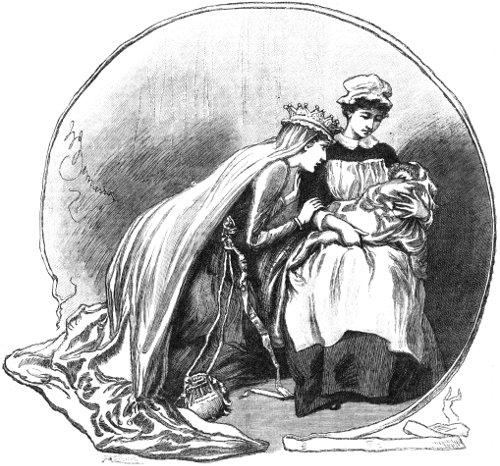
The following Saturday turned out to be
a misty November morning. Towards
noon the fog lifted, and at half-past one,
when Dame Hursey prepared to start to
keep her appointment with her son, it was
tolerably clear, but the old wool-gatherer,
who was as weather-wise as John Shelley
himself, shook her head as she scanned
the horizon from the door of her miserable
cottage, and muttered to herself she
doubted the fog would come on worse
than ever at sunset.
As this was the first time she had seen
her son for twelve or thirteen years, and
would probably be the last, seeing that
he was going back to Australia, probably
never to return, at least in her lifetime,
Dame Hursey regarded the occasion as
a festive one, and had taken a holiday
in honour of it. Her morning had been
spent in cleaning her miserable cottage,
in the faint hope that her son might be
persuaded to come home and spend the
evening with her. In this hope all her
wool-gatherings had been taken upstairs
instead of lying about the floor and
corners of the kitchen, as they usually
did; the floor had been scrubbed, a fire
was lighted, two rickety armchairs drawn
up to it, and a cup and saucer, a mug,
and two or three plates—Dame Hursey’s
stock of crockery—placed on the table.
She dispensed with dinner, and contenting
herself with a piece of bread and
cheese, reserved two red herrings for her
tea on her return with her son.
Then she dressed herself in her Sunday
dress, not without some qualms lest
the fog should turn to rain. Even if it
did, on such an occasion as this she
must wear her best things, so she put
on her black stuff dress, a black and
white plaid shawl, and a bonnet that
might have come out of the ark, judging
from its antique shape, and which, to
Dame Hursey’s pride, was ornamented
with some dirty old artificial flowers.
Thus attired, and having made up the
fire and left the kettle on the hob, she
locked up her hut, put the key in her
pocket, and providing herself with a
gigantic cotton umbrella, to answer the
purpose of a walking-stick as well as in
case of rain, she set out for Mount
Harry.
Though Dame Hursey knew all the
short cuts, it was more than an hour’s
walk from her house to the top of Mount
Harry, but the old woman was longing
to see her son again, so she started in
good time, and reached the spot a
quarter of an hour before he did, though
he was punctual. The fog was rolling
up again, as the old wool-gatherer had
predicted, and, accustomed as her black
eyes were to piercing the mists which
so often wrap those rounded hills like a
damp clinging garment, her son was
close upon her before she saw his form,
looming like a gigantic grey figure close
beside her. It was twelve years and a
half since they had met, and George
Hursey was very much altered in appearance
since, in the character of John
Smith, carpenter on board the French
yacht Hirondelle, he had laid the
baron’s little daughter on John Shelley’s
doorstep; but for all that his mother declared
she would have recognised him
in a crowd.
“You’ll come home and have a cup
of tea and a chat, George, after all these
years, won’t you?” said the old dame,
gazing with pride and affection on her
ne’er-do-well son.
“No, mother, no; I might be recognised,
and I don’t want to be arrested
for making off with a child, before I go
back to my own wife and children.”
“The child is safe enough, if you mean
the child you left on John Shelley’s
doorstep thirteen years ago come next
June.”
George Hursey gave a sigh of relief,
for many a nightmare had that innocent
baby, which, for aught he knew to the
contrary, might have perished from cold
or exposure through his fault, given him.
“John Shelley took it in then, as I
thought he would?”
“Yes, and a beauty she is, and no
mistake. George, tell me who the child
is, will you, honey?” said Dame Hursey,
in a wheedling tone.
“That’s what I have come here for
chiefly, that and to see you once again,
for when I say good-bye to England to-morrow
it will be for good this time; I
am going to give up the sea, and live at
home now.”
“Well, you know your own affairs
best; but about the lassie, George;
whose child is she? No poor person’s,
I’ll be bound,” said Dame Hursey,
whose curiosity about Fairy exceeded
even her interest in her son’s family
affairs.
“She is the niece of my late master,
a French gentleman, and it was by his
wish I took her to John Shelley, only instead
of going in as I pretended I had
done, I left her on the doorstep, and
went off with the purse; and if
ever I cursed in my life I have cursed
that money, which, for aught I knew till
a few minutes ago, had made me a murderer,
though for that matter I may be
one still, for the baroness may have
fretted herself into her grave for her
baby.”
“The baroness, did you say, George?
Sure, I was right, she is no common
child, no fit wife even for gentleman
Jack,” exclaimed the old woman, opening
her umbrella, partly to keep the fog
off, partly as a sort of screen to shut in the
secret she had yearned so long to learn.
But George was following up his own
train of thought, and went on, heedless
of her interruption—
“Though, as true as I stand here, I
never knew till last week that Monsieur
Léon was drowned, and the Hirondelle
lost a day or two after I left her. Likely
as not the baron thinks the child was
drowned too, since they have never found
her. I might never have known, only
I happened to ask at Yarmouth if they
had ever had a French yacht named
Hirondelle over there, and some of the
fishermen remembered all about the
wreck. When I heard that I determined
to come and see if the child was safe, and
now I know it is, I want to do the rest,
mother.”
“Yes, honey, what is it? You may
trust me. I guessed the night I met you
you knew all about the fairies’ child, and
I have kept your secret and watched the
child ever since, for your sake, George.”
“Well, I want you to go to John
Shelley, or to the parson if you like, or
both, and tell them the child belongs to
the Baron de Thorens, of Château de
Thorens, near Carolles, in Normandy.
Shall I write it down for you?”
“No, no, I can’t read it if you do; I
shall remember fast enough—Baron de
Thorens, Château de Thorens, near
Carolles, Normandy. I shall think of
Christmas carols, De Thorens, Château
de Thorens,” repeated Dame Hursey.
“Never mind château, it only means
castle, but don’t forget the name, De
Thorens. Here, I’ll cut that word on
your umbrella handle with my knife in
printed letters. You can read print, I
know.”
“All right; and what else am I to
tell them?”
“Why, that my master and the baron
gave me the child twelve years and a
half ago to put out to nurse with an
Englishwoman. I went ashore at
Brighton in a little boat with Pierre
Legros, one of the sailors, and I walked
across the downs with the child, and
left it on John Shelley’s doorstep; then
I told Monsieur Léon John had taken
it in and promised to look after it. He
took the address, and the only person I
thought I had robbed was John Shelley,
though I knew the baron would make it
up to him when he heard of it.”
“Are they rich, George?” asked the
old woman, taking a pinch of snuff as
she peered at her son through the fog.
“Yes, I think so. The château is a
beautiful place, and stands in a park.”
“Is that all I am to say?”
“Yes, leave the rest to the parson to
decide; he will write to the baron in
French very likely. You may tell them
as soon as you like, for I shall be out
of the country to-morrow.”
“I shall wait till you are gone; one
day more can’t make any difference,
and it is best to be on the safe side, then
if they want to know where you are, I
can say on your way to Australia, so
there’ll be no fear of their catching you,
though it is so long ago there isn’t much
danger of that now.”
“Please yourself, and now I must be
off. Here are five sovereigns for you,
mother; they are honestly earned, so
you need not be afraid to take them, and
now I must say good-bye. How thick
the fog is; there is no danger of anyone
seeing me this evening; it is as much as
I shall do to find my way down to the
Brighton Road without breaking my
neck in a chalk pie. Take care of yourself,
mother; but you know these downs
better than I do,” said George Hursey,
kissing his mother.
“Ay, ay, lad, never fear for me; I
have been out in worse fogs than this.
Good-bye, God bless you,” and the old
wool-gatherer strained her eyes till her
son’s figure disappeared, as it very
quickly did, in the fog.
She stood still for a minute or two
after he had gone, gloating over the
secret she had at last discovered, and
muttering to herself again and again,
“Baron de Thorens, Carolles, Normandy,”
and then she too turned and
walked slowly off through the fog in a
different direction.
It was quite true she had been out in
worse fogs than this, but whether it was
that she was too much occupied with
her own thoughts to think of where she
was going, or whether the fog, which
gradually increased, was worse than
she fancied, she suddenly, after wandering
about for half-an-hour, awoke to the
conclusion that she did not know where
she was. If she had come right she
ought to have been at the bottom of
the hill by now, whereas she was still
on flat ground, and had not begun the
descent.
She had been so absorbed in wondering
what the Shelleys, particularly
“gentleman Jack,” as she always called
Jack, would say to her news, and in
picturing to herself the amazement on
learning that Fairy was the daughter of
a French nobleman, perhaps a baroness
herself or a countess, for Dame Hursey
had very vague ideas on the subject of
French titles; and in thinking how
pleased Fairy would be to hear she was
a rich lady, that she forgot all about
the fog and where she was going. Loving
gossip as she did, the secret George
had put in her power was dearer to her
than the five sovereigns tied up in the
corner of her pocket-handkerchief; it
would add to her importance in the
neighbourhood more than the gold.
Moreover, it might lead to a reward for
her, since she had had no part in leaving
the child to the care of the shepherd,
and Fairy she was sure would not suffer
her to be forgotten when the Shelleys
came to be rewarded.
“Why, but for me Fairy might never
find her parents after all; if I were to
keep this secret to myself she would
never know for certain she was a lady
born, perhaps a countess. I shall make
them understand that before I tell them.
Or, if anything was to happen to me now
before I have told them, why they’d like
to never know it. Bless me, where am
I? This fog is worse than I thought;
I ought to have been home by now, and
here I am still on the top. De Thorens,
Carolles, Normandy,” and so muttering
to herself Dame Hursey disappeared in
the fog.
That same afternoon, Fairy, little thinking
her name and birth were so soon to
be revealed, and her happy life in the
shepherd’s cottage exchanged for a very
different one in a French château, had
gone for a walk with Charlie, and, to
Mrs. Shelley’s great anxiety, at half-past
five o’clock, when her husband and Jack
came in to tea, they were not home. The
fog now was so dense that you could
hardly see your hand before you, and
even with a lantern you could not
discern anything a yard or two in
advance of you, and Mrs. Shelley was
intensely relieved when John and Jack
came home safe.
“Thank God you are both back safely;
it is an awful fog, isn’t it, John?” asked
Mrs. Shelley, as John stood wiping
the fog from his beard and face.
“Yes, it is a bad one; luckily both Jack
and I saw it was coming on and got the
sheep home before dark, or we might
have been half the night on the downs.”
“Isn’t it tiresome? Charlie and Fairy
went out for a walk soon after dinner,
and they are not back now; I have been
in such a fright about them,” said Mrs.
Shelley.
“What, mother? Fairy out in this
fog? Good heavens! the child may be
killed! What on earth does that little
idiot mean by taking her out in a fog?
He deserves a sound thrashing,” burst
out Jack.
“Hush, Jack; Charlie may be in
danger as well,” said Mrs. Shelley.
“Serve him right too,” muttered Jack,
as he went in search of a lantern without
another word.
“Fairy and Charlie out, wife? Dear
me, we shall have to go and look for
them; why, they may fall into a chalkpit
and break their necks. Where have
they gone?” asked John, leisurely
putting on his hat and scarf.
“I don’t know, but I fancy to Mount
Harry; I heard Fairy talking about it.”
“Here, Jack, we shall have to go and
look for them children, I think,” called
out the shepherd to Jack.
“Of course we shall; I am lighting
the lantern; let’s be off at once,
father,” said Jack, who had made the
necessary preparations for the search
while his father was taking in the fact
that the children were lost, and now
stood with the lantern in his hand and
his dog by his side at the open door.
“Where are we to go, father?” said
Jack as they started.
“Well, your mother says they are
gone to Mount Harry, so if we were to
go along the Oatham-road and search
those chalkpits as we go, that is the
only place they are likely to have fallen
down. If they are not there, and God
forbid they should be, we shall know
they have not come to much harm
beyond a fright. When we have passed
the chalkpits we can climb up Mount
Harry and come back by the jail; I
have my compass, we can’t go far wrong
with that.”
Jack fell in with this plan at once; it
was by far the best thing they could
do; but then John Shelley, in his slow,
methodical way, invariably hit upon the
wisest plan of action in an emergency,
as Jack very well knew. Accordingly,
off they started, each with a lantern and
the shepherd’s dog leading the way.
Jack’s own dog was younger and not so
steady as Rover, so he kept him at
home. This Rover was a son of the
Rover who had first discovered the
fairies’ baby on his master’s doorstep
that midsummer evening, but John
Shelley called all his dogs Rover, and
was rather scandalised when Jack
insisted on naming his dog Bruce; it
was an innovation, and the shepherd
disliked anything new; however, in this
he was persuaded to yield, Mrs. Shelley
and Fairy taking Jack’s part, and saying
two Rovers in one family at the same
time would never do.
(To be continued.)
OUR TOUR IN NORTH ITALY.
By TWO LONDON BACHELORS.
After leaving Lugano, the train enters
two tunnels, shortly after which it crosses
the Lake at Bissone, by means of a most
hideous stone bridge. Bissone is a very
picturesque village. The little steeple of
the church rises romantically from the
luxuriant foliage, and numerous cottages are
scattered on the side of the lake. The charm
of the scene, however, is much marred by the
aforementioned bridge.
After leaving Bissone, the train goes directly
south to Mendrisio, the station for Monte
Generoso, the view from which is said to be
equal (if not superior) to that from the Rigi.
We had intended to climb Monte Generoso,
but it being a very misty day, there would, of
course, have been no view, so we continued
our journey, passing Chiasso and Como. At
Chiasso the luggage is examined, for, strange
to say, one is in Swiss territory until arriving
at Como.
We did not stay at Como, as we had decided
to see that city and its beautiful lake on
our return journey. The route from Como to
Milan interested us, from the variety it afforded
to the mountainous districts we had recently
visited. There is, indeed, a great charm in
the dead level of this huge Lombard plain;
for apart from its cities, so interesting,
historically and archæologically, we felt a
certain sense of relief in getting again into a
flat country, luxuriantly fertile and productive.
We made a mistake in not staying at
Monza, a very ancient city containing, amongst
other interesting buildings, a cathedral,
founded by Queen Teodolinda in the sixth
century, and a Broletto, or town hall,
attributed to Frederic Barbarossa. We
arrived at Milan early in the afternoon, and
immediately drove to our hotel, through one
of the magnificent gates which guard the approaches
to the city.
On entering this, the first great Italian city
which we had seen, many thoughts crowded
into our minds. Here we were in a country
the very cradle of European art, where
through all times, even down to the present,
art seems a vital necessity to the people. In
other lands art has been an ornament or a
luxury, but in Italy it seems to enter into the
very life of the inhabitants, and nothing seems to
have been able to wean them from their
devotion to the beautiful creations of the
hand of man. We find them revelling in art
when foreign armies were overunning the
country and decimating the population. We
find it under tyranny and oppression of the
most galling description—surrounded by acts
of horror and infamy of the most despicable
kind. We find it often in combination with
ignorance and folly that are simply contemptible.
We find it existing when liberty was
utterly suppressed. Thus during all the
Middle Ages and the period of the Renaissance,
whether the Italians were slaves or free,
whether they were conquered or victorious,
whether they were united or divided, still this
marvellous spirit of art seems to have pervaded
everything from their religion down to the
most ordinary acts of everyday life.
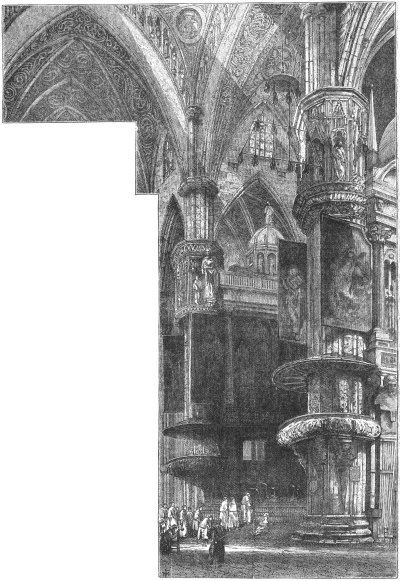
INTERIOR OF MILAN CATHEDRAL.
Another thought which naturally suggests
itself on entering Milan is that of the two
noble characters whose lives stand out like
brilliant meteors amongst the gloom, horror,
wickedness, and folly, which stain so much of
her history. We refer to her two Archbishops—St.
Ambrose, the light and glory of
her early history; and Charles Borromeo, the
bright star which illumined her deepest
gloom. And one cannot help thinking of the
good and great man pursuing his mission of
charity amongst the sick and dying of the
plague-stricken city.
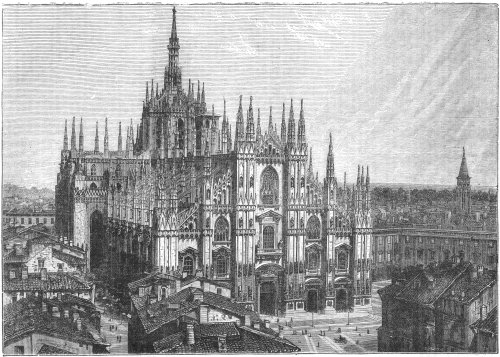
Our first thought was to find our way
to the cathedral, the second largest Gothic
church in Europe, about which probably
more has been written, and a greater
number of conflicting opinions as to its
merit expressed, than about any building in
the world, with the exception of St. Peter’s,
Rome. As it is impossible to say anything
new about this wonderful cathedral, we shall
principally confine our remarks to our own
individual impressions and opinions.
To commence with, the first view of the
interior struck us as far finer than the more
popular exterior. Indeed, so great an effect
had it upon No. 2, that he turned as white as
a sheet, and seemed completely overcome
with the wonder of the buildings. The
enormous proportions of the church, the great
height of the pillars, with their canopied niches
over the capitals, and the rich religious effect
of the whole, formed a picture, in comparison
to which (in our eyes) the blazing but
meretricious glory of the exterior, with its
4,000 or so niches and vast masses of carving,
was not to be compared. It is said that an
intimate acquaintance with both exterior and
interior will fall far short of one’s first
impressions.
Now this did not strike us with regard to
the interior. No, not even after we realised
the tracery of the roof to be painted, and the
tracery of the windows to be somewhat
straggling and unmeaning. But it is a
different matter from the exterior; after the
first astonishment is over, one sees at once
the great over-elaboration and the general
“spikiness” of the effect, though No. 1
thought the admixture of the Renaissance style
in the façade saved this portion of the
cathedral by supplying that solidity and
“sobriety of line” which the building otherwise
so painfully lacks.
Even before we heard that the architect was
supposed to have been a German, we recognised
the Teutonic character of the cathedral,
especially of the interior, which seemed to be
not entirely unlike that of Cologne.
To enter more into detail, the plan is a
Latin Cross, terminated by an apse, and
divided into a nave and four aisles. The
interior is 477 feet in length, by 183 in
breadth, exclusive of the transepts, and is
supported by fifty-two pillars, which are eighty
feet in height and twelve feet in diameter.
The before-mentioned niches, which crown
the pillars, are a great feature, each niche
being of different design, and all remarkably
beautiful. The roof is elaborately painted in
imitation (so it is said) of tracery. Street
calls this an “abominable device, which never
ceases to offend and annoy the eye more and
more every time it is observed.” The effect
did not seem to No. 1 at all disagreeable; quite
the contrary. He thought it added great
beauty and richness to the design, and does
not believe that it was ever intended to deceive
the beholder into the idea that it is
real tracery. “Why not believe it to be
mere decorative painting, and beautiful art as
such?” he asked. But No. 2 was really
deceived into believing that the imitation of
tracery was actually what it represented,
particularly as the design, which is in dark-brown
colouring upon a light ceiling, represents
carvings of beautiful patterns and filigree
work, very much like the Gothic screens of some
of our English cathedrals, only fixed upon the
ceiling instead of being on the line of sight. But
when, after investigation, he found the paint
obliterated here and there by damp and other
causes, showing blotches of brown and white,
he was disgusted beyond measure, and began
to look upon other work with suspicion.
“Why,” cried he, “should a Christian church
impose on the unwary, or to the wary
preach affectation and artifice?”
There is no triforium, and the pavement is
a mosaic of various coloured marbles. There is
a great quantity of old stained glass in the
windows, which, though not equal to our old
English glass, yet gives the building a very religious
effect, which is still more enhanced by
the colour of the stonework, which has the appearance
of old ivory. The interior is well
filled with ancient monuments; but we have
no space to describe them, and will simply
add that the most remarkable are those of
Gian Giacomo and Gabriele de Medici, attributed
to Michael Angelo; of Cardinal Caracciolo,
in black marble, by Bambaja; and of
Ottone Visconti, Archbishop of Milan, which
is earlier in date than any portion of the
cathedral. In the north transept is the bronze
candelabrum for holding seven lamps, constructed
in imitation of that which existed
in the Holy Temple of Jerusalem—a magnificent
work erected in the thirteenth century.
And in the south transept is a famous statue
of St. Bartholomew being flayed alive.
St. Charles Borromeo, the great Archbishop
of Milan, is buried below the dome in a subterranean
chapel. It may interest our girls to
know that he was the originator of Sunday-schools
in Europe.
The Duomo of Milan is like no other
building in the world, it belongs to no distinct
style of architecture, and in art it had neither
parents nor children. Nothing was ever built
like it before, and nothing will ever be built
like it again. We do not say that it is the
most beautiful church ever built, nor do
we deny that, architecturally speaking, it
possesses many grave faults, but what we
mean is this: Of all other churches we say
they are built in such and such a style, or are
of such and such an order of architecture.
But of this we say simply, it is the Duomo of
Milan.
When this vast structure, with its countless
pinnacles of pure white marble glittering in the
sun, and backed-up by a dark blue sky, breaks
upon our astonished gaze, the mind is
absorbed with wonder.
Is it a vision? What have we seen before
like it—possibly only one thing—the snow-clad
peaks of the Alps. One cannot get rid of the
notion that some kind of relationship exists
between the two. We begin almost to suspect
that some mighty Alp, with its snow-clad
peaks, must have been its mother—so much is
it like the kind of architecture that would have
sprung from the mountains.
It was after leaving the Duomo that the
two bachelors had their first quarrel. This is
how it came about:—The older bachelor, who
is impressionable and of a poetical and non-technical
turn of mind, enjoys an undisturbed
first sight of a magnificent building, without
first of all inquiring into its structural and
architectural details; and if there is one thing
more than another which annoys him, it is to
have the “dry bones” of workmanship dinned
into his ears and thrust before his mental
vision when the complete building should
rather impress on him all that it has to say of
great achievement and power.
Now the younger bachelor is technical and
fond of dates, so seized the opportunity of showing
off his knowledge of history and archæology
at the very moment when his friend was first
gazing at the religious splendour of the interior
of the cathedral. This made No. 2 insist on
a judicial separation, at any rate for the first
hour, so the greater part of the building was
explored in “single blessedness.” The quarrel,
postponed, of course, until we had left the
Duomo, was happily of short duration, and
the two bachelors compared notes, and came
to the conclusion that, after all, more permanent
unity is created by contradictory temperaments.
Whether this would apply in the
case of man and wife they unfortunately could
offer no opinion founded on experience, so they
wended their way through some very narrow,
uninteresting streets to the church of St.
Ambrose, at the west of the city.
St. Ambrogio, founded in the fourth century,
is full of ancient epitaphs and early Christian
antiquities, notwithstanding that it was very
much repaired in the seventeenth century.
The walls of the “atrium,” or open court, in
front of it, contain fragments of frescoes,
ancient inscriptions, etc., which, backed up
by the Romanesque red brick church (dating
from the ninth century), form one of the most
picturesque scenes in North Italy.
The interior of St. Ambrogio is, if possible,
more interesting than the exterior; it is of
grey stone, with arches of red brick, a quaint
effect of colour. There are no transepts, and
the building terminates in an apse.
It would take pages to describe all that is
remarkable in the interior of St. Ambrogio, so
we shall only mention some of the interesting
features. On first entering the nave we
noticed two pillars, on one of which is a brazen
serpent, said to be the brazen serpent of
Exodus. The vaulting of the apse is very
ancient, and is covered with mosaic work as
fine as anything in St. Mark’s, Venice. Below
we noticed the old chair of St. Ambrose.
The high altar is interesting, as being the
place where some of the German emperors
received the iron crown of Lombardy; a baldachino
or ciborium covers it.
On the front of the high altar (itself a
blaze of glory) are depicted scenes from the
life of Christ, while on the back are represented
incidents in the life of St. Ambrose,
the former in plates of gold and the latter
silver-gilt.
St. Ambrogio contains several frescoes.
The finest are “Legend of St. George,”
by Bernardino; and “Ecce Homo,” by
Luini. In it also are the shrines of Saints
Gervasius and Protasius—very popular saints
in Italy.
On leaving St. Ambrogio we wished to get
straight back to our hotel; but we unfortunately
lost our way, and were obliged to ask
an Italian gentleman to direct us. He not
only put us on the right road, but actually
went out of his way to ensure our not losing
ourselves again. This is characteristic of the
North Italians. They are really polite, and,
according to the elder bachelor, the most gentlemanly
people he has visited.
After table d’hôte we strolled out of the
hotel, and walked through the magnificent Galleria
Vittorio Emmanuel (containing some
of the best shops in Milan) into the Piazza
del Duomo. It was a beautiful moonlight
night, and the cathedral looked simply glorious—its
dazzling whiteness almost frightening us
as it suddenly burst on our view. After due
deliberation No. 2 irreverently said that the
appearance was similar to that of a colossal wedding-cake,
with its sugary-looking ornamentations
under a strong light. The Duomo, though
not a very pure example of Gothic, possibly
over-ornamented, and its detail not always in
the best taste, is certainly one of the most
extraordinary examples of man’s industry,
perseverance, and wealth to be found in the
whole realm of art.
It was about 9 o’clock p.m. that the first
scene was enacted of what might have
completely wrecked our holiday, viz., the
longing of the younger bachelor to smoke
one of the long cigars, with straws in
them at either end, which foreigners, especially
Italians, seem so to enjoy. No. 2 (the
older) bachelor being the better linguist, went
into a tobacco shop and ordered one of these
cigars. It was in vain that the shopman declared
they were never bought by English;
it was of no use his repeating that they were
so inferior—No, No. 1 had set his heart on
possessing one of them, and have one he
would.
We bought two, one of which the
younger bachelor immediately smoked, having
first carefully extracted the straws. The other
was given to the waiter, and it is safe to predict
that neither of us will ever be seen with
one of those terrible cigars again. About
10 p.m. No. 1 began to show signs of a violent
bilious attack, which grew worse as the night
came on. This was the commencement of an
ailment which afterwards turned out to be
“gastric fever.” There was little sleep that
night for either of the bachelors, as No. 2
sat up by his friend during a great part of the
night. The next morning, however, though
still unwell, No. 1 insisted on going to church.
On returning hotel-ward the younger felt
alarmingly ill, and could not walk further
without help.
When we got to the hotel, No. 2 determined
to send for a doctor, and, looking into his
Baedeker, chose one of those recommended.
Our girls must not think it was entirely the
horrible cigar that made No. 1 so ill.
They must remember he was described as
having a shocking digestion, which had been
“upset” by the continual travelling and the
change of food; also, the sudden change from
the bracing mountain air to the comparatively
enervating climate of Milan, no doubt accelerated
the illness. The doctor came about four
hours after he was sent for, and, after asking
innumerable questions as to the occupation,
rule of life, etc., of the bachelor, seemingly
unnecessary—not to say impertinent—prescribed
an alarming amount of medicine. We
shall remember that doctor, with his important
manner and soft, deep voice. He was a
smart, healthy-looking man, with an imposing
moustache and short black hair. We shall also
remember the answer he gave to the older
bachelor, who had inquired how long it would
be before his friend would be well enough to
resume his travels—“Maybe in two or three
weeks,” being the encouraging reply.
The younger bachelor is here reminded of
the interesting view of chimney-pots and
house-roof visible from his bedroom window,
which it was his fate to watch incessantly for
two whole days, miserably ill, with one longing
in life, viz., to quench his burning thirst with
“a lemon squash.”
As it seemed the less expensive method,
No. 2 shopped for the lemons, bringing in a
dozen at a time, and squeezing them with his
fingers into a water-bottle glass. The sugar
was purloined from the salle-à-manger (as we
wish this narrative of ours to be a strictly
truthful one, we resolutely admit our guilt,
but hope the Italian Government will not be
too hard on us), for we preferred the charge of
one halfpenny per “squash,” instead of one
franc, the probable price of one bought at the
hotel. If any one of our readers has had a
brother to supply incessantly with “lemon
squash” for two days and one night, without
the use of a proper lemon-squeezer, she will
appreciate the sad intelligence that No. 2’s
finger joints are now less supple and powerful
than before this Italian tour.
La femme de chambre was, as most young
women are to forlorn and helpless bachelors,
tender and kind. In fact, at the end of two
days she quietly suggested that a lemon squash
was the worst drink for the poor patient, and
actually the dear thing made for him some
oatmeal, bringing into the room a sieve, a
basin, some warm water, and a screw of paper
containing oatmeal. Then (à la Useful Hints
in the G. O. P.) the recipe was as follows:—A
little oatmeal in the strainer, hold over the
empty basin, and with the warm water (by
this time very lukewarm), percolate through
the sieve, and behold a dish of Scotch oatmeal!
That preparation did not seem to improve
the condition of the poor patient.
“Oh, that we had some English lady with
us,” cried No. 2.
“Never no more,” groaned No. 1, with his
face to the wall, though whether this depressing
remark had a reference to the oatmeal,
the gentler sex, or the “holiday” (save the
mark!), No. 2 has not yet been able to determine.
(To be continued.)