A PASTORALE.
By DARLEY DALE, Author of “Fair Katherine,” etc.
All rights reserved.]
TWELVE YEARS LATER.
In the early days of the present century, during which
period the events of this story took place, the education
of the lower classes was of the meagrest description;
boys like Jack Shelley, with intellectual
capacities above the level of their own class, had none
of the opportunities afforded at the present day of
rising from their humble position. Jack, indeed, was
fortunate in getting hold of Fairy’s books, which he
very soon mastered; but in those times young ladies
were taught very little besides history and geography,
and a little French, and Fairy was not fond
of study; she liked French, and she was fond of
poetry; history she hated, and but for Jack her
ignorance of arithmetic would have been pitiable.
Her taste for poetry hence fitted Jack indirectly, for
Mr. Leslie gave her a Shakespeare on her tenth
Christmas Day, and from the first day Jack caught
sight of it he never rested till he had saved up
enough money to buy himself one, which was his
constant companion on the downs. He was an
intense lover of nature as well as of
poetry, and his shepherd’s life helped
him in this respect; for during the long
hours he passed daily on the lonely
downs, he had plenty of time for
observation of all the birds and
animal life he came across. Sussex is a
famous county for rare birds, and the
neighbourhood of Lewes in particular is
celebrated in this respect; and by the
time Jack was seventeen he was quite
an authority on birds; he knew all about
them, what kinds visited the neighbourhood
and at what seasons; which remained
all the year round, and which
were only rare and occasional visitors;
which bred there, where their nests were
to be found, how they were made, and
how many eggs and of what kind each
species laid; the habits and very often
the characters of different birds—all this
he knew.
His drawback was he could not
afford to buy any good book on birds—they
were all far beyond his means; but
Mr. Leslie had “Bewick,” and one of
Jack’s greatest treats was to go and
fetch Fairy, when she spent an evening at
the Rectory, and be allowed half an hour’s
study of this most fascinating book.
But besides natural history and
Shakespeare, Jack studied mathematics
on the downs; he bought an old Euclid
and an algebra in a book-shop at Lewes,
and these, with his Shakespeare and
one or two other books, he kept in a hole
in a chalk-pit on one of the downs; and
winter and summer alike, while the
sheep grazed he studied. In winter he
walked up and down to keep his blood
in circulation, for it was sometimes so
cold that he would have been frozen had
he sat still; but in summer he stretched
himself full length on the short turf in
some grey hollow, where he was in
shadow.
In some ways a shepherd’s life suited
him; it gave him plenty of leisure for
study; he was his own master from the
time he left home in the grey dawn till
he returned at sunset; his duties were
light, he had but to follow the sheep, and
his dog did all the hard work; moreover,
he had none of the responsibility—that
all fell on John’s shoulders. Then he
liked the loneliness of it. Often for days
he met no one except, perhaps, his
father, with the rest of the flock, or
Dame Hursey gathering wool, or some
other shepherd; but yet, for all this,
Jack hated the life. He hated it because
he felt he had the capacity in him
for doing higher work; he hated it
because, though his father was content
to live all the year on the chalky slopes,
visiting Lewes at the two sheep fairs,
and occasionally on market days, and
on the fifth of November to see the
carnival, he was not; he longed to
go beyond those round-topped mountains,
to cross that silver streak of sea
he caught a glimpse of on clear days,
to see some of the cities and places he
had read of. Above all, he hated it
because he felt it was an insuperable
obstacle between him and Fairy; for
whom, from that day when, as an infant,
she had clutched hold of his finger, he
had entertained a romantic and ardent
affection.
And then he was very proud; and though
it was doubtless very foolish pride, he was
ashamed of being a shepherd. He
would not have had his father, for whom
he had the greatest respect, suspect the
real secret reason of his dislike to his
occupation for worlds, but there it was
all the same. He knew to have refused
to become a shepherd would almost have
broken John Shelley’s heart; and so, for
his sake, Jack had never demurred
when it was proposed, but he cherished
hopes of some day rising to a higher
calling.
Poor Jack! could he but have known
how that longing was to be fulfilled!
But Jack no more than the rest of us
could afford to look into the future,
neither had he the power—it was as
mercifully veiled from him as from
others. To look back on past sorrows is
sad enough; to look forward to coming
ones with the same certainty would be
insupportable.
Jack’s seventeenth birthday was a
glorious day, and before the sun was
high in the horizon, he, and Fairy, and
the two other boys were on their way to
the seaside, with their dinners in a
basket. They were all in high spirits,
for a holiday was a rare thing indeed for
Jack, and Willy was nearly always at
sea, so it was a treat to have him with
them, especially to Jack, whose favourite
brother Willy was. Moreover, when Willy
was there, he would be sure to take
Charlie away for part of the day, and
leave Jack and Fairy together, and this
was a thing to be very thankful for in
Jack’s opinion, for he considered Charlie
a little nuisance, and had always been
very jealous of his brotherly affection
and friendship for Fairy. One thing
in particular annoyed Jack; Charlie
always kissed Fairy every night when
he went to bed—a thing neither he
nor his father ever ventured to do, nor
had Willy ever done so since he came
back from sea; but Charlie kissed her
every night in the coolest way; and
when Jack remonstrated with his mother,
as he sometimes did about it, Mrs.
Shelley only laughed and said as they
were foster brother and sister, and
both still mere children, it was quite
natural.
But this day was destined to be a very
happy one for Jack; he was the hero of
it, and Fairy gave herself up to making
it as pleasant for him as possible. Her
present had delighted him greatly, so he
started in his happiest mood. He was
lucky, too, and found a nest of a Cornish
chough in the chalky cliffs, with five little
birds, one of which Jack took home
alive and made a great pet of; then, as
they neared Newhaven, he shot a water-ousel
with his catapult, to add to his
collection of stuffed birds found in the
neighbourhood. Jack was a charming
companion on a country walk; he knew
every bird they came across, and his
delight and excitement when they saw a
rare or scarce bird was charming to
witness. A flight of crossbills, or a
ring-ousel, was a delightful incident to
Jack; and when, in the evening at Newhaven,
he actually descried a stormy
petrel skimming over the surface of the
sea in its usual business-like way, as if
all the affairs of the nation depended on
it, his delight was unbounded. He had
had a glorious birthday, he declared—only
one little shadow was cast across it on
their way home, when, as they reached
the top of the down, at the foot of which
lay the shepherd’s house, they met Dame
Hursey. Now Jack never could bear
Dame Hursey to approach Fairy! He
always connected her in some way or
other, how, he did not exactly know, with
Fairy’s arrival, and he had a very shrewd
suspicion that the old wool-gatherer
knew far more than anyone else about
Fairy’s parentage. One thing was certain—she
was most curious about the
child, and never met either Jack or his
father without talking about her, and
trying to find out something about her;
and if she could only speak to Fairy herself,
she was quite happy; but this Jack
never suffered her to do if he could prevent
it; and seeing her coming he now
tried to hurry Fairy home before Dame
Hursey could catch them up.
“Hi, man, Jack Shelley, stop a minute,
will you, and let me have a look at
the little lass?” shouted Dame Hursey
in her broad Sussex brogue, and Jack,
much against his will, was obliged to
stop.
“Poor old woman, Jack; she can’t
do us any harm; why shouldn’t we stop
and speak to her?” said Fairy, who
did not keep her pretty manners for the
other sex only, but was just as anxious
to charm an old woman like Dame Hursey,
and be as courteous to her as she
would have been to Mr. Leslie or any
of the people she met at the Rectory.
“Well, you are fair enough for a princess.
We shall have the prince coming
one of these fine days and carrying you
off,” said Dame Hursey, holding the
little slender fingers Fairy tendered her
in her horny old palm, and gazing with
her piercing black eyes, bright now in
spite of her seventy odd years, at the
child’s fair face.
“I hope not; I am very happy here,”
said Fairy, laughing.
“But you don’t belong here for all
that; you look as much out of your place
here as a black-faced horned sheep would
among John Shelley’s flock of Southdowns.”
“We must be going, Fairy. See, the
sun is setting,” said Jack, impatiently.
“Ah, it is no use your frowning about
it, Jack Shelley. You may take her
away now, but you mark my words, as
sure as my name is Hursey, the prince
will come and carry the fairies’ child
away one of these days, in spite of all
you can say or do to the contrary,”
persisted the old woman, as Jack led
Fairy off, feeling very much annoyed at
her words.
“Old witch,” muttered Jack.
“Poor old thing! she means well,
Jack,” laughed Fairy.
“I almost think she has meant mischief
to you, Fairy, ever since that day
after you first came to us, and I was left
at home to watch Charlie, while mother
took you to Mr. Leslie. I remember as
well as if it were yesterday; she came in
while you were gone, and ransacked the
place to look for your clothes and things.
If you had been in the cradle instead of
Charlie, I am sure she would have stolen
you.”
“Oh, Jack, how absurd you are!
Well, at any rate, I am too big to be
stolen now, so you might let me be civil
to her.”
“Civil you can be, but, Fairy, promise
me you will never go to her cottage, nor
stop talking to her when you are alone,”
said Jack.
“Well, I promise. I am not at all
anxious to go to her very dirty hut, and
mother very seldom lets me go out
alone, except to and from the Rectory.”
“I only wish she did; here I have to go
out with Fairy whenever she chooses,
whether I like or not,” put in Charlie.
“But you always do like,” said Fairy,
at which Jack frowned ominously.
The next week Willy went to sea, and
the others were left at home for the summer,
except Fairy, who went to the seaside
with the Leslies for a fortnight in
September, the longest fortnight Jack
ever spent. While she was away, Mrs.
Shelley took the opportunity of warning
Jack about his growing jealousy of
Charlie, which was daily becoming more
apparent, and she flattered herself when
Fairy came back that her words had had
some effect, until a little incident occurred
to show her she was mistaken.
One evening in November, as Jack
was coming down the High-street of
Lewes, whither he had had to accompany
his father, much against his will, to the
last sheep fair, he saw a large bird flying
slowly overhead. He followed it down a
by-street, and saw it was getting lower
and lower, evidently tired, until at last
it sunk exhausted on the ground, a few
paces from Jack, who secured it without
much difficulty. It was a wild goose
come southwards for the winter, and,
being exhausted either for want of food
or by its long journey, had become
separated from its companions. By its
black, snake-like head and neck, and
the smallness of its size in comparison
with other geese, Jack recognised it at
once as a Brent goose, and taking it up
in his arms he ran home in triumph with
his prize, which soon revived after being
fed. He clipped its wings and put it
with the rest of the poultry, where it
soon became quite at home, and attached
itself to Charlie, who always fed it, and
constantly followed him about the premises,
sometimes even into the house.
For some reason or other Fairy took a
dislike to this bird; she declared it looked
like an evil spirit, and she was sure it
would bring ill-luck to them. She could
not bear to see it about the garden, and
often begged Charlie in Jack’s hearing
to keep it shut up with the rest of the
poultry. Charlie, however, delighted in
having found a way of teasing Fairy, and
partly on that account, partly because
he was really fond of the bird, he encouraged
it to follow him wherever he
went.
One morning Charlie came in to breakfast
in the greatest distress—the Brent
goose was gone; he had searched the
premises, but could not see a sign of it.
“I am very glad of it. Horrid bird,
with its snaky head and neck! I hated
it,” said Fairy.
“Have you done anything with it,
Fairy? Do you know where it is?”
asked Charlie.
“Ask Jack,” laughed Fairy; and that
was all Charlie could get out of her.
Jack was on the downs with the sheep,
and would not be home till evening, so
Charlie spent the day in searching the
neighbourhood for the Brent goose, but
in vain; and when Jack came home
Charlie’s first words were, “The Brent
goose is lost, Jack.”
“No, it isn’t,” said Jack.
“I tell you it is; I have been all over
the country looking for it, and I can’t
find it anywhere.”
“You didn’t go to the Pells, I suppose,
did you?” asked Jack.
The Pells is the public garden of
Lewes—a paddock, with a piece of ornamental
water, on which live a beautiful
collection of wild ducks, belonging to the
town.
“No, I forgot that; how stupid of me!
It is too dark to go now,” said Charlie.
“And no use either, though the goose
is there; I have given it to the town,”
said Jack.
“What a shame, when I was so fond
of it! you only did it to spite me,” cried
Charlie, ready to burst into tears, only
he was too big to cry about a goose.
“I didn’t do it to spite you; I sent it
away because Fairy hated it, and you
were always teasing her about it. If
you want to see it you can go to the
Pells every day if you like and look at it,
but I won’t have Fairy teased about it.”
“You won’t have Fairy teased, indeed!
Why, she is much more my sister than
yours; you have nothing to do with her;
I am her foster-brother,” broke out
Charlie.
For a moment Jack hesitated, and
Charlie put up his arm to ward off the
blow he seemed to expect, but on second
thought Jack only turned on his heel,
and with a bitter laugh muttered contemptuously,
“Get out of my way, and
don’t talk such stuff, you little idiot.”
They never understood each other,
these two brothers. While Charlie
thought Jack a book-worm who encroached
upon his relationship with
Fairy, Jack thought Charlie an idle little
boy, not over clean, who would never be
anything more than a labouring man to
the end of his days, and who had the
impertinence to consider himself on an
equality with Fairy. With Willy Jack
got on much better, though Willy was no
cleverer than Charlie, nor any fonder of
study; but then he never roused his eldest
brother’s jealousy in the way Charlie
did. Mrs. Shelley, who understood her
eldest son better than anyone else did,
always tried to ward off any collisions
between the boys, and if that were impossible,
took Jack’s part, which always
had the effect of mollifying him at once.
On this occasion she had heard the
squabble between the boys, and as Jack
went upstairs to change his clothes before
helping Fairy with her lessons, she
persuaded Charlie, who had been tramping
about the country the whole day, to
go to bed before Jack reappeared,
promising to bring him up some
supper.
But Mrs. Shelley could not be always
at her boy’s heels to keep the peace between
them, and as Jack grew into
manhood she watched with anxious
heart his growing passion for Fairy, and
his increasing jealousy of his youngest
brother. Under any circumstances his
love for Fairy would have made her
tremble for him, though at present
Fairy was such a child it was impossible
to say how she might feel in the future
with regard to Jack; but Mrs. Shelley
thought it far more probable the child
would meet someone at the Leslies than
that she would choose Jack, whom she had
known all her life, and whom she seemed
to regard as an elder brother. But
when added to this Jack’s jealousy of
Charlie grew side by side with his love,
like an ugly poisonous weed by the side
of a beautiful flower, Mrs. Shelley, in
spite of the comfort and joy Fairy was to
her, often regretted having taken her in,
though, as she told herself, she really
did not know what else could she have
done.
A few days after the Brent goose was
sent to the Pells, Fairy, on coming back
from the Rectory at four o’clock, found
she had left one of her books behind her,
and as Charlie was not to be found,
being in all probability at the Pells,
paying an afternoon visit on his goose,
Fairy with some difficulty persuaded
Mrs. Shelley to let her go back to the
Rectory alone, declaring she would be
home again before dark.
She reached the Rectory safely, got
her book, and was just passing the
Winter-bourne, about ten minutes’ walk
from the shepherd’s house, when, rather
to her annoyance, Dame Hursey suddenly
appeared from a by-lane and
stopped her.
“Good-evening, Mrs. Hursey; I must
not stop, it is getting so dark; mother
will be frightened,” said Fairy, trying to
pass the old woman, mindful of her
promise to Jack, and secretly rather
nervous at her encounter with the old
wool-gatherer in this lonely spot, and in
the gathering gloom of a November
evening.
“Mother, indeed! You have a grander
lady for your mother than Mrs. Shelley
ever saw the like of, proud as she and
her son Jack may be, I am thinking;
but never mind that—one of these fine
days Dame Hursey may tell you some
news that will open those pretty eyes of
yours, till they will look bigger than ever.
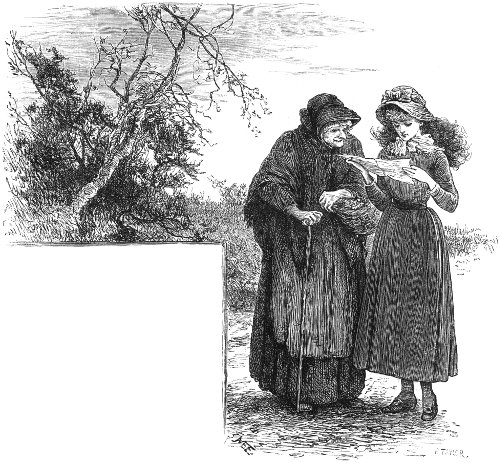
Tell me, child, you can read writing, of
course, can’t you?” said Dame Hursey,
pulling aside her coarse apron, and
fumbling among the folds of her tattered
linsey skirt for her pocket.
“Yes, I can read and write too; but I
really must be going home; it is getting
so late,” said Fairy.
“Wait a minute, child; I am not
going to keep you long. I want you to
read a letter for me I had from my son
this morning; maybe there is something
in it I should not care for just everyone to
know; I have been on the look out for
John Shelley or gentleman Jack all day,
but I have missed them somehow, and I
can’t read writing myself. Ah! here it
is at last,” producing a letter from the
bottom of a very capacious pocket filled
with some very incongruous articles—a
few coppers, a piece of cheese, a thimble,
a sock she was knitting, some corks,
and various other odds and ends too
numerous to mention.
Fairy took the letter, and by Dame
Hursey’s instructions read it aloud. It
ran as follows:—
“Dear Mother,
“I am just home from Australia,
but I am going back there again at
once. First, I want to see you, as I
think you can tell me something I want
to know, so will you meet me on the top
of Mount Harry at three o’clock next
Saturday afternoon? I shall be there,
and, if you are living, I shall expect
you. Till then I am your affectionate
son,
“George.”
“Is that all? Every word of it?”
asked Dame Hursey, fixing her black
eyes on the child.
“Yes. Shall I read it again?” said
Fairy.
“No. Next Saturday afternoon at
three o’clock, on the top of Mount
Harry. I shall be there safe enough.
Thank you, my pretty one; I shan’t forget
that one good turn deserves another.
Good-night,” and the old wool-gatherer
dived into a lane, and was out of sight
before Fairy had recovered her astonishment,
when she took to her heels and
fled breathless to Mrs. Shelley, who
was anxiously watching at the gate for
her.
(To be continued.)