We are only a couple of young bachelors—almost
"green"—but we enjoy life greatly
and appreciate art when we see it, so on our
savings we decided to see a bit of Italy, and
the glorious paintings, buildings, and picturesque
street-corners for which that country
is so justly renowned.
We borrowed books from all our friends,
and sought second-hand bookstalls for every
conceivable authority, and a month before our
day for starting we were so brimful of knowledge,
that we decided to acquire no more,
but to depend on what we had already
achieved.
How tedious the days before the one
memorable day which should see us off to
Bâle, and how alarming a cold in the head,
caught by one of us two days before the date!
Would it develop into something too serious
to travel upon? Surely, never did so simple
an ailment command so careful a treatment or
portend so formidable, or possibly formidable,
a catastrophe! Breakfast in bed was the
order of the last two mornings, and two visits
from a doctor, who won golden opinions from
the two jolly bachelors for prescribing
change as the best medicine. He is a wise
doctor, that Scotchman, and we will seek his
counsel on other occasions—though not just at
present, we trust.
We left Victoria Station on an April
morning, being "seen off" by three kind friends,
one of whom nearly lost his life by foolishly
standing on the carriage step while the train
steamed to the full extent of the platform.
The risk our friend underwent only made us
love him the more for his devotion to his
chums; and, really, we would prefer to see no
possible danger in such a friendly desire to
prolong the last glimpse of such interesting
worthies as ourselves.
We found the sea at Dover very blue, as
usual, and very smooth, so that it was a very
short passage to Calais, and we found considerable
pleasure in re-reading Ruskin's
reference to the fine old church tower. He
says:—
"I cannot find words to express the intense
pleasure I have always in first finding myself,
after some prolonged stay in England, at the
foot of the old tower of Calais church. The
large neglect, the noble unsightliness of it;
the record of its years written so visibly, yet
without sign of weakness or decay; its stern
wasteness and gloom, eaten away by the
Channel winds, and overgrown with the bitter
sea grasses; its slates and tiles all shaken and
rent, and yet not falling; its desert of brickwork,
full of bolts, and holes, and ugly
fissures, and yet strong, like a bare brown
rock; its carelessness of what any one thinks
or feels about it, putting forth no claim, having
no beauty, nor desirableness, pride, nor grace;
yet neither asking for pity; not, as ruins are,
useless and piteous, feebly or fondly garrulous
of better days; but, useful still, going through
its own daily work—as some old fisherman,
beaten grey by storm, yet drawing his daily
nets, so it stands, with no complaint about its
past youth, in blanched and meagre massiveness
and serviceableness, gathering human
souls together underneath it; the sound of its
bells for prayer still roiling through its rents;
and the grey peak of it seen far across the sea,
principal of the three that rise above the
waste of surfy sand and hillocked shore—the
lighthouse for life, and the belfry for labour,
and this—for patience and praise.
"I cannot tell the half of the strange pleasures
and thoughts that come about me at the
sight of that old tower; for, in some sort, it is
the epitome of all that makes the continent of
Europe interesting, as opposed to new countries;
and, above all, it completely expresses
that agedness in the midst of active life which
binds the old and the new into harmony. We
in England have our new streets, our new inn,
our green shaven lawn, and our piece of ruin
emergent from it—a mere specimen of the
middle ages put on a bit of velvet carpet to be
shown; and which, but for its size, might as
well be on a museum shelf at once, under
cover:—but, on the Continent, the links are
unbroken between the past and present; and,
in such use as they can serve for, the grey-headed
wrecks are suffered to stay with men;
while, in unbroken line, the generations of
spared buildings are seen succeeding, each in
its place. And thus, in its largeness, in its
permitted evidence of slow decline, in its
poverty, in its absence of all pretence, of all
show and care for outside aspect, that Calais
tower has an infinite of symbolism in it, all
the more striking because usually seen in contrast
with English scenes expressive of feelings
the exact reverse of these."
At Tergnier we alighted for dinner, being
allowed twenty minutes for five courses and
dessert. But hunger of a violent kind prevented
any unreasonable grumbling, and we
fortified ourselves for a long night's journey.
Of course, when our dinner had digested, we
thought of all the horrors of midnight railway
journeys, and remembered seeing the poor Curate
of St. Pancras after the same journey into Switzerland
a year or two ago. His head was plastered and
bandaged, and he, poor fellow, looked a sorry pickle
after the burglary and attempted murder, but was it
not a splendid subject for a sermon when he found himself
at Chamounix and able to preach! And did he not
profit by the unusual opportunity! In thinking of this
we each said our prayers quietly, when we fancied the
other was not looking, and towards midnight we wound up
our watches, which we understand are seldom remembered by travellers
on night journeys.
At this stage of the narrative it seems highly desirable to describe
ourselves, and we hasten to prove a total absence of any reluctance:
No. 1 is a slim youth just over twenty, with a delicate complexion
and curly hair, but whose digestion is atrocious, frequently causing his
normally amiable character to be tinged with viciousness, and
No. 2 is ten years older and the reverse of No. 1 in feature and figure,
and also (alas!) in disposition, being crotchety and irritable whenever
events turn out uncomfortably, as frequently happens when there are no
members of the fair sex near to make the passage through life's waters
smooth. He remembers, though would fain forget, some trifling difficulties
in the matter of mending, button
sewings, &c., which caused him to
prove a less desirable companion
than might otherwise
have been expected.
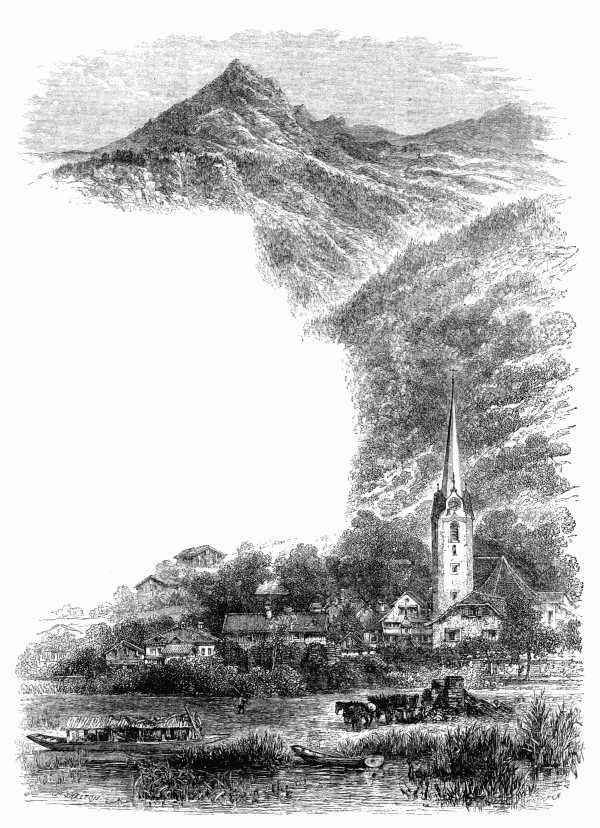 FLÜELEN.
However, the two arrived safely at Bâle,
and, after a matutinal bath in a slop basin at
the station, and a very hot breakfast in two
minutes in the refreshment room, proceeded
direct to Lucerne, where they put up at the
Swanen.
Old Haefeli always pretends the keenest
interest in the latest arrival, so we were not
surprised on the following day that our hotel
bill was not less than usual. Of course, before
leaving that lovely town we did the "lion"
and the "lions" of the place, including the
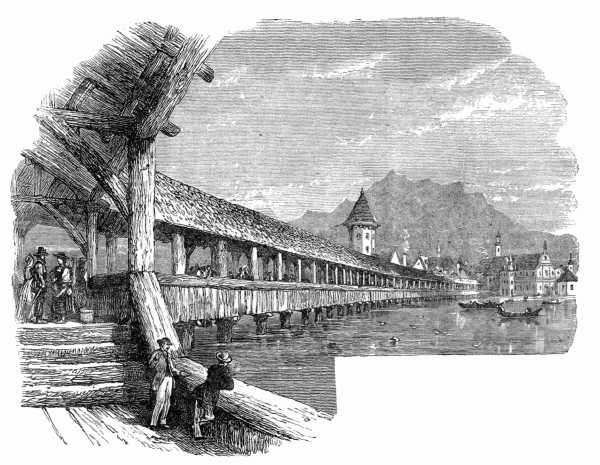
picturesque old bridge, with its numerous
paintings of horrible subjects connected with
the eventful lives of SS. Leodegar and Maurice,
the patrons of Lucerne. But, although there
seems to be no way of getting at the details
of the story, thus primitively depicted, which
evidently embraces old priests without heads
and warriors worshipping the phenomenon,
we admired the colouring and quaint drawings
of the pictures.
The Rigi was partly covered with snow, so
that it was impossible to get either on foot or
by train higher than Kaltbad—and when once
an official saw us attempting to walk through
a likely field for a better view, warned us
sternly against any such foolhardy attempt.
This was amusing, after the information
contained in the Hotel Guide Book, which
runs thus:—"Some daring ascensionists up
the Rigi, only obstinate themselves to disdain
the railway, and so walk up the mountain on
foot."
Our run down to Weggis was exhausting
from the speed with which it was done, but we
soon found ourselves safely and comfortably
ensconced at the hotel at Brunnen, where we
intended to spend the night previous to
proceeding by the St. Gothard into Italy.
En passant we might remark on the
pleasure of the Lucerne Lake, "out of season."
We were the only visitors in the hotel, and
were treated with liberality in the matter of
fare, and with unbounded courtesy and
attention. Our walk through the village at
night was grand from its loneliness and
mystery. We have since been there in
August, but, O! how different! We do not
like brass bands and noisy German tourists.
Early next morning we went by steamer
over the Lake of Flüelen, and were much
struck with the view of this place from the
distance—the quaint red steeple, and the
little Swiss châlets looking so pretty against
the huge mountains, which are here more
striking than anywhere on the banks of the lake.
At Flüelen we continued our journey by the
St. Gothard Railway, but by an unlucky
chance we got into a compartment with an
Italian professor of languages—a terrible
nuisance—who was delighted at having an
opportunity of improving his English pronunciation
at our expense.
The older and wiser bachelor, realising
that it was impossible to prevent our companion
from chattering, determined to turn
him to account, and commenced to ask questions
in Italian, adding to his small store of
knowledge of that language. But the younger
bachelor, to whom the magnificent scenery was
entirely new, would stand the worry no longer,
and got into another compartment.
The scenery of the St. Gothard Pass, at
once after leaving Flüelen, is magnificent to a
degree. At every turn of the railway is presented
a scene of snow mountains, of roaring
torrents, and of towering precipices, which
are so characteristic of this superb country.
At Geschenen the train stopped for about
half-an-hour, so we got out and looked about
us, and found, to our delight, the whole of
this superb gorge enveloped in snow. The
novelty of the sight proved so tempting that
we resolved to see more of it, and ascend
to Andermatt, some miles from Geschenen,
thus sacrificing our railway tickets to Lugano.
We ordered a carriage at the station, and
wrapping ourselves up well—for it was very
cold—commenced our drive in right good
spirits. Before starting we were joined by a tall,
handsome Englishman, who, like ourselves,
had not been able to resist the temptation of
breaking his journey at Geschenen.
Shortly after leaving the station we entered
the dreary Schöllenen defile, certainly one of
the finest in all Switzerland. The road here
is cut in the sides of huge granite rocks.
At the base of the gorge rushes the foaming
Reuss, tearing madly against the rocks, which
try in vain to arrest its course. All the way
from Geschenen to Andermatt the ascent is
very steep—the road in some places being
almost suspended over the Reuss. Of
course, our progress was slow, as, in addition
to the steepness of the road, we had to pass
by (and sometimes through) huge snow drifts
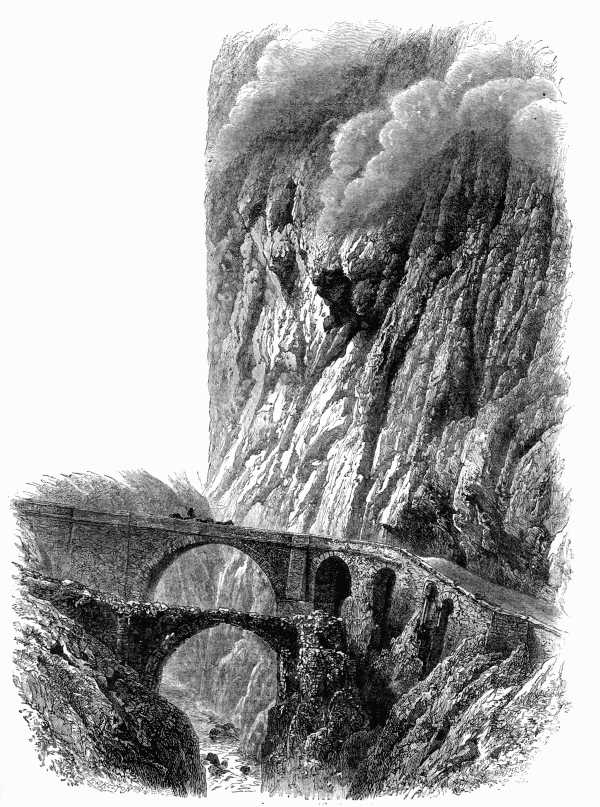
from twelve to twenty feet high. When we
crossed the famous Devil's bridge it was
covered with mist, produced by the spray from
the neighbouring cataracts. The old Devil's
bridge, a few feet below the new one, has
been disused for many years, and is now covered
with moss and lichens. After leaving these
the road passes through a long tunnel (covered
with icicles in the early spring) into the valley
of Unseren, which No. 2 said was fertile in
summer—but how different when we saw it!
The pastures were covered with snow and ice,
and so altered was the scene, that the younger
bachelor (No. 1) thought he was beholding
a huge lake snowed over.
Andermatt looked very pretty with its
ancient Romanesque church and funny little
white-washed châlets, and how glad we were to
get there! famished with hunger, and fearfully
cold, notwithstanding all our wrapping up!
We drove to a smart-looking hotel, where we
were received pleasantly.
After dinner the younger bachelor, who is of
rather a foolhardy temperament, and is, or
rather was, very green, was seized with a
desire to immortalise himself by climbing a
mountain unattended, by sleeping out in the
snow, or doing something perfectly ridiculous.
So, promising his friend he would be back
again in a couple of hours (a compact which
he never intended to keep, by the way), he
marched out of the hotel already thinking himself
a kind of hero. Coming back again in about
three hours and a half, he related that he had
gone past Hospenthal to some place on the
old St. Gothard road, where he was suddenly
stopped by the path being so covered with
snow that farther progress was absolutely impossible.
So, humbled and disappointed, he
came quickly home to find his friend in a
terrible state of mind at his lengthened absence.
In the evening we had some music—for both
bachelors are musical—the older having a
baritone voice, and the younger playing the
piano. How cold that night was! and how
welcome was the great eider-down pillow,
which is generally such a nuisance in continental
hotels.
The next morning, after a hearty breakfast,
we commenced our return journey to Geschenen;
the driver, after leaving the tunnel
and the snowdrifts, tearing down the defile at
a most dangerous pace. At the station we
took fresh tickets to Lugano, travelling third-class
to make up for the extravagance of
abandoning our former tickets, and then
waited for the train which was to take us to
Italy. Yes, to Italy, that wonderful country
of which we had read so much, about which
we had acquired so much information, and
had been so longing to see for the last six
months! The train, with its huge powerful
engine, came slowly into the station, looking
very important, as if it knew that it was conveying
its passengers to the most famous
country the world has ever seen.
The entrance to the great tunnel is within
a few yards of Geschenen Station. When we
consider that this is the longest tunnel in the
world (from Geschenen to Airolo, nearly nine
and a half miles), and that the rock which is
pierced consists of such hard material as
quartz and granitic gneiss, the work may well
claim to be one of the great engineering feats
of the century. The difficulty of supplying
the workmen engaged on the boring of the
tunnel with air, necessitated the building of
huge air reservoirs (just outside Geschenen
Station), which, in addition, were used for
setting the boring machines into motion. The
air was forced into these reservoirs by water
supplied from the Reuss. The operations
were commenced at both ends in 1872, under
the auspices of M. Louis Favre. This great
contractor, to whose industry and genius so
much of the final success of the scheme was
due, died of apoplexy whilst inspecting the
tunnel, after seven years of unremitting labour
and anxiety. The difficulties which poor
Favre had to contend against were terrible,
not the least of which were the crushing of the
masonry, the striking of springs, and a riot
among the workmen, which took place in
1875.
We were a little disappointed with the
length of the tunnel, especially as we had
heard that the boring alone had taken nearly
eight years to accomplish. But travelling
through a tunnel is not a very agreeable sensation,
as passengers by the Underground
Railway will know, so we were glad when the
train emerged from the darkness and slowly
wended its way past Airolo, the first Italian
village on the south side of the St. Gothard.
The scenery changes its character almost immediately
on leaving the tunnel; for though
it is still, of course, mountainous, with a roaring
torrent, the Ticino, almost equal to the Reuss
in its impetuousness, yet it is much more
luxuriant than the Swiss side. Mulberry trees
and vines gradually begin to appear, and the
little church towers (called in Italian, Campanili)
becoming more frequent as one goes
south, greatly add to the picturesqueness of
the landscape.
Here it may be as well to remind our girls
that the Canton Ticino, though Italian in
language, in scenery, in architecture, and, in
fact, in all its characteristics, yet politically
belongs to Switzerland.
After passing Faido the scenery becomes,
if possible, more beautiful, and at Bellinzona,
the capital of the Canton, we saw our beau-ideal
of Italian landscape. From a distance
especially Bellinzona is very striking, with its
three castles and fine 16th century Abbey
church; though when one approaches it more
closely, like so many Italian towns, it is
slightly disappointing.
As we approach Lugano, the mountains
become less elevated, but the soil far more
rich and fertile, and the olive and aloe, so
characteristic of Italian landscape, are to be
seen.
About an hour before reaching Lugano both
of us began to feel unwell and very irritable
from the continual travelling; the younger of
us especially so, as he was rapidly developing
an attack of his horrible complaint—indigestion.
On arriving at Lugano we drove in
the Hotel Omnibus to the Hotel du Parc
and ordered tea to be brought up into
our room, after partaking of which we
went to sleep until table d'hôte time. The
dinner was, of course, the first we had tasted
in Italy, and we cannot say that it impressed
us favourably with Italian cooking. Everything
was oily and rich, and suggested indigestion
and biliousness. After dinner we
strolled out of the hotel to get our impressions
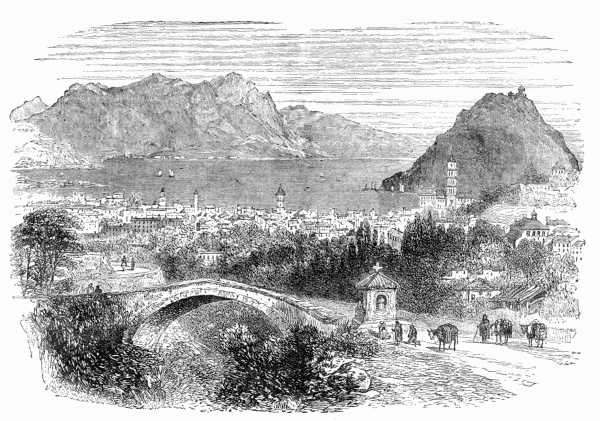
of the town of Lugano. The first thing we
noticed was the beautiful Monte S. Salvatore,
covered with verdure from base to summit;
and then we admired the charming position
and great picturesqueness of Lugano. Viewed
from near the lake, and looking back on to
the town, the number and variety of the Campanili,
the flat-roofed houses scattered near
the lake, and the hills covered with foliage,
presented a most delightful scene. With the
lake itself we were disappointed, the mountains
struck us as being rather uniform and
uninteresting; the shape of the lake also is not
so beautiful as that of either Como or Maggiore,
as we afterwards ascertained.
The interior of the town, with its arcades and
quaint shops, so thoroughly Italian, pleased us
very much, and we experienced to the full that
delightful sensation of wandering about in a foreign
town on a fine evening just after sunset.
The Hotel du Parc, at which we stayed, was
formerly a monastery, and contains some rather
interesting rooms and corridors. Near to this
hotel is a small church thoroughly unnoticeable
from the outside; but which contains three
frescoes by Luini, one of which, the Passion,
is not only the masterpiece of the painter, but
one of the finest and best preserved frescoes
in existence. And here we may say a few
words about fresco painting, which is such a
marked feature in the Italian churches and
buildings. We do so, because some people,
even those who ought to know better, are in
the habit of describing any wall-painting as a
fresco; whereas so many of the wall-paintings,
especially in Italy, are not frescoes at
all, but distemper paintings on a dry surface.
The real fresco consists of painting upon
plaster, while it is wet. The piece of plaster
which is to be painted upon must be only
sufficient for a single day's work—any that is
left over must be cut away, and a fresh piece
added for the next day's work. This accounts
for the strongly indented lines which are
really the joins in the plaster work.
The fresco of the Passion before alluded to
covers the chancel arch of the little church,
and is divided into two complete sections,
representing various scenes from the Passion.
This arrangement, by the way, is not at all
uncommon in early Italian frescoes, and,
although it has been severely criticised, there
is no doubt that it often lends great richness
to the composition, though occasionally, from
the number of subjects depicted, and the
absence of sky and foreground, it makes the
painting appear confused and over-crowded.
The first thing that strikes one in the work,
is three crosses in the largest scale of the picture,
which stand out apart from the rest.
On the lower section are seen the holy women
mourning for our Lord, and Roman soldiers
on horseback, the former painted with great
beauty and pathos—on this row also are St.
John and a very vigorous group representing
the executioners casting lots for the garments.
Above are depicted various stages of the
Passion, and the unbelief of Thomas—this last
containing a most beautiful and dignified representation
of Christ. Above both rows, on
either side of the fresco, are two scenes; one
being the agony in the garden, and the other
the Ascension. Beneath, between the arches supporting
the fresco, are SS. Sebastian and Roch,
the former as fine as anything in the picture.
As Luini's great work is the most northern
fresco of any importance, and is generally the
first seen by the visitor to Italy, it serves as a
kind of introduction to the art which distinguishes
that glorious land.
(To be continued.)