A long time ago—so long that it was ages before my grandfather
was a little boy, and long before his grandmother was a little girl—there
was, not far from fairyland, a beautiful lake, the waters of which
were so clear that as they sparkled in the sunlight they glistened and
gleamed like silver: and so it was called the Silver Lake. Beautiful
white swans sailed majestically on its surface, and thousands of gold
fishes swam in its clear waters.
On one part of the lake the most lovely water-lilies opened up
their white flowers, looking, as some people said, like tiny boats; but
one of the little girls I am going to tell you about thought they
looked like a set of green saucers and white cups, and used to call
them the swans' best tea-things. Now, in the midst of this Silver
Lake stood the beautiful island called Child's Island. Such a lovely
little island as it was had never been seen before, and I verily
believe has never been seen since.
Black clouds never came near it, for there the sky was blue and
cloudless always, and I am told that at night more stars might be
seen from that pretty isle than from any other part of the world; but
whether that is true or not I cannot tell. But I do know that its
shores sloped green down to the water's edge, that the brightest
and sweetest flowers bordered every pathway, that the roses were
without thorns, and there was not a single nettle in the whole island.
I know, also, that the grass was the greenest, the trees the shadiest,
the flowers the brightest, and the fruit the ripest to be found anywhere.
As to the animals, there were none but the gentlest kind.
Little white mice went peeping about with their wee pink eyes, pretty
tame squirrels bounded from tree to tree, and a herd of graceful
fawns fed and played in the meadows. Birds of the gayest plumage and
sweetest song were there; pretty poll-parrots hopped among the trees,
crying, "What's o'clock? What's o'clock?" In short, it was the
brightest, merriest, sunniest spot in the world, and I can say no more in
its praise than that. All day long the sun shone gently down upon
the little isle, and the wind never raised its voice above a whisper.
But, besides birds and butterflies, fawns, and flowers, there was something
else in this pretty isle. Now, what do you guess that something
was? Why, a beautiful fairy palace.
I call it a fairy palace, not because fairies lived there, for they did not,
but because it was the work of fairy hands, and was more beautiful than
any other palace in the world. It stood in the midst of a lovely garden,
but no wall or railing shut it in from the rest of the island; and you
and I, had we been there, might have walked across the green lawn, and plucked
some of the gay flowers, and gone up the marble steps, without anyone saying,
"Stop! You must not go there." Round about the palace, in groups of
twos and threes, were several little houses, all very beautiful and all exactly
alike.
Now, I daresay you will think that this was a very pretty place, at the
same time, very strange; yet the strangest and, to me, the most charming
thing of all was that there were none but children in this little island.
They were all quite young, the eldest amongst them were not twelve
years old; they were the king and the queen, who, of course, lived in
the beautiful palace. And thus, because only children dwelt there,
it was called Child Island.
Well, these little folks had nothing to do but to play;
and a rare time they had of it, as you shall hear; but
perhaps you would first like to know how it
happened that they were alone in this island
without any grown people to take care of
them. Then listen, and I will tell you.
The Silver Lake and Child Island belonged
to the good fairy Corianda, who was very fond
of little children, and took great pleasure in
inventing games for, and otherwise amusing
them. She loved all children, but she was
especially fond of those of Noviland, the king
of which was one of her subjects. She used
often to slip on her magic veil, which rendered
her invisible, and go amongst the little folks
of Noviland to watch them at their play, or at
their lessons, or to peep at them whilst they
slept. It was in this way that she found out
there was scarcely a child in Noviland but
what was discontented with what it had, and
sighed for what it had not.
One fancied that Noviland would be the
jolliest place in the world for little boys if
there were no lessons, no schools; but
grammar and spelling spoiled all. Pepitia
thought that if she might wear fine dresses
like mamma, have a coach and six to ride in,
and no one to control her, she would be perfectly
contented. The little Teresa sighed for
a land where there was no A B C, and Dorinda
for one where toys grew on trees, and no hard-hearted
shopkeeper demanded money before
they were plucked. Herbert wished he lived
in a place where there were plenty of gay
butterflies, and that he had nothing to do but
to hunt them. Thus each child had something
to wish for, and something to be discontented
about.
I wonder whether there are children in any
other part of the world who, like those of
Noviland, want what they have not, and
grumble at what they have? Do you know
any? Ah, no! I suppose there are no other
little folks so silly, so I won't urge the question,
but go on with my story.
When the good fairy heard all these murmurings,
she said to herself, "I will gratify
these little people for a short time in what
they want, and we shall see if they will be
happy then."
So she set her fays to work, and had built
on Child Island the beautiful palace and
houses I have told you of. When all was
ready, she and her fays took the little
grumblers out of their beds one fine night
and wafted them away, whilst still asleep, to
Child Island, taking care, I should tell you,
to leave changelings from Fairyland in their
places, so that the parents might not be filled
with grief in the morning to find that their
dear children had been stolen away.
The next morning, after the sun had dispelled
the mist which always seemed to hang
about him before breakfast at Child Island,
and he was fresh and bright for the day, like
little boys with clean faces ready for school,
the young strangers were all assembled on the
lawn in front of the palace, and the fairy
spoke to them as follows:—
"My dear children, as you all fancy you
would be happier if you were quite free from
control, and if you had nothing to do but to
play, I have brought you to this beautiful
island, where you can amuse yourselves all day
long. You will have everything supplied to
you, and there will be no one to dictate to
you. These pretty houses I give you to live
in. The palace is for the king and queen, and
the other houses are so precisely alike that
none of you will be able to dispute as to
choice. You, Philip, who are the eldest boy,
shall be king, and you, Pepitia, who are the
eldest girl, shall be queen. Be kind and
good-natured to one another, and I will
always be your friend. Don't eat too much
fruit or cake, as that will make you ill. Now,
come with me, and I will show you the inside
of the palace."
Then they followed the good fairy, in a
merry crowd, up the marble steps into the hall
of the palace, and a grand hall it was, with
its rows of pillars and richly decorated walls.
The fairy led them up the staircase and
through the royal apartments, which consisted
of drawing-rooms, dining-rooms, bedrooms,
and dressing-rooms, where the looking-glasses
reached from floor to ceiling and the wardrooms
were filled with magnificent dresses.
Then into the throne-room, hung with
crimson velvet embroidered in gold, and
where, at the upper end, were two golden
thrones inlaid with precious stones and
cushioned with crimson velvet. The more
they saw the more delighted the little folks
were; they clapped their hands with joy, and
cried, "Oh, my! how beautiful!" at least
twenty times in a minute.
"Oh! shouldn't I like to be you," said
Amanda to Pepitia, "you will be queen, and
have all these fine things."
After they had seen all that was in the
palace, the fairy took them over the other
houses, all of which were elegantly furnished,
but it would take up too much time to tell you
of all the beautiful things that were in them.
Just fancy how you would like to furnish a
little house that had drawing-rooms, dining-rooms,
bedrooms, kitchens, and whatever you
fancy you would like to put there was there,
and even more than that. No wonder the
children were pleased.
After the fairy had shown them all the
pretty things the houses contained, and had
allotted to each set of children the particular
house they were to inhabit, a crystal car,
drawn by six white swans, was seen to
approach the shore. Then the fairy said,
"Now, my little dears, I must go, for here is
my coach and six come to fetch me." So she
kissed them all round, bade them be good
children, said she would come to see them
again some day, got into her car, and was soon
out of sight, the children shouting, "Good-bye,
dear Fairy, good-bye," till they could see
her no longer.
Then they said, "What shall we play at
first?"
"Let us go into that pretty dell, where the
fawns are at play, and gather some of the
flowers," said Pepitia. To this they all
readily assented, and ran skipping and singing
into the dell. Some pulled long rushes and
sat themselves down to weave little baskets;
some gathered nosegays, some played with
the fawns. Presently one of them said, "Oh!
suppose we have a dance."
"Yes, yes, yes, so do," cried a dozen little
voices.
"But there's no music," objected the
queen, "we can't dance without music. How
I wish we had some!"
"I'll hum a tune," said Sophia; and she
immediately began one.
"No, that's so stupid," said Amanda.
"Oh!" screamed a little boy. "Look
there!"
"Look where? What's the matter?"
cried they all.
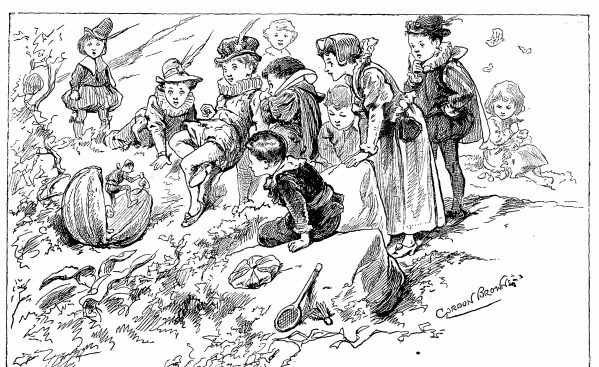
"Why, look at that big yellow thing,"
replied the child, pointing to a large gourd
which lay upon the ground, "it's opening all
by itself!"
And sure enough it was slowly opening, as
if it were a monster mouth taking a lazy yawn.
The children clustered together and watched
it eagerly, when, to their great amazement, out
popped a little figure, not more than six
inches high, dressed in a suit of sky blue
velvet with white lace ruffles at the throat and
wrists. The dress was fastened down the
front and at the knees by diamond buttons;
diamond buckles were in its shoes, white silk
stockings on its legs, and on its head a crimson
cap with white feather. As soon as this quaint
little figure jumped out of the gourd he was
followed by another, and another, and another,
till there were a full score of them, all dressed
exactly like the first, and each carrying a tiny
musical instrument in his hand.
As the last jumped out the gourd closed,
and the leader of the Liliputian band stepped
a few paces in front of his fellows, and, taking
off his feathered cap, made a low bow to the
king and queen, then, without speaking a
word, he sprang on to the foremost branch of
a white Mayflower bush, which was in full
blossom, and immediately his little companions
perched themselves on different
branches behind him, and began tuning their
tiny instruments.
The children, full of glee, arranged themselves
for a dance, the band struck up "Sir
Roger de Coverley," and away they all went,
their little feet keeping time to the music as
truly as the leader's tiny baton. They danced,
and they danced, and they danced, till they
were too tired to dance any more, then they
flung themselves down to rest; upon which
the little leader of the band jumped down from
his perch and placed himself on a broad
smooth leaf, that two of his band spread on
the grass opposite to where sat the king and
queen.
He made a low bow to their majesties, the
band struck up, and the little fellow commenced
dancing a pas seul. If you had seen
him prancing and capering about the leaf, now
with his arms akimbo, going jauntily round
and gracefully bending his body from side to
side, keeping time to the music as he did so;
now suddenly clasping his hands above his
head, whirl rapidly round and round till he
got to the front edge of the leaf, and then,
springing into the air, come down on the very
tips of his pointed shoes; if you had seen all
this I think you would have laughed and
shouted as loudly as did Rosetta, Minette,
and all the rest of the little folks. When the
droll fellow had finished his dance he flourished
his feathered cap, made a low bow, and backed
to where his companions were standing. The
gourd slowly opened again, and each little
fellow making his bow, popped in as quickly
as he had popped out; then the gourd closed,
and nothing more was seen of the little
musicians that day.
The children gathered round the gourd and
tried to open it; tapped at it; called to the
little musicians to come back; bent down
their pretty heads to listen; but all was
useless, no sound came from it, and they
might as well have tried to open the oak tree
'neath which they stood as it.
Now, for fear you should think that the
good fairy had left these little children to take
care of themselves entirely, to cook their own
food, wash their own clothes, make their own
beds, and all that sort of work—for children,
you know, cannot do these things for themselves,
and that is why they are always so
good and obedient to mammas and papas
and kind aunts, who see to all these things
being done for them—I will tell you what
queer, droll little beings she left in the island
to attend to the domestic concerns of the
young king and queen and their little
subjects.
Just shut your eyes and fancy you see a
little brown figure with small dark eyes, like
black beads, sharp nose, thin lips, and glossy
red hair, combed off the face, plaited into a
long tail behind, and tied by a bow of black
ribbon. Then fancy this little figure, with
arms so long that they reach to its knees,
dressed in a dark blue smock frock
without sleeves, a red leather belt round its
waist, dark red trousers on its legs, and green
morocco shoes on its feet; then call it a
Noman, and you will see precisely the sort of
beings which were left to wait on the young
inhabitants of Child Island. They were all
alike and all dressed alike; they used to make
their appearance and begin to dust and sweep,
and light fires, and such like, just after cock-crow
every morning, and they all disappeared
every night directly the children were safely
tucked in bed. They came all together and
they disappeared all together, but where they
came from or where they went to nobody
ever knew, so you must not expect me to tell
you.
I daresay you will think these Nomen a
strange race, but I am going to tell you something
stranger still concerning them, and that
is that none of them could talk, no—not
one!
Was not that odd? They had some way of
talking amongst themselves by means of signs,
but the only words they could say to their
young masters and mistresses were, "nob,
nob," which meant no, and "yah, yah,"
which meant yes. These they uttered very
quickly, and nodding their heads at each
sound.
Now, the good fairy had charged these
little beings to be very kind and attentive to
the children; to cook their meals and serve
them nicely, and to keep their houses in
pretty order.
She also charged the children to be kind
and gentle to the Nomen; never in any way
to tease, annoy, or insult them, for if they
did, the fairy said, and she looked very grave
as she said it, "some punishment would
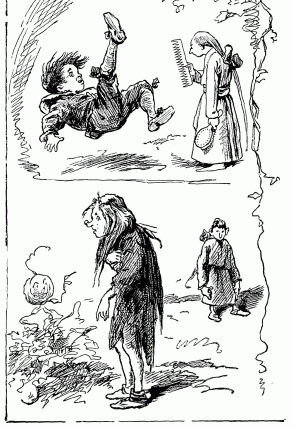
immediately follow." This Master Edmund
found to be quite true, when one day he
attempted to kick the Noman who was
brushing his hair, for as he raised his leg to
kick, an invisible hand pulled the other from
under him, and Master Edmund measured his
length on the floor. So, also, Miss Sophia,
who said one day, whilst looking in the glass,
admiring herself and sneering at the Noman
who was fastening her frock, "What a fright
you are with your squiny eyes and red hair! I
shouldn't like to be such a fright as you are."
Upon which she immediately felt a sharp prick
on her nose, whereon a large red pimple, as
big as a cherry, made its appearance; her frock
was torn to tatters, and on going to her wardrobe
for another she found it quite empty, so
she had to wear her rags all that day, as it was
not until the next that the clothes came back
to her wardrobe, and the pimple left her nose.
I warrant me she will never be saucy to the
Nomen again!
Master King Philip had a lesson of the same
kind once, at his dinner table, when all
his court were dining with him. Calling
to one of the Nomen who were
waiting, "Make haste, you brown rascal,
and fill me a glass of wine!" the words
were scarcely out of his mouth than he got a
smart sounding slap on his face, and his elbow
was violently jerked, so that he spilt all his
wine, whereupon the little lords and ladies
tittered, and some were so uncourtly as to
laugh outright, and say it "served him right,"
which made Master King Philip wish he had
not been so bounceable.
One evening, after they had been some
weeks on the island, the king told his courtiers
to prepare for a butterfly hunt, which he intended
to have the next day. Early on the
morrow they all assembled at the palace,
attired in green and white, and each carrying
an ivory rod, at the end of which was a green
net, with which to catch the butterflies. On
reaching the top of the staircase the little
lords went to the dressing-room of the king,
and the little ladies to that of the queen. Her
majesty was dressed in white satin trimmed
with green.
"Won't you wear your crown?" asked
Rosetta.
"Well, I don't know," said the queen, in
an undecided tone of voice. "Ought I?
Won't it be too heavy for the chase?"
"Oh, but kings and queens always wear
their crowns when they go out—don't they?"
said Rosetta, appealing to her companions.
"Yes, yes; to be sure they do. Wear the
crown—do wear the crown!" they all cried,
clapping their hands.
Pepitia did not require much persuasion on
the subject, as she dearly liked to be finely
dressed. And, indeed, when she had put it
on, and also her velvet train lined with satin
and trimmed with ermine, I must confess she
did look a charming young queen. The little
Dorinda was so struck with her appearance
that she screwed up her face into a comical
expression of surprise, and, holding up both
her hands, exclaimed—
"Oh, my! Aren't you smart!"
"But I don't like the way your hair is
done," said Amanda, who was disposed to be
quizzical.
"Don't you?" rejoined the queen, tartly.
"Then you needn't."
Amanda was on the point of making an
equally tart reply, when fortunately the king
appeared at the door, and so interrupted the
threatened dispute. He also wore his crown
and train, and, moreover, he carried the ball
and sceptre in his hand; for this little monarch
was not disposed to part with any of the
insignia of royalty, and thought he might as
well not be a king if he did not wear the grand
trappings belonging to his office.
Then the whole party went down into the
hall to be marshalled into proper order by
Alphonse, who always took upon himself to
be master of the ceremonies whenever he
could get a chance. This was not effected
without a vast deal of chattering and confusion;
and report says that one or two
sounds like "Shan't!" "Shall!" were distinctly
heard, followed by what sounded like,
and probably was, a slap.
The little train-bearers were especially difficult
to manage, owing to their constantly
wanting to speak to one or other of their
companions in the rear, which inclination
occasioned their majesties several unmajestic
jerks from behind, and, of course, called forth
a sharp reprimand from the majesty so pulled;
the only effect of which was a vast deal of
giggling amongst the little girls, and the
making of droll faces by the little boys.
"Please, queen, Edmund's making a face!"
cried a little lady-in-waiting, looking at the
culprit and speaking to the queen.
"Oh, you story-teller!" cried Edmund,
indignantly. "I ain't."
"I'll box your ears if you do so again, you
rude boy," said the queen, turning sharp
round on the guilty Edmund. At this threat
the urchin made a queer grimace, and then
pretended to cry, sobbing out, "Oh, please,
queen, don't!"
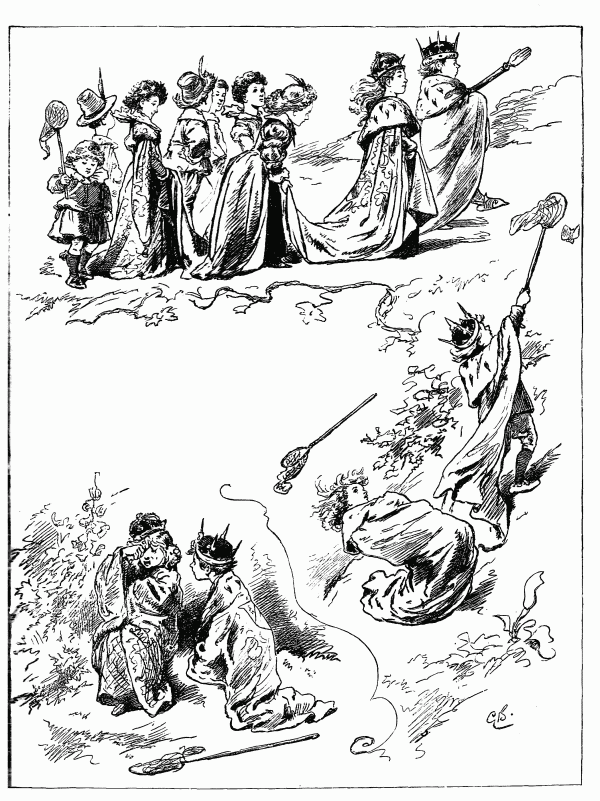
At length all were got into their proper
places, and the procession set out. The king
and queen, with their train-bearers, marched
first, then strode consequential Master Alphonse,
and the rest of the party followed,
two and two, all singing a jingling rhyme as
they marched, and swinging their nets to the
tune. This is what they sang:—
"Bring your nets and make haste;
Come away to the butterfly chase,
Up the meadow and through the dell,
By the path we know so well;
Shout loud, jump high,
And haste to catch the butterfly."
When they came to the dell where most
butterflies were to be found they all separated
and got their nets ready, whilst Alphonse
took a thin switch and gently beat amongst
the flowers, which grew in great profusion.
Presently a cloud of large, brilliant butterflies
flew up, and the children, shouting,
started off in chase of them. The train-bearers
were not proof against the excitement
of the moment, and, quite forgetting their post
of honour, scampered off pell-mell with the
rest, leaving their majesties looking rather
foolish.
"The rude little things, to run off in that
manner!" cried the queen.
"Here, I say, you Alphonse!" shouted the
king, forgetting his dignity, "come back! I
shan't play if you're going off like that. Come
back."
But Alphonse was too busy chasing a brown
and gold butterfly to heed King Philip or
anybody else.
Just then there flew past an immense
butterfly with wings of crimson, black, and
gold. Philip immediately forgot all about
being a king; away went ball and sceptre, and
off he started in full chase. Now the queen
loved butterflies no less than the king, so no
sooner did she see him take to his heels than
she started off in pursuit of the same butterfly.
Away they both went, their trains flying
behind them, over hillocks and through bushes,
quite regardless of their fine clothing.
The butterfly led them a fine dance; many
a time they thought they had got it, but it
always managed to fly off just as the extended
thumb and finger were about to close upon it.
Philip and Pepitia were tired, though by no
means inclined to give up the chase, when the
butterfly burrowed itself deep into a convolvulus
flower that grew on the top of a not very
high bank.
"Now we shall have him," cried Philip, as
they both scrambled up the bank. But, alack
and alas! Pepitia's foot got caught in her long
train just as she got to the top of the bank,
and down she fell, roly-poly, to the bottom.
Poor Pepitia! she quite forgot she was a
queen, and began to cry most lustily, not the
less because she could not use her arms to
raise herself, for in her tumble she had got so
rolled round and round in her train that she
could not move her limbs.
Philip ran quickly to her assistance, and
soon extricated her from her embarrassment,
but as she still continued to cry, he tenderly,
for he was a tender-hearted boy, sat her down
on a grassy mound and tried to console her.
"What is the matter? Have you hurt yourself,
dear?"
But Pepitia only sobbed and sobbed instead
of answering, partly because she was hurt,
and partly because she was vexed, and the
poor little king began to fear she would never
leave off crying.
"I wish that Alphonse and the rest would
come back," said he, feeling disposed to pick
a quarrel with "that" Alphonse when he did
come.
(To be concluded.)